Showing results for buffalo horn jewelry

S3 – 05. Developing an asset orientation with Lani Horn

Math Teacher Lounge podcast featuring Lani Horn, a professor at Vanderbilt University, on developing an asset orientation.

In this episode, math education professor Lani Horn shares with us what it means to have an asset orientation towards students, contrasting it with a deficit orientation, and helping Bethany and Dan understand the many ways students experience one or the other. Their conversation hit both high notes and low notes and included a challenge that Bethany and Dan both found extremely valuable for helping a teacher develop an asset orientation towards their students.

Explore more from Math Teacher Lounge by visiting our main page

Download Transcript

Dan Meyer (00:03)

Welcome back to Math Teacher Lounge, folks. My name is Dan Meyer.

Bethany Lockhart Johnson (00:07):

And I’m Bethany Lockhart Johnson.

Dan Meyer (00:09):

We’re so excited to be here with you folks and with our guest today, tackling big questions about mathematics. I wanna ask Bethany first though: Bethany, it’s been kind of a challenging couple of years for those of us in education, near education, just in life in general, of course. But I woke up this morning and the sun was out; the weather was perfect and crisp here in Oakland; and I found myself feeling optimistic, a sense of hopefulness. And I was wondering to myself, “What is Bethany feeling hopeful about in math education right now?” What’s got you juiced up a little bit?

Bethany Lockhart Johnson (00:40):

I gotta say, that optimism, Dan, look at that! I can actually feel the sunshine just pouring through the microphone! So I thank you for asking. What am I feeling optimistic about in math education? Hmm. OK, this is gonna sound a little bit cop-out-y, but I have been so completely jazzed about not only our podcast, but the conversations that I’ve been seeing circulating in other math podcasts that are out there around curriculum, around new books coming out. It just feels like despite overwhelm, despite exhaustion, that most teachers really do love learning. And so there’s like that kernel. And so I just feel like there’s books on my shelf I wanna read; there’s podcasts in the queue I wanna listen to; and summertime is the best, best time to do it.

Dan Meyer (01:39):

People still feel hungry out there for learning. They know the importance of the craft and its impact on students. And, yeah, people are tired, but also it is so cool to see people still jazzed about learning more about how to teach students more effectively. Me, I’m excited right now, I have a very specific excitement right now, which is that today we announced that Desmos, where I work, and Amplify, our sponsor, are no longer gonna be two separate things. That we are joining together. That I, and all these people who have done so much work over the last 10 years developing digital math technology, we’re gonna go and work inside of Amplify as a division called Desmos Classroom. And we’re so excited that…what we cracked, I think, at Desmos, is a way of thinking about how teachers and their tools—computers, for instance—interact with students in math. And I love what we did there. But we never really cracked the question of, “How do you support entire school systems in taking up these ideas and tools?” And Amplify has really done that. So I’m super-excited to partner up there. That’s what I’m optimistic about and happy about.

Bethany Lockhart Johnson (02:40):

Congratulations! That’s a huge transition, and I’m just so excited about the amazing work that both Amplify and Desmos do. But then, the idea of Desmos being in more classrooms? Those tools being available for more students? With the reach? I mean, I’m just excited! It’s a big day, Dan.

Dan Meyer (03:00):

Thank you. Yes, exciting day. And I’m excited about also about our guest we’re bringing on today. How’s that for a segue? I’ll be excited to hear what our guest is excited about in math education. I just wanna say that what our guest, Lani Horn, Professor Lani Horn, has exposed us to is this idea of an asset orientation and its importance. And I do think I’m not over-exaggerating or overstating to say that the idea of an asset orientation towards students and their thinking has been possibly the most transformative idea for me in the last five years of being an educator. And adopting it has led to my favorite lessons, my favorite teaching experiences, my favorite relationships with students. I say all that—you know, I don’t wanna gas things up too much; is that too high of a bar here to have expectations? But it really has been tremendous! And Lani Horn gave a talk several years ago called “An Asset Orientation Is Everything,” which really changed the game up for me. And Bethany watched it as well. So that’s why I’m so excited to have on the person who gave that talk. And who’s done so much research around what an asset orientation offers students and teachers. So we’re bringing on today Lani Horn, who is a professor of mathematics education at Vanderbilt University, Peabody College, who centers her research on ways to make authentic mathematics, ambitious math teaching, accessible to students and teachers, particularly those who have been historically marginalized by our educational system. I think Lani has just a beating heart for students, yes, but also really respects the work of teaching in ways I think are so needed and sometimes uncommon in the world of math-education research. So Lani, thank you so much for coming on and joining us in the Lounge.

Lani Horn (04:41):

Thanks for having me.

Dan Meyer (04:44):

We would love to know what you are excited about and optimistic about right now in the world of mathematics education. What’s got you a little bit gassed up?

Lani Horn (04:52):

Up, gassed up? Hmm. Let me reframe it, ’cause I don’t know if I’m gassed up, but I’m cautiously hopeful that maybe that in the wake of the interrupted learning that’s been sort of widespread during the pandemic that maybe we’ll get some traction around more strategies for teaching in heterogeneous classrooms. Which I think every classroom is, to varying extents: a heterogeneous classroom. And I was talking with a colleague the other day about this idea of hmm, maybe modeling would be a really cool thing to focus teachers on. Doing some more mathematical modeling across the grade levels. Because it just seems like there’s a lot of opportunities for kids to kind of catch up on ideas and understandings that they may not have fully grasped because of interrupted learning, interrupted schooling. But also with room to engage in a lot of ideas. So we were playing with that and I was like, “Gosh, that’d be pretty cool if people took that on more broadly.” ‘Cause I don’t think that there’s been enough conversations about meaningful differentiation in that kind of way, like at the level of curriculum. So I would love to see an upsurge in interest in that kind of stuff, ’cause that’s a big place where I have a lot of passion, so I’m ready! I’m ready for people to ask questions about that. And actually it’s really very, very, very closely related to the topic today of having an asset orientation towards students.

Bethany Lockhart Johnson (06:34):

First of all, I’m so excited to have you on Math Teacher Lounge, have you in the Lounge, and get to talk to you, because when Dan sent me this talk, my first thing was, “Oh, I think I know what asset orientation is and looks like.” You know, you kind of hypothesize about what you think it’s going to be. And then you started talking and I’m like, “Wait, wait, why am I just hearing this now?” So I thought I knew what it was, but really I felt like there was so much to unpack. And I would just love for you to share with our listeners, in case they are like, “Oh, asset orientation, I know what that is. I’ve got it. My students have got it.” What is it? And why does it matter so much to our teachers?

Lani Horn (07:19):

The most obvious point is that asset is the opposite of deficit, right? And we know that deficit thinking is very harmful to students. That there’s a real teacher-expectation bias that that kids pick up on, that we communicate indirectly to students and that impacts their learning and their ability to meet our academic expectations and, other expectations in classrooms. So an asset orientation is looking for students’ strengths and trying to work from those strengths as a basis for your teaching.

Dan Meyer (07:54):

So that’s a really fantastic starting spot there. And I think what’s initially surprising to me about the research you cited in your talk, that is built around an asset orientation, is how…I think if you come at learning from a—I guess in research, they call a cognitivist frame, where learning happens when teachers say the right things that make a transfer from the teacher’s brain to the student’s brain. A lot of what you’re describing is very counterintuitive, I think. The asset orientation describes a teacher’s kind of subtle disposition. It’s not what, like what they’re saying exactly. It’s what they communicate in the subtext and the body language, that all emanates from some perspective on students and the idea that that filters down somehow and students pick up on that—like a smell in the air—and that determines a lot of their learning, I think is one part of your talk and the research that I thought was really surprising. How close is that to like how this actually works? And can you add to that description or pivot it a little bit?

Lani Horn (08:54):

Expansion of the sort of cognitive framing of teacher and student interaction…part of what’s really hard about developing and maintaining an asset orientation is that schools are organized in ways that rank and sort children. And so when we are just using the everyday language of schooling, sometimes we’re injecting these preconceived deficit notions of students into our talk and into how we’re thinking about, interpreting, looking at students. So not only is this interruption a sort of a cognitive lens on teacher-student interaction, but it’s really looking at how the social environment is setting teacher-student interaction to take on certain kinds of framings.

Dan Meyer (09:44):

This is what I mean about Lani having such a generous frame towards teachers and the work of teaching. I wonder, though, if you could help us make concrete how an asset and deficit orientation might play out in a hypothetical classroom interaction.

Lani Horn (10:00):

Sure. A really commonplace example is a teacher has a group of students. It’s October or November. So there’s already been a few assessments. And that gives the teacher an idea who the strong students are and who the struggling students are. And they’re having a classroom conversation. And someone who hasn’t performed well, a kid who hasn’t performed well on those assessments—the teacher poses a question. A kid who hasn’t performed well on the assessments is called on. And they sort of hesitate in formulating their response. And the teacher with that lens of “this is a struggling student” then may have to make a decision: “Do I persist? Do I support this kid? Do I help them formulate an answer? Do I try to draw out their thinking anyway? Or do I move on to a kid who is academically performed better in my class?” And I would say that a lot of teachers in that situation would very understandably say, “OK, I get it. You’re not a strong math student. You’re not confident in my class. I’m gonna move on because I need to get through this lesson to somebody who I know is gonna provide me with a correct answer.” And they do it also out of, sometimes, a sense of care, of not wanting to put that student on the spot. However, part of what is another unintended result of making that choice is instead of trying out that student’s thinking, listen to their sort of, maybe, hesitant answer, and trying to find the kernel in it that maybe could be supported and amplified, that kid then loses an opportunity to have their idea be a part of the whole class’s mathematical conversation. Completely common, completely understandable kind of interaction that I see all the time.

Bethany Lockhart Johnson (11:52):

That feels so huge. And that I can actually picture that happening.

Lani Horn (11:56):

Of course. We’ve all seen it. We’ve all done it.

Bethany Lockhart Johnson (11:58):

We’ve all seen it and done it. And I think it’s so key that you mention often it’s from a place of care. Of “I want that student to—look, I called on you; you’re a part of the conversation; you’re a part of our community.” But with it, I brought all of that other information that I think I have about that kiddo. Right? And how I think they’re struggling or navigating the question. And “Here, I’ll help by…” You know? But what I immediately thought of is how much the other students also pick up on that, right?

Lani Horn (12:36):

Of course.

Bethany Lockhart Johnson (12:36):

I remember this time, this student in my class, a student who had struggled on some of the work we were doing, she came up and she shared her work. And then another student kind of like, it was almost like a strange little pat on the back, like, “Look at that! You did it!” And like really said it in a tone of…like, you’re 5, where did that come from?? How had I set up that student to be—I really had to step back and say, “What role have I played in making this student seem like she wasn’t capable of what she had just solved?” It was such a learning moment for me. Because I don’t think teachers do it maliciously, you know, or even consciously.

Lani Horn (13:33):

Absolutely.

Bethany Lockhart Johnson (13:34):

And it was so huge.

Lani Horn (13:36):

Thanks for sharing that, Bethany, wow.

Dan Meyer (13:38):

Even in your description, Lani, you mentioned how the need to keep the class moving to fit, again, a policy that teachers didn’t impose, that we have 45 minutes and way too many standards to cover in that many days…I wanna ask you about growth mindset. It feels like every last teacher on earth has finally got the memo about growth mindset. We all know it’s the good mindset and that the bad one is fixed mindset. And we have the posters. The posters have been distributed. <laugh> A nationwide mobilization.

Bethany Lockhart Johnson (14:07):

I automatically pictured the posters.

Lani Horn (14:09):

<laugh> Of course.

Dan Meyer (14:11):

We’ve got the posters up, people! So we’re good! And now here comes asset orientation, which has some of the similar kinds of happy feelings, good vibes, about teaching and students and learning. So I was just wondering if you could help us kind of differentiate those two kinds of concepts.

Lani Horn (14:28):

I think that an asset orientation is something you’re never done cultivating. I think it’s an ongoing stance that you have to constantly reset and reexamine. And it is recognizing the links to the social categories that students inhabit, the identities that they bring with them, the bodies that they live in, the different abilities and disabilities. And it’s actually a place where, when you really engage this work in a meaningful way, I think it has the potential to make you kind of a better human being. Because you have to constantly say, “Gosh, why did I do that? What is it that my expectation was? Why am I having such a hard time with this particular student, finding something that they’re smart at, something that they’re really good at?” ‘Cause that’s the question. That’s the asset orientation question. You look at your students and you say, “What is it that they are smart about? How are they smart? I understand that school values this; I understand that my assessments value this; but what are they smart at? And how could I bring that into the meaningful work of my classroom?” Which is a very hard question sometimes.

Dan Meyer (16:03):

Yeah. Oh, so many thoughts here. Like one, I just feel like it’s such a value for teachers, for anyone, to have a big, clear, unanswerable-in-your-lifetime question to motivate your work in teaching. If you don’t have that, then the job is too small, basically. So I love that it’s a question that offers ways to dig in every single day. Every interaction is an opportunity, and it will never be answered. That’s wonderful. I love how I just feel like there’s…sometimes we have conversations with Lounge guests, Bethany, where it really gets out of the realm of the school. And it starts to creep on in to the personal life. It starts to creep on in to the spiritual life. And I find, with this sort of idea—the value of a human being—I feel when I have an asset orientation towards my key relationship in my life—my best friends, my spouse, all these things—that that’s an indication to me of a really big and valuable idea. And the question of the difference between growth mindset and asset orientation, I wonder if it’s relevant here that a growth mindset is a concept that was studied and originated by an education psychologist, Carol Dweck, and you are someone who operates with a social-cultural frame that considers more than the student’s mind in the unit of a student, but like what is going on and what are Bethany’s students perceiving in that moment you described, Bethany, that was you and a student, but everyone kind of feels what’s going on. I wonder if that’s a useful differentiator here. Do you have any thoughts about that?

Lani Horn (17:30):

Yes. I do think that the anthropological perspective that I take—where I really look at the cultural sources of these perspectives and these expectations and narratives, I would say, about who can learn math—are really, really important. And they’re part of what sometimes becomes invisible in the classroom. Though those are a really, really important part of the ongoing work of developing an asset orientation. And of course, I come to it from my own personal experience. I was an undergraduate math major. And sometimes by the time I got to my senior seminars, I was the only woman in the room. And you know, I felt that. I felt the stigma of low expectations. I felt the missed opportunities to dig deeper because people were trying to protect me from being wrong and embarrassing myself. And so on. So it’s personal. And of course we see this applying to other social categories as well. We know that the bias is not just against women in math, but people of color, against people with different kinds of abilities, and so on. So I think that that’s why it’s sort of this ongoing personal work. And I think, too, that we will inevitably in the course of committing ourselves to this find students who challenge us, especially in our society right now, the way things are so fractured. You know, what if you have a student in your classroom who holds political views that you find really odious? How do you find a way to engage that student in a way that respects what they do have to offer to your class, while also making sure that the class is a safe place for everybody? I mean, those are really, really complex dynamics to manage. And, you know, I can talk a lot about that too.

Dan Meyer (19:30):

What a job; what a job. Yeah.

Bethany Lockhart Johnson (19:33):

I was really struck, too, because I feel, like Dan said, we’ve gotten the posters. And not to undermine the power of growth mindset—I think it has impacted many, many students and communities—but it sometimes stops there. The conversation stops there. Well, you know, we have a chant we do every day. We have the poster on the wall. My students have a growth mindset. And I think what I really appreciated in your talk, and as I’ve learned about your work, is the invitation to teachers to be vulnerable and to really look at… I do feel like even sharing that story, you put a certain amount of vulnerability of, like, have I failed in some way? But I care about my students. I’m committed to cultivating a safe space. So I guess something I’m really curious about is: what do you think needs to happen or needs to be possible for teachers to further cultivate an asset orientation? Because even the ability to pause and to be reflective, sometimes it doesn’t seem possible. So I think it’s beyond just the teacher, but in the school, the district…what are some things you feel?

Lani Horn (20:49):

Are you letting me be the queen of designing schools? ‘Cause that’s a job I’ve always wanted! <laugh> OK. So if I were the queen of designing schools, teachers would have fewer student contacts.

Bethany Lockhart Johnson (21:04):

Say more.

Lani Horn (21:05):

When I taught high school, I had sometimes…I think the most I got was 180 student contacts a day.

Bethany Lockhart Johnson (21:12):

Wow.

Lani Horn (21:13):

So when you’re looking at 180 kids a day, that is just sort of a capacity issue. How am I supposed to really look meaningfully at each of those individual people and find what’s valuable and strong and smart about each of them? I think that in the U.S., teachers have more instructional time than any other developed country. We need more planning time. Because that’s an opportunity to consult with colleagues. Sometimes when we encounter students where we do have that personal struggle of, “Oh, gosh, I am really having a hard time connecting with you and seeing your strengths,” wouldn’t it be great to be able to go to their last year’s teacher or their English teacher or some other teacher and say, “Can you tell me about your experiences with this student? Because I’m really wanting to connect and I’m having trouble.” And wouldn’t that be wonderful if we had resources to do that? The other thing I would do is I would get rid of a lot of the meaningless accountability, which I have found has only amplified sort of the sorting, and sort of put a technocratic veneer over kids’ deficit thinking about their own selves. Kids get a printout saying that they’re “below basic” and you say, “Hey, that was a really good idea!” And they don’t believe you ’cause they have this printout that puts them in a different category, so there’s no way they could be good at math. So I think we’ve really done a lot of harm in the annual testing of kids in that way. Especially with the individual reporting. And often the metrics we’re using to do that are not designed to be disaggregated to the individual level. So we have a lot of measurement problems. I’m kind of going back to your question before, Dan, about what’s the difference between growth mindset and an asset orientation. I think that sometimes—I don’t think this is the way Carol Dweck intended it, but I think sometimes—and I’ve seen her rebut the way it’s been used in schools—but I think sometimes the way that growth mindset has been used in schools kind of brings it back to an individual problem: “We don’t have unequal funding in our school system! We don’t have systemic racism! We don’t have childhood poverty and malnourishment! It’s just about having the right mindset!” And we know that all of those other things have a huge impact on who engages in school and who’s able to get access to schooling and the formal learning that goes on there. And so there’s a little bit of an erasure that happens in the way that growth mindset has been taken up, and putting the onus back on students and teachers as opposed to going, “Wow, we’re in this system where the cards are stacked a certain way, and I have to somehow navigate that as a teacher and figure out how to hold you up in a system that is trying to push you down.” Which is a really different kind of job than to put a poster on my wall and do a chant in the morning.

Bethany Lockhart Johnson (24:39):

And I’m wondering, if you were looking at how you would hope that asset orientation gets brought into the classroom…it’s not another poster, right? What do you think would really help make some meaningful change around the way we think about that and teachers and systems take that on?

Lani Horn (24:59):

So I think that the important thing is helping teachers develop a vocabulary for recognizing students’ mathematical strengths in particular. Recognizing a strength is not, “Wow, you did really neat work!” or “You have really nice handwriting!” Those are not authentically mathematical strengths, right? So I try to think about—ah, for color theorem, “How cool! What a great way to be systematic!” You know, that being systematic, developing a good representation, asking a good question, asking the next “what if,” all of these are profoundly mathematical ways of thinking. And there’s more—I’m just giving you a few examples—that are not always recognized in classrooms that are built around quick and accurate calculation. Right? When that is the most valued form of smartness, kids who can do all these other great things, like, “Wow, that that is such a clear way of explaining the connection between that graph and that equation! I love it. That helps me see what’s happening every time that variable increases.” You know? I love when kids do that! That’s not quick and accurate calculation, right? One of the most heartbreaking things I’ve seen sometimes is teachers doing a really good job of pumping kids up and helping them feel mathematical and seeing their mathematical strengths in the everyday lessons…but then they get a standard assessment and are told they’re a C student. How do you support the messaging you’re doing in your teaching and in your interactions so that it aligns with assessment? And this is where the sorting mechanism of school kind of inhibits some of the ways that we really should be valuing kids in a way that would support their ongoing learning and their own particular flourishing.

Dan Meyer (26:59):

I love how you describe this whole process as a career-long trajectory, how one does not ever finish creating an asset orientation in oneself. I’m wondering if there is some way for teachers who are listening to start to experience, to enter into that kind of feedback loop, that experience, of what an asset orientation offers them and their students. Do you have some way for us to start digging in here? A challenge, if you will?

Lani Horn (27:24):

Yeah, sure. This is a process I learned from teachers I’ve worked with, so I did not make this up. It’s called a roster check. It’s where you take a roster of one of your classes, and you go through student by student and see if you can specifically name a way that that student is mathematically smart. And it’s a private exercise if you want it to be. And just sort of go through. And then for the students who you really struggle to name how they’re smart, step back and see if there’s some kind of a pattern. And when I’ve done this in PD, as an exercise, I’ve had teachers have some real light-bulb moments where they go, “Oh my gosh, I really don’t know the quiet girls in my classroom,” or “I really don’t know the multilingual learners in my classroom.” So they can sort of start to see a bias in who they’re interacting with and who’s been able to engage in ways that uncover what their unconscious bias might be. And sometimes it’s not unconscious bias. Sometimes it’s not necessarily a category like that. It’s just the kids who are more outspoken, the kids who are high achieving. It doesn’t have to necessarily be linked to an obvious social category. However, I do think that then what you can do with that list of kids who you don’t have a name for their strengths, is you can kind of take a couple of them a week and make that your project to really observe them a little more intentionally and a little more closely. Try mixing things up. Have a chat with them. Say, “Hey, so what do you like to do? What are the things that you like to do in the world? What are your hobbies?” So maybe you can start to get some insight that way. You can talk to other teachers. Most kids have something that they’re passionate about, something that animates them and wakes them up in the morning, and knowing that and finding ways to meaningfully tie that to their mathematical learning can be extremely powerful.

Bethany Lockhart Johnson (29:35):

Lani. I love that idea, taking that time to reflect and allow yourself to be vulnerable as you take a look at your biases and how that’s impacting your classroom space. I have learned so much from our conversation. I know we’re just scratching the surface of the work that you do. So if folks want to learn more, want to continue engaging in these ideas, where can they find you, or where can they find more about your work?

Lani Horn (29:58):

I’m pretty active on Twitter. My handle is @ilana_horn. No “e” on that. And I’ve written a couple of books for teachers. One is called Motivated. Another is called Strength in Numbers. People can check those out.

Bethany Lockhart Johnson (30:17):

I love it. For our listeners, we are thrilled to share this conversation with you, and we wanna hear how you take up this challenge: What do you uncover? What do you notice? What are you learning about an asset orientation? And you can share that by finding us on Twitter at @MTLshow, or you can also continue the conversation with us in our Facebook group, Math Teacher Lounge. We’re so excited to keep learning with you. And thanks for listening.

Lani Horn (30:42):

Bye! Thanks for having me.

Dan Meyer (30:44):

Bye, folks. Thank you.

Stay connected!

Join our community and get new episodes every other Tuesday!

We’ll also share new and exciting free resources for your classroom every month.

What Lani Horn says about math

“An asset orientation is looking for students’ strengths and trying to work from those strengths as a basis for your teaching. ”

– Lani Horn

Professor of Mathematics Education, Vanderbilt University Peabody College

Meet the guest

Lani Horn centers her research on ways to make authentic mathematics accessible to students, particularly those who have been historically marginalized by our educational system. Professor Horn focuses primarily on mathematics teaching in two ways. First, Professor Horn looks at classroom practices that engage the most students in high-quality mathematics. Second, Professor Horn views teaching as a contextually-embedded practice –  how school environments, communities, colleagues, and policies shape what is instructionally possible. All of this is unified through a pursuit to understand teacher learning as a situative phenomenon. Follow Professor Horn on Twitter.

A graphic with the text "Math Teacher Lounge with Bethany Lockhart Johnson and Dan Meyer" on colored overlapping circles.

About Math Teacher Lounge: The podcast

Math Teacher Lounge is a biweekly podcast created specifically for K–12 math educators. In each episode co-hosts Bethany Lockhart Johnson (@lockhartedu) and Dan Meyer (@ddmeyer) chat with guests, taking a deep dive into the math and educational topics you care about.

Join the Math Teacher Lounge Facebook group to continue the conversation, view exclusive content, interact with fellow educators, participate in giveaways, and more!

S4 – 03: LIVE from NCTM with Bethany and Dan

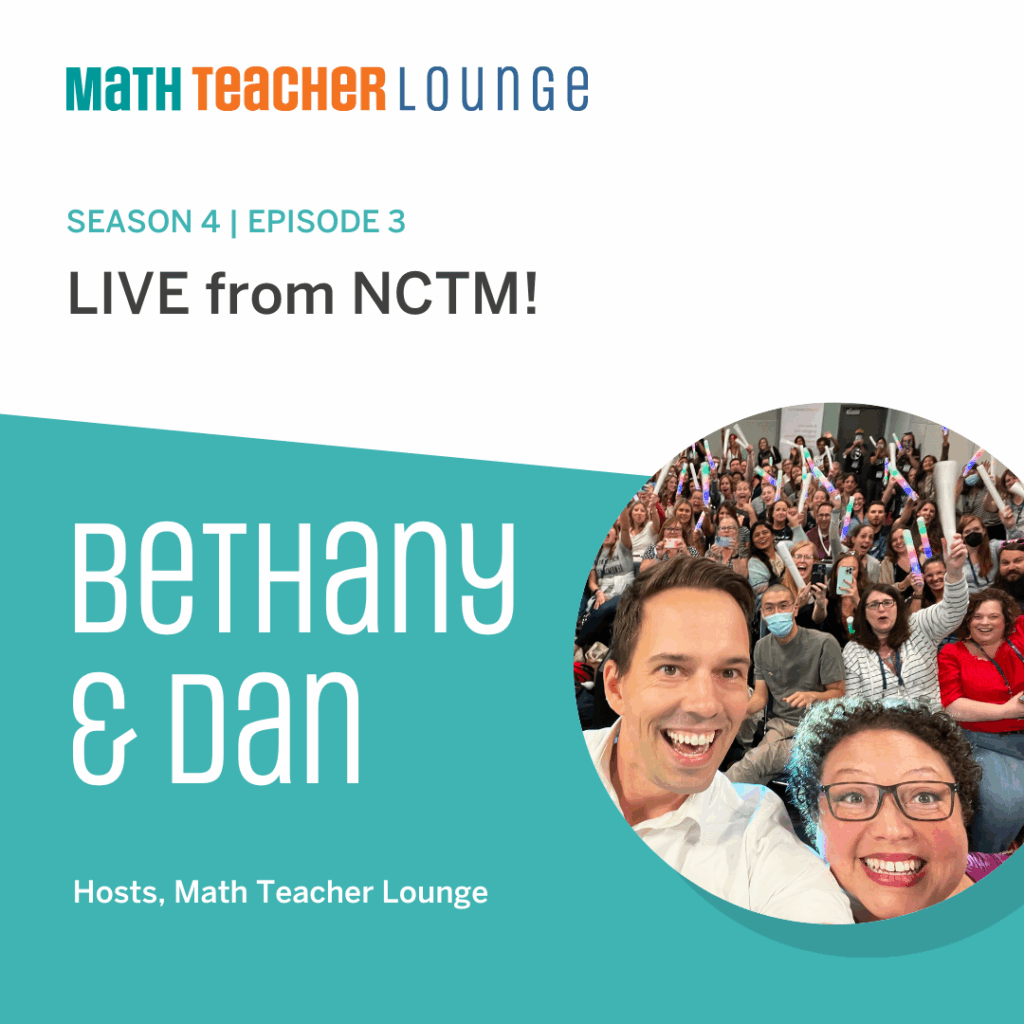
Hosts Bethany and Dan, both smiling, in a promotional image for the "Math Teacher Lounge" podcast, Season 4 Episode 3, titled "Live from NCTM!" with an

In this episode, co-hosts Bethany Lockhart Johnson and Dan Meyer are LIVE with more than one hundred Math Teacher Lounge listeners at the recent National Council of Teachers of Mathematics conference. Listen in as they answer the pressing question: Who is the best teacher in film or television?

Explore more from Math Teacher Lounge by visiting our main page

Download Transcript

Presenter (00:00):
Ladies and gentlemen, from Math Teacher Lounge, we have Bethany Lockhart Johnson and Dan Meyer! <cheering>

Bethany Lockhart Johnson (00:08):
Doesn’t go well that the door was locked. Like, I could not get in! <Laugh>

Dan Meyer (00:12):
Yeah. Gotcha. All right. We’re gonna sit a little bit. Let’s see how that works—

Bethany Lockhart Johnson (00:16):
Hi!

Dan Meyer (00:16):
Yeah. I think we’ll stand up? Or whaddaya think, sit…?

Bethany Lockhart Johnson (00:19):
Should we stand? Hi.

Dan Meyer (00:22):
Hello. Great to see you folks. Yeah, I can hear you.

Bethany Lockhart Johnson (00:25):
Can you hear me? That’s—I know YOU can me. Can you hear me OK? OK! We’re here. Hello. Thank you for like, lining up and coming out and being here. Thank you!

Dan Meyer (00:35):
Means so much to me that you could be here for me, on my show, with Bethany Lockhart Johnson, my co-host. <Audience laughs>

Bethany Lockhart Johnson (00:40):
The hour has just started.

Dan Meyer (00:42):
We’re just getting going. Yeah. If you folks have heard the podcast, you don’t know how much gets cut out. And it’s like, mostly me just having, you know, anxious nerves and saying something silly and then we cut it out and we can’t do that here today. So it should be real fun for all of us, I think. Yeah.

Bethany Lockhart Johnson (00:55):
It’s not true. It’s mostly dancing. “Bethany, can you stop talking? Bethany?” Cause it’s mostly—

Dan Meyer (00:59):
“It’s my turn. It’s my turn! Bethany <laugh>! I haven’t been heard for a while.”

Bethany Lockhart Johnson (01:02):
Dan. We’re at an in-person conference.

Dan Meyer (01:05):
In-person BIG conference, I would say. I’d say a big conference. Yeah.

Bethany Lockhart Johnson (01:08):
And have you been to the Amplify booth?

Dan Meyer (01:11):
I have! Have these people? There’s a claw machine with free socks.

Bethany Lockhart Johnson (01:16):
Yeah. You’re saving me socks, right? That’s what you’re saying. <Laugh> I mean, it’s exciting. How has your conference been so far?

Dan Meyer (01:21):
So far it’s been a blast. I feel fed. I feel like the community’s been awesome. How are you feeling about it?

Bethany Lockhart Johnson (01:29):
OK. Let’s talk about me for just a second.

Dan Meyer (01:31):
Yeah. Talk about you.

Bethany Lockhart Johnson (01:31):
Last night, Dan, was the very first night that I was away from my toddler. <Audience: Aw!>

Dan Meyer (01:38):
Big commitment being here. Thank you.

Bethany Lockhart Johnson (01:40):
I got super-emotional walking back to the hotel after dinner, and then I got in my room, <laugh> I put on pajamas, and I turned on music. I slept so good!

Dan Meyer (01:50):
Yeah. <Audience laughs> Give it up for no kids! <Audience laughs> Hey!

Bethany Lockhart Johnson (01:55):
I love him so much. But I slept all the way through the night. Oh, by the way, I ordered room service in the morning.

Dan Meyer (02:01):
On Amplify.

Bethany Lockhart Johnson (02:01):
That bill’s coming. But it’s been a great conference and I’m so delighted to be here in person and to get to share energy…and hopefully that’s all we’re sharing today. Y’all got your tests, right? Yep. Sharing energy and community today. Because we know it’s been hard. Hardness. Hard.

Dan Meyer (02:25):
Yeah.

Bethany Lockhart Johnson (02:26):
Years. Hard. And to be in person, I know conferences reinvigorate me and I go back into my educational spaces feeling revitalized with new connections and new ideas to try. So yeah, I’ve been excited to be here. And thank you all for being here.

Dan Meyer (02:40):
Yep. I don’t care if I get six different strains of Covid here. I’m just thrilled to be here. <Audience laughs> I don’t know if you’ve had the same feeling, though, Bethany, you folks…I’m a little bit confused to some degree about what we’re doing. I just wanna be really transparent. This is my sarcastic voice but I’m being sincere here. It kind of feels like we’re in a little bit of a time capsule. Like we all got in a time capsule in 2019 and, you know, you open it back up and it’s like, OK, so we’re still, you know, talking about X, Y, or Z protocol for establishing classroom routines or whatever. And I’m like, OK! Like, I loved that in 2019! But I do admit, I’m still trying to figure out a little bit like, what are we doing now? What’s our relationship to the world out there? Things are very different. I have had some great sessions that I’ve enjoyed. I’m also like, still waiting for a session to draw a little blood. Do you know what I mean? Like there’s been sessions…no? OK. You’ve been in these sessions where it’s like, “Oh, ow.” Like, and you look down and there’s and there’s blood there. It’s like, I thought I knew what we were up to. Like, I thought I knew what teaching was and how we relate to the world. I dunno, like in any Danny Martin session in 2019, “Take a Knee” was one, where I was like, “Oh, OK. Like, I’m not as hot as I think I am here. Like, I’m part of a system.” That kind of thing for me draws blood. And I haven’t been in one of those yet. Been some great sessions. I’m a little hopeful that today we draw a little blood and think about what we’re doing here, is my hope here, if that’s OK. So Bethany’s gonna moderate that impulse and she’ll be the fun one and I’ll be the blood-drawing one.

Bethany Lockhart Johnson (04:05):
No, I don’t…that metaphor doesn’t speak to me personally. But what I will say is, I get what you’re saying about really wanting to be in that room where there’s like this synergy happening. No promises about that today other than—

Dan Meyer (04:18):
I promise. <Audience laughs> Go on.

Bethany Lockhart Johnson (04:20):
Other than I get what you’re saying. I’ll find my own metaphor that does not involve bloodshed, but.

Dan Meyer (04:25):
Sure. There’s a lot of ways we we could go about this today. And the one that I’m excited about is, you know, we could like, you know, analyze some results from students, and talk about what went into that. Look at classroom video. Lots of possibilities. But here’s what we’re up to today. Hope you’re into it. Which is, we are here in the heart of the entertainment industry. You know, Tinseltown! Um, the Big Apple! Uh…

Bethany Lockhart Johnson (04:47):
No!

Dan Meyer (04:47):
Come on. What do you got here? Um…

Bethany Lockhart Johnson (04:51):
It was daytime at night. Like the lights were so bright.

Dan Meyer (04:54):
The City of Lights.

Bethany Lockhart Johnson (04:55):
There was a movie premiere outside my hotel room, which I was not invited to, unfortunately. But so what are we doing today?

Dan Meyer (05:01):
So here’s what we’re doing. We are gonna settle, once and for all, a question you have not asked yourself yet, perhaps, but will want to know the answer to in a moment. Which is: Who is the best teacher in all of film or television? OK? We’re gonna do that. It’ll be fun. But I hope that in debating this a little bit with a special guest we’ll bring up in a moment, that we will start to uncover some truths about what makes good teaching. How that’s different from teaching as we see it in movies and tv. Why middle-class America wants teachers to look a certain way in movies and tv. What all that means. And it’ll be awesome. I think. I’m hopeful it’ll be awesome. So what we did here is we’ve invited eight people. Eight folks you people may have known. You’ve been in their sessions today, in this conference, perhaps. And asked them: Who’s your fave? Like, we might have our favorites, but we wanted to democratize it a bit. So asked some cool people who you folks like, who are very smart and thoughtful about teaching: Who’s your favorite teacher?

Bethany Lockhart Johnson (05:58):
A few of whom are in this room. Thank you for your submission.

Dan Meyer (06:00):
Thank so much. Yeah. We’ll see what happens here. <laugh>

Bethany Lockhart Johnson (06:03):
As they shrink down.

Dan Meyer (06:03):
Yeah. Might draw some blood that I don’t mean to right now. We’ll see. OK.

Bethany Lockhart Johnson (06:06):
That metaphor, what IS that??

Dan Meyer (06:07):
Yeah. Yeah. I love it. I’m still going with it. <laugh> And you folks will be a huge part of this. THE part of this, really. So what will happen is I’ll share with you our first nominees. A few of us will make a case for our favorites, or least favorites, as the case may be sometimes. And then by applause, by acclamation, you folks will decide who wins and advances to the next round. Start with eight, move to four. You folks know math.You know where this goes. OK.

Bethany Lockhart Johnson (06:34):
No, keep going. Keep going.

Dan Meyer (06:36):
Two, then one.

Bethany Lockhart Johnson (06:36):
Yeah. Got it.

Dan Meyer (06:37):
Then a half of it. No?

Bethany Lockhart Johnson (06:38):
He had to school me on the making of brackets. But we got it. Yeah.

Dan Meyer (06:41):
How brackets work.

Bethany Lockhart Johnson (06:41):
But we got it. March Madness, what?

Dan Meyer (06:44):
Yeah, in order to do this right, we had to bring up—all the folks that you’ll see are also former Math Teacher Lounge guests, or like, just fan favorites. And we’re also bringing up a former Math Teacher Lounge guest to help us decide this and debate this in a respectful manner.

Bethany Lockhart Johnson (06:59):
New dad.

Dan Meyer (07:00):
New dad.

Bethany Lockhart Johnson (07:01):
You see where my brain’s still at? I miss him. <Laughs>

Dan Meyer (07:03):
Friend from San Diego. Really cool teacher.

Bethany Lockhart Johnson (07:06):
Incredible teacher.

Dan Meyer (07:06):
Works at Desmos and Amplify. And I just want you to welcome up your friend and mine. Chris Nho!

Bethany Lockhart Johnson (07:11):
Chris Nho!

Dan Meyer (07:13):
Come up, Chris. Let’s go, buddy. We didn’t talk about it, but did you want to do the cornball stuff too?

Chris Nho (07:22):
Wow. Would I love to do—

Bethany Lockhart Johnson (07:23):
And then the door could be locked! And then you have to wait and like, just—

Chris Nho (07:27):
Yeah, I’ll skip that part.

Bethany Lockhart Johnson (07:28):
Hi. Welcome. You’re here. We’re here in person.

Chris Nho (07:30):
Very glad to be here. Thank you all for having me.

Dan Meyer (07:33):
Tell me who you are.

Chris Nho (07:34):
My name is Chris Nho. I live in San Diego. I’m a new dad. A three month old, just had. Yeah, she’s actually here at the conference with us in the hotel room. And I promise you she is not by herself. She is with…come on. I was like, “Hey, just gimme one hour. I’ll be right back. I have to do very important work.” But yeah, I think I got invited here because I have opinions and I’m willing to draw…some…blood.

Dan Meyer (08:02):
There we go! Two outta three! We’re good on the metaphor now.

Bethany Lockhart Johnson (08:06):
We’re so glad you’re here. If you haven’t listened to the episode where Chris and Molly and some other public math folks share their ideas and ideas of how to take math out into the world, please listen, because we had a blast.

Dan Meyer (08:19):
Inspiring work. Really inspiring work. Very cool. Cool. OK. Right on. OK.

Bethany Lockhart Johnson (08:23):
Let’s do this!

Dan Meyer (08:24):
Let’s get started here. Yeah! <Audience cheers> Yeah. And we might ask you who your favorite teacher is, who’s missing from our list of eight? We might have forgotten some people. Anyway. All right. So here’s our first two. Our first two are nominated by way of, let’s see, um, Mandy Jansen is a professor at the University of Delaware. Got some awesome talks here this week, a Shadow Con talk last night. She’ll be nominating one. And also, um, Lani Horn is a professor at Vanderbilt, also extremely cool, prolific author and speaker, just all-around great human and friend of teachers everywhere. And she’ll nominate another in this bracket, which is the Northeastern Comedy bracket, Northeastern comedy bracket.

Bethany Lockhart Johnson (09:06):
It just worked out that way.

Dan Meyer (09:07):
Yeah. Here it is. Here is Tina Fey in Mean Girls.

Tina Fey in Mean Girls (09:12):
“OK. Everybody close your eyes. All right. I want you to raise your hand if you have ever had a girl say something bad about you behind your back. Open your eyes. Now close your eyes again. And this time I want you to raise your hand if you have ever said anything about a friend behind her back. Open up. It’s been some girl-on-girl crime here.”

Lani Horn (09:52):
I am nominating Sharon Norbury from Mean Girls as the best movie math teacher. She is an awesome teacher who is always there for her kids. She always sees the best in them. She shows that she can forgive even some pretty bad behavior, if she sees that kids are trying. She’s a strong feminist who makes sure that smart girls don’t dumb themselves down just to impress boys.

Tina Fey in Mean Girls (10:22):
“Katie, I know that having a boyfriend may seem like the most important thing in the world right now, but you don’t have to dumb yourself down to get guys to like you.”

Lani Horn (10:30):
She’s also super hard-working. She works three jobs. She’s always there for the kids. She plays piano in the talent show and takes them to Mathlete competitions. And she’s also socially aware. And when things go really badly among the girls, she does some pretty creative things to try to get them to be kinder to each other.

Dan Meyer (10:54):
OK. That’s one.

Bethany Lockhart Johnson (10:55):
Helen Case.

Dan Meyer (10:57):
All right. Settle down. Settle down. Settle down. All right.

Bethany Lockhart Johnson (10:59):
Piano too!

Dan Meyer (11:00):
Bethany’s already trying to bias people here. All right. Chill out. Hold on. So next one is Mandy Jansen with Jack Black from School of Rock. Uh-oh. Uh-oh.

Jack Black in School of Rock (11:09):
“What was your name?”

Kid in School of Rock (11:10):
“Katie.”

Jack Black in School of Rock (11:11):
“Katie. What was that thing you were playing today? The big thing.”

Kid in School of Rock (11:14):
“Cello.”

Jack Black in School of Rock (11:15):
“OK. This is a bass guitar and it’s the exact same thing, but instead of playing like this, you tip it on the side. Chellooooo! You’ve got a bass! <Laugh> Try it on.”

Mandy Jansen (11:25):
And I’m nominating for best teacher in a film Jack Black as Dewey Finn playing Mr. Ned Schneebly in the film School of Rock. So why this portrayal? First of all, playing a longterm sub. Those are so hard to find right now. <Audience laughs> Really hard. And then he teaches using class projects. That’s brilliant. Integrated learning. And then love this. He gives students roles and tasks that are differentiated and align to the specific strengths that each student has.

Kid 2 in School of Rock (12:05):
“I can also play clarinet, you know!”

Jack Black in School of Rock (12:06):
“I’ll find something for you when we get back from lunch. I’ll assign the rest of you killer positions.”

Mandy Jansen (12:13):
And the film culminates in a performance of a collaborative song that they all wrote and performed together. And the students experience that collaboration and teamwork and creating something beautiful is much more important than winning first place. And finally, one of the songs that the character sings in the film is “Math is a Wonderful Thing.” Can’t beat that.

Dan Meyer (12:40):
All right. That’s tough. That’s tough. So here’s the deal. What we have right now is just a quick minute—so Bethany, you ranked, we all ranked our own faves here outta the list of eight. And Bethany put Jack Black in School of Rock a bit higher than Tina Fey in Mean Girls.

Bethany Lockhart Johnson (12:54):
Missed the piano part though.

Dan Meyer (12:55):
And Chris, vice versa here. So Bethany, would you start us off and just make a quick case here for Jack Black versus Tina Fey?

Bethany Lockhart Johnson (13:01):
OK. So here’s what I’m thinking. There’s been rumor that maybe they’re putting less than credentialed people into classrooms to fill teaching gaps. I mean, just rumor. And so here’s this guy who is a rocker. He is not a substitute. He has no teaching training. And yet he goes in there and it turns out that he has the ability to see students’ potential and to recognize their unique abilities. And like Mandy said, he really tapped into, like, he saw them and said, “No, more is possible for you than what you think is possible.” And there’s like real sub anxiety. When you walk in, you can either be like, happy there’s a sub, but I was usually really nervous. Right? And he goes in and he makes that classroom into a home.

Dan Meyer (13:53):
Wow.

Chris Nho (13:54):
Wow.

Dan Meyer (13:56):
Chris, speak on it. Tina Fey needs you. Chris.

Chris Nho (13:59):
Tina Fey. Here we go. I’m gonna argue here that—when was that movie made?

Dan Meyer (14:03):
T is for terrific. I is for Interesting.

Chris Nho (14:06):
Decades ago. And I’m gonna argue that Tina Fey was very progressive for her time. OK, let’s talk about social emotional learning. Hello. <Audience laughs> Love that. Right? Stand up if, I mean, she’s getting people to talk about their emotions. And there’s a curriculum. But let’s just pause, because that’s not what’s really happening in the classroom right now. So social emotional learning, I think she’s, she’s got that a lot. And then number two, you know, if you remember the plot of Mean Girls a little bit, she gets her name written in that Burn Book. Like she sees what they say about her. Restorative justice. Let’s go. <Audience laughs>.

Dan Meyer (14:38):
Whom amongst us. Yes.

Chris Nho (14:40):
You write Mr. Nho in the Burn Book?? Well, your grade book is gonna look like a Burn Book! OK? <Audience laughs> Tina Fey, Tina Fey, she was like, “No, you know, know what? I’m actually gonna spend more time with you. You’re gonna become a mathlete.” And Lindsay Lohan discovers—she drops the most iconic line in all of math education. “The limit does not exist.” Thank you, Tina Fey, for that. For that gift.

Dan Meyer (15:04):
Bless. Bless you. Tina Fey. Wow.

Bethany Lockhart Johnson (15:05):
Oh, man. Wow.

Dan Meyer (15:09):
Let’s see what the people say here. I do wanna just add one quick thing about—it’s interesting to me how often in these movies—just kind of go in a little bit, zoom out just a minute—how often it’s a teacher who has no training as a teacher. <Bethany laughs> I am kind of curious why it is. Like, those are the movies that get hot, that get made. Again, these are all kind of a mirror of the taste of the moviegoing public. You know what I’m saying? Like, these, these are not movies—I wanna believe they are made for me and for us as teachers. But they are not. There’s not enough of us to justify, you know, Jack Black’s, you know, M&M budget or whatever he’s got going on in his trailer or whatever. That needs to be for everybody in middle-class America. So what is it about middle-class America that wants to see teaching as something that anybody can do? Just like, you know, just, just run up there in your van and make it happen.

Bethany Lockhart Johnson (15:54):
Magic magically manifests.

Dan Meyer (15:56):
Yeah. Manifest. Yeah. That’s just interesting to me. I just toss that out there as some red meat. Let’s see what the people say here. All right, OK, so you’re ready. Let’s get the bracket going here. The question is Tina Fey versus Jack Black. You had a moment here. Just whisper to someone real fast who you’re going for here real quick. What are you thinking here? <Crowd murmuring> All right. Crowd’s buzzing. Crowd’s buzzing. Would you folks…? All right. Bring it back. Go ahead and make some noise for Tina Fey. <Crowd cheers> OK. OK. Make some noise for Jack Black! <Crowd cheers> Judges say Tina Fey. Tina Fey moves on. All right. All right.

Chris Nho (16:44):
Stunned. I’m stunned. I’m speechless.

Bethany Lockhart Johnson (16:46):
Tina Fey moves on. Wow.

Dan Meyer (16:48):
This has exceeded my expectations in terms of having some fun, but also getting deep, getting deep and real about teaching. I’m into this right here. Yeah. What’s up?

Bethany Lockhart Johnson (16:54):
That’s the goal. That’s the goal. OK. You wanted blood? Oooh, this next matchup might just be where that blood comes forth! OK. Stretch. Warm up. Dan Meyer, who’s up next?

Dan Meyer (17:11):
We’ve got the animated/animatronic round here in the Southeast. And repping the two contestants here, who do we have? We have Allison Hintz, professor, author outta Washington, as one of the two nominators. And the other nominator is one of my heroes, though we’ll find out very wrong about this nomination, Jenna Laib, who’s in the crowd, and I’m trying not to make eye contact here. <Laugh> And here are the two nominations. A couple minutes each. And then we’ll chat about it. And one of us will probably die. But we’ll see how it goes.

Allison Hintz (17:50):
A long, long time ago, in a galaxy far, far away, MTL, we began learning from the Jedi Master of Teaching. With the Socratic and experiential approach. With unparalleled mindfulness, compassion, and humility. The best teacher in TV and film, Yoda is. <Audience laughs> Yoda lives the values we share as teachers and learners. He humbly comes alongside us as we construct new knowledge.

Yoda (18:29):
“You must unlearn what you have learned.”

Allison Hintz (18:32):
Yoda allows us to struggle and sees mistakes as critical to learning.

Yoda (18:39):
“The greatest teacher, failure is.”

Allison Hintz (18:43):
Yoda values curiosity and reminds us of the beauty and joy of teachers learning from children.

Yoda (18:52):
“Truly wonderful, the mind of a child is.”

Allison Hintz (18:59):
MTL! Join the Resistance! Let the force flow through you in declaring, the best teacher in TV and film, Yoda is.

Dan Meyer (19:18):
Give it up for Allison Hintz! All right! <Audience applauds>

Bethany Lockhart Johnson (19:20):
Alison! And to have that on hand too, which Is kind of perfect.

Bethany Lockhart Johnson (19:26):
Just to be clear, the helmet is not a part of a Zoom background.

Dan Meyer (19:29):
You may evaluate the quality of the nomination based on the costumes of the nominator. That is acceptable. That’s acceptable.

Bethany Lockhart Johnson (19:35):
That is a REAL HELMET.

Dan Meyer (19:35):
All right. The next nominator here, this one is from Jenna Laib, math coach, all-around stellar human. Here we go. This is Ms. Frizzle.

Ms. Frizzle (19:42):
“Single file, class. Our rotten field trip has only just begun.”

Jenna Laib (19:47):
And I think that the best teacher from TV or movies is Ms .Valerie Frizzle from The Magic School Bus. First and foremost, Ms. Frizzle believes in her students. She encourages them to take an active role in their learning, and also to advocate for change in their local community. For example, there’s an episode where there is a logger who’s gonna cut down a rotting log that would benefit the local ecosystem. And the students figure out a way to convince him to leave the log so that all of the animals and the plant life can benefit. She orchestrates really challenging situations for these students, and she allows them the space to ask questions and engage in problem-solving and puzzle their way out of these really, really difficult scenarios. Ms. Frizzle has unmatched pedagogy. She’s bold, she’s innovative, and she’s a major proponent of experiential learning. So these students are heading straight into a storm to learn about weather systems. <Audience laughs> These students are heading into the human body to learn about digestion and disease. They literally get baked into a cake to learn about some chemistry and reactions.

Children in The Magic School Bus (20:54):
“What’s happening?” <Audience laughs> “Why is it suddenly getting so hot?” “Maybe it’s because the floor is on fire!” <Audience laughs>

Jenna Laib (21:02):
This pedagogy is all led by her outstanding catchphrase, which is:

Ms. Frizzle (21:06):
“Take chances; make mistakes; get messy!”

Jenna Laib (21:14):
From her pedagogy to the classroom community that she creates, Ms. Frizzle is an inspiration, and that is why I think that she is the best teacher from TV or film. <Audience applauds>

Dan Meyer (21:25):
Right on! Give it up for Jenna. Give it up for Jenna. All right. I’m gonna take first pass at this. Chris knows my argument already, so I’m gonna take this here. I see some of you are feeling how I’m feeling on this one. OK, so I don’t have tons to say in favor of Yoda. I think it was all true what Allison said. I think the costume was banging. It was awesome. So there’s all that, but I have more to say against Ms. Frizzle than for Yoda.

Bethany Lockhart Johnson (21:48):
No, no, no. Wait a second!

Bethany Lockhart Johnson (21:49):
Let’s let it happen. Bethany, I’ve come prepared.

Dan Meyer (21:54):
I may have made a misstep here, I realize.

Bethany Lockhart Johnson (21:56):
I’ve come prepared.

Dan Meyer (21:56):
So I think Jenna is all correct. I think those clips spoke for themselves. I think that what they add up to, to me, is not “great teacher,” but more “someone who should be locked up.” <Audience laughs> Or at the very minimum, “someone who should be kept away from children.” <Audience laughs> Do not let that woman around children. I mean, check it out. Look, I don’t wanna throw down credentials. I’ve been to grad school, though. I know how this works. When your brain is stressed, you get these—all the cortisol happens. Your working memory shrinks up. You cannot learn when you’re stressed. And those kids, like whatever lesson Ms. Frizzle is teaching by sending them into an oven, I repeat, an oven <audience laughs>, like, they’re not gonna learn anything ’cause their brains are freaking out with stress and fear. OK?

Bethany Lockhart Johnson (22:41):
“What’s happening??”

Dan Meyer (22:43):
“What’s happening? Am I on fire? Well…I’m learning lots, though! Sure is magical!” <Audience laughs> It’s like, “No. Get that woman out of a classroom.” That’s my opening and closing argument. Right? There’s all it is.

Chris Nho (23:01):
All right. All right. All right.

Bethany Lockhart Johnson (23:02):
Chris knows.

Chris Nho (23:03):
I’ve got, I’ve got lots to say. First off, I think Dan was in charge of the editing of those video clips. So let’s let that be—you know, let the record stand. <Audience laughs>

Dan Meyer (23:11):
Where’s the lie though? Where’s the lie?

Chris Nho (23:14):
And, you know, second, I think, um—this is the guy up here saying, “I wanna see blood.” You know? And then he has a teacher who literally takes the students into a blood cell and, and you get a little scared! You get a little worried for the students, you know? So I just don’t get it, Dan. This or that. OK? I think Ms. Frizzle—so I actually went to a project-based learning school. I taught at a project-based learning school. And the best thing about it is like, your learning, it doesn’t just stay in this box of math lesson or writing lesson, history lesson. And I think with Ms. Frizzle, like you can’t help but learn things because you are getting baked in a cake. <Audience laughs> Yeah, it is a little scary. And I imagine there’s cortisol and things happening, but guess what? Probably the next episode, they go into their own brains and explore what’s happening. That kind of thing. You know?

Dan Meyer (24:07):
The kids that survived, just be clear. <Audience laughs>

Chris Nho (24:10):
Yeah. OK. Would I want Nora, my three-month-old, to be babysat by Ms. Frizzle? Maybe not. <Audience laughs> But what I have to say about Yoda is Yoda maybe wins the best tutor award. Give it up for Yoda’s Best Tutor Award.

Bethany Lockhart Johnson (24:24):
Oh, yeah…

Chris Nho (24:25):
That ratio’s looking really nice. I could teach the heck outta Luke Skywalker. OK? But 20 little Luke Skywalkers running around. I’m not sure. OK?

Dan Meyer (24:34):
Luke did survive the training, though. <Audience laughs> So that’s awfully nice to say about it. All right, Great words from Chris here. I’m still not convinced. We’ll see how you’re convinced here. Would you whisper to someone where you’re leaning here? Frizzle or Yoda? <Audience buzzing>

Chris Nho (24:47):
I tried. I tried.

Dan Meyer (24:53):
All right. That’s enough of that. Let’s hear it folks. Give it up for Yoda. <Audience cheers> Give it up. Give it up. You. Give. It. Up.

Chris Nho (25:05):
Hey, next. Next.

Dan Meyer (25:06):
All right. All right, all right. <Mutters> Give it up for Ms. Frizzle. <Audience cheers louder> I dunno, it’s pretty close. Call a tie. Maybe Yoda? Yoda by nose? <Audience laughs> All right. All right. Let’s…let me see who’s it. Let’s get the people advancing here. I’ll keep on moving here.

Chris Nho (25:26):
As you’re doing that. Um, Dan ranked Ms. Frizzle last in his personal ranking. And I ranked Ms. Frizzle very high, so we knew this one would be spicy,

Bethany Lockhart Johnson (25:36):
<laugh> Spicy it was. Are you having a good time so far? <Audience cheers> So while we love seeing these images and we love seeing these video clips, at the core, what are these things about how teachers are portrayed? And how accurate is that to our real lives? I mean, besides the cake part, right? That my chemistry class did often feel like I was on fire. I was so stressed in it. Um, we’re ready?

Dan Meyer (26:05):
Yep. Great. We’re ready, we’re up here. So the next two nominees are coming to you folks from Tracy Zager, who is the editor of my book, forthcoming in 2027 at the earliest and 2032 at the latest. And also your very own Zak Champagne from Florida, here in the room. Hey, Zak. Zak, let’s see who the nominations are. I’m gonna skip past that, didn’t work out so well for me. Here it is. This is Marshall Kane from the TV show Community.

Michael K. Williams in Community (26:32):
“You two complete your case to the class and let them decide your grades.”

Joel McHale in Community (26:37):
“Professor, thank you.”

Michael K. Williams in Community (26:40):
“It’s not a favor, Mr. Winger. Man’s gotta have a code.”

Joel McHale in Community (26:44):
“Awesome.”

Zak Champagne (26:46):
This is a pitch for an underdog. This teacher didn’t stand on desks or encourage his students to follow their musical passions. In fact, this teacher was seen only in a few episodes of my favorite TV show of all time, Community, Community has set at Greendale Community College in Colorado. And in season three, we get to meet Dr. Marshall Kane, a biology professor whose story is an inspiration to anyone who just takes the time to look and listen. Dr. Marshall Kane slowly earned his PhD while in prison, serving a sentence of 25 to life. In his classroom, he inspires students to love biology, question why LEGO has become so complicated, and randomly pairs his students for group projects to ensure no one feels left out. His greatest performance comes when a group of students believe their yam project was intentionally sabotaged. Dr. Kane took this as an opportunity for some trans-disciplinary real-world learning. So yes, at community college, he felt that a middle-school mock trial was the best way to determine who killed the yam. So let’s all pick the underdog and vote for Dr. Marshall Kane. After all, man’s gotta have a code. <Audience goes “oh!” and applauds>

Dan Meyer (27:53):
Thank you, Zak.

Bethany Lockhart Johnson (27:54):
I have a code.

Dan Meyer (27:56):
Next up is Tracy Zager, nominating an unusual nomination, not a single person, but an ensemble performance. A bunch of people from a movie called Searching for Bobby Fisher. Here we go.

Rapid-fire movie dialogue (28:11):
“What’s that?” “Schleimann attack.” “Schleimann attack? Where’d you learn that from, a book?” “No, my teacher taught me.” “Aw, your teacher. Well, forget it. Play like you used to, from the gut. Get your pawns rolling on the queen’s side.”

Tracy Zager (28:26):
Hey, Math Teacher Lounge. This is Tracy Zager. I’m excited to share my nominee for the best movie teacher. But I have to admit that when I first got the email, I thought, oh, who am I gonna nominate? Because most movies about teachers are highly problematic. They usually have like a saviorism thing, usually white saviors. And I just felt like I couldn’t suggest any of those. So rather than nominate a movie about a single teacher, I wanted to nominate a movie that taught me something about teaching. And that movie is a deep cut. It’s Searching for Bobby Fischer. It’s a movie about a chess prodigy. And what I love about it is that all of the different adults in the movie are in teacher roles in some way. And the student, Josh, the chess player, is a fully realized character, not an empty pail, who pulls from the strengths of each one of those adults while also dealing with their flaws and humanity. And there’s just beautiful synergy in the way he gets the best out of everybody, but also has to overcome some of the barriers that they put in front of him. So I feel like it’s a much more authentic and humbling, but also inspiring, movie about the power of teaching. So if you haven’t ever seen it, check it out. And I can’t wait to see who the other nominees are. Thanks so much.

Dan Meyer (29:53):
Right on. Thank you, Tracy. Wherever you are. <Applause> We’ll move a little quicker here. I’m curious, Bethany, you put Marshall Kane pretty high. I put Bobby Fischer pretty high. What do you have to say about Marshall Kane for us here?

Bethany Lockhart Johnson (30:04):
Well, I just wanna say two things. One is that, like Zak said, he has this code of conduct that he brings in. And he stays true to it no matter what happens. If you saw him in in Community, you know that he held himself up to such high esteem, but not just himself, his students as well. And he took accountability when he felt he had done wrong, even though, well, that’s controversy. But first—oh, the other thing, rest in peace, Michael K. Williams. Oh my gosh. The actor who plays Marshall K. And the thing that I wanna say most of all about it is that he brings his whole self to the classroom. He was in prison for decades. He brings his whole self and says, “This is who I was. This is who I am today. And this is how we can work together as a community.”

Dan Meyer (30:58):
That’s big. I love your comments about code of conduct too. It makes me wish that Ms. Frizzle had a code of conduct also.

Bethany Lockhart Johnson (31:05):
I knew that was coming back!

Chris Nho (31:06):
Two slides ago, Dan. That was two slides ago.

Dan Meyer (31:08):
Can’t let it go. So yeah, I love what you said there. I have no strong beef here either way. Bobby Fischer’s a movie I have loved dearly and can’t be objective about it. I love that the kid in that movie, more than any other movie here, the kid teaches the adults so much through his innocence and how he challenges them and how they’re treating him. Dig all that so much. Will not, will not begrudge anyone any vote either way here. I do begrudge many of you your vote in previous rounds. <Audience laughs> So let’s just, let’s hear. We’re not gonna ask you folks at all to chitchat. We’re gonna move on this one. So would you folks make some noise here for Marshall Kane in Community? OK. OK. And would you make some noise here for Bobby Fischer, the kid in Bobby Fischer, the ensemble? <Audience cheers, applauds>

Bethany Lockhart Johnson (31:56):
Marshall Kane.

Dan Meyer (31:57):
Marshall Kane takes it. All right. Good job, Marshall Kane! All right. Zak’s feeling good. Moving on to the final four here, Zak, right on. OK. Our last—the Northwest Division here is also the large urban district division here. We have a couple different teachers in sets of large urban schools. They’re nominated, they’re advanced by a couple people here. One is past president of NCTM, Robert Berry. And another is Fawn Nguyen, Southern California phenom. Great teacher and friend of lots of us. Um, let’s see who they nominated here. First from Robert Berry, let’s see, who is it here? Janine Teagues from Abbott Elementary.

Abbott Elementary dialogue (32:37):
“Hey, you know what? I’m probably probably gonna be Kenny’s second-grade teacher. Why don’t you just let him get a head start with me today?” “That’d be great.” “Yeah? OK. Hey, Kenny, would you like to be in my group today?” “Not really.” “That’s the spirit.”

Robert Berry (32:54):
My nomination is gonna be Quinta Brunson, the Emmy Award-winning Quinta Brunson from Abbott Elementary. Janine Teagues is the character. She exemplifies care not only from an affect way, but she also exemplifies care in the things that she does for her students. While the scenes in the show are entertaining, they do represent the challenges that teachers experience when they’re trying to meet the needs of her students. So she goes, goes all out for her students and finding resources. She accesses other people to get resources for her students. But the care shows up in the way that she is mindful of their needs. And so, for me, when I think about teachers and teaching, sometimes we can talk about pedagogy, but sometimes we also can talk about those kind of intangibles that makes a teacher a great teacher. It is apparent from her students that she cares about them, she supports them, and she goes all out 100% for her students. Janine Teagues, Quinta Brunson is, I think, is my choice of the best teacher on television because of the realism and the representation that she brings to this character of what teaching is about. <Applause>

Dan Meyer (34:28):
Right on. Right on. OK. OK. Next up, we’ve got, Fawn Nguyen is nominating Erin Gruwell from Freedom Writers. Here we go.

Hilary Swank in Freedom Writers movie (34:39):
“Look, you can either sit in your seats reading those workbooks or you can play a game. Either way, you’re in here till the bell rings. OK? This is called the Line Game. I’m gonna ask you a question. If that question applies to you, you step onto the line and then step back away for the next question. Easy, right? The first question. How many of you have the new Snoop Dog album? <kids move around> OK, back away. Next question. How many of you have seen Boys in the Hood?”

Fawn Nguyen (35:26):
We all learn about Miss G and her 150 students in the movie Freedom Writers starring Hilary Swank. All great teachers share a common set of traits. They care deeply about their students, have high expectations of them, and always believing wholeheartedly that they will succeed. Great teachers go above and beyond, not because they extraordinary—as Anne Gruwell would always refer to herself as an ordinary teacher—but because extraordinary things happen to people when we believe in them, give them hope, help them write their own story with a different ending. So what stood out for me with Miss G is the scope of her reach, the ever-expanding sphere of her humanity. The red tape she had placed on the classroom floor for the line game shows just how much we all have in common despite our differences. Her students didn’t just learn from her; they learned from one another. If you’d like to be part of this expanding sphere to give voice and hope, please check out Freedom Writers Foundation dot org.

Dan Meyer (36:38):
OK. This right here is a tough one for us. Thank you, Fawn. We collectively ranked—that’s our number one seed and number eight seed, which I hasten to say does not have to do with Erin Gruwell, a person, but the portrayal and the movie. So we don’t have like a whole lot of…there’s not a lot of defense we have to offer here of our eighth seed. And I heard like a kind of a little bit of a murmur over the crowd on Erin Gruwell. So I’m more interested than having a defense back and forth. I’d be curious what you, Bethany, think about what, like, what both movies have to say about like, what teaching is, especially teaching urban schools with black and brown kids and lower-class kids, for instance. They both have, I think, very different things to say about them. Do you have thoughts about that?

Bethany Lockhart Johnson (37:19):
Well, it’s interesting because there is some overlap in the sense that the arguments that both Fawn and Robert Berry put out, they both care deeply about their students, right? We’re not gonna argue that. They care deeply. And something that I would say about Miss Teagues is there’s something about the way that she sees not only her classroom, her students, but she sees all of the students in the school as her students. And her idea of resource generation is really helping the teachers to generate resources from their community themselves, and to also realize that the students see themselves reflected in the teachers. And I think that—you know, again, this is not about the real person—but the movie portrayal, and we often see kind of this, for Freedom Writers, we often see this like, Great Last Hope whisked in and her personal sacrifices are what makes these students, these brown and black students’ transformation possible. Because of her sacrifices. Including her marriage. Including, you know, three jobs. And it’s just portrayed in a way that I think really celebrates her sacrifices rather than what the students have already brought—they already come into the room bringing so much as they are, already, without her intervention.

Dan Meyer (38:38):
I love the portrayal of the teacher as part of a community of teachers. Versus in so many of these movies, it’s the teacher as the only person who gets it, you know, oftentimes coming from outside of the world of teaching and everyone’s against them and wants ’em just to fall in line and do the thing we always do, and they’re the outlier. But in Abbott Elementary, it’s like we all rise and we fall together. And teachers are investing in each other’s success, especially with Gregory the longterm sub. We’re all rooting for his, you know, his flourishing. I love that. And yeah. That’s bigtime.

Chris Nho (39:09):
Yeah, I think one interesting thing is that Freedom Writers, when it came out, I think it was like a commercial success.

Bethany Lockhart Johnson (39:17):
Oh, big time. Yeah. It was.

Chris Nho (39:18):
It probably influenced a lot of people to try teaching out. So I do wonder what it says about us, right? Like that we want teaching to fit this narrative, and we wanna be those people who could go into a classroom and <puts on “cool voice”> “Y’all listen to Snoop Dog?” and just have that question HIT. <laughter> And you know, I’ve taught in a large urban school district, and I’ve been that person and I’ve seen other people try and be that person. And I think stepping away from it a little bit, just—it’s a reflection of what people want out of teaching and what they think better education looks like.

Dan Meyer (39:57):
Yeah, yeah. This idea that, so I’m a middle-class person, let’s say, and like, there’s this idea, like, “I know what I would do if I was going into circumstances of impoverishment.” Like I have—

Bethany Lockhart Johnson (40:06):
“All they really need is…”

Dan Meyer (40:07):
…for me to give ’em some real talk and tell ’em, you know, pull their pants up or whatever, listen to Snoop Dog, that kind of thing. And that will be the key. And that’s not how it is in, you know, in Jack Black in School of Rock or Tina Fey school, which are, you know, coded as largely like upper-class or largely white schools. And in those movies, it’s interesting, like how it’s about students discovering themselves, oftentimes. And the central figures are often students. And the students need to reject an oppressive parent figure or something and find themselves. But no, in Freedom Writers, it’s like, “You need to become more like the middle-class teachers who are coming in here to give you this wisdom.” It’s just interesting. I do find it—a pet peeve of mine is when movies portray teachers as only successful if you endure, for instance, the failure of your marriage, or even in Stand and Deliver, for instance, like Jaime Escalante, they depict him having a heart attack. And, like, the job oughta be…easier. <Audience laughs>

Chris Nho (41:04):
Truth.

Bethany Lockhart Johnson (41:05):
That’s the barometer for how much….

Dan Meyer (41:09):
Like, no heart attacks and no divorces related to the job, that kind of thing. I do love how in Abbott—one last thing and we’ll vote and Abbott will win <audience laughs>—is like how, like there, there is a lot of degradation in Abbott, but it’s not a divorce or a heart attack—it’s the petty indignities of asking a student, “Do you wanna hang with me?” And a student says, “Nah, not really.” And that just spoke to me like how it’s not cinematic, but teaching, successful teaching, is like a collection of developing an immunity to students saying, “You’re not hot.” <Laugh> You know? And so I love that. I do wish that there was more depiction of students in Abbott Elementary. It’s a lot of adult stuff. Whatever. Give it up for Abbott, if you would, please. Let’s just get this done here. All right. That’s plenty. That’s plenty. Not gonna ask folks about Freedom Writers. OK, let’s move on to— all right, let’s hear it for Freedom Writers! Yeah. OK, cool. We go, yep.

Chris Nho (42:05):
Plot twist!

Bethany Lockhart Johnson (42:07):
OK, let’s see our final four. Cut and paste. Real time. Real time.

Audience member (42:12):
Where’s Dolores Umbridge?

Dan Meyer (42:14):
Oh….

Bethany Lockhart Johnson (42:16):
Hey, did you hear that? He said, “Where’s Dolores Umbridge?”

Dan Meyer (42:20):
All right. OK.

Bethany Lockhart Johnson (42:20):
See, we missed so many. We could…

Dan Meyer (42:21):
So coming up here, we’ve got in the Eastern Conference, Tina Fey and Ms. Frizzle. Y’all know how I feel about that one. Let’s just get this one done. OK, let’s give it up for Tina Fey. Let’s hear it. <Audience cheers> OK. All right. Yes! Let’s give it up for menace to children everywhere, the terror, the Ms. Frizzle. <Audience cheers> One more time for Tina Fey. Let’s hear it. <Audience cheers> One more time for Ms. Frizzle. Let’s hear it. <Audience cheers>

Bethany Lockhart Johnson (42:59):
Yeah. OK.

Dan Meyer (43:00):
It took ’em one round, but they made the right call in the end. <Laugh>

Chris Nho (43:04):
All it took was 10 minutes of constant Ms. Frizzle-bashing. <Laugh>

Dan Meyer (43:09):
Persevering and problem-solving, that’s my game. Yes. All right. So, do either of you want to influence the audience one way or the other?

Bethany Lockhart Johnson (43:16):
That’s not how I play, Dan.

Dan Meyer (43:18):
Oh, OK. Yeah, that’s true. That’s true. You’re good. On Abbott versus Marshall Kane, should we just let ’em have it? All right. All right. Give it up For Abbott Elementary. Not bad. And for Marshall Kane. OK. OK. I hear Zak and five other people. All right, cool. <laugh> Right on. All right. We got our, we got our finals,

Bethany Lockhart Johnson (43:45):
We did it. We made it to two. And we know: We left out a lot of people. Right? And honestly, I kind of wish we could poll like everyone. I mean, think you put it on Twitter, right? Like, who would you pick? But I would say we had a pretty solid eight there. I’m excited to see who… Look at the little crown he put, you guys. Come on.

Dan Meyer (44:05):
I worked hard for you. For you. <Laugh> Yeah. I liked that it was a good bunch that had a lot of different kinds of qualities…and lack of qualities in some cases. And it allowed us that—I shouldn’t knock her while she’s down, and she IS down, it’s true. <Laugh> And I appreciate the conversation we’ve had, what they have revealed overall about teaching and what the world wants teaching to be versus what it actually is or actually should be. I appreciate that. So let’s settle this here. Give it up, if you would, for Abbott Elementary. <Audience cheers> And give it up for Tina Fey in Mean Girls. <Audience cheers>

Bethany Lockhart Johnson (44:49):
Wow.

Dan Meyer (44:51):
That was close. I almost give that to Tina Fey.

Audience member (44:55):
Yeah, we do!

Dan Meyer (44:55):
I don’t know. That was a bracket-buster for me right there. Yeah. I lost money in the office pool off that right there. Maybe let’s just find out one more time here. One more time.

Bethany Lockhart Johnson (45:03):
Last time.

Dan Meyer (45:03):
Time to summon up all your conviction on one or the other here. No half-measures right now. All right.

Bethany Lockhart Johnson (45:07):
Emmy Award-winning Quinta Brunson.

Dan Meyer (45:09):
Yeah, you saw Robert Berry on that, right? He was like, “Oh, I got one more card to play. Emmy Award-winning.” That’s admissible. That’s admissible. We’ll take that. All right. So…give it up for Abbott Elementary, one last time. <Audience cheers> OK. All right. All right. And give it up for Tina Fey in Mean Girls. <Audience cheers>

Bethany Lockhart Johnson (45:30):
Drumroll, please!

Chris Nho (45:33):
Best teacher is….

Dan Meyer (45:34):
Tina Fey in Mean Girls! Yeah. Not a bad pick.

Bethany Lockhart Johnson (45:39):
I love it. And I think, too, I think we’re gonna have a little bit of a more reflective lens than we thought we did when we see depictions of teachers in film and television. And, you know, hopefully we’ll see some new tropes come in, right?

Dan Meyer (45:55):
Yep. Yeah. Every dollar we spend on movies with lousy teachers is just encouraging these people to make more lousy teacher movies, you know? Awesome. Thank you for being here for a live taping—

Bethany Lockhart Johnson (46:06):
Thank you for being here.

Dan Meyer (46:06):
—of our podcast, Math Teacher Lounge, in a hot room. Appreciate that. Yeah, it’s been fun for us to have you here. Um, super-important, super-important final remark: Bethany loves Oprah and Oprah occasionally, in the show—

Bethany Lockhart Johnson (46:18):
Is she coming?! Is she here?!

Dan Meyer (46:19):
Not here! Not here! Calm down. Calm down. Um, but we do have in Oprah fashion, not something—

Bethany Lockhart Johnson (46:24):
Oh. Oh, OK. Oh, that’s, that’s OK. Sorry. I got, had really excited for a second. As if the Amplify playing cards, The Amplify t-shirts being chucked at you at high speed—I did try to get a t-shirt cannon, and that was quickly ruled out <laugh>. They didn’t know about my rocket arm, right?

Dan Meyer (46:46):
Yeah, you got a cannon. <Laugh>

Bethany Lockhart Johnson (46:47):
Yeah. Oh, that’s a compliment. Oh, is that a compliment? Thank you, Dan. Thank you. Look under your seat because we have five winners. We wanna thank you for being here in person. We wanna thank the folks who are listening. We wanna thank Amplify. Oh my God. Somebody just pulled off the chair tag. You get to take that chair home with you.

Dan Meyer (47:08):
Does anybody have a prize?

Bethany Lockhart Johnson (47:10):
OK, stand up if you…stand up if you…Yes! Stand up if you have one!

Dan Meyer (47:16):
Free set of classroom dry-erase boards, right here. Congratulations.

Bethany Lockhart Johnson (47:22):
And for you who pulled off the chair tag, I don’t know. We gotta we gotta find something for you.

Dan Meyer (47:27):
Put that in your backpack.

Bethany Lockhart Johnson (47:30):
Thank you again for being here. Thank you. Amplify. Thank you, Desmos. Thank you. Dan Meyer.

Dan Meyer (47:36):
Thank you folks. Chris, thank you buddy.

Bethany Lockhart Johnson (47:38):
Chris! Chris Nho, everybody!

Dan Meyer (47:40):
We will be, we will be at—Bethany and I will be at the booth, if you wanna chit-chat and hang out, sign some stuff. Whatever. You wanna have Bethany sign you, she’ll do that. Um, come on down to the Amplify booth and we’ll—

Bethany Lockhart Johnson (47:50):
We’ll talk to you more about Ms. Frizzle.

Dan Meyer (47:52):
Fun and prizes. I will share with my real thoughts about Ms. Frizzle down there. I’d love to see you. Thanks for being here, folks.

Bethany Lockhart Johnson (47:57):
Thanks for listening. Bye.

Stay connected!

Join our community and get new episodes every other Tuesday!

We’ll also share new and exciting free resources for your classroom every month.

What Dan Meyer says about math teaching

“Teaching, more than other professions, is a generational profession. The kinds of joyful experiences we offer—or don’t offer—now affect the experiences students that haven’t even been born yet will have years later.”

– Dan Meyer

Meet the guests

Dan Meyer

Dan Meyer taught high school math to students who didn’t like high school math. He has advocated for better math instruction on CNN, Good Morning America, Everyday With Rachel Ray, and TED.com. He earned his doctorate from Stanford University in math education and is currently the Dean of Research at Desmos, where he explores the future of math, technology, and learning. Dan has worked with teachers internationally and in all 50 United States and was named one of Tech & Learning’s 30 Leaders of the Future.

Bethany Lockhart Johnson

Bethany Lockhart Johnson is an elementary school educator and author. Prior to serving as a multiple-subject teacher, she taught theater and dance and now loves incorporating movement and creative play into her classroom. Bethany is committed to helping students find joy in discovering their identities as mathematicians. In addition to her role as a full-time classroom teacher, Bethany is a Student Achievement Partners California Core Advocate and is active in national and local mathematics organizations. Bethany is a member of the Illustrative Mathematics Elementary Curriculum Steering Committee and serves as a consultant, creating materials to support families during distance learning.

A woman with curly hair and glasses smiles outdoors; a man with short dark hair smiles indoors in front of a blurred math teacher lounge, highlighting valuable math teacher resources.
A graphic with the text "Math Teacher Lounge with Bethany Lockhart Johnson and Dan Meyer" on colored overlapping circles.

About Math Teacher Lounge: The podcast

Math Teacher Lounge is a biweekly podcast created specifically for K–12 math educators. In each episode co-hosts Bethany Lockhart Johnson (@lockhartedu) and Dan Meyer (@ddmeyer) chat with guests, taking a deep dive into the math and educational topics you care about.

Join the Math Teacher Lounge Facebook group to continue the conversation, view exclusive content, interact with fellow educators, participate in giveaways, and more!
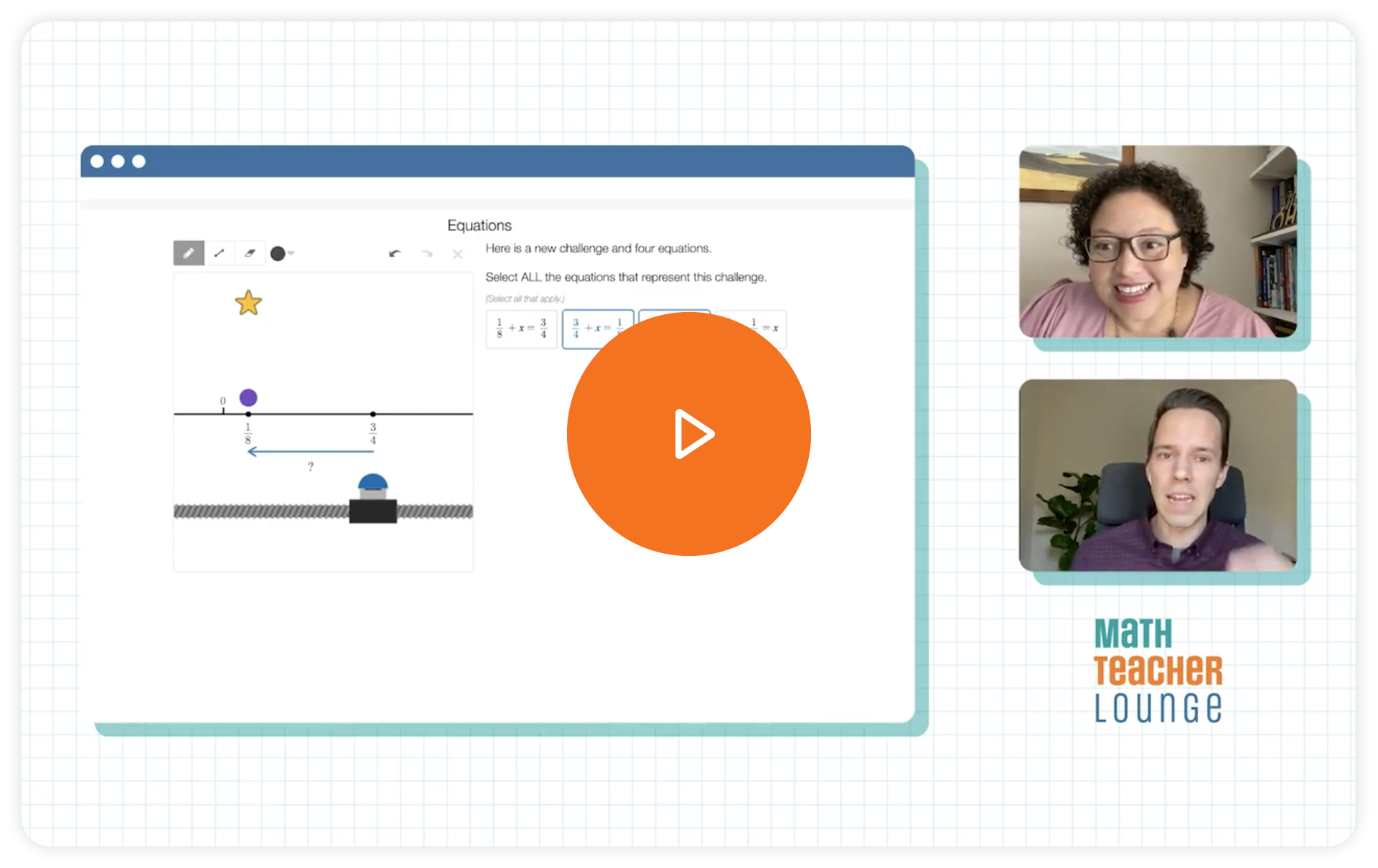
Welcome to Amplify Science 6–8!

Amplify Science is an engaging core curriculum designed for three-dimensional, phenomena-based learning.

With Amplify Science, Oregon students don’t just passively learn about science concepts. Instead, they take on the role of scientists and engineers to actively investigate and figure out real-world phenomena. They do this through a blend of cohesive and compelling storylines, hands-on investigations, collaborative discussions, literacy-rich activities, and interactive digital tools.

Two students, one black and one asian, smiling and studying together at a laptop in a classroom with other students in background.

Publisher presentation

The Lawrence Hall of Science

Developed by the science education experts at UC Berkeley’s Lawrence Hall of Science and the digital learning team at Amplify, our program features:

  • phenomena-based approach where students construct a complex understanding of each unit’s anchor phenomenon.
  • A blend of cohesive storylines, hands-on investigations, rich discussions, literacy-rich activities, and digital tools.
  • Carefully crafted units, chapters, lessons, and activities designed to deliver true 3-dimensional learning.
  • An instructional design that supports all learners in accessing all standards.
Aerial view of the lawrence hall of science at the university of california, berkeley, showcasing the building and surrounding trees with a foggy city backdrop.

Proven to work

A pdf cover from wested titled "learning and literacy development together: initial results from a curriculum study," featuring an adult helping children with schoolwork in a classroom.

WestEd Randomized
Control Trial for Grade 1

Read More

Pdf cover titled "curriculum materials designed for the next generation science standards: initial results from gold standard research trials", published by wested.

WestEd Randomized
Control Trial for Grade 7

Read More

A teacher and students engage in a science activity around a table. The text promotes the Amplify Science K–8 curriculum, highlighting its focus on hands-on learning and real-world problem-solving.

Amplify Science NE
Grades K–5

Read More

Instructional model

The Amplify Science program is rooted in the proven, research-based pedagogy of Do, Talk, Read, Write, Visualize. Here’s how each element works:

Do

First-hand investigations are an important part of any science classroom, and Amplify Science has students getting hands-on in every unit—from building models of protein molecules to experimenting with electrical systems.

Talk

Student-to-student discourse and full-class discussions are an integral part of the program. Students are provided with numerous opportunities to engage in meaningful oral scientific argumentation, all while fostering a collaborative classroom environment.

Read

Students read scientific articles, focusing their reading activities on searching for evidence related to their investigation and, importantly, on asking and recording questions as they read through fascinating texts on 21st-century topics.

Write

Following real-world practices, students write scientific arguments based on evidence they’ve collected, making clear their reasoning about how a given piece of evidence connects to one of several claims.

Visualize

By manipulating digital simulations and using modeling tools to craft visualizations of their thinking— just as real scientists and engineers
do—students take their learning far beyond the confines of what they can physically see in the classroom in an exciting and authentic way.

Program structure

Our cyclical lesson design ensures students receive multiple exposures to concepts through a variety of modalities. As they progress through the lessons within a unit, students build and deepen their understanding, increasing their ability to develop and refine complex explanations of the unit’s phenomenon.

It’s this proven program structure and lesson design that enables Amplify Science to address 100% of the NGSS, and support students in mastering the Oregon Science Standards.

Flowchart depicting a critical thinking process with four circular nodes connected by arrows, each node representing a step: posing a real-world problem, exploring evidence, elaborating concepts, and evaluating claims.

Unit types

While every unit delivers three-dimensional learning experiences and engages students in gathering evidence from a rich collection of sources, each unit also serves a unique instructional purpose.

In grades 6–8:

  • One unit is a launch unit.
  • Three units are core units.
  • Two units are engineering internships.

Launch units are the first units taught in each year of Amplify Science. The goal of the Launch unit is to introduce students to norms, routines, and practices that will be built on throughout the year, including argumentation, active reading, and using the program’s technology. For example, rather than taking the time to explain the process of active reading in every unit in a given year, it is explained thoroughly in the Launch unit, thereby preparing students to read actively in all subsequent units.

Core units establish the context of the unit by introducing students to a real-world problem. As students move through lessons in a Core unit, they figure out the unit’s anchoring phenomenon, gain an understanding of the unit’s disciplinary core ideas and science and engineering practices, and make linkages across topics through the crosscutting concepts. Each Core unit culminates with a Science Seminar and final writing activity.

Engineering Internship units invite students to design solutions for real-world problems as interns for a fictional company called Futura. Students figure out how to help those in need, from tsunami victims in Sri Lanka to premature babies, through the application of engineering practices. In the process, they apply and deepen their learning from Core units.

Unit sequence

Our lessons follow a structure that is grounded in regular routines while still being flexible enough to allow for a variety of learning experiences.

In fact, our multi-modal instruction offers more opportunities for students to construct meaning, and practice and apply concepts than any other program. What’s more, our modular design means our units can be flexibly arranged to support your instructional goals.

Three columns listing education curriculum topics for grades 6, 7, and 8, focusing on science themes such as microbiomes, mars geology, and harnessing human energy.

Program components

Available digitally and in print, our unit-specific reference guides are chock full of helpful resources, including scientific background knowledge, planning information and resources, color-coded 3D Statements, detailed lesson plans, tips for delivering instruction, and differentiation strategies.

Amplify Science TG

Hands-on learning is an essential part of Amplify Science, and is integrated into every unit. Students actively participate in science, playing the roles of scientists and engineers as they gather evidence, think critically, solve problems, and develop and defend claims about the world around them. Every unit includes hands-on investigations that are critical to achieving the unit’s learning goals.

A young person wearing gloves looks through a microscope at a table with laboratory supplies, including bottles, slides, and a tray, against a plain blue background.

More hands-on with Flextensions:
Hands-on Flextensions are additional, optional investigations that are included at logical points in the learning progression and give students an opportunity to dig deeper if time permits. These activities offer teachers flexibility to choose to dedicate more time to hands-on learning. Materials referenced in Hands-on Flextension activities will either be included in the unit kit or are easily sourced. Supporting resources such as student worksheets will be included as downloadable PDF files.

Assorted office and household items displayed on a white background, including rubber bands, binder clips, cardboard, and sports balls.

Our digital Simulations and Practice Tools are powerful resources for exploration, data collection, and student collaboration. They allow students the ability to explore scientific concepts that might otherwise be invisible or impossible to see with the naked eye.

Available for every unit, our Student Investigation Notebooks contain instructions for activities and space for students to record data and observations, reflect on ideas from texts and investigations, and construct explanations and arguments.

In grades 6–8, one copy of the Student Investigation Notebook is included in each unit’s materials kit for use as a blackline master. Each notebook is also available as a downloadable PDF on the Unit Guide page of the digital Teacher’s Guide.

Two booklets titled "El clima cambiante de la Tierra: la desaparición del hielo" and "Earth’s Changing Climate: Vanishing Ice" with landscape illustrations on the covers.

These customizable PowerPoints are available for every lesson of the program and make delivering instruction a snap with visual prompts, colorful activity instructions, investigation set-up videos and animations, and suggested teacher talk in the notes section of each slide.

Amplify Science Classroom Slides

Full coverage of the Oregon Science Standards

Amplify Science was designed from the ground up to meet the Next Generation Science Standards (NGSS). As such, it aligns to the Oregon Science Standards, which were also borne out of the NGSS.

The guidance below is meant to provide support for integrating additional activities that support full coverage of Oregon’s standards. Organized by grade level, each section below will outline:

  • Additional activities that support 100% alignment to the Oregon Science Standards.
  • The standard being addressed with the activities.
  • The recommended placement of the activities within a specific Amplify Science unit.
  • PDFs of any accompanying materials that are necessary to implement the activities.

Activity Title: Meet a Scientist Who Changed How We Think About Brain Cells

About this activity: In this activity, students read a short article about a scientist who studied the nervous system.

Recommended placement: Metabolism unit, Lesson 3.2

Materials:

Instructions: Download the PDF “Meet a Scientist Who Changed How We Think About Brain Cells” above and remind students of the Active Reading guidelines. Before students read the article, invite them to share prior experiences. Then have students complete the copymaster above.

Activity Title: Meet a Scientist Who Studies Underwater Currents

About this activity: In this activity, students read a short article about a scientist who studies ocean currents.

Recommended placement: Oceans, Atmosphere, and Climate unit, Lesson 2.1

Materials:

Instructions: Download the PDF “Meet a Scientist Who Studies Underwater Currents” above and remind students of the Active Reading guidelines. Before students read the article, invite them to share prior experiences. Then have students complete the copymaster above.

Activity Title: Meet a Scientist Who Studies How the Environment Affects Our Traits

About this activity: In this activity, students read two short articles, one about current research on genes and proteins, and one about a scientist who is studying how the environment can affect our traits.

Recommended placement: Traits and Reproduction unit, Lesson 2.4

Materials:

Instructions: Download the PDF “Meet a Scientist Who Studies How the Environment Affects Our Traits” above and remind students of the Active Reading guidelines. Before students read the article, invite them to share prior experiences. Then have students complete the copymaster above.

Activity Title: Who Becomes a Space Scientist?

About this activity: In this activity, Students read a short article about a scientist who studies space.

Recommended placement: Geology on Mars unit, Lesson 3.1

Materials:

Instructions: Download the PDF “Who Becomes a Space Scientist?” above and remind students of the Active Reading guidelines. Before students read the article, invite them to share prior experiences. Then have students complete the copymaster above.

Activity Title: Meet a Scientist Who Studies How Plants Find Water Underground

About this activity: In this activity, students read a short article about a scientist who studies how plants’ roots get water.

Recommended placement: Matter and Energy in Ecosystems unit, Lesson 1.6

Materials:

Instructions: Download the PDF “Meet a Scientist Who Studies How Plants Find Water Underground” above and remind students of the Active Reading guidelines. Before students read the article, invite them to share prior experiences. Then have students complete the copymaster above.

Activity Title: Bringing Back the Buffalo

About this activity: In this activity, students change one competing population to try to decrease the other in the Sim, and read a short article about a scientist who studies buffalo.

Recommended placement: Populations and Resources unit, Lesson 3.2

Materials:

Instructions: Download the PDF “Bringing Back the Buffalo” above and remind students of the Active Reading guidelines. Before students read the article, invite them to share prior experiences. Then have students complete the copymaster above.

Activity Title: Rereading “A Continental Puzzle”

About this activity: In this activity, students reread “A Continental Puzzle” and think about how patterns were helpful to Wegener’s work.

Recommended placement: Plate Motion unit, Lesson 3.2

Materials:

Instructions: Direct students back to “A Continental Puzzle” above and remind students of the Active Reading guidelines. Before students re-read the article, invite them to share prior experiences. Then have students complete the copymaster above.

Activity Title: Meet a Scientist Who Studies Variation in Monkey Populations

About this activity: In this activity, students read a short article about a scientist who studies variation of traits in monkey populations.

Recommended placement: Natural Selection unit, Lesson 1.6

Materials:

Instructions: Download the PDF “Meet a Scientist Who Studies Variation in Monkey Populations” above and remind students of the Active Reading guidelines. Before students read the article, invite them to share prior experiences. Then have students complete the copymaster above.

Activity Title: Extinctions and Human Impacts

About this activity: The purpose of this lesson is for students to see how increases in human population and consumption of natural resources can negatively impact Earth’s systems.

Recommended placement: Natural Selection unit, Lesson 4.5

Materials:

Instructions: Download the PDF “Extinctions and Human Impacts” above and remind students of the Active Reading guidelines. Before students read the article, invite them to share prior experiences. Then have students complete the copymaster above.

Activity Title: Steno and the Shark

About this activity: In this activity, students read a short article about Nicolas Steno, a scientist from the 1600s whose studies of fossilized sharks’ teeth embedded in rock layers laid the foundation for the modern understanding of stratigraphy.

Recommended placement: Evolutionary History unit, Lesson 2.4

Materials:

Instructions: Download the PDF “Steno and the Shark” above and remind students of the Active Reading guidelines. Before students read the article, invite them to share prior experiences. Then have students complete the copymaster above.

Activity Title: Scale in the Solar System

About this activity: In this activity, students read and annotate the articles “Scale in the Solar System” and “The Solar System Is Huge.”

Recommended placement: Earth, Moon, and Sun unit, Lesson 1.2

Materials:

Instructions: Download the PDF “Scale in the Solar System” above and remind students of the Active Reading guidelines. Before students read the article, invite them to share prior experiences. Then have students complete the copymaster above.

Explore your print samples

With your Amplify Science print samples, you’ll find unit-specific Teacher’s References Guides and Student Investigation Notebooks for each grade level.

A note about the Teacher’s Reference Guides:

It’s important that your committee sees the full breadth and depth of our instruction. For that reason, we provided a copy of each of our unit-specific Teacher Reference Guides.

Rest assured that teachers do not use these robust reference guides for day-to-day teaching. For that, we have a hands-free TG!

Three laptop screens displaying educational content on earth's energy system, including diagrams and text annotations.
  • Teacher Reference Guide: Unlike a typical TG that requires a series of supplemental books to support it, our encyclopedic reference guide is chock-full of everything a teacher needs to fully implement our program and the NGSS.
  • Ready-to-Teach Lesson Slides: For daily instruction, teachers need their hands free. That’s why we created ready-to-teach lesson slides for every single lesson. What’s more, they are editable and include suggested teacher talk and point-of-use differentiation and other instructional tips. Click to learn more.

A note about the Materials Kits:

Hands-on learning is at the heart of Amplify Science, and is integrated into every unit. In order to make hands-on learning more manageable for busy teachers, Amplify Science materials are organized into unit-specific kits.

Our unit-specific kits:

  • Include more materials — We give teachers enough materials to support 200 student uses.
  • Are more manageable — Unlike other programs that require large groups of students to share limited sets of materials, our kits include enough to support small groups of 4–5 students.
  • Include supportive videos — Each hands-on activity provides clear instructions for the teacher, with more complex activities supported by video demonstrations and illustrations.

At your request, we did not include our materials kits with our submissions samples. However, we did provide grade-specific lists of all materials included in each kit, which you can also find with the links below.

Access your digital samples

Explore as a teacher

Follow these instructions to explore the Amplify Science digital platform as a teacher.

  • Click the Access Amplify Science Platform button below and bookmark it.
  • Select Log in with Amplify.
  • Enter the username: t.or68sci@tryamplify.net
  • Enter the password: Science5OR
  • Click the Science icon.
  • Click on the Grade Menu in the top center of the screen and select any grade.
  • Select any unit.

To help familiarize yourself with navigating the digital platform, watch the below navigational video.

Explore as a student

Follow these instructions to explore the Amplify Science digital platform as a student.

  • Click the Access Amplify Science Platform button below and bookmark it.
  • Select Log in with Amplify.
  • Enter the username: s.or68sci@tryamplify.net
  • Enter the password: Science5OR
  • Click the Science icon.
  • Click on the Grade Menu in the top center of the screen and select any grade.
  • Select any unit.

Resources to support your review

Publisher presentation

The Lawrence Hall of Science

Developed by the science education experts at UC Berkeley’s Lawrence Hall of Science and the digital learning team at Amplify, our program features:

  • phenomena-based approach where students construct a complex understanding of each unit’s anchor phenomenon.
  • A blend of cohesive storylines, hands-on investigations, rich discussions, literacy-rich activities, and digital tools.
  • Carefully crafted units, chapters, lessons, and activities designed to deliver true 3-dimensional learning.
  • An instructional design that supports all learners in accessing all standards.
Amplify Science and Lawrence Hall of Science

Instructional model

The Amplify Science program is rooted in the proven, research-based pedagogy of Do, Talk, Read, Write, Visualize. Here’s how each element works:

DO

First-hand investigations are an important part of any science classroom, and Amplify Science has students getting hands-on in every unit—from building models of protein molecules to experimenting with electrical systems.

TALK

Student-to-student discourse and full-class discussions are an integral part of the program. Students are provided with numerous opportunities to engage in meaningful oral scientific argumentation, all while fostering a collaborative classroom environment.

READ

Students read scientific articles, focusing their reading activities on searching for evidence related to their investigation and, importantly, on asking and recording questions as they read through fascinating texts on 21st-century topics.

WRITE

Following real-world practices, students write scientific arguments based on evidence they’ve collected, making clear their reasoning about how a given piece of evidence connects to one of several claims.

VISUALIZE

By manipulating digital simulations and using modeling tools to craft visualizations of their thinking— just as real scientists and engineers do—students take their learning far beyond the confines of what they can physically see in the classroom in an exciting and authentic way.

Program structure

Our cyclical lesson design ensures students receive multiple exposures to concepts through a variety of modalities. As they progress through the lessons within a unit, students build and deepen their understanding, increasing their ability to develop and refine complex explanations of the unit’s phenomenon.

It’s this proven program structure and lesson design that enables Amplify Science to address 100% of the NGSS, and support students in mastering the Oregon Science Standards.

Graphic showing a research process with four steps: spark intrigue with a real-world problem, explore evidence, explain and elaborate, and evaluate claims, connected in a cycle with arrows.

Unit types

While every unit delivers three-dimensional learning experiences and engages students in gathering evidence from a rich collection of sources, each unit also serves a unique instructional purpose.

In grades 6–8:

  • One unit is a launch unit.
  • Three units are core units.
  • Two units are engineering internships.

Launch units are the first units taught in each year of Amplify Science. The goal of the Launch unit is to introduce students to norms, routines, and practices that will be built on throughout the year, including argumentation, active reading, and using the program’s technology. For example, rather than taking the time to explain the process of active reading in every unit in a given year, it is explained thoroughly in the Launch unit, thereby preparing students to read actively in all subsequent units.

Core units establish the context of the unit by introducing students to a real-world problem. As students move through lessons in a Core unit, they figure out the unit’s anchoring phenomenon, gain an understanding of the unit’s disciplinary core ideas and science and engineering practices, and make linkages across topics through the crosscutting concepts. Each Core unit culminates with a Science Seminar and final writing activity.

Engineering Internship units invite students to design solutions for real-world problems as interns for a fictional company called Futura. Students figure out how to help those in need, from tsunami victims in Sri Lanka to premature babies, through the application of engineering practices. In the process, they apply and deepen their learning from Core units.

Unit sequence

Our lessons follow a structure that is grounded in regular routines while still being flexible enough to allow for a variety of learning experiences.

In fact, our multi-modal instruction offers more opportunities for students to construct meaning, and practice and apply concepts than any other program. What’s more, our modular design means our units can be flexibly arranged to support your instructional goals.

Three columns listing education curriculum topics for grades 6, 7, and 8, focusing on science themes such as microbiomes, mars geology, and harnessing human energy.

Program components

Available digitally and in print, our unit-specific reference guides are chock full of helpful resources, including scientific background knowledge, planning information and resources, color-coded 3-D Statements, detailed lesson plans, tips for delivering instruction, and differentiation strategies.

Amplify Science TG

Hands-on learning is an essential part of Amplify Science, and is integrated into every unit. Students actively participate in science, playing the roles of scientists and engineers as they gather evidence, think critically, solve problems, and develop and defend claims about the world around them. Every unit includes hands-on investigations that are critical to achieving the unit’s learning goals.

A young person wearing gloves looks through a microscope at a table with laboratory supplies, including bottles, slides, and a tray, against a plain blue background.

More hands-on with Flextensions:
Hands-on Flextensions are additional, optional investigations that are included at logical points in the learning progression and give students an opportunity to dig deeper if time permits. These activities offer teachers flexibility to choose to dedicate more time to hands-on learning. Materials referenced in Hands-on Flextension activities will either be included in the unit kit or are easily sourced. Supporting resources such as student worksheets will be included as downloadable PDF files.

Our kits include enough materials to support 200 student uses. In other words, teachers can easily support all five periods and small groups of 4-5 students each. Plus, our unit-specific kits mean teachers just grab the tub they need and then put it all back with ease.

Amplify Science California supports 3-D learning with more materials than any other program.

Our digital Simulations and Practice Tools are powerful resources for exploration, data collection, and student collaboration. They allow students the ability to explore scientific concepts that might otherwise be invisible or impossible to see with the naked eye.

Available for every unit, our Student Investigation Notebooks contain instructions for activities and space for students to record data and observations, reflect on ideas from texts and investigations, and construct explanations and arguments.

In grades 6–8, one copy of the Student Investigation Notebook is included in each unit’s materials kit for use as a blackline master. Each notebook is also available as a downloadable PDF on the Unit Guide page of the digital Teacher’s Guide.

Two booklets titled "El clima cambiante de la Tierra: la desaparición del hielo" and "Earth’s Changing Climate: Vanishing Ice" with landscape illustrations on the covers.

These customizable PowerPoints are available for every lesson of the program and make delivering instruction a snap with visual prompts, colorful activity instructions, investigation set-up videos and animations, and suggested teacher talk in the notes section of each slide.

A laptop displays a PowerPoint presentation in presenter view, with slides about observing objects in plastic containers and related sensory instructions.

Full coverage of the Oregon Science Standards

Amplify Science was designed from the ground up to meet the Next Generation Science Standards (NGSS). As such, it aligns to the Oregon Science Standards, which were also borne out of the NGSS.

The guidance below is meant to provide support for integrating additional activities that support full coverage of Oregon’s standards. Organized by grade level, each section below will outline:

  • Additional activities that support 100% alignment to the Oregon Science Standards.
  • The standard being addressed with the activities.
  • The recommended placement of the activities within a specific Amplify Science unit.
  • PDFs of any accompanying materials that are necessary to implement the activities.

Activity Title: Meet a Scientist Who Changed How We Think About Brain Cells

About this activity: In this activity, students read a short article about a scientist who studied the nervous system.

Recommended placement: Metabolism unit, Lesson 3.2

Materials:

Instructions: Download the PDF “Meet a Scientist Who Changed How We Think About Brain Cells” above and remind students of the Active Reading guidelines. Before students read the article, invite them to share prior experiences. Then have students complete the copymaster above.

Activity Title: Meet a Scientist Who Studies Underwater Currents

About this activity: In this activity, students read a short article about a scientist who studies ocean currents.

Recommended placement: Oceans, Atmosphere, and Climate unit, Lesson 2.1

Materials:

Instructions: Download the PDF “Meet a Scientist Who Studies Underwater Currents” above and remind students of the Active Reading guidelines. Before students read the article, invite them to share prior experiences. Then have students complete the copymaster above.

Activity Title: Meet a Scientist Who Studies How the Environment Affects Our Traits

About this activity: In this activity, students read two short articles, one about current research on genes and proteins, and one about a scientist who is studying how the environment can affect our traits.

Recommended placement: Traits and Reproduction unit, Lesson 2.4

Materials:

Instructions: Download the PDF “Meet a Scientist Who Studies How the Environment Affects Our Traits” above and remind students of the Active Reading guidelines. Before students read the article, invite them to share prior experiences. Then have students complete the copymaster above.

Activity Title: Who Becomes a Space Scientist?

About this activity: In this activity, Students read a short article about a scientist who studies space.

Recommended placement: Geology on Mars unit, Lesson 3.1

Materials:

Instructions: Download the PDF “Who Becomes a Space Scientist?” above and remind students of the Active Reading guidelines. Before students read the article, invite them to share prior experiences. Then have students complete the copymaster above.

Activity Title: Meet a Scientist Who Studies How Plants Find Water Underground

About this activity: In this activity, students read a short article about a scientist who studies how plants’ roots get water.

Recommended placement: Matter and Energy in Ecosystems unit, Lesson 1.6

Materials:

Instructions: Download the PDF “Meet a Scientist Who Studies How Plants Find Water Underground” above and remind students of the Active Reading guidelines. Before students read the article, invite them to share prior experiences. Then have students complete the copymaster above.

Activity Title: Bringing Back the Buffalo

About this activity: In this activity, students change one competing population to try to decrease the other in the Sim, and read a short article about a scientist who studies buffalo.

Recommended placement: Populations and Resources unit, Lesson 3.2

Materials:

Instructions: Download the PDF “Bringing Back the Buffalo” above and remind students of the Active Reading guidelines. Before students read the article, invite them to share prior experiences. Then have students complete the copymaster above.

Activity Title: Rereading “A Continental Puzzle”

About this activity: In this activity, students reread “A Continental Puzzle” and think about how patterns were helpful to Wegener’s work.

Recommended placement: Plate Motion unit, Lesson 3.2

Materials:

Instructions: Direct students back to “A Continental Puzzle” above and remind students of the Active Reading guidelines. Before students re-read the article, invite them to share prior experiences. Then have students complete the copymaster above.

Activity Title: Meet a Scientist Who Studies Variation in Monkey Populations

About this activity: In this activity, students read a short article about a scientist who studies variation of traits in monkey populations.

Recommended placement: Natural Selection unit, Lesson 1.6

Materials:

Instructions: Download the PDF “Meet a Scientist Who Studies Variation in Monkey Populations” above and remind students of the Active Reading guidelines. Before students read the article, invite them to share prior experiences. Then have students complete the copymaster above.

Activity Title: Extinctions and Human Impacts

About this activity: The purpose of this lesson is for students to see how increases in human population and consumption of natural resources can negatively impact Earth’s systems.

Recommended placement: Natural Selection unit, Lesson 4.5

Materials:

Instructions: Download the PDF “Extinctions and Human Impacts” above and remind students of the Active Reading guidelines. Before students read the article, invite them to share prior experiences. Then have students complete the copymaster above.

Activity Title: Steno and the Shark

About this activity: In this activity, students read a short article about Nicolas Steno, a scientist from the 1600s whose studies of fossilized sharks’ teeth embedded in rock layers laid the foundation for the modern understanding of stratigraphy.

Recommended placement: Evolutionary History unit, Lesson 2.4

Materials:

Instructions: Download the PDF “Steno and the Shark” above and remind students of the Active Reading guidelines. Before students read the article, invite them to share prior experiences. Then have students complete the copymaster above.

Activity Title: Scale in the Solar System

About this activity: In this activity, students read and annotate the articles “Scale in the Solar System” and “The Solar System Is Huge.”

Recommended placement: Earth, Moon, and Sun unit, Lesson 1.2

Materials:

Instructions: Download the PDF “Scale in the Solar System” above and remind students of the Active Reading guidelines. Before students read the article, invite them to share prior experiences. Then have students complete the copymaster above.

Explore your print samples

Amplify Science physical samples can be found at the Hamersley Library at Western Oregon University. There you’ll find unit-specific Teacher’s References Guides and Student Investigation Notebooks for each grade level.

A note about the Teacher’s Reference Guides:

It’s important that your committee sees the full breadth and depth of our instruction. For that reason, we provided a copy of each of our unit-specific Teacher Reference Guides.

Rest assured that teachers do not use these robust reference guides for day-to-day teaching. For that, we have a hands-free TG!

A laptop screen shows an energy simulation, with surrounding text and diagrams explaining the Earth's system and energy flow.
  • Teacher Reference Guide: Unlike a typical TG that requires a series of supplemental books to support it, our encyclopedic reference guide is chock-full of everything a teacher needs to fully implement our program and the NGSS.
  • Ready-to-Teach Lesson Slides: For daily instruction, teachers need their hands free. That’s why we created ready-to-teach lesson slides for every single lesson What’s more, they are editable and include suggested teacher talk and point-of-use differentiation and other instructional tips. Click to learn more.

A note about the Materials Kits:

Hands-on learning is at the heart of Amplify Science, and is integrated into every unit. In order to make hands-on learning more manageable for busy teachers, Amplify Science materials are organized into unit-specific kits.

Stacked storage bins with labels, arranged neatly; caption notes they are a sample and may not reflect actual quantities or sizes.

Our unit-specific kits:

  • Include more materials — We give teachers enough materials to support 200 student uses.
  • Are more manageable — Unlike other programs that require large groups of students to share limited sets of materials, our kits include enough to support small groups of 4–5 students.
  • Include supportive videos — Each hands-on activity provides clear instructions for the teacher, with more complex activities supported by video demonstrations and illustrations.

At your request, we did not include our materials kits with our submissions samples. However, we did provide grade-specific lists of all materials included in each kit, which you can also find with the links below.

Access your digital samples

Explore as a teacher

Follow these instructions to explore the Amplify Science digital platform as a teacher.

  • Click the Access Amplify Science Platform button below.
  • Select Log in with Amplify.
  • Enter the teacher username and password found on your unique login flyer enclosed in your physical sample box.
  • Click the Science icon.
  • Click on the Grade Menu in the top center of the screen and select any grade.
  • Select any unit.

To help familiarize yourself with navigating the digital platform, watch the below navigational video.

Explore as a student

Follow these instructions to explore the Amplify Science digital platform as a student.

  • Click the Access Amplify Science Platform button below.
  • Select Log in with Amplify.
  • Enter the student username and password found on your unique login flyer enclosed in your physical sample box.
  • Click the Science icon.
  • Click on the Grade Menu in the top center of the screen and select any grade.
  • Select any unit.

Resources to support your review

Oregon standards correlation for grades 6–8

QCD Science Adoption Criteria 2022 for grades 6-8

QCD IMET Citation guidance for grades 6-8

Oregon Science IMET for grades 6-8 (Excel download)

Oregon QCD-IMET Citation guidance for grades 6-8

Research behind Amplify Science

Phenomena in grades 6–8

Program structure for grades 6–8

Active Reading in grades 6–8

Engineering in Amplify Science

Approaches to assessment in grades 6–8

Buffalo Consultancy

To view this protected page, enter the password below:


Season 3, Episode 5

Developing an asset orientation with Lani Horn

In this episode, math education professor Lani Horn shares with us what it means to have an asset orientation towards students, contrasting it with a deficit orientation, and helping Bethany and Dan understand the many ways students experience one or the other. Their conversation hit both high notes and low notes and included a challenge that Bethany and Dan both found extremely valuable for helping a teacher develop an asset orientation towards their students.

A smiling woman with shoulder-length curly hair, wearing a dark blazer and a necklace, framed by a circular border with a math fluency pattern background.

Meet Our Guest(s):

A woman with wavy brown hair, wearing a green top, black jacket, and hoop earrings, is smiling at the camera against a blurred light background with a blue circular border.

Lani Horn

Lani Horn centers her research on ways to make authentic mathematics accessible to students, particularly those who have been historically marginalized by our educational system. Professor Horn focuses primarily on mathematics teaching in two ways. First, Professor Horn looks at classroom practices that engage the most students in high-quality mathematics. Second, Professor Horn views teaching as a contextually-embedded practice – how school environments, communities, colleagues, and policies shape what is instructionally possible. All of this is unified through a pursuit to understand teacher learning as a situative phenomenon.

Meet our hosts: Bethany Lockhart Johnson and Dan Meyer

Bethany Lockhart Johnson is an elementary school educator and author. Prior to serving as a multiple-subject teacher, she taught theater and dance, and now loves incorporating movement and creative play into her classroom. Bethany is committed to helping students find joy in discovering their identities as mathematicians. In addition to her role as a full-time classroom teacher, Bethany is a Student Achievement Partners California Core Advocate and is active in national and local mathematics organizations. Bethany is a member of the Illustrative Mathematics Elementary Curriculum Steering Committee and serves as a consultant, creating materials to support families during distance learning.

Dan Meyer taught high school math to students who didn’t like high school math. He has advocated for better math instruction on CNN, Good Morning America, Everyday With Rachel Ray, and TED.com. He earned his doctorate from Stanford University in math education and is currently the Dean of Research at Desmos, where he explores the future of math, technology, and learning. Dan has worked with teachers internationally and in all 50 United States and was named one of Tech & Learning’s 30 Leaders of the Future.

Two people smiling at the camera, each in a separate circular frame, with geometric shapes decorating the background—perfect for a math teacher lounge or highlighting fresh math teacher resources.

Quotes

“An asset orientation is looking for students' strengths and trying to work from those strengths as a basis for your teaching. ”

—Lani Horn

Stay connected!

2025

September 18, 2025

Edutopia: “Using Virtual Manipulatives in Math Class”

Read Full Article

August 19, 2025

Education Week: “Here’s Why It’s Important for Teachers to Have a Say in Curriculum”

Read Full Article

August 18, 2025

Investors Hangout: “Amplify Classroom Revolutionizes K-12 Teaching Experience”

Read Full Article

August 5, 2025

WhaTech: “K-12 Online Education Market Set for Strong Expansion, Reaching $349.77 Billion by 2029”

Read Full Article

August 4, 2025

Education Week: “Districts Using ‘High-Quality’ Reading Curricula Still Supplement With Other Materials. Why?”

Read Full Article

July 9, 2025

K-12 Dive: “Youngest students see big reading gains post-COVID on DIBELS assessment”

Read Full Article

June 25, 2025

The 74: “How Districts in Georgia, Maryland and D.C. Are Raising Reading Proficiency”

Read Full Article

May 28, 2025

Open PR: “K-12 Online Education Market Forecast 2025-2034: Comprehensive Analysis And Growth Opportunities”

Read Full Article

May 27, 2025

District Administration: “Early literacy: How to implement programs that start strong”

Read Full Article

May 20, 2025

EdSource: “California schools prepare to introduce universal reading screening”

Read Full Article

April 23, 2025

The 74: “Eric Adams Expands Reading, Math Curriculum Mandates to All NYC Middle Schools”

Read Full Article

April 21, 2025

Daily News: “NYC expanding reading, math curriculum overhaul to more schools”

Read Full Article

March 19, 2025

Education Next: “School Reinvention in Practice”

Read Full Article

February 28, 2025

K-12 Dive, “Test yourself on this week’s K-12 news”

Read Full Article

February 26, 2025

K-12 Dive: “Only 56% of K-2 students are ready to read”

Read Full Article

January 24, 2025

Chalkbeat Philadelphia: “Two AI-powered charter schools could soon open in Pennsylvania”

Read Full Article

January 16, 2025

Tech & Learning: “What is Polypad and How Can Teachers Use It?”

Read Full Article

2024

December 18, 2024

EdSource: “State takes another step toward mandatory testing for reading difficulties in 2025”

Read Full Article

December 6, 2024

Chalkbeat Philadelphia: “Philadelphia is now spending over $100 million on its curriculum overhaul. Here’s a breakdown.”

Read Full Article

November 27, 2024

Lincoln Journal Star: “Lincoln Public Schools drops a classification rating on statewide assessment”

Read Full Article

November 6, 2024

EdNC: “New K-3 literacy data shows growth in skills for North Carolina students”

Read Full Article

October 1, 2024

The 74: “As NY District Implements Science of Reading, Parents Push for New Focus on Math”

Read Full Article

September 18, 2024

Tech & Learning: “Tech & Learning Announces Winners of Best for Back to School 2024”

Read Full Article

August 22, 2024

Chalkbeat Philadelphia: “Philadelphia school board renews charters, funds tutoring and a new science curriculum”

Read Full Article

August 2, 2024

EdNC: “‘Dedication of our teachers’ praised in an update on the state’s science of reading journey”

Read Full Article

July 31, 2024

The 74: “Classroom Case Study: To Maximize the Impact of Curriculum Mandates, Follow the Science of Reading”

Read Full Article

July 23, 2024

Chalkbeat: “Should teachers customize their lessons or just stick to the ‘script’?”

Read Full Article

July 7, 2024

The Economist: “Will artificial intelligence transform school?”

Read Full Article

June 24, 2024

Chalkbeat: “Math instruction overhaul: NYC unveils new curriculum mandate for middle and high schools”

Read Full Article

June 6, 2024

EdNC: “Perspective | Teachers are the heroes of the literacy story in North Carolina”

Read Full Article

May 24, 2024

The Dallas Morning News: “How Don Quixote changed a Dallas public school classroom”

Read Full Article

May 2, 2024

Akron.com: “Tutoring program at Summit Academy Akron Elementary School attracts national interest”

Read Full Article

April 25, 2024

Edutopia: “Using Tech Tools to Energize Young Students’ Math Learning”

Read Full Article

April 4, 2024

EdNC: “State Board hears update on district ESSER spending, literacy data, and Restart schools”

Read Full Article

March 22, 2024

Thomas B Fordham Institute: “Five takeaways from Ohio’s baseline survey of elementary reading curricula”

Read Full Article

March 15, 2024

The 74: “New Data: Despite K-2 Reading Gains, Students Face a ‘Much Harder Journey’ Ahead”

Read Full Article

March 5, 2024

The 74: “Case Study: How One Texas School District Is Repurposing Staff Development Time to Embrace the Science of Reading”

Read Full Article

February 21, 2024

Times Record News: “UPDATED: Texas Education Commissioner Mike Morath likes what he sees at local school”

Read Full Article

February 19, 2024

Chalkbeat: “Chicago Public Schools recover from pandemic declines more than other districts, study shows”

Read Full Article

February 7, 2024

The 74: “Building Oral Language Skills and Equity Through High-Quality Reading Curriculum”

Read Full Article

2023

December 19, 2023

The 74: “Best Education Articles of 2023: Our 23 Most Important Stories About Students, Schools & Learning Recovery ”

Read Full Article

December 8, 2023

Education Week: “Aligned Science Curriculum, Better Scores? Research Finds a Connection”

Read Full Article

December 6, 2023

WRAL News: “Reading readiness rises in NC’s K-3 classrooms, new data shows”

Read Full Article

November 27, 2023

The Dallas Morning News: “Dallas’ new lessons aim to keep kids on track, but some worry about limiting teachers”

Read Full Article

November 2, 2023

Fort Worth Report: “Black students in Fort Worth ISD still struggle to read at grade level”

Read Full Article

October 31, 2023

Chicago Tribune: “Lake Forest-area schools take stock of state grades; ‘While we celebrate our successes, we acknowledge that the journey … is ongoing’”

Read Full Article

October 19, 2023

Chalkbeat: “NYC eyes middle and high school literacy overhaul. It’s asking families to weigh in.”

Read Full Article

October 16, 2023

The 74: “As Virginia Rolls Out Ambitious Statewide High-Dosage Tutoring Effort This Week, 3 Keys to Success”

Read Full Article

October 6, 2023

Language Magazine: “Embracing Bilingual Assessment”

Read Full Article

September 18, 2023

Tech & Learning: “Best for Back to School 2023”

Read Full Article

September 18, 2023

Chalkbeat: “Chicago Public Schools hired hundreds of tutors with federal COVID money. Can they keep them?”

Read Full Article

September 7, 2023

EdNC: “Perspective | Union County Public Schools empowers educators, elevates readers”

Read Full Article

August 14, 2023

Chicago Parent: “Common Core Math: How to Help Your Kids”

Read Full Article

August 6, 2023

The News & Observer: “NC sees big increase in reading skills among K-3 students. Is the state back on track?”

Read Full Article

August 4, 2023

The 74: “Slow Literacy Gains, Long COVID in Kids: 7 Insights into Pandemic Recovery and Aftermath in U.S. Schools”

Read Full Article

August 3, 2023

EdNC: “State Board of Education: New reading data, parental leave, and a call to support public schools”

Read Full Article

July 28, 2023

Houston Public Media: “New literacy curriculum is among the many changes coming to HISD”

Read Full Article

July 17, 2023

Houston Chronicle: “Mike Miles says HISD schools will teach the ‘science of reading.’ Here’s what that means.”

Read Full Article

July 11, 2023

The 74: “‘Education’s Long COVID’: New Data Shows Recovery Stalled for Most Students”

Read Full Article

July 6, 2023

Houston Chronicle: “HISD superintendent gives voluntary schools one last chance to back out of New Education System”

Read Full Article

June 29, 2023

The Report Card: “Larry Berger on Curriculum”

Read Full Article

June 2, 2023

EdWeek Market Brief:”K-12 Dealmaking: Substitute Teaching Startup Secures $38M; Amplify Raises Undisclosed Series C”

Read Full Article

May 25, 2023

The 74: “Expanding Access to Tutors: Nonprofit Grants $6 Million to 32 Learning Organizations Across 20 States to Help More Students”

Read Full Article

April 21, 2023

The 74: “The ‘Transformation is Real’ as Science of Reading Takes Hold in N.C. Schools”

Read Full Article

April 18, 2023

The 74: “Louisiana District Ravaged by Hurricane & COVID is Bouncing Back with Science”

Read Full Article

April 5, 2023

WFAE: “NC midyear reading data shows gains, but third-grade goals remain elusive”

Read Full Article

April 5, 2023

EdNC: “K-3 students show growth in literacy skills, mid-year DPI data show”

Read Full Article

March 24, 2023

The 74: “COVID & School Recovery: Critics Warn Washington Bill Would Reduce Classroom Learning Time By 4 Hours a Week”

Read Full Article

March 24, 2023

Edutopia: “Using Collective Leadership to Make a Major Shift in Your District”

Read Full Article

March 15, 2023

K-12 Dive: “California at center of latest push for science-based reading approaches”

Read Full Article

March 7, 2023

District Administration: “ESSER pressure: How one district intends to spend wisely as deadline looms”

Read Full Article

March 3, 2023

The 74: “‘The Other Long COVID’ Affecting Kids: Missed Opportunities”

Read Full Article

March 2, 2023

3 WTKR: “More students on track to learn to read in 2022-2023 school year since start of pandemic, researchers say”

Read Full Article

March 2, 2023

ABC 7: “Reading skills rebounding for young students following pandemic disruptions”

Read Full Article

March 1, 2023

K-12 Dive: “By The Numbers: DIBELS testing shows improved reading progress over last two years”

Read Full Article

February 27, 2023

The 74: “Exclusive: Despite K-2 Reading Gains, Results Flat for 3rd Grade ‘COVID Kids’”

Read Full Article

February 27, 2023

Education Week: “Students’ Early Literacy Skills Are Rebounding. See What the Data Show”

Read Full Article

February 7, 2023

The 74: “Using High-Quality Curriculum Doesn’t Mean You Can’t Still Have Fun Learning”

Read Full Article

January 13, 2023

NPR: “Can a middle school class help scientists create a cooler place to play?”

Read Full Article

January 6, 2023

News & Record: “After a numbing low, NC students now heading in ‘right direction’ in reading, math”

Read Full Article

January 5, 2023

CBS17.com: “K-3 students in NC make significant strides on literacy exams, DPI says”

Read Full Article

2022

December 20, 2022

District Administration: “Literacy Under the Lights: 10 ways to bring the community back together”

Read Full Article

December 14, 2022

The 74: “14 Charts This Year That Helped Us Better Understand Covid’s Impact On Students Teachers and Schools”

Read Full Article

December 14, 2022

The 74: “Learning Loss Is Worse than NAEP Showed. Middle School Math Must Be the Priority”

Read Full Article

November 21, 2022

Voicebot.ai: “SoapBox Labs Brings Child-Centered Voice AI to Dyslexia Detection Assessment”

Read Full Article

October 24, 2022

Education Week: “Two Decades of Progress, Nearly Gone: National Math, Reading Scores Hit Historic Lows”

Read Full Article

October 20, 2022

The 74: “Exclusive Literacy Data: Small Gains Since Last Fall, But No Reading Rebound”

Read Full Article

August 30, 2022

The 74: “Test English Learners in the Languages They Speak at School and at Home”

Read Full Article

August 29, 2022

WTKR TV NC: “News 3 investigates childhood literacy rates, raising money to give books to local kids for new school year”

Read Full Article

August 28, 2022

EdNC: “Elementary students made growth last year in skills that lead to reading proficiency, new data show”

Read Full Article

August 18, 2022

SHRM Blog: “The Great Resignation Skipped Us. Here’s why.”

Read Full Article

August 16, 2022

Forbes: “Curious About Knowledge-Building Curricula? Check Out This Website”

Read Full Article

July 20, 2022

District Administration: “Out-of-school STEM learning is much more powerful when it’s inclusive”

Read Full Article

July 19, 2022

Chalkbeat: “The state of learning loss: 7 takeaways from the latest data”

Read Full Article

June 28, 2022

The Preschool Podcast: “Early literacy strategies that stick with Darryl from Run-DMC and Makeda from Nickelodeon [Podcast]”

Listen To The Podcast

May 24, 2022

Forbes: “States That Want To Boost Literacy Should Keep An Eye On Texas”

Read Full Article

April 24, 2022

Business Ecosystem Alliance: “Ecosystems in Education–Collaborating to Efficiently Serve the End User”

Watch Full Video

April 18, 2022

KQED Mind Shift: “Weighing the best strategies for reading intervention”

Read Full Article

April 15, 2022

Fordham Institute: “Assessing a standards-aligned physical science curriculum”

Read Full Article

March 23, 2022

The Baltimore Sun: “National test scores show student gains from in-person learning in all but a critical group: new and pre-readers | COMMENTARY”

Read Full Article

March 15, 2022

NPR: “Two years ago schools shut down around the world. These are the biggest impacts”

Read Full Article

March 11, 2022

The Hub – Dallas ISD: “Students at Greiner and Anson Jones Elementary find success in reading and writing with a new program”

Read Full Article

March 10, 2022

NY Daily News: “Read it and weep: The new reading instruction emergency”

Read Full Article

March 10, 2022

WISH TV Indianapolis: “Study shows student performance plummeted during pandemic”

Read Full Article

March 9, 2022

New York Post: “Young students have suffered ‘alarming’ drops in reading skills during pandemic”

Read Full Article

March 9, 2022

The Daily Caller: “Childhood Literacy Plummeted Following Pandemic Shutdowns, Studies Show”

Read Full Article

March 8, 2022

The New York Times: “It’s ‘Alarming’: Children Are Severely Behind in Reading”

Read Full Article

March 7, 2022

Education Next: “The Education Exchange: Pandemic Hurt Younger Students’ Learning Worse, Amplify Data Suggest”

Listen to the Podcast

February 28, 2022

The 74: “Our 12 Best Education Articles in February: Reflections on 700 Days of COVID Chaos, Setting a Bar for Unmasking in Schools, Burying Schools in Record Requests & More”

Read Full Article

February 24, 2022

The Daily Advertiser: “Reading scores improve slightly, but pre-COVID reading levels are ‘the wrong goal’”

Read Full Article

February 24, 2022

Wall Street Journal: “The School Shutdowns and Lost Literacy”

Read Full Article

February 23, 2022

K-12 Dive: “DIBELS data illustrates pandemic reading setbacks”

Read Full Article

February 22, 2022

ABC 7 Buffalo: “Children falling behind in reading”

Read Full Article

February 18, 2022

The Carolina Journal: “Report: Elementary students lag in literacy due to pandemic”

Read Full Article

February 16, 2022

The 74: “‘We Have First-Graders Who Can’t Sing the Alphabet Song’: Pandemic Continues to Push Young Readers Off Track, New Data Shows”

Read Full Article

February 16, 2022

Education Week: “More Than 1 in 3 Children Who Started School in the Pandemic Need ‘Intensive’ Reading Help”

Read Full Article

February 4, 2022

Literary Hub: “EXCLUSIVE: Watch Joshua Bennett Discuss A.R. Ammons’s poem “Cascadilla Falls”

Read Full Article

January 26, 2022

The Ross Kaminsky Show: “Susan Lambert and the Literacy Gap”

Listen to the podcast

January 19, 2022

K-12 Dive: “Report: Colorado reading law update boosts quality of literacy curriculum”

Read Full Article

2021

December 15, 2021

Chalkbeat: “How Denver plans to address a drop in early elementary reading scores”

Read full article

December 8, 2021

The SHRM Blog: “What’s the Best Work Perk of All? Contributing to the Social Good”

Read full article

November 13, 2021

Hechinger Report: ‘The Reading Year’: First grade is critical for reading skills, but kids coming from disrupted kindergarten experiences are way behind”

Read full article

October 20, 2021

Hechinger Report: “OPINION: Younger students were among those most hurt during the pandemic”

Read full article

September 2, 2021

EdSurge: “An Edtech User’s Glossary to Speech Recognition and AI in the Classroom”

Read full article

September, 2021

SIIA Education: “ED TECH SUCCESS STORIES”

Read full article

August 23, 2021

CNN: “Irish tech firm helps kids’ voices be heard”

Read full article

August 18, 2021

SoapBox Labs: “Can Speech Recognition Help Children Learn to Read?”

Read full article

August 12, 2021

FOX Chicago Broadcast Interview: “Pandemic widens literacy gap for students”

Read full article

August 3, 2021

T.H.E Journal: “More Students of Color at Risk in Reading After Pandemic”

Read full article

July 28, 2021

The 74: “Early Reading Skills See a Rebound From In-Person Learning, But Racial Gaps Have Grown Wider, Tests Show”

Read full article

July 28, 2021

K-12 Dive: “Reports: Math, reading progress slowed during first full school year of pandemic”

Read full article

July 20, 2021

EdNC: “The mCLASS reading assessment tool is back in North Carolina classrooms, but it’s going to look different”

Read full article

July 5, 2021

WBAL: “Baltimore students from all socio-economic backgrounds get a chance to ‘Amplify’ their learning skills”

Read full article

June 15, 2021

Language Magazine: “Using Evidence to Overcome Adversity”

Read full article

May 7, 2021

The Dallas Morning News: “How can a one-minute kindergarten test help teachers tackle the ‘COVID slide’?”

Read full article

April 20, 2021

Education Week: “How Teachers and Curriculum Will Shape Ed Tech’s Future: A CEO Makes the Case”

Read full article

March 24, 2021

The Hechinger Report: “OPINION: Children will need summer tutors to make up for pandemic learning loss”

Read full article

March 23, 2021

Education Week: “Most States Fail to Measure Teachers’ Knowledge of the ‘Science of Reading,’ Report Says”

Read full article

March 17, 2021

Axios: “How online education and tutoring could fight COVID learning loss”

Read full article

March 16, 2021

USA Today: “Students are struggling to read behind masks and screens during COVID-19, but ‘expectations are no different’”

Read full article

March 16, 2021

The 74: “Schools and COVID, a Year Later: 12 Months After Classrooms Closed, 12 Key Things We’ve Learned About How the Pandemic Disrupted Student Learning”

Read full article

February 25, 2021

K–12 Dive: “Reading gaps widen in mid-year data, especially for K-1 students of color”

Read full article

February 24, 2021

The 74: “One Year into Pandemic, Far Fewer Young Students are on Target to Learn How to Read, Tests Show”

Read full article

February 17, 2021

NBC Los Angeles: “Local Students Design Rovers in Mission to Mars Student Challenge”

Read full article

February 5, 2021

District Administration: “To save literacy, focus first on high-quality core instruction”

Read full article

February 4, 2021

The Hechinger Report: “5 ways schools hope to fight Covid-19 learning loss”

Read full article

January 5, 2021

The 74: “Science Matters Now More than Ever. The Time to Start Teaching It Is in Elementary School”

Read full article

2020

December 15, 2020

Education Week: “Students’ Reading Losses Could Strain Schools’ Capacity to Help Them Catch Up”

Read full article

December 9, 2020

Education Post: “How to Help Beginning Readers During the Pandemic”

Read full article

December 3, 2020

American Consortium for Equity in Education: “The Importance of Quality Curriculum With Industry Voice”

Read full article

September 29, 2020

The 74: “Beyond the Scantron: Ed Tech CEO Larry Berger on Why the Pandemic Is No Excuse to Abscond Accountability and ‘Disruptions Are Great Opportunities to Try Something New’”

Read full article

May 25, 2020

The 74: “Class Disrupted Podcast Episode 2: Why Is My Child Doing So Many Worksheets Right Now?”

Read full article

February 5, 2020

Getting Smart Podcast: “Larry Berger on EdTech Past and Future”

Read full article

Season 5, Episode 1

Investigating math anxiety in the classroom

Season 5 is here! This season, we’ll be talking all about math anxiety: what it is, what causes it, and what we can do to prevent or ease this anxiety in the math classroom. To launch this very important theme, we sat down with Dr. Gerardo Ramirez, associate professor of educational psychology at Ball State University. As someone who’s been studying math anxiety for more than a decade, he had some interesting research and advice to share on why math anxiety affects so many students (and adults), and tips for how to start reducing it. Listen now and don’t forget to grab your MTL study guide to track your learning and make the most of this episode!

A man with a beard and glasses, wearing a suit and blue tie, smiles in front of a black background featuring colorful triangle patterns.

Meet Our Guest(s):

A man with glasses and a short beard is wearing a suit and tie, smiling at the camera against a dark background. Circular graphic frame with an illustrated shirt decorates the image.

Dr. Gerardo Ramirez

Dr. Gerardo Ramirez obtained his Ph.D. from the University of Chicago, where he studied the role of teachers and parents in shaping the math attitudes of their students, as well as reappraisal techniques to help students cope with anxiety during testing situations.

Dr. Ramirez is currently an associate professor at Ball State, where he examines the role of frustration, empathy, and cultural capital in shaping students’ success and persistence.

Meet our hosts: Bethany Lockhart Johnson and Dan Meyer

Bethany Lockhart Johnson is an elementary school educator and author. Prior to serving as a multiple-subject teacher, she taught theater and dance, and now loves incorporating movement and creative play into her classroom. Bethany is committed to helping students find joy in discovering their identities as mathematicians. In addition to her role as a full-time classroom teacher, Bethany is a Student Achievement Partners California Core Advocate and is active in national and local mathematics organizations. Bethany is a member of the Illustrative Mathematics Elementary Curriculum Steering Committee and serves as a consultant, creating materials to support families during distance learning.

Dan Meyer taught high school math to students who didn’t like high school math. He has advocated for better math instruction on CNN, Good Morning America, Everyday With Rachel Ray, and TED.com. He earned his doctorate from Stanford University in math education and is currently the Dean of Research at Desmos, where he explores the future of math, technology, and learning. Dan has worked with teachers internationally and in all 50 United States and was named one of Tech & Learning’s 30 Leaders of the Future.

Two people smiling at the camera, each in a separate circular frame, with geometric shapes decorating the background—perfect for a math teacher lounge or highlighting fresh math teacher resources.

Quotes

"A lot of students struggle with math, and we want to normalize that struggle as much as possible. We have to find opportunities to tell better stories and reflect on our experiences."

—Dr. Gerardo Ramirez

Stay connected!

Introducing our 2023 Science of Reading Star Award finalists!

Roll out the red carpet and shine those spotlights—it’s time to meet the 25 finalists for our 2023 Science of Reading Star Awards!

These educators and leaders help light the way for the next generation. They’ve implemented Science of Reading principles and guided their students toward lifelong literacy. They’ve demonstrated expert change management and professional development. Get ready to meet some of the brightest minds in education as we celebrate their achievements and see what makes them truly stellar!

Join our virtual event and awards program on May 23.

But first…meet our 2023 finalists! Below, you’ll hear from the nominees themselves, as well as the colleagues who nominated them, about what makes them stars.

The Changemaker Award

For exemplary leadership in guiding a district through a shift to the Science of Reading.

And the finalists are…

Heather Campbell
Learning Coach, Sunset Elementary, Washington County District, UT
Why she’s a star: “Heather’s philosophy that all students can learn to read if given proper instruction has changed the data. Our school made the change and the data is showing our students are thriving.” —Shelli Campbell, Learning Coach

Javonna Mack
Lead Content Teacher, Caddo Parish School, LA
Why she’s a star: “Whether working with students or teachers, Mrs. Mack keeps best practices grounded in the Science of Reading at the forefront. She constantly strives to build teachers’ expertise in teaching students to read through content-rich professional learning communities, often on Saturdays or after the workday has ended.” —Shannon Southwell, Lead Content Teacher

Aaron Jura
Reading Interventionist, Bloomingdale, IL School District
Why he’s a star: “Aaron has been the catalyst for our entire district embracing this shift to the Science of Reading, and we are just at the beginning of this amazing journey.” —Nicole Gabany, Reading Interventionist

Nicole Peterson
Director of PreK–8 Education, Sampson County Schools, NC
Why she’s a star: “She has created, initiated, implemented, monitored, evaluated, and adjusted processes and systems to ensure that teachers have access to resources, training, materials, and professional development to ensure that all students gain equitable access to high-quality, evidence-based instruction.” —Matthew McLean, Director, PreK–8th Grade Education

Virginia Quinn-Mooney
Teacher, Northville Elementary School, CT
Why she’s a star: “Virginia has gone from one person with a personal commitment to advancing her literacy knowledge. She has now impacted countless educators, parents, etc., with her tenacity and learning journey.” —Nicole Gregory, Teacher

The Data Dynamo Award

For commendable use of data to align a literacy system and maximize student achievement

Shennoy Barnett
Kindergarten Teacher, South Smithfield Elementary, NC
Why she’s a star: “My objective is to help as many children as I can become fluent readers and critical thinkers. As a literacy specialist here for just four months, I made great strides with literacy with my students.” —Shennoy Barnett, Kindergarten Teacher

Anne Elizabeth Carter
Kindergarten Teacher, Wake County District, NC
Why she’s a star: “Through systematic and explicit phonics instruction as well as targeted language comprehension instruction—using texts that incorporate science and social studies content as well as build knowledge systematically—my kiddos were TRULY learning how to read accurately and fluently.” —David Gaudet, Principal

Bethani Ploegstra
Kindergarten Teacher, Union Colony Elementary, CO
Why she’s a star: “She takes data from mCLASS® DIBELS®, Lexia, and SchoolPace (part of our reading curriculum), as well as formative feedback from what she hears and sees students doing daily in the classroom, to immediately adjust what she presents next to students, whether individually, in small groups, or whole class.” —Mandy Bailey, Assistant Principal

The Knowledge Builder Award

For showing the world that the Science of Reading is more than just phonics, and empowers students with knowledge from elementary to middle school

Corey Beil
Instructional Interventionist, Quakertown Community School District, PA
Why he’s a star: “He incorporated literacy into his daily math instruction by providing our students with opportunities to understand and connect with the content more deeply. Our students were exposed to practicing literacy concepts while expanding their mathematical knowledge and foundational understanding.” —Julianne Pennabaker, Teacher

Kim Smaw
Principal, Rosalyn Yalow Charter School, NY
Why she’s a star: “She was able to persuade the learning community to adopt the Science of Reading, firmly convincing them that this curriculum could empower students to gain rich learning experiences.” —Deirdre Frost, Reading Intervention Specialist

Angie Dutton
Instructional Coach, Onslow County Schools, NC
Why she’s a star: “Her positive attitude about the Science of Reading is contagious and is most likely why other educators feel comfortable reaching out to her for questions and guidance.” —Stacey Horne, Instructional Coach

Nicole Brodie
ELA Grade 7 Teacher, Long Middle School, GA
Why she’s a star: “She encourages her students to use their [voices] for change and impact and supports them in their learning process academically, [socially, and emotionally].”
—Renee Dawson, Grade 7 English Language Arts Teacher

The Intervention Innovator Award

For admirable use of intervention strategies to get at-risk readers back on track

Suzanne Maddox
RTI Teacher, Robertson County Schools, TN
Why she’s a star: “Mrs. Maddox reviewed individual student data, worked with teachers, and began using CKLA Skills and the intervention materials provided with this curriculum to continue a sounds-first approach to meeting the individual needs of students.” —Brooke Callis, RTI Teacher

Sara Thornton
Reading Interventionist, Senior Team Lead, Schmitt Elementary, CO
Why she’s a star: “Sara’s enthusiasm for and dedication to her work has been an inspiration to all involved and has resulted in a successful transition to the Science of Reading—as evidenced by our students’ amazing academic growth!” —Hayley Gunter, Reading Interventionist, Senior Team Lead

Markaya Aga
Reading Interventionist, Merit Academy, CO
Why she’s a star: “Since she has come on board at our school, the mindset around literacy and the growth of our programming [has improved] ten-fold. We need more educators like Markaya!” —Allison Hanson, Reading Interventionist

The Language Luminary Award

For outstanding success in developing the skills and strengths of emergent bilingual students

Wanda Ramirez
Grade 2 Teacher, El Sol Science and Arts Academy, CA
Why she’s a star: “We used to emphasize to students that what they know in one language cannot be used in the other language. Now, as a dual-immersion educator, I have the opportunity to change that mindset, teach my students to embrace their native [language], and empower them to use their entire linguistic ability. It’s a very powerful thing to be able to do.” —Wanda Ramirez, Grade 2 Teacher

Esmeralda Martinez
Kindergarten Teacher, Compass Community Schools, TN
Why she’s a star: “She has consistently worked on improving her teaching methods, tried new ways to engage the class, and worked diligently to support all of our students.” —Rachel, Marinari, Teacher

Christine Black
ESL Teacher, North Dover Elementary School, NJ
Why she’s a star: “We have a rapidly expanding ESL population, and Mrs. Black works tirelessly to ensure that her students are expanding their ELA skills in accordance with the major tenets of the Science of Reading.” —Dawn Gawalis, ESL Teacher

Rookie of the Year Award

For showing the world that the Science of Reading is more than just phonics, and empowers students with knowledge from elementary to middle school

Caitlyn Cockram
Teacher, Patrick County Schools, VA
Why she’s a star: “We have offered professional development in vocabulary and implementing SOR strategies, and Caitlyn is always one of the first teachers to sign up. She is dedicated to improving student achievement through research and evidence-based practices.” —Callie Wheeler, Teacher

Andrea Mason
Academic Interventionist, County Line Elementary School, GA
Why she’s a star: “Making the shift from balanced literacy to the Science of Reading hasn’t always been easy. But I continue to research and implement these best practices with my students because I can see that they are now on a path to becoming strong readers.” —Jennifer Ezell, Academic Interventionist

Mallory Pendergast
Phonics Teacher, Literacy Interventionist, Circle City Prep, IN
Why she’s a star: “As a kindergarten teacher, she led 100% of her scholars to be reading on grade level in the first quarter and maintained that momentum through the first semester.” —Sami Hyde, Senior Instructional Coach

ESSER Ace Award

For notable and innovative use of stimulus funds to help kids rediscover the joy of reading

Stephanie Hurst
District Literacy Specialist, Maple Avenue Elementary, NH
Why she’s a star: “She is also a voice on the utilization of [the] ESSER Fund—using the distribution of funds per federal protocol to ensure that the district’s lowest-performing schools have access to quality instructional materials and professional development all grounded in the Science of Reading.” —Mark Blount, K–12 Literacy Specialist

Callie Wheeler and Sara Vernon
Instructional Coaches, Patrick County Schools, VA
Why Callie’s a star: “Mrs. Wheeler played a key role in creating a culture of literacy within our schools, where the Science of Reading is central to the education of our students.” —Sara Vernon, Instructional Coach
Why Sara’s a star: “Sara has worked tirelessly to make the shift from the vision that was grounded in balanced literacy to one that is now making waves in Southwest Virginia with its Know Better, Do Better, Be Better approach to reading instruction.” —Callie Wheeler, Instructional Coach

Edie Bostic
Literacy Coach, Gallia Local, OH
“As a teacher, district Title I coordinator, elementary principal, and now district literacy coach, she continually champions the students under her care and is passionate about those students receiving the highest levels of instruction.” —Leslie Henry, Principal

Inspired? We are! Register to join our May 23 Science of Reading Star Awards virtual ceremony!

More to explore

Learn with and from other top-notch educators like you through our family of podcasts.

Welcome, California educators!

Thank you for taking the time to review Amplify’s complete early literacy system for TK–5.

Our curriculum, assessment, practice, and intervention solutions work in tandem to ensure classroom teachers have what they need to provide multi-tiered literacy support to every student.

On this site, you’ll find a variety of resources designed to support your review and evaluation, including links to sample materials, demo access, and additional materials.

Illustration of diverse children and animated creatures, with a large friendly robot, engaged in playful activities in a vibrant, imaginative setting.

Complete literacy system

Strong core instruction is crucial–but in isolation, even that’s not enough. A truly effective literacy system needs to bring together assessment, core instruction, personalized practice, targeted intervention, and ongoing professional development.

Together with leading experts in reading instruction, Amplify has built a proven early literacy system grounded in the latest reading research and designed to ensure every student receives the multi-tiered support they need to grow as a reader. Our partners include:

  • The University of Oregon
  • Core Knowledge Foundation
  • Recognized language, literacy, and biliteracy experts such as Dr. Lillian Durán, Dr. Desiree Pallais, Dr. Catherine Snow, and others.
A diagram shows five steps in a reading program cycle: screening, core instruction, personalized learning, intervention, and professional development, arranged in a circular flow.

Assessment

Not only should an assessment systems include universal screening, dyslexia screening, diagnostic assessments, and progress monitoring, it must also be easy and efficient to administer, and provide classroom teachers with actionable data that guides instruction.

The mCLASS® Assessment System delivers all that and more!

When the DIBELS® 8th Edition assessment is paired with:

  • The Text Reading and Comprehension (TRC) assessment, teachers unlock the ability to record reading behaviors through running digital records.
  • The Vocabulary, Encoding, and Rapid Automatized Naming (RAN) measures, teachers are empowered to screen for dyslexia risk.
  • mCLASS Lectura, teachers gain a holistic view of their students with biliteracy insights that support students in both English and Spanish.

Ready to learn more? Click the buttons below to review mCLASS with DIBELS 8th Edition with TRC and mCLASS Lectura.

Core instruction

Core instruction should include explicit, systematic lessons in foundational skills and a coherent approach to building background knowledge, developing vocabulary, and reading complex text with confidence.

With Amplify Core Knowledge Language Arts® (CKLA) and Amplify Caminos, all students have the opportunity to become strong readers, writers, speakers, and thinkers. Through a powerful combination of proven, evidence-based practices and engaging, interactive content, these core curricula enable students to develop a deep mastery of foundational skills as well as a robust knowledge base–both of which are necessary for accessing and comprehending complex texts.

Ready to learn more? Click the buttons below to review Amplify CKLA and Amplify Caminos.

Personalized practice

Student needs are multidimensional, which is precisely why practice must be personalized and provide opportunities for remediation and acceleration across multiple dimensions.

Through its integration with mCLASS and Amplify CKLA, Boost Reading’s adaptive personalized pathway makes practice more purposeful and productive. mCLASS automatically places students on an adaptive path within Boost Reading, which provides them the exact practice they need. That very practice follows the same approach and scope and sequence as Amplify CKLA, which further reinforces the core instruction.

Ready to learn more? Click the button below to review Boost Reading.

Targeted intervention

Getting students caught up on reading skills requires more than just “extra help” in small groups. It requires data-informed instruction focused directly on the specific skills each group needs to learn next.

mCLASS® Intervention is a staff-led reading intervention that does the heavy lifting of data analysis and lesson sequencing, freeing up teachers to teach the reading skills each student needs. mCLASS Intervention connects directly to mCLASS data, automatically groups students with similar needs, follows a research-based skills progression, includes ready-to-teach engaging lessons, and updates skill profiles and groups every ten days.

Ready to learn more? Click the button below to review mCLASS Intervention.

Review resources

Program-specific review resources can be found within each of the review microsites referenced above.

A diagram and text outline the Science of Reading roadmap, showing core instruction, personalized learning, intervention, and five critical elements with brief descriptions.

Your California team

Looking to speak directly with your local representative? Get in touch with a California team member to learn more about our early literacy suite or request a demo account. Simply email HelloCalifornia@amplify.com or email a team member directly.

A smiling man in a grey blazer and blue shirt, against a white background.
Dan Pier

Vice President, West

(415) 203-4810

dpier@amplify.com

A woman with short brown hair, wearing a purple sweater and silver jewelry, smiles outdoors with a blurred natural background at sunset.
Erin King

Sales Director

(512) 736-3162

eking@amplify.com

Middle-aged woman with shoulder-length dark hair, wearing a black top and orange cardigan, smiling against a white background.
Wendy Garcia

Senior Account Executive

(510) 368-7666

wgarcia@amplify.com

A man with short brown hair, glasses, and a blue shirt smiles at the camera against a light background.
Lance Burbank

Account Executive

(415) 830-5348

lburbank@amplify.com

Headshot of a smiling middle-aged man in a blue shirt, set against a white background.
Demitri Gonos

Senior Account Executive

(559) 355-3244

dgonos@amplify.com

A smiling man with glasses and a dark blue suit with a blue tie, set against a grey background.
Jeff Sorenson

Associate Account Executive

(310) 902-1407

jsorenson@amplify.com

A professional headshot of a middle-aged asian woman with shoulder-length black hair, wearing a red and black patterned top and earrings, smiling against a white background.
Lauren Sherman

Senior Account Executive

(949) 397-5766

lsherman@amplify.com

A smiling caucasian man wearing glasses, a blue shirt, and a red striped tie in a professional headshot.
Michael Gruber

Senior Account Executive

(951) 520-6542

migruber@amplify.com

Man with glasses and dark hair wearing a gray blazer and black shirt, posing in front of a dark, blurred background.
Brian Roy

Senior Account Executive

(818) 967-1674

broy@amplify.com

Smiling middle-aged man with a bald head and goatee, wearing a light blue dress shirt and orange patterned tie, posed against a plain white background.
Kirk Van Wagoner

Senior Account Executive

(760) 696-0709

kvanwagoner@amplify.com

A man with short brown hair, glasses, and a trimmed beard is smiling at the camera, wearing a light gray button-up shirt against a plain light background.
Kevin Mauser 

Lead Account Executive

(815) 534-0148

kmauser@amplify.com