Showing results for palin dpi notebook

Welcome!

Amplify Science: California Edition is an immersive and engaging core curriculum authored by UC Berkeley’s Lawrence Hall of Science and built specifically for the NGSS.

K–8 Integrated Course Model

Grades 6–8 Integrated Model

Grades 6–8 Discipline Specific Model

Archived Professional Learning Resources for NYC (K-8)

Welcome! This page contains archived professional learning resources designed for the New York City Department of Education Amplify Science adoption for grades K–8.

2023-24 Sessions

Previous Years

Winter 2021 materials:

Fall 2020 materials:

Summer 2020 materials:

Fall 2019 materials:

Summer 2019 materials:

  • Needs of Plants and Animals Presentation (Year 1 schools)
  • Needs of Plants and Animals Presentation (Year 2 schools)

Winter 2021 materials:

Fall 2020 materials:

Summer 2020 materials:

Fall 2019 materials:

Summer 2019 materials:

Winter 2021 materials:

Fall 2020 materials:

Summer 2020 materials:

  • K-5 New Teacher Orientation with Participant Notebook
  • Grades 2-3 Utilizing Program Assessments Effectively Webinar
  • Reaching All Learners for Grades 2-3 Webinar
  • Grade 2 Returning Teacher Remote Learning: Guided Planning Workshop Webinar

Fall 2019 materials:

Summer 2019 materials:

  • Plant and Animal Relationships Presentation (Year 1 schools)
  • Plant and Animal Relationships Presentation (Year 2 schools)

Spring 2021 materials:

  • Unit 4: Focusing on Evidence of Learning for New Teachers Webinar

Winter 2021 materials:

Fall 2020 materials:

Summer 2020 materials:

  • Grade 3 New Teacher Orientation Webinar with Participant Notebook
  • Grades 2-3 Utilizing Program Assessments Effectively Webinar
  • Reaching All Learners for Grades 2-3 Webinar
  • Grade 3 Returning Teacher Remote Learning: Guided Planning Workshop Webinar

Fall 2019 materials:

Summer 2019 materials:

Winter 2021 materials:

Fall 2020 materials:

Summer 2020 materials:

  • Grade 4 New Teacher Orientation Webinar with Participant Notebook
  • Grades 4-5 Utilizing Program Assessments Effectively Webinar
  • Reaching All Learners for Grades 4-5 Webinar
  • Grade 4 Returning Teacher Remote Learning: Guided Planning Workshop Webinar

Fall 2019 materials:

Summer 2019 materials:

  • Energy Conversions P(Year 1 schools)
  • Energy Conversions Energy Conversions (Year 2 schools)

Winter 2021 materials:

Fall 2020 materials:

Summer 2020 materials:

  • Grade 5 New Teacher Orientation Webinar with Participant Notebook
  • Grades 4-5 Utilizing Program Assessments Effectively Webinar
  • Reaching All Learners for Grades 4-5 Webinar
  • Grade 5 Returning Teacher Remote Learning: Guided Planning Workshop Webinar

Fall 2019 materials;

Summer 2019 materials:

Winter 2022 materials:

Spring 2021materials:

Winter 2021materials:

Fall 2020 materials:

Summer 2020 materials:

Fall 2019 materials:

Summer 2019 materials:

Winter 2022 materials:

Spring 2021 materials:

Winter 2021 materials:

Fall 2020 materials:

  • Grade 7: Progress Builds & Embedded Assessments Webinar
  • Grade 7: Amplify Science Remote & Hybrid Resources Webinar

Summer 2020 materials:

Fall 2019 materials:

Summer 2019 materials: 

Winter 2022 materials:

Spring 2021 materials:

Winter 2021 materials:

Fall 2020 materials:

  • Grade 8: Progress Builds & Embedded Assessments Webinar
  • Grade 8: Amplify Science Remote & Hybrid Resources Webinar

Summer 2020 materials:

Fall 2019 materials:

Summer 2019 materials:

Amplify Science

A new core curriculum designed from the ground up for the NGSS.

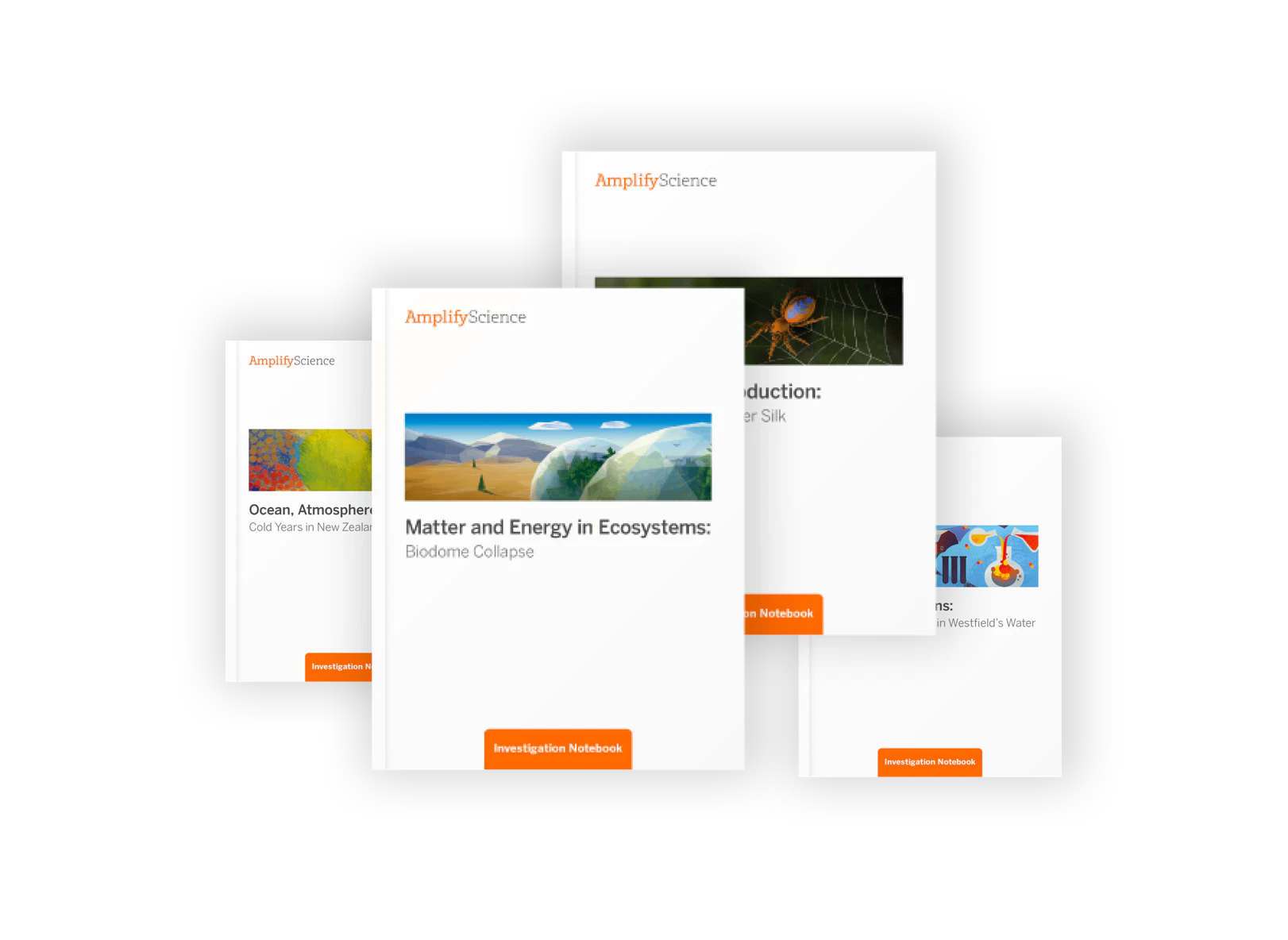
Preview the Student Books and Student Investigation Notebooks

Grades 6–8 Integrated Model

Spanish Student Books and Student Investigation Notebooks

Welcome!

As the 2021-2022 school year continues to pose new challenges, you’re likely thinking about making your classroom responsive to student needs due to the covid-19 pandemic.

Got additional questions? Use Zoom to attend office hours with Nadya Awadallah, the DOE’s Elementary Science Lead on Fridays from 12-1pm.

Meeting ID: 835 9458 3142

Passcode: 263518

NYC Newsletters

Educator Spotlight Submission

Calling all NYC DOE educators! Do you know an educator who has gone above and beyond? Would you like to highlight your teaching experience for others? Submit nominations here to see them featured as a spotlight in a future edition of our monthly newsletter and on our Instagram pages!

Introduction

This page includes planning, implementation, and professional learning resources for NYC schools using Amplify Science. Please take a moment to familiarize yourself with the categories in the navigation bar on the left side of the page so that you’ll be able to easily find what you need.

Most New York City educators come here looking for specific information, but if you’re new to Amplify Science, we recommend you read through the program guide to learn a little about the program. 

New to Amplify? – Start HERE!

Teachers and Administrators 

Step 1: Review the Amplify Science Navigation Essentials K-5 Video 

Step 2: Review your Scope and sequence/course structure calendar

Step 3: Review the Unpacking the Kit Videos listed below to understand what’s in your unit 1 kit

Step 4: Access your unique log in information to log-in to the Amplify Science Curriculum outlined below under Login support

Step 5: Log into the platform and access our Program Hub.  Select Using this site for self study for a complete suite of training videos and resources for an initial orientation video series

Step 6: Log into the curriculum and begin studying the Unit Map and Teacher’s Guide resources and begin planning your first lesson. Print out the NYC Program Guide for essential program information.

Step 7: Administrator’s ONLY – Review the K-5 Admin Orientation presentation for an overview on the program. Review materials under Admin Resources. 

NOTE: Should you need any additional guidance on how to get started with prep (or anything else!), please feel free to get in touch with our pedagogical support team. They are available Monday-Friday from 7AM-7PM EST. You can reach them via the chat icon in the lower right- hand corner of your screen when logged in, through email (help@amplify.com), or via phone (800-823-1969).

Getting started resources

NYC Resource Site overview – quick links

Technology requirements

Login support

Materials

  • Materials lists – lists of kit contents by unit
    K | 1 | 2 | 3 | 4 | 5
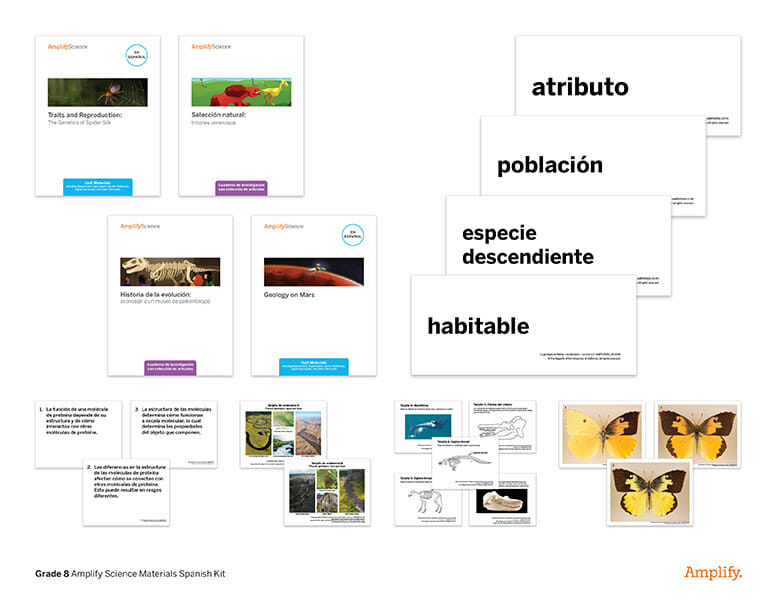
  • Spanish materials lists – lists of Spanish print kit contents by unit
    K | 1 | 2 | 3 | 4 | 5
  • Kit-level packing detail (chart) – high-level information regarding kits including dimensions, weights, etc. 

Unpacking your first Amplify Science classroom kit

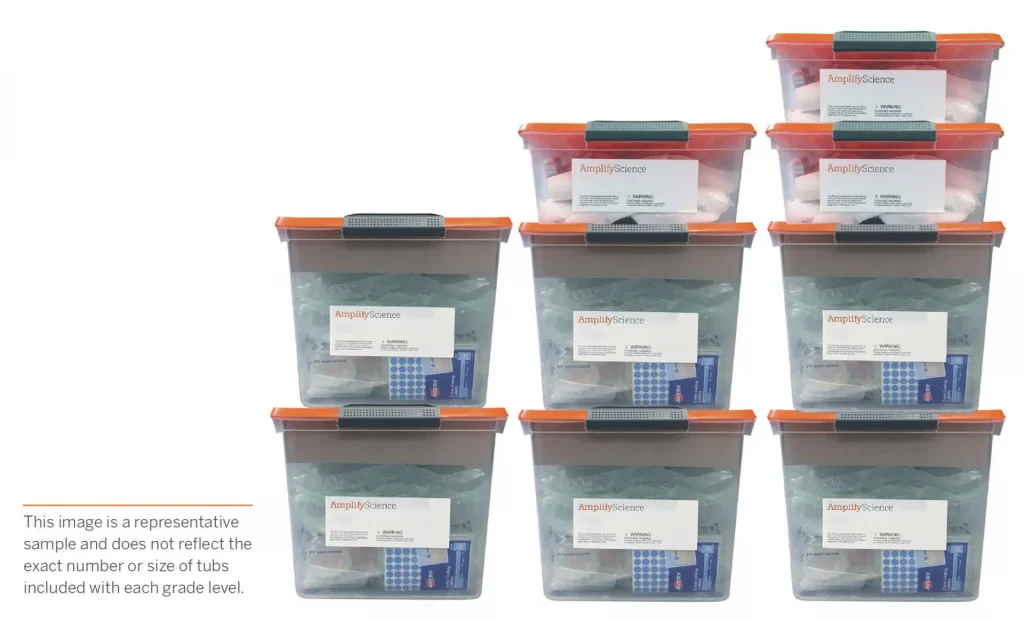
All Amplify Science units coming with kits that include hands-on and print materials. The number of boxes (sometimes referred to as “tubs”) varies depending on the unit.

21-22 Login Update

The temporary login credentials for fall ’21 have been deactivated. 

Please make sure you check out the Getting started resources > Login support below for instructions around teacher and the NYC shared student logins.

If there are any issues, please confirm with your STARS programmer that your classes are finalized and then contact the Amplify Help Desk at help@amplify.com or at 1-800-823-1969.

Planning and implementation resources

Use our NYC Field Trip List to plan an engaging field trip for your students!

Use the resources below to plan out your year and ensure you are teaching each standard to mastery.

NYC DOE Supplemental Guiding Documents: Curriculum Gaps

Admin resources

Remote and hybrid learning resources

In response to the shifts towards remote learning, Amplify has created resources for using our programs remotely. Please visit our Program Hub accessible via your Teacher Platform for all of our hybrid and remote learning supports which includes guidance for teachers and parents/guardians.

Additionally, please see below where you’ll find the recordings from our recently held webinars on our remote learning resources and some best practices for implementing Amplify Science in a distance learning setting.

Resource guides

  1. K-8 Remote and hybrid learning guide

On-demand remote learning videos

Professional Learning Opportunities

Interested in attending training? Check out and sign up for this year’s PL offerings here!

All 2021-2022 PL session materials will be uploaded below under Professional learning resources.

Amplify Science Back-to-School Recorded Webinars – Amplify held a series of national office hours throughout the summer and fall to share information about our new resources to support remote and hybrid learning– including recommendations about what to prioritize from your curriculum and essential refresher topics, such as how to navigate your program and find the best planning resources. Feel free to watch all recorded sessions at your convenience.

21-22 Professional learning resources

Fall 2021 materials:

Summer 2021 materials:

Fall 2021 materials:

Summer 2021 materials:

Fall 2021 materials:

Summer 2021 materials:

Fall 2021 materials:

Summer 2021 materials:

Fall 2021 materials:

Summer 2021 materials:

Fall 2021 materials:

Summer 2021 materials:

20-21 Professional learning resources

Winter 2021 materials:

Fall 2020 materials:

Summer 2020 materials:

Winter 2021 materials:

Fall 2020 materials:

Summer 2020 materials:

Winter 2021 materials:

Fall 2020 materials:

Summer 2020 materials:

  • K-5 New Teacher Orientation with Participant Notebook
  • Grades 2-3 Utilizing Program Assessments Effectively Webinar
  • Reaching All Learners for Grades 2-3 Webinar
  • Grade 2 Returning Teacher Remote Learning: Guided Planning Workshop Webinar

Spring 2021 materials:

  • Unit 4: Focusing on Evidence of Learning for New Teachers Webinar

Winter 2021 materials:

Fall 2020 materials:

Summer 2020 materials:

  • Grade 3 New Teacher Orientation Webinar with Participant Notebook
  • Grades 2-3 Utilizing Program Assessments Effectively Webinar
  • Reaching All Learners for Grades 2-3 Webinar
  • Grade 3 Returning Teacher Remote Learning: Guided Planning Workshop Webinar

Winter 2021 materials:

Fall 2020 materials:

Summer 2020 materials:

  • Grade 4 New Teacher Orientation Webinar with Participant Notebook
  • Grades 4-5 Utilizing Program Assessments Effectively Webinar
  • Reaching All Learners for Grades 4-5 Webinar
  • Grade 4 Returning Teacher Remote Learning: Guided Planning Workshop Webinar

Winter 2021 materials:

Fall 2020 materials:

Summer 2020 materials:

  • Grade 5 New Teacher Orientation Webinar with Participant Notebook
  • Grades 4-5 Utilizing Program Assessments Effectively Webinar
  • Reaching All Learners for Grades 4-5 Webinar
  • Grade 5 Returning Teacher Remote Learning: Guided Planning Workshop Webinar

19-20 Professional learning resources

Summer 2019 materials:

Fall 2019 materials:

Spring 2020 materials:

  • Reaching ALL Learners: Utilizing Program Assessments Effectively in Grades K & 1 – Participant Notebook

Summer 2019 materials:

Fall 2019 materials:

Spring 2020 materials:

  • Reaching ALL Learners: Utilizing Program Assessments Effectively in Grades K & 1 – Participant Notebook

Summer 2019 materials:

Fall 2019 materials:

Spring 2020 materials:

  • Reaching ALL Learners: Utilizing Program Assessments Effectively in Grades 2 & 3 – Participant Notebook

Summer 2019 materials:

Fall 2019 materials:

Spring 2020 materials:

  • Reaching ALL Learners: Utilizing Program Assessments Effectively in Grades 2 & 3 – Participant Notebook

Summer 2019 materials:

Fall 2019 materials:

Summer 2019 materials:

Fall 2019 materials;

Caregiver Resources

Caregiver letters – information about Next Generation Science Standards by grade level

K | 1 | 2 | 3 | 4 | 5

Caregiver Hub

Questions

Amplify Science K–5 FAQs

For general questions about the Amplify program (navigation, pedagogy, login), please reach out:

Email – scihelp@amplify.com
Phone – call toll-free at (800) 823-1969, Monday to Friday 7 a.m.–7 p.m. ET

Amplify Chat – click the Amplify Chat icon within the individual teacher account

Amplify Science

A new core curriculum designed from the ground up for the NGSS.

Preview the Student Books and Student Investigation Notebooks

Grades 6–8 Integrated Model

NGSS Benchmark Assessments

The Amplify NGSS Benchmark Assessments were authored by Amplify and were not developed as part of the Amplify Science program or created by the Lawrence Hall of Science.

Kindergarten

Needs of Plants and Animals

Pushes and Pulls

Sunlight and Weather

Grade 1

Animal and Plant Defenses

Light and Sound

Spinning Earth

Grade 2

Plant and Animal Relationships

Properties of Materials

Changing Landforms

Grade 3

Balancing Forces

Environments and Survival

Inheritance and Traits

Weather and Climate

Grade 4

Energy Conversions

Earth’s Features

Vision and Light

Waves, Energy, and Information

Grade 5

Patterns of Earth and Sky

Ecosystem Restoration

The Earth System

Modeling Matter

Grade 6

Grade 7

Grade 8

Review the digital curriculum

  1. Click on the orange button below.
  2. Sign in with Google with this username and password:

Username: FLsciencestudent@demo.tryamplify.net
Password: AmplifyNumber1

3. Click on the orange Amplify Curriculum button.

Note: You may be asked by Google to provide your location. If this occurs, please type in: Brooklyn, NY. If Brooklyn, NY does not work, type in: Alpharetta, GA . (This is a Google authentication security measure.)

Comprehensive Student Investigation Notebooks

Comprehensive Science 1

Comprehensive Science 2

Comprehensive Science 3

Domain Student Investigation Notebooks

Earth and Space Science

Life Science

Physical Science

Amplify Science Resources for NYC (6-8)

This page has been archived. For the latest information, please visit the NYC Resource Site.

Welcome!

As the 2021-2022 school year kicks into full gear, you’re likely thinking about making your classroom responsive to student needs due to the covid-19 pandemic.

Got additional questions? Use Zoom to attend office hours with Adaliz Gonzalez, the DOE’s Middle School Science Lead on Thursdays from 3-4pm.

Meeting ID: 852 2280 0969

Passcode: 528986

A powerful partnership

Amplify Science was developed by the science education experts at UC Berkeley’s Lawrence Hall of Science and the digital learning team at Amplify.

The word "Amplify" is written in large, orange letters with a period at the end on a light background.
The logo for The Lawrence Hall of Science, University of California, Berkeley, features blue text on a light background and is recognized by educators using Amplify Science for middle school science programs.

NYC Newsletters

Educator Spotlight Submission

Calling all NYC DOE educators! Do you know an educator who has gone above and beyond? Would you like to highlight your teaching experience for others? Submit nominations here to see them featured as a spotlight in a future edition of our monthly newsletter and on our Instagram pages!

Introduction

This page includes planning, implementation, and professional learning resources for NYC schools using Amplify Science. Please take a moment to familiarize yourself with the categories in the navigation bar on the left side of the page, so that you’ll be able to easily find what you need.

Most New York City educators come here looking for specific information, but if you’re new to Amplify Science, we recommend you read through the program guide to learn a little about the program. 

New to Amplify? – Start HERE!

Teachers and Administrators 

Step 1: Review the Amplify Science Overview Video.

Step 2: Review the NYC Scope and sequence for 21-22 school year.

Step 3: Review the Unpacking the Kit Videos listed below to understand what’s in your unit 1 kit.

Step 4: Access your unique Log-in information to log-in to the Amplify Science Curriculum outlined below under Login support

Step 5: Log into the platform and access our Program Hub.  Select Using this site for self study for a complete suite of training videos and resources for an initial orientation video series.

Step 6: Log into the curriculum and begin studying the Unit Map and Teacher’s Guide resources and begin planning your first lesson. Print out the NYC Program Guide for essential program information.

Step 7: Administrator’s ONLY – Review the new administrator orientation presentation for an overview of the program. Review other materials under Admin Resources

NOTE: Should you need any additional guidance on how to get started with prep (or anything else!), please feel free to get in touch with our pedagogical support team. They are available Monday-Friday from 7AM-7PM EST. You can reach them via the chat icon in the lower right- hand corner of your screen when logged in, through email (help@amplify.com), or via phone (800-823-1969).

Getting started resources

Login Support

Materials

Unpacking your first Amplify Science classroom kit

21-22 Login Update

The temporary login credentials for fall ’21 have been deactivated. 

Please make sure you check out the Getting started resources > Login Support below for instructions around teacher and student logins. If there are any issues, please confirm with your STARS programmer that your classes are assigned correctly and then contact our Amplify Help Desk at help@amplify.com or at 1-800-823-1969 for further assistance.

Implementation resources

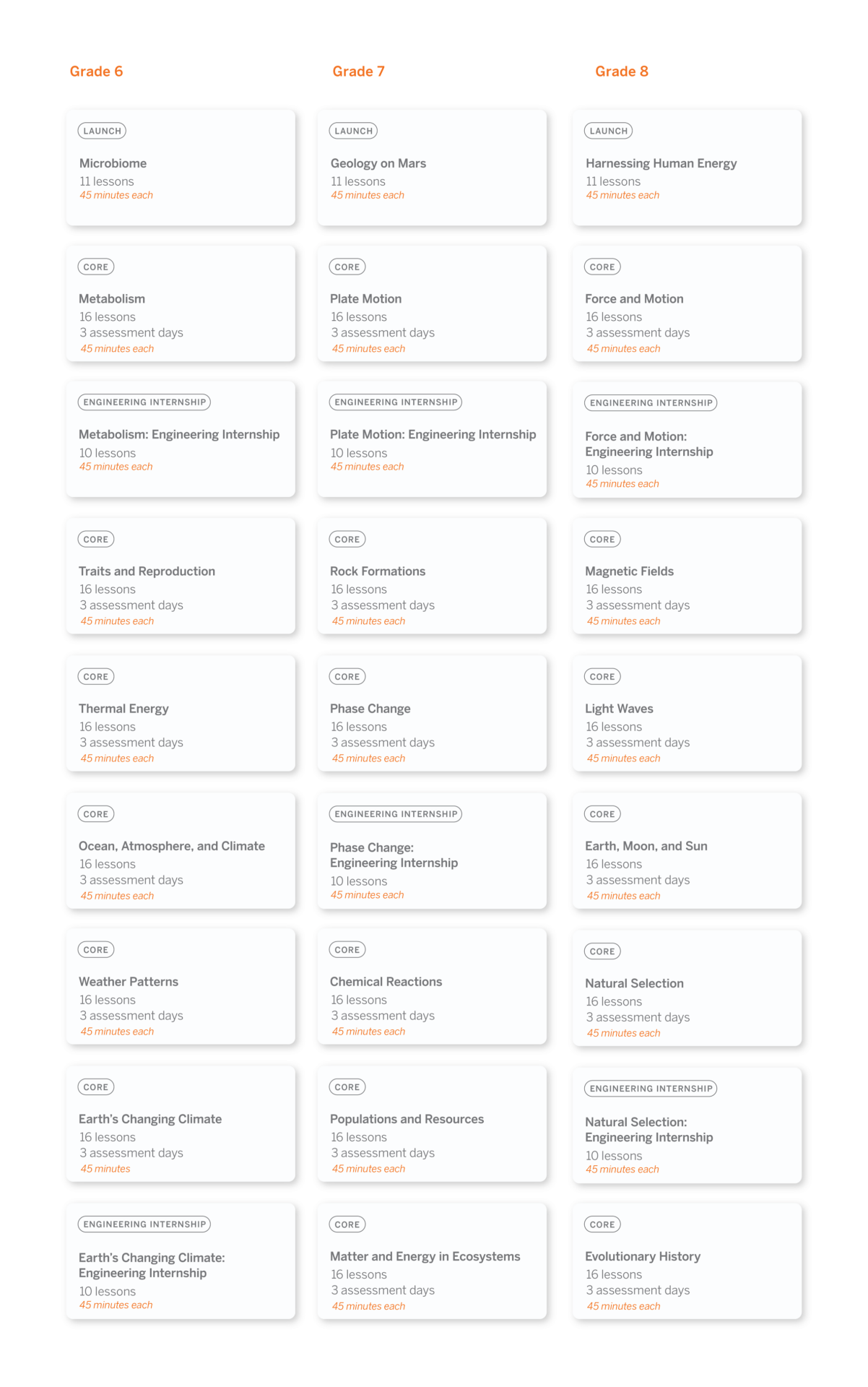
21-22 NYC Scope and Sequence and Pacing Guide

Use our NYC Field Trip List to plan an engaging field trip for your students!

NYC Companion Lesson Guides 

The format of the NYC Companion Lessons is similar to other Amplify Science lessons. Some companion lessons are designed to require more than a single class period to teach, so each lesson includes pacing suggestions. Science Background sections support teachers with the science content introduced in the lessons. For students’ written work, possible student responses are included at the end of each lesson guide.

The Lesson Guides are available in the last section of each unit’s print Teacher’s Guide and can be downloaded from the tables in the downloads section below.

NYC Companion Lesson Copymasters
Each NYC Companion Lesson has an accompanying Copymaster (for creating student sheets) that can be copied and distributed to students or used as a visual reference. The NYC Companion Lessons require students to have physical copies of the student sheets. The copymasters are available to download as printable PDF files from the tables in the downloads section below.

Grade 6 Lesson guides and Copymasters

  • Companion lesson: Insert after Lesson 2.2
  • Time frame: 60 minutes (can spread across multiple class periods)
  • NYSP–12SLS: PE: MS-PS3-6, DCI: PS3.B
  • Links (click to download):
  • Companion lesson: Insert after Lesson 3.3
  • Time frame: Two 45-minute class periods
  • NYSP–12SLS: PE: MS-PS2-3, MS-PS2-5, DCI: PS2.B
  • Links (click to download):
  • Companion lesson: Insert after Lesson 3.3 and after Investigating Non-Touching Forces
  • Time frame: 60 minutes (first and second reads can be spread across two class periods)
  • NYSP–12SLS: PE: MS-PS2-5, MS-PS2-3, DCI: PS2.B
  • Links (click to download):
  • Companion lesson: Insert after Lesson 2.5
  • Time frame: 105 minutes (can be spread across multiple class periods)
  • NYSP–12SLS: PE: MS-PS1-6, DCI: PS1.B
  • Links (click to download):
  • Companion lesson: Insert after Lesson 3.4
  • Time frame: 60 minutes (first and second reads can be spread across two class periods)
  • NYSP–12SLS: PE: MS-LS2-5, DCI: LS2.C, LS4.D
  • Links (click to download):
  • Companion lesson: Insert after Lesson 1.3
  • Time frame: 60 minutes (first and second reads can be spread across two class periods)
  • NYSP–12SLS: PE: MS-ESS2-4, DCI: ESS2.C
  • Links (click to download):
  • Companion lesson: Insert after Lesson 3.3*
  • Time frame: 90 minutes (can be spread across multiple class periods)
  • NYSP–12SLS: PE: MS-PS1-7, MS-ESS2-6, DCI: PS1.A, ESS2.C
  • Links (click to download):

*Note: The homework assignment for Ocean, Atmosphere, and Climate Lesson 3.3 (reading the article “Deep Ocean Currents: Driven by Density”) should be assigned after the Investigating Deep Ocean Currents companion lesson rather than after Lesson 3.3.

Grade 7 Lesson Guides and Copymasters

  • Companion lesson: Insert after Lesson 3.2
  • Time frame: 60 minutes (first and second reads can be spread across two class periods)
  • NYSP–12SLS: PE: MS-LS1-3, DCI: PS3.D, LS1.A
  • Links (click to download):
  • Companion lesson: Insert after Lesson 3.3 or later
  • Time frame: Three 45-minute class periods, each several days apart
  • NYSP–12SLS: PE: MS-LS1-8, DCI: LS1.D
  • Links (click to download):
  • Companion lesson: Insert after Lesson 3.5
  • Time frame: 60 minutes (first and second reads can be spread across two class periods)
  • NYSP–12SLS: PE: MS-LS1-6, MS-LS1-7, DCI: LS1.C, PS3.D
  • Links (click to download):
  • Companion lesson: Insert after Lesson 2.2
  • Time frame: 60 minutes (first and second reads can be spread across two class periods)
  • NYSP–12SLS: PE: MS-PS1-4, DCI: PS3.A
  • Links (click to download):
  • Companion lesson: Insert after Lesson 1.3
  • Time frame: 60 minutes
  • NYSP–12SLS: PE: MS-PS1-7, DCI: PS1.A
  • Links (click to download):
  • Companion lesson: Insert after Lesson 2.3, 2.4, or 2.5
  • Time frame: Two 45-minute class periods
  • NYSP–PE: MS-PS1-8, MS-PS1-2 DCI: PS1.A, PS1.B
  • Links (click to download):

Grade 8 Lesson Guides and Copymaster

  • Companion lesson: Insert after Lesson 2.2
  • Time frame: 90 minutes (can be spread across multiple class periods)
  • NYSP–12SLS: PE: MS-PS3-2, MS-PS3-5
  • Links (click to download):

NYC Companion Kits

Materials needed to teach Amplify Science lessons are provided in a kit for each unit. While some materials used in the NYC Companion Lessons are also found in a unit’s kit, materials specific to the companion lessons are provided in NYC Companion Kits. The contents of each kit and any additional materials needed to teach the companion lessons are listed in the PDFs provided below. Please select your grade to view or download the list.

NYC Student Editions (print)
The NYC Student Editions are durable student references that compile all reading material required for a grade level, including the articles students read for NYC Companion Lessons. Students reading in the Student Edition should annotate the text directly with sticky notes to achieve the full benefits of Active Reading. The Active Reading approach was designed as an interactive process in which students highlight and annotate digital or hard copies of articles directly. Printable versions of the articles are available in the downloads section below.

It is recommended that NYC teachers insert this additional lesson between Lessons 3.1 and 3.2 in order to have students complete a reading assignment in class along with an additional Sim activity.

  • Lesson: Earth, Moon and Sun: Modeling Seasons
  • Lesson Placement: Insert between Lessons 3.1 and 3.2*
  • Links (click to download):

*If teaching this Modeling Seasons lesson, do not assign reading “The Endless Summer of the Arctic Tern” article for homework in Lesson 3.1. However, students should still model a lunar eclipse with the Modeling Tool for homework, as they will be revisiting and revising this model in Lesson 3.3.

NYC Investigation Notebooks (for teacher download)

* includes NYC Companion Lesson Copymaster(s)

* includes NYC Companion Lesson Copymaster(s)

  • Geology on Mars
  • Earth, Moon, and Sun
  • Force and Motion
  • Engineering Internship: Force and Motion
  • Magnetic Fields*
  • Light Waves
  • Traits and Reproduction
  • Natural Selection
  • Evolutionary History

* includes NYC Companion Lesson Copymaster(s)

Admin resources

Remote and hybrid learning resources

In response to the shifts towards remote learning, Amplify has created resources for using our programs remotely. Please visit our Program Hub accessible via your Teacher Platform for all of our hybrid and remote learning supports which includes guidance for teachers and parents/guardians.

Additionally, please see below where you’ll find the recordings from our recently held webinars on our remote learning resources and some best practices for implementing Amplify Science in a distance learning setting.

Resource guides

Professional learning opportunities

Interested in attending training? Check out and sign up for this year’s PL offerings here!

Election Day 21-22 PL

Grade 6 Guided Planning Presentation and Webinar

Grade 7 Guided Planning Presentation and Webinar

Grade 8 Guided Planning Presentation and Webinar

Grades 6-8 Unpacking Phenomena Presentation and Webinar

All 2020-2021 PL session materials can be found below under Professional learning resources.

Amplify Science Back-to-School Recorded Webinars – Amplify held a series of national office hours throughout the summer and fall to share information about our new resources to support remote and hybrid learning– including recommendations about what to prioritize from your curriculum and essential refresher topics, such as how to navigate your program and find the best planning resources. Feel free to watch all recorded sessions at your convenience.

Archived Professional Learning Resources

Winter 2022

Spring 2021

Winter 2021

Fall 2020

Summer 2020

Summer 2019- Harnessing Human Energy and Thermal Energy

Fall 2019- Population and Resources with Participant Notebook

Winter 2022

Spring 2021

Winter 2021

Fall 2020

  • Grade 7: Progress Builds & Embedded Assessments Webinar
  • Grade 7: Amplify Science Remote & Hybrid Resources Webinar

Summer 2020

Summer 2019 – Microbiome and Metabolism

Fall 2019 – Phase Change with Participant Notebook

Winter 2022

Spring 2021

Winter 2021

Fall 2020

  • Grade 8: Progress Builds & Embedded Assessments Webinar
  • Grade 8: Amplify Science Remote & Hybrid Resources Webinar

Summer 2020

Summer 2019 –  Geology on Mars and Earth, Moon, Sun

Fall 2019 – Force and Motion with Participant Notebook

Caregiver resources

Caregiver Hub

Questions

For general questions about the Amplify program (navigation, pedagogy, login), please reach out:

Email – scihelp@amplify.com
Phone – call toll-free at (800) 823-1969, Monday to Friday, 7 a.m.–7 p.m.  ET

Amplify Chat – click the Amplify Chat icon within the individual teacher account

Preview the Student Investigation Notebooks and science articles

Grade 6

Microbiome Student Investigation Notebook with Article Compilation

Populations and Resources Student Investigation Notebook with Article Compilation

Matter and Energy in Ecosystems Student Investigation Notebook with Article Compilation

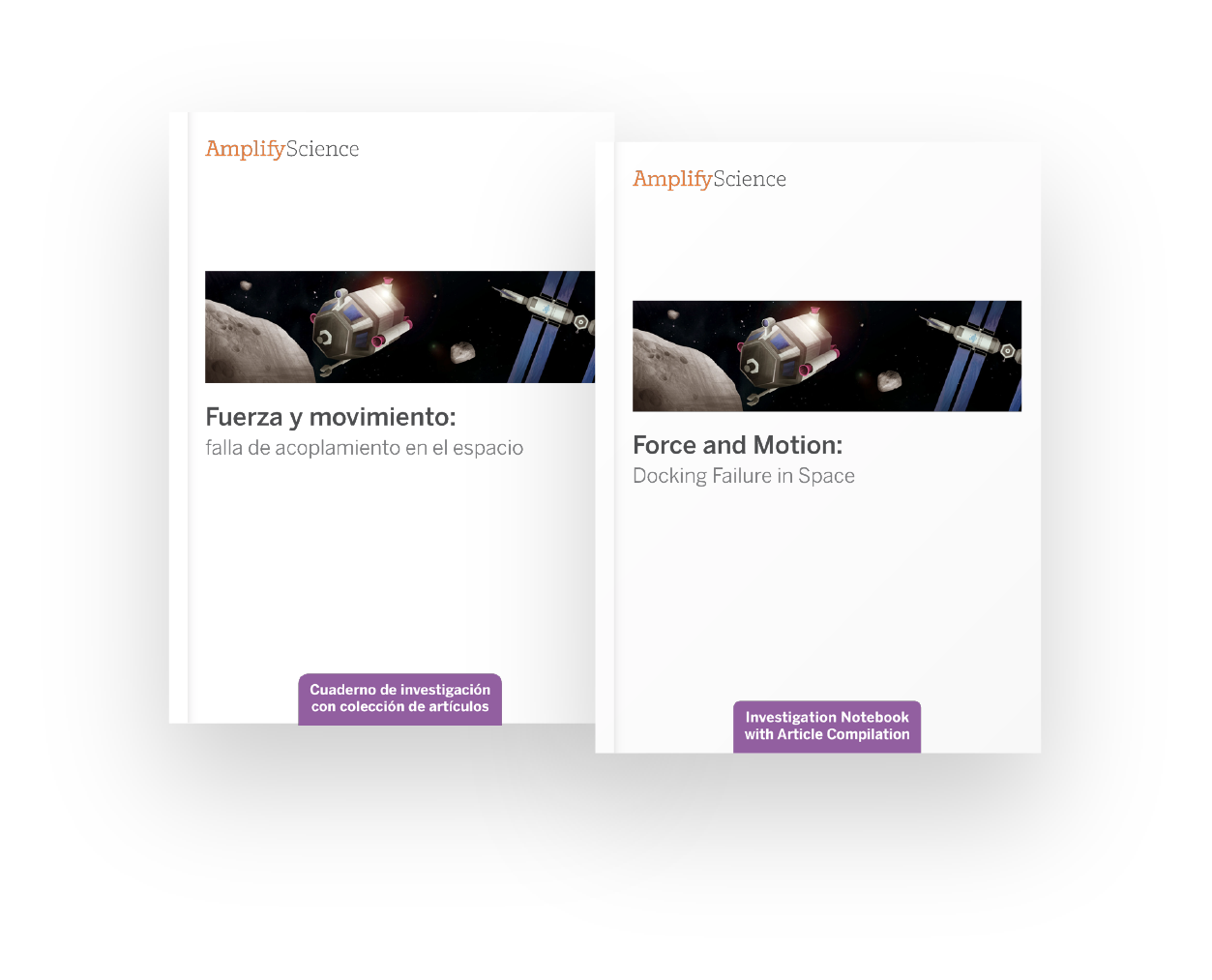
Force and Motion Student Investigation Notebook with Article Compilation

Force and Motion Engineering Internship Student Investigation Notebook with Article Compilation

Magnetic Fields Student Investigation Notebook with Article Compilation

Earth, Moon, and Sun Student Investigation Notebook with Article Compilation

Light Waves Student Investigation Notebook with Article Compilation

Grade 6 Louisiana Student Companion

Grade 7

Metabolism Student Investigation Notebook with Article Compilation

Metabolism Engineering Internship Student Investigation Notebook with Article Compilation

Phase Change Student Investigation Notebook with Article Compilation

Chemical Reactions Student Investigation Notebook with Article Compilation

Traits and Reproduction Student Investigation Notebook with Article Compilation

Ocean, Atmosphere, and Climate Student Investigation Notebook with Article Compilation

Weather Patterns Student Investigation Notebook with Article Compilation

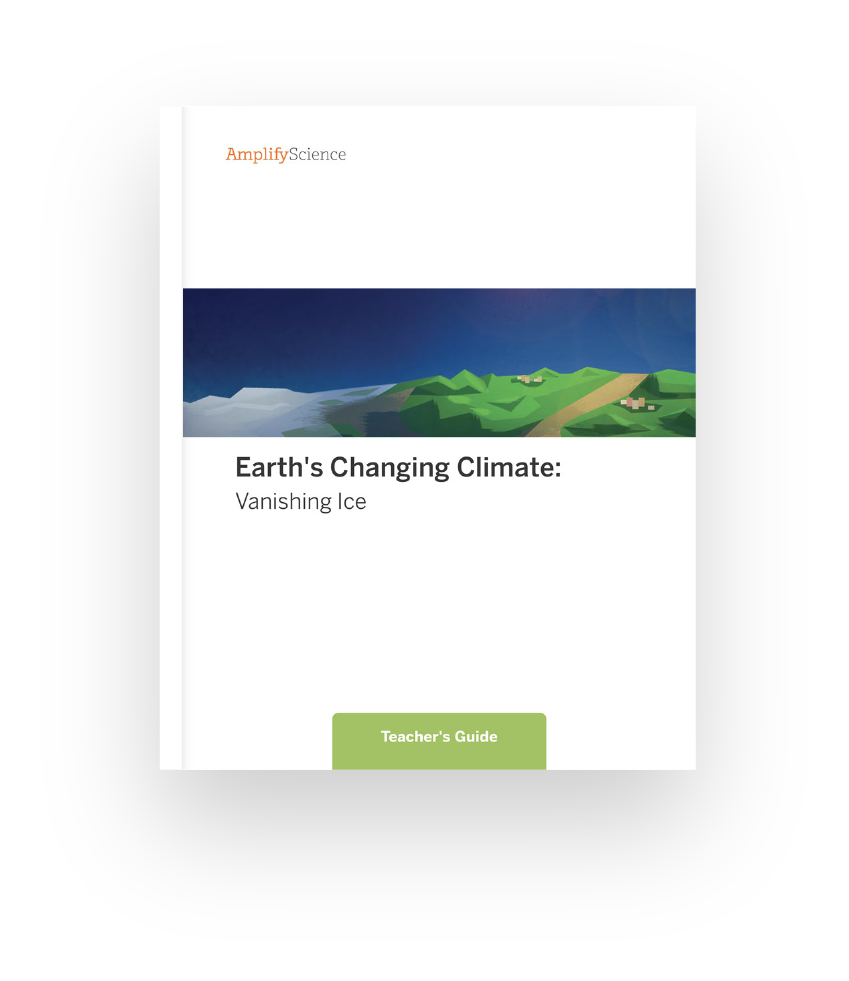
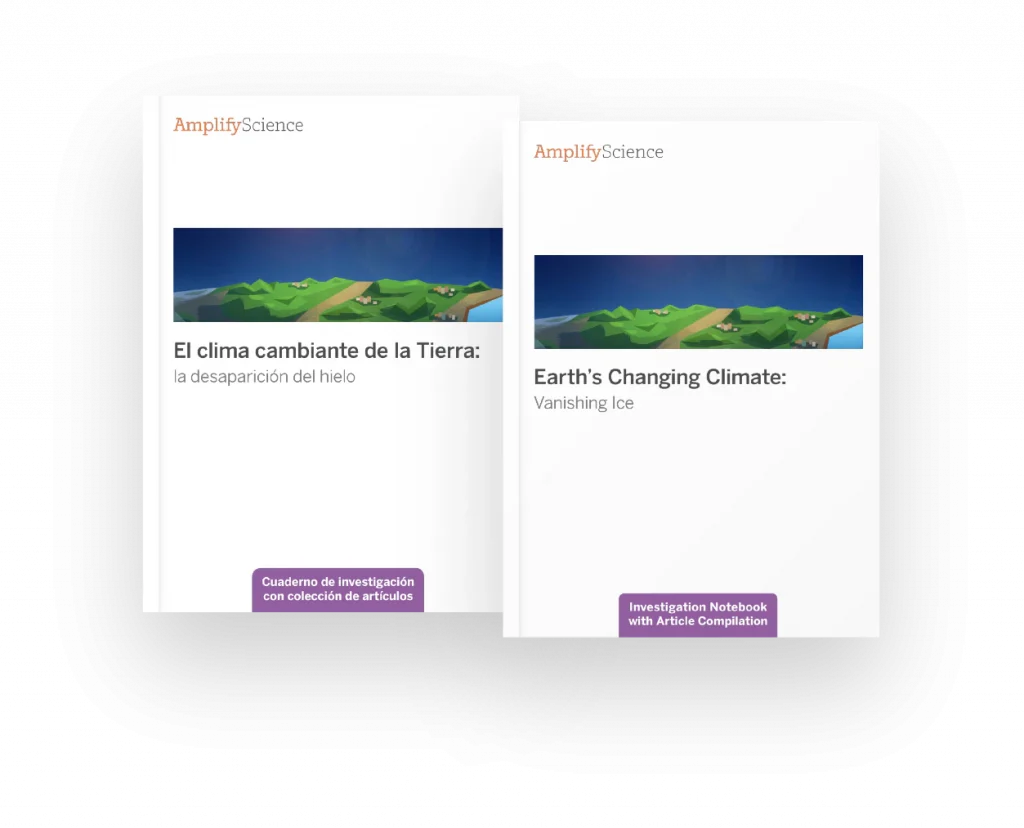
Earth’s Changing Climate Student Investigation Notebook with Article Compilation

Grade 7 Louisiana Student Companion

Grade 8

Geology on Mars Student Investigation Notebook with Article Compilation

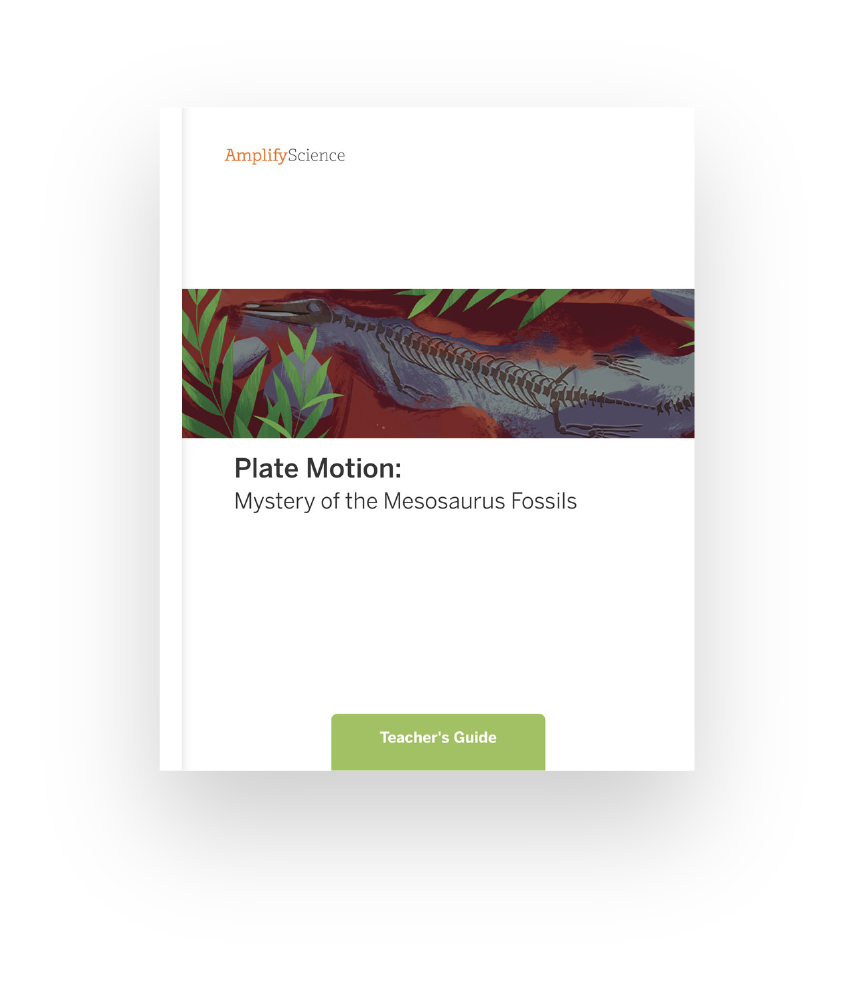
Plate Motion Student Investigation Notebook with Article Compilation

Plate Motion Engineering Internship Student Investigation Notebook with Article Compilation

Rock Transformations Student Investigation Notebook with Article Compilation

Thermal Energy Student Investigation Notebook with Article Compilation

Natural Selection Student Investigation Notebook with Article Compilation

Natural Selection Engineering Internship Student Investigation Notebook with Article Compilation

Evolutionary History Student Investigation Notebook with Article Compilation

Grade 8 Louisiana Student Companion

Review the digital teacher’s guide

  1. Click on the orange button below.
  2. Select “Log in with Amplify”.
  3. Sign in with this username and password:

Username: t.LouisianaReview@tryamplify.net
Password: AmplifyNumber1

Navigational Guides

Watch the video
Get an overview of navigating the digital Teacher’s Guide

Preview the Student Investigation Notebooks and science articles

Grade 6

Microbiome Student Investigation Notebook with Article Compilation

Populations and Resources Student Investigation Notebook with Article Compilation

Matter and Energy in Ecosystems Student Investigation Notebook with Article Compilation

Force and Motion Student Investigation Notebook with Article Compilation

Force and Motion Engineering Internship Student Investigation Notebook with Article Compilation

Magnetic Fields Student Investigation Notebook with Article Compilation

Earth, Moon, and Sun Student Investigation Notebook with Article Compilation

Light Waves Student Investigation Notebook with Article Compilation

Grade 6 Louisiana Student Companion

Grade 7

Metabolism Student Investigation Notebook with Article Compilation

Metabolism Engineering Internship Student Investigation Notebook with Article Compilation

Phase Change Student Investigation Notebook with Article Compilation

Chemical Reactions Student Investigation Notebook with Article Compilation

Traits and Reproduction Student Investigation Notebook with Article Compilation

Ocean, Atmosphere, and Climate Student Investigation Notebook with Article Compilation

Weather Patterns Student Investigation Notebook with Article Compilation

Earth’s Changing Climate Student Investigation Notebook with Article Compilation

Grade 7 Louisiana Student Companion

Grade 8

Geology on Mars Student Investigation Notebook with Article Compilation

Plate Motion Student Investigation Notebook with Article Compilation

Plate Motion Engineering Internship Student Investigation Notebook with Article Compilation

Rock Transformations Student Investigation Notebook with Article Compilation

Thermal Energy Student Investigation Notebook with Article Compilation

Natural Selection Student Investigation Notebook with Article Compilation

Natural Selection Engineering Internship Student Investigation Notebook with Article Compilation

Evolutionary History Student Investigation Notebook with Article Compilation

Grade 8 Louisiana Student Companion

Amplify Science

A new core curriculum designed from the ground up for the NGSS.

Preview the Student Books and Student Investigation Notebooks

Spanish Student Books and Student Investigation Notebooks

Amplify Science

A new core curriculum designed from the ground up for the NGSS.

Grades 6–8 Integrated Model

Spanish Student Books and Student Investigation Notebooks

Review the digital teacher’s guide

  1. Sign in with this username and password:
  2. Click on the orange button below.
  3. Select “Log in with Amplify”.

Username: t.LouisianaReview@tryamplify.net
Password: AmplifyNumber1

Navigational Guides

Watch the video
Get an overview of the program as a whole.

Take the guided tour
Click through to learn how to navigate around our program.

Preview the Student Books and Investigation Notebooks

Kindergarten

Needs of Plants and Animals

Pushes and Pulls

Sunlight and Weather

Grade 1

Animal and Plant Defenses

Light and Sound

Spinning Earth

Grade 2

Plant and Animal Relationships

Properties of Materials

Changing Landforms

Grade 3

Balancing Forces

Environments and Survival

Inheritance and Traits

Weather and Climate

Grade 4

Energy Conversions

Earth’s Features

Vision and Light

Waves, Energy, and Information

Grade 5

Patterns of Earth and Sky

Ecosystem Restoration

The Earth System

Modeling Matter

Preview the Student Books and Investigation Notebooks

Kindergarten

Needs of Plants and Animals

Pushes and Pulls

Sunlight and Weather

Grade 1

Animal and Plant Defenses

Light and Sound

Spinning Earth

Grade 2

Plant and Animal Relationships

Properties of Materials

Changing Landforms

Grade 3

Balancing Forces

Environments and Survival

Inheritance and Traits

Weather and Climate

Grade 4

Energy Conversions

Earth’s Features

Vision and Light

Waves, Energy, and Information

Grade 5

Patterns of Earth and Sky

Ecosystem Restoration

The Earth System

Modeling Matter

Welcome to Amplify Science for grades 6–8!

On this site, you’ll find resources to guide you in your review.

When you’re ready to explore full units in the digital Teacher’s Guide, click the “Review” button at the bottom of this page.

About the program

In every unit of Amplify Science, students take on the roles of scientists and engineers to figure out real-world phenomena. Students actively investigate compelling questions by finding and evaluating evidence, then developing convincing arguments. These engaging roles and phenomena bring science to life in your classroom.

The program is built from the ground up for new science standards and three-dimensional learning. The Next Generation Science Standards have raised the bar in science education. We set out to create a science program that educators can leverage to bring three-dimensional learning to life for their students.

Hear from educators like you

Hear from teachers, administrators, and students across the country who are using Amplify Science in their classrooms right now.

Resources to support your review

Download the resources below before you review the program to better understand the program structure, components, real-world phenomena, digital resources, and more.

Walkthrough video

Before you explore the program, watch this video overview and get familiar with the digital Teacher’s Guide and where to find resources for you and your students online.

Start your review

To complete your review digitally, click the orange button below to explore the digital Teacher’s Guide. You’ll have access to one full unit from every grade.

When you explore the digital Teacher’s Guide, a quick guided tour will familiarize you with navigation of the program and its features.

While you can access all of the print resources from the digital Teacher’s Guide, we’ve collected a few exemplars here from each unit:

Request more information

If you’d like to review the full program, request physical samples, or speak to a product expert for more information, fill out the form below and we’ll be in touch.

Inspiring the next generation of Rochester scientists, engineers, and curious scholars

Dear Rochester educator,

We’re extremely excited to be part of your science review process.

Built from the ground up for three-dimensional, phenomena-based learning, Amplify Science helps your Rochester scholars go from learning about to figuring out scientific concepts.

Explore the sections below and learn how Amplify creates rigorous, relevant learning experiences for the next generation of scientists, engineers, and curious citizens.

—Jennifer Fosegan, Rochester Senior Account Executive

Standards-based and grounded in research

Amplify Science is an engaging new core curriculum designed for three-dimensional, phenomena-based learning. Developed by the science education experts at UC Berkeley’s Lawrence Hall of Science and the digital learning team at Amplify, our program is used by hundreds of schools across the country, including New York City Public Schools, Chicago Public Schools, and Denver Public Schools.

Amplify Science was designed from the ground up to meet the Next Generation Science Standards. To ensure alignment to the New York State Science Learning Standards (NYSSLS), our partners at the New York City Department of Education created additional resources that can be made available for RCSD to implement.

Instructional model

The Amplify Science program is rooted in the proven, research-based pedagogy of Do, Talk, Read, Write, Visualize. Here’s how each element works:

Phenomena-based approach

In each Amplify Science unit, students take on the roles of scientists or engineers in order to investigate a real-world problem. Students work to define the problem and collect and make sense of evidence. Once the context is clear, students collect evidence from multiple sources and through a variety of modalities.

At the end of the unit, students are presented with a brand-new problem, giving them an opportunity to apply what they’ve learned over the course of the unit to a new context. This represents a shift from asking students to learn about science to supporting students in figuring out the science.

Resources to support your review

What’s included

COMPONENT

FORMAT

Teacher’s Guides and digital experience

Available digitally and in print, the Teacher’s Guides contain all of the information teachers need to facilitate classroom instruction, including detailed lesson plans, classroom slides, high-level overview documentation, differentiation strategies, standards alignments, materials and preparation steps, teacher support strategies, and in-context professional development, possible student responses, and more.

Print and digital

Hands-on materials kits

Hands-on learning is integrated into every unit of Amplify Science. Each hands-on activity is supported through clear instructions for the teacher, as well as easily accessible materials in unit-specific kits. Each kit contains hands-on materials, both consumable and nonconsumable, and various print materials (e.g., Vocabulary and Key Concept cards). With Amplify Science, students can actively participate in science: gathering evidence, thinking critically, making observations, and communicating their claims

Kit

COMPONENT

FORMAT

Student Investigation Notebooks

Available for every unit, the Student Investigation Notebooks contain instructions for activities and space for students to record data, reflect on ideas from texts and investigations, and construct explanations and arguments.

Print and digital

Student books

The age-appropriate Student Books in Amplify Science allow students to engage with content-rich text, obtain evidence, develop research and close reading skills, and construct arguments and explanations about the ideas they are learning in class.

Print and digital

Student digital experience

Students can easily engage with the student digital experience, so effective learning can occur in every type of classroom environment.

In grades 4–5, students are introduced to digital simulations. Developed exclusively for Amplify Science, these digital tools serve as venues of exploration and data collection, allowing students to discover and construct their understanding of science concepts and phenomena.

Digital

Spanish parity

Amplify Science is committed to providing support to meet the needs of all learners. For Spanish-speaking students, greater access to rich science content is achieved with Amplify Science through the use of a pedagogical approach that offers multiple points of entry. In addition, Spanish language supports are available across the curriculum, including Spanish kits that offer Spanish versions of all student-facing print materials, as well as Spanish digital licenses for teachers. Learn more about the Spanish components available across Amplify Science.

The same rigor in terms of scientific accuracy, literacy development, and the use of rich content and language in the creation of the Amplify Science Spanish materials. To ensure equity, all Spanish materials were carefully translated using academic Spanish, paying particular attention to consistency and the use of grade-level-appropriate language in order to support language development.

Review online

Ready to explore on your own? Follow the instructions below to access your demo account.

First, watch this navigation video. Then, click the orange button “Log in to Amplify Science” to log in.

  • Select Log in with Amplify.
  • Enter username and password:
    • Teacher username: t1.rcsdtrial@demo.tryamplify.net
    • Student username: s1.rcsdtrial@demo.tryamplify.net
    • Password (both teacher and student): Amplify1-rcsdtrial

Disciplinary Core Ideas (DCI) review
Each Amplify Science unit is designed around a unit-specific learning progression that aligns with NGSS disciplinary core ideas (DCI) and crosscutting concepts. The levels that comprise the unit’s learning progression are cumulative. As students progress through the unit, they are able to integrate prior understandings with new insights, and there are continuing opportunities for students to master conceptual understanding of early unit content in subsequent chapters of the unit.

This means that standards are often addressed across entire units instead of in one particular activity or lesson. Thus, the lessons noted below are examples of where the concept represented in the listed DCI is addressed, but this list should not be considered exhaustive. Instead, students have frequent opportunities to engage with these ideas throughout the unit, the grade, and the grade band. 

To view the specified lessons, explore our RCSD Digital Review Guide or select a grade level below.

DCI ESS2.D: Weather and Climate
Before you begin reviewing these lessons, make sure to locate the following Student Books from your Unit Kit: What is the Weather Like Today? and Tornado! Predicting Severe Weather

Select the Sunlight and Weather unit, click Chapter 1, and locate the lessons below:

Lesson 1.1

  • Activities 2 and 3, Step-by-step tab
  • Student bookWhat is the Weather Like Today? (note: located in your Unit Kit)

Lesson 1.2

  • Activities 1 and 3, Step-by-step tab

Lesson 1.3

  • Activities 1 and 2, Step-by-step tab

Lesson 1.4

  • Lesson Brief, Digital Resources, “Playground Weather Calendars and Playground Weather Graphs (Completed)”
  • Activity 1, Step-by-step tab (especially steps 5, 9, and 10) and Teacher Support tab (“Assessment, Assessment Opportunity: Assessing Students’ Understanding of Types of Weather”)

Lesson 5.1

  • Activity 1, Step-by-step tab (especially steps 6–7) and Teacher Support, Assessment tab (“Assessment Opportunity: Assessing Students’ Understanding of Weather and Why We Measure It”)
  • Student book, Tornado! Predicting Severe Weather (note: located in your Unit Kit), pages 6–9

DCI PS4.A: Wave Properties
Before you begin reviewing these lessons, make sure to locate the following materials from your Unit Kit: Light and Sound Student Investigation Notebook; Student Book: What Vibrates?

Select the Light and Sound unit, click Chapter 4, and locate the lessons below:

Lesson 4.1

  • Lesson Brief, Digital Resources, “Assessment Guide”
  • Activity 3, Step-by-step tab (especially steps 1–12)
  • Light and Sound Student Investigation Notebook, page 24 (note: located in your Unit Kit)

Lesson 4.2

  • Activity 2, Step-by-step tab and On-the-Fly Assessment (hummingbird icon)
  • Activity 3, Step-by-step tab and On-the-Fly Assessment (hummingbird icon)
  • Activity 4, Instructional Guide
  • Student bookWhat Vibrates? (note: located in your Unit Kit)
  • Light and Sound Student Investigation Notebook, page 25 (note: located in your Unit Kit)

Lesson 4.3

  • Lesson Brief, Digital Resources, “I Hear a Sound. What Vibrates? Mini-Book copymaster”
  • Activity 1, Step-by-step tab (especially steps 5–11, 13), and Teacher Support tab (“Instructional Suggestion, Going Further: Sound Can Cause Vibrations”)
  • Activity 3, Step-by-step tab
  • Activity 4, Step-by-step tab and On-the-Fly Assessment (hummingbird icon)

DCI LS2.A: Interdependent Relationships in Ecosystems
Before you begin reviewing these lessons, make sure to locate the following materials from your Unit Kit: Plant and Animal Relationships Student Investigation Notebook; Student book A Plant is a System.

Select the Plant and Animal Relationships unit, click Chapter 1, and locate the lessons below:

Lesson 1.6

  • Activities 2–4, Step-by-step tab
  • Plant and Animal Relationships Student Investigation Notebook (note: located in your Unit Kit), pages 15–19

Lesson 1.7

  • Activity 2, Step-by-step tab, Possible Responses tab, and Critical Juncture Assessment (hummingbird icon)
  • Activity 3, Step-by-step tab

Lesson 2.2

  • Activity 2, Step-by-step tab (especially steps 4–12) and Possible Responses tab
  • Student bookA Plant is a System (note: located in your Unit Kit)

DCI ESS2.D: Weather and Climates
Before you begin reviewing these lessons, make sure to locate the following materials from your Unit Kit: Weather and Climate Student Investigation Notebook; Student Books Dangerous Weather Ahead and Sky Notebook.

Select the Weather and Climate unit, click Chapter 4, and locate the lessons below:

Lesson 1.4

  • Activity 2, Step-by-step tab 
  • Student bookSky Notebook (note: located in your Unit Kit)

Lesson 2.3

  • Activity 3, Step-by-step tab and Possible Responses tab
  • Weather and Climate Student Investigation Notebook, page 28 (note: located in your Unit Kit)

Lesson 3.2

  • Lesson Brief, Digital Resources, “Anchorage, Queenstown, and Saint Petersburg Graphs copymaster”
  • Activities 2 and 3, Step-by-step tab

Lesson 3.3,

  • Activity 2, Step-by-step tab, Possible Responses tab, and On-the-Fly Assessment (hummingbird icon)

Lesson 3.6

  • Activity 1, Step-by-step tab (especially steps 3–5) and On-the-Fly Assessment (hummingbird icon)

Lesson 3.7

  • Lesson Brief,  Digital Resources, “End-of-Unit Writing: Arguing About Future Island Weather Version A copymaster” and “Assessment Guide”
  • Activity 3, Step-by-step tab (especially steps 3–7)

Lesson 4.2

  • Activity 2, Step-by-step tab, Possible Responses tab, and On-the-Fly Assessment (hummingbird icon)
  • Student book, Dangerous Weather Ahead (note: located in your Unit Kit)

DCI PS4.A: Wave Properties
Before you begin reviewing these lessons, make sure to locate the following materials from your Unit Kit: Student books Warning: Tsunami! and Patterns in Communication.

Select the Waves, Energy, and Information unit, click Chapters 1 and 3, and locate the lessons below:

Chapter 1

Lesson 1.4

  • Activity 1, Step-by-step tab (especially steps 1, and 4)
  • Student bookWarning: Tsunami! (note: located in your Unit Kit)
  • Activity 2, Step-by-step tab, On-the-Fly Assessment (hummingbird icon), and Teacher Support tab (“Instructional Suggestion, Providing More Experience: Waves in Water”)

Chapter 3

Lesson 3.1

  • Activity 2, Step-by-step tab (especially steps 4–8) and On-the-Fly Assessment (hummingbird icon)
  • Activity 3, Step-by-step tab and Waves, Energy, and Information Simulation

Lesson 3.2

  • Activity 3, Step-by-step tab, On-the-Fly Assessment (hummingbird icon), and Waves, Energy, and Information Simulation 

Lesson 3.3

  • Activity 4, Step-by-step tab and On-the-Fly Assessment (hummingbird icon)
  • Student bookPatterns in Communication (note: located in your Unit Kit), pages 6–7

DCI LS2.A: Interdependent Relationships in Ecosystems
Before you begin reviewing these lessons, make sure to take out the following materials from your Unit Kit: Student books Restoration Case Studies and Walk in the Woods; Organism Print Name Cards: Set 1.

Select the Ecosystem Restoration unit, click Chapters 1, 2, and 3, and locate the lessons below:

Lesson 1.6

  • Activity 2, Step-by-step tab, Possible Responses tab, and Ecosystem Modeling Tool (Box 2 on student apps page, “1.6 Healthy Ecosystem Model”)
  • Activity 3, Step-by-step tab (especially steps 2 and 3), Possible Responses tab, and Critical Juncture Assessment (hummingbird icon)

Lesson 1.7

  • Activity 2, Step-by-step tab
  • Activity 3, Step-by-step tab (especially steps 3–7) and On-the-Fly Assessment (hummingbird icon)
  • Printable Resources, Print Materials (8.5” x 11”), Organism Name Cards: Set 1, pages 12–17 (note: located in your Unit Kit)

Lesson 1.8

  • Activity 3, Step-by-step tab (especially steps 6–8) and Possible Responses tab

Lesson 2.3

  • Activity 3, Step-by-step tab (especially steps 1–4), Possible Responses tab, and Ecosystem Modeling Tool (Box 3 on student apps page, “2.3 Plant Needs Model”)

Lesson 2.5

  • Activity 3, Step-by-step tab
  • Student bookRestoration Case Studies (note: located in your Unit Kit)

Lesson 3.2

  • Activity 2, Step-by-step tab
  • Student bookWalk in the Woods (note: located in your Unit Kit), pages 6–10

Lesson 3.3

  • Activity 4, Step-by-step tab and Ecosystem Restoration Simulation

Lesson 3.4

  •  Activity 2, Step-by-step tab, Possible Responses tab, On-the-Fly Assessment (hummingbird icon), and Ecosystem Restoration Simulation

Lesson 3.5

  • Activity 2, Step-by-step tab and Teacher Support tab (“Instructional Suggestion, Going Further: Balance and Interdependence of Ecosystems: Impacts of Invasive Species”)
  • Student bookRestoration Case Studies (note: located in your Unit Kit), pages 11, 31, and 47

Lesson 3.6

  • Activity 2, Step-by-step tab (especially steps 4–5), Possible Responses tab, and Critical Juncture Assessment (hummingbird icon)

Lesson 3.7

  • Activity 1, Step-by-step tab, Possible Responses tab, and Ecosystem Modeling Tool (Box 5 on student apps page, “3.7 No Decomposers Model”)

Looking for help?

Contact your Rochester Account Executive:

Jennifer Fosegan
(585) 590-4200
jfosegan@amplify.com

Welcome, Utah K-8 reviewers!

To view this protected page, enter the password below:


Welcome to Amplify Science Pennsylvania
(K–5)!

Amplify Science is an engaging core curriculum designed for three-dimensional, phenomena-based learning.

With Amplify Science, Pennsylvania students shift from learning about to figuring out science through authentic three-dimensional (3D) learning and phenomena-based exploration. In each unit, students take on the role of a scientist or engineer to investigate a real-world problem. This prepares them to become critical thinkers who can solve problems in their communities and beyond.

Four children gather around a classroom table, engaging with their Amplify Science project, as notebooks and papers are spread out in front of them—an inspiring scene supported by Pennsylvania teachers.

What is Amplify Science Pennsylvania?

Customized lessons for Pennsylvania

Amplify Science Pennsylvania (K–5) combines our nationally recognized, proven curriculum with custom lessons specifically designed to ensure you are meeting Pennsylvania’s STEELS standards.

A digital interface displays six science lessons from Amplify Science, with "Ancient Water Purification" in Lesson 2.9 highlighted as a PA STEELS Custom Lesson. Each lesson features a simple sky and mountain graphic, perfect for Science programs for elementary.

The Lawrence Hall of Science

Developed by the science education experts at UC Berkeley’s Lawrence Hall of Science and the digital learning team at Amplify, our program features:

  • phenomena-based approach in which students construct a complex understanding of each unit’s anchor phenomenon.
  • A blend of cohesive storylines, hands-on investigations, rich discussions, literacy-rich activities, and digital tools.
  • Carefully crafted units, chapters, lessons, and activities designed to deliver true three-dimensional learning.
  • An instructional design that supports all learners in accessing all standards.
Aerial view of the lawrence hall of science at the university of california, berkeley, showcasing the building and surrounding trees with a foggy city backdrop.

Proven to work

A pdf cover from wested titled "learning and literacy development together: initial results from a curriculum study," featuring an adult helping children with schoolwork in a classroom.

WestEd Randomized
Control Trial for Grade 1

Read More

Pdf cover titled "curriculum materials designed for the next generation science standards: initial results from gold standard research trials", published by wested.

WestEd Randomized
Control Trial for Grade 7

Read More

A teacher and students engage in a science activity around a table. The text promotes the Amplify Science K–8 curriculum, highlighting its focus on hands-on learning and real-world problem-solving.

Amplify Science Pennsylvania NE
Grades K–5

Read More

Instructional model

The Amplify Science Pennsylvania program is rooted in the proven, research-based pedagogy of Do, Talk, Read, Write, Visualize. Here’s how each element works:

Do

Firsthand investigations are an important part of any science classroom, and Amplify Science Pennsylvania has students getting hands-on in every unit—from building models of protein molecules to experimenting with electrical systems.

Talk

Student-to-student discourse and full-class discussions are an integral part of the program. Students are provided with numerous opportunities to engage in meaningful oral scientific argumentation, all while fostering a collaborative classroom environment.

Read

Students read scientific articles, focusing their reading activities on searching for evidence related to their investigation and on asking and recording questions as they read through fascinating texts on 21st-century topics.

Write

Following real-world practices, students write scientific arguments based on evidence they’ve collected, making clear their reasoning about how a given piece of evidence connects to one of several claims.

Visualize

By manipulating digital simulations and using modeling tools to craft visualizations of their thinking— just as real scientists and engineers
do—students take their learning far beyond the confines of what they can physically see in the classroom in an exciting and authentic way.

Program structure

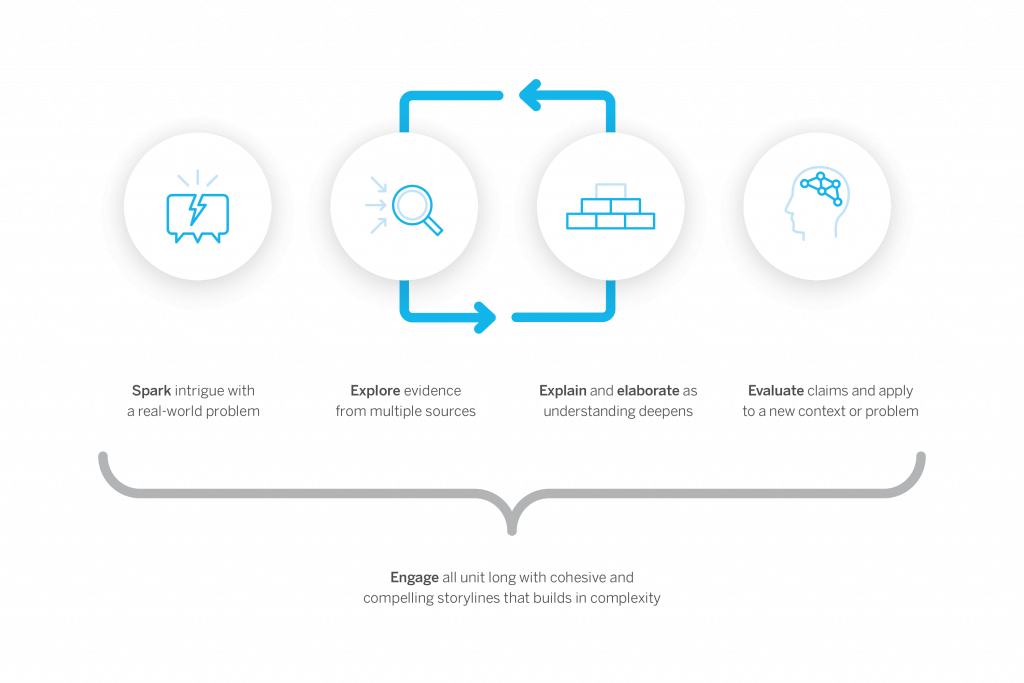
Our cyclical lesson design ensures that students receive multiple exposures to concepts through a variety of modalities. As they progress through the lessons within a unit, students build and deepen their understanding, increasing their ability to develop and refine complex explanations of the unit’s phenomenon.

It’s this proven program structure and lesson design that enables Amplify Science Pennsylvania to address 100% of the Next Generation Science Standards (NGSS) and support students in mastering the Pennsylvania Science Standards.

Flowchart depicting a critical thinking process with four circular nodes connected by arrows, each node representing a step: posing a real-world problem, exploring evidence, elaborating concepts, and evaluating claims.

Unit types

While every unit delivers three-dimensional learning experiences and engages students in gathering evidence from a rich collection of sources, each unit also emphasizes a particular science and engineering practice.

In grades K–2:

  • One unit emphasizes the practice of investigation.
  • One unit emphasizes the practice of modeling.
  • One unit emphasizes the practice of engineering design.

In grades 3–5, students experience the three unit types above, plus:

One additional unit that emphasizes the practice of argumentation.

Investigation units focus on the process of strategically developing investigations and gathering data to answer questions. Students are first asked to consider questions about what happens in the natural world and why, and are then involved in designing and conducting investigations that produce data to help answer those questions.

Modeling units provide extra support to students engaging in the practice of modeling. Students use physical models, investigate with computer models, and create their own diagrams to help them visualize what might be happening on the nanoscale.

Engineering design units provide opportunities for students to solve complex problems by applying science principles to the design of functional solutions, and iteratively testing those solutions to determine how well they meet preset criteria.

Argumentation units provide students with regular opportunities to explore and discuss available evidence, time and support to consider how evidence may be leveraged in support of claims, and independence that increases as they mount written arguments in support of their claims.

Unit sequence

Our lessons follow a structure that is grounded in regular routines while still being flexible enough to allow for a variety of learning experiences.

In fact, our multimodal instruction offers more opportunities for students to construct meaning, and practice and apply concepts, than any other program. What’s more, our modular design means our units can be flexibly arranged to support your instructional goals.

Chart outlining science curriculum by grade, from kindergarten through grade 5, listing topics such as

Program components

Available digitally and in print, our unit-specific reference guides are chock-full of helpful resources, including scientific background knowledge, planning information and resources, color-coded 3D Statements, detailed lesson plans, tips for delivering instruction, and differentiation strategies.

Amplify Science TG

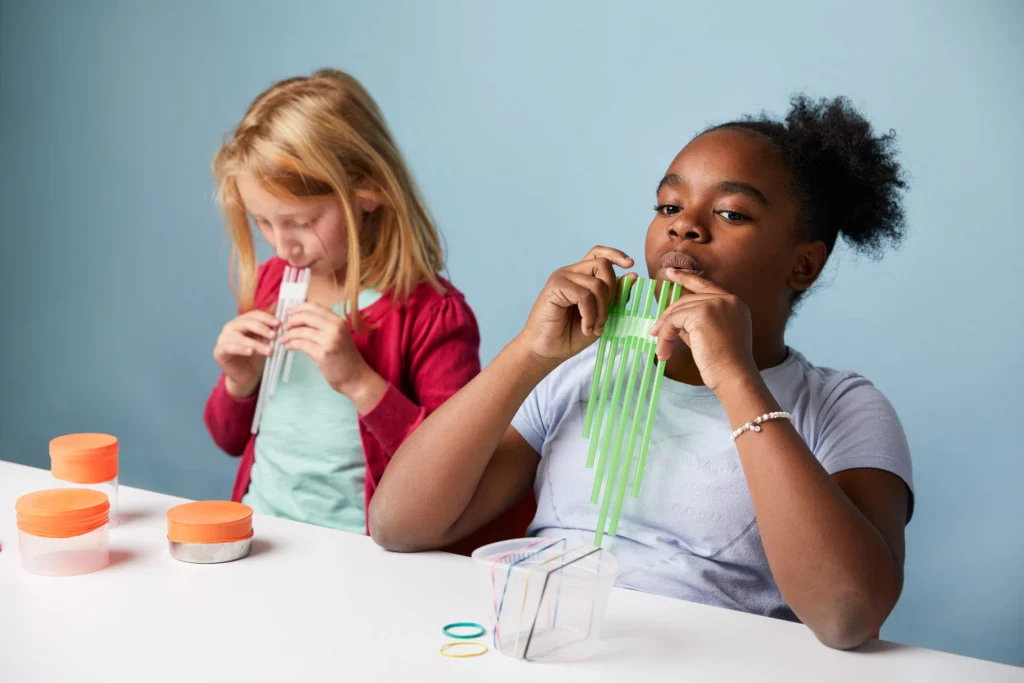
Hands-on learning is an essential part of Amplify Science Pennsylvania and is integrated into every unit. Students actively participate in science, playing the roles of scientists and engineers as they gather evidence, think critically, solve problems, and develop and defend claims about the world around them. Every unit includes hands-on investigations that are critical to achieving the unit’s learning goals.

Two children sit at a table blowing into plastic straws held together, likely making musical sounds, with containers and rubber bands on the table.

More hands-on with Flextensions:
Hands-on Flextensions are additional, optional investigations that are included at logical points in the learning progression and give students an opportunity to dig deeper if time permits. These activities offer teachers flexibility to choose to dedicate more time to hands-on learning. Materials referenced in Hands-on Flextension activities will either be included in the unit kit or are easily sourced. Supporting resources such as student worksheets will be included as downloadable PDF files.

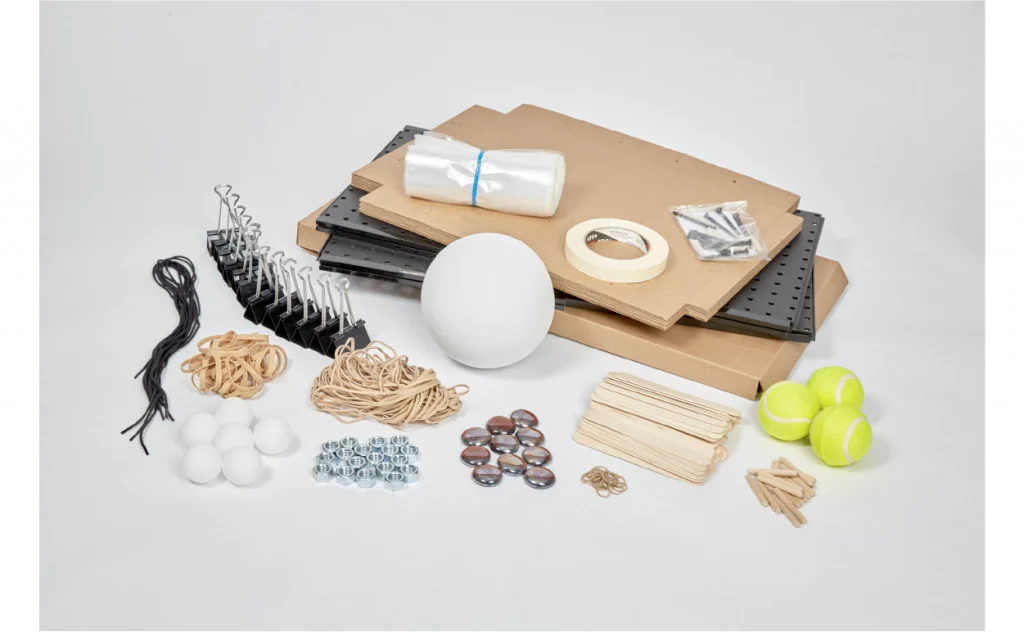
Our kits include enough non-consumable materials to support a class of 36 students and enough consumable items to support 72 students. In other words, each kit can last two years! Plus, our unit-specific kits mean teachers just grab the tub they need for the unit and then put it all back with ease.

Assorted office and household items displayed on a white background, including rubber bands, binder clips, cardboard, and sports balls.

Each unit of Amplify Science Pennsylvania (K–5) includes six unique Student Books written by educators at the Lawrence Hall of Science specifically for the program. These content-rich nonfiction and informational texts provide opportunities for students to search for evidence relevant to their firsthand investigations, see science practices and dispositions modeled, extend their science knowledge, provide real-world connections as they master reading-to-learn and close reading skills, and construct evidence-based arguments.

Important note:
Students in grades K–5 are never asked to read alone. Rather, books are read to, with, and by students with ample scaffolding and support provided by the teacher. Big Books are read aloud or together with the class to introduce ideas. Student Books allow for small-group reading and reading in pairs.

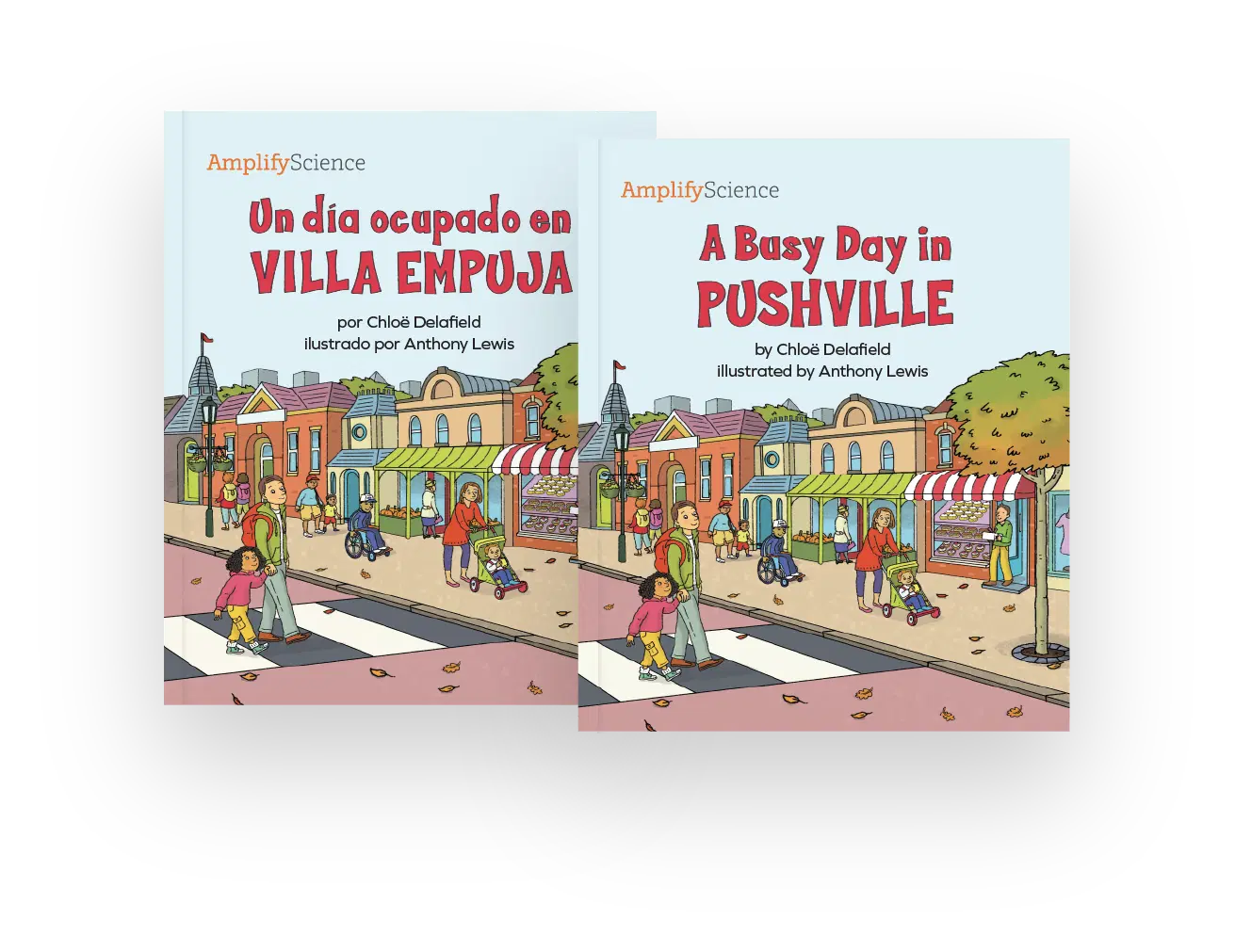
Two children's books, one in Spanish "Un día ocupado en Villa Empuja" and one in English "A Busy Day in Pushville," both illustrated by Anthony Lewis and depicting a busy town scene.

Available for every unit, our Student Investigation Notebooks contain instructions for activities and space for students to record data and observations, reflect on ideas from texts and investigations, and construct explanations and arguments.

In grades K–5, one copy of the Student Investigation Notebook is included in each unit’s materials kit for use as a blackline master. Each notebook is also available as a downloadable PDF on the Unit Guide page of the digital Teacher’s Guide.

Amplify Science Student Investigation Notebooks

Amplify Science Pennsylvania offers digital experience licenses that make elementary instruction more flexible for students and teachers and provide additional means to engage in remote, hybrid, or in-person learning!

Student-facing digital lessons
With the digital experience, students can engage with digital lesson content in one cohesive experience. It’s the same content from Amplify Science Pennsylvania in a new, integrated format, in which students can interact with slides, Sims, modeling tools, videos, books, and more.

Ecosystem Restoration digital simulation

Digital student notebook pages
Students can draw, write, record audio, and insert images into their Investigation Notebook pages. Their work is automatically saved and delivered to you in real time. When students edit their work, those edits are immediately reflected on your teacher work review page. You can access student responses by clicking “View Work,” where you can see students’ Investigation Notebook pages from the lesson, updating live.

Assign in Amplify
The digital experience allows flexibility with optional features such as scheduling assignments in advance and setting due dates. You can use Scheduling to determine the date and time that the assignment appears in Student Home. You also have the flexibility to schedule when assignments appear and to use dates to remove assignments from Student Home.

Assign in LMS
You can also assign lessons via our integrations with learning management systems (LMS) such as Google Classroom and Microsoft Teams, or by copying a lesson link and sharing it with students through the platform of your choice. The assignment link you send will provide students with direct access to the full lesson—slides, videos, digital tools, and worksheet activities—no student platform navigation required!

Teacher platform and presentation
Teacher-facing lesson content—including sample teacher talk, student responses, pedagogical support, and possible student responses—shows on a teacher’s private Teacher Guide tab. Students only see the lesson slides that are being presented.

Graphic depicting a teacher's device synced with a class presentation for K—5 students. The teacher's laptop displays an Amplify Science lesson on environments, which is mirrored on a larger screen for the class

Explore your print samples

With your Amplify Science Pennsylvania print samples, you’ll find unit-specific Teacher’s References Guides, Student Investigation Notebooks, and sets of Student Books for each grade level.

A note about the Teacher Reference Guides:

It’s important that you see the full breadth and depth of our instruction. For that reason, we provide a copy of each of our unit-specific Teacher Reference Guides.

Teachers do not use these robust reference guides for day-to-day teaching. For that, we have a hands-free Teacher’s Guide!

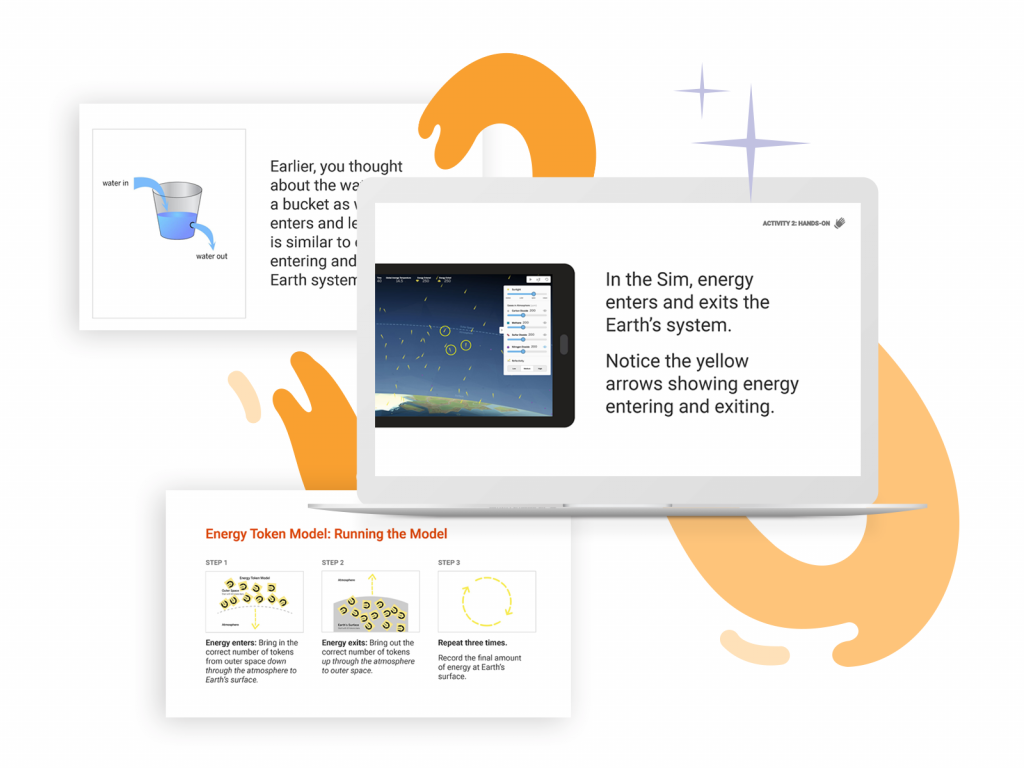
Three laptop screens displaying educational content on earth's energy system, including diagrams and text annotations.
  • Teacher’s Reference Guide: Unlike a typical Teacher’s Guide that requires a series of supplemental books to support it, our encyclopedic reference guide is chock-full of everything a teacher needs to fully implement our program and the NGSS.
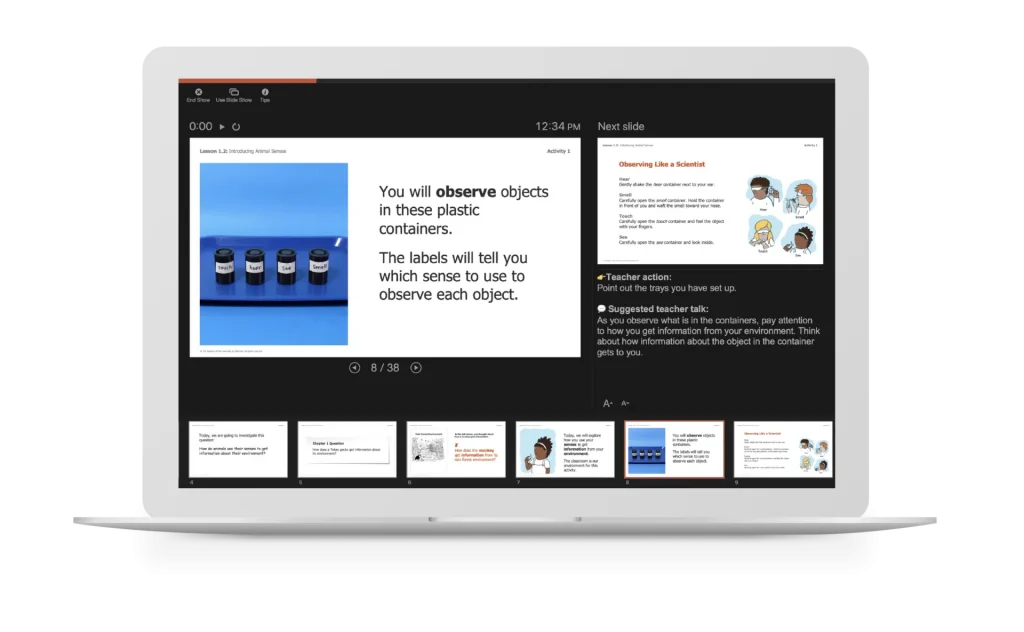
  • Ready-to-Teach Lesson Slides: For daily instruction, teachers need their hands free. That’s why we created ready-to-teach lesson slides for every single lesson. What’s more, the slides are editable and include suggested teacher talk and point-of-use differentiation and other instructional tips. Click to learn more.

A note about the Materials Kits:

Hands-on learning is at the heart of Amplify Science Pennsylvania, and is integrated into every unit. To make hands-on learning more manageable for busy teachers, Amplify Science Pennsylvania materials are organized into unit-specific kits.

Stacked storage bins with labels, arranged neatly; caption notes they are a sample and may not reflect actual quantities or sizes.

What’s different about Amplify’s unit-specific material kits?

  • They include more materials. We give teachers enough non-consumable materials to support a class of 36 students and enough consumables to support 72 student uses. In other words, each kit will last two years.
  • They’re more manageable. Unlike other programs that require large groups of students to share limited sets of materials, our kits include enough to support small groups of four to five students.
  • They include supportive videos. Each hands-on activity provides clear instructions for the teacher, with more complex activities supported by video demonstrations and illustrations.

Grade-specific lists of all materials included in each kit:

Spanish-language support

Amplify Science Pennsylvania is committed to providing support to meet the needs of all learners, including multiple access points for Spanish-speaking students. Developed in conjunction with Spanish-language experts and classroom teachers, several components are available in Spanish across the Amplify Science Pennsylvania curriculum.

Spanish-language materials include:

COMPONENT TEACHER/STUDENT
Student Investigation Notebooks Student
Student Books Student
Printed classroom materials
Unit and chapter questions, key concepts, vocabulary cards, etc.
Teacher and student
Copymasters Teacher
Assessments Teacher
Spanish teacher support license
This license includes teacher talk, projections, and downloadable PDFs of all print materials in Spanish.
Teacher

Resources to support your review

Contact us

Support is always available. Our team is dedicated to helping you every step of the way.

Contact your dedicated Pennsylvania representative.

A woman with long brown hair and glasses wearing a light blue sweater, smiling at the camera against a gray background.

Julie Couch

District Enrollment
<1800 students

A woman with long blonde hair and blue eyes is smiling at the camera, wearing a black top, in a well-lit indoor setting.

Jen Mee

Western PA

A smiling person with shoulder-length gray hair, wearing a peach-colored scarf and a gray sweater, stands against a plain white background. This image captures the essence of Pennsylvania teachers who are dedicated to enriching Science programs for elementary students.

Monica Vincent

Southeast PA

A man with curly brown hair and a beard, smiling broadly, wearing a suit, dress shirt, and floral tie, standing outdoors with trees and grass in the background.

Keenan Zambelli

Northeast & Central PA

Amplify Science Success Story

The Lawrence Hall of Science

Developed by the science education experts at UC Berkeley’s Lawrence Hall of Science and the digital learning team at Amplify, our program features:

  • phenomena-based approach where students construct a complex understanding of each unit’s anchor phenomenon.
  • A blend of cohesive storylines, hands-on investigations, rich discussions, literacy-rich activities, and digital tools.
  • Carefully crafted units, chapters, lessons, and activities designed to deliver true three-dimensional learning.
  • An instructional design that supports all learners in accessing all standards.
Aerial view of the lawrence hall of science at the university of california, berkeley, showcasing the building and surrounding trees with a foggy city backdrop.

Proven to work

A pdf cover from wested titled "learning and literacy development together: initial results from a curriculum study," featuring an adult helping children with schoolwork in a classroom.

WestEd Randomized
Control Trial for Grade 1

Read More

Pdf cover titled "curriculum materials designed for the next generation science standards: initial results from gold standard research trials", published by wested.

WestEd Randomized
Control Trial for Grade 7

Read More

A teacher and students engage in a science activity around a table. The text promotes the Amplify Science K–8 curriculum, highlighting its focus on hands-on learning and real-world problem-solving.

Amplify Science NE
Grades K–5

Read More

Instructional model

The Amplify Science program is rooted in the proven, research-based pedagogy of Do, Talk, Read, Write, Visualize. Here’s how each element works:

DO

Firsthand investigations are an important part of any science classroom, and Amplify Science has students getting hands-on in every unit—from building models of protein molecules to experimenting with electrical systems.

TALK

Student-to-student discourse and full-class discussions are an integral part of the program. Students are provided with numerous opportunities to engage in meaningful oral scientific argumentation, all while fostering a collaborative classroom environment.

READ

Students read scientific articles, focusing their reading activities on searching for evidence related to their investigation and, importantly, on asking and recording questions as they read through fascinating texts on 21st-century topics.

WRITE

Following real-world practices, students write scientific arguments based on evidence they’ve collected, making clear their reasoning about how a given piece of evidence connects to one of several claims.

VISUALIZE

By manipulating digital simulations and using modeling tools to craft visualizations of their thinking— just as real scientists and engineers do—students take their learning far beyond the confines of what they can physically see in the classroom in an exciting and authentic way.

Program structure

Our cyclical lesson design ensures students receive multiple exposures to concepts through a variety of modalities. As they progress through the lessons within a unit, students build and deepen their understanding, increasing their ability to develop and refine complex explanations of the unit’s phenomenon.

It’s this proven program structure and lesson design that enables Amplify Science to address 100% of the NGSS and support students in mastering the Oregon Science Standards.

Flowchart depicting a critical thinking process with four circular nodes connected by arrows, each node representing a step: posing a real-world problem, exploring evidence, elaborating concepts, and evaluating claims.

Unit types

While every unit delivers three-dimensional learning experiences and engages students in gathering evidence from a rich collection of sources, each unit also emphasizes a particular science and engineering practice.

In grades K–2:

  • One unit emphasizes the practice of investigation.
  • One unit emphasizes the practice of modeling.
  • One unit emphasizes the practice of engineering design.

In grades 3–5, students experience the three unit types above, plus:

  • One additional unit that emphasizes the practice of argumentation.

Investigation units focus on the process of strategically developing investigations and gathering data to answer questions. Students are first asked to consider questions about what happens in the natural world and why, and are then involved in designing and conducting investigations that produce data to help answer those questions.

Modeling units provide extra support to students engaging in the practice of modeling. Students use physical models, investigate with computer models, and create their own diagrams to help them visualize what might be happening on the nanoscale.

Engineering design units provide opportunities for students to solve complex problems by applying science principles to the design of functional solutions, and iteratively testing those solutions to determine how well they meet preset criteria.

Argumentation units provide students with regular opportunities to explore and discuss available evidence, time and support to consider how evidence may be leveraged in support of claims, and independence that increases as they mount written arguments in support of their claims.

Unit sequence

Our lessons follow a structure that is grounded in regular routines while still being flexible enough to allow for a variety of learning experiences.

In fact, our multi-modal instruction offers more opportunities for students to construct meaning, and practice and apply concepts, than any other program. What’s more, our modular design means our units can be flexibly arranged to support your instructional goals.

Chart outlining science curriculum by grade, from kindergarten through grade 5, listing topics such as

Program components

Available digitally and in print, our unit-specific reference guides are chock-full of helpful resources, including scientific background knowledge, planning information and resources, color-coded 3D Statements, detailed lesson plans, tips for delivering instruction, and differentiation strategies.

Amplify Science TG

Hands-on learning is an essential part of Amplify Science and is integrated into every unit. Students actively participate in science, playing the roles of scientists and engineers as they gather evidence, think critically, solve problems, and develop and defend claims about the world around them. Every unit includes hands-on investigations that are critical to achieving the unit’s learning goals.

Two children sit at a table blowing into plastic straws held together, likely making musical sounds, with containers and rubber bands on the table.

More hands-on with Flextensions:
Hands-on Flextensions are additional, optional investigations that are included at logical points in the learning progression and give students an opportunity to dig deeper if time permits. These activities offer teachers flexibility to choose to dedicate more time to hands-on learning. Materials referenced in Hands-on Flextension activities will either be included in the unit kit or are easily sourced. Supporting resources such as student worksheets will be included as downloadable PDF files.

Our kits include enough non-consumable materials to support a class of 36 students and enough consumable items to support 72 students. In other words, each kit can last two years! Plus, our unit-specific kits mean teachers just grab the tub they need for the unit and then put it all back with ease.

Amplify Science California supports 3-D learning with more materials than any other program.

Each unit of Amplify Science K–5 includes six unique Student Books written by the Lawrence Hall of Science specifically for the program. These content-rich nonfiction and informational texts provide opportunities for students to search for evidence relevant to their firsthand investigations, see science practices and dispositions modeled, extend their science knowledge, provide real world connections as they master reading-to-learn and close reading skills, and construct evidence-based arguments.

Important note:
Students in grades K–5 are never asked to read alone. Rather, books are read to, with, and by students with ample scaffolding and support provided by the teacher. Big Books are read aloud or together with the class to introduce ideas. Student Books allow for small-group reading and reading in pairs.

Illustrations of two children's book covers displayed on a tablet, titled "on dia ocupado en villa empuja" and "a busy day in pushville," showing a busy street scene.

Available for every unit, our Student Investigation Notebooks contain instructions for activities and space for students to record data and observations, reflect on ideas from texts and investigations, and construct explanations and arguments.

In grades K–5, one copy of the Student Investigation Notebook is included in each unit’s materials kit for use as a blackline master. Each notebook is also available as a downloadable PDF on the Unit Guide page of the digital Teacher’s Guide.

Amplify Science Student Investigation Notebooks

Amplify Science offers digital experience licenses that make elementary instruction more flexible for students and teachers, as well as providing additional means to engage in remote, hybrid, or in-person learning!

Student-facing digital lessons
With the digital experience, students can engage with digital lesson content in one cohesive experience. It’s the same content from Amplify science in a new, integrated format where students can interact with slides, Sims, modeling tools, videos, books, and more.

Ecosystem Restoration digital simulation

Digital student notebook pages
Students can draw, write, record audio, and insert images into their Investigation Notebook pages. Their work is automatically saved and delivered to you in real time. When students edit their work, those edits are immediately reflected on your teacher work review page. You can access student responses by clicking “View Work,” where you can see students’ Investigation Notebook pages from the lesson, updating live.

Assign in Amplify
The digital experience allows flexibility with optional features like scheduling assignments in advance and setting due dates. You can use Scheduling to determine the date and time that the assignment appears in Student Home. You also have the flexibility to schedule when assignments appear and use dates to remove assignments from Student Home.

Assign in LMS
You can also assign lessons via our integrations with Google Classroom and Microsoft Teams, or by copying a lesson link and sharing it with students through the platform of your choice. The assignment link you send will provide students with direct access to the full lesson—slides, videos, digital tools, and worksheet activities—no student platform navigation required!

Teacher platform and presentation
Teacher-facing lesson content—including sample teacher talk, student responses, pedagogical support, and possible student responses—shows on a teacher’s private Teacher Guide tab. Students only see the lesson slides that are being presented.

Graphic depicting a teacher's device synced with a class presentation for K—5 students. The teacher's laptop displays an Amplify Science lesson on environments, which is mirrored on a larger screen for the class

Explore your print samples

With your Amplify Science print samples, you’ll find unit-specific Teacher’s References Guides, Student Investigation Notebooks, and sets of Student Books for each grade level.

A note about the Teacher’s Reference Guides:

It’s important that you see the full breadth and depth of our instruction. For that reason, we provide a copy of each of our unit-specific Teacher Reference Guides.

Rest assured that teachers do not use these robust reference guides for day-to-day teaching. For that, we have a hands-free TG!

A laptop screen displays a simulation of energy arrows entering and exiting Earth's system, flanked by diagrams explaining water flow and an energy token model.
  • Teacher Reference Guide: Unlike a typical TG that requires a series of supplemental books to support it, our encyclopedic reference guide is chock-full of everything a teacher needs to fully implement our program and the NGSS.
  • Ready-to-Teach Lesson Slides: For daily instruction, teachers need their hands free. That’s why we created ready-to-teach lesson slides for every single lesson. What’s more, they are editable and include suggested teacher talk and point-of-use differentiation and other instructional tips. Click to learn more.

A note about the Materials Kits:

Hands-on learning is at the heart of Amplify Science, and is integrated into every unit. In order to make hands-on learning more manageable for busy teachers, Amplify Science materials are organized into unit-specific kits.

Stacked storage bins with labels, arranged neatly; caption notes they are a sample and may not reflect actual quantities or sizes.

What’s different about Amplify’s unit-specific material kits?  They…

  • Include more materials — We give teachers enough non-consumable materials to support a class of 36 students and enough consumables to support 72 student uses. In other words, each kit will last two years.
  • Are more manageable — Unlike other programs that require large groups of students to share limited sets of materials, our kits include enough to support small groups of 4–5 students.
  • Include supportive videos — Each hands-on activity provides clear instructions for the teacher, with more complex activities supported by video demonstrations and illustrations.

Grade-specific lists of all materials included in each kit:

Access your digital samples

Explore as a teacher

When you’re ready to explore the teaching experience on your own, follow these instructions to access the Amplify Science digital teacher platform.

  • Click the Access Amplify Science Platform button below and bookmark the page.
  • Select Log in with Amplify.
  • Enter the username: t1.jeffersoncounty@demo.tryamplify.net
  • Enter the password: Amplify1-jeffersoncounty
  • Click on Science on the left hand side.
  • Click on the Program Menu in the top center of the screen and select any grade.
  • Select any unit.

To help familiarize yourself with navigating the digital platform, watch the below navigational video.

Explore as a student

When you’re ready to explore the student learning experience on your own, follow these instructions to access the Amplify Science digital student platform.

  • Click the Access Amplify Science Platform button below and bookmark the page.
  • Select Log in with Amplify.
  • Enter the username: s1.jeffersoncounty@demo.tryamplify.net
  • Enter the password: Amplify1-jeffersoncounty
  • Click the backpack icon on the top right.
  • Click Science K-5
  • Select any unit.

Resources to support your review

Welcome to Amplify Science K–5!

Amplify Science is an engaging core curriculum designed for three-dimensional, phenomena-based learning.

With Amplify Science, Detroit students won’t just passively learn about science concepts. Instead, they will take on the role of scientists and engineers to actively investigate and figure out real-world phenomena. They will do this through a blend of cohesive and compelling storylines, hands-on investigations, collaborative discussions, literacy-rich activities, and interactive digital tools.

Four children around a table engaged in a classroom science project, examining materials closely, with educational posters in the background.

What is Amplify Science?

The Lawrence Hall of Science

Developed by the science education experts at UC Berkeley’s Lawrence Hall of Science and the digital learning team at Amplify, our program features:

  • phenomena-based approach where students construct a complex understanding of each unit’s anchor phenomenon.
  • A blend of cohesive storylines, hands-on investigations, rich discussions, literacy-rich activities, and digital tools.
  • Carefully crafted units, chapters, lessons, and activities designed to deliver true three-dimensional learning.
  • An instructional design that supports all learners in accessing all standards.

Proven to work

WestEd Randomized
Control Trial for Grade 1

Read More

WestEd Randomized
Control Trial for Grade 7

Read More

Amplify Science NE
Grades K–5

Read More

Instructional model

The Amplify Science program is rooted in the proven, research-based pedagogy of Do, Talk, Read, Write, Visualize. Here’s how each element works:

Do

First-hand investigations are an important part of any science classroom, and Amplify Science has students getting hands-on in every unit—from building models of protein molecules to experimenting with electrical systems.

Talk

Student-to-student discourse and full-class discussions are an integral part of the program. Students are provided with numerous opportunities to engage in meaningful oral scientific argumentation, all while fostering a collaborative classroom environment.

Read

Students read scientific articles, focusing their reading activities on searching for evidence related to their investigation and, importantly, on asking and recording questions as they read through fascinating texts on 21st-century topics.

Write

Following real-world practices, students write scientific arguments based on evidence they’ve collected, making clear their reasoning about how a given piece of evidence connects to one of several claims.

Visualize

By manipulating digital simulations and using modeling tools to craft visualizations of their thinking— just as real scientists and engineers
do—students take their learning far beyond the confines of what they can physically see in the classroom in an exciting and authentic way.

Program structure

Our cyclical lesson design ensures students receive multiple exposures to concepts through a variety of modalities. As they progress through the lessons within a unit, students build and deepen their understanding, increasing their ability to develop and refine complex explanations of the unit’s phenomenon.

It’s this proven program structure and lesson design that enables Amplify Science to address 100% of the Next Generation Science Standards (NGSS) and support students in mastering the Pennsylvania Science Standards.

Flowchart depicting a critical thinking process with four circular nodes connected by arrows, each node representing a step: posing a real-world problem, exploring evidence, elaborating concepts, and evaluating claims.

Unit types

While every unit delivers three-dimensional learning experiences and engages students in gathering evidence from a rich collection of sources, each unit also emphasizes a particular science and engineering practice.

In grades K–2:

  • One unit emphasizes the practice of investigation.
  • One unit emphasizes the practice of modeling.
  • One unit emphasizes the practice of engineering design.

In grades 3–5, students experience the three unit types above, plus:

  • One additional unit that emphasizes the practice of argumentation.

Investigation units focus on the process of strategically developing investigations and gathering data to answer questions. Students are first asked to consider questions about what happens in the natural world and why, and are then involved in designing and conducting investigations that produce data to help answer those questions.

Modeling units provide extra support to students engaging in the practice of modeling. Students use physical models, investigate with computer models, and create their own diagrams to help them visualize what might be happening on the nanoscale.

Engineering design units provide opportunities for students to solve complex problems by applying science principles to the design of functional solutions, and iteratively testing those solutions to determine how well they meet preset criteria.

Argumentation units provide students with regular opportunities to explore and discuss available evidence, time and support to consider how evidence may be leveraged in support of claims, and independence that increases as they mount written arguments in support of their claims.

Unit sequence

Our lessons follow a structure that is grounded in regular routines while still being flexible enough to allow for a variety of learning experiences.

In fact, our multi-modal instruction offers more opportunities for students to construct meaning, and practice and apply concepts, than any other program. What’s more, our modular design means our units can be flexibly arranged to support your instructional goals.

Chart outlining science curriculum by grade, from kindergarten through grade 5, listing topics such as

Program components

Available digitally and in print, our unit-specific reference guides are chock-full of helpful resources, including scientific background knowledge, planning information and resources, color-coded 3D Statements, detailed lesson plans, tips for delivering instruction, and differentiation strategies.

Amplify Science TG

Hands-on learning is an essential part of Amplify Science, and is integrated into every unit. Students actively participate in science, playing the roles of scientists and engineers as they gather evidence, think critically, solve problems, and develop and defend claims about the world around them. Every unit includes hands-on investigations that are critical to achieving the unit’s learning goals.

A young person wearing gloves looks through a microscope at a table with laboratory supplies, including bottles, slides, and a tray, against a plain blue background.

More hands-on with Flextensions:
Hands-on Flextensions are additional, optional investigations that are included at logical points in the learning progression and give students an opportunity to dig deeper if time permits. These activities offer teachers flexibility to choose to dedicate more time to hands-on learning. Materials referenced in Hands-on Flextension activities will either be included in the unit kit or are easily sourced. Supporting resources such as student worksheets will be included as downloadable PDF files.

Our kits include enough materials to support 200 student uses. In other words, teachers can easily support all five periods and small groups of 4-5 students each. Plus, our unit-specific kits mean teachers just grab the tub they need and then put it all back with ease.

Assorted office and household items displayed on a white background, including rubber bands, binder clips, cardboard, and sports balls.

Each unit of Amplify Science K–5 includes six unique Student Books written by the Lawrence Hall of Science specifically for the program. These content-rich nonfiction and informational texts provide opportunities for students to search for evidence relevant to their firsthand investigations, see science practices and dispositions modeled, extend their science knowledge, provide real world connections as they master reading-to-learn and close reading skills, and construct evidence-based arguments.

Important note:
Students in grades K–5 are never asked to read alone. Rather, books are read to, with, and by students with ample scaffolding and support provided by the teacher. Big Books are read aloud or together with the class to introduce ideas. Student Books allow for small-group reading and reading in pairs.

Imagen de lado a lado de dos libros titulados "Un día ocupado en Villa Empuja" y "A Busy Day in Pushville", ambos ilustrados por Anthony Lewis.

Available for every unit, our Student Investigation Notebooks contain instructions for activities and space for students to record data and observations, reflect on ideas from texts and investigations, and construct explanations and arguments.

In grades K–5, one copy of the Student Investigation Notebook is included in each unit’s materials kit for use as a blackline master. Each notebook is also available as a downloadable PDF on the Unit Guide page of the digital Teacher’s Guide.

Dos libros de ciencias titulados “Empujar y jalar: diseñar una máquina de pinball” y “Pushes and Pulls: Designing a Pinball Machine” exhibidos uno al lado del otro.

Amplify Science offers digital experience licenses that make elementary instruction more flexible for students and teachers, as well as providing additional means to engage in remote, hybrid, or in-person learning!

Student-facing digital lessons
With the digital experience, students can engage with digital lesson content in one cohesive experience. It’s the same content from Amplify science in a new, integrated format where students can interact with slides, Sims, modeling tools, videos, books, and more.

Ecosystem Restoration digital simulation

Digital student notebook pages
Students can draw, write, record audio, and insert images into their Investigation Notebook pages. Their work is automatically saved and delivered to you in real time. When students edit their work, those edits are immediately reflected on your teacher work review page. You can access student responses by clicking “View Work,” where you can see students’ Investigation Notebook pages from the lesson, updating live.

Assign in Amplify
The digital experience allows flexibility with optional features like scheduling assignments in advance and setting due dates. You can use Scheduling to determine the date and time that the assignment appears in Student Home. You also have the flexibility to schedule when assignments appear and use dates to remove assignments from Student Home.

Assign in LMS
You can also assign lessons via our integrations with Google Classroom and Microsoft Teams, or by copying a lesson link and sharing it with students through the platform of your choice. The assignment link you send will provide students with direct access to the full lesson—slides, videos, digital tools, and worksheet activities—no student platform navigation required!

Teacher platform and presentation
Teacher-facing lesson content—including sample teacher talk, student responses, pedagogical support, and possible student responses—shows on a teacher’s private Teacher Guide tab. Students only see the lesson slides that are being presented.

Graphic depicting a teacher's device synced with a class presentation for K—5 students. The teacher's laptop displays an Amplify Science lesson on environments, which is mirrored on a larger screen for the class

Explore your print samples

With your Amplify Science print samples, you’ll find unit-specific Teacher’s References Guides, Student Investigation Notebooks, and sets of Student Books for each grade level.

A note about the Teacher’s Reference Guides:

It’s important that you see the full breadth and depth of our instruction. For that reason, we provide a copy of each of our unit-specific Teacher Reference Guides.

Rest assured that teachers do not use these robust reference guides for day-to-day teaching. For that, we have a hands-free TG!

Three laptop screens displaying educational content on earth's energy system, including diagrams and text annotations.
  • Teacher Reference Guide: Unlike a typical TG that requires a series of supplemental books to support it, our encyclopedic reference guide is chock-full of everything a teacher needs to fully implement our program and the NGSS.
  • Ready-to-Teach Lesson Slides: For daily instruction, teachers need their hands free. That’s why we created ready-to-teach lesson slides for every single lesson. What’s more, they are editable and include suggested teacher talk and point-of-use differentiation and other instructional tips. Click to learn more.

A note about the Materials Kits:

Hands-on learning is at the heart of Amplify Science, and is integrated into every unit. In order to make hands-on learning more manageable for busy teachers, Amplify Science materials are organized into unit-specific kits.

Stacked storage bins with labels, arranged neatly; caption notes they are a sample and may not reflect actual quantities or sizes.

Our unit-specific kits:

What’s different about Amplify’s unit-specific material kits?  They…

  • Include more materials — We give teachers enough non-consumable materials to support a class of 36 students and enough consumables to support 72 student uses. In other words, each kit will last two years.
  • Are more manageable — Unlike other programs that require large groups of students to share limited sets of materials, our kits include enough to support small groups of four to five students.
  • Include supportive videos — Each hands-on activity provides clear instructions for the teacher, with more complex activities supported by video demonstrations and illustrations.

Grade-specific lists of all materials included in each kit:

Access your digital samples

Explore as a teacher

When you’re ready to explore the teaching experience on your own, follow these instructions to access the Amplify Science digital teacher platform.

  • Click the Access Amplify Science Platform button below and bookmark the page.
  • Select Log in with Amplify.
  • Enter the username: t1.dpsscience@demo.tryamplify.net
  • Enter the password: Amplify1-dpsscience
  • Click on Science on the left hand side.
  • Click on the Grade Menu in the top center of the screen and select any grade.
  • Select any unit.

To help familiarize yourself with navigating the digital platform, watch the below navigational video.

Explore as a student

When you’re ready to explore the student learning experience on your own, follow these instructions to access the Amplify Science digital student platform.

  • Click the Access Amplify Science Platform button below and bookmark the page.
  • Select Log in with Amplify.
  • Enter the username: s1.dpsscience@demo.tryamplify.net
  • Enter the password: Amplify1-dpsscience
  • Click the backpack icon on the top right.
  • Click Science K-5
  • Select any unit.

Spanish-language support

Amplify Science is committed to providing support to meet the needs of all learners, including multiple access points for Spanish-speaking students. Developed in conjunction with Spanish-language experts and classroom teachers, several components are available in Spanish across the Amplify Science curriculum.

Spanish-language materials include:

COMPONENTTEACHER/STUDENT
Student Investigation NotebooksStudent
Student BooksStudent
Printed classroom materials
Unit and chapter questions, key concepts, vocabulary cards, etc.
Teacher and student
CopymastersTeacher
AssessmentsTeacher
Spanish teacher support license
This license includes teacher talk, projections, and downloadable PDFs of all print materials in Spanish.
Teacher

Resources to support your review

Amplify Science Overview

The Lawrence Hall of Science

Developed by the science education experts at UC Berkeley’s Lawrence Hall of Science and the digital learning team at Amplify, our program features:

  • phenomena-based approach where students construct a complex understanding of each unit’s anchor phenomenon.
  • A blend of cohesive storylines, hands-on investigations, rich discussions, literacy-rich activities, and digital tools.
  • Carefully crafted units, chapters, lessons, and activities designed to deliver true 3-dimensional learning.
  • An instructional design that supports all learners in accessing all standards.
The logo for The Lawrence Hall of Science, University of California, Berkeley, features blue text on a light background and is recognized by educators using Amplify Science for middle school science programs.

Instructional model

The Amplify Science program is rooted in the proven, research-based pedagogy of Do, Talk, Read, Write, Visualize. Here’s how each element works:

DO

First-hand investigations are an important part of any science classroom, and Amplify Science has students getting hands-on in every unit—from building models of protein molecules to experimenting with electrical systems.

TALK

Student-to-student discourse and full-class discussions are an integral part of the program. Students are provided with numerous opportunities to engage in meaningful oral scientific argumentation, all while fostering a collaborative classroom environment.

READ

Students read scientific articles, focusing their reading activities on searching for evidence related to their investigation and, importantly, on asking and recording questions as they read through fascinating texts on 21st-century topics.

WRITE

Following real-world practices, students write scientific arguments based on evidence they’ve collected, making clear their reasoning about how a given piece of evidence connects to one of several claims.

VISUALIZE

By manipulating digital simulations and using modeling tools to craft visualizations of their thinking— just as real scientists and engineers do—students take their learning far beyond the confines of what they can physically see in the classroom in an exciting and authentic way.

Program structure

Our cyclical lesson design ensures students receive multiple exposures to concepts through a variety of modalities. As they progress through the lessons within a unit, students build and deepen their understanding, increasing their ability to develop and refine complex explanations of the unit’s phenomenon.

It’s this proven program structure and lesson design that enables Amplify Science to address 100% of the NGSS, and support students in mastering the standards.

Graphic showing a research process with four steps: spark intrigue with a real-world problem, explore evidence, explain and elaborate, and evaluate claims, connected in a cycle with arrows.

Unit types

While every unit delivers three-dimensional learning experiences and engages students in gathering evidence from a rich collection of sources, each unit also emphasizes a particular science and engineering practice.

In grades K–2:

  • One unit emphasizes the practice of investigation.
  • One unit emphasizes the practice of modeling.
  • One unit emphasizes the practice of engineering design.

In grades 3–5, students experience the three unit types above, plus:

  • One additional unit that emphasizes the practice of argumentation.

Investigation units focus on the process of strategically developing investigations and gathering data to answer questions. Students are first asked to consider questions about what happens in the natural world and why, and are then involved in designing and conducting investigations that produce data to help answer those questions.

Modeling units provide extra support to students engaging in the practice of modeling. Students use physical models, investigate with computer models, and create their own diagrams to help them visualize what might be happening on the nanoscale.

Engineering design units provide opportunities for students to solve complex problems by applying science principles to the design of functional solutions, and iteratively testing those solutions to determine how well they meet preset criteria.

Argumentation units provide students with regular opportunities to explore and discuss available evidence, time and support to consider how evidence may be leveraged in support of claims, and independence that increases as they mount written arguments in support of their claims.

Unit sequence

Our lessons follow a structure that is grounded in regular routines while still being flexible enough to allow for a variety of learning experiences.

In fact, our multi-modal instruction offers more opportunities for students to construct meaning, and practice and apply concepts than any other program. What’s more, our modular design means our units can be flexibly arranged to support your instructional goals.

A chart showing science topics by grade: K covers plants, weather, and forces; 1 covers animals, sound, and Earth; 2 covers relationships, materials, and landforms; 3–5 cover energy, traits, systems, and climate.

Program components

Available digitally and in print, our unit-specific reference guides are chock full of helpful resources, including scientific background knowledge, planning information and resources, color-coded 3-D Statements, detailed lesson plans, tips for delivering instruction, and differentiation strategies.

Amplify Science TG

Hands-on learning is an essential part of Amplify Science, and is integrated into every unit. Students actively participate in science, playing the roles of scientists and engineers as they gather evidence, think critically, solve problems, and develop and defend claims about the world around them. Every unit includes hands-on investigations that are critical to achieving the unit’s learning goals.

Two children sit at a table blowing into plastic straws held together, likely making musical sounds, with containers and rubber bands on the table.

More hands-on with Flextensions:
Hands-on Flextensions are additional, optional investigations that are included at logical points in the learning progression and give students an opportunity to dig deeper if time permits. These activities offer teachers flexibility to choose to dedicate more time to hands-on learning. Materials referenced in Hands-on Flextension activities will either be included in the unit kit or are easily sourced. Supporting resources such as student worksheets will be included as downloadable PDF files.

Our kits include enough non-consumable materials to support a class of 36 students and enough consumable items to support 72 students. In other words, each kit can last two years! Plus, our unit-specific kits mean teachers just grab the tub they need for the unit and then put it all back with ease.

Amplify Science California supports 3-D learning with more materials than any other program.

Each unit of Amplify Science K–5 includes six unique Student Books written by the Lawrence Hall of Science specifically for the program. These content-rich nonfiction and informational texts provide opportunities for students to search for evidence relevant to their firsthand investigations, see science practices and dispositions modeled, extend their science knowledge, provide real world connections as they master reading-to-learn and close reading skills, and construct evidence-based arguments.

Important note:
Students in grades K–5 are never asked to read alone. Rather, books are read to, with, and by students with ample scaffolding and support provided by the teacher. Big Books are read aloud or together with the class to introduce ideas. Student Books allow for small-group reading and reading in pairs.

Illustrations of two children's book covers displayed on a tablet, titled "on dia ocupado en villa empuja" and "a busy day in pushville," showing a busy street scene.

Available for every unit, our Student Investigation Notebooks contain instructions for activities and space for students to record data and observations, reflect on ideas from texts and investigations, and construct explanations and arguments.

In grades K–5, one copy of the Student Investigation Notebook is included in each unit’s materials kit for use as a blackline master. Each notebook is also available as a downloadable PDF on the Unit Guide page of the digital Teacher’s Guide.

Amplify Science Student Investigation Notebooks

Amplify Science offers digital experience licenses that make elementary instruction more flexible for students and teachers, as well as providing additional means to engage in remote, hybrid, or in-person learning!

Student-facing digital lessons
With the digital experience, students can engage with digital lesson content in one cohesive experience. It’s the same content from Amplify science in a new, integrated format where students can interact with slides, Sims, modeling tools, videos, books, and more.

Ecosystem Restoration digital simulation

Digital student notebook pages
Students can draw, write, record audio, and insert images into their Investigation Notebook pages. Their work is automatically saved and delivered to you in real time. When students edit their work, those edits are immediately reflected on your teacher work review page. You can access student responses by clicking “View Work,” where you can see students’ Investigation Notebook pages from the lesson, updating live.

[IMAGE TO COME]

Assign in Amplify
The digital experience allows flexibility with optional features like scheduling assignments in advance and setting due dates. Teacher can use Scheduling to determine the date and time that the assignment appears in Student Home. They also have the flexibility to schedule when assignments appear and use dates to remove assignments from Student Home.

Assign in LMS
You can also assign lessons via our integrations with Google Classroom and Microsoft Teams, or by copying a lesson link and sharing it with students through the platform of your choice. The assignment link you send will provide students with direct access to the full lesson—slides, videos, digital tools, and worksheet activities—no student platform navigation required!

Teacher platform and presentation
Teacher-facing lesson content—including sample teacher talk, student responses, pedagogical support, and possible student responses—shows on a teacher’s private Teacher Guide tab. Students only see the lesson slides that are being presented.

Graphic depicting a teacher's device synced with a class presentation for K—5 students. The teacher's laptop displays an Amplify Science lesson on environments, which is mirrored on a larger screen for the class

Explore your print samples

With your Amplify Science print samples, you’ll find unit-specific Teacher’s References Guides, Student Investigation Notebooks, and sets of Student Books for each grade level.

A note about the Teacher’s Reference Guides:

It’s important that you see the full breadth and depth of our instruction. For that reason, we provide a copy of each of our unit-specific Teacher Reference Guides.

Rest assured that teachers do not use these robust reference guides for day-to-day teaching. For that, we have a hands-free TG!

A laptop screen shows an energy simulation, with surrounding text and diagrams explaining the Earth's system and energy flow.
  • Teacher Reference Guide: Unlike a typical TG that requires a series of supplemental books to support it, our encyclopedic reference guide is chock-full of everything a teacher needs to fully implement our program and the NGSS.
  • Ready-to-Teach Lesson Slides: For daily instruction, teachers need their hands free. That’s why we created ready-to-teach lesson slides for every single lesson. What’s more, they are editable and include suggested teacher talk and point-of-use differentiation and other instructional tips. Click to learn more.

A note about the Materials Kits:

Hands-on learning is at the heart of Amplify Science, and is integrated into every unit. In order to make hands-on learning more manageable for busy teachers, Amplify Science materials are organized into unit-specific kits.

Stacked storage bins with labels, arranged neatly; caption notes they are a sample and may not reflect actual quantities or sizes.

What’s different about Amplify’s unit-specific material kits?  They…

  • Include more materials — We give teachers enough non-consumable materials to support a class of 36 students and enough consumables to support 72 student uses. In other words, each kit will last two years.
  • Are more manageable — Unlike other programs that require large groups of students to share limited sets of materials, our kits include enough to support small groups of 4–5 students.
  • Include supportive videos — Each hands-on activity provides clear instructions for the teacher, with more complex activities supported by video demonstrations and illustrations.

Grade-specific lists of all materials included in each kit:

Access your digital samples

Explore as a teacher

When you’re ready to explore the teaching experience on your own, follow these instructions to access the Amplify Science digital teacher platform.

  • Click the Access Amplify Science Platform button below and bookmark the page.
  • Select Log in with Amplify.
  • Enter the username: t1.jeffersoncounty@demo.tryamplify.net
  • Enter the password: Amplify1-jeffersoncounty
  • Click on Science on the left hand side.
  • Click on the Program Menu in the top center of the screen and select any grade.
  • Select any unit.

To help familiarize yourself with navigating the digital platform,watch the below navigational video.

Explore as a student

When you’re ready to explore the student learning experience on your own, follow these instructions to access the Amplify Science digital student platform.

  • Click the Access Amplify Science Platform button below and bookmark the page.
  • Select Log in with Amplify.
  • Enter the username: s1.jeffersoncounty@demo.tryamplify.net
  • Enter the password: Amplify1-jeffersoncounty
  • Click the backpack icon on the top right.
  • Click Science K-5
  • Select any unit.

Resources to support your review

Overview Video

The Lawrence Hall of Science

Developed by the science education experts at UC Berkeley’s Lawrence Hall of Science and the digital learning team at Amplify, our program features:

  • phenomena-based approach where students construct a complex understanding of each unit’s anchor phenomenon.
  • A blend of cohesive storylines, hands-on investigations, rich discussions, literacy-rich activities, and digital tools.
  • Carefully crafted units, chapters, lessons, and activities designed to deliver true 3-dimensional learning.
  • An instructional design that supports all learners in accessing all standards.
The logo for The Lawrence Hall of Science, University of California, Berkeley, features blue text on a light background and is recognized by educators using Amplify Science for middle school science programs.

Instructional model

The Amplify Science program is rooted in the proven, research-based pedagogy of Do, Talk, Read, Write, Visualize. Here’s how each element works:

DO

First-hand investigations are an important part of any science classroom, and Amplify Science has students getting hands-on in every unit—from building models of protein molecules to experimenting with electrical systems.

TALK

Student-to-student discourse and full-class discussions are an integral part of the program. Students are provided with numerous opportunities to engage in meaningful oral scientific argumentation, all while fostering a collaborative classroom environment.

READ

Students read scientific articles, focusing their reading activities on searching for evidence related to their investigation and, importantly, on asking and recording questions as they read through fascinating texts on 21st-century topics.

WRITE

Following real-world practices, students write scientific arguments based on evidence they’ve collected, making clear their reasoning about how a given piece of evidence connects to one of several claims.

VISUALIZE

By manipulating digital simulations and using modeling tools to craft visualizations of their thinking— just as real scientists and engineers do—students take their learning far beyond the confines of what they can physically see in the classroom in an exciting and authentic way.

Program structure

Our cyclical lesson design ensures students receive multiple exposures to concepts through a variety of modalities. As they progress through the lessons within a unit, students build and deepen their understanding, increasing their ability to develop and refine complex explanations of the unit’s phenomenon.

It’s this proven program structure and lesson design that enables Amplify Science to address 100% of the NGSS, and support students in mastering the standards.

Graphic showing a research process with four steps: spark intrigue with a real-world problem, explore evidence, explain and elaborate, and evaluate claims, connected in a cycle with arrows.

Unit types

While every unit delivers three-dimensional learning experiences and engages students in gathering evidence from a rich collection of sources, each unit also serves a unique instructional purpose.

In grades 6–8:

  • One unit is a launch unit.
  • Three units are core units.
  • Two units are engineering internships.

Launch units are the first units taught in each year of Amplify Science. The goal of the Launch unit is to introduce students to norms, routines, and practices that will be built on throughout the year, including argumentation, active reading, and using the program’s technology. For example, rather than taking the time to explain the process of active reading in every unit in a given year, it is explained thoroughly in the Launch unit, thereby preparing students to read actively in all subsequent units.

Core units establish the context of the unit by introducing students to a real-world problem. As students move through lessons in a Core unit, they figure out the unit’s anchoring phenomenon, gain an understanding of the unit’s disciplinary core ideas and science and engineering practices, and make linkages across topics through the crosscutting concepts. Each Core unit culminates with a Science Seminar and final writing activity.

Engineering Internship units invite students to design solutions for real-world problems as interns for a fictional company called Futura. Students figure out how to help those in need, from tsunami victims in Sri Lanka to premature babies, through the application of engineering practices. In the process, they apply and deepen their learning from Core units.

Unit sequence

Our lessons follow a structure that is grounded in regular routines while still being flexible enough to allow for a variety of learning experiences.

In fact, our multi-modal instruction offers more opportunities for students to construct meaning, and practice and apply concepts than any other program. What’s more, our modular design means our units can be flexibly arranged to support your instructional goals.

Three columns listing education curriculum topics for grades 6, 7, and 8, focusing on science themes such as microbiomes, mars geology, and harnessing human energy.

Program components

Available digitally and in print, our unit-specific reference guides are chock full of helpful resources, including scientific background knowledge, planning information and resources, color-coded 3-D Statements, detailed lesson plans, tips for delivering instruction, and differentiation strategies.

Amplify Science TG

Hands-on learning is an essential part of Amplify Science, and is integrated into every unit. Students actively participate in science, playing the roles of scientists and engineers as they gather evidence, think critically, solve problems, and develop and defend claims about the world around them. Every unit includes hands-on investigations that are critical to achieving the unit’s learning goals.

A young person wearing gloves looks through a microscope at a table with laboratory supplies, including bottles, slides, and a tray, against a plain blue background.

More hands-on with Flextensions:
Hands-on Flextensions are additional, optional investigations that are included at logical points in the learning progression and give students an opportunity to dig deeper if time permits. These activities offer teachers flexibility to choose to dedicate more time to hands-on learning. Materials referenced in Hands-on Flextension activities will either be included in the unit kit or are easily sourced. Supporting resources such as student worksheets will be included as downloadable PDF files.

Our kits include enough materials to support 200 student uses. In other words, teachers can easily support all five periods and small groups of 4-5 students each. Plus, our unit-specific kits mean teachers just grab the tub they need and then put it all back with ease.

Amplify Science California supports 3-D learning with more materials than any other program.

Our digital Simulations and Practice Tools are powerful resources for exploration, data collection, and student collaboration. They allow students the ability to explore scientific concepts that might otherwise be invisible or impossible to see with the naked eye.

Available for every unit, our Student Investigation Notebooks contain instructions for activities and space for students to record data and observations, reflect on ideas from texts and investigations, and construct explanations and arguments.

In grades 6–8, one copy of the Student Investigation Notebook is included in each unit’s materials kit for use as a blackline master. Each notebook is also available as a downloadable PDF on the Unit Guide page of the digital Teacher’s Guide.

Two booklets titled "El clima cambiante de la Tierra: la desaparición del hielo" and "Earth’s Changing Climate: Vanishing Ice" with landscape illustrations on the covers.

These customizable PowerPoints are available for every lesson of the program and make delivering instruction a snap with visual prompts, colorful activity instructions, investigation set-up videos and animations, and suggested teacher talk in the notes section of each slide.

A laptop displays a PowerPoint presentation in presenter view, with slides about observing objects in plastic containers and related sensory instructions.

Explore your print samples

With your Amplify Science print samples, you’ll find unit-specific Teacher’s References Guides and Student Investigation Notebooks for each grade level.

A note about the Teacher’s Reference Guides:

It’s important that your committee sees the full breadth and depth of our instruction. For that reason, we provided a copy of each of our unit-specific Teacher Reference Guides.

Rest assured that teachers do not use these robust reference guides for day-to-day teaching. For that, we have a hands-free TG!

A laptop screen shows an energy simulation, with surrounding text and diagrams explaining the Earth's system and energy flow.
  • Teacher Reference Guide: Unlike a typical TG that requires a series of supplemental books to support it, our encyclopedic reference guide is chock-full of everything a teacher needs to fully implement our program and the NGSS.
  • Ready-to-Teach Lesson Slides: For daily instruction, teachers need their hands free. That’s why we created ready-to-teach lesson slides for every single lesson. What’s more, they are editable and include suggested teacher talk and point-of-use differentiation and other instructional tips. Click to learn more.

A note about the Materials Kits:

Hands-on learning is at the heart of Amplify Science, and is integrated into every unit. In order to make hands-on learning more manageable for busy teachers, Amplify Science materials are organized into unit-specific kits.

Stacked storage bins with labels, arranged neatly; caption notes they are a sample and may not reflect actual quantities or sizes.

Our unit-specific kits:

  • Include more materials — We give teachers enough materials to support 200 student uses.
  • Are more manageable — Unlike other programs that require large groups of students to share limited sets of materials, our kits include enough to support small groups of 4–5 students.
  • Include supportive videos — Each hands-on activity provides clear instructions for the teacher, with more complex activities supported by video demonstrations and illustrations.

What comes in each grade level kit? Click the links below to see the grade-specific lists of all materials included in each kit.

Access your digital samples

Explore as a teacher

Follow these instructions to explore the Amplify Science digital platform as a teacher.

  • Click the Access Amplify Science Platform button below and bookmark it.
  • Select Log in with Amplify.
  • Enter the username: t1.jeffersoncounty@demo.tryamplify.net
  • Enter the password: Amplify1-jeffersoncounty
  • Click the Science icon.
  • Click on the Program Menu in the top center of the screen and select any grade.
  • Select any unit.

To help familiarize yourself with navigating the digital platform,watch the below navigational video.

Explore as a student

Follow these instructions to explore the Amplify Science digital platform as a student.

  • Click the Access Amplify Science Platform button below and bookmark it.
  • Select Log in with Amplify.
  • Enter the username: s1.jeffersoncounty@demo.tryamplify.net
  • Enter the password: Amplify1-jeffersoncounty
  • Click the Science icon.
  • Click on the Grade Menu in the top center of the screen and select any grade.
  • Select any unit.

Resources to support your review

Publisher presentation

The Lawrence Hall of Science

Developed by the science education experts at UC Berkeley’s Lawrence Hall of Science and the digital learning team at Amplify, our program features:

  • phenomena-based approach where students construct a complex understanding of each unit’s anchor phenomenon.
  • A blend of cohesive storylines, hands-on investigations, rich discussions, literacy-rich activities, and digital tools.
  • Carefully crafted units, chapters, lessons, and activities designed to deliver true 3-dimensional learning.
  • An instructional design that supports all learners in accessing all standards.
The logo for The Lawrence Hall of Science, University of California, Berkeley, features blue text on a light background and is recognized by educators using Amplify Science for middle school science programs.

Instructional model

The Amplify Science program is rooted in the proven, research-based pedagogy of Do, Talk, Read, Write, Visualize. Here’s how each element works:

DO

First-hand investigations are an important part of any science classroom, and Amplify Science has students getting hands-on in every unit—from building models of protein molecules to experimenting with electrical systems.

TALK

Student-to-student discourse and full-class discussions are an integral part of the program. Students are provided with numerous opportunities to engage in meaningful oral scientific argumentation, all while fostering a collaborative classroom environment.

READ

Students read scientific articles, focusing their reading activities on searching for evidence related to their investigation and, importantly, on asking and recording questions as they read through fascinating texts on 21st-century topics.

WRITE

Following real-world practices, students write scientific arguments based on evidence they’ve collected, making clear their reasoning about how a given piece of evidence connects to one of several claims.

VISUALIZE

By manipulating digital simulations and using modeling tools to craft visualizations of their thinking— just as real scientists and engineers do—students take their learning far beyond the confines of what they can physically see in the classroom in an exciting and authentic way.

Program structure

Our cyclical lesson design ensures students receive multiple exposures to concepts through a variety of modalities. As they progress through the lessons within a unit, students build and deepen their understanding, increasing their ability to develop and refine complex explanations of the unit’s phenomenon.

It’s this proven program structure and lesson design that enables Amplify Science to address 100% of the NGSS, and support students in mastering the Oregon Science Standards.

Graphic showing a research process with four steps: spark intrigue with a real-world problem, explore evidence, explain and elaborate, and evaluate claims, connected in a cycle with arrows.

Unit types

While every unit delivers three-dimensional learning experiences and engages students in gathering evidence from a rich collection of sources, each unit also emphasizes a particular science and engineering practice.

In grades K–2:

  • One unit emphasizes the practice of investigation.
  • One unit emphasizes the practice of modeling.
  • One unit emphasizes the practice of engineering design.

In grades 3–5, students experience the three unit types above, plus:

  • One additional unit that emphasizes the practice of argumentation.

Investigation units focus on the process of strategically developing investigations and gathering data to answer questions. Students are first asked to consider questions about what happens in the natural world and why, and are then involved in designing and conducting investigations that produce data to help answer those questions.

Modeling units provide extra support to students engaging in the practice of modeling. Students use physical models, investigate with computer models, and create their own diagrams to help them visualize what might be happening on the nanoscale.

Engineering design units provide opportunities for students to solve complex problems by applying science principles to the design of functional solutions, and iteratively testing those solutions to determine how well they meet preset criteria.

Argumentation units provide students with regular opportunities to explore and discuss available evidence, time and support to consider how evidence may be leveraged in support of claims, and independence that increases as they mount written arguments in support of their claims.

Unit sequence

Our lessons follow a structure that is grounded in regular routines while still being flexible enough to allow for a variety of learning experiences.

In fact, our multi-modal instruction offers more opportunities for students to construct meaning, and practice and apply concepts than any other program. What’s more, our modular design means our units can be flexibly arranged to support your instructional goals.

Chart outlining science curriculum by grade, from kindergarten through grade 5, listing topics such as

Program components

Available digitally and in print, our unit-specific reference guides are chock full of helpful resources, including scientific background knowledge, planning information and resources, color-coded 3-D Statements, detailed lesson plans, tips for delivering instruction, and differentiation strategies.

Amplify Science TG

Hands-on learning is an essential part of Amplify Science, and is integrated into every unit. Students actively participate in science, playing the roles of scientists and engineers as they gather evidence, think critically, solve problems, and develop and defend claims about the world around them. Every unit includes hands-on investigations that are critical to achieving the unit’s learning goals.

Two children sit at a table blowing into plastic straws held together, likely making musical sounds, with containers and rubber bands on the table.

More hands-on with Flextensions:
Hands-on Flextensions are additional, optional investigations that are included at logical points in the learning progression and give students an opportunity to dig deeper if time permits. These activities offer teachers flexibility to choose to dedicate more time to hands-on learning. Materials referenced in Hands-on Flextension activities will either be included in the unit kit or are easily sourced. Supporting resources such as student worksheets will be included as downloadable PDF files.

Our kits include enough non-consumable materials to support a class of 36 students and enough consumable items to support 72 students. In other words, each kit can last two years! Plus, our unit-specific kits mean teachers just grab the tub they need and then put it all back with ease.

Amplify Science California supports 3-D learning with more materials than any other program.

Each unit of Amplify Science K–5 includes six unique Student Books written by the Lawrence Hall of Science specifically for the program. These content-rich nonfiction and informational texts provide opportunities for students to search for evidence relevant to their firsthand investigations, see science practices and dispositions modeled, extend their science knowledge, provide real world connections as they master reading-to-learn and close reading skills, and construct evidence-based arguments.

Important note:
Students in grades K–5 are never asked to read alone. Rather, books are read to, with, and by students with ample scaffolding and support provided by the teacher. Big Books are read aloud or together with the class to introduce ideas. Student Books allow for small-group reading and reading in pairs.

Amplify Science Student Books

Available for every unit, our Student Investigation Notebooks contain instructions for activities and space for students to record data and observations, reflect on ideas from texts and investigations, and construct explanations and arguments.

In grades K–5, one copy of the Student Investigation Notebook is included in each unit’s materials kit for use as a blackline master. Each notebook is also available as a downloadable PDF on the Unit Guide page of the digital Teacher’s Guide.

Amplify Science Student Investigation Notebooks

Amplify Science offers digital experience licenses that make elementary instruction more flexible for students and teachers, as well as providing additional means to engage in remote, hybrid, or in-person learning!

Student-facing digital lessons
With the digital experience, students can engage with digital lesson content in one cohesive experience. It’s the same content from Amplify science in a new, integrated format where students can interact with slides, Sims, modeling tools, videos, books, and more.

Amplify Science SIM

Digital student notebook pages
Students can draw, write, record audio, and insert images into their Investigation Notebook pages. Their work is automatically saved and delivered to you in real time. When students edit their work, those edits are immediately reflected on your teacher work review page. You can access student responses by clicking “View Work,” where you can see students’ Investigation Notebook pages from the lesson, updating live.

[IMAGE TO COME]

Assign in Amplify
The digital experience allows flexibility with optional features like scheduling assignments in advance and setting due dates. Teacher can use Scheduling to determine the date and time that the assignment appears in Student Home. They also have the flexibility to schedule when assignments appear and use dates to remove assignments from Student Home.

Assign in LMS
You can also assign lessons via our integrations with Google Classroom and Microsoft Teams, or by copying a lesson link and sharing it with students through the platform of your choice. The assignment link you send will provide students with direct access to the full lesson—slides, videos, digital tools, and worksheet activities—no student platform navigation required!

Teacher platform and presentation
Teacher-facing lesson content—including sample teacher talk, student responses, pedagogical support, and possible student responses—shows on a teacher’s private Teacher Guide tab. Students only see the lesson slides that are being presented.

Amplify Science Student Digital

Explore your print samples

Amplify Science physical samples can be found at the Hamersley Library at Western Oregon University. There you’ll find unit-specific Teacher’s References Guides, Student Investigation Notebooks, and sets of Student Books for each grade level.

A note about the Teacher’s Reference Guides:

It’s important that your committee sees the full breadth and depth of our instruction. For that reason, we provided a copy of each of our unit-specific Teacher Reference Guides.

Rest assured that teachers do not use these robust reference guides for day-to-day teaching. For that, we have a hands-free TG!

A laptop screen shows an energy simulation, with surrounding text and diagrams explaining the Earth's system and energy flow.

A note about the Materials Kits:

Hands-on learning is at the heart of Amplify Science, and is integrated into every unit. In order to make hands-on learning more manageable for busy teachers, Amplify Science materials are organized into unit-specific kits.

Stacked storage bins with labels, arranged neatly; caption notes they are a sample and may not reflect actual quantities or sizes.

Our unit-specific kits:

    • Include more materials — We give teachers enough non-consumable materials to support a class of 36 students and enough consumables to support 72 student uses. In other words, each kit will last two years.
    • Are more manageable — Unlike other programs that require large groups of students to share limited sets of materials, our kits include enough to support small groups of 4–5 students.
    • Include supportive videos — Each hands-on activity provides clear instructions for the teacher, with more complex activities supported by video demonstrations and illustrations.

At your request, we did not include our materials kits with our submissions samples. However, we did provide grade-specific lists of all materials included in each kit, which you can also find with the links below.

Access your digital samples

Explore as a teacher

When you’re ready to explore the teaching experience on your own, follow these instructions to access the Amplify Science digital teacher platform.

  • Click the Access Amplify Science Platform button below.
  • Select Log in with Amplify.
  • Enter the teacher username and password found on your unique login flyer enclosed in your physical sample box.
  • Click the Science icon.
  • Click on the Grade Menu in the top center of the screen and select any grade.
  • Select any unit.

To help familiarize yourself with navigating the digital platform, watch the below navigational video.

Explore as a student

When you’re ready to explore the student learning experience on your own, follow these instructions to access the Amplify Science digital student platform.

  • Click the Access Amplify Science Platform button below.
  • Select Log in with Amplify.
  • Enter the student username and password found on your unique login flyer enclosed in your physical sample box.
  • Click the Science icon.
  • Click on the Grade Menu in the top center of the screen and select any grade.
  • Select any unit.

Resources to support your review

What is Amplify Science?

The Lawrence Hall of Science

Developed by the science education experts at UC Berkeley’s Lawrence Hall of Science and the digital learning team at Amplify, our program features:

  • phenomena-based approach where students construct a complex understanding of each unit’s anchor phenomenon.
  • A blend of cohesive storylines, hands-on investigations, rich discussions, literacy-rich activities, and digital tools.
  • Carefully crafted units, chapters, lessons, and activities designed to deliver true three-dimensional learning.
  • An instructional design that supports all learners in accessing all standards.
Aerial view of the lawrence hall of science at the university of california, berkeley, showcasing the building and surrounding trees with a foggy city backdrop.

Proven to work

A pdf cover from wested titled "learning and literacy development together: initial results from a curriculum study," featuring an adult helping children with schoolwork in a classroom.

WestEd Randomized
Control Trial for Grade 1

Read More

Pdf cover titled "curriculum materials designed for the next generation science standards: initial results from gold standard research trials", published by wested.

WestEd Randomized
Control Trial for Grade 7

Read More

A teacher and students engage in a science activity around a table. The text promotes the Amplify Science K–8 curriculum, highlighting its focus on hands-on learning and real-world problem-solving.

Amplify Science NE
Grades K–5

Read More

Instructional model

The Amplify Science program is rooted in the proven, research-based pedagogy of Do, Talk, Read, Write, Visualize. Here’s how each element works:

Do

Firsthand investigations are an important part of any science classroom, and Amplify Science has students getting hands-on in every unit—from building models of protein molecules to experimenting with electrical systems.

Talk

Student-to-student discourse and full-class discussions are an integral part of the program. Students are provided with numerous opportunities to engage in meaningful oral scientific argumentation, all while fostering a collaborative classroom environment.

Read

Students read scientific articles, focusing their reading activities on searching for evidence related to their investigation and, importantly, on asking and recording questions as they read through fascinating texts on 21st-century topics.

Write

Following real-world practices, students write scientific arguments based on evidence they’ve collected, making clear their reasoning about how a given piece of evidence connects to one of several claims.

Visualize

By manipulating digital simulations and using modeling tools to craft visualizations of their thinking— just as real scientists and engineers do—students take their learning far beyond the confines of what they can physically see in the classroom in an exciting and authentic way.

Program structure

Our cyclical lesson design ensures students receive multiple exposures to concepts through a variety of modalities. As they progress through the lessons within a unit, students build and deepen their understanding, increasing their ability to develop and refine complex explanations of the unit’s phenomenon.

It’s this proven program structure and lesson design that enables Amplify Science to address 100% of the NGSS and support students in mastering the Utah Science Standards.

Flowchart depicting a critical thinking process with four circular nodes connected by arrows, each node representing a step: posing a real-world problem, exploring evidence, elaborating concepts, and evaluating claims.

Unit types

While every unit delivers three-dimensional learning experiences and engages students in gathering evidence from a rich collection of sources, each unit also emphasizes a particular science and engineering practice.

In grades K–2:

  • One unit emphasizes the practice of investigation.
  • One unit emphasizes the practice of modeling.
  • One unit emphasizes the practice of engineering design.

In grades 3–5, students experience the three unit types above, plus:

  • One additional unit that emphasizes the practice of argumentation.

Investigation units focus on the process of strategically developing investigations and gathering data to answer questions. Students are first asked to consider questions about what happens in the natural world and why, and are then involved in designing and conducting investigations that produce data to help answer those questions.

Modeling units provide extra support to students engaging in the practice of modeling. Students use physical models, investigate with computer models, and create their own diagrams to help them visualize what might be happening on the nanoscale.

Engineering design units provide opportunities for students to solve complex problems by applying science principles to the design of functional solutions, and iteratively testing those solutions to determine how well they meet preset criteria.

Argumentation units provide students with regular opportunities to explore and discuss available evidence, time and support to consider how evidence may be leveraged in support of claims, and independence that increases as they mount written arguments in support of their claims.

Unit sequence

Our lessons follow a structure that is grounded in regular routines while still being flexible enough to allow for a variety of learning experiences.

In fact, our multi-modal instruction offers more opportunities for students to construct meaning, and practice and apply concepts, than any other program. What’s more, our modular design means our units can be flexibly arranged to support your instructional goals.

Chart outlining science curriculum by grade, from kindergarten through grade 5, listing topics such as

Program components

Available digitally and in print, our unit-specific reference guides are chock-full of helpful resources, including scientific background knowledge, planning information and resources, color-coded 3D Statements, detailed lesson plans, tips for delivering instruction, and differentiation strategies.

Amplify Science TG

Hands-on learning is an essential part of Amplify Science and is integrated into every unit. Students actively participate in science, playing the roles of scientists and engineers as they gather evidence, think critically, solve problems, and develop and defend claims about the world around them. Every unit includes hands-on investigations that are critical to achieving the unit’s learning goals.

Two children sit at a table blowing into plastic straws held together, likely making musical sounds, with containers and rubber bands on the table.

More hands-on with Flextensions:
Hands-on Flextensions are additional, optional investigations that are included at logical points in the learning progression and give students an opportunity to dig deeper if time permits. These activities offer teachers flexibility to choose to dedicate more time to hands-on learning. Materials referenced in Hands-on Flextension activities will either be included in the unit kit or are easily sourced. Supporting resources such as student worksheets will be included as downloadable PDF files.

Our kits include enough non-consumable materials to support a class of 36 students and enough consumable items to support 72 students. In other words, each kit can last two years! Plus, our unit-specific kits mean teachers just grab the tub they need for the unit and then put it all back with ease.

Each unit of Amplify Science K–5 includes six unique Student Books written by the Lawrence Hall of Science specifically for the program. These content-rich nonfiction and informational texts provide opportunities for students to search for evidence relevant to their firsthand investigations, see science practices and dispositions modeled, extend their science knowledge, provide real world connections as they master reading-to-learn and close reading skills, and construct evidence-based arguments.

Important note:
Students in grades K–5 are never asked to read alone. Rather, books are read to, with, and by students with ample scaffolding and support provided by the teacher. Big Books are read aloud or together with the class to introduce ideas. Student Books allow for small-group reading and reading in pairs.

Illustrations of two children's book covers displayed on a tablet, titled "on dia ocupado en villa empuja" and "a busy day in pushville," showing a busy street scene.

Available for every unit, our Student Investigation Notebooks contain instructions for activities and space for students to record data and observations, reflect on ideas from texts and investigations, and construct explanations and arguments.

In grades K–5, one copy of the Student Investigation Notebook is included in each unit’s materials kit for use as a blackline master. Each notebook is also available as a downloadable PDF on the Unit Guide page of the digital Teacher’s Guide.

Amplify Science Student Investigation Notebooks

Amplify Science offers digital experience licenses that make elementary instruction more flexible for students and teachers, as well as providing additional means to engage in remote, hybrid, or in-person learning!

Student-facing digital lessons
With the digital experience, students can engage with digital lesson content in one cohesive experience. It’s the same content from Amplify science in a new, integrated format where students can interact with slides, Sims, modeling tools, videos, books, and more.

Ecosystem Restoration digital simulation

Digital student notebook pages
Students can draw, write, record audio, and insert images into their Investigation Notebook pages. Their work is automatically saved and delivered to you in real time. When students edit their work, those edits are immediately reflected on your teacher work review page. You can access student responses by clicking “View Work,” where you can see students’ Investigation Notebook pages from the lesson, updating live.

Assign in Amplify
The digital experience allows flexibility with optional features like scheduling assignments in advance and setting due dates. You can use Scheduling to determine the date and time that the assignment appears in Student Home. You also have the flexibility to schedule when assignments appear and use dates to remove assignments from Student Home.

Assign in LMS
You can also assign lessons via our integrations with Google Classroom and Microsoft Teams, or by copying a lesson link and sharing it with students through the platform of your choice. The assignment link you send will provide students with direct access to the full lesson—slides, videos, digital tools, and worksheet activities—no student platform navigation required!

Teacher platform and presentation
Teacher-facing lesson content—including sample teacher talk, student responses, pedagogical support, and possible student responses—shows on a teacher’s private Teacher Guide tab. Students only see the lesson slides that are being presented.

Graphic depicting a teacher's device synced with a class presentation for K—5 students. The teacher's laptop displays an Amplify Science lesson on environments, which is mirrored on a larger screen for the class

Explore your print samples

With your Amplify Science print samples, you’ll find unit-specific Teacher’s References Guides, Student Investigation Notebooks, and sets of Student Books for each grade level.

A note about the Teacher’s Reference Guides:

It’s important that you see the full breadth and depth of our instruction. For that reason, we provide a copy of each of our unit-specific Teacher Reference Guides.

Rest assured that teachers do not use these robust reference guides for day-to-day teaching. For that, we have a hands-free TG!

A laptop screen displays a simulation of energy arrows entering and exiting Earth's system, flanked by diagrams explaining water flow and an energy token model.
  • Teacher Reference Guide: Unlike a typical TG that requires a series of supplemental books to support it, our encyclopedic reference guide is chock-full of everything a teacher needs to fully implement our program and the NGSS.
  • Ready-to-Teach Lesson Slides: For daily instruction, teachers need their hands free. That’s why we created ready-to-teach lesson slides for every single lesson. What’s more, they are editable and include suggested teacher talk and point-of-use differentiation and other instructional tips. Click to learn more.

A note about the Materials Kits:

Hands-on learning is at the heart of Amplify Science, and is integrated into every unit. In order to make hands-on learning more manageable for busy teachers, Amplify Science materials are organized into unit-specific kits.

Stacked storage bins with labels, arranged neatly; caption notes they are a sample and may not reflect actual quantities or sizes.

What’s different about Amplify’s unit-specific material kits?  They…

  • Include more materials — We give teachers enough non-consumable materials to support a class of 36 students and enough consumables to support 72 student uses. In other words, each kit will last two years.
  • Are more manageable — Unlike other programs that require large groups of students to share limited sets of materials, our kits include enough to support small groups of 4–5 students.
  • Include supportive videos — Each hands-on activity provides clear instructions for the teacher, with more complex activities supported by video demonstrations and illustrations.

Grade-specific lists of all materials included in each kit:

Access your digital samples

Explore as a teacher

When you’re ready to explore the teaching experience on your own, follow these instructions to access the Amplify Science digital teacher platform.

  • Click the Access Amplify Science Platform button below and bookmark the page.
  • Select Log in with Amplify.
  • Enter the username: t.scienceut@tryamplify.net
  • Enter the password: AmplifyNumber1
  • Click on Science on the left hand side.
  • Click on the Grade Menu in the top center of the screen and select any grade.
  • Select any unit.

To help familiarize yourself with navigating the digital platform, watch the below navigational video.

Explore as a student

When you’re ready to explore the student learning experience on your own, follow these instructions to access the Amplify Science digital student platform.

  • Click the Access Amplify Science Platform button below and bookmark the page.
  • Select Log in with Amplify.
  • Enter the username: s.scienceut@tryamplify.net
  • Enter the password: AmplifyNumber1
  • Click the backpack icon on the top right.
  • Click Science K-5
  • Select any unit.

Resources to support your review

Welcome to Amplify Science!

This site contains resources designed to support Clark County’s use of Amplify Science for grades K–8. Check back for exciting updates!

A woman holding a glass, overlaid with illustrations of a telescope, rocket, polar bear, and rain.

Program Introduction

Learn more about Amplify Science

Click the buttons below to explore the Amplify Science Program Guide. You can access the full digital Teacher’s Guide from the Program Guide to explore the program.

Clark County Training Sessions – Reference Materials

2021-2022 Session Materials

Unit 2: Standard Curriculum Relaunch / Guided Planning

New Teacher Training Part 1

2020-2021 Session Materials

New Teacher Orientation Part I

Returning and New Teacher Part II

Orientation Sessions

Remote Learning Session

Unit 2 Unpacking Session Materials

Unit 3 Unpacking the Unit Phenomenon

Unit 4 Unpacking Amplify Science for Hybrid Learning

2021-2022 Session Materials

Unit 2: Standard Curriculum Relaunch / Guided Planning

New Teacher Training Part 1

2020-2021 Session Materials

New Teacher Orientation Part I

Returning and New Teacher Part II

Orientation Sessions

Remote Learning Session

Unit 2 Unpacking Session Materials

Unit 3 Unpacking the Unit Phenomenon

Unit 4 Unpacking Amplify Science for Hybrid Learning

2021-2022 Session Materials

Unit 2: Standard Curriculum Relaunch / Guided Planning

New Teacher Training Part 1

2020-2021 Session Materials

New Teacher Orientation Part I

Returning and New Teacher Part II

Orientation Sessions

Remote Learning Session

Unit 2 Unpacking Session Materials

Unit 3 Unpacking the Unit Phenomenon

Unit 4 Unpacking Amplify Science for Hybrid Learning

2021-2022 Session Materials

Gr 8 Scope and Sequence 2021-22

2020-2021 Session Materials

Grade Level Orientation and Refresher

[Synchronous Session Agenda] LAUSD MS, Summer 21

Navigating Program Essentials

[Asynchronous Session Agenda] LAUSD MS, Summer 21

Remote Learning Session (6-8)

Grade 6

Gr 6 Scope and Sequence 2021-22

Grade 7

Gr 7 Scope and Sequence 2021-22

Grade 8

Gr 8 Scope and Sequence 2021-22

New! Lesson Prep Videos

Unit 1

Grade 3 Lesson Prep Videos can be found in the Resources section in the Amplify Science- Elementary group in Schoology. Access code: W4PK-W466-63F5B

Grade 4 Lesson Prep Videos can be found in the Resources section in the Amplify Science- Elementary group in Schoology. Access code: W4PK-W466-63F5B

Grade 5 Lesson Prep Videos can be found in the Resources section in the Amplify Science- Elementary group in Schoology. Access code: W4PK-W466-63F5B

Remote Learning Resources

We’ve created some guidance on resources you can send home with students and ways for you to adapt our K-5 or 6-8 curriculum for remote learning.

Learn more at Remote Learning Resources for Amplify Science

Onboarding: What to expect

Welcome to Amplify Science! To help you know what’s coming next, we created the following visual that outlines the steps of the onboarding process. You can use it as a reference.

Icons illustrating steps for teachers: attend workshop, log into guide, gather materials, ensure student access to tools, prepare lesson.

Onboarding videos

To start using Amplify Science quickly in your classroom, check out the following onboarding videos. They cover what you need to know to get started fast, from unpacking materials to logging in and navigating the digital Teacher’s Guide.

Unpacking your first hands-on materials kit

The following videos give you a quick look into our Amplify Science classroom kits. For each grade level, we have a video for the first unit in the scope and sequence, and we show you how to unpack the kits for all the units.

A woman in a classroom setting demonstrates a large book with illustrations while sitting at a desk. She gestures towards the book, which is held open. An orange play button overlay is centered on the image.

Looking for help?

Powerful (and free!) pedagogical support

Amplify provides a unique kind of support you won’t find from other publishers. We have developed an educational support team of former teachers and administrators who provide pedagogical support for every Amplify curriculum, assessment, and intervention program. This service is completely free for all educators who are using our programs and includes:

  • Guidance for developing lesson plans and intervention plans
  • Information on where to locate standards and other planning materials
  • Recommendations and tips for day-to-day teaching with Amplify programs
  • Support with administering and interpreting assessment data and more

To reach our pedagogical team, use our live chat within your program, call (800) 823-1969, or email edsupport@amplify.com

Timely technical and program support

Our technical and program support is included and available from 7 a.m. to 7 p.m. ET, Monday through Friday, through a variety of channels, including a live chat program that enables teachers to get immediate help in the middle of the school day.

For your most urgent questions:

  • Use our live chat within your program
  • Call our toll-free number: (800) 823-1969

For less urgent questions:

Spanish supports for Amplify Science

Amplify Science is committed to providing support to meet the needs of all learners, and includes multiple access points for Spanish-speaking students. Developed in conjunction with Spanish-language experts and classroom teachers, multiple components are available in Spanish across the Amplify Science curriculum.

Illustration of a village with houses, fields and mountains under a cloudy sky with waves of wind or rain.

Elementary school

COMPONENTTEACHER/STUDENT
Student Investigation NotebookStudent
Student BooksStudent
Big Books (Grades K–1)Teacher
Assessments and copymasters (included in the Unit Materials Notebook)Teacher
Printed classroom materials (Unit and chapter questions, key concepts, vocabulary cards, etc.)Teacher
COMPONENTTEACHER/STUDENT
Student Books with Spanish audio (delivered as part of the digital classroom library add-on license)Student
Unit Materials notebook, which is located on the Unit Guide and contains all copymasters, print assessments, app guides (i.e. instructions), and video transcripts.Teacher
ProjectionsTeacher
All model teacher talkTeacher
Downloadable PDFs of all print materialsTeacher
CopymastersTeacher
Videos, including closed captionsTeacher and student
Digital Apps (i.e. Sims, Modeling Tools, etc.)Teacher and student
Completed Argumentation Wall DiagramTeacher

Middle school

COMPONENT
TEACHER/STUDENT

Student Investigation Notebooks with Article Compilations

Student

Video transcripts and Digital simulation translation key Included in the Unit Materials Notebook

Teacher

Assessments and copymasters Included in the Unit Materials Notebook

Teacher

Printed classroom materials

Teacher

Unit and chapter questions, key concepts, vocabulary cards, etc.

Teacher

COMPONENT
TEACHER/STUDENT

Spanish Student Experience License. Includes access to:

  • Instructional text
  • Articles for download
  • Assessments
  • Videos with audio and closed captions

Student

Spanish Teacher Support License. Includes access to:

  • Unit Materials Notebook (located on the Unit Guide and contains all copymasters, print assessments, Active Reading Guidelines, app guides (i.e. instructions), and video transcripts)
  • Projections
  • All model teacher talk
  • Downloadable PDFs of all print materials
  • Copymasters
  • Videos, including closed captions
  • Digital Apps, on a rolling basis (i.e. Sims, Modeling Tools, etc.)
  • Student-view of lesson instructions
  • Completed Argumentation Wall Diagram

Teacher

Welcome, Idaho K-8 Science Reviewers!

Thank you for taking the time to review Amplify Science. On this site, you’ll find all the resources you need to learn more about this engaging and robust NGSS program. Below, you will also have the opportunity experience our program firsthand with a demo account to access the digital platform.

Amplify Science for grades K–8 has been rated all-green by EdReports. Read the review on EdReports.

Collage of educational settings: top left, two young girls using laptop in library; bottom right, middle school science project display on tablet; bottom left, two boys with tablet discussing.

Overview

With Amplify Science, students don’t just passively learn about science concepts. Instead, they take on the roles of scientists and engineers to actively investigate and make sense of real-world phenomena. They do this through a blend of cohesive and compelling storylines, hands-on investigations, collaborative discussions, literacy-rich activities, and interactive digital tools.

Listen to these educators share how the program empowers students to think, read, write, and argue like real scientists and engineers every day.

Grades K–5

Grades 6–8

Amplify Science Grades K-5 Tour for Idaho Educators

Amplify Science Grades 6-8 Tour for Idaho Evaluators

Program structure

Our cyclical lesson design ensures students receive multiple exposures to concepts through a variety of modalities. As they progress through the lessons within a unit, students build and deepen their understanding, increasing their ability to develop and refine complex explanations of the unit’s phenomenon. It’s this proven program structure and lesson design that enables Amplify Science to teach less, but achieve more.

Rather than asking teachers to wade through unnecessary content, we designed our program to address 100 percent of the NGSS and Idaho Standards in fewer days than other programs:

  • In just 120 lessons at grades 6–8
  • In just 66 lessons at grades K–2
  • In just 88 lessons at grades 3–5
A four-step process diagram with icons: spark a real-world problem, explore sources, explain and elaborate, and evaluate claims, all linking to engage with cohesive storylines.

Unit types

Each unit delivers three-dimensional learning experiences and engages students in gathering evidence from a rich collection of sources, while also emphasizing a particular science and engineering practice.

A laptop and two screens display educational content about ecosystems, featuring illustrated plants, animals, and experiments with colorful liquids.
Two young students sit at a classroom table, one holding up a clear cup of water while the other observes closely. Papers and pencils are spread out on the table.

Investigation units

Investigation units focus on the process of strategically developing investigations and gathering data to answer questions. Students are first asked to consider questions about what happens in the natural world and why, and are then involved in designing and conducting investigations that produce data to help answer those questions.

Two children play an educational board game at a table with worksheets, plastic cubes, and small containers of colored items.

Modeling units

Modeling units provide extra support to students engaging in the practice of modeling. Students use physical models, investigate with computer models, and create their own diagrams to help them visualize what might be happening on the nanoscale.

Two children sitting at a table with laptops are talking to each other in a classroom setting, with books and baskets in the background.

Engineering Design units

Engineering design units provide opportunities for students to solve complex problems by applying science principles to the design of functional solutions, and iteratively testing those solutions to determine how well they meet preset criteria.

Several open textbooks and notebooks are spread out on a table as a person writes in one of the notebooks with a pencil.

Argumentation units

Argumentation units are introduced at grade 3 and provide students with regular opportunities to explore and discuss available evidence, time and support to consider how evidence may be leveraged in support of claims, and independence that increases as they mount written arguments in support of their claims.

A person points to a photo in a textbook about coral reefs, with a laptop and notebook open on the desk.

Launch units

Launch units are the first units taught in each year of Amplify Science. The goal of the Launch unit is to introduce students to norms, routines, and practices that will be built on throughout the year, including argumentation, active reading, and using the program’s technology. For example, rather than taking the time to explain the process of active reading in every unit in a given year, it is explained thoroughly in the Launch unit, thereby preparing students to read actively in all subsequent units.

Three students at a classroom table examine a sealed plastic bag with food inside, while one looks surprised; another student stands in the background.

Core units

Core units establish the context of the unit by introducing students to a real-world problem. As students move through lessons in a Core unit, they figure out the unit’s anchoring phenomenon, gain an understanding of the unit’s disciplinary core ideas and science and engineering practices, and make linkages across topics through the crosscutting concepts. Each Core unit culminates with a Science Seminar and final writing activity.

Four students sit at a table using laptops, focused on their screens in a classroom setting with one student in the background.

Engineering Internship units

Engineering Internship units invite students to design solutions for real-world problems as interns for a fictional company called Futura. Students figure out how to help those in need, from tsunami victims in Sri Lanka to premature babies, through the application of engineering practices. In the process, they apply and deepen their learning from Core units.

Idaho Science Standards Alignment

Amplify Science was built from the ground up to fully embrace the instructional shifts outlined in A Framework for K-12 Science Education (2012), the same framework on which Idaho Science Content Standards were founded. Most grade levels’ respective set of Amplify Science units therefore fully address the necessary Idaho Science Content Standards (see correlation). Grade 1 teachers should plan to also use the companion mini-lesson provided below to achieve full standards coverage for their grade.

Grade 1 Companion

Standard: 1-LS-1.3 Use classification supported by evidence to differentiate between living and non-living things.

Recommended placement: Following Lesson 1.1 of the Animal and Plant Defenses unit.

Resources: Classroom Slides

Science (K-2) Evaluation Form

Science (3-5) Evaluation Form

Science (Middle School Physical Science) Evaluation Form

Science (Middle School Life Science) Evaluation Form

Science Evaluation Form Middle School Earth and Space Science

A boy sits on the floor reading a book to a girl beside him in a classroom setting.
A butterfly flies above potted plants next to a watering can and a caterpillar on a milkweed plant under sunlight in a grassy field.

Needs of Plants and Animals

Domains: Life Science, Earth and Space Science, Engineering Design

Unit type: Investigation

Student role: Scientists

Phenomenon: There are no monarch caterpillars in the Mariposa Grove community garden since vegetables were planted.  

A hand pulls a white string attached to a pegboard with rubber bands and a white ball hanging from the center.

Pushes and Pulls

Domains: Physical Science, Engineering Design

Unit type: Engineering design

Student role: Pinball engineers

Phenomenon: Pinball machines allow people to control the direction and strength of forces on a ball.  

Silhouette of a playground structure and toy train against a blue sky with clouds and two large yellow suns.

Sunlight and Weather

Domains: Earth and Space Science, Life Science, Engineering Design

Unit type: Modeling

Student role: Weather scientists

Phenomenon: Students at Carver Elementary School are too cold during morning recess, while students at Woodland Elementary School are too hot during afternoon recess.  

Illustration of sea turtles swimming among underwater plants, with a shark and another turtle visible in the background.

Animal and Plant Defenses

Domain: Life Science

Unit type: Modeling

Student role: Marine scientists

Phenomenon: Spruce the Sea Turtle lives in an aquarium and will soon be released back into the ocean, where she will survive despite ocean predators.  

A hand holds a flashlight and shines it through a transparent sheet with an image, projecting the image onto a wall in a dark room.

Light and Sound

Domains: Physical Science, Engineering Design

Unit type: Engineering design

Student role: Light and sound engineers

Phenomenon: A puppet show company uses light and sound to depict realistic scenes in puppet shows.  

A split illustration shows a cityscape at night with a crescent moon and stars on the left, and a cityscape during the day with the sun, clouds, and an airplane on the right.

Spinning Earth

Domain: Earth and Space Science

Unit type: Investigation

Student role: Sky scientists

Phenomenon: The sky looks different to Sai and his grandma when they talk on the phone.  

A grey elephant uses its trunk to pick apples from a tree, with a few apples still hanging on the branches and a small sprout growing nearby.

Plant and Animal Relationships

Domains: Life Science, Engineering Design

Unit type: Investigation

Student role: Plant scientists

Phenomenon: No new chalta trees are growing in the fictional Bengal Tiger Reserve in India.  

A hand picks up a red bean from a table scattered with more red beans, spilled white liquid, a cup, and a wooden stick.

Properties of Materials

Domains: Physical Science, Engineering Design

Unit type: Engineering design

Student role: Glue engineers

Phenomenon: Different glue recipes result in glues that have different properties.  

A building labeled "Recreation Center" stands near a cliff edge with a blue flag, surrounded by trees and overlooking a beach and water.

Changing Landforms

Domain: Earth and Space Science

Unit type: Modeling

Student role: Geologists

Phenomenon: The cliff that Oceanside Recreation Center is situated on appears to be receding over time.  

Illustration of a high-speed train traveling on an elevated track with a green landscape and blue sky in the background.

Balancing Forces

Domain: Physical Science

Unit type: Modeling

Student role: Engineers

Phenomenon: The town of Faraday is getting a new train that floats above its tracks.  

A group of wolves stands in the foreground, with a bear, elk, and several birds visible in a grassy, hilly landscape with scattered trees.

Inheritance and Traits

strong>Domain: Life Science

Unit type: Investigation

Student role: Wildlife biologists

Phenomenon: An adopted wolf in Graystone National Park (“Wolf 44”) has some traits that appear similar to one wolf pack in the park and other traits that appear to be similar to a different wolf pack. 

A small bird stands on soil, looking closely at a yellow snail, with green blades of grass on the left and a blue sky background.

Environments and Survival

Domains: Life Science, Engineering Design

Unit type: Engineering design

Student role: Biomimicry engineers

Phenomenon: Over the last 10 years, a population of grove snails has changed: The number of grove snails with yellow shells has decreased, while the number of snails with banded shells has increased.  

An orangutan hangs from a vine in a dense green forest with the sun visible in the background.

Weather and Climate

Domains: Earth and Space Science, Engineering Design

Unit type: Argumentation

Student role: Meteorologists

Phenomenon: Three different islands, each a contender for becoming an Orangutan reserve, experience different weather patterns.  

Illustration of city buildings at night with illuminated windows, a full moon, visible stars, and a silhouetted figure in one window.

Energy Conversions

Domains: Physical Science, Earth and Space Science, Engineering Design

Unit type: Engineering design

Student role: System engineers

Phenomenon: The fictional town of Ergstown experiences frequent blackouts.  

A streetlamp illuminates a cricket, which is watched by a gecko. Yellow arrows indicate the flow of light from the lamp to the cricket and then to the gecko’s eye.

Vision and Light

Domain: Physical Science, Life Science, Engineering Design

Unit type: Investigation

Student role: Conservation biologists

Phenomenon: The population of Tokay geckos in a rain forest in the Philippines has decreased since the installation of new highway lights.  

Two dolphins swimming underwater, facing each other against a blue background.

Waves, Energy, and Information

Domains: Physical Science, Life Science, Earth and Space Science, Engineering Design

Unit type: Modeling

Student role: Marine scientists

Phenomenon: Mother dolphins in the fictional Blue Bay National Park seem to be communicating with their calves when they are separated at a distance underwater.

Earth orbits the Sun in space, with dotted blue lines showing the orbital path and a white arrow indicating Earth's rotation direction.

Patterns of Earth and Sky

Domains: Physical Science, Earth and Space Science

Unit type: Investigation

Student role: Astronomers

Phenomenon: An ancient artifact depicts what we see in the sky at different times — the sun during the daytime and different stars during the nighttime — but it is missing a piece.  

Illustration of layered red and brown rocky cliffs beside a flowing blue river under a partly cloudy sky.

Earth’s Features

Domain: Earth and Space Science

Unit type: Argumentation

Student role: Geologists

Phenomenon: A mysterious fossil is discovered in a canyon within the fictional Desert Rocks National Park.  

Red blood cells scattered across a dynamic, abstract red and white background.

Modeling Matter

Domain: Physical Science

Unit type: Modeling

Student role: Food scientists

Phenomenon: Chromatography is a process for separating mixtures. Some solids dissolve in a salad dressing while others do not. Oil and vinegar appear to separate when mixed in a salad dressing.  

Illustration of wind carrying airborne particles over a coastal hill, with arrows indicating the movement up and over the hill toward the sea.

The Earth System

Domains: Earth and Space Science, Physical Science, Engineering Design

Unit type: Engineering Design

Student role: Water resource engineers

Phenomenon: East Ferris, a city on one side of the fictional Ferris Island, is experiencing a water shortage, while West Ferris is not. 

Illustration of a cheetah standing near plants, looking at a sloth hanging from a tree branch, with various foliage and mushrooms in the scene.

Ecosystem Restoration

Domains:Physical Science, Life Science, Earth and Space Science, Engineering Design

Unit type: Argumentation

Student role: Ecologists

Phenomenon: The jaguars, sloths, and cecropia trees in a reforested section of a Costa Rican rain forest are not growing and thriving.  

A rover stands on a rocky, reddish terrain with visible tire tracks leading to it; distant hills are seen under a hazy sky.

Geology on Mars

Domain: Earth and Space Science

Unit type: Launch

Student role: Planetary geologists

Phenomenon: Analyzing data about landforms on Mars can provide evidence that Mars may have once been habitable.  

Illustration of a city skyline at night with a large full moon, a few stars in the sky, and a bridge on the left side.

Earth, Moon, and Sun

Domains: Earth and Space Science, Physical Science

Unit type: Core

Student role: Astronomers

Phenomenon: An astrophotographer can only take pictures of specific features on the Moon at certain times.  

Illustration of a person wearing a red hat and winter coat with fur hood, eyes closed and arms crossed, surrounded by large orange circles.

Thermal Energy

Domain: Physical Science

Unit type: Core

Student role: Thermal scientists

Phenomenon: One of two proposed heating systems for Riverdale School will best heat the school.  

Abstract digital artwork featuring a large yellow sun with blue and orange rays over a colorful landscape with green hills and red horizon.

Ocean, Atmosphere, and Climate

Domains: Earth and Space Science, Physical Science

Unit type: Core

Student role: Climatologists

Phenomenon: During El Niño years, the air temperature in Christchurch, New Zealand is cooler than usual.  

Illustration of clouds above a small town with fields and mountains, showing wind patterns and atmospheric movement in the sky.

Weather Patterns

Domains: Earth and Space Science, Physical Science

Unit type: Core

Student role: Forensic meteorologists

Phenomenon: In recent years, rainstorms in Galetown have been unusually severe.  

An underwater scene with a large whale, several turtles, jellyfish, and fish swimming surrounded by shafts of light.

Populations and Resources

Domains: Life Science, Earth and Space Science

Unit type: Core

Student role: Biologists

Phenomenon: The size of the moon jelly population in Glacier Sea has increased.  

Low-poly illustration of a forest with trees, mushrooms, a rabbit, and a fox catching another animal under a blue sky with mountains and the sun in the background.

Matter and Energy in Ecosystems

Domains: Life Science, Earth and Space Science, Physical Science

Unit type: Core

Student role: Ecologists

Phenomenon: The biodome ecosystem has collapsed.

Illustration of six spiders with different colored bodies and legs arranged in a chart-like formation on a dark background.

Traits and Reproduction

Domain: Life Science

Unit type: Core

Student role: Biomedical students

Phenomenon: Darwin’s bark spider offspring have different silk flexibility traits, even though they have the same parents.  

Abstract digital artwork featuring vibrant colors, geometric shapes, a yellow human silhouette, and various patterns layered together.

Microbiome

Domain: Life Science

Unit type: Launch

Student role: Microbiological researchers

Phenomenon: The presence of 100 trillion microorganisms living on and in the human body may keep the body healthy.  

Illustration of a person receiving an oral examination with a tongue depressor and light, featuring abstract colorful shapes and an eye chart in the background.

Metabolism

Domain: Life Science

Unit type: Core

Student role: Medical researchers

Phenomenon: Elisa, a young patient, feels tired all the time. 

A spacecraft approaches a large modular space station with blue solar panels, orbiting in outer space against a black background.

Force and Motion

Domain: Physical Science

Unit type: Core

Student role: Physicists

Phenomenon: The asteroid sample-collecting pod failed to dock at the space station as planned.

Green geometric background with a hexagonal badge displaying a parachute, ruler, letter A, stacked layers, bandage, and a folded paper icon.

Force and Motion Engineering Internship

Domains: Engineering Design, Physical Science

Unit type: Engineering internship

Student role: Mechanical engineering interns

Phenomenon: Designing emergency supply delivery pods with different structures can maintain the integrity of the supply pods and their contents.  

Two prehistoric aquatic reptiles with long snouts swim near the shore of a tropical landscape with rocks, plants, and an island in the distance.

Plate Motion

Domain: Earth and Space Science

Unit type: Core

Student role: Geologists

Phenomenon: Mesosaurus fossils have been found on continents separated by thousands of kilometers of ocean, even though the Mesosaurus species once lived all together.  

Illustration of a volcanic landscape with mountains, trees, an ocean, and a cross-section showing tectonic plates beneath the surface.

Rock Transformations

Domain: Earth and Space Science

Unit type: Core

Student role: Geologists

Phenomenon: Rock samples from the Great Plains and from the Rocky Mountains — regions hundreds of miles apart — look very different, but have surprisingly similar mineral compositions.  

Four low-poly dinosaurs, three green and one yellow, are walking in a row on grass with rocks and red spots on their bodies under a blue sky.

Natural Selection

Domains: Life Science, Earth and Space Science

Unit type: Core

Student role: Biologists

Phenomenon: The newt population in Oregon State Park has become more poisonous over time.  

Two large tortoises are near a river; one is on the riverbank reaching for leaves on a tree, while the other is on the opposite bank among grass and trees.

Evolutionary History

Domains: Life Science, Earth and Space Science

Unit type: Core

Student role: Paleontologists

Phenomenon: A mystery fossil at the Natural History Museum has similarities with both wolves and whales.    

Two people stand atop rocky terrain littered with electronic devices; inset illustrations show a boot, a person with electronics in a vest, and a radio.

Harnessing Human Energy

Domains: Physical Science, Earth and Space Science, Engineering Design

Unit type: Launch

Student role: Energy scientists

Phenomenon: Rescue workers can use their own human kinetic energy to power the electrical devices they use during rescue missions.  

An orange popsicle melting in four stages from solid to almost fully liquid, set against a plain background.

Phase Change

Domains: Physical Science, Earth and Space Science

Unit type: Core

Student role: Chemists

Phenomenon: A methane lake on Titan no longer appears in images taken by a space probe two years apart.  

Green graphic with icons showing a swaddled baby, a thermometer, layers of blankets, a medical symbol, and a heat source within a hexagonal frame.

Phase Change Engineering Internship

Domains: Engineering Design, Physical Science

Unit type: Engineering internship

Student role: Chemical engineering interns

Phenomenon: Designing portable baby incubators with different combinations of phase change materials can keep babies at a healthy temperature.  

Digital illustration showing red and blue molecule-like circles on a blue background, with a boundary dividing two differently shaded sides.

Chemical Reactions

Domains: Physical Science, Life Science, Earth and Space Science

Unit type: Core

Student role: Forensic chemists

Phenomenon: A mysterious brown substance has been detected in the tap water of Westfield.  

Illustration of people riding a roller coaster on a blue day, with arms raised as the car descends a tall loop against a sky with clouds.

Magnetic Fields

Domain: Physical Science

Unit type: Core

Student role: Physicists

Phenomenon: During a test launch, a spacecraft traveled much faster than expected.  

Illustration of the Earth with arrows representing radiation or energy entering the atmosphere from space over the Asia-Pacific region.

Light Waves

Domains: Physical Science, Life Science, Earth and Space Science

Unit type: Core

Student role: Spectroscopists

Phenomenon: The rate of skin cancer is higher in Australia than in other parts of the world.  

An illustrated polar bear stands on a small piece of floating ice in the ocean, with icebergs and an orange sun in the background.

Earth’s Changing Climate

Domains: Earth and Space Science, Life Science

Unit type: Core

Student role: Climatologists

Phenomenon: The ice on Earth’s surface is melting.

Hexagonal badge with icons including a wrench, building, sun, molecules, construction materials, screwdriver, paint bucket, and a letter T, all on a geometric blue background.

Earth’s Changing Climate Engineering Internship

Domains: Earth and Space Science, Engineering Design

Unit type: Engineering internship

Student role: Civil engineers

Phenomenon: Designing rooftops with different modifications can reduce a city’s impact on climate change.  

Access program

In addition to the grade-level sample boxes that we provided, we’ve also created custom demo accounts just for Idaho reviewers.

To access the digital portion of the program, click the link below, select “Log In with Amplify,” and then refer to the Start here digital access flyer for your personalized login credentials.

A spiral-bound teacher’s guide and a laptop displaying a digital curriculum, both titled “Balancing Forces: Investigating Floating Trains” from Amplify Science.

Resources

New Mexico Educators: Welcome to Amplify Science K–5!

Amplify Science is an engaging core curriculum designed for three-dimensional, phenomena-based learning that is rated ‘all green’ on EdReports.  

With Amplify Science, New Mexico students won’t just passively learn about science concepts. Instead, they will take on the role of scientists and engineers to actively investigate and figure out real-world phenomena. They will do this through a blend of cohesive and compelling storylines, hands-on investigations, collaborative discussions, literacy-rich activities, and interactive digital tools.

Amplify Science Success Story

The Lawrence Hall of Science

Developed by the science education experts at UC Berkeley’s Lawrence Hall of Science and the digital learning team at Amplify, our program features:

  • phenomena-based approach where students construct a complex understanding of each unit’s anchor phenomenon.
  • A blend of cohesive storylines, hands-on investigations, rich discussions, literacy-rich activities, and digital tools.
  • Carefully crafted units, chapters, lessons, and activities designed to deliver true three-dimensional learning.
  • An instructional design that supports all learners in accessing all standards.
Aerial view of the lawrence hall of science at the university of california, berkeley, showcasing the building and surrounding trees with a foggy city backdrop.

Instructional model

The Amplify Science program is rooted in the proven, research-based pedagogy of Do, Talk, Read, Write, Visualize. Here’s how each element works:

Do

First-hand investigations are an important part of any science classroom, and Amplify Science has students getting hands-on in every unit—from building models of protein molecules to experimenting with electrical systems.

Talk

Student-to-student discourse and full-class discussions are an integral part of the program. Students are provided with numerous opportunities to engage in meaningful oral scientific argumentation, all while fostering a collaborative classroom environment.

Read

Students read scientific articles, focusing their reading activities on searching for evidence related to their investigation and, importantly, on asking and recording questions as they read through fascinating texts on 21st-century topics.

Write

Following real-world practices, students write scientific arguments based on evidence they’ve collected, making clear their reasoning about how a given piece of evidence connects to one of several claims.

Visualize

By manipulating digital simulations and using modeling tools to craft visualizations of their thinking— just as real scientists and engineers do—students take their learning far beyond the confines of what they can physically see in the classroom in an exciting and authentic way.

Program structure

Our cyclical lesson design ensures students receive multiple exposures to concepts through a variety of modalities. As they progress through the lessons within a unit, students build and deepen their understanding, increasing their ability to develop and refine complex explanations of the unit’s phenomenon.

It’s this proven program structure and lesson design that enables Amplify Science to address 100% of the NGSS and support students in mastering the New Mexico STEM Ready! Science Standards.

Flowchart depicting a critical thinking process with four circular nodes connected by arrows, each node representing a step: posing a real-world problem, exploring evidence, elaborating concepts, and evaluating claims.

Unit types

While every unit delivers three-dimensional learning experiences and engages students in gathering evidence from a rich collection of sources, each unit also emphasizes a particular science and engineering practice.

In grades K–2:

  • One unit emphasizes the practice of investigation.
  • One unit emphasizes the practice of modeling.
  • One unit emphasizes the practice of engineering design.

In grades 3–5, students experience the three unit types above, plus:

  • One additional unit that emphasizes the practice of argumentation.

Investigation units focus on the process of strategically developing investigations and gathering data to answer questions. Students are first asked to consider questions about what happens in the natural world and why, and are then involved in designing and conducting investigations that produce data to help answer those questions.

Modeling units provide extra support to students engaging in the practice of modeling. Students use physical models, investigate with computer models, and create their own diagrams to help them visualize what might be happening on the nanoscale.

Engineering design units provide opportunities for students to solve complex problems by applying science principles to the design of functional solutions, and iteratively testing those solutions to determine how well they meet preset criteria.

Argumentation units provide students with regular opportunities to explore and discuss available evidence, time and support to consider how evidence may be leveraged in support of claims, and independence that increases as they mount written arguments in support of their claims.

Unit sequence

Our lessons follow a structure that is grounded in regular routines while still being flexible enough to allow for a variety of learning experiences.

In fact, our multi-modal instruction offers more opportunities for students to construct meaning, and practice and apply concepts, than any other program. What’s more, our modular design means our units can be flexibly arranged to support your instructional goals.

Science Curriculum Topics by Grade: Grade K (plants/animals, pushes/pulls, sunlight/weather), Grade 1 (plant/animal defenses, light/sound, rotating earth), Grade 2 (relationships, materials, landforms), Grade 3 (forces/balance, traits, survival, weather/weather), Grade 4 (energy, light/vision, earth features, waves/energy/information), Grade 5 (patterns, modeling, ecosystem).

Program components

Available digitally and in print, our unit-specific reference guides are chock full of helpful resources, including scientific background knowledge, planning information and resources, color-coded 3-D Statements, detailed lesson plans, tips for delivering instruction, and differentiation strategies.

Image of a teacher's guide titled "Plant and Animal Needs: Milkweed and Monarchs" next to a laptop showing the same cover and accompanying online materials.

Hands-on learning is an essential part of Amplify Science, and is integrated into every unit. Students actively participate in science, playing the roles of scientists and engineers as they gather evidence, think critically, solve problems, and develop and defend claims about the world around them. Every unit includes hands-on investigations that are critical to achieving the unit’s learning goals.

Two children sit at a table blowing into plastic straws held together, likely making musical sounds, with containers and rubber bands on the table.

More hands-on with Flextensions:
Hands-on Flextensions are additional, optional investigations that are included at logical points in the learning progression and give students an opportunity to dig deeper if time permits. These activities offer teachers flexibility to choose to dedicate more time to hands-on learning. Materials referenced in Hands-on Flextension activities will either be included in the unit kit or are easily sourced. Supporting resources such as student worksheets will be included as downloadable PDF files.

Our kits include enough non-consumable materials to support a class of 36 students and enough consumable items to support 72 students. In other words, each kit can last two years! Plus, our unit-specific kits mean teachers just grab the tub they need for the unit and then put it all back with ease.

On a white background are various supplies, such as cardboard sheets, pegboards, hooks, rubber bands, tennis balls, popsicle sticks, tape, and other small objects.

Each unit of Amplify Science K–5 includes six unique Student Books written by the Lawrence Hall of Science specifically for the program. These content-rich nonfiction and informational texts provide opportunities for students to search for evidence relevant to their firsthand investigations, see science practices and dispositions modeled, extend their science knowledge, provide real world connections as they master reading-to-learn and close reading skills, and construct evidence-based arguments.

Important note:
Students in grades K–5 are never asked to read alone. Rather, books are read to, with, and by students with ample scaffolding and support provided by the teacher. Big Books are read aloud or together with the class to introduce ideas. Student Books allow for small-group reading and reading in pairs.

Two children's books, one in Spanish and one in English, with illustrated covers showing a street scene and families walking in a town.

Available for every unit, our Student Investigation Notebooks contain instructions for activities and space for students to record data and observations, reflect on ideas from texts and investigations, and construct explanations and arguments.

In grades K–5, one copy of the Student Investigation Notebook is included in each unit’s materials kit for use as a blackline master. Each notebook is also available as a downloadable PDF on the Unit Guide page of the digital Teacher’s Guide.

Two science books titled “Pushes and Pulls: Designing a Pinball Machine” and “Pushes and Pulls: Designing a Pinball Machine” displayed side by side.

We know equity is a priority for you and it’s also important to us! Click below to view a comprehensive list of Spanish resources available to support English learners and dual-language classrooms in New Mexico.  All components are available digitally.  Resources also available in print are noted with an asterisk.

Spanish Components and Supports in Amplify Science

Amplify Science offers digital experience licenses that make elementary instruction more flexible for students and teachers, as well as providing additional means to engage in remote, hybrid, or in-person learning!

Student-facing digital lessons
With the digital experience, students can engage with digital lesson content in one cohesive experience. It’s the same content from Amplify science in a new, integrated format where students can interact with slides, Sims, modeling tools, videos, books, and more.

A computer screen displays an illustration of four plants under sunlight, each emitting colored streams and coins, with soil and roots visible below.

Digital student notebook pages
Students can draw, write, record audio, and insert images into their Investigation Notebook pages. Their work is automatically saved and delivered to you in real time. When students edit their work, those edits are immediately reflected on your teacher work review page. You can access student responses by clicking “View Work,” where you can see students’ Investigation Notebook pages from the lesson, updating live.

Assign in Amplify
The digital experience allows flexibility with optional features like scheduling assignments in advance and setting due dates. Teacher can use Scheduling to determine the date and time that the assignment appears in Student Home. They also have the flexibility to schedule when assignments appear and use dates to remove assignments from Student Home.

Assign in LMS
You can also assign lessons via our integrations with Google Classroom and Microsoft Teams, or by copying a lesson link and sharing it with students through the platform of your choice. The assignment link you send will provide students with direct access to the full lesson—slides, videos, digital tools, and worksheet activities—no student platform navigation required!

Teacher platform and presentation
Teacher-facing lesson content—including sample teacher talk, student responses, pedagogical support, and possible student responses—shows on a teacher’s private Teacher Guide tab. Students only see the lesson slides that are being presented.

A laptop labeled "Teacher device" displays a lesson slide, which is mirrored onto a larger screen labeled "Class presentation.

Explore your print samples

With your Amplify Science print samples, you’ll find unit-specific Teacher’s References Guides, Student Investigation Notebooks, and sets of Student Books for each grade level.

A note about the Teacher’s Reference Guides:

It’s important that you see the full breadth and depth of our instruction. For that reason, we provide a copy of each of our unit-specific Teacher Reference Guides.

Rest assured that teachers do not use these robust reference guides for day-to-day teaching. For that, we have a hands-free TG!

Three laptop screens displaying educational content on earth's energy system, including diagrams and text annotations.
  • Teacher Reference Guide: Unlike a typical Teacher Guide that requires a series of supplemental books to support it, our encyclopedic reference guide is chock-full of everything a teacher needs to fully implement our program and the NGSS.
  • Ready-to-Teach Lesson Slides: For daily instruction, teachers need their hands free. That’s why we created ready-to-teach lesson slides for every single lesson. What’s more, they are editable and include suggested teacher talk and point-of-use differentiation and other instructional tips. Click to learn more.

A note about the Materials Kits:

Hands-on learning is at the heart of Amplify Science, and is integrated into every unit. In order to make hands-on learning more manageable for busy teachers, Amplify Science materials are organized into unit-specific kits.

Stacked storage bins with labels, arranged neatly; caption notes they are a sample and may not reflect actual quantities or sizes.

What’s different about Amplify’s unit-specific material kits?  They…

  • Include more materials — We give teachers enough non-consumable materials to support a class of 36 students and enough consumables to support 72 student uses. In other words, each kit will last two years.
  • Are more manageable — Unlike other programs that require large groups of students to share limited sets of materials, our kits include enough to support small groups of 4–5 students.
  • Include supportive videos — Each hands-on activity provides clear instructions for the teacher, with more complex activities supported by video demonstrations and illustrations.

Grade-specific lists of all materials included in each kit:

Access your digital samples

Explore as a teacher

When you’re ready to explore the teaching experience on your own, follow these instructions to access the Amplify Science digital teacher platform.

  • Click the Access Amplify Science Platform button below and bookmark the page.
  • Select Log in with Amplify.
  • Enter the username: t.nmk-5@demo.tryamplify.net
  • Enter the password: AmplifyNumber1
  • Click on Science on the left hand side.
  • Click on the Grade Menu in the top center of the screen and select any grade.
  • Select any unit.

To help familiarize yourself with navigating the digital platform, watch the navigational video below.

Explore as a student

When you’re ready to explore the student learning experience on your own, follow these instructions to access the Amplify Science digital student platform.

  • Click the Access Amplify Science Platform button below and bookmark the page.
  • Select Log in with Amplify.
  • Enter the username: s.nmk-5@demo.tryamplify.net
  • Enter the password: AmplifyNumber1
  • Click the backpack icon on the top right.
  • Click Science K-5
  • Select any unit.

Resources to support your review

Welcome to Amplify Science!

On this page, you’ll find resources to help you get started with Amplify Science and have a great first year. Use the menu on the left side of your screen to quickly jump from section to section. Let’s dig in.

A child wearing safety goggles performs a science experiment with a cup and stirrer, surrounded by science-related graphics including molecules, a circuit board, a wave, and a robotic arm.

Program introduction

Onboarding: what to expect

Welcome to Amplify Science! To help you know what’s coming next, we created the following outline of the steps of the on-boarding process. You can use it as a reference.

Admin tools

Administrators please see the following tools to help you support your staff in implementing Amplify Science:

CPS Implementation Rubric

Pre-launch Checklist for Teachers

Five things to consider (and share with teachers) as you being to implement Amplify Science

Elementary school resources (grades K–5)

To ensure your first day using Amplify Science in the classroom is as seamless and smooth as possible, we recommend reviewing the following checklist before the first day of school.

What’s coming to my school?
Each unit of Amplify Science comes with a hands-on materials kit. Each hands-on materials kit arrives in one to three boxes and contains:

  • Consumable materials for two uses of 25 or 36 students (depending on school purchase)
  • Non-consumable materials.
  • Classroom wall materials.
  • Premium print materials (card sorts, vocabulary rings, etc.).
  • 18 copies of each Student Book (5 titles each unit)  (K–1 will receive 5 big books/unit)
  • A blackline master of the Student Investigation Notebook
  • One set of Student Investigation Notebooks (25 or 36)

You can find complete materials lists for each unit in the following PDF. This information is also available in the digital Teacher’s Guide within the program.

On-boarding videos
Our team has created a series of short videos to help get you started with Amplify Science:

Planning guides
As you prepare to plan for a unit, download our planning guides to help walk you through the most important resources to locate in either the print or digital Teacher’s Guide to help you plan:

Additional resources
If you’re interested in learning more about each unit’s anchor phenomena, the Student Books in each unit, and more program features, download the resources below:

Middle school resources (grades 6–8)

To ensure your first day using Amplify Science in the classroom is as seamless and smooth as possible, we recommend reviewing the following checklist before the first day of school.

What’s coming to my school?
Each unit of Amplify Science comes with a hands-on materials kit. Each hands-on materials kit arrives in one to three boxes and contains:

  • Consumable materials for five uses of 40 students
  • Non-consumable materials.
  • Classroom wall materials.
  • Premium print materials (cards, maps, etc.).
  • A blackline master of the Student Investigation Notebook

You can find complete materials lists for each unit in the following PDF. This information is also available in the digital Teacher’s Guide within the program.

Onboarding videos
Our team has created a series of short videos to help get you started with Amplify Science:

Planning guide
As you prepare to plan for a unit, download our planning guide to help walk you through the most important resources to locate in either the print or digital Teacher’s Guide to help you plan.

Additional resources
If you’re interested in learning more about each unit’s anchor phenomena, the Student Books in each unit, and more program features, download the resources below:

Looking for help?

Timely technical, program, and pedagogical support
Our technical and program support is included and available from 8 a.m. to 7 p.m. ET, Monday through Friday, through a variety of channels, including a live chat program that enables teachers to get immediate help in the middle of the school day. As a part our support, Amplify also has an Educational Support Team of former teachers and administrators who provide instructional support for every Amplify curriculum, assessment, and intervention program.

For your most urgent questions:

  • Use our live chat within your program
  • Call our toll-free number: 1 888 850 0945

For less urgent questions:

Reach out to our support team at: help@amplify.com

Welcome to Physical Science

BACK TO MAIN 6–8 PAGE

Amplify Science California is so effective you can cover 100% of the NGSS in fewer lessons than other programs.
 
Plus, you can breathe a sigh of relief knowing we give you enough materials to support 200 students. In fact, our material kits:

  • Support small groups of 4-5 students.
  • Make organization and finding materials easy.
  • Last longer with only one of the nine kits requiring refills.
A collage of four images: a magnet illustration, hands with a compass and balls, hands holding a bar magnet and ruler, and a graphic of Earth with compass needles.

What students learn

When you’re ready:

  • Find a summary of each unit below including each unit’s student role and anchor phenomenon.
  • Click on the orange “See how the unit works” link to download a helpful Unit Guide. These guides make great companions to busy reviewers looking for a big-picture understanding of how each unit works.
An illustration from the Harnessing Human Energy unit

Unit 1

Harnessing Human Energy

Student role: Energy scientists

Phenomenon: Rescue workers can use their own human kinetic energy to power electrical devices used during rescue missions.

An illustration from the Force and Motion unit

Unit 2

Force and Motion

Student role: Physicists

Phenomenon: The asteroid sample-collecting pod collided with the docking station and failed to dock as planned.

See how this unit works

An illustration from the Force and Motion: Engineering Internship unit

Unit 3

Force and Motion Engineering Internship

Student role: Mechanical engineering interns

Phenomenon: Designing emergency supply delivery pods with different structures can better protect pods and their contents.

An illustration from the Magnetic Fields unit

Unit 4

Magnetic Fields

Student role: Physicists

Phenomenon: During its third magnetic spacecraft launcher test, a model spacecraft far exceeded its target speed.

An illustration from the Thermal Energy unit

Unit 5

Thermal Energy

Student role: Thermal scientists

Phenomenon: Riverdale School needs a new heating system. Only one of two proposed systems is the best choice.

See how this unit works

An illustration from the Phase Change unit

Unit 6

Phase Change

Student role: Chemists

Phenomenon: A methane lake on Titan no longer appears in images taken by a space probe two years apart.

See how this unit works

An illustration from the Phase Change: Engineering Internship unit

Unit 7

Phase Change Engineering Internship

Student role: Chemical engineering interns

Phenomenon: Designing portable baby incubators with different phase change materials helps keep babies’ temperatures healthy.

An illustration from the Chemical Reactions unit

Unit 8

Chemical Reactions

Student role: Forensic chemists

Phenomenon: A mysterious reddish-brown substance has been detected in the tap water of Westfield.

See how this unit works

An illustration from the Light Waves unit

Unit 9

Light Waves

Student role: Spectroscopists

Phenomenon: The rate of skin cancer in Australia is higher than other parts of the world despite getting the same or less sunlight.

See how this unit works

How teachers teach

When you’re ready:

  • Scroll down and take a closer look at your classroom resources.
  • Click on the orange links below each component to see grade-specific samples.
Most adopted curriculum for the NGSS California

Classroom Slides

These customizable PowerPoints are available for every lesson of the program and make delivering instruction a snap with visual prompts, colorful activity instructions, investigation set-up videos and animations, and suggested teacher talk in the notes section of each slide.

Video introduction to Classroom Slides

An educational website open on a laptop displaying a lesson about force and motion: docking failure in space alongside a teacher guide notebook.

Teacher’s Reference Guide

Available digitally and in print, our unit-specific reference guides are chock full of helpful resources, including scientific background knowledge, planning information and resources, color-coded 3-D Statements, detailed lesson plans, tips for delivering instruction, and differentiation strategies.

Login to platform below to access

Amplify Science California supports 3-D learning with more materials than any other program.

Materials Kits

Our kits include enough non-consumable materials to support 200 student uses. In other words, you have enough materials to support all five periods and small groups of 4-5 students each. Plus, our unit-specific kits mean you just grab the tub you need and then put it all back with ease.

A digital simulation from Amplify Science

Simulations and Practice Tools

Our digital Simulations and Practice Tools are powerful resources for exploration, data collection, and student collaboration. They allow students the ability to explore scientific concepts that might otherwise be invisible or impossible to see with the naked eye.

Video overview of digital tools

An open book with two pages displaying illustrations of a space docking failure incident, titled in both spanish and english.

Consumable Notebooks

Available for every unit, our Student Investigation Notebooks contain instructions for activities and space for students to record data and observations, reflect on ideas from texts and investigations, and construct explanations and arguments.

Sample Student Investigation Notebook

Sample Student Investigation Notebook (Spanish)

Cover of amplify science california student edition grade 8 integrated featuring illustrations of space, animals, and scientific diagrams.

Student Edition Hardcover

This durable Student Edition is grade-level specific and contains all of the articles that students refer to throughout the year. Districts may choose to pair these traditional student texts with our digital student experience or new 2-volume consumable notebook set.

Line drawing of a person using a laptop, with headphones and a line illustration of a rocket launching above their head, symbolizing creativity or inspiration in Boost Reading.


Coming Soon

Unlike other publishers, we don’t make you wait until your next adoption to get the latest and greatest from Amplify. We’re always launching new and exciting features. What’s more, we’ll push them out to you even after you adopt us!

See what’s coming for 2020-2021

Navigating the program

  • Click the orange button below to access the platform.
  • Choose the resources you’d like to review.
  • Pick your grade level from the drop-down menu.
  • Scroll down to find additional grade-level resources.

Navigating a Launch Unit

Launch units are the first units taught in each year of the program. The goal of a Launch unit is to introduce students to norms, routines, and practices that will be built on throughout the year.

Navigating an Engineering Internship

Engineering Internship units invite students to design solutions for real-world problems as interns for a fictional company called Futura. In the process, they apply and deepen their learning from Core units.

Navigating a Core Unit

Core units introduce a real-world problem and support students as they figure out the anchoring phenomenon and gain an understanding of the unit’s DCIs, SEPs, and CCCs.

Navigating Classwork and Reporting

Classwork is our new online grading tool that gives you quick and easy access to unreviewed work, student portfolios of work, and automatically generated differentiation groups.

Welcome, Jordan K-8 reviewers!

To view this protected page, enter the password below:


New Mexico Educators: Welcome to Amplify Science 6–8!

Amplify Science is an engaging core curriculum designed for three-dimensional, phenomena-based learning that is rated ‘all green’ on EdReports.  

With Amplify Science, New Mexico students don’t just passively learn about science concepts. Instead, they take on the role of scientists and engineers to actively investigate and figure out real-world phenomena. They do this through a blend of cohesive and compelling storylines, hands-on investigations, collaborative discussions, literacy-rich activities, and interactive digital tools.

Students conduct science experiments using lab equipment, flashlights, and prisms. The EdReports logo and "Review Year 2020" are also shown.

Amplify Science Success Story

The Lawrence Hall of Science

Developed by the science education experts at UC Berkeley’s Lawrence Hall of Science and the digital learning team at Amplify, our program features:

  • phenomena-based approach where students construct a complex understanding of each unit’s anchor phenomenon.
  • A blend of cohesive storylines, hands-on investigations, rich discussions, literacy-rich activities, and digital tools.
  • Carefully crafted units, chapters, lessons, and activities designed to deliver true 3-dimensional learning.
  • An instructional design that supports all learners in accessing all standards.
Aerial view of the lawrence hall of science at the university of california, berkeley, showcasing the building and surrounding trees with a foggy city backdrop.

Instructional model

The Amplify Science program is rooted in the proven, research-based pedagogy of Do, Talk, Read, Write, Visualize. Here’s how each element works:

Do

First-hand investigations are an important part of any science classroom, and Amplify Science has students getting hands-on in every unit—from building models of protein molecules to experimenting with electrical systems.

Talk

Student-to-student discourse and full-class discussions are an integral part of the program. Students are provided with numerous opportunities to engage in meaningful oral scientific argumentation, all while fostering a collaborative classroom environment.

Read

Students read scientific articles, focusing their reading activities on searching for evidence related to their investigation and, importantly, on asking and recording questions as they read through fascinating texts on 21st-century topics.

Write

Following real-world practices, students write scientific arguments based on evidence they’ve collected, making clear their reasoning about how a given piece of evidence connects to one of several claims.

Visualize

By manipulating digital simulations and using modeling tools to craft visualizations of their thinking— just as real scientists and engineers do—students take their learning far beyond the confines of what they can physically see in the classroom in an exciting and authentic way.

Program structure

Our cyclical lesson design ensures students receive multiple exposures to concepts through a variety of modalities. As they progress through the lessons within a unit, students build and deepen their understanding, increasing their ability to develop and refine complex explanations of the unit’s phenomenon.

It’s this proven program structure and lesson design that enables Amplify Science to address 100% of the NGSS and support students in mastering the New Mexico STEM Ready! Science Standards.

Flowchart depicting a critical thinking process with four circular nodes connected by arrows, each node representing a step: posing a real-world problem, exploring evidence, elaborating concepts, and evaluating claims.

Unit types

While every unit delivers three-dimensional learning experiences and engages students in gathering evidence from a rich collection of sources, each unit also serves a unique instructional purpose.

In grades 6–8:

  • One unit is a launch unit.
  • Three units are core units.
  • Two units are engineering internships.

Launch units are the first units taught in each year of Amplify Science. The goal of the Launch unit is to introduce students to norms, routines, and practices that will be built on throughout the year, including argumentation, active reading, and using the program’s technology. For example, rather than taking the time to explain the process of active reading in every unit in a given year, it is explained thoroughly in the Launch unit, thereby preparing students to read actively in all subsequent units.

Core units establish the context of the unit by introducing students to a real-world problem. As students move through lessons in a Core unit, they figure out the unit’s anchoring phenomenon, gain an understanding of the unit’s disciplinary core ideas and science and engineering practices, and make linkages across topics through the crosscutting concepts. Each Core unit culminates with a Science Seminar and final writing activity.

Engineering Internship units invite students to design solutions for real-world problems as interns for a fictional company called Futura. Students figure out how to help those in need, from tsunami victims in Sri Lanka to premature babies, through the application of engineering practices. In the process, they apply and deepen their learning from Core units.

Unit sequence

Our lessons follow a structure that is grounded in regular routines while still being flexible enough to allow for a variety of learning experiences.

In fact, our multi-modal instruction offers more opportunities for students to construct meaning, and practice and apply concepts than any other program. What’s more, our modular design means our units can be flexibly arranged to support your instructional goals.

Program components

Available digitally and in print, our unit-specific reference guides are chock full of helpful resources, including scientific background knowledge, planning information and resources, color-coded 3-D Statements, detailed lesson plans, tips for delivering instruction, and differentiation strategies.

Amplify Science TG

Hands-on learning is an essential part of Amplify Science, and is integrated into every unit. Students actively participate in science, playing the roles of scientists and engineers as they gather evidence, think critically, solve problems, and develop and defend claims about the world around them. Every unit includes hands-on investigations that are critical to achieving the unit’s learning goals.

Amplify Science Flextension

More hands-on with Flextensions:
Hands-on Flextensions are additional, optional investigations that are included at logical points in the learning progression and give students an opportunity to dig deeper if time permits. These activities offer teachers flexibility to choose to dedicate more time to hands-on learning. Materials referenced in Hands-on Flextension activities will either be included in the unit kit or are easily sourced. Supporting resources such as student worksheets will be included as downloadable PDF files.

Our kits include enough materials to support 200 student uses. In other words, teachers can easily support all five periods and small groups of 4-5 students each. Plus, our unit-specific kits mean teachers just grab the tub they need and then put it all back with ease.

Middle School Materials Kit List 

Assorted office and household items displayed on a white background, including rubber bands, binder clips, cardboard, and sports balls.

Our digital Simulations and Practice Tools are powerful resources for exploration, data collection, and student collaboration. They allow students the ability to explore scientific concepts that might otherwise be invisible or impossible to see with the naked eye.

Available for every unit, our Student Investigation Notebooks contain instructions for activities and space for students to record data and observations, reflect on ideas from texts and investigations, and construct explanations and arguments.

In grades 6–8, one copy of the Student Investigation Notebook is included in each unit’s materials kit for use as a blackline master. Each notebook is also available as a downloadable PDF on the Unit Guide page of the digital Teacher’s Guide.

Amplify Science Student Investigation Notebooks

These customizable PowerPoints are available for every lesson of the program and make delivering instruction a snap with visual prompts, colorful activity instructions, investigation set-up videos and animations, and suggested teacher talk in the notes section of each slide.

Amplify Science Classroom Slides

Full coverage of NGSS and New Mexico STEM Ready! Science Standards

Amplify Science was designed from the ground up to meet the Next Generation Science Standards (NGSS). As such, it aligns to the New Mexico Science Standards, which were also borne out of the NGSS.

K-8 NGSS Correlation by Dimension

K-8 NM STEM Ready! Standards Correlation

Explore your print samples

With your Amplify Science print samples, you’ll find unit-specific Teacher’s References Guides and Student Investigation Notebooks for each grade level.

A note about the Teacher’s Reference Guides:

It’s important that your committee sees the full breadth and depth of our instruction. For that reason, we provided a copy of each of our unit-specific Teacher Reference Guides.

Rest assured that teachers do not use these robust reference guides for day-to-day teaching. For that, we have a hands-free Teacher Guide!

A laptop screen displays a simulation of energy arrows entering and exiting Earth's system, flanked by diagrams explaining water flow and an energy token model.
  • Teacher Reference Guide: Unlike a typical Teacher Guide that requires a series of supplemental books to support it, our encyclopedic reference guide is chock-full of everything a teacher needs to fully implement our program and the NGSS.
  • Ready-to-Teach Lesson Slides: For daily instruction, teachers need their hands free. That’s why we created ready-to-teach lesson slides for every single lesson. What’s more, they are editable and include suggested teacher talk and point-of-use differentiation and other instructional tips. Click to learn more.

A note about the Materials Kits:

Hands-on learning is at the heart of Amplify Science, and is integrated into every unit. In order to make hands-on learning more manageable for busy teachers, Amplify Science materials are organized into unit-specific kits.

Stacked storage bins with labels, arranged neatly; caption notes they are a sample and may not reflect actual quantities or sizes.

Our unit-specific kits:

  • Include more materials — We give teachers enough materials to support 200 student uses.
  • Are more manageable — Unlike other programs that require large groups of students to share limited sets of materials, our kits include enough to support small groups of 4–5 students.
  • Include supportive videos — Each hands-on activity provides clear instructions for the teacher, with more complex activities supported by video demonstrations and illustrations.

Materials Kit List

Access your digital samples

Explore as a teacher

Follow these instructions to explore the Amplify Science digital platform as a teacher.

  • Click the Access Amplify Science Platform button below and bookmark it.
  • Select Log in with Amplify.
  • Enter the username: t20.sci6-8@tryamplify.net
  • Enter the password: AmplifyNumber1
  • Click on Science in Your Programs
  • Click on the Program drop-down menu and select your desired domain
  • Select any unit.

To help familiarize yourself with navigating the digital platform, watch the below navigational video.

Explore as a student

Follow these instructions to explore the Amplify Science digital platform as a student.

  • Click the Access Amplify Science Platform button below and bookmark it.
  • Select Log in with Amplify.
  • Enter the username: s20.sci6-8@tryamplify.net
  • Enter the password: AmplifyNumber1
  • Click Science in Your Programs
  • Click on the Program drop-down menu and select your desired domain
  • Select any unit title.

Additional resources to support your review

Welcome to Amplify Science 6–8!

Amplify Science is an engaging core curriculum designed for three-dimensional, phenomena-based learning.

With Amplify Science, Detroit students don’t just passively learn about science concepts. Instead, they take on the role of scientists and engineers to actively investigate and figure out real-world phenomena. They do this through a blend of cohesive and compelling storylines, hands-on investigations, collaborative discussions, literacy-rich activities, and interactive digital tools.

What is Amplify Science?

The Lawrence Hall of Science

Developed by the science education experts at UC Berkeley’s Lawrence Hall of Science and the digital learning team at Amplify, our program features:

  • phenomena-based approach where students construct a complex understanding of each unit’s anchor phenomenon.
  • A blend of cohesive storylines, hands-on investigations, rich discussions, literacy-rich activities, and digital tools.
  • Carefully crafted units, chapters, lessons, and activities designed to deliver true three-dimensional learning.
  • An instructional design that supports all learners in accessing all standards.

Proven to work

WestEd Randomized
Control Trial for Grade 1

Read More

WestEd Randomized
Control Trial for Grade 7

Read More

Amplify Science NE
Grades K–5

Read More

Instructional model

The Amplify Science program is rooted in the proven, research-based pedagogy of Do, Talk, Read, Write, Visualize. Here’s how each element works:

Do

First-hand investigations are an important part of any science classroom, and Amplify Science has students getting hands-on in every unit—from building models of protein molecules to experimenting with electrical systems.

Talk

Student-to-student discourse and full-class discussions are an integral part of the program. Students are provided with numerous opportunities to engage in meaningful oral scientific argumentation, all while fostering a collaborative classroom environment.

Read

Students read scientific articles, focusing their reading activities on searching for evidence related to their investigation and, importantly, on asking and recording questions as they read through fascinating texts on 21st-century topics.

Write

Following real-world practices, students write scientific arguments based on evidence they’ve collected, making clear their reasoning about how a given piece of evidence connects to one of several claims.

Visualize

By manipulating digital simulations and using modeling tools to craft visualizations of their thinking— just as real scientists and engineers
do—students take their learning far beyond the confines of what they can physically see in the classroom in an exciting and authentic way.

Program structure

Our cyclical lesson design ensures students receive multiple exposures to concepts through a variety of modalities. As they progress through the lessons within a unit, students build and deepen their understanding, increasing their ability to develop and refine complex explanations of the unit’s phenomenon.

It’s this proven program structure and lesson design that enables Amplify Science to address 100% of the Next Generation Science Standards (NGSS) and support students in mastering the Pennsylvania Science Standards.

Flowchart depicting a critical thinking process with four circular nodes connected by arrows, each node representing a step: posing a real-world problem, exploring evidence, elaborating concepts, and evaluating claims.

Unit types

While every unit delivers three-dimensional learning experiences and engages students in gathering evidence from a rich collection of sources, each unit also serves a unique instructional purpose.

In grades 6–8:

  • One unit is a launch unit.
  • Three units are core units.
  • Two units are engineering internships.

Launch units are the first units taught in each year of Amplify Science. The goal of the Launch unit is to introduce students to norms, routines, and practices that will be built on throughout the year, including argumentation, active reading, and using the program’s technology. For example, rather than taking the time to explain the process of active reading in every unit in a given year, it is explained thoroughly in the Launch unit, thereby preparing students to read actively in all subsequent units.

Core units establish the context of the unit by introducing students to a real-world problem. As students move through lessons in a Core unit, they figure out the unit’s anchoring phenomenon, gain an understanding of the unit’s disciplinary core ideas and science and engineering practices, and make linkages across topics through the crosscutting concepts. Each Core unit culminates with a Science Seminar and final writing activity.

Engineering Internship units invite students to design solutions for real-world problems as interns for a fictional company called Futura. Students figure out how to help those in need, from tsunami victims in Sri Lanka to premature babies, through the application of engineering practices. In the process, they apply and deepen their learning from Core units.

Unit sequence

Our lessons follow a structure that is grounded in regular routines while still being flexible enough to allow for a variety of learning experiences.

In fact, our multi-modal instruction offers more opportunities for students to construct meaning, and practice and apply concepts than any other program. What’s more, our modular design means our units can be flexibly arranged to support your instructional goals.

Three columns listing education curriculum topics for grades 6, 7, and 8, focusing on science themes such as microbiomes, mars geology, and harnessing human energy.

Program components

Available digitally and in print, our unit-specific reference guides are chock-full of helpful resources, including scientific background knowledge, planning information and resources, color-coded 3D Statements, detailed lesson plans, tips for delivering instruction, and differentiation strategies.

Amplify Science TG

Hands-on learning is an essential part of Amplify Science, and is integrated into every unit. Students actively participate in science, playing the roles of scientists and engineers as they gather evidence, think critically, solve problems, and develop and defend claims about the world around them. Every unit includes hands-on investigations that are critical to achieving the unit’s learning goals.

A young person wearing gloves looks through a microscope at a table with laboratory supplies, including bottles, slides, and a tray, against a plain blue background.

More hands-on with Flextensions:
Hands-on Flextensions are additional, optional investigations that are included at logical points in the learning progression and give students an opportunity to dig deeper if time permits. These activities offer teachers flexibility to choose to dedicate more time to hands-on learning. Materials referenced in Hands-on Flextension activities will either be included in the unit kit or are easily sourced. Supporting resources such as student worksheets will be included as downloadable PDF files.

Our kits include enough materials to support 200 student uses. In other words, teachers can easily support all five periods and small groups of 4-5 students each. Plus, our unit-specific kits mean teachers just grab the tub they need and then put it all back with ease.

Assorted office and household items displayed on a white background, including rubber bands, binder clips, cardboard, and sports balls.

Our digital Simulations and Practice Tools are powerful resources for exploration, data collection, and student collaboration. They allow students the ability to explore scientific concepts that might otherwise be invisible or impossible to see with the naked eye.

Available for every unit, our Student Investigation Notebooks contain instructions for activities and space for students to record data and observations, reflect on ideas from texts and investigations, and construct explanations and arguments.

In grades 6–8, one copy of the Student Investigation Notebook is included in each unit’s materials kit for use as a blackline master. Each notebook is also available as a downloadable PDF on the Unit Guide page of the digital Teacher’s Guide.

Two booklets titled "El clima cambiante de la Tierra: la desaparición del hielo" and "Earth’s Changing Climate: Vanishing Ice" with landscape illustrations on the covers.

These customizable PowerPoints are available for every lesson of the program and make delivering instruction a snap with visual prompts, colorful activity instructions, investigation set-up videos and animations, and suggested teacher talk in the notes section of each slide.

Amplify Science Classroom Slides

Explore your print samples

With your Amplify Science print samples, you’ll find unit-specific Teacher’s References Guides and Student Investigation Notebooks for each grade level.

A note about the Teacher’s Reference Guides:

It’s important that your committee sees the full breadth and depth of our instruction. For that reason, we provided a copy of each of our unit-specific Teacher Reference Guides.

Rest assured that teachers do not use these robust reference guides for day-to-day teaching. For that, we have a hands-free TG!

Three laptop screens displaying educational content on earth's energy system, including diagrams and text annotations.
  • Teacher Reference Guide: Unlike a typical TG that requires a series of supplemental books to support it, our encyclopedic reference guide is chock-full of everything a teacher needs to fully implement our program and the NGSS.
  • Ready-to-Teach Lesson Slides: For daily instruction, teachers need their hands free. That’s why we created ready-to-teach lesson slides for every single lesson. What’s more, they are editable and include suggested teacher talk and point-of-use differentiation and other instructional tips. Click to learn more.

A note about the Materials Kits:

Hands-on learning is at the heart of Amplify Science, and is integrated into every unit. In order to make hands-on learning more manageable for busy teachers, Amplify Science materials are organized into unit-specific kits.

Stacked storage bins with labels, arranged neatly; caption notes they are a sample and may not reflect actual quantities or sizes.

Our unit-specific kits:

  • Include more materials — We give teachers enough materials to support 200 student uses.
  • Are more manageable — Unlike other programs that require large groups of students to share limited sets of materials, our kits include enough to support small groups of 4–5 students.
  • Include supportive videos — Each hands-on activity provides clear instructions for the teacher, with more complex activities supported by video demonstrations and illustrations.

At your request, we did not include our materials kits with our submissions samples. However, we did provide grade-specific lists of all materials included in each kit, which you can also find with the links below.

Access your digital samples

Explore as a teacher

Follow these instructions to explore the Amplify Science digital platform as a teacher.

  • Click the Access Amplify Science Platform button below and bookmark it.
  • Select Log in with Amplify.
  • Enter the username: t1.dps68sci@demo.tryamplify.net
  • Enter the password: Amplify1-dps68sci
  • Click the Science icon.
  • Click on the Grade Menu in the top center of the screen and select any grade.
  • Select any unit.

To help familiarize yourself with navigating the digital platform, watch the below navigational video.

Spanish-language support

Amplify Science is committed to providing support to meet the needs of all learners, including multiple access points for Spanish-speaking students. Developed in conjunction with Spanish-language experts and classroom teachers, several components are available in Spanish across the Amplify Science curriculum.

Spanish-language materials include:

COMPONENTTEACHER/STUDENT
Student Investigation NotebooksStudent
Science articlesStudent
Video TranscriptsStudent
Digital simulation translation keysStudent
Printed classroom materials
Unit and chapter questions, key concepts, vocabulary cards, etc.
Teacher
CopymastersTeacher
AssessmentsTeacher
Digital student experience license
This license gives students access to the student resources in Spanish, including instructional text, articles, and assessments. Teachers can control student access to Spanish-language content through the digital Teacher’s Guide.
Teacher
Spanish teacher support license
This license includes teacher talk, projections, downloadable PDFs of all print resources, and video transcripts and closed captioning in Spanish.
Teacher

Explore as a student

Follow these instructions to explore the Amplify Science digital platform as a student.

  • Click the Access Amplify Science Platform button below and bookmark it.
  • Select Log in with Amplify.
  • Enter the username: s1.dpsscience@demo.tryamplify.net
  • Enter the password: Amplify1-dpsscience
  • Click the Science icon.
  • Click on the Grade Menu in the top center of the screen and select any grade.
  • Select any unit.

Resources to support your review

What’s New for Amplify Science 6–8!

Denver Public Schools (DPS), check out what’s new from Amplify Science 6-8!  The first part of this site will take you through the updates that have been made to Amplify Science. The second will be a refresher of Amplify Science for any new users in DPS. With Amplify Science, DPS students don’t just passively learn about science concepts. Instead, they take on the role of scientists and engineers to actively investigate and figure out real-world phenomena. With culturally sustaining pedagogy, Amplify Science strives to make sure every student feels included in the science classroom.

Two students collaborating on a project using a laptop in a classroom filled with other students working in the background.

Update: The Digital Experience

The digital experience allows students to engage with digital lessons and provides teachers with everything they need in one place—ready-to-use slides-based lessons, seamlessly integrated teacher prompts and guidance, robust PD resources, and more. It’s now easier and more engaging than ever to plan lessons, present digital content, and review student work. To learn more, click here.

Update: The PD Library

All professional development (PD) content is consolidated into the PD Library, a one-stop hub for all your self-paced PD needs. As a result, the “Professional Learning Resources” tile will no longer be available on the main Amplify Science Program Hub page. The rest of the non-PD content in the Program Hub will remain as is, including the on-demand resources.

Update: Educator & Student Home expansion

Educator and Student Home landing pages will now be available for all Amplify Science users. This Home page provides a central location to access all Amplify programs in one place and a customized stream based on your activity.

Your Amplify Science grades 6–8 students will no longer access My Work for assignments, scores, and teacher feedback. Instead, they’ll find it all on Student Home, the page they already land on when logging in to Amplify Science.

Keep in mind: Amplify Science middle school teachers will continue to have access to Classwork.

Update: Caregiver Hub

Throughout the school year, teachers can share the Amplify Science Caregiver Hub with students’ families. This site provides curriculum details, an overview of what caregivers can expect throughout the school year, and resources they can use with students at home.

What is Amplify Science?

The Lawrence Hall of Science

Developed by the science education experts at UC Berkeley’s Lawrence Hall of Science and the digital learning team at Amplify, our program features:

  • phenomena-based approach where students construct a complex understanding of each unit’s anchor phenomenon.
  • A blend of cohesive storylines, hands-on investigations, rich discussions, literacy-rich activities, and digital tools.
  • Carefully crafted units, chapters, lessons, and activities designed to deliver true three-dimensional learning.
  • An instructional design that supports all learners in accessing all standards.
Aerial view of the lawrence hall of science at the university of california, berkeley, showcasing the building and surrounding trees with a foggy city backdrop.

Proven to work

WestEd Randomized
Control Trial for Grade 1

Read More

WestEd Randomized
Control Trial for Grade 7

Read More

Amplify Science NE
Grades K–5

Read More

Instructional model

The Amplify Science program is rooted in the proven, research-based pedagogy of Do, Talk, Read, Write, Visualize. Here’s how each element works:

Do

First-hand investigations are an important part of any science classroom, and Amplify Science has students getting hands-on in every unit—from building models of protein molecules to experimenting with electrical systems.

Talk

Student-to-student discourse and full-class discussions are an integral part of the program. Students are provided with numerous opportunities to engage in meaningful oral scientific argumentation, all while fostering a collaborative classroom environment.

Read

Students read scientific articles, focusing their reading activities on searching for evidence related to their investigation and, importantly, on asking and recording questions as they read through fascinating texts on 21st-century topics.

Write

Following real-world practices, students write scientific arguments based on evidence they’ve collected, making clear their reasoning about how a given piece of evidence connects to one of several claims.

Visualize

By manipulating digital simulations and using modeling tools to craft visualizations of their thinking— just as real scientists and engineers
do—students take their learning far beyond the confines of what they can physically see in the classroom in an exciting and authentic way.

Program structure

Our cyclical lesson design ensures students receive multiple exposures to concepts through a variety of modalities. As they progress through the lessons within a unit, students build and deepen their understanding, increasing their ability to develop and refine complex explanations of the unit’s phenomenon.

It’s this proven program structure and lesson design that enables Amplify Science to address 100% of the Next Generation Science Standards (NGSS) and support students in mastering the Pennsylvania Science Standards.

Flowchart depicting a critical thinking process with four circular nodes connected by arrows, each node representing a step: posing a real-world problem, exploring evidence, elaborating concepts, and evaluating claims.

Unit types

While every unit delivers three-dimensional learning experiences and engages students in gathering evidence from a rich collection of sources, each unit also serves a unique instructional purpose.

In grades 6–8:

  • One unit is a launch unit.
  • Three units are core units.
  • Two units are engineering internships.

Launch units are the first units taught in each year of Amplify Science. The goal of the Launch unit is to introduce students to norms, routines, and practices that will be built on throughout the year, including argumentation, active reading, and using the program’s technology. For example, rather than taking the time to explain the process of active reading in every unit in a given year, it is explained thoroughly in the Launch unit, thereby preparing students to read actively in all subsequent units.

Core units establish the context of the unit by introducing students to a real-world problem. As students move through lessons in a Core unit, they figure out the unit’s anchoring phenomenon, gain an understanding of the unit’s disciplinary core ideas and science and engineering practices, and make linkages across topics through the crosscutting concepts. Each Core unit culminates with a Science Seminar and final writing activity.

Engineering Internship units invite students to design solutions for real-world problems as interns for a fictional company called Futura. Students figure out how to help those in need, from tsunami victims in Sri Lanka to premature babies, through the application of engineering practices. In the process, they apply and deepen their learning from Core units.

DPS Scope and Sequence

Our lessons follow a structure that is grounded in regular routines while still being flexible enough to allow for a variety of learning experiences.

In fact, our multi-modal instruction offers more opportunities for students to construct meaning, and practice and apply concepts than any other program. What’s more, our modular design means our units can be flexibly arranged to support your instructional goals.

Un gráfico que muestra los cursos de ciencias para los grados 6 a 8. Cada grado tiene una lista de clases categorizadas como Launch, GROW y GOAT, con el título de cada curso y la duración en minutos o días.

Program components

Available digitally and in print, our unit-specific reference guides are chock-full of helpful resources, including scientific background knowledge, planning information and resources, color-coded 3D Statements, detailed lesson plans, tips for delivering instruction, and differentiation strategies.

Amplify Science TG

Hands-on learning is an essential part of Amplify Science, and is integrated into every unit. Students actively participate in science, playing the roles of scientists and engineers as they gather evidence, think critically, solve problems, and develop and defend claims about the world around them. Every unit includes hands-on investigations that are critical to achieving the unit’s learning goals.

A young person wearing gloves looks through a microscope at a table with laboratory supplies, including bottles, slides, and a tray, against a plain blue background.

More hands-on with Flextensions:
Hands-on Flextensions are additional, optional investigations that are included at logical points in the learning progression and give students an opportunity to dig deeper if time permits. These activities offer teachers flexibility to choose to dedicate more time to hands-on learning. Materials referenced in Hands-on Flextension activities will either be included in the unit kit or are easily sourced. Supporting resources such as student worksheets will be included as downloadable PDF files.

Our kits include enough materials to support 200 student uses. In other words, teachers can easily support all five periods and small groups of 4-5 students each. Plus, our unit-specific kits mean teachers just grab the tub they need and then put it all back with ease.

Assorted office and household items displayed on a white background, including rubber bands, binder clips, cardboard, and sports balls.

Our digital Simulations and Practice Tools are powerful resources for exploration, data collection, and student collaboration. They allow students the ability to explore scientific concepts that might otherwise be invisible or impossible to see with the naked eye.

Available for every unit, our Student Investigation Notebooks contain instructions for activities and space for students to record data and observations, reflect on ideas from texts and investigations, and construct explanations and arguments.

In grades 6–8, one copy of the Student Investigation Notebook is included in each unit’s materials kit for use as a blackline master. Each notebook is also available as a downloadable PDF on the Unit Guide page of the digital Teacher’s Guide.

Two booklets titled "El clima cambiante de la Tierra: la desaparición del hielo" and "Earth’s Changing Climate: Vanishing Ice" with landscape illustrations on the covers.

These customizable PowerPoints are available for every lesson of the program and make delivering instruction a snap with visual prompts, colorful activity instructions, investigation set-up videos and animations, and suggested teacher talk in the notes section of each slide.

Amplify Science Classroom Slides

Explore your print samples

With your Amplify Science print samples, you’ll find unit-specific Teacher’s References Guides, Student Investigation Notebooks, and sets of Student Books for each grade level.

A note about the Teacher Reference Guides:

It’s important that you see the full breadth and depth of our instruction. For that reason, we provide a copy of each of our unit-specific Teacher Reference Guides.

Rest assured that teachers do not use these robust reference guides for day-to-day teaching. For that, we have a hands-free Teacher’s Guide!

Three laptop screens displaying educational content on earth's energy system, including diagrams and text annotations.
  • Teacher Reference Guide: Unlike a typical TG that requires a series of supplemental books to support it, our encyclopedic reference guide is chock-full of everything a teacher needs to fully implement our program and the NGSS.
  • Ready-to-Teach Lesson Slides: For daily instruction, teachers need their hands free. That’s why we created ready-to-teach lesson slides for every single lesson. What’s more, they are editable and include suggested teacher talk and point-of-use differentiation and other instructional tips. Click to learn more.

A note about the Materials Kits:

Hands-on learning is at the heart of Amplify Science, and is integrated into every unit. In order to make hands-on learning more manageable for busy teachers, Amplify Science materials are organized into unit-specific kits.

Stacked storage bins with labels, arranged neatly; caption notes they are a sample and may not reflect actual quantities or sizes.

Our unit-specific kits:

  • Include more materials — We give teachers enough materials to support 200 student uses.
  • Are more manageable — Unlike other programs that require large groups of students to share limited sets of materials, our kits include enough to support small groups of 4–5 students.
  • Include supportive videos — Each hands-on activity provides clear instructions for the teacher, with more complex activities supported by video demonstrations and illustrations.

At your request, we did not include our materials kits with our submissions samples. However, we did provide grade-specific lists of all materials included in each kit, which you can also find with the links below.

Access your digital samples

Explore as a teacher

Follow these instructions to explore the Amplify Science digital platform as a teacher.

  • Click the Access Amplify Science Platform button below and bookmark it.
  • Select Log in with Amplify.
  • Enter the username: t1.dps68sci@demo.tryamplify.net
  • Enter the password: Amplify1-dps68sci
  • Click the Science icon.
  • Click on the Grade Menu in the top center of the screen and select any grade.
  • Select any unit.

To help familiarize yourself with navigating the digital platform, watch the below navigational video.

Spanish-language support

Amplify Science is committed to providing support to meet the needs of all learners, including multiple access points for Spanish-speaking students. Developed in conjunction with Spanish-language experts and classroom teachers, several components are available in Spanish across the Amplify Science curriculum.

Spanish-language materials include:

COMPONENTTEACHER/STUDENT
Student Investigation NotebooksStudent
Science articlesStudent
Video TranscriptsStudent
Digital simulation translation keysStudent
Printed classroom materials
Unit and chapter questions, key concepts, vocabulary cards, etc.
Teacher
CopymastersTeacher
AssessmentsTeacher
Digital student experience license
This license gives students access to the student resources in Spanish, including instructional text, articles, and assessments. Teachers can control student access to Spanish-language content through the digital Teacher’s Guide.
Teacher
Spanish teacher support license
This license includes teacher talk, projections, downloadable PDFs of all print resources, and video transcripts and closed captioning in Spanish.
Teacher

Resources to support your review

Contact Us

If you have any further questions as your review Amplify Science, please contact:

Senior Account Executive

719-964-4501

mlammers@amplify.com

Welcome to Amplify Science Pennsylvania
(6–8)!

Amplify Science is an engaging core curriculum designed for three-dimensional, phenomena-based learning.

With Amplify Science, Pennsylvania students shift from learning about to figuring out science, through authentic three-dimensional (3D) learning and phenomena-based exploration. In each unit, students take on the role of a scientist or engineer to investigate a real-world problem. This prepares them to become critical thinkers who can solve problems in their communities and beyond.

Two students sit at a classroom table, smiling and working together on a laptop and worksheet, guided by Pennsylvania teachers, with other students in the background.

What is Amplify Science Pennsylvania?

Customized lessons for Pennsylvania

Amplify Science Pennsylvania (6–8) combines our nationally recognized, proven curriculum with custom lessons specifically designed to ensure that you are meeting Pennsylvania’s STEELS standards.

A digital dashboard displays six science lesson tiles, featuring "Designing for Energy Sustainability" in the lower right corner, and supports three-dimensional learning inspired by Amplify Science and PA STEELS standards.

The Lawrence Hall of Science

Developed by the science education experts at UC Berkeley’s Lawrence Hall of Science and the digital learning team at Amplify, our program features:

  • phenomena-based approach, in which students construct a complex understanding of each unit’s anchor phenomenon.
  • A blend of cohesive storylines, hands-on investigations, rich discussions, literacy-rich activities, and digital tools.
  • Carefully crafted units, chapters, lessons, and activities designed to deliver true three-dimensional learning.
  • An instructional design that supports all learners in accessing all standards.
Aerial view of the lawrence hall of science at the university of california, berkeley, showcasing the building and surrounding trees with a foggy city backdrop.

Proven to work

A pdf cover from wested titled "learning and literacy development together: initial results from a curriculum study," featuring an adult helping children with schoolwork in a classroom.

WestEd Randomized
Control Trial for Grade 1

Read More

Pdf cover titled "curriculum materials designed for the next generation science standards: initial results from gold standard research trials", published by wested.

WestEd Randomized
Control Trial for Grade 7

Read More

A teacher and students engage in a science activity around a table. The text promotes the Amplify Science K–8 curriculum, highlighting its focus on hands-on learning and real-world problem-solving.

Amplify Science Pennsylvania NE
Grades K–5

Read More

Instructional model

The Amplify Science Pennsylvania program is rooted in the proven, research-based pedagogy of Do, Talk, Read, Write, Visualize. Here’s how each element works:

Do

First-hand investigations are an important part of any science classroom, and Amplify Science Pennsylvania has students getting hands-on in every unit—from building models of protein molecules to experimenting with electrical systems.

Talk

Student-to-student discourse and full-class discussions are an integral part of the program. Students are provided with numerous opportunities to engage in meaningful oral scientific argumentation while fostering a collaborative classroom environment.

Read

Students read scientific articles, focusing on searching for evidence related to their investigation and on asking and recording questions as they read through fascinating texts on 21st-century topics.

Write

Following real-world practices, students write scientific arguments based on evidence they’ve collected, making clear their reasoning about how a given piece of evidence connects to one of several claims.

Visualize

By manipulating digital simulations and using modeling tools to craft visualizations of their thinking— just as real scientists and engineers
do—students take their learning far beyond the confines of what they can physically see in the classroom in an exciting and authentic way.

Program structure

Our cyclical lesson design ensures that students receive multiple exposures to concepts through a variety of modalities. As they progress through the lessons within a unit, students build and deepen their understanding, increasing their ability to develop and refine complex explanations of the unit’s phenomenon.

It’s this proven program structure and lesson design that enables Amplify Science Pennsylvania to address 100% of the Next Generation Science Standards (NGSS), and support students in mastering the Pennsylvania Science Standards.

Flowchart depicting a critical thinking process with four circular nodes connected by arrows, each node representing a step: posing a real-world problem, exploring evidence, elaborating concepts, and evaluating claims.

Unit types

While every unit delivers three-dimensional learning experiences and engages students in gathering evidence from a rich collection of sources, each unit also serves a unique instructional purpose.

In grades 6–8:

  • One unit is a launch unit.
  • Three units are core units.
  • Two units are engineering internships.

Launch units are the first units taught in each year of Amplify Science Pennsylvania. The goal of the Launch unit is to introduce students to norms, routines, and practices that will be built on throughout the year, including argumentation, active reading, and using the program’s technology. For example, rather than taking the time to explain the process of active reading in every unit in a given year, it is explained thoroughly in the Launch unit, thereby preparing students to read actively in all subsequent units.

Core units establish the context of the unit by introducing students to a real-world problem. As students move through lessons in a Core unit, they figure out the unit’s anchoring phenomenon, gain an understanding of the unit’s disciplinary core ideas and science and engineering practices, and make linkages across topics through the crosscutting concepts. Each Core unit culminates with a Science Seminar and final writing activity.

Engineering Internship units invite students to design solutions for real-world problems as interns for a fictional company called Futura. Students figure out how to help those in need, from tsunami victims in Sri Lanka to premature babies, through the application of engineering practices. In the process, they apply and deepen their learning from Core units.

Unit sequence

Our lessons follow a structure that is grounded in regular routines while still being flexible enough to allow for a variety of learning experiences.

In fact, our multimodal instruction offers more opportunities for students to construct meaning, and practice and apply concepts, than any other program. What’s more, our modular design means our units can be flexibly arranged to support your instructional goals.

Three columns listing education curriculum topics for grades 6, 7, and 8, focusing on science themes such as microbiomes, mars geology, and harnessing human energy.

Program components

Available digitally and in print, our unit-specific reference guides are chock full of helpful resources, including scientific background knowledge, planning information and resources, color-coded 3D Statements, detailed lesson plans, tips for delivering instruction, and differentiation strategies.

Amplify Science TG

Hands-on learning is an essential part of Amplify Science Pennsylvania, and is integrated into every unit. Students actively participate in science, playing the roles of scientists and engineers as they gather evidence, think critically, solve problems, and develop and defend claims about the world around them. Every unit includes hands-on investigations that are critical to achieving the unit’s learning goals.

A young person wearing gloves looks through a microscope at a table with laboratory supplies, including bottles, slides, and a tray, against a plain blue background.

More hands-on with Flextensions:
Hands-on Flextensions are additional, optional investigations that are included at logical points in the learning progression and give students an opportunity to dig deeper if time permits. These activities offer teachers flexibility to choose to dedicate more time to hands-on learning. Materials referenced in Hands-on Flextension activities will either be included in the unit kit or are easily sourced. Supporting resources such as student worksheets will be included as downloadable PDF files.

Our kits include enough materials to support 200 student uses. In other words, teachers can easily support all five periods and small groups of 4–5 students each. Plus, our unit-specific kits mean teachers just grab the tub they need and then put all the materials back with ease.

Assorted office and household items displayed on a white background, including rubber bands, binder clips, cardboard, and sports balls.

Our digital Simulations and Practice Tools are powerful resources for exploration, data collection, and student collaboration. They allow students the ability to explore scientific concepts that might otherwise be invisible or impossible to see with the naked eye.

Available for every unit, our Student Investigation Notebooks contain instructions for activities and space for students to record data and observations, reflect on ideas from texts and investigations, and construct explanations and arguments.

In grades 6–8, one copy of the Student Investigation Notebook is included in each unit’s materials kit for use as a blackline master. Each notebook is also available as a downloadable PDF on the Unit Guide page of the digital Teacher’s Guide.

Two booklets titled "El clima cambiante de la Tierra: la desaparición del hielo" and "Earth’s Changing Climate: Vanishing Ice" with landscape illustrations on the covers.

These customizable PowerPoints are available for every lesson of the program and make delivering instruction a snap with visual prompts, colorful activity instructions, investigation set-up videos and animations, and suggested teacher talk in the notes section of each slide.

Amplify Science Classroom Slides

Explore your print samples

With your Amplify Science Pennsylvania print samples, you’ll find unit-specific Teacher’s References Guides and Student Investigation Notebooks for each grade level.

A note about the Teacher Reference Guides:

It’s important that your committee sees the full breadth and depth of our instruction. For that reason, we’ve provided a copy of each of our unit-specific Teacher Reference Guides.

Teachers do not use these robust reference guides for day-to-day teaching. For that, we have a hands-free Teacher’s Guide!

Three laptop screens displaying educational content on earth's energy system, including diagrams and text annotations.
  • Teacher Reference Guide: Unlike a typical Teacher Guide that requires a series of supplemental books to support it, our encyclopedic reference guide is chock-full of everything a teacher needs to fully implement our program and the NGSS.
  • Ready-to-Teach Lesson Slides: For daily instruction, teachers need their hands free. That’s why we created ready-to-teach lesson slides for every single lesson. What’s more, they are editable and include suggested teacher talk and point-of-use differentiation and other instructional tips. Click to learn more.

A note about the Materials Kits:

Hands-on learning is at the heart of Amplify Science Pennsylvania, and is integrated into every unit. In order to make hands-on learning more manageable for busy teachers, Amplify Science Pennsylvania materials are organized into unit-specific kits.

Stacked storage bins with labels, arranged neatly; caption notes they are a sample and may not reflect actual quantities or sizes.

Our unit-specific kits:

  • Include more materials. We give teachers enough materials to support 200 student uses.
  • Are more manageable. Unlike other programs that require large groups of students to share limited sets of materials, our kits include enough to support small groups of four to five students.
  • Include supportive videos. Each hands-on activity provides clear instructions for the teacher, with more complex activities supported by video demonstrations and illustrations.

Within each kit, we provide grade-specific lists of all materials included, which you can also find using the links below.

Spanish-language support

Amplify Science Pennsylvania is committed to providing support to meet the needs of all learners, including multiple access points for Spanish-speaking students. Developed in conjunction with Spanish-language experts and classroom teachers, several components are available in Spanish across the Amplify Science Pennsylvania curriculum.

Spanish-language materials include:

COMPONENT TEACHER/STUDENT
Student Investigation Notebooks Student
Science articles Student
Video transcripts Student
Digital simulation translation keys Student
Printed classroom materials
Unit and chapter questions, key concepts, vocabulary cards, etc.
Teacher
Copymasters Teacher
Assessments Teacher
Digital student experience license
This license gives students access to the student resources in Spanish, including instructional text, articles, and assessments. Teachers can control student access to Spanish-language content through the digital Teacher’s Guide.
Teacher
Spanish teacher support license
This license includes teacher talk, projections, downloadable PDFs of all print resources, and video transcripts and closed captioning in Spanish.
Teacher

Resources to support your review

Contact us

Support is always available. Our team is dedicated to helping you every step of the way.

Contact your dedicated Pennsylvania representative here.

A woman with long brown hair and glasses wearing a light blue sweater, smiling at the camera against a gray background.

Julie Couch

District Enrollment
<1800 students

A woman with long blonde hair and blue eyes is smiling at the camera, wearing a black top, in a well-lit indoor setting.

Jen Mee

Western PA

A smiling person with shoulder-length gray hair, wearing a peach-colored scarf and a gray sweater, stands against a plain white background. This image captures the essence of Pennsylvania teachers who are dedicated to enriching Science programs for elementary students.

Monica Vincent

Southeast PA

A man with curly brown hair and a beard, smiling broadly, wearing a suit, dress shirt, and floral tie, standing outdoors with trees and grass in the background.

Keenan Zambelli

Northeast & Central PA

Welcome to Life Science

BACK TO MAIN 6–8 PAGE

Amplify Science California is so effective you can cover 100% of the NGSS in half the time of other programs.

Plus, you can breathe a sigh of relief knowing we give you enough materials to support 200 students. In fact, our material kits:

  • Support small groups of 4-5 students.
  • Make organization and finding materials easy.
  • Last longer with only one of the nine kits requiring refills.
Collage of four images: underwater digital art, two students conducting a science experiment, hands constructing a structure from red straws, and an abstract painting of colorful figures.

What students learn

When you’re ready:

  • Find a summary of each unit below including each unit’s student role and anchor phenomenon.
  • Click on the orange “See how the unit works” link to download a helpful Unit Guide. These guides make great companions to busy reviewers looking for a big-picture understanding of how each unit works.
An illustration from the Microbiome unit

Unit 1

Microbiome

Student role: Microbiological researchers

Phenomenon: The presence of 100 trillion microorganisms living on and in the human body keeps the body healthy.

An illustration from the Metabolism unit

Unit 2

Metabolism

Student role: Medical students

Phenomenon: Elisa, a teenager, is tired all the time. In fact, she can’t get through the day without feeling exhausted.

See how this unit works

An illustration from the Metabolism: Engineering Internship unit

Unit 3

Metabolism Engineering Internship

Student role: Food engineers

Phenomenon: Health bars with different molecular compositions meet the metabolic needs of patients or rescue workers.

An image from the Traits and Reproduction unit

Unit 4

Traits and Reproduction

Student role: Biomedical students

Phenomenon: Darwin’s bark spider offspring have different silk flexibility traits, even though they have the same parents.

An illustration of a whale with jellyfish and turtles from Amplify Science

Unit 5

Populations and Resources

Student role: Biologists

Phenomenon: The size of the moon jelly population in the fictional Glacier Sea has experienced a puzzling increase.

See how this unit works

An illustration from the Matter and Energy unit

Unit 6

Matter and Energy in Ecosystems

Student role: Ecologists

Phenomenon: A sealed biodome built by a group of Econauts mysteriously crashed despite following the advice of experts.

See how this unit works

Cartoon image of a yellow dinosaur among green dinosaurs, all with meat and vegetables on their backs, standing in a grassy landscape.

Unit 7

Natural Selection

Student role: Biologists

Phenomenon: The rough-skinned newt population in Oregon State Park has become more poisonous over time.

See how this unit works

An illustration from the Natural Selection: Engineering Internship unit

Unit 8

Natural Selection Engineering Internship

Student role: Clinical engineers

Phenomenon: Designing malaria treatment plans that use different combinations of drugs can reduce drug resistance development.

An illustration from the Evolutionary History unit

Unit 9

Evolutionary History

Student role: Paleontologists

Phenomenon: A mystery fossil at the Natural History Museum has similarities with both wolves and whales.

See how this unit works

How teachers teach

When you’re ready:

  • Scroll down and take a closer look at your classroom resources.
  • Click on the orange links below each component to see grade-specific samples.
Most adopted curriculum for the NGSS California

Classroom Slides

These customizable PowerPoints are available for every lesson of the program and make delivering instruction a snap with visual prompts, colorful activity instructions, investigation set-up videos and animations, and suggested teacher talk in the notes section of each slide.

Video introduction to Classroom Slides

An open teacher's guide and a laptop displaying an educational website on metabolism, featuring colorful chapter thumbnails.

Teacher’s Reference Guide

Available digitally and in print, our unit-specific reference guides are chock full of helpful resources, including scientific background knowledge, planning information and resources, color-coded 3-D Statements, detailed lesson plans, tips for delivering instruction, and differentiation strategies.

Login to platform below to access

Assorted laboratory supplies including beakers, measuring cylinders, test tubes, pipettes, thermometers, and chemical reagents on a white background.

Materials Kits

Our kits include enough non-consumable materials to support 200 student uses. In other words, you have enough materials to support all five periods and small groups of 4-5 students each. Plus, our unit-specific kits mean you just grab the tub you need and then put it all back with ease.

A digital simulation from Amplify Science

Simulations and Practice Tools

Our digital Simulations and Practice Tools are powerful resources for exploration, data collection, and student collaboration. They allow students the ability to explore scientific concepts that might otherwise be invisible or impossible to see with the naked eye.

Video overview of digital tools

Two textbooks titled amplify science, one in spanish and english, featuring a spider on web the cover.

Consumable Notebooks

Available for every unit, our Student Investigation Notebooks contain instructions for activities and space for students to record data and observations, reflect on ideas from texts and investigations, and construct explanations and arguments.

Sample Student Investigation Notebook

Sample Student Investigation Notebook (Spanish)

Illustration for amplify science textbook cover, featuring a woman scientist with various science symbols like dna, parrot, rocket, and dinosaur on stylized background.

Student Edition Hardcover

This durable Student Edition is grade-level specific and contains all of the articles that students refer to throughout the year. Districts may choose to pair these traditional student texts with our digital student experience or new 2-volume consumable notebook set.

Line drawing of a person using a laptop, with headphones and a line illustration of a rocket launching above their head, symbolizing creativity or inspiration in Boost Reading.


Coming Soon

Unlike other publishers, we don’t make you wait until your next adoption to get the latest and greatest from Amplify. We’re always launching new and exciting features. What’s more, we’ll push them out to you even after you adopt us!

See what’s coming for 2020-2021

Navigating the program

  • Click the orange button below to access the platform.
  • Choose the resources you’d like to review.
  • Pick your grade level from the drop-down menu.
  • Scroll down to find additional grade-level resources.

Navigating a Launch Unit

Launch units are the first units taught in each year of the program. The goal of a Launch unit is to introduce students to norms, routines, and practices that will be built on throughout the year.

Navigating an Engineering Internship

Engineering Internship units invite students to design solutions for real-world problems as interns for a fictional company called Futura. In the process, they apply and deepen their learning from Core units.

Navigating a Core Unit

Core units introduce a real-world problem and support students as they figure out the anchoring phenomenon and gain an understanding of the unit’s DCIs, SEPs, and CCCs.

Navigating Classwork and Reporting

Classwork is our new online grading tool that gives you quick and easy access to unreviewed work, student portfolios of work, and automatically generated differentiation groups.

Welcome to Grade 8

BACK TO MAIN 6–8 PAGE

Amplify Science California is so effective you can cover 100% of the NGSS in fewer lessons than other programs.
 
Plus, you can breathe a sigh of relief knowing we give you enough materials to support 200 students. In fact, our material kits:

  • Support small groups of 4-5 students.
  • Make organization and finding materials easy.
  • Last longer with only one of the nine kits requiring refills.
Collage of four images: a spaceship in space, hands using a glue gun on crafts, a solar panel connected to bulbs, and an illustration of a person surfing with neon effects.

What students learn

When you’re ready:

  • Find a summary of each unit below including each unit’s student role and anchor phenomenon.
  • Click on the orange “See how the unit works” link to download a helpful Unit Guide. These guides make great companions to busy reviewers looking for a big-picture understanding of how each unit works.
An illustration from the Harnessing Human Energy unit

Unit 1

Harnessing Human Energy

Student role: Energy scientists

Phenomenon: Rescue workers can use their own human kinetic energy to power electrical devices used during rescue missions.

An illustration from the Force and Motion unit

Unit 2

Force and Motion

Student role: Physicists

Phenomenon: The asteroid sample-collecting pod collided with the docking station and failed to dock as planned.

See how this unit works

An illustration from the Force and Motion: Engineering Internship unit

Unit 3

Force and Motion Engineering Internship

Student role: Mechanical engineering interns

Phenomenon: Designing emergency supply delivery pods with different structures can better protect pods and their contents.

An illustration from the Magnetic Fields unit

Unit 4

Magnetic Fields

Student role: Physicists

Phenomenon: During its third magnetic spacecraft launcher test, a model spacecraft far exceeded its target speed.

An illustration from the Light Waves unit

Unit 5

Light Waves

Student role: Spectroscopists

Phenomenon: The rate of skin cancer in Australia is higher than other parts of the world despite getting the same or less sunlight.

See how this unit works

An illustration from the Earth, Moon, and Sun unit

Unit 6

Earth, Moon, and Sun

Student role: Astronomers

Phenomenon: Pictures of specific features on the Moon can only be taken by an astrophotographer at certain times.

See how this unit works

Cartoon image of a yellow dinosaur among green dinosaurs, all with meat and vegetables on their backs, standing in a grassy landscape.

Unit 7

Natural Selection

Student role: Biologists

Phenomenon: The rough-skinned newt population in Oregon State Park has become more poisonous over time.

See how this unit works

An illustration from the Natural Selection: Engineering Internship unit

Unit 8

Natural Selection Engineering Internship

Student role: Clinical engineers

Phenomenon: Designing malaria treatment plans that use different combinations of drugs can reduce drug resistance development.

An illustration from the Evolutionary History unit

Unit 9

Evolutionary History

Student role: Paleontologists

Phenomenon: A mystery fossil at the Natural History Museum has similarities with both wolves and whales.

See how this unit works

How teachers teach

When you’re ready:

  • Scroll down and take a closer look at your classroom resources.
  • Click on the orange links below each component to see grade-specific samples.
Most adopted curriculum for the NGSS California

Classroom Slides

These customizable PowerPoints are available for every lesson of the program and make delivering instruction a snap with visual prompts, colorful activity instructions, investigation set-up videos and animations, and suggested teacher talk in the notes section of each slide.

Video introduction to Classroom Slides

Sample Classroom Slides

An educational website open on a laptop displaying a lesson about “ force and motion: docking failure in space” alongside a teacher’s guide notebook.

Teacher’s Reference Guide

Available digitally and in print, our unit-specific reference guides are chock full of helpful resources, including scientific background knowledge, planning information and resources, color-coded 3-D Statements, detailed lesson plans, tips for delivering instruction, and differentiation strategies.

Login to platform below to access

Amplify Science California supports 3-D learning with more materials than any other program.

Materials Kits

Our kits include enough non-consumable materials to support 200 student uses. In other words, you have enough materials to support all five periods and small groups of 4-5 students each. Plus, our unit-specific kits mean you just grab the tub you need and then put it all back with ease.

List of investigations by unit

List of materials by unit

A digital simulation from Amplify Science

Simulations and Practice Tools

Our digital Simulations and Practice Tools are powerful resources for exploration, data collection, and student collaboration. They allow students the ability to explore scientific concepts that might otherwise be invisible or impossible to see with the naked eye.

Video overview of digital tools

List of digital tools by unit

Device calendars by unit

Open book displaying a bilingual spread about space docking failures, with illustrations of a spacecraft near the moon on a black background.

Consumable Notebooks

Available for every unit, our Student Investigation Notebooks contain instructions for activities and space for students to record data and observations, reflect on ideas from texts and investigations, and construct explanations and arguments.

Sample Student Investigation Notebook

Sample Student Investigation Notebook (Spanish)

Illustration on a textbook cover showing various science themes, including an astronaut, wildlife, and cells, titled

Student Edition Hardcover

This durable Student Edition is grade-level specific and contains all of the articles that students refer to throughout the year. Districts may choose to pair these traditional student texts with our digital student experience or new 2-volume consumable notebook set.

Line drawing of a person using a laptop, with headphones and a line illustration of a rocket launching above their head, symbolizing creativity or inspiration in Boost Reading.


Coming Soon

Unlike other publishers, we don’t make you wait until your next adoption to get the latest and greatest from Amplify. We’re always launching new and exciting features. What’s more, we’ll push them out to you even after you adopt us!

See what’s coming for 2020-2021

Navigating the program

  • Click the orange button below to access the platform.
  • Choose the resources you’d like to review.
  • Pick your grade level from the drop-down menu.
  • Scroll down to find additional grade-level resources.

Navigating a Launch Unit

Launch units are the first units taught in each year of the program. The goal of a Launch unit is to introduce students to norms, routines, and practices that will be built on throughout the year.

Navigating an Engineering Internship

Engineering Internship units invite students to design solutions for real-world problems as interns for a fictional company called Futura. In the process, they apply and deepen their learning from Core units.

Navigating a Core Unit

Core units introduce a real-world problem and support students as they figure out the anchoring phenomenon and gain an understanding of the unit’s DCIs, SEPs, and CCCs.

Navigating Classwork and Reporting

Classwork is our new online grading tool that gives you quick and easy access to unreviewed work, student portfolios of work, and automatically generated differentiation groups.

Welcome to Grade 3

BACK TO MAIN TK–5 PAGE

Amplify Science California is so effective you can cover 100% of the NGSS in half the time of other programs.

You can breathe a sigh of relief knowing all you need is:

  • 88 days per year
  • 2-3 lessons per week
  • 45 minutes per lesson
Four images: a hair dryer blowing on a stick structure; an illustration of an orangutan climbing; two children playing a wall-mounted game; and hands with toy dinosaurs sorting paper strips.

What students learn

When you’re ready:

  • Find a summary of each unit below including each unit’s student role and anchor phenomenon.
  • Click on the orange “See how the unit works” link to download a helpful Unit Guide. These guides make great companions to busy reviewers looking for a big-picture understanding of how each unit works.
An illustration of a modern, streamlined high-speed train traveling on an elevated track with a green landscape in the background.

Unit 1

Balancing Forces


Student role: Engineers

Phenomenon: The fictional town of Faraday is getting a new train. Unlike typical trains, this one floats, which is causing some concern among the town’s citizens.

See how this unit works

Illustration of a forest scene with a bear, a moose, birds on a branch, and a pack of wolves in the foreground. Hills and trees are in the background under a clear sky.

Unit 2

Inheritance and Traits


Student role: Wildlife biologists

Phenomenon: An adopted wolf in Graystone National Park has some traits in common with one wolf pack in the park and other traits in common with a different pack.

See how this unit works

Illustration of a bird looking at a snail on the ground, with green leaves on the left side and a blue sky background.

Unit 3

Environments and Survival

Student role: Biomimicry engineers

Phenomenon: Over 10 years, a population of grove snails has changed. Populations with yellow shells have decreased, while those with banded shells have increased.

See how this unit works

An orangutan with orange fur hangs from a vine in a dense, green jungle with trees and plants, while the sun shines in the background.

Unit 4

Weather and Climate


Student role: Meteorologists

Phenomenon: Three different islands, each a contender for becoming an orangutan reserve, experience different weather patterns.

See how this unit works

How teachers teach

When you’re ready:

  • Scroll down and take a closer look at your classroom resources.
  • Click on the orange links below each component to see grade-specific samples.
A laptop displays a PowerPoint presentation in presenter view, with slides about observing objects in plastic containers and related sensory instructions.

Classroom Slides

These customizable PowerPoints are available for every lesson of the program and make delivering instruction a snap with visual prompts, colorful activity instructions, investigation set-up videos and animations, and suggested teacher talk in the notes section of each slide.

Video introduction to Classroom Slides

Sample Classroom Slides

Sample Classroom Slides (Spanish)

Spiral-bound teacher’s guide and a laptop display both showing Amplify Science’s “Balancing Forces: Investigating Floating Trains” educational materials.

Teacher’s Reference Guide

Available digitally and in print, our unit-specific reference guides are chock full of helpful resources, including scientific background knowledge, planning information and resources, color-coded 3-D Statements, detailed lesson plans, tips for delivering instruction, and differentiation strategies.

Login to platform below to access

Materials Kits

Our kits include enough non-consumable materials to support a class of 36 students and enough consumable items to support 72 students. In other words, each kit can last two years! Plus, our unit-specific kits mean you just grab the tub you need and then put it all back with ease.

List of investigations by unit

List of materials by unit

Two book covers, one in Spanish titled "Tabla Voladora" and one in English titled "Hoverboard," both showing a boy riding a futuristic hoverboard.

Student Books

Our award-winning Student Books include content-rich nonfiction and informational texts designed to introduce concepts and also deepen understanding. Books are read to, with, and by students with ample scaffolding and support provided by the teacher in whole-class, small-groups, and student pairs.

List of Student Books by unit

Sample Student Book

Sample Student Book (Spanish)

A diagram shows labeled forces acting on an object, with arrows indicating directions and a key for object, force, and force-type labels at the bottom.

Practice Tools

Our digital Practice Tools feature easy-to-use drag-and-drop and data-entry activities that support the practice of important SEPs like sorting, modeling, or visualizing information. Practice Tools can be used as a whole group, in small groups, or with a partner.

Video overview of digital tools

List of digital tools by unit

Device calendars by unit

Two science notebooks, one in Spanish and one in English, titled "Balancing Forces: Investigating Floating Trains," with a cover image of feet standing on a hovering platform.

Consumable Notebooks

Available for every unit, our Student Investigation Notebooks contain instructions for activities and space for students to record data and observations, reflect on ideas from texts and investigations, and construct explanations and arguments.

Sample Student Investigation Notebook

Sample Student Investigation Notebook (Spanish)

A man wearing glasses and a maroon shirt smiles at the camera on a laptop screen with the words "MYSTERY doug" and a speech bubble saying "Doug.

Mystery Science

Our exclusive partnership with Mystery Science means you get our NGSS core curriculum plus two years of free access to Mystery Doug and his extensive library of captivating videos that deepen students’ understanding of each unit’s phenomenon.

Mystery Science lesson alignment

A person with headphones works on a laptop; a line from their head transforms into a rocket, symbolizing imagination, innovation, and the foundational skills essential for multilingual learners.


Coming Soon

Unlike other publishers, we don’t make you wait until your next adoption to get the latest and greatest from Amplify. We’re always launching new and exciting features. What’s more, we’ll push them out to you even after you adopt us!

See what’s coming for 2020-2021

Welcome to Earth and Space Science

BACK TO MAIN 6–8 PAGE

Amplify Science California is so effective you can cover 100% of the NGSS in fewer lessons than other programs.
 
Plus, you can breathe a sigh of relief knowing we give you enough materials to support 200 students. In fact, our material kits:

  • Support small groups of 4-5 students.
  • Make organization and finding materials easy.
  • Last longer with only one of the nine kits requiring refills.
A collage of images: top left, digital art of a desert scene; top right, three kids doing a science experiment; bottom left, a hand holding a jar and two others beside; bottom right, digital art of a person and child in a field.

What students learn

When you’re ready:

  • Find a summary of each unit below including each unit’s student role and anchor phenomenon.
  • Click on the orange “See how the unit works” link to download a helpful Unit Guide. These guides make great companions to busy reviewers looking for a big-picture understanding of how each unit works.
A barren, rocky desert landscape with rover tracks leading to a distant vehicle on a hill under a hazy sky.

Unit 1

Geology on Mars

Student role: Planetary geologists

Phenomenon: Analyzing data about landforms on Mars can provide evidence that Mars may have once been habitable.

Two prehistoric reptiles with long snouts and tails are near the shore, one on land and one in water, with plants, rocks, and an island in the background.

Unit 2

Plate Motion

Student role: Geologists

Phenomenon: Mesosaurus fossils have been found on continents separated by thousands of kilometers of ocean.

See how this unit works

Geometric design featuring a telescope, mountain, sound waves, and cosmic elements on a purple hexagonal background.

Unit 3

Plate Motion Engineering Internship

Student role: Mechanical engineering interns

Phenomenon: Patterns in earthquake data can be used to design an effective tsunami warning system.

Illustration of a cross-section of Earth showing a volcano near the ocean. Trees, mountains, and clouds are visible above, with subterranean layers below.

Unit 4

Rock Transformations

Student role: Geologists


Phenomenon: Rock samples from different U.S. regions look different, but have similar mineral compositions.

See how this unit works

A city skyline at night with a prominent full moon, stars in the sky, and a bridge silhouette on the left.

Unit 5

Earth, Moon, and Sun

Student role: Astronomers

Phenomenon: Pictures of specific features on the Moon can only be taken by an astrophotographer at certain times.

See how this unit works

Abstract artwork depicting a bright sun with blue and orange swirling patterns next to green hills under a sky with shades of blue, orange, and red.

Unit 6

Ocean, Atmosphere, and Climate

Student role: Climatologists

Phenomenon: During El Niño years, the air temperature in Christchurch, New Zealand is cooler than usual.

Ilustración de un pueblo con casas, campos y montañas bajo un cielo nublado con olas de viento o lluvia.

Unit 7

Weather Patterns

Student role: Forensic meteorologists

Phenomenon: The strong storms in Galetown didn’t just begin. They have become more and more severe over the years.

See how this unit works

Un oso polar se encuentra sobre un pequeño témpano de hielo en el océano con un sol naranja en el cielo y lejanas montañas heladas al fondo.

Unit 8

Earth’s Changing Climate

Student role: Climatologists

Phenomenon: The ice on Earth’s surface is melting.

See how this unit works

Abstract geometric design in shades of blue and purple featuring a hexagon with icons of a building, wrench, molecules, sun, paint can, and screwdriver.

Unit 9

Earth’s Changing Climate Engineering Internship

Student role: Civil engineers

Phenomenon: Designing rooftops with different modifications can reduce a city’s impact on climate change.

How teachers teach

When you’re ready:

  • Scroll down and take a closer look at your classroom resources.
  • Click on the orange links below each component to see grade-specific samples.
A laptop displays a PowerPoint presentation in presenter view, with slides about observing objects in plastic containers and related sensory instructions.
Classroom Slides

These customizable PowerPoints are available for every lesson of the program and make delivering instruction a snap with visual prompts, colorful activity instructions, investigation set-up videos and animations, and suggested teacher talk in the notes section of each slide.

Video introduction to Classroom Slides

A printed teacher’s guide labeled “Plate Motion: Mystery of the Mesosaurus Fossils” is displayed next to a laptop showing the same curriculum’s digital interface.
Teacher’s Reference Guide

Available digitally and in print, our unit-specific reference guides are chock full of helpful resources, including scientific background knowledge, planning information and resources, color-coded 3-D Statements, detailed lesson plans, tips for delivering instruction, and differentiation strategies.

Login to platform below to access

Assorted rocks, plastic jars, stacks of clear plastic cups, wrapped candies, and scattered dice laid out on a white background.
Materials Kits

Our kits include enough non-consumable materials to support 200 student uses. In other words, you have enough materials to support all five periods and small groups of 4-5 students each. Plus, our unit-specific kits mean you just grab the tub you need and then put it all back with ease.

A laptop screen displaying a map with three ecosystem options, each illustrated by different animal icons and accompanied by relevant data lists.
Simulations and Practice Tools

Our digital Simulations and Practice Tools are powerful resources for exploration, data collection, and student collaboration. They allow students the ability to explore scientific concepts that might otherwise be invisible or impossible to see with the naked eye.

Video overview of digital tools

Two booklets titled "El clima cambiante de la Tierra: la desaparición del hielo" and "Earth’s Changing Climate: Vanishing Ice" with landscape illustrations on the covers.
Consumable Notebooks

Available for every unit, our Student Investigation Notebooks contain instructions for activities and space for students to record data and observations, reflect on ideas from texts and investigations, and construct explanations and arguments.

Cover of the "Amplify Science" Grade 8 textbook featuring illustrations of space, insects, technology, crowds, and scientific diagrams.
Student Edition Hardcover

This durable Student Edition is grade-level specific and contains all of the articles that students refer to throughout the year. Districts may choose to pair these traditional student texts with our digital student experience or new 2-volume consumable notebook set.

A person with headphones works on a laptop; a line from their head transforms into a rocket, symbolizing imagination, innovation, and the foundational skills essential for multilingual learners.
Coming Soon

Unlike other publishers, we don’t make you wait until your next adoption to get the latest and greatest from Amplify. We’re always launching new and exciting features. What’s more, we’ll push them out to you even after you adopt us!

See what’s coming for 2020-2021

Navigating the program

  • Click the orange button below to access the platform.
  • Choose the resources you’d like to review.
  • Pick your grade level from the drop-down menu.
  • Scroll down to find additional grade-level resources.

Navigating a Launch Unit

Launch units are the first units taught in each year of the program. The goal of a Launch unit is to introduce students to norms, routines, and practices that will be built on throughout the year.

Navigating an Engineering Internship

Engineering Internship units invite students to design solutions for real-world problems as interns for a fictional company called Futura. In the process, they apply and deepen their learning from Core units.

Navigating a Core Unit

Core units introduce a real-world problem and support students as they figure out the anchoring phenomenon and gain an understanding of the unit’s DCIs, SEPs, and CCCs.

Navigating Classwork and Reporting

Classwork is our new online grading tool that gives you quick and easy access to unreviewed work, student portfolios of work, and automatically generated differentiation groups.

Welcome, California Reviewers for 6–8!

BACK TO WELCOME PAGE

We’re so honored you’re considering Amplify Science California—the #1 most adopted NGSS curriculum across the state.

  • It meets 100% of the NGSS.
  • It has demonstrated effectiveness across all student groups.
  • It helps students make the shift from learning about to figuring out scientific concepts.
  • It empowers students to think, read, write, and argue like real scientists and engineers each and every day.
  • It can flexibly adapt to remote and hybrid learning scenarios.
A person wearing safety goggles examines a glass of water. The background includes illustrations of space exploration, a rocket, a polar bear, and weather symbols such as clouds and raindrops.

Overview

Developed by UC Berkeley’s Lawrence Hall of Science, our program features:

  • phenomena-based approach where students construct a complex understanding of each unit’s anchor phenomenon.
  • A blend of cohesive storylines, hands-on investigations, rich discussions, literacy-rich activities, and digital tools.
  • Newly crafted units, chapters, lessons, and activities designed to deliver true 3-dimensional learning.
  • An instructional design that supports all learners in accessing all standards.

Hear what these educators have to say about the program. >

Explore your grade

Get started by watching this class share what they’re figuring out with Amplify Science. >

Select a grade level below to learn more about how we make rich learning accessible to all students at every grade.

Grades 6–8 Integrated

Grades 6–8 Domain

Welcome, Jordan K-8 reviewers!

To view this protected page, enter the password below:


Welcome to Amplify Science 6–8!

Amplify Science is an engaging core curriculum designed for three-dimensional, phenomena-based learning.

With Amplify Science, Oregon students don’t just passively learn about science concepts. Instead, they take on the role of scientists and engineers to actively investigate and figure out real-world phenomena. They do this through a blend of cohesive and compelling storylines, hands-on investigations, collaborative discussions, literacy-rich activities, and interactive digital tools.

Two students, one black and one asian, smiling and studying together at a laptop in a classroom with other students in background.

Publisher presentation

The Lawrence Hall of Science

Developed by the science education experts at UC Berkeley’s Lawrence Hall of Science and the digital learning team at Amplify, our program features:

  • phenomena-based approach where students construct a complex understanding of each unit’s anchor phenomenon.
  • A blend of cohesive storylines, hands-on investigations, rich discussions, literacy-rich activities, and digital tools.
  • Carefully crafted units, chapters, lessons, and activities designed to deliver true 3-dimensional learning.
  • An instructional design that supports all learners in accessing all standards.
Aerial view of the lawrence hall of science at the university of california, berkeley, showcasing the building and surrounding trees with a foggy city backdrop.

Proven to work

A pdf cover from wested titled "learning and literacy development together: initial results from a curriculum study," featuring an adult helping children with schoolwork in a classroom.

WestEd Randomized
Control Trial for Grade 1

Read More

Pdf cover titled "curriculum materials designed for the next generation science standards: initial results from gold standard research trials", published by wested.

WestEd Randomized
Control Trial for Grade 7

Read More

A teacher and students engage in a science activity around a table. The text promotes the Amplify Science K–8 curriculum, highlighting its focus on hands-on learning and real-world problem-solving.

Amplify Science NE
Grades K–5

Read More

Instructional model

The Amplify Science program is rooted in the proven, research-based pedagogy of Do, Talk, Read, Write, Visualize. Here’s how each element works:

Do

First-hand investigations are an important part of any science classroom, and Amplify Science has students getting hands-on in every unit—from building models of protein molecules to experimenting with electrical systems.

Talk

Student-to-student discourse and full-class discussions are an integral part of the program. Students are provided with numerous opportunities to engage in meaningful oral scientific argumentation, all while fostering a collaborative classroom environment.

Read

Students read scientific articles, focusing their reading activities on searching for evidence related to their investigation and, importantly, on asking and recording questions as they read through fascinating texts on 21st-century topics.

Write

Following real-world practices, students write scientific arguments based on evidence they’ve collected, making clear their reasoning about how a given piece of evidence connects to one of several claims.

Visualize

By manipulating digital simulations and using modeling tools to craft visualizations of their thinking— just as real scientists and engineers
do—students take their learning far beyond the confines of what they can physically see in the classroom in an exciting and authentic way.

Program structure

Our cyclical lesson design ensures students receive multiple exposures to concepts through a variety of modalities. As they progress through the lessons within a unit, students build and deepen their understanding, increasing their ability to develop and refine complex explanations of the unit’s phenomenon.

It’s this proven program structure and lesson design that enables Amplify Science to address 100% of the NGSS, and support students in mastering the Oregon Science Standards.

Flowchart depicting a critical thinking process with four circular nodes connected by arrows, each node representing a step: posing a real-world problem, exploring evidence, elaborating concepts, and evaluating claims.

Unit types

While every unit delivers three-dimensional learning experiences and engages students in gathering evidence from a rich collection of sources, each unit also serves a unique instructional purpose.

In grades 6–8:

  • One unit is a launch unit.
  • Three units are core units.
  • Two units are engineering internships.

Launch units are the first units taught in each year of Amplify Science. The goal of the Launch unit is to introduce students to norms, routines, and practices that will be built on throughout the year, including argumentation, active reading, and using the program’s technology. For example, rather than taking the time to explain the process of active reading in every unit in a given year, it is explained thoroughly in the Launch unit, thereby preparing students to read actively in all subsequent units.

Core units establish the context of the unit by introducing students to a real-world problem. As students move through lessons in a Core unit, they figure out the unit’s anchoring phenomenon, gain an understanding of the unit’s disciplinary core ideas and science and engineering practices, and make linkages across topics through the crosscutting concepts. Each Core unit culminates with a Science Seminar and final writing activity.

Engineering Internship units invite students to design solutions for real-world problems as interns for a fictional company called Futura. Students figure out how to help those in need, from tsunami victims in Sri Lanka to premature babies, through the application of engineering practices. In the process, they apply and deepen their learning from Core units.

Unit sequence

Our lessons follow a structure that is grounded in regular routines while still being flexible enough to allow for a variety of learning experiences.

In fact, our multi-modal instruction offers more opportunities for students to construct meaning, and practice and apply concepts than any other program. What’s more, our modular design means our units can be flexibly arranged to support your instructional goals.

Three columns listing education curriculum topics for grades 6, 7, and 8, focusing on science themes such as microbiomes, mars geology, and harnessing human energy.

Program components

Available digitally and in print, our unit-specific reference guides are chock full of helpful resources, including scientific background knowledge, planning information and resources, color-coded 3D Statements, detailed lesson plans, tips for delivering instruction, and differentiation strategies.

Amplify Science TG

Hands-on learning is an essential part of Amplify Science, and is integrated into every unit. Students actively participate in science, playing the roles of scientists and engineers as they gather evidence, think critically, solve problems, and develop and defend claims about the world around them. Every unit includes hands-on investigations that are critical to achieving the unit’s learning goals.

A young person wearing gloves looks through a microscope at a table with laboratory supplies, including bottles, slides, and a tray, against a plain blue background.

More hands-on with Flextensions:
Hands-on Flextensions are additional, optional investigations that are included at logical points in the learning progression and give students an opportunity to dig deeper if time permits. These activities offer teachers flexibility to choose to dedicate more time to hands-on learning. Materials referenced in Hands-on Flextension activities will either be included in the unit kit or are easily sourced. Supporting resources such as student worksheets will be included as downloadable PDF files.

Assorted office and household items displayed on a white background, including rubber bands, binder clips, cardboard, and sports balls.

Our digital Simulations and Practice Tools are powerful resources for exploration, data collection, and student collaboration. They allow students the ability to explore scientific concepts that might otherwise be invisible or impossible to see with the naked eye.

Available for every unit, our Student Investigation Notebooks contain instructions for activities and space for students to record data and observations, reflect on ideas from texts and investigations, and construct explanations and arguments.

In grades 6–8, one copy of the Student Investigation Notebook is included in each unit’s materials kit for use as a blackline master. Each notebook is also available as a downloadable PDF on the Unit Guide page of the digital Teacher’s Guide.

Two booklets titled "El clima cambiante de la Tierra: la desaparición del hielo" and "Earth’s Changing Climate: Vanishing Ice" with landscape illustrations on the covers.

These customizable PowerPoints are available for every lesson of the program and make delivering instruction a snap with visual prompts, colorful activity instructions, investigation set-up videos and animations, and suggested teacher talk in the notes section of each slide.

Amplify Science Classroom Slides

Full coverage of the Oregon Science Standards

Amplify Science was designed from the ground up to meet the Next Generation Science Standards (NGSS). As such, it aligns to the Oregon Science Standards, which were also borne out of the NGSS.

The guidance below is meant to provide support for integrating additional activities that support full coverage of Oregon’s standards. Organized by grade level, each section below will outline:

  • Additional activities that support 100% alignment to the Oregon Science Standards.
  • The standard being addressed with the activities.
  • The recommended placement of the activities within a specific Amplify Science unit.
  • PDFs of any accompanying materials that are necessary to implement the activities.

Activity Title: Meet a Scientist Who Changed How We Think About Brain Cells

About this activity: In this activity, students read a short article about a scientist who studied the nervous system.

Recommended placement: Metabolism unit, Lesson 3.2

Materials:

Instructions: Download the PDF “Meet a Scientist Who Changed How We Think About Brain Cells” above and remind students of the Active Reading guidelines. Before students read the article, invite them to share prior experiences. Then have students complete the copymaster above.

Activity Title: Meet a Scientist Who Studies Underwater Currents

About this activity: In this activity, students read a short article about a scientist who studies ocean currents.

Recommended placement: Oceans, Atmosphere, and Climate unit, Lesson 2.1

Materials:

Instructions: Download the PDF “Meet a Scientist Who Studies Underwater Currents” above and remind students of the Active Reading guidelines. Before students read the article, invite them to share prior experiences. Then have students complete the copymaster above.

Activity Title: Meet a Scientist Who Studies How the Environment Affects Our Traits

About this activity: In this activity, students read two short articles, one about current research on genes and proteins, and one about a scientist who is studying how the environment can affect our traits.

Recommended placement: Traits and Reproduction unit, Lesson 2.4

Materials:

Instructions: Download the PDF “Meet a Scientist Who Studies How the Environment Affects Our Traits” above and remind students of the Active Reading guidelines. Before students read the article, invite them to share prior experiences. Then have students complete the copymaster above.

Activity Title: Who Becomes a Space Scientist?

About this activity: In this activity, Students read a short article about a scientist who studies space.

Recommended placement: Geology on Mars unit, Lesson 3.1

Materials:

Instructions: Download the PDF “Who Becomes a Space Scientist?” above and remind students of the Active Reading guidelines. Before students read the article, invite them to share prior experiences. Then have students complete the copymaster above.

Activity Title: Meet a Scientist Who Studies How Plants Find Water Underground

About this activity: In this activity, students read a short article about a scientist who studies how plants’ roots get water.

Recommended placement: Matter and Energy in Ecosystems unit, Lesson 1.6

Materials:

Instructions: Download the PDF “Meet a Scientist Who Studies How Plants Find Water Underground” above and remind students of the Active Reading guidelines. Before students read the article, invite them to share prior experiences. Then have students complete the copymaster above.

Activity Title: Bringing Back the Buffalo

About this activity: In this activity, students change one competing population to try to decrease the other in the Sim, and read a short article about a scientist who studies buffalo.

Recommended placement: Populations and Resources unit, Lesson 3.2

Materials:

Instructions: Download the PDF “Bringing Back the Buffalo” above and remind students of the Active Reading guidelines. Before students read the article, invite them to share prior experiences. Then have students complete the copymaster above.

Activity Title: Rereading “A Continental Puzzle”

About this activity: In this activity, students reread “A Continental Puzzle” and think about how patterns were helpful to Wegener’s work.

Recommended placement: Plate Motion unit, Lesson 3.2

Materials:

Instructions: Direct students back to “A Continental Puzzle” above and remind students of the Active Reading guidelines. Before students re-read the article, invite them to share prior experiences. Then have students complete the copymaster above.

Activity Title: Meet a Scientist Who Studies Variation in Monkey Populations

About this activity: In this activity, students read a short article about a scientist who studies variation of traits in monkey populations.

Recommended placement: Natural Selection unit, Lesson 1.6

Materials:

Instructions: Download the PDF “Meet a Scientist Who Studies Variation in Monkey Populations” above and remind students of the Active Reading guidelines. Before students read the article, invite them to share prior experiences. Then have students complete the copymaster above.

Activity Title: Extinctions and Human Impacts

About this activity: The purpose of this lesson is for students to see how increases in human population and consumption of natural resources can negatively impact Earth’s systems.

Recommended placement: Natural Selection unit, Lesson 4.5

Materials:

Instructions: Download the PDF “Extinctions and Human Impacts” above and remind students of the Active Reading guidelines. Before students read the article, invite them to share prior experiences. Then have students complete the copymaster above.

Activity Title: Steno and the Shark

About this activity: In this activity, students read a short article about Nicolas Steno, a scientist from the 1600s whose studies of fossilized sharks’ teeth embedded in rock layers laid the foundation for the modern understanding of stratigraphy.

Recommended placement: Evolutionary History unit, Lesson 2.4

Materials:

Instructions: Download the PDF “Steno and the Shark” above and remind students of the Active Reading guidelines. Before students read the article, invite them to share prior experiences. Then have students complete the copymaster above.

Activity Title: Scale in the Solar System

About this activity: In this activity, students read and annotate the articles “Scale in the Solar System” and “The Solar System Is Huge.”

Recommended placement: Earth, Moon, and Sun unit, Lesson 1.2

Materials:

Instructions: Download the PDF “Scale in the Solar System” above and remind students of the Active Reading guidelines. Before students read the article, invite them to share prior experiences. Then have students complete the copymaster above.

Explore your print samples

With your Amplify Science print samples, you’ll find unit-specific Teacher’s References Guides and Student Investigation Notebooks for each grade level.

A note about the Teacher’s Reference Guides:

It’s important that your committee sees the full breadth and depth of our instruction. For that reason, we provided a copy of each of our unit-specific Teacher Reference Guides.

Rest assured that teachers do not use these robust reference guides for day-to-day teaching. For that, we have a hands-free TG!

Three laptop screens displaying educational content on earth's energy system, including diagrams and text annotations.
  • Teacher Reference Guide: Unlike a typical TG that requires a series of supplemental books to support it, our encyclopedic reference guide is chock-full of everything a teacher needs to fully implement our program and the NGSS.
  • Ready-to-Teach Lesson Slides: For daily instruction, teachers need their hands free. That’s why we created ready-to-teach lesson slides for every single lesson. What’s more, they are editable and include suggested teacher talk and point-of-use differentiation and other instructional tips. Click to learn more.

A note about the Materials Kits:

Hands-on learning is at the heart of Amplify Science, and is integrated into every unit. In order to make hands-on learning more manageable for busy teachers, Amplify Science materials are organized into unit-specific kits.

Our unit-specific kits:

  • Include more materials — We give teachers enough materials to support 200 student uses.
  • Are more manageable — Unlike other programs that require large groups of students to share limited sets of materials, our kits include enough to support small groups of 4–5 students.
  • Include supportive videos — Each hands-on activity provides clear instructions for the teacher, with more complex activities supported by video demonstrations and illustrations.

At your request, we did not include our materials kits with our submissions samples. However, we did provide grade-specific lists of all materials included in each kit, which you can also find with the links below.

Access your digital samples

Explore as a teacher

Follow these instructions to explore the Amplify Science digital platform as a teacher.

  • Click the Access Amplify Science Platform button below and bookmark it.
  • Select Log in with Amplify.
  • Enter the username: t.or68sci@tryamplify.net
  • Enter the password: Science5OR
  • Click the Science icon.
  • Click on the Grade Menu in the top center of the screen and select any grade.
  • Select any unit.

To help familiarize yourself with navigating the digital platform, watch the below navigational video.

Explore as a student

Follow these instructions to explore the Amplify Science digital platform as a student.

  • Click the Access Amplify Science Platform button below and bookmark it.
  • Select Log in with Amplify.
  • Enter the username: s.or68sci@tryamplify.net
  • Enter the password: Science5OR
  • Click the Science icon.
  • Click on the Grade Menu in the top center of the screen and select any grade.
  • Select any unit.

Resources to support your review

Publisher presentation

The Lawrence Hall of Science

Developed by the science education experts at UC Berkeley’s Lawrence Hall of Science and the digital learning team at Amplify, our program features:

  • phenomena-based approach where students construct a complex understanding of each unit’s anchor phenomenon.
  • A blend of cohesive storylines, hands-on investigations, rich discussions, literacy-rich activities, and digital tools.
  • Carefully crafted units, chapters, lessons, and activities designed to deliver true 3-dimensional learning.
  • An instructional design that supports all learners in accessing all standards.
Amplify Science and Lawrence Hall of Science

Instructional model

The Amplify Science program is rooted in the proven, research-based pedagogy of Do, Talk, Read, Write, Visualize. Here’s how each element works:

DO

First-hand investigations are an important part of any science classroom, and Amplify Science has students getting hands-on in every unit—from building models of protein molecules to experimenting with electrical systems.

TALK

Student-to-student discourse and full-class discussions are an integral part of the program. Students are provided with numerous opportunities to engage in meaningful oral scientific argumentation, all while fostering a collaborative classroom environment.

READ

Students read scientific articles, focusing their reading activities on searching for evidence related to their investigation and, importantly, on asking and recording questions as they read through fascinating texts on 21st-century topics.

WRITE

Following real-world practices, students write scientific arguments based on evidence they’ve collected, making clear their reasoning about how a given piece of evidence connects to one of several claims.

VISUALIZE

By manipulating digital simulations and using modeling tools to craft visualizations of their thinking— just as real scientists and engineers do—students take their learning far beyond the confines of what they can physically see in the classroom in an exciting and authentic way.

Program structure

Our cyclical lesson design ensures students receive multiple exposures to concepts through a variety of modalities. As they progress through the lessons within a unit, students build and deepen their understanding, increasing their ability to develop and refine complex explanations of the unit’s phenomenon.

It’s this proven program structure and lesson design that enables Amplify Science to address 100% of the NGSS, and support students in mastering the Oregon Science Standards.

Graphic showing a research process with four steps: spark intrigue with a real-world problem, explore evidence, explain and elaborate, and evaluate claims, connected in a cycle with arrows.

Unit types

While every unit delivers three-dimensional learning experiences and engages students in gathering evidence from a rich collection of sources, each unit also serves a unique instructional purpose.

In grades 6–8:

  • One unit is a launch unit.
  • Three units are core units.
  • Two units are engineering internships.

Launch units are the first units taught in each year of Amplify Science. The goal of the Launch unit is to introduce students to norms, routines, and practices that will be built on throughout the year, including argumentation, active reading, and using the program’s technology. For example, rather than taking the time to explain the process of active reading in every unit in a given year, it is explained thoroughly in the Launch unit, thereby preparing students to read actively in all subsequent units.

Core units establish the context of the unit by introducing students to a real-world problem. As students move through lessons in a Core unit, they figure out the unit’s anchoring phenomenon, gain an understanding of the unit’s disciplinary core ideas and science and engineering practices, and make linkages across topics through the crosscutting concepts. Each Core unit culminates with a Science Seminar and final writing activity.

Engineering Internship units invite students to design solutions for real-world problems as interns for a fictional company called Futura. Students figure out how to help those in need, from tsunami victims in Sri Lanka to premature babies, through the application of engineering practices. In the process, they apply and deepen their learning from Core units.

Unit sequence

Our lessons follow a structure that is grounded in regular routines while still being flexible enough to allow for a variety of learning experiences.

In fact, our multi-modal instruction offers more opportunities for students to construct meaning, and practice and apply concepts than any other program. What’s more, our modular design means our units can be flexibly arranged to support your instructional goals.

Three columns listing education curriculum topics for grades 6, 7, and 8, focusing on science themes such as microbiomes, mars geology, and harnessing human energy.

Program components

Available digitally and in print, our unit-specific reference guides are chock full of helpful resources, including scientific background knowledge, planning information and resources, color-coded 3-D Statements, detailed lesson plans, tips for delivering instruction, and differentiation strategies.

Amplify Science TG

Hands-on learning is an essential part of Amplify Science, and is integrated into every unit. Students actively participate in science, playing the roles of scientists and engineers as they gather evidence, think critically, solve problems, and develop and defend claims about the world around them. Every unit includes hands-on investigations that are critical to achieving the unit’s learning goals.

A young person wearing gloves looks through a microscope at a table with laboratory supplies, including bottles, slides, and a tray, against a plain blue background.

More hands-on with Flextensions:
Hands-on Flextensions are additional, optional investigations that are included at logical points in the learning progression and give students an opportunity to dig deeper if time permits. These activities offer teachers flexibility to choose to dedicate more time to hands-on learning. Materials referenced in Hands-on Flextension activities will either be included in the unit kit or are easily sourced. Supporting resources such as student worksheets will be included as downloadable PDF files.

Our kits include enough materials to support 200 student uses. In other words, teachers can easily support all five periods and small groups of 4-5 students each. Plus, our unit-specific kits mean teachers just grab the tub they need and then put it all back with ease.

Amplify Science California supports 3-D learning with more materials than any other program.

Our digital Simulations and Practice Tools are powerful resources for exploration, data collection, and student collaboration. They allow students the ability to explore scientific concepts that might otherwise be invisible or impossible to see with the naked eye.

Available for every unit, our Student Investigation Notebooks contain instructions for activities and space for students to record data and observations, reflect on ideas from texts and investigations, and construct explanations and arguments.

In grades 6–8, one copy of the Student Investigation Notebook is included in each unit’s materials kit for use as a blackline master. Each notebook is also available as a downloadable PDF on the Unit Guide page of the digital Teacher’s Guide.

Two booklets titled "El clima cambiante de la Tierra: la desaparición del hielo" and "Earth’s Changing Climate: Vanishing Ice" with landscape illustrations on the covers.

These customizable PowerPoints are available for every lesson of the program and make delivering instruction a snap with visual prompts, colorful activity instructions, investigation set-up videos and animations, and suggested teacher talk in the notes section of each slide.

A laptop displays a PowerPoint presentation in presenter view, with slides about observing objects in plastic containers and related sensory instructions.

Full coverage of the Oregon Science Standards

Amplify Science was designed from the ground up to meet the Next Generation Science Standards (NGSS). As such, it aligns to the Oregon Science Standards, which were also borne out of the NGSS.

The guidance below is meant to provide support for integrating additional activities that support full coverage of Oregon’s standards. Organized by grade level, each section below will outline:

  • Additional activities that support 100% alignment to the Oregon Science Standards.
  • The standard being addressed with the activities.
  • The recommended placement of the activities within a specific Amplify Science unit.
  • PDFs of any accompanying materials that are necessary to implement the activities.

Activity Title: Meet a Scientist Who Changed How We Think About Brain Cells

About this activity: In this activity, students read a short article about a scientist who studied the nervous system.

Recommended placement: Metabolism unit, Lesson 3.2

Materials:

Instructions: Download the PDF “Meet a Scientist Who Changed How We Think About Brain Cells” above and remind students of the Active Reading guidelines. Before students read the article, invite them to share prior experiences. Then have students complete the copymaster above.

Activity Title: Meet a Scientist Who Studies Underwater Currents

About this activity: In this activity, students read a short article about a scientist who studies ocean currents.

Recommended placement: Oceans, Atmosphere, and Climate unit, Lesson 2.1

Materials:

Instructions: Download the PDF “Meet a Scientist Who Studies Underwater Currents” above and remind students of the Active Reading guidelines. Before students read the article, invite them to share prior experiences. Then have students complete the copymaster above.

Activity Title: Meet a Scientist Who Studies How the Environment Affects Our Traits

About this activity: In this activity, students read two short articles, one about current research on genes and proteins, and one about a scientist who is studying how the environment can affect our traits.

Recommended placement: Traits and Reproduction unit, Lesson 2.4

Materials:

Instructions: Download the PDF “Meet a Scientist Who Studies How the Environment Affects Our Traits” above and remind students of the Active Reading guidelines. Before students read the article, invite them to share prior experiences. Then have students complete the copymaster above.

Activity Title: Who Becomes a Space Scientist?

About this activity: In this activity, Students read a short article about a scientist who studies space.

Recommended placement: Geology on Mars unit, Lesson 3.1

Materials:

Instructions: Download the PDF “Who Becomes a Space Scientist?” above and remind students of the Active Reading guidelines. Before students read the article, invite them to share prior experiences. Then have students complete the copymaster above.

Activity Title: Meet a Scientist Who Studies How Plants Find Water Underground

About this activity: In this activity, students read a short article about a scientist who studies how plants’ roots get water.

Recommended placement: Matter and Energy in Ecosystems unit, Lesson 1.6

Materials:

Instructions: Download the PDF “Meet a Scientist Who Studies How Plants Find Water Underground” above and remind students of the Active Reading guidelines. Before students read the article, invite them to share prior experiences. Then have students complete the copymaster above.

Activity Title: Bringing Back the Buffalo

About this activity: In this activity, students change one competing population to try to decrease the other in the Sim, and read a short article about a scientist who studies buffalo.

Recommended placement: Populations and Resources unit, Lesson 3.2

Materials:

Instructions: Download the PDF “Bringing Back the Buffalo” above and remind students of the Active Reading guidelines. Before students read the article, invite them to share prior experiences. Then have students complete the copymaster above.

Activity Title: Rereading “A Continental Puzzle”

About this activity: In this activity, students reread “A Continental Puzzle” and think about how patterns were helpful to Wegener’s work.

Recommended placement: Plate Motion unit, Lesson 3.2

Materials:

Instructions: Direct students back to “A Continental Puzzle” above and remind students of the Active Reading guidelines. Before students re-read the article, invite them to share prior experiences. Then have students complete the copymaster above.

Activity Title: Meet a Scientist Who Studies Variation in Monkey Populations

About this activity: In this activity, students read a short article about a scientist who studies variation of traits in monkey populations.

Recommended placement: Natural Selection unit, Lesson 1.6

Materials:

Instructions: Download the PDF “Meet a Scientist Who Studies Variation in Monkey Populations” above and remind students of the Active Reading guidelines. Before students read the article, invite them to share prior experiences. Then have students complete the copymaster above.

Activity Title: Extinctions and Human Impacts

About this activity: The purpose of this lesson is for students to see how increases in human population and consumption of natural resources can negatively impact Earth’s systems.

Recommended placement: Natural Selection unit, Lesson 4.5

Materials:

Instructions: Download the PDF “Extinctions and Human Impacts” above and remind students of the Active Reading guidelines. Before students read the article, invite them to share prior experiences. Then have students complete the copymaster above.

Activity Title: Steno and the Shark

About this activity: In this activity, students read a short article about Nicolas Steno, a scientist from the 1600s whose studies of fossilized sharks’ teeth embedded in rock layers laid the foundation for the modern understanding of stratigraphy.

Recommended placement: Evolutionary History unit, Lesson 2.4

Materials:

Instructions: Download the PDF “Steno and the Shark” above and remind students of the Active Reading guidelines. Before students read the article, invite them to share prior experiences. Then have students complete the copymaster above.

Activity Title: Scale in the Solar System

About this activity: In this activity, students read and annotate the articles “Scale in the Solar System” and “The Solar System Is Huge.”

Recommended placement: Earth, Moon, and Sun unit, Lesson 1.2

Materials:

Instructions: Download the PDF “Scale in the Solar System” above and remind students of the Active Reading guidelines. Before students read the article, invite them to share prior experiences. Then have students complete the copymaster above.

Explore your print samples

Amplify Science physical samples can be found at the Hamersley Library at Western Oregon University. There you’ll find unit-specific Teacher’s References Guides and Student Investigation Notebooks for each grade level.

A note about the Teacher’s Reference Guides:

It’s important that your committee sees the full breadth and depth of our instruction. For that reason, we provided a copy of each of our unit-specific Teacher Reference Guides.

Rest assured that teachers do not use these robust reference guides for day-to-day teaching. For that, we have a hands-free TG!

A laptop screen shows an energy simulation, with surrounding text and diagrams explaining the Earth's system and energy flow.
  • Teacher Reference Guide: Unlike a typical TG that requires a series of supplemental books to support it, our encyclopedic reference guide is chock-full of everything a teacher needs to fully implement our program and the NGSS.
  • Ready-to-Teach Lesson Slides: For daily instruction, teachers need their hands free. That’s why we created ready-to-teach lesson slides for every single lesson What’s more, they are editable and include suggested teacher talk and point-of-use differentiation and other instructional tips. Click to learn more.

A note about the Materials Kits:

Hands-on learning is at the heart of Amplify Science, and is integrated into every unit. In order to make hands-on learning more manageable for busy teachers, Amplify Science materials are organized into unit-specific kits.

Stacked storage bins with labels, arranged neatly; caption notes they are a sample and may not reflect actual quantities or sizes.

Our unit-specific kits:

  • Include more materials — We give teachers enough materials to support 200 student uses.
  • Are more manageable — Unlike other programs that require large groups of students to share limited sets of materials, our kits include enough to support small groups of 4–5 students.
  • Include supportive videos — Each hands-on activity provides clear instructions for the teacher, with more complex activities supported by video demonstrations and illustrations.

At your request, we did not include our materials kits with our submissions samples. However, we did provide grade-specific lists of all materials included in each kit, which you can also find with the links below.

Access your digital samples

Explore as a teacher

Follow these instructions to explore the Amplify Science digital platform as a teacher.

  • Click the Access Amplify Science Platform button below.
  • Select Log in with Amplify.
  • Enter the teacher username and password found on your unique login flyer enclosed in your physical sample box.
  • Click the Science icon.
  • Click on the Grade Menu in the top center of the screen and select any grade.
  • Select any unit.

To help familiarize yourself with navigating the digital platform, watch the below navigational video.

Explore as a student

Follow these instructions to explore the Amplify Science digital platform as a student.

  • Click the Access Amplify Science Platform button below.
  • Select Log in with Amplify.
  • Enter the student username and password found on your unique login flyer enclosed in your physical sample box.
  • Click the Science icon.
  • Click on the Grade Menu in the top center of the screen and select any grade.
  • Select any unit.

Resources to support your review

Oregon standards correlation for grades 6–8

QCD Science Adoption Criteria 2022 for grades 6-8

QCD IMET Citation guidance for grades 6-8

Oregon Science IMET for grades 6-8 (Excel download)

Oregon QCD-IMET Citation guidance for grades 6-8

Research behind Amplify Science

Phenomena in grades 6–8

Program structure for grades 6–8

Active Reading in grades 6–8

Engineering in Amplify Science

Approaches to assessment in grades 6–8

What is Amplify Science?

The Lawrence Hall of Science

Developed by the science education experts at UC Berkeley’s Lawrence Hall of Science and the digital learning team at Amplify, our program features:

  • phenomena-based approach where students construct a complex understanding of each unit’s anchor phenomenon.
  • A blend of cohesive storylines, hands-on investigations, rich discussions, literacy-rich activities, and digital tools.
  • Carefully crafted units, chapters, lessons, and activities designed to deliver true 3-dimensional learning.
  • An instructional design that supports all learners in accessing all standards.
Aerial view of the lawrence hall of science at the university of california, berkeley, showcasing the building and surrounding trees with a foggy city backdrop.

Proven to work

A pdf cover from wested titled "learning and literacy development together: initial results from a curriculum study," featuring an adult helping children with schoolwork in a classroom.

WestEd Randomized
Control Trial for Grade 1

Read More

Pdf cover titled "curriculum materials designed for the next generation science standards: initial results from gold standard research trials", published by wested.

WestEd Randomized
Control Trial for Grade 7

Read More

A teacher and students engage in a science activity around a table. The text promotes the Amplify Science K–8 curriculum, highlighting its focus on hands-on learning and real-world problem-solving.

Amplify Science NE
Grades K–5

Read More

Instructional model

The Amplify Science program is rooted in the proven, research-based pedagogy of Do, Talk, Read, Write, Visualize. Here’s how each element works:

Do

First-hand investigations are an important part of any science classroom, and Amplify Science has students getting hands-on in every unit—from building models of protein molecules to experimenting with electrical systems.

Talk

Student-to-student discourse and full-class discussions are an integral part of the program. Students are provided with numerous opportunities to engage in meaningful oral scientific argumentation, all while fostering a collaborative classroom environment.

Read

Students read scientific articles, focusing their reading activities on searching for evidence related to their investigation and, importantly, on asking and recording questions as they read through fascinating texts on 21st-century topics.

Write

Following real-world practices, students write scientific arguments based on evidence they’ve collected, making clear their reasoning about how a given piece of evidence connects to one of several claims.

Visualize

By manipulating digital simulations and using modeling tools to craft visualizations of their thinking— just as real scientists and engineers do—students take their learning far beyond the confines of what they can physically see in the classroom in an exciting and authentic way.

Program structure

Our cyclical lesson design ensures students receive multiple exposures to concepts through a variety of modalities. As they progress through the lessons within a unit, students build and deepen their understanding, increasing their ability to develop and refine complex explanations of the unit’s phenomenon.

It’s this proven program structure and lesson design that enables Amplify Science to address 100% of the NGSS, and support students in mastering the Utah Science Standards.

Flowchart depicting a critical thinking process with four circular nodes connected by arrows, each node representing a step: posing a real-world problem, exploring evidence, elaborating concepts, and evaluating claims.

Unit types

While every unit delivers three-dimensional learning experiences and engages students in gathering evidence from a rich collection of sources, each unit also serves a unique instructional purpose.

In grades 6–8:

  • One unit is a launch unit.
  • Three units are core units.
  • Two units are engineering internships.

Launch units are the first units taught in each year of Amplify Science. The goal of the Launch unit is to introduce students to norms, routines, and practices that will be built on throughout the year, including argumentation, active reading, and using the program’s technology. For example, rather than taking the time to explain the process of active reading in every unit in a given year, it is explained thoroughly in the Launch unit, thereby preparing students to read actively in all subsequent units.

Core units establish the context of the unit by introducing students to a real-world problem. As students move through lessons in a Core unit, they figure out the unit’s anchoring phenomenon, gain an understanding of the unit’s disciplinary core ideas and science and engineering practices, and make linkages across topics through the crosscutting concepts. Each Core unit culminates with a Science Seminar and final writing activity.

Engineering Internship units invite students to design solutions for real-world problems as interns for a fictional company called Futura. Students figure out how to help those in need, from tsunami victims in Sri Lanka to premature babies, through the application of engineering practices. In the process, they apply and deepen their learning from Core units.

Unit sequence

Our lessons follow a structure that is grounded in regular routines while still being flexible enough to allow for a variety of learning experiences.

In fact, our multi-modal instruction offers more opportunities for students to construct meaning, and practice and apply concepts than any other program. What’s more, our modular design means our units can be flexibly arranged to support your instructional goals.

Three columns listing education curriculum topics for grades 6, 7, and 8, focusing on science themes such as microbiomes, mars geology, and harnessing human energy.

Program components

Available digitally and in print, our unit-specific reference guides are chock full of helpful resources, including scientific background knowledge, planning information and resources, color-coded 3D Statements, detailed lesson plans, tips for delivering instruction, and differentiation strategies.

Amplify Science TG

Hands-on learning is an essential part of Amplify Science, and is integrated into every unit. Students actively participate in science, playing the roles of scientists and engineers as they gather evidence, think critically, solve problems, and develop and defend claims about the world around them. Every unit includes hands-on investigations that are critical to achieving the unit’s learning goals.

A young person wearing gloves looks through a microscope at a table with laboratory supplies, including bottles, slides, and a tray, against a plain blue background.

More hands-on with Flextensions:
Hands-on Flextensions are additional, optional investigations that are included at logical points in the learning progression and give students an opportunity to dig deeper if time permits. These activities offer teachers flexibility to choose to dedicate more time to hands-on learning. Materials referenced in Hands-on Flextension activities will either be included in the unit kit or are easily sourced. Supporting resources such as student worksheets will be included as downloadable PDF files.

Our kits include enough materials to support 200 student uses. In other words, teachers can easily support all five periods and small groups of 4-5 students each. Plus, our unit-specific kits mean teachers just grab the tub they need and then put it all back with ease.

Our digital Simulations and Practice Tools are powerful resources for exploration, data collection, and student collaboration. They allow students the ability to explore scientific concepts that might otherwise be invisible or impossible to see with the naked eye.

Available for every unit, our Student Investigation Notebooks contain instructions for activities and space for students to record data and observations, reflect on ideas from texts and investigations, and construct explanations and arguments.

In grades 6–8, one copy of the Student Investigation Notebook is included in each unit’s materials kit for use as a blackline master. Each notebook is also available as a downloadable PDF on the Unit Guide page of the digital Teacher’s Guide.

Two booklets titled "El clima cambiante de la Tierra: la desaparición del hielo" and "Earth’s Changing Climate: Vanishing Ice" with landscape illustrations on the covers.

These customizable PowerPoints are available for every lesson of the program and make delivering instruction a snap with visual prompts, colorful activity instructions, investigation set-up videos and animations, and suggested teacher talk in the notes section of each slide.

A laptop displays a PowerPoint presentation in presenter view, with slides about observing objects in plastic containers and related sensory instructions.

Explore your print samples

With your Amplify Science print samples, you’ll find unit-specific Teacher’s References Guides and Student Investigation Notebooks for each grade level.

A note about the Teacher’s Reference Guides:

It’s important that your committee sees the full breadth and depth of our instruction. For that reason, we provided a copy of each of our unit-specific Teacher Reference Guides.

Rest assured that teachers do not use these robust reference guides for day-to-day teaching. For that, we have a hands-free TG!

Three laptop screens displaying educational content on earth's energy system, including diagrams and text annotations.
  • Teacher Reference Guide: Unlike a typical TG that requires a series of supplemental books to support it, our encyclopedic reference guide is chock-full of everything a teacher needs to fully implement our program and the NGSS.
  • Ready-to-Teach Lesson Slides: For daily instruction, teachers need their hands free. That’s why we created ready-to-teach lesson slides for every single lesson. What’s more, they are editable and include suggested teacher talk and point-of-use differentiation and other instructional tips. Click to learn more.

A note about the Materials Kits:

Hands-on learning is at the heart of Amplify Science, and is integrated into every unit. In order to make hands-on learning more manageable for busy teachers, Amplify Science materials are organized into unit-specific kits.

Stacked storage bins with labels, arranged neatly; caption notes they are a sample and may not reflect actual quantities or sizes.

Our unit-specific kits:

  • Include more materials — We give teachers enough materials to support 200 student uses.
  • Are more manageable — Unlike other programs that require large groups of students to share limited sets of materials, our kits include enough to support small groups of 4–5 students.
  • Include supportive videos — Each hands-on activity provides clear instructions for the teacher, with more complex activities supported by video demonstrations and illustrations.

At your request, we did not include our materials kits with our submissions samples. However, we did provide grade-specific lists of all materials included in each kit, which you can also find with the links below.

Access your digital samples

Explore as a teacher

Follow these instructions to explore the Amplify Science digital platform as a teacher.

  • Click the Access Amplify Science Platform button below and bookmark it.
  • Select Log in with Amplify.
  • Enter the username: t.msscienceut@tryamplify.net
  • Enter the password: AmplifyNumber1
  • Click the Science icon.
  • Click on the Grade Menu in the top center of the screen and select any grade.
  • Select any unit.

To help familiarize yourself with navigating the digital platform, watch the below navigational video.

Explore as a student

Follow these instructions to explore the Amplify Science digital platform as a student.

  • Click the Access Amplify Science Platform button below and bookmark it.
  • Select Log in with Amplify.
  • Enter the username: s.msscienceut@tryamplify.net
  • Enter the password: AmplifyNumber1
  • Click the Science icon.
  • Click on the Grade Menu in the top center of the screen and select any grade.
  • Select any unit.

Resources to support your review

Welcome to Grade K

BACK TO MAIN TK–5 PAGE

Amplify Science California is so effective you can cover 100% of the NGSS in half the time of other programs.

You can breathe a sigh of relief knowing all you need is:

  • 66 days per year
  • 2 lessons per week
  • 45 minutes per lesson
Four images of children engaged in science experiments: growing plants, using liquids, a girl in safety goggles mixing substances, and playing with a physics kit.

What students learn

When you’re ready:

  • Find a summary of each unit below including each unit’s student role and anchor phenomenon.
  • Click on the orange “See how the unit works” link to download a helpful Unit Guide. These guides make great companions to busy reviewers looking for a big-picture understanding of how each unit works.
An illustration from Needs of Plants and Animals unit

Unit 1

Needs of Plants and Animals

Student role: Scientists

Phenomenon: There are no monarch caterpillars in the Mariposa Grove community garden ever since vegetables were planted.

See how this unit works

An illustration from the Pushes and Pulls unit

Unit 2

Pushes and Pulls

Student role: Pinball engineers

Phenomenon: Pinball machines allow people to control the direction and strength of forces on a ball.

See how this unit works

An illustration from the Sunlight and Weather unit

Unit 3

Sunlight and Weather

Student role: Weather scientists

Phenomenon: Students at one school are too cold during morning recess, while students at another are too hot during afternoon recess.

See how this unit works

How teachers teach

When you’re ready:

  • Scroll down and take a closer look at your classroom resources.
  • Click on the orange links below each component to see grade-specific samples.
Most adopted curriculum for the NGSS California

Classroom Slides

These customizable PowerPoints are available for every lesson of the program and make delivering instruction a snap with visual prompts, colorful activity instructions, investigation set-up videos and animations, and suggested teacher talk in the notes section of each slide.

Video introduction to Classroom Slides

Sample Classroom Slides

Sample Classroom Slides (Spanish)

Teacher’s guide and digital screen displaying the needs of plants and animals: milkweed monarchs educational material with illustrations of insects.

Teacher’s Reference Guide

Available digitally and in print, our unit-specific reference guides are chock full of helpful resources, including scientific background knowledge, planning information and resources, color-coded 3-D Statements, detailed lesson plans, tips for delivering instruction, and differentiation strategies.

Login to platform below to access

Amplify Science California supports 3-D learning with more materials than any other program.

Materials Kits

Our kits include enough non-consumable materials to support a class of 36 students and enough consumable items to support 72 students. In other words, each kit can last two years! Plus, our unit-specific kits mean you just grab the tub you need and then put it all back with ease.

List of investigations by unit

List of materials by unit

Illustrations of two children’s book covers displayed on a tablet, titled Un día ocupado en Villa Empuja and A Busy Day in Pushville, showing a street scene.

Big Books and Student Books

Students are never asked to read alone. Rather, books are read to, with, and by students with ample scaffolding and support provided by the teacher. Big Books are read aloud or together with the class to introduce ideas. Student Books allow for small-group reading and reading in pairs.

Sample Student Book (Spanish)

List of Student Books by unit

Sample Student Book

Two amplify science textbooks, one in spanish and one in english, displaying pinball machine diagrams on their covers.

Consumable Notebooks

Available for every unit, our Student Investigation Notebooks contain instructions for activities and space for students to record data and observations, reflect on ideas from texts and investigations, and construct explanations and arguments.

Sample Student Investigation Notebook

Sample Student Investigation Notebook (Spanish)

Amplify Science California and Mystery Science work together to help you transition to the California NGSS.

Mystery Science

Our exclusive partnership with Mystery Science means you get our NGSS core curriculum plus two years of free access to Mystery Doug and his extensive library of captivating videos that deepen students’ understanding of each unit’s phenomenon.

Mystery Science lesson alignment

Line drawing of a person using a laptop, with headphones and a line illustration of a rocket launching above their head, symbolizing creativity or inspiration in Boost Reading.

Coming Soon

Unlike other publishers, we don’t make you wait until your next adoption to get the latest and greatest from Amplify. We’re always launching new and exciting features. What’s more, we’ll push them out to you even after you adopt us!

See what’s coming for 2020-2021

Welcome to Grade 7

BACK TO MAIN 6–8 PAGE

Amplify Science California is so effective you can cover 100% of the NGSS in fewer lessons than other programs.
 
Plus, you can breathe a sigh of relief knowing we give you enough materials to support 200 students. In fact, our material kits:

  • Support small groups of 4-5 students.
  • Make organization and finding materials easy.
  • Last longer with only one of the nine kits requiring refills.
A collage showing a rocky landscape, a forest with foxes, two kids doing a science experiment, and hands tending to seedlings in a plastic container.

What students learn

When you’re ready:

  • Find a summary of each unit below including each unit’s student role and anchor phenomenon.
  • Click on the orange “See how the unit works” link to download a helpful Unit Guide. These guides make great companions to busy reviewers looking for a big-picture understanding of how each unit works.
A barren, rocky desert landscape with rover tracks leading to a distant vehicle on a hill under a hazy sky.

Unit 1

Geology on Mars

Student role: Planetary geologists

Phenomenon: Analyzing data about landforms on Mars can provide evidence that Mars may have once been habitable.

Two prehistoric reptiles with long snouts and tails are near the shore, one on land and one in water, with plants, rocks, and an island in the background.

Unit 2

Plate Motion

Student role: Geologists

Phenomenon: Mesosaurus fossils have been found on continents separated by thousands of kilometers of ocean.

See how this unit works

Geometric design featuring a telescope, mountain, sound waves, and cosmic elements on a purple hexagonal background.

Unit 3

Plate Motion Engineering Internship

Student role: Mechanical engineering interns

Phenomenon: Patterns in earthquake data can be used to design an effective tsunami warning system.

Illustration of a cross-section of Earth showing a volcano near the ocean. Trees, mountains, and clouds are visible above, with subterranean layers below.

Unit 4

Rock Transformations

Student role: Geologists


Phenomenon: Rock samples from different U.S. regions look different, but have similar mineral compositions.

See how this unit works

Illustration showing the stages of melting an orange popsicle: whole, partially melted, more melted, and almost completely melted, with wooden sticks, on a purple background.

Unit 5

Phase Change

Student role: Chemists

Phenomenon: A methane lake on Titan no longer appears in images taken by a space probe two years apart.

See how this unit works

Green geometric graphic featuring icons: a baby, thermometer, layers, medical alert, and a flame.

Unit 6

Phase Change Engineering Internship

Student role: Chemical engineering interns

Phenomenon: Designing portable baby incubators with different phase change materials helps keep babies’ temperatures healthy.

Abstract digital artwork featuring numerous red and gray circles overlapping a split background of blue and light purple, creating a dynamic and energetic composition.

Unit 7

Chemical Reactions

Student role: Forensic chemists

Phenomenon: A mysterious reddish-brown substance has been detected in the tap water of Westfield.

See how this unit works

An illustration of a whale with jellyfish and turtles from Amplify Science

Unit 8

Populations and Resources

Student role: Biologists

Phenomenon: The size of the moon jelly population in the fictional Glacier Sea has experienced a puzzling increase.

See how this unit works

Low-poly landscape with trees and mushrooms. A fox sniffs the ground, a rabbit sits nearby, and mountains and sun are in the background.

Unit 9

Matter and Energy in Ecosystems

Student role: Ecologists

Phenomenon: A sealed biodome built by a group of Econauts mysteriously crashed despite following the advice of experts.

See how this unit works

How teachers teach

When you’re ready:

  • Scroll down and take a closer look at your classroom resources.
  • Click on the orange links below each component to see grade-specific samples.
A laptop displays a PowerPoint presentation in presenter view, with slides about observing objects in plastic containers and related sensory instructions.

Classroom Slides

These customizable PowerPoints are available for every lesson of the program and make delivering instruction a snap with visual prompts, colorful activity instructions, investigation set-up videos and animations, and suggested teacher talk in the notes section of each slide.

Video introduction to Classroom Slides

Sample Classroom Slides

A printed teacher’s guide labeled “Plate Motion: Mystery of the Mesosaurus Fossils” is displayed next to a laptop showing the same curriculum’s digital interface.

Teacher’s Reference Guide

Available digitally and in print, our unit-specific reference guides are chock full of helpful resources, including scientific background knowledge, planning information and resources, color-coded 3-D Statements, detailed lesson plans, tips for delivering instruction, and differentiation strategies.

Login to platform below to access

Assorted craft supplies including a bottle of rubbing alcohol, plastic containers, colorful beads, small dropper bottles, plastic cups, and clear plastic spoons on a white background.

Materials Kits

Our kits include enough non-consumable materials to support 200 student uses. In other words, you have enough materials to support all five periods and small groups of 4-5 students each. Plus, our unit-specific kits mean you just grab the tub you need and then put it all back with ease.

List of investigations by unit

List of materials by unit

A laptop screen displaying a map with three ecosystem options, each illustrated by different animal icons and accompanied by relevant data lists.

Simulations and Practice Tools

Our digital Simulations and Practice Tools are powerful resources for exploration, data collection, and student collaboration. They allow students the ability to explore scientific concepts that might otherwise be invisible or impossible to see with the naked eye.

Video overview of digital tools

List of digital tools by unit

Device calendars by unit

Two science textbooks, one in Spanish and one in English, titled "Movimento de placas" and "Plate Motion," both featuring an illustrated Mesosaurus fossil on the cover.

Consumable Notebooks

Available for every unit, our Student Investigation Notebooks contain instructions for activities and space for students to record data and observations, reflect on ideas from texts and investigations, and construct explanations and arguments.

Sample Student Investigation Notebook

Sample Student Investigation Notebook (Spanish)

Cover of a science textbook showing a girl doing an experiment, surrounded by animals, jellyfish, a rocket, and scientific symbols, with the title "Amplify Science.

Student Edition Hardcover

This durable Student Edition is grade-level specific and contains all of the articles that students refer to throughout the year. Districts may choose to pair these traditional student texts with our digital student experience or new 2-volume consumable notebook set.

A person with headphones works on a laptop; a line from their head transforms into a rocket, symbolizing imagination, innovation, and the foundational skills essential for multilingual learners.

Coming Soon

Unlike other publishers, we don’t make you wait until your next adoption to get the latest and greatest from Amplify. We’re always launching new and exciting features. What’s more, we’ll push them out to you even after you adopt us!

See what’s coming for 2020-2021

Navigating the program

  • Click the orange button below to access the platform.
  • Choose the resources you’d like to review.
  • Pick your grade level from the drop-down menu.
  • Scroll down to find additional grade-level resources.

Navigating a Launch Unit

Launch units are the first units taught in each year of the program. The goal of a Launch unit is to introduce students to norms, routines, and practices that will be built on throughout the year.

Navigating an Engineering Internship

Engineering Internship units invite students to design solutions for real-world problems as interns for a fictional company called Futura. In the process, they apply and deepen their learning from Core units.

Navigating a Core Unit

Core units introduce a real-world problem and support students as they figure out the anchoring phenomenon and gain an understanding of the unit’s DCIs, SEPs, and CCCs.

Navigating Classwork and Reporting

Classwork is our new online grading tool that gives you quick and easy access to unreviewed work, student portfolios of work, and automatically generated differentiation groups.

Welcome to Grade 6

BACK TO MAIN 6–8 PAGE

Amplify Science California is so effective you can cover 100% of the NGSS in half the time of other programs.

Plus, you can breathe a sigh of relief knowing we give you enough materials to support 200 students. In fact, our material kits:

  • Support small groups of 4-5 students.
  • Make organization and finding materials easy.
  • Last longer with only one of the nine kits requiring refills.
Collage showing children doing science activities: flying a paper plane, using a microscope, building models, and an illustration of a polar bear on melting ice.

What students learn

When you’re ready:

  • Find a summary of each unit below including each unit’s student role and anchor phenomenon.
  • Click on the orange “See how the unit works” link to download a helpful Unit Guide. These guides make great companions to busy reviewers looking for a big-picture understanding of how each unit works.
Abstract art with vibrant colors featuring a yellow silhouette of a person holding a book against a background of geometric shapes, swirling patterns, and bold textures.

Unit 1

Microbiome

Student role: Microbiological researchers

Phenomenon: The presence of 100 trillion microorganisms living on and in the human body keeps the body healthy.

Abstract artwork of a person's side profile with geometric shapes and colorful patterns flowing from the head, holding a small sledgehammer. A vision chart is visible in the corner.

Unit 2

Metabolism

Student role: Medical students

Phenomenon: Elisa, a teenager, is tired all the time. In fact, she can’t get through the day without feeling exhausted.

See how this unit works

Orange abstract background with hexagonal shapes featuring icons of a bar chart, plant, safety vest, test tube, peach, and stethoscope.

Unit 3

Spinning Earth

Student role: Sky scientists

Phenomenon: The sky looks different to Sai and his grandma when they talk on the phone at night.

An image showing a graphic of spiders of different colors with distinct leg and body patterns, including brown, yellow, and blue variations. The background is a dark, textured surface.

Unit 4

Traits and Reproduction

Student role: Biomedical students

Phenomenon: Darwin’s bark spider offspring have different silk flexibility traits, even though they have the same parents.

See how this unit works

Illustration of a person in a red hat and fur-lined coat with eyes closed, surrounded by large orange circles on a dark background.

Unit 5

Thermal Energy

Student role: Thermal scientists

Phenomenon: Riverdale School needs a new heating system. Only one of two proposed systems is the best choice.

See how this unit works

Abstract artwork depicting a bright sun with blue and orange swirling patterns next to green hills under a sky with shades of blue, orange, and red.

Unit 6

Ocean, Atmosphere, and Climate

Student role: Climatologists

Phenomenon: During El Niño years, the air temperature in Christchurch, New Zealand is cooler than usual.

Illustration of a village with houses, fields and mountains under a cloudy sky with waves of wind or rain.

Unit 7

Weather Patterns

Student role: Forensic meteorologists

Phenomenon: The strong storms in Galetown didn’t just begin. They have become more and more severe over the years.

See how this unit works

A polar bear stands on a small ice floe in the ocean with an orange sun in the sky and distant icy mountains in the background.

Unit 8

Earth’s Changing Climate

Student role: Climatologists

Phenomenon: The ice on Earth’s surface is melting.

See how this unit works

Abstract geometric design in shades of blue and purple featuring a hexagon with icons of a building, wrench, molecules, sun, paint can, and screwdriver.

Unit 9

Earth’s Changing Climate Engineering Internship

Student role: Civil engineers

Phenomenon: Designing rooftops with different modifications can reduce a city’s impact on climate change.

How teachers teach

When you’re ready:

  • Scroll down and take a closer look at your classroom resources.
  • Click on the orange links below each component to see grade-specific samples.
A laptop displays a PowerPoint presentation in presenter view, with slides about observing objects in plastic containers and related sensory instructions.

Classroom Slides

These customizable PowerPoints are available for every lesson of the program and make delivering instruction a snap with visual prompts, colorful activity instructions, investigation set-up videos and animations, and suggested teacher talk in the notes section of each slide.

Video introduction to Classroom Slides

Sample Classroom Slides

A printed teacher’s guide labeled “Plate Motion: Mystery of the Mesosaurus Fossils” is displayed next to a laptop showing the same curriculum’s digital interface.

Teacher’s Reference Guide

Available digitally and in print, our unit-specific reference guides are chock full of helpful resources, including scientific background knowledge, planning information and resources, color-coded 3-D Statements, detailed lesson plans, tips for delivering instruction, and differentiation strategies.

Login to platform below to access

Assorted laboratory supplies including beakers, measuring cylinders, test tubes, pipettes, thermometers, and chemical reagents on a white background.

Materials Kits

Our kits include enough non-consumable materials to support 200 student uses. In other words, you have enough materials to support all five periods and small groups of 4-5 students each. Plus, our unit-specific kits mean you just grab the tub you need and then put it all back with ease.

List of materials by unit

List of investigations by unit

A laptop screen displaying a map with three ecosystem options, each illustrated by different animal icons and accompanied by relevant data lists.

Simulations and Practice Tools

Our digital Simulations and Practice Tools are powerful resources for exploration, data collection, and student collaboration. They allow students the ability to explore scientific concepts that might otherwise be invisible or impossible to see with the naked eye.

Video overview of digital tools

List of digital tools by unit

Device calendars by unit

Two Amplify Science books titled "Metabolismo: hacer la diagnosis" and "Metabolism: Making the Diagnosis" with colorful artwork and purple labels at the bottom.

Consumable Notebooks

Available for every unit, our Student Investigation Notebooks contain instructions for activities and space for students to record data and observations, reflect on ideas from texts and investigations, and construct explanations and arguments.

Sample Student Investigation Notebook

Sample Student Investigation Notebook (Spanish)

Illustrated cover showing a polar bear on ice, various animals, and silhouettes of people running and biking; titled "Amplify Science California Student Edition Grade 6 Integrated.

Mystery Science

Our exclusive partnership with Mystery Science means you get our NGSS core curriculum plus two years of free access to Mystery Doug and his extensive library of captivating videos that deepen students’ understanding of each unit’s phenomenon.

A person with headphones works on a laptop; a line from their head transforms into a rocket, symbolizing imagination, innovation, and the foundational skills essential for multilingual learners.

Coming Soon

Unlike other publishers, we don’t make you wait until your next adoption to get the latest and greatest from Amplify. We’re always launching new and exciting features. What’s more, we’ll push them out to you even after you adopt us!

See what’s coming for 2020-2021

  • Click the orange button below to access the platform.
  • Choose the resources you’d like to review.
  • Pick your grade level from the drop-down menu.
  • Scroll down to find additional grade-level resources.

Navigating a Launch Unit

Launch units are the first units taught in each year of the program. The goal of a Launch unit is to introduce students to norms, routines, and practices that will be built on throughout the year.

Navigating an Engineering Internship

Engineering Internship units invite students to design solutions for real-world problems as interns for a fictional company called Futura. In the process, they apply and deepen their learning from Core units.

Navigating a Core Unit

Core units introduce a real-world problem and support students as they figure out the anchoring phenomenon and gain an understanding of the unit’s DCIs, SEPs, and CCCs.

Navigating Classwork and Reporting

Classwork is our new online grading tool that gives you quick and easy access to unreviewed work, student portfolios of work, and automatically generated differentiation groups.

Welcome to Grade 2

BACK TO MAIN TK–5 PAGE

Amplify Science California is so effective you can cover 100% of the NGSS in half the time of other programs.

You can breathe a sigh of relief knowing all you need is:

  • 66 days per year
  • 2 lessons per week
  • 45 minutes per lesson
A collage of four images showing a fan blowing paper, an elephant reaching for fruit in a tree, a fox drawing with craft materials, and a glue experiment with washers and two cups.

What students learn

When you’re ready:

  • Find a summary of each unit below including each unit’s student role and anchor phenomenon.
  • Click on the orange “See how the unit works” link to download a helpful Unit Guide. These guides make great companions to busy reviewers looking for a big-picture understanding of how each unit works.
An elephant standing next to a tree uses its trunk to pick a fruit from a branch while more fruit hangs above.

Unit 1

Plant and Animal Relationships

Student role: Plant scientists

Phenomenon: No new chalta trees are growing in the fictional Bengal Tiger Reserve in India.

See how this unit works

A hand holds a red bean on a table, while a wooden stick spreads white glue and scattered beans. Also on the table are a white cup and a yellow pen.

Unit 2

Properties of Materials

Student role: Glue engineers

Phenomenon: Different glue recipes result in glues that have different properties.

See how this unit works

Illustration of a coastline with cliffs, a recreation center building with a red roof and a sign, evergreen trees, a blue flag, and a sandy beach below.

Unit 3

Changing Landforms

Student role: Geologists

Phenomenon: The cliff on which Oceanside Recreation Center is situated appears to be receding.

See how this unit works

How teachers teach

When you’re ready:

  • Scroll down and take a closer look at your classroom resources.
  • Click on the orange links below each component to see grade-specific samples.
A laptop displays a PowerPoint presentation in presenter view, with slides about observing objects in plastic containers and related sensory instructions.
Classroom Slides

These customizable PowerPoints are available for every lesson of the program and make delivering instruction a snap with visual prompts, colorful activity instructions, investigation set-up videos and animations, and suggested teacher talk in the notes section of each slide.

A spiral-bound teacher’s guide and a laptop display titled “Plant and Animal Relationships: Investigating Systems in a Bengali Forest” with illustrated covers and lesson modules.
Teacher’s Reference Guide

Available digitally and in print, our unit-specific reference guides are chock full of helpful resources, including scientific background knowledge, planning information and resources, color-coded 3-D Statements, detailed lesson plans, tips for delivering instruction, and differentiation strategies.

Login to platform below to access

A black fan, plastic containers, cups, cotton balls, seeds, colored paints, spoons, flashlight, twine, soil bag, envelopes, and seed packets arranged on a white background.
Materials Kits

Our kits include enough non-consumable materials to support a class of 36 students and enough consumable items to support 72 students. In other words, each kit can last two years! Plus, our unit-specific kits mean you just grab the tub you need and then put it all back with ease.

Two science textbooks titled "Postales de accidentes geográficos" and "Landform Postcards," both featuring landscapes and natural elements on their covers.
Student Books

Our award-winning Student Books include content-rich nonfiction and informational texts designed to introduce concepts and also deepen understanding. Books are read to, with, and by students with ample scaffolding and support provided by the teacher in whole-class, small-groups, and student pairs.

A diagram shows labeled forces acting on an object, with arrows indicating directions and a key for object, force, and force-type labels at the bottom.
Practice Tools

Our digital Practice Tools feature easy-to-use drag-and-drop and data-entry activities that support the practice of important SEPs like sorting, modeling, or visualizing information. Practice Tools can be used as a whole group, in small groups, or with a partner.

Two Amplify Science books feature an illustration of a cliff with buildings, one in Spanish and one in English, both titled about changing landforms and disappearing cliffs.

Consumable Notebooks

Available for every unit, our Student Investigation Notebooks contain instructions for activities and space for students to record data and observations, reflect on ideas from texts and investigations, and construct explanations and arguments.

A man wearing glasses and a maroon shirt smiles at the camera on a laptop screen with the words "MYSTERY doug" and a speech bubble saying "Doug.
Mystery Science

Our exclusive partnership with Mystery Science means you get our NGSS core curriculum plus two years of free access to Mystery Doug and his extensive library of captivating videos that deepen students’ understanding of each unit’s phenomenon.

Mystery Science lesson alignment

A person with headphones works on a laptop; a line from their head transforms into a rocket, symbolizing imagination, innovation, and the foundational skills essential for multilingual learners.

Coming Soon

Unlike other publishers, we don’t make you wait until your next adoption to get the latest and greatest from Amplify. We’re always launching new and exciting features. What’s more, we’ll push them out to you even after you adopt us!

See what’s coming for 2020-2021

Welcome to Amplify Science for grades K–5!

On this site, you’ll find resources to guide you in your review.

When you’re ready to explore full units in the digital Teacher’s Guide, click the “Review” button at the bottom of this page.

Two young girls sit together and look at a laptop, surrounded by illustrations of animals and plants, including an elephant, turtle, sloth, and mushrooms.

About the program

In every unit of Amplify Science, students take on the roles of scientists and engineers to figure out real-world phenomena. Students actively investigate compelling questions by finding and evaluating evidence, then developing convincing arguments. These engaging roles and phenomena bring science to life in your classroom.

The program is built from the ground up for new science standards and three-dimensional learning. The Next Generation Science Standards have raised the bar in science education. We set out to create a science program that educators can leverage to bring three-dimensional learning to life for their students.

A boy reads a book with an illustrated background featuring a dinosaur skull, the Earth, trees, clouds, and water.

Hear from educators like you

Hear from teachers, administrators, and students across the country who are using Amplify Science in their classrooms right now.

Resources to support your review

Download the resources below before you review the program to better understand the program structure, components, real-world phenomena, digital resources, and more.

Three Amplify Science curriculum book covers for grades 6-8 featuring program structure, hands-on investigations, and digital simulations with relevant images and graphics.

Walkthrough video

Before you explore the program, watch this video overview and get familiar with the digital Teacher’s Guide and where to find resources for you and your students online.

Start your review

To complete your review digitally, click the orange button below to explore the digital Teacher’s Guide. You’ll have access to one full unit from every grade.

When you explore the digital Teacher’s Guide, a quick guided tour will familiarize you with navigation of the program and its features.

While you can access all of the print resources from the digital Teacher’s Guide, we’ve collected a few exemplars here from each unit:

A woman sits at a desk in a classroom, looking at a laptop while referencing an open binder and papers.

Request more information

If you’d like to review the full program, request physical samples, or speak to a product expert for more information, fill out the form below and we’ll be in touch.

The promise of Next Generation Science Standards

The Next Generation Science Standards (NGSS), and other state standards like them, represent more than just new expectations—they embody a transformative vision for science education. Instead of asking students to memorize isolated facts, NGSS calls for students to think like scientists and engineers while grappling with real-world phenomena that matter to them and their communities.

This shift from learning about to figuring out develops the critical-thinking skills and problem-solving mindset students need to tackle complex challenges throughout their lives.

Two children wearing safety goggles conduct an NGSS-inspired science experiment at a table, mixing substances in clear plastic cups with plastic spoons.

Three-dimensional (3D) learning that engages and inspires

Two girls conduct a science experiment in a classroom, holding a clear cup with water and a straw, while observing and taking notes at their desks.

At the heart of NGSS lies three-dimensional learning, where Science and Engineering Practices (SEPs), Crosscutting Concepts (CCCs), and Disciplinary Core Ideas (DCIs) work together to create rich, meaningful learning experiences.

Science and Engineering Practices are the approaches and habits of real scientists and engineers: asking questions, developing models, planning investigations, and constructing evidence-based explanations and arguments. Working with these practices awakens student curiosity, drives student-centered learning, encourages deep and critical thinking, and creates opportunities for students to articulate their understanding in a variety of meaningful ways. 

Crosscutting Concepts are the big-picture thinking tools that scientists use every day. When students use Crosscutting Concepts as a lens to examine common themes in science such as patterns, cause and effect, systems, and energy, they begin to identify and connect science ideas across disciplines.

Disciplinary Core Ideas represent the essential knowledge of science. Students figure out these science ideas through their investigation of real-world scientific phenomena, and consequently develop deep understandings of science ideas.

The student experience: from passive to passionate

Four children sit at a classroom table examining a small object together, surrounded by open notebooks and colorful classroom decorations.

In three-dimensional science learning, students become active investigators, gathering evidence from multiple sources and constructing increasingly sophisticated scientific arguments and models about real-world phenomena. They engage in evidence-based debates, collaborate on engineering challenges, and make connections between their investigations and their own communities, as well as the world beyond. See it in action.

An adult and a child sit cross-legged on the floor in a classroom, reading a book together. The classroom setting includes chairs, tables, and colorful decorations.

The literacy-rich nature of NGSS instruction means students read, write, speak, and listen like real scientists and engineers, actively questioning, analyzing, and communicating findings. This integrated approach develops both scientific understanding and communication skills—skills that transfer across all subjects and even beyond the classroom.

How Amplify Science delivers as an HQIM curriculum

Amplify Science was built from the ground up to fulfill the NGSS vision and is an HQIM (high-quality instructional materials) curriculum, characterized by the following:

  • All green on EdReports. Amplify Science has been evaluated by EdReports, an independent K–12 curriculum review organization, and received the esteemed all-green rating (“meets expectations”) across all three of its gateways: Alignment to the NGSS, Coherence and Scope, and Usability. Learn more about our all-green rating.
A circular badge with the text "Read the Report" at the top, "EdReports" logo in the center, and "Review Year 2021" at the bottom.
  • The real-world anchor phenomenon is deeply woven throughout each unit as the central thread. In Amplify Science, students assume the role of a real scientist or engineer to investigate a compelling phenomena in K–5 and grades 6–8. Over the course of the unit, they gather and make sense of a variety of evidence sources and develop increasingly sophisticated explanations and models as their understanding deepens. Whether investigating a mysterious fossil discovery as geologists or designing emergency supply delivery pods as mechanical engineers, students experience the kind of work done by real scientists and engineers.  
Two boys wearing safety glasses sit at a classroom table. One holds a cup with a white liquid; the other holds a pencil and notebook. Bulletin boards with colorful labels are in the background.
  • All three dimensions of the NGSS are intentionally and thoughtfully integrated throughout every unit and across all grades. As they built Amplify Science as an HQIM curriculum, the experts at UC Berkeley’s Lawrence Hall of Science deliberately crafted each unit, chapter, and lesson with the following guiding questions in mind:
    • What do we want students to figure out (specifically, what Disciplinary Core Idea or part of a DCI)? 
    • How do we want them to figure it out (i.e., what Scientific and Engineering Practice will they engage in to reach understanding)? 
    • What Crosscutting Concept can scaffold students’ understanding and connect it to other ideas about the natural world that they have learned? 

This systematic approach ensures that every learning experience is purposefully designed to engage students in authentic scientific thinking while building connections across concepts and grades.

A teacher observes and assists a group of four students working on a science activity at a classroom table.
  • Educators receive comprehensive implementation support. Through lesson-planning resources, science background materials, built-in assessments, and expert coaching—all provided directly through Amplify—teachers are able to confidently implement the program’s NGSS-aligned, high-quality instructional curriculum with greater ease and success. 
Two women sitting at a table looking down at documents, appearing focused and engaged in discussion or review.
  • Multimodal learning experiences support all learners. Amplify Science ensures that everyone can access scientific concepts through the Do, Talk, Read, Write, Visualize multimodal approach that includes hands-on investigations, digital simulations, collaborative discussions, and literacy-rich activities. 
Two boys work together at a desk with a laptop and notebooks, while other students sit and work in the background.
Bar chart comparing percent growth in three skills—reading comprehension, science vocabulary, and science content knowledge—for “Business as usual” vs. “Amplify Science,” aligned with NGSS standards.

Ready to transform your science instruction with an HQIM curriculum?

Please contact your sales representative today, or download a sample unit to experience three-dimensional learning firsthand. Your future scientists, engineers, and citizens of the world are waiting!

Explore a unit

Setting up your session for success

We know your time is valuable. This site is designed to help you quickly select the right professional development topics for your team and gather the step-by-step guidance you need for a successful session.

Quick Navigation Tips:

  • Find your program: Click any program in the sidebar to expand and explore its specific session topics and online courses.
  • Reset your view: To see the full list of programs again, simply click the “Return to Top” arrow in the bottom right corner or scroll past your current selection.

Preparation checklist

A circular arrow surrounds a checkmark inside a square, with a blue shadow on the right side, representing a completed or approved process.

To make the most of your learning plan, follow the directions below. They’ll guide you through preparing your participants, location, and support for your Launch and Strengthen sessions. (Your PLS will support you in building your Coaching session.)

Onsite sessions

Prepare your participants

Communicate session details with participants:

  • Session time & location
  • Session objectives and topics using the agendas on this page
  • Materials required:
    • A charged device that meets Amplify’s tech requirements
    • Personal Amplify login (if available)
    • Participant notebook (This will be shipped to you or you will receive a PDF attachment in your confirmation email.)

Prepare your space

  • Select a location with a strong internet connection.
  • Mark this location clearly for participants and your PLS.
  • Provide Wi-Fi details for participants and your PLS.
  • Set up a projector and screen with audio.

Plan your support

  • Designate a tech lead to address connectivity issues and provide login and navigation support during the session.
  • For your PLS, share your contact information in case of emergencies and any special directions for accessing the location.
  • Inform your PLS if you did not receive enough participant notebooks.
Remote sessions

Prepare your participants

Communicate session details with participants:

  • Session time & remote meeting link
  • Session objectives and topics using the agendas on this page
  • Materials required:
    • A charged device that meets Amplify’s tech requirements
    • Personal Amplify login (if available)
    • Participant notebook (This will be shipped to you or you will receive a PDF attachment in your confirmation email.)

Prepare your remote space

  • Plan for participants to join from individual devices from separate locations (highly recommended).
  • If participants share a room, they must still use individual devices to fully engage.
    • To prevent audio feedback join using Google Meet’s Companion mode.
    • If using another platform, use headphones or ensure all but one device in the room has its microphone and speakers fully muted.

Plan your support

  • For your PLS, share your remote setup plan.
  • Designate a tech lead to address connectivity issues and provide login and navigation support during the session.

Select your program

Use the sidebar to select your program and explore the objectives and topics covered in your session or online course.

Amplify Caminos

Launch sessions

Launch sessions introduce Amplify programs and support strong implementation.

Session topicDurationAmplify Caminos 1st Edition agendasAmplify Caminos 3rd Edition agendasAmplify Caminos California Edition agendas
Initial training for teachers6 hoursK–2
3–5
K–2
3–5
K–2
3–5
Grade 6
ELA + Caminos
Skills Strand initial training for teachers6 hoursK–2
K–2K–2
Knowledge Strand initial training for teachers6 hoursK–23–5K–2
Program overview for teachers3 hoursK–2
3–5
K–2
3–5
K–2
3–5
Grade 6
Knowledge strand program overview for teachers3 hoursK–2K–2K–2
Skills Strand program overview for teachers3 hoursK–2K–2K–2
Program overview for leaders3 hoursK–5PreK–5TK–5
Skills supplement training for teachers1 hour3–53–6
Transition training for teachers to 3rd Edition1 hourK–2
3–5
Skills Strand
Knowledge Strand

Strengthen sessions

Strengthen sessions deepen understanding of Amplify programs through targeted support.

Session topicDurationAmplify Caminos 1st Edition agendasAmplify Caminos 3rd Edition agendas
Coming soon!
Amplify Caminos California Edition agendas
Coming soon!
Enhancing planning for teachers3 hoursK–2
3–5
K–2
3–5
K–2
3–5
Grade 6
Enhancing practice for teachers3 hoursK–2
3–5
K–2
3–5
K2
3–5
Grade 6
Writing for teachers3 hoursK–2
3–5
Student engagement for teachers1 hourK–5K–5K–5
Grade 6
ELA + Caminos Grade 6
Supporting all learners for teachers1 hourK–5K–5K–5
Pacing for teachers1 hourK–5K–5K–5
Grade 6
ELA + Caminos Grade 6
Enhancing observations for leaders3 hoursGrade 6
Grading and assessment for teachers1 hourGrade 6
ELA + Caminos Grade 6

Coach sessions

Coach sessions can include model lessons, observations, walk-throughs, and/or co-planning. Use the resources to build your coaching session.

DirectionsResource
1. Select agenda items to build your coaching session.Coaching agenda options
2. If you select any PLC or grade-level meetings, select topics for those meetings.PLCs or grade-level planning meeting options

Amplify CKLA

Launch sessions

Launch sessions introduce Amplify programs and support strong implementation.

Session topicDurationAmplify CKLA 2nd Edition agendasAmplify CKLA 3rd Edition agendasAmplify CKLA Florida Edition agendasAmplify CKLA California Edition agendas
Initial training for teachers6 hoursPreK
K–2
3–5
K–2
3–5
K–2
3–5
Transitional Kindergarten (TK)
K–2
3–5
Skills Strand initial training for teachers6 hoursK–2K–2K–2
Knowledge Strand initial training for teachers6 hoursK–2K–2K–2
Program overview for teachers3 hoursPreK
K–2
3–5
K–2
3–5
K–2
3–5
TK
K–2
3–5
Skills Strand program overview for teachers3 hoursK–2K–2K–2
Knowledge Strand program overview for teachers3 hoursK–2K–2K–2
Program overview for leaders3 hoursPreK–5PreK5K–5PreK–5
Transition training for teachers1 hourK–2
3–5
Skills Strand transition training for teachers1 hourK–2
Knowledge Strand transition training for teachers1 hourK–2
Skills supplement training for teachers1 hourGrade 3Grade 33–8

Strengthen sessions

Strengthen sessions deepen understanding of Amplify programs through targeted support.

Session topicDurationAmplify CKLA 2nd Edition agendasAmplify CKLA 3rd Edition agendasAmplify CKLA Florida Edition agendasAmplify CKLA California Edition agendas
Coming soon!
Enhancing planning for teachers3 hoursPreK
K–2
3–5
K–2
3–5
K–2
3–5
TK
K–2
3–5
Enhancing practice for teachers3 hoursK–2
3–5
K–2
3–5
K–2
3–5
K–2
Maximizing impact: Data-informed remediation with the ARG for teachers3 hoursK–2K–2K–2
3–5
Maximizing impact: Data-informed remediation with the ARG/DERG for teachers3 hours3–53–5
Writing for teachers3 hoursK–2
3–5
Coming soon!
K–2
3–5
Enhancing observations for leaders3 hoursK–5K–5K–5K–5
Student engagement for teachers1 hourK–5K–5K–5
Supporting all learners for teachers1 hourK–5K–5K–5
Pacing for teachers1 hourK–5K–5K–5
Amplify CKLA 3rd Edition + mCLASS DIBELS 8th Edition: Data driven instruction for teachers3 hoursComing soon!

Amplify CKLA companion programs

Session topicDurationAmplify CKLA 3rd Edition agendas
Writing Studio companion training for teachers3 hoursK–5
Language Studio companion training for teachers3 hoursK–2
3–5
Language Studio California Edition companion training for teachers3 hoursK–2
3–5

Coach sessions

Coach sessions can include model lessons, observations, walk-throughs, and/or co-planning. Use the resources to build your coaching session.

DirectionsResource
1. Select agenda items to build your coaching session.Coaching agenda options
2. If you select any PLC or grade-level meetings, select topics for those meetings.PLCs or grade-level planning meeting options

Amplify CKLA + Caminos

Launch sessions

Launch sessions introduce Amplify programs and support strong implementation.

Session topicDurationAmplify CKLA 2nd Edition + Amplify Caminos 1st Edition agendasAmplify CKLA/Caminos 3rd edition agendasAmplify CKLA/Caminos California Edition agendas
Initial training for teachers6 hoursK–2
3–5
K–2
3–5
K–2
3–5
Skills Strand initial training for teachers6 hoursK–2K–2K–2
Knowledge Strand initial training for teachers6 hoursK–2K–2K–2
Program overview for leaders3 hoursPreK–5PreK–5TK–5
Transition training for teachers to 3rd Edition1 hourK–2
3–5
Skills Strand
Knowledge Strand

Strengthen sessions

Strengthen sessions deepen understanding of Amplify programs through targeted support.

Session topicDurationAmplify CKLA 2nd Edition + Amplify Caminos 1st Edition agendasAmplify CKLA/Caminos 3rd Edition agendas
Coming soon!
Amplify CKLA/Caminos California Edition agendas
Coming soon!
Enhancing planning for teachers3 hoursK–2
3–5
K–2
3–5
K–2
3–5
Enhancing practice for teachers3 hoursK–2
3–5
K–2
3–5
K–2
3–5
Writing for teachers3 hoursK–2
3–5
Student engagement for teachers1 hourK–5K–5K–5
Supporting all learners for teachers1 hourK–5K–5K–5
Pacing for teachers1 hourK–5K–5K–5

Coach sessions

Coach sessions can include model lessons, observations, walk-throughs, and/or co-planning. Use the resources to build your coaching session.

DirectionsResource
1. Select agenda items to build your coaching session.Coaching agenda options
2. If you select any PLC or grade-level meetings, select topics for those meetings.PLCs or grade-level planning meeting options

Amplify Desmos Math

Launch sessions

Launch sessions introduce Amplify programs and support strong implementation.

Session topicDurationAmplify Desmos Math agendasAmplify Desmos Math California Edition agendas
Initial training for teachers6 hoursK–5
6–A1
High school
Program overview for teachers3 hoursPreK/TK
K–5
6–A1
High school
PreK/TK
High school
Program overview for leaders3 hoursK–5
6–A1
High school
High school

Strengthen sessions

Strengthen sessions deepen understanding of Amplify programs through targeted support.

Session topicDurationAmplify Desmos Math agendasAmplify Desmos Math California Edition agendas
Coming soon!
Supporting all learners for teachers3 hoursK–5
6–A1
Enhancing observations for leaders3 hoursK–A1High school
Enhancing planning for teachers3 hoursK–5
6–A1
High school
Enhancing practice for teachers3 hoursK–5
6–A1
High school
Snapshots in the Teacher Dashboard for teachers1 hour6–A1
Teaching a lesson with digital student screens for teachers1 hourK–5
Unit-level planning for teachers1 hourK–5
6–A1
High school
Supporting and facilitating meaningful discourse for teachers3 hoursComing soon!K–5
6–A1/M1
High school
Assessment in action: Analyzing data, reports, and planning next steps for teachers3 hoursComing soon!K–5
6–A1/M1
Increasing engagement with instructional routines for teachers3 hoursComing soon!

Coach sessions

Coach sessions can include model lessons, observations, walk-throughs, and/or co-planning. Use the resources to build your coaching session.

DirectionsResource
1. Select agenda items to build your coaching session.Coaching agenda options
2. If you select any PLC or grade-level meetings, select topics for those meetings.PLCs or grade-level planning meeting options

Amplify ELA

Launch sessions

Launch sessions introduce Amplify programs and support strong implementation.

Session topicDurationAmplify ELA 2nd Edition agendasAmplify ELA Florida Edition agendasAmplify ELA California Edition agendas
Initial training for teachers6 hours6–86–8Grade 6
ELA + Caminos
Program overview for teachers3 hours6–86–8Grade 6
Program overview for leaders3 hours6–86–8ELA + Caminos

Strengthen sessions

Strengthen sessions deepen understanding of Amplify programs through targeted support.

Session topicDurationAmplify ELA 2nd Edition agendasAmplify ELA California Edition agendas
Coming soon!
Enhancing planning for teachers3 hours6–86–8
ELA + Caminos Grade 6
Enhancing practice for teachers3 hours6–86–8
ELA + Caminos Grade 6
Writing: Improving through feedback for teachers3 hours6–8
Supporting all learners for teachers3 hours6–8
Data-informed instruction for teachers3 hours6–8
Enhancing observations for leaders3 hours6–86–8
ELA + Caminos Grade 6
Teaching with print and digital for teachers1 hour6–8
Lesson planning for teachers1 hour6–8
Pacing for teachers1 hour6–86–8
Increasing student engagement for teachers1 hour6–86–8
Grading and assessment for teachers1 hour6–86–8

Amplify ELA companion programs

Session topicDurationAmplify ELA Language Studio California Edition agenda
Amplify ELA California 68 Language Studio companion for teachers3 hoursAgenda

Coach sessions

Coach sessions can include model lessons, observations, walk-throughs, and/or co-planning. Use the resources to build your coaching session.

DirectionsResource
1. Select agenda items to build your coaching session.Coaching agenda options
2. If you select any PLC or grade-level meetings, select topics for those meetings.PLCs or grade-level planning meeting options

Amplify Math

Launch sessions

Launch sessions introduce Amplify programs and support strong implementation.

Session topicDurationAmplify Math agendas
Initial training for teachers6 hoursGrade 6–Algebra 1
Geometry–Algebra 2
Program overview for teachers3 hoursGrade 6–Algebra 1
Geometry–Algebra 2
Program overview for leaders3 hoursGrade 6–Algebra 1
Geometry–Algebra 2

Strengthen sessions

Strengthen sessions deepen understanding of Amplify programs through targeted support.

Session topicDurationAmplify Math agendas
Enhancing planning for teachers3 hoursAgenda
Enhancing practice for teachers3 hoursAgenda
Addressing prerequisite skills for teachers3 hoursAgenda
Using differentiation supports for teachers3 hoursAgenda
Using data to drive instruction for teachers3 hoursAgenda
Orchestrating math discussions for teachers3 hoursAgenda
Enhancing observations for leaders3 hoursAgenda
Lesson-level planning for teachers1 hourAgenda
Unit-level planning for teachers1 hourAgenda
Increasing engagement with instructional routines for teachers1 hourAgenda
Building language with math routines for teachers1 hourAgenda

Coach sessions

Coach sessions can include model lessons, observations, walk-throughs, and/or co-planning. Use the resources to build your coaching session.

DirectionsResource
1. Select agenda items to build your coaching session.Coaching agenda options
2. If you select any PLC or grade-level meetings, select topics for those meetings.PLCs or grade-level planning meeting options

Amplify Science

Launch sessions

Launch sessions introduce Amplify programs and support strong implementation.

Session topicDurationAmplify Science agendas
Initial training for teachers6 hoursK–5
6–8
Program overview for teachers3 hoursTK
K–5
6–8
Program overview for leaders3 hoursK–5
6–8

Strengthen sessions

Strengthen sessions deepen understanding of Amplify programs through targeted support.

Session topicDurationAmplify Science agendas
Enhancing planning for teachers3 hoursK–5
6–8
Enhancing practice for teachers3 hoursK5
6–8
Supporting all learners with complex texts for teachers3 hoursK–5
6–8
Supporting multilingual/English learners for teachers3 hoursK–5
6–8
Writing in science for teachers3 hoursK–5
6–8
Engineering Internship for teachers3 hoursGrade 6–Metabolism
Grade 7–Plate Motion
Grade 8–Force and Motion
Science Seminar for teachers3 hours6–8
Enhancing observations for leaders3 hoursK–5
6–8
Assessment system for teachers3 hoursK–5
6–8
Enhancing the digital experience for teachers1 hourK–5
Planning with the Coherence Flowchart for teachers1 hourK–8
Planning an Amplify Science lesson for teachers1 hourK–8
Supporting all learners: Exploring the resources for teachers1 hourK–8
Supporting all learners: Teacher modeling and student discourse for teachers1 hourK–8
Supporting all learners: Multimodal instruction for teachers1 hourK–8
Analyzing student work for teachers1 hourK–8
Unit Materials Kits and prep for teachers1 hourK–8
Grading with Amplify Science for teachers1 hourK–8

Coach sessions

Coach sessions can include model lessons, observations, walk-throughs, and/or co-planning. Use the resources to build your coaching session.

DirectionsResource
1. Select agenda items to build your coaching session.Coaching agenda options
2. If you select any PLC or grade-level meetings, select topics for those meetings.PLCs or grade-level planning meeting options

Boost Literacy

Launch sessions

Launch sessions introduce Amplify programs and support strong implementation.

Session topicDurationBoost ReadingBoost Close ReadingBoost LecturaBoost Reading/ Lectura
Getting started for teachers2 hoursK–56–8K–2K–2
Getting started for leaders2 hoursK–5

Strengthen sessions

Strengthen sessions deepen understanding of Amplify programs through targeted support.

Session topicDurationBoost ReadingBoost Close Reading
Maximizing data for teachers1 hourK–56–8

Online courses

Online courses prepare teachers to implement Boost Literacy programs.

Course topicBoost ReadingBoost Close ReadingBoost Lectura
Getting started for teachersK–56–8K–2
Getting started for leadersK–5

mCLASS® Intervention

mCLASS Intervention sessions

Session topicDurationmCLASS Intervention agendas
Initial training for interventionists and coordinators6 hoursK–6

mCLASS Intervention Universal sessions

Session topicDurationAgendas
Initial training + DIBELS 8th Edition:
Administration and scoring training for interventionists and coordinators
9 hoursK–6

Coach sessions

Coach sessions can include model lessons, observations, walk-throughs, and/or co-planning. Use the resources to build your coaching session.

DirectionsResource
1. Select agenda items to build your coaching session.Coaching agenda options
2. If you select any PLC or grade-level meetings, select topics for those meetings.PLCs or grade-level planning meeting options

Online courses

Online courses prepare teachers to administer and score mCLASS Literacy programs.

Course topicCourse overviews
Program overview for interventionistsK–6

mCLASS Literacy

Launch sessions

Launch sessions introduce Amplify programs and support strong implementation.

Session topicDurationmCLASS DIBELS 8th Edition agendasmCLASS Lectura agendasmCLASS DIBELS 8th Edition/mCLASS Lectura agendasLouisiana K–3 Literacy Screener agendas
Administration and instruction essentials for teachers6 hoursK–8K–6 English
K–6 Spanish
K–8K–3
Administration and scoring training for teachers3 hoursK–8K–6 English
K–6 Spanish
K–3
Administration and reporting training for leaders3 hoursK–8K–6K–8

Strengthen sessions

Strengthen sessions deepen understanding of Amplify programs through targeted support.

Session topicDurationmCLASS DIBELS 8th Edition agendasmCLASS Lectura agendasmCLASS DIBELS 8th Edition/ mCLASS Lectura agendasLouisiana K–3 Literacy Screener agendas
Creating a data-driven classroom for teachers3 hoursK–8K–6K–8K–3
Building a data-driven culture for leaders3 hoursK–8K–6K–8K–3
Assessing with fidelity for teachers1 hourK–8K–6K–8K–3
Reporting and instruction basics for teachers1 hourK–8K–6K–8
Progress monitoring for teachers1 hourK–8K–6K–8K–3
Goal setting and growth outcomes for teachers1 hourK–8K–6K–8K–3
Reporting basics for leaders1 hourK–8K–6K–8K–3

Coach sessions

Coach sessions can include model lessons, observations, walk-throughs, and/or co-planning. Use the resources to build your coaching session.

DirectionsResource
1. Select agenda items to build your coaching session.Coaching agenda options
2. If you select any PLC or grade-level meetings, select topics for those meetings.PLCs or grade-level planning meeting options

Online courses

Online courses prepare teachers to administer and score mCLASS Literacy programs.

Course topicmCLASS DIBELS 8th Edition overviewsmCLASS Lectura overviewsLouisiana K–3 Literacy Screener overviewsmCLASS Literacy North Carolina overviewsmCLASS Lectura North Carolina overviewsPaper DIBELS 8th Edition overviews
Administration and instruction essentials for teachersK–8K–6K–3K–6
K–6
Calibration training for teachersK–8
Coming soon!
K–8
Coming soon!
Transition training for DDS teachersK–8
Administration and scoring training for DDS teachersK–8
Administration and reporting training for leadersK–3

mCLASS Math & Boost Math

Launch sessions

Launch sessions introduce Amplify programs and support strong implementation.

Session topicDurationmCLASS Math 2nd Edition agendasCalifornia Edition agendas
Program overview for teachers3 hoursK–5
6–8
K–5
6–8
Program overview for leaders3 hoursK–8K–8

Strengthen sessions

Strengthen sessions deepen understanding of Amplify programs through targeted support.

Session topicDurationmCLASS Math 2nd Edition agendasCalifornia Edition agendas
Student thinking and instructional next steps for teachers3 hoursK–5
6–8
K–5
6–8
mCLASS Math + Boost Math: Understanding and using data to plan intervention3 hoursK–5
6–8
K–5
6–8
Leveraging assessment data to strengthen mathematical thinking for teachers1 hourK–5
6–8

Coach sessions

Coach sessions can include model lessons, observations, walk-throughs, and/or co-planning. Use the resources to build your coaching session.

DirectionsResource
1. Select agenda items to build your coaching session.Coming soon!
2. If you select any PLC or grade-level meetings, select topics for those meetings.Coming soon!

Online courses

Online courses prepare teachers to administer and score mCLASS Literacy programs.

Course topicCourse overviews
Program overview and instructional next steps for teachersComing soon!

General sessions

Amplify Classroom

Amplify Classroom sessions build expertise in Activity Builder to design, organize, and facilitate engaging digital activities.

Session topicDurationAmplify Classroom agendas
Facilitating and building activities in Amplify Classroom for teachers6 hoursAgenda
Introduction to Amplify Classroom activities for teachers3 hoursAgenda
Building activities in Amplify Classroom for teachers3 hoursAgenda

Multilingual/English learners

Multilingual/English learners sessions align instruction with best practices for multilingual reading and writing development.

Session topicDurationMultilingual/English learners agendas
Build your knowledge of multilingual/English learners 90 minutesAgenda
Deepen your knowledge of multilingual/English learners3 hoursAgenda

Problem-based math

Problem-based math sessions identify actionable strategies that build students’ conceptual understanding while developing a sense of joy in learning math

Session topicDurationProblem-based math agendas
Build knowledge of problem-based math for teachers
90 minutesK–5
6–8
High school–Coming soon!
Deepen knowledge of problem-based math for teachers3 hoursK–5
6–8
High school–Coming soon!

Science of Reading

Science of Reading sessions examine the connections between literacy and the brain to align instructional practices with models that develop skilled reading and writing.

Session topicDurationScience of Reading agendas
Build your knowledge of the Science of Reading90 minutesK–5
Deepen your knowledge of the Science of Reading3 hoursK–5

Texas programs

Select your program from the sidebar to explore its sessions.

Amplify Desmos Math Texas sessions

Strengthen sessions

Strengthen sessions deepen understanding of Amplify programs through targeted support.

Session topicDurationmCLASS Math 2nd Edition agendas
Supporting and facilitating meaningful discourse for teachers3 hoursComing soon!
Assessment in action: Analyzing data, reports, and planning next steps for teachers3 hoursComing soon!

Amplify Texas ELAR & SLAR

Launch sessions

Launch sessions introduce Amplify programs and support strong implementation.

Session topicDurationAmplify Texas ELAR agendasAmplify Texas ELAR + SLAR agendasAmplify Texas SLAR agendas
Initial training for teachers6 hoursK–2
3–5
6–8
K–2
3–5
K–2
3–5
Skills Strand initial training for teachers6 hoursK–2K–2K–2
Knowledge Strand initial training for teachers6 hoursK–2K–2K–2
Program overview for teachers3 hoursK–2
3–5
6–8
K–2
3–5
Program overview for leaders3 hoursK–5
6–8
K–5
Skills Strand program overview for teachers3 hoursK–2K–2
Knowledge Strand program overview for teachers3 hoursK–2K–2

Strengthen sessions

Strengthen sessions deepen understanding of Amplify programs through targeted support.

Session topicDurationAmplify Texas ELAR agendasAmplify Texas ELAR + SLAR agendasAmplify Texas SLAR agendas
Enhancing planning for teachers3 hoursK–2
3–5
6–8
K–2
3–5
K–2
3–5
Enhancing practice for teachers3 hoursK–2
3–5
6–8
K–2
3–5
K–2
3–5
Writing for teachers3 hoursK–2
3–5
K–2
3–5
K–2
3–5
Enhancing observations for leaders3 hoursK–5
6–8
Supporting all learners for 6–8 teachers3 hours6–8
Data-informed instruction for teachers3 hours6–8
Student engagement for teachers1 hourK–5
6–8
K–5K–5
Supporting all learners for teachers1 hourK–5K–5K–5
Teaching with print and digital for teachers1 hour6–8
Lesson planning for teachers1 hour6–8
Pacing for teachers1 hourK–5
6–8
K–5K–5
Grading and assessment for teachers1 hour6–8

Coach sessions

Coach sessions can include model lessons, observations, walk-throughs, and/or co-planning. Use the resources to build your coaching session.

DirectionsELAR resourcesELAR + SLAR resources
1. Select agenda items to build your coaching sessionCoaching agenda optionsCoaching agenda options
2. If you select any PLC or grade level meetings, select topics for those meetingsPLCs or grade-level planning meeting options

Boost Reading Texas sessions

Launch & Strengthen sessions

Session topicDurationTexas Boost Reading agendas
Getting started for teachers2 hoursK–5
6–8
Getting started for leaders2 hoursK–5
Maximizing data for teachers1 hourK–5
6–8

mCLASS Literacy Texas sessions

Launch sessions

Launch sessions introduce Amplify programs and support strong implementation.

Session topicDurationmCLASS Texas agendasmCLASS Lectura Texas agendasmCLASS Texas DIBELS 8/ Lectura agendas
Administration and instruction essentials for teachers6 hoursK–8K–2K–2
Administration and scoring training for teachers3 hoursK–8K–2
Administration and reporting training for leaders3 hoursK–8K–2K–2

Strengthen sessions

Strengthen sessions deepen understanding of Amplify programs through targeted support.

Session topicDurationmCLASS DIBELS 8th Edition Texas agendasmCLASS Lectura Texas agendasmCLASS DIBELS 8th Edition/Lectura Texas
Creating a data-driven classroom for teachers3 hoursK–8K–6K–8
Building a data-driven culture for leaders3 hoursK–8K–6K–8
Assessing with fidelity for teachers1 hourK–8K–6
Reporting and instruction basics for teachers1 hourK–8K–6
Progress monitoring for teachers1 hourK–8K–6
Goal setting and growth outcomes for teachers1 hourK–8K–6K–8
Reporting basics for leaders1 hourK–8K–6

Online courses

Course topicmCLASS DIBELS 8th Edition Texas course overviewmCLASS Lectura Texas course overview
Administration and instruction essentials for teachersK–8K–6

mCLASS Math Texas sessions

Launch sessions

Launch sessions introduce Amplify programs and support strong implementation.

Session topicDurationmCLASS Math 2nd Edition agendas
Program overview for teachers3 hoursK–5
Program overview for leaders3 hoursK–5

Strengthen sessions

Strengthen sessions deepen understanding of Amplify programs through targeted support.

Session topicDurationmCLASS Math 2nd Edition agenda
Student thinking and instructional next steps for teachers3 hoursK–5

Online courses

Course topicmCLASS Math 2nd Edition online agenda
Administration and instruction essentials for teachersComing soon!

What’s included

Along with compelling print materials, powerful digital resources, and more hands-on materials than any other program, Amplify Science California also includes engaging and realistic experiences, access to diverse role models, countless a-ha moments, and the inspiration and confidence to consider a future as a scientist or engineer.

Choose level

Year at a glance

Amplify Science California is organized around units where students explore compelling phenomena and real-world problems, develop and strengthen claims by collecting evidence and testing assumptions, and apply their learning in new contexts.

Educational curriculum chart showcasing a progression of amplify science lessons from kindergarten to grade 5, categorized by grade and subject areas like plants, animals, weather, and energy.

Units at a glance

In each Amplify Science California unit, students are asked to inhabit the role of a scientist or engineer in order to investigate a real-world problem. These problems provide relevant, 21st-century contexts through which students investigate different scientific phenomena.

An illustration from Needs of Plants and Animals unit

1

Needs of Plants and Animals

Students take on the role of scientists in order to figure out why there have been no monarch caterpillars in the community garden since vegetables were planted. They investigate how plants and animals get what they need to live and grow, and make a new plan for the community garden that provides for the needs of the monarch caterpillars in addition to producing vegetables for humans.

An illustration from the Pushes and Pulls unit

2

Pushes and Pulls

Students take on the role of pinball machine engineers as they investigate the effects of forces on the motion of an object. They conduct tests in their own prototypes (models) of a pinball machine and use what they learn to contribute to the design of a class pinball machine. Over the course of the unit, students construct a foundational understanding of why things move in different ways.

Silueta de una estructura de parque infantil contra un cielo azul con nubes y tres soles amarillos.

3

Sunlight and Weather

The principals of Woodland Elementary and Carver Elementary need student weather scientists to help them explain why Woodland’s playground is warmer than Carver’s at recess. Students gather data from models of the sun and Earth’s surface and observe their own playgrounds to figure out how sunlight causes changes in the temperatures of different surfaces. Students then use models to figure out why Woodland’s playground sometimes floods.

Illustration of sea turtles swimming among seaweed in the ocean, with a large shark in the background.

1

Animal and Plant Defenses

Students play the role of marine scientists. In their role, students apply their understanding of plant and animal defense structures to explain to aquarium visitors how a sea turtle and her offspring can defend themselves from ocean predators when they are released into the wild.

Dos manos sosteniendo un papel con un dibujo de pirámide y árbol, iluminado por una linterna, proyectando otra sombra de la imagen en la pared.

2

Light and Sound

Students take on the role of light and sound engineers for a puppet show company as they investigate cause and effect relationships to learn about the nature of light and sound. They apply what they learn to design shadow scenery and sound effects for a puppet show.

An illustration from the Spinning Earth unit

3

Spinning Earth

As sky scientists, students explain why a boy living in a place near them sees different things in the sky than his grandma does when he talks to her on the phone. Students record, organize, and analyze observations of the sun and other sky objects as they look for patterns and make sense of the cycle of daytime and nighttime.

An elephant standing next to a tree uses its trunk to pick a fruit from a branch while more fruit hangs above.

1

Plant and Animal Relationships

In their role as plant scientists, students work to figure out why there are no new chalta trees growing in the Bengal Tiger Reserve, which is part of a broadleaf forest. Students investigate what the chalta tree needs to survive, then collect and analyze qualitative and quantitative data to solve the mystery.

A hand holds a red bean on a table, while a wooden stick spreads white glue and scattered beans. Also on the table are a white cup and a yellow pen.

2

Properties of Materials

As glue engineers, students are challenged to create a glue for use at their school that meets a set of design goals. Students present an evidence-based argument for why their glue mixture will be good for their school to use.

Ilustración de una costa con acantilados, un edificio de centro recreativo con un techo rojo y un letrero, árboles de hoja perenne, una bandera azul y una playa de arena debajo.

3

Changing Landforms

The director of the Oceanside Recreation Center gets a scare when a nearby cliff collapses overnight. Research reveals that the distance between the Recreation Center’s flagpole and the edge of the cliff have changed over time. Students play the role of geologists and work to figure out why the cliff has changed over time. Based on what they learn about erosion, they advise on whether it is safe to keep the center open even though the cliff is changing.

An illustration from the Balancing Forces unit

1

Balancing Forces

People in Faraday are excited to hear that a new train service will be built for their city, but concerned when they hear that it will be a floating train. Students are challenged to figure out how a floating train works in order to explain it to the citizens of Faraday. They develop models of how the train rises, floats, and then falls back to the track, and then write an explanation of how the train works.

An illustration from the Inheritance and Traits unit

2

Inheritance and Traits

Students play the role of wildlife biologists working in Greystone National Park. They study two wolf packs and are challenged to figure out why an adopted wolf (“Wolf 44”) in one of the packs has certain traits. Students observe variation between and within different species, investigate inherited traits and those that result from the environment, and explain the origin of several of the adopted wolf’s traits.

An illustration from the Environments and Survival unit

3

Environments and Survival

In their role as biomimicry engineers, students work to figure out how the traits of grove snails affect their survival in different environments. They then explore how the traits of different organisms make them more likely or less likely to survive, collecting and interpreting data to understand how organisms’ traits affect their survival in different environments. Students then apply their understanding to a new challenge: designing effective solutions for the removal of invasive plants.

An illustration from the Weather and Climate unit

4

Weather and Climate

In their role as meteorologists, students gather evidence to decide where to build an orangutan reserve by analyzing patterns in weather data. After choosing the strongest evidence, students use data to make arguments about which of three fictional islands has weather most like that of orangutans’ existing habitats, Borneo and Sumatra. They then discern patterns in the locations of natural hazards in order to figure out which ones the Wildlife Protection Organization must prepare for.

An illustration from the Energy Conversions unit

1

Energy Conversions

Students take on the role of systems engineers for Ergstown, a fictional town that experiences frequent blackouts, and explore reasons why an electrical system can fail. Students apply what they learned as they choose new energy sources and energy converters for the town, then write arguments for why their design choices will make the town’s electrical system more reliable.

An illustration from the Vision and Light unit

2

Inheritance and Traits

As conservation biologists, students work to figure out why a population of Tokay geckos has decreased since the installation of new highway lights in the rainforest. Students use their understanding of vision, light, and information processing to figure out why an increase in light in the geckos’ habitat is affecting the population.

An illustration from the Earth's Features unit

3

Environments and Survival

Playing the role of geologists, students help the director of Desert Rocks National Park explain how and when a particular fossil formed and how it came to be in its current location. Students figure out what the environment of the park was like in the past and why it has so many visible rock layers.

An illustration from the Waves, Energy, and Information unit

4

Weather and Climate

In their role as marine scientists, students work to figure out how mother dolphins communicate with their calves. They write a series of scientific explanations with diagrams to demonstrate their growing understanding of how sound waves travel. Then they apply what they’ve learned about waves, energy, and patterns in communication to figure out how to create patterns that can communicate information over distances.

An illustration from the Patterns of Earth and Sky unit

1

Patterns of Earth and Sky

Playing the role of astronomers, students help a team of archaeologists figure out what the missing piece of a recently discovered artifact might have depicted. As they learn about the sun and other stars and the movement of Earth, students can explain what is shown on the artifact and what might be on the missing piece.

An illustration from the Modeling Matter unit

2

Modeling Matter

In their role as food scientists at a fictional company, students are introduced to the idea that all matter is made of particles too small to see, and that each different substance is made of particles (molecules) that are unique. They are then challenged to solve two problems: one requires them to separate a mixture, and the other requires them to make unmixable substances mix. Students are challenged to use the particulate model of matter to explain their work to the CEO of the company.

An illustration from the Earth System unit

3

The Earth System

The cities of East Ferris and West Ferris are located on different sides of a mountain on the fictional Ferris Island. East Ferris is having a water shortage while West Ferris is not. As water resource engineers, students learn about the Earth system to help figure out what is causing the water shortage problem and design possible solutions, including freshwater collection systems and proposals for using chemical reactions to treat wastewater.

An illustration from the Ecosystem Restoration unit

4

Ecosystem Restoration

As ecologists, students work to figure out why the organisms in a part of a Costa Rican rainforest ecosystem aren’t growing and thriving. As they solve this problem, students learn more generally how organisms in an ecosystem get the matter and energy they need to survive, and then write a series of restoration plans that include arguments about why the rainforest ecosystem is not thriving and recommend actions to restore its health.

Print & digital components

Amplify Science California includes instructional guidance and student materials in English and Spanish for a year of instruction, with lessons and activities that keep students engaged every day.

Component

FORMAT

NEW! Classroom Slides

Meet your new hands-free TG! These lesson-specific PowerPoints make delivering daily instruction a snap with embedded links to related resources and suggested teacher talk in the Notes section of each slide.

Digital

Most adopted curriculum for the NGSS California

Teacher’s Reference Guide

Available digitally and in print, this unit-specific reference guide includes scientific background knowledge, planning information and resources, color-coded 3-D Statements, detailed lesson plans, and tips for delivering instruction and differentiating learning.

Print and digital

Two digital devices displaying educational content, one a tablet showing a green-themed start page, and the other a laptop depicting various science chapters.

Hands-on materials kits

Each unit-specific kit contains consumable and nonconsumable materials for use during hands-on investigations. In each kit you will find:

  • Hands-on materials
  • 18 copies of each of the Student Books
  • Big books (grades K–1)
  • Classroom display materials
  • One Student Investigation Notebook

Kit

Amplify Science California supports 3-D learning with more materials than any other program.

NGSS Benchmark Assessments

Delivered four times per year in grades 3–5 and three times per year in grades 6–8, our benchmark assessments report on students’ facility with each of the grade-level appropriate DCIs, SEPs, CCCs, and performance expectations of the California NGSS.

And now, Amplify Science California users can choose to administer the NGSS Benchmark Assessments (grades 3–8) through their Illuminate assessment platform.

*Also available in Spanish

Digital

An open laptop displaying a website with a quiz question about geographical changes over time, featuring a series of island maps from different years.

Component

FORMAT

Student Investigation Notebooks

Available for every unit, the Student Investigation Notebooks contain instructions for activities and space for students to record data, reflect on ideas from texts and investigations, and construct explanations and arguments.

*Also available in Spanish

Print and digital

Two educational books titled "amplifyscience," one in spanish and one in english, featuring illustrations of desert canyon landscapes on the covers.

Big books (grades K–1)

Amplify Science California never asks our youngest readers to read alone. Rather, we provide scaffolded literacy experiences every step of the way. With our large-format big books, introducing and revisiting concepts though read-aloud and shared reading experiences is a breeze.

*Also available in Spanish

Print

Two hardcover books titled "maravillas rocas" and "rocky wonders" by amplify science, lying open, showing a continuous desert rock formation across both covers.

Simulations and practice tools (grades 2+)

Developed exclusively for the Amplify Science California program, these serve as venues for exploration and data collection, allowing students to explore scientific concepts that might otherwise be invisible or impossible to see with the naked eye.

*Spanish versions coming soon

Digital

A computer screen displays an educational website titled "Earth's Features" with chapters and illustrations of canyons; a printed teacher’s guide is shown beside it.

Explore more programs

Our programs are designed to support and complement one another. Learn more about our related programs.

Welcome to Amplify!

A powerful partnership

Amplify Science was developed by the science education experts at UC Berkeley’s Lawrence Hall of Science and the digital learning team at Amplify.

The word "Amplify" is written in orange bold letters with a period at the end against a white background.
The logo for The Lawrence Hall of Science, University of California, Berkeley, features blue text on a light background and is recognized by educators using Amplify Science for middle school science programs.

Remote learning resources

Click the link below to access our remote learning resources. Content includes: Lesson Guides, Student Investigation notebook pages, unit-specific books and articles, Classroom Slides, home investigations, and video recordings of teachers teaching the lessons for every grade level!

For FCPS modeled lessons, videos, and content click here.

Fayette Navigator site

Click the orange button below to access the Fayette County Public Schools Navigator site which includes all district specific information on K–8 curriculum.

Administrator resources

Resources for grades K–5

Click the button below for elementary school resources for grades K–5.

Resources for grades 6–8

Click the button below for middle school resources for grades 6–8.

Professional learning support

Learn more about professional learning support in Lexington from Patti Works, Amplify’s Professional Learning Partner.

Caregiver resources

Click the button below to visit our brand-new Caregiver Resources Site, with overview information for families about the Next Generation Science Standards and Amplify Science, as well as resources to support back-to-school nights at your school.

Spanish resources

Student facing materials available in Spanish include the Student Books (K–5) and the Student Investigation Notebooks (K–8), as well as printed classroom materials and assessments (K–8).

Click here for more information on K–5 Spanish resources.

Click here for more information on 6–8 Spanish resources.

Tech requirements

To ensure that your hardware and network meet the minimum technical requirements for optimal performance and support of your digital curriculum products, please see Amplify’s customer requirements page.

To ensure access to Amplify Science, add the URLs on this page to the corresponding district or school-level filters.

Help

Our technical and program support is included and available from 7 a.m. to 7 p.m. ET, Monday through Friday, through a variety of channels, including a live chat program that enables teachers to get immediate help in the middle of the school day.

For your most urgent questions:

  • Use our live chat within your program
  • Call our toll-free number: (800) 823-1969

For questions regarding ongoing support, professional learning, partnerships and implementation:

Contact: 

Chrissy Affleck , Senior Educational Partnerships Manager, caffleck@amplify.com

Patricia Works, Professional Learning Specialist, pworks@amplify.com

For less urgent questions:

Inspiring the next generation of Florida scientists, engineers, and curious citizens

Amplify Science Florida is a brand-new blended science curriculum for grades 6-8 that meets 100 percent of the Next Generation Sunshine State Standards for Science.

The national edition of Amplify Science for middle school was recently rated all green by EdReports. Read the review on EdReports.

  • Un rover robótico está colocado en un terreno arenoso y lleno de rocas bajo un cielo brumoso, dejando huellas de neumáticos tras él.
  • Dos niños con gafas de seguridad participan en una actividad científica; uno sostiene una taza de líquido y hace gestos mientras el otro toma notas con un lápiz.
  • Dos niños están sentados en una mesa redonda en un salón de clases, mirando juntos la pantalla de una computadora portátil. Ambos parecen comprometidos y están sonriendo.
  • Una ilustración digital de una araña muestra el proceso de producción de veneno dentro de una célula de glándula venenosa. El diagrama del cuerpo de la araña está a la izquierda, con una vista celular detallada a la derecha, resaltando los componentes celulares.

Grounded in research and proven effective

UC Berkeley’s Lawrence Hall of Science, the authors behind Amplify Science Florida, developed the Do, Talk, Read, Write, Visualize approach, and gold standard research shows that it works. Our own efficacy research is pretty exciting, too.

What educators say

“Just looking through the Amplify Science curriculum, I’m wishing I could go back in time and learn these concepts with these resources! I love that Amplify is more focused on diving deeper into fewer concepts over the year, rather than grazing the surface of more topics.”

Lizzie

Middle school teacher, KIPP charter network

What educators say

“In using this program, I have seen that my students are completely engaged and are able to visualize models of concepts using the simulations that they otherwise would not be able to visualize. The program is not about rote memory of facts—rather, it addresses the bigger picture and assesses a deeper understanding of science concepts.”

Julie

Science teacher, Georgia

What educators say

“The engineering units are engaging and really helped me better understand the new standards. I love being able to walk around and talk to students as they explore solutions, make claims, and reason with their peers.”

Karla

Science teacher, California

A powerful partnership

Amplify Science Florida was developed by the science education experts at UC Berkeley’s Lawrence Hall of Science and the digital learning team at Amplify. As the Hall’s first curriculum designed to address the Next Generation Sunshine State Standards for Science, Amplify Science Florida reflects state-of-the-art practices in science teaching and learning.

Our approach

Each unit of Amplify Science Florida engages students in a relevant, real-world problem where they investigate scientific phenomena, engage in collaboration and discussion, and develop models or explanations in order to arrive at solutions.

Rooted in research

Amplify Science Florida is rooted in the Lawrence Hall of Science’s Do, Talk, Read, Write, Visualize model of learning. This research-based approach presents students with multiple modalities through which to explore the curriculum.

Four middle school science students gather around a desk, engaged in an interactive group project, investigating an object together in a colorful classroom setting.
Two middle school girls conduct a science experiment

A flexible, blended program

Amplify Science Florida includes hands-on activities, print materials, and powerful digital tools to support online and offline teaching and learning. Highly adaptable and user-friendly, the program gives schools and individual teachers flexibility based on their technology resources and preferences.

Students take on the roles of scientists and engineers.

In each unit, students take on the role of a scientist or engineer to investigate a real-world problem. These problems provide relevant contexts through which students investigate phenomena.

Two middle school girls use a Student Investigation Notebook to take on the role of scientists and engineers

Phenomena-based teaching and learning

Download the “What’s so phenomenal about phenomena?” e-book

Download a free e-book

What’s included

Flexible resources that work seamlessly together

Science articles

The middle school science articles serve as sources for evidence collection and were authored by science and literacy experts at the Lawrence Hall of Science.

Student Investigation Notebooks

Available for every unit, the Student Investigation Notebooks provide space for students to:

  • record data
  • reflect on ideas from texts and investigations
  • construct explanations and arguments

Available with full-color article compilations for middle school units

Digital student experience

Students access the digital simulations and modeling tools, as well as lesson activities and assessments, through the digital student experience. Students can interact with the digital student experience as they:

  • conduct hands-on investigations
  • engage in active reading and writing activities
  • participate in discussions
  • record observations
  • craft end-of-unit scientific arguments

Teacher’s Guides

Available digitally and in print, the Teacher’s Guides contain all of the information teachers need to facilitate classroom instruction, including:

  • detailed lesson plans
  • unit and chapter overview documentation
  • differentiation strategies
  • standards alignments
  • in-context professional development

Hands-on materials kits

Hands-on learning is at the heart of Amplify Science Florida. Each unit kit contains:

  • consumable and non-consumable hands-on materials
  • print classroom display materials
  • premium print materials for student use (sorting cards, maps, etc.)

Explore more programs.

Our programs are designed to support and complement one another. Learn more about our related programs.

Amplify Science

A new core curriculum designed from the ground up for the NGSS.

The Ellis School – Pittsburgh, Pennsylvania

PRODUCTDESCRIPTIONISBN
Amplify Science Elementary School: Fifth Grade Earth Science – The Earth System KitCurriculum kit: Outfits 1 teacher with 2 classes of 36 students each, or 72 total. Includes all hands-on materials, as well as 18 copies of 5 unit-specific information books, and 1 student investigation notebook.978-1-64089-539-3
Amplify Science Elementary School: Second Grade Life Science – Plant and Animal Relationships Kit
Curriculum kit: Outfits 1 teacher with 2 classes of 36 students each, or 72 total. Includes all hands-on materials, as well as 18 copies of 5 unit-specific information books, and 1 student investigation notebook.
978-1-64089-530-0
Amplify Science Elementary School: Third Grade Earth Science – Weather and Climate KitCurriculum kit: Outfits 1 teacher with 2 classes of 36 students each, or 72 total. Includes all hands-on materials, as well as 18 copies of 5 unit-specific information books, and 1 student investigation notebook.978-1-64089-532-4
Contact a sales representative for a quote.

Find more information about Amplify Science for grades K–5.

S2-02: Developing your own teaching style: Tips from a veteran teacher.

Poster for "Science Connections" podcast with an image of Marilyn Dieppa, featuring a logo of an atom and text promoting season 2, episode 2 about veteran teaching styles.

In this episode, Eric Cross sits down with veteran educator and former Miami-Dade County Public Schools (M-DCPS) Middle School Science Teacher of the Year, Marilyn Dieppa. During the show, Marilyn shares tips for new teachers, ways to inspire students, and how she utilizes her journalism background to develop literacy skills within her science classroom. She also shares her experiences developing a robotics academy, and the VEX IQ World’s Competition. Explore more from Science Connections by visiting our main page.

Download Transcript

Marilyn Dieppa (00:01):
I think my favorite thing is their success. Whether it’s robotics, whether it’s in the classroom, that they pass a test for the first time, those are my moments of success. And that’s what makes me happy.

Eric Cross (00:15):
Marilyn Dieppa is a veteran middle-school science educator at Miami-Dade County public schools. Dieppa launched her school’s STEM Academy in 2016 and developed professional development through the STEM Transformation Institute of Florida International University. Dieppa’s coached numerous new teachers and was the 2018 Miami-Dade County public schools’ middle-school Science Teacher of the Year. In this episode, we discussed her transition from a career in journalism to the science classroom and the value of personal and professional support systems for teacher longevity. And now, please enjoy my conversation with Marilyn Dieppa.

Marilyn Dieppa (00:52):
Nice to meet you, Eric.

Eric Cross (00:53):
Nice to meet you too. Thank you for being willing to come on the podcast.

Marilyn Dieppa (00:58):
Not a problem.

Eric Cross (00:59):
So you’re out in, you’re out in Florida. In Dade County. I’m out here in San Diego. So I’m like literally on the other side of the country. Have you—were you born and raised in Florida?

Marilyn Dieppa (01:09):
I’ve been here for 40 years, so I’ve been here most of my life. Yeah. I’m Puerto Rican, but I was, you know, my young childhood, I was in New Jersey. And then when I was 15, I came down.

Eric Cross (01:23):
I looked at like your—some of your accolades, which are really impressive. The things that you’ve done for students with robotics, and all the education, or, kind of like teacher enrichment, a lot of mentoring and coaching that you do now.

Marilyn Dieppa (01:35):
I am part of leadership team for the district. I do a lot of training. I work on curriculum. I help with pacing guides to make sure that everything is based on what the state wants, what the district wants. I have done a lot for the district in the last, probably 20 years.

Eric Cross (01:52):
What got you into teaching initially? What was your…like, why middle school science? We’re like a unique group.

Marilyn Dieppa (01:57):
This is the second career choice for me. So I’ve only been doing this for 24 years. I was a journalism major and then I got married and then I had my child and I wanted to do something. My thing was that I wanted to go to Iraq. I wanted to cover the news. I have a minor in Middle Eastern culture. so there was a lot of things that were in my mind when I was young, pre-married. and after, you know, you have children, priorities kind of change. So I totally changed, pretty much had to start from scratch, with my degree, because nothing kind of transferred over from journalism to teaching. So before I actually did that, I started subbing just to see if I liked it. And I fell in love with teaching right away. And that’s how I got into it. So my degree is really in elementary.

Eric Cross (02:45):
Now, when you were subbing, you were doing elementary school.

Marilyn Dieppa (02:47):
Yes. Pretty much elementary.

Eric Cross (02:48):
How did you go from there to like, middle-school science?

Marilyn Dieppa (02:50):
My thing was writing, not necessarily math and science. But I ended up with my cooperating teacher, my CT, she was a math and science teacher. So I was put with her, and who knew that I liked science and I liked math? So I ended up with that and I infused a lot of labs. So in elementary you tend to—I think teachers are a little bit afraid of the labs, so I infused a lot of literature with my labs. I infused all my—I did it like a whole-group type thing, everything I did with my labs, I incorporated the math. I incorporated the science. I incorporated, you know, the reading with it. And from there, I just—you know, they ended up putting me in a lot of leadership roles with science. And then my principal was opening up the school where I’m at now, my former principal. And she, you know, she took me with her. And so her dissertation was in looping, on how following your students, did that really make a difference in test scores? So I was part of her like test study, and I had students that I followed for two years in a row. And she would look at data and that was part of her dissertation. So that really made a difference. So I ended up moving with my students and my first group of middle-school students, I had them for four years.

Eric Cross (04:10):
Oh, wow.

Marilyn Dieppa (04:10):
And that was—those were my children. I, like, boohooed when they left. And I ended up, you know, literally following them from fourth grade all the way to more than four years. Because it was all the way until they left eighth grade.

Eric Cross (04:21):
What did you think of that model of looping with students?

Marilyn Dieppa (04:24):
I think it’s a great model, depending on the kids that you have. I love, you know, the school that I’m at. I’m very blessed, because it’s a great school. It’s really a wonderful school. I’ve had really good relationships with students. They always come back, and they always come back when they wanna tell me that they’re in something in science, right? They’re an engineer or they’re a nurse, or they’re, you know, doctors at this point. So I’ve seen a little bit of everything with my students. And it’s very rewarding.

Eric Cross (04:52):
That’s super-exciting, right? When they come back and they’re either telling you about their college major or what career they’re in. And I like to recruit them at that point and ask them to come talk to my students. Because Google photos gives you unlimited storage, if you have a teacher account, I actually have photos of students from like 10 years ago.

Marilyn Dieppa (05:09):
Oh, wow.

Eric Cross (05:10):
And I’ll put their middle school picture next to their—and then their current picture.

Marilyn Dieppa (05:14):
Oh, that’s awesome. I’ve never done that.

Eric Cross (05:17):
Yeah. You could see, like, they could see the younger version of them.

Marilyn Dieppa (05:19):
And it’s funny because even with the STEM Academy, which I have now, I have the same group of kids for three years. So I’ve had already few groups that have gone by, and those kids come back to me, they come back to our competitions, they help out, you know, they’re very integrated with the robotics. So I’m getting those students back as well. So I’ve maintained that relationship with them as well.

Eric Cross (05:46):
How do you develop your own classroom management style? How did you figure out where your—where you fit and what works for you? What was your process like for that?

Marilyn Dieppa (05:55):
You know what I think, just by teaching, teaching them to respect. And one thing that I’ve developed that—I don’t scream in my classroom; I just talk to the kids. I have very good one-on-one communication with them. I show them respect. I treat them as an equal.

Eric Cross (06:12):
And what grade are you teaching currently?

Marilyn Dieppa (06:14):
Eighth grade. So I do science. I teach high school science. I teach comprehensive, which is like our regular students. I have kids who are inclusion. I have kids that are ESL. So I teach all, you know, dynamics of students. And then I have the academy, which is something separate. But I infuse a lot of physics and of course that they need in order for them to be competitive.

Eric Cross (06:38):
So tell me about that. What is the STEM Academy?

Marilyn Dieppa (06:40):
It is an enrichment program. So it is an advanced enrichment program, because they do follow like the math enrichment. so they have to be really good at math in order for them to be accepted into the program. So, one day we got like a grant, and we got a little robot, the VEX. I don’t know if you’re familiar with VEX. I know it’s big in California. So I was told, “Here, this is for you. See what you can do with it.” So I started with an after-school club, the following year. It kind of hit off. We went to our first little competition. The kids did really well. And then the following year, they told me, “Hey, we need an academy, make it happen.” So it’s not like I had a curriculum. I kind of do my own thing. But we do a lot of different types of things. Our big portion is the VEX, but I also do sec me, we do Future City. We do a whole bunch of competitions within the district. You know, Math Bowl. So I get my kids prepared for anything that really has to do competitive-based. I do that with those students.

Eric Cross (07:38):
What age range or which grade range?

Marilyn Dieppa (07:40):
Sixth to eighth. We have kids who stay the three years and then we have kids that after, you know, sometimes it’s more the parents that want them to be part of the engineering. but sometimes we lose kids after the first year and you know, that’s fine because we wanna really have kids who really wanna be there and are, you know, committed to it. Because there’s a lot of commitments to that program.

Eric Cross (08:01):
Those types of programs, there’s so many like outside-of-the-classroom things that you need to take care of. If you’re going to competitions, and weekends, and all those types of things. Is there a team of teachers that are doing this or is it just you?

Marilyn Dieppa (08:10):
Team of one! .

Eric Cross (08:11):
A team of one! Right? Like, yeah. And how long have you been running this yourself?

Marilyn Dieppa (08:16):
This is probably like my sixth year.

Eric Cross (08:19):
OK.

Marilyn Dieppa (08:20):
So we’ve been very successful. That program is totally inquiry. It’s totally on them. I don’t know how to use a little, you know, remote control. I don’t know how to do anything. I’m there for troubleshoot and to make sure that they’re on task, but they have been very successful because I do put everything on them. And I go, “It’s not my robot. This is your robot.” So they build everything

Eric Cross (08:40):
And that seems to be the theme, especially with, a lot of times, with science teachers. And encouraging them to say, “You don’t have to be the expert in everything.” Teachers tend to be more like risk-taking and innovative when they’re willing to like, not have to be—I don’t have to know everything in order to do something.

Marilyn Dieppa (08:54):
Exactly. So we’ve been very successful. Very proud of my students because you know, we’ve, gone to Worlds twice. We’ve qualified three times in the six years. Actually, I had two teams that went last year.

Eric Cross (09:07):
What is, what is Worlds? That sounds like a big deal.

Marilyn Dieppa (09:10):
It’s a huge thing. And it’s teams from all over the world. You can actually look it up online. It’s—from this year, there were teams, although they said China was not gonna be in there, there were actually some teams from China. There were teams from New Zealand. There were teams from South Africa, the UK, a lot of teams from, from Europe. And then there are teams from here. We are the host country. We’ve been the host country for a while. But it’s amazing. The first time we went, the first team that we were paired up with was a Russian team. So, you know, there was Google Translate and the kids—and it’s, they didn’t need to know the same language because they communicated with the robots. So it was really amazing. They work collaboratively. So it’s not like a battle box. So they work two teams together and whatever, they both get together, they both earn the same points. So it teaches leadership, and there’s so much more to it than just a robot. They have to know how to communicate, because they do get interviewed. They do online challenges. It’s so many things. It’s just—I think it’s one of the best things that our district has really invested in, because these kids are so into it, and they love it so much. For the last year and this year I have the same kids that are in the robotics. I’m also gonna be teaching them physical science. So I have to teach them that separation between what we’re doing in our science classes versus what they’re doing in the class. So there has to be a separation. So they see one side of me in this class where it’s very laid back. It’s very chill. No, no, you, you guys do it. There’s no sitting down. It’s like organized chaos, I call it all the time. But then in the classroom, it has to be a little bit more organized.

Eric Cross (10:53):
Is that something that, as far as getting the parts—like people do, like, GoFundMes and donations and Donors Choose. Can you—

Marilyn Dieppa (11:00):
We get grant money, grant money from the town of Miami Lakes, the town that I work in. So the town actually sponsors us. Without them, we could not do that. It is a very expensive activity to do. If you go online and you look up the prices, you’ll be, “Oh my gosh, goodness, it’s very expensive.” You know? But the smiles on their faces when they come back and they have those little certificates, it means nothing, you know, it’s a little piece of paper. But that, to me, to them, it means the world.

Eric Cross (11:27):
Well, teachers, if you’re looking for ways to get that stuff funded, be fearless on behalf of asking for free things for your kids. Find a local business that somewhat connects to even robotics and say, “Hey, look, I’ve got 50 kids that really want to get after it. And we need X amount of dollars so we can buy those robotics kits. We’ll put your banner up somewhere. We’ll do all these other things. But come support our students. Come to the competition. Donate whatever you can for our students.” And many organizations will say, will say yes. Many just aren’t asked.

Marilyn Dieppa (11:57):
Right. And a lot of towns do have, like, education advisory boards. You wanna reach out to those people. ‘Cause those are the communities where they have money set aside in order to assist things like this.

Eric Cross (12:09):
Do you notice any carryover between the students that do get involved with these extracurriculars into the regular science classroom?

Marilyn Dieppa (12:16):
For sure. They’re more, they’re more disciplined. They tend to care more about the sciences because they see that link in the science. I mean, my kids are talking about gear ratios. They’re talking about, you know, mass accelerations. They had—they infuse all these things. And when they see it in the science class, they’re making that connection, which is really wonderful.

Eric Cross (12:41):
It seems like there’s a high level of engagement because this is an authentic thing. It’s almost, this should be science.

Marilyn Dieppa (12:46):
Yes. And not only that, the writing skills that have to be interpreted because part of the program is that they, they don’t necessarily have to have it, but in order for them to go far and make it to Worlds, they have to have an engineering notebook. So our strength sometimes is not the robot, but the engineering notebook.

Eric Cross (13:02):
his is where the journalism major shines.

Marilyn Dieppa (13:05):
Yes. And I go, “Guys, this is your Ikea manual. You have to explain what you’re doing, what pieces you’re using, what’s going right.” You know, and then they have to interpret and see what didn’t work. How can they fix it? So there’s so much problem-solving. It’s real life, it’s what they’re doing there. More so than sitting and learning rote, you know, vocabulary or whatever the case might be, ’cause they’re actually applying what they’re learning.

Eric Cross (13:31):
Yeah. And that’s, that’s so critical, the communication piece. Because seems like now in society, more than ever, even just being able to communicate something with bad science is convincing to people. Versus if you have great science, but you can’t communicate it, you’re not gonna be able to get it out into the public. It’s so great to see a program that exactly brings together this literacy aspect, in addition to kind of this content and skills aspect of doing the science.

Marilyn Dieppa (13:57):
And that’s what really, you know, since I started, that’s pretty much what I’ve done. My strength, believe it or not, when I was growing up, was not the science. I think I didn’t really have a really good science background. But I remember reflecting and saying, “I don’t want my students to feel like I felt when I was a child.” I wanna make sure that I give them everything, you know, give them the hands-on experience. I think I had one teacher when I was growing up and I still remember him. He was my second-grade teacher and he was just so amazing with the science. And it was just like the only really good experience I had. And I think that always stayed in the back of my mind. And when I started teaching and I go, “I wanna give these kids these experiences.” You know, sometimes I see kids in eighth grade and I go, how sad! They see water boiling and they’re just, like, in a lab room. And they’re just like, in awe, because there’s water boiling. And I go, “You guys haven’t seen water boil before?” And he goes, “No, no, no, not like this!” And I go, oh wow.

Eric Cross (14:58):
Even if it’s simple, everyday phenomena, everyday things that people deal with in a science classroom, or when you’re a teacher in that setting, it’s just—it just hits different, right? Like you, you know, you drop dye into water and watch it diffuse. And it’s like, whoa! Because they’re looking at it through that different lens. And that’s why one of the reasons why—I’m super-biased, but as science teachers, we get to do the coolest stuff.

Marilyn Dieppa (15:21):
Yeah, we do.

Eric Cross (15:22):
We just do. It’s so much fun. And basically anything that happens, that’s cool, like in, innovation and things like that, we can figure out ways to incorporate into our classroom. Now, as a coach and as a mentor, you’ve had multiple student teachers in your classroom. And we have, you know, huge need for new teachers. I teach teachers who are getting their CR, getting their credential. And the landscape of education is, is constantly shifting. You’ve watched it shift over the years. What are your biggest tips that you give to new teachers?

Marilyn Dieppa (15:49):
Well, I just had an intern last semester. I’ve had a few interns where, you know, not only are they doing this, but they’re also learning robotics too. So they’re really getting aspect in how to incorporate that. You don’t have to have everything separate. You can include everything together. But I think, I think it just comes from the foundation where they’re not exposed. Even me, when I went to college, I don’t remember doing so many labs as I should have. And I think it’s just a fear of them trying new things and failing. And I go, you know what? I, sometimes my first class is my guinea pig class, because I always change my labs. I don’t like to do the same thing over and over again. If I see something online, I go, “Oh wow. You know what, I’m gonna try it.” And I go, “Hey guys, this is the first time; we’re gonna do this together.” And it’s really—it’s just for them not to be fearful. And I think especially for science teachers or like even elementary, to give the kids the foundation that they need, they’re afraid. They’re afraid of failing and not trying something new, and say, “Hey, it’s OK. There’s other ways of doing this.” You know? So I always say, “My first class is always my guinea pig class, ’cause that’s the class I’m gonna try this on.” And then, you know, when you have to tweak, reflect, then we do that.

Eric Cross (17:06):
What are some of the things that you’ve seen or encouragements that you give to teachers who are teaching, kind of, in this kind of newer landscape, where as teachers, you become more than just a science teacher. I mean, you’re a mentor. You’re an encourager. Sometimes you’re a counselor for students. And then there, there are things that happen externally that impact teachers as well. It’s a tough job.

Marilyn Dieppa (17:24):
So I always say, you know, when you have a child, we have to be very aware of what’s happening with our children. Especially after these two years of the pandemic. That was kind of crazy. Last year was a really tough year, I think, for most educators that were back in the classroom. But I always tell ’em, you have to be really aware of what’s going on with these kids outside. When you see somebody who’s not doing anything and then you have the parents are there supporting. There’s something going—I mean, there has to be something going on. Kids are not just going to be so, so defiant. You’re gonna have very few that will be like that. But most of them it’s just gotta see and read those kids and see what’s going on, and don’t be afraid to—and I always say, I’m not there to really be your friend, but I’m there to help you. And you gotta tell ’em, you know, if you need to talk, come talk to me. Have an open-door policy with those kids.

Eric Cross (18:16):
What’s been your favorite part of the job? Something you really enjoy about the job? Especially having been teaching for as long as you have.

Marilyn Dieppa (18:23):
I think my favorite thing is their success. Whether they have struggled all the year and they’ve had that one piece of success or they don’t realize what they got out of middle school until they get to high school and they come back to you and they tell you it’s, you know, seeing my kids, whether it’s robotics, whether it’s in the classroom, that they pass a test for the first time, those are my moments of success. And that’s what makes me happy.

Eric Cross (18:52):
So you get those ahas, you get those wins, those turnarounds. And it’s like, “Ah, this keeps me going. This is so good!” But there’s something that I say to myself when I do get challenges in the classroom is teaching seventh grade, I say, “They’re 12. They’re 13. They’ve been on earth for 13 years. And for the first five or six, like, you know, they’re just kind of coming online at that point. And they’re going through all these changes.” And it grounds me in the fact that ’cause sometimes the things that you experience can be really, really challenging kind of interpersonally. And I remind myself, “Well, it’s like—you’re not 28 years old. Like, you’re, 12 and 13, and you need me to not be Mr. Cross, the science teacher. You need me to be, you know, Mr. Cross, the mentor, or Mr. Cross, the coach.” Like you were saying, open door. Keeping that open door, keeping that relationship. Because so much of what we’re doing is like life coaching in addition—and that connects to their success in the classroom. There’s a direct relationship.

Marilyn Dieppa (19:45):
Yes, yes, yes, absolutely.

Eric Cross (19:46):
Now what gets you back each fall? Because at the end, you know, every school year it’s like, “That was a tough one!” Especially with the last couple years. Right? So what’s been something, what gets you back in the classroom every fall, so that you’re ready for your students?

Marilyn Dieppa (20:02):
I think the support I get at home. I have a husband who is the most supportive person ever. He always tells me, “Your kids are grown up.” You know, my kids are adults now. “Enjoy these kids, what they’re doing. You don’t know how much they need you.” So he does tell me that. He goes, “And don’t complain! You love it!” And also my administration, they back me up. And that’s what I think what keeps you coming back. I love my administration. Whatever I ask for, they don’t tell me no. They tell me I’m crazy, but they don’t tell me no. You know, we have these huge competitions once a year at our school, administration has to be involved ’cause they have to be there, and they go, “We do this because we love you! But you know, you’re crazy!”

Eric Cross (20:48):
It’s interesting, ’cause both of these things, they involve human connection. And one is your support system at home, which is incredibly valuable. Shout out to your husband; I don’t know if he’s around. And then the culture, like, feeling supported. Teachers, you know—and it’s not just in education, but people, I’ve experienced—will work harder, longer, be more committed, when they have that intangible. When they feel like they’re connected to something bigger than them. Or on a team, not in a silo. And one person can really create or break whether that happens. And just like us in the classroom as a teacher, right? Like, “What makes you like this teacher’s class?” “Well, I feel connected. I feel safe. I feel it’s fun. It’s the culture!” I like to end with asking this question and you kind of alluded to an answer earlier, but who is one, or it could be multiple teachers, that you’ve had in your own life as a kid growing up or young person in kindergarten through 12th grade, could even be college, that has inspired you? Or made a difference in your life one way or another? Like, who pops out? I feel like we all have somebody.

Marilyn Dieppa (21:58):
One was my second grade teacher, as I mentioned before. Mr. Fernandez, never forget him. And my other teacher was my high school teacher, Mr. Velazquez. It was in New Jersey as well. And he was the one that really got me into the love of writing. He was my Spanish teacher, actually. He wasn’t even, you know—he was like an elective teacher. But he just made me believe like, “Wow, you’re like a really good writer!” To me, those two gentlemen really stood out. Very fond memories of being in school and really enjoying what I was doing.

Eric Cross (22:33):
There are so many teachers that we all have been impacted by. And many of us now who are teachers, we sit in that same seat. We fill those same shoes. And going back to what you had said earlier, one of the most rewarding things is when those kids come back to you. And I’m thinking about all the work that you’ve done, all the students you’ve poured into, all the competitions you’ve done. The ones that have come back to you are a small fragment of the ones that you’ve impacted.

Marilyn Dieppa (22:59):
Mm-hmm, yeah.

Eric Cross (23:00):
‘Cause we think about our own story, right? Like you’ve gone on and paid dividends for that one teacher in second grade. You know, Mr. Fernandez or Mr. Velasquez like, they went and they just gave you exposure to something or helped you fall in love with something. And you went on this trajectory. And if we could see the timeline of, like, this teacher created Marilyn, and Marilyn went and did this, and then what do all those students do? And that, I don’t know, there’s so many jobs that are gonna be hard work and that are gonna be challenging and stressful. But that is the thing that I think fills me when I listen to your story. I just think about like all the students throughout Florida that you have—you probably will never hear from, but have gone on to do amazing things or become great people who would go back and talk about you and say you were an inspiration for them. Marilyn, thank you for taking the time out to be on the podcast and for not only teaching students, but inspiring and coaching younger teachers and new teachers. It’s so critical. And for being willing to spend so much of your time beyond the classroom to create these opportunities for students to do this awesome, fun, engaging science, and go to Worlds. I wish you a great school year.

Marilyn Dieppa (24:11):
Thank you. You too.

Eric Cross (24:12):
We hope you make it to Worlds again and crush, in a competitive, collaborative type of environment. We’ll be checking out—I’m sure other teachers will check out Vex Robotics. Thanks for being on the podcast.

Marilyn Dieppa (24:23):
Thank you. You too, Eric.

Eric Cross (24:26):
Thanks so much for listening. Now we want to hear more about you. Do you have any educators who inspire you? You can nominate them as a future guest on Science Connections by emailing STEM@amplify.com. That’s S T E M at amplifycom.wpengine.com. Make sure to click subscribe wherever you listen to podcasts. And join our Facebook group, Science Connections: The Community. Until next time.

Stay connected!

Join our community and get new episodes every other Tuesday!

We’ll also share new and exciting free resources for your classroom every month.

What Marilyn Dieppa says about science

“I think as science teachers, we’re afraid of failing and not trying something new, and I say, ‘Hey, it’s okay!’ You have to tweak, reflect.”

– Marilyn Dieppa

STEM Academy Coach/Teacher, 2018 Miami-Dade County Public Schools (M-DCPS) Middle School Science Teacher of the Year

Meet the guest

Marilyn Dieppa is a long-time educator and STEM Academy coach at Miami Dade County Public Schools. Currently in her 24th year, Marilyn teaches 8th grade science and coaches the STEM Academy at Bob Graham Education Center. She launched the Science, Technology, Engineering and Math (STEM) Academy during the 2016-2017 school year, and the teams compete in VEX IQ World’s Competition representing both the district and the state. She has been the middle school department chairperson since 2003, attends the district department meetings and Instructional Capacity-building Academy (ICAD), and trains her science department.

Dieppa holds a bachelor of science in Elementary Education and a master of science in reading education. She is also a Nationally Board-Certified Teacher in Science.

Smiling woman with long dark hair wearing a patterned top, photographed against a plain white background inside a circular frame.

About Science Connections

Welcome to Science Connections! Science is changing before our eyes, now more than ever. So…how do we help kids figure that out? We will bring on educators, scientists, and more to discuss the importance of high-quality science instruction. In this episode, hear from our host Eric Cross about his work engaging students as a K-8 science teacher. Listen here!

Amplify Desmos Math for San Diego

Hello San Diego math educators,

Welcome to Amplify Desmos Math! We’re confident you’ll find this to be a powerful and effective program for getting all your students talking and thinking about math concepts together.

On this site, you’ll find a variety of resources to guide you in learning more about what Amplify Desmos Math has to offer. 

A laptop displays a math activity showing a dinosaur-shaped car on a grid and a tunnel with a height restriction sign and a tree.

Figuring out Problem-Based Learning

Figuring out how to implement a problem-based learning approach to mathematics can be fun and challenging. Rest assured that you will not be alone on this journey. Amplify will be by your side every step of the way.

In the short videos below, Fawn Nguyen (Amplify Math Specialist, Former Math Coach and Teacher) and John Hoogestraat (Desmos Product Specialist, Former Math Coach and Teacher) share their thoughts about the power of Amplify Desmos Math.

Promotional graphic with the text “Figure it out with Fawn and John” and photos of a smiling man and woman in circular frames.

Amplify Desmos Math: Supporting Math Practices

Amplify Desmos Math: Teacher Time-Saving Tools

Amplify Desmos Math: Capturing Student Thinking

Amplify Desmos Math: What a Classroom Looks and Sounds Like

About Amplify Desmos Math

Amplify Desmos Math, based on the highly-rated Illustrative Mathematics curriculum IM K–12 Math™, is designed around the idea that a core math curriculum needs to serve 100 percent of students in accessing grade-level math every day.

By joining forces with Desmos Classroom, Amplify is changing the conversation around math instruction—for both students and teachers.

  • Engaging, discourse-rich math lessons that are easier to teach.
  • Flexible, collaborative problem-solving experiences both online and off.
  • Real-time insights that make student thinking more transparent.
amplify math middle schoolers in classroom

Program highlights

Taking the IM content further

Planning for instruction

To start using Amplify Desmos Math quickly in your classroom, check out the following onboarding videos, guide, and planning resources. They cover what you need to know to get started fast.

Onboarding videos and guides

Standards Correlation

Screenshot of an educational website's dashboard, displaying colorful banners for math 6, math 7, math 8, and algebra 1 courses under the featured collections section.

Lesson Sampler

Amplify Desmos Math delivers the instructional power of student-centered learning packaged in a lesson format that is teacher-friendly and manageable.

With easy-to-follow instructional support, implementing a problem-based program becomes more effective and enjoyable for both you and your students. Paired with the Desmos Classroom digital experience, math class becomes fun and dynamic, with plenty of opportunities for students to talk through their reasoning, work with their peers, and gain new understandings.

A desktop screen displaying various educational graphs and charts, including trajectory and bar graphs, with icons and text details related to Desmos math lessons.

Additional features

Universal design

Every student is brilliant, and every student has brilliant mathematical ideas worth sharing and cultivating. Incorporating principles of Universal Design for Learning (UDL) into lessons brings their brilliance to the forefront. UDL is a research-based framework designed to ensure that all learners can access and participate in meaningful, challenging learning opportunities.

A feedback form with two questions, "How well did you understand the math in this lesson?" and "How did you feel about learning math in this lesson?" with corresponding emoji options for responses, perfectly complements the New York Math curriculum.

Diversity and representation

Helping students develop strong, healthy, and flexible math identities is a cornerstone of our program. Throughout the curriculum, students will be taught that they themselves are mathematicians, that today’s math was largely shaped by a diverse range of mathematicians who deserve to be learned about, and that learning is never finished.

Illustration of a laptop displaying various colorful icons and graphics representing diverse professions and historical figures on its screen, emphasizing illustrative mathematics and desmos math concepts through its displayed content.

Assessments

Less exciting, but essential for learning—assessments. Amplify Desmos Math will feature a robust variety of formative and summative assessments, including: readiness checks, exit tickets, quizzes, end-of-unit tests, benchmarks, and CAASPP practice.

Illustration of a laptop displaying various colorful icons and graphics representing diverse professions and historical figures on its screen, emphasizing illustrative mathematics and desmos math concepts through its displayed content.

Reporting

Not only will our reports show progress toward standards mastery, they will include detail on how students performed against the standard in the past and how many more encounters are yet to come. This feature alone helps teachers prioritize instruction and intervene with additional resources when necessary.

A computer screen displays a New York math skills tracking interface, highlighting standard 6.EE.C.9, with progress indicators and a class average score of 74% shown in a yellow pie chart.

Featuring Desmos Math 6–A1

Desmos Math 6–8 is based on the highly rated IM K–12™ curricula from Illustrative Mathematics. It has also earned a perfect all-green rating by EdReports.

Read the review on EdReports.

Unlike other IM-based lessons, ours require less prep and are easier to teach. Plus, our more visually rich activities and engaging on-ramps to learning make our lessons accessible to all students.

Digital educational slide adhering to the core curriculum, showcasing a fishbowl on a table, clock on the wall at 8:00, and window with curtains, next to a math problem about

Desmos Classroom digital lessons

Digital lessons should be powerful in their ability to surface student thinking and spark interesting and productive discussions. We’ve joined forces with Desmos Classroom to bring this vision to life with a complete library of interactive, collaborative lessons.

Screenshot of an educational module titled "Balloon Float" on Desmos Classroom. It focuses on proportional relationships with tables and lists goals related to quantities, patterns, and numerical relationships.

Engaging student experience

Relevant content and interactive math tools create an intuitive and engaging student experience. Plus, working together in real-time allows students to see that communicating their ideas and learning from each other are important parts of math class.

A screenshot of an educational software showing a turtle race. Users write equations for four turtles to determine their speed. Lane 4 is empty, waiting for an equation to be written. Graph and table included.


Visibility into student thinking

Imagine having more visibility into your students’ mathematical thinking. Now imagine students have access to this same information. With our collaborative lesson interface and teacher dashboard, students can’t hide. What’s more, they have visibility into the thinking of their peers—exposing them to a wider variety of approaches to solving the same problem.

Laptop screen displaying an illustrative mathematics pattern on a grid in a graphics editing software interface, with annotations and tool icons visible.

Ready-to-teach lessons

Each grade-level includes 150 ready-to-teach lessons complete with slides, step-by-step teaching notes, suggested student and teacher responses, tips for incorporating instructional routines, support for developing mathematical language, and links to useful resources. Teachers can also control what slides students see, giving teachers the ability to control the pace of the lesson to suite the needs of the class.

A screenshot displays a Pizza Maker educational tool. Four pizzas are shown, and a question about oven temperature for multiple pizzas is posed. Various student responses are visible below.


Looking for help?

Our chat agents are standing by to assist you!
Simply log in at learning.amplify.com and click the orange button in the bottom right corner to chat live with our support team.

Important to Note
Our support hours are Monday through Friday, 4 a.m. to 4 p.m. PT.

Don’t have a login yet?
Email us: help@amplify.com
Call us: +1 (800) 823-1969

A laptop screen displays a curriculum dashboard with a list of core units and colorful thumbnails for a sixth-grade ELA program.

Welcome to Grade 7

Look below to learn more about our Matter and Energy in Ecosystems unit and to find select lessons and instructional materials related to the teaching and learning of this disciplinary core idea.

Collage of four images: underwater digital art, two students conducting a science experiment, hands constructing a structure from red straws, and an abstract painting of colorful figures.

About this unit

Matter and Energy in Ecosystems is the last of nine units taught at this grade level. During this unit, students take on the role of ecologists and figure out why a sealed biodome mysteriously crashed despite following the advice of experts.

This video explains just a few of the topics students learn about throughout the entire year.

Before diving into the lessons below, use review this guide to get a big picture understanding of how this unit is organized, the key questions that guide learning, and how the storyline develops across chapters.

Lessons about Ecosystems

Amplify Science California is a multi-modal program, not a traditional textbook. Therefore, multiple components are utilized in the teaching and learning of the NGSS standards.

This video explains the instructional materials used to teach.

Scroll down to find select lessons and instructional materials used in teaching Ecosystems. Below each description, you’ll find links to download the PDFs your committee requested.

A spiral-bound teacher’s guide and a laptop displaying an online curriculum titled “Matter and Energy in Ecosystems: Biodome Collapse” from Amplify Science.
Teacher’s Reference Guide

Available digitally and in print, our unit-specific reference guides are chock full of helpful resources, including scientific background knowledge, planning information and resources, color-coded 3-D Statements, detailed lesson plans, tips for delivering instruction, and differentiation strategies.

A laptop displays a PowerPoint presentation in presenter view, with slides about observing objects in plastic containers and related sensory instructions.
Classroom Slides

These customizable PowerPoints are available for every lesson of the program and make delivering instruction a snap with visual prompts, colorful activity instructions, investigation set-up videos and animations, and suggested teacher talk in the notes section of each slide.

Assorted craft supplies including a bottle of rubbing alcohol, plastic containers, colorful beads, small dropper bottles, plastic cups, and clear plastic spoons on a white background.
Materials Kits

Our kits include enough non-consumable materials to support 200 student uses. In other words, you have enough materials to support all five periods and small groups of 4-5 students each. Plus, our unit-specific kits mean you just grab the tub you need and then put it all back with ease.

Educational graphic depicting the energy flow in an ecosystem, showing sun, producers, consumers, and decomposers with corresponding actions like eat, cycle, and decompose.
Simulations and Practice Tools

Our digital Simulations and Practice Tools are powerful resources for exploration, data collection, and student collaboration. They allow students the ability to explore scientific concepts that might otherwise be invisible or impossible to see with the naked eye.

Collection of educational books from 'amplify science' on topics including ocean atmosphere, matter and energy ecosystems, and insect interactions, displayed in various angles.
Consumable Notebooks

Available for every unit, our Student Investigation Notebooks contain instructions for activities and space for students to record data and observations, reflect on ideas from texts and investigations, and construct explanations and arguments.

Notebook for this unit

Cover of a science textbook showing a girl doing an experiment, surrounded by animals, jellyfish, a rocket, and scientific symbols, with the title "Amplify Science.
Student Edition Hardcover

This durable Student Edition is grade-level specific and contains all of the articles that students refer to throughout the year. Districts may choose to pair these traditional student texts with our digital student experience or new 2-volume consumable notebook set.

Line drawing of a person using a laptop, with headphones and a line illustration of a rocket launching above their head, symbolizing creativity or inspiration in Boost Reading.
Coming Soon

Unlike other publishers, we don’t make you wait until your next adoption to get the latest and greatest from Amplify. We’re always launching new and exciting features. What’s more, we’ll push them out to you even after you adopt us!

See what’s coming for 2020-2021

In addition to reviewing the “printed” resources above, we invite you to explore our program digitally.

  • Click the orange button below to access the platform.
  • Choose Teacher to continue.
  • Select Grade 7 from the drop-down menu.
  • Click on the Matter and Energy in Ecosystems unit to find your program materials.

Navigating a Core Unit

Core units introduce a real-world problem and support students as they figure out the anchoring phenomenon and gain an understanding of the unit’s DCIs, SEPs, and CCCs.

Navigating Classwork and Reporting

Classwork is our new online grading tool that gives you quick and easy access to unreviewed work, student portfolios of work, and automatically generated differentiation groups.

S1-08: The importance of risk-taking in the science classroom, a conversation with Valeria Rodriguez

AS_Podcast-S1E08-Valeria-Rodriguez_Cover

In this episode, our host Eric Cross sits down with Miami-based educator Valeria Rodriguez. Valeria shares her journey of serving in the Peace Corps, working a corporate job, and eventually finding her passion as a middle-school science teacher. Listen in as Valeria explains how sketchnoting, a form of note-taking that utilizes illustrations, encourages student choice and creativity in her classroom. Eric and Valeria also discuss the importance of risk-taking within the science classroom, and how their own mistakes can be crucial in modeling resilience for students. Lastly, Valeria shares experiences she had with several teachers who inspired her throughout her career. Explore more from Science Connections by visiting our main page.

Download Transcript

Valeria Rodriguez (00:00):

There’s so many things that drawing to me makes an essential connection to. It tells me no matter what, I can continue placing lines on my paper and creating the image I want. Some people will say they messed up the drawing. You know what? They gave it character.

Eric Cross (00:19):

Welcome to Science Connections. I’m your host, Eric Cross. My guest today is Valeria Rodriguez. Valeria is a science educator, instructional technologist, and illustrator, who is currently part of a steam team where she teaches third through fifth graders in Miami, Florida. Valeria has presented and led workshops at education conferences like NSTA, ISTI, and SXSWEdu. In this episode, we discuss how she uses real-world projects to make lessons more meaningful, and why teaching students how to sketchnote increases their conceptual understanding in science. I hope you enjoy this pun-filled conversation with Valeria Rodriguez.

New Speaker (00:58):

Now you’re in Miami and you have a biology background. We’re like kindred spirits. Like we do the same thing. I teach biology here in San Diego at a middle school called Albert Einstein Academy. So I’m in a seventh grade classroom teaching life science.

Valeria Rodriguez (01:11):

That’s so cool. That’s how I started.

Eric Cross (01:13):

Is it?

Valeria Rodriguez (01:13):

Mm-Hmm <affirmative> I started teaching middle school science for seven years, doing life science in my biology background.

Eric Cross (01:20):

How’d you get started? Like where did you kind of begin?

Valeria Rodriguez (01:22):

Well, I went to UF for undergrad as a runner, and I thought I was gonna go to the Olympics, but you know, running in college is hard. And you quickly like realize a path as a full-time athlete is really hard. And one of the days that I was having one of those, like “come Jesus moments” of what am I gonna do with my life, I walked by a sign that said life is calling. And I’m like, okay, <laugh>

Eric Cross (01:52):

You literally had a sign.

Valeria Rodriguez (01:53):

There was a sign. So I was like, I’m reading the sign. I’m following the arrows. And it was for the Peace Corps. And so I went to this meeting and everything that I’ve ever done student government, athletics school education, my backgroundmy family’s from Columbia–everything in that meeting came together and they’re like, we need all these skills. And I’m like, I have those. Those are my skills. And they’re like every Peace Corps volunteer teaches. And so I went in as an agriculture volunteer to Panama because of my major and my background in biology. And while I was in the Peace Corps doing the work, I was teaching at the local school. And I realized that the most sustainable way to create any change is through education. When I came back, I was like, well, what do you do if your first job in the world is in the Peace Corps? Like my background was, you know, managing a machete in a field and teaching second through eighth grade in one classroom, on a chalkboard, you know, in English and in Spanish, while teaching the teacher and the students. So I found that going into teaching allowed me to put some of those skills, that wide array of skills that I had collected until that moment, into practice. And it allowed me to do the arts, do the running, do the science, do the connecting with the community in one place here in the states.

Eric Cross (03:34):

I don’t know if I’m just romanticizing, but you were in Panama and you were doing this amazing teaching. I don’t know. Do you compare it to teaching now in the classroom? Is there anything that ever like makes you wish that you were kind of in that environment again? Or are you kind of, do you like the more kind of technology side of things?

Valeria Rodriguez (03:48):

I tell my students all the time that I miss it, because when I was in Panama, I was in Licencia. They looked at me like this, all knowing being. If they couldn’t come to class because the kids literally had to work, they would bring me their assignment, like run it to me and then run back to their parents. Like, “I had to turn it in, but I have to go to work.” And I’m like, oh my gosh. And like here, sometimes I feel like, you know, I have to negotiate and convince my students to want to give me their work. And maybe it’s because we take a lot of things for granted. I mean, I didn’t have running water in my community. Here, you know, we have everything. I miss how we appreciated — like, my parents would send suitcases of materials for me to hand out to my students, like color and stuff, notebooks, things like that — and the kids would like, hold that notebook, like pristine and here sometimes my students aren’t as careful with materials. And I’m like, why are you breaking the crayon box? <Laugh>

Eric Cross (04:54):

I’m thinking about that. Just even just bringing pens and crayons and how that’s valued. And then a culture that’s built around esteeming teachers, and you’re this essential member of the community — and you feel that. It’s palpable.

Valeria Rodriguez (05:08):

Yeah. And here, sometimes I ask students like, what do you wanna be when you grow up? And you get all sorts of answers, but in my community, it’s gonna sound funny, but they were like, we wanna be a teacher. Like, that means that we would know a lot of stuff and they would put their hair up in a bun, ‘cause I always have it in a bun, and they would write stuff when they were playing and they would act me out <laugh> and I’m like, do I, do I do that? <Laugh> I genuinely got a very rich experience in the time that I was there. And what I learned the most was how to try to not do as much, it’s like a lesson that I’m still trying to learn because like I’m here with the U.S. Mentality of go, go, go.

Valeria Rodriguez (05:58):

And they’re like, but we already did, you know, two things like now we stop. And I’m like, but, but why? And they’re like, you can do that tomorrow. And I’m like, but no, like we’re gonna run out of time. For me. It was a lot of struggle of like slow down. And as a teacher, I feel like I’m always like on the treadmill at a thousand speed. And sometimes I have to tell myself like slow down, be in this moment, like a parent texted me today that her daughter was walking with her dad and said, daddy, let’s talk about the layers of the soil. And I was like, I need to stop right now and acknowledge that this happened. She’s in third grade and she’s asking her dad, you know, she could ask him about anything, and she’s asking him about soil. That’s essential for everything. And we don’t even think about soil here. Like my community had tons of erosion and every year there were less and less crops being able to be produced. We’re not talking about that here. And yet, my student asked her dad here in Miami, <laugh> about soil. And that conversation happened because of our class.

Eric Cross (07:03):

And you allowed yourself to be present and experience and feel that that communication came to you.

Valeria Rodriguez (07:09):

Yeah. We put so much stuff out there and we don’t know where it lands. If it lands on dirt or soil, <laugh>

Eric Cross (07:16):

There you go. I like it. Yeah. Bringing it back. But you’re, I think you’re what you’re saying. Resonates with a lot of educators that’ll be listening to this is that there’s so much that you do. And there’s even times when we do get the feedback, there might be a letter or a card or something, but like, to your point, like we look to the next thing instead of stopping, being present and allowing yourself to absorb it. I think I need to put that up on my, like on my wall, like this, just be present. Now you came back and then you went into the classroom here and you started off teaching science.

Valeria Rodriguez (07:46):

I didn’t go straight into the classroom. I knew that I wanted to continue teaching. But I wasn’t back here in Miami. When I moved back, I moved to Austin. And I ended up getting married and there, I started teaching Spanish as a second language like corporate classes. And I was kind of like tiptoeing around, like, do you dive into education? ‘Cause The idea of a teacher here is very different than the teacher idea that I had while in the peace Corps. So he, a lot of people were like, you can do so many things. Why would you teach? And I was like insulted <laugh>. I was like, wait, what do you mean? Like even to this day, I’ve started a blog post, maybe 20 times with that statement because people all the time are like, you’re so talented. Why do you teach? And it drives me crazy because it makes me feel like they’re looking down on my choice <laugh> but I came to terms with it that it’s just like a societal thing. Cause of that quote, like those who can’t do teach. And I was like, let me let this go.

Eric Cross (09:01):

I find though that educators who come in as a second career, come in with a, a, a variety of skill sets that I, I think you can only get when you’re outside of academia. I mean, you can, you can develop them, you know, going kind of K12 education college and then into the classroom. But those soft skills, the business skills, a lot of those things you really develop. And it’s funny ‘cause your, your story almost sounds like some of the people that I know that work in big tech firms, they have this eclectic story and then now they’re, you know, working for Google or Facebook or something, but that actually was a as set to them because they are able to see the world through multiple perspectives. And I’m hearing kind of a distinguish between art of teaching and the science of teaching. Like you had the, maybe the art connecting ideas, these things, and then the science, like the quote unquote like formal teaching. Okay. That had to get built on later. Like am I hearing that right?

Valeria Rodriguez (09:55):

Yeah. The that’s what rocks I’m teaching the rock cycle right now. So I’m, I’m under a lot of heat and pressure <laugh>

Eric Cross (10:02):

We got the funds, we got the funds rolling. All right. All right. So bringing in the, so the, the art side or the science side we have, and then we just have this amazing illustrator. Now you mentioned your website and we’re gonna post it somewhere, but just so we have it here to, and you say, what is your website where all your majors and sketch notes can be found,

Valeria Rodriguez (10:21):

Www dot Valia, sketches.com.

Eric Cross (10:23):

Okay. So folks that are listening, if you wanna check out the art, there’s some awesome stuff on there, as well as Twitter and Instagram. And we’ll make sure we have it handles in the, the bio of the podcast and the notes. Your art’s amazing. I looked, I checked it. I saw inauguration. I saw astronauts. I saw all kinds of different things. How do you use that in the classroom

Valeria Rodriguez (10:45):

To draw connections? The ones? So what I do is I airplay my iPad onto the board. And sometimes as I’m talking, I’ll draw things, draw things I’m saying, or assignments I’ll sketch out different ideas, or maybe like the schedule I’ll have an icon of some sort that represents things. I use it for everything and anything, because just the way that I tell my students that science is everywhere. I, we don’t realize how programmed we are to use images to for, for information they’re in the street. Bathroom signs, we see the zoom little link, like the image, the icon of zoom. And we know that it’s a call the apps. You know, our phone doesn’t have the words for everything that we’re opening. We just have a list of images that represent information. So we’re programs for this. And all I’m doing is showing my students how we’re programmed for it because we’re so used to seeing images, to represent things that we’re taking it for granted again.

Valeria Rodriguez (12:03):

And sometimes my students will like, I’ll write something and I ask them, make your own visual vocabulary. So I give them the word of the definition for every unit, the younger ones, I give them the definition they have to plug in the word and an image, the older ones, I give them the word they have to plug in the definition and an image. But I don’t tell them what to draw because they need to create an image that will help them to remember the definition. Not me. I tell them, I wrote the list. I know the words, you’re the one that needs to think of something that’s going to help you to remember this. You need to draw a connection to this information. Like I use it and I mess up all the time. And I, I scratch things out because I feel that my students or the student that I’ve had in general are risk averse.

Valeria Rodriguez (12:57):

They don’t want to make mistakes. And drawing is one of those things that it taught me that it’s okay to make mistakes. Like people won’t buy commit to buying houses or they won’t commit to things because they’re gonna make a, I’m like, you can sell the house. You can move again. I mean, I’ve lived in a lot of cities. I’ve been married, divorce, gone out with people. It’s worked out it hasn’t you know, there’s, there’s so many things that drawing to me makes an essential connection to <affirmative> that it tells me no matter what I can continue placing lines on my paper and creating the image I want. And if a line doesn’t necessarily go in the direction, I want it to, I can continue shaping it so that the overall image is in the direction I want. And I can look past those line here and there that some people will say they messed up the drawing. You know what? They gave it character. I, I cycle and I have scars everywhere. They give me character and I keep writing. The overall image in my head is I’m a cyclist, not I’m banged up. <Laugh>

Eric Cross (14:14):

I feel like there’s so much to mind in what you just said. This was like a mini-Ted talk. And I couldn’t write fast enough because there were so many gems of the things that you said, but let me say something worse. And this is I’m gonna be surface with this because, and it’s your fault because you got me thinking in puns and you said, take it for granted. And I said, take it for granted because you’re talking about the rock cycle. So that’s what I heard way back. Anyways, you have your students creating what, but it’s low tech, which is really cool because a lot of times we think of creating content and it’s kind of high tech, but they’re creating something. And this is for us, like as biology folks, like you’re using kind of like this neuroscience that exists about students, creating an art to help them learn.

Eric Cross (14:55):

And this is something that I, I feel gets missed a lot in. When we talk about the quote unquote, the formal teacher training is the element of how creating an art can actually lead to improved learning in the classroom. It’s something you have to go to like a conference to kind of go and see or something, but it’s not as, it’s not as pervasive everywhere. And that thing about risk averse. I feel like I, you spoke to my own life. What I see ‘cause with my own seventh graders, I see the same fear or anxiety when I ask them to draw. As I do, when I ask them to give me a hypothesis about a phenomenon that I’m gonna teach and I say, it’s okay to be wrong, but I see them drift to the Chromebook and want to Google it. You know what you just said about just try it and you can always change and giving character, I feel like is just a great message for everybody to hear

Valeria Rodriguez (15:48):

Today. Students made fossil, right? ‘Cause They’re learning about rocks and we made using plaster, but then I put the green screen up and not only did they make it and they excavated them, but then we put it on the green screen. And they’re like all of a sudden at a dig site,

Eric Cross (16:04):

What I’m seeing right now for those of you who are listening is, is students who are on, is this on IMO?

Valeria Rodriguez (16:10):

This is on we video

Eric Cross (16:12):

Video and they’re holding up fossils that they made. But in the background, because there was a green screen, there’s an overlay of like a, a rock dig site. So the students legitimately look like they’re paleontologists or something somewhere.

Valeria Rodriguez (16:24):

Exactly. And so it’s, it’s not just creating lines, right? The sketching transfers to so much be because even the want, not wanting to make a mistake with their fossil. One of the kids today, when he took off the, the Plato, ‘cause we put the Plato at the base. Then we put in either a shell or some sort of artifact that they were going to fossilize. And then we put in the plaster when he took off the Plato, a piece broke off and everybody’s like, I can’t believe you broke your fossil. And I’m like, not the first. Okay. Do you know how many of these guys and girls have been out there? And all of a sudden they find a dinosaur bone and they’re walking and they fall. And this fossil that took billions of years is all of a sudden broken. I’m like this selfie, the original selfies, these animals died in commitment to their selfies.

Valeria Rodriguez (17:19):

And here you are dropping the bone. So they were all laughing, but it was to go away from the fact that, oh my God, you broke it. You made a mistake. You drew the wrong line. You asked the wrong question. Like no big deal. Keep digging, shout out to the teachers that try doing the projects that they have. They don’t feel completely comfortable with or you know, that they take risks doing. Because even though in theory, it’s like suggested and schools want that or communities want that when it comes down to it, people also expect us to do things at work. But part of our job is also taking risks. Like we did a tethered weather balloon launch the other day because we couldn’t get approval to release the weather balloon in the atmosphere since we’re near an airport. And it was too short of a time.

Valeria Rodriguez (18:14):

And I remember a parent said, oh, you’re not releasing the balloon. And I was like, well, this is a lot of work too. <Laugh> we, you know, we’re, we’re doing the tethered launch. This is a hard project. So the other day when I heard that comment, like I went back to my class and I was like, you know what? I took a risk to do this project. I could have played it safe with a handout of a weather balloon <laugh> or you know, a YouTube video. It’s it’s the, the fact that we’re continuing to push. And so I wanna like really thank the teachers that keep trying to do the hard things that aren’t like tried and tested because it’s scary. Yeah.

Eric Cross (18:57):

Yeah. There aren’t a lot of opportunities for them to have adults that they see in positions of authority or that they respect or admire model failure. And I don’t mean failure in the, like the negative pejorative sense, but like things just not working out and then seeing how you respond to it, ‘cause you’re modeling, taking a risk. But like with real stakes, it’s authentic. I had students swab the campus and we put it in auger dishes and Petri sealed it up and then let it grow room temperature, but we kept it you know, cool enough at 75 degrees. So it wouldn’t be able to survive any, anything pathogenic. And then students, you know, I took pictures of them and then showed them the results. So the students never interacted with it and some things grew and some things didn’t, it was mostly, you know, fungi and some bacteria, but I showed them like, how come mine didn’t grow? And I was like, well, you know, it could have been how we swabbed. It could have been some things don’t grow the temperature, we kept it at, but some of the experiments didn’t yield the cool results. And that was okay. But I front loaded the expectation so that if everything did go great, sweet, but managing expectation, I found really helps to mitigate the pressure.

Valeria Rodriguez (20:01):

Yeah. Well another project that we’ve participated in is growing beyond earth where we’re planting seeds that contribute to like a huge set of data for cultivars that are being considered for growth on the international space station. And my students are like, well, you know, we just have six little pots, like what is this? And I’m like, yeah, we have two little seeds in each of these pots. And we are one data set in like hundreds of data sets that they’re collecting. But we are contributing two research on the international space station. You don’t have to be the next bill gates or the next, you know, Steve jobs. Like everyone thinks they’re gonna be the next big thing. Like you can also be a seed. That’s part of a really big project and that is okay. Like everyone can’t be the next big thing

Eric Cross (20:48):

And the other. And the other thing, I think what Gladwell talks about this in outliers and there’s another book called bounce, but a lot of the people that we see is successful or famous, we don’t realize that their background and their exposure to things was one of the things that led them there, both jobs and gates had access, you know, gates had access at, at the university of Washington to like one of the first computers and then jobs at, at Hewlett Packard. The story go goes on and on, but we don’t see the lineage of some of these people and where they come from. We just see the end result. You just see LeBron James winning a championship or something. We just want the, the end result the, the glory, but not the sweat that it takes to get there. They don’t, we don’t really see that as much, which leads me to like the next thing I wanted to ask you is how do you, and I kind of saw it just now, but how do you engage your kids in the classroom?

Valeria Rodriguez (21:36):

Well, I think I’m funny. Some of them don’t do

Eric Cross (21:38):

They like the puns

Valeria Rodriguez (21:39):

<Laugh> some of them do. And some of them don’t get them. They get them later. And I see when they get it, I like to engage them by bringing in real people, real examples of things, real research when possible. Right. I can’t put them in a real dig site. So the green screen helps me do that. But one of my students yesterday, other day before was like, you have such cool friends because I’ll say, oh, one of my friends does blah, blah, blah. Or, or, oh, when we go to Kennedy space center, we’re gonna, you know, talk to one of my friends. Who’s doing research on, you know, chilies in space and they’re like, wow, your friends are so cool. And I took that moment to tell them, be mindful of the people that you collect as friends in your life, like make good choices, surround yourself with awesome people, people so that you can share ideas. Like you connect with friends who you inspire you to do more. I try to engage them by giving them examples of things that people around me are doing that connect to what we’re doing. Do

Eric Cross (22:43):

You, do you explicitly or intentionally teach soft skills or is it just something that you just kind of organically do natural or are you mindful about making sure that you’re doing that

Valeria Rodriguez (22:52):

A hundred percent? You have to be explicit about it with amplify? Actually, we, we did a poster for incorporating social, emotional skills and other soft skills into the classroom because sometimes we just like other things like writing and, and reading, you know, we silo all these things in education and the school counselor, can’t be the one to deal with everything. You know, you have to deal with things as they surface. And sometimes my kids ha are frustrated because I ask them to think I don’t have yes or no answers. I have, you know, we are gonna launch a high altitude weather balloon. We don’t know how high it’s gonna go. We don’t know what’s gonna happen. We don’t, we don’t know if we’re gonna find it when the <laugh>, when the balloon bursts and it lands in the ocean, are we gonna find it? Is the GPS tracker gonna work?

Valeria Rodriguez (23:47):

Are we gonna lose all that money? I don’t know, but we have to do all the steps and find out. But with kids, they don’t have the skills yet. And I can’t wait for the counselor to come in and talk about handle the frustration that they’re feeling over. Not knowing the correct question to ask, because by the time they go meet with her, the moments pass, I have to stop and say, Hey, like check in with, with what you’re doing. It’s okay to be frustrated. You can’t take it out on a classmate. You can’t take it out on me.

Eric Cross (24:14):

So you were, you, you were intentional about teaching these skills to your students and you had the relationship. So it makes sense that you were the one to bring it across ‘cause you see them more than anybody does. You know, we’ve, we’ve, we’ve imagined. Teaching is for a long time. It’s been okay, you’re the science content expert. You’re the English expert, but so much as teaching evolves, there are these skills or like EQ emotional intelligence that you kind of have to have kind of coming in. Because like those moments, like no having the presence of mind to stop and why a young person through identifying how they feel, why, where it came from. Those aren’t always covered in those aren’t really covered in your methods classes when you’re in college, getting your, your degree or something. Now when you’re you’re sketch noting and for teachers who are, or one, could you just maybe give like a brief explanation of sketch, noting for somebody who may not be familiar with it, like how I was sketch any different than just drawing a picture randomly or something.

Valeria Rodriguez (25:10):

Okay. So you’re creating visual summaries. You’re using text and images combined in different ways to take notes. And before you know how we had like these shorthand things that the squiggly meant an indent and something else meant something else. And we had these lists of things when they would edit our papers, that represented things. It’s kind of like that for your brain. So you’re making a list of maybe icons or small sketches that represent things for you. So as you’re taking notes, you hear things. And when people talk now and they, they say, you know, I’m on the fence about this. Like I literally see a fence. And when they’re talking, I write the note, it’s almost like a T toe with pointy tops and I put a stick figure on top of it. And so later when I look at it, I think, oh, that’s right. My friend is on the fence about that decision

Eric Cross (26:08):

For a new teacher or even a, a, a experienced teacher. That’s interested in sketch noting, where, where would you recommend? They start like the structurize? Like, do you give creative freedom? Are they doing this paper and pencil vocabulary words? Are they up? Like, what are some just kind of maybe three basic things to kind of get started for someone who was just curious about it.

Valeria Rodriguez (26:29):

So it has to be simple because if it requires a lot of energy to go in, then you’re gonna be more hesitant to do it. For example, I wouldn’t start summarizing a video because it’s moving really fast or a live presentation is really hard. So with students, I would start with here’s a paragraph, make a visual summary of it, or here’s a vocabulary list, make an image to represent each word. Then you would move into, well, you know, here’s a unit summarize the three main topics in unit. Then you can move onto like a little YouTube video. That’s like 10 minutes a Ted talk, make a visual summary of the Ted talk because they can pause it.

Eric Cross (27:11):

Mm. Okay.

Valeria Rodriguez (27:13):

The hardest thing is live presentations, ‘cause in conversations you can say, oh, can you say that again? Sketch, noting. You start seeing how people organize or don’t their thoughts when they speak. Because when you start writing things down and all the information is about one thing and then like two blue ORPS about something else. You’re like, wow, that was really unbalanced. So then when you start teaching, you tell them what you’re gonna tell them, you tell them and then you tell them what you told them. So they can check that they put the notes in the right places and you tell them what you’re gonna tell. So they can prep the pathway that they’re gonna set up their notes and I have to be explicit. And I have to say like, I’m gonna talk about the rock cycle. So if I were you, I would put, you know, these four boxes. Oh, but there’s three types of rocks. See? I’m like, yeah, but magma. So let’s put it in the cycle, you know? And, and then I’m like, if I were you, I would put an arrow from here to here because this is how, you know, after erosion and then, you know, heat and pressure. But then it connects like this. So the arrows are gonna help me to remember the directions

Eric Cross (28:13):

As we wind down. There’s there’s one question I wanna ask you there, you are bringing together this science, the, the art, the social, emotional learning, the relationships with your students outside content, like there’s so many different things that you bring in the classroom that is clearly gonna make you a memorable educator for your kids. It just, it’s just, I’m just listening to your learning environment. And it’s so rich who is one teacher that really expired you. So

Valeria Rodriguez (28:38):

There’s a few people that stand out overall. I had very encouraging teachers. I had that one teacher that didn’t like my drawing <laugh> she also stands out <laugh>

Eric Cross (28:49):

We have those too.

Valeria Rodriguez (28:49):

Yeah. So I have colleagues that stand out to me that inspire me every day to like keep trying. And then I had a teacher in high school who I actually work with her daughter now at the school that I work at. And I didn’t even know her mom would make us write almost the whole class. And it was world history. And I remember hearing her say when she was talking about the Roman empire that it fell because it reached more than it can grab. So it kept extending too far out. And I heard that, like I think about, yes, I can keep reaching for things in education and reaching for things in my classroom. But I have to come back to like, what can I hold? I don’t wanna reach further than what I can hold. And yes, I have to believe in myself. And I tell my students to believe in themselves,

Eric Cross (29:38):

I’m in this, I’m in this sketch noting mindset. Because when you said what Ms. Brown shared with you, I thought of a hand reaching out, but then things kind of slipping through it. And I another hand with like a fist right next to it. So even in our conversation here last hour, I I’m thinking in pictures now. And so I’m like, if I can do it, they can do it. Like if you know, ‘cause I am just not the person who spends a lot of time committing to draw. Because a lot of times when I was that student who tried to draw and we get frustrated and look around and now I feel like this is, I wanna try this again. I wanna share this with my students and encourage them. This is gonna be a lot of fun. I look forward to continuing to see the sketch notes that you do. And maybe I’ll, I’ll show you one of mine. Like eventually I don’t know if you can see that there that’s my stick figures. Those of you who are listening right now, I drew, I was drawing stick figures and taking notes while Blair was dropping all of this, these like gems and wisdom in here. So

Valeria Rodriguez (30:31):

Maybe we can do a challenge that once people hear this podcast, they can tag us somehow in the sketch note that they create I’m in. So we see what they a take from it. Because that’s the other thing about sketch noting, you think you’re emphasizing something and all of a sudden people are walking away with something else that resonated to them. And you’re like, wow. And here I was thinking that this was what we were talking about. And this is what really jumped out at them.

Eric Cross (30:57):

Your kids are lucky that you’re in front of them, not just because of how you teach, but how you access all of these different parts of their creativity and their thinking and apply, integrate all of these soft skills and social, emotional skills and just life skills and your experience connecting them to the outside world. They, and like you said, and how we started, you know, where you started in Panama, the students realized what you represent and what you meant to them. And I feel like your students, when they get older, they may not realize it in the time, but as they get older and reflect back, they’ll be telling stories about you. So yeah. Thanks for making time and thanks for being here.

Valeria Rodriguez (31:34):

Well thank you too, ‘cause I know you’re in the classroom and making time to do other things outside the classroom. Isn’t always easy, but it’s what keeps us going in different ways.

Eric Cross (31:49):

Thanks so much for joining me in Valer today. We wanna hear more about you. If you have any great lessons or ways to keep student engagement high, please email us@stemamplifycom.wpengine.com. That’s TM five.com. Make sure to click, subscribe wherever you listen to podcasts and join our brand new Facebook group science connections, the community for some extra content.

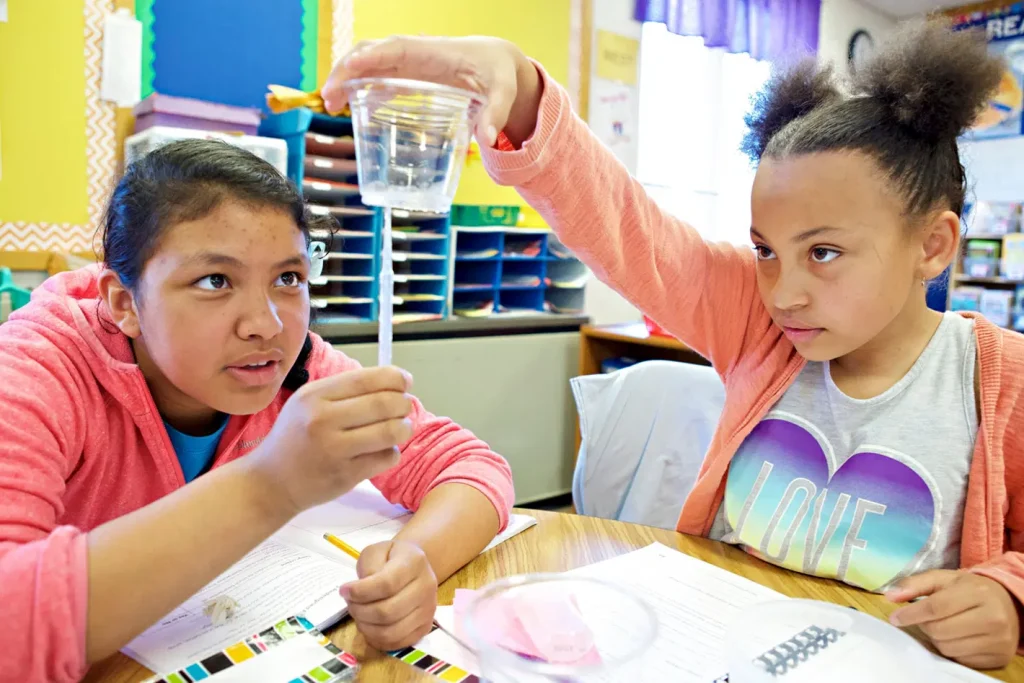
Stay connected!

Join our community and get new episodes every other Tuesday!

We’ll also share new and exciting free resources for your classroom every month.

What Valeria Rodriguez says about science

“I use [sketchnoting] and I mess up all the time…because I feel that my students don’t want to make mistakes, and drawing is one of those things that taught me that it’s okay to make mistakes.”

– Valeria Rodriguez

Educator, Instructional technologist, and Graphic facilitator

Meet the guest

Valeria is an educator, instructional technologist, graphic facilitator, and dreamer. She currently works as a Science teacher as part of a STEAM Team in Miami, Florida teaching third through fifth graders as a free-lance graphic facilitator. She loves to connect with passionate educators she meets around the country. Valeria has presented and led workshops at educational conferences like SXSWEdu, ISTE, NSTA, NSTA STEM Forum, SHIFTinEDU, FAST, FCIS, and SEEC. When she is not teaching or sketching, Valeria can be found adventuring with her family around the world, training for triathlons, and creating opportunities to empower kids in all kinds of communities. 

You can check Valeria’s work on her website and follow her on Twitter & Instagram.

Valeria-Rodriguez_Headshot-LP

About Science Connections

Welcome to Science Connections! Science is changing before our eyes, now more than ever. So…how do we help kids figure that out? We will bring on educators, scientists, and more to discuss the importance of high-quality science instruction. In this episode, hear from our host Eric Cross about his work engaging students as a K-8 science teacher. Listen here!

Logging in to Amplify Products

Teachers and students can access CKLA and mCLASS using your Aldine Clever login.

Note: Icons may differ from above based on your role and grade level.

Accessing Amplify Support

Amplify’s technical and program support is available from 6 a.m. to 6 p.m., Monday through Friday, through a variety of channels, including a live chat program that enables teachers to get immediate help in the middle of the school day.

  • Online live chat is available when you are logged into Amplify.
  • Telephone support is available at (800) 823-1969, option 1 for existing customers, then select option 1 for technical support or select option 2 for pedagogical support.
  • For less urgent questions, email help@amplify.com for technical support or edsupport@amplify.com for pedagogical support.

Amplify CKLA

Professional development

Texas correlation docs 

  • K-2, coming soon
  • 3-5

Program Guides

CKLA Professional Learning Site

The Amplify CKLA Professional Learning site provides resources for all stages of curriculum implementation, from unpacking your first Amplify CKLA box to strengthening classroom practices. We are excited to partner with you on this journey!

Unpacking materials

The Start Here Guide includes a helpful inventory list to help organize print materials.

FAQs

Submit a question regarding CKLA

mCLASS Texas Edition and mCLASS Intervention

Professional Development

Training modules

On-demand modules are available for all Aldine staff. Please contact your designated campus mCLASS contact for information.

Benchmark windows

  • Beginning of the Year Benchmarks: August 24th – September 18th
  • Middle of the Year Benchmarks: 
  • End of the Year Benchmarks:

Remote assessment

mCLASS Texas Edition can be administered in many ways, including remotely. This site will give guidance on the various ways to administer mCLASS Texas Edition to best support your students in any learning environment.

FAQs

Submit a question regarding mCLASS

What my wedding taught me about choosing curriculum

The right curriculum choice isn’t only about the product—it’s about who’s by your side from start to finish. Here’s how one district found that with Amplify CKLA.

By Kelly Pruitt, Instructional Facilitator, Peninsula School District | May 28, 2026

A teacher leans over a group of elementary students who are working together at a classroom table under a "CKLA Skills" sign, guiding them through successful CKLA implementation.

Prepare Professional Development (PD)

Learning experiences to prepare for literacy and math instructional shifts

The following literacy and math sessions can help any educator—regardless of the program used—enhance their instructional practices.

  • Science of Reading sessions offering research-backed strategies to deepen understanding and improve student outcomes.
  • Problem-based approach to math sessions that empower educators to facilitate meaningful learning experiences and develop critical thinking skills.
  • Multiliterate learner sessions enable educators to make a meaningful impact on students’ literacy development.
Two women are seated at a table with laptops and papers, engaging in a discussion about program implementation in a classroom or meeting setting.

Professional learning journey

Four connected circular icons illustrating a business process: idea generation, planning, execution, and achievement, depicted with relevant symbols.
Prepare Begin Practice Advance
Learning sessions will help shift literacy and math instruction in areas such as the Science of Reading and/or problem-based approaches to math. Program-aligned packages will support those who are new to Amplify programs. Program-aligned packages will support those who have experience using Amplify programs. Offerings will support advanced implementation, build capacity for instructional leaders, certify in-house trainers to deliver Launch sessions, and more.
“Gain the literacy knowledge and skills you need to thrive and help your students thrive. Through these sessions, you’ll understand typical literacy development and how to describe and address literacy difficulties.”

—Susan Lambert, Chief Academic Officer, Elementary Humanities

Host, Science of Reading: The Podcast

Science of Reading learning experiences

Listening to students read is magic. But knowing how to get them reading? That’s science.

Making the shift to the Science of Reading is no small feat, but participating in professional development sessions can help you make this change seamlessly.

Amplify Science of Reading sessions offer flexible, professional learning experiences for teachers that incorporate engaging activities grounded in what science tells us about literacy development.

Two women smiling and looking at a laptop in a classroom. One woman is wearing a striped shirt and the other a black top. Classroom decor is visible in the background.

Build your knowledge of the Science of Reading

Virtual | 90-minute session

This introductory session provides educators with a foundational overview of what the Science of Reading means and what it tells us about how to teach using evidence-based reading practices.

Participants will learn to:

  • Define the Science of Reading by examining evidence-based research.
  • Explain how two frameworks, the Simple View of Reading and the Reading Rope, work in tandem to guide effective literacy instruction.
  • Identify instructional principles aligned to the Science of Reading.
Three people stand in front of a whiteboard with colorful sticky notes, engaging in professional development for teachers as they discuss ideas and collaborate using a tablet and a laptop.

Deepen your knowledge of the Science of Reading

On-site or virtual | 3-hour session

This session will build a base of common knowledge about the Reading Rope and support educators in identifying effective instruction grounded in the Science of Reading.

Participants will learn to:

  • Identify the strands in the Reading Rope.
  • Describe how each strand plays an important role in developing skilled readers and writers.
  • Identify key look-fors in effective Science of Reading instruction.

Science of Reading: The Learning Lab online course

This series of three self-paced online courses, crafted by literacy expert Susan Lambert and built around International Dyslexia Association (IDA) Knowledge and Practice Standards, guides you through the essential Science of Reading skills and knowledge needed to teach students to read proficiently, as well as advanced strategies for aiding struggling readers. Each course builds on the last, equipping you with the tools and confidence to make a lasting impact on your students’ literacy journeys.

Benefit from flexible learning on an interactive platform spanning 20–25 hours of instruction. Each course is accessible for 12 months. Upon completion, you’ll be provided with a downloadable certificate, validating your new expertise in the Science of Reading.

A boy kneels and reads a book near stacked books, while a girl stands with folded arms; both observe a mobile with colorful shapes and letters, reflecting elements of classroom instruction inspired by the Science of Reading.

Foundations to the Science of Reading

This course offers a comprehensive overview of research in the field. Each of the eight modules contains three lessons covering the foundations of literacy acquisition.

Explore the scope and sequence of Foundations to the Science of Reading with a  Pacing Guide.

Access the free Preview Pass for this course.

A child points at large outlined letters on a board with a pointer stick, next to a stack of books—capturing an engaging moment in classroom instruction.

Advanced topics in the Science of Reading: Assessment and reading difficulties

The second course is aimed at providing an in-depth examination of assessments, a deeper understanding of reading difficulties, and familiarity with pertinent legal frameworks for educators, all of which influence instructional decision-making.

Explore the scope and sequence of Advanced topics in the Science of Reading with our Pacing Guide

Access the free Preview Pass for this course.

Three people in lab coats stand around a lab table with test tubes and a flask, engaging in classroom instruction as they discuss and gesture to each other.

Coming soon!
Applied structured literacy

The final course in the series is designed to review key concepts and knowledge from previous coursework, explore fundamental aspects of structured literacy within lessons, observe and analyze structured literacy instruction in action, and investigate how data informs instructional decisions.

[Available June 2025]

“Amplify’s Science of Reading online course builds background knowledge on how students read, then goes deeper to give you strategies that correlate with current research that can be implemented into your classroom right away. The course opened my thinking to new ways of teaching and I can’t wait to try it with students! If you want to walk away feeling successful with helping kids read, take this course! ”

Allie Appel

Coach, WI

New

Supporting multiliterate learner sessions

Unlock the magic of teaching multiliterate learners with evidence-based literacy practices. Making the shift to effectively support diverse readers in multiple languages is no small feat, but our professional development sessions are here to guide you effortlessly.

Empower your teaching with these engaging sessions, and make a meaningful impact on your multiliterate students’ literacy development.

Two children are seated at a small table in a classroom. Engaged in classroom instruction, the girl is writing in a notebook while the boy reads a book. Colorful storage bins are visible in the background, enhancing the learning environment

Build your knowledge of multiliterate learners

Virtual | 90-minute session

This session provides educators with a foundational overview of how to teach multiliterate learners using evidence-based literacy practices.

Contact us to request a quote.

A young boy in a striped shirt sits at a desk, focused on writing in a notebook with a pencil. Surrounding him are classroom supplies and papers, exemplifying the effective program implementation strategies from professional learning sessions.

Deepen your knowledge of multiliterate learners

On-site or virtual | 3-hour session

This session will build an understanding of how the brain learns to read in multiple languages, as well as how to leverage cross-linguistic transfer, and align instruction to best practices for multiliterate learners.

Contact us to request a quote.

Problem-based approach to math instruction sessions

Elevate educational experiences by placing students’ ideas at the core of math lessons through problem-based learning. These sessions offer flexible professional learning experiences, allowing you to gain firsthand experience with a problem-based approach as a learner. You then learn to integrate this approach seamlessly into your teaching practices, bringing renewed energy to your math classroom.

A woman sits indoors, smiling while using a tablet. Wearing a blue lanyard and casual clothing, she appears engaged in professional learning; the background shows blurred people and chairs.

Build your knowledge of a problem-based approach

Virtual | 90-minute session

This session provides you with a foundational overview of what an engaging problem-based approach in math entails for K–5 students.

During this session you’ll learn to:

  • Explain how a problem-based approach to math brings delight to both teaching and learning and builds lasting student understanding.
  • Identify actionable strategies for using a problem-based approach in a math classroom.

Contact us to request a quote.

Deepen your knowledge of a problem-based approach

On-site or virtual | 3-hour session

This session provides you with hands-on experience facilitating problem-solving in math, leaving you with an increased understanding of how to teach conceptual understanding, procedural skill and fluency, and applications of math.

During this session you’ll learn to:

  • Explain how a problem-based approach to math brings delight to both teaching and learning and builds lasting student understanding.
  • Identify actionable strategies for using a problem-based approach in a math classroom.
  • Connect your current teaching practice to a problem-based approach, and choose a next step to implement a more problem-based approach.

Contact us to request a quote.

Get in touch with a PD expert

We’re here to provide answers and guidance as you explore your PD options. Fill out the form to connect with us and discover how Amplify PD can enhance your educational journey.

A closer look at grades 6–8

Amplify Science California is based on the latest research on teaching and learning and helps teachers deliver rigorous and riveting lessons through hands-on investigations, literacy-rich activities, and interactive digital tools that empower students to think, read, write, and argue like real scientists.

In the 6–8 classroom, this looks like students:

  • Collecting evidence from a variety of sources.
  • Making sense of evidence in a variety of ways.
  • Formulating convincing scientific arguments.

Is your school implementing the domain model? Click here.

Collage of four images showing children engaged in educational activities such as conducting experiments and crafting in a classroom setting.
A four-step process diagram with icons: spark a real-world problem, explore sources, explain and elaborate, and evaluate claims, all linking to engage with cohesive storylines.

Program structure

Our cyclical lesson design ensures students receive multiple exposures to concepts through a variety of modalities. As they progress through the lessons within a unit, students build and deepen their understanding, increasing their ability to develop and refine complex explanations of the unit’s phenomenon.

It’s this proven program structure and lesson design that enables Amplify Science California to teach less, but achieve more. Rather than asking teachers to wade through unnecessary content, we designed our 6–8 program to address 100% of the California NGSS in fewer lessons than other programs.

Scope and sequence

Every year our grades 6–8 sequence consists of 9 units, with each unit containing 10–19 lessons. Lessons are written to last a minimum of 45-minutes, though teachers can expand or contract the timing to meet their needs.

Chart displaying educational science topics for grades 6 to 8, categorized by grade level, duration in days, and number of classes. Includes subjects like microbiome, geology, and natural selection.

Unit types

Each unit delivers three-dimensional learning experiences and engages students in gathering evidence from a rich collection of sources, while also serving a unique purpose.

In grades 6–8, there are three types of units:

  • One unit is a launch unit.
  • Three units are core units.
  • Two units are engineering internships.
Launch units

Launch units are the first units taught in each year of Amplify Science California. The goal of the Launch unit is to introduce students to norms, routines, and practices that will be built on throughout the year, including argumentation, active reading, and using the program’s technology. For example, rather than taking the time to explain the process of active reading in every unit in a given year, it is explained thoroughly in the Launch unit, thereby preparing students to read actively in all subsequent units.

Core units

Core units establish the context of the unit by introducing students to a real-world problem. As students move through lessons in a Core unit, they figure out the unit’s anchoring phenomenon, gain an understanding of the unit’s disciplinary core ideas and science and engineering practices, and make linkages across topics through the crosscutting concepts. Each Core unit culminates with a Science Seminar and final writing activity.

Engineering Internship units

Engineering Internship units invite students to design solutions for real-world problems as interns for a fictional company called Futura. Students figure out how to help those in need, from tsunami victims in Sri Lanka to premature babies, through the application of engineering practices. In the process, they apply and deepen their learning from Core units.

Units at a glance

Abstract art with vibrant colors featuring a yellow silhouette of a person holding a book against a background of geometric shapes, swirling patterns, and bold textures.
Microbiome

Domain: Life Science

Unit type: Launch

Student role: Microbiological researchers

Phenomenon: The presence of 100 trillion microorganisms living on and in the human body may keep the body healthy.  

Abstract artwork of a person's side profile with geometric shapes and colorful patterns flowing from the head, holding a small sledgehammer. A vision chart is visible in the corner.
Metabolism

Domain: Life Science

Unit type: Core

Student role: Medical researchers

Phenomenon: Elisa, a young patient, feels tired all the time.  

Download unit guide

Orange abstract background with hexagonal shapes featuring icons of a bar chart, plant, safety vest, test tube, peach, and stethoscope.
Metabolism Engineering Internship

Domains: Life Science, Engineering Design

Unit type: Engineering internship

Student role: Food engineers

Phenomenon: Designing health bars with different molecular compositions can effectively meet the metabolic needs of patients or rescue workers.  

Imagen que muestra un gráfico de arañas de diferentes colores con patrones distintos de patas y cuerpo, incluidas variaciones de color marrón, amarillo y azul. El fondo es una superficie oscura y texturizada.
Traits and Reproduction

Domain: Life Science

Unit type: Core

Student role: Biomedical students

Phenomenon: Darwin’s bark spider offspring have different silk flexibility traits, even though they have the same parents.  

Download unit guide

Illustration of a person in a red hat and fur-lined coat with eyes closed, surrounded by large orange circles on a dark background.
Thermal Energy

Domain: Physical Science

Unit type: Core

Student role: Thermal scientists

Phenomenon: One of two proposed heating systems for Riverdale School will best heat the school. 

Download unit guide

Abstract artwork depicting a bright sun with blue and orange swirling patterns next to green hills under a sky with shades of blue, orange, and red.
Ocean, Atmosphere, and Climate

Domains: Earth and Space Science, Physical Science

Unit type: Core

Student role: Climatologists

Phenomenon: During El Niño years, the air temperature in Christchurch, New Zealand is cooler than usual.  

An illustration from the Weather Patterns unit
Weather Patterns

Domains: Earth and Space Science, Physical Science

Unit type: Core

Student role: Forensic meteorologists

Phenomenon: In recent years, rainstorms in Galetown have been unusually severe.  

Download unit guide

An illustration from the Earth's Changing Climate unit
Earth’s Changing Climate

Domains: Earth and Space Science, Life Science

Unit type: Core

Student role: Climatologists

Phenomenon: The ice on Earth’s surface is melting.  

Download unit guide

Abstract geometric design in shades of blue and purple featuring a hexagon with icons of a building, wrench, molecules, sun, paint can, and screwdriver.
Earth’s Changing Climate Engineering Internship

Domains: Earth and Space Science, Engineering Design

Unit type: Engineering internship

Student role: Civil engineers

Phenomenon: Designing rooftops with different modifications can reduce a city’s impact on climate change.  

A barren, rocky desert landscape with rover tracks leading to a distant vehicle on a hill under a hazy sky.
Geology on Mars

Domain: Earth and Space Science

Unit type: Launch

Student role: Planetary geologists

Phenomenon: Analyzing data about landforms on Mars can provide evidence that Mars may have once been habitable. 

Two prehistoric reptiles with long snouts and tails are near the shore, one on land and one in water, with plants, rocks, and an island in the background.
Plate Motion

Domain: Earth and Space Science

Unit type: Core

Student role: Geologists

Phenomenon: Mesosaurus fossils have been found on continents separated by thousands of kilometers of ocean, even though the Mesosaurus species once lived all together.  

Download unit guide

Geometric design featuring a telescope, mountain, sound waves, and cosmic elements on a purple hexagonal background.
Plate Motion Engineering Internship

Domains: Earth and Space Science, Engineering Design

Unit type: Engineering internship

Student role: Mechanical engineering interns

Phenomenon: Patterns in earthquake data can be used to design an effective tsunami warning system.  

Illustration of a cross-section of Earth showing a volcano near the ocean. Trees, mountains, and clouds are visible above, with subterranean layers below.
Rock Transformations

Domain: Earth and Space Science

Unit type: Core

Student role: Geologists

Phenomenon: Rock samples from the Great Plains and from the Rocky Mountains — regions hundreds of miles apart — look very different, but have surprisingly similar mineral compositions.  

Download unit guide

Ilustración que muestra las etapas de fusión de una paleta de naranja: entera, parcialmente derretida, más derretida y casi derretida por completo, con palitos de madera, sobre un fondo morado.
Phase Change

Domains: Physical Science, Earth and Space Science

Unit type: Core

Student role: Chemists

Phenomenon: A methane lake on Titan no longer appears in images taken by a space probe two years apart

Download unit guide

Green geometric background with a hexagonal emblem containing a parachute icon, ruler, bandage, and stacked layers on a gradient pattern.
Force and Motion Engineering Internship

Domains: Engineering Design, Physical Science

Unit type: Engineering internship

Student role: Mechanical engineering interns

Phenomenon: Designing emergency supply delivery pods with different structures can maintain the integrity of the supply pods and their contents.  

An illustration from the Chemical Reactions unit
Chemical Reactions

Domains: Physical Science, Life Science, Earth and Space Science

Unit type: Core

Student role: Forensic chemists

Phenomenon: A mysterious brown substance has been detected in the tap water of Westfield.  

Download unit guide

An illustration of a whale with jellyfish and turtles from Amplify Science
Populations and Resources

Domains: Life Science, Earth and Space Science

Unit type: Core

Student role: Biologists

Phenomenon: The size of the moon jelly population in Glacier Sea has increased. 

Download unit guide

Low-poly landscape with trees and mushrooms. A fox sniffs the ground, a rabbit sits nearby, and mountains and sun are in the background.
Matter and Energy in Ecosystems

Domains: Life Science, Earth and Space Science, Physical Science

Unit type: Core

Student role: Ecologists

Phenomenon: The biodome ecosystem has collapsed.  

Download unit guide

Two people climbing rocky terrain; illustrations show a hiking boot and a belt with gear.
Harnessing Human Energy

Domains: Physical Science, Earth and Space Science, Engineering Design

Unit type: Launch

Student role: Energy scientists

Phenomenon: Rescue workers can use their own human kinetic energy to power the electrical devices they use during rescue missions.  

Illustration of a futuristic space station with large solar panels, orbiting in deep space, emitting a blue glow from its propulsion system.
Force and Motion

Domain: Physical Science

Unit type: Core

Student role: Physicists

Phenomenon: The asteroid sample-collecting pod failed to dock at the space station as planned.

Download unit guide

Green geometric graphic featuring icons: a baby, thermometer, layers, medical alert, and a flame.
Phase Change Engineering Internship

Domains: Engineering Design, Physical Science

Unit type: Engineering internship

Student role: Chemical engineering interns

Phenomenon: Designing portable baby incubators with different combinations of phase change materials can keep babies at a healthy temperature.  

Illustration of a roller coaster filled with people, hands raised, going down a steep track against a bright blue sky with clouds.
Magnetic Fields

Domain: Physical Science

Unit type: Core

Student role: Physicists

Phenomenon: During a test launch, a spacecraft traveled much faster than expected.  

An illustration from the Light Waves unit
Light Waves

Domains: Physical Science, Life Science, Earth and Space Science

Unit type: Core

Student role: Spectroscopists

Phenomenon: The rate of skin cancer is higher in Australia than in other parts of the world.

Download unit guide

A city skyline at night with a prominent full moon, stars in the sky, and a bridge silhouette on the left.
Earth, Moon, and Sun

Domains: Earth and Space Science, Physical Science

Unit type: Core

Student role: Astronomers

Phenomenon: An astrophotographer can only take pictures of specific features on the Moon at certain times.  

Download unit guide

Four low-poly dinosaurs with missing body sections are standing in a row; one is yellow, and the others are green. They have purple spikes and red patches on their bodies.
Natural Selection

Domains: Life Science, Earth and Space Science

Unit type: Core

Student role: Biologists

Phenomenon: The newt population in Oregon State Park has become more poisonous over time.  

Download unit guide

Red geometric background with icons including a mosquito, DNA strand, bar chart, and world map inside a hexagon.
Natural Selection Engineering Internship

Domains: Engineering Design, Life Science

Unit type: Engineering internship

Student role: Clinical engineers

Phenomenon: Designing malaria treatment plans that use different combinations of drugs can reduce drug resistance development while helping malaria patients.  

Two giant tortoises with long necks stand near water; one tortoise feeds on leaves from a tree while the other is near dense vegetation.
Evolutionary History

Domains: Life Science, Earth and Space Science

Unit type: Core

Student role: Paleontologists

Phenomenon: A mystery fossil at the Natural History Museum has similarities with both wolves and whales.    

Download unit guide

Welcome, Arkansas educators!

We are excited to introduce Amplify Core Knowledge Language Arts (CKLA) 3rd Edition, now an Arkansas-approved HQIM core literacy program within Amplify’s literacy suite. For more than a decade, Amplify CKLA has transformed classrooms nationwide with its intentional knowledge building and systematic skills instruction.

Rest assured that Amplify CKLA 2nd Edition remains a robust, trusted option, and our high-quality professional development and ever-growing PD Library of resources continue to be available to all CKLA partners.

Whether you’re continuing with the 2nd edition or exploring the 3rd, you’ve chosen a proven and research-based curriculum designed for lasting impact.  Together, let’s write the next chapter in the Science of Reading.

A correlation of the Arkansas English Language Arts Standards to Amplify CKLA 3rd Edition is now available!

An astronaut in space extending a hand toward the camera, with the moon in the background and a speech bubble containing “/oo/.”.

Amplify ckla servers

150,000+

Classrooms

4,000,000+

students

50+

us states and d.c.

Our approach

Improve outcomes with a program built on decades of research, that meets the strongest ESSA Tier I criteria.

A diagram showing the simple view of reading by combining language comprehension and word recognition at various levels, leading to expert reading.

Grounded in the Science of Reading

As the original Science of Reading program, Amplify CKLA puts research into action with explicit, systematic foundational skills instruction and a proven knowledge-building sequence. In collaboration with education experts and practitioners, we provide powerful resources that deliver real results.

Background knowledge drives results for Arkansas students

Amplify CKLA follows the Core Knowledge Sequence, a content-specific, cumulative, and coherent approach to knowledge building. This approach improves reading scores and closes achievement gaps by establishing a robust knowledge base that strengthens comprehension.

In Amplify CKLA 3rd Edition, we’ve enriched our Knowledge Sequence with a wider range of perspectives and high-quality texts in new and enhanced units.

A diagram shows the steps for learning a sound: hear /a/, say the sound, read "c-a-t," and write "cat" with a pencil, featuring a cartoon cat image.

Build foundational skills for long-term success.

Students progress from simple to complex skill development, starting with phonological and phonemic awareness. Instruction in Grades K–2 explicitly teaches the 150 spellings for the 44 sounds of English, following an intentional progression to ensure student success.

In our 3rd Edition, we’ve added dedicated Grade 3 foundational skills instruction that can either support core lessons or function as an intervention, based on student needs.

Daily writing deepens learning.

Grounded in the Science of Writing—the research on how kids learn to write—instruction is explicit, daily, and woven into the curriculum’s rich content. It covers both transcription (handwriting and spelling) and composition (organizing ideas into narratives) with high-impact activities like sentence-level combining and expanding, and pre-writing exercises. Writing and reading instruction are integrated, so students simultaneously strengthen their communication skills, comprehension, and confidence.

A young boy sits at a desk in a classroom, writing in a notebook with a pencil, while other students are visible in the background.
A laptop displays a children's story titled "Seth's Sled." Surrounding it are five book covers, including "Duke Ellington" and "Patricia's Vision.

High-quality texts

Amplify CKLA students are immersed in a variety of texts—complex read-alouds, decodable chapter books, trade books, and content-rich readers—that reflect varying experiences and backgrounds, and connect to learning goals.

Readers are 100% decodable for Grades K–2, empowering students to directly apply what they’ve learned. Novel Study units for Grades 3–5 offer a mix of contemporary and classic literature, and Culminating Research Units in every grade include a set of authentic texts and trade books.

Reach all learners with differentiated support.

Scaffolds and challenges, developed in collaboration with education experts, make content available to every student—including multilingual and English learners. With strategies embedded right in the curriculum, teachers can deliver in-the-moment, individualized instruction to meet all student needs.

For a dedicated English language development program aligned to Amplify CKLA, explore Language Studio.

Four children sit cross-legged on a classroom rug, two with hands raised. They appear engaged and attentive, with posters and shelves visible in the background.

What’s included

The comprehensive resources in Amplify CKLA 3rd Edition support effective literacy instruction in every classroom.

A laptop displaying an assessment report is surrounded by books, an astronaut illustration, and a large moon graphic on a white background.
A collection of educational materials, including spiral notebooks, textbooks, a lesson plan, and a laptop displaying an educational screen with the title "Let's Explore.

Easy-to-use teacher materials

Amplify CKLA teachers are empowered to deliver effective instruction with the following print and digital resources:

  • Teacher Guides (K–5)
  • Assessment Guides (K–5)
  • Authentic texts and trade books (K–5)
  • Knowledge Image Cards (K–2)
  • Knowledge Flip Books (K–2, digital)
  • Ready-made and customizable Presentation Screens (K–5, digital)
  • Remediation and intervention resources (K–5)
  • On-demand professional development (K–5, digital)

Immersive Amplify CKLA student resources

Amplify CKLA students stay engaged with the following print and digital resources:

  • Decodable readers (K–2)
  • Student Readers and novels (3–5)
  • Student Activity Books (K–5)
  • Poet’s Journal and Writer’s Journal (3–5)
  • eReaders (K–5, digital)
  • Sound Library featuring articulation videos and songs (K–2, digital)
  • Skill-building practice games (K–5)
A collage shows a poetry workbook, an open book with a dog illustration, a butterfly, and a laptop displaying a digital poem.
Six children's and young adult book covers arranged in two rows, featuring titles about animals, exploration, and adventure.

Rich literary experiences

The high-quality texts in Amplify CKLA foster students’ curiosity, reflect the wide variety of their backgrounds and experiences, and help them learn to read with confidence.

  • Trade Book Collections (K–5) inspire student research in each grade’s Culminating Research Unit.
  • Classic and contemporary literature (3–5) delights students in Novel Study Units.
  • Increasingly complex Student Readers (K–5) develop students’ literacy across grades.

Hands-on phonics materials

Multisensory phonics and foundational skills resources engage students with fun, varied approaches that promote mastery and build independence.

  • Chaining Folders and Small Letter Cards (K)
  • Read-Aloud Big Books (K–1)
  • Large Letter Cards (K–2)
  • Sound Cards (K–2)
  • Image Cards (K–3)
  • Blending Picture Cards (K)
  • Consonant and Vowel Code Posters and Spelling Cards (1–2)
  • Sound Library (K–2, digital)
A digital learning interface displays vowel sounds, word-building activities, and phonics flashcards, with an illustrated brown weasel on the right.

All-in-one digital platform

Our comprehensive platform simplifies your day-to-day tasks and makes it easier to plan and deliver lessons.

  • Ready-made and customizable Presentation Screens
  • Auto-scored digital assessments
  • Standards-based reporting
  • Assignable skill-building games
  • Sound Library
  • eReaders

Professional Development

We look forward to working alongside our Arkansas partners to build a strong foundation in Amplify CKLA. Our dedicated professional development team will continue collaborating with the ADE to provide job-embedded, on-site support that aligns with the Arkansas ELA standards and the Science of Reading.

Explore Amplify’s Effective PD Solutions

Two women sit indoors at a table; one is focused on her work while the other is smiling. Papers and a water bottle are visible in the foreground.
A circular flow chart titled

A true Science of Reading early literacy suite for Grades K–5

Amplify has combined the critical elements of a Science of Reading system: assessment, core curriculum, personalized learning, and intervention. Based on 20 years of experience with the Science of Reading, this complete system saves you time and aligns your literacy practices.

  • Assess with mCLASS®: A universal and dyslexia screener, powered by DIBELS® 8th Edition
  • Instruct with Amplify CKLA: Core curriculum to build foundational skills and knowledge
  • Practice with Boost Reading: Personalized learning program to extend and reinforce core
  • Intervene with mCLASS Intervention: Staff-led Tier 2 and 3 intervention for intensive support

Language Studio: Multilingual and English learner support

Language Studio is Amplify CKLA’s dedicated K–5 program for multilingual and English learners. Through daily 30-minute lessons, it strengthens reading, writing, speaking, and listening skills while reinforcing core instruction. This tailored support empowers students to confidently access grade-level content as they develop academic English.

A young girl immerses herself in the science of reading at a classroom desk, surrounded by peers and diverse educational materials.

Explore more programs in Amplify’s literacy and biliteracy suite.

All of the programs in our literacy suite and our biliteracy suite are designed to support and complement each other. Learn more about our related programs:

Get a demo

Fill out this form and your Account Executive Paige Benoy will contact you to set up a demo, send samples, or answer questions about Amplify CKLA.

A woman with straight blonde hair smiles outdoors, standing in front of steps and greenery. She is wearing a patterned top.

Paige Benoy
Arkansas Account Executive
pbenoy@amplify.com

Welcome, Florida middle school educators!

Amplify ELA Florida is the program built for Florida middle school teachers and students. We designed the program to help ensure the B.E.S.T standards are covered; the skills are taught; the test is prepped for; and your students are scaffolded and encouraged. We want you to spend your time bringing the text to life, making the classroom hum, and letting every student know you are paying attention to their growth.

Amplify ELA Florida Program Guide

Illustration of a ship with diverse elements including human figures, nature motifs, and space elements on a black background.
A teacher assists two students with a laptop in a classroom, one wearing a hijab, conveying a supportive educational environment.

Instruction matters

Florida’s new standards have been crafted to give your students the B.E.S.T. Amplify ELA Florida’s lessons explore the most compelling aspect of a text and target the standards that best support that analysis through reading, writing, and communication. These key standards are identified as the lesson’s Spotlight benchmark.  Strategic connections are attained in the program through:

  • Florida model texts including rich literature and compelling non-fiction, taught in engaging new ways for today’s learners.
  • Benchmark stacks that build connections within lessons and across units.
  • Foundational instruction that targets key standards and multiple learning modes.
  • Writing that builds directly from reading complex text and is evaluated by Amplify’s Automated Writing Evaluation (AWE).
  • Reading with the B.E.S.T. Modules have been built to guide teachers and students as they begin to work with Florida’s new reading standards, providing an introduction to each grade-level B.E.S.T. Reading Benchmark. (Example module: Grade 6, Understanding Rhetoric)

Knowledge matters

Texts in the Amplify ELA Florida Edition curriculum cover a wide range of topics, themes, and genres with differentiated supports that ensure that all students can work through each reading and lesson. Taken as a whole, the texts show students a diverse picture of the world and help foster a lifelong love of reading. Comprehension develops as students engage with literary and informational text selections that are complex, rich, and meaningful. 

Texts were selected for Amplify ELA Florida Edition using the following criteria: 

  • Text complexity as defined by qualitative, quantitative, and reader and task measurements as required by the B.E.S.T. Standards and the Amplify Text Complexity Index
  • Balance of literary and informational texts
  • Varied representation of genres: novels, plays, poetry, biographies, and other full-length texts
  • Diverse cultures, perspectives, and authors
  • Engaging texts that extend learning and support students as they build knowledge
  • Grade-appropriate texts, with scaffolding and compelling activities to support student engagement with 100% authentic texts
  • A library with more than 700 complete books, both classic and contemporary, encompassing a wide range of genres, topics, and cultural perspectives
Collage featuring a violinist with glowing eyes, a man with a background of space, a robotic arm, a tiger on a grassy knoll, and a city skyline under a starry sky.

Curriculum matters

Amplify ELA Florida is a blended curriculum designed specifically for grades 6–8. The heart of every lesson is the text. Each grade includes six units centered on literary or informational texts, delivered in several forms of media. Your classroom will also benefit from two or three immersive, project-based experiences and a dedicated Story Writing unit.

  • Full B.E.S.T. coverage: Standards are clearly labeled in each lesson, so teachers can save time planning and get back to what they love: teaching. Also included are Benchmark Modules that support teachers’ and students’ introduction to the new standards for Florida.
  • Five levels of differentiation: Based on each student’s needs and the performance measures within Amplify ELA reports, a teacher can choose the differentiation level that’s the right fit for everyone.
  • Embedded Assessments: Teachers benefit from uninterrupted instructional time and a continuously updated picture of each student’s progress with key skills and standards.
  • Powerful feedback tools: Comprehensive tools help teachers maximize both the quantity and quality of feedback.
  • Robust reporting: Our reporting app offers information on student progress to help inform instructional decisions.

All in one place: Embedded teacher support, differentiation tools, student data, text, and other curriculum features—they’re all right there.

Materials

Amplify ELA Florida Edition is a blended curriculum that seamlessly integrates print and digital resources to be used in any learning environment. The resources are designed to facilitate instruction for planning, teaching, learning, and assessment.

Student materials

Available digitally and in print, the student materials guide middle schoolers through complex texts and writing with the following:

  • Student Edition will engage students with high-quality narrative and informational texts.
  • Digital experience will provide videos, a library of more than 700 texts, audio supports, and other online experiences that capture their attention.
A laptop displays a web page titled "read like a movie director, part 1" from amplify ela, featuring text and an eyeball image under the lesson tab.
A laptop displaying a webpage from "amplify ela" featuring the title "brain science" and various educational topics alongside an illustrated collage of diverse human figures.

Teacher materials

Available digitally and in print, the Teacher Edition contains all of the information teachers need to facilitate classroom instruction, including:

  • From detailed lesson plans.
  • Video teacher tips embedded in the lesson.
  • B.E.S.T. standards alignment and assessments including exit tickets.
  • Real-time differentiation strategies.
  • Clarify and Compare lessons.
  • Robust reporting.

Professional learning

Amplify employs a national cohort of more than 50 ELA facilitators, all of whom have experience as former classroom teachers and many of whom are former school and/or district leaders. Our professional learning team has decades of experience working with large districts across the nation. Amplify has experience supporting district launches over multiple years and has partnered with districts of all sizes nationwide. We partner deeply with districts and tailor professional learning to their unique needs.

Florida ELA Implementation

Two women are seated at a desk, smiling and working together on a project with a laptop and notebook in an office setting.

Welcome, Middle School Science Reviewers!

Thank you for taking the time to review Amplify Science for grades 6–8. On this site, you’ll find all the resources you need to learn more about this engaging and robust NGSS program. Plus, we make it easy to experience our program firsthand with a live demo account that features our interactive learning platform.

A person in protective glasses examines a glass of water, surrounded by illustrations of a rocket, telescope, polar bear, clouds, rain, and moon phases on a colorful abstract background.

Overview

With Amplify Science, students don’t just passively learn about science concepts.

No matter where your students are learning—whether at school or at home—they take on the role of scientists and engineers to actively investigate and make sense of real-world phenomena. They do this through a blend of cohesive and compelling storylines, hands-on investigations, collaborative discussions, literacy-rich activities, and interactive digital tools.

Listen to these educators share how the program empowers students to think, read, write, and argue like real scientists and engineers every day.

EdReports All-Green

Amplify Science for grades K–8 has been rated all-green by EdReports.

Read the review on EdReports.

A boy stirs a clear liquid in a plastic cup while a girl smiles beside him in a classroom with students and a teacher in the background. EdReports badge is overlaid in the corner.

Program structure

Our cyclical lesson design ensures students receive multiple exposures to concepts through a variety of modalities.

As they progress through the lessons within a unit, students build and deepen their understanding, increasing their ability to develop and refine complex explanations of the unit’s phenomenon. It’s this proven program structure and lesson design that enables Amplify Science to address 100% of the NGSS in fewer days than other programs.

Graphic showing a research process with four steps: spark intrigue with a real-world problem, explore evidence, explain and elaborate, and evaluate claims, connected in a cycle with arrows.

Unit Sequence

Our lessons follow a structure that is grounded in regular routines while still being flexible enough to allow for a variety of learning experiences.
 
In fact, our multi-modal instruction offers more opportunities for students to construct meaning, and practice and apply concepts than any other program. What’s more, our modular design means our units can be flexibly arranged to support your instructional goals.

Collage of four images: a watercolor desert scene, three kids examining a gadget, a hand placing beads into a container, and a woman in a sunhat in a stylized field.
Abstract art with vibrant colors featuring a yellow silhouette of a person holding a book against a background of geometric shapes, swirling patterns, and bold textures.

Unit 1

Microbiome

Domain: Life Science

Unit type: Launch

Student role: Microbiological researchers

Phenomenon: The presence of 100 trillion microorganisms living on and in the human body may keep the body healthy.  

Abstract artwork of a person's side profile with geometric shapes and colorful patterns flowing from the head, holding a small sledgehammer. A vision chart is visible in the corner.

Unit 2

Metabolism

Domain: Life Science

Unit type: Core

Student role: Medical researchers

Phenomenon: Elisa, a young patient, feels tired all the time.  

Orange abstract background with hexagonal shapes featuring icons of a bar chart, plant, safety vest, test tube, peach, and stethoscope.

Unit 3

Metabolism Engineering Internship

Domains: Life Science, Engineering Design

Unit type: Engineering internship

Student role: Food engineers

Phenomenon: Designing health bars with different molecular compositions can effectively meet the metabolic needs of patients or rescue workers.  

An image showing a graphic of spiders of different colors with distinct leg and body patterns, including brown, yellow, and blue variations. The background is a dark, textured surface.

Unit 4

Traits and Reproduction

Domain: Life Science

Unit type: Core

Student role: Biomedical students

Phenomenon: Darwin’s bark spider offspring have different silk flexibility traits, even though they have the same parents.  

Illustration of a person in a red hat and fur-lined coat with eyes closed, surrounded by large orange circles on a dark background.

Unit 5

Thermal Energy

Domain: Physical Science

Unit type: Core

Student role: Thermal scientists

Phenomenon: One of two proposed heating systems for Riverdale School will best heat the school. 

Abstract artwork depicting a bright sun with blue and orange swirling patterns next to green hills under a sky with shades of blue, orange, and red.

Unit 6

Ocean, Atmosphere, and Climate

Domains: Earth and Space Science, Physical Science

Unit type: Core

Student role: Climatologists

Phenomenon: During El Niño years, the air temperature in Christchurch, New Zealand is cooler than usual.  

Illustration of a village with houses, fields and mountains under a cloudy sky with waves of wind or rain.

Unit 7

Weather Patterns

Domains: Earth and Space Science, Physical Science

Unit type: Core

Student role: Forensic meteorologists

Phenomenon: In recent years, rainstorms in Galetown have been unusually severe.  

A polar bear stands on a small ice floe in the ocean with an orange sun in the sky and distant icy mountains in the background.

Unit 8

Earth’s Changing Climate

Domains: Earth and Space Science, Life Science

Unit type: Core

Student role: Climatologists

Phenomenon: The ice on Earth’s surface is melting.  

Abstract geometric design in shades of blue and purple featuring a hexagon with icons of a building, wrench, molecules, sun, paint can, and screwdriver.

Unit 9

Earth’s Changing Climate Engineering Internship

Domains: Earth and Space Science, Engineering Design

Unit type: Engineering internship

Student role: Civil engineers

Phenomenon: Designing rooftops with different modifications can reduce a city’s impact on climate change.  

A barren, rocky desert landscape with rover tracks leading to a distant vehicle on a hill under a hazy sky.

Unit 1

Geology on Mars

Domain: Earth and Space Science

Unit type: Launch

Student role: Planetary geologists

Phenomenon: Analyzing data about landforms on Mars can provide evidence that Mars may have once been habitable. 

Two prehistoric reptiles with long snouts and tails are near the shore, one on land and one in water, with plants, rocks, and an island in the background.

Unit 2

Plate Motion

Domain: Earth and Space Science

Unit type: Core

Student role: Geologists

Phenomenon: Mesosaurus fossils have been found on continents separated by thousands of kilometers of ocean, even though the Mesosaurus species once lived all together.  

Geometric design featuring a telescope, mountain, sound waves, and cosmic elements on a purple hexagonal background.

Unit 3

Plate Motion Engineering Internship

Domains: Earth and Space Science, Engineering Design

Unit type: Engineering internship

Student role: Mechanical engineering interns

Phenomenon: Patterns in earthquake data can be used to design an effective tsunami warning system.  

Illustration of a cross-section of Earth showing a volcano near the ocean. Trees, mountains, and clouds are visible above, with subterranean layers below.

Unit 4

Rock Transformations

Domain: Earth and Space Science

Unit type: Core

Student role: Geologists

Phenomenon: Rock samples from the Great Plains and from the Rocky Mountains — regions hundreds of miles apart — look very different, but have surprisingly similar mineral compositions.  

Illustration showing the stages of melting an orange popsicle: whole, partially melted, more melted, and almost completely melted, with wooden sticks, on a purple background.

Unit 5

Phase Change

Domains: Physical Science, Earth and Space Science

Unit type: Core

Student role: Chemists

Phenomenon: A methane lake on Titan no longer appears in images taken by a space probe two years apart

Green geometric background with a hexagonal emblem containing a parachute icon, ruler, bandage, and stacked layers on a gradient pattern.

Unit 6

Force and Motion Engineering Internship

Domains: Engineering Design, Physical Science

Unit type: Engineering internship

Student role: Mechanical engineering interns

Phenomenon: Designing emergency supply delivery pods with different structures can maintain the integrity of the supply pods and their contents.  

Abstract digital artwork featuring numerous red and gray circles overlapping a split background of blue and light purple, creating a dynamic and energetic composition.

Unit 7

Chemical Reactions

Domains: Physical Science, Life Science, Earth and Space Science

Unit type: Core

Student role: Forensic chemists

Phenomenon: A mysterious brown substance has been detected in the tap water of Westfield.  

An illustration of a whale with jellyfish and turtles from Amplify Science

Unit 8

Populations and Resources

Domains: Life Science, Earth and Space Science

Unit type: Core

Student role: Biologists

Phenomenon: The size of the moon jelly population in Glacier Sea has increased. 

Low-poly landscape with trees and mushrooms. A fox sniffs the ground, a rabbit sits nearby, and mountains and sun are in the background.

Unit 9

Matter and Energy in Ecosystems

Domains: Life Science, Earth and Space Science, Physical Science

Unit type: Core

Student role: Ecologists

Phenomenon: The biodome ecosystem has collapsed.  

Two people climbing rocky terrain; illustrations show a hiking boot and a belt with gear.

Unit 1

Harnessing Human Energy

Domains: Physical Science, Earth and Space Science, Engineering Design

Unit type: Launch

Student role: Energy scientists

Phenomenon: Rescue workers can use their own human kinetic energy to power the electrical devices they use during rescue missions.  

A spacecraft approaches and docks with a space station featuring large blue solar panels, set against a backdrop of outer space.

Unit 2

Force and Motion

Domain: Physical Science

Unit type: Core

Student role: Physicists

Phenomenon: The asteroid sample-collecting pod failed to dock at the space station as planned.

Green geometric graphic featuring icons: a baby, thermometer, layers, medical alert, and a flame.

Unit 3

Phase Change Engineering Internship

Domains: Engineering Design, Physical Science

Unit type: Engineering internship

Student role: Chemical engineering interns

Phenomenon: Designing portable baby incubators with different combinations of phase change materials can keep babies at a healthy temperature.  

Illustration of a roller coaster filled with people, hands raised, going down a steep track against a bright blue sky with clouds.

Unit 4

Magnetic Fields

Domain: Physical Science

Unit type: Core

Student role: Physicists

Phenomenon: During a test launch, a spacecraft traveled much faster than expected.  

Illustration of Earth with arrows and wavy lines representing solar radiation entering the atmosphere, showing a focus on the Asia-Pacific region.

Unit 5

Light Waves

Domains: Physical Science, Life Science, Earth and Space Science

Unit type: Core

Student role: Spectroscopists

Phenomenon: The rate of skin cancer is higher in Australia than in other parts of the world.

A city skyline at night with a prominent full moon, stars in the sky, and a bridge silhouette on the left.

Unit 6

Earth, Moon, and Sun

Domains: Earth and Space Science, Physical Science

Unit type: Core

Student role: Astronomers

Phenomenon: An astrophotographer can only take pictures of specific features on the Moon at certain times.  

Four low-poly dinosaurs with missing body sections are standing in a row; one is yellow, and the others are green. They have purple spikes and red patches on their bodies.

Unit 7

Natural Selection

Domains: Life Science, Earth and Space Science

Unit type: Core

Student role: Biologists

Phenomenon: The newt population in Oregon State Park has become more poisonous over time.  

Red geometric background with icons including a mosquito, DNA strand, bar chart, and world map inside a hexagon.

Unit 8

Natural Selection Engineering Internship

Domains: Engineering Design, Life Science

Unit type: Engineering internship

Student role: Clinical engineers

Phenomenon: Designing malaria treatment plans that use different combinations of drugs can reduce drug resistance development while helping malaria patients.  

Two giant tortoises with long necks stand near water; one tortoise feeds on leaves from a tree while the other is near dense vegetation.

Unit 9

Evolutionary History

Domains: Life Science, Earth and Space Science

Unit type: Core

Student role: Paleontologists

Phenomenon: A mystery fossil at the Natural History Museum has similarities with both wolves and whales.    

Access program

Watch the video to the right plus the ones below showing you how to navigate our digital platform. When you’re ready, follow the instructions below to log into our live demo account.

  • Click the orange button below to access the platform.
  • Choose the resources you’d like to review.
  • Pick your grade level from the drop-down menu.
  • Scroll down to find additional grade-level resources.

Navigating an Engineering Internship (Part 1)

This Part 1 video demonstrates how Engineering Internship units invite students to design solutions for real-world problems as interns for a fictional company called Futura. In the process, they apply and deepen their learning from Core units.

Navigating an Engineering Internship (Part 2)

This Part 2 video demonstrates how to use the Futura Workspace to manage the immersive experience of the Engineering Internship units. This includes guidance on how to create student groups, how to review student work, and how to send students targeted feedback on their designs.

Navigating our reporting tools

Teachers of Amplify Science grades 6–8 have access to a feature called Reporting. When unit assessments are administered digitally, the Reporting tool enables teachers to analyze student performance on the unit assessments.

Differentiation post-assessment

Every core unit of Amplify Science 6–8 features a formal formative assessment opportunity at the mid-way point, or “Critical Juncture,” of the unit, which provides an important opportunity for differentiation.

Get in touch

Smiling man with short hair and a trimmed beard wearing a light blue collared shirt against a plain white background.

Have questions? Bob McCarty is standing by and ready to help.

Robert “Bob” McCarty
Senior Account Executive
(435) 655-1731
rmccarty@amplify.com

AL review ELA (state)

To view this protected page, enter the password below:


Miami review ELA

To view this protected page, enter the password below:


Public review of the B.E.S.T. program for Florida middle schools, Amplify ELA Florida Edition

To view this protected page, enter the password below:


FL review ELA (state)

To view this protected page, enter the password below:


A powerful partnership

Amplify Science was developed by the science education experts at UC Berkeley’s Lawrence Hall of Science and the digital learning team at Amplify.

The word "Amplify" is written in orange bold letters with a period at the end against a white background.
The logo for The Lawrence Hall of Science, University of California, Berkeley, features blue text on a light background and is recognized by educators using Amplify Science for middle school science programs.

Back to school 2020–21 updates

Back to school 2020 is coming! Click here for more information on all of the improvements and new features we’re adding to Amplify Science for the new school year.

Program introduction

Onboarding: what to expect

Welcome to Amplify Science! To help you know what’s coming next, we created the following outline of the steps of the onboarding process. You can use it as a reference.

Administrators receive launch email

  • Share the information with teachers
  • Submit the shipping survey sent to your email

Log In

  • Go to learning.amplify.com
  • Click on Log in with Clever or Google 
  • Enter your FCPS credentials
  • Demo Account for full access to Amplify Curriculum without access to personalized class rosters:
    • Go to learning.amplify.com
    • Click on login with Amplify
    • Username: t.Fayette2020@tryamplify.net
    • Password:  AmplifyNumber1

Ensure you have received all materials and components

  • Teachers have access to a series of “Unboxing your materials kit” videos. If you’re interested in watching those, click here.

Check out the professional learning opportunities and/or access the Getting Started Resources below.

If you need assistance, please see the help resources or reach out to your Educational Partnerships Manager or PD manager at caffleck@amplify.com, pworks@amplify.com with any questions.

K–5 resources

To ensure your first day using Amplify Science in the classroom is as seamless and smooth as possible, we recommend reviewing the following checklist before the first day of school.

A graphic with the text "Pre-launch checklist for teachers" and an orange "Download PDF" button below. An icon of a checklist with a down arrow is on the left.

What’s coming to my school?

Each unit of Amplify Science comes with a hands-on materials kit. Each hands-on materials kit arrives in one to three boxes and contains:

  • Consumable materials for two uses of 25 or 36 students (depending on school purchase)
  • Non-consumable materials
  • Classroom wall materials
  • Premium print materials (card sorts, vocabulary rings, etc.).
  • 18 copies of each Student Book (5 titles each unit, K–1 will receive 5 big books per unit)
  • A blackline master of the Student Investigation Notebook

You can find complete materials lists for each unit in the following PDF. This information is also available in the digital Teacher’s Guide within the program.

Button for downloading a PDF of a K-5 materials list. An icon of a document with a downward arrow is on the left.

Onboarding videos

Our team has created a series of short videos to help get you started with Amplify Science:

What’s online?

Planning strategies

How to log in and navigate

NGSS introduction

Planning guides

As you prepare to plan for a unit, download our planning guides to help walk you through the most important resources to locate in either the print or digital Teacher’s Guide to help you plan:

    Additional resources

    If you’re interested in learning more about each unit’s anchor phenomena, the Student Books in each unit, and more program features, download the resources below:

      Review of the B.E.S.T. program for middle schools, Amplify ELA Florida Edition

      Thank you for taking the time to review Amplify ELA Florida Edition for middle school. The items below will allow you to experience our fully blended program, with access to our print materials, digital curriculum, and additional resources to support your review. 

      With the Benchmarks for Excellent Student Thinking (B.E.S.T.) standards as the foundation, our robust curriculum is built with a full appreciation of rich text, history, art, music, and other disciplines. This thoughtful development encourages a broader view of literacy that promotes knowledge-building across varied domains and subjects. 

      Illustration of a diverse group of people and nature elements, featuring a prominent figure with floral hair decorations and a scene of communal interaction in the background.

      Review digital program

      The content and instruction in Amplify ELA’s digital program mirror the content provided in the print Teacher Guides and Student Editions found below. Additionally, the digital program offers enhanced opportunities to engage students through the use of multimedia and a variety of learning apps. Teachers will also find embedded apps that make it easy to score student work, provide feedback, differentiate instruction, and report on progress.

      Screenshot of the "amplify" login page featuring options to log in with google, amplify, or sso, set against a background with abstract line drawings of a rocket and astronaut.

      To review the digital program, visit learning.amplify.com.

      Click Login with Amplify, and use the following credentials:

      Student view

      • Username: s2.elafl@tryamplify.net
      • Password:  AmplifyNumber1

      Amplify ELA Florida overview

      https://youtu.be/stFHJj77sAA

      Review grade 6 materials

      Collage of illustrated scenes, including a boy thinking, people at a table, and various narrative elements like books and historical figures. text: "amplify ela florida, dahl & narrative.

      Teacher Guides:

      Bid #1274: 9781636025216, Amplify ELA Florida Grade 6 Teacher Blended Package

      Available digitally and in print, the Teacher Guides contain all of the information teachers need to facilitate classroom instruction.

      Illustration of the state of Florida on a pink and purple background with star-like symbols surrounding it.

      Reading with the B.E.S.T. Modules  have been built to guide teachers and students as they begin to work with Florida’s new reading standards, providing an introduction to each grade-level B.E.S.T. Reading benchmark.

      Cover of "amplify ela" featuring a colorful collage of diverse people and elements like plants, animals, and abstract shapes. central to the image is a girl in a white dress.

      Student Edition (single volume per year):

      Bid #1274: 9781643830766, Amplify ELA Grade 6 Student Edition (single)

      Available digitally and in print, the Student Edition guides middle schoolers through complex texts and writing by:

      • Engaging students with high-quality narrative and informational texts.
      • Providing videos, audio supports, and digital experiences that capture their attention.
      • Presenting text in a single print volume for students to annotate on the page
      Black and white patterned journal covers featuring a mix of icons like lollipops, bicycles, and anchors, with one labeled "Dahl & Narrative.

      Student Writing Journals:

      Bid #1274: 9781636025186 Amplify ELA Florida Grade 6 Student Blended Package

      Review grade 7 materials

      Illustrated cover of "Red Scarf Girl & Narrative" by Amplify ELA, depicts a young girl with a red scarf and braided hair, surrounded by Communist figures, stars, and images of people.

      Teacher Guides:

      Bid #1276: 9781636025223, Amplify ELA Florida Grade 7 Teacher Blended Package

      Available digitally and in print, the Teacher Guides contain all of the information teachers need to facilitate classroom instruction.

      Illustration of the state of Florida on a pink and purple background with star-like symbols surrounding it.

      Reading with the B.E.S.T. Modules have been built to guide teachers and students as they begin to work with Florida’s new reading standards, providing an introduction to each grade-level B.E.S.T. Reading benchmark.

      Collage featuring Frida Kahlo, historical figures, diverse people, a brain, a skull, and other educational symbols. Title reads "Amplify ELA.

      Student Edition (single volume per year)

      Bid #1276: 9781643831114, Amplify ELA Grade 7 Student Edition (single)

      Available digitally and in print, the Student Edition guides middle schoolers through complex texts and writing by:

      • Engaging students with high-quality narrative and informational texts.
      • Providing videos, audio supports, and digital experiences that capture their attention.
      • Presenting text in a single-volume print student experience to annotate on the page.

      Review grade 8 materials

      Stack of illustrated books titled "Amplify ELA Florida Perspectives & Narrative" with various cover art featuring historical and cultural illustrations.

      Teacher Guides:

      Bid #1277: 9781636025230, Amplify ELA Florida Grade 8 Teacher Blended Package

      Available digitally and in print, the Teacher Guides contain all of the information teachers need to facilitate classroom instruction.

      Illustration of the state of Florida on a pink and purple background with star-like symbols surrounding it.

      Reading with the B.E.S.T. Modules have been built to guide teachers and students as they begin to work with Florida’s new reading standards, providing an introduction to each grade-level B.E.S.T. Reading benchmark.

      Collage featuring historical figures, literary characters, and space exploration elements with the text "Amplify ELA" at the top.

      Student Edition (one volume per year)

      Bid #1277: 9781643831466, Amplify ELA Grade 8 Student Edition (single)

      Available digitally and in print, the student edition guides middle schoolers through complex texts and writing by:

      • Engaging students with high-quality narrative and informational texts.
      • Providing videos, audio supports, and digital experiences that capture their attention.
      • Presenting text in a single-volume print student experience to annotate on the page.

      Florida-required guidance

      Resources

      Additional materials to support your review:

      Tennessee’s review of Amplify ELA for middle school

      Thank you for taking the time to review Amplify ELA for middle school. The items below will allow you to experience our blended program with access to our print materials, digital curriculum, and resources to support your review.

      Amplify ELA’s blended model enables teachers to design instruction based on their classroom needs and resources. Our engaging print edition highlights the many digital experiences teachers can share with students through classroom projections. Teachers can make choices about when their students use devices while providing 100% standards coverage and without compromising learning.

      Illustration of a woman with long hair and earrings, eyes closed in a serene pose, surrounded by plants and butterflies.

      Digital Program

      The content and instruction in Amplify ELA’s digital program mirrors the content provided in the print Teacher Edition and Student Edition. However, the digital program offers more opportunity to engage students through the use of multimedia and a variety of learning apps. Teachers will also find embedded apps to help with scoring, providing student feedback, and reporting.

      To review the digital program, visit learning.amplify.com and enter the credentials that were provided on the cover of your Getting Started guide.

      Grade 6 materials

      Cover of "amplify ela" featuring a colorful collage of diverse people and elements like plants, animals, and abstract shapes. central to the image is a girl in a white dress.

      Student Edition:

      Grade 7 materials

      Collage featuring Frida Kahlo, historical figures, diverse people, a brain, a skull, and other educational symbols. Title reads "Amplify ELA.

      Student Edition:

      Grade 8 materials

      Collage featuring historical figures, literary characters, and space exploration elements with the text "Amplify ELA" at the top.

      Student Edition:

      Resources

      Louisiana review of Amplify ELA for middle school

      To view this protected page, enter the password below:


      Louisiana’s review of Amplify ELA for middle school

      To view this protected page, enter the password below:


      Students take on the role of a scientist or engineer every day.

      Amplify Science is a blended curriculum developed to align with the New York City PK–8 Science Scope and Sequence that meets the New York State Science Learning Standards.

      Amplify Science for grades K–8 has been rated all-green by EdReports.

      Read the review on EdReports.

      Check out the New York City Resource Site for supporting resources designed for the New York City Department of Education Amplify Science adoption for grades K–8.

      An illustration of a whale with jellyfish and turtles from Amplify Science

      Begin your review

      What sets Amplify Science apart?

      • Aligned to the New York City PK–8 Science Scope and Sequence, and meets New York State Science Learning Standards.
      • State-of-the-art, highly-engaging curriculum that invites students to take on the role of a scientist or engineer in every unit to solve relevant real-world problems.
      • Flexible, truly blended program that combines comprehensive print components and compelling online content with hands-on learning in every unit.
      • Robust teacher support for ease of use by a wide range of teachers in diverse classroom contexts, with carefully crafted lessons, standards alignment, differentiation strategies, and ELL supports throughout the program.
      • Embedded assessments throughout the program, including both formative and summative assessments for every grade level.
      • Authored by the industry-leading science curriculum team at U.C. Berkeley’s Lawrence Hall of Science, who have 50 years of experience in K–12 science education and who will continue to enhance and update the program for years to come. To learn more about how the Lawrence Hall of Science collected research, designed the curriculum, and field tested the program with teachers, download our research base document.

      The Amplify Science approach

      The scope and sequence of the program is designed to show that scientific concepts are interconnected and multifaceted. Each unit focuses on a specific learning goal in the form of an overarching unit question. Rather than following linear steps in an experiment, the program leaves room for students to make connections across concepts and make their own discoveries. In this way, Amplify Science replicates the realities and ambiguities of scientific research and thinking.

      Each course in Amplify Science K–5 consists of 3–4 units, with each unit containing 22 lessons. Each lesson in grades K and 1 is written for a 45-minute session, while lessons in grades 2–5 are written for 60-minute sessions. Teachers can always expand or contract the timing to fit their needs.

      Each course in Amplify Science 6–8 consists of 7-9 units, with each core unit containing 19 lessons, each launch unit containing 11 lessons, and each engineering internship containing 10 lessons. Each lesson in grades 6–8 is written for a 45-minute session. Teachers can always expand or contract the timing to fit their needs..

      Download the K–5 unit sequence

      Download the 6–8 unit sequence

      Components overview

      Amplify Science blends physical materials with a suite of digital tools, presenting students with the resources they need to investigate real-world problems, and empowering and supporting teachers as they lead instruction and gain insight into student growth and progress.

      Grades K–5

      • Student Investigation Notebooks (K–2) for every unit allow students to interact with content while taking notes, answering questions, and conducting investigations. Review a sample from the Grade 2 Plant and Animal Relationships unit.
      • Student Books enhance science topics and allow students to practice reading within the science content area.
      • Instructional materials for teachers. The Amplify Science curriculum website hosts all lesson content, media, digital simulations, and more, and is the primary tool “open” for teachers during class time. Print Teacher’s Guides are included. You can view complete unit samples by accessing the curriculum at the bottom of this page.
      • Robust digital simulations and digital applications, developed exclusively for the Amplify Science program. Supported devices include: iPad 3+, Chromebook, Windows PC, and MacBook.
      • Unit Kits for each unit in the program including consumable and nonconsumable hands-on materials, printed classroom display materials, and the students books.
      • Embedded formative and summative assessments are meant to support and guide student instruction.
      • Pacing guides have been developed for teachers to support the implementation of the program.

      Grades 6–8

      • New York City Student Editions enhance science topics and allow students to practice reading within the science content area.
      • Special “NYC Companion Lessons” directly target the additional standards in NYSSLS not found in the NGSS.
      • Instructional materials for teachers. The Amplify Science curriculum website hosts all lesson content, media, digital simulations, and more, and is the primary tool “open” for teachers during class time. Print Teacher’s Guides are included. You can view complete unit samples by accessing the curriculum at the bottom of this page.
      • Robust digital simulations and digital applications, developed exclusively for the Amplify Science program. Supported devices include: iPad 3+, Chromebook, Windows PC, and MacBook.
      • Unit Kits for each unit in the program including consumable and nonconsumable hands-on materials and printed classroom display materials for 5 uses of a class of 40 students.
      • Embedded formative and summative assessments are meant to support and guide student instruction.
      • Pacing guides have been developed for teachers to support the implementation of the program.

      Review grades K–5

      Amplify Science K-5 is an elementary science curriculum that provides teachers with the tools and practices necessary to meet the expectations of the NYSED P–12 Science Learning Standards. The program also aligns to the new NYCDOE PK–8 Science Scope and Sequence. Learn more about Amplify Science K-5 by reviewing the following::

      Click the orange button below to access the digital Teacher’s Guide and begin your review.

      Review grades 6–8

      Amplify Science 6–8 New York City Edition is a new blended curriculum developed to align to 100 percent of the New York City PK–8 Science Scope and Sequence 2018 that meets 100 percent of the New York State Science Learning Standards. Learn more about Amplify Science 6-8 New York City Edition by reviewing the following:

      Click the orange button below to access the digital Teacher’s Guide and begin your review.

      Watch an overview

      Watch curriculum experts walk through the Amplify Science K–5 and 6–8 programs and share information on how you can start to make the shifts to the NGSS with a literacy-rich approach to science instruction.

      Ready to order?

      When you are ready to place an order for Amplify Science, please reference the ordering checklist on the Core Curriculum Ordering Guide, and then head to:

      Assessments

      Credible. Actionable. Timely. The assessment system for each Amplify Science unit is designed to provide teachers with actionable diagnostic information about student progress toward the learning goals for the unit. Assessment of unit learning goals is grounded in the Unit Progress Build (PB), which describes how student understanding is likely to develop and deepen through engagement with the unit’s learning experiences. The assessment system includes formal and informal opportunities for students to demonstrate understanding and for teachers to gather information throughout the unit – all while giving teachers flexibility in deciding what to score and what to simply review. Built largely around instructionally-embedded performances, these opportunities encompass a range of modalities that, as a system, attend to research on effective assessment strategies and the NRC Framework for K-12 Science Education.

      The variety of assessment options for Amplify Science include:

      • Pre-Unit Assessment (formative): discussion, modeling, and written explanations to gauge students knowledge.
      • On-the-Fly Assessments (OtFA) (formative): each OtFA includes guidance on what to look for in student activity or work products, and offers suggestions on how to adjust instruction accordingly.
      • End-of-Chapter Problem Context Explanations (formative): Three-dimensional performance tasks to support students’ consolidation of ideas encountered in each chapter and provide insight into students’ developing understanding.
      • Self-Assessments (formative): One per chapter; brief opportunities for students to reflect on their own learning, ask questions, and reveal ongoing wonderings about unit content.
      • Critical Juncture Assessment (CJ) (formative): Occurring at the end of each chapter similar in format to the Pre-Unit and End-of-Unit assessments.
      • End-of-Unit Assessment (summative): discussion, modeling, and written explanations to gauge students’ knowledge and growth.

      Hands-On and Print Materials (“Kits”)

      There is a box of materials associate with every unit of Amplify Science, containing a variety of hands-on activities and print materials that are called for in the various lessons in the unit. Each box, commonly called a “kit,” is associated with a given unit, and each teacher should ideally have their own kit for each unit.

      Hands-on brochures

      *One blackline master Student Investigation Notebook is included in each unit kit, grades 3–5.

      Within the kit there are two types of materials:

      1. Physical manipulatives
      2. Printed materials

      The physical manipulatives are the hands-on items used in various lessons in the unit. For example, the Balancing Forces kit contains balloons, batteries, magnets, fasteners, rubber balls, and various other materials.

      There are two types of physical manipulatives: consumables and nonconsumables. Nonconsumables are durable and, if cared for properly, can be used over the course of several years. Consumables are used up with each use and must be replenished.

      There are also print materials in the kits, including:

      • Key concepts: Teachers designate an area of the classroom wall to post “Key Concept” printed cards. These cards contain short sentences that explicitly identify an important idea or concept learned in the unit. By posting that card to the wall, the classroom has a visual anchor – a physical representation of “what we’ve learned so far.”
      • Vocabulary wall: Like the Key Concepts, Vocabulary cards are provided in your unit’s kit. These, too, are posted to a designated area of the classroom wall, and more and more vocabulary cards are added to the wall as we progress through the unit.
      • Unit and Chapter Questions: Printed cards with the unit question and individual chapter questions are also provided in the kit. These cards help students to remember exactly what we are investigating over the course of the chapter, and ultimately, over the course of the unit.
      • Card Sets: Printed cards, specific to a unit, are in each kit (though not all units have Card Sets). Often, students are sorting these cards on their desks, ranking them, ordering them, etc. For example, in the Metabolism unit, students take “Evidence Cards,” each with a piece of evidence, and then rank and arrange the evidence cards from strong-> weak->irrelevant, thereby providing a visualization of their thinking and reasoning.

      Preview Amplify Science: NYC

      Start your view by simply selecting “Preview the Curriculum” and then selecting either Teacher or Student access. We recommend selecting Teacher access as you will also be able to see the student resources.

      Looking for help reviewing the program? Reach out to a New York City Amplify Science curriculum expert.

      Reading and Literacy Integration

      Amplify Science units provide strategy-based literacy instruction that aims to develop students’ facility with reading, writing, and talking about science. Each unit provides many authentic opportunities for students to learn about and practice the ways of communicating and learning that characterize science as a discipline. The following are the Amplify Science Guiding Principles for Literacy:

      1. Students acquire literacy expertise through the pursuit of science knowledge and by engaging in scientific and engineering practices.
      2. Attention to discipline literacy instruction should begin as soon as students enter school and should continue throughout the grades.
      3. Participation in a disciplinary community is key to acquiring disciplinary expertise and literacy.
      4. Since the purpose of science is to better explain the natural world, argumentation and explanation are the central enterprises of science. Therefore, these practices are central foci of reading, writing, and talk in science.

      Literacy instruction in the Amplify Science program utilizes a Gradual Release of Responsibility approach (Pearson and Gallagher 1983). In this approach, instruction begins with the teacher assuming primary responsibility for modeling strategy or skill and explicitly instruction how to use each strategy or skill. As instruction proceeds, the teacher offers as much support as needed so students can practice using the target strategy more independently. Over time, students take on more responsibility for using the strategy more independently. Depending on the goal, the path from teacher modeling to student independence will vary. Over the course of a unit, students may not achieve independence for every literacy goal, but they will move along the continuum toward flexible use of a wide range of reading, writing, and learning strategies that have been incorporated throughout the program.

      Each Amplify Science Elementary Unit includes five books that students use to build an understanding of science ideas, practices, and crosscutting concepts. While the program does not take on responsibility for providing all literacy instruction required for students’ reading development (e.g., skill-based or fluency-oriented literacy instruction), it is designed to support vocabulary, language, and reading comprehension development.

      Amplify Science provides students with a series of content-rich nonfiction and informational texts that are read for a variety of purposes throughout the unit. The five books in each unit include one book for approximately every five days of instruction and one reference book that students draw upon throughout the 22-lesson units (20 instructional lessons & 2 assessment days for pre/post). Students are encouraged to read books as independently as possible so they can apply the comprehension strategies they are learning in order to understand what they read. In each Amplify Science reading session, comprehension is supported at three stages: before, during, and after reading. At each stage, students engage in planned tasks that build an understanding of the key concepts and themes in a book. The teacher’s role is to scaffold comprehension and provide opportunities for practicing the strategies and skills that are being taught. At each stage, these include:

      • Before-reading activities designed to help students activate their background knowledge, prepare to use particular comprehension strategies, and set a purpose for reading.
      • During-reading activities intended to help students monitor their comprehension, make connections, and read and understand important science vocabulary in context.
      • After reading activities intended to help students reflect on their learning and connect their reading to their firsthand science investigations.

      Nonfiction and informational text. The Amplify Science program is designed to help students gain familiarity with the structures and functions of nonfiction and informational texts by extending students’ exposure to these texts in a rich learning environment. The program uses nonfiction and informational texts because it is an important component of content learning in school; it helps build knowledge of the natural and social world, and it provides students with a purposeful context for learning key concepts and vocabulary. Nonfiction and informational text are also engaging and motivating as it answers genuine questions and capitalizes on student interests and background knowledge. Reading a wide variety of texts have been shown to affect students’ interest in reading overall (Duke 2004). Nonfiction and informational genres are also the genres students are most likely to encounter when reading and writing inside and outside of school. For adults, nonfiction and informational texts are read more often than other genres (Duel 2004; Smith 2000). In order for students to become successful information gatherers as adults, we need to provide opportunities for them to engage with nonfiction and informational texts in school.

      Reading comprehension. Reading instruction in Amplify Science is designed to promote students’ capacity to read for meaning. Guided instruction and a supportive classroom context help students learn to employ powerful comprehension strategies that are critical for gaining a better understanding of text and becoming skilled readers (Duke and Pearson 2002). Comprehension strategies included in the Amplify Science program include posing questions, making inferences, setting goals for reading, summarizing, synthesizing, and using text features. Across units, students are guided to use these strategies flexibly as they read and make sense of a wide range of nonfiction and informational texts. Students also gain critical experience with understanding texts and experiences in relation to one another as they make connections between the books they read and the science they do. These connections then extend their growing conceptual understanding. Reading instruction in Amplify Science also encourages students to reflect on the utility of comprehension strategies, including when, why, and how these strategies helped them. One important way students make connections is through sustained classroom discussion of text with their peers (Nystrand 1997). Students regularly discuss both content and comprehension use before, during, and after reading, learning more about both as they engage in discussions with their peers. The Amplify Science approach also draws on research that demonstrates the benefits of instructional coherence (connected reading, writing, listening, and talk), particularly in the content area of science (Romance and Vitale 2001; Cervetti et. al. 2007; The Directed Reading Model supports reading comprehension before, during, and after reading. Cervetti et. al. 2006). Reading comprehension is enhanced as students connect what they read to what they are investigating and learning in science. The Amplify Science student books provide many opportunities for students to practice their developing reading skills in context, engage in authentic discourse around text, make connections, and support their understandings with textual evidence.

      Digital Simulations

      Digital Sims are digital tools that serve as venues of exploration and means for collecting data and evidence, and present students with opportunities to make observations and manipulate variables of key scientific processes and mechanism. Sims allow students to explore scientific concepts that might otherwise be invisible or impossible to see with the naked eye. Much like real scientists do, students of Amplify Science will use these computer simulations to gain insight into processes that occur on the microscopic scale, or alternatively, to speed up processes that might otherwise take thousands or millions of years to observe.

      In grades 4–8, Amplify Science offers a unique sim which students will use throughout the unit. And each time a sim appears in a lesson, there are clear instructions for both teachers and students on its use.

      Digital simulation from Ecosystem Restoration unit

      Spanish Resources

      Amplify Science is committed to providing support to meet the needs of all learners, including multiple access points for Spanish-speaking students. Developed in conjunction with Spanish-language experts and classroom teachers, multiple components are available in Spanish across the Amplify Science curriculum.

      Spanish-language materials include:

      ComponentTeacher/student
      Student Investigation Notebooks (K–8)Student
      Science articles (6–8)Student
      Student Books (K–5)Student
      Video transcripts (6–8)Student
      Digital simulation translation key (6–8)Student
      Printed classroom materials (K–8)
      (Unit and chapter questions, key concepts, vocabulary cards, etc.)
      Teacher and student
      Copymasters (K–8)Teacher
      Assessments (K–8)Teacher

      Supporting ELLs

      English language learners (ELLs) bring a lifetime of background knowledge and experiences to everything they do. As they work to acquire a new language and new academic knowledge simultaneously, they may need specific linguistic support. In the instruction, the Differentiation Brief points out activities that could pose linguistic challenges for English learners or reduce their access to science content, and suggests supports and modifications accordingly.

      The Lawrence Hall of Science authorship team believes that it is essential for students to develop both a deep understanding of science concepts and facility with disciplinary practices that are essential to the work of scientists and engineers. It is also important to recognize that in a single classroom, students have an array of learning needs and preferences. In particular, English language learners can benefit from learning opportunities designed to meet their needs from additional support then needed as they tackle the language and content demands of science.Five principles helped the Lawrence Hall of Science curriculum developers design instructional sequences to meet the goals of bolstering students who develop understanding of science content, decreasing language demands without diluting science content, and allowing students to more fully engage in disciplinary literacy practices. The five principles are based on research on best practices in the field and have been reviewed by Amplify Science ELL advisors.

      1. Leverage and build students’ informational background knowledge.
      2. Capitalize on students’ knowledge of language.
      3. Provide explicit instruction about the language of science.
      4. Provide opportunities for scaffolded practice.
      5. Provide multimodal means of accessing science content and expressing science knowledge.

      Back to Amplify Science

      Elk Grove Science K5

      To view this protected page, enter the password below:


      Getting started with Amplify Science California

      Dear Elk Grove K–5 teachers,

      Welcome to the Amplify Science California family! Below you’ll find everything you need to successfully kick off your science instruction this year.

      – Your California team

      Amplify Science - Student reading a book remote & hybrid

      Program introduction

      Onboarding videos

      To start using Amplify Science California quickly in your classroom, check out the following onboarding videos. They cover what you need to know to get started fast, from unpacking materials to quickly start using Amplify Science in your classroom and navigating the digital Teacher’s Reference Guide.

      Program pacing

      Hands-on materials kit

      The following videos give you a quick look into our Amplify Science California classroom kits. For each grade level, you’ll find a “How to unpack your kit” video for the first unit of the program.

      Teacher digital resources

      Watch this video to understand the basic organization of the digital teacher experience and how to navigate the platform.

      Want some practice? Download this exploration guide to practice toggling between teacher view, presentation view, and student view.

      Our new digital experience also makes it easy to assign work through our LMS integrations.

      Our new digital experience also makes it easy to view student work in real time.

      Student digital resources

      Watch this video to take a peek at the various student digital resources available to your class.

      Use this Student Login Click Path document to support students and families logging in from home.

      Essential resources

      Your Teacher’s Reference Guide is a tremendously rich resource. It’s also packed! That’s why teachers getting started with Amplify Science love our condensed Unit Guides, lesson planners, and device calendars.

      Unit Guides

      These short and sweet guides provide a big picture overview of each unit’s phenomenon and storyline, the key questions that guide learning, and how the storyline develops from chapter to chapter. We even spoil the big reveal at the end by pointing out ahead of time what students figure out throughout the unit.

      A laptop displays an educational website titled "The Earth System" with lesson modules; a printed Teacher’s Guide with a similar cover design is shown beside it.

      Kindergarten

      Grade 1

      Grade 2

      Grade 3

      Grade 4

      Grade 5

      Lesson planners

      Our lesson planners give you easy access to direct links to key resources within the program.

      Kindergarten

      Grade 1

      Grade 2

      Grade 3

      Grade 4

      Grade 5

      Teacher-provided materials

      Your Amplify Science classroom kit includes a wide variety of consumable and non-consumable items. In fact, each kit contains enough non-consumables to support a class of 36 students working in small groups, and enough consumables to support 72 student uses.

      In addition to these provided items, there are some teacher-provided items required in each unit. For a consolidated list of teacher-provided items per unit, download the appropriate PDF below.

      Device calendars

      Our at-a-glance device calendars make device management and sharing between grade-level colleagues a breeze. With one calendar per unit (beginning in grade 2), you can easily see which lessons utilize devices.

      Approach to assessment

      The Amplify Science California assessment system is grounded in the principle that students benefit from regular and varied opportunities to demonstrate understanding through performance. In practice this means that conceptual understanding is revealed through engagement in the science and engineering practices.

      Assessment types at a glance

      In your classroom, you’ll be utilizing a variety of formative (F) and summative (S) assessments:

      • End-of-Unit Assessment (S): Assessments toward the end of each unit feature a combination of targeted discussions, student-generated models, and written explanations to gauge students’ knowledge and growth.
      • Pre-Unit Assessments (F): Discussion, modeling, and written explanations to gauge students’ knowledge.
      • On-the-Fly Assessments (OtFA) (F): Multi-dimensional tasks integrated regularly throughout the lessons. OtFA opportunities were designed to help teachers make sense of student activity during a learning experience (e.g., student-to-student talk, writing, and model construction) and to provide evidence of how a student is coming to understand core concepts and developing dexterity with SEPs and CCCs. Three-dimensional assessment opportunities make measuring progress toward NGSS learning goals possible.
      • Self-assessments (F): One per chapter; brief opportunities for students to reflect on their own learning, ask questions, and reveal ongoing wonderings about unit content.
      • Critical Juncture Assessments (F): Variety of multidimensional performance tasks intended to assess student progress, occurring at the end of each chapter. Examples include writing scientific explanations, engaging in argumentation, developing and using models, and designing engineering solutions. Based on student performance on the assessment, teachers have access to recommendations for targeted student interventions, suggested follow-ups, or differentiating classroom instruction.
      • End-of-Unit Assessment (S): Assessments toward the end of each unit feature a combination of targeted discussions, student-generated models, and written explanations to gauge students’ knowledge and growth.

      Pre-Unit Assessments

      Most Pre-Unit assessments are embedded within an activity of the first lesson of a unit. In kindergarten and grade 1, the Pre-Unit assessment (as well as the End-of-Unit assessment) is oral. In grades 2–5 they are typically written. Refer to the Digital Resources area of the Lesson Brief for materials needed for the assessment activity, such as the Clipboard Assessment Tool (K–1 only), copymasters (grades 2–5 only), and an Assessment Guide that will help you interpret and leverage students’ responses.

      If you and your students have Interactive Classroom licenses, students can complete their assessment digitally instead of using the copymaster.

      When students complete the assessment pages digitally, you’ll be able to review their work on the View Work page.

      Critical Juncture Assessments

      Critical Juncture assessments typically occur towards the end of each chapter. The Materials and Preparation section will indicate when there is a Critical Juncture to prepare for, but you can also tell when an activity is designed to be a Critical Juncture assessment by the hummingbird icon that will appear within it. Selecting the hummingbird icon will tell you how to assess students’ understanding with the activity, and how to tailor instruction based on what you find. If you need guidance on the “answers” to the assessment activity, refer to the “Possible Responses” tab.

      If you are using Classroom Slides or Interactive Classroom, you’ll see a hummingbird or “Critical Juncture” label in the bottom right corner of one of the slides of the activity.

      The notes about assessing understanding and tailoring instruction are located in the notes of that slide (on the right-hand side of the Teacher’s Guide tab in the Interactive Classroom experience; underneath the slide in Classroom Slides).

      End-of-Unit Assessments

      End-of-Unit assessments are typically the last lesson of a unit. In some units, these are two-part assessments that take place over two lessons. The easiest way to find the End-of-Unit assessment is to skim through the lesson titles. Lessons containing End-of-Unit assessments will always have that noted in the title.

      Like the Pre-unit assessment, you can find materials for the End-of-unit assessments in the Digital Resources area of the Lesson Brief.

      On-the-Fly Assessments

      These embedded assessments leverage the formative opportunities in the learning experience students are already engaged in, such as creating models, analyzing data, actively reading, conducting investigations, and more. Refer to the Critical Juncture section above for guidance on finding information about using them.

      Unit-level assessment information

      You can find overall information about an individual unit’s assessments in the “Assessment System” resource, which is located within the Teacher References section on the Unit Overview page.

      The Assessment System resource contains a comprehensive list of all of the assessment opportunities in the unit, including the assessment’s location, a brief indication of what students are doing in that particular activity, what type of assessment it is, which Disciplinary Core Ideas, science and engineering practices, and cross-cutting concepts it specifically addresses, and the kind of evaluation guidance you can expect for it. If you are in a kindergarten or first grade unit, you will also find information on the Clipboard Assessment Tool (used for supporting oral assessment) in this section.

      If you’re interested in focusing on information related to the unit’s Critical Juncture and On-the-Fly assessments in particular, check out the “Embedded Formative Assessments” resource, also located within the Teacher References section on the Unit Overview page.

      Three-dimensional assessment connections

      All assessment opportunities within Amplify Science California include clear labeling around the Disciplinary Core Ideas (DCIs), Crosscutting Concepts (CCCs), and Science and Engineering Practices (SEPs) to help teachers connect formative and summative assessments to specific NGSS dimensions.

      Coming soon

      Unlike other publishers, we don’t make you wait until your next adoption to get the latest and greatest from Amplify. We’re always launching new and exciting features. In fact, on this page is a list of new features you can look forward to using during the 2023-2024 school year.

      FAQs

      Program questions

      Amplify Science California is a flexible, blended K–8 science curriculum that addresses 100 percent of the Next Generation Science Standards for California and a significant number of the California English Language Development Standards and Common Core State Standards for English Language Arts, Literacy in Science and Technical Subjects, and Math. Together, the units deliver three-dimensional instruction across the following disciplines: Life Science, Earth and Space Science, Physical Science, and Engineering Design.

      Amplify Science California does indeed feature some powerful and engaging digital components, which are gradually introduced beginning at grade 2. However, as a fully blended and flexible program, Amplify Science California can be (and has been) implemented in a wide variety of scenarios.

      All lessons were designed with device sharing in mind, and never assume that every student has a separate device. While 1:1 scenarios are great, they aren’t required. When devices are necessary for students to fully experience a concept, teachers can opt to share devices across pairs or small groups, or simply display the Sim or Modeling Tool to the whole class and allow students to “drive” using your device.

      Rather than introducing a concept on Monday, testing for mastery on Friday, and knowing students will forget everything by the next Tuesday, we set out to help students build meaningful and lasting knowledge that they can retain and transfer over the course of the entire unit. We accomplish this by giving students multiple opportunities (a.k.a. “at-bats”) to encounter, explore, and experience a concept. Said another way, Amplify Science California is actually made up of a series of multi-modal “mini-lessons.” This intentional, cyclical, and iterative design mirrors the 5Es, allows teachers the flexibility to speed up or skip ahead once students have demonstrated mastery, and empowers students to learn concepts more deeply than any other program.

      Yes. Rather than separating performance expectations into physical science units, earth and space science units, and life science units, Amplify Science California units are organized around anchoring phenomena designed to give students opportunities to dive deeply into certain Disciplinary Core Ideas (DCIs) while also drawing from or applying to others. In organizing the Amplify Science California middle school units, we’ve carefully sequenced these ideas within each grade level to support the development of deep and coherent understanding.

      Many real-world phenomena cross the domain boundaries of life, physical, or earth and space science (as well as engineering). Each Amplify Science California unit begins with an intriguing real-world phenomenon that poses a problem that needs to be understood and/or solved. By the end of the unit, students will have analyzed the anchor phenomenon across multiple scientific domains, possibly designed and tested an engineering solution, and applied what they’ve learned in a different context.

      For example:
      In the Light Waves unit, students investigate the anchoring phenomenon of why Australia has a much higher skin cancer rate than countries at similar latitudes like Brazil. The focus of this unit is on Disciplinary Core Ideas related to wave properties (PS4.A) and electromagnetic radiation (PS4.B). Students explore these physical science ideas deeply within the unit, and also draw on ideas from earth science (e.g., latitudinal variation of the sun’s energy) and life science (e.g., the effect of energy on the DNA in the nucleus of a cell) in order to explain the central phenomenon.

      Absolutely. Hands-on learning is at the heart of Amplify Science California. Integrated into every unit are opportunities for students to take on the role of scientists and engineers as they gather evidence, think critically, solve problems, and develop and defend their claims.

      In addition, our unique combination of focus and flex activities means teachers have more options, opportunities, and materials to make learning active. Each hands-on activity provides clear instructions for the teacher, with more complex activities supported by video demonstrations and illustrations.

      What’s important to remember is that more hands-on doesn’t necessarily mean better, at least according to the California NGSS. That’s because only two of the eight Science and Engineering Practices (SEPs) are directly related to hands-on learning.

      Just as scientists gather evidence from many types of sources, students in the Amplify Science California program gather evidence not just by making physical models, but also by making and interpreting digital models; reading texts; watching videos; and analyzing photographs, maps, and data sets. By doing do, students are provided with more opportunities than any other program to use all of the practices called out in the California NGSS Framework:

      • Asking questions
      • Developing and using models
      • Planning and carrying out investigations
      • Analyzing and interpreting data
      • Using mathematics and computational thinking
      • Constructing explanations
      • Engaging in arguments from evidence
      • Obtaining, evaluating, and communicating information

      While all of our units engage students in gathering evidence from a rich collection of sources, the reliance on different types of evidence (and evidence sources) varies according to unit. For instance, some units lend themselves to meaningful hands-on experiences, while in other units the phenomena students are investigating are too slow, too dangerous, or too big to be observed directly. In those units, students rely more heavily on other evidence sources such a physical models or simulations.

      Unit types in grades K–5

      In each K–5 grade, there is one unit that emphasizes investigation, one that emphasizes modeling, and one that emphasizes design. In addition, in grades 3–5, there is also one unit that emphasizes argumentation.

      Unit types in grades 6–8

      Each 6–8 grade features three types of units: LaunchCore, and Engineering Internships. Each year has one Launch unit, six Core units, and two Engineering Internships.

      For teachers who want to supplement the lessons with even more hands-on activities, optional “flextension” activities are included in many units.

      Yes indeed. Amplify Science California integrates all four STEM disciplines—science, technology, engineering, and math, in addition to English Language Arts—throughout the curriculum. In addition, each grade level features specific units that emphasize engineering design.

      Yes, the program includes multiple opportunities for summative assessments.

      End-of-unit assessments: At grades K–1 these look like targeted conversations, at grades 2–5 we incorporate written responses, and at grades 6–8 we assess through a combination of auto-scored multiple-choice questions and rubric-scored written responses. These summative assessments for each unit are designed to provide valid, reliable, and fair measures of students’ progress and attainment of three-dimensional learning.

      Benchmark assessments: Delivered four times per year in grades 3–5 and three times per year in grades 6–8, benchmark assessments report on students’ facilities with each of the grade appropriate DCIs, SEPs, CCCs, and performance expectations of the California NGSS.

      Science Seminars and final written arguments (formative and summative components): In grades 6–8, culminating performance tasks for each core unit invite students to figure out a new real-world problem. They collect and analyze evidence, examine a number of claims, and then engage in a full-class discussion where they must state which claims are best supported by the evidence, all while making clear their reasoning that connects the evidence to the claims. After the seminar, students then individually write their final scientific argument, drawing on the DCIs, SEPs, and CCCs they have used over the course of the unit to develop a sophisticated and convincing argument that addresses the problem they’ve been investigating. Rubrics, scoring guides, and examples of student responses at each scoring level are provided to teachers to support the assessment of students’ understanding of concepts and specific practices.

      Amplify Science California provides more than enough instructional content to fill 180 days of instruction. However, unlike other programs that expect you to complete 180 discrete lessons, Amplify Science California includes built-in wiggle room.

      For example, the typical elementary classroom delivers science instruction only two times per week. Rather than asking teachers to wade through unnecessary content, we designed our program to address 100 percent of the California NGSS in just 66 days at grades K–2 and 88 days at grades 3–5. When it comes to middle school, we address 100 percent of the California NGSS in 146 lessons.

      Some classes might last longer than one session due to a number of reasons (e.g., enthusiastic student conversations, challenging topics requiring deeper dives, more time needed to accommodate diverse learners, etc.). Also, teachers might want to supplement Amplify Science California with some of their own favorite lessons. Lastly, we’ve accounted for the inevitable assembly days, class trips, testing schedules, etc. For teachers that want to go deeper or expand upon a unit topic, we also offer a number of additional lessons that are not core to each unit.

      Amplify Science California lessons are designed to be completed in the following time frames:
      Lessons in grades K–1 are designed for 45 minutes of science instruction.
      Lessons in grades 2–5 are designed for 60 minutes of science instruction.

      That said, it’s not a problem if you can’t allocate 45 minutes of science instruction every day at K–1, or 60 minutes per day at 2–5. Since there are a total of 66 lessons to address 100 percent of California NGSS at grades K–2, and 88 lessons to address 100 percent of California NGSS at grades 3–5, you can easily teach the lessons in smaller blocks and cover all of the content over the course of the school year.

      Each lesson of every Amplify Science California unit includes point-of-use differentiation strategies and embedded teacher and student supports for diverse learners, including English learners, students who need more support, and students who are ready for more challenge. These strategies and methods ensure that all students have access to the same content as their peers.

      Two notable categories of suggested modifications are:

      • English-learner-specific strategies such as English/Spanish glossaries, native language supports, and provision of cognates and other content-specific language scaffolds are provided in each unit.
      • Relatively small alterations and additional scaffolds that provide students with greater access to the content.
        These types of scaffolds benefit all learners and include suggestions such as providing graphic organizers, practice with multiple-meaning words, etc.

      With Amplify Science California, the use of technology is always purposeful.

      For example:

      • The curriculum has a strong emphasis on literacy, with students reading and analyzing informational texts, and writing scientific explanations and arguments.
      • Digital elements are gradually introduced to students in grades 2–3, with the greatest use of digital elements taking place in grades 4–5, as the phenomena at these grades become more challenging to observe directly.
      • The curriculum’s readers and interactive notebook pages are available in both print and digital across all K–5 units.

      This curriculum addresses a significant number of the standards as they pertain to science. Throughout each unit, students read science texts, engage in science talk and argumentation, and write evidence-based science explanations. The curriculum supports vocabulary, language, and reading comprehension development. Students also use measurement tools with precision, record and analyze data, make sense of scientific phenomena, and develop solutions to problems experienced in the real world.

      Digital questions

      Teacher Support notes including sample teacher talk, student responses, pedagogical support, and possible student responses are provided within your student-facing slides. Simply click “Teach” and reference your private Teacher Guide tab. Students will only see the lesson slides that you are presenting.

      You, the teacher, must “Start class” to launch the presentation tab. (Remember, without the presentation tab, students would be able to see your teacher notes.)

      Clicking “Starting class” also brings students to the correct slide, which is particularly important for young students who are learning to navigate.

      Teachers can either press the “End class” button in the bottom right corner of the slide navigation, or they can simply close the presentation tab.

      Clicking “End class” also enables students to navigate through the lesson on their own. That means they’ll be able to return to slides and books to review content, to the Sims and Modeling Tools to replay them, or to notebook pages to update their work.

      You can click on the “Student preview” option in the bottom right corner (within the menu that opens when you click the three dots) to open a new browser tab where you can preview the student view using your teacher account.
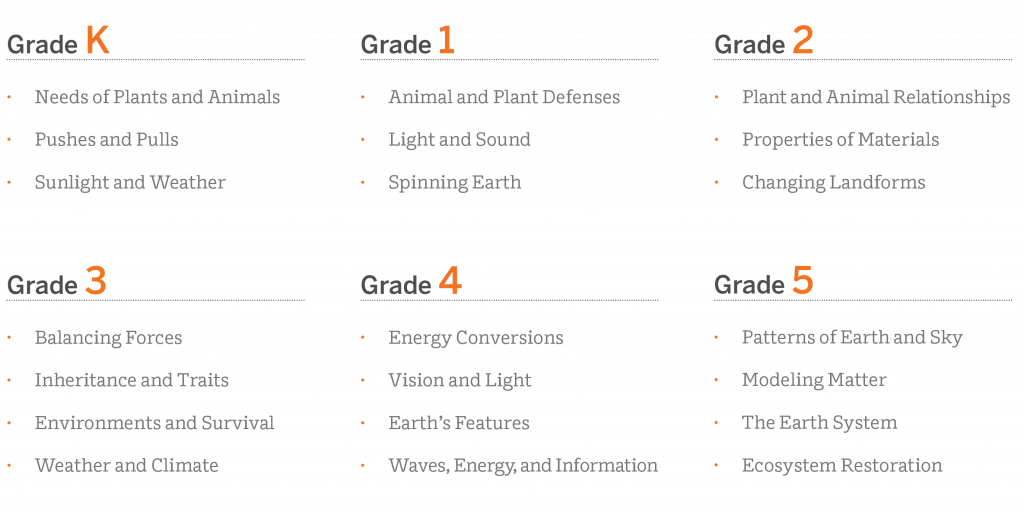
      Any work you complete in this student preview (or elsewhere in the teacher experience) will be automatically saved to your account.

      Looking for help?

      For login or technology issues, please submit an EGUSD Heat ticket. For curriculum and pedagogical questions, please refer to the support resources below.

      Powerful (and free!) pedagogical support

      Amplify provides a unique kind of support you won’t find from other publishers. We’ve developed an educational support team of former teachers and administrators who provide pedagogical support for every Amplify curriculum, assessment, and intervention program. This service is completely free for all educators who are using our programs and includes:

      • Guidance for developing lesson plans and intervention plans.
      • Information on where to locate standards and other planning materials.
      • Recommendations and tips for day-to-day teaching with Amplify programs.
      • Support with administering and interpreting assessment data and more.

      To reach our pedagogical team, use our live chat within your program, call (800) 823-1969, or email edsupport@amplify.com

      Timely technical and program support

      Our technical and program support is included and available from 4 a.m. to 4 p.m. PT, Monday through Friday, through a variety of channels, including a live chat program that enables teachers to get immediate help in the middle of the school day.

      For your most urgent questions:

      • Use our live chat within your program.
      • Call our toll-free number: (800) 823-1969.

      For less urgent questions:

      Connect with other teachers

      Our Amplify Science Facebook group is a community of Amplify Science educators from across the country. It’s a space to share best practices, ideas, and support on everything from implementation to instruction. Join today.

      Administrators, welcome to Amplify Science!

      Here you’ll find information about enrollment and licensing, technical requirements, professional learning resources, and more.

      Onboarding: What to expect

      Welcome to Amplify Science! There are six basic steps to onboarding. Use this visual as a reference, but also know that our dedicated implementation team will be there to support you during the entire process.

      Technology requirements and guidelines

      To ensure that your hardware and network meet the minimum technical requirements for performance and support of your curriculum products, please see Amplify’s customer requirements page.

      You’ll also want to add the URLs on this page to the corresponding district- or school-level filters so that your teachers and students can access their Amplify Science materials.

      Data sharing agreement

      Partnering with Amplify through our data sharing program deepens learning outcomes and gives you the performance analysis you need to make impactful decisions within your district or school. By signing our data sharing agreement, your district will help us to better understand student performance as it relates to your state’s standards. It also allows us to compare results with the curriculum-embedded assessments and state-level assessments. These analyses will help you identify the areas where your teachers and students are excelling or may be experiencing challenges.

      Stay tuned for additional updates.

      Enrollment and licensing overview

      During the enrollment and licensing call, your Amplify implementation partner will walk you through the enrollment process. We recommend exploring the enrollment web tool ahead of the call for suggestions on which enrollment method may be best for your district.

      The following guides provide additional information about enrollment methods and the data sharing process.

      Preparing for your materials

      Each unit of Amplify Science comes with a hands-on materials kit.

      Each hands-on materials kit arrives in 1–3 boxes and contains the following:

      • Consumable materials
      • Nonconsumable materials
      • Classroom wall materials
      • Premium print materials (cards, maps, etc.)
      • 18 copies of each Student Book (K–5)
      • A blackline master copy of the Student Investigation Notebook (K–5)

      You can find complete materials lists for each unit in the following PDFs. This information is also available in the digital Teacher’s Guide within the program.

      Once your district’s purchase order has been sent to Amplify and is processed, Amplify will provide tracking information on your materials kits and any additional print materials you’ve ordered.

      Administrator Reports

      Self-service Administrator Reports allow insight into teacher and student usage and student performance data for the current school year.

      Access is limited to district and school administrators. Administrators can directly access these reports at my.amplify.com/admin-reports.

      Get more information.

      Announcements

      Summer extension
      With summer fast approaching, we recognize that some districts may be extending the school year and/or continuing the use of Amplify curriculum and programs for summer instruction. If your summer instruction will continue past June 30 and/or you need to make rostering or enrollment changes, follow our guidance on extending your rollover date.

      Use stimulus funding to drive transformation
      Learn about ESSER I, II, and III funding (or CARES, CRRSA, and ARP) and how to use these funds to help with learning recovery and acceleration. Districts have significant flexibility in how to use the ESSER money, with ESSER II and III specifying that some of the funds should be used to address unfinished learning. All Amplify programs and services meet the criteria for the funding. Get more information about funding and guidelines.

      Next steps: How do I support my teachers?

      Pre-launch checklist for teachers
      Please share our Program Hub with your educators. It will provide helpful information as they prepare to implement Amplify in their classrooms, including a pre-launch checklist. Note that they’ll need to be logged into Amplify Science to access the Hub. If they don’t have a login yet, you can also download and share the  Amplify Science pre-launch checklist for teachers PDF.

      Professional learning
      We partner with every district to make sure the Amplify Science rollout meets their unique needs. Check out these sample agendas to get a better understanding of what our team has to offer.

      Advice and answers
      The Science help website is filled with step-by-step resources to address educators’ questions. Encourage your educators to read through these tutorials and search for topics they want to learn more about.

      Contact us

      Powerful (and free!) pedagogical support
      Amplify provides a unique kind of support you won’t find from other publishers. We’ve developed an educational support team of former teachers and administrators who provide pedagogical support at no cost to educators using our programs. This free service includes:

      • Information on where to locate standards and other planning materials.
      • Recommendations and tips for day-to-day teaching with Amplify Science.
      • Support with administering and interpreting assessment data and more.

      To reach our pedagogical team, click the orange icon while logged into the curriculum to get immediate help, call (866) 629-2446, or email edsupport@amplify.com.

      Timely technical and program support
      Our Customer Care and Support team is available Monday through Friday, 7 a.m. to 9 p.m. ET, and Sunday, 10 a.m. to 6 p.m. ET, through a variety of channels:

      • Live chat: Click the orange icon while logged into the curriculum to get immediate help in the middle of the school day.
      • Phone: Call our toll-free number: (800) 823-1969.
      • Email: Send an email to help@amplify.com.

      Join our community
      Our Amplify Science Facebook group is a community of Amplify Science educators from across the country. It’s a space to share best practices, ideas, and support on everything from implementation to instruction. Join today.