Join our Amplify learning community!

Looking to connect with fellow educators, share insights, and help shape the future of Amplify programs?

Our Facebook groups encourage educators to collaborate, ask questions, and exchange experiences. Join one of these groups for valuable teacher-to-teacher conversations!

You can also follow Amplify on FacebookXLinkedIn, and Instagram.

Two women stand in a classroom, smiling as they look at a laptop together—sharing teaching tips and supporting each other in the education community.
Screenshot of a Facebook group page titled "Science of Reading: The Community," where innovative educators and children are engaged at a table, highlighting group information and the spirit of a vibrant learning community.

Science of Reading: The Community

Join a vibrant community of educators passionate about early literacy! In Science of Reading: The Community, you’ll find discussions on the latest research, best practices, and classroom strategies for implementing the Science of Reading. Want even more expert insights? Subscribe to Science of Reading: The Podcast for conversations with top researchers and practitioners.

Amplify Classroom Educators Facebook group

Join a dynamic community of educators who are passionate about leveraging Amplify Classroom’s interactive tools and activities. In this group, members exchange ideas, share activities, discuss best practices, and explore innovative ways to deepen student understanding. Whether you’re looking for inspiration or collaboration, you’ll find it here!

A Facebook group page titled "Amplify Classroom Educators" is displayed on a computer screen, showing join and share buttons—a dynamic learning community for innovative educators to connect teacher to teacher.
Screenshot of a Facebook group page titled "Amplify Desmos Math," highlighting its cover image, name, and a visible "Join group" button—perfect for teacher to teacher sharing in an active education community.

Amplify Desmos Math Facebook group

This group is the go-to space for teachers, coaches, and educators using Amplify Desmos Math, mCLASS Math, and Boost Math. Connect with peers, ask questions, get answers, provide feedback, and stay informed on important updates.

Amplify CKLA Facebook group

Looking to enhance your reading instruction? Our Amplify CKLA Facebook group is a space where educators discuss strategies for teaching reading, writing, speaking, listening, and vocabulary. Ask questions, share insights, and connect with colleagues who are using Amplify CKLA to support literacy success.

A Facebook group page titled "Amplify Core Knowledge Language Arts," featuring an astronaut and moon beside the Amplify CKLA logo—an education community where innovative educators connect teacher to teacher.
Screenshot of the Amplify ELA Facebook group page for grades 6–8, highlighting the group name, member count, and a colorful banner—an active learning community where educators share teaching tips and support one another.

Amplify ELA Facebook group

Teaching middle school ELA comes with unique challenges and opportunities—let’s navigate them together! In the Amplify ELA Facebook group, educators swap teaching ideas, classroom successes, and concrete strategies for using Amplify ELA effectively. Join the group to gain insights from fellow teachers and share what’s working in your classroom!

Boost Reading & mCLASS Facebook group

This group is a collaborative space for educators and caregivers using Boost Reading and mCLASS®. Whether you have questions, need support, or want to share success stories, this is the place to connect. Join us to exchange ideas, get helpful tips, and learn how to create the best reading experience for your students.

Screenshot of a Facebook group page titled "Boost Reading & mCLASS," featuring a colorful illustrated bird with "aw" and "er" sound cards. Innovative educators can join this vibrant learning community for valuable teaching tips.
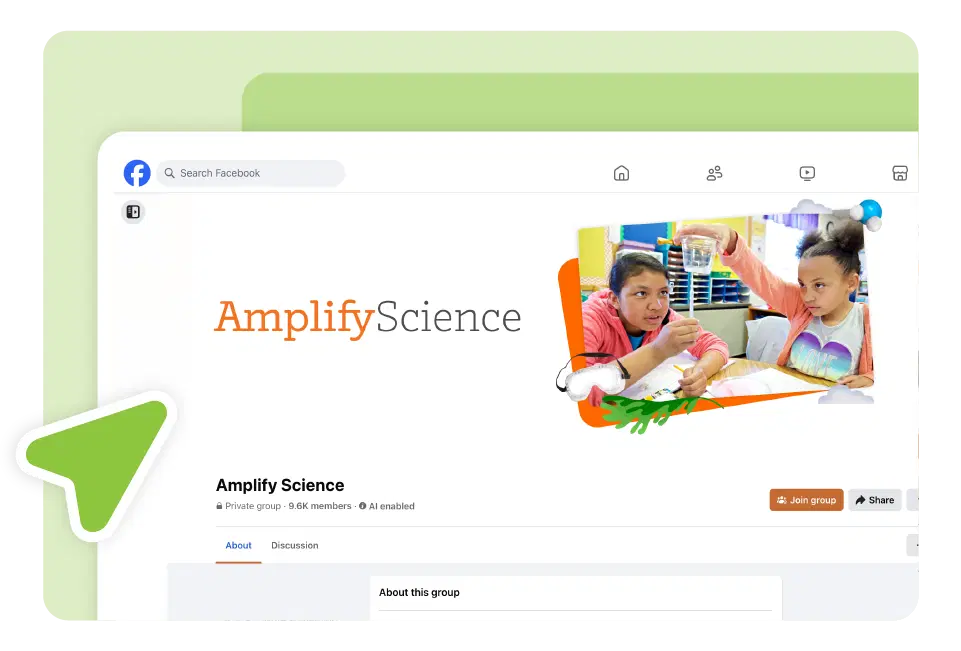
Screenshot of a Facebook group page titled "Amplify Science," featuring a cover photo of two children conducting a science experiment in class—a hub for sharing teaching tips and building an education community.

Amplify Science Facebook group

Engage with fellow science educators in the Amplify Science Facebook group! Discuss best practices for implementing Amplify Science, explore ideas on how to teach in three dimensions, and share strategies for meeting NGSS standards. Educators also post classroom success stories, providing inspiration and real-world applications of the curriculum.

If you’re an Amplify Science instructional leader, the Lawerence Hall of Science encourages you to learn more and apply to join the exclusive, no-cost Instructional Leaders Community of Practice (ILCP).

Connect with us—and educators everywhere.

Our social media channels deliver a steady stream of news, insights, and conversations that support educators in connecting with each other and creating great learning experiences for students. Find Amplify on Facebook, X, LinkedIn, and Instagram!

Blue lowercase "f" logo representing the Facebook social media platform on a white background, connecting innovative educators and fostering a vibrant education community. LinkedIn logo featuring a white "in" within a blue square, representing a global learning community for professionals. Instagram logo featuring a white camera outline inside a rounded square with a gradient background of pink, purple, and orange hues—a vibrant symbol connecting innovative educators and the education community.
A laptop and a smartphone display an orange screen with the word "Amplify." written in white text, symbolizing a vibrant learning community for innovative educators.

Contact sales

Ready to learn more? Fill out this form and we’ll be in touch with you shortly.

S2-04: Gamification in the K–8 classroom

Podcast episode graphic featuring guest Fabian Hofmann, titled "Gamification in the K–8 classroom," from Science Connections Season 2, Episode 4, with an illustration of a planet.

In this episode, Eric Cross sits down with his colleague and friend Fabian Hofmann to talk through gamification in the K–8 classroom. They discuss Fabian’s experience teaching outside of the United States, and the differences in classrooms outside of the country. Fabian explains the integration of game mechanisms in the classroom, standard-based grading, and shifting student thinking about learning by forming strong relationships. Fabian also shares how he created a new STEM course at his school revolving around his own passion for Star Wars. Explore more from Science Connections by visiting our main page.

DOWNLOAD TRANSCRIPT >

Fabian Hofmann (00:00):

In Mr. Hofmann’s class, I get to earn points and I get to be a Jedi. I can suspend my disbelief and I’m learning history, but at the same time, I’m traveling through the galaxy.

Eric Cross (00:13):

Welcome to Science Connections. I’m your host, Eric Cross. My guest today is Fabian Hofmann. Fabian is a middle school IB educator, currently teaching seventh grade multimedia design and history at Albert Einstein Academy’s middle school here in San Diego, California. He also hosts the podcast Rebel Teacher Alliance, a podcast dedicated to encouraging and supporting teachers to rethink student engagement. Fabian’s one of the most innovative teachers that I’ve ever met. His use of technology and gamification makes learning fun and accessible for our students. And I have firsthand experience with these students because we teach on the same team and have worked alongside each other during my entire career as a teacher. In this episode, we discuss gamification of the classroom, how he approaches grading from an innovator’s mindset, and his newest STEM class, Immersive Design, where his students are working with former Disney Imagineers to completely renovate their classroom into an interactive Star Wars-themed learning environment. And now, please enjoy my conversation with my good friend and colleague, Fabian Hofmann. We’ve worked together for how many years now? How many years have you been at Einstein?

Fabian Hofmann (01:23):

Well, I started when you started, like after you were student teaching, so 2014.

Eric Cross (01:28):

OK, so it’s been a while.

Fabian Hofmann (01:30):

Yeah. And then I took two years off and I went to Hawaii. I couldn’t handle the pressure. And then I came back. So we’ve worked together for six years but known each other for eight.

Eric Cross (01:39):

What’s your origin story? We’re gonna talk about your origin story. I told you.

Fabian Hofmann (01:42):

All right, cool. Right. So when I was a little boy…no. <Laugh>

Eric Cross (01:46):

This podcast is not that long!

Fabian Hofmann (01:49):

So no, I started out, teaching in 2009. I started student teaching in Germany and was teaching history and English. Did this two-year student-teaching program there. And then, when I was done, my wife and I, she’s American, we got married and we decided to move to the States. And then I started teaching at a German cultural center called the Goethe-Institut in San Francisco. We lived in the Bay Area. And from there, after a year we moved down to San Diego; I started subbing; I worked for a year at High Tech High. I taught humanities there. And then, after that year, I ended up at Einstein teaching German because that was what was available. I didn’t want to teach German. That wasn’t like, on the top of my list. But it made sense because I had taught German in San Francisco and it kind of was like, “Well, I can do that, I guess.” And then, yeah, and then I went back to—we went to Hawaii for a couple of years and then I came back here to start teaching history. So I’ve taught like a million things essentially.

Eric Cross (02:52):

And then during that time, what’s your evolution been like in the classroom? Kind of like your view of education? And how does that play out in your day-to-day with kids?

Fabian Hofmann (02:59):

So when I started teaching here in the States, I noticed that it’s very different. Technology was much further along here than it was in Germany. So when I got here and we had like an iPad cart; I helped setting up the iPad carts. And I worked with the Chromebooks and I was like, holy, holy crap, this is so cool. Like, kids can like actually do things with this technology. And then, I mean, I love technology. I’ve had an iPad when it came out and stuff like that. And so I was like, “Oh, so how about we use this in our classroom?” And so I always moved—I moved very quickly to having students create on the iPad. And at first it was like, “Oh, we use the Apple apps and stuff.” And then I went to an ed-tech teacher summit here in San Diego and my eyes were like opened to, “Oh my God, there’s so much more than just the Apple apps.” And ever since then I was like, “OK, we’re gonna use this; we’re gonna do that.” It’s just crazy stuff that I thought was cool and that students really seemed to enjoy, because it wasn’t like a typical language class; it was more like, “Well, what can we do to create, and how can we somehow still use the language but we are learning coding at the same time, or we are creating something in 3D at the same time?” Like, I was always trying to make it have two angles: the language angle, obviously, and then also the technology angle.

Eric Cross (04:25):

What was it that kept you kind of pushing? ‘Cause I remember the beginning in the Classcraft days to where you are now, I feel like you’re like light-years ahead of where you started.

Fabian Hofmann (04:37):

So you were actually the one who showed me Classcraft, which is like a gamification portal, kind of off-the-shelf thing that you can subscribe to. It has some free features and it’s like a gamification platform where students can create characters. And then these characters go on adventures. That’s like their avatar, and they get experience points in the classroom game and stuff happens. You can create, like, adventure paths for them. So if you have an assignment that you want students to do that has different steps, so, that could be an adventure path. That’s what I liked about Classcraft, is like this idea of like, “OK, we’re taking a game and applying it.” But it wasn’t enough for me. And so I started developing my own classroom game. I did some reading. I met online with John Meehan, worked with him. I read the book by Michael Matera, Explore Like a Pirate. And so it just broadened my whole world to, or just opened the world of gamification to me.

Eric Cross (05:38):

You present on gamification; you mentor other teachers on gamification. You host a podcast where you talk about it. But for those people who haven’t done it or gotten into it or maybe have a perception of it maybe that’s not quite accurate, can you talk a little bit about like what gamification is and what it’s not?

Fabian Hofmann (05:54):

  1. So the biggest difference…we all know game-based learning, because we all do it. We use Quizlet; we use quizzes; we use Gimkit, Blookit, Jeopardy, anything like that. Those are game based. That’s game-based learning. So using a game to facilitate learning. Which is great. I love game-based learning too. But the difference is with gamification, in the pure definition of gamification, is that you’re using game mechanics and elements and apply them to a non-game setting. A couple of smart educators were like, “Why don’t we just do that in our classroom?” And so we borrow these elements, these mechanics, these game mechanics, like getting experience points, and applying them to the classroom. So anything that students do, they earn points. So they turn in an assignment, that gets you a hundred points. They go and do something extra for the class, they get 50 points. Whatever it is, whatever your value is. That’s one aspect, like a leaderboard, virtual money, stuff like that that just in reality is not necessary, but you’re putting it somewhere where it doesn’t exist. And all of a sudden students have this weird shift in their view where it’s like, “Well, school is school, but in Mr. Hofmann’s class, I get to earn points and I get to be a Jedi and I can suspend my disbelief and I’m learning history, but at the same time I’m like traveling through the galaxy.” And it’s just amazing how that shift happens just because we’re changing the language a little bit.

Eric Cross (07:29):

Yeah. You seem to have like tapped into something that is already kind of in that zeitgeist culture thing. We’re gaming and it appeals to—I know it appeals to our students regardless of how they feel about even the subject that’s being taught, the fact that they’re immersed into this environment where they’re taking on this character role and they’re part of this bigger narrative. And you’ve so dynamically constructed this whole storyline and these experiences, and they’re learning experiences, like, they’re learning, but they’re enjoying it in a different way. But I wanted to ask you about something that I really admire that you do, and it’s how you grade. And I remember the first time you said this, we were in a parent-teacher conference and we’re all talking on Zoom with these parents and we’re all sharing our spiel. And you go, I don’t grade kids. They grade themselves. Can you talk a little bit about your conferencing with students? The rubric you use like that that, I’ve really been paying close attention to lately.

Fabian Hofmann (08:24):

Yeah. So, when I was working in Hawaii, I noticed I was teaching English, and grading papers in English is really not fun. Like, that is like my least favorite thing. Some teachers are like, “Yeah, it’s grading! Awesome! I can read stuff!” For me, it’s like, yes, I like to read stuff, but I—and it was the same in German class. I gave them feedback. Sometimes I would use oral feedback, I would, like, record stuff for them, and they would listen to it, and then they would work on it. And so I noticed when I’m giving them feedback and its oral feedback, they’re more inclined to actually work on the stuff that I was critiquing, versus when I sat down and I wrote something. They would never read it. Or some would, and most of them would not. And so I was like, this sucks. <Laughs> And I encountered this book called Hacking Assessment, because it’s such a waste of time, right? You spend so much time, because you wanna do the due diligence. And for those few kids who actually do care, that benefits them. But I want this to benefit everybody. And so I read this book called Hacking Assessment, by Starr Sackstein. And she talks about how she put the onus of grading into the student hands, essentially. And so she did standard-based grading and essentially said, “You know what? Here’s the thing. I am not going to grade you anymore. You are going to get a rubric that we are going to dissect and explain and make sure that you understand. And then you sit down and you give yourself a grade based on this rubric.” And I was like, “Wow, what? That is….I can do that? And the cool thing about this book is that she covers all the roadblocks that we as teachers have. And she explains, like, she gives examples on what we can do to convince parents, to convince admin, to convince the community, convince other teachers why what we’re doing is much, much better for a student than the previous system is. If you think about it, when a student comes into school, they start at a hundred, they start the year at a hundred, and all they’re doing is just lose points. And they’re just trying to keep up. Right? And it kind of flips this on its head, because not only with the gamification, I’m changing the name of the game, literally, but I’m also now with ungrading, I’m giving them the responsibility and the accountability to really look at their stuff and really be critical about how they’re doing. And I taught like normal in my first year in Hawaii when I was teaching English, by me grading everything and turning it and giving it to them. And I used peer grade and I did all that kind of stuff. But in the end, I was always the one responsible for the grade. But then I started to do the ungrading move and I just started to conference with kids and started giving them feedback, with the help of gamification, because there’s like a bunch of rubrics you can use to make it more fun. But all of a sudden, kids that in the year before would’ve failed my class in English, because they were English learners; they were just not into it; they didn’t care as much…all of a sudden that flipped completely. I did the exact same content again. We had to write an essay and all of a sudden, the essays were all like, up there, because we sat down, we talked about it, we went through this review process, gave them feedback. In the end, they could say, “Hey, I want this grade. And then I still have the last say. I would say, say, “Yep, sounds good.” Or “If you wanna get an A on this, or whatever it was, a 4, then here are the things you still need to do.” And because I did that, all of a sudden, the students are like, “Oh, that’s all I need to do?” And then they did it and turned it in, and all of a sudden, they got a 4. It’s, it’s amazing how that the conferencing with students, how that shifted their attitude. And I got to know my students way better than I ever had.

Eric Cross (12:20):

Yeah. That’s, that’s one of the things that I’ve noticed. And I watch you get so much more facetime with students having conferences than I do. I find myself grading…and, you know, at our school, it’s mastery-based instruction, so students can retake assessments, but you’re absolutely right: I give a grade; they get a score; and some of ’em score lower, but in their minds it’s like, OK, I’m done with that. And even though they can retake it, such a small percentage actually do. But the information that I give them in the feedback is often not read. But you’re sitting down and having a conversation and really listening and there’s so much more of a connection that you have. I just think it’s so rich. But the question I have now is how do you make the time for those conversations with those kids in your class?

Fabian Hofmann (13:01):

Yeah, it’s definitely a learning curve. Like the first year I did it, it was horrible. Like <laugh>, it cost so much time. Because kids came, because when it was time to grading, because I had not figured it out yet, I had not streamlined it. And I’m still learning. I’m still trying to figure this out and do it even better. But the idea is that you do something, you check in with me really quick. That doesn’t have to be like a full-on conference. It’s—I walk around or I call them up and say, “Hey, I saw you working on this. How did, how are you doing there? How many—” Like, let’s say I use a rubric that gives them crystals for different parts. They write the introduction; they write a bibliography; whatever, so I can bring them up and say, “Hey, how is the bibliography looking?” And they’re like, “Oh yeah, I’m missing…like, I only have like one or two sources.” And then we say, “OK, so right now you would get two crystals out of three because you have something. When you come back, you get all the crystals.” And so that’s a gamified aspect again, right? They’re coming back to get more crystals, not because they wanna do better necessarily. But because they’re like, “Hey, I wanna get those crystals because it gives me points in the game.” They are very good about like grading themselves and kind of like, they’re really hard on themselves sometimes too. And I have students who are like—

Eric Cross (14:08):

Yeah, they are.

Fabian Hofmann (14:09):

“Well, how can you make sure that people don’t just give themselves an eight?” And I’m like, “Because there’s a system in place that that does not happen. Like, there is a rubric, and if they cannot back up what they want, then it’s not gonna happen. They can write an eight all day long. I’m still the person entering it into the grade book!” <Laugh>

Eric Cross (14:27):

And let me premise this for listeners who don’t teach at IB schools, which is probably like most people.

Fabian Hofmann (14:31):

Yeah.

Eric Cross (14:32):

So IB, we teach zero through eight on a rubric system. And seven-eight is kind of like the A, kind of, quote-unquote. I know IB people are probably cringing when I say that, but <laugh>, you know, when you transfer it to like a high school? Seven, eight would be the highest score, you know. Four, five, six. So when we say eight, we’re talking about the highest score.

Fabian Hofmann (14:49):

Yeah. And so it’s really interesting because I can call them out on stuff, and it’s a one-on-one conversation, right? And if, especially if they turn something in that is not great, and they give themselves like a—I don’t know, like a C, let’s say, or a four, or whatever it is—and they’re like, “And you’re happy with that?” And then they’re standing there and they’re like, like, “No…?” <Laugh> And all of a sudden there’s a conversation. Where it’s like, and then I can be very intentionally like, “Hey man, I know you can do better. I would not—I’m not gonna accept this. I’m gonna push you to turn this in again.” And most of them actually sit down and do more. It’s a process. It takes a while. It’s not pretty in the beginning. But the payout is, so it’s incredible. Just like the amount of time that I get to spend with students, like specifically talking to them about things that they still need to work on, celebrating stuff they do, it’s incredible. Like the relationships are just so different than what I had years ago.

Eric Cross (15:50):

And you’ve also created a system where we preach—and schools always talk about this Dweck growth mindset and not having a fixed mindset, but I wonder how many opportunities or how systems are set up that are actually fixed, where it’s like one and done, OK, you did this exam and then that’s it, but there’s no opportunities to grow until the next exam! Which is gonna be….or whatever the assessment is, which is a whole different area of content or different topic or whatever. But here, you’re actually able to facilitate this growth mindset and push back if a student says, like, “Well that’s—I just got a four,” and you can actually pour into them and talk to them. And do you ever hear more about a student’s story as to why they were where they’re at, as you’re having these conferences?

Fabian Hofmann (16:29):

Oh, absolutely. Like for some kids who, who are just like not getting the work done or whatever, there’s always something where it’s not because they’re not smart or because they’re lazy. It’s like, sometimes, literally they tell you, well, ’cause I ask them, “Hey, can you work on this at home?” Or “Can you come in during lunch, after school, whatever? I’m always here.” And then they drop some bombs on you, like, “Hey, my parents, like, divorced. My mom lives in Mexico.” ‘Cause we live in San Diego. So some students live in Mexico and come to school here in San Diego and they get stuck at the border or, even though they have internet at home, they have to share. It’s like kind of what we experienced during the pandemic, where it’s like, there’s like three kids at home and one computer. Stuff like that. Right? And it’s these stories where you’re like, first of all, it’s very humbling ’cause they’re going through stuff that I never had to go through. I mean, my childhood was not amazing, but compared to what they’re going through, it’s like, “Oh yeah, that exists.” And it kind of like puts you in your place a little bit. It’s also because of the system that I use. There’s no late, really, in my class. Some of the students are like, “I need to subtract points from my grade because I turned it in late.” And I’m like, “No, no, no, no, no. The fact that you’re doing it is quote-unquote punishment enough ’cause you have to do it outside of class, you have to do it at home; you have to do it during lunch. Like, that is, that is not comfortable. You’re still doing it. So why would I punish you by taking a grade away? That doesn’t make sense. You got the work done. That’s all that matters.” I try to be that person that like is understanding. It’s still pushing them to do their best and reminding them and harping on them. And with the spark that I threw in there and fanning that flame of them becoming a better student because I’m supporting them. You’re supporting them. We’re all—our seventh-grade team is incredibly supportive. And then some people might push back, like “That’s not preparing them for the real world.” This is the real world.

Eric Cross (18:20):

There’s a lot of life skills that they’re gonna need…but like, they’re 12 right now! Or 11 or six, you know, whatever it is! Let’s—we can hold off on taxes and the crushing weight of adult reality later on. You got it done! Well-done! I do wanna talk about this thing that is your baby lately, this embryonic thing that you’ve been growing and I’ve been fortunate to be able to watch it since its inception. But you have this class that you created from scratch that’s essentially a STEM class. Two questions: Why did you create the class? And you’ve done some uncommon things. I’m gonna leave it wide open just for you to talk about it because it’s your baby and I’ve been fortunate to be able to watch it from the start. So can you talk about that?

Fabian Hofmann (19:01):

So yeah, so I’m obsessed with Star Wars. I think that’s putting it mildly. I love Star Wars. Always have. My classroom game is called Jedi Academy. And I’ve been playing around with this idea of creating a room that is more immersive. So I put a space, like a window to space, on my wall. I have the Millennium Falcon in my room. I have like a bunch of Resistance stuff or whatever. Anything Star Wars, you can find in my classroom. It’s not like overloaded, but I was very intentional in the things that I put in there, because I want my students to come in and feel like they are playing the game. And one of those things that I used was like smells; I used sounds to try to immerse them more. And then so one day I was like, wouldn’t it be cool to create a classroom that looks literally like a Star Wars set? Like you walked onto a set. Onto a spaceship, onto a rebel base, onto whatever it is. And how can I, how can I make that happen? And then we talked about it and you were like, “Yeah, how about you let the kids do it?” And that’s kind of how the course was born. And now I have students in my classroom who are in the process of designing a classroom based on Star Wars. And they’re gonna build everything. And we’re all learning at the same time. I’ve never done anything like this. I do like STEM, but I’ve never like actually made it a class. And so I contacted a bunch of people on LinkedIn ’cause I was like, it would be cool to talk to an Imagineer and to get like my foot in the door at Disney and then have an Imagineer come in and tell us about what they did. I have this book called The Art of Galaxy’s Edge, which is like the Star Wars land in Disneyland. And I just looked at the list and was like, “Who could be a good person to contact here?” And it said one of them was Eric Baker, and it said, “Executive Creative Director.” And I googled him or I looked for him on LinkedIn and I found him and I was like, “I’m just gonna send him a message. I’m just gonna tell him what I do in my class in history, gamification and all that, and they’re Jedi, and blah, blah, blah.” And he wrote back! Like, he was the only person that wrote back. I wrote a bunch of people and he was like, “Yeah, I’d be super-interested. I don’t know what you want me to do, but I’m down.” And so it created this relationship between me and Eric Baker who used to work for Imagineering, who are like the people at Disney who create the rides in the park and all that. And I talked to him and he gave me some feedback on the room. And then he was like, “Oh, so if you ever want me to talk to students, I’m down.” I was like, “Uh, yes!” And so we had him Zoom in. He talked about his life and how he became one of the people to look for when it comes to theme park design and to create immersive experiences. And I contacted other people on YouTube, like somebody who is like a Star Wars room builder. He’s willing to chat with us about this project. And then, I discovered that there is this thing called Imagination Campus at Disneyland, which they offer workshops on immersive storytelling. And I was like, “Oh, that’s what I want! I want my students to tell a story with my room!” And so I wrote up a proposal. Took a long time, but they signed—our admin signed it off. We kind of financed it. And then, about two weeks ago, you came along, another teacher, and we took 30something students to Disneyland and they did this workshop where they learned all about like how the Imagineers design story elements and put them in the parks. And then we took all of the kids to Galaxy’s Edge. And we took a bunch of photos. We went on the rides together. We had this collective experience. And it was life-changing for a lot of students. Because, I mean, we’re a Title One school; there’s like, we have about 60% free or reduced lunch. And a lot of them had never been to Disneyland. About half of them had never been. Some of them went when they were little. And so just watching their faces, going to Disneyland, watching them walk into Galaxy’s Edge, experiencing all these things, it was just, my mind was just blown. And I like literally, I don’t know if you noticed, but I was just smiling. Literally.

Eric Cross (23:19):

You were loving it.

Fabian Hofmann (23:20):

Yeah. Then we come back and we have these amazing conversations about design and what they noticed and how they created this immersive experience in their world. And we talk about how we can bring this back to our classroom. And parents are sending emails saying, “Oh my God, we’re so happy that you did this for our kids and you’re the coolest teacher.”

Eric Cross (23:39):

You touched on something that I wanted to ask you about. So you stay connected to people that inspire you, I feel like, or you have a pretty broad network of educators and professionals. Like, how much does that play into what you do in the classroom and the ideas that you have, as your network or your community of people?

Fabian Hofmann (23:57):

So the one network that helped me the most is Twitter. And I know people have opinions about Twitter, for good reason. But when I started to gamify, I just started to follow specific hashtags for areas that interested me. And that was gamification; eXPdup, which is like Explore like a Pirate—it’s an acronym. And it just opened up all these people, all these people, all these educators who are out there just like doing cool stuff and sharing it on Twitter. And I started connecting with them. And one of them is on my podcast. We met through Twitter; we started sharing stuff. We started talking about the things that we do. We both happened to have a gamified classroom. And so we connected over this thing Twitter, and now we’re like friends and we’re presenting together at Q and all those places. Teacher Twitter is incredibly supportive and people want to show you the stuff that they work on, just like I do. Like when I have stuff that I worked out, I shared it on there. And it’s so fun to hear back from teachers saying, “Hey, this looks awesome.” It’s just, it makes you feel good and it makes you feel like, “Oh, what I’m doing is not a total waste of time.” <Laugh>

Eric Cross (25:10):

<laugh> Those thoughts do creep in, right? Like, even though you’re doing something awesome and you might think so, we become our own worst critic sometimes, or we always see the things that we can improve and we overlook the things that we’re doing well. Fabian, where can people hear more about you, about gamification, about what you’re doing in the classroom, about how you’re innovating? I know you talk about this stuff with some—and you talk about it with some pretty legit people in the education industry. So can you tell some folks where they can hear more about it?

Fabian Hofmann (25:37):

So you can find me on Twitter at Hofmann edu—one F, two Ns—edu, and then I also host a podcast called Rebel Teacher Alliance. There’s three of us, where we talk all things gamification. But we also talk to teachers who don’t gamify at all. And we just, we just invite people who are interesting, who have stuff to share, who do cool stuff. You can find the podcast on the internet at Rebel Teacher Alliance dot com. Follow us there. If you wanna be a guest, just send a message and we’ll get you on.

Eric Cross (26:10):

Fabian, I’m gonna gush on you right now, but when you came back to Einstein, I was so happy because I knew that you sharpened me; you make me a better science teacher. Your innovation, your passion for kids, your sense of humor, your outside-the-box thinking, all of that. And when you got onto the seventh-grade team and you were here, I just knew that it was going to be awesome. And it has been. And so as a teaching colleague, as a friend, dude, you just rock, man. I’m super proud of you. And thank you for making me better.

Fabian Hofmann (26:40):

Aw, now I’m starting to cry. It’s like, don’t…

Eric Cross (26:43):

<laugh>. All true, dude. All true, my brother.

Fabian Hofmann (26:46):

Thank you.

Eric Cross (26:46):

All true. And thank you for letting me be part of the journey and I will definitely be walking down the hall asking you questions as I try to implement some of these great ideas that you’re doing with kids. Thanks so much for listening. And now we wanna hear more about you. Do you know any inspiring educators? Nominate them as a future guest on Science Connections by emailing STEM at amplifycom.wpengine.com. That’s S T E M at amplifycom.wpengine.com. Make sure to click subscribe wherever you listen to podcasts and join our Facebook group, Science Connections: The Community. Until next time.

Stay connected!

Join our community and get new episodes every other Wednesday!

We’ll also share new and exciting free resources for your classroom every month!

What Fabian Hofmann says about science

“I want my students to come in and feel like they are playing the game. I used smells. I used sounds to try to immerse them more. And then so one day I was like, wouldn’t it be cool to create a classroom that looks literally like a set?”

– Fabian Hofmann

Middle School Educator, Albert Einstein Academies Middle School

Meet the guest

Fabian Hofmann is a middle school International Baccalaureate teacher and host of the Podcast, Rebel Teacher Alliance. He is currently teaching 7th grade History and Multimedia Design just down the hall from Eric Cross at Albert Einstein Academies Middle School in San Diego. To engage students, he uses technology and gamification. Students embark on a year-long journey through a galaxy far, far away to learn the ways of the “Force” and some world history along the way. Follow him on Twitter and check out the Rebel Teacher Alliance podcast.

A man with short gray hair and a beard is smiling at the camera, photographed against a neutral background inside a circular frame with a small yellow sparkle accent, evoking the playful spirit of gamification.

About Science Connections

Welcome to Science Connections! Science is changing before our eyes, now more than ever. So…how do we help kids figure that out? We will bring on educators, scientists, and more to discuss the importance of high-quality science instruction. In this episode, hear from our host Eric Cross about his work engaging students as a K-8 science teacher.

S1-01: The journey from student to SpaceX engineer: Juan Vivas

Illustration of Earth with text about a podcast episode featuring Juan Vivas, discussing the journey from student to SpaceX engineer. Includes a photo of a smiling person in a suit.

In this episode, we join Eric Cross as he talks to supply chain engineer Juan Vivas of SpaceX about his experiences growing up as a Latino in STEM. Juan shares his story of moving to the United States to study engineering and becoming successful in his career as a scientist. Juan openly discusses the experiences that made a difference in his life and the teachers that inspired him along the way. He also shares his experience as an engineer in different fields, as well as what it’s like to work in the supply chain during COVID.

Explore more from Science Connections by visiting our main page.

Download Transcript

Juan Vivas (00:00):

But to me, based on my experience so far, I think the best way to put it: An engineer is a technical problem-solver.

Eric Cross (00:28):

Welcome to Science Connections. I’m your host, Eric Cross. My guest today is Juan Vivas. Juan is a supply chain engineer for SpaceX. His career in STEM has pivoted from chemical engineering to working on foods like Cinnamon Toast Crunch to his current role at SpaceX, where he’s responsible for his work on Starlink, a technology that uses low-orbit satellites to provide internet access across the world. In this episode, Juan shares his story of how he became an engineer and how a thoughtful teacher used robotics to inspire him. I hope you enjoy this great conversation with Juan Vivas. Juan, thanks for being here.

Juan Vivas (01:14):

Yeah, yeah, of course! Super-excited to be here.

Eric Cross (01:19):

Hey, and starting off, I kind of like to ask your origin story. We were talking earlier about Marvel, and your journey of one working for…what I consider the closest thing that we have to SHIELD in the Marvel stories is SpaceX. Like with my own students, we talk about SpaceX like it’s a fictional thing, and we watch the rocket launches together and we watch the recovery and it’s so cool.

Juan Vivas (01:45):

Yeah.

Eric Cross (01:46):

And so when I knew that we were gonna be able to talk to you, I was excited. Like, I felt like I was a kid.

Juan Vivas (01:51):

<Laugh>

Eric Cross (01:51):

So I’d love to hear your origin story of you ultimately landing at SpaceX. And begin wherever kind of seems most natural to you.

Juan Vivas (01:59):

Yeah, yeah, of course. You know, I wasn’t one of those kids at from a young age I said “Oh, I’m gonna be an engineer.” Right? “I want to go and build all these things.” Where I grew up, and the social circle that I had, a lot of people were like doctors or lawyers. Just figured, you know, I’ll go to med school and go down the same path that 90% of like everyone else was gonna take. But in high school, I actually got into robotics. And, kind of like I mentioned, I wanted to do med school, that is what I figured I would end up doing. And then I got into robotics in high school. And I think that was what really kind of like changed my perspective of what I wanted to do, because basically these competitions were just—it was full-on driven by students. So we designed, programmed, and manufactured, like, the entire robot itself. And so through that I ended up doing a summer engineering program at the University of Maryland, the summer before going into my senior year in high school. And there we worked on a competition with underwater robots. And so we spent the entire summer, kind of similar scenario, designing a robot, manufacturing it, programming it. And then in the end it was like a competition in the buoyancy tank with different teams. And, you know, I think one thing that was really neat about that experience is that I got to hear Dr. John C. Mathers, who is a Nobel Prize physicist, speak to us in a room with, like, only 10 high school students. And just hearing his experience of where he started and the accomplishment that he’s been able to do, down in the STEM path, was really neat. And that summer was my final decision that I’m “OK, I know I want to be an engineer.” What’s interesting is I ended up choosing chemical engineering, instead of mechanical, which a lot of people, you know, based on all the experience that led me up to be an engineer, they asked me why I didn’t choose mechanical engineering. And I think one of the reasons why I chose chemical engineering is it’s very process-based. So one thing needs to happen, and there’s different inputs to that one step, and that step has an end-to-end reaction to it, right? So certain things need to happen in step one in order for step two to occur. And however the inputs happen in step one, it’s gonna affect the rest of the process. Honestly, very different than what I thought it was really gonna be. But what’s neat about chemical engineering is that it’s one of the most versatile engineering majors that you can have. Chemical engineering, because you work with a lot of process bases. Everything has a process, right? Everything needs to start with step one, and with, you know, step 10, whatever. And it’s all about optimization and improvement along those processes. So you can really take chemical engineering principles and apply ’em to different areas of a career, which is essentially the experience that I had in college. I had three internships with Dow Chemical where I did environmental health and safety, production, and supply-chain improvement. I then did research and development with Clorox. And then I did manufacturing engineering with General Mills. So really different job roles, different aspects, but same methodology applied.

Eric Cross (05:36):

I feel like there’s so much that you just said, <laugh> and I was trying to always, “I wanna ask him about that!” And in there, what I heard was there was a real pivotable, pivot moment in your life. Was the club…or was it a club, the robotics program? Or was that a class?

Juan Vivas (05:53):

You know, it was actually…it was VEX Robotics, specifically.

Eric Cross (05:56):

It was VEX! OK. Yeah, yeah. Really popular. And they still have it; I think we actually have some downstairs. So it was a club, and not necessarily a formal environment, where you were able to build. And it’s both collaborative and competitive, right? Like, there’s both aspects.

Juan Vivas (06:11):

Yep. Yep.

Eric Cross (06:11):

And, and then you had access to one of the only two facilities in the country that have these…were they buoyancy tanks?

Juan Vivas (06:20):

Buoyancy tanks, yep.

Eric Cross (06:21):

And there’s this book, Malcolm Gladwell’s Outliers, and then another similar book called Balance. It talks about how some of these innovators, like Steve Jobs and, and Bill Gates, they had access to things that other people didn’t. So, like, Bill Gates, I think at the University of Washington, had a computer that, you know, no one else did. And Jobs had one at, like, Hewlett-Packard. So it gave you this awesome headstart, where you’re able to test things in a real-life environment that kind of transfers into real-world skills. And then a few internships, so like, internships and mentors. So you had these people in the industry or people who were front-runners that were able to pour into you and give you these opportunities. And so it’s really neat to see how a program that starts as a club, kind of a competitive thing that introduced you to it and hooked you, then led to unfolding all of these opportunities that ultimately led you up to being here. And there’s one part—in looking at your LinkedIn profile, there’s a couple of really cool things that stand out. There’s a lot of cool things, but there’s two that really stood out. So one, working at SpaceX, and we’ll talk more about that, but I wanna go to General Mills and Cinnamon Toast Crunch. Because Cinnamon Toast Crunch is amazing.

Juan Vivas (07:39):

Yeah.

Eric Cross (07:39):

And you were part of the supply chain for that. In my head, I’m thinking, OK, like, what is he like responsible for? Like, getting the cinnamon and sugar?

Juan Vivas (07:51):

<Laugh>

Eric Cross (07:51):

What was, what did your job entail, when you were running that?

Juan Vivas (07:55):

There, I didn’t even know what I was gonna be doing until my first day. It was just, whatever the business need is, that’s where you’re gonna be put. So this was actually a high-priority plan for General Mills. And the production line that made Cinnamon Toast Crunch was split up into processes. So you have, they call it the process-process side, which is like literally raw materials, like making the cereal from scratch, baking it, adding the sugar, and then sending it to be packaged. And then you have the packaging-process side. so I was then placed as a packaging process lead, for the packaging side of that production line. So I was accountable for two packaging lines that packed out Cinnamon Toast Crunch. And that is where—that was actually my first real, you know, call it “real job,” like graduated college, going straight into the industry. I was a process lead for the packaging side of Cinnamon Toast Crunch.

Eric Cross (08:54):

So you went from cereal to rockets, <laugh>, which which is an amazing trajectory to have.

Juan Vivas (09:03):

Yeah. Yeah.

Eric Cross (09:04):

And when you kind of mentioned, back in your story about medical school, and, you know, it’s kinda like, what you see people doing, and you’re “OK, this is what I think I wanna do.” And then we have a perception in our mind about what a certain job’s gonna be like. And then reality hits. I think a lot of—when I ask my students, “What do you wanna do?” They think, like, “lawyer!” and when they think “lawyer!” they’re like, “I’m good at arguing!” Right? And until they find—until they talk to some lawyers and they find out like what that career can look like.

Juan Vivas (09:28):

Yeah.

Eric Cross (09:28):

You’re not just in the courtroom showing off your arguing skills. But, like, an engineer, when I talk to my students about what does it mean to be an engineer, often it’s very linear. It’s “I build bridges,” or, you know, maybe cars, but you’re a supply chain engineer. And, and that’s something that I think, now more than ever, it’s probably an incredibly critical role, especially considering that all of these supply constraints. Can you—what is a supply chain engineer? And what does it look like in your day-to-day? How is engineering rolled into that?

Juan Vivas (10:03):

Yeah, yeah. I think that’s an excellent question. I, too, once thought that engineering was just “I’m gonna be actually making something physical,” and like being super engineer-y about it. But, to me, based on my experience so far, I think the best way to put it: An engineer is a technical problem solver. As a supply chain engineer, specifically right now in my role at SpaceX…you know, as you can guess, the supply chain in the entire world is crazy. There’s no raw materials anywhere, and nothing can ever get on time. And so what I work on is I help our suppliers develop processes to meet the design criteria that we set up for like a specific part. As my job as a supply chain engineer, it’s “Can I take this design and make it manufacturable?” Right? “Can I go to any supplier and can they actually make this to the tolerance that the design engineer set them to be?” Nine out of 10 cases, the answer is no, essentially, is the best high-level way to put it.

Eric Cross (11:10):

When you’re solving these problems, is it this iterative process of going back and forth? Or is it just this aha-moment when you finally figure things out? ‘Cause I imagine they’re coming up with a design; you’re going back and saying, “Can this be manufactured?” or “Can it be done?” They’re saying no 90% of the time. And then are you the one responsible for kind of iterating on this, or changing it and then going back to them and telling them, asking them, until you get a yes? Is that—

Juan Vivas (11:33):

Yep. Yep, yep. Exactly. So we go through a process called Design for Manufacturing, DFMing. And where I essentially take, you know, the design engineer’s proposal, and then I have conversations with the suppliers, and then, that’s where the iteration begins. Where we go back and forth, back and forth, until we kind of meet in the middle to have something that can be manufacturable. Most of the times, in my experience, suppliers will always tell you no, just because they always want something that is manufactured really easily. And so you just gotta learn through experience. Like, when are they actually telling you something that’s a fact, versus when they’re just trying to you know, get out of a tolerance, or that “all right, all right, they mentioned that would just like make their jobs a little bit more difficult.”

Eric Cross (12:17):

So I’m hearing like there’s soft skills that are woven into the technical skills that you also need to be able to have.

Juan Vivas (12:23):

Oh, yes, absolutely. Yeah. I think, you know, as an engineer—and this is something, again, that I feel like you can only learn through experience—you’re gonna see that it’s not just you working to solve this one problem. Especially for a supply chain engineer. You’re talking with marketing; you’re talking with an industrial design team; you’re talking with logistics; you’re talking with procurement, materials management—just a whole set of people that don’t necessarily have technical background. Right? So sometimes, depending on the audience that I’m targeting, I’m always very, very peculiar on what is my target audience, right? How can I—how deep in my technical knowledge do I need to go? Because if I just, you know, talk straight Engineer, they either don’t care or they’re gonna be really confused about what I’m saying. So there is a stronghold of soft skills that definitely go into engineering, which I think are really important to communicate, you know, to, let’s say, students that are really interested in engineering. So you can be extremely smart and intelligent and really good at problem-solving, but if you don’t have those soft skills that you apply in the real world—’cause in the real world, you’re never only gonna be working with engineers, no matter like where you’re at—so having those soft skills to be able to manage with different backgrounds and different sort of people and different ways of thinking, it’s, I feel, really critical, for, for an engineer in the real world.

Eric Cross (13:50):

No, I think that’s a great point. It reminds me of teaching! And so many other professions where your ultimate goal is to really pour into this person in front of you and help develop them and create a sense of inquiry and wonder and personal growth and inspiration. But you’re also working within constraints and people and relationships. You know, you have your other teachers, you have parents, you have administrators, you have a district, you have communities, stakeholders. You have all of these different dynamics that you have to kind of navigate in order to ultimately help this child thrive. Versus just, like, being in the classroom: “OK, I just got <laugh>, the hundred or 200 students, just you and me. That’s it.” But that’s not the real world. And there’s this report that came out, I think Google ran it, Project Oxygen and Project Aristotle, and they asked the question, “What are the most effective traits of a good team and a manager?” And the top seven skills were all soft skills. So it is like exactly what you’re saying, where, yeah, it’s great that you have this technical aptitude, but if you’re not able to work with other people, problem-solve together, work with people of different backgrounds and perspectives, then you’re gonna run into some roadblocks. And that kind of dovetails, like, looking at things like if you looked at education from the perspective of an engineer. So you’re all about optimizing, right? Optimizing, working with what you got. When you look at education, are there any things that you would optimize to help improve the experience of students? Like, looking back, that you would fine-tune, that you think could provide better outcomes in the classroom?

Juan Vivas (15:28):

You know, I feel…I don’t know. Obviously I’m not a teacher. And I’m sure teachers just have so much stuff going on. But I think just like, finding…giving a chance to those students that you see a lot of potential in and really taking the time to mold them. You know, I did have a teacher who was able to mold me and give me that kind of one-on-one personal experience, right? I think honestly to me it just comes down to mentorship, and motivating students on what, you know, they’re passionate for. Like, putting them in front of engineers, right? Like finding engineers to come volunteer and explain to them. I genuinely believe it just takes one spark to really get a student on a trajectory where they can make an impact in the future. So to me, it comes down to, really, exposure. How much are you really exposing your students to…you know what, something I’ve learned, when I joined SpaceX, is that Elon doesn’t believe—well, you know, there there’s a lot of things that Elon believes and not believes in; there’s a whole different type of conversation!—but he doesn’t think that you can just take a curriculum, let’s say, and just apply it massively to everyone and expect like everyone to be it. That’s just naturally not how it works, right? Students learn at different paces; they have different sort of interests. This is actually why he created his own school for his kids in LA, called Ad Astra. You know, if you take that mentality, what that school is doing is that they’re working at the students’ pace and at the student’s interests, right? And I actually have a coworker who has his kids in that school. And I mean, these are one of the most brilliant kids I’ve ever known. Like, they are taking differential equations in the eighth grade. And I didn’t know what differential equations was until I was in college already and they told me, “This is a class you have to take.” <Laugh>. But it’s finding that crossway where, where is the curiosity of the student? What are they really interested in? and exposing them to that.

Eric Cross (17:51):

Yeah. And what I’m hearing of that is, in teacher-speak, a lot of personalized learning. Like you were talking about…is it Ad Astra?

Juan Vivas (17:59):

Ad Astra? Yep.

Eric Cross (18:01):

Ad Astra. You know, every student learns in their own way and they develop knowledge in their own way. And being able to personalize learning according to the students’ abilities and needs, and then accelerate or slow down, really produces some amazing effects. I know this is something that we as teachers try to do with the classroom. Scaling it is the challenge. But it’s great because even with people who are in charge of policy or people who have decision-making ability, hearing people from the top down saying, “Hey, look, this is what worked for me. This is how I was able to become successful. I had a teacher that was able to be a mentor to me because they knew me, they had a relationship with me, they were able to tap into my passions and use those passions to drive me to do or put me in programs that I might not have known about because they, they knew who I was.” And it’s not one-size-fits-all for everyone. So having—maybe it’s curriculum or learning experiences that are kind of modular, where students are able to maybe try on different things and get that exposure, I’m a big, big believer, like you are, in mentorship. That was a huge, huge thing in my life. Having mentors. It’s the reason why I became a science teacher. In seventh grade, I had a mentor who had us doing college-level science, you know, at UC San Diego. And it completely changed the trajectory of my life, in a direction that I wouldn’t have had without him. So I think that’s great. And it’s something that we as teachers would appreciate hearing. Going back to what you said…earlier you said your wife is a supply chain engineer as well. And so that means that there’s two people who are process-minded in the household. And this is kind of a lighter question, but I gotta wonder, do you have the most optimized flow for grocery shopping? <Laugh> Because…

Juan Vivas (19:49):

Yeah, I think we don’t spend more than like 20 minutes at a grocery store. Mind you, we only shop at Trader Joe’s and we have a very specific list before going in. And if you ever shop at Trader Joe’s, you just know where everything is ’cause it’s always there and it’s small, right? But yeah, like we’re, we’re in and out in like 15, 20 minutes. It’s great.

Eric Cross (20:11):

I love it. I love it. I feel like I’m that way by design. I go in with a purpose and this is exactly what I want. I know where the cookie butter is, <laugh>, I know where my coffee is, and then, OK, I’m in and out. Apple Pay or whatever I’m using. And then we’re good to go. Do you think…so as someone listening to this or some people even just becoming aware of supply chain engineering, what advice would you give someone that’s interested in pursuing this career path? If you maybe reverse-engineered your process, knowing what you know now, you were gonna give advice, you were that mentor, what are just some kind of tips or ideas or thoughts or trajectories that you’d think that they should aim for? I’m assuming like robotics….

Juan Vivas (20:56):

Yeah. You know, I think I would say definitely finding some sort of program that exposes you to a lot of things that you won’t be exposed to, like on a day-to-day basis, or something that you just can’t be exposed to naturally at school. And mentorship, honestly. I was born in Colombia and my parents were both—they’re still both professionals, but they were both professionals in Colombia. And when we moved to this country, this was like December of 1999. My parents started from scratch, and so they didn’t really grow up in the States, right? So when it was my time to go to college and do all of this stuff, it was just like me on my own figuring this stuff out. And, you know, they definitely made some mistakes when it came to college applications and whatnot. But once I was in college, I knew that the best way for my success was gonna be through mentorship. And that’s when I joined the, Society of Hispanic Professional Engineers, which is a nationwide organization. And each college, well, most college campuses, have their own chapter. In joining that, I was exposed to resume workshops, mock interviews—basically how do you even talk to a recruiter? Which is so critical, right? And personally that that organization was really what molded my actual professional career.

Eric Cross (22:19):

There’s this theme that I’m hearing, kind of weaving through this. And in addition to—as we’re talking about STEM and technical skills, in addition to that, there’s this thread that I’m receiving of…being able to form relationships with other people, for our students, is an important skill to teach and should be taught explicitly. Which isn’t…it’s not really a curriculum, right? Like, you don’t get tested on your ability to….conflict resolution or how to write an email or how to develop a relationship. And then the other part in I think what you just said is the aspect of community. Through this organization, you learned kind of some of these hidden rules, maybe I would call it.

Juan Vivas (23:04):

Yep.

Eric Cross (23:04):

It’s not that you didn’t have the…you had the aptitude. You had the drive. But there were these kind of hidden rules, and from moving to the US, you needed a community to be able to show you, so that you can kind of go through the proper steps.

Juan Vivas (23:16):

Exactly.

Eric Cross (23:17):

And so that created a lot of value for you.

Juan Vivas (23:19):

Yep.

Eric Cross (23:20):

Well, the last question that I have is, is just kind of a wondering. You have this awesome story, and the story continues to unfold. I gotta say, <laugh> I’m gonna be following your LinkedIn profile, because I think you just have kind of the coolest trajectory of going from, you know, General Mills, working in chemical engineering, and then ultimately it’s SpaceX. And every time I see the rocket taking off and landing, I’m gonna be thinking, thinking about you. So cool!

Juan Vivas (23:47):

Yeah. Yeah.

Eric Cross (23:49):

And personally, I have a hope that one day, one of my students will be at a company, you know, like SpaceX or Tesla or wherever, and one day I get to interview them and talk to them and see what they say. But the last question I want to ask is, is there, is there a teacher who inspired you, or a memorable experience that you have that made an impact on you?

Juan Vivas (24:16):

Yeah, yeah, of course. It was kind of you know, middle school going into high school. The way my school worked, everything was divided from pre-kindergarten, whatever, first to sixth grade, and then seventh grade to 12th grade. So I had a high school science teacher, Ms. Brown, Ms. Velda Brown, who, came from a small little island town on the east coast of Canada. Somehow landed, in the high school that I went to, to teach science. Going back to the beginning of the story where I mentioned that I figured whatever, I’ll go to med school. I played soccer, basketball, and, you know, I said, “I’ll figure it out once I graduate.” It might have been like life science in the eighth grade or something like that. But then she went on to teach me chemistry and physics as well. And when I was in the 10th grade, she approached me and she asked me if I wanted to join the robotics club. And I remember saying robotics? I don’t know. You know, naturally, in school, it’s different sorts of crowds: people that play sports and people that are like in like STEM clubs or whatever. And I was, “Ah, I don’t know; I don’t know how I feel about robotics; not really my thing….” But somehow she convinced me to join robotics. It’s me, coming into this group of kids that already knew each other, and they were all working on robotics. And I’m, “Yeah, I mean, I guess I’m just here to try this thing out.” It was a thing where we met every single Saturday at like seven in the morning. And there were times where I literally had to choose, “Do I go to like a soccer game or do I go to you help my team with robotics?” And I completely loved it. Like, I fell in love with the aspect of building something from scratch, and just making it operative. And she ended up just being a huge mentor for me in high school, actually. With her, with the help of her, I ended up opening the robotics club at my school. And before I left, we opened it up to middle schoolers. And then, you know, later, years later down the road when I was in college, I found out that it was now a whole-school thing. So there was an elementary robotics club at the school, the middle school one, and then the high school one were still a thing like years after I left. And that was like just so amazing to hear. But yeah, it was Ms. Velda Brown, my high school science teacher, that really took her time to mold me and get me into robotics, and really mentor me. And honestly, I’m sure you as teachers, you guys probably hear about it a lot, but you can have a lot of power in shaping a kid by just telling—believing in them, right? She believed in me so much that I would go on to be a successful engineer. And I’m. “OK, yeah, yeah, you’re just saying it.” But she spoke life into her students up to this day. I still speak about it with my wife, and when I’m in conversations about this, that if it wasn’t for my high school science teacher, I would not—well, no, I would probably not be an engineer right now.

Eric Cross (27:38):

Wow. Shout out to Ms. Velda Brown <laugh>. Would you say she spoke…I think one thing that just resonated with me is when you said she “spoke life” into you.

Juan Vivas (27:46):

Yeah.

Eric Cross (27:46):

That was really powerful. And I think we as teachers have that power and we don’t realize it. Because, you know, we get so we’re so familiar and living day-to-day, but we do have the power of life, speaking life, into our young people. And, yeah, that was—

Juan Vivas (28:03):

Absolutely, yeah. You know, I think obviously people grew up with different backgrounds, different communities, life situations, right? So imagine having like a student that is similar in that environment and then they just hear someone at their school, like, “Hey, you’re really good at this. why don’t you consider doing this?” And that’s when I feel teachers have that power. Where like they don’t necessarily know the background, but they can make that opportunity, or make that decision in the moment, to really shape a student’s life.

Eric Cross (28:37):

And we need to hear that. And I think, I hope that other teachers listening to this will be reminded that many times we don’t get to reap the harvest. We don’t get to see the <laugh> Juan Vivases at SpaceX. They just kind of go, and they disappear, and we hope for the best, and we get a new group. But every once in a while they come back, and we get to see what our watering or seed-planting was able to produce. And so, just know that you sharing your story for educators, and for definitely Ms. Brown, makes a huge difference and is a huge encouragement. So.

Juan Vivas (29:11):

You know, I think we touched on earlier, you know, how do I end up going from cereal to rockets, right? And I think it ties along with what I mentioned earlier of just taking—as an engineer, you’re really a critical problem solver, right? And you think that methodology. And if you find a way, you can apply it to different sectors. When I was doing a lot of like the packaging process stuff at General Mills, being a lead on a high-volume manufacturing line, what I do for SpaceX specifically, right now, I’m actually on the Starlink project. So if you’re up to date with Starlink, it’s, it’s essentially high reliable, fast internet that we’re providing to areas where usually people don’t have access to internet, right? Or maybe they do, but it’s extremely expensive. Because to an internet provider company, the benefit is not there, if they extend an entire internet fiber line out to their place because it’s only directed to them, right? So that’s, that’s essentially what Starlink is trying to solve. And this is the first time that SpaceX is facing a consumer packaging scenario. Before it was just rockets. And now they’re selling a product to consumers. They had never done that before, especially in a high-volume manufacturing setting. And so I am the supplier development engineer for all the consumer-facing packaging for the Starlink product itself. And that’s essentially how all those thoughts connected, where I had this experience coming from General Mills and packaging high-volume manufacturing. And then when Starlink started, they’re all, “Right, well, who knows anything about packaging?” Right? “We know so much about rockets, we need someone with this technical background.” And that’s essentially how I bridge over to SpaceX.

Eric Cross (31:11):

And so while you’re working at SpaceX, you’re working on Starlink, which I know you mentioned that—you said that it’s providing internet globally, which in and of itself, we—especially those of us that live in major cities—we kind of take for granted. Internet is like a utility. But we don’t maybe realize that in many parts of the world, internet is not reliable or even accessible.

Juan Vivas (31:33):

Right. Right.

Eric Cross (31:34):

I see every once in a while, I think, the StarlinK satellites sometimes are visible?

Juan Vivas (31:38):

Yep.

Eric Cross (31:39):

Low orbit?

Juan Vivas (31:39):

Yeah. Yeah. You can go—they’ll kind of be like a little train of bright stars that move along together. Yep.

Eric Cross (31:46):

And that must—that must feel…I mean, we all have jobs and we’re all doing different things, but you’re working on a project and you’re engineering something that actually can provide a lot of opportunities or close a gap in some parts of the world where they don’t have access to internet. They’re gonna be able to have access and be connected all over. I dunno, the word would be “existential.” Existential value. Like, what you’re doing is actually providing a service for people. Humanity. Like, addressing a critical need in many, many places around the world.

Juan Vivas (32:26):

Yeah. We’ve had stories where we have sent Starlink kids to a small school in a village in rural Chile, right in South America. And for the first time ever, they’ve had internet. We have supported disaster relief in Europe. I think this past summer, Europe had really bad floods. We sent Starlink kits out there. You know, the vision of working at an Elon Musk company and SpaceX and Starlink—this is all stuff that is being done for the first time in history. We have never, ever done anything like this before until now. And to be able to provide those that don’t have the access to—to your point, it’s kind of wild, right? Like we, we just take it for granted. “Oh yeah, I just have internet. Let me log on.” There are people on Earth right now that have never been on the internet. Or don’t even know what the internet is. And that’s essentially the, the gap that Startlink is starting to close.

Eric Cross (33:26):

Yeah. We think about that while my students are doing TikTok dances. <Laugh> And there are people who, you know, never, never been connected. And, it kind of makes me more like, just inside, if I can ask: What’s it like working at SpaceX? I showed my students what it’s like working at some of the Silicon Valley companies. ‘Cause just to show them there’s slides and food and, you know, they kind developed this ecosystem inside so that it’s really kind of homey to kind of keep you there, you know. When you’re working and there’s bikes and things like that. And that’s a very Silicon Valley type of thing. But, you know, in listening to you talk about SpaceX and Elon, you know, you’re with a really visionary kind of company, and when I hear you talk about it, there’s I can hear this passion, this, “we’re doing something.” Is that culture, like, pervasive everywhere? Are you around folks that kind of are on that same wavelength? Because I definitely get it from you as you talk about what you do.

Juan Vivas (34:28):

Yeah, yeah. Definitely. I think, as an engineer, you know, going to SpaceX and working at SpaceX, it’s essentially—personally, I believe right now in the US it’s like the mecca of engineering, right? Like, it is where engineering in this most, you know, shape and manner, it’s being applied. I think what’s really interesting is that the way that Elon looks at it is just iterate, and iterate fast, right? Like, fail and fail fast. I think as an engineer, you always want to have things perfect, right? And so you spend a lot of time in making a decision or investigating something or whatever. And working at SpaceX is the complete opposite. It’s just you know, “Assume, state your assumptions—like, what are you assuming right now? What are the risk at it? And just make a decision and then see what the result is.” You know, so it’s an environment where you learn, really quick.

Eric Cross (35:28):

You said something that I think was powerful and I hope, I think <laugh>, this is definitely, I’m gonna get a clip of this <laugh> of you saying it. Because it speaks directly to, I think, what a lot of students struggle with in the classroom, is there’s this competition or feeling that you always need to be right. And you need to be right the first try, on the first time. And a lot of times it’s because students will compare themselves to each other, or there’s a tremendous amount of pressure to be successful. But you said, “Fail and fail fast, iterate, state your assumptions.” And it sounds like this critical part of being an engineer or in what you do, like there’s no room for ego or attaching your identity or your sense of value or worth or ability to whether you’re able to solve a problem in the first try.

Juan Vivas (36:13):

Yep.

Eric Cross (36:14):

Like, you have to be OK with the cycle, is kind of what I’m hearing from you. Is that, is that right?

Juan Vivas (36:19):

Yep. Exactly. It only took six months to develop the product from scratch and launch it to the public, which is insane. Nowhere in the world will any company ever iterate that fast and come up with a brand-new project. But it’s because of that mentality—like you’re saying, it’s not about like just trying to make it perfect and have all this information. And I think Elon has learned this personally, you know, through Tesla and the beginning of SpaceX. It’s, “I can wait to have all this information, and most likely I’m still gonna be wrong after I make the decision.” So it’s, “Might as well take the risk, do the decision, and then just see where you learn from it, right?” And then you keep applying that, applying that. So it’s like you iterate, iterate, iterate, iterate until you get what you want.

Eric Cross (37:00):

I think this is even, like, great advice. I’m taking this personally because I get paralysis by analysis <laugh>.

Juan Vivas (37:06):

Yep.

Eric Cross (37:07):

You know, I’ll research something to death but then not actually execute. Like, I need to make a decision and do it and then course-correct along the way. Somebody once told me it’s a lot easier to turn a moving car than it is a car that’s sitting still. And so as you’re kind of flowing, you’re just making these adjustments along the way until you end up on the path that you want to be. So I think that there’s so many gems in the things that you’re saying right now. What I’m thinking through the lens of my seventh graders that want to work in any STEM field—I mean, really, any field in general, but especially engineering, especially the STEM fields—knowing that, pick it, make a decision, move forward, and then course-correct along the way. That’s what science looks like in the real world.

Juan Vivas (37:49):

Yep. Exactly. Yep. And definitely most important—and I feel like this is sometimes where, not necessarily education in general, but it’s just, we want students to, “OK, you need to get it right the perfect time, right?” But it’s like, every student is gonna think differently. A student is gonna take a different assumption based on their background and experiences. And I mean, you know, we can go a lot deeper in that, but the way a student is shaped, they’re gonna take certain assumptions. So that’s where it gets interesting. OK, why are you assuming that? Where’s your thought process in this?

Eric Cross (38:25):

And we all come from different backgrounds and mindsets and filters and biases that cause us to look at something a certain way. And it’s not just like calling it out, just going, “Hey look, this is what it is.” Like autopsy without blame, this is what I’m working with. Let’s discuss it openly. Right? And if we started that process earlier, you know, younger, in classrooms, we can de-stigmatize the right answer being the best answer more, as opposed to focusing on process as opposed to outcome. And then you kinda get used to wanting to go through the process. I look at it like video games and I talk to my students. I say, “You know, you don’t pick up a video game that’s brand-new and then play it and then you die once and you’re ‘Ah, I’m never gonna play this game again.’ You know, it just doesn’t work that way. You’re going through this iterative process, and no matter what you play, you’re trying things differently. You’re data collecting. And then you’re making new decisions based on the data that you collected.” And for some of my kids, they’ll just raise their hands, say, “No, I just get mad and throw the controller across the room.” <Laugh> But I go, “Yeah, and then you’ll try it again.”

Juan Vivas (39:33):

The best way to know how not to do something is to fail. And so you already…I mean, what is that famous quote? I think that’s why Thomas Edison’s, “Oh, I, did not fail 99 times. Right? I only found 99 times…” I mean, that is that is true. And I feel like at work in a SpaceX, that is something that probably the core of it comes from there. It’s you know, any failure, quote unquote, that you may take it as a failure, it’s really not. You’re just “OK, we, we tried that. It didn’t work. Like what are we gonna do next?” So it’s just like taking that learning and like moving off with it quickly.

Eric Cross (40:09):

I heard a couple of teachers say, “Things fail: First Attempt In Learning: F A I L.” And then another teacher, one of my mentor teachers, she said, “There’s no such thing as failure, just data, in science.”

Juan Vivas (40:20):

Mm-hmm. <affirmative>. Exactly. Yep.

Eric Cross (40:23):

And so I’ve always taken that to heart. And I share that with my own students, just, “A ‘no,’ a lot of times, will tell you more information than a ‘yes.’” ‘Cause if something works in the first try, you may not exactly know why it worked. It just did.

Juan Vivas (40:34):

Yeah. Yep.

Eric Cross (40:37):

So yeah. Well, I went on your time, brother. Dude. <laugh>. The time flew. It was…

Juan Vivas (40:46):

Yeah.

Eric Cross (40:47):

There were so many things I was trying to write out as you were talking, that I just felt like, “This guy is sharing so many gems!” But yeah, I want to thank you for taking time outta your day and for sharing that information for your passion for what you do. And, I don’t know, I think that students and teachers that listen to this will get an insight from a perspective that really matters. ‘Cause ultimately we’re, we’re trying to really prepare our students for real life. Maybe I’ll email you privately if I order a Tesla, if you can move me higher up the Cybertruck line. <laugh>

Juan Vivas (41:22):

Yeah. No promises.

Eric Cross (41:24):

<laugh>

Juan Vivas (41:25):

Yeah. No, I appreciate you guys having me, having me here, and be able to speak on my experience. And hopefully it sparks a couple, one, even if it’s just one teacher that will spark another student, that is already success there. So.

Eric Cross (41:42):

Well I know, I know what you said resonates with me and it fills my cup. And I’m excited. So I’m already thinking of some ideas of things that I can do, just because of this conversation, and I know other people will as well. And, again, this is Juan Vivas, who’s a supply development engineer at SpaceX. He’s worked at some amazing places. And someone who believes deeply in not only the power of the technical skills, but the heart skills, and how community makes a huge impact in his life. It made a huge impact in him ultimately becoming a scientist, and now working on a project at SpaceX, Starlink, that is going to provide access to the world, to the web. And that’ll ultimately help us solve more problems and innovate and create some solutions that will benefit everybody. Thank you, sir. Appreciate you.

Juan Vivas (42:30):

Yeah, thank you. Thank you so much, Eric. Appreciate it.
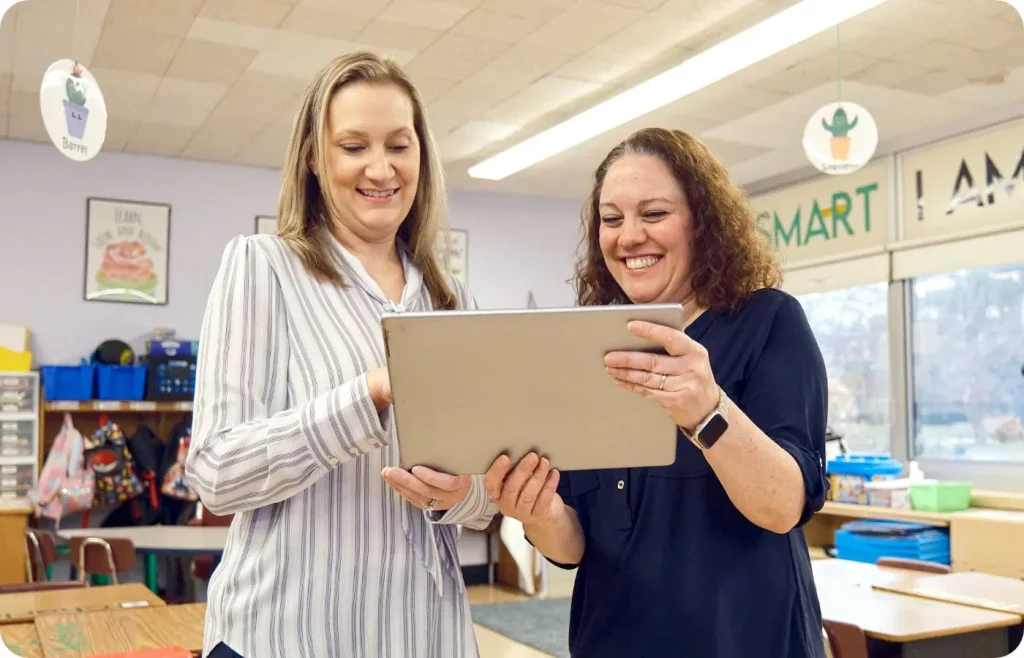
Stay connected!

Join our community and get new episodes every other Tuesday!

We’ll also share new and exciting free resources for your classroom every month.

What Juan Vivas says about engineering

“Based on my experience so far, I think the best way to put it… an engineer is a technical problem solver.”

– Juan Vivas

Supplier development engineer, SpaceX

Meet the guest

Juan Vivas is a chemical engineer currently working as a Supplier Development Engineer at SpaceX. Juan got his start at the University of Florida, where he led the Society of Hispanic Engineers (SHPE) as vice president. He’s worked for companies like Clorox, Dow Chemical, and General Mills. Juan lives in Los Angeles, California with his wife and two dogs.

Man in a suit and tie smiling at the camera with a blurred green background.

About Science Connections: The podcast

Welcome to Science Connections: The Podcast! Science is changing before our eyes, now more than ever. So…how do we help kids figure that out? We will bring on educators, scientists, and more to discuss the importance of high-quality science instruction. In this episode, hear from our host Eric Cross about his work engaging students as a K-8 science teacher.

Amplifying Your District Award winner

This Amplifying Your District Award honored two district leaders who are driving change using the Science of Reading in 2021. Motivated by low literacy rates in her school district, Alli Rice dug into the research behind the Science of Reading because she was determined to increase equity. Through various events and Knowledge Builders for the teachers in her care, she then effectively led the shift to a research-based curriculum in her district. Read on for our conversation with Alli about her work with the Science of Reading!

What does the Science of Reading mean to you?

For me, it’s really about equity. Thousands of kids are already a step behind because of their skin color, their neighborhood, or their zip code,  all of these things that really shouldn’t define their academic ability or their opportunity in life. I’ve looked at statistics around prison populations and illiteracy rates. Some, so many adults are functionally illiterate and they can’t fully understand. They can’t even read their prescriptions.

I also work for a district where most of our kids are on the lower end for socioeconomic status. We have a very high ELL population and 63 home languages spoken in my district. And we are the urban center of our area. Historically, we have been a balanced literacy district, but we have watched our test scores decline.

Since discovering the Science of Reading and this completely different approach to teaching literacy, I feel like I have unlocked Pandora’s box of potential. By addressing our core and aligning our teaching practices, our students can feel success and our teachers will, too. My teachers here have the biggest hearts of any educators I have ever worked with, and they work tirelessly day in and day out to support our students. We try to provide as many enrichment opportunities to all of our kids and to expose them to the greatest and the best. The ability to read, to me, is the greatest civil right. If we’re not providing them that, I can’t sleep at night.

What news, materials, or information do you consume to help you teach?

We use Amplify CKLA and Amplify Reading and those programs are just wonderful. I am also an avid listener of Science of Reading: The Podcast. We arranged for Natalie Wexler and Susan Lambert to do a live professional development session in our district, which was so fantastic, especially for our most reluctant coaches and administrators. Our district-wide LETRS training has also been life-changing. We currently have 800 people who are completing the training, which has helped to align the district and put us all on this path to success.

One particularly impactful thing, and that I rely heavily on for support, is my teacher cadre. Each cadre is about 14 teachers in the district and they represent all of our clusters. We’ve partnered up with our Diversity, Equity, and Inclusion department to do text bias reviews on materials, which has been important for our adaptations for cultural responsiveness. Our selection cadre came from that as well, when we landed on Amplify CKLA for K–3. The teacher input and camaraderie I get from my cadre is so instrumental and I am so grateful for them.

What advice do you have for teachers starting out with the Science of Reading?

Find your people, find your community. I remember Margaret Goldberg’s presentation during last spring’s Science of Reading symposium, and how she said you need to find your dots,  you need to seek out like-minded people and go where they are. Find those people who are ready to make the change like you are, or perhaps have already done it, and can be that positive support system you need to make a difference. Don’t be afraid to message people on Twitter or Facebook or LinkedIn, ask about their experiences, and build that community around you. Find the ones who are going to partner with you, who will lead you the right way, who will take your calls. And read all the books!

Watch the Science of Reading awards show!

S2-06: Making time for science in the K–5 classroom

Promotional graphic for "Science Connections" podcast, Season 2 Episode 6, featuring Lauran Woolley discussing making time for science in K–5 classrooms.

In this episode,  Eric Cross sits down with TikTok star and podcast host Lauran Woolley about her experience teaching science content within her K–5 classroom. Lauran shares how she’s learned how to make time for science, and what most K–5 teachers experience when creating their own science curriculum. Lauran also talks about her rise in popularity on TikTok, her podcast, Teachers Off Duty, and establishing strong relationships with her 5th grade students. Explore more from Science Connections by visiting our main page.

DOWNLOAD TRANSCRIPT

Lauran Woolley (00:00):

I wanna make sure that they’re ready for the real world, and I wanna make sure that they’re able to apply these things that I’m teaching them in their life, not on a multiple choice test.

Eric Cross (00:11):

Welcome to Science Connections. I’m your host Eric Cross. My guest today is Lauren Woolley. Lauren is a full-time fifth grade teacher in Leetonia, Ohio, who has amassed a following of 5.5 million subscribers on TikTok and over 1 million followers on YouTube. She’s also co-host of the podcast, Teachers Off Duty. Lauren has combined her teaching vocation and her talent for entertaining to connect with her students and encourage teachers across the world using her own unique style of edutainment. My most vivid memory from our discussion was her sincerity and openness about her experiences. It quickly became obvious to me that her personal transparency was a characteristic that she has remained grounded in despite her social media success. And now, please enjoy my discussion with Lauren Woolley.

Eric Cross (00:53):

You’re currently teaching fifth grade?

Lauran Woolley (00:55):

Yes.

Eric Cross (00:55):

What is it like to teach all content areas? ‘Cause I’m a middle school science teacher.

Lauran Woolley (00:59):

I didn’t always teach all content areas. First I started in second grade, so I used to teach like primary. I taught that for about three years. And I only really got my 4-5 endorsement because it was told to me that it would make me more marketable as a teacher. So I got it <laugh>. I was like, I’m never gonna use that. And then, my second year teaching, my class had low numbers and they collapsed my second grade classroom, split up my students, and then moved me to fifth grade in January. I had to take over a fifth grade class with all content areas in the middle of a school year. And it was really hard. It was like probably one of the most challenging things I’ve ever had to do teaching. When I got my job at my current school, it was only language arts, social studies.

Lauran Woolley (01:46):

So we only have two fifth grade classes. My other teacher would teach math, science. I taught language arts, social studies, and then the timeframes weren’t matching up. Like, I didn’t have enough time in my schedule for all the things we had to do in our curriculum. And she had like a little bit too much time. We realized as a district that it would be better for our fifth grade classes to just be self-contained. And last year was the first year I taught all five subjects. And I liked the variety of teaching everything because when I taught just language arts, social studies, I just felt like I was repeating myself twice a day. <laugh>. It was kind of boring for me. So like, I like doing all of it. <laugh>.

Eric Cross (02:24):

Yeah. With all of your talents and like your background and what I’ve seen, I could totally see why having all the different content areas would like make sense. Are you using a set curriculum? How do you come up with what to teach? Do you do it with teams? Like who comes up with that?

Lauran Woolley (02:36):

Uh, me, myself and I.

Eric Cross (02:38):

Well done.

Lauran Woolley (02:39):

My school, for literacy we’re using literacy collaborative. Then for math, we just adopted bridges, which I love and it’s very hands-on, very like student-led. For science, we had nothing. And I am not a science, or was not a science teacher at the time when I took over. So I panicked a bit and I was like, “Hey, can we have some kind of science curriculum? ‘Cause I got nothing.” And it’s not hard to look at the state standards and figure out what you need to teach them, but having no resources to go off of is extremely difficult. And luckily I have an older brother, he’s like three years older than me and he’s also a teacher. He actually is a science teacher. ‘Cause that first year that I was teaching all subjects, I was like, “Hey Ryan, can you just like send me all of your Google Drive files for science <laugh>?

Lauran Woolley (03:33):

And he’s like, “Yeah, sure.” So he kind of was like a mentor for like the first year that I taught science. And this year being my second full year teaching science, I feel much more confident. I’m still using his resources. We don’t have a dedicated curriculum at my school. So that’s like one thing I’ve been fighting my school on. And not that they don’t wanna get us one, but like they were focused on getting the math curriculum last year. And then I was told, okay, this year will be science because in my state, fifth grade is a tested area for science and we have no curriculum.

Eric Cross (04:04):

Ryan, keep doing what you’re doing big bro. Second, thank you to every teacher who’s had a Google Drive folder full of curriculum that you graciously shared to a new teacher or someone else that they could have.

Lauran Woolley (04:18):

Can we just say like, can schools, like schools, please get your teacher’s science curriculums.

Eric Cross (04:24):

No, absolutely right. And there is this way of thinking that, especially as a science teacher, it’s something that is dear to my heart, but we do want to develop these math and English skills that’s important and we need that for science. But we’ve always taught so siloed for so long, but that’s not the way that we learn and that’s not the way life works. Something that intrigued me about what you said, and I think a lot of people can relate to it, and I know I can because that was me, is you created your own content or your science content. Like you’re kind of piecing that together from what Ryan had shared with you. How do you make time for that with all of the other things that you’re doing and pressures of state testing and things like that. Like how do you weave that into your teaching?

Lauran Woolley (05:02):

So we have like things that are non-negotiable in our schedules. Like we have to have so many minutes of this, so many minutes of that, so many minutes of whatever else. Well, the first year, I was self-contained. I was like, okay, my main goal, because science is a tested area, I wanna make sure that I get in science every single day, 90% of the time I’m able to get anywhere from 30 to 45 minutes of science every day. But this year it was my goal to make sure that I was getting science done and like we were doing meaningful lessons. And last year I didn’t do this, but this year I’m doing a Christmas center for STEM. So I got it off of Teachers Pay Teachers. I’m sorry, I can’t remember who it was made by, but it’s called Jingle All the Way and it’s like building Santa’s new sleigh. And so like the kids have an activity where they have popsicle sticks, straws, a plastic cup and then like tape. And they have to build a new sleigh for Santa and see how many pennies their sleigh can hold. Like talk about a sleigh being lightweight but also strong and like what would make it strong and different things like that. So I’ve been trying to incorporate a lot more STEM activities. And then something I really like to use for experiment days, I call them lab days, is Gizmo. Have you heard of Gizmo?

Eric Cross (06:15):

Yeah. The simulations.

Lauran Woolley (06:16):

Yeah. My brother showed me that too and he was using it in his class. I mean there’s so many different ones that they have that align with the standards and they have like student lab sheets that go with them and teacher guides and stuff. I’ve just been trying to like up my game a little bit more this year, because last year I was like struggling to get all of the standards in before state testing came around because, can we agree, state testing should not be as early as it is? Our state test happens in like March and we have two months of school left. So like, we better be done with standards by February so we could review, because otherwise we’re kind of outta luck because we run outta time.

Eric Cross (06:59):

Yes. That and there’s all kinds of other things that state testing brings with it that we could spend a lot of time probably critiquing and talking about like as far as what’s ideal for kids and what’s the best way to measure and assess learning. That is one question I wanna ask you though, because I know with your work on TikTok and Instagram and YouTube, you must be connected to a pretty vast teacher network and maybe you have like, kinda like more of an inner circle of people, but you must come across so many different perspectives and get into great discussions. Is there <laugh>, is there anything that kind of stands out to you as far as if you were in charge of what we’re doing? Because that’s kind of the system that we all live in and we kind of are trying to internally change it, but it’s been that way for a long time and we just kind of have to work within it until we can make changes. But if you were to, I dunno from an elementary school perspective, change or modify the way kids are learning, what would you do if you had Monarch ability?

Lauran Woolley (07:54):

Okay, I got three main things I’m thinking in my head. Okay, first things first, we got Maslow’s hierarchy of needs. Okay. If kids are coming to school hungry, if they’re coming to school and don’t have, you know, fresh clothing to put on, if they’re coming to school and they have issues at home that they are dealing with, that they are not okay with, the learning is not happening. That’s secondary. They don’t, it doesn’t matter to them. It doesn’t matter to me because what’s most important is that child as a human being and whether or not they’re okay. If I had unlimited resources, I would love to be able to build like a little mini village inside a school and have like a clothing store that kids could grab stuff from. Or like a, you know how I know how school have like closets and food pantries, but like a real place they could get some new clothes, not like hand-me-down clothes, like a store they could go and grab some food if they needed food for their homes or whatever. We have like an onsite counselor but not like a school counselor, like a therapist-type counselor for like mental health. Having some kind of like health clinic, not just like a school nurse because, let’s be real, our school nurses see everything <laugh> and they do not get enough credit, but like to have like a little like urgent care clinic, like basically a small town <laugh> inside a school that like kids would have all of the resources that they need met. Like that would be my number one thing that I would love to do. I have taught in, you know, I’ve only taught in two different schools, but like I’ve seen a lot of things and the number one thing that keeps coming back is just like home lives and mental health and having someone to talk to.

Lauran Woolley (09:41):

And I think our kids don’t have enough of that. Second of all, would be obviously state testing. Because I mean, it’s good to see like where our kids are at. I don’t think it should be used punitively and I don’t think that it should be putting as much pressure on teachers and students the way that it is. It’s not effective that way at all. Let teachers do their jobs without us having to, like, ’cause honestly, who’s not gonna say that they’re not trying to set their students up to do the best on that test. Our evaluation depends on it. I’m gonna make sure my students are prepared for it. I’m gonna teach all the standards, but like, I shouldn’t have to be teaching so that they could do well on a test. I wanna make sure that they’re ready for the real world and I wanna make sure that they’re able to apply these things that I’m teaching them in their life, not on a multiple choice test. Third of all, <laugh>.

Eric Cross (10:33):

This, this is great. And I think a lot of teachers will listen and be like, “That’s what I’m talking about right there.” Keep going. You’re on three.

Lauran Woolley (10:40):

That would be two teachers in every classroom. Either two teachers in each room or like a teacher and a paraprofessional in each room, because there’s not even an argument that teachers are more effective when they have help.

Eric Cross (10:54):

I would even carry the math on further and say that it’s a force multiplier, like exponentially, that it’s not just, it’s not just like a one plus one equals two teachers. It’s almost like you can almost have like three or four just because of the energy and the synergy that can be created between the two. And you can push off of each other, encourage one another and both support different types of students. So I agree a hundred percent. I think that if you had two teachers that were in sync and planning together and talking about kids all of the time, you would be able to go deeper with students. You’d be able to find out those things that you talked about in Maslow’s because sometimes we don’t find out about it until a parent-teacher conference or kids left our classroom. I wish I would’ve known that. The student was without these things in the very beginning.

Lauran Woolley (11:41):

Absolutely. Mm-hmm.

Eric Cross (11:42):

So when do you start in the school and do we go on LinkedIn to sign up and apply or is it like a lottery system? Like, ’cause you know, I was gonna get a lot of attention.

Lauran Woolley (11:52):

I would love to Oprah Winfrey this and like build my own school <laugh>.

Eric Cross (11:56):

We gotta get those followers up. We gotta build up the sponsorships. We gotta get you up to a hundred million.

Lauran Woolley (12:01):

Listen, if all of my followers across all my platforms donated like $2, we could have $12 million to build a school. <laugh>.

Eric Cross (12:10):

Think about like, DonorsChoose, right? People do that. And I know there’s mixed feelings about it because we need stuff in our classroom. I’m just gonna say that. All right. So, whether I have to ask for it on a website or whatever, but people want to give directly to kids, or people who need it. And I think when there’s opportunities like that, that are visible, people are more likely to want to.

Lauran Woolley (12:29):

In reality, should other people have to fund education in classrooms? No. That’s literally what your taxes are for. A government-funded classroom versus a teacher-funded classroom are two different things. And we know that. But if teachers are asking for things or asking for donations on Amazon or on DonorsChoose, just know in your heart that that teacher has probably already shelled out a lot of their own cash to do that. It’s not that they’re, you know, asking for handouts or anything like that. They’re trying to give their students the best that they can and that’s the thought process behind it. And until we get changes in our education system or changes in legislature that will allow us to do that or will allow classroom budgets, I mean, our hands are tied. Like there’s only so much teachers can do. I’m very fortunate to teach in a district that sees the value in spending money on their teachers and students. And, like my school, like I said, they just shelled out thousands of dollars on a new math curriculum. They bought school supplies. Literally every teacher made their school supply list this year. And then the district went in and paid for every single student’s school supplies in the entire district.

Eric Cross (13:49):

Can we get a shout out to your district real quick?

Lauran Woolley (13:51):

Uh, yeah. I mean, shout out Leetonia schools like, I mean, you guys are awesome and I’ll shout that from the rooftops. I love where I teach. Like I really do think that they value our students and they care about our students and our admin is great. We got a new superintendent a couple years ago. He’s been doing a phenomenal job and I really love it and I’m glad I teach there.

Eric Cross (14:12):

When you move out of the classroom, you know, in any position of leadership, you do have the microscope or magnifying glass on you and a lot of times it’s critical. And not unjustifiably so, I mean, there’s a lot of things that can be critiqued. However, what we don’t always hear is the success stories or where it’s working for teachers and why. And we need leaders to be able to talk to each other and find, “Hey, it’s working in your district? Oh, I just heard, I just heard this district get shot out. I’m gonna go reach out to those people. Hey, what are you doing?” Because we connect with each other, but I think when you go like a level up, that kind of getting up the top of the mountain, the, the connection sometimes can become more difficult for people. There’s not a lot of, I don’t know, maybe there are, but admin influencers.

Lauran Woolley (14:54):

Oh yeah, there definitely are. And I’ve met some really incredible ones. I’m on a committee at my school, it’s called NNPS, it’s the National Network of Partnership Schools. It was started out of Ohio State University. Essentially it is a committee in the school that’s dedicated to bringing together the community and businesses and partnering with people to make our school as strong as it can be. We started last year and we did a bear breakfast, ’cause our mascot is a bear. And we had Christmas things and we had the choir caroling, and we had pancake breakfast for everybody and it was completely free. It was just really nice to see everybody come together. And it feels like the culture changes when people work together and come together for the betterment of the school and for the students. And I think what’s challenging is that so many people have such a negative experience from their schooling that they’re hesitant to get involved in their kids’ schooling. I urge any parents out there, any guardians out there that are, you know, in that mindset where you’re like, I didn’t like my teachers in school, or I had this, this, this and happened to me at school. Give it a chance to know that things have changed and things are changing.

Eric Cross (16:11):

I definitely agree with you about parent engagement and getting involved and sometimes parents, they just don’t know that they should. But wow, your voice is so powerful, especially at board meetings and things like that. Getting stakeholders involved, creating community, which it sounds like your school did a great job or your district did a great job of. The last question I wanna ask you, and it’s kind of going back to who your influencer was, is you now are in a position where your impact exceeds more than, you know. You’re planting so many seeds you’re sharing, and you’ll hear maybe a few, or I’m sure you’ll hear the things that kind of come back to you, but that’s only a fraction. But I wanted to ask you, like, as you think back on your career as an educator or when you were in school K through five or K through 12, is there anyone who stands out to you or who was maybe your influencer or teacher who made a big difference that was memorable? And if so, who was it and what was it about them or what did they do?

Lauran Woolley (17:01):

So I had a lot of teachers that I really had good relationships with and I loved school growing up. But one always stood out in particular, and that was my ninth grade English teacher and her name is Andrea Reid. She was the first person who really told me that I was talented at something and that I could succeed in something because she was the English teacher. She was also a coach of the speech and debate team at my high school. Just one day after school. She was like, “Hey, like you should come to speech tryouts.” So I went to tryouts, like I did it not thinking like I cared if I made it or didn’t, and then I made the team. And honestly, I feel like speech was the starting point of all of it. I competed in speech and debate for four years of high school and she was my coach.

Lauran Woolley (17:49):

I always have horrible nervousness with public speaking, even though I do it a lot. And she would always give me like the best hype speeches and the best confidence boosters. And I feel like speech started my love of acting and started my love of like, you know, comedy and stuff like that. And so therefore TikTok happened and I don’t think any of this would’ve happened had it not been for her and her opening that door for me and telling me, “Hey, you would be good at this. You should try it.” We’re still friends to this day, 15 years later, and she is like an older sister to me and I love it.

Eric Cross (18:26):

That’s amazing. Andrea Reed, that’s her name.

Lauran Woolley (18:28):

Andrea, yep.

Eric Cross (18:29):

Andrea. Andrea Reid. Ms. Reid, thank you, for inspiring Lauran and <laugh> because of your impact, now it’s impacting so many others and as teachers, like, we don’t even, we don’t know, but it’s so humbling to know that like the words that we say to people have that impact and power. It’s so, it’s, it’s so inspiring to me. One of the things that resonate with you so much is your transparency. Like in your depth. Like even as just listening to you talk, you normalize and humanize so many things that we experience and I’m sure that’s what a lot of the people that watch you connect with. You show your life, your family, your house, all these things that are happening. And I was just looking through the comments and there’s just so many people that are warmed. Not just your students, but like so many teachers. So thank you for doing what you’re doing and I wish you tremendous success. Thank you for your time.

Lauran Woolley (19:17):

No, thank you so much for having me. This was awesome. I just wish everybody a great school year and I hope that we all make it through winter break. <laugh>.

Eric Cross (19:27):

Thanks so much for listening to this season of Science Connections. I love learning about science educators just like you. You can nominate educators that inspire you to become a future guest on Science Connections by emailing STEM@amplify.com. That’s S T E M at amplifycom.wpengine.com. Make sure to click subscribe wherever you listen to podcasts and tune in for a brand new season of Science Connections coming soon.

Stay connected!

Join our community and get new episodes every other Wednesday!

We’ll also share new and exciting free resources for your classroom every month!

What Lauran Woolley says about science

“I want to make sure they’re ready for the real world and I want to make sure they’re ready to apply these things I’m teaching them in their life, not just on a multiple choice test.”

– Lauran Woolley

5th Grade Teacher, Northeast Ohio

Meet the guest

Lauran Woolley is a fifth grade teacher in Northeast Ohio. She has loved being able to combine her love of education and entertainment into one career. Her goal is not only to humanize educators to both families and students, but to create a safe space for her students on the internet. She has had the privilege of collaborating with educators around the world to shed a light on this amazing career. You can listen and watch the Teachers Off Duty podcast here!

A woman with long dark hair smiles at the camera, wearing a black top and lanyard, with a colorful blurred background.

About Science Connections

Welcome to Science Connections! Science is changing before our eyes, now more than ever. So…how do we help kids figure that out? We will bring on educators, scientists, and more to discuss the importance of high-quality science instruction. In this episode, hear from our host Eric Cross about his work engaging students as a K-8 science teacher. 

S1-09: Supporting K–8 science students in the digital world: Ricky Mason

Podcast cover for "Science Connections," Season 1, Episode 9, featuring "Ricky Mason" discussing K–8 science education. Includes a globe illustration and decorative science-themed elements.

In this episode, Eric sits down with Ricky Mason, chief executive officer of BrainSTEM. Ricky shares his passion for inspiring students into science careers, and his path from an engineering career with organizations like the Department of Defense, National Aeronautics and Space Administration, and the Central Intelligence Agency to starting BrainSTEM, an education program that develops creative digital tools to enable all teachers and students to dive deeper into STEM content. Ricky and Eric talk about representation in science classrooms and the importance of embedding fun within K–8 science content! Explore more from Science Connections by visiting our main page.

Download Transcript

Ricky Mason (00:00):

I feel like comfort is where dreams go to die. And I’m still dreaming every night. So I’ll wake up, chasing them.

Eric Cross (00:08):

Welcome to Science Connections. I’m your host, Eric Cross. My guest today is Ricky Mason. Ricky is an engineer whose career included lead roles at the Department of Defense, NASA, and the CIA. Ricky transitioned to education as an adjunct faculty at the University of Kentucky. And while there, he founded BrainSTEM, an edtech company that developed a 3D virtual reality metaverse for STEM education. Today, BrainSTEM serves public school districts, private schools, and nonprofits. And in this episode, we discuss what led Ricky to creating BrainSTEM Metaversity, and how he’s using the metaverse to transform STEM learning for students. And now please enjoy my conversation with Ricky Mason. How did you, so like maybe going back doing your origin story, maybe you can talk about it, but brother, you don’t sleep. Talk about keep making moves, your hashtag, I mean, I was looking at your LinkedIn profiles, looking at your details. You get after it. I was getting tired just reading it. I was like John Hopkins, electrical engineering, real estate, starting companies. You must have that gene where it’s like four hours of sleep and then you’re like, ready to go.

Ricky Mason (01:19):

Yeah, man. My mom told me if I didn’t stay busy, then I’m in trouble. So when I was about 14, she told me that. I said, well, Mama, I guess I’m gonna stay busy then. And yeah, man, that’s just been my life. I feel like if I don’t keep making moves, then I’m in trouble. So, feel like comfort is where dreams go to die and I’m still dreaming every night. So I’ll wake up chasing them.

Eric Cross (01:44):

I feel like a kindred spirit with you. So, were you always interested in STEM like, was there something like a moment or a year where you remember you were like, this is my jam. This is what I’m gonna get into.

Ricky Mason (01:57):

Yeah, man. When it really clicked for me was in the fifth grade. I was at a school assembly and an IBM engineer came in and he brought a robot and he programmed it with punch cards right on the stage. And I got the opportunity to come up andyou know, put one of the punch cards in the robot to program it. And I asked him, I’m like, what is your job? He said, I’m a robotics engineer. And I went home right after that assembly and I said, Mom, that’s what I wanna do, become a robotics engineer. And my mom would take me to the libraries. Well, I felt like I was getting outta bible study on Wednesdays by going to the library. So I went there and I started researching robots.

Ricky Mason (02:39):

And at the time the robots that were popular were all being sent to space. And it was the spiritless. It was being sent to Mars. And I said, Mom, well, I guess I gotta become an astronaut if I’m gonna be a robotics engineer. And that’s kind of what set me out on that dream. And my mom started trying to find outlets for me to get involved in STEM, but it was really tough to find those outlets, you know, especially in that fifth to eighth grade range here in Kentucky. So that was kind of where it started for me man, when I knew that yeah, engineering is what I wanna do.

Eric Cross (03:14):

What does an electrical engineer do? I imagine there’s different types of specialties, but like, was there something that you specialize in that you focused on or was it, is it just kind of like a generalist field?

Ricky Mason (03:23):

Yeah, so I would say, yeah, man, it’s a huge field. So you could be doing anything from, you know, power, like power coming into your house. So those large power systems all the way down to nanotechnology and microchips. I like to tell people I’m a real full stack engineer, so my wheelhouse is kind of from the PCD, the little green computer chips, all the way to the cloud. Over my career, I’ve had some pretty cool jobs. One of those things was I was a test engineer for the army. So I got to test weapons up at Aberdeen Proving Ground for the Army. So I got to drive those weapons and test them before they went to theater there. After that,I worked at United Launch Alliance down at Cape Canaveral where I launched five rockets.

Ricky Mason (04:07):

So I was a part of the electrical ground systems team there where we were responsible for all of the electrical systems on the rocket while it was on the pad. Somonitoring the temperature of the rocket, the fuel, the entire system for safety while it was on that pad. And then finally I worked at the CIA as a computer engineer building data centers and as a data center architect for some of our remote systems and virtualizing our systems. So kind of had a broad spectrum of things there. And then finally coming back to the University of Kentucky as a research engineer and faculty. I developed drone technology for monitoring crops. So flying drones over crops with LIDAR, just like self-driving cars with high-definition cameras to pull in data about those crops, to help farmers determine about pesticides fertilizers, and the overall health of their crops from a remote location.

Eric Cross (05:10):

It’s so neat to hear you talk about it and to see how this is all built up to what you do now with BrainSTEM. How would you explain what BrainSTEM is? I know that’s your, that’s kind of your baby right now and what you’ve been working on a few years.

Ricky Mason (05:23):

Yeah, man, we started BrainSTEM in 2019 officially, but I would say BrainSTEM has been almost 10 years in coming. While I was in undergrad, I played football at the University of Kentucky. But I got hurt going into my sophomore year and that kind of shattered my dreams of football. And that’s when I really got back into engineering. One of my professors asked me to come to a robotics competition and I saw these third graders and sixth graders programming robots. And I’m like, oh my God, they’re programming robots! And I had no idea how to code or what to do with these things. And where was this a when I was a kid? And so I immediately bought one of those robots and taught myself how to program it <laugh> and then we started a robotics team in Lexington,there at a church.

Ricky Mason (06:10):

And we got a sponsorship from Lexmark to start that team. And that was kind of my first leap into STEM and teaching STEM and creating programs for students in STEM. I did that in undergrad and like I said, fast forward 10 years later, I’m teaching at the University of Kentucky and we’re struggling to recruit STEM students. Why aren’t students going into STEM? I hear too many adults tell me, oh man, I wish I would’ve done engineering, or I started out in engineering, but I left engineering or I wish I could go back to school for engineering or learn to code. And I’m like, I asked them like, why didn’t you do this? What happened? And often it’s like, it was the math. It was, oh, I didn’t get into it until I was in college. And I’m like, well, that’s the key.

Ricky Mason (06:52):

I knew I wanted to do this in the fifth grade. And I started with a plan in the fifth grade to achieve these goals and dreams. And I started doing that research and realizing that the same problem existed that I had. There was no outlet for kids to get involved in STEM, and so many kids have an affinity for STEM an early age. So we started BrainSTEM to provide access to STEM education and exposure STEM careers, STEM professionals, and just to STEM fields as a whole, because too often kids may know about the term, engineer, or the term, scientists, but they don’t really know what those people do or have a strong connection with the field or have any hands-on projects that they kind of done around those things or met anyone like me.

Ricky Mason (07:42):

I didn’t meet an engineer until I was in college. So that has really been impactful for some of the students that we’ve been able to touch. I had a family reach out to me. They moved to Lexington from California and they were like, man, I really want my ninth-grade son to get involved in engineering. So we started a weekend program with that one student and it went amazing. Like we competed in science fairs, we applied for different college programs and things like that. So it became an entire like mentorship program. And I’m proud to say that a year ago, he actually graduated with his bachelor’s in electrical engineering from your side of town, UCSB. It was just awesome to actually see this come full circle. And that’s kind of one of the first things that we did before we actually formalized as BrainSTEM University.

Eric Cross (08:34):

What will be like your elevator pitch for a teacher? If you were gonna say, this is what BrainSTEM does. I have the luxury of going through it on the site, but since we’re on a podcast, how would you kind of pitch it to people letting them know, like what, what does it do? Who does it serve?

Ricky Mason (08:47):

Yeah. So BrainSTEM provides STEM curriculum and STEM magnets for schools and nonprofits looking to increase access to STEM for K through 12 students. We also have launched our BrainSTEM Metaversity, a metaverse product for teachers to take their 2D Google classroom and convert it into a 3D metaverse classroom where students can collaborate during a 3D class. So all of your students show up as their avatars that they can select from our inventory of 150 avatars, and enjoy class in a 3D gameified Minecraft like World.

Eric Cross (09:26):

So I made my avatar by the way. It’s kind of tight, I have to say, it’s kind of tight. Hey, I’m gonna share. So those of you in the podcasts I’ll share it so you can see it. You’re not gonna be able to see it right now, but since I have the man himself I gotta share it with him just so I can get a reaction. So can you see that?

Ricky Mason (09:43):

Yeah. <laugh> That’s so good.

Eric Cross (09:44):

I feel like I wanna look like him though. I want him in real life. Like I want be able to switch to looking like my avatar

Ricky Mason (09:52):

<Laugh>

Eric Cross (09:54):

That was the first thing that I jumped on, when I went on your site, was making the avatar and I had so much fun doing it. I actually took longer than I probably wanna admit cause I was like customizing everything

Ricky Mason (10:03):

Yeah, man. It’s so fun. And that’s exactly what, you know, when you can show up as the person you want, it changes your whole being. I’ve seen kids that are quiet in class. They show up as their avatar and they’re talkative, they’re asking questions, they’re moving around the room, interacting with other kids. I feel like it’s almost like a superpower just to put your avatar on.

Eric Cross (10:25):

So what is something that a teacher could have their students go and learn or do if they, if they signed up,

Ricky Mason (10:31):

Let’s kick it off. So how we started with the metaverses, was teaching coding. So our first class was Minecraft and Python coding in the metaverse. So students showed up in the metaverse with our virtual instructor, that instructor led a lecture in the metaverse and then those students could collaborate on their Python games. So, they created and built the game in Python. We shared those games in the metaverse and we have our leaderboards that are in the metaverse, as they’re completing these challenges, including these games, then sharing them back in the metaverse with other students and getting that feedback on their game. So we’ve seen huge excitement from students when I can come back in and see my friend’s work. Like too often, students don’t get to see their work and that’s motivation to do better when I’m like, Jim’s gonna see my work. It’s amazing to see that motivation when students are sharing their work with other kids and not just their parent or just them and the teacher or seeing their grades. It’s been really cool to see.

Eric Cross (11:33):

You have that genuine audience too. Like that real-time feedback. And then like an authentic audience for students that makes everything seem, it takes it up a notch.

Ricky Mason (11:42):

Yeah, man. And then as we have built on this platform, so like you said with that avatar, so think if you created a really cool looking avatar and other students wanted to be that avatar, we have a way of sharing that avatar back into the world and in the inventory so that other students could then be your avatar. Or, if you create a world, we could then share that world back into the inventory, so the teacher could have class in a world that you created.

Eric Cross (12:07):

They’re creating content, not just consuming it. They’re actually creating content that could be shared across like grade levels or students.

Ricky Mason (12:14):

Well, we’re gonna say right now it’s just within your classroom. Eventually yes, we want students to be able to share that across school districts. At least we think that data will be probably limited to those kinds of realms as far as schools go. But you’ll be able to share this across sixth grade. We’ll be able to see what everyone in the sixth grade is doing in their STEM class or their game development class or their history class, per se, even if they’re giving back a presentation or what we have here in JCPS is backpack skills of success, where students are presenting on things that they’re learning that relate back to core competencies that the district is focused on. And I think that sharing those in the metaverse and doing those in the 3D world will be an awesome experience for students.

Eric Cross (12:56):

Are you seeing anything else as far as those skills that we see that are needed in coding? Is there something that the VR adds that was distinct from maybe just a kid with a Chromebook in his class that it’s just him in isolation doing the coding? Was there any like aha moments or surprises when they’re in the VR world doing this?

Ricky Mason (13:13):

I think the biggest thing is we could actually show them real examples of code working in other ways. Sofor example, if we’re working through loops, we can show them something looping. We can relate these functions to real-world things happening in the VR world so that they can see and better relate the actual concept with visuals, if that makes sense. So, you’re in loop Allen the whole time you’re learning about loops. You’re immersed in that kind of world. What we’ve seen is students really start to, you know, they it pick up and it clicks a lot faster because some of these concepts are so abstract for students to understand, when we can relate them to things in that world that they see that are in front of them, that they can grasp before we go to okay, type in “while” “”parentheses” <laugh> they can thenrelate that and pick up on those clues a lot better after they’ve seen those things in the world.

Eric Cross (14:09):

So they can actually visualize it in the metaverse. Whereas outside of it, it’s more just, just text-based coding and they’re not isolated. Like the first thing I’m thinking about is how like, with my own students, when they’re learning Sratch or Python, it’s not easy to share back and forth because they all are on individual accounts and they’d have to go on a different computer, or we’d have to find some way to publish it. And then all the kids would have to access it. But it sounds like in the metaversity classrooms, it’s easy for students in that same class to see each other’s work. Am I getting that right?

Ricky Mason (14:37):

Yeah. So most of our classrooms are limited to 24 students and in some of our breakout classrooms, we limit them to about eight students. Everybody can share their screen, so students can share their screen in the metaverse. They can share their video in the metaverse. They can share documents in the metaverse. They can share their, like I said, their code or anything that they want to share with other students. They can kind of do that. So it’s been a really cool product, I think, for students to almost find independence to work within a group, in an online setting. As they’ve been working through these problems online and remote it’s been really cool to see how they use the metaverse and break out. Even in a class, they can go off into a section because it’s all spacial. If you walk away, I can’t hear your conversation. So they can go into a little section within a metaverse class and have their own breakout. And a teacher can walk over to them. Okay. You guys are working over here. Let me walk to my next group. Just like in class. So it’s been really cool to see those students use the metaverse like that.

Eric Cross (15:41):

Just listening to you talk about this. One of the exciting things about emerging technologies or taking what the private sector does, and someone with a mind like yourself, and go, how do I use this for education? Like, that’s something that like excites me and you’ve run with it. But I just thought about, you’re doing an hour of code, you’ve created this metaverse, and you can bring in somebody, a professional into the metaverse, but they’re in, you know, the Bay area, but they could be a software engineer for Tesla or Google or anybody. Could they move around the metaverse and take a look at different students’ work and interact in that way.

Ricky Mason (16:17):

Yeah, man, we get in there. We make metaverse selfies. I drop Lambos in the metaverse, we take picture with Lambos. We have scavenger hunts in the metaverse. It’s a really awesome experience. And that’s one of the big things I think that is so powerful, is like you said, we could have that engineer, that celebrity, we could have Travis Scott, you know, in the world meeting thousands of kids motivating them because they met their STEM goals. They met their, you know, their testing school goals or whatever. These are things that kids really care about. If I get the Travis Scott avatar or the Elon Musk avatar, because I completed the Elon Musk rocket challenge, like that’s huge for me to show up in class as that avatar, like it’s just like Fortnite and it’s bringing all of those mechanics into the classroom.

Eric Cross (17:07):

When I hear you talk about the metaverse and I hear you talk about the potential of where you want to go with it, I think about my own students, and I think about, how they would really have a genuine interest and desire to want to do this and probably be doing it when they don’t have to, like at home at night wanting to go back into it and interact. And, you’re also building this virtual community. I mean, are you seeing that like, cause I’m hearing that?

Ricky Mason (17:28):

Yeah, man, building that community is huge. And I often tell people all the time, I want the STEM community to be just like the basketball community, the football community. I want students to have that camaraderie built around them for learning STEM and participating in STEM activities and competitions. Because when you see students out there at a robotics, they have the same zeal, the same, you know, everything that you find at a football competition. So we just have to get behind them and back those events with the same enthusiasm that we back sports. And that’s the environment that I want to create for STEM students and for that STEM community, because I longed for that community when I was in school. And like I said, I had it in football, but I wanted both. I wanted the best of both worlds. I wanted my robotics guys and my football guys to show up together here at the competition and have a good time.

Eric Cross (18:23):

You’re absolutely right. Like robotics STEM, these things, community helps fuel like people’s interest and working together. And it brings people from the outside who are seeking that community. Like, hey, my friends are doing this, I wanna kind of check it out. That’s how we recruit a wider swath of our population into it. So it’s not this kind of very narrow channel of folks who are going into STEM.

Ricky Mason (18:45):

If you can’t find that community. I mean for me, I felt like I was the only one playing football who was interested in robotics. So I never told anybody because I didn’t feel like that related to anybody within my vicinity. So I kept that to myself and that’s the biggest thing. I think if we get these kids just talking more about their interests, because a lot of them are interested in robotics and space and these STEM topics, but they don’t have anyone that’s really nudging them or asking them or piquing their interest in those spaces and saying, hey man, it’s okay to, you know, learn about robots. It’s okay to geek out on space. <Laugh> So that’s been my goal and that’s kind of why I felt like this was the time in my career for me to kind of do this, be a face for STEM education and inspire kids to chase their goals and dreams. Over my career, I’ve had some really cool jobs, but I felt like I could keep doing cool jobs, but I’m like at the right age to still connect with those students and inspire them to chase their dreams. And that’s why I feel like right now, man, it’s just an opportune time to get these students involved in STEM.

Eric Cross (20:01):

We don’t get that. Oftentimes, when we’re solely doing the cool job or simply in the private sector, we don’t get those experiences as much as we do when we’re able to actually serve our community or students or take our passion, our skill set, and use it to serve another person. I hear that like, as you describe what you’re doing now is like, there’s something beyond just, you know, the using your skills and doing cool stuff, but there’s something I hear. That’s helping people and actually doing something you believe in that resonates deeply in you. And I can hear it as you talk about it.

Ricky Mason (20:30):

It’s been just amazing to actually chart out that journey. Like I said, and like tell kids, like, no man, I’m from right up the block from you, cause I mean, I’m building this back at home in my hometown. And that’s the reason why I kind of came back to kind of do that in my hometown, because I really want to, you know, relate to those students and inspire, you know, students here. Nobody thinks about technology coming out of Kentucky and that’s been a gift and a curse, I guess, with launching BrainSTEM in Kentucky. When I first started, I said, we’re a STEM education company, people are asking me what is STEM? So, that was where we started out with this in 2019, all the way to, you know, hey, in 2020, we’re gonna launch a metaverse. A metaverse! What is that? It’s been amazing to try to change the minds of not only Kentuckians about STEM and the importance of STEM, but the world that a metaverse company is coming outta Kentucky. <Laugh>

Eric Cross (21:31):

The work that you’re doing and, it exists beyond you and you probably know this, but as a Black science educator out here in San Diego … We don’t see people who look like all of us in this work often, and I saw that you had created something, a network group, network and chill. And that was one of the things, we had touched on community, but I thought that that was so huge because we need each other.

Ricky Mason (21:55):

I feel like that was the biggest thing for us in engineering. Like I showed up to my first internship and I’m like, I mean, my boss was cool. Everything else was cool, but I just didn’t feel like, hey, this is a community for me. And I almost changed my major because of that. But I’m glad that I didn’t, it’s huge to have more of us represented in, in these spaces.

Eric Cross (22:16):

And you know, in engineering, especially when we look at the disproportionate, you know, men versus women. Like it’s not, you know, it’s not just culture, but it’s, you know, gender, all of these different things. And if we’re gonna change it, I think a program like yours that gets exposure to all kids and then giving them choice. What advice would you give to students? Or what advice I should say, do you give to students now? When you see like your younger self in the different kind of K12 grades who are thinking about their futures or they’re thinking about STEM, what do you say to them?

Ricky Mason (22:46):

So my biggest advice, man is start now. Whatever that big thing is, that big dream is that you have, what is that now? You’re thinking about planes. You’re thinking about robots. You’re thinking about RC cars, whatever that is. Let’s start now. Let’s get your hands on an RC car. Let’s take it apart. Let’s start coding. Let’s start thinking about those problems now. But the biggest thing is, is getting kids used to solving tough problems. Typically, most students that have an affinity for, you know, STEM — and you just know that that kid’s gonna go into, STEM — they’re problem solvers. They’re typically looking and seeking those tough problems and seeking opportunities to learn. That’s where I feel like it’s parents’ jobs to provide that environment to foster, that zeal. A five-year-old kid, we started our STEM program with them at the beginning of this month.

Ricky Mason (23:39):

The first day I came in after I told him I was a rocket scientist. And now he’s like, well, I wanna be a pilot. I said, if you pay attention to this class, we’re gonna get you started on your way to being a pilot. And he knows all the parts of a rocket and he knows a rocket needs an oxidizer. And he knows the fuselage, the wings, the wing flaps. He knows all the different parts of the plane and how the forces, the drag, the lift, the weight, he knows how those are working cause we talked about those in class and he has so much more confidence and it came all to fruition when a kid said, wow, I thought it was gonna be really hard to be a robotics engineer. And I’m like, no, that’s not gonna be that hard. That is exactly what we set out to do when we started BrainSTEM, was to break down those barriers and those walls and build that confidence and say, look man, you can do this. It’s easy.

Eric Cross (24:26):

Society doesn’t help much either because one of our terms, right, if something’s really hard, or if something’s not hard, we say it’s not rocket science. That implies that rocket science is really hard and inaccessible. If kids would hear that it kind of instills in their brain, okay. It’s really hard, it’s probably too hard for me. To that point to parents, it sounds like a lot of just exposure, like giving students the opportunity to be able to be exposed to these things and letting them create wonder from it.

Ricky Mason (24:51):

Yeah, man. I often tell parents we’re gonna set kids up to go pro no matter what,

Eric Cross (24:56):

And those skill sets transfer, whether they decide to go into coding or they decide to manage a bank, you’re still gonna be dealing with people. You’re still gonna be problem-solving. You’re still gonna have to come up with creative solutions to things. It sounds like through a program like this, they learn those skills early.

Ricky Mason (25:12):

Yes. And I think that one thing that parents don’t think about … We talk about all the STEM and we want smart kids, but we need those soft skills also within STEM. So those competitions, getting them involved in those communities with STEM students is really huge in presenting their ideas because oftentimes, you know, our STEM guys, we’re in a lab working and that’s where we love and that’s where we wanna be because we haven’t, you know, been prepared to talk and present our ideas. So I think that’s a huge part of what we have to teach our STEM students. And we do that by providing that community and those opportunities for them to, you know, do that.

Eric Cross (25:47):

Thinking about where you are now, looking back on your K-12 education, were there any teachers that stood out to you or that inspired you as I even just say that, can you think of a particular teacher or one or two?

Ricky Mason (26:00):

When I think about my teachers, my teachers really taught me to solve those tough problems and those subjects that you don’t kinda like <laugh>, cause I was always a great student, but my teachers helped me to focus on those subjects that I didn’t so much, you know, enjoy. So I enjoyed math and science, but English social studies, like why do I have to be here? I had two teachers during my high school career that really supported me in that regard, and helping me to be the best student all aroundfrom like I said, STEM to English and social studies, and making me realize that I have to be a well-rounded student if I’m gonna be truly successful. As far as engineering, man, I would say one guy, my teacher, Nick Bazar up at John Hopkins. During my master’s there, I had a really cool project. I got to do data forensics on a real live murder case. <Laugh> That was really inspiring because I’m like, wow, this is real life where my coding skills are being used in a jury trial <laugh>. And so that was a really cool experience to partner with my professor to kind of do that. I mean, that was just mind blowing that I got to help with that and that, I mean, he was using his programming skills to help solve a murder case.

Eric Cross (27:22):

What’s the best way for people to connect with you and follow your journey? And if a teacher’s interested and they’re listening to this and they’re hearing, okay, this metaverse coding thing sounds awesome, I want to get involved, I wanna know more, where can people go? What steps should they take to be able to get connected to you and what you’re doing?

Ricky Mason (27:40):

Yeah. So you can check us out at brainSTEMu.com, that’s brainSTEM, the letter “u” dot com and on all social medias, we’re BrainSTEMu or BrainSTEM University. Teachers, right now, we are doing our free course for teachers. So sign up at brainstemu.com. You can sign up for your class to get into a free metaverse experience, just so you can kind of check it out and get your class into the metaverse and see how your students like the metaverse, how you like teaching in the metaverse and convert one of your 2D lessons from Google classroom into a metaverse classroom. For me, I’m Ricky Mason, 5 0 2 on all social media platforms. So you can just type that in Ricky Mason502 and get with me there.

Eric Cross (28:28):

Nice. Well Ricky, I wanna thank you for sharing your story and creating BrainSTEM. And then for, I know you’re a man of tremendous talents and skills and accomplishments, and you’re focusing all that on not only being back in your community, but also creating something for younger versions of you and opening up opportunities that they might not otherwise have, as you said, folks are like, what is STEM? And that is exactly where we need those seeds planted. So thank you for doing that.

Ricky Mason (28:55):

Oh man, this is awesome. I appreciate you, man for hosting this podcast and providing this platform and sharing the message of, you know, educators and people in the space.

Eric Cross (29:07):

Thanks so much for joining me and Ricky today. Make sure to support Science Connections by subscribing wherever you listen to podcasts. And you could hear more from Ricky in our Facebook group, Science Connections the community, where you can check out all the exclusive content. Until next time.

Stay connected!

Join our community and get new episodes every other Tuesday!

We’ll also share new and exciting free resources for your classroom every month.

What Ricky Mason says about science

“We just have to get behind [students] and back them with the same enthusiasm that we back sports…because I longed for that community when I was in school.”

– Ricky Mason

CEO, BrainSTEM

Meet the guest

Ricky Mason is the dynamic CEO and founder of BrainSTEM, an ed-tech company that developed a metaverse for education. His corporate career included lead engineer roles at the DoD, NASA, and CIA. Ricky transitioned to education as adjunct faculty at the University of Kentucky. While there, he started BrainSTEM to bring innovative technology and an inspirational curriculum to STEM education. Today, BrainSTEM serves public school districts, private schools, and nonprofits.

Follow Ricky on all social media @rickymason502

Portrait of a smiling man with a beard and short hair, wearing a white shirt, against a gray background.

About Science Connections

Welcome to Science Connections! Science is changing before our eyes, now more than ever. So…how do we help kids figure that out? We will bring on educators, scientists, and more to discuss the importance of high-quality science instruction. In this episode, hear from our host Eric Cross about his work engaging students as a K-8 science teacher. Listen here!

S1-10: Empowering the science educator: Jessica Kesler

Promotional graphic for "science connections podcast" season 1, episode 10, featuring a smiling black woman named Jessica Kesler, with educational icons like a globe and magnifying glass around her.

In the final episode of the season, Eric sits down with his friend and professional development facilitator, Jessica Kesler. Jessica describes her passion for sharing free, high-quality, empathy-centered professional development for K12 educators. Jessica also shares her experience jumping into leadership positions while teaching in Philadelphia. Eric also chats with Jessica about how students often lean on teachers for more than delivering content. Explore more from Science Connections by visiting our main page.

Download Transcript

Jessica Kesler (00:01):

One student at a time, isn’t gonna bring a million students through the door. But if we focus on their teachers, then they can implement it in their classroom and have this multiplicative effect that can continue on and help us to reach those millions of kids and helping them be prepared for future careers.

Eric Cross (00:19):

Welcome to science connections. I’m your host. Eric Cross. My guest today is Jessica Kessler. Jessica’s director of professional learning at TGR foundation, which is a tiger woods charity. There she creates and leads free stem, professional learning opportunities for educators across the country. Prior to working at TGR, Jessica worked as an elementary, middle and high school science teacher while fulfilling several leadership roles, including science department, chair and principal intern. In this episode, Jessica shares some of her classroom experiences while working in Philadelphia, where she was in classrooms, where her students needed her to be more than just her content. She also addresses how designing professional learning with empathy for teachers in mind creates better experiences for teachers. And now please enjoy my discussion with Jessica Kessler. So let’s, let’s start off with St. Joseph’s chemistry college to the classroom, like your origin story. What led you to ultimately get into the classroom and being successful, even just looking at, at your kinda like your resume or your CV of all of the things that you’ve done. You definitely weren’t idle, but start off with chem. Yeah. Like where did that passion come from?

Jessica Kesler (01:27):

Yeah. So when I was younger, I just had this burning passion to help people. Right. And when you’re young and you think about helping people, you think about doctors, doctors help people. Right. So I had this idea that I wanna be a surgeon. I wanna be a black surgeon. I wanna be a young girl, female Charles drew, and I just wanna go out there and do it. And so my mom is actually an alum of St Joe’s. So I spent a lot of time on campus cuz as she was getting her mini master’s degrees I will visit campus with her often. And so when I applied, I had the scholarships, had everything and I went in ready to be bio ready to be a surgeon. I took my first bio class and I was like, yes, let’s talk about the human body. And let’s get into dissections and sections. And they were like, okay, so a plant so has this. And I was like, Ooh <laugh> I was like, this is not what I was expecting at all. It just felt so detached from the trajectory that I wanted to take. And it just did not feed that passion of helping people in the immediate moment.

Eric Cross (02:31):

Did it, did it feel too abstract?

Jessica Kesler (02:33):

It felt abstract. It felt boring. Okay. And one thing I didn’t want was to be like stuck, bored. Like if I’m not being stimulated in a good way, mm-hmm <affirmative> then it’s not gonna last, but I love science. So I switched over to chemistry cuz I’m like this chemistry is exciting. I’m mixing things together. I’m producing new things. I’m doing extractions. I’m being introduced to machinery that I haven’t seen before. I’m loving it. I’m doing a math. The math is awesome. And so I switched over to chem and I started doing research in the summers and things like that. My research was around water quality in Philadelphia and looking at different natural water sources and comparing them and all those great things. But I was in a lab and the lab had no windows and I was stuck talking to this atomic absorption specter every day.

Jessica Kesler (03:24):

And I hit that, that wall again, where it was like, is this the rest of my life? Like talking to these machines and not having windows and not being able to interact with people. What is this? This can’t be life. And so I was seeking out some new opportunities that said, Hey, I need more money. First of all. So I’m like, I call the financial aid office like every week, like, Hey, what’s out today. What new scholarships do you have? I’m applying for everything. Like it was my goal to not have to pay for much of my education. And so I was talking to them and they’re like, Hey, you’re in science. There’s this awesome opportunity called a noise scholarship where they’ll pay for your last year and your master’s degree. If you go into education mm-hmm <affirmative> and I sat on it and I was like, this makes so much sense to me.

Jessica Kesler (04:12):

I was like, I’ve been literally tutoring my peers and teaching in churches and all this other kind of stuff. My whole life. It makes so much sense. How come nobody ever said this before? <Laugh> and so I applied for the noise scholarship, got in and started, you know, mm-hmm, <affirmative> doing practicums in the classroom as I went through my last year as a chemistry major and my first year for my masters and it just felt so right. And I was like, I can do this. And of course there were a lot of people who told me, no, Josh, you can’t do that. Like these kids will eat you alive. And I’m like I don’t think so. <Laugh> but, but that’s give it a go. And I stepped into the classroom and it, it just felt like, felt like it was always meant to be there.

Eric Cross (04:57):

So you were able to, you were able to make that connection between, I mean, if you’re, if you’re studying chemistry and bio and going into stem, I mean, there’s, there’s an aptitude there, but then you realize that this there’s a road that you could take that leads you into a room with no windows. And you’re just hanging out with machines all day

Jessica Kesler (05:14):

And I’m not helping people. Right. Right. And that was, my passion was like, I’m not helping people sitting in this room. I need to be a person that’s outside telling people about what happens in the room. Right. And how they can get involved and like what’s going on in here. Like that’s, that’s where I can be useful.

Eric Cross (05:28):

When you were, you were in Philly when you were teaching, what were you teaching when you were there?

Jessica Kesler (05:33):

So I started off teaching eighth grade science first job in north Philadelphia, teaching eighth grade science and just a, a funding tangent that first day a student called me a B

Eric Cross (05:44):

Trial by fire

Jessica Kesler (05:45):

Trial by fire called me out in front of like the whole floor. We were outside doing line drills and just was like, I hate you miss Kusa your B. And I was like, oh, this is it. This is it. This is where you stand your ground and you take it or you, you bail out <laugh> and you go back into the lab mm-hmm <affirmative>. And of course at the end of that, that traumatic experience between all the kids, like two months later, she wanted me to adopt her. So like everything comes full circles. Right.

Eric Cross (06:10):

That’s how it is. Right.

Jessica Kesler (06:11):

But I started teaching eighth grade science. There’s not a lot of science teachers at that level who actually have a science background. Most of them have elementary school background. So I’m the only scientist walking into the science classroom and saying, this is how science actually works. And so I ended up taking a lot of onus of science while I was there. Ended up building out the K through eight curriculum for science. I ended up doing like a science strategic plan to submit to the district. I ended up leading out our first couple stem nights and like really leading the stem department and kind of our science department. And this was as like a second, third year teacher <laugh> know, but nobody else had the science mm-hmm, <affirmative> the way that I had the science and the education. So it really opened up a door for me to be able to, to run full steam with all those things.

Eric Cross (07:04):

So MI was it primarily middle school during those, those years that you were there?

Jessica Kesler (07:07):

So there, I started with middle school and I did that purposefully because I was still young and I wanted there to be a good age gap between me and the students. And then I moved up to high school and taught high school chemistry, also taught a couple other different subjects while I was at that school. But primarily high school chemistry. Then I actually took a big leap down and I said, okay. I was going for my second master’s degree in educational leadership. And I was going for my principal cert. And I said, if I’m gonna be a principal of a school, then I need to understand all the levels of education and how they operate, cuz they operate really differently. So I said, I started in middle school, went to high school. I don’t have elementary school experience. In fact, I’d spent a day in a kindergarten classroom and I was like this never again, but I was like, I need to go back down there and I need to figure out how this system works because you know, I never know where I’m gonna land as far as principalship.

Jessica Kesler (08:01):

So I went and taught fourth grade.

Eric Cross (08:03):

How was that experience?

Jessica Kesler (08:05):

So imagine me going from teaching high school, seniors and juniors Uhhuh and like they’re self-sufficient and you know, they’re independent, they’re driving to school and all these things. And then I immediately drop down and go into fourth grade where these kids are crying every five seconds. They still have like a lot of bodily fluids, like there’s noses running and things. And like <laugh>, I was like a fish outta water. I was like, what is this? What’s going on down here. But those kids pour out so much love. And they, you, you become another parent to them. Mm-Hmm <affirmative> your high schoolers know who their parents are. They kind of are finding their place in society, but the little ones, they only know big people as parents, small people as equal. So they see you as another parent. So it taught me a lot about, you know, patience and breaking information down, even smaller. I had to figure out new and inventive ways to teach science and bring it down so far that they would be able to grab onto it and achieve it. And it was a challenge, but at the end it paid off, we were running, we were hitting like great markers for all of our PSSA goals that year. I mean, we were really knocking it out the park

Eric Cross (09:17):

And this backstory leads into how we met and adds to the picture as to why I really want to have you on, because your involvement with TGR, which is where I want to go next for the folks listening. I bet a lot of them have no idea what it’s about, just like I did. And now me learning about TGR foundation and meeting you I would love to make sure that everyone knows about it and what they offer.

Jessica Kesler (09:39):

Absolutely. So TGR foundation, a tiger woods charity was founded by tiger woods and his father with a mission to really introduced them education to students in low income minority populations and prepare them for success in their world and their future careers moving forward. And so was founded in 1996 and went through several changes in iterations since 1996. But eventually opened up its first learning lab, which is in Anaheim, California. And through the learning lab, they opened up these satellite sites. So they basically partner with schools to provide after school education and robotics and wearable electronics and things like that. And they would partner with schools to teach these courses after school, they would pay the teacher, pay for the materials and stuff like that to provide more opportunity for students in different areas. And so that’s how I was introduced to the foundation because while I was teaching high school my good friend and previous manager, Jason Porter shout out to JP Jason Porter used to lead the tiger woods foundation when it was the tiger woods foundation.

Jessica Kesler (10:52):

He used to lead the afterschool program. And when I joined that high school, he said, Jess, you got all this great content, knowledge, all this great enthusiasm, and we wanna get more women into this robotics. We wanna get them engaged in this process of, of stuff. And you will be a great role model to start bringing in more of our female students. And I was like, great, sign me up. And that’s where I started working with the TGR foundation, right after school programs, getting my students into robotics, competitions and clubs, doing different challenges and design challenges. And then after some time, a few years, they actually needed someone to come to the DC area and support the development of professional learning and partnerships here in DC, as they were continuing to expand. And really it came out of the idea that tiger gave this big mission to the organization that he wanted to reach millions of kids.

Jessica Kesler (11:48):

He said millions and everybody said, what millions, what M <laugh>. So the foundation was like, okay, well we can’t reach millions by just tackling one student at a time, right? Not one student at a time, isn’t gonna bring a million people or students through the door. But if we focus on their teachers, mm-hmm <affirmative>, then those teachers not only spend most of their day with these students and learn the basics of their skills with these students. But each one of those teachers has 30 to 150 200 students that they see every day. And that’s how we multiply this effect. So we train the teachers on all the stem competencies and the pedagogical tools and strategies to implement the stem that we’re doing in our learning labs. And then they can implement it in our classroom and have this multiplicative effect that can continue on and help us to reach those millions of kids and helping them be prepared for future careers.

Eric Cross (12:44):

And so D divide the effort, multiply the effects. Exactly. And then when I was exposed to it, this was over zoom. Now, how long has it been going on? Has it always been virtualized or did you do the, were you all doing this before? We all went online

Jessica Kesler (12:57):

Before the pandemic man, the glory days, right before pandemic, it feels like I’m talking about prehistoric times, right? Like back in the dinosaur, like era, like, I don’t know, pre we actually did these workshops in a person. So we would invite people to come to DC, invite teachers in Philadelphia to do a Philly one. We were in New Mexico. We were in Florida. We were, I mean, we were everywhere and this would be a extremely hands on engaging workshops. So not only do we focus on this is the theory and the philosophy behind the pedagogy, but we would also focus on like creating a student experience for the teacher, having the teacher flip into student mode and put on that student hat and actually go through sample lessons, model lessons and activities as the student so that they can feel it. So you can feel if, if you feel confused, your students are gonna feel confused.

Jessica Kesler (13:52):

If you feel like this is challenging, you, your students are gonna feel the challenge. If you are, don’t understand the instructions, your students will understand the instructions. So it gives us a different perspective and it puts us in their shoes. So we can better empathize with them and create more responsive lesson planning. So we flipped them into that student role for that purpose. When COVID hit, we went virtual, but virtual allowed us to reach teachers that we probably would’ve never hit. So it was kind of that blessing and disguise, right? It was like we didn’t keep people as long cuz obviously virtually you’re not, you don’t wanna stare at a screen for eight hours. So we cut it down. We revised it a little bit, but we kept the hands on philosophy and feel of it going by, you know, using materials that they could find at home really modeling what education could look like.

Jessica Kesler (14:41):

Mm-Hmm <affirmative> if you used your Z zoom room to capacity, or if you had these materials and resources or rethought your lesson plans and structures. So we went virtual and not only were we able to hit so many more thirst that first year thirsty educators ready to get, dive into it, ready for some comradery with fellow educators. But we were also able to expand our international network. We were able to get so many international educators through our global work that it was, it was beyond what we had when we were in person. So it really had this skyrocketing effect.

Eric Cross (15:20):

There’s professional learning pathways and then virtual stem studio. Is that right for professional development for like teachers who are listening, are those the two kind of main prongs?

Jessica Kesler (15:30):

Yeah. So a stem studio is basically just one, right? And a pathway is a collection. So we now offer four stem studios, four separate stem studios. The first one is on inquiry mindset. You attended that one area. And it’s really about for teachers who are changing their perspective on what the classroom should look and feel like, especially administrators too. It’s about developing that inquiry mindset. So you understand and you feel, and you practice and you learn the tools that are necessary for inquiry to happen in your classroom. We never promote overhauling your classroom. We’re just saying, add a little bit here and there and see how it impacts your students. The second one is on making inquiry, visible, making inquiry visible is all about making students thinking visible in the moment. What are tools and strategies that you use so that students can illuminate their thinking for themselves, but for you and their peers as well and how we benefit from that.

Jessica Kesler (16:28):

So not only do the students get to see their own thinking as they progress and you get to tell the story of how their minds have evolved, but you, as the teacher get to see, oh, this is where everyone is making the mistake, or this is how this misconception came about. Or this is where I need to target for my next lesson. So it makes you more responsive in the moment. And then the third and fourth one where we’re actually launching for a small group this summer, it won’t be available to the masses until maybe a year or two down the line. We have one small group that we’re just going to test it out with. The third one is about developing your inquiry environment. So thinking not just about your physical space, but thinking about your intellectual space too. So what are the things that you can embed into your physical space and develop in a student’s intellectual space that will help you create a holistic inquiry environment?

Eric Cross (17:22):

So this is this inquiry space, not just physical, but then also the intellectual environment

Jessica Kesler (17:26):

Intellectual. Exactly. And it focuses in on the design process and how we design spaces. Because as a teacher, we take a lot of background in the background onus of de creating these spaces. If you take someone out of an old habit or space and tell them, oh, we are gonna change in your minds and teach inquiry, but put them back in the same environment, they’re gonna be conflicted, right? Their bodies wanna do one thing, their minds wanna do another thing. And they don’t know how to bridge the gap between the two. So this is a really illuminating, like how do you change all the spaces? How do you design a flow in space in your classroom and in your students thinking that allows them to be productive in that inquiry environment. It’s really good stuff

Eric Cross (18:11):

Who creates these experiences for teachers.

Jessica Kesler (18:14):

We do. So me and my teammate, Holly, Dard shout out HD. Holly Dard, we really put our brains together and developed these. So it’s a really a team effort because like Jason Porter, Eric even David Tong when he was with us, really collectively thought about what it is that we wanted educators to experience. And then Holly and I do a lot of the grunt work, but then we really collectively put it all together and make it what it is. So I have a heavy hand and a lot of that. And in fact, inquiry four is all about the entrepreneurial mindset. So oftentimes educators don’t consider themselves entrepreneurs, but if you take a look at what an entrepreneur is and what they do on a regular basis, educators are entrepreneurs, but we are missing an opportunity to use our entrepreneurialship in the classroom to drive for stem competencies in inquiry based practices. And so in, in stem studio, four, we really focus in on how the educator is the entrepreneur of their classroom, but also uses entrepreneurial techniques to tackle issues in their schools, districts, and spheres of influence. So it’s really taking the educator to the next level of their teaching practice through entrepreneurship. This is some deep stuff.

Eric Cross (19:37):

It is, well, this entrepreneurial mindset is, is something that I’ve heard before. And I definitely see the link between even the term teacherpreneur beyond just selling lessons on teachers, pay teachers. <Laugh> it’s way bigger than that,

Jessica Kesler (19:52):

Where entrepreneurs actually in the classroom, not just because we do things on the side to make money. Exactly.

Eric Cross (19:57):

A lot of teachers hear that. They’re like, yeah, I got, you know, I got, got a few jobs going on. Exactly. Yeah. And, and I think one thing we, I should have said this earlier, and I’ll, I’ll say the intro, but these are all free.

Jessica Kesler (20:07):

This is largely sponsored by do OD stem as well. So we have a partnership with D O D stem and they have been driving forth the department of defenses, strategic stem plan for years. And as a part of that, they give us funding in order to provide these opportunities for educators for free. So literally educators don’t have to come with anything. And we are giving you not only the content of our, our lessons and our instruction, but we’re also going give you a chance to earn a free micro credential. So people are spending 12 plus hours with us in a workshop which sounds like a lot of time, but it’s over a series of time and days. But we wanna give you something that means something after that, we wanna give you a micro credential to add to your resume, to show your administrator, to show that you have achieved the next level in your professional learning career.

Jessica Kesler (20:59):

Right? And if you finish the pathway, which is all for, then we give you our TGR foundation certificate that says that you’ve completed so much professional learning in these areas that you are basically a warrior of inquiry that you are ready to go out and really lay inquiry out in new creative ways, not in your CLA just in your classroom, but everywhere you go in your district, in your school. And on top of that, we just offer so many other great free partnership incentives like discovery, education, experience licenses. We’re doing raffles this summer. We’re giving out free a free meal voucher so that you can get some lunch. One of these days we’re offering $50 gift cards so that people can get school supplies. So anything you do with us, and you’re like, man, I really wish I could have this so that I can do that in my classroom. We wanna break down all the barriers that prevent teachers from doing this stuff in their classroom, actively engaging in this stuff. And we give you a free copy of the books that we reference. Again, trying to break down the barriers,

Eric Cross (22:00):

What are some of the things that you’ve noticed kind of being on both sides of science teaching in the classroom, and then in training trends with teachers, things like moments that have been great or, or challenges that you’re noticing teachers experiencing, especially maybe changes in differences from a, from, you know, an outsider’s perspective. Seeing what teachers are experiencing are like, since you’ve been doing PDs for folks.

Jessica Kesler (22:22):

Yeah. So it’s actually really interesting being on both sides of the fence. You know, what I always noticed is that teachers are eager, but they’re tired. They’re wanting to learn, but they can’t take advantage of every opportunity to learn. And especially during COVID time, if you take a look at even all the professional learning that’s happening across the world right now, attendance is going down because teachers are so burnt out this hybrid space, this either we’re in person, but we’re still wearing masks and still social distancing and all this other stuff, or I’m still virtual or I’m virtual some days and I’m in person other days, it’s just wearing our teachers out. And I think we notice that as we see a large numbers of friends and family just start to retire, right? Like people are just like, I don’t know if I can adapt to another change in education.

Jessica Kesler (23:14):

Like education goes through these waves of big changes and it’s hard for everybody to adapt to, but for those who are willing to stick it out and those who are able to stick it out and, and still have that energy and enthusiasm to learn, they come in so hungry for more resources, so hungry to learn more and they still have their why at the top of their minds, as they think about why they do this it’s for the kids it’s to drive this mission is to get more kids excited about this. And they just come in so passionate. So once they come in, once we can get them to come in they stick with us for a really long time. They’re like, what else do you have? What else do you have? What else do you have? But we hear, still hear the common threads of like, do I have time for this?

Jessica Kesler (23:58):

Do I have the funding for this? Do I have the energy for this? Do, will my students understand this? And we are constantly facing that challenge of trying to address those things by, but keeping the excitement going, like we know you don’t have enough time. We’re gonna call it out from the start. I know you don’t have enough time to try to do 29 extra things. Mm-Hmm <affirmative>. But my advice is always, but do one thing at a time, start with something small, asking your students a few questions rather than lecturing to them. Doesn’t take a whole lot of extra time, but it gives you so much extra insight. So let’s not work, you know, harder, let’s work smarter. Let’s embed this into our, our work together. And I always say that we’re not asking you to add to your plate. You know, it’s not Thanksgiving where you just pile, keep piling on a plate.

Jessica Kesler (24:47):

It’s it’s a time where you organize the plate. It’s allowing inquiry to restructure your plate so that everything has its place and its time mm-hmm <affirmative> do you wanna leave room so that the educator feels comfortable trying some new initiative? That’s why we encourage admin. We have librarians attend elementary school teachers, administrators, we, and we encourage it because everyone can support the classroom. And if administrators are more in touch with these new practices and tools and strategies, then they can help facilitate the learning. As the teachers are trying new things and coaching them in specific areas. So we really opened the door for some studios, for any and all who are gonna participate in that child’s education, because us all rallying around them as that three-legged stool helps to create that environment and helps support the teacher. The teachers need support, and we’re trying to do our part by providing the resources and the tools, but they need everyone else to.

Eric Cross (25:42):

We don’t always think about it as a way to support, to get support in our classrooms for ourselves. But I agree with you by, by educating vertically up the chain, you know, vice principal, principal, whoever it is, mm-hmm <affirmative> superintendent getting them on boarding and, and educating them to see what’s ex expected. We’ll open up doors and more freedoms for you because now you just have this vertical alignment of folks kind of on the same wave length. Exactly.

Jessica Kesler (26:07):

Yep. And that’s why we love districts. Anaheim union school district is actually one of our partners this year, where they have invited their teachers to participate in the whole pathway because they know how important it is that we practice these tools and strategies. And they want as many educators in the same space going through this at the same time as possible so that we can support each other through it. And so that we don’t feel like islands, oftentimes as educators, we feel like islands we’re in our classroom day in and day out. And we don’t feel like there’s anybody else who’s doing the same things we’re doing and supporting the work that we’re doing. So when we get administrators who support it, it’s magical. It can be magical.

Eric Cross (26:47):

What are some opportunities that are coming up if somebody’s listening and they, they wanna sign up for something, are there things coming up this month or next month or in the summer that they can participate in?

Jessica Kesler (26:55):

Yeah, for sure. So we’ve been doing our monthly workshops. And if you go to our website, so if you actually go to TGR foundation.org and slash stem studio you’ll actually see our summer events already posted, already live for everybody to start engaging in. And again, everything is free. So registration is open and available for everybody to participate. We are offering that first inquiry stem studio inquiry mindset twice the week of June 21st and the week of June 28th, two opportunities for educators to join us for inquiry mindset for the first one. And then also in July, we’re offering the second one making inquiry visible, and that’s the week of July 12th. So again, all free stuff, raffle prizes are available for those who register early and get in there and reserve their seat. It is limited seating. And so, yeah, a bunch of opportunities coming up this summer and guess what all you have to do is sign up and then you get all these free things coming your way. You get to look forward to all this exciting stuff. So TGR foundation.org/studio.

Eric Cross (28:01):

And if folks wanna follow you in your career, your journey.

Jessica Kesler (28:05):

Yeah. I’m on Twitter and LinkedIn, for sure. And it’s Jessica Kessler, K E S L E R one S

Eric Cross (28:12):

I wanna honor your time. And as we close, you’ve been an educator of impact in, in your own classroom. And I know you’re still teaching actively now, and you’ve also made an impact on me and other educators through your professional development. And, and the last question I’d like to end with is who’s the most memorable teacher or learning experience that you had during K eight. When you think about you, your time in school, who was a memorable teacher or a moment that kind of stands out to you and what was it that they did that made them memorable?

Jessica Kesler (28:44):

It was that one teacher who brought me my first T I, 84. You remember when a new calculators came out, I had a teacher give me one amazing, but I think in high school, there was really a turn about where I had miss Caroline and Mr. Canello math and Spanish teacher. So two opposite wings of the, the education spectrum there. But most of all, they listened. They listened to me. I felt seen with those teachers, they supported me. They listened to me, they saw my potential. And they just rallied around me and continued to support me thereafter. Even afterwards, I continued to reach out to those educators. And I think that’s what drives me to be that force for, for my students. And I remember my most memorable heart touching education experience was probably, I had a high school student get interviewed by the newspaper.

Jessica Kesler (29:38):

And they were like, oh, what’s your favorite classes? And what’s your favorite this, and what’s your favorite of that? And he was like, well, I love chemistry, which is what I was teaching. It was like, and I love my after school robotics team. I was leading and I love this and this and this. And he basically listed all the stuff that I was doing that I was teaching and that I was leading in the school. And I was like this one student, literally out of all the classes and experiences he’s experiencing is really just calling out everything that I’m doing. And I feel like it’s because he felt seen, he felt heard. He was like, this person is listening to me. And no matter what space we’re in this teacher is, is there for me. And so I try to be that wherever I go, <laugh>,

Eric Cross (30:16):

It’s amazing how making someone feel seen and, and making them feel important and heard, and, and being present for them. All of a sudden opens up their interests into the subjects that you’re teaching. Thank you for, for making time for serving our kids for serving teachers during a hard time, and for making PD one, being part of an organization that made it free and serve teachers, but also making PD fun and enthusiastic. I think that was one of the things in addition to the empathy that you led with, but also your enthusiasm and passion was something that really resonated with me. And it made our time together. Feel like something that was, was making me a better teacher for my kids. And so, thanks for making time for us tonight. Oh,

Jessica Kesler (30:53):

Bless face.

Eric Cross (30:57):

Thanks so much for joining me and Jessica today. If you have any great lessons or ways that you connect with students, please email us@stemamplifycom.wpengine.com. That’s S TM amplifycom.wpengine.com. And please remember to support the podcast by clicking subscribe, wherever you listen to podcasts, you can also hear more about the podcast in our Facebook group, science connections, the community until next time.

Stay connected!

Join our community and get new episodes every other Tuesday!

We’ll also share new and exciting free resources for your classroom every month.

What Jessica Kesler says about science

“One student at a time isn’t gonna bring a million students through the door. But if we focus on their teachers, then they can reach those millions of kids and help them be prepared for future careers. ”

– Jessica Kesler

Director of Professional Learning, TGR Foundation

Meet the guest

In the final episode of the season, Eric sits down with his friend and professional development facilitator, Jessica Kesler. Jessica describes her passion for sharing free, high-quality, empathy-centered professional development for K12 educators. Jessica also shares her experience jumping into leadership positions while teaching in Philadelphia. Eric also chats with Jessica about how students often lean on teachers for more than delivering content.

Person with glasses smiling, wearing a black headwrap and earrings, outdoors with trees and sunlight in the background.

About Science Connections

Welcome to Science Connections! Science is changing before our eyes, now more than ever. So…how do we help kids figure that out? We will bring on educators, scientists, and more to discuss the importance of high-quality science instruction. In this episode, hear from our host Eric Cross about his work engaging students as a K-8 science teacher. Listen here!

Summer ’24 Interlude, Episode 1

Summer ’24 Interlude: How effective coaching transformed Mississippi, with Kelly Butler and Margaret Goldberg

In this episode, Susan Lambert talks with Kelly Butler and Margaret Goldberg about their experiences and insights into improving reading instruction, particularly in Mississippi and California. Kelly discusses her work with the Barksdale Reading Institute, its impact on reading education, and the importance of coaching and structured literacy. Margaret shares her experiences as a coach in California, the challenges of teacher training, and the importance of having a clear and effective literacy plan that includes acquiring high-quality data and using it to inform all your strategies. Both guests emphasize the need for systemic change and the role of community involvement in educational success.

Meet Our Guest(s):

Kelly Butler

Kelly Butler

Kelly Butler is Senior Advisor to Reading Universe.org, a large-scale legacy project of Mississippi’s Barksdale Reading Institute (BRI), where she served as Chief Executive Officer. BRI contributed significantly to Mississippi’s rise in reading scores on the National Assessment of Educational Progress. During her tenure there, Kelly initiated the Reading Universe concept to provide high-quality professional development to educators in schools and educator preparation programs. She authored three statewide studies on Teacher Preparation for Early Literacy Instruction which propelled The Path Forward, a multi-state initiative focused on preparation and licensure. She’s an advisor to the Mississippi Reading Panel, the Mississippi Reading Clinic, The Path Forward, the Southeast Region’s Education Laboratory, and the Education Advocacy  Center, and she’s a board member for Springboard to Opportunities and Deans for Impact. She holds a master’s degree in administration, planning, and social policy from Harvard University.

Margaret Goldberg

Margaret Goldberg

Margaret Goldberg is a literacy coach at Nystrom Elementary, a California school awarded a state Early Literacy Support Block grant. With that grant, she supported a network of literacy coaches striving to improve early literacy achievement in California’s lowest performing schools. She’s held a variety of other roles, including district Early Literacy Lead, reading interventionist, and classroom teacher. Everywhere she’s worked, she’s endeavored to help schools and districts align instruction with reading research. 

Margaret is the co-founder of The Right to Read Project. Her writing has been published on The Right to Read Project blog and on Reading Rockets. She holds a master’s degree in elementary education and teaching from the University of California, Berkeley. 

Meet our host, Susan Lambert

Susan Lambert is the Chief Academic Officer of Elementary Humanities at Amplify, and the host of Science of Reading: The Podcast. Her career has been focused on creating high-quality learning environments using evidence-based practices. Lambert is a mom of four, a grandma of four, a world traveler, and a collector of stories.

As the host of Science of Reading: The Podcast, Lambert explores the increasing body of scientific research around how reading is best taught. As a former classroom teacher, administrator, and curriculum developer, Lambert is dedicated to turning theory into best practices that educators can put right to use in the classroom, and to showcasing national models of reading instruction excellence.

Retrato de una mujer caucásica sonriente con cabello rubio corto, involucrada en un podcast sobre la ciencia de la lectura, con gafas, lápiz labial rojo y un collar de perlas.

Quotes

“How did you get the buy-in from the teachers? We didn't wait for buy-in. We said, ‘We've got a law sitting here and we've got coaches that know what to do.’ … Once they tried to do it, it worked. And then there came buy-in.”

—Kelly Butler

“The laws are telling us that time's up. We need to get this job done. The good news is we know how to do it. We just need to get it done everywhere.”

—Kelly Butler

“My greatest frustration with colleges of education is that we have for centuries been colleges of philosophy, not of science. And I think we are beginning to see a shift in the profession based on science, not just on what we think or believe in.”

—Kelly Butler

“I think I used to think that it was going to be possible for a teacher to figure it out on her own. Or I thought that it would be possible for a school to figure it out on their own, or a district, or even a state. And the more that I realize… like, it's very rare that people are getting the outcomes that they actually want.”

—Margaret Goldberg

“I think we have strayed away from the idea of there being a social contract between the community and schools. And if we could get back to the point where we had an agreement about what the obligations of schools actually are, then we'd do everything differently.”

—Margaret Goldberg

Spring Special ’26, Episode 2

Assessment as your best friend, with Kate Winn and Stephanie Stollar, Ph.D.

In this episode of Science of Reading: The Podcast, Susan is joined by Kate Winn and Stephanie Stollar, Ph.D., co-authors of Reading Assessment Done Right, who explain how to use assessment to actually accelerate student progress and drive instructional decisions. Stephanie, Kate, and Susan also discuss how to cut through assessment overload and focus on what truly drives instruction, the four essential purposes of assessment and how they work together within Multi-Tiered System of Supports frameworks, and the common misconceptions that lead to ineffective practices.

Meet Our Guest(s):

A woman with curly dark hair and a blue blouse smiles at the camera, framed by a circular graphic with a lightbulb illustration in the lower right—perfect for a science of reading podcast or discussing effective assessment for reading instruction.

Stephanie Stollar

Stephanie created the Reading Science Academy and co-created MTSS Collective, online communities for improving student outcomes through research-based MTSS practices. Stephanie supports educator preparation and serves on the boards of the Evidence Advocacy Center and International MTSS Association. She believes that by supporting all educators, high achievement is possible for every student.

A woman with shoulder-length dark hair and earrings smiles at the camera; a blue open book icon in the lower right hints at reading assessment or assessment for reading instruction.

Kate Winn

Kate is an educator with 25 years of classroom experience, specializing in evidence-based literacy. As a writer, podcaster, consultant, and presenter, she also works to share her passion for literacy practices that help all students reach reading and writing success.

Meet our host, Susan Lambert, Ed.D.

Susan Lambert is chief academic officer of literacy at Amplify and host of Science of Reading: The Podcast. Throughout her career, she has focused on creating high-quality learning environments using evidence-based practices. Lambert is a mom of four, a grandma of four, a world traveler, and a collector of stories.

As the host of Science of Reading: The Podcast, Lambert explores the increasing body of scientific research around how reading is best taught. A former classroom teacher, administrator, and curriculum developer, she’s dedicated to turning theory into best practices that educators can put right to use in the classroom, and to showcasing national models of reading instruction excellence.

Person with short blonde hair, glasses, and earrings, wearing an orange jacket, smiling in front of a plain gray background—committed to literacy education and fostering background knowledge for all learners.

Quotes

“Assessment is a tool for conversation. It's an investigation, it's uncovering what is known, and there are multiple purposes. All assessments are constructed to answer questions.”

—Stephanie Stollar

“If you don't have a question about your students, you don't need to do more assessment. This should not be a compliance activity.”

—Stephanie Stollar

“Progress monitoring is like the GPS for educators.”

—Stephanie Stollar

“We can actually do something with the information when you're using good assessments.”

—Kate Winn

“Believe it or not, reading assessment can be so exciting. It can be so empowering.”

—Kate Winn

“Having lots and lots of assessment data is not helpful. It can actually be counterproductive.”

—Stephanie Stollar

“When I use my universal screener, it tells me which students are meeting benchmark, which ones aren't, and then I know exactly what to work on with those students.”

—Kate Winn

Season 10, Episode 10

From talk to text: How language skills shape reading success, with Charles Hulme, D.Phil., and MaryKate DeSantis

In this episode of Science of Reading: The Podcast, Susan Lambert is joined by emeritus professor of psychology and education at the University of Oxford, Charles Hulme, D.Phil.; and founder of Left Side Strong LLC, MaryKate DeSantis. They dive deep into the critical connection between oral language development and reading comprehension. Together, they also explore exactly what oral language development is, how to screen children for deficits in oral language abilities, and the most effective strategies educators can use for intervention.

Meet Our Guest(s):

A smiling older man with short gray hair poses in front of green plants, highlighting themes of language development. A lightbulb graphic and circular frame decorate the photo.

Charles Hulme, D.Phil.

Charles Hulme is emeritus professor of psychology and education at the University of Oxford. He has broad research interests in reading, language, and memory processes and their development; and is an expert on randomized controlled trials in education. He has published widely and is in the top 2% for citations of all researchers in the field of education. He holds an honorary doctorate from the University of Oslo (2014) and is a member of Academia Europea and a Fellow of the Academy of Social Sciences. He was also elected a Fellow of the British Academy in 2017.

A woman with short brown hair and a black turtleneck smiles at the camera. She is framed by a circular border with a blue book icon and orange decorative lines, hinting at her passion for reading success. Bookshelves are blurred in the background.

MaryKate DeSantis

MaryKate DeSantis is the founder of Left Side Strong LLC. Her experience working in a large urban school district as a special education teacher, reading specialist, and district-wide literacy coach has fueled her passion for translational research to ensure that all children receive evidence-based instruction. Her background in teaching reading sparked an interest in researching language, literacy, and developmental trajectories. She is a full-time faculty member in the Speech and Language Literacy Lab at MGH Institute of Health Professions, and is also an ongoing-research collaborator with the BRIDGES Lab at the Harvard Graduate School of Education.

She has also served as a clinician in the Neurology Department at Boston Children’s Hospital, is an adjunct professor at the Boston College Lynch School of Human Development, and is a Ph.D. student in educational psychology at the University of Connecticut.

Meet our host, Susan Lambert

Susan Lambert is chief academic officer of literacy at Amplify and host of Science of Reading: The Podcast. Throughout her career, she has focused on creating high-quality learning environments using evidence-based practices. Lambert is a mom of four, a grandma of four, a world traveler, and a collector of stories.

As the host of Science of Reading: The Podcast, Lambert explores the increasing body of scientific research around how reading is best taught. A former classroom teacher, administrator, and curriculum developer, she’s dedicated to turning theory into best practices that educators can put right to use in the classroom, and to showcasing national models of reading instruction excellence.

Person with short blonde hair, glasses, and earrings, wearing an orange jacket, smiling in front of a plain gray background—committed to literacy education and fostering background knowledge for all learners.

Quotes

“Reading comprehension is the process of taking the meaning from printed symbols on a page and translating them into a linguistic and cognitive code. It's making contact with the processes of language comprehension.”

—Charles Hulme, D.Phil.

“Language comprehension is really what leads us to reading comprehension.”

—MaryKate DeSantis

“We've got to start from the premise that reading is language. Without language, there would be no reading. Reading is a process that involves taking language in its written form and translating it back into its original form, which is spoken language.”

—Charles Hulme, D.Phil.

“If we go back in development, language skills appear to form the foundation for the ability to decode print, as well as the foundation for the ability to understand what is decoded.”

—Charles Hulme, D.Phil.

“Language skills are unconstrained, meaning the sky's the limit. As long as you continue to engage in any sort of way, your language skills can continue to develop throughout your lifetime.”

—Susan Lambert

“We talk about learning to read, but we also need to talk about reading to learn. A lot of what we learn in our lives is through reading, and reading is certainly a powerful driver of vocabulary and language development.”

—Charles Hulme, D.Phil.

“Focusing on language is worth the time. …  When we treat it as foundational, that's when we will give more students access to success.”

—MaryKate DeSantis

“If we want better readers, we have to grow better language users.”

—MaryKate DeSantis

Season 6, Episode 8

Love at the center of literacy, with Dr. Nyshawana Francis-Thompson

Dr. Nyshawana Francis-Thompson, Deputy Chief of Curriculum and Instruction in the School District of Philadelphia, has played an integral role leading and sustaining a transition to the Science of Reading in the Philadelphia public school district. But making such a change across a large district is difficult. In this episode, Dr. Francis-Thompson (who goes by Dr. Ny) talks with Susan about Philadelphia’s experience. She also talks about her own experience learning about the Science of Reading, and offers tips to other district-level leaders and wisdom about providing all students with the liberation that comes through reading and leading—all with love at the center.

Meet Our Guest(s):

Una mujer de cabello negro, con gafas con estampado de vaca, sonríe, rodeada de íconos estilizados de un lápiz y un corazón en un marco circular, que simboliza la alfabetización.

Dr. Nyshawana Francis-Thompson

Dr. Nyshawana Francis-Thompson is an education leader who advocates for students with diverse academic, social, emotional, and behavioral needs. She is Deputy Chief of Curriculum and Instruction in Philadelphia, where she leads the Curriculum Equity Initiative. She previously led the development of an instructional guide for supporting students with disabilities. Her dissertation on Multi-Tiered System of Supports implementation has a focus on evidence-based reading interventions. She approaches the Science of Reading conversation from an equity lens, focused on all students having access to culturally and linguistically inclusive instruction.

Meet our host, Susan Lambert

Susan Lambert is the Chief Academic Officer of Elementary Humanities at Amplify, and the host of Science of Reading: The Podcast. Her career has been focused on creating high-quality learning environments using evidence-based practices. Susan is a mom of four, a grandma of four, a world traveler, and a collector of stories.

As the host of Science of Reading: The Podcast, Susan explores the increasing body of scientific research around how reading is best taught. As a former classroom teacher, administrator, and curriculum developer, Susan is dedicated to turning theory into best practices that educators can put right to use in the classroom, and to showcasing national models of reading instruction excellence.

Susan-Lambert_Headshot

Quotes

“I have never met a student that did not want to learn how to read or a family that did not understand the importance of their children knowing how to read.”

—Dr. Nyshawana Francis-Thompson

“We have to listen to our young people in order to be able to move with that sense of urgency.”

—Dr. Nyshawana Francis-Thompson

"Liberation is connected to our students being literate… In order for our students to truly be free, we [need to] understand the power that reading has in their future.”

—Dr. Nyshawana Francis-Thompson

“We have to remember who we are serving and why we are serving them.”

—Dr. Nyshawana Francis-Thompson

“A lot of times when you’re in a large system and you’re leading a large system, it can become very robotic, like a machine. You do this, you get this, you do this, you get this. But there’s a human aspect that if you have not considered that human aspect, you could very well end up in the same place that you’re trying to move away from.”

—Dr. Nyshawana Francis-Thompson

“And while it’s a five-year strategic plan, we do have a sense of urgency and I’m sure within that there are gonna be benchmarks and hundred-day plans and smaller plans to make sure that we are actually doubling down again on the things that truly matter, that are gonna lead, outcomes for our students here in the school district.”

—Dr. Nyshawana Francis-Thompson

“If we’re only in the business of educating some students, then what are we really doing? It’s important to look at the students that are not benefitting and really identifying the things that work for that population of students rather than continuing with practices that aren’t meeting the needs of the students we’re serving.”

—Dr. Nyshawana Francis-Thompson

Season 6, Episode 11

What I should have learned in college, with Donna Hejtmanek

Throughout this season, we’ve explored different tiers of the education system. In this episode, we look at the role higher education plays in equipping teachers with the right training and tools. Our guest Donna Hejtmanek, a retired special education teacher and reading specialist, shares her disappointing first-hand experience of going back to school at the age of 58—an experience that made her realize many universities weren’t training educators in the Science of Reading. Donna tells Susan the story of how she came to create the incredibly popular Facebook group Science of Reading—What I Should Have Learned in College, and discusses what it will take to change higher education.

Meet Our Guest(s):

A senior woman with short gray hair and a blue blouse, smiling in a round frame with cartoon-style light bulb and quotation mark icons.

Donna Hejtmanek

Donna Hejtmanek spent 41 years serving as a reading specialist-interventionist and president of the Literacy Task Force of Northern Wisconsin. In 2014, Governor Walker appointed her to Wisconsin’s Read to Lead Literacy Council. She has also served as legislative chair of the International Dyslexia Association and on the Legislative Council Study Committee which produced and passed Wisconsin’s first dyslexia bill, signed in 2016. Now, she creates Science of Reading professional development for teachers on her Facebook group, Science of Reading—What I Should Have Learned in College.

Meet our host, Susan Lambert

Susan Lambert is the Chief Academic Officer of Elementary Humanities at Amplify, and the host of Science of Reading: The Podcast. Her career has been focused on creating high-quality learning environments using evidence-based practices. Susan is a mom of four, a grandma of four, a world traveler, and a collector of stories.

As the host of Science of Reading: The Podcast, Susan explores the increasing body of scientific research around how reading is best taught. As a former classroom teacher, administrator, and curriculum developer, Susan is dedicated to turning theory into best practices that educators can put right to use in the classroom, and to showcasing national models of reading instruction excellence.

Susan-Lambert_Headshot

Quotes

“The door's been cracked. It has to happen and it has to happen by having relationships with people. You just can’t walk in and just say, you know, this is the way it needs to be done. It's a slow process.”

—Donna Hejtmanek

“If you're trained in a certain way, you're only exposing yourself to those researchers doing those things and that type of information. And so you don't know other sources of information of other researchers and what else might be going on.”

—Donna Hejtmanek

“Learning the Science of Reading is not a, ‘You get it in one day.’ It's not like that. It's a journey and it takes time to assimilate everything you read and then turning that into a practice and shifting the thinking of millions of people.”

—Donna Hejtmanek

“You get better and better at it the longer you do it. So if we just stay stagnant and are closed-minded to new things that are out there, then we can't grow.”

—Donna Hejtmanek

Season 7, Episode 5

Science of Reading professional development, with Danielle Thompson

Susan interviews Danielle “Nell” Thompson, literacy multi-hyphenate and the creator of The Big Sky Literacy Summit. This August, the summit returns with a star-studded lineup of mentors, sages, teachers, and leaders, and in this episode, Nell shares how her own background—working with students in Alaska and Mississippi, among many other places—has helped shape this year’s conference theme. She and Susan discuss the importance of mentorship in advancing evidence-based literacy practice and literacy instruction.

Meet Our Guest(s):

Danielle "Nell" Thompson

Danielle "Nell" Thompson

Danielle M. Thompson, Ph.D., CCC-SLP, is an educational consultant, teacher of educators, and servant leader who is insatiably curious about all things that make people’s lives better. She is an agent of positive change, working to help teachers and leaders re-think, unlearn, and up-level their knowledge. As a speech language pathologist and teacher, she worked with PreK–12 students for over a decade in rural at-risk environments from Alaska to Mississippi, in public schools, Head Starts, and private practice. Currently, she is president and founder of The Transformative Reading Teacher Group, president of The Reading League Montana, and the creator of The Big Sky Literacy Summit.

Meet our host, Susan Lambert

Susan Lambert is the Chief Academic Officer of Elementary Humanities at Amplify, and the host of Science of Reading: The Podcast. Her career has been focused on creating high-quality learning environments using evidence-based practices. Susan is a mom of four, a grandma of four, a world traveler, and a collector of stories.

As the host of Science of Reading: The Podcast, Susan explores the increasing body of scientific research around how reading is best taught. As a former classroom teacher, administrator, and curriculum developer, Susan is dedicated to turning theory into best practices that educators can put right to use in the classroom, and to showcasing national models of reading instruction excellence.

Retrato de una mujer caucásica sonriente con cabello rubio corto, involucrada en un podcast sobre la ciencia de la lectura, con gafas, lápiz labial rojo y un collar de perlas.

Quotes

“Use a failure to fail forward and to really learn from the failure. Wisdom is only gained when we reflect.”

—Danielle “Nell” Thompson

Season 7, Episode 6

What teachers can learn from incarcerated youth, with Hilderbrand Pelzer III

In this episode, we take on the difficult topic of literacy education in the American juvenile justice system. Susan is joined by Hilderbrand Pelzer III, who discusses his experience as an educational leader in the Philadelphia prison system. Pelzer talks about what he saw and learned—and explains why he advocates for aspiring teachers to work with incarcerated youth. This passionate and moving discussion breaks down the myths surrounding literacy’s relationship with juvenile incarceration and also leaves listeners with advice on how to become more involved in their own communities.

Meet Our Guest(s):

Hilderbrand Pelzer III

Hilderbrand Pelzer III

In his over three decades of experience, Hilderbrand Pelzer III has earned a stellar reputation as an award-winning educator and inspirational speaker. His leadership in the education field began when he became Philadelphia’s youngest high school principal in the early 2000s. His greatest accomplishment—in a career that has included leading five different schools—was in one of the largest prison systems in the United States in Philadelphia. There, Pelzer led a pivotal shift toward higher expectations for all incarcerated youth by demonstrating how much these students are capable of learning. Leveraging these unique lessons, Pelzer teaches his audiences how to raise expectations for all students.

Meet our host, Susan Lambert

Susan Lambert is the Chief Academic Officer of Elementary Humanities at Amplify, and the host of Science of Reading: The Podcast. Her career has been focused on creating high-quality learning environments using evidence-based practices. Susan is a mom of four, a grandma of four, a world traveler, and a collector of stories.

As the host of Science of Reading: The Podcast, Susan explores the increasing body of scientific research around how reading is best taught. As a former classroom teacher, administrator, and curriculum developer, Susan is dedicated to turning theory into best practices that educators can put right to use in the classroom, and to showcasing national models of reading instruction excellence.

Retrato de una mujer caucásica sonriente con cabello rubio corto, involucrada en un podcast sobre la ciencia de la lectura, con gafas, lápiz labial rojo y un collar de perlas.

Quotes

“These are real stories about children living their [lives] unable to read. It’s not data. They’re telling you they’re in a situation of incarceration and they’ve figured that their life is over as a result of not being taught in school.”

—Hilderbrand Pelzer III

Summer ’24 Interlude, Episode 2

Summer ’24 Interlude: One-pagers make literacy research more accessible, with Jamie Clark

In this episode, Jamie Clark and Susan Lambert delve into Jamie’s new educational resource called one-pagers designed to distill complex educational literacy research into accessible, practical one-page summaries for teachers. Jamie, originally from the United Kingdom and now based in Australia, also shares his one-pager journey—from ideation, to creating these resources, to witnessing their impact in the classroom. Aside from discussing his methodology, Jamie also highlights the iterative process of refining his work and collaborating with key figures in the educational field, and the importance of contextual application of these strategies in different educational settings. Jamie also gives an in-depth explanation of his think-pair-share one-pager, highlights how important it is for teachers to continue learning, and ends with advice for anyone looking to make research more accessible.

Transcripts and additional resources:

Book:
Teaching One-Pagers: Evidence-Informed Summaries for Busy Educational Professionals
Book:
Teaching One-Pagers: Evidence-Informed Summaries for Busy Educational Professionals

Meet Our Guest(s):

Jamie Clark

Jamie Clark

Jamie Clark is Team Leader of Learning and Innovation at a K–12 school in Perth, Western Australia. Originally from Huddersfield in West Yorkshire, Jamie taught English in the United Kingdom for six years before moving to Australia with his family. Jamie is also a lead practitioner specializing in pedagogy and digital learning. He regularly provides professional learning workshops for educators and leaders and has spoken at various educational conferences around the Asia-Pacific region. Jamie’s passion is instructional coaching and driving good practice through research-based, high-impact strategies.

Meet our host, Susan Lambert

Susan Lambert is the Chief Academic Officer of Elementary Humanities at Amplify, and the host of Science of Reading: The Podcast. Her career has been focused on creating high-quality learning environments using evidence-based practices. Lambert is a mom of four, a grandma of four, a world traveler, and a collector of stories.

As the host of Science of Reading: The Podcast, Lambert explores the increasing body of scientific research around how reading is best taught. As a former classroom teacher, administrator, and curriculum developer, Lambert is dedicated to turning theory into best practices that educators can put right to use in the classroom, and to showcasing national models of reading instruction excellence.

Retrato de una mujer caucásica sonriente con cabello rubio corto, involucrada en un podcast sobre la ciencia de la lectura, con gafas, lápiz labial rojo y un collar de perlas.

Quotes

“One thing that people often get wrong about one-pagers is that it has all the answers, it has all the strategies. But I always say that it's a reminder, it's a conversation starter.”

—Jamie Clark

“In order to help our students learn effectively, teachers need to know how they learn and sometimes why they do not learn.”

—Jamie Clark

“Think-pair-share is important because it makes students feel safe before they share with the class.”

—Jamie Clark

“The main thing as a teacher for me is that you always need to learn and that you never stop learning.”

—Jamie Clark

“The best research is the stuff that you can glean information from and then do something with that's actionable and practical.”

—Jamie Clark

Season 9, Special Episode

Lessons from the 2024 National Teacher of the Year

This week, we’re highlighting an episode of Beyond My Years, our sibling podcast that gives you exclusive access to all the wisdom of veteran educators. Beyond My Years host Ana Torres learns from the best as she sits down with 2024 National Teacher of the Year Missy Testerman. Missy teaches Ana about being open to new ideas and perspectives, offers tips on building relationships with families, and discusses the importance of slowing down. Missy doesn’t shy away from tough topics, like managing the “who knows best” struggles among administrators, teachers, and parents, and knowing when it’s time to step away from teaching, In addition, Classroom Insider Eric Cross and Ana discuss understanding your community, being more flexible in presenting your lessons, and seeking mentorship and continuous growth.

Meet Our Guest(s):

Missy Testerman

Missy Testerman

2024 National Teacher of the Year Missy Testerman is a kindergarten through eighth grade English as a Second Language (ESL) teacher who is a staunch advocate for students, teachers, and families. Missy prioritizes instruction that ensures her students have the skills and knowledge necessary to achieve. She served as a first and second grade teacher at Rogersville City School in Rogersville, Tennessee, for three decades before taking advantage of the state’s Grow Your Own initiative and adding an ESL endorsement three years ago.

During her year of service as National Teacher of the Year, she’s empowered teachers to advocate for students and fellow educators by using their voices and sharing their experiences with those outside the classroom.

Meet our host, Susan Lambert

Susan Lambert is the Chief Academic Officer of Elementary Humanities at Amplify, and the host of Science of Reading: The Podcast. Throughout her career, she has focused on creating high-quality learning environments using evidence-based practices. Lambert is a mom of four, a grandma of four, a world traveler, and a collector of stories.

As the host of Science of Reading: The Podcast, Lambert explores the increasing body of scientific research around how reading is best taught. As a former classroom teacher, administrator, and curriculum developer, Lambert is dedicated to turning theory into best practices that educators can put right to use in the classroom, and to showcasing national models of reading instruction excellence.

Portrait of a woman with short blonde hair, wearing glasses, a black top, and a necklace. She is smiling and facing the camera.

Quotes

“Find a mentor. Someone you trust. Listen to that person, watch that person, ask that person questions. You know, you don't have to figure this out on your own. People want to help you and you have to take that help. It's not a sign of weakness. It's a sign that you want to be better.”

—Missy Testerman

“I want them to be proud of where they came from, always, because that's part of their story. It's always going to be an important part of their story.”

—Missy Testerman

“I have no magic answers. I have some experiences and I have a little bit of wisdom from three decades of time spent in the education field, but I absolutely do not have it all figured out.”

—Missy Testerman

“The reality is that the journey toward wisdom in any career, especially in education, has to be slow and steady.”

—Missy Testerman

“We have to help guide our younger cohorts with our wisdom. But we also have to take pointers from them. They know lots of things that I do not know, things that I never learned how to do. They also were students more recently than I was … they remember what it feels like when this or that happens to you.”

—Missy Testerman

Season 9, Episode 6

Making high-quality text free and accessible, with Susanne Nobles

In this episode, Susan Lambert chats with ReadWorks Chief Academic Officer Susanne Nobles, Ph.D., to explore her organization's mission of making high-quality texts free and accessible to all. Together, they discuss ReadWorks’ Article-A-Day program, which offers articles to build students' knowledge and vocabulary while supporting teachers with resources that promote topical coherence. Susanne shares insights into why text quality matters, including that kids know when text isn’t worth their time and attention. She also details how ReadWorks ensures the quality of their materials, describes the Spanish-English texts they’ve introduced to support multilingual/English learners, and offers advice for listeners thinking about text quality and cohesion.

Meet Our Guest(s):

Smiling woman with long brown hair and glasses against a light gray background, framed by a white circular border with an orange pencil illustration—perfect for high-quality text about free teacher resources.

Susanne Nobles, Ph.D.

Susanne Nobles, Ph.D., has spent her career working to empower educators and students with research, structures, and tools for meaningful and effective learning. She is currently Chief Academic Officer at ReadWorks, an educational technology nonprofit, where she oversees research, pedagogy, and product. Before joining ReadWorks, she led the Digital Promise’s collaborative work with developers, researchers, and educators for the Learner Variability Project. Susanne is also an adjunct instructor at American University’s School of Education and Relay Graduate School of Education. She was a K–12 teacher and administrator for over 20 years, and her doctoral research focused on creating effective digital communities of practice to support student writing.

Meet our host, Susan Lambert

Susan Lambert is the Chief Academic Officer of Elementary Humanities at Amplify, and the host of Science of Reading: The Podcast. Throughout her career, she has focused on creating high-quality learning environments using evidence-based practices. Lambert is a mom of four, a grandma of four, a world traveler, and a collector of stories.

As the host of Science of Reading: The Podcast, Lambert explores the increasing body of scientific research around how reading is best taught. As a former classroom teacher, administrator, and curriculum developer, Lambert is dedicated to turning theory into best practices that educators can put right to use in the classroom, and to showcasing national models of reading instruction excellence.

Portrait of a woman with short blonde hair, wearing glasses, a black top, and a necklace. She is smiling and facing the camera.

Quotes

“It can be hard to remember that there’s a lot going into my reading today [that] I didn't have all along.”

—Susanne Nobles

“I have a fear that too much decoding practice can become ‘Why am I reading?’ We lose the ultimate point of why all of us read, which is to learn and to gain meaning.”

—Susanne Nobles

“Kids know when a text is worth their time.”

—Susanne Nobles

“We want to put a great book in a kid’s hands and have them get excited about reading and therefore get good at reading. And it really goes the other way. And so it’s once you build that ability to read, then that excitement comes with reading.”

—Susanne Nobles

Season 9, Episode 5

What makes a literate brain, with Lori Josephson

On this episode of the podcast, Lori Josephson joins Susan to talk about her new book Calling All Neurons! How Reading and Spelling Happen. Lori discusses her journey into literacy and how she saw the need for an accessible, digestible book about the brain science behind learning to read — one that would be enjoyable for adults and students alike. Lori explains what a neuron is and shows how understanding neural networks is essential to understanding learning to read. She also delves into the importance of getting everyone in a student’s life involved in their literacy development. Lori and Susan also answer some listener-submitted questions, prompting discussions on how to help older elementary students who lack foundational skills and advice for educators who work with students with significant cognitive disabilities.

Meet Our Guest(s):

Lori C. Josephson

Lori C. Josephson

Lori Josephson is an expert in dyslexia who is a Fellow of the Orton Gillingham Academy and holds a master’s degree in special education–learning disabilities. She has had the privilege of teaching hundreds of struggling students how to make sense of print and text. She has also had the honor of working with thousands of teachers, training them how to teach and reach their students using methods based upon the complex brain processes involved in attaining literacy—the body of knowledge now referred to as the Science of Reading.

Meet our host, Susan Lambert

Susan Lambert is the Chief Academic Officer of Elementary Humanities at Amplify, and the host of Science of Reading: The Podcast. Throughout her career, she has focused on creating high-quality learning environments using evidence-based practices. Lambert is a mom of four, a grandma of four, a world traveler, and a collector of stories.

As the host of Science of Reading: The Podcast, Lambert explores the increasing body of scientific research around how reading is best taught. As a former classroom teacher, administrator, and curriculum developer, Lambert is dedicated to turning theory into best practices that educators can put right to use in the classroom, and to showcasing national models of reading instruction excellence.

Portrait of a woman with short blonde hair, wearing glasses, a black top, and a necklace. She is smiling and facing the camera.

Quotes

“I firmly believe that no matter how old you are, you still need to learn the same information.”

—Lori Josephson

“In my mind, I use this equation. Knowledge equals motivation, equals active learning, equals resilience, equals success.”

—Lori Josephson

“Creating a literate brain is a team sport. Everyone needs to be involved. The parents, caregivers, teachers—they need to be engaged in an interactive way.”

—Lori Josephson

“Literacy is a civil right. It's also a gift. It's an opportunity to share thoughts, feelings with others that can be revisited and saved.”

—Lori Josephson

Adolescent Literacy miniseries, Episode 2

Moving the needle for adolescent readers, with Julie Burtscher Brown, Ed.D.

In the second episode of a special four-part Science of Reading: The Podcast adolescent literacy series, Susan Lambert, Ed.D., speaks with Julie Burtscher Brown, Ed.D., a PreK–12 Literacy Facilitator. Julie talks about how she and her colleagues built a whole-school literacy initiative from the ground up, and what three years of data about it then revealed. Together, she and Susan also discuss why a few targeted, evidence-based practices, not sweeping overhauls, were what actually moved the needle for Julie’s students; how content-area teachers can begin supporting literacy without buying new curriculum or reinventing their lessons; and what real, measurable change can look like at the secondary level when a whole school commits to the same practices.

Episode 2: Moving the needle for adolescent readers, with Julie Burtscher Brown, Ed.D.

To view this protected page, enter the password below:


Adolescent Literacy miniseries, Episode 1

Foundational skills for adolescent readers, with Doug Fisher, Ph.D.

In this first episode of a special four-part Science of Reading: The Podcast Adolescent Literacy miniseries, Susan Lambert, Ed.D., speaks with Doug Fisher, Ph.D., a celebrated professor, author, and one of the most influential voices in adolescent literacy. They explore what the evidence really tells us about supporting adolescent learners, and what it means for classroom practice. They also discuss why Doug and his colleagues set out to find a new model for adolescent literacy, how self-efficacy powers literacy development in adolescent learners and what teachers can do to build it, and what “foundational skills” in reading truly means for adolescent readers—and why it is non-negotiable.

Meet Our Guest(s):

A man with short brown hair and glasses is facing the camera, with a blurred indoor background and graphic pencil icon overlay, reflecting his involvement in literacy education and research.

Doug Fisher

Doug Fisher, Ph.D., is currently professor and chair of educational leadership at San Diego State University and a leader of Health Sciences High and Middle College, after a career spent as an early intervention teacher and elementary school educator. He is the recipient of an International Reading Association William S. Grey Citation of Merit, an Exemplary Leader Award from the Conference on English Leadership at NCTE, and a Christa McAuliffe Award for Excellence in Teacher Education. He has published numerous articles and books on reading and literacy, differentiated instruction, and curriculum design.

Meet our host, Susan Lambert.

Susan Lambert is chief academic officer of literacy at Amplify and host of Science of Reading: The Podcast. Throughout her career, she has focused on creating high-quality learning environments using evidence-based practices. Lambert is a mom of four, a grandma of four, a world traveler, and a collector of stories.

As the host of Science of Reading: The Podcast, Lambert explores the increasing body of scientific research around how reading is best taught. A former classroom teacher, administrator, and curriculum developer, she’s dedicated to turning theory into best practices that educators can put right to use in the classroom, and to showcasing national models of reading instruction excellence.

Person with short blonde hair, glasses, and earrings, wearing an orange jacket, smiling in front of a plain gray background—committed to literacy education and fostering background knowledge for all learners.

Quotes

“Our literacy skills continue to grow across our lifetimes.”

—Doug Fisher

“The human brain operates on language, and reading, writing, speaking, and listening are the language operating systems of our brain.”

—Doug Fisher

“The word ‘foundational’ to me means not optional.”

—Doug Fisher

“Literacy is a gatekeeper. If we can develop stronger literacy skills in our students, we will change their lives.”

—Doug Fisher

“Literacy opens doors. Literacy improves our life outcomes, including our health outcomes.”

—Doug Fisher

“Teachers like to watch kids learn things. That's it. It's rewarding to us to watch learning occur in real time and to have strong relationships with students.”

—Doug Fisher

“The passion that educators bring also makes learning relevant.”

—Doug Fisher

Season 10, Episode 14

Your comprehension questions answered, with Nathaniel Swain, Ph.D.

In this episode of Science of Reading: The Podcast, returning guest Nathaniel Swain, Ph.D., joins Susan Lambert to close out the season by answering thoughtful and thought-provoking comprehension questions submitted by listeners. Nathaniel and Susan answer questions about comprehension strategies, the relationship between comprehension and memorization, and how to shift the mindset among your teaching colleagues to help them understand comprehension.

Second Mockup Episode 14: Your comprehension questions answered, with Nathaniel Swain, Ph.D.

To view this protected page, enter the password below:


Season 10, Episode 14

Your comprehension questions answered, with Nathaniel Swain, Ph.D.

In this episode of Science of Reading: The Podcast, returning guest Nathaniel Swain, Ph.D., joins Susan Lambert to close out the season by answering thoughtful and thought-provoking comprehension questions submitted by listeners. Nathaniel and Susan answer questions about comprehension strategies, the relationship between comprehension and memorization, and how to shift the mindset among your teaching colleagues to help them understand comprehension.

Mockup Episode 14: Your comprehension questions answered, with Nathaniel Swain, Ph.D.

To view this protected page, enter the password below:


Season 1, Episode 11

Building an education network to make change, starring A. Simone McQuaige

Today on Beyond My Years, host Ana Torres absorbs wisdom from A. Simone McQuaige, winner of the Amplify Science of Reading Star Awards 2024 Changemaker Award. Simone teaches Ana about what it takes to support wider change across an entire district, and about the common traits she sees in all seasoned educators. She also shares stories about how her mother tried to convince her not to become a teacher, about learning to be calm and reflect, and about how she thinks about her legacy as an educator. Taking all those lessons back to the classroom, Ana and Classroom Insider Eric Cross discuss creating a teacher network, building buy-in, and leading student-designed projects.

Persona sonriente con gafas y un collar, sobre un fondo de estrellas, manzanas y libros.

Meet Our Guest(s):

A woman with short, side-parted hair and glasses is smiling at the camera. She is wearing a black top and a beaded necklace, with a neutral background behind her.

A. Simone McQuaige

A. Simone McQuaige has dedicated 34 years to education within the Prince George’s County Public School (PGCPS) system. A proud alumna of PGCPS, she began her career as an elementary school teacher. She has since had various leadership roles, including mentor teacher, reading specialist, and Reading/English Language Arts Instructional Specialist, as well as serving as an adjunct professor. She is the Supervisor of Reading/English Language Arts, K–5, and she leads the Elementary Literacy Support Team in the Office of Curriculum and Instruction.

In 2024, Simone was honored with Amplify’s Changemaker Science of Reading Star Award.

Meet our host, Ana Torres.

Ana has been an educator for 30 years, working in both the K–8 and higher education sectors. She served as an administrator and instructor at various public and private colleges and universities and as a bilingual and dual language teacher, dual language math and reading interventionist, dual language instructional coach, assistant principal, and principal in K–8 schools. Ana is currently the bilingual and multilingual specialist on Amplify’s product specialist team, and delivers literacy and biliteracy presentations across the nation. Ana’s passion and advocacy for biliteracy and multiculturalism has led her to educate leaders, teachers, and parents about the positive impact of bilingualism and biliteracy in our world.

A woman with long dark hair and hoop earrings smiles at the camera while wearing a black blazer, standing outdoors—ready to discuss classroom challenges or share insights on her teacher podcast.
A man with short, closely-cropped hair and a trimmed beard smiles at the camera against a light gray background, ready to inspire diverse learners in the math classroom.

Meet our Classroom Insider, Eric Cross.

Eric Cross is a middle school science teacher who hopes to someday be a lifelong educator, like the guests on Beyond My Years! In each episode, Eric connects with host Ana Torres to discuss her guests’ best insights gleaned from their long and rewarding careers in the classroom. Then, Eric talks about bringing some of their wisdom into his current classroom and busy life.

Quotes

“I want future me to be grateful for past me.”

—Eric Cross

“There are a lot of lessons to be learned from ‘back in the day.’ It doesn’t mean we always had it right. We were learning along the way and we recognize that our students are not the same students that were sitting in front of us ‘back in the day.’”

—A. Simone McQuaige

“Seasoned teachers are often looked at as the ones with all the answers, and they may not truly have all the answers, but they’ve lived experiences that I think a lot of new teachers could learn from.”

—A. Simone McQuaige

“When you look at a lot of the seasoned teachers who’ve been in the profession for quite some time, there’s a calmness about them. And you work effectively when you’re in that calm space.”

—A. Simone McQuaige

“One of the things that I’ve learned over the years is you cannot make change by yourself.”

—A. Simone McQuaige

“We’re talking about the kind of professional development that people have time to invest in learning, and where teachers are treated as the professionals they are.”

—A. Simone McQuaige

“When you think about legacy, you’re thinking about what things you can put in place that are going to support the generations in the future. And that means you are investing in the people around you now that will be in the field to make those decisions.”

—A. Simone McQuaige

“All of us kind of feel like there’s work undone … it’s never ever finished. But I think you get to a point where you just feel that you have given your entire heart.”

—A. Simone McQuaige

Season 1, Episode 9

Advancing together as educators, starring LaTonya Goffney, Ed.D.

On this episode of Beyond My Years, Ana Torres picks up every nugget of wisdom she can from LaTonya M. Goffney, Ed.D., superintendent of schools for the Aldine Independent School District in Texas. LaTonya shares her journey through many different roles in education before she ended up in an educational leadership role. She stresses the importance of building a teaching community, including finding teacher mentorship, having people advocating for you, and valuing the work you do. LaTonya notes that if it weren’t for those that believed in her and encouraged her to strive for more, she never would have ventured to apply for the opportunities she did. She goes on to share one of her most valuable lessons: As you grow in education, you need to make sure you’re looking behind you and pulling other people up. She concludes with tips for connecting with other educators, learning from each other constantly, and continuing to grow. Taking all those lessons back to the classroom, Eric and Ana discuss pursuing professional growth opportunities, embracing your power as an educator, and focusing on excellence where you are.

Meet Our Guest(s):

Una persona con cabello largo y oscuro, vestida con una chaqueta gris y una camisa blanca, sonríe para un retrato.

LaTonya M. Goffney, Ed.D

Dr. Goffney is the superintendent of schools for Aldine Independent School District. She has significantly improved student achievement by focusing on literacy, early childhood education, and community collaboration. Her leadership and commitment to education have earned her numerous accolades, including the TASB Superintendent of the Year in 2017 and being chosen as a finalist for the 2020 AASA Superintendent Award. She actively participates in various education organizations, including the Texas School Alliance, the Texas Association of Black School Educators, and Chiefs for Change. Dr. Goffney currently serves as president of the National Alliance of Black School Educators. She holds a bachelor’s degree in history, a master’s in educational administration, and a doctorate in educational leadership from Sam Houston State University.

Meet our host, Ana Torres.

Ana has been an educator for 30 years, working in both the K–8 and higher education sectors. She served as an administrator and instructor at various public and private colleges and universities and as a bilingual and dual language teacher, dual language math and reading interventionist, dual language instructional coach, assistant principal, and principal in K–8 schools. Ana is currently the bilingual and multilingual specialist on Amplify’s product specialist team, and delivers literacy and biliteracy presentations across the nation. Ana’s passion and advocacy for biliteracy and multiculturalism has led her to educate leaders, teachers, and parents about the positive impact of bilingualism and biliteracy in our world.

A woman with long dark hair and hoop earrings smiles at the camera while wearing a black blazer, standing outdoors—ready to discuss classroom challenges or share insights on her teacher podcast.
A man with short, closely-cropped hair and a trimmed beard smiles at the camera against a light gray background, ready to inspire diverse learners in the math classroom.

Meet our Classroom Insider, Eric Cross.

Eric Cross is a middle school science teacher who hopes to someday be a lifelong educator, like the guests on Beyond My Years! In each episode, Eric connects with host Ana Torres to discuss her guests’ best insights gleaned from their long and rewarding careers in the classroom. Then, Eric talks about bringing some of their wisdom into his current classroom and busy life.

Quotes

“When you have a passion for people and you have a purpose for making a difference, and if you’re open to learning, anything is possible. And that’s what my life has demonstrated in education.”

—LaTonya Goffney, Ed.D.

“You’ve got to have a mentor or sponsor who tells you that you can. There’s no doubt in my mind, if I had not had mentors and people who believed in me, that I would not have attempted. I wouldn’t have applied. I wouldn’t have done it.”

—LaTonya Goffney, Ed.D.

“The best way to get the next job is to do a good job where you are.”

—LaTonya Goffney, Ed.D.

“All of us in education, we are responsible for lifting as we rise. So as you rise in a number of years, or you rise and are able to do different positions, you have to reach back and make sure that you’re pulling people behind you.”

—LaTonya Goffney, Ed.D.

“Public education is the profession that makes all other professions possible.”

—LaTonya Goffney, Ed.D.

“We can’t just be siloed. We can’t just go in our classrooms, close the door, and not be helpers one to another.”

—LaTonya Goffney, Ed.D.

Season 1, Episode 6

Teaching is advocacy, starring Missy Testerman

Today on Beyond My Years, host Ana Torres learns from the best, sitting down with 2024’s National Teacher of the Year, Missy Testerman. Missy talks about always being open to new ideas and perspectives, offers tips on building relationships with families, and discusses the importance of slowing down. She also shares the story of being the “bossy” kid in the classroom, because she wanted to help her classmates learn. Today, she feels that being a dedicated teacher means advocating for her students, because she believes that showing up means creating a vital safe place. Missy does not shy away from tough topics, such as knowing when it’s time to step away from teaching, and managing the “who knows best” struggle between administrators and teachers, parents and teachers, etc. Taking all those lessons back to the classroom, Ana and her Classroom Insider Eric Cross discuss understanding your community, being more flexible and present in your lessons, and seeking mentorship and continuous growth.

A person with gray hair smiles at the camera, embodying teacher advocacy. The background showcases a pattern of books, pencils, and light bulbs.

Meet Our Guest(s):

Una mujer mayor de cabello gris sonríe a la cámara, vistiendo un abrigo gris y pendientes de plata.

Missy Testerman

2024 National Teacher of the Year Missy Testerman is a kindergarten through eighth grade English as a second language (ESL) teacher who is a staunch advocate for students, teachers, and families. Missy prioritizes instruction that ensures her students have the skills and knowledge necessary to achieve. She served as a first and second grade teacher at Rogersville City School in Rogersville, Tennessee, for three decades before taking advantage of the state’s Grow Your Own initiative and adding an ESL endorsement three years ago.

She plans to use her year of service as National Teacher of the Year to empower teachers to advocate for students and fellow educators by using their voices and sharing their experiences with those outside the classroom.

Meet our host, Ana Torres.

Ana has been an educator for 30 years, working in both the K–8 and higher education sectors. She served as an administrator and instructor at various public and private colleges and universities and as a bilingual and dual language teacher, dual language math and reading interventionist, dual language instructional coach, assistant principal, and principal in K–8 schools. Ana is currently the Senior Biliteracy and Multilingual Product Specialist on Amplify’s product specialist team, and delivers literacy and biliteracy presentations across the nation. Ana’s passion and advocacy for biliteracy and multiculturalism has led her to educate leaders, teachers, and parents about the positive impact of bilingualism and biliteracy in our world.

A woman with long dark hair and hoop earrings smiles at the camera while wearing a black blazer, standing outdoors—ready to discuss classroom challenges or share insights on her teacher podcast.
A man with short, closely-cropped hair and a trimmed beard smiles at the camera against a light gray background, ready to inspire diverse learners in the math classroom.

Meet our Classroom Insider, Eric Cross.

Eric Cross is a middle school science teacher who hopes to someday be a lifelong educator, like the guests on Beyond My Years! In each episode, Eric connects with host Ana Torres to discuss her guests’ best insights gleaned from their long and rewarding careers in the classroom. Then, Eric talks about bringing some of their wisdom into his current classroom and busy life.

Quotes

“Find a mentor. Someone you trust. Listen to that person, watch that person, ask that person questions. You know, you don’t have to figure this out on your own. People want to help you, and you have to take that help. It’s not a sign of weakness. It’s a sign that you want to be better.”

–Missy Testerman

“I want them to be proud of where they came from, always, because that’s part of their story. It’s always going to be an important part of their story.”

–Missy Testerman

“I had a mentor who said, ‘Sometimes you have to slow down teaching to speed up learning.’ Slowing down, allowing those spontaneous moments to happen, allowing it to interrupt your plan, and then going there and diving into that, because you got the engagement. You have these natural phenomena. You have this natural curiosity. And that’s true learning. And that’s what’s memorable.”

–Missy Testerman

“I have no magic answers. I have some experiences and I have a little bit of wisdom from three decades of time spent in the education field, but I absolutely do not have it all figured out.”

–Missy Testerman

“The reality is that the journey toward wisdom in any career, especially in education, has to be slow and steady.”

–Missy Testerman

“We have to help guide our younger cohorts with our wisdom, but we also have to take pointers from them. They know lots of things that I do not know, things that I never learned how to do. They also were students more recently than I was, little students … they remember what it feels like when this or that happens to you.”

–Missy Testerman

Season 1, Episode 4

Teaching with determination, starring Khamphet Pease

Today on Beyond My Years, host Ana Torres learns all she can learn from the life stories and lessons of Khamphet Pease. As a refugee from Laos, Khamphet shares the difficulty she experienced navigating a home culture that did not encourage education or career ambitions for women. Despite that, she laughs over her stubbornness that she sees as an integral part of what has motivated her to chase her dreams, spend over 20 years as a STEM teacher, and what earned her the presidential award for excellence in mathematics and science teaching. Due to gendered norms and expectations, she almost lost out on the future she truly wanted. Since then, she has made it her mission to champion a learning environment where young girls feel they belong and can thrive in STEM fields. Khamphet takes Ana on a journey through all the lessons she learned along the way of managing work/life balance, creating a classroom culture of trust, and the importance of finding a mentor during the hardest teaching years of your life. Once back in the classroom, Eric Cross and Ana check in on Eric’s first two weeks of back-to-school and discuss practical ways to take care of yourself first so you can then take care of your students.

A woman with long black hair smiles in a headshot. The background, featuring books, apples, and stars in pastel colors, hints at her passion for education—perfect for a teaching podcast host.

Meet Our Guest(s):

A woman with long black hair smiles at the camera against a plain light background, ready to share insights on her teaching podcast.

Khamphet “Phet” Pease

Khamphet “Phet” Pease has been teaching for 20 years at Wilson Middle School in San Diego, CA, where she has taught students across multiple grades and subjects, with a primary focus on mathematics and science. A tireless advocate for broadening STEM education, she is committed to breaking barriers for underrepresented students, including females, Black, Indigenous, and People of Color, and those from lower socioeconomic backgrounds. She founded and coaches the Wilson Robotics Club, leading her students to excel in competitions such as Botball and First Lego League, and earning numerous awards at local and national levels. Recognized for her outstanding contributions, her accolades include the 2015 San Diego County Teacher of the Year, the 2022 State Awardee for the Presidential Award for Excellence in Mathematics and Science Teaching (PAEMST), the 2022 CSTA Computer Science Teaching Excellence Award, and the 2023 National Center for Women & Information Technology (NCWIT) National Educator Award.

Meet our host, Ana Torres.

Ana has been an educator for 30 years, working in both the K–8 and higher education sectors. She served as an administrator and instructor at various public and private colleges and universities and as a bilingual and dual language teacher, dual language math and reading interventionist, dual language instructional coach, assistant principal, and principal in K–8 schools. Ana is currently the Senior Biliteracy and Multilingual Product Specialist on Amplify’s Product Specialist team, and delivers literacy and biliteracy presentations across the nation. Ana’s passion and advocacy for biliteracy and multiculturalism has led her to educate leaders, teachers, and parents about the positive impact of bilingualism and biliteracy in our world.

A woman with long dark hair and hoop earrings smiles at the camera while wearing a black blazer, standing outdoors—ready to discuss classroom challenges or share insights on her teacher podcast.
A man with short, closely-cropped hair and a trimmed beard smiles at the camera against a light gray background, ready to inspire diverse learners in the math classroom.

Meet our Classroom Insider, Eric Cross.

Eric Cross is a middle school science teacher who hopes to someday be a lifelong educator, like the guests on Beyond My Years! In each episode, Eric connects with host Ana Torres to discuss her guests’ best insights gleaned from their long and rewarding careers in the classroom. Then, Eric talks about bringing some of their wisdom into his current classroom and busy life.

Quotes

“If you’re just talking about somebody who has more teaching experience, then yes, I consider myself seasoned. But [in my] heart, I feel like because I’m a lifelong learner, I’m still learning new things every single year. I’m never relying on my old tricks. I’m always adding new tools to my tool belt.”

—Khamphet Pease

“The experiences I had growing up definitely affect the way that I teach and [they’re] actually a huge reason why I really advocate for girls and females in STEM, because I was almost prevented from finding my path just because of my gender.”

—Khamphet Pease

“I remember one class that I had [with only] one female student, and she was just looking around and I could see in her eyes that she just felt like this is not a place for her. She dropped out of that class and after that I was like, no, this is unacceptable.”

—Khamphet Pease

“This next school year, she told me I’m up at 60 percent girls in my intro to coding classe,. and that’s huge! I want to make sure that girls have access and they feel wanted and included and they can see themselves in these fields.”

—Khamphet Pease

“Sometimes [parents say], ‘Oh, no, this is not for girls. You shouldn’t learn engineering.’ And I invite them in, I say, ‘please come to my class, please come to my club.’ And when they come, they’re always so impressed.”

—Khamphet Pease

“We just need more women. More of their voices. They need more seats at the table because if we all hear [only] male voices, then 50 percent of the population isn’t going to have their problem solved as easily or as efficiently.”

—Khamphet Pease

“I know a lot of teachers [say], ‘Oh no, I don’t have time for that. I’ve got to cover the standards and I have to have all this done by the end of the year. So I don’t have time to spend two weeks doing this in my classroom.’ But let me tell you, it is so worth it because once you have that relationship and connection with your students when you do dive into the content, it is smooth sailing because they trust you now.”

—Khamphet Pease

Spring Special ’26, Episode 1

Fighting for people with dyslexia, with Teresa May, Ph.D.

In this episode of Science of Reading: The Podcast, Susan is joined by executive director of the Margaret Byrd Rawson Institute, Teresa May, Ph.D. Teresa shares her powerful story, from being a student with dyslexia to fighting systemic barriers in education. Teresa and Susan also discuss Teresa’s extensive legal advocacy for her sons' right to appropriate dyslexia education; the legacy of Margaret Byrd Rawson, a groundbreaking activist who dedicated her life to helping students with dyslexia succeed; and the importance of early intervention and understanding each child's unique learning needs.

Meet Our Guest(s):

Portrait of a woman with light gray hair wearing a striped shirt, centered in a circular frame with an orange pencil and accent lines.

Teresa May, Ph.D.

Teresa May is a sociologist, advocate, and executive director of the Margaret Byrd Rawson Institute. With over 30 years of experience as an educator and reform leader, she brings both professional expertise and personal insight as a dyslexic mother of two dyslexic sons. She has advocated for educational equality from local schools to the U.S. Supreme Court and is the author of “A Parent’s Journey” in Why Kids Can’t Read: Challenging the Status Quo in Education. A Maryland Woman of Achievement award recipient, she now focuses on dismantling barriers to evidence-based reading instruction and empowering stakeholders to recognize dyslexia as a different way of learning that requires different teaching approaches.

Meet our host, Susan Lambert

Susan Lambert is chief academic officer of literacy at Amplify and host of Science of Reading: The Podcast. Throughout her career, she has focused on creating high-quality learning environments using evidence-based practices. Lambert is a mom of four, a grandma of four, a world traveler, and a collector of stories.

As the host of Science of Reading: The Podcast, Lambert explores the increasing body of scientific research around how reading is best taught. A former classroom teacher, administrator, and curriculum developer, she’s dedicated to turning theory into best practices that educators can put right to use in the classroom, and to showcasing national models of reading instruction excellence.

Person with short blonde hair, glasses, and earrings, wearing an orange jacket, smiling in front of a plain gray background—committed to literacy education and fostering background knowledge for all learners.

Quotes

“We thought reading and writing was as natural as speaking. It's not.”

—Teresa May

“There's no time to waste. A child only gets one childhood.”

—Teresa May

“You teach this complex language as it is to the child, as he or she is. If you do that, you don't leave anyone behind.”

—Teresa May

“There is a science and an approach that we can take to help kids learn how to read.”

—Teresa May

“[People]  remember the kindness of a teacher or the meanness, but they don't remember the explicit way they learned [to read].”

—Teresa May

Season 10, Episode 14

Your comprehension questions answered, with Nathaniel Swain, Ph.D.

In this episode of Science of Reading: The Podcast, returning guest Nathaniel Swain, Ph.D., joins Susan Lambert to close out the season by answering thoughtful and thought-provoking comprehension questions submitted by listeners. Nathaniel and Susan answer questions about comprehension strategies, the relationship between comprehension and memorization, and how to shift the mindset among your teaching colleagues to help them understand comprehension.

Meet Our Guest(s):

Portrait of a man with brown hair and beard, wearing a light blue shirt, in front of a blurred background with illustrated orange pencil and accents, reflecting on teaching comprehension strategies.

Nathaniel Swain, Ph.D.

Nathaniel Swain is a Teacher, Instructional Coach, and Writer. He produces a blog for teachers called Dr. Swain’s Cognitorium and is cohost of the Chalk Dust Podcast with Rebecca Birch. Nathaniel works directly with schools and systems through an online learning platform called Luminary.

He founded a community of educators committed to the Science of Learning: Think Forward Educators. He also has a best-selling book, Harnessing the Science of Learning: Success Stories to Help Kickstart Your School Improvement.

Meet our host, Susan Lambert

Susan Lambert is chief academic officer of literacy at Amplify and host of Science of Reading: The Podcast. Throughout her career, she has focused on creating high-quality learning environments using evidence-based practices. Lambert is a mom of four, a grandma of four, a world traveler, and a collector of stories.

As the host of Science of Reading: The Podcast, Lambert explores the increasing body of scientific research around how reading is best taught. A former classroom teacher, administrator, and curriculum developer, she’s dedicated to turning theory into best practices that educators can put right to use in the classroom, and to showcasing national models of reading instruction excellence.

Person with short blonde hair, glasses, and earrings, wearing an orange jacket, smiling in front of a plain gray background—committed to literacy education and fostering background knowledge for all learners.

Quotes

“What we’re trying to do is create meaningful text experiences. … The strategies are background, the powerhouse behind the work we’re doing, but the star of the show is the language and the text.”

—Nathaniel Swain

“Humans are geared, whenever they’re encountering language or knowledge, to try and make meaningful connections. Depending on what they’re already thinking about or what they already know, they’re actually going to come to that text with a very different starting point.”

—Nathaniel Swain

“If you ever feel like your comprehension work only allows students to produce or perform something on a particular day in which you’ve just read that text, then you may be missing the opportunity to weave meaningful text together.”

—Nathaniel Swain

“The problem with treating language as if it’s just a set of tick boxes that you can just tick off, is that students need a meaningful reason to hold on to that language. They have to use it or they’ll lose it.”

—Nathaniel Swain

“If you worry so much about which strategy to use and therefore reduce the amount of text exposure to just short paragraphs to practice that strategy, then I think you might miss out on the opportunity to build up that text representation.”

—Nathaniel Swain

“When we’re teaching reading comprehension, really let the text be the center of what we’re doing.”

—Susan Lambert

Season 10, Special episode

Cultivating critical thinkers in your classroom, starring Mitchell Brookins, Ph.D.

We’re excited to share a special episode from our friends at our sister podcast, Beyond My Years.

Host Ana Torres is joined by nationally recognized educational consultant and thought leader Mitchell Brookins, Ph.D., to discuss what critical thinking is and how to help students develop it. In addition to explaining why critical thinking is crucial for long-term academic success, Mitchell also gives educators four clear steps that they can implement to effectively nurture critical thinking skills in their classrooms. Ana is then joined by Beyond My Years' Classroom Insider extraordinaire Eric Cross, who discusses how he encourages his students to hone their critical thinking skills in class.

Meet Our Guest(s):

A man with short braids and a trimmed beard, wearing a dark suit and bright pink shirt and tie, looks directly at the camera—perfect for illustrating teacher strategies or how to develop critical thinking skills in students.

Mitchell Brookins, Ph.D.

Mitchell Brookins, Ph.D., has over 20 years of experience in K–12 as a teacher, coach, administrator, district leader, and thought leader. As a school administrator, he achieved impressive gains, including raising DIBELS® scores from 43% to 72%. He has spoken at top literacy events, including Amplify’s symposia, the Black Literacy Matters Conference, the Dyslexia Alliance for Black Children annual conference, and others. He leads a citywide fellowship supporting 25 literacy leaders in New Orleans, and serves as Managing Director of Leading Educators. He also serves on the Board of Directors for The Reading League. He holds a B.A. in elementary education, an M.A. in teacher leadership, and a Ph.D. in educational administration.

Meet our host, Susan Lambert

Susan Lambert is chief academic officer of literacy at Amplify and host of Science of Reading: The Podcast. Throughout her career, she has focused on creating high-quality learning environments using evidence-based practices. Lambert is a mom of four, a grandma of four, a world traveler, and a collector of stories.

As the host of Science of Reading: The Podcast, Lambert explores the increasing body of scientific research around how reading is best taught. A former classroom teacher, administrator, and curriculum developer, she’s dedicated to turning theory into best practices that educators can put right to use in the classroom, and to showcasing national models of reading instruction excellence.

Person with short blonde hair, glasses, and earrings, wearing an orange jacket, smiling in front of a plain gray background—committed to literacy education and fostering background knowledge for all learners.

Quotes

“When you are a school administrator, you can't be confused as to what your identity is. People expect you to step in with voice, with passion, with vision, and direct the path.”

—Mitchell Brookins, Ph.D.

“When we talk about knowledge building, when we talk about knowledge acquisition, it's actually predicated on critical thinking. That critical thinking  thinking is not just a higher-level task that we have kids do. It's deep thinking.”

—Mitchell Brookins, Ph.D.

“[Critical thinking] is actually cognitive support. It's a mental act of process in which you acquire knowledge and understanding.”

—Mitchell Brookins, Ph.D.

“During academic discussion, I'm not expecting the teacher to be quiet. I'm expecting the teacher to orchestrate thinking, to hold the pacing of the discussion. You know when to slow the class down, and let them think about this critical idea. You know when to ask that probing question that makes kids think, ‘Hmm.’ I'm looking for those discourse moves that teachers make.”

—Mitchell Brookins, Ph.D.

“When I see questioning that really probes, that's how I know I'm in a classroom where a teacher honors students' thinking. It is an honor to hear what children have to think.”

—Mitchell Brookins, Ph.D.

“That's how you know you're in a classroom with critical thinking: We're not rushing the conversation. We're enjoying it.”

—Mitchell Brookins, Ph.D.

“There's an art and science to teaching, and I think that they're two different things.”

—Eric Cross

“The importance of modeling can’t be overstated.”

—Ana Torres

“If we want to get to these higher levels of rigor or higher levels of thinking, that has to be built on a foundation. And when we connect that to something meaningful, the knowledge and the learning get deeper.”

—Eric Cross

“If you're engaged emotionally, that's going to help you be engaged cognitively.”

—Eric Cross

Season 2, Episode 10

Embracing productive beliefs to transform your teaching, starring Mike Flynn

To celebrate this second season of Beyond My Years, Ana is joined by Mike Flynn, nationally recognized expert in mathematics education and online learning. He explains how “disorienting dilemmas” can bolster our productive beliefs and lead to transformative change in our teaching. Mike and Ana also discuss the importance of teacher advocacy, the power of the collective voice, and ways to overcome barriers to change. Our favorite Classroom Insider, Eric Cross, joins Ana to discuss how important it is to challenge our assumptions as we continue to grow and change.

Meet Our Guest(s):

A middle-aged man with short brown hair, glasses, and a maroon shirt smiles at the camera against a dark background—embodying transformative teaching and inspiring others through teacher advocacy.

Mike Flynn

Mike Flynn, CEO of Flynn Education, is a nationally recognized expert in mathematics education and online learning. For 10 years he served as Director of Math Leadership Programs at Mount Holyoke College, where he developed his innovative hybrid learning model. During the pandemic, Mike and his team trained more than 100,000 educators in online teaching best practices.

Before his leadership roles, Mike taught second grade for 14 years and was named Massachusetts Teacher of the Year in 2008. He is the recipient of the National Education Association’s Horace Mann Award for Teaching Excellence and the Presidential Award for Excellence in Mathematics Teaching. Mike is also the author of Beyond Answers: Exploring Mathematical Practices with Young Children.

Meet our host, Ana Torres.

Ana has been an educator for 30 years, working in both the K–8 and higher education sectors. She served as an administrator and instructor at various public and private colleges and universities and as a bilingual and dual language teacher, dual language math and reading interventionist, dual language instructional coach, assistant principal, and principal in K–8 schools. Ana is currently the Senior Biliteracy and Multilingual Product Specialist at Amplify, and delivers literacy and biliteracy presentations across the nation. Ana’s passion and advocacy for biliteracy and support for all students from all walks of life has led her to educate leaders, teachers, and parents about the positive impact of bilingualism and biliteracy in our world.

A woman with long dark hair and hoop earrings smiles at the camera while wearing a black blazer, standing outdoors—ready to discuss classroom challenges or share insights on her teacher podcast.
A man with short, closely-cropped hair and a trimmed beard smiles at the camera against a light gray background, ready to inspire diverse learners in the math classroom.

Meet our Classroom Insider, Eric Cross.

Eric Cross is a middle school science teacher who hopes to someday be a lifelong educator, like the guests on Beyond My Years! In each episode, Eric connects with host Ana Torres to discuss her guests’ best insights, gleaned from their long and rewarding careers in the classroom. Then, Eric talks about bringing some of their wisdom into his current classroom and busy life.

Quotes

“Leadership comes in a lot of different formats, but anyone interested in influencing change can orchestrate experiences to disrupt unproductive beliefs.”

—Mike Flynn

“Teachers who are continually reflecting on their practice and always seeking to improve are the best teachers. They're always evolving, adjusting, reflecting, and paying attention to their kids.”

—Mike Flynn

“Don’t be afraid of your own teacher voice and exercising that. Advocacy is one of the best things you can do.”

—Mike Flynn

“When you look at where you started and where you ended up with a student, with a teacher, with a school, you realize that there's always progress.”

—Mike Flynn

“ Sometimes it gets really hard before it gets better. It just always reminds me to just remember the long game.”

—Mike Flynn

“Change really begins when we look at the unintended consequences of our practice.”

—Mike Flynn

“As a learner, you have to have humility. Otherwise you won't grow.”

—Eric Cross

“If you think you know it all, you're never going to be open to getting new information.”

—Eric Cross

“People don't change just because someone tells them they need to. We change when we experience something that challenges what we used to think and then we have time to reflect on it.”

—Eric Cross

Season 2, Episode 9

Embodying your passion, purpose, and personal values as an educator, starring Daniela Anello

Ana is joined by Daniela Anello, CEO of DC Bilingual Public Charter School, to discuss how educators can create environments in which they can be their whole selves. Daniela tells her own story of identifying her values as a teacher and claiming the sense of purpose she wanted to bring into her own classroom; she then lays out how she works to incorporate them on a day-to-day basis. She also explains why it’s important for teachers to take chances, make mistakes, and try again—behaviors that should be modeled for students. Ana is then joined by our Classroom Insider, middle school science teacher Eric Cross, who delves into the importance of “being yourself on purpose” when you teach.

Meet Our Guest(s):

Woman with long brown hair, wearing gold earrings and a blue shirt, smiling at the camera against a plain gray background, radiating the passion of a teacher.

Daniela Anello

Daniela Anella, CEO, leads the strategic vision, implementation and growth of DC Bilingual both academically and operationally. Under her leadership, DC Bilingual received the National Blue Ribbon School Award in 2024 for Educational Excellence. This is her 16th year at the school; she’s also served as literacy coach, resident principal, interim principal, and head of school.

Daniela sits on multiple boards and councils, including the State Early Childhood Development Coordinating Council (SECDCC), the My School DC Common Lottery Board, the National Charter Collaborative Board, and others. She is a graduate of the New Leaders Emerging Leaders program and the Aspiring Principals Program. She earned her Literary Specialist Master of Arts at Teachers College, Columbia University, and a bachelor of arts in elementary education and teaching at SUNY Geneseo.

Meet our host, Ana Torres.

Ana has been an educator for 30 years, working in both the K–8 and higher education sectors. She served as an administrator and instructor at various public and private colleges and universities and as a bilingual and dual language teacher, dual language math and reading interventionist, dual language instructional coach, assistant principal, and principal in K–8 schools. Ana is currently the Senior Biliteracy and Multilingual Product Specialist at Amplify, and delivers literacy and biliteracy presentations across the nation. Ana’s passion and advocacy for biliteracy and support for all students from all walks of life has led her to educate leaders, teachers, and parents about the positive impact of bilingualism and biliteracy in our world.

A woman with long dark hair and hoop earrings smiles at the camera while wearing a black blazer, standing outdoors—ready to discuss classroom challenges or share insights on her teacher podcast.
A man with short, closely-cropped hair and a trimmed beard smiles at the camera against a light gray background, ready to inspire diverse learners in the math classroom.

Meet our Classroom Insider, Eric Cross.

Eric Cross is a middle school science teacher who hopes to someday be a lifelong educator, like the guests on Beyond My Years! In each episode, Eric connects with host Ana Torres to discuss her guests’ best insights, gleaned from their long and rewarding careers in the classroom. Then, Eric talks about bringing some of their wisdom into his current classroom and busy life.

Quotes

“I needed to be in a place where I could be my full self, demonstrating all of the identities that make me who I am.”

—Daniela Anello

“The first step is recognizing your own identity and your own values and the aspects of you that you want to see reflected in the place that you're going to pour your love and heart into.”

—Daniela Anello

“Change and improvement happen over time.”

—Daniela Anello

“Go where you’re going to grow.”

—Eric Cross

“If I'm in an environment where I can't be my authentic self, and I know what that is and I know what I value, then it might be time for me to go somewhere where I can flourish.”

—Eric Cross

“A system is not a person. If you build something on a person, then when that person leaves or gets burned out, your system falls apart.”

—Eric Cross

Season 10, Episode 9

From research to reality: Breaking down comprehension barriers, with Phil Capin, Ph.D.

In this episode of Science of Reading: The Podcast, Susan Lambert is joined by Phil Capin, Ph.D., assistant professor of education at the Harvard Graduate School of Education. They explore why recommended reading comprehension practices aren’t widely implemented in schools, and what educators can do to change that. Together, they also discuss how knowledge building is foundational to reading comprehension; how writing is a powerful tool in supporting reading comprehension; and why we should structure reading instruction based on what happens before, during, and after reading.

Meet Our Guest(s):

A man with short dark hair smiles at the camera inside a circular frame with an orange pencil graphic in the corner, highlighting his passion for effective reading comprehension practices.

Phil Capin, Ph.D.

Phil Capin, Ph.D., is an assistant professor at the Harvard Graduate School of Education. His research focuses on understanding differences in reading development and developing and evaluating the impact of instructional practices, primarily for those with reading difficulties. Supported by the grant from the Institute of Education Sciences and the National Institutes of Health, Capin has conducted randomized control trials examining instructional approaches for improvising reading opportunities and outcomes for students with reading difficulties in K–2 settings. As a former teacher, a primary goal of his work is to meaningfully address challenges faced by educators.

Meet our host, Susan Lambert

Susan Lambert is chief academic officer of literacy at Amplify and host of Science of Reading: The Podcast. Throughout her career, she has focused on creating high-quality learning environments using evidence-based practices. Lambert is a mom of four, a grandma of four, a world traveler, and a collector of stories.

As the host of Science of Reading: The Podcast, Lambert explores the increasing body of scientific research around how reading is best taught. A former classroom teacher, administrator, and curriculum developer, she’s dedicated to turning theory into best practices that educators can put right to use in the classroom, and to showcasing national models of reading instruction excellence.

Person with short blonde hair, glasses, and earrings, wearing an orange jacket, smiling in front of a plain gray background—committed to literacy education and fostering background knowledge for all learners.

Quotes

“Instead of asking, ‘What do you know about a topic?,' I would start with building their knowledge.”

—Phil Capin, Ph.D.

“We've underestimated the value of writing in supporting reading comprehension.”

—Phil Capin, Ph.D.

“Reading and writing rely on a lot of the same language processes, and writing supports the consolidation of knowledge.”

—Phil Capin, Ph.D.

“When I think of high-quality reading comprehension instruction, I think of before, during, and after.”

—Phil Capin, Ph.D.

“Reading comprehension is the byproduct of a constellation of competencies that are interrelated: your ability to read words, your knowledge of words, and your background knowledge on the topic of the text.”

—Phil Capin, Ph.D.

“Students should engage with meaningful problems, and they should have a reason for learning.”

—Phil Capin, Ph.D.

“It's really important that we help students to develop those foundational literacy skills, because it is just a fact that if you can't read the words, you're not going to understand the text.”

—Phil Capin, Ph.D.

“Reading comprehension will vary based on the knowledge you bring to the task, your interest in it, and your purpose for reading.”

—Phil Capin, Ph.D.

Season 10, Episode 8

Beyond decoding: The power of syntax, with Nancy Chapel Eberhardt

In this episode of Science of Reading: The Podcast, Susan Lambert is joined by educational consultant Nancy Chapel Eberhardt, who explains why focusing on syntax at the sentence level is just as important for comprehension as word-level decoding. Together, Nancy and Susan also discuss how syntax helps students process meaning while reading, why we should start early and teach syntax to students from the beginning, and a more functional approach to teaching syntax.

Meet Our Guest(s):

A smiling woman with glasses and a necklace sits in front of a green wall with a botanical print, illustrating concepts in literacy instruction; a graphic of a yellow lightbulb is in the lower right corner.

Nancy Chapel Eberhardt

Nancy Chapel Eberdardt is an educational consultant with extensive experience as a resource teacher, special education administrator, and professional development provider. In addition to co-authoring a number of popular literacy programs, she also serves as co-editor-in-chief of the International Dyslexia Association’s publication Perspectives on Language and Literacy. Nancy is a lifelong advocate for preventing reading underachievement by supporting teachers with professional development and evidence-based resources.

Meet our host, Susan Lambert

Susan Lambert is chief academic officer of Literacy at Amplify and host of Science of Reading: The Podcast. Throughout her career, she has focused on creating high-quality learning environments using evidence-based practices. Lambert is a mom of four, a grandma of four, a world traveler, and a collector of stories.

As the host of Science of Reading: The Podcast, Lambert explores the increasing body of scientific research around how reading is best taught. A former classroom teacher, administrator, and curriculum developer, she’s dedicated to turning theory into best practices that educators can put right to use in the classroom, and to showcasing national models of reading instruction excellence.

Person with short blonde hair, glasses, and earrings, wearing an orange jacket, smiling in front of a plain gray background—committed to literacy education and fostering background knowledge for all learners.

Quotes

“Syntax is somewhere between the individual words and the meaning of the text. It’s the processing piece that’s going on there.”

—Nancy Chapel Eberhardt

“One of the biggest ways that syntactic knowledge can help us with our reading comprehension is through this parsing of the language, which is basically helping us with prosody. And we know that prosody will help us with our fluency with reading.”

—Nancy Chapel Eberhardt

“I would encourage teachers to start teaching this by thinking about the most essential building block. ‘I need to build a sentence. I need two parts. I need a who or what, and I need a did what, or I need a noun and I need a verb.’”

—Nancy Chapel Eberhardt

“Every language has a syntax, meaning a set of rules within this language that has to do with how we develop thought units. A sentence is a thought unit. So, if we think about syntax as being sentence-level structures in our language, that's one helpful way to think about it.”

—Nancy Chapel Eberhardt

“Syntax isn't just for older kids anymore. Syntax is really something that we can start promoting, developing, encouraging, embracing from the beginning.”

—Nancy Chapel Eberhardt

“I actually think that as teachers embrace this idea of syntax, they're going to have a lot of fun with it. It's way more fun to talk about the meanings of words than to just decode them.”

—Nancy Chapel Eberhardt

Season 10, Episode 7

Syntax and comprehension, with Julie Van Dyke, Ph.D.

In this episode of Science of Reading: The Podcast, Susan Lambert is joined by research scientist and professor Julie Van Dyke, Ph.D., who explains why syntax instruction may be the missing piece in our mission to improve comprehension outcomes for all students. Together, Julie and Susan discuss why syntax is the part of the language system that matters for comprehension, how the same systematicity and rule governance that you find in teaching phonics also exists in syntax, and how explicit syntax instruction could be the next breakthrough in evidence-based literacy education.

Meet Our Guest(s):

A person with long brown hair and glasses is facing the camera, framed by a circular border with a pencil graphic in the lower right corner, suggesting expertise in reading comprehension strategies for students.

Julie Van Dyke, Ph.D.

Julie Van Dyke, Ph.D., holds joint appointments as an associate research professor at the Institute for Brain and Cognitive Sciences at the University of Connecticut; clinical assistant professor at the Yale University Child Study Center; and research scientist at the Yale-UConn Haskins Global Literacy Hub. She is also Chief Scientist at Cascade Reading. Previously, she served as a senior scientist at Haskins Laboratories for 22 years. Her deep dedication to improving reading outcomes for all children is fueled daily by her experience as the parent of a child with dyslexia, developmental language disability, dyscalculia, ADHD, and autism.

Meet our host, Susan Lambert

Susan Lambert is chief academic officer of Literacy at Amplify and host of Science of Reading: The Podcast. Throughout her career, she has focused on creating high-quality learning environments using evidence-based practices. Lambert is a mom of four, a grandma of four, a world traveler, and a collector of stories.

As the host of Science of Reading: The Podcast, Lambert explores the increasing body of scientific research around how reading is best taught. A former classroom teacher, administrator, and curriculum developer, she’s dedicated to turning theory into best practices that educators can put right to use in the classroom, and to showcasing national models of reading instruction excellence.

Person with short blonde hair, glasses, and earrings, wearing an orange jacket, smiling in front of a plain gray background—committed to literacy education and fostering background knowledge for all learners.

Quotes

“In English, syntax is word order. Syntax is the relationship between the entities in a sentence.”

—Julie Van Dyke, Ph.D.

“If you want to increase comprehension, you need to be explicit in syntax because that's the part of the language system that matters for comprehension.”

—Julie Van Dyke, Ph.D.

“Comprehension is the glue between the words. It's the process of gluing the words together, each word as you go.”

—Julie Van Dyke, Ph.D.

“The process itself [of comprehension] is the moment by moment, really millisecond by millisecond action of gluing words together in order to create a meaning.”

—Julie Van Dyke, Ph.D.

“We need to move the needle on the nation's report card.  We still have two-thirds of our students who are unable to read at what we call proficient. I think the only way that we can really get that number to be closer to the 95% that we really want is to do something new. Syntax is the new thing.”

—Julie Van Dyke, Ph.D.

“If somebody knew how beautiful and systematic the language was, I think you would have people rushing when they wake up to go study syntax.”

—Julie Van Dyke, Ph.D.

Season 10, Episode 6

Understanding assessment, with Melissa Farrall, Ph.D.

In this episode of Science of Reading: The Podcast, Susan is joined by Affiliated Distinguished Scholar at the Stern Center for Language and Learning, Melissa Farrall, Ph.D., to discuss understanding assessment. Melissa explains exactly why it’s beneficial for every educator to understand the fundamentals of assessment, especially comprehension assessment. Together, Melissa and Susan discuss the relationship between reading comprehension and language comprehension, why reading comprehension can be challenging to assess, and how, in a perfect world, educators would be trained both in the Science of Reading and in assessment.

Meet Our Guest(s):

Portrait of a smiling woman with shoulder-length wavy hair, shown inside a circular frame with a blue open book icon at the bottom right, representing expertise in comprehension and literacy programs.

Melissa Farrall, Ph.D.

Melissa Farrall, Ph.D., is the author of Reading Assessment: Linking Language, Literacy and Cognition, and co-author of All About Tests & Assessments. She recently retired as director for evaluation at the Stern Center for Language and Learning in Vermont, and held an appointment as clinical assistant professor in the Department of Neurological Sciences at the Robert Larner College of Medicine at the University of Vermont, where she trained medical professionals about learning disabilities and reading. She continues to train evaluators and teach courses through the Stern Center and Vermont State University.

She has her doctorate from Brown University in Slavic linguistics, her master’s degree in learning disabilities from Rivier College, and certification as a specialist in the Assessment of Intellectual Functioning.

Meet our host, Susan Lambert

Susan Lambert is chief academic officer of Literacy at Amplify and host of Science of Reading: The Podcast. Throughout her career, she has focused on creating high-quality learning environments using evidence-based practices. Lambert is a mom of four, a grandma of four, a world traveler, and a collector of stories.

As the host of Science of Reading: The Podcast, Lambert explores the increasing body of scientific research around how reading is best taught. A former classroom teacher, administrator, and curriculum developer, she’s dedicated to turning theory into best practices that educators can put right to use in the classroom, and to showcasing national models of reading instruction excellence.

Person with short blonde hair, glasses, and earrings, wearing an orange jacket, smiling in front of a plain gray background—committed to literacy education and fostering background knowledge for all learners.

Quotes

“My view of reading comprehension is that it is ‘thinking guided by print.’”

—Melissa Farrall, Ph.D.

“If we supplement our evaluation with measures of listening comprehension, we can then get a sense of an individual's ability to make meaning. ”

—Melissa Farrall, Ph.D.

“One of the interesting things about being in this field is that no two people share the same definition of what reading comprehension is. Because we don't necessarily agree as to what reading comprehension is, there is certainly a lot of diversity in the way that we decide we want to assess it.”

—Melissa Farrall, Ph.D.

“In a perfect world, we would have not just evaluators, but educators who are trained both in the Science of Reading and in assessment so that we can all sit at the same table and participate as we review evaluation results.”

—Melissa Farrall, Ph.D.

Season 2, Episode 6

Discovering your own teaching style, starring Neysa Olivares-Torres

Our guest this week, Neysa Olivares-Torres, breaks down the process of finding and developing your own personal teaching style. Neysa details how she landed on her “firm-but-fair" approach before sharing tips for other educators trying to develop their authentic teaching style. Neysa and Ana also discuss how finding—and embodying—your teaching style can reduce classroom behavior challenges. Our beloved Classroom Insider, Eric Cross, then joins Ana to share how he carved out his personal teaching style, “the warm demander.”

Meet Our Guest(s):

Woman with long dark hair, wearing red earrings and a yellow lace top, smiling at the camera against a light background—radiating the confidence of new teachers overcoming disillusionment in their journey.

Neysa Olivares-Torres

Neysa Olivares-Torres, affectionately known as “O-T,” is an experienced educator, instructional leader, and advocate for equity and representation in education. As the child of immigrant parents and a first-generation college graduate, she understands firsthand the power of seeing yourself reflected in your teachers and in the texts you engage with. With a background in professional learning and curriculum implementation, she is deeply committed to empowering educators and students alike. Neysa grounds her work in purpose and reflection, championing teacher collaboration to improve outcomes for all students.

Meet our host, Ana Torres.

Ana has been an educator for 30 years, working in both the K–8 and higher education sectors. She served as an administrator and instructor at various public and private colleges and universities and as a bilingual and dual language teacher, dual language math and reading interventionist, dual language instructional coach, assistant principal, and principal in K–8 schools. Ana is currently the Senior Biliteracy and Multilingual Product Specialist at Amplify, and delivers literacy and biliteracy presentations across the nation. Ana’s passion and advocacy for biliteracy and support for all students from all walks of life has led her to educate leaders, teachers, and parents about the positive impact of bilingualism and biliteracy in our world.

A woman with long dark hair and hoop earrings smiles at the camera while wearing a black blazer, standing outdoors—ready to discuss classroom challenges or share insights on her teacher podcast.
A man with short, closely-cropped hair and a trimmed beard smiles at the camera against a light gray background, ready to inspire diverse learners in the math classroom.

Meet our Classroom Insider, Eric Cross.

Eric Cross is a middle school science teacher who hopes to someday be a lifelong educator, like the guests on Beyond My Years! In each episode, Eric connects with host Ana Torres to discuss her guests’ best insights, gleaned from their long and rewarding careers in the classroom. Then, Eric talks about bringing some of their wisdom into his current classroom and busy life.

Quotes

“Understand that a teaching style is not just [something] you find once and then that's it, right? It's ever evolving; it's always in progress; and it's not ‘one size fits all.'”

—Neysa Olivares-Torres

“Great teaching is just like cooking, right? You never really stop learning, adjusting, and reflecting, because our students keep evolving and so we should also.”

—Neysa Olivares-Torres

“ My style came, really, with experience, with time, and with observing other teachers.”

—Neysa Olivares-Torres

“It's important to make sure that it feels like a partnership with your students, that we are equal partners in learning.”

—Neysa Olivares-Torres

“There will be times that you have challenges, and there'll be times that you call them mistakes. I call them ‘challenges’ because if they don't occur, we don't learn how to pivot.”

—Ana Torres

“Look at your strengths, your personality, and your values, and then build your classroom approach based on that.”

—Eric Cross

“When I did show up as my authentic self, it made such an impact in my classroom.”

—Ana Torres

“Students thrive when teachers combine firm boundaries, high expectations, and genuine care.”

—Eric Cross

Season 10, Episode 5

Reimagining comprehension assessment, with Gina Biancarosa, Ed.D.

In this episode of Science of Reading: The Podcast, Susan Lambert is joined by University of Oregon College of Education Professor and Ann Swindells Chair in Education Gina Biancarosa, Ed.D., to explore how best to assess for comprehension. Gina elaborates on her extensive work developing more precise and informative measurements of reading comprehension and discusses think-aloud research, demonstrating how to infer for coherence, and examining how students who are struggling with comprehension tend to rely too heavily on making inferences or paraphrasing.

Meet Our Guest(s):

A middle-aged person with short dark hair smiles, pictured outdoors with greenery in the background. A yellow lightbulb graphic and simple line art frame the photo, evoking ideas from Science of Reading webinars and literacy programs.

Gina Biancarosa, Ed.D.

Gina Biancarosa, Ed.D., is the Ann Swindells Chair in Education and a University of Oregon College of Education professor. Her research focuses on measuring reading comprehension and tracking reading growth over time. She is best known for creating key tools like the widely used DIBELS® 8th Edition and the MOCCA (Multiple-Choice Online Causal Comprehension Assessment) diagnostic measure. She holds a doctorate from the Harvard Graduate School of Education and completed a fellowship at Stanford University.

Meet our host, Susan Lambert

Susan Lambert is Chief Academic Officer of Literacy at Amplify and host of Science of Reading: The Podcast. Throughout her career, she has focused on creating high-quality learning environments using evidence-based practices. Lambert is a mom of four, a grandma of four, a world traveler, and a collector of stories.

As the host of Science of Reading: The Podcast, Lambert explores the increasing body of scientific research around how reading is best taught. A former classroom teacher, administrator, and curriculum developer, she’s dedicated to turning theory into best practices that educators can put right to use in the classroom, and to showcasing national models of reading instruction excellence.

Person with short blonde hair, glasses, and earrings, wearing an orange jacket, smiling in front of a plain gray background—committed to literacy education and fostering background knowledge for all learners.

Quotes

“A lot of what we know about reading comprehension comes from think-alouds, where you ask someone to tell you what they're thinking about as they read.”

—Gina Biancarosa, Ed.D.

“ To model reading comprehension, [try] thinking aloud in front of a classroom of students in a way that is instructive for them, and also authentic to the reading process.”

—Gina Biancarosa, Ed.D.

“Students are making causal inferences in their daily lives, when they watch movies and when they're hearing stories. And so what we're really trying to do is get them to generalize these behaviors that they engage in outside of the task of reading, during reading.”

—Gina Biancarosa, Ed.D.

Season 2, Episode 5

Strategies for new teachers to overcome disillusionment, starring Tina Boogren, Ph.D.

Tina Boogren, Ph.D., joins Ana Torres, not only to discuss how it’s completely normal for first-year teachers (and even some veterans) to experience disillusionment, but also to offer tactics for overcoming those feelings. Tina and Ana kick off this episode by explaining Ellen Moir's “The Phases of First-Year Teaching," which outlines the emotional stages new teachers move through. They discuss how teachers have to name their feelings to tame their feelings, the difference between stress and burnout, and the importance of giving ourselves grace and avoiding comparison with others. Tina also details her three research-backed strategies for self-care: gratitude, altruism, and laughter. Finally, Classroom Insider Eric Cross joins Ana to share takeaways from the interview, including how and why to ask for help, even if it’s just so you can take a small break.

Meet Our Guest(s):

Smiling woman with shoulder-length gray and brown hair, wearing a beige blazer, posed against a plain gray background. Perfect for a teaching podcast or discussing the science of self control.

Tina Boogren, Ph.D.

Tina H. Boogren, Ph.D., is a fierce advocate for educators, particularly for their well-being. She is the author of numerous bestselling books about her passions: quality instruction, coaching, mentoring, and wellness. She’s also the co-director of Solution Tree’s Wellness Solutions for Educators, with Timothy D. Kanold, Ph.D. She also hosts the weekly podcast, Self-Care for Educators. She’s been recognized as #5 of the Top 30 Global Gurus in Education, named to the Marquis Who’s Who of Professional Women, and cited by the Wall Street Journal in its Who’s Who of Distinguished Leaders. She lives in Denver, Colorado.

Meet our host, Ana Torres.

Ana has been an educator for 30 years, working in both the K–8 and higher education sectors. She served as an administrator and instructor at various public and private colleges and universities and as a bilingual and dual language teacher, dual language math and reading interventionist, dual language instructional coach, assistant principal, and principal in K–8 schools. Ana is currently the Senior Biliteracy and Multilingual Product Specialist at Amplify, and delivers literacy and biliteracy presentations across the nation. Ana’s passion and advocacy for biliteracy and support for all students from all walks of life has led her to educate leaders, teachers, and parents about the positive impact of bilingualism and biliteracy in our world.

A woman with long dark hair and hoop earrings smiles at the camera while wearing a black blazer, standing outdoors—ready to discuss classroom challenges or share insights on her teacher podcast.
A man with short, closely-cropped hair and a trimmed beard smiles at the camera against a light gray background, ready to inspire diverse learners in the math classroom.

Meet our Classroom Insider, Eric Cross.

Eric Cross is a middle school science teacher who hopes to someday be a lifelong educator, like the guests on Beyond My Years! In each episode, Eric connects with host Ana Torres to discuss her guests’ best insights, gleaned from their long and rewarding careers in the classroom. Then, Eric talks about bringing some of their wisdom into his current classroom and busy life.

Quotes

“It's teeny tiny little things. When you combine those together, you are tapping into that brain research that's giving our brain a different assignment and looking for the positive. And we will find it.”

—Tina Boogren, Ph.D.

“The research is really clear that the absolute, most direct correlation to student achievement that we have control over is the teacher in the classroom.”

—Tina Boogren, Ph.D.

“This is the reminder that, yes, of course we have to talk about instruction, but the magic isn't in the strategy; it's in the person providing that strategy.”

—Tina Boogren, Ph.D.

“I always say it's an ‘and'—it's not an ‘or.' It's not instruction or self-care.”

—Tina Boogren, Ph.D.

“It's those small wins that we look over. If we're not looking for them, we can miss them, and we just keep thinking, ‘I'm not as good as that person.’”

—Tina Boogren, Ph.D.

“It's vulnerable but it's necessary to be able to honor yourself and say, ‘I need help. I need support.’”

—Ana Torres

“You can curse the darkness, or you can light a candle. One candle can light 15,000 without losing its flame.”

—Eric Cross

“Sometimes your day is just teaching someone a life skill…and hopefully that's going to get them to learning.”

—Eric Cross

“Whatever I'm feeling is not just impacting me, even though I want to think it is, or that I’m masking it. I know that if I'm not at my A game, it's impacting my students.”

—Eric Cross

Season 2, Episode 4

Phone policies and the science of self-control, starring Angela Duckworth, Ph.D.

Angela Duckworth, Ph.D., the New York Times bestselling author of Grit: The Power of Passion and Perseverance, joins Ana Torres to discuss school phone policies and what the science of self-control can tell us works. In this episode, Angela highlights the many complexities surrounding student cell phone use in schools and why there is a need to conduct research, such as her “Phones in Focus” study, to look at which phone policies are actually yielding the best outcomes. She also outlines the limitations of “growth mindset” and "simply trying hard," and instead suggests four ingredients that set young people up to reach their goals. Finally, Ana and Classroom Insider Eric Cross reflect on Angela’s insights, and Eric shares the strategies he plans to implement to provide mentors to his students.

Meet Our Guest(s):

A woman with long dark hair smiles at the camera, wearing a patterned top and a small necklace, against a light-colored, blurred background—she shares insights from the Science of Self Control on her teaching podcast.

Angela Duckworth, Ph.D.

Angela Duckworth is the Rosa Lee and Egbert Chang Professor at the University of Pennsylvania, faculty co-director of the Penn-Wharton Behavior Change for Good Initiative, and faculty co-director of Wharton People Analytics. A 2013 MacArthur Fellow, Angela has advised the U.S. Department of Education, the World Bank, NBA and NFL teams, and Fortune 500 CEOs. Angela completed her undergraduate degree in neurobiology at Harvard, her Master of Science with Distinction in Neuroscience at Oxford University, and her Ph.D. in psychology at the University of Pennsylvania. Angela’s TED talk is among the most viewed of all time. Her book Grit: The Power of Passion and Perseverance is a #1 New York Times bestseller.

Meet our host, Ana Torres.

Ana has been an educator for 30 years, working in both the K–8 and higher education sectors. She served as an administrator and instructor at various public and private colleges and universities and as a bilingual and dual language teacher, dual language math and reading interventionist, dual language instructional coach, assistant principal, and principal in K–8 schools. Ana is currently the Senior Biliteracy and Multilingual Product Specialist at Amplify, and delivers literacy and biliteracy presentations across the nation. Ana’s passion and advocacy for biliteracy and support for all students from all walks of life has led her to educate leaders, teachers, and parents about the positive impact of bilingualism and biliteracy in our world.

A woman with long dark hair and hoop earrings smiles at the camera while wearing a black blazer, standing outdoors—ready to discuss classroom challenges or share insights on her teacher podcast.
A man with short, closely-cropped hair and a trimmed beard smiles at the camera against a light gray background, ready to inspire diverse learners in the math classroom.

Meet our Classroom Insider, Eric Cross.

Eric Cross is a middle school science teacher who hopes to someday be a lifelong educator, like the guests on Beyond My Years! In each episode, Eric connects with host Ana Torres to discuss her guests’ best insights, gleaned from their long and rewarding careers in the classroom. Then, Eric talks about bringing some of their wisdom into his current classroom and busy life.

Quotes

“It is not just trying hard that makes you successful. You need to be set up in a situation that helps you like an ally, as opposed to fighting you like an enemy.”

—Angela Duckworth, Ph.D.

“If you put temptations very close to you…it's much more psychologically potent than if you put it away where you cannot see it or you cannot touch it, or both.”

—Angela Duckworth, Ph.D.

“The strategy for regulating yourself that is the most successful for people of any age tends to be situation modification. That is not relying on willpower, but deliberately placing things either farther or closer, depending on whether you want to do them more or do them less.”

—Angela Duckworth, Ph.D.

“Aside from parents, there's nobody more important than teachers in the life of a kid. They are looking to you as a role model.”

—Angela Duckworth, Ph.D.

“That science of self-control—we have to actually teach that to our students. That is not something they come out of the womb knowing how to do.”

—Ana Torres

“Culture is this living thing, and it can shift from classroom to classroom, and it shifts from year to year. And so, building that is just as much of an art as it is a science, but it's so critical.”

—Eric Cross

“I believe that all students can be successful in a classroom given the right support, but students have to believe that as well. So we have to be genuine and authentic when we show up in that way, because they know when you're not.”

—Ana Torres

Season 6, Episode 12

Celebrating many meanings: Language comprehension and the importance of Black English, with Jasmine Rogers

While working with students, one educator came to a realization that put her on a path to fascinating research in the Science of Reading. In this episode, Jasmine Rogers—manager and coach with the In Schools program at the DC Reading Clinic and an early literacy intervention lead at American University—shares her story and delves into her research on dialects and best practices for structured literacy instruction. She discusses Black language and how it connects with the language comprehension strand of Scarborough’s Reading Rope. Jasmine also offers recommendations for classroom teachers who have bidialectal students.

Meet Our Guest(s):

Mujer sonriente con el pelo trenzado, enmarcada en un círculo, con iconos de un corazón y una bombilla cerca de su cabeza, sobre un fondo verde.

Jasmine Rogers

Jasmine Rogers is a manager and coach with the In Schools program at the DC Reading Clinic, serving the District of Columbia Public Schools. In this role, she manages professional development on structured literacy best practices. For nine years, she was an elementary teacher serving in kindergarten and special education as well as a reading specialist. She also mentored at the DC Reading Clinic in its 2019 inaugural cohort. She holds masters degrees in sports administration, elementary education, and special education. She is currently an early literacy intervention lead at American University, pursuing her doctorate in education policy and leadership.

Meet our host, Susan Lambert

Susan Lambert is the Chief Academic Officer of Elementary Humanities at Amplify, and the host of Science of Reading: The Podcast. Her career has been focused on creating high-quality learning environments using evidence-based practices. Susan is a mom of four, a grandma of four, a world traveler, and a collector of stories.

As the host of Science of Reading: The Podcast, Susan explores the increasing body of scientific research around how reading is best taught. As a former classroom teacher, administrator, and curriculum developer, Susan is dedicated to turning theory into best practices that educators can put right to use in the classroom, and to showcasing national models of reading instruction excellence.

Susan-Lambert_Headshot

Quotes

“As a teacher, a Black woman, who speaks Black English, who knows the language, who is very well versed in structured literacy, if I overlooked this, if that caught me off guard a little bit, then that means that could potentially catch someone else off guard.”

—Jasmine Rogers

“With language comprehension, and considering in your native language, there may be a word that doesn’t necessarily match up with a language that you are learning in the classroom. So you have to then use your incredible cognitive skills that speak two completely different codes, comprehend what is happening, and then tie that back into, of course, the Rope to become a fluent reader.”

—Jasmine Rogers

“I consider Black English to be a very complex and complicated language…but I think typically in society it has been viewed very negatively. You can see in the media and in research where people have talked about it and used negative connotations. And I think those beliefs from society have seeped into the classroom.”

—Jasmine Rogers

“A strength of children that are bidialectal is the similar strength to students that are bilingual—they have an ability to take language that is different from theirs and translate it. That right there is an asset.”

—Jasmine Rogers

“The languages that we speak and bring from home also are not wrong. They’re simply different. And we’re gonna work together so that we take what we know differently and come together with a common language so that we’re communicating with one another.”

—Jasmine Rogers

“We have got to give our students access to this code so that they can become literate and run our society one day.”

—Jasmine Rogers

Season 7, Episode 10

From football to phonics, with Malcolm Mitchell

Growing up, Malcolm Mitchell considered reading and academics to be a bare minimum means to get the opportunity to play football. While his journey with football led to playing in the NFL, the work he is most proud of today is his literacy work and his own journey of learning to love reading, advocating for literacy, and writing children’s books. In this conversation with Susan Lambert at the 2023 Plain Talk Conference—where Malcolm was the keynote speaker—Malcolm dives into his own process of teaching himself to become a proficient reader at the age of 19. Through the lens of his own struggles and triumphs, Malcolm shares a powerful testimony to the importance of cultural connection, access to books, community building, and understanding the true “why” behind reading to get students motivated to read.

Meet Our Guest(s):

Malcolm Mitchell

Malcolm Mitchell

Malcolm Mitchell, a native of Valdosta, Georgia, and an Under Armour All-American football player, developed a love of reading during his freshman year in college. He authored and published the children’s book, The Magician’s Hat, created a youth literacy initiative called Read with Malcolm, and went on to establish the nonprofit Magic Foundation organization, with a sole purpose—to transform children’s lives through literacy.

His inspirational story has been featured nationally on CBS Evening News, CBS Sunday Morning, CBS Sports, ESPN, in USA Today, CNN, MSNBC and the NFL Network and has been used by many schools as encouragement for students to embrace the importance of reading. In May 2016, Malcolm was drafted by the New England Patriots, and in 2017 he became a Super Bowl champion. Malcolm has earned numerous awards and accomplishments both on and off the field, but considers discovering a love of reading one of his greatest achievements.

Meet our host, Susan Lambert

Susan Lambert is the Chief Academic Officer of Elementary Humanities at Amplify, and the host of Science of Reading: The Podcast. Her career has been focused on creating high-quality learning environments using evidence-based practices. Susan is a mom of four, a grandma of four, a world traveler, and a collector of stories.

As the host of Science of Reading: The Podcast, Susan explores the increasing body of scientific research around how reading is best taught. As a former classroom teacher, administrator, and curriculum developer, Susan is dedicated to turning theory into best practices that educators can put right to use in the classroom, and to showcasing national models of reading instruction excellence.

Retrato de una mujer caucásica sonriente con cabello rubio corto, involucrada en un podcast sobre la ciencia de la lectura, con gafas, lápiz labial rojo y un collar de perlas.

Quotes

“Reading is the most self empowering tool a person could possess.”

—Malcolm Mitchell

“So many of these successful people were saying the same thing. I thought to myself, if I want to have any sustainable success in my life, whether I'm an athlete or not, I need to be a proficient reader.”

—Malcolm Mitchell

Season 2, Episode 1

The science behind a joyful classroom, starring Tracey Severns, Ed.D.

Host Ana Torres welcomes former NJDOE Chief Academic Officer Tracey Severns, Ed.D., to discuss not just how to bring more joy to the classroom, but how joy and laughter can draw in even the most vulnerable students. Tracey outlines the current research on what humor can do in the classroom and shares her own observational research in a case-study school on the power of increasing smiles. She shares tips and tricks for both classroom teachers and administrators for how to encourage a culture of joy. Finally, Ana and Classroom Insider Eric Cross reflect on Tracey’s insights, with Eric sharing his top three takeaways and what specifically he incorporated in his classroom after a trip to Disney.

Meet Our Guest(s):

A woman with short blonde hair and blue eyes is smiling, wearing a lavender turtleneck sweater. The blurred background suggests a learning classroom, creating an inviting atmosphere perfect for sharing tips for teachers.

Tracey Severns, Ed.D.

Tracey Severns, Ed.D., has held various roles in education, including superintendent and chief academic officer for the NJDOE. A nationally recognized presenter, she specializes in topics like evidence-centered leadership, educational accessibility, data analysis, PLCs, and school improvement. Her accolades include being named Educator of the Year by the Peace Islands Institute and National Distinguished Principal, and leading her school to become a National School of Change. She is an author on leadership and learning, and wrote Mistakes, Missteps, Missed Opportunities: Lived Lessons from the Real World of Educational Leaders. A recent addition to her career is her work as a stand-up comedian for educators, with her popular presentation, “Let’s Laugh: How to Bring Joy Back to Schools.”

Meet our host, Ana Torres.

Ana has been an educator for 30 years, working in both the K–8 and higher education sectors. She served as an administrator and instructor at various public and private colleges and universities and as a bilingual and dual language teacher, dual language math and reading interventionist, dual language instructional coach, assistant principal, and principal in K–8 schools. Ana is currently the Senior Biliteracy and Multilingual Product Specialist at Amplify, and delivers literacy and biliteracy presentations across the nation. Ana’s passion and advocacy for biliteracy and support for all students from all walks of life has led her to educate leaders, teachers, and parents about the positive impact of bilingualism and biliteracy in our world.

A woman with long dark hair and hoop earrings smiles at the camera while wearing a black blazer, standing outdoors—ready to discuss classroom challenges or share insights on her teacher podcast.
A man with short, closely-cropped hair and a trimmed beard smiles at the camera against a light gray background, ready to inspire diverse learners in the math classroom.

Meet our Classroom Insider, Eric Cross.

Eric Cross is a middle school science teacher who hopes to someday be a lifelong educator, like the guests on Beyond My Years! In each episode, Eric connects with host Ana Torres to discuss her guests’ best insights gleaned from their long and rewarding careers in the classroom. Then, Eric talks about bringing some of their wisdom into his current classroom and busy life.

Quotes

“When we view students not as difficult, but as those who challenge us to be our best, we switch from frustration to growth.”

—Eric Cross

“There's research out there. I know some of us feel like we intuitively know that [smiling] is important, but the data shows how important that is.”

—Ana Torres

“What I discovered is that when I was funny, if I could make them laugh, if I could say something that was unexpected, they paid attention. They hung on every word.”

—Tracey Severns, Ed.D.

“When we teach kids from a place of love and lightheartedness, we can really draw in even the most volatile and vulnerable youngsters.”

—Tracey Severns, Ed.D.

“We can do both rigor and relationships. We can address standards and smiles. We can do content and care.”

—Tracey Severns, Ed.D.

“ When you have a joyous classroom, you have a learning classroom.”

—Tracey Severns, Ed.D.

Season 1, Special Episode

Everything is literacy, starring Susan Lambert, Ed.D.

Today on Beyond My Years, host Ana Torres is joined by Science of Reading: The Podcast host Susan Lambert, Ed.D., who's here to make the case for all educators investing in student literacy development, regardless of the content domain they teach. Throughout the conversation, they discuss how all teachers are literacy teachers and share four simple tips for developing academic language in any classroom. Finally, Ana and Classroom Insider Eric Cross discuss what they learned and Eric shares this top three takeaways from Susan.

Portrait of a person with short blond hair, glasses, and an orange top, smiling in front of a patterned backdrop with books, apples, and stars—capturing the spirit of literacy education and the joy of academic language development.

Meet Our Guest(s):

Person with short blonde hair, glasses, and earrings, wearing an orange jacket, smiling in front of a plain gray background—committed to literacy education and fostering background knowledge for all learners.

Susan Lambert, Ed.D.

Susan Lambert, Ed.D., is Chief Academic Officer of Literacy at Amplify and host of Science of Reading: The Podcast. Throughout her career, she has focused on creating high-quality learning environments using evidence-based practices. Lambert is a mom of four, a grandma of four, a world traveler, and a collector of stories.

As the host of Science of Reading: The Podcast, Lambert explores the increasing body of scientific research around how reading is best taught. A former classroom teacher, administrator, and curriculum developer, she’s dedicated to turning theory into best practices that educators can put right to use in the classroom, and to showcasing national models of reading instruction excellence.

Meet our host, Ana Torres.

Ana has been an educator for 30 years, working in both the K–8 and higher education sectors. She served as an administrator and instructor at various public and private colleges and universities and as a bilingual and dual language teacher, dual language math and reading interventionist, dual language instructional coach, assistant principal, and principal in K–8 schools. Ana is currently the Senior Biliteracy and Multilingual Product Specialist, and delivers literacy and biliteracy presentations across the nation. Ana’s passion and advocacy for biliteracy and support for all students from all walks of life has led her to educate leaders, teachers, and parents about the positive impact of bilingualism and biliteracy in our world.

A woman with long dark hair and hoop earrings smiles at the camera while wearing a black blazer, standing outdoors—ready to discuss classroom challenges or share insights on her teacher podcast.
A man with short, closely-cropped hair and a trimmed beard smiles at the camera against a light gray background, ready to inspire diverse learners in the math classroom.

Meet our Classroom Insider, Eric Cross.

Eric Cross is a middle school science teacher who hopes to someday be a lifelong educator, like the guests on Beyond My Years! In each episode, Eric connects with host Ana Torres to discuss her guests’ best insights gleaned from their long and rewarding careers in the classroom. Then, Eric talks about bringing some of their wisdom into his current classroom and busy life.

Quotes

“I got into education because one of my children had a hard time learning how to read. It's an experience that leads you to protect your child, find answers for your child, and then make sure that other kids and parents don't have to go through the same kind of trauma that you went through.”

—Susan Lambert, Ed.D.

“Any teacher in a classroom, no matter what content area they teach, is teaching something about language.”

—Susan Lambert, Ed.D.

“Reading and writing and understanding language is not just an English language arts teacher's responsibility. It's the responsibility of every educator to communicate their discipline and the words and the concepts from their discipline to their students.”

—Susan Lambert, Ed.D.

“[The Science of Reading movement] is not being led by one person or another person, but I'm part of a greater community, and to know that I play a certain role or part in that community actually gives me a lot of inspiration on days when it's really, really hard.”

—Susan Lambert, Ed.D.

“Background knowledge, we either mine it or we make it. We either mine it by tapping into what students already know, or we make it by building the experiences they need.”

—Eric Cross

“The more that we can sharpen our tools and our skillset to be those teachers of literacy, the faster we're going to see improvements in learning in our classrooms. They're not two separate things.”

—Eric Cross

Season 9, Special Episode

A guide to integrating knowledge building into your classroom, with Jackie Relyea, Ph.D.

In this special episode of Science of Reading: The Podcast, Susan Lambert is joined by Jackie Relyea, Ph.D., Assistant Professor of Literacy Education at North Carolina State University, who’ll give you a comprehensive guide to integrating background knowledge into your teaching as you create a content-rich classroom. Jackie offers insights into why time-tested classroom staples such as read-alouds and word walls are effective tools for building background knowledge … and how to make them even better. She also digs into why vocabulary is just one facet of conceptual knowledge and what the research says about background knowledge for multilingual learners.

Meet Our Guest(s):

A woman with long dark hair, wearing a dark blazer and white top, smiles at the camera. There is a blue open book graphic in the lower right corner of the circular frame.

Jackie Relyea, Ph.D.

Jackie Eunjung Relyea, Ph.D., is an Assistant Professor of Literacy Education in the College of Education at North Carolina State University. Her research centers on understanding the uniqueness of and variations in reading development, as well as developing and evaluating the efficacy of literacy instructional practices aimed at improving learning opportunities for multilingual students. Her work has been supported by the Institute of Education Sciences, the American Educational Research Association-National Science Foundation, and the Chan Zuckerberg Initiative. She currently serves as an Editorial Fellow for the Journal of Educational Psychology. She earned her Ph.D. from the University of North Carolina at Chapel Hill.

Meet our host, Susan Lambert

Susan Lambert is Chief Academic Officer, Literacy, at Amplify, and host of Science of Reading: The Podcast. Throughout her career, she has focused on creating high-quality learning environments using evidence-based practices. Lambert is a mom of four, a grandma of four, a world traveler, and a collector of stories.
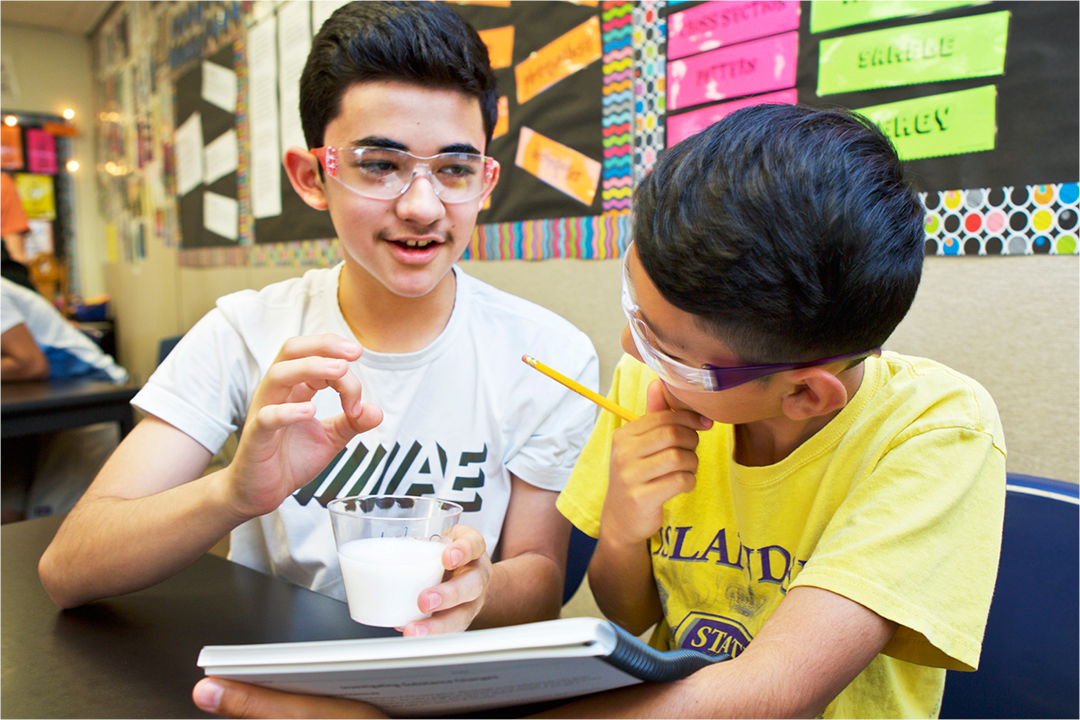
As the host of Science of Reading: The Podcast, Lambert explores the increasing body of scientific research around how reading is best taught. As a former classroom teacher, administrator, and curriculum developer, Lambert is dedicated to turning theory into best practices that educators can put right to use in the classroom, and to showcasing national models of reading instruction excellence.

Person with short blonde hair, glasses, and earrings, wearing an orange jacket, smiling in front of a plain gray background—committed to literacy education and fostering background knowledge for all learners.

Quotes

“Literacy for my students meant more than just reading and writing; it was about access, access to the world, and access to knowledge and opportunities, and even independence—finding their voices.”

–Jackie Eunjung Relyea, Ph.D.

“You can think of a schema like … mental maps or the frameworks that help us store and organize new information and knowledge. The richer and the more detailed your schema about a particular topic, the easier it is to understand and remember new information about it.”

–Jackie Eunjung Relyea, Ph.D.

“Vocabulary oftentimes is the tip of the iceberg of the whole: the conceptual knowledge. It's not a simple definition of the single word; it's really conceptual knowledge and understanding that is represented by the word.”

–Jackie Eunjung Relyea, Ph.D.