Website Terms of Use
Description of Site Services; Acceptance of Terms of Use
Welcome to www.amplify.com (together with any successor sites and the Site Services and Company Content (each as defined below), in whole and in part, the “Site”). The Site is operated by Amplify Education, Inc. (“Company” or “we”). The services that Company makes available on or through the Site include education-related articles, information and instructional services, purchasing functionality, support chat functionality and any other features, content, services, functionality and applications offered from time to time by Company on or through the Site (collectively, “Site Services”).
BY ACCESSING OR USING THE SITE, YOU REPRESENT AND WARRANT THAT YOU ARE OF LEGAL AGE TO ENTER INTO THIS TERMS OF USE AGREEMENT (“AGREEMENT”) AND YOU AGREE TO BE BOUND BY THE TERMS AND CONDITIONS OF THIS AGREEMENT. BY PURCHASING GOODS AND SERVICES ON THE SITE, YOU ARE ACCEPTING THE PRACTICES DESCRIBED IN THIS AGREEMENT AS WELL AS ANY ADDITIONAL TERMS OF USE THAT MAY BE ASSOCIATED WITH THE PARTICULAR GOODS AND SERIVICES YOU ARE PURCHASING.
Please read this Agreement carefully. If you are an employee or other representative of a school or other organization who is accessing or using the Site on behalf of such organization, then you are agreeing to this Agreement on behalf of yourself and such organization. We may modify this Agreement at any time in our discretion, and we may provide such modifications to you by any reasonable means, including by posting the revised version of this Agreement on the Site. You can determine when this Agreement was last revised by referring to the “LAST UPDATED” legend at the top of this Agreement. Your access to or use of the Site following any changes to this Agreement will constitute your acceptance of those changes. Notwithstanding the foregoing, any changes to this Agreement shall not apply to any dispute between you and us arising prior to the date on which we posted the revised version of this Agreement incorporating such changes or otherwise notified you of such changes. If you do not agree to be bound by this Agreement, you must not access or use the Site. Your access to and use of certain parts of the Site may require you to accept additional terms and conditions, and may require you to download certain Software or Content (each as defined below).
Jurisdictional Issues
The Site is controlled and operated by Company from the United States, and is not intended to subject Company to the laws or jurisdiction of any state, country or territory other than that of the United States. Company does not represent or warrant that the Site is appropriate or available for use in any particular jurisdiction other than the United States. In choosing to access and use the Site, you do so on your own initiative and at your own risk, and you are responsible for complying with all local laws, rules and regulations. You are also subject to United States export controls and are responsible for any violations of such controls, including any United States embargoes and other federal rules and regulations restricting exports. We may limit the Site’s availability to any person, geographic area or jurisdiction we choose, at any time and in our discretion. Not all products or services described on the Site are available in all states or territories.
Company content
The Site contains information, text, files, images, video, sounds, musical works, computer code, works of authorship, applications, and other materials and content (collectively, “Content”) of Company or its licensors (“Company Content”). The Site (including the Company Content) is protected by copyright, trademark, trade secret and other laws, and as between you and Company, Company owns and retains all rights in the Site. Company hereby grants to you a limited, revocable, non-sublicensable license, during the term of the Agreement, to access, display and perform the Company Content (excluding any computer code) solely for your personal, non-commercial use and solely as necessary to access and use the Site. Except as expressly permitted by Company in this Agreement or on the Site, you may not copy, download, stream, capture, reproduce, duplicate, archive, upload, modify, translate, create derivative works based upon, publish, broadcast, transmit, retransmit, distribute, perform, display, sell or otherwise use or transfer any Content. You may not, either directly or through the use of any device, software, online resource or other means, remove, alter, bypass, avoid, interfere with or circumvent any copyright, trademark or other proprietary notice on the Content or any digital rights management mechanism, device, or other content protection or access control measure associated with the Content.
User content
You may not access or use the Site for any commercial purpose. You are responsible for all Content that you post, upload, transmit, e-mail or otherwise make available on, through or in connection with the Site (collectively, “User Content”). Please choose carefully the Content that you make available on, through or in connection with the Site. Company does not control any Content other than Company Content, and as such you may be exposed to offensive, indecent, inaccurate or otherwise objectionable Content by accessing or using the Site. Company is not responsible or liable for any Content or the conduct of any Site user. If you become aware of any misuse of the Site, please report such misuse immediately to Company at general@amplify.com. Company reserves the right (but has no obligation) to monitor the Site, including for inappropriate Content or conduct, and to remove any Content in Company’s discretion and without liability to you or any third party.
Your proprietary rights
You retain any ownership rights that you have in your User Content. You hereby grant to Company and its affiliates, licensees and authorized users, a perpetual, non-exclusive, fully paid-up and royalty-free, sublicensable (through multiple tiers), transferable (in whole or in part), worldwide license to use, modify, excerpt, adapt, create derivative works and compilations based upon, publicly perform, publicly display, reproduce and distribute such User Content on, through or in connection with the Site and/or any other commercial or non-commercial endeavor of Company or any of its affiliates, including in connection with any distribution or syndication thereof to Third Party Services (as defined below), on and through all media formats now known or hereafter devised, for any and all purposes including promotional, marketing, trade and commercial purposes. The exercise of such rights shall not require any further permission or notice, payment or attribution to you or any third party. Company reserves the right to limit the storage capacity made available for User Content.
You represent and warrant that: (a) you own the User Content made available by you, or otherwise have the right to grant the license set forth in this Section, and (b) the posting of such User Content through or in connection with the Site does not violate the privacy rights, publicity rights, copyrights, contract rights or any other rights of any person or entity. You agree to pay for all royalties, fees and any other monies owing to any person or entity by reason of the use of such User Content.
Use of the site
You agree not to:
- Post, upload or otherwise transmit or link to Content that is: unlawful; threatening; harmful; abusive; pornographic or includes nudity; offensive; harassing; excessively violent; tortious; defamatory; false or misleading; obscene; vulgar; libelous; hateful; or discriminatory.
- Violate the rights of others, including patent, trademark, trade secret, copyright, privacy, publicity, contract or other proprietary rights.
- Harass or harm another person.
- Exploit or endanger a minor.
- Impersonate any person or entity.
- Introduce or engage in activity that involves the use of viruses, bots, worms, Trojan horses, Easter eggs, time bombs, spyware or any other computer code, files or programs that interrupt, destroy or limit the functionality of any computer software or hardware or telecommunications equipment, or otherwise permit the unauthorized access to or use of a computer or a computer network.
- Interfere with, damage, disable, disrupt, impair, create an undue burden on, or gain unauthorized access to the Site or any Account, or Company’s servers or networks;
- Restrict or inhibit any other person from using the Site (including by hacking or defacing the Site). Cover, remove, disable, block or obscure the Site (including advertisements on the Site).
- Use technology or any automated system, such as scripts or bots, to collect user names, passwords, e-mail addresses or any other data from or through the Site, or to circumvent or modify any security technology or software that is part of the Site.
- Send or cause to send (directly or indirectly) unsolicited bulk messages or other unsolicited bulk communications of any kind through the Site. If you do so, you acknowledge you will have caused substantial harm to Company, and that the amount of such harm would be extremely difficult to measure. As a reasonable estimation of such harm, you agree to pay to Company $50.00 for each actual or intended recipient of such communication.
- Modify, adapt, translate, reverse engineer, decompile or disassemble the Site.
- Solicit, collect or request any information for commercial or unlawful purposes.
- Post, upload or otherwise transmit an image or video of another person without that person’s consent.
- Use the Site to advertise, promote or engage in any commercial activity (including engaging in sales, contests or sweepstakes) without Company’s prior written consent.
- Frame or mirror the Site without Company’s express prior written consent.
- Use the Site in a manner inconsistent with any applicable law, rule or regulation.
- Use any robot, spider, site search/retrieval application or other manual or automatic device to retrieve, index, “scrape,” “data mine,” or in any way gather content of the Site or reproduce or circumvent the navigational structure or presentation of the Site without Company’s express prior written consent. Notwithstanding the foregoing, Company grants to the operators of public search engines the permission to use spiders to copy material from the Site for the sole purpose of, and solely to the extent necessary for, creating publicly-available searchable indices of such material, but not caches or archives of such material. Company reserves the right to revoke these exceptions either generally or in specific cases.
- Attempt, facilitate or encourage others to do any of the foregoing.
Company reserves the right to investigate and take appropriate legal action against anyone who, in Company’s discretion, violates this Agreement or attempts to do so, including terminating or suspending a user’s Account or access to or use of the Site, or reporting any User Content or conduct to law enforcement authorities.
You (and not Company) are responsible for obtaining and maintaining all telecommunications, broadband and computer hardware, equipment and services needed to access and use the Site, and for paying all charges related thereto.
User disputes
You are solely responsible for your interactions with other users of the Site, providers of Third Party Services (as defined below) or any other third parties with whom you interact on, through or in connection with the Site.
Purchases
Company may make available products and services for purchase through the Site, and may use third-party suppliers and service providers to enable e-commerce functionality on the Site. You may only purchase products and services that appear on the Site and that are delivered to an address located in the United States. You may only purchase products and services for personal, non-commercial use by you, your educational institution or students of your educational institution. We may limit quantities or refuse any order for any reason or no reason, including if we have reasonable cause to believe an order is for onward sale or resale other than through distribution channels approved by us. We make no promise that products or services available on the Site are appropriate or available for use in locations outside the United States, and purchasing products or services for delivery to or use in territories where their contents are unlawful is prohibited. If you choose to purchase products or services from locations outside the United States, you do so at your own risk. It is your responsibility to ascertain and obey all applicable local, state, federal and international laws (including minimum age requirements) in regard to the possession, use and sale of any product or service made available through the Site.
If you wish to purchase any product or service made available through the Site, you may be asked to supply certain information relevant to your transaction, including your credit card number, the expiration date of your credit card, your billing address and your shipping information. YOU REPRESENT AND WARRANT THAT YOU HAVE THE LEGAL RIGHT TO USE ANY CREDIT CARD(S) USED IN CONNECTION WITH ANY TRANSACTION. By submitting such information, you grant to Company the right to provide such information to third parties for purposes of facilitating the completion of transactions initiated by you or on your behalf. Verification of information may be required prior to the acknowledgement or completion of any transaction. While it is our practice to confirm orders by e-mail, the receipt of an e-mail order confirmation does not constitute our acceptance of an order or our confirmation of an offer to sell a product or service.
Details of the products and services available for purchase are set forth on the Site. All prices are displayed exclusive of all taxes and shipping/freight charges. Available payment methods, methods of shipping and shipping charges (including charges for expedited shipping, if available) are detailed on the Site. Company may also collect and remit sales tax on your purchase as required by United States law. If you are a tax-exempt entity, please enter the appropriate information where requested on your order form and we will not collect sales tax on your purchase.
Generally, credit and debit cards are not charged until we either ship the product(s) or confirm store availability (at which time you will be charged only for the products we have actually shipped along with any applicable taxes and shipping charges). However, we may pre-authorize your order amount with your credit or debit card issuer at the time you place the order, which may have an effect on your available credit line. When paying for a preorder with a debit card, you will be charged at the time you place your preorder. Please contact your credit or debit card issuer for more information. If you ordered a special delivery product, you will be charged once a delivery time is confirmed. For digitally delivered orders, your credit or debit card will be charged at the time that you initiate the download of the product.
All purchases made through the Site are made pursuant to a shipment contract. As a result, risk of loss and title for products purchased through the Site pass to you upon delivery of the products to the carrier. You are responsible for filing any claims with carriers for damaged and/or lost shipments. Please note that all shipping addresses must be compliant with the shipping restrictions contained on the Site.
Products, services and specifications
All products and services described or depicted on the Site, and all related features, content, specifications and prices, are subject to change at any time without notice. Certain weights, measures and similar descriptions are approximate and are provided for convenience purposes only. Packaging may vary from that shown. We make reasonable efforts to accurately display the attributes of our products, including the applicable colors; however, the actual color you see will depend on your computer system, and we cannot guarantee that your computer will accurately display such colors. The inclusion of any product or service on the Site at a particular time does not imply or warrant that such product or service will be available at any time. Occasionally, the manufacture or distribution of a certain product or service may be delayed for a number of reasons. In such event, we will make reasonable efforts to notify you of the delay and keep you informed of the revised delivery schedule. By placing an order, you represent that the products and services ordered will be used only in a lawful manner. All DVDs and similar products are sold for private, non-commercial home use (where no admission fee is charged), non-public performance, or classroom or instructional use only, and may not be duplicated.
Return and exchange policy
Unless otherwise specified in the terms associated with a particular product, you may return or exchange any product purchased through the Site within fourteen (14) days of receipt, by calling our customer service hotline, 1–800–823–1969, in the event that the purchased product is defective or you received the wrong product. Except for the foregoing, you may not return, cancel or exchange any product or service. Certain jurisdictions may provide additional statutory rights. Nothing herein is meant to limit your return or cancellation rights under local law. In the event that a return or exchange is due to an incorrect order or faulty product, we will be responsible for the shipping costs associated with such return. We will ship a replacement product upon receiving your defective or incorrect product and verifying the reason for the return or exchange.
Accuracy of information
We attempt to ensure that information on the Site is complete, accurate and current. Despite our efforts, the information on the Site may occasionally be inaccurate, incomplete or out of date. We make no representation as to the completeness, accuracy or currency of any information on the Site. For example, products or services included on the Site may be unavailable, may have different attributes than those listed, or may carry a different price than that stated on the Site. If an item’s correct price is higher than our stated price, we will, at our discretion, either contact you for instructions before shipping or cancel your order and notify you of such cancellation. Items in your “Shopping Bag” reflect the current price displayed on the item’s product detail page. Please note that this price may differ from the price displayed when the item was first placed in your Shopping Bag. In addition, we may make changes in information about price and availability without notice.
Chemicals, agricultural materials, and other hazardous materials
Certain products made available through the Site may include chemicals, agricultural materials or other material that may be subject to regulations or restrictions with respect to import or export, or to whom we may sell such material or where or how such material may be used. It is your responsibility to read and abide by all warning notices that accompany any products that you purchase. In addition, we reserve the right to request additional information from you, verify your identity, limit sales to certified educational or research institutions, or cancel or delay your order if required by law or if we believe it is necessary or advisable. Due to special shipping and handling requirements, freight companies routinely impose a surcharge on each package of hazardous material shipped. In such event, we will add such surcharge to your order.
Registration and account security
You may have the ability to create an account on or through the Site (an “Account”). If you submit registration information to create an Account, you represent and warrant that all information submitted to Company in connection with such registration is complete and accurate, and that you will update such information if it changes. If you create an Account, you are responsible for all use of your Account, and for maintaining the confidentiality of the information used to access your Account (including user name and password). You agree not to share your user name or password with anyone, or use anyone else’s Account at any time. You agree to notify Company immediately if you suspect any unauthorized use of, or access to, your Account (including your user name and password). You acknowledge that the reuse of your password in connection with accounts on other websites increases the risk that the security of your Account may be compromised.
Third party links and services
The Site may make available, or third parties may provide, links to other websites, applications, resources, advertisements, Content or other products or services created, hosted or made available by third parties (“Third Party Services”), and such third party may use other third parties to provide portions of the Third Party Service to you, such as technology, development or payment services. When you access or use a Third Party Service, you are interacting with the applicable third party, not with Company, and you do so at your own risk. Company is not responsible for and makes no warranties, express or implied, as to the Third Party Services or the providers of such Third Party Services (including the accuracy or completeness of the information provided by such Third Party Service or the privacy practices of any third party). Inclusion of any Third Party Service or a link thereto on the Site does not imply approval or endorsement of such Third Party Service. Company is not responsible or liable for the content or practices of any Third Party Service or third party, even if such Third Party Service links to or is linked by the Site, and even if such Third Party Service is operated by an affiliate of Company or a company otherwise connected with us or the Site
Feedback
Unless we expressly agree otherwise in writing, if you provide us with any ideas, proposals, suggestions or materials (“Feedback”), whether related to the Site or otherwise, you hereby acknowledge and agree that (a) your provision of any Input is gratuitous, unsolicited and without restriction and does not place Company under any fiduciary or other obligation; and (b) any Feedback is not confidential and Company has no confidentiality obligations with respect to such Feedback.. You hereby grant to us a world-wide, royalty-free, fully paid-up, exclusive, perpetual, irrevocable, transferable and fully sublicensable (through multiple tiers) license, without additional consideration to you or any third party, to reproduce, distribute, perform and display (publicly or otherwise), adapt, modify and otherwise use and exploit such Feedback, in any format or media now known or hereafter developed, and you hereby represent and warrant that you have all necessary rights to grant the foregoing license. We may use Feedback for any purpose whatsoever without permission or notice, compensation or attribution to you or any third party. You are and remain responsible and liable for the content of any Feedback.
Privacy
Please review the Privacy Policy for the Site, available at http://www.amplify.com/privacy, to learn about our information collection, usage and disclosures practices with respect to information collected by us through the Site. Please note that certain products or services made available by us, other than the Site, may be subject to different privacy policies. In addition, the Site’s Privacy Policy does not address, and we are not responsible or liable for, the information collection, usage and disclosures practices of any third party or Third Party Service.
Disclaimers
THE SITE, USER CONTENT, THIRD PARTY SERVICES, AND ALL PRODUCTS AND SERVICES SOLD THROUGH THE SITE (COLLECTIVELY, THE “SITE PRODUCTS”) ARE MADE AVAILABLE “AS-IS” AND “AS AVAILABLE” AND COMPANY DOES NOT GUARANTEE OR PROMISE ANY SPECIFIC RESULTS FROM USE OF THE SITE PRODUCTS. COMPANY AND ITS AFFILIATES EXPRESSLY DISCLAIM ANY WARRANTIES AND CONDITIONS OF ANY KIND, WHETHER EXPRESS OR IMPLIED, INCLUDING THE IMPLIED WARRANTIES OF MERCHANTABILITY, FITNESS FOR A PARTICULAR PURPOSE AND NON-INFRINGEMENT. IN PARTICULAR, COMPANY AND ITS AFFILIATES MAKE NO WARRANTY THAT THE SITE OR USER CONTENT OR THIRD PARTY SERVICES, OR YOUR ACCESS TO OR USE THEREOF, WILL BE UNINTERRUPTED, TIMELY, SECURE, ERROR-FREE, ACCURATE OR RELIABLE. UNDER NO CIRCUMSTANCES SHALL WE BE LIABLE FOR ANY CONSEQUENCES OF ANY UNAUTHORIZED USE OF THE SITE PRODUCTS THAT VIOLATES ANY APPLICABLE LAW OR REGULATION. CERTAIN STATE LAWS DO NOT ALLOW LIMITATIONS ON IMPLIED WARRANTIES OR THE EXCLUSION OR LIMITATION OF CERTAIN DAMAGES. IF THESE LAWS APPLY TO YOU, SOME OR ALL OF THE ABOVE DISCLAIMERS, EXCLUSIONS, OR LIMITATIONS MAY NOT APPLY TO YOU, AND YOU MIGHT HAVE ADDITIONAL RIGHTS.
Under no circumstances will Company or its affiliates be responsible for any loss or damage, including property damage, personal injury or death, resulting from use of the Site, Products, problems or technical malfunction in connection with use of the Site, Products, attendance at any Company event or the conduct of any Site users, whether online or offline. Your use of the Site, Products is solely your responsibility and at your own risk. The User Content and Third Party Services do not necessarily reflect the opinions or policies of Company or its affiliates.
Limitations on liability
IN NO EVENT WILL COMPANY OR ITS AFFILIATES BE LIABLE TO YOU OR ANY THIRD PARTY FOR ANY INDIRECT, CONSEQUENTIAL, EXEMPLARY, INCIDENTAL, SPECIAL OR PUNITIVE DAMAGES, INCLUDING LOST PROFIT DAMAGES, ARISING FROM YOUR USE OF THE SITE PRODUCTS, EVEN IF COMPANY OR ONE OF ITS AFFILIATES HAS BEEN ADVISED OF THE POSSIBILITY OF SUCH DAMAGES. NOTWITHSTANDING ANYTHING TO THE CONTRARY CONTAINED HEREIN, THE TOTAL LIABILITY OF COMPANY AND ITS AFFILIATES TO YOU FOR ANY CAUSE WHATSOEVER AND REGARDLESS OF THE FORM OF THE ACTION, WILL AT ALL TIMES BE LIMITED TO THE AMOUNT PAID, IF ANY, BY YOU TO COMPANY FOR THE SITE PRODUCTS.
Indemnity
You agree to indemnify and hold harmless Company, its affiliates, subcontractors and other partners, and each of their respective officers, agents, partners and employees, from any losses, costs, expenses (including reasonable attorneys’ fees), liabilities, claims or demands, due to or arising out of your use of the Site, your breach or alleged breach of this Agreement, your violation or alleged violation of any rights of another, or any Content that you post or otherwise submit on, through or in connection with the Site.
Termination
This Agreement remains in full force and effect while you access or use the Site. If you create an Account, you may terminate your Account at any time, for any reason, by contacting us at general@amplify.com. Company may terminate or suspend your Account and/or your access to or use of the Site at any time, for any or no reason, with or without prior notice or explanation, and without liability. Upon any such suspension or termination, your right to access and use the Site will immediately cease, and Company may immediately deactivate or delete your Account and all files and other information associated with it, and/or bar any further access to such files and other information. Company shall not be liable to you or any third party for any suspension or termination of your Account or of access to or use of the Site or any such files or other information, and shall not be required to make such files and other information available to you after any such suspension or termination. Sections 2, 5, 13, 17, 18, 19, 22, and 26 shall survive any expiration or termination of this Agreement.
U.S. export controls
All software made available in connection with the Site (“Software”) may be subject to United States export controls. No Software may be downloaded from or through the Site or otherwise exported or re-exported in violation of U.S. export laws.
Governing law
The terms of this Agreement are governed by the laws of the State of New York, U.S.A., without regard to its conflicts of law provisions, and regardless of your location.
Arbitration
EXCEPT FOR DISPUTES THAT QUALIFY FOR SMALL CLAIMS COURT, ALL DISPUTES ARISING OUT OF OR RELATED TO THIS AGREEMENT, WHETHER BASED IN CONTRACT, TORT, STATUTE, FRAUD, MISREPRESENTATION OR ANY OTHER LEGAL THEORY, WILL BE RESOLVED THROUGH FINAL AND BINDING ARBITRATION BEFORE A NEUTRAL ARBITRATOR INSTEAD OF IN A COURT BY A JUDGE OR JURY, AND YOU AGREE THAT COMPANY AND YOU ARE EACH WAIVING THE RIGHT TO TRIAL BY A JURY. YOU AGREE THAT ANY ARBITRATION UNDER THIS AGREEMENT WILL TAKE PLACE ON AN INDIVIDUAL BASIS; CLASS ARBITRATIONS AND CLASS ACTIONS ARE NOT PERMITTED AND YOU ARE AGREEING TO GIVE UP THE ABILITY TO PARTICIPATE IN A CLASS ACTION.
Arbitration procedure
Any arbitration under Section 23 above will be administered by the American Arbitration Association under its Commercial Arbitration Rules and Supplementary Procedures for Consumer-Related Disputes (“Supplementary Procedures”), as amended by this Agreement. The Supplementary Procedures are available online at http://www.adr.org/aaa/ShowPDF?doc=ADRSTG_015820. The arbitrator will conduct hearings, if any, by teleconference or videoconference, rather than by personal appearances, unless the arbitrator determines upon request by you or by us that an in-person hearing is appropriate. Any in-person appearances will be held at a location which is reasonably convenient to both parties with due consideration of their ability to travel and other pertinent circumstances. If the parties are unable to agree on a location, such determination should be made by the AAA or by the arbitrator. The arbitrator’s decision will follow the terms of this Agreement and will be final and binding. The arbitrator will have authority to award temporary, interim or permanent injunctive relief or relief providing for specific performance of this Agreement, but only to the extent necessary to provide relief warranted by the individual claim before the arbitrator. The award rendered by the arbitrator may be confirmed and enforced in any court having jurisdiction thereof. Notwithstanding any of the foregoing, nothing in this Agreement will preclude you from bringing issues to the attention of federal, state, or local agencies, and, if the law allows, they can seek relief against us for you.
Employment opportunities
Company may, from time to time, post Company employment opportunities on the Site and/or invite users to submit resumes to Company. If you choose to submit your name, contact information, resume and/or other personal information to Company in response to such employment listings, you are authorizing Company to use this information for all lawful and legitimate hiring, employment and other business purposes. Company also reserves the right, at its discretion, to forward such information to Company’s affiliates for their legitimate business purposes. Nothing in this Agreement or contained on the Site will constitute a promise by Company to review any such information, or to contact, interview, hire or employ any individual who submits such information.
Digital Millennium Copyright Act
The Digital Millennium Copyright Act of 1998 (“DMCA”) provides recourse for copyright owners who believe that material appearing on the Internet infringes their rights under U.S. copyright law. If you believe that any material residing on or linked to from the Site infringes your copyright, please send (or have your agent send) to Company’s Copyright Agent a notification of claimed infringement with all of the following information: (a) identification of the copyrighted work claimed to have been infringed, or, if multiple copyrighted works are covered by a single notification, a representative list of such works; (b) identification of the claimed infringing material and information reasonably sufficient to permit us to locate the material on the Site (such as the URL(s) of the claimed infringing material); (c) information reasonably sufficient to permit us to contact you, such as an address, telephone number, and, if available, an e-mail address; (d) a statement by you that you have a good-faith belief that the disputed use is not authorized by the copyright owner, the copyright owner’s agent or the law; (e) a statement by you that the above information in your notification is accurate and a statement by you, made under penalty of perjury, that you are the owner of an exclusive right that is allegedly infringed or are authorized to act on such owner’s behalf; and (f) your physical or electronic signature. Company’s Copyright Agent for notification of claimed infringement can be reached as follows: Copyright Agent, Amplify Education, Inc., 55 Washington Street, Brooklyn, NY 11201; Facsimile: 212-796-2311; Attn: Legal. Company’s Copyright Agent for notification of claimed infringement can also be reached electronically at: legal@amplify.com. Company reserves the right to terminate infringers’ and suspected infringers’ Accounts or their access to or use of the Site.
Notice for California residents
Under California Civil Code Section 1789.3, California users are entitled to the following consumer rights notice: If you have a question or complaint regarding the Site, please contact us by writing to Amplify Education, Inc., 55 Washington Street, Brooklyn, NY 11201 or by calling us at 212–213–8177 or sending a fax to 212–796–2311. California residents may reach the Complaint Assistance Unit of the Division of Consumer Services of the California Department of Consumer Affairs by mail at 1625 North Market Blvd., Sacramento, CA 95834, or by telephone at (916) 445–1254 or (800) 952–5210.
Other terms
This Agreement does not, and shall not be construed to, create any partnership, joint venture, employer-employee, agency or franchisor-franchisee relationship between you and Company. You may not assign, transfer or sublicense any or all of your rights or obligations under this Agreement without our express prior written consent. We may assign, transfer or sublicense any or all of our rights or obligations under this Agreement without restriction. The failure of Company to exercise or enforce any right or provision of this Agreement will not operate as a waiver of such right or provision. The Section titles in this Agreement are for convenience only and have no legal or contractual effect. References to and mentions of the word “include,” “includes,” “including,” or “e.g.” will mean “including, without limitation.” References to “discretion” will mean “sole discretion.” This Agreement operates to the fullest extent permissible by law. If any provision of this Agreement is unlawful, void or unenforceable, that provision is deemed severable from this Agreement and does not affect the validity or enforceability of any remaining provisions. Without limitation, you agree that a printed version of this Agreement and of any notice given in electronic form shall be admissible in judicial or administrative proceedings based upon or relating to this Agreement to the same extent and subject to the same conditions as other business documents and records originally generated and maintained in printed form. Company will not be responsible for failures to fulfill any obligations due to causes beyond its control.
Please contact us at legal@amplify.com with any questions regarding this Agreement.
Customer Privacy Policy
Last Modified: January 23, 2026 | Update History
Most recent update: This Privacy Policy has been updated to address additional rights for individuals in the European Union/UK.
We advise you to read this Privacy Policy in its entirety, including the jurisdiction-specific provisions in the appendix. Click here to review Our U.S. Notice At Collection.
Customer Privacy Policy: K–12 Schools
Who We Are
Amplify Education, Inc. (“Amplify”) is leading the way in next-generation curriculum and assessment. Amplify’s programs provide teachers with powerful tools that help them understand and respond to the needs of each student and use data in a way that is safe, secure, and effective.
Our Products and Services
Amplify’s products support classroom instruction and learning and include Amplify CKLA, Amplify ELA, Amplify Caminos, Amplify Science, Amplify Desmos Math, Boost Reading, Boost Math, mCLASS, Mathigon, associated professional development and tutoring services, and services at classroom.amplify.com (for creating and assigning activities) and student.amplify.com (for use of the activities or curricula as directed by an instructor), and any other product or service that links to this Privacy Policy (together, the “Products”).
Our Approach to Student Data Privacy
In the course of providing the Products to Schools and their Authorized School Users, Amplify collects, receives, generates, or has access to Student Data (defined below). We consider Student Data to be confidential and we collect and use Student Data solely for educational purposes in connection with providing our Products to, or on behalf of the School as described in this Privacy Policy and our Agreements (defined below). We work to maintain the security and confidentiality of Student Data that we collect or store, and we enable Schools to control the use, access, sharing, and retention of Student Data.
Our Products are geared towards K–12 students (“Students”), and the educators, agents and staff members who use the Products as authorized by their School (“Educators”). Information that directly relates to an identifiable Student (“Student Data”) is owned and controlled by the School, and Amplify receives Student Data as a “school official” under Section 99.31 of the Family Educational Rights and Privacy Act of 1974 (“FERPA”) for the purpose of providing the Products hereunder. In addition, we rely on the School acknowledging that it is acting as the parent’s agent and consenting on the parent’s behalf to process personal information of Students under the age of 13 (“Child Users”) in accordance with the Children’s Online Privacy Protection Act (“COPPA”).
Our collection and use of Student Data is governed by our Agreements with Schools, including this Privacy Policy (“Privacy Policy”), and applicable laws which may include FERPA, COPPA, the Protection of Pupil Rights Amendment (“PPRA”), as well as other applicable federal, state, and local privacy laws and regulations (“Applicable Laws”). As noted above, with respect to FERPA, Amplify receives Student Data as a “school official” under Section 99.31 of FERPA for the purpose of providing its Products, and such Student Data is owned and controlled by the School.
Schools may provide authorization in two ways:
- by the School agreeing to our Customer Terms and Conditions located at amplify.com/customer-terms or another written agreement between Amplify and the School, as applicable; or
- by an Educator agreeing to the Acceptable Use Policy located at amplify.com/acceptable-use-policy/ (“AUP”) on behalf of the School as outlined in the AUP.
In each case, we collect Student Data and provide these Products solely for the use and benefit of the School and for no other commercial purpose. We require all Schools to review this Privacy Policy, available at amplify.com/customer-privacy, and to make a copy of the Privacy Policy available to the parents or guardians of Child Users.
We also provide limited opportunities for individual users to sign up for an account for use of our Products at-home or otherwise outside of the authorization of a School (“Home Users”). See the Appendix–Supplemental Disclosures for additional information that applies to our Home Users.
What This Privacy Policy Covers
This Customer Privacy Policy (“Privacy Policy”) describes how Amplify collects, uses, and discloses personal information through the provision of Products.
For purposes of this Privacy Policy, “you” and “your” means Authorized Users (defined below).
This Privacy Policy does not apply to Amplify’s handling of:
- information collected from users of Amplify’s company website, which is governed by our Website Privacy Policy.
- job applicant data that we process in accordance with our applicant privacy notice.
There may be different contractual terms or privacy policies in place with some Schools. Such other terms or policies supersede this Privacy Policy for information collected or released under those terms. If you have any questions as to which legal agreement or privacy policy controls the collection and use of your personal information, please contact us using the information provided below. Unless expressly superseded, this Privacy Policy is incorporated into and is subject to the Agreement that governs your use of the Products.
Our Role
Amplify as a processor/service provider: Our School customers are the controllers of Student Data (as well as certain other Educator personal information to the extent required by law or Amplify’s agreement with the School) (together “School Data”).
Amplify acts as a processor/service provider for our School customers with respect to School Data, which means when we use School Data, we do so solely on the instruction of the School. School Data is subject to the School’s privacy policies; therefore, you will need to contact the School directly if you have any questions or would like to exercise your rights with respect to School Data.
Amplify as a controller: We are the controller of all other personal information we collect from non-Student Authorized Users (“Amplify Data”) and can be reached by email at privacy@amplify.com or by mail at Amplify Education, Inc., 55 Washington St.#800, Brooklyn, NY, 11201.
Policy
1. Definitions
Capitalized terms not defined in this section or elsewhere in this Privacy Policy will have the meaning set forth by Applicable Laws.
“Agreement” means the underlying contractual agreement between Amplify and the School.
“Authorized Users” means all users of our Products, including Authorized School Users, parents and legal guardians, and Home Users.
“Authorized School Users” means Students and Educators.
“Local Education Authority” means a local education agency or authority, school district, school network, independent school, or other regional education system.
“Non-Student Data” means information that is linked or linkable to Authorized Users who are not Students.
“School” means the Local Education Authority or State Agency.
“State Agency” means the educational agency primarily responsible for the supervision of public elementary and secondary schools in any of the 50 states, the Commonwealth of Puerto Rico, the District of Columbia, or other territories and possessions of the United States, as well as a national or regional ministry or department of education in other countries, as applicable.
2. What personal information do we collect?
When you access or use our Products, you may choose to provide us with personal information, including Student Data. This information may be provided to us directly (e.g. when an account is created or through communications with us) or through your interactions with our Products.
Student Data. Below is a list of the categories of Student Data that may be collected by Amplify or its Products, either directly or through the Authorized School User’s use of the various features and configurations of the Products:
- Identifier and Enrollment Data, such as name, email, school / state ID number, username and password, grade level, homeroom, courses, teacher names.
- Why? Most of Amplify’s Products require some basic information about who is in a classroom and who teaches the class—Student or teacher Identifier and Enrollment data. This information is provided to Amplify by the School, either directly from the School’s student information system or via a third party with whom the School contracts to provide that information.
- Demographic Data, such as date of birth, socioeconomic status, race, national origin, and preferred or primary language.
- Why? To support school instructional and reporting requirements, Amplify’s Products allow Schools to view reports and analyze data using Demographic Data. Generally, Demographic Data is provided on a voluntary basis by the School. For example, a School may wish to analyze Student literacy assessment results based on English Language Learner status to better tailor classroom instruction, and in that case, the School may provide Demographic Data to enable that reporting.
- School Records, such as grades, attendance, assessment results, and whether an Individualized Education Plan (IEP or local equivalent) is in place.
- Why? Some of our Products support grading assignments and administering formative, diagnostic, and curriculum-based assessments. Teachers use that information to support Students’ progress in the program or help with instructional decisions. We do not collect specific details from an IEP, nor do we collect protected health information or other sensitive information.
- Schoolwork and Student Generated Content, which includes any information contained in Student assignments and assessments, including information in response to instructional activities and participation in collaborative or interactive features of our Products, such as Student responses to academic questions and Student-written essays, as well as images, video, and audio recordings.
- Why? As part of the digital learning experience, some of our Products may enable Students to write text and create and upload images, video, and audio recordings. For example, in Amplify ELA, students may write essays or submit short-form responses in our platform as part of a lesson on literature. As another example, in Boost Reading, student interactions with reading skills games are recorded to keep track of the student’s progress to level up in the program and to provide visibility to teachers on how students are mastering the skills.
- Teacher Comments and Feedback, such as scores, written comments, or other feedback that Educators may provide about Student responses or student course performance.
- Why? To enable teachers to track the performance and provide feedback to their students.
- Non-Student Data. We may collect the following types of personal information from all other Authorized Users:
- Contact Information, such as name and email address, as well as grade level taught, school name and school location, whether you are an Educator or Home User that creates an account or uses our Products or communicates with us.
- Account Information, such as user login and password, for account creation and access purposes.
- Survey Responses, which you provide in response to surveys or questionnaires.
- Device and Usage Data. Depending on the Product, we may collect certain information about the device used to connect to our Product, such as device type and model, browser configurations, and persistent identifiers, such as IP addresses and unique device identifiers. We may collect device diagnostic information, such as battery level, usage logs, and error logs, as well as usage, viewing, and technical information (e.g., email open rates), such as the number of requests a device makes, to ensure proper system capacity for all Authorized Users. We may collect IP addresses and use that information to approximate device location to support operation of the Product. To the extent that we collect this information, this data is solely used to support operation of the Product and is not linked to Student Data. For purposes of clarity, Amplify does not use Student Data for marketing or advertising purposes (see section 6 of this Privacy Policy for more information about our commitments regarding Student Data).
- Why? We use this information to remember returning users and facilitate ease of login, to customize the function and appearance of the Products, and to improve the learning experience. This information also helps us track product usage for various purposes, including website optimization, to ensure proper system capacity, troubleshoot and fix errors, provide technical assistance and customer support, provide and monitor the effectiveness of our Products, monitor and address security concerns, and compile analytics for product improvement and other internal purposes.
- How? Cookies and Similar Technologies. We collect device and usage data through “cookies,” Web beacons, HTML5 local storage, and other similar technologies, which are used in some of our Products solely to support operation of the Products as described above. While we may use third party cookies and similar technologies for advertising and marketing purposes on our website (in accordance with our Website Privacy Policy), we do not permit such tracking technologies to be present on Student-facing portions of the Products. In particular, we only use the following types of cookies in our Products:
- Strictly necessary cookies – These are cookies that are required for the operation of our websites and applications that host our Products. They include, for example, cookies that enable you to log into secure areas of our Products. These cookies are not generally stored beyond the browser session and are less likely to include personal information. This category of cookies cannot be disabled.
- Functionality Cookies – We use these cookies so that we recognize you on the websites and apps that host our Products and remember your previously selected preferences. These cookies are stored on your device between browsing sessions but expire after a pre-defined period. These cookies enable us to “recognize” you when you use our Products, including your preferences such as your preferred language, time, and location. A mix of first party (placed by us) and third-party cookies (placed by third parties) are used.
- Performance Cookies – These cookies help us and service providers acting on our behalf compile statistics and analytics about users of our Products that are accessed via websites and apps, including Device and Usage Information.
- Learn how to opt out of cookies and similar technologies by reading the “What Rights and Choices Do You Have?” section of this Privacy Policy below.
3. How do we use personal information?
Student Data. Amplify uses Student Data for educational purposes, to provide the Products, and to ensure secure and effective operation of our Products, including:
- to provide and improve our educational Products;
- to support School and Authorized School Users’ activities;
- to ensure secure and effective operation of our Products;
- for purposes requested or authorized by the School or Authorized School User or as otherwise permitted by Applicable Laws;
- for customer support purposes, to respond to the inquiries and fulfill the requests of the School and their Authorized School Users;
- to enforce Product access and security controls; and
- to conduct system audits and improve protections against the misuse of our Products, or to detect and prevent fraud and other harmful activities.
- to enable the adaptive and personalized learning features of the Products.
Non-Student Data. Amplify may use Non-Student Data for the purposes for which Student Data is used as set forth above. In addition, Amplify may use Non-Student Data to provide customized content, advertising and marketing in limited circumstances (e.g. to periodically send newsletters and other promotional materials) directed to Educators and Home Users. For sake of clarity, we do not use Student Data for marketing purposes and we do not direct marketing to Students. Amplify may also use Non-Student Data for internal research and analytics, including generating insights on the use of our Products by Educators in certain Schools so that we can better serve those communities. We will also use Non-Student Data as otherwise required or permitted by law, or as we may notify you at the time of collection. Learn how to opt out of these communications by reading the “What Rights and Choices Do You Have?” section of this Privacy Policy below.
Amplify may use aggregate or de-identified data as described in the Aggregate/De-identified Data section below.
4. To whom do we disclose personal information?
Student Data. We disclose Student Data to third parties only as needed to provide the Products under the Agreement, as directed or permitted by the School or Authorized School User, and as required by law. Such disclosures may include but are not limited to the following:
- to other Authorized School Users of the School entitled to access such data in connection with the Products;
- to our service providers, subprocessors, or vendors who have a legitimate need to access such data in order to assist us in providing or supporting our Products, such as platform, infrastructure, and application software. We contractually bind such parties to protect Student Data in a manner consistent with those practices set forth in this Privacy Policy and in accordance with Applicable Laws. A list of Amplify subprocessors is available at https://www.amplify.com/subprocessors;
- to comply with the law, respond to requests in legal or government enforcement proceedings (such as complying with a subpoena), protect our rights in a legal dispute, or seek assistance of law enforcement in the event of a threat to our rights, security, or property or that of our affiliates, customers, Authorized Users, or others;
- in the event Amplify or all or part of its assets are acquired or transferred to another party, including in connection with any bankruptcy or similar proceedings, provided that successor entity will be required to comply with the privacy protections in this Privacy Policy with respect to information collected under this Privacy Policy, or we will provide the School with notice and an opportunity to opt out of the transfer of such data prior to the transfer; and
- except as restricted by Applicable Laws or contracts with the School, we may also share Student Data with Amplify’s affiliated education companies, provided that such disclosure is solely for the purposes of providing Products and at all times is subject to this Policy.
Non-Student Data. Amplify discloses Non-Student Data for the purposes for which Student Data is used as set forth above. Amplify may also disclose Non-Student Data as otherwise required or permitted, or as disclosed at the time of collection. Please note that we do not share mobile information or opt-in consent with third parties / affiliates for their own marketing or promotional purposes.
5. Aggregate/De-identified data
Amplify may use de-identified or aggregate data for purposes allowed under FERPA and other Applicable Laws, to research, develop, and improve educational sites, services, and applications and to demonstrate the effectiveness of the Amplify Products. Amplify will not attempt to re-identify de-identified data. We may use aggregate information (which is information that has been collected in summary form such that the data cannot be associated with any individual) for analytics and reports. For example, our promotional materials may note the total number of students served by our programs in the prior year, but that information cannot be used to identify any one student. We may also share de-identified or aggregate data with research partners to help us analyze the information for product improvement and development purposes.
Records and information are de-identified when all personal information has been removed or obscured, such that the remaining information does not reasonably identify a specific individual. We de-identify Student Data in compliance with Applicable Laws and in accordance with the guidelines of NIST SP 800-122. Amplify has implemented internal procedures and controls to protect against the re-identification of de-identified Student Data. Amplify does not disclose de-identified data to its research partners unless that party has agreed in writing not to attempt to re-identify such data.
6. Data prohibitions, Advertising, Advertising limitations
Amplify will not:
- sell Student Data to third parties;
- use or disclose Student Data to inform, influence, or enable targeted advertising to a Student based on Student Data or information or data inferred over time from the Student’s usage of the Products;
- use Student Data to develop a profile of a Student for any purpose other than providing the Products to a School or Authorized School User, or as authorized by a parent or legal guardian;
- use Student Data for any commercial purpose other than to provide the Products to the School or Authorized School User, or as permitted by Applicable Laws.
7. External third-party services
This Privacy Policy applies solely to Amplify’s Products and practices. Schools and other Authorized Users may choose to connect or use our Products in conjunction with third-party services and Products. Additionally, our sites and Products may contain links to third-party websites or services . This Privacy Policy does not address, and Amplify is not responsible for, the privacy, information, or other practices of such third parties. Schools should carefully consider which third-party applications to include among the Products and services they provide to Students and vet the privacy and data security standards of those providers.
Authorized Users may be able to log in to our Products using third-party sign-in services such as Clever, ClassLink or Google. These services authenticate your identity and provide you with the option to share certain personal information with us, including your name and email address, to pre-populate our account sign-up form. If you choose to enable a third party to share your third-party account credentials with Amplify, we may obtain personal information via that mechanism. You may configure your accounts on these third-party platform services to control what information they share.
8. Security
Amplify maintains a comprehensive information security program and uses industry standard administrative, technical, operational, and physical measures to safeguard Student Data in its possession against loss, theft and unauthorized use, disclosure, or modification. Amplify performs periodic risk assessments of its information security program and prioritizes the remediation of identified security vulnerabilities. Please see https://amplify.com/security for a detailed description of Amplify’s security program.
In the event Amplify discovers or is notified that Student Data within our possession or control was disclosed to, or acquired by, an unauthorized party, we will investigate the incident, take steps to mitigate the potential impact, and notify the School in accordance with Applicable Laws.
Non-Student Data
Outside of Student Data, Amplify uses commercially reasonable administrative, technical, personnel, and physical measures to safeguard personal information in its possession against loss, theft, and unauthorized use, disclosure or modification.
9. Data Storage and Transfers
We are a United States Company, and our servers are hosted, managed, and controlled by us in the United States. If you are outside of the United States, we use industry standards to protect your data when it leaves your country of residence and your data will always be protected in accordance with this Privacy Policy, Applicable Laws and our Agreement regardless of the storage location.
Additionally, where we transfer your personal information to service providers outside of the United Kingdom (UK), European Economic Area (EEA), or other region that offers similar protections, we use specific appropriate safeguards to contractually obligate such service providers to protect personal information in accordance with Amplify’s commitment to privacy and security and applicable data protection laws.
If you have questions or wish to obtain more information about the international transfer of your personal information or the implemented safeguards, please contact us using the contact information below.
10. Data Retention / Deletion
Student Data
Upon request, we provide the School the opportunity to review and delete the personal information collected from Students. We will retain Student Data for the period necessary to fulfill the purposes outlined in this Privacy Policy and our Agreement with the School. We do not knowingly retain Student Data beyond the time period required to support the School or Authorized School User’s educational purpose, unless authorized by the School or Authorized School User. Upon request, Amplify will return, delete, or destroy Student Data stored by Amplify in accordance with applicable law and customer requirements. We may not be able to delete all data in all circumstances, such as information retained in technical support records, customer service records, back-ups, and similar business records. All such information will be protected in accordance with this Privacy Policy and our Agreement until it has been permanently deleted. Unless otherwise notified by the School, we will delete or de-identify Student Data after termination of our Agreement with the School.
Non-Student Data
Outside of Student Data, we keep personal information as long as it is necessary or relevant for the practices described in this Privacy Policy or as otherwise required by our Agreement with the School, if applicable. We determine the appropriate retention period for personal information on the basis of the amount, nature and sensitivity of the personal information being processed, the potential risk of harm from unauthorized use or disclosure of the personal information, whether we can achieve the purposes of the processing through other means, and on the basis of applicable legal requirements (such as applicable statutes of limitations).
11. What rights and choices do you have?
What Choices Do You Have?
Marketing/Advertising
As noted above, we do not use Student Data for marketing purposes and we do not direct marketing to Students. Amplify does not use third party cookies and similar technologies for advertising and marketing purposes on Student-facing portions of the Products. The choices below apply to Non-Student Authorized Users.
Opt-out of Marketing Communications. If you want to stop receiving promotional materials from Amplify, you can follow the unsubscribe instructions at the bottom of each email or email us at privacy@amplify.com. Amplify does not send marketing communications to Students.
Opt-out of Cookies and Similar Tracking Technologies. With respect to cookies, you may be able to reject cookies through your browser or device controls. Note that you have to opt-out of cookies on each browser or device that you use. If you replace, change, or upgrade your browser or device, or delete your cookies, you may need to use these opt-out tools again. Please be aware that disabling cookies may negatively impact your experience as some features may not work properly. To learn more about browser cookies, including how to manage or delete them, check the “Help,” “Tools,” or similar section of your browser.
What Rights Do You Have?
Individuals in the U.S.
- What Rights Do You Have With Respect to Student Data?
- Review and Correction. FERPA requires schools to provide parents with access to their children’s education records, and parents may request that the school correct records that they believe to be inaccurate or misleading.
- If you are a parent or guardian and would like to review, correct, or update your child’s data stored in our Products, contact your School. Amplify will work with your School to enable your access to and, if applicable, correction of your child’s education records.
- If you have any questions about whom to contact or other questions about your child’s data, you may contact us using the information provided below.
- Other Privacy Rights? Please see section 3 of our supplemental disclosures: “Additional U.S. State Privacy Law Rights” for more information about your U.S. privacy rights
Individuals in the EU/UK
Please see section 4 of our supplemental disclosures: “Notice for European Economic Area and United Kingdom Customers” for more information about your EU/UK privacy rights.
12. COPPA
We do not knowingly collect personal information from a Child User unless and until a School or Educator, with the permission of the School, has authorized us to collect such information to provide the Products. Amplify relies on the School acknowledging that it is acting as the parent’s agent and consenting on the parent’s behalf to process personal information of Child Users in accordance with all applicable provisions of COPPA. To the extent COPPA applies to the information we collect, we process such information for educational purposes only, and no other commercial purpose, at the direction of the School and on the basis of the School’s authorization. If you are a parent or guardian and have questions about your child’s use of the Products and any personal information collected, please direct these questions to your child’s school.
Please refer to the Appendix–Supplemental Disclosures if you are a Home User.
13. Updates to this Privacy Policy
We may change this Privacy Policy in the future. For example, we may update it to comply with new laws or regulations, to conform to industry best practices, or to reflect changes in our product offerings. When these changes do not reflect material changes in our practices with respect to use and/or disclosure of Authorized Users’ personal information, including Student Data, such changes to the Privacy Policy will become effective when we post the revised Privacy Policy on our website. In the event there are material changes in our practices that would result in Authorized Users’ personal information being used in a materially different manner than was disclosed when the information was collected, with respect to Student Data, we will notify the School, and with respect to other information, we will notify you via email and provide an opportunity to opt out before such changes take effect.
14. Contact us
If you have questions about this Privacy Policy, please contact us at:
Email: privacy@amplify.com
Mail: Amplify Education, Inc.
55 Washington St.#800
Brooklyn, NY, 11201
Phone: (800) 823-1969
Attn: General Counsel
To report a security vulnerability, visit https://amplify.com/report-a-vulnerability/.
Appendix – Supplemental Disclosures
1. Mathigon and Amplify Classroom accounts
While our Products are geared towards Schools we do provide a limited opportunity for Home Users to use the Products at home—outside of the school context. We do not allow persons under the age of 13 (or those under the age of consent in any applicable jurisdiction) to register for an account with us outside the school context.
If you are a Home User, you are prohibited from collecting or providing any personal information from students or minors. You are permitted to access the platform for instructional purposes, but you may not enroll or roster minors, create accounts for minors, or input any personal information of minors into the Product.
Please note that most parts of Mathigon can be used without creating an account or providing any personal information that directly identifies you.
What Rights Do You Have? If you are a Child User who is 13 or older with a legacy Mathigon account (or the parent or guardian of a Child User with a legacy Mathigon account), you may request that we provide for your review, delete from our records, or cease collecting any Child User personal information. To the extent that you are unable to exercise these rights through self-service features within your account with us, please contact us by sending an email to: help@amplify.com and we will provide assistance.
2. U.S. Notice at Collection
| Personal Information We Collect | How We Use Personal Information |
|
Student Data, which includes:
|
|
|
Authorized Users, which includes:
|
|
Some of the information described above may be considered “sensitive” under the laws of certain jurisdictions (i.e., account credentials and race/national origin) (“Sensitive Information”). We use Sensitive Information for necessary or reasonably expected purposes – specifically, to provide you with our Services (i.e., account credentials are used to allow account logins and race/national origin are used for the School’s reporting purposes when voluntarily provided by the School).
We do not sell or share your personal information, as described in California law.
We retain your personal information for as long as reasonably necessary for the purposes disclosed in the chart above. Additional information about our retention of Student Data and personal information from other Authorized Users can be found in Section 10 of this Privacy Policy.
Please see the Additional U.S. State Privacy Law Rights section of this appendix for information about your privacy rights pursuant to applicable U.S. law.
Notice of Financial Incentive
From time to time, to support our services, we offer opportunities to complete surveys and questionnaires. As an incentive for completing the survey or questionnaire, you can voluntarily provide personal information as an entry into a raffle drawing or to obtain other benefits, discounts, offers, or deals that may constitute a financial incentive under California law (“Financial Incentive”). The categories of personal information required for us to provide the Financial Incentives include: contact information and any other information that you choose to provide when you complete the survey.
Participation is voluntary and you can opt out at any time before the survey is complete. We do not allow students to participate in our surveys.
The value of the personal information we collect in connection with our Financial Incentives is equivalent to the value of the benefit offered.
3. Additional U.S. State Privacy Law Rights
Note for Requests Relating to Student Data: Because Amplify provides the Products to Schools as a “School Official,” we collect, retain, use, and disclose Student Data only for or on behalf of the School for educational purposes, including the purpose of providing the Products specified in our Agreement with the School and for no other commercial purpose. Accordingly, we act as a “service provider” for the School with respect to School Data. We work with the School to support and assist them in addressing privacy requests relating to School Data. Please reach out to your School directly if you wish to exercise any privacy rights that may be available to you.
For all other requests: With respect to Amplify Data, individuals residing in certain U.S. states have the following rights, regarding your personal information (each of which is subject to various exceptions and limitations):
- Access. You have the right to request, up to two times every 12 months, that we disclose to you the categories of personal information collected about you; the categories of sources from which the personal information is collected; the categories of personal information sold or shared; the business or commercial purpose for collecting, selling, or sharing the personal information; the categories of third parties with whom personal information was shared; and the specific pieces of personal information collected about you.
- Correction. You have the right to request that we correct inaccurate personal information collected from you.
- Deletion. You have the right to request that we delete the personal information that we maintain about you. Even after the deletion of your account, some personal information may remain on our servers, such as in technical support logs, server caches, data backups, or email conversations. These will be automatically deleted after a reasonable amount of time, unless we are legally required to retain information for longer, or unless there is a legitimate business reason (e.g. security and fraud prevention or financial record-keeping). We are not required to delete any information which has been aggregated or de-identified in accordance with Section 5.
- No Discrimination. You have the right not to be discriminated against for exercising these rights.
- Appeals. You have a right to appeal decisions concerning your ability to exercise your consumer rights.
See Submitting Requests section below for details on submitting a request to exercise these rights.
4. Notice for European Economic Area (EEA) and United Kingdom (UK) Customers
As detailed at the beginning of our Privacy Policy (under the section titled “Our Role”), Amplify operates primarily as a processor that collects personal information on behalf of the School, and we act as a controller in limited circumstances where we offer Products outside the school context.
If you represent a School in the EEA or the UK, please note that we process personal information in accordance with this Privacy Policy, our Acceptable Use Policy, and our standard Data Protection Agreement, which sets out our responsibilities when it comes to our processing activities. Schools must send an email to privacy@amplify.com to enter into that DPA.
Lawful Basis for Processing
We rely on the following lawful bases for our processing activities:
- Consent;
- We obtain your consent to use cookies to collect and process device and usage data to understand how individuals use our Products.
- Pursuant to a contract for use of our Products;
- We process School Data to provide our Products (e.g., to create, authenticate and manage your account, to verify your identity, to manage our Products) pursuant to the Agreement between us and the School, as required in order for us to perform our obligations.
- To comply with our legal obligations;
- We process all categories of personal information that we collect to ensure the safety and security of our Products where we are complying with security requirements under data protection and cyber and information security law.
- We process all categories of personal information that we collect to comply with our legal obligations which includes, for example, to access, retain or share certain personal information where we receive a valid request from a government body, law enforcement body, judicial body regulator or similar, to deal with legal claims and prospective legal claims, and to ensure we are complying with applicable laws.
- When we have a legitimate interest in doing so, which is not outweighed by the risks to the individual.
- We process all categories of personal information that we collect to support the provision, effective management, and improvement of our Products where such activities are not strictly required under our contract. This is in our legitimate interests to ensure that we are providing the best possible service.
- We process all categories of personal information that we collect to ensure the safety and security of our services where this is important but not required under the data protection law or cyber and information security laws. This is in our legitimate interests to ensure the security of our services and systems, to prevent threats, abuse or fraudulent or unlawful activity, to promote safety and security and to ensure our Products are used in accordance with our terms and conditions.
- We process the contact information of Non-Student Authorized Users to manage our relationship, including to respond to queries or otherwise communicate with you in relation to our Products and the operation of our business where this is not strictly required under a contract with you. This is in our legitimate interests to communicate with and resolve queries from users of our Products and to ensure that we are providing the best possible service.
We process the contact information and survey data of Non-Student Authorized Users for internal research and marketing purposes in limited circumstances (e.g. to periodically send newsletters and other promotional materials), which will not be based on Student Data or directed to Students. This is in our legitimate interests to understand our customers and prospective customers, understand how our products and services are perceived in the market, to promote our products, and to grow and develop our business.
Your Data Subject Rights
Note for Requests Relating to School Data: Amplify acts as processor to its School customers with respect to all School Data. We work with our School customers to support and assist them in addressing privacy requests relating to School Data. Please reach out to your School directly if you wish to exercise any privacy rights that may be available to you.
For all other Requests – With respect to Amplify Data, you have the following rights if you are in the EEA or UK, subject to certain exceptions:
- Right of access: You have the right to ask us for confirmation on whether we are processing your personal information and access to that personal information.
- Right to correction: You have the right to have your personal information corrected.
- Right to erasure: You have the right to ask us to delete your personal information.
- Right to withdraw consent: You have the right to withdraw consent that you have provided.
- Right to lodge a complaint with a supervisory authority: You have the right to lodge a complaint with a supervisory authority.
- Right to restriction of processing: You have the right to request the limiting of our processing under limited circumstances.
- Right to data portability: You have the right to receive the personal information that you have provided to us, in a structured, commonly used, and machine-readable format, and you have the right to transmit that information to another controller, including to have it transmitted directly, where technically feasible.
- Right to object: You have the right to object to our processing of your personal information
See Submitting Requests section below for details on submitting a request to exercise these rights.
5. Submitting Requests
To exercise any of the rights described in sections 2 and 3 of this appendix, email us at privacy@amplify.com and specify which privacy right you intend to exercise. We may require additional information from you to allow us to confirm your identity. The verification steps will vary depending on the sensitivity of the personal information and whether you have an account with us. Please note that your rights may not apply in all cases. For example, we may need to retain your personal information to comply with our legal obligations, resolve disputes, prevent fraud and enforce our agreements. We will inform you if we are not able to fully respond to your requests. You may designate an authorized agent to make a request on your behalf. When submitting the request, please ensure the authorized agent identifies himself/herself/itself as an authorized agent and can show written permission from you to represent you. We may contact you directly to confirm that you have authorized the agent to act on your behalf or confirm your identity.
Complaints
If you have any issues, you have the right to lodge a complaint with an EEA or UK supervisory authority. We would, however, appreciate the opportunity to address your concerns before you approach a data protection regulator and would welcome you directing an inquiry first to us. To do so, please contact us by email at privacy@amplify.com or by mail at Amplify Education, Inc., 55 Washington St.#800, Brooklyn, NY, 11201.
6. Google APIs
Amplify uses Google’s Application Programming Interface (API) Services to enable Authorized Users to log in to Amplify, import classes and rosters from Google Classroom, create assignments in Google Classroom, and copy, edit, and publish Amplify content using Google Slides. Amplify will use and transfer information received from Google’s API in accordance with Google API Service User Data Policy, including the Limited Use requirements.
Update History:
Update: 6/13/2025: This Policy has been updated to align with product updates and to provide additional context for authorized educational use of Amplify’s Products.
Update 6/27/2024: The Policy has been updated to include an explanation regarding Google APIs in the Appendix — Supplemental Disclosures section.
Update 6/30/2023: This Privacy Policy has been updated to address new state law data privacy requirements.
Website Privacy Policy
Last Modified: February 2026
Update: February 2, 2026: This Privacy Policy has been updated to address additional rights for individuals in the European Union/UK.
Below is the Website Privacy Policy for the amplify.com site (“Privacy Policy”). For purposes of clarity and as further outlined below, this Privacy Policy does not apply to student data. You can visit this page to read about the principles and policy governing student data collected and maintained on behalf of our school customers.
We advise you to read this Privacy Policy in its entirety, including the jurisdiction-specific provisions in the appendix. Our Notice at Collection for California Residents is available in the Notice for our California Customers.
Who We Are / What This Privacy Policy Covers
Amplify Education, Inc. (“Amplify”) recognizes the importance of protecting the privacy and security of your personal information. This Privacy Policy describes our practices in connection with information that we may collect through your use of this website (the “Site”).
This Privacy Policy does not apply to Amplify’s handling of:
- student data or other information collected from users of Amplify’s products that support classroom instruction and learning, which are governed by our Customer Privacy Policy.
- staff or applicant data that we process in accordance with our staff or applicant privacy notice, respectively.
If you have any question as to what legal agreement or privacy policy controls the collection and use of your information, please contact us using information below in the Contact Us section.
This Privacy Policy is incorporated into and is subject to our Website Terms of Use, which governs your use of the Site.
Our Role: We are the controller of all personal information (as defined below) that we receive through our Site and can be reached by email at privacy@amplify.com or by mail at Amplify Education, Inc., 55 Washington St.#800, Brooklyn, NY, 11201.
1. What personal information do we collect?
When you visit and / or interact with our Site, we may collect the following information about you that, alone or in combination, could be used to identify you or your device (“personal information”):
- Contact Information, such as name, district / school name, professional affiliation, title / role, email address, shipping address, address and phone number.
- Account Information, such as customer user login and password.
- Demographic Information, such as age and gender.
- Information You Submit, such as information voluntarily provided on message boards, feedback sections, and other public areas of the Site.
- Site Activity Information, which is collected when you access and interact with the Site, we and our Service Providers (as defined below) may collect certain information about those visits. For example, we or our Service Providers may receive and record information about your computer and browser, including your IP address, browser type, and other software or hardware information. If you access the Site from a mobile or other device, we may collect a unique device identifier assigned to that device, or other characteristics of the device hardware, operating system and configurations for that device. On certain pages of the Site, we may use third party tools to help us look at mouse movements, clicks, keystrokes, data or text entered, and the pages you visit.
- Location Information, such as state, country and / or zip code, which we use to help us customize your experience, as well as to help us facilitate your privacy rights.
- Audio, electronic, visual, or similar information: such as customer service interactions, call recordings, chat transcripts, files you attach, and email, text, or other correspondence.
If you make a purchase through our online store, you may provide payment and other information directly to our third party e-commerce platform to complete your purchase.
We ask that you not send us, and you not disclose, any government identifiers (such as social security numbers) or information related to racial or ethnic origin, health, or criminal background on or through the Site or otherwise.
2. Where/How do we collect personal information?
Amplify may collect personal information directly from you at various points, including the following:
- Product Information and Newsletters. When you submit a request to obtain information about our products, services or other informational material or subscribe to one of our newsletters, you may be asked to submit information such as name, professional affiliation, email address, company name, address and phone and details on your query or interests in our products and services. This information is collected to help us process your request.
- Customer Support. When you submit a form to contact our customer service, you may be asked to submit information such as name, e-mail, district, customer user login and password and details on your query. In addition, some features of our Site, such as our customer live chat functionality or other customer service systems may allow you to voluntarily provide personal information to us. This information is collected to help us process your request. Please only provide what is needed to facilitate the support request.
- Product Orders. If you use e-commerce areas of our Site to order our products, we request information from you on our order form. To purchase products through the Site, you must provide contact information (such as name and shipping address) and financial information (such as credit card number). This information is used for billing purposes and to fill your orders. We will also use this information to contact you to confirm your order or to inform you of any issues or delays.
- Registration. You may be asked to submit information to use certain parts of the Site (such as posting comments on certain areas of the Site), register for an event or webinar, or view restricted content that may be available on the Site. For instance, you may be asked to provide your name, email address and event or webinar-related preferences to help us process your registration or content request.
- Public Areas and Discussion Forums. Any information you share in public areas, such as message boards or feedback sections, becomes public. Please be careful about what you disclose and do not post any personal information that you expect to keep private.
- Contests and Sweepstakes. When we run a contest or sweepstakes relating to the Site or Amplify, it will be accompanied by a set of rules. The rules for each contest/sweepstakes will specify how the information gathered from you for your entry will be used and disclosed.
As you visit or use our Site, we may collect Site activity information through cookies and similar technologies.
- Cookies, Pixels, and Other Tracking Technologies. Cookies and other tracking technologies (such as pixels, beacons, and Adobe Flash technology) are small data files that are placed on your computer or mobile device when you visit a website. They allow the website or mobile app to remember your actions and preferences over a period of time. We use the following types of cookies:
- Strictly necessary cookies – These are cookies that are required for the operation of our Site. They include, for example, cookies that enable you to log into secure areas of our Site. These cookies are not generally stored beyond the browser session and are less likely to include personal information. This category of cookies cannot be disabled.
- Functionality Cookies – We use these cookies so that we recognize you on our Site and remember your previously selected preferences. These cookies are stored on your device between browsing sessions but expire after a pre-defined period. These cookies enable our Site to “recognize” you when you use our Site, including your preferences such as your preferred language , time, and location. A mix of first party (placed by us) and third-party cookies (placed by third parties) are used.
- Analytics Cookies – These cookies help us and our Service Providers compile statistics and analytics about users of the Site, including Site Activity Information. For example, we use Google Analytics to help us understand how users interact with the Platform. Google Analytics uses cookies to track your interactions with the Site, then collects that information and reports it to us. This information helps us improve the Site so that we can better serve you. To learn more about Google Analytics, visit https://support.google.com/analytics/answer/6004245?hl=en. If you wish, you can opt-out of Google Analytics by installing the Google Analytics Opt-out Browser Add-on, available on https://tools.google.com/dlpage/gaoptout.
- Advertising Cookies – We use these cookies to collect information about your visit to our Site, the content you viewed, the links you followed and information about your browser, device, and your IP address. We sometimes share some limited aspects of this data with third parties for advertising purposes. We may also share Site Activity Information collected through cookies with our advertising partners. This means that when you visit another website, you may be shown advertising based on your browsing patterns on our Site.
For information on how to opt-out of these technologies, please see What Choices Do You Have? below.
- Social Plugins. Certain areas of our Site permit you to utilize social media functionality, such as the Facebook “Like” or Google “+1” buttons (“Social Plugins”). To use a Social Plugin, you must authorize the third-party provider of that Social Plugin, e.g. Facebook or Google, to access, collect, and/or disclose your information related to your use of that Social Plugin, subject to that company’s privacy policies, which may differ from this Privacy Policy. In addition, such providers may be able to collect information about you, including your activity on the Site, and they may notify your connections on their social networking platform about your use of the Site. Such services may also employ unique identifiers that allow your activity to be monitored across multiple websites for purposes of delivering more targeted advertising to you.
Amplify also receives information from other sources.
- Information from Other Sources. We may supplement any information we collect via this Site with information from publicly or commercially available sources.
3. How do we use personal information?
We may use any personal information and other information we collect from and about you for the following purposes and as described elsewhere in this Privacy Policy:
- To provide and manage the Site. We use the personal information we collect from and about you to provide the Site and features to you, including to measure and improve its services and features, to personalize your experience by delivering relevant content, to deliver marketing messages, to allow you to comment on content, to provide you with customer support, and to respond to inquiries. We may also use and disclose aggregate or anonymous data about your use of and activity on the Site to assist us in this regard and for any other purpose.
- To contact you. Amplify may periodically send promotional materials (e.g., newsletters) or notifications related to the Site and to Amplify’s business to the contact information you provided to us at registration.
- To improve our products and services. We may use your personal information for our business purposes, such as data analysis, audits, developing new products and services, enhancing the Site, improving our services, identifying usage trends, and determining the effectiveness of our promotional campaigns.
- For marketing and advertising. We may use your personal information to help us market our products to you or your school district.
4. To whom do we disclose personal information?
We may disclose any personal information and other information we collect from and about you for the following purposes and as described elsewhere in this Privacy Policy:
- To share with our affiliated education companies. Amplify may share your personal information with Amplify’s affiliated education companies for the purposes described in this Privacy Policy.
- To allow service providers to assist us. We may engage third party service providers, agents and partners (“Service Providers”) to perform functions on our behalf, such as analytics, credit card processing, shipping or stocking orders and providing customer service. We may disclose your personal information to such Service Providers to enable them to assist us in these efforts.
- To allow our marketing and advertising partners to assist us. We may engage marketing and advertising partners to help us market and advertise our products and services, including via digital ads sent in connection with your visit to the Site. We may disclose Site Activity information, as well as contact information and other aggregate insights to such partners to enable them to assist us in these efforts.
- To protect the rights of Amplify and our users. There may be instances when Amplify may disclose your personal information, in situations where Amplify has a good faith belief that such disclosure is necessary or appropriate in order to: (i) protect, enforce, or defend the legal rights, privacy, safety, operations, or property of Amplify, our parents, subsidiaries or affiliates or our or their employees, agents and contractors (including enforcement of our agreements, including our terms of use); (ii) protect the rights, safety, privacy, security or property of users of the Site or others; (iii) protect against fraud or for risk management purposes; (iv) comply with the law or legal process, including laws outside your country of residence; (v) respond to requests from public and government authorities, including those outside your country of residence; or (vi) allow us to pursue available remedies or limit the damages that we may sustain.
- To complete a merger or sale of assets. If Amplify sells all or part of its business or makes a sale or transfer of its assets or is otherwise involved in a merger, transfer or other disposition of all or part of its business, assets or stock (including in connection with any bankruptcy or similar proceedings), Amplify may transfer your personal information to the party or parties involved in the transaction.
5. What rights and choices do you have?
Opt-out of Marketing Communications. If you want to stop receiving promotional materials from Amplify, you can follow the unsubscribe instructions at the bottom of each email. There are certain service notification emails that you may not opt-out of, such as notifications of changes to the Site or policies. If you have additional questions, please contact us using information below in the Contact Us section.
Opt-of Cookies and Similar Tracking Technologies. There are a few ways to opt out or delete cookies.
- On Your Browser. Most browsers are initially set to accept cookies, but your browser may permit you to change your settings to notify you of a cookie being set or updated, or to block cookies altogether. Please consult the “Help” section of your browser for more information. Please note that by blocking any or all cookies you may not have access to certain features, content or personalization that may be available through the Site. Please also note that you must opt out separately on each device (including each web browser on each device) that you use to access our Site if you wish to opt out, and if you clear your cookies or if you use a different browser or device, you will need to renew your opt-out preferences.
- Interest-Based Advertising. Some advertisers and marketing companies participate in the self-regulatory programs of the Digital Advertising Alliance (“DAA”) and European Interactive Digital Advertising Alliance (“eDAA”) in connection with online interest-based advertising. DAA and eDAA provide consumers with the ability to opt out of receiving interest-based advertising from their program participants at the following links:
What Rights Do You Have?
- Please see section 3 of our supplemental disclosures: “Additional U.S. State Privacy Law Rights” for information about your U.S. privacy rights
- Please see section 4 of our supplemental disclosures: “Notice for European Economic Area and United Kingdom Customers” for information about your EU/UK privacy rights.
6. Security
Amplify uses commercially reasonable administrative, technical, personnel and physical measures to safeguard personal information in its possession against loss, theft and unauthorized use, disclosure or modification.
7. Data retention / Deletion
We will retain your personal information for the period necessary to fulfill the purposes outlined in this Privacy Policy unless a longer retention period is required or allowed by law. Even after we have deleted your personal information from our systems, copies of some information from your account may remain viewable in some circumstances – where, for example, you have shared information with social media platforms and other unaffiliated services. We may also retain backup information related to your account on our servers for some time after cancellation for fraud detection or to comply with applicable law or our internal security policies. Because of the nature of caching technology, your account may not be instantly inaccessible to others, and there may be a delay in the removal of the content from elsewhere on the Internet and from search engines.
8. Data Storage and Transfers
We are a United States Company, and our servers are hosted, managed, and controlled by us in the United States. If you are outside of the United States, we use industry standards to protect your data when it leaves your country of residence and your data will always be protected in accordance with this Privacy Policy, Applicable Laws and our Agreement regardless of the storage location.
Additionally, where we transfer your personal information to service providers outside of the United Kingdom (UK), European Economic Area (EEA), or other region that offers similar protections, we use specific appropriate safeguards to contractually obligate such service providers to protect personal information in accordance with Amplify’s commitment to privacy and security and applicable data protection laws.
If you have questions or wish to obtain more information about the international transfer of your personal information or the implemented safeguards, please contact us using the contact information below.
9. External third-party services
The Site may be linked to sites operated by unaffiliated companies, and may carry advertisements or offer content, functionality, games, newsletters, contests or sweepstakes, or applications developed and maintained by unaffiliated companies. Amplify is not responsible for the privacy practices of unaffiliated companies, and once you leave the Site via a link or enable an unaffiliated service, you are subject to the applicable privacy policy of the unaffiliated service.
10. Updates to this policy
Amplify may modify this Privacy Policy. Please look at the Last Revised Date at the top of this Privacy Policy to see when this Privacy Policy was last revised. Any changes to this Privacy Policy will become effective when we post the revised Privacy Policy on the Site. If you do not wish to be bound by the terms of the revised Privacy Policy, you must discontinue your use of the Site.
11. Contact us
If you have questions about this Privacy Policy, please contact us at:
Email: privacy@amplify.com
Mail: Amplify Education, Inc.
55 Washington St.#800
Brooklyn, NY, 11201
Phone: (800) 823-1969
Attn: General Counsel
Appendix – Supplemental Disclosures
1. Notice for our California Customers
We retain your personal information for as long as you are an active user of our Site or continue to have an account with us, and in accordance with our legal obligations (which may require us to hold information to provide financial and other reporting and to defend against potential claims). If you are a California resident, please see below for information about your rights pursuant to California law.
Personal Information We Collect |
How We Use Personal Information |
| Contact Information |
|
| Account Information |
|
| Payment Information |
|
| Information You Submit |
|
| Site Activity Information |
|
| Location Information |
|
| Inferences |
|
Some of the information described above may be considered “sensitive” under the laws of certain jurisdictions (including payment information and account login credentials (“Sensitive Information”). Whether information is Sensitive Information will depend on the laws of your jurisdiction. We only use Sensitive Information, such as payment information and account credentials for necessary or reasonably expected purposes – specifically, to provide you with our Services (i.e., fulfill purchases and to allow account logins).
Shine the Light
California’s Shine the Light law (Civil Code § 1798.83) permits California residents to request certain information regarding our disclosure of certain categories of personal information to third parties for their own direct marketing purposes in the preceding calendar year. We do not share personal information, as defined by California’s Shine the Light law, with third parties for their own direct marketing purposes.
Notice of Financial Incentive
As part of our services, there may be opportunities for you to complete surveys and questionnaires. As an incentive for completing the survey or questionnaire, you can voluntarily provide your personal information, which in turn enters you into a raffle drawing or enables us to provide you with other benefits, discounts, offers, or deals that may constitute a financial incentive under California law (“Financial Incentive”). The categories of personal information required for us to provide the Financial Incentives include: contact information and any other information that you choose to provide when you complete the survey.
Participation is voluntary and you can opt out at any time before your survey is complete.
The value of the personal information we collect in connection with our Financial Incentives is equivalent to the value of the benefit offered.
2. Additional U.S. State Privacy Law Rights
Residents of certain U.S. states have the following rights, regarding your personal information (each of which are subject to various exceptions and limitations):
- Access. You have the right to request, up to two times every 12 months, that we disclose to you the categories of personal information collected about you, the categories of sources from which the personal information is collected, the categories of personal information sold or shared, the business or commercial purpose for collecting, selling, or sharing the personal information, the categories of third parties with whom personal information was shared, and the specific pieces of personal information collected about you.
- Correct. You have the right to request that we correct inaccurate personal information collected from you.
- Deletion. You can request that we delete your personal information that we maintain about you.
- Opt-out (Do Not Sell or Share My Personal Information). Under several U.S. state privacy laws, consumers have the right to opt-out of the “sale” of their personal information (defined very broadly to include situations where we provide personal information to partners who provide advertising services to us) and the “sharing” of personal information in connection with the display of targeted advertising across third party websites. While we do not sell your personal information, we do share it in connection with our advertising efforts. Please also note that we do not knowingly sell or share the Personal Information of minors under 16 years of age.
We also honor the Global Privacy Control, a browser-based opt-out signal. We do not respond to other browser-based signals that do not meet applicable state law requirements, which may include older Do Not Track signals.
- No Discrimination. You have the right not to be discriminated against for exercising these rights.
- Appeals. You have a right to appeal decisions concerning your ability to exercise your consumer rights.
- Submission of Requests. You may exercise the above rights by emailing us at privacy@amplify.com. Note that we may deny certain requests, or fulfill a request only in part, based on our legal rights and obligations. For example, we may retain personal information as permitted by law, such as for tax or other record keeping purposes, to maintain an active account, and to process transactions and facilitate customer requests.
- Authorized Agent. You may designate an authorized agent to make a request on your behalf. When submitting the request, please ensure the authorized agent identifies himself/herself/itself as an authorized agent and can show written permission from you to represent you. We may contact you directly to confirm that you have authorized the agent to act on your behalf or confirm your identity.
- Verification. Whether you submit a request directly on your own behalf, or through an authorized agent, we will take reasonable steps to verify your identity prior to responding to your requests. The verification steps will vary depending on the sensitivity of the personal information and whether you have an account with us.
3. Notice for European Economic Area and United Kingdom Customers
As detailed at the beginning of our Privacy Policy (under the section titled “Our Role”), Amplify acts as a controller with respect to personal information collected as you interact with our Site.
Lawful Basis for Processing
We rely on the following lawful bases for our processing activities:
- Consent;
- We obtain your consent to collect and process device and usage data via cookies on our Site to understand how individuals use our Site and to help us measure the effectiveness of our advertising and marketing campaigns.
- Pursuant to a contract with the user of our Site;
- We process all categories of personal information that we collect to provide and manage our Site, including payment processing, where this is required in order for us to perform our obligations under our contract with you.
- To comply with our legal obligations;
- We process all categories of personal information that we collect to ensure the safety and security of our Site where we are complying with security requirements under data protection and cyber and information security law.
- We process all categories of personal information that we collect to comply with our legal obligations which includes, for example, to access, retain or share certain personal information where we receive a valid request from a government body, law enforcement body, judicial body regulator or similar, to deal with legal claims and prospective legal claims, and to ensure we are complying with applicable laws.
- When we have a legitimate interest in doing so, which is not outweighed by the risks to the individual. We rely on our legitimate interest to process all categories of personal information:
- to provide, manage, and improve the Site where such activities are not strictly required under our contract, including personalizing your experience on the Site.
- to ensure the safety and security of our Site where this is important but not required under the data protection law or cyber and information security laws.
- to respond to queries or otherwise communicate with you in relation to our Site and the operation of our business where this is not strictly required under a contract with you.
- internal research and certain marketing purposes (e.g. to periodically send newsletters and other promotional materials), which will not be based on Student Data or directed to K–12 students.
Your Data Subject Rights
If you are located in the EEA/UK, you have the following rights, subject to certain exceptions:
- Right of access: You have the right to ask us for confirmation on whether we are processing your personal information and access to that personal information.
- Right to correction: You have the right to have your personal information corrected.
- Right to erasure: You have the right to ask us to delete your personal information.
- Right to withdraw consent: You have the right to withdraw consent that you have provided.
- Right to lodge a complaint with a supervisory authority: You have the right to lodge a complaint with a supervisory authority.
- Right to restriction of processing: You have the right to request the limiting of our processing under limited circumstances.
- Right to data portability: You have the right to receive the personal information that you have provided to us, in a structured, commonly used, and machine-readable format, and you have the right to transmit that information to another controller, including to have it transmitted directly, where technically feasible.
- Right to object: You have the right to object to our processing of your personal information
To exercise any of these rights, contact us as set forth in the section entitled “Contact Us” above and specify which European privacy right you intend to exercise. We may require additional information from you to allow us to confirm your identity. Please note that we store information as necessary to fulfill the purposes for which it was collected, and may continue to retain and use the information even after a data subject request for purposes of our legitimate interests, including to comply with our legal obligations, resolve disputes, prevent fraud, and enforce our agreements.
Complaints
If you have any issues with our compliance, you have the right to lodge a complaint with an EEA or UK supervisory authority. We would, however, appreciate the opportunity to address your concerns before you approach a data protection regulator, and would welcome you directing an inquiry first to us. To do so, please contact us by email at privacy@amplify.com or by mail at Amplify Education, Inc., 55 Washington St.#800, Brooklyn, NY, 11201.
Acceptable Use Policy
Amplify Education, Inc. (“Amplify”) products support classroom instruction and learning and include Amplify CKLA, Amplify ELA, Amplify Science, Amplify Desmos Math, Desmos Math, Boost Reading, Boost Math, mCLASS, Mathigon, services at classroom.amplify.com (for creating and assigning activities) and student.amplify.com (for use of the activities or curricula as directed by an instructor), and any other product or service that links to this Acceptable Use Policy (together, the “Products”). This Acceptable Use Policy (the “AUP”) provides the general terms and conditions applicable to your use of the Products. By accessing, downloading, or using the Products, you agree to be bound by the terms of this AUP.
Notwithstanding the foregoing, nothing in this AUP supersedes or limits your rights under the terms of any other agreement you or your institution have entered into with Amplify regarding the use of Products. In the event of any conflict between the AUP and the terms and conditions of an applicable agreement that you or your institution have entered into with Amplify, the terms and conditions of such agreement shall control.
Our Products are geared towards K–12 students, educators, and staff who use the Products as authorized by their School District or State Agency (each as defined in the Privacy Policy (defined below), and together, “School”) (“Authorized School Users”). Student Data (defined below) is owned and controlled by the School, and Amplify receives Student Data as a “school official” under Section 99.31 of the Family Educational Rights and Privacy Act of 1974 (“FERPA”) for the purpose of providing the Products hereunder. In addition, we rely on the School acknowledging that it is acting as the parent’s agent and consenting on the parent’s behalf to process personal information of students under the age of 13 (“Child Users”) in accordance with the Children’s Online Privacy Protection Act (“COPPA”).
Schools may provide authorization in two ways:
(1) by the School agreeing to our Customer Terms and Conditions located at amplify.com/customer-terms or another agreement between Amplify and the School, as applicable; or
(2) by an educator, staff member, or agent of a School (“Educator”) agreeing to this AUP. If you are an Educator and wish to use the Products in your classroom, you represent and warrant that the use of the Products in your classroom has been authorized by your School, and that you are authorized to accept this AUP on behalf of the School.
In each case, we provide these Products solely for the benefit of the School and for no other commercial purpose. We require all Schools to review our Privacy Policy, available at amplify.com/customer-privacy (“Privacy Policy”), and to make a copy of the Privacy Policy available to the parents or guardians of Child Users.
We also provide limited opportunities for individual users to sign up for a restricted account for at-home use of our Products (together, with Authorized School Users, “Authorized Users”). Please see Additional terms for Mathigon and Amplify Classroom accounts (Section 18) for additional information.
1. License
Subject to compliance with this AUP, you are granted a non-transferable, non-exclusive, non-sublicensable license to access and use the Products. You understand that your use of the Products does not confer to you any intellectual property rights held by Amplify or its licensors. Unless otherwise indicated, any future release, update, or other addition to functionality or content of the Products will be subject to this AUP.
2. Restrictions
You may access and use the Products solely for non-commercial instructional and administrative purposes. Guidelines for such purposes may be set forth at http://amplify.com/amplify-program-usage-guidelines and additional guidelines may be detailed in materials associated with the Product You are accessing. Further, You may not, except as expressly authorized by Amplify: (a) copy, modify, translate, distribute, disclose, or create derivative works based on the contents of, sell, or otherwise exploit, the Products, or any part thereof; (b) decompile, disassemble, reverse engineer the Products, or otherwise use the Products to develop functionally similar products or services; (c) modify, alter, or delete any of the copyright, trademark, or other proprietary notices in or on the Products; (d) rent, lease, or lend the Products or use the Products for the benefit of any third party; (e) avoid, circumvent, or disable any security or digital rights management device, procedure, protocol, or mechanism in the Products; (f) use any content from the Products, including but not limited to text, images, videos, assessments, lesson plans, or code, as input or training material for any machine learning or artificial intelligence system, including large language models, neural networks, or other algorithmic models, for any purposes, commercial or non-commercial; or (g) permit any Authorized User or third party to do any of the foregoing. You also agree that any works created in violation of this section are derivative works, and, as such, You agree to assign, and hereby assign, all right, title, and interest in such works to Amplify. The Products and derivatives thereof may be subject to export control laws, restrictions, regulations, and orders of the U.S. and other jurisdictions (together, “Export Laws”). You agree to comply with all applicable Export Laws, and will not, and will not permit Authorized Users to, export, or transfer for the purpose of re-export, any Product to any prohibited or embargoed country in violation of any U.S. export law or regulation. Further, You represent that You are not located in a country that is subject to a U.S. Government embargo, subject to sanctions by the U.S. Office of Foreign Assets Control, or included on any restricted party list maintained by the U.S. Bureau of Industry and Security. The software and associated documentation portions of the Products are “commercial items” (as defined at 48 CFR 2.101), comprising “commercial computer software” and “commercial computer software documentation,” as those terms are used in 48 CFR 12.212. Accordingly, if You are associated with the U.S. Government or its contractor, You will receive only those rights set forth in this Agreement in accordance with 48 CFR 227.7201-227.7204 (for Department of Defense and their contractors) or 48 CFR 12.212 (for other U.S. Government licensees and their contractors).
3. Use of the products
In connection with your access to and use of the Products, you agree not to: (a) post, upload, or otherwise transmit or link to content that is: unlawful; threatening; harmful; abusive; pornographic or includes nudity; offensive; harassing; excessively violent; tortious; defamatory; false or misleading; obscene; vulgar; libelous; hateful; or discriminatory; (b) violate the rights of others, including patent, trademark, trade secret, copyright, privacy, publicity, contract, or other proprietary rights; (c) harass or harm another person; (d) exploit or endanger a minor; (e) impersonate any person or entity; (f) introduce or engage in activity that involves the use of viruses, bots, worms, Trojan horses, time bombs, spyware, or any other computer code, files, or programs that interrupt, destroy, or limit the functionality of any computer software or hardware or telecommunications equipment, or otherwise permit the unauthorized access to or use of a computer or a computer network; (g) interfere with, damage, disable, disrupt, impair, create an undue burden on, or gain unauthorized access to the Products or any account (as defined below), or Amplify’s servers or networks; (h) restrict or inhibit any other person from using the Products (including by hacking or defacing the Products); (i) remove, disable, block, or obscure any portion of the Products; (j) use technology or any automated system, such as scripts or bots, to collect user names, passwords, email addresses, or any other data from or through the Products, or to circumvent or modify any security technology or software that is part of the Products; (k) send or cause to send (directly or indirectly) unsolicited bulk messages or other unsolicited bulk communications of any kind through the Products; (l) solicit, collect, or request any information for commercial or unlawful purposes; (m) post, upload, or otherwise transmit an image, audio recording, or video of another person without that person’s consent; (n) use the Products to advertise, promote, or engage in any commercial activity (including engaging in advertising, sales, contests, sweepstakes, or other promotions) without Amplify’s prior written consent; (o) frame or mirror the Products without Amplify’s express prior written consent; (p) use the Products in a manner inconsistent with any applicable law, rule, or regulation; (q) use any robot, spider, search/retrieval application, or other manual or automatic device to retrieve, index, “scrape,” “data mine,” or in any way gather content of the Products or reproduce or circumvent the navigational structure or presentation of the Products; (r) attempt, facilitate, or encourage others to do any of the foregoing. In addition to the foregoing restrictions, your use of the Products may also be subject to an additional acceptable use policy provided to you by your School, as applicable. You are responsible for meeting the hardware, software, telecommunications, and other requirements listed at amplify.com/customer-requirements.
4. Intellectual property
The Products and any Product logo, and certain other of the names, logos, and materials displayed in the Products, may constitute trademarks, trade names, or service marks (“Marks”) of Amplify or other entities. You are not authorized to use any such Marks. Ownership of all such Marks and the goodwill associated therewith remains with Amplify or those other entities. The content provided to you in the Products, including the software, graphs, text, and graphics, is protected under copyright laws, is subject to other intellectual property and proprietary rights and laws, and is owned by Amplify or its licensors. Your access to the Products does not transfer to you or any third party any rights, title, or interest in or to such intellectual property rights. You may not use the content of the Products, in whole or in part, to train or fine-tune any machine learning or artificial intelligence model or system, including for research, product development, commercial services, or any other purpose, commercial or non-commercial. Such use constitutes unauthorized derivative work and a violation of Amplify’s intellectual property rights. Your rights to make use of the Products are limited to those provided under this AUP, any additional terms as may be agreed upon between your School and Amplify, and any available exceptions under applicable intellectual property laws. Amplify Products are protected by patents (see amplify.com/virtual-patent-marking).
5. Account information
Your authentication to enable your access and use of these Products is based in part upon information supplied by you. You are required to (a) provide accurate information to Amplify and promptly report any changes to such information, (b) not share or allow others to use your account, (c) maintain the confidentiality and security of your account information, and (d) use the Products solely via such authorized accounts. You may not share your credentials (i.e., username and password) to access the Products with anyone except the person for whom that account was created. You agree to notify Amplify immediately of any unauthorized use of your account or related authentication information. Amplify will not be responsible for any losses arising out of the unauthorized use of your account.
6. Student data
The parties acknowledge and agree that in the course of providing the Products, Amplify may collect, receive, or generate information that directly relates to an identifiable current or former student of a School (“Student Data”). Student Data may include personal information from a student’s “educational records,” as defined by FERPA. Student Data is owned and controlled by the School and Amplify receives Student Data as a “school official” under Section 99.31 of FERPA for the purpose of providing the Products hereunder. Individually and collectively, Amplify and School agree to uphold our obligations, as applicable, under FERPA, COPPA, the Protection of Pupil Rights Amendment (“PPRA”), and applicable state laws relating to Student Data privacy. Amplify’s Privacy Policy governs the collection, use, and disclosure of Student Data collected or stored on behalf of the School under this AUP. The School is responsible for providing notice or obtaining appropriate consents under applicable laws to authorize Authorized School Users’ use of the Products, including making a copy of the Privacy Policy available to the parents or guardians of Child Users. Please see Additional Terms for Mathigon and Amplify Classroom accounts (Section 18) for additional information.
7. Confidentiality
You acknowledge that in connection with these terms, Amplify may provide you with certain sensitive or proprietary information (“Confidential Information”), including software, source code, assessment instruments, research, designs, methods, processes, customer lists, training materials, product documentation, know-how, or trade secrets, in whatever form. You agree (a) not to use Confidential Information for any purpose other than use of the Products in accordance with the AUP, and (b) to take all steps reasonably necessary to maintain and protect the Confidential Information of Amplify in strict confidence. Confidential Information shall not include information that, as evidenced by your contemporaneous written records: (i) is or becomes publicly available through no fault of your own; (ii) is rightfully known to you prior to the time of its disclosure; (iii) has been independently developed by you without any use of the Confidential Information; or (iv) is subsequently learned from a third party not under any confidentiality obligation.
8. User materials
You represent, warrant, and covenant that you have all the necessary rights, including consents and intellectual property rights, in connection with any data, information, content, and other materials provided to or collected by Amplify from you or on your behalf in connection with your use of the Products, including materials and content that you post, upload, transmit, email, or otherwise make available on, through, or in connection with the Products (“User Materials”), and that except as otherwise agreed by your School and Amplify, you retain any ownership rights that you have in your User Materials. You hereby grant to Amplify and its affiliates, licensees, and authorized users, a perpetual, non-exclusive, fully paid-up, royalty-free, sublicensable (through multiple tiers), transferable (in whole or in part), worldwide license to use, modify, excerpt, adapt, create derivative works and compilations based upon, publicly perform, publicly display, reproduce, and distribute such User Materials in connection with the Products, subject to Amplify’s Privacy Policy. You and your School are responsible for the accuracy, integrity, completeness, quality, legality, and safety of such User Materials. You further represent and warrant that the posting of such User Materials through or in connection with the Products does not violate the privacy rights, publicity rights, copyrights, contract rights, or any other rights of any person or entity. Amplify and your School reserve the right (but have no obligation) to monitor the Products, including for inappropriate content or conduct, and to remove any content in their discretion without liability to you or any third party. Further, Amplify reserves the right to investigate and take appropriate legal action against anyone who, in Amplify’s discretion, violates this AUP or attempts to do so, including terminating or suspending a user’s account or access to or use of the Products, or reporting any content or conduct to law enforcement authorities. You are solely responsible for creating and maintaining your own backup copies of your User Materials. Amplify is not responsible for any loss, theft, or damage of any kind to any User Materials.
9. Feedback
If you provide us with any ideas, proposals, or suggestions related to the Products (“Feedback”), you hereby acknowledge and agree that your provision of any Feedback is gratuitous, unsolicited, and without restriction, and does not place Amplify under any fiduciary or other obligation. You hereby grant to Amplify a worldwide, royalty-free, fully paid-up, exclusive, perpetual, irrevocable, transferable, and fully sublicensable (through multiple tiers) license to reproduce, distribute, perform and/or display (publicly or otherwise), adapt, modify, and otherwise use such Feedback, in any format or media now known or hereafter developed, and you hereby represent and warrant that you have all necessary rights to grant the foregoing license.
10. Third party links and services
The Products may make available, or third parties may provide, links to websites, software, applications, resources, advertisements, content, or other products or services created, hosted, or made available by third parties (“Third Party Services”). When you access or use a Third-Party Service, you are interacting with the applicable third party, not with Amplify, and you do so at your own risk. Inclusion of any Third-Party Service or a link thereto within the Products does not imply approval or endorsement of such Third-Party Service. Amplify does not control any content that is not Amplify content, and as such, you may be exposed to offensive, indecent, inaccurate, or otherwise objectionable content in the course of accessing or using such Third-Party Services linked from the Products. You are solely responsible for your interactions with other users of the Products, providers of Third-Party Services, and any other third parties with whom you interact on, through, or in connection with the Products. AMPLIFY IS NEITHER RESPONSIBLE NOR LIABLE FOR ANY THIRD-PARTY SERVICES, INCLUDING THE ACCURACY, INTEGRITY, COMPLETENESS, QUALITY, LEGALITY, USEFULNESS, OR SAFETY OF, OR INTELLECTUAL PROPERTY RIGHTS RELATING TO, SUCH THIRD-PARTY SERVICES. ANY ACCESS TO OR USE OF SUCH THIRD-PARTY SERVICES MAY BE SUBJECT TO THE TERMS AND CONDITIONS AND INFORMATION COLLECTION, USAGE, AND DISCLOSURE PRACTICES OF THIRD PARTIES. THIS AUP DOES NOT CREATE ANY RELATIONSHIP BETWEEN YOU AND ANY PROVIDER OF THIRD-PARTY SERVICES, AND NOTHING IN THIS AUP WILL BE DEEMED TO BE A REPRESENTATION OR WARRANTY BY AMPLIFY WITH RESPECT TO ANY THIRD-PARTY SERVICE.
11. Digital Millennium Copyright Act
The Digital Millennium Copyright Act of 1998 (“DMCA”) provides recourse for copyright owners who believe that material appearing on the Internet infringes their rights under U.S. copyright law. If you believe that any material residing on or linked to from the Products infringes your copyright, please send (or have your agent send) to Amplify’s Copyright Agent, by email, fax, or regular mail, a written notification of claimed infringement with all of the following information: (a) identification of the copyrighted work claimed to have been infringed, or, if multiple copyrighted works are covered by a single notification, a representative list of such works; (b) identification of the claimed infringing material and information reasonably sufficient to permit us to locate the material on the Products (such as the URL(s) of the claimed infringing material); (c) information reasonably sufficient to permit us to contact you, such as an address, telephone number, and, if available, an e-mail address; (d) a statement by you that you have a good-faith belief that the disputed use is not authorized by the copyright owner, the copyright owner’s agent or the law; (e) a statement by you that the above information in your notification is accurate, and a statement by you, made under penalty of perjury, that you are the owner of an exclusive right that is allegedly infringed, or that you are authorized to act on such owner’s behalf; and (f) your physical or electronic signature. Amplify’s Copyright Agent for notification of claimed infringement can be reached as follows: Amplify Education, Inc., 55 Washington Street #800, Brooklyn NY 11201; Attn: Copyright Agent. Amplify’s Copyright Agent for notification of claimed infringement can also be reached electronically at legal@amplify.com. Amplify reserves the right to terminate infringers’ and suspected infringers’ accounts or their access to or use of the Products.
12. Changes to the products
Amplify may, without prior notice, change any Product or stop providing any features of any Product. We may permanently or temporarily terminate or suspend your access to any Product features without notice for any reason, including if in our sole determination you violate any provision of this AUP. Upon termination, you continue to be bound by this AUP.
13. Warranty disclaimer
PRODUCTS ARE PROVIDED “AS IS” AND WITHOUT WARRANTY OF ANY KIND BY AMPLIFY. AMPLIFY EXPRESSLY DISCLAIMS ALL WARRANTIES, EXPRESS OR IMPLIED, INCLUDING ANY WARRANTY AS TO TITLE, NON-INFRINGEMENT, MERCHANTABILITY, OR FITNESS FOR A PARTICULAR PURPOSE OR USE. YOU ASSUME RESPONSIBILITY FOR SELECTING THE PRODUCTS TO ACHIEVE YOUR INTENDED RESULTS AND FOR THE ACCESS AND USE OF THE PRODUCTS, INCLUDING THE RESULTS OBTAINED FROM THE PRODUCTS. WITHOUT LIMITING THE FOREGOING, AMPLIFY MAKES NO WARRANTY THAT THE PRODUCTS WILL BE ERROR-FREE OR FREE FROM INTERRUPTIONS OR OTHER FAILURES OR WILL MEET YOUR REQUIREMENTS. AMPLIFY IS NEITHER RESPONSIBLE NOR LIABLE FOR ANY THIRD-PARTY CONTENT OR SOFTWARE INCLUDED IN PRODUCTS, INCLUDING THE ACCURACY, INTEGRITY, COMPLETENESS, QUALITY, LEGALITY, USEFULNESS, OR SAFETY OF, OR IP RIGHTS RELATING TO, SUCH THIRD-PARTY CONTENT AND SOFTWARE. ANY ACCESS TO OR USE OF SUCH THIRD-PARTY CONTENT AND SOFTWARE MAY BE SUBJECT TO THE TERMS AND CONDITIONS AND INFORMATION COLLECTION, USAGE, AND DISCLOSURE PRACTICES OF THIRD PARTIES.
14. Limitation of liability
IN NO EVENT WILL AMPLIFY BE LIABLE TO YOU FOR ANY INCIDENTAL, SPECIAL, CONSEQUENTIAL, PUNITIVE, RELIANCE, OR COVER DAMAGES, DAMAGES FOR LOST PROFITS, LOST DATA, LOST BUSINESS, OR ANY OTHER INDIRECT DAMAGES, EVEN IF AMPLIFY HAS BEEN ADVISED OF THE POSSIBILITY OF SUCH DAMAGES. TO THE EXTENT PERMITTED BY APPLICABLE LAW, AMPLIFY’S ENTIRE LIABILITY TO YOU ARISING OUT OF PERFORMANCE OR NONPERFORMANCE BY AMPLIFY OR IN ANY WAY RELATED TO THE SUBJECT MATTER OF THIS AUP, REGARDLESS OF WHETHER THE CLAIM FOR SUCH DAMAGES IS BASED IN CONTRACT, TORT, STRICT LIABILITY, OR OTHERWISE, WILL NOT EXCEED $100 IN AGGREGATE. UNDER NO CIRCUMSTANCES WILL AMPLIFY BE LIABLE FOR ANY CONSEQUENCES OF ANY UNAUTHORIZED USE OF THE PRODUCTS THAT VIOLATES THIS AUP OR ANY APPLICABLE LAW OR REGULATION.
15. Termination
Amplify may terminate or suspend your access to the Products at any time for any reason, including if Amplify believes that you have violated the AUP or have engaged in conduct that violates applicable law or is otherwise harmful to the interests of Amplify, any other Amplify user, or any third party. Upon termination, you will: cease using the Products and return, purge, or destroy all copies of any Products and, if so requested, certify to Amplify in writing that such surrender or destruction has occurred. Sections 3–13, 16, and 17 will survive the termination of this Agreement.
16. Governing Law
This Agreement will be governed by and construed and enforced in accordance with the laws of the U.S., state of New York, without giving effect to the choice of law rules thereof.
17. Additional terms for iOS apps
By downloading any Products through Apple, Inc.’s App Store (“iOS Products”), you agree that the following additional terms apply to your use of our iOS Products:
- This AUP is not a legal agreement with Apple, Inc. (“Apple”). As between Amplify and Apple, Amplify (not Apple) is responsible for the iOS Products and the contents thereof.
- The license to use the iOS Products under Section 3 above is limited to use (i) on iOS devices that you or your School owns or controls, separate from and in addition to any specific technical requirements for any iOS Product, and (ii) as permitted by the Usage Rules set forth in Apple Media Services Terms and Conditions.
- You must comply with applicable third-party terms of agreement when using the Products.
- Without limiting Section 13 above and solely as between Amplify and Apple, you acknowledge that: (i) Apple has no obligation whatsoever to furnish any maintenance and support services with respect to the iOS Products; (ii) Amplify (not Apple) is responsible for addressing any claims of yours or of any third party relating to the iOS Products or your possession and/or use of the iOS products, including but not limited to (1) product liability claims, (2) any claim that the iOS Products fail to conform to any applicable legal or regulatory requirement, and (3) claims arising under consumer protection, privacy, or similar legislation; (iii) in the event of any failure of the iOS Products to conform to any applicable warranty, you may notify Apple, and Apple will refund the purchase price for the iOS Products to you; to the maximum extent permitted by applicable law, Apple will have no other warranty obligation whatsoever with respect to the iOS Products, and any other claims, losses, liabilities, damages, costs, or expenses attributable to any failure to conform to any warranty will be Amplify’s sole responsibility; and (iv) in the event of any third-party claim that the iOS Products or your possession and use of the iOS Products infringes that third party’s intellectual property rights, Amplify (not Apple) will be responsible for any investigation, defense, settlement, and discharge of any such intellectual property infringement claim.
- You represent and warrant that: (i) you are not located in a country that is subject to a U.S. Government embargo, or that has been designated by the U.S. Government as a “terrorist supporting” country; and (ii) you are not listed on any U.S. Government list of prohibited or restricted parties.
- Apple and Apple’s subsidiaries are third-party beneficiaries of these Terms, and upon your acceptance of these Terms, Apple will have the right (and will be deemed to have accepted the right) to enforce these Terms against you as a third-party beneficiary thereof.
- Any questions, complaints, or claims with respect to the Products should be directed to:
Email: privacy@amplify.comMail: Amplify Education, Inc., 55 Washington St. #800, Brooklyn, NY, 11201
18. Additional terms for Mathigon and Amplify Classroom accounts.
a. Mathigon updates: Amplify no longer offers accounts for Child Users, but we will continue to allow Child Users to access their active legacy Mathigon accounts where verifiable parental consent was obtained. We will continue to protect personal information in accordance with the Privacy Policy and applicable law.
b. Mathigon and Amplify Classroom:
i. School Use:
- Educators: If you are an Educator, you can create a Mathigon or an Amplify Classroom account using any existing email or through an existing third-party account (e.g. Google, Microsoft). Go to https://mathigon.org/signup#teacher to sign up for Mathigon. Go to classroom.amplify.com to sign up for Amplify Classroom.
- Students can also sign up using a unique class code provided by an Educator. Educators are responsible for gaining appropriate authorization or permission from their School to use the Products with students, including Child Users, before providing their unique class code or linking the Products to a third-party service like Google Classroom. For such use in the school context, we do not request additional consent from parents in accordance with the “school official” exception under FERPA and relevant COPPA guidance. For more information, visit our Privacy Policy, which describes how we collect, use, and disclose personal information and data through the provision of our Products in schools.
ii. Outside of School Use: If you are an individual user using the Products at home or otherwise outside of the school context, you are prohibited from collecting or providing any personal information from students or minors. You are permitted to access the platform for instructional purposes, but you may not enroll or roster minors, create accounts for minors, or input any personal information of minors into the Product.
19. Updates to this policy
We may change this Acceptable Use Policy in the future. For example, we may update it to address changes in our product offerings, or to address changes in the law or best practices. If we make changes that materially impact your legal rights or use of our products, we will provide prominent notification to you (e.g. via the Site or by email). Otherwise, we will post any updates to the policy with an updated “Last Revised Date” and all changes will become effective immediately. Please check the Last Revised Date to confirm if the policy has been revised.
Last Modified: February 2, 2026
Amplify’s Subprocessors
This page provides the current list of third party service providers that Amplify engages to help us provide our services and may have access to Personal Information of our customers (“Subprocessors”) as outlined in Amplify’s Customer Privacy Policy.
How to get notified of changes
Please use the “Subscribe to Updates” functionality at the top of the page to receive emails from Amplify regarding updates to the list of Subprocessors and/or changes to the information provided on this page. Should you choose not to use this functionality to receive email notifications, it is our expectation that you check the link regularly for any updates.
Our commitments regarding Service Providers
All of the Subprocessors listed below have a legitimate need to access Personal Information in order to provide their service to Amplify as a part of Amplify’s provision of the services to our customers. With regard to Subprocessors, Amplify commits to:
- Conduct due diligence on the data privacy and security measures of new Subprocessors before providing access to Personal Information and monitor on an annual basis thereafter. As part of this process, Amplify reviews the Subprocessor’s security documentation, practices, and posture to ensure alignment with Amplify’s information security program and standards;
- Enter into a written agreement which requires at least the same level of protection for Personal Information and individuals as set out in Amplify’s Customer Privacy Policy and our agreements with customers, as applicable, before providing access to Personal Information;
- Restrict the Subprocessor’s access to Personal Information to only what is necessary to fulfill our contractual obligations or as otherwise permitted under the agreements with our customers or under applicable data privacy laws; and
- Remain liable for any processing of Personal Information carried out by Subprocessors to the same extent we would be liable if performing the services ourselves.
Subprocessors
Amplify’s Subprocessors of Personal Information are:
| Subprocessor | Purpose | Location | Student Data | Educator Data |
| Amazon Web Services | Cloud hosting services | United States |  |
|
| Anthology (formerly Blackboard) | Video conferencing and attendee tracking for tutoring services | United States | |
|
| Boomi, Inc. | Data integration | United States | |
|
| Datadog | Performance and security monitoring | United States | |
|
| dbt Labs, Inc. | Run database queries | United States | |
|
| Egnyte, Inc. | Secure file exchange | United States | |
|
| Fivetran, Inc. | Database loading | United States | |
|
| Gainsight, Inc. | Customer support | United States | |
|
| Google, LLC | Cloud hosting services | United States | |
|
| Google, LLC (Looker) | Data warehouse analytics | United States | |
|
| HubSpot | Email delivery | United States | |
|
| MongoDB, Inc. | Database hosting | United States | |
|
| Salesforce | Customer relationship management | United States | |
|
| SchoolDay (formerly GG4L) | Secure rostering | United States | |
|
| Snowflake, Inc. | Database hosting | United States | |
|
| Talkdesk, Inc. | Customer support | United States | |
|
| Twilio, Inc. (Sendgrid) | Email delivery | United States | |
|
Updates
| Date of Change | Change | Notes |
| October 10, 2025 | Changed Blackboard to Anthology and GG4L to SchoolDay. Update MongoDB purpose. Added Datadog to the Students Subprocessor List. Created Educators Subprocessor List. | Anthology and SchoolDay updated their corporate branding. Added list of Educator Data Subprocessors to clarify which partners process educator data. |
| June 14, 2024 |
Removed Desmos Studio, PBC, Qualfon Data Services Group, LLC, and Zendesk, Inc. | These partners and services are no longer used for customer support. |
| July 27, 2023 |
Added Fivetran |
– |
| September 15, 2022 |
Corrected name of Desmos Studio, PBC. |
– |
| July 21, 2022 | Added Desmos Collective LLC, Google, MongoDB, Twilio, and Zendesk | These services support Mathigon.org and Desmos Classroom |
| July 20, 2022 | Added Qualfon Data Services Group, LLC | – |
| October 4, 2021 | Added Blackboard, Inc. | – |
| July 26, 2021 | Fishtown Analytics, Inc. renamed to dbt Labs, Inc. | – |
| June 17, 2021 | Updated with data warehousing and roster services providers | – |
| May 28, 2021 | Initial public posting. | – |
Buffalo Consultancy
1. Service Overview
As a provider of technology solutions to schools, Amplify’s commitment to data privacy and security is essential to our organization. This overview of Amplify’s Information Security Program describes physical, technical and administrative safeguards Amplify implements to protect student data in our care.
Company profile
Amplify Education, Inc. (Amplify) is a privately held company founded in 2000 as Wireless Generation. Amplify’s products include curriculum and instruction, assessment and intervention, professional development services and consulting services for K-12 education.
Service hosting
Amplify leverages Amazon Web Services (AWS) as its cloud hosting provider. Within AWS, Amplify utilizes Virtual Private Clouds (VPCs), which provide an isolated cloud environment within the AWS infrastructure. External network traffic to a VPC is managed via gateway and firewall rules, which are maintained in source code control to ensure that the configuration remains in compliance with Amplify security policy. In addition, the production VPCs and the development VPCs are isolated from each other and maintained in separate AWS accounts.
2. Policies & standards
Information security program
Amplify maintains a comprehensive information security program based on the National Institute of Standards and Technology (NIST) Cybersecurity Framework and the NIST SP 800-53 Rev. 5 family of information security controls. These provide a robust framework of best practices from which an organization can build its security policies and protocols based on identified risks, compliance requirements, and business needs. They cover critical practice areas, including access control, configuration management, incident response, security training, and other information security domains.
Governance
Amplify’s Information Security Committee has primary responsibility for the development, maintenance, and implementation of the Amplify information security program. The Information Security Committee is responsible for all information risk management activities within the company and is composed of technology, business and legal leaders from the organization. The Committee meets weekly and includes a dedicated VP of Information Security and a program manager to oversee, direct and coordinate its activities.
Policy execution
Adherence to the internal Amplify information security policy is an obligation of every Amplify employee. Amplify conducts a series of internal monitoring procedures to verify compliance with internal information security policies, and all Amplify employees undergo annual criminal background checks. In addition, any third-party contractors who come into contact with systems that may contain student data are contractually bound to maintain security and privacy of the data.
3. Data access controls
Access control
Amplify’s access control principles dictate that all student data we store on behalf of customers is only accessible to district-authorized users and to a limited set of internal Amplify users who may only access the data for purposes authorized by the district. Districts maintain control over their internal users and may grant or revoke access.
In limited circumstances and strictly for the purposes of supporting school districts and maintaining the functionality of systems, certain Amplify users may access Amplify systems with student data. All such access to student data by Amplify technicians or customer support requires both authentication and authorization to view the information.
Encryption
Data encryption is an important element of our protection of sensitive data at rest and in transit, and is reviewed and updated as appropriate annually, based on the latest standards and guidelines published by OWASP and NIST.
- In transit: Amplify encrypts all student data in transit over public connections, using Transport Layer Security (TLS), commonly known as SSL, using industry-standard protocols, ciphers, algorithms, and key sizes.
- At rest: Amplify encrypts student data at rest using the industry-standard AES-256 encryption algorithm.
4. Application security by design
Building the right roles into applications
Permissions within Amplify applications are designed on the principle that school districts control access to all student data. To facilitate this, Amplify applications are designed so that roles and permissions flow from the district to the individual user. For example, applications that offer schools a way to collect and report on assessment results have a web interface that requires district administrators to authorize individuals to view student data.
Security controls within applications are used to ensure that the desired privacy protections are technically enforced within the system. For example, if a principal is supposed to see only the data related to his or her school, Amplify ensures that, throughout the design and development process, our products restrict principals from seeing records for any students outside his or her school.
To make sure Amplify applications properly enforce permissions and roles, our development teams conduct reviews early in the design process to ensure roles and permissions are an essential component of the design of new applications.
Building security controls into applications
Amplify applications are also developed to minimize security vulnerabilities and ensure industry-standard application security controls are in place.
As part of the development process, Amplify has a set of application security standards that all applications handling student data are required to follow, including:
- Student data is secured using industry standard encryption when in transit between end-users and Amplify systems.
- Applications are built with password brute-force attack prevention.
- User sessions expire after a fixed period of time.
We also conduct manual and automated static code analysis as well as dynamic application security testing to preemptively identify vulnerabilities published by industry leaders such as OWASP (Open Web Application Security Project)
5. Proactive security
Risk assessments
Amplify periodically engages a security consulting firm to conduct risk assessments, aimed at identifying and prioritizing security vulnerabilities. The Information Security Committee coordinates remediation of the vulnerabilities. The security consulting firm also provides ongoing advice on current risks and advises on remediation of vulnerabilities and incident response.
Penetration testing
Amplify engages third-party firms to continually conduct application penetration testing. The purpose of this testing is to test for application security vulnerabilities in the production environment. We work with third party penetration testing program partners. Third-party testing involves a combination of automated and manual testing.
Vulnerability management
Amplify ensures that its systems are free of known vulnerabilities in several ways. Every production server runs vulnerability detection software that compares the installed software against a global database of known vulnerabilities. Secondly, we employ real time network monitoring that reports on any potentially malicious traffic. In addition, a third-party security firm continually reviews all of our system logs for potential security breaches. Lastly we continually test our applications against common malicious internet traffic. Violations in any of these areas will alert one of our operations teams, who are available around the clock.
In addition, Amplify participates in a private bug bounty program through HackerOne, working with the security community to find security vulnerabilities and support our efforts to keep our data and systems safe and secure.
Endpoint security
Access to production systems at Amplify is restricted to a limited set of internal Amplify users to support technical infrastructure, troubleshoot customer issues, or other purposes authorized by the district. In addition, Amplify requires multi-factor (MFA) authentication methods for access to all production systems. MFA involves a combination of something only the user knows and something only the user can access. For example, MFA for administrative access could involve entering a password as well as entering a one-time passcode sent via text message to the administrator’s mobile phone. The use of MFA reduces the possibility that an unauthorized individual could use a compromised password to access a system.
Infrastructure security
Network filtering technologies are used to ensure that production environments with student data are properly segmented from the rest of the network. Production environments only have limited external access to enable customers to use our web interfaces and other services. In addition, Amplify uses firewalls to ensure that development servers have no access to production environments.
Other measures that Amplify takes to secure its operational environment include system monitoring to detect anomalous activity that could indicate potential attacks and breaches.
Security training
At Amplify, we believe that protecting student data is the responsibility of all employees. We implemented a comprehensive information security awareness training program that all employees undergo upon initial hire, with an annual refresher training. We also provide information security training and annual social engineering tests for specific departments based on role.
6. Reactive security
Monitoring
Intrusion detection and prevention systems (IDS/IPS) are in place to analyze the network device logs, monitor the network and report anomalous activity for appropriate resolution.
Incident response
Amplify maintains a comprehensive Security Incident Response Policy Plan, which sets out roles, responsibilities and procedures for reporting, investigation, containment, remediation and notification of security incidents. Amplify works with reputable firms for incident response and digital forensics support, as well as annual table-top exercises in coordination with cybersecurity experts.
Business Continuity Planning and Disaster Recovery
Amplify maintains a comprehensive Business Continuity Planning and Disaster Recovery Plan (BCP/DR), to guide personnel in procedures to protect against business disruptions caused by an unexpected event. The plans and related operations processes are tested on a semiannual basis, with ensuing operations improvement and remediation work.
7. Compliance
Audits
In addition to penetration testing and other proactive security testing and monitoring outlined above, Amplify undergoes annual SOC 2 Type 2 examinations of controls relevant to security. The examination is formally known as a Type 2 Independent Service Auditor’s Report on Controls Relevant to Security. The most recent examination was conducted by Schellman & Company, LLC and covers the period from April 1, 2024–March 31, 2025. The report states that Amplify’s systems meet the criteria for the security principle and opine on management’s description of the organization’s system and the suitability of the design of controls to protect against unauthorized access, use, or modification.
The Type 2 report also opines on the operating effectiveness of controls over the review period. This means that our auditors confirmed that we have continued to follow established security controls over the period of time of the review.
Certifications
SOC 2: Amplify successfully completed the SOC 2 Type 2 examination of controls relevant to security (see above, under “Audits”).
Privacy
Amplify’s products are built to facilitate district compliance with applicable data privacy laws, including FERPA and state laws related to the collection, access and review and disclosure of student data. Amplify’s Customer Privacy Policy describes the types of information collected and maintained on behalf of our school district customers and limitations on use and sharing of that data.
8. Supporting documentation
In the course of customer security assessment, the following documentation can be provided by Amplify upon customers’ request:
- Penetration Testing Report
- Risk Assessment Report
- SOC 2 Type 2 Report
9. Report a vulnerability
To report a security vulnerability, click here.
The High Impact Tutoring Implementation Workshop Series
Welcome, North Carolina educators!
Welcome, North Carolina educators!
About mCLASS in NC
DPI is committed to providing literacy instruction for all by:
- Aligning core curriculum, instruction, and assessments with Science of Reading.
- Providing appropriate literacy interventions to address difficulty with reading development.
- Implementing practices based on the Science of Reading in every classroom every day.
- Providing aligned resources to parents, guardians and family members.
mCLASS is built on decades of research at the Center on Teaching and Learning at the University of Oregon, a national center for early childhood assessment and instruction. The measures are already in use in many districts in North Carolina. With the additional mCLASS suite including reporting, grouping, lessons and caregiver support, DPI’s early literacy goals for North Carolina students will be met.
North Carolina mCLASS DIBELS 8 requirements
DIBELS 8th Edition fulfills legislative requirements for K-3 students with sub test measures for:
- Phonemic awareness
- Phonics
- Fluency
- Vocabulary
- Comprehension
For the above reasons, the state will begin using DIBELS 8 data for EVAAS purposes effective 2021-22 from MOY-EOY for Kindergarten, BOY-EOY for all 1-2 teachers, and BOG-EOG for grade 3.
| DIBELS measures at each grade level | ||||
| Measure | Grade K | Grade 1 | Grade 2 | Grade 3 |
| Letter naming fluency |  |
|
||
| Phonemic segmentation fluency | |
|
||
| Nonsense word fluency | |
|
|
|
| Word reading fluency | |
|
|
|
| Oral reading fluency | |
|
|
|
| Maze (basic comprehension) | |
|
||
| Required additional measures at each grade level below | ||||
| Oral language | |
|
|
|
| Vocabulary | |
|
|
|
Amplify assessment invalidation process
- Teacher requests approval for an invalidation from a school-level administrator and provides a valid reason for requesting the invalidation.
- School-level administrators reach out to the district Read to Achieve (RtA) contact to approve the invalidation.
- District RtA contact approves the request and notifies the school-level administrator who notifies the teacher.
- Teacher invalidates assessment.
Professional Learning
Stay tuned for new registration links!
Stay tuned for new registration links!
Preparing for EOY (Administrators and Enrollment)
North Carolina Online Course
All of our monthly webinars will be linked in the online course. You will access the North Carolina Online Course to view previous webinars.

- When you open your course you will see a navigation panel along the left hand side.
- At the top of this panel, you will see a small back arrow by the title mCLASS in North Carolina Initial Training.
- Click on that back arrow to be taken to the beginning of the course with the introduction.
- When you land on that Introduction page along the left panel, you will see the welcome to the course.
- Scroll down that left panel to the section titled Monthly Recorded Webinars, within that section you will see a link to the page where we are posting the webinars, click on the “this page” link.
mCLASS DIBELS 8th Edition online course
As part of the implementation of mCLASS with DIBELS 8th Edition for the 2023-24 school year, all North Carolina educators will have access to a self-paced online course as a support for a successful implementation and to serve as a resource throughout the school year.
Learn how to:
- Administer and score mCLASS with DIBELS 8th Edition Interpret student data Identify students’ instructional need Access skills-focused lessons.
- Plan differentiated instruction.
- Please contact your district for access information to the online course. Districts received the link for the course in the DPI memo. Please reach out to your DPI consultant for assistance.
Monthly Webinar recordings will be placed on the Online Course site upon the completion of each session.
In addition, PSUs may purchase additional remote or in-person training sessions. Amplify offers in-person training options pending:
- agreement to Amplify’s Covid safety guidelines, and
- confirmation of availability for the requested training date.
Contact us for more information on additional PD.
Reading Camp
Overview
The Excellent Public Schools Act of 2021 defines “Reading camp” as an additional educational program outside the instructional calendar that the local school administrative unit offers as a literacy intervention to:
- any third-grade student who does not demonstrate reading proficiency and
- any second-grade student who demonstrates difficulty with reading development. Local school administrative units may offer a reading camp as a literacy intervention to any first-grade student who demonstrates difficulty with reading development.
Resources
The resources below review the Summer Benchmark assessment, Reading Camp data, and explain enrollment for Reading Camp.
Please Note: Do not make any manual changes in the Amplify platform prior to June 1st, 2026. Any changes made before this date will be overwritten.
- Districts hosting Reading Camp at each individual school
- Districts merging schools for Reading Camp
- Charters
- Accessing Summer Benchmark Data
Additional support:
We will be hosting office hours each Wednesday from 2:00 pm-2:30 pm EDT starting May 20th, 2026 and continuing through July 15th, 2026. This is a time for you to chat directly with us so we can help answer any questions you may have regarding reading camp.
Click here to join the office hours.
Office hours will occur on the following dates:
- May 20th
- May 27th
- June 3rd
- June 10th
- June 17th
- June 24th
- July 1st
- July 8th
- July 15th
Please note that this is not a presentation, but a chance to ask questions and receive specific support.
Enrollment resources
Each night, DPI extracts rostering files from Infinite Campus and sends them to Amplify. Changes in the enrollment system are captured in mCLASS the next day. As a reminder, no manual changes can take place in mCLASS.
In order to be included in the staff file sent to mCLASS from Infinite Campus, staff members must have a Read to Achieve role assigned to them. It is also important to ensure staff members are active, have a district assignment (Navigation to verify district assignment: Search Staff > Census > Staff > District Assignments), and an email address associated with NCEdCloud; If a staff member receives a “user not found” message when attempting to log in to mCLASS via NCEdCloud, this means they do not have a staff record enrolled in mCLASS.
Additional troubleshooting documents around enrollment can be found here.
Infinite Campus Resources:
mCLASS reporting
mCLASS gives you instant results and clear next steps for each student. Quick and actionable reports provide detailed insight into students’ reading development across foundational literacy skills for teachers, specialists, administrators, and caregivers.
View the mCLASS Reporting Guide to learn more.
Charter Schools
More information coming soon!
Remote assessment
We at Amplify and the team at the University of Oregon are here to provide continued guidance and support around collecting and using DIBELS® 8th Edition data.
This guide offers recommendations for benchmark assessment with DIBELS as well as tips for interpreting benchmark data during our unpredictable school disruptions.
North Carolina remote assessment guidance
Service Hub
Amplify Service Hub Now Live:
The Service Hub is an online portal which allows district- and school-level administrators to create support tickets, check on ticket status, and view reports related to support cases. Educators who have an RtA Admin role have access to the Service Hub. You can access the Service Hub here. Log in with the SSO Login icon and search for North Carolina Public Schools. Your NCEdCloud credentials will enable you to access the Service Hub.
Learn about navigating, viewing insights, and more in the
Spanish in NC
mCLASS Lectura is available for all students enrolled in a Dual Language program. When mCLASS Lectura is used with D8 teachers have access to the dual language report. This report provides side-by-side data of the student’s performance in Spanish and English.
Then mCLASS suggests actual strategies and specific activities to promote cross-linguistic transfer for bilingual students.
If you have students that would benefit from this assessment but are not enrolled in a dual language program, individual licenses can be purchased. Please reach out to your CSM and Jennifer Eason, your Account Executive, for more information.
Science of Reading resources
To continue your own professional learning around the Science of Reading, subscribe and join with your colleagues.
Science of Reading: The Podcast delivers the latest insights from researchers and practitioners in early reading. Further your professional development with each episode by subscribing and downloading them now.
Science of Reading: The Community is built for those committed to fostering conversation around the Science of Reading and implementing best practices in the classroom (including the virtual classroom).
What does classroom instruction look like when it is based on Science of Reading practices? We’ve outlined a Science of Reading action plan to guide your evaluation in our new FREE ebook, Science of Reading: Making the shift.
Caregiver supports
The mCLASS Home Connect website houses literacy resources for parents and caregivers, including at-home lessons organized by skill to help students at home during remote learning. Our mCLASS parent/caregiver letters in English and Spanish ensure that families know how to best support their child.
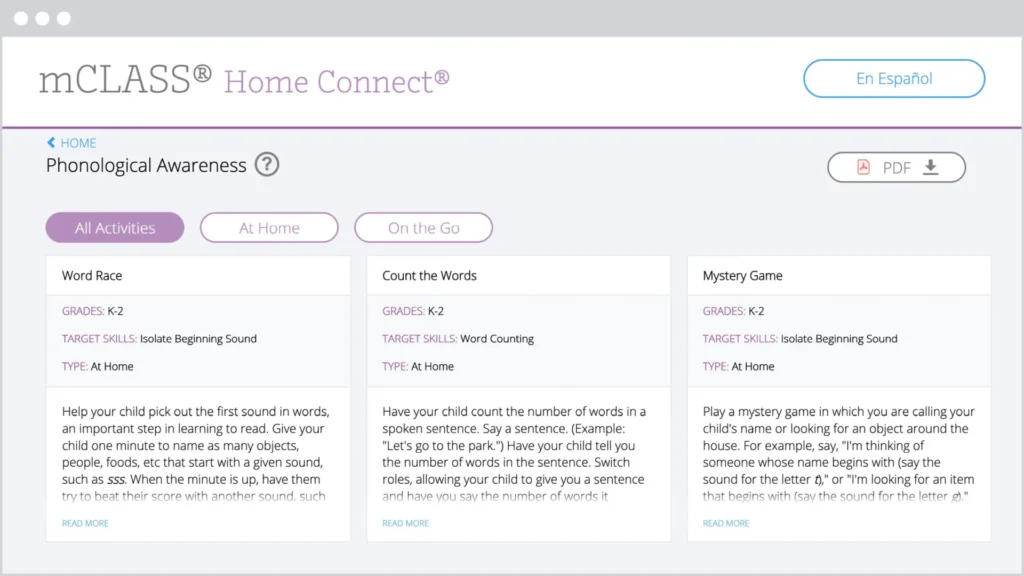
Support
NCDPI has been provided with its own dedicated support line: +1 (888) 890-2505
The current national support line will remain available and include the North Carolina option on the phone tree throughout the fall.
FAQs
Interested in learning more?
Amplify and NC DPI are collaborating on this FAQ. Please continue to check back, as we are updating this based on questions we receive about mCLASS and the current NC implementation.
Additional Amplify products
Get in touch with us to learn more about bringing other high-quality Amplify programs to your school or district.
Tell us about your experience using an Amplify program or service in the classroom!
Use the form below to let us know how you would like to share your story. You can submit your experiences directly through the form or express interest in participating in serving as a reference or joining a research group, and we’ll be in touch!
If you use the Amplify Texas programming, please select your Texas program after selecting your state in the form below.
Vulnerability Disclosure Policy
As a provider of technology solutions to schools, Amplify’s commitment to data privacy and security is essential to our organization. Amplify demonstrates that commitment in part through the physical, technical, and administrative safeguards we maintain to protect student data and other sensitive information entrusted to our care.
Amplify looks forward to working with the security community to find security vulnerabilities and support our efforts to keep our data and systems safe and secure.
Before reporting a vulnerability, please read our program rules, eligibility overview, report submission rules and guidelines, legal terms, and out-of-scope list set out below.
General Rules
- We appreciate reports on any Amplify-owned asset, but only vulnerabilities that prove to be outside of expected behavior are eligible for acceptance.
- Reports involving third party services or providers not under Amplify’s control are out-of-scope for submission.
- Amplify places a high priority on privacy. Vulnerabilities in the areas of inadvertent exposure of our customers’ personally identifiable information (PII) are considered to be of Critical severity.
- We classify vulnerability severity per CVSS (the Common Vulnerability Scoring Standard). These are general guidelines, and the ultimate decision over a reward – whether to give one and in what amount – is a decision that lies entirely within our discretion on a case-by-case basis.
- In order to receive an award for validated reports, you must have a HackerOne account. Please note reward decisions are subject to the discretion of Amplify. Please note these are general guidelines, and that reward decisions are subject to the discretion of Amplify.
- Only interact with test accounts that you created via self sign-up or were provided by Amplify. The use of any credentials outside of these areas for testing purposes, including legacy credentials supplied through the program and leaked credentials from third parties is strictly prohibited.
- Do not contact Amplify’s customer support for questions or to submit a vulnerability report.
- Amplify may, in its sole discretion, disqualify you if you breach this policy or fail to comply with any of the program’s rules and terms.
- Amplify reserves the right to cancel or modify this program without notice at any time.
Eligibility
- You are not eligible for participation if you 1) are employed by Amplify or any of its affiliates 2) are an immediate family member of a person employed by Amplify or any of its affiliates or 3) left the employment of Amplify or its affiliates or subsidiaries within the past (12) months.
- You are not eligible for participation if you have been prohibited in writing from participating in the Bug Bounty Program by Amplify at any time.
- You may not be in violation of any national, state, or local law or regulation with respect to any activities directly or indirectly related to conducting your tests.
- You may not compromise the privacy or safety of our customer and the operation of our services;
- You may not cause harm to Amplify, our customers, or others;
- You must follow the policy guidelines to responsibly disclose vulnerabilities to Amplify.
Vulnerability Submission Rules & Guidelines
- Any testing conducted on customer data or accounts is strictly prohibited and will result in removal from the program.
- If during the course of testing you encounter any sensitive data outside of your test accounts (including student or teacher names, login info, assessment data, activity data, and student work, etc.), please cease testing immediately and report what you have found. DO NOT include any text, screenshots, etc. with PII in the report. This action safeguards both potentially vulnerable data and yourself.
- Do not access, download, or share any data you encounter in your testing.
- Only interact with test accounts that you created or that we provided. The use of any credentials outside of these areas for testing purposes is strictly prohibited.
- Provide detailed reports with reproducible steps. If the report is not detailed enough to reproduce the issue, the issue will not be eligible for a reward.
- In some cases, you may not have all of the context information to assess the impact of a vulnerability. If you’re unsure of the direct impact but are reasonably certain that you have identified a vulnerability, we encourage you to submit a detailed report and state the open questions on impact.
- When duplicate submissions for the same vulnerability occur, we only award the first report that was received, provided that it can be fully reproduced.
- Multiple reports describing the same vulnerability against multiple assets or endpoints must be submitted within a single report.
- Avoid destruction of data and interruption or degradation of our service.
- Proof of Concept (POC) videos that do not include PII are highly recommended to help verify the issue, provide clarity, and save time on triage.
- Please provide timely responses to any follow-up questions and requests for additional information.
- Understand that there could be submissions for which we accept the risk, have other compensating controls, or will not address in the manner expected. When this happens, we will act as transparently as we can to provide you with the necessary context as to how the decision was made.
- Reports submitted using methods that violate policy rules will not be accepted and may result in account suspension from/denial of entrance to the program.
- Please refer to any noted out-of-scope areas listed under Out-of-Scope Vulnerabilities.
Out-of-Scope Vulnerabilities
When reporting vulnerabilities, please consider (1) attack scenario / exploitability, and (2) security impact of the bug. The following issues are considered out-of scope. In addition, please refer to any noted Out of Scope areas listed under the program assets.
- Social engineering (e.g. phishing, vishing, smishing) is prohibited.
- Clickjacking on pages with no sensitive actions.
- Unauthenticated/logout/login CSRF.
- Attacks requiring MITM or physical access to a user’s device.
- Previously known vulnerable libraries without a working Proof of Concept.
- Comma Separated Values (CSV) injection without demonstrating a vulnerability.
- Missing best practices in SSL/TLS configuration.
- Any activity that could lead to the disruption of our service (DoS).
- Content spoofing and text injection issues without showing an attack vector/without being able to modify HTML/CSS.
- XSRF that requires the knowledge of a secret.
- Automated tools that could generate significant traffic and possibly impair the functioning of our services.
- Testing or demonstrating the ability to upload unlimited audio/video files to exhaust resources.
- Leaked credentials from third party providers, including invalid or stale employee credential dumps, and/or leaked personal information of Amplify staff.
- Leaked credentials for Amplify customers not caused by vulnerabilities in our systems.
- Vulnerabilities identified via third party services or providers where Amplify is not the owner.
- Issues that merely result in spam/annoyance without additional impact (e.g sending emails without sufficient rate limiting)
- Attempts to access our offices or data centers.
- Any activity that could contribute to the disruption of our service (DoS). Automated scanning tests should be kept to 10 requests per second or less.
- Self XSS.
- Broken links and/or crashes in general.
- Issues that require unlikely user interaction.
- Issues that do not affect the latest version of modern browsers
- Issues that require physical access to a victim’s computer/device.
- Disclosure of information that does not present a significant risk
- Please refer to any noted out-of-scope areas listed under program assets.
Legal
- Any information you receive or collect about us, our affiliates or any of our users, employees or agents in connection with the Bug Bounty Program (“Confidential Information”) must be kept confidential and only used in connection with the Bug Bounty Program. You may not use, disclose or distribute any such Confidential Information, including without limitation any information regarding your Submission, without our prior written consent. You must get written consent by submitting a disclosure request through the HackerOne platform.
- Researchers must follow HackerOne’s disclosure guidelines. Public disclosure or disclosure to other third parties without the explicit permission of Amplify is prohibited.
- We will not take legal action against you if vulnerabilities are found and responsibly reported in compliance with all of the terms and conditions outlined in this policy.
- Amplify reserves the right to modify the terms and conditions of this program without notice at any time, and your participation in the Program constitutes acceptance of all terms.
Submit Vulnerability Report
Introduction
Amplify Education, Inc. (“Amplify” or “we”) recognizes the importance of protecting the privacy and security of your personal information. This App Privacy Policy describes our practices in connection with information that we may collect through your use of the Cell Simulator iOS application (the “App”).
This App Privacy Policy describes Amplify’s practices for handling non-personal information (e.g., site activity) in connection with the App.
Children. The App does not collect personal information from any users, including children under 13 years of age.
By using the App, you agree to the terms and conditions of this App Privacy Policy. If you do not agree to this App Privacy Policy, please discontinue your use of the App.
Collection of information
Amplify may collect information from you at various points, including the following:
App activity information. When you access and interact with the App, we and our Third Party Agents (as defined below) may collect certain information about those visits. For example, we or our Third Party Agents may receive and record information about your computing device, including potentially your IP address, a unique application identifier assigned to that copy of the App (the “App ID”), or other characteristics of the device hardware, operating system and configurations for that device. The App ID and any other persistent identifiers we collect will be used solely for the purpose of recording information about your usage of the App, and will not be used to collect information through any other product or service.
Notice and choice
Updates to App Privacy Policy; Choice. Amplify may modify this App Privacy Policy. Please look at the Last Revised Date at the top of this App Privacy Policy to see when this App Privacy Policy was last revised. Any changes to this App Privacy Policy will become effective when we post the revised App Privacy Policy to this URL: http://amplify.com/curriculum/cell-module/privacy. If you do not wish to be bound by the terms of the revised App Privacy Policy, you must discontinue your use of the App.
Location of Data. The App is hosted in and managed and controlled by us from the United States and is not intended to subject us to the laws or jurisdiction of any jurisdiction other than that of the United States. If you are a user located outside the United States, you understand and consent to having any personal information processed in the United States. United States data protection and other relevant laws may not be the same as those in your jurisdiction.
Linked Services.The App may be linked to sites operated by unaffiliated companies. Amplify is not responsible for the privacy practices of unaffiliated companies, and once you leave the App via a link, you are subject to the applicable privacy policy of the unaffiliated service.
Use and disclosure
We may use and/or disclose any information we collect from you for the following purposes and as described elsewhere in this App Privacy Policy:
To provide and manage the App. We use the usage information we collect from you to provide the App and features to you, including to measure and improve its services and features, and to personalize your experience by delivering relevant content. We may also use and disclose aggregate or anonymous data about your use of and activity in the App to assist us in this regard and for any other purpose.
To improve our products and services. We may use your usage information for our internal business purposes, such as data analysis, developing new products and services, enhancing the App, and improving our services. To share with our affiliated education companies. Amplify may share your usage information with Amplify’s affiliated education companies for the purposes described in this App Privacy Policy.
To allow Third Party Agents to assist us. We may engage third party service providers, agents and partners (“Third Party Agents”) to perform functions on our behalf, such as analytics. We may disclose your usage information to such Third Party Agents to enable them to assist us in these efforts, for the purposes described in this App Privacy Policy.
To protect the rights of Amplify and our users. There may be instances when Amplify may disclose your usage information, in situations where Amplify has a good faith belief that such disclosure is necessary or appropriate in order to: (i) protect, enforce, or defend the legal rights, privacy, safety, operations, or property of Amplify, our parents, subsidiaries or affiliates or our or their employees, agents and contractors (including enforcement of our agreements, including our terms of use); (ii) protect the rights, safety, privacy, security or property of users of the Site or others; (iii) protect against fraud or for risk management purposes; (iv) comply with the law or legal process, including laws outside your country of residence; (v) respond to requests from public and government authorities, including those outside your country of residence; or (vi) allow us to pursue available remedies or limit the damages that we may sustain.
To complete a merger or sale of assets. If Amplify sells all or part of its business or makes a sale or transfer of its assets or is otherwise involved in a merger, transfer or other disposition of all or part of its business, assets or stock (including in connection with any bankruptcy or similar proceedings), Amplify may transfer your information to the party or parties involved in the transaction.
Security
Amplify uses commercially reasonable administrative, technical, personnel and physical measures to safeguard information in its possession against loss, theft and unauthorized use, disclosure or modification.
Sensitive information
We ask that you not send or disclose to us any personal and/or sensitive information (e.g., name, address, social security numbers, information related to racial or ethnic origin, health, or criminal background) on or through the App or otherwise.
Contact us
If you have questions about this App Privacy Policy, please contact us at:
Email: privacy@amplify.com
Mail: Amplify, 55 Washington St., Ste 900, Brooklyn, NY, 11201 Attn: General Counsel
mCLASS Professional Development
Administrators, welcome to Amplify Science!
Here you’ll find information about enrollment and licensing, technical requirements, professional learning resources, and more.
Onboarding: What to expect
Welcome to Amplify Science! There are six basic steps to onboarding. Use this visual as a reference, but also know that our dedicated implementation team will be there to support you during the entire process.
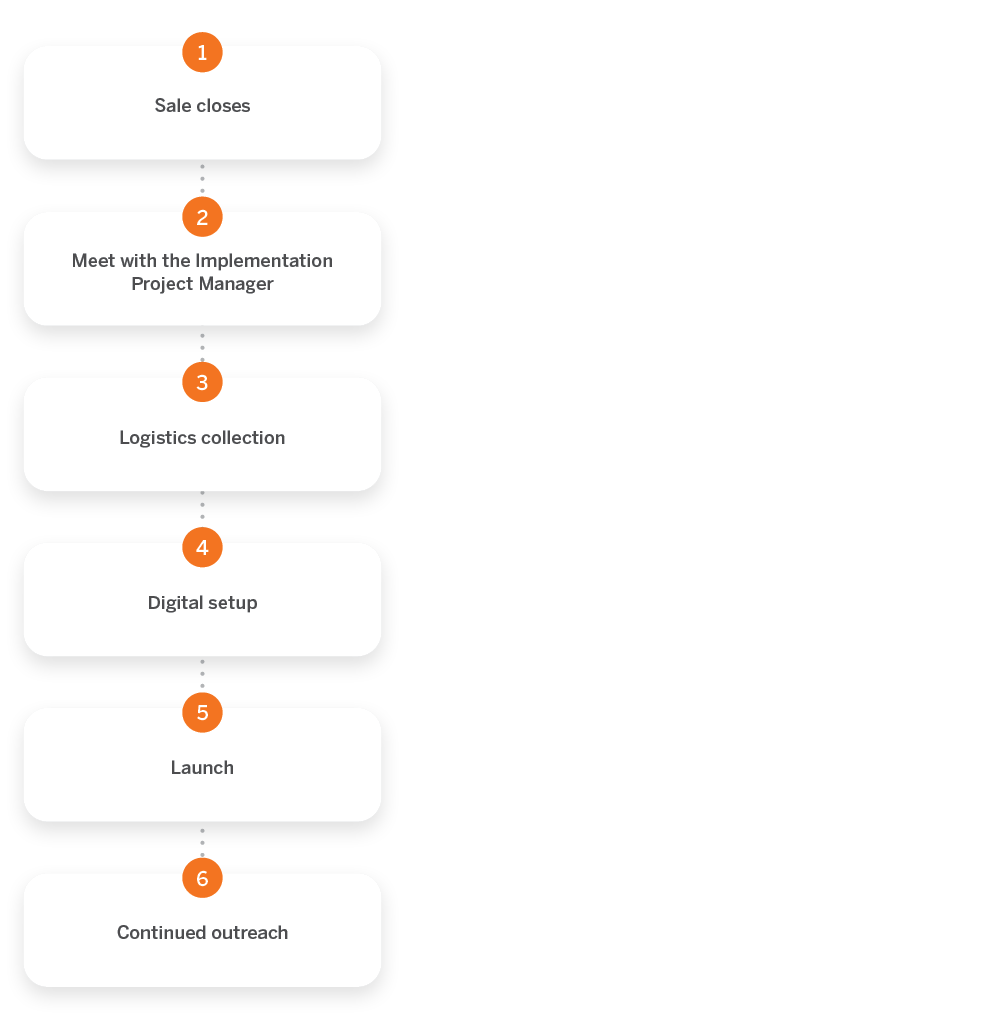
Technology requirements and guidelines
To ensure that your hardware and network meet the minimum technical requirements for performance and support of your curriculum products, please see Amplify’s customer requirements page.
You’ll also want to add the URLs on this page to the corresponding district- or school-level filters so that your teachers and students can access their Amplify Science materials.
Data sharing agreement
Partnering with Amplify through our data sharing program deepens learning outcomes and gives you the performance analysis you need to make impactful decisions within your district or school. By signing our data sharing agreement, your district will help us to better understand student performance as it relates to your state’s standards. It also allows us to compare results with the curriculum-embedded assessments and state-level assessments. These analyses will help you identify the areas where your teachers and students are excelling or may be experiencing challenges.
Stay tuned for additional updates.
Enrollment and licensing overview
During the enrollment and licensing call, your Amplify implementation partner will walk you through the enrollment process. We recommend exploring the enrollment web tool ahead of the call for suggestions on which enrollment method may be best for your district.
The following guides provide additional information about enrollment methods and the data sharing process.


Preparing for your materials
Each unit of Amplify Science comes with a hands-on materials kit.
Each hands-on materials kit arrives in 1–3 boxes and contains the following:
- Consumable materials
- Nonconsumable materials
- Classroom wall materials
- Premium print materials (cards, maps, etc.)
- 18 copies of each Student Book (K–5)
- A blackline master copy of the Student Investigation Notebook (K–5)
You can find complete materials lists for each unit in the following PDFs. This information is also available in the digital Teacher’s Guide within the program.
Once your district’s purchase order has been sent to Amplify and is processed, Amplify will provide tracking information on your materials kits and any additional print materials you’ve ordered.


Administrator Reports
Self-service Administrator Reports allow insight into teacher and student usage and student performance data for the current school year.
Access is limited to district and school administrators. Administrators can directly access these reports at my.amplify.com/admin-reports.
Announcements
Summer extension
With summer fast approaching, we recognize that some districts may be extending the school year and/or continuing the use of Amplify curriculum and programs for summer instruction. If your summer instruction will continue past June 30 and/or you need to make rostering or enrollment changes, follow our guidance on extending your rollover date.
Use stimulus funding to drive transformation
Learn about ESSER I, II, and III funding (or CARES, CRRSA, and ARP) and how to use these funds to help with learning recovery and acceleration. Districts have significant flexibility in how to use the ESSER money, with ESSER II and III specifying that some of the funds should be used to address unfinished learning. All Amplify programs and services meet the criteria for the funding. Get more information about funding and guidelines.
Next steps: How do I support my teachers?
Pre-launch checklist for teachers
Please share our Program Hub with your educators. It will provide helpful information as they prepare to implement Amplify in their classrooms, including a pre-launch checklist. Note that they’ll need to be logged into Amplify Science to access the Hub. If they don’t have a login yet, you can also download and share the Amplify Science pre-launch checklist for teachers PDF.

Professional learning
We partner with every district to make sure the Amplify Science rollout meets their unique needs. Check out these sample agendas to get a better understanding of what our team has to offer.
Advice and answers
The Science help website is filled with step-by-step resources to address educators’ questions. Encourage your educators to read through these tutorials and search for topics they want to learn more about.
Contact us
Powerful (and free!) pedagogical support
Amplify provides a unique kind of support you won’t find from other publishers. We’ve developed an educational support team of former teachers and administrators who provide pedagogical support at no cost to educators using our programs. This free service includes:
- Information on where to locate standards and other planning materials.
- Recommendations and tips for day-to-day teaching with Amplify Science.
- Support with administering and interpreting assessment data and more.
To reach our pedagogical team, click the orange icon while logged into the curriculum to get immediate help, call (866) 629-2446, or email edsupport@amplify.com.
Timely technical and program support
Our Customer Care and Support team is available Monday through Friday, 7 a.m. to 9 p.m. ET, and Sunday, 10 a.m. to 6 p.m. ET, through a variety of channels:
- Live chat: Click the orange icon while logged into the curriculum to get immediate help in the middle of the school day.
- Phone: Call our toll-free number: (800) 823-1969.
- Email: Send an email to help@amplify.com.
Join our community
Our Amplify Science Facebook group is a community of Amplify Science educators from across the country. It’s a space to share best practices, ideas, and support on everything from implementation to instruction. Join today.
Amplify professional development: coaching and tutoring
Amplify provides consistent, job-embedded coaching services to deepen teacher capacity in planning data-driven instruction. Amplify’s high-impact tutoring extends teachers’ reach to all students through data-driven small group instruction.
We have a wide suite of tutoring and coaching services that will help meet your unique needs this school year. Find out more below!

Coaching Overview
| Grade(s) | Coaching Program | Audience | Modality |
|---|---|---|---|
| K–2 | Start Strong Virtual Coaching | Kindergarten, First Grade, and Second Grade teacher teams and school leaders using DIBELS Next OR DIBELS 8th Edition | Remote |
| K–12 | Data Coaching | Teacher teams and school leaders | Remote or Onsite |
Download the overview as a PDF.
Coaching Sessions
Start Strong Virtual Coaching, K–2
Amplify provides virtual coaching to schools and districts using DIBELS to ensure that all K–2 students receive high-quality early literacy instruction that will put them on the pathway for future success.
Start Strong is a consistent, year-long, and job-embedded program where coaches meet virtually with school leaders and K–2 teacher teams in order to build their capacity in planning whole group and small group data-driven instruction based on DIBELS error patterns. School leaders will also receive support on how to lead data and planning meetings and optimize their school schedules.
Through an increased understanding of early literacy development and data-driven instruction, teachers and school leaders in the Start Strong program will be better positioned to increase K–2 student reading achievement as measured by DIBELS.
Audience: K–2 teacher teams and school leaders
Modality: Remote, maximum 8 participants per grade level team
To learn more about launching Start Strong in your school or district, please click here: Start Strong Overview
Data Coaching
Amplify’s data coaching program provides educators throughout a school, district and/or state with ongoing support to take action with their data, make changes to their teaching practices and realize significant gains in student achievement.
The data coaching program is offered in remote and/or onsite sessions and tailored to a school, district or state’s specific needs around intensity and frequency.
Teachers and school leaders work closely with their Amplify data coach to understand, analyze, and develop instructional plans using current student data sources in a collaborative learning environment. Through their participation in the data coaching program, teachers and leaders will be able to create a stronger data-driven culture and increase investment in realizing both short and long term goals in student achievement.
Audience: Teachers and school leaders
Modality: Remote or Onsite
To learn more about launching data coaching in your school or district, please click here: Data Coaching Overview
Tutoring Overview
| Title | Audience | Modality |
|---|---|---|
| Comprehensive Virtual Reading Tutoring Program | Kindergarten through Fifth Grade students | Remote |
| Training for District Tutors | Tutors hired at the district/school level | Remote |
Tutoring Sessions
Comprehensive Virtual Reading Tutoring Program
Amplify will support schools, districts, and states in ensuring all K–5 students have a strong foundation in early literacy skills by providing tutors who develop trusting relationships with students and meet their data-based needs.
In this program, tutors meet with students for 30 minutes, three days each week and use research-based, high-quality instructional materials to close literacy gaps and develop stronger social-emotional learning. While Amplify collaborates with school leaders to determine scheduling and identify participating students, Amplify will manage all other aspects of the program, thus reducing the burden for school leaders to launch this program independently. Amplify services will include, but not be limited to: creating homogeneous student groups, progress monitoring students on a consistent schedule, and hiring, training and managing tutors.
Through targeted, data-driven virtual reading tutoring, participating schools increase their capacity to provide high-quality instruction with caring adults in a small group setting to the students most in need.
Audience: K–5 students
Modality: Remote
To learn more about launching Comprehensive Virtual Tutoring in your school or district, please click the link below: Virtual Tutoring Overview
Training for District Tutors
Amplify will provide guidance and support to schools, districts, and states that are interested in developing systems and structures for launching a tutoring program focused on increasing early literacy skills for K–5 students.
At the start of the planning process, Amplify will support program managers in understanding the necessary systems, structures, and action steps required to implement the program (e.g., hiring and managing tutors). Amplify will help create a tailored training plan for tutors using the Amplify products of either mCLASS Intervention and/or Amplify Reading. The training plan for tutors will include initial product training and best practices for tutoring. Ongoing training will focus on topics such as, but not limited to: data analysis needed for flexible small groups, underlying theories for early literacy development, and strategies for engaging all students. Amplify will also provide ongoing individual support through observation/ feedback cycles for tutors.
Through their participation in the training for district tutors, districts and schools will be able to strategically launch high-quality tutoring programs and support tutors through initial and ongoing training.
Audience: District tutors
Modality: Remote
Contact
We are happy to discuss how to scale any of our coaching and tutoring services to meet the needs of a school or district’s budget or scheduling realities.
If you would like to discuss any of our coaching or tutoring services, please call Dr. Lindsay Sullivan, Ed.D. at (800) 823-1969 or email lsullivan@amplify.com.
Core Principles:
These core principles guide our operations, employee behavior and product development:
- Customer Control: We help school districts securely manage their personally identifiable student information. The districts direct our use of the data, and control who has access to that data and with whom it is shared.
- Educational Purpose: Personal student information can only be used for customer-authorized purposes to support student learning through the secure and effective operation of our educational tools.
- Transparency: School districts, teachers, parents and students have the right to know what information is collected by school technology, how it is used and by whom, as clearly described in our privacy policy.
- Commitment: Privacy and security are thoroughly embedded into our organizational practices. We dedicate substantial resources to systems, processes and personnel required to protect student information.
Amplify Data Privacy and Security Practices:
Amplify maintains a customer data privacy policy that explains our data collection, handling and use practices.
Amplify also maintains a data security policy that explains how student data is protected from unauthorized access. Data security practices at Amplify are developed and maintained in accordance with the internationally recognized ISO27002 security standards. In addition, Amplify has successfully completed the SOC 2 Type 2 examination of controls relevant to security and conducts such examination on an annual basis.
For more information, please review our customer privacy policy and security practices. If you have additional questions, please contact us at privacy@amplify.com.
State Law Compliance
Amplify has entered into Data Privacy Agreements (DPAs) with districts across the country to facilitate compliance with applicable laws governing student data privacy. These DPAs can be applied to any Amplify product.
Unless otherwise noted, the DPAs are based on the Student Data Privacy Consortium’s (SDPC) model agreement which was created to simplify the contracting process between providers and local education agencies (LEAs) while ensuring LEAs have the necessary data protection obligations in place with providers. For additional information please visit the SDPC website and select your state.
General Offer of Privacy Terms:
To expedite your district’s need for a DPA and streamline the contracting process, we have compiled the following DPAs, listed by state.
By executing the General Offer of Privacy Terms, your LEA can “piggy back” off an existing DPA that other LEAs in your state have already agreed to. If you do not see your state below, please contact privacy@amplify.com.
Instructions:
(i) Please download the General Offer of Privacy Terms, (ii) sign and send the executed copy to your Amplify account representative, and (iii) retain a copy for your records. If you have any questions please reach out to privacy@amplify.com.
*Please note, states marked with an asterisk do not have a General Offer of Privacy Terms; however, please review the instructions below on how to quickly implement a DPA in compliance with your LEA’s state law.
Arizona: To enter into Amplify’s AZ-NDPA-V1, please sign the General Offer of Privacy Terms
Arkansas: To enter into Amplify’s AR-NDPA-V1, please sign the and General Offer of Privacy Terms
California: To enter into Amplify’s CA-NDPA, Version 1.5, please sign the General Offer of Privacy Terms
Connecticut*
To facilitate your district’s compliance with the requirements of Connecticut’s student data privacy law (Connecticut General Statutes §§ 10-234aa through 10-234dd), Amplify is proud to offer our “Connecticut Terms of Service Addendum” linked below. This Addendum supplements Amplify’s Terms and Conditions for use of Amplify products licensed by the district available at https://amplify.com/customer-terms.
Addendum: Connecticut Terms of Service Addendum
Instructions: Please retain a copy for your records – no further action is required.
Florida: To enter into Amplify’s FL-NDPA, Version 1.0, please sign the General Offer of Privacy Terms
Hawaii*
Amplify has entered into a Data Sharing Agreement with the Hawaii State Department of Education (HIDOE) which applies to any LEA associated with HIDOE. If your LEA is not a part of the HIDOE and you require a data privacy agreement, please reach out to privacy@amplify.com.
Illinois: To enter into Amplify’s IL-NDPA (which includes the IL State Supplemental Terms), please sign the General Offer of Privacy Terms
Iowa: To enter into Amplify’s IA-NDPA (which includes the IA State Supplemental Terms), please sign the General Offer of Privacy Terms
Maine: To enter into Amplify’s MA-ME-MO-NH-NY-OH-RI-VT DPA, Version 1 (which includes the ME State Supplemental Terms), please sign the General Offer of Privacy Terms
Massachusetts: To enter into Amplify’s MA-ME-MO-NH-NY-OH-RI-VT DPA, Version 1 (which includes the MA State Supplemental Terms), please sign the General Offer of Privacy Terms
Missouri: To enter into Amplify’s MO-NDPA, Version 1.0, please sign the General Offer of Privacy Terms
Montana: To enter into Amplify’s MT DPA, Version 3, please sign the General Offer of Privacy Terms
Nebraska: To enter into Amplify’s NE NDPA (which includes the NE State Supplemental Terms), please sign the General Offer of Privacy Terms
New York*
Option 1:
To facilitate your district’s compliance with the requirements of New York State Education Law § 2-D and regulations promulgated thereunder, Amplify is proud to offer our “New York Data Privacy and Security Addendum” linked below. This Addendum supplements Amplify’s Terms and Conditions for use of Amplify products licensed by the educational agency available at https://amplify.com/customer-terms.
Addendum: New York Data Privacy and Security Addendum
Instructions: Please retain a copy for your records- no further action is required.
Option 2:
To enter into Amplify’s MA-ME-MO-NH-NY-OH-RI-VT DPA, Version 1 (which includes the NY State Supplemental Terms), please sign the General Offer of Privacy Terms
New Hampshire: To enter into Amplify’s MA-ME-MO-NH-NY-OH-RI-VT DPA, Version 1 (which includes the NH State Supplemental Terms), please sign the General Offer of Privacy Terms
North Carolina*
The Data Confidentiality and Security Agreement issued by the North Carolina Department of Public Instruction (NCDPI) is not applicable to Amplify’s services given Amplify does not have a direct integration to any state system via API/plugin. You can review the NCDPI guidance here: https://www.dpi.nc.gov/about-dpi/technology-services/third-party-data-integration. However, Amplify can sign this form with some revisions. As such, we have prepared an Addendum which supplements the Data Confidentiality and Security Agreement.
Instructions: Please download a copy of the Data Confidentiality and Security Agreement with Amplify Addendum, return an executed copy to your account executive, and retain a copy for your records.
Ohio: To enter into Amplify’s OH-NDPA Version 1.0, please sign the General Offer of Privacy Terms
Oregon: To enter into Amplify’s OR-NDPA-V1, please sign the General Offer of Privacy Terms
Rhode Island: To enter into Amplify’s MA-ME-MO-NH-NY-OH-RI-VT DPA, Version 1 (which includes the RI State Supplemental Terms), please sign the General Offer of Privacy Terms
Tennessee: To enter into Amplify’s TN-NDPA-V1, please sign the General Offer of Privacy Terms
Texas: To enter into Amplify’s TX-NDPA-V1R6, please sign the General Offer of Privacy Terms
Utah: To enter into Amplify’s UT-NDPA, Version 1, please sign the General Offer of Privacy Terms
Vermont: To enter into Amplify’s MA-ME-MO-NH-NY-OH-RI-VT DPA, Version 1 (which includes the VT State Supplemental Terms), please sign the General Offer of Privacy Terms
Virginia: To enter into Amplify’s VA-DPA, please sign the General Offer of Privacy Terms
Washington: To enter into Amplify’s WA-NDPA, Version 1, please sign the General Offer of Privacy Terms
Wisconsin: To enter into Amplify’s WI SDPA, Version 1, please sign the General Offer of Privacy Terms
Wyoming: To enter into Amplify’s WY-NDPA-V1, please sign the General Offer of Privacy Terms
Amplify Classroom and Polypad free and commercial use guidelines
If you’d like to use Amplify’s tools or content in your work, please review these guidelines to determine if your specific use is allowed and whether you need to submit a request for approval.
Overview
Amplify Classroom offers free prebuilt interactive and print-based lessons, interactive lesson-building tools, and Polypad virtual manipulatives. See amplify.com/classroom and polypad.amplify.com for more information.
Amplify Classroom features:
- Activity Builder (labeled “Custom Activities” in the platform): This content-creating and publishing tool enables educators to create their own interactive lessons and edit existing lessons.
- Polypad virtual manipulatives: These virtual manipulatives allow teachers and students to explore concepts, express their creativity, and visualize their thinking. Polypad virtual manipulatives can be embedded directly into lessons via Activity Builder or used as a stand-alone, dynamic workspace.
- Computation Layer: This feature enables educators to further customize lessons created with Activity Builder. Computation Layer is the code that allows components within the lessons to “talk” to one another, enabling users to connect representations; customize content; and provide dynamic, interpretive feedback. Computation Layer is accessible through Activity Builder.
Amplify Classroom includes activities and lessons across many subjects, created by the thousands of educators on our platform. Content created by Amplify is tagged “By Amplify,” “By Amplify Classroom,” or “By Desmos Classroom.”
Amplify also publishes paid core curriculum programs, including Amplify Desmos Math, Amplify Science, Amplify CKLA, Amplify Caminos, and Amplify ELA. These products can be reviewed and purchased by schools or districts interested in comprehensive resources aligned to standards and designed to motivate students. Some of the lessons that are free to use on Amplify Classroom (labeled Try It! lessons) are also part of these paid products. Learn more about our products and request a sample.
Amplify Classroom tools and content (other than paid products) are free for personal, educational, and non-commercial use, subject to our Acceptable Use Policy and Usage Guidelines. These guidelines also permit certain commercial uses. You generally don’t need to submit a request to use our free tools and resources for the permitted purposes covered in these guidelines. As long as you are following our Acceptable Use Policy and Usage Guidelines, as well as making appropriate Attributions and Disclaimers, you are permitted to move forward with your project. To make sure your use is permitted, please read these guidelines thoroughly and in their entirety. If you would like to explore a license for a use not permitted here, please submit this form.
Amplify does not own but partners with Desmos Studio, the maker of a suite of free math tools, including a graphing calculator used by over 75 million people around the world. (See desmos.com for more information.) Please contact Desmos Studio for information on using their content or tools.
Usage guidelines
Please adhere to the following guidelines for using Amplify Classroom tools and content in each of the scenarios set out below. You are required to follow our General Guidelines and Attribution requirements below when making permitted uses. You are responsible for clearing any third party marks and content you use in your applications or publications.
Uses labeled “PERMITTED USES” do not require permission, and you do not need to tell us about them—but we do appreciate hearing from you! Feel free to fill out this form to tell us about how you are using our tools and materials, and the ways in which you are finding them useful.
Uses labeled “CONTACT US” do require permission. If you are interested in such use, please submit this form, and someone from our team will endeavor to follow up with you as soon as possible.
Teaching and education services
This section provides guidelines on using Amplify Classroom for teaching and education services.
| PERMITTED USES |  |
Educators creating, modifying (where permitted), and using Amplify Classroom content for classroom teaching in a school |
|
Public school districts, charter schools, and networks creating, modifying (where permitted) and using Amplify Classroom content for classroom teaching | |
|
Private tutors creating or using Amplify Classroom content in 1:1 or small-group tutoring sessions | |
| CONTACT US |  |
For-profit school or network of schools implementing Amplify Classroom for the school or network |
|
Education publishers and EdTech organizations (whether for profit or non-profit) using or linking to Amplify Classroom content and tools | |
|
Any organizations or individuals embedding the teaching and learning experience from the Amplify Classroom lessons in their websites or applications (except API/iFrames Polypad integrations permitted below) | |
|
Educators or other individuals authoring lessons for commercial purposes (e.g., to sell on Teachers Pay Teachers and similar websites) | |
|
School districts, states, education publishers or technology providers, educators or any other individual or organization (whether for profit or non-profit) using Amplify Classroom content or platform to create paid curricula, educational courses, assessments, or any materials or curricula for submission for a state adoption list; or for offering, marketing, or sale to any schools or educational agencies or organizations, in or outside of the U.S. | |
|
Instructional/tutoring organizations (whether for profit or non-profit), seeking to use Amplify Classroom for its tutors or instructors |
Print and presentations
This section provides guidelines on including content from Amplify Classroom, such as portions of free lessons or images generated using our tools, in printed materials or presentations.
| PERMITTED USES | |
Books, including textbooks, up to two thousand copies |
|
Periodicals (newspapers, magazines, journals, etc.) | |
|
Business documents such as company reports, proposals, presentations, etc. | |
|
Academic publications, research papers, Ph.D. theses, and portfolios | |
|
Conferences, presentations and accompanying slides | |
| CONTACT US | |
Books, more than two thousand copies, or as cover art for a book |
|
As content within platforms, mobile and tablet applications, PDFs, ebooks, multimedia materials, or other digital resources or products | |
|
Consumer and retail goods or packaging (e.g., shirts, beach towels, shower curtains, mugs, posters, stationery) |
Web and apps
This section provides guidelines for embedding Amplify Classroom tools into your platform.
| PERMITTED USES | | Individuals and schools embedding Polypad in their materials for instructional use are permitted to do so; for integration options, see below. |
| Organizations (whether for profit or non-profit) offering paid services embedding Polypad with <10k requests per year | |
| CONTACT US | | Organizations (whether for profit or non-profit) offering paid services embedding Polypad with >10k requests per year |
| Individuals or organizations looking to embed Activity Builder/Computation Layer in their applications | |
| Individuals or organizations looking to embed Amplify Classroom tools in larger applications, more complex integrations, white-labeling, or hosting Amplify’s JS files on their own infrastructure | |
| Polypad links, screenshots, iFrames, or API uses behind a paywall |
Polypad integration options
There are two integration options for using Polypad within your own applications, including:
- Using iFrames hosted by Amplify.
- As a white-labeled JavaScript API that can be self-hosted and embedded in other websites or apps.
Developers can customize the features and behavior through numerous options and event listeners, and interact with the canvas programmatically to build custom functionality.
Visit the Polypad API page to learn more about Polypad API license terms and to generate API Key.
General guidelines
Copyright fair use
Your use of our content may be acceptable under principles of fair use (or other similar concepts in other countries). Under the fair use doctrine of the U.S. Copyright Act of 1976, it is permissible to use limited portions of a work for purposes such as commentary, criticism, news reporting, research, and scholarly reports.
Whether a particular use qualifies as fair use depends on a number of factors. For more information see resources from the U.S. Copyright Office, Circular 21, Reproductions of Copyrighted Works by Educators and Librarians, and Fair Use Index. Amplify can’t tell you if your use of this content would be fair use, so you may wish to obtain your own legal advice.
Use of trademarks
Our trademarks are valuable assets of Amplify and its licensors, and we want to ensure our users and partners use them correctly. These trademarks include the Amplify word mark and logo, Polypad word mark, Core Knowledge Foundation word mark and logo, the Lawrence Hall of Science word mark and logo, and the Desmos and Amplify Classroom word marks and logos.
Logos
Our logos can only be used if you have an existing partnership, and you’ve reached out to your Amplify contact to secure formal approval from Amplify’s brand team.
Logos must never be used in a way that implies an endorsement or affiliation with Amplify where such a relationship does not exist.
Please contact media@amplify.com if you need to use an Amplify or Amplify Classroom logo.
Please contact Desmos Studio for Desmos Studio branding guidelines and licensing.
Use of product names and features
If making a use permitted under these guidelines or approved by Amplify, you may use the Amplify name or one of our product names or features in plain text to indicate that your product or service integrates with, or relates to, an Amplify product or service.
However, all references must be honest and accurate, and you can’t incorporate these names into your own name or imply an endorsement by Amplify or any of its licensors.
| REQUIRED | | Use the complete name “Amplify Classroom” when referencing the platform. |
| Use “Amplify Classroom lessons” when talking about specific lessons authored in the Amplify Classroom platform. | |
| Use “Teacher-created Amplify Classroom lessons” or “[Company name]-authored Amplify Classroom lessons” when talking about a lesson that has been authored by anyone other than Amplify personnel. | |
| Include required attribution and disclaimers. | |
| PROHIBITED | | Do not imply an endorsement or affiliation with Amplify where such a relationship does not exist. |
Attribution and disclaimers
You are required to include a link to the homepage of Amplify Classroom (amplify.com/classroom) and a prominent disclaimer of affiliation when making permissible uses described above in at least one place in your materials, preferably the cover page or landing page.
Visit Amplify Classroom for free lessons, lesson-building tools, and Polypad virtual manipulatives at amplify.com/classroom. This content is not affiliated with, sponsored by, or endorsed by Amplify or any of its licensors. Amplify®, Amplify Classroom™, and related trademarks are the property of Amplify Education, Inc.
If your current attribution language refers to Desmos Classroom, please update the attribution to “Amplify Classroom” instead of “Desmos Classroom.”
Contact us
Amplify Classroom and Polypad usage inquiry form for uses labeled “Contact Us”
Thank you for your interest in using Amplify Classroom and/or Polypad. If your intended use falls into one of the categories labeled “Contact us,” please fill out this form, so we can determine the appropriate permissions or licenses:
Amplify Classroom and Polypad usage inquiry form for uses labeled “Permitted”
Thank you for your interest in using Amplify Classroom and/or Polypad. If your intended use falls under the “Permitted” categories outlined in our use guidelines, please let us know by filling out the form below. This helps us understand how our tools are being used.
Note: If your intended use falls under one of the “CONTACT US” categories outlined in our use guidelines, please fill out this form.
Amplify Classroom and Polypad Permitted Use Form
Use stimulus funding to drive transformation.
Learn about ESSER I, II, and III funding (or CARES, CRRSA, and ARP), and how to use these funds to help with learning recovery and acceleration. Districts have significant flexibility in how to use the ESSER money, with ESSER II and III specifying that some of the funds should be used to address unfinished learning.
Given the enormous influx of resources flowing into K–12, now is the time to drive important, sustainable change in your district. All Amplify programs and services meet the criteria for the funding, and our early literacy suite can be particularly helpful in driving reading growth in grades K–5.

Where to start: Watch our stimulus funding overview.
Julia Gonzales, vice president of government relations at Amplify, walks you through what you need to know about federal stimulus funding.
Five fast facts
Here are the essential facts you need to know about the latest stimulus funding, also known as ESSER III or the American Rescue Plan (ARP).
- It’s okay to keep using products and services you’ve purchased. As long as funds are assigned to spending categories and paid to vendors by each fund’s deadlines—and the purchases are allowable uses—it’s okay to keep using products and services after those dates.
- Schools and districts have a lot of leeway in how to use the money. ESSER III funds may be used to propel your vision of teaching and learning post-pandemic, so try to think about both short-term needs and your longer term ambitions for the district.
- At least 20 percent must be used to address unfinished learning. For example, schools and districts can use the funding to bolster the strength of in-school core instruction, differentiated practice, and intervention, as well as for summer learning, after school, and extended day activities.
- The money is available now. Act quickly! Schools and districts can access ESSER III stimulus funds right now, and districts are moving very fast to spend these dollars. The deadlines are around the corner: All ESSER III funds must be assigned to a spending category by Sept. 30, 2024, and paid to vendors four months after that.
- Note: State Education Agencies can request an extension with the U.S. Department of Education. See the following table for more information on timelines.
- It’s okay to keep using products and services you’ve purchased. As long as funds are assigned to spending categories and paid to vendors by each fund’s deadlines—and the purchases are allowable uses—it’s okay to keep using products and services after those dates.

Find out how much funding is coming your way.
Use this tool from Whiteboard Advisors to search by state and district to see approximately how much money is coming to your region.


Amplify is an allowable expense.
See how spending categories for ESSER III (ARP), ESSER II (CRRSA), and ESSER I (CARES) specifically align with Amplify programs and trainings. Download our chart of allowable uses.
Amplify programs align to stimulus priorities.
Amplify can help accelerate literacy learning for all students with an early literacy suite that includes Amplify CKLA, Boost Reading, mCLASS®, and mCLASS Intervention, as well as professional learning and coaching. Each of our research-based literacy programs can be added to an existing literacy system at a district, and can be used together as an integrated suite.

Timelines for funding
Curious how long federal stimulus funds are available? See our chart with funding details, including timelines and deadlines.
| ESSER I (CARES) | ESSER II (CRRSA) | ESSER III (ARP) | |
|---|---|---|---|
| Signed into law | March 2020 | December 2020 | March 2021 |
| Total education funds | $30.7 billion | $82 billion | $170 billion |
| Total K–12 funds | $13.2 billion | $54 billion | $122 billion |
| Obligation deadline When funds must be assigned to a spending category. | March 13, 2020– Sept. 30, 2022 | March 13, 2020– Sept. 30, 2023 | March 13, 2020– Sept. 30, 2024 |
| Liquidation deadline When vendors must be paid for the work contracted. | April 1, 2024 | Feb. 1, 2024 | Feb. 1, 2025 |
| Potential liquidation deadline, if extended The deadline if a state education agency requests and receives an extension from the US DOE. | March 30, 2024 | March 30, 2025 | March 30, 2026 |
For more information about deadlines and rules, please see the US DOE guidance.
1. Scope
These Customer Terms and Conditions are a legal agreement between Amplify Education, Inc. (“Amplify”) and the local education agency or authority, school district, school network, independent school, or other regional education system (“Customer”) for the license and use of one or more of Amplify products or services (the “Products”), as specified in the receipt, price quote, proposal, renewal letter, or other ordering document containing the details of this purchase (the “Quote”). These Customer Terms and Conditions, all addenda, attachments, and the Quote, as applicable (together, the “Agreement”), constitute the entire agreement between the parties relating to the subject matter hereof. The provisions of this Agreement will supersede any conflicting terms and conditions in any Customer purchase order, other correspondence or verbal communication, and will supersede and cancel all prior agreements, written or oral, between the parties relating to the subject matter hereof.
2. Agreement Acceptance
This Agreement becomes effective at the earliest of the following: (i) issuing a purchase order, shipment request, or payment against the Quote; (ii) accessing, downloading, or using the Products; or (iii) otherwise accepting this Agreement. This term of the Agreement will be as specified in the Quote and may be renewed or extended by mutual agreement of the parties. Customer represents and warrants that: (1) Customer is of legal age to accept this Agreement; (2) Customer is authorized to accept this Agreement and to access and use the Products; and (3) Customer’s use of the Products will comply at all times with Amplify’s Acceptable Use Policy available at amplify.com/acceptable-use (“AUP”). The Customer may not access, download, or use the Products if the Customer does not agree to this Agreement.
3. License
Subject to the terms and conditions of the Agreement, Amplify grants to Customer a non-exclusive, non-transferable, non-sublicensable license to access and use, and permit Authorized School Users, as defined below, to access and use the Products in accordance with the AUP, for the duration specified in the Quote (the “Term”), and for the number of Authorized School Users specified in the Quote for whom Customer has paid the applicable fees to Amplify. “Authorized School User” means the K–12 students registered or authorized for instruction with Customer and the educators, agents and staff members who use the Products as authorized by Customer who Customer permits to access and use the Products subject to the terms and conditions of the Agreement, solely while such individual is so employed or so registered. Each Authorized School User’s access and use of the Products will be subject to the AUP in addition to the terms and conditions of the Agreement. Violations of this Agreement or the AUP may result in suspension or termination of the applicable account.
4. Restrictions
Customer may access and use the Products solely for non-commercial instructional and administrative purposes. Guidelines for such purposes may be set forth at
https://amplify.com/amplify-program-usage-guidelines/ and additional guidelines may be detailed in materials associated with the Product the Customer is accessing. Further, Customer may not, except as expressly authorized by Amplify: (a) copy, modify, translate, distribute, disclose, or create derivative works based on the contents of, sell, or otherwise exploit, the Products, or any part thereof; (b) decompile, disassemble, reverse engineer the Products, or otherwise use the Products to develop functionally similar products or services; (c) modify, alter, or delete any of the copyright, trademark, or other proprietary notices in or on the Products; (d) rent, lease, or lend the Products or use the Products for the benefit of any third party; (e) avoid, circumvent, or disable any security or digital rights management device, procedure, protocol, or mechanism in the Products; (f) use any content from the Products, including but not limited to text, images, videos, assessments, lesson plans, or code, as input or training material for any machine learning or artificial intelligence system, including large language models, neural networks, or other algorithmic models, for any purposes, commercial or non-commercial; or (g) permit any Authorized School User or third party to do any of the foregoing. Customer also agrees that any works created in violation of this section are derivative works, and, as such, Customer agrees to assign, and hereby assigns, all right, title, and interest in such works to Amplify. The Products and derivatives thereof may be subject to export control laws, restrictions, regulations, and orders of the U.S. and other jurisdictions (together, “Export Laws”). Customer agrees to comply with all applicable Export Laws, and will not, and will not permit Authorized School Users to, export, or transfer for the purpose of re-export, any Product to any prohibited or embargoed country in violation of any U.S. export law or regulation. Further, Customer represents that it is not a party subject to sanctions by the U.S. Office of Foreign Assets Control or included on any restricted party list maintained by the U.S. Bureau of Industry and Security. The software and associated documentation portions of the Products are “commercial items” (as defined at 48 CFR 2.101), comprising “commercial computer software” and “commercial computer software documentation,” as those terms are used in 48 CFR 12.212. Accordingly, if Customer is the U.S. Government or its contractor, Customer will receive only those rights set forth in this Agreement in accordance with 48 CFR 227.7201-227.7204 (for Department of Defense and their contractors) or 48 CFR 12.212 (for other U.S. Government licensees and their contractors).
5. Reservation of Rights
SUBSCRIPTION PRODUCTS ARE LICENSED, NOT SOLD. Subject to the limited rights expressly granted hereunder, all rights, title, and interest in and to all Products, including all related IP Rights, are and will remain the sole and exclusive property of Amplify or its third-party licensors. “IP Rights” means, collectively, rights under patent, trademark, copyright, and trade secret laws, and any other intellectual property or proprietary rights recognized in any country or jurisdiction worldwide. Customer must promptly notify Amplify of any violation of Amplify’s IP Rights in the Products, and will reasonably assist Amplify as necessary to remedy any such violation. Amplify Products are protected by patents (see amplify.com/virtual-patent-marking). Amplify reserves the right to update or modify the Products at any time and to discontinue the Products upon reasonable notice.
6. Payments
In consideration of the Products, Customer will pay to Amplify (or other party designated on the Quote) the fees specified in the Quote in full within 30 days of the date of invoice, except as otherwise agreed by the parties or for those amounts that are subject to a good faith dispute of which Customer has notified Amplify in writing. Customer will be responsible for all state or local sales, use or gross receipts taxes, and federal excise taxes unless Customer provides a then-current tax exemption certificate in advance of the delivery, license, or performance of any Product, as applicable.
7. Shipments
Unless otherwise specified on the Quote, physical Products will be shipped FOB origin in the US (Incoterms 2010 EXW outside of the US) and are deemed accepted by Customer upon receipt. Upon acceptance of such Products, orders are non-refundable, non-returnable, and non-exchangeable, except in the case of defective or missing materials reported to Amplify by Customer within 60 days of receipt. In such case, Customer may not return Products without Amplify’s written authorization.
8. Account Information
For subscription Products, the authentication of Authorized School Users is based in part upon information supplied by Customer or Authorized School Users, as applicable. Customer will and will cause its Authorized School Users to (a) provide accurate information to Amplify or a third-party service as applicable, and promptly report any changes to such information, (b) not share login credentials or otherwise allow others to use their account, (c) maintain the confidentiality and security of their account information, and (d) use the Products solely via such authorized accounts. Customer agrees to notify Amplify immediately of any unauthorized use of its or its Authorized School Users’ accounts or related authentication information. Amplify will not be responsible for any losses arising out of the unauthorized use of accounts created by or for Customer and its Authorized School Users.
9. Confidentiality
Customer acknowledges that, in connection with this Agreement, Amplify has provided or will provide to Customer and its Authorized School Users certain sensitive or proprietary information, including software, source code, assessment instruments, research, designs, methods, processes, customer lists, training materials, product documentation, know-how, or trade secrets, in whatever form (“Confidential Information”). Customer agrees (a) not to use Confidential Information for any purpose other than use of the Products in accordance with this Agreement and (b) to take all steps reasonably necessary to maintain and protect the Confidential Information of Amplify in strict confidence. Confidential Information shall not include information that, as evidenced by Customer’s contemporaneous written records: (i) is or becomes publicly available through no fault of Customer; (ii) is rightfully known to Customer prior to the time of its disclosure; (iii) has been independently developed by Customer without any use of the Confidential Information; or (iv) is subsequently learned from a third party not under any confidentiality obligation.
10. Student Data
The parties acknowledge and agree that in the course of providing the Products to the Customer, Amplify may collect, receive, or generate information that directly relates to an identifiable student of Customer (“Student Data”). Student Data may include personal information from a student’s “educational records,” as defined by the Family Educational Rights and Privacy Act of 1974 (“FERPA”). Student Data is owned and controlled by the Customer and Amplify receives Student Data as a “school official” under Section 99.31 of FERPA for the purpose of providing the Products hereunder. Individually and collectively, Amplify and Customer agree to uphold our obligations, as applicable, under FERPA, the Children’s Online Privacy Protection Act (“COPPA”), the Protection of Pupil Rights Amendment (“PPRA”), and applicable state laws relating to student data privacy. Amplify’s Customer Privacy Policy at amplify.com/customer-privacy (“Privacy Policy”) will govern collection, use, and disclosure of Student Data collected or stored on behalf of Customer under this Agreement. In addition, Amplify has entered into the data privacy agreements listed at amplify.com/privacy-security aligned with state and national templates to facilitate compliance with applicable state laws and help expedite Customer’s student data privacy documentation process. Customer is responsible for providing notice and obtaining appropriate consents under applicable laws to authorize Authorized School Users’ use of the Products, including making a copy of the Privacy Policy available to the parents or guardians of users who are under the age of 13.
11. Customer Materials and Requirements
Customer represents, warrants, and covenants that it has all the necessary rights, including consents and IP Rights, in connection with any data, information, content, and other materials provided to or collected by Amplify on behalf of Customer or its Authorized School Users using the Products or otherwise in connection with this Agreement (“Customer Materials”), and that Amplify has the right to use such Customer Materials as contemplated hereunder or for any other purposes required by Customer. Customer is solely responsible for the accuracy, integrity, completeness, quality, legality, and safety of such Customer Materials. Customer is responsible for meeting hardware, software, telecommunications, and other requirements listed at amplify.com/customer-requirements.
12. Warranty Disclaimer
PRODUCTS ARE PROVIDED “AS IS” AND WITHOUT WARRANTY OF ANY KIND BY AMPLIFY. AMPLIFY EXPRESSLY DISCLAIMS ALL WARRANTIES, EXPRESS OR IMPLIED, INCLUDING ANY WARRANTY AS TO TITLE, NON-INFRINGEMENT, MERCHANTABILITY, OR FITNESS FOR A PARTICULAR PURPOSE OR USE. CUSTOMER ASSUMES RESPONSIBILITY FOR SELECTING THE PRODUCTS TO ACHIEVE CUSTOMER’S INTENDED RESULTS AND FOR THE ACCESS AND USE OF THE PRODUCTS, INCLUDING THE RESULTS OBTAINED FROM THE PRODUCTS. WITHOUT LIMITING THE FOREGOING, AMPLIFY MAKES NO WARRANTY THAT THE PRODUCTS WILL BE ERROR-FREE OR FREE FROM INTERRUPTIONS OR OTHER FAILURES OR WILL MEET CUSTOMER’S REQUIREMENTS. AMPLIFY IS NEITHER RESPONSIBLE NOR LIABLE FOR ANY THIRD-PARTY CONTENT OR SOFTWARE INCLUDED IN PRODUCTS, INCLUDING THE ACCURACY, INTEGRITY, COMPLETENESS, QUALITY, LEGALITY, USEFULNESS, OR SAFETY OF, OR IP RIGHTS RELATING TO, SUCH THIRD-PARTY CONTENT AND SOFTWARE. ANY ACCESS TO OR USE OF SUCH THIRD-PARTY CONTENT AND SOFTWARE MAY BE SUBJECT TO THE TERMS AND CONDITIONS AND INFORMATION COLLECTION, USAGE, AND DISCLOSURE PRACTICES OF THIRD PARTIES.
13. Limitation of Liability
TO THE EXTENT SUCH LIMITATION IS NOT PROHIBITED BY APPLICABLE LAW, IN NO EVENT WILL AMPLIFY BE LIABLE TO CUSTOMER OR TO ANY AUTHORIZED SCHOOL USER FOR ANY INCIDENTAL, SPECIAL, CONSEQUENTIAL, PUNITIVE, RELIANCE, OR COVER DAMAGES, DAMAGES FOR LOST PROFITS, LOST DATA OR LOST BUSINESS, OR ANY OTHER INDIRECT DAMAGES, EVEN IF AMPLIFY HAS BEEN ADVISED OF THE POSSIBILITY OF SUCH DAMAGES. TO THE EXTENT SUCH LIMITATION IS NOT PROHIBITED BY APPLICABLE LAW, AMPLIFY’S ENTIRE LIABILITY TO CUSTOMER OR ANY AUTHORIZED USER ARISING OUT OF PERFORMANCE OR NONPERFORMANCE BY AMPLIFY OR IN ANY WAY RELATED TO THE SUBJECT MATTER OF THIS AGREEMENT, REGARDLESS OF WHETHER THE CLAIM FOR SUCH DAMAGES IS BASED IN CONTRACT, TORT, STRICT LIABILITY, OR OTHERWISE, MAY NOT EXCEED THE AGGREGATE OF CUSTOMER’S OR ANY AUTHORIZED USER’S DIRECT DAMAGES UP TO THE FEES PAID BY CUSTOMER TO AMPLIFY FOR THE AFFECTED PORTION OF THE PRODUCTS IN THE PRIOR 12-MONTH PERIOD. UNDER NO CIRCUMSTANCES WILL AMPLIFY BE LIABLE FOR ANY CONSEQUENCES OF ANY UNAUTHORIZED USE OF THE PRODUCTS BY AN AUTHORIZED SCHOOL USER THAT VIOLATES THIS AGREEMENT OR ANY APPLICABLE LAW OR REGULATION.
14. Termination
Without prejudice to any rights either party may have under this Agreement, in law, equity, or otherwise, a party will have the right to terminate this Agreement if the other party (or in the case of Amplify, an Authorized School User) materially breaches any term, provision, warranty, or representation under this Agreement and fails to correct the breach within 30 days of its receipt of written notice thereof. Upon termination, Customer will: (a) cease using the Products, (b) return, purge, or destroy (as directed by Amplify) all copies of any Products and, if so requested, certify to Amplify in writing that such surrender or destruction has occurred, (c) pay any fees due and owing hereunder, and (d) not be entitled to a refund of any fees previously paid, unless otherwise specified in the Quote. Customer will be responsible for the cost of any continued use of the Products following termination. Upon termination, Amplify will return or destroy any Student Data provided to Amplify hereunder. Notwithstanding the foregoing, nothing will require Amplify to return or destroy any data that does not include Student Data, including de-identified information or data that is derived from access to Student Data but which does not contain Student Data. Sections 3–14 will survive the termination of this Agreement.
15. Miscellaneous
This Agreement may not be modified except in writing signed by both parties. All defined terms in this Agreement will apply to their singular and plural forms, as applicable. The word “including” means “including without limitation.” For United States-based Customers, this Agreement will be governed by and construed and enforced in accordance with the laws of the U.S., state, commonwealth, or territory in which Customer resides based on the address set forth in the Quote, without regard to that state’s, commonwealth’s, or territory’s choice of law rules. For Customers based outside of the United States, this Agreement will be governed by the laws of the U.S., state of New York, without giving effect to the choice of law rules thereof. This Agreement will be binding upon and inure to the benefit of the parties and their respective successors and assigns. The parties expressly understand and agree that their relationship is that of independent contractors. Nothing in this Agreement will constitute one party as an employee, agent, joint venture partner, or servant of another. Each party is solely responsible for all of its employees and agents and its labor costs and expenses arising in connection herewith. Neither this Agreement nor any of the rights, interests or obligations hereunder may be assigned or delegated by Customer or any Authorized School User without the prior written consent of Amplify. If one or more of the provisions contained in this Agreement will for any reason be held to be unenforceable at law, such provisions will be construed by the appropriate judicial body to limit or reduce such provision or provisions so as to be enforceable to the maximum extent compatible with applicable law. Amplify will have no liability to Customer or to third parties for any failure or delay in performing any obligation under this Agreement due to circumstances beyond its reasonable control, including acts of God or nature, fire, earthquake, flood, epidemic, pandemic, strikes, labor stoppages or slowdowns, civil disturbances or terrorism, national or regional emergencies, supply shortages or delays, action by any governmental authority, or interruptions in power, communications, satellites, the Internet, or any other network. Each party represents and warrants that it has all necessary right, power, and authority to enter into this Agreement and to comply with the obligations hereunder.
Last Modified: February 2, 2026
Boost Reading+ sessions overview
| Title | Duration | Modality | Audience |
|---|---|---|---|
| Launch Sessions | |||
| Initial training | Half day | Onsite/Remote | New Boost Reading+ customers |
Launch sessions
Initial training
Half day (3 hours)
The initial half-day training will explain how Skills Boost combines assessment, targeted instruction, personalized practice, and intervention to accelerate students’ reading growth. It will also support educators in administering program placement to students, utilizing the teacher dashboard to monitor students’ progress, and implementing 9-day lesson plans for students who require intervention.
Audience: Teachers (administrators welcome), maximum 30 participants
Modality: Onsite/remote
Pricing
| Session type | Pricing |
|---|---|
| Half-day onsite session | $2,500 |
| Half-day remote session | $750 |
Contact
Amplify welcomes the opportunity to partner with schools and districts to design professional development plans and answer your questions.
If you would like to order any of our professional development services, please contact your local Amplify sales representative or call (800) 823-1969.
S4 – 03: LIVE from NCTM with Bethany and Dan
In this episode, co-hosts Bethany Lockhart Johnson and Dan Meyer are LIVE with more than one hundred Math Teacher Lounge listeners at the recent National Council of Teachers of Mathematics conference. Listen in as they answer the pressing question: Who is the best teacher in film or television?
Explore more from Math Teacher Lounge by visiting our main page.
Presenter (00:00):
Ladies and gentlemen, from Math Teacher Lounge, we have Bethany Lockhart Johnson and Dan Meyer! <cheering>
Bethany Lockhart Johnson (00:08):
Doesn’t go well that the door was locked. Like, I could not get in! <Laugh>
Dan Meyer (00:12):
Yeah. Gotcha. All right. We’re gonna sit a little bit. Let’s see how that works—
Bethany Lockhart Johnson (00:16):
Hi!
Dan Meyer (00:16):
Yeah. I think we’ll stand up? Or whaddaya think, sit…?
Bethany Lockhart Johnson (00:19):
Should we stand? Hi.
Dan Meyer (00:22):
Hello. Great to see you folks. Yeah, I can hear you.
Bethany Lockhart Johnson (00:25):
Can you hear me? That’s—I know YOU can me. Can you hear me OK? OK! We’re here. Hello. Thank you for like, lining up and coming out and being here. Thank you!
Dan Meyer (00:35):
Means so much to me that you could be here for me, on my show, with Bethany Lockhart Johnson, my co-host. <Audience laughs>
Bethany Lockhart Johnson (00:40):
The hour has just started.
Dan Meyer (00:42):
We’re just getting going. Yeah. If you folks have heard the podcast, you don’t know how much gets cut out. And it’s like, mostly me just having, you know, anxious nerves and saying something silly and then we cut it out and we can’t do that here today. So it should be real fun for all of us, I think. Yeah.
Bethany Lockhart Johnson (00:55):
It’s not true. It’s mostly dancing. “Bethany, can you stop talking? Bethany?” Cause it’s mostly—
Dan Meyer (00:59):
“It’s my turn. It’s my turn! Bethany <laugh>! I haven’t been heard for a while.”
Bethany Lockhart Johnson (01:02):
Dan. We’re at an in-person conference.
Dan Meyer (01:05):
In-person BIG conference, I would say. I’d say a big conference. Yeah.
Bethany Lockhart Johnson (01:08):
And have you been to the Amplify booth?
Dan Meyer (01:11):
I have! Have these people? There’s a claw machine with free socks.
Bethany Lockhart Johnson (01:16):
Yeah. You’re saving me socks, right? That’s what you’re saying. <Laugh> I mean, it’s exciting. How has your conference been so far?
Dan Meyer (01:21):
So far it’s been a blast. I feel fed. I feel like the community’s been awesome. How are you feeling about it?
Bethany Lockhart Johnson (01:29):
OK. Let’s talk about me for just a second.
Dan Meyer (01:31):
Yeah. Talk about you.
Bethany Lockhart Johnson (01:31):
Last night, Dan, was the very first night that I was away from my toddler. <Audience: Aw!>
Dan Meyer (01:38):
Big commitment being here. Thank you.
Bethany Lockhart Johnson (01:40):
I got super-emotional walking back to the hotel after dinner, and then I got in my room, <laugh> I put on pajamas, and I turned on music. I slept so good!
Dan Meyer (01:50):
Yeah. <Audience laughs> Give it up for no kids! <Audience laughs> Hey!
Bethany Lockhart Johnson (01:55):
I love him so much. But I slept all the way through the night. Oh, by the way, I ordered room service in the morning.
Dan Meyer (02:01):
On Amplify.
Bethany Lockhart Johnson (02:01):
That bill’s coming. But it’s been a great conference and I’m so delighted to be here in person and to get to share energy…and hopefully that’s all we’re sharing today. Y’all got your tests, right? Yep. Sharing energy and community today. Because we know it’s been hard. Hardness. Hard.
Dan Meyer (02:25):
Yeah.
Bethany Lockhart Johnson (02:26):
Years. Hard. And to be in person, I know conferences reinvigorate me and I go back into my educational spaces feeling revitalized with new connections and new ideas to try. So yeah, I’ve been excited to be here. And thank you all for being here.
Dan Meyer (02:40):
Yep. I don’t care if I get six different strains of Covid here. I’m just thrilled to be here. <Audience laughs> I don’t know if you’ve had the same feeling, though, Bethany, you folks…I’m a little bit confused to some degree about what we’re doing. I just wanna be really transparent. This is my sarcastic voice but I’m being sincere here. It kind of feels like we’re in a little bit of a time capsule. Like we all got in a time capsule in 2019 and, you know, you open it back up and it’s like, OK, so we’re still, you know, talking about X, Y, or Z protocol for establishing classroom routines or whatever. And I’m like, OK! Like, I loved that in 2019! But I do admit, I’m still trying to figure out a little bit like, what are we doing now? What’s our relationship to the world out there? Things are very different. I have had some great sessions that I’ve enjoyed. I’m also like, still waiting for a session to draw a little blood. Do you know what I mean? Like there’s been sessions…no? OK. You’ve been in these sessions where it’s like, “Oh, ow.” Like, and you look down and there’s and there’s blood there. It’s like, I thought I knew what we were up to. Like, I thought I knew what teaching was and how we relate to the world. I dunno, like in any Danny Martin session in 2019, “Take a Knee” was one, where I was like, “Oh, OK. Like, I’m not as hot as I think I am here. Like, I’m part of a system.” That kind of thing for me draws blood. And I haven’t been in one of those yet. Been some great sessions. I’m a little hopeful that today we draw a little blood and think about what we’re doing here, is my hope here, if that’s OK. So Bethany’s gonna moderate that impulse and she’ll be the fun one and I’ll be the blood-drawing one.
Bethany Lockhart Johnson (04:05):
No, I don’t…that metaphor doesn’t speak to me personally. But what I will say is, I get what you’re saying about really wanting to be in that room where there’s like this synergy happening. No promises about that today other than—
Dan Meyer (04:18):
I promise. <Audience laughs> Go on.
Bethany Lockhart Johnson (04:20):
Other than I get what you’re saying. I’ll find my own metaphor that does not involve bloodshed, but.
Dan Meyer (04:25):
Sure. There’s a lot of ways we we could go about this today. And the one that I’m excited about is, you know, we could like, you know, analyze some results from students, and talk about what went into that. Look at classroom video. Lots of possibilities. But here’s what we’re up to today. Hope you’re into it. Which is, we are here in the heart of the entertainment industry. You know, Tinseltown! Um, the Big Apple! Uh…
Bethany Lockhart Johnson (04:47):
No!
Dan Meyer (04:47):
Come on. What do you got here? Um…
Bethany Lockhart Johnson (04:51):
It was daytime at night. Like the lights were so bright.
Dan Meyer (04:54):
The City of Lights.
Bethany Lockhart Johnson (04:55):
There was a movie premiere outside my hotel room, which I was not invited to, unfortunately. But so what are we doing today?
Dan Meyer (05:01):
So here’s what we’re doing. We are gonna settle, once and for all, a question you have not asked yourself yet, perhaps, but will want to know the answer to in a moment. Which is: Who is the best teacher in all of film or television? OK? We’re gonna do that. It’ll be fun. But I hope that in debating this a little bit with a special guest we’ll bring up in a moment, that we will start to uncover some truths about what makes good teaching. How that’s different from teaching as we see it in movies and tv. Why middle-class America wants teachers to look a certain way in movies and tv. What all that means. And it’ll be awesome. I think. I’m hopeful it’ll be awesome. So what we did here is we’ve invited eight people. Eight folks you people may have known. You’ve been in their sessions today, in this conference, perhaps. And asked them: Who’s your fave? Like, we might have our favorites, but we wanted to democratize it a bit. So asked some cool people who you folks like, who are very smart and thoughtful about teaching: Who’s your favorite teacher?
Bethany Lockhart Johnson (05:58):
A few of whom are in this room. Thank you for your submission.
Dan Meyer (06:00):
Thank so much. Yeah. We’ll see what happens here. <laugh>
Bethany Lockhart Johnson (06:03):
As they shrink down.
Dan Meyer (06:03):
Yeah. Might draw some blood that I don’t mean to right now. We’ll see. OK.
Bethany Lockhart Johnson (06:06):
That metaphor, what IS that??
Dan Meyer (06:07):
Yeah. Yeah. I love it. I’m still going with it. <laugh> And you folks will be a huge part of this. THE part of this, really. So what will happen is I’ll share with you our first nominees. A few of us will make a case for our favorites, or least favorites, as the case may be sometimes. And then by applause, by acclamation, you folks will decide who wins and advances to the next round. Start with eight, move to four. You folks know math.You know where this goes. OK.
Bethany Lockhart Johnson (06:34):
No, keep going. Keep going.
Dan Meyer (06:36):
Two, then one.
Bethany Lockhart Johnson (06:36):
Yeah. Got it.
Dan Meyer (06:37):
Then a half of it. No?
Bethany Lockhart Johnson (06:38):
He had to school me on the making of brackets. But we got it. Yeah.
Dan Meyer (06:41):
How brackets work.
Bethany Lockhart Johnson (06:41):
But we got it. March Madness, what?
Dan Meyer (06:44):
Yeah, in order to do this right, we had to bring up—all the folks that you’ll see are also former Math Teacher Lounge guests, or like, just fan favorites. And we’re also bringing up a former Math Teacher Lounge guest to help us decide this and debate this in a respectful manner.
Bethany Lockhart Johnson (06:59):
New dad.
Dan Meyer (07:00):
New dad.
Bethany Lockhart Johnson (07:01):
You see where my brain’s still at? I miss him. <Laughs>
Dan Meyer (07:03):
Friend from San Diego. Really cool teacher.
Bethany Lockhart Johnson (07:06):
Incredible teacher.
Dan Meyer (07:06):
Works at Desmos and Amplify. And I just want you to welcome up your friend and mine. Chris Nho!
Bethany Lockhart Johnson (07:11):
Chris Nho!
Dan Meyer (07:13):
Come up, Chris. Let’s go, buddy. We didn’t talk about it, but did you want to do the cornball stuff too?
Chris Nho (07:22):
Wow. Would I love to do—
Bethany Lockhart Johnson (07:23):
And then the door could be locked! And then you have to wait and like, just—
Chris Nho (07:27):
Yeah, I’ll skip that part.
Bethany Lockhart Johnson (07:28):
Hi. Welcome. You’re here. We’re here in person.
Chris Nho (07:30):
Very glad to be here. Thank you all for having me.
Dan Meyer (07:33):
Tell me who you are.
Chris Nho (07:34):
My name is Chris Nho. I live in San Diego. I’m a new dad. A three month old, just had. Yeah, she’s actually here at the conference with us in the hotel room. And I promise you she is not by herself. She is with…come on. I was like, “Hey, just gimme one hour. I’ll be right back. I have to do very important work.” But yeah, I think I got invited here because I have opinions and I’m willing to draw…some…blood.
Dan Meyer (08:02):
There we go! Two outta three! We’re good on the metaphor now.
Bethany Lockhart Johnson (08:06):
We’re so glad you’re here. If you haven’t listened to the episode where Chris and Molly and some other public math folks share their ideas and ideas of how to take math out into the world, please listen, because we had a blast.
Dan Meyer (08:19):
Inspiring work. Really inspiring work. Very cool. Cool. OK. Right on. OK.
Bethany Lockhart Johnson (08:23):
Let’s do this!
Dan Meyer (08:24):
Let’s get started here. Yeah! <Audience cheers> Yeah. And we might ask you who your favorite teacher is, who’s missing from our list of eight? We might have forgotten some people. Anyway. All right. So here’s our first two. Our first two are nominated by way of, let’s see, um, Mandy Jansen is a professor at the University of Delaware. Got some awesome talks here this week, a Shadow Con talk last night. She’ll be nominating one. And also, um, Lani Horn is a professor at Vanderbilt, also extremely cool, prolific author and speaker, just all-around great human and friend of teachers everywhere. And she’ll nominate another in this bracket, which is the Northeastern Comedy bracket, Northeastern comedy bracket.
Bethany Lockhart Johnson (09:06):
It just worked out that way.
Dan Meyer (09:07):
Yeah. Here it is. Here is Tina Fey in Mean Girls.
Tina Fey in Mean Girls (09:12):
“OK. Everybody close your eyes. All right. I want you to raise your hand if you have ever had a girl say something bad about you behind your back. Open your eyes. Now close your eyes again. And this time I want you to raise your hand if you have ever said anything about a friend behind her back. Open up. It’s been some girl-on-girl crime here.”
Lani Horn (09:52):
I am nominating Sharon Norbury from Mean Girls as the best movie math teacher. She is an awesome teacher who is always there for her kids. She always sees the best in them. She shows that she can forgive even some pretty bad behavior, if she sees that kids are trying. She’s a strong feminist who makes sure that smart girls don’t dumb themselves down just to impress boys.
Tina Fey in Mean Girls (10:22):
“Katie, I know that having a boyfriend may seem like the most important thing in the world right now, but you don’t have to dumb yourself down to get guys to like you.”
Lani Horn (10:30):
She’s also super hard-working. She works three jobs. She’s always there for the kids. She plays piano in the talent show and takes them to Mathlete competitions. And she’s also socially aware. And when things go really badly among the girls, she does some pretty creative things to try to get them to be kinder to each other.
Dan Meyer (10:54):
OK. That’s one.
Bethany Lockhart Johnson (10:55):
Helen Case.
Dan Meyer (10:57):
All right. Settle down. Settle down. Settle down. All right.
Bethany Lockhart Johnson (10:59):
Piano too!
Dan Meyer (11:00):
Bethany’s already trying to bias people here. All right. Chill out. Hold on. So next one is Mandy Jansen with Jack Black from School of Rock. Uh-oh. Uh-oh.
Jack Black in School of Rock (11:09):
“What was your name?”
Kid in School of Rock (11:10):
“Katie.”
Jack Black in School of Rock (11:11):
“Katie. What was that thing you were playing today? The big thing.”
Kid in School of Rock (11:14):
“Cello.”
Jack Black in School of Rock (11:15):
“OK. This is a bass guitar and it’s the exact same thing, but instead of playing like this, you tip it on the side. Chellooooo! You’ve got a bass! <Laugh> Try it on.”
Mandy Jansen (11:25):
And I’m nominating for best teacher in a film Jack Black as Dewey Finn playing Mr. Ned Schneebly in the film School of Rock. So why this portrayal? First of all, playing a longterm sub. Those are so hard to find right now. <Audience laughs> Really hard. And then he teaches using class projects. That’s brilliant. Integrated learning. And then love this. He gives students roles and tasks that are differentiated and align to the specific strengths that each student has.
Kid 2 in School of Rock (12:05):
“I can also play clarinet, you know!”
Jack Black in School of Rock (12:06):
“I’ll find something for you when we get back from lunch. I’ll assign the rest of you killer positions.”
Mandy Jansen (12:13):
And the film culminates in a performance of a collaborative song that they all wrote and performed together. And the students experience that collaboration and teamwork and creating something beautiful is much more important than winning first place. And finally, one of the songs that the character sings in the film is “Math is a Wonderful Thing.” Can’t beat that.
Dan Meyer (12:40):
All right. That’s tough. That’s tough. So here’s the deal. What we have right now is just a quick minute—so Bethany, you ranked, we all ranked our own faves here outta the list of eight. And Bethany put Jack Black in School of Rock a bit higher than Tina Fey in Mean Girls.
Bethany Lockhart Johnson (12:54):
Missed the piano part though.
Dan Meyer (12:55):
And Chris, vice versa here. So Bethany, would you start us off and just make a quick case here for Jack Black versus Tina Fey?
Bethany Lockhart Johnson (13:01):
OK. So here’s what I’m thinking. There’s been rumor that maybe they’re putting less than credentialed people into classrooms to fill teaching gaps. I mean, just rumor. And so here’s this guy who is a rocker. He is not a substitute. He has no teaching training. And yet he goes in there and it turns out that he has the ability to see students’ potential and to recognize their unique abilities. And like Mandy said, he really tapped into, like, he saw them and said, “No, more is possible for you than what you think is possible.” And there’s like real sub anxiety. When you walk in, you can either be like, happy there’s a sub, but I was usually really nervous. Right? And he goes in and he makes that classroom into a home.
Dan Meyer (13:53):
Wow.
Chris Nho (13:54):
Wow.
Dan Meyer (13:56):
Chris, speak on it. Tina Fey needs you. Chris.
Chris Nho (13:59):
Tina Fey. Here we go. I’m gonna argue here that—when was that movie made?
Dan Meyer (14:03):
T is for terrific. I is for Interesting.
Chris Nho (14:06):
Decades ago. And I’m gonna argue that Tina Fey was very progressive for her time. OK, let’s talk about social emotional learning. Hello. <Audience laughs> Love that. Right? Stand up if, I mean, she’s getting people to talk about their emotions. And there’s a curriculum. But let’s just pause, because that’s not what’s really happening in the classroom right now. So social emotional learning, I think she’s, she’s got that a lot. And then number two, you know, if you remember the plot of Mean Girls a little bit, she gets her name written in that Burn Book. Like she sees what they say about her. Restorative justice. Let’s go. <Audience laughs>.
Dan Meyer (14:38):
Whom amongst us. Yes.
Chris Nho (14:40):
You write Mr. Nho in the Burn Book?? Well, your grade book is gonna look like a Burn Book! OK? <Audience laughs> Tina Fey, Tina Fey, she was like, “No, you know, know what? I’m actually gonna spend more time with you. You’re gonna become a mathlete.” And Lindsay Lohan discovers—she drops the most iconic line in all of math education. “The limit does not exist.” Thank you, Tina Fey, for that. For that gift.
Dan Meyer (15:04):
Bless. Bless you. Tina Fey. Wow.
Bethany Lockhart Johnson (15:05):
Oh, man. Wow.
Dan Meyer (15:09):
Let’s see what the people say here. I do wanna just add one quick thing about—it’s interesting to me how often in these movies—just kind of go in a little bit, zoom out just a minute—how often it’s a teacher who has no training as a teacher. <Bethany laughs> I am kind of curious why it is. Like, those are the movies that get hot, that get made. Again, these are all kind of a mirror of the taste of the moviegoing public. You know what I’m saying? Like, these, these are not movies—I wanna believe they are made for me and for us as teachers. But they are not. There’s not enough of us to justify, you know, Jack Black’s, you know, M&M budget or whatever he’s got going on in his trailer or whatever. That needs to be for everybody in middle-class America. So what is it about middle-class America that wants to see teaching as something that anybody can do? Just like, you know, just, just run up there in your van and make it happen.
Bethany Lockhart Johnson (15:54):
Magic magically manifests.
Dan Meyer (15:56):
Yeah. Manifest. Yeah. That’s just interesting to me. I just toss that out there as some red meat. Let’s see what the people say here. All right, OK, so you’re ready. Let’s get the bracket going here. The question is Tina Fey versus Jack Black. You had a moment here. Just whisper to someone real fast who you’re going for here real quick. What are you thinking here? <Crowd murmuring> All right. Crowd’s buzzing. Crowd’s buzzing. Would you folks…? All right. Bring it back. Go ahead and make some noise for Tina Fey. <Crowd cheers> OK. OK. Make some noise for Jack Black! <Crowd cheers> Judges say Tina Fey. Tina Fey moves on. All right. All right.
Chris Nho (16:44):
Stunned. I’m stunned. I’m speechless.
Bethany Lockhart Johnson (16:46):
Tina Fey moves on. Wow.
Dan Meyer (16:48):
This has exceeded my expectations in terms of having some fun, but also getting deep, getting deep and real about teaching. I’m into this right here. Yeah. What’s up?
Bethany Lockhart Johnson (16:54):
That’s the goal. That’s the goal. OK. You wanted blood? Oooh, this next matchup might just be where that blood comes forth! OK. Stretch. Warm up. Dan Meyer, who’s up next?
Dan Meyer (17:11):
We’ve got the animated/animatronic round here in the Southeast. And repping the two contestants here, who do we have? We have Allison Hintz, professor, author outta Washington, as one of the two nominators. And the other nominator is one of my heroes, though we’ll find out very wrong about this nomination, Jenna Laib, who’s in the crowd, and I’m trying not to make eye contact here. <Laugh> And here are the two nominations. A couple minutes each. And then we’ll chat about it. And one of us will probably die. But we’ll see how it goes.
Allison Hintz (17:50):
A long, long time ago, in a galaxy far, far away, MTL, we began learning from the Jedi Master of Teaching. With the Socratic and experiential approach. With unparalleled mindfulness, compassion, and humility. The best teacher in TV and film, Yoda is. <Audience laughs> Yoda lives the values we share as teachers and learners. He humbly comes alongside us as we construct new knowledge.
Yoda (18:29):
“You must unlearn what you have learned.”
Allison Hintz (18:32):
Yoda allows us to struggle and sees mistakes as critical to learning.
Yoda (18:39):
“The greatest teacher, failure is.”
Allison Hintz (18:43):
Yoda values curiosity and reminds us of the beauty and joy of teachers learning from children.
Yoda (18:52):
“Truly wonderful, the mind of a child is.”
Allison Hintz (18:59):
MTL! Join the Resistance! Let the force flow through you in declaring, the best teacher in TV and film, Yoda is.
Dan Meyer (19:18):
Give it up for Allison Hintz! All right! <Audience applauds>
Bethany Lockhart Johnson (19:20):
Alison! And to have that on hand too, which Is kind of perfect.
Bethany Lockhart Johnson (19:26):
Just to be clear, the helmet is not a part of a Zoom background.
Dan Meyer (19:29):
You may evaluate the quality of the nomination based on the costumes of the nominator. That is acceptable. That’s acceptable.
Bethany Lockhart Johnson (19:35):
That is a REAL HELMET.
Dan Meyer (19:35):
All right. The next nominator here, this one is from Jenna Laib, math coach, all-around stellar human. Here we go. This is Ms. Frizzle.
Ms. Frizzle (19:42):
“Single file, class. Our rotten field trip has only just begun.”
Jenna Laib (19:47):
And I think that the best teacher from TV or movies is Ms .Valerie Frizzle from The Magic School Bus. First and foremost, Ms. Frizzle believes in her students. She encourages them to take an active role in their learning, and also to advocate for change in their local community. For example, there’s an episode where there is a logger who’s gonna cut down a rotting log that would benefit the local ecosystem. And the students figure out a way to convince him to leave the log so that all of the animals and the plant life can benefit. She orchestrates really challenging situations for these students, and she allows them the space to ask questions and engage in problem-solving and puzzle their way out of these really, really difficult scenarios. Ms. Frizzle has unmatched pedagogy. She’s bold, she’s innovative, and she’s a major proponent of experiential learning. So these students are heading straight into a storm to learn about weather systems. <Audience laughs> These students are heading into the human body to learn about digestion and disease. They literally get baked into a cake to learn about some chemistry and reactions.
Children in The Magic School Bus (20:54):
“What’s happening?” <Audience laughs> “Why is it suddenly getting so hot?” “Maybe it’s because the floor is on fire!” <Audience laughs>
Jenna Laib (21:02):
This pedagogy is all led by her outstanding catchphrase, which is:
Ms. Frizzle (21:06):
“Take chances; make mistakes; get messy!”
Jenna Laib (21:14):
From her pedagogy to the classroom community that she creates, Ms. Frizzle is an inspiration, and that is why I think that she is the best teacher from TV or film. <Audience applauds>
Dan Meyer (21:25):
Right on! Give it up for Jenna. Give it up for Jenna. All right. I’m gonna take first pass at this. Chris knows my argument already, so I’m gonna take this here. I see some of you are feeling how I’m feeling on this one. OK, so I don’t have tons to say in favor of Yoda. I think it was all true what Allison said. I think the costume was banging. It was awesome. So there’s all that, but I have more to say against Ms. Frizzle than for Yoda.
Bethany Lockhart Johnson (21:48):
No, no, no. Wait a second!
Bethany Lockhart Johnson (21:49):
Let’s let it happen. Bethany, I’ve come prepared.
Dan Meyer (21:54):
I may have made a misstep here, I realize.
Bethany Lockhart Johnson (21:56):
I’ve come prepared.
Dan Meyer (21:56):
So I think Jenna is all correct. I think those clips spoke for themselves. I think that what they add up to, to me, is not “great teacher,” but more “someone who should be locked up.” <Audience laughs> Or at the very minimum, “someone who should be kept away from children.” <Audience laughs> Do not let that woman around children. I mean, check it out. Look, I don’t wanna throw down credentials. I’ve been to grad school, though. I know how this works. When your brain is stressed, you get these—all the cortisol happens. Your working memory shrinks up. You cannot learn when you’re stressed. And those kids, like whatever lesson Ms. Frizzle is teaching by sending them into an oven, I repeat, an oven <audience laughs>, like, they’re not gonna learn anything ’cause their brains are freaking out with stress and fear. OK?
Bethany Lockhart Johnson (22:41):
“What’s happening??”
Dan Meyer (22:43):
“What’s happening? Am I on fire? Well…I’m learning lots, though! Sure is magical!” <Audience laughs> It’s like, “No. Get that woman out of a classroom.” That’s my opening and closing argument. Right? There’s all it is.
Chris Nho (23:01):
All right. All right. All right.
Bethany Lockhart Johnson (23:02):
Chris knows.
Chris Nho (23:03):
I’ve got, I’ve got lots to say. First off, I think Dan was in charge of the editing of those video clips. So let’s let that be—you know, let the record stand. <Audience laughs>
Dan Meyer (23:11):
Where’s the lie though? Where’s the lie?
Chris Nho (23:14):
And, you know, second, I think, um—this is the guy up here saying, “I wanna see blood.” You know? And then he has a teacher who literally takes the students into a blood cell and, and you get a little scared! You get a little worried for the students, you know? So I just don’t get it, Dan. This or that. OK? I think Ms. Frizzle—so I actually went to a project-based learning school. I taught at a project-based learning school. And the best thing about it is like, your learning, it doesn’t just stay in this box of math lesson or writing lesson, history lesson. And I think with Ms. Frizzle, like you can’t help but learn things because you are getting baked in a cake. <Audience laughs> Yeah, it is a little scary. And I imagine there’s cortisol and things happening, but guess what? Probably the next episode, they go into their own brains and explore what’s happening. That kind of thing. You know?
Dan Meyer (24:07):
The kids that survived, just be clear. <Audience laughs>
Chris Nho (24:10):
Yeah. OK. Would I want Nora, my three-month-old, to be babysat by Ms. Frizzle? Maybe not. <Audience laughs> But what I have to say about Yoda is Yoda maybe wins the best tutor award. Give it up for Yoda’s Best Tutor Award.
Bethany Lockhart Johnson (24:24):
Oh, yeah…
Chris Nho (24:25):
That ratio’s looking really nice. I could teach the heck outta Luke Skywalker. OK? But 20 little Luke Skywalkers running around. I’m not sure. OK?
Dan Meyer (24:34):
Luke did survive the training, though. <Audience laughs> So that’s awfully nice to say about it. All right, Great words from Chris here. I’m still not convinced. We’ll see how you’re convinced here. Would you whisper to someone where you’re leaning here? Frizzle or Yoda? <Audience buzzing>
Chris Nho (24:47):
I tried. I tried.
Dan Meyer (24:53):
All right. That’s enough of that. Let’s hear it folks. Give it up for Yoda. <Audience cheers> Give it up. Give it up. You. Give. It. Up.
Chris Nho (25:05):
Hey, next. Next.
Dan Meyer (25:06):
All right. All right, all right. <Mutters> Give it up for Ms. Frizzle. <Audience cheers louder> I dunno, it’s pretty close. Call a tie. Maybe Yoda? Yoda by nose? <Audience laughs> All right. All right. Let’s…let me see who’s it. Let’s get the people advancing here. I’ll keep on moving here.
Chris Nho (25:26):
As you’re doing that. Um, Dan ranked Ms. Frizzle last in his personal ranking. And I ranked Ms. Frizzle very high, so we knew this one would be spicy,
Bethany Lockhart Johnson (25:36):
<laugh> Spicy it was. Are you having a good time so far? <Audience cheers> So while we love seeing these images and we love seeing these video clips, at the core, what are these things about how teachers are portrayed? And how accurate is that to our real lives? I mean, besides the cake part, right? That my chemistry class did often feel like I was on fire. I was so stressed in it. Um, we’re ready?
Dan Meyer (26:05):
Yep. Great. We’re ready, we’re up here. So the next two nominees are coming to you folks from Tracy Zager, who is the editor of my book, forthcoming in 2027 at the earliest and 2032 at the latest. And also your very own Zak Champagne from Florida, here in the room. Hey, Zak. Zak, let’s see who the nominations are. I’m gonna skip past that, didn’t work out so well for me. Here it is. This is Marshall Kane from the TV show Community.
Michael K. Williams in Community (26:32):
“You two complete your case to the class and let them decide your grades.”
Joel McHale in Community (26:37):
“Professor, thank you.”
Michael K. Williams in Community (26:40):
“It’s not a favor, Mr. Winger. Man’s gotta have a code.”
Joel McHale in Community (26:44):
“Awesome.”
Zak Champagne (26:46):
This is a pitch for an underdog. This teacher didn’t stand on desks or encourage his students to follow their musical passions. In fact, this teacher was seen only in a few episodes of my favorite TV show of all time, Community, Community has set at Greendale Community College in Colorado. And in season three, we get to meet Dr. Marshall Kane, a biology professor whose story is an inspiration to anyone who just takes the time to look and listen. Dr. Marshall Kane slowly earned his PhD while in prison, serving a sentence of 25 to life. In his classroom, he inspires students to love biology, question why LEGO has become so complicated, and randomly pairs his students for group projects to ensure no one feels left out. His greatest performance comes when a group of students believe their yam project was intentionally sabotaged. Dr. Kane took this as an opportunity for some trans-disciplinary real-world learning. So yes, at community college, he felt that a middle-school mock trial was the best way to determine who killed the yam. So let’s all pick the underdog and vote for Dr. Marshall Kane. After all, man’s gotta have a code. <Audience goes “oh!” and applauds>
Dan Meyer (27:53):
Thank you, Zak.
Bethany Lockhart Johnson (27:54):
I have a code.
Dan Meyer (27:56):
Next up is Tracy Zager, nominating an unusual nomination, not a single person, but an ensemble performance. A bunch of people from a movie called Searching for Bobby Fisher. Here we go.
Rapid-fire movie dialogue (28:11):
“What’s that?” “Schleimann attack.” “Schleimann attack? Where’d you learn that from, a book?” “No, my teacher taught me.” “Aw, your teacher. Well, forget it. Play like you used to, from the gut. Get your pawns rolling on the queen’s side.”
Tracy Zager (28:26):
Hey, Math Teacher Lounge. This is Tracy Zager. I’m excited to share my nominee for the best movie teacher. But I have to admit that when I first got the email, I thought, oh, who am I gonna nominate? Because most movies about teachers are highly problematic. They usually have like a saviorism thing, usually white saviors. And I just felt like I couldn’t suggest any of those. So rather than nominate a movie about a single teacher, I wanted to nominate a movie that taught me something about teaching. And that movie is a deep cut. It’s Searching for Bobby Fischer. It’s a movie about a chess prodigy. And what I love about it is that all of the different adults in the movie are in teacher roles in some way. And the student, Josh, the chess player, is a fully realized character, not an empty pail, who pulls from the strengths of each one of those adults while also dealing with their flaws and humanity. And there’s just beautiful synergy in the way he gets the best out of everybody, but also has to overcome some of the barriers that they put in front of him. So I feel like it’s a much more authentic and humbling, but also inspiring, movie about the power of teaching. So if you haven’t ever seen it, check it out. And I can’t wait to see who the other nominees are. Thanks so much.
Dan Meyer (29:53):
Right on. Thank you, Tracy. Wherever you are. <Applause> We’ll move a little quicker here. I’m curious, Bethany, you put Marshall Kane pretty high. I put Bobby Fischer pretty high. What do you have to say about Marshall Kane for us here?
Bethany Lockhart Johnson (30:04):
Well, I just wanna say two things. One is that, like Zak said, he has this code of conduct that he brings in. And he stays true to it no matter what happens. If you saw him in in Community, you know that he held himself up to such high esteem, but not just himself, his students as well. And he took accountability when he felt he had done wrong, even though, well, that’s controversy. But first—oh, the other thing, rest in peace, Michael K. Williams. Oh my gosh. The actor who plays Marshall K. And the thing that I wanna say most of all about it is that he brings his whole self to the classroom. He was in prison for decades. He brings his whole self and says, “This is who I was. This is who I am today. And this is how we can work together as a community.”
Dan Meyer (30:58):
That’s big. I love your comments about code of conduct too. It makes me wish that Ms. Frizzle had a code of conduct also.
Bethany Lockhart Johnson (31:05):
I knew that was coming back!
Chris Nho (31:06):
Two slides ago, Dan. That was two slides ago.
Dan Meyer (31:08):
Can’t let it go. So yeah, I love what you said there. I have no strong beef here either way. Bobby Fischer’s a movie I have loved dearly and can’t be objective about it. I love that the kid in that movie, more than any other movie here, the kid teaches the adults so much through his innocence and how he challenges them and how they’re treating him. Dig all that so much. Will not, will not begrudge anyone any vote either way here. I do begrudge many of you your vote in previous rounds. <Audience laughs> So let’s just, let’s hear. We’re not gonna ask you folks at all to chitchat. We’re gonna move on this one. So would you folks make some noise here for Marshall Kane in Community? OK. OK. And would you make some noise here for Bobby Fischer, the kid in Bobby Fischer, the ensemble? <Audience cheers, applauds>
Bethany Lockhart Johnson (31:56):
Marshall Kane.
Dan Meyer (31:57):
Marshall Kane takes it. All right. Good job, Marshall Kane! All right. Zak’s feeling good. Moving on to the final four here, Zak, right on. OK. Our last—the Northwest Division here is also the large urban district division here. We have a couple different teachers in sets of large urban schools. They’re nominated, they’re advanced by a couple people here. One is past president of NCTM, Robert Berry. And another is Fawn Nguyen, Southern California phenom. Great teacher and friend of lots of us. Um, let’s see who they nominated here. First from Robert Berry, let’s see, who is it here? Janine Teagues from Abbott Elementary.
Abbott Elementary dialogue (32:37):
“Hey, you know what? I’m probably probably gonna be Kenny’s second-grade teacher. Why don’t you just let him get a head start with me today?” “That’d be great.” “Yeah? OK. Hey, Kenny, would you like to be in my group today?” “Not really.” “That’s the spirit.”
Robert Berry (32:54):
My nomination is gonna be Quinta Brunson, the Emmy Award-winning Quinta Brunson from Abbott Elementary. Janine Teagues is the character. She exemplifies care not only from an affect way, but she also exemplifies care in the things that she does for her students. While the scenes in the show are entertaining, they do represent the challenges that teachers experience when they’re trying to meet the needs of her students. So she goes, goes all out for her students and finding resources. She accesses other people to get resources for her students. But the care shows up in the way that she is mindful of their needs. And so, for me, when I think about teachers and teaching, sometimes we can talk about pedagogy, but sometimes we also can talk about those kind of intangibles that makes a teacher a great teacher. It is apparent from her students that she cares about them, she supports them, and she goes all out 100% for her students. Janine Teagues, Quinta Brunson is, I think, is my choice of the best teacher on television because of the realism and the representation that she brings to this character of what teaching is about. <Applause>
Dan Meyer (34:28):
Right on. Right on. OK. OK. Next up, we’ve got, Fawn Nguyen is nominating Erin Gruwell from Freedom Writers. Here we go.
Hilary Swank in Freedom Writers movie (34:39):
“Look, you can either sit in your seats reading those workbooks or you can play a game. Either way, you’re in here till the bell rings. OK? This is called the Line Game. I’m gonna ask you a question. If that question applies to you, you step onto the line and then step back away for the next question. Easy, right? The first question. How many of you have the new Snoop Dog album? <kids move around> OK, back away. Next question. How many of you have seen Boys in the Hood?”
Fawn Nguyen (35:26):
We all learn about Miss G and her 150 students in the movie Freedom Writers starring Hilary Swank. All great teachers share a common set of traits. They care deeply about their students, have high expectations of them, and always believing wholeheartedly that they will succeed. Great teachers go above and beyond, not because they extraordinary—as Anne Gruwell would always refer to herself as an ordinary teacher—but because extraordinary things happen to people when we believe in them, give them hope, help them write their own story with a different ending. So what stood out for me with Miss G is the scope of her reach, the ever-expanding sphere of her humanity. The red tape she had placed on the classroom floor for the line game shows just how much we all have in common despite our differences. Her students didn’t just learn from her; they learned from one another. If you’d like to be part of this expanding sphere to give voice and hope, please check out Freedom Writers Foundation dot org.
Dan Meyer (36:38):
OK. This right here is a tough one for us. Thank you, Fawn. We collectively ranked—that’s our number one seed and number eight seed, which I hasten to say does not have to do with Erin Gruwell, a person, but the portrayal and the movie. So we don’t have like a whole lot of…there’s not a lot of defense we have to offer here of our eighth seed. And I heard like a kind of a little bit of a murmur over the crowd on Erin Gruwell. So I’m more interested than having a defense back and forth. I’d be curious what you, Bethany, think about what, like, what both movies have to say about like, what teaching is, especially teaching urban schools with black and brown kids and lower-class kids, for instance. They both have, I think, very different things to say about them. Do you have thoughts about that?
Bethany Lockhart Johnson (37:19):
Well, it’s interesting because there is some overlap in the sense that the arguments that both Fawn and Robert Berry put out, they both care deeply about their students, right? We’re not gonna argue that. They care deeply. And something that I would say about Miss Teagues is there’s something about the way that she sees not only her classroom, her students, but she sees all of the students in the school as her students. And her idea of resource generation is really helping the teachers to generate resources from their community themselves, and to also realize that the students see themselves reflected in the teachers. And I think that—you know, again, this is not about the real person—but the movie portrayal, and we often see kind of this, for Freedom Writers, we often see this like, Great Last Hope whisked in and her personal sacrifices are what makes these students, these brown and black students’ transformation possible. Because of her sacrifices. Including her marriage. Including, you know, three jobs. And it’s just portrayed in a way that I think really celebrates her sacrifices rather than what the students have already brought—they already come into the room bringing so much as they are, already, without her intervention.
Dan Meyer (38:38):
I love the portrayal of the teacher as part of a community of teachers. Versus in so many of these movies, it’s the teacher as the only person who gets it, you know, oftentimes coming from outside of the world of teaching and everyone’s against them and wants ’em just to fall in line and do the thing we always do, and they’re the outlier. But in Abbott Elementary, it’s like we all rise and we fall together. And teachers are investing in each other’s success, especially with Gregory the longterm sub. We’re all rooting for his, you know, his flourishing. I love that. And yeah. That’s bigtime.
Chris Nho (39:09):
Yeah, I think one interesting thing is that Freedom Writers, when it came out, I think it was like a commercial success.
Bethany Lockhart Johnson (39:17):
Oh, big time. Yeah. It was.
Chris Nho (39:18):
It probably influenced a lot of people to try teaching out. So I do wonder what it says about us, right? Like that we want teaching to fit this narrative, and we wanna be those people who could go into a classroom and <puts on “cool voice”> “Y’all listen to Snoop Dog?” and just have that question HIT. <laughter> And you know, I’ve taught in a large urban school district, and I’ve been that person and I’ve seen other people try and be that person. And I think stepping away from it a little bit, just—it’s a reflection of what people want out of teaching and what they think better education looks like.
Dan Meyer (39:57):
Yeah, yeah. This idea that, so I’m a middle-class person, let’s say, and like, there’s this idea, like, “I know what I would do if I was going into circumstances of impoverishment.” Like I have—
Bethany Lockhart Johnson (40:06):
“All they really need is…”
Dan Meyer (40:07):
…for me to give ’em some real talk and tell ’em, you know, pull their pants up or whatever, listen to Snoop Dog, that kind of thing. And that will be the key. And that’s not how it is in, you know, in Jack Black in School of Rock or Tina Fey school, which are, you know, coded as largely like upper-class or largely white schools. And in those movies, it’s interesting, like how it’s about students discovering themselves, oftentimes. And the central figures are often students. And the students need to reject an oppressive parent figure or something and find themselves. But no, in Freedom Writers, it’s like, “You need to become more like the middle-class teachers who are coming in here to give you this wisdom.” It’s just interesting. I do find it—a pet peeve of mine is when movies portray teachers as only successful if you endure, for instance, the failure of your marriage, or even in Stand and Deliver, for instance, like Jaime Escalante, they depict him having a heart attack. And, like, the job oughta be…easier. <Audience laughs>
Chris Nho (41:04):
Truth.
Bethany Lockhart Johnson (41:05):
That’s the barometer for how much….
Dan Meyer (41:09):
Like, no heart attacks and no divorces related to the job, that kind of thing. I do love how in Abbott—one last thing and we’ll vote and Abbott will win <audience laughs>—is like how, like there, there is a lot of degradation in Abbott, but it’s not a divorce or a heart attack—it’s the petty indignities of asking a student, “Do you wanna hang with me?” And a student says, “Nah, not really.” And that just spoke to me like how it’s not cinematic, but teaching, successful teaching, is like a collection of developing an immunity to students saying, “You’re not hot.” <Laugh> You know? And so I love that. I do wish that there was more depiction of students in Abbott Elementary. It’s a lot of adult stuff. Whatever. Give it up for Abbott, if you would, please. Let’s just get this done here. All right. That’s plenty. That’s plenty. Not gonna ask folks about Freedom Writers. OK, let’s move on to— all right, let’s hear it for Freedom Writers! Yeah. OK, cool. We go, yep.
Chris Nho (42:05):
Plot twist!
Bethany Lockhart Johnson (42:07):
OK, let’s see our final four. Cut and paste. Real time. Real time.
Audience member (42:12):
Where’s Dolores Umbridge?
Dan Meyer (42:14):
Oh….
Bethany Lockhart Johnson (42:16):
Hey, did you hear that? He said, “Where’s Dolores Umbridge?”
Dan Meyer (42:20):
All right. OK.
Bethany Lockhart Johnson (42:20):
See, we missed so many. We could…
Dan Meyer (42:21):
So coming up here, we’ve got in the Eastern Conference, Tina Fey and Ms. Frizzle. Y’all know how I feel about that one. Let’s just get this one done. OK, let’s give it up for Tina Fey. Let’s hear it. <Audience cheers> OK. All right. Yes! Let’s give it up for menace to children everywhere, the terror, the Ms. Frizzle. <Audience cheers> One more time for Tina Fey. Let’s hear it. <Audience cheers> One more time for Ms. Frizzle. Let’s hear it. <Audience cheers>
Bethany Lockhart Johnson (42:59):
Yeah. OK.
Dan Meyer (43:00):
It took ’em one round, but they made the right call in the end. <Laugh>
Chris Nho (43:04):
All it took was 10 minutes of constant Ms. Frizzle-bashing. <Laugh>
Dan Meyer (43:09):
Persevering and problem-solving, that’s my game. Yes. All right. So, do either of you want to influence the audience one way or the other?
Bethany Lockhart Johnson (43:16):
That’s not how I play, Dan.
Dan Meyer (43:18):
Oh, OK. Yeah, that’s true. That’s true. You’re good. On Abbott versus Marshall Kane, should we just let ’em have it? All right. All right. Give it up For Abbott Elementary. Not bad. And for Marshall Kane. OK. OK. I hear Zak and five other people. All right, cool. <laugh> Right on. All right. We got our, we got our finals,
Bethany Lockhart Johnson (43:45):
We did it. We made it to two. And we know: We left out a lot of people. Right? And honestly, I kind of wish we could poll like everyone. I mean, think you put it on Twitter, right? Like, who would you pick? But I would say we had a pretty solid eight there. I’m excited to see who… Look at the little crown he put, you guys. Come on.
Dan Meyer (44:05):
I worked hard for you. For you. <Laugh> Yeah. I liked that it was a good bunch that had a lot of different kinds of qualities…and lack of qualities in some cases. And it allowed us that—I shouldn’t knock her while she’s down, and she IS down, it’s true. <Laugh> And I appreciate the conversation we’ve had, what they have revealed overall about teaching and what the world wants teaching to be versus what it actually is or actually should be. I appreciate that. So let’s settle this here. Give it up, if you would, for Abbott Elementary. <Audience cheers> And give it up for Tina Fey in Mean Girls. <Audience cheers>
Bethany Lockhart Johnson (44:49):
Wow.
Dan Meyer (44:51):
That was close. I almost give that to Tina Fey.
Audience member (44:55):
Yeah, we do!
Dan Meyer (44:55):
I don’t know. That was a bracket-buster for me right there. Yeah. I lost money in the office pool off that right there. Maybe let’s just find out one more time here. One more time.
Bethany Lockhart Johnson (45:03):
Last time.
Dan Meyer (45:03):
Time to summon up all your conviction on one or the other here. No half-measures right now. All right.
Bethany Lockhart Johnson (45:07):
Emmy Award-winning Quinta Brunson.
Dan Meyer (45:09):
Yeah, you saw Robert Berry on that, right? He was like, “Oh, I got one more card to play. Emmy Award-winning.” That’s admissible. That’s admissible. We’ll take that. All right. So…give it up for Abbott Elementary, one last time. <Audience cheers> OK. All right. All right. And give it up for Tina Fey in Mean Girls. <Audience cheers>
Bethany Lockhart Johnson (45:30):
Drumroll, please!
Chris Nho (45:33):
Best teacher is….
Dan Meyer (45:34):
Tina Fey in Mean Girls! Yeah. Not a bad pick.
Bethany Lockhart Johnson (45:39):
I love it. And I think, too, I think we’re gonna have a little bit of a more reflective lens than we thought we did when we see depictions of teachers in film and television. And, you know, hopefully we’ll see some new tropes come in, right?
Dan Meyer (45:55):
Yep. Yeah. Every dollar we spend on movies with lousy teachers is just encouraging these people to make more lousy teacher movies, you know? Awesome. Thank you for being here for a live taping—
Bethany Lockhart Johnson (46:06):
Thank you for being here.
Dan Meyer (46:06):
—of our podcast, Math Teacher Lounge, in a hot room. Appreciate that. Yeah, it’s been fun for us to have you here. Um, super-important, super-important final remark: Bethany loves Oprah and Oprah occasionally, in the show—
Bethany Lockhart Johnson (46:18):
Is she coming?! Is she here?!
Dan Meyer (46:19):
Not here! Not here! Calm down. Calm down. Um, but we do have in Oprah fashion, not something—
Bethany Lockhart Johnson (46:24):
Oh. Oh, OK. Oh, that’s, that’s OK. Sorry. I got, had really excited for a second. As if the Amplify playing cards, The Amplify t-shirts being chucked at you at high speed—I did try to get a t-shirt cannon, and that was quickly ruled out <laugh>. They didn’t know about my rocket arm, right?
Dan Meyer (46:46):
Yeah, you got a cannon. <Laugh>
Bethany Lockhart Johnson (46:47):
Yeah. Oh, that’s a compliment. Oh, is that a compliment? Thank you, Dan. Thank you. Look under your seat because we have five winners. We wanna thank you for being here in person. We wanna thank the folks who are listening. We wanna thank Amplify. Oh my God. Somebody just pulled off the chair tag. You get to take that chair home with you.
Dan Meyer (47:08):
Does anybody have a prize?
Bethany Lockhart Johnson (47:10):
OK, stand up if you…stand up if you…Yes! Stand up if you have one!
Dan Meyer (47:16):
Free set of classroom dry-erase boards, right here. Congratulations.
Bethany Lockhart Johnson (47:22):
And for you who pulled off the chair tag, I don’t know. We gotta we gotta find something for you.
Dan Meyer (47:27):
Put that in your backpack.
Bethany Lockhart Johnson (47:30):
Thank you again for being here. Thank you. Amplify. Thank you, Desmos. Thank you. Dan Meyer.
Dan Meyer (47:36):
Thank you folks. Chris, thank you buddy.
Bethany Lockhart Johnson (47:38):
Chris! Chris Nho, everybody!
Dan Meyer (47:40):
We will be, we will be at—Bethany and I will be at the booth, if you wanna chit-chat and hang out, sign some stuff. Whatever. You wanna have Bethany sign you, she’ll do that. Um, come on down to the Amplify booth and we’ll—
Bethany Lockhart Johnson (47:50):
We’ll talk to you more about Ms. Frizzle.
Dan Meyer (47:52):
Fun and prizes. I will share with my real thoughts about Ms. Frizzle down there. I’d love to see you. Thanks for being here, folks.
Bethany Lockhart Johnson (47:57):
Thanks for listening. Bye.
Stay connected!
Join our community and get new episodes every other Tuesday!
We’ll also share new and exciting free resources for your classroom every month.


Meet the guests
Dan Meyer
Dan Meyer taught high school math to students who didn’t like high school math. He has advocated for better math instruction on CNN, Good Morning America, Everyday With Rachel Ray, and TED.com. He earned his doctorate from Stanford University in math education and is currently the Dean of Research at Desmos, where he explores the future of math, technology, and learning. Dan has worked with teachers internationally and in all 50 United States and was named one of Tech & Learning’s 30 Leaders of the Future.
Bethany Lockhart Johnson
Bethany Lockhart Johnson is an elementary school educator and author. Prior to serving as a multiple-subject teacher, she taught theater and dance and now loves incorporating movement and creative play into her classroom. Bethany is committed to helping students find joy in discovering their identities as mathematicians. In addition to her role as a full-time classroom teacher, Bethany is a Student Achievement Partners California Core Advocate and is active in national and local mathematics organizations. Bethany is a member of the Illustrative Mathematics Elementary Curriculum Steering Committee and serves as a consultant, creating materials to support families during distance learning.

About Math Teacher Lounge: The podcast
Math Teacher Lounge is a biweekly podcast created specifically for K–12 math educators. In each episode co-hosts Bethany Lockhart Johnson (@lockhartedu) and Dan Meyer (@ddmeyer) chat with guests, taking a deep dive into the math and educational topics you care about.
Join the Math Teacher Lounge Facebook group to continue the conversation, view exclusive content, interact with fellow educators, participate in giveaways, and more!
You might also like:



Program introduction
Professional learning
What will you find in the Professional Learning section?
Whether you’re launching into a new program or looking to strengthen your skills, Amplify’s professional learning sessions will support your needs.
- Register now to join new and upcoming learning sessions.
- On-demand sessions offer timely insights to support your mCLASS implementation.
- Webinar recordings from 2020-2021 or 2021-2022 ensure you don’t miss a thing.
Amplify is working in partnership with the Kindergarten Assessment Support (KAS) Initiative to provide virtual professional development trainings to teacher, specialists, and campus/district leader users of mCLASS Texas Kindergarten across the state of Texas. These trainings are funded by the KAS Grant and will be provided at no charge to participants. Please note that all content will be focused on kindergarten only.
You will find a list of sessions below that you can register for. Sessions will be updated on an ongoing basis. To register, educators can enter the Session ID number into the Region 4 ESC search bar (https://www.escweb.net/tx_esc_04/) to sign up for the session(s) and to secure a spot or type ‘mclass’ into the search bar; all virtual sessions are capped at 30 participants.
For more information about the KAS Initiative, please visit https://tea.texas.gov/academics/early-childhood-education/data-driven-instruction-best-practices.
View the on-demand sessions for below to gain timely insights to support your mCLASS implementation.
All mCLASS Texas Edition users will have access to free online modules. Contact your district for details about accessing these modules.
For those districts that want to support teachers in a more comprehensive approach we will work to ensure that the professional learning section supporting each mCLASS Texas Edition rollout meets each district’s unique needs. Here is a professional learning catalog to show the breadth and depth of what we offer.
Remote assessment
mCLASS Texas Edition can be administered in many ways, including remotely. This site will give guidance on the various ways to administer mCLASS Texas Edition to best support your students in any learning environment.
Watch the Remote Assessment Guidance Office Hours recording here.
Documents referenced during Office Hours are linked below.
Administrators, welcome to mCLASS Texas Edition!
Here you’ll find information about enrollment and licensing, technical requirements, professional learning resources, and more.
Onboarding: What to expect
Welcome to mCLASS Texas Edition! To help you know what’s coming next, we created the following visual that outlines the steps of the onboarding process. You can use it as a reference.

Enrollment and licensing
Amplify provides services to fit the different types of enrollment needs for various times of year:
- Self-Service Enrollment (SSE) is a batch enrollment tool that you can use to import large amounts of student, staff, and class information into the Amplify system at the beginning of the school year or any time you need to update your enrollment data.
- Auto Self-Service Enrollment (Auto SSE) is a service for automatically sending enrollment data from your computer to Amplify, which does not require intervention after you initiate the process, and which can be run at any time of year. You must have the ability to run scripts in order to use Auto SSE.
- Amplify also offers the Manual Enrollment tools on the Amplify Administration page, which you can use at any time of year to add or update enrollment information by entering the information directly into Amplify, rather than uploading spreadsheets.
Preparing your materials
Click here to access a list of the print materials included in each mCLASS Texas Edition kit.

Technology requirements and guidelines
To ensure that your hardware and network meet the minimum technical requirements for optimal performance and support of your digital curriculum products, please see Amplify’s customer requirements page.
To ensure access to mCLASS, add the URLs on this page to your corresponding district or school-level filters.
Teachers, welcome to mCLASS Texas Edition!
Here you’ll learn about the program, how to set up your device, and how to get help when using mCLASS Texas Edition.
Onboarding: What to expect

Logging in to mCLASS Home
mCLASS Home is where you access mCLASS reporting, instruction, and other helpful resources. Follow these steps to log in:
1. Navigate to mclass.amplify.com.
2. You will need your Amplify user name and password to log in. If you forget your password, you can follow the instructions below to generate a new one.
- Click “Forgot Password”
- Enter your Amplify username and your district or school email address. Click Send. Then follow the instructions in the email you receive to reset your password.
If you have not received an Amplify username and password, please contact your
school or district administrator.
Setting up your assessment device
Assessments are administered using the mCLASS app. The mCLASS app is installed by creating a shortcut from Chrome™ (Safari for iPads) on your device’s desktop or home screen. Click the link for your device for installation instructions:
iPad
Chromebook
Windows device
Note that you need your Amplify username and password to install the mCLASS app. If you have not received it, please contact your school or district administrator.
Dyslexia screening
mCLASS® Texas DIBELS® 8 and IDEL assess the updated skills required for dyslexia screening. We’ve got you covered!
Click here to learn more about the Texas Dyslexia handbook updates.
Looking for help?
Our technical and pedagogical support teams are available from 7 a.m. to 7 p.m. ET, Monday through Friday.
For your most urgent questions
- Use our live chat within your program
- Call our toll-free number: (800) 823-1969
For less urgent questions, send us an email!
- Technical support: help@amplify.com
- Pedagogical support: edsupport@amplify.com
Sessions overview
| Audience |
Title | Duration | Modality | Available |
|---|---|---|---|---|
| K–2 teachers |
National Edition Language Studio initial training | Half day | Onsite/Remote | Yes |
| California Edition Language Studio Initial Training | Half day | Onsite/Remote | Yes | |
| 3–5 teachers | California Edition Language Studio initial training | Half day | Onsite/Remote | Yes |
| K–5 teachers | Writing Studio initial training | Half day | Onsite/Remote | Yes |
K–2 teachers
National Edition Language Studio initial training for K–2 teachers
Half day (3 hours)
Prepare to implement the K–2 National Edition Language Studio program in your classroom! Understand the framework of the program, the structure of materials, and key lesson elements. Participants will practice identifying key instructional actions during observations and leave with an annotated lesson plan.
Note: This session is aligned to WIDA standards.
Audience: K–2 Language Studio teachers (instructional leaders welcome), maximum 30 participants
Modality: Onsite/Remote
California Edition Language Studio initial training for K–2 teachers
Half day (3 hours)
Prepare to implement the K–2 California Edition Language Studio program in your classroom! Understand the framework of the program, the structure of materials, and key lesson elements. Participants will practice identifying key instructional actions during observations and leave with an annotated lesson plan.
Note: This session is aligned to CA ELD standards.
Audience: K–2 Language Studio teachers (instructional leaders welcome), maximum 30 participants
Modality: Onsite/Remote
3–5 teachers
California Edition initial training for 3–5 teachers
Half day (3 hours)
Prepare to implement the 3–5 California Edition Language Studio program in your classroom. Understand the framework of the program, the structure of materials, and key lesson elements. Participants will practice identifying key instructional actions during observations and leave with an annotated lesson plan.
Note: This session is aligned to CA ELD standards.
Audience: 3–5 Language Studio teachers (instructional leaders welcome), maximum 30 participants
Modality: Onsite/Remote
K–5 teachers
Writing Studio initial training for K–5 teachers
Half day (3 hours)
Prepare to implement the K–5 Writing Studio program in your classroom! Understand the framework of the program, the structure of materials, and key lesson elements. Participants will practice identifying key instructional actions during observations and leave with a weekly plan.
Audience: K–5 Writing Studio teachers (instructional leaders welcome), maximum 30 participants
Modality: Onsite/Remote
Pricing
We offer the following pricing for training sessions and packages:
| Session type | Pricing |
|---|---|
| Half-day onsite session | $2,500 |
| Half-day remote session | $750 |
Contact
Amplify welcomes the opportunity to partner with schools and districts to design professional development plans and answer your questions.
If you would like to order any of our professional development services, please contact your local Amplify sales representative or call (800) 823-1969.
Boost Reading+ sessions overview
| Title | Duration | Modality | Audience |
|---|---|---|---|
| Launch Sessions | |||
| Initial training | Half day | Onsite/Remote | New Boost Reading+ customers |
Launch sessions
Initial training
Half day (3 hours)
The initial half-day training will explain how Skills Boost combines assessment, targeted instruction, personalized practice, and intervention to accelerate students’ reading growth. It will also support educators in administering program placement to students, utilizing the teacher dashboard to monitor students’ progress, and implementing 9-day lesson plans for students who require intervention.
Audience: Teachers (administrators welcome), maximum 30 participants
Modality: Onsite/remote
Pricing
| Session type | Pricing |
|---|---|
| Half-day onsite session | $2,500 |
| Half-day remote session | $750 |
Contact
Amplify welcomes the opportunity to partner with schools and districts to design professional development plans and answer your questions.
If you would like to order any of our professional development services, please contact your local Amplify sales representative or call (800) 823-1969.
Amplify professional development: Coaching
Security
To protect the security of Amplify’s virtual events, we request you do not share login credentials with unregistered individuals.
Harassment
Amplify has zero tolerance for any form of discrimination, harassment, or bullying. If you experience harassment or hear of any incidents of unacceptable behavior, we ask that you inform hr-support@amplify.com so that we can take the appropriate action.
Unacceptable behavior is defined as:
- Harassment, intimidation, or discrimination in any form.
- Verbal abuse of any attendee, speaker, volunteer, industry partner, exhibitor, Amplify staff member, service provider, or other event guest. (Examples of verbal abuse include, but are not limited to, verbal comments related to gender, sexual orientation, disability, physical appearance, body size, race, religion, or national origin.)
- Inappropriate use of nudity and/or sexual images in public spaces or in presentations, or threatening or stalking any attendee, speaker, volunteer, industry partner, exhibitor, Amplify staff member, service provider, or other meeting guest.
Solicitation
Presentations, postings, and messages should not contain promotional materials, special offers, job offers, product announcements, or solicitation for services. Amplify reserves the right to remove such messages and potentially ban sources of those solicitations.
Amplify reserves the right to take any action deemed necessary and appropriate, including immediate removal from the meeting without warning, in response to any incident of unacceptable behavior, and Amplify reserves the right to prohibit attendance at any future meeting, virtual or in person.
High Impact Tutoring: ESC Training of Trainers
Dyslexia toolkit for teachers

What do students at risk for dyslexia struggle with?
- Delay in learning tasks such as tying shoes, telling time
- Difficulty expressing self
- Inattentiveness, distractibility
- Inability to follow directions
- Left-right confusion
- Difficulty learning alphabet, times tables, words of songs
- Difficulty learning rhymes
- Poor playground skills
- Difficulty learning to read
- Mixing order of letters or numbers when writing
- Reversing letters or numbers
Supporting students with dyslexia: What can you do?
According to the International Dyslexia Association official publication of Perspectives on Language and Literacy, Vol. 44, 2018, here are six steps to help your struggling students:
1. Screen for dyslexia
- Become involved in implementing or improving universal screening programs for dyslexia by reminding administrators about specific laws.
- If you suspect your student has dyslexia, request that common reading and writing skills associated with dyslexia are assessed (e.g., basic reading skills [phonics and sight word identification], spelling, reading rate).
2. Dyslexia training for teachers and reading specialists
- Advocate for the appointment of a specific person in charge of dyslexia training.
- Request specific teacher training that includes structured literacy programs (e.g., explicit, systematic reading instruction, phonics instruction, etc.). Request dyslexia awareness training for all K–12 teachers.
3. Eligibility for accommodations and services for students with dyslexia
- Become involved in the Response to Intervention, Multi-tiered system of support, or a similar system at your school. Ensure that the accommodations and services that are provided are appropriate for students with dyslexia.
- Collaborate with colleagues to evaluate the effectiveness of accommodations and services being provided to students with dyslexia.
4. Classroom instruction for students with dyslexia
- Become familiar with differentiated instruction strategies (e.g., use of centers during instruction).
- Learn and help colleagues learn about specific reading programs designed to help students with dyslexia (e.g., structured literacy programs).
5. Dyslexia handbook
- Request that your state or district develop a dyslexia handbook to guide teachers and offer other states’ handbooks as a reference.
6. Dyslexia awareness
- Consult with fellow educational professionals in your school(s) to hold events and encourage discussions about dyslexia during October (National Dyslexia Month).
DIBELS® 8th Edition is validated for the following measures:
DIBELS 8th Edition Subtest Alignment with Dyslexia Screening Areas
| Rapid Naming Ability | Phonological Awareness | Alphabetic Principle | Word Reading | |
| Letter Naming Fluency | | |||
| Phonemic Segmentation Fluency | | |||
| Nonsense Word Fluency | | | | |
| Word Reading Fluency | | |||
| Oral Reading Fluency | |
How mCLASS can help you identify and support at-risk students
mCLASS® with DIBELS® 8th Edition’s free dyslexia screening measures provide additional screening for risk of dyslexia in students in grades K–3 through subtests that help identify early warning signs of reading difficulty. Measures include:
- Vocabulary
- Encoding
- Rapid Automatized Naming (RAN)
- Word Reading Fluency (WRF)
- Letter Naming Fluency (LNF)
- Phonemic Segmentation Fluency (PSF)
Amplify’s professional services for educators
We work together with educators to create meaningful learning experiences in schools—whether it’s designing a customized professional development plan, working alongside teachers in the classroom, or providing engaging and effective high-impact tutoring services to help students thrive.
Amplify’s professional development
When educators grow, students grow. Our goal is to support your team’s professional development with training designed to nurture, develop, and refine instructional practices, enhancing student achievement. We offer flexible PD training and coaching, both in-person and online, with a range of support to fit districts’ needs and educators’ busy schedules.


Amplify’s high-impact tutoring
Every child deserves to be a confident reader and mathematical thinker. Amplify Tutoring, grounded in evidence-based practices and high-quality instructional materials, delivers meaningful gains for students and data-driven insights for educators. Our flexible high-impact tutoring models for literacy and math help schools meet students’ unique needs.
Leading education into the future, together
Collaborative partnerships to strengthen educator success
Partnering with leading organizations, Amplify offers robust Amplify Desmos Math professional development that complements and enriches your learning journey and ensures access to comprehensive educational resources. Together, we align district and school leader support, enhance instructional practices, and boost student engagement to drive enduring outcomes.
Partner organizations


S1-04: Connecting with students and caregivers in the science classroom: Ryan Rudkin

In this special episode, our host Eric Cross sits down with veteran middle school teacher Ryan Rudkin. Ryan shares her expertise after almost two decades in the classroom, discussing ways to incorporate aspects of problem-based learning into the K–8 science classroom. Eric and Ryan talk about how to increase parent engagement, involve community members, and add excitement to lessons.
Explore more from Science Connections by visiting our main page.
Ryan Renee Rudkin (00:00):
I know there’s other goals in mind, you know, standards and test scores. But at the end of the day, I wanna come back and I want them to come back.
Eric Cross (00:35):
My name’s Eric Cross, host of our science podcast, and I am with Ryan Rudkin, middle-school teacher out here in California just to the north up near Sacramento? El Dorado Hills?
Ryan Renee Rudkin (00:46):
Yeah. 20 miles east of Sacramento.
Eric Cross (00:49):
Nice. And I am down here in San Diego. And so Ryan, to start off, what I wanna do is ask you about your origin story, like a superhero. So how did you become a middle-school science teacher to become part of this elite profession of science folks that get to do awesome things with kids?
Ryan Renee Rudkin (01:08):
I would agree with you that it is definitely an elite profession. I got my credential and I thought I was gonna teach third or fourth grade elementary school. And the second day I got called for a sub job for middle school. And I just thought, “We’ll take it,” you know? And by second period, I knew: This is where I belong. The kids, middle school, students are just a species of their own. And you have to appreciate them. And if you do appreciate them, then you’re in the right spot. And I quickly looked at my coursework and I was able to get authorizations in science, history, and English, and I love science. So I chose science. And the rest is history. It’s been a wild ride and I wouldn’t have changed or asked for anything different. I love it.
Eric Cross (02:02):
I definitely agree with you. So, your history—you’ve been in various middle-school classrooms. Can you tell us a little bit about that? What classrooms have you been in? What disciplines of science have you taught or are currently teaching?
Ryan Renee Rudkin (02:14):
I was hired for seventh grade life science, and then I did that for a few years and then I got moved into eighth physical science, and I was there for 12 years. Love eighth grade science. I love eighth graders. Chemistry and physics are my favorite. There’s just so much opportunity for just awesome labs, great conversations, student discourse, all of that. And then the past three years I’ve been in sixth grade and now we’re integrated. So,a sixth grade integrated science and I also teach social studies and a technology design class.
Eric Cross (02:52):
Oh, nice. What do you do in your technology design class? That sounds cool.
Ryan Renee Rudkin (02:56):
Right now it’s mostly internet media and we use WeVideo, it’s an editing-video program, and we produce and put on our school weekly news bulletin. And then we weave in other projects. We do some interdisciplinary projects. Right now my students are working on a mythology God, Goddess, and Monster project that relates to our social studies curriculum. And we’re learning about Greece. So yeah, we just try to give them added projects and they’re using the WeVideo platform. By sixth grade, they’re coming to us now with wonderful skills with all the tech. I mean, if I need help, I ask them like, “How do you do something on Google Docs?” Or, “How do you do something on Drive?” The kids are definitely tech-savvy.
Eric Cross (03:49):
They must love being the teacher in the classroom. They get to—it kind of switches power roles, where they get to teach the teacher something.
Ryan Renee Rudkin (03:56):
Yes. And especially WeVideo, sometimes we’ve had some hiccups, and the kids show everybody, and that’s part of the design class. They’re trying to solve—we’re teaching them how to solve their own problems. So if there’s any kind of issue with anything with the technology, honestly, I usually tell them, “Go ask a friend,” or we kind of shout out, “Hey, who knows how to troubleshoot this?” And the kids are eager to help each other, which is nice.
Eric Cross (04:21):
And they have this authentic experience where they’re actually doing real problem-solving, as opposed to something that we manufactured. Like, those are real things that we have to deal with in life. And that’s exactly like how we solve it, right? We just go ask people! We look it up, and the ahas are genuine too. Throughout!
Ryan Renee Rudkin (04:36):
Yes, especially thinking on the fly. Especially yesterday, I was in the middle of teaching and my laptop froze, and it’s like, “OK, everybodytake a couple minutes, you know, work on this, this, or that while I switch out laptops!” And so I’m modeling, too, how to solve my own problems. And I think it teaches the kids how to do that too.
Eric Cross (04:59):
I’ve always thought it was interesting that when teachers get to teach in real time, how do we handle stress and frustration when it’s really happening? And I think the tech—at times, failure is the real one where you feel this chill or this sweat that kind of comes over you and you’re trying to present or cast or the video won’t play and things like that. I think I’ve done enough times in my years of teaching where now my students know what to do, or they want to come up and help, and we’re good with it. But I remember in the beginning when those things would kind of glitch or go wrong or the wifi goes down, and you’re like, OK, what do we need now?
Ryan Renee Rudkin (05:33):
I think it’s honestly, after the fact, when I think in the moment, I’m not thinking of feeling stressed, but just afterwards, then I’m like, “Oh my gosh, this has just been a wild day.” But yeah, you just have to kind of go with it. And that’s just the beast of middle school. I just added to the list of why we love it.
Eric Cross (05:53):
You said something about interdisciplinary work, and I wanna kind of ask about that. Because it sounds like you’ve had your hand in several different areas of science and grade levels. Working, doing design courses, working with tech. Are there certain lessons that are your favorites to teach? The ones that you really enjoy, or that no matter what, you’re like, “We need to do this; this is such a rich experience for students”?
Ryan Renee Rudkin (06:17):
Yeah. I definitely try to do lessons or activities along the way. I like to do projects at the end of my units. When I taught physics, we did a project and it was mainly an assessment tool called the Wheeling and Dealing. The kids, they would all get a different car. And then they to sell their car. And so they had to pretend to be a car salesman, and they did that with their knowledge of the physics unit. So everything we did on forces and speed and motion. So I like doing culminating projects like that. And you’re kind of tricking them into assessing them.
Eric Cross (06:57):
When I think about your car salesman project, I’m thinking of a bunch of students, but they’re like on Shark Tank, but they’re just littler versions. And they’re doing these sales pitches, but they’re speaking in scientific terms as they’re trying to do it. Do you record these or do they just exist in the classroom?
Ryan Renee Rudkin (07:12):
No…And that was a long time ago, when I taught eighth grade. I wish I had; I wish I had recorded. That was definitely—it was fun, ’cause the kids, they would get their little piece of paper and they—some of ’em didn’t know what car it was. And so they’re like “A Boo… A Boo-gatti? What’s a Boo-gatti?” And then someone from across the room would be like, “Ooh, I want it! Here, I’ll trade you my Ford Focus!” And <laugh> so they would kind of wheel-and-deal which car they would…and then once they got their choice, then they would do the project.
Eric Cross (07:44):
So they’re really embodying this persona of a car salesman. The wheeling and doing back-and-forth and trying to trade a Bugatti for a Ford Focus. <Laugh>
Ryan Renee Rudkin (07:53):
I know. <Laugh> I like to make my class, my learning environment, enjoyable. You know, I gotta be there; they gotta be there. So I know there’s other goals in mind—you know, standards and test scores—but at the end of the day, I wanna come back, and I want them to come back. And I just have that as a priority.
Eric Cross (08:18):
Well, based on the projects that you’re doing and the way that you approach education with students, I can see why middle-school students would want to come back, even if they had the option not to. Just because of the cool things that you’re doing. Now we’re on this—hopefully, fingers crossed—tail end of COVID in the classroom and schools, and I know it’s impacted all of us differently. Has student engagement changed since COVID and if so, how, and what have you done in these last two years to maybe adjust your approach, to continue that engagement and that richness that you provide for your kids?
Ryan Renee Rudkin (08:57):
I definitely—I think for me, I recognize that when the students are in my classroom, I want them to, I dunno, for lack of a better word, just escape the noise at home. And I know we’ve always had students that are going through divorce situations or their dog died, other things, but I think with COVID, it’s definitely been compounded. And just creating a safe place for the kids to want to be and…it’s hard. We’ve had a lot of students that have been out, absent, for various reasons and on quarantine. And they’re struggling with doing work from home, ’cause their parents are stressed and their parents are dealing with their work issues. And so I think just having grace for the kids and just keeping…I don’t know, I guess like I said, I’ve always had student engagement as top of my list.
Eric Cross (10:06):
It sounds like—the things I hear you say really have to do with who these students are as people.
Ryan Renee Rudkin (10:12):
Yeah.
Eric Cross (10:13):
And then as a second, who they are as students. How do relationships fit into your engagement? ‘Cause I’m hearing this connection that you seem to be making with kids as you’re talking about things that are beyond academics: their home life, how they’re impacted.
Ryan Renee Rudkin (10:28):
Yes.
Eric Cross (10:28):
Is there anything that you do to build these relationships, or to connect with your students, to make them feel wanted or feel connected to the classroom or to you?
Ryan Renee Rudkin (10:37):
Yeah, I do. I do a few things to build those connections. And again, this timeframe in their life is so out of their control, their peer relationships, relationships with their parents. And when they’re in my classroom, I want them to feel loved and appreciated. Something I do it’s called Phone Fridays. And in one of the social media groups, someone posted about it, and I’ve been doing it for over a year now, actually. So on Fridays I call parents and give good news. And so I’ll pick maybe one or two students. And it could be academic reasons. It could be behavior, I’ve seen a slight improvement of behavior. Maybe a role model in the classroom. And my goal is to get everybody every trimester. So everybody gets a phone call by the end of the trimester. And it’s funny ’cause sometimes the parents are a little like “Uh-oh”! When they pick up, they see the caller ID, and their school’s calling. ‘Cause Some kids don’t get good calls. So it’s a really—I would say every single parent that I’ve called, I usually get a follow-up email, either to me or my admin, just saying it’s such a cool idea I do this; thank you so much. And yeah, I just call and give good news and just put ’em on the spot. And usually the kids are a little embarrassed, but you can tell, even though they’re kind of—I think they’re faking it, that they’re embarrassed! ‘Cause You know that they got the Phone Friday, and everybody’s like, “Who’s gonna get the phone Friday?!” And so it’s a very big deal in my class.
Eric Cross (12:07):
What a great way to—I mean, it seems like that hits on so many levels. You’re making these positive calls home. You’re praising publicly, which a lot of times can happen where students can get criticized or redirected publicly and then praised privately, which is a lot of times the reverse what we should be doing. But here you are praising them publicly. And then you’re not only building a relationship with yourself, but you’re also connecting them with their parent or whoever is caring for them, because now when they go home, there’s this, “Hey, your teacher called; you’re doing awesome!” So it’s this kind of triangle that’s forming there. I think that’s super-cool and a great thing for teachers to do.
Ryan Renee Rudkin (12:45):
It takes, you know, the last five minutes of my class. I do it every class. And then I have a system. Like I said, I keep track of all the kids. That way, by the end of the trimester I’ve gotten everybody. Sometimes I let the students, whoever I call first, then I let them pick a peer and I tell them, “OK, we have to have a solid reason. Why are we calling?” And a couple times they’ll have a student, like one of my energized ones, they’ll raise their hand. “How About me? How about me?” And I and the kids kind of laugh a little and I said, “Well, how about this? Let’s make a goal. How about next week we’re gonna make a goal and we’re gonna have a reason to call home.” So just working on the kids that need a little push in the right direction. That’s other reasoning to it. But yeah, it’s fun. I love it.
Eric Cross (13:33):
And you have the community. You have this goal setting. We were talking a little earlier about this transition—so you’re becoming this…your school’s going through the IB process, is that right?
Ryan Renee Rudkin (13:44):
Yes.
Eric Cross (13:44):
And we were talking about the ATL skills and one of them is goal-setting management. You already kind of organically do this in your classroom, which is really neat. I know being an IB teacher, a lot of times I find the things that I’ve already been doing and find, “Oh, this is actually an approach to learning!” or “This is something that has a title!” I just thought it was just being helpful! Ah…So the kids are connected. You have this process where you’re calling parents; it’s working; students are involved, so it’s building this community. Now you’re engaging students. Do you have any favorite student engagement tools that you use in your classroom or when you’re teaching that you feel like you get a lot of bang for your buck? There’s so many things out there these days. And so many approaches, tools, web apps. Do you have any favorites that you use?
Ryan Renee Rudkin (14:40):
No. Nothing comes up top of my mind right now. Mostly just projects, like I said. And being excited. I think having my students see me excited about something…and I’m honest when we’re doing something that’s not quite my favorite, then I’m honest about that too. But just having my—like, we just started thermal energy this week and I told my students, I said, “OK guys, I’m gonna weave in some chemistry in there. I’m gonna weave in some particle motion,” and they’re like, “Oh! That’s when you taught eighth grade, huh!” Cause I talk a lot about when I taught eighth grade before. I don’t know, just showing my own enthusiasm, I think, is a good payoff to me. That’s a bang for your buck. Other things…I try to give ’em cool videos and Mark Grober, he’s definitely a favorite of mine I like to show my students. I like to bring in guest speakers from our community. When I taught eighth grade for physics, I always brought in a local CHP officer and they would bring in the radar and lidar guns and the kids would mark off the parking lot and they would calculate their speed. And then they would verify it with the radar gun. Two years ago when I taught math, I brought in a local landscaper company, a father-and-son outfit, and they showed the kids how they would do bids on jobs. And so, relate it to our chapter on volume and area. So just making that connection with real life. Plus it’s just a nice opportunity, too, for the community to come in. With our design class, put on our newscast. And then one of our units in our sixth grade curriculum is weather. And so I brought in a local weatheruh, chief meteorologist. And he actually talked to the students about his job as a meteorologist and then also being on the news and putting on a newscast. So we got him on our green screen and did a little like Mark Finan, you know, little cameo on our newscast for the week for school. So that was kind of cool.
Eric Cross (16:45):
They must have been excited.
Ryan Renee Rudkin (16:47):
Yeah. They’re pretty starstruck by him. So that was pretty fun.
Eric Cross (16:51):
This person was on their local news? So they would know him?
Ryan Renee Rudkin (16:56):
Yeah, he’s on Channel 3 out of Sacramento. Yeah. KCRA Channel 3, Mark Finan.
Eric Cross (17:00):
So all these guest speakers that you have…how do you reach out to these people? And you sound like you get a lot of success. Do you ever get nos? Like if I’m sitting here listening and that inspires me, but you’re getting celebrities and you see a few people…like, how do you reach out to them? And does everybody say yes? How does it go?
Ryan Renee Rudkin (17:21):
Well, usually at my back-to-school night, I always ask the parents if they have a career or hobby that could lend itself to the curriculum. And so sometimes I’ll hear about—students will talk about, like, “My mom’s a doctor.” And so I’ll reach out to parents and just say, “Hey, you know, your kiddo said, you’re a doctor. May I ask what type?” And most of the time the nos that I’ve received are just because of schedule conflicts. You just have to get creative! Look in your community and see what you have. People want to come and talk to kids. I’ve had some presentations that the person is so intelligent and amazing, but they just, weren’t very kid-friendly. I mean, that happens. Butsomeone knows someone. And just ask! I mean, it doesn’t hurt to ask to have ’em come out, come hang out for the day, with my students. Andone time I had a nurse practitioner she was in the cardiac unit. And so she brought in hearts and led a heart dissection with my students. And we did a station set-up. I’ve had elaborate ones like that, or just a mom come in to tell my students about her job as a nutritionist and relate it to our unit on metabolism. And so just did like a little 15-minute Q&A with the kids on nutrition. And I would just say, look at your community and/or post on social media. I always do that. Post in your school’s PTA groups. So the parents know someone, that’s for sure. Or someone’s retired. One time I had—I think he was a grandfather of one of the kids—he was into rocks. And he had a bunch of meteorites <laugh> and brought in his meteorites.
Eric Cross (19:15):
Bring in your rocks!
Ryan Renee Rudkin (19:15):
I know! Right? And he <laugh> just brought in his meteorite collection! I was like, sure, come on in!
Eric Cross (19:23):
That’s one of the things I love about being a middle-school teacher is that my students have such varied interests and I’ll get the Rock Kid every once in a while and he’ll come in and he’ll have all these rocks and crystals. And a lot of times there’s a grandfather that’s responsible for this inherited geologic treasure that they have.
Ryan Renee Rudkin (19:45):
Yeah, something like that—I mean rocks are not my favorites, but I don’t really tell the kids that. I was like, “Sure, yeah, come on in! We can have a whole-day lesson on rocks!”
Eric Cross (19:55):
<Weakly> “This is great!”
Ryan Renee Rudkin (19:58):
Just utilizing your resources. That’s all it’s about.
Eric Cross (20:02):
Well, I think the back-to-school night was really helpful. That’s something that’s super doable. You have a bunch of parents and you just simply ask, “Who do you know? What do you do?” And then just collecting that and then just asking people to come in. I’ve I’ve been reluctant to do it more often than I’ve wanted to, because I haven’t figured out—and maybe you can help me with this—I have three class periods a day plus other class periods that are not necessarily science. And I don’t want to dominate a person’s schedule. Do they tend to be willing to stay all day? Or do you do, one class gets it, and you record it? Like, how do you balance out the speakers with your school schedule?
Ryan Renee Rudkin (20:39):
Mostly they’ll they’ll just come for the whole day. When I taught eighth grade, I had five classes, so that was easy. That was an all-day thing. And then usually I’ll offer to call lunch, have lunch delivered, or snacks during the day. I mean—
Eric Cross (20:53):
Feeding them is key.
Ryan Renee Rudkin (20:54):
Yeah. Just something kind of nice. Donuts in the morning. I mean, you’d be very surprised. Most people that are in the field or retired, like I said, they’re more than willing to come. And even if they have to wait an hour, while you teach another class that doesn’t pertain to it, then they’ll either leave or come back or just hang out in the back and pretend to be a student during that history class that you have.
Eric Cross (21:20):
It’s my own limiting belief where I feel guilty. I don’t think about it. I need to think about it through the perspective that you do, that these people WANT to talk. I just assume everybody’s so busy. But I do know, the times I’ve had speakers come out, at the end of the day, they’re so energized or they’re so happy or they’re so grateful. ‘Cause They’re like, “This is what it’s like to teach every day?” I’m like, “Yeah, this is what it’s like.”
Ryan Renee Rudkin (21:42):
I think too, a lot of parents…usually being being in the stops at elementary. A Lot of parents don’t get the opportunity to come help out in the classroom, because the middle school kids, you know, it’s not very cool or it’s just not needed like in the elementary classes. So a lot of times, like I said, you’d be surprised. A lot of the parents they’re more than happy to come and hang out. And again, some students, they don’t want their mom or dad to be there, but then I talk it up. I’m like, “Everyone’s gonna be so like impressed that your dad’s a doctor,” or “your mom’s a doctor” or —so then I kind of like downplay it. Like, “Oh, whatever, you’re you’re faking it. It’ll be fine. Don’t be embarrassed.” Leading up to their parent coming into the classroom.
Eric Cross (22:36):
Right. Kind of redirect that energy toward something positive. With guest speakers, projects, pacing, all these awesome things that you have going on, how do you find balance as a teacher, as a person? And what encouragement would you give to new or aspiring teachers? We work in a profession that will take as much as you give it. And you fall asleep at night worrying about other people’s kids and we love it. And teachers by personality can just give and give and give and give. But in order for us to last—I’m thinking about those new teachers who are going into it, who are gonna go in and be there before the sun gets up and stay after the sun gets down. How do you maintain balance, taking care of yourself? You’ve been in education for—how long have you been teaching for?
Ryan Renee Rudkin (23:29):
Sixteen. This is my 16th year.
Eric Cross (23:31):
Enough to be that veteran. So how do you find balance? And then, what encouragement would you give to new or aspiring teachers?
Ryan Renee Rudkin (23:39):
I would say each year, pick one or two things to add on. You can’t add on 10 things, even though you’re gonna find 10 things that are awesome. But just make a little list, put ’em in a file, and every year, just get good at what you do and then just add on one or two things. And reflect on what’s not going well that you can get rid of to make room to add something else. Try to be patient with yourself. And don’t reinvent the wheel. There’s so many things out there that you can borrow and make it your own. Again, I think that’s a time-saver, just leaning on your colleagues. And take lots of notes, because then when you do it again next year, you can refresh yourself and, “Oh yeah, this lesson, wasn’t the best…” What can you add in to make it a little bit better? And yeah, I would say just take on one or two things each year. And then by the time you get to, you know, being a veteran, you can do all these awesome things and it’ll feel natural ’cause you’ve been practicing and just adding in one thing at a time. I coached Science Olympiad a bunch of years ago, and Science Olympiad is so rewarding. It’s just so amazing.
Eric Cross (24:59):
What is Science Olympiad, for the people who’ve never heard of it?
Ryan Renee Rudkin (25:03):
Oh, Science Olympiad is so awesome. Google it. I think it’s just ScienceOlympiad.org. It’s 23 different events across all disciplines of science, different topics. And then you have a team of 15 students. And so your 15 students have to cover the 23 events. So for example, if the student’s on the anatomy team, usually there’s a team of two kids they’re gonna study and learn. They provide all the rules and the guidelines. So the students learn and study whatever the parameters are for that year. And then they take a test. And then they compete against other schools. And there’s build events, the engineering events, they can build things like trebuchets matchbox cars or mousetrap cars. Oh gosh, there’s all kinds of things. There’s like a Rube Goldberg device. It changes every year. And it’s so rewarding to see the kids; they pick their area of science that they love. And sometimes you have to put them on an event that they don’t know, and then they end up loving it. It’s so rewarding as a teacher to see these kids that are just on fire and you know that one day they’re gonna go off and do amazing things. They just commit. They commit to their event. And then they blow it outta the water and they win medals and just the recognition…it’s super, it’s just an amazing program.
Eric Cross (26:42):
One of the competitions that’s really low-tech that I’ve taken into my classroom is Write It, Do It. Have you done that one before?
Ryan Renee Rudkin (26:50):
Oh, yes. Yeah. That’s one. Yep.
Eric Cross (26:52):
It’s such a low-tech, simple one to do, but it teaches such great skills. And for those people who haven’t heard of the Write It, Do It project, you create kinda some abstract art out of random crafts. That’s very difficult to describe. You have pipe cleaners and foam and balls and you know, all these different things. And you make it. And then one person on the team is the writer, and they look at it and they write the procedures, and then their teammate, who’s in a different room and doesn’t get to see it, gets all the materials to build it and the procedures, and they have to rebuild it as closely as possible to the actual original. Even though they don’t get to see the original. So they have to rely on their partner’s ability to write procedures step-by-step. And it was fun to watch my students become teammates in that. And they learned how to communicate in a really fun competition. So I expanded it to do it with all of my students as an activity, just to teach them how write descriptively, to write procedurally, to be technical writers. And it’s, it’s fun! It’s fun to see what they build based on what the students say. <Laugh> And it’s also fun to watch them interact with each other, which for seventh graders, usually it’s conflict. <Laugh> But, like, playful conflict. <Laugh> It’s pretty funny to see what they build.
Ryan Renee Rudkin (28:11):
They’re like, “Man, what are you talking about? That doesn’t mean this; it means this!”
Eric Cross (28:16):
<Laugh> I know part of me feels guilty, but not enough to stop the project. ‘Cause I know for some of ’em, it’s gonna be a really trial by fire being able to practice their skills with writing procedures.
Ryan Renee Rudkin (28:27):
But they’re learning among themselves how to provide more details and to be more thorough with their writing and and their thoughts, put their thoughts onto paper. So yeah, that’s a funny event. Definitely.
Eric Cross (28:41):
Earlier you had mentioned something about connecting your kids with kids and students outside of your classroom. What is it that you do with that? Because I thought that was a really cool project. Can you speak to that a little bit?
Ryan Renee Rudkin (28:57):
Yes, I’ve done—they haven’t had it in a few years, but there’s something called the Pringles Challenge. And if you Google that, I’m sure it’s on the Internet still. So you sign your class up, or your classes, and you get partnered with another school somewhere in the U.S., someplace else. And you decide individually teams, whatever they build. And they make a package to ship a single Pringle chip through the mail. And then you actually mail a Pringle chip through the mail. And then your partner team or partner school, they send their chips to you and then you open everything and then you can take pictures and video. And then there was a whole scoring process where you would score when you receive the chips. And then you input all the data on the website so you can see like how your—and most schools would trade pictures, so that the kids found out how their chip survived. March Mammal Madness is so much fun. Again, Google that.
Eric Cross (30:01):
Did you say March Mammal Madness?
Ryan Renee Rudkin (30:02):
Yes.
Eric Cross (30:03):
Like March Madness, with mammals?
Ryan Renee Rudkin (30:05):
Yes.
Eric Cross (30:05):
- What is this?
Ryan Renee Rudkin (30:06):
It starts up in March. And you can sign your students up. And that one—it’s not too interactive with other schools, but this is opportunity to get the kids interacting within your site or within your district. Or if you have teacher friends at other schools. There’s like 60…I think it’s 64 animals? And they have this massive bracket that they post. And then you can have the students, I did it—it would be very time-consuming to have the kids individually research each animal. So I just gave one animal per student and so as a class we researched all the animals and then, I think it’s every three days or so, they have these bouts. And it’s all posted on YouTube. Google it. It’s kind of fun.
Eric Cross (30:56):
I’ve already got the website up, ready to go! Folks, everybody who needs to Google this: <articulates carefully> March Mammal Madness. And is it Arizona State University? Is that the main site, ASU?
Ryan Renee Rudkin (31:04):
Yes.
Eric Cross (31:04):
So people, listen to this. Check it out. March Mammal Madness. Look, I’m doing this! I’m already,—you’ve already sold me on this.
Ryan Renee Rudkin (31:14):
It is so much fun, oh my gosh. And then, then the kids—each round, they pick their pick, just like basketball. They do their picks and then you wait for the video. And they do it live on—I think it’s live on Instagram, or the next day on YouTube. And then the kids get all excited. And then usually the kids, whatever animal they got as their research animal, they’re rooting for that one to win, the whole thing.
Eric Cross (31:42):
But we still have time; we still have time to—
Ryan Renee Rudkin (31:45):
You can jump in anytime. Even if it’s already started, you can jump into it. It usually lasts—I believe it’s a two-week from beginning to end. When they do the first round, the wild card, and then all the way to the winner, I believe it’s a two-week process. Oh, maybe three, actually.
Eric Cross (31:59):
I’m already seeing this lead-up to the video being watched in class to see…I’m already thinking about like, “How do I prevent my students from finding the video?” Or like, “When does it go live so that I could be the one to show them so they didn’t go find it early?”
Ryan Renee Rudkin (32:13):
It takes time out of the class, but I believe it’s one of those things where you have to just…it takes 10 minutes out of the class, but it’s important. So when they each round and then the next day, they release the YouTube video. Last year, when it got down to the final round, we were on spring break. And so I told my students, “You guys, let’s do some optional Zooms. And so I had a bunch of kids log on and we all watched the videos together. So that was kind of fun. And then this year, the other thing, the first time I’ve ever done this and it’s going really well is—on social media, I was talking with one of the teachers from Ohio who teaches science and she and I decided we’re gonna do penpals for our students this year. Paper-And-Pen penpals. So that’s been a lot of fun. We just partnered up all the students, her students and my students, and once a month we send and receive the letters to each other. So that’s been a really cool experience.
Eric Cross (33:14):
If you keep doing that, and you need more teachers to be involved, can my students be penpals with your students?
Ryan Renee Rudkin (33:20):
Yeah!
Eric Cross (33:20):
If you open it up to more people? I think that, to get a letter, old-school? Letter in the mail? It would be so exciting.
Ryan Renee Rudkin (33:28):
It is. We mail them, the teacher and I, we just put them all together in one package. But yeah, it’s an actual handwritten letter.
Eric Cross (33:37):
The only letters I feel like I get in the mail now are bills.
Ryan Renee Rudkin (33:42):
Right? Exactly.
Eric Cross (33:42):
But I feel like the digital version of that is if someone calls me, it’s probably bad news. I don’t know if I’m the only one that’s like that, but I’m like, “Who’s calling me? Why aren’t you texting me? What’s going on? Text me first, then call! I need to know who’s going on, and if you’re unknown, you’re going to voicemail.
Ryan Renee Rudkin (34:00):
Exactly. The penpals has been a lot of fun.
Eric Cross (34:03):
You’ve been in education for a while. You’re on the other side of what it’s like to be a student in the classroom. Which can be surreal in itself, when we think about our own experiences as being a student. Is there a teacher or a learning experience that’s had an impact on you while you were a student in school that really stands out to you? And you can interpret the question however you want. But is there someone that’s memorable or an experience that’s memorable that you still carry with you today?
Ryan Renee Rudkin (34:32):
Definitely. My favorite teacher, and we actually still keep in contact on social media is Mrs. Sheldon. She was my fifth and sixth grade teacher. I had the pleasure when I was in elementary school, I was in an all-day contained GATE class—Gifted and Talented Education class. I vividly remember doing so many amazing projects. We built this big, giant—she brought in a big ol’, like, TV box. It was big, big, big. And you could stick like three kids inside there, standing up shoulder-to-shoulder. And we built this big dragon. The head, and we had the whole rest of the class in a big sheet behind us, and we would do a little parade around the school. And she had that thing for years after. They had to repair it every year, and they would do the little parade around school. She did a lot of traveling and when we would go on vacation and then come back, that was always the big deal: “Where did Mrs Sheldon go?” And she had sand from Egypt and pictures from the rainforest. And later when I became a teacher and then I looked her up and we reconnected I did ask her, “Did you go to those places? Or did you, like, lie about it? <Laugh> To get us engaged?
Eric Cross (35:52):
You went for the real questions!
Ryan Renee Rudkin (35:54):
I did. And she laughed and thought that was funny. And she did travel for real. But yeah, she’s an amazing woman. We still keep in contact. And I remember, you know, little things…like we would be out there doing our PE time and she’d have her long skirt, you know, dress on, with her tennies, and she’s out there playing kickball with us. Just a very kindhearted, smart, amazing woman. I’m very fortunate and I’m grateful that we are able to keep in contact. Love social media for that reason. So.
Eric Cross (36:33):
Yeah. And that’s Miss Sheldon?
Ryan Renee Rudkin (36:35):
Mrs. Sheldon. Marlene Sheldon. Yeah.
Eric Cross (36:37):
Shout-Out to Marlene Sheldon influencing the next generation of teachers, with engagement with your world travels and all those different things.
Eric Cross (37:04):
Ryan, thank you so much for one, serving our students. And in the classroom, our middle-school students who need us. I think that middle school especially, elementary school, those years are when students are really starting to decide, “What am I good at?” And the experiences that we create for our students really shape what they believe they can do. These really cool, engaging experiences, these projects that you’re giving them, whether they’re doing these car sales, Shark Tanks, or they’re doing penpals, or you have guest speakers, or they’re designing planets. These are things that students don’t forget. And then when they move on to higher grades, they remember more than anything, I think, how they felt about something. And it sounds like you’re crafting these awesome experiences. And so I just wanna thank you for your time. I know as a teacher it’s very short. And I thank you for being on the podcast with us.
Ryan Renee Rudkin (38:04):
Thank you. This has been a great experience. I just—I really enjoy my students. And I feel very, very grateful and very blessed for finding where I belong.
Stay connected!
Join our community and get new episodes every other Tuesday!
We’ll also share new and exciting free resources for your classroom every month.
Meet the guest
Ryan Rudkin is a middle school science educator near Sacremento, California. Although she originally thought she would teach elementary students, Ryan connected with middle school and never looked back. Now in her 16th year in the classroom, Ryan also supports teachers in her district with professional development. Ryan’s favorite part of teaching science is seeing students grapple with concepts and explore phenomena.

About Science Connections: The podcast
Welcome to Science Connections: The Podcast! Science is changing before our eyes, now more than ever. So…how do we help kids figure that out? We will bring on educators, scientists, and more to discuss the importance of high-quality science instruction. In this episode, hear from our host Eric Cross about his work engaging students as a K-8 science teacher.
You might also like:

S1-05: How does coding fit in the science classroom? A conversation with Aryanna Trejo of Code.org
In this episode, Eric sits down with Aryanna Trejo, a professional learning specialist of Code.org. Aryanna shares her journey from working as an elementary teacher in New York City and Los Angeles to teaching other educators at Code.org. Eric and Aryanna chat about computer literacy within the science classroom, problem-solving skills, and ways to model productive struggle for students. Aryanna also shares ways to teach coding and computer literacy in schools, no matter the classroom’s technology level. Explore more from Science Connections by visiting our main page.
Aryanna Trejo (00:00):
I would hear teachers saying things like, “Well, I just can’t do coding; this is too hard for me; the time has passed.” And I would ask them, “Would you say that to your student about math or English?” And they would always sheepishly go, “No.” And I’d say, “Well, be as kind to yourself as you would be to your student.”
Eric Cross (00:19):
Welcome to Science Connections. I’m your host, Eric Cross. My guest today is Aryanna Trejo. Aryanna is a member of the professional learning team at Code.org. Before joining Code.org, Aryanna led computer science professional development for elementary school teachers, and served as an instructional coach for new educators. She also taught fourth and fifth grade in both New York City and in Los Angeles. In this episode, we discuss Aryanna’s journey to Code.org, where she helps educators connect coding to real life, how to use a rubber duck to solve problems, and how coding and computer science principles can be taught to students in areas without access to the internet…or even a computer. I hope you enjoy my conversation with Aryanna Trejo. So I was born and raised here, and I saw that you went to UC San Diego.
Aryanna Trejo (01:11):
I did, I did. I actually just put a deposit down on an apartment in University Heights, ’cause I’m moving back.
Eric Cross (01:16):
You’re coming back?
Aryanna Trejo (01:17):
I’m coming back. Yeah.
Eric Cross (01:19):
So if you need a classroom to visit….
Aryanna Trejo (01:21):
I would love to do more classroom observations!
Eric Cross (01:24):
Are we doing this? Let’s do—we’re making this happen.
Aryanna Trejo (01:26):
We are. Yeah. So I’ll be there. I’m moving there in April. I actually grew up in Orange County too, so I’m like a very diehard SoCal person.
Eric Cross (01:35):
So I feel like I know the answer to, hopefully—Tupac or Biggie? ‘Cause you’re on the East Coast, and you’re on the West Coast.
Aryanna Trejo (01:40):
Yeah. I like Tupac, but I have more Biggie songs committed to memory. Which is not a lot. I have “Juicy” and “Hypnotized” memorized.
Eric Cross (01:53):
All right. So you’re just memorizing, and you have the Biggie songs memorized, but not the Tupac ones.
Aryanna Trejo (01:58):
No, but I do love Tupac songs. You know, it’s like, Biggie has the flow, but Tupac has the lyrics. Nobody’s—they both have something really amazing about them.
Eric Cross (02:06):
You know, I can respect that you broke it down into both of their strengths.
Aryanna Trejo (02:11):
Thanks for buttering me up before this interview. And not….
Eric Cross (02:15):
<laugh> Oh, we already started.
Aryanna Trejo (02:16):
Huh? We already started?
Eric Cross (02:17):
We’re already started. Yeah. We’re already into this.
Aryanna Trejo (02:19):
We’re into it.
Eric Cross (02:21):
You were in the classroom, fourth and fifth grade, and you were doing TFA.
Aryanna Trejo (02:26):
I did. I did Teach For America. I was 2012, New York City Corps. Right after graduation. ‘Cause I graduated UC San Diego in 2012. So graduation was on June 17th, and I touched down at JFK on June 19th.
Eric Cross (02:40):
Even though I wasn’t in TFA, I know a lot of the fellows that are in it. And there’s just some phenomenal teachers in there. How long were you doing elementary school when you were teaching?
Aryanna Trejo (02:49):
Yeah, I taught for—well, I did, three years of teaching fourth grade. Then there happened to be an instructional coach opening in my fourth year. I took that, did some instructional coaching within the same network, and then I moved back to LA and I taught fifth grade for a year.
Eric Cross (03:11):
- And what was it like now? Did you go to Code.org right after the classroom?
Aryanna Trejo (03:17):
No, I didn’t. No. I transitioned after teaching fifth grade for a year in downtown Los Angeles, in the Pico-Union neighborhood. I ended up getting this email out of the blue from someone who had actually found me through the Teach for America job site. ‘Cause I was hitting the pavement; I was really looking to transition out of the classroom. And she invited me to interview with this company called 9 Dots. And they taught computer science to kids K–6 throughout Los Angeles and Compton. And I was like, “Sure, no problem. Let’s do it.” So I interviewed, I got the job, and yeah, that’s how I transitioned to 9 Dots. And then after almost four years there, I transitioned to Code.org, with the same person. Actually, she moved over to Code.org first, and then she helped me get this job.
Eric Cross (04:07):
Oh, that’s happened a lot—like, that relationship kinda carries over.
Aryanna Trejo (04:11):
Yeah. We’re meant to be coworkers.
Eric Cross (04:13):
Yeah. Are you still? Is she still there? Are you both still together?
Aryanna Trejo (04:17):
Yeah, we’re on the same team and it’s nice. I saw her last night for Happy Hour, with another coworker who’s in LA. So we’re tight. And she’s a wonderful, wonderful mentor to me.
Eric Cross (04:28):
That’s great. Did you have computer-science background, when you were doing elementary school teaching? Did you have—
Aryanna Trejo (04:34):
No. <laugh> Not at all. When I was teaching in New York City, I had like four desktop computers in my classroom, and we rarely used them. Which was such a shame. And then when I moved to Los Angeles and taught fifth grade there, we were a one-to-one school, and the joys of that are just amazing. It was just really wonderful to, you know, get the students used to typing on the computer, using different software to submit their assignments. Getting creative—as creative as you can get—with Google Slides. You know, to show off what they know. And stuff like that. That’s all I had, though. And you know, when I transitioned to 9 Dots I was like, “Sure, why not? Let’s give a shot.” And I learned a lot. It was really interesting, yeah.
Eric Cross (05:26):
And so now at Code.org you are…well, so my journey with Code.org, I’ve been in the classroom for eight years. Still in the classroom as of…an hour ago, I was there. <Laugh> And I use Code.org, and I feel like I’ve checked it periodically, and I feel like it’s evolved over the gaps. And I’ve seen it. It’s become more robust in the things that they offer, over the years I’ve been an educator. Just to kind of…could you give a thumbnail sketch? Like, what is Code.org? Who’s it for? Who’s the target audience? What resources are there?
Aryanna Trejo (06:00):
Yeah. So it’s for everyone. It is a nonprofit that provides curriculum and training and a platform for teachers and students. We provide curriculum for K through 12. It’s completely free. And it comes with lesson plans, slideshows, all that. We focus specifically on underrepresented groups. So we have targeted measures for Black students, for Native American students, for students who identify as female. That’s a huge part of our mission. But we’re really working to expand access to computer science to as many students as we can.
Eric Cross (06:41):
One of the things I’m hearing in your story is you were teaching in Compton; you were in Bronx, New York. One of the reasons why I got into the classroom is because of educators, and the impact they made on me in exposing me to science and technologies I’d never had access to. And that intentionality, that you’re going about it…are there…not just the code, but how you bring that across to different groups…are there strategies, or are there ways to connect this idea of coding to diverse groups and diverse audiences? Or is it kind of, the curriculum applies for everyone? ‘Cause in science, when I’m teaching, I’m always trying to make what I’m doing relevant to the backgrounds of my students.
Aryanna Trejo (07:28):
Sure.
Eric Cross (07:28):
So I’m teaching biology, and I’m trying to make this kind of connection. Sometimes it’s more organic; sometimes it feels kind of forced. Because it’s just not always a nice fit. But it sounds like Code.org is really about inclusion. And in the numbers that I’ve seen for representation, in especially computer science software engineers, the groups that you’re focusing on are not necessarily represented in the professional workforce. At least disproportionately.
Aryanna Trejo (07:54):
Yeah, absolutely. Yeah, that’s correct.
Eric Cross (07:57):
And so how do you go about being intentional about reaching groups that we don’t see in, you know, the Silicon Valley software engineers? How do you start that? Like, at a young age, do you look for specific schools in specific areas to say, “We are going to bring this to the school. We’re going out to these populations of the cities”? Because we’re just not seeing…you know, on the map, we’re not seeing anybody really doing anything with coding here. Or we’re not seeing the numbers come out of these areas, out of these cities, of students who are going into STEM or going into computer science fields.
Aryanna Trejo (08:41):
Yeah. I don’t necessarily work on the recruitment side of it, is the issue, in my position. But I do work on the professional learning, that is brought out to teachers. And we have a huge focus on equity throughout the workshops that we create from K–12. It’s something we’re really passionate about. We definitely aim to prepare teachers to teach computer science. That’s a huge part of it. Knowing the content, but also thinking through, “What does recruitment look like at your school to make sure that the demographics of your classroom match the demographics of your entire school?” Also, thinking through, “How can we make sure that female students feel included in your classroom? How can we make sure that we are, giving students creativity to think about, or we are setting students up to be creative and think about the problems that are in their community, and how they can use computer science to solve them, or at least work towards them?”
Eric Cross (09:39):
So solving real-world problems and that inclusion aspect…are there things like…you were saying “female or students who identify as female”…are there things that teachers can do to ensure that they’re being more inclusive? Or to recruit, or encourage more female students to take part? One of the things I was thinking of, that I’ve seen, is I’ve seen coding kind of camps.
Aryanna Trejo (10:06):
Sure.
Eric Cross (10:08):
That were specifically for a female audience. And that seemed to help with recruitment. Is that something that you see on your side?
Aryanna Trejo (10:16):
That’s not something that we set up, no. But the curriculum that I work with is CS Principles. And it’s offered as an Advanced Placement course, as well as an AP class. So that’s a curriculum that’s designed for students who are in grades 10 through 12. And so at that point, we can really talk to teachers and ask them what the recruitment strategy is. But in terms of strategies that teachers can use to recruit those students…I mean, I’ve heard over and over from lots of different teachers who identify as female that they didn’t think that computer science was for them, until they saw a role model in that position. And so just being a role model for those students is really wonderful.
Eric Cross (11:00):
And I see it too, with—like, we do “Draw a Scientist” activity, which is like a popular science thing—
Aryanna Trejo (11:05):
Sure, yeah, I’m familiar.
Eric Cross (11:05):
But it’s the same thing, right? Like, it fleshes out. My students don’t draw themselves as scientists. They draw what they perceive, based on what television says. I imagine with computer science, it’s probably really similar, when you think about “What’s a software engineer look like?” Do students tend to draw themselves? Or is it even a mystery? Because I don’t even know what a software engineer looks like.
Aryanna Trejo (11:28):
Yeah, absolutely. Well, one of the things we love to do with our professional learning workshops is talk about understanding yourself, your identities, how they show up in the classroom as biases. And, you know, things like stereotype threat. We see that as really important to understand, and think through, and consider, before you step into the classroom. So that you’re not, you know, coddling certain groups of students because you don’t believe that they are able to be successful in computer science. Holding all the students to the same expectations and believing that they can succeed. And computer science, I think a lot of the times people have this conception of it being this utopian, bias-less, technocratic field. When in reality, everything has bias. And people talk about algorithmic bias and facial recognition, but also the people who created computers and computer languages have their own bias that comes through. And I think it’s really important to show students that. So that they can, one, know what they’re working with, and two, make sure that they can create products that reduce that bias.
Eric Cross (12:50):
It’s like…it’s not objective, just because we’re creating software. Like, once it gets to a point of being so sophisticated…I think, like, AI software, right? With facial recognition? And we’re seeing more and more articles come out about, you know, predicting trends based on historical data.
Aryanna Trejo (13:12):
Sure.
Eric Cross (13:13):
But then, the trends and things that they’re seeing tend to target things that have happened in the past. But it also doesn’t take into consideration a lot of other factors that can lead to certain groups or populations being identified. And I’ve seen some articles lately about how your code is really just representation of what you put into it. And like you just said, your bias—if you have that, conscious or unconscious—you’re gonna put that into your code. And the input is gonna be an impact, is gonna impact the output.
Aryanna Trejo (13:44):
Yeah, absolutely. Or even just—and I’m ashamed to say this, ’cause this is an idea that came to me just recently, through an article that I read—but computers themselves have bias. The hardware assumes that you have vision, that you can see the screen, that you are able-bodied, that you can use your hands to work the keyboard, the mouse, et cetera, and that you don’t have to use assistive technology. You know, there are small things like that, where we think that technology, like I said, is this utopian, futuristic science…but there are biases throughout.
Eric Cross (14:19):
You’re absolutely right. I’ve never even—I’ve never even considered that. Even though I do use assistive tech, and figure it out, I’ve never thought from the ground up, the process is built for an able-bodied, sighted, hearing person.
Aryanna Trejo (14:31):
Exactly.
Eric Cross (14:32):
To be able to engage with the hardware. And then these other things, these tertiary things that we kind of add on, so that you can do this, but it’s not designed from the ground up for people who are, you know, different audiences, physically. So I’m glad you brought that up, though. Now I’ve seen—and I haven’t done this—but I know Hour of Code is a big thing. And this is something that’s ongoing. Can you talk a little bit about what Hour of Code is? I know it’s, it’s a big thing for the classroom teachers.
Aryanna Trejo (15:08):
Yeah. So Hour of Code is really exciting, and it’s just blossomed from something small to something tremendous. This year is gonna be the 10th Hour of Code. So what it is, is it happens during CS Education Week in December, during Grace Hopper’s—or to honor Grace Hopper’s birthday. She was a computer scientist and Navy Admiral. And basically the aim of it is to get as many students on the computer doing an hour of code, and demystify what coding is. You know, to do seed-planting. To show teachers that this is something that you can facilitate for your students. And also to show students like, “Hey, computer science is something you can absolutely do. Not just for an hour, but more if you want.” So, yeah. Now it’s worldwide, and it’s really exciting.
Eric Cross (15:58):
That’s awesome. And I think about teachers and I still hear the apologetic—when I’m helping teachers in the classroom with education technology—the self-deprecating “I’m a dinosaur; I’m not good with tech,” which is never true. Like, they’re better than they even realize. And I feel like sometimes there’s still a stigma, too. It’s like <laugh> The Simpsons’ Comic Book Store Guy. The condescending tech support person—
Aryanna Trejo (16:27):
Sure.
Eric Cross (16:28):
—who has that tone. And so I feel like some people have been so negatively impacted by that person. So I know when I’m helping people, I actually try to go full-spectrum the other side. But I’m thinking about teachers’ barrier to entry. Sometimes code is like, “Whoa.” And I don’t teach computer science. Do you see those barriers to entry, or at least the perception of them? And then, what’s the reality for like someone listening, and going, “I’m a fourth grade teacher,” or “I’m a humanities teacher in ninth grade.” What’s the perception that you see, versus reality, with the teachers that you train? Is it much more accessible than we think? Or is there a level of sophistication that you have to have coming into it?
Aryanna Trejo (17:10):
No, not at all. I know computer science, and that says a lot! <Laugh> You know, I know my own corner of computer science. And you know, that’s me being self-deprecating, too. But I think learning computer science has helped me in so many different ways that I wasn’t expecting. I recently took the GRE in hopes of, you know, getting back into grad school. And I think just the way that computer science teaches you to search for bugs in your code, or errors, and kind of tirelessly look at a problem from multiple different angles, I was able to carry that into the math that I was doing. And I noticed just a huge difference in the way that I approached it, and the way that I was open to it. But you asked a great question, in regards to the barriers to technology. In my position at 9 Dots, I was working directly with teachers to lead professional development with them. Sometimes it would be a full day; sometimes it would be an hour after school. And the one thing that I always had in my back pocket that was really useful is that I would hear teachers saying things like, “Well, I just can’t do coding; this is too hard for me; the time has passed.” And I would ask them, “Would you say that to your student about math or English?” And they would always sheepishly go, “No.” And I’d say, “Well, be as kind to yourself as you would be to your student.” You know, it takes some patience and nobody’s gonna get it perfect 100 percent of the time. Have I banged my head against the wall trying to solve one tiny little syntax error in my code? Absolutely! But it feels absolutely phenomenal to fix that. And I was an English major in undergrad, and I had never done computer science before. So it’s something that becomes really satisfying.
Eric Cross (19:07):
Yeah, I imagine. I had someone—a trainer or a presenter—one time bring up the fact that our students rarely get to see us learn in real time.
Aryanna Trejo (19:19):
Yeah.
Eric Cross (19:19):
So we don’t get to ever really model failure. I mean, unless we’re in a classroom situation <laughs> in our failures, with classroom management. Then they see it, they see it! But they don’t get to see us model learning failure. And I don’t mean like failure—and yes, I know, “first attempt is learning,” and “no such thing as failure”—that’s not what I’m talking about. But just when we’re not successful with our code, and then we experience real-time frustration.
Aryanna Trejo (19:42):
Yep.
Eric Cross (19:42):
And they said that is actually a great learning experience for your students to watch you go through productive struggle. And that was really liberating for me. Because now I’m in the classroom, and I’m trying to go through it with my students, and the beautiful thing was, they started helping me. We were all trying to solve the problem. And then we had this authentic problem-solving experience. I think it was like a Scratch program, where we were trying to solve, trying to embed it somewhere, or something. And then, in the background of the class: “Mr. Cross! I got it! I figured it out!” And it was this really neat bonding experience. And I felt that—your ears get red, and you get hot, ’cause you’re not—
Aryanna Trejo (20:19):
Oh yeah.
Eric Cross (20:20):
You don’t know it! And you’re in front of 36 kids! And I said, “OK, I need to tell them how I feel.”
Aryanna Trejo (20:25):
Yeah.
Eric Cross (20:26):
So I said, “Now I feel really frustrated.” Like, “I want to go through this, and here’s my thoughts.” ‘Cause I knew that it would be helpful if they saw and would hear my thoughts. So I just did a quick think-aloud and I said, “In my head, <laugh> I want to just quit,” I said, “But I realize that this is the part where my learning’s happening. So I just want you all to hear what’s going on in my brain.” And now I feel like when I’m doing coding with my students, and it’s just basic coding, I feel much more comfortable, like, not knowing. But I needed someone to release me from that “I have to be the expert in everything” to do it.
Aryanna Trejo (21:06):
And teachers are used to being the experts. Right? And they should be. And coding is just such a different landscape. But I think once you kind of give over to the power of tinkering, I think it’s really gratifying. I love being able to…you can revise a sentence, and then read your paragraph back to yourself in English, and say, “OK, I get it.” But there’s something so gratifying about changing a line of code or a block and then being able to hit play and watch your program come to life, and say, “Hmm, that’s not quite what I wanted. Let’s try something different.”
Eric Cross (21:39):
I love your connection to tinkering. ‘Cause—I had never thought about it—’cause I love tinkering with my hands. But I always think about physical things. But coding is exactly that. It’s tinkering.
Aryanna Trejo (21:47):
It’s exactly that.
Eric Cross (21:47):
That’s exactly what it is.
Aryanna Trejo (21:49):
And a lot of it is, for me, especially when I’m trying something new, it’s guess-and-check. It’s like, “OK, that didn’t work. What if I add a semicolon here? Will it finally work? Or what if I add a ‘for’ loop? Will this get me what I want?” And it’s wonderful because you have that with students as well. Like, you have that record of their thinking, and you can ask them to go step-by-step and tell you, you know, “First, I added this, because I wanted the program to do this,” and so on and so forth. And so you have that record, but you can always get rid of it. Students often wanna get completely get rid of it. That’s something that I’ve noticed a lot as I’ve taught computer science. But, once you can get them to target the specific parts of the program, tinker with that, and continue, that’s a really wonderful learning space. There was also something you said about modeling failure. I love the fact that in computer science you can model failure for your students. You said to your students, “I’m getting frustrated.” I love that, because I never got that in math. Nobody ever showed me what it was like to be frustrated with graphing a parabola. Right? Like, my math teachers were always like, “Doot, doot, doot, here you go, you’re done!” <Laugh> And I would get so frustrated, because it didn’t come that easily to me. And I think there’s two parts to that. So there’s modeling the learning and the thinking and the productive struggle, but also there’s the identity of being a computer scientist and modeling what that looks like. So for me, when I get really frustrated with a program, I walk away. I take five minutes. I take a deep breath. I say, “I’m not gonna think about it in these five minutes.” And I come back to it. And I think once you start teaching computer science, you can facilitate that for students. And there’s so many different strategies that they can pick up. They can pick up rubber ducking, which is where they pick up a rubber duck or a similar object, and they talk to it as if they were a partner and talk through their code. And oftentimes, as you’re rubber ducking, you’re gonna find that error, because you’re explaining it to someone who’s a stand-in for a novice. And rubber ducking is a well-known strategy for computer scientists who make it their career. You know, there’s pair programming. Some students love pair programming; some students hate it. But the students start to build this identity about how they problem-solve. And how they approach failure. And I just love that.
Eric Cross (24:31):
I’m writing this down. Because the rubber-ducking strategy, I love. I just imagine my seventh graders, a bunch of 13-year-olds with, like, rubber on the desk. And not necessarily in coding, but I was thinking in my science class. And they’re working through a challenge, and they’re all looking at this duck, and they’re talking to it. But I just love the the idea of externalizing your thought process and talking through it yourself so that you can hopefully arrive at a conclusion. But it’s such a great practice, and this is something that’s been around for a long time, apparently. So.
Aryanna Trejo (24:59):
Yeah. Yeah. It’s a real thing. And you know, you can go low-fi. It doesn’t have to be a rubber duck. You can have students talk to their pencils or their imaginary friends. That’s not the issue; the issue is, you know, talking to somebody.
Eric Cross (25:10):
I know you support teachers. But I just wanted to…I was just curious about your typical day, what that’s like. And then what you do, how you support ’em.
Aryanna Trejo (25:15):
So, at my previous job at 9 Dots, I was in there with the teachers in the classrooms. I was coaching our internal staff who went out to co-teach with teachers. And I loved that. And I had such a great impact on a local scale. But now at Code.org, I have a much broader impact. But I don’t get to interface with—that’s such a tech-y word!—I don’t get to interact with—
Eric Cross (25:42):
You work at Code.org! You get to—
Aryanna Trejo (25:42):
I know! But I’m a teacher at heart, forever, right? That’s my identity that I forged when I was 22 years old. And a typical day looks like opening up my computer, taking a look at my calendar. I often have meetings to talk about, different things that we’re doing to support our facilitators who go out to our teachers and lead their workshops for them. I recently worked on a product that was designed for CS principles, teachers, to onboard to the course if they weren’t able to get into an in-person workshop. And it’s completely self-paced, so it gives teachers an on-ramp into the course. And now I’m working on some in-person workshop agendas. So I feel really wonderful that my work is going out to thousands of teachers. But at the same time, I really, really miss talking to teachers. Because that’s something that energizes me so much.
Eric Cross (26:46):
When should students start learning computer science? I feel like we see it in this kind of narrow lane. Like, this is computer science if you make an app. Can it be more than that? As far as like the benefit of computer science? And—I guess two-part question—when should students, one, start being exposed to it? And then two, what are some of the benefits beyond just, “I wanna just make an app”?
Aryanna Trejo (27:08):
I taught coding to kindergartners. It can start as early as you as you want it to. And it doesn’t necessarily need to be on the computer. A lot of students that I worked with didn’t have computers at home, were interacting with computers for the first time. And that’s a huge barrier, of course, to a lot of teachers. But there are so many unplugged lessons that you can do to start to start to have students think about algorithms, which is just a series of steps to complete to solve a problem. As long as a student can use a computer, I think they can do computer science. There are products out there like codeSpark, where students—and Code.org has these products too—where students are moving an avatar around a board, kind of like a quadrant to…you know, they feed the directions to a computer and then the computer enacts it for them. And with that, they can learn algorithms. You know, that is computer science. And a lot of people don’t see it that way, but it really is. And it starts to set students up for more complex thinking as they move on.
Eric Cross (28:13):
One of the biggest underserved communities, geographically, are students in rural areas.
Aryanna Trejo (28:20):
Yep.
Eric Cross (28:21):
They can be reservations; they can be places just not an urban area. Is there a way to serve our communities of students and bring these skills in an unplugged way?
Aryanna Trejo (28:32):
Yeah. Yeah. If you typed in “unplugged computer science lessons” to Google, you’ll have a ton of hits. And there are so many students out there—not just in rural areas. But there’s incarcerated students. It hurts my heart to even say those words, but in urban areas too. Like in my classroom, where I only had four desktop computers. Access is a real struggle. And there’s things, like I said, instead of moving an avatar around a grid on the computer, I used to have an actual mat that I would take out to my kindergarten classrooms, lay it out, and it would have a grid on it. And we’d have one of the students act as the avatar and the rest of the students would give them directions to get to a different point on the grid. And there, you’re building an algorithm or just a series of steps. Like I said, it’s not some fancy term to solve a problem. And there’s multiple ways to solve that problem, too. And I think investigating that can be a really good way to stretch those lessons.
Eric Cross (29:32):
It almost sounds like an oxymoron, but this low-tech computer science strategy. Develop these skills and then transfer that once you have access to the tools.
Aryanna Trejo (29:39):
Yeah. Yeah. Absolutely. And I think it’s a good way for students who need kinesthetic means to start to understand something, or just different learning styles, to start transferring that over.
Eric Cross (29:53):
I probably have students in the classroom where those kinesthetic moving things would help be a great way—or WILL be a great way—for them to learn the principles and the fundamentals of coding. Instead of only giving the option to just do the computer, actually giving them some choice. Or giving them a way to be able to manipulate things. We’re still in the system of education that’s still very siloed. It’s been the same way for a hundred years. We got math and then we got science and we got English. I’m wondering, how can a teacher fit this into their daily lessons? And then, do you have any experiences or stories or things that you’ve seen, just really creative ways that you’ve seen teachers incorporate this? Outside the norm of, “This is a computer science class; we’re just gonna code.” But have you seen it branch out? In the trainings that you’ve done?
Aryanna Trejo (30:40):
I’ve seen examples of that. I’ve seen a teacher use Scratch to demonstrate different climates of California, and show the different climates. This past year for Hour of Code, my friend Amy—the one who helped me move to 9 Dots and at Code.org—she created this incredible tutorial called Poetry Bot. And it was a way to get students to match the mood of the poem to some of the elements that were happening in the stage. So they would have different backgrounds show up at different parts of the poem. When the words would show up, they would have different sprites show up. They would have, sometimes, sounds. Or the text would show up with different animations. So there are cross-curricular opportunities everywhere, if you can be creative enough to find them, or if you beg, borrow, steal from other educators who are doing this incredible work out there.
Eric Cross (31:36):
Yeah. I say this all the time, but I’m an educational DJ, not an MC.
Aryanna Trejo (31:44):
Oh yeah.
Eric Cross (31:45):
So MCs write their lyrics and DJs remix with things that other people have done.
Aryanna Trejo (31:48):
Absolutely.
Eric Cross (31:48):
I was like, I’m a DJ. I was like, all day. Sometimes I’ll write a lyric, once or twice, but most of the time I’m remixing things. So teachers, if you’ve been out there and you got an awesome interdisciplinary thing, or you’ve incorporated coding and it’s something that’s traditionally not seen, please send it to us. Share it with us.
Aryanna Trejo (32:03):
Yeah. And there are so many different places where you can find that. We have a forum for Code.org, but there’s also CSTA, the Computer Science Teachers Association. You can join your local chapter and get to know other computer science teachers out there.
Eric Cross (32:19):
I guess…to wrap up, I’ve been using Scratch programming, the MIT website. My students do the basic animated name, CS First, stuff. But over the years, I’ve noticed that my students are coming in with a higher level of sophistication in Scratch to where now the differentiation…some of my students are just doing very basic…and then I have other students who’ve created full-on video games with complex…like, you look at their Scratch page and it’s just an amazing amount of blocks and integrations and things that they have. Is there anything on Code.org that could be a next step? That takes them beyond, maybe like the visuals? And if so, what would be a good next step, to take students to advance them to another platform? There’s so many coding languages out there, I feel like. Or I might not even be thinking about that the right way.
Aryanna Trejo (33:20):
No, I think you are. You know, we have three different curricula out on our website right now. We have CS Fundamentals, which is probably more in line with what you’re talking about. We have a free CS Discoveries curriculum, and that is designed for, grades, I believe, 6 through 10. And that would be a really good entry point, for both teachers and for students.
Eric Cross (33:44):
There’s a lot of new stuff that I hadn’t seen yet, a few years ago.
Aryanna Trejo (33:49):
Yeah.
Eric Cross (33:49):
So I was really excited.
Aryanna Trejo (33:50):
One thing that I do know is that CS Discovery has just added an artificial intelligence slash machine-learning unit, that you can just pick up and give to your students. You don’t have to go in order with CS Discoveries, like you do with CS Principles. And I’ve gone through some of those lessons. They are really rad. And I would’ve loved to have learned that when I was in middle school or high school. So yeah, we’re constantly thinking of how we can make things one, relevant to our students, and two relevant to what’s going on in the world.
Eric Cross (34:20):
So would I be overselling it if I said, “If you go through this, you’ll be able to create an AI or a neural net to do all your homework”?
Aryanna Trejo (34:26):
You would be overselling it.
Eric Cross (34:27):
I would be? OK. So what I’ll do is, I’ll wait until the end of the school year, and then introduce it, and then by the time they’ve realized it’s not true, they’ll be eighth graders.
Aryanna Trejo (34:35):
There you go. Good old bait-and-switch.
Eric Cross (34:37):
You’re amazing. Thank you for serving teachers, and for being part of such a great organization that puts out great stuff. So much free curricula for teachers to be able to use. Especially nowadays we hunt and scour the internet for those types of things. And to be able to bring computer literacy into the classroom, and with your focus of serving communities of underrepresented groups, it feels good to know that not only is it high-quality material, but it’s also trying to raise everyone up. Because ultimately when we have more people trying to solve a common problem, we come up with better solutions. And I was talking to somebody who was a materials engineer somewhere in Europe, and he said one of the things about the U.S., As he was critiquing me on this flight, critiquing the U.S., He said, “One of the things about your country is that you have a heterogeneous group of people who, in a group, when you have multiple perspectives attacking a problem, you come up with more novel solutions.” He says, “That’s one of the great things, is that there’s not necessarily just a hive mind.” And I think that that’s one of the great things. We uplift different communities, and we uplift women, people of color, people who, have backgrounds that parents didn’t go to college but have these amazing qualities and strengths. And we put everybody focusing on the same issue. We come up with novel solutions that we wouldn’t have come up with if only select groups were trying to look at it and solve it. And so—.
Aryanna Trejo (36:22):
Yeah.
Eric Cross (36:23):
And we couldn’t do that without organizations like yours, that help empower teachers. So.
Aryanna Trejo (36:27):
Yeah! You really said it.
You’re coming to my classroom when you’re back in San Diego?
Aryanna Trejo (36:31):
Yeah! I totally will. Yeah. Let’s make it happen.
Eric Cross (36:34):
Last question. If you think back in your schooling, your own schooling, K through college, is there a person or a teacher that had a big impact on you? Or a learning experience that had an impact on you? And it could be, you know, positive or negative. But something that impacted you, even to this day, that stands out to you, that you remember?
Aryanna Trejo (36:56):
This is a big diversion from the topics that we’re talking about. But in grades 10 through 12, my drama teacher, Mr. Byler, who I still talk with, was such a huge impression on me. Really wonderful. And I couldn’t tell you the teaching moves that he did that were wonderful. I don’t know much about his management. But I can tell you that he gave me space to be confident, and grow into myself, through drama productions. They were high school productions, so they weren’t amazing. But I just really came into myself in high school, because I had the confidence to get on stage. And he was just such a wonderful mentor to all of us. So, props to Mr. Byler.
Eric Cross (37:39):
Shout out to Mr. Byler for creating space for Aryanna to fly! Thanks for making time, after your workday, to talk with us and to share Code.org with teachers.
Aryanna Trejo (37:54):
Of course. Happy to.
Eric Cross (37:59):
Thanks so much for joining me and Aryanna today. We want to hear more about you. If you have any great lessons or ways to keep student engagement high, please email us at stem@amplify.com. Make sure to click subscribe wherever you listen to podcasts. And join our brand new Facebook group, Science Connections: The Community for some extra content.
Stay connected!
Join our community and get new episodes every other Tuesday!
We’ll also share new and exciting free resources for your classroom every month.
Meet the guest
Aryanna is a member of the Code.org Professional Learning Team. Before joining Code.org, Aryanna led computer science professional development for K-6 teachers and served as an instructional coach for new educators. She also taught fourth and fifth grade in New York City and Los Angeles. In her spare time, Aryanna loves taking advantage of the California sunshine, creating wheel-thrown pottery, and hanging out with her dog Lola.

About Science Connections
Welcome to Science Connections! Science is changing before our eyes, now more than ever. So…how do we help kids figure that out? We will bring on educators, scientists, and more to discuss the importance of high-quality science instruction. In this episode, hear from our host Eric Cross about his work engaging students as a K-8 science teacher. Listen here!
You might also like:



S2-01: How teachers are really feeling this school year
In this special solo episode, Eric Cross starts the season by sharing his personal journey as an educator, and how the difficulties of the last few years have shaped his mindset going into the upcoming school year. Eric also addresses teacher burnout and what inspires him to continue working as a classroom educator. Explore more from Science Connections by visiting our main page.
Eric Cross (00:02):
Welcome to Science Connection, Season Two. As we begin the next season, I thought it would be a good time to share my story. As the host, I get to ask people questions about their journey, but I’ve actually never shared much about my own. So I’ve taken some of my most frequently asked questions to guests and asked them to myself. I hope you enjoy.
Eric Cross (00:23):
So the origin story question, I think really gets to the heart of why a person does what they do, because so much of who we are, especially as adults and teachers, is a result of experiences that we had in our lives when we were kids or in school with other teachers. And my life’s no different. I was born to a 19-year-old single mom. And when you’re a young boy growing up, especially with a young single mom, you often look to older men in different positions as kinda like a surrogate or like a mentor. And you may not even tell them that they are that to you. You kind of keep it close to the chest. And that’s what I did growing up. One of the ones that really stood out to me is, in seventh grade, I went to a middle school here in San Diego that was called Keiller Middle School. And we were a magnet program that specialized in science. And they had this program that brought professors from the local universities and they did this high-level enrichment. They would even take us to the college campus and we would work in these labs as seventh graders. It was amazing. And one of the people there, his name was Dr. Tress, and he was a professor. And Dr. Tress took a liking to me. I reminded him of his son. We were doing this great embryology experiment. We would take purple sea urchins. And we would inject them with potassium chloride, which would cause them to spawn. And we would fertilize these eggs, and then we would run different experiments using them. And these were things that I had never done before. I had always loved science. I’d always loved tinkering and building things. But this was my introduction, really, to high-level biology and to higher levels of education. I didn’t—I didn’t have many figures like that in my life growing up. I mean, I’m a first-generation, you know, high school, college graduate. Many of these are first generations for me. So, this was a new experience. And so Dr. Tress really unlocked a core memory and was one of my first mentors, as far as academics are concerned. And during my seventh-grade year, I entered the science fair and won first place, which was a huge deal. They took us out to Balboa Park. We got to miss school for a week. We got to go to all the museums for free. It was the best. And I think at that point in time, it really solidified something in me that would lay dormant until later on in my adult life. High school, I was really fortunate: the high school I went to was Morse High School, not too far from Keiller, and they had an aeronautics program. So I was able to enroll in that aeronautics program. And I learned how to fly before I learned how to drive. And I had this great instructor named Mr. Klon, who was this like 6′ 4″, 250-pound hippie guy. And he—we would get in the plane and we would have these like philosophical conversations. And through that, especially looking back now as a teacher, I realized that he was making connections with me and investing into who I was as a person. And it was something that I so needed at the time. Because at home I didn’t have that. You know, my safe place, a lot of time, was school. It was my only structure. It was where I knew I would get encouragement. It was where I knew things were reliable and consistent. For a lot of people, and a lot of kids, their home life isn’t like that. School was that for me. So Mr. Klon, I mean, he was this authentic, you know, consistent person in my life and made a huge difference at this time.
Eric Cross (03:23):
After I graduated high school, I left home just to get away from a difficult environment. And I was homeless for a little while and that was a huge moment in my life. And around that time, an aunt found out and she said, “You’re gonna come stay with us.” And this was like this three-year process of me living with them in this, like, functional family that ate dinner together. And they went to the zoo. They had family passes. And they took family photos at Christmastime. This was all weird stuff. Like, I didn’t know—I didn’t know who did these things. It was—I felt like a puppy that like lived in a home that was like…it was a home that was just always kind of like violent or like just really toxic. And then it gets put into a healthy home and doesn’t know how to act. That’s how it felt. And this was around like 19, 20 years old. During that time I started putting myself through school. So I went to community college and I was broke as a joke. And so I couldn’t afford the textbooks while I was going. So I would just go to the bookstore, the Barnes and Noble bookstore in Mira Mesa here in San Diego. And I would stay there all night using the textbooks or using the books there for doing my work. And then I would just put the books back on the shelves. Because let’s just face it. Textbooks are expensive, brother wasn’t trying to pay for all that. So I really had to earn that time. So I was working full-time. I was going to school. And, eventually I got a job in working in finance with a really great friend who mentored me during my younger twenties. And I didn’t wanna be broke and finance made sense.
Eric Cross (04:44):
And so I did that for a little while, until I got to a point in my career where I was watching an episode of The Office, the UK version, the Ricky Gervais version, and a character said, “I’d rather be at the bottom of a ladder I want to climb than halfway up one I don’t.” And I realized, working in finance, that I was halfway up a ladder I never wanted to climb. So I wanted to move into something that, if I was gonna spend eight hours a day or 10 hours a day doing something, I wanted it to be something that actually filled me up inside. And this is how I got into teaching. So I had always been working with young people, specifically 12- to 18-year-olds, like a non-profit or volunteering, mentoring, after-school programs. And I’ve always managed to rationalize my job in the finance world as meaningful because it let me do the real work that fulfilled me. So the real work was working with the kids. But my day job, my, like, Clark Kent-type job, was just, you know, doing the finance thing of like helping people that have a lot of money make more money. Which at the end of my life, I look back and I said, “That’s not what I want my legacy to be.”
Eric Cross (05:43):
And when the finance crash happened in 2008, that’s when I think I started looking back on it and said, “If I’m gonna spend all my time doing something and spending 40 or 60 or 80 hours of my day of my week doing things, I want it to matter. And that’s when I decided to pivot and leave that field and go and get my master’s in education and get my teaching credential, teaching science specifically. Now, one of the questions we get asked a lot and I’ve been asked is, is “How has teaching changed as a result of the pandemic?” And I feel like this could be several podcasts in and of itself, and it’s also regional, because everybody’s experienced it differently, And we’re still experiencing it! That’s the crazy thing! It’s like, it’s not over, we’re still in it. And some places have innovated and pivoted and some places just did what they needed to and they are trying to go back to business as usual. But if anything has happened, the pandemic revealed how much more, how much schools are more than places of just content learning. For many students it’s where they have their only community, their structure, their emotional wellness. They get regular meals, access to tech, and adults that care about them that are outside of their family. The schools are so much more than that. I mean, my school, they were a place, like a hub, that was giving out food every single day during the pandemic to families that would kind of drive by. So for a lot of schools, they became places like that. It also…the pandemic revealed the intensity of the educator workload. I mean, being able to manage your family, having the capacity, to be a content expert, you need to be a counselor, a trauma-care specialist, a coach, an encourager, a tech expert.
Eric Cross (07:23):
I mean, the term mental health is now more common and starting to become prioritized. Now we’re focusing so much more on the whole child. And we know from research that how a child feels about themselves and their safety and their security impacts their ability to learn. So the more comfortable and safe a student feels in the classroom with teachers and with friends, the better they’re gonna be able to learn. And ultimately the higher they’re gonna be able to achieve. You can’t, you can’t have one without the other. In addition, I think less teachers, see themselves teaching into retirement. I think that’s a big thing. I read these articles about teacher shortages and I think the reality is it’s actually teacher exodus. It’s teachers leaving. And that’s been really difficult. I’ve had many friends who’ve left for the private sector. And I get it, especially if you’re one that has—if you’re the first in your family to graduate from college, with a STEM degree, to them taking a teaching position can mean walking away from a salary in the private sector that pays two or three times more.
Eric Cross (08:23):
And in many places around the country, in order to be a teacher and maintain a median standard of living, you need either dual income, multiple jobs, or a multi-generational household. For a lot of people it just doesn’t make sense. And even right now, today, as I’m recording this, I’m reading articles and getting text messages…and I received a text message three days ago from a teacher that said, “My goal this year is to just not resign.” And that’s where a lot of teachers are feeling right now: isolated, challenged, and under-appreciated. And Plato said, “What’s honored in a country is cultivated there.” And I’ve been looking at how teachers are honored and one of the ways is just, like, practical. Like, look, I gotta pay my bills. You know, love the Starbucks gift card. Love the CPK, the gift card. The cards, all those other things…but brother got a car payment. And at the end of the day, if we care about our kids, we need to take care of the people that take care of them. And there’s very practical ways for that to happen. And everybody in different sectors around the country is dealing with that in different ways. I think the pandemic also revealed, now the public can see how our kids don’t receive the same quality of education. And once you’re aware of that, you can’t put the genie back in the bottle. So once you see on Zoom or once you see in a meeting, or once you see on the news, that students in different areas, whether it’s the rural South or a suburb in Seattle, are not getting equitable educations, well, ultimately that impacts all of us. Now. It’s not all doom and gloom. Good things have come from, as a result of, the pandemic. Many schools have made progress towards narrowing the technology gap, ’cause they had to! ‘Cause you can’t do Zoom and you can’t do Google Meet and all that stuff with a packet! You gotta get those Chromebooks. And Chromebooks and the internet and access to tech is not a new thing. It’s been out for a long time. The technology gap is not a new thing. It’s been written about extensively, but all of a sudden districts and schools started figuring out how to close that gap. And that’s awesome. We didn’t want a pandemic to be the catalyst for that to happen. But at the end of the day, we started closing it. A lot of schools did an amazing job and districts did an amazing job with deploying the hardware, sending out buses with wifi, putting lessons and videos on USB sticks and dropping them off to parents who live in sparsely populated areas. I mean, there were so many stories that I’ve heard about schools and teachers just doing amazing things, going above and beyond what they needed to on behalf of kids.
Eric Cross (10:51):
I think in addition to that, there’s also been students and families are now having more options to personalize their learning. So we have this in-person model, we have this Zoom or kind of online model, and this hybrid model, and it hasn’t all been perfect, you know, at all. But some families have come out and said, you know what actually doing this hybrid model is better for my son or better for my daughter or better for my student, because they’re able to get the socialization, but also able to focus better at home than they are in a classroom of 36. And that’s legitimate. You know, we talk about personalized learning, but it’s not exactly personalized when everybody has to wake up at the same time, same schedule, go to the same, the same classroom of, you know, up to 40 kids, and do the same lesson. I mean, we have to be honest about our limitations with personalizing learning for students. And when we can provide more options and we give teachers the infrastructure to be able to use different platforms, then we’re able to personalize learning a lot more.
Eric Cross (11:51):
There’s also been an emphasis on the whole-child wellness. I think the spotlight on mental well-being heavily impacts their academic success, but counseling teams, social workers, school psychologists—I think more than ever we’ve realized the value that they bring to the schools. And unfortunately many of them have caseloads of 200 students or more. And they’re seeing students most often that are in crisis. And especially after the pandemic, we’re realizing how valuable they are and how much we need to, one, honor them and give them the support that they need, and also recruit more. Because as we start recognizing how our brains are impacted by the things that we’re dealing with, we’re also gonna see how that’s gonna impact our students’ performance. And we need the specialists in those positions to be able to support our kids. I think, last, I think more innovation and lesson design and how we assess students. And so we’ve been talking about in education just kind of critiquing: how do we assess what a student knows? How do we make what a student actually does at school relevant to real life? I mean, so many times I have students who’ve graduated that are like, “I feel like the things I learned in school, like, they’re not always transferable to real life. It helped me on a test, but like, I don’t know how to do my taxes.” Or “I memorized these facts, but I don’t really apply it in my job.” Or “The facts that I learned I could have actually learned on the fly in my job. I wish I would’ve actually focused on the skills or had an earlier opportunity to get some experience because when I’m trying to apply for a job, <laugh> they ask for experience and I’m 22 years old.”
Eric Cross (13:28):
And so all these things kind of come up. And so I think there’s been some great conversations around “how do we rethink what education looks like?” And there’s different pockets around the country that have been doing that, I think, really well. And I think it’s important for us as teachers to stay connected to those people who are kind of pushing the boundaries and thinking outside the box, because when we get siloed, it’s really easy to get calcified and cynical. I get it. And it impacts me too. But when we’re around those people who have those fresh ideas, who are really pushing the limits, it inspires us. And that’s something I think during the pandemic that I’m grateful that I was intentional about, is staying connected with other teachers. There’s a big question; Why do you continue your work in the classroom and what keeps you motivated? And I was thinking really hard about this question, because depending on <laugh>, depending on my day, I feel like my answer’s gonna be a little bit different. So I’ve had to step back from this 30-foot, thousand-foot perspective and answer the question. And my answer is this: I think because I still feel like I can be effective to influence positive change in my classroom with my students and within the larger education system as a whole. I think if I lost either of those two, then I’d rethink my profession. Look, I’m an innovator. I like asking “why” questions and things like that. And I’m not always the most popular person when you do that. But education is like just a huge ship. It doesn’t pivot on a dime. And asking why questions and pushing for change on behalf of kids isn’t easy, fun, or glamorous, but it’s it’s necessary. And I feel like over the last few years, I’ve been able to see these kind of glimmers of a trajectory change, at least where I am locally. And that’s something that has given me a lot of hope. I’m very fortunate to be connected to educators and people in leadership that are really about making a difference beyond just kind of the cliched platitudes. They actually wanna make systemic change, in a way that’s positive. And that’s been really helpful for me. So as long as I feel like I’m useful in the classroom for students, and as long as I feel like I’m bringing, I think change, on behalf of teachers and students and administrators and our community in a way that moves the ball down the field, that’s what keeps me motivated. And what I like to ask teachers when I close in the podcast is. “What teacher or teachers have inspired you?”
Eric Cross (15:54):
And for me, I think it would start off with the teachers who cared about me when they didn’t have to, in elementary school all the way through college. And there are numerous teachers. My science-teacher community of practice. For the last two years, I’ve been fortunate to spend every month, once a month, meeting with just a core group of science teachers that really care about some of the things that we are impacted by in the classroom. And when the pandemic was going on, we still met regularly. And because we’re not all teaching in the same place, we kind of were able to bring different perspectives to the table. I think the current classroom teachers and former classroom teachers that I have in my community really inspire me. The ones who are dedicated to opening doors for students. The graduate students that I teach at the University of San Diego, they keep me fresh. I love leaving teaching my 12- and 13-year-olds, and then driving down the street to the university and teaching 20somethings who are all about to be in the classroom. They come with new ideas, they’re asking questions, and I get to actually share things that I just did three hours ago. I think that’s one thing that continues to inspire me. And it’s one of the reasons why I love teaching at the University of San Diego. Their energy and enthusiasm is super-refreshing. And then all the teachers that are willing to take risks and fail forward, to try things different, to ask hard questions, to push the envelope. Teaching’s hard. It’s easy to point out the problems in education as a whole. But after we do that, it’s important to figure out the practical ways we can make the changes that we wanna see.
Eric Cross (17:23):
Now, that’s to say that if you have the capacity for it and the resources and the support. Some of us, we don’t. Some of us, we are on an island, and that’s a really, really difficult place to be, especially when you have family and kids to take care of. And you have to make decisions on what’s best for you and for your own students. We do this work on behalf of kids. And it’s one of the most honorable services a person can provide to our community. But one area for growth that I think we have kind of as a society, is teachers spend their lives, daily, on behalf of the future of our country. For other people’s children. They fall asleep at night worrying about other people’s kids. They spend their own money to create opportunities and experiences that students might not otherwise have. And it’s important that we collectively, and I know I’m preaching the choir when I say this, but this is one of my messages, is that we honor them in turn. We create programs that allow them to be able to afford housing. We create opportunities for them to be able to generate wealth. We create ways for them to be able to find rest, to get connection. And then internally we create systems where they can just work on themselves, fill themselves, get trained, and be whole, so they can bring their best self to the kids in front of them. That’s one of my personal platforms. It’s something that I think is vital. We gotta take care of the people that take care of our kids. So there’s a saying that says, “It’s better to light a candle than to curse the darkness.” And it takes one person to blow out a candle, but one candle can light thousands of other candles, without diminishing its own light. And that’s what we have to be. So my encouragement, teachers, as you’re going into this new school year, and you’re thinking about what’s going on, you’re thinking about all the challenges—and they’re there, and they’re real, and trust me, it’s not like some Pollyanna, like, “Hey, just be positive!” mindset and everything’s gonna be great—no, no, no, no, no. It’s not that. But my encouragement…if I can tell you one thing that’s helped me more than anything else, it’s being connected to other people who are candle-lighters. Because there are a lot of places that are gonna blow out the candle. It could be the staff lounge. It could be Twitter, it could be Reddit. It could be Instagram. It could be TikTok. It could be, you know, anybody. Someone next door to you. There’s a lot of folks that are gonna be willing to point out and say, “Look, this is what’s wrong.” But find the helpers. Find the people that are candle-lighters. And stay connected with them. Find that community. I can tell you for me, that’s been the thing that’s been able to help me sojourn through all of this—I couldn’t do this by myself—is being able to share my story with other teachers and knowing that I’m doing this work alongside of other folks who are doing this work, and I can share my story with them and listen to their stories, is something that’s been able to fill my cup. And so I hope I can do the same for you and for other people listening to other people I come in contact with.
Eric Cross (20:08):
Teachers, I wish you a great school year. Hang in there. Be those candle-lighters and bring your best self on behalf of the students. Thanks so much for listening. Now, we wanna hear more about you. If you have any stories you wanna share about the classroom, please email stem@amplify.com. That’s STEM at amplifycom.wpengine.com. And make sure to click subscribe wherever you listen to podcasts. And join our Facebook group, Science Connections: The Community. Until next time.
Stay connected!
Join our community and get new episodes every other Tuesday!
We’ll also share new and exciting free resources for your classroom every month.
Meet the guest
Eric Cross is a 7th grade science/technology teacher, grade level lead, and digital learning innovator for Albert Einstein Academies, International Baccalaureate schools. He is also an adjunct professor of learning and technology at the University of San Diego and a Google certified innovator. Eric earned a bachelor’s degree from Azusa Pacific University and a Master of Education from the University of San Diego. He had 17 years of experience working with at-risk youth and underserved populations before becoming a middle school teacher. By building relationships with students, colleagues, and the community, he has become an empowered leader in and out of the classroom. Through meaningful learning experiences centered around student agency, STEM has become accessible to students through highly engaging lesson design, thoughtful integration of digital tools, and culturally relevant pedagogy.

About Science Connections
Welcome to Science Connections! Science is changing before our eyes, now more than ever. So…how do we help kids figure that out? We will bring on educators, scientists, and more to discuss the importance of high-quality science instruction. In this episode, hear from our host Eric Cross about his work engaging students as a K-8 science teacher. Listen here!

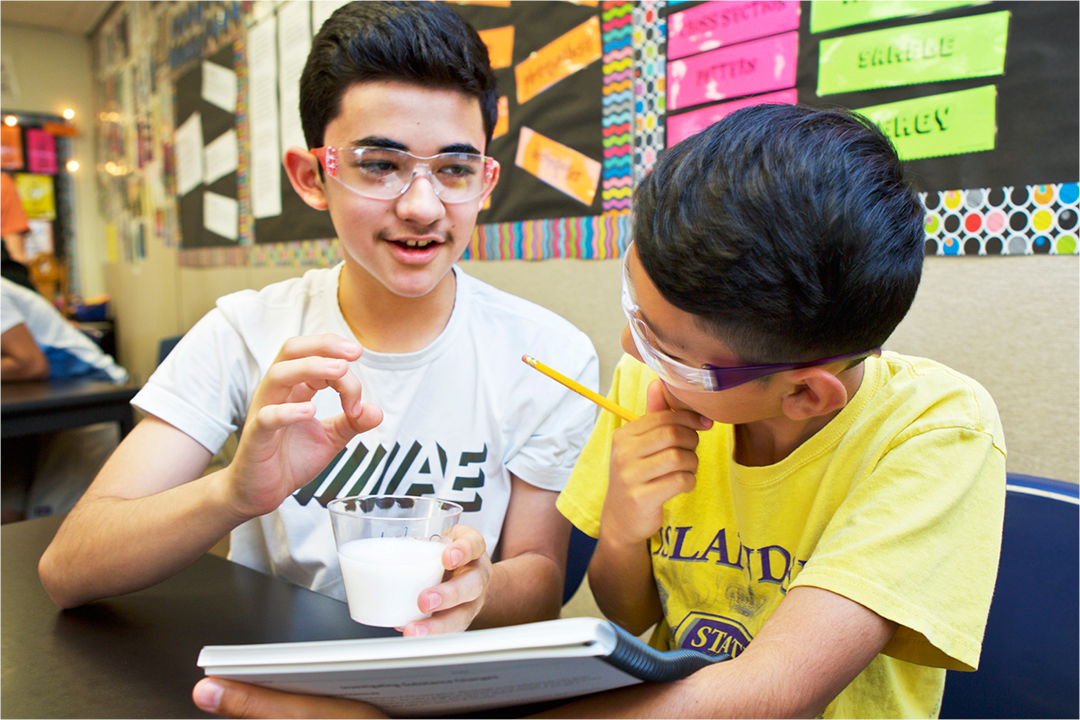

High-impact, evidence-based programs that help students make gap-closing gains in reading and math
Amplify Tutoring engages students and drives measurable academic gains. We partner with districts to ensure that children become confident, proficient readers and mathematical thinkers.

About Amplify Tutoring
Grounded in evidence-based practices and taught by caring, consistent tutors, our high-impact tutoring programs use high-quality instructional materials and data-driven mCLASS® products to support and engage students.
- Personalized, data-driven instruction
- Research-backed solutions tailored to support your Multi-Tiered System of Supports (MTSS) framework
- Customizable—before, during, or after school; year-long, semester-long, and summer programming
- Comprehensive, hands-on program management and staffing support
Amplify Literacy Tutoring supports K–6 readers through engaging, systematic instruction aligned to the Science of Reading and driven by mCLASS DIBELS® data.
Amplify Math Tutoring accelerates student achievement in grades 3–5 and builds students’ confidence in speaking, writing, and thinking mathematically.
More than a program: a true partner
Hear directly from district leaders and educators who’ve experienced the Amplify Tutoring difference. In these candid conversations, they share how we partner to deliver solutions for schools, gains for students, and support for teachers.


Our impact
Amplify Tutoring accelerates learning for students who need it most. Students in Amplify Tutoring are more likely to achieve outsized academic gains than similarly at-risk peers in the same schools who are not enrolled in the program.
Amplify Tutoring has been awarded the National Student Support Accelerator (NSSA) Tutoring Program Design Badge by Stanford University!
Learn moreReliable, easy-to-read data
With valid and reliable mCLASS assessments and real-time reporting always within reach, everyone involved in a child’s learning journey—from teachers and tutors to school leaders and families—can support student growth.
- Teachers have visibility into students’ data and all tutoring lesson content.
- School and district administrators receive regular tutoring attendance and progress-monitoring reports.
- Caregivers receive Home Connect letters and activities to help their child practice foundational skills at home.


High-quality instructional materials that power Amplify Literacy Tutoring
Amplify Literacy Tutoring includes high-quality resources to support students’ growth.
Targeted lessons generated by precise data
mCLASS Intervention is a research-backed, ESSA rated program that targets instruction based on students’ mCLASS DIBELS 8th Edition assessment results. With engaging lessons aligned to the Science of Reading that adapt based on students’ progress monitoring results, mCLASS Intervention streamlines time-consuming data analysis for teachers and makes sure that tutoring focuses on the literacy skills students need.


Transparency into student performance
mCLASS DIBELS 8th Edition is our nationally normed benchmarking and progress monitoring assessment tool to measure students’ foundational literacy skills. Students take the benchmark assessment three times a year and progress monitoring occurs every 7–10 lessons in between.
Proven impact for students who need it most
Boost Reading delivers targeted, adaptive practice that meets students where they are, while teachers get simple and meaningful insights into student progress. The program consistently moves students toward grade-level proficiency with just 30 minutes of use per week. Students can continue learning through Boost Reading between tutoring sessions or at home.

High-quality instructional materials that power Amplify Math Tutoring
Amplify Math Tutoring includes high-quality resources to support students’ growth.
Intervention Mini-Lessons aligned to core instruction
Amplify Desmos Math Mini-Lessons provide targeted intervention for students who require additional support or need more time. These lessons are aligned to the most critical topics throughout a unit; they enhance conceptual understanding while improving procedural fluency and application.

Valuable insights into student mathematical thinking
mCLASS Math is our benchmarking and progress monitoring assessment tool. Students take the benchmark assessment three times a year; progress monitoring occurs every 7–10 lessons in between.
Personalized practice—anytime and at home
Fact fluency practice provides students with regular practice beyond rote memorization. The program is used during tutoring sessions and is available on non-tutoring days. Students also have access to Boost Math’s independent learning activities, to continue practicing between tutoring sessions or at home.

Consultation and collaboration
Amplify Tutoring tailors our support for educators, schools, districts, caregivers, and state-level leaders, helping to realize the promise of high-impact tutoring programs. Through collaborative partnerships at every level, Amplify Tutoring engages communities in driving academic improvement and boosting attendance.
Our services can include:
Program design consultation: Amplify Tutoring offers expert program design consultation services to help schools and districts create effective and scalable high-impact tutoring programs.
Tailored onboarding: We provide customized training sessions for school, district, and state leaders, ensuring that Amplify Tutoring services are integrated smoothly into existing systems.
Ongoing professional development and coaching: Our program management includes continuous training, coaching support, and office hours with pedagogical experts to fortify the program’s success and adaptability.
Caregiver engagement: We offer resources and support for families and caregivers, including tips for at-home support, helping them stay informed and involved in their child’s progress.
Seamless communication and support: We provide transparent communication and engage all stakeholders—district and school leaders, teachers, caregivers, and students—to keep everyone aligned and informed.
Data reporting: We provide detailed reports and analytics to district and school leaders, giving them the power to monitor progress, make data-driven decisions, and celebrate successes.
Amplify Tutoring is part of a connected early literacy and math suite.
Our literacy and math suite programs are designed to support and complement each other in a Multi-Tiered System of Supports (MTSS). Learn more about our related programs.



Amplify Science – Oklahoma
Amplify Science – Oklahoma
Artificial intelligence at Amplify
Amplify is committed to using artificial intelligence (AI) capabilities transparently, safely, responsibly, and ethically to deliver tools and resources that continue to fulfill our purpose. We are also committed to aiding students, teachers, and our staff with the skills and understanding required to use AI technology effectively and fairly.
Thoughtful and intentional integration of AI technology supports Amplify’s purpose by extending teachers’ reach, saving them time, enhancing their understanding of each student, and providing new ways to engage students in powerful and rigorous learning experiences.
At the core of our work is our belief that these technologies, if used wisely, can support teachers in creating the kind of classroom experiences every student deserves—collaborative, interesting, and personalized.
Amplify’s AI principles
Governance and risk management: Amplify is developing and maintaining a governance and risk-management program aligned to EDSAFE AI Alliance’s S.A.F.E. Benchmarks Framework and the NIST AI Risk Management Framework, which includes internal policies and procedures to support compliance and safe and responsible use of AI. Amplify’s program guides the design, development, deployment, and overall implementation of AI in Amplify’s products and the tools used in Amplify’s operations. The governance program applies both to Amplify-developed capabilities and third-party development and integrations.
Amplify aligns to EDSAFE AI Alliance’s S.A.F.E. Benchmarks Framework as follows:
SAFETY: Uphold privacy, security, and reliability.
ACCOUNTABILITY: Be human-centered, responsive to human guidance, and transparent.
FAIRNESS AND TRANSPARENCY: Avoid creating or reinforcing unfair bias, and assess for impact.
EFFICACY: Be purposeful and rigorous.
Privacy and security: Amplify ensures that privacy protections are included by default in AI systems, including ensuring that data collection conforms to reasonable expectations and that only data strictly necessary for the specific context is collected, in conformance with our policies around the collection, use, and sharing of personal information. Amplify’s applications use student personal information solely for the purpose of performing the service, in alignment with Family Educational Rights and Privacy Act (FERPA) and applicable state law and district policies and contracts. In addition, Amplify monitors security risks specific to AI systems, including dataset poisoning, prompt injection, and adversarial attacks, and shores up resilience against attempts to alter use, behavior, or performance, or to compromise security properties. Read more about Amplify privacy and security programs.
AI in Amplify’s products and services
Amplify uses AI in our programs in ways that respond to the demonstrated needs of districts, teachers, and students and that meet our high standards for safety, accountability, fairness, and efficacy. Amplify has established an AI Center of Excellence, with AI scientists, engineers, product managers, and designers dedicated to establishing best practices and guiding development in key areas that meet these criteria.
Some ways Amplify leverages AI in products and services:
Amplify ELA: Amplify ELA’s Automated Writing Evaluation (AWE) tools give teachers the ability to understand, track, and support student progress with key foundational skills, which are strong indicators of students’ analytic writing proficiency. Developed in conjunction with the Writing Prompts in Amplify ELA, AWE assesses student writing for Focus, Use of Evidence, and Conventions, providing critical feedback for teachers and data for Amplify’s writing reports.
Boost Reading: Students in grades K–5 may take the Boost Reading Benchmark Assessment to determine their placement in Boost when they first log in. Students receive a set of word recognition, fluency, and comprehension activities, supported by automatic speech recognition.
Boost Math: Personalized Learning activities feature Spark, a virtual tutor that uses text-to-speech to provide personalized, engaging support to help students build mastery. The tutor incorporates student numerical responses in its conversation, but does not use student personal information.
Inspiring the next generation of Oklahoma scientists, engineers, and curious citizens
Amplify Science is an engaging new core curriculum designed for three-dimensional, phenomena-based learning.

A powerful partnership
Amplify Science was developed by the science education experts at UC Berkeley’s Lawrence Hall of Science and the digital learning team at Amplify.
Our Instructional Model
The Amplify Science program is rooted in the proven, research-based pedagogy of Do, Talk, Read, Write, Visualize. Here’s how each element works:
DO
First-hand investigations are an important part of any science classroom, and Amplify Science has students getting hands-on in every unit, from building models of protein molecules to experimenting with electrical systems.
TALK
Student-to-student discourse and full class discussions are an integral part of the program. Students are provided with numerous opportunities to engage in meaningful oral scientific argumentation, all while fostering a collaborative classroom environment.
READ
Students read scientific articles, focusing their reading activities on searching for evidence related to their investigation, and importantly, on asking and recording questions as they read through fascinating texts on 21st-century topics.
WRITE
Following real-world practices, students write scientific arguments based on evidence they’ve collected, making clear their reasoning about how a given piece of evidence connects to one of several claims.
VISUALIZE
By manipulating digital simulations and using modeling tools to craft visualizations of their thinking— just as real scientists and engineers do—students take their learning far beyond the confines of what they can physically see in the classroom in an exciting and authentic way.
Resources to support your review
- What’s so phenomenal about phenomena? – ebook
- Phenomena in grades K–5
- Phenomena in grades 6–8
- Student Books in grades K–5
- Literacy-rich science instruction in grades K–5
- Active Reading in grades 6–8
- Engineering in Amplify Science
- Oklahoma standards correlation for grades K–8
- Program structure for grades K–5
- Program structure for grades 6–8
- Oklahoma recommended scope and sequence for grades 6–8
Remote and hybrid learning supports

Oklahoma remote and hybrid overview video
Amplify has launched a new remote learning solution called Amplify Science@Home. Intended to make extended remote learning and hybrid learning easier, Amplify Science@Home includes two useful options for continuing instruction: @Home Videos and @Home Units.
Amplify Science @Home Videos are recordings of real Amplify Science teachers teaching the lessons. For those teachers who are unable to meet synchronously with their students, the recorded lessons are a great way to keep their students on track and engaged with Amplify Science while at home. These videos will be produced for all K–5 units, and for the first four units of each 6–8 grade level. Their release will be rolling, beginning in August.
Amplify Science@Home Units are modified versions of Amplify Science units, strategically designed to highlight key activities from the program. The @Home Units take significantly less instructional time than the complete Amplify Science program and allow students to engage with science at home. @Home Units will be developed for all Amplify Science K–8 units. Each @Home unit includes:
- Teacher overviews explaining how to use the materials, including suggestions for enhancing the @Home Units if synchronous learning or in-class time with students is available.
- Overviews to send home to families.
Student materials are available in two formats:
- @Home Slides (PDF/PPT) + Student Sheets (PDF) for students with access to technology at home.
- Downloadable @Home Packets (PDF) for students without access to technology at home.
Download the Remote and hybrid learning guide.
What’s included
Flexible resources that work seamlessly together
Science articles
The middle school science articles serve as sources for evidence collection and were authored by science and literacy experts at the Lawrence Hall of Science.

Student Investigation Notebooks
Available for every unit, the Student Investigation Notebooks provide space for students to:
- Record data
- Reflect on ideas from texts and investigations
- Construct explanations and arguments
Available with full-color article compilations for middle school units.

Digital student experience
Students access the digital simulations and modeling tools, as well as lesson activities and assessments, through the digital student experience. Students can interact with the digital student experience as they:
- Conduct hands-on investigations
- Engage in active reading and writing activities
- Participate in discussions
- Record observations
- Craft end-of-unit scientific arguments

Teacher’s Guides
Available digitally and in print, the Teacher’s Guides contain all of the information teachers need to facilitate classroom instruction, including:
- Classroom Slides
- Detailed lesson plans
- Unit and chapter overview documentation
- Differentiation strategies
- Standards alignments
- In-context professional development

Hands-on materials kits
Hands-on learning is at the heart of Amplify Science. Each unit kit contains:
- Consumable and non-consumable hands-on materials
- Print classroom display materials
- Premium print materials for student use (sorting cards, maps, etc.)

Scope and sequence
GRADE |
UNIT |
| Kindergarten |
|
| Grade 1 |
|
| Grade 2 |
|
| Grade 3 |
|
| Grade 4 |
|
| Grade 5 |
|
Grade |
Units |
|
Grade 6 |
|
|
Grade 7 |
|
|
Grade 8 |
|
Oklahoma Academic Standards for Science coverage
Amplify Science was designed from the ground up to meet the Next Generation Science Standards (NGSS), and the Oklahoma Academic Standards for Science (OASS) are closely aligned to the NGSS at K-8. The guidance below is meant to provide support for integrating additional activities that support full coverage of the OASS. You can view the full K–8 OASS correlation here.
Organized by grade level, each section below will outline:
- additional activities that support 100% alignment to the Oklahoma Academic Standards for Science;
- the standard being addressed with the activities;
- the recommended placement of the activities within a specific Amplify Science unit; and
- PDFs of any accompanying materials that are necessary to implement the activities.
Standard: 1.ESS3.1: Communicate solutions that will reduce the impact of humans on the land, water, air, and/or other living things in the local environment.
Recommended placement: Animal and Plant Defenses unit, Chapter 1
Materials: The Student Book Investigating Monarchs from the unit Needs of Plants and Animals
Investigating Monarchs emphasizes the needs of monarch caterpillars and butterflies and shows what happens when these animals are not able to meet their needs. The book first introduces the life cycle of monarchs, explaining that monarch caterpillars must eat milkweed to survive and change into butterflies. Their summer habitat must have milkweed. The butterflies then migrate a long distance, from the United States to a forest in the mountains of Mexico, where they take shelter in the trees. Their winter habitat must have trees. Scientists discovered that the monarch population in Mexico was greatly reduced because people were cutting down the trees. The forest was then protected, but the monarch population did not recover as expected. Scientists in the United States found evidence that this was because fields with milkweed are being replaced by farms and buildings. This book could be read with the class either before or after Chapter 1 of the Animal and Plant Defenses unit, which focuses on what plants and animals need to do to survive. Students could be asked to reflect on what the monarchs need to survive (including food and shelter), and how human activities impacted the monarchs’ ability to meet those needs. After reading the book, students could brainstorm ideas for how to reduce the impact of humans on the local environment.
Standard: MS-PS4-2: Develop and use a model to describe that waves are reflected, absorbed, or transmitted through various materials.
Recommended placement: Metabolism unit, Lesson 3.3, addition to Activity 5
Materials: “What Eyes Can See” science article
As students investigate metabolism and the body systems, the article “What Eyes Can See” should be assigned to deepen their understanding of information processing and sense receptors and connect that understanding to the emerging idea of the interaction of waves with various materials. The article explores how the only thing we can really see is light. Light travels from a light source to the eye, passing through some materials and bouncing off others. Tiny organs inside the eye called rods and cones absorb energy from light, making vision possible. These interactions between light and materials determine our visible world.
Instructions:
Download the PDF “What Eyes Can See” above and remind students of the Active Reading Guidelines. Before students read the article, invite them to share prior experiences. For example, “Have you ever had an experience where something looked different in one kind of light than in another kind of light? Or where something seemed to appear or disappear when the light changed?”
Standard: MS-PS3-1: Construct and interpret graphical displays of data to describe the relationships of kinetic energy to the mass of an object and to the speed of an object.
Recommended placement: Harnessing Human Energy unit, Lesson 1.4, after Activity 4
Materials: Force and Motion Simulation; Activity instructions and copymasters
In this activity, students use the Force and Motion Simulation to investigate the relationship between kinetic energy, mass, and velocity.
Instructions
Download the PDF linked above for the Lesson Guide and copymasters needed for the activity. Note that this investigation is typically implemented during the Force and Motion unit. This means the Lesson Guide will contain some incongruous labeling (e.g., unit name), as well as instructions that are out of context and unnecessary for the purposes of addressing this standard at grade 7. We suggest skipping to step 4 of the Instructional Guide to avoid some of this. Your students will get additional exposure to this activity, and indeed the standard as a whole, when they get to the Force and Motion unit in grade 8.
Standards:
- MS-PS2-3: Ask questions about data to determine the factors that affect the strength of electric and magnetic forces.
- MS-PS2-5: Conduct an investigation and evaluate the experimental design to provide evidence that fields exist between objects exerting forces on each other even though the objects are not in contact.
Recommended placement: Force and Motion unit, after Lesson 1.5
Materials: Flextension PDF
This hands-on activity builds on and reinforces students’ understanding of forces that act at a distance, with a focus on electrostatic force. Students explore electrostatic forces, prompted by a set of challenges that they try to accomplish. Next, students generate scientific questions based on their observations. Electrostatic force is less predictable and consistent than magnetic force, and investigating it can be both challenging and intriguing. The purpose of this lesson is for students to gain firsthand experience with electrostatic force and to gain experience generating scientific questions based on observations. You might choose to include this Flextension if you would like your students to have more exposure to electrostatic force, and if you would like to challenge your students to explore and ask questions about a challenging type of force.
Instructions:
Download the PDF linked above for a detailed Lesson Guide and the copymasters associated with the activity. Note that this activity is typically implemented as an add-on Flextension during the Magnetic Fields unit. This means that you will see some information that is out of context (e.g., placement information, unit title), but the activity itself also works for the purposes of the Force and Motion unit. If you have any questions, please reach out to our support team via the chat icon in your account or help@amplify.com.
Explore the Digital Teacher’s Guide
When you’re ready to review, click the orange button below and use your provided login credentials to access the Amplify Science Digital Teacher’s Guide.
To help familiarize yourself with navigating the digital Teacher’s Guide, watch our navigational guide videos:
Grades K–5:
Grades 6–8:
Looking for help?
Powerful (and free!) pedagogical support
Amplify provides a unique kind of support you won’t find from other publishers. We have developed an educational support team of former teachers and administrators who provide pedagogical support for every Amplify curriculum, assessment, and intervention program. This service is completely free for all educators who are using our programs and includes:
- Guidance for developing lesson plans and intervention plans
- Information on where to locate standards and other planning materials
- Recommendations and tips for day-to-day teaching with Amplify programs
- Support with administering and interpreting assessment data and more
To reach our pedagogical team, use our live chat within your program, call (800) 823-1969, or email edsupport@amplify.com
Timely technical and program support
Our technical and program support is included and available from 7 a.m. to 7 p.m. ET, Monday through Friday, through a variety of channels, including a live chat program that enables teachers to get immediate help in the middle of the school day.
For your most urgent questions:
- Use our live chat within your program
- Call our toll-free number: (800) 823-1969
For less urgent questions:
Contact us
Contact your South Carolina team representatives:
Jeff Rutter
Field Manager
jrutter@amplify.com
(727) 512-8440
Cathy McMillan
Senior Account Executive
cmcmillan@amplify.com
(904) 465-9904
Amplify Science professional development
Amplify Science blends hands-on investigations, literacy-rich activities, and interactive digital tools to empower students to think, read, write, and argue like real scientists and engineers. We’ve created a wide suite of professional development offerings that will help you meet your unique needs this school year. Find out more below!

Amplify CKLA, ELA, and Science professional development has been vetted by Rivet Education’s team through a rigorous three-step process and is listed in the Professional Learning Partner Guide.

Plan your professional development
We’re excited to partner with you on your Amplify journey. Flexible professional development pathways have been designed to meet your needs.
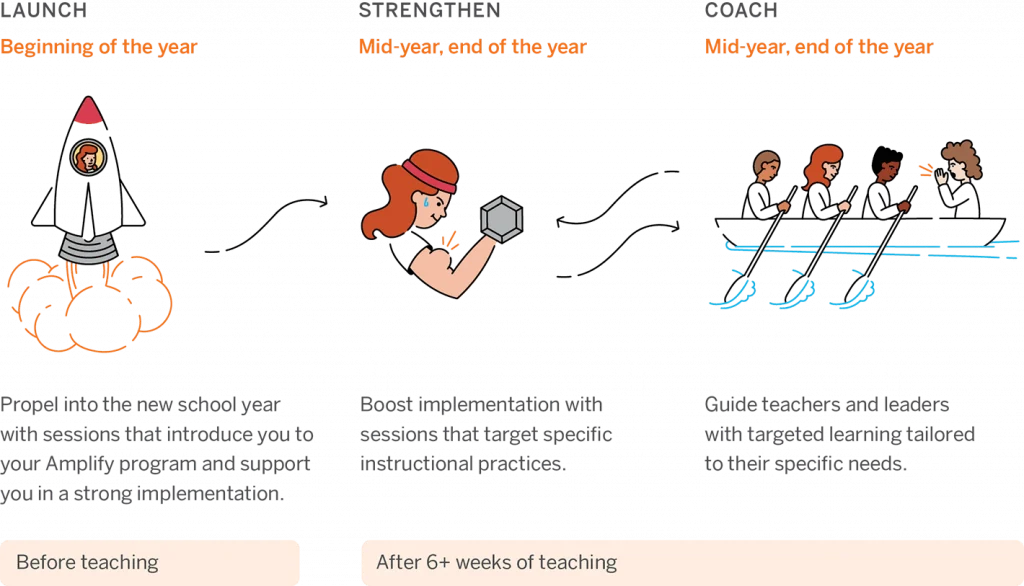
Recommended Professional Development Plan
Our team has curated a recommended professional learning path from initial launch to continuous support. Use the Professional Development Planning Guide below to discuss the plan that best meets your school or district needs with your Account Executive.
Sessions overview
| Audience | Title | Duration | Modality | Available |
|---|---|---|---|---|
| Foundations | ||||
| K–5 instructional leaders | Administrators’ program overview | Half day | Onsite/Remote | 6/2022 |
| Administrators’ program overview for interactive classroom | Half day | Onsite/Remote | 6/2022 | |
| K–5 teachers | Initial training | 1 day onsite or 2 half days remote | Onsite/Remote | Yes* |
| Program overview | Half day | Onsite/Remote | Yes | |
| Initial training for Interactive Classroom | 1 day onsite or 2 half days remote | Onsite/Remote | 6/2022 | |
| Program overview for Interactive Classroom | Half day | Onsite/Remote | Yes | |
| 6–8 instructional leaders | Administrators’ program overview | Half day | Onsite/Remote | Yes |
| 6–8 teachers | Initial training | 1 day onsite or 2 half days remote | Onsite/Remote | 6/2022 |
| Program overview | Half day | Onsite/Remote | Yes | |
| Strengthening | ||||
| K–5 instructional leaders | Strengthening consultation session | 60 min. | Remote | 6/2022 |
| Strengthening consultation package | 3 1-hour sessions | Remote | 6/2022 | |
| K–5 teachers | Guided unit internalization | Half day | Onsite/Remote | Yes |
| Strengthening consultation session | 60 min. | Remote | 6/2022 | |
| Strengthening consultation package | 3 1-hour sessions | Remote | 6/2022 | |
| 6–8 instructional leaders | Strengthening consultation session | 60 min. | Remote | 6/2022 |
| Strengthening consultation package | 3 1-hour sessions | Remote | 6/2022 | |
| 6–8 teachers | Guided unit internalization | Half day | Onsite/Remote | Yes |
| Strengthening consultation session | 60 min. | Remote | 6/2022 | |
| Strengthening consultation package | 3 1-hour sessions | Remote | 6/2022 | |
| Coaching | ||||
| K–5 instructional leaders | Job-Embedded Coaching (JEC) | 1 day | Onsite | Yes |
| K–5 teachers | Job-Embedded Coaching (JEC) | 1 day | Onsite/Remote | Yes |
| 6–8 instructional leaders | Job-Embedded Coaching (JEC) | 1 day | Onsite | Yes |
| 6–8 teachers | Job-Embedded Coaching (JEC) | 1 day | Onsite/Remote | Yes |
Note for all workshops: Any single three-hour offering can be repeated on the same day with different audiences to make one full-day session.
*When delivered remotely, this full-day initial training session (6 hours) is split into two half-day sessions (3 hours each). Part 1 and Part 2 may be scheduled consecutively on the same day or on different days, ideally within ~2 weeks. The same participants should attend both sessions in order to receive all content. This flexible scheduling opportunity for remote sessions will be available starting 6/2022.
Launch sessions
For teachers
Initial training
1 day onsite (6 hours) or 2 half days remote (6 hours)*
Grade band: K–5 / 6–8
Grade level: K, 1, 2, 3, 4, 5, 6, 7, 8
In the first half of this session, participants learn the essentials necessary to implement Amplify Science with success. They learn to navigate the digital Amplify Science platform and become familiar with planning resources and strategies. Through a model lesson and guided reflection, participants build an understanding of the instructional approach to teaching and learning. In the second half of this session, participants dig deeper into unit resources to start planning for instruction for their first grade-level unit.
When delivered as a grade band session, Part 1 will feature an exemplar from the following units:
- K–5 workshops feature an exemplar from the grade 4 unit Energy Conversions.
- 6–8 workshops feature an exemplar from the Metabolism Core unit.
When delivered as a grade level session, Part 1 features the following units:
- K: Needs of Plants and Animals
- 1: Animal and Plant Defenses
- 2: Plant and Animal Relationships
- 3: Balancing Forces
- 4: Energy Conversions
- 5: Patterns of Earth and Sky
6–8 workshops feature one of the following units:
- Metabolism
- Ocean, Atmosphere, and Climate
- Phase Change
Available starting 6/2022.
Audience: Teachers (administrators welcome), maximum 30 participants
Modality: Onsite/Remote
*When delivered remotely, this full-day initial training session (6 hours) is split into two half-day sessions (3 hours each). Part 1 and Part 2 may be scheduled consecutively on the same day or on different days, ideally within two weeks. The same participants should attend both sessions in order to receive all content. This flexible scheduling opportunity for remote sessions will be available starting 6/2022.
Initial training for Interactive Classroom
1 day onsite (6 hours) or 2 half days remote (6 hours)*
Grade band: K–5
Grade level: K, 1, 2, 3, 4, 5, 6, 7, 8
In the first half of this session, participants learn to navigate with Amplify Science Interactive Classroom and prepare to start teaching. The session opens with a model lesson that introduces the functionality of the Interactive Classroom interface and highlights the Amplify Science instructional approach. Next, participants experience a guided navigation walkthrough that prepares them to use the full suite of Interactive Classroom features with their students. The session closes with time to reflect on implementation and a walkthrough of additional resources available to support further professional learning. In the second half of this session, participants dig deeper into unit resources to start planning for instruction for their first grade-level unit.
When delivered as a grade band session, Part 1 will feature an exemplar from the grade 4 unit Energy Conversions.
When delivered as a grade level session, Part 1 features the following units:
- K: Needs of Plants and Animals
- 1: Animal and Plant Defenses
- 2: Plant and Animal Relationships
- 3: Balancing Forces
- 4: Energy Conversions
- 5: Patterns of Earth and Sky
Audience: Teachers (administrators welcome), maximum 30 participants
Modality: Onsite/Remote
*When delivered remotely, this full-day initial training session (6 hours) is split into two half-day sessions (3 hours each). Part 1 and Part 2 may be scheduled consecutively on the same day or on different days, ideally within two weeks. The same participants should attend both sessions in order to receive all content. This flexible scheduling opportunity for remote sessions will be available starting 6/2022.
Program overview
Half day (3 hours)
Grade band: K–5 / 6–8
Grade level: 6, 7, 8
In this session, participants learn the essentials necessary to implement Amplify Science with success. They learn to navigate the digital Amplify Science platform and become familiar with planning resources and strategies. Through a model lesson and guided reflection, participants build an understanding of the instructional approach to teaching and learning.
When delivered as a grade band session, an exemplar will be featured from the following units:
- K–5 workshops feature an exemplar from the grade 4 unit Energy Conversions.
- 6–8 workshops feature an exemplar from Metabolism.
When delivered as a grade level session, the following units will be featured:
- K: Needs of Plants and Animals
- 1: Animal and Plant Defenses
- 2: Plant and Animal Relationships
- 3: Balancing Forces
- 4: Energy Conversions
- 5: Patterns of Earth and Sky
6–8 workshops feature one of the following units:
- Metabolism
- Ocean, Atmosphere, and Climate
- Phase Change
Audience: Teachers (administrators welcome), maximum 30 participants
Modality: Onsite/Remote
Program overview for Interactive Classroom
Half day (3 hours)
Grand band: K–5
Grade level: K, 1, 2, 3, 4, 5
In this session, participants learn to navigate with Amplify Science Interactive Classroom and prepare to start teaching. The session opens with a model lesson that introduces the functionality of the Interactive Classroom interface and highlights the Amplify Science instructional approach. Next, participants experience a guided navigation walkthrough that prepares them to use the full suite of Interactive Classroom features with their students. The session closes with time to reflect on implementation and a walkthrough of additional resources available to support further professional learning.
When delivered as a grade band session, the workshop features an exemplar from the Grade 4 unit Energy Conversions.
When delivered as a grade level session, the workshop features the following units:
- K: Needs of Plants and Animals
- 1: Animal and Plant Defenses
- 2: Plant and Animal Relationships
- 3: Balancing Forces
- 4: Energy Conversions
- 5: Patterns of Earth and Sky
Audience: Teachers (administrators welcome), maximum 30 participants
Modality: Onsite/Remote
For instructional leaders
Administrators’ program overview
Half day (3 hours)
Grade band: K–5 / 6–8
In this session, instructional leaders become familiar with the principles of phenomenon-based teaching and learning, and experience the instructional approach of Amplify Science units. Leaders consider their essential role supporting teachers and students with the implementation of a new science curriculum.
Available starting 6/2022.
Audience: Administrators, department chairs, coaches, maximum 30 participants
Modality: Onsite/Remote
Administrators’ program overview for Interactive Classroom
Half day (3 hours)
Grade band: K-5
In this session, instructional leaders become familiar with the functionality of Amplify Science with Interactive Classroom and are introduced to the instructional approach of Amplify Science units. Leaders consider their essential role supporting teachers and students with the implementation of a new science curriculum.
Available starting 6/2022.
Audience: Administrators, department chairs, coaches, maximum 30 participants
Modality: Onsite/Remote
Strengthening sessions
For teachers
Guided unit internalization
Half day (3 hours)
Grade band: K–5 / 6–8
Grade level: K, 1, 2, 3, 4, 5, 6, 7, 8
Prerequisite: Initial training or program overview
In this session, participants leverage a planning protocol to internalize an upcoming unit. They apply their understanding of how students engage in three-dimensional learning throughout the unit to plan for the diverse needs of their classrooms and students.
Audience: Teachers (administrators welcome), maximum 30 participants
Modality: Onsite/Remote
Strengthening consultation session
60-minute session
Grade band: K–5 / 6–8
Grade level: K, 1, 2, 3, 4, 5, 6, 7, 8
Prerequisite: Initial training or program overview
This 60-minute session focuses on a specific topic that will deepen teachers understanding of Amplify Science. An Amplify facilitator will align with the school or district leadership team in advance on the topic (chosen from a menu of options) that will best meet teachers unique options.
Topics include supporting diverse learners (for K–8 teachers), Classwork/My Work/Assign/Reporting (for 6–8 teachers), and planning an Amplify Science lesson (for K–8 teachers).
Available starting 6/2022.
Audience: Teachers, maximum 30 participants
Modality: Remote
Strengthening consultation package
3 1-hour sessions
Grade band: K–5 / 6–8
Grade level: K, 1, 2, 3, 4, 5, 6, 7, 8
Prerequisite: Initial training or program overview
This package consists of three 60-minute sessions that can be delivered on the same day or on different days. Each session will focus on a specific topic that will deepen teachers understanding of Amplify Science. An Amplify facilitator will align with the school or district’s leadership team in advance on the topic from a menu of options that will best meet teachers unique needs.
Available starting 6/2022.
Audience: Teachers, maximum 30 participants
Modality: Remote
For instructional leaders
Strengthening consultation session
60-minute session
Grade band: K–5 / 6–8
Grade level: K, 1, 2, 3, 4, 5, 6, 7, 8
Prerequisite: Administrators’ program overview
These 60 minute sessions will focus on a specific topic that will deepen instructional leaders’ understanding in Amplify Science and equip them in driving towards stronger student outcomes. An Amplify facilitator will align with the school or district’s leadership team in advance on the topic from a menu of options that will best meet instructional leaders’ unique needs.
Topics include data analysis with Admin Reports (for 6-8 leaders), and Amplify Science classroom look-fors (for K-8 leaders).
Available starting 6/2022.
Audience: Administrators, department chairs, coaches, maximum 30 participants
Modality: Remote
Strengthening consultation package
3 1-hour sessions
Grade band: K–5 / 6–8
Prerequisite: Administrators’ program overview
This package consists of three 60-minute sessions that can be delivered on the same day or on different days. Each session will focus on a specific topic that will deepen leaders’ understanding of Amplify Science. An Amplify facilitator will align with the school or district’s leadership team in advance on the topic from a menu of options that will best meet leaders’ unique needs.
Available starting 6/2022.
Audience: Administrators, department chairs, coaches, maximum 30 participants
Modality: Remote
Coaching sessions
For teachers
Job-Embedded Coaching (JEC) services: Teachers
1 day (6 hours)
Grade band: K–5 / 6–8
Grade level: K, 1, 2, 3, 4, 5, 6, 7, 8
Prerequisite: Initial training or program overview
Strengthen your implementation of Amplify Science with a coaching onsite visit for your teachers. An Amplify Science Professional Learning Specialist can visit classrooms for observation and debriefs with focused feedback and/or facilitate PLC or grade-level meetings to support teachers with planning decisions. The flexible coaching design allows for a collaborative and personalized approach to support effective program implementation.
Audience: Teachers, maximum 30 participants
Modality: Onsite/Remote
For instructional leaders
Job-Embedded Coaching (JEC): Administrators
1 day (6 hours)
Grade band: K–5 / 6–8
Prerequisite: Administrators’ program overview
In our Coaching sessions, instructional leaders engage in facilitated Professional Learning Walks (PLW)—non-evaluative classroom observations of Amplify Science classrooms that focus on building capacity to identify indicators of strong implementation of the program. Classroom look-fors focus on the use of instructional resources (material access/use and the Classroom Wall), instructional delivery (unpacking the unit phenomena and multimodal instruction), and monitoring of instruction (supporting all learners and use of the Assessment System). Leaders collaboratively analyze collected data in order to identify strengths and areas for growth specific to the implementation of Amplify Science for their teaching teams. Leaders leave with an action plan for supporting their teachers based on the analysis and reflection from the PLW.
Audience: Administrators, department chairs, coaches, maximum 30 participants
Modality: Onsite
Pricing
We offer the following pricing for training sessions and packages:
| Session type | Pricing |
|---|---|
| 2 consecutive full day onsite sessions | $4,800 |
| 1-day onsite session | $3,200 |
| 1-day remote session (2 half days) | $1,500 |
| 1-day remote coaching session | $1,200 |
| Half-day onsite session | $2,500 |
| Half-day remote session | $750 |
| 60-minute remote session | $350 |
| 3 1-hour remote sessions | $1,000 |
| Customized Amplify Science onsite or remote packages | Price will vary |
Please note that the prices are general ranges and may be subject to change.
Contact
Amplify welcomes the opportunity to partner with schools and districts to design professional development plans and answer your questions.
If you would like to order any of our professional development services, please contact your local Amplify sales representative or call (800) 823-1969.
Inspiring the next generation of Oklahoma scientists, engineers, and curious citizens
Amplify Science is an engaging new core curriculum designed for three-dimensional, phenomena-based learning.

A powerful partnership
Amplify Science was developed by the science education experts at UC Berkeley’s Lawrence Hall of Science and the digital learning team at Amplify.
Instructional model
The Amplify Science program is rooted in the proven, research-based pedagogy of Do, Talk, Read, Write, Visualize. Here’s how each element works:
DO
First-hand investigations are an important part of any science classroom, and Amplify Science has students getting hands-on in every unit—from building models of protein molecules to experimenting with electrical systems.
TALK
Student-to-student discourse and full-class discussions are an integral part of the program. Students are provided with numerous opportunities to engage in meaningful oral scientific argumentation, all while fostering a collaborative classroom environment.
READ
Students read scientific articles, focusing their reading activities on searching for evidence related to their investigation and, importantly, on asking and recording questions as they read through fascinating texts on 21st-century topics.
WRITE
Following real-world practices, students write scientific arguments based on evidence they’ve collected, making clear their reasoning about how a given piece of evidence connects to one of several claims.
VISUALIZE
By manipulating digital simulations and using modeling tools to craft visualizations of their thinking— just as real scientists and engineers do—students take their learning far beyond the confines of what they can physically see in the classroom in an exciting and authentic way.
Oklahoma Instructional Samplers
Video: Oklahoma Spotlight on All Learners (SPED, G & T, EL, DEI)
Resources to support your review
- What’s so phenomenal about phenomena? – ebook
- Phenomena in grades K–5
- Phenomena in grades 6–8
- Student Books in grades K–5
- Literacy-rich science instruction in grades K–5
- Active Reading in grades 6–8
- Engineering in Amplify Science
- Oklahoma standards correlation for grades K–8
- Program structure for grades K–5
- Program structure for grades 6–8
- Oklahoma recommended scope and sequence for grades 6–8
Remote and hybrid learning support

Oklahoma Spotlight Video: Remote and Hybrid Learning
Amplify has launched a new remote learning solution called Amplify Science @Home. Intended to make extended remote learning and hybrid learning easier, Amplify Science@Home includes two useful options for continuing instruction: @Home Videos and @Home Units.
Amplify Science @Home Videos are recordings of real Amplify Science teachers teaching the lessons. For those teachers who are unable to meet synchronously with their students, the recorded lessons are a great way to keep their students on track and engaged with Amplify Science while at home. These videos will be produced for all K–5 units, and for the first four units of each 6–8 grade level. Their release will be rolling, beginning in August 2021.
Amplify Science@Home Units are modified versions of Amplify Science units, strategically designed to highlight key activities from the program. The @Home Units take significantly less instructional time than the complete Amplify Science program and allow students to engage with science at home. @Home Units will be developed for all Amplify Science K–8 units. Each @Home unit includes:
- Teacher overviews explaining how to use the materials, including suggestions for enhancing the @Home Units if synchronous learning or in-class time with students is available.
- Overviews to send home to families.
Student materials are available in two formats:
- @Home Slides (PDF/PPT) + Student Sheets (PDF) for students with access to technology at home.
- Downloadable @Home Packets (PDF) for students without access to technology at home.
Download the remote and hybrid learning guide.
What’s included
Flexible resources that work seamlessly together
Oklahoma Spotlight Video: Instructional Resources: More than a textbook!
Science articles
The middle school science articles serve as sources for evidence collection and were authored by science and literacy experts at the Lawrence Hall of Science.
Student Investigation Notebooks
Available for every unit, the Student Investigation Notebooks provide space for students to:
- record data.
- reflect on ideas from texts and investigations.
- construct explanations and arguments.
Available with full-color article compilations for middle school units.

Digital student experience
Students access the digital simulations and modeling tools, as well as lesson activities and assessments, through the digital student experience. Students can interact with the digital student experience as they:
- conduct hands-on investigations.
- engage in active reading and writing activities.
- participate in discussions.
- record observations.
- craft end-of-unit scientific arguments.
Oklahoma Spotlight Video: Spotlight on Simulations
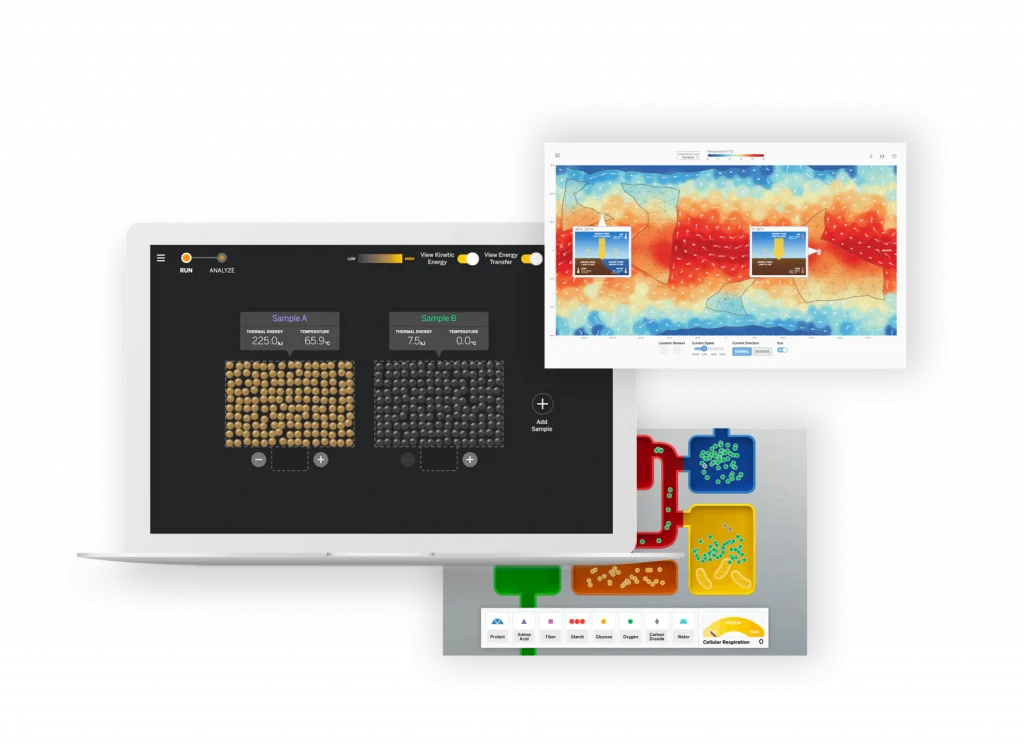
Teacher’s Guides
Available digitally and in print, the Teacher’s Guides contain all of the information teachers need to facilitate classroom instruction, including:
- Classroom Slides.
- detailed lesson plans.
- unit and chapter overview documentation.
- differentiation strategies.
- standards alignments.
- in-context professional development.
Oklahoma Spotlight Video: Classroom Slides

Hands-on materials kits
Hands-on learning is at the heart of Amplify Science. Each unit kit contains:
- consumable and non-consumable hands-on materials.
- print classroom display materials.
- premium print materials for student use (sorting cards, maps, etc).
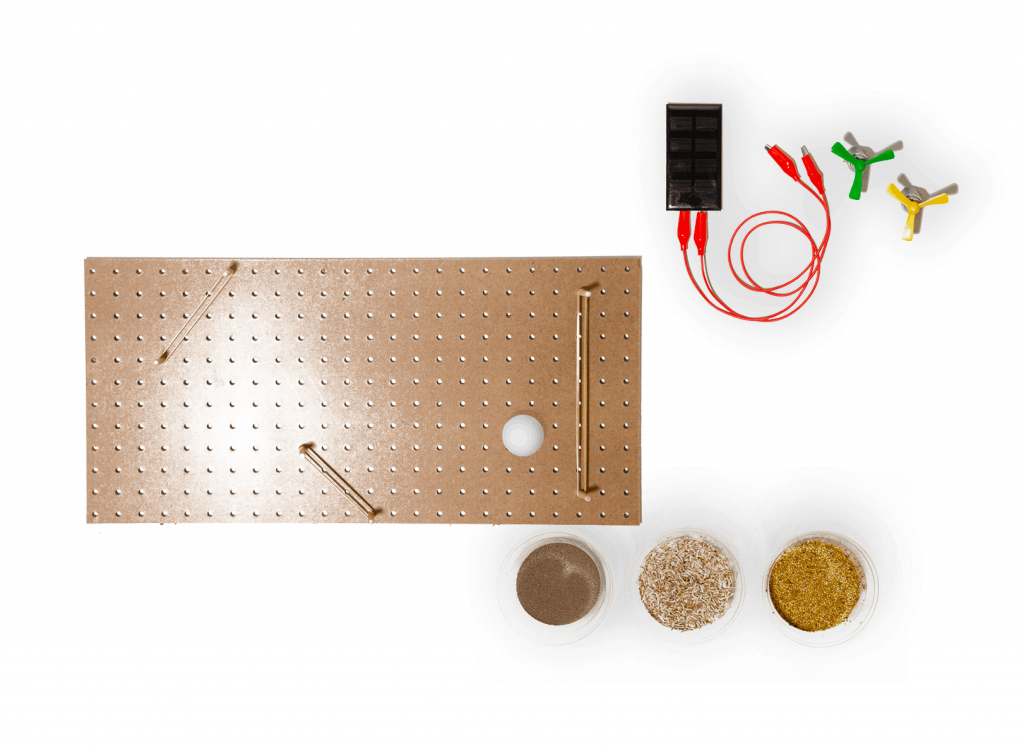
Scope and sequence
GRADE
UNITS
Kindergarten
- Needs of Plants and Animals
- Pushes and Pulls
- Sunlight and Water
Grade 1
- Animal and Plant Defenses
- Light and Sound
- Spinning Earth
Grade 2
- Plant and Animal Relationships
- Properties of Materials
- Changing Landforms
Grade 3
- Balancing Forces
- Inheritance and Traits
- Environments and Survival
- Weather and Climate
Grade 4
- Energy Conversions
- Vision and Light
- Earth’s Features
- Waves, Energy, and Information
Grade 5
- Patterns of Earth and Sky
- Modeling Matter
- The Earth System
- Ecosystem Restoration
GRADE
UNITS
Grade 6
- Launch: Microbiome
- Metabolism
- Plate Motion
- Plate Motion Engineering Internship
- Rock Transformations
- Ocean, Atmosphere, and Climate
- Weather Patterns
- Thermal Energy
- Phase Change
Grade 7
- Launch: Harnessing Human Energy
- Chemical Reactions
- Populations and Resources
- Matter Energy and Ecosystems
- Earth’s Changing Climate
- Earth’s Changing Climate Engineering Internship
- Magnetic Fields
Grade 8
- Launch: Geology on Mars
- Force and Motion
- Force and Motion Engineering Internship
- Light Waves
- Earth, Moon, and Sun
- Traits and Reproduction
- Natural Selection
- Evolutionary History
Oklahoma Academic Standards for Science coverage
Amplify Science was designed from the ground up to meet the Next Generation Science Standards (NGSS), and the Oklahoma Academic Standards for Science (OASS) are closely aligned to the NGSS at K–8. The guidance below is meant to provide support for integrating additional activities that support full coverage of the OASS. You can view the full K–8 OASS correlation here.
Organized by grade level, each section below will outline:
- additional activities that support 100% alignment to the Oklahoma Academic Standards for Science;
- the standard being addressed with the activities;
- the recommended placement of the activities within a specific Amplify Science unit; and
- PDFs of any accompanying materials that are necessary to implement the activities.
Standard: 1.ESS3.1: Communicate solutions that will reduce the impact of humans on the land, water, air, and/or other living things in the local environment.
Recommended placement: Animal and Plant Defenses unit, Chapter 1
Materials: The Student Book Investigating Monarchs from the unit Needs of Plants and Animals
Investigating Monarchs emphasizes the needs of monarch caterpillars and butterflies and shows what happens when these animals are not able to meet their needs. The book first introduces the life cycle of monarchs, explaining that monarch caterpillars must eat milkweed to survive and change into butterflies. Their summer habitat must have milkweed. The butterflies then migrate a long distance, from the United States to a forest in the mountains of Mexico, where they take shelter in the trees. Their winter habitat must have trees. Scientists discovered that the monarch population in Mexico was greatly reduced because people were cutting down the trees. The forest was then protected, but the monarch population did not recover as expected. Scientists in the United States found evidence that this was because fields with milkweed are being replaced by farms and buildings. This book could be read with the class either before or after Chapter 1 of the Animal and Plant Defenses unit, which focuses on what plants and animals need to do to survive. Students could be asked to reflect on what the monarchs need to survive (including food and shelter), and how human activities impacted the monarchs’ ability to meet those needs. After reading the book, students could brainstorm ideas for how to reduce the impact of humans on the local environment.
Standard: MS-PS4-2: Develop and use a model to describe that waves are reflected, absorbed, or transmitted through various materials.
Recommended placement: Metabolism unit, Lesson 3.3, addition to Activity 5
Materials: “What Eyes Can See” science article
As students investigate metabolism and the body systems, the article “What Eyes Can See” should be assigned to deepen their understanding of information processing and sense receptors and connect that understanding to the emerging idea of the interaction of waves with various materials. The article explores how the only thing we can really see is light. Light travels from a light source to the eye, passing through some materials and bouncing off others. Tiny organs inside the eye called rods and cones absorb energy from light, making vision possible. These interactions between light and materials determine our visible world.
Instructions:
Download the PDF “What Eyes Can See” above and remind students of the Active Reading guidelines. Before students read the article, invite them to share prior experiences. For example, “Have you ever had an experience where something looked different in one kind of light than in another kind of light? Or where something seemed to appear or disappear when the light changed?”
Standard: MS-PS3-1: Construct and interpret graphical displays of data to describe the relationships of kinetic energy to the mass of an object and to the speed of an object.
Recommended placement: Harnessing Human Energy unit, Lesson 1.4, after Activity 4
Materials: Force and Motion simulation; Activity instructions and copymasters
In this activity, students use the Force and Motion Simulation to investigate the relationship between kinetic energy, mass, and velocity.
Instructions
Download the PDF linked above for the Lesson Guide and copymasters needed for the activity. Note that this investigation is typically implemented during the Force and Motion unit. This means the Lesson Guide will contain some incongruous labeling (e.g., unit name), as well as instructions that are out of context and unnecessary for the purposes of addressing this standard at grade 7. We suggest skipping to step 4 of the Instructional Guide to avoid some of this. Your students will get additional exposure to this activity, and indeed the standard as a whole, when they get to the Force and Motion unit in grade 8.
Standards:
- MS-PS2-3: Ask questions about data to determine the factors that affect the strength of electric and magnetic forces.
- MS-PS2-5: Conduct an investigation and evaluate the experimental design to provide evidence that fields exist between objects exerting forces on each other even though the objects are not in contact.
Recommended placement: Force and Motion unit, after Lesson 1.5
Materials: Flextension PDF
This hands-on activity builds on and reinforces students’ understanding of forces that act at a distance, with a focus on electrostatic force. Students explore electrostatic forces, prompted by a set of challenges that they try to accomplish. Next, students generate scientific questions based on their observations. Electrostatic force is less predictable and consistent than magnetic force, and investigating it can be both challenging and intriguing. The purpose of this lesson is for students to gain firsthand experience with electrostatic force and to gain experience generating scientific questions based on observations. You might choose to include this Flextension if you would like your students to have more exposure to electrostatic force, and if you would like to challenge your students to explore and ask questions about a challenging type of force.
Instructions:
Download the PDF linked above for a detailed Lesson Guide and the copymasters associated with the activity. Note that this activity is typically implemented as an add-on Flextension during the Magnetic Fields unit. This means that you will see some information that is out of context (e.g., placement information, unit title), but the activity itself also works for the purposes of the Force and Motion unit. If you have any questions, please reach out to our support team via the chat icon in your account or help@amplify.com.
Explore the Digital Teacher’s Guide
When you’re ready to review, click the orange button below and use your provided login credentials to access the Amplify Science Digital Teacher’s Guide.
To help familiarize yourself with navigating the digital Teacher’s Guide, watch our navigational guide videos:
Grades K–5:
Grades 6–8:
Looking for help?
Powerful (and free!) pedagogical support
Amplify provides a unique kind of support you won’t find from other publishers. We’ve developed an educational support team of former teachers and administrators who provide pedagogical support for every Amplify curriculum, assessment, and intervention program. This service is completely free for all educators who are using our programs and includes:
- Guidance for developing lesson plans and intervention plans.
- Information on where to locate standards and other planning materials.
- Recommendations and tips for day-to-day teaching with Amplify programs.
- Support with administering and interpreting assessment data and more.
To reach our pedagogical team, use our live chat within your program, call (800) 823-1969, or email edsupport@amplify.com
Timely technical and program support
Our technical and program support is included and available from 7 a.m. to 7 p.m. ET, Monday through Friday, through a variety of channels, including a live chat program that enables teachers to get immediate help in the middle of the school day.
For your most urgent questions:
- Use our live chat within your program.
- Call our toll-free number: (800) 823-1969.
For less urgent questions:
Contact us
Contact your Oklahoma representative:
Julie Godfrey
Account Executive
jgodfrey@amplify.com
(817) 360-0527
Amplify Science professional development
Amplify Science blends hands-on investigations, literacy-rich activities, and interactive digital tools to empower students to think, read, write, and argue like real scientists and engineers. We’ve created a wide suite of professional development offerings that will help you meet your unique needs this school year. Find out more below!
Amplify CKLA, ELA, and Science professional development has been vetted by Rivet Education’s team through a rigorous three-step process and is listed in the Professional Learning Partner Guide.
Plan your professional development
We’re excited to partner with you on your Amplify journey. Flexible professional development pathways have been designed to meet your needs.
Recommended professional development plan
Our team has curated a recommended professional learning path from initial launch to continuous support. Use the Professional Development Planning Guide below to discuss the plan that best meets your school or district needs with your Account Executive.
Sessions overview
| Audience | Title | Duration | Modality | Available |
|---|---|---|---|---|
| Launch | ||||
| K–5 instructional leaders | Administrators’ program overview | Half day | Onsite/Remote | Yes^ |
| TK teachers | Transitional kindergarten program overview | Half day | Onsite/Remote | Yes |
| K–5 teachers | Initial training | 1 day onsite or 2 days remote |
Onsite/Remote | Yes*^ |
| K–5 teachers | Program overview | Half day | Onsite/Remote | Yes |
| Interactive Classroom consultation | 90 min. | Remote | Yes | |
| 6–8 instructional leaders | Administrators’ program overview | Half day | Onsite/Remote | Yes |
| 6–8 teachers | Initial training | 1 day onsite or 2 days remote |
Onsite/Remote | Yes* |
| 6–8 teachers | Program overview | Half day | Onsite/Remote | Yes |
| Strengthen | ||||
| K–5 instructional leaders | Strengthening consultation session | 60 min. | Remote | 6/2022 |
| Strengthening consultation package | 3 1-hour sessions | Remote | 6/2022 | |
| K–5 teachers | Guided unit internalization | Half day | Onsite/Remote | Yes |
| K–5 teachers | The Assessment System | Half day | Onsite/Remote | Yes |
| Supporting all learners with complex texts | Half day | Onsite/Remote | Yes | |
| Writing in science | Half day | Onsite/Remote | Yes | |
| Supporting English learners | Half day | Onsite/Remote | Yes | |
| Strengthening consultation session | 60 min. | Remote | 6/2022 | |
| Strengthening consultation package | 3 1-hour sessions | Remote | 6/2022 | |
| 6–8 instructional leaders | Strengthening consultation session | 60 min. | Remote | 6/2022 |
| Strengthening consultation package | 3 1-hour sessions | Remote | 6/2022 | |
| 6–8 teachers | Guided unit internalization | Half day | Onsite/Remote | Yes |
| 6–8 teachers | The Assessment System | Half day | Onsite/Remote | Yes |
| Supporting all learners with complex texts | Half day | Onsite/Remote | Yes | |
| Writing in science | Half day | Onsite/Remote | Yes | |
| Supporting English learners | Half day | Onsite/Remote | Yes | |
| Engineering Internships | Half day | Onsite/Remote | Yes | |
| Science Seminar | Half day | Onsite/Remote | Yes | |
| Strengthening consultation session | 60 min. | Remote | 6/2022 | |
| Strengthening consultation package | 3 1-hour sessions | Remote | 6/2022 | |
| Coach | ||||
| K–5 instructional leaders | Job-Embedded Coaching (JEC) | 1 day | Onsite | Yes |
| K–5 teachers | Job-Embedded Coaching (JEC) | 1 day | Onsite/Remote | Yes |
| 6–8 instructional leaders | Job-Embedded Coaching (JEC) | 1 day | Onsite | Yes |
| 6–8 teachers | Job-Embedded Coaching (JEC) | 1 day | Onsite/Remote | Yes |
| Note for all workshops: Any single three-hour offering can be repeated on the same day with different audiences to make one full-day session. | ||||
| *When delivered remotely, this full-day initial training session (6 hours) is split into two half-day sessions (3 hours each). Part 1 and Part 2 may be scheduled consecutively on the same day or on different days, ideally within ~2 weeks. The same participants should attend both sessions in order to receive all content. This flexible scheduling opportunity for remote sessions will be available starting 6/2022. | ||||
^Session will be available for IC customers after June 1, 2022.
Launch
For teachers
Initial training
1 day onsite (6 hours) or 2 half days remote (6 hours)*
Grade band: K–1 / K–5 / 6–8
Grade level: K, 1, 2, 3, 4, 5, 6, 7, 8
In the first half of this session, participants learn the essentials necessary to implement Amplify Science with success. They learn to navigate the digital Amplify Science platform and become familiar with planning resources and strategies. Through a model lesson and guided reflection, participants build an understanding of the instructional approach to teaching and learning. In the second half of this session, participants dig deeper into unit resources to start planning for instruction for their first grade-level unit.
When delivered as a grade band session, Part 1 will feature an exemplar from the following units:
- K–1 workshops feature an exemplar from the grade 1 unit Animal and Plant Defenses.
- K–5 workshops feature an exemplar from the grade 4 unit Energy Conversions.
- 6–8 workshops feature an exemplar from the Metabolism Core unit.
When delivered as a grade level session, Part 1 features the following units:
- K: Needs of Plants and Animals
- 1: Animal and Plant Defenses
- 2: Plant and Animal Relationships
- 3: Balancing Forces
- 4: Energy Conversions
- 5: Patterns of Earth and Sky
6–8 workshops feature one of the following units:
- Metabolism
- Plate Motion
- Force and Motion
Interactive Classroom customers: Select K-5 grade band or K, 1, 2, 3, 4, 5 grade level sessions (available starting 6/2022)
Audience: Teachers (administrators welcome), maximum 30 participants
Modality: Onsite/Remote
*When delivered remotely, this full-day initial training session (6 hours) is split into two half-day sessions (3 hours each). Part 1 and Part 2 may be scheduled consecutively on the same day or on different days, ideally within two weeks. The same participants should attend both sessions in order to receive all content. This flexible scheduling opportunity for remote sessions will be available starting 6/2022.
Interactive Classroom consultation
90 minutes
Grade band: K–5
Prerequisite: Initial training or program overview
In this remote consultation session, participants prepare to leverage Amplify Science’s new K-5 Interactive Classroom experience. The session includes a walkthrough of new digital features available to teachers and an opportunity for participants to experience these enhancements through modeled activities from an exemplar K-5 unit. The session closes with time for participants to explore the digital features and ask questions to support their planning.
*This session is designed for experienced Amplify Science users who are new to adding Interactive Classroom.
Audience: Teachers, maximum 30 participants
Modality: Remote
Program overview
Half day (3 hours)
Grand band: K–1, K–5, 6–8
Grade level: K, 1, 2, 3, 4, 5, 6, 7, 8
In this session, participants learn the essentials necessary to implement Amplify Science with success. They learn to navigate the digital Amplify Science platform and become familiar with planning resources and strategies. Through a model lesson and guided reflection, participants build an understanding of the instructional approach to teaching and learning.
When delivered as a grade band session, an exemplar will be featured from the following units:
- K–1 workshops feature an exemplar from the grade 1 unit Animal and Plant Defenses.
- K–5 workshops feature an exemplar from the grade 4 unit Energy Conversions.
- 6–8 workshops feature an exemplar from Metabolism.
When delivered as a grade level session, the following units will be featured:
- K: Needs of Plants and Animals
- 1: Animal and Plant Defenses
- 2: Plant and Animal Relationships
- 3: Balancing Forces
- 4: Energy Conversions
- 5: Patterns of Earth and Sky
6–8 workshops feature one of the following units:
- Metabolism
- Plate Motion
- Force and Motion
Interactive Classroom customers: Select K-5 grade band or K, 1, 2, 3, 4, 5 grade level sessions
Audience: Teachers (administrators welcome), maximum 30 participants
Modality: Onsite/Remote
Transitional kindergarten program overview
Half day (3 hours)
Grade level: TK
In this session, participants dive into exploring and planning for the first TK unit, Wondering About Noises in Trees. They engage with model activities, experience key instructional routines, and plan how they’ll implement this flexible curriculum in their classrooms. Participants collaborate to build a deep understanding of the TK instructional approach and structure. They will leave ready to start instruction in their classrooms, and take away a suite of additional resources to support their preparation for other TK units.
Audience: Teachers (administrators welcome), maximum 30 participants
Modality: Onsite/Remotewelcome), maximum 30 participants
Modality: Onsite/Remote
For instructional leaders
Administrators’ program overview
Half day (3 hours)
Grade band: K–5 / 6–8
In this session, instructional leaders become familiar with the principles of phenomenon-based teaching and learning, and experience the instructional approach of Amplify Science units. Leaders consider their essential role supporting teachers and students with the implementation of a new science curriculum.
Interactive Classroom customers: Select K-5 grade band session (available starting 6/2022)
Audience: Administrators, department chairs, coaches, maximum 30 participants
Modality: Onsite/Remote
Strengthen
For teachers
The Assessment System
Half day (3 hours)
Grade band: K–5 / 6–8
Prerequisite: Initial training or program overview
In this session, participants learn about the structure and purpose of the varied formative and summative opportunities in the Amplify Science Assessment System. Participants experience and analyze a sample formative assessment, deepen their understanding of unit learning progressions, and acquire strategies for collecting, analyzing, and responding to student assessment data. Collaborative reflections and discussions support participants’ understanding of the relationships among different types of assessments and their unit’s learning goals.
Audience: Teachers (administrators welcome), maximum 30 participants
Modality: Onsite/Remote
Supporting all learners with complex texts
Half day (3 hours)
Grade band: K–5 / 6–8
Prerequisite: Initial training or program overview
In this session, participants learn strategies to support all students as they access the complex texts in Amplify Science units. They explore the connections among the ways professional scientists read and how Amplify Science lessons build students’ capacity as science readers. The workshop includes a model reading sequence, collaborative problem-solving around common student reading challenges, and planning time for upcoming reading lessons in participants’ units.
Audience: Teachers (administrators welcome), maximum 30 participants
Modality: Onsite/Remote
Writing in science
Half day (3 hours)
Grade band: K–5 / 6–8
Prerequisite: Initial training or program overview
K–5: In this session, participants develop an understanding of how the Amplify Science writing approach supports students to engage in science practices, make sense of science ideas, and develop as writers. Participants experience an example multimodal instructional sequence that demonstrates the connections among informal daily writing and the more structured formal scientific explanations and arguments students write in each Amplify Science unit. They dig into resources for analyzing student writing then apply their learning to plan for supporting student writing in their unit.
6-8: In this session, participants develop an understanding of how the Amplify Science writing approach supports students to engage in science practices, make sense of science ideas, and develop as writers. Participants experience an example instructional sequence that demonstrates the varied purposes for frequent small, informal writing opportunities in multimodal science instruction, then they analyze how each core unit’s culminating Science Seminar experience works as a scaffold to support students as they write sophisticated scientific arguments. The session closes with a guided reflection on strategies for supporting student writing.
Audience: Teachers (administrators welcome), maximum 30 participants
Modality: Onsite/Remote
Supporting English learners
Half day (3 hours)
Grade band: K–5 / 6–8
Prerequisite: Initial training or program overview
In this session, participants explore strategies to support English learners’ ability to do, talk, read, write, visualize, and construct arguments like scientists. By engaging in model activities, participants deepen their knowledge of the critical role that language and literacy play in developing scientific understanding. Participants become familiar with the research-based principles underlying the embedded supports and strategies in Amplify Science, which aid in students’ development of disciplinary literacy in science.
Audience: Teachers (administrators welcome), maximum 30 participants
Modality: Onsite/Remote
Guided unit internalization
Half day (3 hours)
Grade band: K–5 / 6–8
Grade level: TK, K, 1, 2, 3, 4, 5, 6, 7, 8
Prerequisite: Initial training or program overview
In this session, participants leverage a planning protocol to internalize an upcoming unit. They apply their understanding of how students engage in three-dimensional learning throughout the unit to plan for the diverse needs of their classrooms and students.
Audience: Teachers (administrators welcome), maximum 30 participants
Modality: Onsite/Remote
Engineering Internships
Half day (3 hours)
Grade level: 6, 7, 8
Prerequisite: Initial training or program overview
In this session, participants explore and plan for the first Engineering Internship of their grade-level course. Participants are oriented to the Futura Workspace and other digital tools used with students in the internship experience. Participants also dive deeper into how students apply science concepts from core units to construct design solutions, learning engineering concepts and practices throughout the process.
Workshop will feature one of the following units:
- Metabolism Engineering Internship
- Plate Motion Engineering Internship
- Force and Motion Engineering Internship
Audience: Teachers (administrators welcome), maximum 30 participants
Modality: Onsite/Remote
Science Seminar
Half day (3 hours)
Grade band: 6–8
Prerequisite: Initial training or program overview
This session focuses on the culminating Science Seminar sequence at the end of the grades 6–8 core units, in which students apply the conceptual understanding built throughout the unit to engage in argumentation about a unique but related phenomenon. Participants experience a Science Seminar sequence from an exemplar unit as students do, then dive into a unit at their grade level to internalize the Science Seminar sequence and plan for instruction.
Audience: Teachers (administrators welcome), maximum 30 participants
Modality: Onsite/Remote
Strengthening consultation session
60-minute session
Grade band: K–5 / 6–8
Grade level: K, 1, 2, 3, 4, 5, 6, 7, 8
Prerequisite: Initial training or program overview
This 60-minute session focuses on a specific topic that will deepen teachers understanding of Amplify Science. An Amplify facilitator will align with the school or district leadership team in advance on the topic (chosen from a menu of options) that will best meet teachers’ unique options.
Topics include:
- Supporting Diverse Learners: Exploring the resources (for K–8 teachers)
- Supporting Diverse Learners: Leveraging and Building upon Embedded Supports A: Teacher modeling and student discourse (for K–8 teachers)
- Supporting Diverse Learners: Leveraging and Building upon Embedded Supports B: Multimodal instruction
- Planning an Amplify Science lesson (for K–8 teachers)
- Unit kits and materials prep (for K–5 teachers)
- Grading with Amplify Science (for K–8 teachers)
- Analyzing Student Work (for K–8 teachers)
Available starting 6/2022.
Audience: Teachers, maximum 30 participants
Modality: Remote
Strengthening consultation package
3 1-hour sessions
Grade band:K–5 / 6–8
Grade level:K, 1, 2, 3, 4, 5, 6, 7, 8
Prerequisite:Initial training or program overview
This package consists of three 60-minute sessions that can be delivered on the same day or on different days. Each session will focus on a specific topic that will deepen teachers understanding of Amplify Science. An Amplify facilitator will align with the school or district’s leadership team in advance on the topic from a menu of options that will best meet teachers’ unique needs.
Available starting 6/2022.
Audience:Teachers, maximum 30 participants
Modality: Remote
For instructional leaders
Strengthening consultation session
60-minute session
Grade band: K–5 / 6–8
Grade level: K, 1, 2, 3, 4, 5, 6, 7, 8
Prerequisite: Administrators’ program overview
These 60 minute sessions will focus on a specific topic that will deepen instructional leaders’ understanding in Amplify Science and equip them in driving towards stronger student outcomes. An Amplify facilitator will align with the school or district’s leadership team in advance on the topic from a menu of options that will best meet instructional leaders’ unique needs.
Topic available for summer 2022: Amplify Science classroom look-fors (for K-8 leaders).
Available starting 6/2022.
Audience: Administrators, department chairs, coaches, maximum 30 participants
Modality: Remote
Strengthening consultation package
3 1-hour sessions
Grade band: K–5 / 6–8
Prerequisite: Administrators’ program overview
This package consists of three 60-minute sessions that can be delivered on the same day or on different days. Each session will focus on a specific topic that will deepen leaders’ understanding of Amplify Science. An Amplify facilitator will align with the school or district’s leadership team in advance on the topic from a menu of options that will best meet leaders’ unique needs.
Available starting 6/2022.
Audience: Administrators, department chairs, coaches, maximum 30 participants
Modality: Remote
Coach
For teachers
Job-Embedded Coaching (JEC) services: Teachers
1 day (6 hours)
Grade band: K–5 / 6–8
Grade level: K, 1, 2, 3, 4, 5, 6, 7, 8
Prerequisite: Initial training or program overview
Strengthen your implementation of Amplify Science with a coaching onsite visit for your teachers. An Amplify Science Professional Learning Specialist can visit classrooms for observation and debriefs with focused feedback and/or facilitate PLC or grade-level meetings to support teachers with planning decisions. The flexible coaching design allows for a collaborative and personalized approach to support effective program implementation.
Audience: Teachers, maximum 30 participants
Modality: Onsite/Remote
For instructional leaders
Job-Embedded Coaching (JEC): Administrators
1 day (6 hours)
Grade band: K–5 / 6–8
Prerequisite: Administrators’ program overview
In our Coaching sessions, instructional leaders engage in facilitated Professional Learning Walks (PLW)—non-evaluative classroom observations of Amplify Science classrooms that focus on building capacity to identify indicators of strong implementation of the program. Classroom look-fors focus on the use of instructional resources (material access/use and the Classroom Wall), instructional delivery (unpacking the unit phenomena and multimodal instruction), and monitoring of instruction (supporting all learners and use of the Assessment System). Leaders collaboratively analyze collected data in order to identify strengths and areas for growth specific to the implementation of Amplify Science for their teaching teams. Leaders leave with an action plan for supporting their teachers based on the analysis and reflection from the PLW.
Audience: Administrators, department chairs, coaches, maximum 30 participants
Modality: Onsite
Pricing
We offer the following pricing for training sessions and packages:
| Session type | Pricing |
|---|---|
| 2 consecutive full day onsite sessions | $4,800 |
| 1-day onsite session | $3,200 |
| 1-day remote session (2 half days) | $1,500 |
| 1-day remote coaching session | $1,200 |
| Half-day onsite session | $2,500 |
| Half-day remote session | $750 |
| 90-minute remote session | $500 |
| 60-minute remote session | $350 |
| 3 1-hour remote sessions | $1,000 |
| Customized Amplify Science onsite or remote packages | Price will vary |
Please note that the prices are general ranges and may be subject to change.
Contact
Amplify welcomes the opportunity to partner with schools and districts to design professional development plans and answer your questions.
If you would like to order any of our professional development services, please contact your local Amplify sales representative or call (800) 823-1969.
Administrators, welcome to Amplify Reading!
Here you’ll find information about enrollment and licensing, technical requirements, professional learning resources, and more.
Onboarding: What to expect
Welcome to Amplify Reading! There are six basic steps to onboarding. Use this visual as a reference, but also know that our dedicated implementation team will be there to support you during the entire process.
Technology requirements and guidelines
To ensure that your hardware and network meet the minimum technical requirements for performance and support of your curriculum products, please see Amplify’s customer requirements page.
You’ll also want to add the URLs on this page to the corresponding district- or school-level filters so that your teachers and students can access their Amplify Reading materials.
Data sharing agreement
Partnering with Amplify through our data sharing program deepens learning outcomes and gives you the performance analysis you need to make impactful decisions within your district or school. By signing our data sharing agreement, your district will help us to better understand student performance as it relates to your state’s standards. It also allows us to compare results with the curriculum-embedded assessments and state-level assessments. These analyses will help you identify the areas where your teachers and students are excelling or may be experiencing challenges.
Stay tuned for additional updates.
Enrollment and licensing overview
During the enrollment and licensing call, your Amplify implementation partner will walk you through the enrollment process. We recommend exploring the enrollment web tool ahead of the call for suggestions on which enrollment method may be best for your district.
The following guides provide additional information about enrollment methods and the data sharing process.


Administrator Reports
Self-service Administrator Reports allow insight into activation, usage, growth, progress, and instruction overviews illustrating how students are performing within the adaptive program.
Access will be limited to district and school administrators. Administrators can directly access these reports at my.amplify.com/admin-reports.
Announcements
Summer extension
With summer fast approaching, we recognize that some districts may be extending the school year and/or continuing the use of Amplify curriculum and programs for summer instruction. If your summer instruction will continue past June 30 and/or you need to make rostering or enrollment changes, follow our guidance on extending your rollover date.
Use stimulus funding to drive transformation
Learn about ESSER I, II, and III funding (or CARES, CRRSA, and ARP) and how to use these funds to help with learning recovery and acceleration. Districts have significant flexibility in how to use the ESSER money, with ESSER II and III specifying that some of the funds should be used to address unfinished learning. All Amplify programs and services meet the criteria for the funding. Get more information about funding and timelines.
Next steps: How do I support my teachers?
Professional development
We partner with every district to make sure the Amplify Reading rollout meets their unique needs. Check out our professional development site to get a better understanding of what our team has to offer.
Advice and answers
We have an array of online resources available to address educators’ questions. As they get started with the curriculum, we encourage educators to visit the Amplify Reading help site to read through tutorials and search for topics they want to learn more about.
Contact us
Powerful (and free!) pedagogical support
Amplify provides a unique kind of support you won’t find from other publishers. We have developed an educational support team of former teachers and administrators who provide pedagogical support at no cost to educators using our programs. This free service includes:
- Guidance for developing lesson plans and intervention plans.
- Information on where to locate standards and other planning materials.
- Recommendations and tips for day-to-day teaching with Amplify Reading.
- Support with administering and interpreting assessment data and more.
To reach our pedagogical team, click the orange icon while logged into the curriculum to get immediate help, call (866) 629-2446, or email edsupport@amplify.com.
Timely technical and program support
Our Customer Care and Support team is available Monday through Friday, 7 a.m. to 9 p.m. ET, and Sunday, 10 a.m. to 6 p.m. ET, through a variety of channels:
- Live chat: Click the orange icon while logged into the curriculum to get immediate help in the middle of the school day.
- Phone: Call our toll-free number: (800) 823-1969.
- Email: Send an email to help@amplify.com.
Join our community
Our Amplify Reading Facebook group is a community of Amplify Reading educators from across the country. It’s a space to share best practices, ideas, and support on everything from implementation to instruction. Join today.
2025
September 18, 2025
Edutopia: “Using Virtual Manipulatives in Math Class”
August 19, 2025
Education Week: “Here’s Why It’s Important for Teachers to Have a Say in Curriculum”
August 18, 2025
Investors Hangout: “Amplify Classroom Revolutionizes K-12 Teaching Experience”
August 5, 2025
WhaTech: “K-12 Online Education Market Set for Strong Expansion, Reaching $349.77 Billion by 2029”
August 4, 2025
Education Week: “Districts Using ‘High-Quality’ Reading Curricula Still Supplement With Other Materials. Why?”
July 9, 2025
K-12 Dive: “Youngest students see big reading gains post-COVID on DIBELS assessment”
June 25, 2025
The 74: “How Districts in Georgia, Maryland and D.C. Are Raising Reading Proficiency”
May 28, 2025
Open PR: “K-12 Online Education Market Forecast 2025-2034: Comprehensive Analysis And Growth Opportunities”
May 27, 2025
District Administration: “Early literacy: How to implement programs that start strong”
May 20, 2025
EdSource: “California schools prepare to introduce universal reading screening”
April 23, 2025
The 74: “Eric Adams Expands Reading, Math Curriculum Mandates to All NYC Middle Schools”
April 21, 2025
Daily News: “NYC expanding reading, math curriculum overhaul to more schools”
March 19, 2025
Education Next: “School Reinvention in Practice”
February 28, 2025
K-12 Dive, “Test yourself on this week’s K-12 news”
February 26, 2025
K-12 Dive: “Only 56% of K-2 students are ready to read”
January 24, 2025
Chalkbeat Philadelphia: “Two AI-powered charter schools could soon open in Pennsylvania”
January 16, 2025
Tech & Learning: “What is Polypad and How Can Teachers Use It?”
2024
December 18, 2024
EdSource: “State takes another step toward mandatory testing for reading difficulties in 2025”
December 6, 2024
Chalkbeat Philadelphia: “Philadelphia is now spending over $100 million on its curriculum overhaul. Here’s a breakdown.”
November 27, 2024
Lincoln Journal Star: “Lincoln Public Schools drops a classification rating on statewide assessment”
November 6, 2024
EdNC: “New K-3 literacy data shows growth in skills for North Carolina students”
October 1, 2024
The 74: “As NY District Implements Science of Reading, Parents Push for New Focus on Math”
September 18, 2024
Tech & Learning: “Tech & Learning Announces Winners of Best for Back to School 2024”
August 22, 2024
Chalkbeat Philadelphia: “Philadelphia school board renews charters, funds tutoring and a new science curriculum”
August 2, 2024
EdNC: “‘Dedication of our teachers’ praised in an update on the state’s science of reading journey”
July 31, 2024
The 74: “Classroom Case Study: To Maximize the Impact of Curriculum Mandates, Follow the Science of Reading”
July 23, 2024
Chalkbeat: “Should teachers customize their lessons or just stick to the ‘script’?”
July 7, 2024
The Economist: “Will artificial intelligence transform school?”
June 24, 2024
Chalkbeat: “Math instruction overhaul: NYC unveils new curriculum mandate for middle and high schools”
June 6, 2024
EdNC: “Perspective | Teachers are the heroes of the literacy story in North Carolina”
May 24, 2024
The Dallas Morning News: “How Don Quixote changed a Dallas public school classroom”
May 2, 2024
Akron.com: “Tutoring program at Summit Academy Akron Elementary School attracts national interest”
April 25, 2024
Edutopia: “Using Tech Tools to Energize Young Students’ Math Learning”
April 4, 2024
EdNC: “State Board hears update on district ESSER spending, literacy data, and Restart schools”
March 22, 2024
Thomas B Fordham Institute: “Five takeaways from Ohio’s baseline survey of elementary reading curricula”
March 15, 2024
The 74: “New Data: Despite K-2 Reading Gains, Students Face a ‘Much Harder Journey’ Ahead”
March 5, 2024
The 74: “Case Study: How One Texas School District Is Repurposing Staff Development Time to Embrace the Science of Reading”
February 21, 2024
Times Record News: “UPDATED: Texas Education Commissioner Mike Morath likes what he sees at local school”
February 19, 2024
Chalkbeat: “Chicago Public Schools recover from pandemic declines more than other districts, study shows”
February 7, 2024
The 74: “Building Oral Language Skills and Equity Through High-Quality Reading Curriculum”
2023
December 19, 2023
The 74: “Best Education Articles of 2023: Our 23 Most Important Stories About Students, Schools & Learning Recovery ”
December 8, 2023
Education Week: “Aligned Science Curriculum, Better Scores? Research Finds a Connection”
December 6, 2023
WRAL News: “Reading readiness rises in NC’s K-3 classrooms, new data shows”
November 27, 2023
The Dallas Morning News: “Dallas’ new lessons aim to keep kids on track, but some worry about limiting teachers”
November 2, 2023
Fort Worth Report: “Black students in Fort Worth ISD still struggle to read at grade level”
October 31, 2023
Chicago Tribune: “Lake Forest-area schools take stock of state grades; ‘While we celebrate our successes, we acknowledge that the journey … is ongoing’”
October 19, 2023
Chalkbeat: “NYC eyes middle and high school literacy overhaul. It’s asking families to weigh in.”
October 16, 2023
The 74: “As Virginia Rolls Out Ambitious Statewide High-Dosage Tutoring Effort This Week, 3 Keys to Success”
October 6, 2023
Language Magazine: “Embracing Bilingual Assessment”
September 18, 2023
Tech & Learning: “Best for Back to School 2023”
September 18, 2023
Chalkbeat: “Chicago Public Schools hired hundreds of tutors with federal COVID money. Can they keep them?”
September 7, 2023
EdNC: “Perspective | Union County Public Schools empowers educators, elevates readers”
August 14, 2023
Chicago Parent: “Common Core Math: How to Help Your Kids”
August 6, 2023
The News & Observer: “NC sees big increase in reading skills among K-3 students. Is the state back on track?”
August 4, 2023
The 74: “Slow Literacy Gains, Long COVID in Kids: 7 Insights into Pandemic Recovery and Aftermath in U.S. Schools”
August 3, 2023
EdNC: “State Board of Education: New reading data, parental leave, and a call to support public schools”
July 28, 2023
Houston Public Media: “New literacy curriculum is among the many changes coming to HISD”
July 17, 2023
Houston Chronicle: “Mike Miles says HISD schools will teach the ‘science of reading.’ Here’s what that means.”
July 11, 2023
The 74: “‘Education’s Long COVID’: New Data Shows Recovery Stalled for Most Students”
July 6, 2023
Houston Chronicle: “HISD superintendent gives voluntary schools one last chance to back out of New Education System”
June 29, 2023
The Report Card: “Larry Berger on Curriculum”
June 2, 2023
EdWeek Market Brief:”K-12 Dealmaking: Substitute Teaching Startup Secures $38M; Amplify Raises Undisclosed Series C”
May 25, 2023
The 74: “Expanding Access to Tutors: Nonprofit Grants $6 Million to 32 Learning Organizations Across 20 States to Help More Students”
April 21, 2023
The 74: “The ‘Transformation is Real’ as Science of Reading Takes Hold in N.C. Schools”
April 18, 2023
The 74: “Louisiana District Ravaged by Hurricane & COVID is Bouncing Back with Science”
April 5, 2023
WFAE: “NC midyear reading data shows gains, but third-grade goals remain elusive”
April 5, 2023
EdNC: “K-3 students show growth in literacy skills, mid-year DPI data show”
March 24, 2023
The 74: “COVID & School Recovery: Critics Warn Washington Bill Would Reduce Classroom Learning Time By 4 Hours a Week”
March 24, 2023
Edutopia: “Using Collective Leadership to Make a Major Shift in Your District”
March 15, 2023
K-12 Dive: “California at center of latest push for science-based reading approaches”
March 7, 2023
District Administration: “ESSER pressure: How one district intends to spend wisely as deadline looms”
March 3, 2023
The 74: “‘The Other Long COVID’ Affecting Kids: Missed Opportunities”
March 2, 2023
3 WTKR: “More students on track to learn to read in 2022-2023 school year since start of pandemic, researchers say”
March 2, 2023
ABC 7: “Reading skills rebounding for young students following pandemic disruptions”
March 1, 2023
K-12 Dive: “By The Numbers: DIBELS testing shows improved reading progress over last two years”
February 27, 2023
The 74: “Exclusive: Despite K-2 Reading Gains, Results Flat for 3rd Grade ‘COVID Kids’”
February 27, 2023
Education Week: “Students’ Early Literacy Skills Are Rebounding. See What the Data Show”
February 7, 2023
The 74: “Using High-Quality Curriculum Doesn’t Mean You Can’t Still Have Fun Learning”
January 13, 2023
NPR: “Can a middle school class help scientists create a cooler place to play?”
January 6, 2023
News & Record: “After a numbing low, NC students now heading in ‘right direction’ in reading, math”
January 5, 2023
CBS17.com: “K-3 students in NC make significant strides on literacy exams, DPI says”
2022
December 20, 2022
District Administration: “Literacy Under the Lights: 10 ways to bring the community back together”
December 14, 2022
The 74: “14 Charts This Year That Helped Us Better Understand Covid’s Impact On Students Teachers and Schools”
December 14, 2022
The 74: “Learning Loss Is Worse than NAEP Showed. Middle School Math Must Be the Priority”
November 21, 2022
Voicebot.ai: “SoapBox Labs Brings Child-Centered Voice AI to Dyslexia Detection Assessment”
October 24, 2022
Education Week: “Two Decades of Progress, Nearly Gone: National Math, Reading Scores Hit Historic Lows”
October 20, 2022
The 74: “Exclusive Literacy Data: Small Gains Since Last Fall, But No Reading Rebound”
August 30, 2022
The 74: “Test English Learners in the Languages They Speak at School and at Home”
August 29, 2022
WTKR TV NC: “News 3 investigates childhood literacy rates, raising money to give books to local kids for new school year”
August 28, 2022
EdNC: “Elementary students made growth last year in skills that lead to reading proficiency, new data show”
August 18, 2022
SHRM Blog: “The Great Resignation Skipped Us. Here’s why.”
August 16, 2022
Forbes: “Curious About Knowledge-Building Curricula? Check Out This Website”
July 20, 2022
District Administration: “Out-of-school STEM learning is much more powerful when it’s inclusive”
July 19, 2022
Chalkbeat: “The state of learning loss: 7 takeaways from the latest data”
June 28, 2022
The Preschool Podcast: “Early literacy strategies that stick with Darryl from Run-DMC and Makeda from Nickelodeon [Podcast]”
May 24, 2022
Forbes: “States That Want To Boost Literacy Should Keep An Eye On Texas”
April 24, 2022
Business Ecosystem Alliance: “Ecosystems in Education–Collaborating to Efficiently Serve the End User”
April 18, 2022
KQED Mind Shift: “Weighing the best strategies for reading intervention”
April 15, 2022
Fordham Institute: “Assessing a standards-aligned physical science curriculum”
March 23, 2022
The Baltimore Sun: “National test scores show student gains from in-person learning in all but a critical group: new and pre-readers | COMMENTARY”
March 15, 2022
NPR: “Two years ago schools shut down around the world. These are the biggest impacts”
March 11, 2022
The Hub – Dallas ISD: “Students at Greiner and Anson Jones Elementary find success in reading and writing with a new program”
March 10, 2022
NY Daily News: “Read it and weep: The new reading instruction emergency”
March 10, 2022
WISH TV Indianapolis: “Study shows student performance plummeted during pandemic”
March 9, 2022
New York Post: “Young students have suffered ‘alarming’ drops in reading skills during pandemic”
March 9, 2022
The Daily Caller: “Childhood Literacy Plummeted Following Pandemic Shutdowns, Studies Show”
March 8, 2022
The New York Times: “It’s ‘Alarming’: Children Are Severely Behind in Reading”
March 7, 2022
Education Next: “The Education Exchange: Pandemic Hurt Younger Students’ Learning Worse, Amplify Data Suggest”
February 28, 2022
The 74: “Our 12 Best Education Articles in February: Reflections on 700 Days of COVID Chaos, Setting a Bar for Unmasking in Schools, Burying Schools in Record Requests & More”
February 24, 2022
The Daily Advertiser: “Reading scores improve slightly, but pre-COVID reading levels are ‘the wrong goal’”
February 24, 2022
Wall Street Journal: “The School Shutdowns and Lost Literacy”
February 23, 2022
K-12 Dive: “DIBELS data illustrates pandemic reading setbacks”
February 22, 2022
ABC 7 Buffalo: “Children falling behind in reading”
February 18, 2022
The Carolina Journal: “Report: Elementary students lag in literacy due to pandemic”
February 16, 2022
The 74: “‘We Have First-Graders Who Can’t Sing the Alphabet Song’: Pandemic Continues to Push Young Readers Off Track, New Data Shows”
February 16, 2022
Education Week: “More Than 1 in 3 Children Who Started School in the Pandemic Need ‘Intensive’ Reading Help”
February 4, 2022
Literary Hub: “EXCLUSIVE: Watch Joshua Bennett Discuss A.R. Ammons’s poem “Cascadilla Falls”
January 26, 2022
The Ross Kaminsky Show: “Susan Lambert and the Literacy Gap”
January 19, 2022
K-12 Dive: “Report: Colorado reading law update boosts quality of literacy curriculum”
2021
December 15, 2021
Chalkbeat: “How Denver plans to address a drop in early elementary reading scores”
December 8, 2021
The SHRM Blog: “What’s the Best Work Perk of All? Contributing to the Social Good”
November 13, 2021
Hechinger Report: ‘The Reading Year’: First grade is critical for reading skills, but kids coming from disrupted kindergarten experiences are way behind”
October 20, 2021
Hechinger Report: “OPINION: Younger students were among those most hurt during the pandemic”
September 2, 2021
EdSurge: “An Edtech User’s Glossary to Speech Recognition and AI in the Classroom”
September, 2021
SIIA Education: “ED TECH SUCCESS STORIES”
August 23, 2021
CNN: “Irish tech firm helps kids’ voices be heard”
August 18, 2021
SoapBox Labs: “Can Speech Recognition Help Children Learn to Read?”
August 12, 2021
FOX Chicago Broadcast Interview: “Pandemic widens literacy gap for students”
August 3, 2021
T.H.E Journal: “More Students of Color at Risk in Reading After Pandemic”
July 28, 2021
The 74: “Early Reading Skills See a Rebound From In-Person Learning, But Racial Gaps Have Grown Wider, Tests Show”
July 28, 2021
K-12 Dive: “Reports: Math, reading progress slowed during first full school year of pandemic”
July 20, 2021
EdNC: “The mCLASS reading assessment tool is back in North Carolina classrooms, but it’s going to look different”
July 5, 2021
WBAL: “Baltimore students from all socio-economic backgrounds get a chance to ‘Amplify’ their learning skills”
June 15, 2021
Language Magazine: “Using Evidence to Overcome Adversity”
May 7, 2021
The Dallas Morning News: “How can a one-minute kindergarten test help teachers tackle the ‘COVID slide’?”
April 20, 2021
Education Week: “How Teachers and Curriculum Will Shape Ed Tech’s Future: A CEO Makes the Case”
March 24, 2021
The Hechinger Report: “OPINION: Children will need summer tutors to make up for pandemic learning loss”
March 23, 2021
Education Week: “Most States Fail to Measure Teachers’ Knowledge of the ‘Science of Reading,’ Report Says”
March 17, 2021
Axios: “How online education and tutoring could fight COVID learning loss”
March 16, 2021
USA Today: “Students are struggling to read behind masks and screens during COVID-19, but ‘expectations are no different’”
March 16, 2021
The 74: “Schools and COVID, a Year Later: 12 Months After Classrooms Closed, 12 Key Things We’ve Learned About How the Pandemic Disrupted Student Learning”
February 25, 2021
K–12 Dive: “Reading gaps widen in mid-year data, especially for K-1 students of color”
February 24, 2021
The 74: “One Year into Pandemic, Far Fewer Young Students are on Target to Learn How to Read, Tests Show”
February 17, 2021
NBC Los Angeles: “Local Students Design Rovers in Mission to Mars Student Challenge”
February 5, 2021
District Administration: “To save literacy, focus first on high-quality core instruction”
February 4, 2021
The Hechinger Report: “5 ways schools hope to fight Covid-19 learning loss”
January 5, 2021
The 74: “Science Matters Now More than Ever. The Time to Start Teaching It Is in Elementary School”
2020
December 15, 2020
Education Week: “Students’ Reading Losses Could Strain Schools’ Capacity to Help Them Catch Up”
December 9, 2020
Education Post: “How to Help Beginning Readers During the Pandemic”
December 3, 2020
American Consortium for Equity in Education: “The Importance of Quality Curriculum With Industry Voice”
September 29, 2020
The 74: “Beyond the Scantron: Ed Tech CEO Larry Berger on Why the Pandemic Is No Excuse to Abscond Accountability and ‘Disruptions Are Great Opportunities to Try Something New’”
May 25, 2020
The 74: “Class Disrupted Podcast Episode 2: Why Is My Child Doing So Many Worksheets Right Now?”
February 5, 2020
Getting Smart Podcast: “Larry Berger on EdTech Past and Future”
GREAT NEWS!
High-Impact Tutoring Grant for 2025–26 is released by DESE!
Built on the Science of Reading, Amplify Tutoring engages students and achieves real results. Let’s partner and support Arkansas students to become confident, proficient readers.

Arkansas Districts, Welcome to Amplify Tutoring
At Amplify Tutoring, we’re dedicated to assisting you every step of the way. From grant writing and planning to full implementation — including tutors, materials, and everything you need — we’re here to help you.
- Maximize Your Opportunity
Watch our quick 3-minute video to discover how Amplify Tutoring can help you make the most of this chance and ensure Arkansas students receive the support they deserve! - Our Impact
Interested in how we’re already making a difference? Explore our impact across Arkansas here. - Connect with Us
Schedule a 1:1 meeting with us today to learn more and get grant writing support. - Learn More About Us:
Visit amplify.com/tutoring for more information.Register for an information session:- Register for an information session:
- August 19: 10 a.m. CT or 2 p.m. CT
- August 20: 10 a.m. CT or 2 p.m. CT
- August 21: 10 a.m. CT or 2 p.m. CT
- August 25: 10 a.m. CT or 2 p.m. CT
- August 26: 10 a.m. CT or 2 p.m. CT
- August 27: 10 a.m. CT or 2 p.m. CT
- Resources to Support
See the Commissioner’s Memo here and 2025–2026 grant application here. - Questions?
Contact us at tutoring@amplify.com
Hear from leaders like you!
See what other district leaders are saying about Amplify Tutoring.
Overview

Accelerate student achievement.
Amplify Tutoring supports and accelerates student proficiency in foundational literacy skills. Results show that students in Amplify Tutoring outperformed similarly at-risk peers on a nationally normed reading assessment, and those who attended most consistently made the largest gains.

Reimagine instructional supports.
Amplify’s scaled tutoring offerings can be customized to help you meet the needs of your students. Whether you need high-quality tutoring materials, help designing your tutoring program, professional development, or tutors, Amplify can support you at every stage.

Increase insight into student learning.
Grounded in data, mCLASS® Intervention provides educators and tutors with visibility into lessons, progress monitoring, and instruction tailored to the needs of each student.
Our approach
Amplify Tutoring offers research-aligned tutoring materials, services, and training. From design consultations to full-service tutoring programs, our models reflect the principles of high-impact tutoring.


Data-driven instructional materials that are aligned with the Science of Reading and meet ESSA criteria
Amplify Tutoring features research-backed lessons aligned with the Science of Reading and grounded in mCLASS Intervention (an ESSA aligned program). This program groups students with common strengths and needs and provides progress monitoring.
Frequent and consistent sessions
Tutors engage with students in three or more 30-minute skill-building sessions per week to build confidence in students’ early literacy skills.


Positive relationship building
When students feel safe and cared for, they are motivated to achieve their goals. Our approach supports consistent, positive tutor-student relationships.
Training for district and tutoring personnel
District and tutoring personnel receive flexible, comprehensive training, enabling high-quality tutoring instruction to meet student needs.

High-impact literacy tutoring for K–6 built on the Science of Reading-NEW | Amplify
Amplify Science Named SIIA Education Technology 2019 CODiE Award Finalist for Best Emerging Instructional Technology Solution
Brooklyn, NY (May 7, 2019) Amplify, a publisher of next-generation curriculum and assessment programs, today announced that Amplify Science has been named a 2019 SIIA CODiE Award finalist in the Best Emerging Instructional Technology Solution category. Award finalists represent applications, products and services from developers of educational software, digital content, online learning services and related technologies across the PreK–20 sector.
Amplify Science is a breakthrough K–8 curriculum designed from the ground up for the Next Generation Science Standards by the curriculum experts at the University of California, Berkeley’s Lawrence Hall of Science. In each Amplify Science unit, students inhabit the role of a scientist or engineer to investigate a real-world problem, using relevant, 21st-century contexts to investigate scientific phenomena. Educators who adopt Amplify Science receive a comprehensive curriculum that includes literacy-rich activities, hands-on investigations, digital simulations, embedded assessments, and robust teacher supports.
“We are honored that SIIA recognized the strength of Amplify Science and named us as a finalist in the CODiE awards,” said Steven Zavari, senior vice president and general manager, science curriculum, at Amplify. “We are excited to share this news about our innovative program with educators across the country.”
The SIIA CODiE Awards are the premier awards for the software and information industries and have recognized product excellence for more than 30 years. The awards have 76 categories that are organized by industry focus of education technology and business technology. Amplify Science was honored as one of 139 finalists across the 32 education technology categories.
“The 2019 CODIE Award finalists represent the finest in innovation and creativity in educational technology,” said President Jeff Joseph at SIIA. “These breakthrough products are opening doors for learners of all ages by developing and utilizing new technologies to respond to diverse student and educator needs.”
The SIIA CODiE Awards are the industry’s only peer-reviewed awards program. Educators and administrators serve as judges and conduct the first-round review of all education nominees. Their scores determine the SIIA CODiE Award finalists, and SIIA members then vote on the finalist products. The scores from both rounds are tabulated to select the winners.
Winners will be announced during a CODiE Award Celebration at the Ed Tech Industry Conference & CODiE Awards in San Francisco on June 11.
Details about each finalist are listed at https://www.siia.net/codie/2019-Finalists
About Amplify
A pioneer in K–12 education since 2000, Amplify is leading the way in next-generation curriculum and assessment. Our captivating core and supplemental programs in ELA, math, and science engage all students in rigorous learning and inspire them to think deeply, creatively, and for themselves. Our formative assessment products turn data into practical instructional support to help all students build a strong foundation in early reading and math. All of our programs provide teachers with powerful tools that help them understand and respond to the needs of every student. Today, Amplify serves five million students in all 50 states. For more information, visit amplify.com.
About the SIIA CODiE™ Awards
The SIIA CODiE Awards is the only peer-reviewed program to showcase business and education technology’s finest products and services. Since 1986, thousands of products, services and solutions have been recognized for achieving excellence. For more information, visit siia.net/CODiE.
About Software and Information Industry Association (SIIA)
SIIA is an umbrella association representing 800+ technology, data and media companies globally. Industry leaders work through SIIA’s divisions to address issues and challenges that impact their industry segments with the goal of driving innovation and growth for the industry and each member company. This is accomplished through in-person and online business development opportunities, peer networking, corporate education, intellectual property protection and government relations. For more information, visit siia.net.
###
Amplify Reading named 2020 CODiE Award Finalist for Best Game-Based Curriculum Solution
Brooklyn, NY (April 20, 2020) — Amplify, a publisher of next-generation curriculum and assessment programs, today announced that Amplify Reading has been named a 2020 SIIA CODiE Award finalist in the Best Game-Based Curriculum Solution category. Award finalists represent applications, products, and services from developers of educational software, digital content, online learning services, and related technologies across the Pre-K–12 and higher education sectors.
Amplify Reading is a state-of-the-art supplemental digital literacy program that combines captivating storytelling, the latest literacy research, and sophisticated adaptivity to provide students with the exact instruction they need when they need it. Research has shown that the program enables students to make better-than-expected progress, reduces students’ risk for reading difficulty, and helps close achievement gaps for English learners.
Amplify Reading offers 50+ research-based games, each mapped to specific skills and standards that augment educators’ core instruction. The program also features an in-product companion called a Curioso who grows as younger students acquire skills. For older students, Amplify Reading immerses pre-teens in an interactive graphic novel where they join a rebel group to take on the machines and fight for the right to read again.
“It’s an honor to be named a finalist in the 2020 SIIA CODiE Awards,” said Melissa Ulan, senior vice president and general manager, supplementals, at Amplify. “We are thrilled to receive this recognition of Amplify Reading as an innovative and highly engaging program that helps students become strong and confident readers.”
For more than 30 years, the SIIA CODiE Awards are the premier awards for the software and information industries, recognizing product innovation and excellence. The awards are organized by industry categories in education technology and business technology. Amplify Reading was honored as one of 157 finalists across the 37 education technology categories.
The SIIA CODiE Awards are the industry’s only peer-reviewed awards program. Educators and administrators serve as judges and conduct the first-round review of all education nominees. Their scores determine the SIIA CODiE Award finalists, and SIIA members then vote on the finalist products. The scores from both rounds are tabulated to select the winners.
CODiE Award winners in education technology will be announced online May 19, 2020.
Details about the finalists can be found here.
About Amplify
A pioneer in K–12 education since 2000, Amplify is leading the way in next-generation curriculum and assessment. Our captivating core and supplemental programs in ELA, math, and science engage all students in rigorous learning and inspire them to think deeply, creatively, and for themselves. Our formative assessment products turn data into practical instructional support to help all students build a strong foundation in early reading and math. All of our programs provide teachers with powerful tools that help them understand and respond to the needs of every student. Today, Amplify serves five million students in all 50 states. For more information, visit amplify.com.
About the SIIA CODiE™ Awards
The SIIA CODiE Awards is the only peer-reviewed program to showcase business and education technology’s finest products and services. Since 1986, thousands of products, services and solutions have been recognized for achieving excellence. For more information, visit https://www.siia.net/codie.
About Software and Information Industry Association (SIIA)
SIIA is an umbrella association representing 800+ technology, data and media companies globally. Industry leaders work through SIIA’s divisions to address issues and challenges that impact their industry segments with the goal of driving innovation and growth for the industry and each member company. This is accomplished through in-person and online business development opportunities, peer networking, corporate education, intellectual property protection and government relations. For more information, visit siia.net.
Amplify Science was named a 2018 SIIA CODiE Award finalist in the Best Science Instructional Solution and Best Emerging Instructional Technology Solution categories
New York, NY – (May 3, 2018) Amplify, a company that creates next-generation curriculum and assessment programs, announced that Amplify Science was named a 2018 SIIA CODiE Award finalist in the Best Science Instructional Solution and Best Emerging Instructional Technology Solution categories. Finalists represent applications, products, and services from developers of educational software, digital content, online learning services, and related technologies across the PreK-20 sector.
Amplify Science is a breakthrough K–8 curriculum designed from the ground up for the Next Generation Science Standards by the curriculum experts at University of California, Berkeley’s Lawrence Hall of Science. In each Amplify Science unit, students inhabit the role of a scientist or engineer to investigate a real-world problem, providing them with relevant, 21st-century contexts through which to investigate scientific phenomena.
The SIIA CODiE Awards are the premier awards for the software and information industries and have been recognizing product excellence for over 30 years. The awards offer 91 categories that are organized by industry focus of education technology and business technology. Amplify Science was honored as one of 152 finalists across the 39 education technology categories.
“We are honored that Amplify Science has been recognized as a CODiE Award finalist for the strength of our K-8 science program and for our use of technology in science education. The CODiE judges are experts in education and technology, so this recognition is very meaningful and deeply appreciated,” said Steven Zavari, Senior Vice President and General Manager of Science at Amplify.
“I am impressed by the level of innovation and creativity demonstrated by the 2018 CODiE award finalists. These products are opening doors for learners of all ages by developing and utilizing new technologies to respond to student and educator needs.” said Ken Wasch, President of SIIA.
The SIIA CODiE Awards are the industry’s only peer-reviewed awards program. Educators and administrators serve as judges and conduct the first-round review of all education nominees. Their scores determine the SIIA CODiE Award finalists, and SIIA members then vote on the finalist products. The scores from both rounds are tabulated to select the winners. Winners will be announced during a CODiE Award Celebration at the SIIA Annual Conference & CODiE Awards in San Francisco on June 13.
Details about each finalist are listed at http://www.siia.net/codie/Finalists
About Amplify A pioneer in K-12 education since 2000, Amplify is leading the way in next-generation curriculum and assessment. Our captivating core and supplemental programs in ELA, math, and science engage all students in rigorous learning and inspire them to think deeply, creatively, and for themselves. Our formative assessment products turn data into practical instructional support to help all students build a strong foundation in early reading and math. All of our programs provide teachers with powerful tools that help them understand and respond to the needs of all their students. Today, Amplify serves more than three million students in all 50 states. For more information, visit amplify.com.
About the SIIA CODiE™ Awards The SIIA CODiE Awards is the only peer-reviewed program to showcase business and education technology’s finest products and services. Since 1986, thousands of products, services and solutions have been recognized for achieving excellence. For more information, visit siia.net/CODiE.
Contact: media@amplify.com
Amplify ELA: Florida Edition professional development
Amplify ELA is an engaging and rigorous curriculum designed specifically for grades 6–8. With Amplify ELA, students learn to tackle any complex text and make observations, grapple with interesting ideas, and find relevance for themselves.
We’ve created a wide suite of professional development offerings that will help you meet your unique needs this school year. Find out more below!
Amplify CKLA, ELA, and Science professional development has been vetted by Rivet Education’s team through a rigorous three-step process and is listed in the Professional Learning Partner Guide.

Plan your professional development
We’re excited to partner with you on your Amplify journey. Flexible professional development pathways have been designed to meet your needs.

Recommended professional development plan
Our team has curated a recommended professional learning path from initial launch to continuous support. Use the Professional Development Planning Guide below to discuss the plan that best meets your school or district needs with your Account Executive.
Sessions overview
Recommended sessions are highlighted below
| Title | Duration | Modality | Available |
|---|---|---|---|
| Launch | |||
| Comprehensive initial training for teachers | 2 days consecutive | Onsite | Yes |
| Initial training for teachers | 1 day | Onsite | Yes |
| Initial training for teachers | 2 half days | Remote | Yes |
| Program overview | Half day | Onsite/Remote | Yes |
| Initial training for instructional leaders | Half day | Onsite/Remote | Yes |
| Strengthen | |||
| Enhancing observations for leaders | Half day | Onsite/Remote | 09/01/22 |
| Enhancing planning and practice | Half day | Onsite/Remote | Yes |
| Analytic reading | Half day | Onsite/Remote | Yes |
| Supporting all learners | Half day | Onsite/Remote | Yes |
| Data-informed instruction | Half day | Onsite/Remote | Yes |
| Strengthen consultation session | 1 hour | Remote | Yes |
| Strengthen consultation package | 3 1-hour sessions | Remote | Yes |
| Coach | |||
| Coaching sessions | 2 days consecutive | Onsite | Yes |
| Coaching sessions | 1 day | Onsite/Remote | Yes |
| Half day | Onsite/Remote | Yes | |
Launch
Comprehensive initial training for teachers
2 days consecutive (6 hours per day, 12 hours total)
Prepare to implement and support Amplify ELA instruction in your schools! Learn how Amplify ELA supports students through rigorous and engaging ELA instruction. Participants will navigate the Amplify ELA platform, learn to give feedback on student work, and explore how to use Amplify ELA’s embedded supports and Reporting app to monitor student progress. Participants will engage in multiple opportunities to practice components of Amplify ELA and leave confident to begin teaching.
Audience: Teachers and coaches, maximum 30 participants
Modality: Onsite/Remote
Initial training for teachers
1 day (6 hours)
Prepare to implement and support Amplify ELA instruction in your schools! Learn how Amplify ELA supports students through rigorous and engaging ELA instruction. Participants will navigate the Amplify ELA platform, learn to give feedback on student work, and explore how to use Amplify ELA’s embedded supports and Reporting app to monitor student progress. Participants will leave with an action plan to begin teaching Amplify ELA.
Audience: Teachers and coaches, maximum 30 participants
Modality: Onsite
Initial training for teachers
Two half days (3 hours per day, 6 hours total)
This full-day initial training session (6 hours) is split into two half-day sessions (3 hours each). Part 1 and Part 2 may be scheduled consecutively on the same day or on different days, ideally within ~2 weeks. The same participants should attend both sessions in order to receive all content about key components of Amplify ELA, which includes learning how to navigate, teach, and monitor student progress.
Audience: Teachers and coaches, maximum 30 participants
Modality: Remote
Program essentials
Half day (3 hours)
Learn the program essentials including how to navigate the digital curriculum, print materials components and how to locate assessments, data reports and other features associated with the curriculum.
Audience: Teachers and coaches, maximum 30 participants.
Modality: Onsite/Remote
Initial training for instructional leaders
Half day (3 hours)
This training will provide district- and school-level instructional leaders with an overview of Amplify ELA so that they can support their staff in implementing Amplify. Learn basic navigation and gain an understanding of Amplify ELA’s approach to reading, writing, and language instruction. Participants will then have the opportunity to choose how to best support teachers by either developing a school-wide implementation plan or learning strategies for effective classroom observations.
Audience: Ideal for instructional leaders, principals, and district staff who oversee the implementation of the new curriculum, maximum 30 participants
Modality: Onsite/Remote
Strengthen
Enhancing observations for leaders
Half day (3 hours)
Elevate your program knowledge to support colleagues with effective ELA implementation! Practice analyzing ELA lessons and identify key instructional elements and next steps. Participants will be prepared to analyze data and enhance classroom observations.
Prerequisite training: Initial training for leaders
Audience: Ideal for instructional leaders, principals, and district staff who oversee the implementation of the new curriculum, maximum 30 participants
Modality: Onsite/Remote
Enhancing planning and practice
Half day (3 hours)
Dig into one unit to unpack standards, assessments, and student engagement. Through backward planning, this session guides teachers to think deeply about learning outcomes and key moments of formative assessments. Teachers will leave this session with a detailed plan of a unit of their choice that includes learning outcomes, key assessment moments, and aligned instructional strategies.
Audience: Ideal for new or experienced Amplify ELA teachers or coaches, maximum 30 participants
Modality: Onsite/Remote
Analytic reading
Half day (3 hours)
Participants will learn how close reading functions in Amplify ELA and which teacher moves support students as they tackle complex texts. Participants will learn how to facilitate a close reading session to support key reading routines, as well as promote academic discourse and the type of collaboration that drives analysis and deepens understanding.
Audience: Ideal for new or experienced Amplify ELA teachers, maximum 30 participants
Modality: Onsite/Remote
Supporting all learners
Half day (3 hours)
Participants will learn how to effectively use embedded and differentiated supports and the Classwork app to support all students, including English language learners (ELLs), students with learning disabilities, struggling readers and writers, and advanced students.
Audience: Ideal for new teachers or instructional leaders who want to learn more about included supports in Amplify ELA, maximum 30 participants
Modality: Onsite/Remote
Data-informed instruction
Half day (3 hours)
Participants will review their own student data using the Reporting and Classwork apps and align embedded supports to specific student needs. The goal of this session is to become proficient in turning Amplify ELA data into differentiated and targeted instruction.
Note: This course can be combined with the supporting all learners session to make a full day of training.
Prerequisite: 4–6 weeks of student data in Amplify’s Reporting app. It is recommended that teachers are in at least Unit B.
Audience: Ideal for teachers or support staff who want to learn how to use student data to inform instruction and provide differentiation, maximum 30 participants
Modality: Onsite/Remote
Strengthening consultation session
1 hour
This 60-minute session will focus on a specific topic that will deepen educators’ understanding of ELA and equip them with the tools needed to drive stronger student outcomes. An Amplify facilitator will align with the school or district leadership team in advance of the session on the topic (chosen from a menu of options) that will best meet educators’ unique needs. The menu includes sessions on engagement, pacing, and grading/assessment.
Audience: Teachers and coaches, maximum 30 participants
Modality: Remote
Strengthening consultation package
3 1-hour sessions
This package consists of three 60-minute sessions that can be delivered on the same day or on different days. Each session will focus on a specific topic that will deepen educators’ understanding in ELA and equip them with the tools needed to drive stronger student outcomes. An Amplify facilitator will align with the school or district leadership team in advance of the session on the topic (chosen from a menu of options) that will best meet educators’ unique needs. The menu includes sessions on: engagement, pacing and grading/assessment.
Audience: Teachers and coaches, maximum 30 participants
Modality: Remote
Coach
Coaching session
2 days consecutive (6 hours per day, 12 total)
Strengthen your implementation of Amplify ELA with an onsite Coaching visit for your teachers and/or leaders. Participants can choose from a variety of topics that include, but are not limited to: lesson modeling and debrief (conducted by an Amplify ELA coach), grade-level planning, classroom observations, and leadership consultation. The flexible onsite coaching design allows for a collaborative approach to support effective program implementation.
Audience: Teachers, coaches, and/or instructional leaders, maximum 30 participants
Modality: Onsite/Remote
Coaching session
1 day (6 hours)
Strengthen your implementation of Amplify ELA with an onsite Coaching visit for your teachers and/or leaders. Participants can choose from a variety of topics that include, but are not limited to: lesson modeling and debrief (conducted by an Amplify ELA coach), grade-level planning, classroom observations, and leadership consultation. The flexible onsite coaching design allows for a collaborative approach to support effective program implementation.
Audience: Teachers, coaches, and/or instructional leaders, maximum 30 participants
Modality: Onsite/Remote
Coaching session
Half day (3 hours)
Strengthen your implementation of Amplify ELA with a Coaching session for your teachers and/or leaders. Participants can choose from a variety of topics that include, but are not limited to: lesson modeling and debrief (conducted by an Amplify ELA coach), grade-level planning, classroom observations, and leadership consultation. The flexible coaching design allows for a collaborative approach to support effective program implementation.
Audience: Teachers, coaches, and/or instructional leaders, maximum 30 participants
Modality: Onsite/Remote
Pricing
We offer the following pricing for training sessions and packages:
| Session type | Pricing |
|---|---|
| 2-day onsite session | $4,800 |
| 1-day onsite session | $3,200 |
| 1-day remote session (2 half days remote) | $1,500 |
| Half-day onsite session | $2,500 |
| Half-day remote session | $750 |
| 1-hour remote session | $350 |
| 3 1-hour remote sessions | $1,000 |
Please note that the prices are general ranges and may be subject to change.
Contact
Amplify welcomes the opportunity to partner with schools and districts to design professional development plans and answer your questions.
If you would like to order any of our professional development services, please contact your local Amplify sales representative or call (800) 823-1969.
Science testimonials
Whether science is just one of the subjects you teach or the subject you teach all day, you do amazing things in your classroom. We want to showcase those moments.
Help us champion science and shine a light on the future of learning by contributing your science testimonials.
Share your science story!
Use this form to let us know how you would like to share your story. You can submit your experiences (in words, photos, or even videos) directly through the form or express interest in serving as a reference or joining a research group, and we’ll be in touch!
Screen and intervene faster with mCLASS DIBELS 8th Edition: California SB 114 Approved
California educators, Amplify’s mCLASS Assessment Suite is one of three approved screeners in California for Reading Difficulties at K–2.
mCLASS® DIBELS® 8th Edition is an all-in-one system for Science of Reading-based reading difficulties screening, progress monitoring, and instruction for grades K-6. Amplify’s Spanish language assessment, mCLASS Lectura, works in tandem with DIBELS 8th Edition’s English assessments to help teachers understand where their Spanish-speaking students are in their English and Spanish literacy paths.

About the program
mCLASS offers teacher-administered assessment, intervention, and personalized instruction for grades K–6. Know exactly how to monitor and support every student in your classroom, with features like:
- Precise one-minute measures based on over three decades of predictive data.
- Reading difficulties screening in one tool.
- Instruction that highlights observed patterns and recommends activities.
- Robust reports for teachers, specialists, administrators, and parents.

The right measures at the right time
With mCLASS DIBELS 8th Edition, you’ll assess students based on grade-specific curriculum and instructional standards, in accordance with SB 114 guidelines.
mCLASS DIBELS 8th Edition offers one-minute, easy-to-administer measures of processing speed, phonological awareness, alphabetic principle, and word reading.
| DIBELS® 8th Edition subtest alignment with SB 114 | ||||||
|---|---|---|---|---|---|---|
| Screening Area | mCLASS DIBELS 8th Edition Measure | Grade K | Grade 1 | Grade 2 | Grade 3 | Grade 4–6 |
| Rapid naming ability | Letter Naming Fluency (LNF) | | | |||
| Phonological awareness | Phoneme Segmentation Fluency (PSF) | | | |||
| Alphabetic principle | Nonsense Word Fluency (NWF) | | | | | |
| Word reading | Word Reading Fluency (WRF) | | | | | |
| Word reading | Oral Reading Fluency (ORF) | | | | | |
| Comprehension | Maze | | | | ||
Validated as a universal screener
Strong reliability and validity evidence shows that DIBELS 8th Edition can effectively assess students in key skills linked reading difficulty. The research supporting DIBELS 8th Edition, conducted by the University of Oregon, is rigorous, meets high technical standards, and empowers educators to make well-informed decisions.
Read the DIBELS 8th Edition Dyslexia White Paper.

A complete system for data-based decision making

mCLASS DIBELS 8th Edition provides rich data that helps you make informed instructional decisions and seek out further dyslexia screening evaluation if needed:
- Assess skills: mCLASS DIBELS 8th Edition and additional measures in Rapid Automatized Naming (RAN), Spelling, Vocabulary, and Oral Language accurately assess students’ abilities.
- Identify risk: The DIBELS 8 composite score shows each student’s risk level, with ‘Well Below Benchmark’ indicating a need for intensive support. Students who are also ‘Well Below Benchmark’ in RAN and/or Spelling have an additional Risk Indicator icon next to their name.
- Provide instruction: The mCLASS Instruction feature analyzes student error patterns to key dyslexia-related subtests, then recommends small groups and explicit, multi-sensory activities for reinforcing skills.
- Progress monitor: mCLASS includes progress-monitoring measures to track student growth in letter sounds, alphabetic principle, word reading, oral reading fluency, and comprehension, so that informed instructional decisions can be made.
- Adapt instruction: mCLASS displays indicators based on progress monitoring performance that indicate when a change in instruction may be needed. It also updates instruction recommendations using the latest data.
Differentiated literacy instruction
mCLASS DIBELS 8th Edition lays the groundwork for a strong Multi-Tiered System of Supports (MTSS).
In addition to identifying students with symptoms of dyslexia, mCLASS DIBELS 8th Edition data recommends early intervention, personalized instruction, and core instruction within Amplify’s early literacy suite. Based on the Science of Reading, Amplify’s early literacy suite programs follow an explicit and systematic structure, build knowledge, and instruct on all of the foundational skills essential to literacy development.
- Intervene with mCLASS Intervention and Amplify Tutoring: Staff-led Tier 2 and 3 intervention for intensive support.
- Practice with Boost Reading: Personalized learning program to extend and reinforce core instruction.
- Instruct with Amplify Core Knowledge Language Arts (CKLA): Core curriculum to build foundational skills and knowledge.

Bilingual dyslexia screening
By assessing with mCLASS DIBELS 8th Edition and its Spanish counterpart, mCLASS Lectura, you’ll know with confidence whether a student truly shows signs of reading difficulties or is experiencing difficulties learning a new language.
When used together, mCLASS DIBELS 8th Edition and mCLASS Lectura feature a Dual Language Report that analyzes screening results in both languages. The report also details how each student can leverage their strengths from one language to support growth in the other.

Equal skill coverage in English and Spanish
| Screening areas | English measure | Spanish measure | Description* |
| Letter Naming and RAN | Letter Naming Fluency (LNF) | Fluidez en nombrar letras (FNL) | Grades K–1: Naming letters in print. 1 minute, 1:1 administration. |
| Phonological Awareness (Segmentation) |
Phonemic Segmentation Fluency (PSF) | Fluidez en la segmentación de sílabas (FSF) & Fluidez en la segmentación de fonemas (FSF) | Grades K–1: Hearing and using sounds or syllables in spoken words. 1 minute, 1:1 administration. |
| Phonological awareness (Elision) | ¿Qué queda? (QQ) | Grades K–2: Produce the part of a word that remains after deleting a syllable or phoneme. 1 minute, 1:1 administration. | |
| Letter-Sound Knowledge | Nonsense Word Fluency Correct Letter Sounds (NWF-CLS) | Fluidez en los sonidos de letras (FSL) | English: Grades K–3: Identify letter-sound correspondences in the context of pseudo-words. Spanish: Grades K-1: Identify letter-sounds in isolation. 1 minute, 1:1 administration. |
| Letter-Sound Knowledge (Receptive) | Fluidez en los sonidos de las letras K-Inicio (FSL K-Inicio) | Grade K: Identify (point to) which letter makes a certain sound. Untimed, 1:1 administration | |
| Decoding | Nonsense Word Fluency Words Recoded Correctly (NWF-WRC) | Fluidez en los sonidos de las sílabas (LSS) | English: Grades K–3: Decode orthographically regular pseudo-words Spanish: Grades K-1: Decode orthographically regular syllables 1 minute, 1:1 administration |
| Word Reading | Word-Reading Fluency (WRF) | Fluidez en la lectura de palabras (FEP) | Grades K–3: Reading common words easily, quickly and correctly.1 minute, 1:1 administration. |
| Fluency | Oral Reading Fluency (ORF) | Fluidez en la lectura oral (FLO) | Grades 1–6: Reading connected text with accuracy and automaticity. 1 minute, 1:1 administration. |
| Reading Comprehension | Maze | ¿Cuál palabra? (CP) | Grades 2–6: Understanding meaning from texts. 3 minutes, group administration. |
| Vocabulary | Vocabulary | Vocabulario | Grades K–3: Knowledge of grade-specific words. 15 minutes, group administration. |
| Encoding | Spelling | Ortografía | Grades K–3: Arranging letters correctly to spell words with grade appropriate features 15 minutes, group administration. |
| RAN (Numbers) | Rapid Automatized Naming | – | Grades K–3: Correctly and quickly naming visual symbols, such as numbers. 3-4 minutes, 1:1 administration. |
| Language Comprehension | Oral Language | Lenguaje oral | Grades K–2: Demonstrate the ability to use words and phrases acquired through conversations, reading and being read to, and responding to texts. 5 minutes, 1:1 administration. |
*Students can be assessed using off-grade measures when information on specific skills is needed.
Dyslexia resources for families
Families play a crucial role in helping children overcome reading challenges. mCLASS DIBELS 8th Edition and mCLASS Lectura provide a Home Connect letter after each screening to explain the results in family-friendly language, recommend activities, and direct families to a free website for additional at-home support.

Developmentally appropriate
Computer-based assessments that require students to complete tasks silently or independently may over-identify students for intervention services, especially young learners who are still developing focus and attention abilities.
mCLASS requires students to actively demonstrate their proficiency in producing letter sounds, forming words, and reading texts. This approach to assessment aligns with the California Reading Difficulties Risk Screener Selection Panel (RDRSSP) guidelines for effective screening of reading challenges. By choosing mCLASS for reading difficulties screening, you’ll gain accurate information about a student’s risk for dyslexia, and gain the capability to monitor every student’s path to reading proficiency.
Additional resources
- 4 tools to help teachers better understand dyslexia
- Science of Reading: The Podcast, Season 7, Episode 7: Debunking the “gift” of dyslexia in children, with Dr. Tim Odegard
- Science of Reading: The Podcast, Season 1, Episode 6: The facts and myths of dyslexia, with Emily Lutrick
- Dyslexia Fact vs. Fiction
- mCLASS Dyslexia Toolkit
- mCLASS Research Hub
- mCLASS Program Guide
- mCLASS Digital Access Guide
- mCLASS Reporting Guide
- mCLASS Help Site
- Supporting multilingual and English learners in literacy
Demo access
Please watch the navigation video for a short overview of the mClass platform, and reach out to your Amplify Account Executive (contact information below) for demo access credentials.
Questions?
Looking to speak directly with your local representative?
Get in touch with a California team member to learn more about our early literacy suite or request a demo account.
Erin King
Sales Director, CA
(512) 736-3162
eking@amplify.com
NORTHERN CA
Wendy Garcia
Senior Account Executive
(510) 368-7666
wgarcia@amplify.com
BAY AREA
Lisa Marinovich
Senior Account Executive
(831) 461-4187
lmarinovich@amplify.com
CENTRAL VALLEY and CENTRAL COAST
Demitri Gonos
Senior Account Executive
(559) 355-3244
dgonos@amplify.com
VENTURA and L.A. COUNTY
Jeff Sorenson
Associate Account Executive
(310) 902-1407
jsorenson@amplify.com
ORANGE and L.A. COUNTY
Lauren Sherman
Senior Account Executive
(949) 397-5766
lsherman@amplify.com
SAN BERNARDINO and L.A. COUNTY
Michael Gruber
Senior Account Executive
(951) 520-6542
migruber@amplify.com
RIVERSIDE and L.A. COUNTY
Erin King
Sales Director, CA
(512) 673-8526
eking@amplify.com
SAN DIEGO COUNTY
Kirk Van Wagoner
Senior Account Executive
(760) 696-0709
kvanwagoner@amplify.com
BUTTE, DEL NORTE, HUMBOLDT, and SHASTA COUNTY
DISTRICTS UNDER 2250 ENROLLMENT
Kevin Mauser
Lead Account Executive
(815) 534-0148
kmauser@amplify.com
USBE Data Analysis for K-3 Reading Assessment Program
Introduction
mCLASS Assessment: Acadience™ Reading
How it works: Quickly identify the needs of each student and inform next steps with instant analysis, reports, and instructional planning tools included in the only licensed mobile version of the research-based Acadience Reading assessment.
- Use short, 1-minute fluency measures for foundational reading skills.
- Replace manual calculations with instant results and recommended activities.
- Compare student progress with predictive, research-based benchmark goals.
- Track progress and target instruction to individual student needs.
- Support decision-making at every level using aggregate reports.
- Translate class- and student-level reports into individualized instruction using the Now What?Tools.
- Get a more complete view of early literacy skills with the new mCLASS:Early Literacy Measures (ELM).
Enrollment for mClass
Please review the Utah Enrollment for mCLASS document for important information about the rostering process for LEAs in Utah.
Benchmark Windows
The USBE has required that each Acadience Reading testing benchmark window occur within the below dates:
BOY — the first benchmark before October 14
MOY — the second benchmark between December 1 and February 5
EOY — the third benchmark between the middle of April and June 15
Benchmark windows for LEAs are set to the state benchmark window dates in mCLASS. Each LEA is to have 2-4 week benchmark period that is within the state benchmark window dates and LEA leaders are to share those dates with staff. The benchmark windows in mCLASS are set to the state benchmark window dates; not the LEA benchmark window dates and this can not be changed in mCLASS. If a student moves into your LEA and your benchmark window is closed, but the state benchmark period is still open, the student must be benchmarked. Should your LEA need an extension of a benchmark window beyond the close of the state benchmark windows, that must be approved by the USBE Assessment Department. Once the benchmark window closes, do not give the benchmark to a student, instead, educators can progress monitor the student on the measures they would have received a benchmark in order to get the students current instructional levels.
If you have questions regarding your current benchmark window dates, feel free to reach out to Amplify Customer Services at help@amplify.com.
Acadience Reading Benchmark Invalidations
Before you invalidate a benchmark probe, review the USBE’s list of acceptable reasons for invalidating on the Frequently Asked Questions: Acadience Reading Invalidations document. If a district/charter has a significant percentage of invalidations, contact and further action will be deployed. If you believe an invalidation is required, please contact your District/Charter Literacy Director. If they need support, they can contact Sara Wiebke, sara.wiebke@schools.utah.gov, to request an invalidation.
Progress Monitoring
The impact of progress monitoring
Progress monitoring is the most powerful tool we offer with regards to student achievement.
“Scores for Daze increase more slowly than they do for other Acadience Reading measures, so more frequent monitoring may not be as informative. For students who need to be monitored on Daze, we recommend monitoring once per month.”
Progress Monitoring with Acadience Reading
© Acadience Learning
October 2012
The Acadience Reading authors recommend progress monitoring students in the Well Below Benchmark category once every 7-10 days (and once every 10-12 days for students in the Below Benchmark category).
Progress monitoring is the practice of testing students briefly but frequently on the skill areas in which they are receiving instruction, to ensure that they are making adequate progress. When students are identified as at risk for reading difficulties, they can receive progress monitoring testing more frequently to ensure that the instruction they are receiving is helping them make progress. (Acadience Learning/October 2012, Progress Monitoring Guide)
The purposes of progress monitoring are:
- to provide ongoing feedback about the effectiveness of instruction,
- to determine students’ progress toward important and meaningful goals, and
- to make timely decisions about changes to instruction so that students will meet those goals.
How to progress monitor?
- Select students for progress monitoring
- Select Acadience Reading materials for progress monitoring
- Set progress monitoring goals
- Determine the frequency of progress monitoring
- Conduct progress monitoring assessment
- Access data through class and student reports
- Evaluate progress and modify instruction.
The key to progress monitoring: Instruction should link to progress monitoring and progress monitoring should link to instruction. They should run parallel and merge as one to confirm student growth in reading.
Check your progress monitoring fidelity report in mCLASS to ensure you are on track with these students. For more information regarding progress monitoring guidelines, visit the official progress monitoring guidelines.
Support Team
Amplify Customer Services
(800) 823-1969
Monday to Friday, 5 a.m. to 5 p.m. MT
help@amplify.com
Educational Support Team
Pedagogical Questions
(800) 823-1969
Monday to Friday, 5 a.m. to 5 p.m. MT
edsupport@amplify.com
For more information, please contact:
Sarah McCarty
Associate Director, Educational Partnership
(812) 593-5776
smccarty@amplify.com
Donna Bright
Educational Partnership Manager
(303) 960-3772
dbright@amplify.com
Robert McCarty
Regional Director of Educational Partnership
(435) 655-1731
rmccarty@amplify.com
Cydnee Carter
Assessment Development Coordinator
(801) 538-7654
cydnee.carter@schools.utah.gov
Liz Williams
Elementary ELA Assessment Specialist
(801) 538-7542
Liz.williams@schools.utah.gov
Sara Wiebke
Literacy Coordinator
(801) 538-7935
sara.wiebke@schools.utah.gov
Krista Hotelling
K-3 Literacy Specialist
(801) 538-7794
krista.hotelling@schools.utah.gov
Christine Elegante
K-3 Literacy Specialist
(801) 538-7551
christine.elegante@schools.utah.gov
Julie Clark
K-3 Literacy Specialist
801-499-2515
julie.clark@schools.utah.gov
Melissa Preziosi
Assessment Data Specialist
(801) 538-7949
melissa.preziosi@schools.utah.gov
Resources
Helpful tips and guides
- Implementation Roadmap Every school system has different objectives and needs, and this document is designed to help you define how the mCLASS system can best support you in achieving your goals.
- Checklist Use this checklist to ensure your staff is trained and your programmatic expectations are clearly communicated to all stakeholders. Completing each of these steps during the correlated benchmark window will help you realize the full value of your mCLASS assessment program.
- mCLASS: Online Help
- Acadience Reading Assessment Manual (Note: You will need to register as a user to get access to the materials; both registration and materials are available at no cost.)
- Acadience Reading Benchmark Goals and Composite Score
- Grouping Worksheets for Acadience Reading
- Acadience Reading Key Skills This document correlates the Acadience Reading measures to Basic Early Literacy Skills.
- The Big Ideas in Early Reading This document is a reference of the five Big Ideas in Early Reading.
- Acadience Reading Reminders A list of reminders the teacher can give to students while assessing Acadience Reading.
- USBE Literacy Framework
- Utah School Report Card: Early Literacy
- Utah State Board of Education Reading on Grade Level Targets for Acadience Reading K-6
- Five leadership practices that drive success in K-2 literacy
mCLASS:Acadience Reading tutorials
- mCLASS:Acadience Reading Next Scoring Practice
- mCLASS Now What? Tools Tutorial
- Pathways of Progress: Purpose
- ?Pathways of Progress: Setting Meaningful Goals
- Pathways of Progress: Highly Skilled Learners Criteria
- ?Goal Setting in mCLASS
- mCLASS How to calculate student pathways video
- Calculating Pathways from DYD Presentation
Technical resources
Amplify Enrollment This guide walks you through the necessary steps to complete enrollment using the manual enrollment tools on Amplify Home. It shows you how to manage staff, student, and class assignment information, and maintain the accuracy of your staff, student, and class assignments.
Devices & Requirements Ensure mCLASS is compatible with your devices and systems for optimal performance and support.
Remote Assessing
Videos:
Remote Assessment Guidance from the Acadience Team:
mCLASS®: Acadience® Reading (formerly known as DIBELS Next)
Key Points:
Before you assess:
1. Determine how you will show student materials and score in mCLASS at the same time.
| Description | |
|
Description Recommended set up |
|
| Modified set up |
Note: mCLASS app is optimized for touchscreen; scoring with a mouse may need more practice. |
2. Familiarize yourself with the digital copies of student materials.
3. Schedule virtual meetings with students. To communicate with English-speaking caregivers, consider sending this email or video. To communicate with Spanish-speaking caregivers, consider sending this email or video.
4. Determine how you will handle scenarios where there’s a lag:
| Description | |
| Record the meeting |
|
| Use a phone |
|
While you assess:
1. Take the opportunity to connect individually with your students as they experience so much change. Don’t make the session solely about testing, and remind caregivers and students that the assessment is a way to see how you can best tailor instruction.
2. Make student materials visible to your student.
For Maze, choose the model that works best for you:
Enter results into the mCLASS web reports
- Students complete online Maze during a video conference
- Put a link to the student assessment site (mclass.amplify.com/student) and the student’s credentials into the chat box (learn how to generate student credentials in this video)
- Ask your student to complete Maze.
- Students complete online Maze outside of a video conference (caregiver support is needed with log-in)
- Students complete Maze on paper
- Locate the benchmark Maze Acadience Learning’s site.
- Print a copy of the form you need (e.g. BOY) for each student in your class.
- Send the form home in a sealed envelope with students, mail the form to caregivers, or have caregivers get forms via school-based pick-up. Provide instructions not to open the envelope until the student is ready to take the assessment.
- Provide parents with instructions on how to proctor the assessment for their child. They need to:
- Give the form to their child
- Sit with their child and read the instructions and practice items
- Tell their child to stop when 3 minutes has elapsed
- Send screenshots of their child’s work via email or text, or return the completed form to the school in a sealed envelope provided by the school.
| Guidance | |
| Acadience:Reading |
Use the share screen feature to display student materials on your screen. Optional next step for measures that have student materials: Zoom users: grant your student control of your screen so you can see their cursor as they read:
Note: For Mac OSX, you will need to give Zoom access in the Accessibility tab in the Privacy and Security preferences of your Mac. For more information on giving Zoom access in Security and Privacy, click here. |
3. Score in mCLASS.
| Benchmark | Progress monitoring | |
| Acadience Reading (formerly known as DIBELS Next) | Available for free download on the Acadience Learning website | |
High Impact Tutoring: OH ESC Training of Trainers
About the program
mCLASS offers teacher-administered assessment, intervention, and personalized instruction for grades K–6. Know exactly how to monitor and support every student in your classroom, with features like:
- Precise one-minute measures based on over three decades of predictive data.
- Universal and Reading Difficulties screening in one tool.
- Instruction that highlights observed patterns and recommends activities.
- Robust reports for teachers, specialists, administrators, and parents.
The right measures at the right time
With mCLASS DIBELS 8th Edition, you’ll assess students based on grade-specific curriculum and instructional standards, in accordance with International Dyslexia Association (IDA) guidelines.
mCLASS DIBELS 8th Edition offers one-minute, easy-to-administer measures of processing speed, phonological awareness, alphabetic principle, and word reading.
| DIBELS® 8th Edition subtest alignment with SB 114 requirements | ||||||
|---|---|---|---|---|---|---|
| RDRP Screening Area | mCLASS DIBELS 8th Edition Measure | Grade K | Grade 1 | Grade 2 | Grade 3 | Grade 4–6 |
| Rapid naming ability | Letter Naming Fluency (LNF) | | | |||
| Phonological awareness | Phoneme Segmentation Fluency (PSF) | | | |||
| Alphabetic principle | Nonsense Word Fluency (NWF) | | | | | |
| Word reading | Word Reading Fluency (WRF) | | | | | |
| Word reading | Oral Reading Fluency (ORF) | | | | | |
| Comprehension | Maze | | | | ||
| Language Comprehension | Oral Language | | | | ||
| Vocabulary | Vocabulary | | | | | |
| RAN | Rapid Automatized Naming (Numbers) | | | | | |
| Encoding | Spelling | OPTIONAL | ||||
Validated as a universal screener and a dyslexia screener
Strong reliability and validity evidence shows that DIBELS 8th Edition can effectively assess students in key skills linked to both dyslexia and broader reading difficulty. The research supporting DIBELS 8th Edition, conducted by the University of Oregon, is rigorous, meets high technical standards, and empowers educators to make well-informed decisions.
Read the DIBELS 8th Edition Dyslexia White Paper.
A complete system for data-based decision making
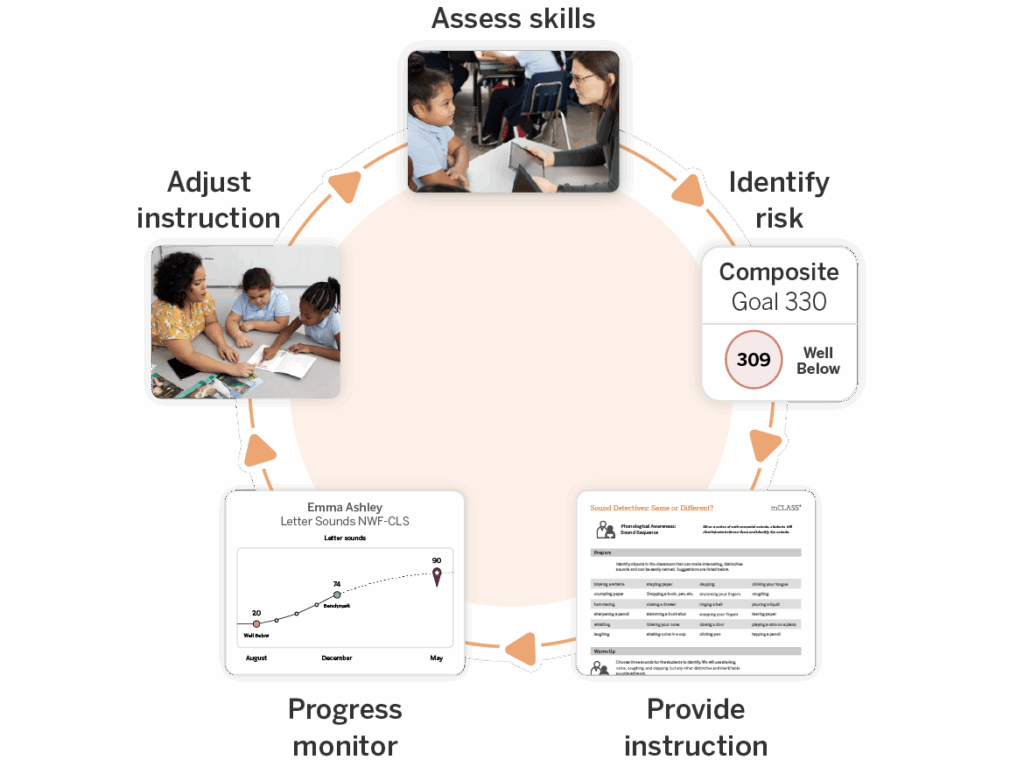
mCLASS DIBELS 8th Edition provides rich data that helps you make informed instructional decisions and seek out further dyslexia screening evaluation if needed:
- Assess skills: mCLASS DIBELS 8th Edition and optional dyslexia screenings in Rapid Automatized Naming (RAN), Spelling, Vocabulary, and Oral Language accurately assess students’ abilities.
- Identify risk: The DIBELS 8 composite score shows each student’s risk level, with ‘Well Below Benchmark’ indicating a need for intensive support. Students who are also ‘Well Below Benchmark’ in RAN and/or Spelling have an additional Risk Indicator icon next to their name.
- Provide instruction: The mCLASS Instruction feature analyzes student error patterns to key dyslexia-related subtests, then recommends small groups and explicit, multi-sensory activities for reinforcing skills.
- Progress monitor: mCLASS includes progress-monitoring measures to track student growth in letter sounds, alphabetic principle, word reading, oral reading fluency, and comprehension, so that informed instructional decisions can be made.
- Adapt instruction: mCLASS displays indicators based on progress monitoring performance that indicate when a change in instruction may be needed. It also updates instruction recommendations using the latest data.
Differentiated literacy instruction
mCLASS DIBELS 8th Edition lays the groundwork for a strong Multi-Tiered System of Supports (MTSS).
In addition to identifying students with symptoms of dyslexia, mCLASS DIBELS 8th Edition data recommends early intervention, personalized instruction, and core instruction within Amplify’s early literacy suite. Based on the Science of Reading, Amplify’s early literacy suite programs follow an explicit and systematic structure, build knowledge, and instruct on all of the foundational skills essential to literacy development.
- Intervene with mCLASS Intervention and Amplify Tutoring: Staff-led Tier 2 and 3 intervention for intensive support.
- Practice with Boost Reading: Personalized learning program to extend and reinforce core instruction.
- Instruct with Amplify Core Knowledge Language Arts (CKLA): Core curriculum to build foundational skills and knowledge.
Bilingual Reading Difficulties screening
By assessing with mCLASS DIBELS 8th Edition and its Spanish counterpart, mCLASS Lectura, you’ll know with confidence whether a student truly shows signs of of reading difficulties or is experiencing difficulties learning a new language.
When used together, mCLASS DIBELS 8th Edition and mCLASS Lectura feature a Dual Language Report that analyzes Reading Difficulties screening results in both languages. The report also details how each student can leverage their strengths from one language to support growth in the other.
Equal skill coverage in English and Spanish
mCLASS Lectura subtest alignment with SB114
| RDRP screening areas | English measure | Spanish measure | Description* |
|---|---|---|---|
| Letter Naming and RAN | Letter Naming Fluency (LNF) | Fluidez in nombrar letras (FNL) | Grades K–1: Naming letters in print. 1 minute, 1:1 administration. |
| Phonological Awareness (Segmentation) | Phonemic Segmentation Fluency (PSF) | Fluidez en la segmentación de sílabas (FSS) & Fluidez en la segmentación de fonemas (FSF) | Grades K–1: Hearing and using sounds or syllables in spoken words. 1 minute, 1:1 administration. |
| Phonological Awareness (Elision) | – | ¿Qué queda? (QQ) | Grades K–2: Produce the part of a word that remains after deleting a syllable or phoneme. 1 minute, 1:1 administration. |
| Letter Sound Correspondence Knowledge | Nonsense Word Fluency Correct Letter Sounds(NWF-CLS) | Fluidez en los sonidos de letras (FSL) | English: Grades K–3: Identify letter-sound correspondences in the context of pseudo-words. Spanish: Grades K-1: Identify letter-sounds in isolation. 1 minute, 1:1 administration. |
| Letter-Sound Knowledge (Receptive) | – | Fluidez en los sonidos de las letras K-Inicio (FSL K-Inicio) | Grade K: Identify (point to) which letter makes a certain sound. Untimed, 1:1 administration. |
| Decoding | Nonsense Word Fluency Words Recoded Correctly (NWF-WRC) | Fluidez en los sonidos de las sílabas (FSL) | Grades K–3: Identify letter-sound correspondences in the context of pseudo-words. Spanish: Grades K–1: Identify letter-sounds in isolation. 1 minute, 1:1 administration. |
| Word Reading | Word-Reading Fluency (WRF) | Fluidez en las palabras (FEP) | Grades K–3: Reading common words easily, quickly and correctly.1 minute, 1:1 administration. |
| Fluency | Oral Reading Fluency (ORF) | Fluidez en la lectura oral (FLO) | Grades 1–6: Reading connected text with accuracy and automaticity. 1 minute, 1:1 administration. |
| Reading Comprehension | Maze | ¿Cuál palabra? (CP) | Grades 2–6: Understanding meaning from texts. 3 minutes, group administration. |
| Vocabulary | Vocabulary | Vocabulario | Grades K–3: Arranging letters correctly to spell words with grade appropriate features. 15 minutes, group administration. |
| Encoding | Spelling | Ortografía | Grades K–3: Arranging letters correctly to spell words with grade-appropriate features. 15 minutes, group administration. |
| RAN (Numbers) | Rapid Automatized Naming | – | Grades K–3: Correctly and quickly naming visual symbols, such as numbers. 1-2 minutes, 1:1 administration. |
| Language Comprehension | Oral Language | Lenguaje oral | Grades K–2: Demonstrate the ability to use words and phrases acquired through conversations, reading and being read to, and responding to texts. 5 minutes, 1:1 administration. |
*Students can be assessed using off-grade measures when information on specific skills is needed.
Resources for families
Welcome California Caregivers! Please click here to learn more about mCLASS assessments.
Families play a crucial role in helping children overcome reading challenges. mCLASS DIBELS 8th Edition and mCLASS Lectura provide a Home Connect letter after each screening to explain the results in family-friendly language, recommend activities, and direct families to a free website for additional at-home support.
Developmentally appropriate
Computer-based assessments that require students to complete tasks silently or independently may over-identify students for intervention services, especially young learners who are still developing focus and attention abilities.
mCLASS requires students to actively demonstrate their proficiency in producing letter sounds, forming words, and reading texts. This approach to assessment aligns with IDA guidelines for effective screening of reading challenges. By choosing mCLASS for universal screening, you’ll gain accurate information about a student’s risk for reading difficulties, and gain the capability to monitor every student’s path to reading proficiency.
Additional resources
mCLASS Resources
- mCLASS Research Hub
- mCLASS Program Guide
- mCLASS Digital Access Guide
- mCLASS Reporting Guide
- mCLASS Help Site
- mCLASS self-guided walkthrough
Dyslexia Resources
- mCLASS Dyslexia Toolkit
- Dyslexia Fact vs. Fiction ebook
- Blog post: 4 tools to help teachers better understand dyslexia
- Science of Reading: The Podcast, Season 7, Episode 7: Debunking the “gift” of dyslexia in children, with Dr. Tim Odegard
- Science of Reading: The Podcast, Season 1, Episode 6: The facts and myths of dyslexia, with Emily Lutrick
Multilingual and English learners Resources
Your California team
Looking to speak directly with your local representative?
Get in touch with a California team member to learn more about our early literacy suite or request a demo account.
Dan Pier
Vice President, West
(415) 203-4810
dpier@amplify.com
Erin King
Sales Director, CA
(512) 736-3162
eking@amplify.com
NORTHERN CA
Wendy Garcia
Senior Account Executive
(510) 368-7666
wgarcia@amplify.com
BAY AREA
Lance Burbank
Account Executive
(415) 830-5348
lburbank@amplify.com
CENTRAL VALLEY and CENTRAL COAST
Demitri Gonos
Senior Account Executive
(559) 355-3244
dgonos@amplify.com
VENTURA and L.A. COUNTY
Jeff Sorenson
Associate Account Executive
(310) 902-1407
jsorenson@amplify.com
ORANGE and L.A. COUNTY
Lauren Sherman
Senior Account Executive
(949) 397-5766
lsherman@amplify.com
SAN BERNARDINO and L.A. COUNTY
Michael Gruber
Senior Account Executive
(951) 520-6542
migruber@amplify.com
RIVERSIDE AND L.A. COUNTY
Brian Roy
Senior Account Executive
(818)967-1674
broy@amplify.com
SAN DIEGO COUNTY
Kirk Van Wagoner
Senior Account Executive
(760) 696-0709
kvanwagoner@amplify.com
BUTTE, DEL NORTE, HUMBOLDT, and SHASTA COUNTY and DISTRICTS UNDER 2250 ENROLLMENT
Kevin Mauser
Lead Account Executive
(815) 534-0148
kmauser@amplify.com
Amplify CKLA usage & branding guidelines
Welcome to Amplify’s guidelines on using CKLA materials both under its Open Education Resource (OER) license (CC BY-NC-SA) and Amplify’s license to school districts. These guidelines apply to all variants of the CKLA program, including those not authored by Amplify. These guidelines address the following programs:
- Amplify CKLA
- Amplify Texas ELAR/SLAR
- TEA’s K-5 RLA Literacy / SLAR program
- TEA’s Bluebonnet Learning K-5 Reading Language Arts
- CKF Core Knowledge Language Arts
Amplify is committed to supporting educators in using CKLA resources to enhance classroom learning while protecting the integrity of the CKLA program and Amplify’s exclusive rights.
Our goal is to encourage impactful, efficacious use of the program while providing clear guidelines on permissible and prohibited uses.
1. Amplify’s license and what it means
Amplify partnered with the Core Knowledge Foundation (CKF) to develop the Amplify Core Knowledge Language Arts (CKLA) curriculum. You can learn more about this program and Amplify’s partnership with CKF here.
Amplify holds the exclusive commercial license to all CKLA content. In more than a decade of partnership, we have worked with CKF to enhance and supplement the program, now in its third edition nationally. Amplify licenses Amplify CKLA and Amplify ELAR/SLAR Texas to school districts, along with a full suite of assessment, intervention, and supplemental products, as well as professional development and coaching services. Learn more here.
As the exclusive commercial partner for CKLA, Amplify is the only organization permitted to use the materials commercially.
If your organization purchases CKLA materials from Amplify, you get the customary usage rights for those purchased materials specified in Amplify’s Customer Terms & Conditions.
2. Open Non-Commercial license
Some versions of the CKLA program are available under a Creative Commons NonCommercial license (CC BY-NC-SA 4.0). This includes Amplify Texas ELAR/SLAR, TEA’s K–5 RLA Literacy / SLAR program, TEA’s Bluebonnet Learning K–5 Reading Language Arts and CKF Core Knowledge Language Arts.
CC BY-NC-SA is the OER license for these materials. The license allows users to share and adapt the materials, as long you follow these terms:
- Attribution — You must give appropriate credit, provide a link to the license, and indicate if changes were made.
- NonCommercial — You may not use the material for commercial purposes.
- ShareAlike — If you remix, transform, or build upon the material, you must distribute your contributions under this same CC BY-NC-SA license.
Below we explain how Amplify and CKF apply these terms to common situations — which uses are permitted under the licenses, and which uses are prohibited or require a special permission or commercial arrangement.
Materials licensed under Creative Commons licenses are known as Open Education Resources (OER), and Amplify is proud to have been one of the earliest champions of OER materials in K-12. We believe that OER materials enable a widespread adoption of high quality materials and innovative adaptations by educators for their classrooms, alongside commercial versions that include a full suite of supports.
3. Permitted uses of CKLA content
In these guidelines, when we say “CKLA Content”, we are referring to all versions of the program that was based on the original content from CKF, both those under OER licenses and commercially licensed. Many uses by educators are permissible under either the commercial or OER license. The only difference is that your rights under the commercial license only last as long as that license is maintained by your school or district.
Amplify encourages educators to leverage CKLA Content to foster innovative and effective learning experiences. Below are uses that are permitted without any additional license, as long as you follow attribution guidelines and share-alike requirements.
Classroom Activities and Custom Materials. Educators may create supplementary activities, worksheets, lesson plans, and projects based on the CKLA Content for use within their classroom or school. For these purposes, educators may incorporate portions of the CKLA Content.
Sharing and Selling Materials based on CKLA Content. Educators may also share classroom activities and custom materials with other educators, including by selling the materials on sites like Teachers Pay Teachers. However, if these materials are sold, they may not include CKLA Content.
For any materials you create, you are required to follow our attribution and disclaimer guidelines below.
If you are unsure whether your planned use qualifies as “non-commercial” or is otherwise permitted by Amplify please reach out to us directly.
4. Restricted uses of CKLA program content
To protect the CKLA program’s value and respect Amplify’s exclusive commercial rights, certain uses of the CKLA content are prohibited without first obtaining a commercial license. Amplify reserves the right to enforce these restrictions to protect our rights.
No third party may embed, republish, or incorporate any portion of the CKLA content in products or services intended for sale, licensing, or other commercial purpose. Examples of prohibited uses include embedding CKLA content as a part of digital platforms, apps, or resources marketed to educators or the public, as well as using the content as an input or training data for such products.
This prohibition applies to all types of individuals and organizations (both for-profit and non-profit), and applies to both paid and free uses.
See “Commercial License and Partnerships” below for information on commercial arrangements.
4. Commercial licenses and partnerships
For those interested in using CKLA content in a way that may be commercial, Amplify offers various licensing options. These negotiated licenses allow approved partners to use the CKLA content within their commercial products under specific terms and conditions.
To inquire about a commercial license or discuss a partnership opportunity, please contact our partnerships team at partnerships@amplify.com.
5. Attribution and branding guidelines
Our trademarks are valuable assets of Amplify and its licensors, and we want to ensure our users and partners use them correctly. These trademarks include the Amplify, Core Knowledge Language Arts, and CKLA word marks and logos.
These marks and logos may only be used if you have an existing partnership with us, and you’ve reached out to Amplify to secure our approval to use them.
If you are creating materials based on CKLA Content in accordance with the guidelines above, you are required to include the following attribution in a reasonably perceptible location on each copy of those materials:
“These materials are based on Amplify CKLA but are not affiliated with, sponsored by, reviewed, approved, or endorsed by Amplify Education, Inc. or the Core Knowledge Foundation. ‘Amplify’, ‘CKLA’ and other marks are the property of Amplify Education, Inc. and its licensors.”
Why these guidelines matter
Amplify’s goal is to support educational access to high-quality curriculum resources while protecting the intellectual property and integrity of the CKLA program. By adhering to these guidelines, you help ensure that CKLA remains an accessible and respected resource for educators while supporting its continued improvement.
For additional questions on using the program, or if you need further clarification on any of these points, please contact us.
Plan your professional development
We’re excited to partner with you on your Amplify journey. Flexible professional development pathways have been designed to meet your needs.

Recommended Professional Development Plan
Our team has curated a recommended professional learning path from initial launch to continuous support. Use the Professional Development Planning Guide below to discuss the plan that best meets your school or district needs with your Account Executive.
mCLASS with DIBELS 8th Edition sessions overview
| Audience | Title | Duration | Modality |
|---|---|---|---|
| Launch | |||
| New mCLASS with DIBELS 8th Edition customers with limited time for PD | mCLASS with DIBELS 8th Edition program overview | Half day | Onsite/Remote |
| New mCLASS with DIBELS 8th Edition customers | Initial training | 1 day onsite or 2 half days remote | Onsite/Remote |
| Initial training: Train the Trainer | 1 day onsite or 2 half days remote | Onsite/Remote | |
| Initial training | Self-paced | Online course | |
| Strengthen | |||
| mCLASS with DIBELS 8th Edition customers with limited time for PD | Understanding your classroom data | Half day | Onsite/Remote |
| All mCLASS with DIBELS 8th Edition customers | Classroom data analysis and instructional planning | 1 day onsite or 2 half days remote | Onsite/Remote |
| Classroom data analysis and instructional planning: Train the Trainer | 1 day onsite or 2 half days remote | Onsite/Remote | |
| Classroom data analysis and instructional planning | Self-paced | Online course | |
| All mCLASS with DIBELS 8th Edition customers | Understanding your school or district data | Half day | Onsite/Remote |
| Data-driven leadership practices | 1 day onsite or 2 half days remote | Onsite/Remote | |
| Data-driven leadership practices: Train the Trainer | 1 day onsite or 2 half days remote | Onsite/Remote | |
| Data-driven leadership practices | Self-paced | Online course | |
| Strengthening consultation session | 60 min. | Remote | |
| Strengthening consultation session package | 3 60-min. sessions | Remote | |
| Coach | |||
| All mCLASS with DIBELS 8th Edition customers | Coaching session | 1 day | Onsite |
| Coaching session | Half day | Onsite/Remote | |
| Building readers | |||
| All mCLASS with DIBELS 8th Edition customers | Building readers for leaders | 2 half days | Onsite/Remote |
| Building readers for teachers | 3 half days | Onsite/Remote | |
Launch
mCLASS with DIBELS 8th edition program overview
Half day (3 hours)
This PD prepares participants to implement the assessment and collect reliable data using standardized guidelines.
Audience: Teachers (administrators welcome), maximum 30 participants
Modality: Onsite/Remote
Initial training
1 day onsite (6 hours) or 2 half days remote (6 hours)
This PD prepares participants to implement the assessment, collect reliable data using standardized guidelines, and use the targeted lessons available on mCLASS to drive differentiated instruction.
Audience: Teachers (administrators welcome), maximum 30 participants
Modality: Onsite/Remote
Initial training: Train the Trainer
1 day onsite (6 hours) or 2 half days remote (6 hours)
This PD prepares participants to implement the assessment, collect reliable data using standardized guidelines, and use the targeted lessons available on mCLASS to drive differentiated instruction. Participants receive annotated session materials to turnkey the session to colleagues.
Audience: Teachers (administrators welcome), maximum 30 participants
Modality: Onsite/Remote
Initial training
Self-paced
This PD is an individual seat to our self-paced, on-demand online course that contains approximately 6 hours of training. Participants will learn how to implement the assessment, collect reliable data using standardized guidelines, and use the targeted lessons available on mCLASS to drive differentiated instruction. Participants will access and revisit the course anytime for up to one year as a refresher.
Audience: Teachers (administrators welcome)
Modality: Online
Strengthen
Understanding your classroom data
Half day (3 hours)
This PD prepares participants to understand their students’ data by utilizing the reports available on mCLASS. This session should be scheduled after the most recent benchmark window has closed so that participants can work with their own data.
Audience: Teachers (administrators welcome), maximum 30 participants
Modality: Onsite/Remote
Classroom data analysis and instructional planning
1 day onsite (6 hours) or 2 half days remote (6 hours)
This PD prepares participants to deeply understand their students’ data and create actionable instructional plans by utilizing the reports and skills-focused lesson plans available on mCLASS.
Audience: Teachers (administrators welcome), maximum 30 participants
Modality: Onsite/Remote
*This session should be scheduled after the most recent benchmark window has closed so that participants can work with their own data.
Classroom data analysis and instructional planning: Train the Trainer
1 day onsite (6 hours) or 2 half days remote (6 hours)
This PD prepares participants to deeply understand their students’ data and create actionable instructional plans by utilizing the reports and skills-focused lesson plans available on mCLASS. Participants receive annotated session materials to turnkey the session to colleagues.
Audience: Teachers (administrators welcome), maximum 30 participants
Modality: Onsite/Remote
*This session should be scheduled after the most recent benchmark window has closed so that participants can work with their own data.
Classroom data analysis and instructional planning
Online course (self-paced)
This PD is an individual seat to our self-paced, on-demand online course that contains approximately 6 hours of training. Participants will learn how to deeply understand their students’ data and create actionable instructional plans by utilizing the reports and skills-focused lesson plans available on mCLASS. Participants will access and revisit the course anytime for up to one year as a refresher.
Audience: Teachers (administrators welcome)
Modality: Online
Understanding your school or district data
Half day (3 hours)
This PD prepares participants to use their data in making schoolwide decisions. This session should be scheduled after the most recent benchmark window has closed so that participants can work with their own data.
Audience: Administrators, maximum 30 participants
Modality: Onsite/Remote
Data-driven leadership practices
1 day onsite (6 hours) or 2 half days remote (6 hours)
This PD prepares participants to use their data in making school-wide decisions and build a schoolwide culture of data-driven instruction. This session should be scheduled after the most recent benchmark window has closed so that participants can work with their own data.
Audience: Administrators, maximum 30 participants
Modality: Onsite/Remote
Data-driven leadership practices: Train the Trainer
1 day onsite (6 hours) or 2 half days remote (6 hours)
This PD prepares participants to use their data in making school-wide decisions and build a schoolwide culture of data-driven instruction. This session should be scheduled after the most recent benchmark window has closed so that participants can work with their own data. Participants receive annotated session materials to turnkey the session to colleagues.
Audience: Administrators, maximum 30 participants
Modality: Onsite/Remote
Data-driven leadership practices
Online course (self-paced)
This PD is an individual seat to our self-paced, on-demand online course that contains approximately 6 hours of training. Participants will learn how to use their data in making school-wide decisions and build a schoolwide culture of data-driven instruction. Participants will access and revisit the course anytime for up to one year as a refresher.
Audience: Administrators
Modality: Online
Strengthening consultation session
(60-min.)
This 60-minute session will focus on a specific topic that will deepen educators’ understanding of mCLASS and equip them with the tools needed to drive stronger student outcomes. An Amplify facilitator will align with the school or district leadership team in advance of the session on the topic (chosen from a menu of options) that will best meet educators’ unique needs.
Topics include:
- Progress Monitoring
- Zones of Growth
- Data Walkthrough for Leaders
Audience: Teachers and/or administrators, maximum 30 participants
Modality: Remote
Strengthening consultation session package
(3 hours)
This package consists of three 60-minute sessions that can be delivered on the same day or on different days. Each session will focus on a specific topic that will deepen educators’ understanding of mCLASS and equip them in driving towards stronger student outcomes. An Amplify facilitator will align with the school or district’s leadership team in advance on the topics that will best meet educators’ unique needs.
Topics include:
- Progress Monitoring
- Zones of Growth
- Data Walkthrough for Leaders
Audience: Teachers and/or administrators, maximum 30 participants
Modality: Remote
Coach
Coaching session
1 day (6 hours)
This PD will deepen educators’ understanding of how to utilize mCLASS in order to accelerate data-driven student outcomes. An Amplify facilitator will visit one or two school sites for one day and work with teachers and/or leaders. Prior to the visit, the Amplify facilitator will align with each school’s leadership team on their needs and customize the visit schedule accordingly.
Audience: Teachers and/or administrators, maximum 30 participants
Modality: Onsite
Coaching session
Half day (3 hours)
This PD is up to 3 hours of training and will deepen educators’ understanding of how to utilize mCLASS in order to accelerate data-driven student outcomes. An Amplify facilitator will visit one school site for a half-day and work with teachers and/or leaders. Prior to the visit, the Amplify facilitator will align with each school’s leadership team on their needs and customize the visit schedule accordingly.
Audience: Teachers and/or administrators, maximum 30 participants
Modality: Onsite/Remote
Building readers
Building readers for leaders
2 half days (6 hours)
This training session is split into 2 half-day sessions (3 hours each). The same participants should attend both sessions in order to receive all content, which includes learning the Science of Reading and how to align this theory with schoolwide instruction. Part 2 should be scheduled two to three weeks after Part 1.
Audience: Administrators, maximum 30 participants
Modality: Onsite
Building readers for teachers
3 half days (9 hours)
This training series is split into three half-day sessions (3 hours each). The same participants should attend all sessions in order to receive all content, which includes learning the Science of Reading and how to align this theory with classroom instruction. Part 2 should be scheduled two to three weeks after Part 1, and Part 3 should be scheduled two to three weeks after Part 2.
Audience: Teachers (administrators welcome), maximum 30 participants
Modality: Onsite/Remote
mCLASS with DIBELS 8th Edition and TRC sessions overview
| Audience | Title | Duration | Modality |
|---|---|---|---|
| Launch | |||
| New mCLASS with DIBELS 8th Edition and TRC customers | Initial training | 1 day onsite or 2 half days remote | Onsite/Remote |
| Initial training: Train the Trainer | 1 day onsite or 2 half days remote | Onsite/Remote | |
| Initial training | Self-paced | Online course | |
| Strengthen | |||
| All mCLASS with DIBELS 8th Edition and TRC customers | Classroom data analysis and instructional planning | 1 day onsite or 2 half days remote | Onsite/Remote |
| Data-driven leadership practices | 1 day onsite or 2 half days remote | Onsite/Remote | |
| Coach | |||
| All mCLASS with DIBELS 8th Edition and TRC customers | Coaching session | 1 day | Onsite |
| Coaching session | Half day | Onsite/Remote | |
Launch
Initial training
1 day onsite (6 hours) or 2 half days remote (6 hours)
This PD prepares participants to implement the assessment, collect reliable data using standardized guidelines, and use the targeted lessons available on mCLASS to drive differentiated instruction.
Audience: Teachers (administrators welcome), maximum 30 participants
Modality: Onsite/Remote
Initial training: Train the Trainer
1 day onsite (6 hours) or 2 half days remote (6 hours)
This PD prepares participants to implement the assessment, collect reliable data using standardized guidelines, and use the targeted lessons available on mCLASS to drive differentiated instruction. Participants receive annotated session materials to turnkey the session to colleagues.
Audience: Teachers (administrators welcome), maximum 30 participants
Modality: Onsite/Remote
Initial training
Self-paced
This PD is an individual seat to our self-paced, on-demand online course that contains approximately 6 hours of training. Participants will learn how to implement the assessment, and collect reliable data using standardized guidelines and use the targeted lessons available on mCLASS to drive differentiated instruction. Participants will access and revisit the course anytime for up to one year as a refresher.
Audience: Teachers (administrators welcome)
Modality: Online
Strengthen
Classroom data analysis and instructional planning
1 day onsite (6 hours) or 2 half days remote (6 hours)
This PD prepares participants to deeply understand their students’ data and create actionable instructional plans by utilizing the reports and skills-focused lesson plans available on mCLASS.
Audience: Teachers (administrators welcome), maximum 30 participants
Modality: Onsite/Remote
*This session should be scheduled after the most recent benchmark window has closed so that participants can work with their own data.
Data-driven leadership practices
1 day onsite (6 hours) or 2 half days remote (6 hours)
This PD prepares participants to use their data in making schoolwide decisions and build a schoolwide culture of data-driven instruction. This session should be scheduled after the most recent benchmark window has closed so that participants can work with their own data.
Audience: Administrators, maximum 30 participants
Modality: Onsite/Remote
Coach
Coaching session
1 day onsite (6 hours)
This PD will deepen educators’ understanding of how to utilize mCLASS in order to accelerate data-driven student outcomes. An Amplify facilitator will visit one or two school sites for one day and work with teachers and/or leaders. Prior to the visit, the Amplify facilitator will align with each school’s leadership team on their needs and customize the visit schedule accordingly.
Audience: Teachers and/or administrators, maximum 30 participants
Modality: Onsite/Remote
Coaching session
Half day (3 hours)
This PD is up to 3 hours of training and will deepen educators’ understanding of how to utilize mCLASS in order to accelerate data-driven student outcomes. An Amplify facilitator will visit one school site for a half-day and work with teachers and/or leaders. Prior to the visit, the Amplify facilitator will align with each school’s leadership team on their needs and customize the visit schedule accordingly.
Audience: Teachers and/or administrators, maximum 30 participants
Modality: Onsite/Remote
mCLASS Lectura sessions overview
| Audience | Title | Duration | Modality |
|---|---|---|---|
| Launch | |||
| New mCLASS Lectura Customers with limited time for PD | mCLASS Lectura program overview | Half day | Onsite/Remote |
| New mCLASS Lectura customers | mCLASS Lectura initial training | 1 day onsite or 2 half days remote | Onsite/Remote |
| mCLASS Lectura initial training: Train the Trainer | 1 day onsite or 2 half days remote | Onsite/Remote | |
| mCLASS Lectura Initial training | Self-paced | Online course | |
| Strengthen | |||
| All mCLASS Lectura customers with limited time for PD | Understanding your classroom data | Half day | Onsite/Remote |
| All mCLASS Lectura customers | Classroom data analysis and instructional planning | 1 day onsite or 2 half days remote | Onsite/Remote |
| Classroom data analysis and instructional planning: Train the Trainer | 1 day onsite or 2 half days remote | Onsite/Remote | |
| Understanding your school or district data | Half day | Onsite/Remote | |
| Data-driven leadership practices | 1 day onsite or 2 half days remote | Onsite/Remote | |
| Data-driven leadership practices: Train the Trainer | 1 day onsite or 2 half days remote | Onsite/Remote | |
| Strengthening consultation session | 60 min. | Remote | |
| Coach | |||
| All mCLASS Lectura customers | Coaching session | 1day | Onsite |
| Coaching session | Half day | Onsite/Remote | |
Launch
mCLASS Lectura program overview
Half day (3 hours)
This PD prepares participants to implement the assessment and collect reliable data using standardized guidelines.
Audience: Teachers (administrators welcome), maximum 30 participants
Modality: Onsite/Remote
mCLASS Lectura initial training
1 day onsite (6 hours) or 2 half days remote (6 hours)
This PD prepares participants to implement the assessment, collect reliable data using standardized guidelines, and use the targeted lessons available on mCLASS to drive differentiated instruction. While the assessment must be administered in Spanish, English-speaking educators educators who would like to learn about the program but will not be administering the assessment may attend.
Audience: Teachers (administrators welcome), maximum 30 participants
Modality: Onsite/Remote
mCLASS Lectura initial training: Train the Trainer
1 day onsite (6 hours) or 2 half days remote (6 hours)
This PD prepares participants to implement the assessment and collect reliable data using standardized guidelines. While the assessment must be administered in Spanish, English-only speaking educators who would like to learn about the program but will not be administering the assessment may attend. Participants receive annotated session materials to turnkey the session to colleagues.
Audience: Teachers (administrators welcome), maximum 30 participants
Modality: Onsite/Remote
mCLASS Lectura initial training
Online course (self-paced)
This PD is an individual seat to our self-paced, on-demand online course that contains approximately 6 hours of training. Participants will learn how to implement the assessment, collect reliable data using standardized guidelines, and use the targeted lessons available on mCLASS to drive differentiated instruction. Participants will access and revisit the course anytime for up to one year as a refresher.
Audience: Teachers (administrators welcome)
Modality: Online
Strengthen
Understanding your classroom data
Half day (3 hours)
This PD prepares participants to understand their students’ data by utilizing the reports available on mCLASS. This session should be scheduled after the most recent benchmark window has closed so that participants can work with their own data.
Audience: Teachers (administrators welcome), maximum 30 participants
Modality: Onsite/Remote
Classroom data analysis and instructional planning
1 day onsite (6 hours) or 2 half days remote (6 hours)
This PD prepares participants to deeply understand their students’ data and create actionable instructional plans by utilizing the reports and skills-focused lesson plans available on mCLASS.
Audience: Teachers (administrators welcome), maximum 30 participants
Modality: Onsite/Remote
*This session should be scheduled after the most recent benchmark window has closed so that participants can work with their own data.
Classroom data analysis and instructional planning: Train the Trainer
1 day onsite (6 hours) or 2 half days remote (6 hours)
This PD prepares participants to deeply understand their students’ data and create actionable instructional plans by utilizing the reports and skills-focused lesson plans available on mCLASS. Participants receive annotated session materials to turnkey the session to colleagues.
Audience: Teachers (administrators welcome), maximum 30 participants
Modality: Onsite/Remote
*This session should be scheduled after the most recent benchmark window has closed so that participants can work with their own data.
Understanding your school or district data
Half day (3 hours)
This PD prepares participants to use their data in making schoolwide decisions. This session should be scheduled after the most recent benchmark window has closed so that participants can work with their own data.
Audience: Administrators, maximum 30 participants
Modality: Onsite/Remote
Data-driven leadership practices
1 day onsite (6 hours) or 2 half days remote (6 hours)
This PD prepares participants to use their data in making school-wide decisions and build a schoolwide culture of data-driven instruction. This session should be scheduled after the most recent benchmark window has closed so that participants can work with their own data.
Audience: Administrators, maximum 30 participants
Modality: Onsite/Remote
Data-driven leadership practices: Train the Trainer
1 day onsite (6 hours) or 2 half days remote (6 hours)
This PD prepares participants to use their data in making schoolwide decisions and build a schoolwide culture of data-driven instruction. This session should be scheduled after the most recent benchmark window has closed so that participants can work with their own data. Participants receive annotated session materials to turnkey the session to colleagues.
Audience: Administrators, maximum 30 participants
Modality: Onsite/Remote
Strengthening consultation session package
(3 hours)
This package consists of three 60-minute sessions that can be delivered on the same day or on different days. Each session will focus on a specific topic that will deepen educators’ understanding of mCLASS and equip them with the tools needed to drive stronger student outcomes. An Amplify facilitator will align with the school or district leadership team in advance of the session on the topic (chosen from a menu of options) that will best meet educators’ unique needs. Topics include progress monitoring, goal setting, and a data walkthrough for leaders.
Audience: Teachers (administrators welcome), maximum 30 participants
Modality: Remote
Coach
Coaching session
1 day (6 hours)
This PD will deepen educators’ understanding of how to utilize mCLASS in order to accelerate data-driven student outcomes. An Amplify facilitator will visit 1–2 school sites for one day and work with teachers and/or leaders. Prior to the visit, the Amplify facilitator will align with each school’s leadership team on their needs and customize the visit schedule accordingly.
Audience: Teachers and/or administrators, maximum 30 participants
Modality: Onsite
Coaching session
Half day (3 hours)
This PD is up to 3 hours of training and will deepen educators’ understanding of how to utilize mCLASS in order to accelerate data-driven student outcomes. An Amplify facilitator will visit 1 school site for a half-day and work with teachers and/or leaders. Prior to the visit, the Amplify facilitator will align with each school’s leadership team on their needs and customize the visit schedule accordingly.
Audience: Teachers and/or administrators, maximum 30 participants
Modality: Onsite/Remote
| Launch | Strengthen | Ongoing | |
|---|---|---|---|
| BOY | After BOY or MOY | After BOY or MOY | |
| New customers | Program overview | Understanding your classroom data | Coaching session |
| Initial training | Understanding your school or district data | Building readers for teachers | |
| Strengthening consultation session/package | Building readers for leaders | ||
| Returning customers | Coaching session (refresher content) | Classroom data analysis and instructional planning | Coaching session |
| Data-driven leadership practices | Building readers for teachers | ||
| Strengthening consultation session/package | Building readers for leaders | ||
| *Note: If you are currently delivering instruction in a hybrid or remote model, we recommend that all of the sessions above be delivered remotely. | |||
mCLASS Express sessions overview
| Title | Duration | Modality |
|---|---|---|
| Launch | ||
| Initial training | Half day | Onsite/Remote |
| Initial training | Self-paced | Online course |
Launch
Initial training
Half day (3 hours)
Take the first step in launching mCLASS Express! The half-day initial training will help educators understand how mCLASS Express’ voice-recognition scoring generates immediate instructional recommendations for students reading below grade level. Educators will also learn how to utilize the teacher portal to assign assessments, review and correct scoring, track student growth over time, and leverage the program’s activities to create an action plan for a single classroom or across classes/grades.
Audience: Teachers (administrators welcome), maximum 30 participants
Modality: Onsite/Remote
Initial training
Self-paced (2 hours)
Take the first step in launching mCLASS Express! The two-hour initial training will help educators understand how mCLASS Express’ voice-recognition scoring generates immediate instructional recommendations for students reading below grade level. Educators will also learn how to utilize the teacher portal to assign assessments, review and correct scoring, track student growth over time, and leverage the program’s activities to create an action plan for a single classroom or across classes/grades.
As this is a self-paced, on-demand online course, participants will be able to access the course anytime, move as quickly or slowly as needed through different sections, and revisit the course up to one year as a refresher in the future.
Audience: Teachers (administrators welcome), maximum 30 participants
Modality: Online
mCLASS: IDEL sessions overview
| Title | Duration | Modality |
|---|---|---|
| Launch | ||
| mCLASS IDEL program overview | Half day | Onsite/Remote |
| Initial training | 1 day | Onsite/Remote |
| Initial training: Train the Trainer | 1 day | Onsite/Remote |
| Initial training | Self-paced | Online course |
Launch
mCLASS IDEL program overview
Half day (3 hours)
This PD prepares participants to implement the assessment and collect reliable data using standardized guidelines.
Audience: Teachers (administrators welcome), maximum 30 participants
Modality: Onsite/Remote
Initial training
1 day onsite (6 hours) or 2 half days remote (6 hours)
Prepare to implement your mCLASS:IDEL assessment with fidelity! Learn about the five basic early literacy skills that are crucial for reading development, and understand how they are assessed on the mCLASS:IDEL assessment. Then, practice administering and scoring each assessment measure and receive targeted feedback from a facilitator. Upon completion of this session, participants will be on their way to collecting reliable data to support all students.
Audience: Teachers and/or administrators, maximum 30 participants
Modality: Onsite/Remote
Initial training: Train the Trainer
1 day onsite (6 hours) or 2 half days remote (6 hours)
Prepare to implement your mCLASS:IDEL assessment with fidelity! Learn about the five basic early literacy skills that are crucial for reading development, and understand how they are assessed on the mCLASS:IDEL assessment. Then, practice administering and scoring each assessment measure and compare your responses to exemplars. As this is a Train the Trainer session, participants will receive annotated session materials in order to turnkey the session to colleagues.
Audience: Teachers and/or administrators, maximum 30 participants
Modality: Onsite/Remote
Initial training
Online course (self-paced)
This PD is an individual seat to our self-paced, on-demand online course that contains approximately 6 hours of training. Participants will learn how to implement the assessment, collect reliable data using standardized guidelines, and use the targeted lessons available on mCLASS to drive differentiated instruction. Participants will access and revisit the course anytime for up to one year as a refresher.
Audience: Teachers (administrators welcome)
Modality: Online
TRC Atlas Español
Launch
TRC Atlas Español program overview
Half day (3 hours)
This PD prepares participants to implement the assessment and collect reliable data using standardized guidelines.
Audience: Teachers (administrators welcome), maximum 30 participants
Modality: Onsite/Remote
mCLASS Math sessions overview
| Audience | Title | Duration | Modality |
|---|---|---|---|
| Launch | |||
| New mCLASS Math customers with limited time for PD | mCLASS Math program overview | Half day | Onsite/Remote |
| New mCLASS Math customers | Initial training | 1 day onsite or 2 half days remote | Onsite/Remote |
| Initial training: Train the Trainer | 1 day onsite or 2 half days remote | Onsite/Remote | |
| Strengthen | |||
| All mCLASS Math customers with limited time for PD | Understanding your classroom data | Half day | Onsite/Remote |
| All mCLASS Math customers | Classroom data analysis and instructional planning | 1 day onsite or 2 half days remote | Onsite/Remote |
| Classroom data analysis and instructional planning: Train the Trainer | 1 day onsite or 2 half days remote | Onsite/Remote | |
| Understanding your school or district data | Half day | Onsite/Remote | |
| Data-driven leadership practices | 1 day onsite or 2 half days remote | Onsite/Remote | |
| Data-driven leadership practices: Train the Trainer | 1 day onsite or 2 half days remote | Onsite/Remote | |
Launch
mCLASS Math program overview
Half day (3 hours)
This PD prepares participants to implement the assessment and collect reliable data using standardized guidelines.
Audience: Teachers (administrators welcome), maximum 30 participants
Modality: Onsite/Remote
Initial training
1 day onsite (6 hours) or 2 half days remote (6 hours)
Learn the foundational research for mCLASS Math and how it supports students’ abilities in mathematical reasoning. Understand the various assessment components and develop techniques for interviewing students and documenting their thinking. Interpret assessment results, and brainstorm suggested instructional activities. Upon completion of this session, participants will be on their way to collecting reliable data.
Audience: Teachers (administrators welcome), maximum 30 participants
Modality: Onsite/Remote
Initial training: Train the Trainer
1 day onsite (6 hours) or 2 half days remote (6 hours)
Learn the foundational research for mCLASS Math and how it supports students’ abilities in mathematical reasoning. Understand the various assessment components, and develop techniques for interviewing students and documenting their thinking. Interpret assessment results, and brainstorm suggested instructional activities. Upon completion of this session, participants will be on their way to collecting reliable data. Participants receive annotated session materials to turnkey the session to colleagues.
Audience: Teachers (administrators welcome), maximum 30 participants
Modality: Onsite/Remote
Strengthen
Understanding your classroom data
Half day (3 hours)
This PD prepares participants to understand their students’ data by utilizing the reports available on mCLASS. This session should be scheduled after the most recent benchmark window has closed so that participants can work with their own data.
Audience: Teachers (administrators welcome), maximum 30 participants
Modality: Onsite/Remote
Classroom data analysis and instructional planning
1 day onsite (6 hours) or 2 half days remote (6 hours)
This PD prepares participants to deeply understand their students’ data and create actionable instructional plans by utilizing the reports available on mCLASS.
Audience: Teachers (administrators welcome), maximum 30 participants
Modality: Onsite/Remote
*This session should be scheduled after the most recent benchmark window has closed so that participants can work with their own data.
Classroom data analysis and instructional planning: Train the Trainer
1 day Onsite (6 hours) or 2 half days Remote (6 hours)
This PD prepares participants to deeply understand their students’ data and create actionable instructional plans by utilizing the reports available on mCLASS. Participants receive annotated session materials to turnkey the session to colleagues.
Audience: Teachers (administrators welcome), maximum 30 participants
Modality: Onsite/Remote
*This session should be scheduled after the most recent benchmark window has closed so that participants can work with their own data.
Understanding your School or District Data
Half day (3 hours)
This PD prepares participants to use their data in making schoolwide decisions. This session should be scheduled after the most recent benchmark window has closed so that participants can work with their own data.
Audience: Administrators, maximum 30 participants
Modality: Onsite/Remote
Data-driven leadership practices
1 day onsite (6 hours) or 2 half days remote (6 hours)
This PD prepares participants to use their data in making schoolwide decisions and build a schoolwide culture of data-driven instruction. This session should be scheduled after the most recent benchmark window has closed so that participants can work with their own data.
Audience: Administrators, maximum 30 participants
Modality: Onsite/Remote
Data-driven leadership practice: Train the Trainer
1 day onsite (6 hours) or 2 half days remote (6 hours)
This PD prepares participants to use their data in making schoolwide decisions and build a schoolwide culture of data-driven instruction. This session should be scheduled after the most recent benchmark window has closed so that participants can work with their own data. Participants receive annotated session materials to turnkey the session to colleagues.
Audience: Administrators, maximum 30 participants
Modality: Onsite/Remote
Contact
Amplify welcomes the opportunity to partner with schools and districts to design professional development plans and answer your questions.
If you would like to order any of our professional development services, please contact your local Amplify sales representative or call (800) 823-1969.
Amplify Texas K-5 Elementary Literacy and ELAR Program
Plan your professional development
We’re excited to partner with you on your Amplify journey. Flexible professional development pathways have been designed to meet your needs.

Recommended professional development plan
Our team has curated a recommended professional learning path from initial launch to continuous support. Use the Professional Development Planning Guide below to discuss the plan that best meets your school or district needs with your Account Executive.
Sessions overview
Recommended sessions are highlighted below
| Title | Duration | Modality | Available |
|---|---|---|---|
| Launch | |||
| Comprehensive initial training for teachers | 2 days consecutive | Onsite | Yes |
| Initial training for teachers | 1 day | Onsite | Yes |
| Initial training for teachers | 2 half days | Remote | Yes |
| Program overview | Half day | Onsite/Remote | Yes |
| Initial training for instructional leaders | Half day | Onsite/Remote | Yes |
| Strengthen | |||
| Enhancing observations for leaders | Half day | Onsite/Remote | 09/01/22 |
| Enhancing planning and practice | Half day | Onsite/Remote | Yes |
| Analytic reading | Half day | Onsite/Remote | Yes |
| Supporting all learners | Half day | Onsite/Remote | Yes |
| Data-informed instruction | Half day | Onsite/Remote | Yes |
| Strengthen consultation session | 1 hour | Remote | Yes |
| Strengthen consultation package | 3 1-hour sessions | Remote | Yes |
| Coach | |||
| Coaching sessions | 2 days consecutive | Onsite | Yes |
| Coaching sessions | 1 day | Onsite/Remote | Yes |
| Half day | Onsite/Remote | Yes | |
Launch
Comprehensive initial training for teachers
2 days consecutive (6 hours per day, 12 hours total)
Prepare to implement and support Amplify ELA instruction in your schools! Learn how Amplify ELA supports students through rigorous and engaging ELA instruction. Participants will navigate the Amplify ELA platform, learn to give feedback on student work, and explore how to use Amplify ELA’s embedded supports and Reporting app to monitor student progress. Participants will engage in multiple opportunities to practice components of Amplify ELA and leave confident to begin teaching.
Audience: Teachers and coaches, maximum 30 participants
Modality: Onsite/Remote
Initial training for teachers
1 day (6 hours)
Prepare to implement and support Amplify ELA instruction in your schools! Learn how Amplify ELA supports students through rigorous and engaging ELA instruction. Participants will navigate the Amplify ELA platform, learn to give feedback on student work, and explore how to use Amplify ELA’s embedded supports and Reporting app to monitor student progress. Participants will leave with an action plan to begin teaching Amplify ELA.
Audience: Teachers and coaches, maximum 30 participants
Modality: Onsite
Initial training for teachers
Two half days (3 hours per day, 6 hours total)
This full-day initial training session (6 hours) is split into two half-day sessions (3 hours each). Part 1 and Part 2 may be scheduled consecutively on the same day or on different days, ideally within ~2 weeks. The same participants should attend both sessions in order to receive all content about key components of Amplify ELA, which includes learning how to navigate, teach, and monitor student progress.
Audience: Teachers and coaches, maximum 30 participants
Modality: Remote
Program essentials
Half day (3 hours)
Learn the program essentials including how to navigate the digital curriculum, print materials components and how to locate assessments, data reports and other features associated with the curriculum.
Audience: Teachers and coaches, maximum 30 participants.
Modality: Onsite/Remote
Initial training for instructional leaders
Half day (3 hours)
This training will provide district- and school-level instructional leaders with an overview of Amplify ELA so that they can support their staff in implementing Amplify. Learn basic navigation and gain an understanding of Amplify ELA’s approach to reading, writing, and language instruction. Participants will then have the opportunity to choose how to best support teachers by either developing a school-wide implementation plan or learning strategies for effective classroom observations.
Audience: Ideal for instructional leaders, principals, and district staff who oversee the implementation of the new curriculum, maximum 30 participants
Modality: Onsite/Remote
Strengthen
Enhancing observations for leaders
Half day (3 hours)
Elevate your program knowledge to support colleagues with effective ELA implementation! Practice analyzing ELA lessons and identify key instructional elements and next steps. Participants will be prepared to analyze data and enhance classroom observations.
Prerequisite training: Initial training for leaders
Audience: Ideal for instructional leaders, principals, and district staff who oversee the implementation of the new curriculum, maximum 30 participants
Modality: Onsite/Remote
Enhancing planning and practice
Half day (3 hours)
Dig into one unit to unpack standards, assessments, and student engagement. Through backward planning, this session guides teachers to think deeply about learning outcomes and key moments of formative assessments. Teachers will leave this session with a detailed plan of a unit of their choice that includes learning outcomes, key assessment moments, and aligned instructional strategies.
Audience: Ideal for new or experienced Amplify ELA teachers or coaches, maximum 30 participants
Modality: Onsite/Remote
Analytic reading
Half day (3 hours)
Participants will learn how close reading functions in Amplify ELA and which teacher moves support students as they tackle complex texts. Participants will learn how to facilitate a close reading session to support key reading routines, as well as promote academic discourse and the type of collaboration that drives analysis and deepens understanding.
Audience: Ideal for new or experienced Amplify ELA teachers, maximum 30 participants
Modality: Onsite/Remote
Supporting all learners
Half day (3 hours)
Participants will learn how to effectively use embedded and differentiated supports and the Classwork app to support all students, including English language learners (ELLs), students with learning disabilities, struggling readers and writers, and advanced students.
Audience: Ideal for new teachers or instructional leaders who want to learn more about included supports in Amplify ELA, maximum 30 participants
Modality: Onsite/Remote
Data-informed instruction
Half day (3 hours)
Participants will review their own student data using the Reporting and Classwork apps and align embedded supports to specific student needs. The goal of this session is to become proficient in turning Amplify ELA data into differentiated and targeted instruction.
Note: This course can be combined with the supporting all learners session to make a full day of training.
Prerequisite: 4–6 weeks of student data in Amplify’s Reporting app. It is recommended that teachers are in at least Unit B.
Audience: Ideal for teachers or support staff who want to learn how to use student data to inform instruction and provide differentiation, maximum 30 participants
Modality: Onsite/Remote
Strengthening consultation session
1 hour
This 60-minute session will focus on a specific topic that will deepen educators’ understanding of ELA and equip them with the tools needed to drive stronger student outcomes. An Amplify facilitator will align with the school or district leadership team in advance of the session on the topic (chosen from a menu of options) that will best meet educators’ unique needs. The menu includes sessions on engagement, pacing, and grading/assessment.
Audience: Teachers and coaches, maximum 30 participants
Modality: Remote
Strengthening consultation package
3 1-hour sessions
This package consists of three 60-minute sessions that can be delivered on the same day or on different days. Each session will focus on a specific topic that will deepen educators’ understanding in ELA and equip them with the tools needed to drive stronger student outcomes. An Amplify facilitator will align with the school or district leadership team in advance of the session on the topic (chosen from a menu of options) that will best meet educators’ unique needs. The menu includes sessions on: engagement, pacing and grading/assessment.
Audience: Teachers and coaches, maximum 30 participants
Modality: Remote
Coach
Coaching session
2 days consecutive (6 hours per day, 12 total)
Strengthen your implementation of Amplify ELA with an onsite Coaching visit for your teachers and/or leaders. Participants can choose from a variety of topics that include, but are not limited to: lesson modeling and debrief (conducted by an Amplify ELA coach), grade-level planning, classroom observations, and leadership consultation. The flexible onsite coaching design allows for a collaborative approach to support effective program implementation.
Audience: Teachers, coaches, and/or instructional leaders, maximum 30 participants
Modality: Onsite/Remote
Coaching session
1 day (6 hours)
Strengthen your implementation of Amplify ELA with an onsite Coaching visit for your teachers and/or leaders. Participants can choose from a variety of topics that include, but are not limited to: lesson modeling and debrief (conducted by an Amplify ELA coach), grade-level planning, classroom observations, and leadership consultation. The flexible onsite coaching design allows for a collaborative approach to support effective program implementation.
Audience: Teachers, coaches, and/or instructional leaders, maximum 30 participants
Modality: Onsite/Remote
Coaching session
Half day (3 hours)
Strengthen your implementation of Amplify ELA with a Coaching session for your teachers and/or leaders. Participants can choose from a variety of topics that include, but are not limited to: lesson modeling and debrief (conducted by an Amplify ELA coach), grade-level planning, classroom observations, and leadership consultation. The flexible coaching design allows for a collaborative approach to support effective program implementation.
Audience: Teachers, coaches, and/or instructional leaders, maximum 30 participants
Modality: Onsite/Remote
Pricing
We offer the following pricing for training sessions and packages:
| Session type | Pricing |
|---|---|
| 2-day onsite session | $4,800 |
| 1-day onsite session | $3,200 |
| 1-day remote session (2 half days remote) | $1,500 |
| Half-day onsite session | $2,500 |
| Half-day remote session | $750 |
| 1-hour remote session | $350 |
| 3 1-hour remote sessions | $1,000 |
Please note that the prices are general ranges and may be subject to change.
Contact
Amplify welcomes the opportunity to partner with schools and districts to design professional development plans and answer your questions.
If you would like to order any of our professional development services, please contact your local Amplify sales representative or call (800) 823-1969.
Amplify ELA CA Edition professional development
Amplify ELA is an engaging and rigorous curriculum designed specifically for grades 6–8. With Amplify ELA, students learn to tackle any complex text and make observations, grapple with interesting ideas, and find relevance for themselves.
We’ve created a wide suite of professional development offerings that will help you meet your unique needs this school year. Find out more below!
Amplify CKLA, ELA, and Science professional development has been vetted by Rivet Education’s team through a rigorous three-step process and is listed in the Professional Learning Partner Guide.
Plan your professional development
We’re excited to partner with you on your Amplify journey. Flexible professional development pathways have been designed to meet your needs.
Recommended professional development plan
Our team has curated a recommended professional learning path from initial launch to continuous support. Use the Professional Development Planning Guide below to discuss the plan that best meets your school or district needs with your Account Executive.
Sessions overview
Recomended sessions are highlighted below
| Title | Duration | Modality | Available |
|---|---|---|---|
| Launch | |||
| Comprehensive initial + ELD training for teachers | 2 days consecutive | Onsite | Yes |
| Initial training for teachers | 1 day | Onsite | Yes |
| Initial training for teachers | 2 half days | Remote | Yes |
| Program overview | Half day | Onsite/Remote | Yes |
| Initial training for instructional leaders | Half day | Onsite/Remote | Yes |
| Comprehensive ELD training for teachers | Half day | Remote | Yes |
| Basic ELD training for teachers | 90 min. | Remote | Yes |
| Strengthen | |||
| Enhancing observations for leaders | Half day | Onsite/Remote | 09/01/22 |
| Enhancing planning and practice | Half day | Onsite/Remote | Yes |
| Analytic reading | Half day | Onsite/Remote | Yes |
| Supporting all learners | Half day | Onsite/Remote | Yes |
| Data-informed instruction | Half day | Onsite/Remote | Yes |
| Writing: Improving through feedback | Half day | Onsite/Remote | Yes |
| Strengthening consultation package | 3 1-hour sessions | Remote | Yes |
| Strengthening consultation session | 1 hour | Remote | Yes |
| Coach | |||
| Coaching sessions | 2 days consecutive | Onsite | Yes |
| Coaching sessions | 1 day | Onsite/Remote | Yes |
| Half day | Onsite/Remote | Yes | |
Launch
Comprehensive initial and ELD training
2 consecutive days (12 hours)
Prepare to implement and support Amplify ELA and Amplify ELD instruction in your schools! Learn about the integrated and designated approaches to supporting language learners using our ELD and ELA programs. Participants will learn how to navigate the Amplify platform, practice giving feedback on student work, and explore how to use Amplify ELA’s reporting features and embedded supports to monitor student progress. Multiple opportunities to practice components of Amplify ELA and Amplify ELD are incorporated throughout this training. Participants will leave feeling confident to begin teaching Amplify ELA and Amplify ELD. Recommended for schools or districts that want embedded practice time. This session is designed for schools who have purchased Amplify ELD, Amplify’s English Language Development program.
Audience: Teachers and coaches, maximum 30 participants
Modality: Onsite
Initial training for teachers
1 day (6 hours)
Prepare to implement and support Amplify ELA instruction in your schools! Learn how Amplify ELA supports students through rigorous and engaging ELA instruction. Participants will navigate the Amplify ELA platform, learn how to give feedback on student work, and explore how to use Amplify ELA’s embedded supports and Reporting app to monitor student progress. Participants will leave with an action plan to begin teaching Amplify ELA.
Audience: Teachers and coaches, maximum 30 participants; Remote, maximum 15 participants
Modality: Onsite
Initial training for teachers
2 half days (3 hours per day, 6 hours total)
This full day initial training session (6 hours) is split into two half-day sessions (3 hours each). Part 1 and Part 2 may be scheduled consecutively on the same day or on different days, ideally within 2 weeks. The same participants should attend both sessions in order to receive all content about key components of Amplify ELA, which includes learning how to navigate, teach, and monitor student progress.
Audience: Teachers and coaches, maximum 30 participants
Modality: Remote
Program essentials
Half day (3 hrs)
Learn the program essentials, including how to navigate the digital curriculum and print materials components and how to locate assessments, data reports, and other features associated with the curriculum.
Audience: Teachers and coaches, maximum 30 participants
Modality: Onsite/Remote
Initial training for instructional leaders
Half day (3 hours)
This training will provide district-and school-level instructional leaders with an overview of Amplify ELA so that they can support their staff in implementing Amplify. Learn basic navigation and gain an understanding of Amplify ELA’s approach to reading, writing, and language instruction. Participants will then have the opportunity to choose how to best support teachers by either developing a school-wide implementation plan or learning strategies for effective classroom observations.
Audience: Ideal for instructional leaders, principals and district staff who oversee the implementation of the new curriculum, maximum 30 participants
Modality: Onsite/Remote
Comprehensive ELD training
Half day (3 hours)
This session is designed for schools who have purchased Amplify ELD, Amplify’s English Language Development program. It reviews the integrated and designated approaches to supporting language learners using our ELA and ELD programs. Participants will learn how to navigate the Amplify ELD platform, plan to teach a lesson, and monitor student progress. Multiple opportunities to practice components of Amplify ELD are incorporated throughout this training. Participants will leave feeling confident to begin teaching Amplify ELD.
Audience: This is an add-on for schools who have already been using or attended an ELA Initial training, maximum 30 participants
Modality: Remote
Basic ELD training
90 min.
This session is designed for schools that have purchased Amplify ELD, Amplify’s English Language Development program. It reviews the integrated and designated approaches to supporting language learners using our ELA and ELD programs. Participants will learn how to navigate the Amplify ELD platform, plan to teach a lesson, and monitor student progress. Participants will leave feeling prepared to begin teaching Amplify ELD.
Audience: This is an add-on for schools who have already been using or attended an ELA Initial training, maximum 30 participants
Modality: Remote
Strengthen
Enhancing observations for leaders
Half day (3 hours)
Prerequisite training: Initial training for leaders
Elevate your program knowledge to support colleagues with effective ELA implementation! Practice analyzing ELA lessons and identify key instructional elements and next steps. Participants will be prepared to analyze data and enhance classroom observations.
Audience: Ideal for instructional leaders, principals and district staff who oversee the implementation of the new curriculum, maximum 30 participants
Modality: Onsite/Remote
Enhancing planning and practice
Half day (3 hours)
Dig into one unit to unpack standards, assessments, and student engagement. Through backward planning, this session guides teachers to think deeply about learning outcomes and key moments of formative assessments. Teachers will leave this session with a detailed plan for a unit of their choice that includes learning outcomes, key assessment moments, and aligned instructional strategies.
Audience: Ideal for new or experienced Amplify ELA teachers or coaches, maximum 30 participants
Modality: Onsite/Remote
Analytic reading
half day (3 hours)
Participants will learn how close reading functions in Amplify ELA and which teacher moves support students as they tackle complex texts. Participants will learn how to facilitate a close reading session to support key reading routines, as well as promote academic discourse and the type of collaboration that drives analysis and deepens understanding.
Audience: Ideal for new or experienced Amplify ELA teachers, maximum 30 participants
Modality: Onsite/Remote
Supporting all learners
Half day (3 hours)
Participants will learn how to effectively use embedded and differentiated supports and the Classwork app to support all students, including ELLs, students with learning disabilities, struggling readers and writers, and advanced students.
Audience: Ideal for new teachers or instructional leaders who want to learn more about included supports in Amplify ELA, maximum 30 participants
Modality: Onsite/Remote
Data-informed instruction
Half day (3 hours)
Participants will review their own student data using the Reporting and Classwork apps and align embedded supports to specific student needs. The goal of this session is to become proficient in turning Amplify ELA data into differentiated and targeted instruction.
Note: This course can be combined with the supporting all learners session to make a full day of training.
Prerequisite: 4–6 weeks of student data in Amplify’s Reporting app. It is recommended that teachers are in at least Unit B.
Audience: Ideal for teachers or support staff who want to learn how to use student data to inform instruction and provide differentiation, maximum 30 participants
Modality: Onsite/Remote
Writing: Improving through feedback
Half day (3 hours)
Participants will learn how writing functions in Amplify ELA and which teacher moves support students as they build writing skills. Participants will learn how feedback supports student growth and will practice giving targeted feedback based on rubrics and assessment data.
Audience: This course tasks teachers to look at their students’ writing, so it is recommended for delivery after 4–6 weeks of curriculum use, maximum 30 participants
Modality: Onsite/Remote
Strengthening consultation package
3 1-hour sessions
This package consists of three 60-minute sessions that can be delivered on the same day or on different days. Each session will focus on a specific topic that will deepen educators’ understanding in ELA and equip them with the tools needed to drive stronger student outcomes. An Amplify facilitator will align with the school or district leadership team in advance of the session on the topic (chosen from a menu of options) that will best meet educators’ unique needs. The menu includes sessions on: engagement, pacing and grading/assessment.
Audience: Teachers and coaches, maximum 30 participants
Modality: Remote
Strengthening consultation session
1 hour
This 60-minute session will focus on a specific topic that will deepen educators’ understanding in ELA and equip them with the tools needed to drive stronger student outcomes. An Amplify facilitator will align with the school or district leadership team in advance of the session on the topic (chosen from a menu of options) that will best meet educators’ unique needs. The menu includes sessions on engagement, pacing, and grading/assessment.
Audience: Teachers and coaches, maximum 30 participants
Modality: Remote
Coach
Coaching session
2 days consecutive (6 hours per day, 12 total)
Strengthen your implementation of Amplify ELA with an Onsite coaching visit for your teachers and/or leaders. Participants can choose from a variety of topics that include, but are not limited to: lesson modeling and debrief (conducted by an Amplify ELA coach), grade-level planning, classroom observations, and leadership consultation. The flexible onsite coaching design allows for a collaborative approach to support effective program implementation.
Audience: Teachers, coaches, and/or instructional leaders, maximum 30 participants
Modality: Onsite
Coaching session
1 day (6 hours)
Strengthen your implementation of Amplify ELA with an Onsite coaching visit for your teachers and/or leaders. Participants can choose from a variety of topics that include, but are not limited to: lesson modeling and debrief (conducted by an Amplify ELA coach), grade-level planning, classroom observations, and leadership consultation. The flexible onsite coaching design allows for a collaborative approach to support effective program implementation.
Audience: Teachers, coaches, and/or instructional leaders
Modality: Onsite/Remote, maximum 30 participants
Coaching session
Half day (3 hours)
Strengthen your implementation of Amplify ELA with a Coaching session for your teachers and/or leaders. Participants can choose from a variety of topics that include, but are not limited to: lesson modeling and debrief (conducted by an Amplify ELA coach), grade-level planning, classroom observations, and leadership consultation. The flexible coaching design allows for a collaborative approach to support effective program implementation.
Audience: Teachers, coaches, and/or instructional leaders, maximum 30 participants
Modality: Onsite/Remote
Pricing
We offer the following pricing for training sessions and packages:
| Session type | Pricing |
|---|---|
| 2 consecutive days onsite session | $4,800 |
| 1-day onsite session | $3,200 |
| 1-day remote session (2 half days remote) | $1,500 |
| Half-day onsite session | $2,500 |
| Half-day remote session | $750 |
| 90-min. remote session | $500 |
| 1-hour remote session | $350 |
| 3 1-hour remote sessions | $1,000 |
Please note that the prices are general ranges and may be subject to change.
Contact
Amplify welcomes the opportunity to partner with schools and districts to design professional development plans and answer your questions.
If you would like to order any of our professional development services, please contact your local Amplify sales representative or call (800) 823-1969.
Plan your professional development
We’re excited to partner with you on your Amplify journey. Flexible professional development pathways have been designed to meet your needs.

Recommended Professional Development Plan
Our team has curated a recommended professional learning path from initial launch to continuous support. Use the Professional Development Planning Guide below to discuss the plan that best meets your school or district needs with your Account Executive.
Sessions overview
| Title | Duration | Modality |
|---|---|---|
| Elementary school sessions | ||
| Initial training (online course) | Self-paced (approximately 3 hours) | Online course |
| Initial training | 2 hours | Onsite/Remote |
| Initial training, 2 sessions in 1 day | 2 2-hour sessions | Onsite/Remote |
| Initial training, 3 sessions in 1 day | 3 2-hour sessions | Onsite/Remote |
| Initial training (add-on session) | 2 hours, scheduled consecutively with another Amplify training | Onsite |
| Initial training: Train the Trainer | 2½ hours | Onsite/Remote |
| mCLASS® Initial training with Boost Reading Texas overview | This Boost Reading Texas session occurs during the last hour of a 1-day mCLASS initial training. | Onsite/Remote |
| Teacher dashboard reporting and analysis (online course) | Self-paced (approximately 3 hours) | Online course |
| Teacher dashboard reporting and analysis | 2 hours | Onsite/Remote |
| Comprehensive implementation PD package | 2 2-hour sessions, scheduled separately | Remote |
| Administrator reporting | 2 hours | Onsite/Remote |
| Middle school sessions | ||
| Initial training | 2 hours | Onsite/Remote |
| Initial training, 2 sessions in 1 day | 2 2-hour sessions | Onsite/Remote |
| Initial training, 3 sessions in 1 day | 3 2-hour sessions | Onsite/Remote |
| Initial training: Train the Trainer | 2½ hours | Onsite/Remote |
| Deeper dive | 1 hour | Remote |
| Elementary and middle school sessions | ||
| Initial training package | 2 2-hour sessions | Remote |
Elementary school sessions
Initial training (online course)
Self-paced
Our self-paced, on-demand online course contains approximately three hours of training. Teachers in grades K-5 who are new to Boost Reading Texas will learn how to implement the program by learning about the structure of the program, the student experience, data reporting, and implementation setup.
As this is a self-paced, on-demand online course, participants will be able to access the course anytime, move as quickly or slowly as needed through different sections, and revisit the course up to one year as a refresher in the future.
Audience: Teachers (administrators welcome)
Modality: Online course
Initial training
2 hours
Teachers in grades K-5 who are new to Boost Reading Texas will prepare to implement the program in their classrooms by learning about the student experience, data reporting, and implementation setup.
Audience: Teachers (administrators welcome), maximum 30 participants
Modality: Onsite/Remote
Initial training
2 sessions in one day
Teachers in grades K-5 who are new to Boost Reading Texas will prepare to implement the program in their classrooms by learning about the student experience, data reporting, and implementation setup. Two training sessions will be scheduled consecutively in one day to accommodate a larger number of teachers (up to 60 teachers, with 30 participants per session.)
Audience: Teachers (administrators welcome), maximum 30 participants
Modality: Onsite/Remote
Initial training
3 sessions in one day
Teachers in grades K-5 who are new to Boost Reading Texas will prepare to implement the program in their classrooms by learning about the student experience, data reporting, and implementation setup. Three training sessions will be scheduled consecutively in one day to accommodate a larger number of teachers (up to 90 teachers, with 30 participants per session).
Audience: Teachers (administrators welcome), maximum 30 participants
Modality: Onsite/Remote
Initial training (add-on session)
2 hours
Scheduled consecutively with another Amplify training.
Teachers in grades K-5 who are new to Boost Reading Texas will prepare to implement the program in their classrooms by learning about the student experience, data reporting, and implementation setup.
Audience: Teachers (administrators welcome), maximum 30 participants
Modality: Onsite
Initial training: Train the Trainer
2½ hours
Educators in grades K-5 who are new to Boost Reading Texas will prepare to implement the program in their classrooms by learning about the student experience, data reporting, and implementation setup. As this is a Train the Trainer session, participants will have increased time to deepen their knowledge and receive greater hands-on support from an Amplify facilitator. Participants will also receive annotated session materials in order to turnkey the session to colleagues.
Audience: Teachers (administrators welcome), maximum 30 participants
Modality: Onsite/Remote
mCLASS initial training with Boost Reading overview
6 hours
This training includes both mCLASS® and Boost Reading training. The first five hours are mCLASS Texas initial training, where educators will learn how to administer the mCLASS assessment. The last hour is a Boost Reading Texas overview, where educators will receive an overview of Boost Reading Texas and how it connects with their mCLASS data in grades K-5. This Boost Reading Texas session occurs during a one-day mCLASS Texas initial training.
Audience: Teachers (administrators welcome), maximum 30 participants
Modality: Onsite/Remote
Teacher dashboard reporting and analysis (online course)
Self-paced
Our self-paced, on-demand online course contains approximately three hours of training. After teachers in grades K-5 have used Boost Reading Texas for at least six weeks, they will learn how to analyze data on the Teacher dashboard and use that data to identify small groups and target instruction.
As this is a self-paced, on-demand online course, participants will be able to access the course anytime, move as quickly or slowly as needed through different sections, and revisit the course up to one year as a refresher in the future.
Audience: Teachers (administrators welcome)
Modality: Online course
Teacher dashboard reporting and analysis training
2 hours
Delivered after teachers in grades K-5 have used Boost Reading Texas for at least six weeks, this training will help teachers analyze the data on their teacher dashboard and use that data to identify small groups and target instruction.
Audience: Teachers (administrators welcome), maximum 30 participants
Modality: Onsite/Remote
Comprehensive implementation PD package
2 2-hour sessions
This package is intended for schools and/or districts that want the highest level of support in launching Boost Reading Texas! The first session is an initial training session and prepares teachers in grades K-5 to implement the program in their classrooms by learning about the student experience, data reporting, and implementation setup. The second session is the Boost Reading Teacher dashboard session and is delivered after at least six weeks of usage. This session will support K-5 teachers in analyzing the data on their teacher dashboard and using that data to identify small groups and target instruction.
Audience: Teachers (administrators welcome), maximum 30 participants
Modality: Remote
Administrator reporting
2 hours
This training supports K-5 administrators in accessing and leveraging Boost Reading Texas reports.
Audience: Administrators, maximum 30 participants
Modality: Onsite/Remote
Middle school sessions
Initial training
2 hours
Teachers in grades 6-8 who are new to Boost Reading Texas will prepare to implement the program in their classrooms by learning about the student experience, data reporting, and implementation setup.
Audience: Teachers (administrators welcome), maximum 30 participants
Modality: Onsite/Remote
Initial training
2 sessions in one day
Teachers in grades 6-8 who are new to Boost Reading Texas will prepare to implement the program in their classrooms by learning about the student experience, data reporting, and implementation setup. Two training sessions will be scheduled consecutively in one day to accommodate a larger number of teachers (up to 60 teachers, with 30 participants per session.)
Audience: Teachers (administrators welcome), maximum 30 participants per session
Modality: Onsite/Remote
Initial training
3 sessions in one day
Teachers in grades 6-8 who are new to Boost Reading Texas will prepare to implement the program in their classrooms by learning about the student experience, data reporting, and implementation setup. Three training sessions will be scheduled consecutively in one day to accommodate a larger number of teachers (up to 90 teachers, with 30 participants per session.)
Audience: Teachers (administrators welcome), maximum 30 participants per session
Modality: Onsite/Remote
Initial training: Train the Trainer
2½ hours
Educators in grades 6-8 who are new to Boost Reading will prepare to implement the program in their classrooms by learning about the student experience, data reporting, and implementation setup.
As this is a Train the Trainer session, participants will have increased time to deepen their knowledge and receive greater hands-on support from an Amplify facilitator. Participants will also receive annotated session materials in order to turnkey the session to colleagues.
Audience: Teachers (administrators welcome), maximum 30 participants
Modality: Onsite/Remote
Initial training
3 sessions in one day
Teachers in grades 6-8 who are new to Boost Reading Texas will prepare to implement the program in their classrooms by learning about the student experience, data reporting, and implementation setup. Three training sessions will be scheduled consecutively in one day to accommodate a larger number of teachers (up to 90 teachers, with 30 participants per session.)
Audience: Teachers (administrators welcome), maximum 30 participants per session
Modality: Onsite/Remote
Deeper dive
1 hour
This training supports educators in grades 6-8 in understanding how Boost Reading Texas was designed to benefit students and how to leverage data to inform instructional next steps.
Audience: Teachers (administrators welcome), maximum 30 participants
Modality: Remote
Elementary and middle school sessions
Initial training package
2 2-hour sessions
This package consists of two 2-hour remote sessions and is intended to support schools or districts launching Boost Reading Texas in grades K–8. One session will be geared toward K–5 teachers, and the other session will be geared toward 6–8 teachers. In each session, teachers who are new to Boost Reading Texas will prepare to implement their respective program (either elementary or middle school) in their classrooms by learning about the student experience, data reporting, and implementation setup.
Audience: Teachers (administrators welcome), maximum 30 participants
Modality: Remote
Pricing
We offer the following pricing for training sessions and packages:
| Session type | Pricing |
|---|---|
| Online course | $49 per individual seat |
| 1-hour remote session | $500 |
| 2-hour remote session | $750 |
| 2 sessions in 1 day, remote | $1,200 |
| 3 sessions in 1 day, remote | $1,500 |
| 2-hour onsite session | $2,200 |
| 2 sessions in 1 day, onsite | $2,800 |
| 3 sessions in 1 day, onsite | $3,200 |
| 2-hour add-on to onsite training | $1,200 |
| 2 ½-hour Train the Trainer session, remote | $950 |
| 2 ½-hour Train the Trainer session, onsite | $2,400 |
| 1-day mCLASS initial training with Boost Reading Texas overview, remote | $1,200 |
| 1-day mCLASS initial training with Boost Reading Texas overview, onsite | $3,200 |
| Comprehensive implementation PD package | $1,500 |
| Elementary and middle school initial training package | $750 |
Please note that the prices are general ranges and may be subject to change.
Contact
Amplify welcomes the opportunity to partner with schools and districts to design professional development plans and answer your questions.
If you would like to order any of our professional development services, please contact your local Amplify sales representative or call (800) 823-1969.
Plan your professional development
We’re excited to partner with you on your Amplify journey. Flexible professional development pathways have been designed to meet your needs.

Recommended professional development plan
Our team has curated a recommended professional learning path from initial launch to continuous support. Use the Professional Development Planning Guide below to discuss the plan that best meets your school or district needs with your Account Executive.
Sessions overview
Launch
Amplify ELAR Texas 6–8 Comprehensive initial training for teachers
2 days consecutive (6 hours per day, 12 hours total)
Prepare to implement and support Amplify ELAR Texas instruction in your schools! Learn how Amplify ELAR Texas supports students through rigorous and engaging instruction. Participants will navigate the Amplify ELAR Texas platform, learn to give feedback on student work, and explore how to use the embedded supports and the Reporting app to monitor student progress. Participants will engage in multiple opportunities to practice components of Amplify ELAR Texas and leave confident to begin teaching.
Audience: Teachers and coaches, maximum 30 participants
Modality: Onsite
Amplify ELAR Texas 6–8 Initial training for teachers
1 day (6 hours)
Prepare to implement and support Amplify ELAR Texas instruction in your schools! Learn how Amplify ELAR Texas supports students through rigorous and engaging instruction. Participants will navigate the Amplify ELAR Texas platform, learn to give feedback on student work, and explore how to use the embedded supports and the Reporting app to monitor student progress. Participants will leave with an action plan to begin teaching Amplify ELAR Texas.
Audience: Teachers and coaches, maximum 30 participants
Modality: Onsite
Amplify ELAR Texas 6–8 Initial training for teachers
2 half days (3 hours per day, 6 hours total)
This full day initial training session (6 hours) is split into two half-day sessions (3 hours each). Part 1 and Part 2 may be scheduled consecutively on the same day or on different days, ideally within ~2 weeks. The same participants should attend both sessions in order to receive all content about key components of Amplify ELAR Texas, which includes learning how to navigate, teach, and monitor student progress.
Audience: Teachers and coaches, maximum 30 participants
Modality: Remote
Amplify ELAR Texas 6–8 Initial training for instructional leaders
Half day (3 hours)
This training will provide district and school-level instructional leaders with an overview of Amplify ELAR Texas so that they can support their staff in implementing Amplify. Learn basic navigation and gain an understanding of Amplify’s approach to reading, writing, and language instruction. Participants will then have the opportunity to choose how to best support teachers by either developing a school-wide implementation plan or learning strategies for effective classroom observations.
Audience: Ideal for instructional leaders, principals, and district staff who oversee the implementation of the new curriculum, maximum 30 participants
Modality: Onsite/Remote
Amplify ELAR Texas 6–8 Getting started package
Participants will review the foundational elements of the program, including the structure of materials, and engage in a structured planning process. This 90 minute consultation session will focus on the upcoming unit participants are preparing to teach. This package includes 90 minutes of remote PD and two 60 minute follow-up remote sessions.
Audience: Teachers, coaches, and/or instructional leaders, maximum 30 participants
Modality: Remote
Strengthen
Amplify ELAR Texas 6–8 Enhancing observations for leaders
Half day (3 hours)
Prerequisite Training: Initial training for leaders
Elevate your program knowledge to support colleagues with effective ELAR implementation! Practice analyzing Amplify ELAR Texas lessons and identify key instructional elements and next steps. Participants will be prepared to analyze data and enhance classroom observations.
Audience: Ideal for instructional leaders, principals, and district staff who oversee the implementation of the new curriculum, maximum 30 participants
Modality: Onsite/Remote
Amplify ELAR Texas 6–8 Enhancing planning and practice
Half day (3 hours)
Dig into one unit to unpack standards, assessments, and student engagement. Through backward planning, this session guides teachers to think deeply about learning outcomes and key moments of formative assessments. Teachers will leave this session with a detailed plan of a unit of their choice, that includes learning outcomes, key assessment moments, and aligned instructional strategies.
Audience: Ideal for new or experienced Amplify ELAR Texas teachers or coaches, maximum 30 participants
Modality: Onsite/Remote
Amplify ELAR Texas 6–8 Analytic Reading
Half day (3 hours)
Participants will learn how analytic reading functions in Amplify ELAR Texas and which teacher moves support students as they tackle complex texts. Participants will learn how to facilitate a close reading session to support key reading routines and promote academic discourse and the type of collaboration that drives analysis and deepens understanding.
Audience: Ideal for new or experienced Amplify ELAR Texas teachers, maximum 30 participants
Modality: Onsite/Remote
Amplify ELAR Texas 6–8 Supporting all learners
Half day (3 hours)
Participants will learn how to effectively use embedded and differentiated supports and the Classwork app to support all students, including English language learners (ELL), students with learning disabilities, struggling readers, and writers, and advanced students.
Audience: Ideal for new teachers or instructional leaders who want to learn more about included supports in Amplify ELAR Texas, maximum 30 participants
Modality: Onsite/Remote
Amplify ELAR Texas 6–8 Data-informed instruction
Half day (3 hours)
Prerequisite: 4–6 weeks of student data in Amplify’s Reporting app. It is recommended that teachers are in at least Unit B.
Participants will review their own student data using the Reporting and Classwork apps and align embedded supports to specific student needs. The goal of this session is to become proficient in turning Amplify ELAR Texas data into differentiated and targeted instruction. Note: This course can be combined with the Supporting All Learners session to make a full day of training.
Audience: Ideal for teachers or support staff who want to learn how to use student data to inform instruction and provide differentiation, maximum 30 participants
Modality: Onsite/Remote
Amplify ELAR Texas 6–8 Strengthening consultation session
1 hour
This 60-minute session will focus on a specific topic that will deepen educators” understanding in Amplify ELAR Texas and equip them with the tools needed to drive stronger student outcomes. An Amplify facilitator will align with the school or district leadership team in advance of the session on the topic (chosen from a menu of options) that will best meet educators unique needs. The menu includes sessions on engagement, pacing, and grading/assessment.
Audience: Teachers and coaches, maximum 30 participants
Modality: Remote
Amplify ELAR Texas 6–8 Strengthening consultation package
3 1-hour sessions
This package consists of three 60-minute sessions that can be delivered on the same day or on different days. Each session will focus on a specific topic that will deepen educators’ understanding in ELA and equip them with the tools needed to drive stronger student outcomes. An Amplify facilitator will align with the school or district leadership team in advance of the session on the topic (chosen from a menu of options) that will best meet educators’ unique needs. The menu includes sessions on engagement, pacing, and grading/assessment.
Audience: Teachers and coaches, maximum 30 participants
Modality: Remote
Coach
Amplify ELAR Texas 6–8 Coaching session
2 days consecutive (6 hours per day, 12 total)
Strengthen your implementation of Amplify ELAR Texas with an onsite Coaching visit for your teachers and/or leaders. Participants can choose from a variety of topics that include, but are not limited to: lesson modeling and debrief (conducted by an Amplify coach), grade-level planning, classroom observations, and leadership consultation. The flexible onsite coaching design allows for a collaborative approach to support effective program implementation.
Audience: Teachers, coaches, and/or instructional leaders, maximum 30 participants
Modality: Onsite
Amplify ELAR Texas 6–8 Coaching session
1 day (6 hours)
Strengthen your implementation of Amplify ELAR Texas with an onsite Coaching visit for your teachers and/or leaders. Participants can choose from a variety of topics that include, but are not limited to: lesson modeling and debrief (conducted by an Amplify coach), grade-level planning, classroom observations, and leadership consultation. The flexible onsite coaching design allows for a collaborative approach to support effective program implementation.
Audience: Teachers, coaches, and/or instructional leaders, maximum 30 participants
Modality: Onsite/Remote
Amplify ELAR Texas 6–8 Coaching session
Half day (3 hours)
Strengthen your implementation of Amplify ELAR Texas with a Coaching session for your teachers and/or leaders. Participants can choose from a variety of topics that include, but are not limited to lesson modeling and debrief (conducted by an Amplify coach), grade-level planning, classroom observations, and leadership consultation. The flexible coaching design allows for a collaborative approach to supporting effective program implementation.
Audience: Teachers, coaches, and/or instructional leaders, maximum 30 participants
Modality: Onsite/Remote
Pricing
We offer the following pricing for training sessions and packages:
| Session type | Pricing |
|---|---|
| 2-day onsite session | $4,800 |
| 1-day onsite session | $3,200 |
| 1-day remote session (2 half days remote) | $1,500 |
| Half-day onsite session | $2,500 |
| Half-day remote session | $750 |
| 1-hour remote session | $350 |
| Remote getting started package | $1,000 |
| 3 1-hour remote sessions | $1,000 |
Please note that the prices are general ranges and may be subject to change.
Contact
Amplify welcomes the opportunity to partner with schools and districts to design professional development plans and answer your questions.
If you would like to order any of our professional development services, please contact your local Amplify sales representative or call (800) 823-1969.
Introduction
If your district uses firewall allowlisting by IP Address, you will need to change your firewall rules to ensure access to your Amplify products.
The appropriate IT administrator for your school or district can update your allowlist. If you have any questions, please contact Customer Services at (800) 823-1969.
Amplify Curriculum
To ensure access to all our curriculum products, add the following URLs to the appropriate district- and school-level filters. Please consult this list.
Amplify Email
In some cases, district-level spam filters may mistakenly classify Amplify messages as junk mail. Add the following domains to your allowlist to ensure important email communications are not blocked.
| DOMAIN |
| amplify.com |
| mclasshome.com |
| dibels.amplify.com |
Content
| DOMAIN | PORTS | PROTOCOLS |
| www.corestandards.org | 80 | HTTP |
Legal
| DOMAIN | PORTS | PROTOCOLS |
| www.amplify.com/customer-privacy | 80 | HTTP |
| www.amplify.com/user-terms | 80 | HTTP |
Amplify Texas, K–5
Built on a systematic scope and sequence, Amplify Texas, K–5 programs offer the explicit instruction needed in today’s classrooms. Amplify Texas includes both English and Spanish curriculums. The print version of the English curriculum is titled Amplify Texas ELAR (English Language Arts and Reading). The digital version of the English curriculum is titled Amplify Texas Elementary Literacy Program. The print version of the Spanish curriculum is titled Amplify Texas SLAR (Spanish Language Arts and Reading). The digital version of the Spanish curriculum is titled Amplify Texas Lectoescritura.
We’ve created a wide suite of professional development offerings that will help you meet your unique needs this school year. Find out more below!

Amplify CKLA, ELA, and Science professional development has been vetted by Rivet Education’s team through a rigorous three-step process and is listed in the Professional Learning Partner Guide.
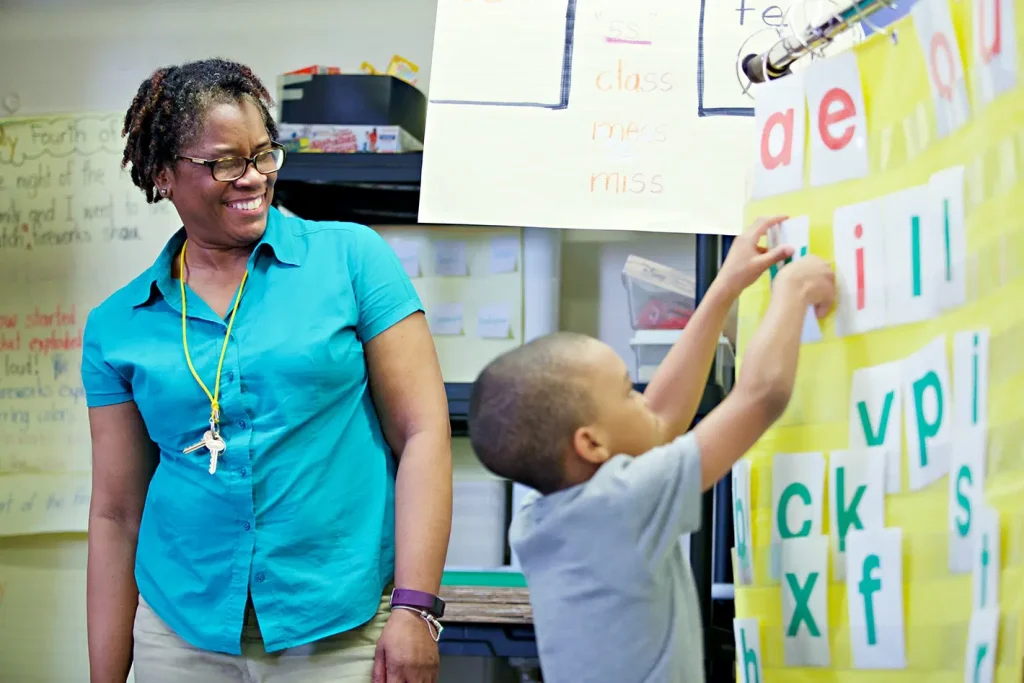
Plan your professional development
We’re excited to partner with you on your Amplify journey. Flexible professional development pathways have been designed to meet your needs.
Recommended Professional Development Plan
Our team has curated a recommended professional learning path from initial launch to continuous support. Use the Professional Development Planning Guide below to discuss the plan that best meets your school or district needs with your Account Executive.
ELAR
SLAR
Session overview
Launch
K–5 instructional leaders
Amplify Texas Elementary Literacy Program (digital) and ELAR (print) initial training for K–5 instructional leaders
Half day (3 hours)
Prepare to implement and support Amplify Texas instruction in your schools! Learn how Amplify Texas supports students as they build literacy skills in the early grades and move among reading, writing, speaking and listening, and language activities in the upper grades. Understand the purpose of the Amplify Texas program (Skills, Knowledge, and Integrated Strands) and identify components of the Amplify Texas design principles within lessons. Participants will begin creating an action plan to support communication and change management related to Amplify Texas to staff, parents, and other stakeholders.
Audience: Instructional leaders (principals and coaches), maximum 30 participants
Modality: Onsite/Remote
K–2 teachers
Amplify Texas Elementary Literacy Program (digital) and ELAR (print) initial training for K–2 teachers
1 day onsite (6 hours) or 2 half days remote (6 hours)
Prepare to implement the Amplify Texas K–2 program in your classroom! Learn the foundational elements of Amplify Texas, including the structure of materials, key lesson elements, and how to deliver specific lesson types successfully.
Audience: Teachers (instructional leaders welcome), maximum 30 participants
Modality: Onsite/Remote
Amplify Texas Elementary Literacy Program (digital) and ELAR (print) program overview for K–2 teachers
Half day (3 hours)
Prepare to implement the Amplify Texas K–2 program in your classroom! Learn the foundational elements of the curriculum, including the structure of materials, key lesson elements, and how to deliver specific lesson types successfully.
Audience: Teachers (instructional leaders welcome), maximum 30 participants
Modality: Onsite/Remote
Amplify Texas Elementary Literacy Program (digital) and ELAR (print) Skills Strand initial training for K–2 teachers
1 day onsite (6 hours) or 2 half days remote (6 hours)
Prepare to implement the Amplify Texas Skills Strand program in your classroom! Learn the foundational elements of Amplify Texas, including the structure of materials, key lesson elements, and how to deliver specific lesson types successfully. Participants will begin planning for the first unit and lessons.
Audience: Teachers (instructional leaders welcome), maximum 30 participants
Modality: Onsite/Remote
Amplify Texas Elementary Literacy Program (digital) and ELAR (print) Skills Strand program overview for K–2 teachers
Half day (3 hours)
Prepare to implement the Amplify Texas Skills Strand in your classroom! Learn the foundational elements of the curriculum, including the structure of materials, key lesson elements, and how to deliver specific lesson types successfully.
Audience: Teachers (instructional leaders welcome), maximum 30 participants
Modality: Onsite/Remote
Amplify Texas Elementary Literacy Program (digital) and ELAR (print) Knowledge Strand initial training for K–2 teachers
1 day onsite (6 hours) or 2 half days remote (6 hours)
Prepare to implement the Amplify Texas Knowledge Strand program in your classroom! Learn the foundational elements of Amplify Texas, including the structure of materials, key lesson elements, and how to deliver specific lesson types successfully. Participants will begin planning for the first unit and lessons.
Audience: Teachers (instructional leaders welcome), maximum 30 participants
Modality: Onsite/Remote
Amplify Texas Elementary Literacy Program (digital) and ELAR (print) Knowledge Strand program overview for K–2 teachers
Half day (3 hours)
Prepare to implement the Amplify Texas Knowledge Strand in your classroom! Learn the foundational elements of the curriculum, including the structure of materials, key lesson elements, and how to deliver specific lesson types successfully.
Audience: Teachers (instructional leaders welcome), maximum 30 participants
Modality: Onsite/Remote
Amplify Texas Lectoescritura (digital) and SLAR (print) initial training for K–2 teachers
1 day onsite (6 hours) or 2 half days remote (6 hours)
Prepare to implement Amplify Texas program in your classroom! Learn the foundational elements of Amplify Texas, including the structure of materials, key lesson elements, and how to deliver specific lesson types successfully. Participants will begin planning for the first unit and lessons.
Audience: Teachers (instructional leaders welcome), maximum 30 participants
Modality: Onsite/Remote
Amplify Texas Elementary Lectoescritura (digital) and SLAR (print) program overview for K–2 teachers
Half day (3 hours)
Prepare to implement Amplify Texas in your classroom! Learn the foundational elements of the curriculum, including the structure of materials, key lesson elements, and how to deliver specific lesson types successfully.
Audience: Teachers (instructional leaders welcome), maximum 30 participants
Modality: Onsite/Remote
Amplify Texas Lectoescritura (digital) and SLAR (print) Skills Strand (Habilidades y destrezas) initial training for K–2 teachers
1 day onsite (6 hours) or 2 half days remote (6 hours)
Prepare to implement Amplify Texas Skills Strand (Habilidades y destrezas) program in your classroom! Learn the foundational elements of Amplify Texas, including the structure of materials, key lesson elements, and how to deliver specific lesson types successfully. Participants will begin planning for the first unit and lessons.
Audience: Teachers (instructional leaders welcome), maximum 30 participants
Modality: Onsite/Remote
Amplify Texas Elementary Lectoescritura (digital) and SLAR (print) Skills Strand (Habilidades y destrezas) program overview for K–2 teachers
Half day (3 hours)
Prepare to implement Amplify Texas Skills Strand (Habilidades y destrezas) in your classroom! Learn the foundational elements of the curriculum, including the structure of materials, key lesson elements, and how to deliver specific lesson types successfully.
Audience: Teachers (instructional leaders welcome), maximum 30 participants
Modality: Onsite/Remote
Amplify Texas Lectoescritura (digital) and SLAR (print) Knowledge Strand (Conocimiento) initial training for K–2 teachers
1 day onsite (6 hours) or 2 half days remote (6 hours)
Prepare to implement Amplify Texas Knowledge Strand (Conocimiento) program in your classroom! Learn the foundational elements of Amplify Texas, including the structure of materials, key lesson elements, and how to deliver specific lesson types successfully. Participants will begin planning for the first unit and lessons.
Audience: Teachers (instructional leaders welcome), maximum 30 participants
Modality: Onsite/Remote
Amplify Texas Elementary Lectoescritura (digital) and SLAR (print) Knowledge Strand (Conocimiento) program overview for K–2 teachers
Half day (3 hours)
Prepare to implement Amplify Texas Knowledge Strand (Conocimiento) in your classroom! Learn the foundational elements of the curriculum, including the structure of materials, key lesson elements, and how to deliver specific lesson types successfully.
Audience: Teachers (instructional leaders welcome), maximum 30 participants
Modality: Onsite/Remote
3-5 Teachers
Amplify Texas Elementary Literacy Program (digital) and ELAR (print) initial training for 3–5 teachers
1 day onsite (6 hours) or 2 half days remote (6 hours)
Prepare to implement the Amplify Texas 3–5 program in your classroom! Learn the foundational elements of Amplify Texas, including the structure of materials, key lesson elements, and how to deliver specific lesson types successfully.
Audience: Teachers (instructional leaders welcome), maximum 30 participants
Modality: Onsite/Remote
Amplify Texas Elementary Literacy Program (digital) and ELAR (print) program overview for 3–5 teachers
Half day (3 hours)
Prepare to implement the Amplify Texas 3–5 program in your classroom! Learn the foundational elements of the curriculum, including the structure of materials, key lesson elements, and how to deliver specific lesson types successfully.
Audience: Teachers (instructional leaders welcome), maximum 30 participants
Modality: Onsite/Remote
Amplify Texas Lectoescritura (digital) and SLAR (print) initial training for 3–5 teachers
1 day onsite (6 hours) or 2 half days remote (6 hours)
Prepare to implement the Amplify Texas 3–5 program in your classroom! Learn the foundational elements of Amplify Texas, including the structure of materials, key lesson elements, and how to deliver specific lesson types successfully.
Audience: Teachers (instructional leaders welcome), maximum 30 participants
Modality: Onsite/Remote
Amplify Texas Lectoescritura (digital) and SLAR (print) program overview for 3–5 teachers
Half day (3 hours)
Prepare to implement the Amplify Texas 3–5 program in your classroom! Learn the foundational elements of the curriculum, including the structure of materials, key lesson elements, and how to deliver specific lesson types successfully.
Audience: Teachers (instructional leaders welcome), maximum 30 participants
Modality: Onsite/Remote
Strengthen
K–5 leaders
Amplify Texas ELAR enhancing observations for K–5 leaders
Half day (3 hours)
Prerequisite training: Initial training for instructional leaders
Elevate program knowledge to support colleagues with effective Amplify Texas implementation! Practice analyzing Amplify Texas lessons and identify key instructional elements and next steps. Participants will be prepared to collect data and enhance classroom observations.
Audience: Instructional leaders (principals and coaches), maximum 30 participants
Modality: Onsite/Remote
K–2 teachers
Amplify Texas ELAR enhancing planning & practice for K–2 teachers
Half day (3 hours)
Prerequisite training: Initial training for K–2 teachers
Elevate program knowledge to strengthen your Amplify Texas K–2 implementation! Understand the progression of foundational skills and focus on high-quality questioning and discussion techniques through lesson study and practice. Participants will practice implementing key instructional elements and leave with annotated lessons.
Audience: K–2 teachers (instructional leaders welcome), maximum 30 participants
Modality: Onsite/Remote
Amplify Texas ELAR writing for K–2 teachers
Half day (3 hours)
Prerequisite training: Initial training for K–2 teachers and 2–3 months of Amplify Texas instruction
Dig into Amplify Texas writing instruction and student work in grades K–2! Identify writing opportunities in the Amplify Texas Skills and Knowledge Strand through analysis of a unit and daily lessons and analyze student writing using a program-aligned rubric. Participants will leave with an annotated unit highlighting the writing opportunities and student grouping suggestions.
Audience: K–2 teachers (instructional leaders welcome), maximum 30 participants
Modality: Onsite/Remote
Amplify Texas SLAR enhancing planning & practice for K–2 teachers
Half day (3 hours)
Prerequisite training: Initial training for K–2 teachers
Elevate program knowledge to strengthen your Amplify Texas K–2 implementation! Understand the progression of foundational skills and focus on high-quality questioning and discussion techniques through lesson study and practice. Participants will practice implementing key instructional elements and leave with annotated lessons.
Audience: K–2 teachers (instructional leaders welcome), maximum 30 participants
Modality: Onsite/Remote
Amplify Texas SLAR writing for K–2 teachers
Half day (3 hours)
Prerequisite training: Initial training for K–2 teachers and 2–3 months of Amplify Texas instruction
Dig into Amplify Texas writing instruction and student work in grades K–2! Identify writing opportunities in the Amplify Texas curriculum through analysis of a unit and daily lessons and analyze student writing using a program-aligned rubric. Participants will leave with an annotated unit highlighting the writing opportunities and student grouping suggestions.
Audience: K–2 teachers (instructional leaders welcome), maximum 30 participants
Modality: Onsite/Remote
3–5 teachers
Amplify Texas ELAR enhancing planning & practice for
3–5 teachers
Half day (3 hours)
Prerequisite training: Initial training for 3–5 teachers
Elevate program knowledge to strengthen your Amplify Texas 3–5 implementation! Understand the progression of foundational skills and focus on high-quality questioning and discussion techniques through lesson study and practice. Participants will practice implementing key instructional elements and leave with annotated lessons.
Audience: K–2 teachers (instructional leaders welcome), maximum 30 participants
Modality: Onsite/Remote
Amplify Texas ELAR writing for 3–5 teachers
Half day (3 hours)
Prerequisite training: Initial training for K–2 teachers and 2–3 months of Amplify Texas instruction
Dig into Amplify Texas writing instruction and student work in grades 3–5! Identify writing opportunities in the Amplify Texas curriculum through analysis of a unit and daily lessons and analyze student writing using a program-aligned rubric. Participants will leave with an annotated unit highlighting the writing opportunities and student grouping suggestions.
Audience: K–2 teachers (instructional leaders welcome), maximum 30 participants
Modality: Onsite/Remote
Amplify Texas SLAR enhancing planning & practice for
3–5 teachers
Half day (3 hours)
Prerequisite training: Initial training for 3–5 teachers
Elevate program knowledge to strengthen your Amplify Texas 3–5 implementation! Understand the progression of foundational skills and focus on high-quality questioning and discussion techniques through lesson study and practice. Participants will practice implementing key instructional elements and leave with annotated lessons.
Audience: K–2 teachers (instructional leaders welcome), maximum 30 participants
Modality: Onsite/Remote
Amplify Texas SLAR writing for 3–5 teachers
Half day (3 hours)
Prerequisite training: Initial training for K–2 teachers and 2–3 months of Amplify Texas instruction
Dig into Amplify Texas writing instruction and student work in grades 3–5! Identify writing opportunities in the Amplify Texas curriculum through analysis of a unit and daily lessons and analyze student writing using a program-aligned rubric. Participants will leave with an annotated unit highlighting the writing opportunities and student grouping suggestions.
Audience: K–2 teachers (instructional leaders welcome), maximum 30 participants
Modality: Onsite/Remote
K–5 teachers
Amplify Texas ELAR enhancing planning & instruction for English language learners for K–5 teachers
Half day (3 hours)
Prerequisite training: Initial training
Develop a strong understanding of how to support English language learners (ELLs) with Amplify Texas instruction! Identify program-embedded instructional supports and strategies for ELL students of varying proficiency levels and plan how to adjust instruction based on formative check points. Participants will begin to develop a plan for using program supports and strategies for ELL instruction.
Audience: K–5 classroom teachers and ELL specialists (instructional leaders welcome), maximum 30 participants
Modality: Onsite/Remote
Amplify Texas enhancing planning & instruction for students with special needs for K–5 teachers
Half day (3 hours)
Develop a strong understanding of how to support students with special needs! Identify program-embedded instructional supports and strategies for students with special needs, including connections to IEP goals, and plan how to adjust instruction. Participants will leave with an accommodation plan aligned to Amplify Texas instruction and IEP goals.
Audience: K–5 classroom teachers and special education specialists (instructional leaders welcome), maximum 30 participants
Modality: Onsite/Remote
Amplify Texas ELAR Strengthening consultation session
1 hour or 3 1-hour sessions
These 60-minute sessions will focus on a specific topic that will deepen educators’ understanding of Amplify Texas and equip them with the support they need to drive toward stronger student outcomes. An Amplify facilitator will align with the school or district leadership team in advance of the session on the topic (chosen from a menu of options) that will best meet educators’ unique needs. The menu includes sessions on engagement, pacing, and supporting all learners.
Audience: K–5 classroom teachers (instructional leaders welcome), maximum 30 participants
Modality: Remote
Amplify Texas SLAR Strengthening consultation session
1 hour or 3 1-hour sessions
These 60-minute sessions will focus on a specific topic that will deepen educators’ understanding of Amplify Texas and equip them with the support they need to drive toward stronger student outcomes. An Amplify facilitator will align with the school or district leadership team in advance of the session on the topic (chosen from a menu of options) that will best meet educators’ unique needs. The menu includes sessions on engagement, pacing, and supporting all learners.
Audience: K–5 classroom teachers (instructional leaders welcome), maximum 30 participants
Modality: Remote
Coach
K–5 educators (leaders, principals, coaches, teachers)
Amplify Texas ELAR Coaching for K–5 educators
2 days consecutive (6 hours per day, 12 total)
Prerequisite training: Initial training
Strengthen your implementation of Amplify Texas with a Coaching onsite visit for your teachers and/or leaders! An Amplify facilitator will visit 1–4 school sites for two days. Participants can choose from a variety of topics that include, but are not limited to: lesson modeling (conducted by an Amplify Texas facilitator) and debriefing, grade-level planning, classroom observations, and leadership consultation. The flexible onsite coaching design allows for a collaborative approach to support effective program implementation.
Audience: Teachers and/or instructional leaders (principals and coaches), maximum 30 participants
Modality: Onsite
Amplify Texas ELAR Coaching for K–5 educators
1 day onsite (6 hours) or 2 half days remote (6 hours)
Prerequisite training: Initial training
Strengthen your implementation of Amplify Texas with a Coaching onsite visit for your teachers and/or leaders! An Amplify facilitator will visit 1–2 school sites for one day. Participants can choose from a variety of topics that include, but are not limited to: lesson modeling (conducted by an Amplify Texas facilitator) and debriefing, grade-level planning, classroom observations, and leadership consultation. The flexible onsite coaching design allows for a collaborative approach to support effective program implementation.
Audience: Teachers and/or instructional leaders (principals and coaches), maximum 30 participants
Modality: Onsite/Remote
Amplify Texas ELAR Coaching for K–5 educators
Half day (3 hours)
Prerequisite training: Initial training
Strengthen your implementation of Amplify Texas with a Coaching onsite visit for your teachers and/or leaders! An Amplify facilitator will virtually visit for a half day. Participants can choose from a variety of topics that include, but are not limited to: lesson modeling (conducted by an Amplify Texas facilitator) and debriefing, grade-level planning, classroom observations, and leadership consultation.
Audience: Teachers and/or instructional leaders (principals and coaches)
Modality: Remote
Amplify Texas SLAR Coaching for K–5 educators
2 days consecutive (6 hours per day, 12 total)
Prerequisite training: Initial training
Strengthen your implementation of Amplify Texas with a Coaching onsite visit for your teachers and/or leaders! An Amplify facilitator will visit 1–4 school sites for two days. Participants can choose from a variety of topics that include, but are not limited to: lesson modeling (conducted by an Amplify Texas facilitator) and debriefing, grade-level planning, classroom observations, and leadership consultation. The flexible onsite coaching design allows for a collaborative approach to support effective program implementation.
Audience: Teachers and/or instructional leaders (principals and coaches), maximum 30 participants
Modality: Onsite
Amplify Texas SLAR Coaching for K–5 educators
1 day onsite (6 hours) or 2 half days remote (6 hours)
Prerequisite training: Initial training
Strengthen your implementation of Amplify Texas with a Coaching onsite visit for your teachers and/or leaders! An Amplify facilitator will visit 1–2 school sites for one day. Participants can choose from a variety of topics that include, but are not limited to: lesson modeling (conducted by an Amplify Texas facilitator) and debriefing, grade-level planning, classroom observations, and leadership consultation. The flexible onsite coaching design allows for a collaborative approach to support effective program implementation.
Audience: Teachers and/or instructional leaders (principals and coaches), maximum 30 participants
Modality: Onsite/Remote
Amplify Texas SLAR Coaching for K–5 educators
Half day (3 hours)
Prerequisite training: Initial training
Strengthen your implementation of Amplify Texas with a Coaching onsite visit for your teachers and/or leaders! An Amplify facilitator will virtually visit for a half day. Participants can choose from a variety of topics that include, but are not limited to: lesson modeling (conducted by an Amplify Texas facilitator) and debriefing, grade-level planning, classroom observations, and leadership consultation.
Audience: Teachers and/or instructional leaders (principals and coaches)
Modality: Remote
Pricing
We offer the following pricing for training sessions and packages:
| Session type | Pricing |
|---|---|
| 2-day onsite session | $4,800 |
| 1-day onsite session | $3,200 |
| 1-day remote session | $1,200 |
| Half day onsite session | $2,500 |
| Half day remote session | $750 |
| 1-hour Strengthening consultation session | $350 |
| 3 1-hour Strengthening consultation sessions | $1000 |
| Customized onsite or remote session | Price will vary |
Please note that the prices are general ranges and may be subject to change.
Contact
Amplify welcomes the opportunity to partner with schools and districts to design professional development plans and answer your questions.
If you would like to order any of our professional development services, please contact your local Amplify sales representative or call (800) 823-1969.
Plan your professional development
We’re excited to partner with you on your Amplify journey. Flexible professional development pathways have been designed to meet your needs.
Recommended Professional Development Plan
Our team has curated a recommended professional learning path from initial launch to continuous support. Use the Professional Development Planning Guide below to discuss the plan that best meets your school or district needs with your Account Executive.
Sessions overview
| Recommended sessions are highlighted below. |
| Audience | Title | Duration | Modality |
|---|---|---|---|
| mCLASS Texas Edition Launch | |||
| All mCLASS Texas Edition customers | Initial training | 2 half days or self-paced | Remote/Online course |
| New mCLASS Texas Edition customers | Initial training | 1 day | Onsite |
| Initial training: Train the Trainer | 1 day onsite or 2 half days remote | Onsite/Remote | |
| New mCLASS Texas Edition customers with limited time for PD | mCLASS program overview, English measures only | Half day | Onsite/Remote |
| mCLASS program overview, Spanish measures only | Half day | Onsite/Remote | |
| Experienced mCLASS Texas Edition customers | Refresher training | Half day | Onsite/Remote |
| mCLASS Texas Edition and Amplify Reading Launch | |||
| New mCLASS Texas Edition and Amplify Reading customers | Initial training with Amplify Reading overview | 1 day onsite or 2 half days remote | Onsite/Remote |
| Initial training with Amplify Reading overview: Train the Trainer | 1 day onsite or 2 half days remote | Onsite/Remote | |
| mCLASS Texas Edition and TRC Launch | |||
| New mCLASS Texas Edition and TRC customers | Initial training with TRC overview | 1 day onsite or 2 half days remote | Onsite/Remote |
| Initial training with TRC overview: Train the Trainer | 1 day onsite or 2 half days remote | Onsite/Remote | |
| Experienced mCLASS Texas Edition customers | TRC initial training | Half day | Onsite/Remote |
| TRC initial training: Train the Trainer | Half day | Onsite/Remote | |
| mCLASS Express Launch | |||
| New mCLASS Express customers | Initial training | Half day | Onsite/Remote |
| Initial training | Self-paced | Online course | |
| mCLASS Texas Edition Strengthen | |||
| All mCLASS Texas Edition customers with limited time for PD | Understanding your classroom data | Half day | Onsite/Remote |
| All mCLASS Texas Edition customers | Classroom data analysis and instructional planning | 1 day | Onsite |
| All mCLASS Texas Edition customers | Classroom data analysis and instructional planning | 2 half days | Remote |
| Classroom data analysis and instructional planning: Train the Trainer | 1 day onsite or 2 half days remote | Onsite/Remote | |
| Classroom data analysis and instructional planning | Self-paced | Online | |
| All mCLASS Texas Edition customers | Data-driven leadership practices | 1 day onsite | Onsite |
| All mCLASS Texas Edition customers | Data-driven leadership practices | 2 half days | Remote |
| Data-driven leadership practices: Train the Trainer | 1 day onsite or 2 half days remote | Onsite/Remote | |
| Data-driven leadership practices | Self-paced | Online | |
| Understanding your school or district data | Half day | Onsite/Remote | |
| Strengthening consultation session | 1-hour session | Remote | |
| All mCLASS Texas Edition customers | Strengthening consultation session package | 3 1-hour sessions | Remote |
| mCLASS Texas Edition Coach | |||
| All mCLASS Texas Edition customers | Coaching session | 1 day | Onsite |
| All mCLASS Texas Edition customers | Coaching session | Half day | Onsite/Remote |
Launch
mCLASS Texas Edition
Initial training
1 day onsite (6 hours) or 2 half days remote (6 hours)
This PD prepares participants to implement the assessment, collect reliable data using standardized guidelines, and use the targeted lessons available on mCLASS to drive differentiated instruction.
Audience: Teachers (administrators welcome), maximum 30 participants
Modality: Onsite/Remote
Initial training: Train the Trainer
1 day onsite (6 hours) or 2 half days remote (6 hours)
This PD prepares participants to implement the assessment, collect reliable data using standardized guidelines, and use the targeted lessons available on mCLASS to drive differentiated instruction. Participants receive annotated session materials to turnkey the session to colleagues.
Audience: Teachers (administrators welcome), maximum 30 participants
Modality: Onsite/Remote
mCLASS program overview, English measures only
Half day (3 hours)
This PD prepares participants to implement the English measures of the mCLASS Texas assessment and collect reliable data using standardized guidelines. Only English measures are covered in this half-day training.
Audience: Teachers (administrators welcome), maximum 30 participants
Modality: Onsite/Remote
mCLASS program overview, Spanish measures only
Half day (3 hours)
This PD prepares participants to implement the Spanish measures of the mCLASS Texas assessment and collect reliable data using standardized guidelines. Only Spanish measures are covered in this half-day training.
Audience: Teachers (administrators welcome), maximum 30 participants
Modality: Onsite/Remote
Refresher training
Half day (3 hours)
The half-day refresher training is designed for teachers and instructional leaders who are experienced with any version of DIBELS® and/or Acadience Reading and are invested in successfully implementing mCLASS Texas Edition. This session will help educators focus on what’s new to the assessment and understand mCLASS Texas Edition’s potential to impact all students through improved measures, stronger insight into students’ instructional needs, and bolstered skills-focused lessons to support instructional planning. Upon completion of this session, participants will be prepared to implement the new assessment, collect reliable data using standardized guidelines, and use the targeted lessons available on mCLASS Texas Edition to drive differentiated instruction as part of their regular classroom practice.
Audience: Teachers (administrators welcome), maximum 30 participants
Modality: Onsite/Remote
mCLASS Texas Edition and Amplify Reading
Initial training with Amplify Reading overview
1 day onsite (6 hours) or 2 half days remote (6 hours)
Take the first step in launching mCLASS Texas Edition and Amplify Reading! The initial training will help educators understand how mCLASS Texas Edition assesses the basic early literacy skills that are crucial for reading development, gain hands-on experience administering and scoring the assessment using standardized guidelines, and access the Instruction page in order to find skills-focused lessons that will support instructional planning. A high-level overview of how to get started with Amplify Reading will also be provided at the end of the training along with supplementary, on-demand resources. Upon completion of this session, participants will be prepared to implement the new assessment, collect reliable data using standardized guidelines, use the targeted lessons available on mCLASS Texas Edition to drive differentiated instruction as part of their regular classroom practice, and understand key Amplify Reading features.
Audience: Teachers (administrators welcome), maximum 30 participants
Modality: Onsite/Remote
Initial training with Amplify Reading overview: Train the Trainer
1 day onsite (6 hours) or 2 half days remote (6 hours)
Take the first step in launching mCLASS Texas Edition and Amplify Reading! The initial training will help educators understand how mCLASS Texas Edition assesses the basic early literacy skills that are crucial for reading development, gain hands-on experience administering and scoring the assessment using standardized guidelines, and access the Instruction page in order to find skills-focused lessons that will support instructional planning. A high-level overview of how to get started with Amplify Reading will also be provided at the end of the training along with supplementary, on-demand resources. Upon completion of this session, participants will be prepared to implement the new assessment, collect reliable data using standardized guidelines, use the targeted lessons available on mCLASS Texas Edition to drive differentiated instruction as part of their regular classroom practice, and understand key Amplify Reading features. Participants receive annotated session materials to turnkey the session to colleagues.
Audience: Teachers (administrators welcome), maximum 30 participants
Modality: Onsite/Remote
mCLASS Texas Edition and TRC
Initial training with TRC overview
1 day onsite (6 hours) or 2 half days remote (6 hours)
Take the first step in launching mCLASS Texas Edition and Amplify Reading! The initial training will help educators understand how mCLASS Texas Edition assesses the basic early literacy skills that are crucial for reading development, gain hands-on experience administering and scoring the assessment using standardized guidelines, and access the Instruction page in order to find skills-focused lessons that will support instructional planning. A high-level overview of how to get started with Amplify Reading will also be provided at the end of the training along with supplementary, on-demand resources. Upon completion of this session, participants will be prepared to implement the new assessment, collect reliable data using standardized guidelines, use the targeted lessons available on mCLASS Texas Edition to drive differentiated instruction as part of their regular classroom practice, and understand key Amplify Reading features.
Audience: Teachers (administrators welcome), maximum 30 participants
Modality: Onsite/Remote
Initial training with TRC overview: Train the Trainer
1 day onsite (6 hours) or 2 half days remote (6 hours)
Take the first step in launching mCLASS Texas Edition and TRC! The initial training will help educators understand how mCLASS Texas Edition assesses the basic early literacy skills that are crucial for reading development, gain hands-on experience administering and scoring the assessment using standardized guidelines, and access the Instruction page in order to find skills-focused lessons that will support instructional planning. A high-level overview of how to get started with TRC will also be provided at the end of the training along with supplementary, on-demand resources. Upon completion of this session, participants will be prepared to implement the new assessment, collect reliable data using standardized guidelines, use the targeted lessons available on mCLASS Texas Edition to drive differentiated instruction as part of their regular classroom practice, and understand key TRC features. Participants receive annotated session materials to turnkey the session to colleagues.
Audience: Teachers (administrators welcome), maximum 30 participants
Modality: Onsite/Remote
TRC initial training
Half day (3 hours)
Take the first step in launching TRC! The half-day initial training will help educators understand how TRC assesses the basic early literacy skills that are crucial for reading development, gain hands-on experience administering and scoring the assessment using standardized guidelines, and access the Instruction page in order to find skills-focused lessons that will support instructional planning.
Audience: Teachers (administrators welcome), maximum 30 participants
Modality: Remote
TRC initial training: Train the Trainer
Half day (3 hours)
Take the first step in launching TRC! The half-day initial training will help educators understand how TRC assesses the basic early literacy skills that are crucial for reading development, gain hands-on experience administering and scoring the assessment using standardized guidelines, and access the Instruction page in order to find skills-focused lessons that will support instructional planning. Participants receive annotated session materials to turnkey the session to colleagues.
Audience: Teachers (administrators welcome), maximum 30 participants
Modality: Remote
mCLASS Express
Initial training
Half day (3 hours)
Take the first step in launching mCLASS Express! The half-day initial training will help educators understand how mCLASS Express’ voice-recognition scoring generates immediate instructional recommendations for students reading below grade level. Educators will also learn how to utilize the teacher portal to assign assessments, review and correct scoring, track student growth over time, and leverage the program’s activities to create an action plan for a single classroom or across classes/grades.
Audience: Teachers (administrators welcome), maximum 30 participants
Modality: Remote
Initial training
Self-paced
Take the first step in launching mCLASS Express! The two-hour initial training will help educators understand how mCLASS Express’ voice-recognition scoring generates immediate instructional recommendations for students reading below grade level. Educators will also learn how to utilize the teacher portal to assign assessments, review and correct scoring, track student growth over time, and leverage the program’s activities to create an action plan for a single classroom or across classes/grades. As this is a self-paced, on-demand online course, participants will be able to access the course anytime, move as quickly or as slowly as needed through different sections, and revisit the course for up to one year as a refresher in the future.
Audience: Teachers (administrators welcome)
Modality: Remote
Strengthen
Understanding your classroom data
Half day (3 hours)
This PD prepares participants to understand their students’ data by utilizing the reports available on mCLASS. This session should be scheduled after the most recent benchmark window has closed so that participants can work with their own data.
Audience: Teachers (administrators welcome), maximum 30 participants
Modality: Onsite/Remote
Classroom data analysis and instructional planning
1 day onsite (6 hours) or 2 half days remote (6 hours)
This PD prepares participants to deeply understand their students’ data and create actionable instructional plans by utilizing the reports and skills-focused lesson plans available on mCLASS.
Audience: Teachers (administrators welcome), maximum 30 participants
Modality: Onsite/Remote
*This session should be scheduled after the most recent benchmark window has closed so that participants can work with their own data.
Classroom data analysis and instructional planning: Train the Trainer
1 day onsite (6 hours) or 2 half days remote (6 hours)
This PD prepares participants to deeply understand their students’ data and create actionable instructional plans by utilizing the reports and skills-focused lesson plans available on mCLASS. Participants receive annotated session materials to turnkey the session to colleagues.
Audience: Teachers (administrators welcome), maximum 30 participants
Modality: Onsite/Remote
*This session should be scheduled after the most recent benchmark window has closed so that participants can work with their own data.
Classroom data analysis and instructional planning
Self-paced
This PD is an individual seat to our self-paced, on-demand online course that contains approximately 6 hours of training. Participants will learn how to deeply understand their students’ data and create actionable instructional plans by utilizing the reports and skills-focused lesson plans available on mCLASS. Participants will access and revisit the course anytime for up to one year as a refresher. Note: The online course focuses on the English measures only.
Audience: Teachers (administrators welcome)
Modality: Online
Understanding your school or district data
Half day (3 hours)
This PD prepares participants to use their data in making schoolwide decisions. This session should be scheduled after the most recent benchmark window has closed so that participants can work with their own data.
Audience: Administrators, maximum 30 participants
Modality: Onsite/Remote
Data-driven leadership practices
1 day onsite (6 hours) or 2 half days remote (6 hours)
This PD prepares participants to use their data in making schoolwide decisions and build a schoolwide culture of data-driven instruction. This session should be scheduled after the most recent benchmark window has closed so that participants can work with their own data.
Audience: Administrators, maximum 30 participants
Modality: Onsite/Remote
Data-driven leadership practices: Train the Trainer
1 day onsite (6 hours) or 2 half days remote (6 hours)
This PD prepares participants to use their data in making schoolwide decisions and build a schoolwide culture of data-driven instruction. This session should be scheduled after the most recent benchmark window has closed so that participants can work with their own data. Participants receive annotated session materials to turnkey the session to colleagues.
Audience: Administrators, maximum 30 participants
Modality: Onsite/Remote
Data driven leadership practices
Self-paced
This PD is an individual seat to our self-paced, on-demand online course that contains approximately 6 hours of training. Participants will learn how to use their data in making schoolwide decisions and build a schoolwide culture of data-driven instruction. Participants will access and revisit the course anytime for up to one year as a refresher. Note: The online course focuses on the English measures only.
Audience: Administrators
Modality: Online
Strengthening consultation session
60 minutes
This 60-minute session will focus on a specific topic that will deepen educators’ understanding of mCLASS and equip them in driving towards stronger student outcomes. An Amplify facilitator will align with the school or district’s leadership team in advance on the topic from a menu of options that will best meet educators’ unique needs. Topics include progress monitoring, zones of growth, and a data walkthrough for leaders.
Audience: Teachers and/or administrators, maximum 30 participants
Modality: Remote
Strengthening consultation session package
3 hours
This package consists of three 60-minute sessions that can be delivered on the same day or on different days. Each session will focus on a specific topic that will deepen educators’ understanding of mCLASS and equip them in driving towards stronger student outcomes. An Amplify facilitator will align with the school or district’s leadership team in advance on the topics that will best meet educators’ unique needs. Topics include progress monitoring, zones of growth, and a data walkthrough for leaders.
Audience: Teachers and/or administrators, maximum 30 participants
Modality: Remote
Coach
Coaching session
1 day onsite (6 hours)
This PD will deepen educators’ understanding of how to utilize mCLASS in order to accelerate data-driven student outcomes. An Amplify facilitator will visit one or two school sites for one day and work with teachers and/or leaders. Prior to the visit, the Amplify facilitator will align with each school’s leadership team on their needs and customize the visit schedule accordingly.
Audience: Teachers and/or administrators, maximum 30 participants
Modality: Onsite/Remote
Coaching session
Half day (3 hours)
This PD is up to 3 hours of training and will deepen educators’ understanding of how to utilize mCLASS in order to accelerate data-driven student outcomes. An Amplify facilitator will visit one school site for a half-day and work with teachers and/or leaders. Prior to the visit, the Amplify facilitator will align with each school’s leadership team on their needs and customize the visit schedule accordingly.
Audience: Teachers and/or administrators, maximum 30 participants
Modality: Remote
Pricing
We offer the following pricing for training sessions and packages:
| Session type | Pricing |
|---|---|
| 1-day onsite session | $3,200 |
| 1-day onsite session: Train the Trainer | $3,500 |
| 2 half-day remote sessions | $1,500 |
| 2 half-day remote sessions: Train the Trainer | $2,000 |
| Half-day onsite session | $2,500 |
| Half-day remote session | $750 |
| 2-hour self-paced online course | $20 per individual seat |
| 6-hour self-paced online course | $49 per individual seat |
Please note that the prices are general ranges and may be subject to change.
Contact
Amplify welcomes the opportunity to partner with schools and districts to design professional development plans and answer your questions.
If you would like to order any of our professional development services, please contact your local Amplify sales representative or call (800) 823-1969.
Utah – USBE Data Analysis for K-3 Reading Assessment Program – New
mCLASS Intervention professional development
mCLASS® Intervention (formerly known as Burst: Reading) is a staff-led reading intervention that does the heavy lifting of data analysis and lesson sequencing, freeing up teachers to teach the reading skills each student needs.
We’ve created a wide suite of professional development offerings that will help you meet your unique needs this school year. Find out more below!

Plan your professional development
We’re excited to partner with you on your Amplify journey. Flexible professional development pathways have been designed to meet your needs.
Recommended Professional Development Plan
Our team has curated a recommended professional learning path from initial launch to continuous support. Use the Professional Development Planning Guide below to discuss the plan that best meets your school or district needs with your Account Executive.
Do you also use Amplify CKLA, mCLASS, and/or Boost Reading?
View the planning guide below to explore learning plans for teachers and leaders who are either new to or currently using multiple early literacy products.
mCLASS intervention overview
What’s the difference between mCLASS Intervention and mCLASS Intervention Universal?
An mCLASS Intervention school screens with mCLASS with DIBELS® 8th Edition.* An mCLASS Intervention Universal school screens with any other screener on the market. Some of the most common are iReady, iStation, MAP, AIMSweb, and paper/pencil DIBELS.
What else is different?
Here are a few other areas in which the programs differ:
| Area | mCLASS Intervention | mCLASS Intervention Universal |
|---|---|---|
| Onboarding process | Does not require Amplify’s Implementation team to explain staff and student enrollment because staff and students are already enrolled in our system. | Requires Amplify’s implementation team to explain staff and student enrollment since the tech coordinator hasn’t yet enrolled any students in mCLASS. |
| Professional development | Facilitator does not spend time practicing DIBELS measures with staff because they’re already familiar with these measures. | Facilitator spends time practicing DIBELS measures with staff because they usually haven’t administered them before. |
| Assessments | These schools administer DIBELS to all students because they have paid to use mCLASS as a screener. | These schools administer DIBELS only to intervention students because they haven’t paid to use mCLASS as a screener. |
*Utah and Colorado schools screen with mCLASS: Acadience Reading (formerly called mCLASS:DIBELS Next).
Getting optimal results with mCLASS Intervention
There are two critical roles at a school that need to work together in order for mCLASS Intervention to deliver optimal results. At some schools, an individual may hold both roles.
- Intervention Coordinator
Oversees the mCLASS Intervention program, groups students, determines group assignments and adjusts schedules, and works closely with your school’s Interventionists. - Interventionist
Teaches mCLASS Intervention lessons to small groups of students based on the assignments and schedules provided by your school’s Intervention Coordinator and progress monitors students every two weeks.
mCLASS Intervention sessions overview
| Audience | Title | Duration | Modality |
|---|---|---|---|
| Launch packages | |||
| New mCLASS + mCLASS Intervention customers | mCLASS + mCLASS Intervention initial training bundle | 4 half days, non-consecutive | Remote |
| New mCLASS + mCLASS Intervention customers | mCLASS + mCLASS Intervention initial training bundle | 2 days of onsite training, consecutive | Onsite |
| Launch | |||
| New mCLASS Intervention customers (mCLASS has been trained in the past) | mCLASS Intervention initial training | 1 day onsite or 2 half days remote | Onsite/Remote |
| Interventionists online course | Self-paced | Online | |
| Coach | |||
| All mCLASS Intervention customers | Coaching session | 1 day | Onsite |
| All mCLASS Intervention customers | Coaching session | Half day | Onsite/Remote |
| Coaching session | 60 mins | Remote | |
Launch packages
mCLASS initial training + mCLASS Intervention initial training
2 days (12 hours); consecutive
Prepare to launch mCLASS Intervention with fidelity! This bundle is intended for schools or districts who are implementing mCLASS Intervention for the first time and want the highest levels of support.
The first day will prepare all educators to administer the mCLASS assessment.
The second day will prepare all educators (including Intervention Coordinators) to implement mCLASS Intervention, including instruction on how to prepare for lessons, practice lesson delivery, administer the diagnostic and progress monitoring measures, and configure grouping and scheduling for maximum effectiveness.
Audience: Intervention Coordinators and Interventionists, maximum 30 participants
Modality: Onsite
mCLASS initial training + mCLASS Intervention initial training
2 days (12 hours) or 4 half days (12 hours); non-consecutive
Prepare to launch mCLASS Intervention with fidelity! This bundle is intended for schools or districts who are implementing mCLASS Intervention for the first time and want the highest levels of support.
The first part will prepare all educators to administer the mCLASS assessment.
The second part will prepare all educators (including Intervention Coordinators) to implement mCLASS Intervention: how to prepare for lessons, practice lesson delivery, administer the diagnostic and progress monitoring measures, and configure grouping and scheduling for maximum effectiveness.
Audience: Intervention Coordinators and Interventionists, maximum 30 participants
Modality: Onsite/Remote
Launch
mCLASS Intervention initial training
1 day onsite (6 hours) or 2 half days (6 hours)
This session is intended for those schools or districts that have been trained in mCLASS in the past.
This training will prepare all educators (including Intervention Coordinators) to implement mCLASS Intervention: how to prepare for lessons, practice lesson delivery, administer the diagnostic and progress monitoring measures, and configure grouping and scheduling for maximum effectiveness.
Audience: Intervention Coordinators and Interventionists, maximum 30 participants
Modality: Onsite/Remote
Interventionists online course
Self-paced
This PD is an individual seat to our self-paced, on-demand online course that contains approximately 3 hours of training. Participants will learn how to prepare for lessons and administer the diagnostic and progress monitoring measures. Participants will access and revisit the course anytime for up to one year as a refresher.
Audience: Interventionists
Modality: Online course
Coach
Coaching session
1 day (6 hours)
Strengthen your implementation of mCLASS Intervention with a Coaching session for your teachers and/or leaders! A certified mCLASS Intervention facilitator can visit 1–2 school sites per day. Participants may choose from a variety of topics that include, but are not limited to: observing lessons and providing feedback, analyzing mCLASS Intervention data and planning instruction, refining groups and schedules, or co-planning and modeling lessons.
Audience: Intervention Coordinators and/or Interventionists, maximum 30 participants
Modality: Onsite
Coaching session
Half day (3 hours)
Strengthen your implementation of mCLASS Intervention with a Coaching session for your teachers and/or leaders! A certified Intervention facilitator will visit one school site. Participants may choose from a variety of topics that include, but are not limited to: observing lessons and providing feedback; analyzing mCLASS Intervention data, reviewing student progress, and planning next steps; refining groups and schedules; or co-planning and modeling lessons.
Audience: Intervention Coordinators and/or Interventionists, maximum 30 participants
Modality: Onsite
Coaching session
60 min.
Strengthen your implementation of mCLASS Intervention with a quick Coaching session to improve implementation or student outcomes. During this remote hourly session, a certified mCLASS Intervention facilitator will help school leaders and/or Intervention Coordinators review usage, student progress data, and work to define an opportunity and develop a solution.
Audience: Intervention Coordinators and/or Interventionists, maximum 30 participants
Modality: Remote
mCLASS Intervention Universal sessions overview
| Title | Duration | Modality |
|---|---|---|
| Launch packages | ||
| Hybrid PD package | Half day, then 1 day | Hybrid (remote, then onsite) |
| Remote PD package | Half day, then 2 half days | Remote |
| Launch sessions | ||
| Training for Interventionists | 1 day or 2 half days | Onsite/Remote |
| Training for Intervention Coordinators | Half day | Remote |
| Coach | ||
| Coaching session | 1 day | Onsite |
| Coaching session | Half day | Onsite |
| Coaching session | Hourly | Remote |
Launch packages
Hybrid PD Package
Half day, then 1 day (9 hours)
Prepare to launch mCLASS Intervention Universal with fidelity! This package is intended for schools or districts implementing mCLASS Intervention Universal for the first time and want the highest levels of support.
Session 1 will prepare Intervention Coordinators to develop the school’s mCLASS Intervention Universal implementation plan, learn how to strategically group students, and schedule intervention supports.
Session 2 will prepare Interventionists to do an in-depth exploration of lesson activities and engage in real-time practice with diagnostic and progress monitoring measures.
Both sessions should be scheduled at least two weeks apart so the Intervention Coordinator has time to group students, draft schedules, and select the team of interventionists.
Audience:
Session 1: Intervention Coordinators, maximum 30 participants
Session 2: Interventionists, maximum 30 participants
Modality: Hybrid
Remote PD Package
3 half days (9 hours)
Prepare to launch mCLASS Intervention Universal with fidelity! This package is intended for schools or districts implementing mCLASS Intervention Universal for the first time.
Session 1 will prepare Intervention Coordinators to develop the school’s mCLASS Intervention Universal implementation plan, learn how to strategically group students, and schedule intervention supports.
Both sessions should be scheduled at least two weeks apart so the Intervention Coordinator has time to group students, draft schedules, and select the team of interventionists.
Audience:
Session 1: Intervention Coordinators, maximum 30 participants
Session 2: Interventionists, maximum 30 participants
Modality: Remote
Launch
Training for Interventionists
1 day onsite (6 hours) or 2 half days remote (6 hours)
This one-day training will ensure that Interventionists are prepared to teach mCLASS Intervention Universal with fidelity and accurately progress monitor students with the mCLASS platform throughout the year. Participants will do an in-depth exploration of lesson activities and engage in real-time practice with diagnostic and progress monitoring measures.
This session is ideal for new Interventionists at a school or district that has been previously implementing mCLASS Intervention Universal. We encourage the Coordinator to attend this session as well.
Audience: Interventionists (Intervention Coordinators welcome), maximum 30 participants
Modality: Onsite/Remote
Training for Intervention Coordinators
Half day (3 hours)
This half-day training will ensure that Intervention Coordinators are prepared to launch mCLASS Intervention Universal at their school site(s) with fidelity and best practice. Participants will consider grouping and scheduling configurations to make the most of the program, and create launch plans.
This session is paired with the Training for Interventionists full-day session.
Audience: Intervention Coordinators, maximum 30 participants
Modality: Remote
Coach
Coaching session
1 day onsite (6 hours)
Strengthen your implementation of mCLASS Intervention Universal with a Coaching session for your teachers and/or leaders! A certified mCLASS Intervention Universal facilitator can visit 1–2 school sites per day. Participants may choose from a variety of topics that include, but are not limited to: observing lessons and providing feedback, analyzing mCLASS Intervention Universal data and planning instruction, refining groups and schedules, or co-planning and modeling lessons, maximum 30 participants.
Audience: Intervention Coordinators and/or Interventionists, maximum 30 participants
Modality: Onsite
Coaching session
Half day onsite (3 hours)
Strengthen your implementation of mCLASS Intervention with a Coaching session for your teachers and/or leaders! A certified Intervention facilitator will visit one school site. Participants may choose from a variety of topics that include, but are not limited to: observing lessons and providing feedback; analyzing mCLASS Intervention data, reviewing student progress, and planning next steps; refining groups and schedules; or co-planning and modeling lessons.
Audience: Intervention Coordinators and/or Interventionists, maximum 30 participants
Modality: Onsite/Remote
Coaching session
60 min.
Strengthen your implementation of mCLASS Intervention with a quick Coaching session to improve implementation or student outcomes. During this remote hourly session, a certified mCLASS Intervention facilitator will help school leaders and/or Intervention Coordinators review usage, student progress data, and work to define an opportunity and develop a solution.
Audience: Intervention Coordinators and/or Interventionists, maximum 30 participants
Modality: Remote
Pricing
We offer the following pricing for training sessions and packages:
| Session type | Pricing |
|---|---|
| mCLASS + mCLASS Intervention initial training bundle, 2 days onsite, consecutive | $4,800 |
| mCLASS + mCLASS Intervention initial training bundle, 2 days onsite, non-consecutive | $6,400 |
| mCLASS + mCLASS Intervention initial training bundle, 4 half days remote | $3,000 |
| mCLASS Intervention initial training, onsite | $3,200 |
| mCLASS Intervention initial training, remote, 2 half-days | $1,500 |
| Interventionists self-paced online course | $49 per individual seat |
| Intervention Coordinators self-paced online course | $49 per individual seat |
| mCLASS Intervention Universal hybrid PD package | $3,950 |
| mCLASS Intervention Universal remote PD package | $2,250 |
| mCLASS Intervention Universal training for Interventionists, onsite | $3,200 |
| mCLASS Intervention Universal training for Interventionists, remote | $1,500 |
| 1-day coaching session, onsite | $3,200 |
| Half-day coaching session, onsite | $2,500 |
| Remote coaching, hourly | $350 |
Please note that the prices are general ranges and may be subject to change.
Contact
Amplify welcomes the opportunity to partner with schools and districts to design professional development plans and answer your questions.
If you would like to order any of our professional development services, please contact your local Amplify sales representative or call (800) 823-1969.
Amplify ELA professional development
Amplify ELA is an engaging and rigorous curriculum designed specifically for grades 6–8. With Amplify ELA, students learn to tackle any complex text and make observations, grapple with interesting ideas, and find relevance for themselves.
We’ve created a wide suite of professional development offerings that will help you meet your unique needs. Find out more below!
Amplify CKLA, ELA, and Science professional development has been vetted by Rivet Education’s team through a rigorous three-step process and is listed in the Professional Learning Partner Guide.

Plan your professional development
We’re excited to partner with you on your Amplify journey. Flexible professional development pathways have been designed to meet your needs.
Recommended Professional Development Plan
Our team has curated a recommended professional learning path from initial launch to continuous support. Use the Professional Development Planning Guide below to discuss the plan that best meets your school or district needs with your Account Executive.
Sessions overview
Recomended sessions are highlighted below
| Title | Duration | Modality | Available |
|---|---|---|---|
| Launch | |||
| Comprehensive initial training for teachers | 2 days consecutive | Onsite | Yes |
| Initial training for teachers | 1 day | Onsite | Yes |
| Initial training for teachers | 2 half days | Remote | Yes |
| Program overview | Half day | Onsite/Remote | Yes |
| Initial training for leaders | Half day | Onsite/Remote | Yes |
| Strengthen | |||
| Enhancing observations for leaders | Half day | Onsite/Remote | 09/01/22 |
| Enhancing planning and practice | Half day | Onsite/Remote | Yes |
| Analytic reading | Half day | Onsite/Remote | Yes |
| Supporting all learners | Half day | Onsite/Remote | Yes |
| Data-informed instruction | Half day | Onsite/Remote | Yes |
| Writing: Improving through feedback | Half day | Onsite/Remote | Yes |
| Strengthening consultation session | 1 hour | Remote | Yes |
| Strengthening consultation package | 3 1-hour sessions | Remote | Yes |
| Coach | |||
| Coaching sessions | 2 days consecutive | Onsite | Yes |
| Coaching sessions | 1 day | Onsite/Remote | Yes |
| Half day | Onsite/Remote | Yes | |
Launch
Comprehensive initial training for teachers
2 days consecutive (6 hours per day, 12 hours total)
Prepare to implement and support Amplify ELA instruction in your school! Learn how Amplify ELA supports students through rigorous and engaging ELA instruction. Participants will navigate the Amplify ELA platform, learn to give feedback on student work, and explore how to use Amplify ELA’s embedded supports and Reporting app to monitor student progress. Participants will have multiple opportunities to practice components of Amplify ELA and leave confident to begin teaching.
Audience: Teachers and coaches
Modality: Onsite, maximum 30 participants
Initial training for teachers
1 day (6 hours)
Prepare to implement and support Amplify ELA instruction in your schools! Learn how Amplify ELA supports students through rigorous and engaging ELA instruction. Participants will navigate the Amplify ELA platform, learn to give feedback on student work, and explore how to use Amplify ELA’s embedded supports and Reporting app to monitor student progress. Participants will leave with an action plan to begin teaching Amplify ELA.
Audience: Teachers and coaches, maximum 30 participants
Modality: Onsite
Initial training for teachers
2 half days (3 hours per day, 6 hours total)
This full day initial training session (6 hours) is split into two half-day sessions (3 hours each). Part 1 and Part 2 may be scheduled consecutively on the same day or on different days, ideally within ~2 weeks. The same participants should attend both sessions in order to receive all content about key components of Amplify ELA, which includes learning how to navigate, teach, and monitor student progress.
Audience: Teachers and coaches, maximum 30 participants
Modality: Remote
Program essentials
Half day (3 hours)
Learn the program essentials, including how to navigate the digital curriculum and print materials and where to locate features like assessments and data reports.
Audience: Teachers and coaches, maximum 30 participants
Modality: Onsite/Remote
Initial training for instructional leaders
Half day (3 hours)
This training will provide district- and school-level instructional leaders with an overview of Amplify ELA so that they can support their staff in implementing Amplify.
Learn basic navigation and gain an understanding of Amplify ELA’s approach to reading, writing, and language instruction. Participants will then have the opportunity to choose how to best support teachers by either developing a school-wide implementation plan or learning strategies for effective classroom observations.
Audience: Ideal for instructional leaders, principals, and district staff who oversee the implementation of the new curriculum, maximum 30 participants
Modality: Onsite/Remote
Strengthen
Enhancing observations for leaders
Half day (3 hours)
Elevate your program knowledge to support colleagues with effective ELA implementation! Practice analyzing ELA lessons and identify key instructional elements and next steps. Participants will be prepared to analyze data and enhance classroom observations.
Prerequisite training: Initial training for leaders
Audience: Ideal for instructional leaders, principals, and district staff who oversee the implementation of the new curriculum, maximum 30 participants
Modality: Onsite/Remote
Enhancing planning and practice
Half day (3 hours)
Dig into one unit to unpack standards, assessments, and student engagement. Through backward planning, this session guides teachers to think deeply about learning outcomes and key moments of formative assessments. Teachers will leave this session with a detailed plan of a unit of their choice that includes learning outcomes, key assessment moments, and aligned instructional strategies.
Audience: Ideal for new or experienced Amplify ELA teachers or coaches, maximum 30 participants
Modality: Onsite/Remote
Analytic reading
Half day (3 hours)
Participants will learn how close reading functions in Amplify ELA and which teacher moves will support students tackling complex texts. Participants will also learn how to facilitate a close reading session to develop key reading routines, promote academic discourse, and encourage the type of collaboration that drives analysis and deepens understanding.
Audience: Ideal for new or experienced Amplify ELA teachers, maximum 30 participants
Modality: Onsite/Remote
Supporting all learners
Half day (3 hours)
Participants will learn how to effectively use embedded and differentiated supports and the Classwork app to support all students, including ELLs, students with learning disabilities, struggling readers and writers, and advanced students.
Audience: Ideal for new teachers or instructional leaders who want to learn more about included supports in Amplify ELA, maximum 30 participants
Modality: Onsite/Remote
Data-informed instruction
Half day (3 hours)
Participants will review their own student data using the Reporting and Classwork apps and align embedded supports to specific student needs. The goal of this session is to become proficient in turning Amplify ELA data into differentiated and targeted instruction.
Note: This course can be combined with the supporting all learners session to make a full day of training.
Prerequisite: 4–6 weeks of student data in Amplify’s Reporting app. It is recommended that teachers are in at least Unit B.
Audience: Ideal for teachers or support staff who want to learn how to use student data to inform instruction and provide differentiation, maximum 30 participants
Modality: Onsite/Remote
Writing: Improving through feedback
Half day (3 hours)
Participants will learn how writing functions in Amplify ELA and which teacher moves support students as they build writing skills. Participants will learn how feedback supports student growth and will practice giving targeted feedback based on rubrics and assessment data.
Audience: This course asks teachers to look at their students’ writing, so it is recommended for delivery after 4–6 weeks of curriculum use, maximum 30 participants
Modality: Onsite/Remote
Strengthening consultation session
1 hour
This 60-minute session will focus on a specific topic that will deepen educators’ understanding in Amplify ELAR Texas and equip them with the tools needed to drive stronger student outcomes. An Amplify facilitator will align with the school or district leadership team in advance of the session on the topic (chosen from a menu of options) that will best meet educators’ unique needs. The menu includes sessions on: engagement, pacing and grading/assessment.
Audience: Teachers and coaches, maximum 30 participants
Modality: Remote
Strengthening consultation package
3 1-hour sessions
This package consists of three 60-minute session that can be delivered on the same day or on different days. Each session will focus on a specific topic that will deepen educators’ understanding in ELA and equip them with the tools needed to drive stronger student outcomes. An Amplify facilitator will align with the school or district leadership team in advance of the session on the topic (chosen from a menu of options) that will best meet educators’ unique needs. The menu includes sessions on: engagement, pacing and grading/assessment.
Audience: Teachers and coaches, maximum 30 participants
Modality: Remote
Coach
Coaching session
2 days consecutive (6 hours per day, 12 total)
Strengthen your implementation of Amplify ELA with an onsite coaching visit for your teachers and/or leaders. Participants can choose from a variety of topics that include, but are not limited to: lesson modeling and debrief (conducted by an Amplify ELA coach), grade-level planning, classroom observations, and leadership consultation. The flexible onsite coaching design allows for a collaborative approach to support effective program implementation.
Audience: Teachers, coaches, and/or instructional leaders, maximum 30 participants
Modality: Onsite
Coaching session
1 day (6 hours)
Strengthen your implementation of Amplify ELA with an onsite coaching visit for your teachers and/or leaders. Participants can choose from a variety of topics that include, but are not limited to: lesson modeling and debrief (conducted by an Amplify ELA coach), grade-level planning, classroom observations, and leadership consultation. The flexible onsite coaching design allows for a collaborative approach to support effective program implementation.
Audience: Teachers, coaches, and/or instructional leaders, maximum 30 participants
Modality: Onsite/Remote
Coaching session
Half day (3 hours)
Strengthen your implementation of Amplify ELA with a coaching session for your teachers and/or leaders. Participants can choose from a variety of topics that include, but are not limited to: lesson modeling and debrief (conducted by an Amplify ELA coach), grade-level planning, classroom observations, and leadership consultation. The flexible coaching design allows for a collaborative approach to support effective program implementation.
Audience: Teachers, coaches, and/or instructional leaders, maximum 30 participants
Modality: Onsite/Remote
Pricing
We offer the following pricing for training sessions and packages:
| Type | Pricing |
| 2-day onsite session | $4,800 |
| 1-day onsite session | $3,200 |
| 1-day remote session (2 half days remote) | $1,500 |
| Half-day onsite session | $2,500 |
| Half-day remote session | $750 |
| 1-hour remote session | $350 |
| 3 1-hour remote sessions | $1,000 |
Please note that the prices are general ranges and may be subject to change.
Contact
Amplify welcomes the opportunity to partner with schools and districts to design professional development plans and answer your questions.
If you would like to order any of our professional development services, please contact your local Amplify sales representative or call (800) 823-1969.
9
Administrators, welcome to mCLASS!
Here you’ll find information about enrollment and licensing, technical requirements, professional learning resources, and more.

Onboarding: What to expect
Welcome to mCLASS! There are six basic steps to onboarding. Use this visual as a reference, but also know that our dedicated implementation team will be there to support you during the entire process.
Technology requirements and guidelines
To ensure that your hardware and network meet the minimum technical requirements for performance and support of mCLASS, please see Amplify’s customer requirements page.
You’ll also want to add the URLs on this page to the corresponding district- or school-level filters so that your teachers and students can access their mCLASS materials.
Data sharing agreement
Partnering with Amplify through our data sharing program deepens learning outcomes and gives you the performance analysis you need to make impactful decisions within your district or school. By signing our data sharing agreement, your district will help us to better understand student performance as it relates to your state’s standards. It also allows us to compare results with the curriculum-embedded assessments and state-level assessments. These analyses will help you identify the areas where your teachers and students are excelling or may be experiencing challenges.
Stay tuned for additional updates.
Enrollment and licensing overview
During the enrollment and licensing call, your Amplify implementation partner will walk you through the enrollment process. We recommend exploring the enrollment web tool ahead of the call for suggestions on which enrollment method may be best for your district.
The following guides provide additional information about enrollment methods and the data sharing process.
You can also reference the mCLASS Enrollment Help collection for additional information.
Preparing for your materials
If you have ordered printed assessment kits, you or the materials coordinator at your school or district will receive a shipping logistics survey to ensure a smooth delivery. It is critical that this survey be completed prior to the shipment of materials. If your school or district has not received a survey, reach out to your Amplify implementation manager.
What’s included in the kits?
Below you will find a list of the print materials included in each mCLASS kit.
DIBELS 8th Edition
The mCLASS DIBELS® 8th Edition kits are grade-specific and contain the student materials for assessment with mCLASS software. K–6 (Kits for each grade sold separately):
- How to Get Started with mCLASS one sheet
- Student Benchmark Assessment materials
- Student Progress Monitoring Assessment materials
- Assessment Administration and Scoring manual
Maze administration:
- Maze for grades 2–6 is typically administered online to a group of students, each on their own computer or device. No printed materials are needed.
- If your school does not have sufficient student devices or if your students are not yet ready for online assessment, you may administer Maze with paper and pencil and enter the scores manually. Get more information.
Materials for additional assessments in the mCLASS suite
For customers who use Text Reading and Comprehension (TRC), IDEL®, TRC Spanish, mCLASS® Math, and/or Intervention, we provide the following:
TRC Atlas Benchmark kit
- 76 leveled readers covering levels A–Z (both fiction and nonfiction)
- Tabs to organize books by level grouping
- Information pamphlet
mCLASS: Math
Kindergarten and grade 1 combination kit
- Activities Guide
- Counting chips
- Screening and Progress Monitoring student materials
Grade 2 kit
- Activities Guide
- Counting chips
- Screening and Progress Monitoring Teacher Guide and answer key
- Screening and Progress Monitoring forms 1–10
Grade 3 kit
- Activities Guide
- Screening and Progress Monitoring teacher guide and answer key
- Screening and Progress Monitoring forms 1–10
Multi-grade kit, including K–3
- All materials listed above
IDEL
IDEL Multi-grade kit (K–3):
- Kit includes K–3 student and teacher materials
TRC Spanish
TRC Spanish Benchmark kit (K–3)
- 20 leveled readers covering Descrubriendo la Lectura (DLL) levels 1–24 (both fiction and nonfiction)
- Information pamphlet
- 16 additional texts available online via the mCLASS home training page
Intervention
K–3 and 4–6 kits (sold separately)
- Printed cards
- Puppet
- Whiteboard
- Sticker book
- 25 resealable bags
- Magnifying glass
- Burst® binder
- Burst messenger bag
- User Guides
- Accordion file
- Burst posters
- Light blue carrying case (includes double-tipped markers, dry erase markers, counting chips, and sand timers)
- Assessment books
Announcements
Use stimulus funding to drive transformation
Learn about ESSER I, II, and III funding (or CARES, CRRSA, and ARP) and how to use these funds to help with learning recovery and acceleration. Districts have significant flexibility in how to use the ESSER money, with ESSER II and III specifying that some of the funds should be used to address unfinished learning. All Amplify programs and services meet the criteria for the funding. Get more information about funding and timelines.
Next steps: How do I support my teachers?
Logging in to mCLASS Home
mCLASS Home is where you will access mCLASS Reporting, Instruction, and other helpful resources. Teachers can log in by navigating to mclass.amplify.com.
Setting up your assessment device
Assessments are administered using the mCLASS app. The mCLASS app is installed by creating a shortcut from your school’s preferred web browser on the desktop or home screen of a teacher’s device. Share this link with teachers for best practices specific to their device’s operating system.
Professional development
We partner with every district to make sure the mCLASS rollout meets their unique needs. Check out our professional development site to get a better understanding of what our team has to offer.
Contact us
Powerful (and free!) pedagogical support
Amplify provides a unique kind of support you won’t find from other publishers. We’ve developed an educational support team of former teachers and administrators who provide pedagogical support at no cost to educators using our programs. This free service includes:
- Support with administering and interpreting assessment data and more.
- Guidance for developing lesson plans and intervention plans.
- Recommendations and tips for day-to-day teaching with mCLASS.
To reach our pedagogical team, click the orange icon while logged into mCLASS to get immediate help, call (866) 629-2446, or email edsupport@amplify.com.
Timely technical and program support
Our Customer Care and Support team is available Monday through Friday, 7 a.m. to 9 p.m. ET, and Sunday, 10 a.m. to 6 p.m. ET, through a variety of channels:
- Live chat: Click the orange icon while logged into mCLASS to get immediate help in the middle of the school day.
- Phone: Call our toll-free number: (800) 823-1969.
- Email: Send an email to help@amplify.com.
Join our community
Our mCLASS Facebook group is a community of mCLASS educators from across the country. It’s a space to share best practices, ideas, and support on everything from implementation to instruction. Join today.
Making the most of your stimulus funding

There are literally billions of dollars left in ESSER stimulus funds—and regardless of the role you serve in K–12 education, some of those dollars can help you and your students. Though you have until Sept. 30, 2024, to assign these funds, it’s never too early to ensure that you and your colleagues are taking advantage of what’s available to you to invest in your students and classrooms.
While 20% of your district’s funding must target instructional loss caused by the pandemic, you can direct the rest toward your specific needs—whether you need print instructional materials, dual language supports, or personalized learning to help your students catch up.
We’re happy to guide you through the current funding landscape and offer some tips for claiming your funding and helping get your students back on track.
Overview of the stimulus funding landscape
We’ve reached historic levels of federal investment to support the recovery of K–12 education. The American Rescue Plan (ARP) has supplied our nation’s schools with three buckets of ESSER stimulus funds:
- $13 billion under the CARES Act in March 2020 (ESSER I)
- $54 billion under the CRSA in December 2020 (ESSER II)
- $122 billion under the ARP in March 2021 (ESSER III)
This brings the total funds to $189 billion—a staggering amount available to help you, your students, and your colleagues. ESSER III funds must be assigned by Sept. 30, 2024, but this doesn’t mean the programs and services you purchase will expire. Your state can request an 18-month extension to liquidate the funds, and the changes needed to transform student performance and other school needs aren’t bound by this date.
As you consider how to spend your funding, keep in mind that there are 16 types of allowable expenses, including learning software; summer learning and after-school programs for at-risk students; and activities that support federal requirements, such as ESEA and Titles I, II, III, and IV.
Spending priorities across states
Within the boundaries of allowable expenses, many states have already begun deciding how they want to target the specific needs of their districts.
Stimulus investments must reflect your district’s needs while taking into account the unique skills and gaps of individual students.
At the state level, Georgia is prioritizing student mental health and wellbeing, while Massachusetts is taking on that issue in addition to figuring out how to measure learning loss and helping districts reopen safely.
New York is emphasizing early childhood education, staff training, maintaining operations, and education technology. Kansas has similar goals with learning software, in addition to a focus on continuing operations, providing sanitation supplies, and catering to remote students’ needs.
One report tracking stimulus funding in 1,040 school districts across 35 states found patterns among school needs. More than half the districts studied set aside funds for summer learning, a third plan to pay for transportation, and a quarter will invest in online platforms.
Amplify programs fit the bill
All Amplify programs and services meet the funding criteria, including our literacy, dual language, and STEM suites.
Our literacy suite is made up of high-quality instructional materials that are based on evidence, which is one of the purchasing requirements in the American Rescue Plan. These programs provide students with personalized instruction—whether it’s at the core, supplemental, or intervention levels.
For more detailed information about using stimulus funding to get your students back on track in reading, watch our recent webinar to learn more about Amplify Reading, our personalized reading program for grades K–5, and mCLASSⓇ, our early foundational literacy assessment.
Want to learn more about ESSER and how to use these funds thoughtfully? Visit our stimulus funding webpage where you’ll have access to a tracking tool that allows you to search by state and district to see approximately how much money is headed your way. As you explore ways to use the funds available to you, be mindful about the long-term impacts of the choices you’re making, and listen to your teachers, students, and overall school community. Creating or expanding upon an instructional system that includes core curriculum, a reliable assessment tool, and personalized and supplemental learning is a great way to set your teachers and students up for success now and in the future.
Making the most of a science education conference

A typical science education conference such as NSTA may offer hundreds of booths, sessions, and new people to meet—and, most of the time, a typical science educator can’t do it all! So how can you maximize these opportunities to learn even more about teaching science … without maxing out? Middle-school educator and Science Connections podcast host Eric Cross is here to offer his tips. Here’s what he shared with us:
Proven tips for capitalizing on science education conferences
- Fuel up: Good food and good coffee are essential for me. Before you arrive, do some pre-trip research into local coffee shops and restaurants near the conference center. Avoid the long lines and overpriced food at the conference venue; instead, support local businesses to keep your energy levels up. Also important: comfy shoes, a reusable water bottle, and extra snacks.
- Make a plan: Once registered, head to the conference website to build your agenda. Phone apps are handy, but I often find the desktop version works better for planning.
- Narrow it down: NSTA, as just one example, offers more than 1,132 sessions! So it’s crucial to zero in on your options. Use a session schedule filter to focus on the sessions most relevant to your interests and needs.
- Go where you’re fed: If you’re torn between sessions, go to one to collect resources, then move onto the other. Usually presenters list their session resources on the schedule or in the beginning of their session. Don’t hesitate to leave a session if it’s not meeting your needs, either—you’re there on behalf of your students. Presenters get it.
- Divide and conquer: If you’re attending with a team, collaborate on a shared document for session notes and resource links. This way, everyone in your department and administration can benefit from the resources gathered at the conference.
- Visit the expo hall: I recommend visiting right when it opens. You’ll find the booths fully stocked and the energy levels high.
- Embrace downtime: Remember, conference venues are huge, and you’ll be on your feet quite a bit. Make sure to schedule 30–45 minutes of downtime. Use this break for a bit of mindless relaxation or to catch up on emails and reflect on earlier sessions. This brief pause can be a game changer for your overall conference experience.
- Revisit next-day plans: Schedules can shift at the last minute. After dinner, I like to give the lineup a fresh look for any speaker or time changes. Being prepared allows me to have a game plan, but flexibility is also key.
- Network: I especially find value in connecting with educators who teach content or student populations similar to my own and learning about their best practices in science instruction. Sometimes, these new connections can be just as enriching as the sessions themselves.
Note: Amplify will be at NSTA (March 20–23) at Booth #713. Stop by to experience real Amplify Science lessons; gain access to exciting, free resources and activities; and pick up fun swag. You’ll also hear from product experts and real educators about how they use Amplify Science to benefit all students.
Can’t wait? Check out our Amplify Science success stories to see how our K–8 curriculum is helping students everywhere read, think, and talk like scientists.
More to explore
- Amplify Science
- STEM free resource library
- Eric Cross’s podcast, Science Connections, and his most recent webinar on AI in the classroom
Amplify Typography
H1 / Amplify Regular
H2 / Amplify Regular
H3 / Amplify Regular
H4 / Amplify Regular
H5 / Amplify Regular
H6 / Amplify Regular
Paragraphs
Default styling ( landing page )
Blocquotes
Lorem ipsum dolor sit amet, consectetur adipiscing elit, sed do eiusmod tempor incididunt ut labore et dolore magna aliqua. Ut enim ad minim veniam, quis nostrud exercitation ullamco laboris nisi ut aliquip ex ea commodo consequat. Duis aute irure dolor in reprehenderit in voluptate velit esse cillum dolore eu fugiat nulla pariatur. Excepteur sint occaecat cupidatat non proident, sunt in culpa qui officia deserunt mollit anim id est laborum.
Lorem ipsum dolor sit amet
Lorem ipsum dolor sit amet, consectetur adipiscing elit, sed do eiusmod tempor incididunt ut labore et dolore magna aliqua. Ut enim ad minim veniam, quis nostrud exercitation ullamco laboris nisi ut aliquip ex ea commodo consequat. Duis aute irure dolor in reprehenderit in voluptate velit esse cillum dolore eu fugiat nulla pariatur. Excepteur sint occaecat cupidatat non proident, sunt in culpa qui officia deserunt mollit anim id est laborum.
Lorem ipsum dolor sit amet
Lorem ipsum dolor sit amet, consectetur adipiscing elit, sed do eiusmod tempor incididunt ut labore et dolore magna aliqua. Ut enim ad minim veniam, quis nostrud exercitation ullamco laboris nisi ut aliquip ex ea commodo consequat. Duis aute irure dolor in reprehenderit in voluptate velit esse cillum dolore eu fugiat nulla pariatur. Excepteur sint occaecat cupidatat non proident, sunt in culpa qui officia deserunt mollit anim id est laborum.
Quote captions
Lorem ipsum dolor sit amet, consectetur adipiscing elit, sed do eiusmod tempor incididunt ut labore et dolore magna aliqua. Ut enim ad minim veniam, quis nostrud exercitation ullamco laboris nisi ut aliquip ex ea commodo consequat. Duis aute irure dolor in reprehenderit in voluptate velit esse cillum dolore eu fugiat nulla pariatur. Excepteur sint occaecat cupidatat non proident, sunt in culpa qui officia deserunt mollit anim id est laborum.
Quote captions
Ultimately, kids can thrive and grow in conditions that you may not ever have imagined. I want our school to prove nature’s law is wrong.
—Ray James
Spaces
Small (default spacing 30px)
Lorem ipsum is placeholder text commonly used in the graphic, print, and publishing industries for previewing layouts and visual mockups. Lorem ipsum is placeholder text commonly used in the graphic, print, and publishing industries for previewing layouts and visual mockups.
Lorem ipsum is placeholder text commonly used in the graphic, print, and publishing industries for previewing layouts and visual mockups. Lorem ipsum is placeholder text commonly used in the graphic, print, and publishing industries for previewing layouts and visual mockups.
- Lorem ipsum is placeholder text commonly used in the graphic, print, and publishing industries for previewing layouts and visual mockups.
Medium (50px spacing)
Lorem ipsum is placeholder text commonly used in the graphic, print, and publishing industries for previewing layouts and visual mockups. Lorem ipsum is placeholder text commonly used in the graphic, print, and publishing industries for previewing layouts and visual mockups.
- Lorem ipsum is placeholder text commonly used in the graphic, print, and publishing industries for previewing layouts and visual mockups.
- Lorem ipsum is placeholder text commonly used in the graphic, print, and publishing industries for previewing layouts and visual mockups.
Lorem ipsum is placeholder text commonly used in the graphic, print, and publishing industries for previewing layouts and visual mockups.
Large (80px spacing)
Lorem ipsum is placeholder text commonly used in the graphic, print, and publishing industries for previewing layouts and visual mockups.
- Lorem ipsum is placeholder text commonly used in the graphic, print, and publishing industries for previewing layouts and visual mockups.
- Lorem ipsum is placeholder text commonly used in the graphic, print, and publishing industries for previewing layouts and visual mockups.
Lorem ipsum is placeholder text commonly used in the graphic, print, and publishing industries for previewing layouts and visual mockups.
Without spacing
Lorem ipsum is placeholder text commonly used in the graphic, print, and publishing industries for previewing layouts and visual mockups.
- Lorem ipsum is placeholder text commonly used in the graphic, print, and publishing industries for previewing layouts and visual mockups.
- Lorem ipsum is placeholder text commonly used in the graphic, print, and publishing industries for previewing layouts and visual mockups.
- Lorem ipsum is placeholder text commonly used in the graphic, print, and publishing industries for previewing layouts and visual mockups.
Lorem ipsum is placeholder text commonly used in the graphic, print, and publishing industries for previewing layouts and visual mockups. Lorem ipsum is placeholder text commonly used in the graphic, print, and publishing industries for previewing layouts and visual mockups.
Lists
- K
- 1
- 2
- 3
- 4
- 5
- detailed lesson plans.
- unit and chapter overview documentation.
- differentiation strategies.
- standards alignments.
- in-context professional development.
- Illuminate
- SchoolCity
- Otus
- detailed lesson plans.
- unit and chapter overview documentation.
- differentiation strategies.
- Course 1: Foundations to the Science of Reading
- Course 2: Advanced Topics in the Science of Reading: Assessment and Reading Difficulties
- Course 3: Applied Structured Literacy
Custom Benton-Sans font
- Data you can trust, with teacher-administered assessments
- Skill-level data aligned with the Science of Reading
- Data-driven instructional recommendations to support intervention, remediation, and enrichment
- detailed lesson plans.
- unit and chapter overview documentation.
- differentiation strategies.
- standards alignments.
- in-context professional development.
- CKLA Program Guide
- Text complexity in CKLA
- Trade books in CKLA
- Assessments in CKLA
- Remote and hybrid learning with CKLA
- CKLA Scopes and Sequences
- Grade K Skills and Knowledge
- Grade 1 Skills and Knowledge
- Grade 2 Skills and Knowledge
- Grade 3 Integrated
- Grade 4 Integrated
- Grade 5 Integrated
- Click the CKLA Student Hub button below.
- Select Log in with Amplify.
- Enter the student username and password found on the login flyer PDF provided to you.
- Click the CKLA Student Hub icon.
- Select a grade level.
- Illuminate
- SchoolCity
- Otus
- detailed lesson plans.
- unit and chapter overview documentation.
- differentiation strategies.
Tables
|
Which services are right for me? |
1. Materials and implementation support |
2. Full-service |
3. Consultancies |
|
Professional development Coaching and training |
|
|
|
|
Tutoring materials High-quality instructional materials and nationally normed reading assessments |
|
|
|
|
Program management |
|
|
|
|
Amplify tutors |
|
|
|
Option two
Option three
Prepare |
Begin |
Practice |
Advance |
|
|
|
|
|


Image with lightbox
Lorem ipsum dolor sit amet, consectetur adipiscing elit, sed do eiusmod tempor incididunt ut labore et dolore magna aliqua. Ut enim ad minim veniam, quis nostrud exercitation ullamco laboris nisi ut aliquip ex ea commodo consequat. Duis aute irure dolor in reprehenderit in voluptate velit esse cillum dolore eu fugiat nulla pariatur. Excepteur sint occaecat cupidatat non proident, sunt in culpa qui officia deserunt mollit anim id est laborum.
YouTube Video with lightbox
Lorem ipsum dolor sit amet, consectetur adipiscing elit, sed do eiusmod tempor incididunt ut labore et dolore magna aliqua. Ut enim ad minim veniam, quis nostrud exercitation ullamco laboris nisi ut aliquip ex ea commodo consequat. Duis aute irure dolor in reprehenderit in voluptate velit esse cillum dolore eu fugiat nulla pariatur. Excepteur sint occaecat cupidatat non proident, sunt in culpa qui officia deserunt mollit anim id est laborum.
Amplify Cards block – Default style

Amplify Cards block – Bordered style






Inherit font
Lorem ipsum dolor sit amet, consectetur adipiscing elit, sed do eiusmod tempor incididunt ut labore et dolore magna aliqua. Ut enim ad minim veniam, quis nostrud exercitation ullamco laboris nisi ut aliquip ex ea commodo consequat. Duis aute irure dolor in reprehenderit in voluptate velit esse cillum dolore eu fugiat nulla pariatur. Excepteur sint occaecat cupidatat non proident, sunt in culpa qui officia deserunt mollit anim id est laborum.
Amplify font
Lorem ipsum dolor sit amet, consectetur adipiscing elit, sed do eiusmod tempor incididunt ut labore et dolore magna aliqua. Ut enim ad minim veniam, quis nostrud exercitation ullamco laboris nisi ut aliquip ex ea commodo consequat. Duis aute irure dolor in reprehenderit in voluptate velit esse cillum dolore eu fugiat nulla pariatur. Excepteur sint occaecat cupidatat non proident, sunt in culpa qui officia deserunt mollit anim id est laborum.
Article styling
Inherit font
Lorem ipsum dolor sit amet, consectetur adipiscing elit, sed do eiusmod tempor incididunt ut labore et dolore magna aliqua. Ut enim ad minim veniam, quis nostrud exercitation ullamco laboris nisi ut aliquip ex ea commodo consequat. Duis aute irure dolor in reprehenderit in voluptate velit esse cillum dolore eu fugiat nulla pariatur. Excepteur sint occaecat cupidatat non proident, sunt in culpa qui officia deserunt mollit anim id est laborum.
Amplify font
Lorem ipsum dolor sit amet, consectetur adipiscing elit, sed do eiusmod tempor incididunt ut labore et dolore magna aliqua. Ut enim ad minim veniam, quis nostrud exercitation ullamco laboris nisi ut aliquip ex ea commodo consequat. Duis aute irure dolor in reprehenderit in voluptate velit esse cillum dolore eu fugiat nulla pariatur. Excepteur sint occaecat cupifidatat non proident, sunt in culpa qui officia deserunt mollit anim id est laborum.
Secondary text
Secondary text (captions) / Benton Sans Regular
Labels
LABELS / Benton Sans Medium
Lists
Unordered
- Item 1
- Item 2
- Item 3
- Item 3.1
- Item 3.2
- Item 3.2.1
- Item 3.3
- Item 4
Ordered
- Item 1
- Item 2
- Item 3
- Item 3.1
- Item 3.2
- Item 3.2.1
- Item 3.3
- Item 4
Links
Open modal (get in touch)
open modal
Lorem ipsum text-link dolor sit amet, consectetur adipiscing elit, sed do eiusmod tempor incididunt ut labore et dolore magna aliqua. Ut enim ad minim veniam, quis nostrud exercitation ullamco laboris nisi ut aliquip ex ea commodo consequat. Duis aute irure dolor in reprehenderit in voluptate velit esse cillum dolore eu fugiat nulla pariatur. Excepteur sint occaecat cupidatat non proident, sunt in culpa qui officia deserunt mollit anim id est laborum.
Amplify Buttons
Various Sizes
Various Shapes
Various Colours
Disabled State
Background option
Various Icons
Various Types
Layouts
Two columns 50/50
Lorem ipsum dolor sit amet, consectetur adipiscing elit, sed do eiusmod tempor incididunt ut labore et dolore magna aliqua. Ut enim ad minim veniam, quis nostrud exercitation ullamco laboris nisi ut aliquip ex ea commodo consequat. Duis aute irure dolor in reprehenderit in voluptate velit esse cillum dolore eu fugiat nulla pariatur. Excepteur sint occaecat cupidatat non proident, sunt in culpa qui officia deserunt mollit anim id est laborum.
Lorem ipsum dolor sit amet, consectetur adipiscing elit, sed do eiusmod tempor incididunt ut labore et dolore magna aliqua. Ut enim ad minim veniam, quis nostrud exercitation ullamco laboris nisi ut aliquip ex ea commodo consequat. Duis aute irure dolor in reprehenderit in voluptate velit esse cillum dolore eu fugiat nulla pariatur. Excepteur sint occaecat cupidatat non proident, sunt in culpa qui officia deserunt mollit anim id est laborum.
Two columns 75/25
Lorem ipsum dolor sit amet, consectetur adipiscing elit, sed do eiusmod tempor incididunt ut labore et dolore magna aliqua. Ut enim ad minim veniam, quis nostrud exercitation ullamco laboris nisi ut aliquip ex ea commodo consequat. Duis aute irure dolor in reprehenderit in voluptate velit esse cillum dolore eu fugiat nulla pariatur. Excepteur sint occaecat cupidatat non proident, sunt in culpa qui officia deserunt mollit anim id est laborum.
Lorem ipsum dolor sit amet, consectetur adipiscing elit, sed do eiusmod tempor incididunt ut labore et dolore magna aliqua. Ut enim ad minim.
Three columns 33/33/33
Lorem ipsum dolor sit amet, consectetur adipiscing elit, sed do eiusmod tempor incididunt ut labore et dolore magna aliqua. Ut enim ad minim veniam, quis nostrud exercitation ullamco laboris nisi ut aliquip ex ea commodo consequat. Duis aute irure dolor in reprehenderit in voluptate velit esse cillum dolore eu fugiat nulla pariatur. Excepteur sint occaecat cupidatat non proident, sunt in culpa qui officia deserunt mollit anim id est laborum.
Lorem ipsum dolor sit amet, consectetur adipiscing elit, sed do eiusmod tempor incididunt ut labore et dolore magna aliqua. Ut enim ad minim veniam, quis nostrud exercitation ullamco laboris nisi ut aliquip ex ea commodo consequat. Duis aute irure dolor in reprehenderit in voluptate velit esse cillum dolore eu fugiat nulla pariatur. Excepteur sint occaecat cupidatat non proident, sunt in culpa qui officia deserunt mollit anim id est laborum.
Lorem ipsum dolor sit amet, consectetur adipiscing elit, sed do eiusmod tempor incididunt ut labore et dolore magna aliqua. Ut enim ad minim veniam, quis nostrud exercitation ullamco laboris nisi ut aliquip ex ea commodo consequat. Duis aute irure dolor in reprehenderit in voluptate velit esse cillum dolore eu fugiat nulla pariatur. Excepteur sint occaecat cupidatat non proident, sunt in culpa qui officia deserunt mollit anim id est laborum.
Three columns 25/50/25
Lorem ipsum dolor sit amet, consectetur adipiscing elit, sed do eiusmod tempor incididunt ut labore et dolore magna aliqua. Ut enim ad minim veniam, quis nostrud exercitation ullamco laboris nisi ut aliquip ex ea
Lorem ipsum dolor sit amet, consectetur adipiscing elit, sed do eiusmod tempor incididunt ut labore et dolore magna aliqua. Ut enim ad minim veniam, quis nostrud exercitation ullamco laboris nisi ut aliquip ex ea commodo consequat. Duis aute irure dolor in reprehenderit in voluptate velit esse cillum dolore eu fugiat nulla pariatur. Excepteur sint occaecat cupidatat non proident, sunt in culpa qui officia deserunt mollit anim id est laborum.
Lorem ipsum dolor sit amet, consectetur adipiscing elit, sed do eiusmod tempor incididunt ut labore et dolore magna aliqua. Ut enim ad minim veniam, quis nostrud exercitation ullamco laboris nisi ut aliquip ex
Amplify Divider
About Desmos Math
Desmos Math 6–A1 delivers the instructional power of student-centered learning packaged in a lesson format that is teacher-friendly and manageable.
With easy-to-follow instructional supports, implementing a problem-based program becomes more effective and enjoyable for both you and your students. Delivered through the Desmos Classroom digital experience, math class becomes fun and dynamic, with plenty of opportunities for students to talk through their reasoning, work with their peers, and gain new understandings.
Powerful Desmos Classroom technology
Math lessons should be powerful in their ability to surface student thinking and spark interesting and productive discussions. The Desmos Classroom platform brings this vision to life. It even includes a complete library of interactive, collaborative lessons made by your math colleagues.

Engaging student experience
Relevant content and interactive math tools create an intuitive and engaging student experience. Plus, working together in real-time allows students to see that communicating their ideas and learning from each other are important parts of math class.

Visibility into student thinking
Imagine having more visibility into your students’ mathematical thinking. Now imagine students have access to this same information. With our collaborative lesson interface and teacher dashboard, students can’t hide. What’s more, they have visibility into the thinking of their peers—exposing them to a wider variety of approaches to solving the same problem.

Ready-to-teach lessons
Each grade-level includes 150 ready-to-teach lessons complete with slides, step-by-step teaching notes, suggested student and teacher responses, tips for incorporating instructional routines, support for developing mathematical language, and links to useful resources. Teachers can also control what slides students see, giving teachers the ability to control the pace of the lesson to suite the needs of the class.

A Lesson with Dr. Dan Meyer
Desmos Math has been extensively tested by math educators across the nation…including Dr. Dan Meyer.
In this 8-minute video, Dr. Dan Meyer puts a Desmos Math lessons to the test, and shares how the Desmos Math teacher tools empower all teacher to deliver engaging and interactive lessons.
Access demo
Ready to explore the program? Contact your local Amplify Account Executive to receive your login credentials. Please see their contact information below.

Contact us
Looking to speak directly with your local Account Executive? Get in touch with a Colorado team member to learn more about Desmos Math or to request a demo account.


S3-05: Thinking is power

Join us as we sit down with Melanie Trecek-King, college professor and creator of Thinking is Power, to explore how much of an asset science can truly be in developing the skills students need to navigate the real world. You’ll learn about “fooling” students and the importance of developing critical thinking, information literacy, and science literacy in the classroom. We’ll also share real strategies and lesson examples that help build these essential skills and engage students in learning.
And don’t forget to grab your Science Connections study guide to track your learning and find additional resources!
We hope you enjoy this episode and explore more from Science Connections by visiting our main page!
Melanie Trecek-King (00:00):
We say knowledge is power, but it’s not enough to know things. And there’s too much to know. So being able to think and not fall for someone’s bunk is my goal for my students.
Eric Cross (00:12):
Welcome to Science Connections. I’m your host, Eric Cross. On this third season, we’ve been talking about science’s underdog status. And just this past March at the NSTA conference in Atlanta, I had the chance to speak with science educators from around the country about this very topic.
Hermia Simanu (00:28):
Right now, there’s only two teachers in our high school teaching science.
Shane Dongilli (00:32):
I have 45 minutes once a week with each class. The focus is reading and math.
Alexis Tharpe (00:38):
Oftentimes science gets put by the wayside. And you know, I love math and I love my language arts, but I also think science needs to place be placed on that high pedestal as well.
Askia Little (00:46):
In fifth grade, oh, they teach science, because that’s the only grade that it’s tested.
Eric Cross (00:50):
That was Hermia Simanu from American Samoa. Her team flew for three days to make it to the conference. You also heard from Shane Dongilli from North Carolina, Alexis Tharpe from Virginia, and Askia Little from Texas. All of these teachers were excited to be at the conference and had a lot to say about the state of science education in their local schools. Throughout this season, we’ve been trying to make the case for science, showing how science can be utilized more effectively in the classroom. We’ve explored the evidence showing that science supports literacy instruction. We’ve talked about science and the responsible use of technology like AI. My hope is that all of you listeners out there can use some of this evidence to feel empowered to make the case for science in your own communities. And on this episode, we’re going to examine how science can help develop what might be the most important skill that we try to develop in our students: Good thinking. On this episode, I’m joined by a biologist who actually advocated for eliminating the Intro to Bio course at her college. Instead, Professor Trecek-King created a new course focused on critical thinking, information literacy, and science literacy skills. In this conversation, we discuss why the science classroom is such a good environment for helping students become better thinkers. Now, I don’t think that you can make a much stronger argument for science than using it to develop the skills that Melanie describes in this conversation. So, without further ado, I’m thrilled to bring you this conversation with Melanie Trecek-King, Associate Professor of Biology at Massasoit Community College, and creator of Thinking Is Power. Here’s Melanie.
Eric Cross (02:29):
Well, Melanie, thank you for joining us on the show. It’s so good to have you.
Melanie Trecek-King (02:34):
I am so happy to be here.
Eric Cross (02:35):
Now, I went to your session at NSTA in Chicago … I think it was two years ago. A couple years ago. And I was listening to your session, and as I was listening to you, I started Reverse Engineering in my mind what you were doing with your college students. I started reverse engineering the K–8. I was like, “This is amazing.” Where has what you’ve been doing been hiding? We need this not just in the college, higher ed. We need this all the way up and down. Because I hadn’t seen it before. So I think a good place for us to start is gonna be like the story of how and why you as a biologist wound up making the case to actually eliminate the Intro to Biology course at your college. So can you start off and tell us a little bit about that story?
Melanie Trecek-King (03:20):
Sure. So I started teaching at a community college in Massachusetts. And I absolutely love teaching at a community college. And I was teaching the courses that people who don’t wanna be scientists when they grow up have to take to fulfill their science requirement. And that course was Intro Bio. And I tried every way I could figure out to make that class be useful,] relevant to students. I mean, the thing is, our world is based on science and you have to understand science to be a good consumer of information, to make good decisions. And I’m a biologist, so it pains me to say this, but you know, somewhere in the middle of teaching students about the stages of mitosis and protein synthesis, I thought, “Is this really — like, if I have one semester that’s gonna be the last chance that someone’s gonna get a science education, is this really what they need?” And I just decided, “No.” So, to my college’s credit, they were very supportive. I went to them and said, “You know, I think we should assess the non-majors courses. Like, why do we teach non-majors science?” And we all agreed, well, it was for science literacy. OK, great. Do our existing non-majors courses do that? And so we evaluated each of the courses. I made a case that Intro Bio was not doing it. And so we actually replaced it with a course that I call Science for Life. And the whole course is designed to teach science literacy, critical thinking, and information literacy skills.
Eric Cross (04:48):
And so you did this while you were looking at mitosis. And you’re looking at students who may or may not be science majors. And then kind of asking that question. I know every educator asks this, and whether or not it’s welcomed or supported is a different question: “Is what I’m teaching actually gonna be relevant and useful later on down the road for this group of students?” And you actually got to run with it and then create this course, this new course. So, what were the skills that you were hoping to achieve with the new course you developed, and and why were those skills so important?
Melanie Trecek-King (05:21):
Well, if I just go back for a second to what you said, ’cause it, really hit me: I remember the actual moment — it had been building up to that point, but the actual moment that it hit me — I was teaching students the stages of mitosis. And I was applying it to cancer, because the thought is that if we use issues that are relevant to students to teach concepts, that it will be more meaningful to them. They’ll learn it better; they’ll be able to apply it. And they just looked absolutely deflated. They didn’t wanna be there. And I had this moment where I thought, “You know, if, if these students ever have cancer somewhere in their lives, is what I taught them going to be something that they remember? Is it going to be useful to them?” And quite frankly, like, no. <Laugh> They’re not gonna remember proto-oncogenes. And quite frankly, is that really what they need to know at that moment? What they need to know is, “What does this mean? Who is a reliable source of information here? If these treatments are recommended, what is the evidence for them? What are the cost-benefit analyses? Where do I go to find reliable information?” And in that space, cancer in particular, we have this whole field of — I wanna say charlatans, ’cause they may not actually be lying, but they’re pedaling false cures, false hopes. And people need that kind of hope, and so in their time of need, they’re more likely to fall for that kind of thing. Which leads me to the skills that I teach students. I call them this tree of skills. And the order is important. I start — and there’s a lot of overlap to be fair — but critical thinking, and then information literacy, and science literacy. The idea is that students carry in their pockets access to basically all of human’s knowledge at this moment in time. And if they needed to access it, they could. The question is, do they know what they’re looking for? Are they aware of their own biases that are leading them to certain sources, or certain false hopes? Are there certain things that are making them more vulnerable to the people that might prey on them? Are they able to use that information to make good decisions? There’s a great Carl Sagan quote, and it’s something like, “If we teach people only the findings of science, no matter how useful or even inspiring they may be, without communicating the method, then how is anyone to be able to tell the difference between science and pseudoscience?” So yes, the process of science is a process of critical thinking. However, we do tend to present science most of the time. Like, here’s what science has learned. And to be fair, those things that we’ve learned from science are really useful and inspiring. But if we don’t teach the process, so you’ve got somebody now who let’s say has been diagnosed with cancer and is on their phone and they’re scrolling through social media and everything looks the same. And of course the algorithms learn who you are. Next thing you know, there’s all of these like pseudo-treatments popping up. It all looks the same. Somebody who says that acupuncture can be used to cure cancer can feel the same, from someone who doesn’t understand the process of science, as a medical fact. And so the process is the process of critical thinking. My class everything is open note. The quizzes are open note. The exams — and I say open note, they’re also open online, because I know for the rest of their life they’re gonna have resources available to them; I want them to be good consumers with that information, which to me requires metacognition and critical thinking and information literacy and all those skills that I’m trying to teach them.
Eric Cross (08:58):
You’re basically taking what … we’ve taught science for so long. And more recently, it’s changed to more focusing on skills. At least in K through 12. But a lot of it was just memorization of a ton of different things that now we can pull up our phone, go on the internet. You can pull up a lot of those facts. But those facts don’t necessarily translate to actual real-world skills. When I listen to… I kind of make this analogy sometimes: students say … it’s funny, I have 12-year-olds that say this. They go, “How come they don’t teach us how to do our taxes?” And you know they’re regurgitating what they hear from adults, right? “Teach us real-world skills!” And I was like, really, if we taught you right now how to do your taxes, how many of you would really be like, “Oh, this is an awesome lesson! We’re really engaged!” But their point is that “I wanna learn something that I could actually use later on, that’s that I’m gonna carry on.” And in your course, you’re talking about these skills that actually can apply. Like you said, if I had cancer and I’m looking at different types of medical procedures, do I have the skills to really be able to evaluate and make informed decisions on that? And that’s, that’s not something that I’ve seen explicitly taught really anywhere. And I hadn’t heard anybody talk about it, really, until I heard your session, where you’ve kind of unpacked this, and over the last couple of years, have created some programs or resources for educators, where they can take this into their classroom. So what were some of those skills, again? What were were some of the skills that you thought, “I wanna make sure that my students can walk out and they know how to do this and apply it to maybe several different fields”?
Melanie Trecek-King (10:35):
Oh, that’s a really good question. Because the whole thing was a process for me. Like, when I finally let go of Intro Bio, I was so glad to see that class go, by the way. ‘Cause I just felt like I was beating a dead horse. So when I let go of it, I thought, “What do they need instead?” And for me, what I realized was I was trying to make the class I would’ve wanted to take. I realized the things that I personally didn’t know, that my own education maybe let me down a bit. But things that I thought were important. So then I took all of those, synthesized them, tried to figure out the best order. The class is currently in its third iteration. And I hope every iteration is an improvement. But I’m thinking about the students that I taught before the pandemic. It was Intro Bio. Up to just maybe the couple years before the pandemic, and during the pandemic, we had a new virus and we had a new vaccine and we had new treatments. There was hydroxychloroquine and there was ivermectin and then there’s masks. Are masks effective? Well, you know, in what circumstances? What kind of mask? There are all of these questions. And that whole thing was we saw science playing out in real time.
Eric Cross (11:50):
Absolutely.
Melanie Trecek-King (11:51):
And so were my students able to follow that? And then what happened in that process is that science became politicized. And in a time where things are uncertain and we need answers, ’cause it’s scary, people want certainty and science doesn’t tend to provide that. Especially when it’s just starting out. And then when it becomes politicized, people decide that they’re going to — it’s not necessarily a conscious decision — but they retreat into what people in their camps are saying or their groups are saying. Which actually leads me to one of the more important parts of information literacy skills in there, which is most of our knowledge is shared. We tend to have overinflated senses of what we individually know. And studies actually show that with Google, if you have access to Google, you think you’re smarter than if you don’t have access to Google. But we all have access to knowledge in our communities, and that’s one of the reasons humans are so successful, is that we can each specialize in different things and share our expertise and become greater than the sum of our parts. The problem with that, of course, is that we forget what we don’t know, and we assume that we know what the community knows. And so recognizing the limits of your own knowledge and how different communities produce knowledge, like the different epistemic processes that communities use to come to knowledge. When it comes down to it, an important part of knowing is knowing who to trust, right? Knowing where the source of knowledge lives. And in order to do that, you have to understand the processes that they’re using to come to that knowledge and the limits of your own knowledge. And then how to find who has that knowledge so that you can use that to make better decisions.
Eric Cross (13:38):
So, when I hear what you’re doing with your college students, and I think about what I’m doing in the classroom, in the middle school, we are really focusing on literacy as skills. Reading, writing, speaking, listening. And then when I think of the next step of the journey, your information literacy and the literacy you’re teaching is really the application of those things in the real world. And the examples that you gave are very critical examples. Evaluating claims about Covid. Making informed decisions about a medical procedure that you might need. And we all get that applied to us. We’re scrolling through social media and somehow social media is listening. It’s figuring out exactly what I’m doing, because all of a sudden the ads are telling me … how did you know I was alking about KitchenAid mixers now? I just said KitchenAid mixers and it’s gonna show up in my feed! But <laugh> I take that in the same way from the same place that I take in maybe an oncologist. So it’s it’s coming through the same channels. So now I kind of wanna pivot. So we’ve talked about what you’re doing, why you’re doing it, the connection between “am I really teaching the skills that my students need in the science class? Is it really critical thinking explicitly or is it just kind of implied?” Now I wanna ask you how you do it. What’s the annotated, abbreviated kind of syllabus of your course?
Melanie Trecek-King (15:03):
So the course is called Science for Life. And the premise behind it is the kinds of skills and understanding of the process of science that they would need to make good decisions to be empowered in a world based on science. And so the very first lecture, I say, “OK, I’m gonna tell you a story and I just want you to listen to the story. And at the end I’m gonna ask you why I told the story.” And the story that I tell them is some of the history of the witchcraft trials in Europe. And I start with the Malleus Maleficarum, or the Hammer of Witches, from the Pope, and about how people would accuse witches of causing birth defects or storms or crops dying. And, the best evidence that they had to absolutely know somebody was a witch was if somebody accused them, and then if they were accused, if they confessed. OK? But the problem is, to get them to confess, they would torture them. Roasting over coals, or splitting until somebody broke. And so I tell my students, “OK, this was absolute proof that someone was guilty of witchcraft. I don’t know about you; I would confess to anything, right? Make it stop!” So this is where I get to ask students, “Why would I ask you this? Why would I tell you this story? And traumatize you on the very first day of lecture?” And they see the reasoning, right? They thought they had evidence. The question was, is that good evidence? And so, you know, I’m getting students to have a basic understanding of epistemology, right? Without calling it that, or without going into all of the philosophical background of epistemology. Apply this to your own reasoning. What are you wrong about? Well, you probably wouldn’t know. OK, how would you know if you were wrong? Like what kinds of things do you feel that you’re so right about? How good is your evidence for that? So what I want them to do is internalize the thinking about thinking, and analyzing how they come to conclusions, and proportioning how strongly they believe. Their confidence in how right they are. So I think starting with that kind of misinformation, and getting students to internalize that process is important. But I think the example is really useful, because most of my students don’t believe in witchcraft. Right? So it’s not an issue that would immediately threaten them in some way. So when, when a belief is tied to identity or how we see ourselves or is really important to us, then it’s very difficult to be objective about that belief. And so by starting with witchcraft, it’s not triggering. I get them to think about thinking and practice that muscle so that when we get to those more important issues, they have the skills they need to evaluate them.
Eric Cross (17:55):
So would it be fair to say that your Science for Life class is really applied scientific thinking for the real world?
Melanie Trecek-King (18:01):
Absolutely. That’s the idea. I mean, science is too good to keep to ourselves, right? And it’s everywhere. So how can you understand the world through a scientific lens?
Eric Cross (18:10):
What are the nuts and bolts of how you teach your students these strategies? What do you do? What are some strategies and techniques that we can maybe share with listeners? And then where I want to go after that is I wanna ask you, how early do you think this can be started? So lemme start off first with, what do you do?
Melanie Trecek-King (18:28):
So I use three different strategies. One is, I provide students with a toolkit. And the toolkit is one that I created and it is like my one toolkit to rule them all. It is trying to apply critical thinking and science reasoning all together in one place. So that if students are met with a claim, they’ve got the toolkit with an acronym. They can now start and have somewhere to go. In that if I gave you a claim and said, “Just critically think through this claim,” I mean, that’s a mighty task. But if you have a structured toolkit, then it’s hopefully a systemic way that’s helpful. The toolkit is summarized by FLOATER. I have published it on Skeptical Inquirer. It’s free. So it’s Falsifiability, Logical, Objectivity, Alternative Explanations, Tentative Conclusions, Evidence, and Reproducibility. So I provide students with a toolkit. The next thing I do is I use a lot of misinformation in class. Back to what Carl Sagan says: What I heard was we should use pseudoscience to teach students the difference between a pseudo-scientific process and a scientific process. So, I use science denial, conspiracy theories, and give my students a lot of opportunities to practice evaluating claims with the toolkit. And the other thing I do is, I use inoculation activities. So inoculation theory is based on William McGuire’s original research in the ’60s, which is basically like a vaccine analogy. Where you can inject a small amount of a virus or bacterium into the body, so that it creates an immune response, so that it can learn the real thing. And so in the real world, it can fight it off. Inoculation theory does the same thing, but with misinformation. So, what we can do is, in controlled environments, expose students to little bits of misinformation so that they can recognize it in the real world. There’s different kinds of inoculation, but I’m a big fan of what’s called active and technique-based inoculation. So technique-based means that students are learning not the facts of misinformation, not factually why this thing is wrong, but about the technique used to deceive. So maybe the use of fake experts. Or maybe the use of anecdotes. Or the use of logical fallacies. The other part of that is active, which is where students create the misinformation. So for example, my students, just now, we finished covering pseudoscience. And I teach students the characteristics of pseudoscience. And basically we have fun with it. Where they pretend to be grifters and they sell a pseudoscience product. And so they have to make an ad like they’d see on social media, using the different techniques. And the point there is that it’s supposed to be funny, right? And lighthearted. But in a real way, by using the techniques used to sell something like pseudoscience, it’s opening their eyes. You can’t unsee how every alternative product has, “it’s an all-natural and used for centuries and millions use it and look at this person who says, ‘Wow, it worked for me!’ And it’s certified by some society that doesn’t exist, but this doctor behind it says that it’s really great!” I mean, it’s all the same stuff. So they create the misinformation using their own techniques.
Eric Cross (22:02):
That’s one of my favorite things that you’ve talked about, and I want to dive in that a little bit more. But when you’re teaching the toolkit, FLOATER, what does that look like in the classroom, when you’re actually breaking all of those things down? What does it look like as you’re walking your students through this, and you’re kind of coaching them on all of those different things? ‘Cause I feel like some things might be like, “Oh yeah, I got that.” And then some of them might be, “Oh, what is that?”
Melanie Trecek-King (22:24):
Yeah, it takes me probably a good solid lecture to get through the basis of the toolkit. But then over the rest of the semester, I’ll spend more time going into different parts, different rules, a bit more in-depth. So, for example, logical fallacies and objectivity. So the rule of objectivity basically states that you need to be honest with yourself. I’m gonna quote Feynman here, so: “The first principle is that you must not fool yourself — and you are the easiest person to fool.” We don’t tend to think that we can be fooled. But of course we can. So actually, if you wanna talk about it, I start class by fooling my students.
Eric Cross (23:03):
Wait, what do you do? What do you do for that?
Melanie Trecek-King (23:05):
Oh, so this is really fun. Day 1 of class, after the syllabus, I tell my … so you’re in my class now, Eric. “So I have a friend, and she’s a psychic. She’s an astrologer and she’s pretty good at what she does. I mean, she’s got books and she’s been on TV and stuff. She knows I teach this course about skepticism. And so she’s agreed to test how effective she is by providing personality assessments to students in class. So if you wanna participate, what I need from you is your birthday, your full name, answer a few questions. Like, if your house was on fire and you could take one thing, what would it be? Or if you could get paid for anything to do anything for a living, what would it be? Um, there’s a third one. Oh! If you could have any superpower, what would it be?” So the next class, it’s usually over a weekend. The next class I say, “OK, I’ve got your personality assessments back, but remember, we wanna test how effective she is. So in order to do that, I need you to read your profile as quietly as possible. And then I’m gonna have you rate her accuracy on a scale of 1 to 5. OK? So close your eyes; rate her.” Over the years doing this, it’s about a 4.3 to 4.5 out of 5. They think she’s pretty accurate. OK? “So now, if you feel comfortable, get with a person next to you. And I want you to talk about what parts of the personality assessment really spoke to you and, and why, and why you thought she was accurate or not.” And it takes them 5, 10 minutes before they realize they all got the same one. So, this is not my original experiment. It was first done by Bertram Forer in … I think it was the ’50s. And it’s done in psychology classrooms. James Randi made it famous. But the personality assessment itself is full of what are called Barnum statements. So, named after P.T. Barnum. These are statements that are very generic. So, “You have a need to be liked and admired by people. You are often quiet and reserved, but there are times where you can be the life of the party.”
Eric Cross (25:13):
How do you know this about me, by the way? This is a — I feel like you know me right now.
Melanie Trecek-King (25:17):
“There are times where you’ve wondered whether you’ve done the right thing.”
Eric Cross (25:19):
This is getting weird.
Melanie Trecek-King (25:21):
I’m just on fire, right? So these are Barnum statements. They’re the basis of personality assessment.
Eric Cross (25:29):
Mel, can I pause you right there? You said Barnum. Is that the same Barnum, like Barnum & Bailey Circus?
Melanie Trecek-King (25:34):
Yeah. P.T. Barnum, who didn’t actually say “There’s a sucker born every minute,” but we attribute him with that kind of ethos. These statements though, if you read a horoscope or even like personality indicators, like the MBTI, it is basically pseudo-scientific. And it ends up with lots of these Barnum statements. They produce what’s called the Barnum Effect, which is, “Wow, that’s so me! How did you know me?” I could even do more. Like, you have a box of photos in your house that need to be sorted. Or unused prescriptions. And these can apply to nearly everyone, but they produce this effect where we go, “Wow, that is so me!” Right? So by fooling them this way, I get to … well, so the next thing is, “Yes, I lied to you. And I’d like to tell you I won’t do that again. But I’m not going to, ’cause I might. So be on your guard.” But I did it for free. And why did I do it? “I did it because I could tell you ‘I could fool you,’ but you wouldn’t necessarily believe me. So I fooled you, so that you would learn what it feels like to be fooled.” It’s not fun. But we’re gonna make a joke outta this. And students are almost never upset about this ’cause it’s a fun process and they’re all fooled. And again, the point is, I didn’t disprove psychic powers. I didn’t just disprove psychics with this exercise. But I did show you how easy it was to fake. So if somebody is gonna tell you that they can know these things about you through some way, hopefully the evidence they provide should be stronger than something that’s easily faked. Right? Extraordinary claims require extraordinary evidence. If you claim to be able to read my personality based on my birthdate, then I need more than something that you can be taught to do in 15 minutes. So, I fool them to convince them that they could be fooled.
Eric Cross (27:27):
You’re giving them a practice scenario for thinking. And I was thinking about basketball. I grew up playing basketball. And my coach would have our own team be the defenders of the next team we were gonna play, so that we can be prepared for the defense. We were gonna see. Now, when I’m thinking about education, and what you just said reminded me of this, it’s like we’re often just teaching offense. We’re always teaching the plays. We’re always teaching what to do. But we rarely teach defense. What happens when someone comes towards you and, and they challenge you or they come at you with claims? How do we evaluate this? And I think in pockets we do it. We do claim-evidence-reasoning. We present claims and evidence and reasoning. But we don’t always have practice defending them. And I think there’s great resources. There’s Argumentation Toolkit and there’s all these awesome resources that do this. But does that fit? You’re kind of having them practice defense?
Melanie Trecek-King (28:26):
Yeah. You know, that’s brilliant. I never considered that analogy. But, yeah, in the real world, you don’t just get to always try to score all the time. Someone’s gonna challenge you and give you a claim that maybe you haven’t heard before. So how do you think through it?
Eric Cross (28:41):
Yeah. And you become better. So now I’m thinking about how early could we start doing this? For one, I love the idea of lying to your students, because I do that. And it’s just such a fun scenario. How early could we start implementing these strategies or these ideas or these toolkits? In your mind, what do you imagine? How early could we start this with young people?
Melanie Trecek-King (29:07):
Yeah. I’m so glad you asked that question, ’cause honestly, by the time they get to me, it’s almost too late. And I don’t wanna say it’s too late, ’cause it’s never too late. But, oh, we need to start so much earlier! That example that I gave about the selling pseudoscience argument? I have a wonderful colleague, Bertha Vasquez, who’s a middle school teacher in Miami and the director of TIES at CFI. She did this with her middle school students. And quite frankly, their examples were just as good, or in some cases better, than my college students. And they had so much fun with it, too. And she just said that, you know, <laugh>, they actually are more savvy with the kinds of things that they see online than we — I don’t wanna say give them credit for. But almost that we want to believe. My students give me examples of things that are from corners of the internet that I didn’t know existed. And quite frankly, that’s probably a good thing for my own mental health. But students are on there too, like middle school students, and we need to prepare them for the kinds of things that they see in the wild.
Eric Cross (30:13):
So in middle school, definitely. Now, you’ve also done some work in high school as well, right? In Oklahoma? Did you do some. …?
Melanie Trecek-King (30:17):
Yeah.
Eric Cross (30:18):
…some work with high schoolers? What was that like? Did you see any impact there?
Melanie Trecek-King (30:21):
So I didn’t actually do it in Oklahoma. I have taught the course … actually, you were talking about younger kids. I’ve taught the course to high schoolers in my area that are parts of dual enrollment. And they absolutely ate up the curriculum. And they were wonderful, wonderful students. And it was completely appropriate for … they were juniors, actually. But the course has also been taught in Oklahoma, through a dual enrollment program as well. And it was a small sample size. But we have pre-post testing that showed that it improved their critical thinking, their acceptance of science. But anecdotally the head of the program there said that in his years doing this, he’d never seen a course that helped them improve in their other courses so well. So, I felt very rewarded by hearing this. But apparently their critical thinking skills and information literacy skills helped them succeed in their other courses that they were taking. And I love that the students were transferring those skills to other classes. That’s the whole point.
Eric Cross (31:23):
And that’s a big … I think that what you just said is really the core, especially of what we’ve been talking about this season: What you’re talking about and what you’re teaching can transfer and supports literacy. And this is an example of science doing that across all other content areas. So I think that that’s huge, that that was said. What do people say about this course? I know I went on your website, and I looked at some of the comments that some folks were saying, and I know it’s just a snippet, but what do you hear from the education world about this? Because I don’t see it in many places. I see it kind of embedded, sprinkled into different content areas. But you’re actually teaching it explicitly. Do you tend to find positive feedback, overwhelmingly? Or do you get pushback on on some of this? What’s it been like for you?
Melanie Trecek-King (32:16):
I think the biggest pushback — and it’s good pushback, and I would agree entirely — is with inoculation activities, you do need to be careful to, when you debrief students, you wanna tell them why you did what you did and to use their powers for good and not for fooling other people. And I think importantly, for not putting misinformation out into the wild without having context around it. So if you do these kinds of inoculation activities, like if you have your students create pseudoscience ads, don’t just let them put them on social media. Obviously, you can’t control everything that they’re doing. But explain to them why you wouldn’t wanna do that. As far as everything else, I’ve heard really great feedback. You’re referencing my website. So, when I put together the course, I was trying to find resources for students to read. Textbooks are ridiculously expensive and I couldn’t find anything that I really wanted students to buy. So I just started writing, and I put it on my site. I have a site that’s basically the core of the curriculum. More in progress. And then I’ve got some of the topics that we explore and those are all assigned readings. My students are captive, in that I know they want a grade, and for four months they have to sit with me for the entire semester, in that I’ve specifically ordered the content in a way that would be most conducive to them learning these things. On the internet, though, and on social media, ’cause I post on there as well, people come in from all kinds of entry points, and so the goal would be to have them start at the beginning and go to the end. But people … I’m pleasantly surprised that there is an audience for critical thinking and science literacy content out there. And so that really warms my heart. But I am doing more and more for educators. And so I have a section for educators. I put content on there. I put assignments, the assignments that we’ve talked about and more, are on there. And the educators that I’ve had use it have just been really wonderful. Like, I hear great things. If I might, the biggest issue that I’m having is actually reaching educators. I’ve gone to — I met you at NSCA, actually, that was only last summer.
Eric Cross (34:30):
Oh, wow. Wow.
Melanie Trecek-King (34:32):
Right?
Eric Cross (34:32):
Yeah, you’re right. It wasn’t even a year.
Melanie Trecek-King (34:35):
Yeah, I think it was like July last year. So, um, you’ve been to the conferences. And I just went to the last one as well. But I have yet to figure out a way to really get in front of enough educators to share the content. So if anybody’s listening and is interested in learning more, please let me know! <Laugh>
Eric Cross (34:52):
Yes. And we talked about your website, but I didn’t say what the website was. So it’s ThinkingIsPower.com.
Melanie Trecek-King (34:57):
Yes.
Eric Cross (34:58):
And on there, there’s tons of resources. There is the toolkit. And it’s all free.
Melanie Trecek-King (35:06):
Yes.
Eric Cross (35:07):
And there’s a dope t-shirt on there that I just bought today, that Melanie’s actually wearing right now. It says, “Be curious, be skeptical, and be humble.” And I love that. Because I think one of the things that we can’t forget about teaching people how to think and critically evaluating information, sometimes those conversations can become very dehumanizing. And what I mean by that is it sometimes can become, like, intellectual sport, where we forget that there’s a human being on the other other side. And we lose that empathy and compassion. We can kind of see that. It just becomes this intellectual jousting and arguing. And one of the things I know about you, and when you talk about this or you talk about the work that you do, and even the shirt that you’re wearing, there’s this, “be humble.” There’s this human that is never lost in this. And you said it, too: When you’re teaching your students and you’re equipping them with all of these intellectual skills and all of these tools, to use it for good. So to maintain your humanity, to maintain your character, and then to use it to edify and lift people up, not to go out and do harm. That balance, I think, is so, so important. So it’s something that I really appreciate about you and how you teach.
Melanie Trecek-King (36:19):
I appreciate those kind words. Actually—
Eric Cross (36:21):
Oh, of course!
Melanie Trecek-King (36:22):
—and if I might, I sometimes see people using critical thinking like a weapon. It’s like, “I have learned fallacies and I’m just gonna use the tools of critical thinking to tell you why you’re stupid, or why you’re wrong, and why my position is right!” But real critical thinking involves applying those same standards to your own thought processes. And even something like argumentation: the goal of our argumentation is not to BE right; it’s to GET it right. And so we’re on the same team. If we’re arguing about something, if the idea is in scientific argumentation we’re trying to find the truth, which one of us is making a better argument based on the evidence? Can your perspective help me see my own blind spots and vice versa? And the more different perspectives that we have, the more able we are to find whatever reality is. But we are in this together. And so, yeah, I think … I’m glad to hear that that’s coming through. But if you don’t have the kind of humility that says, “You know, I could be wrong,” then you’re never gonna change your mind anyway. So having the humility to say, I’m wrong. <Laugh>
Eric Cross (37:33):
Yeah. You end up just seeing people just defend turf, as opposed to support “look for truth.” And I know for me, my own education journey, I end up with more questions than answers anyways. So I go in trying to find an answer for something and I end up with 10 more questions. And I go, “OK, this is kind of how it is.” You go down this rabbit hole and you just end up with all these different questions. And it forces the humility, because you’re like, “I don’t know! I think this is what it could be, but it could also be these other answers or explanations. So this is just where I’m at, based on what we know right now, at this present time, which might shift.”
Melanie Trecek-King (38:07):
And that sounds reasonable. Yes. Which might shift. Yes.
Eric Cross (38:11):
And especially for us as life-science biology teachers, our content is something that definitely shifts. I know some of the things I teach now are not things that I learned when I was even in middle school. Just because things evolve. They change. We learn, we get new data. That’s just the way it is.
Melanie Trecek-King (38:24):
<Sighs> And Pluto is no longer a planet.
Eric Cross (38:26):
I know. Rest in — well, no, Pluto’s still there. Yeah. It’s no longer a planet. But that was one part of my kindergarten memorizations <laugh> is Pluto being in there.
Melanie Trecek-King (38:36):
Gotta change your mind.
Eric Cross (38:38):
I know. Any words of advice for science educators out there who want to focus more on honing these critical thinking skills and strategies with their own students, but they don’t know where to start? Where would you point them? Or what advice would you give them?
Melanie Trecek-King (38:52):
I think start with what you want the students to know. And not necessarily the FACTS that you want students to know, but start with the skills that you want them to know. And then really be honest with your process. When I designed Science for Life, I started with, “these are the skills that I want students to know.” And everything was in service of that. So this sort of backwards design, I think, helped me follow a path that was more likely to be useful, if that makes any sense. But it really required doing it all over again. So don’t be afraid to question the things that you’re currently doing, even if that’s all you’ve been taught or all you know.
Eric Cross (39:41):
What I’m hearing is, don’t be afraid to question your own assumptions about what you’re doing. And don’t be afraid to adapt or change or modify. Kinda, pivot. Be flexible.
Melanie Trecek-King (39:51):
Yes, be flexible and pivot. And this is where I’m in a different position than middle school and high school educators. Because I have complete freedom over what I teach in my class.
Eric Cross (40:01):
Sure.
Melanie Trecek-King (40:01):
At the end of the semester, I always joke with non-majors that there’s nothing they have to know, which actually gives me a lot of flexibility, because I could teach ’em a lot of different things. So if there are things that you have to teach students, obviously that’s one thing. But I personally think that the way that we’ve been teaching science needs a refresher. A rethinking. And so I would say, “If you want your students to learn science literacy, honestly ask, what does that mean to you? And what would that look like to get to that point?” For me, though, it was also keeping in mind that maybe I didn’t already know the best way to do that.
Eric Cross (40:43):
One of the things you mentioned earlier is trying to reach out to educators. And I know that when we work together, it’s a force multiplier. And what you’re doing is developing skills. And there’s these skills that are happening right now in academia that you’re doing. And then how do we transfer that into middle and high school. Or, I’m sorry, middle and elementary school, high school. We need to get more people into this conversation to kind of brainstorm and figure that out. We have a Facebook group, Science Connections: The Community, where we have educators that gather. That can be one place we start the conversation. And again, I know on your website you’ve been super active on social media; you’ve grown your presence on Twitter and all these different places, engaging with folks. Which is awesome. ‘Cause I know I see your posts and I’m saving the things that you’re posting and I’m thinking of ways that I can do it in my classroom. I’m gonna take that product. By the way, is that on your website, the lesson that you do with the product?
Melanie Trecek-King (41:43):
No, actually. So the article, “How to Sell Pseudoscience” is … I know Bertha Vasquez wrote up a version of it.
Eric Cross (41:50):
Maybe we can grab that. ‘Cause we might be able to put that into the show notes for folks, because she’s a middle school educator. If there’s already something that’s been done for teachers like us, we’re like, “Yeah, let me get that and let me remix it and make it my own!” if there’s already a exemplar out there.
Melanie Trecek-King (42:04):
Yeah, she’s done it. And so I will absolutely share that with you.
Eric Cross (42:08):
So, all season long, we’ve been talking about science as the underdog. We kind of framed it, you know, science oftentimes takes a back seat to math and English. It’s kinda the first thing to go. Or the first area where time can get cut. Because of what gets tested gets focused on, oftentimes. And then in addition to that, when you’re a multi-subject teacher, elementary science isn’t just one thing — it’s every field. You know, you’re a biologist, which is different than a geologist. And when you’re teaching every subject, that’s a lot. And you might not have had a science class for years. And the realities that we’re seeing over and over with different researchers and practitioners is that science could actually enhance literacy, and building those skills. And I think you really talked about it with the critical thinking skills. Those can transfer. Or the administrator that said, “This is one of the only courses I’ve seen where it transfers to other areas.” Could you share maybe with our listeners, just any advice for advocating for science in their own world?
Melanie Trecek-King (43:13):
Wow, I’m not sure I’m qualified to answer that question! One of the things that comes to mind though — because I was listening to your last episode and educators … I honestly didn’t realize how little time they had for science. And how often science was then the first to go, to allow room for other subjects. But science overlaps with a lot of other issues. And so I feel like there could be a way to bring in science when teaching these other subjects. So, for example, argumentation and logical fallacies are easy to apply to reading and writing. Information literacy, and being able to find good information online, teaching students how to laterally read, to be able to check a source, or how to use Google effectively, to put in neutral search terms to find sources, or teaching students how to recognize the characteristics of conspiratorial thinking: All of these things can overlap with so many other subjects. So the scientist in me is a little biased towards science being important enough to do this. But try to bring it into the other subjects. It doesn’t have to be completely separate.
Eric Cross (44:43):
So integrating science into other things. And I … big believer. And a hundred percent agree with you. Now I’m gonna ask a question that kinda like takes us backwards. You shared an app with me when we first met that I thought was really cool. And I know it’s a friend or colleague of yours. But as a middle school teacher, I thought it was great, because it was something that my students could download and practice some of the skills that you’re talking about. Would you talk a little bit about the cranky uncle? Is it the Cranky Uncle app?
Melanie Trecek-King (45:17):
Cranky Uncle.
Eric Cross (45:18):
Could you share a little bit about that?
Melanie Trecek-King (45:20):
Yeah. Cranky Uncle is awesome. So, Cranky Uncle is the brainchild of John Cook, who is the founder of Skeptical Science and the author of the 97% Consensus study on climate change. Cranky Uncle … so he’s also a cartoonist. And Cranky Uncle is a cartoon game where … I don’t even have to explain who Cranky Uncle is to my students. Everybody inherently gets the, the character, right? So he’s like the guy at Thanksgiving that you don’t wanna talk to because he denies climate change and he’s just really cranky. But Cranky Uncle uses the techniques of science denial, which are summarized by the acronym FLICC: So it’s Fake experts, Logical fallacies, Impossible expectations, Cherry-picking, and Conspiratorial thinking. So he uses those techniques. Again, this is technique-based inoculation. So they recognize the techniques in the game, and you earn cranky points. And as you make Cranky crankier and crankier because you’re recognizing his techniques, you learn the techniques of science denial, and level up and open up other techniques. This is another one of those examples where climate change has a lot of science behind it, right? And if you wanted to get to the science behind climate change for any particular issue … so let’s say it’s cold today, so I’m gonna say there’s no climate change. OK? If I’m gonna unpack that at a factual level, and with science, we could be here for a while. But if I told you, “That’s like saying, ‘I just ate a sandwich so there’s no global hunger.’” OK? So that’s a parallel argument. Humorous. Love to use this kind of argumentation, ’cause it makes for some … I mean, it’s funny, but you get the point. It’s an anecdote. And anecdotes aren’t good evidence. So just like that, you could teach the technique of using an anecdotal fallacy for climate-change denial. So, I have my students play this game. You could do it when you’re studying argumentation. You could do it for science denial. I use an inoculation extension with that, where I have my students pretend that … um, actually, back up for a second. So I teach a class on critical thinking. And at the end of semesters I would get emails from students on, well, they’re failing the class, but they really shouldn’t, for all of these reasons. And reading these emails, I’m like, “If you think that’s a good argument, you clearly didn’t learn what I was hoping you would learn.” So I now have my students, early in the semester, after they play Cranky, pretend that it is the end of the semester and you’re failing the class and you’re failing because you didn’t do the work. Use at least four of the fallacies from class to argue for why you should pass. So they have to put it on a discussion forum, and they’ll say things like, “Well, if you fail me, then I won’t get into graduate school and then people will die and it will all be your fault.” Or, “My dog died, and so I was really sad.” Or, um, “You’re just a terrible teacher. And you’re short. So I don’t like you.” Or that kind of thing. So, oh, they love to attack my character. It’s really funny. But it’s supposed to be funny. And the point is, the students are using those arguments, they’re using the fallacies, to argue for something. And so by creating that misinformation themselves, they learn how those fallacies work. But taken together, I mean, everything that we just talked about there, Cranky Uncle, and the fallacy assignment, or whatever iteration you want that to be in, that doesn’t have to be in a purely science unit. Right? That could be sociology. It could be argumentation. It could be English.
Eric Cross (49:01):
Absolutely. That could be totally a prompt in an English class. And practiced in there. And then this could be an interdisciplinary thing, going back and forth between English and and science. Just having these discussions and looking at it from different angles. And you’re practicing the skills in two different contexts. So you get into argumentation. And then that app, I know I had fun with it. And the questions on there definitely resonate with people in my own family. I’m like, “I feel like I’m talking to exactly somebody that I’m related to right now.” <Laugh> Melanie, anything else that you wanna share, or discuss or highlight, before we wrap up?
Melanie Trecek-King (49:39):
So we could talk about lateral reading, if you like. ‘Cause I know a lot of educators use the crap test.
Eric Cross (49:45):
Please, please, please talk about that.
Melanie Trecek-King (49:47):
So, when evaluating sources, a lot of educators teach what’s called the CRAP test. And I wish I remembered what it stood for. But basically what you do, a lot of us have been taught when you go to a website, to figure out if it’s reliable, you wanna go to the about page. Read the mission; see who they are; maybe read some of the content; evaluate the language. So is it inflammatory? Are they making logical arguments? Are the links to reputable sources as well? And the problem is that if a site wants to mislead you, they’re not going to tell you that it’s a bunk site, right? They’re just gonna do a good job of misleading you. And so, what you wanna do instead … the CRAP test basically is an evaluation of a site. And that’s what’s called vertical reading. So you’re looking through a site to determine if it’s reliable. Uh, I think his name’s Sam Wineberg at Stanford, proposed something called lateral reading. Where, instead of on the site, what you wanna do is literally open a new tab and into the search engine type the source. You could do the claim, too. And then something like Reliability or FactCheck or whatever it’s that you’re checking, and then see what other reputable sites have to say about it. So, in their study, actually, they did a really interesting study where they compared professional fact checkers to PhD historians to Stanford undergrads. And they evaluated — I wish you could … um, there’s two pediatrician organizations. One’s like the American Association of Pediatrics and the American Academy of Pediatricians, something like that. They’re very similar sounding. So you give them to students. I do this with my students as well, the same study. So I give my students those two websites. And I say, “Which one of these is more reliable?” And they do exactly what most of us do, which is spend time on the site looking around. And most of the time, if not nearly all the time, they come to the wrong conclusion. And so then I tell them what lateral reading is: “OK, instead of looking through the site, open a new tab, search the organization and reliability.” Something like that. And it takes probably 30 seconds before they realize one of them has been dubbed by the Southern Poverty Law Center as a hate group. As opposed to the other one, which is like a hundred year old huge pediatrician organization that produces their own journals and so on. But nearly all my students are fooled. And in the study, none of the fact checkers were fooled. I’m gonna get the number right. It’s something like 50% of the historians and 20% of the Stanford undergraduates got the correct answer. And they spent a lot more time on it. So it’s a great way to teach students how to use the power of the internet to evaluate sources much more quickly and, effectively. And yes, use Wikipedia, right? Wikipedia is not a final answer, but Wikipedia is actually pretty accurate. So if Wikipedia is the first place you stop, then yes, go there, see what Wikipedia says, and then follow some of their sources.
Eric Cross (52:47):
What popped in my head was like, Yelp reviews for websites. That almost sounds like what it was. It’s like when I search for a product, I don’t go and read the product description marketing. ‘Cause that’s all designed to sell me on something. But I’ll go and look in Reliability, if it’s like a car, or just other sites to cross-reference. And that sounds like what you were talking about is like cross-referencing. Seeing what FactChecker [sic] said about this site, versus seeing what a site says about itself.
Melanie Trecek-King (53:14):
Well, that’s a great analogy. Because if I wanted to know if a product was effective, what the manufacturer says about the product, clearly there’s a strong chance of bias. Right? They’re going to be on their best, um, put their best foot forward. Versus, what do independent reviewers say about this product?
Eric Cross (53:35):
Yep. And I am known to research something to death. And I get something called “paralysis by analysis.”
Melanie Trecek-King (53:42):
Ohhhh, yeah.
Eric Cross (53:44):
And it’s so bad that even if I’m trying to buy, like, towels, I need to find the best-bang-for-the-buck towel. I have to defer some of these decisions out, because I’m on the internet for three hours now. I’ll be a pseudo-expert in towels, and thread count, and all of that stuff. But yeah, that maybe that’s just the science person.
Melanie Trecek-King (54:03):
I mean, I feel your pain. I do the same thing. <Laugh> It’s annoying. Like, it’s just towels. What does it really matter? But yeah.
Eric Cross (54:10):
Coffee! It doesn’t matter what it is. I just need to go, “OK, I have to use these powers for good. Otherwise I’m gonna be researching forever.”
Melanie Trecek-King (54:16):
I wanna say one other thing. So, again, this is a college class and I have a lot of freedom. But one of the driving philosophies behind the class is a wonderful quote in a book, Schick and Vaughn, How to Think about Weird Things. And they said, “The quality of your life is determined by the quality of your decisions, and the quality of your decisions is determined by the quality of your thinking.” And I know my students want a grade. But I’m really trying to teach them how to be empowered through better thinking. That’s where the name “Thinking is Power” came from. I mean, we say “Knowledge is Power,” but it’s not enough to know things. And there’s too much to know. So being able to think and be empowered to have your own agency and not fall for someone’s bunk is my goal for my students.
Eric Cross (55:07):
And doing that is gonna help them through the rest of their lives. Not be swindled, not be taken advantage of, be able to make better decisions. There’s so many benefits to building that skill. And I know your students have definitely grown and benefited. I’m sure you’ve heard, long after you’ve taught them, heard back from them and how they’ve applied that course to their lives. Melanie, thank you so much for being here. For a few things. One, for providing and filling this space where there’s such a need. Again, the critical thinking resources, the tools that you used, are so, so important. If we ever lived in a time where they were critical, it was really what we experienced during the pandemic in the last few years. We watched people’s information literacy and science literacy play out in real time. And we literally saw life-and-death decisions being made based off those skills. That highlighted, I think how important this is. And then, taking the time to generate resources for educators like myself, that we can take and adapt and put into our classroom and start teaching our students. ‘Cause like you said, by the time they get to you, they’re, they’re so far downstream or so far in a system that, depending on the teachers that they’ve had and the education system they’ve been in, may or may not have even touched on these things. They might have learned a lot of facts, but they may not have built their muscle to be able to critically analyze and interpret the world around them. And you’ve just — even the last year, it hasn’t even been a year since we talked the first time — I’ve watched your resources continue to grow, and you share them. And so I, on behalf of those of us in K–12, thank you. And thank you for being here.
Melanie Trecek-King (56:49):
Oh, well, thank you so much for this opportunity. Thank you for everything that you do, reaching out to other educators and for giving me a platform to hopefully reach other educators.
Eric Cross (57:00):
Thanks so much for listening to my conversation with Melanie Trecek-King, Associate Professor of Biology at Massasoit Community College and creator of Thinking Is Power. Make sure you don’t miss any new episodes of Science Connections by subscribing to the show, wherever you get podcasts. And while you’re there, we’d really appreciate it if you can leave us a review. It’ll help more listeners to find the show. You can find more information on all of Amplify shows at our podcast hub, Amplify.com/Hub. Thanks again for listening.
Stay connected!
Join our community and get new episodes every other Wednesday!
We’ll also share new and exciting free resources for your classroom every month!
Meet the guest
Melanie Trecek-King is the creator of Thinking is Power, an online resource that provides critical thinking education to the general public. She is currently an associate professor of biology at Massasoit Community College, where she teaches a general-education science course designed to equip students with empowering critical thinking, information literacy, and science literacy skills. An active speaker and consultant, Trecek-King loves to share her “teach skills, not facts” approach with other science educators, and help schools and organizations meet their goals through better thinking. Trecek-King is also the education director for the Mental Immunity Project and CIRCE (Cognitive Immunology Research Collaborative), which aim to advance and apply the science of mental immunity to inoculate minds against misinformation.


About Science Connections
Welcome to Science Connections! Science is changing before our eyes, now more than ever. So…how do we help kids figure that out? We will bring on educators, scientists, and more to discuss the importance of high-quality science instruction. In this episode, hear from our host Eric Cross about his work engaging students as a K-8 science teacher.
You might also like:

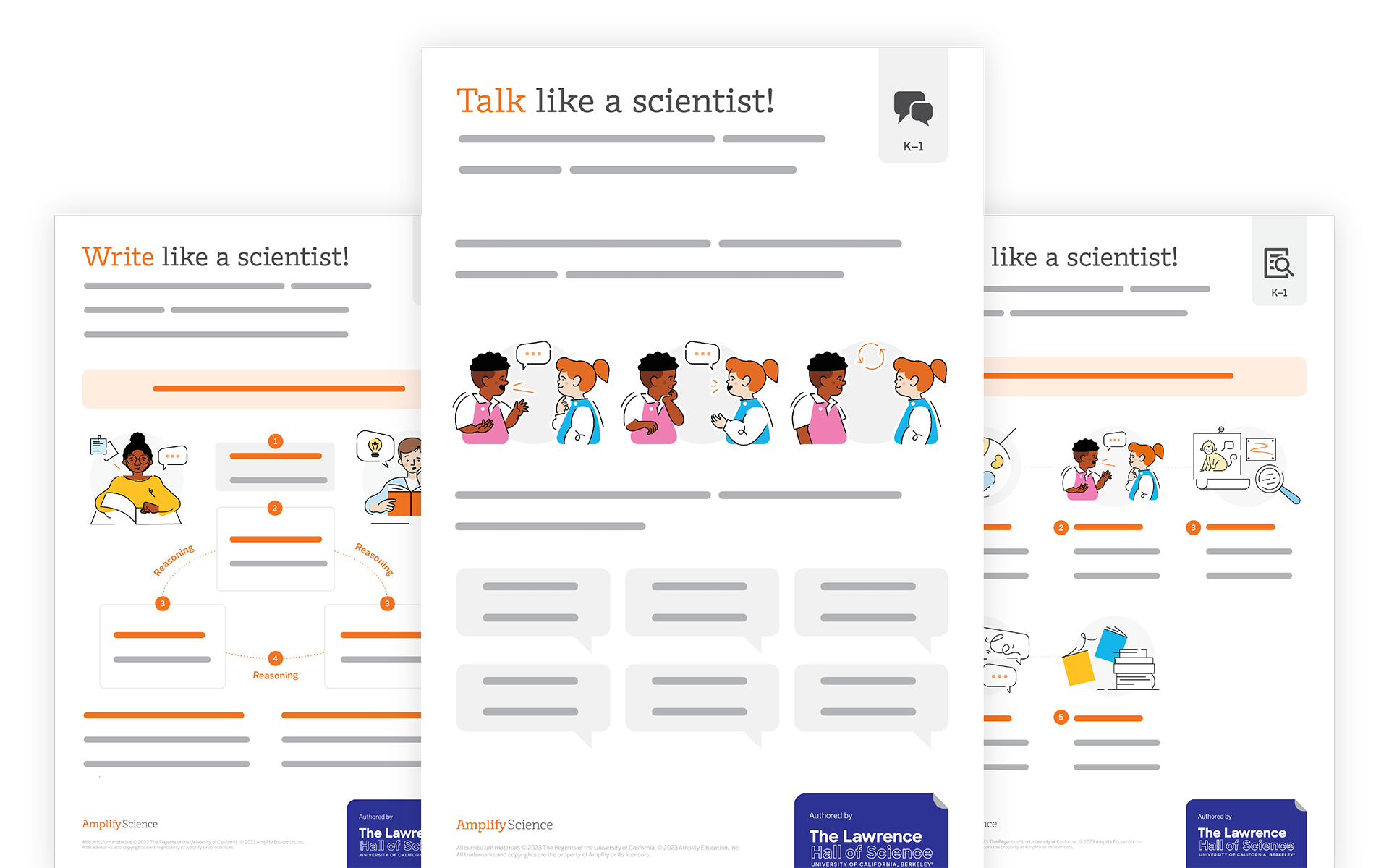

S3 – 06. Bethany and Dan take on Twitter!

In this episode, Bethany and Dan take a look at several tweets that caught the most fire on Twitter during the 2021-2022 school year. The pair answer questions about viral teaching methods, the best teaching advice you can give in three words, and if students should use pencils or pens in class. Join them as they take on those questions and several others in a fast-paced episode.
Explore more from Math Teacher Lounge by visiting our main page.
Dan Meyer (00:02):
Hey folks. Welcome back to the Math Teacher Lounge. I’m your co-host, Dan Meyer.
Bethany Lockhart Johnson (00:07):
And I am Bethany Lockhart Johnson. And I’m your co-host, Dan! Hi!
Dan Meyer (00:12):
We’re co-hosts! Hey! Great to see you.
Bethany Lockhart Johnson (00:13):
Dan, this is the last episode of Season 3. Three seasons!
Dan Meyer (00:19):
It’s gotta have a cliffhanger. What will the cliffhanger be? You know?
Bethany Lockhart Johnson (00:22):
The cliffhanger is that we love having guests! It’s one of our most favorite things, because selfishly, we love to talk to all of these amazing folks who are doing this interesting research and thinking about amazing things. But for this last episode, it’s just you and I, Dan. Cliffhanger!
Dan Meyer (00:40):
Yeah. I like this. I like this. So the cliffhanger was last episode, and people are all like, “So who’s the last guest gonna be of the season before we roll out into summer?” And yes, as Bethany said, we love all the fascinating guests we’ve had on throughout these last few seasons. And we realized…who is more fascinating to each other than both of us? You know, let’s talk to each other about things, right? <Laughs> You get that! You get that! Or am I alone here in this? We had this idea about what we should talk about here, and that’s this: I am on Twitter a lot. I’m @DDMeyer on Twitter; throw me a follow; might follow back; who knows? I don’t tweet much. Bethany, what’s your handle on Twitter? Let ’em know.
Bethany Lockhart Johnson (01:22):
I’m @LockhartEdu, and I was much more active pre-mamahood. But I’m still up in there. Go ahead.
Dan Meyer (01:30):
Yep. In there. Yeah, great. So I’ve been keeping track of the hottest conversations in math education Twitter, the conversations that the most people who kind of describe themselves as math teachers in their bios and whatnot have been replying to. We’ve got some little things working in the background, keeping track of this sort of thing. And so we are gonna bring you folks some of those extremely hot conversations, and even better than the questions—which we hope you’ll reply to and tag us in your replies—even more than those questions, we’ll bring you our answers—our answers!—to those questions. Can you believe that? We’ll fully settle these questions! Won’t we, Bethany? My gosh, won’t we?
Bethany Lockhart Johnson (02:15):
Jeez Louise! No! Dan Meyer, the point is not our final word on it! The point is this episode, we’re furthering the conversation. We wanna hear from listeners about what do you think?
Dan Meyer (02:25):
Right. You’re right. You all need someone in your life like Bethany who will help you become the best version of yourself. So here’s the deal. We have several questions in a few different categories. We’re gonna bust through some quick ones, pretty quick. And, uh, there’s some meaty ones as well. Let’s get into it! The first questions come to you all, and us, courtesy of MTL guest Howie Hua, who has a renowned knack for just creating math memes, but also conversation starters that really capture the curiosity and answers of of a grateful nation. So Howie’s first question, which I’ll pose to Bethany, is, “What’s your favorite number?” Bethany? And why is it your favorite number?
Bethany Lockhart Johnson (03:14):
Oh, I love it. OK. Well, the first thing that came to my mind is 12. ‘Cause It’s a highly divisible number. I mean, 2, 6, 3, 4—I love it. And it coincides with the day and month of my birth. Which, like, the double-digit…come on, 12, 12, 12, 12. I dunno, am I giving away, like, my bank security code <laugh> or anything by saying that?
Dan Meyer (03:41):
Yeah. What’s your favorite PIN?
Bethany Lockhart Johnson (03:43):
Let me change my PIN. Yeah, it’s just such a happy, happy number. Well, 12 is, you know, 10 and 2. Two more. Anyway. Love it. What about you, Dan? What’s your favorite number and why?
Dan Meyer (03:55):
I’m into it. I’m into it. I think I would choose 16. Because it’s the first number for me when it was like, “Oh, you can keep on making numbers forever!” Where I’m like, OK, 2times 2 is 4. Great. That’s kind of an elemental expression in mathematics. Four times 2 is 8. OK. But then, 8 times 2 is 16, and it’s like, “Oh, you can just keep doubling that thing over and over and over again!” And I can recall feeling pretty excited that numbers are just like, out there for the finding. For the taking. Cool stuff.
Bethany Lockhart Johnson (04:33):
I’m sorry. Wait, I have to interrupt. You went 2 times 4 is 8 and you didn’t go 4 times 4 is 16? You went 8 times 2 is 16? You wanted to keep the 2 the same?
Dan Meyer (04:49):
Yup. Yup. You can keep on doubling. You can keep on doubling numbers and it just keeps on going.
Bethany Lockhart Johnson (04:53):
More evidence that our brain works very differently.
Dan Meyer (04:56):
We learn more about each other…let me keep this rolling with Howie questions. OK? Howie says, “If you could co-teach with one teacher from Twitter, who would you choose?”
Bethany Lockhart Johnson (05:06):
Oh, oh, it has to be a teacher?
Dan Meyer (05:11):
Or anybody, I guess. I mean, like, I know you love Oprah.
Bethany Lockhart Johnson (05:15):
Can I co-teach with Oprah?
Dan Meyer (05:16):
Yup, yeah, so there we are. <Laugh> Yup. OK. Fair enough. We have to work Oprah into every single episode.
Bethany Lockhart Johnson (05:23):
I’d just love to sit and like, we’d read together, we’d read to the students, and then we’d talk…I mean, obviously it’d be Oprah. But if we’re thinking more of like MTBoS, like math Twitter blogosphere-land, I suppose the person I would wanna co-teach with honestly would probably be Allison Hintz. One of our former guests as well. Her book, Mathematizing Children’s Literature, with Antony Smith, that book—I just love the idea of sitting and doing a read-aloud and then diving into some juicy math that’s inspired by what comes out of that read-aloud. So yes, that’s who I pick. Allison! Let’s co-teach!
Dan Meyer (06:00):
<Laugh> Shout-out to Allison.
Bethany Lockhart Johnson (06:01):
What about you?
Dan Meyer (06:03):
I would choose MTL guest Idil Abdulkadir—because, and this relates to Allison and also Elham Kazemi—they talked about, in our episode about teacher time-outs. And I’m choosing someone who I think is—like I’ve never seen Idil teach, but I work with Idil at Desmos and think she’s fantastic. But what I really want in a co-teacher is someone that I can say, “Whoa, time out, do you see what’s going on here? This is really interesting. What should we do next about this?” And have a little strategy sesh in front of the kids and no one gets freaked out by that. And I think that that’d be a pile of fun. Idil seems like she’d be receptive to that kind of interaction, teacher to teacher. So that’s my vote right there.
Bethany Lockhart Johnson (06:48):
Opportunity for you to grow your own practice, Dan.
Dan Meyer (06:52):
Yeah, yeah, exactly. 100%.
Bethany Lockhart Johnson (06:56):
So Dan, I actually have a question for you from Howie. If we’re on the Howie tweet train, I have one from Howie too.
Dan Meyer (07:04):
Howie had some fire tweets, some fire tweets this current year. Yep.
Bethany Lockhart Johnson (07:08):
Dan, I wanna know: Do you prefer doing math in pen or pencil?
Dan Meyer (07:16):
Ooh, yeah. Oh, I see that Howie says, “I don’t mean to start any drama, BUT,” and then asks the question–
Bethany Lockhart Johnson (07:23):
But!
Dan Meyer (07:24):
I think that Howie lives for drama. I think he knows he’s messy. He lives for drama. He knows what he’s doing this with this question here. He knows.
Bethany Lockhart Johnson (07:32):
DRAAAAMAAAA!
Dan Meyer (07:32):
He knows what he’s doing. Yup. So I would just say it depends. Is that cheating? Like if I’m doing math to learn, or if we are learning in that process, then I want to use pen, actually. I wanna see the tracks of the thinking. And if we’re doing it for presentation, like if I’m presenting something, I wanna…I guess that’s an area where I’d be fine to not erase things. I don’t wanna prep it so it’s, you know…I guess you could use pen for presentation also. Just pen. Period. But I wanna see the tracks of the thinking if we’re doing some learning versus presentation. What about you?
Bethany Lockhart Johnson (08:09):
Well, I heard the voice in my head telling one of my kindergartners, “No, you cannot do that in sparkly pen. You need to do it in pencil.” And I was like, “Wait, whose voice is that?” It was one of my math teachers telling me I couldn’t do it in pen! Why couldn’t this kid do it in pen? Sure! Do it in a sparkly pen! So I wanna say do it in pen. And since usually pen is what I have around…I mean, I do crosswords in pen, Dan.
Dan Meyer (08:36):
Wow, wow. With a piece of paper and math, you have lots of room to re-revise and cross off…but those little, little boxes on the crossword, that says a lot about your commitment to pen.
Bethany Lockhart Johnson (08:46):
I got really good at making an A into an H or a P or whatever we need. So I would say, “Hey, if you’re in the room with your kiddos and you’re doing math, if somebody wants to do pen, let them do pen.” But I do know that I’ve seen teachers say you need to do pen so that I can see all of your thinking. So I think I hear what you’re saying. But do you think it should be like a classroom rule or something?
Dan Meyer (09:13):
Oh, no, no, no. I mean, I’m gonna ask you like, “How’d you get to this destination?” And I wanna know process somehow, and I think you’ll get tired of having to explain it verbally rather than just, like, showing. Just don’t erase stuff. Don’t scratch stuff off. Let’s let’s see how you’re getting there. That is what I’m into.
Bethany Lockhart Johnson (09:30):
Thanks, Howie, for that trio of thought-provoking tweets, because I genuinely wanted to know what Dan thought and what our listeners think. I mean, Dan, I gotta say: Howie, you say you don’t wanna cause drama, but I gotta say I’m with Dan on that—
Dan Meyer (09:50):
Got the gift. Got the gift for drama. We’re still friends though. So I’m happy about that. Our next section, I got a few more questions queued up here and these ones relate to advice for educators, advice for yourself. Good advice, bad advice, that kind of thing. So let’s jump in. I would love to know—this one’s from Pernille Ripp—I’m very curious, Bethany, what is the worst teaching advice you have gotten in your life, ever?
Bethany Lockhart Johnson (10:19):
<Laugh> Ooh. OK. Um, worst teaching advice was: “That’s OK, just move on anyway.” And that was in terms of pacing. It was like, students needed to do a deeper dive and the teacher who I was chatting with said, “No, no, it’s fine; it’s fine; just move on. Just move on to the next chapter.” That was probably the worst advice, because no, I don’t think that’s what I should have done at all! <Laugh>
Dan Meyer (10:48):
Right.
Bethany Lockhart Johnson (10:48):
But I was a first-year teacher and I was trying to figure it out. And I learned that that was not good advice. And I understand the pressure of pacing. But it was totally antithetical to the type of listening to my students that I want to do in my craft. And this teacher meant well, but that was not good advice, teacher! <Laugh> What about you, Dan? What is the worst teaching advice?
Dan Meyer (11:13):
I dig that. That feels similar to one of the replies to Pernille here. Frances Klein says, “Never let them know you’ve made a mistake” being particularly bad advice. You know, just this like idea of like moving along, covering your tracks, not backtracking or admitting mistakes, those all feel kind of a piece. The worst advice I think I’ve ever received, and I wasn’t given this often, but it’s echoed by a lot of the commenters here on this tweet, which is “Don’t smile until X, Y, or Z,” where X, Y, and Z are like Christmas, October, December, January. Just the idea that you’ve gotta develop—
Bethany Lockhart Johnson (11:54):
Wait, what?
Dan Meyer (11:55):
<Laugh> Did you never hear this from anybody? Don’t smile until Christmas? Perhaps this is more—
Bethany Lockhart Johnson (11:59):
I’m a kindergarten teacher! Can you imagine? If I don’t smile the second they walk in? The tears?! The parents’ tears?! The kids’ tears?! If I’m just like, stoic?
Dan Meyer (12:07):
Yeah. Well.
Bethany Lockhart Johnson (12:08):
So explain it to me.
Dan Meyer (12:10):
Well, the idea is, is that, you know, for older kids, they’re scoping you, they’re clocking you for weakness, they’re looking at you, they’re looking to take advantage. And so “don’t smile until Christmas” is like, hey, you can always relax. You can always relax your discipline, but you can’t UN-relax it if you start out, you know, Mr. Happy Pants Meyer. Which—
Bethany Lockhart Johnson (12:33):
Smile perceived as weakness.
Dan Meyer (12:36):
Yeah. Very obviously poor advice. Eventually you come to realize that like having a rapport and a relationship that is trusting and warm and demanding, that has high expectations, that’s the best kind of classroom management. Not some kind of persona built around intimidation or stoicism, that kinda thing. So, terrible, terrible advice!
Bethany Lockhart Johnson (13:01):
I feel like I did have a few of those math classes. Yeah.
Dan Meyer (13:04):
Yeah, exactly. <Laugh> You loved them, right? They were like your favorite math classes. It was a blast, right?
Bethany Lockhart Johnson (13:11):
<Laugh> So we have to ask the opposite. Thank you, Daniel Willingham, who said, “What’s the best advice you got?” But hold on, Dan, he didn’t just want the best advice. He wanted the best advice in three words.
Dan Meyer (13:26):
Oh yeah. He doesn’t, he doesn’t want a book or dissertation or even a blog post or even a tweet. He wants just three words.
Bethany Lockhart Johnson (13:32):
I think maybe that might have been to me. <Laugh>
Dan Meyer (13:34):
This is someone who’s doesn’t have much time for this advice, wants it distilled down. I’m just obviously stalling here as I try to think about this. I don’t know, there’s just like so much nuance lost here. I would say, listen to students, listen to students. I can’t say more that, I guess. I guess I’m done. I can’t say more than that there. But you’re in a bad place if you’re not listening carefully to students. How about you?
Bethany Lockhart Johnson (14:04):
- Mine is “Ask…lots…questions.”
Dan Meyer (14:11):
Nice. ‘Cause I filled in the word! I filled in the word! I was able to kinda infer that. I did that. I got that.
Bethany Lockhart Johnson (14:17):
Wait, wait, wait, wait! I could have said many! Wait, I could have said “Ask many questions.”
Dan Meyer (14:22):
Strong, strong.
Bethany Lockhart Johnson (14:25):
So yeah. You know, no isolation, like don’t put yourself in a bubble. Ask, not just, not just your students, but the teachers! Ask a lot of questions. You don’t have to have it all figured out.
Dan Meyer (14:34):
Into it. Very much into it.
Bethany Lockhart Johnson (14:37):
Thanks. Daniel. Thanks, Pernille.
Dan Meyer (14:40):
Yeah. Daniel and Pernille, Both great questions there about advice, best and worst. Another fire tweet popped up earlier this year from Dr. Khristopher Childs, which was “Name one thing every educator should stop doing.”
Bethany Lockhart Johnson (14:57):
Oh, I don’t know. This kind of ties into my best advice about asking questions.
Dan Meyer (15:03):
Stop not asking questions?
Bethany Lockhart Johnson (15:06):
<Laugh> Avoid the isolation. I really love this idea of when we can, popping into each others’ classrooms, co-teaching, building this collaborative nature. Elham Kazemi, in our interview, talked about this idea of, like you said, the teacher time-outs, learning from each other. So I feel like if we could stop isolating ourself…and I don’t mean at lunch—sometimes you need to not be in the teacher lounge at lunch. Like if you need a minute, take the minute! But in general, as a practice, how can we not be isolated and instead be learning with, and from, each other? How can we stop the isolation? That’s what I would hope every educator would stop doing. What about you, Dan?
Dan Meyer (15:54):
I think that educators should…this is gonna require a little bit of elaboration. I think educators should stop taking responsibility for things that are not in their zone of influence. I think that as a society we are asking teachers to do more and more, to become more and more of a central fixture holding together with chewing gum and twine all the various parts of a student’s life. From their health, their fitness, emotional health, that we feed students at school. It becomes very tempting, I think, there’s a lot of pressures to blame outcomes, disparate and unjust outcomes later on in life, on teachers. And teachers should just flatly refuse. And to yeah, understand what the job has been set up to do. What it’s good for. And do that with excellence and intent and a lot of effort. And then not take responsibility for the rest of it.
Bethany Lockhart Johnson (16:53):
If I asked five different people about the definition of what a teacher should be doing, I would get five different answers. So I think it’s really interesting that you say that because yeah, many, many hats, which I think, yes, can lead to burnout. Can lead to all sorts of things. We’re asking schools to be all things to all, all people. Interesting. I’m gonna think about that more. I need to hear folks’ response on that, Dan.
Dan Meyer (17:18):
Mm-Hmm. I’m curious too. I mean, yeah, there are definitely things that are in teachers’ responsibility and some that are not. That’s a tough one.
Bethany Lockhart Johnson (17:26):
OK, for help, name an example of each. And what’s something that you think every teacher should not and should be doing. ‘Cause I feel like my brain goes to some things like, you know, I had teachers who were saying, “Well, I don’t wanna have my kids have to have breakfast in my classroom in the morning. That shouldn’t be my responsibility to serve breakfast in the morning.” But I’m like, “But then your kids are eating and they’re gonna be able to learn and be more focused.” Should that be the teacher’s responsibility? I’m not saying it necessarily should, but I’m saying…I don’t know. It gets murky for me.
Dan Meyer (18:06):
Yeah, for sure. I mean, I think that we should, as a country, have a really generous social welfare net so that everyone has food at home. Where a school is not the place where some students have to go to in order to receive nutrition and nourishment. That seems sad to me. And uncommon in developed nations. I think that teachers should watch out for, should be responsible for, the mathematical development of the students they teach, up to a point, they should be responsible for learning math and creating relationships in their classes. I don’t think that teachers should accept responsibility for larger kinds of outcomes, like the health of a democracy or international competition, who goes to the moon first. That kind of thing has historically been placed at the feet of teachers. And it’s tempting when you’re a teacher, I think, to take on that responsibility because it kind of develops your social importance. And I just say, we should say no to that. And get compensation, not in terms of social importance, but rather like in spendable dollars and monies.
Bethany Lockhart Johnson (19:10):
I’m learning more about you, Dan. And you know, this is what I’ve gotten from that answer: If you’re gonna dream, dream big. Right?
Dan Meyer (19:17):
Is that what you got from that? I don’t know. I think I’m trying to dream realistically.
Bethany Lockhart Johnson (19:23):
No, like if we’re gonna say, “Maybe teachers shouldn’t be responsible for serving breakfast in the morning,” well, because we want every child to have access to nutritious and filling food at home and time to eat it in the morning, right? It’s bigger than just, “I don’t want the teacher to have to do this.” So we’re dreaming big. We’re saying this should be the LEAST that students have access to, right?
Dan Meyer (19:53):
Yeah. Yeah. I’m here now. I’m with you. I like that dream. Where we take care of folks in their lives outside of schools. So schools don’t have to be the one linchpin for every kind of social outcome. Like currently a lot of them run through a school ’cause we don’t do a good job of setting up other ways to meet those needs. And we should.
Bethany Lockhart Johnson (20:16):
And we’re also recording this in, what, two weeks, a week, after a tragedy where students and teachers were killed in the classroom. And I think both of us are taking some deep breaths and recognizing that there’s a lot of debate that is happening about what teacher’s role should be in preventing this in the future. And I don’t know if you’ve done drills in your classroom that are supposed to help mitigate disaster, but you know—collective deep breaths— <laugh> is where we’re at right now.
Dan Meyer (20:52):
Yep. The idea of “we should arm teachers” is another example of no, we should not do that. We should solve the tendency towards violence outside of the classroom so that teachers and students can teach and learn. That sounds awesome to me.
Bethany Lockhart Johnson (21:06):
Collective deep breath. Whew. OK. So what else you got for me, Dan?
Bethany Lockhart Johnson (21:33):
Ooh. So I feel like I’ve heard that in many teaching PDs. “I Do, you do, we do.” Actually I feel like I’ve seen like more “I do, we do, you do.” Like graduated release. I do it, then we’ll do it a little bit together, and then now you have permission to do it. And I feel like in directed draw, that’s a hundred percent true. Like I’m gonna show you this and then you draw it. And then you cut here and then you do it. If we’re trying to create this, like I’m teaching this new art technique. But in mathematics, I feel like that’s really not what I want my classroom to look like. I want to support my students and set them up for sense-making, and then I want them to try it out and I don’t want them to solve it the way it first comes to mind for me. I wanna see how they make sense of it and how they solve it. And then I want us to share it with each other so we can grow together. So I think time and place for “I do, you do, we do,” or “I do, we do, you do.” Or shoo-be-doo-be-doo-be. Yeah. You?
Dan Meyer (22:44):
I’ve got nothing. I have nothing to add. I thought that was just an excellent summary of a classroom I would love to be a part in, love to teach. I think it’s a certain tool in the toolbox that I think is overused. But it’s also a tool that can be useful in the case of certain kinds of operations. There are some operations that do benefit from “let me just show you how, like one way you might do this.” I don’t know. I’m like helping my kid whack a nail into a board and there’s a moment where it’s like, “Hey, actually, lemme just show you one way you can do this,” and do it, and then that’s helpful in some moments. But for so much of math, a lot of math does not relate to the operational kinds of fluency. And in those instances, it’s a little bit…it’s not a useful tool, I don’t think, for those kinds of skills and ideas.
Bethany Lockhart Johnson (23:34):
I’m thinking of tool talks in my classroom. So in kindergarten, many of the tools that we use in math and just in class in general, are new to the students. And if I tell them, this is exactly how you should use this tool, then I feel like I’m taking a lot of the sense-making away from them. But if I introduce the tool, show them how to use the tool safely, show them this is not a safe way to use the tool, chewing on this is not safe. That’s not how we use this tool. This is how we take care of it, et cetera. But then support different modes of using the tool that are gonna help them use it to solve problems and make sense, I think…but I guess—Dan, have you heard “I do, you do, we do,” or is it “I do, we do, you do”?
Dan Meyer (24:22):
I’m with you. And I think that it got clarified post-tweet. But yeah, it typically is “I do, we do, you do,” the gradual release of responsibility it’s often called. And I, I have heard people do what you described, which is…what is it? It’s “You do, we do, I do”? Like an inversion of that? Like have people do a thing that I can do that’s not too, too abstract for them, and then like “We all do something together, and then I’ll offer a summary of what we learned,” is one way that goes. I like that tool as well.
Bethany Lockhart Johnson (24:53):
I think particularly, at least I’ve seen in elementary classrooms, there’s sometimes this fear of letting students just try it out before I’ve really showed them, “but this is how it has to be.” And what I am most excited about is supporting students and creating a classroom environment where students don’t need my permission or need my direct “this is the only way to do it.” Instead, it’s like, yes, there’s lots of things we model. But there’s also like, “Hey, what do you think? How do you think this should be used?” And the joy of that exploration.
Dan Meyer (25:30):
Yeah. There’s a feeling of efficiency that comes from “I do, we do, you do,” for some kinds of math, but it’s undercut in my experience by what it cultivates in the students, which is “I’ve gotta wait until the teacher does before I can do anything.” So it pays off real diminishing returns over time. And it’s, just for me, an exhausting way to teach. Always being the bottleneck for new learning is a total drag.
Bethany Lockhart Johnson (25:55):
Ooh, what a great way to describe it. You do not wanna be the bottleneck. You want to be…what’s the other thing? The facilitator? What’s the opposite of a bottleneck? The flowing river? The…The…Help me!
Dan Meyer (26:10):
Hit us up in the replies. I dunno. The opposite of a bottleneck. That’s what you wanna…you wanna not be the opposite? No, you want, yeah. We got this here. We’ll figure it out. We’ll get back to you. <Laugh> OK. Well, folks, those were a few of this year’s fire tweets. It’s been fantastic chatting with you—
Bethany Lockhart Johnson (26:29):
Dan.
Dan Meyer (26:29):
—Bethany, About all those—
Bethany Lockhart Johnson (26:32):
Dan. You know, my favorite thing to do is interrupting you, Dan. I have to interrupt you because we can’t end fire tweets, Dan, without including a tweet from you.
Dan Meyer (26:43):
Oh, that’s true. I do have my moments. Yeah, we should. We really should. <Laugh> Do you have one in mind?
Bethany Lockhart Johnson (26:50):
No. Dan. Yes. I loved…you tweeted recently, “How many years have you been teaching?” Which, OK. “What Has been like the most influential? Like, what, OK, blah, blah, blah.” <blathering noises> You tweeted, “How many years have you been teaching? And at this point, what has most influenced how you teach?” And you gave some ideas: A methods course, PD sessions, curriculum, TV and movies, et cetera, et cetera. And I love that you put that out there because this episode is coming out as we’re wrapping up another school year. And it also got me thinking about summer and what teachers sometimes do during the summer, but what we might need to do this summer for self-care. But I’m really curious. I love that tweet. And I’m curious, Dan, what did folks say was the thing that had most influenced their teaching and what’s most influenced your teaching?
Dan Meyer (27:49):
Ooh, yeah. People’s responses to this one were really fantastic. I came into this, I was flying to the Association of Mathematics Teacher Educators conference. And I just found myself wondering, so, the pre-service year, the one year of, like, you’re learning how to teach, is how we did it in California. Like how much of that has still infused my practice? And in what ways? I don’t think I think about that stuff consciously, but I think that did like set me up with a lot of images that I would be unpacking for going on two decades now working in education. I think conversations with people, I think observing classes, I don’t think that like the one-day PDs, the one-day development days throughout the year, four times per year, I don’t think those stuck to me much. I think that this summer, I have learned so much, just an embarrassment of riches, from non-educational sources. From other disciplines. From storytelling, for instance. From how people have constructed movies I like. I am proud of the way…one of the aspects of my character that I’m proud of—it takes a lot to admit this, as I’m sure you understand, Bethany—but to integrate lots of wacky stuff and pick from it and use that to affect my practice and teaching has been really positive. So for this summer, I hope that people read a good beach book and just kinda let your teaching mind rest a little bit. And in doing so, create some openings for new ideas about education from other parts of the world. Kids! Having kids has been helpful. I don’t know! Just everything! It’s such a big job, education. Everything has so helpful. What about you? What’s an influence on your practice that might surprise me or other folks out there in MTL land?
Bethany Lockhart Johnson (29:52):
Well, I don’t know about surprise. I mean, I definitely feel similarly, like methods courses absolutely impacted my teaching. But I feel like opportunities where I was able to observe other teachers and where I was able to have conversations with folks about their practice, that has deeply impacted me. And books I’ve read. I mean, honestly, I’ve learned so much from sharing with other teachers. Like, for example, maybe I’ll bring student work and we’ll talk about it. And we kind of create this conversation together about how we wanna come back to the students based on the work we see. Those type of moments where we’re collaborating and we’re bringing multiple perspectives to the table, that I think, has really often shifted me out of my first initial reaction or what I thought I was going to do in the classroom the next day. So that continues to surprise and delight me. And thinking about this summer, I think there’s a lot of creativity and joy that can come out of the marination process, when you’re just kind of sitting back and healing yourself, whether through sleep or sunshine or time with friends and family or whatever that looks like for you. I think there’s a lot of creativity that can come from that place of fertile, you know, wellness. I never think of that as wasted time. I think of that as getting the soil ready for all that’s gonna come in the fall. And that being said, I also think it could be a fun time to dip your toes into something that you are excited to read, that you might not have a chance to read during the school year that could be teaching-related. So it’s like very low pressure, like, “Oh, I’ve really wanted to read more by this author. I’ve wanted to read this article. I’ve wanted to dip into this topic.” And not with a pressure, but just with a curiosity. And, yeah, I think so often we as teachers love learning, and to give yourself space to learn in whatever that looks like can be a real gift.
Dan Meyer (32:09):
Yes. And if you need book recommendations, hit the MTL back catalog of episodes. Loads of folks that we interviewed have real good books out.
Bethany Lockhart Johnson (32:16):
Yes!
Dan Meyer (32:16):
Think about it. Think about it.
Bethany Lockhart Johnson (32:22):
One quick recommendation: Again, gotta plug Antony Smith and Allison Hintz’s book. I read Mathematizing Children’s Literature before we did the interview, but this summer I wanna read all the children’s books that they mention. I just wanna go to the library and read all those children’s books. I wanna read them to my son. I wanna read ’em to myself. So, you know, diving into some good YA, children’s books, just, like, TLC. Dan, thank you for such a rich season and a chance to have so many interesting conversations. It is genuinely a joy to learn with and from you.
Dan Meyer (33:00):
Likewise. And always hope to see you folks on Twitter now and then. Let us know what you’re up to this summer at MTLShow on Twitter or in our Facebook group, Math Teacher Lounge. We’ll be there tuning in now and then. It’s been a treat interacting with you folks over this last season. Take care and until the new season, so long.
Stay connected!
Join our community and get new episodes every other Tuesday!
We’ll also share new and exciting free resources for your classroom every month.
Meet the guests
Dan Meyer
Dan Meyer taught high school math to students who didn’t like high school math. He has advocated for better math instruction on CNN, Good Morning America, Everyday With Rachel Ray, and TED.com. He earned his doctorate from Stanford University in math education and is currently the Dean of Research at Desmos, where he explores the future of math, technology, and learning. Dan has worked with teachers internationally and in all 50 United States and was named one of Tech & Learning’s 30 Leaders of the Future.
Bethany Lockhart Johnson
Bethany Lockhart Johnson is an elementary school educator and author. Prior to serving as a multiple-subject teacher, she taught theater and dance and now loves incorporating movement and creative play into her classroom. Bethany is committed to helping students find joy in discovering their identities as mathematicians. In addition to her role as a full-time classroom teacher, Bethany is a Student Achievement Partners California Core Advocate and is active in national and local mathematics organizations. Bethany is a member of the Illustrative Mathematics Elementary Curriculum Steering Committee and serves as a consultant, creating materials to support families during distance learning.
About Math Teacher Lounge: The podcast
Math Teacher Lounge is a biweekly podcast created specifically for K–12 math educators. In each episode co-hosts Bethany Lockhart Johnson (@lockhartedu) and Dan Meyer (@ddmeyer) chat with guests, taking a deep dive into the math and educational topics you care about.
Join the Math Teacher Lounge Facebook group to continue the conversation, view exclusive content, interact with fellow educators, participate in giveaways, and more!
You might also like:
Professional development for multi-program suites
Amplify professional development provides learning experiences that intentionally develop the knowledge and skills you need for effective and self-sustaining implementation.
Now you can learn and apply impactful instructional techniques and develop a deeper understanding of the suite of Amplify programs.
Amplify professional development has been vetted by Rivet Education’s team through a rigorous three-step process and is listed in the Professional Learning Partner Guide.

Amplify suites
Each of Amplify’s high-quality, research-based programs is designed to help you teach inspiring math lessons that celebrate and develop your students’ brilliance. When used together, our comprehensive math suite provides even greater support and coherence for every student across your curriculum.
Contact your account executive to discuss PD options or request a quote.
Math
Amplify Desmos Math with mCLASS Math assessments and Boost Personalized Learning combine the best of problem-based lessons, intervention, personalized practice, and assessment into a coherent and engaging experience for both students and teachers. With the full suite, teachers gain access to all the tools they need to inspire and motivate all learners in math class.
Empower educators with:
- High-quality professional development
Comprehensive PD sessions equip teachers with the skills and knowledge necessary for effective program implementation, enhancing instructional practices and boosting student outcomes. These sessions support educators in leveraging the full suite of Amplify’s K–5 math programs, ensuring seamless integration and maximizing classroom impact. - Core instruction for grades K–12
Amplify Desmos Math lessons provide a structured approach to problem-based learning, helping teachers create a collaborative math community with students at its center. Each lesson systematically builds on students’ curiosity to develop lasting grade-level understanding for all students. Available in English and Spanish. - Integrated personalized practice
Personalized Learning activities help students access grade-level math through engaging, independent digital practice. Responsive FeedbackTM adjusts to students’ work, providing item-level adaptivity to further support their learning. - Screening and progress monitoring
mCLASS Assessments, along with daily formative checks, measure what students know and how they think. The asset-based assessment system provides teachers with targeted, actionable insights, linked to core instruction and intervention resources. - Embedded intervention
Integrated resources like Mini-Lessons, Fluency Practice, and Math Adventures provide targeted intervention on a specific skill or concept connected to the daily lesson. Extensions are also available to stretch students’ understanding.
Each suite package will include:



Begin packages for grades K–5, 6–A1, or high school
Launch sessions
| On-site package (22 hr.) |
Hybrid 22, on-site package (22 hr.) |
Hybrid 17 package (17 hr.) |
Hybrid 22, virtual package (22hr.) |
Virtual package (14 hr.) |
|
| One Launch session per package | On-site, 6 hr. |
On-site, 6 hr. |
On-site, 3 hr. |
Virtual, 6 hr. (2 half-days) |
Virtual, 3 hr. |
| Amplify Desmos Math: Initial training for K–5, 6–A1, or high school teachers |
|
|
|
||
| Amplify Desmos Math: Program overview for K–5, 6–A1, or high school teachers |
|
|
| Suggested enhancements | ||
| Launch add-on | On-site or virtual, 3 hr. session | Amplify Desmos Math: Program overview for K–5, 6–A1, or high school leaders |
| Launch add-on | On-site or virtual, 3 hr. session | mCLASS Math 2nd Edition: Program overview for grades K–5 or 6–8 teachers |
Strengthen and Coach sessions
One Strengthen session and one additional Strengthen session (1 hr. Focus only) per package. Choose any of the following as a secondary Strengthen touchpoint.
| On-site package (22 hr.) |
Hybrid 22, on-site package (22 hr.) |
Hybrid 17 package (17 hr.) |
Hybrid 22, virtual package (22hr.) |
Virtual package (14 hr.) |
Virtual package |
|
| Strengthen | On-site, 3 hr. | Virtual, 3 hr. | Virtual, 1 hr. |
Virtual, 3 hr. | Virtual, 1 hr. | Virtual, 2 hr. |
| Amplify Desmos Math: Enhancing planning for K–5, 6–A1, or high school teachers |
|
|
|
|||
| Amplify Desmos Math: Enhancing practice for K–5, 6–A1, or high school teachers |
|
|
|
|||
| Amplify Desmos Math: Enhancing observations for K–5, 6–A1, or high school leaders | |
|
|
|||
| Amplify Desmos Math: Supporting all learners: Differentiation in Amplify Desmos Math for K–5 or 6–A1 teachers | |
|
|
|||
| Amplify Desmos Math: Teaching a lesson with digital student screens for K–5 teachers | |
|
||||
| Amplify Desmos Math: Unit-level planning for K–5, 6–A1, or high school teachers |
|
|
||||
| Amplify Desmos Math: Snapshots in the Teacher Dashboard for 6–A1 teachers | |
|
||||
| mCLASS Math: Leveraging assessment data to strengthen mathematical explanations for K–5 or 6–8 teachers | |
|
| Coach | On-site, 6 hr. |
On-site, 6 hr. |
On-site, 6 hr. |
On-site, 6 hr. |
Virtual, 3 hr. |
| Coach session |
|
|
|
|
|
| Suggested enhancements | ||
| Strengthen add-on | On-site or virtual, 3 hr. session | mCLASS Math + Boost Math: Understanding and using data to plan intervention for grades K–5 or 6–8 teachers |
| Strengthen add-on | On-site or virtual, 3 hr. session | Amplify Desmos Math: Supporting and facilitating meaningful discussions for teachers |
Launch session options
Propel your school or district into the new school year. Program-aligned Launch sessions introduce teachers and leaders to their unique Amplify program(s) and support a strong implementation.
Begin: Amplify Desmos Math: Initial training for K–5, 6–A1, or high school teachers
On-site, 6 hours
Initial training sessions are designed for educators who are new to our program. In our initial training session, educators are oriented to the key components of their program(s), including learning how to navigate, teach, and monitor student progress, while exploring content and program resources. Participants will leave the session with foundational knowledge and skills necessary to begin teaching with the program.
Session options: Amplify Desmos Math (Grades K–5, 6–A1, or high school)
Audience: Teachers, instructional staff (maximum 30 participants)
Begin: Amplify Desmos Math: Program overview for K–5, 6–A1, or high school teachers
On-site or virtual, 3 hours
Program overview sessions provide a basic introduction for educators who are new users of the program. In a program overview session, educators learn how to get started with the key features and materials of the program.
Session options: Amplify Desmos Math (Grades K–5, 6–A1, or high school)
Audience: Teachers, instructional staff (maximum 30 participants)
Suggested enhancement: Launch add-on: Amplify Desmos Math: Program overview for K–5, 6–A1, or high school leaders
On-site or virtual, 3 hours
Ideal add-on to Launch sessions
The Program overview for leaders supports district and school-level instructional leaders in effectively coordinating the implementation of the program. Leaders will learn the foundational elements of the program, build an understanding of the key teacher and student practices to look for in classrooms, and develop an implementation plan.
Session options: Amplify Desmos Math
Audience: Leaders (maximum 30 participants)
New session
Suggested enhancement: Launch add-on: mCLASS Math 2nd Edition Program overview for K–5 or 6–8 teachers
On-site or virtual, 3 hours
Dive into the essentials of your mCLASS Assessments. Learn how these assessments both highlight students’ strengths and help identify what’s next through an asset-based approach. Leave ready to administer assessments and understand reporting.
Session options: mCLASS Math (grades K–5 or 6–8)
Audience: Leaders (maximum 30 participants)
Strengthen session options
Strengthen your Amplify implementation with program-specific sessions that support personalized learning and practice in your classroom.
Amplify will partner closely with you to select the appropriate session(s) that will deepen educators’ understanding of Amplify program(s) and equip them with the tools they need to improve student’s learning outcomes. Each package includes one Strengthen session. Additional sessions can be added as Enhancements.
Begin: Amplify Desmos Math: Enhancing planning for K–5, 6–A1, or high school teachers
On-site or virtual, 3 hours
Dive into planning for Amplify Desmos Math, both big picture and day-to-day. Practice using lesson- and unit-planning protocols that will help you build a deep understanding of the math content you’ll be teaching and the planning resources available to you in the curriculum. Walk away with practical strategies for planning, even when you may not have much time.
Session options: Amplify Desmos Math (Grades K–5, 6–A1, or high school)
Audience: Teachers, instructional staff (maximum 30 participants)
Begin: Amplify Desmos Math: Enhancing practice for K–5 or 6–A1, or high school teachers
On-site or virtual, 3 hours
Dig into Amplify Desmos Math’s Launch, Monitor, Connect framework to level up the student discourse in your math class. Explore in-the-moment differentiation support to help you orchestrate discussion and make the most out of key opportunities for conversation and collaboration.
Session options: Amplify Desmos Math (Grades K–5, 6–A1, or high school)
Audience: Teachers, instructional staff (maximum 30 participants)
Begin: Amplify Desmos Math: Enhancing observations for K–5 or 6–A1 leaders
Virtual, 1 hour
Elevate your program knowledge to support teachers with effective Amplify Desmos Math implementation. Leave prepared to identify key instructional elements in a problem-based math lesson, analyze data, and conduct effective classroom observations.
Session options: Amplify Desmos Math (Grades K–5 or 6–A1)
Audience: Teachers, instructional staff (maximum 30 participants)
Begin: Supporting all learners: Differentiation in Amplify Desmos Math for K–5 or 6–A1 teachers
On-site or virtual, 3 hours
Learn how to use the differentiation supports in Amplify Desmos Math to effectively support all learners, both in the moment during a lesson and beyond the lesson. Leave with a plan for implementing resources to support, strengthen, and stretch students’ thinking.
Session options: Amplify Desmos Math
Audience: Teachers, instructional staff (maximum 30 participants)
Begin: Strengthen Focus: Amplify Desmos Math: Teaching a lesson with digital student screens for K–5 teachers
Virtual, 1 hour
Get ready to facilitate digital lessons with your students. Explore what’s possible with the Teacher Dashboard and plan to make the most of these exciting instructional moments.
Session options: Amplify Desmos Math (K–5)
Audience: Teachers, instructional staff (maximum 30 participants)
Begin: Strengthen Focus: Amplify Desmos Math: Unit-level planning for K–5, 6–A1, or high school teachers
Virtual, 1 hour
Dive into unit-level planning to learn the story of your upcoming unit, and discover the big ideas you will explore alongside your students in Amplify Desmos Math.
Session options: Amplify Desmos Math (Grades K–5, 6–A1, or high school)
Audience: Teachers, instructional staff (maximum 30 participants)
Begin: Strengthen Focus: Amplify Desmos Math: Snapshots in the Teacher Dashboard for 6–A1 teachers
Virtual, 1 hour
Explore how to use the Snapshots tool in the Teacher Dashboard to create a collaborative classroom that invites and celebrates student thinking. Leave with planning tips and tricks that will get you ready to use Snapshots during your busy math classes.
Session options: Amplify Desmos Math (Grades 6–A1)
Audience: Teachers, instructional staff (maximum 30 participants)
Begin: Strengthen Focus: mCLASS Math: Leveraging assessment data to strengthen mathematical thinking for grades K–5 or 6–8 teachers
Available for grades 6–8 teachers Oct. 2026
Virtual, 1 hour
Dig into mCLASS Math to reveal what students understand about mathematical concepts, and give them the tools to become more clear and confident communicators in math class.
Session options: mCLASS Math (Grades K–5 or 6–8)
Audience: Teachers, instructional staff (maximum 30 participants)
New session
Suggested enhancement: Begin: mCLASS Math and Boost Math: Understanding and using data to plan intervention for grades K–5 or 6–8 teachers
Available for grades 6–8 teachers Oct. 2026
On-site or virtual, 3 hours
Ideal add-on Strengthen session
Explore how Boost Math uses mCLASS Math data to inform intervention recommendations and monitor student progress. Dig into your student data, explore relevant instructional resources, and leave with actionable next steps for intervention.
Session options: mCLASS Math (Grades K–5 or 6–8)
Audience: Teachers, instructional staff (maximum 30 participants)
New session
Suggested enhancement: Begin: Amplify Desmos Math: Supporting and facilitating meaningful discussions for K–5, 6–A1, or high school teachers
On-site or virtual, 3 hours
Explore how Boost Math uses mCLASS Math data to inform intervention recommendations and monitor student progress. Dig into your student data, explore relevant instructional resources, and leave with actionable next steps for intervention.
Session options: mCLASS Math (Grades K–5 or 6–8)
Audience: Teachers, instructional staff (maximum 30 participants)
Coach session options
Elevate instructional practice and help meet teachers’ and schools’ specific needs with customizable Coach sessions.
Coach session
On-site, 6 hours
Coaching sessions focus on building internal school and district capacity and leadership excellence. Coaching is customized to meet a school or district’s needs and can include model lessons, observations, walk-throughs, and/or co-planning.
Session options: Amplify Desmos Math (K–5 or 6–A1) and/or mCLASS Math (Grades K–5 or 6–8)
Audience: Individual teachers, grade-level teams, PLCs, and/or instructional leaders (maximum 30 participants)
Practice packages (grades K–5 or 6–8)
Launch sessions
| On-site package (16 hr.) |
Hybrid 16, on-site package (16 hr.) |
Virtual package (16 hr.) |
|
| One Launch session per package | On-site, 3 hr. | Virtual, 3 hr. | Virtual, 3 hr. |
| mCLASS Math 2nd Edition Program overview for K–5 or 6–8 teachers |
|
|
|
Strengthen and Coach sessions
| On-site package (16 hr.) |
Hybrid 16, on-site package (16 hr.) |
Virtual package (16 hr.) |
|
| One Strengthen and two Coach sessions per package | Virtual, 1 hr. | Virtual, 1 hr. | Virtual, 1 hr. |
| Amplify Desmos Math: Teaching a lesson with digital student screens for K–5 teachers |
|
|
|
| Amplify Desmos Math: Unit-level planning for K–5, 6–A1, or high school teachers |
|
|
|
| Amplify Desmos Math: Increasing engagement with instructional routines for K–5, 6–A1, or high school teachers | |
|
|
| mCLASS Math: Leveraging assessment data to strengthen mathematical thinking for grades K–5 or 6–8 teachers | |
|
|
| Coaching | On-site, 6 hr. | On-site, 6 hr. | Virtual, 3 hr. |
| Coach session |
|
|
|
| Suggested enhancements | ||
| Strengthen add-on | Virtual or on-site, 3 hr. | Amplify Desmos Math: Enhancing planning for K–5, 6–A1, or high school teachers |
| Strengthen add-on | Virtual or on-site, 3 hr. | Amplify Desmos Math: Enhancing practice for K–5, 6–A1, or high school teachers |
| Strengthen add-on | Virtual or on-site, 3 hr. | Amplify Desmos Math: Enhancing observation for K–5, 6–A1, or high school leaders |
| Strengthen add-on | Virtual or on-site, 3 hr. | Amplify Desmos Math: Supporting all learners for K–5 or 6–A1 teachers |
| Strengthen add-on | Virtual or on-site, 3 hr. | Amplify Desmos Math: Supporting and facilitating meaningful discussions for K–5, 6–A1, or high school teachers |
| Strengthen add-on | Virtual or on-site, 3 hr. | Amplify Desmos Math: Assessment in action: Analyzing data and reports and planning next steps for K–5 or 6–A1 teachers |
| Strengthen add-on | Virtual or on-site, 3 hr. | mCLASS Math and Boost Math: Understanding and using data to plan intervention for K–5 teachers |
Launch session options
Propel your school or district into the new school year. Program-aligned Launch sessions introduce teachers and leaders to their unique Amplify program(s) and support a strong implementation.
Practice: mCLASS Math 2nd Edition Program overview for grades K–5 or 6–8 teachers
On-site or virtual, 3 hours
Dive into the essentials of your mCLASS Math assessment program. Learn how these assessments both highlight students’ strengths and help identify what’s next through an asset-based approach. Leave ready to administer assessments and understand reporting.
Session options: mCLASS Math (Grades K–5 or 6–8)
Audience: Teachers, instructional staff (maximum 30 participants)
Strengthen session options
Strengthen your Amplify implementation with program-specific sessions that support personalized learning and practice in your classroom.
Amplify will partner closely with you to select the appropriate session(s) that will deepen educators’ understanding of your Amplify program(s) and equip them with the tools they need to improve students’ learning outcomes. Each package includes one Strengthen session. Additional sessions can be added as Enhancements.
New session
Practice: Amplify Desmos Math: Strengthen: Focus: Teaching a lesson with digital student screens for K–5 teachers
Virtual, 1 hour
Get ready to facilitate lessons with digital student screens. Explore what’s possible with the Teacher Dashboard and plan to make the most of these exciting instructional moments.
Session options: Amplify Desmos Math (K–5)
Audience: Teachers, instructional staff (maximum 30 participants)
Practice: Strengthen Focus: Amplify Desmos Math: Unit-level planning for K–5, 6–A1, or high school teachers
Virtual, 1 hour
Dive into unit-level planning to learn the story of your upcoming unit, and discover the big ideas you will explore alongside your students in Amplify Desmos Math.
Session option: Amplify Desmos Math (Grades K–5, 6–A1, or high school)
Audience: Teachers, instructional staff (maximum 30 participants)
New session
Practice: Strengthen Focus: Amplify Desmos Math: Increasing engagement with instructional routines for K–5, 6–A1, or high school teachers
Available Oct. 2026
Virtual, 1 hour
Explore how to use the instructional routines in Amplify Desmos Math to support and engage students as they make sense of new contexts, develop mathematical language, and solve problems.
Session option: Amplify Desmos Math (Grades K–5 or 6–A1)
Audience: Teachers, instructional staff (maximum 30 participants)
New session
Practice: Strengthen Focus: mCLASS Math: Leveraging assessment data to strengthen mathematical explanations for grades K–5 or 6–8 teachers
Available for grades 6–8 teachers Oct. 2026
Virtual, 1 hour
Dig into mCLASS Math to reveal what students understand about mathematical concepts, and give them the tools to become more clear and confident communicators in math class.
Session option: mCLASS Math (Grades K–5 or 6–8)
Audience: Teachers, instructional staff (maximum 30 participants)
New session
Suggested enhancement: Practice: Amplify Desmos Math: Enhancing planning K–5 or 6–A1 teachers
On-site or virtual, 3 hours
Dive into planning for Amplify Desmos Math, both big picture and day-to-day. Practice using lesson- and unit-planning protocols that will help you build a deep understanding of the math content you’ll be teaching and the planning resources available to you in the curriculum. Walk away with practical strategies for planning, even when you may not have much time.
Session option: Amplify Desmos Math (Grades K–5 or 6–A1)
Audience: Teachers, instructional staff (maximum 30 participants)
New session
Suggested enhancement: Practice: Amplify Desmos Math: Enhancing practice for K–5, 6–A1, or high school teachers
On-site or virtual, 3 hours
Dig into Amplify Desmos Math’s Launch, Monitor, Connect framework to level up the student discourse in your math class. Explore in-the-moment differentiation support to help you orchestrate discussion and make the most out of key opportunities for conversation and collaboration.
Session option: Amplify Desmos Math (Grades K–5, 6–A1, or high school)
Audience: Teachers, instructional staff (maximum 30 participants)
New session
Suggested enhancement: Practice: Amplify Desmos Math: Enhancing observations for K–5, 6–A1, or high school leaders
On-site or virtual, 3 hours
Elevate your program knowledge to support teachers with effective Amplify Desmos Math implementation. Leave prepared to identify key instructional elements in a problem-based math lesson, analyze data, and conduct effective classroom observations.
Session options: Amplify Desmos Math (Grades K–5, 6–A1, or high school)
Audience: Teachers, instructional staff (maximum 30 participants)
New session
Suggested enhancement: Practice: Supporting all learners: Differentiation in Amplify Desmos Math for K–5 or 6–A1 teachers
On-site or virtual, 3 hours
Learn how to use the differentiation supports in Amplify Desmos Math to effectively support all learners, both in the moment during a lesson and beyond the lesson. Leave with a plan for implementing resources to support, strengthen, and stretch students’ thinking.
Session option: Amplify Desmos Math (Grades K–5 or 6–A1)
Audience: Teachers, instructional staff (maximum 30 participants)
New session
Suggested enhancement: Practice: Amplify Desmos Math: Supporting and facilitating meaningful discussions for K–5, 6–A1, or high school teachers
Available Oct. 2026
On-site or virtual, 3 hours
Explore how to transform your mathematics classroom into a social and collaborative environment where students deepen their understanding by sharing their mathematical thinking. Learn more about how Amplify Desmos Math provides support for these meaningful mathematical conversations.
Session option: Amplify Desmos Math (Grades K–5, 6–A1, or high school)
Audience: Teachers, instructional staff (maximum 30 participants)
New session
Suggested enhancement: Practice: Amplify Desmos Math: Assessment in action: Analyzing data, reports, and planning next steps for K–5 or 6–A1 teachers
Available Oct. 2026
On-site or virtual, 3 hours
Deepen your understanding of the different types of assessments in Amplify Desmos Math and how they provide evidence of student learning. Analyze sample student work to calibrate on assessment scoring, interpret student thinking, and make a plan for instructional next steps.
Session option: Amplify Desmos Math (Grades K–5 or 6–A1)
Audience: Teachers, instructional staff (maximum 30 participants)
New session
Suggested enhancement: Practice: mCLASS Math and Boost Math: Understanding and using data to plan intervention for K–5 teachers
Available for grades 6–8 teachers Oct. 2026
On-site or virtual, 3 hours
Ideal add-on Strengthen session
Explore how Boost Math uses mCLASS Math data to inform intervention recommendations and monitor student progress. Dig into your student data, explore relevant instructional resources, and leave with actionable next steps for intervention.
Session option: mCLASS Math (Grades K–5 or 6–8)
Audience: Teachers, instructional staff (maximum 30 participants)
Coach session options
Elevate instructional practice and help meet teachers’ and schools’ specific needs with customizable Coach sessions.
Coach session
On-site, 6 hours
Coaching sessions focus on building internal school and district capacity and leadership excellence. Coaching is customized to meet a school or district’s needs and can include model lessons, observations, walk-throughs, and/or co-planning.
Session options: Amplify Desmos Math (Grades K–5 or 6–A1) and mCLASS Math (Grades K–5 or 6–8)
Audience: Individual teachers, grade-level teams, PLCs, and/or instructional leaders (maximum 30 participants)
Contact us
Ready to lock in your dates? Want to learn more about developing a professional development plan to meet your needs?
Amplify welcomes the opportunity to partner with you to design professional development plans to meet the needs of your staff. Whether you’re returning or new to Amplify program(s), we provide guidance in answering your questions and making package/session recommendations.
If you’d like to order professional development services, please contact your local Amplify sales representative or call (800) 823-1969.
Inspiring the next generation of Arkansas scientists, engineers, and curious citizens
Amplify Science is a proven effective core curriculum designed for three-dimensional, phenomena based learning that provides an immersive experience for students.
Amplify Science was developed by the science education experts at UC Berkeley’s Lawrence Hall of Science and the digital learning team at Amplify.

Grounded in Research
UC Berkeley’s Lawrence Hall of Science, the authors behind Amplify Science, developed the Do, Talk, Read, Write, Visualize approach, and gold standard research shows that it works. Our own efficacy research is pretty exciting, too.
Instructional model
The Amplify Science program is rooted in the proven, research-based pedagogy of Do, Talk, Read, Write, Visualize. Here’s how each element works:
DO
First-hand investigations are an important part of any science classroom, and Amplify Science has students getting hands-on in every unit, from building models of protein molecules to experimenting with electrical systems.
TALK
Student-to-student discourse and full class discussions are an integral part of the program. Students are provided with numerous opportunities to engage in meaningful oral scientific argumentation, all while fostering a collaborative classroom environment.
READ
Students read scientific articles, focusing their reading activities on searching for evidence related to their investigation and, importantly, on asking and recording questions as they read through fascinating texts on 21st-century topics.
WRITE
Following real-world practices, students write scientific arguments based on evidence they’ve collected, making clear their reasoning about how a given piece of evidence connects to one of several claims.
VISUALIZE
By manipulating digital simulations and using Modeling Tools to craft visualizations of their thinking—just as real scientists and engineers do—students take their learning far beyond the confines of what they can physically see in the classroom in an exciting and authentic way.
Explore the digital Teacher’s Guide
When you’re ready to review, click the orange button below and use your provided login credentials to access the Amplify Science Digital Teacher’s Guide.
If you need login credentials, contact your local Arkansas Account Executive, Marty Pitts, mpitts@amplify.com.
Instructional samplers
Resources to support your review
- What’s so phenomenal about phenomena? – ebook
- Phenomena in Grades K–5
- Phenomena in Grades 6–8
- Student Books in grades K–5
- Literacy-rich science instruction in grades K–5
- Active Reading in Grades 6–8
- Engineering in Amplify Science
- Program structure for grades K–5
- Program structure for grades 6–8
- Scope and Sequence for grades K–5
- Scope and Sequence for grades 6–8
What’s included
Flexible resources that work seamlessly together:
Science articles
The middle school science articles serve as sources for evidence collection and were authored by science and literacy experts at the Lawrence Hall of Science.
Student Investigation Notebooks
Available for every unit, the Student Investigation Notebooks provide space for students to:
- Record data.
- Reflect on ideas from texts and investigations.
- Construct explanations and arguments.
Available with full-color article compilations for middle school units.

Digital student experience
Students access the digital simulations and Modeling Tools, as well as lesson activities and assessments, through the digital student experience. Students can interact with the digital student experience as they:
- Conduct hands-on investigations.
- Engage in active reading and writing activities.
- Participate in discussions.
- Record observations.
- Craft end-of-unit scientific arguments.
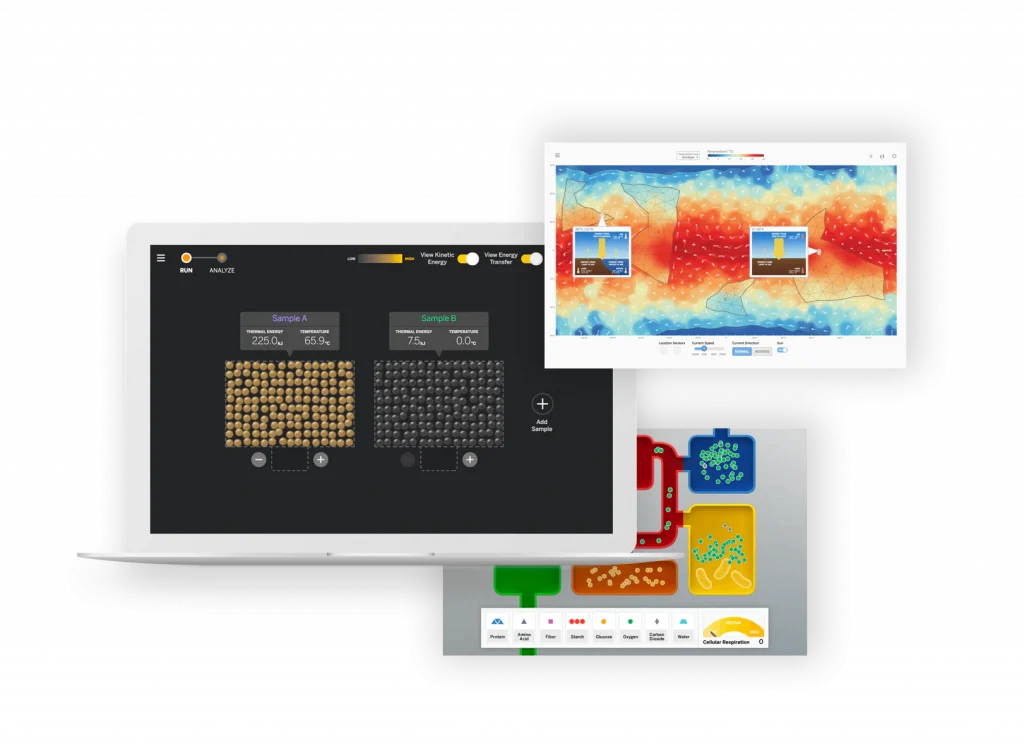
Teacher’s Guides
Available digitally and in print, the Teacher’s Guides contain all of the information teachers need to facilitate classroom instruction, including:
- Classroom Slides.
- Detailed lesson plans.
- Unit and chapter overview documentation.
- Differentiation strategies.
- Standards alignments.
- In-context professional development.
Hands-on materials kits
Hands-on learning is at the heart of Amplify Science. Each unit kit contains:
- Consumable and non-consumable hands-on materials.
- Print classroom display materials.
- Premium print materials for student use (sorting cards, maps, etc.)
Scope and Sequence
Remote and hybrid learning support

Amplify provides a remote learning solution called Amplify Science @OnDemand. Intended to make extended remote learning and hybrid learning easier, Amplify Science @OnDemand includes two useful options for continuing instruction: @OnDemand Videos and @OnDemand Units. These videos also provide embedded professional development for teachers as well as opportunities for students to review a lesson, if needed.
Amplify Science @OnDemand Videos are recordings of real Amplify Science teachers teaching the lessons. For those teachers who are unable to meet synchronously with their students, the recorded lessons are a great way to keep their students on track and engaged with Amplify Science while at home. These videos will be produced for all K–5 units, and for the first four units of each 6–8 grade level. Their release will be rolling, beginning in August.
Amplify Science@OnDemand Units are modified versions of Amplify Science units, strategically designed to highlight key activities from the program. The @OnDemand Units take significantly less instructional time than the complete Amplify Science program and allow students to engage with science at home. @OnDemand Units will be developed for all Amplify Science K–8 units. Each @OnDemand unit includes:
- Teacher overviews explaining how to use the materials, including suggestions for enhancing the @OnDemand Units if synchronous learning or in-class time with students is available.
- Overviews to send home to families.
Student materials are available in two formats:
- @OnDemand Slides (PDF/PPT) + Student Sheets (PDF) for students with access to technology at home.
- Downloadable @OnDemand Packets (PDF) for students without access to technology at home.
Download the remote and hybrid learning guide.
Looking for help?
Powerful (and free!) pedagogical support
Amplify provides a unique kind of support you won’t find from other publishers. We have developed an educational support team of former teachers and administrators who provide pedagogical support for every Amplify curriculum, assessment, and intervention program. This service is completely free for all educators who are using our programs and includes:
- Guidance for developing lesson plans and intervention plans.
- Information on where to locate standards and other planning materials.
- Recommendations and tips for day-to-day teaching with Amplify programs.
- Support with administering and interpreting assessment data and more.
To reach our pedagogical team, use our live chat within your program, call (800) 823-1969, or email edsupport@amplify.com
Timely technical and program support
Our technical and program support is included and available from 7 a.m. to 7 p.m. ET, Monday through Friday, through a variety of channels, including a live chat program that enables teachers to get immediate help in the middle of the school day.
For your most urgent questions:
- Use our live chat within your program.
- Call our toll-free number: (800) 823-1969.
For less urgent questions:
Contact your Arkansas representative:

Marty Pitts
Senior Account Executive
mpitts@amplify.com
(214) 945-5544

Mark Ramos
Inside Account Executive
mramos@amplify.com
(737) 308-4822
Amplify Caminos
Built on a systematic scope and sequence, Amplify Caminos offers the explicit instruction needed in today’s classrooms.
We’ve created a wide suite of professional development offerings that will help you meet your unique needs this school year. Find out more below!
Amplify CKLA, ELA, and Science professional development has been vetted by Rivet Education’s team through a rigorous three-step process and is listed in the Professional Learning Partner Guide.
Plan your professional development
We’re excited to partner with you on your Amplify journey. Flexible professional development pathways have been designed to meet your needs.
Recommended Professional Development Plan
Our team has curated a recommended professional learning path from initial launch to continuous support. Use the Professional Development Planning Guide below to discuss the plan that best meets your school or district needs with your Account Executive.
Sessions overview
| Audience | Title | Duration | Modality | Available |
|---|---|---|---|---|
| Launch | ||||
| K–2 teachers | Initial training | 1 day onsite or 2 half days remote |
Onsite/Remote | Yes |
| K–2 teachers | Program overview | Half day | Onsite/Remote | Yes |
| Skills Strand (Lectoescritura) initial training | 1 day onsite or 2 half days remote |
Onsite/Remote | Yes | |
| Skills Strand (Lectoescritura) program overview | Half day | Onsite/Remote | Yes | |
| Knowledge Strand (Conocimiento) initial training | 1 day onsite or 2 half days remote |
Onsite/Remote | Yes | |
| Knowledge Strand (Conocimiento) program overview | Half day | Onsite/Remote | Yes | |
| 3–5 teachers | Initial training | 1 day onsite or 2 half days remote |
Onsite/Remote | Yes |
| 3–5 teachers | Program overview | Half day | Onsite/Remote | Yes |
| Strengthen | ||||
| K–2 teachers | Enhancing planning & practice | Half day | Onsite/Remote | Yes |
| Writing | Half day | Onsite/Remote | 12/1/22 | |
| 3–5 teachers | Enhancing planning & practice | Half day | Onsite/Remote | Yes |
| Writing | Half day | Onsite/Remote | 12/1/22 | |
| K–5 teachers | Strengthening consultation session | 1 hour or 3 1-hour sessions | Remote | Yes |
| Coach | ||||
| K–5 educators (leaders, principals, coaches, and teachers) | Coaching session | 2 days consecutive | Onsite | Yes |
| K–5 educators (leaders, principals, coaches, and teachers) | Coaching session | 1 day onsite or 2 half days remote |
Onsite/Remote | Yes |
| Coaching session | Half day | Remote | Yes | |
Launch
K–2 teachers
Initial training for K–2 teachers
1 day onsite (6 hours) or 2 half days remote (6 hours)
Prepare to implement the Amplify Caminos K–2 program in your classroom! Learn the foundational elements of Amplify Caminos, including the structure of materials, key lesson elements, and how to deliver specific lesson types successfully. Participants will begin planning for the first unit and lessons.
Audience: Teachers (instructional leaders welcome), maximum 30 participants
Modality: Onsite/Remote
Program overview for K–2 teachers
Half day (3 hours)
Learn the foundational elements of Amplify Caminos, including the structure of materials, key lesson elements, and how to deliver specific lesson types successfully.
Audience: Teachers (instructional leaders welcome), maximum 30 participants
Modality: Onsite/Remote
Skills Strand initial training for K–2 teachers
1 day onsite (6 hours) or 2 half days remote (6 hours)
Participants will learn the foundational elements of Amplify Caminos Skills Strand, including the structure of materials, key lesson elements, and how to deliver specific lesson types successfully. Participants will begin planning for the first unit and lessons.
Audience: Teachers (instructional leaders welcome), maximum 30 participants
Modality: Onsite/Remote
Skills Strand program overview for K–2 teachers
Half day (3 hours)
Learn the foundational elements of the Amplify Caminos Skills Strand, including the structure of materials, key lesson elements, and how to deliver specific lesson types successfully.
Audience: Teachers (instructional leaders welcome), maximum 30 participants
Modality: Onsite/Remote
Knowledge Strand initial training for K–2 teachers
1 day onsite (6 hours) or 2 half days remote (6 hours)
Participants will learn the foundational elements of the Amplify Caminos Knowledge Strand, including the structure of materials, key lesson elements, and how to deliver specific lesson types successfully. Participants will begin planning for the first unit and lessons.
Audience: Teachers (instructional leaders welcome), maximum 30 participants
Modality: Onsite/Remote
Knowledge Strand program overview for K–2 teachers
Half day (3 hours)
Learn the foundational elements of Amplify Caminos, including the structure of materials, key lesson elements, and how to deliver specific lesson types successfully.
Audience: Teachers (instructional leaders welcome), maximum 30 participants
Modality: Onsite/Remote
3–5 teachers
Initial training for 3–5 teachers
1 day onsite (6 hours) or 2 half-days remote (6 hours)
Prepare to implement the Amplify Caminos 3–5 program in your classroom! Learn the foundational elements of the program, including the structure of materials, key lesson elements, and how to deliver specific lesson types successfully. Participants will begin planning for the first unit and lessons.
Audience: Teachers (instructional leaders welcome), maximum 30 participants
Modality: Onsite/Remote
Program overview for 3–5 teachers
Half day (3 hours)
Learn the foundational elements of the Amplify Caminos curriculum, including the structure of materials, key lesson elements, and how to deliver specific lesson types successfully.
Audience: Teachers (instructional leaders welcome), maximum 30 participants
Modality: Onsite/Remote
Strengthen
K–2 teachers
Enhancing planning & practice for K–2 teachers
Half day (3 hours)
Prerequisite training: Initial training for K–2 teachers
Elevate program knowledge to strengthen your Amplify Caminos K–2 implementation! Understand the progression of foundational skills and focus on high-quality questioning and discussion techniques through lesson study and practice. Participants will practice implementing key instructional elements and leave with annotated lessons.
Audience: K–2 teachers (instructional leaders welcome), maximum 30 participants
Modality: Onsite/Remote
Writing for K–2 teachers
Half day (3 hours)
Prerequisite training: Initial training for K–2 teachers and 2–3 months of Amplify Caminos instruction
Dig into Amplify Caminos writing instruction and student work in Grades K–2! Identify writing opportunities in the curriculum through analysis of a unit and daily lessons and analyze student writing using a program-aligned rubric. Participants will leave with an annotated unit highlighting the writing opportunities and student grouping suggestions.
Audience: K–2 teachers (instructional leaders welcome), maximum 30 participants
Modality: Onsite/Remote
3–5 teachers
Enhancing planning & practice for 3–5 teachers
Half day (3 hours)
Prerequisite training: Initial training for 3–5 teachers
Elevate program knowledge to strengthen your Amplify Caminos 3–5 implementation! Deepen ability to scaffold complex texts by sequencing reading types, prioritizing questions, and using discussion techniques. Participants will practice implementing key instructional elements and leave with scaffolds for complex texts.
Audience: Teachers (instructional leaders welcome), maximum 30 participants
Modality: Onsite/Remote
Writing for 3–5 teachers
Half day (3 hours)
Prerequisite training: Initial Training for 3–5 teachers and 2–3 months of Amplify Caminos instruction
Dig into Amplify Caminos writing instruction and student work in grades 3–5! Identify writing opportunities in the program through analysis of a unit and daily lessons and analyze student writing using a program-aligned rubric. Participants will leave with an annotated unit highlighting the writing opportunities and student grouping suggestions.
Audience: 3–5 teachers (instructional leaders welcome), maximum 30 participants
Modality: Onsite/Remote
K–5 teachers
Strengthening consultation session
1 hour or 3 1-hour sessions
Prerequisite training: Initial training
These 60-minute sessions will focus on a specific topic that will deepen educators’ understanding of Amplify Caminos and equip them with the support they need to drive toward stronger student outcomes. An Amplify facilitator will align with the school or district leadership team in advance of the session on the topic (chosen from a menu of options) that will best meet educators’ unique needs. The menu includes sessions on engagement, pacing, and supporting all learners.
Audience: K–5 classroom teachers (instructional leaders welcome), maximum 30 participants
Modality: Remote
Coach
K–5 educators (leaders, principals, coaches, and teachers)
Coaching for K–5 educators
2 days consecutive (6 hours per day, 12 total)
Prerequisite training: Initial training
Strengthen your implementation of Amplify Caminos with a Coaching onsite visit for your teachers and/or leaders! An Amplify facilitator will visit 1–4 school sites for two days. Participants can choose from a variety of topics that include, but are not limited to: lesson modeling (conducted by an Amplify facilitator) and debriefing, grade-level planning, classroom observations, and leadership consultation. The flexible onsite coaching design allows for a collaborative approach to support effective program implementation.
Audience: Teachers and/or instructional leaders (principals and coaches), maximum 30 participants
Modality: Onsite
Coaching for K–5 educators
1 day onsite (6 hours) or 2 half days remote (6 hours)
Prerequisite training: Initial training
Strengthen your implementation of Amplify Caminos with a Coaching onsite visit for your teachers and/or leaders! An Amplify facilitator will visit 1–2 school sites for one day. Participants can choose from a variety of topics that include, but are not limited to: lesson modeling (conducted by an Amplify facilitator) and debriefing, grade-level planning, classroom observations, and leadership consultation. The flexible onsite coaching design allows for a collaborative approach to support effective program implementation.
Audience: Teachers and/or instructional leaders (principals and coaches), maximum 30 participants
Modality: Onsite/Remote
Coaching for K–5 educators
Half day (3 hours)
Prerequisite training: Initial training
Strengthen your implementation of Amplify Caminos with a Coaching onsite visit for your teachers and/or leaders! An Amplify facilitator will virtually visit for a half day. Participants can choose from a variety of topics that include, but are not limited to: lesson modeling (conducted by an Amplify facilitator) and debriefing, grade-level planning, classroom observations, and leadership consultation.
Audience: Teachers and/or instructional leaders (principals and coaches)
Modality: Remote
Pricing
We offer the following pricing for training sessions and packages:
| Session type | Pricing |
|---|---|
| 2-day onsite session | $4800 |
| 1-day onsite session | $3200 |
| 1-day remote session (2 half days remote) | $1500 |
| Half-day onsite session | $2500 |
| Half-day remote session | $750 |
| 1-hour strengthening consultation session | $350 |
| 3 1-hour strengthening consultation sessions | $1000 |
| Customized Amplify Caminos onsite or remote session | Price will vary |
Please note that the prices are general ranges and may be subject to change.
Contact
Amplify welcomes the opportunity to partner with schools and districts to design professional development plans and answer your questions.
If you would like to order any of our professional development services, please contact your local Amplify sales representative or call (800) 823-1969.
Our K–12 international education programs inspire students around the world.
At Amplify, we believe that every teacher and student deserves access to high-quality materials. That’s why we collaborate with international schools to meet their core curriculum, assessment, and intervention needs.
By providing solutions grounded in research and evidence-based practices, Amplify is making an impact on international K–12 education.
We are making an impact around the globe.
6
continents
80+
countries
900+
schools worldwide
700,000+
students globally
Amplify international education programs
The following programs are available internationally.



Amplify professional learning
From live, in-person training and coaching to online courses and virtual professional development, we offer a range of support to fit schools’ needs and educators’ busy schedules. Professional development offerings include the following:
- Launch sessions
- Strengthen sessions
- Coach sessions
- Custom packages


Custom development
We collaborate with governments and government agencies to localize and customize our high-quality instructional materials to ensure they align with specific education standards and frameworks.
Get in touch with our sales team to discuss how we can help your organization.
License our digital tools.
Explore Amplify’s digital tools and how they can make your programs more engaging and digital-forward.
Publishers can license the Amplify teaching and learning digital platform, which offers robust digital functionality—including digital manipulatives—that can transform print-based instructional programs into interactive, collaborative, and engaging digital experiences for teachers and students.
If you want to use our platform for commercial purposes, please contact our team.

Amplify international education support
Amplify aims to provide the best customer support throughout each stage of your journey, whether you are exploring our programs for the first time or are a long-term partner.
Below, you’ll find a quick guide on the international purchase process and expected timelines.
Simple steps to get your order processed quickly:
To ensure that there are no delays, we advise you to place your order 3–4 months prior to your first day of school. This should allow enough time for shipping and digital set up.

Purchasing
Our international sales team can answer your questions about our programs and services. Please fill out the form to speak with your account executive.
FILL OUT FORM

Ordering and payment
We want your purchasing experience to be as seamless as possible. Visit our customer portal to learn more about your payment options.
Please be sure to include:
- A signed PO. Don’t forget to add your PO number.
- A copy of your Price Quote.
- A copy of your Tax-Exemption Certificate.
You can also email your documents to IncomingPO@amplify.com.

Shipping physical materials
- Submit your logistics and product quantities on the Order Management Page (OMP).
- Track shipment(s) with the Shipment Status Page (SSP).

Enrollment and licensing
Please note that our team needs to review your school’s rosters for accuracy and completeness:
- This process can take up to 12 business days.
- You will be notified when the licensing process is complete!
Frequently asked questions
Payment processing time can vary, depending on chosen payment method, as well as banking institution. Please allow at least 10 business days for it to be processed. For additional support contact internationalsalessuport@amplify.com.
For digital licenses, you will need to submit your digital logistics information, which includes your school’s rosters data. Our technical onboarding team then needs to verify it for accuracy and completeness. (They might contact you, should they need any clarification.) The digital setup process can take up to four weeks to be completed. For help along the way, please use our Amplify Onboarding Hub.
To avoid delays, please submit your logistics information and product quantities on the Order Management Page as early as possible. Note that international shipping time varies from one country to another due to many factors, including different customs procedures. We are therefore unable to estimate and guarantee delivery time in each case. Amplify offers two international shipping options: 1. Your materials can be shipped from the U.S. directly to you, which will incur an international shipping and handling fee of 25% on the physical products ordered. 2. Alternatively, Amplify can ship your materials to a U.S. freight forwarder, and you can manage the shipping.
Note that setup communications will be sent to the contact person listed on the quote. This email is sometimes routed to the spam folder, so please check there as well. If you do not receive a link within five business days, please reach out to the customer care and support team.
Get support
Our dedicated team members will assist you with purchasing, order fulfillment, enrollment and licensing, and more!
Our support hours are Monday through Friday,
11 a.m.–11 p.m. GMT.

New to our programs? Our international sales support team is here to help!
Email us:


International events
Join us for an upcoming event, webinar, or podcast. You can browse all of our events by month, or use the filter to find events close to you.