Showing results for simon

Meet Science of Reading changemaker Altramez Simone McQuaige

Awards for teachers—we should probably give them out every day. We try to honor teachers and their exceptional contributions in as many ways as we can at Amplify. That’s why our annual Science of Reading Star Awards is one of our biggest events of the year!

We’re currently accepting nominations through Jan. 31. Apply now!

This annual award program is a great opportunity for us to shine a spotlight on the classroom teachers, school administrators, and educators who are improving student literacy outcomes in schools and communities across the country—like 2024 Changemaker Award winner Altramez Simone McQuaige. We hope her significant contributions inspire you in your work—and inspire you to nominate a teacher for an award next year!

A leadership role: Experience and experimentation

Altramez Simone McQuaige has spent more than 30 years in education, so it’s probably safe to assume she knows what she’s doing. But she’s not afraid to embrace change, or even take risks. “We didn’t go into this profession to do the same thing every day,” she says.

As supervisor of elementary reading and English language arts at Prince George’s County Public Schools, McQuaige took on the challenge of improving literacy instruction in her district by focusing on the Science of Reading.

Foundational skills: Noticing the problem

Several years ago, McQuaige and her team noticed a specific issue with foundational skills instruction, especially in first and second grades. “We were seeing a population of students that we weren’t seeing progress with consistency,” she says.

Under McQuaige’s leadership, a team of coaches, reading leaders, and administrators met to discuss how to improve their foundational skills instruction and student outcomes, asking themselves questions like: Should they shift their curriculum? Their classroom methods? Their entire literacy approach?

Then the pandemic hit.

Coming together: Exploring a new approach

Despite pandemic disruptions, McQuaige and her team convened and launched a cohort of 240 teachers, central office personnel, and reading leaders to learn more about the Science of Reading.

Openness to change was key. The cohort had to be willing to look at the latest research and see—as McQuaige puts it— that “some of the practices that may have been used from yesteryear were not effective.”

Their decision? Start to shift from a balanced literacy environment to a structured literacy approach involving explicit, systematic teaching of the elements of reading and a strong emphasis on phonological and phonemic awareness, phonicsvocabulary, and comprehension strategies.

Varied stakeholders building energy for change

There was “energy around the shift,” she recalls. The excitement coming from that large team of varied stakeholders helped build further buy-in—and success.

“We wanted to ensure that our reading leaders and our central office personnel with ESOL teachers and special educators had an opportunity to engage in these conversations,” she says. “That led us to have teachers practice or pilot programs before we chose the best products to meet the needs of our teachers.”

“We were building capacity across our district,” she says, “and building leaders and allies to talk about why the shift is necessary, and what they noticed as they started to embed those practices in their instruction.”

Professional development: Continued improvement and support

The result? The district successfully moved to a structured literacy approach in just three years, and improvements in student performance data demonstrate the effectiveness of the changes. “Even those who were once reticent are seeing the shift in their students,” McQuaige says of the teachers around her.

She also acknowledges the essential role of their partners: “Amplify’s support was crucial as we shifted. We know that as you make the shift, it will never be one and done. The continuous learning across our district, using our Amplify team, is invaluable.”

But McQuaige knows that even if the shift in approach is technically complete, she—like her students—must always be learning. “Let’s follow the research,” she says. “I know research is always changing, and that means we’re always changing.”

Here’s your nomination form!

Inspired? We’re looking for our shining 2025 Science of Reading leaders now! Visit our Star Awards page for information like our submission deadline, and nominate a teacher for an award today!

Season 1, Episode 11

Building an education network to make change, starring A. Simone McQuaige

Today on Beyond My Years, host Ana Torres absorbs wisdom from A. Simone McQuaige, winner of the Amplify Science of Reading Star Awards 2024 Changemaker Award. Simone teaches Ana about what it takes to support wider change across an entire district, and about the common traits she sees in all seasoned educators. She also shares stories about how her mother tried to convince her not to become a teacher, about learning to be calm and reflect, and about how she thinks about her legacy as an educator. Taking all those lessons back to the classroom, Ana and Classroom Insider Eric Cross discuss creating a teacher network, building buy-in, and leading student-designed projects.

Persona sonriente con gafas y un collar, sobre un fondo de estrellas, manzanas y libros.

Meet Our Guest(s):

A woman with short, side-parted hair and glasses is smiling at the camera. She is wearing a black top and a beaded necklace, with a neutral background behind her.

A. Simone McQuaige

A. Simone McQuaige has dedicated 34 years to education within the Prince George’s County Public School (PGCPS) system. A proud alumna of PGCPS, she began her career as an elementary school teacher. She has since had various leadership roles, including mentor teacher, reading specialist, and Reading/English Language Arts Instructional Specialist, as well as serving as an adjunct professor. She is the Supervisor of Reading/English Language Arts, K–5, and she leads the Elementary Literacy Support Team in the Office of Curriculum and Instruction.

In 2024, Simone was honored with Amplify’s Changemaker Science of Reading Star Award.

Meet our host, Ana Torres.

Ana has been an educator for 30 years, working in both the K–8 and higher education sectors. She served as an administrator and instructor at various public and private colleges and universities and as a bilingual and dual language teacher, dual language math and reading interventionist, dual language instructional coach, assistant principal, and principal in K–8 schools. Ana is currently the bilingual and multilingual specialist on Amplify’s product specialist team, and delivers literacy and biliteracy presentations across the nation. Ana’s passion and advocacy for biliteracy and multiculturalism has led her to educate leaders, teachers, and parents about the positive impact of bilingualism and biliteracy in our world.

A woman with long dark hair and hoop earrings smiles at the camera while wearing a black blazer, standing outdoors—ready to discuss classroom challenges or share insights on her teacher podcast.
A man with short, closely-cropped hair and a trimmed beard smiles at the camera against a light gray background, ready to inspire diverse learners in the math classroom.

Meet our Classroom Insider, Eric Cross.

Eric Cross is a middle school science teacher who hopes to someday be a lifelong educator, like the guests on Beyond My Years! In each episode, Eric connects with host Ana Torres to discuss her guests’ best insights gleaned from their long and rewarding careers in the classroom. Then, Eric talks about bringing some of their wisdom into his current classroom and busy life.

Quotes

“I want future me to be grateful for past me.”

—Eric Cross

“There are a lot of lessons to be learned from ‘back in the day.’ It doesn’t mean we always had it right. We were learning along the way and we recognize that our students are not the same students that were sitting in front of us ‘back in the day.’”

—A. Simone McQuaige

“Seasoned teachers are often looked at as the ones with all the answers, and they may not truly have all the answers, but they’ve lived experiences that I think a lot of new teachers could learn from.”

—A. Simone McQuaige

“When you look at a lot of the seasoned teachers who’ve been in the profession for quite some time, there’s a calmness about them. And you work effectively when you’re in that calm space.”

—A. Simone McQuaige

“One of the things that I’ve learned over the years is you cannot make change by yourself.”

—A. Simone McQuaige

“We’re talking about the kind of professional development that people have time to invest in learning, and where teachers are treated as the professionals they are.”

—A. Simone McQuaige

“When you think about legacy, you’re thinking about what things you can put in place that are going to support the generations in the future. And that means you are investing in the people around you now that will be in the field to make those decisions.”

—A. Simone McQuaige

“All of us kind of feel like there’s work undone … it’s never ever finished. But I think you get to a point where you just feel that you have given your entire heart.”

—A. Simone McQuaige

Webinar: Step Ahead with Desmos Classroom (K–5) and Ben Simon

What does problem-based math learning unlock for students? Part 2

Webinar series recap, part 2 of 3

Our webinar series explores how problem-based learning engages all students in grade-level math every day, and how instructors can bring problem-based learning into their classrooms.

We reviewed part 1 of the series in this blog post. Now, in part 2, we dig deeper into this key aspect of problem-based learning: transferring responsibility for learning to the students.

So…now what? “If you watched Kristin Gray’s webinar,” says educator Kathleen Sheehy, “You may be thinking, ‘I learned so much about the power of problem-based learning. Where do I get started?’”

In this webinar, Sheehy joins fellow educator Ben Simon to explore how teachers can truly make that key shift toward student-centered instruction. “It is a journey. So we are going to talk about the small shifts that teachers and others can make that add up to something big,” Sheehy says.

The role of the teacher in student-centered learning

Most adults were not taught to do math this way as kids—and many teachers were not taught to teach math this way. When teachers have a lot of content to get across in limited time, it can feel risky to shift to a style that requires a bit of letting go.

“Student-centered instruction helps us embrace the idea that people can come at math ideas from different directions,” says Sheehy. “It’s collaborative and social. It focuses on problem-solving with an emphasis on multiple strategies and flexible thinking.”

Problem-based math learning may not be the sage-on-a-stage model, where the teacher stands up front and acts as the only math expert in the room—but it doesn’t mean the teacher relinquishes control, either. You can have both student-focused instruction and solid classroom management.

“It’s not a free-for-all. It’s very structured,” says Sheehy. “The teacher also plays a role in providing instruction and then guiding their students to the key takeaways they want for them.”

Building stakeholder investment

To be most effective, problem-based learning needs to be not only focused on the student but supported by the community as well. This means you aren’t the only one who needs to adjust to the new approach.

What actions can you take to build stakeholder investment? How can you get the principal, other teachers, parents, and kids (who are also accustomed to another style of learning) involved and excited?

Be able to articulate a really compelling reason why student-centered instruction is right for your students. The following are just a few research-backed examples:

  • It helps students develop deeper and longer-lasting mathematical understanding.
  • It helps students grow as problem-solvers, engaging them in productive struggle and collaboration and learning core life skills.
  • It helps students develop a growth mindset, which reduces math anxiety, boosts math confidence, and helps them relinquish the idea that someone either is or is not a math person.

When the teacher is the supporter of knowledge, not the gatekeeper, students lead the learning process and feel more confidence with and connection to math, says Sheehy.

How and where do you communicate these ideas? Sheehy and Dixon have found that providing a short hands-on math experience with problem-based learning examples can be very effective. This enables stakeholders to experience the difference themselves, especially when conducted in a low-stakes scenario like a parent math night or PD training.

Sheehy also suggests asking them what they think the impact of student-centered learning would have been for them when they were students. “We’ve heard people say things like, ‘I would have been way less anxious about math if I’d learned it this way,’” she says.

Making a plan to start the shift

“We’re not expecting to create a masterpiece overnight. It takes time to develop the teacher and student skills and to establish everything that needs to be in place,” Sheehy says, “You can’t get better at all the things all at once.”

Where to start? “Size up the shift,” she says, and make a plan.

“Using very clear look-fors can enable educators to decide where to focus,” says Sheehy. “‘What would I look for if I walked into a classroom that is beginning to engage in student-centered instruction?’”

Here are a few key elements to look for:

  1. Management of materials, routines, and classroom setup in a way that facilitates collaboration.
  2. Establishment of a classroom community (using norms charts, etc.) around the core idea that everybody belongs there and is a mathematician.
  3. A teachable structure that models the thinking process and creates predictability, allowing students to focus.

Sheehy and Dixon have found that a focus on these three areas helps teachers name what they are trying to improve in a systematic way.

“Once I tackle this first area and feel successful with that, I know what I’m going to tackle next, and after that,” says Sheehy. “These look-fors can help you make informed decisions that, little step by little step, can help you eventually get to where you want to be.”

How Amplify Math supports problem-based learning

Amplify Math is designed to support problem-based learning, so you’re making that shift every time you teach. The program specifically supports teachers in the planning and delivery of problem-based lessons, and enables them to monitor student progress and differentiate instruction based on real-time data.

Lessons start with warm-ups that tap into prior knowledge, then move into problems that require collaboration to solve. Teachers monitor, engage, and ultimately synthesize student work into the main idea. There are also ample opportunities for practice and reflection. 

Learn more about Amplify Desmos Math.

Register to watch the recording.

Subscribe to Math Teacher Lounge.

Math that motivates: Amplify Desmos Math success stories

It’s no secret that student engagement and the prevalence of math anxiety are real problems in math classrooms. Incorporating more problem-based learning can help, but it can feel intimidating and difficult to know where to start. That’s why we’re here!

Amplify Desmos Math is a curiosity-driven K–12 math program that introduces a structured approach to problem-based learning and builds students’ lifelong math proficiency. Teachers help students build off of each other’s ideas and find confidence in their math identities, creating a community of math learners.

But don’t take our word for it—see how real teachers and students are unlocking new levels of engagement and comprehension, proving that everyone can be a math person.

A woman with straight, shoulder-length blonde hair smiles at the camera, wearing a striped sweater and hoop earrings. Shelves with books are visible in the background.
“With Amplify Desmos Math, I’ve noticed a huge shift of engagement because there’s so much interaction. Yes, there is pencil and paper, but there’s so much more. They’re getting immediate feedback and motivation to continue on. So if they don’t get something right the first time, they want to! ”

—Kristi Melick

Sixth-grade teacher, San Diego Unified School District, CA

School spotlight: Decatur Classical Elementary School

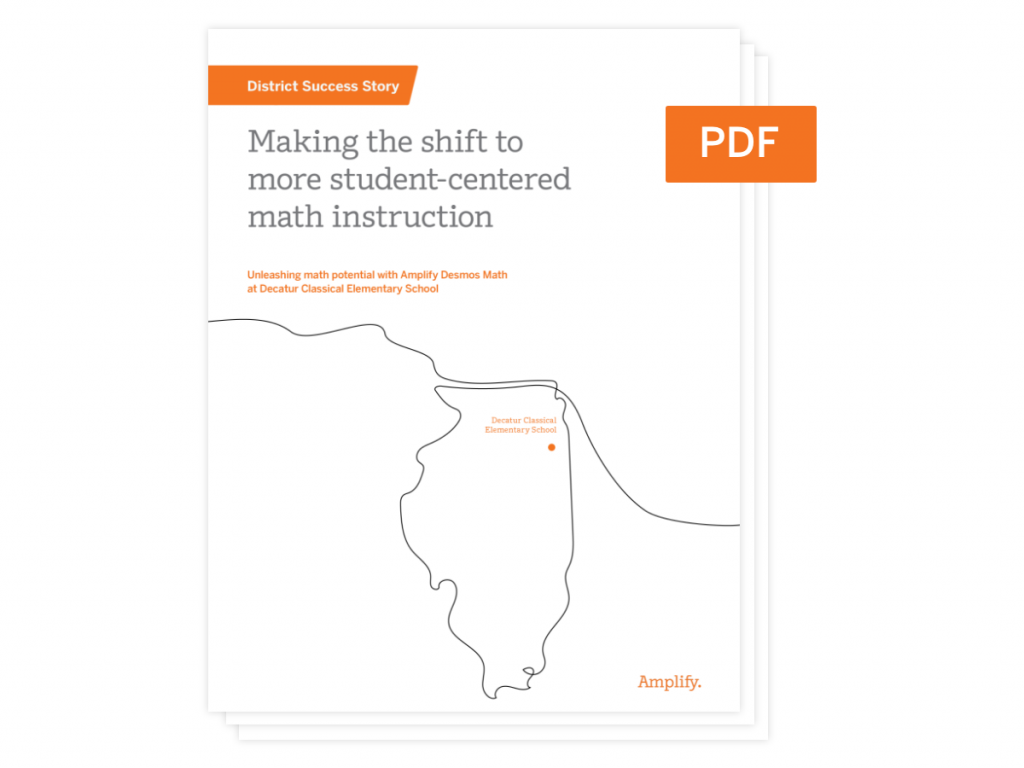
See how Amplify Desmos Math is making an impact in Chicago, Illinois, with our latest case study.

Cover page of a PDF titled "Making the shift to more student-centered math instruction," featuring an outline of Illinois and text about Decatur Classical Elementary School.

A structured approach to problem-based learning

Witness teachers and students working together and see how Amplify Desmos Math revolutionizes K–12 math education through a structured approach to problem-based learning that fosters a collaborative math community.

The power of the pause

See what happens when teachers use the pause–one of the teacher facilitation tools and core differentiators in Amplify Desmos Math. You won’t believe how students react!

Everyone’s a math person.

See how Amplify Desmos Math helps every student see themselves as a math person.

What Teachers Say

What educators say about Amplify Desmos Math

Shifting to this problem-based curriculum now is allowing students to open up. I think they’re taking control and ownership. They’re coming up with the strategies, they’re sharing the strategies. It offers an opportunity for the students to look around the classroom to see what their friends are doing. And in turn, if they’re stuck, they’re comfortable turning to other students and problem-solving through sharing.

Joseph Croce

Seaford School District, DE

What educators say about Amplify Desmos Math

When we went district-wide with our Amplify Desmos Math curriculum our teachers became the facilitators of learning. And our students are the doers of mathematics. And what we’ve seen, what I’ve seen in the classroom, is kids are engaged in a problem, they’re collaborative, and they’re having fun. And it’s like they’re not even realizing that they’re really doing math.

Jessica Walsh

San Diego Unified School District, CA

What educators say about Amplify Desmos Math

So many kids have stated, ‘Oh, I’m not a math person.’ Or they’re scared of getting the answer incorrect. And I think with this curriculum, they feel safe.

Brendan Simon

Assistant Principal, San Diego Unified School District, CA

Best practices from real educators like you

Learn tried and true strategies for leveling up math instruction from Beyond My Years podcast guests like Amplify’s own Dan Meyer, teacher and My Kindergarten Math Workbook author Keri Brown, educator and speaker Mike Flynn, teacher and I Hate Math author Ian Brown, and more!

Two women work together at a desk with a laptop and papers; the image appears on the cover of a document titled “Foundational research” for Amplify Desmos Math Grades K–Al.

Program efficacy

Explore the research behind Amplify Desmos Math.

Ready to make the shift to curiosity-driven learning?

Get access to free digital samples today.

Request a sample or demo

Bordered card’s style

Bordered without hover effect card’s style – Show grey background

Lorem Ipsum

Lorem ipsum is placeholder text commonly used in the graphic, print, and publishing industries for previewing layouts and visual mockups. Lorem ipsum is placeholder text commonly used in the graphic, print, and publishing industries for previewing layouts and visual mockups.

Lorem ipsum is placeholder text commonly used in the graphic, print, and publishing industries for previewing layouts and visual mockups.

Learn more

Lorem Ipsum

Lorem ipsum is placeholder text commonly used in the graphic, print, and publishing industries for previewing layouts and visual mockups. Lorem ipsum is placeholder text commonly used in the graphic, print, and publishing industries for previewing layouts and visual mockups.

Lorem ipsum is placeholder text commonly used in the graphic, print, and publishing industries for previewing layouts and visual mockups.

Learn more

Lorem Ipsum

Lorem ipsum is placeholder text commonly used in the graphic, print, and publishing industries for previewing layouts and visual mockups. Lorem ipsum is placeholder text commonly used in the graphic, print, and publishing industries for previewing layouts and visual mockups.

Lorem ipsum is placeholder text commonly used in the graphic, print, and publishing industries for previewing layouts and visual mockups.

Learn more

Lorem Ipsum

Lorem ipsum is placeholder text commonly used in the graphic, print, and publishing industries for previewing layouts and visual mockups. Lorem ipsum is placeholder text commonly used in the graphic, print, and publishing industries for previewing layouts and visual mockups.

Lorem ipsum is placeholder text commonly used in the graphic, print, and publishing industries for previewing layouts and visual mockups.

Learn more

What my wedding taught me about choosing curriculum

The right curriculum choice isn’t only about the product—it’s about who’s by your side from start to finish. Here’s how one district found that with Amplify CKLA.

By Kelly Pruitt, Instructional Facilitator, Peninsula School District | May 28, 2026

A teacher leans over a group of elementary students who are working together at a classroom table under a "CKLA Skills" sign, guiding them through successful CKLA implementation.

Season 1, Special Episode

Springing forward and looking back, with Ana and Eric

Today on Beyond My Years, host Ana Torres and Classroom Insider Eric Cross reconnect with three past guests—Fawn Nguyen, Rebecka Peterson, and Simone McQuaige—to explore key challenges from their early teaching days: classroom management, decentering oneself, and time management. Ana and Eric share their own experiences with these common hurdles, then offer a quick look at what’s ahead in Season 2.

Three women smiling in individual portrait photos arranged in a triangle on a patterned background with books, apples, and stars.

Meet Our Guest(s):

Smiling woman with shoulder-length brown hair wearing a light pink collared shirt, posing in front of a plain grey background.

Fawn Nguyen

Fawn Nguyen is director of STEM Initiatives at Amplify. Before joining Amplify, she was a math coach in a K–8 school district for three years and a middle school math teacher for 30 years. She has received many accolades, including being named the 2014 Ventura County Teacher of the Year, Raytheon’s 2009 Math Teacher Hero, and the 2005 Sarah D. Barder Fellow at the Johns Hopkins Center for Talented Youth. She has also been a keynote speaker and workshop facilitator at math conferences nationwide. In 2012, she co-founded the Math Teacher’s Circle in Thousand Oaks, California. From 2015–2018, Fawn served as a member of NCTM’s Professional Development Services Committee.

A woman with short, side-parted hair and glasses is smiling at the camera. She is wearing a black top and a beaded necklace, with a neutral background behind her.

A. Simone McQuaige

A. Simone McQuaige has dedicated 34 years to education within the Prince George’s County Public School (PGCPS) system. A proud alumna of PGCPS, she began her career as an elementary school teacher. She has since had various leadership roles, including mentor, teacher, reading specialist, and reading/English language arts instructional specialist, as well as serving as an adjunct professor. Simone is the supervisor of reading/English language arts K–5 and she leads the Elementary Literacy Support Team in the Office of Curriculum and Instruction.

Woman with wavy dark hair, wearing gold hoop earrings and a dark green blazer, smiling in front of a light-colored background.

Rebecka Peterson

Recognized as the 2023 National Teacher of the Year, Rebecka Peterson is a math teacher who loves stories. Rebecka has been teaching for 16 years, the last 12 of which at Union High School in Tulsa, Oklahoma. She believes that when we learn each other’s stories, we carry a piece of each other with us, enabling us to authentically advocate for our students, teachers, and communities.

In the midst of a challenging first year of teaching, Rebecka joined other educators in a daily practice of noting “one good thing” in her classroom. Together they found inspiration by embracing the motto: “Every day may not be good, but there is one good thing in every day.” This shift in perspective transformed her work. Rebecka now collaborates with fellow educators, emphasizing the importance of cultivating intentional joy as a means of sustaining oneself in the difficult but beautiful profession of teaching.

Meet our host, Ana Torres.

Ana has been an educator for 30 years, working in both the K–8 and higher education sectors. She served as an administrator and instructor at various public and private colleges and universities and as a bilingual and dual language teacher, dual language math and reading interventionist, dual language instructional coach, assistant principal, and principal in K–8 schools. Ana is currently the bilingual and multilingual specialist on Amplify’s product specialist team, and delivers literacy and biliteracy presentations across the nation. Ana’s passion and advocacy for biliteracy and support for all students from all walks of life has led her to educate leaders, teachers, and parents about the positive impact of bilingualism and biliteracy in our world.

A woman with long dark hair and hoop earrings smiles at the camera while wearing a black blazer, standing outdoors—ready to discuss classroom challenges or share insights on her teacher podcast.
A man with short, closely-cropped hair and a trimmed beard smiles at the camera against a light gray background, ready to inspire diverse learners in the math classroom.

Meet our Classroom Insider, Eric Cross.

Eric Cross is a middle school science teacher who hopes to someday be a lifelong educator, like the guests on Beyond My Years! In each episode, Eric connects with host Ana Torres to discuss her guests’ best insights gleaned from their long and rewarding careers in the classroom. Then, Eric talks about bringing some of their wisdom into his current classroom and busy life.

Quotes

“ My biggest mistake early on was needing to have the last word.”

Fawn Nguyen

“ Something I really struggled with and actually took me several years to feel confident in [was] how to manage my classroom in a way that felt good and true to me.”

Rebecka Peterson

“Looking back, I realized it would’ve been so helpful to have learned how to set boundaries for myself, prioritize tasks, and definitely build time for my own self-care.”

A. Simone McQuaige

Season 9, Special Episode

Award-winning ways to put science into practice

Amplify’s 2024 Science of Reading Star Award winners share insights from their daily work. They reflect on why it’s so critical to stay grounded in evidence-based literacy practices and how they bring those practices into their schools and classrooms. Listeners will be inspired by the creative ideas of educators who are making a difference in the lives of students across the country. Winners honored in the episode in order of appearance are: Amber Hines, Vance County Schools, NC; Elizabeth Caton, Windber Area Elementary School, PA; Jamie Vannoy, Wirt County Primary Center, WV; Christine Michalik, Cicero School District 99, IL; Andrea Mason, County Line Elementary School, GA; A. Simone McQuaige, Prince George’s County Public Schools, MD.

Meet Our Guest(s):

Illustration of a gold trophy with a star, an orange and yellow award ribbon, and a pink and purple ribbon with a book symbol, surrounded by small stars—representing Science of Reading awards for excellence in evidence-based practices.

Amber Hines, Elizabeth Caton, Jamie Vannoy, Christine Michalik, Andrea Mason, and A. Simone McQuaige

Each of the 2024 Amplify Star Award winners have transformed their classrooms and empowered their students with the Science of Reading. These educators and leaders have gone above and beyond to light the path for students to pursue lifelong literacy. Award-winners featured in this episode include: Amber Hines, The Knowledge Builder; Elizabeth Caton, The Science of Reading Rookie; Jamie Vannoy, The Literacy Legend; Christine Michalik, The Knowledge Builder; Andrea Mason,The MTSS Maestro; and A. Simone McQuaige, The Changemaker.

Meet our host, Susan Lambert

Susan Lambert is the Chief Academic Officer of Elementary Humanities at Amplify, and the host of Science of Reading: The Podcast. Throughout her career, she has focused on creating high-quality learning environments using evidence-based practices. Lambert is a mom of four, a grandma of four, a world traveler, and a collector of stories.

As the host of Science of Reading: The Podcast, Lambert explores the increasing body of scientific research around how reading is best taught. As a former classroom teacher, administrator, and curriculum developer, Lambert is dedicated to turning theory into best practices that educators can put right to use in the classroom, and to showcasing national models of reading instruction excellence.

Portrait of a woman with short blonde hair, wearing glasses, a black top, and a necklace. She is smiling and facing the camera.

Quotes

“There is no, ‘Let's try this. Let's try that.’ When it's evidence based, you know that it's proven to be effective.”

—Amber Hines

“It's important that we are aligning our practices to standards and what the students are required to do—but also what they need.”

—Elizabeth Caton

“If we don't make a conscious effort to utilize evidence-based practices, we are going to be failing our most at-risk populations.”

—Jamie Vannoy

“All students should have the opportunity for multiple readings of the same text to build comprehension, to build fluency.”

—Christine Michalik

“It's really important to utilize assessments, [to] make sure that my students are getting exactly what they need based on the data that I get from assessments, but also based on the data that I get from regular progress monitoring.”

—Andrea Mason

“This is not something that can be just done at the schoolhouse. It involves the community and all of our community stakeholders.”

—A. Simone McQuaige