Building math lessons: The playful side you never knew existed

Two people smiling in separate circles; one has a cartoon corgi icon, the other shows math blocks—perfect for celebrating early literacy skills—all set on a cheerful yellow background.

When you think of what goes on behind the scenes of building Amplify Classroom lessons, you probably envision carefully calculated math formulas and complicated equations, right?

Not exactly. Meet Sara Barring and Sean Sweeney from our interaction development team! They create animations and interactions for many of our most popular math lessons, and one day they decided to record some of their work sessions. What began as a simple “Wouldn’t it be fun…” conversation turned into something pretty remarkable: a front row seat to their joyous exploration of math.

Sean and Sara spend their days bringing math problems to life using Activity Builder, Amplify Classroom’s lesson-building tool. Their goal is to encourage students to explore their own thinking, moving beyond traditional right-and-wrong feedback. Instead of being told “no” when a guess is off, students get visual Responsive Feedback that demonstrates the meaning behind their thinking. In the grade 6 lesson Weight for It, for example, the animation shows them what would happen if the dog actually weighed what they guessed!

Sean and Sara help create a safe, playful space where making a mistake isn’t a failure, but a visual stepping stone that encourages students to try again. This creative process is exactly what they decided to capture on camera. Their video series, “Graph Time With Sara and Sean,” reveals what happens when pure curiosity guides work in graphing mathematics. Each episode opens the window into a genuine, surprising discovery, showing the magic happens when you stop worrying about perfection. Watching these videos, even those who feel intimidated by math or think math isn’t for them may feel inspired to try it themselves.

Redefining mistakes as happy accidents

In any field, the word “mistake” can feel loaded. But for Sara and Sean, the process of creating math animations is less about avoiding mistakes and more about seeing what happens.

A great thing about working in Activity Builder’s graphing calculator, Sara notes, is that you can immediately see how every adjustment affects the animation. This instant visibility helps shift your perspective—an unexpected result isn’t a failure, but a happy accident. According to Sara, these moments provide a pivot point into a new, unplanned direction.

Take one episode of “Graph Time” that wouldn’t exist without a happy accident Sean had while trying to create a firework animation for one of our lessons. That “mistake” led to the discovery of unexpected mathematical patterns that the team may not have found otherwise. These patterns seem to magically emerge from simple sine and cosine functions, revealing flower-like designs, perfect circles, and intricate geometric shapes that feel limitless in their variety, proving that mathematical beauty often reveals itself through curious experimentation rather than careful planning.

Sara and Sean hope to show viewers the reality of their work–with all the struggles, detours, and joy. You might expect someone who creates math animations all day to have their steps carefully mapped out. “We don’t,” Sean says, “and that’s part of what we like about it.”

The ripple effect: Transforming math culture

Sara and Sean’s playful approach to building curriculum content creates waves they hope will extend beyond their own creative joy, inspiring a new generation of math explorers.

For teachers, these videos offer more than just creative techniques—they provide a blueprint for shifting classroom culture. Sean emphasizes that viewers are seeing “the real work they do every day,” providing educators with an authentic model for bringing genuine excitement to mathematical learning. Sara, drawing from her teaching background, recognizes the transformative power of just changing the narrative: “Math gets such a bad rep a lot of the time, so even if Graph Time with Sara and Sean just offers a positive rebrand on some things, I think that’s powerful, too.”

When students see people having fun with math, through teachers or videos like “Graph Time With Sara and Sean,” they begin to see math as an invitation to explore. Sean and Sara are hoping they can help students find their own magic, making math less about intimidation and more about fun.

Check out Sara and Sean’s videos to see their graphing creations in action!

Ready to create your own amazing math adventures? Check out our Lesson Building Toolkit for bite-size tutorials on making your own lesson creations with Amplify Classroom.

Our research

mCLASS Math

mCLASS® Math is a complete K–8 benchmark and progress monitoring assessment system. Developed by a team of researchers, mCLASS Math has undergone rigorous psychometric validity studies and is backed by a Multi-Tiered System of Supports (MTSS) framework and the latest iteration of curriculum-based measurement tools.

Efficacy

Cover page of a PDF titled "Technical Report for mCLASS Math 2023-2025 Field Study," prepared by WestEd, dated October 3, 2025.

Independent Study: 2023–2025 Technical Report for Amplify mCLASS Math (published October 2025)

Read more

Cover of a PDF titled "mCLASS Math K-5 Research Brief: 2024 Beginning of Year Field Study," featuring insights on mCLASS Math, submitted to Amplify by WestEd on March 20, 2025.

Independent Study: 2024 Beginning-of-Year Technical Report for Amplify mCLASS Math (published March 2025)

Read more

Research base

Two young children wearing headphones sit at a desk using a laptop in a classroom. The document title reads "mCLASS Beginning-of-Year Screener," highlighting their engagement with mCLASS Math activities.

Research: mCLASS Beginning-of-Year Screener (published March 2025)

Read more

An illustration of a spilled liquid with a submerged smartphone, depicting a phone accident with liquid involved, used to amplify CKLA research visibility.

Explore more of our research.

Learn more about the research behind our programs.

S3-02: How science strengthens literacy and language development

A graphic with the text "Science Connections" and "Amplify" features colorful circles and curved lines on a dark gray background.

In our second episode of the season, we continue finding ways that science is overlooked and how it can be better utilized in schools—and as an ally to other subjects!

We sat down with Susan Gomez Zwiep, former middle school science teacher and senior science educator and staff advocate at BSCS Science Learning. She shared past experiences and research that shows the benefits of integrating science and literacy, as well as strategies for applying these ideas in the classroom.

We hope you enjoy this episode and explore more from Science Connections by visiting our main page!

DOWNLOAD TRANSCRIPT

Dr. Susan Gomez Zwiep (00:00):
We started to see this trend of students communicating more in English because they were excited about the science that they had been learning.

Eric Cross (00:10):
Welcome to Science Connections. I’m your host Eric Cross. In this third season, we’re exploring the theme of science as the underdog. And last time around, we delved into the data showing that compared to other subjects, science is often put on the back burner. Now it’s time to explore why it’s so important to change that and how to do it effectively. So over the course of these coming episodes, we’re gonna make the case for science and equip you with data and strategies for advancing science in your own home, school, or community. To kick things off, we’re going to spend a few episodes going in depth on the integration of science and English instruction. We know we need to dramatically improve literacy rates in this country, and as we’ll show in the coming episodes, science can be a key ally in that goal. We’ll also show how language development and literacy instruction can support science. Yes, it can be a win-win, folks. To start out, I’m joined by someone who has been studying science and language development for more than a decade. Dr. Susan Gomez Zwiep is a senior science educator and staff advocate for BSCS Science Learning. On this episode, she talks about her own experience as a middle school science teacher and share some key insights and strategies from the research on integrating science and English language development. Please enjoy this conversation with Dr. Susan Gomez Zwiep.

Eric Cross (01:36):
Welcome to the podcast. Thank you for being here and having this really important conversation. So I’m so glad you can make it, Susan.

Dr. Susan Gomez Zwiep (01:43):
Yeah, I’m excited to be here.

Eric Cross (01:44):
We’re gonna talk all about language development and science. But first I was hoping that you can just kind of set the stage and tell the listeners about yourself and how you came about to studying this specific subject.

Dr. Susan Gomez Zwiep (01:57):
Sure. So I am a California native. I grew up in the San Gabriel Valley and that’s where I started teaching. I have an undergraduate degree in integrated biology from UC Berkeley. And I thought I was gonna go be a field scientist. And while I was waiting for grad school applications to run their course, I took a substitute job in Montebello to kind of bide my time. And because I had a science degree, they asked if I would take a permanent placement, well, a temporary permanent placement. And I said sure. And found myself teaching seventh and eighth grade general science to a population that at the time was about 68% English language learners, in a school that you would consider urban, under-resourced with a community that was large percentage immigrants from Mexico, Central and South America. And I never looked back. I kept that job.

Dr. Susan Gomez Zwiep (03:04):
I loved it. I love the middle school classroom. I love teaching science to my middle school students and truly, truly just found a really good home for my love of science, but also my love for talking about science and helping other people understand science. So at some point I was entertained with the idea of going to graduate school. So while I was still teaching, I actually did a Ph.D. At the University of Southern California in the science education field. And once there, realized that I actually had a unique experience in higher ed, that experience of teaching with populations that are learning English or have home languages other than English, was actually not common in higher ed circles. And being from that community was also not common. And so I pretty quickly leveraged that experience to combat what I think is universally agreed as an equity issue that in my school where I taught, the district had advocated for ELs to get an extra hour of language development in order to promote their English language proficiency.

Dr. Susan Gomez Zwiep (04:28):
And, our principal wisely said, there are not enough English-only students in this school to do that without losing all of our science teachers because there’s not enough kids left to actually fill a day, a teacher’s day. And she said, these kids learn more language in their science courses than they do anywhere else, so I don’t wanna remove that. But the reality is, is that at that time–this was in the late nineties, early two thousands–if you were not proficient in English, you went to more time with language development. And that makes a lot of sense in some ways. But when you look at the big picture, you realize, well, that means those kids aren’t going to science and they’re not having opportunities to have consistent quality science learning opportunities simply because they spoke a language other than English at home. And so that’s really how I fell into this work.

Eric Cross (05:28):
And that has a downstream effect. I mean, once you start pulling students from a course, that automatically sets the trajectory for later outcomes, which we ultimately see in STEM fields where we, we don’t see the population of our students represented in the STEM fields. Now, I know this goes back a few years, but you were doing research for your Ph.D. What did you start to follow?

Dr. Susan Gomez Zwiep (05:50):
Yeah, so I eventually took a position at Cal State Long Beach, which was not by chance, it’s a Hispanic-serving institution, and that’s where I wanted to do my academic work. And once I was there, sought funding with a district to support elementary science learning. So it had a teacher professional learning component that was both summer and in-class, sort of like PD in the classroom component. And the district came back and said, the only way you are gonna get time to even talk about science in elementary school is if it’s attached to language development. And so that’s what we did. It was a three-year grant, there was a sister grant that followed–so all told, it was about a five-year program where we basically said, what if instead of following the traditional ELD, English Language Development curriculum, we modified and put science as the context for language development in the K2 bands.

Dr. Susan Gomez Zwiep (07:01):
Teachers at the district traditionally had not been excited about their language development curriculum until we said, we’re gonna take that and we’re gonna do some science instead. And then they were like, no, no, no! We love our ELD curriculum. But they hung in there with us. The project was successful enough that it actually became a K4 and then a K5 project. The district ended up having to put in a ton of money into this because the grant only paid for so much. But their schools actually wanted “in” ’cause what they heard is when we put science as a context for language development, kids were talking more. Kids were speaking in English more. Kids were writing more. Kids were engaged. And the ultimate, kids were developing English quickly and in a community where you could actually operate within the community without speaking English. These are Spanish-speaking communities and the schools operated in Spanish outside the classroom. So if you walked into the school’s office, the principal secretary, the person who manned the door, spoke Spanish. The field supervisors that the lunch supervisors spoke Spanish.

Eric Cross (08:17):
The non-teaching staff that are supporting the rest of the students outside of the classroom.

Dr. Susan Gomez Zwiep (08:23):
Yeah. Everybody spoke Spanish and they spoke Spanish at school. And even the principals came back and said, from being in this project, that the kids were coming into the office and had transitioned to communicating in English, especially when they wanted to talk about science, and they really wanted to talk about science ’cause they were super excited about the stuff that they were learning. So we started to see this trend of students communicating more in English because they were excited about the science that they had been learning. And yeah, that sold itself and we had schools jumping in.

Eric Cross (09:01):
So you started off in a situation where you were told that you had to, if you wanna get science and you had to merge it into English, basically. And is it fair to say that that’s because of testing requirements that schools have on them? Like this is what gets analyzed or what was the purpose behind that?

Dr. Susan Gomez Zwiep (09:15):
It was district policy and it was site policy and those policies were put into place for very good intentions. Students don’t get reclassified into English only, and reclassification is how you traditionally got access to all this other programming, electives, AP college prep, all those other things. And the best way to get them reclassified was to learn English, and to learn it sooner rather than later. So it was in an attempt to get kids reclassified from English learner to English proficient.

Eric Cross (09:55):
And then during that process it was able to be expanded to K4. And then with these open-minded teachers, you gave them the content, they used science as the context for learning. And then your students who were mostly emerging bilinguals and multilingual students, you found that they started speaking English more frequently. What did you make of that result? Like what did you come to after seeing all that happen?

Dr. Susan Gomez Zwiep (10:20):
So I do wanna say that there’s a couple of reasons why we think this works so well. But I have to really acknowledge that there were linguistics, second language acquisition experts that were part of this team. And we wouldn’t have been able to make any of this work if it was purely science educators leading this cause. There’s a lot we didn’t understand about language development, and they really helped us. But one of the things that we think is unique about science, there’s a few really important aspects–one is that we all have experiences in the natural world, since we can process outside information, right? We all have observations, things we’ve observed with our eyes, we’ve heard, we’ve felt, and all of those experiences build some pretty good science ideas before we enter formal schooling. You know, kids already have ideas about this.

Dr. Susan Gomez Zwiep (11:20):
We don’t have to give them language for it. They already have these concepts and experiences. The other thing is that we are inherently interested in the natural world we occupy. And so we’re curious, science is often considered cool, there are science channels and science fiction movies and science fiction books and magazines–and this is just … it’s just cool. And that tended to be the trigger, you know, when we gave kids something interesting to observe. A Ziploc bag with water that we added an Alka-Seltzer to, and strange things starts happening in the baggie. That curiosity, that excitement allowed kids to leap over any concerns they had about the language they were supposed to use in the classroom. One of the most difficult things about learning a language is using a language that is imperfect. So saying things and communicating in a language that you are not a hundred percent confident about, that you’re not sure you’re using the right words or the right tenses. But when kids were excited about this thing in a Ziploc bag, they didn’t care. They communicated however they could, sometimes in their primary language or their home language, sometimes in imperfect English, but by and large they just communicated. They did it in oral language, like listening and speaking, but they also did it in writing. And that was easy. Like we didn’t have to do anything other than provide interesting science experiences. And that’s, that’s pretty common.

Eric Cross (13:06):
Yeah. I feel like, to co-sign on the science is cool, it is objectively, if a matter of fact, even just looking at the Oscars, like we have multiverse, you know, we have sci-fi you know, the costume designer of Wakanda Forever. We have all of these different movies that are all founded in some kind of these scientific principles. And so the idea that science is cool and organic, naturally engaging is something I think we, we all can connect to and it resonates with all of us. So I feel like is sort of your origin story too.

Dr. Susan Gomez Zwiep (13:33):
That’s the origin story.

Eric Cross (13:34):
That’s the origin story right there, to continue with this like movie theme. Now if we fast forward to today, based on all the research that you’ve seen since then, and your experience, why would you advocate merging English language development and science?

Dr. Susan Gomez Zwiep (13:49):
Well, for one, the research that we conducted actually provided some really nice evidence that showed, even though we had essentially stole minutes from language development time and inserted science. And on state mandated tests and on their students’ language proficiency measures, the kids in the program with the blended, did significantly better than students who were getting ELD instruction alone. Traditional ELD instruction. And that kind of blew our mind. We would’ve been happy if they had done just fine. Like we could put science into a student’s day and do no harm. They could get their language development; they could get science. But in fact, what we found was that they did better. That they actually gained English more quickly and it showed up in multiple measures, including the state English language arts assessment, which again, kind of blew our mind.

Eric Cross (14:55):
So just to be clear about the study that you did, you looked at two groups and one was the blended science and English language development, and then the other one was a control group. And the blended group ended up showing more improvement.

Dr. Susan Gomez Zwiep (15:09):
Yes. So there’s quite a bit of research now, this research was done in the early two thousands, and the research has built around it to really suggest that this does seem to be a more efficient way to promote language development while still maintaining students’ access to a core content area. But in recent years, the standards have shifted and that has been just a remarkable, wonderful change. And both standards have shifted. So when we did our research, we did it under the old California Science standards that were fairly heavy in technical terms. They were heavy in science concepts rather than kids doing things. And they were a much narrower focus.

Eric Cross (16:04):
And these are the standards that most of us grew up on, right? Those of us who are pretty much teachers in the classroom today pretty much grew up on what you’re talking about. Is that fair to say?

Dr. Susan Gomez Zwiep (16:12):
That’s fair to say, yes. So the new standards that we have now, the California NGSS Standards emphasize not just ideas, but they also emphasize students doing things in science. And we didn’t have to build-in language portions to the standards. They now exist. The NGSS is a very, very rich linguistic opportunity for students. And at the same time, the way we’ve thought about language development has also shifted. We used to talk about language and science… we used to think about science as a lot of words, and you had to know the words, you had to have this technical language. And we’ve sort of shifted that to really thinking about, language is no longer a prerequisite for science learning. Language is now developed through the science learning or the content learning experiences.

Eric Cross (17:11):
So now there’s more chances to integrate English into science. Have you seen success stories or have you seen examples of this? Maybe just anecdotes of teachers kind of doing this since you’ve been doing this research and kind of watching. If so, would you mind sharing one or two?

Dr. Susan Gomez Zwiep (17:30):
Yeah. And I will just give a nod to Dr. Dr. Okie Lee who’s now at NYU who has really led sort of this reconception of language and science. And one of the ways she talks about it is this notion that I enter this learning experience, I enter this observation of this phenomena with fairly naive, simple scientific ideas. And my language about it is equally simple. But as I develop more and more ideas, as my understanding of the phenomenon, what I figured out becomes more sophisticated, I need more sophisticated language. And so what we’re starting to see are these spaces where teachers are building science ideas and science and understanding along with the language. And in order to do that, you really need to know what’s the storyline arc of my science lesson? What do they figure out in lesson one? What do they figure out in lesson two?

Dr. Susan Gomez Zwiep (18:35):
What do they figure out in lesson three? How are the science ideas building over time? So that I can then look at the language that they’re using and what language supports do I need in order to allow students to not only engage and figure things out, but communicate their ideas about it. And so we’re seeing teachers blow up what we call language, what we call text. It’s not just words. It’s not just sentences written on a paper, but it’s models, it’s pictorial representations, it’s gestures, it’s this wide range. We pretty much said, let’s blow language up. Let’s like use all of the linguistic registers that we have in order to make meaning of what we’re seeing it in together in this classroom. So that’s one thing that we’re starting to see. The other thing is that teachers are really allowing students opportunities to use what we call social language, non-standard dialects.

Dr. Susan Gomez Zwiep (19:40):
The language I use at home and with my friends. Because earlier I had said, we have all these experiences and those experiences in the world are tied up in my social register. They’re tied up in my home language ’cause that’s where I experience them. And to let students have access to using that language in the classroom, especially initially in a unit, means we’re giving ’em access to those experiences that they have that are related to the phenomena under study. So I totally understand the benefit of promoting academic language and promoting language frames and forms that we use in more academic settings. But it’s a sticky wicket. You have to be careful how you tell students about the way you want them to communicate. Because when we tell them that language that you use at home with your friends and family is not welcome here, we can send a message that they’re not welcome here. And that those experiences that they have outside of classroom about how things fall, the way sunlight heats up different surfaces, where you’ll find plants and what plants you will find based on conditions. All of those experiences, we’re sending a message that those are not welcome in the classroom. And so this expansion of language, including non-standard dialects and even home language, is really important for letting students bring their whole selves into the classroom.

Eric Cross (21:23):
I love what you just said. It legitimizes the funds of knowledge, the language, the cultures that our students are bringing to the table. I remember when I first learned the word code-switching in college and you know, I’m biracial, I grew up in my home community and my school community were two different communities and I ethnically, culturally belonged to both. And I had to code-switch in order to kind of survive and be accepted into different communities. And not until I was in college did I actually understand what I was doing. Now there were all kinds of teasing and jokes that went on to how I would talk if I code-switched improperly. And in my classroom, I would see students who would explain concepts in a way that was maybe like a casual register. They just were explaining it the best way they could.

Eric Cross (22:10):
And the way they were speaking was kind of denigrated or it was seen as negative even though they were communicating their concept. And when I became a middle school teacher, one of my, I don’t know, it’s like sometimes when you teach, you get to, you change how you were taught or what you experience and legitimizing my students’ language, and they would tell these beautiful stories and in their most common like, casual language, but they’re explaining the concept brilliantly. And it was phenomenal to see this barrier be removed of saying, you have to talk like this in order to be a scientist or you have to say these right words. And, and that’s what I feel like I’m hearing that in how you’re describing kind of how science has been done and what language can do to certain groups of students.

Dr. Susan Gomez Zwiep (22:58):
Yeah, very much so. And you know, back to the origin story, you know, I grew up in a multi-generational household. My mom, my aunt, my grandmother, Spanish was their first language, but they lost it because my mom was raised in Riverside and she, you know, went to school in the, the fifties and sixties and back then you weren’t allowed to speak Spanish at school. And so they lost the language.

Eric Cross (23:27):
They weren’t allowed to speak it at all.

Dr. Susan Gomez Zwiep (23:29):
At all. I didn’t directly observe it, but that is the story that my family tells, that there was no English spoken anywhere on school grounds. And that was a different issue. Right? That was very much for people unfamiliar with some of the history in Southern California. Their segregated schools, severe racism, linguistic racism, racial racism against Mexicans was a real thing. But yet I grew up in this household where the sort of way of speaking, like I think many Mexican households, the context is everything. So you can’t get to the facts until you’ve told the whole context of everything happening around it. So we used to joke that we couldn’t send my grandmother to the doctor by herself ’cause he had 15 minutes, and she was gonna take 20 just to tell him how she got there before she got to why she was there. But this telling of the context, the telling of the story around the idea is part of the linguistic, this sort of linguistic way of my household. When I got to school, I had to learn to drop it because teachers found me off topic. You know, I still have to be careful how I express things and sometimes I’m not a fast storyteller <laugh>, and I monitor that for myself. So I can only imagine what it’s like to be a kid in a classroom.

Eric Cross (24:59):
Right. And there are so many constraints in the school day, you know, especially if you’re multi-subject and you’re elementary and you’re teaching multiple subjects and someone’s trying to tell a story and you’re just like, land the plane! And they’ve, you know, gotta tell ’em the story, but realizing that when you look at it through a lens of like, culturally, this is how we communicate, then it reframes what the student is trying to do. They’re communicating to you based on how they’ve learned to communicate and they’re including essential parts of the story. And so how do you both honor that while also, you know, certain things like brevity and being concise and things like that that they’ll have to learn. But also honoring that and making sure that there’s space for that in your classroom. Even me, I’m thinking about this where I had students record this video and it was one minute to two-and-a-half minutes explaining three concepts. And I had students coming up to me afterwards saying, Mr. Cross, I need to record two videos because two-and-a-half minutes is not long enough. And I was like, how? I even extended it. But I’m realizing and listening to you and going, they’re probably not just getting to the point. They’re probably including more context into this because that’s how they story tell and that was actually part of the lesson.

Eric Cross (26:12):
So now I need to go back and extend their time that I’ve given them for <laugh> that project. I wanna come back to kind of, since we’re on this topic about why this is also an equity issue. Mm-hmm. <affirmative>. So we were talking about language, you touched on this a bit, and we were talking about integrating into science, but can we go a little bit further into how this integrated approach maybe can benefit English language learners in particular? And maybe anything else that’s related to equity that comes to mind.

Dr. Susan Gomez Zwiep (26:40):
So there’s a couple of layers of the equity issue. The most tangible and clear is student access. If we wait until students develop English proficiency to allow them access to quality science learning, we lose a tremendous number of students that could not only could they benefit from science, we could benefit from their entering this science conversation. And I was at a university and I was in a college of natural sciences and we were dedicated to increasing the diversity of the faculty. And it was a struggle ’cause the number of Ph.D. science ed or biology or chemistry academics that come from marginalized populations is very, very small. And it’s not by accident. You know, the number of students that make it into the next level, that make it into college prep courses, that make it into STEM majors, that complete STEM majors and go on to either careers or advanced degrees narrows at every possible step.

Dr. Susan Gomez Zwiep (28:01):
And so the equity issue is really one of access. And as basic as that is, it’s the easiest to solve. So that’s the first layer of equity. But the second issue around equity is how we engage these students once they’re in this space. Do we make it possible for them to see themselves as a scientist or an engineer? Are we creating learning experiences that not only allow them to use all the sense-making resources that they have, but do we make them feel like they’re valuable and useful in that space? Because there’s a lot of people that will say, I could be successful as a scientist, but I’m not willing to give up who I am in order to do that. And that’s a real thing. There’s a lot of research about like, why are they leaving? Like why, you know, is it because they’re not able?

Dr. Susan Gomez Zwiep (29:05):
Is it because they don’t see themselves as being capable? And now I think we’re looking at this as a different issue. It’s not that students don’t see themselves as capable and not that they’re not achieving. They see the cost that it will take to enter these fields and essentially not be able to be their full selves. So that’s the second equity issue. And in both cases we lose. As a society, we lose. We lose access to the full range of human resources that we have, and we lose access to their unique perspectives that they would bring to real problems facing us. It’s like all hands-on deck. We need to stop making it too difficult to participate in the conversation and we need to be more inclusive about how we invite these other perspectives and how we respect and utilize their ways of sense-making. That may not be Western science ways that we have in our books now, but hopefully those science materials are gonna change and we’re gonna start to see other ways of sense-making and other people involved in the stories that we tell around science concepts.

Eric Cross (30:29):
And just to be clear, this practice in integration, while it lifts up equity for marginalized or underrepresented groups or students who are emerging bilinguals or students who typically we don’t see representation of, this approach also benefits native speakers as well. Correct?

Dr. Susan Gomez Zwiep (30:47):
Yeah. And there’s actually a group of native speakers that come from text poor homes. It’s typical in underserved communities. Poor people living in poverty that may be native English speakers. They may not be marginalized populations. But they don’t have access to like text. And so that’s another group altogether that needs linguistic support. And then once you have all voices in the room contributing, everybody benefits because now the conversation, the building understanding conversation we’re having or the sense-making conversation that we’re having has everybody involved. And we all benefit from that.

Eric Cross (31:33):
And we see, I think one of the benefits about a country like the U.S., is we have such a heterogeneous group of people. And when we’re moving in the same direction, we’re all coming to the same problem, but from different perspectives and we’re able to come up with more innovative and novel solutions to them. And that’s kind of what I’m hearing is like as we generate scientists that are all coming from different backgrounds, we’re gonna be able to solve future problems, current problems a lot more effectively because nobody has a monopoly on perspective. Nobody has a monopoly on knowledge or the fastest way to do something or the best way to do something.

Dr. Susan Gomez Zwiep (32:11):
Right. Right. And traditionally we really have privileged particular experiences, particular ways of sense-making particular linguistic registers. And if we could just kind of put that privileged ways aside and open up space for everybody to feel like they have a voice, I think the next generation could change the world. I think they could solve some real problems. I’m truly hopeful that they would see themselves not just as capable, but as necessary in these pursuits.

Eric Cross (32:50):
So what does it actually look like today to do this work in instruction well? So to integrate the science, to integrate literacy, to take the benefits of the things that we’ve been talking about. What are some practical things that educators could do to get started, whether it’s in early, you know, K5 or middle school or even high school.

Dr. Susan Gomez Zwiep (33:13):
So I will say, I’m gonna kind of separate ’cause in the elementary space, students are primarily developing literacy in multiple languages. The language of the classroom, typically English, home language, languages, they may be multilingual. In the secondary setting where students tend to have developed social language in some language, it’s a little different. So I’m gonna kind of separate those two. So for elementary spaces where teachers tend to teach multiple things, I recommend that you get a partner. Don’t do this work alone. You cannot do this work alone. I mean you can, but it’s very frustrating and not nearly as much fun. So you really wanna take a look at what is the science that kids are going to be engaged in. Because when we look at science first and build language development around it, the experience tends to be more authentic and organic.

Dr. Susan Gomez Zwiep (34:18):
And what we used to do is we used to, like when we were talking about the science, we’d monitor the language we were using and then use that to say these are the registers. This is the language that we use when we were thinking about this. So if students are gonna use this, these are the scaffolds they’re gonna need. ‘Cause to do it, well, to do it efficiently, the scaffolds need to be specific to the science learning. So if we’re doing cause and effect, those are specific linguistic scaffolds that are different than if, say we’re doing model and systems and systems models, those are a whole other slew of scaffolds. And so you wanna be really tending to, what is the science being discussed and what is the language that kids are going to use and build scaffolds around it.

Dr. Susan Gomez Zwiep (35:10):
And then you also wanna think about what is the social language? What are the experience that kids will have either in words or pictures that I can leverage in this space. And then you wanna do that for the arc of the unit and slowly increase sophistication around those linguistic supports, as well as the science learning. But if kids have social language and they’re now in, there’s a group we call long-term English learners who have not been reclassified way beyond what the typical reclassification is. And that actually is important to think about because if you think about the kinder group, the group of kindergartners that enter a school when they’re five or six, those kids are going to go from grade to grade to grade. And as students develop proficiency, will get reclassified and they move out of this group that we’re still calling English learners.

Dr. Susan Gomez Zwiep (36:10):
So by the time you get to like seventh, eighth, ninth grade, if they’re still students in that category, they have very different needs on average than the group we started with. Often when we talk about secondary or these long-term English learners, we can leverage social language a lot more, but have to build the scaffolds more carefully around, for lack of a better word, the more academic content transferring that those social nonverbal language into more sophisticated forms. I think in any setting, you wanna utilize your resources. If I’m in a secondary space and I have a language development teacher and I’m not talking to her or him or they, that’s a problem. You need to go talk to the other people that have these same kids and talk to them about, how are you engaging in language, what are you doing?

Dr. Susan Gomez Zwiep (37:07):
Because you know, you could actually have a lesson, maybe this is a lesson about energy and you’re using a model and the kids are creating an initial model. And over in ELD land, they’re doing some linguistic supports. They’re working on some forms and functions of language. You could talk about the catapult, you could talk about the solar heater. You could use the context of the science conversation, which has a whole bunch of tangible experiences. You know, there’s the solar heater in front of you. I don’t need to keep it all in my head ’cause it’s in front of me and we can point to things and talk about things by manipulating the materials. And then I can take all of that and my ELD partner can use that as context when available. But it takes collaboration, but it’s collaboration well spent. And it’s more challenging in the initial phases of the collaboration. Once you kind of the get into the groove, it becomes a lot easier.

Eric Cross (38:16):
The meta of this, as we talk about integrating science and literacy is, and this is great advice, but it’s basically integrate your science teachers with your English teachers and co-plan and do this work together. It’s a force multiplier. One, you’re both, you’re getting two specialists together. It also, I’m just listening to just the parallels. It also resembles what you actually do in the STEM fields of collaboration working together to problem-solve, and you’re modeling for your students what you want to happen. And if I was an administrator listening to this, someone who had control, like master schedules and things like that, there also needs to be space created for these teachers to talk to each other and plan and do all these other things to kind of maybe come up with like interdisciplinary units or even just meet and begin the conversation. It just seems like such great advice.

Dr. Susan Gomez Zwiep (39:07):
Yeah. We’re professionals. We have academic degrees and credentials and experience in the classroom and yet more often than not, we leave it to the students in the seats to make the connections between my class and the class they go to next. And that’s not fair. We need to be talking to each other. So if we’re talking about argumentation, argumentation in science and argumentation in ELA and argumentation in math–we’re not even talking about the same thing. I mean, cognitively we’re talking about taking some evidence and creating a claim and supporting it, but what we mean by evidence is very different in the different disciplines. What counts as more convincing evidence changes. And yet we assume that because we say evidence in one class, the kids know what we’re talking about. And the kids are sitting there going, which one is this? Which evidence are you talking about? Because last period it was something else. And so I think we also need to really consider who’s in the best position to clarify the connections and the integration because we leave it to kids more often than not right now.

Eric Cross (40:19):
I agree. Just having those conversations and defining your terms and agreeing on them just to make it easier for students. ‘Cause you’re right, they are left to make those connections or bridge the gaps. And when you have an education system for many schools, I think most of us, it’s still pretty siloed. You’re still kind of like, especially when you’re in secondary, it’s we’re doing this or even elementary, different times of the day you do different subjects, versus the way that we experience life itself or even our professions. We’re actually integrating science and math and reading and writing throughout the day, and ebbs and flows going back and forth. And without making those explicit connections, we’re leaving a lot of things to chance, hoping that the learning’s there in such a valuable moment. Before we go, I’m wondering if you have a parting message for listeners about the topic of integrating science and literacy. You’ve already said so many amazing things, but you have the platform speaking to educators and folks out there. What would you wanna say to them?

Dr. Susan Gomez Zwiep (41:18):
This is not an easy endeavor. The system that we operate in does not make this effort easy, but it is worth it. It is worth it to the kids in our classrooms. It is worth it to the building of a scientific community and a scientifically literate populace. It’s important to solving problems in the future. It’s important to have kids feel like regardless of how they say things, that they belong in a classroom. If we can relax the sort of linguistic demands on kids and let them enter science learning in a way that allows them to use all their resources and they’re curious, they can really leverage both areas in a way that they don’t do individually. It’s really hard to think about what it is I’m trying to say if I’m worried about how I have to say it. And so we really need to think about, when are those times that we’re gonna let kids just tell us what it is that they’re excited about and when is it that we’re going to help them craft a more formalized language around those ideas. Right now we do a really good job at that second half. We need to do better at the first.

Eric Cross (42:46):
Susan, thank you so much for joining us today and for sharing your expertise and your wisdom and your passion for serving the students and for bringing everybody to the table through language and through science. We really appreciate it and the listeners will too.

Dr. Susan Gomez Zwiep (43:03):
Thank you so much. This is my favorite topic.

Eric Cross (43:06):
Thanks so much for listening to my conversation with Dr. Susan Gomez Zwiep, senior science educator and staff advocate at BSCS Science Learning. And please remember to subscribe to Science Connections so that you don’t miss any of the episodes in this exciting third season. And while you’re there, we’d really appreciate it if you can leave us a review. It’ll help more listeners find the show. Next time on the show, we’re going to continue exploring the how and why of integrating science and literacy instruction.

Speaker 3 (43:35):
When we interview scientists, they spend a lot of their time reading the work of other scientists and writing their findings, writing grant proposals, presenting at conferences. A huge part of the work of a scientist is not just at a bench conducting experiments, but even if you’re conducting experiments, you’re using your literacy processes to think about what you’re seeing in your experiment.

Eric Cross (43:57):
That’s next time on Science Connections. Thanks so much for listening.

Stay connected!

Join our community and get new episodes every other Wednesday!

We’ll also share new and exciting free resources for your classroom every month!

What Dr. Susan Gomez Zwiep says about science

“When we used science as a context for language development, kids were talking more, kids were writing more, kids were engaged.”

– Dr. Susan Gomez Zwiep

Senior Science Educator, BSCS Science Learning

Meet the guests

Susan Gomez Zwiep began her career in science education as a middle school science teacher in Los Angeles where she spent over 12 years working in urban schools. Prior to joining BSCS, Susan worked at California State University, Long Beach as a Professor of Science Education.

Susan has also worked as a Regional Director for the K-12 Alliance, providing high-quality professional development in science and mathematics for K12 educators, including the CA NGSS Early Implementer Initiative. Susan consistently works toward establishing equitable access for all students to rigorous, inquiry-based science instruction and supporting teachers in their journey to become advocates for students, science education, and their own professional development.

A person with short dark hair smiles at the camera outdoors, with trees and hills in the background. The photo is framed by a circular graphic with a star and an accent mark.
A laptop screen displays the “Science Connections: The Community” private group page, with science-themed icons decorating the background and edges.

About Science Connections

Welcome to Science Connections! Science is changing before our eyes, now more than ever. So…how do we help kids figure that out? We will bring on educators, scientists, and more to discuss the importance of high-quality science instruction. In this episode, hear from our host Eric Cross about his work engaging students as a K-8 science teacher. 

S2-03: Building meaningful student connections in the science classroom

Promotional image for a podcast episode titled "Sharita Ware: Building meaningful student connections," featuring Sharita Ware and "Science Connections" branding.

In this episode, Eric Cross sits down with Indiana State Teacher of the Year, Sharita Ware, to talk about how to successfully build meaningful student connections in the science classroom. Sharita shares her journey from a corporate career to becoming Indiana’s 2022 Teacher of the Year, and her passion for creating project-based lessons for her students. Together, Eric and Sharita discuss how educators can teach students to love science content by building strong relationships, adding in other content areas, and supporting students’ imagination. Explore more from Science Connections by visiting our main page.

Download Transcript

Sharita Ware (00:00):
I try to create that equal playing field where there’s nobody’s voice, that’s more important than anyone else’s and try to make them all feel that what they have to say is important.

Eric Cross (00:14):
Welcome to science connections. I’m your host Eric. My guest today is Sheta where Sheta is the 2022 Indiana state teacher of the year. And in her 10 year career, as an engineering and technology teacher, she has dedicated herself to helping students build knowledge and skills for high school and life. Beyond. In this episode, we discuss how she inspires her seventh and eighth grade students to build problem solving and critical thinking skills through hands on real world and collaborative projects. She is as humble as she is knowledgeable and through our conversation, it was easy for me to see why her students feel successful under her guidance. And now please enjoy my conversation with Sharita Ware.

Eric Cross (00:59):
Can I start off by saying congratulations on teacher of the year. Thank you for the state of Indiana. Um, that’s amazing. So I, I, I did watch, uh, your videos, uh, short interviews, and then you spoke, was it Purdue? Yes. You were there. And so, uh, to see if fellow seventh grade, eighth grade science teacher out there being celebrated, like I was so excited, so yeah, I wanted to congratulate you on that and, and just kind of talk to you about like your teaching journey and ask you, uh, maybe just kind of start off with your story about what brought you into, into the classroom, especially the middle school.

Sharita Ware (01:29):
Classroom. So what happened is when I was working in industry as an engineer and when my husband and I got married, we decided that I was gonna, um, stay home with the kids because, you know, we wanted, um, our influence to be greater on our kids than, you know, the people that would be watching them, you know, because they would ultimately spend more time with them than they would with us. And, and so, um, I stayed home and when my youngest was going to be going to kindergarten the next year, I was like, okay, what am I going to do? Cuz I really don’t necessarily feel like I need to stay at home. Mm-hmm <affirmative> but um, I knew going back to industry would be a challenge just because in my field, I, I was traveling a lot before I got married and had kids.

Sharita Ware (02:14):
And so I knew that that wouldn’t really be conducive to again, raising children. So I, I get this email, my inbox for Woodrow Wilson, teaching fellowship at Purdue. And they were just looking for people in stem fields to go into teaching. And I was like, okay. And it was a national search, you know, I filled out the application, we had to go in and do some sample teaching mm-hmm <affirmative>. And I was picked as, as one of the, the teachers to go through the program. And I started off thinking I wanted high school. And the really cool thing about this, uh, program is that we had long observation periods at high school and at middle schools. And so we would go to a school and we’d stay there two or three weeks. And so it, it kind of gave you right. A little bit more insight to what happened on a daily basis. And after those observations, I was like, I like middle school better than I, uh, like high school. And so I just kind of went that direction and you know, the rest is history. So

Eric Cross (03:19):
I feel like our stories are similar because I went into teaching thinking I wanted to do high school because I like the maturity and you a little bit more sophistication, advanced things, but yes, middle school, I felt like I can, I could get them more upstream before and kind of help shape mm-hmm <affirmative> that experience for them? Because I feel like at middle school is really where they kind of decide like what they can do based on their experiences.

Sharita Ware (03:39):
I found in the middle school that the kids, I mean, they just, they clamor around you and they’re like, what are we doing today? You know? And they get so excited and, um, they’re, they’re just, I don’t know, I guess in some ways, just more hungry in the sense of like they’re willingness to, um, now sometimes they’re a little reluctant, but you know, their willingness just to try new things. And I think, um, my students really what I have found over the years that they have found a safe space and I hear the kids, you know, say to me so many times that, you know, it it’s safe. I feel, I feel safe in here. And, and it’s not something that in my mind I’m thinking about, oh, I need to make this a safe place. It’s just, I guess part of just who I am as a person has created this environment of, of safety and, and the kids recognize that, you know, I don’t play favorites. You know, everybody starts out mm-hmm, <affirmative> on equal footing. I, I don’t care what your backstory is. I don’t care how many times I see you in the hallway when I’m walking during my prep. You know, when you hit my room, I’m, I’m gonna treat you the same way on day one, that I treat everybody else.

Eric Cross (04:54):
You really understand how to build culture with, in, with your classroom, with your students. And, and you said they feel safe, but is there anything that you do that someone could like apply? And like you found that you’ve gotten a lot of just relational capital through doing these things, or is it just your personality? Like how, how do you build those connections?

Sharita Ware (05:12):
You know, growing up being a, a very quiet person. I, I think a lot of times my voice was ignored because I was the quiet kid in the back of the room. And oftentimes I became seen or heard because of my work, you know, in the beginning it was kind of like, oh, she’s just this quiet girl in the back of the room. And then, you know, the first essay was due or the first project was due. And then it was like, oh, you know, then you’re the person to be on, you know, people’s teams. And, and that, I don’t know, that always kind of bothered me because, you know, I’m thinking just because you’re not the loudest person in the room doesn’t mean that you don’t have something to say, mm-hmm <affirmative>, you just might not be talking all the time. You know? And, and so for my students, I just, I try to create that equal playing field where there’s, nobody’s voice, that’s more important than anyone else’s and try to make them all feel like that what they have to say, or what they have to contribute is, is enough, is good.

Sharita Ware (06:14):
Enough is important as…

Eric Cross (06:16):
It is, as it is. And there’s probably a lot of things that you do. But in addition to building these relationships, what do you do? Like how do you make your learning fun for students?

Sharita Ware (06:25):
I think, um, I’m also a little bit on the silly side. Um, we do a, a Barbie prosthetic leg project, and this was after trial and error of having the kids make full size prosthetic legs. And I try to make it as real world as possible, but with none of the children being amputee or, you know, having access to someone, it was really hard for them to really visualize what needed to happen. Mm-hmm <affirmative>. And so, um, I found this Barbie that had a prosthetic leg and I was like, well, LA, so I just started collecting Barbies and chopping their legs off <laugh>. And so I have this jar of Barbie legs. And so, and I said, you’re gonna make prosthetic legs. And I lay this jar of legs on the counter and the kids are like, like they gasp and then they crack up and then they’re like, okay, this lady’s crazy. So…

Eric Cross (07:22):
That’s when you take off your scarf and there’s this necklace of just Barbie legs that are just around and you’re like, I’m a middle school teacher and they go, oh, okay. I understand. Yeah. Yeah. It’s totally fine. Is this a lesson that someone that you made up or is it something that you’ve re remixed? Is it something that someone could do if they looked it up anywhere?

Sharita Ware (07:38):
Um, so I think teach engineering has the, the full size leg that the kids make. And that’s where I initially got it from.

Eric Cross (07:47):
Is that the website teach engineering?

Sharita Ware (07:49):
Yes. And, um, I, in fact, I get lots of ideals from there. Um, and I, I always usually tweak them, but it’s, it’s one of those things that kind of gets your brain going. And so it was kind of a mixture of, uh, project lead the way gateway to technology and the teach engineering. And I think the project lead the way had us making like braces, uh, for, um, kids with, um, like cerebral palsy or, or something like that. And the kids did okay with that project. Uh, but I wanted to go just a little bit, uh, deeper with it because part of what I was wanting them to do is that context and that connection, that human connection, because for me, it’s not just enough for them to make a project. Uh, before we start this prosthetic leg, I read them a story out of a Scholastic magazine, and it’s a, a teenage girl that lost her leg in a boating accident.

Sharita Ware (08:42):
And she was super active, um, playing sports and running. And, and so I was, you know, trying to get the kids to, you know, make that connection, someone close to their age. Um, and then how it’s not, it’s, it’s more than about her physical healing. It’s also about her mental healing and how she had to, you know, talk to herself to say that she could, you know, recover and, and come back from this and still go on to do all of the things that she was doing before. Um, and in some ways it’s kind of cool because, um, you know, she has a running prosthetic, she has a, a swimming prosthetic, and she has her every day with the pain and toils prosthetic. So just trying to, you know, help them to see that it’s more than just the, you know, the biomedical mechanical engineering aspect of the project.

Sharita Ware (09:30):
And so they have to design for comfort. They have to design for, um, swelling. And then, um, they also can, if they, if they want to, they don’t have to, if they want to, they can create their own backstory. So when they get there, um, we have a day where they are introduced to their client, so they get to meet their Barbie and, and then they get to decide if they want a backstory and, and then do their research based off of that. So if it’s someone that was a runner, then they can design a prosthetic running blade. So just, they have lots of, uh, flexibility.

Eric Cross (10:04):
The, that aspect of adding the narrative. It does so much for like listening to it on the outside. It one, it adds this humanity to, you know, what can sometimes just feel like it may be cold, logical stem. We’re just, we’re just doing things. We’re fixing things. We’re, you know, we’re discovering things, but really the stem has value when we’re actually applying it to, to, to serve humanity or our ecosystem or whatever it is. There was a, a coding, uh, class I was doing with my students and I showed them this app called be my eyes. And it’s for people who are visually impaired and it pairs them with a volunteer. And when they call, and there’s a whole huge pool of volunteers and I’m one of them. And when my, when it happens in class, I answer and it uses the FaceTime. So the person who’s visually impaired is holding up their phone and you see what they see and you tell them and real time what’s happening.

Sharita Ware (10:54):
Oh, wow. That’s so cool.

Eric Cross (10:56):
These are, these were the things I think for students that the story, the, the human part of it, mm-hmm, <affirmative>, it must bring in so many more students into engagement.

Sharita Ware (11:05):
Yeah. I, I feel like it does because I, I think, um, and, you know, along the journey, they kind of lose, um, they lose sight a little bit because, you know, they get out in the lab and they have access to all of these different materials. And I think, you know, truly making it, you know, project based for me is I try not to control the materials too much. Um, I try not to make it so wide that they just get lost, but I try to throw a few curve balls in there, you know, of, of materials that really don’t make sense to use, but they kind of think they make sense to use. Um, because the, the, the meat of it is that the prosthetic leg is a similar size of the original leg and that the, the knee functions. And so I don’t limit, and I grade them off of efficient use of materials.

Sharita Ware (11:59):
So, and that just throws them off because I think, well, how many Popsicle sticks can I use? And I’m like, you can use as many as you like, but remember, this is a prosthetic leg that, um, your Barbie, which is one six scale, um, is going to be wearing all day. So you could think that a Popsicle stick, if you chose to use a Popsicle stick is kind of like dragging around a two by four <laugh>, you know? So do, is that what you really want to use as your material? And some of the kids really think about it and saying, okay, I’m, I’ve got this aluminum rod, okay. This is probably what I would use for my bone structure, because it’s lightweight, but yet it is supportive. And then sometimes they come up with their own ideas in terms of materials, like one student brought in his, um, 3d doodle pin mm-hmm <affirmative> and he made joints and everything with this pin.

Sharita Ware (12:54):
And I’m, and I had delayed buying one, cause I’m like, I, how do you have control over that thing? Mm-hmm <affirmative> he brought that in and he did probably two or three iterations of it and, and got it to work where even the knee where it bit back 90 degrees, but it stopped. He made like, so that it didn’t bend forward. It blows my mind. I’m like so many UN unexpected things have, have happened just from my, um, teaching style. Now I did have, my first few years, I had a, a teaching coach, um, come in and, um, I asked her to come into my room because I just wanted to make sure because I was not a traditional teacher. She said, this classroom is amazing. And, and I think the one thing that she helped me with was, was purpose and consistency and the sense of making sure that with the standards that all of these cool things and ways of being, um, that I was doing in my classroom, that, that I kept it purposeful and intentional. So many times as educators, I know in having student teachers again, ask yourself the question, what is the big picture I want the kids to take away. And once you ask that question, then everything that you have them do will lead to that big picture. Well, it should lead to that big picture.

Eric Cross (14:22):
So it sounds like they’re, you’re starting with this end goal in mind and then kind of backwards planning to get there. Yeah. Do you think you would’ve been the same type of teacher if you would’ve gone straight from college into the classroom? No. And if, if, no, as you’re shaking your head, what do you think it is about? Cause I’ve been asking myself these questions, like just over the years, what is it about coming from industry and going into the classroom? Do you feel like, is how has that impacted you in how you teach?

Sharita Ware (14:45):
Well, I think it’s twofold cuz I was older. I already had three children. I think the combination for me, I think is I was already a mom and I had worked in industry. So the behavior aspect of kids and, and then having that real world experience. And I, I just feel like whether it’s in the classroom, um, marriage, kids, to me, it’s 90% relationship, you know, and the rest will work itself out. That’s, that’s just my, my take on it. But I, I feel like having kids, so some of the behavioral things I kind of was aware of, you know, and just learned many times just not to react to some of the things that they did.

Eric Cross (15:31):
Which is huge. Right. Especially in middle school is controlling your reactions.

Sharita Ware (15:35):
Yes. Cuz that’s what they want. You know? And, and I had this student last year as well. She’s brilliant. And so if she cannot wrap her mind around the purpose of what you’re doing and, and you’re pushing her to do something that she doesn’t think is necessary, mm-hmm <affirmative>, she kind of has these meltdowns. And, and so we just had this, you know, I don’t know, we just came to this understanding and it, and it works to control the meltdowns. I tried to make sure. And, and I used her as a gauge because I knew she wasn’t, she wasn’t getting upset because she didn’t understand. She didn’t understand the why mm-hmm <affirmative>. And so I felt like if she got the why then so would everyone else. So when she, if she was okay with it, then I was like, okay, then I must have explained it well enough.

Sharita Ware (16:25):
And so in my mind that I really need to make sure they understand the, again, going back to that purpose <laugh> and intention, making sure that that is clear. And then I think that’s what gets lost. Sometimes mm-hmm <affirmative> uh, with us as teachers, we, we know where we want the kids to go and we want us to trust the process, you know, just do it because I said so, but sometimes, you know, empowering your children to under to understand the why, because that again is what allows them to be able to do bigger and greater things on their own. So on that next project comes along. They’re starting to tell you, well, first we need to make sure we understand what, um, we’re being asked to do to do. So we have to define the question. We have to make our driving question that will help us stay focused. And, and you’re just standing up there going, okay, now you don’t need me. I’ll go here and sit down. <laugh> so it’s, uh, it is really cool.

Eric Cross (17:28):
Now I’m thinking about my own kids. Like, do my students know the why behind the lesson we did today? It’s one area of growth that I wanna make sure I do this year with my students. And so I really appreciate that. So the, and you just hit on something that is, has been in the forefront of my mind lately and math and English as you know, tend to be prioritized in schools everywhere because it’s what state tested. And it’s what, you know, this is a whole other conversation, but I’ve been talking to math teachers frequently about one of the challenges that they experience or they’ve been telling me is that math is kind of taught. Like it’s just computational, you’re solving these problems, but it’s really separated from any real life application. A lot of times, you know, it’s pizza or gumballs or, or just fictional scenarios and students don’t perform well many times. And some of the reasons why is cuz just no connection. I don’t want to solve puzzles. Like it’s not my jam. Do you have any just inside or, or perspective on how math is, is taught in maybe a way that you think it would students would benefit more?

Sharita Ware (18:32):
You know how kids learn in elementary school, you’ve got this, the same teacher teaching all of the subjects. And so wouldn’t that be an awesome opportunity for you to have like these, these projects where I feel like you could, a class could legit work on the same project for a whole entire year. And so couldn’t the English be writing your persuasive letter to the mayor, asking him to do this or do that. And the process of doing that they’re, they’re, they’re writing with a purpose with a true purpose. Um, and then when they’re doing math, you know, they want, they want a new neighborhood park. So, you know, well how much is this gonna cost? Well, math, what size is it gonna be math? Let’s see what it looks like, art, you know, you just, you have all of this things. And then of course then science.

Sharita Ware (19:32):
So if it’s on a heel, how can we, you know, deal with erosion? And you know, you can just pull so many different things into that. And so not only are they learning, but they’re narrowed in and focused on a project, they’re, they’re able to dive deep into, you know, learning more of learning, how to express themselves and communicate with real people. So it’s more of taking these compartmentalized learning that we do in middle school and high school. Mm-hmm, <affirmative> where you’re almost learning apprenticeship style. Mm-hmm <affirmative>, you know, you have these master educators and it’s not about them being the best at math or being the best at this or that. Cuz there’s so many tools now that could help you through that. But you’re, you’re giving, you’re teaching them so many life skills and so many ways to think and problem solve that, that we’re just that the kids just don’t have.

Eric Cross (20:27):

I think that that is amazing. And I think that in that situation, what I’m hearing is we’re going deeper, not wider because there are a lot of different concepts that kids are expected to learn. Or I should say there are several concepts that teachers are expected to teach doesn’t necessarily mean that our kids are learning, but we’re teaching them. And this way you’re embedded it into an authentic context. Students are able to go through this cycle just like real life. And then they’re also able to build these kind of really transdisciplinary skills. Not only am I learning the math, the English, the the, but I’m also learning the interpersonal skills of being able to sell myself and present myself in a way that’s winsome. And it’s especially powerful coming from someone from industry. Last question, even just listening to you, I know you, you are this for a lot of people, but I wanted to ask you who inspires you?

Sharita Ware (21:14):
I think there have been lots of people over the years. Like I’m thinking of my shop teacher who has since, uh, the last few years passed away. Um, he was one of those people, I think similar personality to me, super quiet person, but he was always in the background on my journey and his name was Joe Mo and we called her Madam Carol was my 10th grade English lit teacher. And she was the one that started reading my work out in front of the class. And you know, and that just gave me courage, not so much to be seen. Uh, but that the work I was doing was, was good. And, and I think I needed that kind of encouragement. Lastly, my students inspire me because when I look at their faces and see the excitement, I think of those students for the first time and, and, and think about this seventh and eighth graders for the first time feeling like they really have something to say, they really have something to contribute of value. And, and I do it for them. You know, the reason why I am here in this moment is because of them. Um, without them, you wouldn’t be talking to me <laugh>

Eric Cross (22:37):
This is, this is true. This is, this is true. You would probably never say this about yourself, but you just exude a humility and a service in how you talk about your students and yourself. And I just wanna thank you for using your gifts, but I don’t wanna just call them gifts because it makes it sound like you didn’t earn ’em and your skills that you’ve earned and worked very hard to acquire over the years to go back into the classroom and leave industry, cuz you, you could have gone back to industry too, but you decided not to. And you could have worked in the industry and your hours were a little different pay is a little different, but you came back to serve the kids of Indiana and because of you and because of that choice, those students have a brighter future and believe in themselves and they’re finding their voice. And I want to thank you for that and for representing all of us stem teachers who are in middle school and being that leader. So thank you for that and thank you for being on the podcast.

Sharita Ware (23:24):
You’re welcome. Thank you for having me.

Eric Cross (23:28):
Thank so much for listening. Now we wanna hear more about you in the amazing work you’re doing for students. Do you have any educators who inspire you? You can nominate them as a future guest on science connections by emailing stem, amplifycom.wpengine.com. That’s ST E M amplifycom.wpengine.com. Make sure to click, subscribe wherever you listen to podcasts and join our Facebook group science connections, the community until next time.

Stay connected!

Join our community and get new episodes every other Wednesday!

We’ll also share new and exciting free resources for your classroom every month!

What Sharita Ware says about science

“Sometimes, empowering your students to understand the why is what allows them to be able to do bigger and greater things on their own.”

– Sharita Ware

Engineer and Technology Teacher, 2020 Indiana Teacher of the Year

Meet the guest

Sharita Ware, a Purdue University graduate, is in her 10th year of teaching engineering and technology education to middle school students in the Tippecanoe School Corporation. Ware challenges her students with real-world, problem-based design scenarios that will help them contribute to global technology and integrated STEM. Follow her on Twitter and Instagram.

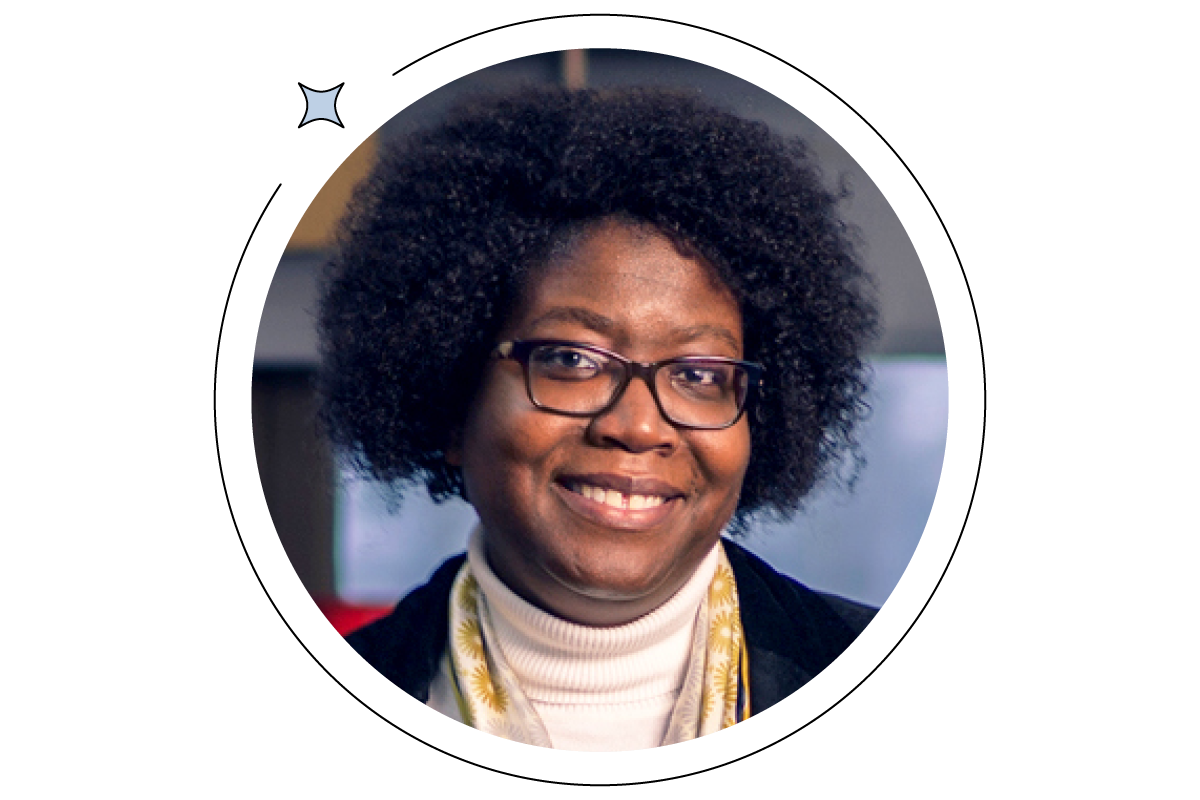
A woman with curly black hair, glasses, and a white turtleneck smiles at the camera.

About Science Connections

Welcome to Science Connections! Science is changing before our eyes, now more than ever. So…how do we help kids figure that out? We will bring on educators, scientists, and more to discuss the importance of high-quality science instruction. In this episode, hear from our host Eric Cross about his work engaging students as a K-8 science teacher. Listen here!

Two people sitting at a desk with one using a laptop and another looking on, surrounded by abstract line art and floating quotation marks, demonstrating the gold standard assessment process.

Our research

mCLASS Literacy

mCLASS® DIBELS® 8th Edition is an all-in-one literacy system for universal and dyslexia screening, progress monitoring, and instruction for grades K–8. It’s quick and easy to use, and it provides clear next steps for developing confident readers.

Research base

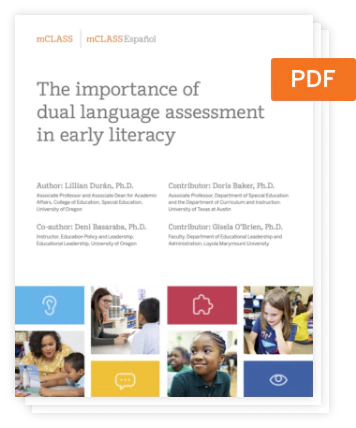
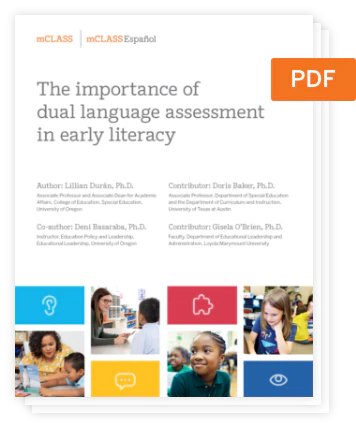
A pdf document titled "dual language of mCLASS assessment" with author details and images of students and teachers on the cover.

Research: The importance of dual language assessment in early literacy (published in 2022)

Read more

Cover page of the "Dynamic Indicators of Basic Early Literacy Skills, 8th Edition" Administration and Scoring Guide 2021 Edition, from the University of Oregon, College of Education.

Research: Administration and Scoring Guide (published in 2021)

Read more

Cover of the "Dynamic Indicators of Basic Early Literacy Skills (DIBELS) 8th Edition Technical Manual" from the University of Oregon College of Education.

Research: DIBELS 8th Edition Technical Manual (published in 2020)

Read more

Cover page of a white paper titled "mCLASS Dyslexia Screening Measures Technical Manual," with a small orange "PDF" label at the top right corner.

Research: mCLASS Dyslexia Screening Measures Technical Manual (published in 2019)

Read more

Cover page of a white paper document titled "mCLASS Dyslexia Screening Measures Research Report," with an orange "PDF" label at the top right corner.

Report: mCLASS Dyslexia Screening Measures Research (published in 2019)

Read more

Cover page of the "Burst Reading Assessment (Now mCLASS Intervention) Technical Manual" PDF document by Amplify.

Research: Burst Reading Assessment (Now mCLASS Intervention) Technical Manual (published in 2019)

Read more

Cover of a PDF titled "Five leadership practices that drive success in K-2 literacy," featuring an adult helping a young child read. Published by Amplify.

Research: Five leadership practices that drive success in K–2 literacy (published in 2018)

Read more

Cover of a PDF document titled "Examining the Efficacy of mCLASS Intervention," featuring an orange and white design. The word "Amplify" appears at the bottom, highlighting mCLASS as a gold standard assessment tool.

Report: Examining the Efficacy of mCLASS Intervention (published in 2015)

Read more

Research briefs

Cover page of a PDF research brief titled "Slow but steady: K–2 reading readiness climbs just 1–2 percentage points annually," featuring a simple bar graph illustration based on mCLASS gold standard assessment data.

Research brief: Slow but steady: K–2 reading readiness climbs just 1–2 percentage points annually. (published February 2026)

Read more

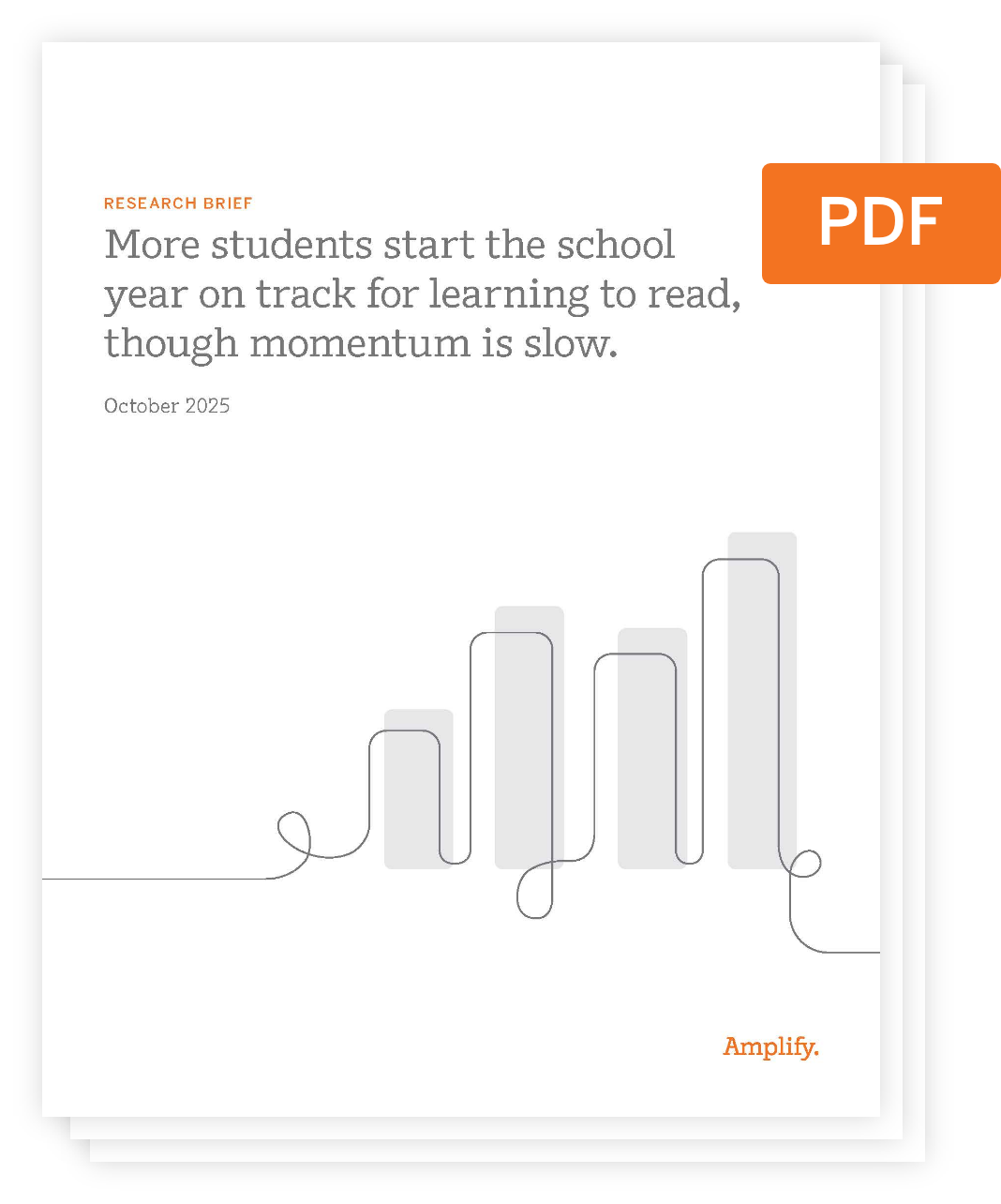
A PDF cover titled "More students start the school year on track for learning to read, though momentum is slow," dated October 2025, with a stylized bar graph illustration.

Research brief: More students start the school year on track for learning to read, though momentum is slow. (published October 2025)

Read more

Cover of a research brief titled "Reading scores rise overall; gender disparities present a complex picture," dated July 2025, featuring a bar chart graphic and highlighting mCLASS as the gold standard assessment, with a PDF label.

Research brief: Reading scores rise overall; gender disparities present a complex picture. (published July 2025)
Read more

PDF document titled "Early literacy gains offer hope for COVID recovery, though broader literacy challenges persist nationwide," dated February 2025.

Research brief: Early literacy gains offer hope for COVID recovery, though broader literacy challenges persist nationwide (published February 2025)

Read more

Cover of a PDF titled "Summer instructional loss highlights the importance of quality core instruction for the youngest grades," dated October 2024, with abstract line graph design.

Research brief: Summer instructional loss highlights the importance of quality core instruction for the youngest grades. (published October 2024)

Read more

Portada de un documento PDF titulado "Nuevo estudio", que analiza la importancia de la evaluación bilingüe para los estudiantes de habla hispana, con fecha de publicación de junio de 2024. El ícono de PDF se muestra en la esquina superior derecha.

Research brief: Different outcomes for Spanish-speaking students assessed in English and in Spanish demonstrate the importance of bilingual assessment.
(published June 2024)

Read more

Cover page of a research brief titled "Middle-of-year mCLASS data show early literacy improvements are slowing, and broader U.S. literacy rates remain a concern." Gold standard assessment results, March 2024.

Research brief: Middle-of-year data show early literacy improvements are slowing, and broader U.S. literacy rates remain a concern. (published March 2024)

Read more

Cover of a research brief PDF titled "With end-of-year data from gold standard assessment mCLASS showing continued academic recovery in early literacy, worries remain for third grade students," published July 2023 by Amplify.

Research brief: With end-of-year data showing continued academic recovery in early literacy, worries remain for third grade students.(published July 2023)

Read more

Cover page of a research brief titled "Middle-of-year data show that academic recovery continues in early literacy," featuring a simple bar graph, an orange PDF label, and highlighting mCLASS gold standard assessment.

Research brief: Middle-of-year data show that academic recovery continues in early literacy, with Black and Hispanic students making the greatest gains. (published February 2023)

Read more

A PDF cover page titled "Research Brief" discusses worsening literacy crises in U.S. schools post-COVID-19, featuring a stylized bar graph illustration, an October 2022 date, and highlights insights from mCLASS gold standard assessment data.

Research brief: Data from the beginning of the school year show that the literacy crisis in America’s schools may be worse than it was before COVID-19; but the greatest part of the crisis existed before the pandemic. (published October 2022)

Read more 

Cover of a research brief titled "Amid academic recovery in classrooms nationwide, mCLASS gold standard assessment reveals risks remain for youngest students with least instructional time during critical early years.

Research brief: Amid academic recovery in classrooms nationwide, risks remain for youngest students with least instructional time during critical early years. (published February 2022)

Read more

Cover page of a research brief titled "Students start to recover from COVID instructional loss," dated July 2021, featuring bar graph artwork, a PDF label, and highlighting gold standard assessment with mCLASS.

Research brief: Students start to recover from COVID instructional loss. (published July 2021)

Read more

Cover page of a research brief titled "COVID-19 means more students not learning to read," dated February 2021, with PDF label and Amplify logo. Features a simple bar graph illustration and highlights results from the gold standard assessment, mCLASS.

Research brief: COVID-19 means more students not learning to read. (published February 2021)

Read more

mCLASS Lectura

Cover of a PDF document titled "Guía de administración y calificación" for mCLASS, the gold standard assessment by Amplify, featuring an orange background.

Research: mCLASS Lectura Guía de administración y calificación

Read more

Stack of documents displaying the cover of the "mCLASS Lectura Technical Manual" in Spanish, labeled as a PDF—a gold standard assessment resource.

Research: mCLASS Lectura Technical Manual

Read more

Cover of the "mCLASS Spelling Español Technical Manual" PDF document, featuring a plain white background with orange and gray text—a guide to mCLASS’s gold standard assessment practices.

Research: mCLASS Spelling Español Technical Manual

Read more

Cover of a PDF titled "The importance of dual language assessment in early literacy," featuring author names, photos of young children in classroom settings, and referencing mCLASS as a gold standard assessment tool.

Research: The importance of dual language assessment in early literacy

Read more

District success stories

Ithaca City School District, New York: mCLASS DIBELS 8th Edition and connected intervention systems drive record-breaking literacy gains

Read more

Ready to learn more?

Fill out this form, and we’ll be in touch shortly.

An illustration of a spilled liquid with a submerged smartphone, depicting a phone accident with liquid involved, used to amplify CKLA research visibility.

Explore more of our research.

Learn more about the research behind our programs.

An abstract line drawing featuring a silhouette of a person with connected lines forming a flowing, continuous shape around them, inspired by CKLA research.

Our research

Amplify CKLA & Amplify Caminos

Using a fundamentally different approach to language arts, Amplify Core Knowledge Language Arts® (CKLA) is built on decades of early literacy research that demonstrates the importance of wide-ranging background knowledge and explicit and systematic instruction in foundational skills. Increasingly more districts are choosing Amplify CKLA because they know they’ll see results.

Amplify CKLA meets the criteria for Tier I-Strong Evidence as an education intervention under ESSA.

Impact overview

Efficacy

Cover of a PDF titled "Building Content Knowledge to Boost Comprehension in the Primary Grades," featuring illustrations of insects and plants, inspired by literacy research and Amplify CKLA insights.

Tier 1 ESSA evidence summary:

Amplify CKLA outperformed a control group on proximal and standardized tests.

Read more

Cover page of a PDF article titled "Building Content Knowledge to Boost Comprehension in the Primary Grades" from Reading Research Quarterly, highlighting authors and a partially visible abstract on literacy research.

Amplify CKLA Knowledge ESSA
Tier 1 Study
:

Efficacy research results confirm Amplify CKLA Knowledge meets rigorous ESSA Tier 1 evidence standards.

access now

A one-page pdf document layout with a title, three subheadings, and sections of text focused on CKLA research, formatted with bullet points and two separate sidebars.

An evaluation of Core Knowledge curriculum in charter schools:

Reading scores significantly improved and income-based gaps were eliminated.

Read more

Pdf document icon titled "Amplify CKLA Literacy Research Report for Grade 5.

AZ CKLA efficacy research report:

CKLA significantly improved outcomes for students overall, as well as economically disadvantaged and Latino students.

Read more

Build content knowledge, boost comprehension

Free access to efficacy study showing Amplify CKLA Knowledge meets ESSA Tier 1 qualifications.

Access now

District success stories

Cover of a PDF document titled "Making the shift to the Science of Reading" about Texas' Aldine Independent School District's gains using Amplify's early literacy suite. Map of Texas with Aldine marked.

Aldine Independent School District, Texas: Amplify’s early literacy suite boosts reading proficiency from 30% to 50%.

Read more

Cover of a PDF titled "Making the shift to the Science of Reading" by Amplify, featuring a hand-drawn map of Washington state with Oak Harbor marked. Orange banner labeled "PDF" at the top right corner.

Oak Harbor School District, Washington: Kindergarten reading proficiency improved by 19% and Grade 1 by 31% in 3 years.

Read more

Cover of a PDF document titled "Making the shift to the Science of Reading," which discusses reading gains in West Jefferson Hills School District in Pennsylvania using Amplify Core Knowledge Language Arts.

West Jefferson Hills School District, Pennsylvania: Students reach the 98th percentile among their peers nationwide after implementing Amplify.

Read more

Cover page of a PDF report titled "Making the shift to the Science of Reading," featuring an outline of North Carolina, the Amplify logo, and references to CKLA research supporting literacy research.

Salemberg Elementary School, North Carolina: Students made 80–100 composite points of growth in one semester.

Read more

Cover of a PDF titled "Making the shift to the Science of Reading," featuring a map outline of Ohio, highlighting Euclid, with insights from Literacy research and the Amplify logo at the bottom.

Euclid City School District, Ohio: Amplify CKLA, Boost Reading, and mCLASS boosted Euclid Kindergarten reading proficiency from 10% to 57% and Grade 1 from 20% to 37% in one school year.

Read more

Cover page of a PDF titled "Making the shift to the Science of Reading," featuring an outline of Ohio and highlighting Gallia County; published by Amplify and grounded in the latest literacy research.

Gallia County Local School District, Ohio: With Amplify CKLA, the number of Gallia County students needing a Reading Improvement Plan dropped from 46% to 27% in one year.

Read more

Cover page of a PDF titled “Making the shift to the Science of Reading,” featuring a map of Louisiana and a highlighted section about Lafourche Parish School District’s success.

Lafourche Parish Public School District, Louisiana: Louisiana’s Lafourche Parish School District improves third-grade LEAP scores to 73% basic or better, surpassing the state average, with Amplify CKLA.

Read more

Cover of a PDF titled "Making the shift to the Science of Reading" featuring an outline map of Texas and highlighting Pleasanton Independent School District.

Pleasanton Independent School District, Texas: Kindergarten scores rise from 44% to 60% with Amplify.

Read more

Cover page of a PDF titled "Making the shift to the Science of Reading," featuring an outline of Texas and a highlighted district, produced by Amplify.

Robstown Independent School District, Texas: Texas’s Robstown ISD doubles first-grade benchmark scores—from 22% to 44% in one year—using Amplify’s early literacy suite.

Read more

Cover page of a PDF titled "Making the shift to the Science of Reading," featuring an outline of Ohio with text and an orange banner labeled "District Success Story.

Blanchester Local School District, Ohio: Proficiency climbed to 76.1% with Amplify CKLA, leading to Ohio’s Governor’s Science of Reading Recognition Award.

Read more

Cover page of a PDF titled "Driving impact through implementation science," featuring an outline map of Washington State, an orange PDF label, and highlights on literacy research such as Amplify CKLA.

Richland School District,
Washington:
Reading proficiency increased by up to 45% in one year
with Amplify CKLA.

Read more

Cover page of a PDF titled "Driving impact through implementation science," featuring an outline of a state map, minimal orange text accents, and references to CKLA research in literacy.

Northwest Local School District,
Ohio
: Grades 1–5 see 8- to 16-point gains in MAP RIT scores in their first year of Amplify CKLA implementation.

Read more

Cover page of a PDF titled "Making the shift to the Science of Reading," featuring an outline of Texas and a highlighted district, produced by Amplify.

Casa Grande Elementary School District, Arizona: Kindergarten reading proficiency triples to 37% in one year with Amplify CKLA.

Read more

Cover page of a PDF titled "Driving impact through implementation science," featuring a line drawing of South Carolina with a highlighted district, emphasizing the role of literacy research and amplify CKLA in educational improvement.

Charleston County School District, South Carolina: SC READY literacy results improved by 5.6% for grade 3 students in the first year of Amplify CKLA implementation.

Read more

Cover page of a PDF titled "Driving impact through implementation science" by Amplify, featuring a simple line map, an orange "District Success Story" label, and insights drawn from CKLA research in literacy.

Knox County Schools achieve 12% improvement in number of kindergarteners, second graders on track, after first year with Amplify CKLA.

Read more

Research base

Cover of a PDF document titled "Amplify CKLA Kindergarten–Grade 5 Research Guide," featuring a plain white background, orange text accents, and insights from Amplify CKLA literacy research.

Amplify CKLA: The research behind the core literacy program

Read more

The baseball experiment: How two Wisconsin researchers discovered that the comprehension gap is a knowledge gap

Read more

CKLA Curriculum: Links to research on teaching and learning

Read more

Amplify Caminos

Stack of PDF documents titled "Amplify Caminos: The research behind the program," featuring an orange PDF label on the top right corner, highlights CKLA research and essential literacy research supporting the curriculum.

Amplify Caminos: The research behind the program

Read more

Cover page of a PDF titled "Making the shift to the Science of Reading," featuring an outline of Minnesota with Saint Paul Public School marked.

Saint Paul Public Schools, Minnesota: Saint Paul Public Schools raises reading proficiency from 23% to 86% in one year with Amplify Caminos and mCLASS Lectura.

Read more

State success

A PDF document titled "Louisiana’s Reading Renaissance" with a line graph depicting Grade 3 LEAP scores in districts using CKLA for 2+ years.

Louisiana’s reading renaissance: Implementing CKLA drives 3rd grade LEAP scores across Louisiana.

Read more

Stack of documents titled "Making the shift to the Science of Reading" with an orange "PDF" label and a minimalist line drawing of a face on the cover.

Ohio’s literacy lift: CKLA implementation raises grades 3–5 OST performance statewide.

Read more

An illustration of a spilled liquid with a submerged smartphone, depicting a phone accident with liquid involved, used to amplify CKLA research visibility.

Explore more of our research.

Learn more about the research behind our programs.