School year 2026–2027 requirements
| iPad® 7+ Description: 1024 x 788 or higher, 32GB or higher Operating system: iPadOS 18+ Browser: Safari 18+ |
| PC Description: 1.4 GHz dual core or greater, 1024 x 768 or higher, 4GB of RAM or higher Operating system: Windows: 10+ Browser: Chrome (latest 2 versions) |
| Chromebook Description: 1.4 GHz dual core or greater, 1024 x 768 or higher, 4GB of RAM or higher Operating system: Chrome OS Browser: Chrome (latest 2 versions) |
| Mac® Description: 1.4 GHz dual core or greater, 1024 x 768 or higher, 4GB of RAM or higher Operating system: macOS 15+ Browser: Safari 15+, Chrome (latest 2 versions) |
The following devices are recommended for optimal performance and experience:
| iPad | iPad Air® 4 iPad 8+ |
| Chromebook™ | Acer Chromebook 314 Samsung Chromebook 4 Dell™ Chromebook 3120 HP Chromebook x360 |
| Mac | MacBook Pro® MacBook Air® |
| Interactive Board | A Google certified EDLA device, such as the SMART RX Series |
The following devices are not supported due to known sub-optimal performance from older hardware or complicated settings:
| Microsoft | Surface Tablet® |
School year 2025–2026 requirements
| iPad® 7+ Description: 1024 x 788 or higher, 32GB or higher Operating system: iPadOS 17+ Browser: Safari 17+ |
| PC Description: 1.4 GHz dual core or greater, 1024 x 768 or higher, 4GB of RAM or higher Operating system: Windows: 10+ Browser: Chrome (latest 2 versions) |
| Chromebook Description: 1.4 GHz dual core or greater, 1024 x 768 or higher, 4GB of RAM or higher Operating system: Chrome OS Browser: Chrome (latest 2 versions) |
| Mac® Description: 1.4 GHz dual core or greater, 1024 x 768 or higher, 4GB of RAM or higher Operating system: macOS 14+ Browser: Safari 15+, Chrome (latest 2 versions) |
The following devices are recommended for optimal performance and experience:
| iPad | iPad Air® 4 iPad 8+ |
| Chromebook™ | Acer Chromebook 314 Samsung Chromebook 4 Dell™ Chromebook 3120 HP Chromebook x360 |
| Mac | MacBook Pro® MacBook Air® iMac® |
| Interactive Board | A Google certified EDLA device, such as the SMART RX Series |
The following devices are not supported due to known sub-optimal performance from older hardware or complicated settings:
| Microsoft | Surface Tablet® |
We will provide active support of our applications on the following devices for the full school year listed below.
Device final support year
| iPad 6 | 2024–2025 |
| iPad Air 3 | 2025–2026 |
| iPad 5 | 2022–2023 |
| iPad Air 2 | 2021–2022 |
| iPad 2 | 2018/2019 |
| iPad 3 | 2018/2019 |
| iPad 4 | 2018/2019 |
Network environment
| MINIMUM REQUIREMENTS | |
| User devices: | Connect to Amplify servers via ports 80 and 443. |
| Latency: | No more than 165 ms during peak utilization. |
| Connection speed: | 2 mbps per device during peak usage (10 mbps recommended). Boost Reading requires a connection speed of 10 mbps per user for optimal performance. |
| URLs: | For the complete list of URLs to allow, please visit https://amplify.com/allowlist/. |
Requirements
mCLASS assessments are optimized for most touchscreen devices using Chrome™ or Safari® web browsers. The teacher-led, observational assessments are best conducted using touchscreen but will function using a laptop and mouse as well. Please check our device support lifecycles and purchase recommendations lists below prior to purchasing.
Boost Close Reading is currently not supported on iPads.
Due to its smaller screen, the iPad Mini is not supported.
Amplify curriculum applications require the ability to project from the teacher’s device.
Boost Reading Benchmark uses speech recognition software to analyze students’ oral reading. For the most accurate results, use a wired dual-ear headset with a boom microphone that extends in front of the student’s mouth. Avoid headsets with active noise cancellation (ANC) unless that feature can be disabled. Bluetooth headsets are currently incompatible with our speech recognition technology and should not be used.
For Amplify ELA Mobile Solos the following devices are recommended for optimal performance and experience:
iPhone 13 and later running iOS 17+ and Safari
Galaxy 11 and later running Android 15+ and Chrome
Welcome to Amplify CKLA!
Amplify Core Knowledge Language Arts (CKLA) is a cutting-edge and effective core ELA program for students in grades K–5. It was developed in partnership with the Core Knowledge Foundation, features proven evidence-based instructional practices, and was specifically designed to help teachers implement Science of Reading principles.
Note: We’re continually adding information to this site, including specific details regarding our alignment with your non-negotiables. Keep checking back with us between now and April 20, 2023.

Getting Started
On this site, you’ll find a variety of resources designed to support your review and evaluation of the program. Before you dive in, watch the Orientation Overview and Program Overview videos below to learn about CKLA’s alignment to CCSD’s ELA adoption requirements, as well as where to find key program resources.
[Video] Orientation Overview
[Video] Program Overview
In the video below, learn about CKLA’s structure and materials, as well the research behind the curriculum.
Evidence-Based
[Video] Pedagogical Overview with Simple View of Reading
In the video below, Amplify’s Chief Academic Officer Susan Lambert shares the big picture of CKLA, and explains why it was created and the impact it’s making across the country. Below are a few portions of the video that you may find particularly helpful as you conduct your review.
- 0-1:00 Why CKLA?
- 1:00-4:40 How CKLA was built on the Simple View of Reading
- 4:40-8:00 How to review the CKLA Components
- 8:00-end Teacher Testimonial
[Features] Supporting the Simple View of Reading
Built out of the latest research in the Science of Reading, Amplify CKLA delivers explicit instruction in both foundational literacy skills (systematic phonics, decoding, and fluency) and background knowledge in grades K–2 with an integrated approach to explicit instruction in grades 3–5.
Review this Science of Reading toolkit to learn more about the Science of Reading best practices integrated throughout CKLA.
See our Science of Reading solutions in action! Click here to see a real example of how one Ohio district is implementing and educating their K–8 community on the Science of Reading as a response to Ohio’s Plan to Raise Literacy Achievement Initiative.
Great reading instruction starts with helping kids develop great decoding skills. By building a solid foundation of phonological awareness and phonics, reading the words on the page becomes automatic so that comprehension and critical thinking can happen. Our instruction is supported by:
- Step-by-step lessons with multisensory approaches, clear lesson objectives, and embedded formative assessments.
- Decodable books and student readers with ebook and audiobook versions that feature engaging plots and relatable characters.
- An engaging sound library with fun songs and videos that develop phonological awareness.
- An interactive Vocab App featuring engaging activities with immediate feedback and automated, customized instruction based on student performance.
Students build grade-appropriate subject-area knowledge and vocabulary in history, science, literature, and the arts while learning to read, write, and think creatively and for themselves. Our instruction is supported by:
- Knowledge builders that provide a quick overview of each domain with its key ideas.
- Interactive Read-Alouds designed to build knowledge and vocabulary.
- Content-rich anchor texts that support students as they tackle increasingly complex text and sharpen their analytical skills.
- Social and emotional learning paired with lessons in civic responsibility.
Easy-to-Use Materials
Amplify CKLA offers a number of digital and multimedia resources to support instruction and enhance the teacher and student experience.
- Amplify CKLA Digital Experience Site: All teacher and student materials are posted on this site for planning and information purposes, including Teacher Guides, Readers, Activity Books, Ancillary Materials, videos, additional resources, and links to other useful sites, such as the Professional Learning site.
- The Professional Learning Site: This site includes training materials, best practices, and other resources to develop program expertise. Access professional development anywhere, anytime.
- Intervention Toolkit: The Intervention Toolkit provides easy-to use resources to assist teachers in filling gaps in students’ foundational skills. Teachers will find hundreds of activities to support phonics, fluency, comprehension, handwriting, and other key skills.
- The Science of Reading: The Podcast: Hosted by Susan Lambert, The Podcast delivers the latest insights from researchers and practitioners in early reading. Each episode takes a conversational approach and explores a timely topic related to the Science of Reading.
In addition to the videos below, our CKLA Components Guide can be a helpful tool as you explore the materials provided within your sample tubs.
[Video] Physical Materials Walkthrough
As you explore your physical samples, the material walkthrough video below can be a helpful resource. In particular, we suggest watching the following portions of the video.
- 0-4:38 CKLA components for K–2
- 4:38-7:00 CKLA components for 3–5
- 7-7:30 CKLA Program Guide
- 10:12-13:20 CKLA’s Teacher Resource Site
Note: The below video covers both our K-5 program (Amplify CKLA) as well as our 6-8 program (Amplify ELA).
[Video] Digital Materials Walkthrough
In the video below, learn about CKLA’s digital tools for teachers and students across both classroom and asynchronous environments.
As you prepare to explore our digital platform, be sure to watch and refer to the video below.
Diverse Texts
In Amplify CKLA, texts serve a variety of purposes, from building background knowledge, vocabulary, and comprehension to building decoding and fluency skills.
In grades K–2, instruction is segmented between two strands: Knowledge and Skills.
- Reading within the Knowledge Strand is centered around authentic read-alouds and trade books that are intentionally sequenced to build content knowledge and vocabulary in specific domain topics around literature, history, science, and the arts. Because research shows that students’ listening comprehension outpaces their reading comprehension until their early teens, Amplify CKLA strategically uses read-aloud text in this strand, allowing students to focus their cognitive energy on gaining meaning from the words and better understanding from the images.
- Reading within the Skills Strand centers around carefully crafted Student Readers that teach students how to read. Structured as chapter books, these readers are 100% decodable and were developed to align with Amplify CKLA’s scope and sequence for phonics, directly connecting instruction to student practice in connected texts. Students use the Readers to practice decoding, fluency, and comprehension during shared reading lessons, targeted close reading sessions, in small groups, and independently.
In grades 3–5, integrated units bring the Skills and Knowledge strands together as students become increasingly automatic and strategic in their word recognition and language comprehension skills. Student reading and comprehension activities involve a variety of reading materials:
- Authentic Read-Alouds and trade books ensure students encounter a variety of perspectives as they use these complex text to increase their knowledge while practicing vocabulary and listening comprehension skills.
- Student Readers connect to each theme and are designed to increase in complexity over time, providing a continual challenge as students’ reading and listening comprehension skills develop and strengthen throughout the year.
- Novel Guides provide teachers a flexible option for extending authentic reading and text-based activities in the classroom using award-winning and acclaimed novels.
- ReadWorks articles give students access to additional high-quality texts aligned to both Amplify CKLA knowledge topics and the topics outlined in the Common Core State Standards.
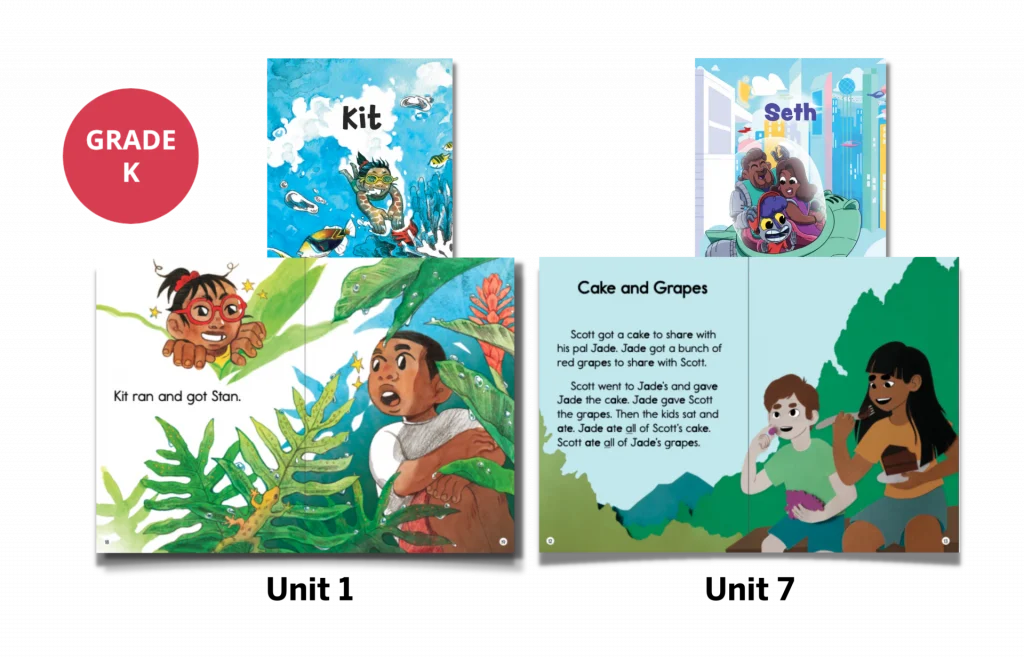
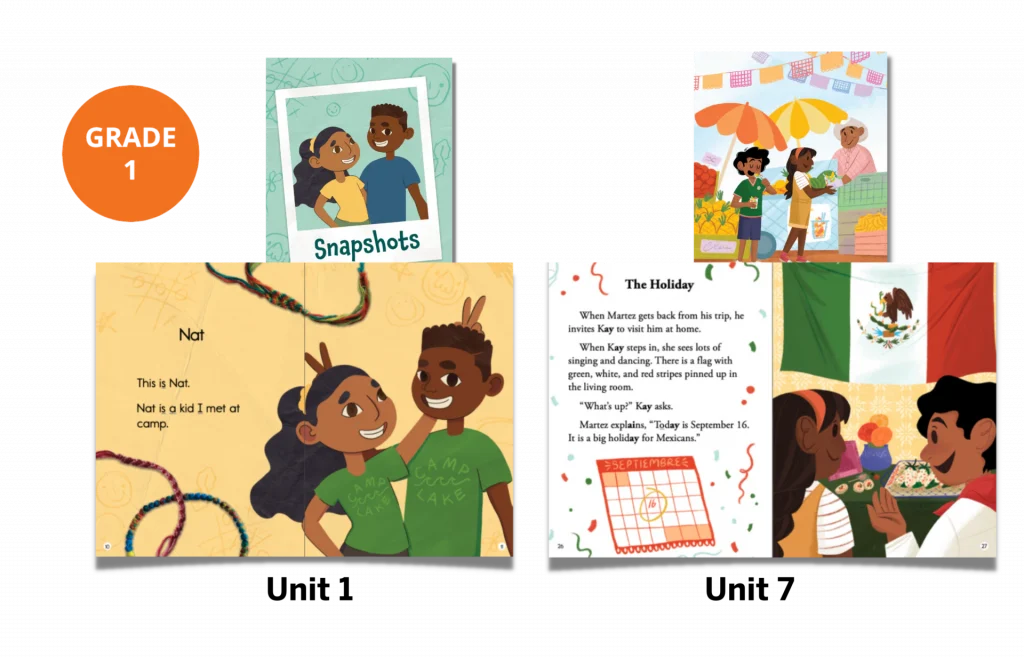
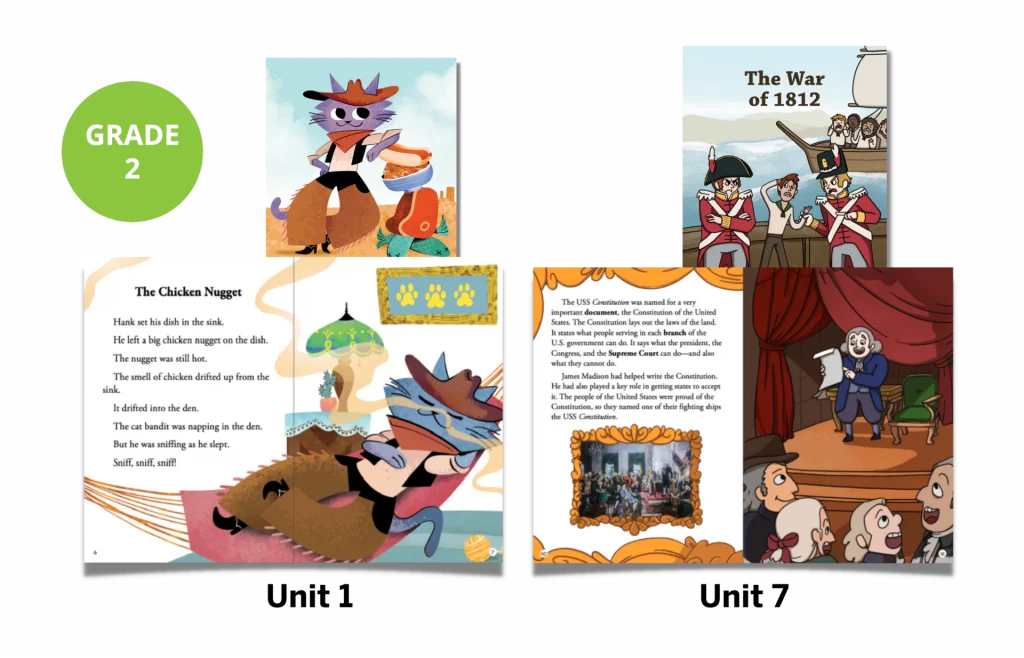
Decodable Readers at Grades K–2
Our Decodable Readers are designed to progress in skills, mirroring the scope and sequence of instruction, which allows students to immediately apply what they are learning to 100% decodable text. More specifically, our decodables:
- Are uniquely designed to provide intensive practice with the CKLA code while students read compelling and engaging stories and informational texts for the first time.
- Gradually introduce students to “tricky” spelling concepts, such as different sounds that use the same letter code.
- Increase in text complexity (i.e., content, length, and vocabulary) as students progress through the grades.
- Include fiction and nonfiction text.
- Are available as ebooks and audiobooks.
Below, you can see how students grow from year-to-year across grades K–2.
Student Readers at Grades 3–5
By grades 3–5, students have mastered the basics of decoding and are hungry to use what they’ve learned to reach out to the world. Although Read-Alouds remain an important part of lessons, students are also encouraged to practice independent reading starting in grade 3 with the support of carefully crafted Student Readers. These readers are chock-full of various text types, cultural stories, and a blend of fiction and nonfiction texts that are tied to and support the overarching theme of the unit.

Read-alouds
Authentic literature exposes students to a variety of text types and perspectives to deepen their knowledge of fascinating topics in social studies, science, literature, and the arts. Authentic texts support text-to-self, text-to-world, and text-to-text connections for readers.

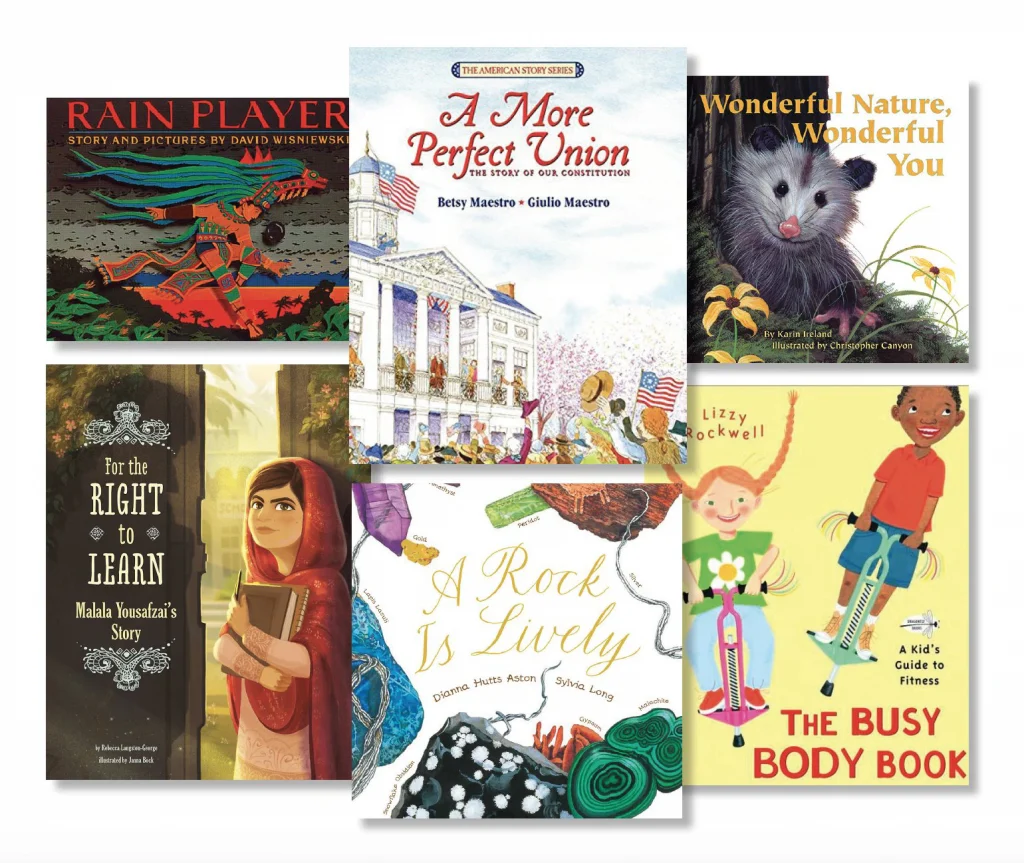
Trade books
Our optional Trade Book Collection (and suggested list of additional trade books) align with our grade-level topics, and extend the knowledge students are learning through an authentic text.
Novel Guides
Novel Guides bring students beyond the CKLA curriculum. We provide fifteen full days of instruction on contemporary trade books, as well as writing prompts that help students navigate the authentic literature they love.

ReadWorks
Amplify CKLA and ReadWorks® have partnered to deliver high-quality texts curated to support the Amplify CKLA Knowledge Sequence and to extend student learning. Texts include high-interest nonfiction articles in topics in social studies, science, literature, and the arts. These texts are accompanied by vocabulary supports and standards-aligned formative assessment opportunities. Teachers can monitor their students’ progress using the ReadWorks reporting features.
Reading resources
The following resources may be helpful as you explore our approach to reading and the role that diverse texts play in the program.
- CKLA Text Complexity Guide
- What students read in Grade K
- What students read in Grade 1
- What students read in Grade 2
- What students read in Grade 3
- What students read in Grade 4
- What students read in Grade 5
Writing
CKLA is rich with opportunities for students to develop, practice, and hone their writing skills. While the shape of writing instruction looks slightly different at each grade level, a commonality across all grades K–5 is that writing isn’t taught in isolation. Rather, it’s embedded within the context of each unit, and is connected to what students read.
At Grades K–2, writing takes place in both the Skills and Knowledge strands.
- Explicit instruction in writing skills (such as sentence structure) and handwriting takes place in the Skills Strand, and is tied to the decodable readers used within each unit.
- Extended writing and writing process activities take place in the Knowledge Strand.
At Grades 3–5, writing is embedded through the integrated units.
- Across each unit, students work on smaller, more discrete writing skills alongside their Student Reader. These skills eventually culminate at the end of each unit in the form of a writing project.
- In 4th and 5th grades, we expand writing even further with the addition of Poetry units.
Writing and text-dependent questions
The overwhelming majority of questions, tasks, and assignments in CKLA materials are text-dependent. Every CKLA unit and domain is based around key texts that are either read aloud, with a peer, or independently. These readings are followed by class discussions where students are expected to refer to these texts when answering literal, inferential, and evaluative questions, both orally during class discussions and through written responses.
- Literal questions assess students’ recall of key details from the text. These are text-dependent questions that require students to paraphrase and/or refer back to the portion of the text where the specific answer is provided.
- Inferential questions ask students to infer information from the text and to think critically. These text-dependent questions require students to summarize and/or reference the portions of the text that lead to and support the inference they are making.
- Evaluative questions ask students to build on what they have learned from the text using analytical and application skills, often to form an opinion or make a judgment. These questions require students to paraphrase and/or cite the textual evidence that substantiates their argument or opinion.
In addition, students are often asked to generate additional questions based on the texts. Students further demonstrate understanding in writing by applying what they have learned and providing evidence from the text to back up their answers and opinions. For example, Grade 3 students learning about sea exploration write a paragraph from the perspective of a sailor on John Cabot’s ship, stating their opinion of whether the hardships they experienced are worth the adventure or glory and citing examples from the text to support their response. Grade 5 students studying the Adventures of Don Quixote write a four-paragraph persuasive essay arguing whether they believe Don Quixote’s good intentions justify his often calamitous actions, using reasons and evidence from the text to support their claims.
Writing with authentic literature
Novel Guides are designed around authentic texts students love. They not only help students foster a love for reading, they also present authentic opportunities for students to express themselves through writing. Novel Guides provide daily text-based writing and discussion through five activity types:
- Ask contains questions for discussion, reflection, or brief written responses. These questions cover information all students should understand as they read the text.
- Explore prompts offer brief research opportunities centered around items mentioned in the text.
- Imagine activities promote creativity and further reflection.
- Observe items ask students to take notes or make other kinds of observations about what they have read.
- Understand questions push students to explore connections to the text.
Writing and enrichment
Writing tasks throughout the program provide almost limitless opportunities for extension. Feedback from the teacher, peers, and self-reflection provide students opportunities to strengthen their writing. For example, advanced students can be encouraged to:
- Use more complex and unusual descriptive vocabulary.
- Incorporate figurative language into their writing.
- Write multi-clause sentences with more complex joining words.
- Create longer or richer opinion, explanatory, and narrative pieces.
- Evaluate the use of informational textual characteristics and use in their own writing (e.g., headers, bullets).
Writing resources
The following resources may be helpful as you explore our approach to writing and how writing develops across the program.
Access the program
Explore as a teacher
Before logging in, watch this brief video on navigating the CKLA Teacher Resource Site.
Ready to explore as a teacher? Follow these instructions:
- Click the CKLA Teacher Resource Site button below.
- Select Log in with Amplify.
- Enter the username: t1.ccsd-k5-ckla@demo.tryamplify.net
- Enter the password: Amplify1-ccsd-k5-ckla
- Click the CKLA Teacher Resource icon
- Select a grade level
Explore as a student
Before logging in, watch this brief video on navigating the CKLA Student Hub.
Ready to explore as a student? Follow these instructions:
- Click the CKLA Teacher Resource Site button below.
- Select Log in with Amplify.
- Enter the username: s1.ccsd-k5-ckla@demo.tryamplify.net
- Enter the password: Amplify1-ccsd-k5-ckla
- Click the CKLA Teacher Resource icon
- Select a grade level
Check out these additional resources
Nevada submission resources:
- CKLA Program Alignment to the Standards (Nevada Rubric: Category 1)
- CKLA Program Social Justice Alignment (Nevada Rubric 2: Category 2)
- CKLA Grade K Lesson Alignment to the Nevada Academic Content Standards for English Language Arts
- CKLA Grade 1 Lesson Alignment to the Nevada Academic Content Standards for English Language Arts
- CKLA Grade 2 Lesson Alignment to the Nevada Academic Content Standards for English Language Arts
- CKLA Grade 3 Lesson Alignment to the Nevada Academic Content Standards for English Language Arts
- CKLA Grade 4 Lesson Alignment to the Nevada Academic Content Standards for English Language Arts
- CKLA Grade 5 Lesson Alignment to the Nevada Academic Content Standards for English Language Arts
CKLA review resources:
- CKLA Program guide
- Diversity, equity, and inclusion in CKLA
- Text complexity in CKLA
- Trade books in CKLA
- Assessments in CKLA
- Remote and hybrid learning with CKLA
- Amplify ELA Technical Specifications
- CKLA Scopes and Sequences
- Grade K Skills and Knowledge
- Grade 1 Skills and Knowledge
- Grade 2 Skills and Knowledge
- Grade 3 Integrated
- Grade 4 Integrated
- Grade 5 Integrated
Welcome, LAUSD educators!
Introducing Amplify Desmos Math California, a curiosity-driven TK–12 program that builds lifelong math proficiency. Each lesson poses problems that invite a variety of approaches before guiding students to synthesize their understanding of the learning goals. Students encounter math problems they’re eager to solve, while teachers spend more time where it’s most impactful—creating a collaborative classroom of learners.
Start by watching our welcome video to the right, then learn more about the program and begin your review below.
Curriculum overview
Watch the videos below for an overview of Amplify Desmos Math California:
Built for California
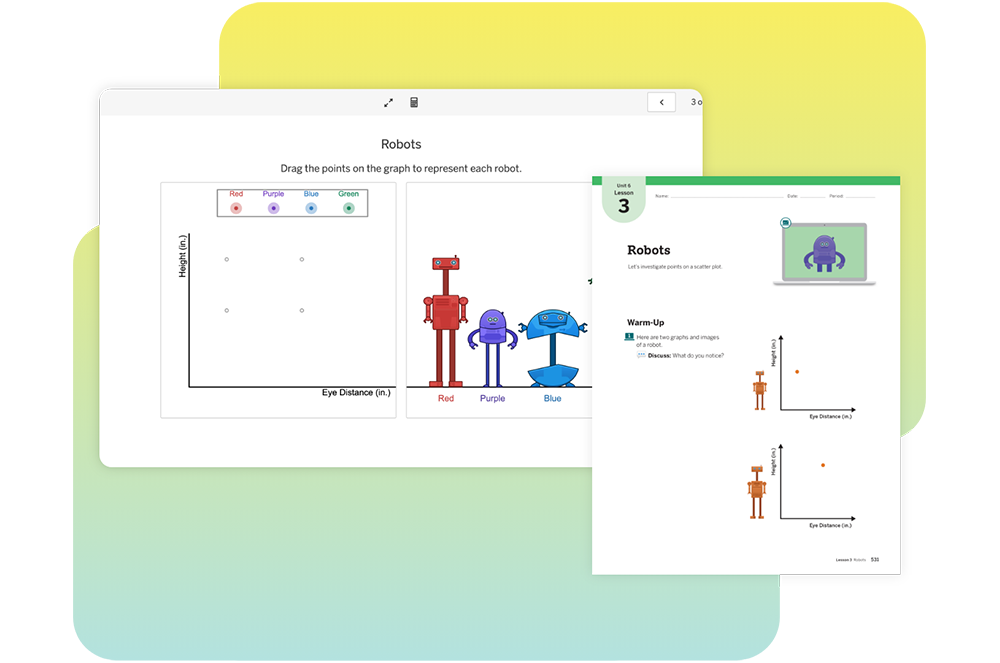
The Amplify Desmos Math California program is designed around the vision articulated in the Mathematics Framework for California Public Schools: Kindergarten Through Grade Twelve to enable all California students to become powerful users of mathematics. Our program incorporates the latest research in student learning, meaning that we:
- Focus on the Big Ideas: Amplify Desmos Math California’s courses, units, and lessons are centered around the Big Ideas. Big Ideas, like standards, are not considered in isolation. In addition to each unit and lesson’s focal Big Ideas, Amplify Desmos Math California also provides connections among the Big Ideas across units and lessons.
- Center on open and engaging tasks: Amplify Desmos Math California is grounded in engaging tasks meant to address students’ often-asked question: “Why am I learning this?” Students are invited into learning with low-floor, high-ceiling tasks that provide an entry point for all. Open tasks in Amplify Desmos Math California provide the space for students to try on multiple strategies and represent their thinking in different ways, and allow student explanation and discussion to serve as the center of the classroom. All lessons offer both print and digital representations.
- Provide enhanced digital experiences: Amplify Desmos Math California includes digitally-enhanced lesson activities, incorporating interactive digital tools alongside print materials. These purposefully-placed resources allow students to visualize mathematical concepts, receive actionable feedback while practicing, encounter personalized learning support from an onscreen tutor, and engage in discussions about their thinking and approaches.
- Treat core instruction and differentiation as integral partners: The Amplify Desmos Math California curriculum provides teachers with lessons, strategies, and resources to eliminate barriers and increase access to grade-level content without reducing the mathematical demand of tasks. Every activity has multiple entry points to ensure that all students are supported and challenged. Intervention and personalized learning activities are directly connected to lesson content and offer students individualized support as they dive into the mathematics.
About the program
Taking the IM content further.
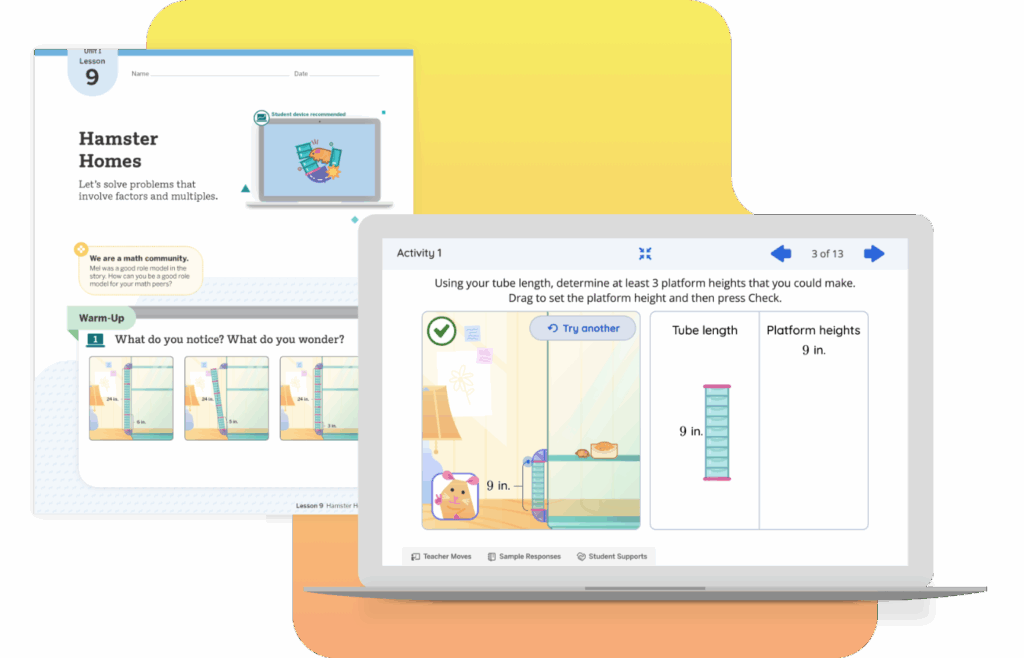
Amplify Desmos Math California is a curiosity-driven program that builds lifelong math proficiency. Each lesson poses problems that invite a variety of approaches before guiding students to connect their understanding of the learning goals.
Students encounter math problems they’re eager to solve, while teachers spend more time where it’s most impactful: creating a collaborative classroom of learners.
We chose to base our program on the extensively field-tested IM K–12 MathTM authored by Illustrative Mathematics. IM K–12 Math is a problem-based curriculum. It asks students to grapple with well-designed and thoughtfully sequenced real-world mathematical problems to build their understanding of how to efficiently solve them.
Begin your review to see how we’ve taken the IM K–12 Math content further.
Begin your review
Using a Google Chrome or Safari web browser, click the orange button below or navigate to learning.amplify.com and select “Log in with Amplify.” Please note, these demo accounts expire on April 04, 2026.
K–8 English credentials
- Username: t1.lausd_adm_k8@demo.tryamplify.net
- Password: Amplify1-lausd_adm_k8
K–8 Spanish credentials
- Username: t1.lausd_k8_spanish@demo.tryamplify.net
- Password: Amplify1-lausd_k8_spanish
AGA credentials
- Username: t1.lausd_aga@demo.tryamplify.net
- Password: Amplify1-lausd_aga