How comprehension fits into effective literacy instruction

Many of us grew up doing a classroom activity called “reading comprehension,” in which we would read a short text about, let’s say, sea turtles, then answer multiple-choice questions designed to demonstrate how much of that reading we comprehended. The next time, the reading might’ve been about the history of jazz.

Nothing against sea turtles or Dizzy Gillespie, but our approach to reading comprehension has evolved—and that’s thanks to the Science of Reading.

Let’s take a look at what we know now about how comprehension works and how to make it part of the best possible literacy instruction.

The role of comprehension in literacy instruction

Comprehension is one of the five foundational skills in reading and one of the two key components of the Simple View of Reading.

This framework lays out the two fundamental skills required for reading with comprehension:

  1. Decoding—the ability to recognize written words
  2. Language comprehension—understanding what words mean

In other words, reading proficiency is a product of word recognition and language comprehension.

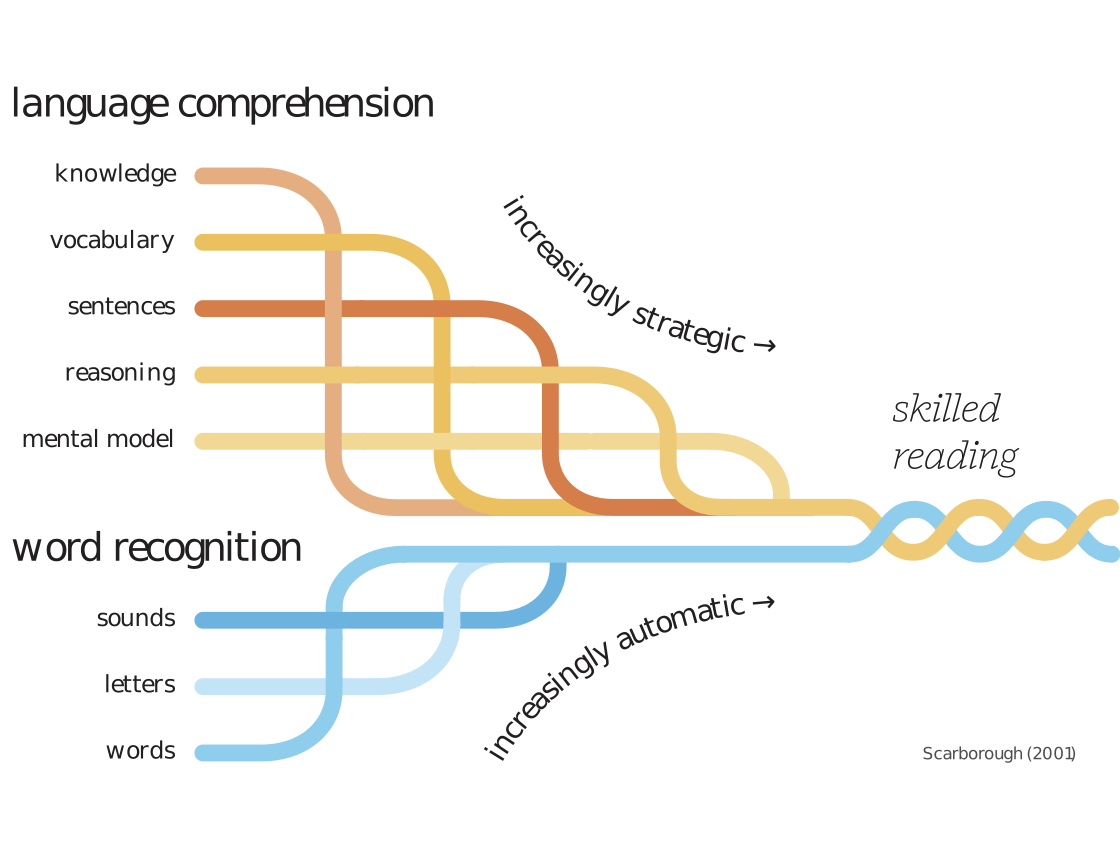
The Reading Rope layers complexity onto this view, providing a visual metaphor of reading as a complex skill combining decoding skillslanguage comprehensionbackground knowledgevocabulary, and more.

In this context, comprehension refers to the ability to understand and make meaning from written text. It involves not only accurately decoding and recognizing words, but also grasping the deeper meaning, intent, and implications of the text.

Product vs. process: The missing link in comprehension

Historically, comprehension instruction focused on the products of comprehension, rather than on the process. Students could demonstrate that they understood what they just read about sea turtles, but how did students understand it? What were their brains actually doing at the time? Answering those questions can help us better support students.

To do that, let’s look at the students who are not the best comprehenders—even though they have solid word recognition, vocabulary, and background knowledge. What’s missing?

After you read a piece of text, you’ll probably not recall its precise wording, but generally, you’ll remember the general idea. Doing so requires building a structure in your mind that researchers now call a “mental model.” The process of building a mental model is a sort of micro-comprehension.

Weak comprehenders build weak models. So when asked to analyze a character or make a prediction, their answers are not as strong as those of more advanced comprehenders.

We now know that students need four critical skills to improve their mental modeling/micro-comprehension—and thus their overall comprehension.

  1. Interpreting the usage of anaphoras (like she, him, them).
  2. Understanding the use of markers to signal ways that the text fits together — connectives (like sothoughwhenever), structure cues, and directions.
  3. Supplying gap-filling inferences. (Writers often make assumptions about what can be left unstated, and weaker readers who fail to make these gap-filling inferences wind up with gaps in their mental models.)
  4. Monitoring comprehension as they read. (When something doesn’t make sense, strong readers stop, re-read, and try to figure it out, while weaker readers just keep going, failing to notice that they don’t understand.)

How background knowledge helps language comprehension

The Science of Reading demonstrates the importance of systematic and explicit phonics instruction.

But students do not have to learn phonics or decoding before knowledge comes into the equation.

“The background knowledge that children bring to a text is also a contributor to language comprehension,” says Sonia Cabell, associate professor at Florida State University’s School of Teacher Education, on Science of Reading: The Podcast. Background knowledge serves as the scaffolding upon which readers build connections between new information and what they already know. Students with average reading ability and some background knowledge of a topic will generally comprehend a text on that topic as well as stronger readers who lack that knowledge.

What we know about knowledge and comprehension should inform instruction. “I think most, if not every, theory of reading comprehension implicates knowledge,” says Cabell. “But that hasn’t necessarily been translated into all of our instructional approaches.”

So, a central question is: How can we help build background knowledge—and thus comprehension?

Broadly, we can work to use literacy curricula that intentionally and systematically builds knowledge as they go.

We can also be “intentional throughout our day in building children’s knowledge,” says Cabell, offering the example of choosing books to read aloud. She suggests we ask not just “‘Do they have the background knowledge to understand something,’ but rather ‘Can what I’m reading aloud to them build background knowledge?’”

Cabell also suggests being a little ambitious in your read-alouds: “Read aloud books a couple of grade levels above where [students are] reading right now, so that they’ll be able to engage with rich academic language.”

Comprehension instruction in the classroom

So, what does this type of comprehension instruction look like? Let’s explore a few science-informed examples:

  1. Systematically build the knowledge that will become background knowledge. Use a curriculum grounded in topics that build on one another. “When related concepts and vocabulary show up in texts, students are more likely to retain information and acquire new knowledge,” even into the next grades, education and literacy experts Barbara Davidson and David Liben say. “Knowledge sticks best when it has associated knowledge to attach to.”
  2. Present instruction that engages deeply with content. Research shows that students—and teachers, too—actually find this content-priority approach more rewarding than, in Davidson and Liben’s words “jumping around from topic to topic in order to practice some comprehension strategy or skill.”
  3. Support students in acquiring vocabulary related to content.  Presenting key words and concepts prior to reading equips students to comprehend the text more deeply. Spending more time on each topic helps students learn more topic-related words and more general academic vocabulary they’ll encounter in other texts.
  4. Use comprehension strategies in service of the content. While building knowledge systematically, teachers can use proven strategies—such as “chunking” and creating graphic organizers—to develop students’ skills for understanding other texts.
  5. Use discussions and writing to help students learn content. Invite students to share their interpretations, supporting them in articulating their thoughts and connecting with peers’ perspectives.
  6. Help students forge connections. Help students draw connections among lessons and units—and to their own experiences—as they grow their knowledge together.

Comprehension goes beyond reading the words on a page. It involves actively engaging with the text, connecting ideas, drawing inferences, and relating the content to one’s own knowledge and experiences. By making sure students have the skills and knowledge they need to comprehend a text, we can help them comprehend the world.

More to explore

Reading comprehension strategies grounded in science

When we teach reading using what science (specifically the Science of Reading) tells us, we guide the brain to start recognizing and understanding those letters, syllables, and words. And the most effective reading comprehension strategies depend not only on explicit instruction, but on building background knowledge.

Comprehension instruction: Breaking it down

According to the Simple View of Reading, two cognitive capacities are required for proficient reading: (1) decoding, and (2) language comprehension.

“Reading comprehension is the product, not the sum, of those two components,” says Dr. Jane Oakhill, professor of experimental psychology at the University of Sussex. “If one of them is zero, then overall reading ability is going to be zero.”

As Oakhill explains further on Science of Reading: The Podcast, each component contains its own set of distinct skills and processes. It’s crucial to help students develop all of these capacities.

Building mental models for new information

Some readers are great at decoding but struggle with language comprehension. Why might that be—and how can you support them?

Here’s some context: After you read this paragraph, you aren’t likely to recall the precise wording—but you will probably remember the idea. Researchers use the term mental model to describe the cognitive strategies for the structure you create in your mind to perform this feat of comprehension.

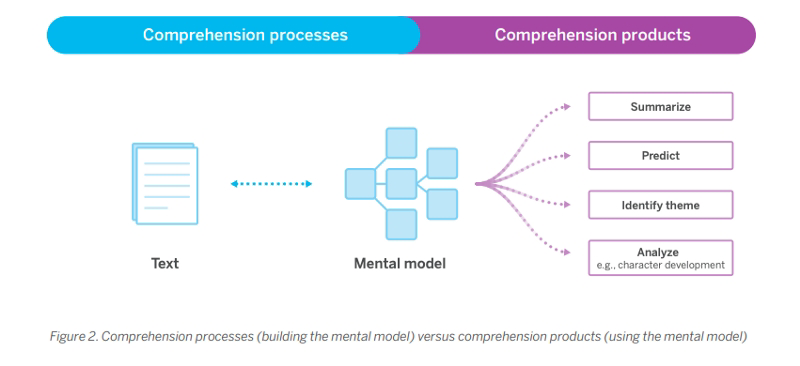
Historically, educators have thought about the process of comprehension — everything that happens after each word is recognized — as a black box. But now we know that there are two levels of comprehension at work: comprehension processes and comprehension products.

Comprehension processes are the steps you take to build a mental model of a text during reading. Comprehension products refer to the work you are able to do with that model after reading.

Think of the process of building a mental model as a sort of micro-comprehension. Weaker comprehenders build weaker models, so they may struggle when asked to create a narrative text summary, identify a theme, put together predictions, or describe key details of a character’s evolving beliefs.

By actively engaging with text, connecting prior knowledge, utilizing graphic organizers, receiving explicit instruction, and exploring new information, students can learn to build robust mental models that enhance their comprehension of the text. These mental models serve as frameworks for understanding, organizing, and synthesizing information, which then leads to improved comprehension, retention, and critical thinking.

Researchers have identified as many as 17 comprehension processes that affect students’ ability to build and use their mental models. The following are a few of the comprehension processes that weak comprehenders most commonly struggle with, and that with practice, can be targeted for skill development and improved overall comprehension.

  • Anaphora (using pronouns to refer to an earlier word or phrase): Some readers struggle to process pronoun relationships (Megherbi & Ehrlich, 2005), identify antecedents, and answer questions that require resolution of anaphora (Yuill & Oakhill, 1988).
  • Gap-filling inference: When reading the sentence “Carla forgot her umbrella and got soaking wet,” more skilled readers will conclude that it rained. A lack of awareness of when and how to activate background knowledge to fill in gaps may hinder a student’s ability to make inferences and comprehend the text as a whole (Cain & Oakhill, 1999).
  • Marker words: Writers use connective words (e.g., sothough, and yet), structure cues (e.g., meanwhile), and predictive cues (e.g., “There are three reasons why…”) to signal ways that text fits together. Students with limited knowledge of the meaning and function of these words may struggle with the meaning of the text (Oakhill, et al., 2015).
  • Comprehension monitoring: When proficient readers encounter difficulty, they tend to stop, reread, and try to figure it out. Less proficient readers may just keep going or fail to recognize that what they’re reading doesn’t fit their mental model.

Two strategies that you can employ in your classroom to guide students in comprehension strategy instruction:

  • Graphic organizers: Use graphic organizers such as concept maps, story maps, or Venn diagrams to help students learn to visually organize information and relationships within the text. Visualization enhances comprehension (Graesser, et al., 1994). As the text progresses, students can refer to and update their models.
  • Comprehension monitoring: Teach readers to monitor their comprehension while reading by pausing to reflect on their understanding, clarify confusing points, and adjust their reading strategies as needed. Monitoring comprehension helps good readers stay engaged and actively construct meaning from the text.

How background knowledge powers comprehension

The Science of Reading demonstrates the importance of systematic and explicit phonics instruction. But students don’t have to learn phonics or decoding before knowledge comes into the equation. In fact, the opposite might even be true.

Let’s say you’re handed a passage of text describing part of a baseball game. You read the text, and then you’re asked to reenact that part of the game. Which is most likely to help you do so?

  1. Your ability to read
  2. Your knowledge of baseball
  3. Neither

If you answered “2,” you’re batting 1,000. This example summarizes an influential 1988 study that concluded that the strongest predictor of comprehension was knowledge. In the study, which showed readers (with varying degrees of background knowledge about baseball) a passage describing a game, struggling readers comprehended as well as strong readers—as long as they had prior knowledge of baseball.

“The background knowledge that children bring to a text is also a contributor to language comprehension,” says Sonia Cabell, Ph.D., an associate professor at Florida State University’s School of Teacher Education, on Science of Reading: The Podcast.

In fact, background knowledge is the scaffolding upon which readers build connections between prior knowledge and new words. Students with average reading ability and some background knowledge of a topic will generally comprehend a text on that topic as well as stronger readers who lack that knowledge.

But until recently, literacy instruction has typically focused on decontextualized skills—finding the main idea, making inferences—rather than on the content of texts and resources that students engage with. According to Cabell, what we know about knowledge and comprehension should inform instruction for the whole class. “I think most, if not every, theory of reading comprehension implicates knowledge,” she says. “But that hasn’t necessarily been translated into all of our instructional approaches.”

How can we help build background knowledge while teaching reading? Here are some strategies backed by science.

  • Systematically build the knowledge that will become background knowledge. Use a curriculum grounded in topics that build on one another. “When related concepts and vocabulary show up in texts, students are more likely to retain information and acquire new knowledge,” say education and literacy experts Barbara Davidson and David Liben. According to them, this retention even continues into subsequent grades. “Knowledge sticks best when it has associated knowledge to attach to.”
  • Provide instruction that engages deeply with contentResearch shows that students—and teachers, too—actually find this content-priority approach more rewarding than, in Davidson and Liben’s words, “jumping around from topic to topic in order to practice some comprehension strategy or skill.”
  • Support students in acquiring vocabulary related to content. Presenting keywords and concepts prior to reading helps students comprehend text more deeply. Spending more time on each topic helps students learn more topic-related words and more general academic vocabulary they’ll encounter in other texts.
  • Use comprehension strategies in service of the content. While building knowledge systematically, teachers can use proven strategies—such as chunking and creating graphic organizers—to help students develop skills they can use to support their for understanding of important information.
  • Use discussions and writing to help students learn content. Invite students to share their interpretations, supporting their thought processes in their own words and connecting with peers’ perspectives.
  • Help students forge connections in small groups. Help students draw connections between reading lessons and units—and their own experiences—as they grow their knowledge base together.

Every day, the Science of Reading has more to tell us about comprehension as a multifaceted skill that requires a combination of various strategies, tools, and techniques to unlock meaning from text. Because of this body of research, we know that when educators bring intentional and evidence-based practices into the classroom, students can enhance their ability to comprehend grade level text, analyze information critically, and engage with diverse subject areas. By nurturing students’ reading comprehension skills grounded in the Science of Reading, educators can empower students to become good readers who can navigate complex texts with confidence and understanding.

Explore more

The Amplify blog:

Science of Reading: The Podcast

Using formative assessment to support literacy

Learning to read is not linear. That’s because reading is not just one skill, but a bundle of skills, intertwined and supporting one another.

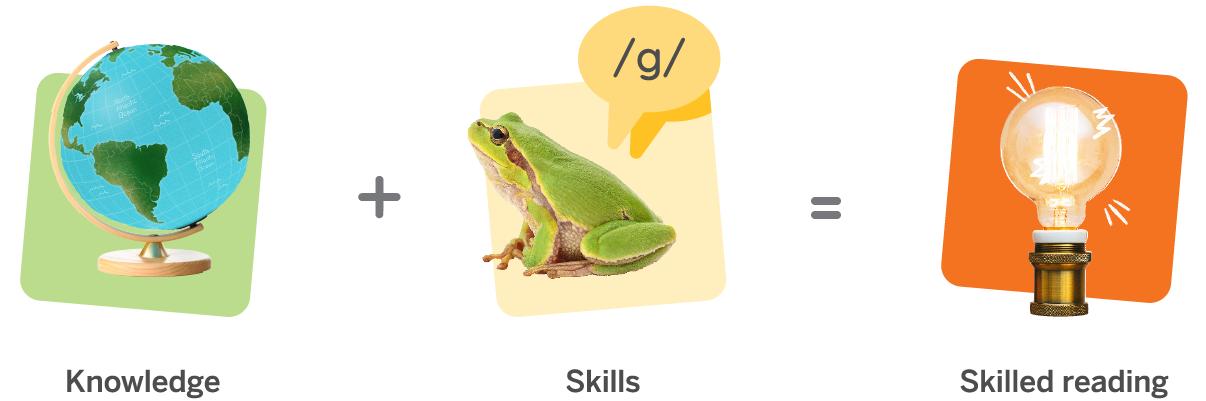
In the late 1990s, reading and literacy expert Hollis Scarborough helped us visualize this complex process by creating a model that’s now known as the Reading Rope. Grounded in the Science of Reading, this now-iconic model emphasizes the need for a comprehensive, deliberate approach to reading instruction. It’s an approach that recognizes the importance of building both reading skills and the background knowledge that makes them even stronger.

The Reading Rope model also connects educators to key strands of formative data that guide instruction and assessment.

With data and information that support the relationship between language comprehension and word recognition skills, teachers can devise reading comprehension strategies and get a better idea of where to focus their instruction. And thanks to the Science of Reading, this data can also help you track what students know, and where they need to go.

Let’s take a closer look to see how it all works.

Reading comprehension and more: The strands of the Reading Rope

The design of the Reading Rope shows that the two core components of reading are word recognition and language comprehension.

Word recognition encompasses the ability to accurately, effortlessly, and rapidly decode printed words. Phonological awareness, phonics, and sight word recognition contribute to this strand.

  • Phonological awareness is the ability to recognize and manipulate the individual sounds (phonemes) within spoken words. It includes skills such as identifying rhymes, segmenting words into syllables, and manipulating sounds within words. Phonological awareness provides the foundation for phonics instruction.
  • Phonics involves the systematic relationship between letters and the sounds they represent. It includes understanding letter-sound correspondences, decoding unfamiliar words by applying sound-symbol relationships, and blending sounds to form words. Phonics instruction gives students the tools to decode printed words.
  • Sight word recognition happens when students have had enough practice decoding words that they can automatically recognize and apply sound-spelling patterns across words. Automaticity in word recognition allows students to shift their focus from decoding to comprehending texts.

Language comprehension involves the understanding of spoken and written language. This includes vocabulary, grammar, syntax, and the ability to make inferences and draw conclusions. Language comprehension allows readers to extract meaning from and create meaning with text.

  • Vocabulary refers to the words one knows and understands, both orally and in writing. A robust vocabulary enhances comprehension and communication.
  • Grammar and syntax are the rules and structures that govern language. Understanding and applying grammatical rules help students comprehend and construct sentences, enhancing their ability to make meaning from and create meaning with text.
  • Inference skills involve the ability to draw conclusions, make predictions, and derive implicit meaning. With these skills, students are able to combine their background knowledge with information in the text to make guesses and reach conclusions.

The importance of knowledge

The Reading Rope affirms that readers use their existing knowledge and experiences to make sense of what they are reading. A student who brings relevant background knowledge to a text can understand it even better than a stronger reader who’s new to the topic.

Background knowledge also helps readers navigate unfamiliar vocabulary or concepts. When readers encounter words or ideas they already have some familiarity with, they can make connections and use contextual clues to determine meaning, which contributes to reading fluency and comprehension.

Intentionally building background and academic knowledge—coupled with comprehension strategies—fuels students’ capacity to understand texts, answer questions, and grapple with ideas.

As educators Barbara Davidson and David Liben write: “Although students’ independent reading is often at lower complexity levels at the beginning of a unit, as they acquire knowledge about the core topic they are generally able to read texts on their related topic at complexity levels greater than their diagnosed grade level.”

Putting it all together with formative assessment

There are a variety of ways to gather information about your students’ skills and knowledge, using the Reading Rope as your guide. Here are just a few examples that correspond to its strands:

Word recognition

  • Letters: See how students do with letter-sound correspondence tasks such as: matching graphemes to phonemes, writing letters that represent sounds, word-building activities, and sound sorts with word cards.
  • Words: Gauge students’ ability to apply sound-symbol correspondences by asking them to spell words with sound-spelling patterns they’ve already learned.

Language comprehension

  • Knowledge: How much are students learning about a topic overall? Keep asking—through pre-reading tasks, discussions, and checks for understanding.
  • Vocabulary: Track students’ vocabulary growth with word-mapping, context-clue, and word-brainstorming tasks.

Skilled reading

Here’s where it all comes together. Many formative assessment activities will help you discover what your students know about the skills they’re using as readers. Here, we’ll focus on the power of students speaking and writing about what they’re reading.

  • Speaking: As children learn to speak, they develop vocabulary and knowledge of sentence structure, both of which support reading comprehension. Simply giving students the opportunity to talk about a topic can provide insight into their oral language development.
  • Writing: Challenge students to write summaries, critiques, and analyses of texts to see what they’re comprehending from what they’re reading.

More to explore

Welcome, California Review Committees!

We’re so honored you’re considering Amplify Science California—the #1 most adopted NGSS curriculum across the state.

This site is designed to support your committees in conducting a thorough review of Amplify Science California.
 
Ready to get started? Click your grade level band to continue or scroll down to connect with a team member.

Two students examining a container and taking notes, a girl looking through a microscope, and a digital display showing plant mortality and pest data.

Your California team

Looking to speak directly with an Amplify Science California representative? Get in touch with a California team member to learn more about reviewing and using the program.

Dan Pier Vice President, West

Dan Pier

Vice President, West

(415) 203-4810

dpier@amplify.com

Dianne Lee State Manager

Dianne Lee, M.Ed.

State Manager

(949) 246-2083

dilee@amplify.com

Wendy Garcia Account Executive

Wendy Garcia

Account Executive

(510) 368-7666

wgarcia@amplify.com

Lisa Marinovich Account Executive

Lisa Marinovich

Account Executive

(831) 461-4187

lmarinovich@amplify.com

Demitri Gonos Account Executive

Demitri Gonos

Account Executive

(559) 355-3244

dgonos@amplify.com

Patti Savage Senior Account Executive

Patti Savage

Senior Account Executive

(626) 224-3174

psavage@amplify.com

Lauren Sherman Account Executive

Lauren Sherman

Account Executive

(949) 397-5766

lsherman@amplify.com

Kirk Van Wagoner Account Executive

Kirk Van Wagoner

Account Executive

(760) 696-0709

kvanwagoner@amplify.com

Unleash the potential of knowledge building in language comprehension

Every child is capable of becoming a skilled reader. Every classroom can provide that opportunity and drive student success, through a content-rich literacy curriculum.

We’ll show you how.

The relationship among knowledge, language comprehension, and literacy skills

The Science of Reading shows that early literacy skills are best built deliberately, on a foundation of knowledge. Knowledge building is not a result of reading and language comprehension; it’s a vital prerequisite and a fundamental part of the process. When students read a text on a familiar topic–event a tough one–they’re more likely to comprehend it. In other words: The more you know, the more, and faster, you learn.

Why is building knowledge so important?

Background knowledge—coupled with comprehension strategies—fuels students’ capacity to understand texts, answer questions, and grapple with ideas.

Students bring different bodies of knowledge into school. Some are whizzes at baseball or mechanics; some visit museums, have tons of books at home, and know the word “yacht.” That means their comprehension of a given topic or text will correlate with what they already know. But what happens when they learn the same content together? A recent independent study showed that a knowledge-building literacy curriculum in elementary school raised test scores and helped eliminate income-based opportunity gaps.

It is our responsibility as educators to bring the world into the classroom for all students and help them grow their literacy skills.

Literacy instruction has typically focused on decontextualized skills—finding the main idea, making inferences—before, or instead of, the content of texts and resources that students engage with. Many teachers may have been trained to “put the skills and strategies in the foreground, like a skill of the week, then bring in texts that they find suited for demonstrating the skill or strategy,” says Natalie Wexler, author of The Knowledge Gap. But science shows that harnessing skills and strategies to content is actually more effective. That is, using a coherent and systematic progression of content that helps knowledge and skills build on each other has been shown to result in better student outcomes.

“The advantage of a coherent curriculum is that the topics it covers can build on one another, with one unit providing a foundation of knowledge for others that come later, both throughout a single school year and across grade levels,” according to Barbara Davidson and David Liben. Along the way, students also cultivate curiosity and confidence, accelerating the entire process. So the more you know, the faster you learn—and that lasts a lifetime.

Getting started with knowledge based learning

Effective literacy instruction must celebrate the experiences students have but not assume each student has specific pieces of prior knowledge. Rather, it must build knowledge in the classroom. Students (and teachers) need curricula that expose them to a diverse array of new topics—spanning history, science, literature, culture, and the arts—in an intentional sequence that builds a rich and common knowledge base from which all students can draw.

Want to get started now? We’ve got an ebook to help you out.

Professional development to support your shift to the Science of Reading

Ignite literacy transformation with Amplify’s Science of Reading: The Learning Lab—an inspiring three-course series.

  • Course 1: Foundations to the Science of Reading
  • Course 2: Advanced Topics in the Science of Reading: Assessment and Reading Difficulties
  • Course 3: Applied Structured Literacy

Crafted to the standards of the International Dyslexia Association, this self-paced online series provides unparalleled, research-backed instruction. Explore enriching activities, curated resources, and learn from Susan Lambert, chief academic officer and host of Science of Reading: The Podcast.

The best investment you can make is in knowledge, and the returns are priceless.

Learn more about the online courses or request a quote!

Tap into individual online course seats.

Before and after knowledge building: What knowledge looks like in the classroom

Making connections to what students already know

Before: Teachers “activate” students’ prior knowledge before reading.
After: Teachers build students’ knowledge explicitly for students to leverage later as background knowledge.

Developing reading comprehension

Before: Teachers focus instruction on comprehension strategies (e.g., “strategy of the day” instruction).
After: Teachers focus on content and use comprehension strategies to help students gain knowledge of that content.

Introduction of new topics and information

Before: Students learn about content-area topics individually in disconnected units of instruction.
After: Students learn topics through a coherent approach that builds knowledge within and across units of instruction.

See the remarkable difference shifting to a knowledge-building approach can make in your school. Our enlightening flyer guides you through a before-and-after journey, illustrating the profound impact of knowledge building on learning. Check it out!

What to look for in a knowledge-building literacy curriculum:

It develops content knowledge.

The program should immerse students in a given domain for weeks—that’s how they acquire academic knowledge. The content should also develop from grade to grade, so that students learning about Renaissance art can reflect on and compare to what they previously learned about art in the Middle Ages.

Read More 

It leverages read-alouds for exposure to complex language.

In early grades, students’ listening comprehension outpaces their reading comprehension. Interactive read-alouds can be used to expose students to academic language and rich vocabulary. With background knowledge, vocabulary words are “the main support beams in the comprehension house.” This approach also helps teachers introduce students to new information and experiences—in a supportive and interactive environment.

Read More 

It introduces students to a wide variety of topics and content.

A content-rich curriculum exposes students to broad knowledge over time in a systematic, cumulative way, which is more effective than spending several months on just one topic. And while that’s happening, students are participating in enriching discussions and writing activities so they can further interact with the content, promoting deeper engagement and supporting retention of both the knowledge and associated vocabulary.

Read More 

It builds both knowledge and foundational skills.

Knowledge building is just one component of literacy development. A content-rich curriculum that helps students build both knowledge (language comprehension) and skills (word recognition) takes into account both sides of the Reading Rope, giving students everything they need to build the foundation for a lifetime of literacy success. Instead of learning to read so they can read to learn, students who use a content-rich curriculum learn to read and learn about the world at the same time, enabling them to understand what they’re reading.

Read More 

“Shifting from balanced literacy to a knowledge-building curriculum was a huge change for us. [Amplify] CKLA systematically builds knowledge from unit to unit and across grade levels. Students are constantly making connections to what they learned earlier in the year. We are excited to see the connections that they make after they have had a few years of the program. Student engagement has significantly increased. They are excited about the topics that they are learning. I never would have thought that students would find the War of 1812 or ancient Greek civilizations fascinating, but they do!”

—Christina Pina, Instructional Data Specialist, Chicopee Public Schools, Chicopee, MA