NEW AND NOTEWORTHY UPDATES

mCLASS Texas Edition, mCLASS Lectura, and mCLASS Intervention!

mCLASS® Texas Edition, mCLASS Lectura, and mCLASS® Intervention are introducing enhancements for the next school year. Explore the following improvements designed to save you time, extend your reach, and support your efforts to deliver the learning experiences your students deserve.

Updates

mCLASS Texas Edition expands to support grades 7–8.

This expansion supports a full K–8 literacy model (alongside Amplify Texas ELAR 6–8), to help you identify where both elementary and middle school students need support and to guide you on the next steps. With mCLASS Texas Edition for grades 7–8, you can support middle school students with reading fundamentals, monitor progress for grade-level and below-grade-level skills, and find instructional guidance based on best practices for middle school.

mCLASS Texas Edition Home Connect available in 15 additional languages

Starting Sept. 1, all mCLASS Texas Edition customers can generate Home Connect letters in 15 additional languages: Simplified Chinese (Mandarin), Traditional Chinese (Cantonese), Vietnamese, Russian, Punjabi, Filipino, Armenian, Korean, Hmong, Japanese, Ukrainian, Arabic, Farsi, Dari, and Pashto.

These translated letters include all essential features of our English and Spanish versions, ensuring every family receives their student’s complete mCLASS Texas Edition results, including: Vocabulary, Spelling, RAN, and Oral Language scores, plus targeted activities to support their child’s learning at home.

A student reading assessment report for Alex Phan shows overall DIBELS score, test details, decoding accuracy and fluency scores, explanations of each reading skill assessed, and notes that mCLASS Lectura is coming soon.

Enhanced district-level insights: New mCLASS Texas Edition progress monitoring data columns launch July 1.

Starting July 1, the mCLASS Texas Edition Progress Monitoring Download Your Data (DYD) Report will include three new columns that bring student growth insights to school and district leadership:

Aimline Status—Description of the progress monitoring result’s position in relation to the aimline

Aimline Value By Date—Score on the aimline on the day that the progress monitoring test is administered

Growth Goal Set—Score the student is striving to achieve by the start date of the next benchmark period

School and district leaders will gain the same detailed progress monitoring visibility teachers have relied on, now scaled across the entire district. This means data-driven decisions can be made faster, and students who need additional support will be identified as soon as possible.

A spreadsheet displays student assessment data with columns for score, aimline status, aimline value by date, growth goal set, and date of birth. Stay tuned—mCLASS coming soon will enhance these insights even further.

mCLASS Reading becomes mCLASS Literacy.

Starting July 10, 2026, the brand name in our platform will shift from mCLASS Reading to mCLASS Literacy. This change is intended to reflect the importance of both reading and comprehension.

Dashboard interface showing a navigation menu on the left, user welcome message, recently visited modules, recommendations, and program options—including mCLASS Lectura and a preview of mCLASS coming soon—for an education platform.

Updated Zones of Growth framework

On Sept. 1, 2026, the Zones of Growth framework will be updated using a recent national data set. Predictive growth rates will be based on students with the exact same scores, ensuring prediction accuracy is even more precise. Zones of Growth will also be updated for DIBELS Data System users.

A student performance report displays growth outcomes, benchmark scores, and progress monitoring data for Marco Acosta in multiple literacy skill areas using mCLASS Lectura.

New mCLASS Intervention Demo Mode available

We’ve also launched Demo Mode in mCLASS Intervention, which will help you explore the grouping and lesson generation platform through either self-guided exploration or a guided tour. To access the demo, log into your mCLASS program, navigate to the Intervention tab, and select “Try Demo.”

A pop-up message explains how to start forming mCLASS Intervention groups, with a highlighted “Create Groups” button below it. Look out for mCLASS Lectura, coming soon to further enhance your intervention experience.

mCLASS Lectura update: phonemic awareness measure option for kindergarten and grade 1

Fluidez en la segmentación de fonemas (FSF) will be added to mCLASS Lectura as an optional measure for kindergarten and grade 1. FSF is a standardized, individually-administered phonemic awareness assessment that measures students’ ability to fluently segment words, a skill which is predictive of Spanish reading proficiency and is also transferable to support the development of English phonemic awareness.

FSF does not impact the overall mCLASS Lectura Composite Score.

Instructional card showing a speech bubble with a Spanish phonemic awareness activity from mCLASS Lectura, and "Incorrecto" and "Correcto" buttons at the bottom.

Noteworthy features

PD Library

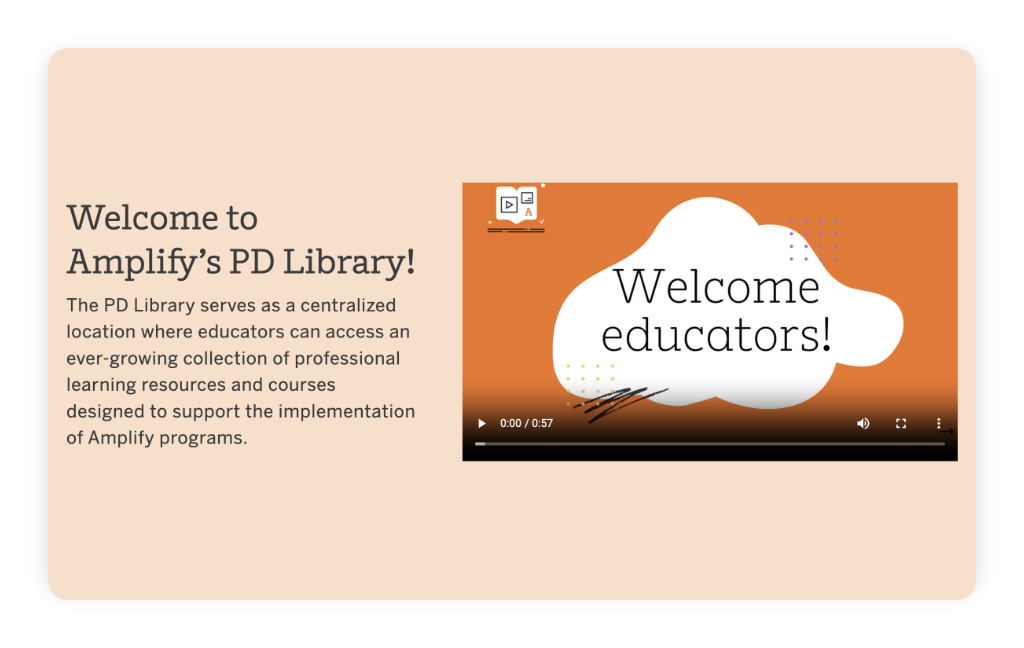
You’ll find helpful professional development (PD) resources in the PD Library to ensure your mCLASS implementation runs smoothly. When you’re logged into mCLASS, the PD Library can be accessed by clicking the PD Library button on the left navigation bar.

A webpage introducing Amplify’s PD Library, with text describing its resources for educators and a video titled “Welcome educators!” on an orange background.

Demo mode in English Classroom Reporting

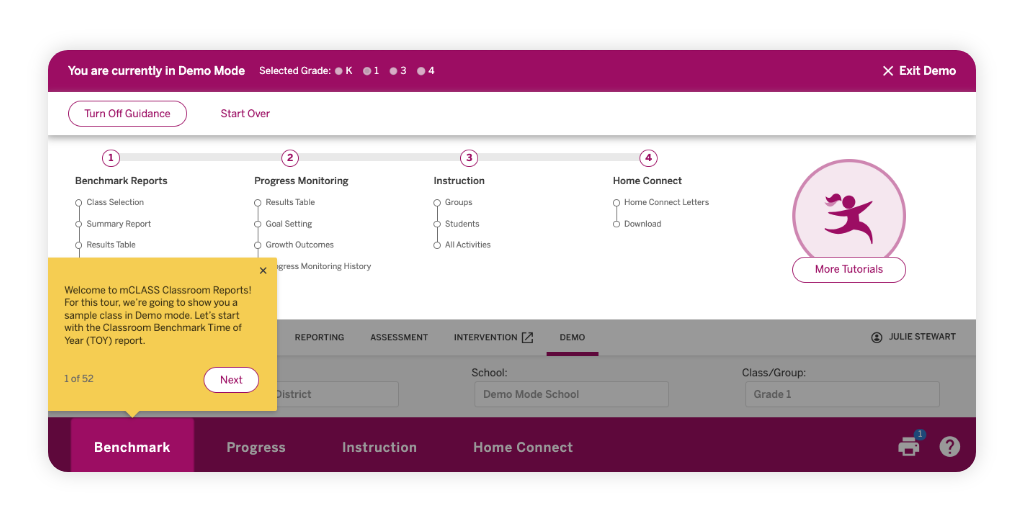
mCLASS English Classroom Reporting features a demo mode that guides teachers through sample classroom and student reports, highlighting realistic student data within the complete set of mCLASS instructional tools. This demo mode is especially helpful for onboarding purposes with teachers new to using mCLASS.

A demo mode dashboard for a classroom report tool, with a yellow pop-up instruction and highlighted "Benchmark" tab at the bottom.

NEW AND NOTEWORTHY UPDATES

mCLASS DIBELS 8th Edition, mCLASS Lectura, and mCLASS Intervention!

mCLASS® DIBELS® 8th Edition, mCLASS Lectura, and mCLASS® Intervention are introducing enhancements for the next school year. Explore the following improvements designed to save you time, extend your reach, and support your efforts to deliver the learning experiences your students deserve.

Updates

mCLASS DIBELS 8th Edition expands to support grades 7–8.

This expansion supports a full K–8 literacy model (alongside Amplify ELA), to help you identify where both elementary and middle school students need support and to guide you on the next steps. With mCLASS DIBELS 8th Edition for grades 7–8, you can support middle school students with reading fundamentals, monitor progress for grade-level and below-grade-level skills, and find instructional guidance based on best practices for middle school.

mCLASS DIBELS 8th Edition Home Connect available in 15 additional languages

Starting Sept. 1, all mCLASS DIBELS 8th Edition customers can generate Home Connect letters in 15 additional languages: Simplified Chinese (Mandarin), Traditional Chinese (Cantonese), Vietnamese, Russian, Punjabi, Filipino, Armenian, Korean, Hmong, Japanese, Ukrainian, Arabic, Farsi, Dari, and Pashto.

These translated letters include all essential features of our English and Spanish versions, ensuring every family receives their student’s complete mCLASS DIBELS 8th Edition results, including: Vocabulary, Spelling, RAN, and Oral Language scores, plus targeted activities to support their child’s learning at home.

A student progress report showing name, school, scores, and colored bar graphs for literacy skills: Letter Naming Fluency and Phonemic Awareness—including mCLASS Lectura—with some text in English and Persian. mCLASS coming soon.

Enhanced district-level insights: New mCLASS DIBELS 8th Edition progress monitoring data columns launch July 1.

Starting July 1, the mCLASS DIBELS 8th Edition Progress Monitoring Download Your Data (DYD) Report will include three new columns that bring student growth insights to school and district leadership:

Aimline Status—Description of the progress monitoring result’s position in relation to the aimline

Aimline Value By Date—Score on the aimline on the day that the progress monitoring test is administered

Growth Goal Set—Score the student is striving to achieve by the start date of the next benchmark period

School and district leaders will gain the same detailed progress monitoring visibility teachers have relied on, now scaled across the entire district. This means data-driven decisions can be made faster, and students who need additional support will be identified as soon as possible.

A spreadsheet displays student assessment data with columns for score, aimline status, aimline value by date, growth goal set, and date of birth. Stay tuned—mCLASS coming soon will enhance these insights even further.

mCLASS Reading becomes mCLASS Literacy.

Starting July 10, 2026, the brand name in our platform will shift from mCLASS Reading to mCLASS Literacy. This change is intended to reflect the importance of both reading and comprehension.

Screenshot of an educational dashboard showing recent activity, recommended tasks, and a navigation menu on the left side, with a highlight for mCLASS Lectura and an announcement that mCLASS coming soon.

Updated Zones of Growth framework

On Sept. 1, 2026, the Zones of Growth framework will be updated using a recent national data set. Predictive growth rates will be based on students with the exact same scores, ensuring prediction accuracy is even more precise. Zones of Growth will also be updated for DIBELS Data System users.

A student performance report displays growth outcomes, benchmark scores, and progress monitoring data for Marco Acosta in multiple literacy skill areas using mCLASS Lectura.

New mCLASS Intervention Demo Mode available

We’ve also launched Demo Mode in mCLASS Intervention, which will help you explore the grouping and lesson generation platform through either self-guided exploration or a guided tour. To access the demo, log into your mCLASS program, navigate to the Intervention tab, and select “Try Demo.”

A popup window explains how to create mCLASS Intervention groups with the "Create Groups" button, and notes that mCLASS Lectura integration is coming soon.

mCLASS Lectura update: phonemic awareness measure option for kindergarten and grade 1

Fluidez en la segmentación de fonemas (FSF) will be added to mCLASS Lectura as an optional measure for kindergarten and grade 1. FSF is a standardized, individually-administered phonemic awareness assessment that measures students’ ability to fluently segment words, a skill which is predictive of Spanish reading proficiency and is also transferable to support the development of English phonemic awareness.

FSF does not impact the overall mCLASS Lectura Composite Score.

Instructional card showing a speech bubble with a Spanish phonemic awareness activity from mCLASS Lectura, and "Incorrecto" and "Correcto" buttons at the bottom.

Revised print materials for two mCLASS Lectura progress monitoring forms

We’ve corrected typos in the print materials for two Fluidez en Palabras (FEP) student progress monitoring forms. Beginning July 1, 2026, you will see a pop-up when you begin assessing students for these two forms which will provide instructions on how to find and print updated student materials.

Noteworthy features

PD Library

You’ll find helpful professional development (PD) resources in the PD Library to ensure your mCLASS implementation runs smoothly. When you’re logged into mCLASS, the PD Library can be accessed by clicking the PD Library button on the left navigation bar.

A webpage introducing Amplify’s PD Library, with text describing its resources for educators and a video titled “Welcome educators!” on an orange background.

Demo mode in English Classroom Reporting

mCLASS English Classroom Reporting features a demo mode that guides teachers through sample classroom and student reports, highlighting realistic student data within the complete set of mCLASS instructional tools. This demo mode is especially helpful for onboarding purposes with teachers new to using mCLASS.

A demo mode dashboard for a classroom report tool, with a yellow pop-up instruction and highlighted "Benchmark" tab at the bottom.

Get to know Amplify ELA

Start by taking a look at the Amplify ELA Program Guide, where you’ll find:

  • Grade-level overviews for grades 6–8 (pages 11–31)
  • Amplify ELA pedagogy (page 10)
  • Sample lesson routine (page 38)
  • Amplify ELA foundations (pp 70-80)

Want to go deeper or look at Amplify ELA’s approach to writing, vocabulary, grammar, and differentiation? Check out the Table of Contents for all this and much more! 

Navigating the curriculum

Amplify ELA is a truly blended curriculum, designed specifically for grades 6–8. The program includes instructional guidance and student materials for a year of instruction, with lessons and activities that keep students engaged every day. Materials can be accessed either digitally or through print materials, depending on what your class needs.

Navigating in print

  1. Watch this video exploring the print resources available for students and teachers in Amplify ELA.
  2. Follow this link to open an ebook version of the print materials for your grade level and explore Unit A (the first unit).

Navigating digital

  1. Watch this video exploring the digital curriculum platform and the many resources available for teachers and students.
  2. Log in to the curriculum at learning.amplify.com using the demo account and password provided by your Sales rep.
  3. Once you have finished the tour, try out the scavenger hunt below!

Amplify ELA Scavenger Hunt

Inside a lesson

1. Overview & planning

Screenshot of an educational webpage for "Lesson 2: Your Movie Crew" on Amplify ELA, showing lesson navigation, overview, and a stylized illustration of a masked figure.

The Lesson Brief equips teachers with the tools they need to plan instruction. It begins with an Overview, which describes the big ideas students will grapple with and summarizes the lesson’s sequence of activities. Next, there is a Preparation section, which points out key moments and materials to prepare. The Preparation section also describes the location and content of the lesson’s Exit Ticket.

The Lesson Brief also includes: the Lesson Objective, which details the reading, writing, and/or speaking and listening objectives; Words to Use, which points out key vocabulary from the reading; Skills & Standards, which lists the focus and coverage standards; and Differentiation, which describes differentiated supports and provides additional suggestions for modifying activities.

2. Vocab App

The Vocab App helps students master vocabulary words through game-like activities based on morphology, analogy, synonyms/ antonyms, and deciphering meaning. These activities help students develop dictionary skills by focusing on parts of speech, etymology, and multiple meanings. There are also activities for ELL-appropriate words from the unit’s texts, asking students to match an English definition, Spanish translation, context sentence, audio pronunciation, and visual definition. These activities also align to vocabulary standards.

Vocab App (Teacher View)

3. Work Visually

Visualization activities are an essential part of Amplify ELA, as they open the door to more comprehensive understanding of complex texts. In these learning experiences, students break apart the text in visual ways or use visual cues to “see” key details as they construct meaning.

In this early lesson from grade 7, students unpack propaganda images and short videos from the Chinese Cultural Revolution to build their understanding of the setting before beginning the memoir Red Scarf Girl.

Other units include visualization activities such as using an app to “see” the evidence for and against scientific theories, making storyboards and planning visual adaptations of texts to “read like a movie director,” and comparing and contrasting illustrations with key textual moments.

4. Author Videos & Dramatic Readings

Students benefit from using listening comprehension skills as they build fluency with complex texts. In these close reading experiences, students listen to the text, perform the text out loud, or watch a dramatic reading of the text.

In this lesson, students listen and watch as author Ji-Li Jiang reads the opening prologue of her memoir, Red Scarf Girl. Her facial expressions, tone of voice, and emphasis help students develop early ideas about what matters to this narrator.

Additional author videos and dramatic readings are embedded in other units. In Unit 8D: Shakespeare’s Romeo & Juliet, students watch WordPlay Shakespeare videos where actors perform each selected scene next to the text of that excerpt. In Unit 8B: Liberty & Equality, two members of the Marvel cinematic universe—Chadwick Boseman and Elizabeth Olsen—offer masterful performances of Narrative of the Life of Frederick Douglass, an American Slave and A Confederate Girl’s Diary.

5. Reading/eReader

Reading standards establish high expectations for all students, even as they enter the middle grades at a variety of reading levels. In Amplify ELA lessons, students access universal supports embedded in the eReader (and built into the print versions of the text) to help them participate fully in grade-level activities.

Point-of-use vocab in print: The print Student Edition places key vocabulary words and their relevant definitions in the text margin to support students and keep them reading.

Reveal: By clicking on these pre-selected words, students access short contextual definitions for key and challenging vocabulary.

Highlight, Bookmark, and Notes: The digital highlighting, bookmarking, and annotation tools allow students to save and review any text notes from any lesson.

Text size and line spacing: Students can adjust text size and line spacing to find what works best for them

6. Writing

Two or three times a week, students complete their reading work by developing a piece of writing to refine their reading analysis. They write for 10–15 minutes, focusing on one claim in response to a prompt, and using evidence from the text in support of their claim.

In this lesson, students build on their discussion of the setting and their analysis of the passage to determine the author’s point of view at the start of her memoir.

Differentiated supports: Five levels of differentiated supports can be assigned in the moment or in advance to help every student work productively. Levels can be assigned ahead of time (by simply dragging and dropping students into groups) and students remain in their assigned levels until they’re changed by the teacher. For more information on differentiation in Amplify ELA, click here.

Automated Writing Evaluation: The Automated Writing Evaluation (AWE) tool has been developed in conjunction with Amplify’s regular writing activities, which ask students to use textual evidence to develop one focused idea or claim about the text and communicate that idea clearly and effectively to an audience. AWE is a tool designed to help teachers understand, track, and support student skill progress with these key foundational skills, which are a strong indicator of a student’s analytic writing proficiency. AWE provides auto scores for Focus and Conventions, allowing teachers to prioritize their assessment of a student’s progress with Use of Evidence, a skill that is relatively new for many middle-grade students.

7. Share

Establishing a supportive writing community in the classroom helps students develop their voices as writers. Each writing activity is coupled with a sharing session, where clear routines and student-facing feedback protocols support students as they share and respond to each other’s writing. Here, students try out their writing with an audience of their peers to figure out how to express their ideas in a clear and convincing way. In addition, these sharing sessions allow students to learn from the range of perspectives in the classroom.

Clear and consistent Response Starters ensure that students provide feedback that targets key skills and focuses on where a student is using a skill effectively, fostering an effective and supportive feedback environment.

8. Solos

Solos are an important part of the ELA curriculum, and are designed to be completed as homework—but not every student has a computer at home. However, most students DO have access to a mobile device. The new Mobile Solos give every student access to this part of the curriculum, protecting valuable classroom time for lessons and group activities.

Navigating the first unit

Dig into Unit A

It’s time to continue your journey by exploring the first unit!

  1. Choose a 6th-, 7th-, or 8th-grade Unit A.
  2. Find the Print Materials for your grade level’s Unit A and review the unit overview. (password: middle678school)
  3. Log in to the curriculum and navigate to your chosen unit.
  • Scroll down to the unit guide. Open each section and read it.
  • Read the background and context document in the Materials section.
  • Go to Sub-unit 3 and read the Sub-unit Overview.
  • Choose two lessons to explore further.
  • Open the first lesson and read the Lesson Overview. Be sure to open and read each section in the Lesson Overview.
    • Open each activity tab and read the teacher Instructional Guide. Familiarize yourself with the entire lesson and note where students are building reading and writing skills
    • Repeat with the second lesson.

Diving Deeper

Check out Amplify ELA’s professional learning website, featuring self-guided training modules and videos to help you with planning and pacing, navigation, and learning key curriculum features. 

You can log in using your Amplify credentials or the demo account and password provided by your sales rep.  

Additional support

As you continue to explore the curriculum, you may also want to take a look at the Amplify ELA Resources Website, which is full of additional information on the program. If you have any questions, please contact us through the Amplify Help section.

And you’ll find even more information by watching this session from our Literacy Symposium, in which Sarah Kitzmiller from the Niswonger Foundation and Teddy Redding from Amplify discuss some of the challenges of the 2020–21 school year. 

Amplify’s Literacy Symposium session: Focusing on the Fundamentals to Start the Year Right

You may choose to view other sessions from the Literacy Symposium as well, all accessible from the schedule menu in the top left corner. 

This webinar also offers valuable insight, with Baltimore City middle school ELA teacher Lucas Drerup describing his experiences with Amplify ELA and discussing how he brings middle school ELA to life, even in a remote teaching setting. 

How to bring middle school ELA to life: A teacher’s perspective

Support
NJ CKLA

To view this protected page, enter the password below:


Literacy Essentials, Episode 1

Science of Reading Essentials: Writing

In this special Essentials episode of Science of Reading: The Podcast, Susan Lambert pulls from past episodes of the podcast to give you everything you need to know about science-based writing instruction. Experts include Steve Graham, Ed.D.; Young-Suk Grace Kim, Ed.D.; Natalie Wexler; and Judith Hochman, Ed.D. Listeners will walk away from this episode with a solid foundation for creating a classroom of confident and capable writers, and gain a better understanding of the connection between reading and writing, the role of handwriting and spelling, the power of sentences, and the importance of applying cognitive load theory to writing. Download our discussion guide to fuel a professional learning session!

Meet Our Guest(s):

Smiling older woman with short white hair, wearing a dark jacket, posed against a plain light background.

Judith Hochman, Ed.D.

Judith C. Hochman is the former head of The Windward School and the founder of the Windward Teacher Training Institute in White Plains, New York, as well as the former superintendent of the Greenburgh Graham Free School District in Hastings-on-Hudson, New York. She is the founder of The Writing Revolution, a not-for-profit organization which disseminates evidence-based strategies for writing instruction. Hochman is the author of Basic Writing Skills: A Manual for Teachers and co-author of The Writing Revolution: A Guide to Advancing Thinking Through Writing in All Subjects and Grades (2017, 2024).

A woman with short, curly blonde hair and light skin wears a white top and earrings, smiling softly at the camera against a neutral background.

Natalie Wexler

Natalie Wexler is the author of Beyond the Science of Reading: Connecting Literacy Instruction to the Science of Learning. She is also the author of The Knowledge Gap: The Hidden Cause of America’s Broken Education System—and How to Fix It and the co-author, with Judith C. Hochman, of The Writing Revolution: A Guide to Advancing Thinking Through Writing in All Subjects and Grades. She has a free Substack newsletter called Minding the Gap, and she was the host of Season One of the Reading Comprehension Revisited podcast from the Knowledge Matters Campaign. More information is available at her website, www.nataliewexler.com.

A woman with short dark hair and glasses, wearing a dark blazer and white shirt, smiles at the camera with a blurred green background.

Young-Suk Grace Kim, Ed.D.

Young-Suk Grace Kim, Ed.D., (Harvard University) is a professor at the School of Education, University of California at Irvine. She was a former classroom teacher in San Francisco. Her scholarship focuses on understanding language and literacy development and effective instruction for children from diverse backgrounds. Her areas of research include reading comprehension, reading fluency, listening comprehension and oral language, dyslexia, higher-order cognitive skills, written composition, and reading-writing relations. She has worked extensively with monolingual children and multilingual children from various linguistic backgrounds including English, Korean, Chinese, Spanish, and Kiswahili. Her research has been supported by over $60 million in grants from the Institute of Education Sciences, the U.S. Department of Education, the National Institute of Child Health and Human Development, and the National Science Foundation. Her work was recognized by several awards, including the 2012 Presidential Early Career Award for Scientists and Engineers (PECASE) by former President Barack Obama, the Developing Scholar Award, and the Robert M. Gagne Outstanding Student Research Award. She is an American Educational Research Association (AERA) Fellow, and serves as the editor-in-chief for Scientific Studies of Reading and the chair of the California Reading Difficulties Risk Screener Selection Panel (RDRSSP), appointed by the California State Board of Education.

A smiling older man with light skin, gray hair, and blue eyes is wearing a blue collared shirt. The background is blurred with autumn leaves visible.

Steve Graham, Ed.D.

Steve Graham is a Regents’ and Warner Professor at Arizona State University’s Mary Lou Fulton College for Teaching and Learning Innovation. For 47 years, he has studied how writing develops, how to teach it effectively, and how it can be used to support reading and learning. In recent years, he has been involved in the development and testing of digital tools for supporting writing and reading through a series of grants from the Institute of Educational Sciences and the Office of Special Education Programs in the U.S. Department of Education. His research involves the development of writers with special needs in both elementary and secondary schools, much of which occurs in urban schools. Graham has received many awards for his contributions to literacy and was selected to the Reading Hall of Fame in 2018. He is a fellow of the American Educational Research Association, Division 15 of the American Psychological Association, and of the International Academy for Research in Learning Disabilities.

Meet our host, Susan Lambert

Susan Lambert is chief academic officer of literacy at Amplify and host of Science of Reading: The Podcast. Throughout her career, she has focused on creating high-quality learning environments using evidence-based practices. Lambert is a mom of four, a grandma of four, a world traveler, and a collector of stories.

As the host of Science of Reading: The Podcast, Lambert explores the increasing body of scientific research around how reading is best taught. As a former classroom teacher, administrator, and curriculum developer, Lambert is dedicated to turning theory into best practices that educators can put right to use in the classroom, and to showcasing national models of reading instruction excellence.

A woman with short, light blonde hair, wearing clear glasses, a black top, and a beaded necklace, smiles at the camera in front of a blurred outdoor background.

Quotes

“The Science of Reading encapsulates decades of research about both reading and writing—because if writing was never invented, we would not have to teach kids how to read.”

—Susan Lambert

"What we see with exceptional teachers is they have their kids write."

—Steve Graham, Ed.D.

“This is not learned by osmosis. And it's not learned by vague feedback like, 'Make it better,' or 'Add more details.' You've got to be very granular.”

—Judith Hochman, Ed.D.

Season 9, Episode 7

Neurodiversity and the reading brain, with Ioulia Kovelman, Ph.D.

Susan is joined by Ioulia Kovelman, Ph.D., professor in the Department of Psychology at the University of Michigan, to give educators the perspective of a developmental cognitive neuroscientist on literacy development. Starting with the basics of cognitive science versus brain science, Ioulia gives a comprehensive overview into how the brain changes as children learn to read, including differences seen in neurodiverse students and multilingual/English learners. Ioulia then answers a question from our listener mailbag on neuroscience and dyslexia and how current research can inform teaching strategies. Ioulia ends with a rallying message that scientists, teachers, and children cannot stand alone and need to find ways to connect with each other to strengthen literacy as a whole.

Meet Our Guest(s):

Ioulia Kovelman, Ph.D.

Ioulia Kovelman, Ph.D.

Ioulia Kovelman, Ph.D., is a professor of Psychology at the University of Michigan. She studies literacy development in children who speak English and other languages. As a developmental cognitive neuroscientist, she uses a child-friendly functional Near Infrared Spectroscopy (fNRS) brain-imaging method to examine how learning to read changes children’s language, cognition, and brain. These studies include research with typically developing readers and at-risk learners such as those with dyslexia and developmental language disorders (DLD). In her current research, Ioulia focuses on children learning to speak and read in English, Spanish, and Chinese. Through this work, she addresses the universal, language-specific, and bilingual influences on child reading development and dyslexia.

Meet our host, Susan Lambert

Susan Lambert is the Chief Academic Officer of Elementary Humanities at Amplify, and the host of Science of Reading: The Podcast. Throughout her career, she has focused on creating high-quality learning environments using evidence-based practices. Lambert is a mom of four, a grandma of four, a world traveler, and a collector of stories.

As the host of Science of Reading: The Podcast, Lambert explores the increasing body of scientific research around how reading is best taught. As a former classroom teacher, administrator, and curriculum developer, Lambert is dedicated to turning theory into best practices that educators can put right to use in the classroom, and to showcasing national models of reading instruction excellence.

Portrait of a woman with short blonde hair, wearing glasses, a black top, and a necklace. She is smiling and facing the camera.

Quotes

“When you begin to read, you really have to analyze everything in front of you. The letter, the shape of the letter, how it connects to the sound. And proficient readers just look at the whole thing and they grab it—and it's like they heard it. It is almost no difference. I speak; I read; it's a continuous stream of language and I just grab it.”

—Ioulia Kovelman, Ph.D.

“We talked about languages being different. They're exercising slightly different muscles of your language system.”

—Ioulia Kovelman, Ph.D.

“Science is informed by teachers and children. We're all together. I do not teach children. Teachers don't usually do science. But we have to find ways of connecting with each other.”

—Ioulia Kovelman, Ph.D.

Season 6, Episode 1

Defining math fluency

Season 6 of Math Teacher Lounge is here!

This season, we’ll be digging deep into math fluency—exploring what it is, looking into the research around it, and sharing practical tips for building it in math classrooms. Join us as we kick things off this week with Jason Zimba, Amplify’s chief academic officer of STEM!

In our first episode, we sat down with Jason to get a clear understanding of what math fluency is and what we really mean when we talk about it. As a prominent math advocate with many years of experience, he can also help us learn just how important fluency is and how it fits into the standards.

Listen today and don’t forget to grab your MTL study guide to track your learning and make the most of this episode!

Portrait of a man in a suit with a white shirt and tie, framed by a decorative border featuring geometric patterns inspired by Jason Zimba's math fluency concepts.

Meet Our Guest(s):

A man in a suit and tie poses for a professional headshot, framed by a circular border with a shirt and checkmark graphic—reflecting Jason Zimba’s commitment to math fluency and academic excellence.

Jason Zimba

Jason serves as Amplify’s chief academic officer of STEM. Previously, he co-founded Student Achievement Partners, a nonprofit organization dedicated to helping teachers and school leaders implement high-quality, college and career-ready standards. Jason is a Rhodes scholarship recipient and a former professor of physics and mathematics. He holds a bachelor’s degree from Williams College, with a double major in mathematics and astrophysics; a master’s degree in mathematics from the University of Oxford; and a doctorate in mathematical physics from the University of California at Berkeley.

Meet our hosts: Bethany Lockhart Johnson and Dan Meyer

Bethany Lockhart Johnson is an elementary school educator and author. Prior to serving as a multiple-subject teacher, she taught theater and dance, and now loves incorporating movement and creative play into her classroom. Bethany is committed to helping students find joy in discovering their identities as mathematicians. In addition to her role as a full-time classroom teacher, Bethany is a Student Achievement Partners California Core Advocate and is active in national and local mathematics organizations. Bethany is a member of the Illustrative Mathematics Elementary Curriculum Steering Committee and serves as a consultant, creating materials to support families during distance learning.

Dan Meyer taught high school math to students who didn’t like high school math. He has advocated for better math instruction on CNN, Good Morning America, Everyday With Rachel Ray, and TED.com. He earned his doctorate from Stanford University in math education and is currently the Dean of Research at Desmos, where he explores the future of math, technology, and learning. Dan has worked with teachers internationally and in all 50 United States and was named one of Tech & Learning’s 30 Leaders of the Future.

Two people smiling at the camera, each in a separate circular frame, with geometric shapes decorating the background—perfect for a math teacher lounge or highlighting fresh math teacher resources.

Quotes

“The dials are all mixed up on fluency. On the one hand, I worry that word problems and applications…get proceduralized, and so we are aiming for fluency on something that is not a procedure in the first place.”

—Jason Zimba

Stay connected!

Season 9, Episode 13

Empowering instruction through mental models, with Young-Suk Grace Kim, Ed.D.

In this episode of Science of Reading: The Podcast, Susan Lambert is joined by Young-Suk Grace Kim,  a professor at University of California at Irvine School of Education. Dr. Kim begins by defining a theoretical model, outlining its value to teachers as it pertains to literacy instruction. She describes her own interactive dynamic literacy (IDL) model, which seeks to more fully explain reading and writing connections. Dr. Kim emphasizes how reading and writing function as a powerful and closely related system, and examines how this system interacts with developmental phases, linguistic grain size, and reading and writing difficulties, including dyslexia. After navigating the complexities of this conversation, Susan ends the episode by sharing her unique insights and takeaways from her time with Dr. Kim.

Meet Our Guest(s):

Woman with glasses and short hair in a blazer, smiling. Surrounded by a circular border with an illustrated book icon.

Young-Suk Grace Kim, Ed.D.

Young-Suk Grace Kim, Ed.D., (Harvard University) is a professor at the School of Education, University of California at Irvine. She is a former classroom teacher in San Francisco. Her scholarship focuses on understanding language and literacy development and effective instruction for children from diverse backgrounds. Her areas of research include reading comprehension, reading fluency, listening comprehension and oral language, dyslexia, higher-order cognitive skills, written composition, and reading-writing relations. She has worked extensively with monolingual children and multilingual children from various linguistic backgrounds including English, Korean, Chinese, Spanish, and Kiswahili. Her research has been supported by over $60 million in grants from the Institute of Education Sciences, the U. S. Department of Education, the National Institute of Child Health and Human Development, and the National Science Foundation. Her work was recognized by several awards, including the 2012 Presidential Early Career Award for Scientists and Engineers (PECASE) by former President Barack Obama, the Developing Scholar Award, and the Robert M. Gagne Outstanding Student Research Award. She is an American Educational Research Association (AERA) Fellow, and serves as the editor-in-chief for Scientific Studies of Reading and the chair of the California Reading Difficulties Risk Screener Selection Panel (RDRSSP), appointed by the California State Board of Education.

Meet our host, Susan Lambert

Susan Lambert is the Chief Academic Officer of Elementary Humanities at Amplify, and the host of Science of Reading: The Podcast. Throughout her career, she has focused on creating high-quality learning environments using evidence-based practices. Lambert is a mom of four, a grandma of four, a world traveler, and a collector of stories.

As the host of Science of Reading: The Podcast, Lambert explores the increasing body of scientific research around how reading is best taught. As a former classroom teacher, administrator, and curriculum developer, Lambert is dedicated to turning theory into best practices that educators can put right to use in the classroom, and to showcasing national models of reading instruction excellence.

Person with short blonde hair, glasses, and earrings, wearing an orange jacket, smiling in front of a plain gray background—committed to literacy education and fostering background knowledge for all learners.

Quotes

“Theory is an explanation about how things work. …It's a structured framework, a mental framework, that helps us explain, and predict, and understand phenomena.”

—Young-Suk Grace Kim, Ed.D.

“Theoretical models matter because they offer insights into the processes of reading and writing, as well as factors that contribute to the development of reading and writing skills and/or difficulties in development. Teachers' understanding of this will empower them to make decisions about instructional approaches.”

—Young-Suk Grace Kim, Ed.D.

“Lower order skills are necessary for higher order skills—that means skills and knowledge have a series of causal effects. So if you flip it the other way—any challenges…skills—it's going to have a series of impacts on higher order skills.”

—Young-Suk Grace Kim, Ed.D.

“A lot of educators understand that reading and writing are related, but I think as educators, we need to have a really precise understanding about it. We need to have a good mental model about how they're related and why they're related, so that we can use that knowledge to inform our instruction and assessment.”

—Young-Suk Grace Kim, Ed.D.

“If an educator goes to a professional development and learns about something like phoneme awareness…but you don't have a framework in which to attach it, you can sort of go down a rabbit trail on one thing instead of thinking about how it relates to the whole.”

—Susan Lambert