Welcome, Idaho K-8 Science Reviewers!

Thank you for taking the time to review Amplify Science. On this site, you’ll find all the resources you need to learn more about this engaging and robust NGSS program. Below, you will also have the opportunity experience our program firsthand with a demo account to access the digital platform.

Amplify Science for grades K–8 has been rated all-green by EdReports. Read the review on EdReports.

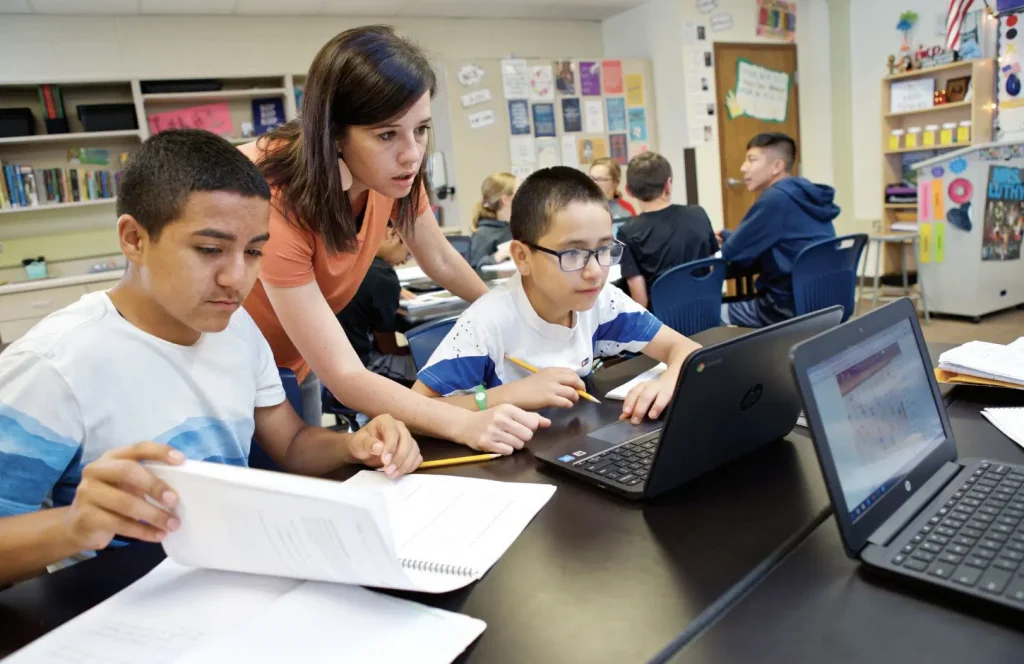
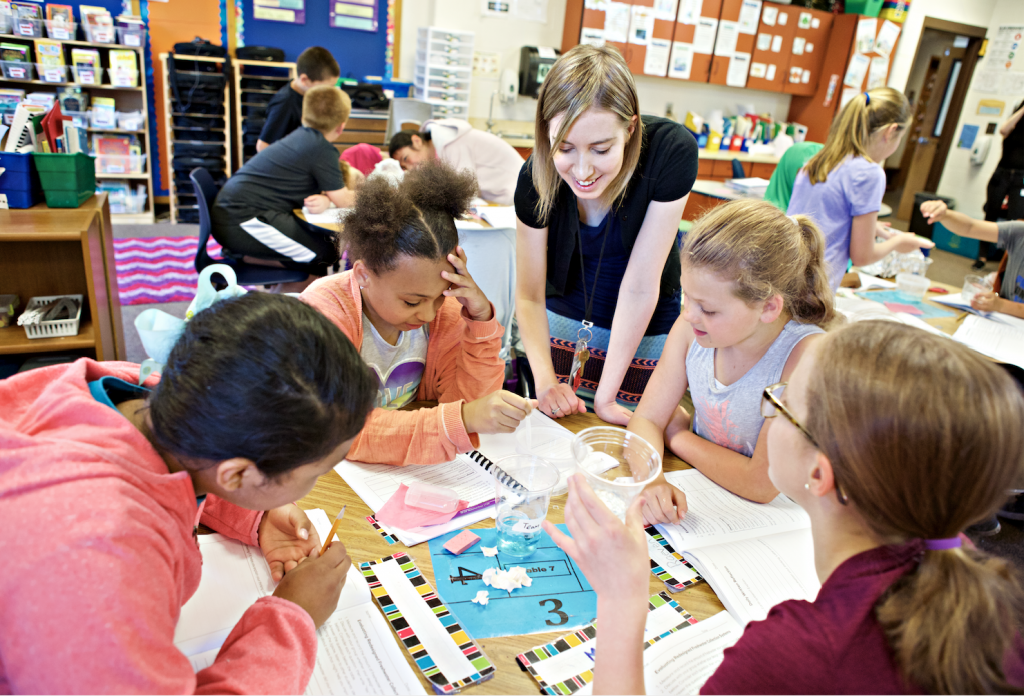
Collage of educational settings: top left, two young girls using laptop in library; bottom right, middle school science project display on tablet; bottom left, two boys with tablet discussing.

Overview

With Amplify Science, students don’t just passively learn about science concepts. Instead, they take on the roles of scientists and engineers to actively investigate and make sense of real-world phenomena. They do this through a blend of cohesive and compelling storylines, hands-on investigations, collaborative discussions, literacy-rich activities, and interactive digital tools.

Listen to these educators share how the program empowers students to think, read, write, and argue like real scientists and engineers every day.

Grades K–5

Grades 6–8

Amplify Science Grades K-5 Tour for Idaho Educators

Amplify Science Grades 6-8 Tour for Idaho Evaluators

Program structure

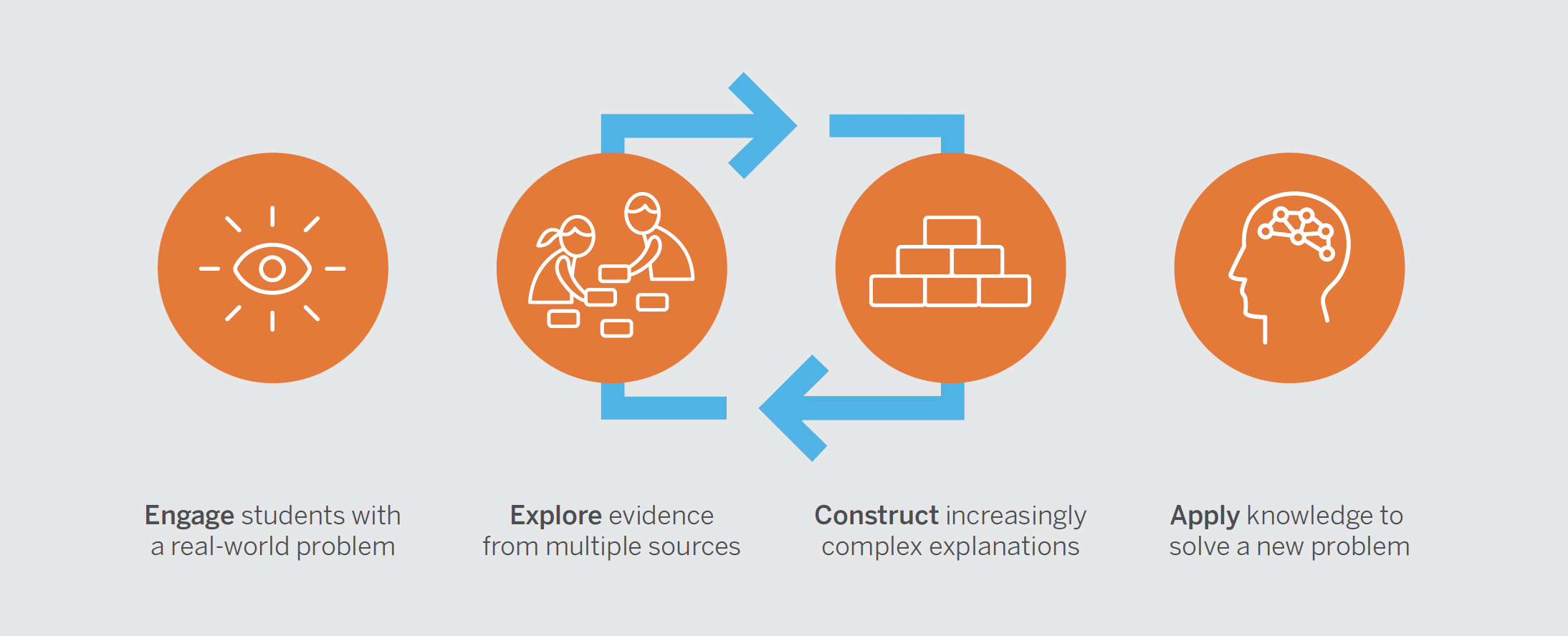
Our cyclical lesson design ensures students receive multiple exposures to concepts through a variety of modalities. As they progress through the lessons within a unit, students build and deepen their understanding, increasing their ability to develop and refine complex explanations of the unit’s phenomenon. It’s this proven program structure and lesson design that enables Amplify Science to teach less, but achieve more.

Rather than asking teachers to wade through unnecessary content, we designed our program to address 100 percent of the NGSS and Idaho Standards in fewer days than other programs:

  • In just 120 lessons at grades 6–8
  • In just 66 lessons at grades K–2
  • In just 88 lessons at grades 3–5
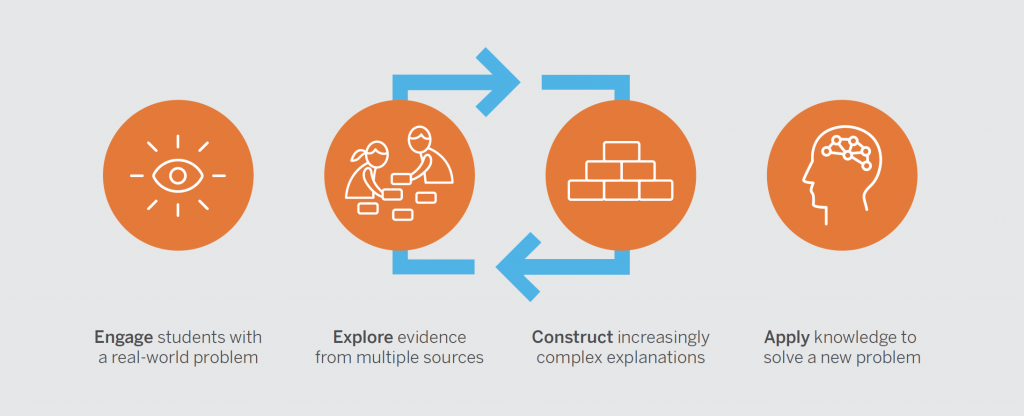
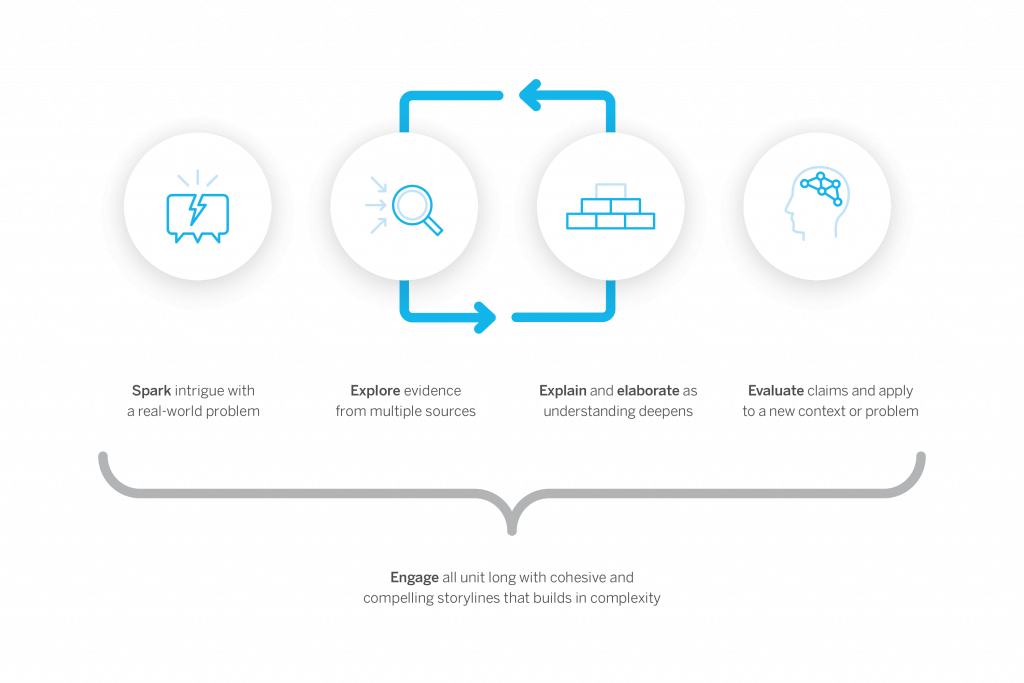
A four-step process diagram with icons: spark a real-world problem, explore sources, explain and elaborate, and evaluate claims, all linking to engage with cohesive storylines.

Unit types

Each unit delivers three-dimensional learning experiences and engages students in gathering evidence from a rich collection of sources, while also emphasizing a particular science and engineering practice.

A laptop and two screens display educational content about ecosystems, featuring illustrated plants, animals, and experiments with colorful liquids.
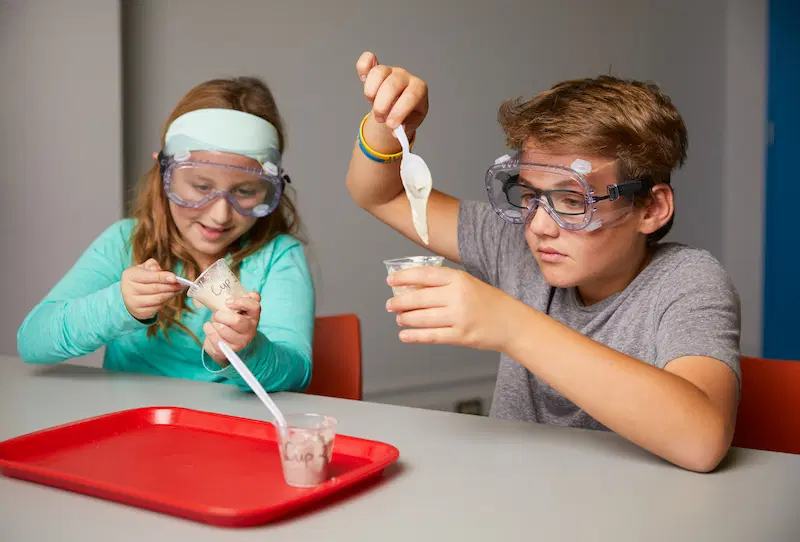
Two young students sit at a classroom table, one holding up a clear cup of water while the other observes closely. Papers and pencils are spread out on the table.

Investigation units

Investigation units focus on the process of strategically developing investigations and gathering data to answer questions. Students are first asked to consider questions about what happens in the natural world and why, and are then involved in designing and conducting investigations that produce data to help answer those questions.

Two children play an educational board game at a table with worksheets, plastic cubes, and small containers of colored items.

Modeling units

Modeling units provide extra support to students engaging in the practice of modeling. Students use physical models, investigate with computer models, and create their own diagrams to help them visualize what might be happening on the nanoscale.

Two children sitting at a table with laptops are talking to each other in a classroom setting, with books and baskets in the background.

Engineering Design units

Engineering design units provide opportunities for students to solve complex problems by applying science principles to the design of functional solutions, and iteratively testing those solutions to determine how well they meet preset criteria.

Several open textbooks and notebooks are spread out on a table as a person writes in one of the notebooks with a pencil.

Argumentation units

Argumentation units are introduced at grade 3 and provide students with regular opportunities to explore and discuss available evidence, time and support to consider how evidence may be leveraged in support of claims, and independence that increases as they mount written arguments in support of their claims.

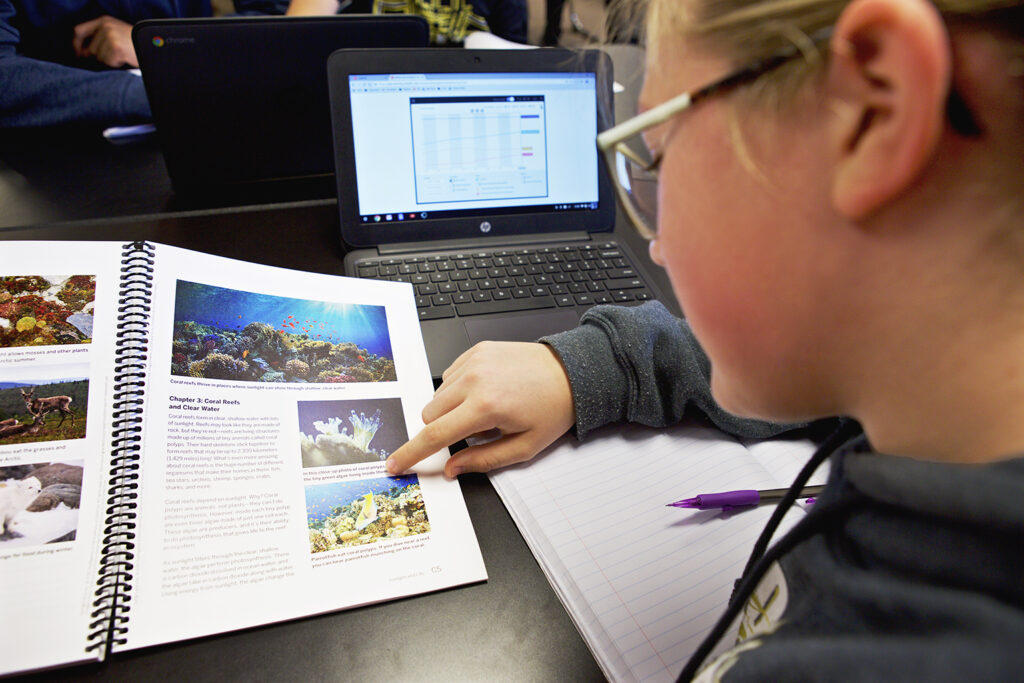
A person points to a photo in a textbook about coral reefs, with a laptop and notebook open on the desk.

Launch units

Launch units are the first units taught in each year of Amplify Science. The goal of the Launch unit is to introduce students to norms, routines, and practices that will be built on throughout the year, including argumentation, active reading, and using the program’s technology. For example, rather than taking the time to explain the process of active reading in every unit in a given year, it is explained thoroughly in the Launch unit, thereby preparing students to read actively in all subsequent units.

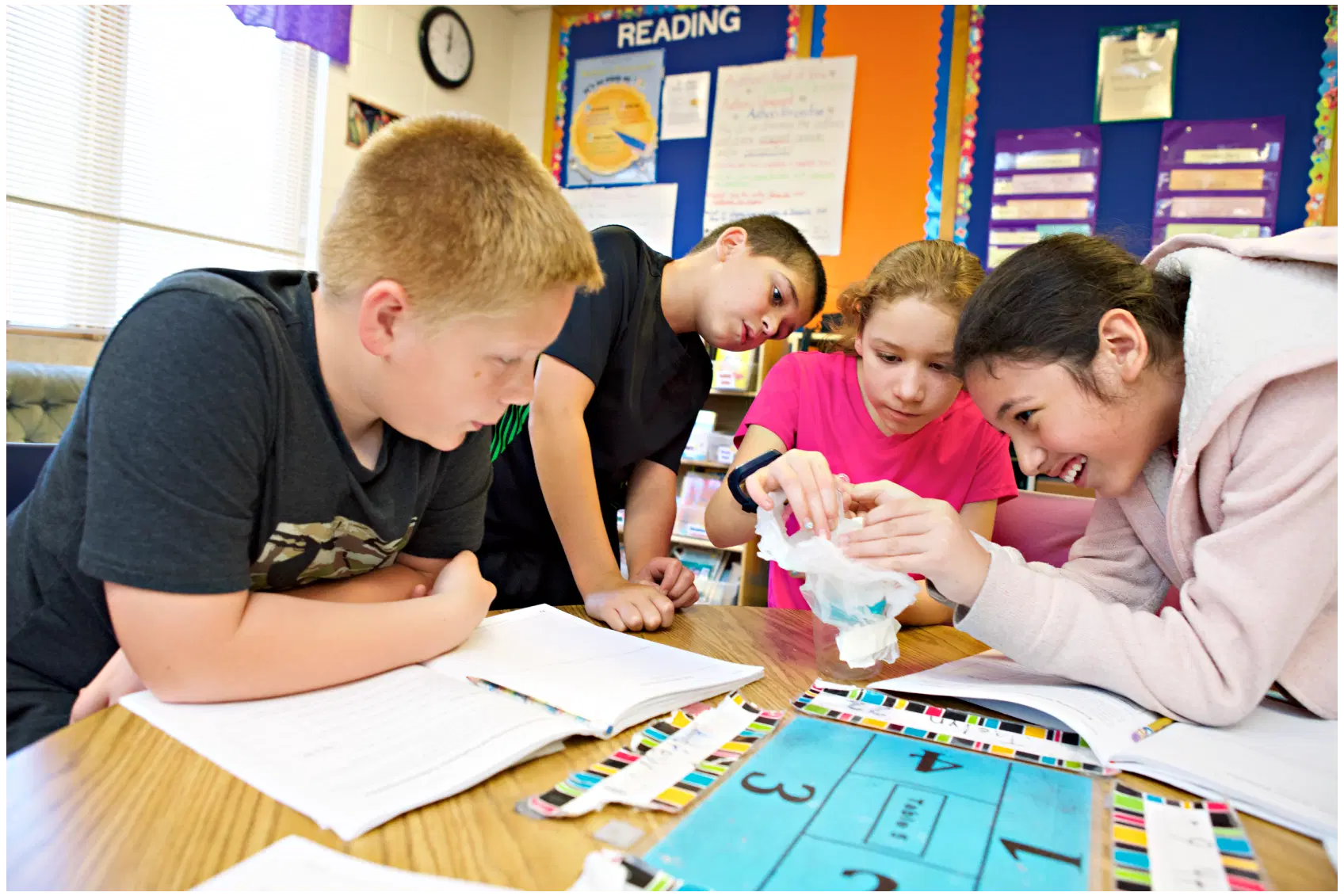
Three students at a classroom table examine a sealed plastic bag with food inside, while one looks surprised; another student stands in the background.

Core units

Core units establish the context of the unit by introducing students to a real-world problem. As students move through lessons in a Core unit, they figure out the unit’s anchoring phenomenon, gain an understanding of the unit’s disciplinary core ideas and science and engineering practices, and make linkages across topics through the crosscutting concepts. Each Core unit culminates with a Science Seminar and final writing activity.

Four students sit at a table using laptops, focused on their screens in a classroom setting with one student in the background.

Engineering Internship units

Engineering Internship units invite students to design solutions for real-world problems as interns for a fictional company called Futura. Students figure out how to help those in need, from tsunami victims in Sri Lanka to premature babies, through the application of engineering practices. In the process, they apply and deepen their learning from Core units.

Idaho Science Standards Alignment

Amplify Science was built from the ground up to fully embrace the instructional shifts outlined in A Framework for K-12 Science Education (2012), the same framework on which Idaho Science Content Standards were founded. Most grade levels’ respective set of Amplify Science units therefore fully address the necessary Idaho Science Content Standards (see correlation). Grade 1 teachers should plan to also use the companion mini-lesson provided below to achieve full standards coverage for their grade.

Grade 1 Companion

Standard: 1-LS-1.3 Use classification supported by evidence to differentiate between living and non-living things.

Recommended placement: Following Lesson 1.1 of the Animal and Plant Defenses unit.

Resources: Classroom Slides

Science (K-2) Evaluation Form

Science (3-5) Evaluation Form

Science (Middle School Physical Science) Evaluation Form

Science (Middle School Life Science) Evaluation Form

Science Evaluation Form Middle School Earth and Space Science

A boy sits on the floor reading a book to a girl beside him in a classroom setting.
A butterfly flies above potted plants next to a watering can and a caterpillar on a milkweed plant under sunlight in a grassy field.

Needs of Plants and Animals

Domains: Life Science, Earth and Space Science, Engineering Design

Unit type: Investigation

Student role: Scientists

Phenomenon: There are no monarch caterpillars in the Mariposa Grove community garden since vegetables were planted.  

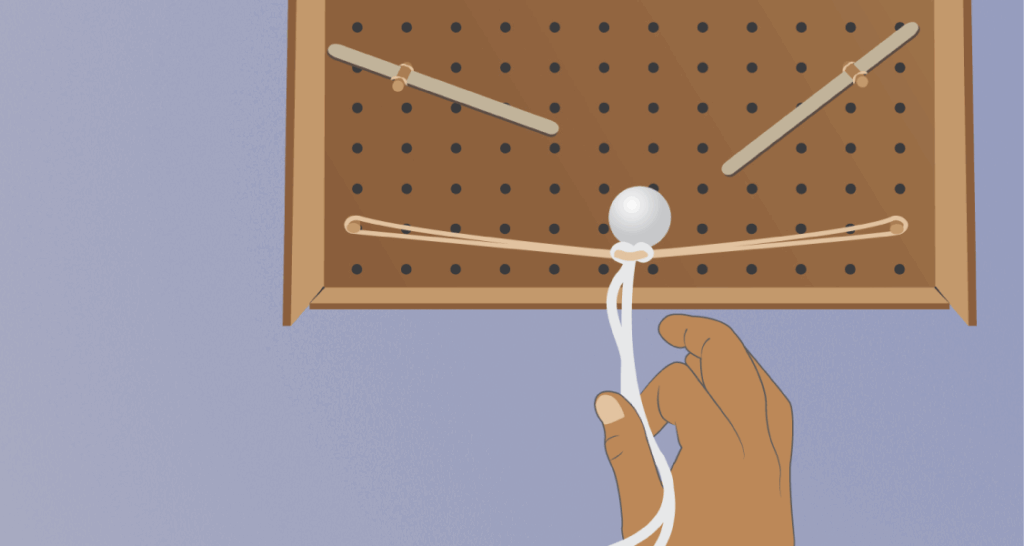
A hand pulls a white string attached to a pegboard with rubber bands and a white ball hanging from the center.

Pushes and Pulls

Domains: Physical Science, Engineering Design

Unit type: Engineering design

Student role: Pinball engineers

Phenomenon: Pinball machines allow people to control the direction and strength of forces on a ball.  

Silhouette of a playground structure and toy train against a blue sky with clouds and two large yellow suns.

Sunlight and Weather

Domains: Earth and Space Science, Life Science, Engineering Design

Unit type: Modeling

Student role: Weather scientists

Phenomenon: Students at Carver Elementary School are too cold during morning recess, while students at Woodland Elementary School are too hot during afternoon recess.  

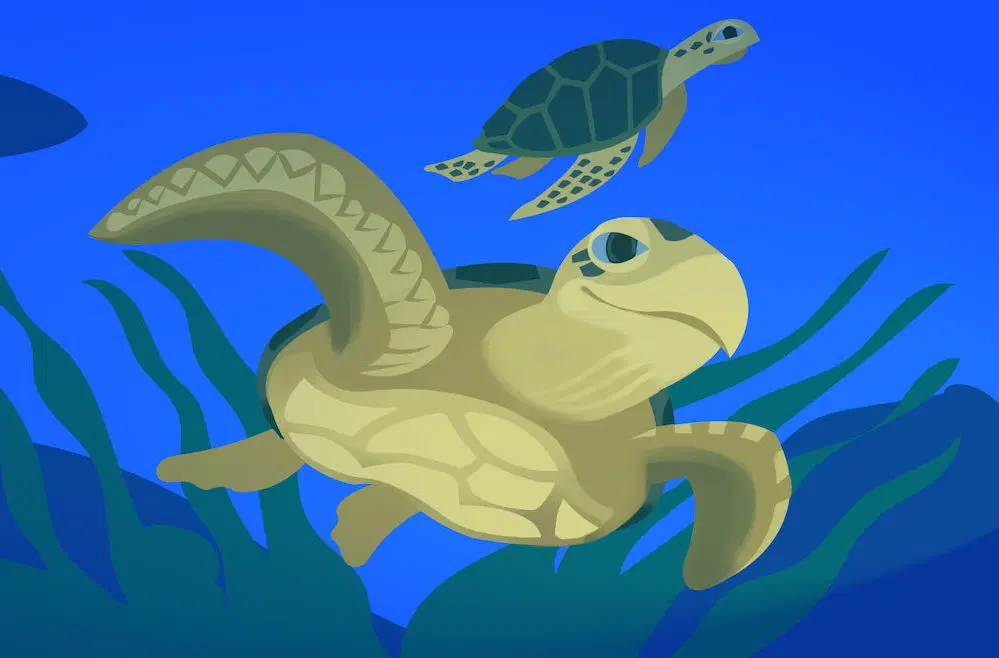
Illustration of sea turtles swimming among underwater plants, with a shark and another turtle visible in the background.

Animal and Plant Defenses

Domain: Life Science

Unit type: Modeling

Student role: Marine scientists

Phenomenon: Spruce the Sea Turtle lives in an aquarium and will soon be released back into the ocean, where she will survive despite ocean predators.  

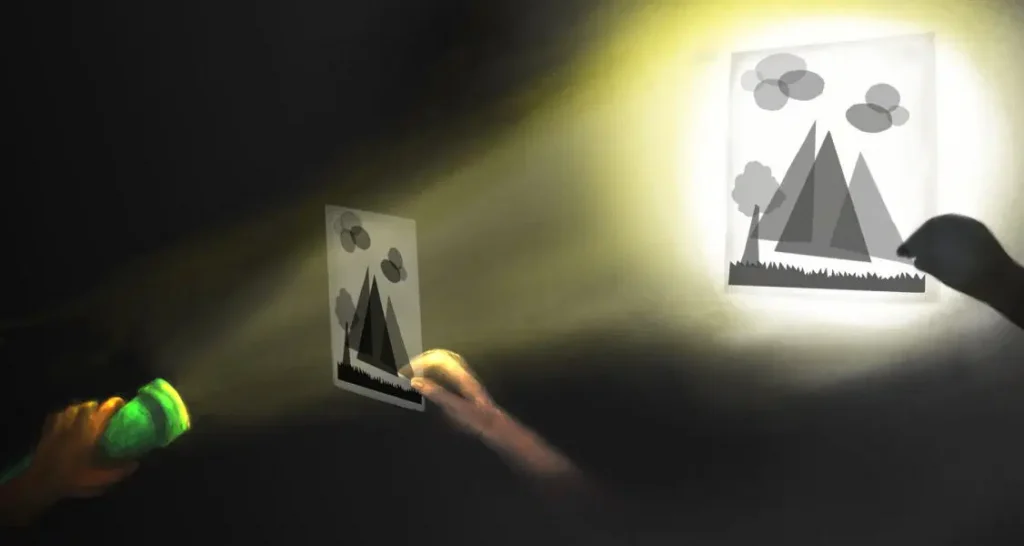
A hand holds a flashlight and shines it through a transparent sheet with an image, projecting the image onto a wall in a dark room.

Light and Sound

Domains: Physical Science, Engineering Design

Unit type: Engineering design

Student role: Light and sound engineers

Phenomenon: A puppet show company uses light and sound to depict realistic scenes in puppet shows.  

A split illustration shows a cityscape at night with a crescent moon and stars on the left, and a cityscape during the day with the sun, clouds, and an airplane on the right.

Spinning Earth

Domain: Earth and Space Science

Unit type: Investigation

Student role: Sky scientists

Phenomenon: The sky looks different to Sai and his grandma when they talk on the phone.  

A grey elephant uses its trunk to pick apples from a tree, with a few apples still hanging on the branches and a small sprout growing nearby.

Plant and Animal Relationships

Domains: Life Science, Engineering Design

Unit type: Investigation

Student role: Plant scientists

Phenomenon: No new chalta trees are growing in the fictional Bengal Tiger Reserve in India.  

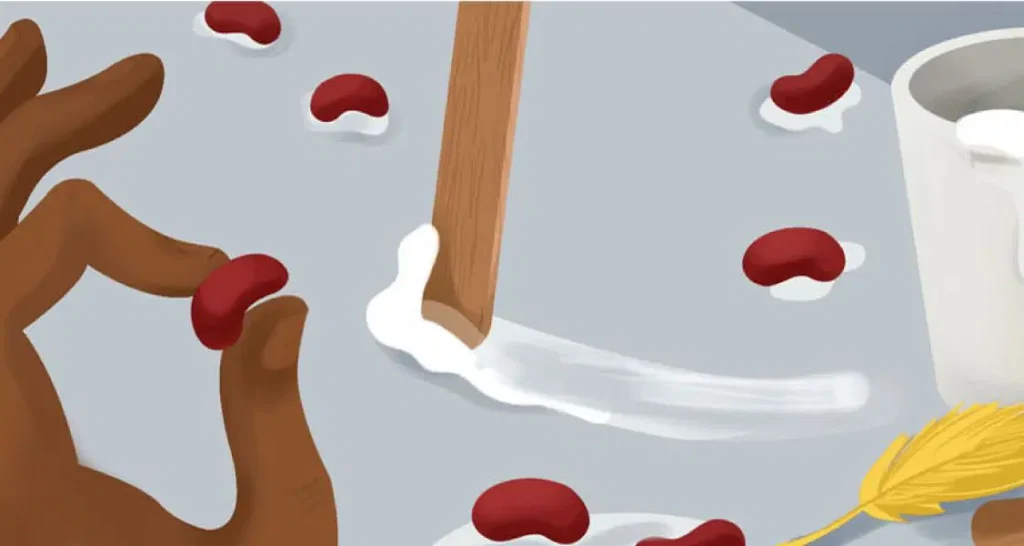
A hand picks up a red bean from a table scattered with more red beans, spilled white liquid, a cup, and a wooden stick.

Properties of Materials

Domains: Physical Science, Engineering Design

Unit type: Engineering design

Student role: Glue engineers

Phenomenon: Different glue recipes result in glues that have different properties.  

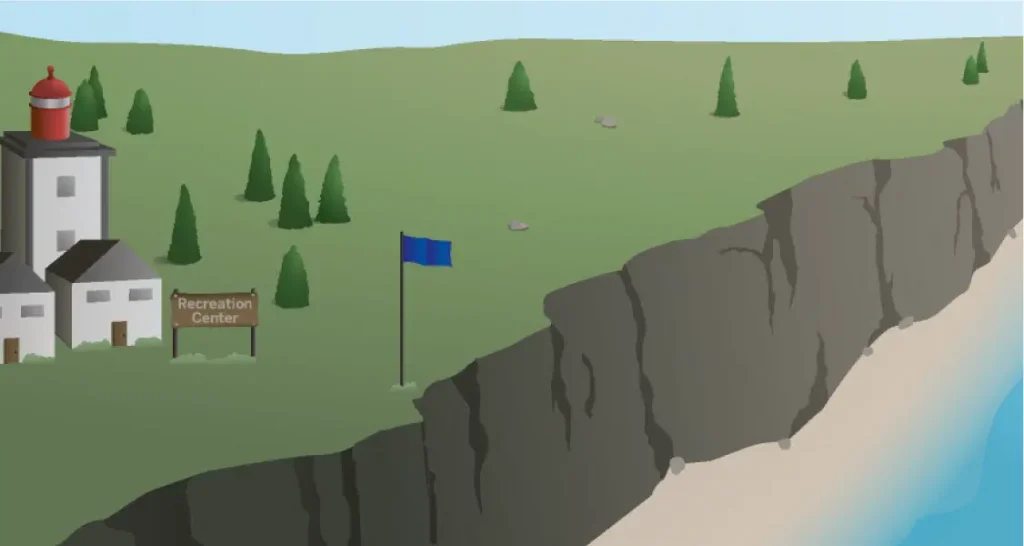
A building labeled "Recreation Center" stands near a cliff edge with a blue flag, surrounded by trees and overlooking a beach and water.

Changing Landforms

Domain: Earth and Space Science

Unit type: Modeling

Student role: Geologists

Phenomenon: The cliff that Oceanside Recreation Center is situated on appears to be receding over time.  

Illustration of a high-speed train traveling on an elevated track with a green landscape and blue sky in the background.

Balancing Forces

Domain: Physical Science

Unit type: Modeling

Student role: Engineers

Phenomenon: The town of Faraday is getting a new train that floats above its tracks.  

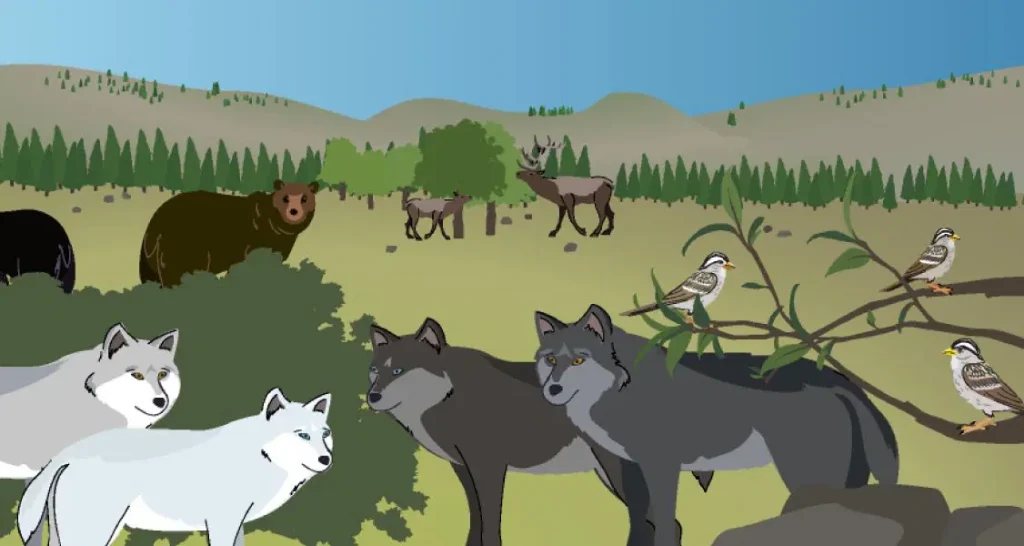
A group of wolves stands in the foreground, with a bear, elk, and several birds visible in a grassy, hilly landscape with scattered trees.

Inheritance and Traits

strong>Domain: Life Science

Unit type: Investigation

Student role: Wildlife biologists

Phenomenon: An adopted wolf in Graystone National Park (“Wolf 44”) has some traits that appear similar to one wolf pack in the park and other traits that appear to be similar to a different wolf pack. 

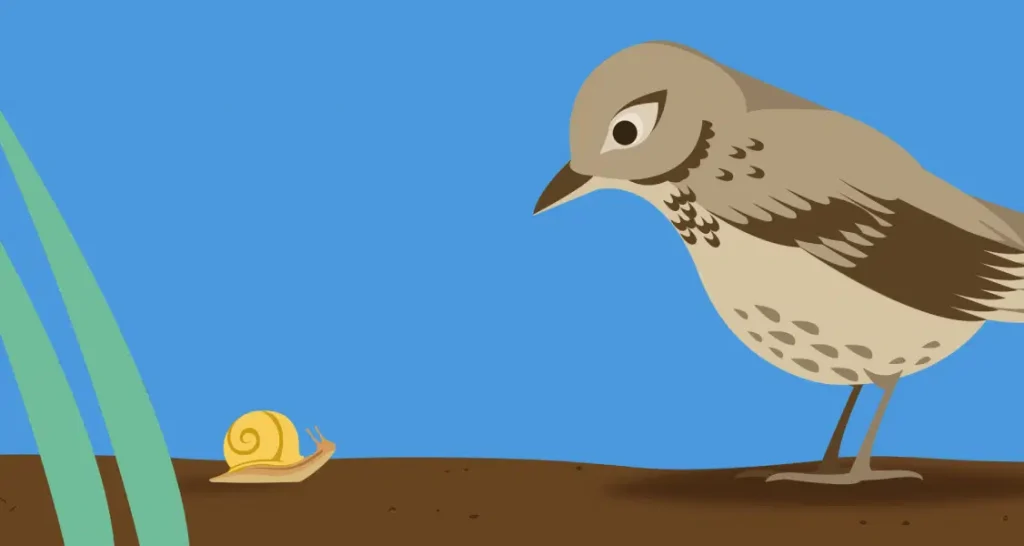
A small bird stands on soil, looking closely at a yellow snail, with green blades of grass on the left and a blue sky background.

Environments and Survival

Domains: Life Science, Engineering Design

Unit type: Engineering design

Student role: Biomimicry engineers

Phenomenon: Over the last 10 years, a population of grove snails has changed: The number of grove snails with yellow shells has decreased, while the number of snails with banded shells has increased.  

An orangutan hangs from a vine in a dense green forest with the sun visible in the background.

Weather and Climate

Domains: Earth and Space Science, Engineering Design

Unit type: Argumentation

Student role: Meteorologists

Phenomenon: Three different islands, each a contender for becoming an Orangutan reserve, experience different weather patterns.  

Illustration of city buildings at night with illuminated windows, a full moon, visible stars, and a silhouetted figure in one window.

Energy Conversions

Domains: Physical Science, Earth and Space Science, Engineering Design

Unit type: Engineering design

Student role: System engineers

Phenomenon: The fictional town of Ergstown experiences frequent blackouts.  

A streetlamp illuminates a cricket, which is watched by a gecko. Yellow arrows indicate the flow of light from the lamp to the cricket and then to the gecko’s eye.

Vision and Light

Domain: Physical Science, Life Science, Engineering Design

Unit type: Investigation

Student role: Conservation biologists

Phenomenon: The population of Tokay geckos in a rain forest in the Philippines has decreased since the installation of new highway lights.  

Two dolphins swimming underwater, facing each other against a blue background.

Waves, Energy, and Information

Domains: Physical Science, Life Science, Earth and Space Science, Engineering Design

Unit type: Modeling

Student role: Marine scientists

Phenomenon: Mother dolphins in the fictional Blue Bay National Park seem to be communicating with their calves when they are separated at a distance underwater.

Earth orbits the Sun in space, with dotted blue lines showing the orbital path and a white arrow indicating Earth's rotation direction.

Patterns of Earth and Sky

Domains: Physical Science, Earth and Space Science

Unit type: Investigation

Student role: Astronomers

Phenomenon: An ancient artifact depicts what we see in the sky at different times — the sun during the daytime and different stars during the nighttime — but it is missing a piece.  

Illustration of layered red and brown rocky cliffs beside a flowing blue river under a partly cloudy sky.

Earth’s Features

Domain: Earth and Space Science

Unit type: Argumentation

Student role: Geologists

Phenomenon: A mysterious fossil is discovered in a canyon within the fictional Desert Rocks National Park.  

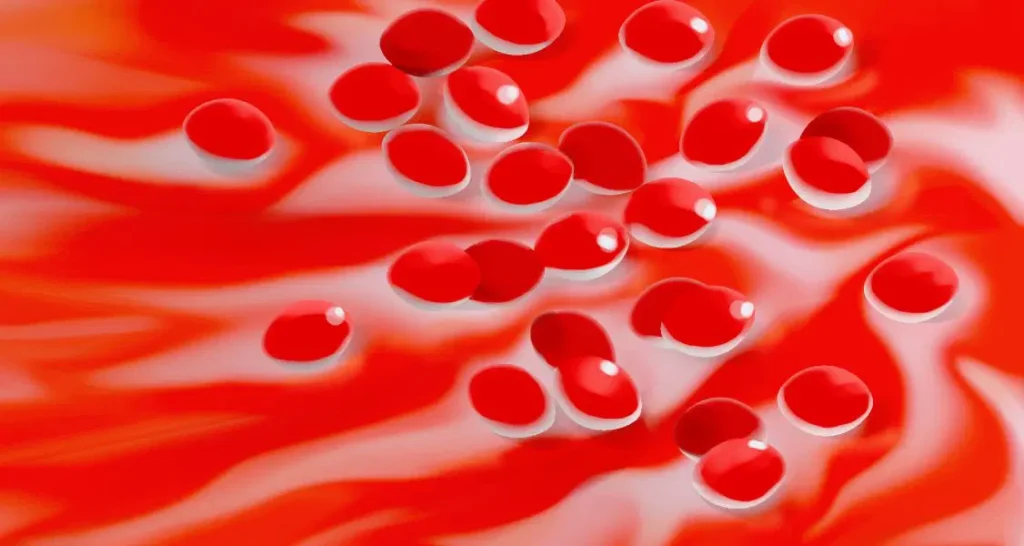
Red blood cells scattered across a dynamic, abstract red and white background.

Modeling Matter

Domain: Physical Science

Unit type: Modeling

Student role: Food scientists

Phenomenon: Chromatography is a process for separating mixtures. Some solids dissolve in a salad dressing while others do not. Oil and vinegar appear to separate when mixed in a salad dressing.  

Illustration of wind carrying airborne particles over a coastal hill, with arrows indicating the movement up and over the hill toward the sea.

The Earth System

Domains: Earth and Space Science, Physical Science, Engineering Design

Unit type: Engineering Design

Student role: Water resource engineers

Phenomenon: East Ferris, a city on one side of the fictional Ferris Island, is experiencing a water shortage, while West Ferris is not. 

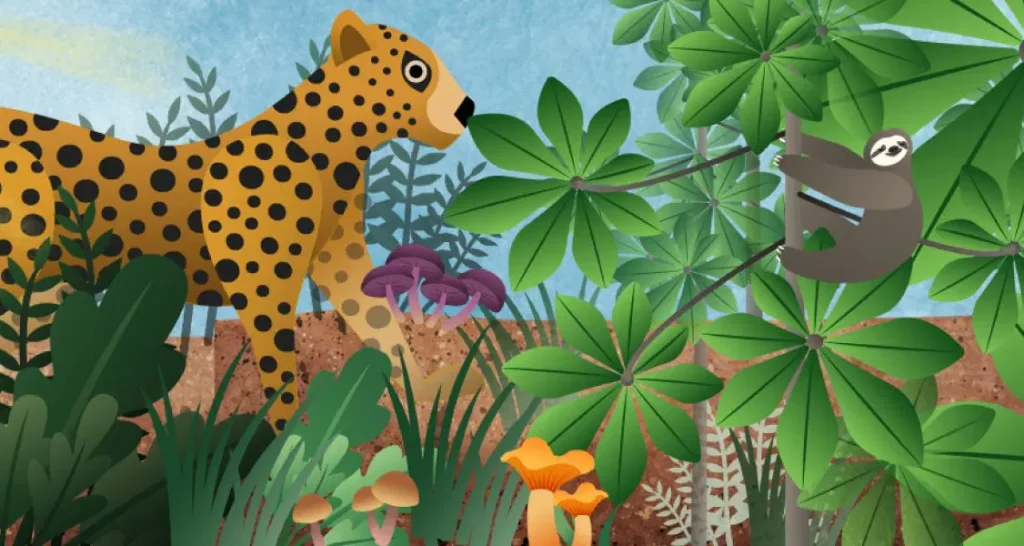
Illustration of a cheetah standing near plants, looking at a sloth hanging from a tree branch, with various foliage and mushrooms in the scene.

Ecosystem Restoration

Domains:Physical Science, Life Science, Earth and Space Science, Engineering Design

Unit type: Argumentation

Student role: Ecologists

Phenomenon: The jaguars, sloths, and cecropia trees in a reforested section of a Costa Rican rain forest are not growing and thriving.  

A rover stands on a rocky, reddish terrain with visible tire tracks leading to it; distant hills are seen under a hazy sky.

Geology on Mars

Domain: Earth and Space Science

Unit type: Launch

Student role: Planetary geologists

Phenomenon: Analyzing data about landforms on Mars can provide evidence that Mars may have once been habitable.  

Illustration of a city skyline at night with a large full moon, a few stars in the sky, and a bridge on the left side.

Earth, Moon, and Sun

Domains: Earth and Space Science, Physical Science

Unit type: Core

Student role: Astronomers

Phenomenon: An astrophotographer can only take pictures of specific features on the Moon at certain times.  

Illustration of a person wearing a red hat and winter coat with fur hood, eyes closed and arms crossed, surrounded by large orange circles.

Thermal Energy

Domain: Physical Science

Unit type: Core

Student role: Thermal scientists

Phenomenon: One of two proposed heating systems for Riverdale School will best heat the school.  

Abstract digital artwork featuring a large yellow sun with blue and orange rays over a colorful landscape with green hills and red horizon.

Ocean, Atmosphere, and Climate

Domains: Earth and Space Science, Physical Science

Unit type: Core

Student role: Climatologists

Phenomenon: During El Niño years, the air temperature in Christchurch, New Zealand is cooler than usual.  

Illustration of clouds above a small town with fields and mountains, showing wind patterns and atmospheric movement in the sky.

Weather Patterns

Domains: Earth and Space Science, Physical Science

Unit type: Core

Student role: Forensic meteorologists

Phenomenon: In recent years, rainstorms in Galetown have been unusually severe.  

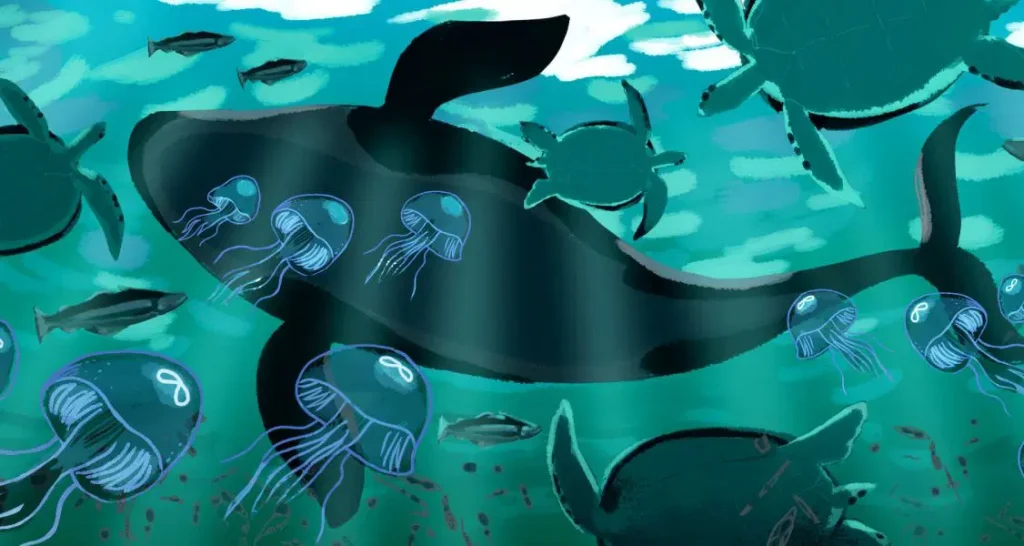
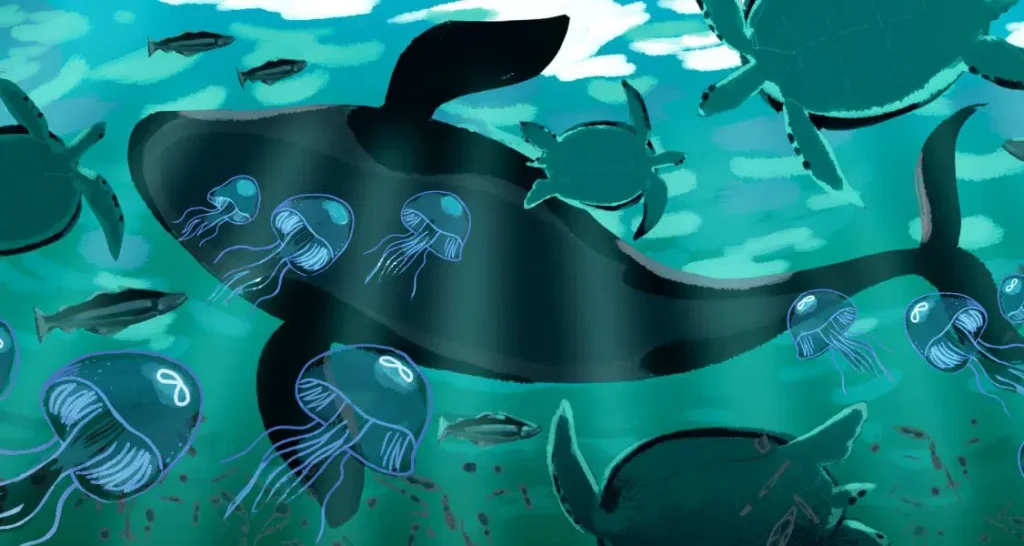
An underwater scene with a large whale, several turtles, jellyfish, and fish swimming surrounded by shafts of light.

Populations and Resources

Domains: Life Science, Earth and Space Science

Unit type: Core

Student role: Biologists

Phenomenon: The size of the moon jelly population in Glacier Sea has increased.  

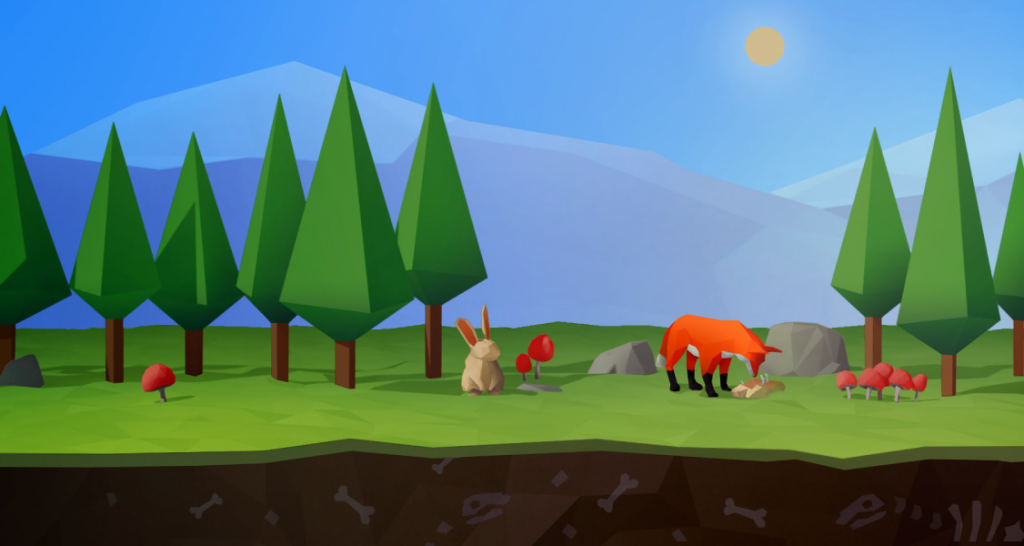
Low-poly illustration of a forest with trees, mushrooms, a rabbit, and a fox catching another animal under a blue sky with mountains and the sun in the background.

Matter and Energy in Ecosystems

Domains: Life Science, Earth and Space Science, Physical Science

Unit type: Core

Student role: Ecologists

Phenomenon: The biodome ecosystem has collapsed.

Illustration of six spiders with different colored bodies and legs arranged in a chart-like formation on a dark background.

Traits and Reproduction

Domain: Life Science

Unit type: Core

Student role: Biomedical students

Phenomenon: Darwin’s bark spider offspring have different silk flexibility traits, even though they have the same parents.  

Abstract digital artwork featuring vibrant colors, geometric shapes, a yellow human silhouette, and various patterns layered together.

Microbiome

Domain: Life Science

Unit type: Launch

Student role: Microbiological researchers

Phenomenon: The presence of 100 trillion microorganisms living on and in the human body may keep the body healthy.  

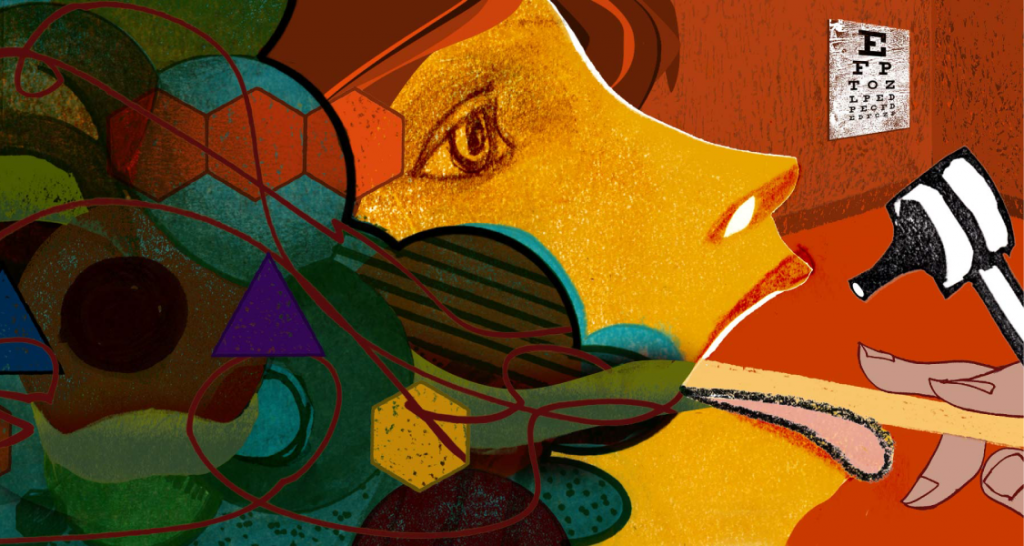
Illustration of a person receiving an oral examination with a tongue depressor and light, featuring abstract colorful shapes and an eye chart in the background.

Metabolism

Domain: Life Science

Unit type: Core

Student role: Medical researchers

Phenomenon: Elisa, a young patient, feels tired all the time. 

A spacecraft approaches a large modular space station with blue solar panels, orbiting in outer space against a black background.

Force and Motion

Domain: Physical Science

Unit type: Core

Student role: Physicists

Phenomenon: The asteroid sample-collecting pod failed to dock at the space station as planned.

Green geometric background with a hexagonal badge displaying a parachute, ruler, letter A, stacked layers, bandage, and a folded paper icon.

Force and Motion Engineering Internship

Domains: Engineering Design, Physical Science

Unit type: Engineering internship

Student role: Mechanical engineering interns

Phenomenon: Designing emergency supply delivery pods with different structures can maintain the integrity of the supply pods and their contents.  

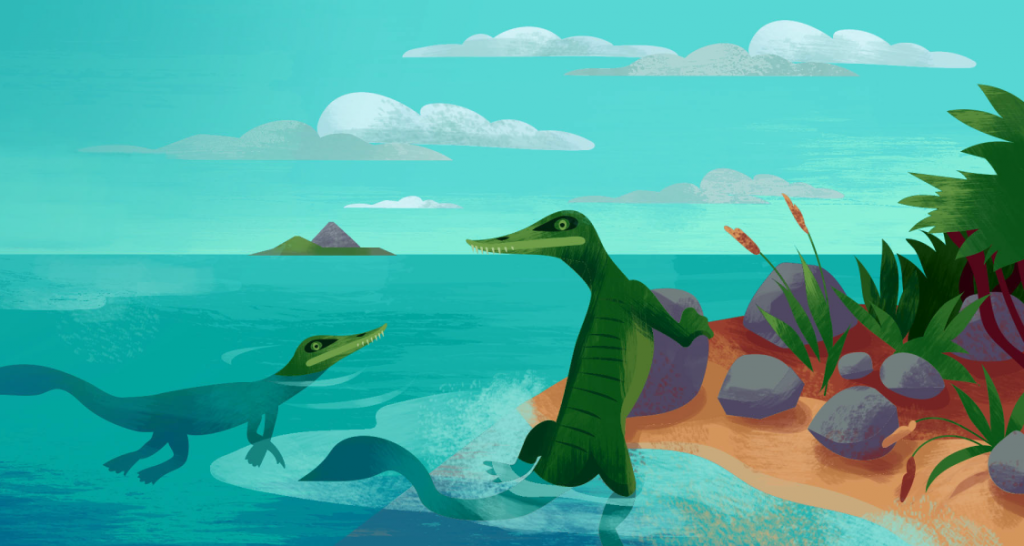
Two prehistoric aquatic reptiles with long snouts swim near the shore of a tropical landscape with rocks, plants, and an island in the distance.

Plate Motion

Domain: Earth and Space Science

Unit type: Core

Student role: Geologists

Phenomenon: Mesosaurus fossils have been found on continents separated by thousands of kilometers of ocean, even though the Mesosaurus species once lived all together.  

Illustration of a volcanic landscape with mountains, trees, an ocean, and a cross-section showing tectonic plates beneath the surface.

Rock Transformations

Domain: Earth and Space Science

Unit type: Core

Student role: Geologists

Phenomenon: Rock samples from the Great Plains and from the Rocky Mountains — regions hundreds of miles apart — look very different, but have surprisingly similar mineral compositions.  

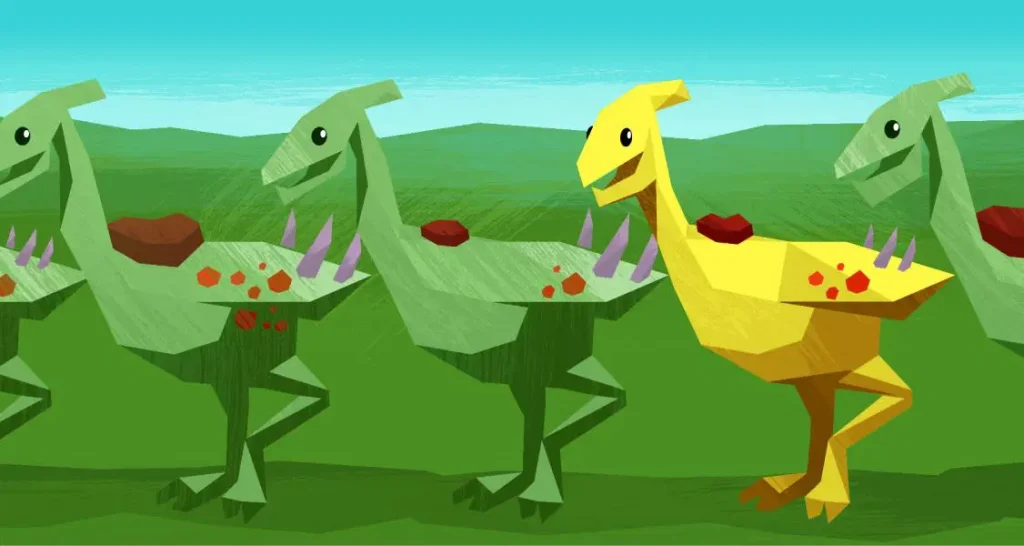
Four low-poly dinosaurs, three green and one yellow, are walking in a row on grass with rocks and red spots on their bodies under a blue sky.

Natural Selection

Domains: Life Science, Earth and Space Science

Unit type: Core

Student role: Biologists

Phenomenon: The newt population in Oregon State Park has become more poisonous over time.  

Two large tortoises are near a river; one is on the riverbank reaching for leaves on a tree, while the other is on the opposite bank among grass and trees.

Evolutionary History

Domains: Life Science, Earth and Space Science

Unit type: Core

Student role: Paleontologists

Phenomenon: A mystery fossil at the Natural History Museum has similarities with both wolves and whales.    

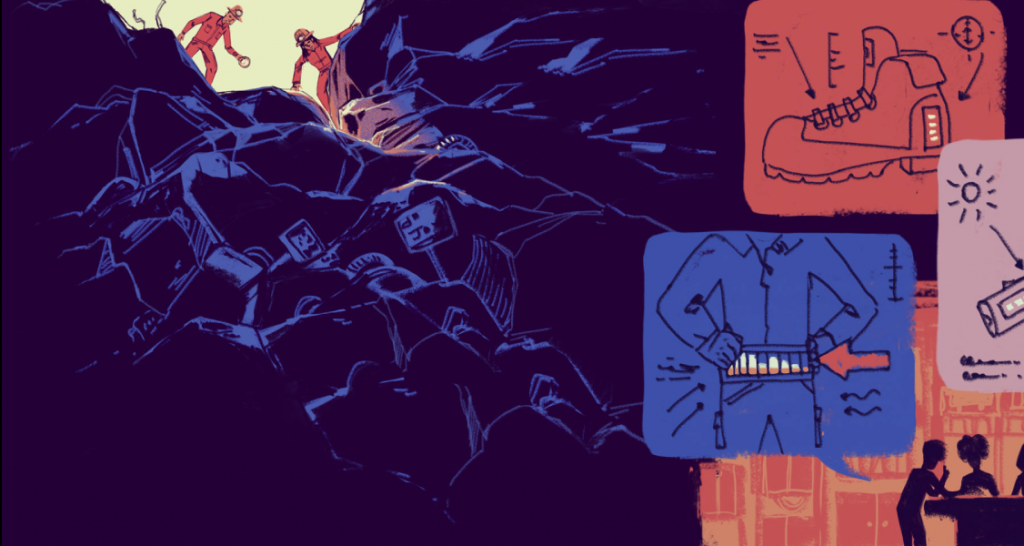
Two people stand atop rocky terrain littered with electronic devices; inset illustrations show a boot, a person with electronics in a vest, and a radio.

Harnessing Human Energy

Domains: Physical Science, Earth and Space Science, Engineering Design

Unit type: Launch

Student role: Energy scientists

Phenomenon: Rescue workers can use their own human kinetic energy to power the electrical devices they use during rescue missions.  

An orange popsicle melting in four stages from solid to almost fully liquid, set against a plain background.

Phase Change

Domains: Physical Science, Earth and Space Science

Unit type: Core

Student role: Chemists

Phenomenon: A methane lake on Titan no longer appears in images taken by a space probe two years apart.  

Green graphic with icons showing a swaddled baby, a thermometer, layers of blankets, a medical symbol, and a heat source within a hexagonal frame.

Phase Change Engineering Internship

Domains: Engineering Design, Physical Science

Unit type: Engineering internship

Student role: Chemical engineering interns

Phenomenon: Designing portable baby incubators with different combinations of phase change materials can keep babies at a healthy temperature.  

Digital illustration showing red and blue molecule-like circles on a blue background, with a boundary dividing two differently shaded sides.

Chemical Reactions

Domains: Physical Science, Life Science, Earth and Space Science

Unit type: Core

Student role: Forensic chemists

Phenomenon: A mysterious brown substance has been detected in the tap water of Westfield.  

Illustration of people riding a roller coaster on a blue day, with arms raised as the car descends a tall loop against a sky with clouds.

Magnetic Fields

Domain: Physical Science

Unit type: Core

Student role: Physicists

Phenomenon: During a test launch, a spacecraft traveled much faster than expected.  

Illustration of the Earth with arrows representing radiation or energy entering the atmosphere from space over the Asia-Pacific region.

Light Waves

Domains: Physical Science, Life Science, Earth and Space Science

Unit type: Core

Student role: Spectroscopists

Phenomenon: The rate of skin cancer is higher in Australia than in other parts of the world.  

An illustrated polar bear stands on a small piece of floating ice in the ocean, with icebergs and an orange sun in the background.

Earth’s Changing Climate

Domains: Earth and Space Science, Life Science

Unit type: Core

Student role: Climatologists

Phenomenon: The ice on Earth’s surface is melting.

Hexagonal badge with icons including a wrench, building, sun, molecules, construction materials, screwdriver, paint bucket, and a letter T, all on a geometric blue background.

Earth’s Changing Climate Engineering Internship

Domains: Earth and Space Science, Engineering Design

Unit type: Engineering internship

Student role: Civil engineers

Phenomenon: Designing rooftops with different modifications can reduce a city’s impact on climate change.  

Access program

In addition to the grade-level sample boxes that we provided, we’ve also created custom demo accounts just for Idaho reviewers.

To access the digital portion of the program, click the link below, select “Log In with Amplify,” and then refer to the Start here digital access flyer for your personalized login credentials.

A spiral-bound teacher’s guide and a laptop displaying a digital curriculum, both titled “Balancing Forces: Investigating Floating Trains” from Amplify Science.

Resources

Welcome, Utah K-8 reviewers!

To view this protected page, enter the password below:


Supporting multilingual & English language learners

Multilingual/English learners (ML/ELs) bring unique strengths to classrooms, enriching the learning experiences for all.

At Amplify, we empower educators with tools that honor the strengths and capabilities of ML/ELs. Our curriculum and assessments meet students where they are and help them develop their skills, propelling them on their learning journeys.

Amplify supports ML/ELs across all subjects, from English language arts to math and science. For students who speak Spanish, we also provide a comprehensive biliteracy suite.

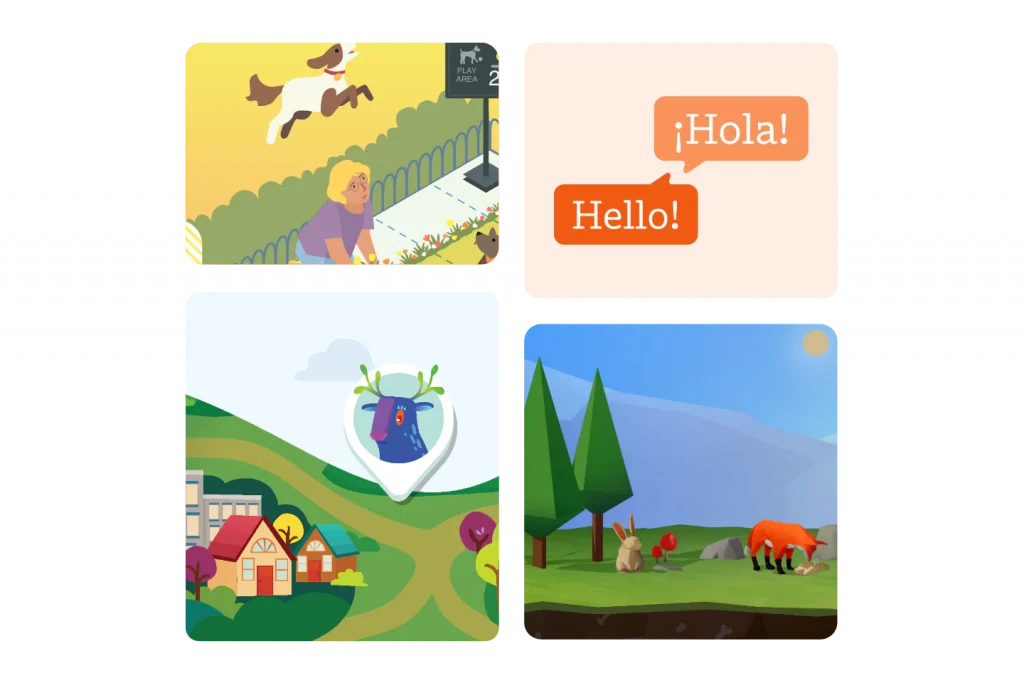
Four vibrant illustrations feature a goat, greeting phrases in Spanish and English, a map with an animal icon, and a fox with rabbits in a forest—perfect for engaging multilanguage & English language learners.
Illustration of a robot character, nine book covers above, and a tablet displaying an e-book page. A pink character stands on a stool holding a book, promoting a reading program for English language learners. Stars decorate the background.

Amplify CKLA core literacy curriculum for grades K–5

Amplify Core Knowledge Language Arts (CKLA) is a K–5 core curriculum built on the science of how students learn to read and write. Amplify CKLA supports ML/ELs in a variety of ways.

Image of a lesson page titled "Introducing the Read-Aloud," focused on speaking and listening skills. The highlighted section emphasizes "Speaking and Listening," seamlessly integrating into the literacy curriculum to support multilanguage & English language learners.

Scaffolding at five levels of proficiency

In addition to core instruction, Amplify CKLA provides lesson supports for Entering/Emerging, Transitioning/ Expanding, and Bridging levels.

An open workbook on writing skills, featuring instructions on creating paragraphs and checking understanding for literacy curriculum, with icons and a

Lesson differentiation

Lessons include Support and Challenge suggestions that provide assistance or opportunities for more advanced work toward the goal of the lesson. These resources are suitable for all learners, including ML/ELs.

A computer screen displays a multilanguage phonics learning app, ideal for English language learners, featuring an astronaut illustration and a play button for the sound "/a/".

Phonological awareness and phonics supports

The digital Sound Library easily facilitates sound development through videos showing mouth movements and songs that help students practice articulating new sounds with catchy lyrics.

A group of young children, including multilanguage and English language learners, sit cross-legged on a classroom floor, some with hands raised, appearing engaged and attentive.

Frequent oral language development opportunities

Amplify CKLA boosts language development with complex read-alouds, interactive discussion, writing activities, and explicit teaching of academic and domain vocabulary.

Amplify CKLA pairs with Amplify Caminos, its companion K–5 Spanish literacy program that supports biliteracy instruction.

Language Studio, an English Language Development companion program for Amplify CKLA

Language Studio, Amplify CKLA’s dedicated K–5 English language development companion program, offers daily 30-minute lessons to help ML/ELs practice reading, writing, speaking, and listening skills. Aligned to the World-Class Instructional Design and Assessment (WIDA) framework, Language Studio previews and reinforces language and content from core instruction, so that ML/ELs of all proficiency levels are able to access grade-level content as they develop academic English.

Four illustrated educational book covers are shown, each with different cultural and historical themes, titled "Language Studio Volumes 1-4" from Amplify Core Knowledge Language Arts—perfect for multilanguage and English language learners.
A young girl sits at a desk reading a book, while two other children are in the background—one using a laptop. The scene supports multilanguage and English language learners as they engage with different resources.

Interactive language development

Language Studio provides opportunities for classroom discussions, oral presentations, and writing tasks, promoting comprehension and learning by connecting with students’ cultural and linguistic backgrounds.

A worksheet labeled "Features of Academic Language," ideal for multilanguage and English language learners, with highlighted text: "Draw and Write," "Offer and Support Opinion," and "Tier 3 Domain-specific words.

Explicit vocabulary instruction

Interactive vocabulary and academic language support is provided before each lesson to deepen students’ understanding of text.

Two schoolgirls in green uniforms, English language learners, look at a notebook together in a multilanguage classroom—one holding a pencil box and pointing at the book.

Multimodal comprehension support

Students can preview content, interact with physical materials, compare text types, receive explicit grammar instruction, and have access to extensive vocabulary exercises.

A language proficiency assessment chart for multilanguage and English language learners, listing evaluation criteria and descriptors across five proficiency levels from entering to bridging.

Skill proficiency monitoring

Language Studio facilitates evaluation with an understanding of what students should produce at each level.

A person holds a tablet displaying educational progress, featuring profile images of two students labeled

mCLASS DIBELS 8th Edition literacy assessment for grades K–8

mCLASS® is an all-in-one system for Science of Reading-based universal screening, dyslexia screening, and progress monitoring for grades K–8. Powered by DIBELS 8th Edition, mCLASS provides valuable data on your ML/ELs’ literacy in English, helping you build a robust system of tiered supports. With a single tool, you can access the data and instructional support you need for each student’s literacy development, from phonics to comprehension, catering to all readers, from beginner to advanced.

A laptop screen displays a table showing the beginning-of-year assessment scores for four Grade 1 multilanguage and English language learners across three goal areas: Composite, LNF, and PSF.

Screening and reporting

mCLASS’s one-minute measures and dyslexia screening identify risk as early as possible, providing you with the right data to make informed decisions.

A laptop screen displays an educational platform with a lesson plan on decoding complex word patterns for Grade 3 English language learners under the "Instruction" tab, supporting multilanguage development.

Language considerations

mCLASS provides specific language guidance, offers ML/EL instructional strategies, and considers each student’s unique language background, never penalizing for language variety, accent, or articulation, and extending this understanding into small-group practices.

A computer screen displays a dashboard with student assessment data, including charts and tables comparing performance across different benchmarks for multilanguage and English language learners.

Performance and reporting transparency

Understand student performance through direct observation and detailed reports which offer growth insights, including district-wide student achievement data that can be filtered by EL status, Home Language, or English Proficiency status.

mCLASS pairs with mCLASS Lectura, an authentic Spanish literacy assessment for K–8 that measures key foundational skills and supports Spanish-speaking bilingual students.

mCLASS Intervention for grades K–6

mCLASS Intervention is our K–6 reading intervention program, designed to support you in providing effective Tier 2 and 3 instruction and getting readers on track. mCLASS Intervention does the heavy lifting of data analysis and lesson planning for you. This lets you focus on what you do best: teaching the skills each student needs to become a confident reader.

Infographic showing a 10-day cycle: measure skills, group multilanguage and English language learners, generate lessons, teach students, and provide practice, all arranged in a circular flow.
A worksheet page titled "Introduce a" with instructional text, a letter grid activity, support tips, and a section labeled “Challenge,” overlaid by the text “Multimodal learner resources” for multilanguage and English language learners.

Effective lessons with built-in support

Lessons are equipped with best practices and guidance targeting language and literacy development for ML/ELs. The program also includes materials and resources that make content accessible to Spanish-speaking students.

A lesson plan shows students, skills, and Day 1 activities for a 10-day Blending and Regular Words set—ideal for multilanguage and English language learners—involving sounding out, blends, and a word race game.

Structured small groups

Once groups are formed, mCLASS Intervention determines the ideal focus for each group and automatically prepares two weeks of targeted lessons.

A line graph showing Emma Ashley's letter sounds scores: 20 in August, 74 in December (benchmark), and projected to reach 90 in May—demonstrating strong progress for multilanguage and English language learners.

Keeps you updated on student progress

Track student growth with reliable progress-monitoring tools and reporting that provides a clear view of each student’s progress.

A young girl with headphones uses a laptop, sitting in front of a colorful, illustrated background with trees, clouds, a bird, and Science of Reading and ESSA Evidence badges—perfect for multilanguage and English language learners.

Boost Reading personalized reading program for grades K–5

A key component of Amplify’s early literacy suite, Boost Reading is a personalized learning program for K–5 that offers comprehensive targeted practice, built-in benchmark assessments, and powerful reporting. Boost Reading provides practice in the full progression of key phonics and comprehension skills critical to literacy development.

Boost Reading works. Results of a year-long study show that students in grades K–5—including ML/ELs—who used Boost Reading for 30 minutes a week significantly outperformed their peers.

A computer screen displays a sentence highlighting the words "Mateo" and "he," with arrows connecting them—helpful for multilanguage and English language learners. A "Done" button and an illustrated face are also visible.

Systematic instruction in foundational skills and comprehension

Reinforce core instruction with explicit practice in phonics and phonological awareness. Boost Reading is the only program that focuses on comprehension processes—what readers do while reading that allows them to make sense of text—which is especially beneficial for ML/EL students.

A laptop screen displays a cartoon mouth, a person’s face above it, and four toast-shaped buttons below—ideal for multilanguage practice and engaging English language learners.

Mouth formation modeling for articulation support

Boost Reading includes specific scaffolds and supports—such as a modeling of mouth formations for articulation—that are proven to be beneficial for ML/ELs.

A colorful educational game screen supports English language learners and multilanguage skills, showing a creature on a log labeled "stamp" with four word choices: sand, stand, stamp, and champ. A waterfall and plants are in the background.

Vocabulary practice

Targeted morphology practice for independent vocabulary building and explicit instruction with Tier 2 vocabulary words are proven to be supportive for ML/ELs.

Boost Reading pairs with Boost Lectura, a Spanish literacy program for K–2 that provides students with personalized practice to develop Spanish literacy skills.

Want to learn more about Amplify’s elementary biliteracy suite?

Fill out this form, and we’ll be in touch with you shortly.

Amplify ELA core literacy curriculum for grades 6–8

With Amplify ELA, students learn to tackle any complex text and make observations, grapple with interesting ideas, and find relevance for themselves. Amplify ELA is a grade 6–8 English language arts program designed to bridge language gaps and enhance learning for ML/ELs. With integrated supports in every lesson, Amplify ELA empowers educators to deliver grade-level content while maintaining rigorous standards, thus reducing barriers to language acquisition and boosting student success.

A tablet showcases an educational lesson interface about butterflies, alongside a book titled "Amplify ELA: Summer of the Mariposas," surrounded by illustrated butterflies, enriching the literacy curriculum and engaging multilanguage & English language learners.
A tablet screen displays a digital reading and writing assignment with text excerpts on the left and character trait questions on the right, designed to support multilanguage and English language learners.

Built-in scaffolds

Background documents (in English and Spanish) establish context and support comprehension before students begin to read. Features such as audio assessments, read-aloud, and Reveal words ensure that all students have the opportunity to engage with and understand grade-level materials.

A worksheet with a writing prompt about "Summer of the Mariposas," designed to support multilanguage and English language learners as they describe a character and explain her traits using evidence from the story.

Differentiated writing prompts

Simplified language, sentence starters, word banks, and visual cues offer the necessary levels of support to help students meet their writing goals.

A book titled "Mysteries & Investigation Multi-Language Glossary" with glossary cards for English-French and English-Vietnamese translations of the phrase "a wealth of," ideal for multilanguage study and English language learners.

Multi-language glossaries

Available in 11 languages—English, Arabic, Chinese, French, Haitian Creole, Portuguese, Russian, Spanish, Tagalog, Urdu, and Vietnamese—these glossaries support vocabulary development and comprehension.

Amplify Desmos Math core curriculum for grades K–12

Amplify Desmos Math is a curiosity-driven K–12 program that builds students’ lifelong math proficiency. Every lesson in Amplify Desmos Math includes opportunities for all students to develop mathematical language as they experience the content, while providing intentional support for ML/ELs. We purposefully progress language development from lesson to lesson and across units by supporting students in making their arguments and explanations stronger, clearer, and more precise.

A text box suggests encouraging multilanguage and English language learners to paraphrase peers’ ideas, building connections and using unit vocabulary, with an emphasis on speaking and listening skills.

Multilingual/English learner support

Supports for ML/ELs are called out at intentional points within each lesson. These specific, targeted suggestions support ML/ELs with modifications that increase access to a task, or through development of contextual or mathematical language (both of which can be supportive of all learners). ML/EL supports may also be attached to Math Language Routines.

A text box explaining MLR7: Compare and Connect, with prompts for students—including multilanguage and English language learners—to analyze, compare, and connect different problem-solving strategies.

Math Language Routines (MLRs)

Math Language Routines are used within lessons to highlight student-developed language and ideas, cultivate conversation, support mathematical sense-making, and promote metacognition. Tips for facilitating MLRs are included when they would be helpful within lessons.

A white box lists today’s goals for a lesson on parallelograms, including area calculation and encouraging multilanguage & English language learners to use mathematical language in writing, speaking, and listening.

Language goals and vocabulary

Language goals attend to the mathematics students are learning, and are written through the lens of one (or more) of four language modalities: reading, writing, speaking, and listening. Units and lessons start by surfacing students’ language for new concepts, then building connections between their language and the new vocabulary for that unit. This honors the language assets that students bring into their learning.

Amplify Science core curriculum for grades
K–8

Amplify Science is a curiosity-driven science curriculum that empowers students to Do, Talk, Read, Write, and Visualize like scientists. Through phenomena-based, literacy-rich, and interactive learning experiences, it develops students into critical thinkers who will gain the skills they need to solve real problems in their communities and the world. For students who need additional support, Amplify Science provides specialized instructional approaches, activities, and resources that take into account English learners’ level of language proficiency.

A teacher and three children, all English language learners, interact enthusiastically around a table with a colorful project in a classroom setting. The lively discussion enhances their literacy curriculum experience, fostering both creativity and understanding.
A document page titled "Patterns of Earth and Sky" is shown, with a highlighted overlay listing printable resources for multilanguage and English language learners, such as objectives, compilations, and glossaries.

Instructional design built on five key principles

Amplify Science leverages background knowledge, capitalizes on student knowledge of language, provides explicit instruction about the language of science, gives students opportunities with scaffolded practice, and enables students to access science content and express science knowledge through a multimodal approach.

A blue square with two arrows forming a loop, next to the words: Do, Talk, Read, Write, Visualize—ideal for multilanguage and English language learners.

Do, Talk, Read, Write, Visualize instructional model

Our multimodal instructional approach caters to diverse learning needs and promotes active engagement for all learners.

A webpage section titled "Differentiation" discusses teaching strategies for diverse learners, including multilanguage and English language learners, with a sidebar listing various digital resources and lesson materials.

Honoring multilingualism

Amplify Science honors multilingualism as students are invited to share in their native language at strategic points in instruction. Teacher-led instruction on cognates and a multilingual glossary in 10 languages offer additional support.

Cover of a Spanish-language science booklet titled "Patrones de la Tierra y del cielo," ideal for multilanguage and English language learners, featuring a space illustration and an orange "Cuaderno de investigación" button at the bottom.

Spanish instructional materials

Carefully translated materials use academic Spanish, with attention to consistency and grade-level appropriate language, to support language development.

A biliteracy suite grounded in the Science of Reading

Discover a suite of Spanish literacy curriculum and assessment programs designed to build confident readers with Amplify CaminosmCLASS Lectura, and Boost Lectura. Amplify’s biliteracy suite includes assessment, core instruction, and personalized learning built on the Science of Reading.

Explore more programs in Amplify’s literacy and biliteracy suites.

All of the programs in our literacy suite and our biliteracy suite are designed to support and complement each other. Learn more about our related programs:

Welcome, Ohio educators!

Designed from the ground up to teach students to think, read, write, and argue like real scientists and engineers, Amplify Science combines literacy-rich activities with hands-on learning and digital tools to engage students in exploring compelling phenomena in every unit.

Students in a classroom interact with educational technology, featuring a diagram and charts on a screen, while working collaboratively on a laptop.

Overview

Developed by UC Berkeley’s Lawrence Hall of Science, our program features:

  • phenomena-based approach where students construct a more complex understanding of each unit’s anchor phenomenon.
  • A blend of cohesive storylines, hands-on investigations, rich discussions, literacy-rich activities, and digital tools.
  • Newly crafted units, chapters, lessons, and activities designed to deliver true 3-dimensional learning.
  • An instructional design that supports all learners in accessing all standards.

Approach to literacy

Two young children sit at a classroom table reading a book together, with educational materials spread out in front of them.

[Video] Literacy in action (K–5)

Watch students use scientific text to obtain information and practice reading skills, while using writing prompts to create arguments using evidence.

A student sits at a desk writing with a pencil while focused on his work, with classroom materials visible in the background.

[Video] Literacy in action (6–8)

Watch students use scientific text to obtain information and practice reading skills, while using writing prompts to create arguments using evidence.

A teacher in a green shirt helps a young student with writing at a classroom table, with other students and large numbers visible on the wall in the background.

Literacy-rich science instruction (K–5)

Immersing young students in reading, writing, and arguing like real scientists and engineers.

Two students sit at a table in a classroom, working on an assignment together. Other students are also seated and appear to be engaged in their work. Papers and books are spread out on the tables.

Active Reading in grades 6–8

Engaging middle school students in complex science texts.

Elementary school

Get started by watching this class share what they’re figuring out with Amplify Science. >

In Grades K–3 we recommend the national grade level units of Amplify Science to provide students with the appropriate grade level literacy and background knowledge. Individual units are available to purchase.

When you’re ready:

  1. Find a summary of each unit below including each unit’s student role and anchor phenomenon.
  2. Download some helpful resources to support your review.
  3. Explore the digital Teacher’s Guide by clicking the orange “Review now” button.
An illustration from Needs of Plants and Animals unit

Unit 1

Needs of Plants and Animals

Student role: Scientists

Phenomenon: There are no monarch caterpillars in the Mariposa Grove community garden ever since vegetables were planted.

An illustration from the Pushes and Pulls unit

Unit 2

Pushes and Pulls

Student role: Pinball engineers

Phenomenon: Pinball machines allow people to control the direction and strength of forces on a ball.

Silueta de una estructura de parque infantil contra un cielo azul con nubes y tres soles amarillos.

Unit 3

Sunlight and Weather

Student role: Weather scientists

Phenomenon: Students at one school are too cold during morning recess, while students at another are too hot during afternoon recess.

Illustration of sea turtles swimming among seaweed in the ocean, with a large shark in the background.

Unit 1

Animal and Plant Defenses

Student role: Marine scientists

Phenomenon: Spruce the Sea Turtle will soon be released back into the ocean, where she will survive despite predators.

An illustration from the Light and Sound unit

Unit 2

Light and Sound

Student role: Light and sound engineers

Phenomenon: A puppet show company uses light and sound to depict realistic scenes in puppet shows.

An illustration from the Spinning Earth unit

Unit 3

Spinning Earth

Student role: Sky scientists

Phenomenon: The sky looks different to Sai and his grandma when they talk on the phone at night.

An elephant standing next to a tree uses its trunk to pick a fruit from a branch while more fruit hangs above.

Unit 1

Plant and Animal Relationships

Student role: Plant scientists

Phenomenon: No new chalta trees are growing in the fictional Bengal Tiger Reserve in India.

A hand holds a red bean on a table, while a wooden stick spreads white glue and scattered beans. Also on the table are a white cup and a yellow pen.

Unit 2

Properties of Materials

Student role: Glue engineers

Phenomenon: Different glue recipes result in glues that have different properties.

Ilustración de una costa con acantilados, un edificio de centro recreativo con un techo rojo y un letrero, árboles de hoja perenne, una bandera azul y una playa de arena debajo.

Unit 3

Changing Landforms

Student role: Geologists

Phenomenon: The cliff on which Oceanside Recreation Center is situated appears to be receding.

Una ilustración de un tren de alta velocidad moderno y aerodinámico que viaja por una vía elevada con un paisaje verde de fondo.

Unit 1

Balancing Forces

Student role: Engineers

Phenomenon: The fictional town of Faraday is getting a new train. Unlike typical trains, this one floats, which is causing some concern among the town’s citizens.

An illustration from the Inheritance and Traits unit

Unit 2

Inheritance and Traits

Student role: Wildlife biologists

Phenomenon: An adopted wolf in Graystone National Park has some traits in common with one wolf pack in the park and other traits in common with a different pack.

An illustration from the Environments and Survival unit

Unit 3

Environments and Survival

Student role: Biomimicry engineers

Phenomenon: Over 10 years, a population of grove snails has changed. Populations with yellow shells have decreased, while those with banded shells have increased.

An illustration from the Weather and Climate unit

Unit 4

Weather and Climate

Student role: Meteorologists

Phenomenon: Three different islands, each a contender for becoming an orangutan reserve, experience different weather patterns.

An illustration from the Energy Conversions unit

Unit 1

Energy Conversions

Student role: System engineers

Phenomenon: The fictional town of Ergstown experiences frequent blackouts. Their electrical system seems to be failing.

An illustration from the Earth's Features unit

Unit 2

Earth’s Features

Student role: Geologists

Phenomenon: A mysterious fossil is discovered in a canyon within the fictional Desert Rocks National Park.

An illustration from the Modeling Matter unit

Unit 3

Modeling Matter

Student role: Food scientists

Phenomenon: Some ingredients dissolve in a salad dressing while others, like oil and vinegar, appear to separate.

An illustration from the Earth System unit

Unit 4

The Earth System

Student role: Water resource engineers

Phenomenon: East Ferris, a city on one side of the fictional Ferris Island, is experiencing a water shortage, while West Ferris is not.

An illustration from the Patterns of Earth and Sky unit

Unit 1

Patterns of Earth and Sky

Student role: Astronomers

Phenomenon: An ancient artifact depicts what we see in the sky at different times of the day, but it appears to be missing a piece.

An illustration from the Vision and Light unit

Unit 2

Vision and Light

Student role: Conservation biologists

Phenomenon: The population of Tokay geckos in a rain forest in the Philippines has decreased since the installation of new highway lights.

An illustration from the Waves, Energy, and Information unit

Unit 3

Waves, Energy, and Information

Student role: Marine scientists

Phenomenon: Mother dolphins in the fictional Blue Bay National Park communicate with their calves despite the distance between them.

An illustration from the Ecosystem Restoration unit

Unit 4

Ecosystem Restoration

Student role: Ecologists

Phenomenon: The jaguars, sloths, and cecropia trees in a reforested section of a Costa Rican rain forest are not growing or thriving.

Middle school

When you’re ready:

  1. Find a summary of each unit below including each unit’s student role and anchor phenomenon.
  2. Download some helpful resources to support your review.
  3. Explore the digital Teacher’s Guide by clicking the orange “Review now” button.
Illustration of a cross-section of Earth showing a volcano near the ocean. Trees, mountains, and clouds are visible above, with subterranean layers below.

CORE

Rock Transformations

Domain: Earth and Space Science

Unit type: Core

Student role: Geologists

Phenomenon: Rock samples from the Great Plains and from the Rocky Mountains — regions hundreds of miles apart — look very different, but have surprisingly similar mineral compositions.

Ilustración que muestra las etapas de fusión de una paleta de naranja: entera, parcialmente derretida, más derretida y casi derretida por completo, con palitos de madera, sobre un fondo morado.

CORE

Phase Change

Domains: Physical Science, Earth and Space Science

Unit type: Core

Student role: Chemists

Phenomenon: A methane lake on Titan no longer appears in images taken by a space probe two years apart.

Green geometric graphic featuring icons: a baby, thermometer, layers, medical alert, and a flame.

ENGINEERING INTERNSHIP

Phase Change Engineering Internship

Domains: Engineering Design, Physical Science

Unit type: Engineering internship

Student role: Chemical engineering interns

Phenomenon: Designing portable baby incubators with different combinations of phase change materials can keep babies at a healthy temperature.

Illustration of a person in a red hat and fur-lined coat with eyes closed, surrounded by large orange circles on a dark background.

CORE

Thermal Energy

Domain: Physical Science

Unit type: Core

Student role: Thermal scientists

Phenomenon: One of two proposed heating systems for Riverdale School will best heat the school.

Abstract art with vibrant colors featuring a yellow silhouette of a person holding a book against a background of geometric shapes, swirling patterns, and bold textures.

LAUNCH

Microbiome

Domain: Life Science

Unit type: Launch

Student role: Microbiological researchers

Phenomenon: The presence of 100 trillion microorganisms living on and in the human body may keep the body healthy.

Abstract artwork of a person's side profile with geometric shapes and colorful patterns flowing from the head, holding a small sledgehammer. A vision chart is visible in the corner.

CORE

Metabolism

Domain: Life Science

Unit type: Core

Student role: Medical researchers

Phenomenon: Elisa, a young patient, feels tired all the time.

Orange abstract background with hexagonal shapes featuring icons of a bar chart, plant, safety vest, test tube, peach, and stethoscope.

ENGINEERING INTERNSHIP

Metabolism Engineering Internship

Domains: Life Science, Engineering Design

Unit type: Engineering internship

Student role: Food engineers

Phenomenon: Designing health bars with different molecular compositions can effectively meet the metabolic needs of patients or rescue workers.

Two people climbing rocky terrain; illustrations show a hiking boot and a belt with gear.

LAUNCH

Harnessing Human Energy

Domains: Physical Science, Earth and Space Science, Engineering Design

Unit type: Launch

Student role: Energy scientists

Phenomenon: Rescue workers can use their own human kinetic energy to power the electrical devices they use during rescue missions.

A girl runs with a colorful kite displaying literacy skills; text reads "Amplify. Science of Reading: A Primer | Part One" on a grassy landscape background.

CODING SCIENCE INTERNSHIP

Coding Science Internship: Coral Restoration (Optional)

Domains: Life Science, Coding Science

Unit type: Coding Science Internship

Student role: Coding science interns

Phenomenon: Implementing a restoration project to improve the health of coral reef populations in Hawaii.

Abstract artwork depicting a bright sun with blue and orange swirling patterns next to green hills under a sky with shades of blue, orange, and red.

CORE

Ocean, Atmosphere, and Climate

Domains: Earth and Space Science, Physical Science

Unit type: Core

Student role: Climatologists

Phenomenon: During El Niño years, the air temperature in Christchurch, New Zealand is cooler than usual.

An illustration from the Weather Patterns unit

CORE

Weather Patterns

Domains: Earth and Space Science, Physical Science

Unit type: Core

Student role: Forensic meteorologists

Phenomenon: In recent years, rainstorms in Galetown have been unusually severe.

An illustration from the Earth's Changing Climate unit

CORE

Earth’s Changing Climate

Domains: Earth and Space Science, Life Science

Unit type: Core

Student role: Climatologists

Phenomenon: The ice on Earth’s surface is melting.

Abstract geometric design in shades of blue and purple featuring a hexagon with icons of a building, wrench, molecules, sun, paint can, and screwdriver.

ENGINEERING INTERNSHIP

Earth’s Changing Climate Engineering Internship

Domains: Earth and Space Science, Engineering Design

Unit type: Engineering internship

Student role: Civil engineers

Phenomenon: Designing rooftops with different modifications can reduce a city’s impact on climate change.

A city skyline at night with a prominent full moon, stars in the sky, and a bridge silhouette on the left.

CORE

Earth, Moon, and Sun

Domains: Earth and Space Science, Physical Science

Unit type: Core

Student role: Astronomers

Phenomenon: An astrophotographer can only take pictures of specific features on the Moon at certain times.

An illustration from the Chemical Reactions unit

CORE

Chemical Reactions

Domains: Physical Science, Life Science, Earth and Space Science

Unit type: Core

Student role: Forensic chemists

Phenomenon: A mysterious brown substance has been detected in the tap water of Westfield.

An illustration from the Light Waves unit

CORE

Light Waves

Domains: Physical Science, Life Science, Earth and Space Science

Unit type: Core

Student role: Spectroscopists

Phenomenon: The rate of skin cancer is higher in Australia than in other parts of the world.

An illustration of a whale with jellyfish and turtles from Amplify Science

CORE

Populations and Resources

Domains: Life Science, Earth and Space Science

Unit type: Core

Student role: Biologists

Phenomenon: The size of the moon jelly population in Glacier Sea has increased.

Low-poly landscape with trees and mushrooms. A fox sniffs the ground, a rabbit sits nearby, and mountains and sun are in the background.

CORE

Matter and Energy in Ecosystems

Domains: Life Science, Earth and Space Science, Physical Science

Unit type: Core

Student role: Ecologists

Phenomenon: The biodome ecosystem has collapsed.

A girl runs with a colorful kite displaying literacy skills; text reads "Amplify. Science of Reading: A Primer | Part One" on a grassy landscape background.

CODING SCIENCE INTERNSHIP

Coding Science Internship: Coral Restoration (Optional)

Domains: Life Science, Coding Science

Unit type: Coding Science Internship

Student role: Coding science interns

Phenomenon: Implementing a restoration project to improve the health of coral reef populations in Hawaii.

A barren, rocky desert landscape with rover tracks leading to a distant vehicle on a hill under a hazy sky.

LAUNCH

Geology on Mars

Domain: Earth and Space Science

Unit type: Launch

Student role: Planetary geologists

Phenomenon: Analyzing data about landforms on Mars can provide evidence that Mars may have once been habitable.

Two prehistoric reptiles with long snouts and tails are near the shore, one on land and one in water, with plants, rocks, and an island in the background.

CORE

Plate Motion

Domain: Earth and Space Science

Unit type: Core

Student role: Geologists

Phenomenon: Mesosaurus fossils have been found on continents separated by thousands of kilometers of ocean, even though the Mesosaurus species once lived all together.

Geometric design featuring a telescope, mountain, sound waves, and cosmic elements on a purple hexagonal background.

ENGINEERING INTERNSHIP

Plate Motion Engineering Internship

Domains: Earth and Space Science, Engineering Design

Unit type: Engineering internship

Student role: Mechanical engineering interns

Phenomenon: Patterns in earthquake data can be used to design an effective tsunami warning system.

Una nave espacial se acerca a una estación espacial modular con paneles solares extendidos en una ilustración ambientada en el espacio.

CORE

Force and Motion

Domain: Physical Science

Unit type: Core

Student role: Physicists

Phenomenon: The asteroid sample-collecting pod failed to dock at the space station as planned.

Green geometric background with a hexagonal emblem containing a parachute icon, ruler, bandage, and stacked layers on a gradient pattern.

ENGINEERING INTERNSHIP

Force and Motion Engineering Internship

Domains: Engineering Design, Physical Science

Unit type: Engineering internship

Student role: Mechanical engineering interns

Phenomenon: Designing emergency supply delivery pods with different structures can maintain the integrity of the supply pods and their contents.

Illustration of a roller coaster filled with people, hands raised, going down a steep track against a bright blue sky with clouds.

CORE

Magnetic Fields

Domain: Physical Science

Unit type: Core

Student role: Physicists

Phenomenon: During a test launch, a spacecraft traveled much faster than expected.

Imagen que muestra un gráfico de arañas de diferentes colores con patrones distintos de patas y cuerpo, incluidas variaciones de color marrón, amarillo y azul. El fondo es una superficie oscura y texturizada.

CORE

Traits and Reproduction

Domain: Life Science

Unit type: Core

Student role: Biomedical students

Phenomenon: Darwin’s bark spider offspring have different silk flexibility traits, even though they have the same parents.

Four low-poly dinosaurs with missing body sections are standing in a row; one is yellow, and the others are green. They have purple spikes and red patches on their bodies.

CORE

Natural Selection

Domains: Life Science, Earth and Space Science

Unit type: Core

Student role: Biologists

Phenomenon: The newt population in Oregon State Park has become more poisonous over time.

Red geometric background with icons including a mosquito, DNA strand, bar chart, and world map inside a hexagon.

ENGINEERING INTERNSHIP

Natural Selection Engineering Internship

Domains: Life Science, Earth and Space Science

Student role: Clinical engineers

Phenomenon: Designing malaria treatment plans that use different combinations of drugs can reduce drug resistance development while helping malaria patients.

Illustration of a cross-section of Earth showing a volcano near the ocean. Trees, mountains, and clouds are visible above, with subterranean layers below.

CORE

Rock Transformations (optional)

Domain: Earth and Space Science

Unit type: Core

Student role: Geologists

Phenomenon: Rock samples from the Great Plains and from the Rocky Mountains — regions hundreds of miles apart — look very different, but have surprisingly similar mineral compositions.

Two giant tortoises with long necks stand near water; one tortoise feeds on leaves from a tree while the other is near dense vegetation.

CORE

Evolutionary History

Domains: Life Science, Earth and Space Science

Unit type: Core

Student role: Paleontologists

Phenomenon: A mystery fossil at the Natural History Museum has similarities with both wolves and whales.

A girl runs with a colorful kite displaying literacy skills; text reads "Amplify. Science of Reading: A Primer | Part One" on a grassy landscape background.

CODING SCIENCE INTERNSHIP

Coding Science Internship: Coral Restoration (Optional)

Domains: Life Science, Coding Science

Unit type: Coding Science Internship

Student role: Coding science interns

Phenomenon: Implementing a restoration project to improve the health of coral reef populations in Hawaii.

Resources to support your review

Select a topic below to explore helpful resources with more information about Amplify Science, the program’s development, and pedagogy.

Two young girls, one with braided hair and the other with blonde hair, smiling and looking at a laptop screen in a classroom.
Four-step educational infographic depicting problem-solving process: engaging with real-world problems, exploring multiple sources, constructing explanations, and applying knowledge to new problems.
Integrated 5e model

Learn how the 5E elements are integrated throughout every unit.

Two children engaged in an animated conversation while sitting at a school desk with laptops and books.
Phenomena and storylines (K–5)

Read more about the real-world phenomena featured in each unit.

Children doing schoolwork at home
Phenomena and storylines (6–8)

Read more about the real-world phenomena featured in each unit.

A screenshot from a video titled "amplify science in action: a week in the..." featuring a smiling woman sitting in a classroom setting.
[Video] Planning in action (K–5)

Watch how easy it is for Amplify Science teachers to prep their 3-D instruction.

A woman smiling and gesturing while speaking, seated in a classroom with computers and educational materials around her, with a paused video screen featuring text about "amplify science.
[Video] Planning in action (6–8)

Watch how easy it is for Amplify Science teachers to prep their 3-D instruction.

Two young children sit at a classroom table, one smiling broadly, during an Amplify Science educational activity.
[Video] Hands-on in action (K–5)

Watch Amplify Science students conduct hands-on investigations.

A student in a classroom uses a dropper to add liquid to clear plastic cups during a science experiment. Other students and lab materials are visible in the background.
[Video] Hands-on in action (6–8)

Watch Amplify Science students conduct hands-on investigations.

Two young girls sit side by side at a desk, looking at a laptop screen and working together in a classroom setting.
[Video] Simulations and modeling tools (K–5)

Watch how students investigate phenomena with the help of digital tools.

Two students sit at a table in a classroom, working on laptops and talking, with other students visible in the background.
[Video] Simulations and modeling tools (6–8)

Watch how students investigate phenomena with the help of digital tools.

A young girl wearing safety goggles stretches a gooey substance from a cup in a kitchen or classroom setting.
Summary of Investigations (K–5) coming soon

Explore the types of investigations that students conduct.

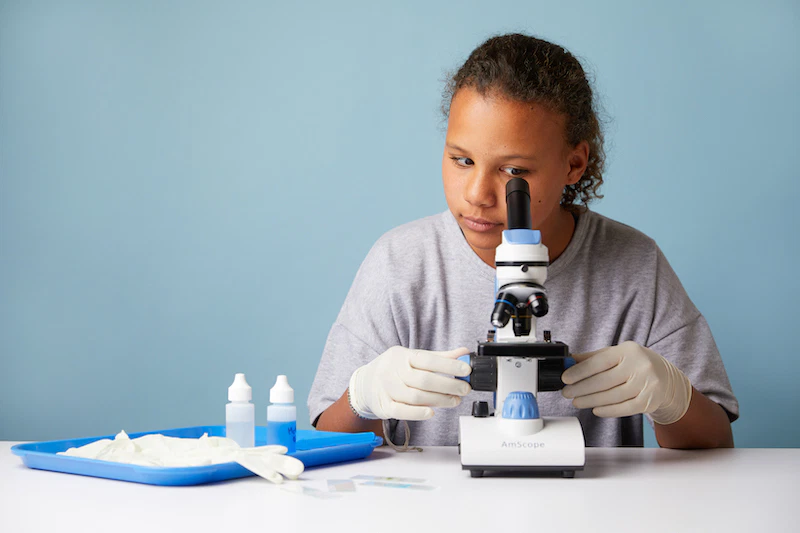
A young person wearing gloves looks through a microscope at a table with laboratory supplies, including bottles, slides, and a tray, against a plain blue background.
Summary of Investigations (6–8) coming soon

Explore the types of investigations that students conduct.

A young boy and girl sitting in a classroom, reading a book together with focused expressions.
Program structure and components (K–5)

Take a closer look at how the program is organized.

Teacher assisting two students working on laptops in a classroom; other students are in the background.
Program structure and components (6–8)

Take a closer look at how the program is organized.

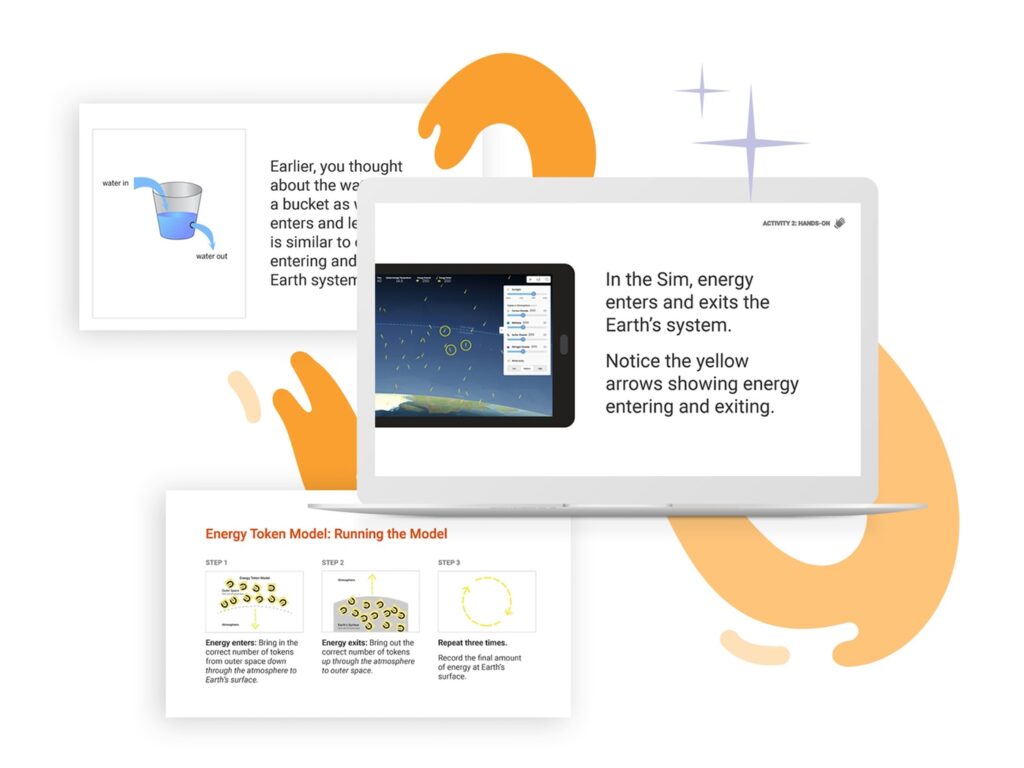
Digital collage of various devices displaying educational content about earth’s energy system, including graphs and text explanations.
[Video] New! Classroom Slides

Learn more about our customizable PowerPoints for every lesson.

A laptop screen displays a writing lesson with prompts and a student's response in Amplify Classwork. The student's answer discusses dangers related to a specific scenario involving a sick child.
Classwork (6–8)

A new, intuitive approach to reviewing student work online.

An adult sits on a couch using a laptop while a child next to them does homework in a notebook.
Remote and hybrid learning guide

Amplify is here to help! Amplify Science will soon feature product enhancements and new resources that will help manage the new landscape of back-to-school 2020.

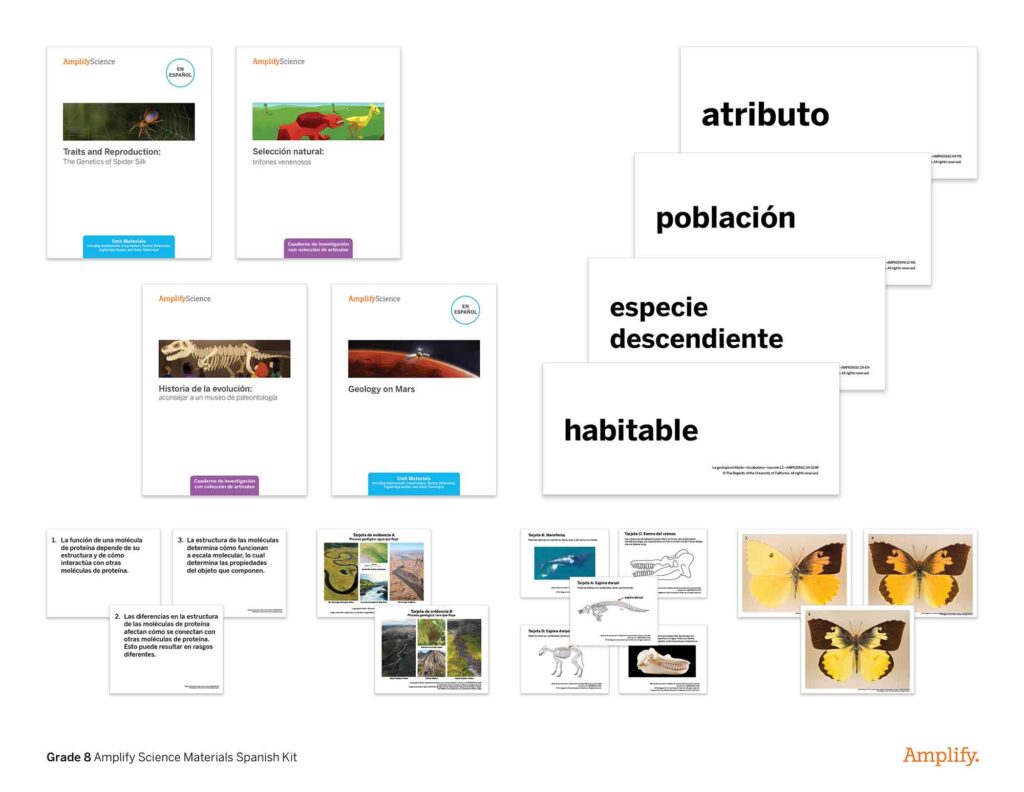
Educational presentation slides from grade 8 amplify science materials spanish kit, displaying various science topics like geology and biology.
Spanish-language supports

Learn more about the Spanish-language supports in Amplify Science.

students collaborating and using laptops
English Learners

Learn how we make learning accessible for English learners.

Amplify Science California supports you every step of the way on your journey to the California NGSS.
Students needing support

Learn how we make learning accessible for students who need more support.

Teacher using a tablet while conducting an mCLASS reading intervention with three young students seated around a table in a classroom.
Students ready for more

Learn how we make learning more rigorous for students ready for a challenge.

Two boys work together on a laptop while a woman—likely one of their middle school teachers—sits beside them, observing and smiling in a classroom setting.
Accessibility

Read more about text design and accessibility, including embedded Read-Aloud audio.

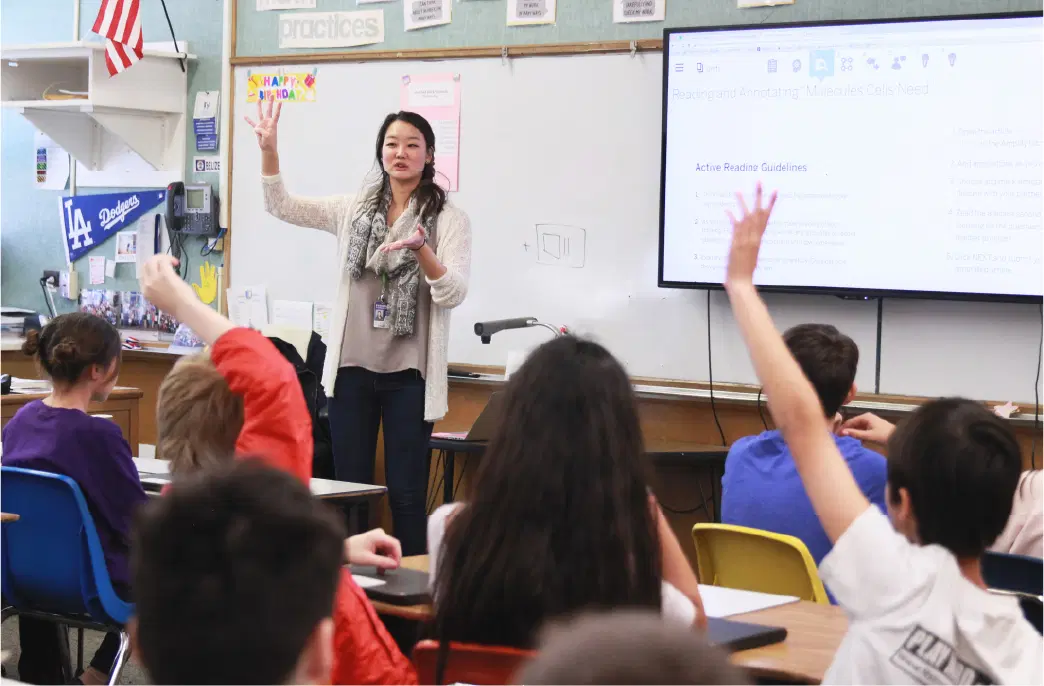
A teacher discusses educational content in front of a whiteboard while students in the classroom raise their hands eagerly.
Approach to assessment (K–5)

Learn about our embedded formative and summative assessments.

Two students sit at desks writing in notebooks and using laptops in a classroom setting.
Approach to assessment (6–8)

Learn about our embedded formative and summative assessments.

A teacher and a young student looking at a laptop together in a colorful classroom decorated with children's artwork.
NGSS Benchmark assessments

Learn more about the Next Generation Science Standards Benchmark assessments created by Amplify.

A young girl in a classroom gives a thumbs up with both hands, smiling broadly, while other students look on in the background.
NGSS Benchmark assessments

NGSS alignment by performance expectation.

Two students in a classroom, one looking at the camera and the other listening intently, with a whiteboard displaying educational content in the background.
NGSS alignment (6–8)

NGSS alignment by performance expectation.

Ready to explore with digital access and physical samples?

Start your digital review and request physical samples with these three easy steps.

  1. Note these Ohio specific login credentials for your digital access.
    Username: t.ohscience@tryamplify.net
    Password: AmplifyNumber1
  2. Click Review now.
  3. Complete the form and select Log in with Amplify to input the Ohio specific login.
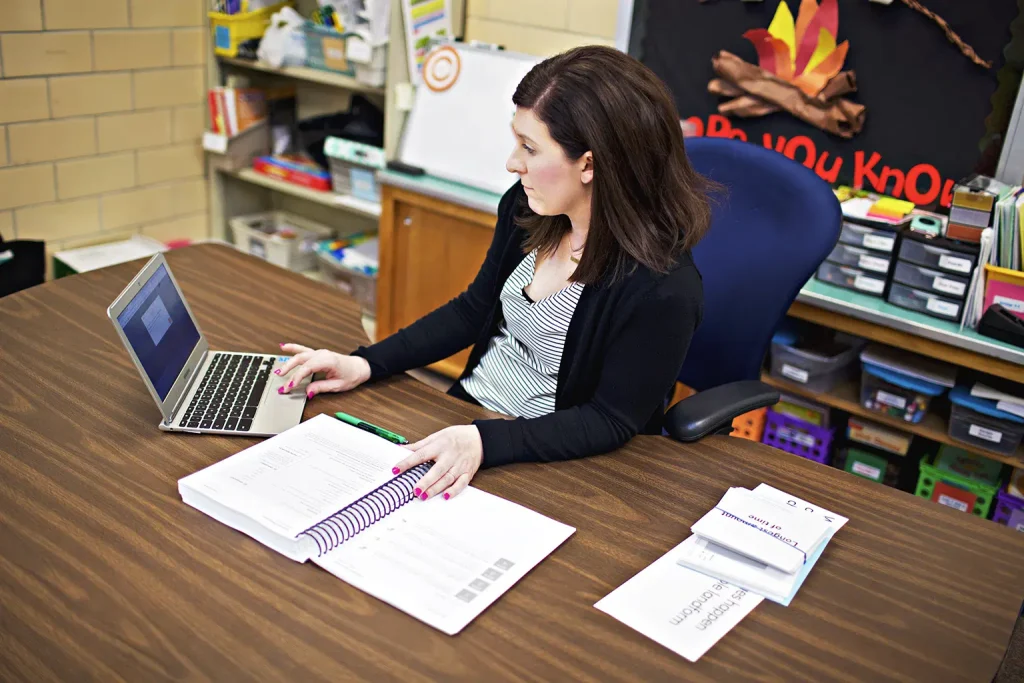
A woman sits at a desk in a classroom, working on a laptop with an open binder and papers in front of her.

Contact an Amplify representative

For any questions, fill out the form to the right and a member of our sales team will reach out to you soon.

Katie Cannon
Senior Account Executive

Casie Rayes
Account executive

Matt Paupore
Senior Account Executive

Welcome, Nebraska educators!

Designed from the ground up for the NGSS to teach students to think, read, write, and argue like real scientists and engineers, Amplify Science combines literacy-rich activities with hands-on learning and digital tools to engage students in exploring compelling phenomena in every unit.

Students in a classroom interact with educational technology, featuring a diagram and charts on a screen, while working collaboratively on a laptop.

Overview

Developed by UC Berkeley’s Lawrence Hall of Science, our program features:

  • phenomena-based approach where students construct a more complex understanding of each unit’s anchor phenomenon.
  • A blend of cohesive storylines, hands-on investigations, rich discussions, literacy-rich activities, and digital tools.
  • Newly crafted units, chapters, lessons, and activities designed to deliver true 3-dimensional learning.
  • An instructional design that supports all learners in accessing all standards.

Explore your grade level

Then select your grade level below to learn more about how we make this type of rich learning accessible to all students at every grade.

Elementary school

When you’re ready:

  1. Find a summary of each unit below including each unit’s student role and anchor phenomenon.
  2. Download some helpful resources to support your review.
  3. Explore the digital Teacher’s Guide by clicking the orange “Review now” button.
A boy reads a book with an illustrated background featuring a dinosaur skull, the Earth, trees, clouds, and water.
An illustration from Needs of Plants and Animals unit

Unit 1

Needs of Plants and Animals

Student role: Scientists

Phenomenon: There are no monarch caterpillars in the Mariposa Grove community garden ever since vegetables were planted.

An illustration from the Pushes and Pulls unit

Unit 2

Pushes and Pulls

Student role: Pinball engineers

Phenomenon: Pinball machines allow people to control the direction and strength of forces on a ball.

Silueta de una estructura de parque infantil contra un cielo azul con nubes y tres soles amarillos.

Unit 3

Sunlight and Weather

Student role: Weather scientists

Phenomenon: Students at one school are too cold during morning recess, while students at another are too hot during afternoon recess.

Illustration of sea turtles swimming among seaweed in the ocean, with a large shark in the background.

Unit 1

Animal and Plant Defenses

Student role: Marine scientists

Phenomenon: Spruce the Sea Turtle will soon be released back into the ocean, where she will survive despite predators.

An illustration from the Light and Sound unit

Unit 2

Light and Sound

Student role: Light and sound engineers

Phenomenon: A puppet show company uses light and sound to depict realistic scenes in puppet shows.

An illustration from the Spinning Earth unit

Unit 3

Spinning Earth

Student role: Sky scientists

Phenomenon: The sky looks different to Sai and his grandma when they talk on the phone at night.

An elephant standing next to a tree uses its trunk to pick a fruit from a branch while more fruit hangs above.

Unit 1

Plant and Animal Relationships

Student role: Plant scientists

Phenomenon: No new chalta trees are growing in the fictional Bengal Tiger Reserve in India.

A hand holds a red bean on a table, while a wooden stick spreads white glue and scattered beans. Also on the table are a white cup and a yellow pen.

Unit 2

Properties of Materials

Student role: Glue engineers

Phenomenon: Different glue recipes result in glues that have different properties.

Ilustración de una costa con acantilados, un edificio de centro recreativo con un techo rojo y un letrero, árboles de hoja perenne, una bandera azul y una playa de arena debajo.

Unit 3

Changing Landforms

Student role: Geologists

Phenomenon: The cliff on which Oceanside Recreation Center is situated appears to be receding.

Una ilustración de un tren de alta velocidad moderno y aerodinámico que viaja por una vía elevada con un paisaje verde de fondo.

Unit 1

Balancing Forces

Student role: Engineers

Phenomenon: The fictional town of Faraday is getting a new train. Unlike typical trains, this one floats, which is causing some concern among the town’s citizens.

An illustration from the Inheritance and Traits unit

Unit 2

Inheritance and Traits

Student role: Wildlife biologists

Phenomenon: An adopted wolf in Graystone National Park has some traits in common with one wolf pack in the park and other traits in common with a different pack.

An illustration from the Environments and Survival unit

Unit 3

Environments and Survival

Student role: Biomimicry engineers

Phenomenon: Over 10 years, a population of grove snails has changed. Populations with yellow shells have decreased, while those with banded shells have increased.

An illustration from the Weather and Climate unit

Unit 4

Weather and Climate

Student role: Meteorologists

Phenomenon: Three different islands, each a contender for becoming an orangutan reserve, experience different weather patterns.

An illustration from the Energy Conversions unit

Unit 1

Energy Conversions

Student role: System engineers

Phenomenon: The fictional town of Ergstown experiences frequent blackouts. Their electrical system seems to be failing.

An illustration from the Vision and Light unit

Unit 2

Vision and Light

Student role: Conservation biologists

Phenomenon: The population of Tokay geckos in a rain forest in the Philippines has decreased since the installation of new highway lights.

An illustration from the Earth's Features unit

Unit 3

Earth’s Features

Student role: Geologists


Phenomenon: A mysterious fossil is discovered in a canyon within the fictional Desert Rocks National Park.

An illustration from the Waves, Energy, and Information unit

Unit 4

Waves, Energy, and Information

Student role: Marine scientists

Phenomenon: Mother dolphins in the fictional Blue Bay National Park communicate with their calves despite the distance between them.

An illustration from the Patterns of Earth and Sky unit

Unit 1

Patterns of Earth and Sky

Student role: Astronomers

Phenomenon: An ancient artifact depicts what we see in the sky at different times of the day, but it appears to be missing a piece.

An illustration from the Modeling Matter unit

Unit 2

Modeling Matter

Student role: Food scientists

Phenomenon: Some ingredients dissolve in a salad dressing while others, like oil and vinegar, appear to separate

Illustration of a pixelated green mountain cliff deconstructing into a digital grid, with red dots floating over a tranquil sea and flying white birds.

Unit 3

The Earth System

Student role: Water resource engineers

Phenomenon: East Ferris, a city on one side of the fictional Ferris Island, is experiencing a water shortage, while West Ferris is not.

An illustration from the Ecosystem Restoration unit

Unit 4

Ecosystem Restoration

Student role: Ecologists

Phenomenon: The jaguars, sloths, and cecropia trees in a reforested section of a Costa Rican rain forest are not growing or thriving.

Middle school

When you’re ready:

  1. Find a summary of each unit below including each unit’s student role and anchor phenomenon.
  2. Download some helpful resources to support your review.
  3. Explore the digital Teacher’s Guide by clicking the orange “Review now” button.
A person in a black hoodie smiles while working on a laptop, surrounded by illustrations of rockets, satellites, popsicles, and the Earth.
Abstract art with vibrant colors featuring a yellow silhouette of a person holding a book against a background of geometric shapes, swirling patterns, and bold textures.

LAUNCH

Microbiome

Domain: Life Science

Unit type: Launch

Student role: Microbiological researchers

Phenomenon: The presence of 100 trillion microorganisms living on and in the human body may keep the body healthy.  

Abstract artwork of a person's side profile with geometric shapes and colorful patterns flowing from the head, holding a small sledgehammer. A vision chart is visible in the corner.

CORE

Metabolism

Domain: Life Science

Unit type: Core

Student role: Medical researchers

Phenomenon: Elisa, a young patient, feels tired all the time.  

Orange abstract background with hexagonal shapes featuring icons of a bar chart, plant, safety vest, test tube, peach, and stethoscope.

ENGINEERING INTERNSHIP

Metabolism Engineering Internship

Domains: Life Science, Engineering Design

Unit type: Engineering internship

Student role: Food engineers

Phenomenon: Designing health bars with different molecular compositions can effectively meet the metabolic needs of patients or rescue workers.  

Imagen que muestra un gráfico de arañas de diferentes colores con patrones distintos de patas y cuerpo, incluidas variaciones de color marrón, amarillo y azul. El fondo es una superficie oscura y texturizada.

CORE

Traits and Reproduction

Domain: Life Science

Unit type: Core

Student role: Biomedical students

Phenomenon: Darwin’s bark spider offspring have different silk flexibility traits, even though they have the same parents.  

Illustration of a person in a red hat and fur-lined coat with eyes closed, surrounded by large orange circles on a dark background.

CORE

Thermal Energy

Domain: Physical Science

Unit type: Core

Student role: Thermal scientists

Phenomenon: One of two proposed heating systems for Riverdale School will best heat the school.  

Abstract artwork depicting a bright sun with blue and orange swirling patterns next to green hills under a sky with shades of blue, orange, and red.

CORE

Ocean, Atmosphere, and Climate

Domains: Earth and Space Science, Physical Science

Unit type: Core

Student role: Climatologists

Phenomenon: During El Niño years, the air temperature in Christchurch, New Zealand is cooler than usual.  

An illustration from the Weather Patterns unit

CORE

Weather Patterns

Domains: Earth and Space Science, Physical Science

Unit type: Core

Student role: Forensic meteorologists

Phenomenon: In recent years, rainstorms in Galetown have been unusually severe.  

An illustration from the Earth's Changing Climate unit

CORE

Earth’s Changing Climate

Domains: Earth and Space Science, Life Science

Unit type: Core

Student role: Climatologists

Phenomenon: The ice on Earth’s surface is melting.  

Abstract geometric design in shades of blue and purple featuring a hexagon with icons of a building, wrench, molecules, sun, paint can, and screwdriver.

Engineering Internship

Earth’s Changing Climate Engineering Internship

Domains: Earth and Space Science, Engineering Design

Unit type: Engineering internship

Student role: Civil engineers

Phenomenon: Designing rooftops with different modifications can reduce a city’s impact on climate change.  

A barren, rocky desert landscape with rover tracks leading to a distant vehicle on a hill under a hazy sky.

LAUNCH

Geology on Mars

Domain: Earth and Space Science

Unit type: Launch

Student role: Planetary geologists

Phenomenon: Analyzing data about landforms on Mars can provide evidence that Mars may have once been habitable.  

Two prehistoric reptiles with long snouts and tails are near the shore, one on land and one in water, with plants, rocks, and an island in the background.

CORE

Plate Motion

Domain: Earth and Space Science

Unit type: Core

Student role: Geologists

Phenomenon: Mesosaurus fossils have been found on continents separated by thousands of kilometers of ocean, even though the Mesosaurus species once lived all together.   

Geometric design featuring a telescope, mountain, sound waves, and cosmic elements on a purple hexagonal background.

ENGINEERING INTERNSHIP

Plate Motion Engineering Internship

Domains: Earth and Space Science, Engineering Design

Unit type: Engineering internship

Student role: Mechanical engineering interns

Phenomenon: Patterns in earthquake data can be used to design an effective tsunami warning system.  

Illustration of a cross-section of Earth showing a volcano near the ocean. Trees, mountains, and clouds are visible above, with subterranean layers below.

CORE

Rock Transformations

Domain: Earth and Space Science

Unit type: Core

Student role: Geologists

Phenomenon: Rock samples from the Great Plains and from the Rocky Mountains — regions hundreds of miles apart — look very different, but have surprisingly similar mineral compositions.  

Ilustración que muestra las etapas de fusión de una paleta de naranja: entera, parcialmente derretida, más derretida y casi derretida por completo, con palitos de madera, sobre un fondo morado.

CORE

Phase Change

Domains: Physical Science, Earth and Space Science

Unit type: Core

Student role: Chemists

Phenomenon: A methane lake on Titan no longer appears in images taken by a space probe two years apart.  

Green geometric graphic featuring icons: a baby, thermometer, layers, medical alert, and a flame.

ENGINEERING INTERNSHIP

Phase Change Engineering Internship

Domains: Engineering Design, Physical Science

Unit type: Engineering internship

Student role: Chemical engineering interns

Phenomenon: Designing portable baby incubators with different combinations of phase change materials can keep babies at a healthy temperature.  

An illustration from the Chemical Reactions unit

CORE

Chemical Reactions

Domains: Physical Science, Life Science, Earth and Space Science

Unit type: Core

Student role: Forensic chemists

Phenomenon: A mysterious brown substance has been detected in the tap water of Westfield.   

An illustration of a whale with jellyfish and turtles from Amplify Science

CORE

Populations and Resources

Domains: Life Science, Earth and Space Science

Unit type: Core

Student role: Biologists

Phenomenon: The size of the moon jelly population in Glacier Sea has increased.  

Low-poly landscape with trees and mushrooms. A fox sniffs the ground, a rabbit sits nearby, and mountains and sun are in the background.

CORE

Matter and Energy in Ecosystems

Domains: Life Science, Earth and Space Science, Physical Science

Unit type: Core

Student role: Ecologists

Phenomenon: The biodome ecosystem has collapsed.  

Two people climbing rocky terrain; illustrations show a hiking boot and a belt with gear.

LAUNCH

Harnessing Human Energy

Domains: Physical Science, Earth and Space Science, Engineering Design

Unit type: Launch

Student role: Energy scientists

Phenomenon: Rescue workers can use their own human kinetic energy to power the electrical devices they use during rescue missions.  

Illustration of a futuristic space station with large solar panels, orbiting in deep space, emitting a blue glow from its propulsion system.

CORE

Force and Motion

Domain: Physical Science

Unit type: Core

Student role: Physicists

Phenomenon: The asteroid sample-collecting pod failed to dock at the space station as planned.   

Green geometric background with a hexagonal emblem containing a parachute icon, ruler, bandage, and stacked layers on a gradient pattern.

ENGINEERING INTERNSHIP

Force and Motion Engineering Internship

Domains: Engineering Design, Physical Science

Unit type: Engineering internship

Student role: Mechanical engineering interns

Phenomenon: Designing emergency supply delivery pods with different structures can maintain the integrity of the supply pods and their contents.  

Illustration of a roller coaster filled with people, hands raised, going down a steep track against a bright blue sky with clouds.

CORE

Magnetic Fields

Domain: Physical Science

Unit type: Core

Student role: Physicists

Phenomenon: During a test launch, a spacecraft traveled much faster than expected.  

An illustration from the Light Waves unit

CORE

Light Waves

Domains: Physical Science, Life Science, Earth and Space Science

Unit type: Core

Student role: Spectroscopists

Phenomenon: The rate of skin cancer is higher in Australia than in other parts of the world.   

A city skyline at night with a prominent full moon, stars in the sky, and a bridge silhouette on the left.

CORE

Earth, Moon, and Sun

Domains: Earth and Space Science, Physical Science

Unit type: Core

Student role: Astronomers

Phenomenon: An astrophotographer can only take pictures of specific features on the Moon at certain times.  

Four low-poly dinosaurs with missing body sections are standing in a row; one is yellow, and the others are green. They have purple spikes and red patches on their bodies.

CORE

Natural Selection

Domains: Life Science, Earth and Space Science

Unit type: Core

Student role: Biologists

Phenomenon: The newt population in Oregon State Park has become more poisonous over time.  

Red geometric background with icons including a mosquito, DNA strand, bar chart, and world map inside a hexagon.

ENGINEERING INTERNSHIP

Natural Selection Engineering Internship

Domains: Engineering Design, Life Science

Unit type: Engineering internship

Student role: Clinical engineers

Phenomenon: Designing malaria treatment plans that use different combinations of drugs can reduce drug resistance development while helping malaria patients.   

Two giant tortoises with long necks stand near water; one tortoise feeds on leaves from a tree while the other is near dense vegetation.

CORE

Evolutionary History

Domains: Life Science, Earth and Space Science

Unit type: Core

Student role: Paleontologists

Phenomenon: A mystery fossil at the Natural History Museum has similarities with both wolves and whales.    

Resources to support your review

Select a topic below to explore helpful resources with more information about Amplify Science, the program’s development, and pedagogy.

Dos niñas están sentadas en una mesa, mirando juntas la pantalla de una computadora portátil en un salón de clases. Al fondo se ven estanterías con libros y materiales de clase.
Two children engaged in an animated conversation while sitting at a school desk with laptops and books.
Phenomena and storylines (K–5)

Read more about the real-world phenomena featured in each unit.

Children doing schoolwork at home
Phenomena and storylines (6–8)

Read more about the real-world phenomena featured in each unit.

Four-step educational infographic depicting problem-solving process: engaging with real-world problems, exploring multiple sources, constructing explanations, and applying knowledge to new problems.
Integrated 5e model

Learn how the 5E elements are integrated throughout every unit.

A woman smiling and gesturing while speaking, seated in a classroom with computers and educational materials around her, with a paused video screen featuring text about "amplify science.
[Video] Planning in action (K–5)

Watch how easy it is for Amplify Science teachers to prep their 3-D instruction.

A screenshot from a video titled "amplify science in action: a week in the..." featuring a smiling woman sitting in a classroom setting.
[Video] Planning in action (6–8)

Watch how easy it is for Amplify Science teachers to prep their 3-D instruction.

Two children sitting at a table, one in a yellow shirt and the other in pink, smiling and looking forward.
[Video] Hands-on in action (K–5)

Watch Amplify Science students conduct hands-on investigations.

A boy in a science classroom observes a reaction in a clear cup. Other students and lab materials are in the background.
[Video] Hands-on in action (6–8)

Watch Amplify Science students conduct hands-on investigations.

Two children in school uniforms work together on laptops in a classroom setting, with focus on learning and collaboration.
[Video] Simulations and modeling tools (K–5)

Watch how students investigate phenomena with the help of digital tools.

Students sitting at a table using laptops, engaging in a classroom activity.
[Video] Simulations and modeling tools (6–8)

Watch how students investigate phenomena with the help of digital tools.

A young girl wearing safety goggles stretches a gooey substance from a cup in a kitchen or classroom setting.
Summary of Investigations (K–5)

Explore the types of investigations that students conduct.

A young person wearing gloves looks through a microscope at a table with laboratory supplies, including bottles, slides, and a tray, against a plain blue background.
Summary of Investigations (6–8)

Explore the types of investigations that students conduct.

A young boy and girl sitting in a classroom, reading a book together with focused expressions.
Program structure and components (K–5)

Take a closer look at how the program is organized.

Teacher assisting two students working on laptops in a classroom; other students are in the background.
Program structure and components (6–8)

Take a closer look at how the program is organized.

Digital collage of various devices displaying educational content about earth’s energy system, including graphs and text explanations.
[Video] New! Classroom Slides

Learn more about our customizable PowerPoints for every lesson.

A laptop screen displays a writing lesson with prompts and a student's response in Amplify Classwork. The student's answer discusses dangers related to a specific scenario involving a sick child.
Classwork (6–8)

A new, intuitive approach to reviewing student work online.

students collaborating and using laptops
English Learners

Learn how we make learning accessible for English learners.

Amplify Science California supports you every step of the way on your journey to the California NGSS.
Students needing support

Learn how we make learning accessible for students who need more support.

Teacher using a tablet while conducting an mCLASS reading intervention with three young students seated around a table in a classroom.
Students ready for more

Learn how we make learning more rigorous for students ready for a challenge.

Two young children sit at a table looking at an open book, with other books placed in front of them. A play button is visible over the image.
[Video] Literacy in action (K–5)

Watch students use scientific text to obtain information and practice reading skills, while using writing prompts to create arguments using evidence

A student writes in a notebook, holding a pencil, focused on the task.
[Video] Literacy in action (6–8)

Watch students use scientific text to obtain information and practice reading skills, while using writing prompts to create arguments using evidence.

A teacher in a green shirt helps a young student with writing at a classroom table, with other students and large numbers visible on the wall in the background.
Literacy-rich science instruction (K–5)

Immersing young students in reading, writing, and arguing like real scientists and engineers.

Two students sit at a table in a classroom, working on an assignment together. Other students are also seated and appear to be engaged in their work. Papers and books are spread out on the tables.
Active Reading in grades 6–8

Engaging middle school students in complex science texts.

Two boys work together on a laptop while a woman—likely one of their middle school teachers—sits beside them, observing and smiling in a classroom setting.
Accessibility

Read more about text design and accessibility, including embedded Read-Aloud audio.

A teacher discusses educational content in front of a whiteboard while students in the classroom raise their hands eagerly.
Approach to assessment (K–5)

Learn about our embedded formative and summative assessments.

Two students sit at desks writing in notebooks and using laptops in a classroom setting.
Approach to assessment (6–8)

Learn about our embedded formative and summative assessments.

A teacher and a young student looking at a laptop together in a colorful classroom decorated with children's artwork.
NGSS Benchmark assessments

Learn more about the Next Generation Science Standards Benchmark assessments created by Amplify.

A young girl in a classroom gives a thumbs up with both hands, smiling broadly, while other students look on in the background.
NGSS alignment (K–5)

NGSS alignment by performance expectation.

Two students in a classroom, one looking at the camera and the other listening intently, with a whiteboard displaying educational content in the background.
NGSS alignment (6–8)

NGSS alignment by performance expectation.

Two children sit at a table with Chromebooks, facing each other and talking, in a classroom with books and storage bins in the background.
Remote and hybrid learning guide

Amplify is here to help! Amplify Science will soon feature product enhancements and new resources that will help manage the new landscape of back-to-school 2020.

Educational presentation slides from grade 8 amplify science materials spanish kit, displaying various science topics like geology and biology.
Spanish-language supports

Learn more about the Spanish-language supports in Amplify Science.

Ready to start exploring with digital access?

A woman sits at a desk in a classroom, working on a laptop with an open binder and papers in front of her.

Contact an Amplify representative

Laina Armbruster
larmbruster@amplify.com
(602) 791-4135

Bob McCarty
rmccarty@amplify.com
(435) 655-1731

Kristin McDonald
kmcdonald@amplify.com
(515) 240-0244

S3-03: Instructional strategies for integrating science and literacy

A graphic with the text "Science Connections" and "Amplify" features colorful circles and curved lines on a dark gray background.

We’re continuing our investigations around science and literacy with Doug Fisher, Ph.D., professor and chair of educational leadership at San Diego State University. We talk about the importance of integrating science and literacy, as well as practical guidance for teachers who want to unite the two disciplines in their own classrooms.

Listen as we discuss how science and literacy can be powerful allies and specific strategy areas to focus on when integrating the two disciplines. And don’t forget to grab your Science Connections study guide to track your learning and find additional resources!

We hope you enjoy this episode and explore more from Science Connections by visiting our main page!

DOWNLOAD TRANSCRIPT

Douglas Fisher (00:00):

It’s not that you have to become a reading specialist to integrate literacy into science. It’s how our brains work.

Eric Cross (00:10):

Welcome to Science Connections. I’m your host, Eric Cross. This season, we’re making the case for our favorite underdog, which of course is science. Each episode we’re showing how science can be better utilized in the classroom, and making the case for why it’s so important to do so. In our last episode, we examined the evidence showing that science and English instruction can support each other. And now on this episode, we want to give you some more strategies for really making that a reality in your own home or classroom or community. So to help me, I’m joined on this episode by Dr. Douglas Fisher, Professor and Chair of Educational Leadership at San Diego State University. Dr. Fisher is actually someone who has conducted literacy training at my own school, so I’m excited to be able to share some of his wisdom with all of you. Oh, and just a heads up, Dr. Fisher dropped some gems about the ways teachers can integrate literacy and science in their classrooms. So you may want to have a notepad. Ready. And now here’s my conversation with Dr. Douglas Fisher.

Eric Cross (01:12):

Well, Doug, thank you for your time and for being willing to come and talk about literacy and science. I know you’re busy, all over the place, and so I was super-excited that we were able to lock you in and talk about this. And, on this episode, we’re gonna talk about the ways that science and literacy can support each other. And one of the reasons why I’m really excited for you is because you said some really key things for me as a science teacher, when you talked about literacy and supporting students. That just resonated so deeply in me. And I was like, “I need more Doug!” Because we’re on that same frequency. And I know it’s a subject that you’ve spent a lot of time writing about. So can you tell us a little bit about how this became an area of interest or a passion for you? Just literacy, and all of the work that you’ve put into it?

Douglas Fisher (01:54):

Yeah. So I’ve wanted to be a teacher for a really long time. And I went to San Diego State as an undergraduate, and I was taking English class and we were assigned topics. You know, like, you’ll do an assignment, you’ll write a paper for this English class. And I got the topic “illiteracy,” and I was a freshman at San Diego State reading all of these things about adults who don’t read very well or not at all. And I ended up writing my very first college essay on illiteracy — at the time, you know, called illiteracy, at the time. And so I got super interested in this. And so as I moved through college and into my teaching career, literacy became a really important thing for me to think about, because it’s the gatekeeper. You know, you can be taken advantage of, if you’re not very literate. People can use vocabulary against you, if you’re not very literate. We know that people who have higher levels of literacy have better health outcomes. They have better lifespans, longer lifespans. I mean, there’s just — literacy impacts so much more than “Are you reading your fourth-grade textbook?” It really has lifelong implications.

Eric Cross (03:01):

That part that you said about being taken advantage of … I just got a flyer in the mail yesterday. It was one of these mailers that looked like it was an authentic debt-reduction type of thing, but it was really just like a marketing email. If you read the fine print at the very bottom, it had all of this jargon about “This is a paid, you know, for-profit company.” But when you look at it, it had official stamps all over it. And I could imagine if someone’s receiving that, that probably fools a lot of people. Is that kinda like what you’re talking about, like being taken advantage of?

Douglas Fisher (03:28):

Yes. I had a student turn 18, got a letter from a “credit card company” that was offering her daily compounding interest. And if you don’t know what that means — at 23 percent! — if you dunno what that means, you are gonna be a victim. Literacy really influences a lot of our life. It’s also how our brain works. We have a language-based system in our brain. We read, write, speak, listen, and view. And the things we learn, we learn through speaking, reading, writing, listening, and viewing. From what we know, we are the only species that has an external storage mechanism. Like, we have the ability to store complex information outside of our body, in the form of notes. We can type them. We can write them. And we can then go back and retrieve that information, that complex orthographic information later. And it means the same thing. We can say we have a storage system and we’ve been doing this for a really long time. Way back to, you know, hieroglyphics and messages on cave walls. And throughout the ages of humans learning, how to store information that they can re-access again later. That’s become a super-complicated system. It’s how computers operate. And we send messages to each other and we text each other and we write things down, and we’re really good at putting ideas, information out there. Now, if it’s just speaking and listening, then we can forget it. We can say, “No, you said this,” or “I said that.” But when it’s written, and it’s print literacy, you know, it’s the orthographics there, you can go back to the same message and over and over again. Now, you might change the interpretation of it, but the message is still there.

Eric Cross (05:16):

Right. And that is such a key element, at least of modern education, is this written element of it. It’s what many schools live and die by. They’re quantitatively and qualitatively analyzed by it. It’s public. They can see it. And so there’s this heavy emphasis. And why do you think science and literacy can be powerful allies together?

Douglas Fisher (05:38):

Awesome. Well, it’s hard to learn science if you’re not literate.

Eric Cross (05:42):

This is true.

Douglas Fisher (05:42):

But that’s a one-way direction. And yes, science teachers and scientists do a lot of reading, writing, speaking, and listening and viewing. They use the five literacy processes all the time. When we interview scientists, they spend a lot of their time reading the work of other scientists and writing their findings, writing grant proposals, presenting at conferences, you know. So a huge part of the work of a scientist is not just at a bench conducting experiments. But even if you’re conducting experiments, you’re using your literacy processes to think about what you’re seeing in your experiment. So that’s a one-way direction. And I do think literacy has an influence on science. But since science goes the other way, it influences literacy. As you learn more and you understand more about the world, your background knowledge grows, your vocabulary grows, you become more literate in those different areas. And how you think. So if I’m learning about life science; I’m learning how the world works in a more, biologic physical world. And that knowledge helps me think about when I’m reading a novel, and there’s an appeal to some science knowledge or a concept that gets played with, you know, perhaps time-space continuums … well, if I don’t have the science knowledge of how I think the world works, it’s hard for me to understand what this author is doing. So it does go both ways. They feed each other. And the more literate we become, the more complex science information we can understand. ‘Cause our background knowledge and our vocabulary influence how much we understand about what we read. And as we access more complex science information, it starts to change the way we think about other things in our world.

Eric Cross (07:23):

There was a couple of things that you said in that, but one of the first things that kind of perked my ears is when you said grant proposals. Because I have friends that are scientists — and this is one of the things that when I was in school, they don’t talk about — but how much of their research is reliant upon getting funding —

Douglas Fisher (07:37):

Mm-hmm. <affirmative>,

Eric Cross (07:38):

— which you don’t think about if you’re becoming a chemist or a physicist or a biologist or working in the field, is that that funding, coming from the NSF or anywhere else. And sometimes students ask in class like, “Why am I writing so much? Like, I want to go into science!” Or “I wanna do this!” And this is a real-life example of how the writing could actually apply, in addition to all of the things of collecting data and conclusions and results. But that grant proposal thing just really perked my ears, yeah.

Douglas Fisher (08:01):

And if you can’t write a grant proposal, your ideas and experiments are not gonna get funded. And if you can’t write a strong proposal, that compellingly convinces your readers to fund you, you’re not gonna get funded. But then once you get the grant, you have to write publications. You have to share your work with other people. Make PowerPoint presentations and write journal articles or books or whatever. So it’s a cycle that literacy influences the things we do, including the things we do in science.

Eric Cross (08:31):

Now to get in maybe some data, if you were trying to convince someone that like this happy marriage can exist, what would be like your number one piece of evidence to support this, this back and forth of supporting each other?

Douglas Fisher (08:44):

Awesome. So the quote I’ll often say — and this is from studies from more than two decades ago now — but in general, in high school science, students are introduced to 3000 unfamiliar words, 3000. Each year! Because there are words that are used in a scientific way that are used commonly in other places. And there are discipline-specific words. So 3000 words a year in high school science. The Spanish 1 textbook only has 1500 words in it. So science teachers have double the academic-language vocabulary demand that a typical introductory world-language class has. So just the vocabulary alone should say to us, literacy is gonna be important if you’re gonna learn science. And if you don’t understand these technical words, and you don’t understand the way science uses this particular word in this particular way… . When you say the word “process,” it means something very specific In science. “Division” — cellular division is not the way we think about it in mathematics; there’s a similar concept, but cellular division is different than dividing numbers. And those are words that get used in multiple areas. Then you have all these technical terms that you have to be able to use, to understand the concepts. To share the concepts. To talk to other people. Whether you’re in, you know, fifth grade and talking science, or you’re a university professor, there’s a shared language, appropriate for our grade level, that we have shared meanings of.

Eric Cross (10:22):

And we’re essentially … what I’m hearing you say is … most of the people that are listening to this are science teachers. We’re we’re also language teachers. In a sense.

Douglas Fisher (10:29):

So my frustration is when people say, “Every teacher’s a teacher of reading.” And I don’t like that. I’ve written against that phrase. I don’t think all teachers are teachers of reading, any more than all teachers are teachers of chemistry. Or all teachers are teachers of algebra. But what I will say is the human brain learns through language. And all of us — every teacher that I’ve ever met understands that language is important in my class. If my students don’t have strong listening skills and speaking skills; reading, writing, and viewing skills; I’m gonna have a hard time getting them to learn things. If I can help them grow their speaking, listening, reading, writing, and viewing in my content area, I’m gonna do a service for my learning of my subject and also their more broad literacy development.

Eric Cross (11:16):

  1. So, at a high level, what does it look like to integrate science and literacy? We’ve done education for the last, what, hundred years?

Douglas Fisher (11:24):

Mm-hmm. <affirmative>

Eric Cross (11:25):

—kind of pretty similarly, right? Kind of siloed way. What does this look like at the 30,000-foot level? You’re a professor, department chair. Run schools. Speak everywhere. Like, when you think about this from that high level, what does it look like?

Douglas Fisher (11:39):

A high level? Every time I meet with students in a science class, you know, biology or fifth grade or whatever? They should be reading, they should be writing, they should be speaking and listening. Every class. So what print do you want them to access? And it can be a primary source document, it can be an article, it can be from a textbook. Are they reading something? Are they writing to you? Because writing is thinking. If they are writing, they are thinking. As soon as their brain goes somewhere else, they stop writing. The pen won’t move or the fingers don’t type. And then speaking and listening, of course, is the dynamic of our classes. So every day we should see some amount of reading, writing, speaking, and listening, viewing in our classes. That’s at a high level. There are some generic things that seem to work across the literacy. So, learning how to take notes. Focusing on vocabulary. Using graphic organizers. These are generic things that as educators we can use in our classes. Then there’s more specialized things. So, scientists and science teachers think differently than historians and literary critics and art critics. So scientists, if you look at the disciplinary literacy work, there’s a whole body of research where they interview and study high-end experts in their field: chemistry, physics, biology, et cetera. And there are some characteristics that were more disciplined, specific. Scientists like cause and effect relationships. They look for them when they’re reading. They like sourcing information. “Where this come from?” “What’s the history of this idea?” Scientists have a long view in terms of time. Historians have a shorter view of time. English teachers have even shorter view of time. Scientists tend to think in long periods of time. And so all of that influences how a scientist reads and how we should apprentice young people after they get past the generic “I know how to take notes. I know how to study my vocabulary. I know how to do summary writing for my teacher in my notebooks and things,” there’s some generic tools. Once we get past those, we need to be looking at specifically how do people in science use literacy.

Eric Cross (13:52):

I’ve never had my thought process of reading deconstructed just now, but we just described how scientists read. I was like, “Yeah, that’s pretty much how I read, right there.” I also like how you said how we should apprentice young people. And I feel like you as the literacy guy, you chose that word very specifically, as far as apprenticing young people. That is a view, I think, that’s really important to hold. ‘Cause that’s what we’re doing essentially … is, if we’re doing what we should be doing, we are apprenticing these young people.

Douglas Fisher (14:18):

Yes.

Eric Cross (14:18):

And helping them develop. Now, let’s imagine there’s a listener out there and they’re interested in getting better at integrating science and literacy instruction. They want to start somewhere. Before we dive in, do you have any initial words of encouragement for the person who’s like, “Everything is like a priority right now,” in their classroom or in their world?

Douglas Fisher (14:37):

Yeah. So I’ll talk about elementary for just a moment. When we’re reading informational texts in our literacy block, we should be reading information that is aligned to what kids need to learn in science and history in, in that grade level. Why are we reading things that are gonna be in conflict with what they’re gonna learn in science later that day in fourth grade, for example? So when we look at our standards, our expectations, what is it that third graders need to know in history, science, mathematics, language arts? And when we’re reading text and we’re learning to apply our reading strategies during our literacy block, why aren’t we reading topics that build our background knowledge for our science time? So we’re seeing some synergy there. We should be looking at life cycles in grades that are appropriate for life cycles and knowing there’s more to life cycles than the frog and the plant or the seed. There are all kinds of life cycles. And we call ’em life cycles for a reason. That’s a general concept. Now in science, we’re looking at this particular lifecycle right now. And so that’s a high level. If we could get more connection to the content standards during our literacy blocks, it would be very good. When we talk about the time at which we call “science” in the day, in more of the K–8 continuum, the science needs to include some primary source documents. Some real things that students are reading. Read about a scientist; read about a scientist’s discovery; read about what they discovered. So that we’re building our background knowledge. So when we go to do things, activities, labs, simulations, we have background knowledge and we understand what we’re experiencing. It can’t be like—I watched this awesome lesson on lenses and the teacher had all these different lenses in the room and the students came in and they were brand new. They don’t know anything. They were picking ’em up. They’re exploring them. They’re trying to figure out, and they’re trying to come up with theories about what this is and how it works. And then the teacher gave them a reading, a short reading, on refraction of light. And they read this thing. And the clarity that they had about what these lenses must do, well! All of a sudden they’re putting them up to the lights! They’re asking if they can go get the lights out of the storage unit! ‘Cause there’s — and they’re shining different lights through the lenses to see what happens to the light. Because that little bit of reading turned some focus on for the students. And it allowed them to take what I’m thinking about, what I’m trying to figure out, how this thing works in another direction. That’s the power of using literacy in our classes.

Eric Cross (17:20):

And what I’m hearing essentially is transfer across disciplines, across content areas, ultimately. And in an elementary school classroom, would it be fair to say, probably the teacher has more autonomy to be able to do that, since they’re teaching all the subjects? But secondary, logistically, planning and those types of things … from what you’ve seen, is it fair to say this kind of needs to be like a top-down, full vertical alignment, to teach like this?

Douglas Fisher (17:45):

I think that would be awesome to do that. But if I’m a sixth grade English Language Arts teacher and I’m working with my sixth grade science teacher, the conversation should be, “What units are you teaching?” Because I’m choosing informational text. My job is to teach them how to find central ideas. My job is to teach them how to find the details in the text. My job is to have them make a claim and support that claim with evidence. The stuff I use is generic. Yes, we do read some literature and some narratives, but we also read about 50% of the text in English around informational text. So if I can help you and accomplish my standards as well, fantastic. So let’s have this conversation and say, “Oh, this is what you’re teaching in science in the next three weeks? I’m gonna choose some texts and we’re gonna analyze ’em for central idea. We’re gonna analyze ’em for details. We’re gonna, for mood or tone or whatever that we’re teaching. And by the way, I’m building background knowledge. So when they come to you, they know some stuff about what you’re going to be teaching next.” So I don’t think it’s impossible to say teams of teachers could come together and say, “What do we believe that our students need to know and learn and be able to do? And then how do we choose things that are gonna help them accomplish exactly that?”

Eric Cross (19:01):

And that’s empowering. Because that’s one thing that we can control maybe is this East-West, peer-to-peer, different content areas. A system may not be able to change as quickly, but I can definitely go talk to my English team or math team and check in and kind of see, “Hey, where do we have overlap in that?” And I know the times that I’ve accidentally had overlap with the teams, it’s super-exciting. And the students have been more bought in! Because it’s like, we’ve done something on the human microbiome and we’ve talked about genetics and all these different things, and then when they read The Giver, or they read some book about genetics, they have all this knowledge. And they’re excited. And they talk about colorblindness or they come to my class and they’re like, “Hey, we read about this!” It’s almost like they saw a magic trick, the fact that these things linked up. And the engagement has been so much higher when it’s the same content in different classes, but through different lenses. At least, that’s what I’ve seen in my years of teaching.

Douglas Fisher (19:54):

I saw a lesson on space junk that was so cool. Middle-school students learning space junk. And the history teacher had a part of it, science teacher had a part of it, English Language Arts teacher had a part of it. And these students, I mean, you watch them look up all the time, ’cause there’s space junk up there. Where’d it come from? Why is it there? What are the politics of this? How do we clean it up? I mean, it was just so interesting to watch them when the teachers came together. And the teachers met their standards in this couple-week-long space-junk exploration. Investigation was met. Politics was met. All these different things. Economy. You know, how much does it cost to clean up this problem? So there’s really cool opportunities when teachers come together and realize we can work together and improve the literacy and learning of our students.

Eric Cross (20:50):

Absolutely. So before this recording, we picked your brain a bit. And I know that there were three specific strategy areas that you wanted to touch on. And one of those — which is kind of coming back to the 3000-words language teachers — was vocabulary. So what are the opportunities that you see, as far as the way of educators to approach vocabulary? Because, you know, there’s a lot. We got a lot of it. The 3000 words.

Douglas Fisher (21:14):

Yeah. There’s a lot of it. So the worry is, we make a vocabulary list and have students look up the words in definitional kinds of things. That’s not really gonna help. Students need to be using the words. They need to be using the words in their conversations, in their writing, in how they think about your content in science. So vocabulary is a huge predictor of whether or not you understand things. Vocabulary is also a pretty good predictor if you can read on grade level. So when we think about vocabulary, there’s something called word solving. You show students a piece of text and you’re reading it, you’re sharing your thinking, and you say, “Oh, here’s a context clue!” Or “I know this prefix or suffix or root!” And in science, a lot of the words are prefixed, suffixed, or root words. We tend to add things together with a lot of prefixes and suffixes and have roots and bases in science. So we can help students think about, “Oh, what does geo- mean? We already know what geo- means here. It means the same thing in this word. Let’s apply that knowledge.” So word solving is part of it, showing students how we think about words that we might not know. The second is more direct instruction of vocabulary. As students encounter the words, we work on what it means, how we say it. We practice it a few times. The process is called orthographic mapping. It’s kind of a scientific idea here. But you have the sound and the recognition of by-the-word, by sight, and what it means. And your brain starts to automatically recognize that word in the future. So I don’t have to slow down, disrupt my fluency, and try to figure out what the word is saying. ‘Cause I’ve seen it enough. I’ve heard it pronounced enough, I’ve pronounced it enough, and I know what it means. So teachers should be saying, “What words in sixth grade science, what words in third grade science, do my students really need to know?” And I’m gonna have them encounter those words over and over. I’m gonna have them use the words. I’m gonna have them see the words. I’m gonna have them say the words. I’m gonna say the word and we’re gonna be over and over with these terms, so that students incorporate them into their normal view of, “These are the things I know about the world.” By the way, when they go to read that next thing, and they understand “geology,” you know, for sixth graders, for example, they know how to say it. They don’t stumble on it. And it activates a whole bunch of memories in their brains. “This is what geology is.” There are branches of geology, there’s physical geology, there’s all this thinking that activates as they read.

Eric Cross (23:35):

There was a practice that I participated in and am trying to incorporate — I don’t know what the name of it is. But essentially what happened was we were dissecting a flower. And the instructor had us name parts of the flower. But we got to come up with our own names for it.

Douglas Fisher (23:49):

Ah.

Eric Cross (23:50):

So, for instance, the stamen we call “the fuzzy Cheeto.” And we all used our own words and then everything was legitimized. And so we went through and learned the whole activity using our own vocab words. But then, in the end, after we presented and talked about it, then the words, the actual academic language was attached to our word. And we were able to say, “OK, the fuzzy Cheeto is the stamen,” and this, this, this, and this. But it was such an interesting practice, because it kind of legitimized all of our definitions. But we weren’t stumbling on these long Latin terms and things like that. Is there a name for that? Or. … ?

Douglas Fisher (24:29):

Yes. I don’t know the name for that. I think it’s really smart. So here’s what I would say about that, is: we don’t learn words, we learn concepts. Words are labels for our concepts. So what that teacher did for you was allow you to develop concept, a concept knowledge. “There’s a part of this plant, it goes like this, we’re gonna call it fuzzy Cheeto. Now I have this concept. And look, it occurred in all these plants. And those people called it that and that other group called it that. We called it a fuzzy Cheeto. Here’s the part of it.” And then the concept is in your brains. And the teacher said, “It’s really called stamen.” And it’s an instant transfer, because you already had the concept. What we often see is students are trying to learn a really hard academic word and the concept for the word at the same time. And so it slows down the whole process. And there’s higher levels of forgetting. Because human beings, we don’t learn words; we learn concepts. If you don’t have the concept, if I gave you a word out of the blue that you’ve never seen, never heard, and a week from now I asked you to remember it, you probably would not, because it didn’t register. It wasn’t part of your schema. You didn’t have a way to organize the information. You don’t have a concept. So that teacher? It’s a great idea. Got you to develop concept knowledge. And then said, “Here’s a real label for it: What some other people called it when they had the chance to come up with their own names.”

Eric Cross (25:50):

Shout out to my teacher, who was—

Douglas Fisher (25:51):

Right.

Eric Cross (25:52):

It was learned then. It was a great practice. And the fact that you’re right, like, I just mean from my own personal experience, I agree that learning concepts versus complicated words. And it’s interesting that you said higher levels of forgetfulness, you know. And you often hear that complaint about it: “Students forget! Students forget!” But this complex topic and this complex word that’s new to me, and I have to remember both of those things.

Douglas Fisher (26:12):

That’s right.

Eric Cross (26:13):

And the other neat thing that it did, is it actually honored the background and like the founts of knowledge of all the different groups in the classroom. You just said something about “this group called it this and this group called it this,” and so by letting different groups share all of those names, now we’re starting to build these kind of interesting connections. That’s at least what I remember experiencing. And so this, even this practice of this approach is very layered, beyond just kind of generating new knowledge of things. So I appreciate that aspect of it. Now another area that you mentioned was complex text.

Douglas Fisher (26:41):

Yeah.

Eric Cross (26:42):

And how we can get students into complex text. So what can we do there?

Douglas Fisher (26:46):

I think science is an ideal place to get students reading things that are hard for them. And I do believe that some parts of school should be a struggle. Not all day, every day. But there should be doses of struggle, which are good for our brains. And these complex pieces of texts that don’t give up their meanings easily allow students to go back and reread the text and maybe mark the text and talk to peers about the text and answer questions with their groups. And the whole point of complex text is to say, “We persevere through it. We may not understand it fully on our first read. But we go back and we might underline, we might highlight. We might write some margin notes. Our teacher might say, ‘What did this author mean here?’ And we go back and look at that part and we take it apart. What do we think about that? And we talk to each other. It’s showing that when we read things, we work to understand. We work through our thinking, often in the presence of other people. And our understanding grows as we go into the text over and over and over again.” So I said geology earlier. There’s about a two-page article on “what is geology” that sixth graders often read. And some kids find it super boring. It’s a once-read, “OK, geology, I don’t really understand it. There’s a bunch of words in here that I don’t understand.” But if you go back to it a few times and you start taking apart, “What are the branches of geology? Oh, I’m gonna go reread that.” How are these two branches related to each other?” “What are the subtypes of each branch of geology?” “How do geologists do their work?” You start asking questions where students are going back into the text. You spend a little bit of time. Now, the introduction to geology, the students know so much more. So whatever you do next— video experiments, whatever—they have a frame of reference, because of that deep, complex read. It’s probably better than simply telling them, “Here’s the information.”

Eric Cross (28:45):

Right. And I even feel like as an educator, when I reflect on my own learning in the classroom, and then looking at it through the perspective of an educator <laugh>, you find this difference between how you were taught and then what the data says good teaching is.

Douglas Fisher (28:59):

Mm-hmm. <affirmative> mm-hmm. <affirmative>.

Eric Cross (29:00):

It’s so easy to slide back into how you were taught!

Douglas Fisher (29:02):

Yeah.

Eric Cross (29:02):

Even though, you know, you mentally assent to, “This is the best way. This is the data shows.” And you find yourself kind of sliding back at times.

Douglas Fisher (29:10):

Yep. And there’s good evidence to support what you just said, that most people teach the way they experienced school. And it is very hard to change that. And people have studied this. And it’s very hard to change that. Because it worked for us. And we have an n of 1, and it worked for us. Now, remember, there were a whole bunch of other kids in the class that it may not have worked for. And we chose to be in school the rest of our lives, and some of your peers did not choose to be in school the rest of their lives. In fact, some of them hated school and found no redeeming qualities of their experience. So just because it worked for us in a case of one, n of 1, doesn’t mean it worked for all of the kids, or even the majority of them.

Eric Cross (29:57):

Very well said. It’s that, what is that, the survivor bias? Survivorship bias? Where you were the one that made it. But you don’t think about all the other folks. ‘Cause we’re thinking about ourselves.

Douglas Fisher (30:05):

That’s right.

Eric Cross (30:06):

Great case for empathy too, is thinking about the people left and right. Because my friends are like, “I hated science.” And I say, “Who hurt you? Like, what did they do? It’s so amazing, so much fun!”

Douglas Fisher (30:16):

“What happened to you? Science is the coolest. Right? It’s so amazing!”

Eric Cross (30:21):

But I also had a unique experience in seventh grade with my teacher who did some of these things, and made it accessible for so many of us, in opening opportunities that I wouldn’t have had otherwise. But you’re absolutely right. That was my story. That wasn’t the story of everybody that was around me. And I think that’s really important. Now, I know this is also a big one for you, but I wanna talk about writing. What are the opportunities that you see in terms of writing specifically?

Douglas Fisher (30:51):

So would love it if science teachers had short and longer writing tasks in the science time. Of course, you can integrate some of the science writing, the longer ones, in the English language arts time, especially if you’re the elementary teacher and you can have control of the whole day. But I said this earlier; I’ll say it again. Writing is thinking. While you are writing, there’s nothing else you can do but think about what you are writing. Your brain cannot do something else. So if a science teacher wants to know, do their students really understand the concepts? Have them write. Now some of the shorter ones, I like something called “given word” or “generative sentences”: “I’m gonna give you a word: CELL. C-e-l-l. We’re in science. I want you to write the word ‘cell,’ c-e-l-l, in the third position of a sentence. So it’s gonna go word, word, cell, and then more words.” You could also say, “I want the sentence longer than seven words,” or whatever. But the key is, I’m telling you where I want the word. You will know instantly if your students have a sense of what the word “cell” means in the context of science. If they write “my cell phone,” they don’t get it. If they write about spreadsheet cells or jail cells or whatever, they didn’t get it. But if they talk to you about plant cells and animal cells and the components of those cells, and then once they have that sentence down, you can say to them, “Now write three or four more sentences that connect to that sentence.” It’s super simple. So whatever concepts you’re teaching, put ’em in a specific position. Now you don’t have to only put it in the third position. You can say the first position, the fifth position, the fourth position. But it forces them to think about what they know about the word and then how to construct a sentence for you. That’s a very simple way to get some writing from your students that helps you think about what they understand. Other kinds of writing, you can have quick writes, you can have exit-slip writes. There’s something in the research space called the muddiest part, where halfway through the lesson you have them write so far what has been the least understood or the most confusing part of this lesson. And they do a quick write, right there, at the muddiest part. And as a teacher, you flip through these and you start to say, “Oh, these are the points that are confusing to my students.” So if 80% of them all have the same thing, I gotta reteach that. If these five got, “This is the muddiest part,” If these five thought, “This is the muddiest part,” these seven, “I thought this was the muddiest part,” what do I need to do? Because it’s gonna be hard to move forward if this is their area of confusion. There are also all kinds of writing prompts that have a little bit longer. My favorite one is RAFT. What’s your Role? Who’s your Audience? What’s the Format? And what’s the Topic we’re writing about? Super flexible writing prompt. When you teach something, we don’t want students to only think they write to their teacher. So your role is an atom. You are writing to the other atoms. What do you wanna write about? What’s the topic? What’s the format of it? Is it a love letter? Is it a text message? Is it … so we, we mix it up with students in saying, how do they show some knowledge through a prompt that we give them? And then of course, longer pieces as they get older. More opinion pieces through fifth grade. More claims and arguments starting in sixth grade. So that they’re starting to see, “I have to use the evidence from things I’ve learned, read, listened to, watched, and construct something: an opinion, an argument where I back it up with reasons or evidence.” And those longer pieces, you know, less frequently. The shorter pieces, pretty regularly. So the teacher sees the thinking of the students.

Eric Cross (34:29):

When you were speaking about these really creative writing prompts, there were specific students coming into mind, that were coming into mind … they’re, they’re great science students, but they also have this really strong artsy side drawing, creative writing, and things like that. And when you said something about atoms talking to each other, it elicited, in my brain, certain students that would really love this aspect of creativity in the sciences. And it’s not how we’re typically trained as science teachers, to kind of incorporate this, like you said. A book of props. But I’m imagining, like, as a science teacher, if I took this, this would be a great way to reach more students to be able to show what they know, in a way that might resonate with their own intrinsic “Oh, I get to write creatively!” So I was kind of writing furiously as you were sharing all that information there.

Douglas Fisher (35:12):

So here, I’ll give you another example for elementary people. Again, with RAFT. There’s a book called Water Dance. It’s a pretty popular book for elementary teachers. It’s really about the life cycle of water. For example, you are a single drop of water. You are writing to the land. The format is a letter. And you’re explaining your journey. Now, if they can do this, they’re essentially explaining to you the cycle of water. But you got it in a way that people are now, “Oh, I’m a drop of water. So it’s me. My perspective. Where do I go from? Where do I start?” Because you can start anywhere in the cycle, right? My drop could have started in the clouds. My drop could have started in the ground. My drop could have started in the lake. But it has to show you the journey. So there are many ways of showing you the right answers.

Eric Cross (36:02):

And that’s using the RAFT protocol.

Douglas Fisher (36:04):

That’s RAFT: Role, Audience, Format, Topic. It’s been around 20 or 30 years.

Eric Cross (36:09):

You just gave the name to something a teacher shared in our podcast community, Science Connections: The Community, on Facebook. Teacher shared a Google slide deck and on it were just three slides. And the role that the student had to have is they had to show, then tell, the story of a journey of a piece of salmon being eaten, a piece of starch from pasta being eaten, and then an air molecule in a child’s bedroom. And they had to give the path of travel and the experience from the mouth and then breaking down into protein and all those kinds of things. And this teacher shared it and I wish I knew the teacher’s name because I wanna give ’em credit, but they shared it. And so I used it with my students and then had ’em read aloud their stories and dramatize it. And they were so into it!

Douglas Fisher (36:49):

So cool.

Eric Cross (36:50):

But through it, I was able to see that they understood different parts of the body. They understood cell respiration. The whole thing. And it was fun! To watch them get so into this creative writing. And now I know the name of it. That’s been 30 years they were using RAFT. So you just talked a bit about complex texts and writing. And before we go, I wanted to circle back to something that you said, because I think it’s important, and if you could elaborate on it a little bit, about the value of struggle. Can you talk more about that?

Douglas Fisher (37:21):

Sure. I do believe in a lot of the U.S. we’re in an anti-struggle era of education. And it predates Covid. I think it made it worse during Covid. We front load too much. We pre-teach too much. We reduce struggle. We quote, “over-differentiate” for students. And there’s value in struggle. The phrase, “productive struggle” — if you haven’t heard it, Google productive struggle — it’s an interesting concept, that we actually learn more when we engage in this productive struggle. Now, productive struggle originally came from the math world, and it was this idea that it’s worth struggling through things to learn from it, that you’re likely to get it wrong, and then there was productive success. And there are times when we want students to experience success and we make sure we put things in place for productive success. But there are times where we want them to struggle through a concept. ‘Cause it feels pretty amazing when you get on the other side, when you know you struggled and you get to the other side. If you think about the things, listeners, think about the things in your life where you struggled through it and you are most proud of what you accomplished. I want students to have that. I don’t wanna eliminate scaffolding, eliminate differentiation. But I do want some regular doses of struggle. So if you look at the scaffolding, we have a couple choices. We have front-end scaffolds, distributed scaffolds, and back-end scaffolds. Right now we mostly use front-end scaffolds: We pre-teach, we tell students words in advance, that kind of stuff. But what if we refrained from only using front-end scaffolds, and we use more distributed scaffolds, when they encounter. So there’s a difference between “just in case” and “just in time” support for students. So we tend to plan on the “in advance, here are all the things we’re gonna do to remove the struggle before students encounter the struggle.” What if instead we said, “Let them encounter some struggle. Here’s the supports we’re gonna provide. We’re gonna watch; we’re gonna remove those scaffolds, and allow them to have an experience of success, where they realize, ‘I did it. I got it.’” Every science teacher I’ve ever worked with, when they do an experiment or a lab or simulation, they are looking for productive struggle. They don’t tell the answers in advance. They don’t tell if the answers are right. That’s your data. What does your data tell you? I mean, this is what you do. But then the other part of your day when you move into, like, reading, you don’t do that. You fall into the trap of removing struggle. And so allow them to grapple with ideas. Allow them to wonder what words mean. Allow them to say, “I’m not getting this, teacher! It’s really frustrating!” And you say, “Yeah, this is really hard. This is why we’re doing it at school. ‘Cause it’s really hard. If it was easy, I’d have you do it at home. But we’re doing it here, ’cause it’s really hard and it’s OK not to get it at first.” And create a place where errors are seen as opportunities to learn, and struggling through ideas and clarifying your own thinking and arguing with other people to reach an agreement or reach a place where we agree to disagree is part of the power of learning.

Eric Cross (40:38):

There’s a teacher, who I took this from. My master teacher when I was student teaching. And she said that there’s no such thing as failure in science, just data. And I took that same mantra. And I resonate with what you said about how science teachers, all of us, hold onto that productive struggle, because it’s part of being a scientist. It’s part of the experiments. That genuine “aha” moment. Or it didn’t work out? That’s great! That’s totally fine! Let’s write about it and let’s take photos and let’s publish it and let’s be scientists. That’s totally true. As we wrap up, Dr. Fisher, is there any final message that you have to listeners about bringing science and literacy together? I know you speak everywhere, but for everyone that’s listening, if you can put out your encouragement or message or suggestion … you’ve given so many great tips and practical applications. But, any final thoughts on the subject?

Douglas Fisher (41:32):

I think many science teachers are intimidated because they think they have to be reading teachers. And there’s a knowledge base to reading. And some teachers are reading teachers and science teachers, and I don’t wanna dismiss that. But it’s not that you have to become a reading specialist to integrate literacy into science. It’s how our brains work. And so as you think about the way in which you are learning and the ways in which you want your students to learn, what role does language play? What role does speaking, listening, reading, writing, viewing, play in your class? And then provide opportunities for students to do those five things each time you meet with them.

Eric Cross (42:12):

Dr. Fisher, thank you so much for being here and for your encouragement, and sharing your wisdom and experience. And then personally serving my city, here in San Diego, and my students, when they make it to your high school and ultimately the alma mater of San Diego State University.

Douglas Fisher (42:30):

That’s right.

Eric Cross (42:31):

Yeah. We really, really appreciate you in serving all kids and lifting the bar and making things more equitable for all students. And encouraging teachers. So thank you.

Douglas Fisher (42:39):

Thank you very much.

Eric Cross (42:42):

Thanks so much for listening to my conversation with Dr. Douglas Fisher, Professor and Chair of Educational Leadership at San Diego State University. Check out the show notes for links to some of Doug’s work, including the book he co-authored titled Reading and Writing in Science: Tools to Develop Disciplinary Literacy. Please remember to subscribe to Science Connections so that you can catch every episode in this exciting third season. And while you’re there, we’d really appreciate it if you can leave us a review. It’ll help more listeners to find the show. Also, if you haven’t already, please be sure to join our Facebook group, Science Connections: The Community. Next time on the show, we’re going to continue exploring the happy marriage between science and literacy instruction.

Speaker  (43:26):

I had this moment of realization I felt a few months ago: I’m like, if I don’t teach them how to use the AI as a tool, as a collaborator, then they’re gonna graduate into a world where they lose out to people who do know how to do that.

Eric Cross (43:39):

That’s next time on Science Connections. Thanks so much for listening.

Stay connected!

Join our community and get new episodes every other Wednesday!

We’ll also share new and exciting free resources for your classroom every month!

What Dr. Douglas Fisher says about science

“There are really cool opportunities when teachers come together and realize we can work together to improve the literacy and learning of all our students.”

– Dr. Doug Fisher

Professor and Chair of Educational Leadership, San Diego State University

Meet the guest

Douglas Fisher, Ph.D., is professor and chair of Educational Leadership at San Diego State University and a leader at Health Sciences High & Middle College having been an early intervention teacher and elementary school educator. He is the recipient of an International Reading Association William S. Grey citation of merit, an Exemplary Leader award from the Conference on English Leadership of NCTE, as well as a Christa McAuliffe award for excellence in teacher education. He has published numerous articles on reading and literacy, differentiated instruction, and curriculum design as well as books, such as The Restorative Practices PlaybookPLC+: Better Decisions and Greater Impact by DesignBuilding Equity, and Better Learning Through Structured Teaching.

A middle-aged man with short light brown hair and glasses, wearing a white shirt and dark blazer, in a circular frame with a green accent and simple graphic elements.
A laptop screen displays the “Science Connections: The Community” private group page, with science-themed icons decorating the background and edges.

About Science Connections

Welcome to Science Connections! Science is changing before our eyes, now more than ever. So…how do we help kids figure that out? We will bring on educators, scientists, and more to discuss the importance of high-quality science instruction. In this episode, hear from our host Eric Cross about his work engaging students as a K-8 science teacher. 

S1-09: Supporting K–8 science students in the digital world: Ricky Mason

Podcast cover for "Science Connections," Season 1, Episode 9, featuring "Ricky Mason" discussing K–8 science education. Includes a globe illustration and decorative science-themed elements.

In this episode, Eric sits down with Ricky Mason, chief executive officer of BrainSTEM. Ricky shares his passion for inspiring students into science careers, and his path from an engineering career with organizations like the Department of Defense, National Aeronautics and Space Administration, and the Central Intelligence Agency to starting BrainSTEM, an education program that develops creative digital tools to enable all teachers and students to dive deeper into STEM content. Ricky and Eric talk about representation in science classrooms and the importance of embedding fun within K–8 science content! Explore more from Science Connections by visiting our main page.

Download Transcript

Ricky Mason (00:00):

I feel like comfort is where dreams go to die. And I’m still dreaming every night. So I’ll wake up, chasing them.

Eric Cross (00:08):

Welcome to Science Connections. I’m your host, Eric Cross. My guest today is Ricky Mason. Ricky is an engineer whose career included lead roles at the Department of Defense, NASA, and the CIA. Ricky transitioned to education as an adjunct faculty at the University of Kentucky. And while there, he founded BrainSTEM, an edtech company that developed a 3D virtual reality metaverse for STEM education. Today, BrainSTEM serves public school districts, private schools, and nonprofits. And in this episode, we discuss what led Ricky to creating BrainSTEM Metaversity, and how he’s using the metaverse to transform STEM learning for students. And now please enjoy my conversation with Ricky Mason. How did you, so like maybe going back doing your origin story, maybe you can talk about it, but brother, you don’t sleep. Talk about keep making moves, your hashtag, I mean, I was looking at your LinkedIn profiles, looking at your details. You get after it. I was getting tired just reading it. I was like John Hopkins, electrical engineering, real estate, starting companies. You must have that gene where it’s like four hours of sleep and then you’re like, ready to go.

Ricky Mason (01:19):

Yeah, man. My mom told me if I didn’t stay busy, then I’m in trouble. So when I was about 14, she told me that. I said, well, Mama, I guess I’m gonna stay busy then. And yeah, man, that’s just been my life. I feel like if I don’t keep making moves, then I’m in trouble. So, feel like comfort is where dreams go to die and I’m still dreaming every night. So I’ll wake up chasing them.

Eric Cross (01:44):

I feel like a kindred spirit with you. So, were you always interested in STEM like, was there something like a moment or a year where you remember you were like, this is my jam. This is what I’m gonna get into.

Ricky Mason (01:57):

Yeah, man. When it really clicked for me was in the fifth grade. I was at a school assembly and an IBM engineer came in and he brought a robot and he programmed it with punch cards right on the stage. And I got the opportunity to come up andyou know, put one of the punch cards in the robot to program it. And I asked him, I’m like, what is your job? He said, I’m a robotics engineer. And I went home right after that assembly and I said, Mom, that’s what I wanna do, become a robotics engineer. And my mom would take me to the libraries. Well, I felt like I was getting outta bible study on Wednesdays by going to the library. So I went there and I started researching robots.

Ricky Mason (02:39):

And at the time the robots that were popular were all being sent to space. And it was the spiritless. It was being sent to Mars. And I said, Mom, well, I guess I gotta become an astronaut if I’m gonna be a robotics engineer. And that’s kind of what set me out on that dream. And my mom started trying to find outlets for me to get involved in STEM, but it was really tough to find those outlets, you know, especially in that fifth to eighth grade range here in Kentucky. So that was kind of where it started for me man, when I knew that yeah, engineering is what I wanna do.

Eric Cross (03:14):

What does an electrical engineer do? I imagine there’s different types of specialties, but like, was there something that you specialize in that you focused on or was it, is it just kind of like a generalist field?

Ricky Mason (03:23):

Yeah, so I would say, yeah, man, it’s a huge field. So you could be doing anything from, you know, power, like power coming into your house. So those large power systems all the way down to nanotechnology and microchips. I like to tell people I’m a real full stack engineer, so my wheelhouse is kind of from the PCD, the little green computer chips, all the way to the cloud. Over my career, I’ve had some pretty cool jobs. One of those things was I was a test engineer for the army. So I got to test weapons up at Aberdeen Proving Ground for the Army. So I got to drive those weapons and test them before they went to theater there. After that,I worked at United Launch Alliance down at Cape Canaveral where I launched five rockets.

Ricky Mason (04:07):

So I was a part of the electrical ground systems team there where we were responsible for all of the electrical systems on the rocket while it was on the pad. Somonitoring the temperature of the rocket, the fuel, the entire system for safety while it was on that pad. And then finally I worked at the CIA as a computer engineer building data centers and as a data center architect for some of our remote systems and virtualizing our systems. So kind of had a broad spectrum of things there. And then finally coming back to the University of Kentucky as a research engineer and faculty. I developed drone technology for monitoring crops. So flying drones over crops with LIDAR, just like self-driving cars with high-definition cameras to pull in data about those crops, to help farmers determine about pesticides fertilizers, and the overall health of their crops from a remote location.

Eric Cross (05:10):

It’s so neat to hear you talk about it and to see how this is all built up to what you do now with BrainSTEM. How would you explain what BrainSTEM is? I know that’s your, that’s kind of your baby right now and what you’ve been working on a few years.

Ricky Mason (05:23):

Yeah, man, we started BrainSTEM in 2019 officially, but I would say BrainSTEM has been almost 10 years in coming. While I was in undergrad, I played football at the University of Kentucky. But I got hurt going into my sophomore year and that kind of shattered my dreams of football. And that’s when I really got back into engineering. One of my professors asked me to come to a robotics competition and I saw these third graders and sixth graders programming robots. And I’m like, oh my God, they’re programming robots! And I had no idea how to code or what to do with these things. And where was this a when I was a kid? And so I immediately bought one of those robots and taught myself how to program it <laugh> and then we started a robotics team in Lexington,there at a church.

Ricky Mason (06:10):

And we got a sponsorship from Lexmark to start that team. And that was kind of my first leap into STEM and teaching STEM and creating programs for students in STEM. I did that in undergrad and like I said, fast forward 10 years later, I’m teaching at the University of Kentucky and we’re struggling to recruit STEM students. Why aren’t students going into STEM? I hear too many adults tell me, oh man, I wish I would’ve done engineering, or I started out in engineering, but I left engineering or I wish I could go back to school for engineering or learn to code. And I’m like, I asked them like, why didn’t you do this? What happened? And often it’s like, it was the math. It was, oh, I didn’t get into it until I was in college. And I’m like, well, that’s the key.

Ricky Mason (06:52):

I knew I wanted to do this in the fifth grade. And I started with a plan in the fifth grade to achieve these goals and dreams. And I started doing that research and realizing that the same problem existed that I had. There was no outlet for kids to get involved in STEM, and so many kids have an affinity for STEM an early age. So we started BrainSTEM to provide access to STEM education and exposure STEM careers, STEM professionals, and just to STEM fields as a whole, because too often kids may know about the term, engineer, or the term, scientists, but they don’t really know what those people do or have a strong connection with the field or have any hands-on projects that they kind of done around those things or met anyone like me.

Ricky Mason (07:42):

I didn’t meet an engineer until I was in college. So that has really been impactful for some of the students that we’ve been able to touch. I had a family reach out to me. They moved to Lexington from California and they were like, man, I really want my ninth-grade son to get involved in engineering. So we started a weekend program with that one student and it went amazing. Like we competed in science fairs, we applied for different college programs and things like that. So it became an entire like mentorship program. And I’m proud to say that a year ago, he actually graduated with his bachelor’s in electrical engineering from your side of town, UCSB. It was just awesome to actually see this come full circle. And that’s kind of one of the first things that we did before we actually formalized as BrainSTEM University.

Eric Cross (08:34):

What will be like your elevator pitch for a teacher? If you were gonna say, this is what BrainSTEM does. I have the luxury of going through it on the site, but since we’re on a podcast, how would you kind of pitch it to people letting them know, like what, what does it do? Who does it serve?

Ricky Mason (08:47):

Yeah. So BrainSTEM provides STEM curriculum and STEM magnets for schools and nonprofits looking to increase access to STEM for K through 12 students. We also have launched our BrainSTEM Metaversity, a metaverse product for teachers to take their 2D Google classroom and convert it into a 3D metaverse classroom where students can collaborate during a 3D class. So all of your students show up as their avatars that they can select from our inventory of 150 avatars, and enjoy class in a 3D gameified Minecraft like World.

Eric Cross (09:26):

So I made my avatar by the way. It’s kind of tight, I have to say, it’s kind of tight. Hey, I’m gonna share. So those of you in the podcasts I’ll share it so you can see it. You’re not gonna be able to see it right now, but since I have the man himself I gotta share it with him just so I can get a reaction. So can you see that?

Ricky Mason (09:43):

Yeah. <laugh> That’s so good.

Eric Cross (09:44):

I feel like I wanna look like him though. I want him in real life. Like I want be able to switch to looking like my avatar

Ricky Mason (09:52):

<Laugh>

Eric Cross (09:54):

That was the first thing that I jumped on, when I went on your site, was making the avatar and I had so much fun doing it. I actually took longer than I probably wanna admit cause I was like customizing everything

Ricky Mason (10:03):

Yeah, man. It’s so fun. And that’s exactly what, you know, when you can show up as the person you want, it changes your whole being. I’ve seen kids that are quiet in class. They show up as their avatar and they’re talkative, they’re asking questions, they’re moving around the room, interacting with other kids. I feel like it’s almost like a superpower just to put your avatar on.

Eric Cross (10:25):

So what is something that a teacher could have their students go and learn or do if they, if they signed up,

Ricky Mason (10:31):

Let’s kick it off. So how we started with the metaverses, was teaching coding. So our first class was Minecraft and Python coding in the metaverse. So students showed up in the metaverse with our virtual instructor, that instructor led a lecture in the metaverse and then those students could collaborate on their Python games. So, they created and built the game in Python. We shared those games in the metaverse and we have our leaderboards that are in the metaverse, as they’re completing these challenges, including these games, then sharing them back in the metaverse with other students and getting that feedback on their game. So we’ve seen huge excitement from students when I can come back in and see my friend’s work. Like too often, students don’t get to see their work and that’s motivation to do better when I’m like, Jim’s gonna see my work. It’s amazing to see that motivation when students are sharing their work with other kids and not just their parent or just them and the teacher or seeing their grades. It’s been really cool to see.

Eric Cross (11:33):

You have that genuine audience too. Like that real-time feedback. And then like an authentic audience for students that makes everything seem, it takes it up a notch.

Ricky Mason (11:42):

Yeah, man. And then as we have built on this platform, so like you said with that avatar, so think if you created a really cool looking avatar and other students wanted to be that avatar, we have a way of sharing that avatar back into the world and in the inventory so that other students could then be your avatar. Or, if you create a world, we could then share that world back into the inventory, so the teacher could have class in a world that you created.

Eric Cross (12:07):

They’re creating content, not just consuming it. They’re actually creating content that could be shared across like grade levels or students.

Ricky Mason (12:14):

Well, we’re gonna say right now it’s just within your classroom. Eventually yes, we want students to be able to share that across school districts. At least we think that data will be probably limited to those kinds of realms as far as schools go. But you’ll be able to share this across sixth grade. We’ll be able to see what everyone in the sixth grade is doing in their STEM class or their game development class or their history class, per se, even if they’re giving back a presentation or what we have here in JCPS is backpack skills of success, where students are presenting on things that they’re learning that relate back to core competencies that the district is focused on. And I think that sharing those in the metaverse and doing those in the 3D world will be an awesome experience for students.

Eric Cross (12:56):

Are you seeing anything else as far as those skills that we see that are needed in coding? Is there something that the VR adds that was distinct from maybe just a kid with a Chromebook in his class that it’s just him in isolation doing the coding? Was there any like aha moments or surprises when they’re in the VR world doing this?

Ricky Mason (13:13):

I think the biggest thing is we could actually show them real examples of code working in other ways. Sofor example, if we’re working through loops, we can show them something looping. We can relate these functions to real-world things happening in the VR world so that they can see and better relate the actual concept with visuals, if that makes sense. So, you’re in loop Allen the whole time you’re learning about loops. You’re immersed in that kind of world. What we’ve seen is students really start to, you know, they it pick up and it clicks a lot faster because some of these concepts are so abstract for students to understand, when we can relate them to things in that world that they see that are in front of them, that they can grasp before we go to okay, type in “while” “”parentheses” <laugh> they can thenrelate that and pick up on those clues a lot better after they’ve seen those things in the world.

Eric Cross (14:09):

So they can actually visualize it in the metaverse. Whereas outside of it, it’s more just, just text-based coding and they’re not isolated. Like the first thing I’m thinking about is how like, with my own students, when they’re learning Sratch or Python, it’s not easy to share back and forth because they all are on individual accounts and they’d have to go on a different computer, or we’d have to find some way to publish it. And then all the kids would have to access it. But it sounds like in the metaversity classrooms, it’s easy for students in that same class to see each other’s work. Am I getting that right?

Ricky Mason (14:37):

Yeah. So most of our classrooms are limited to 24 students and in some of our breakout classrooms, we limit them to about eight students. Everybody can share their screen, so students can share their screen in the metaverse. They can share their video in the metaverse. They can share documents in the metaverse. They can share their, like I said, their code or anything that they want to share with other students. They can kind of do that. So it’s been a really cool product, I think, for students to almost find independence to work within a group, in an online setting. As they’ve been working through these problems online and remote it’s been really cool to see how they use the metaverse and break out. Even in a class, they can go off into a section because it’s all spacial. If you walk away, I can’t hear your conversation. So they can go into a little section within a metaverse class and have their own breakout. And a teacher can walk over to them. Okay. You guys are working over here. Let me walk to my next group. Just like in class. So it’s been really cool to see those students use the metaverse like that.

Eric Cross (15:41):

Just listening to you talk about this. One of the exciting things about emerging technologies or taking what the private sector does, and someone with a mind like yourself, and go, how do I use this for education? Like, that’s something that like excites me and you’ve run with it. But I just thought about, you’re doing an hour of code, you’ve created this metaverse, and you can bring in somebody, a professional into the metaverse, but they’re in, you know, the Bay area, but they could be a software engineer for Tesla or Google or anybody. Could they move around the metaverse and take a look at different students’ work and interact in that way.

Ricky Mason (16:17):

Yeah, man, we get in there. We make metaverse selfies. I drop Lambos in the metaverse, we take picture with Lambos. We have scavenger hunts in the metaverse. It’s a really awesome experience. And that’s one of the big things I think that is so powerful, is like you said, we could have that engineer, that celebrity, we could have Travis Scott, you know, in the world meeting thousands of kids motivating them because they met their STEM goals. They met their, you know, their testing school goals or whatever. These are things that kids really care about. If I get the Travis Scott avatar or the Elon Musk avatar, because I completed the Elon Musk rocket challenge, like that’s huge for me to show up in class as that avatar, like it’s just like Fortnite and it’s bringing all of those mechanics into the classroom.

Eric Cross (17:07):

When I hear you talk about the metaverse and I hear you talk about the potential of where you want to go with it, I think about my own students, and I think about, how they would really have a genuine interest and desire to want to do this and probably be doing it when they don’t have to, like at home at night wanting to go back into it and interact. And, you’re also building this virtual community. I mean, are you seeing that like, cause I’m hearing that?

Ricky Mason (17:28):

Yeah, man, building that community is huge. And I often tell people all the time, I want the STEM community to be just like the basketball community, the football community. I want students to have that camaraderie built around them for learning STEM and participating in STEM activities and competitions. Because when you see students out there at a robotics, they have the same zeal, the same, you know, everything that you find at a football competition. So we just have to get behind them and back those events with the same enthusiasm that we back sports. And that’s the environment that I want to create for STEM students and for that STEM community, because I longed for that community when I was in school. And like I said, I had it in football, but I wanted both. I wanted the best of both worlds. I wanted my robotics guys and my football guys to show up together here at the competition and have a good time.

Eric Cross (18:23):

You’re absolutely right. Like robotics STEM, these things, community helps fuel like people’s interest and working together. And it brings people from the outside who are seeking that community. Like, hey, my friends are doing this, I wanna kind of check it out. That’s how we recruit a wider swath of our population into it. So it’s not this kind of very narrow channel of folks who are going into STEM.

Ricky Mason (18:45):

If you can’t find that community. I mean for me, I felt like I was the only one playing football who was interested in robotics. So I never told anybody because I didn’t feel like that related to anybody within my vicinity. So I kept that to myself and that’s the biggest thing. I think if we get these kids just talking more about their interests, because a lot of them are interested in robotics and space and these STEM topics, but they don’t have anyone that’s really nudging them or asking them or piquing their interest in those spaces and saying, hey man, it’s okay to, you know, learn about robots. It’s okay to geek out on space. <Laugh> So that’s been my goal and that’s kind of why I felt like this was the time in my career for me to kind of do this, be a face for STEM education and inspire kids to chase their goals and dreams. Over my career, I’ve had some really cool jobs, but I felt like I could keep doing cool jobs, but I’m like at the right age to still connect with those students and inspire them to chase their dreams. And that’s why I feel like right now, man, it’s just an opportune time to get these students involved in STEM.

Eric Cross (20:01):

We don’t get that. Oftentimes, when we’re solely doing the cool job or simply in the private sector, we don’t get those experiences as much as we do when we’re able to actually serve our community or students or take our passion, our skill set, and use it to serve another person. I hear that like, as you describe what you’re doing now is like, there’s something beyond just, you know, the using your skills and doing cool stuff, but there’s something I hear. That’s helping people and actually doing something you believe in that resonates deeply in you. And I can hear it as you talk about it.

Ricky Mason (20:30):

It’s been just amazing to actually chart out that journey. Like I said, and like tell kids, like, no man, I’m from right up the block from you, cause I mean, I’m building this back at home in my hometown. And that’s the reason why I kind of came back to kind of do that in my hometown, because I really want to, you know, relate to those students and inspire, you know, students here. Nobody thinks about technology coming out of Kentucky and that’s been a gift and a curse, I guess, with launching BrainSTEM in Kentucky. When I first started, I said, we’re a STEM education company, people are asking me what is STEM? So, that was where we started out with this in 2019, all the way to, you know, hey, in 2020, we’re gonna launch a metaverse. A metaverse! What is that? It’s been amazing to try to change the minds of not only Kentuckians about STEM and the importance of STEM, but the world that a metaverse company is coming outta Kentucky. <Laugh>

Eric Cross (21:31):

The work that you’re doing and, it exists beyond you and you probably know this, but as a Black science educator out here in San Diego … We don’t see people who look like all of us in this work often, and I saw that you had created something, a network group, network and chill. And that was one of the things, we had touched on community, but I thought that that was so huge because we need each other.

Ricky Mason (21:55):

I feel like that was the biggest thing for us in engineering. Like I showed up to my first internship and I’m like, I mean, my boss was cool. Everything else was cool, but I just didn’t feel like, hey, this is a community for me. And I almost changed my major because of that. But I’m glad that I didn’t, it’s huge to have more of us represented in, in these spaces.

Eric Cross (22:16):

And you know, in engineering, especially when we look at the disproportionate, you know, men versus women. Like it’s not, you know, it’s not just culture, but it’s, you know, gender, all of these different things. And if we’re gonna change it, I think a program like yours that gets exposure to all kids and then giving them choice. What advice would you give to students? Or what advice I should say, do you give to students now? When you see like your younger self in the different kind of K12 grades who are thinking about their futures or they’re thinking about STEM, what do you say to them?

Ricky Mason (22:46):

So my biggest advice, man is start now. Whatever that big thing is, that big dream is that you have, what is that now? You’re thinking about planes. You’re thinking about robots. You’re thinking about RC cars, whatever that is. Let’s start now. Let’s get your hands on an RC car. Let’s take it apart. Let’s start coding. Let’s start thinking about those problems now. But the biggest thing is, is getting kids used to solving tough problems. Typically, most students that have an affinity for, you know, STEM — and you just know that that kid’s gonna go into, STEM — they’re problem solvers. They’re typically looking and seeking those tough problems and seeking opportunities to learn. That’s where I feel like it’s parents’ jobs to provide that environment to foster, that zeal. A five-year-old kid, we started our STEM program with them at the beginning of this month.

Ricky Mason (23:39):

The first day I came in after I told him I was a rocket scientist. And now he’s like, well, I wanna be a pilot. I said, if you pay attention to this class, we’re gonna get you started on your way to being a pilot. And he knows all the parts of a rocket and he knows a rocket needs an oxidizer. And he knows the fuselage, the wings, the wing flaps. He knows all the different parts of the plane and how the forces, the drag, the lift, the weight, he knows how those are working cause we talked about those in class and he has so much more confidence and it came all to fruition when a kid said, wow, I thought it was gonna be really hard to be a robotics engineer. And I’m like, no, that’s not gonna be that hard. That is exactly what we set out to do when we started BrainSTEM, was to break down those barriers and those walls and build that confidence and say, look man, you can do this. It’s easy.

Eric Cross (24:26):

Society doesn’t help much either because one of our terms, right, if something’s really hard, or if something’s not hard, we say it’s not rocket science. That implies that rocket science is really hard and inaccessible. If kids would hear that it kind of instills in their brain, okay. It’s really hard, it’s probably too hard for me. To that point to parents, it sounds like a lot of just exposure, like giving students the opportunity to be able to be exposed to these things and letting them create wonder from it.

Ricky Mason (24:51):

Yeah, man. I often tell parents we’re gonna set kids up to go pro no matter what,

Eric Cross (24:56):

And those skill sets transfer, whether they decide to go into coding or they decide to manage a bank, you’re still gonna be dealing with people. You’re still gonna be problem-solving. You’re still gonna have to come up with creative solutions to things. It sounds like through a program like this, they learn those skills early.

Ricky Mason (25:12):

Yes. And I think that one thing that parents don’t think about … We talk about all the STEM and we want smart kids, but we need those soft skills also within STEM. So those competitions, getting them involved in those communities with STEM students is really huge in presenting their ideas because oftentimes, you know, our STEM guys, we’re in a lab working and that’s where we love and that’s where we wanna be because we haven’t, you know, been prepared to talk and present our ideas. So I think that’s a huge part of what we have to teach our STEM students. And we do that by providing that community and those opportunities for them to, you know, do that.

Eric Cross (25:47):

Thinking about where you are now, looking back on your K-12 education, were there any teachers that stood out to you or that inspired you as I even just say that, can you think of a particular teacher or one or two?

Ricky Mason (26:00):

When I think about my teachers, my teachers really taught me to solve those tough problems and those subjects that you don’t kinda like <laugh>, cause I was always a great student, but my teachers helped me to focus on those subjects that I didn’t so much, you know, enjoy. So I enjoyed math and science, but English social studies, like why do I have to be here? I had two teachers during my high school career that really supported me in that regard, and helping me to be the best student all aroundfrom like I said, STEM to English and social studies, and making me realize that I have to be a well-rounded student if I’m gonna be truly successful. As far as engineering, man, I would say one guy, my teacher, Nick Bazar up at John Hopkins. During my master’s there, I had a really cool project. I got to do data forensics on a real live murder case. <Laugh> That was really inspiring because I’m like, wow, this is real life where my coding skills are being used in a jury trial <laugh>. And so that was a really cool experience to partner with my professor to kind of do that. I mean, that was just mind blowing that I got to help with that and that, I mean, he was using his programming skills to help solve a murder case.

Eric Cross (27:22):

What’s the best way for people to connect with you and follow your journey? And if a teacher’s interested and they’re listening to this and they’re hearing, okay, this metaverse coding thing sounds awesome, I want to get involved, I wanna know more, where can people go? What steps should they take to be able to get connected to you and what you’re doing?

Ricky Mason (27:40):

Yeah. So you can check us out at brainSTEMu.com, that’s brainSTEM, the letter “u” dot com and on all social medias, we’re BrainSTEMu or BrainSTEM University. Teachers, right now, we are doing our free course for teachers. So sign up at brainstemu.com. You can sign up for your class to get into a free metaverse experience, just so you can kind of check it out and get your class into the metaverse and see how your students like the metaverse, how you like teaching in the metaverse and convert one of your 2D lessons from Google classroom into a metaverse classroom. For me, I’m Ricky Mason, 5 0 2 on all social media platforms. So you can just type that in Ricky Mason502 and get with me there.

Eric Cross (28:28):

Nice. Well Ricky, I wanna thank you for sharing your story and creating BrainSTEM. And then for, I know you’re a man of tremendous talents and skills and accomplishments, and you’re focusing all that on not only being back in your community, but also creating something for younger versions of you and opening up opportunities that they might not otherwise have, as you said, folks are like, what is STEM? And that is exactly where we need those seeds planted. So thank you for doing that.

Ricky Mason (28:55):

Oh man, this is awesome. I appreciate you, man for hosting this podcast and providing this platform and sharing the message of, you know, educators and people in the space.

Eric Cross (29:07):

Thanks so much for joining me and Ricky today. Make sure to support Science Connections by subscribing wherever you listen to podcasts. And you could hear more from Ricky in our Facebook group, Science Connections the community, where you can check out all the exclusive content. Until next time.

Stay connected!

Join our community and get new episodes every other Tuesday!

We’ll also share new and exciting free resources for your classroom every month.

What Ricky Mason says about science

“We just have to get behind [students] and back them with the same enthusiasm that we back sports…because I longed for that community when I was in school.”

– Ricky Mason

CEO, BrainSTEM

Meet the guest

Ricky Mason is the dynamic CEO and founder of BrainSTEM, an ed-tech company that developed a metaverse for education. His corporate career included lead engineer roles at the DoD, NASA, and CIA. Ricky transitioned to education as adjunct faculty at the University of Kentucky. While there, he started BrainSTEM to bring innovative technology and an inspirational curriculum to STEM education. Today, BrainSTEM serves public school districts, private schools, and nonprofits.

Follow Ricky on all social media @rickymason502

Portrait of a smiling man with a beard and short hair, wearing a white shirt, against a gray background.

About Science Connections

Welcome to Science Connections! Science is changing before our eyes, now more than ever. So…how do we help kids figure that out? We will bring on educators, scientists, and more to discuss the importance of high-quality science instruction. In this episode, hear from our host Eric Cross about his work engaging students as a K-8 science teacher. Listen here!

Welcome, California Reviewers for 6–8!

BACK TO WELCOME PAGE

We’re so honored you’re considering Amplify Science California—the #1 most adopted NGSS curriculum across the state.

  • It meets 100% of the NGSS.
  • It has demonstrated effectiveness across all student groups.
  • It helps students make the shift from learning about to figuring out scientific concepts.
  • It empowers students to think, read, write, and argue like real scientists and engineers each and every day.
  • It can flexibly adapt to remote and hybrid learning scenarios.
A person wearing safety goggles examines a glass of water. The background includes illustrations of space exploration, a rocket, a polar bear, and weather symbols such as clouds and raindrops.

Overview

Developed by UC Berkeley’s Lawrence Hall of Science, our program features:

  • phenomena-based approach where students construct a complex understanding of each unit’s anchor phenomenon.
  • A blend of cohesive storylines, hands-on investigations, rich discussions, literacy-rich activities, and digital tools.
  • Newly crafted units, chapters, lessons, and activities designed to deliver true 3-dimensional learning.
  • An instructional design that supports all learners in accessing all standards.

Hear what these educators have to say about the program. >

Explore your grade

Get started by watching this class share what they’re figuring out with Amplify Science. >

Select a grade level below to learn more about how we make rich learning accessible to all students at every grade.

Grades 6–8 Integrated

Grades 6–8 Domain

A closer look at grades K–2

Amplify Science California is based on the latest research on teaching and learning and helps teachers deliver age-appropriate, high-quality, literacy-rich instruction that enables students to take on the roles of scientists and engineers to solve real-world phenomena every day.

In the K–2 classroom, this looks like students:

  • Collecting evidence from a variety of sources.
  • Making sense of evidence in a variety of ways.
  • Formulating convincing scientific arguments.
A collage of four images: building a toothpick structure, a boy reading a book to a girl, two children conducting a water experiment, and a light projection setup.
Graphic showing a research process with four steps: spark intrigue with a real-world problem, explore evidence, explain and elaborate, and evaluate claims, connected in a cycle with arrows.

Program structure

Our cyclical lesson design ensures students receive multiple exposures to concepts through a variety of modalities. As they progress through the lessons within a unit, their understanding gradually builds and deepens, ultimately leading to their ability to develop and refine increasingly complex explanations of the unit’s phenomenon.

It’s this proven program structure and lesson design that enables Amplify Science California to teach less, but achieve more. Rather than asking teachers to wade through unnecessary content, we designed our K–2 program to address 100% of the California NGSS in just 66 days.

Scope and sequence

Every year of our K–2 consists of 3 units and 66 total lessons. Said another way, each unit contains 20 lessons plus two dedicated assessment days (a Pre-Unit Assessment and End-of-Unit Assessment).

Lessons at grades K–1 are written for a minimum of 45-minutes, and grade 2 lessons are written for a minimum of 60-minutes—though teachers can expand or contract the timing to meet their needs.

Educational curriculum chart showcasing a progression of amplify science lessons from kindergarten to grade 5, categorized by grade and subject areas like plants, animals, weather, and energy.

Unit types

While every unit delivers three-dimensional learning experiences and engages students in gathering evidence from a rich collection of sources, each unit also emphasizes a particular science and engineering practice.

In each grade K–2:

  • One unit emphasizes the practice of investigation.
  • One unit emphasizes the practice of modeling.
  • One unit emphasizes the practice of engineering design.
Investigation Units

Investigation units focus on the process of strategically developing investigations and gathering data to answer questions. Students are first asked to consider questions about what happens in the natural world and why, and are then involved in designing and conducting investigations that produce data to help answer those questions.

Modeling Units

Modeling units provide extra support to students engaging in the practice of modeling. Students use physical models, investigate with computer models, and create their own diagrams to help them visualize what might be happening on the nanoscale.

Engineering Design Units

Engineering design units provide opportunities for students to solve complex problems by applying science principles to the design of functional solutions, and iteratively testing those solutions to determine how well they meet preset criteria.

Units at a glance

An illustration from Needs of Plants and Animals unit
Needs of Plants and Animals

Domains: Life Science, Earth and Space Science, Engineering Design

Unit type: Investigation

Student role: Scientists

Phenomenon: There are no monarch caterpillars in the Mariposa Grove community garden since vegetables were planted. 

Download unit guide

Download lesson planner

An illustration from the Pushes and Pulls unit
Pushes and Pulls

Domains: Physical Science, Engineering Design

Unit type: Engineering design

Student role: Pinball engineers

Phenomenon: Pinball machines allow people to control the direction and strength of forces on a ball.  

Download unit guide

Download lesson planner

Silhouette of a playground structure against a blue sky with clouds and three yellow suns.
Sunlight and Weather

Domains: Earth and Space Science, Life Science, Engineering Design

Unit type: Modeling

Student role: Weather scientists

Phenomenon: Students at Carver Elementary School are too cold during morning recess, while students at Woodland Elementary School are too hot during afternoon recess.  

Download unit guide

Download lesson planner

Illustration of sea turtles swimming among seaweed in the ocean, with a large shark in the background.
Animal and Plant Defenses

Domain: Life Science

Unit type: Modeling

Student role: Marine scientists

Phenomenon: Spruce the Sea Turtle lives in an aquarium and will soon be released back into the ocean, where she will survive despite ocean predators.  

Download unit guide

Download lesson planner

Two hands holding a paper with a drawing of a pyramid and a tree, illuminated by a flashlight, projecting another shadow of the image on the wall.
Light and Sound

Domains: Physical Science, Engineering Design

Unit type: Engineering design

Student role: Light and sound engineers

Phenomenon: A puppet show company uses light and sound to depict realistic scenes in puppet shows.  

Download unit guide

Download lesson planner

An illustration from the Spinning Earth unit
Spinning Earth

Domain: Earth and Space Science

Unit type: Investigation

Student role: Sky scientists

Phenomenon: The sky looks different to Sai and his grandma when they talk on the phone.  

Download unit guide

Download lesson planner

An elephant standing next to a tree uses its trunk to pick a fruit from a branch while more fruit hangs above.
Plant and Animal Relationships

Domains: Life Science, Engineering Design

Unit type: Investigation

Student role: Plant scientists

Phenomenon: No new chalta trees are growing in the fictional Bengal Tiger Reserve in India.  

Download unit guide

Download lesson planner

A hand holds a red bean on a table, while a wooden stick spreads white glue and scattered beans. Also on the table are a white cup and a yellow pen.
Properties of Materials

Domains: Physical Science, Engineering Design

Unit type: Engineering design

Student role: Glue engineers

Phenomenon: Different glue recipes result in glues that have different properties.  

Download unit guide

Download lesson planner

Illustration of a coastline with cliffs, a recreation center building with a red roof and a sign, evergreen trees, a blue flag, and a sandy beach below.
Changing Landforms

Domain: Earth and Space Science

Unit type: Modeling

Student role: Geologists

Phenomenon: The cliff that Oceanside Recreation Center is situated on appears to be receding over time.  

Download unit guide

Download lesson planner

A colorful collage featuring a globe, running sheep, ladybug, butterfly, and a princess against a grassy and book-themed background.

Amplify CKLA 3rd Edition Pilot Packs

Beginning-of-year pilot

We know it can be overwhelming to start a new curriculum, but we’re here to help every step of the way! Within this site, you’ll find resources to help you get started before your implementation training, including a materials checklist, unit and domain summaries, support videos, and more. These tools will support your core literacy instruction with Amplify CKLA during your pilot period. We hope this site is helpful in getting you started.

Beginning-of-year pilot
Get started

To get started with your new pilot of Amplify CKLA 3rd Edition, you’ll first want to review the following:

You may also find the resources below helpful as you begin your pilot:

Access key materials designed to support your review of Amplify CKLA 3rd Edition.

Amplify CKLA’s all-in-one digital platform offers essential tools that streamline instruction for teachers and engage students with meaningful content. Teachers can plan and deliver lessons efficiently, while students can access assignments, assessments, and fun practice games.

Presentation Screens
Deliver interactive lessons with ready-made, customizable slides for every lesson.

Auto-scored digital assessments
Assess vocabulary, comprehension, and knowledge development at the end of each K–2 Knowledge and 3–5 Integrated Unit.

Standards-based reports
Identify strengths and growth areas for individuals or your entire class. Interactive dashboards offer detailed results from assessments and activities.

Skill-building practice games
Engage students with interactive games that reinforce concepts and make learning fun. Powered by Boost Reading™, these games align with lessons and provide real-time feedback.

eReader
Students access texts, take notes, and use audio-enabled eReaders to enhance their reading experience.

Sound Library
Students watch articulation videos and listen to songs for each sound to support phonological awareness.

Two computer screens display educational assessment interfaces, with reports and questions on charting world geography and sentence usage.
Three book covers: "Stories" with animals, "Poetry" with butterflies, and "Knights" with a knight on horseback, linked by colorful lines and shapes.

Beginning-of-year Pilot Pack materials

Below are the components of your Amplify CKLA Pilot Pack, organized by grade level and teacher/student materials. Please click on your grade level to review the teacher and student materials listed and verify that all items have been received.

Amplify CKLA Kindergarten Skills 1 Teacher Guide cover with a large number 1, a cat, insects, a hat, a table, and speech sound symbols on a pink background.
Skills Unit 1 Teacher Guide
Book cover titled "Skills 2 Teacher Guide" with a large white number 2. Includes illustrations of a cat, insects, a hat, and phonetic symbols. Red background with "Amplify CKLA" label.
Skills Unit 2 Teacher Guide
Cover of "Skills 3" Teacher Guide by Amplify CKLA for Kindergarten featuring large number 3, phonetic symbols, a cat, insects, and a bowl on a pink background.
Skills Unit 3 Teacher Guide
Cover of "Skills 4" teacher guide with a large number 4, cat, insects, and speech sound symbols on a pink background. Top left shows "Amplify CKLA" and "Grade K.
Skills Unit 4 Teacher Guide
Cover of "Amplify CKLA Skills 5 Teacher Guide." Features a large number 5, a cat, a hat, a stand, insects, and speech balloons with phonetic symbols on a pink background.
Skills Unit 5 Teacher Guide
Illustration of three characters standing by a white fence. A man and two dressed animals observe chickens and chicks in the foreground, with a barn and tree in the background.
Skills Unit 4 Big Book
Illustrated book cover titled "Ox and Man" shows an ox and three children running through a colorful landscape with hills and trees under a blue sky with clouds.
Skills Unit 5 Big Book
Red educational card cover with "Small Letter Cards" for Grade K. Features illustrations of a cat, insects, table with an apple, and a hat. Speech bubbles showing phonetic sounds.
Small Letter Card Set
Red cover with illustrations of a cat, insects, fruit bowl, and hat. Label reads "Skills Large Letter Cards" for Grade K. Various phonetic symbols and patterns are scattered around.
Large Letter Card Set
Red educational poster with phonetic symbols. Includes illustrations of a cat, a table with an apple, and insects. Labeled "Amplify CKLA" and "Grade K" with "Skills Sound Posters" at the bottom.
Sound Posters Sample
Cover of Amplify CKLA Grade K Skills Sound Cards with a bowl, cat, hat, and insects on a pink background. ISBN and barcode displayed.
Sound Cards Sample
Cover of a book titled "Assessment Guide: Check-Point Assessments" with images of a cat, dragonfly, bugs, and a hat on a red background.
Skills Assessment Guide (Black Line Master)
Book cover for "Star Light, Star Bright: Nursery Rhymes and Fables, Teacher Guide." Features illustrations of animals, a house, and a garden. Amplify CKLA logo is visible.
Knowledge 1 Teacher Guide
Children and adults engaging in various outdoor activities, such as playing instruments and picnicking, in a park; cover of "See, Hear, Smell, Taste, Touch: The Five Senses" teacher guide.
Knowledge 2 Teacher Guide
Children's book cover depicting a boy playing a violin outdoors with animals and trees, titled "Underdogs and Heroes: Stories.
Knowledge 3 Teacher Guide
Book cover depicting a child sitting in a garden with trees and plants, picking flowers. The title reads "See How They Grow: Plants.
Knowledge 4 Teacher Guide
A whimsical book cover featuring a countryside cottage with a red door and vibrant garden. Illustrations of Mother Goose, a tortoise, a hare, and clouds are scattered around. Title: "Nursery Rhymes and Fables.
Knowledge 1 Image Cards
A diverse group of people enjoying a park, with children playing, a person playing guitar, others cooking on a barbecue, and a person petting a dog. A small ice cream stand is nearby.
Knowledge 2 Image Cards
Illustration of a child playing a violin in a forest clearing, surrounded by animals including chickens, a sheep, and a bear. A large pink boot-shaped house is in the background.
Knowledge 3 Image Cards
Children's book cover: a child in a hat tends a garden with trees, flowers, and a squirrel. Text reads "See How They Grow: Plants" for Grade K.
Knowledge 4 Image Cards
A screenshot of a cell phone.
Skills 1–5 Activity Book Sample
Red educational cover with illustrations of a cat, insects, a hat, and phonetic symbols. Text reads: "Amplify CKLA Skills Chaining Folder Sample For Review Purposes Only.

Student materials

Chaining Folder
Red book cover titled "Skills Picture Reader." Features illustrations of a cat, table, insects, dragonfly, and a hat with speech bubbles containing vowels. Designed for kindergarten.
Picture Reader Sample
Cover of Amplify CKLA Activity Book for Kindergarten, featuring a red design, a globe, sunflowers, and a list of topics including the five senses and geography.
Knowledge 1–4 Activity Book Sample
Cover of "Skills 1" teacher guide from Amplify CKLA. Features a large number one, knight, frog, coins, and phonetic symbols on a yellow background.

Teacher materials

Skills Unit 1 Teacher Guide
Yellow book cover titled "Skills 2: Teacher Guide" from Amplify CKLA. Features a large number "2," a frog, a knight, coins, phonetic symbols, and a moon.

Teacher materials

Skills Unit 2 Teacher Guide
Yellow book cover titled "Skills 3 Teacher Guide" with illustrations of coins, a knight, a grasshopper, and phonetic symbols. Amplify CKLA logo at top.

Teacher materials

Skills Unit 3 Teacher Guide
Illustration of two children posing with a bagpiper dressed in traditional Scottish attire; text below reads "Snap Shots.

Teacher materials

Skills Unit 1 Big Book
Illustration of a family hugging under a tree, with a house in the background. The word "Gran" is at the top of the image.

Teacher materials

Skills Unit 2 Big Book
Illustrated book cover titled "Fables" shows a fox sitting on a stump, reading aloud to a rabbit and a bird, surrounded by mushrooms and grass under tall trees.

Teacher materials

Skills Unit 3 Big Book
Screenshot of a language learning webpage focusing on English consonants, including sounds such as /g/, /ch/, /j/, /v/, /s/, and /f/, displayed with example words and visual cues.

Teacher materials

Code Poster Set
Cover of "Skills Spelling Cards" by Amplify CKLA, featuring a knight, frog, moon, and sound symbols on a yellow background.

Teacher materials

Spelling Card Set
Orange card with "Amplify CKLA Grade 1" and "Skills Large Letter Cards." Features a moon, knight, frog, coins, and phonetic symbols.

Teacher materials

Large Letter Card Set
Yellow book cover titled "Assessment Guide: Check-Point Assessments" with images of a knight, coins, a frog, and a planet. Text includes "Amplify CKLA" and "Skills.

Teacher materials

Skills Assessment Guide (Black Line Master)
Book cover with a spider web in the foreground. A red house, animals, and trees are in the background. Title reads "The Moral of the Story: Fables and Tales.

Teacher materials

Knowledge 1 Teacher Guide
Book cover titled "From Nose to Toes: How Your Body Works" featuring X-ray images of body parts.

Teacher materials

Knowledge 2 Teacher Guide
Cover of "Common Threads: Different Lands, Similar Stories" by Amplify CKLA. Features illustrations of children sitting on a red mushroom and standing near a large flower.

Teacher materials

Knowledge 3 Teacher Guide
Book cover titled "Reach for the Stars: Astronomy" featuring an astronaut, a spaceship, Earth, and Saturn in space. Part of the Amplify CKLA series, Grade 4, Unit 1, Teacher Guide.

Teacher materials

Knowledge 4 Teacher Guide
Illustration of a rural scene with a red house, cow, cat, woman, muddy path, and a spider on a web. The text reads: "The Moral of the Story: Fables and Tales, Grade 1.

Teacher materials

Knowledge 1 Image Cards
Educational book cover titled "From Nose to Toes: How Your Body Works" featuring X-ray images and illustrations of human anatomy.

Teacher materials

Knowledge 2 Image Cards
Children exploring a whimsical forest scene with oversized mushrooms and a snail shell. Text on the cover reads "Common Threads: Different Lands, Similar Stories, Grade 1, Image Cards.

Teacher materials

Knowledge 3 Image Cards
Illustrated cover of a Grade 1 astronomy book titled "Reach for the Stars," featuring a space scene with an astronaut, Earth, Saturn, and shooting stars.

Teacher materials

Knowledge 4 Image Cards
Cover of "Activity Book: Volume 1" featuring coins, a knight, and a grasshopper on a yellow background with phonetic symbols and a globe.

Student materials

Skills 1–3 Activity Book
Illustration of two children posing with a bagpiper. The background is filled with doodles, and "Snap Shots" is written at the bottom of the image.

Student materials

Skills Unit 1 Reader
Illustration of a family hugging under a tree, with a house in the background. The word "Gran" is at the top of the image.

Student materials

Skills Unit 2 Reader
Illustrated book cover titled "Fables" shows a fox sitting on a stump, reading aloud to a rabbit and a bird, surrounded by mushrooms and grass under tall trees.

Student materials

Skills Unit 3 Reader
Yellow cover of an activity book titled "Amplify CKLA Grade 1" featuring images of a map, a child with a hat, a shuttle, and a forest path. "Knowledge" sections listed on the cover.

Student materials

Knowledge 1-4 Activity Book Sample
Cover of "Skills 1" teacher guide from Amplify CKLA, featuring a large number 1, a crow, acorn, pencil, and glove clipart on a green background.

Teacher materials

Skills Unit 1 Teacher Guide
Green book cover titled "Skills 2" with illustrations of a bird, acorn, pencil, mittens, and speech symbols. Includes "Amplify CKLA" and "Grade 2 - Teacher Guide" text.

Teacher materials

Skills Unit 2 Teacher Guide
Green book cover titled "Skills 3" for Grade 2, featuring a large number 3, a crow, an acorn, a pencil, and a mitten.

Teacher materials

Skills Unit 3 Teacher Guide
Vowels chart displaying various vowel sounds with example words in boxes on a green and white background.

Teacher materials

Code Posters
Textbook cover titled "Skills Spelling Cards" with a green background, pencil, crow, acorn, mitten, and phonetic symbols. Banner reads "Amplify CKLA, Grade 2.

Teacher materials

Spelling Card Set
Green book cover titled "Assessment Guide: Check-Point Assessments" with images of a crow, acorn, and pencil. Grade 2 is noted in the corner.

Teacher materials

Skills Assessment Guide (Black Line Master)
Book cover titled "Fortunes and Feats: Fairy Tales and Tall Tales" shows a giant boot, train, waterfall, fisherman with a fish, and a person on a giant's hand.

Teacher materials

Knowledge 1 Teacher Guide
Textbook cover reads "Amplify CKLA, Knowledge 2: The Birthplace of Democracy: Ancient Greece, Teacher Guide." Illustration depicts an ancient Greek scene with a building and people in togas.

Teacher materials

Knowledge 2 Teacher Guide
Cover of "Legends and Heroes: Greek Myths" Teacher Guide, depicting classical Greek statues, ancient ruins, and mythological figures against a marble backdrop.

Teacher materials

Knowledge 3 Teacher Guide
A book cover titled "Our Planet: Cycles in Nature," featuring a pond scene with a frog, lily pads, fish, and plants, labeled "Knowledge 4" and "Teacher Guide," by Amplify CKLA.

Teacher materials

Knowledge 4 Teacher Guide
Illustration of ancient Greece with people under tents, classical buildings, columns, and a mountainous backdrop. Text on image reads: "The Birthplace of Democracy: Ancient Greece, Grade 2.

Teacher materials

Knowledge 2 Image Cards
Cover of a book titled "Legends and Heroes: Greek Myths" featuring an ancient Greek statue, ruins, amphora, and flying birds against a sunset landscape. Grade 2 indicated.

Teacher materials

Knowledge 3 Image Cards
Book cover for "Our Planet: Cycles in Nature" by Amplify CKLA, Grade 2. Features a pond with a frog, lily pads, and flowers. ISBN and barcode visible at the bottom.

Teacher materials

Knowledge 4 Image Cards
Cover of a book titled "Amplify CKLA, Units 2-3, Activity Book." The green background features a crow, acorn, pencil, gloves, and phonetic symbols.

Student materials

Skills 1–3 Activity Book Sample
Illustration of an anthropomorphic cat dressed as a cowboy, holding a bag of gold coins, standing beside a treasure chest. Text reads "The Cat Bandit.

Student materials

Skills Unit 1 Reader
Illustration of a bearded man sitting on a bed, reading to a boy and girl. The book cover reads "Bedtime Tales" with a colorful, patterned background.

Student materials

Skills Unit 2 Reader
Illustration of children engaging in outdoor sports activities, with text "Kids Excel" above them against a backdrop of trees and a bridge.

Student materials

Skills Unit 3 Reader
Green cover of an activity book titled "Amplify CKLA," featuring a hot air balloon and a medieval castle illustration. Text includes various learning topics.

Student materials

Knowledge 1-4 Activity Book Sample
Cover of a book titled "Classics Tales: Student Edition" from Amplify, featuring a cross-section of a tree with underground rooms and a scene above of a person walking.

Teacher materials

Unit 1 Teacher Guide
The image shows the cover of a book titled "Fur, Fins, and Feathers: Animal Classification." It features illustrations of various animals and a pond surrounded by lush greenery.

Teacher materials

Unit 2 Teacher Guide
Book cover of "Amplify CKLA Teacher Guide: Rhythm and Rhyme: Poetry Unit 3" featuring butterflies, lily pads, and flowers in a pond scene.

Teacher materials

Unit 3 Teacher Guide
Illustration of Ancient Rome with people in togas, Colosseum, aqueduct, hills, and buildings. Text reads "Amplify CKLA, Unit 4, Rise and Fall: Ancient Rome, Teacher Guide.

Teacher materials

Unit 4 Teacher Guide
Cover of Amplify CKLA Grade 3 unit titled "Timeless Tales: Classic Stories" showing a cross-section of underground animal homes and a rider on a horse above ground.

Teacher materials

Unit 1 Image Cards
Cover of a poetry image cards book titled "Rhythm and Rhyme: Poetry," featuring butterflies and lily pads on a pond with a landscape background.

Teacher materials

Unit 3 Image Cards
Cover image of a textbook titled "Rise and Fall: Ancient Rome" featuring the Colosseum and ancient Roman architecture with people in historical attire and distant hills.

Teacher materials

Unit 4 Image Cards
Blue cover with geometric patterns, labeled "Amplify CKLA" at the top and "Spelling Cards" at the bottom, featuring a "Grade 3" badge.

Teacher materials

Spelling Card Set
Cover of an Amplify CKLA Grade 3 Activity Book showing two units: "Classic Stories" with an underground scene, and "Animal Classification" with a pond scene.

Student materials

Unit 1–2 Activity Book
Book cover of "Rhythm and Rhyme: Poetry," Unit 3, Grade 3, featuring a scenic illustration with a turtle, butterflies, lily pads, and flowers by a pond.

Student materials

Unit 3 Poet’s Journal
Cover of "Amplify CKLA" Grade 3 Activity Book Unit 4, featuring an illustration of Ancient Rome, including the Colosseum and Roman structures against a painted sky background.

Student materials

Unit 4 Activity Book
Book cover titled "Classic Stories" from Amplify CKLA. Illustrations show a cross-section of animals in underground homes and a landscape above with a tree, cyclist, and bridge.

Student materials

Unit 1 Reader
Children's book cover titled "Unit 2: Rattenborough's Guide to Animals" featuring jungle scenery with various animals, including a monkey, jaguar, parrots, and a crocodile.

Student materials

Unit 2 Reader
Illustrated book cover titled "Stories of Ancient Rome" by Amplify CKLA, featuring Roman architecture and people in ancient attire with hills and aqueducts in the background.

Student materials

Unit 4 Reader
Blue book cover titled "Amplify CKLA Skills 1" featuring a large number 1, a deer, a slice of cake, a comb, and trophy icons.

Teacher materials

Skills Unit 1 Teacher Guide (supplemental)
Blue "Skills 2" book cover with number 2, a deer, a comb, cakes, trophies, and phonetic symbols. Labeled "Amplify CKLA Teacher Guide.

Teacher materials

Skills Unit 2 Teacher Guide (supplemental)
Blue "Skills Assessment Guide: Unit Assessments" book cover with geometric patterns, labeled "Amplify CKLA" Edition 3 in the top left corner.

Teacher materials

Skills Assessment Guide Black Line Master (supplemental)
Blue book cover titled "Skills Activity Book: Volume 1" with images of a comb, trophies, cake, and a deer. It includes the Amplify CKLA logo at the top left corner.

Student materials

Skills Activity Book: Unit 1–2 Black Line Master (supplemental)
Textbook cover titled "Personal Narratives" with spiral binding, featuring images of an accordion, bike, windmill, chocolate milkshake, and crayons. Angle of view shows part of a rotary phone.

Teacher materials

Unit 1 Teacher Guide
Book cover featuring two knights on horses with flags, in a medieval setting. Title: "Medieval Knights and Castle Life: Europe’s Middle Ages.” Grade 4, Unit 2.

Teacher materials

Unit 2 Teacher Guide
Amplify CKLA Grade 4 book cover titled "Meaning and Metaphor: Poetry" features an illustration of a bookshelf with colorful books, a tree, and mythical creatures.

Teacher materials

Unit 3 Teacher Guide
Cover of "Amplify CKLA: Eureka! Student Inventor, Teacher Guide" featuring illustrated presenters at podiums, with a colorful wheel displaying various icons.

Teacher materials

Unit 4 Teacher Guide
Cover of an activity book titled "Amplify CKLA," with images depicting "Personal Narratives" and "Europe's Middle Ages" against a meadow background. Grade 4 indicated at the top.

Student materials

Unit 1–2 Activity Book
Book cover for "Meaning and Metaphor: Poetry" showing a tree, a book, and a horse silhouette, with colorful elements like leaves and stars on a bookshelf. Grade 4, Unit 3, Amplify CKLA.

Student materials

Unit 3 Poet’s Journal
Cover of "Inventor's Notebook," Amplify CKLA, Grade 4, Unit 4. Features a green, spiral-bound notebook with a doodle on a colorful geometric background.

Student materials

Unit 4 Inventor’s Notebook
Textbook cover titled "Personal Narratives" with spiral binding, featuring images of an accordion, bike, windmill, chocolate milkshake, and crayons. Angle of view shows part of a rotary phone.

Student materials

Unit 1 Reader
Book cover featuring two knights on horses with flags, in a medieval setting. Title: "Medieval Knights and Castle Life: Europe’s Middle Ages.” Grade 4, Unit 2.

Student materials

Unit 2 Reader
A book cover titled "Grade 4 Unit 4: Eureka! Files, Reader" with pencils and colorful tabs.

Student materials

Unit 4 Reader
Cover of an educational book titled "In My Own Words: Personal Narratives" from Amplify CKLA. It features images of bicycles, a building in Washington D.C., and an old bus in Montgomery, AL.

Teacher materials

Unit 1 Teacher Guide
Book cover featuring illustrations of ancient structures, landscapes, and plants with the title "Early Americas: Maya, Aztec, and Inca" on top.

Teacher materials

Unit 2 Teacher Guide
Cover of "Amplify CKLA" Grade 5, Unit 3: Visions in Verse; Poetry. Features a colorful landscape with trees, birds, a pond, and flowers. Labeled as a Teacher Guide.

Teacher materials

Unit 3 Teacher Guide
Illustration of Don Quixote on a horse, pointing at windmills in a field. Cover text reads, "A Knight's Tale: Don Quixote, Teacher Guide, Unit 4, Amplify CKLA.

Teacher materials

Unit 4 Teacher Guide
Cover of the Amplify CKLA Grade 5 Activity Book featuring Unit 1, Personal Narratives, and Unit 2, Maya, Aztec, and Inca topics, against a blue background with marine imagery.

Student materials

Unit 1–2 Activity Book
Book cover titled "Visions in Verse: Poetry" with birds, a snake, and varied fruit near a pond.

Student materials

Poet’s Journal
Cover of "Don Quixote" activity book, featuring a circular illustration of Don Quixote tilting at windmills, with a blue background and marine-themed border.

Student materials

Unit 4 Activity Book
Cover of "Personal Narratives" reader for Grade 5, featuring images of a bicycle, postcards from Miami, Montgomery bus, U.S. Capitol, and a space shuttle. Colorful stationery surrounds the book.

Student materials

Unit 1 Reader
Textbook cover titled "Early Americas: Civilizations and Empires" with images of a pyramid, a landscape, and plants. Part of a Grade 5 curriculum by Amplify CKLA.

Student materials

Unit 2 Reader
Cover of "Adventures of Don Quixote" shows a man in armor on a horse facing a windmill. It's labeled as a Dover Children's Thrift Classic, with easy-to-read type and by Argentine Palacios.

Student materials

Unit 4 Reader

Access the Amplify CKLA all-in-one digital platform

Teachers and students piloting CKLA 3rd Edition will receive login information to access the digital platform.

If you have not received your login information please contact your administrative team. If you are in charge of licensing and enrollment for your school/district and have not received login information please reach out to your account representative or help@amplify.com.

Contact us

Contact your account executive to sign up for implementation training.

A closer look at grades K–2

Amplify Science California is based on the latest research on teaching and learning and helps teachers deliver age-appropriate, high-quality, literacy-rich instruction that enables students to take on the roles of scientists and engineers to solve real-world phenomena every day.

In the K–2 classroom, this looks like students:

  • Collecting evidence from a variety of sources.
  • Making sense of evidence in a variety of ways.
  • Formulating convincing scientific arguments.
A collage of four images: building a toothpick structure, a boy reading a book to a girl, two children conducting a water experiment, and a light projection setup.
Graphic showing a research process with four steps: spark intrigue with a real-world problem, explore evidence, explain and elaborate, and evaluate claims, connected in a cycle with arrows.

Program structure

Our cyclical lesson design ensures students receive multiple exposures to concepts through a variety of modalities. As they progress through the lessons within a unit, their understanding gradually builds and deepens, ultimately leading to their ability to develop and refine increasingly complex explanations of the unit’s phenomenon.

It’s this proven program structure and lesson design that enables Amplify Science California to teach less, but achieve more. Rather than asking teachers to wade through unnecessary content, we designed our K–2 program to address 100% of the California NGSS in just 66 days.

Scope and sequence

Every year of our K–2 consists of 3 units and 66 total lessons. Said another way, each unit contains 20 lessons plus two dedicated assessment days (a Pre-Unit Assessment and End-of-Unit Assessment).

Lessons at grades K–1 are written for a minimum of 45-minutes, and grade 2 lessons are written for a minimum of 60-minutes—though teachers can expand or contract the timing to meet their needs.

Educational curriculum chart showcasing a progression of amplify science lessons from kindergarten to grade 5, categorized by grade and subject areas like plants, animals, weather, and energy.

Unit types

While every unit delivers three-dimensional learning experiences and engages students in gathering evidence from a rich collection of sources, each unit also emphasizes a particular science and engineering practice.

In each grade K–2:

  • One unit emphasizes the practice of investigation.
  • One unit emphasizes the practice of modeling.
  • One unit emphasizes the practice of engineering design.
Investigation Units

Investigation units focus on the process of strategically developing investigations and gathering data to answer questions. Students are first asked to consider questions about what happens in the natural world and why, and are then involved in designing and conducting investigations that produce data to help answer those questions.

Modeling Units

Modeling units provide extra support to students engaging in the practice of modeling. Students use physical models, investigate with computer models, and create their own diagrams to help them visualize what might be happening on the nanoscale.

Engineering Design Units

Engineering design units provide opportunities for students to solve complex problems by applying science principles to the design of functional solutions, and iteratively testing those solutions to determine how well they meet preset criteria.

Units at a glance

An illustration from Needs of Plants and Animals unit
Needs of Plants and Animals

Domains: Life Science, Earth and Space Science, Engineering Design

Unit type: Investigation

Student role: Scientists

Phenomenon: There are no monarch caterpillars in the Mariposa Grove community garden since vegetables were planted. 

Download unit guide

Download lesson planner

An illustration from the Pushes and Pulls unit
Pushes and Pulls

Domains: Physical Science, Engineering Design

Unit type: Engineering design

Student role: Pinball engineers

Phenomenon: Pinball machines allow people to control the direction and strength of forces on a ball.  

Download unit guide

Download lesson planner

Silhouette of a playground structure against a blue sky with clouds and three yellow suns.
Sunlight and Weather

Domains: Earth and Space Science, Life Science, Engineering Design

Unit type: Modeling

Student role: Weather scientists

Phenomenon: Students at Carver Elementary School are too cold during morning recess, while students at Woodland Elementary School are too hot during afternoon recess.  

Download unit guide

Download lesson planner

Illustration of sea turtles swimming among seaweed in the ocean, with a large shark in the background.
Animal and Plant Defenses

Domain: Life Science

Unit type: Modeling

Student role: Marine scientists

Phenomenon: Spruce the Sea Turtle lives in an aquarium and will soon be released back into the ocean, where she will survive despite ocean predators.  

Download unit guide

Download lesson planner

Two hands holding a paper with a drawing of a pyramid and a tree, illuminated by a flashlight, projecting another shadow of the image on the wall.
Light and Sound

Domains: Physical Science, Engineering Design

Unit type: Engineering design

Student role: Light and sound engineers

Phenomenon: A puppet show company uses light and sound to depict realistic scenes in puppet shows.  

Download unit guide

Download lesson planner

An illustration from the Spinning Earth unit
Spinning Earth

Domain: Earth and Space Science

Unit type: Investigation

Student role: Sky scientists

Phenomenon: The sky looks different to Sai and his grandma when they talk on the phone.  

Download unit guide

Download lesson planner

An elephant standing next to a tree uses its trunk to pick a fruit from a branch while more fruit hangs above.
Plant and Animal Relationships

Domains: Life Science, Engineering Design

Unit type: Investigation

Student role: Plant scientists

Phenomenon: No new chalta trees are growing in the fictional Bengal Tiger Reserve in India.  

Download unit guide

Download lesson planner

A hand holds a red bean on a table, while a wooden stick spreads white glue and scattered beans. Also on the table are a white cup and a yellow pen.
Properties of Materials

Domains: Physical Science, Engineering Design

Unit type: Engineering design

Student role: Glue engineers

Phenomenon: Different glue recipes result in glues that have different properties.  

Download unit guide

Download lesson planner

Illustration of a coastline with cliffs, a recreation center building with a red roof and a sign, evergreen trees, a blue flag, and a sandy beach below.
Changing Landforms

Domain: Earth and Space Science

Unit type: Modeling

Student role: Geologists

Phenomenon: The cliff that Oceanside Recreation Center is situated on appears to be receding over time.  

Download unit guide

Download lesson planner

A continuous line drawing of three people sitting at a table, appearing to look at or discuss something on the tabletop.

Careers

We’re looking for innovators and optimists to join us in developing next-generation curriculum and assessment programs for K–12 schools.

Who we are

Remote first. Brooklyn based. In person sometimes. Amplify is powered by a collaborative team of education, technology, and creative professionals who develop next-generation programs that inspire teachers and students to do their best work.  Apply for one of our open positions.

A simple line drawing of a magnifying glass and large circle, connected by a continuous, looping line on a plain white background.

People and culture

Amplify is a purpose-driven community where cross-functional teams work together to create high-quality programs.

Share our view.

With headquarters in Brooklyn’s DUMBO neighborhood, we’re at the center of New York’s thriving tech and creative community.

View of the Manhattan Bridge framed between two brick buildings under a blue sky with clouds.
Two men stand in an office, one in a blue shirt and the other in a red-checked shirt, looking at computer monitors and appearing engaged in conversation.

Get inspired.

We take an agile approach that enables us to adapt our programs to the needs of teachers and students. Collaboration helps us stay innovative.

Meet the team.

Our common purpose drives us to work across disciplines to develop next-generation solutions for the classroom. Meet some of our team members.

Image showing headshots of thirteen diverse adults, each smiling, against a neutral background.
Three people smiling, each in a circular frame on a light grey background.

Leadership

Amplify’s leadership includes executives and board members from the fields of education, technology, design, business, and media.

Hiring practices

We hire and develop people with the broadest range of talents, life stories, and experiences, and together we build a cohesive team. We follow fair hiring practices and create an environment where team members feel valued, empowered, and heard.

A man in a yellow shirt works on a laptop at a desk in an office with other people in the background.

Amplify workplace awards

What we offer

Amplify employees report feeling engaged and eager to come to work every day. They’re motivated by our mission of improving the lives of teachers and students. And learning isn’t just for the students we serve—we are dedicated to providing our employees opportunities for ongoing growth. Explore our benefits in detail.

A simple line drawing shows an apple on the left and three overlapping rectangles on the right, connected by a looping continuous line on a plain background.
An orange outline of a heart with a solid orange dot on the lower right curve.

Full benefits

Our health insurance options include health, dental, and vision coverage for spouses, domestic partners, and children—effective on your date of hire. We make a generous contribution to all employee HSA plans, which can be used to cover eligible health expenses. We offer unlimited paid time off, a 401(k) plan with an employer match, long- and short-term disability, and employer-sponsored employee life insurance. We offer paid parental leave, backup childcare and backup eldercare. On top of all that, we also provide our full-time employees with a robust voluntary benefits program that includes coverage options for everyone in the family, including pets.

Simple orange outline of a lightbulb with three small lines above it, symbolizing an idea or inspiration, on a white background.

Opportunities for inspiration

Amplify believes in the importance of supporting charitable nonprofits in the communities where we live and work. We encourage employees to support organizations that promote the welfare of children and families in the areas of education, health, and social services. One way for employees to give back is through our Volunteer Time Off program, which allows employees to take 16 hours each year to contribute to an eligible charitable or nonprofit organization.

An orange outline of a graduation cap with a tassel hanging down and ending in a filled orange circle.

Tuition reimbursement

Full-time employees who are enrolled in an accredited college or university course related to their areas of work are eligible to receive tuition reimbursement.

We’re hiring.

Want to use your talents to make a real difference—and have fun doing it? Come join us.

View open positions