Pandemic is putting more kids at risk of not learning to read

(Brooklyn, NY – March 1, 2021) Amplify, a publisher of next-generation curriculum and assessment programs, released a research brief today on middle-of-school-year K-5 reading data, revealing learning losses due to the COVID-19 pandemic, especially in Grades K and 1 and among Black and Hispanic students.

While more students in all elementary grades and demographic groups have fallen behind, the COVID-related reading losses are concentrated in kindergarten and first grade and disproportionately among Black and Hispanic students in those grades. Compared to last year, there are now twice as many Black kindergarten students at great risk for not learning to read.

The opportunities to learn that students have lost due to COVID may have life-long consequences if they are not provided with additional instructional support. Several research studies show that absent such additional support, there is nearly a 90 percent chance that a poor reader in first grade will remain a poor reader.

“Given this data, we encourage districts and schools to think about a comprehensive and coherent two-year plan to overcome these gaps,” said Larry Berger, Amplify chief executive officer. “If we take an all-hands-on-deck approach, use research-based practices, and provide plenty of support for educators, we can catch these students up and help them grow into confident, joyful readers.”

“Students will need a double dose of strong core foundational skills instruction — current grade-level instruction as well as missing instruction — and some students will need additional intervention,” said Susan Lambert, chief academic officer, elementary humanities at Amplify. “Addressing lost instruction will require a deep commitment and will likely involve changes to scheduling and staffing. These efforts will support students as they catch up and grow into the strongest readers they can be.”

The analysis compared mCLASS with DIBELS 8th Edition benchmark data from the middle of the school year 2019–20 and 2020–21 school years. Approximately 400,000 students in a matched set of over 1,400 schools in 41 states are represented.

The number of students assessed in the 2020–21 cohort is similar to the number in the 2019–20 cohort; as a percent of the prior cohort, the current year’s numbers are approximately 90 percent, which implies an attrition rate of 10 percent, assuming that enrollment for both years was identical. That said, the differences could reflect changes in enrollment, attendance issues at time of assessment, and changes in assessment practices (some students, excluded here, have received only partial assessments).

The data was collected using the mCLASS platform, which automates the data collection of DIBELS (Dynamic Indicators of Basic Early Literacy Skills). DIBELS is a widely used series of short tests that assess K-8 literacy developed by the University of Oregon. DIBELS is an observational assessment, collected by teachers interacting directly with students one-on-one, either live or over video. DIBELS is typically administered three times a year (beginning, middle, and end of year), and is used to identify reading difficulty, monitor progress, and inform instruction, especially for struggling readers.

About Amplify

A pioneer in K–12 education since 2000, Amplify is leading the way in next-generation curriculum and assessment. Our captivating core and supplemental programs in ELA, math, and science engage all students in rigorous learning and inspire them to think deeply, creatively, and for themselves. Our formative assessment products turn data into practical instructional support to help all students build a strong foundation in early reading and math. All of our programs provide teachers with powerful tools that help them understand and respond to the needs of every student. Today, Amplify serves more than seven million students in all 50 states.

Inspire students to read closely with an interactive graphic novel.

Middle school students are learning to immerse themselves in text—and learning to articulate what resonates and matters to them in what they read. Boost Reading 6–8 Texas is an immersive supplemental reading program that engages students through an interactive graphic novel. With high-interest storytelling and guided instruction, the program motivates middle schoolers to question what they read, think critically, and build reading skills that will ensure success in high school and beyond.


Comic book-style illustration featuring four panels: a close-up of a reptilian character, Spider-Man looking at a "wanted" sign, a message about machines amplified for middle school reading, and a group
Laptop screen displaying Amplify Reading, a digital educational tool with a dialogue about human impact on nature, featuring interactive argument maps and cartoon characters.

In this future, reading is adventure…

Each student’s journey through this action-packed world depends on their ability to read literary and informational texts critically. Boost Reading 6–8 Texas helps students develop a deep understanding of middle school skills, such as identifying the parts of a valid argument, that will prepare them for success in high school and beyond.

…and every student can be the hero.

Every chapter provides integrated instruction, guided close reading, and a creative application. You set the difficulty level for each student, enabling you to assign multilingual/English learners and struggling readers to the Extra Support path and, when they’re ready, switch them back to the Core path.

Young boy concentrating on laptop with imaginative illustrations of robots and Amplify Reading graphics in the background.

RF.1.3.G: Recognize and Read Grade-Appropriate (First Grade) Irregularly Spelled Words

Skill

RF.1.3.G: Recognize and Read Grade-Appropriate (First Grade) Irregularly Spelled Words

Standard

CCSS.ELA-LITERACY.RF.1.3.G: Recognize and read grade-appropriate irregularly spelled words.

Description

Mastery: Student is able to read irregularly spelled words with automaticity.

Acquiring: Student is able to recognize some irregularly spelled words. Student may attempt to decode some irregularly spelled words.

Probes

T: Read the following words – show a list of High Frequency Words, such as Fry’s or Dolch word lists, presented in random order (e.g., the, of, to, you, she, my, is, are, do, does).

Activities and Resources

Small Group Instruction – Direct Instruction

During Transitions

Reinforce Skills/Independent Work Time – Independent/Small Group Center Activity

Display (e.g. Anchor Chart):

Considerations & Reminders

  • High Frequency Word Lists should be posted and visible for students to reference. While these words are to be memorized, the act of looking up at a chart/poster for quick reference allows the student to eventually be able to quickly find and recognize the words.
  • When introducing an irregular word (but not when building fluency), we ask students to sound out and say the word correctly. There are multiple reasons to ask students to sound out irregular words:
    • When students encounter an irregular word in connected text, they may initially attempt to sound it out. These exercises prepare them to read the word correctly.
    • We want to show students that, though some word parts may be irregular, other parts are often regular, so that students can decode those parts, giving them a clue to the full word.
    • If we sound out some words and not others, students may learn that sounding out should only be used intermittently. They may decide not to use it even when they should.
    • Even for irregular words, the process of connecting symbols to sounds helps students learn the word: “The knowledge of letter-sound relations provides the powerful mnemonic system that bonds the written forms of specific words to their pronunciation in memory.” (Ehri, 1995)
  • Teaching tips:
    • One way to accelerate learning of irregular words is to print out flashcards for each newly introduced word and make a set for your students to practice with at home.
    • If words are being introduced too slowly for your students, you can introduce a new irregular word every day. You should feel free to vary the pace, being careful to ensure that everyone is keeping up.
    • When you point to a word, wait before touching it and train students to respond only when you touch the word. That gives all students time to think of the answer, so that slower students don’t just copy faster students.
    • For each activity, keep a record of items a student had problems with. Review this activity log before the next activity so you pay special attention to those students.

The Science of Reading and middle school

The power of the Science of Reading doesn’t end in elementary school. Evidence-based reading instruction is equally critical for developing strong, proficient readers in middle school and beyond.

What is the Science of Reading?

The Science of Reading is the robust body of research that:

  • Illuminates how the brain processes reading, providing insights into both decoding and language comprehension.
  • Breaks down the distinct components of literacy development and shows how to address those components explicitly and systematically.
  • Offers educators actionable strategies and an evidence-based road map to fluent reading.

By understanding the neurological pathways involved in—and built by—reading, educators can tailor their instruction to better meet the diverse needs of all their students.

How does the Science of Reading apply to middle school?

The Simple View of Reading and the Reading Rope are core models that illustrate the essential—and interconnected—components of successful reading and how students move through them as they build literacy. Together, the two provide a detailed map for strengthening the interdependent skills of decoding and comprehension.

Middle school students are drawing on all components of the Reading Rope as they encounter increasingly sophisticated text. They require instructional techniques that nurture advanced language comprehension skills and continue to support key fluency skills. This involves continuing to build background knowledge, deliberately targeting key areas of language comprehension that arise in the text, and reinforcing foundational skills, all in order to address the increasing language demands of their educational journey.

Science of Reading and middle school: A critical moment

The middle school years are a pivotal and transformative period in reading development—just when students are also experiencing significant cognitive, emotional, and social growth. Integrating the Science of Reading into your curriculum can help students bridge any gaps, empowering them to move from basic reading skills to complex, critical reading skills at a time when strong reading comprehension becomes essential.

The importance of challenging, grade-level texts

Middle school students are on their way to becoming skilled readers, and need a unique balance of structured and independent opportunities to explore a range of texts, gathering information as they read. Key to the Science of Reading, exposure to varied texts helps middle schoolers continue building their vocabulary and background knowledge.

Providing all students access to diverse, grade-level texts challenges them, both as readers and critical thinkers, while treating them with dignity and respect as learners.

A key period in social and cognitive development

Middle schoolers are driven by social connection. They typically thrive in learning environments that incorporate collaborative activities and peer interaction. This synergy not only supports learning, but also enhances engagement and motivation—forming a powerful cycle.

Cognitively, adolescent students are increasingly able to handle abstract concepts, prefer active learning experiences, and are energized by authentic instruction and cognitively challenging work that is connected to the world beyond the classroom.1

1Marks, H. M. (2000). Student engagement in instructional activity: Patterns in the elementary, middle, and high school years. American Educational Research Journal, 37(1), 153–184; and NMSA (2010). https://journals.sagepub.com/doi/10.3102/00028312037001153

Science of Reading-driven instruction for middle schoolers

Aligning literacy practices to the Science of Reading provides the best systematic, explicit, and engaging instruction for middle schoolers, empowering teachers to target the areas where students need the most support.

A lively middle school classroom buzzes with students eagerly raising their hands, engaged in the comprehensive language arts curriculum. Educational posters line the walls, enhancing the learning atmosphere as they face their teacher at the front.

Effective literacy strategies

To develop essential literacy and critical thinking abilities, students should concentrate on key skills through meaningful engagement with core content. The most effective method goes beyond isolated “skill-building” exercises; instead, it embraces an integrated approach that involves:

  1. Building background knowledge.
  2. Encouraging engagement with sequenced, grade-level materials.
  3. Spending dedicated time on vocabulary and word study.
  4. Interactive exercises, such as read-alouds and collaborative discussions.

Writing and reading build on each other. Through the Science of Reading, integrating evidence-based writing instruction with reading instruction offers students a holistic approach to literacy that reinforces understanding and promotes seamless expression of ideas.

Guided support and interventions

As Tim Shanahan, Ph.D., literacy expert and author, writes, “Be on the lookout for kids who are not able to decode proficiently. It doesn’t matter the source of those problems…they need to be identified.”

Through evidence-based literacy instruction and explicit, differentiated support for students who need it, educators can adapt their teaching to meet their middle school students where they are academically, socially, and developmentally—ensuring they continue to advance toward being capable, inspired, and lifelong readers and writers.

Want to change your middle schoolers’ lives with the Science of Reading?

We’re here to help! Speak with a representative to get started.

Amplify Desmos Math for Crane Elementary School District

Amplify Desmos Math taps into students’ natural curiosity from the start of every lesson, helping teachers cultivate a classroom of eager, collaborative learners.

Amplify Desmos Math is based on Illustrative Mathematics® IM K–12™ and expands on Desmos Math 6–8 (which received all-green ratings from EdReports) with beautiful print resources, and robust practice, differentiation supports, assessment and reporting. Read the review on EdReports.

About the program

Amplify Desmos Math makes it easy for both teachers and students to make the shift to a problem-based approach by providing captivating activities, powerful teacher-facilitation tools, and lots of support for differentiation and practice.

We’ve combined interactive problem-based lessons with explicit instruction, reinforcement, and practice to enable students to develop math proficiency that lasts. Lessons set a strong foundation in procedural and fact fluency, deepen understanding of concepts, and enable students to apply learning to real-world tasks.

Amplify Desmos Math will be available for 2025–26 school year implementation. Interested districts can pilot the Beta release starting fall 2024.

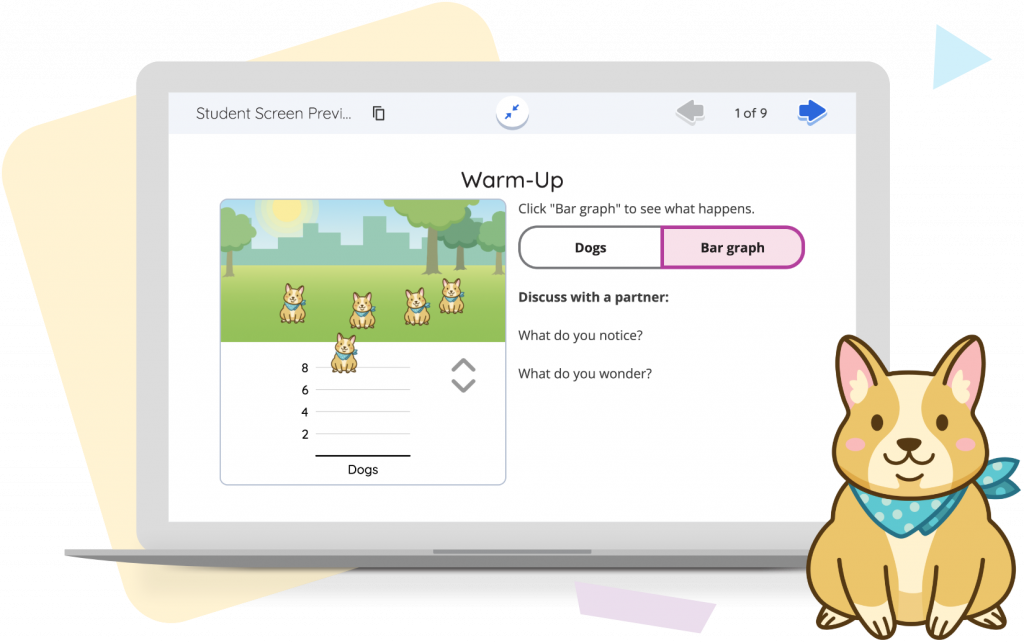
Interfaz de software educativo que muestra una lección de gráfico de barras sobre perros, con una ilustración de un corgi al lado de la pantalla como parte del plan de estudios de Amplify Desmos Math.
Interactive digital math lesson interface with colorful graphics showing parabola exploration and plotting tools on screen, enhanced by the New York math curriculum.

Comprehensive

  • Curriculum based on Illustrative Mathematics® IM K–12™
  • Differentiation and personalized practice
  • Robust assessments and reports
  • Student materials in Spanish
image of Amplify Desmos Math lesson overview of student activity

Collaborative

  • Powerful teacher-facilitation supports and tools
  • Students talking and building from each other’s ideas 
  • Every lesson has fully compatible print and digital materials for an inclusive classroom
Illustration of an Amplify Desmos math learning tool on a student screen showing abacus representations for the sums 8+7, 7+4+5, 3+8+4

Delightful

  • Curiosity-driven lessons that drop students into a real-world problem they want to solve
  • Desmos Classroom technology provides instant, interactive feedback to push students’ thinking
  • Colorful, visual guidance for teachers and students
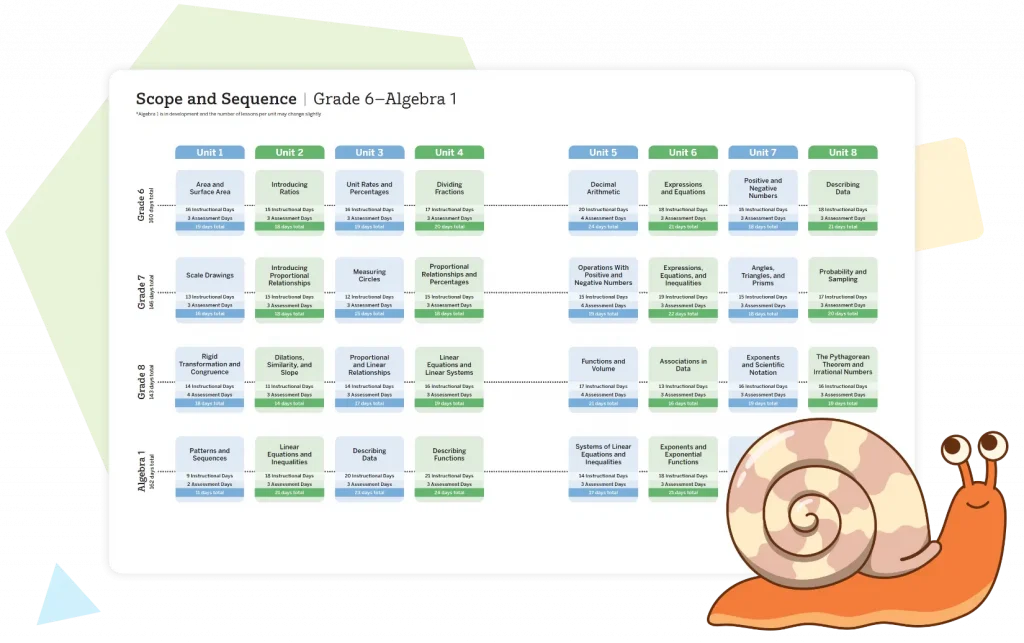
Chart displaying the Grade 6–Algebra 1 math scope and sequence, organized by units and grade levels, with a snail illustration in the bottom right corner.

Scope and sequence

Click the links below to view the program scope and sequence for grades K–5 and for grade 6–Algebra 1.

Preview lessons

Check out the links below to explore our interactive digital lessons, as well as preview pages from the Teacher Editions and Student Editions. Watch our quick walkthrough video for tips on navigating our lesson resources.

An illustration of various educational settings; on the left is a colorful, simplified cityscape with educational icons, and on the right, a laptop displaying an Amplify Desmos math lesson interface.
A red speaker and two purple music notes on a blue square background, with a small red circle and blue diamond accent.

Grade 1, Unit 3, Lesson 15: 10-frames and Towers

A stylized orange bug illustration appears above colorful rectangles and squares on a light blue background.

Grade 2, Unit 1, Lesson 3: Ways to Make 10

Illustration of a delivery truck carrying a large blue package with a white cross, set against a blue square background with geometric accents.

Grade 5, Unit 1, Lesson 3: Cube Figures

A series of concentric circles in orange, blue, and purple on a blue square background with small geometric accents on the left side.

Grade 5, Unit 7, Lesson 7: Bullseye!

Illustration of a train ticket on a green background, featuring an icon of a train and blank lines representing ticket information.

Grade 6, Unit 6, Lesson 16: Subway Fares

A diagram of a hanging mobile with a blue triangle, a purple circle, and two red squares on a green gradient background.

Grade 7, Unit 6, Lesson 14: Unbalanced Hangers

A clipboard with math equations and blue boxes is shown, along with a blue pen. The board displays addition equations with the number 4.

Grade 8, Unit 4, Lesson 4: More Balanced Moves

A cartoon snail with a brown and cream spiral shell and orange body smiles on a green background.

Algebra 1, Unit 2, Lesson 6: Shelley the Snail

Immerse your Arkansas middle school students in close reading.

Middle school students are learning to immerse themselves in text—and learning to articulate what resonates and matters to them in what they read. Boost Close Reading is an immersive supplemental reading program that engages students through an interactive graphic novel. With high-interest storytelling and guided instruction, the program motivates middle schoolers to question what they read, think critically, and build the close reading skills that will ensure success in high school and beyond.

Comic book-style illustration featuring four panels: a close-up of a reptilian character, Spider-Man looking at a "wanted" sign, a message about machines amplified for middle school reading, and a group
Laptop screen displaying Amplify Reading, a digital educational tool with a dialogue about human impact on nature, featuring interactive argument maps and cartoon characters.

In this future, reading is adventure.

Each student’s journey through this action-packed world depends on their ability to read literary and informational texts critically. Boost Close Reading develops a deep understanding of essential middle school skills—such as identifying the parts of a valid argument—that will prepare them for success in high school and in the broader world.

And every student can be the hero.

Every chapter provides integrated instruction, guided close reading, and a creative application. You set the difficulty level for each student. Assign English Learners and struggling readers to the Extra Support path. When they’re ready, switch them back to the Core Path.

Young boy concentrating on laptop with imaginative illustrations of robots and Amplify Reading graphics in the background.

Season 7, Episode 2

The Science of Reading in the Montessori classroom, with Susan Zoll, Natasha Feinberg, Laura Saylor

For the second episode in our new season focused on tackling the hard stuff, we’re taking on a question that listeners have asked: how can we apply the Science of Reading in a Montessori setting? To help explore that question, we’re joined by the three authors of the recent book Powerful Literacy in the Montessori Classroom: Aligning Reading Research and Practice. Listen to Dr. Susan Zoll, Dr. Natasha Feinberg, and Dr. Laura Saylor as they explore the shared qualities between the Science of Reading and Montessori approach. They share tips and guidance for literacy instruction both inside and outside a Montessori setting and end with an impassioned call to educators from all approaches to come together and learn from each other for the benefit of students everywhere.

Meet Our Guest(s):

Tres retratos de mujeres sonrientes dispuestos en forma triangular con un número siete escrito a mano entre las dos imágenes inferiores en un aula Montessori.

Dr. Natasha Feinberg

Natasha Feinberg, Ed.D. is an assistant professor at Rhode Island College in the elementary education department. She instructs preservice teachers in the areas of reading and writing as well as directs the Master’s of Education in Reading program. Dr. Feinberg has 17 years of experience as a reading specialist/literacy coach in the R.I. public school system. With an Ed.D. in curriculum leadership from Northeastern University, Dr. Feinberg’s area of expertise lies in the Science of Reading and teaching reading to all types of learners. She has worked extensively with Tier 2 and 3 literacy interventions identifying specific student literacy needs and matching evidence-based interventions and specific progress monitoring tools that address those needs. Her work focuses on supporting data-based individualization and data-based decision making.


Dr. Laura Saylor

Dr. Laura Saylor is dean of the school of education at Mount St. Joseph University. She earned her Ph.D. in educational studies with a concentration in educational policy and higher education with a focus in STEM education from The University of Cincinnati. Previously, she earned her Master of Education from Xavier University with a concentration  in Montessori Education.

Her 25 years of practical experience include teaching in inclusive and multi-age settings and serving as the head of school for an independent Montessori school. Laura is a frequent presenter at national conferences. Her research focuses include the importance of learning and reading science in teacher preparation as well as assessing performance of pre-service teachers in clinical experiences. Dr. Saylor’s interests also extend to best practices in educational assessment and collaborative work between P-12 and educator preparation. Her recently published research includes mathematics discourse with pre-service teachers and the effects of teacher-centered mentorship.


Dr. Susan Zoll

Susan Zoll, Ph.D., specializes in early childhood education serving in leadership roles on several U.S. Department of Education-funded early literacy initiatives (Early Reading First 2004, 2006, 2009; Early Childhood Education Professional Development grant 2006); Director of the Institute for Early Childhood Teaching and Learning (Race To The Top – Early Learning Challenge, 2014); and her current role as Associate Professor in teacher preparation coaching preservice educators at Rhode Island College.

Dr. Zoll holds a Montessori primary credential (AMS 3-6) having served as a Montessori classroom teacher, teacher trainer for the language curriculum, and a head of school. Currently, she serves as the co-chair of the American Montessori Society’s (AMS) Research Committee.

Publications include: Powerful Literacy in the Montessori Classroom: Aligning Reading Research and Practice (Teachers College Press, 2023); Designing a Logic Model to Inform Montessori Research (2019); The Montessori Experiment in Rhode Island (1913-1949): Tracing Theory to Implementation over 25 Years (2017); Towards Social Justice: A Needs Assessment of Early Childhood Development In South Africa (2013); From “at risk” to “at promise”: An Evaluation of an Early Reading First Project (2012); and Sustainable Practices in Mentoring: Tools to Support Child Outcomes and a Mentoring Protocol (2011). Her work in the development of an assessment protocol has been recognized by the U.S. Department of Education’s Doing What Works initiative.

Meet our host, Susan Lambert

Susan Lambert is the Chief Academic Officer of Elementary Humanities at Amplify, and the host of Science of Reading: The Podcast. Her career has been focused on creating high-quality learning environments using evidence-based practices. Susan is a mom of four, a grandma of four, a world traveler, and a collector of stories.

As the host of Science of Reading: The Podcast, Susan explores the increasing body of scientific research around how reading is best taught. As a former classroom teacher, administrator, and curriculum developer, Susan is dedicated to turning theory into best practices that educators can put right to use in the classroom, and to showcasing national models of reading instruction excellence.

Retrato de una mujer caucásica sonriente con cabello rubio corto, involucrada en un podcast sobre la ciencia de la lectura, con gafas, lápiz labial rojo y un collar de perlas.

Quotes

“Maria Montessori was a scientist first. She developed her methods based on science.”

— Laura Saylor

“Reading is the human rights issue of our era in education and we want all children to be successful.”

—Susan Zoll

“I encourage everyone, get together with your colleagues, talk about the different pedagogy, talk about the different strategies that are out there, because that is what is going to help us become better in the field of education.”

—Natasha Feinberg

New efficacy study finds Desmos Math 6-8 significantly improves student learning outcomes in middle grades

Brooklyn, NY (March 24, 2023) – A new study from WestEd, an education research nonprofit organization, found that schools using the Desmos Math curriculum for 6th, 7th, and/or 8th grade math instruction had significantly higher math achievement compared to similar schools that did not use Desmos Math. The Desmos Math 6–8 curriculum became part of the Amplify suite of high-quality instructional programs last spring, along with the Desmos Classroom teaching and learning platform. With a focus on helping teachers celebrate student brilliance, build flexible mathematical understanding and create the conditions for every student to be successful, the Desmos Math 6-8 lessons are standards-aligned, easy-to-use, and fully customizable by educators.

The WestEd retrospective study looked at data from the 2021-2022 school year and used a matched comparison design of almost 900 schools (~150 experimental sites and ~750 control sites) in nine focal states–California, Colorado, Connecticut, Massachusetts, Minnesota, Missouri, New York, North Carolina and Texas. The study found that use of the Desmos Math 6-8 curriculum correlated with increased average math achievement. These results show that there is a positive effect with even a basic usage of Desmos Math 6-8 in increasing middle-grade-wide math achievement.

“We are thrilled with the results of this study, which validate the power of teachers putting student ideas at the center of instruction in order to build strong math proficiency,” said Dan Meyer, dean of research, Desmos Classroom, at Amplify. “We believe that all students – and teachers – deserve to experience engagement, challenge, and success in their math classrooms every day, and we are excited to build out a comprehensive K-12 curriculum to make that vision a reality in more and more classrooms.”

The schools in this study were from nine states with a concentration of Desmos Math 6-8 usage, and the schools used it with varying levels of fidelity. As such, the WestEd researchers believe the full impact of Desmos Math 6-8 may be higher than the effect reported in this study.

“The results are encouraging for educators in search of curricular materials designed to help students meet more rigorous math content standards,” says Kirk Walters, senior managing director, WestEd. “Most state standards and assessments emphasize conceptual understanding and application, which are key features of the Desmos Math Curriculum. Further research could determine the causal effects of the program, which may be even larger if the program is implemented under ideal conditions.”

About Amplify and Desmos Classroom
A pioneer in K–12 education since 2000, Amplify is leading the way in next-generation curriculum and assessment. In June 2022, Desmos split into two entities: “Desmos Studio,” a Public Benefit Corporation that builds and supports the Desmos Calculators, and “Desmos Classroom,” the team and technology behind Desmos Math 6-A1. Together Amplify and Desmos Classroom are building a comprehensive core math curriculum called Amplify Desmos Math that will build off of Desmos Math 6–A1 and be available for pilot and review in Fall 2024. Today, Amplify and Desmos Classroom serve more than 18 million students in all 50 states. For more information about Desmos Math 6-A1, visit amplify.com/desmosmath. For more information about the in-development Amplify Desmos Math, visit amplify.com/math.

About WestEd
WestEd is a nonpartisan, nonprofit agency that conducts and applies research, develops evidence-based solutions, and provides services and resources in the realms of education, human development, and related fields, with the end goal of improving outcomes and ensuring equity for individuals from infancy through adulthood. For more information, visit WestEd.org.

Contact: Kristine Frech; media@amplify.com