Showing results for dozen diet

RF.1.3.G: Recognize and Read Grade-Appropriate (First Grade) Irregularly Spelled Words

Skill

RF.1.3.G: Recognize and Read Grade-Appropriate (First Grade) Irregularly Spelled Words

Standard

CCSS.ELA-LITERACY.RF.1.3.G: Recognize and read grade-appropriate irregularly spelled words.

Description

Mastery: Student is able to read irregularly spelled words with automaticity.

Acquiring: Student is able to recognize some irregularly spelled words. Student may attempt to decode some irregularly spelled words.

Probes

T: Read the following words – show a list of High Frequency Words, such as Fry’s or Dolch word lists, presented in random order (e.g., the, of, to, you, she, my, is, are, do, does).

Activities and Resources

Small Group Instruction – Direct Instruction

During Transitions

Reinforce Skills/Independent Work Time – Independent/Small Group Center Activity

Display (e.g. Anchor Chart):

Considerations & Reminders

  • High Frequency Word Lists should be posted and visible for students to reference. While these words are to be memorized, the act of looking up at a chart/poster for quick reference allows the student to eventually be able to quickly find and recognize the words.
  • When introducing an irregular word (but not when building fluency), we ask students to sound out and say the word correctly. There are multiple reasons to ask students to sound out irregular words:
    • When students encounter an irregular word in connected text, they may initially attempt to sound it out. These exercises prepare them to read the word correctly.
    • We want to show students that, though some word parts may be irregular, other parts are often regular, so that students can decode those parts, giving them a clue to the full word.
    • If we sound out some words and not others, students may learn that sounding out should only be used intermittently. They may decide not to use it even when they should.
    • Even for irregular words, the process of connecting symbols to sounds helps students learn the word: “The knowledge of letter-sound relations provides the powerful mnemonic system that bonds the written forms of specific words to their pronunciation in memory.” (Ehri, 1995)
  • Teaching tips:
    • One way to accelerate learning of irregular words is to print out flashcards for each newly introduced word and make a set for your students to practice with at home.
    • If words are being introduced too slowly for your students, you can introduce a new irregular word every day. You should feel free to vary the pace, being careful to ensure that everyone is keeping up.
    • When you point to a word, wait before touching it and train students to respond only when you touch the word. That gives all students time to think of the answer, so that slower students don’t just copy faster students.
    • For each activity, keep a record of items a student had problems with. Review this activity log before the next activity so you pay special attention to those students.

Discovering and exploring mathematics in every story

Smiling young boy sits at a classroom desk holding an open book, developing reading comprehension, while two other children are seen in the background engaged in activities.

Every picture book on your classroom shelf holds mathematical treasures waiting to be discovered! What if every read-aloud could go beyond a literacy moment to become a catalyst for mathematical sense-making? This question lies at the heart of Allison Hintz and Antony T. Smith’s delightful and informative book, Mathematizing Children’s Literature: Sparking Connections, Joy, and Wonder Through Read-Alouds and Discussion.

Many teachers have used traditional counting books and shape-focused stories to support students in connecting mathematics to literature. According to Hintz and Smith, you can challenge readers to extend and expand upon these experiences in ways that provide more space for them to make sense of stories; ask their own questions; see mathematics authentically in the world; and make connections between the stories, the math, and their lives. That’s the promise of mathematizing—approaching any story with a mathematical lens.

The concept of “mathematizing” goes beyond simply finding numbers in a story. Children are naturally curious and construct meaning by noticing, exploring, explaining, and modeling. The story context becomes a place to play and practice seeing math everywhere in our world. As we read a story aloud and pause to ask, “What do you notice? What do you wonder?,” students are able to surface structure, compare quantities, model situations, and justify their ideas, all while staying rooted in characters, plot, setting, and theme. The result is a classroom where math feels joyful, meaningful, connected, and accessible.

In this post, we’ll explore simple moves to mathematize your next read-aloud, sample prompts to elevate discussion, and follow-up activities to turn your library into a launchpad for mathematical thinking!

Mathematizing process and structure

While there’s no one way to facilitate a mathematical read-aloud, the following steps can help you get started:

  1. Explore books in your current library. There are no hard and fast rules for choosing the right book to mathematize, because a book can spark mathematical ideas in many ways. Look for books that a) are overtly ‘mathy’ where the math is central to the story’s plot, b) have illustrations that provide opportunities to explore the math in them, and/or c) have a story that inspires mathematical thinking, even if the math isn’t central to the story’s plot.
  2. Read the book aloud for the first time. The first read is a wonderful opportunity for students to hear and enjoy the story itself.
  3. Ask students what they noticed and wondered. As students share their responses, record them on a piece of chart paper to revisit later. If no responses pertain to the math in the story, you can follow up with the question, “Where did you see math in the story?”
  4. Reread the book a second time or revisit a specific page in the book. At this point, you want to start to focus on the math the students will explore in the book. You can either reread the entire story and pause on strategic pages that center on the mathematical ideas, or revisit specific pages in the story. (If the story is longer,it will probably be easiest to just flip back to specific pages.)
  5. Elicit student thinking. Ask students what math questions they could ask based on the pages they revisited.
  6. Give students a follow-up math activity. This could be based on a question the students mentioned earlier in this process, or one the teacher has planned.

Mathematizing examples

To save you time finding a book to use, we’ve outlined a plan based on some of our favorite books to mathematize (listed by grade band).

Grade levelK–1
Book title and authorBear Says Thanks by Karma Wilson
Mathematical focusCounting, addition, and mathematical representations
LaunchRead the story aloud. Ask students, “What do you notice? What do you wonder?” Record their responses on a piece of chart paper. And ask students, “How many friends visited Bear? What different food items did Bear’s friends bring?”
Pages to revisitAs students describe the different foods, revisit those pages. Identify any foods the students didn’t mention. As you revisit each page, ask students, “How many of that food item did that friend bring? ”Record their responses on a piece of chart paper for each friend. 
ActivityArrange students in small groups of 3–4 and give them a piece of poster paper. Ask students to show each friend’s food items. They can represent them using pictures, counters, ten-frames, etc. After they’ve correctly represented each friend, ask them to show how many total food items Bear’s friends brought using numbers and equations. When they’ve finished, have them visit one another’s posters to see how others represented and added the food items. 
Grade level2–3
Book title and author100 Hungry Ants by Elinor J. Pinczes
Mathematical focusConnecting arrays to expressions
LaunchRead the story aloud. Ask students, “What do you notice? What do you wonder?” Record their responses on a piece of chart paper. And ask students, “How did the ants rearrange themselves throughout the book?”
Pages to revisitAs students describe the different arrangements of ants, revisit those pages so students have a visual of the array. As you revisit each page, ask students, “How many ants are in each row? Each column? What is an equation we can write to represent the array?” Record their responses on a piece of chart paper. 
ActivityArrange students in small groups of 3–4 and give them a piece of poster paper. Give each group a different number of ants. Suggested numbers are: 12, 24, 36, 20, 18. Ask students to draw all of the different ways their number of ants could rearrange themselves and record an equation to match each. If it’s helpful, you can give each group a set of cubes, counters, or beans to represent the ants so they can manipulate them. Wrap up the activity by having students visit one another’s posters and discussing the similarities and differences between them. 
Grade level4–5
Book title and authorDozens of Doughnuts by Carrie Finison
Mathematical focusMultiplication and division
LaunchRead the story aloud. Ask students, “What do you notice? What do you wonder?” Record their responses on a piece of chart paper. And ask students, “How many ways did Luanne share her doughnuts as friends arrived at her door?”
Pages to revisitAs students describe the different ways Luanne shared her doughnuts, revisit those pages. As you revisit each page, ask students, “How many doughnuts were being shared? By how many animals? ”Record their responses on a piece of chart paper. 
ActivityArrange students in small groups of 3–4 and give them each a piece of poster paper. Ask them to show all of the ways Luanne shared her doughnuts. To enable variation, refrain from specifying the representation they should use. After they’ve finished, ask them to do a Gallery Walk to each other’s posters to get ideas to add to their poster. If none of the groups have a multiplication and division equation for each way, ask students to record those as well. Ask students how Luanne could have shared a dozen doughnuts with the following number of animals showing up at her door: 5, 8, 10, 14, 16, and 18. Encourage students to show their work and record multiplication and division equations. 

And with all the upcoming holidays and opportunities to gather with friends and family, we were also inspired to use Spaghetti and Meatballs for All! by Marilyn Burns in a mathematizing read-aloud. Follow this link to find K–2 and 3–5 lesson plans for this book that you can use right away!

Pseudoscience examples for critical thinking skills

MIRACLE HAIR GROWTH! 

Quantum hair activation technology: This groundbreaking innovation goes beyond conventional science, delving into the realm of quantum energy to stimulate hair growth at the subatomic level. Blended with rare botanicals from ancient civilizations for luster and shine. Limited-time offer: Act now and receive a vial of stardust-infused hair serum!

Effective product…or pseudoscience? We’ll bet you guessed it. (Sorry, no stardust serum for you!)

While this hair product itself sounds like junk, reading about it can be a valuable experience for science students.

Teaching your students to identify pseudoscience in the world around them helps them learn to protect themselves from false claims that can be money-wasting at best, dangerous at worst.

And as they learn to discern, they also develop lifelong critical thinking skills!

We say knowledge is power but it’s not enough to know things, and there’s too much to know. Being able to think and not fall for someone’s bunk is my goal for my students.

—Melanie Trecek-King, biology professor and guest in Science Connections podcast Season 3, Episode 5: Thinking is power

Let’s explore how educators can use examples of pseudoscience to develop critical thinking skills—and incorporate NGSS (Next Generation Science Standards) science and engineering practices into their approach.

What’s the difference between science and pseudoscience?

Science is grounded in empirical evidence, rigorous testing, and the scientific method. Pseudoscience presents itself as scientific but lacks the fundamental elements of genuine scientific inquiry: evidence, peer review, and the capacity to generate accurate predictions.

Though pseudoscience may make vague claims, it has clear characteristics. When something is pseudoscience, it:

  1. Can’t be proven wrong: Makes claims that are unobservable or too vague.
  2. Professes “proof” without presenting actual evidence: Presents only anecdotal evidence, if any.
  3. Uses technobabble: See: “Quantum hair activation technology.”

For more characteristics of pseudoscience, check out Melanie Trecek-King’s episode of Science Connections!

To be sure, not all pseudoscience is harmful—pursuits and activities such as aromatherapy and astrology can be positive experiences in people’s lives—it just should not be defined as or considered science.

How addressing pseudoscience encourages critical thinking

When you teach students to identify pseudoscience, you are teaching them to use an evidence- and research-based approach when analyzing claims. Which is…science!

You are also:

  • Teaching them to engage in thoughtful and educational argument/debate.
  • Encouraging them to use their knowledge of science in the real world.
  • Creating real-world impact.

When students learn to identify pseudoscience—faulty products, myths, and disprovable “discoveries”—they’ll be prepared and informed when making real-world decisions.

Critical thinking exercises inspired by pseudoscience

We’ve talked about “miracle” hair growth treatments, which are more commonly targeted to adults. Students may have more commonly encountered claims about or ads for alkaline water or detox diets, conspiracy theories and instances of science denial, astrology, and more. These examples offer great opportunities to discuss how to determine the difference between science and pseudoscience.

Suggested activities:

  • Pseudoscience Sherlock: Ask students to find examples of pseudoscience in real life via social media, products sold in stores, or on the internet. Tell them to pay close attention to “articles” that are really ads.
  • Pseudoscience lab: Prompt students to back up their claim that a given example represents pseudoscience with evidence: e.g., lack of empirical evidence, controlled experiments, or unbiased sample; absence of peer-reviewed research; reliance on anecdotes; hyperbolic and unprovable claims.
  • Snake oil! Ask students to practice identifying pseudoscience by creating their own advertisements, commercials, or news segments for fake products or scientific “advancements.”
  • Spread the word: Ask students to create flyers, PSAs, or articles on how to identify the characteristics of pseudoscience.

Other activities that incorporate the NGSS while also sniffing out pseudoscience:

  • Asking questions: Encourage students to ask probing questions about pseudoscientific claims. How does this claim defy our current understanding of the natural world? What empirical evidence is missing?
  • Developing and using models: Have students create models that illustrate the differences between a pseudoscientific claim and a well-established scientific concept. This visual representation supports understanding and critical analysis.
  • Engaging in argument from evidence: Arrange debates where students argue for or against a pseudoscientific claim using evidence-based reasoning. This practice sharpens their ability to critically evaluate information.
  • Obtaining, evaluating, and communicating information: Ask students to research the history and impact of a specific pseudoscientific belief. Have them present their findings, highlighting how critical thinking could have prevented widespread acceptance of the claim.

Using examples of pseudoscience in your science classroom can help students learn to not only think like scientists, but navigate the real world, too.

Bertha Vasquez, former teacher and current director of education at the Center for Inquiry, has used these approaches with her students. As she shared on Season 3, Episode 6 of Science Connections: “I guarantee you that those students, when they walked into a store with their parents and they saw a product [with] a money-back guarantee [that] cures way too many things, and it’s based on ‘ancient plant wisdom’ and has ‘scientific’ language on the box, they may go, ‘Mom, I think these people are trying to sell you some pseudoscience.’”

More to explore

Sparking literacy success in Tennessee

Meet Kaleb.

Not that long ago, he couldn’t read. And now he’s a confident, engaged reader who wants to write his own stories.

What changed? Mr. Price, a caring educator, connected with Kaleb and joined him on his literacy journey.

Like Mr. Price, you’re changing lives and creating new futures for kids every single day—and we’re here to help you do that.

A woman with light brown hair, wearing a black top, white earrings, and a necklace, smiles in front of a blue background, embodying literacy success with her confident and approachable presence.
“If a student is not proficient in reading by the end of third grade, it is highly unlikely that they will become a proficient reader. Impacting students at a much younger age, in earlier grades is where we see [the greatest] success.”

Director, Project On Track

Providing structured practice, support, and guidance that makes a difference

When students struggle with reading, their relationships with their teachers become more important than ever—and so does the support, instruction, and guidance you give them.

How can you take your students from not knowing the alphabet to decoding dozens of words in one school year? Research-backed intervention, remediation, and practice can certainly help. And so can Amplify.

A middle-aged man with short brown hair and a beard, wearing a navy suit, white shirt, and striped tie, smiles in an indoor setting, radiating confidence often seen in champions of literacy success.
“He’s able to read, and that’s something that sometimes we take for granted, but we have high illiteracy rates. He’s not going to be one of those [students]; he’s going to be a success story.”

Assistant Principal

Change lives forever with the Science of Reading

In making the shift to the Science of Reading, you can give every teacher and student what they need, and guarantee reading and literacy success. 

Think of how that would transform your school and district—and most importantly, your students’ lives.

CKLA_TNLandingPage_ELSGraphic_111422-01

Support every student with the only full Science of Reading-based literacy system

The Science of Reading tells us that learning to read is not a natural or automatic process. You see this every day—with students like Kaleb. Students with dyslexia. Students who haven’t gotten the explicit instruction, support, and guidance needed to experience real literacy success and joy.

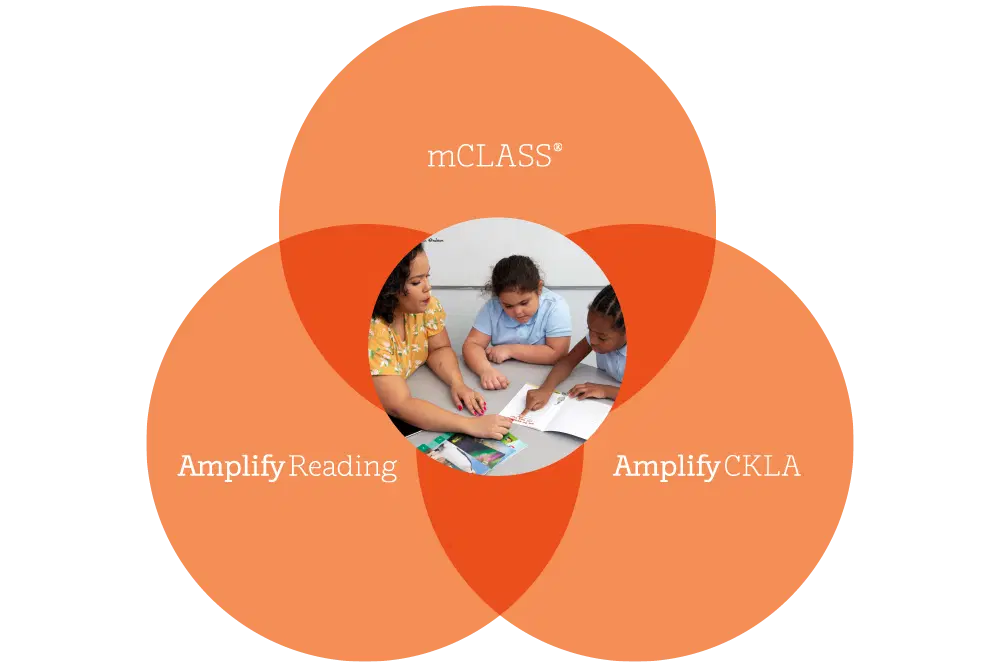
To be powerful and effective, and to help all students achieve success, a literacy system needs to bring together assessment, curriculum, intervention, and personalized learning. And Amplify has done exactly that with the only full Science of Reading suite, made up of Amplify Core Knowledge Language ArtsmCLASS®, and Boost Reading (formerly known as Amplify Reading).

Ready to take the next step?

Get in touch with one of our program experts to request a sample or demo.

Request a sample or demo!

Season 10, Episode 3

Finding fluency at the heart of comprehension, with Doug Lemov

In this episode of Science of Reading: The Podcast, Susan Lambert is joined by Doug Lemov, former teacher and school principal, to discuss how teachers can identify when disfluency is actually the root cause for students’ struggles with comprehension—and what they can do about it. Using his new book, The Teach Like a Champion Guide to the Science of Reading, to guide the discussion, Susan and Doug address building attention stamina, the argument for reading whole books, and the value of expressive read-alouds. Finally, Doug ends the episode asserting that humans are meant to live in community, and that a deeper level of comprehension is unlocked through empathic connection to text and the experience of reading with others.

Meet Our Guest(s):

A middle-aged man with glasses and a white shirt is smiling outdoors, framed by a circular border with a blue book icon in the corner—perfect for an emergent readers or science of reading podcast profile.

Doug Lemov

Doug Lemov is a former teacher and school principal whose books describe the techniques of high-performing teachers. His best-known book, Teach Like a Champion, has been translated into more than a dozen languages. The Teach Like a Champion Guide to the Science of Reading, published in July 2025 and co-written with Colleen Driggs and Erica Woolway, looks at how cognitive science can be better applied to the teaching of reading. Doug holds a bachelor’s in English from Hamilton College, a master’s in English Literature from Indiana University, and a Master’s of Business Administration from the Harvard Business School.

Meet our host, Susan Lambert

Susan Lambert is Chief Academic Officer of Literacy at Amplify and host of Science of Reading: The Podcast. Throughout her career, she has focused on creating high-quality learning environments using evidence-based practices. Lambert is a mom of four, a grandma of four, a world traveler, and a collector of stories.

As the host of Science of Reading: The Podcast, Lambert explores the increasing body of scientific research around how reading is best taught. A former classroom teacher, administrator, and curriculum developer, she’s dedicated to turning theory into best practices that educators can put right to use in the classroom, and to showcasing national models of reading instruction excellence.

Person with short blonde hair, glasses, and earrings, wearing an orange jacket, smiling in front of a plain gray background—committed to literacy education and fostering background knowledge for all learners.

Quotes

“When you know the science, you should have the autonomy to make real decisions and to solve problems in your classroom. That's how education works.”

—Doug Lemov

“If you're not a fluent reader, you can't be a deep reader.”

—Doug Lemov

“The research is clear that when you start to read expressively externally, then your internal reading voice while reading silently is much more expressive and therefore infused with more meaning.”

—Doug Lemov

“Fluent reading, when it includes prosody, is meaning made audible.”

—Doug Lemov

“I just think it's easy for us to overlook how profoundly groupish we are, how we yearn for group formation, how stories, when they're told well, when they're shared, they bind us together in an experience.”

—Doug Lemov

“When we're sharing this experience that we're able to connect with the text itself, we're able to infuse some meaning through how we're reading that text. That lends us to a depth of comprehension that's really where we want any reader to get to.”

—Susan Lambert

“Comprehension just isn't coming out of a book knowing what the author said; it’s deeply connected to the content that you just experienced.”

—Susan Lambert

Amplify acquires K–12 mathematics education innovator Mathigon

(Brooklyn, NY – October 13, 2021): Amplify, a publisher of next-generation curriculum and assessment programs, announced today that it has acquired K–12 mathematics online learning company Mathigon. The London-based edtech startup develops and publishes unique, highly interactive, and visually compelling tools, activities, and courses that enable students to explore the beauty and power of mathematics.

Since 2016, Mathigon has provided free content and tools to teachers, students, and parents in more than 20 languages. Polypad is a “mathematical playground” that features best-in-class virtual manipulatives and other tools to enable exploration, creativity, and problem-solving. Mathigon’s interactive courses for middle and high school cover topics such as algebra, geometry, fractals, graph theory, and cryptography. Every course contains dozens of simulations, animations, games, and interactives, along with a virtual tutor that provides hints and encouragement. Storytelling, real-life applications, and historical content show students why what they’re learning is important and meaningful. Mathigon is used by more than 600,000 students and teachers every month around the world.

Polypad and other Mathigon resources will continue to be freely available, as Amplify is committed to removing barriers to high-quality math instruction and supporting all students in becoming creative problem-solvers. Polypad and other Mathigon tools also will be integrated into Amplify’s in-development math programs, inspiring students to explore and discover mathematics and empowering teachers to see students’ thinking and facilitate meaningful dialogue between students.

“I have almost never seen a product that inspires such pure intellectual delight in children and adults. Delight may be the hardest outcome to achieve in education. Mathigon achieves it over and over again,” said Larry Berger, chief executive officer of Amplify. “When we saw the beautiful, easy-to-use tools that the Mathigon team had built, we knew we wanted to help bring them to even more teachers and students across the world. We also knew we wanted the Mathigon technology and team to be part of our journey of creating the highest quality and most delightful math programs available.”

Mathigon Founder and CEO Philipp Legner will join the Amplify team as vice president, Mathigon Studio, overseeing enhancements to Mathigon’s offerings and integration of key elements into Amplify’s programs. Legner will help spur innovation and power up the company’s already robust product design and engineering teams. His contributions will boost Amplify’s ability to deliver high-quality, student-empowering instructional tools in K–12 mathematics.

“From the very beginning, my goal with Mathigon was to make online learning more interactive and engaging than ever before. Rather than just watching a video and ‘consuming information,’ students should explore, discover, and be creative,” said Philipp Legner, founder and chief executive officer of Mathigon. “Mathematics is both incredibly powerful and surprisingly beautiful, and I want every student to enjoy learning. I’m incredibly excited to work with Amplify to reach even more students.”

About Amplify
A pioneer in K–12 education since 2000, Amplify is leading the way in next-generation curriculum and assessment. Our captivating core and supplemental programs in ELA, math, and science engage all students in rigorous learning and inspire them to think deeply, creatively, and for themselves. Our formative assessment products turn data into practical instructional support to help all students build a strong foundation in early reading and math. All of our programs provide teachers with powerful tools that help them understand and respond to the needs of every student. Today, Amplify serves more than ten million students in all 50 states. For more information, visit www.amplify.com.

About Mathigon
Mathigon is an award-winning platform for learning mathematics, and completely free to use. It’s apps and website contain games, puzzles, activities, virtual manipulatives, and interactive textbooks, allowing students to explore, be creative, learn problem-solving and critical thinking. A unique new content format lets abstract concepts come to life, a virtual personal tutor provides real-time support, and storytelling and real applications make learning more fun and engaging. Mathigon has been used by more than six million students and teachers from all over the world. For more information, visit www.mathigon.org.

Contact:
Molly McCue
media@amplify.com

School by Design (SxD) becomes an independent company dedicated to helping education leaders design the schools their kids and teachers need

SxD will be led by Andrew Joseph, a senior executive at Amazon Education and the co-founder of TenMarks Education, Inc., a personalized online math program. Vicki Phillips, the previous K-12 Director of Education – College Ready at the Bill and Melinda Gates Foundation, will join the SxD Board of Directors, along with David Stevenson, Executive Vice President of Amplify.

SxD brings a design thinking approach to education’s annual resource planning cycle—from district budgeting to master scheduling—so that it shifts from an administrative process to a strategy for instruction. Delivered through an online platform, analytic tools, and technical assistance, SxD services include:

  • Specialized resource audits that give districts and schools a quick way to see how resource allocation and utilization are currently impacting instructional decisions related to teacher time, student time, equity, class size, and more.
  • Scenario planning to uncover the different ways budgets and time could be used based on the school experience leaders and teachers want to provide students and the supports staff need. Examples include: looking at ways to manage class size within current budget while also finding more time for teacher professional development; and exploring school designs developed around student learning opportunities such as STEAM, problem-based learning, and community-based learning.
  • Decision-making supports for districts and schools to make informed decisions about budgeting, scheduling, and school model options so that they support, not block, high quality teaching and learning experiences.

“School by Design is tackling one of the biggest challenges for districts and schools: making sure resources and policies support teachers and students,” explains Vicki Phillips. “The SxD services and supports are invaluable to schools because they help solve, within budget, the age-old ‘pain points’ that undermine good teaching—issues such as class size, time for teacher collaboration and professional learning, and scheduling for interdisciplinary learning and student field experiences.”

School by Design is built around the leading work of Marilyn Crawford on resource alignment, master scheduling, and professional development in service of innovative teaching and learning. Over the past few years, School by Design has worked with dozens of districts and CMOs across the country to find thousands of hours for teacher professional development and planning, while helping schools address the unique learning needs of their students within budget.

“School by Design helps you solve problems. Most people know what their issues are, but School by Design helps them know what to do about it,” states Steve Broome, director of state development for high school and middle grades at the Southern Regional Education Board (SREB). Working with education leaders, Steve and the team at SREB use the SxD audit and scenario planning to help schools turn their High Schools that Work principles—such as multiple pathways to college and careers—into reality.

The SxD spinoff enables Amplify to focus on its core offerings of digitally-enabled instruction, assessment, and professional development for K-5 reading and language arts and middle school ELA, math, and science. As Amplify’s and SxD’s services and products are distinct but complementary, the organizations expect to collaborate to serve districts and schools.

“I’m honored to be leading School by Design to the next level,” says Andrew Joseph. “We are uniquely positioned in this too-often ignored space where resources meet instruction. Our platform and services have helped a number of districts and schools solve their resource allocation and scheduling challenges and uncover the possibilities for their schools. We’re excited to now help other educators create the conditions in which teaching and learning can thrive.”

As an independent company, School by Design will be better able to respond to the evolving needs of educators and expand its suite of products and services. Through actionable analytics, virtual experiences, and new school models, SxD will further its position as the leader of education design thinking—helping school leaders leverage data, see all of the opportunities for engaging, high quality schooling within their resources, and make informed decisions for the types of schools their teachers, parents, and students want and deserve.

Contact: media@amplify.com