S1-10: Empowering the science educator: Jessica Kesler

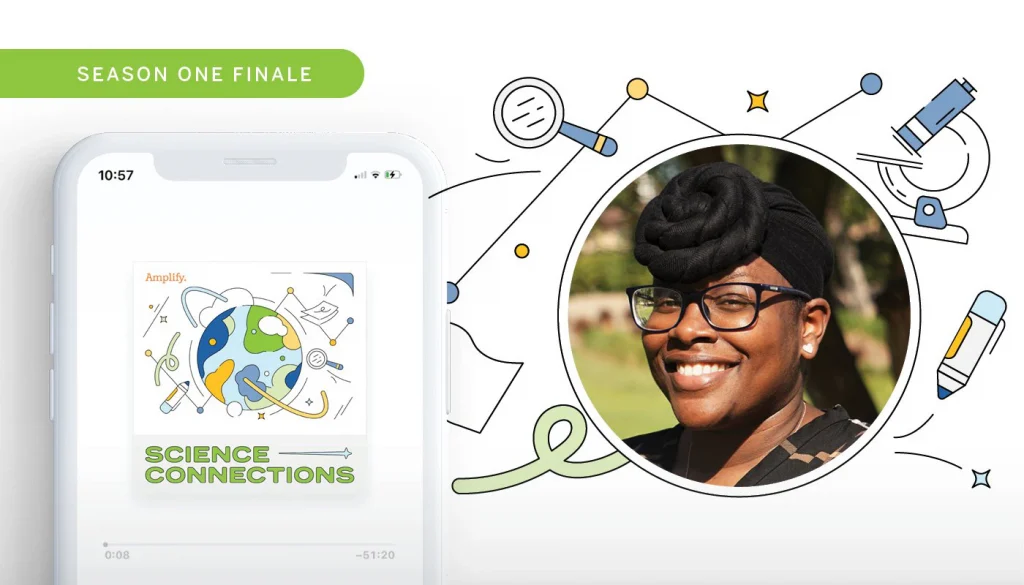
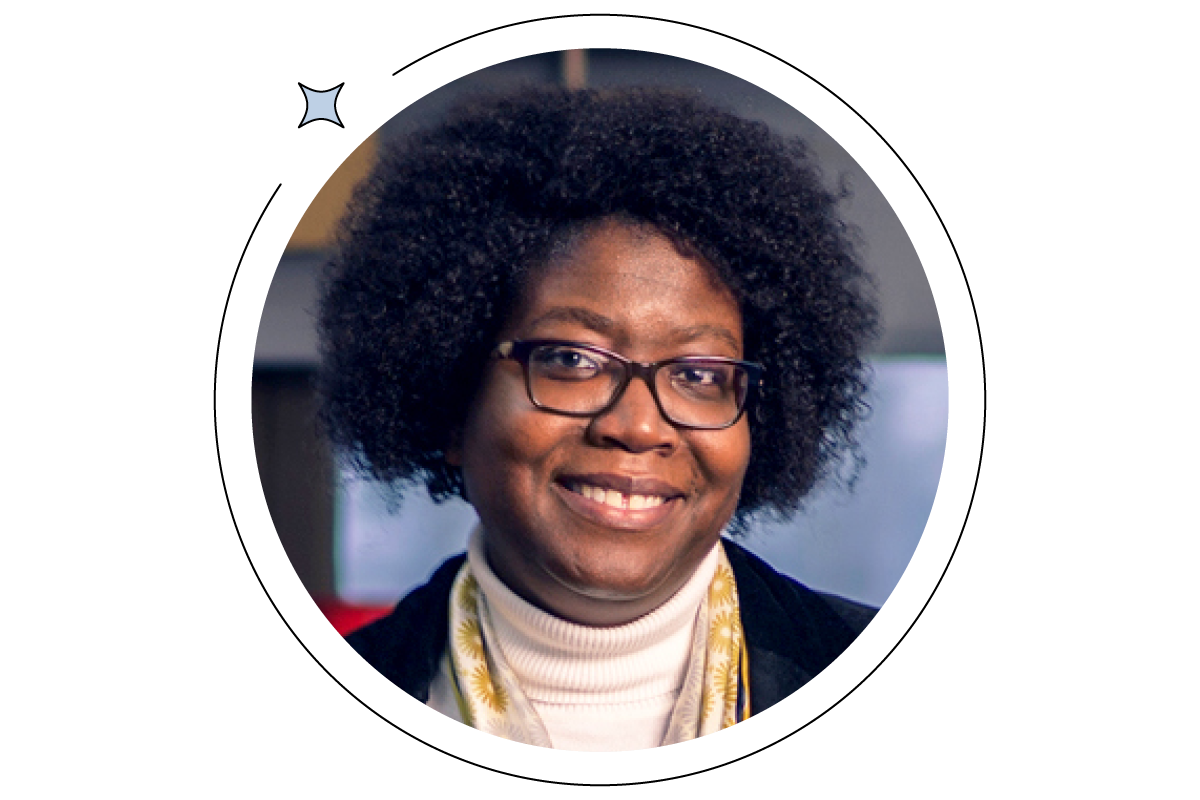
Promotional graphic for "science connections podcast" season 1, episode 10, featuring a smiling black woman named Jessica Kesler, with educational icons like a globe and magnifying glass around her.

In the final episode of the season, Eric sits down with his friend and professional development facilitator, Jessica Kesler. Jessica describes her passion for sharing free, high-quality, empathy-centered professional development for K12 educators. Jessica also shares her experience jumping into leadership positions while teaching in Philadelphia. Eric also chats with Jessica about how students often lean on teachers for more than delivering content. Explore more from Science Connections by visiting our main page.

Download Transcript

Jessica Kesler (00:01):

One student at a time, isn’t gonna bring a million students through the door. But if we focus on their teachers, then they can implement it in their classroom and have this multiplicative effect that can continue on and help us to reach those millions of kids and helping them be prepared for future careers.

Eric Cross (00:19):

Welcome to science connections. I’m your host. Eric Cross. My guest today is Jessica Kessler. Jessica’s director of professional learning at TGR foundation, which is a tiger woods charity. There she creates and leads free stem, professional learning opportunities for educators across the country. Prior to working at TGR, Jessica worked as an elementary, middle and high school science teacher while fulfilling several leadership roles, including science department, chair and principal intern. In this episode, Jessica shares some of her classroom experiences while working in Philadelphia, where she was in classrooms, where her students needed her to be more than just her content. She also addresses how designing professional learning with empathy for teachers in mind creates better experiences for teachers. And now please enjoy my discussion with Jessica Kessler. So let’s, let’s start off with St. Joseph’s chemistry college to the classroom, like your origin story. What led you to ultimately get into the classroom and being successful, even just looking at, at your kinda like your resume or your CV of all of the things that you’ve done. You definitely weren’t idle, but start off with chem. Yeah. Like where did that passion come from?

Jessica Kesler (01:27):

Yeah. So when I was younger, I just had this burning passion to help people. Right. And when you’re young and you think about helping people, you think about doctors, doctors help people. Right. So I had this idea that I wanna be a surgeon. I wanna be a black surgeon. I wanna be a young girl, female Charles drew, and I just wanna go out there and do it. And so my mom is actually an alum of St Joe’s. So I spent a lot of time on campus cuz as she was getting her mini master’s degrees I will visit campus with her often. And so when I applied, I had the scholarships, had everything and I went in ready to be bio ready to be a surgeon. I took my first bio class and I was like, yes, let’s talk about the human body. And let’s get into dissections and sections. And they were like, okay, so a plant so has this. And I was like, Ooh <laugh> I was like, this is not what I was expecting at all. It just felt so detached from the trajectory that I wanted to take. And it just did not feed that passion of helping people in the immediate moment.

Eric Cross (02:31):

Did it, did it feel too abstract?

Jessica Kesler (02:33):

It felt abstract. It felt boring. Okay. And one thing I didn’t want was to be like stuck, bored. Like if I’m not being stimulated in a good way, mm-hmm <affirmative> then it’s not gonna last, but I love science. So I switched over to chemistry cuz I’m like this chemistry is exciting. I’m mixing things together. I’m producing new things. I’m doing extractions. I’m being introduced to machinery that I haven’t seen before. I’m loving it. I’m doing a math. The math is awesome. And so I switched over to chem and I started doing research in the summers and things like that. My research was around water quality in Philadelphia and looking at different natural water sources and comparing them and all those great things. But I was in a lab and the lab had no windows and I was stuck talking to this atomic absorption specter every day.

Jessica Kesler (03:24):

And I hit that, that wall again, where it was like, is this the rest of my life? Like talking to these machines and not having windows and not being able to interact with people. What is this? This can’t be life. And so I was seeking out some new opportunities that said, Hey, I need more money. First of all. So I’m like, I call the financial aid office like every week, like, Hey, what’s out today. What new scholarships do you have? I’m applying for everything. Like it was my goal to not have to pay for much of my education. And so I was talking to them and they’re like, Hey, you’re in science. There’s this awesome opportunity called a noise scholarship where they’ll pay for your last year and your master’s degree. If you go into education mm-hmm <affirmative> and I sat on it and I was like, this makes so much sense to me.

Jessica Kesler (04:12):

I was like, I’ve been literally tutoring my peers and teaching in churches and all this other kind of stuff. My whole life. It makes so much sense. How come nobody ever said this before? <Laugh> and so I applied for the noise scholarship, got in and started, you know, mm-hmm, <affirmative> doing practicums in the classroom as I went through my last year as a chemistry major and my first year for my masters and it just felt so right. And I was like, I can do this. And of course there were a lot of people who told me, no, Josh, you can’t do that. Like these kids will eat you alive. And I’m like I don’t think so. <Laugh> but, but that’s give it a go. And I stepped into the classroom and it, it just felt like, felt like it was always meant to be there.

Eric Cross (04:57):

So you were able to, you were able to make that connection between, I mean, if you’re, if you’re studying chemistry and bio and going into stem, I mean, there’s, there’s an aptitude there, but then you realize that this there’s a road that you could take that leads you into a room with no windows. And you’re just hanging out with machines all day

Jessica Kesler (05:14):

And I’m not helping people. Right. Right. And that was, my passion was like, I’m not helping people sitting in this room. I need to be a person that’s outside telling people about what happens in the room. Right. And how they can get involved and like what’s going on in here. Like that’s, that’s where I can be useful.

Eric Cross (05:28):

When you were, you were in Philly when you were teaching, what were you teaching when you were there?

Jessica Kesler (05:33):

So I started off teaching eighth grade science first job in north Philadelphia, teaching eighth grade science and just a, a funding tangent that first day a student called me a B

Eric Cross (05:44):

Trial by fire

Jessica Kesler (05:45):

Trial by fire called me out in front of like the whole floor. We were outside doing line drills and just was like, I hate you miss Kusa your B. And I was like, oh, this is it. This is it. This is where you stand your ground and you take it or you, you bail out <laugh> and you go back into the lab mm-hmm <affirmative>. And of course at the end of that, that traumatic experience between all the kids, like two months later, she wanted me to adopt her. So like everything comes full circles. Right.

Eric Cross (06:10):

That’s how it is. Right.

Jessica Kesler (06:11):

But I started teaching eighth grade science. There’s not a lot of science teachers at that level who actually have a science background. Most of them have elementary school background. So I’m the only scientist walking into the science classroom and saying, this is how science actually works. And so I ended up taking a lot of onus of science while I was there. Ended up building out the K through eight curriculum for science. I ended up doing like a science strategic plan to submit to the district. I ended up leading out our first couple stem nights and like really leading the stem department and kind of our science department. And this was as like a second, third year teacher <laugh> know, but nobody else had the science mm-hmm, <affirmative> the way that I had the science and the education. So it really opened up a door for me to be able to, to run full steam with all those things.

Eric Cross (07:04):

So MI was it primarily middle school during those, those years that you were there?

Jessica Kesler (07:07):

So there, I started with middle school and I did that purposefully because I was still young and I wanted there to be a good age gap between me and the students. And then I moved up to high school and taught high school chemistry, also taught a couple other different subjects while I was at that school. But primarily high school chemistry. Then I actually took a big leap down and I said, okay. I was going for my second master’s degree in educational leadership. And I was going for my principal cert. And I said, if I’m gonna be a principal of a school, then I need to understand all the levels of education and how they operate, cuz they operate really differently. So I said, I started in middle school, went to high school. I don’t have elementary school experience. In fact, I’d spent a day in a kindergarten classroom and I was like this never again, but I was like, I need to go back down there and I need to figure out how this system works because you know, I never know where I’m gonna land as far as principalship.

Jessica Kesler (08:01):

So I went and taught fourth grade.

Eric Cross (08:03):

How was that experience?

Jessica Kesler (08:05):

So imagine me going from teaching high school, seniors and juniors Uhhuh and like they’re self-sufficient and you know, they’re independent, they’re driving to school and all these things. And then I immediately drop down and go into fourth grade where these kids are crying every five seconds. They still have like a lot of bodily fluids, like there’s noses running and things. And like <laugh>, I was like a fish outta water. I was like, what is this? What’s going on down here. But those kids pour out so much love. And they, you, you become another parent to them. Mm-Hmm <affirmative> your high schoolers know who their parents are. They kind of are finding their place in society, but the little ones, they only know big people as parents, small people as equal. So they see you as another parent. So it taught me a lot about, you know, patience and breaking information down, even smaller. I had to figure out new and inventive ways to teach science and bring it down so far that they would be able to grab onto it and achieve it. And it was a challenge, but at the end it paid off, we were running, we were hitting like great markers for all of our PSSA goals that year. I mean, we were really knocking it out the park

Eric Cross (09:17):

And this backstory leads into how we met and adds to the picture as to why I really want to have you on, because your involvement with TGR, which is where I want to go next for the folks listening. I bet a lot of them have no idea what it’s about, just like I did. And now me learning about TGR foundation and meeting you I would love to make sure that everyone knows about it and what they offer.

Jessica Kesler (09:39):

Absolutely. So TGR foundation, a tiger woods charity was founded by tiger woods and his father with a mission to really introduced them education to students in low income minority populations and prepare them for success in their world and their future careers moving forward. And so was founded in 1996 and went through several changes in iterations since 1996. But eventually opened up its first learning lab, which is in Anaheim, California. And through the learning lab, they opened up these satellite sites. So they basically partner with schools to provide after school education and robotics and wearable electronics and things like that. And they would partner with schools to teach these courses after school, they would pay the teacher, pay for the materials and stuff like that to provide more opportunity for students in different areas. And so that’s how I was introduced to the foundation because while I was teaching high school my good friend and previous manager, Jason Porter shout out to JP Jason Porter used to lead the tiger woods foundation when it was the tiger woods foundation.

Jessica Kesler (10:52):

He used to lead the afterschool program. And when I joined that high school, he said, Jess, you got all this great content, knowledge, all this great enthusiasm, and we wanna get more women into this robotics. We wanna get them engaged in this process of, of stuff. And you will be a great role model to start bringing in more of our female students. And I was like, great, sign me up. And that’s where I started working with the TGR foundation, right after school programs, getting my students into robotics, competitions and clubs, doing different challenges and design challenges. And then after some time, a few years, they actually needed someone to come to the DC area and support the development of professional learning and partnerships here in DC, as they were continuing to expand. And really it came out of the idea that tiger gave this big mission to the organization that he wanted to reach millions of kids.

Jessica Kesler (11:48):

He said millions and everybody said, what millions, what M <laugh>. So the foundation was like, okay, well we can’t reach millions by just tackling one student at a time, right? Not one student at a time, isn’t gonna bring a million people or students through the door. But if we focus on their teachers, mm-hmm <affirmative>, then those teachers not only spend most of their day with these students and learn the basics of their skills with these students. But each one of those teachers has 30 to 150 200 students that they see every day. And that’s how we multiply this effect. So we train the teachers on all the stem competencies and the pedagogical tools and strategies to implement the stem that we’re doing in our learning labs. And then they can implement it in our classroom and have this multiplicative effect that can continue on and help us to reach those millions of kids and helping them be prepared for future careers.

Eric Cross (12:44):

And so D divide the effort, multiply the effects. Exactly. And then when I was exposed to it, this was over zoom. Now, how long has it been going on? Has it always been virtualized or did you do the, were you all doing this before? We all went online

Jessica Kesler (12:57):

Before the pandemic man, the glory days, right before pandemic, it feels like I’m talking about prehistoric times, right? Like back in the dinosaur, like era, like, I don’t know, pre we actually did these workshops in a person. So we would invite people to come to DC, invite teachers in Philadelphia to do a Philly one. We were in New Mexico. We were in Florida. We were, I mean, we were everywhere and this would be a extremely hands on engaging workshops. So not only do we focus on this is the theory and the philosophy behind the pedagogy, but we would also focus on like creating a student experience for the teacher, having the teacher flip into student mode and put on that student hat and actually go through sample lessons, model lessons and activities as the student so that they can feel it. So you can feel if, if you feel confused, your students are gonna feel confused.

Jessica Kesler (13:52):

If you feel like this is challenging, you, your students are gonna feel the challenge. If you are, don’t understand the instructions, your students will understand the instructions. So it gives us a different perspective and it puts us in their shoes. So we can better empathize with them and create more responsive lesson planning. So we flipped them into that student role for that purpose. When COVID hit, we went virtual, but virtual allowed us to reach teachers that we probably would’ve never hit. So it was kind of that blessing and disguise, right? It was like we didn’t keep people as long cuz obviously virtually you’re not, you don’t wanna stare at a screen for eight hours. So we cut it down. We revised it a little bit, but we kept the hands on philosophy and feel of it going by, you know, using materials that they could find at home really modeling what education could look like.

Jessica Kesler (14:41):

Mm-Hmm <affirmative> if you used your Z zoom room to capacity, or if you had these materials and resources or rethought your lesson plans and structures. So we went virtual and not only were we able to hit so many more thirst that first year thirsty educators ready to get, dive into it, ready for some comradery with fellow educators. But we were also able to expand our international network. We were able to get so many international educators through our global work that it was, it was beyond what we had when we were in person. So it really had this skyrocketing effect.

Eric Cross (15:20):

There’s professional learning pathways and then virtual stem studio. Is that right for professional development for like teachers who are listening, are those the two kind of main prongs?

Jessica Kesler (15:30):

Yeah. So a stem studio is basically just one, right? And a pathway is a collection. So we now offer four stem studios, four separate stem studios. The first one is on inquiry mindset. You attended that one area. And it’s really about for teachers who are changing their perspective on what the classroom should look and feel like, especially administrators too. It’s about developing that inquiry mindset. So you understand and you feel, and you practice and you learn the tools that are necessary for inquiry to happen in your classroom. We never promote overhauling your classroom. We’re just saying, add a little bit here and there and see how it impacts your students. The second one is on making inquiry, visible, making inquiry visible is all about making students thinking visible in the moment. What are tools and strategies that you use so that students can illuminate their thinking for themselves, but for you and their peers as well and how we benefit from that.

Jessica Kesler (16:28):

So not only do the students get to see their own thinking as they progress and you get to tell the story of how their minds have evolved, but you, as the teacher get to see, oh, this is where everyone is making the mistake, or this is how this misconception came about. Or this is where I need to target for my next lesson. So it makes you more responsive in the moment. And then the third and fourth one where we’re actually launching for a small group this summer, it won’t be available to the masses until maybe a year or two down the line. We have one small group that we’re just going to test it out with. The third one is about developing your inquiry environment. So thinking not just about your physical space, but thinking about your intellectual space too. So what are the things that you can embed into your physical space and develop in a student’s intellectual space that will help you create a holistic inquiry environment?

Eric Cross (17:22):

So this is this inquiry space, not just physical, but then also the intellectual environment

Jessica Kesler (17:26):

Intellectual. Exactly. And it focuses in on the design process and how we design spaces. Because as a teacher, we take a lot of background in the background onus of de creating these spaces. If you take someone out of an old habit or space and tell them, oh, we are gonna change in your minds and teach inquiry, but put them back in the same environment, they’re gonna be conflicted, right? Their bodies wanna do one thing, their minds wanna do another thing. And they don’t know how to bridge the gap between the two. So this is a really illuminating, like how do you change all the spaces? How do you design a flow in space in your classroom and in your students thinking that allows them to be productive in that inquiry environment. It’s really good stuff

Eric Cross (18:11):

Who creates these experiences for teachers.

Jessica Kesler (18:14):

We do. So me and my teammate, Holly, Dard shout out HD. Holly Dard, we really put our brains together and developed these. So it’s a really a team effort because like Jason Porter, Eric even David Tong when he was with us, really collectively thought about what it is that we wanted educators to experience. And then Holly and I do a lot of the grunt work, but then we really collectively put it all together and make it what it is. So I have a heavy hand and a lot of that. And in fact, inquiry four is all about the entrepreneurial mindset. So oftentimes educators don’t consider themselves entrepreneurs, but if you take a look at what an entrepreneur is and what they do on a regular basis, educators are entrepreneurs, but we are missing an opportunity to use our entrepreneurialship in the classroom to drive for stem competencies in inquiry based practices. And so in, in stem studio, four, we really focus in on how the educator is the entrepreneur of their classroom, but also uses entrepreneurial techniques to tackle issues in their schools, districts, and spheres of influence. So it’s really taking the educator to the next level of their teaching practice through entrepreneurship. This is some deep stuff.

Eric Cross (19:37):

It is, well, this entrepreneurial mindset is, is something that I’ve heard before. And I definitely see the link between even the term teacherpreneur beyond just selling lessons on teachers, pay teachers. <Laugh> it’s way bigger than that,

Jessica Kesler (19:52):

Where entrepreneurs actually in the classroom, not just because we do things on the side to make money. Exactly.

Eric Cross (19:57):

A lot of teachers hear that. They’re like, yeah, I got, you know, I got, got a few jobs going on. Exactly. Yeah. And, and I think one thing we, I should have said this earlier, and I’ll, I’ll say the intro, but these are all free.

Jessica Kesler (20:07):

This is largely sponsored by do OD stem as well. So we have a partnership with D O D stem and they have been driving forth the department of defenses, strategic stem plan for years. And as a part of that, they give us funding in order to provide these opportunities for educators for free. So literally educators don’t have to come with anything. And we are giving you not only the content of our, our lessons and our instruction, but we’re also going give you a chance to earn a free micro credential. So people are spending 12 plus hours with us in a workshop which sounds like a lot of time, but it’s over a series of time and days. But we wanna give you something that means something after that, we wanna give you a micro credential to add to your resume, to show your administrator, to show that you have achieved the next level in your professional learning career.

Jessica Kesler (20:59):

Right? And if you finish the pathway, which is all for, then we give you our TGR foundation certificate that says that you’ve completed so much professional learning in these areas that you are basically a warrior of inquiry that you are ready to go out and really lay inquiry out in new creative ways, not in your CLA just in your classroom, but everywhere you go in your district, in your school. And on top of that, we just offer so many other great free partnership incentives like discovery, education, experience licenses. We’re doing raffles this summer. We’re giving out free a free meal voucher so that you can get some lunch. One of these days we’re offering $50 gift cards so that people can get school supplies. So anything you do with us, and you’re like, man, I really wish I could have this so that I can do that in my classroom. We wanna break down all the barriers that prevent teachers from doing this stuff in their classroom, actively engaging in this stuff. And we give you a free copy of the books that we reference. Again, trying to break down the barriers,

Eric Cross (22:00):

What are some of the things that you’ve noticed kind of being on both sides of science teaching in the classroom, and then in training trends with teachers, things like moments that have been great or, or challenges that you’re noticing teachers experiencing, especially maybe changes in differences from a, from, you know, an outsider’s perspective. Seeing what teachers are experiencing are like, since you’ve been doing PDs for folks.

Jessica Kesler (22:22):

Yeah. So it’s actually really interesting being on both sides of the fence. You know, what I always noticed is that teachers are eager, but they’re tired. They’re wanting to learn, but they can’t take advantage of every opportunity to learn. And especially during COVID time, if you take a look at even all the professional learning that’s happening across the world right now, attendance is going down because teachers are so burnt out this hybrid space, this either we’re in person, but we’re still wearing masks and still social distancing and all this other stuff, or I’m still virtual or I’m virtual some days and I’m in person other days, it’s just wearing our teachers out. And I think we notice that as we see a large numbers of friends and family just start to retire, right? Like people are just like, I don’t know if I can adapt to another change in education.

Jessica Kesler (23:14):

Like education goes through these waves of big changes and it’s hard for everybody to adapt to, but for those who are willing to stick it out and those who are able to stick it out and, and still have that energy and enthusiasm to learn, they come in so hungry for more resources, so hungry to learn more and they still have their why at the top of their minds, as they think about why they do this it’s for the kids it’s to drive this mission is to get more kids excited about this. And they just come in so passionate. So once they come in, once we can get them to come in they stick with us for a really long time. They’re like, what else do you have? What else do you have? What else do you have? But we hear, still hear the common threads of like, do I have time for this?

Jessica Kesler (23:58):

Do I have the funding for this? Do I have the energy for this? Do, will my students understand this? And we are constantly facing that challenge of trying to address those things by, but keeping the excitement going, like we know you don’t have enough time. We’re gonna call it out from the start. I know you don’t have enough time to try to do 29 extra things. Mm-Hmm <affirmative>. But my advice is always, but do one thing at a time, start with something small, asking your students a few questions rather than lecturing to them. Doesn’t take a whole lot of extra time, but it gives you so much extra insight. So let’s not work, you know, harder, let’s work smarter. Let’s embed this into our, our work together. And I always say that we’re not asking you to add to your plate. You know, it’s not Thanksgiving where you just pile, keep piling on a plate.

Jessica Kesler (24:47):

It’s it’s a time where you organize the plate. It’s allowing inquiry to restructure your plate so that everything has its place and its time mm-hmm <affirmative> do you wanna leave room so that the educator feels comfortable trying some new initiative? That’s why we encourage admin. We have librarians attend elementary school teachers, administrators, we, and we encourage it because everyone can support the classroom. And if administrators are more in touch with these new practices and tools and strategies, then they can help facilitate the learning. As the teachers are trying new things and coaching them in specific areas. So we really opened the door for some studios, for any and all who are gonna participate in that child’s education, because us all rallying around them as that three-legged stool helps to create that environment and helps support the teacher. The teachers need support, and we’re trying to do our part by providing the resources and the tools, but they need everyone else to.

Eric Cross (25:42):

We don’t always think about it as a way to support, to get support in our classrooms for ourselves. But I agree with you by, by educating vertically up the chain, you know, vice principal, principal, whoever it is, mm-hmm <affirmative> superintendent getting them on boarding and, and educating them to see what’s ex expected. We’ll open up doors and more freedoms for you because now you just have this vertical alignment of folks kind of on the same wave length. Exactly.

Jessica Kesler (26:07):

Yep. And that’s why we love districts. Anaheim union school district is actually one of our partners this year, where they have invited their teachers to participate in the whole pathway because they know how important it is that we practice these tools and strategies. And they want as many educators in the same space going through this at the same time as possible so that we can support each other through it. And so that we don’t feel like islands, oftentimes as educators, we feel like islands we’re in our classroom day in and day out. And we don’t feel like there’s anybody else who’s doing the same things we’re doing and supporting the work that we’re doing. So when we get administrators who support it, it’s magical. It can be magical.

Eric Cross (26:47):

What are some opportunities that are coming up if somebody’s listening and they, they wanna sign up for something, are there things coming up this month or next month or in the summer that they can participate in?

Jessica Kesler (26:55):

Yeah, for sure. So we’ve been doing our monthly workshops. And if you go to our website, so if you actually go to TGR foundation.org and slash stem studio you’ll actually see our summer events already posted, already live for everybody to start engaging in. And again, everything is free. So registration is open and available for everybody to participate. We are offering that first inquiry stem studio inquiry mindset twice the week of June 21st and the week of June 28th, two opportunities for educators to join us for inquiry mindset for the first one. And then also in July, we’re offering the second one making inquiry visible, and that’s the week of July 12th. So again, all free stuff, raffle prizes are available for those who register early and get in there and reserve their seat. It is limited seating. And so, yeah, a bunch of opportunities coming up this summer and guess what all you have to do is sign up and then you get all these free things coming your way. You get to look forward to all this exciting stuff. So TGR foundation.org/studio.

Eric Cross (28:01):

And if folks wanna follow you in your career, your journey.

Jessica Kesler (28:05):

Yeah. I’m on Twitter and LinkedIn, for sure. And it’s Jessica Kessler, K E S L E R one S

Eric Cross (28:12):

I wanna honor your time. And as we close, you’ve been an educator of impact in, in your own classroom. And I know you’re still teaching actively now, and you’ve also made an impact on me and other educators through your professional development. And, and the last question I’d like to end with is who’s the most memorable teacher or learning experience that you had during K eight. When you think about you, your time in school, who was a memorable teacher or a moment that kind of stands out to you and what was it that they did that made them memorable?

Jessica Kesler (28:44):

It was that one teacher who brought me my first T I, 84. You remember when a new calculators came out, I had a teacher give me one amazing, but I think in high school, there was really a turn about where I had miss Caroline and Mr. Canello math and Spanish teacher. So two opposite wings of the, the education spectrum there. But most of all, they listened. They listened to me. I felt seen with those teachers, they supported me. They listened to me, they saw my potential. And they just rallied around me and continued to support me thereafter. Even afterwards, I continued to reach out to those educators. And I think that’s what drives me to be that force for, for my students. And I remember my most memorable heart touching education experience was probably, I had a high school student get interviewed by the newspaper.

Jessica Kesler (29:38):

And they were like, oh, what’s your favorite classes? And what’s your favorite this, and what’s your favorite of that? And he was like, well, I love chemistry, which is what I was teaching. It was like, and I love my after school robotics team. I was leading and I love this and this and this. And he basically listed all the stuff that I was doing that I was teaching and that I was leading in the school. And I was like this one student, literally out of all the classes and experiences he’s experiencing is really just calling out everything that I’m doing. And I feel like it’s because he felt seen, he felt heard. He was like, this person is listening to me. And no matter what space we’re in this teacher is, is there for me. And so I try to be that wherever I go, <laugh>,

Eric Cross (30:16):

It’s amazing how making someone feel seen and, and making them feel important and heard, and, and being present for them. All of a sudden opens up their interests into the subjects that you’re teaching. Thank you for, for making time for serving our kids for serving teachers during a hard time, and for making PD one, being part of an organization that made it free and serve teachers, but also making PD fun and enthusiastic. I think that was one of the things in addition to the empathy that you led with, but also your enthusiasm and passion was something that really resonated with me. And it made our time together. Feel like something that was, was making me a better teacher for my kids. And so, thanks for making time for us tonight. Oh,

Jessica Kesler (30:53):

Bless face.

Eric Cross (30:57):

Thanks so much for joining me and Jessica today. If you have any great lessons or ways that you connect with students, please email us@stemamplifycom.wpengine.com. That’s S TM amplifycom.wpengine.com. And please remember to support the podcast by clicking subscribe, wherever you listen to podcasts, you can also hear more about the podcast in our Facebook group, science connections, the community until next time.

Stay connected!

Join our community and get new episodes every other Tuesday!

We’ll also share new and exciting free resources for your classroom every month.

What Jessica Kesler says about science

“One student at a time isn’t gonna bring a million students through the door. But if we focus on their teachers, then they can reach those millions of kids and help them be prepared for future careers. ”

– Jessica Kesler

Director of Professional Learning, TGR Foundation

Meet the guest

In the final episode of the season, Eric sits down with his friend and professional development facilitator, Jessica Kesler. Jessica describes her passion for sharing free, high-quality, empathy-centered professional development for K12 educators. Jessica also shares her experience jumping into leadership positions while teaching in Philadelphia. Eric also chats with Jessica about how students often lean on teachers for more than delivering content.
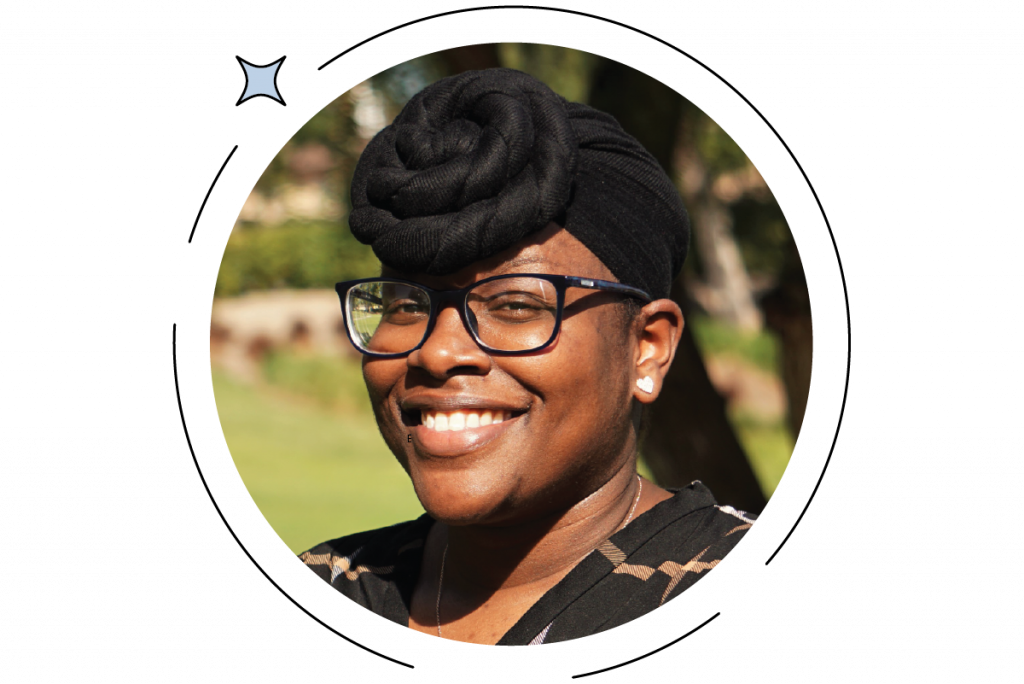
Person with glasses smiling, wearing a black headwrap and earrings, outdoors with trees and sunlight in the background.

About Science Connections

Welcome to Science Connections! Science is changing before our eyes, now more than ever. So…how do we help kids figure that out? We will bring on educators, scientists, and more to discuss the importance of high-quality science instruction. In this episode, hear from our host Eric Cross about his work engaging students as a K-8 science teacher. Listen here!

2025

September 18, 2025

Edutopia: “Using Virtual Manipulatives in Math Class”

Read Full Article

August 19, 2025

Education Week: “Here’s Why It’s Important for Teachers to Have a Say in Curriculum”

Read Full Article

August 18, 2025

Investors Hangout: “Amplify Classroom Revolutionizes K-12 Teaching Experience”

Read Full Article

August 5, 2025

WhaTech: “K-12 Online Education Market Set for Strong Expansion, Reaching $349.77 Billion by 2029”

Read Full Article

August 4, 2025

Education Week: “Districts Using ‘High-Quality’ Reading Curricula Still Supplement With Other Materials. Why?”

Read Full Article

July 9, 2025

K-12 Dive: “Youngest students see big reading gains post-COVID on DIBELS assessment”

Read Full Article

June 25, 2025

The 74: “How Districts in Georgia, Maryland and D.C. Are Raising Reading Proficiency”

Read Full Article

May 28, 2025

Open PR: “K-12 Online Education Market Forecast 2025-2034: Comprehensive Analysis And Growth Opportunities”

Read Full Article

May 27, 2025

District Administration: “Early literacy: How to implement programs that start strong”

Read Full Article

May 20, 2025

EdSource: “California schools prepare to introduce universal reading screening”

Read Full Article

April 23, 2025

The 74: “Eric Adams Expands Reading, Math Curriculum Mandates to All NYC Middle Schools”

Read Full Article

April 21, 2025

Daily News: “NYC expanding reading, math curriculum overhaul to more schools”

Read Full Article

March 19, 2025

Education Next: “School Reinvention in Practice”

Read Full Article

February 28, 2025

K-12 Dive, “Test yourself on this week’s K-12 news”

Read Full Article

February 26, 2025

K-12 Dive: “Only 56% of K-2 students are ready to read”

Read Full Article

January 24, 2025

Chalkbeat Philadelphia: “Two AI-powered charter schools could soon open in Pennsylvania”

Read Full Article

January 16, 2025

Tech & Learning: “What is Polypad and How Can Teachers Use It?”

Read Full Article

2024

December 18, 2024

EdSource: “State takes another step toward mandatory testing for reading difficulties in 2025”

Read Full Article

December 6, 2024

Chalkbeat Philadelphia: “Philadelphia is now spending over $100 million on its curriculum overhaul. Here’s a breakdown.”

Read Full Article

November 27, 2024

Lincoln Journal Star: “Lincoln Public Schools drops a classification rating on statewide assessment”

Read Full Article

November 6, 2024

EdNC: “New K-3 literacy data shows growth in skills for North Carolina students”

Read Full Article

October 1, 2024

The 74: “As NY District Implements Science of Reading, Parents Push for New Focus on Math”

Read Full Article

September 18, 2024

Tech & Learning: “Tech & Learning Announces Winners of Best for Back to School 2024”

Read Full Article

August 22, 2024

Chalkbeat Philadelphia: “Philadelphia school board renews charters, funds tutoring and a new science curriculum”

Read Full Article

August 2, 2024

EdNC: “‘Dedication of our teachers’ praised in an update on the state’s science of reading journey”

Read Full Article

July 31, 2024

The 74: “Classroom Case Study: To Maximize the Impact of Curriculum Mandates, Follow the Science of Reading”

Read Full Article

July 23, 2024

Chalkbeat: “Should teachers customize their lessons or just stick to the ‘script’?”

Read Full Article

July 7, 2024

The Economist: “Will artificial intelligence transform school?”

Read Full Article

June 24, 2024

Chalkbeat: “Math instruction overhaul: NYC unveils new curriculum mandate for middle and high schools”

Read Full Article

June 6, 2024

EdNC: “Perspective | Teachers are the heroes of the literacy story in North Carolina”

Read Full Article

May 24, 2024

The Dallas Morning News: “How Don Quixote changed a Dallas public school classroom”

Read Full Article

May 2, 2024

Akron.com: “Tutoring program at Summit Academy Akron Elementary School attracts national interest”

Read Full Article

April 25, 2024

Edutopia: “Using Tech Tools to Energize Young Students’ Math Learning”

Read Full Article

April 4, 2024

EdNC: “State Board hears update on district ESSER spending, literacy data, and Restart schools”

Read Full Article

March 22, 2024

Thomas B Fordham Institute: “Five takeaways from Ohio’s baseline survey of elementary reading curricula”

Read Full Article

March 15, 2024

The 74: “New Data: Despite K-2 Reading Gains, Students Face a ‘Much Harder Journey’ Ahead”

Read Full Article

March 5, 2024

The 74: “Case Study: How One Texas School District Is Repurposing Staff Development Time to Embrace the Science of Reading”

Read Full Article

February 21, 2024

Times Record News: “UPDATED: Texas Education Commissioner Mike Morath likes what he sees at local school”

Read Full Article

February 19, 2024

Chalkbeat: “Chicago Public Schools recover from pandemic declines more than other districts, study shows”

Read Full Article

February 7, 2024

The 74: “Building Oral Language Skills and Equity Through High-Quality Reading Curriculum”

Read Full Article

2023

December 19, 2023

The 74: “Best Education Articles of 2023: Our 23 Most Important Stories About Students, Schools & Learning Recovery ”

Read Full Article

December 8, 2023

Education Week: “Aligned Science Curriculum, Better Scores? Research Finds a Connection”

Read Full Article

December 6, 2023

WRAL News: “Reading readiness rises in NC’s K-3 classrooms, new data shows”

Read Full Article

November 27, 2023

The Dallas Morning News: “Dallas’ new lessons aim to keep kids on track, but some worry about limiting teachers”

Read Full Article

November 2, 2023

Fort Worth Report: “Black students in Fort Worth ISD still struggle to read at grade level”

Read Full Article

October 31, 2023

Chicago Tribune: “Lake Forest-area schools take stock of state grades; ‘While we celebrate our successes, we acknowledge that the journey … is ongoing’”

Read Full Article

October 19, 2023

Chalkbeat: “NYC eyes middle and high school literacy overhaul. It’s asking families to weigh in.”

Read Full Article

October 16, 2023

The 74: “As Virginia Rolls Out Ambitious Statewide High-Dosage Tutoring Effort This Week, 3 Keys to Success”

Read Full Article

October 6, 2023

Language Magazine: “Embracing Bilingual Assessment”

Read Full Article

September 18, 2023

Tech & Learning: “Best for Back to School 2023”

Read Full Article

September 18, 2023

Chalkbeat: “Chicago Public Schools hired hundreds of tutors with federal COVID money. Can they keep them?”

Read Full Article

September 7, 2023

EdNC: “Perspective | Union County Public Schools empowers educators, elevates readers”

Read Full Article

August 14, 2023

Chicago Parent: “Common Core Math: How to Help Your Kids”

Read Full Article

August 6, 2023

The News & Observer: “NC sees big increase in reading skills among K-3 students. Is the state back on track?”

Read Full Article

August 4, 2023

The 74: “Slow Literacy Gains, Long COVID in Kids: 7 Insights into Pandemic Recovery and Aftermath in U.S. Schools”

Read Full Article

August 3, 2023

EdNC: “State Board of Education: New reading data, parental leave, and a call to support public schools”

Read Full Article

July 28, 2023

Houston Public Media: “New literacy curriculum is among the many changes coming to HISD”

Read Full Article

July 17, 2023

Houston Chronicle: “Mike Miles says HISD schools will teach the ‘science of reading.’ Here’s what that means.”

Read Full Article

July 11, 2023

The 74: “‘Education’s Long COVID’: New Data Shows Recovery Stalled for Most Students”

Read Full Article

July 6, 2023

Houston Chronicle: “HISD superintendent gives voluntary schools one last chance to back out of New Education System”

Read Full Article

June 29, 2023

The Report Card: “Larry Berger on Curriculum”

Read Full Article

June 2, 2023

EdWeek Market Brief:”K-12 Dealmaking: Substitute Teaching Startup Secures $38M; Amplify Raises Undisclosed Series C”

Read Full Article

May 25, 2023

The 74: “Expanding Access to Tutors: Nonprofit Grants $6 Million to 32 Learning Organizations Across 20 States to Help More Students”

Read Full Article

April 21, 2023

The 74: “The ‘Transformation is Real’ as Science of Reading Takes Hold in N.C. Schools”

Read Full Article

April 18, 2023

The 74: “Louisiana District Ravaged by Hurricane & COVID is Bouncing Back with Science”

Read Full Article

April 5, 2023

WFAE: “NC midyear reading data shows gains, but third-grade goals remain elusive”

Read Full Article

April 5, 2023

EdNC: “K-3 students show growth in literacy skills, mid-year DPI data show”

Read Full Article

March 24, 2023

The 74: “COVID & School Recovery: Critics Warn Washington Bill Would Reduce Classroom Learning Time By 4 Hours a Week”

Read Full Article

March 24, 2023

Edutopia: “Using Collective Leadership to Make a Major Shift in Your District”

Read Full Article

March 15, 2023

K-12 Dive: “California at center of latest push for science-based reading approaches”

Read Full Article

March 7, 2023

District Administration: “ESSER pressure: How one district intends to spend wisely as deadline looms”

Read Full Article

March 3, 2023

The 74: “‘The Other Long COVID’ Affecting Kids: Missed Opportunities”

Read Full Article

March 2, 2023

3 WTKR: “More students on track to learn to read in 2022-2023 school year since start of pandemic, researchers say”

Read Full Article

March 2, 2023

ABC 7: “Reading skills rebounding for young students following pandemic disruptions”

Read Full Article

March 1, 2023

K-12 Dive: “By The Numbers: DIBELS testing shows improved reading progress over last two years”

Read Full Article

February 27, 2023

The 74: “Exclusive: Despite K-2 Reading Gains, Results Flat for 3rd Grade ‘COVID Kids’”

Read Full Article

February 27, 2023

Education Week: “Students’ Early Literacy Skills Are Rebounding. See What the Data Show”

Read Full Article

February 7, 2023

The 74: “Using High-Quality Curriculum Doesn’t Mean You Can’t Still Have Fun Learning”

Read Full Article

January 13, 2023

NPR: “Can a middle school class help scientists create a cooler place to play?”

Read Full Article

January 6, 2023

News & Record: “After a numbing low, NC students now heading in ‘right direction’ in reading, math”

Read Full Article

January 5, 2023

CBS17.com: “K-3 students in NC make significant strides on literacy exams, DPI says”

Read Full Article

2022

December 20, 2022

District Administration: “Literacy Under the Lights: 10 ways to bring the community back together”

Read Full Article

December 14, 2022

The 74: “14 Charts This Year That Helped Us Better Understand Covid’s Impact On Students Teachers and Schools”

Read Full Article

December 14, 2022

The 74: “Learning Loss Is Worse than NAEP Showed. Middle School Math Must Be the Priority”

Read Full Article

November 21, 2022

Voicebot.ai: “SoapBox Labs Brings Child-Centered Voice AI to Dyslexia Detection Assessment”

Read Full Article

October 24, 2022

Education Week: “Two Decades of Progress, Nearly Gone: National Math, Reading Scores Hit Historic Lows”

Read Full Article

October 20, 2022

The 74: “Exclusive Literacy Data: Small Gains Since Last Fall, But No Reading Rebound”

Read Full Article

August 30, 2022

The 74: “Test English Learners in the Languages They Speak at School and at Home”

Read Full Article

August 29, 2022

WTKR TV NC: “News 3 investigates childhood literacy rates, raising money to give books to local kids for new school year”

Read Full Article

August 28, 2022

EdNC: “Elementary students made growth last year in skills that lead to reading proficiency, new data show”

Read Full Article

August 18, 2022

SHRM Blog: “The Great Resignation Skipped Us. Here’s why.”

Read Full Article

August 16, 2022

Forbes: “Curious About Knowledge-Building Curricula? Check Out This Website”

Read Full Article

July 20, 2022

District Administration: “Out-of-school STEM learning is much more powerful when it’s inclusive”

Read Full Article

July 19, 2022

Chalkbeat: “The state of learning loss: 7 takeaways from the latest data”

Read Full Article

June 28, 2022

The Preschool Podcast: “Early literacy strategies that stick with Darryl from Run-DMC and Makeda from Nickelodeon [Podcast]”

Listen To The Podcast

May 24, 2022

Forbes: “States That Want To Boost Literacy Should Keep An Eye On Texas”

Read Full Article

April 24, 2022

Business Ecosystem Alliance: “Ecosystems in Education–Collaborating to Efficiently Serve the End User”

Watch Full Video

April 18, 2022

KQED Mind Shift: “Weighing the best strategies for reading intervention”

Read Full Article

April 15, 2022

Fordham Institute: “Assessing a standards-aligned physical science curriculum”

Read Full Article

March 23, 2022

The Baltimore Sun: “National test scores show student gains from in-person learning in all but a critical group: new and pre-readers | COMMENTARY”

Read Full Article

March 15, 2022

NPR: “Two years ago schools shut down around the world. These are the biggest impacts”

Read Full Article

March 11, 2022

The Hub – Dallas ISD: “Students at Greiner and Anson Jones Elementary find success in reading and writing with a new program”

Read Full Article

March 10, 2022

NY Daily News: “Read it and weep: The new reading instruction emergency”

Read Full Article

March 10, 2022

WISH TV Indianapolis: “Study shows student performance plummeted during pandemic”

Read Full Article

March 9, 2022

New York Post: “Young students have suffered ‘alarming’ drops in reading skills during pandemic”

Read Full Article

March 9, 2022

The Daily Caller: “Childhood Literacy Plummeted Following Pandemic Shutdowns, Studies Show”

Read Full Article

March 8, 2022

The New York Times: “It’s ‘Alarming’: Children Are Severely Behind in Reading”

Read Full Article

March 7, 2022

Education Next: “The Education Exchange: Pandemic Hurt Younger Students’ Learning Worse, Amplify Data Suggest”

Listen to the Podcast

February 28, 2022

The 74: “Our 12 Best Education Articles in February: Reflections on 700 Days of COVID Chaos, Setting a Bar for Unmasking in Schools, Burying Schools in Record Requests & More”

Read Full Article

February 24, 2022

The Daily Advertiser: “Reading scores improve slightly, but pre-COVID reading levels are ‘the wrong goal’”

Read Full Article

February 24, 2022

Wall Street Journal: “The School Shutdowns and Lost Literacy”

Read Full Article

February 23, 2022

K-12 Dive: “DIBELS data illustrates pandemic reading setbacks”

Read Full Article

February 22, 2022

ABC 7 Buffalo: “Children falling behind in reading”

Read Full Article

February 18, 2022

The Carolina Journal: “Report: Elementary students lag in literacy due to pandemic”

Read Full Article

February 16, 2022

The 74: “‘We Have First-Graders Who Can’t Sing the Alphabet Song’: Pandemic Continues to Push Young Readers Off Track, New Data Shows”

Read Full Article

February 16, 2022

Education Week: “More Than 1 in 3 Children Who Started School in the Pandemic Need ‘Intensive’ Reading Help”

Read Full Article

February 4, 2022

Literary Hub: “EXCLUSIVE: Watch Joshua Bennett Discuss A.R. Ammons’s poem “Cascadilla Falls”

Read Full Article

January 26, 2022

The Ross Kaminsky Show: “Susan Lambert and the Literacy Gap”

Listen to the podcast

January 19, 2022

K-12 Dive: “Report: Colorado reading law update boosts quality of literacy curriculum”

Read Full Article

2021

December 15, 2021

Chalkbeat: “How Denver plans to address a drop in early elementary reading scores”

Read full article

December 8, 2021

The SHRM Blog: “What’s the Best Work Perk of All? Contributing to the Social Good”

Read full article

November 13, 2021

Hechinger Report: ‘The Reading Year’: First grade is critical for reading skills, but kids coming from disrupted kindergarten experiences are way behind”

Read full article

October 20, 2021

Hechinger Report: “OPINION: Younger students were among those most hurt during the pandemic”

Read full article

September 2, 2021

EdSurge: “An Edtech User’s Glossary to Speech Recognition and AI in the Classroom”

Read full article

September, 2021

SIIA Education: “ED TECH SUCCESS STORIES”

Read full article

August 23, 2021

CNN: “Irish tech firm helps kids’ voices be heard”

Read full article

August 18, 2021

SoapBox Labs: “Can Speech Recognition Help Children Learn to Read?”

Read full article

August 12, 2021

FOX Chicago Broadcast Interview: “Pandemic widens literacy gap for students”

Read full article

August 3, 2021

T.H.E Journal: “More Students of Color at Risk in Reading After Pandemic”

Read full article

July 28, 2021

The 74: “Early Reading Skills See a Rebound From In-Person Learning, But Racial Gaps Have Grown Wider, Tests Show”

Read full article

July 28, 2021

K-12 Dive: “Reports: Math, reading progress slowed during first full school year of pandemic”

Read full article

July 20, 2021

EdNC: “The mCLASS reading assessment tool is back in North Carolina classrooms, but it’s going to look different”

Read full article

July 5, 2021

WBAL: “Baltimore students from all socio-economic backgrounds get a chance to ‘Amplify’ their learning skills”

Read full article

June 15, 2021

Language Magazine: “Using Evidence to Overcome Adversity”

Read full article

May 7, 2021

The Dallas Morning News: “How can a one-minute kindergarten test help teachers tackle the ‘COVID slide’?”

Read full article

April 20, 2021

Education Week: “How Teachers and Curriculum Will Shape Ed Tech’s Future: A CEO Makes the Case”

Read full article

March 24, 2021

The Hechinger Report: “OPINION: Children will need summer tutors to make up for pandemic learning loss”

Read full article

March 23, 2021

Education Week: “Most States Fail to Measure Teachers’ Knowledge of the ‘Science of Reading,’ Report Says”

Read full article

March 17, 2021

Axios: “How online education and tutoring could fight COVID learning loss”

Read full article

March 16, 2021

USA Today: “Students are struggling to read behind masks and screens during COVID-19, but ‘expectations are no different’”

Read full article

March 16, 2021

The 74: “Schools and COVID, a Year Later: 12 Months After Classrooms Closed, 12 Key Things We’ve Learned About How the Pandemic Disrupted Student Learning”

Read full article

February 25, 2021

K–12 Dive: “Reading gaps widen in mid-year data, especially for K-1 students of color”

Read full article

February 24, 2021

The 74: “One Year into Pandemic, Far Fewer Young Students are on Target to Learn How to Read, Tests Show”

Read full article

February 17, 2021

NBC Los Angeles: “Local Students Design Rovers in Mission to Mars Student Challenge”

Read full article

February 5, 2021

District Administration: “To save literacy, focus first on high-quality core instruction”

Read full article

February 4, 2021

The Hechinger Report: “5 ways schools hope to fight Covid-19 learning loss”

Read full article

January 5, 2021

The 74: “Science Matters Now More than Ever. The Time to Start Teaching It Is in Elementary School”

Read full article

2020

December 15, 2020

Education Week: “Students’ Reading Losses Could Strain Schools’ Capacity to Help Them Catch Up”

Read full article

December 9, 2020

Education Post: “How to Help Beginning Readers During the Pandemic”

Read full article

December 3, 2020

American Consortium for Equity in Education: “The Importance of Quality Curriculum With Industry Voice”

Read full article

September 29, 2020

The 74: “Beyond the Scantron: Ed Tech CEO Larry Berger on Why the Pandemic Is No Excuse to Abscond Accountability and ‘Disruptions Are Great Opportunities to Try Something New’”

Read full article

May 25, 2020

The 74: “Class Disrupted Podcast Episode 2: Why Is My Child Doing So Many Worksheets Right Now?”

Read full article

February 5, 2020

Getting Smart Podcast: “Larry Berger on EdTech Past and Future”

Read full article

Inspiring the next generation of Indiana scientists, engineers, and curious citizens

Amplify Science is a proven effective core curriculum designed for three-dimensional, phenomena-based learning that provides an immersive experience for science students. Amplify Science was developed in partnership with the science education experts at UC Berkeley’s Lawrence Hall of Science.

image of Amplify Science and science classroom materials for science teachers

What is Amplify Science?

Amplify Science is a curiosity-driven science curriculum that empowers students to Do, Talk, Read, Write, and Visualize like scientists. Through phenomena-based, literacy-rich, and interactive learning experiences, students develop as critical thinkers who will gain the skills they need to solve real problems in their communities and the world.

Each unit of Amplify Science engages students in a relevant, real-world problem where they investigate scientific phenomena, engage in collaboration and discussion, and develop models or explanations in order to arrive at solutions.

Grounded in research

Developed by the science education experts at UC Berkeley’s Lawrence Hall of Science in partnership with the digital learning team at Amplify, our program features:

  • A phenomena-based approach where students construct a deep understanding of each unit’s anchor phenomenon.
  • A blend of cohesive storylines, hands-on investigations, lively discussions, literacy-rich activities, and digital tools.
  • Carefully crafted units, chapters, lessons, and activities designed to deliver truly authentic three-dimensional learning.
  • An instructional design that supports all learners in accessing all standards.

See more of our research.

Aerial view of the lawrence hall of science at the university of california, berkeley, showcasing the building and surrounding trees with a foggy city backdrop.
Two boys sit at a desk using a laptop in a classroom. Insets show a close-up of sewing, and a child in rain boots splashing in water.

Instructional model

The Amplify Science program is rooted in the research-based proven effective pedagogy of Do, Talk, Read, Write, Visualize.

Here’s how each element works:

Do

Learners engage with scientific phenomena by conducting student-centered investigations.

Talk

Students engage in collaborative and inquisitive discussions and scientific argumentation.

Read

Reading scientific texts is an act of inquiry: Students ask questions, gather evidence, and make connections through literacy.

Write

Students write to share what they have learned and apply new evidence to strengthen written arguments and explanations.

Visualize

Students gather evidence through simulations, physical models, and modeling tools, allowing them to see and investigate complex, microscopic, or otherwise unobservable phenomena.

What’s included

Flexible resources that work seamlessly together

Four children gather around a desk, engaged in a hands-on activity. Two illustrations frame the main image: a storm cloud on the left and a sea turtle on the right.

Grades K–5 materials

A stack of educational science books, ideal for the curious mind of a science student, with titles like "What My Sister Taught Me About Magnets" and "Made of Matter." Perfectly aligned with any science curriculum to inspire young learners in the classroom.

Student Books

Age-appropriate Student Books allow students to:

  • engage with content-rich texts
  • obtain evidence
  • develop research and close-reading skills
  • construct arguments and explanations
Three science notebooks ideal for the science student, titled "Balancing Forces," "History of Earth and Sky," and "Properties of Matter." Each features colorful illustrated covers that enhance three-dimensional learning in the classroom.

Student Investigation Notebooks

Available for every unit, the Student Investigation Notebooks provide space for students to:

  • record data
  • reflect on ideas from texts and investigations
  • construct explanations and arguments
A digital illustration displays a laptop with screens showcasing environmental graphics, including plants and diagrams, perfect for a science student exploring rich science resources.

Simulations and practice tools (grades 2+)

Developed exclusively for the Amplify Science program, these engaging digital tools:

  • serve as venues for exploration
  • enable data collection
  • allow students to explore scientific concepts
  • show what might be impossible to see with the naked eye


A laptop displaying a web page titled "Spinning Earth" sits next to a book on investigation, ideal for the science student delving into valuable science resources.

Teacher’s Guides

Available digitally and in print, the Teacher’s Guides contain all of the information teachers need to facilitate classroom instruction, including:

  • detailed lesson plans
  • unit and chapter overview documentation
  • differentiation strategies
  • standards alignments
  • in-context professional development
A pegboard with pegs, a small solar panel with clips, and three containers with different powdered substances are perfect science resources for enhancing your science curriculum.

Hands-on materials kits

Hands-on learning is at the heart of Amplify Science. Each unit kit contains:

  • consumable and non-consumable hands-on materials
  • print classroom display materials
  • premium print materials for student use (sorting cards, maps, etc.)

Grades 6–8 materials

A laptop displays a diagram about jellyfish population explosion; next to it is a magazine page featuring a scientist who preserves artwork.

Science articles

The middle school science articles serve as sources for evidence collection and were authored by science and literacy experts at the Lawrence Hall of Science.

Four Amplify Science investigation notebooks are displayed, perfectly enhancing any science classroom with their covers showcasing diverse scientific topics.

Student Investigation Notebooks

Available for every unit, the Student Investigation Notebooks provide space for students to:

  • record data
  • reflect on ideas from texts and investigations
  • construct explanations and arguments
  • Available with full-color article compilations for middle school units
Images of data visualization tools displayed on a laptop, showcasing graphs, maps, and analytical data—essential resources for any science student looking to enhance their understanding through interactive learning.

Digital student experience

Students access the digital simulations and modeling tools, as well as lesson activities and assessments, through the digital student experience. Students can interact with the digital student experience as they:

  • conduct hands-on investigations
  • engage in active reading and writing activities
  • participate in discussions
  • record observations
  • craft end-of-unit scientific arguments


A laptop displaying the Geology on Mars webpage sits beside a book titled "Geology on Mars," both featuring the same cover image of Mars and a spacecraft, perfect for enhancing three-dimensional learning in any science classroom.

Teacher’s Guides

Available digitally and in print, the Teacher’s Guides contain all of the information teachers need to facilitate classroom instruction, including:

  • detailed lesson plans
  • unit and chapter overview documentation
  • differentiation strategies
  • standards alignments
  • in-context professional development
A pegboard with pegs, a small solar panel with clips, and three containers with different powdered substances are perfect science resources for enhancing your science curriculum.

Hands-on materials kits

Hands-on learning is at the heart of Amplify Science. Each unit kit contains:

  • consumable and non-consumable hands-on materials
  • print classroom display materials
  • premium print materials for student use (sorting cards, maps, etc.)
Collage of four images: a hairdryer testing a paper structure in a science classroom, a cartoon monkey on a vine, two kids interacting with a wall activity emblematic of three-dimensional learning, and a hand displaying dinosaur-topped pencils with math cards.

Unit Sequence

Our lessons follow a structure that is grounded in regular routines while still being flexible enough to allow for a variety of learning experiences.

In fact, our multimodal instruction offers more opportunities for students to construct meaning—and practice and apply concepts—than any other program. What’s more, our modular design means our units can be flexibly arranged to support your instructional goals.

A chart lists science topics by grade, from Kindergarten to Grade 5, covering subjects like plants, animals, forces, materials, weather, and Earth systems.
A list of science curriculum topics for Grades 6, 7, and 8, organized under each grade with bullet points for subjects like microbiome, geology, energy, and natural selection.

Contact us

Support is always available. Our team is committed to helping you every step of the way. Contact your dedicated Indiana representative here for program access, samples, and additional information.

A woman with long brown hair and a white top smiles at the camera in front of an orange background, showcasing her passion for the Science of Reading and dedication to Indiana middle school education.

Elizabeth Sillies Callahan

Southern IN
(513) 407-5801

A woman with long brown hair and blue eyes smiles gently at the camera. The background is a light purple circle, reflecting her passion for the Science of Reading and dedication to Indiana middle school education.

Jody Kammer

Central IN
(310) 402-7837

Woman with long brown hair, large black glasses, and a nose ring, wearing a striped shirt and dark blazer, posing in front of a neutral background—professional style suited for the Indiana Department of Education.

Amanda Knipper

Northern IN
(260) 894-5123

A woman with wavy red hair and blue eyes, dressed in a purple turtleneck, smiles at the camera against a dark background—reflecting the approachable spirit of Indiana middle school teachers.

Paige Lawrence

District enrollment below 1200
(980) 421-2608

Putting equity first

When so much about the world needs to shift, so urgently… here are a few places to start.

Listen: Educator, author, and leader Shawn Joseph shares his passion for social justice and discusses his work advocating for equity in education, shedding light on what he calls the “silent crisis” in literacy instruction.

Learn: Share Shawn Joseph’s discussion guide with your colleagues. Which insights are the most relevant to your district this year?

Lead: Take a look at this curated collection of multicultural and social justice books. Could one spark discussion for your students?

Lead: Share this infographic on the journey to freedom with your class. Ask students to select an event to research and present a two-minute video talk.

Leveraging the science of reading

Go deep on the insights and practices that will help our classrooms (remote or otherwise)–based on the latest science, and adaptable to every shift in the educational landscape.

Learn: Susan Lambert talks to Language Magazine about the science of reading and what it means right now.

Building strong foundational skills

Strong, systematic sound-first instruction is critical to helping students learn to decode and can increase student success. Learn how specific skills can increase your impact. 

Learn: Start with Emily Hanford’s “Hard Words” article.

Listen: Jasmine Lane on the importance of equity, and how early literacy teachers can make a difference.

Listen: Bruce McCandliss on the changes a child’s brain shows when learning to read

Lead: Challenge a colleague to this Scarborough’s Rope activity–work through a sample lesson from your district and point out elements of the reading rope.

Sharing knowledge resources

Students need to be able to both read words and get the meaning of what they’re reading. Find out how to help them build key background knowledge from the get-go, so that it compounds over time.

Learn: Begin with Why knowledge matters–then follow up with Natalie Wexler’s podcast

Learn: Take a look at Achieve the Core’s overview of the importance of building knowledge and the groundbreaking “baseball study

Listen: Anne Lucas on the importance of comprehension and the specific skills that can boost it.

Listen: Tim Shanahan on four crucial aspects in teaching reading and his views on teaching reading in middle school as an extension of evidence-based early literacy practices

Learn: Begin with Why knowledge matters–then follow up with Natalie Wexler’s podcast

Learn: Take a look at Achieve the Core’s overview of the importance of building knowledge and the groundbreaking “baseball study

Assessing what students need

Assessment this year is more important than ever before–and also more challenging. What does this extended summer slide look like? How can you find time to review what’s needed, while still moving forward?

Learn: Education for Global Development’s thoughts on formative assessment in the time of COVID-19.

Learn: District Administration on why educators want more data– and more guidance on how to use it

Learn: Catch up on dyslexia risk factors and state legislation with our dyslexia toolkit.

Listen: Nancy Nelson on the importance of universal screeners in literacy instruction.

Lead: What can you offer struggling readers and their caregivers? Take a look at the IDA’s COVID-19 Resource Guide.

Thriving through remote learning

Everything about this school year has changed–yet your work is more important than ever before. How can you support your students, and your colleagues, in this new normal? Stop by Amplify Anywhere for ideas that may help.

And while you’re here–please download your free PDF “20 Self-Care Tips for Educators Right Now” (and please take care of yourselves!).

Alana Mangham on Teaching Now

Natalie Wexler on the New Normal

Thinking about back-to-school

Though it feels like the landscape is changing every day, we know we’ve got to find a way to get students back to learning. What will your school day look like? What reinforcement might you need to do in order to ensure equity? We will continue to share resources to support your journey.

Learn: In this recorded webinar, explore some ways CARES Act funding might support your students.

Learn: Hear from Baltimore educator Lucas Drerup on making middle school ELA both enjoyable and rigorous for students.

Listen: Jackson-Madison CAO Jared Myracle shares his thoughts on change management and the science of reading.

Listen: Doug Lemov, managing director of Uncommon Schools, discusses the role of technology in the classroom and remote instruction, and how educators can reconsider how they approach literacy.

Lead: As you consider how and when to reopen, review this article from The Atlantic on Eight steps that will let us reopen schools.

Lead: Guidance from District Administration on reopening safely this fall.

Finding high-quality instructional materials

If you were already thinking about new literacy resources–you’ve now got even more ideas about what high quality looks like. How will your literacy program work for all students? How do you need your literacy resources to support you in the classroom, in remote learning, and for every scenario in between?

Learn: Review this guide to a high-quality curriculum adoption.  What factors matter most now, in literacy and in every subject?

Listen: Hear nationally recognized reading experts and authors David and Meredith Liben discuss evidence based solutions and more.

Lead: Download this K-8 ELA Instructional Materials Evaluation Guide. Share with your district leadership. What resources will you all need next year (and beyond) to do the best job possible for your students?

Lead: Talk to a few colleagues in the coming weeks. What are they seeing right now? What are they planning to improve next year?

Staying strong and staying connected!

Illustration for

Looking for ways to connect with other educators and stay updated on the latest research and trends in the science of reading? Check out a few more ways to do so below.

Science of Reading: The Podcast delivers the latest insights from researchers and practitioners in early reading. Further your professional development with each episode by subscribing and downloading them now.

Science of Reading: The Community is built for those committed to fostering conversation around the science of reading and implementing best practices in the classroom (including the virtual classroom).

Ready for more? Complete the form below to stay up-to-date on the latest resources.

Amplify Classroom and Polypad free and commercial use guidelines

If you’d like to use Amplify’s tools or content in your work, please review these guidelines to determine if your specific use is allowed and whether you need to submit a request for approval.

Overview

Amplify Classroom offers free prebuilt interactive and print-based lessons, interactive lesson-building tools, and Polypad virtual manipulatives. See amplify.com/classroom and polypad.amplify.com for more information.

Amplify Classroom features:

  • Activity Builder (labeled “Custom Activities” in the platform): This content-creating and publishing tool enables educators to create their own interactive lessons and edit existing lessons.
  • Polypad virtual manipulatives: These virtual manipulatives allow teachers and students to explore concepts, express their creativity, and visualize their thinking. Polypad virtual manipulatives can be embedded directly into lessons via Activity Builder or used as a stand-alone, dynamic workspace.
  • Computation Layer: This feature enables educators to further customize lessons created with Activity Builder. Computation Layer is the code that allows components within the lessons to “talk” to one another, enabling users to connect representations; customize content; and provide dynamic, interpretive feedback. Computation Layer is accessible through Activity Builder.

Amplify Classroom includes activities and lessons across many subjects, created by the thousands of educators on our platform. Content created by Amplify is tagged “By Amplify,” “By Amplify Classroom,” or “By Desmos Classroom.”

Amplify also publishes paid core curriculum programs, including Amplify Desmos MathAmplify ScienceAmplify CKLAAmplify Caminos, and Amplify ELA. These products can be reviewed and purchased by schools or districts interested in comprehensive resources aligned to standards and designed to motivate students. Some of the lessons that are free to use on Amplify Classroom (labeled Try It! lessons) are also part of these paid products. Learn more about our products and request a sample.

Amplify Classroom tools and content (other than paid products) are free for personal, educational, and non-commercial use, subject to our Acceptable Use Policy and Usage Guidelines. These guidelines also permit certain commercial uses. You generally don’t need to submit a request to use our free tools and resources for the permitted purposes covered in these guidelines. As long as you are following our Acceptable Use Policy and Usage Guidelines, as well as making appropriate Attributions and Disclaimers, you are permitted to move forward with your project. To make sure your use is permitted, please read these guidelines thoroughly and in their entirety. If you would like to explore a license for a use not permitted here, please submit this form.

Amplify does not own but partners with Desmos Studio, the maker of a suite of free math tools, including a graphing calculator used by over 75 million people around the world. (See desmos.com for more information.) Please contact Desmos Studio for information on using their content or tools.

Usage guidelines

Please adhere to the following guidelines for using Amplify Classroom tools and content in each of the scenarios set out below. You are required to follow our General Guidelines and Attribution requirements below when making permitted uses. You are responsible for clearing any third party marks and content you use in your applications or publications.

Uses labeled “PERMITTED USES” do not require permission, and you do not need to tell us about them—but we do appreciate hearing from you! Feel free to fill out this form to tell us about how you are using our tools and materials, and the ways in which you are finding them useful.

Uses labeled “CONTACT US” do require permission. If you are interested in such use, please submit this form, and someone from our team will endeavor to follow up with you as soon as possible.

Teaching and education services

This section provides guidelines on using Amplify Classroom for teaching and education services.

PERMITTED USES A green checkmark symbol on a light background. Educators creating, modifying (where permitted), and using Amplify Classroom content for classroom teaching in a school
  A green checkmark symbol on a light background. Public school districts, charter schools, and networks creating, modifying (where permitted) and using Amplify Classroom content for classroom teaching
  A green checkmark symbol on a light background. Private tutors creating or using Amplify Classroom content in 1:1 or small-group tutoring sessions
CONTACT US A large red "X" symbol on a light gray background. For-profit school or network of schools implementing Amplify Classroom for the school or network
  A large red "X" symbol on a light gray background. Education publishers and EdTech organizations (whether for profit or non-profit) using or linking to Amplify Classroom content and tools
  A large red "X" symbol on a light gray background. Any organizations or individuals embedding the teaching and learning experience from the Amplify Classroom lessons in their websites or applications (except API/iFrames Polypad integrations permitted below)
  A large red "X" symbol on a light gray background. Educators or other individuals authoring lessons for commercial purposes (e.g., to sell on Teachers Pay Teachers and similar websites)
  A large red "X" symbol on a light gray background. School districts, states, education publishers or technology providers, educators or any other individual or organization (whether for profit or non-profit) using Amplify Classroom content or platform to create paid curricula, educational courses, assessments, or any materials or curricula for submission for a state adoption list; or for offering, marketing, or sale to any schools or educational agencies or organizations, in or outside of the U.S.
  A large red "X" symbol on a light gray background. Instructional/tutoring organizations (whether for profit or non-profit), seeking to use Amplify Classroom for its tutors or instructors

Print and presentations

This section provides guidelines on including content from Amplify Classroom, such as portions of free lessons or images generated using our tools, in printed materials or presentations.

PERMITTED USES A green checkmark symbol on a light background. Books, including textbooks, up to two thousand copies
  A green checkmark symbol on a light background. Periodicals (newspapers, magazines, journals, etc.)
  A green checkmark symbol on a light background. Business documents such as company reports, proposals, presentations, etc.
  A green checkmark symbol on a light background. Academic publications, research papers, Ph.D. theses, and portfolios
  A green checkmark symbol on a light background. Conferences, presentations and accompanying slides
CONTACT US A large red "X" symbol on a light gray background. Books, more than two thousand copies, or as cover art for a book
  A large red "X" symbol on a light gray background. As content within platforms, mobile and tablet applications, PDFs, ebooks, multimedia materials, or other digital resources or products
  A large red "X" symbol on a light gray background. Consumer and retail goods or packaging (e.g., shirts, beach towels, shower curtains, mugs, posters, stationery)

Web and apps

This section provides guidelines for embedding Amplify Classroom tools into your platform.

PERMITTED USESA green checkmark symbol on a light background.Individuals and schools embedding Polypad in their materials for instructional use are permitted to do so; for integration options, see below.
 A green checkmark symbol on a light background.Organizations (whether for profit or non-profit) offering paid services embedding Polypad with <10k requests per year
CONTACT USA large red "X" symbol on a light gray background.Organizations (whether for profit or non-profit) offering paid services embedding Polypad with >10k requests per year
 A large red "X" symbol on a light gray background.Individuals or organizations looking to embed Activity Builder/Computation Layer in their applications
 A large red "X" symbol on a light gray background.Individuals or organizations looking to embed Amplify Classroom tools in larger applications, more complex integrations, white-labeling, or hosting Amplify’s JS files on their own infrastructure
 A large red "X" symbol on a light gray background.Polypad links, screenshots, iFrames, or API uses behind a paywall

Polypad integration options

There are two integration options for using Polypad within your own applications, including:

  • Using iFrames hosted by Amplify.
  • As a white-labeled JavaScript API that can be self-hosted and embedded in other websites or apps.

Developers can customize the features and behavior through numerous options and event listeners, and interact with the canvas programmatically to build custom functionality.

Visit the Polypad API page to learn more about Polypad API license terms and to generate API Key.

General guidelines

Copyright fair use

Your use of our content may be acceptable under principles of fair use (or other similar concepts in other countries). Under the fair use doctrine of the U.S. Copyright Act of 1976, it is permissible to use limited portions of a work for purposes such as commentary, criticism, news reporting, research, and scholarly reports.

Whether a particular use qualifies as fair use depends on a number of factors. For more information see resources from the U.S. Copyright Office, Circular 21Reproductions of Copyrighted Works by Educators and Librarians, and Fair Use Index. Amplify can’t tell you if your use of this content would be fair use, so you may wish to obtain your own legal advice.

Use of trademarks

Our trademarks are valuable assets of Amplify and its licensors, and we want to ensure our users and partners use them correctly. These trademarks include the Amplify word mark and logo, Polypad word mark, Core Knowledge Foundation word mark and logo, the Lawrence Hall of Science word mark and logo, and the Desmos and Amplify Classroom word marks and logos.

Logos

Our logos can only be used if you have an existing partnership, and you’ve reached out to your Amplify contact to secure formal approval from Amplify’s brand team.

Logos must never be used in a way that implies an endorsement or affiliation with Amplify where such a relationship does not exist.

Please contact media@amplify.com if you need to use an Amplify or Amplify Classroom logo.

Please contact Desmos Studio for Desmos Studio branding guidelines and licensing.

Use of product names and features

If making a use permitted under these guidelines or approved by Amplify, you may use the Amplify name or one of our product names or features in plain text to indicate that your product or service integrates with, or relates to, an Amplify product or service.

However, all references must be honest and accurate, and you can’t incorporate these names into your own name or imply an endorsement by Amplify or any of its licensors.

REQUIREDA green checkmark symbol on a light background.Use the complete name “Amplify Classroom” when referencing the platform.
 A green checkmark symbol on a light background.Use “Amplify Classroom lessons” when talking about specific lessons authored in the Amplify Classroom platform.
 A green checkmark symbol on a light background.Use “Teacher-created Amplify Classroom lessons” or “[Company name]-authored Amplify Classroom lessons” when talking about a lesson that has been authored by anyone other than Amplify personnel.
 A green checkmark symbol on a light background.Include required attribution and disclaimers.
PROHIBITEDA large red "X" symbol on a light gray background.Do not imply an endorsement or affiliation with Amplify where such a relationship does not exist.

Attribution and disclaimers

You are required to include a link to the homepage of Amplify Classroom (amplify.com/classroom) and a prominent disclaimer of affiliation when making permissible uses described above in at least one place in your materials, preferably the cover page or landing page.

Visit Amplify Classroom for free lessons, lesson-building tools, and Polypad virtual manipulatives at amplify.com/classroom. This content is not affiliated with, sponsored by, or endorsed by Amplify or any of its licensors. Amplify®, Amplify Classroom, and related trademarks are the property of Amplify Education, Inc.

If your current attribution language refers to Desmos Classroom, please update the attribution to “Amplify Classroom” instead of “Desmos Classroom.”

Contact us

Amplify Classroom and Polypad usage inquiry form for uses labeled “Contact Us”

Thank you for your interest in using Amplify Classroom and/or Polypad. If your intended use falls into one of the categories labeled “Contact us,” please fill out this form, so we can determine the appropriate permissions or licenses:

Country(Required)
Agreement and Next Steps(Required)

Amplify Classroom and Polypad usage inquiry form for uses labeled “Permitted”

Thank you for your interest in using Amplify Classroom and/or Polypad. If your intended use falls under the “Permitted” categories outlined in our use guidelines, please let us know by filling out the form below. This helps us understand how our tools are being used.

Note: If your intended use falls under one of the “CONTACT US” categories outlined in our use guidelines, please fill out this form.

Amplify Classroom and Polypad Permitted Use Form

How can teachers find new energy in the science classroom?

Hear from our Science Connections: The Podcast guest and science PD expert Jessica Kesler

In the final episode of the latest season of Science Connections: The Podcast, host Eric Cross sits down with Jessica Kesler, professional development facilitator for science teachers. 

During the episode, Kesler describes her passion for sharing high-impact teaching strategies for science teachers and her experiences teaching in Philadelphia, and discusses how teachers’ roles often involve more than just delivering content.

Read on for a peek at the episode, and to learn more about science professional development for teachers. 

Meet Jessica Kesler

“I wanted to be a surgeon,” says Kesler. But learning about science ultimately inspired her to help others learn it, too. Her passion is to empower educators to create engaging and effective classrooms that will foster future leaders, work she is able to do in her role as a professional development facilitator at TGR Foundation, a Tiger Woods charity. This position enables her to develop and implement professional learning experiences focused on STEM-based, student-centered learning practices.

Before joining the TGR Foundation, she taught in Philadelphia schools as a chemistry and science teacher for grades 4–12, which was a bit of a culture shock. Kesler had gone from teaching near-adults who could drive themselves to school to teaching young children who often related to teachers as parent figures. The experience taught her a lot about “patience and breaking information down even smaller,” she says.

I had to figure out new and inventive ways to teach science and bring it down so far that students would be able to grab onto it and achieve it. It was a challenge,” she continues.  “But in the end it paid off. We hit our goals out of the park.

Teachers are the multipliers we need

Kesler and her team at the TGR Foundation designed their goals around a challenge issued by Tiger Woods himself: Reach millions of kids. 

They knew that reaching one student at a time would make it hard to reach their goals. 

The key? Focus on teachers, who can reach hundreds of students at a time. “They can have this multiplicative effect that can help us reach those millions of kids and help prepare them for careers,” she says.

Here are just a few of the teaching strategies and pieces of advice they offer science educators: 

  • Develop your inquiry environment. This means thinking not just about your physical space, but also your intellectual space. Kesler asks: “What are the things that you can embed into your physical space and develop in a student’s intellectual space that will help you create a holistic and growing environment?”
  • Be the entrepreneur of your classroom. Kesler and her team like to ask how a teacher can use entrepreneurial techniques to tackle issues in their schools, districts, and spheres of influence.

“Teachers are eager, but tired,” says Kesler. She notes that while school may be back in session, educators are still managing the effects of the pandemic and trying to get kids excited (and keep them excited) about science.

While teachers want to learn and do more, they are more concerned than ever about having enough time, funding, and energy to do so. 

Says Kesler: “I know you don’t have enough time to try to do 29 extra things. My advice is always: Do one thing at a time. Start with something small. Asking your students a few questions rather than lecturing to them doesn’t take a whole lot of extra time, but it gives you so much extra insight. So let’s not work harder. Let’s work smarter.” 

She continues: “It’s not Thanksgiving, where you just keep piling on a plate. It’s a time where you organize your inquiry to restructure your plates so that everything has a place and a time.”

Listen to the whole episode and to the rest of the podcast.

About Amplify’s Science Connections: The Podcast

Science is changing before our eyes, now more than ever. So how do we help kids figure that out? How are we preparing students to be the next generation of 21st-century scientists?

Join host Eric Cross as he sits down with educators, scientists, and knowledge experts to discuss how we can best support students in science classrooms. Listen to hear how you can inspire kids across the country to love learning science, and bring that magic into your classroom for your students.

Embracing artificial intelligence in the math classroom

Artificial intelligence seems to be everywhere these days. We use it when we ask Alexa or Siri for the morning weather report. We use it when GPS tells us how to best avoid traffic. We use it when we chill at the end of the day with a recommendation from Netflix. 

But what about during the day—and specifically, at school? Even more specifically, can AI be leveraged to enhance the math classroom? 

“While AI is an amazing tool, you’ve really got to make sure that you are focusing in on your expertise as well,” says veteran math educator and STEM instructional coach Kristen Moore, “And saying, ‘How can I use this to make something better?’ and not just, ‘How can I use this to make something?’” 

In this post, we’ll talk about the current state of AI in math education, and how it can support educators in making math better. (SPOILER: It’s not going to replace you!) 

First, some STEM learning for us: What is artificial intelligence? 

Artificial intelligence, or AI, refers to the development of computer systems able to perform tasks that typically require human intelligence. 

It involves creating algorithms and systems that enable computers to learn from data, adapt to new situations, and make decisions or predictions.

AI aims to mimic human cognitive functions such as understanding language, recognizing patterns, solving problems, and making decisions. It encompasses a range of techniques and technologies, including machine learning, neural networks, natural language processing, and robotics.

The term “artificial intelligence” was introduced in 1956.  The availability of vast amounts of data and advancements in computer power in the 2010s led to additional breakthroughs. And with the proliferation of smartphones, smart devices, and the internet, AI technologies began to work their way into our homes, cars, pockets, and everyday lives.

What’s the state of AI in education? 

AI is already commonplace in schools and classrooms. Here are just a few examples:

  • Adaptive learning: This software uses AI algorithms to adjust the difficulty and content of lessons based on a student’s performance, helping students remain engaged and challenged at their optimal level.
  • Assistive technologies: AI helps students with disabilities by providing assistive technologies like text-to-speech and speech-to-text tools, making educational content more accessible.
  • Plagiarism detection: These tools use AI algorithms to identify instances of copied or unoriginal content in students’ assignments, essays, and projects. 
  • Data analysis for teachers: AI analyzes data from student assessments to identify trends and insights, helping teachers make informed decisions about instructional strategies. It can also predict students’ performance trends, helping teachers identify at-risk students early and intervene to provide additional support.
  • Grammar, spelling, and style checkers: AI can provide real-time feedback to students (and teachers!) on their writing work.

Embracing AI technology in your math classroom

While AI is not here to replace teachers, it is here to stay. And experts say it’s only going to become more commonplace. But despite how common AI is already—both outside and inside school—not all teachers are familiar with its numerous applications and potential. Now is a great time for educators to start exploring its uses and get ahead of the curve.

Here are a few easy entry points for math teachers. 

ChatGPT: A common AI tool, ChatGPT is designed to understand and generate human-like text based on the input it receives. It’s trained on a wide range of internet text, which enables it to generate responses to a vast array of prompts and questions. 

Most students have likely experimented with ChatGPT, while teachers—though aware of it—are less likely to use it. ChatGPT has highly practical applications for both groups, though—including in the math (and science) classroom. 

It can, for example, help teachers plan interesting, relevant math lessons for their students. Kristen Moore, who discusses this topic on Math Teacher Lounge, suggests that math teachers use ChatGPT to:

  • Connect topics to student interests and vice-versa. (Teachers can ask ChatGPT for real-life applications of polynomials and select those that might pique student interest, or ask about math applications derived from students’ hobbies and pursuits.) 
  • Generate word problems (including step-by-step solutions), lessons, projects and rubrics, and more.

Toward the (near) future

As AI advances, it will continue to revolutionize education. Here are a few time-saving ways that educators can look forward to using it in their classrooms.

  • AI tutors: AI-powered virtual tutors will help math students with homework questions and provide explanations for various concepts. These tutors can be available at home 24/7, allowing students to seek an AI homework helper whenever they need it.
  • Automatic graders: Some AI tools can automatically grade math work, including multiple-choice and short-answer assignments. These tutors can be available at home 24/7 in any household with internet access, allowing students to seek more personalized instruction.
  • Personalized learning paths: These AI-powered platforms will work particularly well for math students by adapting to each student’s skill level and pace, offering tailored exercises and challenges that cater to their strengths and identify areas of improvement. They will analyze students’ performance and adjust the difficulty of content, ensuring that students get targeted support and opportunities to progress.

More to explore

To dive deeper into AI in math education—and get rolling with AI in your classroom—check out this two-episode mini-series on our Math Teacher Lounge podcast focused on just that: 

“I’m a believer that learning is inherently social,” says Carolan, who is quick to emphasize how technology can enhance that quality, not replace it. The same can be said for the role teachers play in the classroom—a role technology can support, but never take away. To learn more about this topic (and discuss it with your fellow educators!), head to our Math Teacher Lounge community

S3-02: How science strengthens literacy and language development

A graphic with the text "Science Connections" and "Amplify" features colorful circles and curved lines on a dark gray background.

In our second episode of the season, we continue finding ways that science is overlooked and how it can be better utilized in schools—and as an ally to other subjects!

We sat down with Susan Gomez Zwiep, former middle school science teacher and senior science educator and staff advocate at BSCS Science Learning. She shared past experiences and research that shows the benefits of integrating science and literacy, as well as strategies for applying these ideas in the classroom.

We hope you enjoy this episode and explore more from Science Connections by visiting our main page!

DOWNLOAD TRANSCRIPT

Dr. Susan Gomez Zwiep (00:00):
We started to see this trend of students communicating more in English because they were excited about the science that they had been learning.

Eric Cross (00:10):
Welcome to Science Connections. I’m your host Eric Cross. In this third season, we’re exploring the theme of science as the underdog. And last time around, we delved into the data showing that compared to other subjects, science is often put on the back burner. Now it’s time to explore why it’s so important to change that and how to do it effectively. So over the course of these coming episodes, we’re gonna make the case for science and equip you with data and strategies for advancing science in your own home, school, or community. To kick things off, we’re going to spend a few episodes going in depth on the integration of science and English instruction. We know we need to dramatically improve literacy rates in this country, and as we’ll show in the coming episodes, science can be a key ally in that goal. We’ll also show how language development and literacy instruction can support science. Yes, it can be a win-win, folks. To start out, I’m joined by someone who has been studying science and language development for more than a decade. Dr. Susan Gomez Zwiep is a senior science educator and staff advocate for BSCS Science Learning. On this episode, she talks about her own experience as a middle school science teacher and share some key insights and strategies from the research on integrating science and English language development. Please enjoy this conversation with Dr. Susan Gomez Zwiep.

Eric Cross (01:36):
Welcome to the podcast. Thank you for being here and having this really important conversation. So I’m so glad you can make it, Susan.

Dr. Susan Gomez Zwiep (01:43):
Yeah, I’m excited to be here.

Eric Cross (01:44):
We’re gonna talk all about language development and science. But first I was hoping that you can just kind of set the stage and tell the listeners about yourself and how you came about to studying this specific subject.

Dr. Susan Gomez Zwiep (01:57):
Sure. So I am a California native. I grew up in the San Gabriel Valley and that’s where I started teaching. I have an undergraduate degree in integrated biology from UC Berkeley. And I thought I was gonna go be a field scientist. And while I was waiting for grad school applications to run their course, I took a substitute job in Montebello to kind of bide my time. And because I had a science degree, they asked if I would take a permanent placement, well, a temporary permanent placement. And I said sure. And found myself teaching seventh and eighth grade general science to a population that at the time was about 68% English language learners, in a school that you would consider urban, under-resourced with a community that was large percentage immigrants from Mexico, Central and South America. And I never looked back. I kept that job.

Dr. Susan Gomez Zwiep (03:04):
I loved it. I love the middle school classroom. I love teaching science to my middle school students and truly, truly just found a really good home for my love of science, but also my love for talking about science and helping other people understand science. So at some point I was entertained with the idea of going to graduate school. So while I was still teaching, I actually did a Ph.D. At the University of Southern California in the science education field. And once there, realized that I actually had a unique experience in higher ed, that experience of teaching with populations that are learning English or have home languages other than English, was actually not common in higher ed circles. And being from that community was also not common. And so I pretty quickly leveraged that experience to combat what I think is universally agreed as an equity issue that in my school where I taught, the district had advocated for ELs to get an extra hour of language development in order to promote their English language proficiency.

Dr. Susan Gomez Zwiep (04:28):
And, our principal wisely said, there are not enough English-only students in this school to do that without losing all of our science teachers because there’s not enough kids left to actually fill a day, a teacher’s day. And she said, these kids learn more language in their science courses than they do anywhere else, so I don’t wanna remove that. But the reality is, is that at that time–this was in the late nineties, early two thousands–if you were not proficient in English, you went to more time with language development. And that makes a lot of sense in some ways. But when you look at the big picture, you realize, well, that means those kids aren’t going to science and they’re not having opportunities to have consistent quality science learning opportunities simply because they spoke a language other than English at home. And so that’s really how I fell into this work.

Eric Cross (05:28):
And that has a downstream effect. I mean, once you start pulling students from a course, that automatically sets the trajectory for later outcomes, which we ultimately see in STEM fields where we, we don’t see the population of our students represented in the STEM fields. Now, I know this goes back a few years, but you were doing research for your Ph.D. What did you start to follow?

Dr. Susan Gomez Zwiep (05:50):
Yeah, so I eventually took a position at Cal State Long Beach, which was not by chance, it’s a Hispanic-serving institution, and that’s where I wanted to do my academic work. And once I was there, sought funding with a district to support elementary science learning. So it had a teacher professional learning component that was both summer and in-class, sort of like PD in the classroom component. And the district came back and said, the only way you are gonna get time to even talk about science in elementary school is if it’s attached to language development. And so that’s what we did. It was a three-year grant, there was a sister grant that followed–so all told, it was about a five-year program where we basically said, what if instead of following the traditional ELD, English Language Development curriculum, we modified and put science as the context for language development in the K2 bands.

Dr. Susan Gomez Zwiep (07:01):
Teachers at the district traditionally had not been excited about their language development curriculum until we said, we’re gonna take that and we’re gonna do some science instead. And then they were like, no, no, no! We love our ELD curriculum. But they hung in there with us. The project was successful enough that it actually became a K4 and then a K5 project. The district ended up having to put in a ton of money into this because the grant only paid for so much. But their schools actually wanted “in” ’cause what they heard is when we put science as a context for language development, kids were talking more. Kids were speaking in English more. Kids were writing more. Kids were engaged. And the ultimate, kids were developing English quickly and in a community where you could actually operate within the community without speaking English. These are Spanish-speaking communities and the schools operated in Spanish outside the classroom. So if you walked into the school’s office, the principal secretary, the person who manned the door, spoke Spanish. The field supervisors that the lunch supervisors spoke Spanish.

Eric Cross (08:17):
The non-teaching staff that are supporting the rest of the students outside of the classroom.

Dr. Susan Gomez Zwiep (08:23):
Yeah. Everybody spoke Spanish and they spoke Spanish at school. And even the principals came back and said, from being in this project, that the kids were coming into the office and had transitioned to communicating in English, especially when they wanted to talk about science, and they really wanted to talk about science ’cause they were super excited about the stuff that they were learning. So we started to see this trend of students communicating more in English because they were excited about the science that they had been learning. And yeah, that sold itself and we had schools jumping in.

Eric Cross (09:01):
So you started off in a situation where you were told that you had to, if you wanna get science and you had to merge it into English, basically. And is it fair to say that that’s because of testing requirements that schools have on them? Like this is what gets analyzed or what was the purpose behind that?

Dr. Susan Gomez Zwiep (09:15):
It was district policy and it was site policy and those policies were put into place for very good intentions. Students don’t get reclassified into English only, and reclassification is how you traditionally got access to all this other programming, electives, AP college prep, all those other things. And the best way to get them reclassified was to learn English, and to learn it sooner rather than later. So it was in an attempt to get kids reclassified from English learner to English proficient.

Eric Cross (09:55):
And then during that process it was able to be expanded to K4. And then with these open-minded teachers, you gave them the content, they used science as the context for learning. And then your students who were mostly emerging bilinguals and multilingual students, you found that they started speaking English more frequently. What did you make of that result? Like what did you come to after seeing all that happen?

Dr. Susan Gomez Zwiep (10:20):
So I do wanna say that there’s a couple of reasons why we think this works so well. But I have to really acknowledge that there were linguistics, second language acquisition experts that were part of this team. And we wouldn’t have been able to make any of this work if it was purely science educators leading this cause. There’s a lot we didn’t understand about language development, and they really helped us. But one of the things that we think is unique about science, there’s a few really important aspects–one is that we all have experiences in the natural world, since we can process outside information, right? We all have observations, things we’ve observed with our eyes, we’ve heard, we’ve felt, and all of those experiences build some pretty good science ideas before we enter formal schooling. You know, kids already have ideas about this.

Dr. Susan Gomez Zwiep (11:20):
We don’t have to give them language for it. They already have these concepts and experiences. The other thing is that we are inherently interested in the natural world we occupy. And so we’re curious, science is often considered cool, there are science channels and science fiction movies and science fiction books and magazines–and this is just … it’s just cool. And that tended to be the trigger, you know, when we gave kids something interesting to observe. A Ziploc bag with water that we added an Alka-Seltzer to, and strange things starts happening in the baggie. That curiosity, that excitement allowed kids to leap over any concerns they had about the language they were supposed to use in the classroom. One of the most difficult things about learning a language is using a language that is imperfect. So saying things and communicating in a language that you are not a hundred percent confident about, that you’re not sure you’re using the right words or the right tenses. But when kids were excited about this thing in a Ziploc bag, they didn’t care. They communicated however they could, sometimes in their primary language or their home language, sometimes in imperfect English, but by and large they just communicated. They did it in oral language, like listening and speaking, but they also did it in writing. And that was easy. Like we didn’t have to do anything other than provide interesting science experiences. And that’s, that’s pretty common.

Eric Cross (13:06):
Yeah. I feel like, to co-sign on the science is cool, it is objectively, if a matter of fact, even just looking at the Oscars, like we have multiverse, you know, we have sci-fi you know, the costume designer of Wakanda Forever. We have all of these different movies that are all founded in some kind of these scientific principles. And so the idea that science is cool and organic, naturally engaging is something I think we, we all can connect to and it resonates with all of us. So I feel like is sort of your origin story too.

Dr. Susan Gomez Zwiep (13:33):
That’s the origin story.

Eric Cross (13:34):
That’s the origin story right there, to continue with this like movie theme. Now if we fast forward to today, based on all the research that you’ve seen since then, and your experience, why would you advocate merging English language development and science?

Dr. Susan Gomez Zwiep (13:49):
Well, for one, the research that we conducted actually provided some really nice evidence that showed, even though we had essentially stole minutes from language development time and inserted science. And on state mandated tests and on their students’ language proficiency measures, the kids in the program with the blended, did significantly better than students who were getting ELD instruction alone. Traditional ELD instruction. And that kind of blew our mind. We would’ve been happy if they had done just fine. Like we could put science into a student’s day and do no harm. They could get their language development; they could get science. But in fact, what we found was that they did better. That they actually gained English more quickly and it showed up in multiple measures, including the state English language arts assessment, which again, kind of blew our mind.

Eric Cross (14:55):
So just to be clear about the study that you did, you looked at two groups and one was the blended science and English language development, and then the other one was a control group. And the blended group ended up showing more improvement.

Dr. Susan Gomez Zwiep (15:09):
Yes. So there’s quite a bit of research now, this research was done in the early two thousands, and the research has built around it to really suggest that this does seem to be a more efficient way to promote language development while still maintaining students’ access to a core content area. But in recent years, the standards have shifted and that has been just a remarkable, wonderful change. And both standards have shifted. So when we did our research, we did it under the old California Science standards that were fairly heavy in technical terms. They were heavy in science concepts rather than kids doing things. And they were a much narrower focus.

Eric Cross (16:04):
And these are the standards that most of us grew up on, right? Those of us who are pretty much teachers in the classroom today pretty much grew up on what you’re talking about. Is that fair to say?

Dr. Susan Gomez Zwiep (16:12):
That’s fair to say, yes. So the new standards that we have now, the California NGSS Standards emphasize not just ideas, but they also emphasize students doing things in science. And we didn’t have to build-in language portions to the standards. They now exist. The NGSS is a very, very rich linguistic opportunity for students. And at the same time, the way we’ve thought about language development has also shifted. We used to talk about language and science… we used to think about science as a lot of words, and you had to know the words, you had to have this technical language. And we’ve sort of shifted that to really thinking about, language is no longer a prerequisite for science learning. Language is now developed through the science learning or the content learning experiences.

Eric Cross (17:11):
So now there’s more chances to integrate English into science. Have you seen success stories or have you seen examples of this? Maybe just anecdotes of teachers kind of doing this since you’ve been doing this research and kind of watching. If so, would you mind sharing one or two?

Dr. Susan Gomez Zwiep (17:30):
Yeah. And I will just give a nod to Dr. Dr. Okie Lee who’s now at NYU who has really led sort of this reconception of language and science. And one of the ways she talks about it is this notion that I enter this learning experience, I enter this observation of this phenomena with fairly naive, simple scientific ideas. And my language about it is equally simple. But as I develop more and more ideas, as my understanding of the phenomenon, what I figured out becomes more sophisticated, I need more sophisticated language. And so what we’re starting to see are these spaces where teachers are building science ideas and science and understanding along with the language. And in order to do that, you really need to know what’s the storyline arc of my science lesson? What do they figure out in lesson one? What do they figure out in lesson two?

Dr. Susan Gomez Zwiep (18:35):
What do they figure out in lesson three? How are the science ideas building over time? So that I can then look at the language that they’re using and what language supports do I need in order to allow students to not only engage and figure things out, but communicate their ideas about it. And so we’re seeing teachers blow up what we call language, what we call text. It’s not just words. It’s not just sentences written on a paper, but it’s models, it’s pictorial representations, it’s gestures, it’s this wide range. We pretty much said, let’s blow language up. Let’s like use all of the linguistic registers that we have in order to make meaning of what we’re seeing it in together in this classroom. So that’s one thing that we’re starting to see. The other thing is that teachers are really allowing students opportunities to use what we call social language, non-standard dialects.

Dr. Susan Gomez Zwiep (19:40):
The language I use at home and with my friends. Because earlier I had said, we have all these experiences and those experiences in the world are tied up in my social register. They’re tied up in my home language ’cause that’s where I experience them. And to let students have access to using that language in the classroom, especially initially in a unit, means we’re giving ’em access to those experiences that they have that are related to the phenomena under study. So I totally understand the benefit of promoting academic language and promoting language frames and forms that we use in more academic settings. But it’s a sticky wicket. You have to be careful how you tell students about the way you want them to communicate. Because when we tell them that language that you use at home with your friends and family is not welcome here, we can send a message that they’re not welcome here. And that those experiences that they have outside of classroom about how things fall, the way sunlight heats up different surfaces, where you’ll find plants and what plants you will find based on conditions. All of those experiences, we’re sending a message that those are not welcome in the classroom. And so this expansion of language, including non-standard dialects and even home language, is really important for letting students bring their whole selves into the classroom.

Eric Cross (21:23):
I love what you just said. It legitimizes the funds of knowledge, the language, the cultures that our students are bringing to the table. I remember when I first learned the word code-switching in college and you know, I’m biracial, I grew up in my home community and my school community were two different communities and I ethnically, culturally belonged to both. And I had to code-switch in order to kind of survive and be accepted into different communities. And not until I was in college did I actually understand what I was doing. Now there were all kinds of teasing and jokes that went on to how I would talk if I code-switched improperly. And in my classroom, I would see students who would explain concepts in a way that was maybe like a casual register. They just were explaining it the best way they could.

Eric Cross (22:10):
And the way they were speaking was kind of denigrated or it was seen as negative even though they were communicating their concept. And when I became a middle school teacher, one of my, I don’t know, it’s like sometimes when you teach, you get to, you change how you were taught or what you experience and legitimizing my students’ language, and they would tell these beautiful stories and in their most common like, casual language, but they’re explaining the concept brilliantly. And it was phenomenal to see this barrier be removed of saying, you have to talk like this in order to be a scientist or you have to say these right words. And, and that’s what I feel like I’m hearing that in how you’re describing kind of how science has been done and what language can do to certain groups of students.

Dr. Susan Gomez Zwiep (22:58):
Yeah, very much so. And you know, back to the origin story, you know, I grew up in a multi-generational household. My mom, my aunt, my grandmother, Spanish was their first language, but they lost it because my mom was raised in Riverside and she, you know, went to school in the, the fifties and sixties and back then you weren’t allowed to speak Spanish at school. And so they lost the language.

Eric Cross (23:27):
They weren’t allowed to speak it at all.

Dr. Susan Gomez Zwiep (23:29):
At all. I didn’t directly observe it, but that is the story that my family tells, that there was no English spoken anywhere on school grounds. And that was a different issue. Right? That was very much for people unfamiliar with some of the history in Southern California. Their segregated schools, severe racism, linguistic racism, racial racism against Mexicans was a real thing. But yet I grew up in this household where the sort of way of speaking, like I think many Mexican households, the context is everything. So you can’t get to the facts until you’ve told the whole context of everything happening around it. So we used to joke that we couldn’t send my grandmother to the doctor by herself ’cause he had 15 minutes, and she was gonna take 20 just to tell him how she got there before she got to why she was there. But this telling of the context, the telling of the story around the idea is part of the linguistic, this sort of linguistic way of my household. When I got to school, I had to learn to drop it because teachers found me off topic. You know, I still have to be careful how I express things and sometimes I’m not a fast storyteller <laugh>, and I monitor that for myself. So I can only imagine what it’s like to be a kid in a classroom.

Eric Cross (24:59):
Right. And there are so many constraints in the school day, you know, especially if you’re multi-subject and you’re elementary and you’re teaching multiple subjects and someone’s trying to tell a story and you’re just like, land the plane! And they’ve, you know, gotta tell ’em the story, but realizing that when you look at it through a lens of like, culturally, this is how we communicate, then it reframes what the student is trying to do. They’re communicating to you based on how they’ve learned to communicate and they’re including essential parts of the story. And so how do you both honor that while also, you know, certain things like brevity and being concise and things like that that they’ll have to learn. But also honoring that and making sure that there’s space for that in your classroom. Even me, I’m thinking about this where I had students record this video and it was one minute to two-and-a-half minutes explaining three concepts. And I had students coming up to me afterwards saying, Mr. Cross, I need to record two videos because two-and-a-half minutes is not long enough. And I was like, how? I even extended it. But I’m realizing and listening to you and going, they’re probably not just getting to the point. They’re probably including more context into this because that’s how they story tell and that was actually part of the lesson.

Eric Cross (26:12):
So now I need to go back and extend their time that I’ve given them for <laugh> that project. I wanna come back to kind of, since we’re on this topic about why this is also an equity issue. Mm-hmm. <affirmative>. So we were talking about language, you touched on this a bit, and we were talking about integrating into science, but can we go a little bit further into how this integrated approach maybe can benefit English language learners in particular? And maybe anything else that’s related to equity that comes to mind.

Dr. Susan Gomez Zwiep (26:40):
So there’s a couple of layers of the equity issue. The most tangible and clear is student access. If we wait until students develop English proficiency to allow them access to quality science learning, we lose a tremendous number of students that could not only could they benefit from science, we could benefit from their entering this science conversation. And I was at a university and I was in a college of natural sciences and we were dedicated to increasing the diversity of the faculty. And it was a struggle ’cause the number of Ph.D. science ed or biology or chemistry academics that come from marginalized populations is very, very small. And it’s not by accident. You know, the number of students that make it into the next level, that make it into college prep courses, that make it into STEM majors, that complete STEM majors and go on to either careers or advanced degrees narrows at every possible step.

Dr. Susan Gomez Zwiep (28:01):
And so the equity issue is really one of access. And as basic as that is, it’s the easiest to solve. So that’s the first layer of equity. But the second issue around equity is how we engage these students once they’re in this space. Do we make it possible for them to see themselves as a scientist or an engineer? Are we creating learning experiences that not only allow them to use all the sense-making resources that they have, but do we make them feel like they’re valuable and useful in that space? Because there’s a lot of people that will say, I could be successful as a scientist, but I’m not willing to give up who I am in order to do that. And that’s a real thing. There’s a lot of research about like, why are they leaving? Like why, you know, is it because they’re not able?

Dr. Susan Gomez Zwiep (29:05):
Is it because they don’t see themselves as being capable? And now I think we’re looking at this as a different issue. It’s not that students don’t see themselves as capable and not that they’re not achieving. They see the cost that it will take to enter these fields and essentially not be able to be their full selves. So that’s the second equity issue. And in both cases we lose. As a society, we lose. We lose access to the full range of human resources that we have, and we lose access to their unique perspectives that they would bring to real problems facing us. It’s like all hands-on deck. We need to stop making it too difficult to participate in the conversation and we need to be more inclusive about how we invite these other perspectives and how we respect and utilize their ways of sense-making. That may not be Western science ways that we have in our books now, but hopefully those science materials are gonna change and we’re gonna start to see other ways of sense-making and other people involved in the stories that we tell around science concepts.

Eric Cross (30:29):
And just to be clear, this practice in integration, while it lifts up equity for marginalized or underrepresented groups or students who are emerging bilinguals or students who typically we don’t see representation of, this approach also benefits native speakers as well. Correct?

Dr. Susan Gomez Zwiep (30:47):
Yeah. And there’s actually a group of native speakers that come from text poor homes. It’s typical in underserved communities. Poor people living in poverty that may be native English speakers. They may not be marginalized populations. But they don’t have access to like text. And so that’s another group altogether that needs linguistic support. And then once you have all voices in the room contributing, everybody benefits because now the conversation, the building understanding conversation we’re having or the sense-making conversation that we’re having has everybody involved. And we all benefit from that.

Eric Cross (31:33):
And we see, I think one of the benefits about a country like the U.S., is we have such a heterogeneous group of people. And when we’re moving in the same direction, we’re all coming to the same problem, but from different perspectives and we’re able to come up with more innovative and novel solutions to them. And that’s kind of what I’m hearing is like as we generate scientists that are all coming from different backgrounds, we’re gonna be able to solve future problems, current problems a lot more effectively because nobody has a monopoly on perspective. Nobody has a monopoly on knowledge or the fastest way to do something or the best way to do something.

Dr. Susan Gomez Zwiep (32:11):
Right. Right. And traditionally we really have privileged particular experiences, particular ways of sense-making particular linguistic registers. And if we could just kind of put that privileged ways aside and open up space for everybody to feel like they have a voice, I think the next generation could change the world. I think they could solve some real problems. I’m truly hopeful that they would see themselves not just as capable, but as necessary in these pursuits.

Eric Cross (32:50):
So what does it actually look like today to do this work in instruction well? So to integrate the science, to integrate literacy, to take the benefits of the things that we’ve been talking about. What are some practical things that educators could do to get started, whether it’s in early, you know, K5 or middle school or even high school.

Dr. Susan Gomez Zwiep (33:13):
So I will say, I’m gonna kind of separate ’cause in the elementary space, students are primarily developing literacy in multiple languages. The language of the classroom, typically English, home language, languages, they may be multilingual. In the secondary setting where students tend to have developed social language in some language, it’s a little different. So I’m gonna kind of separate those two. So for elementary spaces where teachers tend to teach multiple things, I recommend that you get a partner. Don’t do this work alone. You cannot do this work alone. I mean you can, but it’s very frustrating and not nearly as much fun. So you really wanna take a look at what is the science that kids are going to be engaged in. Because when we look at science first and build language development around it, the experience tends to be more authentic and organic.

Dr. Susan Gomez Zwiep (34:18):
And what we used to do is we used to, like when we were talking about the science, we’d monitor the language we were using and then use that to say these are the registers. This is the language that we use when we were thinking about this. So if students are gonna use this, these are the scaffolds they’re gonna need. ‘Cause to do it, well, to do it efficiently, the scaffolds need to be specific to the science learning. So if we’re doing cause and effect, those are specific linguistic scaffolds that are different than if, say we’re doing model and systems and systems models, those are a whole other slew of scaffolds. And so you wanna be really tending to, what is the science being discussed and what is the language that kids are going to use and build scaffolds around it.

Dr. Susan Gomez Zwiep (35:10):
And then you also wanna think about what is the social language? What are the experience that kids will have either in words or pictures that I can leverage in this space. And then you wanna do that for the arc of the unit and slowly increase sophistication around those linguistic supports, as well as the science learning. But if kids have social language and they’re now in, there’s a group we call long-term English learners who have not been reclassified way beyond what the typical reclassification is. And that actually is important to think about because if you think about the kinder group, the group of kindergartners that enter a school when they’re five or six, those kids are going to go from grade to grade to grade. And as students develop proficiency, will get reclassified and they move out of this group that we’re still calling English learners.

Dr. Susan Gomez Zwiep (36:10):
So by the time you get to like seventh, eighth, ninth grade, if they’re still students in that category, they have very different needs on average than the group we started with. Often when we talk about secondary or these long-term English learners, we can leverage social language a lot more, but have to build the scaffolds more carefully around, for lack of a better word, the more academic content transferring that those social nonverbal language into more sophisticated forms. I think in any setting, you wanna utilize your resources. If I’m in a secondary space and I have a language development teacher and I’m not talking to her or him or they, that’s a problem. You need to go talk to the other people that have these same kids and talk to them about, how are you engaging in language, what are you doing?

Dr. Susan Gomez Zwiep (37:07):
Because you know, you could actually have a lesson, maybe this is a lesson about energy and you’re using a model and the kids are creating an initial model. And over in ELD land, they’re doing some linguistic supports. They’re working on some forms and functions of language. You could talk about the catapult, you could talk about the solar heater. You could use the context of the science conversation, which has a whole bunch of tangible experiences. You know, there’s the solar heater in front of you. I don’t need to keep it all in my head ’cause it’s in front of me and we can point to things and talk about things by manipulating the materials. And then I can take all of that and my ELD partner can use that as context when available. But it takes collaboration, but it’s collaboration well spent. And it’s more challenging in the initial phases of the collaboration. Once you kind of the get into the groove, it becomes a lot easier.

Eric Cross (38:16):
The meta of this, as we talk about integrating science and literacy is, and this is great advice, but it’s basically integrate your science teachers with your English teachers and co-plan and do this work together. It’s a force multiplier. One, you’re both, you’re getting two specialists together. It also, I’m just listening to just the parallels. It also resembles what you actually do in the STEM fields of collaboration working together to problem-solve, and you’re modeling for your students what you want to happen. And if I was an administrator listening to this, someone who had control, like master schedules and things like that, there also needs to be space created for these teachers to talk to each other and plan and do all these other things to kind of maybe come up with like interdisciplinary units or even just meet and begin the conversation. It just seems like such great advice.

Dr. Susan Gomez Zwiep (39:07):
Yeah. We’re professionals. We have academic degrees and credentials and experience in the classroom and yet more often than not, we leave it to the students in the seats to make the connections between my class and the class they go to next. And that’s not fair. We need to be talking to each other. So if we’re talking about argumentation, argumentation in science and argumentation in ELA and argumentation in math–we’re not even talking about the same thing. I mean, cognitively we’re talking about taking some evidence and creating a claim and supporting it, but what we mean by evidence is very different in the different disciplines. What counts as more convincing evidence changes. And yet we assume that because we say evidence in one class, the kids know what we’re talking about. And the kids are sitting there going, which one is this? Which evidence are you talking about? Because last period it was something else. And so I think we also need to really consider who’s in the best position to clarify the connections and the integration because we leave it to kids more often than not right now.

Eric Cross (40:19):
I agree. Just having those conversations and defining your terms and agreeing on them just to make it easier for students. ‘Cause you’re right, they are left to make those connections or bridge the gaps. And when you have an education system for many schools, I think most of us, it’s still pretty siloed. You’re still kind of like, especially when you’re in secondary, it’s we’re doing this or even elementary, different times of the day you do different subjects, versus the way that we experience life itself or even our professions. We’re actually integrating science and math and reading and writing throughout the day, and ebbs and flows going back and forth. And without making those explicit connections, we’re leaving a lot of things to chance, hoping that the learning’s there in such a valuable moment. Before we go, I’m wondering if you have a parting message for listeners about the topic of integrating science and literacy. You’ve already said so many amazing things, but you have the platform speaking to educators and folks out there. What would you wanna say to them?

Dr. Susan Gomez Zwiep (41:18):
This is not an easy endeavor. The system that we operate in does not make this effort easy, but it is worth it. It is worth it to the kids in our classrooms. It is worth it to the building of a scientific community and a scientifically literate populace. It’s important to solving problems in the future. It’s important to have kids feel like regardless of how they say things, that they belong in a classroom. If we can relax the sort of linguistic demands on kids and let them enter science learning in a way that allows them to use all their resources and they’re curious, they can really leverage both areas in a way that they don’t do individually. It’s really hard to think about what it is I’m trying to say if I’m worried about how I have to say it. And so we really need to think about, when are those times that we’re gonna let kids just tell us what it is that they’re excited about and when is it that we’re going to help them craft a more formalized language around those ideas. Right now we do a really good job at that second half. We need to do better at the first.

Eric Cross (42:46):
Susan, thank you so much for joining us today and for sharing your expertise and your wisdom and your passion for serving the students and for bringing everybody to the table through language and through science. We really appreciate it and the listeners will too.

Dr. Susan Gomez Zwiep (43:03):
Thank you so much. This is my favorite topic.

Eric Cross (43:06):
Thanks so much for listening to my conversation with Dr. Susan Gomez Zwiep, senior science educator and staff advocate at BSCS Science Learning. And please remember to subscribe to Science Connections so that you don’t miss any of the episodes in this exciting third season. And while you’re there, we’d really appreciate it if you can leave us a review. It’ll help more listeners find the show. Next time on the show, we’re going to continue exploring the how and why of integrating science and literacy instruction.

Speaker 3 (43:35):
When we interview scientists, they spend a lot of their time reading the work of other scientists and writing their findings, writing grant proposals, presenting at conferences. A huge part of the work of a scientist is not just at a bench conducting experiments, but even if you’re conducting experiments, you’re using your literacy processes to think about what you’re seeing in your experiment.

Eric Cross (43:57):
That’s next time on Science Connections. Thanks so much for listening.

Stay connected!

Join our community and get new episodes every other Wednesday!

We’ll also share new and exciting free resources for your classroom every month!

What Dr. Susan Gomez Zwiep says about science

“When we used science as a context for language development, kids were talking more, kids were writing more, kids were engaged.”

– Dr. Susan Gomez Zwiep

Senior Science Educator, BSCS Science Learning

Meet the guests

Susan Gomez Zwiep began her career in science education as a middle school science teacher in Los Angeles where she spent over 12 years working in urban schools. Prior to joining BSCS, Susan worked at California State University, Long Beach as a Professor of Science Education.

Susan has also worked as a Regional Director for the K-12 Alliance, providing high-quality professional development in science and mathematics for K12 educators, including the CA NGSS Early Implementer Initiative. Susan consistently works toward establishing equitable access for all students to rigorous, inquiry-based science instruction and supporting teachers in their journey to become advocates for students, science education, and their own professional development.

A person with short dark hair smiles at the camera outdoors, with trees and hills in the background. The photo is framed by a circular graphic with a star and an accent mark.
A laptop screen displays the “Science Connections: The Community” private group page, with science-themed icons decorating the background and edges.

About Science Connections

Welcome to Science Connections! Science is changing before our eyes, now more than ever. So…how do we help kids figure that out? We will bring on educators, scientists, and more to discuss the importance of high-quality science instruction. In this episode, hear from our host Eric Cross about his work engaging students as a K-8 science teacher. 

S2-03: Building meaningful student connections in the science classroom

Promotional image for a podcast episode titled "Sharita Ware: Building meaningful student connections," featuring Sharita Ware and "Science Connections" branding.

In this episode, Eric Cross sits down with Indiana State Teacher of the Year, Sharita Ware, to talk about how to successfully build meaningful student connections in the science classroom. Sharita shares her journey from a corporate career to becoming Indiana’s 2022 Teacher of the Year, and her passion for creating project-based lessons for her students. Together, Eric and Sharita discuss how educators can teach students to love science content by building strong relationships, adding in other content areas, and supporting students’ imagination. Explore more from Science Connections by visiting our main page.

Download Transcript

Sharita Ware (00:00):
I try to create that equal playing field where there’s nobody’s voice, that’s more important than anyone else’s and try to make them all feel that what they have to say is important.

Eric Cross (00:14):
Welcome to science connections. I’m your host Eric. My guest today is Sheta where Sheta is the 2022 Indiana state teacher of the year. And in her 10 year career, as an engineering and technology teacher, she has dedicated herself to helping students build knowledge and skills for high school and life. Beyond. In this episode, we discuss how she inspires her seventh and eighth grade students to build problem solving and critical thinking skills through hands on real world and collaborative projects. She is as humble as she is knowledgeable and through our conversation, it was easy for me to see why her students feel successful under her guidance. And now please enjoy my conversation with Sharita Ware.

Eric Cross (00:59):
Can I start off by saying congratulations on teacher of the year. Thank you for the state of Indiana. Um, that’s amazing. So I, I, I did watch, uh, your videos, uh, short interviews, and then you spoke, was it Purdue? Yes. You were there. And so, uh, to see if fellow seventh grade, eighth grade science teacher out there being celebrated, like I was so excited, so yeah, I wanted to congratulate you on that and, and just kind of talk to you about like your teaching journey and ask you, uh, maybe just kind of start off with your story about what brought you into, into the classroom, especially the middle school.

Sharita Ware (01:29):
Classroom. So what happened is when I was working in industry as an engineer and when my husband and I got married, we decided that I was gonna, um, stay home with the kids because, you know, we wanted, um, our influence to be greater on our kids than, you know, the people that would be watching them, you know, because they would ultimately spend more time with them than they would with us. And, and so, um, I stayed home and when my youngest was going to be going to kindergarten the next year, I was like, okay, what am I going to do? Cuz I really don’t necessarily feel like I need to stay at home. Mm-hmm <affirmative> but um, I knew going back to industry would be a challenge just because in my field, I, I was traveling a lot before I got married and had kids.

Sharita Ware (02:14):
And so I knew that that wouldn’t really be conducive to again, raising children. So I, I get this email, my inbox for Woodrow Wilson, teaching fellowship at Purdue. And they were just looking for people in stem fields to go into teaching. And I was like, okay. And it was a national search, you know, I filled out the application, we had to go in and do some sample teaching mm-hmm <affirmative>. And I was picked as, as one of the, the teachers to go through the program. And I started off thinking I wanted high school. And the really cool thing about this, uh, program is that we had long observation periods at high school and at middle schools. And so we would go to a school and we’d stay there two or three weeks. And so it, it kind of gave you right. A little bit more insight to what happened on a daily basis. And after those observations, I was like, I like middle school better than I, uh, like high school. And so I just kind of went that direction and you know, the rest is history. So

Eric Cross (03:19):
I feel like our stories are similar because I went into teaching thinking I wanted to do high school because I like the maturity and you a little bit more sophistication, advanced things, but yes, middle school, I felt like I can, I could get them more upstream before and kind of help shape mm-hmm <affirmative> that experience for them? Because I feel like at middle school is really where they kind of decide like what they can do based on their experiences.

Sharita Ware (03:39):
I found in the middle school that the kids, I mean, they just, they clamor around you and they’re like, what are we doing today? You know? And they get so excited and, um, they’re, they’re just, I don’t know, I guess in some ways, just more hungry in the sense of like they’re willingness to, um, now sometimes they’re a little reluctant, but you know, their willingness just to try new things. And I think, um, my students really what I have found over the years that they have found a safe space and I hear the kids, you know, say to me so many times that, you know, it it’s safe. I feel, I feel safe in here. And, and it’s not something that in my mind I’m thinking about, oh, I need to make this a safe place. It’s just, I guess part of just who I am as a person has created this environment of, of safety and, and the kids recognize that, you know, I don’t play favorites. You know, everybody starts out mm-hmm, <affirmative> on equal footing. I, I don’t care what your backstory is. I don’t care how many times I see you in the hallway when I’m walking during my prep. You know, when you hit my room, I’m, I’m gonna treat you the same way on day one, that I treat everybody else.

Eric Cross (04:54):
You really understand how to build culture with, in, with your classroom, with your students. And, and you said they feel safe, but is there anything that you do that someone could like apply? And like you found that you’ve gotten a lot of just relational capital through doing these things, or is it just your personality? Like how, how do you build those connections?

Sharita Ware (05:12):
You know, growing up being a, a very quiet person. I, I think a lot of times my voice was ignored because I was the quiet kid in the back of the room. And oftentimes I became seen or heard because of my work, you know, in the beginning it was kind of like, oh, she’s just this quiet girl in the back of the room. And then, you know, the first essay was due or the first project was due. And then it was like, oh, you know, then you’re the person to be on, you know, people’s teams. And, and that, I don’t know, that always kind of bothered me because, you know, I’m thinking just because you’re not the loudest person in the room doesn’t mean that you don’t have something to say, mm-hmm <affirmative>, you just might not be talking all the time. You know? And, and so for my students, I just, I try to create that equal playing field where there’s, nobody’s voice, that’s more important than anyone else’s and try to make them all feel like that what they have to say, or what they have to contribute is, is enough, is good.

Sharita Ware (06:14):
Enough is important as…

Eric Cross (06:16):
It is, as it is. And there’s probably a lot of things that you do. But in addition to building these relationships, what do you do? Like how do you make your learning fun for students?

Sharita Ware (06:25):
I think, um, I’m also a little bit on the silly side. Um, we do a, a Barbie prosthetic leg project, and this was after trial and error of having the kids make full size prosthetic legs. And I try to make it as real world as possible, but with none of the children being amputee or, you know, having access to someone, it was really hard for them to really visualize what needed to happen. Mm-hmm <affirmative>. And so, um, I found this Barbie that had a prosthetic leg and I was like, well, LA, so I just started collecting Barbies and chopping their legs off <laugh>. And so I have this jar of Barbie legs. And so, and I said, you’re gonna make prosthetic legs. And I lay this jar of legs on the counter and the kids are like, like they gasp and then they crack up and then they’re like, okay, this lady’s crazy. So…

Eric Cross (07:22):
That’s when you take off your scarf and there’s this necklace of just Barbie legs that are just around and you’re like, I’m a middle school teacher and they go, oh, okay. I understand. Yeah. Yeah. It’s totally fine. Is this a lesson that someone that you made up or is it something that you’ve re remixed? Is it something that someone could do if they looked it up anywhere?

Sharita Ware (07:38):
Um, so I think teach engineering has the, the full size leg that the kids make. And that’s where I initially got it from.

Eric Cross (07:47):
Is that the website teach engineering?

Sharita Ware (07:49):
Yes. And, um, I, in fact, I get lots of ideals from there. Um, and I, I always usually tweak them, but it’s, it’s one of those things that kind of gets your brain going. And so it was kind of a mixture of, uh, project lead the way gateway to technology and the teach engineering. And I think the project lead the way had us making like braces, uh, for, um, kids with, um, like cerebral palsy or, or something like that. And the kids did okay with that project. Uh, but I wanted to go just a little bit, uh, deeper with it because part of what I was wanting them to do is that context and that connection, that human connection, because for me, it’s not just enough for them to make a project. Uh, before we start this prosthetic leg, I read them a story out of a Scholastic magazine, and it’s a, a teenage girl that lost her leg in a boating accident.

Sharita Ware (08:42):
And she was super active, um, playing sports and running. And, and so I was, you know, trying to get the kids to, you know, make that connection, someone close to their age. Um, and then how it’s not, it’s, it’s more than about her physical healing. It’s also about her mental healing and how she had to, you know, talk to herself to say that she could, you know, recover and, and come back from this and still go on to do all of the things that she was doing before. Um, and in some ways it’s kind of cool because, um, you know, she has a running prosthetic, she has a, a swimming prosthetic, and she has her every day with the pain and toils prosthetic. So just trying to, you know, help them to see that it’s more than just the, you know, the biomedical mechanical engineering aspect of the project.

Sharita Ware (09:30):
And so they have to design for comfort. They have to design for, um, swelling. And then, um, they also can, if they, if they want to, they don’t have to, if they want to, they can create their own backstory. So when they get there, um, we have a day where they are introduced to their client, so they get to meet their Barbie and, and then they get to decide if they want a backstory and, and then do their research based off of that. So if it’s someone that was a runner, then they can design a prosthetic running blade. So just, they have lots of, uh, flexibility.

Eric Cross (10:04):
The, that aspect of adding the narrative. It does so much for like listening to it on the outside. It one, it adds this humanity to, you know, what can sometimes just feel like it may be cold, logical stem. We’re just, we’re just doing things. We’re fixing things. We’re, you know, we’re discovering things, but really the stem has value when we’re actually applying it to, to, to serve humanity or our ecosystem or whatever it is. There was a, a coding, uh, class I was doing with my students and I showed them this app called be my eyes. And it’s for people who are visually impaired and it pairs them with a volunteer. And when they call, and there’s a whole huge pool of volunteers and I’m one of them. And when my, when it happens in class, I answer and it uses the FaceTime. So the person who’s visually impaired is holding up their phone and you see what they see and you tell them and real time what’s happening.

Sharita Ware (10:54):
Oh, wow. That’s so cool.

Eric Cross (10:56):
These are, these were the things I think for students that the story, the, the human part of it, mm-hmm, <affirmative>, it must bring in so many more students into engagement.

Sharita Ware (11:05):
Yeah. I, I feel like it does because I, I think, um, and, you know, along the journey, they kind of lose, um, they lose sight a little bit because, you know, they get out in the lab and they have access to all of these different materials. And I think, you know, truly making it, you know, project based for me is I try not to control the materials too much. Um, I try not to make it so wide that they just get lost, but I try to throw a few curve balls in there, you know, of, of materials that really don’t make sense to use, but they kind of think they make sense to use. Um, because the, the, the meat of it is that the prosthetic leg is a similar size of the original leg and that the, the knee functions. And so I don’t limit, and I grade them off of efficient use of materials.

Sharita Ware (11:59):
So, and that just throws them off because I think, well, how many Popsicle sticks can I use? And I’m like, you can use as many as you like, but remember, this is a prosthetic leg that, um, your Barbie, which is one six scale, um, is going to be wearing all day. So you could think that a Popsicle stick, if you chose to use a Popsicle stick is kind of like dragging around a two by four <laugh>, you know? So do, is that what you really want to use as your material? And some of the kids really think about it and saying, okay, I’m, I’ve got this aluminum rod, okay. This is probably what I would use for my bone structure, because it’s lightweight, but yet it is supportive. And then sometimes they come up with their own ideas in terms of materials, like one student brought in his, um, 3d doodle pin mm-hmm <affirmative> and he made joints and everything with this pin.

Sharita Ware (12:54):
And I’m, and I had delayed buying one, cause I’m like, I, how do you have control over that thing? Mm-hmm <affirmative> he brought that in and he did probably two or three iterations of it and, and got it to work where even the knee where it bit back 90 degrees, but it stopped. He made like, so that it didn’t bend forward. It blows my mind. I’m like so many UN unexpected things have, have happened just from my, um, teaching style. Now I did have, my first few years, I had a, a teaching coach, um, come in and, um, I asked her to come into my room because I just wanted to make sure because I was not a traditional teacher. She said, this classroom is amazing. And, and I think the one thing that she helped me with was, was purpose and consistency and the sense of making sure that with the standards that all of these cool things and ways of being, um, that I was doing in my classroom, that, that I kept it purposeful and intentional. So many times as educators, I know in having student teachers again, ask yourself the question, what is the big picture I want the kids to take away. And once you ask that question, then everything that you have them do will lead to that big picture. Well, it should lead to that big picture.

Eric Cross (14:22):
So it sounds like they’re, you’re starting with this end goal in mind and then kind of backwards planning to get there. Yeah. Do you think you would’ve been the same type of teacher if you would’ve gone straight from college into the classroom? No. And if, if, no, as you’re shaking your head, what do you think it is about? Cause I’ve been asking myself these questions, like just over the years, what is it about coming from industry and going into the classroom? Do you feel like, is how has that impacted you in how you teach?

Sharita Ware (14:45):
Well, I think it’s twofold cuz I was older. I already had three children. I think the combination for me, I think is I was already a mom and I had worked in industry. So the behavior aspect of kids and, and then having that real world experience. And I, I just feel like whether it’s in the classroom, um, marriage, kids, to me, it’s 90% relationship, you know, and the rest will work itself out. That’s, that’s just my, my take on it. But I, I feel like having kids, so some of the behavioral things I kind of was aware of, you know, and just learned many times just not to react to some of the things that they did.

Eric Cross (15:31):
Which is huge. Right. Especially in middle school is controlling your reactions.

Sharita Ware (15:35):
Yes. Cuz that’s what they want. You know? And, and I had this student last year as well. She’s brilliant. And so if she cannot wrap her mind around the purpose of what you’re doing and, and you’re pushing her to do something that she doesn’t think is necessary, mm-hmm <affirmative>, she kind of has these meltdowns. And, and so we just had this, you know, I don’t know, we just came to this understanding and it, and it works to control the meltdowns. I tried to make sure. And, and I used her as a gauge because I knew she wasn’t, she wasn’t getting upset because she didn’t understand. She didn’t understand the why mm-hmm <affirmative>. And so I felt like if she got the why then so would everyone else. So when she, if she was okay with it, then I was like, okay, then I must have explained it well enough.

Sharita Ware (16:25):
And so in my mind that I really need to make sure they understand the, again, going back to that purpose <laugh> and intention, making sure that that is clear. And then I think that’s what gets lost. Sometimes mm-hmm <affirmative> uh, with us as teachers, we, we know where we want the kids to go and we want us to trust the process, you know, just do it because I said so, but sometimes, you know, empowering your children to under to understand the why, because that again is what allows them to be able to do bigger and greater things on their own. So on that next project comes along. They’re starting to tell you, well, first we need to make sure we understand what, um, we’re being asked to do to do. So we have to define the question. We have to make our driving question that will help us stay focused. And, and you’re just standing up there going, okay, now you don’t need me. I’ll go here and sit down. <laugh> so it’s, uh, it is really cool.

Eric Cross (17:28):
Now I’m thinking about my own kids. Like, do my students know the why behind the lesson we did today? It’s one area of growth that I wanna make sure I do this year with my students. And so I really appreciate that. So the, and you just hit on something that is, has been in the forefront of my mind lately and math and English as you know, tend to be prioritized in schools everywhere because it’s what state tested. And it’s what, you know, this is a whole other conversation, but I’ve been talking to math teachers frequently about one of the challenges that they experience or they’ve been telling me is that math is kind of taught. Like it’s just computational, you’re solving these problems, but it’s really separated from any real life application. A lot of times, you know, it’s pizza or gumballs or, or just fictional scenarios and students don’t perform well many times. And some of the reasons why is cuz just no connection. I don’t want to solve puzzles. Like it’s not my jam. Do you have any just inside or, or perspective on how math is, is taught in maybe a way that you think it would students would benefit more?

Sharita Ware (18:32):
You know how kids learn in elementary school, you’ve got this, the same teacher teaching all of the subjects. And so wouldn’t that be an awesome opportunity for you to have like these, these projects where I feel like you could, a class could legit work on the same project for a whole entire year. And so couldn’t the English be writing your persuasive letter to the mayor, asking him to do this or do that. And the process of doing that they’re, they’re, they’re writing with a purpose with a true purpose. Um, and then when they’re doing math, you know, they want, they want a new neighborhood park. So, you know, well how much is this gonna cost? Well, math, what size is it gonna be math? Let’s see what it looks like, art, you know, you just, you have all of this things. And then of course then science.

Sharita Ware (19:32):
So if it’s on a heel, how can we, you know, deal with erosion? And you know, you can just pull so many different things into that. And so not only are they learning, but they’re narrowed in and focused on a project, they’re, they’re able to dive deep into, you know, learning more of learning, how to express themselves and communicate with real people. So it’s more of taking these compartmentalized learning that we do in middle school and high school. Mm-hmm, <affirmative> where you’re almost learning apprenticeship style. Mm-hmm <affirmative>, you know, you have these master educators and it’s not about them being the best at math or being the best at this or that. Cuz there’s so many tools now that could help you through that. But you’re, you’re giving, you’re teaching them so many life skills and so many ways to think and problem solve that, that we’re just that the kids just don’t have.

Eric Cross (20:27):

I think that that is amazing. And I think that in that situation, what I’m hearing is we’re going deeper, not wider because there are a lot of different concepts that kids are expected to learn. Or I should say there are several concepts that teachers are expected to teach doesn’t necessarily mean that our kids are learning, but we’re teaching them. And this way you’re embedded it into an authentic context. Students are able to go through this cycle just like real life. And then they’re also able to build these kind of really transdisciplinary skills. Not only am I learning the math, the English, the the, but I’m also learning the interpersonal skills of being able to sell myself and present myself in a way that’s winsome. And it’s especially powerful coming from someone from industry. Last question, even just listening to you, I know you, you are this for a lot of people, but I wanted to ask you who inspires you?

Sharita Ware (21:14):
I think there have been lots of people over the years. Like I’m thinking of my shop teacher who has since, uh, the last few years passed away. Um, he was one of those people, I think similar personality to me, super quiet person, but he was always in the background on my journey and his name was Joe Mo and we called her Madam Carol was my 10th grade English lit teacher. And she was the one that started reading my work out in front of the class. And you know, and that just gave me courage, not so much to be seen. Uh, but that the work I was doing was, was good. And, and I think I needed that kind of encouragement. Lastly, my students inspire me because when I look at their faces and see the excitement, I think of those students for the first time and, and, and think about this seventh and eighth graders for the first time feeling like they really have something to say, they really have something to contribute of value. And, and I do it for them. You know, the reason why I am here in this moment is because of them. Um, without them, you wouldn’t be talking to me <laugh>

Eric Cross (22:37):
This is, this is true. This is, this is true. You would probably never say this about yourself, but you just exude a humility and a service in how you talk about your students and yourself. And I just wanna thank you for using your gifts, but I don’t wanna just call them gifts because it makes it sound like you didn’t earn ’em and your skills that you’ve earned and worked very hard to acquire over the years to go back into the classroom and leave industry, cuz you, you could have gone back to industry too, but you decided not to. And you could have worked in the industry and your hours were a little different pay is a little different, but you came back to serve the kids of Indiana and because of you and because of that choice, those students have a brighter future and believe in themselves and they’re finding their voice. And I want to thank you for that and for representing all of us stem teachers who are in middle school and being that leader. So thank you for that and thank you for being on the podcast.

Sharita Ware (23:24):
You’re welcome. Thank you for having me.

Eric Cross (23:28):
Thank so much for listening. Now we wanna hear more about you in the amazing work you’re doing for students. Do you have any educators who inspire you? You can nominate them as a future guest on science connections by emailing stem, amplifycom.wpengine.com. That’s ST E M amplifycom.wpengine.com. Make sure to click, subscribe wherever you listen to podcasts and join our Facebook group science connections, the community until next time.

Stay connected!

Join our community and get new episodes every other Wednesday!

We’ll also share new and exciting free resources for your classroom every month!

What Sharita Ware says about science

“Sometimes, empowering your students to understand the why is what allows them to be able to do bigger and greater things on their own.”

– Sharita Ware

Engineer and Technology Teacher, 2020 Indiana Teacher of the Year

Meet the guest

Sharita Ware, a Purdue University graduate, is in her 10th year of teaching engineering and technology education to middle school students in the Tippecanoe School Corporation. Ware challenges her students with real-world, problem-based design scenarios that will help them contribute to global technology and integrated STEM. Follow her on Twitter and Instagram.

A woman with curly black hair, glasses, and a white turtleneck smiles at the camera.

About Science Connections

Welcome to Science Connections! Science is changing before our eyes, now more than ever. So…how do we help kids figure that out? We will bring on educators, scientists, and more to discuss the importance of high-quality science instruction. In this episode, hear from our host Eric Cross about his work engaging students as a K-8 science teacher. Listen here!
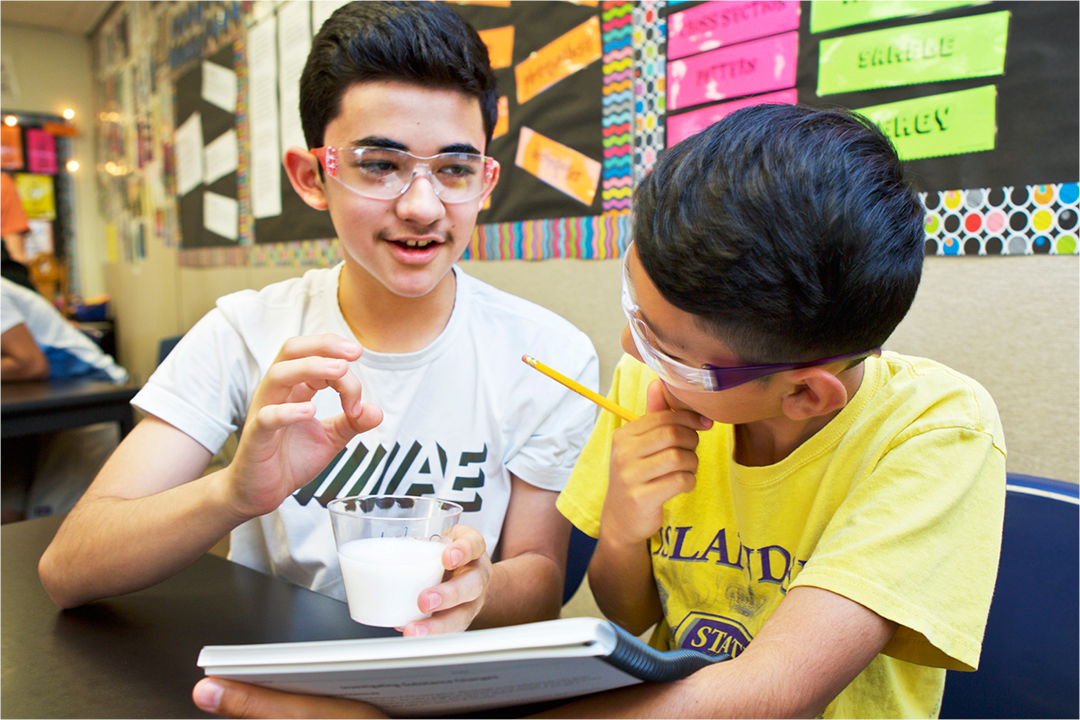
Welcome to Transitional Kindergarten

BACK TO MAIN TK–5 PAGE

Amplify Science California jump-starts a lifelong love of science with developmentally and pedagogically appropriate instruction featuring:

  • Real-world problems and scientific phenomena.
  • An experiential approach with lots of hands-on.
  • Explicit support for building oral language and early literacy skills.
A collage of four images: children doing a science experiment, a tree in a park, stacked building blocks and toys, and a child splashing water near a storm drain.

What students learn

Our program is comprised of three units: one life science, one physical science, one Earth science.

As students take on the role of a scientist or engineer to figure out real-world phenomenon, each unit:

  • Sparks curiosity and engagement.
  • Encourages students to wonder, think, and talk.
  • Builds a solid foundation for future success with science.

Look below for a summary of each unit.

A person helps a child with a ponytail. Another child examines a yellow flower using a magnifying glass. Caption reads Story of the Noisy Tree and describes children's curiosity and exploration.
Unit 1
Illustration of a vibrant park with a winding path, lush trees, and animals like squirrels and birds in a large tree.

Unit: Wondering About Noises in Trees

Student role: Life scientists

Phenomenon: Strange noises appear to be coming from the trees outside.

Unit 2
Colorful 3d illustration of various imaginative structures built with blocks, rings, and other toy components on a grassy area with a blue sky and clouds background.

Unit: Wondering About Buildings

Student role: Building engineers

Phenomenon: One class made a play city. Some of the buildings stayed up, while others fell down.

Unit 3
A child in yellow shirt and orange boots skipping over a puddle on a sidewalk next to a grassy area and a stream.

Unit: Wondering About Puddles

Student role: Weather scientists

Phenomenon: Puddles exist in some places but not in other places along a girl’s walk to school

Program structure

To meet the unique needs of little learners, our program follows a unique structure.

Each unit:

  • Begins with an Introductory Activity that
    introduces the phenomenon.
  • Includes a series of three Explorations that are comprised of a Kickoff Discussion, four activities, and a Shared Drawing and Discussion.
  • Ends with a Culminating Activity that consolidates students’ understanding.

Each activity is designed to span 15 minutes. Depending on how the program is implemented, an entire unit generally takes 4–6 weeks.

Diagram of tk curriculum structure, including life science, physical science, and earth science units, with detailed breakdowns of unit and exploration structures.

How teachers teach

When you’re ready, scroll down to take a closer look at sample resources.

Cover of a transitional kindergarten teacher guide for a life science module titled "wondering about noises in trees," featuring an illustrated scene with trees and animals.

Printed Teacher’s Guide

Our unit-specific Teacher’s Guides are chock full of helpful resources, including scientific background knowledge, planning information and resources, detailed lesson plans, tips for delivering instruction, differentiation strategies, additional classroom resources, and copymasters.

Teacher’s Guide

Girl listening to a tree trunk, book cover titled the noisy tree by ashley chose, with an orange background.

Big Books

Big Books contain vivid photographs and are used to introduce topics, facilitate group discussions, and support students’ firsthand investigations. Each Big Book is an integral part of instruction and is used multiple times for multiple purposes across a unit.

Big Book

Stack of white papers with a primary visible one labeled science question 1: why are so many noises coming from the tree? in black text.

Science Questions

Each unit includes three printed Science Question cards, one for each Exploration of the unit. The cards can be posted on classroom walls and support the class as they are introduced to and revisit the focus of their investigations over the course of an Exploration and, ultimately, the unit.

Two magazine cover mockups with the word scientist on the left and a tree photo on the right, both against a white background.

Vocabulary and Picture Cards

Each unit includes six or seven printed Vocabulary Cards and a set of colorful Picture Cards that can be posted on classroom word walls and concept walls. Cards are used for a variety of purposes, including gathering evidence, building background knowledge, and introducing the focal phenomenon.

Amplify Education welcomes executive Paul Griffin

Brooklyn, NY (February 24, 2020) — Amplify, a publisher of next-generation curriculum and assessment programs, announced today the appointment of Paul Griffin as vice president of strategic urban initiatives. In Griffin’s new role, he will partner with sales managers across Amplify and work with large urban accounts and superintendents. Griffin previously served as head of national partnerships at Lexia Learning and director of urban initiatives at Houghton Mifflin, where he built relationships with key urban school districts and decision-makers across the nation.

“Amplify is thrilled to welcome Paul Griffin to the company,” said Rita Schaefer, senior vice president and national sales manager at Amplify. “Paul’s extensive K–12 experience, strong record of success, and long-standing ties within the industry will allow us to deliver the dynamic opportunities that educators and students across the country deserve.”

At Lexia Learning, Griffin worked with sales teams and district administrators to bring learning solutions to schools nationwide; at Houghton Mifflin he was the organization’s trusted liaison to member districts of the Council of Great City Schools. He has a long history of participation with nationally recognized organizations such as the Council of Urban Boards of Education (CUBE), The School Superintendents Association (AASA), the National Alliance of Black School Educators (NABSE), and the Association of Latino Administrators and Superintendents (ALAS).

Griffin is a former advisory board member of the National League of Cities, Youth, Education and Families Institute. He holds The President’s Award from the National Alliance of Black School Educators, the organization’s highest honor, as well as the California Alliance of African American Educators’ Corporate Leadership Award. He has been listed in Ebony Magazine’s 100 most influential Black Americans. Griffin continues to have a strong interest in increasing educational excellence across the country.

About Amplify

A pioneer in K–12 education since 2000, Amplify is leading the way in next-generation curriculum and assessment. Our captivating core and supplemental programs in ELA, math, and science engage all students in rigorous learning and inspire them to think deeply, creatively, and for themselves. Our formative assessment products turn data into practical instructional support to help all students build a strong foundation in early reading and math. All of our programs provide teachers with powerful tools that help them understand and respond to the needs of every student. Today, Amplify serves five million students in all 50 states. For more information, visit amplify.com.

Contact: media@amplify.com 

Season 5, Episode 7

Discerning the role of AI in education

Join us for our summer mini-series where we’ll be talking about artificial intelligence (AI): what it is, how it is already being used in education, and how it will continue to transform education in the future. In this kickoff episode, we sat down with Jennifer Carolan, general partner at Reach Capital, to chat about the current state of AI in education technology.
As a former teacher and current leading-edge education technology entrepreneur, Jennifer has so much to share on how, if done correctly, AI will become a partner with educators and a tool for fostering social learning opportunities.

A middle-aged woman with blonde hair smiling, enclosed in a circular frame against a patterned background with triangle and math teacher shapes.

Meet Our Guest(s):

Portrait of a smiling woman with blonde hair, wearing a light blue top, framed by a circular border with small graphic elements—perfect for a math teacher or host of an engaging math podcast.

Jennifer Carolan

Jennifer Carolan is co-founder and general partner at Reach Capital, a venture capital fund that supports entrepreneurs bringing leading-edge technology to education. She started her career as a classroom teacher in Chicago, where she taught for seven years in traditional district schools. She moved to Silicon Valley in 2000 to attend Stanford University and used her teaching experience to support edtech founders at the NewSchools Venture Fund. She co-created and taught the popular course Innovations In Teaching at Stanford University and co-founded her first fund NewSchools Seed Fund in 2011. She co-founded Reach Capital in 2015. Reach is an education technology fund based in San Francisco. They are currently investing in Reach 4— a $215 million fund focused on education technologies designed to improve access to opportunity.

Meet our hosts: Bethany Lockhart Johnson and Dan Meyer

Bethany Lockhart Johnson is an elementary school educator and author. Prior to serving as a multiple-subject teacher, she taught theater and dance, and now loves incorporating movement and creative play into her classroom. Bethany is committed to helping students find joy in discovering their identities as mathematicians. In addition to her role as a full-time classroom teacher, Bethany is a Student Achievement Partners California Core Advocate and is active in national and local mathematics organizations. Bethany is a member of the Illustrative Mathematics Elementary Curriculum Steering Committee and serves as a consultant, creating materials to support families during distance learning.

Dan Meyer taught high school math to students who didn’t like high school math. He has advocated for better math instruction on CNN, Good Morning America, Everyday With Rachel Ray, and TED.com. He earned his doctorate from Stanford University in math education and is currently the Dean of Research at Desmos, where he explores the future of math, technology, and learning. Dan has worked with teachers internationally and in all 50 United States and was named one of Tech & Learning’s 30 Leaders of the Future.

Two people smiling at the camera, each in a separate circular frame, with geometric shapes decorating the background—perfect for a math teacher lounge or highlighting fresh math teacher resources.

Quotes

“The pace of change and the evolution is happening at such a rapid clip that it's hard to say where things are gonna be in five years. That said, I'm a believer that learning is inherently social and that there are these sort of biological realities of us as human beings that technology really isn't gonna change.”

—Jennifer Carolan

Stay connected!

Amplify earns Digital Promise’s Research-Based Design Product Certification for Amplify Reading

Brooklyn, NY (February 10, 2020) — Amplify, a publisher of next-generation curriculum and assessment programs, was among only thirteen education companies awarded Digital Promise’s first Research-Based Design Product Certification for its commitment to consulting and incorporating research findings in its supplemental reading program, Amplify Reading.

The new product certification is intended to serve as a rigorous, reliable signal for consumers, including school administrators, educators, and families, looking for evidence of research-based educational technology products. 

“Schools and families want to know which edtech products can actually help students learn,” said Karen Cator, president and CEO of Digital Promise. “Digital Promise’s Product Certifications are designed to help strengthen consumers’ confidence in choosing research-based products, while recognizing product developers doing the important work of incorporating valid research into their designs.”

Amplify Reading is a K–8 supplemental reading program that provides students with practice and instruction in the underlying phonological awareness, phonics, vocabulary, comprehension, and close reading skills that are essential for fluent reading with strong comprehension. It engages and motivates a diverse array of learners with an adaptive story-driven adventure through a variety of activities, including mini-games, vocabulary practice, ebooks, and interactive instruction in close reading topics.

“Receiving this Digital Promise Product Certification solidifies Amplify’s commitment to all students across all entry points of learning, abilities, and demographics through intentional research methodology,” said Melissa Ulan, senior vice president and general manager, supplementals at Amplify. 

About Digital Promise
Digital Promise is a nonprofit organization that builds powerful networks and takes on grand challenges by working at the intersection of researchers, entrepreneurs, and educators. Digital Promise’s vision is that all people, at every stage of their lives, have access to learning experiences that help them acquire the knowledge and skills they need to thrive and continuously learn in an ever-changing world. For more information, visit the Digital Promise website and follow @digitalpromise for updates.

About Amplify
A pioneer in K–12 education since 2000, Amplify is leading the way in next-generation curriculum and assessment. Our captivating core and supplemental programs in ELA, math, and science engage all students in rigorous learning and inspire them to think deeply, creatively, and for themselves. Our formative assessment products turn data into practical instructional support to help all students build a strong foundation in early reading and math. All of our programs provide teachers with powerful tools that help them understand and respond to the needs of every student. Today, Amplify serves five million students in all 50 states. For more information, visit amplify.com.

Contact: media@amplify.com