S5-05. Math technology & hacks for math anxiety: research-based tips for caregivers
A blue graphic with text reading "Math Teacher Lounge" in multicolored letters and "Amplify." at the bottom, with abstract geometric shapes and lines as decoration.

We’ve been very lucky to have so many prolific and brilliant researchers on this season of Math Teacher Lounge, and our next guest is no exception.

Listen as we sit down with Dr. Marjorie Schaeffer to discuss what causes math anxiety, math hacks, and how the right math technology can make an incredible impact in children and caregivers coping with math anxiety.

Listen today and don’t forget to grab your MTL study guide to track your learning and make the most of this episode!

Download Transcript

Marjorie Schaeffer (00:00):

I think the most important thing we know from literature right now is that high math-anxious parents, when they interact with their children, their children learn less math over the course of the school year.

Bethany Lockhart Johnson (00:12):

Welcome back to Math Teacher Lounge. I’m Bethany Lockhart Johnson.

Dan Meyer (00:15):

And I’m Dan Meyer.

Bethany Lockhart Johnson (00:16):

We’re onto Episode 5, Dan, of our series on math anxiety. And I wanna say it feels so lovely to imagine all of these people out there doing work to help combat math anxiety. I dunno, it just makes me feel excited about the possibilities. This work is out there; it’s happening! Kids and teachers and caregivers are being impacted by these conversations. Not just — I mean, I don’t just mean the conversations we’re having on Math Teacher Lounge, but I mean, that these researchers are doing. Like, yes, we can change this!

Dan Meyer (00:53):

This is great. Yeah. We have people who are extremely smart, who have dedicated their professional lives to studying math anxiety and resolving it. And each of them that we’ve chatted with — they share lots of ideas in common, but I’ve loved how they each have their own different flavor or take or area of emphasis on a problem that hits everybody everywhere. It’s in your home, with kids and caregivers. It’s in schools. It’s in our places of teacher preparation and professional learning. Every place is a place where we can focus on resolving issues of math anxiety. It’s exciting.

Bethany Lockhart Johnson (01:26):

Yeah, I feel like … if there could be a course in — we all know that our teacher prep programs, in MOST teacher prep programs, there’s not nearly enough math methods or time to cover <laugh> — it’s like ready, set, go! And depending on who your mentor teacher is or what your math methods course … I mean, it can totally shape the way that you are prepared or really not prepared for going out there to teach math! And so I love that we’re having these conversations.

Dan Meyer (01:55):

What I love about today’s conversation is, one, it’s got a little bit of a technology flavor, so there’s that. But I also love, it’s got one of my favorite features about change, which is that it focuses on change to action, change to routine, rather than change to belief. Rather than saying like, “OK, everybody! Everybody stop thinking bad beliefs about math and transmitting them to your kids!” Instead, it says, “What we’ll do is just, hey, we’ll set that aside for a second and we’re gonna do a certain thing every day and watch as those actions make your beliefs change.” That to me is extremely cool. And I think it has a higher likelihood of success than just, like, me telling parents, “Hey, stop thinking these thoughts!”

Bethany Lockhart Johnson (02:37):

“Ready, set, stop being anxious!”

Dan Meyer (02:39):

Exactly. Exactly. So it’s an exciting conversation we’re gonna have here.

Bethany Lockhart Johnson (02:43):

Right. So it’s not a, you know, “wave the wand and all of a sudden, you’re not anxious about math anymore.” But these incremental changes, these incremental conversations, this validation, can really, really impact change. I’m with you on it, Dan. I hear what you’re saying.

Dan Meyer (03:01):

To help us talk through all of these ideas and more, we’re joined by Dr. Marjorie Schaeffer, Assistant Professor of Psychology at St. Mary’s College in Indiana.

Bethany Lockhart Johnson (03:10):

Enjoy. <Jaunty music> So, yes, Dan, we are so excited to welcome Marjorie Schaeffer. She’s Assistant Professor of Psychology at St. Mary’s College. Dr. Schaeffer, we’re so excited you’re here. Hello!

Marjorie Schaeffer (03:28):

Thank you so much for inviting me.

Dan Meyer (03:29):

Yeah. We are super-lucky to have had so many prolific and brilliant researchers about math anxiety on our show. You’ll be no exception. And every time, we love to find out about how you came to study math anxiety, which winds up being a really interesting glimpse into your backstory bio. So tell us, what is the route by which you came toward studying math anxiety?

Marjorie Schaeffer (03:51):

Oh, I love that question. I’m really interested in how the attitudes and beliefs of parents and teachers influence children, especially around math. And I actually became interested in this idea in college, when no Child Left Behind was actually first starting to be implemented in schools with high-stakes standardized testing. So much so that I actually did my thesis on this thinking about, “Do children understand the importance of high-stakes testing? Do they have anxiety around that idea?” And so that was really my first foray into the anxiety literature. And that was kind of the entry point into math anxiety for me.

Dan Meyer (04:28):

So you started by studying a very high-stakes assessment, like our students connecting with this. And the assessment is once per year. And classroom instruction is every day. So how did you move from the assessments to the everyday instruction?

Marjorie Schaeffer (04:44):

That’s a great question. So, after college, I actually taught kindergarten. And so from that, I saw the day-to-day impact of instruction and the day-to-day impact of children’s individual attitudes and beliefs. And so I really became interested in thinking about, “How do we understand why some children are really successful from the instruction happening in classrooms and why other children need a little bit more support?” And so math anxiety was one way for me to really think about the individual differences I saw in my kindergarten classroom.

Dan Meyer (05:18):

It feels like you headed … you went farther upstream, is what it feels like. Where assessment … there’s like some kind of anxiety around assessment, let’s say. And then you ventured farther up the stream to classroom instruction and then still farther into kids’ homes. It seems like your research invokes a lot of curiosity about the sources of a kind of amorphous, flowing phenomenon called math anxiety. And I’d love to hear a bit about what you know about how caregivers transfer, transmit — whatever the word is — math anxiety to their kids.

Marjorie Schaeffer (05:55):

For parents … we think that the attitudes and beliefs of parents matter. And we see that for lots of areas, not just math anxiety. But I think math anxiety, we see that really clearly. And so, we can think about it both in terms of what kind of input parents provide. So, how do families talk about math with their children? What kind of support do they provide around homework? And those are ones that I think are a little obvious. But we can also think about the offhanded comments that parents say to children when they’re talking about math generally. Right? So, we see lots of memes going around, talking about how hard math homework is. And so, I think when parents say offhanded comments like, “I’m not a math person,” or “We’re just bad at math,” that communicates values to children. I think the most important thing we know from literature right now is that high math-anxious parents, when they interact with their children, their children learn less math over the course of the school year. And this specific mechanism by which that happens is still an area for a lot of research. And so some people think it’s about input. So maybe if I’m math anxious, I’m avoiding math. And so, when I have an option to read a picture book that has math content, I focus on the colors instead. And so, my child is actually getting less math than other children. We can also think it’s about these messages that are provided. So, when I talk about math, I send the message to my child, it’s not for them, and therefore the child wants to engage in it less. And some of my work looks at things like expectations and values. So, thinking about, “Do math-anxious families actually value math less than other families unintentionally?” And so, we have some support for this idea that they expect less of their children. And so maybe when they struggle, they respond in different ways than a family who’s lower in math anxiety.

Bethany Lockhart Johnson (07:53):

This is so fascinating to me. I also was a kindergarten teacher. And I remember a mom who just … she had such like palpable math anxiety. And during one of our conversations, she was talking about these homework sessions with her daughter. And I may have mentioned this on the podcast before. But she was talking about how every night they would sit together and they would do all this math. They’d do, like, extra math together. And it always ended in tears. And despite her math anxiety, she didn’t want her daughter to experience the math anxiety that she did. So she was trying to pile it on, so her daughter was more proficient and comfortable. And instead, it was perpetuating this anxiety about it. And so, it’s a phenomenon then, right? Even if a parent is saying, like you said, maybe completely unwilling, this mother was actually trying to do the opposite. She was trying to help, you know, imbue the love and comfort with math. Right?

Marjorie Schaeffer (09:01):

Absolutely. This is why I think in my research, it’s really important that we find low-stakes, low-stress ways for high math-anxious families to do math. They absolutely can support their children in doing math. But they need a little support. We want it to be a fun, low-stakes environment, right? So maybe that’s the connection back to high-stakes testing, that I want children to have fun math experiences.

Dan Meyer (09:28):

Yeah. This is challenging, because it feels like the more caregivers know about math anxiety, and its pernicious effects on students, and how easily transmitted it is, one could become quite anxious about math anxiety. And, you know, no one makes great decisions when they’re anxious. So if I’m recalling our various episodes we’ve done, we’ve heard from people say, “Well, you need to validate students’ math anxiety. This is not something to just ignore or brush past. But also, not validate it in a way that says, you know, ‘This is OK and generational and inevitable.’” Which presents parents with a very thin path to follow, it seems like. So I love what you’re saying about how we gotta just de-stress the whole process.

Bethany Lockhart Johnson (10:11):

You’re avoiding the whole, “I wasn’t a math person either” kind of thing. <laugh>

Dan Meyer (10:15):

Right, right, right. Yeah. So I’d love to know more. We’re excited about the technology that you have studied and helped develop, presumably, called Bedtime Math, anapp for caregivers. And I’d love to know more about what that is and what it offers parents who know enough about math to know that they don’t want to transmit math anxiety to their children, but also want to support. So what does that offer them?

Marjorie Schaeffer (10:39):

So Bedtime Math is an app. It’s freely available on iTunes or the Apple Store or Google Play. And what it’s designed to do is to provide a nightly topical passage. So one of my favorites is the one about Groundhogs Day. And so it talks a little bit about the history of Groundhogs Day, and then it asks math-related follow-up questions. So starting at a preschool level, going through late fifth grade. And it’s really meant for parents to pick the one that meets their children where they are. And so the preschool-level question asks children to pretend to be a groundhog and walk to the left and walk to the right. So a skill that families might not think about as being math, but we actually think that IS part of understanding math. Understanding left and right directionality. And then the next question can ask questions like, “If it took the groundhog three seconds to climb out of the hole, and then two more seconds to see its shadow, how much time did it take all together?” So a simple addition problem, but it’s phrased in a fun way. And so the hope is that for high math-anxious families, these interactions are fun and playful. They don’t look like fights over homework. They’re just conversations that families can have around topics that are naturally interesting to children. And our hope is that when families have lots of these positive low-stakes interactions, they actually can see that we can talk about math in unstressful ways. In lots of ways, right? We can also do this at the grocery store. We can also do this while we’re cooking in the kitchen. It doesn’t just have to be fights over homework.

Bethany Lockhart Johnson (12:14):

And I actually have the Bedtime Math — one of the Bedtime Math books. And I was so excited to find out that there’s an app. And I think one of the things that I loved about the book is that these are invitations, right? They’re exactly that. Low pressure <laugh>, and they’re invitations to have a conversation. And if we were just to tell parents, “Oh, just count!” or, “Hey, just count wherever you go!” You know? No. It’s, in a way, I think, like you said, it’s retraining the parents on what math could look like. Like, “Oh, I didn’t even think we could just kind of have this conversation and we’re actually doing math together.”

Marjorie Schaeffer (12:55):

Yes, absolutely. I absolutely agree. We want it to be fun and playful and not stressful. And we want it to also be things that are meaningful to children’s lives. So these are topics children are interested in. It’s not that we are using flashcards or making children practice math facts over and over again. These are things children should wanna do that can naturally fit into a child’s routine. So almost all families read books before bed, and what we hope is that math can also be a part of the nighttime routine.

Dan Meyer (13:27):

There’s something really subtle here going on that I just wanna name and ask a question about. First of all, it’s cool that you started with studying high-stakes stuff and now you are developing low-stakes stuff. And I’m really curious what makes a thing low-stakes? Like, a few things I’m hearing from you is that there’s, like … I have a small child that I read literature to on a nightly basis. And I feel very anxiety-free doing that. And it’s almost as though, because each of the — tasks is the wrong word for this, but experiences — involve some reading, it puts me, the parent, in a mode that is comfortable and familiar to me. I’m curious: Are there other, as you design, what, one per day for a year? All these different experiences. What are some of the principles that you lean on that help make a thing low-stakes for kids and for parents?

Marjorie Schaeffer (14:17):

Yeah, that’s a great question. So one thing we wanted to be really intentional about is that our app doesn’t look like a lot of traditional apps. There isn’t noises that go off. You don’t enter an answer. And so one of the things that we thought made it low-stakes is that while there is a right or wrong answer — there is a correct answer — we aren’t giving children upsetting feedback. Instead, what we wanna encourage families to do is, if you struggle to remember how many seconds it took the groundhog to come out of the hole, you can work through that with a parent. So it doesn’t feel like you’re getting negative feedback; you’re being told you’re bad at math; you did it wrong. Instead, you’re just getting natural support moving forward. And so that’s one thing we wanted to be really intentional about, was that it wasn’t going to be a negative experience for children. And we are trying to build on all of the positive interactions families are having around nightly book reading. So many ways this can look very similar. You get to read another story that’s topical and hopefully interesting. And then do these little questions together. And so for a lot of families, their children don’t actually really look at the question. It almost feels like the parent is just asking them on their own. Like, they just came up with it. They just wanted to know what would happen to the groundhog. If there were three more groundhogs? How many groundhogs would we have all together? Not like it’s gonna be like homework or other parts.

Dan Meyer (15:38):

So my understanding is that there isn’t a blank into which people type a number in, press “submit” for evaluation, receive the red X, the green check. That’s a key part of the design here.

Marjorie Schaeffer (15:50):

Yes, absolutely. And for research purposes, we would’ve loved to know what families were saying. But we think it’s really important that it’s fun, interactive, that families are working together to get to the right answer, that it’s not a test for children.

Bethany Lockhart Johnson (16:03):

In your research, when you were — maybe you could walk us through the study a little bit. But I’m also curious if you heard from parents that it was carrying over beyond the bedtime routine. Because I would imagine, if I am building these skills and reading these questions and learning that I could talk to my kid like this about math in a fun way, that’s gonna happen then, like you said, when I’m in the grocery store. Or when I’m waiting in line for at the bank. Or whatever, you know? People go into banks now still, right?

Marjorie Schaeffer (16:35):

Yeah, absolutely. So in our study, we recruited almost 600 families and we randomly assigned them. So they had an equal chance of getting both our math app and what we call our control app. And that’s really just a math app without the math. We think of it as a reading control app. And that’s because we wanna make sure that families are having a similar experience, that it’s not just that having high-quality, fun interactions with your child is actually impacting children’s math achievement. And so what we then did is followed those children over the course of early elementary school. And so we worked with them in schools in the fall and spring of first, second, and third grade, really to look at their math learning. And so what we find is that children of high math-anxious adults, when they have the reading app, so what we think of as what’s happening in the real world, we see that really classic gap between children of high math-anxious adults and children of low math-anxious adults. So if you have a high math-anxious parent, you’re learning about three months less math over the course of first grade. But for children who receive this math app, we see this gap as closed. Those children look no different than a low math-anxious parent. And so that’s leading us to think that we’ve helped families talk about math in fundamentally different ways. We did a little bit of just talking to families to see a little bit about what might be going on. And a lot of families do report exactly what you’re describing, where they say this did help them talk about math in different ways they were doing it other times.

Dan Meyer (18:10):

That’s a really extraordinary study design. I don’t know … I love that you folks gave the control group not nothing. Like it’s possible that just parents and kids bonding over a thing regularly would be enough to provoke some kind of academic gain. But you gave the control group a thing that had them interacting socially, bonding, and still this large common gap between high-anxious and low-anxious parents, their kids shrunk together. Is that what I’m gathering here?

Marjorie Schaeffer (18:41):

Yeah, absolutely. So we’re basically seeing we can no longer, when we look at children’s data, say that parents’ math anxiety explains individual differences. So these children look really similar. They’re learning more than children who has a high math-anxious parent and just got our reading control app.

Dan Meyer (19:01):

just diving into the study a little bit more here, what is the time commitment? Or, did you guide parents to say, “All right, we’re gonna do this do this delightful story about a badger for an hour”? Or did people do it for five minutes? And what was the time commitment, roughly, for people?

Marjorie Schaeffer (19:17):

So we tell families to do it however they see fit. Because it is an app, we are able to get some sense of how long, and we are talking about three to six minutes for many families. For a lot of families, they’re reading a paragraph, the paragraph and a half, and then answering one or two questions. They’re not going through every possible question. They’re just doing a little bit, really meeting their kids where they are.

Dan Meyer (19:39):

Roughly how many times per week was that?

Marjorie Schaeffer (19:41):

So we asked families to do it as much as it fit. But we’re seeing about two and a half on average in the first year. And so families are fitting it in a couple of nights a week. It’s not every night.

Bethany Lockhart Johnson (19:52):

So what it sounds like you’re saying is what really was powerful about this app is that it was the space and time and prompts between the caregiver and the child, that chance to really sit down and have some of these meaningful and positive math interactions. How did it shift those relationships?

Marjorie Schaeffer (20:12):

So one of the things I think that makes the app effective is the changing of expectations. After a year, families are really using the app a lot less. And I think that’s OK, that they have found other ways to incorporate math into their lives. And we find that we don’t see an impact on their math anxiety, that they aren’t becoming less math anxious from this experience. Which I think makes sense, because they have had a lifetime of math anxiety. But we do see a change in parents’ expectations and value of math. So they expect their children will be better at math, and they also report that math is more important in their children’s lives. And so I think that’s an important part of it, which is, we can change these values for families, even if we aren’t able to change the math anxiety of the adults in children’s lives.

Bethany Lockhart Johnson (21:01):

I want to for a second before — because I’m loving this idea of the app, and I’m excited to find out more ways to cultivate these conversations in my home and also share this with other folks. Because even folks who don’t even maybe realize they have math anxiety … like you said, so often it’s unconscious. So often we’re putting these little snippets into our everyday conversation, like, “Oh yeah, I’m not a math person.” And we don’t even realize how much is impacting our kiddos and ourselves, right? So I am really curious: What do you think … in your research, what were some other takeaways that you feel like are really strategies that we can think about for combating math anxiety in general?

Marjorie Schaeffer (21:47):

So I’m particularly interested in thinking about how math-anxious adults can help tone down their anxiety so that they can have high-quality interactions with their children, that they interact with. And so one of the big takeaways for my research, I think, is that math-anxious families can help their children with math. They just need support. And so I think there are lots of ways for that support to look like. One, I think it can be an app, but I also think reading a little bit about math can be really helpful. So it’s not new. So the first time you aren’t thinking about some of these ideas is as your child has their homework open in front of you. And so you can process your own feelings separately before you have to do it with a child. I also think reminding parents that math is everywhere and that math is actually lots of things that we all love to do. Math isn’t just calculus. Not that calculus isn’t wonderful. But that math is measuring, math is counting ducks at the park. Math is talking about how many times did I go down this slide. And talking about math in this way, I think reminds families that they are great at that. That even if maybe they’ve had bad math experiences before, they can do math. Especially the way their preschool or early childhood, early elementary school student needs them to. And I think that can then set the foundation for being really successful later.

Dan Meyer (23:13):

So is your research then, your subsequent studies, your line of inquiry, is moving more towards how to support parents, then? Is that what I’m hearing?

Marjorie Schaeffer (23:22):

Yeah. So I’m really interested in both understanding how the math anxiety of parents and teachers influences children. And so math anxiety is really common and we know that it’s particularly common in early elementary school teachers. And so it’s very likely that children are interacting with a highly math-anxious adult. And so I’m really interested in thinking about how we can support those individuals in doing it. And so both, I think, things like Bedtime Math, which provide fun, unscripted ways to do that, but I’m also interested in the teacher equivalent. So, thinking about whether having things like a math coach can help teachers have more positive experiences with math. So if you see someone else play math games with your students, can that help you do it as well?

Dan Meyer (24:09):

It makes me wonder a lot about an app for teachers or an app for parents, one that’s not designed to be co-consumed with kids and their parents. But what that would look like … yeah, that’s really interesting.

Bethany Lockhart Johnson (24:21):

If we have a parent who, let’s say they have a third grader, fourth grader, fifth grader, or a middle schooler, right? Outside of early education. And they say, “OK, but what do I do? I’m with my kiddo; I don’t remember this math.” And they’re realizing that their anxiety may be influencing their kiddos’ disposition of mathematics, Or maybe they’re just in the midst of the battle <laugh>. What would you say to those folks, especially if it’s math that maybe they’re not comfortable with?

Marjorie Schaeffer (24:56):

One, I think we should like tone down the stress, right? Remind ourselves that it’s homework and homework feels really high-stakes, but these other outcomes are really high-stakes too, right? And so I’m really interested in the idea that can we help parents feel more comfortable about math by watching their own children teach it to them. So what’s a concept that the fourth grader actually feels really good about? And can they remind their parent how to do it? Can, together, they problem-solve the math homework? And so it’s not just on the parent to give the child the right answer. We know that’s a recipe for communicating some negative things about math. But instead, help the parent-child pair figure it out together. So what are some resources we can do? Can we look it up on the internet together? Can we write an email to the teacher together? Can we think about what are other problems that maybe we know how to do, and therefore we can use that same model here? So I want parents to feel like they are not solely responsible for it. That they can help figure it out with their child together. And so it’s a fun interaction.

Bethany Lockhart Johnson (26:02):

I love that. I love that.

Dan Meyer (26:03):

Yeah. Yeah. That’s wonderful. Yeah. A conviction that I have, and I think it’s true, is that any math that we’re learning at middle school, the attraction can be dialed down to a degree that a very small child, or a parent who has a very small child’s understanding of math, can appreciate. So instead of calculation, estimation. Instead of proof, just make a claim about something. And it makes me wonder about a companion to the work that’s happening in schools that parents feel inadequate to support, that students might not want to teach their parents. But which they could both, on a daily basis, say, “Here’s a way we can engage in this at a level that is comfortable to both of us.” Just dreaming out loud here. No question asked. No response needed. I just love your work. And made me wonder about that. Can you let me know your thoughts about technology? It is very rare that we have someone on the call who is an academic and very well-versed in research, but who also is published not just in in papers and textbooks, but also in digital media. It’s consumed by lots of people. So I am trusting that you have opinions about how math looks in technology. And I wonder if you’d offer some thoughts about how it goes, right? How it goes wrong from your own eyes.

Marjorie Schaeffer (27:14):

OK. That’s a great question. I think that we need more research. I first wanna say that I think that technology has really exploded in the last few years. How children have access to technology and screen times has really changed. And what we need is high-quality research happening. That said, I think that all of the things we know from child-development research still apply to technology. And so we know that children learn best when they are engaging in interactions with their parents. And so when families can use technology together, or at least can talk about what’s happening, it can be really effective. I also think technology, especially math apps, are best at teaching concrete skills with very clear answers. So I think practicing math facts is a great use of technology. So I love that Sushi math app where you solve multiplication problems and then get to quickly pull the sushi off the cart, right? But for higher-level questions, where we’re thinking about word problems or where what we’re helping to teach students is complex thinking, apps have a harder time doing that. Because students can often figure out the answer without engaging in the thinking that we are hoping that they’ll learn. And so I think technology absolutely has a piece. I think technology is helpful for parents. I think the logistics of helping parents live their lives is a good reason to use technology. But I think we need to be conscious of what it’s replacing. And so I think a world in which we think fourth graders can learn math only from apps is not realistic. But absolutely apps can be a great supplement to what’s already happening in the classroom.

Dan Meyer (28:56):

Yeah, that’s super-helpful. We have done a lot of work in digital curriculum here at Amplify, and often face the question on a daily basis, “Should this math be digital or on paper? Should we have the students stand up and talk or type something?” And those decisions are way too crucial and way more sensitive than a lot of the app-based education gives credit to. So appreciate your perspective there.

Marjorie Schaeffer (29:22):

OK. And I don’t think there’s one answer, or one answer for all classrooms. I think it’s like always a balancing act. I do think that one of the reasons our work is successful is because the parent-child interaction. And we want parents to learn from these experiences. And I think the same thing is true for for teachers.

Bethany Lockhart Johnson (29:41):

Dr. Schaeffer, thank you so much for being with us today and for sharing about your research, and again, for inviting us to reconsider ways that we can develop a more positive relationship with math. And that parent or caregiver or teacher relationship with a child, we’re seeing just how incredibly impactful that is. And I really appreciate your work and your voice on this. Thank you so much for your time.

Dan Meyer (30:07):

Thank you.

Marjorie Schaeffer (30:08):

Thank you for having me.

Bethany Lockhart Johnson (30:12):

Thank you again, Dr. Schaeffer, and thank you all for listening to our conversation. You can check out the show notes for more on Dr. Schaeffer’s work and to see a link to the app that we shared about Bedtime Math.

Dan Meyer (30:25):

Please keep in touch with us on Facebook at Math Teacher Lounge Community, and on Twitter at MTLShow.

Bethany Lockhart Johnson (30:32):

We would love to hear … you’ve been listening to this series; we’re dipping our toe into all these aspects of math anxiety. Is there something that you’re still wondering about? Something you wanna share about your own story with math anxiety?

Dan Meyer (30:43):

And if you haven’t already, if this is your first exposure to the Math Teacher Lounge podcast, please subscribe to Math Teacher Lounge, wherever you get your fine podcast products. And if you like what you’re hearing, please rate us! Leave us a review. You’ll help more listeners find the show.

Bethany Lockhart Johnson (31:01):

And let a friend know. But you know, it’s, it’s nice and cozy here in the Lounge, right? There’s no pressure. We’re hanging out. It’s all about learning. We’re learning together. We’re glad you’re here and we want others in your community to join us in the Lounge as well. You can find more information on all of Amplify’s shows at our podcast hub. Go to amplifycom.wpengine.com/hub. Next time on Math Teacher Lounge, we’re gonna be chatting about where we are today that we weren’t a few months ago in this topic.

Dan Meyer (31:31):

We’ll be chatting about this last series about math anxiety, and trading our favorite insights and observations from the run of the season.

Bethany Lockhart Johnson (31:41):

I just love this series, Dan. And thanks, all, for listening. We really appreciate having you in the Lounge.

Stay connected!

Join our community and get new episodes every other Tuesday!

We’ll also share new and exciting free resources for your classroom every month.

What Marjorie Schaeffer says about math

“We want it to be a fun, low-stakes environment, especially in high-stakes scenarios like testing. We want children to have fun math experiences.”

– Marjorie Schaeffer

Assistant Professor of Psychology at Saint Mary’s College

Meet the guest

Marjorie Schaeffer is an assistant professor of psychological sciences at Saint Mary’s College. She received her Ph.D in developmental psychology from the University of Chicago. Marjorie is interested in the role parents and teachers play in the development of children’s math attitudes and performance. She is specifically interested in the impact of expectations and anxiety and on children’s academic performance. Her work has been published in outlets including ScienceJournal of Experimental Psychology: General, and Developmental Science.

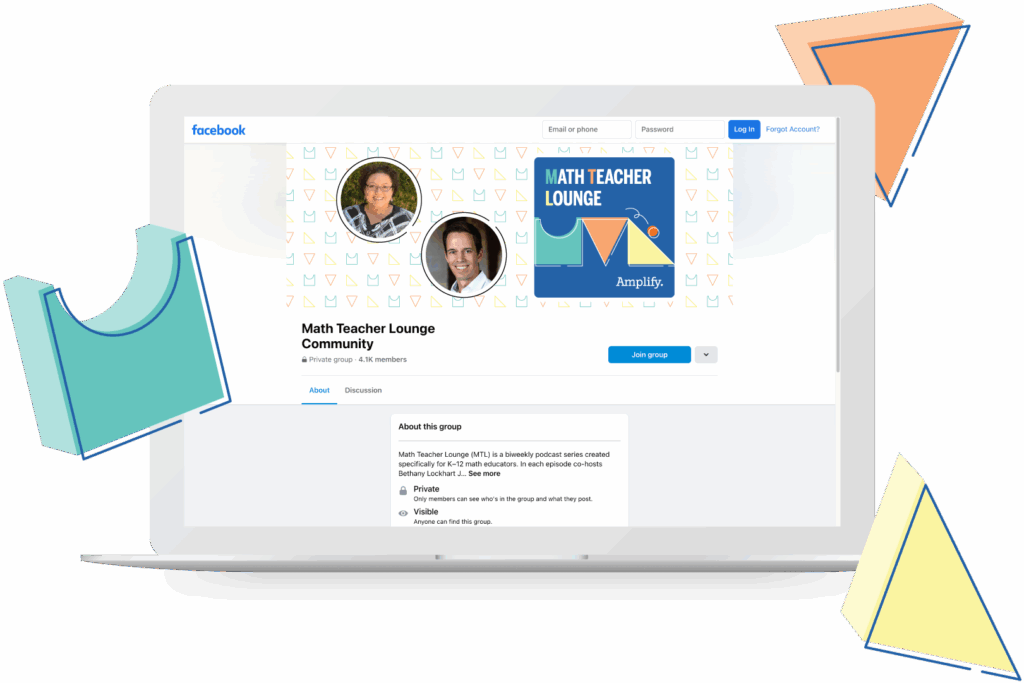
A laptop displaying a Facebook group page for "Math Teacher Lounge Community," featuring profile photos, a group banner, and geometric shapes in the image background.

About Math Teacher Lounge

Math Teacher Lounge is a biweekly podcast created specifically for K–12 math educators. In each episode co-hosts Bethany Lockhart Johnson (@lockhartedu) and Dan Meyer (@ddmeyer) chat with guests, taking a deep dive into the math and educational topics you care about.

Join the Math Teacher Lounge Facebook group to continue the conversation, view exclusive content, interact with fellow educators, participate in giveaways, and more!

S5-03. Cultivating a joy of learning with Sesame Workshop

A blue graphic with text reading "Math Teacher Lounge" in multicolored letters and "Amplify." at the bottom, with abstract geometric shapes and lines as decoration.

Listen as we chat with Dr. Rosemarie Truglio, senior vice president of curriculum and content for Sesame Workshop! Continuing our theme of math anxiety this season, we sat down with Dr. Truglio to chat about Sesame Street and her thoughts on how to spread a growth mindset to young children and put them on course to academic achievement and long-term success.
 
Listen today and don’t forget to grab your MTL study guide to track your learning and make the most of this episode!

Download Transcript

Dr. Rosemarie Truglio (00:00):
Children don’t come with this math anxiety. Math anxiety is learned.

Bethany Lockhart Johnson (00:07):
Welcome back to Math Teacher Lounge. I’m Bethany Lockhart Johnson.

Dan Meyer (00:11):
And I’m Dan Meyer.

Bethany Lockhart Johnson (00:12):
Hello, Dan Meyer.

Dan Meyer (00:14):
Great to see you, Bethany. We are on episode three. Can you believe it?

Bethany Lockhart Johnson (00:18):
So, I feel like we’ve just started scratching the surface about math anxiety. We’ve talked to two amazing researchers. We’ve talked about what math anxiety is, how it’s often screened for some of the causes, some of the consequences … I mean, we’ve had some good conversations. Dan, what do you think?

Dan Meyer (00:38):
Definitely, I think that the consequences have only grown more dire in my head. I’m not sure how you feel about the consequences. But, you know, it is enough for me that we ask students to take mathematics for much of their childhoods, to worry about their anxiety, taking that. But to hear about from these researchers about all the different things that correlate with math achievement and math anxiety—talking about future careers, certainly, but even some other, more serious lifelong concerns? That gives me a lot of motivation to continue this study of math anxiety here with you on the show.

Bethany Lockhart Johnson (01:14):
It is really widespread. It has a big impact, not only on students, but on parents, on educators. You know, it’s—

Dan Meyer (01:23):
Multi-generational.

Bethany Lockhart Johnson (01:25):
Yes. And you know, so often when folks think of math anxiety, what I hear them say is, “Oh, yeah, in high school is when math really ramps up. That’s when anxiety starts.” But we know that it starts in our youngest learners. And our research has already backed that up. We know it. I’ve seen it in my classroom. You may have seen it with some students you work with. And let me tell you, it starts young.

Dan Meyer (01:52):
It does start early. Right now, I have a son that’s just started kindergarten, and he seems relatively math-positive, but we’ve known from our interviews on this show and other kinds of experiences that oftentimes, that feeling —that math is for me, and I am for math, and we are all friends — can turn on a single moment. It seems like one teacher says a thing that changes a student’s perception of themselves as a mathematician or of math itself. So I keep waiting with bated breath, hoping not to find that one moment that changes our current open posture towards mathematics. So now it’s time to really dive into some strategies for combating math anxiety.

Bethany Lockhart Johnson (02:34):
To help us out, we’ve called on a pretty exciting guest. I am so excited, Dan Meyer! We are being joined by Dr. Rosemarie Truglio. She is Senior Vice President of Curriculum and Content at Sesame Workshop. Sesame Workshop! As in, “Tell me how to get to Sesame Street.” Dan, I have to tell you, I spent many, many hours of my childhood watching Sesame Street. I have to ask, do you have happy Sesame Street memories? Is this part of your formation, Dan Meyer?

Dan Meyer (03:08):
At this point? In my advancing years, and the brain cells that I have left, Sesame Street is really kind of just a vibe in my head. But that vibe is such a pleasant one. One in which like nothing bad could happen. One in which learning is common and normalized and fun. And you just kind of feel at home, constantly.

Bethany Lockhart Johnson (03:33):
I don’t know about the “just the vibe” part, because for me, it is visceral. I’m there. I am actually … I mean, I might still be there.

Dan Meyer (03:42):
You could reenact some of the skits?

Bethany Lockhart Johnson (03:44):
. You didn’t watch Sesame Street with your kiddos when they were younger?

Dan Meyer (03:49):
We watched a lot of Elmo. A lot of Elmo. Yeah.

Bethany Lockhart Johnson (03:52):
Next-generation Sesame Street. Well, I think it’s so perfect that we’re gonna be talking about what Sesame Workshop does to help combat math anxiety and create a positive connection and relationship with mathematics. So I’m really excited to hear what Dr. Truglio and her team have been working on. And here’s our conversation with Dr. Truglio.

Dan Meyer (04:15):
Welcome to the show, Dr. Truglio. It is an honor.

Dr. Rosemarie Truglio (04:18):
Great to be here. Thank you for inviting me.

Dan Meyer (04:20):
You are Senior Vice President of Curriculum and Content at Sesame Workshop, which definitely sounds like the coolest job in the world to both four-year-old me and also Now me. Would you just help us help us with some backstory of how you ended up here, and what you do at Sesame Workshop?

Dr. Rosemarie Truglio (04:38):
Sure. It is a pretty cool job. And I am very fortunate that I’ve been in this position for the past 26 years. So, I am a developmental psychologist, and my job is to help Sesame Workshop identify curriculum needs, so that we could address them in the content that we create on the show and across our various platforms. So, Sesame Street is currently in its 53rd season. And we just, wrapped production for the 54th season, which we’ll debut next fall. And Sesame Street began with an experiment: Can television actually teach children school readiness skills, to have them better prepared for school? Especially those children who did not have access to formal education during the preschool years? And it is what we call a whole-child curriculum, because we’re dealing with all of the school readiness needs. So that that includes the academic needs, their social-emotional needs, and their health needs, as well as what we call these cognitive processing skills—how children learn content. Right? So it’s not just content skills, but how you approach learning and how you actually learn content. So as a grad student, I was fortunate to work at the Center for Research on the Influences of Television on Children. Very special center. It was at the University of Kansas. And my advisors, developmental psychologists, they studied the effects of television on children, both the positive effects and the negative effects. And so part of their research was to actually look at the longterm educational effects of Sesame Street. So I was working with Sesame Street content as a grad student, and then came to New York City. My first job was Assistant Professor at Teachers College, Columbia University. And when this position became available, Director of Research at the time, it was called, I took that job. And so my job was to oversee both the curriculum and the implementation of the curriculum, as well as the research. Because what we know, our co-founder, Joan Ganz Cooney has always said, for Sesame Street to be a successful educational program, production has to work closely with early childhood educators. They are the ones who know the curriculum and, and develop the curriculum goals, as well as the developmental psychologists who actually study how children are paying attention to the content. But more importantly, what are they comprehending from the content? And we all have to work together. Because even though we are the experts, the real experts are the children themselves. So nothing is deemed final until we actually show the children and see what they are learning from the content that we are producing.

Dan Meyer (07:54):
Are you referring to like, test audiences of kids then?

Dr. Rosemarie Truglio (07:57):
Yeah, I guess you could call it test audiences. I mean, I don’t. I don’t like to call it that because I see them as co-collaborators. I don’t see them as a test audience. Because, as I said, they’re the experts. It’s a collaboration. I mean, they’re the experts. And so I wanna know—

Dan Meyer (08:12):
As collaborators. I got it now. Yeah.

Dr. Rosemarie Truglio (08:14):
They help us. So that’s exactly what we tell the children too. So it’s called formative research. You know, we, we do what we call, um, storybook testing, an animated version of a storybook to have some little movement and see are they finding the story engaging, but more importantly, are they picking up on the intended educational lesson that we’re trying to teach in the story. So they are co-collaborators. they’re the ones who are helping us get the story just right for them.

Dan Meyer (08:46):
That’s really exciting, and makes me think about what classes might be like if students were regarded in that kind of lens as well. I just wanna say that my four-year-old self is on this interview as well, and is re-contextualizing all the stuff I saw as a kid. And it just felt like, at the time, you folks turned the camera on and went down to the street and we just had this real natural time. And it’s great to hear about all the intense preparation and co-construction at work and work that went into that time. Yeah,

Dr. Rosemarie Truglio (09:12):
It’s about a year preparation from start to finish. From the start of identifying, “What is the educational need? Is it an academic need? Is it a social-emotional need? Is it a health need? Is it a cognitive-processing need?” And then once we have the need identified, we have what we call a curriculum seminar. We bring in the experts who are studying this topic with preschoolers, because we wanna get it, we wanna get it right.

Bethany Lockhart Johnson (09:41):
Which, by the way, little behind the scenes: How often do you get to go to set?

Dr. Rosemarie Truglio (09:46):
So we’re in a production probably about six weeks out of the year. Covid really messed things up. ‘Cause we have to be really—we have very strict Covid protocols, but there is someone on my team—and sometimes we have to, you know, rotate for availability—but there’s always an educator on set.

Bethany Lockhart Johnson (10:06):
Awesome.

Dr. Rosemarie Truglio (10:07):
Because even though you stick to the script, questions arise; they wanna make changes; sometimes they have to cut; things are running too long and they have to cut and we gotta figure out where to cut. So there’s always an educator on set.

Bethany Lockhart Johnson (10:19):
But sometimes you go and have lunch, like—.

Dr. Rosemarie Truglio (10:21):
Oh, I go, yes. Sometimes I go—

Bethany Lockhart Johnson (10:23):
And just hang out with Big Bird, right?

Dr. Rosemarie Truglio (10:24):
Sometimes I go hang out with Big Bird. No, those are my friends!

Bethany Lockhart Johnson (10:27):
They are!

Dr. Rosemarie Truglio (10:28):
No, no, I go hang out with them. They’re my friends. Yes.

Bethany Lockhart Johnson (10:32):
When I think about Sesame Street and I think about … like, I can’t help but smile. Because I think I have such fond memories of the characters. I mean, we invited them, my mom invited them, into our home, right? And, you know, now I have a two-year-old and there’s no doubt that I’m gonna introduce him to Sesame Street. And I see how it really does feel like the folks who are doing this work, you and your team, you have a deep respect for children. So it makes sense that you call your test collaborators “collaborators,” right? They’re a part of it. And you know, I love that. And Sesame Street makes me smile. However, I’m like, we’re talking about math anxiety. And it’s so interesting, because as Dan and I were talking about our memories of Sesame Street … you know, it’s like Sesame Street feels like there’s not much anxiety. I mean, there are problems, and there’s problem solving, and it’s not like everything is perfect. But we figure it out. And it’s OK to make mistakes and it’s OK to try again. And a lot of times, we don’t see that in the math classroom—or at least, how folks talk about math. So, how do you all think about anxiety, about how to prevent it? Like, when you’re doing your work, you know that math anxiety is a real thing. But then that’s not translated in these experiences and the relationships with math that you’re building with your viewers.

Dr. Rosemarie Truglio (12:07):
Yeah, that’s a really good question, because it’s really easy, because our core audience are two- to four-year-olds and they love math. And what’s not to love, right? Because they are figuring the world out as they’re exploring the world. So you said something really interesting, that when you turn on the TV—when you turned on the TV when you were a child, and now you’re a mom of a two-year-old, we wanna make sure that the show represents content that is relevant and meaningful to our target audience. And that comes through with the characters. So all of our characters have very specific personalities, as all children do. And our characters represent all children, in terms of not only personality, but interest and learning styles, ’cause we wanna see—we wanna make sure that children see themselves in these characters. And we have a character who actually loves math. And he’s The Count.

Bethany Lockhart Johnson (13:12):
I’m like, “I know! I know who it is!” I will save you my impression. Although I have done it for my child. But I’ll save our listeners .

Dr. Rosemarie Truglio (13:20):
And you know, he’s an adult character. Some of our characters are preschoolers, like Elmo and Abby—they’re preschoolers—and Zoe. But The Count is an adult. He lives in the castle and he just loves numbers. But what’s really important is while we have The Count to explain—not explain to, but to portray to children, cause we don’t explain anything; we show children that math is more than number, right? Math is a pretty wide concept. Which is what I love about math. And the other thing about math is math language. The language of math. ‘Cause when we’re teaching children vocabulary words, we’re also teaching children the concept. Be it a math concept or a science concept or a social-emotional concept. So children don’t come with this math anxiety. Math anxiety is learned and it’s unfortunate. It’s picked up by their observations of the adults in their lives, who sometimes say out loud, “I don’t like math,” or “Math is hard,” or even worse, “I’m not good at math.” Or may even label it as math anxiety. That word won’t mean anything to a young child. But it then provides a, whaddya call it, like a negative valence for something that they never felt negative about. Because as they’re growing and interacting with the world, math is all around them. And there’s that sense of awe and wonder and joy, especially as they’re learning and they’re figuring it out. So I think we have to reframe math. Instead of saying “math anxiety,” we have to talk about the joy of math and all the wonderful joys that come with the exploration of these math concepts. Number is great. We know kids love numbers. We know that they love to count and use a big word here: enumerate . Because so many parents don’t make this distinction. They’ll say, “Oh, my child is counting!” Well, there’s rote counting, 1, 2, 3, 4, 5, 6, 7, 8, 9, 10, which is important. But then it’s like there’s an item for each number. So it’s one Cheerio, two Cheerios. And then as you point to each number, you are then figuring out what the set is, of the number of objects that you have. And then you get at what I love to call the meaningfulness of math. Right? Number has meaning. And as I said, it’s all part of your everyday activities. It’s part of—it’s in your kitchen; you’re following recipes; you’re measuring; you’re weighing. It’s at bath time, right? You could have the sorting of nested cups and you could, you know, and once again, the math language: big, bigger, biggest. These are relational concepts. You could then count what sinks and what floats, if you’re doing science. And then you could put them in two different buckets, and count. These are the items that sunk and these are the items that float. So math and bath time could be a lot of fun. And then there’s math and music. Music is so rich with math, as you talk about rhythm and tempo and dynamics and pitch and duration. That’s all math.

Bethany Lockhart Johnson (16:57):
The way that you talk about it, it is so rich, right? It is so multi-layered. And you know, I’ve shared on the podcast before: I’ve actually had parents in parent-teacher conferences say that, “Well, I wasn’t good at math either,” or “Math’s really not my thing.” And it’s really—it is, it’s rooted in that fear. And so I do see the way that you’re talking about it; I see that come through in Sesame Street. That, in a lot of ways, it’s reeducating parents, right? Because we hope that our caregivers are sitting next to their kiddo and enjoying it together and having conversations about it later. And there’s a way that parents then are also getting their own sense of what math can be, expanded. And I think there’s such a beauty in that. And I love the way that you talk about that, that you really are looking at, “Well, we wanna celebrate counting and the joyfulness of that. And let’s use math talk, you know, and let’s use these words and try out these ideas.” And it’s not because you’re trying to check some list. But you’re really exploring it and having fun together.

Dr. Rosemarie Truglio (18:03):
And you’re embracing it. And you mentioned the word “mistake.” So often when it comes to math, if you make a mistake—you make a mistake in counting or, you know, we’re not doing a lot of math equations on Sesame Street, but that’s when people feel like they can’t do math. ‘Cause they made a mistake. And that’s something that we are trying to address on Sesame Street, that it’s OK to make mistakes and you learn through mistakes. But you have to have—and I’m gonna come up with this other phrase now—you have to have what we call a growth mindset. What that means is that I may not be able to do this yet. Like, it’s called “the power of yet.” So we know that learning any concept, it takes time and practice. And how do we have children embrace the process, right? So often we focus on right and wrong. Now, there is right and wrong with math, of course. You know, there’s a right answer and there’s a wrong answer. But how do we focus, not on the end product, but the process through which you are engaging in? So let’s talk about measurement. Let’s talk about measuring the length and the width or the height of something. You might make some mistakes along the way, but you’re processing it. My son used to make all of these little structures for all his little play animals. Well, you know, he would measure and think he got it right. And then when he put the animals in, of course, you know, either the animal was too wide or it was too tall. And he would have to redo it. But you’re not redoing it from scratch, you’re redoing it now from experience. “I realize that if I’m gonna put the giraffe in with the elephant, I’m gonna need something wide as well as high.” Right? For the length, tall. And that’s process. And then, for children, when they figure it out, that “oops” and “aha”—the “aha” was like, “I did it!” And it’s so empowering, you know, giving them agency—not swooping in and saying, “All right, I’ll fix it for you. You know, we got the wide elephant and the tall giraffe and I’ll you know…”. NO! Having them do it. And another fun activity is in what we call informal measurement. And that’s like getting something of an equal size. It could be paper clips or it could be same-size blocks, and then measuring how long something is. So if it’s measured by blocks versus paperclips, you’re gonna have a lot more paperclips than you are blocks. And that kind of comparison is so fascinating for children. And so that’s measurement. And now we have counting. Like, how many paperclips long is something versus how many blocks long is something.

Dan Meyer (21:02):
So checking my understanding here, you’ve talked about how caregivers and other adults can transmit math anxiety by naming it and claiming it for themselves. And you’ve talked about, some really exciting ways that adults can involve students and kids in different kinds of math. I’d love to go upstream with you a little bit and wonder out loud, where does this anxiety come from initially? It’s gotta be more than adult one to kid two talking about anxiety, and transmitting it from human to human. What is the original spring from which all this anxiety flows?

Dr. Rosemarie Truglio (21:36):
Yeah. I do think it does—a lot of it does come from the adults in their lives. It’s unfortunate, because there is a lot of math talk about it, right? I can’t do math; I’m not good at math. Even when you’re at a restaurant and you get the bill and someone’s figuring out the tip, I can’t tell you how often it’s like, “Pass the bill, because I can’t do math.” Or if you actually then bring gender into it, you know, “Oh, girls aren’t good at math,” and that’s not true. There’s no evidence of that whatsoever, right? So in the younger grades, there’s no gender difference in terms of math ability. What’s also interesting about even socioeconomic status differences, you don’t see a lot of differences between low-income and middle-income children when it comes to math skills. Where you see differences is children’s ability to talk about their mathematical thinking. So if a child doing a math problem is asked, “How did you solve the problem?”, low-income children don’t often have the language to explain their thinking. So that’s something that we did on Sesame Street, where we focused a lot on what we call math talk. So, not just show number and show doing math, but actually narrate and giving the language. Because math literacy is one of the predictors of overall school achievement. So there’s that. They’re getting it from the adults in their lives. They’re getting it, unfortunately, sometimes from their teachers. But I think the anxiety comes from the fear of making mistakes. Because math, there is right and wrong, and always wanting to get the right answer. So that’s why this whole idea of reframing, and saying, “But really, it’s in the process.” So, you know, my son, math is not his strong suit. And I’ve been doing a lot of growth mindset with him as well. And there was a teacher that he had—I think in like 10th or 11th grade—who said, “In a test, I don’t wanna—I’m not even gonna look at the answer. I wanna see the process through which you GOT to this answer. And I’m going to grade the process. So the process could yield a right answer; it could yield a wrong answer. But you’re gonna get graded on the process. Because I wanna see how you are approaching the problem and how you’re thinking it through.” And I think that is a great example of, maybe, to try to reduce math anxiety. Because if you can get people excited about the process through which you’re learning—and that applies to all subjects, it’s not just math!

Bethany Lockhart Johnson (24:36):
I’m like, that applies to life! Right?

Dr. Rosemarie Truglio (24:38):
That applies to life!

Bethany Lockhart Johnson (24:39):
That’s so spot on. Wow. Yeah.

Dr. Rosemarie Truglio (24:41):
But I think that there’s so much focus on right and wrong, and not really understanding the value of the process. So on Sesame, we’ve been doing a lot of “oops” and “ahas.” You know, we’re gonna make mistakes, but what’s important is what do you DO when you make a mistake? So there’s a great episode with The Count. A couple of years ago. The Count was counting. Something he does every day. A lot of time, every day, ’cause he’s obsessed with counting and numbers. And he was counting an array of items.

Gladys the Cow (25:17):
I need 10 sandwiches all together.

The Count (25:22):
Well, of course.

Dr. Rosemarie Truglio (25:23):
And he made a mistake.

Elmo (25:25):
The Count?

The Count (25:25):
Hmm?

The Count (25:25):
Elmo thinks The Count made a little mistake.

The Count (25:31):
No mistake.

The Count (25:32):
Mm-hmm. Yeah.

Dr. Rosemarie Truglio (25:33):
And first time ever, did he make a mistake. And he fell apart.

The Count (25:38):
I must make sure that that never happens again. So I shall never count again.

Dr. Rosemarie Truglio (25:46):
And that’s an example of showing that, you know, you could get upset when you make a mistake, but what’s important is you gotta come back and you gotta come back to doing what you love. In his case, is counting and letting him know that it was an “oops.” But you learn that mistakes are OK. It’s OK to make a mistake and continue to do what you love.

The Count (26:13):
I must keep trying and you should, too.

Elmo (26:17):
Yeah!

The Count (26:17):
So come, let’s count the carrots together!

Elmo (26:18):
Oh, cool!

Bethany Lockhart Johnson (26:19):
And what a beautiful gift to show kiddos. Show that to kiddos, right? And to the adults. I wanna, you know, really acknowledge it, and say, “Hey look this, it’s OK.” And again, you’re giving them that language. That’s such a gift.

Dr. Rosemarie Truglio (26:34):
Thank you.

Dan Meyer (26:34):
We spend a lot of time wondering why other subjects don’t seem to suffer from this negative perception. And I think you’ve unlocked a lot of that. You’ve mentioned that there are issues that cut across different subject areas, but I think from my own experience and research and interviews, it seems that in ELA and the social sciences, there’s this aspect where you need to come up with a claim and “how are you seeing this?” And there are multiple defensible claims. And I love how you imported that generous pedagogy over into math with this example of a teacher who says, “You know what? It’s about the process here.” Disassociating answer and process.

Dr. Rosemarie Truglio (27:09):
And I think the other thing is like, when children are engaged in a project, for parents to point out: “You’re doing math!” Because they don’t realize that they’re doing math. Once again, math is so often equated solely with numbers and mathematical computations. So it was really interesting—the same is true for science. You know, when we’re talking to parents about the use of everyday—like, going to the supermarket or making dinner or bath time, there’s so much math and science in the everyday. And then when you point it out to them—”you’re doing math”—it’s like, “I’m doing math!” Like, you’re setting the table for a family of six: you’re doing math. That’s called one one-to-one correspondence. “I’m doing math: I’m setting the table.” Yeah, but you’re doing math. You can’t set the table because you have to know how many people are gonna be sitting at the table for dinner. You can’t follow a recipe without doing math. You can’t go shopping without doing math. There’s quantity; you gotta figure out how many peppers you gotta buy, or pounds. “I gotta get a bunch of potatoes and I gotta put ’em in the scale. And I have to get two pounds of potatoes.”

Bethany Lockhart Johnson (28:29):
So your book Ready for School: A Parent’s Guide to Playful Learning for Children Ages Two to Five. First, as a parent of a young toddler, I gotta say it’s such a tool; it’s such a resource. It’s very conversational. And I think about these ideas a lot, both in my work and, you know, just for fun. And yet, even if this wasn’t my chosen field, I still feel like it’s just so accessible. And I wanna flag something.

Dr. Rosemarie Truglio (29:01):
Thank you.

Bethany Lockhart Johnson (29:01):
Yeah, no. Thank YOU. . I wanna flag something that you said in the math chapter You were talking about the joy of math, and you said when it comes to our children, caregivers: “take pleasure in reading stories together, especially at bedtime, which in many households is a regular part of a child’s routine. But somehow the notion of introducing math concepts to our children seems daunting. In fact, some studies have shown that parents harbor a strong belief that while it’s important and pleasurable to support their child’s reading skills, it’s the responsibility of the schools to take care of teaching math.” And that quote, I highlighted it, I starred it! And I would love for you to say a little more about that, because you have given us already, like, a bounty of ideas that as caregivers we can do with our kiddos or the kiddos in our lives. And we’ve seen that even what they’re learning in school, it may not be the freeing, joyful math language that we hope our kiddos have access to.

Dr. Rosemarie Truglio (30:05):
Yeah, I’m glad you brought that up. Because a lot of our focus is on how children learn through playful experiences, and how they learn through play in particular. And there are so many playing, either a game or even playing ideas—like we talked about building, you know, a house for animals or building a fort. It’s just so filled with math. And I wish I could narrate for every young parent how I would hope that they would talk as they are co-engaged in this activity. And I think … we asked about, with the anxiety, the adults have to find the joy in math first. They have to see the math. That’s the problem. That’s why I hope that my book provides that. I want you to know that you are doing math and I want you to know that your child is what we call a mathematician—or in the science chapter, is a STEMist. Your child is already doing science, technology, engineering, and math. STEM is so integrated. So to acknowledge them—because babies are doing math! Babies know, they can distinguish between a small quantity and something that is a of a larger quantity and want the larger. Right? So, it’s natural for them. And they are taking it all in. I mean, the joy of watching a child just early counting: you know, one, two. And trying to then figure out the meaningfulness of two. It’s not three objects. There are actually two. And for a parent to see the joy in that I think is step one. And then to see the richness and how expansive math is, and that power of, oops, “I made a mistake, don’t freak out,” and then [not] say, “See, I’m not good at math,” but say, “Let me try again. I know I could figure this out.” Right? It’s all of that supportive language and supportive experiences that builds this mindset, a positive mindset. So that you hope that when you get into the higher grades, they’re not walking in and saying, “I can’t, I can’t do math.”

Dan Meyer (32:26):
Yeah. Super helpful. I think you point at one of the grownups—great powers in the world of kids, which is to label. To name things. And you know, you’ve talked about how grownups should ideally downplay some of their negative experiences with mathematics for the sake of the kid, but also to play up the positive stuff that they’re doing as mathematics. Like that right there, that’s math. I would love to know … you have an extremely loud megaphone to communicate messages about math and the world and everything through Sesame Street. One of the biggest that there is—and I just wonder if you could step out and imagine you had a magic wand to wave over the world in which students grow up, play and learn—what would you do like to help students have better associations or less math anxiety? And, you know, learn more about math itself?

Dr. Rosemarie Truglio (33:19):
If I had a magic wand, I would give everyone what we call a growth mindset that nothing is fixed and everything can be changed if you put the time and effort into the process, and enjoy the process. The joy of learning. I think, you know, it’s really sad. I don’t wanna be sad on your show. But when we were getting ready for the 50th anniversary, I was wondering, “What is gonna be the curriculum focus?” You know, we just came off of literacy and math literacy and social-emotional development. And we talked about the power of play. Playful learning. And building careers. Give children sophisticated play scenarios so that they could explore what they may wanna be when they grow up. Because there’s a concept: If I can see it, I can play it, I can be it. Right? So where are those portrayals? And it’s like, “What are we gonna do for the 50th?” And I had a convening of experts across all disciplines, and brought them into a room. And I said, you know, “What keeps you up at night? Like, what are you worried about?” Sort of like the State of the Union of Child Development. And this is where the sad part is. They talked about how that sense of joy, that sense of wonder, that sense of curiosity, that sense of flexible thinking and creative thinking, was disappearing in early childhood. Wow. If it’s disappearing in early childhood, we are in big, big trouble . ‘Cause I could see it disappearing later on, you know, as you advance in grade. But what do you mean, it’s disappearing in childhood? And then they talked about the fear of making mistakes. And that goes against—it’s the opposite of a growth mindset. And so we have to bring back that sense of joy, wonder, asking those why questions and embracing them. So it’s another problem parents have. They’re fine with the “why” questions until the “whys” become so difficult they don’t have the answers. And then they don’t want the “why” questions, because now they feel like they’re not smart enough to answer their child’s “why” questions. How do I flip that around to be much more positive and say, “You know, I don’t know! But let’s find out together. Let’s explore together; let’s experiment together.” That’s what I mean about the shift in the mindset, that growth mindset. We should not know all of the answers, but where’s the joy of, “Wow, I don’t know, let’s go find out together”? And that applies to math too. But you have to have that open mindset. You have to—you, as yourself, have to have that growth mindset.

Bethany Lockhart Johnson (36:20):
I love that magic wand. I want that magic wand! And I think what—like Dan said about this megaphone, this opportunity to reach so many young people, so many caregivers—what a gift! And I’m so grateful that you took time to be in the lounge with us, and that you have shared these ideas. Because truly, I think, like you said, it’s really our youngest learners, right? How can we create and cultivate these opportunities for our youngest learners to find the joy in mathematics and just in learning, right?

Dr. Rosemarie Truglio (36:54):
Yeah.

Bethany Lockhart Johnson (36:55):
So thank you. Thank you so much, Dr. Truglio. We are deeply grateful for your insight and for all the work you do. And we continue to invite the world of Sesame Street into our homes.

Dr. Rosemarie Truglio (37:08):
Thank you. Thank you for allowing us to come into your home, and for you to re-learn with your child as you’re watching Sesame Street. Because it’s very much a parenting show, as it is for a child-directed show, because we are blessed to have these wonderful human cast members who are the stand-ins for parents. And so we are often giving you the language for how to talk about and how to problem-solve together. So thank you.

Dan Meyer (37:43):
Thanks so much for listening to our conversation with Dr. Rosemarie Truglio, Senior Vice President of Curriculum and Content at Sesame Workshop.

Bethany Lockhart Johnson (37:51):
Dr. Truglio is also the author of Sesame Street Ready for School, A Parents Guide to Playful Learning for Children Ages Two to Five, and we’re gonna make sure we put a link to that in the show notes because it is really, really a rich resource. I’m diving in. I have so many ideas bookmarked that I wanna try out with my kiddo.

Dan Meyer (38:09):
Yeah, it’s really exciting to see—like, for a classroom educator, I just kinda assumed that a lot of math learning happens in the classroom context. That’s my lens. So yeah, I loved reading the book and seeing all the different opportunities for parents for just out there in the world, in front of your house, at the supermarket. All the different opportunities there are for mathematical thinking, and then to think about how to bring that into some of those routines and ideas into the classroom, into formal schooling.

Bethany Lockhart Johnson (38:35):
Exactly. Exactly. Like Dr. Truglio said, the caregivers’s disposition about mathematics matters so deeply. Your teachers’ dispositions about mathematics, their beliefs, the way that you hear people talking about math, that impacts our learners. That impacts—like, as a student, that impacts what you think is possible for yourself. So I love this, re-educating ourselves about what math can look like out in the world, in everyday conversations. I don’t know. I really, really appreciated this conversation with Dr. Truglio.

Dan Meyer (39:12):
Same. Yeah. We’d love to hear what you folks think about the work. the book, her ideas. Definitely get in touch with us. Subscribe to Math Teacher Lounge, wherever you get podcasts. And keep in touch with us on Facebook at Math Teacher Lounge Community, and on Twitter at MTL show.

Bethany Lockhart Johnson (39:27):
Also, if you haven’t already, please subscribe to Math Teacher Lounge wherever you get your podcast. And if you like what you’re hearing, please leave us a rating and a review. It’ll help more listeners find the show. And while you’re at it, let a friend know about this episode, because you enjoyed it; they might enjoy it. On our next episode, we’re gonna be chatting with Dr. Heidi Sabnani and taking a closer look at best practices for coaching teachers to reduce their own math anxiety.

Dr. Heidi Sabnani (39:56):
One of the teachers that I worked with had done her student teaching with a teacher who had math anxiety and who never taught math. And so she entered her teaching career never having taught math before or seeing it taught.

Dan Meyer (40:10):
Thanks again for listening, folks.

Bethany Lockhart Johnson (40:12):
Bye.

Stay connected!

Join our community and get new episodes every other Tuesday!

We’ll also share new and exciting free resources for your classroom every month.

What Dr. Rosemarie Truglio says about math

“We all have to work together, because even though we are the experts [on curriculum and education], the real experts are the children themselves.”

– Dr. Rosemarie Truglio

Senior Vice President of Curriculum and Content, Sesame Workshop

Meet the guest

Rosemarie T. Truglio, Ph.D. is the Senior Vice President of Curriculum and Content at Sesame Workshop. Dr. Truglio is responsible for the development of the interdisciplinary curriculum on which Sesame Street is based and oversees content development across platforms (e.g., television, publishing, toys, home video, and theme park activities).  She also oversees the curriculum development for all new show production, including  Bea’s Block, Mecha BuildersEsme & RoyHelpsters, and Ghostwriter. Dr. Truglio has written numerous articles in child and developmental psychology journals and presented her work at national and international conferences. Her current book is Ready for School! A Parent’s Guide to Playful Learning for Children Ages 2 to 5, published by Running Press (2019).

A person with short dark hair, wearing a dark blazer and white top, smiles at the camera against a blue background with graphic elements, evoking the inviting atmosphere of a math teacher lounge and highlighting useful math teacher resources.
A laptop displaying a Facebook group page for "Math Teacher Lounge Community," featuring profile photos, a group banner, and geometric shapes in the image background.

About Math Teacher Lounge

Math Teacher Lounge is a biweekly podcast created specifically for K–12 math educators. In each episode co-hosts Bethany Lockhart Johnson (@lockhartedu) and Dan Meyer (@ddmeyer) chat with guests, taking a deep dive into the math and educational topics you care about.

Join the Math Teacher Lounge Facebook group to continue the conversation, view exclusive content, interact with fellow educators, participate in giveaways, and more!
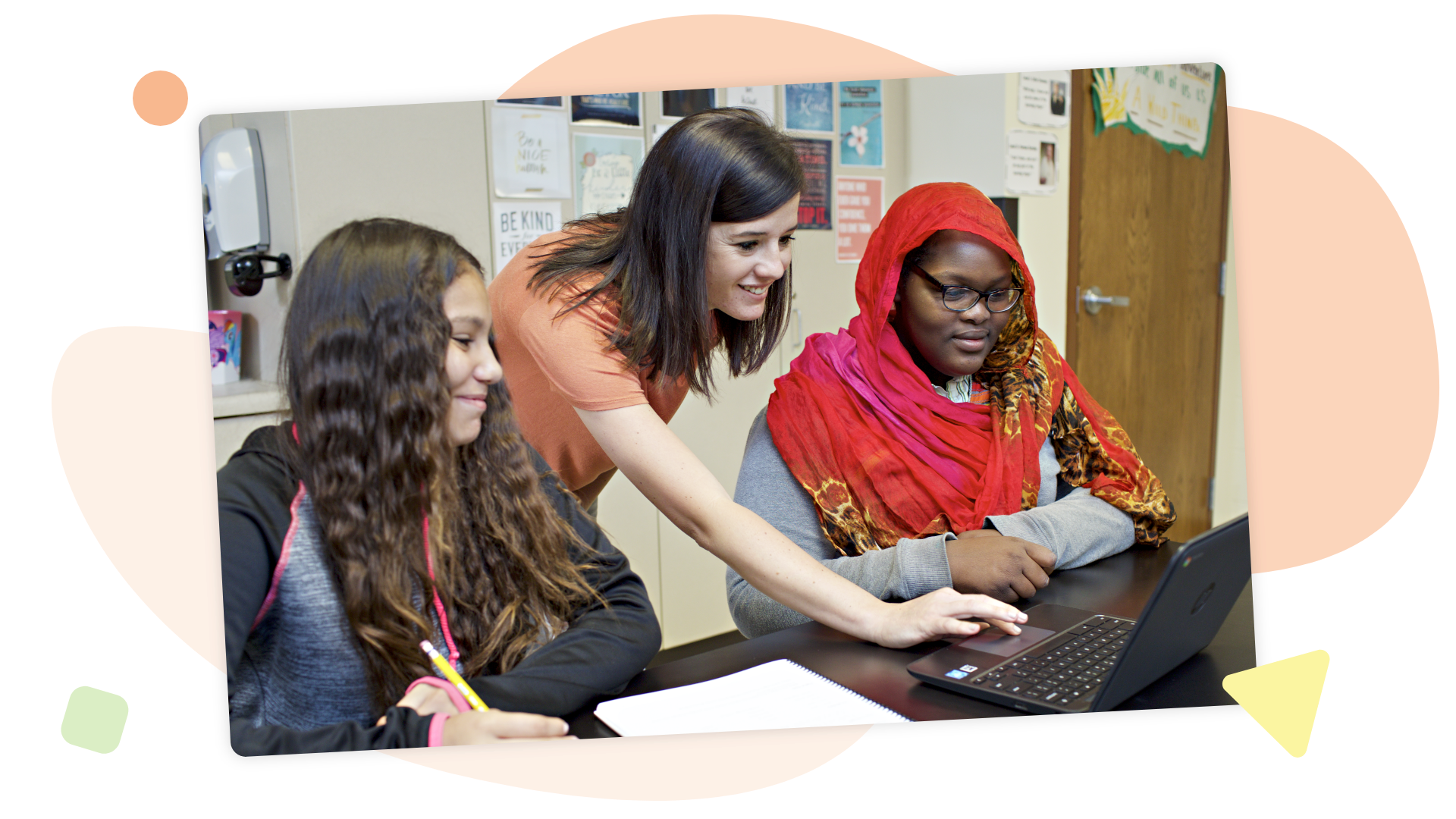
A closer look at grades K–2

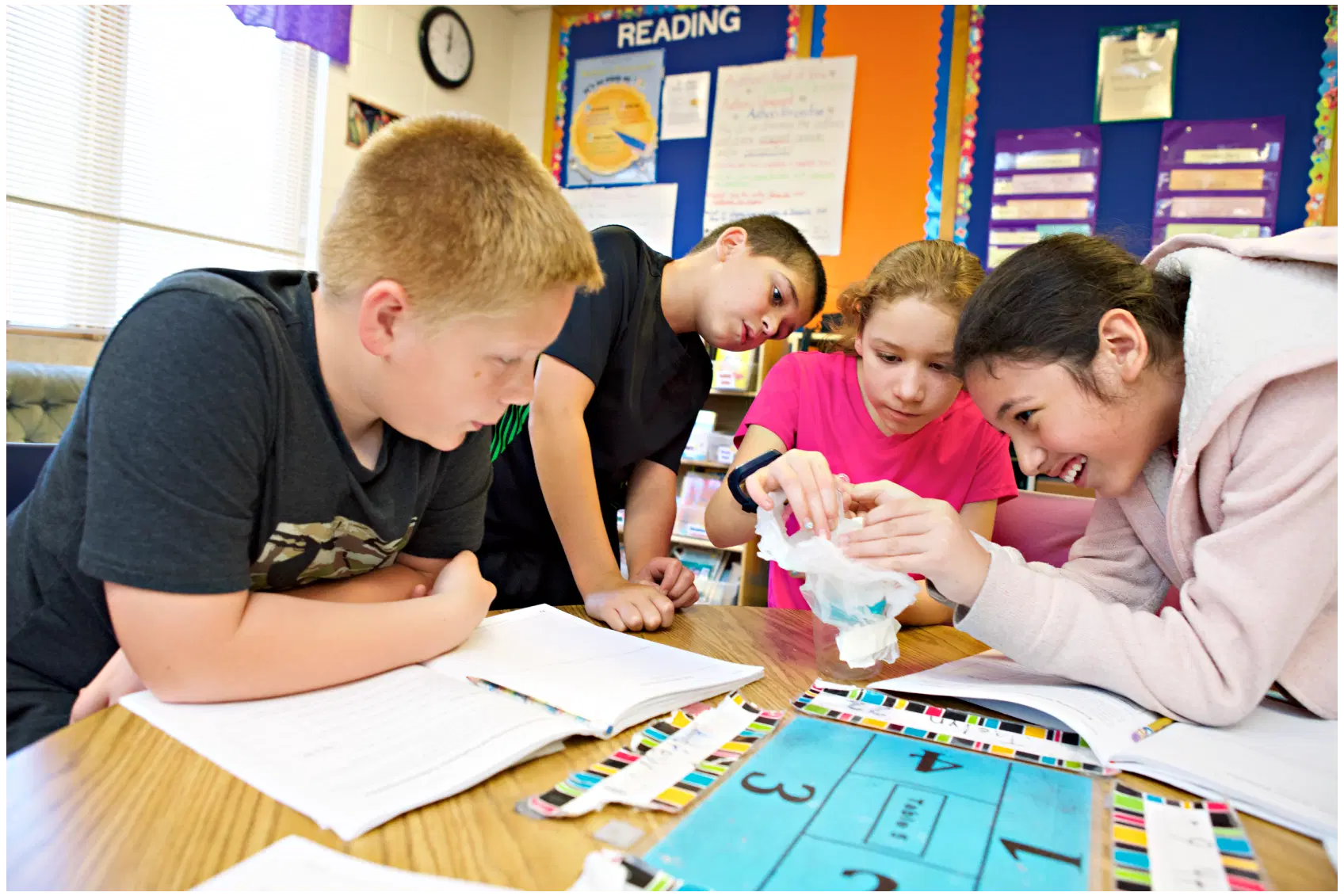
Amplify Science California is based on the latest research on teaching and learning and helps teachers deliver age-appropriate, high-quality, literacy-rich instruction that enables students to take on the roles of scientists and engineers to solve real-world phenomena every day.

In the K–2 classroom, this looks like students:

  • Collecting evidence from a variety of sources.
  • Making sense of evidence in a variety of ways.
  • Formulating convincing scientific arguments.
A collage of four images: building a toothpick structure, a boy reading a book to a girl, two children conducting a water experiment, and a light projection setup.
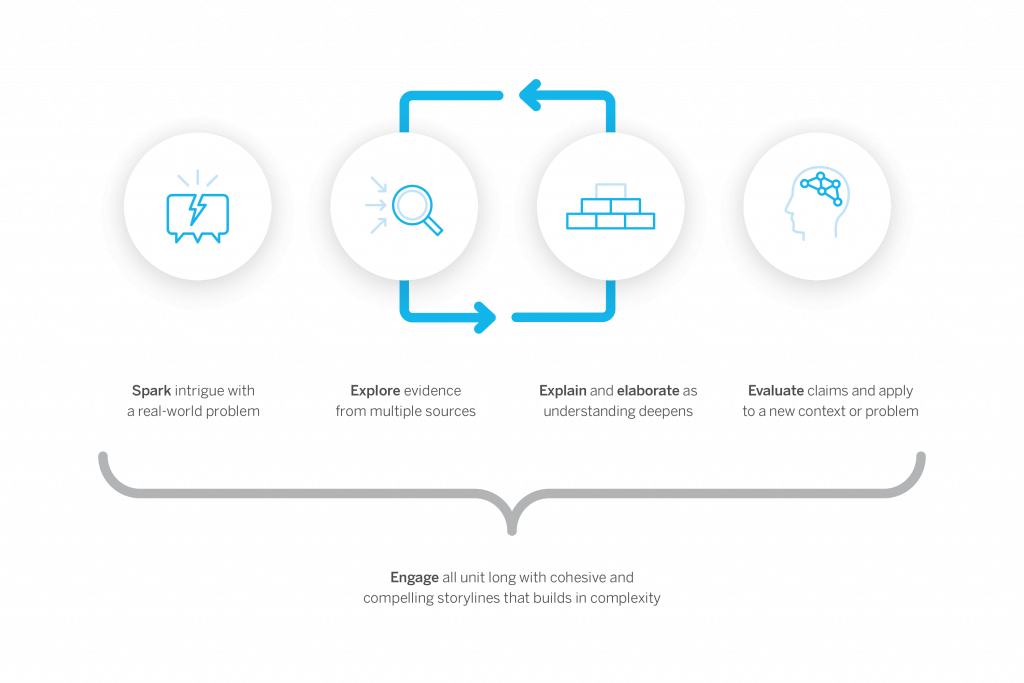
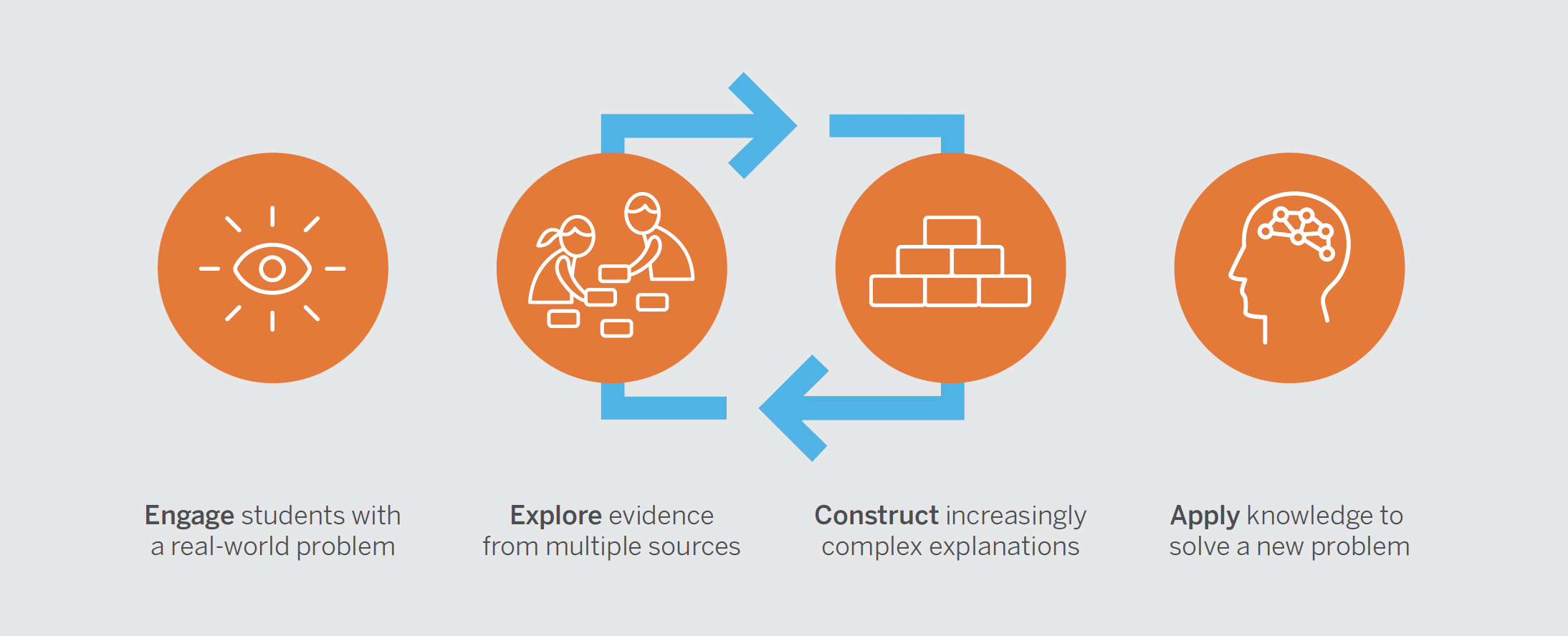
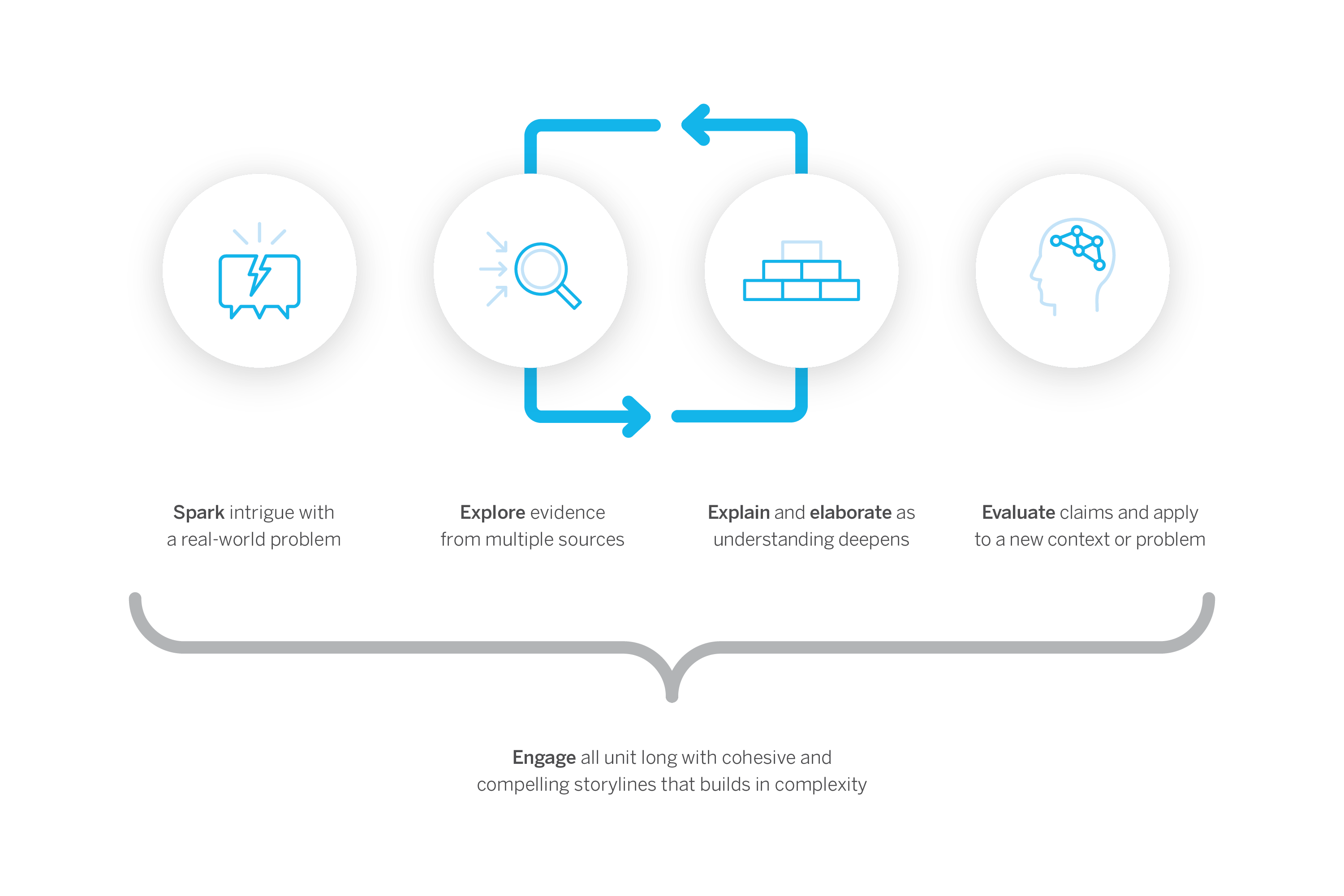
Graphic showing a research process with four steps: spark intrigue with a real-world problem, explore evidence, explain and elaborate, and evaluate claims, connected in a cycle with arrows.

Program structure

Our cyclical lesson design ensures students receive multiple exposures to concepts through a variety of modalities. As they progress through the lessons within a unit, their understanding gradually builds and deepens, ultimately leading to their ability to develop and refine increasingly complex explanations of the unit’s phenomenon.

It’s this proven program structure and lesson design that enables Amplify Science California to teach less, but achieve more. Rather than asking teachers to wade through unnecessary content, we designed our K–2 program to address 100% of the California NGSS in just 66 days.

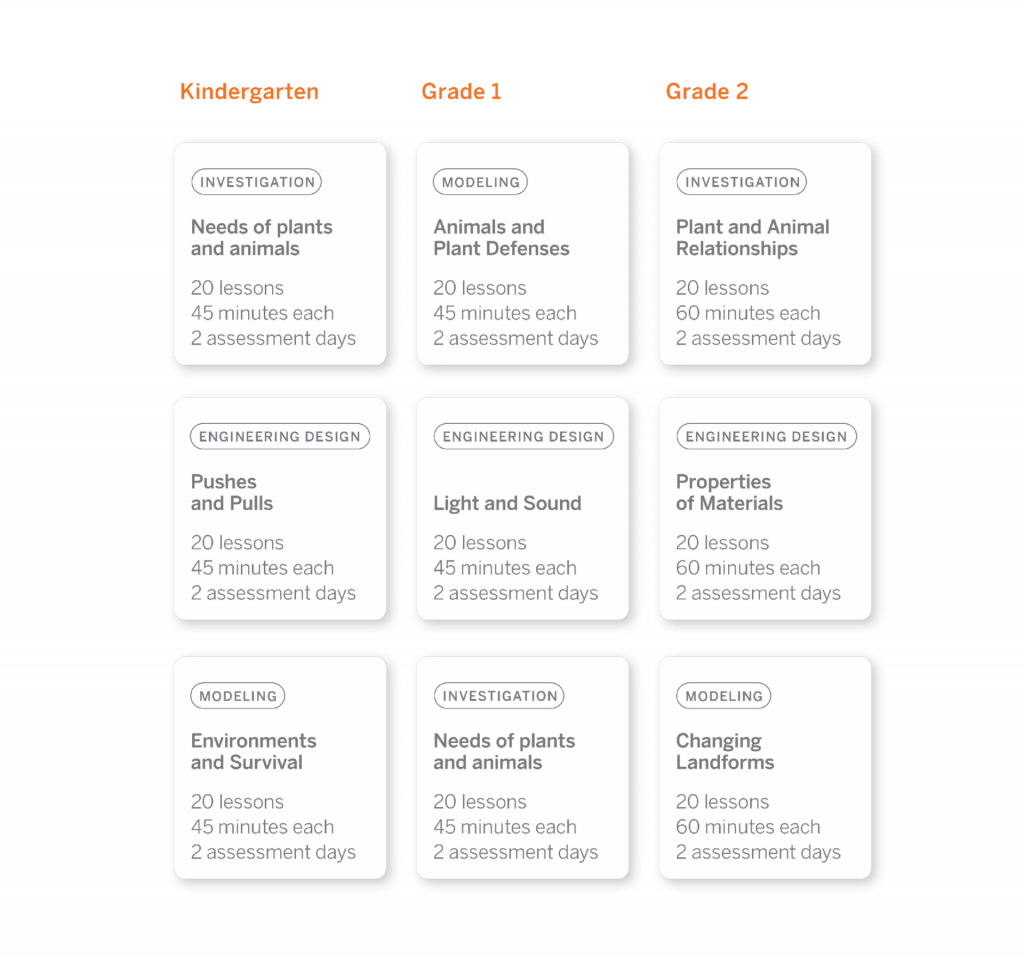
Scope and sequence

Every year of our K–2 consists of 3 units and 66 total lessons. Said another way, each unit contains 20 lessons plus two dedicated assessment days (a Pre-Unit Assessment and End-of-Unit Assessment).

Lessons at grades K–1 are written for a minimum of 45-minutes, and grade 2 lessons are written for a minimum of 60-minutes—though teachers can expand or contract the timing to meet their needs.

Educational curriculum chart showcasing a progression of amplify science lessons from kindergarten to grade 5, categorized by grade and subject areas like plants, animals, weather, and energy.

Unit types

While every unit delivers three-dimensional learning experiences and engages students in gathering evidence from a rich collection of sources, each unit also emphasizes a particular science and engineering practice.

In each grade K–2:

  • One unit emphasizes the practice of investigation.
  • One unit emphasizes the practice of modeling.
  • One unit emphasizes the practice of engineering design.
Investigation Units

Investigation units focus on the process of strategically developing investigations and gathering data to answer questions. Students are first asked to consider questions about what happens in the natural world and why, and are then involved in designing and conducting investigations that produce data to help answer those questions.

Modeling Units

Modeling units provide extra support to students engaging in the practice of modeling. Students use physical models, investigate with computer models, and create their own diagrams to help them visualize what might be happening on the nanoscale.

Engineering Design Units

Engineering design units provide opportunities for students to solve complex problems by applying science principles to the design of functional solutions, and iteratively testing those solutions to determine how well they meet preset criteria.

Units at a glance

An illustration from Needs of Plants and Animals unit
Needs of Plants and Animals

Domains: Life Science, Earth and Space Science, Engineering Design

Unit type: Investigation

Student role: Scientists

Phenomenon: There are no monarch caterpillars in the Mariposa Grove community garden since vegetables were planted. 

Download unit guide

Download lesson planner

An illustration from the Pushes and Pulls unit
Pushes and Pulls

Domains: Physical Science, Engineering Design

Unit type: Engineering design

Student role: Pinball engineers

Phenomenon: Pinball machines allow people to control the direction and strength of forces on a ball.  

Download unit guide

Download lesson planner

Silhouette of a playground structure against a blue sky with clouds and three yellow suns.
Sunlight and Weather

Domains: Earth and Space Science, Life Science, Engineering Design

Unit type: Modeling

Student role: Weather scientists

Phenomenon: Students at Carver Elementary School are too cold during morning recess, while students at Woodland Elementary School are too hot during afternoon recess.  

Download unit guide

Download lesson planner

Illustration of sea turtles swimming among seaweed in the ocean, with a large shark in the background.
Animal and Plant Defenses

Domain: Life Science

Unit type: Modeling

Student role: Marine scientists

Phenomenon: Spruce the Sea Turtle lives in an aquarium and will soon be released back into the ocean, where she will survive despite ocean predators.  

Download unit guide

Download lesson planner

Two hands holding a paper with a drawing of a pyramid and a tree, illuminated by a flashlight, projecting another shadow of the image on the wall.
Light and Sound

Domains: Physical Science, Engineering Design

Unit type: Engineering design

Student role: Light and sound engineers

Phenomenon: A puppet show company uses light and sound to depict realistic scenes in puppet shows.  

Download unit guide

Download lesson planner

An illustration from the Spinning Earth unit
Spinning Earth

Domain: Earth and Space Science

Unit type: Investigation

Student role: Sky scientists

Phenomenon: The sky looks different to Sai and his grandma when they talk on the phone.  

Download unit guide

Download lesson planner

An elephant standing next to a tree uses its trunk to pick a fruit from a branch while more fruit hangs above.
Plant and Animal Relationships

Domains: Life Science, Engineering Design

Unit type: Investigation

Student role: Plant scientists

Phenomenon: No new chalta trees are growing in the fictional Bengal Tiger Reserve in India.  

Download unit guide

Download lesson planner

A hand holds a red bean on a table, while a wooden stick spreads white glue and scattered beans. Also on the table are a white cup and a yellow pen.
Properties of Materials

Domains: Physical Science, Engineering Design

Unit type: Engineering design

Student role: Glue engineers

Phenomenon: Different glue recipes result in glues that have different properties.  

Download unit guide

Download lesson planner

Illustration of a coastline with cliffs, a recreation center building with a red roof and a sign, evergreen trees, a blue flag, and a sandy beach below.
Changing Landforms

Domain: Earth and Space Science

Unit type: Modeling

Student role: Geologists

Phenomenon: The cliff that Oceanside Recreation Center is situated on appears to be receding over time.  

Download unit guide

Download lesson planner

A closer look at grades K–2

Amplify Science California is based on the latest research on teaching and learning and helps teachers deliver age-appropriate, high-quality, literacy-rich instruction that enables students to take on the roles of scientists and engineers to solve real-world phenomena every day.

In the K–2 classroom, this looks like students:

  • Collecting evidence from a variety of sources.
  • Making sense of evidence in a variety of ways.
  • Formulating convincing scientific arguments.
A collage of four images: building a toothpick structure, a boy reading a book to a girl, two children conducting a water experiment, and a light projection setup.
Graphic showing a research process with four steps: spark intrigue with a real-world problem, explore evidence, explain and elaborate, and evaluate claims, connected in a cycle with arrows.

Program structure

Our cyclical lesson design ensures students receive multiple exposures to concepts through a variety of modalities. As they progress through the lessons within a unit, their understanding gradually builds and deepens, ultimately leading to their ability to develop and refine increasingly complex explanations of the unit’s phenomenon.

It’s this proven program structure and lesson design that enables Amplify Science California to teach less, but achieve more. Rather than asking teachers to wade through unnecessary content, we designed our K–2 program to address 100% of the California NGSS in just 66 days.

Scope and sequence

Every year of our K–2 consists of 3 units and 66 total lessons. Said another way, each unit contains 20 lessons plus two dedicated assessment days (a Pre-Unit Assessment and End-of-Unit Assessment).

Lessons at grades K–1 are written for a minimum of 45-minutes, and grade 2 lessons are written for a minimum of 60-minutes—though teachers can expand or contract the timing to meet their needs.

Educational curriculum chart showcasing a progression of amplify science lessons from kindergarten to grade 5, categorized by grade and subject areas like plants, animals, weather, and energy.

Unit types

While every unit delivers three-dimensional learning experiences and engages students in gathering evidence from a rich collection of sources, each unit also emphasizes a particular science and engineering practice.

In each grade K–2:

  • One unit emphasizes the practice of investigation.
  • One unit emphasizes the practice of modeling.
  • One unit emphasizes the practice of engineering design.
Investigation Units

Investigation units focus on the process of strategically developing investigations and gathering data to answer questions. Students are first asked to consider questions about what happens in the natural world and why, and are then involved in designing and conducting investigations that produce data to help answer those questions.

Modeling Units

Modeling units provide extra support to students engaging in the practice of modeling. Students use physical models, investigate with computer models, and create their own diagrams to help them visualize what might be happening on the nanoscale.

Engineering Design Units

Engineering design units provide opportunities for students to solve complex problems by applying science principles to the design of functional solutions, and iteratively testing those solutions to determine how well they meet preset criteria.

Units at a glance

An illustration from Needs of Plants and Animals unit
Needs of Plants and Animals

Domains: Life Science, Earth and Space Science, Engineering Design

Unit type: Investigation

Student role: Scientists

Phenomenon: There are no monarch caterpillars in the Mariposa Grove community garden since vegetables were planted. 

Download unit guide

Download lesson planner

An illustration from the Pushes and Pulls unit
Pushes and Pulls

Domains: Physical Science, Engineering Design

Unit type: Engineering design

Student role: Pinball engineers

Phenomenon: Pinball machines allow people to control the direction and strength of forces on a ball.  

Download unit guide

Download lesson planner

Silhouette of a playground structure against a blue sky with clouds and three yellow suns.
Sunlight and Weather

Domains: Earth and Space Science, Life Science, Engineering Design

Unit type: Modeling

Student role: Weather scientists

Phenomenon: Students at Carver Elementary School are too cold during morning recess, while students at Woodland Elementary School are too hot during afternoon recess.  

Download unit guide

Download lesson planner

Illustration of sea turtles swimming among seaweed in the ocean, with a large shark in the background.
Animal and Plant Defenses

Domain: Life Science

Unit type: Modeling

Student role: Marine scientists

Phenomenon: Spruce the Sea Turtle lives in an aquarium and will soon be released back into the ocean, where she will survive despite ocean predators.  

Download unit guide

Download lesson planner

Two hands holding a paper with a drawing of a pyramid and a tree, illuminated by a flashlight, projecting another shadow of the image on the wall.
Light and Sound

Domains: Physical Science, Engineering Design

Unit type: Engineering design

Student role: Light and sound engineers

Phenomenon: A puppet show company uses light and sound to depict realistic scenes in puppet shows.  

Download unit guide

Download lesson planner

An illustration from the Spinning Earth unit
Spinning Earth

Domain: Earth and Space Science

Unit type: Investigation

Student role: Sky scientists

Phenomenon: The sky looks different to Sai and his grandma when they talk on the phone.  

Download unit guide

Download lesson planner

An elephant standing next to a tree uses its trunk to pick a fruit from a branch while more fruit hangs above.
Plant and Animal Relationships

Domains: Life Science, Engineering Design

Unit type: Investigation

Student role: Plant scientists

Phenomenon: No new chalta trees are growing in the fictional Bengal Tiger Reserve in India.  

Download unit guide

Download lesson planner

A hand holds a red bean on a table, while a wooden stick spreads white glue and scattered beans. Also on the table are a white cup and a yellow pen.
Properties of Materials

Domains: Physical Science, Engineering Design

Unit type: Engineering design

Student role: Glue engineers

Phenomenon: Different glue recipes result in glues that have different properties.  

Download unit guide

Download lesson planner

Illustration of a coastline with cliffs, a recreation center building with a red roof and a sign, evergreen trees, a blue flag, and a sandy beach below.
Changing Landforms

Domain: Earth and Space Science

Unit type: Modeling

Student role: Geologists

Phenomenon: The cliff that Oceanside Recreation Center is situated on appears to be receding over time.  

Download unit guide

Download lesson planner

A closer look at grades K–2

Amplify Science is based on the latest research on teaching and learning and helps teachers deliver age-appropriate, high-quality, literacy-rich instruction that enables students to take on the roles of scientists and engineers to solve real-world phenomena every day.

In the K–2 classroom, this looks like students:

  • Collecting evidence from a variety of sources.
  • Making sense of evidence in a variety of ways.
  • Formulating convincing scientific arguments.
A collage shows science activities: toothpick structure, two kids reading, two kids pouring liquid into cups, and a light experiment with shadows.
A four-step process diagram: Spark, Explore, Explain and elaborate, and Evaluate, connected by arrows, with a summary below about engaging through cohesive storylines.

Program structure

Our cyclical lesson design ensures students receive multiple exposures to concepts through a variety of modalities. As they progress through the lessons within a unit, their understanding gradually builds and deepens, ultimately leading to their ability to develop and refine increasingly complex explanations of the unit’s phenomenon.

It’s this proven program structure and lesson design that enables Amplify Science to teach less, but achieve more. Rather than asking teachers to wade through unnecessary content, we designed our K–2 program to address 100% of the NGSS in just 66 days.

Scope and sequence

Every year of our K–2 consists of 3 units and 66 total lessons. Said another way, each unit contains 20 lessons plus two dedicated assessment days (a Pre-Unit Assessment and End-of-Unit Assessment).

Lessons at grades K–1 are written for a minimum of 45-minutes, and grade 2 lessons are written for a minimum of 60-minutes—though teachers can expand or contract the timing to meet their needs.

Grid of nine educational subject cards for kindergarten, grade 1, and grade 2, each listing curriculum topics like "needs of plants and animals" and "engineering design" with lesson durations.

Unit types

While every unit delivers three-dimensional learning experiences and engages students in gathering evidence from a rich collection of sources, each unit also emphasizes a particular science and engineering practice.

In each grade K–2:

  • One unit emphasizes the practice of investigation.
  • One unit emphasizes the practice of modeling.
  • One unit emphasizes the practice of engineering design.
Investigation Units

Investigation units focus on the process of strategically developing investigations and gathering data to answer questions. Students are first asked to consider questions about what happens in the natural world and why, and are then involved in designing and conducting investigations that produce data to help answer those questions.

Modeling Units

Modeling units provide extra support to students engaging in the practice of modeling. Students use physical models, investigate with computer models, and create their own diagrams to help them visualize what might be happening on the nanoscale.

Engineering Design Units

Engineering design units provide opportunities for students to solve complex problems by applying science principles to the design of functional solutions, and iteratively testing those solutions to determine how well they meet preset criteria.

Units at a glance

Needs of Plants and Animals

Domains: Life Science, Earth and Space Science, Engineering Design

Unit type: Investigation

Student role: Scientists

Phenomenon: There are no monarch caterpillars in the Mariposa Grove community garden since vegetables were planted. 

Pushes and Pulls

Domains: Physical Science, Engineering Design

Unit type: Engineering design

Student role: Pinball engineers

Phenomenon: Pinball machines allow people to control the direction and strength of forces on a ball.  

Sunlight and Weather

Domains: Earth and Space Science, Life Science, Engineering Design

Unit type: Modeling

Student role: Weather scientists

Phenomenon: Students at Carver Elementary School are too cold during morning recess, while students at Woodland Elementary School are too hot during afternoon recess.  

Animal and Plant Defenses

Domain: Life Science

Unit type: Modeling

Student role: Marine scientists

Phenomenon: Spruce the Sea Turtle lives in an aquarium and will soon be released back into the ocean, where she will survive despite ocean predators.  

Light and Sound

Domains: Physical Science, Engineering Design

Unit type: Engineering design

Student role: Light and sound engineers

Phenomenon: A puppet show company uses light and sound to depict realistic scenes in puppet shows.  

Spinning Earth

Domain: Earth and Space Science

Unit type: Investigation

Student role: Sky scientists

Phenomenon: The sky looks different to Sai and his grandma when they talk on the phone.  

Plant and Animal Relationships

Domains: Life Science, Engineering Design

Unit type: Investigation

Student role: Plant scientists

Phenomenon: No new chalta trees are growing in the fictional Bengal Tiger Reserve in India.  

Properties of Materials

Domains: Physical Science, Engineering Design

Unit type: Engineering design

Student role: Glue engineers

Phenomenon: Different glue recipes result in glues that have different properties.  

Changing Landforms

Domain: Earth and Space Science

Unit type: Modeling

Student role: Geologists

Phenomenon: The cliff that Oceanside Recreation Center is situated on appears to be receding over time.  

S5-01. Investigating math anxiety in the classroom

A blue graphic with text reading "Math Teacher Lounge" in multicolored letters and "Amplify." at the bottom, with abstract geometric shapes and lines as decoration.

Season 5 is here! This season, we’ll be talking all about math anxiety: what it is, what causes it, and what we can do to prevent or ease this anxiety in the math classroom. To launch this very important theme, we sat down with Dr. Gerardo Ramirez, associate professor of educational psychology at Ball State University.
 
As someone who’s been studying math anxiety for more than a decade, he had some interesting research and advice to share on why math anxiety affects so many students (and adults), and tips for how to start reducing it.
 
Listen now and don’t forget to grab your MTL study guide to track your learning and make the most of this episode!
 
Enjoy this episode and explore more from Math Teacher Lounge by visiting our main page.

Download Transcript

Dan Meyer (00:01):
Hey, folks. Welcome back to Math Teacher Lounge. I’m one of your hosts, Dan Meyer.

Bethany Lockhart Johnson (00:05):
And I am your other host. I’m Bethany Lockhart Johnson. Season five! Hello!

Dan Meyer (00:11):
Bethany, how are you doing? How have you been spending the long break between our recording sessions?

Bethany Lockhart Johnson (00:16):
As much as I loved sharing content from previous seasons, I am so thrilled that we’re back for season five. I have been, you know, chasing a toddler. I think he’s already tired of me saying, “Ooh, can we count that?” He’s like [sighs] “One two, one two.” Like, he’s done already.

Dan Meyer (00:36):
Too much counting. Yeah, I worry about that so much, that my love of mathematics might be perceived by my kids as smothering. Yeah, I worry about the same. We shared with you folks some bangers of reruns, in my humble opinion. Some great guests. But, we’ve been excited—me and Bethany—to hop back on the mics, on the ones and twos, and explore some new ideas together.

Bethany Lockhart Johnson (01:01):
Well, I loved our season talking about joy in mathematics. And personally I could…like, we could turn this whole podcast into joy in mathematics. However, we’re kind of going a different route. Because if you ask folks why they don’t feel joy in mathematics, a lot of times at the root of that is some really intense math anxiety. So this whole season, we’re going to be delving into math anxiety. Exploring what it is, who has it, why do we think it happens, what do we think we can do about it, and how can we navigate through it, so that we can experience that joy in math? These are questions that we’re gonna explore over the course of the season. Dan Meyer, how do you feel about that?

Dan Meyer (01:49):
It feels big and it feels personal. I mean, as we shared in our math stories back from season…whatever it was, math anxiety was a huge part.

Bethany Lockhart Johnson (01:59):
It was last season, Dan.

Dan Meyer (02:00):
Last…? I mean, who can remember? Big part of your journey. I’ve had some very punctuated but intense moments of anxiety in math class. And socially, we have built math up to be this incredibly powerful thing. You know, restricting movement on economic ladders, preventing people from getting into careers they want. Whether or not they have much to do with math class, math anxiety is a really large part of educational but also social life. And yeah, I’m really excited to explore it with you. We’re bringing on some really excellent guests. Some researchers, yes. But not just researchers! Also people who practice in the field and know firsthand what it looks like to resolve issues of anxiety with students.

Bethany Lockhart Johnson (02:45):
Yeah, you’re right, Dan. My math story contained quite a bit of math anxiety, so I am particularly invested in this season. I mean, I still navigate math anxiety. And, you know, many of us do, and let’s talk about it. And let’s—I love that you reminded me. We’re gonna have a lot of great researchers all throughout the season, and a lot of times folks feel like the research happening, there’s sometimes a gap between researchers and what’s actually happening in the classroom. Not in all cases, but a lot of times. Right? And I remember a lot of conversation about the latest research when I was in grad school, but unless you’re actively studying something, sometimes we don’t know what’s happening. Right? We’re really focused on what’s happening right in front of us in our classroom. So let’s take some of that research; let’s break it down; let’s talk to some of the folks who are thinking about this for the bulk of their day, right?

Dan Meyer (03:41):
Yep. So we got our first guest coming up in a moment here.

Bethany Lockhart Johnson (03:45):
So to kick off this season, we’re starting episode one by talking to Dr. Gerardo Ramirez, Associate Professor of Educational Psychology at Ball State University. And he’s been researching math anxiety for more than a decade. He’s worked with so many amazing folks in the field. He’s worked with students, he’s worked with teachers, with educators…I’m just so excited to talk to him. If you look up math anxiety, you see his name as one of the folks who is really thinking about this at so many different angles, and we get to talk to him. So enjoy our conversation with Dr. Gerardo Ramirez.

Dan Meyer (04:29):
We are so excited to have Dr. Gerardo Ramirez on the show with us. Dr. Ramirez is an Associate Professor of Educational Psychology at Ball State University. Thanks so much for joining us.

Dr. Gerardo Ramirez (04:40):
Yeah, thank you for inviting me to talk about math anxiety.

Bethany Lockhart Johnson (04:43):
So with your interview, Dr. Ramirez, we are actually launching the season. We’re gonna be talking about all different aspects of math anxiety, and it feels pretty perfect that you are first guest of the season, because of the sheer breadth of research and conversations you’ve had about math anxiety. Could you start us off kind of telling us a story of how did you get interested in studying math anxiety? Or why, you know, why did you dive into this topic that, you know, I think a lot of folks might…like, if you’re on a plane, and you say, “Oh, I study math anxiety,” what kind of reaction are you gonna get?

Dr. Gerardo Ramirez (05:24):
Oh, sure. Yeah. I think most people are actually very interested because they all have their own story about feeling anxious about math, or just being anxious about evaluation situations that involve math. And, yeah, they wanna share those stories. People feel quite comfortable talking about their anxiety about math, for some reason. But for me, I started off, when I was in undergrad, I was studying to take the GRE quiz. I was hoping to go into a psych program. But I wasn’t exactly sure what direction yet. As I took some of the practice tests, there’s some situations in which I was very nervous about taking the practice test. And I just noticed that I did really poorly on some of these exams. And so I became very interested in issues like choking under pressure, which means when you underperform relative to what you expected to perform. And so, as I was researching these issues, I started to come across this whole field of math anxiety. And I saw that while there are some people who choke under pressure during tests, there are other people who just have a strong general fear of mathematics.

Dan Meyer (06:29):
That’s really helpful. I can imagine you’re doing a lot of free psychology sessions, free therapy for people on airplanes when they bring to you their own stories of math. So let’s thank you for your service in that sense. I’m super-curious. So Bethany and I have both taught math. We both have seen firsthand what it looks like when a student is anxious in math class, though maybe we don’t have kind of the clinical language to describe it. And I’m curious, from a clinical sense, how do we define math anxiety?

Dr. Gerardo Ramirez (06:57):
Sure. So first off, math anxiety is not something that you would find in the DSM, for instance. But we generally define that as a fear or apprehension to situations that involve math. So it doesn’t have to necessarily be educational situations. It could be someone asks you a math-related question during a party, or you have to calculate the tip at a restaurant, for instance. It doesn’t have to be about schooling situations, although that’s obviously where it seems to matter a lot for many people. So it is basically a fear or apprehension to situations that involve math. And I think distinguishing the term “fear” from “anxiety” is really important here. A lot of times people use those terms interchangeably, and the term “fear” is obviously within our definition of math anxiety. But oftentimes what differentiates anxiety from fear is that, anxiety is—think of it like a recipe. Anxiety is fear plus a little bit of unknown. OK? So if, for instance, if you hated snakes, and they threw a snake at you, you’d be in intense fear. Whereas if you hated snakes and they said, “There is a snake in the room, but I’m not gonna tell you where,” that’s gonna cause anxiety. And so the reason why we call it math anxiety is because a lot of times people experience this fear for a possible unknown future that involves math or possible unknown evaluations that people might have about your competence, because of math. And so for a lot of kids, they feel anxious about how they’re gonna do on a test or whether they’re gonna be able to pass a class or whether they’ll be able to understand what you’re saying in your lessons, for instance. And so the anxiety component really gets at fear of something that’s unknown, but related to mathematics situations.

Dan Meyer (08:47):
Math is somewhere in the ceiling right now. Perhaps I might be surprised with a math situation!

Dr. Gerardo Ramirez (08:52):
Yeah. yep.

Dan Meyer (08:52):
So I have this tendency to assume that every other subject that we teach has it better and easier than math does. It’s not true. I know this is not true. But I’m kind of curious here. Is math anxiety, like, part of a general just set of anxiety around schooling itself? Like, is there a reading anxiety, a writing anxiety, and does that all just flow from the same kind of fount of anxiety around schooling or situations about learning? And what makes math special in this regard? If it is its own special anxiety, for instance?

Dr. Gerardo Ramirez (09:27):
There are different…so some people obviously suffer from generalized anxiety. Right? And so they would, you know, feel anxious both for evaluative and non-evaluative situations. But in the research that we’ve done and that other people have done, there are differences between things like reading anxiety, math anxiety; I’ve also studied spatial and creativity anxiety. A lot of times what we’re trying to do in these studies is we measure all of the above, and we try to show that, look, math anxiety predicts math situations above and beyond these other things. So yeah, we definitely distinguish those things. And so what’s special about math is that, well, I think the symbolic nature is a big part of it. The abstract symbolic nature is just not as tangible to students. They can’t touch it. And so it doesn’t allow ’em to use their full cognitive faculties to play with it, as you might see, for instance, in science. Or it doesn’t allow people to relate math to their own interests the way you might see, for instance, in English. So maybe I hate reading novels, but I’m interested in zombies and you give me a book on zombies, well, ok, great, you’ve connected my personal assets to the topic. Whereas with math, either that’s harder to do or instructors don’t do such a good job of setting that connection up.

Bethany Lockhart Johnson (10:46):
Also, I think, you know, I’ve heard of students being really anxious, let’s say, during a reading session, when teachers used to do—hopefully they’re still not doing it—the popcorn reading, where you just randomly call on a student to read out a sentence. Right? But you don’t really hear students or adults talking about, “Oh, no, no, no, I don’t read; I don’t mess with reading.” You know? Whereas with math, you do hear, “Oh, I’m not a math person. Oh no, no, no, don’t ask me any math questions.” And that is such a distinction.

Dr. Gerardo Ramirez (11:18):
Yeah. And I think a lot of that’s because it’s just so common. As an adult, to be nervous about reading is kind of an uncommon thing. So people feel a stigma around admitting that. But math is something that everyone feels like they’re inadequate in. And so there’s a lot of comfort in telling you how they’re just one of the many people who don’t like math. And that, you know, can have a lot of different consequences and outcomes. I think on the one hand, I think for a lot of kids it becomes a normalized message that if you fear math, that’s OK, join the club. Right? But we have to be careful about that, ’cause a lot of math anxiety researchers will oftentimes say, part of what leads to math anxiety is adults normalizing that it’s OK to be scared of math. So I think a lot of times adults, teachers, for instance, math teachers, they’ll tell kids, “You know, if you’re scared, that’s OK.” And so a lot of the math anxiety community says, “No, no, no, you’re not supposed to do that.” But my recent view is different. I view that as a form of validation. Because math is hard. And so telling kids, “Hey, look, it’s actually easy if you just try,” I don’t think that’s true. It’s actually just hard. And I think even if it was easy, to the kid, it feels hard! And I think something that’s not really well-studied right now in our field is the value of validating people’s math negative math experiences. We don’t want to validate that, ’cause we think that we’re gonna reinforce that. But actually, I think the opposite. I think when you validate people’s negative math experiences, it helps ’em to feel that they can handle it. They can start to take control over their own emotions.

Bethany Lockhart Johnson (12:52):
I love that. And I, I actually, I think that’s so powerful, what you’re talking about, that validation. I taught kindergarten, and I vividly remember being in a parent-teacher conference and that parent saying, “Oh, I wasn’t a math person either,” right? Or, you know, their language and their experience with their own math schooling, their anxiety about math was actually impacting their students’ experience of math. Or the conversation that, when I would go to talk about a math assessment, let’s say, you could see the parent actually tensing up. And there was this moment of validation, that I felt like we needed to make space for that in the conversation with the parents, right?

Dr. Gerardo Ramirez (13:38):
Yeah.

Bethany Lockhart Johnson (13:38):
Like, this is a real thing. And we are working on teaching students that math is something that gets to—your experience with math gets to look all sorts of different ways. And it’s OK if we, you know, make a mistake, or if we kind of only get this part, but we’ve really got that part. Or let’s talk about it; let’s write about it. So I really feel like that that validation is something that’s so missing. And instead of the validation, like you said, you see folks being like, “Oh yeah, me neither. I’m not a math person either.” Right?

Dr. Gerardo Ramirez (14:10):
Yeah. I think…part of the reason why people are comfortable sharing this because they’re looking for validation also. When they say, “Oh, I’m not a math person,” you know, I think they’re hoping that, you’ll say like, “Yeah, me neither,” or “Of course not, ’cause math is terrible.” Right? They’re looking for validation, not to reinforce their perspective, but to feel that it’s OK not to be a math person. And I think that’s one of the techniques that I’m trying to work on in my research right now, is to provide evidence that actually people will work harder when you validate their math experience. You don’t have to tell them a positive story per se. If your current story is “Math is hard and I’m very, very anxious; I’m scared,” then we can just validate that and help you work through that. And it actually will strengthen our relationships. Because if you’re a student and you’re struggling with math and I tell you, “Yeah, it’s hard; it’s OK to struggle with math,” that makes you feel seen. And that’s gonna lead you to want to ask me more for help, because I’m someone who understands you. And that’s a great, you know, remediation opportunity.

Dan Meyer (15:14):
A common thread that I think I’m seeing here in several answers is that math sometimes asks students to disassociate part of themselves. Where success in math oftentimes means working from an a level of abstraction with symbols, like you said, that can feel alien. Like, who am I here? And in the same way, I love that you’re proposing we validate and reassociate people with a very deeply felt part of themselves that is anxious about mathematics.

Dr. Gerardo Ramirez (15:44):
Yeah. I mean, I think that’s what validation’s supposed to do, right? So a lot of us, when we feel these strong emotions, we wonder, “Is this even a real thing? Are other people feeling this? Is there something wrong with me?” So we feel the emotions, but we can’t actually deal with them, because we wonder if they’re legitimate. And so when someone says, like, “Yeah, this is hard,” it crystallizes that emotion. And once something is made real, you can actually choose how you want to deal with it. Some kids are gonna deal with it by staying anxious. But some people are gonna choose to deal with it by saying, “Well, there’s nothing I can do about it now; I have to take this math test, so I’m just gonna think positive.” And that’s great. If the kid can end up saying that to themselves, that’s much more effective than me telling the kid, “Hey, you just gotta think positive. You’re gonna start the test anyway.” And so we want the kid to make meaning of their experience, and the way we do that is by crystallizing their emotions through validation.

Dan Meyer (16:36):
Yeah. I love that. And so what you’re proposing there, I think, sounds like, a solution, like a post-talk solution after students are feeling anxiety.

Dr. Gerardo Ramirez (16:43):
Yes.

Dan Meyer (16:43):
To validate and empathize.

Dr. Gerardo Ramirez (16:45):
Yes.

Dan Meyer (16:45):
And over the course of our season, we hope to explore a lot about solutions to math anxiety that are preventative, that reduce the odds of anxiety arising, through instruction and curriculum, before it arises. And I’m just wondering if you’ve seen anything that would hint at either specific or general words of wisdom you wanna share with the educators, about not just addressing it after the fact, but preventing math anxiety before it arises?

Dr. Gerardo Ramirez (17:14):
To be honest, at this point, I haven’t seen enough evidence for me to recommend anything concretely as an intervention for math anxiety, or an intervention to prevent its development. All I can really do here is rely a lot on the more broad cognitive-behavioral research on anxiety, which says that one of the ways we prevent people from developing anxiety is by helping them to make more positive appraisals of challenge situations. So a lot of times, when kids are challenged, they don’t know how to interpret that. “What does it mean that I’m struggling with this thing?” And so that’s where I think a lot of teachers can help students’ interpretations of that. ‘Cause if you leave kids to their own devices, they’re gonna think, “I’m struggling because I’m stupid. I’m struggling because I’m not good enough. I’m struggling because my dad is right; I’m gonna be a failure.” You know? They’re going to impose an interpretation to a challenge situation regardless. And so, as teachers, one thing we can do is we can help shape that interpretation and say, “What does it mean to struggle with math? People will say it means you’re stupid. That’s one interpretation. What’s another one? It means that your brain is working really hard to think through something. That’s another interpretation. What’s better? What do you think is more helpful?” And then, helping students to see how interpretations matter to how you ultimately feel about something. And that’s a very metacognitive way of thinking about things. So yeah, I would say that one way to prevent it is to help students to take more positive interpretations of their experience. But another way, and I think a more successful way, I think, is to give students early experiences where they feel efficacious dealing with math. One of the ways you do that, for instance, is by obviously making sure that the students understand the material—but that’s obvious; people are trying to do that. One of my favorite recommendations is to keep reassigning assignments, the same exact assignment, for, say, three weeks, back-to-back. So if in week one you do the homework assignment, you do OK, you don’t do so great, when week two you do it, you give the exact same assignment, and now the student can see like, “Wow, OK, this was much easier.” And then, week three, you give the exact same assignment; now the kid’s feeling really confident. And the reason why that’s great is because it helps kids to see that they’re growing in confidence. A lot of times kids don’t get to see that because we’re constantly throwing new assessments at them. And so they’re never seeing that growth. All they’re seeing is a new challenge, a new challenge, a new challenge. So I think we need to set up situations where they can feel that they’re growing, when we keep the assessment static. That can be a formative assessment, for instance—doesn’t have to be a summative assessment.

Bethany Lockhart Johnson (19:55):
That feels so powerful and it feels like it really connects to that validation piece, right? We are actually helping to create a culture in our math classroom where we might struggle with something, but we keep revisiting it. And it’s not so much to reach mastery, but as Dr. Megan Franke — we talked to her about this partial understanding and about pulling on those threads of things that you do understand, so that you can build your confidence…build, not just confidence, but build your…I guess, kind of get your footing, right? You’re saying, “Well, I do understand this. I see how this works.” And if I’m revisiting an assignment, I feel like that would give me permission to like, “Hey, I don’t have to have this figured out on the first pass. You know?

Dr. Gerardo Ramirez (20:44):
Yes, yes. Yeah. I mean, I’m gonna give you a silly analogy, but I think it works. You know, a lot of times people will have nightmares, right? And they’ll keep having the same nightmare over and over again, right? And so one reason that we suspect this happens is because they haven’t worked through whatever that nightmare’s supposed to be about. So if, say, I’m scared of driving, I may be having the same dream about driving and crashing over and over. And we keep having these nightmares. And I think math anxiety is kind of like a waking nightmare, where you keep rehashing something because you haven’t had the chance to finally address that dragon. You know? And so if someone was having a lot of fear over driving, then one behavioral approach would be, you know, to work with a therapist to actually get behind the wheel and maybe drive around the same track over and over until you feel comfortable at that, and then the nightmares stop. Well, the same thing is true, I think, about math, math and math anxiety, is that you wanna give people these opportunities to feel confident by going back to that original experience that caused them to feel anxious, and saying, “This one assignment that we did in week three that really freaked you out, let’s try it again now in week five. How was that?” “Yeah, it wasn’t so bad. It was still kind of annoying.” “OK, we’ll we’ll come back to it.” “Now it’s week seven. Now let’s go back to that assignment. How is it now?” “That’s actually…it wasn’t that terrible.” And that gives people the opportunity to reflect on how they’ve grown past that nightmare.

Bethany Lockhart Johnson (22:05):
I have to say, Dan talked about you being like a therapist. I’m like, wait, “How did you know, Dr. Ramirez? I did have this recurring dream! I did! And I had to face it. No, but I had such intense math anxiety in high school and it was debilitating. And the biggest thing for me, I thought I was the only one. I thought there was something wrong with me. I thought, “Why can’t I figure this out?” There wasn’t a conversation about “Here are some tools,” or “Here are some, some, some…”. Like, “This is OK, for you to feel scared about this or overwhelmed!”

Dr. Gerardo Ramirez (22:41):
Mm-hmm. Mm-hmm.

Bethany Lockhart Johnson (22:42):
You know, I think often when we talk about how widespread math anxiety is, I think a lot of folks automatically jump to high schoolers or college students avoiding math courses. But we see this in really young kids.

Dr. Gerardo Ramirez (22:56):
Yeah. So people are…people are just constantly making meaning of themselves, regardless of the age range. And that’s true even with young kids; they are trying to figure out who they are. Right? And so one of the things you see oftentimes with young kids is you ask ’em, “What are you good at?” And they say, “Everything!” And that’s their attempt to, you know, make meaning of themselves. But sometimes they’re not good at everything. Sometimes they actually struggle in math. And I think even early on, they have to make meaning of that. They say, “Well, I’m good at everything except math.” And how do you make sense of that? Well, why not math? “Oh, because math is terrible. It’s not for everybody. You know, it’s not something that I like.” And so, yeah, in a lot of the studies that we did early on, we basically went into these first-grade classrooms with the purpose of trying to assess whether we can actually show variability in kids’ math anxiety, even early on. In other other words, do kids even report feeling anxious about math situations? Or do they tell us that they’re great at everything? And what we found was that in fact, a good chunk of kids are, again, perfectly willing to tell you that “No, certain situations involving math make me very anxious.” Counting or addition, or doing a problem on the board. And the way we do that is by—I think there are probably more sophisticated ways that can be done, but this is the best we have at this point—is we go in there and we ask them, we show them a bunch of smiley faces and anxious faces. And we say, “I want you to tell me how you feel about these different situations that involve math.” And so we say, “If you feel kind of nervous, I want you to point to this face. If you feel very nervous, point to this face.” And we basically will read to them situations. We’ll say, “How would you feel if your teacher asked you to open up your new math textbook and you saw all the numbers inside of it?” And they’ll point to the really nervous face. So right now, those are some of the more reliable assessments for math anxiety among young kids. And that work showed us that even young kids are self-reporting math anxiety.

Dan Meyer (24:51):

Obviously this is worth our study, because we would hope people would not feel anxious in general, and especially if we have a mandated…kids are mandated to be in math classes for their entire childhood. So I see the need for this study, these studies. I’m curious: What are the consequences, though? Like what, what correlates with math anxiety? What are other reasons why we should care about math anxiety and work to remediate it?

Dr. Gerardo Ramirez (25:16):
Oh, sure. So it correlates with their actual math performance. It can correlate when they choose to do homework. Right? So a lot of times, the parents report having to fight with their kids over math homework a lot. And you also oftentimes see a lot of frustration over mathematics specifically. And so it can, you know, not only affect their academic ongoing outcomes, like math tests and math assignments, but it can also affect their relationship with their parents. So if every time you come home, your dad’s screaming at you because you haven’t done your math homework, and when he asks you to solve the problem in front of them, you don’t remember, ’cause you were checked out, ’cause you’re so stressed out, that’s gonna cause a really negative experience. You know, a lot of times people grow up and they still remember their dad screaming at them over the math homework. You know, it’ll affect your relationship with your teacher. So if you’re making me feel incompetent, if you’re stressing me out, you’re not the kind of person I wanna come to for help. So it can predict relational outcomes as well as academic outcomes. And down the line, of course, when it affects students’ opportunities to get into things like AP classes, it affects students standardized test performance and their choice of colleges, as well as scholarship opportunities.

Dan Meyer (26:29):
Once you show that it correlates to performance, then that opens up a whole range of other correlations that are pretty important, it sounds like. Whether that’s career options or, you know, post-secondary education and the like.

Dr. Gerardo Ramirez (26:40):
Yeah. And a lot of times, when people are choosing a career at college, a lot of times students will make a decision specifically based on what career has less math requirements or less math courses. So I think this finding needs to be verified further. But, there’s some studies showing that, for instance, elementary ed teachers, one factor that feeds into the decision to go into elementary ed is the math requirements are very low in elementary ed. So that can…obviously it’s not what we wanna hear, because these are our first formal math teachers, right? For our kids.

Bethany Lockhart Johnson (27:16):
It feels so powerful, the impact that math anxiety can have, not only while you’re in, let’s say, elementary school, high middle school, high school, but then the impacts beyond that in terms of your career. And I shared this last season, when we talked about our personal math story, but I know when I was navigating the deepest part of my math anxiety, I really felt like, maybe this is a reason I can’t be an elementary school teacher. Because I was so worried that I wouldn’t be able…not that I wouldn’t understand the math for fourth grade, fifth grade, but that there was something about my ability to teach it or understand it or develop a love and passion for it that I wouldn’t be able to do. And I really had to reclaim it in my own way. But, you know, something that I think is so powerful about your research is just the applicability — not only to the field of mathematics, but folks’ everyday lives. And the way that you have talked in the past about math being a gatekeeper…I have a family member who, brilliant American Sign Language interpreter. I mean, amazing. Like a dance with her fingers. I could just watch it all day. And she actually didn’t complete the program because she couldn’t complete the math requirements. And I remember talking to her about like, “Well, have you gone to the free tutoring? Have you gone to, you know, this or that?” But it was a paralyzing fear, you know? So Dr. Ramirez, what do you wish educators understood about math anxiety? Or the research about math anxiety? Or maybe even the general public at large, what do you wish folks understood about math anxiety?

Dr. Gerardo Ramirez (28:58):
Oh, I think that a lot of students, they struggle with math. And I think we wanna normalize that struggle as much as possible. We want to create a culture where it’s OK to do math slow; it’s ok to take your time. And I know that’s not possible with a lot of these requirements that a lot of math teachers have to do. But I think if we want to prevent math anxiety, we have to create opportunities to tell better stories. So that’s ultimately what I tell people is, why do people develop math anxiety? Because they had experiences that challenged their competency and they told a negative story. And so making space to reflect in math classrooms about what does it mean to go slow in math, or what does it mean to make mistakes, and then helping kids to tell better stories, I think it’s really the best thing we can do as math educators. ‘Cause you know, your job is not to be a therapist ultimately. You know, there’s only so much math teachers can do. But I think one of the most powerful things we can create is setting up students’ experiences where they feel confident, and they can tell better stories, so they can have better dreams about math.

Dan Meyer (30:06):
Really appreciate this introduction to math anxiety. It’s been a fantastic kickoff to our season. Dr. Ramirez, thank you so much for joining us.

Dr. Gerardo Ramirez (30:14):
Sure. Thank you.

Dan Meyer (30:16):
Thank you folks so much for listening to that conversation with Dr. Gerardo Ramirez, Associate Professor of Educational Psychology at Ball State University.

Bethany Lockhart Johnson (30:25):
Dan, OK, if not for your frantic signaling, I would’ve probably asked another 20 questions. I need to know what you thought .

Dan Meyer (30:34):
I found it interesting at all points. And especially I think I started to understand a little bit better where the anxiety comes from for some students. I got a little bit here, which is that I think math, more than other disciplines, involves alienation. Check that word. You like that? Alienation? I’m into it. I’m feeling it. It’s like…to get good at math, to be successful in math, you gotta, as a kid, lose your attachment to the world you understand. And I mean, “got to” as in like, “you are asked to” — many times, unfortunately, by curriculum and instruction. Which is to say, you’re turning things you can hold onto into numerals. Right? You’re turning the world and its patterns that you can see and touch into Xs and Ys. And I just don’t know that other disciplines deal with that as much. Maybe I’m wrong and just guilty of, you know, “grass is always greener” syndrome here. But I think that’s an experience that kids have in math. And I thought that Dr. Ramirez got at that when he’s talking about the need to validate a student’s experience of anxiety. Like, in treating anxiety, sometimes we alienate people further by just like saying, “Oh, no, no, no, it’s just like, you need to, you know, drill yourself more, practice more,” and kind of invalidate that. So this feeling of alienation, I think permeates a lot of math instruction. I’m looking forward to learning more about that with our future episodes

Bethany Lockhart Johnson (32:00):
Alienation. That’s interesting. I definitely felt, I definitely felt isolated and alone many times in my math journey, when I was having my…you know, in high school, when I was feeling like, “Clearly everyone can look at tan, sign, cosign, and that means something to them.” Right? I think it’s really interesting, because I’m thinking about the other disciplines; I’m running through them, and I’m like, even in science, which can seem abstract, so oftentimes there’s these experiments that accompany these concepts, where you’re like, “Look at this concept made real in front of you.” Right? . And so yeah, that’s really interesting.

Dan Meyer (32:39):
You’re always one step away from blowing something up! Or, you know, dissecting something that’s tangible to you.

Bethany Lockhart Johnson (32:46):
Yeah. That’s really interesting. I did really love how he brought up the abstract. And how, I think, even validating it…he talked so much about validation. Which to me was like, YES. If somebody just said, “Hey, it’s not only possible to have math anxiety, but it also doesn’t mean that you don’t belong here.” If somebody had said that, it would’ve literally changed the trajectory, you know? And I wonder what those conversations could look like in our classrooms, where teachers celebrate that. Like, WHOA, this is a new way to think of this. This is a new way. Asking how many, or what do you notice for this image, through a mathematical lens, or looking…we talked to Alison Hintz and Antony Smith, like mathematizing books, like looking through these lenses — it’s an invitation to step into this other world, right? But there’s not only one way to do it. And I think oftentimes it’s like that anxiety of “Am I gonna say the right thing?” or “Am I gonna notice the right thing?” Right? How do we create that space more, where there’s so many possibilities and we want kiddos to notice what they notice, right?

Dan Meyer (33:54):
You gotta become a certain kind of person to be successful in math class. I feel like is part of the implied deal. Where you’ve gotta—like how you said—say a certain thing or think about a certain thing a certain kind of way. You’re trying to become someone who is not necessarily you. Which I think is fundamentally an experience of alienation, separating you from important parts of yourself.

Bethany Lockhart Johnson (34:19):
I will never, ever dive into mathematics on the scale and level that you have with your PhD. You understand math in a way that my brain just…I won’t get there, right? And yet I’m allowed to call myself a mathematician, with all of my deep dives in elementary math and my love of early numeracy and thinking about how we start thinking about counting and numbers. Right? It’s like, if we make more space for what mathematicians can look like, and what is your personal relationship with math…I mean, that to me feels really exciting. ‘Cause I think we both have something to offer each other.

Dan Meyer (35:03):
I think I have never found early math more interesting than when I talk to early math educators. And learn just like all the different ways that students come to understand a concept that I had thought was simple. Like addition of whole numbers. Whoa! There’s a lot of ways kids do that work, and their brains think those thoughts. And, yeah. That’s a good word there you’re offering us and our listeners.

Bethany Lockhart Johnson (35:27):
Yeah. Yeah. I’m really excited about this season. I think there’s — again, there’s no way we’re gonna cover all facets of math anxiety. But I think having the chance to explore it over the course of a season is going to be really fascinating. And really, I hope, destigmatize it and open up the conversation for our listeners. And, you know, if you listeners…we wanna know what you thought of this episode. Do you have any particular questions? Do you have questions related to math anxiety? Questions related to this episode? We are in development for this season, so we’re gonna do our best to get those questions answered. You can keep in touch with us in our Facebook discussion group, Math Teacher Lounge Community, and on Twitter at MTLshow.

Dan Meyer (36:14):
Next time, we’re gonna go deeper into the causes and consequences of math anxiety.

Dr. Erin Maloney (36:20):
It’s not just the case that people who are bad at math are anxious about it. It’s actually that the anxiety itself can cause you to do worse in math. And that for me is really exciting, ’cause it means that if we can change your mindset, then we can really set you on a path with several more options available to you.

Dan Meyer (36:41):
Til next time folks,

Bethany Lockhart Johnson (36:41):
Bye.

Stay connected!

Join our community and get new episodes every other Tuesday!

We’ll also share new and exciting free resources for your classroom every month.

What Dr. Gerardo Ramirez says about math

“A lot of students struggle with math, and we want to normalize that struggle as much as possible. We have to find opportunities to tell better stories and reflect on our experiences.”

– Dr. Gerardo Ramirez

Associate Professor of Educational Psychology, Ball State University

Meet the guest

Dr. Gerardo Ramirez obtained his Ph.D. from the University of Chicago, where he studied the  role of teachers and parents in shaping the math attitudes of their students, as well as reappraisal techniques to help students cope with anxiety during testing situations.

Dr. Ramirez is currently an associate professor at Ball State, where he examines the role of frustration, empathy, and cultural capital in shaping students’ success and persistence.

A man with glasses, a beard, and a receding hairline wearing a suit and tie, pictured inside a circular frame with simple graphic accents—perfect for representing math teacher resources or the math teacher lounge.
A laptop displaying a Facebook group page for "Math Teacher Lounge Community," featuring profile photos, a group banner, and geometric shapes in the image background.

About Math Teacher Lounge

Math Teacher Lounge is a biweekly podcast created specifically for K–12 math educators. In each episode co-hosts Bethany Lockhart Johnson (@lockhartedu) and Dan Meyer (@ddmeyer) chat with guests, taking a deep dive into the math and educational topics you care about.

Join the Math Teacher Lounge Facebook group to continue the conversation, view exclusive content, interact with fellow educators, participate in giveaways, and more!
Welcome, Nebraska educators!

Designed from the ground up for the NGSS to teach students to think, read, write, and argue like real scientists and engineers, Amplify Science combines literacy-rich activities with hands-on learning and digital tools to engage students in exploring compelling phenomena in every unit.

Students in a classroom interact with educational technology, featuring a diagram and charts on a screen, while working collaboratively on a laptop.

Overview

Developed by UC Berkeley’s Lawrence Hall of Science, our program features:

  • phenomena-based approach where students construct a more complex understanding of each unit’s anchor phenomenon.
  • A blend of cohesive storylines, hands-on investigations, rich discussions, literacy-rich activities, and digital tools.
  • Newly crafted units, chapters, lessons, and activities designed to deliver true 3-dimensional learning.
  • An instructional design that supports all learners in accessing all standards.

Explore your grade level

Then select your grade level below to learn more about how we make this type of rich learning accessible to all students at every grade.

Elementary school

When you’re ready:

  1. Find a summary of each unit below including each unit’s student role and anchor phenomenon.
  2. Download some helpful resources to support your review.
  3. Explore the digital Teacher’s Guide by clicking the orange “Review now” button.
A boy reads a book with an illustrated background featuring a dinosaur skull, the Earth, trees, clouds, and water.
An illustration from Needs of Plants and Animals unit

Unit 1

Needs of Plants and Animals

Student role: Scientists

Phenomenon: There are no monarch caterpillars in the Mariposa Grove community garden ever since vegetables were planted.

An illustration from the Pushes and Pulls unit

Unit 2

Pushes and Pulls

Student role: Pinball engineers

Phenomenon: Pinball machines allow people to control the direction and strength of forces on a ball.

Silueta de una estructura de parque infantil contra un cielo azul con nubes y tres soles amarillos.

Unit 3

Sunlight and Weather

Student role: Weather scientists

Phenomenon: Students at one school are too cold during morning recess, while students at another are too hot during afternoon recess.

Illustration of sea turtles swimming among seaweed in the ocean, with a large shark in the background.

Unit 1

Animal and Plant Defenses

Student role: Marine scientists

Phenomenon: Spruce the Sea Turtle will soon be released back into the ocean, where she will survive despite predators.

An illustration from the Light and Sound unit

Unit 2

Light and Sound

Student role: Light and sound engineers

Phenomenon: A puppet show company uses light and sound to depict realistic scenes in puppet shows.

An illustration from the Spinning Earth unit

Unit 3

Spinning Earth

Student role: Sky scientists

Phenomenon: The sky looks different to Sai and his grandma when they talk on the phone at night.

An elephant standing next to a tree uses its trunk to pick a fruit from a branch while more fruit hangs above.

Unit 1

Plant and Animal Relationships

Student role: Plant scientists

Phenomenon: No new chalta trees are growing in the fictional Bengal Tiger Reserve in India.

A hand holds a red bean on a table, while a wooden stick spreads white glue and scattered beans. Also on the table are a white cup and a yellow pen.

Unit 2

Properties of Materials

Student role: Glue engineers

Phenomenon: Different glue recipes result in glues that have different properties.

Ilustración de una costa con acantilados, un edificio de centro recreativo con un techo rojo y un letrero, árboles de hoja perenne, una bandera azul y una playa de arena debajo.

Unit 3

Changing Landforms

Student role: Geologists

Phenomenon: The cliff on which Oceanside Recreation Center is situated appears to be receding.

Una ilustración de un tren de alta velocidad moderno y aerodinámico que viaja por una vía elevada con un paisaje verde de fondo.

Unit 1

Balancing Forces

Student role: Engineers

Phenomenon: The fictional town of Faraday is getting a new train. Unlike typical trains, this one floats, which is causing some concern among the town’s citizens.

An illustration from the Inheritance and Traits unit

Unit 2

Inheritance and Traits

Student role: Wildlife biologists

Phenomenon: An adopted wolf in Graystone National Park has some traits in common with one wolf pack in the park and other traits in common with a different pack.

An illustration from the Environments and Survival unit

Unit 3

Environments and Survival

Student role: Biomimicry engineers

Phenomenon: Over 10 years, a population of grove snails has changed. Populations with yellow shells have decreased, while those with banded shells have increased.

An illustration from the Weather and Climate unit

Unit 4

Weather and Climate

Student role: Meteorologists

Phenomenon: Three different islands, each a contender for becoming an orangutan reserve, experience different weather patterns.

An illustration from the Energy Conversions unit

Unit 1

Energy Conversions

Student role: System engineers

Phenomenon: The fictional town of Ergstown experiences frequent blackouts. Their electrical system seems to be failing.

An illustration from the Vision and Light unit

Unit 2

Vision and Light

Student role: Conservation biologists

Phenomenon: The population of Tokay geckos in a rain forest in the Philippines has decreased since the installation of new highway lights.

An illustration from the Earth's Features unit

Unit 3

Earth’s Features

Student role: Geologists


Phenomenon: A mysterious fossil is discovered in a canyon within the fictional Desert Rocks National Park.

An illustration from the Waves, Energy, and Information unit

Unit 4

Waves, Energy, and Information

Student role: Marine scientists

Phenomenon: Mother dolphins in the fictional Blue Bay National Park communicate with their calves despite the distance between them.

An illustration from the Patterns of Earth and Sky unit

Unit 1

Patterns of Earth and Sky

Student role: Astronomers

Phenomenon: An ancient artifact depicts what we see in the sky at different times of the day, but it appears to be missing a piece.

An illustration from the Modeling Matter unit

Unit 2

Modeling Matter

Student role: Food scientists

Phenomenon: Some ingredients dissolve in a salad dressing while others, like oil and vinegar, appear to separate

Illustration of a pixelated green mountain cliff deconstructing into a digital grid, with red dots floating over a tranquil sea and flying white birds.

Unit 3

The Earth System

Student role: Water resource engineers

Phenomenon: East Ferris, a city on one side of the fictional Ferris Island, is experiencing a water shortage, while West Ferris is not.

An illustration from the Ecosystem Restoration unit

Unit 4

Ecosystem Restoration

Student role: Ecologists

Phenomenon: The jaguars, sloths, and cecropia trees in a reforested section of a Costa Rican rain forest are not growing or thriving.

Middle school

When you’re ready:

  1. Find a summary of each unit below including each unit’s student role and anchor phenomenon.
  2. Download some helpful resources to support your review.
  3. Explore the digital Teacher’s Guide by clicking the orange “Review now” button.
A person in a black hoodie smiles while working on a laptop, surrounded by illustrations of rockets, satellites, popsicles, and the Earth.
Abstract art with vibrant colors featuring a yellow silhouette of a person holding a book against a background of geometric shapes, swirling patterns, and bold textures.

LAUNCH

Microbiome

Domain: Life Science

Unit type: Launch

Student role: Microbiological researchers

Phenomenon: The presence of 100 trillion microorganisms living on and in the human body may keep the body healthy.  

Abstract artwork of a person's side profile with geometric shapes and colorful patterns flowing from the head, holding a small sledgehammer. A vision chart is visible in the corner.

CORE

Metabolism

Domain: Life Science

Unit type: Core

Student role: Medical researchers

Phenomenon: Elisa, a young patient, feels tired all the time.  

Orange abstract background with hexagonal shapes featuring icons of a bar chart, plant, safety vest, test tube, peach, and stethoscope.

ENGINEERING INTERNSHIP

Metabolism Engineering Internship

Domains: Life Science, Engineering Design

Unit type: Engineering internship

Student role: Food engineers

Phenomenon: Designing health bars with different molecular compositions can effectively meet the metabolic needs of patients or rescue workers.  

Imagen que muestra un gráfico de arañas de diferentes colores con patrones distintos de patas y cuerpo, incluidas variaciones de color marrón, amarillo y azul. El fondo es una superficie oscura y texturizada.

CORE

Traits and Reproduction

Domain: Life Science

Unit type: Core

Student role: Biomedical students

Phenomenon: Darwin’s bark spider offspring have different silk flexibility traits, even though they have the same parents.  

Illustration of a person in a red hat and fur-lined coat with eyes closed, surrounded by large orange circles on a dark background.

CORE

Thermal Energy

Domain: Physical Science

Unit type: Core

Student role: Thermal scientists

Phenomenon: One of two proposed heating systems for Riverdale School will best heat the school.  

Abstract artwork depicting a bright sun with blue and orange swirling patterns next to green hills under a sky with shades of blue, orange, and red.

CORE

Ocean, Atmosphere, and Climate

Domains: Earth and Space Science, Physical Science

Unit type: Core

Student role: Climatologists

Phenomenon: During El Niño years, the air temperature in Christchurch, New Zealand is cooler than usual.  

An illustration from the Weather Patterns unit

CORE

Weather Patterns

Domains: Earth and Space Science, Physical Science

Unit type: Core

Student role: Forensic meteorologists

Phenomenon: In recent years, rainstorms in Galetown have been unusually severe.  

An illustration from the Earth's Changing Climate unit

CORE

Earth’s Changing Climate

Domains: Earth and Space Science, Life Science

Unit type: Core

Student role: Climatologists

Phenomenon: The ice on Earth’s surface is melting.  

Abstract geometric design in shades of blue and purple featuring a hexagon with icons of a building, wrench, molecules, sun, paint can, and screwdriver.

Engineering Internship

Earth’s Changing Climate Engineering Internship

Domains: Earth and Space Science, Engineering Design

Unit type: Engineering internship

Student role: Civil engineers

Phenomenon: Designing rooftops with different modifications can reduce a city’s impact on climate change.  

A barren, rocky desert landscape with rover tracks leading to a distant vehicle on a hill under a hazy sky.

LAUNCH

Geology on Mars

Domain: Earth and Space Science

Unit type: Launch

Student role: Planetary geologists

Phenomenon: Analyzing data about landforms on Mars can provide evidence that Mars may have once been habitable.  

Two prehistoric reptiles with long snouts and tails are near the shore, one on land and one in water, with plants, rocks, and an island in the background.

CORE

Plate Motion

Domain: Earth and Space Science

Unit type: Core

Student role: Geologists

Phenomenon: Mesosaurus fossils have been found on continents separated by thousands of kilometers of ocean, even though the Mesosaurus species once lived all together.   

Geometric design featuring a telescope, mountain, sound waves, and cosmic elements on a purple hexagonal background.

ENGINEERING INTERNSHIP

Plate Motion Engineering Internship

Domains: Earth and Space Science, Engineering Design

Unit type: Engineering internship

Student role: Mechanical engineering interns

Phenomenon: Patterns in earthquake data can be used to design an effective tsunami warning system.  

Illustration of a cross-section of Earth showing a volcano near the ocean. Trees, mountains, and clouds are visible above, with subterranean layers below.

CORE

Rock Transformations

Domain: Earth and Space Science

Unit type: Core

Student role: Geologists

Phenomenon: Rock samples from the Great Plains and from the Rocky Mountains — regions hundreds of miles apart — look very different, but have surprisingly similar mineral compositions.  

Ilustración que muestra las etapas de fusión de una paleta de naranja: entera, parcialmente derretida, más derretida y casi derretida por completo, con palitos de madera, sobre un fondo morado.

CORE

Phase Change

Domains: Physical Science, Earth and Space Science

Unit type: Core

Student role: Chemists

Phenomenon: A methane lake on Titan no longer appears in images taken by a space probe two years apart.  

Green geometric graphic featuring icons: a baby, thermometer, layers, medical alert, and a flame.

ENGINEERING INTERNSHIP

Phase Change Engineering Internship

Domains: Engineering Design, Physical Science

Unit type: Engineering internship

Student role: Chemical engineering interns

Phenomenon: Designing portable baby incubators with different combinations of phase change materials can keep babies at a healthy temperature.  

An illustration from the Chemical Reactions unit

CORE

Chemical Reactions

Domains: Physical Science, Life Science, Earth and Space Science

Unit type: Core

Student role: Forensic chemists

Phenomenon: A mysterious brown substance has been detected in the tap water of Westfield.   

An illustration of a whale with jellyfish and turtles from Amplify Science

CORE

Populations and Resources

Domains: Life Science, Earth and Space Science

Unit type: Core

Student role: Biologists

Phenomenon: The size of the moon jelly population in Glacier Sea has increased.  

Low-poly landscape with trees and mushrooms. A fox sniffs the ground, a rabbit sits nearby, and mountains and sun are in the background.

CORE

Matter and Energy in Ecosystems

Domains: Life Science, Earth and Space Science, Physical Science

Unit type: Core

Student role: Ecologists

Phenomenon: The biodome ecosystem has collapsed.  

Two people climbing rocky terrain; illustrations show a hiking boot and a belt with gear.

LAUNCH

Harnessing Human Energy

Domains: Physical Science, Earth and Space Science, Engineering Design

Unit type: Launch

Student role: Energy scientists

Phenomenon: Rescue workers can use their own human kinetic energy to power the electrical devices they use during rescue missions.  

Illustration of a futuristic space station with large solar panels, orbiting in deep space, emitting a blue glow from its propulsion system.

CORE

Force and Motion

Domain: Physical Science

Unit type: Core

Student role: Physicists

Phenomenon: The asteroid sample-collecting pod failed to dock at the space station as planned.   

Green geometric background with a hexagonal emblem containing a parachute icon, ruler, bandage, and stacked layers on a gradient pattern.

ENGINEERING INTERNSHIP

Force and Motion Engineering Internship

Domains: Engineering Design, Physical Science

Unit type: Engineering internship

Student role: Mechanical engineering interns

Phenomenon: Designing emergency supply delivery pods with different structures can maintain the integrity of the supply pods and their contents.  

Illustration of a roller coaster filled with people, hands raised, going down a steep track against a bright blue sky with clouds.

CORE

Magnetic Fields

Domain: Physical Science

Unit type: Core

Student role: Physicists

Phenomenon: During a test launch, a spacecraft traveled much faster than expected.  

An illustration from the Light Waves unit

CORE

Light Waves

Domains: Physical Science, Life Science, Earth and Space Science

Unit type: Core

Student role: Spectroscopists

Phenomenon: The rate of skin cancer is higher in Australia than in other parts of the world.   

A city skyline at night with a prominent full moon, stars in the sky, and a bridge silhouette on the left.

CORE

Earth, Moon, and Sun

Domains: Earth and Space Science, Physical Science

Unit type: Core

Student role: Astronomers

Phenomenon: An astrophotographer can only take pictures of specific features on the Moon at certain times.  

Four low-poly dinosaurs with missing body sections are standing in a row; one is yellow, and the others are green. They have purple spikes and red patches on their bodies.

CORE

Natural Selection

Domains: Life Science, Earth and Space Science

Unit type: Core

Student role: Biologists

Phenomenon: The newt population in Oregon State Park has become more poisonous over time.  

Red geometric background with icons including a mosquito, DNA strand, bar chart, and world map inside a hexagon.

ENGINEERING INTERNSHIP

Natural Selection Engineering Internship

Domains: Engineering Design, Life Science

Unit type: Engineering internship

Student role: Clinical engineers

Phenomenon: Designing malaria treatment plans that use different combinations of drugs can reduce drug resistance development while helping malaria patients.   

Two giant tortoises with long necks stand near water; one tortoise feeds on leaves from a tree while the other is near dense vegetation.

CORE

Evolutionary History

Domains: Life Science, Earth and Space Science

Unit type: Core

Student role: Paleontologists

Phenomenon: A mystery fossil at the Natural History Museum has similarities with both wolves and whales.    

Resources to support your review

Select a topic below to explore helpful resources with more information about Amplify Science, the program’s development, and pedagogy.

Dos niñas están sentadas en una mesa, mirando juntas la pantalla de una computadora portátil en un salón de clases. Al fondo se ven estanterías con libros y materiales de clase.
Two children engaged in an animated conversation while sitting at a school desk with laptops and books.
Phenomena and storylines (K–5)

Read more about the real-world phenomena featured in each unit.

Children doing schoolwork at home
Phenomena and storylines (6–8)

Read more about the real-world phenomena featured in each unit.

Four-step educational infographic depicting problem-solving process: engaging with real-world problems, exploring multiple sources, constructing explanations, and applying knowledge to new problems.
Integrated 5e model

Learn how the 5E elements are integrated throughout every unit.

A woman smiling and gesturing while speaking, seated in a classroom with computers and educational materials around her, with a paused video screen featuring text about "amplify science.
[Video] Planning in action (K–5)

Watch how easy it is for Amplify Science teachers to prep their 3-D instruction.

A screenshot from a video titled "amplify science in action: a week in the..." featuring a smiling woman sitting in a classroom setting.
[Video] Planning in action (6–8)

Watch how easy it is for Amplify Science teachers to prep their 3-D instruction.

Two children sitting at a table, one in a yellow shirt and the other in pink, smiling and looking forward.
[Video] Hands-on in action (K–5)

Watch Amplify Science students conduct hands-on investigations.

A boy in a science classroom observes a reaction in a clear cup. Other students and lab materials are in the background.
[Video] Hands-on in action (6–8)

Watch Amplify Science students conduct hands-on investigations.

Two children in school uniforms work together on laptops in a classroom setting, with focus on learning and collaboration.
[Video] Simulations and modeling tools (K–5)

Watch how students investigate phenomena with the help of digital tools.

Students sitting at a table using laptops, engaging in a classroom activity.
[Video] Simulations and modeling tools (6–8)

Watch how students investigate phenomena with the help of digital tools.

A young girl wearing safety goggles stretches a gooey substance from a cup in a kitchen or classroom setting.
Summary of Investigations (K–5)

Explore the types of investigations that students conduct.

A young person wearing gloves looks through a microscope at a table with laboratory supplies, including bottles, slides, and a tray, against a plain blue background.
Summary of Investigations (6–8)

Explore the types of investigations that students conduct.

A young boy and girl sitting in a classroom, reading a book together with focused expressions.
Program structure and components (K–5)

Take a closer look at how the program is organized.

Teacher assisting two students working on laptops in a classroom; other students are in the background.
Program structure and components (6–8)

Take a closer look at how the program is organized.

Digital collage of various devices displaying educational content about earth’s energy system, including graphs and text explanations.
[Video] New! Classroom Slides

Learn more about our customizable PowerPoints for every lesson.

A laptop screen displays a writing lesson with prompts and a student's response in Amplify Classwork. The student's answer discusses dangers related to a specific scenario involving a sick child.
Classwork (6–8)

A new, intuitive approach to reviewing student work online.

students collaborating and using laptops
English Learners

Learn how we make learning accessible for English learners.

Amplify Science California supports you every step of the way on your journey to the California NGSS.
Students needing support

Learn how we make learning accessible for students who need more support.

Teacher using a tablet while conducting an mCLASS reading intervention with three young students seated around a table in a classroom.
Students ready for more

Learn how we make learning more rigorous for students ready for a challenge.

Two young children sit at a table looking at an open book, with other books placed in front of them. A play button is visible over the image.
[Video] Literacy in action (K–5)

Watch students use scientific text to obtain information and practice reading skills, while using writing prompts to create arguments using evidence

A student writes in a notebook, holding a pencil, focused on the task.
[Video] Literacy in action (6–8)

Watch students use scientific text to obtain information and practice reading skills, while using writing prompts to create arguments using evidence.

A teacher in a green shirt helps a young student with writing at a classroom table, with other students and large numbers visible on the wall in the background.
Literacy-rich science instruction (K–5)

Immersing young students in reading, writing, and arguing like real scientists and engineers.

Two students sit at a table in a classroom, working on an assignment together. Other students are also seated and appear to be engaged in their work. Papers and books are spread out on the tables.
Active Reading in grades 6–8

Engaging middle school students in complex science texts.

Two boys work together on a laptop while a woman—likely one of their middle school teachers—sits beside them, observing and smiling in a classroom setting.
Accessibility

Read more about text design and accessibility, including embedded Read-Aloud audio.

A teacher discusses educational content in front of a whiteboard while students in the classroom raise their hands eagerly.
Approach to assessment (K–5)

Learn about our embedded formative and summative assessments.

Two students sit at desks writing in notebooks and using laptops in a classroom setting.
Approach to assessment (6–8)

Learn about our embedded formative and summative assessments.

A teacher and a young student looking at a laptop together in a colorful classroom decorated with children's artwork.
NGSS Benchmark assessments

Learn more about the Next Generation Science Standards Benchmark assessments created by Amplify.

A young girl in a classroom gives a thumbs up with both hands, smiling broadly, while other students look on in the background.
NGSS alignment (K–5)

NGSS alignment by performance expectation.

Two students in a classroom, one looking at the camera and the other listening intently, with a whiteboard displaying educational content in the background.
NGSS alignment (6–8)

NGSS alignment by performance expectation.

Two children sit at a table with Chromebooks, facing each other and talking, in a classroom with books and storage bins in the background.
Remote and hybrid learning guide

Amplify is here to help! Amplify Science will soon feature product enhancements and new resources that will help manage the new landscape of back-to-school 2020.

Educational presentation slides from grade 8 amplify science materials spanish kit, displaying various science topics like geology and biology.
Spanish-language supports

Learn more about the Spanish-language supports in Amplify Science.

Ready to start exploring with digital access?

A woman sits at a desk in a classroom, working on a laptop with an open binder and papers in front of her.

Contact an Amplify representative

Laina Armbruster
larmbruster@amplify.com
(602) 791-4135

Bob McCarty
rmccarty@amplify.com
(435) 655-1731

Kristin McDonald
kmcdonald@amplify.com
(515) 240-0244

A closer look at grades K–2

Amplify Science is based on the latest research on teaching and learning and helps teachers deliver age-appropriate, high-quality, literacy-rich instruction that enables students to take on the roles of scientists and engineers to solve real-world phenomena every day.

In the K–2 classroom, this looks like students:

  • Collecting evidence from a variety of sources.
  • Making sense of evidence in a variety of ways.
  • Formulating convincing scientific arguments.
A collage shows science activities: toothpick structure, two kids reading, two kids pouring liquid into cups, and a light experiment with shadows.
A four-step process diagram: Spark, Explore, Explain and elaborate, and Evaluate, connected by arrows, with a summary below about engaging through cohesive storylines.

Program structure

Our cyclical lesson design ensures students receive multiple exposures to concepts through a variety of modalities. As they progress through the lessons within a unit, their understanding gradually builds and deepens, ultimately leading to their ability to develop and refine increasingly complex explanations of the unit’s phenomenon.

It’s this proven program structure and lesson design that enables Amplify Science to teach less, but achieve more. Rather than asking teachers to wade through unnecessary content, we designed our K–2 program to address 100% of the NGSS in just 66 days.

Scope and sequence

Every year of our K–2 consists of 3 units and 66 total lessons. Said another way, each unit contains 20 lessons plus two dedicated assessment days (a Pre-Unit Assessment and End-of-Unit Assessment).

Lessons at grades K–1 are written for a minimum of 45-minutes, and grade 2 lessons are written for a minimum of 60-minutes—though teachers can expand or contract the timing to meet their needs.

Grid of nine educational subject cards for kindergarten, grade 1, and grade 2, each listing curriculum topics like "needs of plants and animals" and "engineering design" with lesson durations.

Unit types

While every unit delivers three-dimensional learning experiences and engages students in gathering evidence from a rich collection of sources, each unit also emphasizes a particular science and engineering practice.

In each grade K–2:

  • One unit emphasizes the practice of investigation.
  • One unit emphasizes the practice of modeling.
  • One unit emphasizes the practice of engineering design.
Investigation Units

Investigation units focus on the process of strategically developing investigations and gathering data to answer questions. Students are first asked to consider questions about what happens in the natural world and why, and are then involved in designing and conducting investigations that produce data to help answer those questions.

Modeling Units

Modeling units provide extra support to students engaging in the practice of modeling. Students use physical models, investigate with computer models, and create their own diagrams to help them visualize what might be happening on the nanoscale.

Engineering Design Units

Engineering design units provide opportunities for students to solve complex problems by applying science principles to the design of functional solutions, and iteratively testing those solutions to determine how well they meet preset criteria.

Units at a glance

Needs of Plants and Animals

Domains: Life Science, Earth and Space Science, Engineering Design

Unit type: Investigation

Student role: Scientists

Phenomenon: There are no monarch caterpillars in the Mariposa Grove community garden since vegetables were planted. 

Pushes and Pulls

Domains: Physical Science, Engineering Design

Unit type: Engineering design

Student role: Pinball engineers

Phenomenon: Pinball machines allow people to control the direction and strength of forces on a ball.  

Sunlight and Weather

Domains: Earth and Space Science, Life Science, Engineering Design

Unit type: Modeling

Student role: Weather scientists

Phenomenon: Students at Carver Elementary School are too cold during morning recess, while students at Woodland Elementary School are too hot during afternoon recess.  

Animal and Plant Defenses

Domain: Life Science

Unit type: Modeling

Student role: Marine scientists

Phenomenon: Spruce the Sea Turtle lives in an aquarium and will soon be released back into the ocean, where she will survive despite ocean predators.  

Light and Sound

Domains: Physical Science, Engineering Design

Unit type: Engineering design

Student role: Light and sound engineers

Phenomenon: A puppet show company uses light and sound to depict realistic scenes in puppet shows.  

Spinning Earth

Domain: Earth and Space Science

Unit type: Investigation

Student role: Sky scientists

Phenomenon: The sky looks different to Sai and his grandma when they talk on the phone.  

Plant and Animal Relationships

Domains: Life Science, Engineering Design

Unit type: Investigation

Student role: Plant scientists

Phenomenon: No new chalta trees are growing in the fictional Bengal Tiger Reserve in India.  

Properties of Materials

Domains: Physical Science, Engineering Design

Unit type: Engineering design

Student role: Glue engineers

Phenomenon: Different glue recipes result in glues that have different properties.  

Changing Landforms

Domain: Earth and Space Science

Unit type: Modeling

Student role: Geologists

Phenomenon: The cliff that Oceanside Recreation Center is situated on appears to be receding over time.  

San Diego Caregivers — Welcome to Amplify Desmos Math!

Welcome to the Amplify Desmos Math Caregiver Hub for San Diego USD. We’re excited to partner with San Diego USD teachers, principals, and district leaders to provide your student with exceptional opportunities to learn math. We designed this hub to help you in supporting your student along their math journey this year.

Introducing Amplify Desmos Math

Amplify Desmos Math is a new core math curriculum built for grades 6, 7, 8. Designed to help students learn math in a way, Amplify Desmos Math uses a student-centered approach to instruction, which has been proven to significantly increase math learning.

In every lesson, Amplify Desmos Math poses engaging and relevant problems to solve, giving students daily opportunities to think critically, work collaboratively, and actively participate in their own learning.

Amplify Desmos Math was built upon the highly rated Illustrative Mathematics curricula: IM K-12 Math™️, which earned an all-green score on EdReports.

About student-centered math instruction

Student-centered instruction may look different from the way students have learned math for decades, and maybe even the way you learned math. Instead of memorizing formulas and tricks, student-centered learning focuses on giving student opportunities to figure out how math works. Plus, research shows that students and teachers alike prefer this method, and teachers report that student-centered instruction has helped their students learn more math.

This way of learning helps students:

  • Understand how math concepts work.
  • Remember what they learn in class and apply their knowledge to new situations.
  • Perform better on standardized tests and have more growth in their grades than their peers who learn through other methods.
  • Learn to communicate in writing and verbally, understand and challenge the opinions of others, and build confidence in solving new problems.
  • Develop key skills for success in college and the workplace, like using technology, completing projects independently and with others, and persevering through difficult problems.

What materials do students use?

Amplify Desmos Math supports blended learning with supportive print materials and a unique digital experience. In addition to a consumable Student Edition, students are invited to use our interactive online platform to solve open-ended tasks and challenging problems.

Here are some key highlights of the digital platform:

  • Digital activities that allow students to explore and make sense of math
  • Digital calculator and virtual manipulatives that support students of all levels
  • Immediate feedback that guides students in understanding challenging concepts
  • Ability to access instructional materials in English or Spanish

With access to their own special online dashboard, teachers can monitor students’ work in real time, making sure they get the exact support that they need at every part of the lesson.

What does a lesson look like?

Students in an Amplify Desmos Math classroom can be seen (and heard!) — asking questions, debating answers, justifying their thinking, grappling with problems, and working together and independently.

In class, your student will spend their time working on challenging problems while the teacher acts as a guide, highlighting different strategies for solving problems and helping students to understand the reasoning behind the math they do in class. Your student will be pushed to think more deeply about the math in their class as the teacher and other students question them on why their ideas make sense. Research has proven that this method helps students become better problem solvers, critical thinkers, and have a stronger conceptual understanding of what they are learning.

Here’s what a typical Amplify Desmos Math lesson includes:

  • Warm-up: A short, attention-getting problem to get students interested in the lesson
  • Activities: 1-3 mini-activities that challenge students’ problem-solving skills
  • Synthesis: Discussion to review and bring together the important concepts from the lesson
  • Exit Ticket and Reflection: Questions for students to show what they know from the lesson
  • Practice: Additional problems your student’s teacher may assign for classwork or homework

How can families support math learning at home?

Find the math in everyday life

Relate math to daily activities at home, whether it be baking, grocery shopping, or planning for a road trip. Your student can help you figure out the price of an item after a coupon, cut a recipe in half, or figure out how much gas you’ll need to make it to your destination. Encourage your student to point out ways that your family uses math in your daily tasks.

Review practice problems together

Your student’s teacher may assign practice problems at the end of each lesson for classwork or homework. Ask your student to walk you through how they solved each problem, or talk about any parts that were challenging for them.

Remember getting stuck is okay

Emphasize that getting stuck is part of the process and a necessary part of learning. Many students (and adults!) fear making mistakes, however, research shows that making mistakes helps your brain grow more. When your student gets stuck on a problem, encourage them to try different strategies, even if they are not sure if they are right.

Use our Unit Summaries for Families

We’ve created a Family Resource for every unit of the program that provides a summary of key concepts plus examples for how to work through problems.

Within each of the grade-level links below, you’ll find a Family Resource document for each unit, in both English and Spanish.

Unit 1: Area and Surface Area

Unit 2: Introducing Ratios

Unit 3: Rates and Percentages

Unit 4: Dividing Fractions

Unit 5: Arithmetic in Base Ten

Unit 6: Expressions and Equations

Unit 7: Rational Numbers

Unit 8: Data Sets and Distributions

Unit 1: Scale Drawings

Unit 2: Introducing Proportional Relationships

Unit 3: Measuring Circles

Unit 4: Percentages

Unit 5: Rational Number Arithmetic

Unit 6: Expressions, Equations, and Inequalities

Unit 7: Angles, Triangles, and Prisms

Unit 8: Probability and Sampling

Unit 1: Rigid Transformations and Congruence

Unit 2: Dilations and Similarity

Unit 3: Linear Relationships

Unit 4: Linear Equations and Systems of Linear Equations

Unit 5: Functions and Volume

Unit 6: Exponents and Scientific Notation

Unit 7: Irrationals and the Pythagorean Theorem

Unit 8: Associations in Data

Note: The below links are for our Volume 2 units, which most students are working in currently. Additional units will be coming soon!

Unit 1: Coming Soon!

Unit 2: Coming Soon!

Unit 3: Fractions and Decimals

Unit 4: Expressions and Equations

Unit 5: Proportional Relationships

Unit 6: Percentages

Unit 7: Positive and Negative Numbers

Unit 8: Describe Data

Note: The below links are for our Volume 2 units, which most students are working in currently. Additional units will be coming soon!

Unit 1: Coming Soon!

Unit 2: Coming Soon!

Unit 3: Coming Soon!

Unit 4: Linear Relationships and Systems of Linear Equations

Unit 5: Functions

Unit 6: Associations in Data

Unit 7: Volume and Surface Area

Unit 8: Exponent and Scientific Notation

Unit 9: Pythagorean Theorem and Irrational Numbers 

Listen to our podcast

Our Math Teacher Lounge is a biweekly podcast created specifically for K–12 math teachers. In each episode, co-hosts Bethany Lockhart Johnson (@lockhartedu) and Dan Meyer (@ddmeyer) chat with expert guests, taking a deep dive into the math and educational topics.

From time-to-time, the topic of an episode is perfect for families. For example, the episode below features Dr. Marjorie Schaeffer. She discusses what causes math anxiety, math hacks, and how the right math technology can make an incredible impact in children and family members who struggle with math anxiety.

Listen today and don’t forget to grab your MTL study guide to track your learning and make the most of this episode!

Download Transcript

How do families access the program at home?

Your student will have access to all learning, practice, and assessment materials through the Amplify platform. Students can access the digital curriculum in school and at home by following these simple instructions.

  • Click the Amplify Desmos Math button.
  • Select Log in with Amplify.
  • Enter this username and password provided by your student’s teacher.
  • Select the desired grade level.

Welcome, Ohio educators!

Designed from the ground up to teach students to think, read, write, and argue like real scientists and engineers, Amplify Science combines literacy-rich activities with hands-on learning and digital tools to engage students in exploring compelling phenomena in every unit.

Students in a classroom interact with educational technology, featuring a diagram and charts on a screen, while working collaboratively on a laptop.

Overview

Developed by UC Berkeley’s Lawrence Hall of Science, our program features:

  • phenomena-based approach where students construct a more complex understanding of each unit’s anchor phenomenon.
  • A blend of cohesive storylines, hands-on investigations, rich discussions, literacy-rich activities, and digital tools.
  • Newly crafted units, chapters, lessons, and activities designed to deliver true 3-dimensional learning.
  • An instructional design that supports all learners in accessing all standards.

Approach to literacy

Two young children sit at a classroom table reading a book together, with educational materials spread out in front of them.

[Video] Literacy in action (K–5)

Watch students use scientific text to obtain information and practice reading skills, while using writing prompts to create arguments using evidence.

A student sits at a desk writing with a pencil while focused on his work, with classroom materials visible in the background.

[Video] Literacy in action (6–8)

Watch students use scientific text to obtain information and practice reading skills, while using writing prompts to create arguments using evidence.

A teacher in a green shirt helps a young student with writing at a classroom table, with other students and large numbers visible on the wall in the background.

Literacy-rich science instruction (K–5)

Immersing young students in reading, writing, and arguing like real scientists and engineers.

Two students sit at a table in a classroom, working on an assignment together. Other students are also seated and appear to be engaged in their work. Papers and books are spread out on the tables.

Active Reading in grades 6–8

Engaging middle school students in complex science texts.

Elementary school

Get started by watching this class share what they’re figuring out with Amplify Science. >

In Grades K–3 we recommend the national grade level units of Amplify Science to provide students with the appropriate grade level literacy and background knowledge. Individual units are available to purchase.

When you’re ready:

  1. Find a summary of each unit below including each unit’s student role and anchor phenomenon.
  2. Download some helpful resources to support your review.
  3. Explore the digital Teacher’s Guide by clicking the orange “Review now” button.
An illustration from Needs of Plants and Animals unit

Unit 1

Needs of Plants and Animals

Student role: Scientists

Phenomenon: There are no monarch caterpillars in the Mariposa Grove community garden ever since vegetables were planted.

An illustration from the Pushes and Pulls unit

Unit 2

Pushes and Pulls

Student role: Pinball engineers

Phenomenon: Pinball machines allow people to control the direction and strength of forces on a ball.

Silueta de una estructura de parque infantil contra un cielo azul con nubes y tres soles amarillos.

Unit 3

Sunlight and Weather

Student role: Weather scientists

Phenomenon: Students at one school are too cold during morning recess, while students at another are too hot during afternoon recess.

Illustration of sea turtles swimming among seaweed in the ocean, with a large shark in the background.

Unit 1

Animal and Plant Defenses

Student role: Marine scientists

Phenomenon: Spruce the Sea Turtle will soon be released back into the ocean, where she will survive despite predators.

An illustration from the Light and Sound unit

Unit 2

Light and Sound

Student role: Light and sound engineers

Phenomenon: A puppet show company uses light and sound to depict realistic scenes in puppet shows.

An illustration from the Spinning Earth unit

Unit 3

Spinning Earth

Student role: Sky scientists

Phenomenon: The sky looks different to Sai and his grandma when they talk on the phone at night.

An elephant standing next to a tree uses its trunk to pick a fruit from a branch while more fruit hangs above.

Unit 1

Plant and Animal Relationships

Student role: Plant scientists

Phenomenon: No new chalta trees are growing in the fictional Bengal Tiger Reserve in India.

A hand holds a red bean on a table, while a wooden stick spreads white glue and scattered beans. Also on the table are a white cup and a yellow pen.

Unit 2

Properties of Materials

Student role: Glue engineers

Phenomenon: Different glue recipes result in glues that have different properties.

Ilustración de una costa con acantilados, un edificio de centro recreativo con un techo rojo y un letrero, árboles de hoja perenne, una bandera azul y una playa de arena debajo.

Unit 3

Changing Landforms

Student role: Geologists

Phenomenon: The cliff on which Oceanside Recreation Center is situated appears to be receding.

Una ilustración de un tren de alta velocidad moderno y aerodinámico que viaja por una vía elevada con un paisaje verde de fondo.

Unit 1

Balancing Forces

Student role: Engineers

Phenomenon: The fictional town of Faraday is getting a new train. Unlike typical trains, this one floats, which is causing some concern among the town’s citizens.

An illustration from the Inheritance and Traits unit

Unit 2

Inheritance and Traits

Student role: Wildlife biologists

Phenomenon: An adopted wolf in Graystone National Park has some traits in common with one wolf pack in the park and other traits in common with a different pack.

An illustration from the Environments and Survival unit

Unit 3

Environments and Survival

Student role: Biomimicry engineers

Phenomenon: Over 10 years, a population of grove snails has changed. Populations with yellow shells have decreased, while those with banded shells have increased.

An illustration from the Weather and Climate unit

Unit 4

Weather and Climate

Student role: Meteorologists

Phenomenon: Three different islands, each a contender for becoming an orangutan reserve, experience different weather patterns.

An illustration from the Energy Conversions unit

Unit 1

Energy Conversions

Student role: System engineers

Phenomenon: The fictional town of Ergstown experiences frequent blackouts. Their electrical system seems to be failing.

An illustration from the Earth's Features unit

Unit 2

Earth’s Features

Student role: Geologists

Phenomenon: A mysterious fossil is discovered in a canyon within the fictional Desert Rocks National Park.

An illustration from the Modeling Matter unit

Unit 3

Modeling Matter

Student role: Food scientists

Phenomenon: Some ingredients dissolve in a salad dressing while others, like oil and vinegar, appear to separate.

An illustration from the Earth System unit

Unit 4

The Earth System

Student role: Water resource engineers

Phenomenon: East Ferris, a city on one side of the fictional Ferris Island, is experiencing a water shortage, while West Ferris is not.

An illustration from the Patterns of Earth and Sky unit

Unit 1

Patterns of Earth and Sky

Student role: Astronomers

Phenomenon: An ancient artifact depicts what we see in the sky at different times of the day, but it appears to be missing a piece.

An illustration from the Vision and Light unit

Unit 2

Vision and Light

Student role: Conservation biologists

Phenomenon: The population of Tokay geckos in a rain forest in the Philippines has decreased since the installation of new highway lights.

An illustration from the Waves, Energy, and Information unit

Unit 3

Waves, Energy, and Information

Student role: Marine scientists

Phenomenon: Mother dolphins in the fictional Blue Bay National Park communicate with their calves despite the distance between them.

An illustration from the Ecosystem Restoration unit

Unit 4

Ecosystem Restoration

Student role: Ecologists

Phenomenon: The jaguars, sloths, and cecropia trees in a reforested section of a Costa Rican rain forest are not growing or thriving.

Middle school

When you’re ready:

  1. Find a summary of each unit below including each unit’s student role and anchor phenomenon.
  2. Download some helpful resources to support your review.
  3. Explore the digital Teacher’s Guide by clicking the orange “Review now” button.
Illustration of a cross-section of Earth showing a volcano near the ocean. Trees, mountains, and clouds are visible above, with subterranean layers below.

CORE

Rock Transformations

Domain: Earth and Space Science

Unit type: Core

Student role: Geologists

Phenomenon: Rock samples from the Great Plains and from the Rocky Mountains — regions hundreds of miles apart — look very different, but have surprisingly similar mineral compositions.

Ilustración que muestra las etapas de fusión de una paleta de naranja: entera, parcialmente derretida, más derretida y casi derretida por completo, con palitos de madera, sobre un fondo morado.

CORE

Phase Change

Domains: Physical Science, Earth and Space Science

Unit type: Core

Student role: Chemists

Phenomenon: A methane lake on Titan no longer appears in images taken by a space probe two years apart.

Green geometric graphic featuring icons: a baby, thermometer, layers, medical alert, and a flame.

ENGINEERING INTERNSHIP

Phase Change Engineering Internship

Domains: Engineering Design, Physical Science

Unit type: Engineering internship

Student role: Chemical engineering interns

Phenomenon: Designing portable baby incubators with different combinations of phase change materials can keep babies at a healthy temperature.

Illustration of a person in a red hat and fur-lined coat with eyes closed, surrounded by large orange circles on a dark background.

CORE

Thermal Energy

Domain: Physical Science

Unit type: Core

Student role: Thermal scientists

Phenomenon: One of two proposed heating systems for Riverdale School will best heat the school.

Abstract art with vibrant colors featuring a yellow silhouette of a person holding a book against a background of geometric shapes, swirling patterns, and bold textures.

LAUNCH

Microbiome

Domain: Life Science

Unit type: Launch

Student role: Microbiological researchers

Phenomenon: The presence of 100 trillion microorganisms living on and in the human body may keep the body healthy.

Abstract artwork of a person's side profile with geometric shapes and colorful patterns flowing from the head, holding a small sledgehammer. A vision chart is visible in the corner.

CORE

Metabolism

Domain: Life Science

Unit type: Core

Student role: Medical researchers

Phenomenon: Elisa, a young patient, feels tired all the time.

Orange abstract background with hexagonal shapes featuring icons of a bar chart, plant, safety vest, test tube, peach, and stethoscope.

ENGINEERING INTERNSHIP

Metabolism Engineering Internship

Domains: Life Science, Engineering Design

Unit type: Engineering internship

Student role: Food engineers

Phenomenon: Designing health bars with different molecular compositions can effectively meet the metabolic needs of patients or rescue workers.

Two people climbing rocky terrain; illustrations show a hiking boot and a belt with gear.

LAUNCH

Harnessing Human Energy

Domains: Physical Science, Earth and Space Science, Engineering Design

Unit type: Launch

Student role: Energy scientists

Phenomenon: Rescue workers can use their own human kinetic energy to power the electrical devices they use during rescue missions.

A girl runs with a colorful kite displaying literacy skills; text reads "Amplify. Science of Reading: A Primer | Part One" on a grassy landscape background.

CODING SCIENCE INTERNSHIP

Coding Science Internship: Coral Restoration (Optional)

Domains: Life Science, Coding Science

Unit type: Coding Science Internship

Student role: Coding science interns

Phenomenon: Implementing a restoration project to improve the health of coral reef populations in Hawaii.

Abstract artwork depicting a bright sun with blue and orange swirling patterns next to green hills under a sky with shades of blue, orange, and red.

CORE

Ocean, Atmosphere, and Climate

Domains: Earth and Space Science, Physical Science

Unit type: Core

Student role: Climatologists

Phenomenon: During El Niño years, the air temperature in Christchurch, New Zealand is cooler than usual.

An illustration from the Weather Patterns unit

CORE

Weather Patterns

Domains: Earth and Space Science, Physical Science

Unit type: Core

Student role: Forensic meteorologists

Phenomenon: In recent years, rainstorms in Galetown have been unusually severe.

An illustration from the Earth's Changing Climate unit

CORE

Earth’s Changing Climate

Domains: Earth and Space Science, Life Science

Unit type: Core

Student role: Climatologists

Phenomenon: The ice on Earth’s surface is melting.

Abstract geometric design in shades of blue and purple featuring a hexagon with icons of a building, wrench, molecules, sun, paint can, and screwdriver.

ENGINEERING INTERNSHIP

Earth’s Changing Climate Engineering Internship

Domains: Earth and Space Science, Engineering Design

Unit type: Engineering internship

Student role: Civil engineers

Phenomenon: Designing rooftops with different modifications can reduce a city’s impact on climate change.

A city skyline at night with a prominent full moon, stars in the sky, and a bridge silhouette on the left.

CORE

Earth, Moon, and Sun

Domains: Earth and Space Science, Physical Science

Unit type: Core

Student role: Astronomers

Phenomenon: An astrophotographer can only take pictures of specific features on the Moon at certain times.

An illustration from the Chemical Reactions unit

CORE

Chemical Reactions

Domains: Physical Science, Life Science, Earth and Space Science

Unit type: Core

Student role: Forensic chemists

Phenomenon: A mysterious brown substance has been detected in the tap water of Westfield.

An illustration from the Light Waves unit

CORE

Light Waves

Domains: Physical Science, Life Science, Earth and Space Science

Unit type: Core

Student role: Spectroscopists

Phenomenon: The rate of skin cancer is higher in Australia than in other parts of the world.

An illustration of a whale with jellyfish and turtles from Amplify Science

CORE

Populations and Resources

Domains: Life Science, Earth and Space Science

Unit type: Core

Student role: Biologists

Phenomenon: The size of the moon jelly population in Glacier Sea has increased.

Low-poly landscape with trees and mushrooms. A fox sniffs the ground, a rabbit sits nearby, and mountains and sun are in the background.

CORE

Matter and Energy in Ecosystems

Domains: Life Science, Earth and Space Science, Physical Science

Unit type: Core

Student role: Ecologists

Phenomenon: The biodome ecosystem has collapsed.

A girl runs with a colorful kite displaying literacy skills; text reads "Amplify. Science of Reading: A Primer | Part One" on a grassy landscape background.

CODING SCIENCE INTERNSHIP

Coding Science Internship: Coral Restoration (Optional)

Domains: Life Science, Coding Science

Unit type: Coding Science Internship

Student role: Coding science interns

Phenomenon: Implementing a restoration project to improve the health of coral reef populations in Hawaii.

A barren, rocky desert landscape with rover tracks leading to a distant vehicle on a hill under a hazy sky.

LAUNCH

Geology on Mars

Domain: Earth and Space Science

Unit type: Launch

Student role: Planetary geologists

Phenomenon: Analyzing data about landforms on Mars can provide evidence that Mars may have once been habitable.

Two prehistoric reptiles with long snouts and tails are near the shore, one on land and one in water, with plants, rocks, and an island in the background.

CORE

Plate Motion

Domain: Earth and Space Science

Unit type: Core

Student role: Geologists

Phenomenon: Mesosaurus fossils have been found on continents separated by thousands of kilometers of ocean, even though the Mesosaurus species once lived all together.

Geometric design featuring a telescope, mountain, sound waves, and cosmic elements on a purple hexagonal background.

ENGINEERING INTERNSHIP

Plate Motion Engineering Internship

Domains: Earth and Space Science, Engineering Design

Unit type: Engineering internship

Student role: Mechanical engineering interns

Phenomenon: Patterns in earthquake data can be used to design an effective tsunami warning system.

Una nave espacial se acerca a una estación espacial modular con paneles solares extendidos en una ilustración ambientada en el espacio.

CORE

Force and Motion

Domain: Physical Science

Unit type: Core

Student role: Physicists

Phenomenon: The asteroid sample-collecting pod failed to dock at the space station as planned.

Green geometric background with a hexagonal emblem containing a parachute icon, ruler, bandage, and stacked layers on a gradient pattern.

ENGINEERING INTERNSHIP

Force and Motion Engineering Internship

Domains: Engineering Design, Physical Science

Unit type: Engineering internship

Student role: Mechanical engineering interns

Phenomenon: Designing emergency supply delivery pods with different structures can maintain the integrity of the supply pods and their contents.

Illustration of a roller coaster filled with people, hands raised, going down a steep track against a bright blue sky with clouds.

CORE

Magnetic Fields

Domain: Physical Science

Unit type: Core

Student role: Physicists

Phenomenon: During a test launch, a spacecraft traveled much faster than expected.

Imagen que muestra un gráfico de arañas de diferentes colores con patrones distintos de patas y cuerpo, incluidas variaciones de color marrón, amarillo y azul. El fondo es una superficie oscura y texturizada.

CORE

Traits and Reproduction

Domain: Life Science

Unit type: Core

Student role: Biomedical students

Phenomenon: Darwin’s bark spider offspring have different silk flexibility traits, even though they have the same parents.

Four low-poly dinosaurs with missing body sections are standing in a row; one is yellow, and the others are green. They have purple spikes and red patches on their bodies.

CORE

Natural Selection

Domains: Life Science, Earth and Space Science

Unit type: Core

Student role: Biologists

Phenomenon: The newt population in Oregon State Park has become more poisonous over time.

Red geometric background with icons including a mosquito, DNA strand, bar chart, and world map inside a hexagon.

ENGINEERING INTERNSHIP

Natural Selection Engineering Internship

Domains: Life Science, Earth and Space Science

Student role: Clinical engineers

Phenomenon: Designing malaria treatment plans that use different combinations of drugs can reduce drug resistance development while helping malaria patients.

Illustration of a cross-section of Earth showing a volcano near the ocean. Trees, mountains, and clouds are visible above, with subterranean layers below.

CORE

Rock Transformations (optional)

Domain: Earth and Space Science

Unit type: Core

Student role: Geologists

Phenomenon: Rock samples from the Great Plains and from the Rocky Mountains — regions hundreds of miles apart — look very different, but have surprisingly similar mineral compositions.

Two giant tortoises with long necks stand near water; one tortoise feeds on leaves from a tree while the other is near dense vegetation.

CORE

Evolutionary History

Domains: Life Science, Earth and Space Science

Unit type: Core

Student role: Paleontologists

Phenomenon: A mystery fossil at the Natural History Museum has similarities with both wolves and whales.

A girl runs with a colorful kite displaying literacy skills; text reads "Amplify. Science of Reading: A Primer | Part One" on a grassy landscape background.

CODING SCIENCE INTERNSHIP

Coding Science Internship: Coral Restoration (Optional)

Domains: Life Science, Coding Science

Unit type: Coding Science Internship

Student role: Coding science interns

Phenomenon: Implementing a restoration project to improve the health of coral reef populations in Hawaii.

Resources to support your review

Select a topic below to explore helpful resources with more information about Amplify Science, the program’s development, and pedagogy.

Two young girls, one with braided hair and the other with blonde hair, smiling and looking at a laptop screen in a classroom.
Four-step educational infographic depicting problem-solving process: engaging with real-world problems, exploring multiple sources, constructing explanations, and applying knowledge to new problems.
Integrated 5e model

Learn how the 5E elements are integrated throughout every unit.

Two children engaged in an animated conversation while sitting at a school desk with laptops and books.
Phenomena and storylines (K–5)

Read more about the real-world phenomena featured in each unit.

Children doing schoolwork at home
Phenomena and storylines (6–8)

Read more about the real-world phenomena featured in each unit.

A screenshot from a video titled "amplify science in action: a week in the..." featuring a smiling woman sitting in a classroom setting.
[Video] Planning in action (K–5)

Watch how easy it is for Amplify Science teachers to prep their 3-D instruction.

A woman smiling and gesturing while speaking, seated in a classroom with computers and educational materials around her, with a paused video screen featuring text about "amplify science.
[Video] Planning in action (6–8)

Watch how easy it is for Amplify Science teachers to prep their 3-D instruction.

Two young children sit at a classroom table, one smiling broadly, during an Amplify Science educational activity.
[Video] Hands-on in action (K–5)

Watch Amplify Science students conduct hands-on investigations.

A student in a classroom uses a dropper to add liquid to clear plastic cups during a science experiment. Other students and lab materials are visible in the background.
[Video] Hands-on in action (6–8)

Watch Amplify Science students conduct hands-on investigations.

Two young girls sit side by side at a desk, looking at a laptop screen and working together in a classroom setting.
[Video] Simulations and modeling tools (K–5)

Watch how students investigate phenomena with the help of digital tools.

Two students sit at a table in a classroom, working on laptops and talking, with other students visible in the background.
[Video] Simulations and modeling tools (6–8)

Watch how students investigate phenomena with the help of digital tools.

A young girl wearing safety goggles stretches a gooey substance from a cup in a kitchen or classroom setting.
Summary of Investigations (K–5) coming soon

Explore the types of investigations that students conduct.

A young person wearing gloves looks through a microscope at a table with laboratory supplies, including bottles, slides, and a tray, against a plain blue background.
Summary of Investigations (6–8) coming soon

Explore the types of investigations that students conduct.

A young boy and girl sitting in a classroom, reading a book together with focused expressions.
Program structure and components (K–5)

Take a closer look at how the program is organized.

Teacher assisting two students working on laptops in a classroom; other students are in the background.
Program structure and components (6–8)

Take a closer look at how the program is organized.

Digital collage of various devices displaying educational content about earth’s energy system, including graphs and text explanations.
[Video] New! Classroom Slides
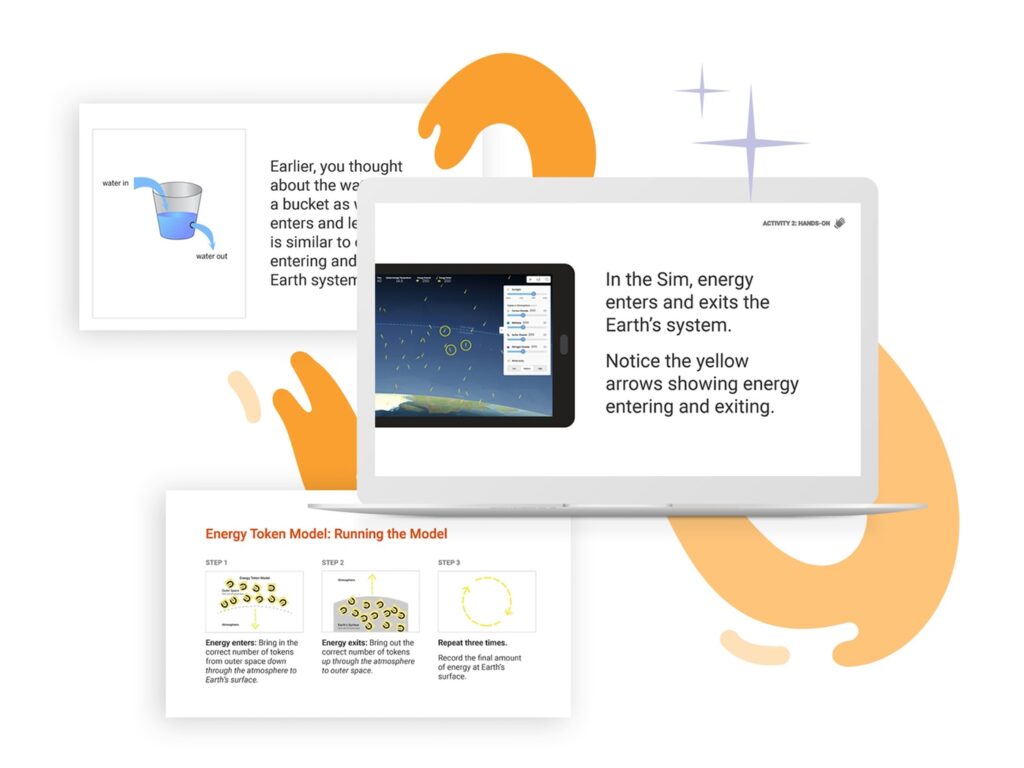
Learn more about our customizable PowerPoints for every lesson.

A laptop screen displays a writing lesson with prompts and a student's response in Amplify Classwork. The student's answer discusses dangers related to a specific scenario involving a sick child.
Classwork (6–8)

A new, intuitive approach to reviewing student work online.

An adult sits on a couch using a laptop while a child next to them does homework in a notebook.
Remote and hybrid learning guide

Amplify is here to help! Amplify Science will soon feature product enhancements and new resources that will help manage the new landscape of back-to-school 2020.

Educational presentation slides from grade 8 amplify science materials spanish kit, displaying various science topics like geology and biology.
Spanish-language supports

Learn more about the Spanish-language supports in Amplify Science.

students collaborating and using laptops
English Learners

Learn how we make learning accessible for English learners.

Amplify Science California supports you every step of the way on your journey to the California NGSS.
Students needing support

Learn how we make learning accessible for students who need more support.

Teacher using a tablet while conducting an mCLASS reading intervention with three young students seated around a table in a classroom.
Students ready for more

Learn how we make learning more rigorous for students ready for a challenge.

Two boys work together on a laptop while a woman—likely one of their middle school teachers—sits beside them, observing and smiling in a classroom setting.
Accessibility

Read more about text design and accessibility, including embedded Read-Aloud audio.

A teacher discusses educational content in front of a whiteboard while students in the classroom raise their hands eagerly.
Approach to assessment (K–5)

Learn about our embedded formative and summative assessments.

Two students sit at desks writing in notebooks and using laptops in a classroom setting.
Approach to assessment (6–8)

Learn about our embedded formative and summative assessments.

A teacher and a young student looking at a laptop together in a colorful classroom decorated with children's artwork.
NGSS Benchmark assessments

Learn more about the Next Generation Science Standards Benchmark assessments created by Amplify.

A young girl in a classroom gives a thumbs up with both hands, smiling broadly, while other students look on in the background.
NGSS Benchmark assessments

NGSS alignment by performance expectation.

Two students in a classroom, one looking at the camera and the other listening intently, with a whiteboard displaying educational content in the background.
NGSS alignment (6–8)

NGSS alignment by performance expectation.

Ready to explore with digital access and physical samples?

Start your digital review and request physical samples with these three easy steps.

  1. Note these Ohio specific login credentials for your digital access.
    Username: t.ohscience@tryamplify.net
    Password: AmplifyNumber1
  2. Click Review now.
  3. Complete the form and select Log in with Amplify to input the Ohio specific login.
A woman sits at a desk in a classroom, working on a laptop with an open binder and papers in front of her.

Contact an Amplify representative

For any questions, fill out the form to the right and a member of our sales team will reach out to you soon.

Katie Cannon
Senior Account Executive

Casie Rayes
Account executive

Matt Paupore
Senior Account Executive

Families and caregivers, welcome to Amplify Desmos Math California
6–12!

Welcome to the Amplify Desmos Math California Grade 6–12 Caregiver Hub. We’ve designed this space to help you support your student at every stage of their math journey.

In class, your student engages with digital lessons using devices as well as write-in Student Edition books. They also may be assigned digital or print practice outside of class. Below, you’ll find some suggestions and resources for how you can support their learning at home.

Learn more about Amplify Desmos Math California.

Para la versión en español, haga clic aquí.

Ilustración de una persona en silla de ruedas con un casco que dirige la colocación de una pieza triangular, rodeada de símbolos matemáticos.

Caregiver Unit Resources

For every unit of the program, we’ve created a Caregiver Resource that provides a summary of each lesson, plus a problem to try with your student (and an answer key). These resources will be available in both English and Spanish, as well as a glossary of key terms in both languages.

  • Coming soon!
  • Coming soon!

Unit refresh videos

Unit 1

  • Sub-Unit 1a – Calculating the Area of Parallelograms
  • Sub-Unit 1b – Calculating the Area of Triangles
  • Sub-Unit 2 – Determining the Surface Area of Rectangular Prisms

Unit 2

Unit 3

Unit 4

  • Sub-Unit 1 – Dividing Fractions Using Tape Diagrams
  • Sub-Unit 2 – Dividing Fractions Using Common Denominators
  • Sub-Unit 3 – Determining the Volume of Prisms With Fractional Dimensions

Unit 5

  • Sub-Unit 1 – Adding and Subtracting Decimals
  • Sub-Unit 2 – Multiplying Decimals Using Area Models
  • Sub-Unit 3 – Dividing Decimals Using Fractions
  • Sub-Unit 4 – Converting Between Fractions, Percents, and Decimals

Unit 6

  • Sub-Unit 1 – Writing and Solving Equations
  • Sub-Unit 2 – Writing Equivalent Expressions Using the Area Model
  • Sub-Unit 3 – Evaluating Expressions With Exponents
  • Sub-Unit 4 – Interpreting Graphs

Unit 7

  • Sub-Unit 1 – Ordering and Comparing Positive and Negative Numbers
  • Sub-Unit 2 – Identifying Solutions to Inequalities
  • Sub-Unit 3 – Plotting Points on the Coordinate Plane

Unit 8

  • Sub-Unit 1 – Creating Dot Plots
  • Sub-Unit 2 – Calculating Mean Absolute Deviation
  • Sub-Unit 3 – Interpreting Box Plots
  • Sub-Unit 4 – Predicting Population Using Sample Data (For use with Amplify Desmos Math New York)
  • Sub-Unit 5 – Predicting Sample Spaces Using Proportional Relationship (For use with Amplify Desmos Math New York)

Unit 1

  • Sub-Unit 1 – Using Ratios to Determine the Scale Factor Between Scaled Copies
  • Sub-Unit 2 – Using Ratios to Determine Unknown Scales in Scale Drawings

Unit 2

  • Sub-Unit 1 – Determining the Constant of Proportionality
  • Sub-Unit 2 – Writing Equations for Proportional Relationships
  • Sub-Unit 3 – Comparing Proportional Relationships
  • Sub-Unit 4 – Representing Proportional Relationships with Multiple Representations

Unit 3

  • Sub-Unit 1 – Determining the Circumference of a Circle
  • Sub-Unit 2 – Calculating Areas of Complex Shapes

Unit 4

Unit 5

  • Sub-Unit 1 – Adding and Subtracting Positive and Negative Number
  • Sub-Unit 2 – Dividing Integers
  • Sub-Unit 3 – Solving Real-World Problems Involving Positive and Negative Numbers

Unit 6

  • Sub-Unit 1 – Writing Equations from Descriptions and Tape Diagrams
  • Sub-Unit 2 – Solving Equations With Positive and Negative Numbers
  • Sub-Unit 3 – Solving Inequalities

Unit 7

  • Sub-Unit 1 – Determining Unknown Angle Measures
  • Sub-Unit 2 – Determining If Three Segments Form a Triangle
  • Sub-Unit 3 – Calculating the Surface Area of Prisms

Unit 8

  • Sub-Unit 1 – Predicting Sample Spaces Using Proportional Relationships
  • Sub-Unit 2 – Predicting Population Using Sample Data

Unit 1

  • Sub-Unit 1 – Determining Coordinates After a Rotation
  • Sub-Unit 2 – Using Rigid Transformations to Determine if Two Figures on the Grid are Congruent
  • Sub-Unit 3 – Determining Unknown Interior and Exterior Angles

Unit 2

  • Sub-Unit 1 – Performing Dilations on a Square Grid
  • Sub-Unit 2 – Determining Missing Side Lengths in Similar Triangles
  • Sub-Unit 3 – Calculating Slope By Drawing Similar Triangles on a Coordinate Plane

Unit 3

  • Sub-Unit 1 – Writing Equations to Represent Proportional Relationships
  • Sub-Unit 2 – Interpreting Slope and Intercepts of Linear Relationships
  • Sub-Unit 3 – Calculating Slope Given Two Points

Unit 4

  • Sub-Unit 1 – Solve Single-Variable Equations with Parentheses
  • Sub-Unit 2 – Solving Systems of Linear Equations by Graphing

Unit 5

  • Sub-Unit 1 – Justifying Whether a Graph Represents a Function
  • Sub-Unit 2 – Comparing Properties of Linear Functions
  • Sub-Unit 3 – Calculating Volumes of Cylinders

Unit 6

  • Sub-Unit 1 – Interpreting Points on a Scatter Plot
  • Sub-Unit 2 – Using Lines of Fit to Make Predictions
  • Sub-Unit 3 – Calculating Missing Values in Two-Way Tables

Unit 7

Unit 8

  • Sub-Unit 1 – Approximating Square Roots
  • Sub-Unit 2 – Calculating Unknown Side Lengths
  • Sub-Unit 3 – Identifying Rational and Irrational Numbers

Unit 1

  • Sub-Unit 1 – Determining If a Sequence is Arithmetic, Geometric or Neither
  • Sub-Unit 2 – Using Visual Patterns or Terms in the Sequence to Write Explicit Expressions for Arithmetic and Geometric Sequences

Unit 2

  • Sub-Unit 1 – Solving Linear Equations
  • Sub-Unit 2 – Solving Multi-Variable Linear Equations
  • Sub-Unit 3 – Graphing Solutions of Two-Variable Linear Inequalities

Unit 3

  • Sub-Unit 1 – Calculating Values in Two-Way and Relative Frequency Tables
  • Sub-Unit 2 – Comparing Data Using Mean and Standard Deviation
  • Sub-Unit 3 – Interpreting Slope and y-intercept in Context

Unit 4

  • Sub-Unit 1 – Evaluating Function Notation
  • Sub-Unit 2 – Writing Domain and Range with Inequalities
  • Sub-Unit 3 – Graphing Piecewise-Defined Functions
  • Sub-Unit 4 – Writing Recursive Definitions in Function Notation

Unit 5

  • Sub-Unit 1 – Solving Systems of Linear Equations by Substitution
  • Sub-Unit 2 – Graphing Solutions to Systems of Inequalities

Unit 6

  • Sub-Unit 1 – Writing Exponential Functions from Graphs
  • Sub-Unit 2 – Calculating Percent Change in Exponential Functions
  • Sub-Unit 3 – Writing Equivalent Expressions Using Radicals and Rational Exponents
  • Sub-Unit 4 – Writing Exponential Functions Involving Compound Interest

Unit 7

  • Sub-Unit 1 – Describing Key Features of Parabolas
  • Sub-Unit 2 – Graphing Quadratic Functions in Factored Form
  • Sub-Unit 3 – Writing Quadratic Functions in Vertex Form

Unit 8

  • Sub-Unit 1 – Rewriting Factored-Form Expressions in Standard Form
  • Sub-Unit 2 – Solving Quadratic Equations by Graphing
  • Sub-Unit 3 – Solving Quadratic Equations by Completing the Square
  • Sub-Unit 4 – Solving Quadratic Equations Using the Quadratic Formula

Unit 1

  • Sub-Unit 1 – Determining If a Sequence is Arithmetic, Geometric or Neither
  • Sub-Unit 2 – Using Visual Patterns or Terms in the Sequence to Write Explicit Expressions for Arithmetic and Geometric Sequences

Unit 2

  • Sub-Unit 1 – Solving Linear Equations
  • Sub-Unit 2 – Solving Multi-Variable Linear Equations
  • Sub-Unit 3 – Graphing Solutions of Two-Variable Linear Inequalities

Unit 3

  • Sub-Unit 1 – Solving Systems of Linear Equations by Substitution
  • Sub-Unit 2 – Graphing Solutions to Systems of Inequalities
  • Sub-Unit 3 – Writing Equations for Parallel and Perpendicular Lines

Unit 4

  • Sub-Unit 1 – Evaluating Function Notation
  • Sub-Unit 2 – Writing Domain and Range with Inequalities
  • Sub-Unit 3 – Writing Recursive Definitions in Function Notation

Unit 5

  • Sub-Unit 1 – Writing Exponential Functions from Graphs
  • Sub-Unit 2 – Calculating Percent Change in Exponential Functions
  • Sub-Unit 3 – Writing Exponential Functions Involving Compound Interest

Unit 6

  • Sub-Unit 1 – Drawing Perpendicular Bisectors
  • Sub-Unit 2 – Determining Coordinates After a Rotation
  • Sub-Unit 3 – Using Rigid Transformations to Determine if Two Figures on the Grid are Congruent

Unit 7

  • Sub-Unit 1 – Calculating Values in Two-Way and Relative Frequency Tables
  • Sub-Unit 2 – Comparing Data Using Mean and Standard Deviation
  • Sub-Unit 3 – Interpreting Slope and y-intercept in Context

Access Amplify Desmos Math California at home.

Your student will have access to all learning, practice, and assessment materials through the Amplify platform. Students can access the digital curriculum in school and at home by following these simple instructions.

  • Click the Amplify Desmos Math California button.
  • Select Log in with Amplify.
  • Enter the username and password provided by your student’s teacher.
  • Select the desired grade level.

Once logged in, you and your student can view work by opening previous assignments.

Learn how to navigate the student home page.

Support math learning at home.

You can support your student’s math learning outside of school in many ways:

Relate math to daily activities at home, whether you’re baking, grocery shopping, or planning a trip. Your student can help you calculate the prices when you use a coupon, figure out how to cut a recipe in half, or determine the amount of gas you’ll need to make it to your destination.

Invite your student to walk you through how they solved each problem or talk about any parts that were challenging for them. To encourage the use of math language, consider asking, “How do you know?,” “How can you show your thinking?,” or “How would you describe that?” If students get stuck, consider asking questions like, “What information do you know here?” or “How could you represent this problem?”

Emphasize that getting stuck is part of the process and a necessary part of learning. Many students (and adults!) fear making mistakes, but research shows that making mistakes helps your brain grow. When your student gets stuck on a problem, encourage them to try different strategies, even if they think they can’t do it or will get it wrong.

We hope your student enjoys exploring math, working with friends to solve problems, and learning new and interesting concepts. And we hope you enjoy this exciting math journey with them!

Get more information.

Have a question about Amplify Desmos Math California? Visit our Help Library to search for articles with answers to your program questions. For additional support, please contact your student’s teacher.

Welcome, Amplify Math families and community to Amplify Desmos Math!

Amplify welcomes you and your learner to Amplify Math for the new school year. We are very excited to provide you with exceptional learning opportunities through math. Below are resources and helpful guides for enabling your student to have the most productive experience with our platform throughout the year.

math illustration of Amplify Math programs

What is Amplify Math?

Amplify Math is a core math curriculum built for grades 6, 7, 8, and Algebra 1. It features a full suite of products for teachers and students that includes lesson plans, instructional materials, practice, assessments, and support to meet all learners’ needs. Amplify Math is built upon the highly rated curriculum, Illustrative Mathematics’® IM K–12 Math™, which was heavily researched and field-tested and has earned an all-green score on EdReports, the nationally recognized non-profit curriculum evaluation organization.

Read the review on EdReports.

Amplify Math helps students learn math in a way that is engaging and relevant to the world around them using student-centered instruction, which has been proven to increase students’ motivation, engagement, and enjoyment of math. Students using the program are active participants in their learning, solving problems while working with their classmates.

The digital experience allows your student’s teacher to monitor your student’s work in real time and make sure they get the exact support that they need at every part of the lesson. Amplify Math’s open-ended tasks provide engaging challenges for students of all levels, preparing them to solve all types of problems. The parts of Amplify Math work together to help students master the key skills of a 21st century learner!

Features

Some of the unique features of Amplify Math include:

  • Narrative connections: Exciting stories that help students to make connections between the math they learn in class and their everyday lives, making math class more engaging for your student.
  • Amps: Interactive digital activities (included in every lesson) let your student can explore the math and collaborate with their peers.
  • Power-ups: Additional activities that teachers can use to identify when your student needs support and help your student improve on the most important skills.
  • Featured mathematicians: Stories of important mathematicians that help your students see themselves mirrored in the history of math.

Why student-centered instruction?

A diverse group of students, one wearing a unicorn headband, looks at a teacher pointing to an amplify math bar graph on a board.

Student-centered instruction may look different from the way students have learned math for decades, and maybe even the way you learned math. Student-centered instruction instead emphasizes student-led discovery. When students explore and discover strategies, they are more engaged and make longer lasting connections.

Research shows that students and teachers alike prefer this method, and teachers report that student-centered instruction has helped their students learn more math. This way of learning helps students to remember what they learn in class and apply their knowledge to new situations. Students who experience student-centered instruction have been shown to perform better on standardized tests and have more growth in their grades than their peers who learn through other methods. Your student will also learn to communicate in writing and verbally, understand and challenge the opinions of others, and build confidence in solving new problems. With student-centered learning, students will begin to develop key skills for success in college and the workplace, like using technology, completing projects independently and with others, and persevering through difficult problems.

What does an Amplify Math lesson look like?

Four illustrated icons represent phases of a lesson: Warm-up, Activities, Summary and Reflection, and Exit Ticket and Practice, each with related instructional graphics.

Students using Amplify Math will be active participants in their learning and get practice solving interesting and new types of problems. Here’s what a typical Amplify Math lesson includes:

  • Warm-up: A short, attention-getting problem to get students interested in the lesson
  • Activities: 2-3 mini-activities that challenge students’ problem-solving skills
  • Summary: Discussion to review and bring together the important concepts from the lesson
  • Exit Ticket: Questions for students to show what they know from the lesson
  • Practice: Additional problems your student’s teacher may assign for classwork or homework

Check out lessons from Grade 6Grade 7Grade 8, and Algebra 1, and watch this video of a typical Amplify Math lesson:

Materials overview

Your student will have access to all learning, practice, and assessment materials through the Amplify platform. In addition, depending on the district, your student may also have a print Student Edition to use instead of the digital lesson if they do not have a device or internet. The Student Edition is a workbook that students can use to complete their work on problems and practice within the lessons.

Students can access the digital curriculum in school and at home with login information provided by their teachers. You can contact your student’s teacher to learn more about how they log in. Here are some key resources of the digital platform for students:

  • Digital activities to allow students to explore and make sense of math, leading to increased engagement and understanding
  • Digital supports such as a calculator and manipulatives to support all students where they are
  • Power-ups to give students just-in-time practice with key skills
  • Ability to access instructional materials in English or Spanish

Unit Caregiver Letters

Click a unit below to download the caregiver letter for that unit, in both English and Spanish.

How to support your student

Amplify Desmos Math Support
  • Review the unit caregiver letters to understand the key concepts in each unit. You can walk through the worked examples with your student, asking them to explain the strategy shown and asking if they know any other strategies to solve the problems. 
  • Your student’s teacher may assign practice problems at the end of each lesson for classwork or homework. Ask your student to walk you through how they solved each problem or talk about any parts that were challenging for them. 
  • Emphasize that getting stuck is part of the process and a necessary part of learning. Many students (and adults!) fear making mistakes, however, research shows that making mistakes helps your brain grow more. When your student gets stuck on a problem, encourage them to try different strategies, even if they are not sure if they are right. 
  • Relate math to daily activities at home, whether it be baking, grocery shopping, or planning for a road trip. Your student can help you figure out the price of an item after a coupon, cut a recipe in half, or figure out how much gas you’ll need to make it to your destination. Encourage your student to point out ways that your family uses math in your daily tasks.

Want to learn more?

Interested in learning more about Amplify Math? These resources will help you dig deeper:

Navigating the shift to three-dimensional science teaching and learning

Students need science. They need it to succeed in school, and they need it to navigate the world around them—whether interpreting a weather forecast, perfecting a recipe, or troubleshooting the Wi-Fi.

But only 22% of high school students are proficient in science, and students in grades K–5 get an average of just 20 minutes of science instruction each day. For middle and high school students, access to advanced science courses is often limited. We’re not giving students all the tools they need to succeed in a world that’s increasingly shaped by science and technology.

Three-dimensional learning can help us solve that. This approach moves science education into the realm of discovery—where students learn to think and act like scientists.

But unlike hot water melting ice, shifting to this approach won’t happen in an instant! Don’t worry—we’re here to help.

Science learning: a pivotal moment

Many of us were taught science the traditional way: learning about the scientific world and how it works. (And many of us did ok!) But we know now that there’s a better way. Students need to figure out science the way scientists do.

This hands-on, problem-solving, three-dimensional approach (sometimes nicknamed “3D learning”) builds critical thinking, collaboration, and curiosity—all skills that are vital across school subjects and in life.

With content and lesson plans that focus on Science and Engineering Practices, Crosscutting Concepts, and Disciplinary Core Ideas, this model equips students with critical thinking skills and a deep understanding of scientific principles.

This shift started with the 2012 publication of A Framework for K–12 Science Education, which introduced the concept of three-dimensional learning. These principles, now embedded in the Next Generation Science Standards (NGSS), focus on three major changes:

  • Helping students move from simply learning about science to actively figuring it out.
  • Encouraging them to explain natural phenomena.
  • Aligning science learning with English language arts and math goals.

By embracing these changes, educators can help students make meaningful connections across disciplines, setting them up for success in real-world challenges.

Driving and supporting systemic change

Transforming science education isn’t a quick fix—it’s a cultural and systemic change. To make it work and make it last, schools and districts need to focus on three key drivers: processpractice, and people.

  1. Process: Pinpoint challenges, create clear plans, and track progress.
  2. Practice: Build the infrastructure for three-dimensional learning, including aligning curriculum, offering professional development, and updating teaching practices.
  3. People: Communicate effectively, support teachers, and highlight science champions who can inspire others.

Real change takes time and deliberate effort. But with these elements in place, schools can establish lasting improvements and build elementary and middle school programs that benefit every student.

Amplify Science’s playbook to guide you

To help educators navigate this shift, our new Science Change Management Playbook offers practical, evidence-based resources for transitioning over time to three-dimensional learning. Here’s what you’ll find inside:

  • Evidence-based practices: Learn structured approaches to problem-based learning, backed by research that highlights their benefits for students and teachers alike.
  • Practical tips: Explore actionable steps for driving meaningful change, from crafting a shared vision to delivering effective professional learning.
  • Real stories: Read testimonials from students and educators who have experienced the transformative power of curiosity-driven, collaborative learning.

With this playbook, schools can build K–8 and/or middle school science programs that truly engage students, equipping them with skills they’ll use for a lifetime.

The move to three-dimensional science teaching and learning opens the door to deeper understanding, better problem-solving, greater curiosity, and—more and more—a world built by students who know how to think like scientists.

More to explore

  • Dive deeper into the shift to three-dimensional teaching and learning with our Science Change Management Playbook to help you navigate the shift to three-dimensional science teaching and learning.
  • Discover how to be a changemaker for science through additional change management resources.
  • Learn more about Amplify Science.

Rethinking reading comprehension

Collage of educational web pages and images featuring children reading, book graphics, and the title “Understanding Comprehension: The Heartbeat of Literacy,” highlighting interactive lessons and free teaching resources.

Have you ever listened to a student read aloud fluently about something—say, the life cycle of sea turtles—only to discover afterward that they couldn’t explain a single thing about…the life cycle of sea turtles? It’s a familiar classroom moment, and it reveals how easy it is to misunderstand what comprehension really is.

Comprehension is often framed only as the product of reading: the answers students give when asked to find the main idea, identify a theme, or summarize a passage.

But the Science of Reading tells us that comprehension is more than an outcome. Comprehension is also a dynamic process that unfolds as readers move through a text, powered by the interactions among words on the page and the knowledge and reasoning they bring to it. That’s why we like to think of it as the heartbeat of literacy.

Why comprehension is both product and process

For decades, much of classroom instruction has focused on language comprehension products: the demonstrations of understanding that happen after reading. Those are important, but they don’t tell the whole story.

That’s because products depend on processes. If students do not build a coherent mental model of what they’re reading—while they’re reading—they may succeed at reading, but not at comprehending.

This is the missing link that researchers like Hugh Catts, Ph.D., and Jane Oakhill, Ph.D., have revealed: Comprehension isn’t something readers suddenly have at the end of a passage. It’s also something they do all along the way.

What comprehension processes look like

Comprehension processes are the mental moves students make to construct meaning as they read. All students need explicit instruction and practice in order to learn to do this automatically. Some of the most important processes include:

  • Inference-making: Filling in gaps the author leaves unsaid. If a story says “Carlos forgot his umbrella and got wet,” readers must supply the missing piece: It rained.
  • Anaphora resolution: Figuring out who pronouns such as he or she refer to. For instance, in a passage where “Charmaine passed the ball to Kendra, and she scored,” not all readers may track that she refers to Kendra.
  • Monitoring meaning: Noticing when something doesn’t make sense and rereading to fix it. Think of a student breezing through a science lab procedure but not realizing they’ve misunderstood a key step.
  • Recognizing connectives: Using words like because, however, or meanwhile to understand how ideas fit together in a text about history, math, or literature.
  • Visualizing: Building a mental picture—whether that’s of how a caterpillar becomes a butterfly, or how a character’s feelings shift across a story.

When these processes don’t happen, comprehension breaks down—even for students who can decode fluently. That’s why teaching comprehension can’t mean just assigning comprehension questions. It has to mean teaching students how to think with text in real time.

The role of knowledge and writing

Processes don’t exist in isolation. They depend on, and are strengthened by, what students already know and what they can express in writing.

  • Knowledge: The more background students bring to a text, the easier it is for them to make inferences and connect ideas. A child who already knows a little about baseball will understand a passage about a pitcher’s strategy much more readily than one encountering the game for the first time.
  • Writing: Writing about reading reinforces comprehension. When students summarize a biography in their own words, draft a response to a novel, or synthesize ideas from multiple sources, they are practicing the very processes—like making connections and organizing ideas—that skilled readers rely on.

This interplay—reading feeding knowledge, knowledge feeding comprehension, writing reinforcing both—creates a cycle of literacy growth that goes far beyond the end-of-text quiz.

Rethinking classroom practice

Working on individual comprehension skills can help in the short term. But long-term literacy success—for all students—requires explicit instruction and practice in all the comprehension processes needed to build comprehension products.

So what does it mean to teach comprehension as a process, not just a product?

Weaving effective instruction in comprehension strategies into everyday literacy work. A few examples:

  • Model your thinking. Pause mid-reading to ask, “Who does she refer to here?” or “That didn’t make sense—let’s go back.”
  • Highlight connectives. Teach words like although or consequently explicitly, showing how they signal relationships between ideas.
  • Promote monitoring. Encourage students to ask themselves, “Does this make sense?” and to reread when it doesn’t.
  • Build knowledge deliberately. Use content-rich texts in science, history, and the arts to give students the context they need for stronger comprehension.
  • Pair reading with writing. Even short written responses—“Why do you think the character acted that way?”—help solidify understanding and make comprehension processes visible.

These practices shift comprehension instruction from an after-the-fact check to an in-the-moment skill set students can carry into every subject.

Want to dig deeper?

Expanding our understanding of comprehension as both product and process is one of the most important shifts the Science of Reading has brought to literacy instruction. It reminds us that comprehension isn’t just a mysterious outcome at the end of reading—it’s the ongoing work of making meaning along the way.

To help educators explore this shift, we’ve created the new Science of Reading: Comprehension 101 bundle. These resources break down the research and provide strategies you can use right away. When we teach comprehension as the ongoing process it truly is, we keep the heartbeat of literacy strong for every reader.

Inside, you’ll find the following resources:

  • Our anchor ebook: Understanding Comprehension: The Heartbeat of Literacy
  • Infographic: The missing link in reading comprehension
  • Ebook: Knowledge, Reading, and Writing: The Secret Recipe for Literacy Success
  • Podcast: “Science of Reading Essentials: Comprehension” episode and listening guide
  • Webinar: Rethinking Reading Comprehension: Reflections on Hugh Catts’ and Jane Oakhill’s Research

Families and caregivers, welcome to Amplify Desmos Math 6–12!

Welcome to the Amplify Desmos Math Grade 6–Algebra 2 Caregiver Hub. We’ve designed this space to help you support your student at every stage of their math journey. 

In class, your student engages with digital lessons using devices as well as write-in Student Edition books. They also may be assigned digital or print practice outside of class. Below, you’ll find some suggestions and resources for how you can support their learning at home.

Learn more about Amplify Desmos Math.

Para la versión en español, haga clic aquí.

Person wearing a construction hat and safety vest in a wheelchair, discussing with a phone and controlling the placement of a large triangular piece in a construction setting, with math symbols around.

Caregiver Unit Resources

For every unit of the program, we’ve created a Caregiver Resource that provides a summary of each lesson, plus a problem to try with your student (and an answer key). These resources are available in both English and Spanish, as well as a glossary of key terms in both languages.

Unit 1: Area and Surface Area

Unit 2: Introducing Ratios

Unit 3: Rates and Percentages

Unit 4: Dividing Fractions

Unit 5: Decimal Arithmetic

Unit 6: Expressions and Equations

Unit 7: Positive and Negative Numbers

Unit 8: Describing Data

Unit 1: Scale Drawings

Unit 2: Introducing Proportional Relationships

Unit 3: Measuring Circles

Unit 4: Proportional Relationships and Percentages

Unit 5: Operations With Positive and Negative Numbers

Unit 6: Expressions, Equations, and Inequalities

Unit 7: Angles, Triangles, and Prisms

Unit 8: Probability and Sampling

Unit 1: Rigid Transformations and Congruence

Unit 2: Dilations, Similarity, and Slope

Unit 3: Proportional and Linear Relationships

Unit 4: Linear Equations and Linear Systems

Unit 5: Functions and Volume

Unit 6: Associations in Data

Unit 7: Exponents and Scientific Notation

Unit 8: The Pythagorean Theorem and Irrational Numbers

Unit 1: Area and Surface Area

Unit 2: Introducing Ratios and Rates

Unit 3: Fractions and Decimals

Unit 4: Expressions and Equations

Unit 5: Proportional Relationships

Unit 6: Percentages

Unit 7: Positive and Negative Numbers

Unit 8: Data Sets and Distributions

Course Glossary

Unit 1: Rigid Transformations and Congruence

Unit 2: Scale Drawings, Dilations, and Similarity

Unit 3: Equations and Inequalities

Unit 4: Linear Relationships and Systems of Linear Equations

Unit 5: Functions

Unit 6: Associations in Data

Unit 7: Volume and Surface Area

Unit 8: Exponents and Scientific Notation

Unit 9: Pythagorean Theorem and Irrational Numbers

Course Glossary

Unit 1: Patterns and Sequences

Unit 2: Linear Equations and Inequalities

Unit 3: Describing Data

Unit 4: Describing Functions

Unit 5: Systems of Linear Equations and Inequalities

Unit 6: Exponential Functions

Unit 7: Quadratic Functions

Unit 8: Quadratic Equations

Unit refresh videos

Unit 1

  • Sub-Unit 1a – Calculating the Area of Parallelograms
  • Sub-Unit 1b – Calculating the Area of Triangles
  • Sub-Unit 2 – Determining the Surface Area of Rectangular Prisms

Unit 2

Unit 3

Unit 4

  • Sub-Unit 1 – Dividing Fractions Using Tape Diagrams
  • Sub-Unit 2 – Dividing Fractions Using Common Denominators
  • Sub-Unit 3 – Determining the Volume of Prisms With Fractional Dimensions

Unit 5

  • Sub-Unit 1 – Adding and Subtracting Decimals
  • Sub-Unit 2 – Multiplying Decimals Using Area Models
  • Sub-Unit 3 – Dividing Decimals Using Fractions
  • Sub-Unit 4 – Converting Between Fractions, Percents, and Decimals

Unit 6

  • Sub-Unit 1 – Writing and Solving Equations
  • Sub-Unit 2 – Writing Equivalent Expressions Using the Area Model
  • Sub-Unit 3 – Evaluating Expressions With Exponents
  • Sub-Unit 4 – Interpreting Graphs

Unit 7

  • Sub-Unit 1 – Ordering and Comparing Positive and Negative Numbers
  • Sub-Unit 2 – Identifying Solutions to Inequalities
  • Sub-Unit 3 – Plotting Points on the Coordinate Plane

Unit 8

  • Sub-Unit 1 – Creating Dot Plots
  • Sub-Unit 2 – Calculating Mean Absolute Deviation
  • Sub-Unit 3 – Interpreting Box Plots
  • Sub-Unit 4 – Predicting Population Using Sample Data (For use with Amplify Desmos Math New York)
  • Sub-Unit 5 – Predicting Sample Spaces Using Proportional Relationship (For use with Amplify Desmos Math New York)

Unit 1

  • Sub-Unit 1 – Using Ratios to Determine the Scale Factor Between Scaled Copies
  • Sub-Unit 2 – Using Ratios to Determine Unknown Scales in Scale Drawings

Unit 2

  • Sub-Unit 1 – Determining the Constant of Proportionality
  • Sub-Unit 2 – Writing Equations for Proportional Relationships
  • Sub-Unit 3 – Comparing Proportional Relationships
  • Sub-Unit 4 – Representing Proportional Relationships with Multiple Representations

Unit 3

  • Sub-Unit 1 – Determining the Circumference of a Circle
  • Sub-Unit 2 – Calculating Areas of Complex Shapes

Unit 4

Unit 5

  • Sub-Unit 1 – Adding and Subtracting Positive and Negative Number
  • Sub-Unit 2 – Dividing Integers
  • Sub-Unit 3 – Solving Real-World Problems Involving Positive and Negative Numbers

Unit 6

  • Sub-Unit 1 – Writing Equations from Descriptions and Tape Diagrams
  • Sub-Unit 2 – Solving Equations With Positive and Negative Numbers
  • Sub-Unit 3 – Solving Inequalities

Unit 7

  • Sub-Unit 1 – Determining Unknown Angle Measures
  • Sub-Unit 2 – Determining If Three Segments Form a Triangle
  • Sub-Unit 3 – Calculating the Surface Area of Prisms

Unit 8

  • Sub-Unit 1 – Predicting Sample Spaces Using Proportional Relationships
  • Sub-Unit 2 – Predicting Population Using Sample Data

Unit 1

  • Sub-Unit 1 – Determining Coordinates After a Rotation
  • Sub-Unit 2 – Using Rigid Transformations to Determine if Two Figures on the Grid are Congruent
  • Sub-Unit 3 – Determining Unknown Interior and Exterior Angles

Unit 2

  • Sub-Unit 1 – Performing Dilations on a Square Grid
  • Sub-Unit 2 – Determining Missing Side Lengths in Similar Triangles
  • Sub-Unit 3 – Calculating Slope By Drawing Similar Triangles on a Coordinate Plane

Unit 3

  • Sub-Unit 1 – Writing Equations to Represent Proportional Relationships
  • Sub-Unit 2 – Interpreting Slope and Intercepts of Linear Relationships
  • Sub-Unit 3 – Calculating Slope Given Two Points

Unit 4

  • Sub-Unit 1 – Solve Single-Variable Equations with Parentheses
  • Sub-Unit 2 – Solving Systems of Linear Equations by Graphing

Unit 5

  • Sub-Unit 1 – Justifying Whether a Graph Represents a Function
  • Sub-Unit 2 – Comparing Properties of Linear Functions
  • Sub-Unit 3 – Calculating Volumes of Cylinders

Unit 6

  • Sub-Unit 1 – Interpreting Points on a Scatter Plot
  • Sub-Unit 2 – Using Lines of Fit to Make Predictions
  • Sub-Unit 3 – Calculating Missing Values in Two-Way Tables

Unit 7

Unit 8

  • Sub-Unit 1 – Approximating Square Roots
  • Sub-Unit 2 – Calculating Unknown Side Lengths
  • Sub-Unit 3 – Identifying Rational and Irrational Numbers

Unit 1

  • Sub-Unit 1 – Determining If a Sequence is Arithmetic, Geometric or Neither
  • Sub-Unit 2 – Using Visual Patterns or Terms in the Sequence to Write Explicit Expressions for Arithmetic and Geometric Sequences

Unit 2

  • Sub-Unit 1 – Solving Linear Equations
  • Sub-Unit 2 – Solving Multi-Variable Linear Equations
  • Sub-Unit 3 – Graphing Solutions of Two-Variable Linear Inequalities

Unit 3

  • Sub-Unit 1 – Calculating Values in Two-Way and Relative Frequency Tables
  • Sub-Unit 2 – Comparing Data Using Mean and Standard Deviation
  • Sub-Unit 3 – Interpreting Slope and y-intercept in Context

Unit 4

  • Sub-Unit 1 – Evaluating Function Notation
  • Sub-Unit 2 – Writing Domain and Range with Inequalities
  • Sub-Unit 3 – Graphing Piecewise-Defined Functions
  • Sub-Unit 4 – Writing Recursive Definitions in Function Notation

Unit 5

  • Sub-Unit 1 – Solving Systems of Linear Equations by Substitution
  • Sub-Unit 2 – Graphing Solutions to Systems of Inequalities

Unit 6

  • Sub-Unit 1 – Writing Exponential Functions from Graphs
  • Sub-Unit 2 – Calculating Percent Change in Exponential Functions
  • Sub-Unit 3 – Writing Equivalent Expressions Using Radicals and Rational Exponents
  • Sub-Unit 4 – Writing Exponential Functions Involving Compound Interest

Unit 7

  • Sub-Unit 1 – Describing Key Features of Parabolas
  • Sub-Unit 2 – Graphing Quadratic Functions in Factored Form
  • Sub-Unit 3 – Writing Quadratic Functions in Vertex Form

Unit 8

  • Sub-Unit 1 – Rewriting Factored-Form Expressions in Standard Form
  • Sub-Unit 2 – Solving Quadratic Equations by Graphing
  • Sub-Unit 3 – Solving Quadratic Equations by Completing the Square
  • Sub-Unit 4 – Solving Quadratic Equations Using the Quadratic Formula

Access Amplify Desmos Math at home.

Your student will have access to all learning, practice, and assessment materials through the Amplify platform. Students can access the digital curriculum in school and at home by following these simple instructions.

  • Click the Amplify Desmos Math button.
  • Select Log in with Amplify.
  • Enter the username and password provided by your student’s teacher.
  • Select the desired grade level.

Once logged in, you and your student can view work by opening previous assignments.

Learn how to navigate the student home page.

Support math learning at home.

You can support your student’s math learning outside of school in many ways:

Relate math to daily activities at home, whether you’re baking, grocery shopping, or planning a trip. Your student can help you calculate the prices when you use a coupon, figure out how to cut a recipe in half, or determine the amount of gas you’ll need to make it to your destination.

Invite your student to walk you through how they solved each problem or talk about any parts that were challenging for them. To encourage the use of math language, consider asking, “How do you know?,” “How can you show your thinking?,” or “How would you describe that?” If students get stuck, consider asking questions like, “What information do you know here?” or “How could you represent this problem?”

Remind your student that getting stuck is part of the process and a necessary—beneficial, even!—part of learning. Many students (and adults) fear making mistakes. But research shows that making mistakes helps our brains grow. When your student gets stuck on a problem, encourage them to keep trying different strategies, even if they’re not sure they’re right.

We hope your student enjoys exploring math, working with friends to solve problems, and learning new and interesting concepts. And we hope you enjoy this exciting math journey with them!

Get more information.

Have a question about Amplify Desmos Math? Visit our help library to search for articles with answers to your program questions. For additional support, please contact your student’s teacher.

What is Amplify Math?

Amplify Math is a core math curriculum built for grades 6, 7, 8, and Algebra 1. It features a full suite of products for teachers and students that includes lesson plans, instructional materials, practice, assessments, and support to meet all learners’ needs. Amplify Math is built upon the highly rated curriculum, Illustrative Mathematics’® IM K–12 Math™, which was heavily researched and field-tested and has earned an all-green score on EdReports, the nationally recognized non-profit curriculum evaluation organization.

Read the review on EdReports.

Amplify Math helps students learn math in a way that is engaging and relevant to the world around them using student-centered instruction, which has been proven to increase students’ motivation, engagement, and enjoyment of math. Students using the program are active participants in their learning, solving problems while working with their classmates.

The digital experience allows your student’s teacher to monitor your student’s work in real time and make sure they get the exact support that they need at every part of the lesson. Amplify Math’s open-ended tasks provide engaging challenges for students of all levels, preparing them to solve all types of problems. The parts of Amplify Math work together to help students master the key skills of a 21st century learner!

Features

Some of the unique features of Amplify Math include:

  • Narrative connections: Exciting stories that help students to make connections between the math they learn in class and their everyday lives, making math class more engaging for your student.
  • Amps: Interactive digital activities (included in every lesson) let your student can explore the math and collaborate with their peers.
  • Power-ups: Additional activities that teachers can use to identify when your student needs support and help your student improve on the most important skills.
  • Featured mathematicians: Stories of important mathematicians that help your students see themselves mirrored in the history of math.

Why student-centered instruction?

A group of people and a unicorn amplify math skills as they listen to a presenter showing a bar chart with "Yes" and "No" on the screen.

Student-centered instruction may look different from the way students have learned math for decades, and maybe even the way you learned math. Student-centered instruction instead emphasizes student-led discovery. When students explore and discover strategies, they are more engaged and make longer lasting connections.

Research shows that students and teachers alike prefer this method, and teachers report that student-centered instruction has helped their students learn more math. This way of learning helps students to remember what they learn in class and apply their knowledge to new situations. Students who experience student-centered instruction have been shown to perform better on standardized tests and have more growth in their grades than their peers who learn through other methods. Your student will also learn to communicate in writing and verbally, understand and challenge the opinions of others, and build confidence in solving new problems. With student-centered learning, students will begin to develop key skills for success in college and the workplace, like using technology, completing projects independently and with others, and persevering through difficult problems.

What does an Amplify Math lesson look like?

Icons represent four classroom activities in Amplify Math: Warm-up (student at laptop), Activities (two students discussing), Summary and Reflection (teacher at board), Exit Ticket and Practice (student at laptop).

Students using Amplify Math will be active participants in their learning and get practice solving interesting and new types of problems. Here’s what a typical Amplify Math lesson includes:

  • Warm-up: A short, attention-getting problem to get students interested in the lesson
  • Activities: 2-3 mini-activities that challenge students’ problem-solving skills
  • Summary: Discussion to review and bring together the important concepts from the lesson
  • Exit Ticket: Questions for students to show what they know from the lesson
  • Practice: Additional problems your student’s teacher may assign for classwork or homework

In class, your student will spend their time working on challenging problems while the teacher acts as a guide, highlighting different strategies for solving problems and helping students to understand the reasoning behind the math they do in class. Your student will be pushed to think more deeply about the math in their class as the teacher and other students question them on why their ideas make sense. Research has proven that this method helps students become better problem solvers, critical thinkers, and have a stronger conceptual understanding of what they are learning. 

Check out lessons from Grade 6Grade 7Grade 8, and Algebra 1, and watch this video of a typical Amplify Math lesson:

Materials overview

Your student will have access to all learning, practice, and assessment materials through the Amplify platform. In addition, depending on the district, your student may also have a print Student Edition to use instead of the digital lesson if they do not have a device or internet. The Student Edition is a workbook that students can use to complete their work on problems and practice within the lessons.

Students can access the digital curriculum in school and at home with login information provided by their teachers. You can contact your student’s teacher to learn more about how they log in. Here are some key resources of the digital platform for students:

  • Digital activities to allow students to explore and make sense of math, leading to increased engagement and understanding
  • Digital supports such as a calculator and manipulatives to support all students where they are
  • Power-ups to give students just-in-time practice with key skills
  • Ability to access instructional materials in English or Spanish

Unit Caregiver Letters

Click a unit below to download the caregiver letter for that unit, in both English and Spanish.

How to support your student

A person inside looks out a window at someone holding up a chart with intersecting lines and arrows, aiming to amplify math concepts. There are plants on the windowsill.
  • Review the unit caregiver letters to understand the key concepts in each unit. You can walk through the worked examples with your student, asking them to explain the strategy shown and asking if they know any other strategies to solve the problems. 
  • Your student’s teacher may assign practice problems at the end of each lesson for classwork or homework. Ask your student to walk you through how they solved each problem or talk about any parts that were challenging for them. 
  • Emphasize that getting stuck is part of the process and a necessary part of learning. Many students (and adults!) fear making mistakes, however, research shows that making mistakes helps your brain grow more. When your student gets stuck on a problem, encourage them to try different strategies, even if they are not sure if they are right. 
  • Relate math to daily activities at home, whether it be baking, grocery shopping, or planning for a road trip. Your student can help you figure out the price of an item after a coupon, cut a recipe in half, or figure out how much gas you’ll need to make it to your destination. Encourage your student to point out ways that your family uses math in your daily tasks.

Want to learn more?

Interested in learning more about Amplify Math? These resources will help you dig deeper:

Welcome, Idaho K-8 Science Reviewers!

Thank you for taking the time to review Amplify Science. On this site, you’ll find all the resources you need to learn more about this engaging and robust NGSS program. Below, you will also have the opportunity experience our program firsthand with a demo account to access the digital platform.

Amplify Science for grades K–8 has been rated all-green by EdReports. Read the review on EdReports.

Collage of educational settings: top left, two young girls using laptop in library; bottom right, middle school science project display on tablet; bottom left, two boys with tablet discussing.

Overview

With Amplify Science, students don’t just passively learn about science concepts. Instead, they take on the roles of scientists and engineers to actively investigate and make sense of real-world phenomena. They do this through a blend of cohesive and compelling storylines, hands-on investigations, collaborative discussions, literacy-rich activities, and interactive digital tools.

Listen to these educators share how the program empowers students to think, read, write, and argue like real scientists and engineers every day.

Grades K–5

Grades 6–8

Amplify Science Grades K-5 Tour for Idaho Educators

Amplify Science Grades 6-8 Tour for Idaho Evaluators

Program structure

Our cyclical lesson design ensures students receive multiple exposures to concepts through a variety of modalities. As they progress through the lessons within a unit, students build and deepen their understanding, increasing their ability to develop and refine complex explanations of the unit’s phenomenon. It’s this proven program structure and lesson design that enables Amplify Science to teach less, but achieve more.

Rather than asking teachers to wade through unnecessary content, we designed our program to address 100 percent of the NGSS and Idaho Standards in fewer days than other programs:

  • In just 120 lessons at grades 6–8
  • In just 66 lessons at grades K–2
  • In just 88 lessons at grades 3–5
A four-step process diagram with icons: spark a real-world problem, explore sources, explain and elaborate, and evaluate claims, all linking to engage with cohesive storylines.

Unit types

Each unit delivers three-dimensional learning experiences and engages students in gathering evidence from a rich collection of sources, while also emphasizing a particular science and engineering practice.

A laptop and two screens display educational content about ecosystems, featuring illustrated plants, animals, and experiments with colorful liquids.
Two young students sit at a classroom table, one holding up a clear cup of water while the other observes closely. Papers and pencils are spread out on the table.

Investigation units

Investigation units focus on the process of strategically developing investigations and gathering data to answer questions. Students are first asked to consider questions about what happens in the natural world and why, and are then involved in designing and conducting investigations that produce data to help answer those questions.

Two children play an educational board game at a table with worksheets, plastic cubes, and small containers of colored items.

Modeling units

Modeling units provide extra support to students engaging in the practice of modeling. Students use physical models, investigate with computer models, and create their own diagrams to help them visualize what might be happening on the nanoscale.

Two children sitting at a table with laptops are talking to each other in a classroom setting, with books and baskets in the background.

Engineering Design units

Engineering design units provide opportunities for students to solve complex problems by applying science principles to the design of functional solutions, and iteratively testing those solutions to determine how well they meet preset criteria.

Several open textbooks and notebooks are spread out on a table as a person writes in one of the notebooks with a pencil.

Argumentation units

Argumentation units are introduced at grade 3 and provide students with regular opportunities to explore and discuss available evidence, time and support to consider how evidence may be leveraged in support of claims, and independence that increases as they mount written arguments in support of their claims.

A person points to a photo in a textbook about coral reefs, with a laptop and notebook open on the desk.

Launch units

Launch units are the first units taught in each year of Amplify Science. The goal of the Launch unit is to introduce students to norms, routines, and practices that will be built on throughout the year, including argumentation, active reading, and using the program’s technology. For example, rather than taking the time to explain the process of active reading in every unit in a given year, it is explained thoroughly in the Launch unit, thereby preparing students to read actively in all subsequent units.

Three students at a classroom table examine a sealed plastic bag with food inside, while one looks surprised; another student stands in the background.

Core units

Core units establish the context of the unit by introducing students to a real-world problem. As students move through lessons in a Core unit, they figure out the unit’s anchoring phenomenon, gain an understanding of the unit’s disciplinary core ideas and science and engineering practices, and make linkages across topics through the crosscutting concepts. Each Core unit culminates with a Science Seminar and final writing activity.

Four students sit at a table using laptops, focused on their screens in a classroom setting with one student in the background.

Engineering Internship units

Engineering Internship units invite students to design solutions for real-world problems as interns for a fictional company called Futura. Students figure out how to help those in need, from tsunami victims in Sri Lanka to premature babies, through the application of engineering practices. In the process, they apply and deepen their learning from Core units.

Idaho Science Standards Alignment

Amplify Science was built from the ground up to fully embrace the instructional shifts outlined in A Framework for K-12 Science Education (2012), the same framework on which Idaho Science Content Standards were founded. Most grade levels’ respective set of Amplify Science units therefore fully address the necessary Idaho Science Content Standards (see correlation). Grade 1 teachers should plan to also use the companion mini-lesson provided below to achieve full standards coverage for their grade.

Grade 1 Companion

Standard: 1-LS-1.3 Use classification supported by evidence to differentiate between living and non-living things.

Recommended placement: Following Lesson 1.1 of the Animal and Plant Defenses unit.

Resources: Classroom Slides

Science (K-2) Evaluation Form

Science (3-5) Evaluation Form

Science (Middle School Physical Science) Evaluation Form

Science (Middle School Life Science) Evaluation Form

Science Evaluation Form Middle School Earth and Space Science

A boy sits on the floor reading a book to a girl beside him in a classroom setting.
A butterfly flies above potted plants next to a watering can and a caterpillar on a milkweed plant under sunlight in a grassy field.

Needs of Plants and Animals

Domains: Life Science, Earth and Space Science, Engineering Design

Unit type: Investigation

Student role: Scientists

Phenomenon: There are no monarch caterpillars in the Mariposa Grove community garden since vegetables were planted.  

A hand pulls a white string attached to a pegboard with rubber bands and a white ball hanging from the center.

Pushes and Pulls

Domains: Physical Science, Engineering Design

Unit type: Engineering design

Student role: Pinball engineers

Phenomenon: Pinball machines allow people to control the direction and strength of forces on a ball.  

Silhouette of a playground structure and toy train against a blue sky with clouds and two large yellow suns.

Sunlight and Weather

Domains: Earth and Space Science, Life Science, Engineering Design

Unit type: Modeling

Student role: Weather scientists

Phenomenon: Students at Carver Elementary School are too cold during morning recess, while students at Woodland Elementary School are too hot during afternoon recess.  

Illustration of sea turtles swimming among underwater plants, with a shark and another turtle visible in the background.

Animal and Plant Defenses

Domain: Life Science

Unit type: Modeling

Student role: Marine scientists

Phenomenon: Spruce the Sea Turtle lives in an aquarium and will soon be released back into the ocean, where she will survive despite ocean predators.  

A hand holds a flashlight and shines it through a transparent sheet with an image, projecting the image onto a wall in a dark room.

Light and Sound

Domains: Physical Science, Engineering Design

Unit type: Engineering design

Student role: Light and sound engineers

Phenomenon: A puppet show company uses light and sound to depict realistic scenes in puppet shows.  

A split illustration shows a cityscape at night with a crescent moon and stars on the left, and a cityscape during the day with the sun, clouds, and an airplane on the right.

Spinning Earth

Domain: Earth and Space Science

Unit type: Investigation

Student role: Sky scientists

Phenomenon: The sky looks different to Sai and his grandma when they talk on the phone.  

A grey elephant uses its trunk to pick apples from a tree, with a few apples still hanging on the branches and a small sprout growing nearby.

Plant and Animal Relationships

Domains: Life Science, Engineering Design

Unit type: Investigation

Student role: Plant scientists

Phenomenon: No new chalta trees are growing in the fictional Bengal Tiger Reserve in India.  

A hand picks up a red bean from a table scattered with more red beans, spilled white liquid, a cup, and a wooden stick.

Properties of Materials

Domains: Physical Science, Engineering Design

Unit type: Engineering design

Student role: Glue engineers

Phenomenon: Different glue recipes result in glues that have different properties.  

A building labeled "Recreation Center" stands near a cliff edge with a blue flag, surrounded by trees and overlooking a beach and water.

Changing Landforms

Domain: Earth and Space Science

Unit type: Modeling

Student role: Geologists

Phenomenon: The cliff that Oceanside Recreation Center is situated on appears to be receding over time.  

Illustration of a high-speed train traveling on an elevated track with a green landscape and blue sky in the background.

Balancing Forces

Domain: Physical Science

Unit type: Modeling

Student role: Engineers

Phenomenon: The town of Faraday is getting a new train that floats above its tracks.  

A group of wolves stands in the foreground, with a bear, elk, and several birds visible in a grassy, hilly landscape with scattered trees.

Inheritance and Traits

strong>Domain: Life Science

Unit type: Investigation

Student role: Wildlife biologists

Phenomenon: An adopted wolf in Graystone National Park (“Wolf 44”) has some traits that appear similar to one wolf pack in the park and other traits that appear to be similar to a different wolf pack. 

A small bird stands on soil, looking closely at a yellow snail, with green blades of grass on the left and a blue sky background.

Environments and Survival

Domains: Life Science, Engineering Design

Unit type: Engineering design

Student role: Biomimicry engineers

Phenomenon: Over the last 10 years, a population of grove snails has changed: The number of grove snails with yellow shells has decreased, while the number of snails with banded shells has increased.  

An orangutan hangs from a vine in a dense green forest with the sun visible in the background.

Weather and Climate

Domains: Earth and Space Science, Engineering Design

Unit type: Argumentation

Student role: Meteorologists

Phenomenon: Three different islands, each a contender for becoming an Orangutan reserve, experience different weather patterns.  

Illustration of city buildings at night with illuminated windows, a full moon, visible stars, and a silhouetted figure in one window.

Energy Conversions

Domains: Physical Science, Earth and Space Science, Engineering Design

Unit type: Engineering design

Student role: System engineers

Phenomenon: The fictional town of Ergstown experiences frequent blackouts.  

A streetlamp illuminates a cricket, which is watched by a gecko. Yellow arrows indicate the flow of light from the lamp to the cricket and then to the gecko’s eye.

Vision and Light

Domain: Physical Science, Life Science, Engineering Design

Unit type: Investigation

Student role: Conservation biologists

Phenomenon: The population of Tokay geckos in a rain forest in the Philippines has decreased since the installation of new highway lights.  

Two dolphins swimming underwater, facing each other against a blue background.

Waves, Energy, and Information

Domains: Physical Science, Life Science, Earth and Space Science, Engineering Design

Unit type: Modeling

Student role: Marine scientists

Phenomenon: Mother dolphins in the fictional Blue Bay National Park seem to be communicating with their calves when they are separated at a distance underwater.

Earth orbits the Sun in space, with dotted blue lines showing the orbital path and a white arrow indicating Earth's rotation direction.

Patterns of Earth and Sky

Domains: Physical Science, Earth and Space Science

Unit type: Investigation

Student role: Astronomers

Phenomenon: An ancient artifact depicts what we see in the sky at different times — the sun during the daytime and different stars during the nighttime — but it is missing a piece.  

Illustration of layered red and brown rocky cliffs beside a flowing blue river under a partly cloudy sky.

Earth’s Features

Domain: Earth and Space Science

Unit type: Argumentation

Student role: Geologists

Phenomenon: A mysterious fossil is discovered in a canyon within the fictional Desert Rocks National Park.  

Red blood cells scattered across a dynamic, abstract red and white background.

Modeling Matter

Domain: Physical Science

Unit type: Modeling

Student role: Food scientists

Phenomenon: Chromatography is a process for separating mixtures. Some solids dissolve in a salad dressing while others do not. Oil and vinegar appear to separate when mixed in a salad dressing.  

Illustration of wind carrying airborne particles over a coastal hill, with arrows indicating the movement up and over the hill toward the sea.

The Earth System

Domains: Earth and Space Science, Physical Science, Engineering Design

Unit type: Engineering Design

Student role: Water resource engineers

Phenomenon: East Ferris, a city on one side of the fictional Ferris Island, is experiencing a water shortage, while West Ferris is not. 

Illustration of a cheetah standing near plants, looking at a sloth hanging from a tree branch, with various foliage and mushrooms in the scene.

Ecosystem Restoration

Domains:Physical Science, Life Science, Earth and Space Science, Engineering Design

Unit type: Argumentation

Student role: Ecologists

Phenomenon: The jaguars, sloths, and cecropia trees in a reforested section of a Costa Rican rain forest are not growing and thriving.  

A rover stands on a rocky, reddish terrain with visible tire tracks leading to it; distant hills are seen under a hazy sky.

Geology on Mars

Domain: Earth and Space Science

Unit type: Launch

Student role: Planetary geologists

Phenomenon: Analyzing data about landforms on Mars can provide evidence that Mars may have once been habitable.  

Illustration of a city skyline at night with a large full moon, a few stars in the sky, and a bridge on the left side.

Earth, Moon, and Sun

Domains: Earth and Space Science, Physical Science

Unit type: Core

Student role: Astronomers

Phenomenon: An astrophotographer can only take pictures of specific features on the Moon at certain times.  

Illustration of a person wearing a red hat and winter coat with fur hood, eyes closed and arms crossed, surrounded by large orange circles.

Thermal Energy

Domain: Physical Science

Unit type: Core

Student role: Thermal scientists

Phenomenon: One of two proposed heating systems for Riverdale School will best heat the school.  

Abstract digital artwork featuring a large yellow sun with blue and orange rays over a colorful landscape with green hills and red horizon.

Ocean, Atmosphere, and Climate

Domains: Earth and Space Science, Physical Science

Unit type: Core

Student role: Climatologists

Phenomenon: During El Niño years, the air temperature in Christchurch, New Zealand is cooler than usual.  

Illustration of clouds above a small town with fields and mountains, showing wind patterns and atmospheric movement in the sky.

Weather Patterns

Domains: Earth and Space Science, Physical Science

Unit type: Core

Student role: Forensic meteorologists

Phenomenon: In recent years, rainstorms in Galetown have been unusually severe.  

An underwater scene with a large whale, several turtles, jellyfish, and fish swimming surrounded by shafts of light.

Populations and Resources

Domains: Life Science, Earth and Space Science

Unit type: Core

Student role: Biologists

Phenomenon: The size of the moon jelly population in Glacier Sea has increased.  

Low-poly illustration of a forest with trees, mushrooms, a rabbit, and a fox catching another animal under a blue sky with mountains and the sun in the background.

Matter and Energy in Ecosystems

Domains: Life Science, Earth and Space Science, Physical Science

Unit type: Core

Student role: Ecologists

Phenomenon: The biodome ecosystem has collapsed.

Illustration of six spiders with different colored bodies and legs arranged in a chart-like formation on a dark background.

Traits and Reproduction

Domain: Life Science

Unit type: Core

Student role: Biomedical students

Phenomenon: Darwin’s bark spider offspring have different silk flexibility traits, even though they have the same parents.  

Abstract digital artwork featuring vibrant colors, geometric shapes, a yellow human silhouette, and various patterns layered together.

Microbiome

Domain: Life Science

Unit type: Launch

Student role: Microbiological researchers

Phenomenon: The presence of 100 trillion microorganisms living on and in the human body may keep the body healthy.  

Illustration of a person receiving an oral examination with a tongue depressor and light, featuring abstract colorful shapes and an eye chart in the background.

Metabolism

Domain: Life Science

Unit type: Core

Student role: Medical researchers

Phenomenon: Elisa, a young patient, feels tired all the time. 

A spacecraft approaches a large modular space station with blue solar panels, orbiting in outer space against a black background.

Force and Motion

Domain: Physical Science

Unit type: Core

Student role: Physicists

Phenomenon: The asteroid sample-collecting pod failed to dock at the space station as planned.

Green geometric background with a hexagonal badge displaying a parachute, ruler, letter A, stacked layers, bandage, and a folded paper icon.

Force and Motion Engineering Internship

Domains: Engineering Design, Physical Science

Unit type: Engineering internship

Student role: Mechanical engineering interns

Phenomenon: Designing emergency supply delivery pods with different structures can maintain the integrity of the supply pods and their contents.  

Two prehistoric aquatic reptiles with long snouts swim near the shore of a tropical landscape with rocks, plants, and an island in the distance.

Plate Motion

Domain: Earth and Space Science

Unit type: Core

Student role: Geologists

Phenomenon: Mesosaurus fossils have been found on continents separated by thousands of kilometers of ocean, even though the Mesosaurus species once lived all together.  

Illustration of a volcanic landscape with mountains, trees, an ocean, and a cross-section showing tectonic plates beneath the surface.

Rock Transformations

Domain: Earth and Space Science

Unit type: Core

Student role: Geologists

Phenomenon: Rock samples from the Great Plains and from the Rocky Mountains — regions hundreds of miles apart — look very different, but have surprisingly similar mineral compositions.  

Four low-poly dinosaurs, three green and one yellow, are walking in a row on grass with rocks and red spots on their bodies under a blue sky.

Natural Selection

Domains: Life Science, Earth and Space Science

Unit type: Core

Student role: Biologists

Phenomenon: The newt population in Oregon State Park has become more poisonous over time.  

Two large tortoises are near a river; one is on the riverbank reaching for leaves on a tree, while the other is on the opposite bank among grass and trees.

Evolutionary History

Domains: Life Science, Earth and Space Science

Unit type: Core

Student role: Paleontologists

Phenomenon: A mystery fossil at the Natural History Museum has similarities with both wolves and whales.    

Two people stand atop rocky terrain littered with electronic devices; inset illustrations show a boot, a person with electronics in a vest, and a radio.

Harnessing Human Energy

Domains: Physical Science, Earth and Space Science, Engineering Design

Unit type: Launch

Student role: Energy scientists

Phenomenon: Rescue workers can use their own human kinetic energy to power the electrical devices they use during rescue missions.  

An orange popsicle melting in four stages from solid to almost fully liquid, set against a plain background.

Phase Change

Domains: Physical Science, Earth and Space Science

Unit type: Core

Student role: Chemists

Phenomenon: A methane lake on Titan no longer appears in images taken by a space probe two years apart.  

Green graphic with icons showing a swaddled baby, a thermometer, layers of blankets, a medical symbol, and a heat source within a hexagonal frame.

Phase Change Engineering Internship

Domains: Engineering Design, Physical Science

Unit type: Engineering internship

Student role: Chemical engineering interns

Phenomenon: Designing portable baby incubators with different combinations of phase change materials can keep babies at a healthy temperature.  

Digital illustration showing red and blue molecule-like circles on a blue background, with a boundary dividing two differently shaded sides.

Chemical Reactions

Domains: Physical Science, Life Science, Earth and Space Science

Unit type: Core

Student role: Forensic chemists

Phenomenon: A mysterious brown substance has been detected in the tap water of Westfield.  

Illustration of people riding a roller coaster on a blue day, with arms raised as the car descends a tall loop against a sky with clouds.

Magnetic Fields

Domain: Physical Science

Unit type: Core

Student role: Physicists

Phenomenon: During a test launch, a spacecraft traveled much faster than expected.  

Illustration of the Earth with arrows representing radiation or energy entering the atmosphere from space over the Asia-Pacific region.

Light Waves

Domains: Physical Science, Life Science, Earth and Space Science

Unit type: Core

Student role: Spectroscopists

Phenomenon: The rate of skin cancer is higher in Australia than in other parts of the world.  

An illustrated polar bear stands on a small piece of floating ice in the ocean, with icebergs and an orange sun in the background.

Earth’s Changing Climate

Domains: Earth and Space Science, Life Science

Unit type: Core

Student role: Climatologists

Phenomenon: The ice on Earth’s surface is melting.

Hexagonal badge with icons including a wrench, building, sun, molecules, construction materials, screwdriver, paint bucket, and a letter T, all on a geometric blue background.

Earth’s Changing Climate Engineering Internship

Domains: Earth and Space Science, Engineering Design

Unit type: Engineering internship

Student role: Civil engineers

Phenomenon: Designing rooftops with different modifications can reduce a city’s impact on climate change.  

Access program

In addition to the grade-level sample boxes that we provided, we’ve also created custom demo accounts just for Idaho reviewers.

To access the digital portion of the program, click the link below, select “Log In with Amplify,” and then refer to the Start here digital access flyer for your personalized login credentials.

A spiral-bound teacher’s guide and a laptop displaying a digital curriculum, both titled “Balancing Forces: Investigating Floating Trains” from Amplify Science.

Resources

Welcome to Grade 2

BACK TO MAIN TK–5 PAGE

Amplify Science California is so effective you can cover 100% of the NGSS in half the time of other programs.

You can breathe a sigh of relief knowing all you need is:

  • 66 days per year
  • 2 lessons per week
  • 45 minutes per lesson
A collage of four images showing a fan blowing paper, an elephant reaching for fruit in a tree, a fox drawing with craft materials, and a glue experiment with washers and two cups.

What students learn

When you’re ready:

  • Find a summary of each unit below including each unit’s student role and anchor phenomenon.
  • Click on the orange “See how the unit works” link to download a helpful Unit Guide. These guides make great companions to busy reviewers looking for a big-picture understanding of how each unit works.
An elephant standing next to a tree uses its trunk to pick a fruit from a branch while more fruit hangs above.

Unit 1

Plant and Animal Relationships

Student role: Plant scientists

Phenomenon: No new chalta trees are growing in the fictional Bengal Tiger Reserve in India.

See how this unit works

A hand holds a red bean on a table, while a wooden stick spreads white glue and scattered beans. Also on the table are a white cup and a yellow pen.

Unit 2

Properties of Materials

Student role: Glue engineers

Phenomenon: Different glue recipes result in glues that have different properties.

See how this unit works

Illustration of a coastline with cliffs, a recreation center building with a red roof and a sign, evergreen trees, a blue flag, and a sandy beach below.

Unit 3

Changing Landforms

Student role: Geologists

Phenomenon: The cliff on which Oceanside Recreation Center is situated appears to be receding.

See how this unit works

How teachers teach

When you’re ready:

  • Scroll down and take a closer look at your classroom resources.
  • Click on the orange links below each component to see grade-specific samples.
A laptop displays a PowerPoint presentation in presenter view, with slides about observing objects in plastic containers and related sensory instructions.
Classroom Slides

These customizable PowerPoints are available for every lesson of the program and make delivering instruction a snap with visual prompts, colorful activity instructions, investigation set-up videos and animations, and suggested teacher talk in the notes section of each slide.

A spiral-bound teacher’s guide and a laptop display titled “Plant and Animal Relationships: Investigating Systems in a Bengali Forest” with illustrated covers and lesson modules.
Teacher’s Reference Guide

Available digitally and in print, our unit-specific reference guides are chock full of helpful resources, including scientific background knowledge, planning information and resources, color-coded 3-D Statements, detailed lesson plans, tips for delivering instruction, and differentiation strategies.

Login to platform below to access

A black fan, plastic containers, cups, cotton balls, seeds, colored paints, spoons, flashlight, twine, soil bag, envelopes, and seed packets arranged on a white background.
Materials Kits

Our kits include enough non-consumable materials to support a class of 36 students and enough consumable items to support 72 students. In other words, each kit can last two years! Plus, our unit-specific kits mean you just grab the tub you need and then put it all back with ease.

Two science textbooks titled "Postales de accidentes geográficos" and "Landform Postcards," both featuring landscapes and natural elements on their covers.
Student Books

Our award-winning Student Books include content-rich nonfiction and informational texts designed to introduce concepts and also deepen understanding. Books are read to, with, and by students with ample scaffolding and support provided by the teacher in whole-class, small-groups, and student pairs.

A diagram shows labeled forces acting on an object, with arrows indicating directions and a key for object, force, and force-type labels at the bottom.
Practice Tools

Our digital Practice Tools feature easy-to-use drag-and-drop and data-entry activities that support the practice of important SEPs like sorting, modeling, or visualizing information. Practice Tools can be used as a whole group, in small groups, or with a partner.

Two Amplify Science books feature an illustration of a cliff with buildings, one in Spanish and one in English, both titled about changing landforms and disappearing cliffs.

Consumable Notebooks

Available for every unit, our Student Investigation Notebooks contain instructions for activities and space for students to record data and observations, reflect on ideas from texts and investigations, and construct explanations and arguments.

A man wearing glasses and a maroon shirt smiles at the camera on a laptop screen with the words "MYSTERY doug" and a speech bubble saying "Doug.
Mystery Science

Our exclusive partnership with Mystery Science means you get our NGSS core curriculum plus two years of free access to Mystery Doug and his extensive library of captivating videos that deepen students’ understanding of each unit’s phenomenon.

Mystery Science lesson alignment

A person with headphones works on a laptop; a line from their head transforms into a rocket, symbolizing imagination, innovation, and the foundational skills essential for multilingual learners.

Coming Soon

Unlike other publishers, we don’t make you wait until your next adoption to get the latest and greatest from Amplify. We’re always launching new and exciting features. What’s more, we’ll push them out to you even after you adopt us!

See what’s coming for 2020-2021

Welcome, Utah K-8 reviewers!

To view this protected page, enter the password below:


Peoria K–5 Science Review

To view this protected page, enter the password below:


Overview

With Amplify Science, students don’t just passively learn about science concepts. Instead, they take on the role of scientists and engineers to actively investigate and figure out real-world phenomena. They do this through a blend of cohesive and compelling storylines, hands-on investigations, collaborative discussions, literacy-rich activities, and interactive digital tools.

Watch the videos below to learn how our program empowers students to think, read, write, and argue like real scientists and engineers every day.

Overview

What Educators Say

The NGSS classroom

EdReports

Amplify Science for grades K–8 has been rated all-green by EdReports..

Read the review on Edreports.

Program structure

Our cyclical lesson design ensures students receive multiple exposures to concepts through a variety of modalities. As they progress through the lessons within a unit, students build and deepen their understanding, increasing their ability to develop and refine complex explanations of the unit’s phenomenon.

It’s this proven program structure and lesson design that enables Amplify Science to teach less, but achieve more. We designed our program to address 100% of the NGSS in just 66 days for grades K–2 and 88 days for grades 3–5.

Unit sequence

Our lessons follow a structure that is grounded in regular routines while still being flexible enough to allow for a variety of learning experiences.

In fact, our multi-modal instruction offers more opportunities for students to construct meaning, and practice and apply concepts than any other program. What’s more, our modular design means our units can be flexibly arranged to support your instructional goals.

Unit sequence
Mariposa en vuelo sobre plantas en macetas sobre una mesa, con una oruga en un tallo frondoso cerca, una regadera roja a la izquierda y un paisaje brillante al fondo.

Needs of Plants and Animals

Domains: Life Science, Earth and Space Science, Engineering Design

Unit type: Investigation

Student role: Scientists

Phenomenon: There are no monarch caterpillars in the Mariposa Grove community garden since vegetables were planted. 
Una mano tirando de una cuerda atada a una bola blanca, que interactúa con un tablero de madera con varias clavijas y bandas elásticas.

Pushes and Pulls

Domains: Physical Science, Engineering Design

Unit type: Engineering design

Student role: Pinball engineers

Phenomenon: Pinball machines allow people to control the direction and strength of forces on a ball. 
An illustration from the Sunlight and Weather unit

Sunlight and Weather

Domains: Earth and Space Science, Life Science, Engineering Design

Unit type: Modeling

Student role: Weather scientists

Phenomenon: Students at Carver Elementary School are too cold during morning recess, while students at Woodland Elementary School are too hot during afternoon recess. 
Una ilustración de una tortuga marina nadando bajo el agua, acompañada por una tortuga más pequeña, una tortuga más grande y un tiburón distante. Al fondo se ven algas.

Animal and Plant Defenses

Domain: Life Science

Unit type: Modeling

Student role: Marine scientists

Phenomenon: Spruce the Sea Turtle lives in an aquarium and will soon be released back into the ocean, where she will survive despite ocean predators. 
An illustration from the Light and Sound unit

Light and Sound

Domains: Physical Science, Engineering Design

Unit type: Engineering design

Student role: Light and sound engineers

Phenomenon: A puppet show company uses light and sound to depict realistic scenes in puppet shows. 
Ilustración que muestra un paisaje urbano dividido en noche a la izquierda con una luna y estrellas, y día a la derecha con un sol, nubes y un avión.

Spinning Earth

Domain: Earth and Space Science

Unit type: Investigation

Student role: Sky scientists

Phenomenon: The sky looks different to Sai and his grandma when they talk on the phone. 
Un elefante se encuentra debajo de un árbol y usa su trompa para arrancar un trozo de fruta.

Plant and Animal Relationships

Domains: Life Science, Engineering Design

Unit type: Investigation

Student role: Plant scientists

Phenomenon: No new chalta trees are growing in the fictional Bengal Tiger Reserve in India. 
A hand holds a red bean on a table, while a wooden stick spreads white glue and scattered beans. Also on the table are a white cup and a yellow pen.

Properties of Materials

Domains: Physical Science, Engineering Design

Unit type: Engineering design

Student role: Glue engineers

Phenomenon: Different glue recipes result in glues that have different properties. 
An illustration from the Changing Landforms unit

Changing Landforms

Domain: Earth and Space Science

Unit type: Modeling

Student role: Geologists

Phenomenon: The cliff that Oceanside Recreation Center is situated on appears to be receding over time. 
An illustration from the Balancing Forces unit

Balancing Forces

Domain: Physical Science

Unit type: Modeling

Student role: Engineers

Phenomenon: The town of Faraday is getting a new train that floats above its tracks. 
An illustration from the Inheritance and Traits unit

Inheritance and Traits

strong>Domain: Life Science

Unit type: Investigation

Student role: Wildlife biologists

Phenomenon: An adopted wolf in Graystone National Park (Wolf 44) has some traits that appear similar to one wolf pack in the park and other traits that appear to be similar to a different wolf pack. 
An illustration from the Environments and Survival unit

Environments and Survival

Domains: Life Science, Engineering Design

Unit type: Engineering design

Student role: Biomimicry engineers

Phenomenon: Over the last 10 years, a population of grove snails has changed: The number of grove snails with yellow shells has decreased, while the number of snails with banded shells has increased. 
Un orangután con un pelaje naranja cuelga de una enredadera en una densa y verde jungla con árboles y plantas, mientras el sol brilla de fondo.

Weather and Climate

Domains: Earth and Space Science, Engineering Design

Unit type: Argumentation

Student role: Meteorologists

Phenomenon: Three different islands, each a contender for becoming an Orangutan reserve, experience different weather patterns. 
An illustration from the Energy Conversions unit

Energy Conversions

Domains: Physical Science, Earth and Space Science, Engineering Design

Unit type: Engineering design

Student role: System engineers

Phenomenon: The fictional town of Ergstown experiences frequent blackouts. 
An illustration from the Vision and Light unit

Vision and Light

Domain: Physical Science, Life Science, Engineering Design

Unit type: Investigation

Student role: Conservation biologists

Phenomenon: The population of Tokay geckos in a rain forest in the Philippines has decreased since the installation of new highway lights. 
Ilustración de una costa rocosa con acantilados angulares en tonos rojizos a la izquierda y una masa de agua azul debajo.

Earth's Features

Domain: Earth and Space Science

Unit type: Argumentation

Student role: Geologists

Phenomenon: A mysterious fossil is discovered in a canyon within the fictional Desert Rocks National Park. 
An illustration from the Waves, Energy, and Information unit

Waves, Energy, and Information

Domains: Physical Science, Life Science, Earth and Space Science, Engineering Design

Unit type: Modeling

Student role: Marine scientists

Phenomenon: Mother dolphins in the fictional Blue Bay National Park seem to be communicating with their calves when they are separated at a distance underwater. 
An illustration from the Patterns of Earth and Sky unit

Patterns of Earth and Sky

Domains: Physical Science, Earth and Space Science

Unit type: Investigation

Student role: Astronomers

Phenomenon: An ancient artifact depicts what we see in the sky at different times — the sun during the daytime and different stars during the nighttime — but it is missing a piece. 
An illustration from the Modeling Matter unit

Modeling Matter

Domain: Physical Science

Unit type: Modeling

Student role: Food scientists

Phenomenon: Chromatography is a process for separating mixtures. Some solids dissolve in a salad dressing while others do not. Oil and vinegar appear to separate when mixed in a salad dressing. 
An illustration from the Earth System unit

The Earth System

Domains: Earth and Space Science, Physical Science, Engineering Design

Unit type: Engineering Design

Student role: Water resource engineers

Phenomenon: East Ferris, a city on one side of the fictional Ferris Island, is experiencing a water shortage, while West Ferris is not. 
An illustration from the Ecosystem Restoration unit

Ecosystem Restoration

Domains:Physical Science, Life Science, Earth and Space Science, Engineering Design

Unit type: Argumentation

Student role: Ecologists

Phenomenon: The jaguars, sloths, and cecropia trees in a reforested section of a Costa Rican rain forest are not growing and thriving. 

Access program

Watch the video to the right showing you how to navigate our digital platform. When you’re ready, follow the instructions below to log into your live demo account.

  • Click the orange button below to access the platform.
  • Explore as a teacher with this username (t1.cartwrightsd@demo.tryamplify.net) and this password (Amplify1-cartwrightsd).
  • Explore as a student with this username (s1.cartwrightsd@demo.tryamplify.net) and this password (Amplify1-cartwrightsd).
  • Choose your grade level from the drop-down menu.


Access the digital platform now

Resources

Amplify Desmos Math
for New York

Welcome to Amplify Desmos Math, a powerful new core program from Amplify and Desmos Classroom built for NYC teachers and students.

Amplify Desmos Math is built on four core tenets:

  • Math can motivate students.
  • A structured approach to problem-based learning can best tend to all aspects of rigor.
  • Student thinking is valuable and visible.
  • Students can catch up while keeping up with grade-level math.
A teacher stands in front of a classroom, pointing toward a screen, while students with raised hands sit at desks with laptops, engaging with the core curriculum through Amplify Desmos Math.

What if your students asked to do more math?

Amplify Desmos Math lessons are powerful in their ability to elicit student thinking and spark interesting, productive discussions.

The lessons pose problems that invite a variety of approaches with their dynamic and interactive learning experiences on devices, as well as experiences on paper that are flexible, creative, and engaging.

As students work online, they interact with visuals and simulations that show their thinking and decisions. When appropriate, students see other students’ responses and engage in collaborative math discussions.

A Responsive Feedback feature responds to student thinking by showing the mathematical meaning behind it. This is more powerful than simply evaluating thinking as right or wrong, because it motivates and engages students in the learning process.

A grid-based puzzle showing a green ball at (-8, -8) and a yellow star at (5, 6); user is prompted to enter coordinates to reach the star.

In this Grade 6 activity, students internalize the coordinate plane by plotting points to navigate the marble through the maze to collect the star.

A blank coordinate grid is shown next to a list of coordinate pairs to plot, ranging from (–2, –9) to (3, –3). Instructions are to plot and connect each pair in order.

This prepares students to accurately and efficiently plot points with positive and negative coordinates on grids with different scales and explain the relationship between ordered pairs that differ only by the signs of the coordinates.

A yellow submarine with floats and anchors must be adjusted to reach and collect a star positioned at -3 units in the water. A table and "Check My Work" button appear to the right.

In this Grade 7 activity, students explore positive and negative integer operations using the up and down movement of a submarine.

Screenshot of a math problem asking for the new temperature in Beijing after it drops 5°C from –2°C, with a text box and a "Submit" button for the answer.

Students are then prepared apply this understanding in a variety of word problem contexts.

A math activity interface showing four lanes with turtles, labeled 1 to 4, on a track. A prompt asks to write an equation for the turtle in lane 4 to control its movement.

In this Grade 8 activity, students create rate, distance, and time equations based on turtle races.

A blank graph with cost in dollars on the y-axis and blueberries in pounds on the x-axis, labeled for a problem about blueberry pricing.

This prepares students to understand that a graph representing a proportional relationship is a line through (0, 0) and (1, k). They also begin to see connections between a context and features of a corresponding graph, equation, and table.

Data at your fingertips on the road to mastery

Digital assessment report with tabs for Reports, WAT, and Admin Reports. Displays classes, units, assessments, and scoring details for high and low-performing items, including raw scores.

1

Pre-Unit Checks show the range of student mastery for the entire class and identify strengths and needs by standard.

Two overlapping cards detail a math unit overview and learning goals, focusing on equivalent ratios and proportional relationships in tables, equations, and graphs.

2

In each unit, lessons are designed and sequenced to help students fully master critical standards and build computational fluency. Each lesson is part of a carefully constructed instructional sequence that scaffolds students’ cognitive mathematical development.

A math problem prompt is displayed above, with a table comparing orange and pineapple juice recipes below. Another box describes "7.2 Practice Day 1" learning goals.

3

Daily practice problems and frequent practice days reinforce concepts and build fluency.

Screenshot of an assessment report and instructions for Assessment Form A, highlighting score distribution, student performance, and requirements like blank paper and a calculator.

4

End-of-Unit Assessments and reporting analysis pinpoint students requiring remediation with specific standards and concepts.

Facilitate a collaborative, connected classroom community.

The powerful teacher facilitation tools in Amplify Desmos Math give teachers insight into student thinking in real time. Teachers can select student work to display and discuss quickly and easily, leading to better questions that guide more productive discussions.

Amplify Desmos Math helps guide the learning process by connecting students to each other and to an understanding that they can use math to make sense of the world. Students learn and collaborate in every lesson. Whether using print, digital, or a mix of both, students stay connected to each other’s ideas and thinking, fueling classroom conversations and a shared understanding of math.

Three students sit at a table in a classroom, smiling and looking at a laptop together, with notebooks and papers in front of them.
An illustrated Amplify Desmos Math textbook and a computer screen showing a digital math activity about making pizza ingredients.

Standards alignment

Amplify Desmos Math is customized specifically to meet the New York State Next Generation Math Learning Standards. Within each document below, you’ll find direct links to lessons and activities where each individual standard is addressed.

Grade 6 correlation
Grade 7 correlation
Grade 8 correlation

The program is also aligned with the expectations outlined in the New York City Department of Education Definition of Culturally Responsive-Sustaining Education and the New York State Culturally Responsive-Sustaining Education Framework. Download the CR-SE alignment.

Digital review

Ready to explore the program? To log in, click the orange “Review now” button below, select “Log in with Amplify” and use the following login credentials:

Username: t.nycadmsample-01@tryamplify.net

Password: AmplifyNumber1

To review Algebra 1 content from Desmos Math 6–A1, which serves as the foundation for Amplify Desmos Math, click this link after logging in using the credentials above.

Two illustrated math textbooks labeled Amplify Desmos Math for grades 7 and 8, shown above a laptop displaying a digital balance scale activity.
Two women in an office setting look at a computer monitor together, both appearing focused and engaged. One is seated while the other stands beside her.

Support

Throughout your review, you can reach our support team by email or phone. We are available any time over:

Live chat: Click the orange icon while logged in to get immediate help.

Phone: Call our toll-free number: (888)-960-0380.

Email: Send an email to help@amplify.com. In the message body, please include your name and question. Provide as much detail as possible, so we can help you find a solution.