Programs

Spotlight submission

Don’t forget you can nominate educators for our Spotlight section. Submit nominations here.

If you have any questions, please email educatornewsletter@amplify.com.

2025

September 18, 2025

Edutopia: “Using Virtual Manipulatives in Math Class”

Read Full Article

August 19, 2025

Education Week: “Here’s Why It’s Important for Teachers to Have a Say in Curriculum”

Read Full Article

August 18, 2025

Investors Hangout: “Amplify Classroom Revolutionizes K-12 Teaching Experience”

Read Full Article

August 5, 2025

WhaTech: “K-12 Online Education Market Set for Strong Expansion, Reaching $349.77 Billion by 2029”

Read Full Article

August 4, 2025

Education Week: “Districts Using ‘High-Quality’ Reading Curricula Still Supplement With Other Materials. Why?”

Read Full Article

July 9, 2025

K-12 Dive: “Youngest students see big reading gains post-COVID on DIBELS assessment”

Read Full Article

June 25, 2025

The 74: “How Districts in Georgia, Maryland and D.C. Are Raising Reading Proficiency”

Read Full Article

May 28, 2025

Open PR: “K-12 Online Education Market Forecast 2025-2034: Comprehensive Analysis And Growth Opportunities”

Read Full Article

May 27, 2025

District Administration: “Early literacy: How to implement programs that start strong”

Read Full Article

May 20, 2025

EdSource: “California schools prepare to introduce universal reading screening”

Read Full Article

April 23, 2025

The 74: “Eric Adams Expands Reading, Math Curriculum Mandates to All NYC Middle Schools”

Read Full Article

April 21, 2025

Daily News: “NYC expanding reading, math curriculum overhaul to more schools”

Read Full Article

March 19, 2025

Education Next: “School Reinvention in Practice”

Read Full Article

February 28, 2025

K-12 Dive, “Test yourself on this week’s K-12 news”

Read Full Article

February 26, 2025

K-12 Dive: “Only 56% of K-2 students are ready to read”

Read Full Article

January 24, 2025

Chalkbeat Philadelphia: “Two AI-powered charter schools could soon open in Pennsylvania”

Read Full Article

January 16, 2025

Tech & Learning: “What is Polypad and How Can Teachers Use It?”

Read Full Article

2024

December 18, 2024

EdSource: “State takes another step toward mandatory testing for reading difficulties in 2025”

Read Full Article

December 6, 2024

Chalkbeat Philadelphia: “Philadelphia is now spending over $100 million on its curriculum overhaul. Here’s a breakdown.”

Read Full Article

November 27, 2024

Lincoln Journal Star: “Lincoln Public Schools drops a classification rating on statewide assessment”

Read Full Article

November 6, 2024

EdNC: “New K-3 literacy data shows growth in skills for North Carolina students”

Read Full Article

October 1, 2024

The 74: “As NY District Implements Science of Reading, Parents Push for New Focus on Math”

Read Full Article

September 18, 2024

Tech & Learning: “Tech & Learning Announces Winners of Best for Back to School 2024”

Read Full Article

August 22, 2024

Chalkbeat Philadelphia: “Philadelphia school board renews charters, funds tutoring and a new science curriculum”

Read Full Article

August 2, 2024

EdNC: “‘Dedication of our teachers’ praised in an update on the state’s science of reading journey”

Read Full Article

July 31, 2024

The 74: “Classroom Case Study: To Maximize the Impact of Curriculum Mandates, Follow the Science of Reading”

Read Full Article

July 23, 2024

Chalkbeat: “Should teachers customize their lessons or just stick to the ‘script’?”

Read Full Article

July 7, 2024

The Economist: “Will artificial intelligence transform school?”

Read Full Article

June 24, 2024

Chalkbeat: “Math instruction overhaul: NYC unveils new curriculum mandate for middle and high schools”

Read Full Article

June 6, 2024

EdNC: “Perspective | Teachers are the heroes of the literacy story in North Carolina”

Read Full Article

May 24, 2024

The Dallas Morning News: “How Don Quixote changed a Dallas public school classroom”

Read Full Article

May 2, 2024

Akron.com: “Tutoring program at Summit Academy Akron Elementary School attracts national interest”

Read Full Article

April 25, 2024

Edutopia: “Using Tech Tools to Energize Young Students’ Math Learning”

Read Full Article

April 4, 2024

EdNC: “State Board hears update on district ESSER spending, literacy data, and Restart schools”

Read Full Article

March 22, 2024

Thomas B Fordham Institute: “Five takeaways from Ohio’s baseline survey of elementary reading curricula”

Read Full Article

March 15, 2024

The 74: “New Data: Despite K-2 Reading Gains, Students Face a ‘Much Harder Journey’ Ahead”

Read Full Article

March 5, 2024

The 74: “Case Study: How One Texas School District Is Repurposing Staff Development Time to Embrace the Science of Reading”

Read Full Article

February 21, 2024

Times Record News: “UPDATED: Texas Education Commissioner Mike Morath likes what he sees at local school”

Read Full Article

February 19, 2024

Chalkbeat: “Chicago Public Schools recover from pandemic declines more than other districts, study shows”

Read Full Article

February 7, 2024

The 74: “Building Oral Language Skills and Equity Through High-Quality Reading Curriculum”

Read Full Article

2023

December 19, 2023

The 74: “Best Education Articles of 2023: Our 23 Most Important Stories About Students, Schools & Learning Recovery ”

Read Full Article

December 8, 2023

Education Week: “Aligned Science Curriculum, Better Scores? Research Finds a Connection”

Read Full Article

December 6, 2023

WRAL News: “Reading readiness rises in NC’s K-3 classrooms, new data shows”

Read Full Article

November 27, 2023

The Dallas Morning News: “Dallas’ new lessons aim to keep kids on track, but some worry about limiting teachers”

Read Full Article

November 2, 2023

Fort Worth Report: “Black students in Fort Worth ISD still struggle to read at grade level”

Read Full Article

October 31, 2023

Chicago Tribune: “Lake Forest-area schools take stock of state grades; ‘While we celebrate our successes, we acknowledge that the journey … is ongoing’”

Read Full Article

October 19, 2023

Chalkbeat: “NYC eyes middle and high school literacy overhaul. It’s asking families to weigh in.”

Read Full Article

October 16, 2023

The 74: “As Virginia Rolls Out Ambitious Statewide High-Dosage Tutoring Effort This Week, 3 Keys to Success”

Read Full Article

October 6, 2023

Language Magazine: “Embracing Bilingual Assessment”

Read Full Article

September 18, 2023

Tech & Learning: “Best for Back to School 2023”

Read Full Article

September 18, 2023

Chalkbeat: “Chicago Public Schools hired hundreds of tutors with federal COVID money. Can they keep them?”

Read Full Article

September 7, 2023

EdNC: “Perspective | Union County Public Schools empowers educators, elevates readers”

Read Full Article

August 14, 2023

Chicago Parent: “Common Core Math: How to Help Your Kids”

Read Full Article

August 6, 2023

The News & Observer: “NC sees big increase in reading skills among K-3 students. Is the state back on track?”

Read Full Article

August 4, 2023

The 74: “Slow Literacy Gains, Long COVID in Kids: 7 Insights into Pandemic Recovery and Aftermath in U.S. Schools”

Read Full Article

August 3, 2023

EdNC: “State Board of Education: New reading data, parental leave, and a call to support public schools”

Read Full Article

July 28, 2023

Houston Public Media: “New literacy curriculum is among the many changes coming to HISD”

Read Full Article

July 17, 2023

Houston Chronicle: “Mike Miles says HISD schools will teach the ‘science of reading.’ Here’s what that means.”

Read Full Article

July 11, 2023

The 74: “‘Education’s Long COVID’: New Data Shows Recovery Stalled for Most Students”

Read Full Article

July 6, 2023

Houston Chronicle: “HISD superintendent gives voluntary schools one last chance to back out of New Education System”

Read Full Article

June 29, 2023

The Report Card: “Larry Berger on Curriculum”

Read Full Article

June 2, 2023

EdWeek Market Brief:”K-12 Dealmaking: Substitute Teaching Startup Secures $38M; Amplify Raises Undisclosed Series C”

Read Full Article

May 25, 2023

The 74: “Expanding Access to Tutors: Nonprofit Grants $6 Million to 32 Learning Organizations Across 20 States to Help More Students”

Read Full Article

April 21, 2023

The 74: “The ‘Transformation is Real’ as Science of Reading Takes Hold in N.C. Schools”

Read Full Article

April 18, 2023

The 74: “Louisiana District Ravaged by Hurricane & COVID is Bouncing Back with Science”

Read Full Article

April 5, 2023

WFAE: “NC midyear reading data shows gains, but third-grade goals remain elusive”

Read Full Article

April 5, 2023

EdNC: “K-3 students show growth in literacy skills, mid-year DPI data show”

Read Full Article

March 24, 2023

The 74: “COVID & School Recovery: Critics Warn Washington Bill Would Reduce Classroom Learning Time By 4 Hours a Week”

Read Full Article

March 24, 2023

Edutopia: “Using Collective Leadership to Make a Major Shift in Your District”

Read Full Article

March 15, 2023

K-12 Dive: “California at center of latest push for science-based reading approaches”

Read Full Article

March 7, 2023

District Administration: “ESSER pressure: How one district intends to spend wisely as deadline looms”

Read Full Article

March 3, 2023

The 74: “‘The Other Long COVID’ Affecting Kids: Missed Opportunities”

Read Full Article

March 2, 2023

3 WTKR: “More students on track to learn to read in 2022-2023 school year since start of pandemic, researchers say”

Read Full Article

March 2, 2023

ABC 7: “Reading skills rebounding for young students following pandemic disruptions”

Read Full Article

March 1, 2023

K-12 Dive: “By The Numbers: DIBELS testing shows improved reading progress over last two years”

Read Full Article

February 27, 2023

The 74: “Exclusive: Despite K-2 Reading Gains, Results Flat for 3rd Grade ‘COVID Kids’”

Read Full Article

February 27, 2023

Education Week: “Students’ Early Literacy Skills Are Rebounding. See What the Data Show”

Read Full Article

February 7, 2023

The 74: “Using High-Quality Curriculum Doesn’t Mean You Can’t Still Have Fun Learning”

Read Full Article

January 13, 2023

NPR: “Can a middle school class help scientists create a cooler place to play?”

Read Full Article

January 6, 2023

News & Record: “After a numbing low, NC students now heading in ‘right direction’ in reading, math”

Read Full Article

January 5, 2023

CBS17.com: “K-3 students in NC make significant strides on literacy exams, DPI says”

Read Full Article

2022

December 20, 2022

District Administration: “Literacy Under the Lights: 10 ways to bring the community back together”

Read Full Article

December 14, 2022

The 74: “14 Charts This Year That Helped Us Better Understand Covid’s Impact On Students Teachers and Schools”

Read Full Article

December 14, 2022

The 74: “Learning Loss Is Worse than NAEP Showed. Middle School Math Must Be the Priority”

Read Full Article

November 21, 2022

Voicebot.ai: “SoapBox Labs Brings Child-Centered Voice AI to Dyslexia Detection Assessment”

Read Full Article

October 24, 2022

Education Week: “Two Decades of Progress, Nearly Gone: National Math, Reading Scores Hit Historic Lows”

Read Full Article

October 20, 2022

The 74: “Exclusive Literacy Data: Small Gains Since Last Fall, But No Reading Rebound”

Read Full Article

August 30, 2022

The 74: “Test English Learners in the Languages They Speak at School and at Home”

Read Full Article

August 29, 2022

WTKR TV NC: “News 3 investigates childhood literacy rates, raising money to give books to local kids for new school year”

Read Full Article

August 28, 2022

EdNC: “Elementary students made growth last year in skills that lead to reading proficiency, new data show”

Read Full Article

August 18, 2022

SHRM Blog: “The Great Resignation Skipped Us. Here’s why.”

Read Full Article

August 16, 2022

Forbes: “Curious About Knowledge-Building Curricula? Check Out This Website”

Read Full Article

July 20, 2022

District Administration: “Out-of-school STEM learning is much more powerful when it’s inclusive”

Read Full Article

July 19, 2022

Chalkbeat: “The state of learning loss: 7 takeaways from the latest data”

Read Full Article

June 28, 2022

The Preschool Podcast: “Early literacy strategies that stick with Darryl from Run-DMC and Makeda from Nickelodeon [Podcast]”

Listen To The Podcast

May 24, 2022

Forbes: “States That Want To Boost Literacy Should Keep An Eye On Texas”

Read Full Article

April 24, 2022

Business Ecosystem Alliance: “Ecosystems in Education–Collaborating to Efficiently Serve the End User”

Watch Full Video

April 18, 2022

KQED Mind Shift: “Weighing the best strategies for reading intervention”

Read Full Article

April 15, 2022

Fordham Institute: “Assessing a standards-aligned physical science curriculum”

Read Full Article

March 23, 2022

The Baltimore Sun: “National test scores show student gains from in-person learning in all but a critical group: new and pre-readers | COMMENTARY”

Read Full Article

March 15, 2022

NPR: “Two years ago schools shut down around the world. These are the biggest impacts”

Read Full Article

March 11, 2022

The Hub – Dallas ISD: “Students at Greiner and Anson Jones Elementary find success in reading and writing with a new program”

Read Full Article

March 10, 2022

NY Daily News: “Read it and weep: The new reading instruction emergency”

Read Full Article

March 10, 2022

WISH TV Indianapolis: “Study shows student performance plummeted during pandemic”

Read Full Article

March 9, 2022

New York Post: “Young students have suffered ‘alarming’ drops in reading skills during pandemic”

Read Full Article

March 9, 2022

The Daily Caller: “Childhood Literacy Plummeted Following Pandemic Shutdowns, Studies Show”

Read Full Article

March 8, 2022

The New York Times: “It’s ‘Alarming’: Children Are Severely Behind in Reading”

Read Full Article

March 7, 2022

Education Next: “The Education Exchange: Pandemic Hurt Younger Students’ Learning Worse, Amplify Data Suggest”

Listen to the Podcast

February 28, 2022

The 74: “Our 12 Best Education Articles in February: Reflections on 700 Days of COVID Chaos, Setting a Bar for Unmasking in Schools, Burying Schools in Record Requests & More”

Read Full Article

February 24, 2022

The Daily Advertiser: “Reading scores improve slightly, but pre-COVID reading levels are ‘the wrong goal’”

Read Full Article

February 24, 2022

Wall Street Journal: “The School Shutdowns and Lost Literacy”

Read Full Article

February 23, 2022

K-12 Dive: “DIBELS data illustrates pandemic reading setbacks”

Read Full Article

February 22, 2022

ABC 7 Buffalo: “Children falling behind in reading”

Read Full Article

February 18, 2022

The Carolina Journal: “Report: Elementary students lag in literacy due to pandemic”

Read Full Article

February 16, 2022

The 74: “‘We Have First-Graders Who Can’t Sing the Alphabet Song’: Pandemic Continues to Push Young Readers Off Track, New Data Shows”

Read Full Article

February 16, 2022

Education Week: “More Than 1 in 3 Children Who Started School in the Pandemic Need ‘Intensive’ Reading Help”

Read Full Article

February 4, 2022

Literary Hub: “EXCLUSIVE: Watch Joshua Bennett Discuss A.R. Ammons’s poem “Cascadilla Falls”

Read Full Article

January 26, 2022

The Ross Kaminsky Show: “Susan Lambert and the Literacy Gap”

Listen to the podcast

January 19, 2022

K-12 Dive: “Report: Colorado reading law update boosts quality of literacy curriculum”

Read Full Article

2021

December 15, 2021

Chalkbeat: “How Denver plans to address a drop in early elementary reading scores”

Read full article

December 8, 2021

The SHRM Blog: “What’s the Best Work Perk of All? Contributing to the Social Good”

Read full article

November 13, 2021

Hechinger Report: ‘The Reading Year’: First grade is critical for reading skills, but kids coming from disrupted kindergarten experiences are way behind”

Read full article

October 20, 2021

Hechinger Report: “OPINION: Younger students were among those most hurt during the pandemic”

Read full article

September 2, 2021

EdSurge: “An Edtech User’s Glossary to Speech Recognition and AI in the Classroom”

Read full article

September, 2021

SIIA Education: “ED TECH SUCCESS STORIES”

Read full article

August 23, 2021

CNN: “Irish tech firm helps kids’ voices be heard”

Read full article

August 18, 2021

SoapBox Labs: “Can Speech Recognition Help Children Learn to Read?”

Read full article

August 12, 2021

FOX Chicago Broadcast Interview: “Pandemic widens literacy gap for students”

Read full article

August 3, 2021

T.H.E Journal: “More Students of Color at Risk in Reading After Pandemic”

Read full article

July 28, 2021

The 74: “Early Reading Skills See a Rebound From In-Person Learning, But Racial Gaps Have Grown Wider, Tests Show”

Read full article

July 28, 2021

K-12 Dive: “Reports: Math, reading progress slowed during first full school year of pandemic”

Read full article

July 20, 2021

EdNC: “The mCLASS reading assessment tool is back in North Carolina classrooms, but it’s going to look different”

Read full article

July 5, 2021

WBAL: “Baltimore students from all socio-economic backgrounds get a chance to ‘Amplify’ their learning skills”

Read full article

June 15, 2021

Language Magazine: “Using Evidence to Overcome Adversity”

Read full article

May 7, 2021

The Dallas Morning News: “How can a one-minute kindergarten test help teachers tackle the ‘COVID slide’?”

Read full article

April 20, 2021

Education Week: “How Teachers and Curriculum Will Shape Ed Tech’s Future: A CEO Makes the Case”

Read full article

March 24, 2021

The Hechinger Report: “OPINION: Children will need summer tutors to make up for pandemic learning loss”

Read full article

March 23, 2021

Education Week: “Most States Fail to Measure Teachers’ Knowledge of the ‘Science of Reading,’ Report Says”

Read full article

March 17, 2021

Axios: “How online education and tutoring could fight COVID learning loss”

Read full article

March 16, 2021

USA Today: “Students are struggling to read behind masks and screens during COVID-19, but ‘expectations are no different’”

Read full article

March 16, 2021

The 74: “Schools and COVID, a Year Later: 12 Months After Classrooms Closed, 12 Key Things We’ve Learned About How the Pandemic Disrupted Student Learning”

Read full article

February 25, 2021

K–12 Dive: “Reading gaps widen in mid-year data, especially for K-1 students of color”

Read full article

February 24, 2021

The 74: “One Year into Pandemic, Far Fewer Young Students are on Target to Learn How to Read, Tests Show”

Read full article

February 17, 2021

NBC Los Angeles: “Local Students Design Rovers in Mission to Mars Student Challenge”

Read full article

February 5, 2021

District Administration: “To save literacy, focus first on high-quality core instruction”

Read full article

February 4, 2021

The Hechinger Report: “5 ways schools hope to fight Covid-19 learning loss”

Read full article

January 5, 2021

The 74: “Science Matters Now More than Ever. The Time to Start Teaching It Is in Elementary School”

Read full article

2020

December 15, 2020

Education Week: “Students’ Reading Losses Could Strain Schools’ Capacity to Help Them Catch Up”

Read full article

December 9, 2020

Education Post: “How to Help Beginning Readers During the Pandemic”

Read full article

December 3, 2020

American Consortium for Equity in Education: “The Importance of Quality Curriculum With Industry Voice”

Read full article

September 29, 2020

The 74: “Beyond the Scantron: Ed Tech CEO Larry Berger on Why the Pandemic Is No Excuse to Abscond Accountability and ‘Disruptions Are Great Opportunities to Try Something New’”

Read full article

May 25, 2020

The 74: “Class Disrupted Podcast Episode 2: Why Is My Child Doing So Many Worksheets Right Now?”

Read full article

February 5, 2020

Getting Smart Podcast: “Larry Berger on EdTech Past and Future”

Read full article

Two books titled "The Knowledge Gap" and "The Writing Revolution" by Natalie Wexler, beside a portrait of a woman with short, curly hair and a blue top.

Leadership and literacy brunch with Natalie Wexler

with Amplify and Riverside USD 

Thursday, February 27, 2020

9:30–11:30 a.m. PST

Location:
Benjamin Franklin Elementary School – Library
19661 Orange Terrace Parkway
Riverside, CA 92508

Registration deadline: Space is limited at this free event! RSVP by February 20 to secure your spot. 

Who should attend: Supervisors, ELA and reading directors, curriculum coordinators, and principals. 

About the event

Join us for a free brunch, author talk, and book signing with education writer and author Natalie Wexler on February 27 from 9:30–12 a.m.

During our time together, Natalie will discuss the latest research around reading, writing, and engagement in elementary school, along with the key findings of her book The Knowledge Gap: The Hidden Cause of America’s Broken Education System—and How to Fix It (2019).

As our guest, you’ll:

  • Meet and hear from education writer and author Natalie Wexler.
  • Mingle with other district leaders from Riverside USD and surrounding areas.
  • Enjoy a delicious brunch with colleagues.
  • Leave with a signed copy of Natalie Wexler’s book The Knowledge Gap: The Hidden Cause of America’s Broken Education System—and How to Fix It (2019).

Agenda:

9:30 a.m.: Arrive, check in, and visit our brunch buffet.
10–11 a.m.: Hear from Natalie Wexler
11–11:15 a.m.: Q&A with Natlie Wexler
11:15–11:30 a.m.: Book signing

Banquet room set up for an event with round tables, black chairs, floral centerpieces, and place settings, next to large windows and doors overlooking an outdoor patio.
A woman with short curly blonde hair is smiling next to the cover of the book "The Knowledge Gap" against a background with blue, yellow, and orange curved stripes.

Natalie Wexler

Natalie Wexler is an education writer and the author of The Knowledge Gap: The Hidden Cause of America’s Broken Education System—and How to Fix It (2019). She is also the co-author, with Judith C. Hochman, of The Writing Revolution: A Guide to Advancing Thinking Through Writing in All Subjects and Grades (2017) and a senior contributor to Forbes. Her articles and essays have appeared in The New York Times, The Washington Post, The Atlantic, and other publications. Before turning to education, Wexler worked as a freelance writer and essayist on a variety of topics, and as a lawyer and legal historian. She lives in Washington, D.C.

Submit this form to register for the event!

Two books titled "The Knowledge Gap" and "The Writing Revolution" by Natalie Wexler, beside a portrait of a woman with short, curly hair and a blue top.

Leadership and literacy brunch with Natalie Wexler

with Amplify and Riverside USD 

Thursday, February 27, 2020

9:30–11:30 a.m. PST

Location:
Benjamin Franklin Elementary School – Library
19661 Orange Terrace Parkway
Riverside, CA 92508

Registration deadline: Space is limited at this free event! RSVP by February 20 to secure your spot. 

Who should attend: Supervisors, ELA and reading directors, curriculum coordinators, and principals. 

About the event

Join us for a free brunch, author talk, and book signing with education writer and author Natalie Wexler on February 27 from 9:30–12 a.m.

During our time together, Natalie will discuss the latest research around reading, writing, and engagement in elementary school, along with the key findings of her book The Knowledge Gap: The Hidden Cause of America’s Broken Education System—and How to Fix It (2019).

As our guest, you’ll:

  • Meet and hear from education writer and author Natalie Wexler.
  • Mingle with other district leaders from Riverside USD and surrounding areas.
  • Enjoy a delicious brunch with colleagues.
  • Leave with a signed copy of Natalie Wexler’s book The Knowledge Gap: The Hidden Cause of America’s Broken Education System—and How to Fix It (2019).

Agenda:

9:30 a.m.: Arrive, check in, and visit our brunch buffet.
10–11 a.m.: Hear from Natalie Wexler
11–11:15 a.m.: Q&A with Natlie Wexler
11:15–11:30 a.m.: Book signing

Natalie Wexler

Natalie Wexler is an education writer and the author of The Knowledge Gap: The Hidden Cause of America’s Broken Education System—and How to Fix It (2019). She is also the co-author, with Judith C. Hochman, of The Writing Revolution: A Guide to Advancing Thinking Through Writing in All Subjects and Grades (2017) and a senior contributor to Forbes. Her articles and essays have appeared in The New York Times, The Washington Post, The Atlantic, and other publications. Before turning to education, Wexler worked as a freelance writer and essayist on a variety of topics, and as a lawyer and legal historian. She lives in Washington, D.C.

Submit this form to register for the event!

New York City Spotlight (clone)

To view this protected page, enter the password below:


Slow but steady: K–2 reading readiness climbs just 1–2 percentage points annually.

With just over half of young readers on track and year-over-year gains flattening, the latest research brief underscores the urgency of data-driven instruction:

  • 57% of K–2 students overall are on track to learn to read.
  • Year-over-year improvement from 2024–25 to 2025–26 ranged from zero to two percentage points across grades K–2; the youngest students made the most progress.
  • Middle-of-year data is uniquely positioned to help schools plan for instructional changes and implement those changes before the following school year. See our recommendations for schools and districts concerned about changing literacy outcomes.
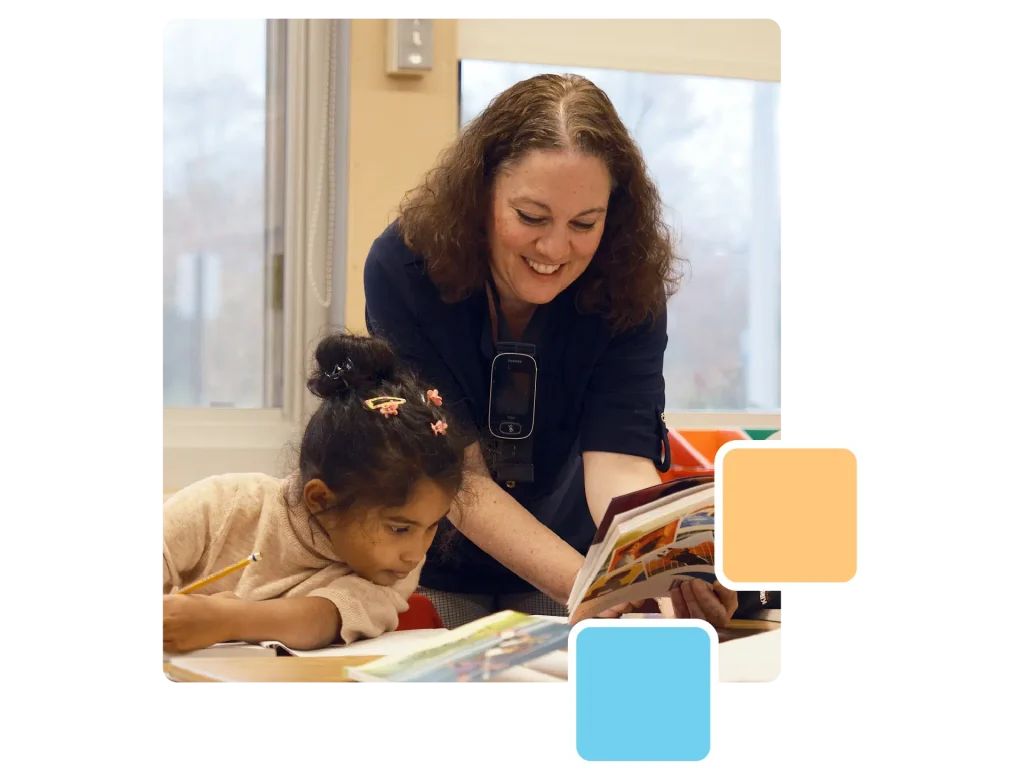
An adult helps a child read a book at a table. The child is writing, and the adult is smiling. The setting resembles a classroom, with windows in the background.

Explore Amplify’s middle-of-year research brief.

Bar chart showing the percent of kindergarten students on track by year, ranging from 38% to 57%, with the highest value at 57% and the lowest at 38%.

Kindergarten at middle-of-year

57% of kindergarten students are on track to learn to read, two percentage points higher than 2024–25. Read more about how early reading recovery has stalled and what steps to take.

Read More

Bar chart showing the percent of Grade 1 students on track, with values 58, 44, 48, 52, 54, 55, and 56 percent, all below 60%.

First grade at middle-of-year

56% of first grade students are on track to learn to read, one percentage point higher than 2024–25. Read more about how early reading recovery has stalled and what steps to take.

Read More

Bar chart showing the percent of Grade 2 students on track, ranging from 52% to 60%, with an upward trend peaking at 58%.

Second grade at middle-of-year

58% of second grade students are on track to learn to read, no change from 2024–25. Read more about how early reading recovery has stalled and what steps to take.

Read More

Research briefs by school year

October 2024

BOY: Summer instructional loss highlights the importance of quality core instruction for the youngest grades.

Read the brief

October 2025

BOY: More students start the school year on track for learning to read, though momentum is slow.

Read the brief

February 2025

MOY: Early literacy gains offer hope for COVID recovery, though broader literacy challenges persist nationwide.

Read the brief

February 2026

MOY: Slow but steady: K–2 reading readiness climbs just 1–2 percentage points annually.

Read the brief

July 2025

EOY: Reading scores rise overall; gender disparities present a complex picture.

Read the brief

Read more research and case studies.

Amplify’s high-quality programs benefit millions of students every day using methods that are evidence-based, ESSA-aligned, and showing efficacy in a variety of contexts. Read more research and case studies and see more briefs on early literacy.

Amplify Customer Experience Hiring

To view this protected page, enter the password below:


Two books titled "The Knowledge Gap" and "The Writing Revolution" by Natalie Wexler, beside a portrait of a woman with short, curly hair and a blue top.

Leadership and literacy brunch with Natalie Wexler

with Amplify and Riverside USD 

Thursday, February 27, 2020

9:30–11:30 a.m. PST

Location:
Benjamin Franklin Elementary School – Library
19661 Orange Terrace Parkway
Riverside, CA 92508

Registration deadline: Space is limited at this free event! RSVP by February 20 to secure your spot. 

Who should attend: Supervisors, ELA and reading directors, curriculum coordinators, and principals. 

About the event

Join us for a free brunch, author talk, and book signing with education writer and author Natalie Wexler on February 27 from 9:30–12 a.m.

During our time together, Natalie will discuss the latest research around reading, writing, and engagement in elementary school, along with the key findings of her book The Knowledge Gap: The Hidden Cause of America’s Broken Education System—and How to Fix It (2019).

As our guest, you’ll:

  • Meet and hear from education writer and author Natalie Wexler.
  • Mingle with other district leaders from Riverside USD and surrounding areas.
  • Enjoy a delicious brunch with colleagues.
  • Leave with a signed copy of Natalie Wexler’s book The Knowledge Gap: The Hidden Cause of America’s Broken Education System—and How to Fix It (2019).

Agenda:

9:30 a.m.: Arrive, check in, and visit our brunch buffet.
10–11 a.m.: Hear from Natalie Wexler
11–11:15 a.m.: Q&A with Natlie Wexler
11:15–11:30 a.m.: Book signing

Banquet room set up for an event with round tables, black chairs, floral centerpieces, and place settings, next to large windows and doors overlooking an outdoor patio.
A woman with short curly blonde hair is smiling next to the cover of the book "The Knowledge Gap" against a background with blue, yellow, and orange curved stripes.

Natalie Wexler

Natalie Wexler is an education writer and the author of The Knowledge Gap: The Hidden Cause of America’s Broken Education System—and How to Fix It (2019). She is also the co-author, with Judith C. Hochman, of The Writing Revolution: A Guide to Advancing Thinking Through Writing in All Subjects and Grades (2017) and a senior contributor to Forbes. Her articles and essays have appeared in The New York Times, The Washington Post, The Atlantic, and other publications. Before turning to education, Wexler worked as a freelance writer and essayist on a variety of topics, and as a lawyer and legal historian. She lives in Washington, D.C.

Submit this form to register for the event!

Two books titled "The Knowledge Gap" and "The Writing Revolution" by Natalie Wexler, beside a portrait of a woman with short, curly hair and a blue top.

Leadership and literacy brunch with Natalie Wexler

with Amplify and Riverside USD 

Thursday, February 27, 2020

9:30–11:30 a.m. PST

Location:
Benjamin Franklin Elementary School – Library
19661 Orange Terrace Parkway
Riverside, CA 92508

Registration deadline: Space is limited at this free event! RSVP by February 20 to secure your spot. 

Who should attend: Supervisors, ELA and reading directors, curriculum coordinators, and principals. 

About the event

Join us for a free brunch, author talk, and book signing with education writer and author Natalie Wexler on February 27 from 9:30–12 a.m.

During our time together, Natalie will discuss the latest research around reading, writing, and engagement in elementary school, along with the key findings of her book The Knowledge Gap: The Hidden Cause of America’s Broken Education System—and How to Fix It (2019).

As our guest, you’ll:

  • Meet and hear from education writer and author Natalie Wexler.
  • Mingle with other district leaders from Riverside USD and surrounding areas.
  • Enjoy a delicious brunch with colleagues.
  • Leave with a signed copy of Natalie Wexler’s book The Knowledge Gap: The Hidden Cause of America’s Broken Education System—and How to Fix It (2019).

Agenda:

9:30 a.m.: Arrive, check in, and visit our brunch buffet.
10–11 a.m.: Hear from Natalie Wexler
11–11:15 a.m.: Q&A with Natlie Wexler
11:15–11:30 a.m.: Book signing

Natalie Wexler

Natalie Wexler is an education writer and the author of The Knowledge Gap: The Hidden Cause of America’s Broken Education System—and How to Fix It (2019). She is also the co-author, with Judith C. Hochman, of The Writing Revolution: A Guide to Advancing Thinking Through Writing in All Subjects and Grades (2017) and a senior contributor to Forbes. Her articles and essays have appeared in The New York Times, The Washington Post, The Atlantic, and other publications. Before turning to education, Wexler worked as a freelance writer and essayist on a variety of topics, and as a lawyer and legal historian. She lives in Washington, D.C.

Submit this form to register for the event!

Two people sitting at a desk with one using a laptop and another looking on, surrounded by abstract line art and floating quotation marks, demonstrating the gold standard assessment process.

Our research

mCLASS Literacy

mCLASS® DIBELS® 8th Edition is an all-in-one literacy system for universal and dyslexia screening, progress monitoring, and instruction for grades K–8. It’s quick and easy to use, and it provides clear next steps for developing confident readers.

Research base

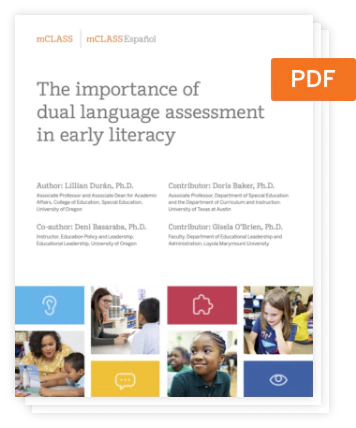
A pdf document titled "dual language of mCLASS assessment" with author details and images of students and teachers on the cover.

Research: The importance of dual language assessment in early literacy (published in 2022)

Read more

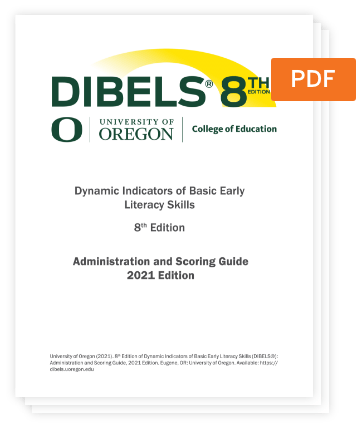
Cover page of the "Dynamic Indicators of Basic Early Literacy Skills, 8th Edition" Administration and Scoring Guide 2021 Edition, from the University of Oregon, College of Education.

Research: Administration and Scoring Guide (published in 2021)

Read more

Cover of the "Dynamic Indicators of Basic Early Literacy Skills (DIBELS) 8th Edition Technical Manual" from the University of Oregon College of Education.

Research: DIBELS 8th Edition Technical Manual (published in 2020)

Read more

Cover page of a white paper titled "mCLASS Dyslexia Screening Measures Technical Manual," with a small orange "PDF" label at the top right corner.

Research: mCLASS Dyslexia Screening Measures Technical Manual (published in 2019)

Read more

Cover page of a white paper document titled "mCLASS Dyslexia Screening Measures Research Report," with an orange "PDF" label at the top right corner.

Report: mCLASS Dyslexia Screening Measures Research (published in 2019)

Read more

Cover page of the "Burst Reading Assessment (Now mCLASS Intervention) Technical Manual" PDF document by Amplify.

Research: Burst Reading Assessment (Now mCLASS Intervention) Technical Manual (published in 2019)

Read more

Cover of a PDF titled "Five leadership practices that drive success in K-2 literacy," featuring an adult helping a young child read. Published by Amplify.

Research: Five leadership practices that drive success in K–2 literacy (published in 2018)

Read more

Cover of a PDF document titled "Examining the Efficacy of mCLASS Intervention," featuring an orange and white design. The word "Amplify" appears at the bottom, highlighting mCLASS as a gold standard assessment tool.

Report: Examining the Efficacy of mCLASS Intervention (published in 2015)

Read more

Research briefs

Cover page of a PDF research brief titled "Slow but steady: K–2 reading readiness climbs just 1–2 percentage points annually," featuring a simple bar graph illustration based on mCLASS gold standard assessment data.

Research brief: Slow but steady: K–2 reading readiness climbs just 1–2 percentage points annually. (published February 2026)

Read more

A PDF cover titled "More students start the school year on track for learning to read, though momentum is slow," dated October 2025, with a stylized bar graph illustration.

Research brief: More students start the school year on track for learning to read, though momentum is slow. (published October 2025)

Read more

Cover of a research brief titled "Reading scores rise overall; gender disparities present a complex picture," dated July 2025, featuring a bar chart graphic and highlighting mCLASS as the gold standard assessment, with a PDF label.

Research brief: Reading scores rise overall; gender disparities present a complex picture. (published July 2025)

Read more

PDF document titled "Early literacy gains offer hope for COVID recovery, though broader literacy challenges persist nationwide," dated February 2025.

Research brief: Early literacy gains offer hope for COVID recovery, though broader literacy challenges persist nationwide (published February 2025)

Read more

Cover of a PDF titled "Summer instructional loss highlights the importance of quality core instruction for the youngest grades," dated October 2024, with abstract line graph design.

Research brief: Summer instructional loss highlights the importance of quality core instruction for the youngest grades. (published October 2024)

Read more

Portada de un documento PDF titulado "Nuevo estudio", que analiza la importancia de la evaluación bilingüe para los estudiantes de habla hispana, con fecha de publicación de junio de 2024. El ícono de PDF se muestra en la esquina superior derecha.

Research brief: Different outcomes for Spanish-speaking students assessed in English and in Spanish demonstrate the importance of bilingual assessment.
(published June 2024)

Read more

Cover page of a research brief titled "Middle-of-year mCLASS data show early literacy improvements are slowing, and broader U.S. literacy rates remain a concern." Gold standard assessment results, March 2024.

Research brief: Middle-of-year data show early literacy improvements are slowing, and broader U.S. literacy rates remain a concern. (published March 2024)

Read more

Cover of a research brief PDF titled "With end-of-year data from gold standard assessment mCLASS showing continued academic recovery in early literacy, worries remain for third grade students," published July 2023 by Amplify.

Research brief: With end-of-year data showing continued academic recovery in early literacy, worries remain for third grade students.(published July 2023)

Read more

Cover page of a research brief titled "Middle-of-year data show that academic recovery continues in early literacy," featuring a simple bar graph, an orange PDF label, and highlighting mCLASS gold standard assessment.

Research brief: Middle-of-year data show that academic recovery continues in early literacy, with Black and Hispanic students making the greatest gains. (published February 2023)

Read more

A PDF cover page titled "Research Brief" discusses worsening literacy crises in U.S. schools post-COVID-19, featuring a stylized bar graph illustration, an October 2022 date, and highlights insights from mCLASS gold standard assessment data.

Research brief: Data from the beginning of the school year show that the literacy crisis in America’s schools may be worse than it was before COVID-19; but the greatest part of the crisis existed before the pandemic. (published October 2022)

Read more 

Cover of a research brief titled "Amid academic recovery in classrooms nationwide, mCLASS gold standard assessment reveals risks remain for youngest students with least instructional time during critical early years.

Research brief: Amid academic recovery in classrooms nationwide, risks remain for youngest students with least instructional time during critical early years. (published February 2022)

Read more

Cover page of a research brief titled "Students start to recover from COVID instructional loss," dated July 2021, featuring bar graph artwork, a PDF label, and highlighting gold standard assessment with mCLASS.

Research brief: Students start to recover from COVID instructional loss. (published July 2021)

Read more

Cover page of a research brief titled "COVID-19 means more students not learning to read," dated February 2021, with PDF label and Amplify logo. Features a simple bar graph illustration and highlights results from the gold standard assessment, mCLASS.

Research brief: COVID-19 means more students not learning to read. (published February 2021)

Read more

mCLASS Lectura

Cover of a PDF document titled "Guía de administración y calificación" for mCLASS, the gold standard assessment by Amplify, featuring an orange background.

Research: mCLASS Lectura Guía de administración y calificación

Read more

Stack of documents displaying the cover of the "mCLASS Lectura Technical Manual" in Spanish, labeled as a PDF—a gold standard assessment resource.

Research: mCLASS Lectura Technical Manual

Read more

Cover of the "mCLASS Spelling Español Technical Manual" PDF document, featuring a plain white background with orange and gray text—a guide to mCLASS’s gold standard assessment practices.

Research: mCLASS Spelling Español Technical Manual

Read more

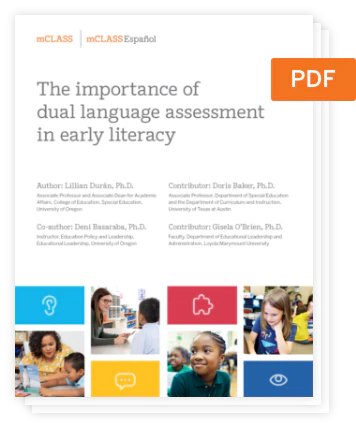
Cover of a PDF titled "The importance of dual language assessment in early literacy," featuring author names, photos of young children in classroom settings, and referencing mCLASS as a gold standard assessment tool.

Research: The importance of dual language assessment in early literacy

Read more

District success stories

Ithaca City School District, New York: mCLASS DIBELS 8th Edition and connected intervention systems drive record-breaking literacy gains

Read more

Ready to learn more?

Fill out this form, and we’ll be in touch shortly.

An illustration of a spilled liquid with a submerged smartphone, depicting a phone accident with liquid involved, used to amplify CKLA research visibility.

Explore more of our research.

Learn more about the research behind our programs.

Seattle Public Schools review for grade 6

Amplify ELA is the only ELA curriculum that takes the Science of Reading to the next level.

Truly designed for students entering the middle grades, Amplify ELA engages and empowers learners, and addresses the very specific and unique needs of students in grade 6.

Scroll down to learn how Amplify ELA is uniquely designed to help all your Seattle middle schoolers make learning leaps in literacy.

Illustration of a woman in profile with flowers in her hair, a small astronaut holding a flag, a flying eagle, and a group of people sitting together against a colorful backdrop.

Meet Amplify ELA.

Developed specifically for the needs of students entering the middle grades, Amplify ELA is a blended curriculum that promises:

  • A structured, yet flexible approach.
  • Carefully crafted, age-appropriate materials and activities that aren’t too “babyish” or too mature.
  • Complex, content-rich literature and informational texts that ensure ample opportunities for students to encounter both “windows and mirrors.”
  • Highly engaging lessons that keep adolescents plugged in and motivated to learn.
  • An instructional design that levels the playing field for every student.
  • Superior results.

Access and engagement for every student in the classroom

In Amplify ELA, all students read the same text with the help of differentiated supports. In other words, we don’t dumb things down; we bring students up. Our robust collection of varied texts and research-based approach to instruction not only engage students, but build confidence.

A collage featuring a blue silhouette of a woman, a black-and-white drawing of a man with a candle, cyclists riding near water, butterflies, and abstract colorful shapes.

Multilingual and English language learner support

With Amplify ELA’s integrated and designated ELD support, multilingual and English language learners (ML/ELs) are given a chance to shine.

Embedded supports enable students to engage with and participate in discussion of grade-level texts with their grade-level peers.

Flowchart showing Amplify ELA with two branches: Integrated ELD Support and Designated ELD Support, each with brief descriptions of their roles in English learning instruction.

Access demo

Ready to explore on your own? Follow the instructions below to access your demo account.

Access the Amplify ELA teacher digital platform.

First, watch the quick navigation video to the right. Then login using the directions below.

  • Click the ELA Teacher Platform button below.
  • Select Log in with Amplify.
  • Enter the following information:
    • Teacher username: t1.seattle_sd_ckla@demo.tryamplify.net
    • Teacher password: Amplify1-seattle_sd_ckla
    • Student username: s1.seattle_sd_ckla@demo.tryamplify.net
    • Student password: Amplify1-seattle_sd_ckla
  • Please note, these demo accounts expire on: February 26, 2026

Access the Amplify ELA student digital platform.

To access the student digital platform, follow the login directions below.

  • Click the ELA Student Platform button below.
  • Select Log in with Amplify.
  • Enter the following information:
    • Teacher username: t1.seattle_sd_ckla@demo.tryamplify.net
    • Teacher password: Amplify1-seattle_sd_ckla
    • Student username: s1.seattle_sd_ckla@demo.tryamplify.net
    • Student password: Amplify1-seattle_sd_ckla
  • Please note, these demo accounts expire on: February 26, 2026

Welcome, Seattle Public Schools, to the next chapter in the Science of Reading, with Amplify CKLA 3rd Edition!

Amplify Core Knowledge Language Arts (CKLA) helps implement the Washington State K–12 Learning Standards for English Language Arts (Common Core State Standards) by translating the Science of Reading into manageable, engaging, and effective classroom practices. For more than a decade, Amplify CKLA has transformed classrooms nationwide with its intentional knowledge building and systematic skills instruction.

Scroll down to learn how Amplify CKLA is uniquely designed to help all your students make learning leaps in literacy.

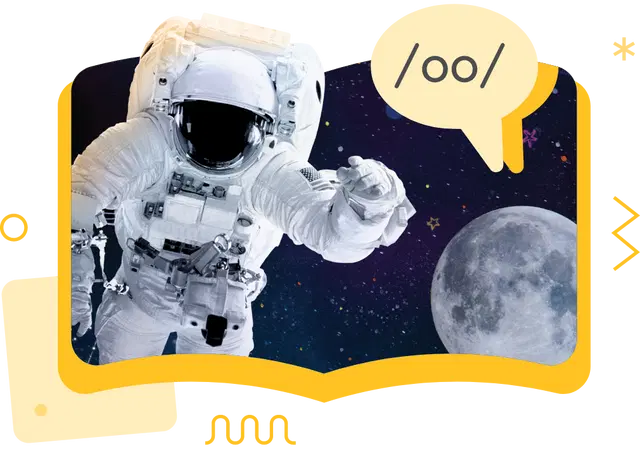
An astronaut floats in space near the Moon, with a speech bubble displaying

Our approach

Improve outcomes with a program that’s built on a decade of research and meets the strongest Every Student Succeeds Act (ESSA) Tier I criteria.

Diagram illustrating the Simple View of Reading model. It shows that skilled reading results from increasingly strategic language comprehension and increasingly automatic word recognition.

Grounded in the Science of Reading

As the original Science of Reading program, Amplify CKLA puts research into action with explicit, systematic foundational skills instruction and a proven knowledge-building sequence. In collaboration with education experts and practitioners, we provide powerful resources that deliver real results.

Background knowledge drives results.

Amplify CKLA follows the Core Knowledge Sequence, a content-specific, cumulative, and coherent approach to knowledge building. This approach improves reading scores and closes achievement gaps by establishing a robust knowledge base that strengthens comprehension.

In Amplify CKLA 3rd Edition, we’ve enriched our Knowledge Sequence with a wider range of perspectives and high-quality texts in new and enhanced units.

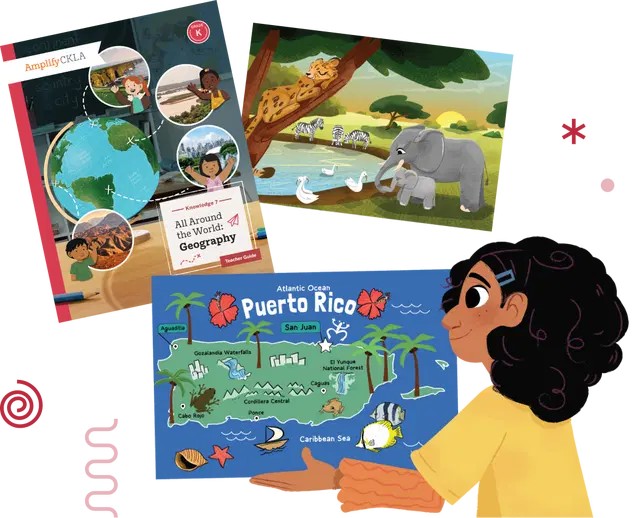
An illustrated person in a yellow shirt looks at a colorful map of Puerto Rico. Above them are two educational posters about world geography and animals, integrating elements from the k–5 literacy curriculum to enhance learning experiences.
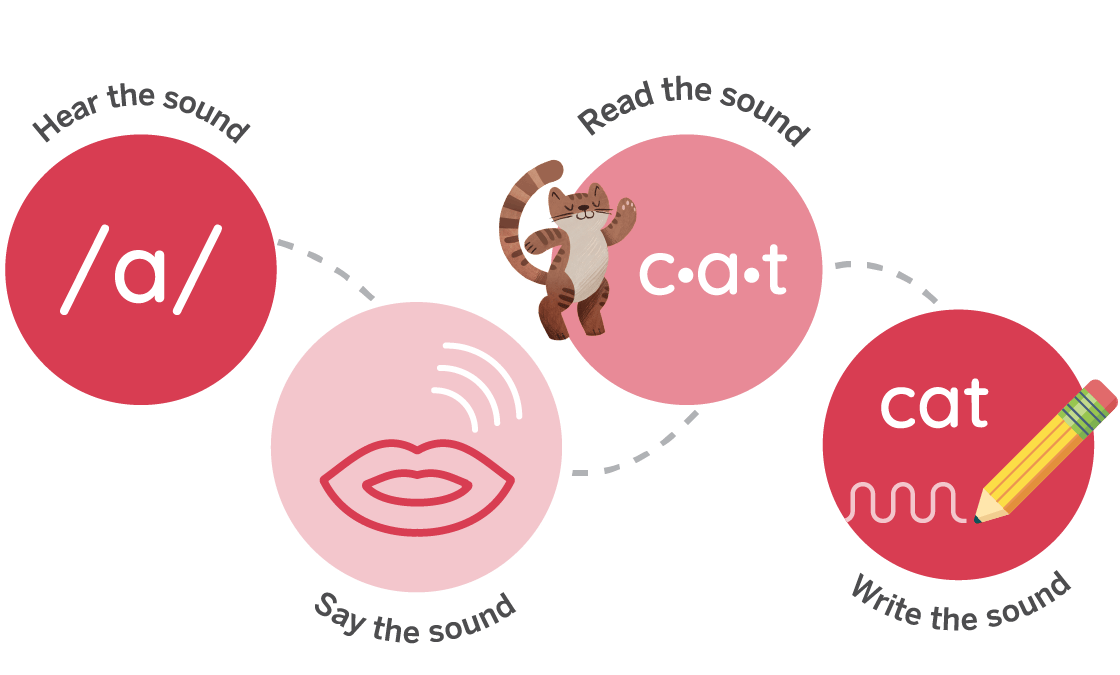
An infographic showing the steps to pronounce

Build foundational skills for long-term success.

Students progress from simple to complex skill development starting with phonological and phonemic awareness. Instruction in Grades K–2 explicitly teaches the 150 spellings for the 44 sounds of English, following an intentional progression to ensure student success.

In our 3rd Edition, we’ve added dedicated Grade 3 foundational skills instruction that can either support core lessons or function as an intervention, based on student needs.

Daily writing deepens learning.

Grounded in the Science of Writing—the research on how kids learn to write—instruction is explicit, daily, and woven into the curriculum’s rich content. It covers both transcription (handwriting and spelling) and composition (organizing ideas into narratives) with high-impact activities like sentence-level combining and expanding, and pre-writing exercises. Writing and reading instruction are integrated so students simultaneously strengthen their communication skills, comprehension, and confidence.

A child in a green shirt smiles while writing in a notebook at a classroom desk, engaged in their k–5 literacy curriculum, with another student visible in the background.
An open laptop displaying a children's story titled

High-quality, diverse texts

Amplify CKLA students are immersed in a variety of texts—complex read-alouds, decodable chapter books, trade books, and content-rich readers—that reflect varied experiences and connect to learning goals.

Readers are 100% decodable for Grades K–2, empowering students to directly apply what they’ve learned. Novel Study units for Grades 3–5 offer a mix of contemporary and classic literature, and Culminating Research Units in every grade include a set of authentic texts and trade books.

Reach all learners with differentiated support.

Scaffolds and challenges, developed in collaboration with education experts, make content accessible to every student, including multilingual and English learners. With strategies embedded right in the curriculum, teachers can deliver in-the-moment, individualized instruction to meet diverse student needs.

For a dedicated English language development program aligned to Amplify CKLA, explore Language Studio.

Children sit on the floor in a classroom, some raising their hands, smiling and engaged. The lively atmosphere reflects the effectiveness of the k–5 literacy curriculum being implemented.

What’s included with Amplify CKLA

The comprehensive resources in Amplify CKLA 3rd Edition support effective literacy instruction in every classroom.

Download Amplify CKLA Components Guide

Download Amplify CKLA Writing Brochure

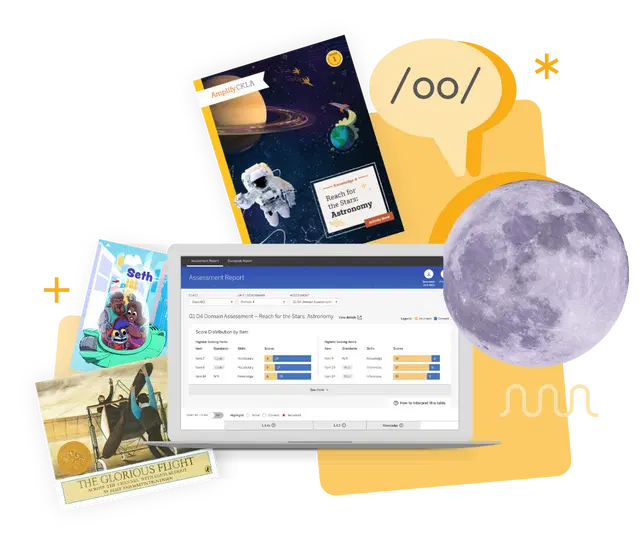
Image of a laptop displaying an assessment report, surrounded by books about astronomy, an illustration of the moon, and a
Various educational materials, including textbooks, workbooks, a picture book, documents, and a laptop displaying a slide titled

Easy-to-use teacher materials

Amplify CKLA teachers are empowered to deliver effective instruction with the following print and digital resources:

  • Teacher Guides (K–5)
  • Assessment Guides (K–5)
  • Authentic texts and trade books (K–5)
  • Knowledge Image Cards (K–2)
  • Knowledge Flip Books (K–2, digital)
  • Ready-made and customizable Presentation Screens (K–5, digital)
  • Remediation and intervention resources (K–5)
  • On-demand professional development (K–5, digital)

Immersive Amplify CKLA student resources

Amplify CKLA students stay engaged with the following print and digital resources:

  • Decodable readers (K–2)
  • Student Readers and novels (3–5)
  • Student Activity Books (K–5)
  • Poet’s Journal (3–5)
  • eReaders (K–5, digital)
  • Sound Library featuring articulation videos and songs (K–2, digital)
  • Skill-building practice games (K–5)
An open laptop displaying a poem and a person, alongside two educational booklets and a green butterfly, depicts the essence of a rich core knowledge language arts curriculum. The background includes simple graphic elements enhancing the scene.
A collection of six book covers including

Rich literary experiences

The array of high-quality, varied texts in Amplify CKLA connect to the curriculum, sparking students’ curiosity and empowering them to learn to read with confidence.

  • Trade Book Collections (K–5) inspire student research in each grade’s Culminating Research Unit.
  • Classic and contemporary literature (3–5) delight students in Novel Study Units.
  • Increasingly complex Student Readers (K–5) develop students’ literacy across grades.

Hands-on phonics materials

Multisensory phonics and foundational skills resources engage students with fun, varied approaches that promote mastery and build independence.

  • Chaining Folders and Small Letter Cards (K)
  • Read-Aloud Big Books (K–1)
  • Large Letter Cards (K–2)
  • Sound Cards (K–2)
  • Image Cards (K–3)
  • Blending Picture Cards (K)
  • Consonant and Vowel Code Posters and Spelling Cards (1–2)
  • Sound Library (K–2, digital)
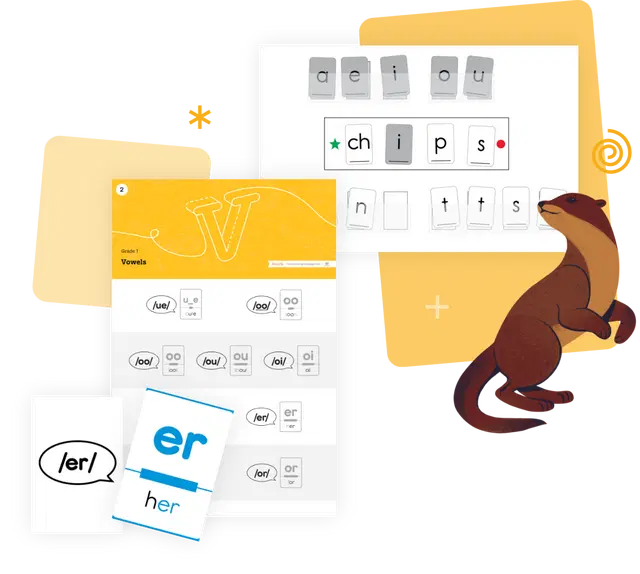
Image includes various vowel sounds and combinations on flashcards and worksheets, along with a playful illustrated mammal, all part of a comprehensive literacy curriculum for elementary students.
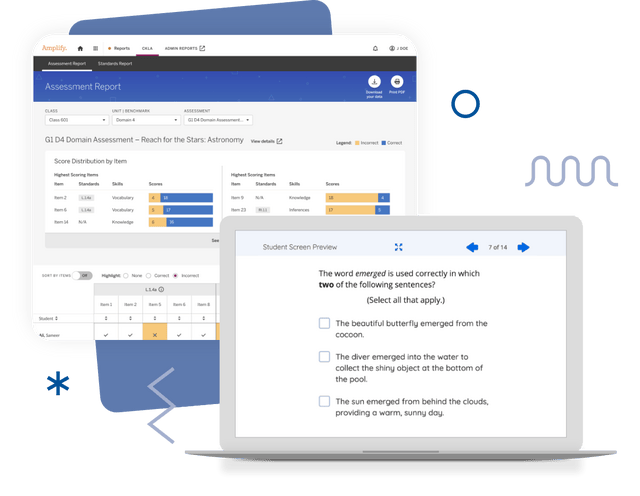
A laptop displays a student screen showing a quiz question about word usage, part of a literacy curriculum for elementary students. Behind it, a computer monitor shows an assessment report interface. Abstract decorative elements are in the background.

All-in-one digital platform

Our comprehensive platform simplifies your day-to-day tasks and makes it easier to plan and deliver lessons.

  • Ready-made and customizable Presentation Screens
  • Auto-scored digital assessments
  • Standards-based reporting
  • Assignable skill-building games
  • Sound Library
  • eReaders

Professional development (PD)

Move beyond traditional program training with Amplify’s digital PD Library, designed to fully support your shift to the Science of Reading and Amplify CKLA. Deepen your understanding with:

  • Program and planning resources.
  • Model lesson videos from real classrooms.
  • Guidance on using Amplify’s literacy suite to provide multi-tiered support.
Two women are seated at a table with papers and a laptop. One woman is working on the literacy curriculum for elementary grades, while the other is smiling.
“Teachers love the ease of implementing the program, and students have fun while learning. Growth is evident in our data, and we have the support of Amplify experts who are available to answer questions and provide top-notch professional development.”

Bridget Vaughan, District K–8 Coordinator of ELA and Literacy

Quincy Public Schools, Massachusetts

Language Studio: Multilingual and English language learner support

Language Studio is Amplify CKLA’s dedicated K–5 program for multilingual and English language learners. Through daily 30-minute lessons, it strengthens reading, writing, speaking, and listening skills while reinforcing core instruction. This tailored support empowers students to confidently access grade-level content as they develop academic English.

A young girl immerses herself in the science of reading at a classroom desk, surrounded by peers and diverse educational materials.

Amplify Caminos program overview

¡El futuro es bilingüe! | The future is bilingual!

Amplify Caminos is a research-based core curriculum essential for Spanish literacy and grounded in the Science of Reading.

View our Amplify Caminos Program Guide to learn our approach to foundational skills by year, view skills practice with student readers and writing, and understand how the program supports teachers in meeting the needs of all students with embedded differentiation.

Amplify Caminos offers a robust and authentic elementary Spanish language arts program for grades K–5 that promotes
biliteracy and helps teachers inspire students as they become confident readers, writers, and thinkers in Spanish.

Using the program’s two strands, Caminos Conocimiento and Caminos Lectoescritura, teachers develop student
comprehension in Spanish through a program rich in background knowledge and foundational skills activities. The texts students encounter include authentic Spanish literary works that honor Spanish language development and build deep content knowledge in social studies, science, literature, and the arts.

Amplify Caminos is designed to support a variety of bilingual and dual language instructional models to meet every student’s biliteracy needs. Combined with its English language partner, Amplify Core Knowledge Language Arts (CKLA), Amplify Caminos provides a comprehensive biliteracy solution.

A girl runs joyfully surrounded by a turtle, a soccer ball, an open book, and tropical scenery with a toucan and ancient ruins, with "¡Hola!" written above.
Illustration of the amplify caminos language comprehension model, featuring step-by-step progression from simple word recognition to skilled reading, with educational graphics and text excerpts.

Amplify Caminos delivers rich, authentic experiences.

With a robust digital experience and an expanding library of online materials, Amplify Caminos provides everything needed to support, challenge, and engage your students. From digital Teacher Guides to lesson projectables, the program includes all the tools needed to successfully deliver every lesson.

How Amplify Caminos works with Amplify CKLA

Through direct instruction, both Amplify Caminos and Amplify CKLA develop reading, writing, speaking, and listening skills in their respective languages. Together, the programs empower educators to effectively foster biliteracy with:

  • Intentional knowledge building that connects topics throughout the program.
  • Increased metalinguistic awareness from students exploring the similarities and differences in each language while strengthening their knowledge across both.
  • Instruction with high-quality Spanish and English decodable readers that provide every student with opportunities to apply skills learned and grow competency in reading.
“There were other programs that claimed to be [based on the] Science of Reading, but no other vendor provided the suite of products together. We did not want to be picking from here, picking from there. [Amplify’s literacy suite] met our needs, because it aligned and provided us the best suite of products, hands down.”

Nicole Peterson, Principal, Midway Middle School

Sampson County Schools, North Carolina

Demo access

Explore the Amplify CKLA teacher digital resources.

First, watch the quick navigation video to the right. Then, follow the directions below.

  • Go to: learning.amplify.com or click the Access CKLA Teacher Digital button below.
  • Select Log in with Amplify.
  • Enter the following information:
    • Teacher username: t1.seattle_sd_ckla@demo.tryamplify.net
    • Teacher password: Amplify1-seattle_sd_ckla
    • Student username: s1.seattle_sd_ckla@demo.tryamplify.net
    • Student password: Amplify1-seattle_sd_ckla
  • Please note, these demo accounts expire on: February 26, 2026
  • Click the CKLA button.
  • Select your desired grade level from the Program drop down.

Follow the directions below to access the Student Resource Site:

  • Go to: learning.amplify.com or click the Access CKLA Student Digital button below.
  • Select Log in with Amplify.
  • Enter the following information:
    • Teacher username: t1.seattle_sd_ckla@demo.tryamplify.net
    • Teacher password: Amplify1-seattle_sd_ckla
    • Student username: s1.seattle_sd_ckla@demo.tryamplify.net
    • Student password: Amplify1-seattle_sd_ckla
  • Please note, these demo accounts expire on: February 26, 2026
  • From the main page, click the backpack in the top right corner.
  • Click on the grade level to select your desired grade.

Ready to register?

Coming soon! Please select one preferred date and time to register for our session(s) beginning February 2023.

Need to reschedule?

Should you need to reschedule, please select an available date and time, then select the “reschedule” option before submitting the form.

Keep checking back. Registration links are coming soon!

Need help?

If you’ve attempted to sign up and all sessions are full, please submit this form to be connected with your Amplify professional development partner.

Amplify Science Resources for NYC (6-8)

This page has been archived. For the latest information, please visit the NYC Resource Site.

Welcome!

As the 2021-2022 school year kicks into full gear, you’re likely thinking about making your classroom responsive to student needs due to the covid-19 pandemic.

Got additional questions? Use Zoom to attend office hours with Adaliz Gonzalez, the DOE’s Middle School Science Lead on Thursdays from 3-4pm.

Meeting ID: 852 2280 0969

Passcode: 528986

A powerful partnership

Amplify Science was developed by the science education experts at UC Berkeley’s Lawrence Hall of Science and the digital learning team at Amplify.

The word "Amplify" is written in large, orange letters with a period at the end on a light background.
The logo for The Lawrence Hall of Science, University of California, Berkeley, features blue text on a light background and is recognized by educators using Amplify Science for middle school science programs.

NYC Newsletters

Educator Spotlight Submission

Calling all NYC DOE educators! Do you know an educator who has gone above and beyond? Would you like to highlight your teaching experience for others? Submit nominations here to see them featured as a spotlight in a future edition of our monthly newsletter and on our Instagram pages!

Introduction

This page includes planning, implementation, and professional learning resources for NYC schools using Amplify Science. Please take a moment to familiarize yourself with the categories in the navigation bar on the left side of the page, so that you’ll be able to easily find what you need.

Most New York City educators come here looking for specific information, but if you’re new to Amplify Science, we recommend you read through the program guide to learn a little about the program. 

New to Amplify? – Start HERE!

Teachers and Administrators 

Step 1: Review the Amplify Science Overview Video.

Step 2: Review the NYC Scope and sequence for 21-22 school year.

Step 3: Review the Unpacking the Kit Videos listed below to understand what’s in your unit 1 kit.

Step 4: Access your unique Log-in information to log-in to the Amplify Science Curriculum outlined below under Login support

Step 5: Log into the platform and access our Program Hub.  Select Using this site for self study for a complete suite of training videos and resources for an initial orientation video series.

Step 6: Log into the curriculum and begin studying the Unit Map and Teacher’s Guide resources and begin planning your first lesson. Print out the NYC Program Guide for essential program information.

Step 7: Administrator’s ONLY – Review the new administrator orientation presentation for an overview of the program. Review other materials under Admin Resources

NOTE: Should you need any additional guidance on how to get started with prep (or anything else!), please feel free to get in touch with our pedagogical support team. They are available Monday-Friday from 7AM-7PM EST. You can reach them via the chat icon in the lower right- hand corner of your screen when logged in, through email (help@amplify.com), or via phone (800-823-1969).

Getting started resources

Login Support

Materials

Unpacking your first Amplify Science classroom kit

21-22 Login Update

The temporary login credentials for fall ’21 have been deactivated. 

Please make sure you check out the Getting started resources > Login Support below for instructions around teacher and student logins. If there are any issues, please confirm with your STARS programmer that your classes are assigned correctly and then contact our Amplify Help Desk at help@amplify.com or at 1-800-823-1969 for further assistance.

Implementation resources

21-22 NYC Scope and Sequence and Pacing Guide

Use our NYC Field Trip List to plan an engaging field trip for your students!

NYC Companion Lesson Guides 

The format of the NYC Companion Lessons is similar to other Amplify Science lessons. Some companion lessons are designed to require more than a single class period to teach, so each lesson includes pacing suggestions. Science Background sections support teachers with the science content introduced in the lessons. For students’ written work, possible student responses are included at the end of each lesson guide.

The Lesson Guides are available in the last section of each unit’s print Teacher’s Guide and can be downloaded from the tables in the downloads section below.

NYC Companion Lesson Copymasters
Each NYC Companion Lesson has an accompanying Copymaster (for creating student sheets) that can be copied and distributed to students or used as a visual reference. The NYC Companion Lessons require students to have physical copies of the student sheets. The copymasters are available to download as printable PDF files from the tables in the downloads section below.

Grade 6 Lesson guides and Copymasters

  • Companion lesson: Insert after Lesson 2.2
  • Time frame: 60 minutes (can spread across multiple class periods)
  • NYSP–12SLS: PE: MS-PS3-6, DCI: PS3.B
  • Links (click to download):
  • Companion lesson: Insert after Lesson 3.3
  • Time frame: Two 45-minute class periods
  • NYSP–12SLS: PE: MS-PS2-3, MS-PS2-5, DCI: PS2.B
  • Links (click to download):
  • Companion lesson: Insert after Lesson 3.3 and after Investigating Non-Touching Forces
  • Time frame: 60 minutes (first and second reads can be spread across two class periods)
  • NYSP–12SLS: PE: MS-PS2-5, MS-PS2-3, DCI: PS2.B
  • Links (click to download):
  • Companion lesson: Insert after Lesson 2.5
  • Time frame: 105 minutes (can be spread across multiple class periods)
  • NYSP–12SLS: PE: MS-PS1-6, DCI: PS1.B
  • Links (click to download):
  • Companion lesson: Insert after Lesson 3.4
  • Time frame: 60 minutes (first and second reads can be spread across two class periods)
  • NYSP–12SLS: PE: MS-LS2-5, DCI: LS2.C, LS4.D
  • Links (click to download):
  • Companion lesson: Insert after Lesson 1.3
  • Time frame: 60 minutes (first and second reads can be spread across two class periods)
  • NYSP–12SLS: PE: MS-ESS2-4, DCI: ESS2.C
  • Links (click to download):
  • Companion lesson: Insert after Lesson 3.3*
  • Time frame: 90 minutes (can be spread across multiple class periods)
  • NYSP–12SLS: PE: MS-PS1-7, MS-ESS2-6, DCI: PS1.A, ESS2.C
  • Links (click to download):

*Note: The homework assignment for Ocean, Atmosphere, and Climate Lesson 3.3 (reading the article “Deep Ocean Currents: Driven by Density”) should be assigned after the Investigating Deep Ocean Currents companion lesson rather than after Lesson 3.3.

Grade 7 Lesson Guides and Copymasters

  • Companion lesson: Insert after Lesson 3.2
  • Time frame: 60 minutes (first and second reads can be spread across two class periods)
  • NYSP–12SLS: PE: MS-LS1-3, DCI: PS3.D, LS1.A
  • Links (click to download):
  • Companion lesson: Insert after Lesson 3.3 or later
  • Time frame: Three 45-minute class periods, each several days apart
  • NYSP–12SLS: PE: MS-LS1-8, DCI: LS1.D
  • Links (click to download):
  • Companion lesson: Insert after Lesson 3.5
  • Time frame: 60 minutes (first and second reads can be spread across two class periods)
  • NYSP–12SLS: PE: MS-LS1-6, MS-LS1-7, DCI: LS1.C, PS3.D
  • Links (click to download):
  • Companion lesson: Insert after Lesson 2.2
  • Time frame: 60 minutes (first and second reads can be spread across two class periods)
  • NYSP–12SLS: PE: MS-PS1-4, DCI: PS3.A
  • Links (click to download):
  • Companion lesson: Insert after Lesson 1.3
  • Time frame: 60 minutes
  • NYSP–12SLS: PE: MS-PS1-7, DCI: PS1.A
  • Links (click to download):
  • Companion lesson: Insert after Lesson 2.3, 2.4, or 2.5
  • Time frame: Two 45-minute class periods
  • NYSP–PE: MS-PS1-8, MS-PS1-2 DCI: PS1.A, PS1.B
  • Links (click to download):

Grade 8 Lesson Guides and Copymaster

  • Companion lesson: Insert after Lesson 2.2
  • Time frame: 90 minutes (can be spread across multiple class periods)
  • NYSP–12SLS: PE: MS-PS3-2, MS-PS3-5
  • Links (click to download):

NYC Companion Kits

Materials needed to teach Amplify Science lessons are provided in a kit for each unit. While some materials used in the NYC Companion Lessons are also found in a unit’s kit, materials specific to the companion lessons are provided in NYC Companion Kits. The contents of each kit and any additional materials needed to teach the companion lessons are listed in the PDFs provided below. Please select your grade to view or download the list.

NYC Student Editions (print)
The NYC Student Editions are durable student references that compile all reading material required for a grade level, including the articles students read for NYC Companion Lessons. Students reading in the Student Edition should annotate the text directly with sticky notes to achieve the full benefits of Active Reading. The Active Reading approach was designed as an interactive process in which students highlight and annotate digital or hard copies of articles directly. Printable versions of the articles are available in the downloads section below.

It is recommended that NYC teachers insert this additional lesson between Lessons 3.1 and 3.2 in order to have students complete a reading assignment in class along with an additional Sim activity.

  • Lesson: Earth, Moon and Sun: Modeling Seasons
  • Lesson Placement: Insert between Lessons 3.1 and 3.2*
  • Links (click to download):

*If teaching this Modeling Seasons lesson, do not assign reading “The Endless Summer of the Arctic Tern” article for homework in Lesson 3.1. However, students should still model a lunar eclipse with the Modeling Tool for homework, as they will be revisiting and revising this model in Lesson 3.3.

NYC Investigation Notebooks (for teacher download)

* includes NYC Companion Lesson Copymaster(s)

* includes NYC Companion Lesson Copymaster(s)

  • Geology on Mars
  • Earth, Moon, and Sun
  • Force and Motion
  • Engineering Internship: Force and Motion
  • Magnetic Fields*
  • Light Waves
  • Traits and Reproduction
  • Natural Selection
  • Evolutionary History

* includes NYC Companion Lesson Copymaster(s)

Admin resources

Remote and hybrid learning resources

In response to the shifts towards remote learning, Amplify has created resources for using our programs remotely. Please visit our Program Hub accessible via your Teacher Platform for all of our hybrid and remote learning supports which includes guidance for teachers and parents/guardians.

Additionally, please see below where you’ll find the recordings from our recently held webinars on our remote learning resources and some best practices for implementing Amplify Science in a distance learning setting.

Resource guides

Professional learning opportunities

Interested in attending training? Check out and sign up for this year’s PL offerings here!

Election Day 21-22 PL

Grade 6 Guided Planning Presentation and Webinar

Grade 7 Guided Planning Presentation and Webinar

Grade 8 Guided Planning Presentation and Webinar

Grades 6-8 Unpacking Phenomena Presentation and Webinar

All 2020-2021 PL session materials can be found below under Professional learning resources.

Amplify Science Back-to-School Recorded Webinars – Amplify held a series of national office hours throughout the summer and fall to share information about our new resources to support remote and hybrid learning– including recommendations about what to prioritize from your curriculum and essential refresher topics, such as how to navigate your program and find the best planning resources. Feel free to watch all recorded sessions at your convenience.

Archived Professional Learning Resources

Winter 2022

Spring 2021

Winter 2021

Fall 2020

Summer 2020

Summer 2019- Harnessing Human Energy and Thermal Energy

Fall 2019- Population and Resources with Participant Notebook

Winter 2022

Spring 2021

Winter 2021

Fall 2020

  • Grade 7: Progress Builds & Embedded Assessments Webinar
  • Grade 7: Amplify Science Remote & Hybrid Resources Webinar

Summer 2020

Summer 2019 – Microbiome and Metabolism

Fall 2019 – Phase Change with Participant Notebook

Winter 2022

Spring 2021

Winter 2021

Fall 2020

  • Grade 8: Progress Builds & Embedded Assessments Webinar
  • Grade 8: Amplify Science Remote & Hybrid Resources Webinar

Summer 2020

Summer 2019 –  Geology on Mars and Earth, Moon, Sun

Fall 2019 – Force and Motion with Participant Notebook

Caregiver resources

Caregiver Hub

Questions

For general questions about the Amplify program (navigation, pedagogy, login), please reach out:

Email – scihelp@amplify.com
Phone – call toll-free at (800) 823-1969, Monday to Friday, 7 a.m.–7 p.m.  ET

Amplify Chat – click the Amplify Chat icon within the individual teacher account

Welcome!

As the 2021-2022 school year continues to pose new challenges, you’re likely thinking about making your classroom responsive to student needs due to the covid-19 pandemic.

Got additional questions? Use Zoom to attend office hours with Nadya Awadallah, the DOE’s Elementary Science Lead on Fridays from 12-1pm.

Meeting ID: 835 9458 3142

Passcode: 263518

NYC Newsletters

Educator Spotlight Submission

Calling all NYC DOE educators! Do you know an educator who has gone above and beyond? Would you like to highlight your teaching experience for others? Submit nominations here to see them featured as a spotlight in a future edition of our monthly newsletter and on our Instagram pages!

Introduction

This page includes planning, implementation, and professional learning resources for NYC schools using Amplify Science. Please take a moment to familiarize yourself with the categories in the navigation bar on the left side of the page so that you’ll be able to easily find what you need.

Most New York City educators come here looking for specific information, but if you’re new to Amplify Science, we recommend you read through the program guide to learn a little about the program. 

New to Amplify? – Start HERE!

Teachers and Administrators 

Step 1: Review the Amplify Science Navigation Essentials K-5 Video 

Step 2: Review your Scope and sequence/course structure calendar

Step 3: Review the Unpacking the Kit Videos listed below to understand what’s in your unit 1 kit

Step 4: Access your unique log in information to log-in to the Amplify Science Curriculum outlined below under Login support

Step 5: Log into the platform and access our Program Hub.  Select Using this site for self study for a complete suite of training videos and resources for an initial orientation video series

Step 6: Log into the curriculum and begin studying the Unit Map and Teacher’s Guide resources and begin planning your first lesson. Print out the NYC Program Guide for essential program information.

Step 7: Administrator’s ONLY – Review the K-5 Admin Orientation presentation for an overview on the program. Review materials under Admin Resources. 

NOTE: Should you need any additional guidance on how to get started with prep (or anything else!), please feel free to get in touch with our pedagogical support team. They are available Monday-Friday from 7AM-7PM EST. You can reach them via the chat icon in the lower right- hand corner of your screen when logged in, through email (help@amplify.com), or via phone (800-823-1969).

Getting started resources

NYC Resource Site overview – quick links

Technology requirements

Login support

Materials

  • Materials lists – lists of kit contents by unit
    K | 1 | 2 | 3 | 4 | 5
  • Spanish materials lists – lists of Spanish print kit contents by unit
    K | 1 | 2 | 3 | 4 | 5
  • Kit-level packing detail (chart) – high-level information regarding kits including dimensions, weights, etc. 

Unpacking your first Amplify Science classroom kit

All Amplify Science units coming with kits that include hands-on and print materials. The number of boxes (sometimes referred to as “tubs”) varies depending on the unit.

21-22 Login Update

The temporary login credentials for fall ’21 have been deactivated. 

Please make sure you check out the Getting started resources > Login support below for instructions around teacher and the NYC shared student logins.

If there are any issues, please confirm with your STARS programmer that your classes are finalized and then contact the Amplify Help Desk at help@amplify.com or at 1-800-823-1969.

Planning and implementation resources

Use our NYC Field Trip List to plan an engaging field trip for your students!

Use the resources below to plan out your year and ensure you are teaching each standard to mastery.

NYC DOE Supplemental Guiding Documents: Curriculum Gaps

Admin resources

Remote and hybrid learning resources

In response to the shifts towards remote learning, Amplify has created resources for using our programs remotely. Please visit our Program Hub accessible via your Teacher Platform for all of our hybrid and remote learning supports which includes guidance for teachers and parents/guardians.

Additionally, please see below where you’ll find the recordings from our recently held webinars on our remote learning resources and some best practices for implementing Amplify Science in a distance learning setting.

Resource guides

  1. K-8 Remote and hybrid learning guide

On-demand remote learning videos

Professional Learning Opportunities

Interested in attending training? Check out and sign up for this year’s PL offerings here!

All 2021-2022 PL session materials will be uploaded below under Professional learning resources.

Amplify Science Back-to-School Recorded Webinars – Amplify held a series of national office hours throughout the summer and fall to share information about our new resources to support remote and hybrid learning– including recommendations about what to prioritize from your curriculum and essential refresher topics, such as how to navigate your program and find the best planning resources. Feel free to watch all recorded sessions at your convenience.

21-22 Professional learning resources

Fall 2021 materials:

Summer 2021 materials:

Fall 2021 materials:

Summer 2021 materials:

Fall 2021 materials:

Summer 2021 materials:

Fall 2021 materials:

Summer 2021 materials:

Fall 2021 materials:

Summer 2021 materials:

Fall 2021 materials:

Summer 2021 materials:

20-21 Professional learning resources

Winter 2021 materials:

Fall 2020 materials:

Summer 2020 materials:

Winter 2021 materials:

Fall 2020 materials:

Summer 2020 materials:

Winter 2021 materials:

Fall 2020 materials:

Summer 2020 materials:

  • K-5 New Teacher Orientation with Participant Notebook
  • Grades 2-3 Utilizing Program Assessments Effectively Webinar
  • Reaching All Learners for Grades 2-3 Webinar
  • Grade 2 Returning Teacher Remote Learning: Guided Planning Workshop Webinar

Spring 2021 materials:

  • Unit 4: Focusing on Evidence of Learning for New Teachers Webinar

Winter 2021 materials:

Fall 2020 materials:

Summer 2020 materials:

  • Grade 3 New Teacher Orientation Webinar with Participant Notebook
  • Grades 2-3 Utilizing Program Assessments Effectively Webinar
  • Reaching All Learners for Grades 2-3 Webinar
  • Grade 3 Returning Teacher Remote Learning: Guided Planning Workshop Webinar

Winter 2021 materials:

Fall 2020 materials:

Summer 2020 materials:

  • Grade 4 New Teacher Orientation Webinar with Participant Notebook
  • Grades 4-5 Utilizing Program Assessments Effectively Webinar
  • Reaching All Learners for Grades 4-5 Webinar
  • Grade 4 Returning Teacher Remote Learning: Guided Planning Workshop Webinar

Winter 2021 materials:

Fall 2020 materials:

Summer 2020 materials:

  • Grade 5 New Teacher Orientation Webinar with Participant Notebook
  • Grades 4-5 Utilizing Program Assessments Effectively Webinar
  • Reaching All Learners for Grades 4-5 Webinar
  • Grade 5 Returning Teacher Remote Learning: Guided Planning Workshop Webinar

19-20 Professional learning resources

Summer 2019 materials:

Fall 2019 materials:

Spring 2020 materials:

  • Reaching ALL Learners: Utilizing Program Assessments Effectively in Grades K & 1 – Participant Notebook

Summer 2019 materials:

Fall 2019 materials:

Spring 2020 materials:

  • Reaching ALL Learners: Utilizing Program Assessments Effectively in Grades K & 1 – Participant Notebook

Summer 2019 materials:

Fall 2019 materials:

Spring 2020 materials:

  • Reaching ALL Learners: Utilizing Program Assessments Effectively in Grades 2 & 3 – Participant Notebook

Summer 2019 materials:

Fall 2019 materials:

Spring 2020 materials:

  • Reaching ALL Learners: Utilizing Program Assessments Effectively in Grades 2 & 3 – Participant Notebook

Summer 2019 materials:

Fall 2019 materials:

Summer 2019 materials:

Fall 2019 materials;

Caregiver Resources

Caregiver letters – information about Next Generation Science Standards by grade level

K | 1 | 2 | 3 | 4 | 5

Caregiver Hub

Questions

Amplify Science K–5 FAQs

For general questions about the Amplify program (navigation, pedagogy, login), please reach out:

Email – scihelp@amplify.com
Phone – call toll-free at (800) 823-1969, Monday to Friday 7 a.m.–7 p.m. ET

Amplify Chat – click the Amplify Chat icon within the individual teacher account

Amplify Science resources for Chicago Public Schools

To view this protected page, enter the password below:


S5.E6. Why skepticism is essential to the Science of Reading, with Dr. Claude Goldenberg

To view this protected page, enter the password below:


Website Privacy Policy

Last Modified:  February 2026

Update: February 2, 2026: This Privacy Policy has been updated to address additional rights for individuals in the European Union/UK.

Below is the Website Privacy Policy for the amplify.com site (“Privacy Policy”). For purposes of clarity and as further outlined below, this Privacy Policy does not apply to student data. You can visit this page to read about the principles and policy governing student data collected and maintained on behalf of our school customers.

We advise you to read this Privacy Policy in its entirety, including the jurisdiction-specific provisions in the appendix. Our Notice at Collection for California Residents is available in the Notice for our California Customers.

Who We Are / What This Privacy Policy Covers

Amplify Education, Inc. (“Amplify”) recognizes the importance of protecting the privacy and security of your personal information. This Privacy Policy describes our practices in connection with information that we may collect through your use of this website (the “Site”).

This Privacy Policy does not apply to Amplify’s handling of:

  • student data or other information collected from users of Amplify’s products that support classroom instruction and learning, which are governed by our Customer Privacy Policy.
  • staff or applicant data that we process in accordance with our staff or applicant privacy notice, respectively.

If you have any question as to what legal agreement or privacy policy controls the collection and use of your information, please contact us using information below in the Contact Us section.

This Privacy Policy is incorporated into and is subject to our Website Terms of Use, which governs your use of the Site.

Our Role: We are the controller of all personal information (as defined below) that we receive through our Site and can be reached by email at privacy@amplify.com or by mail at Amplify Education, Inc., 55 Washington St.#800, Brooklyn, NY, 11201.

1. What personal information do we collect?

When you visit and / or interact with our Site, we may collect the following information about you that, alone or in combination, could be used to identify you or your device (“personal information”):

  • Contact Information, such as name, district / school name, professional affiliation, title / role, email address, shipping address, address and phone number.
  • Account Information, such as customer user login and password. 
  • Demographic Information, such as age and gender.
  • Information You Submit, such as information voluntarily provided on message boards, feedback sections, and other public areas of the Site.
  • Site Activity Information, which is collected when you access and interact with the Site, we and our Service Providers (as defined below) may collect certain information about those visits. For example, we or our Service Providers may receive and record information about your computer and browser, including your IP address, browser type, and other software or hardware information. If you access the Site from a mobile or other device, we may collect a unique device identifier assigned to that device, or other characteristics of the device hardware, operating system and configurations for that device. On certain pages of the Site, we may use third party tools to help us look at mouse movements, clicks, keystrokes, data or text entered, and the pages you visit.
  • Location Information, such as state, country and / or zip code, which we use to help us customize your experience, as well as to help us facilitate your privacy rights.
  • Audio, electronic, visual, or similar information: such as customer service interactions, call recordings, chat transcripts, files you attach, and email, text, or other correspondence.

If you make a purchase through our online store, you may provide payment and other information directly to our third party e-commerce platform to complete your purchase.

We ask that you not send us, and you not disclose, any government identifiers (such as social security numbers) or information related to racial or ethnic origin, health, or criminal background on or through the Site or otherwise.

2. Where/How do we collect personal information?

Amplify may collect personal information directly from you at various points, including the following:

  • Product Information and Newsletters. When you submit a request to obtain information about our products, services or other informational material or subscribe to one of our newsletters, you may be asked to submit information such as name, professional affiliation, email address, company name, address and phone and details on your query or interests in our products and services. This information is collected to help us process your request.
  • Customer Support. When you submit a form to contact our customer service, you may be asked to submit information such as name, e-mail, district, customer user login and password and details on your query. In addition, some features of our Site, such as our customer live chat functionality or other customer service systems may allow you to voluntarily provide personal information to us. This information is collected to help us process your request. Please only provide what is needed to facilitate the support request.
  • Product Orders. If you use e-commerce areas of our Site to order our products, we request information from you on our order form. To purchase products through the Site, you must provide contact information (such as name and shipping address) and financial information (such as credit card number). This information is used for billing purposes and to fill your orders. We will also use this information to contact you to confirm your order or to inform you of any issues or delays.
  • Registration. You may be asked to submit information to use certain parts of the Site (such as posting comments on certain areas of the Site), register for an event or webinar, or view restricted content that may be available on the Site. For instance, you may be asked to provide your name, email address and event or webinar-related preferences to help us process your registration or content request.
  • Public Areas and Discussion Forums. Any information you share in public areas, such as message boards or feedback sections, becomes public. Please be careful about what you disclose and do not post any personal information that you expect to keep private.
  • Contests and Sweepstakes. When we run a contest or sweepstakes relating to the Site or Amplify, it will be accompanied by a set of rules. The rules for each contest/sweepstakes will specify how the information gathered from you for your entry will be used and disclosed.

As you visit or use our Site, we may collect Site activity information through cookies and similar technologies.

  • Cookies, Pixels, and Other Tracking Technologies. Cookies and other tracking technologies (such as pixels, beacons, and Adobe Flash technology) are small data files that are placed on your computer or mobile device when you visit a website. They allow the website or mobile app to remember your actions and preferences over a period of time. We use the following types of cookies:
    • Strictly necessary cookies – These are cookies that are required for the operation of our Site. They include, for example, cookies that enable you to log into secure areas of our Site. These cookies are not generally stored beyond the browser session and are less likely to include personal information. This category of cookies cannot be disabled.
    • Functionality Cookies – We use these cookies so that we recognize you on our Site and remember your previously selected preferences. These cookies are stored on your device between browsing sessions but expire after a pre-defined period. These cookies enable our Site to “recognize” you when you use our Site, including your preferences such as your preferred language , time, and location. A mix of first party (placed by us) and third-party cookies (placed by third parties) are used.
    • Analytics Cookies – These cookies help us and our Service Providers compile statistics and analytics about users of the Site, including Site Activity Information. For example, we use Google Analytics to help us understand how users interact with the Platform. Google Analytics uses cookies to track your interactions with the Site, then collects that information and reports it to us. This information helps us improve the Site so that we can better serve you. To learn more about Google Analytics, visit https://support.google.com/analytics/answer/6004245?hl=en. If you wish, you can opt-out of Google Analytics by installing the Google Analytics Opt-out Browser Add-on, available on https://tools.google.com/dlpage/gaoptout.
    • Advertising Cookies – We use these cookies to collect information about your visit to our Site, the content you viewed, the links you followed and information about your browser, device, and your IP address. We sometimes share some limited aspects of this data with third parties for advertising purposes. We may also share Site Activity Information collected through cookies with our advertising partners. This means that when you visit another website, you may be shown advertising based on your browsing patterns on our Site.

For information on how to opt-out of these technologies, please see What Choices Do You Have? below.

  • Social Plugins. Certain areas of our Site permit you to utilize social media functionality, such as the Facebook “Like” or Google “+1” buttons (“Social Plugins”). To use a Social Plugin, you must authorize the third-party provider of that Social Plugin, e.g. Facebook or Google, to access, collect, and/or disclose your information related to your use of that Social Plugin, subject to that company’s privacy policies, which may differ from this Privacy Policy. In addition, such providers may be able to collect information about you, including your activity on the Site, and they may notify your connections on their social networking platform about your use of the Site. Such services may also employ unique identifiers that allow your activity to be monitored across multiple websites for purposes of delivering more targeted advertising to you.

Amplify also receives information from other sources.

  • Information from Other Sources. We may supplement any information we collect via this Site with information from publicly or commercially available sources.

3. How do we use personal information?

We may use any personal information and other information we collect from and about you for the following purposes and as described elsewhere in this Privacy Policy:

  • To provide and manage the Site. We use the personal information we collect from and about you to provide the Site and features to you, including to measure and improve its services and features, to personalize your experience by delivering relevant content, to deliver marketing messages, to allow you to comment on content, to provide you with customer support, and to respond to inquiries. We may also use and disclose aggregate or anonymous data about your use of and activity on the Site to assist us in this regard and for any other purpose.
  • To contact you. Amplify may periodically send promotional materials (e.g., newsletters) or notifications related to the Site and to Amplify’s business to the contact information you provided to us at registration.
  • To improve our products and services. We may use your personal information for our business purposes, such as data analysis, audits, developing new products and services, enhancing the Site, improving our services, identifying usage trends, and determining the effectiveness of our promotional campaigns.
  • For marketing and advertising. We may use your personal information to help us market our products to you or your school district.

4. To whom do we disclose personal information?

We may disclose any personal information and other information we collect from and about you for the following purposes and as described elsewhere in this Privacy Policy:

  • To share with our affiliated education companies. Amplify may share your personal information with Amplify’s affiliated education companies for the purposes described in this Privacy Policy.
  • To allow service providers to assist us. We may engage third party service providers, agents and partners (“Service Providers”) to perform functions on our behalf, such as analytics, credit card processing, shipping or stocking orders and providing customer service. We may disclose your personal information to such Service Providers to enable them to assist us in these efforts.
  • To allow our marketing and advertising partners to assist us. We may engage marketing and advertising partners to help us market and advertise our products and services, including via digital ads sent in connection with your visit to the Site. We may disclose Site Activity information, as well as contact information and other aggregate insights to such partners to enable them to assist us in these efforts.
  • To protect the rights of Amplify and our users. There may be instances when Amplify may disclose your personal information, in situations where Amplify has a good faith belief that such disclosure is necessary or appropriate in order to: (i) protect, enforce, or defend the legal rights, privacy, safety, operations, or property of Amplify, our parents, subsidiaries or affiliates or our or their employees, agents and contractors (including enforcement of our agreements, including our terms of use); (ii) protect the rights, safety, privacy, security or property of users of the Site or others; (iii) protect against fraud or for risk management purposes; (iv) comply with the law or legal process, including laws outside your country of residence; (v) respond to requests from public and government authorities, including those outside your country of residence; or (vi) allow us to pursue available remedies or limit the damages that we may sustain.
  • To complete a merger or sale of assets. If Amplify sells all or part of its business or makes a sale or transfer of its assets or is otherwise involved in a merger, transfer or other disposition of all or part of its business, assets or stock (including in connection with any bankruptcy or similar proceedings), Amplify may transfer your personal information to the party or parties involved in the transaction.

5. What rights and choices do you have?

Opt-out of Marketing Communications. If you want to stop receiving promotional materials from Amplify, you can follow the unsubscribe instructions at the bottom of each email. There are certain service notification emails that you may not opt-out of, such as notifications of changes to the Site or policies. If you have additional questions, please contact us using information below in the Contact Us section.

Opt-of Cookies and Similar Tracking Technologies. There are a few ways to opt out or delete cookies.

  • On Your Browser. Most browsers are initially set to accept cookies, but your browser may permit you to change your settings to notify you of a cookie being set or updated, or to block cookies altogether. Please consult the “Help” section of your browser for more information. Please note that by blocking any or all cookies you may not have access to certain features, content or personalization that may be available through the Site. Please also note that you must opt out separately on each device (including each web browser on each device) that you use to access our Site if you wish to opt out, and if you clear your cookies or if you use a different browser or device, you will need to renew your opt-out preferences.
  • Interest-Based Advertising. Some advertisers and marketing companies participate in the self-regulatory programs of the Digital Advertising Alliance (“DAA”) and European Interactive Digital Advertising Alliance (“eDAA”) in connection with online interest-based advertising. DAA and eDAA provide consumers with the ability to opt out of receiving interest-based advertising from their program participants at the following links:

What Rights Do You Have?

6. Security

Amplify uses commercially reasonable administrative, technical, personnel and physical measures to safeguard personal information in its possession against loss, theft and unauthorized use, disclosure or modification.

7. Data retention / Deletion

We will retain your personal information for the period necessary to fulfill the purposes outlined in this Privacy Policy unless a longer retention period is required or allowed by law. Even after we have deleted your personal information from our systems, copies of some information from your account may remain viewable in some circumstances – where, for example, you have shared information with social media platforms and other unaffiliated services. We may also retain backup information related to your account on our servers for some time after cancellation for fraud detection or to comply with applicable law or our internal security policies. Because of the nature of caching technology, your account may not be instantly inaccessible to others, and there may be a delay in the removal of the content from elsewhere on the Internet and from search engines.

8. Data Storage and Transfers

We are a United States Company, and our servers are hosted, managed, and controlled by us in the United States. If you are outside of the United States, we use industry standards to protect your data when it leaves your country of residence and your data will always be protected in accordance with this Privacy Policy, Applicable Laws and our Agreement regardless of the storage location.

Additionally, where we transfer your personal information to service providers outside of the United Kingdom (UK), European Economic Area (EEA), or other region that offers similar protections, we use specific appropriate safeguards to contractually obligate such service providers to protect personal information in accordance with Amplify’s commitment to privacy and security and applicable data protection laws.

If you have questions or wish to obtain more information about the international transfer of your personal information or the implemented safeguards, please contact us using the contact information below.

9. External third-party services

The Site may be linked to sites operated by unaffiliated companies, and may carry advertisements or offer content, functionality, games, newsletters, contests or sweepstakes, or applications developed and maintained by unaffiliated companies. Amplify is not responsible for the privacy practices of unaffiliated companies, and once you leave the Site via a link or enable an unaffiliated service, you are subject to the applicable privacy policy of the unaffiliated service.

10. Updates to this policy

Amplify may modify this Privacy Policy. Please look at the Last Revised Date at the top of this Privacy Policy to see when this Privacy Policy was last revised. Any changes to this Privacy Policy will become effective when we post the revised Privacy Policy on the Site. If you do not wish to be bound by the terms of the revised Privacy Policy, you must discontinue your use of the Site.

11. Contact us

If you have questions about this Privacy Policy, please contact us at:

Email: privacy@amplify.com
Mail: Amplify Education, Inc.
55 Washington St.#800
Brooklyn, NY, 11201
Phone: (800) 823-1969
Attn: General Counsel

Appendix – Supplemental Disclosures

1. Notice for our California Customers

We retain your personal information for as long as you are an active user of our Site or continue to have an account with us, and in accordance with our legal obligations (which may require us to hold information to provide financial and other reporting and to defend against potential claims). If you are a California resident, please see below for information about your rights pursuant to California law.

Personal Information We Collect
How We Use Personal Information
Contact Information
  • To provide you with customer support and respond to inquiries.
  • To contact you with promotional emails (e.g. newsletters) or notifications related to the Site
  • To help us verify the identity of our user
  • As otherwise required or permitted by law, or as we may notify you at the time of collection
Account Information
  • To provide and manage the Site
  • To improve our products and services
  • As otherwise required or permitted by law, or as we may notify you at the time of collection
Payment Information
  • To complete your payment of purchases made through the Site
  • For internal operations (e.g. to improve and update our products)
  • For security and fraud prevention
  • As otherwise required or permitted by law, or as we may notify you at the time of collection
Information You Submit
  • To provide the Site and features to you, including to allow you to comment
  • To improve our products and services
  • As otherwise required or permitted by law, or as we may notify you at the time of collection.
Site Activity Information
  • We sell or share information about your Site activity with third parties for targeted advertisements on and off of Amplify. We also use this information to:
    • To provide and manage the Site
    • To improve our products and services
    • For internal operations (e.g. to improve and update our products)
    • For security, safety, and due diligence purposes
    • As otherwise required or permitted by law, or as we may notify you at the time of collection
Location Information
  • We use location information , such as state, country and / or zip code, which we use to help us customize your experience, as well as to help us facilitate your privacy rights.
Inferences
  • We may make inferences about your interests and personal preferences (such as the content you like to consume). We also use this information to:
    • To personalize your experience on the Site
    • For internal operations (e.g. to improve and update our products)
    • As otherwise required or permitted by law, or as we may notify you at the time of collection

Some of the information described above may be considered “sensitive” under the laws of certain jurisdictions (including payment information and account login credentials (“Sensitive Information”). Whether information is Sensitive Information will depend on the laws of your jurisdiction. We only use Sensitive Information, such as payment information and account credentials for necessary or reasonably expected purposes – specifically, to provide you with our Services (i.e., fulfill purchases and to allow account logins).

Shine the Light

California’s Shine the Light law (Civil Code § 1798.83) permits California residents to request certain information regarding our disclosure of certain categories of personal information to third parties for their own direct marketing purposes in the preceding calendar year. We do not share personal information, as defined by California’s Shine the Light law, with third parties for their own direct marketing purposes.

Notice of Financial Incentive 

 As part of our services, there may be opportunities for you to complete surveys and questionnaires. As an incentive for completing the survey or questionnaire, you can voluntarily provide your personal information, which in turn enters you into a raffle drawing or enables us to provide you with other benefits, discounts, offers, or deals that may constitute a financial incentive under California law (“Financial Incentive”). The categories of personal information required for us to provide the Financial Incentives include: contact information and any other information that you choose to provide when you complete the survey.

Participation is voluntary and you can opt out at any time before your survey is complete.

The value of the personal information we collect in connection with our Financial Incentives is equivalent to the value of the benefit offered.

2. Additional U.S. State Privacy Law Rights

Residents of certain U.S. states have the following rights, regarding your personal information (each of which are subject to various exceptions and limitations):

  • Access. You have the right to request, up to two times every 12 months, that we disclose to you the categories of personal information collected about you, the categories of sources from which the personal information is collected, the categories of personal information sold or shared, the business or commercial purpose for collecting, selling, or sharing the personal information, the categories of third parties with whom personal information was shared, and the specific pieces of personal information collected about you.
  • Correct. You have the right to request that we correct inaccurate personal information collected from you. 
  • Deletion. You can request that we delete your personal information that we maintain about you.
  • Opt-out (Do Not Sell or Share My Personal Information). Under several U.S. state privacy laws, consumers have the right to opt-out of the “sale” of their personal information (defined very broadly to include situations where we provide personal information to partners who provide advertising services to us) and the “sharing” of personal information in connection with the display of targeted advertising across third party websites. While we do not sell your personal information, we do share it in connection with our advertising efforts. Please also note that we do not knowingly sell or share the Personal Information of minors under 16 years of age.

We also honor the Global Privacy Control, a browser-based opt-out signal. We do not respond to other browser-based signals that do not meet applicable state law requirements, which may include older Do Not Track signals.

  • No Discrimination. You have the right not to be discriminated against for exercising these rights.
  • Appeals. You have a right to appeal decisions concerning your ability to exercise your consumer rights. 
  • Submission of Requests. You may exercise the above rights by emailing us at privacy@amplify.com. Note that we may deny certain requests, or fulfill a request only in part, based on our legal rights and obligations. For example, we may retain personal information as permitted by law, such as for tax or other record keeping purposes, to maintain an active account, and to process transactions and facilitate customer requests.
  • Authorized Agent. You may designate an authorized agent to make a request on your behalf. When submitting the request, please ensure the authorized agent identifies himself/herself/itself as an authorized agent and can show written permission from you to represent you. We may contact you directly to confirm that you have authorized the agent to act on your behalf or confirm your identity.
  • Verification. Whether you submit a request directly on your own behalf, or through an authorized agent, we will take reasonable steps to verify your identity prior to responding to your requests. The verification steps will vary depending on the sensitivity of the personal information and whether you have an account with us.
3. Notice for European Economic Area and United Kingdom Customers

As detailed at the beginning of our Privacy Policy (under the section titled “Our Role”), Amplify acts as a controller with respect to personal information collected as you interact with our Site.

Lawful Basis for Processing

We rely on the following lawful bases for our processing activities:

  • Consent;
    • We obtain your consent to collect and process device and usage data via cookies on our Site to understand how individuals use our Site and to help us measure the effectiveness of our advertising and marketing campaigns.
  • Pursuant to a contract with the user of our Site;
    • We process all categories of personal information that we collect to provide and manage our Site, including payment processing, where this is required in order for us to perform our obligations under our contract with you.
  • To comply with our legal obligations;
    • We process all categories of personal information that we collect to ensure the safety and security of our Site where we are complying with security requirements under data protection and cyber and information security law.
    • We process all categories of personal information that we collect to comply with our legal obligations which includes, for example, to access, retain or share certain personal information where we receive a valid request from a government body, law enforcement body, judicial body regulator or similar, to deal with legal claims and prospective legal claims, and to ensure we are complying with applicable laws.
  • When we have a legitimate interest in doing so, which is not outweighed by the risks to the individual. We rely on our legitimate interest to process all categories of personal information:
    • to provide, manage, and improve the Site where such activities are not strictly required under our contract, including personalizing your experience on the Site.
    • to ensure the safety and security of our Site where this is important but not required under the data protection law or cyber and information security laws.
    • to respond to queries or otherwise communicate with you in relation to our Site and the operation of our business where this is not strictly required under a contract with you.
    • internal research and certain marketing purposes (e.g. to periodically send newsletters and other promotional materials), which will not be based on Student Data or directed to K–12 students.

Your Data Subject Rights

If you are located in the EEA/UK, you have the following rights, subject to certain exceptions:

  • Right of access: You have the right to ask us for confirmation on whether we are processing your personal information and access to that personal information.
  • Right to correction: You have the right to have your personal information corrected.
  • Right to erasure: You have the right to ask us to delete your personal information.
  • Right to withdraw consent: You have the right to withdraw consent that you have provided.
  • Right to lodge a complaint with a supervisory authority: You have the right to lodge a complaint with a supervisory authority.
  • Right to restriction of processing: You have the right to request the limiting of our processing under limited circumstances.
  • Right to data portability: You have the right to receive the personal information that you have provided to us, in a structured, commonly used, and machine-readable format, and you have the right to transmit that information to another controller, including to have it transmitted directly, where technically feasible.
  • Right to object: You have the right to object to our processing of your personal information

To exercise any of these rights, contact us as set forth in the section entitled “Contact Us” above and specify which European privacy right you intend to exercise. We may require additional information from you to allow us to confirm your identity. Please note that we store information as necessary to fulfill the purposes for which it was collected, and may continue to retain and use the information even after a data subject request for purposes of our legitimate interests, including to comply with our legal obligations, resolve disputes, prevent fraud, and enforce our agreements.

Complaints

If you have any issues with our compliance, you have the right to lodge a complaint with an EEA or UK supervisory authority. We would, however, appreciate the opportunity to address your concerns before you approach a data protection regulator, and would welcome you directing an inquiry first to us. To do so, please contact us by email at privacy@amplify.com or by mail at Amplify Education, Inc., 55 Washington St.#800, Brooklyn, NY, 11201.

K-2 early literacy improvements offer hope, but persistent challenges remain

BROOKLYN, NY (February 26, 2024) – Amplify, a publisher of next-generation curriculum and assessment programs, today released a research brief on the latest K-2 middle-of-school-year literacy data. Findings reveal that while this year’s kindergarten cohort has returned to pre-pandemic literacy readiness levels, overall progress remains slow. Only 56 percent of students are on track for learning to read, and 29 percent of students are far behind.

“The return of our youngest students to pre-pandemic reading levels is encouraging—but that said, broad literacy trends in the United States are still concerning,” said Susan Lambert, chief academic officer, elementary humanities, at Amplify. “This is a moment to celebrate, but also a call to action: To prepare students for life-long success, we need all students exceeding pre-pandemic early reading levels. By regularly monitoring student progress via tools like middle-of-year data, educators can respond earlier when their students need support.”

The research brief outlines how middle-of-year data is uniquely positioned to help schools plan for instructional changes and implement those changes before the following school year.

Progress monitoring—identifying, supporting, and tracking outcomes—is one strategy schools can engage in when working with students who are the most at-risk for not learning to read. Using that data, they can provide differentiated support, developing foundational reading skills based on each student’s progress and proficiency.

Amplify encourages districts and schools to analyze middle-of-year data by school, grade, and classroom and create plans that:

  • Ensure all students receive quality instruction grounded in the Science of Reading
  • Identify students that need additional support and develop a plan for addressing their needs
  • Allocate resources for additional support and implement those plans
  • Regularly monitor progress for students and make adjustments as needed

About Amplify
A pioneer in K–12 education since 2000, Amplify is leading the way in next-generation curriculum and assessment. Our core and supplemental programs in ELA, math and science engage all students in rigorous learning and inspire them to think deeply, creatively and for themselves. Our formative assessment products help teachers identify the targeted instruction students need to build a strong foundation in early reading and math. All of our programs and services provide educators with powerful tools that help them understand and respond to the needs of every student. Today, Amplify serves more than 15 million students in all 50 states and on six continents. For more information, visit Amplify.com.

Media Contact: Kristine Frech; media@amplify.com

Amplify earns Digital Promise’s Research-Based Design Product Certification for Amplify Reading

Brooklyn, NY (February 10, 2020) — Amplify, a publisher of next-generation curriculum and assessment programs, was among only thirteen education companies awarded Digital Promise’s first Research-Based Design Product Certification for its commitment to consulting and incorporating research findings in its supplemental reading program, Amplify Reading.

The new product certification is intended to serve as a rigorous, reliable signal for consumers, including school administrators, educators, and families, looking for evidence of research-based educational technology products. 

“Schools and families want to know which edtech products can actually help students learn,” said Karen Cator, president and CEO of Digital Promise. “Digital Promise’s Product Certifications are designed to help strengthen consumers’ confidence in choosing research-based products, while recognizing product developers doing the important work of incorporating valid research into their designs.”

Amplify Reading is a K–8 supplemental reading program that provides students with practice and instruction in the underlying phonological awareness, phonics, vocabulary, comprehension, and close reading skills that are essential for fluent reading with strong comprehension. It engages and motivates a diverse array of learners with an adaptive story-driven adventure through a variety of activities, including mini-games, vocabulary practice, ebooks, and interactive instruction in close reading topics.

“Receiving this Digital Promise Product Certification solidifies Amplify’s commitment to all students across all entry points of learning, abilities, and demographics through intentional research methodology,” said Melissa Ulan, senior vice president and general manager, supplementals at Amplify. 

About Digital Promise
Digital Promise is a nonprofit organization that builds powerful networks and takes on grand challenges by working at the intersection of researchers, entrepreneurs, and educators. Digital Promise’s vision is that all people, at every stage of their lives, have access to learning experiences that help them acquire the knowledge and skills they need to thrive and continuously learn in an ever-changing world. For more information, visit the Digital Promise website and follow @digitalpromise for updates.

About Amplify
A pioneer in K–12 education since 2000, Amplify is leading the way in next-generation curriculum and assessment. Our captivating core and supplemental programs in ELA, math, and science engage all students in rigorous learning and inspire them to think deeply, creatively, and for themselves. Our formative assessment products turn data into practical instructional support to help all students build a strong foundation in early reading and math. All of our programs provide teachers with powerful tools that help them understand and respond to the needs of every student. Today, Amplify serves five million students in all 50 states. For more information, visit amplify.com.

Contact: media@amplify.com

Amplify Education welcomes executive Paul Griffin

Brooklyn, NY (February 24, 2020) — Amplify, a publisher of next-generation curriculum and assessment programs, announced today the appointment of Paul Griffin as vice president of strategic urban initiatives. In Griffin’s new role, he will partner with sales managers across Amplify and work with large urban accounts and superintendents. Griffin previously served as head of national partnerships at Lexia Learning and director of urban initiatives at Houghton Mifflin, where he built relationships with key urban school districts and decision-makers across the nation.

“Amplify is thrilled to welcome Paul Griffin to the company,” said Rita Schaefer, senior vice president and national sales manager at Amplify. “Paul’s extensive K–12 experience, strong record of success, and long-standing ties within the industry will allow us to deliver the dynamic opportunities that educators and students across the country deserve.”

At Lexia Learning, Griffin worked with sales teams and district administrators to bring learning solutions to schools nationwide; at Houghton Mifflin he was the organization’s trusted liaison to member districts of the Council of Great City Schools. He has a long history of participation with nationally recognized organizations such as the Council of Urban Boards of Education (CUBE), The School Superintendents Association (AASA), the National Alliance of Black School Educators (NABSE), and the Association of Latino Administrators and Superintendents (ALAS).

Griffin is a former advisory board member of the National League of Cities, Youth, Education and Families Institute. He holds The President’s Award from the National Alliance of Black School Educators, the organization’s highest honor, as well as the California Alliance of African American Educators’ Corporate Leadership Award. He has been listed in Ebony Magazine’s 100 most influential Black Americans. Griffin continues to have a strong interest in increasing educational excellence across the country.

About Amplify

A pioneer in K–12 education since 2000, Amplify is leading the way in next-generation curriculum and assessment. Our captivating core and supplemental programs in ELA, math, and science engage all students in rigorous learning and inspire them to think deeply, creatively, and for themselves. Our formative assessment products turn data into practical instructional support to help all students build a strong foundation in early reading and math. All of our programs provide teachers with powerful tools that help them understand and respond to the needs of every student. Today, Amplify serves five million students in all 50 states. For more information, visit amplify.com.

Contact: media@amplify.com 

New report: because of the pandemic, more of the nation’s youngest students are still struggling to learn to read

BROOKLYN, NY (February 16, 2022) — Amplify, a publisher of next-generation curriculum and assessment programs, released a research brief on middle-of-school-year reading data. It shows good news that K–5 students are recovering from the loss of literacy instruction caused by COVID-19. However, it also shows that in every elementary grade, there are still more students at risk of not learning to read than there were before the pandemic. The cohorts of students currently in kindergarten, grade1, and grade 2 are furthest behind compared to their pre-pandemic counterparts; Black and Hispanic students currently in those three early grades are still suffering disproportionately from COVID-related instructional loss.

The latest data show that as elementary students have returned to in-class instruction, schools have made terrific progress toward recovering the instruction they missed during the pandemic. However, at the middle of the 2021–22 school year, in every elementary grade (K–5), the number of students at risk of not reading is still higher than it was at the same point in the 2019–20 school year. The number of at-risk students has risen the most in the youngest grades (K–2), and in those grades, nationally, the gaps in early reading skills between Black and Hispanic students and their white counterparts are now wider than they were before the pandemic.

Susan Lambert, chief academic officer of elementary humanities at Amplify, says the data in this report is a clarion call to help this generation of young students get on track in reading. “It’s really an all-hands on deck moment,” she says. “But aiming for recovery is the wrong goal, because pre-pandemic literacy rates were already a problem. Literacy instruction for the K–2 age group has always been critical. Now we’re seeing second grade students who have spent their entire school lives in the pandemic losing the most instructional time at the most important moments for learning to read. The struggles of students who have fallen behind are not going to go away on their own. If we don’t address them, those struggles will compound. The older these students become, the longer it will take them to catch up.”

What should be done to help these students? “There are many things schools are addressing right now: morale of teachers, well-being of children, reducing the spread of the virus, and helping kids catch up,” Lambert says. “With reading, teacher-student relationships matter. Teaching practices should be evidence-based. High quality instructional materials, grounded in the Science of Reading, should be used daily. Instructional content should develop both word recognition and language skills. Learning must be regularly monitored and learning gaps addressed immediately.”

Lambert is optimistic about how much progress can be made. “When kids get good instruction based in the Science of Reading, outcomes improve. When students receive that instruction in the early grades, 95 percent of them can develop as proficient readers regardless of their background.”

Lambert calls for both accelerating student literacy outcomes through quality grade-level instruction and for targeted instruction and interventions to close existing gaps.

She specifically recommends that each district make a two-year, highly integrated plan for the population of kids that are at high risk. Those integrated plans should ensure that schools:

  • Administer benchmark assessments three times per year to monitor levels of risk for reading difficulties.
  • Spend more time on literacy instruction, and make sure it is evidence-based instruction (based in the Science of Reading).
  • Organize the daily calendar to include time beyond grade-level instruction.
  • Be creative about scheduling and staffing to ensure this time is prioritized.
  • Support instructional staff in gaining knowledge about the Science of Reading.

The report highlights the effects of COVID-19 disruptions by comparing Amplify mCLASS with DIBELS® 8th Edition benchmark data from the 2019–20, 2020–21 and 2021-22 school years. Approximately 400,000 students in a matched set of more than 1,300 schools in 37 states are represented. The schools in the source data are slightly more likely to be in large urban metropolitan areas than the nation overall.

The data was collected using the mCLASS platform, which automates the data collection of DIBELS (Dynamic Indicators of Basic Early Literacy Skills). DIBELS is a widely-used series of short tests that assess K–8 literacy developed by the University of Oregon. DIBELS is an observational assessment collected by teachers interacting with students one-on-one, either live or over video. DIBELS is typically administered three times a year (beginning, middle, and end of year), and is used to identify reading difficulty, monitor progress, and inform instruction, especially for struggling readers.

About Amplify
A pioneer in K–12 education since 2000, Amplify is leading the way in next-generation curriculum and assessment. Our captivating core and supplemental programs in ELA, math, and science engage all students in rigorous learning and inspire them to think deeply, creatively, and for themselves. Our formative assessment products turn data into practical instructional support to help all students build a strong foundation in early reading and math. All of our programs provide teachers with powerful tools that help them understand and respond to the needs of every student. Today, Amplify serves more than 10 million students in all 50 states.

Contact:
Molly McCue
media@amplify.com

Amplify’s mCLASS®DIBELS® 8th Edition and mCLASS Lectura selected as the early literacy assessment tool for Colorado schools

Brooklyn, NY (February 10, 2023) — Amplify, a publisher of next-generation curriculum and assessment programs, announced today that the Colorado Department of Education (CDE) has selected mCLASS DIBELS 8th Edition and the corresponding Spanish-language assessment, mCLASS Lectura, as its K–3 interim and diagnostic assessment. The 2012 Colorado Reading to Ensure Academic Development (READ) Act provides the state with the structure and resources to ensure Colorado’s students are reading at grade level by the time they enter the fourth grade. mCLASS will serve as the state’s READ Early Learning Assessment Tool (ELAT), providing educators with immediate access to the kind of data and analysis they need in order to support their students and provide for intervention where appropriate.

“Amplify is honored to partner with CDE on this important literacy initiative,” said Krista Curran, senior vice president of state partnerships at Amplify. “When teachers are provided with a reliable diagnostic tool, they are equipped with the data to better understand how to support all students in becoming confident readers. Having the kind of data, analysis, and instruction that mCLASS offers in English and Spanish is not only nice to have but also absolutely essential.”

CDE implemented a rigorous review process for this selection. The selection committee for this solicitation included educators and assessment professionals from several districts in Colorado as well as representatives from the Dyslexia Working Group.

mCLASS offers complete parity across languages, reporting, and robust instructional guidance. After each administration of the assessment to students, educators receive granular diagnostic observations, instant targeted groups and lessons for each. With this implementation, CDE educators can be certain they will retain access to all historical and longitudinal data from previous versions of mCLASS.

mCLASS with DIBELS 8th Edition is an integrated literacy system based on the Science of Reading and validated for universal screening, progress monitoring, and screening for risk of dyslexia. DIBELS (Dynamic Indicators of Basic Early Literacy Skills), which is automated through the collection of data through the mCLASS platform, is a widely-used series of short tests developed by the University of Oregon that assess K–8 literacy. DIBELS is an observational assessment collected by teachers interacting with students one-on-one, either live or over video. The assessment is typically administered three times per year (beginning, middle, and end of year), and is used to identify reading difficulty, monitor progress, and inform instruction, especially for struggling readers.

About Amplify

A pioneer in K–12 education since 2000, Amplify is leading the way in next-generation curriculum and assessment. Our core and supplemental programs in ELA, math, and science engage all students in rigorous learning and inspire them to think deeply, creatively, and for themselves. Our formative assessment products help teachers identify the targeted instruction students need to build a strong foundation in early reading and math. All of our programs and services provide educators with powerful tools that help them understand and respond to the needs of every student. Today, Amplify serves more than 10 million students in all 50 states. For more information, visit amplify.com.

Media Contact
Kristine Frech
media@amplify.com

Latest school assessment data show continued academic recovery in early literacy, with Black and Hispanic students making the greatest gains

BROOKLYN, NY (February 27, 2023) — Today, Amplify, a publisher of next-generation curriculum and assessment programs, published a research brief on national middle-of-school-year (MOY) reading data. The data show that students across the country continue to make meaningful progress in early literacy. These successes are especially evident in the lower elementary grades. Further, the measurable disparities in achievement between Black and Hispanic students and their white and Asian peers have narrowed since the prior year. Despite this progress, in every elementary grade, the students at the greatest risk for not learning to read are performing worse than they were in the middle of the 2019–2020 school year. In particular, third graders, the cohort of students with the most impacted instructional time from the pandemic, experienced no improvement from the prior school year, signaling the importance of uninterrupted instructional time that is based in the Science of Reading.

“Literacy is a fundamental human right, and evidence-based literacy instruction is an imperative for lifelong success,” says Susan Lambert, chief academic officer of elementary humanities at Amplify. “Our nation’s students have experienced unprecedented learning disruptions over the last three years. The way forward is clear — evidence-based practices, like the Science of Reading, must guide our nation’s literacy recovery to help all of our children become confident readers.”

Despite recent progress, literacy rates in the United States remain a crisis today. There are still too many students at risk of failing to read proficiently by the end of the third grade, an important indicator of future academic success. Educators serving students in grades K–3 need continued support to help students that are most at risk. Schools and districts can invest in a reliable universal screener, high-quality core curriculum based in the Science of Reading, evidence-based interventions and ongoing professional development to ensure educators have the tools they need to support students.

The research brief compares mCLASS® with DIBELS® (Dynamic Indicators of Basic Early Literacy Skills) 8th Edition benchmark data from the 2019–20, 2020–21, 2021–22 and 2022–23 school years. From more than 2 million students assessed with mCLASS, approximately 300,000 students in a matched set of 1,400 schools in 43 states are represented. The schools in the source data are slightly more likely to be in large urban metropolitan areas than the nation overall.

The data was collected using the mCLASS platform, which automates the data collection of DIBELS®. DIBELS is a widely-used series of short tests developed by the University of Oregon that assess K–8 literacy. It is an observational assessment collected by teachers interacting with students one-on-one, either live or over video. DIBELS is typically administered three times a year (beginning, middle and end of year), and it is used to identify reading difficulty, monitor progress and inform instruction, especially for struggling readers.

About Amplify
A pioneer in K–12 education since 2000, Amplify is leading the way in next-generation curriculum and assessment. Our core and supplemental programs in ELA, math and science engage all students in rigorous learning and inspire them to think deeply, creatively, and for themselves. Our formative assessment products help teachers identify the targeted instruction students need to build a strong foundation in early reading and math. All of our programs and services provide educators with powerful tools that help them understand and respond to the needs of every student. Today, Amplify serves more than 15 million students in all 50 states and on six continents. For more information, visit amplify.com.

Media Contact
Kristine Frech
media@amplify.com

Welcome, Idaho SMART educators and schools!

In alignment with the Idaho Department of Education’s K–3 Idaho SMART Project, mCLASS DIBELS 8th Edition has been selected to support the initiative’s goals. This selection reinforces Idaho’s commitment to ensuring every child reads proficiently by the end of third grade using evidence-based practices grounded in the Science of Reading.

Log in to access your mCLASS program and hundreds of resources at learning.amplify.com.

What’s new?

Want advice and answers from the Amplify team?

A teacher sits at a table with three young students, holding a tablet. Colorful cards above them display phonetic symbols: /e/, /d/, and /r/.

About mCLASS in Idaho

mCLASS DIBELS 8th Edition will enable the early identification of students requiring additional reading support, providing the data and insights needed to build the strong literacy foundations envisioned in Idaho’s SMART Project through its collaborative work with leadership, district/building coaches, and educators.

mCLASS in Idaho is committed to providing literacy instruction for all by:

  • Aligning core curriculum, instruction, and assessments with the Science of Reading.
  • Providing appropriate literacy interventions to address the varying needs and challenges of reading development.
  • Implementing practices based on the Science of Reading in every classroom, every day.
  • Providing aligned resources to parents, guardians, and family members.

mCLASS is built on decades of research from the Center on Teaching and Learning at the University of Oregon, a national center for early childhood assessment and instruction. The measures are already in use in many districts in Idaho. The additional mCLASS suite includes reporting, grouping, lessons, and caregiver support.

Interested in more information? Watch the recording of the Idaho Department of Education’s overview of what is being offered to educators.

Transform your assessment and instructional skills with mCLASS DIBELS 8th Edition training.

Ready to master one of education’s most powerful assessment tools? Join our comprehensive mCLASS DIBELS 8th Edition training sessions and unlock the full potential of data-driven instruction!

You’ll gain:

  • Complete mastery of mCLASS essentials, from administration to scoring.
  • Confidence in using standardized assessment guidelines.
  • Expertise in leveraging powerful mCLASS reports and lessons.
  • Proven strategies to accelerate student outcomes through data-driven decisions.

Perfect for: Teachers, reading specialists, interventionists, and administrators who want to maximize student growth through precise assessment and targeted instruction.

Walk away ready to: Immediately implement what you’ve learned and start making a measurable impact on student reading achievement in your classroom or school.

Explore the abundant learning opportunities available for Idaho teachers and leaders below, including session recordings, training resources, and more. Don’t miss this opportunity to elevate your assessment expertise and drive real results for your students!

Interest Survey

Interested in hearing more and determining your school or district’s eligibility? Complete the interest survey below.

What to expect next: 

  • An email from Amplify will be sent to schedule professional development based on your survey responses
  • Idaho SMART Project will verify school eligibility
  • Once approved, an Amplify representative will reach out to your technical contact and yourself and provide information on completing the Digital Onboarding
  • Schools or districts will then share roster data with Amplify 

Register now—limited spots available!

Support your implementation with our half-day virtual mCLASS DIBELS 8th Edition training sessions offered throughout the 2025–26 school year. Various session topics will be offered at strategic times to support teachers at critical times. Sessions will be conducted via Zoom, providing a convenient online format for districts seeking flexible professional development without full-site commitments.

mCLASS DIBELS 8th Edition initial training (3 hrs)

Participants will dive into the essentials of mCLASS DIBELS 8th Edition and leave ready to administer and score the assessment to collect data using standardized guidelines.

Register now!


mCLASS DIBELS 8th Edition: Creating a data-driven culture for teachers (3 hrs)

What’s next? Dive deep into mCLASS DIBELS 8th Edition reports and instructional recommendations to drive stronger student outcomes in your classroom. You will leave ready to leverage mCLASS progress monitoring and grouping tools to support a robust MTSS program.

Sessions coming soon.

mCLASS DIBELS 8th Edition: Administration and reporting training for leaders (3 hrs)

Prepare to implement mCLASS with your school or district. Determine systems-level actions that will ensure assessment fidelity and leave ready to leverage key admin reports to support data-informed decision making.

Sessions coming soon.


mCLASS DIBELS 8th Edition: Creating a data-driven culture for leaders (3 hrs)

Cultivate a school-wide culture of data-driven practices. Use mCLASS reports to drill into key school-level data and leave with a systems-level action plan to drive stronger student and teacher outcomes.

Sessions coming soon.

Looking for additional training? No problem. Reach out to your local Account Executive to explore our flexible training alternatives that work with your district’s unique schedule.

Coming soon!

Training resources

A teacher reads with two children while another teacher converses with a student; icons of an ear and a speech bubble are shown.

Explore the complete professional development library and the Amplify webinar library.

View the mCLASS DIBELS 8th Edition Benchmark Scoring in action:

Learn about additional assessment measures (RAN, Spelling, Vocabulary, Oral Language).

Explore more programs.

Flowchart showing five steps: mCLASS Assessment, Amplify CKLA, Boost Reading, mCLASS Intervention, and Science of Reading professional development in a circular progression.

Amplify’s proven suite of assessment, instruction, and intervention is the gold standard in early literacy. Our programs are designed to enable students to build robust foundational skills and grow at all reading levels. Unlock the full suite and learn more about our related programs today!

Contact us!

Yvonne Rhode
Senior Account Executive
yrohde@amplify.com

Skyler Dario
Account Executive
sdario@amplify.com

USBE Data Analysis for K-3 Reading Assessment Program

Introduction

mCLASS Assessment: Acadience™ Reading

How it works: Quickly identify the needs of each student and inform next steps with instant analysis, reports, and instructional planning tools included in the only licensed mobile version of the research-based Acadience Reading assessment.

  • Use short, 1-minute fluency measures for foundational reading skills.
  • Replace manual calculations with instant results and recommended activities.
  • Compare student progress with predictive, research-based benchmark goals.
  • Track progress and target instruction to individual student needs.
  • Support decision-making at every level using aggregate reports.
  • Translate class- and student-level reports into individualized instruction using the Now What?Tools.
  • Get a more complete view of early literacy skills with the new mCLASS:Early Literacy Measures (ELM).
Enrollment for mClass

Please review the Utah Enrollment for mCLASS document for important information about the rostering process for LEAs in Utah.

Benchmark Windows

The USBE has required that each Acadience Reading testing benchmark window occur within the below dates:

BOY — the first benchmark before October 14
MOY — the second benchmark between December 1 and February 5
EOY — the third benchmark between the middle of April and June 15

Benchmark windows for LEAs are set to the state benchmark window dates in mCLASS. Each LEA is to have 2-4 week benchmark period that is within the state benchmark window dates and LEA leaders are to share those dates with staff. The benchmark windows in mCLASS are set to the state benchmark window dates; not the LEA benchmark window dates and this can not be changed in mCLASS. If a student moves into your LEA and your benchmark window is closed, but the state benchmark period is still open, the student must be benchmarked. Should your LEA need an extension of a benchmark window beyond the close of the state benchmark windows, that must be approved by the USBE Assessment Department. Once the benchmark window closes, do not give the benchmark to a student, instead, educators can progress monitor the student on the measures they would have received a benchmark in order to get the students current instructional levels.

If you have questions regarding your current benchmark window dates, feel free to reach out to Amplify Customer Services at help@amplify.com.

Acadience Reading Benchmark Invalidations

Before you invalidate a benchmark probe, review the USBE’s list of acceptable reasons for invalidating on the Frequently Asked Questions: Acadience Reading Invalidations document. If a district/charter has a significant percentage of invalidations, contact and further action will be deployed. If you believe an invalidation is required, please contact your District/Charter Literacy Director. If they need support, they can contact Sara Wiebke, sara.wiebke@schools.utah.gov, to request an invalidation.

Progress Monitoring

The impact of progress monitoring

Progress monitoring is the most powerful tool we offer with regards to student achievement.

“Scores for Daze increase more slowly than they do for other Acadience Reading measures, so more frequent monitoring may not be as informative. For students who need to be monitored on Daze, we recommend monitoring once per month.”
Progress Monitoring with Acadience Reading 
© Acadience Learning
October 2012

The Acadience Reading authors recommend progress monitoring students in the Well Below Benchmark category once every 7-10 days (and once every 10-12 days for students in the Below Benchmark category).

Progress monitoring is the practice of testing students briefly but frequently on the skill areas in which they are receiving instruction, to ensure that they are making adequate progress. When students are identified as at risk for reading difficulties, they can receive progress monitoring testing more frequently to ensure that the instruction they are receiving is helping them make progress. (Acadience Learning/October 2012, Progress Monitoring Guide)

The purposes of progress monitoring are:

  • to provide ongoing feedback about the effectiveness of instruction,
  • to determine students’ progress toward important and meaningful goals, and
  • to make timely decisions about changes to instruction so that students will meet those goals.

How to progress monitor?

  • Select students for progress monitoring
  • Select Acadience Reading materials for progress monitoring
  • Set progress monitoring goals
  • Determine the frequency of progress monitoring
  • Conduct progress monitoring assessment
  • Access data through class and student reports
  • Evaluate progress and modify instruction.

The key to progress monitoring: Instruction should link to progress monitoring and progress monitoring should link to instruction. They should run parallel and merge as one to confirm student growth in reading.

Check your progress monitoring fidelity report in mCLASS to ensure you are on track with these students. For more information regarding progress monitoring guidelines, visit the official progress monitoring guidelines.

Support Team

Amplify Customer Services

(800) 823-1969
Monday to Friday, 5 a.m. to 5 p.m. MT
help@amplify.com

Educational Support Team

Pedagogical Questions
(800) 823-1969
Monday to Friday, 5 a.m. to 5 p.m. MT
edsupport@amplify.com

For more information, please contact:

Sarah McCarty
Associate Director, Educational Partnership
(812) 593-5776
smccarty@amplify.com

Donna Bright
Educational Partnership Manager
(303) 960-3772
dbright@amplify.com

Robert McCarty
Regional Director of Educational Partnership
(435) 655-1731
rmccarty@amplify.com

Cydnee Carter
Assessment Development Coordinator
(801) 538-7654
cydnee.carter@schools.utah.gov

Liz Williams
Elementary ELA Assessment Specialist
(801) 538-7542
Liz.williams@schools.utah.gov

Sara Wiebke
Literacy Coordinator
(801) 538-7935
sara.wiebke@schools.utah.gov

Krista Hotelling
K-3 Literacy Specialist
(801) 538-7794
krista.hotelling@schools.utah.gov

Christine Elegante
K-3 Literacy Specialist
(801) 538-7551
christine.elegante@schools.utah.gov

Julie Clark
K-3 Literacy Specialist
801-499-2515
julie.clark@schools.utah.gov

Melissa Preziosi
Assessment Data Specialist
(801) 538-7949
melissa.preziosi@schools.utah.gov

Resources

Helpful tips and guides
mCLASS:Acadience Reading tutorials
Technical resources

Amplify Enrollment This guide walks you through the necessary steps to complete enrollment using the manual enrollment tools on Amplify Home. It shows you how to manage staff, student, and class assignment information, and maintain the accuracy of your staff, student, and class assignments.

Devices & Requirements Ensure mCLASS is compatible with your devices and systems for optimal performance and support.

Remote Assessing

Videos:

Remote Assessment Guidance from the Acadience Team:  
mCLASS®: Acadience® Reading (formerly known as DIBELS Next)

Key Points:

Before you assess:

1. Determine how you will show student materials and score in mCLASS at the same time. 

  Description

Description

Recommended set up

  • One computer for video conferencing and sharing student materials.
  • One touchscreen device for scoring in mCLASS.
Modified set up
  • One computer.

Note: mCLASS app is optimized for touchscreen; scoring with a mouse may need more practice.

2. Familiarize yourself with the digital copies of student materials.

3. Schedule virtual meetings with students. To communicate with English-speaking caregivers, consider sending this email or video. To communicate with Spanish-speaking caregivers, consider sending this email or video.

4. Determine how you will handle scenarios where there’s a lag:

  Description
Record the meeting
  • Before the assessment begins, press the recording button on your video conferencing tool.
  • After the virtual meeting, listen to recording and rescore in mCLASS if needed.
  • Pick a decision rule for how to score ambiguous items and be consistent. For example, if you decide that you will give a student the benefit of the doubt and mark ambiguous similar sounding items correct when you can’t quite hear their answer, do this for all students you assess.
Use a phone
  • Before the assessment begins, call caregiver’s phone using your phone (type *67 before your number if you want your number to be hidden).
  • Ask the caregiver to press the speaker button. 
  • Mute yourself and your student on the virtual learning platform.

While you assess: 

1. Take the opportunity to connect individually with your students as they experience so much change. Don’t make the session solely about testing, and remind caregivers and students that the assessment is a way to see how you can best tailor instruction.

2. Make student materials visible to your student.

For Maze, choose the model that works best for you:

Enter results into the mCLASS web reports

  • Students complete online Maze during a video conference
    • Put a link to the student assessment site (mclass.amplify.com/student) and the student’s credentials into the chat box (learn how to generate student credentials in this video)
    • Ask your student to complete Maze.
  • Students complete online Maze outside of a video conference (caregiver support is needed with log-in)
    • To provide student credentials and instructions to English-speaking caregivers, consider sending this email and video. To provide student credentials and instructions to Spanish-speaking caregivers, consider sending this email and video.
  • Students complete Maze on paper
    • Locate the benchmark Maze Acadience Learning’s site.
    • Print a copy of the form you need (e.g. BOY) for each student in your class.
    • Send the form home in a sealed envelope with students, mail the form to caregivers, or have caregivers get forms via school-based pick-up. Provide instructions not to open the envelope until the student is ready to take the assessment.
    • Provide parents with instructions on how to proctor the assessment for their child. They need to:
      • Give the form to their child
      • Sit with their child and read the instructions and practice items
      • Tell their child to stop when 3 minutes has elapsed
      • Send screenshots of their child’s work via email or text, or return the completed form to the school in a sealed envelope provided by the school.
  Guidance
Acadience:Reading 

Use the share screen feature to display student materials on your screen.

Optional next step for measures that have student materials:

Zoom users: grant your student control of your screen so you can see their cursor as they read:

  • Click “Remote Control” and select your student’s name in the dropdown.
  • Ask your student to use their cursor to point to words as they read.

Note: For Mac OSX, you will need to give Zoom access in the Accessibility tab in the Privacy and Security preferences of your Mac. For more information on giving Zoom access in Security and Privacy, click here.

3. Score in mCLASS.

Student materials

  Benchmark Progress monitoring
Acadience Reading (formerly known as DIBELS Next) Available for free download on the Acadience Learning website

Program introduction

Professional learning

What will you find in the Professional Learning section?

Whether you’re launching into a new program or looking to strengthen your skills, Amplify’s professional learning sessions will support your needs.

  • Register now to join new and upcoming learning sessions.
  • On-demand sessions offer timely insights to support your mCLASS implementation.
  • Webinar recordings from 2020-2021 or 2021-2022 ensure you don’t miss a thing.

Amplify is working in partnership with the Kindergarten Assessment Support (KAS) Initiative to provide virtual professional development trainings to teacher, specialists, and campus/district leader users of mCLASS Texas Kindergarten across the state of Texas. These trainings are funded by the KAS Grant and will be provided at no charge to participants. Please note that all content will be focused on kindergarten only.

You will find a list of sessions below that you can register for. Sessions will be updated on an ongoing basis. To register, educators can enter the Session ID number into the Region 4 ESC search bar (https://www.escweb.net/tx_esc_04/) to sign up for the session(s) and to secure a spot or type ‘mclass’ into the search bar; all virtual sessions are capped at 30 participants.

For more information about the KAS Initiative, please visit https://tea.texas.gov/academics/early-childhood-education/data-driven-instruction-best-practices.

All mCLASS Texas Edition users will have access to free online modules. Contact your district for details about accessing these modules.

For those districts that want to support teachers in a more comprehensive approach we will work to ensure that the professional learning section supporting each mCLASS Texas Edition rollout meets each district’s unique needs. Here is a professional learning catalog to show the breadth and depth of what we offer.

Remote assessment

mCLASS Texas Edition can be administered in many ways, including remotely. This site will give guidance on the various ways to administer mCLASS Texas Edition to best support your students in any learning environment.

Watch the Remote Assessment Guidance Office Hours recording here.
Documents referenced during Office Hours are linked below.

Administrators, welcome to mCLASS Texas Edition!

Here you’ll find information about enrollment and licensing, technical requirements, professional learning resources, and more.

Onboarding: What to expect

Welcome to mCLASS Texas Edition! To help you know what’s coming next, we created the following visual that outlines the steps of the onboarding process. You can use it as a reference.

Illustration depicting a step-by-step process for professional learning and enrollment, featuring icons for requests, calls, enrollment, emails, online modules, and classroom applications.

Enrollment and licensing

Amplify provides services to fit the different types of enrollment needs for various times of year:

  •  Self-Service Enrollment (SSE) is a batch enrollment tool that you can use to import large amounts of student, staff, and class information into the Amplify system at the beginning of the school year or any time you need to update your enrollment data.
  • Auto Self-Service Enrollment (Auto SSE) is a service for automatically sending enrollment data from your computer to Amplify, which does not require intervention after you initiate the process, and which can be run at any time of year. You must have the ability to run scripts in order to use Auto SSE.
  • Amplify also offers the Manual Enrollment tools on the Amplify Administration page, which you can use at any time of year to add or update enrollment information by entering the information directly into Amplify, rather than uploading spreadsheets.

Preparing your materials

Click here to access a list of the print materials included in each mCLASS Texas Edition kit.

Image of a promotional flyer for mclass® texas, detailing educational materials for teaching literacy to students from kindergarten through 6th grade, with various text sections and an image of a child studying.

Technology requirements and guidelines

To ensure that your hardware and network meet the minimum technical requirements for optimal performance and support of your digital curriculum products, please see Amplify’s customer requirements page.

To ensure access to mCLASS, add the URLs on this page to your corresponding district or school-level filters.

Teachers, welcome to mCLASS Texas Edition!

Here you’ll learn about the program, how to set up your device, and how to get help when using mCLASS Texas Edition.

Onboarding: What to expect

A step-by-step guide for mCLASS preparation: review launch email, watch training module, log in to mCLASS, set up assessment device, prepare to teach mCLASS in the classroom.

Logging in to mCLASS Home

mCLASS Home is where you access mCLASS reporting, instruction, and other helpful resources. Follow these steps to log in:
1. Navigate to mclass.amplify.com.
2. You will need your Amplify user name and password to log in. If you forget your password, you can follow the instructions below to generate a new one.

  • Click “Forgot Password”
  • Enter your Amplify username and your district or school email address. Click Send. Then follow the instructions in the email you receive to reset your password.

If you have not received an Amplify username and password, please contact your
school or district administrator.

Setting up your assessment device

Assessments are administered using the mCLASS app. The mCLASS app is installed by creating a shortcut from Chrome™ (Safari for iPads) on your device’s desktop or home screen. Click the link for your device for installation instructions:
iPad
Chromebook
Windows device

Note that you need your Amplify username and password to install the mCLASS app. If you have not received it, please contact your school or district administrator.

Dyslexia screening

mCLASS® Texas DIBELS® 8 and IDEL assess the updated skills required for dyslexia screening. We’ve got you covered!

Click here to learn more about the Texas Dyslexia handbook updates.

Looking for help?

Our technical and pedagogical support teams are available from 7 a.m. to 7 p.m. ET, Monday through Friday.

For your most urgent questions

  • Use our live chat within your program
  • Call our toll-free number: (800) 823-1969

For less urgent questions, send us an email!

Amplify’s universal and dyslexia screening in one too

Measure what matters 

Table listing literacy skills assessed in the "screening area" and "mclass assessments," with check marks indicating coverage of specific skills like phonological awareness and reading fluency.

mCLASS® with DIBELS 8th Edition® provides a formative assessment solution that supports the identification of students at risk for reading difficulties, including difficulty related to dyslexia. DIBELS 8th Edition was developed by the University of Oregon with the primary focus of ensuring that the measures are able to meet state-level dyslexia screening requirements.

How mCLASS identifies students at risk of dyslexia

When screening for risk, nothing can replace the power of listening to a child read—listening to their strengths as a reader AND their struggles.

With mCLASS, teachers administer predictive one-minute assessment measures that involve listening to students interact with sounds, letters, words, and text while screening for reading difficulties.

Table showing academic performance metrics for grade 1 students at the beginning of the year, highlighted row for student jon bell with various scores.

Identifying at-risk students: What comes next?

Research and statistics about dyslexia in early literacy

90 percent of students who struggle in third grade will continue to struggle at the end of elementary school if they do not receive the intervention.

74 percent of students who are poor readers in third grade will be poor readers in ninth grade, and, in general, have a higher risk of academic failure and school dropout.

According to a 2015 National Assessment of Educational Progress study, only 35 percent of fourth-grade students were proficient in reading. Most of these children will spend the rest of their time in school trying to catch up

mClass solutions

mCLASS Instruction provides teachers with a single view of the personalized, blended instruction (teacher-led and online) that is available to support individual student or small-group needs in skill areas directly assessed in the mCLASS assessment.

Employ teacher-led instruction for whole classes, small-groups, and individual students, including activities created by Susan Hall, author of I’ve DIBEL’d, Now What, are provided for skill practice.

Additional instructional resources for comprehension include grade-level passages that provide more practice.

Get online student instruction and practice with Amplify Reading, which places students in a personalized instruction path based on mCLASS assessment data and adapts based on progress in the curriculum. Students engage with skills-based games as well as an eReader.

Receive rigorous, teacher-led intervention with mCLASS Intervention to address students most in need of support.

Teachers can download a letter with student assessment results to send home to parents and guardians, or use as a basis for discussion at conferences. Home Connect letters describe how the measures relate to skills development. Progress bars indicate the student’s performance on each measure.

Home Connect extends reporting to parents and guardians in a way that is easily understood and provides suggestions for positive action.

Dylexia Resources and Materials

Resources

Dyslexia toolkit

Cover of a "dyslexia toolkit" brochure with images of children engaged in various classroom activities including reading, writing, and working in groups, and a teacher leading a class.

View now

Dyslexia Screening and Dibels 8th edition

View now

Connecting the science of reading to assessment

Recorded on: Tuesday, February 4, 2020 at 2–3 p.m. ET

What exactly does the science of reading say about early literacy assessment? Hear from an expert on how to align assessment to the science of reading.

Register and watch now on demand

Science of Reading toolkit

Illustration of a person holding a book with colorful ribbons flowing out, symbolizing streams of knowledge, alongside text about using science reading insights.

View toolkit

Request a demo

mCLASS with Amplify Reading offers Amplify Reading’s engaging and adaptive instructional layer alongside mCLASS’s best-in-class literacy assessment. Simply complete the form to request a demo, and an Amplify sales representative will be in touch.

NC DPI RFP 40-PR11968232 Amplify Education Vendor demo questions Clarification 01

To view this protected page, enter the password below:


The Science of Reading Star Awards are back!

If you’re reading this, someone taught you to read! You might remember learning your letters with a standout teacher, or simply curling up with a loved one to point out pictures and sound out words.

No matter who stands out to you, it takes a constellation of people to help children learn to read—both inside classrooms and beyond, and from district leadership to student families.

It also takes science: specifically, the science of teaching reading.

And we want to celebrate Science of Reading stars!

That’s why we created the Science of Reading Star Awards. Read on for more information about them, including how to nominate someone for the  2023 Awards. (If you’re already ready to nominate a star in your community, go right ahead!)

Reading educator awards for teachers who shine.

We launched this awards program in 2021—a year when schools, educators, and students were still working to bounce back from pandemic challenges and into a new normal. Even then, educators drove change, leading their school communities on a journey to the Science of Reading.

Our inaugural award program honored educators who championed and advocated for the Science of Reading in their classrooms, schools, or districts.

They generated buy-in. They inspired their peers and students. They successfully brought research-based instruction, phonics instruction, and foundational literacy skills into their approaches—and had remarkable gains to show for it.

Our 2021 awards, both finalists and winners, celebrated:

  • Teachers who directly impacted their students and served as role models for their colleagues by applying the Science of Reading.

Winner: Anila Nayak, instructional coach and reading intervention teacher, Los Angeles Unified School District, California.

She says: “The Science of Reading is becoming my North Star because it’s guiding me to give the best that research has shown for my students.”

  • Principals who have supervised the successful shift to the Science of Reading in many classrooms across several grades.

Winner: Cathy Dorbish, principal, Austintown Elementary School, Ohio

She says: “We know our kids come from all different backgrounds, different opportunities, and parents who read or don’t. By teaching them in this manner, we’re leveling the playing field. Those kids who may be economically disadvantaged, [but] they’re going to be readers just like the kids whose parents bought them 100,000 books.”

  • District leaders who have driven or are driving change using the Science of Reading.

Winner: Alli Rice, elementary ELA lead, Kansas City, Kansas Public Schools

She says: “Teachers are saying things like ‘I never really thought my kids could have a discussion about the Renaissance during language arts class, but they are doing it.’”

Winner: Brittney Bills, curriculum coordinator, Grand Island Public Schools, Nebraska

She says: “I believe the Science of Reading is about hope. Knowing 95% of students are cognitively able to read at grade level with the right explicit instruction was empowering for me and the teachers I support.”

Nominate a Science of Reading star!

Inspired? Now think of the educators in your world—especially those devoted to literacy. Do you know someone who has transformed their classroom and empowered their students with the Science of Reading? What about someone who’s gone above and beyond core instruction based in the Science of Reading to apply these evidence-based practices in less traditional ways in areas like assessment, intervention, biliteracy, and beyond? (And yes, this person might be you!) We also have new categories this year, to honor both the traditional, and less traditional, Science of Reading champions!

Submit your nomination for the 2023 Science of Reading Star Awards by February 28!

All award winners will receive:

  • A free professional development session with Susan Lambert, host of Science of Reading: The Podcast.
  • A library of Science of Reading books to guide their journey.
  • A subscription to The Reading League Journal.
  • A spotlight on an episode of Science of Reading: The Podcast.

The Grand Prize winner will receive full conference registration and associated travel costs to Big Sky Literacy Summit in Big Sky, Montana, Sept. 2023 (dates forthcoming).

Learn more

To hear more from the 2021 winners, you can watch our Amplify Science of Reading Star Award Winners panel, now available as an on-demand webinar, or tune into Science of Reading: The Podcast to hear their conversations with host Susan Lambert.

Their stories and perspectives may help you discover how you can drive change in your classroom, school, and district with the Science of Reading!

Introducing Amplify CKLA

Amplify CKLA for Grades K–2

After watching the K–2 video below, scroll down to learn even more, download resources, and access a demo.

Amplify CKLA for Grades 3–5

After watching the 3–5 video below, scroll down to learn even more, download resources, and access a demo.

What it is

Amplify CKLA is a core ELA program for grades K–5 that delivers:

  • A unique research-based approach truly built on the Science of Reading.
  • A combination of explicit foundational skills with meaningful knowledge building.
  • Embedded support and differentiation that gets all students reading grade-level texts together.
  • Opportunities for students to see the strengths and experiences that all people share while also celebrating each others’ unique identities and experiences.
  • Authentic Spanish language arts instruction with Amplify Caminos.


How it works

Amplify CKLA teaches both foundational skills and background knowledge in K–2 and combines them in 3–5, as required by the science of reading.

  • In grades K–2, students complete one full lesson that builds foundational reading skills, as well as one full lesson that builds background knowledge.
  • In grades 3–5, student complete one integrated lesson that combines skills and knowledge with increasingly complex texts, close reading, and a greater writing emphasis.

See pages 30-65 of the CKLA Program Guide below to learn more.

How it works

What students explore

Amplify CKLA builds knowledge coherently across subjects and grades.

Students make connections from year-to-year by exploring grade-appropriate subject-area knowledge and vocabulary in history, science, literature, and the arts while learning to read, write, and think creatively and for themselves.

Download the at-a-glance resources below to learn more.

What students explore

What students read

Amplify CKLA puts a variety of texts in the hands of students every day to build and strengthen background knowledge and vocabulary, listening and reading comprehension, and decoding and fluency skills.

More than that, we ensure the texts students read represent the world around them. With a diverse range of authors, topics, and characters, all students have ample access to both windows and mirrors. Our texts include:

  • Authentic books.
  • Authentic text passages.
  • Student Readers.
  • Novel Guides (grades 3–5).

Download the lists below to explore specific grade-level texts.

What students read

Access and equity

We believe we have a responsibility to provide literacy instruction that gives every student the same opportunity to succeed and excel.

We know that early reading affects achievement throughout school and beyond—well into college and career. Yet most literacy programs continue to fall short of supporting early literacy success. That’s why we’re so proud that CKLA is helping close the reading gap between students within diverse communities.

Explore how we make learning equitable for all learners with the resources below.

Built on the Science of Reading

Watching students learn to read: magic. Knowing how they get there: science.

As you consider your next core ELA program, it’s critically important to understand what the Science of Reading really means and what it tells us about how to teach more effectively. Unlike other programs, Amplify CKLA was built upon these insights and practices, making it easier for teachers to implement this proven approach.

Download the resources below to dive deeper into the Science of Reading.

Built on the Science of Reading

Supports Orton-Gillingham and LETRS

Amplify CKLA aligns with the instructional principles recommended by Orton-Gillingham and LETRS.

  • Structured–Concepts are taught through consistent routines
  • Sequential–Concepts are taught in a logical, well-planned sequence
  • Systematic–Phonemes are taught from simplest to most complex
  • Explicit–Decoding and encoding concepts are taught directly and explicitly
  • Multi-sensory–Instruction is delivered through visual, auditory, and kinesthetic-tactile pathways
  • Cumulative–Concepts are applied in decodable, connected texts with constant review and reinforcement

A comprehensive and cohesive solution

A strong literacy program is not just about a reading program or an assessment tool: it brings together curriculum, instruction, regular practice, intervention, and assessments.

Amplify has brought these components together in our early literacy suite of curriculum, ensure that you have what you need for multi-tiered support.


Access demo

Ready to explore on your own? Follow the instructions below to access your demo account.

Explore the CKLA Teacher Resource Site

First, watch the quick navigation video to the right. Then, click the “Access CKLA Teacher Resource Site” button to log in.

  • Click the CKLA Teacher Resource Site button
  • Select Log in with Amplify.
  • Enter this username: t1.yakima_school_district@demo.tryamplify.net
  • Enter this password: Amplify1-yakima_school_district
  • Select the desired grade level

Please note, these demo accounts expire on: February 23, 2023

S2-06: Making time for science in the K–5 classroom

Promotional graphic for "Science Connections" podcast, Season 2 Episode 6, featuring Lauran Woolley discussing making time for science in K–5 classrooms.

In this episode,  Eric Cross sits down with TikTok star and podcast host Lauran Woolley about her experience teaching science content within her K–5 classroom. Lauran shares how she’s learned how to make time for science, and what most K–5 teachers experience when creating their own science curriculum. Lauran also talks about her rise in popularity on TikTok, her podcast, Teachers Off Duty, and establishing strong relationships with her 5th grade students. Explore more from Science Connections by visiting our main page.

DOWNLOAD TRANSCRIPT

Lauran Woolley (00:00):

I wanna make sure that they’re ready for the real world, and I wanna make sure that they’re able to apply these things that I’m teaching them in their life, not on a multiple choice test.

Eric Cross (00:11):

Welcome to Science Connections. I’m your host Eric Cross. My guest today is Lauren Woolley. Lauren is a full-time fifth grade teacher in Leetonia, Ohio, who has amassed a following of 5.5 million subscribers on TikTok and over 1 million followers on YouTube. She’s also co-host of the podcast, Teachers Off Duty. Lauren has combined her teaching vocation and her talent for entertaining to connect with her students and encourage teachers across the world using her own unique style of edutainment. My most vivid memory from our discussion was her sincerity and openness about her experiences. It quickly became obvious to me that her personal transparency was a characteristic that she has remained grounded in despite her social media success. And now, please enjoy my discussion with Lauren Woolley.

Eric Cross (00:53):

You’re currently teaching fifth grade?

Lauran Woolley (00:55):

Yes.

Eric Cross (00:55):

What is it like to teach all content areas? ‘Cause I’m a middle school science teacher.

Lauran Woolley (00:59):

I didn’t always teach all content areas. First I started in second grade, so I used to teach like primary. I taught that for about three years. And I only really got my 4-5 endorsement because it was told to me that it would make me more marketable as a teacher. So I got it <laugh>. I was like, I’m never gonna use that. And then, my second year teaching, my class had low numbers and they collapsed my second grade classroom, split up my students, and then moved me to fifth grade in January. I had to take over a fifth grade class with all content areas in the middle of a school year. And it was really hard. It was like probably one of the most challenging things I’ve ever had to do teaching. When I got my job at my current school, it was only language arts, social studies.

Lauran Woolley (01:46):

So we only have two fifth grade classes. My other teacher would teach math, science. I taught language arts, social studies, and then the timeframes weren’t matching up. Like, I didn’t have enough time in my schedule for all the things we had to do in our curriculum. And she had like a little bit too much time. We realized as a district that it would be better for our fifth grade classes to just be self-contained. And last year was the first year I taught all five subjects. And I liked the variety of teaching everything because when I taught just language arts, social studies, I just felt like I was repeating myself twice a day. <laugh>. It was kind of boring for me. So like, I like doing all of it. <laugh>.

Eric Cross (02:24):

Yeah. With all of your talents and like your background and what I’ve seen, I could totally see why having all the different content areas would like make sense. Are you using a set curriculum? How do you come up with what to teach? Do you do it with teams? Like who comes up with that?

Lauran Woolley (02:36):

Uh, me, myself and I.

Eric Cross (02:38):

Well done.

Lauran Woolley (02:39):

My school, for literacy we’re using literacy collaborative. Then for math, we just adopted bridges, which I love and it’s very hands-on, very like student-led. For science, we had nothing. And I am not a science, or was not a science teacher at the time when I took over. So I panicked a bit and I was like, “Hey, can we have some kind of science curriculum? ‘Cause I got nothing.” And it’s not hard to look at the state standards and figure out what you need to teach them, but having no resources to go off of is extremely difficult. And luckily I have an older brother, he’s like three years older than me and he’s also a teacher. He actually is a science teacher. ‘Cause that first year that I was teaching all subjects, I was like, “Hey Ryan, can you just like send me all of your Google Drive files for science <laugh>?

Lauran Woolley (03:33):

And he’s like, “Yeah, sure.” So he kind of was like a mentor for like the first year that I taught science. And this year being my second full year teaching science, I feel much more confident. I’m still using his resources. We don’t have a dedicated curriculum at my school. So that’s like one thing I’ve been fighting my school on. And not that they don’t wanna get us one, but like they were focused on getting the math curriculum last year. And then I was told, okay, this year will be science because in my state, fifth grade is a tested area for science and we have no curriculum.

Eric Cross (04:04):

Ryan, keep doing what you’re doing big bro. Second, thank you to every teacher who’s had a Google Drive folder full of curriculum that you graciously shared to a new teacher or someone else that they could have.

Lauran Woolley (04:18):

Can we just say like, can schools, like schools, please get your teacher’s science curriculums.

Eric Cross (04:24):

No, absolutely right. And there is this way of thinking that, especially as a science teacher, it’s something that is dear to my heart, but we do want to develop these math and English skills that’s important and we need that for science. But we’ve always taught so siloed for so long, but that’s not the way that we learn and that’s not the way life works. Something that intrigued me about what you said, and I think a lot of people can relate to it, and I know I can because that was me, is you created your own content or your science content. Like you’re kind of piecing that together from what Ryan had shared with you. How do you make time for that with all of the other things that you’re doing and pressures of state testing and things like that. Like how do you weave that into your teaching?

Lauran Woolley (05:02):

So we have like things that are non-negotiable in our schedules. Like we have to have so many minutes of this, so many minutes of that, so many minutes of whatever else. Well, the first year, I was self-contained. I was like, okay, my main goal, because science is a tested area, I wanna make sure that I get in science every single day, 90% of the time I’m able to get anywhere from 30 to 45 minutes of science every day. But this year it was my goal to make sure that I was getting science done and like we were doing meaningful lessons. And last year I didn’t do this, but this year I’m doing a Christmas center for STEM. So I got it off of Teachers Pay Teachers. I’m sorry, I can’t remember who it was made by, but it’s called Jingle All the Way and it’s like building Santa’s new sleigh. And so like the kids have an activity where they have popsicle sticks, straws, a plastic cup and then like tape. And they have to build a new sleigh for Santa and see how many pennies their sleigh can hold. Like talk about a sleigh being lightweight but also strong and like what would make it strong and different things like that. So I’ve been trying to incorporate a lot more STEM activities. And then something I really like to use for experiment days, I call them lab days, is Gizmo. Have you heard of Gizmo?

Eric Cross (06:15):

Yeah. The simulations.

Lauran Woolley (06:16):

Yeah. My brother showed me that too and he was using it in his class. I mean there’s so many different ones that they have that align with the standards and they have like student lab sheets that go with them and teacher guides and stuff. I’ve just been trying to like up my game a little bit more this year, because last year I was like struggling to get all of the standards in before state testing came around because, can we agree, state testing should not be as early as it is? Our state test happens in like March and we have two months of school left. So like, we better be done with standards by February so we could review, because otherwise we’re kind of outta luck because we run outta time.

Eric Cross (06:59):

Yes. That and there’s all kinds of other things that state testing brings with it that we could spend a lot of time probably critiquing and talking about like as far as what’s ideal for kids and what’s the best way to measure and assess learning. That is one question I wanna ask you though, because I know with your work on TikTok and Instagram and YouTube, you must be connected to a pretty vast teacher network and maybe you have like, kinda like more of an inner circle of people, but you must come across so many different perspectives and get into great discussions. Is there <laugh>, is there anything that kind of stands out to you as far as if you were in charge of what we’re doing? Because that’s kind of the system that we all live in and we kind of are trying to internally change it, but it’s been that way for a long time and we just kind of have to work within it until we can make changes. But if you were to, I dunno from an elementary school perspective, change or modify the way kids are learning, what would you do if you had Monarch ability?

Lauran Woolley (07:54):

Okay, I got three main things I’m thinking in my head. Okay, first things first, we got Maslow’s hierarchy of needs. Okay. If kids are coming to school hungry, if they’re coming to school and don’t have, you know, fresh clothing to put on, if they’re coming to school and they have issues at home that they are dealing with, that they are not okay with, the learning is not happening. That’s secondary. They don’t, it doesn’t matter to them. It doesn’t matter to me because what’s most important is that child as a human being and whether or not they’re okay. If I had unlimited resources, I would love to be able to build like a little mini village inside a school and have like a clothing store that kids could grab stuff from. Or like a, you know how I know how school have like closets and food pantries, but like a real place they could get some new clothes, not like hand-me-down clothes, like a store they could go and grab some food if they needed food for their homes or whatever. We have like an onsite counselor but not like a school counselor, like a therapist-type counselor for like mental health. Having some kind of like health clinic, not just like a school nurse because, let’s be real, our school nurses see everything <laugh> and they do not get enough credit, but like to have like a little like urgent care clinic, like basically a small town <laugh> inside a school that like kids would have all of the resources that they need met. Like that would be my number one thing that I would love to do. I have taught in, you know, I’ve only taught in two different schools, but like I’ve seen a lot of things and the number one thing that keeps coming back is just like home lives and mental health and having someone to talk to.

Lauran Woolley (09:41):

And I think our kids don’t have enough of that. Second of all, would be obviously state testing. Because I mean, it’s good to see like where our kids are at. I don’t think it should be used punitively and I don’t think that it should be putting as much pressure on teachers and students the way that it is. It’s not effective that way at all. Let teachers do their jobs without us having to, like, ’cause honestly, who’s not gonna say that they’re not trying to set their students up to do the best on that test. Our evaluation depends on it. I’m gonna make sure my students are prepared for it. I’m gonna teach all the standards, but like, I shouldn’t have to be teaching so that they could do well on a test. I wanna make sure that they’re ready for the real world and I wanna make sure that they’re able to apply these things that I’m teaching them in their life, not on a multiple choice test. Third of all, <laugh>.

Eric Cross (10:33):

This, this is great. And I think a lot of teachers will listen and be like, “That’s what I’m talking about right there.” Keep going. You’re on three.

Lauran Woolley (10:40):

That would be two teachers in every classroom. Either two teachers in each room or like a teacher and a paraprofessional in each room, because there’s not even an argument that teachers are more effective when they have help.

Eric Cross (10:54):

I would even carry the math on further and say that it’s a force multiplier, like exponentially, that it’s not just, it’s not just like a one plus one equals two teachers. It’s almost like you can almost have like three or four just because of the energy and the synergy that can be created between the two. And you can push off of each other, encourage one another and both support different types of students. So I agree a hundred percent. I think that if you had two teachers that were in sync and planning together and talking about kids all of the time, you would be able to go deeper with students. You’d be able to find out those things that you talked about in Maslow’s because sometimes we don’t find out about it until a parent-teacher conference or kids left our classroom. I wish I would’ve known that. The student was without these things in the very beginning.

Lauran Woolley (11:41):

Absolutely. Mm-hmm.

Eric Cross (11:42):

So when do you start in the school and do we go on LinkedIn to sign up and apply or is it like a lottery system? Like, ’cause you know, I was gonna get a lot of attention.

Lauran Woolley (11:52):

I would love to Oprah Winfrey this and like build my own school <laugh>.

Eric Cross (11:56):

We gotta get those followers up. We gotta build up the sponsorships. We gotta get you up to a hundred million.

Lauran Woolley (12:01):

Listen, if all of my followers across all my platforms donated like $2, we could have $12 million to build a school. <laugh>.

Eric Cross (12:10):

Think about like, DonorsChoose, right? People do that. And I know there’s mixed feelings about it because we need stuff in our classroom. I’m just gonna say that. All right. So, whether I have to ask for it on a website or whatever, but people want to give directly to kids, or people who need it. And I think when there’s opportunities like that, that are visible, people are more likely to want to.

Lauran Woolley (12:29):

In reality, should other people have to fund education in classrooms? No. That’s literally what your taxes are for. A government-funded classroom versus a teacher-funded classroom are two different things. And we know that. But if teachers are asking for things or asking for donations on Amazon or on DonorsChoose, just know in your heart that that teacher has probably already shelled out a lot of their own cash to do that. It’s not that they’re, you know, asking for handouts or anything like that. They’re trying to give their students the best that they can and that’s the thought process behind it. And until we get changes in our education system or changes in legislature that will allow us to do that or will allow classroom budgets, I mean, our hands are tied. Like there’s only so much teachers can do. I’m very fortunate to teach in a district that sees the value in spending money on their teachers and students. And, like my school, like I said, they just shelled out thousands of dollars on a new math curriculum. They bought school supplies. Literally every teacher made their school supply list this year. And then the district went in and paid for every single student’s school supplies in the entire district.

Eric Cross (13:49):

Can we get a shout out to your district real quick?

Lauran Woolley (13:51):

Uh, yeah. I mean, shout out Leetonia schools like, I mean, you guys are awesome and I’ll shout that from the rooftops. I love where I teach. Like I really do think that they value our students and they care about our students and our admin is great. We got a new superintendent a couple years ago. He’s been doing a phenomenal job and I really love it and I’m glad I teach there.

Eric Cross (14:12):

When you move out of the classroom, you know, in any position of leadership, you do have the microscope or magnifying glass on you and a lot of times it’s critical. And not unjustifiably so, I mean, there’s a lot of things that can be critiqued. However, what we don’t always hear is the success stories or where it’s working for teachers and why. And we need leaders to be able to talk to each other and find, “Hey, it’s working in your district? Oh, I just heard, I just heard this district get shot out. I’m gonna go reach out to those people. Hey, what are you doing?” Because we connect with each other, but I think when you go like a level up, that kind of getting up the top of the mountain, the, the connection sometimes can become more difficult for people. There’s not a lot of, I don’t know, maybe there are, but admin influencers.

Lauran Woolley (14:54):

Oh yeah, there definitely are. And I’ve met some really incredible ones. I’m on a committee at my school, it’s called NNPS, it’s the National Network of Partnership Schools. It was started out of Ohio State University. Essentially it is a committee in the school that’s dedicated to bringing together the community and businesses and partnering with people to make our school as strong as it can be. We started last year and we did a bear breakfast, ’cause our mascot is a bear. And we had Christmas things and we had the choir caroling, and we had pancake breakfast for everybody and it was completely free. It was just really nice to see everybody come together. And it feels like the culture changes when people work together and come together for the betterment of the school and for the students. And I think what’s challenging is that so many people have such a negative experience from their schooling that they’re hesitant to get involved in their kids’ schooling. I urge any parents out there, any guardians out there that are, you know, in that mindset where you’re like, I didn’t like my teachers in school, or I had this, this, this and happened to me at school. Give it a chance to know that things have changed and things are changing.

Eric Cross (16:11):

I definitely agree with you about parent engagement and getting involved and sometimes parents, they just don’t know that they should. But wow, your voice is so powerful, especially at board meetings and things like that. Getting stakeholders involved, creating community, which it sounds like your school did a great job or your district did a great job of. The last question I wanna ask you, and it’s kind of going back to who your influencer was, is you now are in a position where your impact exceeds more than, you know. You’re planting so many seeds you’re sharing, and you’ll hear maybe a few, or I’m sure you’ll hear the things that kind of come back to you, but that’s only a fraction. But I wanted to ask you, like, as you think back on your career as an educator or when you were in school K through five or K through 12, is there anyone who stands out to you or who was maybe your influencer or teacher who made a big difference that was memorable? And if so, who was it and what was it about them or what did they do?

Lauran Woolley (17:01):

So I had a lot of teachers that I really had good relationships with and I loved school growing up. But one always stood out in particular, and that was my ninth grade English teacher and her name is Andrea Reid. She was the first person who really told me that I was talented at something and that I could succeed in something because she was the English teacher. She was also a coach of the speech and debate team at my high school. Just one day after school. She was like, “Hey, like you should come to speech tryouts.” So I went to tryouts, like I did it not thinking like I cared if I made it or didn’t, and then I made the team. And honestly, I feel like speech was the starting point of all of it. I competed in speech and debate for four years of high school and she was my coach.

Lauran Woolley (17:49):

I always have horrible nervousness with public speaking, even though I do it a lot. And she would always give me like the best hype speeches and the best confidence boosters. And I feel like speech started my love of acting and started my love of like, you know, comedy and stuff like that. And so therefore TikTok happened and I don’t think any of this would’ve happened had it not been for her and her opening that door for me and telling me, “Hey, you would be good at this. You should try it.” We’re still friends to this day, 15 years later, and she is like an older sister to me and I love it.

Eric Cross (18:26):

That’s amazing. Andrea Reed, that’s her name.

Lauran Woolley (18:28):

Andrea, yep.

Eric Cross (18:29):

Andrea. Andrea Reid. Ms. Reid, thank you, for inspiring Lauran and <laugh> because of your impact, now it’s impacting so many others and as teachers, like, we don’t even, we don’t know, but it’s so humbling to know that like the words that we say to people have that impact and power. It’s so, it’s, it’s so inspiring to me. One of the things that resonate with you so much is your transparency. Like in your depth. Like even as just listening to you talk, you normalize and humanize so many things that we experience and I’m sure that’s what a lot of the people that watch you connect with. You show your life, your family, your house, all these things that are happening. And I was just looking through the comments and there’s just so many people that are warmed. Not just your students, but like so many teachers. So thank you for doing what you’re doing and I wish you tremendous success. Thank you for your time.

Lauran Woolley (19:17):

No, thank you so much for having me. This was awesome. I just wish everybody a great school year and I hope that we all make it through winter break. <laugh>.

Eric Cross (19:27):

Thanks so much for listening to this season of Science Connections. I love learning about science educators just like you. You can nominate educators that inspire you to become a future guest on Science Connections by emailing STEM@amplify.com. That’s S T E M at amplifycom.wpengine.com. Make sure to click subscribe wherever you listen to podcasts and tune in for a brand new season of Science Connections coming soon.

Stay connected!

Join our community and get new episodes every other Wednesday!

We’ll also share new and exciting free resources for your classroom every month!

What Lauran Woolley says about science

“I want to make sure they’re ready for the real world and I want to make sure they’re ready to apply these things I’m teaching them in their life, not just on a multiple choice test.”

– Lauran Woolley

5th Grade Teacher, Northeast Ohio

Meet the guest

Lauran Woolley is a fifth grade teacher in Northeast Ohio. She has loved being able to combine her love of education and entertainment into one career. Her goal is not only to humanize educators to both families and students, but to create a safe space for her students on the internet. She has had the privilege of collaborating with educators around the world to shed a light on this amazing career. You can listen and watch the Teachers Off Duty podcast here!

A woman with long dark hair smiles at the camera, wearing a black top and lanyard, with a colorful blurred background.

About Science Connections

Welcome to Science Connections! Science is changing before our eyes, now more than ever. So…how do we help kids figure that out? We will bring on educators, scientists, and more to discuss the importance of high-quality science instruction. In this episode, hear from our host Eric Cross about his work engaging students as a K-8 science teacher. 

1. Scope

These Customer Terms and Conditions are a legal agreement between Amplify Education, Inc. (“Amplify”) and the local education agency or authority, school district, school network, independent school, or other regional education system (“Customer”) for the license and use of one or more of Amplify products or services (the “Products”), as specified in the receipt, price quote, proposal, renewal letter, or other ordering document containing the details of this purchase (the “Quote”). These Customer Terms and Conditions, all addenda, attachments, and the Quote, as applicable (together, the “Agreement”), constitute the entire agreement between the parties relating to the subject matter hereof. The provisions of this Agreement will supersede any conflicting terms and conditions in any Customer purchase order, other correspondence or verbal communication, and will supersede and cancel all prior agreements, written or oral, between the parties relating to the subject matter hereof.

2. Agreement Acceptance

This Agreement becomes effective at the earliest of the following: (i) issuing a purchase order, shipment request, or payment against the Quote; (ii) accessing, downloading, or using the Products; or (iii) otherwise accepting this Agreement. This term of the Agreement will be as specified in the Quote and may be renewed or extended by mutual agreement of the parties. Customer represents and warrants that: (1) Customer is of legal age to accept this Agreement; (2) Customer is authorized to accept this Agreement and to access and use the Products; and (3) Customer’s use of the Products will comply at all times with Amplify’s Acceptable Use Policy available at amplify.com/acceptable-use (“AUP”). The Customer may not access, download, or use the Products if the Customer does not agree to this Agreement.

3. License

Subject to the terms and conditions of the Agreement, Amplify grants to Customer a non-exclusive, non-transferable, non-sublicensable license to access and use, and permit Authorized School Users, as defined below, to access and use the Products in accordance with the AUP, for the duration specified in the Quote (the “Term”), and for the number of Authorized School Users specified in the Quote for whom Customer has paid the applicable fees to Amplify. “Authorized School User” means the K–12 students registered or authorized for instruction with Customer and the educators, agents and staff members who use the Products as authorized by Customer who Customer permits to access and use the Products subject to the terms and conditions of the Agreement, solely while such individual is so employed or so registered. Each Authorized School User’s access and use of the Products will be subject to the AUP in addition to the terms and conditions of the Agreement. Violations of this Agreement or the AUP may result in suspension or termination of the applicable account.

4. Restrictions

Customer may access and use the Products solely for non-commercial instructional and administrative purposes. Guidelines for such purposes may be set forth at
https://amplify.com/amplify-program-usage-guidelines/ and additional guidelines may be detailed in materials associated with the Product the Customer is accessing. Further, Customer may not, except as expressly authorized by Amplify: (a) copy, modify, translate, distribute, disclose, or create derivative works based on the contents of, sell, or otherwise exploit, the Products, or any part thereof; (b) decompile, disassemble, reverse engineer the Products, or otherwise use the Products to develop functionally similar products or services; (c) modify, alter, or delete any of the copyright, trademark, or other proprietary notices in or on the Products; (d) rent, lease, or lend the Products or use the Products for the benefit of any third party; (e) avoid, circumvent, or disable any security or digital rights management device, procedure, protocol, or mechanism in the Products; (f) use any content from the Products, including but not limited to text, images, videos, assessments, lesson plans, or code, as input or training material for any machine learning or artificial intelligence system, including large language models, neural networks, or other algorithmic models, for any purposes, commercial or non-commercial; or (g) permit any Authorized School User or third party to do any of the foregoing. Customer also agrees that any works created in violation of this section are derivative works, and, as such, Customer agrees to assign, and hereby assigns, all right, title, and interest in such works to Amplify. The Products and derivatives thereof may be subject to export control laws, restrictions, regulations, and orders of the U.S. and other jurisdictions (together, “Export Laws”). Customer agrees to comply with all applicable Export Laws, and will not, and will not permit Authorized School Users to, export, or transfer for the purpose of re-export, any Product to any prohibited or embargoed country in violation of any U.S. export law or regulation. Further, Customer represents that it is not a party subject to sanctions by the U.S. Office of Foreign Assets Control or included on any restricted party list maintained by the U.S. Bureau of Industry and Security. The software and associated documentation portions of the Products are “commercial items” (as defined at 48 CFR 2.101), comprising “commercial computer software” and “commercial computer software documentation,” as those terms are used in 48 CFR 12.212. Accordingly, if Customer is the U.S. Government or its contractor, Customer will receive only those rights set forth in this Agreement in accordance with 48 CFR 227.7201-227.7204 (for Department of Defense and their contractors) or 48 CFR 12.212 (for other U.S. Government licensees and their contractors).

5. Reservation of Rights

SUBSCRIPTION PRODUCTS ARE LICENSED, NOT SOLD. Subject to the limited rights expressly granted hereunder, all rights, title, and interest in and to all Products, including all related IP Rights, are and will remain the sole and exclusive property of Amplify or its third-party licensors. “IP Rights” means, collectively, rights under patent, trademark, copyright, and trade secret laws, and any other intellectual property or proprietary rights recognized in any country or jurisdiction worldwide. Customer must promptly notify Amplify of any violation of Amplify’s IP Rights in the Products, and will reasonably assist Amplify as necessary to remedy any such violation. Amplify Products are protected by patents (see amplify.com/virtual-patent-marking). Amplify reserves the right to update or modify the Products at any time and to discontinue the Products upon reasonable notice.

6. Payments

In consideration of the Products, Customer will pay to Amplify (or other party designated on the Quote) the fees specified in the Quote in full within 30 days of the date of invoice, except as otherwise agreed by the parties or for those amounts that are subject to a good faith dispute of which Customer has notified Amplify in writing. Customer will be responsible for all state or local sales, use or gross receipts taxes, and federal excise taxes unless Customer provides a then-current tax exemption certificate in advance of the delivery, license, or performance of any Product, as applicable.

7. Shipments

Unless otherwise specified on the Quote, physical Products will be shipped FOB origin in the US (Incoterms 2010 EXW outside of the US) and are deemed accepted by Customer upon receipt. Upon acceptance of such Products, orders are non-refundable, non-returnable, and non-exchangeable, except in the case of defective or missing materials reported to Amplify by Customer within 60 days of receipt. In such case, Customer may not return Products without Amplify’s written authorization.

8. Account Information

For subscription Products, the authentication of Authorized School Users is based in part upon information supplied by Customer or Authorized School Users, as applicable. Customer will and will cause its Authorized School Users to (a) provide accurate information to Amplify or a third-party service as applicable, and promptly report any changes to such information, (b) not share login credentials or otherwise allow others to use their account, (c) maintain the confidentiality and security of their account information, and (d) use the Products solely via such authorized accounts. Customer agrees to notify Amplify immediately of any unauthorized use of its or its Authorized School Users’ accounts or related authentication information. Amplify will not be responsible for any losses arising out of the unauthorized use of accounts created by or for Customer and its Authorized School Users. 

9. Confidentiality

Customer acknowledges that, in connection with this Agreement, Amplify has provided or will provide to Customer and its Authorized School Users certain sensitive or proprietary information, including software, source code, assessment instruments, research, designs, methods, processes, customer lists, training materials, product documentation, know-how, or trade secrets, in whatever form (“Confidential Information”). Customer agrees (a) not to use Confidential Information for any purpose other than use of the Products in accordance with this Agreement and (b) to take all steps reasonably necessary to maintain and protect the Confidential Information of Amplify in strict confidence. Confidential Information shall not include information that, as evidenced by Customer’s contemporaneous written records: (i) is or becomes publicly available through no fault of Customer; (ii) is rightfully known to Customer prior to the time of its disclosure; (iii) has been independently developed by Customer without any use of the Confidential Information; or (iv) is subsequently learned from a third party not under any confidentiality obligation. 

10. Student Data

The parties acknowledge and agree that in the course of providing the Products to the Customer, Amplify may collect, receive, or generate information that directly relates to an identifiable student of Customer (“Student Data”). Student Data may include personal information from a student’s “educational records,” as defined by the Family Educational Rights and Privacy Act of 1974 (“FERPA”). Student Data is owned and controlled by the Customer and Amplify receives Student Data as a “school official” under Section 99.31 of FERPA for the purpose of providing the Products hereunder. Individually and collectively, Amplify and Customer agree to uphold our obligations, as applicable, under FERPA, the Children’s Online Privacy Protection Act (“COPPA”), the Protection of Pupil Rights Amendment (“PPRA”), and applicable state laws relating to student data privacy. Amplify’s Customer Privacy Policy at amplify.com/customer-privacy (“Privacy Policy”) will govern collection, use, and disclosure of Student Data collected or stored on behalf of Customer under this Agreement. In addition, Amplify has entered into the data privacy agreements listed at amplify.com/privacy-security aligned with state and national templates to facilitate compliance with applicable state laws and help expedite Customer’s student data privacy documentation process. Customer is responsible for providing notice and obtaining appropriate consents under applicable laws to authorize Authorized School Users’ use of the Products, including making a copy of the Privacy Policy available to the parents or guardians of users who are under the age of 13.  

11. Customer Materials and Requirements

Customer represents, warrants, and covenants that it has all the necessary rights, including consents and IP Rights, in connection with any data, information, content, and other materials provided to or collected by Amplify on behalf of Customer or its Authorized School Users using the Products or otherwise in connection with this Agreement (“Customer Materials”), and that Amplify has the right to use such Customer Materials as contemplated hereunder or for any other purposes required by Customer. Customer is solely responsible for the accuracy, integrity, completeness, quality, legality, and safety of such Customer Materials. Customer is responsible for meeting hardware, software, telecommunications, and other requirements listed at amplify.com/customer-requirements

12. Warranty Disclaimer

PRODUCTS ARE PROVIDED “AS IS” AND WITHOUT WARRANTY OF ANY KIND BY AMPLIFY. AMPLIFY EXPRESSLY DISCLAIMS ALL WARRANTIES, EXPRESS OR IMPLIED, INCLUDING ANY WARRANTY AS TO TITLE, NON-INFRINGEMENT, MERCHANTABILITY, OR FITNESS FOR A PARTICULAR PURPOSE OR USE. CUSTOMER ASSUMES RESPONSIBILITY FOR SELECTING THE PRODUCTS TO ACHIEVE CUSTOMER’S INTENDED RESULTS AND FOR THE ACCESS AND USE OF THE PRODUCTS, INCLUDING THE RESULTS OBTAINED FROM THE PRODUCTS. WITHOUT LIMITING THE FOREGOING, AMPLIFY MAKES NO WARRANTY THAT THE PRODUCTS WILL BE ERROR-FREE OR FREE FROM INTERRUPTIONS OR OTHER FAILURES OR WILL MEET CUSTOMER’S REQUIREMENTS. AMPLIFY IS NEITHER RESPONSIBLE NOR LIABLE FOR ANY THIRD-PARTY CONTENT OR SOFTWARE INCLUDED IN PRODUCTS, INCLUDING THE ACCURACY, INTEGRITY, COMPLETENESS, QUALITY, LEGALITY, USEFULNESS, OR SAFETY OF, OR IP RIGHTS RELATING TO, SUCH THIRD-PARTY CONTENT AND SOFTWARE. ANY ACCESS TO OR USE OF SUCH THIRD-PARTY CONTENT AND SOFTWARE MAY BE SUBJECT TO THE TERMS AND CONDITIONS AND INFORMATION COLLECTION, USAGE, AND DISCLOSURE PRACTICES OF THIRD PARTIES.

13. Limitation of Liability

 TO THE EXTENT SUCH LIMITATION IS NOT PROHIBITED BY APPLICABLE LAW, IN NO EVENT WILL AMPLIFY BE LIABLE TO CUSTOMER OR TO ANY AUTHORIZED SCHOOL USER FOR ANY INCIDENTAL, SPECIAL, CONSEQUENTIAL, PUNITIVE, RELIANCE, OR COVER DAMAGES, DAMAGES FOR LOST PROFITS, LOST DATA OR LOST BUSINESS, OR ANY OTHER INDIRECT DAMAGES, EVEN IF AMPLIFY HAS BEEN ADVISED OF THE POSSIBILITY OF SUCH DAMAGES. TO THE EXTENT SUCH LIMITATION IS NOT PROHIBITED BY APPLICABLE LAW, AMPLIFY’S ENTIRE LIABILITY TO CUSTOMER OR ANY AUTHORIZED USER ARISING OUT OF PERFORMANCE OR NONPERFORMANCE BY AMPLIFY OR IN ANY WAY RELATED TO THE SUBJECT MATTER OF THIS AGREEMENT, REGARDLESS OF WHETHER THE CLAIM FOR SUCH DAMAGES IS BASED IN CONTRACT, TORT, STRICT LIABILITY, OR OTHERWISE, MAY NOT EXCEED THE AGGREGATE OF CUSTOMER’S OR ANY AUTHORIZED USER’S DIRECT DAMAGES UP TO THE FEES PAID BY CUSTOMER TO AMPLIFY FOR THE AFFECTED PORTION OF THE PRODUCTS IN THE PRIOR 12-MONTH PERIOD. UNDER NO CIRCUMSTANCES WILL AMPLIFY BE LIABLE FOR ANY CONSEQUENCES OF ANY UNAUTHORIZED USE OF THE PRODUCTS BY AN AUTHORIZED SCHOOL USER THAT VIOLATES THIS AGREEMENT OR ANY APPLICABLE LAW OR REGULATION.

14. Termination

Without prejudice to any rights either party may have under this Agreement, in law, equity, or otherwise, a party will have the right to terminate this Agreement if the other party (or in the case of Amplify, an Authorized School User) materially breaches any term, provision, warranty, or representation under this Agreement and fails to correct the breach within 30 days of its receipt of written notice thereof. Upon termination, Customer will: (a) cease using the Products, (b) return, purge, or destroy (as directed by Amplify) all copies of any Products and, if so requested, certify to Amplify in writing that such surrender or destruction has occurred, (c) pay any fees due and owing hereunder, and (d) not be entitled to a refund of any fees previously paid, unless otherwise specified in the Quote. Customer will be responsible for the cost of any continued use of the Products following termination. Upon termination, Amplify will return or destroy any Student Data provided to Amplify hereunder. Notwithstanding the foregoing, nothing will require Amplify to return or destroy any data that does not include Student Data, including de-identified information or data that is derived from access to Student Data but which does not contain Student Data. Sections 3–14 will survive the termination of this Agreement.

15. Miscellaneous

This Agreement may not be modified except in writing signed by both parties. All defined terms in this Agreement will apply to their singular and plural forms, as applicable. The word “including” means “including without limitation.” For United States-based Customers, this Agreement will be governed by  and construed and enforced in accordance with the laws of the U.S., state, commonwealth, or territory in which Customer resides based on the address set forth in the Quote, without regard to that state’s, commonwealth’s, or territory’s choice of law rules. For Customers based outside of the United States, this Agreement will be governed by the laws of the U.S., state of New York, without giving effect to the choice of law rules thereof. This Agreement will be binding upon and inure to the benefit of the parties and their respective successors and assigns. The parties expressly understand and agree that their relationship is that of independent contractors. Nothing in this Agreement will constitute one party as an employee, agent, joint venture partner, or servant of another. Each party is solely responsible for all of its employees and agents and its labor costs and expenses arising in connection herewith. Neither this Agreement nor any of the rights, interests or obligations hereunder may be assigned or delegated by Customer or any Authorized School User without the prior written consent of Amplify. If one or more of the provisions contained in this Agreement will for any reason be held to be unenforceable at law, such provisions will be construed by the appropriate judicial body to limit or reduce such provision or provisions so as to be enforceable to the maximum extent compatible with applicable law. Amplify will have no liability to Customer or to third parties for any failure or delay in performing any obligation under this Agreement due to circumstances beyond its reasonable control, including acts of God or nature, fire, earthquake, flood, epidemic, pandemic, strikes, labor stoppages or slowdowns, civil disturbances or terrorism, national or regional emergencies, supply shortages or delays, action by any governmental authority, or interruptions in power, communications, satellites, the Internet, or any other network. Each party represents and warrants that it has all necessary right, power, and authority to enter into this Agreement and to comply with the obligations hereunder.

Last Modified: February 2, 2026

Explore our webinars

By Amplify Staff | May 10, 2024

Uncovering Synergies between K–8 Literacy & Science

Read post
By Amplify Staff | March 26, 2024

Science Connections: Science and Literacy

Read post
By Amplify Staff | March 26, 2024

Science Connections: AI and instruction, part two

Read post
By Amplify Staff | January 8, 2024

Creating the conditions for a successful K–8 Science implementation

Read post
By Amplify Staff | January 8, 2024

Evaluating & selecting high-quality K–8 Science instructional materials

Read post
By Amplify Staff | November 30, 2023

Science Connections: Accelerating K–8 Science learning with the Science of Reading | Amplify

Read post
By Amplify Staff | November 7, 2023

What It Means to Teach Scientists (for you and for the scientists!) | Amplify Science

Read post
By Amplify Staff | October 23, 2023

K–8 STEM & Science Educator Panel | Amplify Science

Read post
By Amplify staff | June 20, 2023

K–8 Science Program & Resources & Program: K–8 literacy intervention | Amplify Science

Read post
By Amplify Staff | June 20, 2023

Finding Connections to K–8 Science & Literacy Educator Roundtable | Amplify Science

Read post
By Amplify Staff | February 24, 2023

K–8 Literacy and Science Instruction Integration | Amplify Science

Read post
By Amplify staff | September 13, 2022

Embedded & Immersive Engineering | Amplify Science

Read post
By Amplify Staff | August 30, 2022

Addressing Essential Literacy Skills Through Science | Amplify Science

Read post
By Amplify Staff | August 15, 2022

Integrating Code-to-Learn Experiences in Middle School Science Classrooms | Amplify Science

Read post
By Amplify staff | August 6, 2022

Establishing a Culture of Figuring Out in Your Next Generation Science Classroom | Amplify Science

Read post
By Amplify Staff | August 2, 2022

Boost Back-to-School Engagement and Deep Learning Through Science | Amplify Science

Read post
By Amplify Staff | July 20, 2022

Integrating Code-to-Learn Experiences in Middle School Science Classrooms | Amplify Science

Read post
By Amplify staff | March 15, 2022

K–5 NGSS Science Program Overview | Amplify Science

Read post
By Amplify Staff | April 26, 2022

Literacy Integration and Differentiation in Early Education, With Kelly Young | Amplify Science

Read post
By Amplify Staff | July 21, 2022

How to Enhance the Remote Learning Experience, With Abony Parker | Amplify Science

Read post
By Amplify staff | March 7, 2022

Using Tech to Build Online Relationships for Educators, With Eric Cross | Amplify Science

Read post
By Amplify Staff | March 29, 2022

Adapting Classroom Instruction for Student Engagement, With Julie Moore | Amplify Science

Read post
By Amplify Staff | March 16, 2021

Building Engagement in Synchronous & Asynchronous Learning, With Shad Lacefield | Amplify Science

Read post
By Amplify staff | July 27, 2020

Phenomena-Based Learning in an NGSS Curriculum | Amplify Science

Read post
By Amplify Staff | July 27, 2020

What Is Phenomena-Based Teaching & Learning? | Amplify Science

Read post

Acceptable Use Policy

Amplify Education, Inc. (“Amplify”) products support classroom instruction and learning and include Amplify CKLA, Amplify ELA, Amplify Science, Amplify Desmos Math, Desmos Math, Boost Reading, Boost Math, mCLASS, Mathigon, services at classroom.amplify.com (for creating and assigning activities) and student.amplify.com (for use of the activities or curricula as directed by an instructor), and any other product or service that links to this Acceptable Use Policy (together, the “Products”). This Acceptable Use Policy (the “AUP”) provides the general terms and conditions applicable to your use of the Products. By accessing, downloading, or using the Products, you agree to be bound by the terms of this AUP. 

Notwithstanding the foregoing, nothing in this AUP supersedes or limits your rights under the terms of any other agreement you or your institution have entered into with Amplify regarding the use of Products. In the event of any conflict between the AUP and the terms and conditions of an applicable agreement that you or your institution have entered into with Amplify, the terms and conditions of such agreement shall control.

Our Products are geared towards K–12 students, educators, and staff who use the Products as authorized by their School District or State Agency (each as defined in the Privacy Policy (defined below), and together, “School”) (“Authorized School Users”). Student Data (defined below) is owned and controlled by the School, and Amplify receives Student Data as a “school official” under Section 99.31 of the Family Educational Rights and Privacy Act of 1974 (“FERPA”) for the purpose of providing the Products hereunder. In addition, we rely on the School acknowledging that it is acting as the parent’s agent and consenting on the parent’s behalf to process personal information of students under the age of 13 (“Child Users”) in accordance with the Children’s Online Privacy Protection Act (“COPPA”). 

Schools may provide authorization in two ways: 

(1) by the School agreeing to our Customer Terms and Conditions located at amplify.com/customer-terms or another agreement between Amplify and the School, as applicable; or 

(2) by an educator, staff member, or agent of a School (“Educator”) agreeing to this AUP. If you are an Educator and wish to use the Products in your classroom, you represent and warrant that the use of the Products in your classroom has been authorized by your School, and that you are authorized to accept this AUP on behalf of the School.

In each case, we provide these Products solely for the benefit of the School and for no other commercial purpose. We require all Schools to review our Privacy Policy, available at amplify.com/customer-privacy (“Privacy Policy”), and to make a copy of the Privacy Policy available to the parents or guardians of Child Users.

We also provide limited opportunities for individual users to sign up for a restricted account for at-home use of our Products (together, with Authorized School Users, “Authorized Users”). Please see Additional terms for Mathigon and Amplify Classroom accounts (Section 18) for additional information.

1. License

Subject to compliance with this AUP, you are granted a non-transferable, non-exclusive, non-sublicensable license to access and use the Products. You understand that your use of the Products does not confer to you any intellectual property rights held by Amplify or its licensors. Unless otherwise indicated, any future release, update, or other addition to functionality or content of the Products will be subject to this AUP. 

2. Restrictions

You may access and use the Products solely for non-commercial instructional and administrative purposes. Guidelines for such purposes may be set forth at http://amplify.com/amplify-program-usage-guidelines and additional guidelines may be detailed in materials associated with the Product You are accessing. Further, You may not, except as expressly authorized by Amplify: (a) copy, modify, translate, distribute, disclose, or create derivative works based on the contents of, sell, or otherwise exploit, the Products, or any part thereof; (b) decompile, disassemble, reverse engineer the Products, or otherwise use the Products to develop functionally similar products or services; (c) modify, alter, or delete any of the copyright, trademark, or other proprietary notices in or on the Products; (d) rent, lease, or lend the Products or use the Products for the benefit of any third party; (e) avoid, circumvent, or disable any security or digital rights management device, procedure, protocol, or mechanism in the Products; (f) use any content from the Products, including but not limited to text, images, videos, assessments, lesson plans, or code, as input or training material for any machine learning or artificial intelligence system, including large language models, neural networks, or other algorithmic models, for any purposes, commercial or non-commercial; or (g) permit any Authorized User or third party to do any of the foregoing. You also agree that any works created in violation of this section are derivative works, and, as such, You agree to assign, and hereby assign, all right, title, and interest in such works to Amplify. The Products and derivatives thereof may be subject to export control laws, restrictions, regulations, and orders of the U.S. and other jurisdictions (together, “Export Laws”). You agree to comply with all applicable Export Laws, and will not, and will not permit Authorized Users to, export, or transfer for the purpose of re-export, any Product to any prohibited or embargoed country in violation of any U.S. export law or regulation. Further, You represent that You are not located in a country that is subject to a U.S. Government embargo, subject to sanctions by the U.S. Office of Foreign Assets Control, or included on any restricted party list maintained by the U.S. Bureau of Industry and Security. The software and associated documentation portions of the Products are “commercial items” (as defined at 48 CFR 2.101), comprising “commercial computer software” and “commercial computer software documentation,” as those terms are used in 48 CFR 12.212. Accordingly, if You are associated with the U.S. Government or its contractor, You will receive only those rights set forth in this Agreement in accordance with 48 CFR 227.7201-227.7204 (for Department of Defense and their contractors) or 48 CFR 12.212 (for other U.S. Government licensees and their contractors).

3. Use of the products

In connection with your access to and use of the Products, you agree not to: (a) post, upload, or otherwise transmit or link to content that is: unlawful; threatening; harmful; abusive; pornographic or includes nudity; offensive; harassing; excessively violent; tortious; defamatory; false or misleading; obscene; vulgar; libelous; hateful; or discriminatory; (b) violate the rights of others, including patent, trademark, trade secret, copyright, privacy, publicity, contract, or other proprietary rights; (c) harass or harm another person; (d) exploit or endanger a minor; (e) impersonate any person or entity; (f) introduce or engage in activity that involves the use of viruses, bots, worms, Trojan horses, time bombs, spyware, or any other computer code, files, or programs that interrupt, destroy, or limit the functionality of any computer software or hardware or telecommunications equipment, or otherwise permit the unauthorized access to or use of a computer or a computer network; (g) interfere with, damage, disable, disrupt, impair, create an undue burden on, or gain unauthorized access to the Products or any account (as defined below), or Amplify’s servers or networks; (h) restrict or inhibit any other person from using the Products (including by hacking or defacing the Products); (i) remove, disable, block, or obscure any portion of the Products; (j) use technology or any automated system, such as scripts or bots, to collect user names, passwords, email addresses, or any other data from or through the Products, or to circumvent or modify any security technology or software that is part of the Products; (k) send or cause to send (directly or indirectly) unsolicited bulk messages or other unsolicited bulk communications of any kind through the Products; (l) solicit, collect, or request any information for commercial or unlawful purposes; (m) post, upload, or otherwise transmit an image, audio recording, or video of another person without that person’s consent; (n) use the Products to advertise, promote, or engage in any commercial activity (including engaging in advertising, sales, contests, sweepstakes, or other promotions) without Amplify’s prior written consent; (o) frame or mirror the Products without Amplify’s express prior written consent; (p) use the Products in a manner inconsistent with any applicable law, rule, or regulation; (q) use any robot, spider, search/retrieval application, or other manual or automatic device to retrieve, index, “scrape,” “data mine,” or in any way gather content of the Products or reproduce or circumvent the navigational structure or presentation of the Products; (r) attempt, facilitate, or encourage others to do any of the foregoing. In addition to the foregoing restrictions, your use of the Products may also be subject to an additional acceptable use policy provided to you by your School, as applicable. You are responsible for meeting the hardware, software, telecommunications, and other requirements listed at amplify.com/customer-requirements.

4. Intellectual property

The Products and any Product logo, and certain other of the names, logos, and materials displayed in the Products, may constitute trademarks, trade names, or service marks (“Marks”) of Amplify or other entities. You are not authorized to use any such Marks. Ownership of all such Marks and the goodwill associated therewith remains with Amplify or those other entities. The content provided to you in the Products, including the software, graphs, text, and graphics, is protected under copyright laws, is subject to other intellectual property and proprietary rights and laws, and is owned by Amplify or its licensors. Your access to the Products does not transfer to you or any third party any rights, title, or interest in or to such intellectual property rights. You may not use the content of the Products, in whole or in part, to train or fine-tune any machine learning or artificial intelligence model or system, including for research, product development, commercial services, or any other purpose, commercial or non-commercial. Such use constitutes unauthorized derivative work and a violation of Amplify’s intellectual property rights. Your rights to make use of the Products are limited to those provided under this AUP, any additional terms as may be agreed upon between your School and Amplify, and any available exceptions under applicable intellectual property laws. Amplify Products are protected by patents (see amplify.com/virtual-patent-marking).

5. Account information

Your authentication to enable your access and use of these Products is based in part upon information supplied by you. You are required to (a) provide accurate information to Amplify and promptly report any changes to such information, (b) not share or allow others to use your account, (c) maintain the confidentiality and security of your account information, and (d) use the Products solely via such authorized accounts. You may not share your credentials (i.e., username and password) to access the Products with anyone except the person for whom that account was created. You agree to notify Amplify immediately of any unauthorized use of your account or related authentication information. Amplify will not be responsible for any losses arising out of the unauthorized use of your account.

6. Student data

The parties acknowledge and agree that in the course of providing the Products, Amplify may collect, receive, or generate information that directly relates to an identifiable current or former student of a School (“Student Data”). Student Data may include personal information from a student’s “educational records,” as defined by FERPA. Student Data is owned and controlled by the School and Amplify receives Student Data as a “school official” under Section 99.31 of FERPA for the purpose of providing the Products hereunder. Individually and collectively, Amplify and School agree to uphold our obligations, as applicable, under FERPA, COPPA, the Protection of Pupil Rights Amendment (“PPRA”), and applicable state laws relating to Student Data privacy. Amplify’s Privacy Policy governs the collection, use, and disclosure of Student Data collected or stored on behalf of the School under this AUP. The School is responsible for providing notice or obtaining appropriate consents under applicable laws to authorize Authorized School Users’ use of the Products, including making a copy of the Privacy Policy available to the parents or guardians of Child Users. Please see Additional Terms for Mathigon and Amplify Classroom accounts (Section 18) for additional information.

7. Confidentiality

You acknowledge that in connection with these terms, Amplify may provide you with certain sensitive or proprietary information (“Confidential Information”), including software, source code, assessment instruments, research, designs, methods, processes, customer lists, training materials, product documentation, know-how, or trade secrets, in whatever form. You agree (a) not to use Confidential Information for any purpose other than use of the Products in accordance with the AUP, and (b) to take all steps reasonably necessary to maintain and protect the Confidential Information of Amplify in strict confidence. Confidential Information shall not include information that, as evidenced by your contemporaneous written records: (i) is or becomes publicly available through no fault of your own; (ii) is rightfully known to you prior to the time of its disclosure; (iii) has been independently developed by you without any use of the Confidential Information; or (iv) is subsequently learned from a third party not under any confidentiality obligation.  

8. User materials

You represent, warrant, and covenant that you have all the necessary rights, including consents and intellectual property rights, in connection with any data, information, content, and other materials provided to or collected by Amplify from you or on your behalf in connection with your use of the Products, including materials and content that you post, upload, transmit, email, or otherwise make available on, through, or in connection with the Products (“User Materials”), and that except as otherwise agreed by your School and Amplify, you retain any ownership rights that you have in your User Materials. You hereby grant to Amplify and its affiliates, licensees, and authorized users, a perpetual, non-exclusive, fully paid-up, royalty-free, sublicensable (through multiple tiers), transferable (in whole or in part), worldwide license to use, modify, excerpt, adapt, create derivative works and compilations based upon, publicly perform, publicly display, reproduce, and distribute such User Materials in connection with the Products, subject to Amplify’s Privacy Policy. You and your School are responsible for the accuracy, integrity, completeness, quality, legality, and safety of such User Materials. You further represent and warrant that the posting of such User Materials through or in connection with the Products does not violate the privacy rights, publicity rights, copyrights, contract rights, or any other rights of any person or entity. Amplify and your School reserve the right (but have no obligation) to monitor the Products, including for inappropriate content or conduct, and to remove any content in their discretion without liability to you or any third party. Further, Amplify reserves the right to investigate and take appropriate legal action against anyone who, in Amplify’s discretion, violates this AUP or attempts to do so, including terminating or suspending a user’s account or access to or use of the Products, or reporting any content or conduct to law enforcement authorities. You are solely responsible for creating and maintaining your own backup copies of your User Materials. Amplify is not responsible for any loss, theft, or damage of any kind to any User Materials. 

9. Feedback

If you provide us with any ideas, proposals, or suggestions related to the Products (“Feedback”), you hereby acknowledge and agree that your provision of any Feedback is gratuitous, unsolicited, and without restriction, and does not place Amplify under any fiduciary or other obligation. You hereby grant to Amplify a worldwide, royalty-free, fully paid-up, exclusive, perpetual, irrevocable, transferable, and fully sublicensable (through multiple tiers) license to reproduce, distribute, perform and/or display (publicly or otherwise), adapt, modify, and otherwise use such Feedback, in any format or media now known or hereafter developed, and you hereby represent and warrant that you have all necessary rights to grant the foregoing license.

10. Third party links and services

The Products may make available, or third parties may provide, links to websites, software, applications, resources, advertisements, content, or other products or services created, hosted, or made available by third parties (“Third Party Services”). When you access or use a Third-Party Service, you are interacting with the applicable third party, not with Amplify, and you do so at your own risk. Inclusion of any Third-Party Service or a link thereto within the Products does not imply approval or endorsement of such Third-Party Service. Amplify does not control any content that is not Amplify content, and as such, you may be exposed to offensive, indecent, inaccurate, or otherwise objectionable content in the course of accessing or using such Third-Party Services linked from the Products. You are solely responsible for your interactions with other users of the Products, providers of Third-Party Services, and any other third parties with whom you interact on, through, or in connection with the Products. AMPLIFY IS NEITHER RESPONSIBLE NOR LIABLE FOR ANY THIRD-PARTY SERVICES, INCLUDING THE ACCURACY, INTEGRITY, COMPLETENESS, QUALITY, LEGALITY, USEFULNESS, OR SAFETY OF, OR INTELLECTUAL PROPERTY RIGHTS RELATING TO, SUCH THIRD-PARTY SERVICES. ANY ACCESS TO OR USE OF SUCH THIRD-PARTY SERVICES MAY BE SUBJECT TO THE TERMS AND CONDITIONS AND INFORMATION COLLECTION, USAGE, AND DISCLOSURE PRACTICES OF THIRD PARTIES. THIS AUP DOES NOT CREATE ANY RELATIONSHIP BETWEEN YOU AND ANY PROVIDER OF THIRD-PARTY SERVICES, AND NOTHING IN THIS AUP WILL BE DEEMED TO BE A REPRESENTATION OR WARRANTY BY AMPLIFY WITH RESPECT TO ANY THIRD-PARTY SERVICE.

11. Digital Millennium Copyright Act

The Digital Millennium Copyright Act of 1998 (“DMCA”) provides recourse for copyright owners who believe that material appearing on the Internet infringes their rights under U.S. copyright law. If you believe that any material residing on or linked to from the Products infringes your copyright, please send (or have your agent send) to Amplify’s Copyright Agent, by email, fax, or regular mail, a written notification of claimed infringement with all of the following information: (a) identification of the copyrighted work claimed to have been infringed, or, if multiple copyrighted works are covered by a single notification, a representative list of such works; (b) identification of the claimed infringing material and information reasonably sufficient to permit us to locate the material on the Products (such as the URL(s) of the claimed infringing material); (c) information reasonably sufficient to permit us to contact you, such as an address, telephone number, and, if available, an e-mail address; (d) a statement by you that you have a good-faith belief that the disputed use is not authorized by the copyright owner, the copyright owner’s agent or the law; (e) a statement by you that the above information in your notification is accurate, and a statement by you, made under penalty of perjury, that you are the owner of an exclusive right that is allegedly infringed, or that you are authorized to act on such owner’s behalf; and (f) your physical or electronic signature. Amplify’s Copyright Agent for notification of claimed infringement can be reached as follows: Amplify Education, Inc., 55 Washington Street #800, Brooklyn NY 11201; Attn: Copyright Agent. Amplify’s Copyright Agent for notification of claimed infringement can also be reached electronically at legal@amplify.com. Amplify reserves the right to terminate infringers’ and suspected infringers’ accounts or their access to or use of the Products.

12. Changes to the products

Amplify may, without prior notice, change any Product or stop providing any features of any Product. We may permanently or temporarily terminate or suspend your access to any Product features without notice for any reason, including if in our sole determination you violate any provision of this AUP. Upon termination, you continue to be bound by this AUP.

13. Warranty disclaimer

PRODUCTS ARE PROVIDED “AS IS” AND WITHOUT WARRANTY OF ANY KIND BY AMPLIFY. AMPLIFY EXPRESSLY DISCLAIMS ALL WARRANTIES, EXPRESS OR IMPLIED, INCLUDING ANY WARRANTY AS TO TITLE, NON-INFRINGEMENT, MERCHANTABILITY, OR FITNESS FOR A PARTICULAR PURPOSE OR USE. YOU ASSUME RESPONSIBILITY FOR SELECTING THE PRODUCTS TO ACHIEVE YOUR INTENDED RESULTS AND FOR THE ACCESS AND USE OF THE PRODUCTS, INCLUDING THE RESULTS OBTAINED FROM THE PRODUCTS. WITHOUT LIMITING THE FOREGOING, AMPLIFY MAKES NO WARRANTY THAT THE PRODUCTS WILL BE ERROR-FREE OR FREE FROM INTERRUPTIONS OR OTHER FAILURES OR WILL MEET YOUR REQUIREMENTS. AMPLIFY IS NEITHER RESPONSIBLE NOR LIABLE FOR ANY THIRD-PARTY CONTENT OR SOFTWARE INCLUDED IN PRODUCTS, INCLUDING THE ACCURACY, INTEGRITY, COMPLETENESS, QUALITY, LEGALITY, USEFULNESS, OR SAFETY OF, OR IP RIGHTS RELATING TO, SUCH THIRD-PARTY CONTENT AND SOFTWARE. ANY ACCESS TO OR USE OF SUCH THIRD-PARTY CONTENT AND SOFTWARE MAY BE SUBJECT TO THE TERMS AND CONDITIONS AND INFORMATION COLLECTION, USAGE, AND DISCLOSURE PRACTICES OF THIRD PARTIES.

14. Limitation of liability

IN NO EVENT WILL AMPLIFY BE LIABLE TO YOU FOR ANY INCIDENTAL, SPECIAL, CONSEQUENTIAL, PUNITIVE, RELIANCE, OR COVER DAMAGES, DAMAGES FOR LOST PROFITS, LOST DATA, LOST BUSINESS, OR ANY OTHER INDIRECT DAMAGES, EVEN IF AMPLIFY HAS BEEN ADVISED OF THE POSSIBILITY OF SUCH DAMAGES. TO THE EXTENT PERMITTED BY APPLICABLE LAW, AMPLIFY’S ENTIRE LIABILITY TO YOU ARISING OUT OF PERFORMANCE OR NONPERFORMANCE BY AMPLIFY OR IN ANY WAY RELATED TO THE SUBJECT MATTER OF THIS AUP, REGARDLESS OF WHETHER THE CLAIM FOR SUCH DAMAGES IS BASED IN CONTRACT, TORT, STRICT LIABILITY, OR OTHERWISE, WILL NOT EXCEED $100 IN AGGREGATE. UNDER NO CIRCUMSTANCES WILL AMPLIFY BE LIABLE FOR ANY CONSEQUENCES OF ANY UNAUTHORIZED USE OF THE PRODUCTS THAT VIOLATES THIS AUP OR ANY APPLICABLE LAW OR REGULATION.

15. Termination

Amplify may terminate or suspend your access to the Products at any time for any reason, including if Amplify believes that you have violated the AUP or have engaged in conduct that violates applicable law or is otherwise harmful to the interests of Amplify, any other Amplify user, or any third party. Upon termination, you will: cease using the Products and return, purge, or destroy all copies of any Products and, if so requested, certify to Amplify in writing that such surrender or destruction has occurred. Sections 3–13, 16, and 17 will survive the termination of this Agreement.

16. Governing Law

This Agreement will be governed by and construed and enforced in accordance with the laws of the U.S., state of New York, without giving effect to the choice of law rules thereof.

17. Additional terms for iOS apps

By downloading any Products through Apple, Inc.’s App Store (“iOS Products”), you agree that the following additional terms apply to your use of our iOS Products:

  1. This AUP is not a legal agreement with Apple, Inc. (“Apple”). As between Amplify and Apple, Amplify (not Apple) is responsible for the iOS Products and the contents thereof.
  2. The license to use the iOS Products under Section 3 above is limited to use (i) on iOS devices that you or your School owns or controls, separate from and in addition to any specific technical requirements for any iOS Product, and (ii) as permitted by the Usage Rules set forth in Apple Media Services Terms and Conditions.
  3. You must comply with applicable third-party terms of agreement when using the Products.
  4. Without limiting Section 13 above and solely as between Amplify and Apple, you acknowledge that: (i) Apple has no obligation whatsoever to furnish any maintenance and support services with respect to the iOS Products; (ii) Amplify (not Apple) is responsible for addressing any claims of yours or of any third party relating to the iOS Products or your possession and/or use of the iOS products, including but not limited to (1) product liability claims, (2) any claim that the iOS Products fail to conform to any applicable legal or regulatory requirement, and (3) claims arising under consumer protection, privacy, or similar legislation; (iii) in the event of any failure of the iOS Products to conform to any applicable warranty, you may notify Apple, and Apple will refund the purchase price for the iOS Products to you; to the maximum extent permitted by applicable law, Apple will have no other warranty obligation whatsoever with respect to the iOS Products, and any other claims, losses, liabilities, damages, costs, or expenses attributable to any failure to conform to any warranty will be Amplify’s sole responsibility; and (iv) in the event of any third-party claim that the iOS Products or your possession and use of the iOS Products infringes that third party’s intellectual property rights, Amplify (not Apple) will be responsible for any investigation, defense, settlement, and discharge of any such intellectual property infringement claim.
  5. You represent and warrant that: (i) you are not located in a country that is subject to a U.S. Government embargo, or that has been designated by the U.S. Government as a “terrorist supporting” country; and (ii) you are not listed on any U.S. Government list of prohibited or restricted parties.
  6. Apple and Apple’s subsidiaries are third-party beneficiaries of these Terms, and upon your acceptance of these Terms, Apple will have the right (and will be deemed to have accepted the right) to enforce these Terms against you as a third-party beneficiary thereof.
  7.  Any questions, complaints, or claims with respect to the Products should be directed to: 

Email: privacy@amplify.comMail: Amplify Education, Inc., 55 Washington St. #800, Brooklyn, NY, 11201

18. Additional terms for Mathigon and Amplify Classroom accounts.

a. Mathigon updates: Amplify no longer offers accounts for Child Users, but we will continue to allow Child Users to access their active legacy Mathigon accounts where verifiable parental consent was obtained. We will continue to protect personal information in accordance with the Privacy Policy and applicable law.

b. Mathigon and Amplify Classroom:

i. School Use:

  1. Educators: If you are an Educator, you can create a Mathigon or an Amplify Classroom account using any existing email or through an existing third-party account (e.g. Google, Microsoft). Go to https://mathigon.org/signup#teacher  to sign up for Mathigon. Go to classroom.amplify.com to sign up for Amplify Classroom.
  2. Students can also sign up using a unique class code provided by an Educator. Educators are responsible for gaining appropriate authorization or permission from their School to use the Products with students, including Child Users, before providing their unique class code or linking the Products to a third-party service like Google Classroom. For such use in the school context, we do not request additional consent from parents in accordance with the “school official” exception under FERPA and relevant COPPA guidance. For more information, visit our Privacy Policy, which describes how we collect, use, and disclose personal information and data through the provision of our Products in schools. 

ii. Outside of School Use: If you are an individual user using the Products at home or otherwise outside of the school context, you are prohibited from collecting or providing any personal information from students or minors. You are permitted to access the platform for instructional purposes, but you may not enroll or roster minors, create accounts for minors, or input any personal information of minors into the Product.

19. Updates to this policy

We may change this Acceptable Use Policy in the future. For example, we may update it to address changes in our product offerings, or to address changes in the law or best practices. If we make changes that materially impact your legal rights or use of our products, we will provide prominent notification to you (e.g. via the Site or by email).  Otherwise, we will post any updates to the policy with an updated “Last Revised Date” and all changes will become effective immediately. Please check the Last Revised Date to confirm if the policy has been revised.

Last Modified: February 2, 2026

Amplify Desmos Math receives an all-green rating from EdReports

BROOKLYN, NY (February 26, 2026) – Amplify, a publisher of next-generation curriculum and assessment programs, today announced that Amplify Desmos Math earned all-green scores from EdReports. This rating indicates that Amplify Desmos Math meets expectations across all gateways of EdReports’ new 2.0 Review Criteria for K–8 math curriculum, which were updated last year to reflect higher standards of educational excellence. 

Amplify Desmos Math is a curiosity-driven math program that builds students’ lifelong math proficiency. Through a structured approach to problem-based learning and clear instructional guidance, teachers can cultivate collaborative classrooms where students learn to think and do math together in ways that lead to durable, grade-level understanding. Amplify Desmos Math expands on the Desmos Math 6–8 curriculum, which was featured in a 2023 efficacy study by WestEd that demonstrates increased math achievement across more than 900 schools in nine states. During the 2025–2026 school year, more than 23,000 teachers are using Amplify Desmos Math with more than 1,000,000 students.

“We’re thrilled to receive an all-green rating from EdReports for Amplify Desmos Math,” said Jason Zimba, Amplify’s chief academic officer of STEM. “We built the program to help teachers bring out student’s natural curiosity and enjoyment of math, while also ensuring rigor and automaticity. Grounded in research, this program enables teachers to cultivate classrooms with rich mathematical discussions where students develop genuine, enduring mathematical thinking and skills.”

Amplify Desmos Math is Amplify’s first product built on Amplify Classroom, Amplify’s digital ecosystem that simplifies how educators manage teaching and learning from start to finish. Amplify Classroom brings data from core curriculum, assessments, and supplemental programs into a single, accessible location, giving teachers a unified view of student progress so they can provide targeted support where it’s needed. 

Amplify Desmos Math joins Amplify Core Knowledge Language Arts (CKLA), Amplify CKLA Skills, Amplify English Language Arts (ELA), and Amplify Science in earning all-green scores from EdReports, making it the fifth Amplify program to receive these ratings. 

About Amplify

A pioneer in K–12 education since 2000, Amplify delivers next-generation curriculum and assessment on an intuitive, integrated platform that includes thousands of free lessons. Our high-quality programs in ELA, math, and science engage students in rigorous learning that inspires them to think deeply, creatively, and independently. Our formative assessment tools help teachers identify the instruction each student needs to build a strong foundation in reading and math. Across all programs and services, we equip educators with powerful tools to understand and respond to the needs of every learner. Today, Amplify serves more than 18 million students and teachers across all 50 states and on 6 continents worldwide. For more information, visit Amplify.com.

Media Contact: Kristine Frech; media@amplify.com

Slow but steady progress: new Amplify data show why middle-of-year literacy screening matters 

With just 57% of K–2 readers on track and year-over-year gains flattening, the latest research brief underscores the urgency of data-driven instruction 

BROOKLYN, NY (February 25, 2026) – Amplify, a publisher of next-generation curriculum and assessment programs, today released a research brief on the latest K–2 middle-of-school-year literacy data. The findings make a clear case for why districts need middle-of-year early reading data: Recovery from pandemic-era learning loss has stalled, and without timely intervention, millions of students risk falling behind.

According to the latest data, 57 percent of K–2 students are on track to learn to read at the middle of the 2025–26 school year. Overall progress is slow and incremental: Year-over-year gains ranged from zero to two percentage points across grades, with kindergarteners showing the most improvement. Progress for second graders essentially leveled off between 2024–25 and 2025–26. First- and second-graders still have not recovered to where they were in 2019–20 before the pandemic.

“Middle-of-year assessments are an ideal window for schools to analyze student performance, identify any needed adjustments in instruction, and implement them in time to catch students up before the start of the next academic year,” said Susan Lambert, chief academic officer at Amplify. “Schools that have meaningful data—from a universal screener—can make more informed decisions about how to support students who are most at risk for reading difficulties.” 

The research brief draws on data from more than 3 million students assessed with mCLASS® DIBELS® 8th Edition, Amplify’s teacher-administered literacy assessment suite for grades K–8. A matched set of approximately 90,000 students across 800 schools in 43 states is represented in the trend analysis. 

Middle-of-year data is uniquely positioned to provide districts with insights that can help them implement instructional changes before the following school year. To accelerate early reading outcomes, Amplify recommends that districts and schools analyze data by school, grade, and classroom, and build plans that include:

  • Universal screening: Administering assessments three times per year to monitor risk levels for reading difficulties.
  • Targeted resource allocation: Assigning staff to support at-risk students with additional literacy instruction beyond grade-level requirements.
  • Evidence-based instruction: Ensuring staff are trained in the Science of Reading and implementing high-quality core curriculum.
  • Progress monitoring: Regularly tracking at-risk students and making real-time instructional adjustments.
  • Reading empowerment: Instilling a love of reading through school programs supported by caregivers and the community.

Read the complete research brief.

About Amplify

A pioneer in K–12 education since 2000, Amplify delivers next-generation curriculum and assessment on an intuitive, integrated platform that includes thousands of free lessons. Our high-quality programs in ELA, math, and science engage students in rigorous learning that inspires them to think deeply, creatively, and independently. Our formative assessment tools help teachers identify the instruction each student needs to build a strong foundation in reading and math. Across all programs and services, we equip educators with powerful tools to understand and respond to the needs of every learner. Today, Amplify serves more than 18 million students and teachers across all 50 states and in 6 continents worldwide. For more information, visit Amplify.com.  

Media Contact: Kristine Frech; media@amplify.com

Introducing mCLASS Math: Deep Dive Into the Assessment System

Monday, 4pm ET

Why attend?

What if your math assessments could measure your students’ understanding with more nuance than just right or wrong?

Join us January 26, February 24, or March 23 at 4:00 p.m. ET as one of our math experts takes you through mCLASS® Math.

In this 30-minute live webinar, you’ll learn how mCLASS Math can help you:

  • Measure math performance against grade-level expectations, in less time than typical assessment methods.
  • Use an asset-based approach to uncover how students approach problems, using open-ended questions that will help you understand student thinking.
  • Identify students at risk, including flagging for the potential risk of dyscalculia.
  • Turn assessment data into actionable instruction with recommendations aligned to your core math program.

Can’t make it live? Register anyway, and we’ll send you the on-demand recording. You can also click here to explore our full library of Amplify Desmos Math webinars to watch and share anytime.

Introducing mCLASS Math: Deep Dive Into the Assessment System

Tuesday, 4pm ET

Why attend?

What if your math assessments could measure your students’ understanding with more nuance than just right or wrong?

Join us January 26, February 24, or March 23 at 4:00 p.m. ET as one of our math experts takes you through mCLASS® Math.

In this 30-minute live webinar, you’ll learn how mCLASS Math can help you:

  • Measure math performance against grade-level expectations, in less time than typical assessment methods.
  • Use an asset-based approach to uncover how students approach problems, using open-ended questions that will help you understand student thinking.
  • Identify students at risk, including flagging for the potential risk of dyscalculia.
  • Turn assessment data into actionable instruction with recommendations aligned to your core math program.

Can’t make it live? Register anyway, and we’ll send you the on-demand recording. You can also click here to explore our full library of Amplify Desmos Math webinars to watch and share anytime.

Introducing mCLASS Math: Deep Dive Into the Assessment System

Monday, 4pm ET

Why attend?

What if your math assessments could measure your students’ understanding with more nuance than just right or wrong?

Join us January 26, February 24, or March 23 at 4:00 p.m. ET as one of our math experts takes you through mCLASS® Math.

In this 30-minute live webinar, you’ll learn how mCLASS Math can help you:

  • Measure math performance against grade-level expectations, in less time than typical assessment methods.
  • Use an asset-based approach to uncover how students approach problems, using open-ended questions that will help you understand student thinking.
  • Identify students at risk, including flagging for the potential risk of dyscalculia.
  • Turn assessment data into actionable instruction with recommendations aligned to your core math program.

Can’t make it live? Register anyway, and we’ll send you the on-demand recording. You can also click here to explore our full library of Amplify Desmos Math webinars to watch and share anytime.