Showing results for francis shame

Season 6, Episode 8

Love at the center of literacy, with Dr. Nyshawana Francis-Thompson

Dr. Nyshawana Francis-Thompson, Deputy Chief of Curriculum and Instruction in the School District of Philadelphia, has played an integral role leading and sustaining a transition to the Science of Reading in the Philadelphia public school district. But making such a change across a large district is difficult. In this episode, Dr. Francis-Thompson (who goes by Dr. Ny) talks with Susan about Philadelphia’s experience. She also talks about her own experience learning about the Science of Reading, and offers tips to other district-level leaders and wisdom about providing all students with the liberation that comes through reading and leading—all with love at the center.

Meet Our Guest(s):

Una mujer de cabello negro, con gafas con estampado de vaca, sonríe, rodeada de íconos estilizados de un lápiz y un corazón en un marco circular, que simboliza la alfabetización.

Dr. Nyshawana Francis-Thompson

Dr. Nyshawana Francis-Thompson is an education leader who advocates for students with diverse academic, social, emotional, and behavioral needs. She is Deputy Chief of Curriculum and Instruction in Philadelphia, where she leads the Curriculum Equity Initiative. She previously led the development of an instructional guide for supporting students with disabilities. Her dissertation on Multi-Tiered System of Supports implementation has a focus on evidence-based reading interventions. She approaches the Science of Reading conversation from an equity lens, focused on all students having access to culturally and linguistically inclusive instruction.

Meet our host, Susan Lambert

Susan Lambert is the Chief Academic Officer of Elementary Humanities at Amplify, and the host of Science of Reading: The Podcast. Her career has been focused on creating high-quality learning environments using evidence-based practices. Susan is a mom of four, a grandma of four, a world traveler, and a collector of stories.

As the host of Science of Reading: The Podcast, Susan explores the increasing body of scientific research around how reading is best taught. As a former classroom teacher, administrator, and curriculum developer, Susan is dedicated to turning theory into best practices that educators can put right to use in the classroom, and to showcasing national models of reading instruction excellence.

Susan-Lambert_Headshot

Quotes

“I have never met a student that did not want to learn how to read or a family that did not understand the importance of their children knowing how to read.”

—Dr. Nyshawana Francis-Thompson

“We have to listen to our young people in order to be able to move with that sense of urgency.”

—Dr. Nyshawana Francis-Thompson

"Liberation is connected to our students being literate… In order for our students to truly be free, we [need to] understand the power that reading has in their future.”

—Dr. Nyshawana Francis-Thompson

“We have to remember who we are serving and why we are serving them.”

—Dr. Nyshawana Francis-Thompson

“A lot of times when you’re in a large system and you’re leading a large system, it can become very robotic, like a machine. You do this, you get this, you do this, you get this. But there’s a human aspect that if you have not considered that human aspect, you could very well end up in the same place that you’re trying to move away from.”

—Dr. Nyshawana Francis-Thompson

“And while it’s a five-year strategic plan, we do have a sense of urgency and I’m sure within that there are gonna be benchmarks and hundred-day plans and smaller plans to make sure that we are actually doubling down again on the things that truly matter, that are gonna lead, outcomes for our students here in the school district.”

—Dr. Nyshawana Francis-Thompson

“If we’re only in the business of educating some students, then what are we really doing? It’s important to look at the students that are not benefitting and really identifying the things that work for that population of students rather than continuing with practices that aren’t meeting the needs of the students we’re serving.”

—Dr. Nyshawana Francis-Thompson

Contact an Amplify Science representative today

Contact a sales rep

Dan Pier
Vice President, West
dpier@amplify.com
415-203-4810

Dianne Lee
Sales Director
dilee@amplify.com
949-246-2083

Demitri Gonos
Senior Account Executive
dgonos@amplify.com
559-355-3244

Francis Ogata
Senior Science Specialist
fogata@amplify.com
916-521-1467

Kirk Van Wagoner
Senior Account Executive
kvanwagoner@amplify.com
760-696-0709

Lisa Marinovich
Senior Account Executive
lmarinovich@amplify.com
831-461-4187

Wendy Garcia
Senior Account Executive
wgarcia@amplify.com
510-368-7666

Patti Savage
Senior Account Executive
psavage@amplify.com
626-224-3174

Lauren Sherman
Senior Account Executive
lsherman@amplify.com
949-397-5766

Kevin Mauser
Lead Account Executive – Inside Sales
kmauser@amplify.com
815-534-0148

Welcome, Puyallup Review Committees!

We’re so honored you’re considering Amplify Science to meet the needs of your district.This site is designed to support your committee members in conducting a thorough review of Amplify Science.
 
Ready to get started? Click your grade level band to continue or scroll down to connect with a team member.

Two students examining a container and taking notes, a girl looking through a microscope, and a digital display showing plant mortality and pest data.

Your team

Looking to speak directly with an Amplify Science representative? Get in touch with a team member to learn more about reviewing and using the program.


Dan Pier Vice President, West

Dan Pier

Vice President, West

(415) 203-4810

dpier@amplify.com

A middle-aged man with short brown hair wearing a light blue button-up shirt smiles at the camera against a plain white background.

Patrick Momsen

District Manager

(541) 207-2148

pmomsen@amplify.com

Un hombre calvo con perilla y gafas sonríe levemente, lleva una camisa gris claro y una corbata oscura, sobre un fondo blanco liso.

Francis Ogata

Science Specialist

(916) 521-1467

fogata@amplify.com

Welcome, Peoria Review Committees!

We’re so honored you’re considering Amplify Science to meet the needs of your district.This site is designed to support your committee members in conducting a thorough review of Amplify Science.
 
Ready to get started? Click your grade level band to continue or scroll down to connect with a team member.

Two students examining a container and taking notes, a girl looking through a microscope, and a digital display showing plant mortality and pest data.

Your team

Looking to speak directly with an Amplify Science representative? Get in touch with a team member to learn more about reviewing and using the program.


Dan Pier Vice President, West

Dan Pier

Vice President, West

(415) 203-4810

dpier@amplify.com

A man with a shaved head and short beard, wearing a gray pinstripe suit, blue shirt, and orange tie, smiling at the camera against a plain white background.

Tommy Gearhart

Senior Account Executive

(505) 206-7661

tgearhart@amplify.com

Portrait of a middle-aged man with a bald head, wearing glasses, a light gray shirt, and a dark tie, smiling against a white background.

Francis Ogata

Science Specialist

(916) 521-1467

fogata@amplify.com

Welcome, Science Review Committees!

We’re so honored you’re considering Amplify Science to meet the needs of your district.This site is designed to support your committee members in conducting a thorough review of Amplify Science.
 
Ready to get started? Click your grade level band to continue or scroll down to connect with a team member.

Two students examining a container and taking notes, a girl looking through a microscope, and a digital display showing plant mortality and pest data.

Your team

Looking to speak directly with an Amplify Science representative? Get in touch with a team member to learn more about reviewing and using the program.


A smiling man in a dark blazer and blue shirt, looking directly at the camera against a plain white background.

Dan Pier

Vice President, West

(415) 203-4810

dpier@amplify.com

Smiling man with short hair and a trimmed beard wearing a light blue collared shirt against a plain white background.

Robert “Bob” McCarty

Senior Account Executive

(435) 655-1731

rmccarty@amplify.com

A man with a bald head, glasses, and a goatee smiles slightly. He is wearing a light gray dress shirt and a dark gray tie, posed against a plain white background.

Francis Ogata

Science Specialist

(916) 521-1467

fogata@amplify.com

Welcome, Cartwright Review Committee!

To view this protected page, enter the password below:


Amplify Desmos Math for Hawai’i

Welcome, Hawai’i educators!

Amplify Desmos Math is a new, curiosity-driven program that supports teachers in building their students’ math proficiency for life. On this site, you’ll find a variety of resources to guide you in learning more about what Amplify Desmos Math has to offer.

About the program

We believe in math that motivates. Our structured approach to problem-based learning builds on students’ curiosity to develop lasting grade-level understandings for all students. 

The program thoughtfully combines conceptual understanding, fluency, and application, motivating students with interesting problems they are eager to solve. Teachers can spend more time where it’s most impactful: creating a collaborative classroom of learners.

Amplify Desmos Math is built on the highly-rated Desmos Math 6-8 program. Explore the all-green edReports review of Desmos Math 6-8.

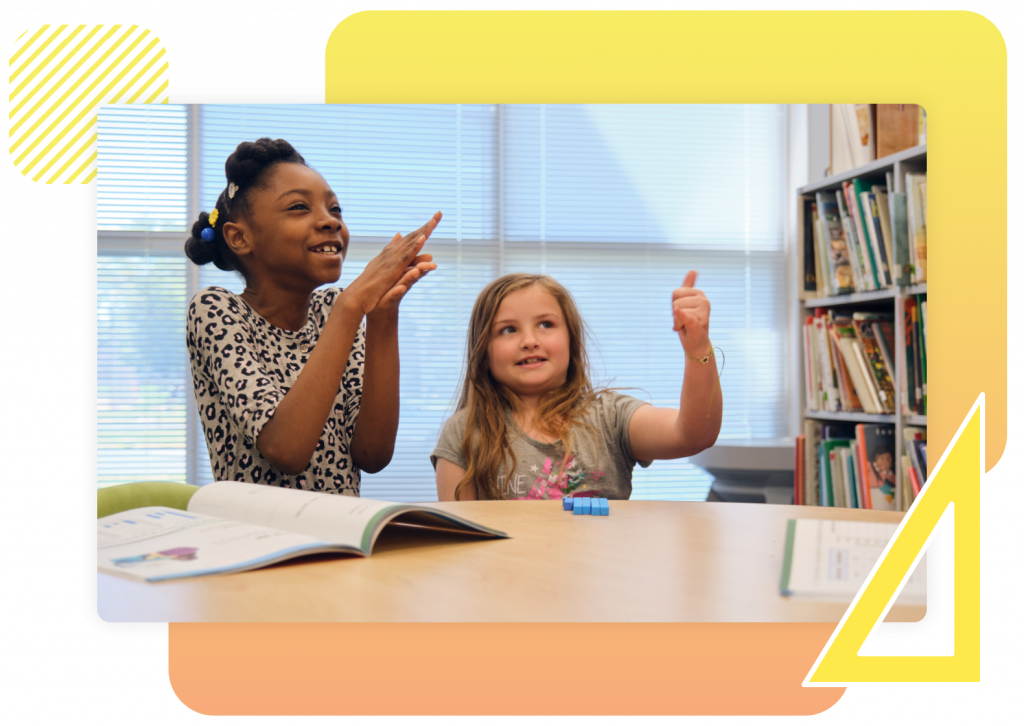
Two girls sit at a table with open books, one making hand gestures while smiling, the other looking at her and giving a thumbs up. Behind them are shelves filled with books, capturing the lively atmosphere of a math classroom.
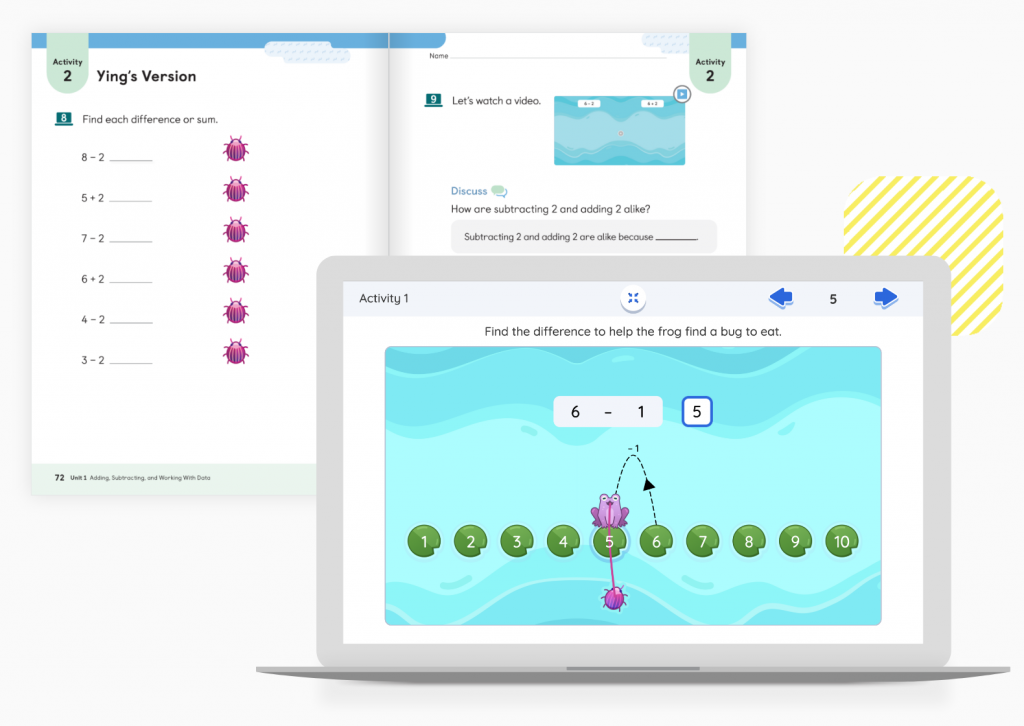
A laptop displays a math activity with a frog on a number line, while two printed math worksheets are shown in the background.

Structured approach to problem-based learning

  • Differentiation and personalized practice
  • Easy-to-follow instructional guidance
  • Robust assessments and reports
  • Spanish student materials
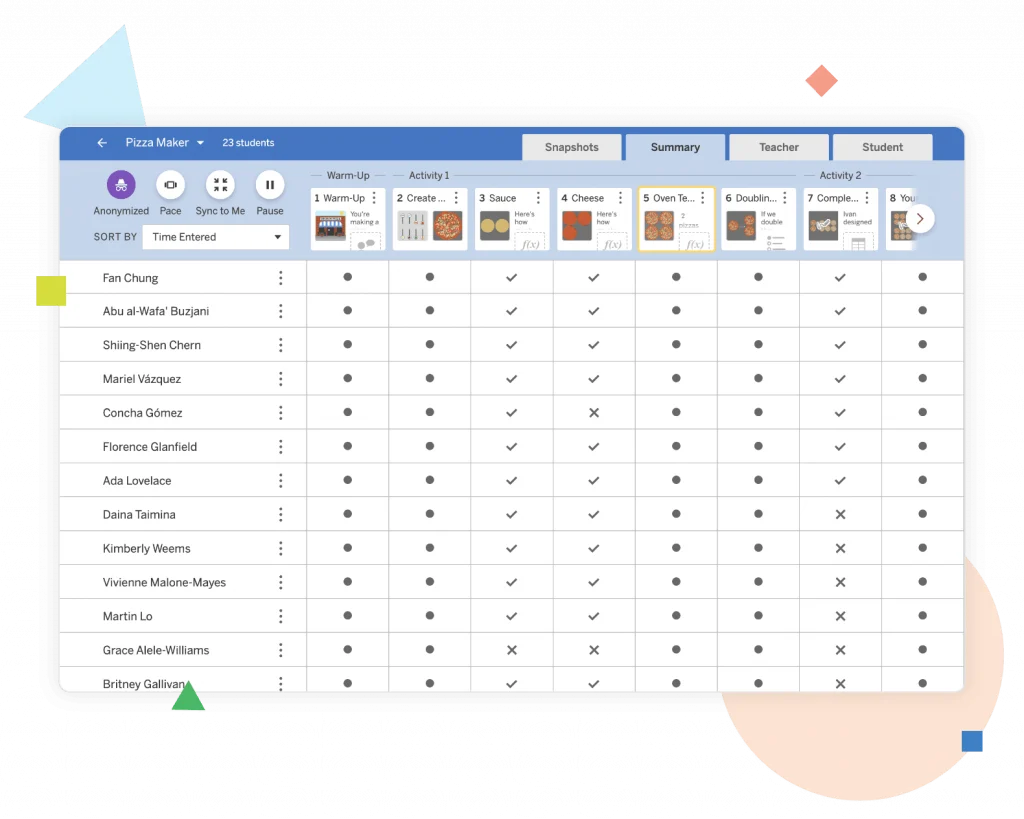
Screenshot of a digital class attendance and activity tracker with student names and checkboxes indicating their participation in various New York math tasks.

Math that motivates

  • Powerful teacher-facilitation supports and tools
  • Students talking and building from each other’s ideas 
  • Every lesson has fully compatible print and digital materials for a collaborative classroom
Illustration of an Amplify Desmos math learning tool on a student screen showing abacus representations for the sums 8+7, 7+4+5, 3+8+4

Student thinking is made evident

  • Curiosity-driven lessons that motivate students with interesting problems they are eager to solve
  • Explicit guidance for teachers on what to look for and how to respond
  • Technology that provides Responsive Feedback and is designed to reveal mathematical thinking
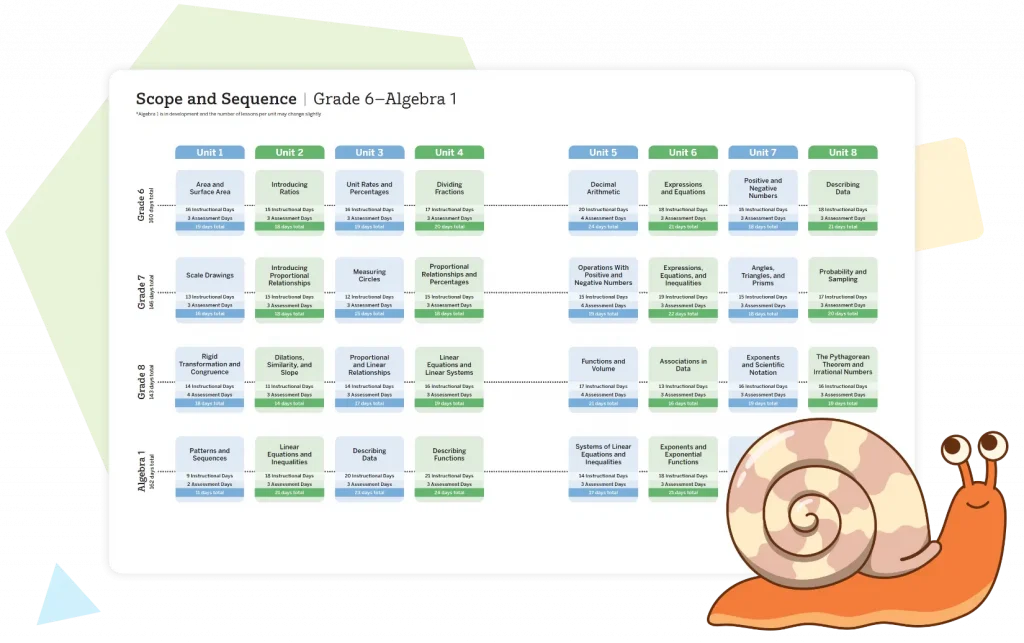
Chart displaying the Grade 6–Algebra 1 math scope and sequence, organized by units and grade levels, with a snail illustration in the bottom right corner.

Scope and sequence

Click the links below to view the program scope and sequence for your grand band.

Start your digital review

To review Amplify Desmos Math lessons, click the orange button below, then select “Log in with Amplify” and use the following login credentials:

Username: t1.hawaiimath@demo.tryamplify.net
Password: Amplify1-hawaiimath

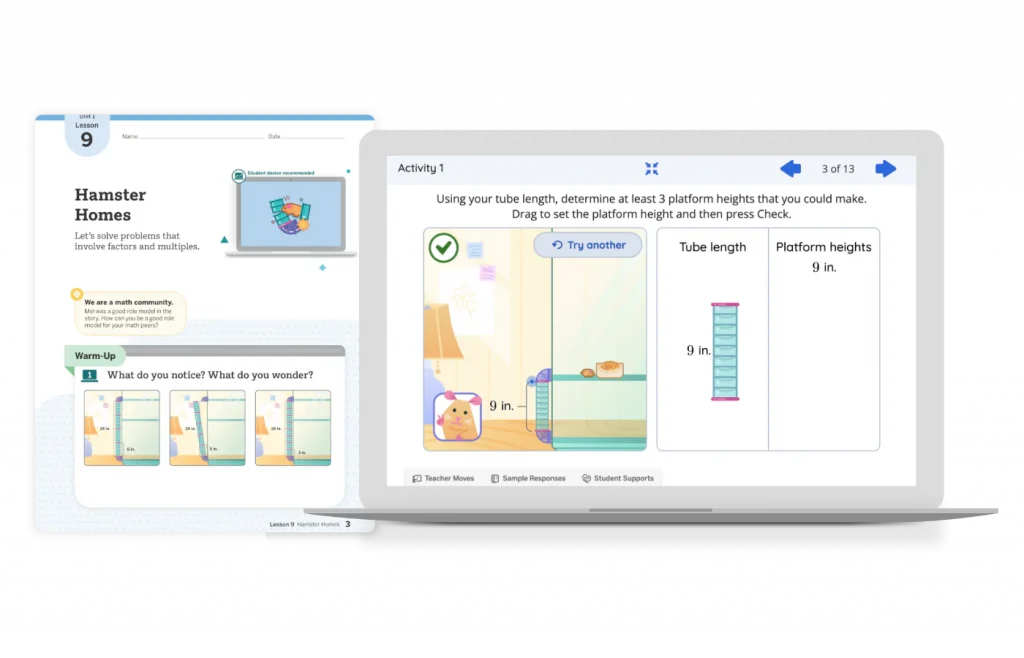
A digital learning activity on a laptop displays a task about determining the height of a platform by measuring the length of a tube. The screen shows a 9-inch tube, a platform with a height set to 9 inches, and instructions for the activity.

Preview lessons

Explore how Amplify Desmos Math combines the best of problem-based lessons, intervention, personalized practice, and assessments into a coherent and engaging experience for both students and teachers. View real pieces of the program, here.

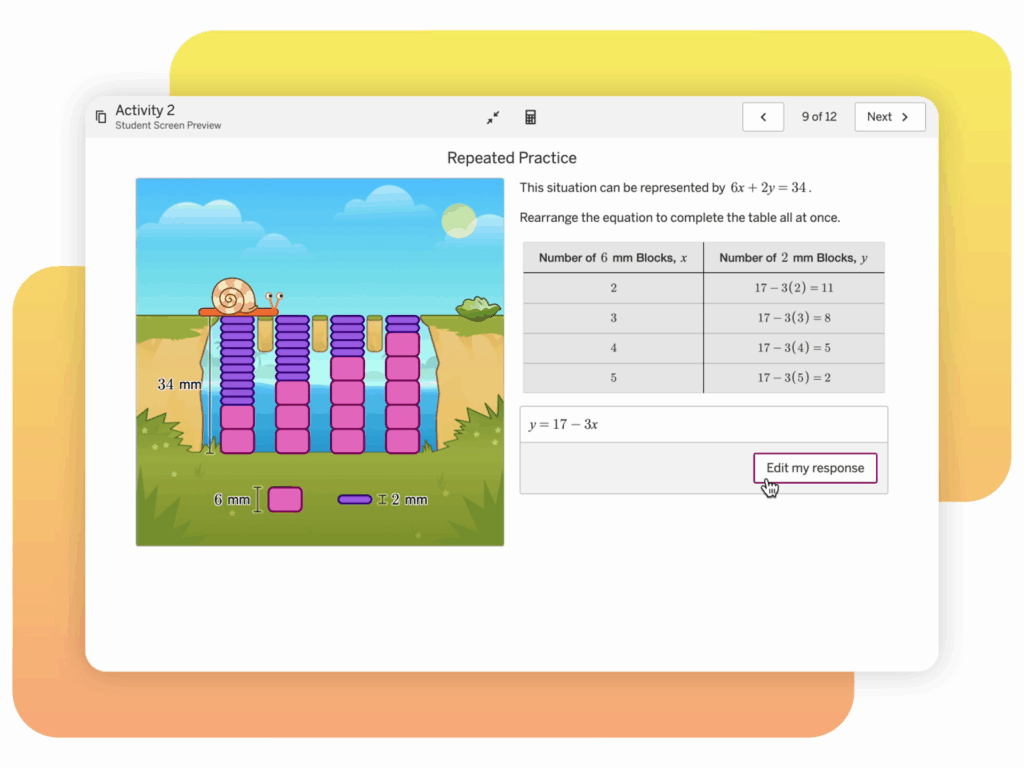
A math activity screen shows a cartoon snail, purple blocks, and a table comparing blocks and a math equation; a cursor hovers over the "Edit my response" button.

Meet your Hawai’i Team

Woman with long brown hair and light skin smiling, wearing gold earrings, in front of a light-colored brick wall.

Laina Armbruster

Senior Account Executive – Hawai’i
larmbruster@amplify.com
602-791-4135

A man with glasses, a shaved head, and a short beard, wearing a light gray shirt and black tie, smiles at the camera against a plain white background.

Francis Ogata

Senior STEM Specialist – Hawai’i
fogata@amplify.com

Season 6, Episode 10

The big win is just the beginning, with Dr. Jennifer Throndsen

With Utah’s recent passing of Senate Bill 127, a sweeping piece of literacy legislation, many are turning to the state as a model of what statewide implementation of the Science of Reading can look like. In this episode, Dr. Jennifer Throndsen, Director of Teaching and Learning at Utah State Board of Education, joins Susan to tell the story of how Senate Bill 127 came to be and how they are continuing to make changes in schools across Utah. Together, they discuss what the bill included, the opportunities and challenges the bill provides when it comes to implementation, and advice for other states looking to enact literacy legislation. Throndsen also discusses her experience as a teacher and her journey with the Science of Reading.

Meet Our Guest(s):

Una sonriente Dra. Jennifer Throndsen con cabello largo y castaño, fotografiada en un marco circular contra un fondo de pared de ladrillos, con elementos gráficos de un libro azul y una flecha naranja.

Dr. Jennifer Throndsen

Dr. Jennifer Throndsen is the Director of Teaching and Learning at the Utah State Board of Education. Throndsen takes pride in developing and designing policy, resources, and supports to help other educators serve students as best as possible. Prior to her current role, she worked as an elementary and middle school teacher, instructional coach, adjunct professor, and district specialist. She earned her doctorate in mathematics curriculum and instruction from Utah State University in 2018. In addition to her primary role, Jennifer has been recognized for her extraordinary commitment to early learning.

Meet our host, Susan Lambert

Susan Lambert is the Chief Academic Officer of Elementary Humanities at Amplify, and the host of Science of Reading: The Podcast. Her career has been focused on creating high-quality learning environments using evidence-based practices. Susan is a mom of four, a grandma of four, a world traveler, and a collector of stories.

As the host of Science of Reading: The Podcast, Susan explores the increasing body of scientific research around how reading is best taught. As a former classroom teacher, administrator, and curriculum developer, Susan is dedicated to turning theory into best practices that educators can put right to use in the classroom, and to showcasing national models of reading instruction excellence.

Susan-Lambert_Headshot

Quotes

"Our students are the state's greatest asset, and we need to invest in them with all the energy and knowledge we have to do our best to serve them with urgency, compassion, and high expectations."

—Dr. Jennifer Throndsen

"If kids can't read, that really keeps them from accessing other content areas like science, social studies, and being able to engage in story problems in mathematics."

—Dr. Jennifer Throndsen

"Being able to read is today's civil right's movement."

—Dr. Jennifer Throndsen

"With requirements comes resistance. No matter how great the opportunity is."

—Dr. Jennifer Throndsen

Season 6, Episode 12

Celebrating many meanings: Language comprehension and the importance of Black English, with Jasmine Rogers

While working with students, one educator came to a realization that put her on a path to fascinating research in the Science of Reading. In this episode, Jasmine Rogers—manager and coach with the In Schools program at the DC Reading Clinic and an early literacy intervention lead at American University—shares her story and delves into her research on dialects and best practices for structured literacy instruction. She discusses Black language and how it connects with the language comprehension strand of Scarborough’s Reading Rope. Jasmine also offers recommendations for classroom teachers who have bidialectal students.

Meet Our Guest(s):

Mujer sonriente con el pelo trenzado, enmarcada en un círculo, con iconos de un corazón y una bombilla cerca de su cabeza, sobre un fondo verde.

Jasmine Rogers

Jasmine Rogers is a manager and coach with the In Schools program at the DC Reading Clinic, serving the District of Columbia Public Schools. In this role, she manages professional development on structured literacy best practices. For nine years, she was an elementary teacher serving in kindergarten and special education as well as a reading specialist. She also mentored at the DC Reading Clinic in its 2019 inaugural cohort. She holds masters degrees in sports administration, elementary education, and special education. She is currently an early literacy intervention lead at American University, pursuing her doctorate in education policy and leadership.

Meet our host, Susan Lambert

Susan Lambert is the Chief Academic Officer of Elementary Humanities at Amplify, and the host of Science of Reading: The Podcast. Her career has been focused on creating high-quality learning environments using evidence-based practices. Susan is a mom of four, a grandma of four, a world traveler, and a collector of stories.

As the host of Science of Reading: The Podcast, Susan explores the increasing body of scientific research around how reading is best taught. As a former classroom teacher, administrator, and curriculum developer, Susan is dedicated to turning theory into best practices that educators can put right to use in the classroom, and to showcasing national models of reading instruction excellence.

Susan-Lambert_Headshot

Quotes

“As a teacher, a Black woman, who speaks Black English, who knows the language, who is very well versed in structured literacy, if I overlooked this, if that caught me off guard a little bit, then that means that could potentially catch someone else off guard.”

—Jasmine Rogers

“With language comprehension, and considering in your native language, there may be a word that doesn’t necessarily match up with a language that you are learning in the classroom. So you have to then use your incredible cognitive skills that speak two completely different codes, comprehend what is happening, and then tie that back into, of course, the Rope to become a fluent reader.”

—Jasmine Rogers

“I consider Black English to be a very complex and complicated language…but I think typically in society it has been viewed very negatively. You can see in the media and in research where people have talked about it and used negative connotations. And I think those beliefs from society have seeped into the classroom.”

—Jasmine Rogers

“A strength of children that are bidialectal is the similar strength to students that are bilingual—they have an ability to take language that is different from theirs and translate it. That right there is an asset.”

—Jasmine Rogers

“The languages that we speak and bring from home also are not wrong. They’re simply different. And we’re gonna work together so that we take what we know differently and come together with a common language so that we’re communicating with one another.”

—Jasmine Rogers

“We have got to give our students access to this code so that they can become literate and run our society one day.”

—Jasmine Rogers

S1-05: How does coding fit in the science classroom? A conversation with Aryanna Trejo of Code.org

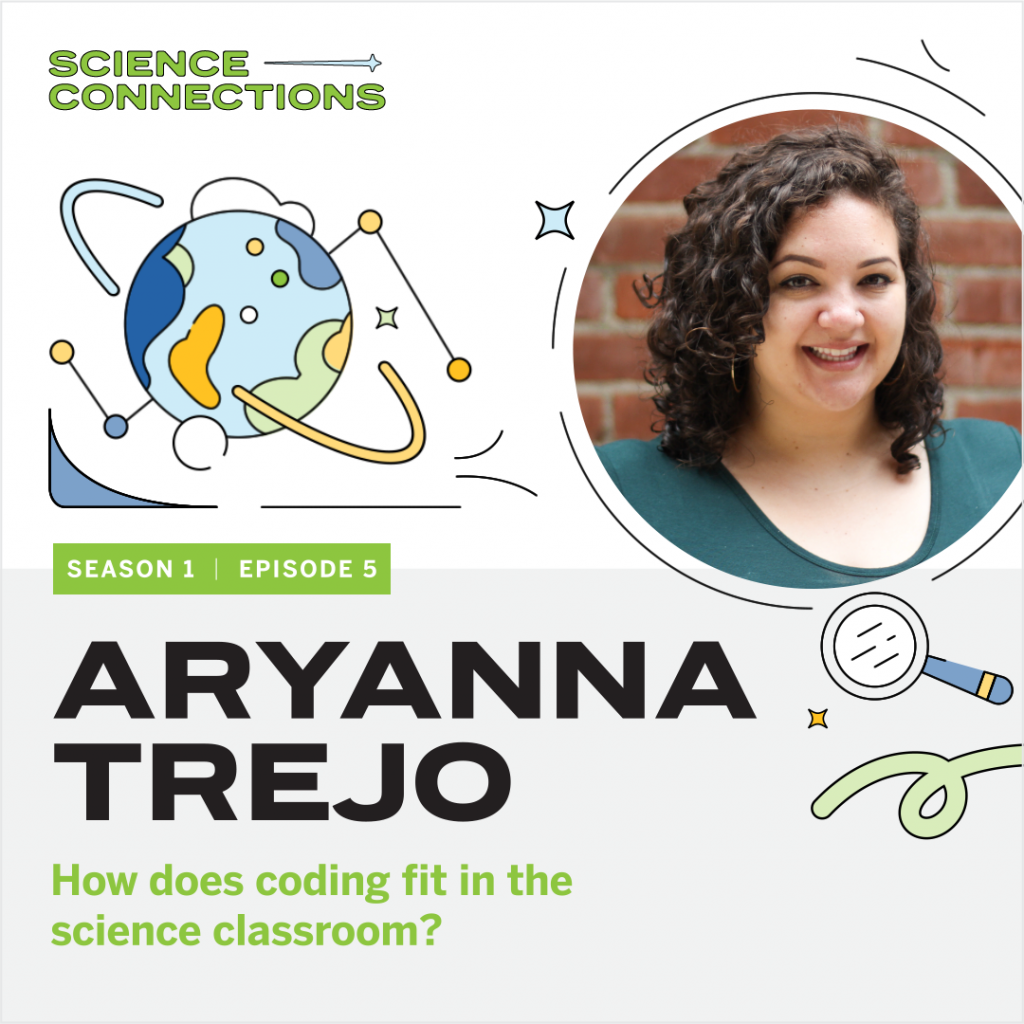
Podcast cover titled "Science Connections" featuring Aryanna Trejo, Season 1, Episode 5. It includes abstract illustrations of a globe and telescope, discussing coding in the science classroom.

In this episode, Eric sits down with Aryanna Trejo, a professional learning specialist of Code.org. Aryanna shares her journey from working as an elementary teacher in New York City and Los Angeles to teaching other educators at Code.org. Eric and Aryanna chat about computer literacy within the science classroom, problem-solving skills, and ways to model productive struggle for students. Aryanna also shares ways to teach coding and computer literacy in schools, no matter the classroom’s technology level. Explore more from Science Connections by visiting our main page.

Download Transcript

Aryanna Trejo (00:00):

I would hear teachers saying things like, “Well, I just can’t do coding; this is too hard for me; the time has passed.” And I would ask them, “Would you say that to your student about math or English?” And they would always sheepishly go, “No.” And I’d say, “Well, be as kind to yourself as you would be to your student.”

Eric Cross (00:19):

Welcome to Science Connections. I’m your host, Eric Cross. My guest today is Aryanna Trejo. Aryanna is a member of the professional learning team at Code.org. Before joining Code.org, Aryanna led computer science professional development for elementary school teachers, and served as an instructional coach for new educators. She also taught fourth and fifth grade in both New York City and in Los Angeles. In this episode, we discuss Aryanna’s journey to Code.org, where she helps educators connect coding to real life, how to use a rubber duck to solve problems, and how coding and computer science principles can be taught to students in areas without access to the internet…or even a computer. I hope you enjoy my conversation with Aryanna Trejo. So I was born and raised here, and I saw that you went to UC San Diego.

Aryanna Trejo (01:11):

I did, I did. I actually just put a deposit down on an apartment in University Heights, ’cause I’m moving back.

Eric Cross (01:16):

You’re coming back?

Aryanna Trejo (01:17):

I’m coming back. Yeah.

Eric Cross (01:19):

So if you need a classroom to visit….

Aryanna Trejo (01:21):

I would love to do more classroom observations!

Eric Cross (01:24):

Are we doing this? Let’s do—we’re making this happen.

Aryanna Trejo (01:26):

We are. Yeah. So I’ll be there. I’m moving there in April. I actually grew up in Orange County too, so I’m like a very diehard SoCal person.

Eric Cross (01:35):

So I feel like I know the answer to, hopefully—Tupac or Biggie? ‘Cause you’re on the East Coast, and you’re on the West Coast.

Aryanna Trejo (01:40):

Yeah. I like Tupac, but I have more Biggie songs committed to memory. Which is not a lot. I have “Juicy” and “Hypnotized” memorized.

Eric Cross (01:53):

All right. So you’re just memorizing, and you have the Biggie songs memorized, but not the Tupac ones.

Aryanna Trejo (01:58):

No, but I do love Tupac songs. You know, it’s like, Biggie has the flow, but Tupac has the lyrics. Nobody’s—they both have something really amazing about them.

Eric Cross (02:06):

You know, I can respect that you broke it down into both of their strengths.

Aryanna Trejo (02:11):

Thanks for buttering me up before this interview. And not….

Eric Cross (02:15):

<laugh> Oh, we already started.

Aryanna Trejo (02:16):

Huh? We already started?

Eric Cross (02:17):

We’re already started. Yeah. We’re already into this.

Aryanna Trejo (02:19):

We’re into it.

Eric Cross (02:21):

You were in the classroom, fourth and fifth grade, and you were doing TFA.

Aryanna Trejo (02:26):

I did. I did Teach For America. I was 2012, New York City Corps. Right after graduation. ‘Cause I graduated UC San Diego in 2012. So graduation was on June 17th, and I touched down at JFK on June 19th.

Eric Cross (02:40):

Even though I wasn’t in TFA, I know a lot of the fellows that are in it. And there’s just some phenomenal teachers in there. How long were you doing elementary school when you were teaching?

Aryanna Trejo (02:49):

Yeah, I taught for—well, I did, three years of teaching fourth grade. Then there happened to be an instructional coach opening in my fourth year. I took that, did some instructional coaching within the same network, and then I moved back to LA and I taught fifth grade for a year.

Eric Cross (03:11):

  1. And what was it like now? Did you go to Code.org right after the classroom?

Aryanna Trejo (03:17):

No, I didn’t. No. I transitioned after teaching fifth grade for a year in downtown Los Angeles, in the Pico-Union neighborhood. I ended up getting this email out of the blue from someone who had actually found me through the Teach for America job site. ‘Cause I was hitting the pavement; I was really looking to transition out of the classroom. And she invited me to interview with this company called 9 Dots. And they taught computer science to kids K–6 throughout Los Angeles and Compton. And I was like, “Sure, no problem. Let’s do it.” So I interviewed, I got the job, and yeah, that’s how I transitioned to 9 Dots. And then after almost four years there, I transitioned to Code.org, with the same person. Actually, she moved over to Code.org first, and then she helped me get this job.

Eric Cross (04:07):

Oh, that’s happened a lot—like, that relationship kinda carries over.

Aryanna Trejo (04:11):

Yeah. We’re meant to be coworkers.

Eric Cross (04:13):

Yeah. Are you still? Is she still there? Are you both still together?

Aryanna Trejo (04:17):

Yeah, we’re on the same team and it’s nice. I saw her last night for Happy Hour, with another coworker who’s in LA. So we’re tight. And she’s a wonderful, wonderful mentor to me.

Eric Cross (04:28):

That’s great. Did you have computer-science background, when you were doing elementary school teaching? Did you have—

Aryanna Trejo (04:34):

No. <laugh> Not at all. When I was teaching in New York City, I had like four desktop computers in my classroom, and we rarely used them. Which was such a shame. And then when I moved to Los Angeles and taught fifth grade there, we were a one-to-one school, and the joys of that are just amazing. It was just really wonderful to, you know, get the students used to typing on the computer, using different software to submit their assignments. Getting creative—as creative as you can get—with Google Slides. You know, to show off what they know. And stuff like that. That’s all I had, though. And you know, when I transitioned to 9 Dots I was like, “Sure, why not? Let’s give a shot.” And I learned a lot. It was really interesting, yeah.

Eric Cross (05:26):

And so now at Code.org you are…well, so my journey with Code.org, I’ve been in the classroom for eight years. Still in the classroom as of…an hour ago, I was there. <Laugh> And I use Code.org, and I feel like I’ve checked it periodically, and I feel like it’s evolved over the gaps. And I’ve seen it. It’s become more robust in the things that they offer, over the years I’ve been an educator. Just to kind of…could you give a thumbnail sketch? Like, what is Code.org? Who’s it for? Who’s the target audience? What resources are there?

Aryanna Trejo (06:00):

Yeah. So it’s for everyone. It is a nonprofit that provides curriculum and training and a platform for teachers and students. We provide curriculum for K through 12. It’s completely free. And it comes with lesson plans, slideshows, all that. We focus specifically on underrepresented groups. So we have targeted measures for Black students, for Native American students, for students who identify as female. That’s a huge part of our mission. But we’re really working to expand access to computer science to as many students as we can.

Eric Cross (06:41):

One of the things I’m hearing in your story is you were teaching in Compton; you were in Bronx, New York. One of the reasons why I got into the classroom is because of educators, and the impact they made on me in exposing me to science and technologies I’d never had access to. And that intentionality, that you’re going about it…are there…not just the code, but how you bring that across to different groups…are there strategies, or are there ways to connect this idea of coding to diverse groups and diverse audiences? Or is it kind of, the curriculum applies for everyone? ‘Cause in science, when I’m teaching, I’m always trying to make what I’m doing relevant to the backgrounds of my students.

Aryanna Trejo (07:28):

Sure.

Eric Cross (07:28):

So I’m teaching biology, and I’m trying to make this kind of connection. Sometimes it’s more organic; sometimes it feels kind of forced. Because it’s just not always a nice fit. But it sounds like Code.org is really about inclusion. And in the numbers that I’ve seen for representation, in especially computer science software engineers, the groups that you’re focusing on are not necessarily represented in the professional workforce. At least disproportionately.

Aryanna Trejo (07:54):

Yeah, absolutely. Yeah, that’s correct.

Eric Cross (07:57):

And so how do you go about being intentional about reaching groups that we don’t see in, you know, the Silicon Valley software engineers? How do you start that? Like, at a young age, do you look for specific schools in specific areas to say, “We are going to bring this to the school. We’re going out to these populations of the cities”? Because we’re just not seeing…you know, on the map, we’re not seeing anybody really doing anything with coding here. Or we’re not seeing the numbers come out of these areas, out of these cities, of students who are going into STEM or going into computer science fields.

Aryanna Trejo (08:41):

Yeah. I don’t necessarily work on the recruitment side of it, is the issue, in my position. But I do work on the professional learning, that is brought out to teachers. And we have a huge focus on equity throughout the workshops that we create from K–12. It’s something we’re really passionate about. We definitely aim to prepare teachers to teach computer science. That’s a huge part of it. Knowing the content, but also thinking through, “What does recruitment look like at your school to make sure that the demographics of your classroom match the demographics of your entire school?” Also, thinking through, “How can we make sure that female students feel included in your classroom? How can we make sure that we are, giving students creativity to think about, or we are setting students up to be creative and think about the problems that are in their community, and how they can use computer science to solve them, or at least work towards them?”

Eric Cross (09:39):

So solving real-world problems and that inclusion aspect…are there things like…you were saying “female or students who identify as female”…are there things that teachers can do to ensure that they’re being more inclusive? Or to recruit, or encourage more female students to take part? One of the things I was thinking of, that I’ve seen, is I’ve seen coding kind of camps.

Aryanna Trejo (10:06):

Sure.

Eric Cross (10:08):

That were specifically for a female audience. And that seemed to help with recruitment. Is that something that you see on your side?

Aryanna Trejo (10:16):

That’s not something that we set up, no. But the curriculum that I work with is CS Principles. And it’s offered as an Advanced Placement course, as well as an AP class. So that’s a curriculum that’s designed for students who are in grades 10 through 12. And so at that point, we can really talk to teachers and ask them what the recruitment strategy is. But in terms of strategies that teachers can use to recruit those students…I mean, I’ve heard over and over from lots of different teachers who identify as female that they didn’t think that computer science was for them, until they saw a role model in that position. And so just being a role model for those students is really wonderful.

Eric Cross (11:00):

And I see it too, with—like, we do “Draw a Scientist” activity, which is like a popular science thing—

Aryanna Trejo (11:05):

Sure, yeah, I’m familiar.

Eric Cross (11:05):

But it’s the same thing, right? Like, it fleshes out. My students don’t draw themselves as scientists. They draw what they perceive, based on what television says. I imagine with computer science, it’s probably really similar, when you think about “What’s a software engineer look like?” Do students tend to draw themselves? Or is it even a mystery? Because I don’t even know what a software engineer looks like.

Aryanna Trejo (11:28):

Yeah, absolutely. Well, one of the things we love to do with our professional learning workshops is talk about understanding yourself, your identities, how they show up in the classroom as biases. And, you know, things like stereotype threat. We see that as really important to understand, and think through, and consider, before you step into the classroom. So that you’re not, you know, coddling certain groups of students because you don’t believe that they are able to be successful in computer science. Holding all the students to the same expectations and believing that they can succeed. And computer science, I think a lot of the times people have this conception of it being this utopian, bias-less, technocratic field. When in reality, everything has bias. And people talk about algorithmic bias and facial recognition, but also the people who created computers and computer languages have their own bias that comes through. And I think it’s really important to show students that. So that they can, one, know what they’re working with, and two, make sure that they can create products that reduce that bias.

Eric Cross (12:50):

It’s like…it’s not objective, just because we’re creating software. Like, once it gets to a point of being so sophisticated…I think, like, AI software, right? With facial recognition? And we’re seeing more and more articles come out about, you know, predicting trends based on historical data.

Aryanna Trejo (13:12):

Sure.

Eric Cross (13:13):

But then, the trends and things that they’re seeing tend to target things that have happened in the past. But it also doesn’t take into consideration a lot of other factors that can lead to certain groups or populations being identified. And I’ve seen some articles lately about how your code is really just representation of what you put into it. And like you just said, your bias—if you have that, conscious or unconscious—you’re gonna put that into your code. And the input is gonna be an impact, is gonna impact the output.

Aryanna Trejo (13:44):

Yeah, absolutely. Or even just—and I’m ashamed to say this, ’cause this is an idea that came to me just recently, through an article that I read—but computers themselves have bias. The hardware assumes that you have vision, that you can see the screen, that you are able-bodied, that you can use your hands to work the keyboard, the mouse, et cetera, and that you don’t have to use assistive technology. You know, there are small things like that, where we think that technology, like I said, is this utopian, futuristic science…but there are biases throughout.

Eric Cross (14:19):

You’re absolutely right. I’ve never even—I’ve never even considered that. Even though I do use assistive tech, and figure it out, I’ve never thought from the ground up, the process is built for an able-bodied, sighted, hearing person.

Aryanna Trejo (14:31):

Exactly.

Eric Cross (14:32):

To be able to engage with the hardware. And then these other things, these tertiary things that we kind of add on, so that you can do this, but it’s not designed from the ground up for people who are, you know, different audiences, physically. So I’m glad you brought that up, though. Now I’ve seen—and I haven’t done this—but I know Hour of Code is a big thing. And this is something that’s ongoing. Can you talk a little bit about what Hour of Code is? I know it’s, it’s a big thing for the classroom teachers.

Aryanna Trejo (15:08):

Yeah. So Hour of Code is really exciting, and it’s just blossomed from something small to something tremendous. This year is gonna be the 10th Hour of Code. So what it is, is it happens during CS Education Week in December, during Grace Hopper’s—or to honor Grace Hopper’s birthday. She was a computer scientist and Navy Admiral. And basically the aim of it is to get as many students on the computer doing an hour of code, and demystify what coding is. You know, to do seed-planting. To show teachers that this is something that you can facilitate for your students. And also to show students like, “Hey, computer science is something you can absolutely do. Not just for an hour, but more if you want.” So, yeah. Now it’s worldwide, and it’s really exciting.

Eric Cross (15:58):

That’s awesome. And I think about teachers and I still hear the apologetic—when I’m helping teachers in the classroom with education technology—the self-deprecating “I’m a dinosaur; I’m not good with tech,” which is never true. Like, they’re better than they even realize. And I feel like sometimes there’s still a stigma, too. It’s like <laugh> The Simpsons’ Comic Book Store Guy. The condescending tech support person—

Aryanna Trejo (16:27):

Sure.

Eric Cross (16:28):

—who has that tone. And so I feel like some people have been so negatively impacted by that person. So I know when I’m helping people, I actually try to go full-spectrum the other side. But I’m thinking about teachers’ barrier to entry. Sometimes code is like, “Whoa.” And I don’t teach computer science. Do you see those barriers to entry, or at least the perception of them? And then, what’s the reality for like someone listening, and going, “I’m a fourth grade teacher,” or “I’m a humanities teacher in ninth grade.” What’s the perception that you see, versus reality, with the teachers that you train? Is it much more accessible than we think? Or is there a level of sophistication that you have to have coming into it?

Aryanna Trejo (17:10):

No, not at all. I know computer science, and that says a lot! <Laugh> You know, I know my own corner of computer science. And you know, that’s me being self-deprecating, too. But I think learning computer science has helped me in so many different ways that I wasn’t expecting. I recently took the GRE in hopes of, you know, getting back into grad school. And I think just the way that computer science teaches you to search for bugs in your code, or errors, and kind of tirelessly look at a problem from multiple different angles, I was able to carry that into the math that I was doing. And I noticed just a huge difference in the way that I approached it, and the way that I was open to it. But you asked a great question, in regards to the barriers to technology. In my position at 9 Dots, I was working directly with teachers to lead professional development with them. Sometimes it would be a full day; sometimes it would be an hour after school. And the one thing that I always had in my back pocket that was really useful is that I would hear teachers saying things like, “Well, I just can’t do coding; this is too hard for me; the time has passed.” And I would ask them, “Would you say that to your student about math or English?” And they would always sheepishly go, “No.” And I’d say, “Well, be as kind to yourself as you would be to your student.” You know, it takes some patience and nobody’s gonna get it perfect 100 percent of the time. Have I banged my head against the wall trying to solve one tiny little syntax error in my code? Absolutely! But it feels absolutely phenomenal to fix that. And I was an English major in undergrad, and I had never done computer science before. So it’s something that becomes really satisfying.

Eric Cross (19:07):

Yeah, I imagine. I had someone—a trainer or a presenter—one time bring up the fact that our students rarely get to see us learn in real time.

Aryanna Trejo (19:19):

Yeah.

Eric Cross (19:19):

So we don’t get to ever really model failure. I mean, unless we’re in a classroom situation <laughs> in our failures, with classroom management. Then they see it, they see it! But they don’t get to see us model learning failure. And I don’t mean like failure—and yes, I know, “first attempt is learning,” and “no such thing as failure”—that’s not what I’m talking about. But just when we’re not successful with our code, and then we experience real-time frustration.

Aryanna Trejo (19:42):

Yep.

Eric Cross (19:42):

And they said that is actually a great learning experience for your students to watch you go through productive struggle. And that was really liberating for me. Because now I’m in the classroom, and I’m trying to go through it with my students, and the beautiful thing was, they started helping me. We were all trying to solve the problem. And then we had this authentic problem-solving experience. I think it was like a Scratch program, where we were trying to solve, trying to embed it somewhere, or something. And then, in the background of the class: “Mr. Cross! I got it! I figured it out!” And it was this really neat bonding experience. And I felt that—your ears get red, and you get hot, ’cause you’re not—

Aryanna Trejo (20:19):

Oh yeah.

Eric Cross (20:20):

You don’t know it! And you’re in front of 36 kids! And I said, “OK, I need to tell them how I feel.”

Aryanna Trejo (20:25):

Yeah.

Eric Cross (20:26):

So I said, “Now I feel really frustrated.” Like, “I want to go through this, and here’s my thoughts.” ‘Cause I knew that it would be helpful if they saw and would hear my thoughts. So I just did a quick think-aloud and I said, “In my head, <laugh> I want to just quit,” I said, “But I realize that this is the part where my learning’s happening. So I just want you all to hear what’s going on in my brain.” And now I feel like when I’m doing coding with my students, and it’s just basic coding, I feel much more comfortable, like, not knowing. But I needed someone to release me from that “I have to be the expert in everything” to do it.

Aryanna Trejo (21:06):

And teachers are used to being the experts. Right? And they should be. And coding is just such a different landscape. But I think once you kind of give over to the power of tinkering, I think it’s really gratifying. I love being able to…you can revise a sentence, and then read your paragraph back to yourself in English, and say, “OK, I get it.” But there’s something so gratifying about changing a line of code or a block and then being able to hit play and watch your program come to life, and say, “Hmm, that’s not quite what I wanted. Let’s try something different.”

Eric Cross (21:39):

I love your connection to tinkering. ‘Cause—I had never thought about it—’cause I love tinkering with my hands. But I always think about physical things. But coding is exactly that. It’s tinkering.

Aryanna Trejo (21:47):

It’s exactly that.

Eric Cross (21:47):

That’s exactly what it is.

Aryanna Trejo (21:49):

And a lot of it is, for me, especially when I’m trying something new, it’s guess-and-check. It’s like, “OK, that didn’t work. What if I add a semicolon here? Will it finally work? Or what if I add a ‘for’ loop? Will this get me what I want?” And it’s wonderful because you have that with students as well. Like, you have that record of their thinking, and you can ask them to go step-by-step and tell you, you know, “First, I added this, because I wanted the program to do this,” and so on and so forth. And so you have that record, but you can always get rid of it. Students often wanna get completely get rid of it. That’s something that I’ve noticed a lot as I’ve taught computer science. But, once you can get them to target the specific parts of the program, tinker with that, and continue, that’s a really wonderful learning space. There was also something you said about modeling failure. I love the fact that in computer science you can model failure for your students. You said to your students, “I’m getting frustrated.” I love that, because I never got that in math. Nobody ever showed me what it was like to be frustrated with graphing a parabola. Right? Like, my math teachers were always like, “Doot, doot, doot, here you go, you’re done!” <Laugh> And I would get so frustrated, because it didn’t come that easily to me. And I think there’s two parts to that. So there’s modeling the learning and the thinking and the productive struggle, but also there’s the identity of being a computer scientist and modeling what that looks like. So for me, when I get really frustrated with a program, I walk away. I take five minutes. I take a deep breath. I say, “I’m not gonna think about it in these five minutes.” And I come back to it. And I think once you start teaching computer science, you can facilitate that for students. And there’s so many different strategies that they can pick up. They can pick up rubber ducking, which is where they pick up a rubber duck or a similar object, and they talk to it as if they were a partner and talk through their code. And oftentimes, as you’re rubber ducking, you’re gonna find that error, because you’re explaining it to someone who’s a stand-in for a novice. And rubber ducking is a well-known strategy for computer scientists who make it their career. You know, there’s pair programming. Some students love pair programming; some students hate it. But the students start to build this identity about how they problem-solve. And how they approach failure. And I just love that.

Eric Cross (24:31):

I’m writing this down. Because the rubber-ducking strategy, I love. I just imagine my seventh graders, a bunch of 13-year-olds with, like, rubber on the desk. And not necessarily in coding, but I was thinking in my science class. And they’re working through a challenge, and they’re all looking at this duck, and they’re talking to it. But I just love the the idea of externalizing your thought process and talking through it yourself so that you can hopefully arrive at a conclusion. But it’s such a great practice, and this is something that’s been around for a long time, apparently. So.

Aryanna Trejo (24:59):

Yeah. Yeah. It’s a real thing. And you know, you can go low-fi. It doesn’t have to be a rubber duck. You can have students talk to their pencils or their imaginary friends. That’s not the issue; the issue is, you know, talking to somebody.

Eric Cross (25:10):

I know you support teachers. But I just wanted to…I was just curious about your typical day, what that’s like. And then what you do, how you support ’em.

Aryanna Trejo (25:15):

So, at my previous job at 9 Dots, I was in there with the teachers in the classrooms. I was coaching our internal staff who went out to co-teach with teachers. And I loved that. And I had such a great impact on a local scale. But now at Code.org, I have a much broader impact. But I don’t get to interface with—that’s such a tech-y word!—I don’t get to interact with—

Eric Cross (25:42):

You work at Code.org! You get to—

Aryanna Trejo (25:42):

I know! But I’m a teacher at heart, forever, right? That’s my identity that I forged when I was 22 years old. And a typical day looks like opening up my computer, taking a look at my calendar. I often have meetings to talk about, different things that we’re doing to support our facilitators who go out to our teachers and lead their workshops for them. I recently worked on a product that was designed for CS principles, teachers, to onboard to the course if they weren’t able to get into an in-person workshop. And it’s completely self-paced, so it gives teachers an on-ramp into the course. And now I’m working on some in-person workshop agendas. So I feel really wonderful that my work is going out to thousands of teachers. But at the same time, I really, really miss talking to teachers. Because that’s something that energizes me so much.

Eric Cross (26:46):

When should students start learning computer science? I feel like we see it in this kind of narrow lane. Like, this is computer science if you make an app. Can it be more than that? As far as like the benefit of computer science? And—I guess two-part question—when should students, one, start being exposed to it? And then two, what are some of the benefits beyond just, “I wanna just make an app”?

Aryanna Trejo (27:08):

I taught coding to kindergartners. It can start as early as you as you want it to. And it doesn’t necessarily need to be on the computer. A lot of students that I worked with didn’t have computers at home, were interacting with computers for the first time. And that’s a huge barrier, of course, to a lot of teachers. But there are so many unplugged lessons that you can do to start to start to have students think about algorithms, which is just a series of steps to complete to solve a problem. As long as a student can use a computer, I think they can do computer science. There are products out there like codeSpark, where students—and Code.org has these products too—where students are moving an avatar around a board, kind of like a quadrant to…you know, they feed the directions to a computer and then the computer enacts it for them. And with that, they can learn algorithms. You know, that is computer science. And a lot of people don’t see it that way, but it really is. And it starts to set students up for more complex thinking as they move on.

Eric Cross (28:13):

One of the biggest underserved communities, geographically, are students in rural areas.

Aryanna Trejo (28:20):

Yep.

Eric Cross (28:21):

They can be reservations; they can be places just not an urban area. Is there a way to serve our communities of students and bring these skills in an unplugged way?

Aryanna Trejo (28:32):

Yeah. Yeah. If you typed in “unplugged computer science lessons” to Google, you’ll have a ton of hits. And there are so many students out there—not just in rural areas. But there’s incarcerated students. It hurts my heart to even say those words, but in urban areas too. Like in my classroom, where I only had four desktop computers. Access is a real struggle. And there’s things, like I said, instead of moving an avatar around a grid on the computer, I used to have an actual mat that I would take out to my kindergarten classrooms, lay it out, and it would have a grid on it. And we’d have one of the students act as the avatar and the rest of the students would give them directions to get to a different point on the grid. And there, you’re building an algorithm or just a series of steps. Like I said, it’s not some fancy term to solve a problem. And there’s multiple ways to solve that problem, too. And I think investigating that can be a really good way to stretch those lessons.

Eric Cross (29:32):

It almost sounds like an oxymoron, but this low-tech computer science strategy. Develop these skills and then transfer that once you have access to the tools.

Aryanna Trejo (29:39):

Yeah. Yeah. Absolutely. And I think it’s a good way for students who need kinesthetic means to start to understand something, or just different learning styles, to start transferring that over.

Eric Cross (29:53):

I probably have students in the classroom where those kinesthetic moving things would help be a great way—or WILL be a great way—for them to learn the principles and the fundamentals of coding. Instead of only giving the option to just do the computer, actually giving them some choice. Or giving them a way to be able to manipulate things. We’re still in the system of education that’s still very siloed. It’s been the same way for a hundred years. We got math and then we got science and we got English. I’m wondering, how can a teacher fit this into their daily lessons? And then, do you have any experiences or stories or things that you’ve seen, just really creative ways that you’ve seen teachers incorporate this? Outside the norm of, “This is a computer science class; we’re just gonna code.” But have you seen it branch out? In the trainings that you’ve done?

Aryanna Trejo (30:40):

I’ve seen examples of that. I’ve seen a teacher use Scratch to demonstrate different climates of California, and show the different climates. This past year for Hour of Code, my friend Amy—the one who helped me move to 9 Dots and at Code.org—she created this incredible tutorial called Poetry Bot. And it was a way to get students to match the mood of the poem to some of the elements that were happening in the stage. So they would have different backgrounds show up at different parts of the poem. When the words would show up, they would have different sprites show up. They would have, sometimes, sounds. Or the text would show up with different animations. So there are cross-curricular opportunities everywhere, if you can be creative enough to find them, or if you beg, borrow, steal from other educators who are doing this incredible work out there.

Eric Cross (31:36):

Yeah. I say this all the time, but I’m an educational DJ, not an MC.

Aryanna Trejo (31:44):

Oh yeah.

Eric Cross (31:45):

So MCs write their lyrics and DJs remix with things that other people have done.

Aryanna Trejo (31:48):

Absolutely.

Eric Cross (31:48):

I was like, I’m a DJ. I was like, all day. Sometimes I’ll write a lyric, once or twice, but most of the time I’m remixing things. So teachers, if you’ve been out there and you got an awesome interdisciplinary thing, or you’ve incorporated coding and it’s something that’s traditionally not seen, please send it to us. Share it with us.

Aryanna Trejo (32:03):

Yeah. And there are so many different places where you can find that. We have a forum for Code.org, but there’s also CSTA, the Computer Science Teachers Association. You can join your local chapter and get to know other computer science teachers out there.

Eric Cross (32:19):

I guess…to wrap up, I’ve been using Scratch programming, the MIT website. My students do the basic animated name, CS First, stuff. But over the years, I’ve noticed that my students are coming in with a higher level of sophistication in Scratch to where now the differentiation…some of my students are just doing very basic…and then I have other students who’ve created full-on video games with complex…like, you look at their Scratch page and it’s just an amazing amount of blocks and integrations and things that they have. Is there anything on Code.org that could be a next step? That takes them beyond, maybe like the visuals? And if so, what would be a good next step, to take students to advance them to another platform? There’s so many coding languages out there, I feel like. Or I might not even be thinking about that the right way.

Aryanna Trejo (33:20):

No, I think you are. You know, we have three different curricula out on our website right now. We have CS Fundamentals, which is probably more in line with what you’re talking about. We have a free CS Discoveries curriculum, and that is designed for, grades, I believe, 6 through 10. And that would be a really good entry point, for both teachers and for students.

Eric Cross (33:44):

There’s a lot of new stuff that I hadn’t seen yet, a few years ago.

Aryanna Trejo (33:49):

Yeah.

Eric Cross (33:49):

So I was really excited.

Aryanna Trejo (33:50):

One thing that I do know is that CS Discovery has just added an artificial intelligence slash machine-learning unit, that you can just pick up and give to your students. You don’t have to go in order with CS Discoveries, like you do with CS Principles. And I’ve gone through some of those lessons. They are really rad. And I would’ve loved to have learned that when I was in middle school or high school. So yeah, we’re constantly thinking of how we can make things one, relevant to our students, and two relevant to what’s going on in the world.

Eric Cross (34:20):

So would I be overselling it if I said, “If you go through this, you’ll be able to create an AI or a neural net to do all your homework”?

Aryanna Trejo (34:26):

You would be overselling it.

Eric Cross (34:27):

I would be? OK. So what I’ll do is, I’ll wait until the end of the school year, and then introduce it, and then by the time they’ve realized it’s not true, they’ll be eighth graders.

Aryanna Trejo (34:35):

There you go. Good old bait-and-switch.

Eric Cross (34:37):

You’re amazing. Thank you for serving teachers, and for being part of such a great organization that puts out great stuff. So much free curricula for teachers to be able to use. Especially nowadays we hunt and scour the internet for those types of things. And to be able to bring computer literacy into the classroom, and with your focus of serving communities of underrepresented groups, it feels good to know that not only is it high-quality material, but it’s also trying to raise everyone up. Because ultimately when we have more people trying to solve a common problem, we come up with better solutions. And I was talking to somebody who was a materials engineer somewhere in Europe, and he said one of the things about the U.S., As he was critiquing me on this flight, critiquing the U.S., He said, “One of the things about your country is that you have a heterogeneous group of people who, in a group, when you have multiple perspectives attacking a problem, you come up with more novel solutions.” He says, “That’s one of the great things, is that there’s not necessarily just a hive mind.” And I think that that’s one of the great things. We uplift different communities, and we uplift women, people of color, people who, have backgrounds that parents didn’t go to college but have these amazing qualities and strengths. And we put everybody focusing on the same issue. We come up with novel solutions that we wouldn’t have come up with if only select groups were trying to look at it and solve it. And so—.

Aryanna Trejo (36:22):

Yeah.

Eric Cross (36:23):

And we couldn’t do that without organizations like yours, that help empower teachers. So.

Aryanna Trejo (36:27):

Yeah! You really said it.

Eric Cross (36:29):

You’re coming to my classroom when you’re back in San Diego?

Aryanna Trejo (36:31):

Yeah! I totally will. Yeah. Let’s make it happen.

Eric Cross (36:34):

Last question. If you think back in your schooling, your own schooling, K through college, is there a person or a teacher that had a big impact on you? Or a learning experience that had an impact on you? And it could be, you know, positive or negative. But something that impacted you, even to this day, that stands out to you, that you remember?

Aryanna Trejo (36:56):

This is a big diversion from the topics that we’re talking about. But in grades 10 through 12, my drama teacher, Mr. Byler, who I still talk with, was such a huge impression on me. Really wonderful. And I couldn’t tell you the teaching moves that he did that were wonderful. I don’t know much about his management. But I can tell you that he gave me space to be confident, and grow into myself, through drama productions. They were high school productions, so they weren’t amazing. But I just really came into myself in high school, because I had the confidence to get on stage. And he was just such a wonderful mentor to all of us. So, props to Mr. Byler.

Eric Cross (37:39):

Shout out to Mr. Byler for creating space for Aryanna to fly! Thanks for making time, after your workday, to talk with us and to share Code.org with teachers.

Aryanna Trejo (37:54):

Of course. Happy to.

Eric Cross (37:59):

Thanks so much for joining me and Aryanna today. We want to hear more about you. If you have any great lessons or ways to keep student engagement high, please email us at stem@amplify.com. Make sure to click subscribe wherever you listen to podcasts. And join our brand new Facebook group, Science Connections: The Community for some extra content.

Stay connected!

Join our community and get new episodes every other Tuesday!

We’ll also share new and exciting free resources for your classroom every month.

What Aryanna Trejo says about science

“I would hear teachers saying things like, ‘Well I just can’t do coding, it’s just too hard for me.’ And I would ask them…Would you say that to your student about math or English? Be as kind to yourself as you would be to your student.”

– Aryanna Trejo

Professional Learning Specialist, Code.org

Meet the guest

Aryanna is a member of the Code.org Professional Learning Team. Before joining Code.org, Aryanna led computer science professional development for K-6 teachers and served as an instructional coach for new educators. She also taught fourth and fifth grade in New York City and Los Angeles. In her spare time, Aryanna loves taking advantage of the California sunshine, creating wheel-thrown pottery, and hanging out with her dog Lola.

Person with curly hair smiling, standing in front of a brick wall. Circular frame with decorative star in the corner.

About Science Connections

Welcome to Science Connections! Science is changing before our eyes, now more than ever. So…how do we help kids figure that out? We will bring on educators, scientists, and more to discuss the importance of high-quality science instruction. In this episode, hear from our host Eric Cross about his work engaging students as a K-8 science teacher. Listen here!

S3 – 03. Math professional learning experiences with Elham Kazemi

Podcast episode poster for "Math Teacher Lounge" featuring Elham Kazemi, a Mathematics Education Professor at the University of Washington.

How do we continue to grow and be more reflective about our own teaching? In this episode, Bethany Lockhart Johnson and Dan Meyer chat with Elham Kazemi to explore how to look at teaching as a collaborative experiment. Moving more toward analyzing student thinking and how that contributes to teaching itself, leaves more space for one’s own understanding of math to grow throughout your career. When one revises their teaching based on the data we’re collecting from students and peers, this allows us to be both teachers and learners forever.

Explore more from Math Teacher Lounge by visiting our main page.

Download Transcript

Dan Meyer (00:04):
Hey folks, welcome to math teacher lounge. My name is Dan Meyer

Bethany Lockhart Johnson (00:07):
And I’m Bethany, Lockhart Johnson.

Dan Meyer (00:09):
And this is the teacher learning week. We’re thinking this week about how we grow as teachers. And to start with, I just wanted to ask Bethany, uh, first Bethany, how are you doing? And second <laugh>. Um, what is, what, what has been your like most favorite and least favorite, most effective least effective professional learning experience when you were a classroom teacher?

Bethany Lockhart Johnson (00:30):
I think for me, most effective was definitely when I could use it right away. Right. Whatever we were talking about, whatever we were learning, like I got to go put it into practice. Sure. Uh, I, I remember we did something where we designed a lesson and then we went and taught it like one person taught it and the rest of the people watched. And then we kind of like got to workshop it, which that was like a one off the fact that we got to go out of our classroom and go observe somebody teaching. It was gold. It was gold. Um, so that was probably the most effective, because there was so much opportunity for reflection and least effective was something that felt like just completely unconnected to, you know, kind of either so theoretical that it wasn’t like touching on what we were navigating right there in the classroom. I don’t know. What about you? What can you think of times that, are you gonna say times you led a PD? Those were the most effective?

Dan Meyer (01:26):
Yeah. My favorite ones are my sessions, of course. But if I had to throw those out for a second, um, yeah, I, I like, I want, I want both, I want it all. I want the, um, the big ideas that take a long time to settle in that also have like small bits that can carve off and use relatively quickly to test my understanding of the ID is, yeah. I’ve had some, some PD where I’m like, this is very relevant to tomorrow. And I also don’t care. Like for instance, like how to use the CD, the, the, like the, the software, you know, on the, on my curriculum, for instance, it’s like, okay, yeah, this is just a little, little too practical. You know what I’m saying? I want some bigger ideas to chew on. Um, I would also say like, I love my favorite PD by a long was writing up thoughts about how the day went and putting that on the internet in a public place that we used to call a blog and where people would come along, cuz there was like 10 blogs and like, tell me like that’s no good.

Dan Meyer (02:16):
Like the thing that you like is not a thing you should like, here’s the thing you should like instead, or try instead, or just this weird community that sprung up, you know, when I was, uh, starting to teach relatively new teacher and uh, I feel like I grew a lot

Bethany Lockhart Johnson (02:28):
Go back to this idea blog. If people would call you, they’d call you on the phone. What, what

Dan Meyer (02:32):
Was they would fax me? They, it would be a fact. So

Bethany Lockhart Johnson (02:35):
Fax,

Dan Meyer (02:36):
I got it. Fax a comment. Yeah. Got it. So, uh, that’s, that’s Bethany and I, and we’re super excited to have people who have a bit broader of a perspective, a bit more of the land than what, what the two of us, um, think about with our own professional learning experiences.


Dan Meyer (02:52):
We’ve invited on an expert. We hope will help us understand alternate ways to do professional learning as teachers to grow as teachers besides, you know, all of us getting into the same room once every, every, uh, few months together, Elm Cosmi is a professor of mathematics education at the university of Washington, Elm studies, how strong professional communities develop in schools and how schools can be organized. So teachers learn from and what their students, this work is informed by equity oriented research on thinking, uh, on children’s mathematical thinking and classroom practice. She is co-author with Allison hints of intentional talk, which focuses on leading productive discussions in mathematics. And she edited coral counting and counting collections with Megan Frankie and Angela tau, which focuses on the importance of counting from preschool to fifth grade. Looking forward to a great chat with Elham, welcome Elham to the show.

Elham Kazemi (03:43):
Thanks for having me, my favorite topic ever to talk with you both about,

Bethany Lockhart Johnson (03:47):
I think something that I just deeply, deeply respected admire is that I feel like you are constantly sharing about how you are learning. You’re continue to learn, continue to, to try out new ideas and you do a very good job of like highlighting things that you’ve learned, whether that’s sharing it through a tweet or sharing it amongst colleagues or peers. And I, I just really appreciate that because I feel like being in the mathematics community with you, I feel like I grow by, I just like paying attention to like, Hey, she’s a learner, she’s done all these amazing things and thinks in these amazing ways and has shifted my thinking in such amazing ways. But she’s saying, Hey, I I’m still learning. So yeah. Hi, thank you. Thank you for your, I don’t know. We’re just glad to have you here.

Elham Kazemi (04:41):
Thanks. I do feel like the perpetual student, like I’ve never left school and I wonder like one day maybe I will, when I grow older, when I grow up, will I ever leave school? Maybe not.

Bethany Lockhart Johnson (04:52):
<laugh>

Dan Meyer (04:53):
Great. Let’s dig in. Yeah. So please tell us you partnered with a school for some professional learning that wasn’t the sort where you would go in and offer brilliant ideas and then leave. But rather it, it seemed like it was more of a job embedded sort, the sort of thing that might have a life of its own after, you know, after the, the grant ends or the program ends. Can you describe what it was you did and what the effect was?

Elham Kazemi (05:15):
I think I wanna first say that everything that I have done and experimented with as really the result of working with fabulous people, teachers, coaches, principals, other, um, colleagues and peers in the field who are constantly trying to work on what good teaching looks like and how you learn to do it. And mostly because we care about kids and we care about what students experience in the classroom. And we want kids to love school, to have school, be a place where they’re known, they’re loved, um, that they look forward to being in every day. And I think there’s that, um, the why that, that, um, per that makes you want to learn is really about the students and being, doing things in service of them. Because when, uh, as one of my colleagues said, when children thrive, teachers thrive. So what does it mean for us to thrive?

Elham Kazemi (06:06):
If we are focused on our kids’ experiences in schools, what we did at this, this particular school and a group of schools is kind of tap into a, all that curiosity and drive that teachers have to do a good job and to use their imaginations well, and to engage the actual ideas that children have in their classroom together, not separately, not like get a great idea and be inspired by it and then go figure it out by yourself, but be inspired by ideas and then try to figure them out together. Because, um, as you both know, very talented teachers, uh, who also have been inspired to change your classroom teaching. Once you figure something out or as you’re figuring it out, there’s all kinds of intricacies. Like I remember when I first learned about three act tasks, I thought what a brilliant idea, but it’s not so simple to try to enact the brilliance of it because you can simplify it too much or you can get stuck and not really know how do you move from one act to the next, or what’s the point of the third act?

Elham Kazemi (07:12):
Do you just like reveal the answer and that’s it. And then you move on. Um, how do you even do design the tasks to begin with all of those things, raise questions and working on them together, uh, and carving up that space and time to work on them together is sorely missing in schools. And so that’s what we were able to do with the schools that I parted and it is find the time and then design the structures so that teachers could, um, <affirmative> think about their teaching together and then also be in the classroom together with kids. So the kids see that we are also learning to be responsive to them. That’s the point. So we have to work stuff out when kids are present, which is the part that usually trips a lot of people up.

Bethany Lockhart Johnson (07:55):
Well, that to me is I think the part that shifted my teaching and continues to is this, it is a culture shift to tell your students, to invite your students into your learning, to tell them I’m, I’m learning too. It was an invitation to, to be vulnerable in a way that I think sometimes teachers are very afraid to be vulnerable. Uh, if they don’t know what the student response is gonna be, or they don’t know, they don’t wanna seem like they don’t know the answers or they don’t know how to figure out a problem. I think that’s a real shift in the, in the culture for, for compared to maybe what we, we experienced growing up.

Dan Meyer (08:33):
I hated not knowing the answer to a math problem. I admitting I, I was uncertain with the mathematics, but to admit that I am like a, a work in aggress as a teacher, feels like an extra admission, an extra layer of humility, which is, I don’t know, it’s a really special thing that you were up to with that school. I’d love to hear like about specific structures that you worked with to help make that transition feel, you know, more natural, more welcoming, more productive.

Elham Kazemi (08:58):
So, I mean, you probably have experienced common planning time, right? This is a thing that often happens for us teachers. I think that common planning time looks a lot sometimes like, uh, what are we gonna do on Monday, Tuesday, Wednesday? Okay. What do we need? What are the materials we need? Who is gonna do that? Will you write this? And that’s what kind of common planning time, and then it’s over. And then you might see each other at lunch and say, well, how did that go? And you’ll talk a little bit about it, but common planning time and learning labs, which is sort of what the, what we call the, the PD that we designed means. Okay. So let’s take three act task. We, we write a little bit about it. We’ve seen a couple, but okay. What would it really mean to plan this particular one?

Elham Kazemi (09:42):
So common planning time is thinking like, how are we gonna launch that first act? What are we actually gonna say? What do we think the kids are gonna say? Why would we say it that way? What if they say something else? Um, and then, okay, so what does it actually sounds like to transition from act one, to act two? What might we say, what would happen with this particular task and actually getting into the details of how you imagine, like, what, what you would do when you were actually planning the specifics of a particular lesson, but leaving it loose enough that you’re not trying to make it perfect. And I think that’s the trick. So, so that you are not so invested, that goes in that particular way or that you fail. If it doesn’t go that way. Um, but that you have something you wanna learn together and trying out this three act task with a particular group of kids so that when you go into the classroom, first of all, you’ve all thought through the full R of the lesson.

Elham Kazemi (10:40):
And you’re curious enough about what’s gonna happen at particular points that you’ve left room for uncertainty and the taking of some risks. So then when you go together into a classroom and kids start to say things that you didn’t anticipate you or, or they start to do something that you’re so jazzed about, that you didn’t anticipate that you’re like, this is the thing we should pursue more. You give each other permission to do that. You’re like, whoa, wait, did you hear what so? And so said, I think we should follow that road and see where it takes us, or, huh. Okay, hold on. And that’s what we call teacher timeouts, where you actually confer briefly and you tell the kids, this is a super special day. We’ve tried to design something. We’re very curious how you are gonna react to it. So we’re gonna try it out. And along the way, we might pause to get your ideas or for us to make some decisions and steer the ship in a, in a new directions and see what happens. So we’re gonna be sitting closely to you among you. Um, and you get to be our teachers today while we teach. That’s how it’s framed.

Bethany Lockhart Johnson (11:46):
Like, what were you seeing in professional development or in that wasn’t happening amongst teachers? Like where, where are the gaps? Because it feels like so much of your work. You’ve just looked in such nuanced ways at how teachers can continue to grow and be more reflective of their own teaching. And I’m just kind of curious where that came from or where you’re seeing the landscape.

Elham Kazemi (12:10):
Yeah, that’s a good question. Well, I, oh, everything I know about, children’s thinking to Megan Frankie and the beautiful body of work called CGI, but, um, one of the things that we noticed, there’s so many great CGI workshops, and even like all the seminars and conference presentations and amazing things that you can design to have engaging work time for teach in, in professional development, outside of their classroom, people get super jazzed, you know, they get, um, uh, they have meaningful experiences, but to contextualize that back into their classrooms with their own students is like where, where often I would see like, wait, the same group of teachers I just saw in my classroom or in either in math methods or in this PD seminar, or even myself, like noticing, like I have seen and thought about stuff a lot. But when I went to go do it with a particular group of kids, holy moly was that so hard. And I saw all kinds of new complexities that I didn’t anticipate. And if I were just left to my own devices, I might very easily say, whew, this seems a little too hard.

Bethany Lockhart Johnson (13:21):
Right,

Elham Kazemi (13:22):
Right. And that’s the thing that I always hated. I was like, oh, if only we had, or you, or if you watched somebody do a demo lesson and you saw something that was like, kind of cool that you wish you had done afterwards. I often this happened in reflections. I wish we had, because we weren’t allowed to interrupt each other during teaching. Cuz somehow that would be rude or that would undermine the teacher’s authority. But that’s only the way we frame it. If we say actually we’re all capable people. So a question we ask ourselves during instruction doesn’t mean you don’t know what you’re doing. It means actually we’re thinking together then the interruptions aren’t about undermining authority. They’re about thinking together.

Dan Meyer (14:04):
There’s a performative aspect to a lot of teaching. Like the like teaching feels like a performance and you don’t, the movie’s playing or there’s a play that’s going on. It feels like inappropriate to interrupt that in any way. Cause the performance is going and I, I love what this that’s. I love what this idea does to kind of, to redefine teaching is not a performance, but this, this co-constructed thing. Or if it’s a performance, it’s a performance, the stars, all of us, like we’re all a part of the cast and always a it’s always the dress rehearsal.

Elham Kazemi (14:30):
<laugh> it is like the dress rehearsal. Although some of my brilliant colleagues with backgrounds in drama and theater, Sarah Kavanaugh and Holly GU and Elizabeth dure, they actually were at a meeting together. And they talked about how this like breaks the fourth wall, you know, mm-hmm, <affirmative> like, which is out of theater, um, where the performer speaks to the audience, you know, I know you’re there and I have something to say to you. Yep. And I was like, well, we should, why can’t we do that in teaching? So we actually wrote a little paper, um, that’s called breaking the fourth wall as a way. That’s so cool as a metaphor for understanding and reframing what these interruptions could meet. Cuz we often get people when we about this for academic audience who say like, aren’t you using the children and what are the children gonna do while you just pause? Are they supposed to freeze? And uh, you know, while you talk about them, but it’s not really that it’s like, Hey students, we’re here because of you. So shouldn’t, we try to involve you and are decision making. To some extent, it’s not like we don’t know what we’re doing, but we’re doing things because we wanna advance your learning.

Bethany Lockhart Johnson (15:40):
I mean, I still remember the first time I did a teacher time out and it, it was, I, it was breaking the four, it was this like, okay, you’re gonna see what happens, kids like, look at my, my tap dances stopped. And you’re you mean like, you know, whoa, wait a second. And I think it is about how you frame it. Right? It’s a celebration of their thinking and you, you use the term ambitious teaching and it, to me that is such a joyful way to think about it.

Elham Kazemi (16:06):
It is risky. And you would never say anything to shame any student, no. Or to shame your colleagues. Clearly it’s not a about that kind of discussion. Right. And they’re so brief. They’re like, it, it seconds. It’s not like you’re wasting time. You’re actually trying to understand what’s happening here. And I’ve just had so many instances where something goes on. Um, like we were doing a growing patterns task in a classroom and the student built the fourth term and they built stuff that did not follow the pattern. And I was so confused. I, I just didn’t understand like what was going on. And one of the kids said, well, if you, if you did follow the pattern, that’s not her words. But you know, she’s like, well, if we built it this way, that would be too obvious. Because if you just, if you saw that and you’re like, oh, that lesson failed.

Elham Kazemi (16:59):
Now we, our kids don’t understand what patterns are. We did it. Like, we gotta pause here and we gotta say, and we’re like, well, what do you mean? Can you say more about that? And basically what they said is that, um, well, first of all, they’re, they’re right. A pattern could change at any time, but it’s like, it would be more interesting if they, they knew how many cubes it would take for the fourth term that it would be nine, but they’re like, Hey, let’s rearrange that nine in some cool new ways. <laugh> cause that’s more interesting. It was like more interesting to them if, if they didn’t keep the pattern. So like, you kind of had to wrestle with that in the moment <affirmative> with them. And that’s how they can actually be partners with you in the teacher, timeout.

Bethany Lockhart Johnson (17:40):
Right. That’s making it about them and their learning. It’s not about that. It’s not about your performance and like looking all shiny and, and I’ve got it all together and I know exactly how this lesson’s gonna go. It that’s so interesting.

Elham Kazemi (17:53):
And sometimes you pause and like some cuz somebody else who’s watching is noticing something about what the kids are doing. And while you’re, if you’re happen to be the person who’s upfront at the time leading, you’ve got so many things going on in your head that some times the person who’s just been sitting on the rug with the kids mm-hmm <affirmative> has noticed something. And they’re like, can I ask something right now? And that’s a great teacher timeout too. Mm. Because they’re interrupting you cuz they’re like, I think I, I wanna see what kids will say. If we ask this question next and those moments have been like amazing because someone has noticed something that another person hasn’t in the room and it’s been very helpful to illuminate how kids are processing something or what two ideas they could connect. That would be really powerful based on what we were hoping to learn that day or do with the kids that day.

Dan Meyer (18:47):
It’s like you have a bonus brain attached to you there in the room. Sounds really powerful. I wonder a couple about the student experience of this. I’m imagine if I was a student in the room and I heard the two teachers like kind of pause, take this time out and like talk about how interesting my thinking was like behind my back a little bit, like trying to strategize about something interesting. I had said, I just imagine I would, I would feel very good about like, that would be a very positive experience for me. Um, but I’m just curious, can you speak to how students reacted when they’re,

Bethany Lockhart Johnson (19:16):
You mean, if you had been a student in the class and you saw two teachers conferring about your work?

Dan Meyer (19:21):
Yeah. Yeah. Like I, my classmates had of thing that was like, it, it kind of like was so novel that it stymied the teachers and then they like had to pause and like talk about what are we doing? Oh, I don’t know. I can imagine that’d be like know a fun feeling. Maybe I just tell more about me than about the kids, but

Elham Kazemi (19:35):
<laugh> it points to like, how would you go about starting to do this work? Right. Because one is you do, you do have to tell kids, Hey, I’m here with so and so and so, and so, and so, and so it might be just two of you. It might be five of you. It might be more and you know how we’ve been working on X thing in class? Well, today we wanted to try this new thing and, but we’re not sure how it’s gonna go and we need, we need your feedback. Right. So here’s something that might happen. We might pause you, you, I mean, you really do directly tell the kids to do that. And then we’re gonna ask you how it felt and we’re gonna share those feelings with one another. So you do that, you do a little exit card or you,

Bethany Lockhart Johnson (20:19):
How, what felt the pause or how,

Elham Kazemi (20:22):
How, yeah. How did it feel that, how did this lesson go or how did a lesson, how did it feel when you heard, you know, ALM and Dan talk to each other, doing this lesson and they might say, Hey, it’s cool. It’s fun. Kids have definitely chimed in, in like, if we ask a question like, should we do this next or this, somebody will pipe in and say, do that, you know, do this thing. Instead. If, if you kind of pipe in to say, can I ask a question? They just turn to you and look at you and answer your question. Right. So, and we always thank them and we just like pump it up. Right? Like this is so cool because this is all about you. And usually when you say today, you’re gonna be our teachers, especially the little kids. They like get all giggly. Totally.

Bethany Lockhart Johnson (21:02):
Right.

Elham Kazemi (21:04):
Love it.

Bethany Lockhart Johnson (21:05):
You know, you, you were sharing about this really unique situation, which I wish it wasn’t as unique where you had the whole school involved, but how did that happen? And what if you don’t have the whole school involved? What if it’s just me in my grade level, who’s like, I kind of wanna try this, but what

Elham Kazemi (21:22):
<laugh>, I think you could start with your, a peer in your school or a colleague in your school. Yeah. I mean, it’s a little seed, right. And it’s a little seed and then you could make it grow. I also believe in starting small and growing, cuz you do have to invite people into a different way of thinking about what it means to learn together. So you need to experience it, um, in order to believe it.

Dan Meyer (21:49):
Yeah. It feels like we would not want to write off any student as like, oh, they just don’t wanna learn. I think a lot of, a lot of us just like don’t buy that, that there’s other reasons why people need that. A teacher shouldn’t like shouldn’t, that’s not true of students that they have been told they can’t learn or there’s various circumstances the same. I, I suppose the same as like should be true is true of teachers. Like no teacher doesn’t want to learn more about teaching is at least a helpful Axiom to use, to approach the work of teacher growth. And so maybe they, yeah, maybe I feel like I’m the only person in my school who wants to do this, but perhaps that’s not actually true. Perhaps it’s just a matter of creating an imagination or the right kind of enticement or I don’t know what, um, but to start small and grow from there makes a lot of sense.

Elham Kazemi (22:32):
I feel now, like it would be weird and a lot harder for me to invite someone to just come in and watch me teach and sit quietly in the back when I don’t know anything about what they’re thinking and wait until afterwards to get their opinion.

Bethany Lockhart Johnson (22:46):
Oh yes.

Elham Kazemi (22:47):
I would be much more willing to co-plan with someone so that we were both on the same page about what we were trying to do and then when you’re in the classroom with me. So that’s the other thing that’s important cuz I don’t think you can just be in the classroom together and I, you know, interrupt each other’s teachers, if you haven’t planned together, cuz you do have to have some common understanding of what are we trying to do here? Oh the

Dan Meyer (23:10):
Intent here.

Elham Kazemi (23:11):
Yeah. So I would definitely say don’t just show up in each other’s classroom and start interrupting each other. <laugh> if you don’t know what the heck is going on. Yeah.

Dan Meyer (23:21):
Yeah. I, I know that’s directed at one person on this call in particular. I hear that.

Elham Kazemi (23:25):
I know who we’re talking about, but you know, I would be way more intimidating for me if I was trying to do a three act task and Dan just came to watch me do it <laugh> and he hadn’t planned with me. He didn’t know why I selected that task. I had no opportunity to talk to him. Then it would be, Hey Dan, would you just like do this with me? Let’s think through this. Why would you do this then? What, what have you normally done? Oh, okay. Why have you done that? Right. And then to like, okay, let’s try it together. Um, and then, and then along the way, if I have questions, you’re there with me. So sometimes there is someone more experience like if right. And sometimes you’re both just like, I just don’t have that much experience with this. I’m learning this for the first time.

Elham Kazemi (24:04):
Right. And the beauty of the math ed community, whether it’s on Twitter or is that we’re kind of pretty accessible to each other. Right. So if I read something and I have a question about it, you bet I’m gonna reach out to the author <laugh> and say, I’ve been thinking about your work and this is what’s been coming up for us. Can you? So like, it definitely happened with hands down conversations. We tried it in the learning lab and we just couldn’t figure out like that. How do you intercede, like into the hands down conversation cuz the kids are supposed to have a conversation. So we had to like give Kaia and her co-author a few specific examples so they could help our thinking so that we could try it again. Right. And make it better. And I think that is, is what it means to be learning in community is that you use the resources more broadly.

Bethany Lockhart Johnson (24:52):
That’s a beautiful reminder too. And it also helps me feel a little better about all the messages I’ve sent you. Like what does this mean? Can you help me with this?

Elham Kazemi (24:59):
<laugh> I mean, that just makes you feel alive. <laugh> I think

Bethany Lockhart Johnson (25:06):
So. I think P part of the beauty of you talking about starting small is that it does give those of us who maybe aren’t seeing that those opportunities for collaboration reflected in our school culture, it gives us kind of some hope for like, wait, don’t just like, think you can’t start. I, how do you, how do you see, how do you see it growing? Or, or do you think like if you could magically <laugh> like wave your wand and, and create some shifts around, around, uh, the culture where folks are feeling isolated or maybe don’t feel like they have the needs to do this work. What could that look like?

Elham Kazemi (25:51):
Yeah. What could that look like? So time, like we need some imagination around the use of time in schools and I have seen some really amazing opportunities where teachers get to co-teach, which means that they really have to co-plan when, um, there’s a break in a regular school session and there’s like an intercession or like a, like an elective that, um, that doesn’t, I haven’t seen it happen a lot in public schools, but I have seen it happen a lot in independent schools where they’ll have like, stop, stop the presses. It’s like a drop everything and read, but it’s like a drop everything and do an R arts week. And then all the kids in the school get shuffled. So they into multiage groupings and the teachers get to plan something special for like the week. But you could start with like a day, which would at least get you to plan something together and try to teach together and be just in each other’s spaces. And I think that might be kind of an interesting way to start where you have to like mess with the schedule somehow. Cuz the schedule is the beast in schools

Bethany Lockhart Johnson (26:59):
Is kind of the first step. Like we are going to create a shared activity, a shared instructional goal, a shared like where do I start?

Elham Kazemi (27:09):
What, where do you start? I mean, there’s so many good books. We all read, start with something that grabs your imagination. That you’re like, if I got to do this in my class, I’d be so jazzed. And I think my kids would love it. Why would they love it? You know, whatever it is. There’s so many good ideas that people are instantly blogging about publishing, um, slow reveal graphs. I love those two. I have like all these things. I was like, I would love to try these out, but I, I gotta do them with somebody cuz I need a sounding board about like how, what does it mean to do it well? And what does it mean to just do it at the surface level and do it a, you know, in a kind of a crappy way. And we don’t wanna do a crappy job. We wanna do a good job, but you have to start, you have to start sometimes in an awkward, crappy way. Like, you know, and get past that stage. Cause often we try a bunch of stuff, eh, and then we drop it. But like you gotta work on it to make it really

Bethany Lockhart Johnson (27:58):
Good. And if you’ve already tried it and it didn’t go so well it’s, this could be an invitation, like, you know, it doesn’t mean give up on the idea. It means like, Hey let, let’s let’s collaborate. Let’s you know, come into my class. Let’s co plan this.

Elham Kazemi (28:10):
So I would challenge people to think about the schedule. <laugh> try to do something just a little bit different. You know, like when we do learning labs, people are like, well, how do you do that? And there’s no money for it. Actually. We just use our money in a slightly different way to make or that everybody four people get a sub, which I know right now, sub shortages is crazy, crazy, but then combine your classes or do something different. Yeah. You know, um, involve people differently somehow in your, in your school environment to get that time,

Bethany Lockhart Johnson (28:43):
Really see this as a priority. This is a, this is there’s is intense value in this time to collaborate. Yeah.

Elham Kazemi (28:51):
Yeah. There’s so many side benefits for, I think for kids and teachers when you’re able to do this.

Dan Meyer (28:58):
Yeah. You’ve heard of folks. Uh, usually our, our math teacher challenge, our lounge challenge has been, uh, pedagogical in nature or a new CU. And uh, this is a different kind of one. This is, uh, go, go be a Rabel Razr go Rouse rabble at your, uh, front office and figure out the right way to get some funding or some time or shuffle a master schedule in such a way that you have collaboration, time to plan to co-teach to interrupt one another and uh, let us know how it goes. We are super excited and super interested in all of that. Thank you, uh, Elham for being with us here today and sharing all of your wisdom about how teachers grow.

Elham Kazemi (29:36):
Thanks for reminding me. You too loved

Bethany Lockhart Johnson (29:38):
It. We’re never done learning. We’re never done learning. Nope.

Bethany Lockhart Johnson (29:44):
Aha. Thank you so much for joining us in the lounge. I think all of us have sat through effective and ineffective professional learning sessions and just helping us to envision of how this can truly help PD can truly transform our classrooms. It is it’s exciting. It’s exciting. And I think we’ve all learned a lot from our conversation. So thank you. Thank you. Thank you. And don’t forget, you can connect with us in the lounge on Facebook at math teacher lounge or on Twitter at MTL show. Let’s keep this conversation going. Keep it going. Thanks so much for joining us. Thanks

Speaker 4 (30:20):
Everybody. <silence>.

Stay connected!

Join our community and get new episodes every other Tuesday!

We’ll also share new and exciting free resources for your classroom every month.

What Elham Kazemi says about math

“ When children thrive, teachers thrive. So what does it mean for us to thrive if we are focused on our kids’ experiences at school?”

– Elham Kazemi

Professor of Mathematics Education, University of Washington

Meet the guest

Elham Kazemi is a professor of mathematics education at the University of Washington. She studies how strong professional communities develop in schools and how schools can be organized so teachers learn from and with their students. This work is informed by equity-oriented research on organizational learning, children’s mathematical thinking, and classroom practice.  She is co-author with Allison Hintz of Intentional Talk, which focuses on leading productive discussions in mathematics. She also edited Choral Counting and Counting Collections with Megan Franke and Angela Turrou, which focuses on the importance of counting from preschool to 5th grade.

Follow Elham on Twitter

A woman with long dark hair and streaks of gray smiles at the camera, wearing a black top and necklace, with a blurred green and pink outdoor background—ideal for sharing in a math teacher lounge or featuring math teacher resources.
A graphic with the text "Math Teacher Lounge with Bethany Lockhart Johnson and Dan Meyer" on colored overlapping circles.

About Math Teacher Lounge: The podcast

Math Teacher Lounge is a biweekly podcast created specifically for K–12 math educators. In each episode co-hosts Bethany Lockhart Johnson (@lockhartedu) and Dan Meyer (@ddmeyer) chat with guests, taking a deep dive into the math and educational topics you care about.

Join the Math Teacher Lounge Facebook group to continue the conversation, view exclusive content, interact with fellow educators, participate in giveaways, and more!

Leading in early literacy with science-based practices

A group of adults poses in a hallway, all wearing matching gray shirts with a black design, celebrating their work with early literacy and the Science of Reading curriculum. Most are smiling and kneeling or standing in two rows.

Bruin Point Elementary sits at the base of Utah’s Book Cliff Mountain Range in the small mining town of Sunnyside, 30 miles from the nearest district hub. With just 107 students, and one teacher per grade, it’s Carbon School District’s smallest school—and now one of its brightest early literacy success stories.

All of Bruin Point’s students face significant systemic barriers, with 100% qualifying for free lunch. Yet when it comes to literacy development, the school’s educators have achieved something remarkable.

In just one year, their student literacy proficiency rates jumped 19 percentage points—from 39% at the beginning of the year to 58% by mid-year.

That’s why Bruin Point Elementary has been named a Literacy Legend in our 2025 Science of Reading Star Awards. These awards honor educators, schools, and districts that have transformed classrooms and empowered students through the Science of Reading.

Teaching early literacy skills in a community with challenges

Sunnyside tells the story of many rural American communities. “Since the closing of the local mines, there has been an increase in the number of unemployed family members,” says Cindy Garcia, Bruin Point’s principal.

As a result, an already high poverty rate has risen still further, along with levels of substance abuse, neglect, behavioral issues, and more. Parent involvement in school is extremely low, according to Garcia. “Basic needs take priority.”

Yet Garcia and her six-teacher team saw potential where others might have seen obstacles. They understood that their students deserved the strongest possible foundation in early literacy skills. And they knew they had to make a change.

The importance of relying on data

“Many of us had been trained in methods that didn’t fully meet the needs of all students, and shifting the mindset required trust, training, and time,” says fifth-grade teacher Tyler Grundy. “Our biggest challenge wasn’t just learning a new approach. It was unlearning old ones. But we stayed the course.”

Four of the six teachers completed LETRS training, with two more currently working through it. Teachers began to trade guesswork for systematic, explicit classroom instruction, using data to guide their early literacy program.

“We equipped our teachers with the knowledge and tools to teach reading explicitly and systematically,” Grundy says. “We relied on data, not assumptions, to guide our instruction and interventions.”

Building literacy and knowledge together

The school implemented Amplify Core Knowledge Language Arts (CKLA), providing systematic phonics instruction and rich content knowledge that builds comprehension.

“CKLA weaves literacy skills together to help make my students proficient readers and writers,” says first-grade teacher Chelsea Timothy. “They’re making connections between the Greek myth of Arachne and spiders being arachnids. They put together a web of knowledge.”

Just having a wealth of content at their fingertips made a huge difference, too, and the instructors learned quickly how to leverage it.

“I didn’t have to spend countless hours looking for content,” said Julia Sanders, a first-year kindergarten teacher. “It saved me time, so I could focus on making it more encouraging for the kids.”

For second-grade teacher Francie Aufdemorte, having comprehensive materials meant being able to focus on instruction. “It reduced the stress of creating lesson plans from scratch,” she says. “I was nervous about the rigor, but my students have excelled with it.”

Building a culture in which “success is expected”

The 19-point proficiency jump speaks to real student growth, but Garcia knows the impact goes beyond test scores.

“Struggling students who once guessed at words began to decode with confidence,” she said. “We built a culture where reading success is expected and not left to chance.”

Bruin Point’s success rests on ongoing commitment to evidence-based practices. Garcia and her team continue meeting regularly for data discussions, sustaining the mindset shift that began their journey to improved student outcomes.

“Our interventions and extensions are like a well-oiled machine,” Garcia said. “We can see that the young ones are off to a much better start.”

She adds: “We didn’t just change our curriculum, we changed lives. And that is a legacy worth celebrating.”

More to explore

Problem-based learning in Amplify Desmos Math

This program brings problem-based learning into the math classroom, with an approach proven to help students develop math reasoning and problem-solving skills—not to mention deep understanding, fluency, and comfort with all things math. 

Let’s take a closer look at problem-based learning in math, and at the contours of this exciting curriculum. 

How problem-based learning helps math students—and math teachers

When you learned math, you likely started out learning arithmetic then moved on to solving word problems. You might have learned formulas, then practiced using them to determine the volume of a prism or which train will arrive at what time. 

But life works differently. Sometimes we tackle the problem first, not the formula. When you get a new piece of technology—a phone, a TV, a computer—you might read the user guide, or you might just turn it on and try some things. 

If that second style sounds like you, that’s common—and it’s an example of learning through problem-solving. 

“It’s something we naturally do,” says Kristin Gray, executive director of Amplify’s math suite.  “We’ve had a phone before, so we would pick up this new phone and try doing things that we know worked before, and then we would experiment. Does it work the same on this phone? This bouncing between experience and explanation is the foundation of how we learn through problem-solving.”

What does that look like in the math classroom? 

Students tackling interesting problems, raising questions about the math required, receiving an explanation, and applying it back to the problem—just as in the example of new technology. 

“When we show students how to get the answer, we send the message that math is solely about answer-getting and learning processes. Answers are important, but we want to use problems to teach the math, not just teach students to get the answer,” says Gray. 

Learning through problem-solving can also engage more learners in math, says Gray. By influencing the way students (and teachers) think about what it means to know and do math, problem-based learning has the potential to shift the way they think of themselves as mathematicians.

“Students are naturally curious and like solving challenges and trying things in new ways, so that’s a great start,” says Gray. 

And understanding is motivating. It inspires perseverance and confidence. It supports making connections, not learning concepts in isolation. 

When students are given a new problem and are able to use prior knowledge to help solve it, that “promotes the development of autonomous learners,” says Gray. 

Supporting the brilliance of student thinking 

Our program combines interactive problem-based lessons with explicit instruction, reinforcement, and practice. Lessons build a strong foundation in procedural and fact fluency, deepen understanding of concepts, and enable students to apply learning to real-world tasks.

To learn more about how and why it all came together, watch the following video featuring Amplify Director of Project Management Christina Lee, Amplify Math advisor and Desmos user Fawn Nguyen, and Desmos Director of Research Dan Meyer.

Christina: Hi, I’m Christina, the product manager at Amplify working on our K–12 math program. As you may have heard by now, Desmos Classroom is joining Amplify. This includes all of teacher.desmos.com, including all of the free activities, the free activity builder, and the Desmos math curriculum. I have Fawn Nguyen and Dan Meyer here to answer a few questions about what’s going on. Thank you both for joining! 

The first question is to you, Dan. One thing every Desmos user is going to want to know is, will the Desmos calculators and activities on teacher.desmos.com stay free to use forever?

Dan: Yes, period. It’s an important question and an easy one to answer. Our commitment to users, from day one, has been [to] whatever you can use for free. Now we’re not going to make you pay for that. We know how hard it is as a teacher to build your practice on top of software that could disappear, and Amplify shares that commitment in a rock-solid way.

Christina: That’s great to hear! Fawn, can you tell us a little bit about what you love about teacher.desmos.com? Why should a teacher who’s never used [it] check it out?

Fawn: How do I love teacher teacher.desmos.com? Let me count the ways! There’s nothing like it out there that allows teachers to build lessons from scratch. What makes it unique? Well, there are lots of things that are unique about Desmos, but the screen-by-screen build is a standout for me. It allows me to interact with students prior to moving to the next screen. More importantly, the interaction among the students and the teacher dashboard is just brilliant. It lets me see the students’ responses, especially the graphical ones, in real time. I feel like it’s a built-in formative assessment [in] the lesson. And not surprisingly, the structures from the five math practices by Peg Smith are built-in there with the selecting, sequencing, and connecting.

Christina: Dan, why does it make sense for Amplify and Desmos to build one core math program for grades 6–12?

Dan: We’ve been traveling on separate parallel paths for a really long time and it makes a lot of sense for us to go farther together. For instance, we’ve both been building a core curriculum based on the Illustrative Mathematics curriculum. We have both been doing that using core Desmos technology. We both share an understanding of the complexity of teaching, the brilliance of student thinking, and so it makes sense for us to merge together. Desmos brings to the table a deep understanding of how technology can support student learning, and Amplify brings to the table an understanding of how systems support students at scale. So we bring a lot of commonalities and a lot of elements that both of us need from the other.

Image showing an educational digital platform called Amplify Math in collaboration with Desmos Classroom. The interface includes various features such as textbooks, problem-based learning activities, interactive graphs, and practice exercises.

Christina: Fawn, you’ve been an advisor on the Amplify Math curriculum focused on problem-solving. In what ways do you think this knitting together of the two programs will help make teaching through problem-solving easier for teachers?

Fawn: I actually knit, Christina! So I really like your description of the partnership as knitting together the two programs. It’s like taking two luxurious fibers, if I may say––ironically, luxurious but free, which describes literally nothing except Desmos––and weaving them together to create a gorgeous and functional design. I’m thinking about a sweater vest for Dan, he would look great in it! Amplify truly understands what problem-solving is, that it’s non-routine. And Amplify’s math curriculum has many great activities. However, when this task can only live on a printed page it’s hard for it to stay as a problem-solving task. What I mean is that it’s hard for students to unsee things. So when it’s on paper, you have to show all the cards and that ruins everything to me, frankly. But with Desmos again, with that screen-by-screen build and the pause and pace functions, they are designed so that the timing of teacher moves can happen. I think the timing is really important. And then problem-solving is about tinkering with ideas and testing conjectures, and Desmos is built for such. It invites you to play, it invites you to take risks, and it doesn’t shame you when you make a mistake. So ultimately, Desmos brings school mathematics, which Amplify writes, closer to what doing mathematics looks like.

Christina: Dan, one final question for you. What’s going to happen to the Desmos calculators now?

Dan: The Desmos calculators, like all the other technology as part of this deal, will remain free into perpetuity. They’ll get spun over into a new corporation, a public benefit corporation called Desmos Studio, where they’ll have a lot more focus from the people who work on it and a lot more resources to expand and develop and do that work.

Christina: Thank you, Dan. Thank you, Fawn. Thank you both. I’m really excited about this opportunity we have to build something special for teachers and students! For more information about Amplify Math and Desmos Classroom, and everything else we’ve got going on, please visit amplify.com/futureofmath.

From math lesson planning to long-term success

Amplify Desmos Math makes it easy for both teachers and students to make the shift to a problem-based approach by providing captivating activities, powerful teacher-facilitation tools, and lots of support for differentiation and practice.

Lessons start with warm-ups that tap into prior knowledge and move into problems that require collaboration to solve. Teachers monitor, engage, and ultimately synthesize student work into the main idea. There are also ample opportunities for practice and reflection. 

Amplify Desmos Math will be available for 2025–26 school year implementation. Interested districts can pilot the beta release starting fall 2024.

Learn more about Amplify Desmos Math.

S5.E6. Why skepticism is essential to the Science of Reading, with Dr. Claude Goldenberg

To view this protected page, enter the password below:


Math Miniseries, Episode 2

Helping students “not hate” math, starring Ian Brown

In the second part of our special Beyond My Years two-part math series, Ana is joined by Ian Brown, second-grade teacher at Mukilteo School District in Washington, and author of the comic book I Hate Math, for a conversation focused on reducing math anxiety and creating positive math experiences. Ian shares his approach to helping students who genuinely dislike math, describing how he helps them get to a place where math success feels manageable and achievable. Together, Ian and Ana explore the power of honoring students' real feelings; creating classroom environments where mistakes don't carry shame; and using storytelling, humor, and metaphors to make abstract concepts concrete. Finally, Ana is joined by Classroom Insider Eric Cross to discuss making math feel safe, ways to give students both story and stage, and how the foundational work of differentiation and meeting students where they are is critical to the work of educators.

Meet Our Guest(s):

A man with short brown hair and a full reddish-brown beard, wearing a brown button-up shirt, smiles in front of a light-colored wall—capturing the friendly spirit of a dedicated math teacher.

Ian Brown

Ian is a second-grade classroom teacher in Everett, Washington and the author of the comic book I Hate Math. He lives with his wife and three kids. In his spare time, he enjoys drawing comics and rooting for the Indiana Pacers.

Meet our host, Ana Torres.

Ana has been an educator for 30 years, working in both the K–8 and higher education sectors. She served as an administrator and instructor at various public and private colleges and universities and as a bilingual and dual language teacher, dual language math and reading interventionist, dual language instructional coach, assistant principal, and principal in K–8 schools. Ana is currently the Senior Biliteracy and Multilingual Product Specialist at Amplify, and delivers literacy and biliteracy presentations across the nation. Ana’s passion and advocacy for biliteracy and support for all students from all walks of life has led her to educate leaders, teachers, and parents about the positive impact of bilingualism and biliteracy in our world.

A woman with long dark hair and hoop earrings smiles at the camera while wearing a black blazer, standing outdoors—ready to discuss classroom challenges or share insights on her teacher podcast.
A man with short, closely-cropped hair and a trimmed beard smiles at the camera against a light gray background, ready to inspire diverse learners in the math classroom.

Meet our Classroom Insider, Eric Cross.

Eric Cross is a middle school science teacher who hopes to someday be a lifelong educator, like the guests on Beyond My Years! In each episode, Eric connects with host Ana Torres to discuss her guests’ best insights, gleaned from their long and rewarding careers in the classroom. Then, Eric talks about bringing some of their wisdom into his current classroom and busy life.

Quotes

“You can't force someone to love something or to like something. But you can kind of talk them into not hating something.”

—Ian Brown

“I hate shaming children. I hate shaming anyone. I think shame is the most insidious thing in the world.”

—Ian Brown

“Math is just a description of the world around us. We live in the world; we can do it.”

—Ian Brown

“I don't attach any value to success or failure. I only attach value to hard work and kindness.”

—Ian Brown

“It's gonna be a grind. We're gonna be here for 180-some days. Well, let's have fun doing it.”

—Ian Brown

“You have to feel your feelings so you can think your thoughts.”

—Eric Cross

“The boring work is the real work.”

—Eric Cross

“You need both culture and rigor. If you have culture without rigor, then learning is hollow. If you have rigor without culture, that's what made students hate the subject.”

—Eric Cross

Literacy Essentials, Episode 3

Science of Reading Essentials: Dyslexia

In this special dyslexia-focused Essentials episode of Science of Reading: The Podcast, Susan Lambert pulls from past episodes to summarize everything you need to know about dyslexia, from experts Emily Lutrick, Ed.D.; Nadine Gaab, Ph.D.; Tim Odegard, Ph.D.; Sally Shaywitz, M.D.; and Francisco Usero-González, Ph.D. You'll also hear first-hand accounts from young people about their personal experiences with dyslexia, reading, and the education system. Even if you have little prior knowledge of dyslexia, you’ll walk away from this episode with a foundational understanding of the condition, including what it is, what causes it, how to identify it, the importance of early screening, how it is a continuum, methods for intervention, and more.

Meet Our Guest(s):

A man wearing a dark suit, white shirt, and striped yellow tie, smiling at the camera in front of a neutral background.

Francisco Usero-González, Ph.D.

Francisco Usero-González, Ph.D., is a multilingual and education consultant specializing in culturally and linguistically responsive approaches for Hispanic bilingual students. Through his scientific training and teaching experience—nationally and internationally—he has increased his knowledge of biliteracy program design and implementation, participated in national and international educational conferences, and published several papers in international educational journals.

A young woman with curly hair smiles at the camera, wearing a maroon top, hoop earrings, and a necklace, against a light gray background.

Margaret “Margo” Malaika Weaver

Margo Weaver had unplugged from school and retreated into the corners of her environment until her diagnosis of dyslexia helped her make sense of things. She went from being on academic probation to regularly landing on the Honor Roll and Dean’s List. She became a two-time California All-State Softball player and now plays for Bowie State University in Maryland, where she studies Digital Art Animation.

A man with glasses, a beard, and a mustache smiles at the camera. He is wearing a white shirt and is set against a plain light gray background.

Elijah Valencia

Elijah Valencia’s story is a testament to the power of perseverance and an indictment of systems intended to help young people prepare for society. Without the ability to read well, Elijah was unable to keep his life on track. While incarcerated, he was diagnosed with dyslexia and given the support needed to develop his reading skills. Upon release, he earned an associate’s degree and has become a youth counselor and hotel manager.

An older woman with styled brown hair, wearing a bright blue jacket and pearl earrings, smiles at the camera against a light background.

Sally Shaywitz, M.D.

Sally E. Shaywitz, M.D., is Audrey G. Ratner Professor in Learning Development at Yale University and co-director and co-founder of the Yale Center for Dyslexia & Creativity. A leading expert on dyslexia, she has authored over 350 scientific papers, delivered a Congressional keynote, and was elected to the National Academy of Medicine.

A man with short blond hair and blue eyes wearing a suit and white shirt, seen in a close-up portrait with a neutral gray background.

Tim Odegard, Ph.D.

Tim Odegard, Ph.D., holds the Katherine Davis Murfree Chair of Excellence in Dyslexic Studies at Middle Tennessee State University. He leads the efforts of the Tennessee Center for the Study and Treatment of Dyslexia, serves as editor-in-chief of Annals of Dyslexia and consulting editor of the Journal of Learning Disabilities, and is a former editor at large for Perspectives on Language and Literacy. He is also a reading therapist, having completed a two-year dyslexia specialist training program at Texas Scottish Rite Hospital for Children in Dallas.

Nadine Gaab, Ph.D.

Nadine Gaab, Ph.D., studies typical and atypical learning trajectories from infancy to adolescence, with a special emphasis on language, reading, and literacy development, and the role of the environment in shaping these trajectories. Her work is at the intersection of developmental psychology, learning sciences, neuroscience, educational technology, and educational policy within a learning disability framework. She’s interested in multifactorial frameworks of learning differences with an emphasis on early identification, and “preventative education.” One key aspect is the translation of research findings to address contemporary challenges in educational practice and policy.

A woman with long brown hair, wearing white-framed glasses and a red top, is smiling at the camera against a blurred indoor background.
A young person with wavy, light brown hair and a white hoodie smiles at the camera indoors.

Hadyn Fleming

Hadyn Fleming is a student featured on Science of Reading: The Podcast who openly shares his experiences growing up with dyslexia. In his episode, he discusses his journey to becoming a confident reader and debunks common dyslexia myths. His story offers valuable insight into the profound impact educators can have on a student’s success and self-belief.

Meet our host, Susan Lambert

Susan Lambert is Chief Academic Officer of Literacy at Amplify and host of Science of Reading: The Podcast. Throughout her career, she has focused on creating high-quality learning environments using evidence-based practices. Lambert is a mom of four, a grandma of four, a world traveler, and a collector of stories.

As the host of Science of Reading: The Podcast, Lambert explores the increasing body of scientific research around how reading is best taught. A former classroom teacher, administrator, and curriculum developer, she’s dedicated to turning theory into best practices that educators can put right to use in the classroom, and to showcasing national models of reading instruction excellence.

Person with short blonde hair, glasses, and earrings, wearing an orange jacket, smiling in front of a plain gray background—committed to literacy education and fostering background knowledge for all learners.

Quotes

“The knowledge has been out there for decades, and still we have so many students in classrooms who are not identified and not supported. And it's a shame, because the impact of living with dyslexia—especially when it's not identified—can be profound.”

—Susan Lambert

“What we know is prevention is always the best, and you can't prevent somebody from being dyslexic. But what you can do is you can prevent them from having compounding struggles in learning how to read.”

—Susan Lambert

“When you have something, but it doesn't have a name, it leads to anxiety. So when you know that you have something and it has a name, that makes such a difference.”

—Sally Shaywitz, M.D.

“You don't wanna just screen the whole world or your whole district and then not do anything about it. Good screening needs to be followed by a good evidence-based response to screening.”

—Nadine Gaab, Ph.D.

“In this world of intervention, we need to take responsibility for getting students the intervention that they need to have, so they're not leaving us in this next grade and the next grade and the next grade still being non-readers.”

—Susan Lambert

“That old mindset of having something or not having something, black or white, is a real hindrance to actually making sure that we have protections for all students, regardless of if they fit this ‘you have dyslexia or not.’ We have a structural and systems challenge now.”

—Tim Odegard, Ph.D.

“Kiddos start to learn to read, and just at a basic preK level of understanding, you can identify some level of risk there and intervene appropriately. You can screen early and you can intervene just as early, to help close those gaps.”

—Emily Lutrick, Ed.D.