Amplify Desmos Math for NYC
Welcome! This site contains supporting resources for the New York City Department of Education Amplify Desmos Math adoption for grade 6–A1.
What’s new?
- Prepare for 2025–26! Get everything you need to teach Amplify Demos Math with this checklist.
- Use this guide to learn about the materials included through Core Curriculum purchases.
- Need help? Check here for who can help! Our dedicated phone number, just for NYC, has team members ready to help! 1-888-960-0380

About the program
Amplify Desmos Math New York is based on Illustrative Mathematics® IM K–12™ and expands on Desmos Math 6–8 (which received all-green ratings from EdReports) with beautiful print resources, and robust practice, differentiation supports, assessment and reporting. Read the review on EdReports.
Amplify Desmos Math provides:
- Engaging, discourse-rich math lessons that are easier to teach.
- Flexible, collaborative problem-solving experiences both online and off.
- Real-time insights that make student thinking more transparent.
Program highlights to know about
- Getting started with Amplify Desmos Math Video (coming soon)
- Curriculum overview and background
- Examples of implementation
- Implementation considerations
- Caregiver Resources
- Multilingual Learner Supports
- Packing List
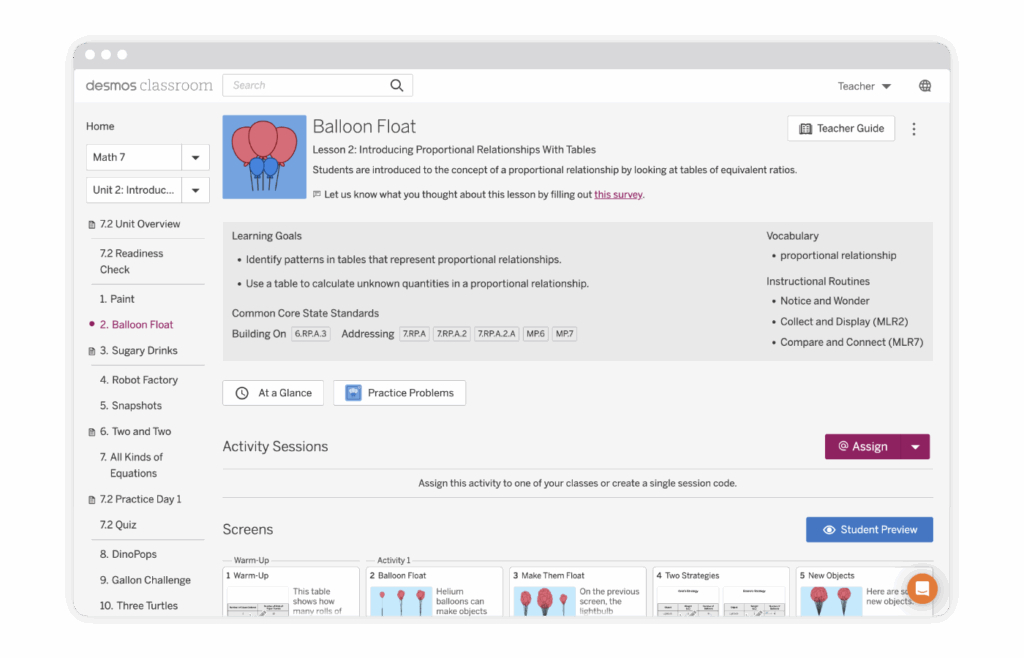
Desmos Classroom digital lessons
Digital lessons should be powerful in their ability to surface student thinking and spark interesting and productive discussions. We’ve joined forces with Desmos Classroom to bring this vision to life with a complete library of interactive, collaborative lessons.

Engaging student experience
Relevant content and interactive math tools create an intuitive and engaging student experience. Plus, working together in real time allows students to see that communicating their ideas and learning from each other are important parts of math class.

Visibility into student thinking
Imagine having more visibility into your students’ mathematical thinking. Now imagine that students have access to this same information. With our collaborative lesson interface and teacher dashboard, students have awareness their own thinking and that of their peers—exposing them to a wider variety of approaches to solving the same problem.
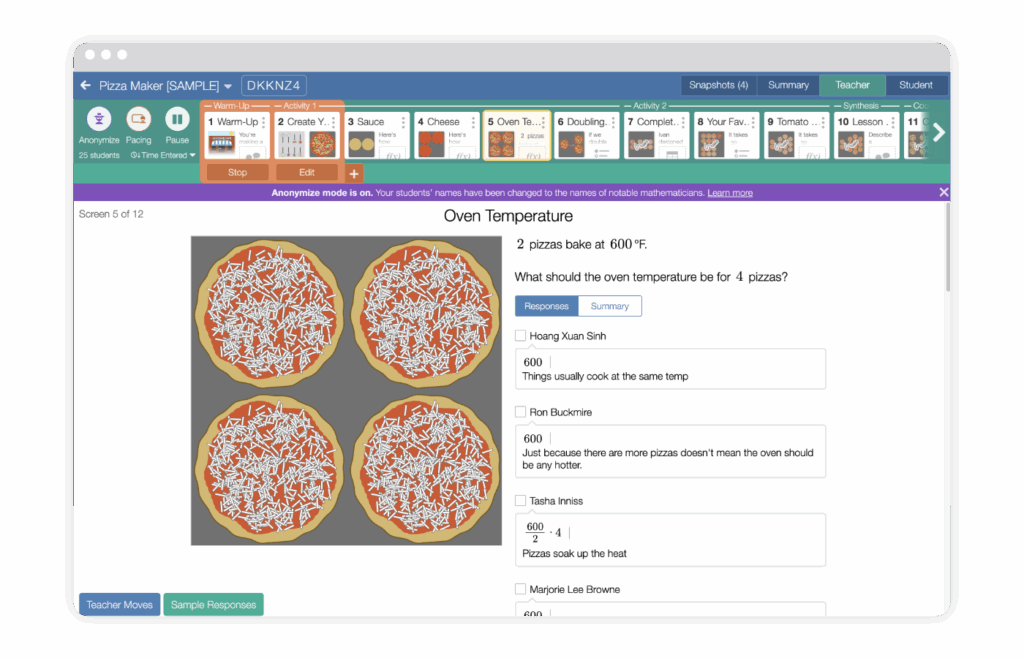
Ready-to-teach lessons
Each grade level includes 150 ready-to-teach lessons, complete with slides, step-by-step teaching notes, suggested student and teacher responses, tips for incorporating instructional routines, support for developing mathematical language, and links to useful resources. Teachers can manage what slides students see, controlling the pace of the lesson to suit the needs of the class.
Planning for instruction
Amplify Desmos Math is customized specifically to meet the New York State Next Generation Math Learning Standards. Within each document below, you’ll find direct links to lessons and activities where each individual standard is addressed.
The program is also aligned with the expectations outlined in the New York City Department of Education Definition of Culturally Responsive-Sustaining Education and the New York State Culturally Responsive-Sustaining Education Framework. Download the CR-SE alignment.
Amplify Desmos Math Scope and Sequence
Amplify Desmos Math Accelerated Scope and Sequence
Ready to plan for the 2025-26 school year? These pacing guides are designed to provide structure, not rigid mandates and resources for NYC.

Experience Amplify Desmos Math New York
Explore our digital program to review content from all grades, 6–A1. Watch our quick walkthrough video for helpful navigation tips.
Try out Amplify Desmos Math by following these steps.
Printable login instructions:
- Teachers: Log in with Amplify steps 1–3 and steps 4–6 or TeachHub (district-preferred login method)
- Administrators: Log in with Amplify or TeachHub (district-preferred login method)
- Students: Log in with Amplify steps 1–3 and steps 4–6 or TeachHub (district-preferred login method)
Additional support:
- How to reset student(s) password
- How to log my class out of a shared device
- Clever class logout instructions
- Single session codes
Print Materials List:
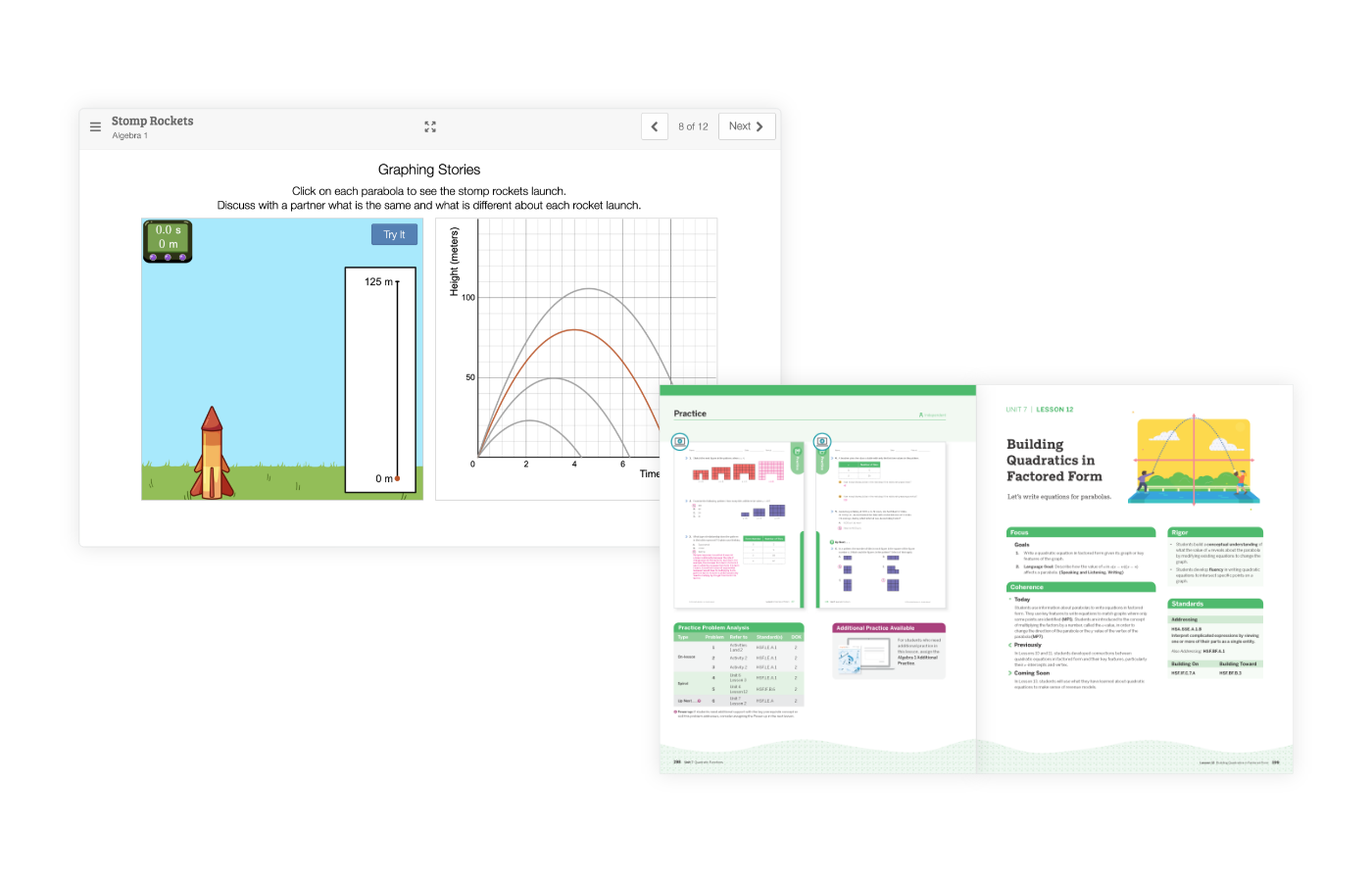
Lesson Sampler
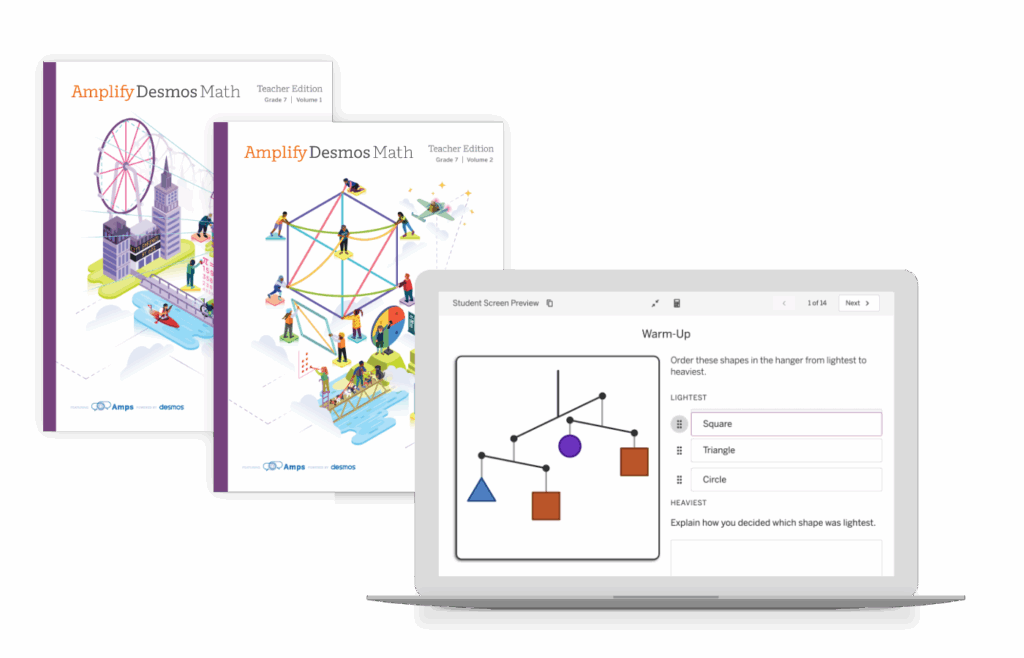
Amplify Desmos Math delivers the instructional power of student-centered learning packaged in a lesson format that’s teacher-friendly and manageable.
With easy-to-follow instructional support, implementing a problem-based program becomes more effective and enjoyable for both you and your students. Paired with the Desmos Classroom digital experience, math class is suddenly fun and dynamic, with plenty of opportunities for students to talk through their reasoning, work with their peers, and gain new understanding.


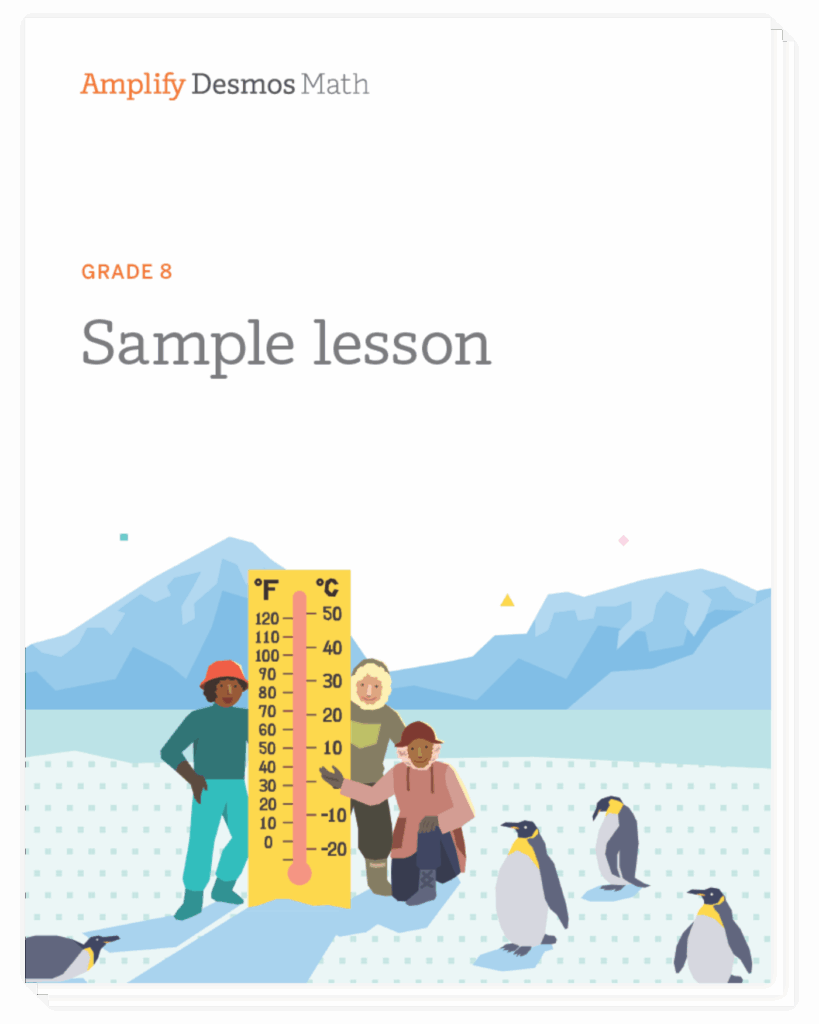
Additional features
Universal design
Every student is brilliant, and every student has brilliant mathematical ideas worth sharing and cultivating. Incorporating principles of Universal Design for Learning (UDL) into lessons brings students’ brilliance to the forefront. UDL is a research-based framework designed to ensure that all learners can access and participate in meaningful, challenging learning opportunities.

Diversity and representation
Helping students develop strong, healthy, and flexible math identities is a cornerstone of our program. Throughout the curriculum, students are taught that they themselves are mathematicians, that today’s math has been shaped by a diverse range of mathematicians who deserve to be celebrated, and that learning is never finished.

Assessments
Less exciting, but essential for learning: assessments. Amplify Desmos Math features a robust variety of formative and summative assessments, including readiness checks, exit tickets, quizzes, end-of-unit tests, and benchmarks aligned with New York State Next Generation Mathematics Learning Standards.
Reporting
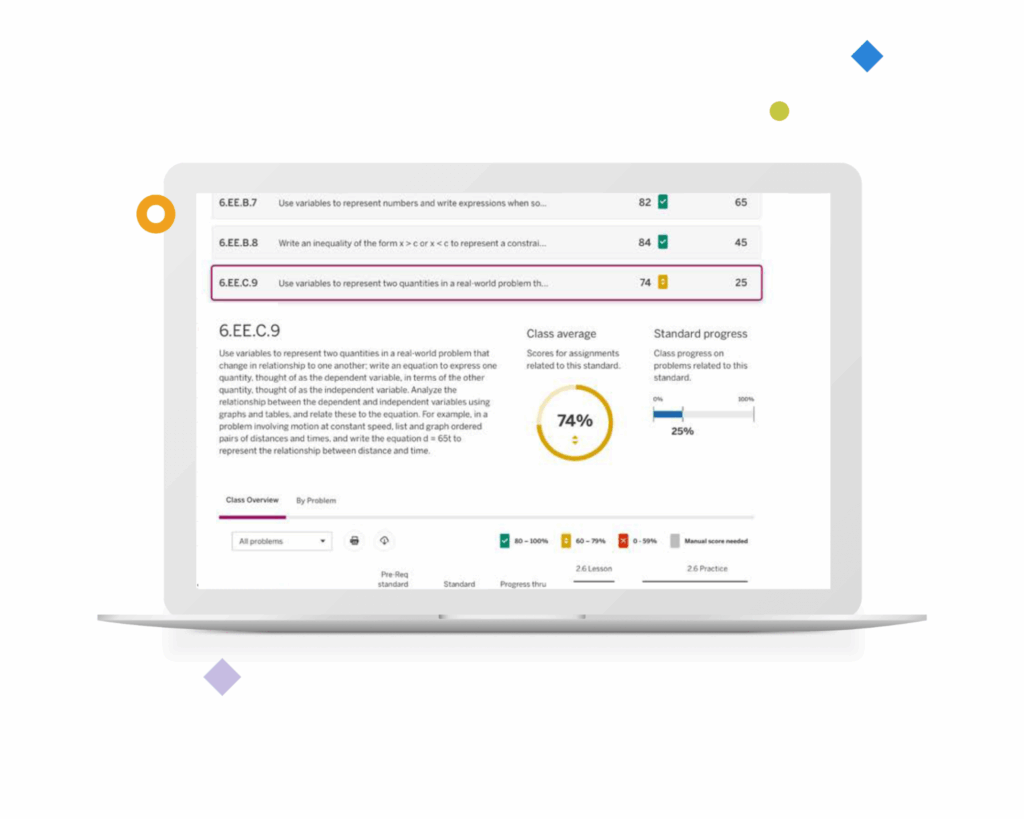
Not only do our reports reveal progress toward standard mastery, but they also include details on how students performed against the standard in the past and how many encounters are yet to come. This feature alone helps teachers prioritize instruction and intervene with additional resources when necessary.
NYC webinar series
Figuring out how to implement a problem-based learning approach to mathematics can be fun—and challenging. Rest assured that you won’t be alone on this journey; Amplify will be by your side every step of the way. Our back-to-school math webinar series for K–8 administrators and teachers:
- Introduces the new NYC Solves initiative.
- Establishes the foundation for all educators to effectively understand and implement the NYCPS Shifts in Mathematics in their classrooms.
- Provides an overview of Amplify Desmos Math, the pre-approved NYCPS curriculum chosen to ensure that every school can successfully implement these math shifts and is supported with high-level, tailored professional development and coaching throughout the process.
Please see the specific webinars and the recordings below to learn more!
On-demand webinar 1
Would you like to learn more about the NYCPS Shifts in Mathematics and enhance your understanding of each of the five shifts?
Explore how the NYCPS math shifts are transforming mathematics education from a procedural approach to a more engaging, discoverable, and connected learning experience.
Listen to the Understanding the NYCPS Shifts in Mathematics session recording.
On-demand webinar 2
Let’s unpack the why, what, and how to unlock every student’s mathematical mind and build math proficiency for life! In this webinar, we discuss the power of teaching our children to be skilled mathematicians through a structured approach to problem-solving.
Listen to the Unlocking Mathematical Minds: A Structured Approach to Problem-Based Learning session recording.
On-demand webinar 3
For some educators, transitioning to problem-based learning might seem daunting. There’s often concern that the open-ended nature of the approach could derail students from achieving mathematical goals. However, by finding the right balance between open-ended opportunities and structured classroom activities, teachers can encourage students to share their thinking while meeting key learning targets. Uncover simple shifts that educators can implement to foster the perfect balance of open-ended student thinking and focus on mathematical instructional goals.
Listen to the Making the Shift to Problem-Based Learning session recording.
On-demand webinar 4
Amplify Desmos Math New York K–A1 is math that motivates! During this session recording, you’ll experience a grade 6 lesson that captures the essence of NYC Solves.
Listen to the Learn More and Experience Amplify Desmos Math LIVE, an NYCPS-Approved Math Curriculum session recording.
Looking for help?
Support is always within reach. Our team is dedicated to supporting you throughout your review. You can be reached at any time by emailing or calling us directly.
- Support pathways for NYC Core Orders
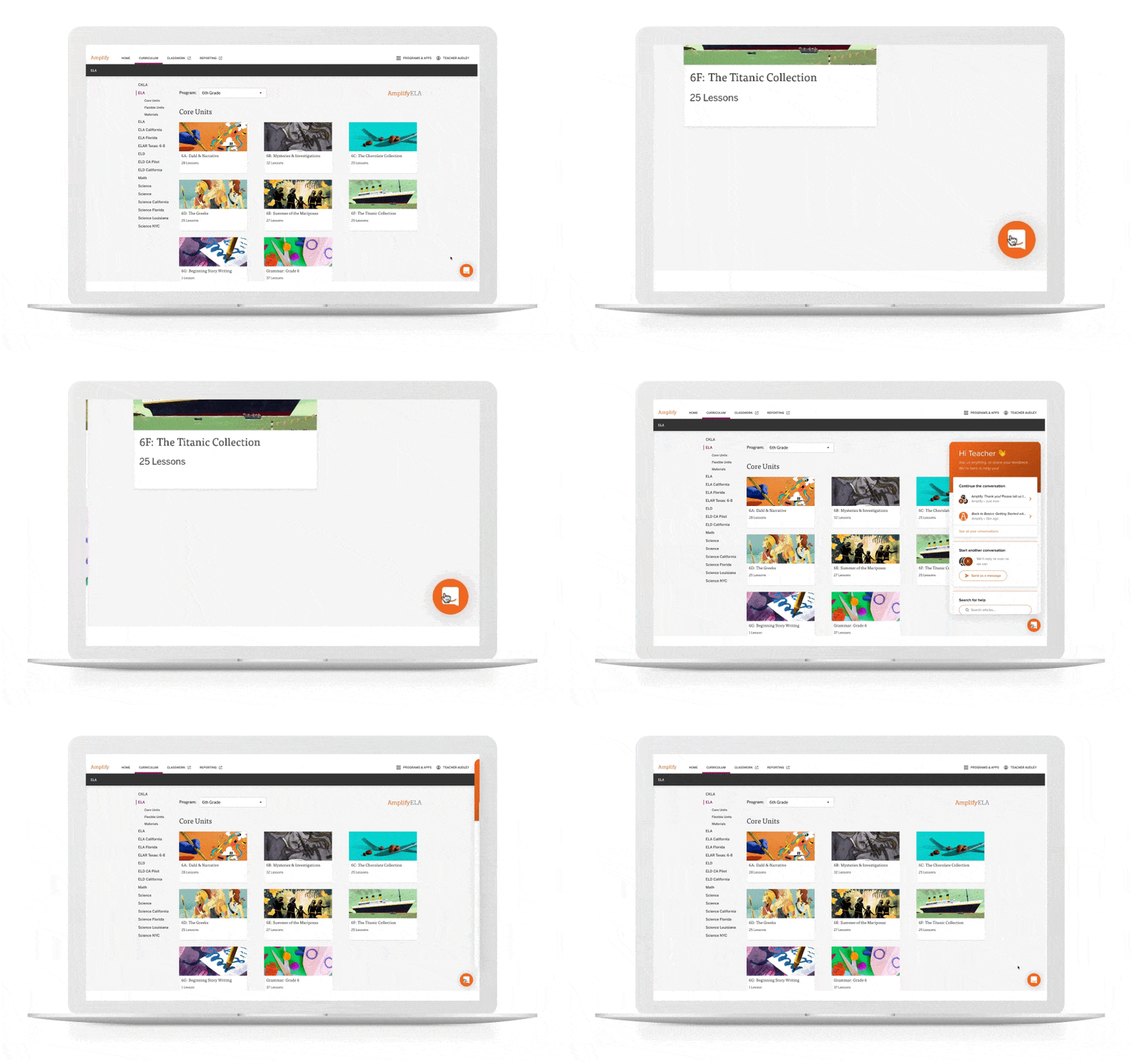
- Chat: Click the orange icon while logged in to get immediate help.
- Support Portal: Fill out this form, and we will get back to you as soon as possible.
- Phone: Call our toll-free NYC Support number: (888) 960-0380.
- Email: Send an email to AmplifyNYC@amplify.com.
Getting Started Resources
Welcome! This page contains support for getting started with Amplify Science for New York City — including login support, materials lists, and program overviews.

Program overview
- NYC Program Guide
- Technology Requirements
- Support Channels for Core Curriculum Purchases
- Make sure you have everything you need to teach Amplify Science
Summer temporary logins
- Log in to Amplify
- Enter the username
- Enter the password
- Select the desired grade level
Grade K-5 teachers
- Username: t.nyck8@tryamplify.net
- Password: AmplifyNumber1
Grade K-5 students
- Username: s.nyck8@tryamplify.net
- Password: AmplifyNumber1
Grade 6-8 teachers
- Username: t.nyck8@tryamplify.net
- Password: AmplifyNumber1
Grade 6-8 students
- Username: s.nyck8@tryamplify.net
- Password: AmplifyNumber1
Logging in
- Classroom teachers/Administrators: Login with Amplify steps 1-3 and
steps 4-6 or TeachHub - K-5 Cluster teachers: Login with Amplify
- K-5 Students: Shared student logins with Amplify or TeachHub
- 6-8 science teacher: Login with Amplify steps 1-3 and steps 4-6 or TeachHub (district preferred login method)
- 6-8 administrator: Login with Amplify or TeachHub (district preferred login method)
- 6-8 students: Login with Amplify steps 1-3 and steps 4-6 or TeachHub (district preferred login method)
- Other staff (co-teachers, ICT, etc.): Administrator instructions for creating a Shared Teacher Login
- How to reset student(s) password
- How to log my class out of a shared device
- Clever class logout instructions
Materials
Looking for refill kits? Please email mkasloff@amplify.com
Materials lists
Lists of kit contents by unit
Spanish Materials lists
Lists of Spanish print kit contents by unit
Kit-level packing detail chart K-5
Kit-level packing detail chart 6-8
Unpacking your first Amplify Science classroom kit
Amplify Science Resources for NYC (6-8)
This page has been archived. For the latest information, please visit the NYC Resource Site.

Welcome!
As the 2021-2022 school year kicks into full gear, you’re likely thinking about making your classroom responsive to student needs due to the covid-19 pandemic.
- CLRT in Amplify Science
- SEL in Amplify Science
- Responsive Relaunch Introduction Video
- Responsive Relaunch NYC Brief
Got additional questions? Use Zoom to attend office hours with Adaliz Gonzalez, the DOE’s Middle School Science Lead on Thursdays from 3-4pm.
Meeting ID: 852 2280 0969
Passcode: 528986
A powerful partnership
Amplify Science was developed by the science education experts at UC Berkeley’s Lawrence Hall of Science and the digital learning team at Amplify.


NYC Newsletters
- February 2022
- January 2022
- December 2021
- October 2021
- September 2021
- June 2021
- May 2021
- April 2021
- March 2021
- February 2021
- January 2021
- December 2020
- October 2020
Educator Spotlight Submission
Calling all NYC DOE educators! Do you know an educator who has gone above and beyond? Would you like to highlight your teaching experience for others? Submit nominations here to see them featured as a spotlight in a future edition of our monthly newsletter and on our Instagram pages!
Introduction
This page includes planning, implementation, and professional learning resources for NYC schools using Amplify Science. Please take a moment to familiarize yourself with the categories in the navigation bar on the left side of the page, so that you’ll be able to easily find what you need.
Most New York City educators come here looking for specific information, but if you’re new to Amplify Science, we recommend you read through the program guide to learn a little about the program.
New to Amplify? – Start HERE!
Teachers and Administrators
Step 1: Review the Amplify Science Overview Video.
Step 2: Review the NYC Scope and sequence for 21-22 school year.
Step 3: Review the Unpacking the Kit Videos listed below to understand what’s in your unit 1 kit.
Step 4: Access your unique Log-in information to log-in to the Amplify Science Curriculum outlined below under Login support
Step 5: Log into the platform and access our Program Hub. Select Using this site for self study for a complete suite of training videos and resources for an initial orientation video series.
Step 6: Log into the curriculum and begin studying the Unit Map and Teacher’s Guide resources and begin planning your first lesson. Print out the NYC Program Guide for essential program information.
Step 7: Administrator’s ONLY – Review the new administrator orientation presentation for an overview of the program. Review other materials under Admin Resources.
NOTE: Should you need any additional guidance on how to get started with prep (or anything else!), please feel free to get in touch with our pedagogical support team. They are available Monday-Friday from 7AM-7PM EST. You can reach them via the chat icon in the lower right- hand corner of your screen when logged in, through email (help@amplify.com), or via phone (800-823-1969).
Getting started resources
- NYC Resource Site overview – quick links
- Tech requirements
- Classroom Technology Quick Start Guide – a one-page guide to using Amplify Science in a variety of technology environments
Login Support
- Login video: Classroom teacher login with Amplify
- 6-8 science teacher: Login with Amplify or TeachHub (district preferred login method)
- 6-8 administrator: Login with Amplify or TeachHub (district preferred login method)
- 6-8 students: Login with Amplify or TeachHub (district preferred login method)
- Other staff (co-teachers, ICT, etc.): Administrator instructions for creating a Shared Teacher Login
- How to reset student(s) password
- How to log my class out of a shared device
- Clever class logout instructions
Materials
Unpacking your first Amplify Science classroom kit
- Unpacking kit video: Metabolism
- Unpacking kit video: Plate Motion
- Unpacking kit video: Force and Motion video
21-22 Login Update
The temporary login credentials for fall ’21 have been deactivated.
Please make sure you check out the Getting started resources > Login Support below for instructions around teacher and student logins. If there are any issues, please confirm with your STARS programmer that your classes are assigned correctly and then contact our Amplify Help Desk at help@amplify.com or at 1-800-823-1969 for further assistance.
Implementation resources
21-22 NYC Scope and Sequence and Pacing Guide
Use our NYC Field Trip List to plan an engaging field trip for your students!
NYC Companion Lesson Guides
The format of the NYC Companion Lessons is similar to other Amplify Science lessons. Some companion lessons are designed to require more than a single class period to teach, so each lesson includes pacing suggestions. Science Background sections support teachers with the science content introduced in the lessons. For students’ written work, possible student responses are included at the end of each lesson guide.
The Lesson Guides are available in the last section of each unit’s print Teacher’s Guide and can be downloaded from the tables in the downloads section below.
NYC Companion Lesson Copymasters
Each NYC Companion Lesson has an accompanying Copymaster (for creating student sheets) that can be copied and distributed to students or used as a visual reference. The NYC Companion Lessons require students to have physical copies of the student sheets. The copymasters are available to download as printable PDF files from the tables in the downloads section below.
Grade 6 Lesson guides and Copymasters
- Companion lesson: Insert after Lesson 2.2
- Time frame: 60 minutes (can spread across multiple class periods)
- NYSP–12SLS: PE: MS-PS3-6, DCI: PS3.B
- Links (click to download):
- Companion lesson: Insert after Lesson 3.3
- Time frame: Two 45-minute class periods
- NYSP–12SLS: PE: MS-PS2-3, MS-PS2-5, DCI: PS2.B
- Links (click to download):
- Companion lesson: Insert after Lesson 3.3 and after Investigating Non-Touching Forces
- Time frame: 60 minutes (first and second reads can be spread across two class periods)
- NYSP–12SLS: PE: MS-PS2-5, MS-PS2-3, DCI: PS2.B
- Links (click to download):
- Companion lesson: Insert after Lesson 2.5
- Time frame: 105 minutes (can be spread across multiple class periods)
- NYSP–12SLS: PE: MS-PS1-6, DCI: PS1.B
- Links (click to download):
- Companion lesson: Insert after Lesson 3.4
- Time frame: 60 minutes (first and second reads can be spread across two class periods)
- NYSP–12SLS: PE: MS-LS2-5, DCI: LS2.C, LS4.D
- Links (click to download):
- Companion lesson: Insert after Lesson 1.3
- Time frame: 60 minutes (first and second reads can be spread across two class periods)
- NYSP–12SLS: PE: MS-ESS2-4, DCI: ESS2.C
- Links (click to download):
- Companion lesson: Insert after Lesson 3.3*
- Time frame: 90 minutes (can be spread across multiple class periods)
- NYSP–12SLS: PE: MS-PS1-7, MS-ESS2-6, DCI: PS1.A, ESS2.C
- Links (click to download):
*Note: The homework assignment for Ocean, Atmosphere, and Climate Lesson 3.3 (reading the article “Deep Ocean Currents: Driven by Density”) should be assigned after the Investigating Deep Ocean Currents companion lesson rather than after Lesson 3.3.
Grade 7 Lesson Guides and Copymasters
- Companion lesson: Insert after Lesson 3.2
- Time frame: 60 minutes (first and second reads can be spread across two class periods)
- NYSP–12SLS: PE: MS-LS1-3, DCI: PS3.D, LS1.A
- Links (click to download):
- Companion lesson: Insert after Lesson 3.3 or later
- Time frame: Three 45-minute class periods, each several days apart
- NYSP–12SLS: PE: MS-LS1-8, DCI: LS1.D
- Links (click to download):
- Companion lesson: Insert after Lesson 3.5
- Time frame: 60 minutes (first and second reads can be spread across two class periods)
- NYSP–12SLS: PE: MS-LS1-6, MS-LS1-7, DCI: LS1.C, PS3.D
- Links (click to download):
- Companion lesson: Insert after Lesson 2.2
- Time frame: 60 minutes (first and second reads can be spread across two class periods)
- NYSP–12SLS: PE: MS-PS1-4, DCI: PS3.A
- Links (click to download):
- Companion lesson: Insert after Lesson 1.3
- Time frame: 60 minutes
- NYSP–12SLS: PE: MS-PS1-7, DCI: PS1.A
- Links (click to download):
- Companion lesson: Insert after Lesson 2.3, 2.4, or 2.5
- Time frame: Two 45-minute class periods
- NYSP–PE: MS-PS1-8, MS-PS1-2 DCI: PS1.A, PS1.B
- Links (click to download):
Grade 8 Lesson Guides and Copymaster
- Companion lesson: Insert after Lesson 2.2
- Time frame: 90 minutes (can be spread across multiple class periods)
- NYSP–12SLS: PE: MS-PS3-2, MS-PS3-5
- Links (click to download):
NYC Companion Kits
Materials needed to teach Amplify Science lessons are provided in a kit for each unit. While some materials used in the NYC Companion Lessons are also found in a unit’s kit, materials specific to the companion lessons are provided in NYC Companion Kits. The contents of each kit and any additional materials needed to teach the companion lessons are listed in the PDFs provided below. Please select your grade to view or download the list.
NYC Student Editions (print)
The NYC Student Editions are durable student references that compile all reading material required for a grade level, including the articles students read for NYC Companion Lessons. Students reading in the Student Edition should annotate the text directly with sticky notes to achieve the full benefits of Active Reading. The Active Reading approach was designed as an interactive process in which students highlight and annotate digital or hard copies of articles directly. Printable versions of the articles are available in the downloads section below.
- Harnessing Human Energy: Printable article: “Magnetic Force and Rainbow Trout”
- Harnessing Human Energy: Printable article: “Gravity and Bats”
- Harnessing Human Energy: Printable article: “Electrostatic Force and Bees”
- Populations and Resources: Printable article: “The Amazing Variety of Life in a Coral Reef”
- Weather Patterns: Printable article: “What Makes Water Move?”
- Metabolism: Printable article: “How You Are Like a Sneezing Iguana”
- Metabolism: Printable article: “How Do Trees Grow So Huge Without Eating?”
- Phase Change: Printable article: “Icy Heat”
- Chemical Reactions: Printable article: “This Is Not an Oxygen Tank”
It is recommended that NYC teachers insert this additional lesson between Lessons 3.1 and 3.2 in order to have students complete a reading assignment in class along with an additional Sim activity.
- Lesson: Earth, Moon and Sun: Modeling Seasons
- Lesson Placement: Insert between Lessons 3.1 and 3.2*
- Links (click to download):
*If teaching this Modeling Seasons lesson, do not assign reading “The Endless Summer of the Arctic Tern” article for homework in Lesson 3.1. However, students should still model a lunar eclipse with the Modeling Tool for homework, as they will be revisiting and revising this model in Lesson 3.3.
NYC Investigation Notebooks (for teacher download)
- Harnessing Human Energy*
- Thermal Energy*
- Populations and Resources*
- Matter and Energy in Ecosystems
- Weather Patterns*
- Ocean, Atmosphere, and Climate*
- Earth’s Changing Climate
* includes NYC Companion Lesson Copymaster(s)
- Microbiome
- Metabolism*
- Phase Change*
- Chemical Reactions*
- Plate Motion
- Engineering Internship: Plate Motion
- Rock Transformations
- Engineering Internship: Earth’s Changing Climate
* includes NYC Companion Lesson Copymaster(s)
- Geology on Mars
- Earth, Moon, and Sun
- Force and Motion
- Engineering Internship: Force and Motion
- Magnetic Fields*
- Light Waves
- Traits and Reproduction
- Natural Selection
- Evolutionary History
* includes NYC Companion Lesson Copymaster(s)
Admin resources
- Getting started checklist
- Implementation rubric
- Look-for tool
- NEW Administrator data reports overview
- NYC Resource Site overview – quick links
- 2021 Grade 6-8 Instructional Leaders: Analyzing Student Assessment Data Agenda and Presentation
- 2021 Grade 6-8 Administrators: Utilizing the Amplify Science Assessment System Agenda and Presentation
- 2020 New Administrator Orientation Presentation with Participant Notebook
- 2020 Returning Administrator Orientation Agenda
- 2020 Amplify Science Remote & Hybrid Resources for Administrators Webinar
- 2020 Supporting Multilingual Learners for Administrators Webinar
- 2020 Accessing Complex Texts: Administrators Webinar
- 2020 Academic Discourse and Questioning Strategies: Administrators Webinar
- 2021 Planning For Next Year: Administrators Agenda, Participant Notebook, and Presentation
- 2021 Planning For Next Year: Instructional Leads Agenda, Participant Notebook, and Presentation
Remote and hybrid learning resources
In response to the shifts towards remote learning, Amplify has created resources for using our programs remotely. Please visit our Program Hub accessible via your Teacher Platform for all of our hybrid and remote learning supports which includes guidance for teachers and parents/guardians.
Additionally, please see below where you’ll find the recordings from our recently held webinars on our remote learning resources and some best practices for implementing Amplify Science in a distance learning setting.
Resource guides
- 20-21 Scope and sequence/pacing guide
- K-8 Remote and hybrid learning guide
- 6-8 Planning Tool for @Home Resources
Professional learning opportunities
Interested in attending training? Check out and sign up for this year’s PL offerings here!
Election Day 21-22 PL
Grade 6 Guided Planning Presentation and Webinar
Grade 7 Guided Planning Presentation and Webinar
Grade 8 Guided Planning Presentation and Webinar
Grades 6-8 Unpacking Phenomena Presentation and Webinar
All 2020-2021 PL session materials can be found below under Professional learning resources.
Amplify Science Back-to-School Recorded Webinars – Amplify held a series of national office hours throughout the summer and fall to share information about our new resources to support remote and hybrid learning– including recommendations about what to prioritize from your curriculum and essential refresher topics, such as how to navigate your program and find the best planning resources. Feel free to watch all recorded sessions at your convenience.
Archived Professional Learning Resources
Winter 2022
- Guided Planning: Unit Internalization Agenda, Participant notebook, and Presentation
Spring 2021
- Planning For Next Year Agenda, Participant notebook, and Grade 6 Presentation
Winter 2021
- Guided Planning: Matter and Energy in Ecosystems Agenda, Participant notebook, and Grade 6 Presentation
- Engaging English Learners in 3-D Learning Agenda, Participant notebook, and Grade 6 Presentation
- Accessing Complex Text in Amplify Science Agenda, Participant notebook, and Grade 6 Presentation
- Applying Reading and Writing Strategies in Amplify Science Agenda, Participant notebook, and Grade 6 Presentation
Fall 2020
- Grade 6: Academic Discourse and Questioning Strategies Webinar
- Accessing Complex Texts: Ocean, Atmosphere, and Climate Webinar
- Grade 6: Ocean, Atmosphere, and Climate Guided Unit Internalization Presentation and Planning document
- Grades 6-8: Supporting Students with Special Needs in Remote Learning Presentation with Participant Notebook
- Grade 6: Supporting Multilingual Learners Webinar
- Grade 6: Thermal Energy Guided Unit Internalization Presentation and Participant Notebook with @Home Resources (Election Day PL)
- Grades 6-8 Navigating Program Essentials: Agenda, Presentation, Participant Notebook
- Grade 6: Progress Builds & Embedded Assessments Webinar
- Grade 6: Amplify Science Remote & Hybrid Resources Webinar
Summer 2020
- Returning Teachers: Guided Planning Workshop Remote and Hybrid LearningAgenda,Presentation, and Webinar
- 6-8 New Teacher Institute Agenda: Day One and Day Two with Participant Notebook
Summer 2019- Harnessing Human Energy and Thermal Energy
Fall 2019- Population and Resources with Participant Notebook
Winter 2022
- Guided Planning: Unit Internalization Agenda, Participant notebook, and Presentation
Spring 2021
- Planning For Next Year Agenda, Participant notebook, and Grade 7 Presentation
Winter 2021
- Engaging English Learners in 3-D Learning Agenda, Participant notebook, and Grade 7 Presentation
- Accessing Complex Text in Amplify Science Agenda, Participant notebook, and Grade 7 Presentation
- Applying Reading and Writing Strategies in Amplify Science Agenda, Participant notebook, and Grade 7 Presentation
Fall 2020
- Grade 7: Academic Discourse and Questioning Strategies Webinar
- Accessing Complex Texts: Phase Change Webinar
- Grade 7: Phase Change Guided Unit Internalization Presentation and Planning document
- Grades 6-8: Supporting Students with Special Needs in Remote Learning Presentation with Participant Notebook
- Grade 7: Supporting Multilingual Learners Webinar
- Grade 7: Metabolism Guided Unit Internalization Presentation and Participant Notebook with @Home Resources (Election Day PL)
- Grades 6-8 Navigating Program Essentials Agenda, Presentation, Participant Notebook
- Grade 7: Progress Builds & Embedded Assessments Webinar
- Grade 7: Amplify Science Remote & Hybrid Resources Webinar
Summer 2020
- Returning Teachers: Guided Planning Workshop Remote and Hybrid LearningAgenda,Presentation, and Webinar
- 6-8 New Teacher Institute Agenda, Day One and Day Two with Participant Notebook
Summer 2019 – Microbiome and Metabolism
Fall 2019 – Phase Change with Participant Notebook
Winter 2022
- Guided Planning: Unit Internalization Agenda, Participant notebook, and Presentation
Spring 2021
- Planning For Next Year Agenda, Participant notebook, and Grade 8 Presentation
Winter 2021
- Guided Planning: Traits and Reproduction Agenda, Participant notebook, and Grade 8 Presentation
- Engaging English Learners in 3-D Learning Agenda, Participant notebook, and Grade 8 Presentation
- Accessing Complex Text in Amplify Science Agenda, Participant notebook, and Grade 8 Presentation
- Applying Reading and Writing Strategies in Amplify Science Agenda, Participant notebook, and Grade 8 Presentation
Fall 2020
- Grade 8: Academic Discourse and Questioning Strategies Webinar
- Accessing Complex Texts: Earth, Moon, and Sun Webinar
- Grades 6-8: Unpacking the Engineering Internship Presentation and Participant Notebook
- Grades 6-8: Supporting Students with Special Needs in Remote Learning Presentation with Participant Notebook
- Grade 8: Supporting Multilingual Learners Webinar
- Grade 8: Force and Motion Guided Unit Internalization Presentation and Participant Notebook with @Home Resources (Election Day PL)
- Grades 6-8 Navigating Program Essentials Agenda, Presentation, Participant Notebook
- Grade 8: Progress Builds & Embedded Assessments Webinar
- Grade 8: Amplify Science Remote & Hybrid Resources Webinar
Summer 2020
- Returning Teachers: Guided Planning Workshop Remote and Hybrid LearningAgenda, Presentation, and Webinar
- 6-8 New Teacher Institute Agenda: Day One and Day Two with Participant Notebook
Summer 2019 – Geology on Mars and Earth, Moon, Sun
Fall 2019 – Force and Motion with Participant Notebook
Caregiver resources
Questions
For general questions about the Amplify program (navigation, pedagogy, login), please reach out:
Email – scihelp@amplify.com
Phone – call toll-free at (800) 823-1969, Monday to Friday, 7 a.m.–7 p.m. ET
Amplify Chat – click the Amplify Chat icon within the individual teacher account
Vulnerability Disclosure Policy
As a provider of technology solutions to schools, Amplify’s commitment to data privacy and security is essential to our organization. Amplify demonstrates that commitment in part through the physical, technical, and administrative safeguards we maintain to protect student data and other sensitive information entrusted to our care.
Amplify looks forward to working with the security community to find security vulnerabilities and support our efforts to keep our data and systems safe and secure.
Before reporting a vulnerability, please read our program rules, eligibility overview, report submission rules and guidelines, legal terms, and out-of-scope list set out below.
General Rules
- We appreciate reports on any Amplify-owned asset, but only vulnerabilities that prove to be outside of expected behavior are eligible for acceptance.
- Reports involving third party services or providers not under Amplify’s control are out-of-scope for submission.
- Amplify places a high priority on privacy. Vulnerabilities in the areas of inadvertent exposure of our customers’ personally identifiable information (PII) are considered to be of Critical severity.
- We classify vulnerability severity per CVSS (the Common Vulnerability Scoring Standard). These are general guidelines, and the ultimate decision over a reward – whether to give one and in what amount – is a decision that lies entirely within our discretion on a case-by-case basis.
- In order to receive an award for validated reports, you must have a HackerOne account. Please note reward decisions are subject to the discretion of Amplify. Please note these are general guidelines, and that reward decisions are subject to the discretion of Amplify.
- Only interact with test accounts that you created via self sign-up or were provided by Amplify. The use of any credentials outside of these areas for testing purposes, including legacy credentials supplied through the program and leaked credentials from third parties is strictly prohibited.
- Do not contact Amplify’s customer support for questions or to submit a vulnerability report.
- Amplify may, in its sole discretion, disqualify you if you breach this policy or fail to comply with any of the program’s rules and terms.
- Amplify reserves the right to cancel or modify this program without notice at any time.
Eligibility
- You are not eligible for participation if you 1) are employed by Amplify or any of its affiliates 2) are an immediate family member of a person employed by Amplify or any of its affiliates or 3) left the employment of Amplify or its affiliates or subsidiaries within the past (12) months.
- You are not eligible for participation if you have been prohibited in writing from participating in the Bug Bounty Program by Amplify at any time.
- You may not be in violation of any national, state, or local law or regulation with respect to any activities directly or indirectly related to conducting your tests.
- You may not compromise the privacy or safety of our customer and the operation of our services;
- You may not cause harm to Amplify, our customers, or others;
- You must follow the policy guidelines to responsibly disclose vulnerabilities to Amplify.
Vulnerability Submission Rules & Guidelines
- Any testing conducted on customer data or accounts is strictly prohibited and will result in removal from the program.
- If during the course of testing you encounter any sensitive data outside of your test accounts (including student or teacher names, login info, assessment data, activity data, and student work, etc.), please cease testing immediately and report what you have found. DO NOT include any text, screenshots, etc. with PII in the report. This action safeguards both potentially vulnerable data and yourself.
- Do not access, download, or share any data you encounter in your testing.
- Only interact with test accounts that you created or that we provided. The use of any credentials outside of these areas for testing purposes is strictly prohibited.
- Provide detailed reports with reproducible steps. If the report is not detailed enough to reproduce the issue, the issue will not be eligible for a reward.
- In some cases, you may not have all of the context information to assess the impact of a vulnerability. If you’re unsure of the direct impact but are reasonably certain that you have identified a vulnerability, we encourage you to submit a detailed report and state the open questions on impact.
- When duplicate submissions for the same vulnerability occur, we only award the first report that was received, provided that it can be fully reproduced.
- Multiple reports describing the same vulnerability against multiple assets or endpoints must be submitted within a single report.
- Avoid destruction of data and interruption or degradation of our service.
- Proof of Concept (POC) videos that do not include PII are highly recommended to help verify the issue, provide clarity, and save time on triage.
- Please provide timely responses to any follow-up questions and requests for additional information.
- Understand that there could be submissions for which we accept the risk, have other compensating controls, or will not address in the manner expected. When this happens, we will act as transparently as we can to provide you with the necessary context as to how the decision was made.
- Reports submitted using methods that violate policy rules will not be accepted and may result in account suspension from/denial of entrance to the program.
- Please refer to any noted out-of-scope areas listed under Out-of-Scope Vulnerabilities.
Out-of-Scope Vulnerabilities
When reporting vulnerabilities, please consider (1) attack scenario / exploitability, and (2) security impact of the bug. The following issues are considered out-of scope. In addition, please refer to any noted Out of Scope areas listed under the program assets.
- Social engineering (e.g. phishing, vishing, smishing) is prohibited.
- Clickjacking on pages with no sensitive actions.
- Unauthenticated/logout/login CSRF.
- Attacks requiring MITM or physical access to a user’s device.
- Previously known vulnerable libraries without a working Proof of Concept.
- Comma Separated Values (CSV) injection without demonstrating a vulnerability.
- Missing best practices in SSL/TLS configuration.
- Any activity that could lead to the disruption of our service (DoS).
- Content spoofing and text injection issues without showing an attack vector/without being able to modify HTML/CSS.
- XSRF that requires the knowledge of a secret.
- Automated tools that could generate significant traffic and possibly impair the functioning of our services.
- Testing or demonstrating the ability to upload unlimited audio/video files to exhaust resources.
- Leaked credentials from third party providers, including invalid or stale employee credential dumps, and/or leaked personal information of Amplify staff.
- Leaked credentials for Amplify customers not caused by vulnerabilities in our systems.
- Vulnerabilities identified via third party services or providers where Amplify is not the owner.
- Issues that merely result in spam/annoyance without additional impact (e.g sending emails without sufficient rate limiting)
- Attempts to access our offices or data centers.
- Any activity that could contribute to the disruption of our service (DoS). Automated scanning tests should be kept to 10 requests per second or less.
- Self XSS.
- Broken links and/or crashes in general.
- Issues that require unlikely user interaction.
- Issues that do not affect the latest version of modern browsers
- Issues that require physical access to a victim’s computer/device.
- Disclosure of information that does not present a significant risk
- Please refer to any noted out-of-scope areas listed under program assets.
Legal
- Any information you receive or collect about us, our affiliates or any of our users, employees or agents in connection with the Bug Bounty Program (“Confidential Information”) must be kept confidential and only used in connection with the Bug Bounty Program. You may not use, disclose or distribute any such Confidential Information, including without limitation any information regarding your Submission, without our prior written consent. You must get written consent by submitting a disclosure request through the HackerOne platform.
- Researchers must follow HackerOne’s disclosure guidelines. Public disclosure or disclosure to other third parties without the explicit permission of Amplify is prohibited.
- We will not take legal action against you if vulnerabilities are found and responsibly reported in compliance with all of the terms and conditions outlined in this policy.
- Amplify reserves the right to modify the terms and conditions of this program without notice at any time, and your participation in the Program constitutes acceptance of all terms.
Submit Vulnerability Report
NYC Solves Regents Prep A1
Hello NYC high school math educators!
Welcome to Amplify Desmos Math NYC Solves Regents Prep A1. This sequence of lessons is specifically designed for students who passed Algebra 1 in eighth grade but did not pass the NYS Regents exam in June. The instructional resources are accessed through the Amplify Desmos Math platform, affording students a highly engaging experience to prepare them for the January administration of the Regents by reinforcing conceptual understanding.
On this site, you’ll find a variety of resources to guide you in learning more about the course and how to get started.
Ready to jump in? This quick start guide will help you take the first steps to get started. Remember to use your NYCDOE email for access.

About Amplify Desmos Math
Amplify Desmos Math 6–A1 is based on the highly rated IM K–12™ curricula from Illustrative Mathematics, with extensive enhancements that include teacher supports, interactivity, assessments, and reporting.
The program is aligned with the expectations outlined in the New York City Department of Education Definition of Culturally Responsive-Sustaining Education and the New York State Culturally Responsive-Sustaining Education Framework.
Your NYC Solves Regents Prep A1 course uses key lessons and activities from Amplify Desmos Math to prepare students for the A1 Regents.
NYC webinar series
Figuring out how to implement a problem-based learning approach to mathematics can be fun—and challenging. Rest assured that you will not be alone on this journey. Amplify will be by your side every step of the way. Our back-to-school math webinar series for K–8 administrators and teachers:
- Introduces the new NYC Solves initiative.
- Establishes the foundation for all educators to effectively understand and implement the NYCPS Shifts in Mathematics in their classrooms.
- Provides an overview of Amplify Desmos Math, the pre-approved NYCPS curriculum chosen to ensure every school can successfully implement these math shifts and is supported with high-level, tailored professional development and coaching throughout the process.
Please see the specific webinars and the recordings below to learn more!
On-demand webinar 1
[Aug. 29 and Sept. 3, 2024]
Would you like to learn more about the NYCPS Shifts in Mathematics and enhance your understanding of each of the five shifts?
Explore how the NYCPS math shifts are transforming mathematics education from a procedural approach to a more engaging, discoverable, and connected learning experience.
Listen to the Understanding the NYCPS Shifts in Mathematics session recording.
On-demand webinar 2
[Sept. 10 and Sept. 12, 2024]
Let’s unpack the why, what, and how to unlock every student’s mathematical mind and build math proficiency for life! In this webinar, we discuss the power of teaching our children to be skilled mathematicians through a structured approach to problem solving
Listen to the Unlocking Mathematical Minds: A Structured Approach to Problem-Based Learning session recording.
On-demand webinar 3
[Sept. 17 and Sept. 19, 2024]
For some educators, transitioning to problem-based learning might seem daunting. There is often concern that its open-ended nature could derail students from achieving mathematical goals. However, by finding the right balance between open-ended opportunities and structured classroom activities, students can be encouraged to share their thinking while meeting key learning targets. Uncover simple shifts that educators can implement to foster open-ended student thinking while maintaining focus on mathematical instructional goals.
Listen to the Making the Shift to Problem-Based Learning session recording.
Live webinar 4
[Oct. 1 and Oct. 3, 2024]
Learn More and Experience Amplify Desmos Math LIVE, an NYCPS Approved Math Curricula.
This is the final session of the series. Amplify Desmos Math New York K–A1 is math that motivates! During this session, you’ll experience a Grade 6 lesson that captures the essence of NYC Solves.
Choose from two convenient times and register below:
- Oct. 1, 2024, 9:15–10:15 a.m. EDT
- Oct. 3, 2024, 3:15–4:15 p.m. EDT
Program features to know

Desmos Classroom digital lessons
Digital lessons should be powerful in their ability to surface student thinking and spark interesting and productive discussions. We’ve joined forces with Desmos Classroom to bring this vision to life with a complete library of interactive, collaborative lessons.

Engaging student experience
Relevant content and interactive math tools create an intuitive and engaging student experience. Plus, working together in real-time allows students to see that communicating their ideas and learning from each other are important parts of math class.

Visibility into student thinking
Imagine having more visibility into your students’ mathematical thinking. Now imagine students have access to this same information. With our collaborative lesson interface and teacher dashboard, students stay engaged. What’s more, they have visibility into the thinking of their peers—exposing them to a wider variety of approaches to solving the same problem.

Ready-to-teach lessons
The two tracks for scope and sequence include ready-to-teach lessons to prepare students for the A1 Regents. Lessons come complete with slides, step-by-step teaching notes, suggested student and teacher responses, tips for incorporating instructional routines, support for developing mathematical language, and links to useful resources. Teachers can also control what slides students see, giving teachers the ability to control the pace of the lesson to suit the needs of the class.
Planning for instruction
To start using the program quickly in your classroom, check out the following onboarding videos, guide, and planning resources. They cover what you need to know to get going fast.
Amplify Desmos Math Regents Prep Course Session I
NYC Solves Regents Prep A1 is customized specifically to meet the needs of students in ninth grade preparing for the Algebra 1 Regents exam. Within each document below, you’ll find the scope and sequence with course structure and lessons.

Logging in to access the program
Login instructions:
- Teachers: Log in with Amplify steps 1–3 and steps 4–6 or TeachHub (district-preferred login method)
- Administrators: Log in with Amplify or TeachHub (district-preferred login method)
- Students: Log in with Amplify steps 1–3 and steps 4–6 or TeachHub (district-preferred login method)
Questions? Check out this Tech FAQ for more information.
Additional support:
- How to navigate the platform
- How to reset student(s) password
- How to log my class out of a shared device
- Clever class logout instructions

Lesson Sampler
Amplify Desmos Math delivers the instructional power of student-centered learning in a lesson format that’s teacher-friendly and manageable.
With easy-to-follow instructional support, implementing a problem-based program is effective and enjoyable for both you and your students. Paired with the Desmos Classroom digital experience, math class becomes fun and dynamic, with plenty of opportunities for students to talk through their reasoning, work with their peers, and gain new understanding.


Additional features
Universal design
Every student is brilliant, and every student has brilliant mathematical ideas worth sharing and cultivating. Incorporating principles of Universal Design for Learning (UDL) into lessons brings students’ brilliance to the forefront. UDL is a research-based framework designed to ensure that all learners can access and participate in meaningful, challenging learning opportunities.
Diversity and representation
Helping students develop strong, healthy, and flexible math identities is a cornerstone of our program. Throughout the curriculum, students are taught that they themselves are mathematicians, that today’s math has been shaped by a diverse range of mathematicians who deserve to be celebrated, and that learning is never finished.
Assessments
Less exciting, but essential for learning: assessments. Amplify Desmos Math features a robust variety of formative and summative assessments, including readiness checks, exit tickets, quizzes, end-of-unit tests, and benchmarks aligned with New York State Next Generation Mathematics Learning Standards.
Reporting
Not only do our reports reveal progress toward standard mastery, they also include details on how students performed against the standard in the past and how many encounters are yet to come. This feature alone helps teachers prioritize instruction and intervene with additional resources when necessary.
Looking for help?
Throughout your implementation, you can reach our support team by live chat, phone, or email Monday through Friday,
7 a.m. to 7 p.m. ET.
- Chat: Click the orange icon while logged in to get immediate help.
- Phone: Call our dedicated support line for NYCPS (888) 960-0380.
- Email: Send an email to help@amplify.com. In the message body, please include your name and question. Provide as much detail as possible, so we can help you find a solution.

Amplify Desmos Math for NYC Public Schools
Welcome! This site contains supporting resources for New York City Public Schools Amplify Desmos Math implementation.
What’s new?
- Gearing up for the 2026-2027 School Year: Check out our Getting Started section on this page for support — including login support, materials lists, program overviews and more!
- Check out the new Admin Reports views coming in SY 2026-2027 for district and school leaders! Click here to learn more.
- Have a question about Amplify Desmos Math? This FAQ doc answers top questions about access, implementation, and features.
- Need help? Check here for who can help! Our dedicated phone number, just for NYC, has team members ready to help! 1-888-960-0380
About the program
Amplify Desmos Math New York is a core K-12 mathematics curriculum designed specifically for NYC Public Schools. It combines problem-based learning with Desmos Classroom technology to build conceptual understanding and align directly with the New York State Next Generation Mathematics Learning Standards. With beautiful print resources, and robust practice, differentiation supports, assessment and reporting, Amplify Desmos Math has received all-green ratings from EdReports. Read the review on EdReports.
Amplify Desmos Math is built on four core tenets:
- Math can motivate students.
- A structured approach to problem-based learning can best tend to all aspects of rigor.
- Student thinking is valuable and visible.
- Students can catch up while keeping up with grade-level math.
Getting started
- Program overviews
- Demo login
- Explore Amplify Desmos Math New York to review content from all grades, K-12, by following these steps.
- Materials
- Family resources

- Logging in during the school year
- Teachers: Log in with Amplify steps 1–3 and steps 4–6 or TeachHub (district-preferred login method)
- Administrators: Log in with Amplify or TeachHub (district-preferred login method)
- Students: Log in with Amplify steps 1–3 and steps 4–6 or TeachHub (district-preferred login method)
- Additional login support

Powerful digital lessons
Amplify Desmos Math lessons are powerful in their ability to elicit student thinking and spark interesting, productive discussions. The lessons pose problems that invite a variety of approaches with their dynamic and interactive learning experiences on devices, as well as experiences on paper that are flexible, creative, and engaging.
Engaging student experience
Relevant content and interactive math tools create an intuitive and engaging student experience. Plus, working together in real time allows students to see that communicating their ideas and learning from each other are important parts of math class.

Visibility into student thinking
Imagine having more visibility into your students’ mathematical thinking. Now imagine that students have access to this same information. With our collaborative lesson interface and teacher dashboard, students have awareness their own thinking and that of their peers—exposing them to a wider variety of approaches to solving the same problem.
Ready-to-teach lessons
Each grade level includes 150 ready-to-teach lessons, complete with slides, step-by-step teaching notes, suggested student and teacher responses, tips for incorporating instructional routines, support for developing mathematical language, and links to useful resources. Teachers can manage what slides students see, controlling the pace of the lesson to suit the needs of the class.
Planning for instruction
Amplify Desmos Math is customized specifically to meet the New York State Next Generation Math Learning Standards. Within each document below, you’ll find direct links to lessons and activities where each individual standard is addressed.
The program is also aligned with the expectations outlined in the New York City Department of Education Definition of Culturally Responsive-Sustaining Education and the New York State Culturally Responsive-Sustaining Education Framework.
Scope and sequence
- Amplify Desmos Math K-5 Scope and Sequence
- Amplify Desmos Math 6-A1 Scope and Sequence
- Amplify Desmos Math Accelerated Scope and Sequence
- Amplify Desmos Math AGA Scope and Sequence
Ready to plan for the 2026-27 school year? These pacing guides (coming soon!) are designed to provide structure, not rigid mandates and resources for NYC.
Multilingual learner supports
Implementation resources

Lesson Sampler
Amplify Desmos Math delivers the instructional power of student-centered learning packaged in a lesson format that’s teacher-friendly and manageable.
With easy-to-follow instructional support, implementing a problem-based program becomes more effective and enjoyable for both you and your students. Paired with the Desmos Classroom digital experience, math class is suddenly fun and dynamic, with plenty of opportunities for students to talk through their reasoning, work with their peers, and gain new understanding.
Universal design
Every student is brilliant, and every student has brilliant mathematical ideas worth sharing and cultivating. Incorporating principles of Universal Design for Learning (UDL) into lessons brings students’ brilliance to the forefront. UDL is a research-based framework designed to ensure that all learners can access and participate in meaningful, challenging learning opportunities.
Diversity and representation
Helping students develop strong, healthy, and flexible math identities is a cornerstone of our program. Throughout the curriculum, students are taught that they themselves are mathematicians, that today’s math has been shaped by a diverse range of mathematicians who deserve to be celebrated, and that learning is never finished.

Assessments
Less exciting, but essential for learning: assessments. Amplify Desmos Math features a robust variety of formative and summative assessments, including readiness checks, exit tickets, quizzes, end-of-unit tests, and benchmarks aligned with New York State Next Generation Mathematics Learning Standards.

Reporting
Not only do our reports reveal progress toward standard mastery, but they also include details on how students performed against the standard in the past and how many encounters are yet to come. This feature alone helps teachers prioritize instruction and intervene with additional resources when necessary.

NYC webinar series
Figuring out how to implement a problem-based learning approach to mathematics can be fun—and challenging. Rest assured that you won’t be alone on this journey; Amplify will be by your side every step of the way. Our back-to-school math webinar series for K–8 administrators and teachers:
- Introduces the new NYC Solves initiative.
- Establishes the foundation for all educators to effectively understand and implement the NYCPS Shifts in Mathematics in their classrooms.
- Provides an overview of Amplify Desmos Math, the pre-approved NYCPS curriculum chosen to ensure that every school can successfully implement these math shifts and is supported with high-level, tailored professional development and coaching throughout the process.
Please see the specific webinars and the recordings below to learn more!
On-demand webinar 1
Would you like to learn more about the NYCPS Shifts in Mathematics and enhance your understanding of each of the five shifts?
Explore how the NYCPS math shifts are transforming mathematics education from a procedural approach to a more engaging, discoverable, and connected learning experience.
Listen to the Understanding the NYCPS Shifts in Mathematics session recording.
On-demand webinar 2
Let’s unpack the why, what, and how to unlock every student’s mathematical mind and build math proficiency for life! In this webinar, we discuss the power of teaching our children to be skilled mathematicians through a structured approach to problem-solving.
Listen to the Unlocking Mathematical Minds: A Structured Approach to Problem-Based Learning session recording.
On-demand webinar 3
For some educators, transitioning to problem-based learning might seem daunting. There’s often concern that the open-ended nature of the approach could derail students from achieving mathematical goals. However, by finding the right balance between open-ended opportunities and structured classroom activities, teachers can encourage students to share their thinking while meeting key learning targets. Uncover simple shifts that educators can implement to foster the perfect balance of open-ended student thinking and focus on mathematical instructional goals.
Listen to the Making the Shift to Problem-Based Learning session recording.
On-demand webinar 4
Amplify Desmos Math New York K–A1 is math that motivates! During this session recording, you’ll experience a grade 6 lesson that captures the essence of NYC Solves.
Listen to the Learn More and Experience Amplify Desmos Math LIVE, an NYCPS-Approved Math Curriculum session recording.
Looking for help?
Support is always within reach. Our team is dedicated to supporting you throughout your review. You can be reached at any time by emailing or calling us directly.
- Support pathways for NYC Core Orders
- Chat: Click the orange icon while logged in to get immediate help.
- Support Portal: Fill out this form, and we will get back to you as soon as possible.
- Phone: Call our toll-free NYC Support number: (888) 960-0380.
- Email: Send an email to AmplifyNYC@amplify.com.