S5-04. Coaching tips for managing math anxiety in teachers
A blue graphic with text reading "Math Teacher Lounge" in multicolored letters and "Amplify." at the bottom, with abstract geometric shapes and lines as decoration.

So far this season, we’ve investigated math anxiety in students and its causes with passionate researchers and curriculum experts, including one from Sesame Workshop! Now we hear from Dr. Heidi Sabnani, consultant, coach, and co-host of Math 4 All, as she gives us research-based tips for teachers who are facing math anxiety themselves! Listen as we discuss Heidi’s own math anxiety and journey through math, the effects teacher math anxiety can have on instruction, and practices educators can implement right away for overcoming math anxiety.

Listen today and don’t forget to grab your MTL study guide to track your learning and make the most of this episode!

Download Transcript

Dr. Heidi Sabnani (00:00):

Coaching is the opportunity to provide that just-in-time kind of professional development for teachers, if we go at it in a slightly different way.

Dan Meyer (00:10):

Hey folks, welcome back to Math Teacher Lounge. I’m your host, Dan Meyer.

Bethany Lockhart Johnson (00:14):

And I’m Bethany Lockhart Johnson.

Dan Meyer (00:16):

Bethany, how are you doing, and how are you feeling about our current trajectory through this exploration of math anxiety?

Bethany Lockhart Johnson (00:24):

Dan, I gotta tell you — let me make it about me for a second. <laugh>.

Dan Meyer (00:29):

Go. Do it.

Bethany Lockhart Johnson (00:30):

If only I had known that so many other people experienced math anxiety, and I wasn’t the only one. I mean, I’ve said it before, but you know, I hope that this series so far is helping to reframe math anxiety for folks who maybe have a narrow definition of it … and I guess expand, reframe. And also, for those folks who are working with students who have math anxiety, or who they themselves have experienced math anxiety, I hope they’ve found some tools, some resources. Right? Like, “Yes!”

Dan Meyer (01:04):

Yes! Same.

New Speaker (01:06):

And what about you? How are you feeling?

Dan Meyer (01:08):

Yeah, I hope this has been cathartic for all of our listeners who have experienced math anxiety, and not re-traumatizing, that there are lots of people who feel this way about math in particular. And that it’s so well-experienced, so broadly experienced, that people have decided to study it a whole bunch. Which is great. And now we’re moving into our kind of solutioning. You know, in my relationships, I’m sometimes told that I rush too quickly to solutions before trying to understand what’s going on. So I’ve loved our episodes that have been about what is going on. And now, with Dr. Truglio last episode and our guest today, we’re moving more into some solutions, which I’m excited about.

Bethany Lockhart Johnson (01:49):

I don’t know, Dan, I think next time I see you I’m gonna bring a list of some concerns or worries I have, and I would love if you just get right to the solution. I’m actually OK with that.

Dan Meyer (02:01):

All right. Good to know. Good to know. I’ll say I am coming off of a day where I was feeling some teacher anxiety today, because I taught really real students. So just to let you know where I’m coming from here. I taught some seventh grade students at Montera Middle, here in Oakland Unified School District. Taught ’em a lesson outta the Desmos curriculum. And it was one of those lessons where some thorny stuff comes up. I’m talking students who are wrong for smart reasons, who are right for the wrong reasons, and their minds are working so hard trying to figure out inequalities. And I’m like trying to just step into that process as an educator with some curriculum and help shape those ideas. But it’s just … I don’t know, you want it to be as easy as like, “let me just show you how it’s done a few times, and now you got it.” But whew, some of these ideas, they take a long time to form up and they’re really easily reshaped by lots of stuff going on. So that’s where I’m at, anxiety-wise, right now. The teacher anxiety stuff.

Bethany Lockhart Johnson (03:04):

I think there’s probably plenty of teachers who do kind of just say, this is how you do it. And so, from what I have seen of your teaching and what I know of the Desmos curriculum, it is such an opportunity to think hard about the things that we are assuming about our students, assuming about what we know about the math itself. And yeah, that requires some thought.

Dan Meyer (03:30):

Yeah, for sure. I came in ready, like, “When you multiply both sides of an inequality by a negative, this sign flips around.” And I could just say that to kids and say, “Hey, remember that! Write that down!” And a lot of them would do it really well, you know, provided the assessment problems looked like ones we’ve gone over in class. And they’re also learning — in addition to that math, they’re learning that math is a giant sack of tricks they gotta memorize, right? So there’s just these pros and cons. And at the end of the one period I’m gonna teach this week, I was like, “Well, your teacher’s gonna go over that tomorrow, when they’re with you instead of me.” So it felt a bit like I copped out on that one. And I’m just in in my feelings about that right now. And I’m gonna try to come on down here and be present in the math-anxiety world.

Bethany Lockhart Johnson (04:25):

I appreciate you sharing that, Dan. And I think … I have a feeling that you could write a pretty catchy rhyme to allow the students to flip and <starting to rap> “multiply by negative. and dit-dit-dit-dit.” Can you feel it? You picking up that beat?

Dan Meyer (04:40):

Ooh, yeah. A nice little beat. Uh-huh. Yup.

Bethany Lockhart Johnson (04:41):

Yeah. You know, you could come up with something pretty clever, and yet you did not lean on your wordsmithing skills. You said, “No, let us dive in.” So what are you gonna do with this lesson, by the way? What happens now? You popped in for one period, and then what happens?

Dan Meyer (05:03):

Yeah. So this is gonna be a blast. I hope you folks tune in. We’re gonna actually release the footage of me teaching this lesson live. You know, it’ll be replayed live. And on top of that, a couple of my favorite teacher coaches and just smart people about teaching are going to be giving commentary. They are gonna be giving the director’s commentary, the sports announcers’ commentary on what they’re seeing. I beg for their generosity in their commentary. But I think it’ll be a lot of fun. I’ve never seen anything like this before, a commentary track on top of a teaching lesson, in this way. So I’m just gonna gonna be excited to see what they noticed that I didn’t, what they might have done, the thoughts they might have. Maybe I’ll do a post-game interview, you know.

Bethany Lockhart Johnson (05:50):

Ooh, yes!

Dan Meyer (05:50):

With my towel around my neck, <laugh> looking all sweaty.

Bethany Lockhart Johnson (05:54):

Ready, set, grow!

Dan Meyer (05:55):

Like, “Yup, we gave it all out there, you know, just a real team effort.” You know, that kind of thing. We’ll see how that goes.

Bethany Lockhart Johnson (06:02):

I actually love that idea. I love that it’s not just this one random lesson that just kind of floats out there, and it’s about, you walk away with whatever feelings you have, and the students obviously walk away, but that this is gonna help other educators.

Dan Meyer (06:17):

Yeah. Yeah. We’ll multiply my anxiety and make it more people’s anxiety. We’ll see how that goes. So stay tuned on the Math Teacher Lounge feed for that. All right?

Bethany Lockhart Johnson (06:25):

All right! And speaking of anxiety, Dan Meyer, we gotta get to today’s show. You know, last time we had some amazing strategies for helping students from Dr. Truglio from Sesame Workshop. I gotta tell you, I sent that episode to so many of my friends, like, “Listen to these ideas!” and have had some interesting follow-up conversations. And we would love to hear what you think about this season so far, at MTLShow on Twitter or in our Facebook group, Math Teacher Lounge. So today, we’re gonna focus on strategies for supporting teachers.

Dan Meyer (07:00):

Yes. Which is why we’re so excited to bring to you folks Heidi Sabnani, who — we’ve had researchers. We’ve had Sesame Workshoppers. And Heidi Sabnani has been a classroom teacher; she’s teacher-consultant; newly minted doctoral degree holder. We’re so pumped to bring to you folks: Heidi Sabnani.

Bethany Lockhart Johnson (07:25):

Dr. Sabnani, thank you for being here. Can we call you Dr. Heidi? What would you. …

Dr. Heidi Sabnani (07:31):

You can just call me Heidi. Yeah. Heidi is good.

Dan Meyer (07:36):

Right on.

Bethany Lockhart Johnson (07:36):

  1. Heidi, thank you for joining us in the Lounge. We’re so excited to talk with you.

Dr. Heidi Sabnani (07:41):

I am super-honored to be here. It’s really exciting and I just really appreciate the opportunity.

Bethany Lockhart Johnson (07:47):

I will say I don’t have a PhD, although the two people I’m talking with right now, both do, and you’re both like holding up your degrees as we speak and saying, “Wah-wah.” But I imagine that if I did, I’d wanna throw that doctor in more frequently, so.

Dr. Heidi Sabnani (08:02):

Well—

Bethany Lockhart Johnson (08:03):

If I sneak in a “Doctor,” Heidi, it’s only out of respect.

Dr. Heidi Sabnani (08:05):

  1. I appreciate it.

Bethany Lockhart Johnson (08:07):

Dan makes me call him Dr. Meyer all the time.

Dan Meyer (08:10):

You don’t call me Dr. Dan or Dr. Meyer, ever. So—

Bethany Lockhart Johnson (08:13):

I will now!

Dan Meyer (08:14):

—this respect only goes towards Dr. Heidi, it seems. But yeah, we’ll take that off the air.

Bethany Lockhart Johnson (08:19):

Well, we are going to delve into your research on math anxiety soon, because I actually — speaking of becoming a doctor, a new doctor, I have some questions. We have questions about your research, but on a personal level, I really appreciated the way that you share that you yourself experienced math anxiety as a student. So I’m wondering if you could tell us a bit about your own math anxiety, your <laugh> journey through math.

Dr. Heidi Sabnani (08:50):

Yeah, so much like the people in the research that I did, and with the research that I read by others, many of us can tie the beginnings — or like the evil villain origin story of math anxiety — to a particular event, or series of events. And my series of events started, the big blow-up, I guess, in fourth grade. And I had had some struggles in school — I have mild dyslexia and dyscalculia. And so I had always been in the special group of kids who got some extra attention <laugh> from the teacher, or from an aide, or whoever happened to be in the room. But in fourth grade — at that time, they taught multiplication and division facts in fourth grade. Many, many moons ago. And I struggled greatly with just understanding what was happening and why we were moving so quickly. And, my teacher was probably not the best person to be entrusted with my learning at the time. Like, her style may have been OK for others, but it was obvious that she felt like kind of wasting her time with some people in the classroom. And I happened to be one of those people.

Bethany Lockhart Johnson (10:26):

Mmm. You said that really diplomatically, though. <Laugh>

Dr. Heidi Sabnani (10:30):

Well, you know, you look back at things from the perspective of many years. And having made lots of mistakes myself in the classroom as a teacher, I try to give some grace to things that happened, and how you remember them. Yeah, that’s my story, but maybe she had a different one, right?

Bethany Lockhart Johnson (10:55):

Yeah. But fourth grade Heidi was still, you know, still experiencing that. Yeah.

Dr. Heidi Sabnani (11:01):

Yeah. Fourth-grade Heidi didn’t like being in the “dumb group” and didn’t like being told that she would probably not graduate from high school. So that was kind of the general environment. And I got further and further behind in math. The dyslexia was less and less of an issue the older I got, because I had great comprehension. And so I could figure out the fluency thing just by the pattern of language, because mine is mild in comparison to so many who struggle with that. But math was not working in that same way. And I got more and more behind and to the point where I was having to stay in every day at recess. And I had had it after like a month. Like, I’m not staying in at recess anymore to do this math that I don’t understand, by myself. Like, not doing it. So I—

Bethany Lockhart Johnson (11:53):

Which, by the way, if there’s one way to make you hate it, <laugh> like, to engender, to endear you to a subject, could it be, “Let’s have you stay in at recess”?

Dr. Heidi Sabnani (12:07):

Right. And so one day I just stormed out of the classroom, I was like, “I’m not coming. I’m not staying, I’m not doing this anymore. I’m done.” And I can remember her standing up at the top of the hill screaming at me to come back, and I was like, “No way. Not doing it. Done with this.” I went to a parochial school, though, and my dad is a pastor. So that whole little incident blew up in the greater community in a way that I didn’t really anticipate as a fourth grader. And my parents had no idea that this was going on. And so they were shocked and dismayed that their — up until that point — oldest child, rule-follower, had done this. But then even more upset when they found out what was happening with my math understanding, or lack thereof. And they did what they knew best at the time. So my mom was a great memorizer. She has a brain like an elephant. And my dad grew up in the British system in India and Singapore, and it was at that time very much based on memorization. And so they were like, “We are gonna just work really hard. We’re gonna buckle down and do this thing <laugh>.” And so that’s what we did, and that’s where all of it began. It was not — it was just about “We’re gonna learn the facts. We’re not gonna ask questions; we’re not gonna think about it, because it’s just the rules. And if you can figure out the rules or the system or what the teacher wants, and mimic what the teacher is doing, then you’ll be successful.” And it was really successful for me, once I figured that out all the way through. My whole goal in high school when I took high school math was to take enough math courses with a high-enough GPA that when I got my BA in college, that I would never have to take math again. And I succeeded in that and got an English degree and a Master’s in world lit. And I was in no way doing math ever again.

Bethany Lockhart Johnson (14:31):

But little did you know that Future You was going to be researching math anxiety. How did you wind up researching it then? How did you wind up researching math anxiety?

Dr. Heidi Sabnani (14:43):

So I took a job in school improvement when I was working in Ohio, after a number of years teaching high school English in Southern California and Guatemala and Michigan, all over the place. And I took a job in school improvement with a co-consultant who was gonna be doing the math end, and I was gonna be doing the literacy end, and we were just gonna go in, and I was gonna make kids love reading, and she was gonna make kids love math, and it was gonna be so fun. And then she decided she didn’t like working with adults and they couldn’t find anyone else. And my boss said, “So you’re just gonna do both for the rest of the year.” After that year, I got requested to go back and, and do this again. I said, “Well, if I’m gonna do this, I’m going to go back and reteach myself the math in ways that I wish that fourth-grade Heidi had learned it, and fourth-grade-and-up Heidi had learned it.” And so that was like the, the beginning of the switch. And so now equal amounts of time in my career have been spent in both. But when I started, when I continued working, when I left the classroom to continue working with teachers, and when I transitioned more into an elementary setting, I began to notice the same behaviors that I had in high school of avoiding math, and avoiding teaching math, were happening in the classrooms that I was supporting. And so I would have teachers come and say, “Oh, can we talk about this literacy thing?” And even if it was like a math meeting, or we were supposed to split the time evenly, and ohhh, for some reason the literacy time talk would just like move over <laugh>. And then there was no time to talk about math at the end. And “Oh, that’s just too bad.” Like, we’re just gonna move on to this next thing. Funny how that happens, right?

Bethany Lockhart Johnson (16:32):

Yeah. <laugh>.

Dr. Heidi Sabnani (16:34):

And noticing teachers’ behaviors around going to and or avoiding math professional development that I was giving. Or getting sick. Or like having to leave the room for a long period of time. And so I began to notice these behaviors. And initially I thought I wanted to look at math anxiety in children, which is one branch of the research that I started with. But as I got into things more, the people that I have the most influence in are adults right now.

Dan Meyer (17:09):

Right.

Dr. Heidi Sabnani (17:09):

And so as I started looking at the research that had already been done, I feel like we do a really nice job of admiring the problem of math anxiety, and we do less in the “what to do about” phase. And so I was like, “Well, if I’m going to continue to be in this career and in this profession, then I need to be doing something in the space of ‘what are we gonna do about it?’” And so that’s how I switched to looking at “what do we do to help teachers?” Particularly elementary school teachers, because that’s the area of greatest need, based on previous research that we could at least do something to help.

Dan Meyer (17:51):

Yeah. A previous guest mentioned that a lot of research is better understood as me-search, especially in this kind of arena, where we’re going back in to try to understand what it was that happened for us and how to prevent it for future generations. And I have nothing but respect for that motivation right there. And your point is well-put, that it is very possible to spend a ton of time examining math anxiety from every angle, every facet, you know, put it up there on a mounted board and admire it … and there’s a lot of value there, but I appreciate that you’re moving into, “So, now what?”

Dr. Heidi Sabnani (18:27):

Yep.

Dan Meyer (18:28):

And so I’d love if you’d share with us and our listeners the broad details of your study, and what you ultimately found. Like, if there are any large takeaways here, what were they?

Dr. Heidi Sabnani (18:40):

Yeah. So a couple of things to kind of just lay a little bit of the groundwork. One out of four teachers say that they have math anxiety. Those numbers increase rapidly, the younger of the grades that the teachers teach. So if we think about preK to two, it’s about 88%, based on other people’s research. So I was like, “Well that’s a lot of people <laugh>!” And so, that’s the scope of the problem. And so I was thinking, “OK, what do we do in these moments?” Because other researchers had said they’re spending — when they don’t like it, they’re spending less time teaching math and avoiding it, or relying on methods that were done to us. Just out of fear of trying something different, at many times. And so one thing that has become more prominent in math education since I transitioned 16 years ago into this has been the role of coaches in school systems. And so one of the questions I wanted to think about was, “What can coaches or math specialists who work with adults as well do to help the teachers that they work with?” So that was kind of the lens that I was looking at. Like, let’s think about the systems that we currently have in place. Is there something that we could be doing that would help teachers, that wouldn’t be so huge or so monumental that with little shifts in our own behavior as coaches or professional development providers that we could make that would make a difference? So that being said, this was a qualitative study, so a small group of people in very intense settings. So I kind of always wanna preface that, because in academic world, you know, there’s <laugh> all sorts of thoughts about that. So I had asked teachers from districts that I work with who self-identified as having math anxiety if they would be interested in the study. So, this is what we’re thinking of, this is what it would look like, and the scope of the support they would have.

Bethany Lockhart Johnson (20:50):

So basically you’re tracking these four teachers who self-identified as math anxious. And were you serving as their coach and kind of seeing what was working?

Dr. Heidi Sabnani (21:00):

I was serving as their coach. Yeah. I was serving as their coach during that time period. And some fairly recent research that had been done was in the idea of “Can we do some reflective conversations or reflective writing around where your math anxiety started, and how that makes you feel both as a teacher of mathematics now, because you are teaching math, and how that affects your identity as a mathematician?” And so that was the first starting point. And that was a really critical moment that I’m glad that I had stumbled across the research on, because it turned out that having someone hear and acknowledge that what happened to them was both wrong and inappropriate, in many cases, and in a couple instances, was traumatic and also abusive — that that mattered. That it was OK to feel anger and hurt and frustration based on what happened to you in the past. And then have that moment to reflect on, “OK, so what do you want the classroom environment that you’re building as a teacher to feel like for your students?” So it was turning that moment of how they felt to thinking about, then, what kind of environment do we wanna make within the math classroom? And what steps can we take to ensure that happens? So that was like, Step One is just thinking about what that looks like. What kind of math identities then do you want to create for your students? Because all of the teachers were very concerned with not continuing the cyclical nature that often happens with math anxiety, from teacher to student and back again.

Bethany Lockhart Johnson (22:54):

Well, and even that validation, right? Like, how many of them hadn’t even had, like you said, had that? We had another, when in our first episode, Dr. Gerardo Ramirez talked about that validation and how key.

Dr. Heidi Sabnani (23:09):

Yeah. That was the first thing. The next step of it, which very different from what I often do — I don’t generally go in and model for teachers — just me, taking over your classroom. I really like to co-plan with teachers and co-teach with teachers and have it not feel like they’re losing control over what’s happening in that moment. And that’s generally the way that I go in when I’m doing professional development in a classroom, right? Like, I’m working with the teacher and we’re a team; we’re doing this together. But in these four cases, these teachers were very, very resistant <laughs> to co-teaching. And so I said, “OK, well, let’s throw everything out. Let’s try whatever it happens to be.” So the modeling aspect turned out to be really important, in part when three out of the four cases, because they were like, “Oh, I can do that.” <laugh> like, Well, yeah, I know you can! Like, it was that having a moment to sit back and see someone else doing it — which is harder to do when you’re co-teaching, right? It’s harder to be reflective in the moment when you’re still thinking about the teaching choices you’re making, because you’re both co-teaching.

Bethany Lockhart Johnson (24:24):

Right. Or sometimes you see, like in co-teaching, it falls into “one teach, one manage,” you know, or something like that.

Dr. Heidi Sabnani (24:31):

Yes.

Bethany Lockhart Johnson (24:31):

I have definitely fallen into that. But you, by modeling … it was almost, I don’t know, it feels like you’re kind of holding their hand. Like, “I’ll show you!” And not that it has to exactly look like that, right? But you found if a coach is coming in and the teacher gets to sit back and basically watch their students learn, they’re probably gettinga ton of information about their students, and they’re really learning some teaching strategies for mathematics that they can then like dip their toe in. I think? <Laugh> Am I kind of thinking of this? I’m trying to picture this and it feels rich and rife with possibilities <laugh>.

Dr. Heidi Sabnani (25:16):

Well, and it, it turned it from … I think sometimes, when I go into a classroom, I learn so much from watching teachers and being able to sit and listen to students, that you don’t always have the luxury of when you’re the teacher. <Laugh> Right? It’s so much harder to be like, “OK, I’m gonna be watching what a kid does, because I’m hoping someone uses this strategy, so I can connect it to this other person’s strategy, so that we can take that apart and look at it and really have immediate discussion around it.” Those are all so many things that are happening in the moment as a teacher. You don’t get to sit back and look at it from a researcher kind of lens. Or look, you know, from the up-above lens. And when I had these conversations with teachers, I was like, “That’s what I want you to do. I want you to be able to sit back and look at all the things that are happening.” Because then you begin to notice not only the moves that the teacher — in this case, me — who was modeling for them was doing, but also the student conversations. And it was almost like having a case study within that moment, where they got to sit back and just experience, versus thinking about all the decisions that they would make at the moment. So that was something that was really surprising to me.

Dan Meyer (26:33):

Yeah. And I love the idea that they’re seeing the pedagogical moves, but they’re also experiencing perhaps a sense of math that’s de-stressed. You know, they are allowing themselves to sit next to students and feel as though they are a student, in ways that if you’re co-teaching, you are still like enmeshed in the gears of the whole lesson. I wonder if that’s a part of this too. So I’m hearing from you that we’re taking these teachers who have all admitted to some math anxiety, and that one of the interventions, or one of the findings, was that modeling worked really well for, again, this set of teachers. But you modeling lessons that highlighted mathematics, that was less anxious, that helped the teachers see that students were engaging in really productive un-anxious ways, brave ways. Were there other kinds of takeaways that you experienced there?

Dr. Heidi Sabnani (27:24):

Yeah. So in addition to that, we had to think about and start at Step One. One of the teachers that I worked with had done her student teaching with a teacher who had math anxiety, and who never taught math. And so she entered her teaching career, never having taught math before or seen it taught. And so in her situation, she had had one course in her teacher preparation program, that was on fractions.

Bethany Lockhart Johnson (27:54):

That’s often the case, right? One math methods course! Help, we have to get it all in in this semester! <Laugh>

Dr. Heidi Sabnani (28:01):

<Laugh> Yes. And so she came in and said, “I feel like I have to start at the beginning.” And so there was no question that was inappropriate, or that we weren’t going to explore or think about. And so that was, I think, the starting place with that particular teacher. And then one other, who was kind of in her same age range, where we had to start thinking about, “OK, how did you learn as a learner? What ways are you seeing your students learn as learners? And then let’s focus on those first as the areas that you wanna explore in your teaching.” And so a lot of that ended up being much more visual and hands-on ways of exploring. And so those were some of the changes in, I think, pedagogy that were the most significant. In a couple of cases, these are early elementary teachers who had had one experience with manipulatives in their whole teaching career up until that point. And so one teacher brought me a bucket of Cuisenaire rods and said, “These are in my room. I don’t know what they are. <Laugh> Are we building things with them? Are they blocks that are just small? <Laugh> Like what are they for?”

Bethany Lockhart Johnson (29:20):

Yes!

Dr. Heidi Sabnani (29:21):

And so, <laugh> it was that idea of, “OK, let’s, let’s explore all the different ways that we can use these, and that we can think about how your students might learn best with this particular tool that you have in your room.”

Bethany Lockhart Johnson (29:34):

So hearing you talk about this research — which by the way, I know, you’re like, for our listeners, it’s all, “Quick, boil down your years and hours of research and synthesize it for us.”

Dan Meyer (29:50):

Your life’s work.

Bethany Lockhart Johnson (29:50):

In a little tiny neat package. But really though, even though I know there’s so many layers to your research, and your work with these teachers, I wanna flag for our listeners that even the things that you’ve identified for us, you were giving teachers space — as coach, giving teachers space, and validating their experience as a mathematician, as you know, as a young student, right? Making space for that experience and validating “Yeah, that was really lousy and your math anxiety is real.” Like, Step One is already powerful. And then you’re creating space where they get to be in their classroom as a learner, right? And have a lesson modeled. And then you’re creating more <laugh> space for them to learn and ask questions. And I have absolutely seen teachers like, “I don’t know what to do with these,” and kind of shove aside the district-provided tools or the curriculum-provided tools. And so even those things, Heidi — Dr. Heidi <laugh> — you know, even if … I don’t know, for me, I am listening to you and just holding those points in mind and feeling like that, alone, if a coach did even just that … I know there’s so much more to it, but what a powerful opportunity for reclaiming math as an educator, right? That’s what I’m feeling.

Dr. Heidi Sabnani (31:25):

Well, and I was hoping that there wouldn’t be … I mean, OK, it’s a double-sided hope. If there was something like so novel and so fantastic that was so different from the things that we have already at our disposal, that would’ve made a much better book or dissertation. <Laugh> But the reality is, there are things that we already know work. And we don’t often take the time or, or are given the time to be able to explore those things. Right? So even as coaches, you have district initiatives or things like, “this is what we’re working on this year,” and that’s fantastic, right? We keep those things moving forward. But if we’re thinking about coaching teachers with math anxiety, no teacher with math anxiety is going to be coming to NCTM.

Dan Meyer (32:16):

Right. Right. Or the training.

Dr. Heidi Sabnani (32:19):

Or the training. They’re like, “Oh, PD day? Literacy! Yes, please! Bye!” You know, it’s that piece of it. So when we have these moments, the coaching is the opportunity to provide that just-in-time kind of professional development for teachers, if we go at it in a slightly different way. It does not have to be huge. It can be things like, they feel that they’re stronger in literacy. Well, then, let’s explore some of the ideas around math, anxiety and math identity and examples of people who’ve overcome either those things or other barriers in their life. And how can those things help form not only your students’ math identity, but your math identity. And it gives entry points in ways that you have access to if you’re a person’s coach.

Dan Meyer (33:18):

So in that sense, I’d love to know from you, if someone came to you at a coach’s meeting at NCSM and asked you, “What is something I can do right now to support the teachers at my site and my district, who are commonly experiencing math anxiety?” What is something that you would offer them in that brief moment you had with that coach?

Dr. Heidi Sabnani (33:40):

So it is hearing their story first. That’s the big one. And then, can you, in your coaching, provide opportunities to slow down? We all have these pacing guides in some form or another, that drive the things that are coming. Is there a way that you can set up meetings a month or more in advance of the content that those teachers are going to teach? Can we explore a month in advance, that content? And ways to teach it and understand it? There’s the ways to teach it, but there’s also like, “What is this math and how do kids experience this math?” What kind of experiences do we want to have ourselves as learners and then have as kids? If we can create cycles like that, that then don’t feel so rushed. It’s so hard when we’re like, “Oh, we have a planning meeting and we’re meeting with our coach!” And you’re teaching this lesson tomorrow. “Learn all this stuff about adding and subtracting on a number line. Go!” It’s so fast. And so if we had those opportunities to build in cycles, where we could slow down that process, it would make a huge difference in the lives of so many teachers. And it’s finding that time and the willingness. If you listen to teachers, they will work with you. If you validate what happens to them, and acknowledge that sometimes that still happens to us. I mean, I still have experiences like that. Sometimes I’ll walk into a classroom and I’m like, “Oh, I forgot how to do that!” You know, like, “I’ve not reached that far in my remaking of my own education!”

Bethany Lockhart Johnson (35:24):

Yehhhh, heh heh heh.

Dr. Heidi Sabnani (35:25):

<laugh>. And you think, “I don’t wanna look like an idiot. I’m the math consultant who’s here to duh duh duh.” All of those things still come up. Yeah. And stopping and saying like, “OK, everybody, this is what’s happening to me right now.” <laugh> The vulnerability you have, you have to think about that. Even if you don’t have experiences of math anxiety in your own life. Let’s say you always rocked out in math, and you’re now a math specialist and you love it. You think it’s the most spectacular thing. There’s some other element in your life where you face some anxiety. All of us do. So it’s about thinking about, “OK, this is where I experience anxiety. Can I find that in the teachers that I work with? And then, can my teachers find that in the students they work with?” You know, the teachers, as they begin to reflect on their own experiences, began noticing which students always went to the nurse during math time, always asked to go to the bathroom during math time, always couldn’t find a pencil, or whatever it happened to be. And they began to be more aware of their students’ behaviors as well, and could then say, “Hey, let’s sit and talk about how you feel in math class. Like, I’ve been noticing that when it’s time for math, like your stomach hurts. Can we talk about like why that might be?” Because those teachers with math are more attuned, often, to those students. And so it just … the time factor, I guess is, is the bottom line.

Bethany Lockhart Johnson (36:59):

I just wanna say, it’s so great to have you in the Lounge. Because I think you’re really bringing this perspective that we haven’t talked about, which … we are not expecting coaches to walk in and know it all. That’s actually the exact opposite. You are allowed to be vulnerable. We are not saying, “Come,” quote-unquote, “Fix this.” It’s like, “Hey, how can you facilitate and make space?” And I feel like you have given us just a taste of like how that might be possible. And you know, I think even if it’s just a chance for teachers to reflect on their own experience in math, even that would probably be kind of revolutionary for — and I don’t say that word lightly — for some PD spaces, especially if they have another peer in their team that is like quote-unquote, “a whiz,” or like, “Oh, I don’t feel like I can be vulnerable in my math anxiety because this teacher seems to know it all.” But you’re creating space where it’s like, “Hey, we all have strengths. We all have areas where we could support each other.” And I love that invitation for coaches. I love that invitation for teachers. And … yeah. I’m just, I’m so glad we get a snapshot of your research. Again, I know, I respect that this is not the whole thing!

Dan Meyer (38:22):

Can we find … is there a link to your dissertation in the show notes, for those of us who peruse dissertations? Can we add something here? Think about —

Dr. Heidi Sabnani (38:29):

Oh, I have no idea!

Dan Meyer (38:30):

Just think about it. Just think about it. But —

Dr. Heidi Sabnani (38:34):

It’s somewhere on ProQuest. It did get some. …

Dan Meyer (38:36):

Right on.

Bethany Lockhart Johnson (38:36):

Is that a thing, Dan? Could I go, like, Google your dissertation?

Dan Meyer (38:39):

You definitely could. Yeah, for sure. It’s around. Yeah, same way. Well, that’s awesome. And I think it’s so helpful for those who write those enormous unwieldy essays to, you know, distill it in different ways. I hope it’s been … we’ve enjoyed so much, hearing you carve up a huge project into pieces that were really helpful for us to think about here in the Lounge. Thank you so much for coming on and hanging out with us. Dr. Sabnani, it’s been a pleasure.

Dr. Heidi Sabnani (39:06):

Hey, I’m happy to do it any time. Always the biggest joy in the work that I do is little changes in a positive direction.

Dan Meyer (39:18):

Right on.

Dr. Heidi Sabnani (39:19):

That’s all that this is about. Right? Whether it’s kids, whether it’s teachers, whether it’s administration. The work that we all do is so valuable, and it is more and more difficult over time. And just giving ourselves a little bit of space to think about and acknowledge that, I think, is really important. So I appreciate you all making space as well. And thinking about this idea. Because <laugh> we’re math people! And we don’t have math anxiety! Right?

Bethany Lockhart Johnson (39:51):

<laugh>

Dan Meyer (39:51):

So people would assume

Dr. Heidi Sabnani (39:54):

<laugh>. Yeah.

Bethany Lockhart Johnson (39:54):

Thank you so much. You’re welcome back in the Lounge anytime. <laugh> Thanks so much for listening to our conversation with Dr. Heidi Sabnani, consultant and co-host of the show “Math for All.” I can’t get enough about talking about math anxiety!

Dan Meyer (40:13):

Especially from people who are working with teachers so closely.

Bethany Lockhart Johnson (40:18):

Yes, totally. I loved that lens of, “Hey, look at what happens if we actually focus on the teacher’s experience and help them kind of reclaim this comfort, this sense of identity, relationship with math that’s positive. How does that impact their teaching?” I loved talking about it, and I’m really interested in how that work continues to evolve. So thank you so much Dr. Sabnani, for your time. And you know, listeners, please keep in touch with us on our Facebook, in our discussion group, Math Teacher Lounge Community, or you can find us on Twitter at MTL show.

Dan Meyer (40:58):

If you haven’t already, please subscribe to Math Teacher Lounge, wherever you get podcasts. Also, if you like what you’re hearing, please rate us and leave us a review. It will help more listeners find the show. And it just makes me and Bethany feel good about ourselves, too. You can find more information on all of Amplify’s shows at our new podcast hub. Go to Amplify.com/hub.

Bethany Lockhart Johnson (41:20):

You know, Dan, I also always like to say, I find most of my podcasts through recommendations from other listeners, friends, folks. So if you like what you’re hearing, share it in your teacher lounge. Just, like, on break, turn it up and start vibing and having the conversation right there.

Dan Meyer (41:40):

Yep. Yep. I got a better idea. Take the link to this podcast and then copy it and find the longest — the thread in your inbox with the most people on it. One of those ones that’s like, someone accidentally cc’d like 500 people, everyone at your school. Press “reply.” This is crucial. Not “reply,” but “reply all.” Paste that link in. Press “send.” Watch what happens.

Bethany Lockhart Johnson (42:04):

Nothing but good —

Dan Meyer (42:04):

Good fortune will be yours.

Bethany Lockhart Johnson (42:06):

Nothing but good things can happen when you send this to 500 people in the next 10 minutes. Next time on Math Teacher Lounge, we’re gonna be joined by Dr. Marjorie Schaeffer of St. Mary’s College for a conversation about math anxiety, and specifically Dan, how parents and caregivers, how their disposition influences the way their kiddos feel about math.

Dr. Marjorie Schaeffer (42:29):

I think the most important thing we know from literature right now is that high-math-anxious parents, when they interact with their children, their children learn less math over the course of the school year.

Bethany Lockhart Johnson (42:40):

And get this, she’s gonna talk to us about an app that just might be something worth, you know, heading over to the app store for.

Dan Meyer (42:49):

I’ve used some apps, I have opinions, and I can’t wait. We just share recommendations on apps with Dr. Schaeffer.

Bethany Lockhart Johnson (42:56):

That’s next time on Math Teacher Lounge. Thanks so much for listening.

Stay connected!

Join our community and get new episodes every other Tuesday!

We’ll also share new and exciting free resources for your classroom every month.

What Dr. Heidi Sabnani says about math

“Much like the people in my research, many of us can tie the beginnings or the ‘evil villain origin story’ of our own math anxiety to an event or series of events.”

– Dr. Heidi Sabnani

Consultant and Co-host of Math 4 All

Meet the guest

Heidi Sabnani is always surprised that she works in math education. She developed math anxiety as a young student and spent much of her school life and early career avoiding math. After teaching English in the United States and Guatemala, and earning her MA in World Literature, she found herself in the uncomfortable position of working in math classrooms as a school improvement consultant. Once she realized that her life was going to involve math, Heidi decided to relearn math in the ways she wished she had learned the first time around. 18 years later she is still learning with and from the students and teachers she has the privilege to serve.

Heidi’s doctoral research at Northeastern University focused on interventions for math anxiety in elementary teachers. She currently works as a consultant, speaker, and author.
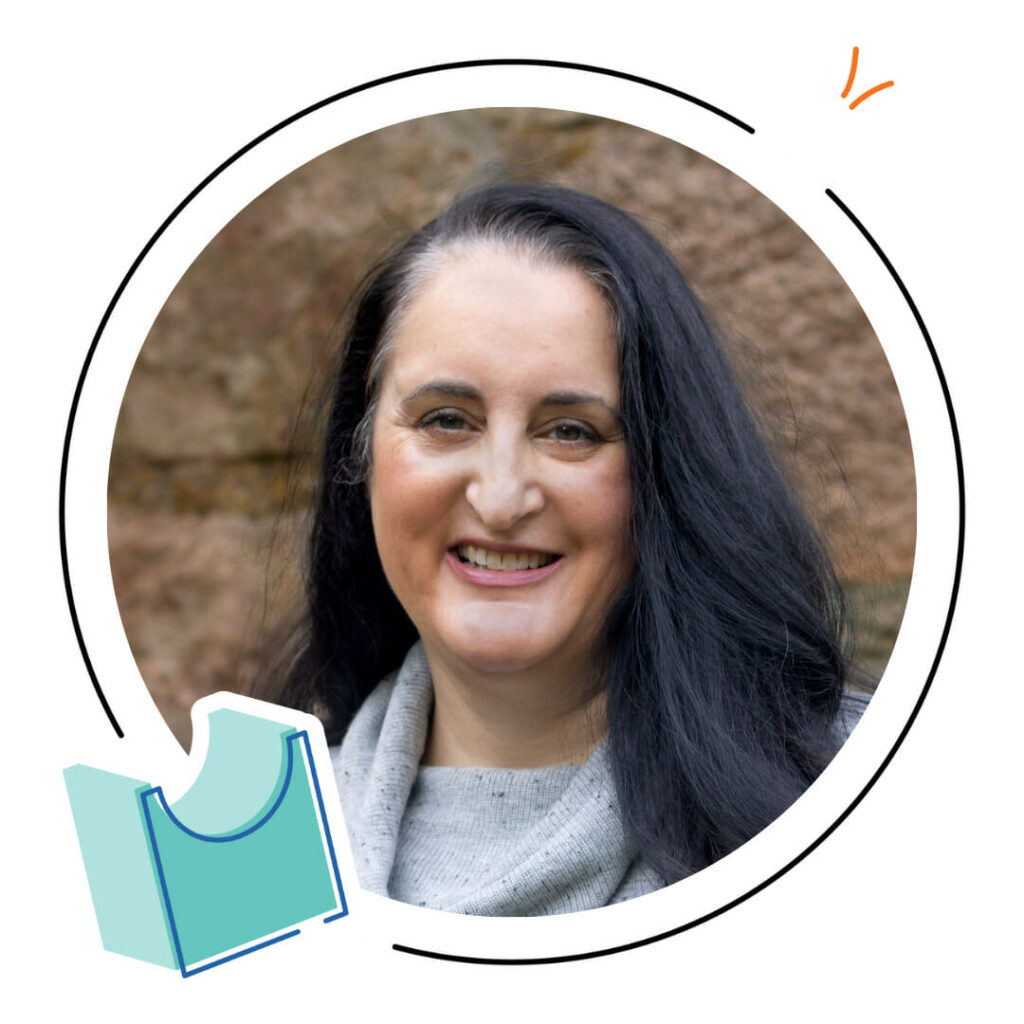
Portrait of a woman with long dark hair, wearing a light gray sweater, smiling in front of a blurred outdoor background, with graphic elements framing the photo—perfect for math teacher resources or a welcoming math teacher lounge.
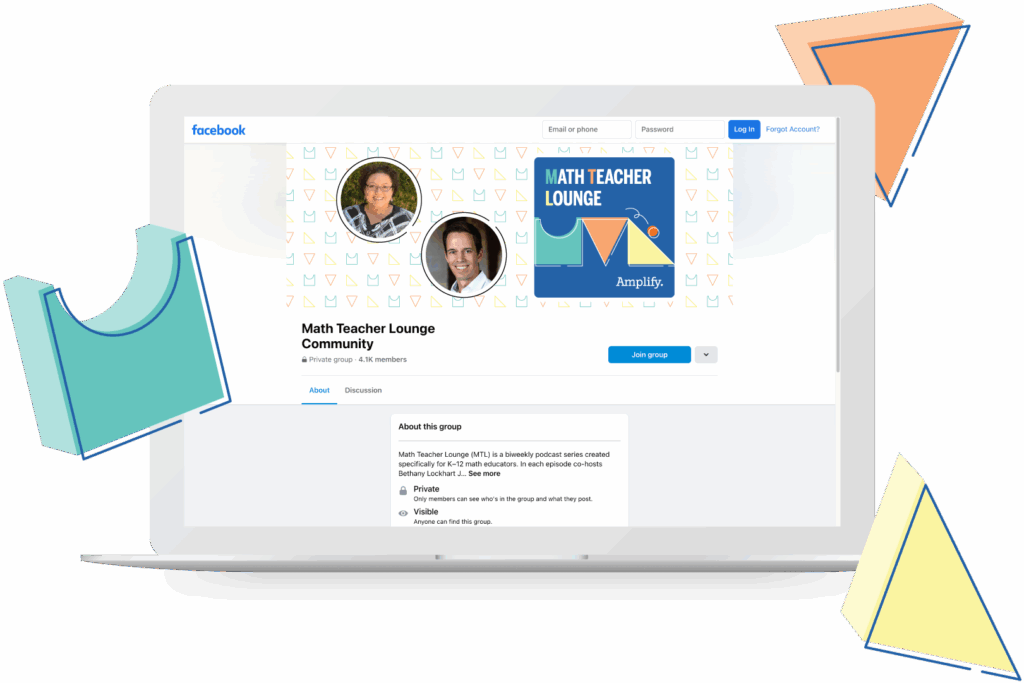
A laptop displaying a Facebook group page for "Math Teacher Lounge Community," featuring profile photos, a group banner, and geometric shapes in the image background.

About Math Teacher Lounge

Math Teacher Lounge is a biweekly podcast created specifically for K–12 math educators. In each episode co-hosts Bethany Lockhart Johnson (@lockhartedu) and Dan Meyer (@ddmeyer) chat with guests, taking a deep dive into the math and educational topics you care about.

Join the Math Teacher Lounge Facebook group to continue the conversation, view exclusive content, interact with fellow educators, participate in giveaways, and more!
Welcome to your Amplify Desmos Math Pilot!

We’re thrilled to welcome you to the Amplify family, and we look forward to making your experience with Amplify Desmos Math successful from day one.

On this site, you’ll find resources, tips, videos, and other helpful information designed to support you throughout your pilot experience.

A man in a plaid shirt sits at a desk with a laptop and a pencil holder, with educational posters and drawings on the wall behind him.

Tips for getting started

It takes time to learn any new program and get used to its patterns and flow—time that you aren’t always afforded in a pilot situation. Based on our work with pilot teachers who are now happy users, we can tell you with 100% confidence that it gets easier. In no time, you’ll be preparing and delivering all your lessons with ease.

As you get comfortable with the organization of each unit and the ways one lesson flows into the next, you’ll find the following resources helpful.

Helpful links for getting started

Topic

Description

Link

Introduction to the program

Getting to know Amplify Desmos Math

Program Overview brochure
K–5 Lesson Walkthrough (video)
6–A1 Lesson Walkthrough (video) 
Lesson structure (K–1, 2–5, 6–A1)

Accessing Amplify Classroom

Logging in and navigating the platform

Accessing Amplify Desmos Math (video)
Educator Home navigation

Preparing to teach a lesson

Manipulatives (kits and virtual) and Centers Kits

Exploring ready-to-go Centers materials and unleashing your creativity with the world’s best manipulatives

Materials and classroom setup
Unboxing your Centers Kits (K–5)
Exploring Polypad Virtual Manipulatives

How to use the Teacher Dashboard

Getting started with and using the Teacher Dashboard

Using the Teacher Dashboard
Try It: Teacher Dashboard

Advanced topics: Snapshots, Students uploading images, Giving students feedback, Companion and Projector Mode, Sketch Everywhere tool

Fluency Practice

A learner’s guide for using our adaptive digital fluency resource

Getting started with Fluency Practice
Accessing Fluency Practice

Assessments

Guidance for understanding assessment resources

Assessment overview
Admin reports
mCLASS®Beginning-of-Year Screener (video)

Differentiation and practice

Resources available to support student learning

Differentiation and practice

Support resources you may want to use during your pilot

Resource

Description

Link

Help articles and PD videos

Access articles, videos, and step-by-step guides to help answer your questions and guide you through your Amplify Desmos Math implementation. See Amplify Desmos Math in action in real classrooms.

Help Articles support page
Amplify Desmos Math PD Library

Unit Zero (K–5)

Get teachers and students familiar with the routines and structure of Amplify Desmos Math. Unit Zero is a set of five optional lessons and resources designed to support the first five days before Unit 1.

Unit Zero overview

In each grade-level collection on learning.amplify.com before Unit 1

Caregiver Hub

Get families involved in the process of learning math by sharing the link to our Caregiver Hub in your home communications, offering access to subunit summaries and practice.

amplify.com/caregiver-hub/

In-the-moment instructional suggestions

Answer questions that frequently arise when teachers shift to a problem-based approach, with these cards that include tips on how to respond to common challenges while teaching.

Instructional support cards

The Five Instructional Shifts of Problem-Based Learning

Read this ebook describing what the five main shifts look and feel like as you infuse a more student-centered approach into your math instruction.

Ebook

Instructional and math language routine cards

Use routines to create a powerful, practical force for establishing a classroom learning community and engaging students in conversations during math. Facilitation guides and routine cards provide instructions for routines you can use in your math classroom.

Facilitation guides for routines in Amplify Desmos Math

K–5 routines cards
6–A1 routines cards

Infusing Problem-Based Learning Into Math Classrooms

A quick guide to starting the shift to problem-based learning, this ebook includes a host of resources from the Amplify math Symposium and the Math Teacher Lounge Podcast.

Ebook

Making the Shift to Problem-Based Learning

In this ebook, we’ll go through what problem-based learning is, why it’s becoming so critical to math instruction, and how to start making the shift with a form of professional learning: Learning Labs.

Ebook

Asset-Based Assessment

This ebook summarizes what asset-based assessment is and how it benefits students.

Ebook

A man with short dark hair wearing a white shirt is smiling at the camera, with yellow geometric shapes in the background.

Want to learn more from Amplify experts?

Amplify offers a wide variety of learning opportunities outside our pilot meeting times: 

Our math webinar library hosts all our past sessions.

Our Events page is where you can search for and register to attend upcoming math webinars.

The Amplify Blog is a great resource for helpful articles and research-based information.

Inspiring the next generation of South Carolina scientists, engineers, and curious citizens

Amplify Science is an engaging new core curriculum designed for three-dimensional, phenomena-based learning.

Amplify Science was developed by the science education experts at UC Berkeley’s Lawrence Hall of Science and the digital learning team at Amplify.

Collage showing students engaged in classroom science activities and two scientific illustrations: a cheetah in foliage and a diagram of clouds and raindrops above a hill.

Our Instructional model

The Amplify Science program is rooted in the proven, research-based pedagogy of Do, Talk, Read, Write, Visualize. Here’s how each element works:

DO
First-hand investigations are an important part of any science classroom, and Amplify Science has students getting hands-on in every unit, from building models of protein molecules to experimenting with electrical systems.

TALK
Student-to-student discourse and full class discussions are an integral part of the program. Students are provided with numerous opportunities to engage in meaningful oral scientific argumentation, all while fostering a collaborative classroom environment.

READ
Students read scientific articles, focusing their reading activities on searching for evidence related to their investigation, and importantly, on asking and recording questions as they read through fascinating texts on 21st-century topics.

WRITE
Following real-world practices, students write scientific arguments based on evidence they’ve collected, making clear their reasoning about how a given piece of evidence connects to one of several claims.

VISUALIZE
By manipulating digital simulations and using modeling tools to craft visualizations of their thinking— just as real scientists and engineers do—students take their learning far beyond the confines of what they can physically see in the classroom in an exciting and authentic way.

Explore the Digital Teacher’s Guide

When you’re ready to review, click the orange button below and use your provided login credentials to access the Amplify Science Digital Teacher’s Guide. If you need login credentials, contact Jeff Rutter, jrutter@amplify.com.

Resources to support your review

Scope and sequence

GRADE
UNIT
Kindergarten
  • Needs of Plants and Animals
  • Pushes and Pulls
  • Sunlight and Water
Grade 1 
  • Animal and Plant Defenses
  • Light and Sound
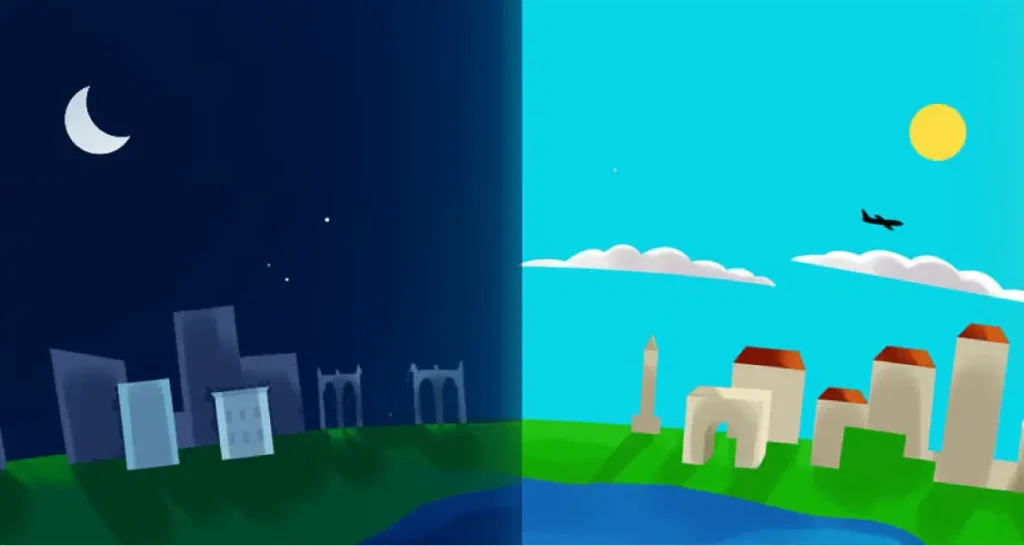
  • Spinning Earth
Grade 2 
  • Plant and Animal Relationships
  • Properties of Materials
  • Changing Landforms
Grade 3 
  • Balancing Forces
  • Inheritance and Traits
  • Environments and Survival
  • Weather and Climate
Grade 4 
  • Energy Conversions
  • Vision and Light
  • Earth’s Features
  • Waves, Energy, and Information
Grade 5 
  • Patterns of Earth and Sky
  • Modeling Matter
  • The Earth System
  • Ecosystem Restoration
Grade
Units

Grade 6

  • Launch: Microbiome
  • Metabolism
  • Metabolism Engineering Internship
  • Thermal Energy
  • Plate Motion
  • Plate Motion Engineering Internship
  • Rock Transformations
  • Weather Patterns
  • Ocean, Atmosphere, and Climate

Grade 7

  • Launch: Harnessing Human Energy
  • Phase Change
  • Phase Change Engineering Internship
  • Magnetic Fields
  • Earth’s Changing Climate
  • Earth’s Changing Climate Engineering Internship
  • Chemical Reactions
  • Populations and Resources
  • Matter and Energy in Ecosystems

Grade 8

  • Launch: Geology on Mars
  • Earth, Moon, and Sun
  • Light Waves
  • Force and Motion
  • Force and Motion Engineering Internship
  • Traits and Reproduction
  • Natural Selection
  • Natural Selection Engineering Internship
  • Evolutionary History

South Carolina College- and Career-Ready Science Standards 2021

Amplify Science was designed from the ground up to meet the Next Generation Science Standards (NGSS), and the South Carolina College- and Career-Ready Science Standards 2021 are closely aligned to the NGSS at K-8. The guidance below is meant to provide support for integrating additional companion activities that support full coverage of the South Carolina College- and Career-Ready Science Standards 2021.

Organized by grade level, each section below will outline:

  • Additional activities that support 100% alignment to the  South Carolina College- and Career-Ready Science Standards 2021; 
  • The standard being addressed with the activities; 
  • The recommended placement of the activities within a specific Amplify Science unit; and 
  • PDFs of any accompanying materials that are necessary to implement the activities.

Standard: MS-PS1-4: Develop a model that predicts and describes changes in particle motion, temperature, and state of a pure substance when thermal energy is added or removed.
Recommended placementThermal Energy unit, Lesson 4.4, addition to Activity 3
Materials“Liquid Oxygen”
By reading the article “Liquid Oxygen,” which describes how the relationship between attraction and kinetic energy determines when a substance changes phase, students extend their understanding of the possible effects of adding or removing thermal energy to include changes in state (phase). Oxygen is one of the most common elements in the world, but most people are only familiar with oxygen in the gas phase. Because oxygen molecules are only weakly attracted to one another, condensing oxygen is difficult. This article introduces students to molecular attraction and discusses its role in phase change, including how it can be used to turn oxygen from a gas to a liquid.
Instructions:
Download PDFs of the “Liquid Oxygen” and distribute it to students. Before they begin reading, remind students of the Active Reading Guidelines. 

Standard: MS-PS4-2: Develop and use a model to describe that waves are reflected, absorbed, or transmitted through various materials.
Recommended placementWeather Patterns unit, Lesson 4.4, addition to Activity 3
Materials“Harvesting Sunlight”, “Why No One in Space Can Hear You Scream” and “Making Waves at Swim Practice”
After investigating weather patterns, which includes a focus of the effects of energy from sunlight, students extend their learning about light by reading three articles about light and other waves.
“Harvesting Sunlight:” Students read this article to learn about the types of light from the sun that plants use for photosynthesis. The article describes how the sun emits all types of light, but plants can only use certain types of visible light for photosynthesis, mostly red and blue light. Plants also absorb other types of light, and these types of light affect plants in different ways. Students use this information to gather evidence that there are different types of light that can affect a material in different ways.
“Why No One in Space Can Hear You Scream:” Students read this article to learn about how waves are transmitted. Explosions that would be deafening on Earth are silent in space. This is because sound is produced by sound waves and, unlike light waves, sound waves need matter to travel through. Reading about this phenomenon helps students understand the similarities and differences between mechanical and electromagnetic waves.
“Making Waves at Swim Practice:” A practice for the school swim team provides an everyday context for discussing light waves and sound waves in this engaging article. First, the article explores sound waves traveling through different materials–the air, the water of the pool, and even a metal poolside bench. Students discover that sound waves travel at different speeds in different materials. The later part of the article discusses light waves, which also travel at different speeds in different materials. As light waves move from one material to another, they change speed and bend. This bending of light waves is called refraction, and it explains why objects that are partly in the water and partly out of the water (such as the legs of a person sitting on the side of a pool) appear ripply and bent.
Instructions:
Plan one class period for each article. Download PDFs of the  “Harvesting Sunlight,” “Why No One in Space Can Hear You Scream,” and “Making Waves at Swim Practice” articles. For each article, before students begin reading, preview the article and discuss what students already know and what they wonder about the topic, then remind students of the Active Reading Guidelines. 

Standard: MS-PS2-3: Ask questions about data to determine the factors that affect the strength of electric and magnetic forces. MS-PS2-5: Conduct an investigation and evaluate the experimental design to provide evidence that fields exist between objects exerting forces on each other even though the objects are not in contact.
Recommended placementHarnessing Human Energy unit, Lesson 3.4, after Activity 1
Materials“Earth’s Geomagnetism” and “Painting with Static Electricity”
After concluding their investigations of energy transfers and conversions, students read two articles that introduce the topic of forces that act at a distance.
“Earth’s Geomagnetism:” What makes a compass needle point north, no matter what? This article introduces students to Earth’s geomagnetic field and the field lines scientists use to show its direction.
“Painting with Static Electricity:” This article gives students the opportunity to learn about electrostatic fields and forces in the context of spray painting without making a mess. Electrostatic painting systems use electrostatics to draw spray paint toward the object being painted, and nowhere else. Painters charge the object they are painting with a negative charge and the paint with a positive charge. The opposite charges are attracted to one another, causing the paint to move toward the object. This surprising use of electrostatics saves time and paint and keeps things tidy!
Instructions
Plan one class period for each article. Download PDFs of the “Earth’s Geomagnetism” and “Painting with Electricity” articles. For each article, before students begin reading, preview the article and discuss what students already know and what they wonder about the topic, then remind students of the Active Reading Guidelines. 

What’s included

Science articles
The middle school science articles serve as sources for evidence collection and were authored by science and literacy experts at the Lawrence Hall of Science.

Illustration of the indirect effects of overfishing on northern benguela jelly populations displayed on a laptop screen.

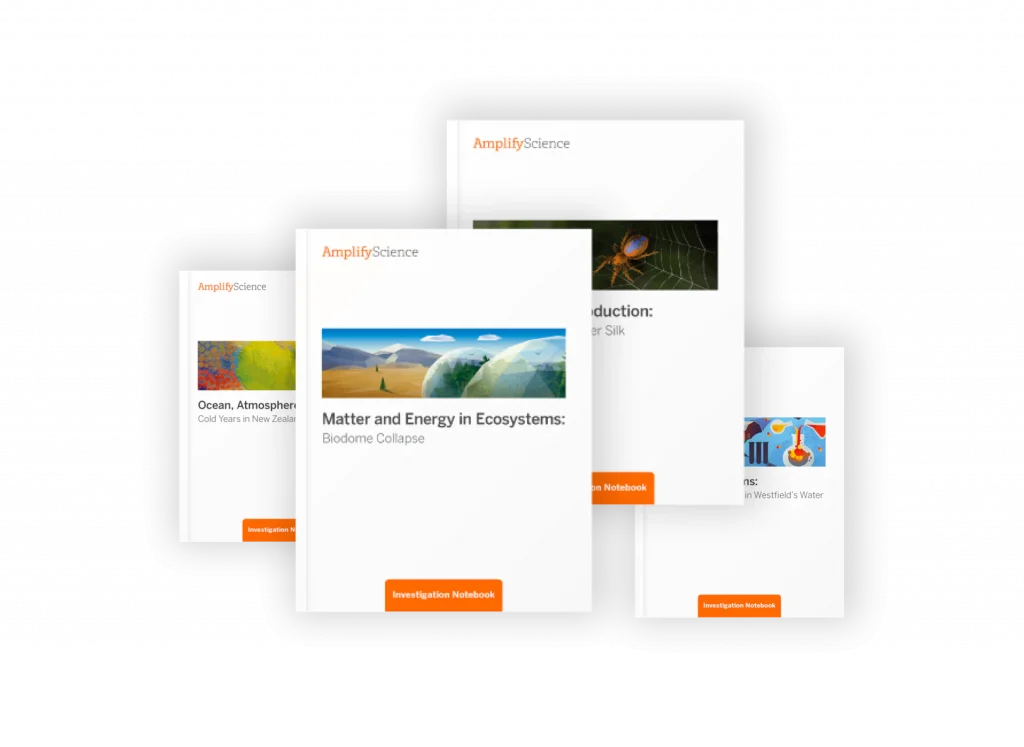
Student Investigation Notebooks
Available for every unit, the Student Investigation Notebooks provide space for students to:

  • Record data
  • Reflect on ideas from texts and investigations
  • Construct explanations and arguments

Available with full-color article compilations for middle school units.

Collection of educational books from 'amplify science' on topics including ocean atmosphere, matter and energy ecosystems, and insect interactions, displayed in various angles.

Digital student experience
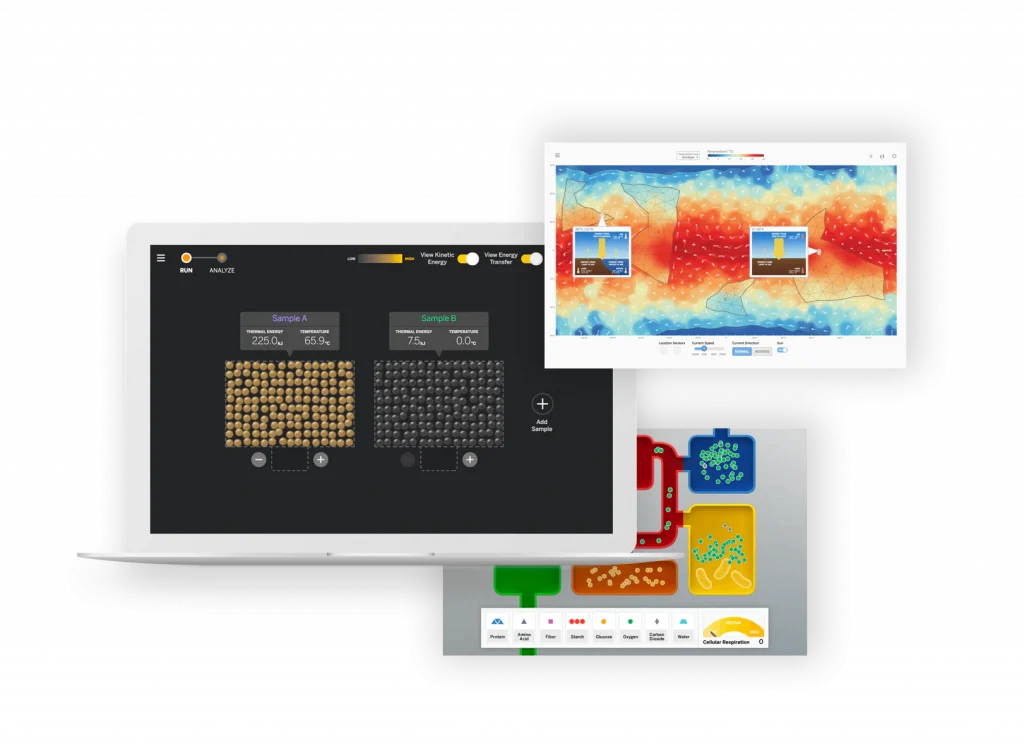
Students access the digital simulations and modeling tools, as well as lesson activities and assessments, through the digital student experience. Students can interact with the digital student experience as they:

  • Conduct hands-on investigations
  • Engage in active reading and writing activities
  • Participate in discussions
  • Record observations
  • Craft end-of-unit scientific arguments
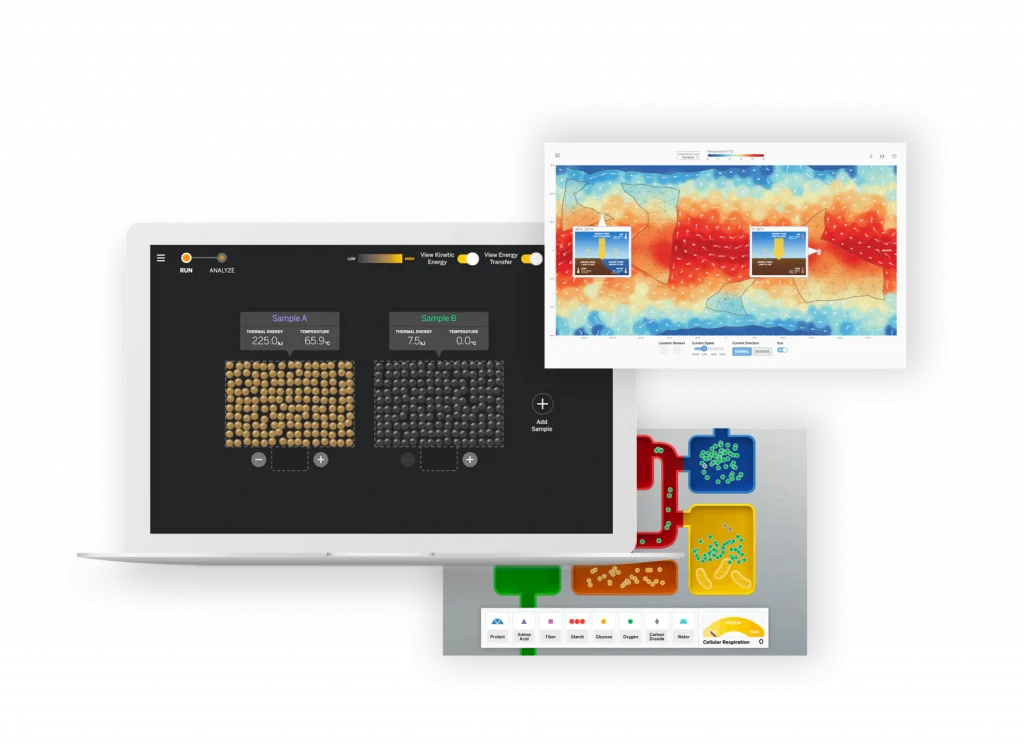
A digital illustration showcasing a laptop and a tablet displaying complex data analysis software interfaces with graphs and heatmaps.

Teacher’s Guides
Available digitally and in print, the Teacher’s Guides contain all of the information teachers need to facilitate classroom instruction, including:

  • Classroom Slides
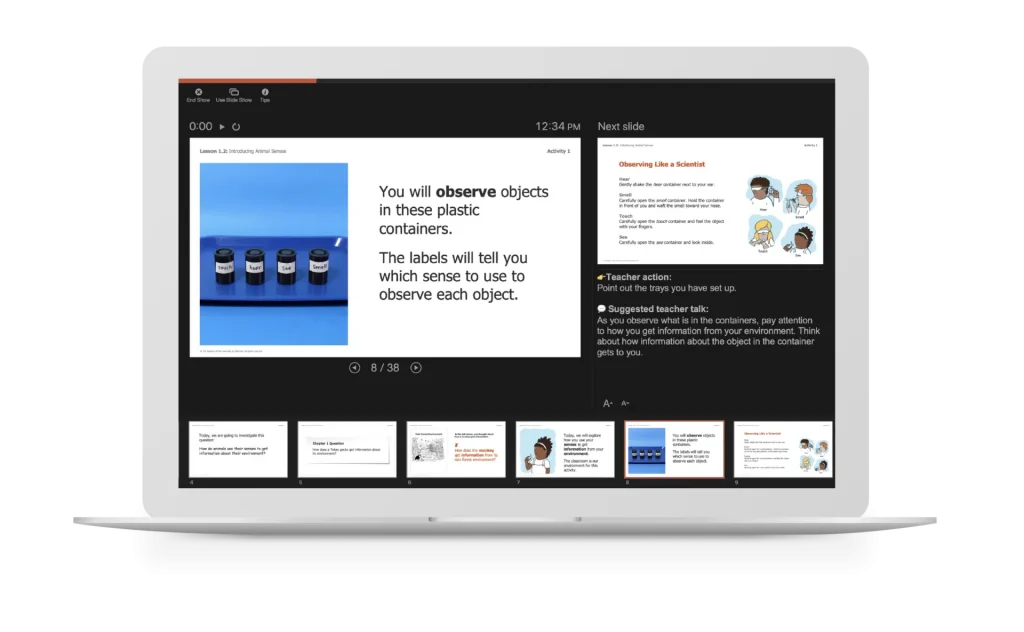
  • Detailed lesson plans
  • Unit and chapter overview documentation
  • Differentiation strategies
  • Standards alignments
  • In-context professional development
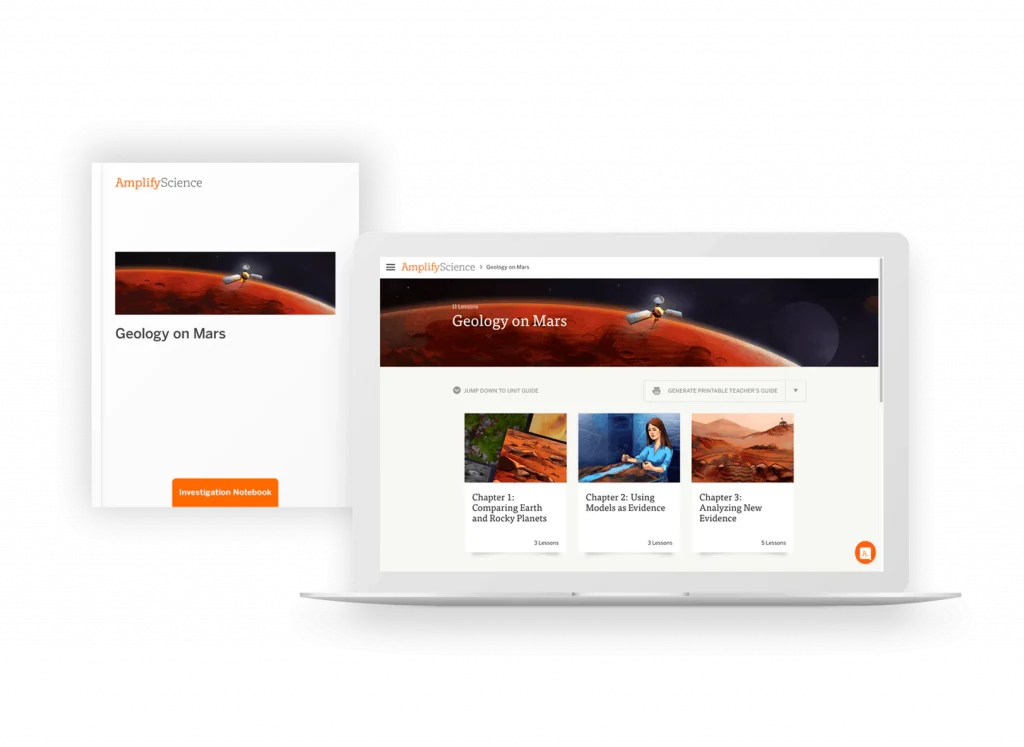
A laptop displaying a website about Mars exploration with a brochure next to it. Both screens show Mars-related images.

Hands-on materials kits
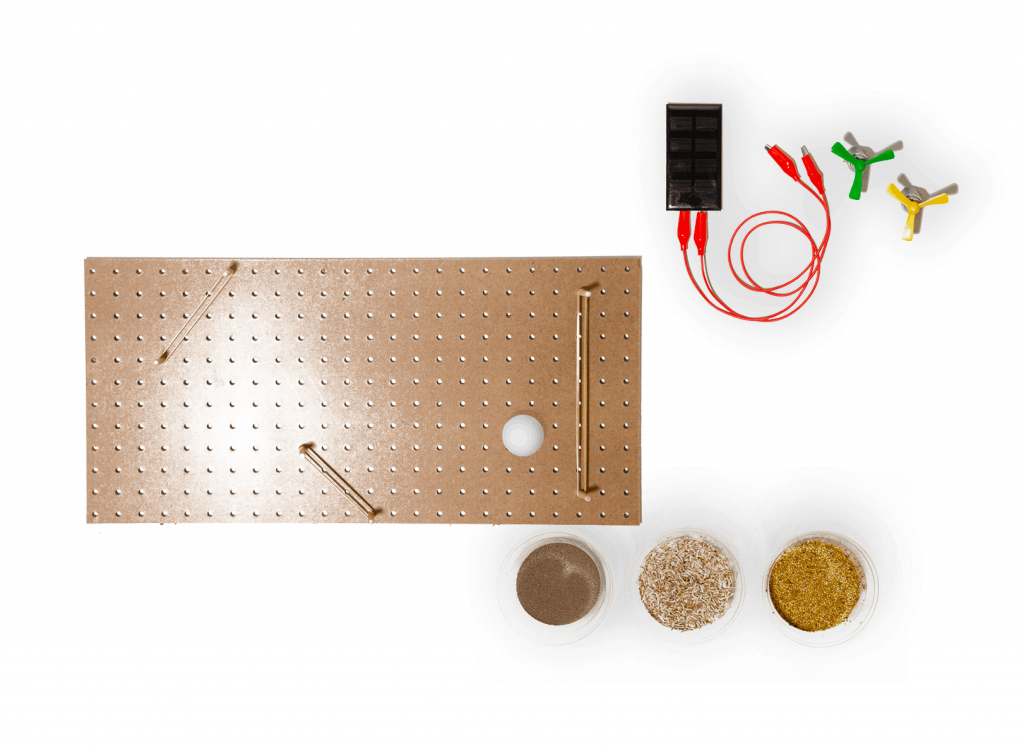
Hands-on learning is at the heart of Amplify Science. Each unit kit contains:

  • Consumable and non-consumable hands-on materials
  • Print classroom display materials
  • Premium print materials for student use (sorting cards, maps, etc.)
A perforated rectangular board, three small containers with different powders, a black battery holder with red wires, and three colored alligator clips are arranged on a white background.

Remote and hybrid learning supports

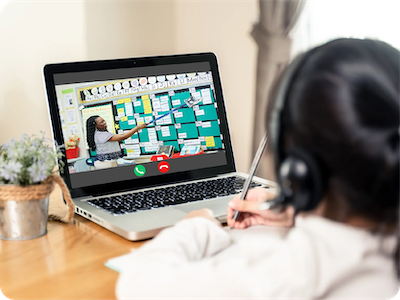
A person sitting at a desk using a laptop, with a bookshelf containing books, a fish tank, and a soccer ball nearby.

Amplify has launched a new remote learning solution called Amplify Science@Home. Intended to make extended remote learning and hybrid learning easier, Amplify Science@Home includes two useful options for continuing instruction: @Home Videos and @Home Units. 

Amplify Science @Home Videos are recordings of real Amplify Science teachers teaching the lessons. For those teachers who are unable to meet synchronously with their students, the recorded lessons are a great way to keep their students on track and engaged with Amplify Science while at home. These videos will be produced for all K–5 units, and for the first four units of each 6–8 grade level. Their release will be rolling, beginning in August.   

Amplify Science@Home Units are modified versions of Amplify Science units, strategically designed to highlight key activities from the program. The @Home Units take significantly less instructional time than the complete Amplify Science program and allow students to engage with science at home. @Home Units will be developed for all Amplify Science K–8 units. Each @Home unit includes:

  • Teacher overviews explaining how to use the materials, including suggestions for enhancing the @Home Units if synchronous learning or in-class time with students is available.
  • Overviews to send home to families.

Student materials are available in two formats:

  • @Home Slides (PDF/PPT) + Student Sheets (PDF) for students with access to technology at home.
  • Downloadable @Home Packets (PDF) for students without access to technology at home.

Download the Remote and hybrid learning guide.

Looking for help?

Powerful (and free!) pedagogical support

Amplify provides a unique kind of support you won’t find from other publishers. We have developed an educational support team of former teachers and administrators who provide pedagogical support for every Amplify curriculum, assessment, and intervention program. This service is completely free for all educators who are using our programs and includes:

  • Guidance for developing lesson plans and intervention plans
  • Information on where to locate standards and other planning materials
  • Recommendations and tips for day-to-day teaching with Amplify programs
  • Support with administering and interpreting assessment data and more

To reach our pedagogical team, use our live chat within your program, call (800) 823-1969, or email edsupport@amplify.com

Timely technical and program support

Our technical and program support is included and available from 7 a.m. to 7 p.m. ET, Monday through Friday, through a variety of channels, including a live chat program that enables teachers to get immediate help in the middle of the school day.

For your most urgent questions:

  • Use our live chat within your program
  • Call our toll-free number: (800) 823-1969

For less urgent questions:

Contact us

Contact your South Carolina team representatives:
Jeff Rutter
Field Manager
jrutter@amplify.com
(727) 512-8440

Cathy McMillan
Senior Account Executive
cmcmillan@amplify.com
(904) 465-9904

Inspiring the next generation of Massachusetts scientists, engineers, and curious citizens

Amplify Science is an engaging new core curriculum designed for three-dimensional, phenomena-based learning.

Collage of four images: a jungle illustration with a giraffe, students using computers, a boy studying with classmates, and an animated hillside with kites flying.

A powerful partnership

Amplify Science was developed by the science education experts at UC Berkeley’s Lawrence Hall of Science and the digital learning team at Amplify. This partnership extends to 2032, allowing us to continuously improve our program and provide our customers with the most up-to-date enhancements, free of charge. Get a glimpse at our latest back-to-school updates here.

Instructional model

The Amplify Science program is rooted in the proven, research-based pedagogy of Do, Talk, Read, Write, Visualize. Here’s how each element works:

Three blue panels describing educational activities: "hands-on science" with lab experiments, "discuss" with collaborative learning, and "read" with literacy in science articles.

Phenomena-based approach

In each Amplify Science unit, students take on the roles of scientists or engineers in order to investigate a real-world problem. Students work to define the problem and collect and make sense of evidence. Once the context is clear, students collect evidence from multiple sources and through a variety of modalities. At the end of the unit, students are presented with a brand new problem, giving them an opportunity to apply what they’ve learned over the course of the unit to a new context. This represents a shift from asking students to learn about science to supporting students in figuring out the science.

Flowchart of a learning unit divided into four chapters, showing stages of student engagement from introduction to application, with assessments indicated at various points.

Resources to support your review

Scope and Sequence

GRADE

Kindergarten

UNITS

  • Needs of Plants and Animals
  • Pushes and Pulls
  • Sunlight and Water

Grade 1

  • Needs of Plants and Animals
  • Pushes and Pulls
  • Sunlight and Water

Grade 2

  • Plant and Animal Relationships
  • Properties of Materials
  • Changing Landforms

Grade 3

  • Balancing Forces
  • Inheritance and Traits
  • Environments and Survival
  • Weather and Climate

Grade 4

  • Energy Conversions
  • Vision and Light
  • Earth’s Features
  • Waves, Energy, and Information

Grade 5

  • Patterns of Earth and Sky
  • Modeling Matter
  • The Earth System
  • Ecosystem Restoration

Flexible implementation

One of the key features of Amplify Science is the flexibility that it offers. We give students authentic opportunities to experience the full breadth of what it means to be a scientist or engineer. Just as scientists gather evidence from many types of sources, so do students in our program. Like scientists, students gather evidence not just from physical models, but also from digital models, texts, videos, photographs, maps, data sets, and even their peers!
Simply put, real scientists don’t just get messy—they read, write, analyze, hypothesize, model, test, and communicate with purpose, too.

Illustration of the indirect effects of overfishing on northern benguela jelly populations displayed on a laptop screen.

Student Books
Beginning and young readers have unique developmental needs, and science instruction should support these students in reading more independently as they progress through sections of content, the school year, and each grade. One way Amplify Science meets these needs is by strategically deploying different modes of reading throughout each unit: Read-Aloud, Shared Reading, and Partner Reading.

A collage of various educational book covers related to science and math, featuring illustrated themes like sports, nature, and energy.

Student Investigation Notebooks

Available for every unit, the Student Investigation Notebooks provide space for students to:

  • record data.
  • reflect on ideas from texts and investigations.
  • construct explanations and arguments.
Collection of educational books from 'amplify science' on topics including ocean atmosphere, matter and energy ecosystems, and insect interactions, displayed in various angles.

Digital student experience

Students access the digital simulations and Modeling Tools, as well as lesson activities and assessments, through the digital student experience. Students can interact with the digital student experience as they:

  • conduct hands-on investigations.
  • engage in Active Reading and writing activities.
  • participate in discussions.
  • record observations.
  • craft end-of-unit scientific arguments.

Dive into a quick example of our powerful simulations

Grades K–5 simulation

A digital illustration showcasing a laptop and a tablet displaying complex data analysis software interfaces with graphs and heatmaps.

Hands-on materials kits

Hands-on learning is at the heart of Amplify Science and is integrated
into every unit. Students actively take on the roles of scientists and engineers as they gather evidence, think critically, solve problems, and develop and defend claims about the world around them.

Check out this 2-minute video to see an Amplify Science hands-on investigation in action.

Each unit kit contains:

  • consumable and non-consumable hands-on materials.
  • print classroom display materials.
  • premium print materials for student use (sorting cards, maps, etc.).
A perforated rectangular board, three small containers with different powders, a black battery holder with red wires, and three colored alligator clips are arranged on a white background.

Teaching support

Available digitally and in print, the Teacher’s Guides contain all of the information teachers need to facilitate classroom instruction, including:

  • detailed lesson plans.
  • unit and chapter overview documentation.
  • differentiation strategies.
  • standards alignments.
  • in-context professional development.
A laptop displaying the Geology on Mars webpage sits beside a book titled "Geology on Mars," both featuring the same cover image of Mars and a spacecraft, perfect for enhancing three-dimensional learning in any science classroom.

Massachusetts Academic Standards in Science coverage

Amplify Science was designed from the ground up to meet the NGSS, a set of standards that closely align with the Massachusetts Learning Standards for Science coverage. Most grade levels’ respective set of Amplify Science units therefore address the necessary MASS (see correlation). 

For grades K, 1, 2, 3, and 5, teachers should plan to also use the resources provided in the sections below to achieve full coverage of the appropriate standards before their students move on to the next grade band. Organized by grade level, each section outlines:

  • companion lesson materials that were written to support 100% alignment to the Massachusetts Learning Standards for Science coverage when used with the core Amplify Science units for the grade level
  • the standard being addressed with each companion lesson; and
  • the recommended placement of each companion lesson within a specific Amplify Science unit

Standard: K-PS1-1(MA). Investigate and communicate the idea that different kinds of materials can be solid or liquid depending on temperature.

Recommended placement: Following Lesson 5.6 of Sunlight and Weather

Resources: After students finish reflecting on their unit-long exploration of energy and temperature, play and discuss this read-aloud video of the student book Can you Change it Back?, which is featured in the grade 2 unit Properties of Materials. You might also consider borrowing the physical books from a grade 2 colleague’s Properties of Materials kit and reading it as a class instead of or in addition to playing the video.

Using the book, you will introduce students to the idea that heating and cooling can cause changes to materials. In the book, students are presented with a variety of materials and asked to predict whether a certain change caused by heating or cooling is reversible or irreversible.

Companion lesson: “Seasonal Changes”

Standard: 1-ESS1-2– Analyze provided data to identify relationships among seasonal patterns of change, including relative sunrise and sunset time changes, seasonal temperature and rainfall or snowfall patterns, and seasonal changes to the environment.

Recommended placement: Following Lesson 5.1 of Spinning Earth

Resources: Season Changes Classroom Slides and Student Sheet

Companion lesson: “Properties and Weight”

Standard: 2-PS1-3– Analyze a variety of evidence to conclude that when a chunk of material is cut or broken into pieces, each piece is still the same material and, however small each piece is, has weight. Show that the material properties of a small set of pieces do not change when the pieces are used to build larger objects.

Recommended placement: Following Lesson 4.4 of Properties of Materials.

Resources: Weight and Properties Classroom SlidesResources, and Student Sheet

Companion lesson 1: Extinct Insects

Standard: 3-LS4-1: Use fossils to describe types of organisms and their environments that existed long ago and compare those to living organisms and their environments. Recognize that most kinds of plants and animals that once lived on Earth are no longer found anywhere.

Recommended placement: Following Lesson 2.3 of Environments and Survival

Resources: Extinct Insects Classroom Slides and Student Sheet

Companion lesson 2: Friction

Standard: 3-PS2-1: Provide evidence to explain the effect of multiple forces, including friction, on an object. Include balanced forces that do not change the motion of the object and unbalanced forces that do change the motion of the object.

Recommended placement: Following Lesson 1.1 of Balancing Forces

Resources: Friction Classroom SlidesResources, and Student Sheet

Companion lesson 1: Composters

Standard: 5-LS2-2(MA)– Compare at least two designs for a composter to determine which is most likely to encourage decomposition of materials.

Recommended placement: Following Lesson 3.7 of Ecosystem Restoration

Resources: Composters Classroom Slides and Student Sheet

Companion lesson 2: Properties of Materials

Standard: 5-PS1-3 (MA) – Make observations and measurements of substances to describe characteristic properties of each, including color, hardness, reflectivity, electrical conductivity, thermal conductivity, response to magnetic forces, and solubility.

Recommended placement: Following Lesson 1.3 of Modeling Matter

Resources: Properties of Materials Classroom SlidesResourcesArticlesCopymaster, and Student Sheet

Companion lesson 3: Water Filters

Standard: 5-ESS3-2(MA)– Test a simple system designed to filter particulates out of water and propose one change to the design to improve it.

Recommended placement: Following Lesson 5.6 of The Earth System

Resources: Water Filters Classroom Slides and Student Sheet

Benchmark Assessments

Amplify’s Benchmark Assessments are designed to help teachers measure student progress toward the three dimensions—Disciplinary Core Ideas (DCIs), Science and Engineering Practices (SEPs), and Crosscutting Concepts(CCCs)—and performance expectations (PEs) of the NGSS. The assessments provide important insight into how students are progressing toward mastery of different standards ahead of high-stakes, end-of-year assessments.

The Benchmark Assessments are built to be delivered after specific units in the recommended Amplify Science scope and sequence.* They are given three or four times per year, depending on the grade level. The benchmarks are intended to show progress at various points in time across a school year, and are therefore not summative in nature. Digital items and item clusters are also tagged to specific NGSS standards, allowing customization to align with other course sequences. The assessments are available via the following platforms:

Print
PDF files: For administering Benchmark Assessments on paper

Digital platforms

  • Illuminate
  • SchoolCity
  • Otus
  • QTI (“Question and Test Interoperability”) files
    Not sure whether QTI files are compatible with your assessment platform? Contact your school IT or assessment platform representative for more information.
    Please note that Amplify is able to provide access to the QTI files themselves, but is not able to support the integration process. Your assessment platform provider should be able to assist with QTI file integration.

Remote and hybrid learning support

A child sits at a desk using a laptop. Next to the desk is a bookshelf with books, a fishbowl, and a soccer ball.

See an example of our remote and hybrid learning support below:

Intended to make extended remote and hybrid learning easier, Amplify Science @Home includes two useful options for continuing instruction: @Home Videos and @Home Units.
Amplify Science @Home Videos are recordings of real Amplify Science teachers teaching the lessons. For those teachers who are unable to meet synchronously with their students, the recorded lessons are a great way to keep their students on track and engaged with Amplify Science while at home.

Amplify Science @Home Units are modified versions of Amplify Science units, strategically designed to highlight key activities from the program. The @Home Units take significantly less instructional time than the complete Amplify Science program and allow students to engage with science at home. Each @Home unit includes:

  • Teacher overviews explaining how to use the materials, including suggestions for enhancing the @Home Units if synchronous learning or in-class time with students is available
  • Overviews to send home to families

Student materials will be available in two formats:

  • @Home Slides (PDF/PPT) + Student Sheets (PDF) for students with access to technology at home
  • Downloadable @Home Packets (PDF) for students without access to technology at home

Download the remote and hybrid learning guide

Explore the digital Teacher’s Guide

To familiarize yourself with navigation of the digital Teacher’s Guide, watch our navigational guide videos:

Grades K–5:

Looking for help?

Powerful (and free!) pedagogical support

Amplify provides a unique kind of support you won’t find from other publishers. We’ve developed an educational support team of former teachers and administrators who provide pedagogical support for every Amplify curriculum, assessment, and intervention program. This service is completely free for all educators who are using our programs and includes:

  • Guidance for developing lesson plans and intervention plans.
  • Information on where to locate standards and other planning materials.
  • Recommendations and tips for day-to-day teaching with Amplify programs.
  • Support with administering and interpreting assessment data and more.

Timely technical and program support

Our technical and program support is included and available Monday through Friday, from 7 a.m. to 7 p.m. ET, through a variety of channels, including a live chat program that enables teachers to get immediate help in the middle of the school day.

Ready to dive in?

Contact your Massachusetts representative:

Tracy Yefimenko
518-466-3497
tyefimenko@amplify.com

A powerful partnership

Amplify Science was developed by the science education experts at UC Berkeley’s Lawrence Hall of Science and the digital learning team at Amplify. This partnership extends to 2032, allowing us to continuously improve our program and provide our customers with the most up-to-date enhancements, free of charge. Get a glimpse at our latest back-to-school updates here.

Instructional model

The Amplify Science program is rooted in the proven, research-based pedagogy of Do, Talk, Read, Write, Visualize. Here’s how each element works:

Three blue panels describing educational activities: "hands-on science" with lab experiments, "discuss" with collaborative learning, and "read" with literacy in science articles.

Phenomena-based approach

In each Amplify Science unit, students take on the roles of scientists or engineers in order to investigate a real-world problem. Students work to define the problem and collect and make sense of evidence. Once the context is clear, students collect evidence from multiple sources and through a variety of modalities. At the end of the unit, students are presented with a brand new problem, giving them an opportunity to apply what they’ve learned over the course of the unit to a new context. This represents a shift from asking students to learn about science to supporting students in figuring out the science.

Flowchart of a learning unit divided into four chapters, showing stages of student engagement from introduction to application, with assessments indicated at various points.

Resources to support your review

Remote and hybrid learning support

A child sits at a desk using a laptop. Next to the desk is a bookshelf with books, a fishbowl, and a soccer ball.

See an example of our remote and hybrid learning support below:

This fall, Amplify launched a new remote learning solution called Amplify Science@Home. Intended to make extended remote and hybrid learning easier, Amplify Science @Home includes two useful options for continuing instruction: @Home Videos and @Home Units.
Amplify Science @Home Videos are recordings of real Amplify Science teachers teaching the lessons. For those teachers who are unable to meet synchronously with their students, the recorded lessons are a great way to keep their students on track and engaged with Amplify Science while at home. These videos will be produced for all K–5 units, and for the first four units of each 6–8 grade level. Their release will be rolling, beginning in August.

Amplify Science @Home Units are modified versions of Amplify Science units, strategically designed to highlight key activities from the program. The @Home Units take significantly less instructional time than the complete Amplify Science program and allow students to engage with science at home. @Home Units will be developed for all Amplify Science K–8 units. Each @Home unit includes:

  • Teacher overviews explaining how to use the materials, including suggestions for enhancing the @Home Units if synchronous learning or in-class time with students is available
  • Overviews to send home to families

Student materials will be available in two formats:

  • @Home Slides (PDF/PPT) + Student Sheets (PDF) for students with access to technology at home
  • Downloadable @Home Packets (PDF) for students without access to technology at home

Download the remote and hybrid learning guide

Benchmark Assessments

Amplify’s Benchmark Assessments are designed to help teachers measure student progress toward the three dimensions—Disciplinary Core Ideas (DCIs), Science and Engineering Practices (SEPs), and Crosscutting Concepts(CCCs)—and performance expectations (PEs) of the NGSS. The assessments provide important insight into how students are progressing toward mastery of different standards ahead of high-stakes, end-of-year assessments.

The Benchmark Assessments are built to be delivered after specific units in the recommended Amplify Science scope and sequence.* They are given three or four times per year, depending on the grade level. The benchmarks are intended to show progress at various points in time across a school year, and are therefore not summative in nature. Digital items and item clusters are also tagged to specific NGSS standards, allowing customization to align with other course sequences. The assessments are available via the following platforms:

Print
PDF files: For administering Benchmark Assessments on paper

Digital platforms

  • Illuminate
  • SchoolCity
  • Otus
  • QTI (“Question and Test Interoperability”) files
    Not sure whether QTI files are compatible with your assessment platform? Contact your school IT or assessment platform representative for more information.
    Please note that Amplify is able to provide access to the QTI files themselves, but is not able to support the integration process. Your assessment platform provider should be able to assist with QTI file integration.

Flexible implementation

One of the key features of Amplify Science is the flexibility that it offers. We give students authentic opportunities to experience the full breadth of what it means to be a scientist or engineer. Just as scientists gather evidence from many types of sources, so do students in our program. Like scientists, students gather evidence not just from physical models, but also from digital models, texts, videos, photographs, maps, data sets, and even their peers!
Simply put, real scientists don’t just get messy—they read, write, analyze, hypothesize, model, test, and communicate with purpose, too.

Science articles

The middle school science articles serve as sources for evidence collection and were authored by science and literacy experts at the Lawrence Hall of Science.

Illustration of the indirect effects of overfishing on northern benguela jelly populations displayed on a laptop screen.

Student Books
Beginning and young readers have unique developmental needs, and science instruction should support these students in reading more independently as they progress through sections of content, the school year, and each grade. One way Amplify Science meets these needs is by strategically deploying different modes of reading throughout each unit: Read-Aloud, Shared Reading, and Partner Reading.

A collage of various educational book covers related to science and math, featuring illustrated themes like sports, nature, and energy.

Student Investigation Notebooks

Available for every unit, the Student Investigation Notebooks provide space for students to:

  • record data.
  • reflect on ideas from texts and investigations.
  • construct explanations and arguments.

Available with full-color article compilations for middle school units.

Collection of educational books from 'amplify science' on topics including ocean atmosphere, matter and energy ecosystems, and insect interactions, displayed in various angles.

Digital student experience

Students access the digital simulations and Modeling Tools, as well as lesson activities and assessments, through the digital student experience. Students can interact with the digital student experience as they:

  • conduct hands-on investigations.
  • engage in Active Reading and writing activities.
  • participate in discussions.
  • record observations.
  • craft end-of-unit scientific arguments.

Dive into a quick example of our powerful simulations

A digital illustration showcasing a laptop and a tablet displaying complex data analysis software interfaces with graphs and heatmaps.

Hands-on materials kits

Hands-on learning is at the heart of Amplify Science and is integrated
into every unit. Students actively take on the roles of scientists and engineers as they gather evidence, think critically, solve problems, and develop and defend claims about the world around them.

Check out these 2-minute videos to see an Amplify Science hands-on investigation in action.

Each unit kit contains:

  • consumable and non-consumable hands-on materials.
  • print classroom display materials.
  • premium print materials for student use (sorting cards, maps, etc.).
A perforated rectangular board, three small containers with different powders, a black battery holder with red wires, and three colored alligator clips are arranged on a white background.

Teacher’s Guides

Available digitally and in print, the Teacher’s Guides contain all of the information teachers need to facilitate classroom instruction, including:

  • detailed lesson plans.
  • unit and chapter overview documentation.
  • differentiation strategies.
  • standards alignments.
  • in-context professional development.
A laptop displaying the Geology on Mars webpage sits beside a book titled "Geology on Mars," both featuring the same cover image of Mars and a spacecraft, perfect for enhancing three-dimensional learning in any science classroom.

Scope and Sequence

GRADE UNITS
Kindergarten
  • Needs of Plants and Animals
  • Pushes and Pulls
  • Sunlight and Water
Grade 1
  • Animal and Plant Defenses
  • Light and Sound
  • Spinning Earth
Grade 2
  • Plant and Animal Relationships
  • Properties of Materials
  • Changing Landforms
Grade 3
  • Balancing Forces
  • Inheritance and Traits
  • Environments and Survival
  • Weather and Climate
Grade 4
  • Energy Conversions
  • Vision and Light
  • Earth’s Features
  • Waves, Energy, and Information
Grade 5
  • Patterns of Earth and Sky
  • Modeling Matter
  • The Earth System
  • Ecosystem Restoration
GRADE UNITS
Grade 6: Earth Science
  • Launch: Geology on Mars
  • Plate Motion
  • Plate Motion: Engineering Internship
  • Rock Transformations
  • Earth, Moon, and Sun
  • Ocean, Atmosphere, and Climate
  • Weather Patterns
  • Earth’s Changing Climate
  • Earth’s Changing Climate: Engineering Internship
Grade 7: Life Science
  • Launch: Microbiome
  • Metabolism
  • Metabolism: Engineering Internship
  • Traits and Reproduction
  • Populations and Resources
  • Matter and Energy in Ecosystems
  • Natural Selection
  • Natural Selection: Engineering Internship
  • Evolutionary History
Grade 8: Physical Science 
  • Launch: Harnessing Human Energy
  • Force and Motion
  • Force and Motion: Engineering Internship
  • Magnetic Fields
  • Thermal Energy
  • Phase Change
  • Phase Change: Engineering Internship
  • Chemical Reactions
  • Light Waves

Minnesota Academic Standards in Science coverage

Amplify Science was designed from the ground up to meet the NGSS, a set of standards that closely align with the K–8 Minnesota Academic Standards in Science (MASS). Therefore, most grade levels’ respective set of Amplify Science units address the necessary MASS (see K–5 reverse alignment and/or correlations for K–5 and 6–8). However, for grades 2–4, teachers should also use the resources provided in the sections below to achieve full coverage of the appropriate standards before their students move on to the next grade level. Organized by grade level, each section outlines:

  • companion lesson materials that were written to support 100% alignment to the Minnesota Academic Standards in Science when used with the core Amplify Science units for the grade level
  • the standard being addressed with each companion lesson; and
  • the recommended placement of each companion lesson within a specific Amplify Science unit 

Companion lesson: “Shelter”

Standard: 1P.4.2.2.1 Communicate solutions that use materials to provide shelter, food, or warmth needs for communities including Minnesota American Indian tribes and communities.* (P: 8, CC: 2, CI: PS1, ETS2)

Recommended placement: Following Lesson 5.1 of Spinning Earth

Materials: Shelter Classroom Slides and Student Sheet

Companion lesson: “Describing Climates”

Standard: 2E.4.2.1.2 Obtain and use information from multiple sources, including electronic sources, to describe climates in different regions of the world.** (P: 8, CC: 1, CI: ESS2)

Recommended placement: Following Lesson 4.5 of Changing Landforms

Materials: Describing Climates Classroom Slides and Student Sheet

Note: Students will further investigate the content in this standard, and revisit the book used in this companion lesson, in 3rd grade (Weather and Climate unit)

Companion lesson 1: Light and Vision

Standard: 3P.3.1.1.1 Develop a model to describe that light reflecting from objects and entering the eye allows objects to be seen. (P: 2, CC: 2, CI: PS4)

Recommended placement: Following Lesson 4.5 of Environments and Survival

Materials: Light and Vision Part 1 Classroom Slides and Student Sheet; Light and Vision Part 2 Classroom Slides and Student Sheet 

Note: Students will further investigate the content in this standard, and revisit the book used in this companion lesson, in 4th grade (Vision and Light unit)

Companion lesson 2: Studying Stars

Standard: 3E.4.2.2.1 Gather information and communicate how Minnesota American Indian Tribes and communities and other cultures use patterns in stars to make predictions and plans. (P 8, CC: 1, CI: ESS1) 

Recommended placement: Following Lesson 4.4 of Weather and Climate

Materials: Studying Stars Classroom Slides and Student Sheet

Note: Students will further investigate the content in this standard, and revisit the book used in this companion lesson, in 5th grade (Patterns of Earth and Sky unit)

Companion lesson 1: Salt Water and Freshwater

Standard: 4E.2.2.1.1 Interpret charts, maps and/or graphs of the amounts of salt water and fresh water in various reservoirs to provide evidence about the distribution of water on Earth.** (P: 5, CC: 4, CI: ESS2) 

Recommended placement: Following Lesson 2.6 of Earth’s’ Features

Materials: Salt Water and Freshwater Classroom Slides and Student Sheet

Note: Students will further investigate the content in this standard, and revisit the book used in this companion lesson, in 5th grade (The Earth System unit)

Companion lesson 2: How Raindrops Form

Standard: 4E.1.1.1.2 Ask questions about how water moves through the Earth system and identify the type of question. (P: 1, CC: 5, CI: ESS2) 

Recommended placement: Following Lesson 4.5 of Earth’s’ Features

Materials: How Raindrops Form Classroom Slides and Student Sheet

Note: Students will further investigate the content in this standard, and revisit the book used in this companion lesson, in 5th grade (The Earth System unit)

Explore the digital Teacher’s Guide

To familiarize yourself with navigation of the digital Teacher’s Guide, watch our navigational guide videos:

Grades K–5:

Grades 6–8:

Looking for help?

Powerful (and free!) pedagogical support

Amplify provides a unique kind of support you won’t find from other publishers. We’ve developed an educational support team of former teachers and administrators who provide pedagogical support for every Amplify curriculum, assessment, and intervention program. This service is completely free for all educators who are using our programs and includes:

  • Guidance for developing lesson plans and intervention plans.
  • Information on where to locate standards and other planning materials.
  • Recommendations and tips for day-to-day teaching with Amplify programs.
  • Support with administering and interpreting assessment data and more.

Timely technical and program support

Our technical and program support is included and available Monday through Friday, from 7 a.m. to 7 p.m. ET, through a variety of channels, including a live chat program that enables teachers to get immediate help in the middle of the school day.

Ready to dive in?

Contact your Minnesota representative:
Kristi Stengel
Account Executive
kstengel@amplify.com
(612) 306-3941

Tammy Sigwarth
Account Executive
tsigwarth@amplify.com
(563) 663-0056

Amplify Science – Prince George

To view this protected page, enter the password below:


A powerful partnership

Amplify Science was developed by the science education experts at UC Berkeley’s Lawrence Hall of Science and the digital learning team at Amplify.

Instructional model

The Amplify Science program is rooted in the proven, research-based pedagogy of Do, Talk, Read, Write, Visualize. Here’s how each element works.

DO
First-hand investigations are an important part of any science classroom, and Amplify Science has students getting hands-on in every unit, from building models of protein molecules to experimenting with electrical systems.

TALK
Student-to-student discourse and full-class discussions are an integral part of the program. Students are provided with numerous opportunities to engage in meaningful oral scientific argumentation, all while fostering a collaborative classroom environment.

READ
Students read scientific articles, focusing their reading activities on searching for evidence related to their investigation and, importantly, on asking and recording questions as they read through fascinating texts on 21st-century topics.

WRITE
Following real-world practices, students write scientific arguments based on evidence they’ve collected, making clear their reasoning about how a given piece of evidence connects to one of several claims.

VISUALIZE
By manipulating digital simulations and using modeling tools to craft visualizations of their thinking— just as real scientists and engineers do—students take their learning far beyond the confines of what they can physically see in the classroom in an exciting and authentic way.

Resources to support your review

Remote and hybrid learning support

A child sits at a desk using a laptop. Next to the desk is a bookshelf with books, a fishbowl, and a soccer ball.

Amplify has launched a new remote learning solution called Amplify Science@Home. Intended to make extended remote learning and hybrid learning easier, Amplify Science@Home includes two useful options for continuing instruction: @Home Videos and @Home Units. 

Amplify Science @Home Videos are recordings of real Amplify Science teachers teaching the lessons. For those teachers who are unable to meet synchronously with their students, the recorded lessons are a great way to keep their students on track and engaged with Amplify Science while at home. These videos will be produced for all K–5 units, and for the first four units of each 6–8 grade level. Their release will be rolling, beginning in August.   

Amplify Science@Home Units are modified versions of Amplify Science units, strategically designed to highlight key activities from the program. The @Home Units take significantly less instructional time than the complete Amplify Science program and allow students to engage with science at home. @Home Units will be developed for all Amplify Science K–8 units. Each @Home Unit includes:

  • Teacher overviews explaining how to use the materials, including suggestions for enhancing the @Home Units if synchronous learning or in-class time with students is available.
  • Overviews to send home to families.

Student materials are available in two formats:

  • @Home Slides (PDF/PPT) + Student Sheets (PDF) for students with access to technology at home.
  • Downloadable @Home Packets (PDF) for students without access to technology at home.

Download the Remote and hybrid learning guide.

What’s included:

Flexible resources that work seamlessly together

Science articles
The middle school science articles serve as sources for evidence collection and were authored by science and literacy experts at the Lawrence Hall of Science.

Amplify Science articles

Student Investigation Notebooks
Available for every unit, the Student Investigation Notebooks provide space for students to:

  • record data.
  • reflect on ideas from texts and investigations.
  • construct explanations and arguments.

Available with full-color article compilations for middle school units.

Louisiana-specific Materials

Louisiana Companion Student Booklet

Collection of educational books from 'amplify science' on topics including ocean atmosphere, matter and energy ecosystems, and insect interactions, displayed in various angles.

Digital student experience
Students access the digital simulations and modeling tools, as well as lesson activities and assessments, through the digital student experience. Students can interact with the digital student experience as they:

  • conduct hands-on investigations.
  • engage in active reading and writing activities.
  • participate in discussions.
  • record observations.
  • craft end-of-unit scientific arguments.
A digital illustration showcasing a laptop and a tablet displaying complex data analysis software interfaces with graphs and heatmaps.

Teacher’s Guides
Available digitally and in print, the Teacher’s Guides contain all of the information teachers need to facilitate classroom instruction, including:

  • Louisiana Companion Teacher Booklet (6-8)
  • Classroom Slides 
  • detailed lesson plans.
  • unit and chapter overview documentation.
  • differentiation strategies.
  • standards alignments.
  • in-context professional development.
A laptop displaying the Geology on Mars webpage sits beside a book titled "Geology on Mars," both featuring the same cover image of Mars and a spacecraft, perfect for enhancing three-dimensional learning in any science classroom.

Hands-on materials kits
Hands-on learning is at the heart of Amplify Science. Each unit kit contains:

  • consumable and non-consumable hands-on materials.
  • print classroom display materials.
  • premium print materials for student use (sorting cards, maps, etc.).
A perforated rectangular board, three small containers with different powders, a black battery holder with red wires, and three colored alligator clips are arranged on a white background.

Scope and sequence

Amplify Science Louisiana K–5 Program Brochure

GRADE

UNITS

Kindergarten

  • Needs of Plants and Animals
  • Pushes and Pulls
  • Sunlight and Water

Grade 1

  • Animal and Plant Defenses
  • Light and Sound
  • Spinning Earth

Grade 2

  • Plant and Animal Relationships
  • Properties of Materials
  • Changing Landforms

Grade 3

  • Balancing Forces
  • Inheritance and Traits
  • Environments and Survival
  • Weather and Climate

Grade 4

  • Energy Conversions
  • Vision and Light
  • Earth’s Features
  • Waves, Energy, and Information

Grade 5

  • Patterns of Earth and Sky
  • Modeling Matter
  • The Earth System
  • Ecosystem Restoration

GRADE

UNITS

Grade 6

  • Launch: Microbiome
  • Populations and Resources
    Additional instruction added: Human impact on Earth systems and Louisiana’s natural resources
  • Matter and Energy in Ecosystems
    Additional instruction added: Structure and properties of matter Structure and function of cells
  • Force and Motion
  • Engineering Internship: Force and Motion
  • Magnetic Fields
  • Earth, Moon, and Sun
  • Light Waves
    Additional instruction added: The function of the cell nucleus

Grade 6 Louisiana  Resources

  • 5 Companion Lessons
  • Units with Companions Lessons: Populations and Resources; Matter and Energy in Ecosystems; Light Waves
  • Louisiana Companion Materials Kit

Grade 7

  • Metabolism
  • Engineering Internship: Metabolism
  • Phase Change
  • Chemical Reactions
  • Traits and Reproduction
  • Ocean, Atmosphere, and Climate
  • Weather Patterns
  • Earth’s Changing Climate

Grade 7 Louisiana  Resources

  • 8 Companion Lessons
  • Units with Companions Lessons: Phase ChangeTraits and ReproductionOcean, Atmosphere, and ClimateWeather PatternsEarth’s Changing Climate
  • Louisiana Companion Materials Kit, not needed in 7th grade

Grade 8

  • Launch: Geology on Mars
  • Plate Motion
  • Engineering Internship: Plate Motion
  • Rock Transformations
  • Thermal Energy
  • Natural Selection
  • Engineering Internship: Natural Selection
  • Evolutionary History

Grade 8 Louisiana Resources

  • 6 Companion Lessons
  • Unit with Companions Lessons: Plate MotionRock TransformationsThermal EnergyNatural Selection
  • Louisiana Companion Materials Kit

Amplify and the Lawrence Hall of Science have created custom Amplify Science Louisiana materials for middle school students and teachers. The Louisiana edition of Amplify Science 6–8 differs from our national program in a few key ways:

  • Standards cited are Louisiana State Standards for Science (LSSS) instead of NGSS
  • A custom scope and sequence tailored to the LSSS is used
  • Louisiana Companion Lessons are included
  • Louisiana companion kits, which contain materials to accommodate the added companion lessons, are available for grades 6 and 8

Explore the Digital Teacher’s Guide

When you’re ready to review, click the orange button below and use your provided login credentials to access the Amplify Science Digital Teacher’s Guide.

To help familiarize yourself with navigating the digital Teacher’s Guide, watch our navigational guide videos:

Grades K–5:

Grades 6-8

Looking for help?

Powerful (and free!) pedagogical support

Amplify provides a unique kind of support you won’t find from other publishers. We have developed an educational support team of former teachers and administrators who provide pedagogical support for every Amplify curriculum, assessment, and intervention program. This service is completely free for all educators who are using our programs and includes:

  • Guidance for developing lesson plans and intervention plans.
  • Information on where to locate standards and other planning materials.
  • Recommendations and tips for day-to-day teaching with Amplify programs.
  • Support with administering and interpreting assessment data and more.

To reach our pedagogical team, use our live chat within your program, call (800) 823-1969, or email edsupport@amplify.com

Timely technical and program support

Our technical and program support is included and available from 7 a.m. to 7 p.m. ET, Monday through Friday, through a variety of channels, including a live chat program that enables teachers to get immediate help in the middle of the school day.

For your most urgent questions:

  • Use our live chat within your program.
  • Call our toll-free number: (800) 823-1969.

For less urgent questions:

Contact us

Contact your Louisiana representative:
Wayne Hebert
whebert@amplify.com
(337) 298-7833

Inspiring the next generation of Oklahoma scientists, engineers, and curious citizens

Amplify Science is an engaging K–8 core curriculum designed for three-dimensional and phenomena-based learning.

View the Tulsa Selection Rubric with evidence from Amplify Science.

Collage showing students engaged in classroom science activities and two scientific illustrations: a cheetah in foliage and a diagram of clouds and raindrops above a hill.

21st Century Science for Oklahoma

Click your grade-level for a one-stop review resource:

Topic-specific resources to support your review

Oklahoma Academic Standards for Science coverage

Amplify Science was designed from the ground up to meet the Next Generation Science Standards (NGSS), and the Oklahoma Academic Standards for Science (OASS) are closely aligned to the NGSS at K–8. The guidance below is meant to provide support for integrating additional activities that support full coverage of the OASS. You can view the full K–8 OASS correlation here.

Organized by grade level, each section below will outline:

  • additional activities that support 100% alignment to the Oklahoma Academic Standards for Science; 
  • the standard being addressed with the activities; 
  • the recommended placement of the activities within a specific Amplify Science unit; and 
  • PDFs of any accompanying materials that are necessary to implement the activities. 

Standard: 1.ESS3.1: Communicate solutions that will reduce the impact of humans on the land, water, air, and/or other living things in the local environment.

Recommended placementAnimal and Plant Defenses unit, Chapter 1

MaterialsThe Student Book Investigating Monarchs from the unit Needs of Plants and Animals

Investigating Monarchs emphasizes the needs of monarch caterpillars and butterflies and shows what happens when these animals are not able to meet their needs. The book first introduces the life cycle of monarchs, explaining that monarch caterpillars must eat milkweed to survive and change into butterflies. Their summer habitat must have milkweed. The butterflies then migrate a long distance, from the United States to a forest in the mountains of Mexico, where they take shelter in the trees. Their winter habitat must have trees. Scientists discovered that the monarch population in Mexico was greatly reduced because people were cutting down the trees. The forest was then protected, but the monarch population did not recover as expected. Scientists in the United States found evidence that this was because fields with milkweed are being replaced by farms and buildings. This book could be read with the class either before or after Chapter 1 of the Animal and Plant Defenses unit, which focuses on what plants and animals need to do to survive. Students could be asked to reflect on what the monarchs need to survive (including food and shelter), and how human activities impacted the monarchs’ ability to meet those needs. After reading the book, students could brainstorm ideas for how to reduce the impact of humans on the local environment.

Standard: MS-PS4-2: Develop and use a model to describe that waves are reflected, absorbed, or transmitted through various materials.

Recommended placementMetabolism unit, Lesson 3.3, addition to Activity 5 

Materials“What Eyes Can See” science article

As students investigate metabolism and the body systems, the article “What Eyes Can See” should be assigned to deepen their understanding of information processing and sense receptors and connect that understanding to the emerging idea of the interaction of waves with various materials. The article explores how the only thing we can really see is light. Light travels from a light source to the eye, passing through some materials and bouncing off others. Tiny organs inside the eye called rods and cones absorb energy from light, making vision possible. These interactions between light and materials determine our visible world. 

Instructions:

Download the PDF “What Eyes Can See” above and remind students of the Active Reading Guidelines. Before students read the article, invite them to share prior experiences. For example, “Have you ever had an experience where something looked different in one kind of light than in another kind of light? Or where something seemed to appear or disappear when the light changed?”

Standard: MS-PS3-1: Construct and interpret graphical displays of data to describe the relationships of kinetic energy to the mass of an object and to the speed of an object.

Recommended placementHarnessing Human Energy unit, Lesson 1.4, after Activity 4 

MaterialsForce and Motion SimulationActivity instructions and copymasters

In this activity, students use the Force and Motion Simulation to investigate the relationship between kinetic energy, mass, and velocity. 

Instructions

Download the PDF linked above for the Lesson Guide and copymasters needed for the activity. Note that this investigation is typically implemented during the Force and Motion unit. This means the Lesson Guide will contain some incongruous labeling (e.g., unit name), as well as instructions that are out of context and unnecessary for the purposes of addressing this standard at grade 7. We suggest skipping to step 4 of the Instructional Guide to avoid some of this. Your students will get additional exposure to this activity, and indeed the standard as a whole, when they get to the Force and Motion unit in grade 8.

Standards:

  • MS-PS2-3: Ask questions about data to determine the factors that affect the strength of electric and magnetic forces.
  • MS-PS2-5: Conduct an investigation and evaluate the experimental design to provide evidence that fields exist between objects exerting forces on each other even though the objects are not in contact.

Recommended placementForce and Motion unit, after Lesson 1.5 

MaterialsFlextension PDF

This hands-on activity builds on and reinforces students’ understanding of forces that act at a distance, with a focus on electrostatic force. Students explore electrostatic forces, prompted by a set of challenges that they try to accomplish. Next, students generate scientific questions based on their observations. Electrostatic force is less predictable and consistent than magnetic force, and investigating it can be both challenging and intriguing. The purpose of this lesson is for students to gain firsthand experience with electrostatic force and to gain experience generating scientific questions based on observations. You might choose to include this Flextension if you would like your students to have more exposure to electrostatic force, and if you would like to challenge your students to explore and ask questions about a challenging type of force. 

Instructions:

Download the PDF linked above for a detailed Lesson Guide and the copymasters associated with the activity. Note that this activity is typically implemented as an add-on Flextension during the Magnetic Fields unit. This means that you will see some information that is out of context (e.g., placement information, unit title), but the activity itself also works for the purposes of the Force and Motion unit. If you have any questions, please reach out to our support team via the chat icon in your account or help@amplify.com

What comes with the program?

Flexible resources that work seamlessly together

Science articles
The middle school science articles serve as sources for evidence collection and were authored by science and literacy experts at the Lawrence Hall of Science.

Student Investigation Notebooks
Available for every unit, the Student Investigation Notebooks provide space for students to:

  • record data
  • reflect on ideas from texts and investigations
  • construct explanations and arguments

Available with full-color article compilations for middle school units.

Collection of educational books from 'amplify science' on topics including ocean atmosphere, matter and energy ecosystems, and insect interactions, displayed in various angles.

Digital student experience
Students access the digital simulations and modeling tools, as well as lesson activities and assessments, through the digital student experience. Students can interact with the digital student experience as they:

  • conduct hands-on investigations
  • engage in active reading and writing activities
  • participate in discussions
  • record observations
  • craft end-of-unit scientific arguments
A digital illustration showcasing a laptop and a tablet displaying complex data analysis software interfaces with graphs and heatmaps.

Teacher’s Guides
Available digitally and in print, the Teacher’s Guides contain all of the information teachers need to facilitate classroom instruction, including:

  • Classroom Slides
  • detailed lesson plans
  • unit and chapter overview documentation
  • differentiation strategies
  • standards alignments
  • in-context professional development
A laptop displaying the Geology on Mars webpage sits beside a book titled "Geology on Mars," both featuring the same cover image of Mars and a spacecraft, perfect for enhancing three-dimensional learning in any science classroom.

Hands-on materials kits
Hands-on learning is at the heart of Amplify Science. Each unit kit contains:

  • consumable and non-consumable hands-on materials
  • print classroom display materials
  • premium print materials for student use (sorting cards, maps, etc.)
A perforated rectangular board, three small containers with different powders, a black battery holder with red wires, and three colored alligator clips are arranged on a white background.

Scope and sequence

Grade Units

Kindergarten

  • Needs of Plants and Animals
  • Pushes and Pulls
  • Sunlight and Water

Grade 1

  • Animal and Plant Defenses
  • Light and Sound
  • Spinning Earth

Grade 2

  • Plant and Animal Relationships
  • Properties of Materials
  • Changing Landforms

Grade 3

  • Balancing Forces
  • Inheritance and Traits
  • Environments and Survival
  • Weather and Climate

Grade 4

  • Energy Conversions
  • Vision and Light
  • Earth’s Features
  • Waves, Energy, and Information

Grade 5

  • Patterns of Earth and Sky
  • Modeling Matter
  • The Earth System
  • Ecosystem Restoration
Grade Units

Grade 6

  • Launch: Microbiome
  • Metabolism
  • Plate Motion
  • Plate Motion Engineering Internship
  • Rock Transformations
  • Ocean, Atmosphere, and Climate
  • Weather Patterns
  • Thermal Energy
  • Phase Change

Grade 7

  • Launch: Harnessing Human Energy
  • Chemical Reactions
  • Populations and Resources
  • Matter Energy and Ecosystems
  • Earth’s Changing Climate
  • Earth’s Changing Climate Engineering Internship
  • Magnetic Fields

Grade 8

  • Launch: Geology on Mars
  • Force and Motion
  • Force and Motion Engineering Internship
  • Light Waves
  • Earth, Moon, and Sun
  • Traits and Reproduction
  • Natural Selection
  • Evolutionary History

Spanish resources

All Spanish materials have parity with their English counterparts and are of the highest quality. The Amplify Science curriculum was not only based on the latest research and approaches to teaching and learning, but was extensively field tested throughout the country prior to release.  The same rigor in terms of scientific accuracy, rich content and language, and literacy development was used in the creation of the Amplify Science Spanish materials. Furthermore, the Spanish instructional materials were carefully translated using academic Spanish, paying particular attention to consistency and the use of grade-level appropriate language in order to support language development.

In Amplify Science, each unit’s glossary contains all content-area vocabulary words in Spanish, French, Portuguese, Russian, Mandarin, Vietnamese, Haitian-Creole, Tagalog, Arabic, and Urdu. In addition, Spanish materials that are available in three useful formats:

  • First, the Teacher Spanish license gives teachers access to a button that enables them to toggle back and forth between seeing Spanish and English in their Amplify Science accounts. When in Spanish mode, teachers can:
    • Download PDFs of all classroom wall materials, copymasters, assessments, and more 
    • Use Spanish projections in class 
    • See all model teacher talk in Spanish
    • Access digital versions of the student books and articles in Spanish 
  • Second, Spanish Print Kits provide hard-copy, translated versions of all student-facing materials such as student books, copymasters, print materials, assessments, and notebooks.
  •  Last, Student Spanish Licenses are available. These allow students to access Spanish versions of all student resources including lesson instructions, science articles, vocabulary, assessments, and simulations. Audio in videos, as well as in the read aloud functionality of articles and assessments, is also translated. When their students have the Spanish licenses, teachers can assign students to a particular language, or they can choose to give students the ability to toggle between English and Spanish as needed. 

Family and caregiver resources

Learn more about how Amplify Science supports families and caregivers by visiting our Hubs:

English

Spanish

Remote and hybrid learning support

Amplify has launched a new remote learning solution called Amplify Science@Home. Intended to make extended remote learning and hybrid learning easier, Amplify Science@Home includes two useful options for continuing instruction: @Home Videos and @Home Units. 

Amplify Science @Home Videos are recordings of real Amplify Science teachers teaching the lessons. For those teachers who are unable to meet synchronously with their students, the recorded lessons are a great way to keep their students on track and engaged with Amplify Science while at home. These videos will be produced for all K–5 units, and for the first four units of each 6–8 grade level. Their release will be rolling, beginning in August.   

Amplify Science@Home Units are modified versions of Amplify Science units, strategically designed to highlight key activities from the program. The @Home Units take significantly less instructional time than the complete Amplify Science program and allow students to engage with science at home. @Home Units will be developed for all Amplify Science K–8 units. Each @Home unit includes:

  • Teacher overviews explaining how to use the materials, including suggestions for enhancing the @Home Units if synchronous learning or in-class time with students is available.
  • Overviews to send home to families.

Student materials are available in two formats:

  • @Home Slides (PDF/PPT) + Student Sheets (PDF) for students with access to technology at home.
  • Downloadable @Home Packets (PDF) for students without access to technology at home.

Download the Remote and hybrid learning guide.

Explore the full curriculum

When you’re ready to review, click the orange button below and use the following login credentials to access the Amplify Science Digital Teacher’s Guide.

Username: t.okscience@tryamplify.net
Password: Amplify1okscience

To help familiarize yourself with navigating the digital Teacher’s Guide, watch our navigational guide videos:

Grades K–5:

Grades 6–8:

Looking for help?

Powerful (and free!) pedagogical support

Amplify provides a unique kind of support you won’t find from other publishers. We have developed an educational support team of former teachers and administrators who provide pedagogical support for every Amplify curriculum, assessment, and intervention program. This service is completely free for all educators who are using our programs and includes:

  • Guidance for developing lesson plans and intervention plans
  • Information on where to locate standards and other planning materials
  • Recommendations and tips for day-to-day teaching with Amplify programs
  • Support with administering and interpreting assessment data and more

To reach our pedagogical team, use our live chat within your program, call (800) 823-1969, or email edsupport@amplify.com

Timely technical and program support

Our technical and program support is included and available from 7 a.m. to 7 p.m. ET, Monday through Friday, through a variety of channels, including a live chat program that enables teachers to get immediate help in the middle of the school day.

For your most urgent questions:

  • Use our live chat within your program
  • Call our toll-free number: (800) 823-1969

For less urgent questions:

Contact us

Contact your Tulsa representative:
Meghan Ramsey
Strategic Accounts Specialist
mramsey@amplify.com
(940) 595-1601

Our Instructional model

The Amplify Science program is rooted in the proven, research-based pedagogy of Do, Talk, Read, Write, Visualize. Here’s how each element works:

DO
First-hand investigations are an important part of any science classroom, and Amplify Science has students getting hands-on in every unit, from building models of protein molecules to experimenting with electrical systems.

TALK
Student-to-student discourse and full class discussions are an integral part of the program. Students are provided with numerous opportunities to engage in meaningful oral scientific argumentation, all while fostering a collaborative classroom environment.

READ
Students read scientific articles, focusing their reading activities on searching for evidence related to their investigation, and importantly, on asking and recording questions as they read through fascinating texts on 21st-century topics.

WRITE
Following real-world practices, students write scientific arguments based on evidence they’ve collected, making clear their reasoning about how a given piece of evidence connects to one of several claims.

VISUALIZE
By manipulating digital simulations and using modeling tools to craft visualizations of their thinking— just as real scientists and engineers do—students take their learning far beyond the confines of what they can physically see in the classroom in an exciting and authentic way.

Supporting resources

Scope and sequence

GRADE

UNITS

Kindergarten

  • Needs of Plants and Animals
  • Pushes and Pulls
  • Sunlight and Water

Grade 1

  • Animal and Plant Defenses
  • Light and Sound
  • Spinning Earth

Grade 2

  • Plant and Animal Relationships
  • Properties of Materials
  • Changing Landforms

Grade 3

  • Balancing Forces
  • Inheritance and Traits
  • Environments and Survival
  • Weather and Climate

Grade 4

  • Energy Conversions
  • Vision and Light
  • Earth’s Features
  • Waves, Energy, and Information

Grade 5

  • Patterns of Earth and Sky
  • Modeling Matter
  • The Earth System
  • Ecosystem Restoration

GRADE

UNITS

Grade 6

  • Launch: Microbiome
  • Metabolism
  • Metabolism Engineering Internship
  • Thermal Energy
  • Plate Motion
  • Plate Motion Engineering Internship
  • Rock Transformations
  • Weather Patterns
  • Ocean, Atmosphere, and Climate

Grade 7

  • Launch: Harnessing Human Energy
  • Phase Change
  • Phase Change Engineering Internship
  • Magnetic Fields
  • Earth’s Changing Climate
  • Earth’s Changing Climate Engineering Internship
  • Chemical Reactions
  • Populations and Resources
  • Matter and Energy in Ecosystems

Grade 8

  • Launch: Geology on Mars
  • Earth, Moon, and Sun
  • Light Waves
  • Force and Motion
  • Force and Motion Engineering Internship
  • Traits and Reproduction
  • Natural Selection
  • Natural Selection Engineering Internship
  • Evolutionary History

South Carolina College- and Career-Ready Science Standards 2021

Amplify Science was designed from the ground up to meet the Next Generation Science Standards (NGSS), and the South Carolina College- and Career-Ready Science Standards 2021 are closely aligned to the NGSS at K-8. The guidance below is meant to provide support for integrating additional companion activities that support full coverage of the South Carolina College- and Career-Ready Science Standards 2021.

Organized by grade level, each section below will outline:

  • Additional activities that support 100% alignment to the  South Carolina College- and Career-Ready Science Standards 2021; 
  • The standard being addressed with the activities; 
  • The recommended placement of the activities within a specific Amplify Science unit; and 
  • PDFs of any accompanying materials that are necessary to implement the activities.

Standard: MS-PS1-4: Develop a model that predicts and describes changes in particle motion, temperature, and state of a pure substance when thermal energy is added or removed.
Recommended placementThermal Energy unit, Lesson 4.4, addition to Activity 3
Materials“Liquid Oxygen”
By reading the article “Liquid Oxygen,” which describes how the relationship between attraction and kinetic energy determines when a substance changes phase, students extend their understanding of the possible effects of adding or removing thermal energy to include changes in state (phase). Oxygen is one of the most common elements in the world, but most people are only familiar with oxygen in the gas phase. Because oxygen molecules are only weakly attracted to one another, condensing oxygen is difficult. This article introduces students to molecular attraction and discusses its role in phase change, including how it can be used to turn oxygen from a gas to a liquid.
Instructions:
Download PDFs of the “Liquid Oxygen” and distribute it to students. Before they begin reading, remind students of the Active Reading Guidelines. 

Standard: MS-PS4-2: Develop and use a model to describe that waves are reflected, absorbed, or transmitted through various materials.
Recommended placementWeather Patterns unit, Lesson 4.4, addition to Activity 3
Materials“Harvesting Sunlight”, “Why No One in Space Can Hear You Scream” and “Making Waves at Swim Practice”
After investigating weather patterns, which includes a focus of the effects of energy from sunlight, students extend their learning about light by reading three articles about light and other waves.
“Harvesting Sunlight:” Students read this article to learn about the types of light from the sun that plants use for photosynthesis. The article describes how the sun emits all types of light, but plants can only use certain types of visible light for photosynthesis, mostly red and blue light. Plants also absorb other types of light, and these types of light affect plants in different ways. Students use this information to gather evidence that there are different types of light that can affect a material in different ways.
“Why No One in Space Can Hear You Scream:” Students read this article to learn about how waves are transmitted. Explosions that would be deafening on Earth are silent in space. This is because sound is produced by sound waves and, unlike light waves, sound waves need matter to travel through. Reading about this phenomenon helps students understand the similarities and differences between mechanical and electromagnetic waves.
“Making Waves at Swim Practice:” A practice for the school swim team provides an everyday context for discussing light waves and sound waves in this engaging article. First, the article explores sound waves traveling through different materials–the air, the water of the pool, and even a metal poolside bench. Students discover that sound waves travel at different speeds in different materials. The later part of the article discusses light waves, which also travel at different speeds in different materials. As light waves move from one material to another, they change speed and bend. This bending of light waves is called refraction, and it explains why objects that are partly in the water and partly out of the water (such as the legs of a person sitting on the side of a pool) appear ripply and bent.
Instructions:
Plan one class period for each article. Download PDFs of the  “Harvesting Sunlight,” “Why No One in Space Can Hear You Scream,” and “Making Waves at Swim Practice” articles. For each article, before students begin reading, preview the article and discuss what students already know and what they wonder about the topic, then remind students of the Active Reading Guidelines. 

Standard: MS-PS2-3: Ask questions about data to determine the factors that affect the strength of electric and magnetic forces. MS-PS2-5: Conduct an investigation and evaluate the experimental design to provide evidence that fields exist between objects exerting forces on each other even though the objects are not in contact.
Recommended placementHarnessing Human Energy unit, Lesson 3.4, after Activity 1
Materials“Earth’s Geomagnetism” and “Painting with Static Electricity”
After concluding their investigations of energy transfers and conversions, students read two articles that introduce the topic of forces that act at a distance.
“Earth’s Geomagnetism:” What makes a compass needle point north, no matter what? This article introduces students to Earth’s geomagnetic field and the field lines scientists use to show its direction.
“Painting with Static Electricity:” This article gives students the opportunity to learn about electrostatic fields and forces in the context of spray painting without making a mess. Electrostatic painting systems use electrostatics to draw spray paint toward the object being painted, and nowhere else. Painters charge the object they are painting with a negative charge and the paint with a positive charge. The opposite charges are attracted to one another, causing the paint to move toward the object. This surprising use of electrostatics saves time and paint and keeps things tidy!
Instructions
Plan one class period for each article. Download PDFs of the “Earth’s Geomagnetism” and “Painting with Electricity” articles. For each article, before students begin reading, preview the article and discuss what students already know and what they wonder about the topic, then remind students of the Active Reading Guidelines. 

What’s included

Science articles
The middle school science articles serve as sources for evidence collection and were authored by science and literacy experts at the Lawrence Hall of Science.

Student Investigation Notebooks
Available for every unit, the Student Investigation Notebooks provide space for students to:

  • Record data
  • Reflect on ideas from texts and investigations
  • Construct explanations and arguments

Available with full-color article compilations for middle school units.

Cuatro folletos blancos con detalles en naranja brillante y varias imágenes de temas de la naturaleza en las portadas. Los títulos son parcialmente visibles, centrándose en información sobre el agua y sus usos.

Digital student experience
Students access the digital simulations and modeling tools, as well as lesson activities and assessments, through the digital student experience. Students can interact with the digital student experience as they:

  • Conduct hands-on investigations
  • Engage in active reading and writing activities
  • Participate in discussions
  • Record observations
  • Craft end-of-unit scientific arguments
Una fotografía de tres pantallas de computadora que muestran diferentes interfaces de software: código sobre un fondo negro, un mapa de calor del clima y un entorno de programación gráfico.

Teacher’s Guides
Available digitally and in print, the Teacher’s Guides contain all of the information teachers need to facilitate classroom instruction, including:

  • Classroom Slides
  • Detailed lesson plans
  • Unit and chapter overview documentation
  • Differentiation strategies
  • Standards alignments
  • In-context professional development
A laptop displaying the Geology on Mars webpage sits beside a book titled "Geology on Mars," both featuring the same cover image of Mars and a spacecraft, perfect for enhancing three-dimensional learning in any science classroom.

Hands-on materials kits
Hands-on learning is at the heart of Amplify Science. Each unit kit contains:

  • Consumable and non-consumable hands-on materials
  • Print classroom display materials
  • Premium print materials for student use (sorting cards, maps, etc.)
A perforated rectangular board, three small containers with different powders, a black battery holder with red wires, and three colored alligator clips are arranged on a white background.

Remote and hybrid learning supports

Una persona sentada en un escritorio usando una computadora portátil, con una estantería que contiene libros, una pecera y una pelota de fútbol cerca.

Amplify has launched a new remote learning solution called Amplify Science@Home. Intended to make extended remote learning and hybrid learning easier, Amplify Science@Home includes two useful options for continuing instruction: @Home Videos and @Home Units. 

Amplify Science @Home Videos are recordings of real Amplify Science teachers teaching the lessons. For those teachers who are unable to meet synchronously with their students, the recorded lessons are a great way to keep their students on track and engaged with Amplify Science while at home. These videos will be produced for all K–5 units, and for the first four units of each 6–8 grade level. Their release will be rolling, beginning in August.   

Amplify Science@Home Units are modified versions of Amplify Science units, strategically designed to highlight key activities from the program. The @Home Units take significantly less instructional time than the complete Amplify Science program and allow students to engage with science at home. @Home Units will be developed for all Amplify Science K–8 units. Each @Home unit includes:

  • Teacher overviews explaining how to use the materials, including suggestions for enhancing the @Home Units if synchronous learning or in-class time with students is available.
  • Overviews to send home to families.

Student materials are available in two formats:

  • @Home Slides (PDF/PPT) + Student Sheets (PDF) for students with access to technology at home.
  • Downloadable @Home Packets (PDF) for students without access to technology at home.

Download the Remote and hybrid learning guide.

Looking for help?

Powerful (and free!) pedagogical support

Amplify provides a unique kind of support you won’t find from other publishers. We have developed an educational support team of former teachers and administrators who provide pedagogical support for every Amplify curriculum, assessment, and intervention program. This service is completely free for all educators who are using our programs and includes:

  • Guidance for developing lesson plans and intervention plans
  • Information on where to locate standards and other planning materials
  • Recommendations and tips for day-to-day teaching with Amplify programs
  • Support with administering and interpreting assessment data and more

To reach our pedagogical team, use our live chat within your program, call (800) 823-1969, or email edsupport@amplify.com

Timely technical and program support

Our technical and program support is included and available from 7 a.m. to 7 p.m. ET, Monday through Friday, through a variety of channels, including a live chat program that enables teachers to get immediate help in the middle of the school day.

For your most urgent questions:

  • Use our live chat within your program
  • Call our toll-free number: (800) 823-1969

For less urgent questions:

Contact us

Contact your South Carolina team representatives:
Jeff Rutter
Field Manager
jrutter@amplify.com
(727) 512-8440

Lisa Jurovaty
Account Executive (West South Carolina)
ljurovaty@amplify.com
(803) 526-1899

Cathy McMillan (East South Carolina)
Senior Account Executive
cmcmillan@amplify.com
(904) 465-9904

Become an Amplify Tutor

Be the change in a student’s learning journey.

As an Amplify Tutor, you’ll facilitate a research-based curriculum for small groups of students to ensure they close academic gaps and build confidence.

A child wearing headphones raises their hand while attending an online class on a laptop, engaging with resources from the amplify curriculum.

What is Amplify Tutoring?

Amplify Tutoring is a full-service, high-impact virtual tutoring program that reaches students across the country. It ensures students receive high-quality live tutoring for a minimum of 30 minutes a day, 3 times per week.

A student wearing headphones attends a Virtual Tutoring Program for U.S. Tutors, watching a teacher point at a green bulletin board on a laptop screen.

Why be an Amplify Tutor?

As an Amplify Tutor, you will deliver our research-backed and evidenced-based intervention programs, virtually to a small group of students in 30 minute sessions, three times per week.

Flexibility: You will choose your desired number of hours and schedule that works best with your lifestyle.  Your schedule will then be matched with available tutoring groups within your selected regions.  

Support: Amplify will provide training to support your growth and impact.  Amplify tutors report a 40 percent increase in confidence after engaging in Amplify’s tutor training course.  You will also receive personalized coaching and support. 

Student Impact: Amplify Tutoring works for students who need it most: students who scored below benchmark, and participated regularly in Amplify Tutoring, made above-average growth. Tutored students were more likely to make outsized growth compared to peers with a similar risk profile who did not receive tutoring at their school.

Compensation: Amplify pays you for the time you spend planning for your groups as well as delivering tutoring to your groups. Amplify also provides paid initial training and ongoing professional development.

What Actual Tutors Have to Say

A woman sits at a desk in an office, smiling at a computer monitor with her laptop open, participating in a Virtual Tutoring Program for U.S. Tutors. Other people are visible working in the background.

Justine K

“And that’s a wrap on my first semester with Amplify! I find so much joy and fulfillment in working with these young learners. I am so proud of the growth each one has made. How I will miss these students but am so thankful for this company. The endless support, not only from leadership but from fellow tutors, is a rare find in today’s work culture. THANK YOU!”

Man wearing headphones sits at a desk, smiling and working on a laptop for a Virtual Tutoring Program for U.S. Tutors, with books and a pen holder nearby.

Adam S.

“As a tutor, I love Amplify’s science of reading approach to literacy. The reading rope incorporates language comprehension along with word recognition to develop skilled reading for students. Watching the science of reading improve students’ literacy skills has been one of the most rewarding experiences I have had in any career.”

A woman wearing headphones and a yellow hoodie sits at a desk with a notebook, pen, mug, and laptop, smiling as she participates in a Virtual Tutoring Program for U.S. Tutors during an online meeting or virtual class.

Britani H.

“Amplify Tutoring was a one of a kind experience as an educator where I was privileged to support students with their specific needs and goals. I always felt incredibly supported by all of the program managers and coaches because of their responsiveness and focused professional development throughout my journey as a tutor.”

Interested in tutoring math?

A simple bar chart with four ascending bars and an orange upward arrow indicating growth or progress, representing the impact of a Virtual Tutoring Program for U.S. Tutors.

We are thrilled to announce the continued expansion of our math tutoring program for students in grades 3 through 5! Introduced in the 2025–2026 school year, this program was designed to meet the growing need for personalized, high-quality math support during these critical foundational years.

Grounded in evidence-based practices, Amplify Desmos Math mini-lessons are aligned with the most critical topics at each grade level. Mini-lessons reinforce the same topics and content students see in core instruction to give students a double dosage. Students can be seen (and heard!) asking questions, debating answers, justifying their thinking, grappling with problems, and working together and independently.

As our program continues to grow, we are actively looking for passionate, dedicated tutors to join our team and make a lasting difference in young learners’ lives.Whether you have experience teaching multiplication, fractions, or general elementary math, we’d love to hear from you. Be part of something new, impactful, and expanding — apply to join our math tutoring team today!

Welcome to Grade 1

BACK TO MAIN TK–5 PAGE

Amplify Science California is so effective you can cover 100% of the NGSS in half the time of other programs.

You can breathe a sigh of relief knowing all you need is:

  • 66 days per year
  • 2 lessons per week
  • 45 minutes per lesson
A collage shows children demonstrating Earth's rotation with a globe, an Earth-sun diagram, a hand holding a spiked ball, and a light experiment with a lamp, paper, and a screen.

What students learn

When you’re ready:

  • Find a summary of each unit below including each unit’s student role and anchor phenomenon.
  • Click on the orange “See how the unit works” link to download a helpful Unit Guide. These guides make great companions to busy reviewers looking for a big-picture understanding of how each unit works.
Illustration of sea turtles swimming among seaweed in the ocean, with a large shark in the background.

Unit 1

Animal and Plant Defenses

Student role: Marine scientists

Phenomenon: Spruce the Sea Turtle will soon be released back into the ocean, where she will survive despite predators.

See how this unit works

Two hands holding a paper with a drawing of a pyramid and a tree, illuminated by a flashlight, projecting another shadow of the image on the wall.

Unit 2

Light and Sound

Student role: Light and sound engineers

Phenomenon: A puppet show company uses light and sound to depict realistic scenes in puppet shows.

See how this unit works

Illustration showing an urban landscape divided into night on the left with a moon and stars, and day on the right with a sun, clouds, and an airplane.

Unit 3

Spinning Earth

Student role: Sky scientists

Phenomenon: The sky looks different to Sai and his grandma when they talk on the phone at night.

See how this unit works

How teachers teach

When you’re ready:

  • Scroll down and take a closer look at your classroom resources.
  • Click on the orange links below each component to see grade-specific samples.
A laptop displays a PowerPoint presentation in presenter view, with slides about observing objects in plastic containers and related sensory instructions.
Classroom Slides

These customizable PowerPoints are available for every lesson of the program and make delivering instruction a snap with visual prompts, colorful activity instructions, investigation set-up videos and animations, and suggested teacher talk in the notes section of each slide.

A spiral-bound teacher’s guide and a laptop displaying an online curriculum titled “Matter and Energy in Ecosystems: Biodome Collapse” from Amplify Science.
Teacher’s Reference Guide

Available digitally and in print, our unit-specific reference guides are chock full of helpful resources, including scientific background knowledge, planning information and resources, color-coded 3-D Statements, detailed lesson plans, tips for delivering instruction, and differentiation strategies.

Login to platform below to access

Assorted party supplies including tissue paper, plastic cups, poker chips, metal rings, black brushes, toothpicks, pink candy, and a black napkin holder arranged on a white surface.
Materials Kits

Our kits include enough non-consumable materials to support a class of 36 students and enough consumable items to support 72 students. In other words, each kit can last two years! Plus, our unit-specific kits mean you just grab the tub you need and then put it all back with ease.

Two children stand in a jungle with plants, rocks, and frogs on the covers of two science books titled "Modelos de ranas" and "Frog Models.
Big Books and Student Books

Students are never asked to read alone. Rather, books are read to, with, and by students with ample scaffolding and support provided by the teacher. Big Books are read aloud or together with the class to introduce ideas. Student Books allow for small-group reading and reading in pairs.

Two science workbooks, one in Spanish and one in English, titled "Animal and Plant Defenses," featuring illustrated animals with spikes and shells on the covers.
Consumable Notebooks

Available for every unit, our Student Investigation Notebooks contain instructions for activities and space for students to record data and observations, reflect on ideas from texts and investigations, and construct explanations and arguments.

A man wearing glasses and a maroon shirt smiles at the camera on a laptop screen with the words "MYSTERY doug" and a speech bubble saying "Doug.
Mystery Science

Our exclusive partnership with Mystery Science means you get our NGSS core curriculum plus two years of free access to Mystery Doug and his extensive library of captivating videos that deepen students’ understanding of each unit’s phenomenon.

Mystery Science lesson alignment

A person with headphones works on a laptop; a line from their head transforms into a rocket, symbolizing imagination, innovation, and the foundational skills essential for multilingual learners.
Coming Soon

Unlike other publishers, we don’t make you wait until your next adoption to get the latest and greatest from Amplify. We’re always launching new and exciting features. What’s more, we’ll push them out to you even after you adopt us!

See what’s coming for 2020-2021

Inspiring the next generation of Arkansas scientists, engineers, and curious citizens

Amplify Science is a proven effective core curriculum designed for three-dimensional, phenomena based learning that provides an immersive experience for students.

Amplify Science was developed by the science education experts at UC Berkeley’s Lawrence Hall of Science and the digital learning team at Amplify.

Collage showing students engaged in classroom science activities and two scientific illustrations: a cheetah in foliage and a diagram of clouds and raindrops above a hill.

Grounded in Research

UC Berkeley’s Lawrence Hall of Science, the authors behind Amplify Science, developed the Do, Talk, Read, Write, Visualize approach, and gold standard research shows that it works. Our own efficacy research is pretty exciting, too.

See more of our research.

Instructional model

The Amplify Science program is rooted in the proven, research-based pedagogy of Do, Talk, Read, Write, Visualize. Here’s how each element works:

DO
First-hand investigations are an important part of any science classroom, and Amplify Science has students getting hands-on in every unit, from building models of protein molecules to experimenting with electrical systems.

TALK
Student-to-student discourse and full class discussions are an integral part of the program. Students are provided with numerous opportunities to engage in meaningful oral scientific argumentation, all while fostering a collaborative classroom environment.

READ
Students read scientific articles, focusing their reading activities on searching for evidence related to their investigation and, importantly, on asking and recording questions as they read through fascinating texts on 21st-century topics.

WRITE
Following real-world practices, students write scientific arguments based on evidence they’ve collected, making clear their reasoning about how a given piece of evidence connects to one of several claims.

VISUALIZE
By manipulating digital simulations and using Modeling Tools to craft visualizations of their thinking—just as real scientists and engineers do—students take their learning far beyond the confines of what they can physically see in the classroom in an exciting and authentic way.

Explore the digital Teacher’s Guide

When you’re ready to review, click the orange button below and use your provided login credentials to access the Amplify Science Digital Teacher’s Guide.
If you need login credentials, contact your local Arkansas Account Executive, Marty Pitts, mpitts@amplify.com.

Instructional samplers

Resources to support your review

What’s included

Flexible resources that work seamlessly together:

Science articles
The middle school science articles serve as sources for evidence collection and were authored by science and literacy experts at the Lawrence Hall of Science.

Student Investigation Notebooks
Available for every unit, the Student Investigation Notebooks provide space for students to:

  • Record data.
  • Reflect on ideas from texts and investigations.
  • Construct explanations and arguments.

Available with full-color article compilations for middle school units.

Collection of educational books from 'amplify science' on topics including ocean atmosphere, matter and energy ecosystems, and insect interactions, displayed in various angles.

Digital student experience
Students access the digital simulations and Modeling Tools, as well as lesson activities and assessments, through the digital student experience. Students can interact with the digital student experience as they:

  • Conduct hands-on investigations.
  • Engage in active reading and writing activities.
  • Participate in discussions.
  • Record observations.
  • Craft end-of-unit scientific arguments.
A digital illustration showcasing a laptop and a tablet displaying complex data analysis software interfaces with graphs and heatmaps.

Teacher’s Guides
Available digitally and in print, the Teacher’s Guides contain all of the information teachers need to facilitate classroom instruction, including:

  • Classroom Slides.
  • Detailed lesson plans.
  • Unit and chapter overview documentation.
  • Differentiation strategies.
  • Standards alignments.
  • In-context professional development.
A laptop displaying the Geology on Mars webpage sits beside a book titled "Geology on Mars," both featuring the same cover image of Mars and a spacecraft, perfect for enhancing three-dimensional learning in any science classroom.

Hands-on materials kits
Hands-on learning is at the heart of Amplify Science. Each unit kit contains:

  • Consumable and non-consumable hands-on materials.
  • Print classroom display materials.
  • Premium print materials for student use (sorting cards, maps, etc.)
A perforated rectangular board, three small containers with different powders, a black battery holder with red wires, and three colored alligator clips are arranged on a white background.

Scope and Sequence

Grade Units

Kindergarten

  • Needs of Plants and Animals
  • Pushes and Pulls
  • Sunlight and Water

Grade 1

  • Animal and Plant Defenses
  • Light and Sound
  • Spinning Earth

Grade 2

  • Plant and Animal Relationships
  • Properties of Materials
  • Changing Landforms

Grade 3

  • Balancing Forces
  • Inheritance and Traits
  • Environments and Survival
  • Weather and Climate

Grade 4

  • Energy Conversions
  • Vision and Light
  • Earth’s Features
  • Waves, Energy, and Information

Grade 5

  • Patterns of Earth and Sky
  • Modeling Matter
  • The Earth System
  • Ecosystem Restoration
Grade Units

Grade 6

  • Launch: Microbiome
  • Metabolism
  • Metabolism Engineering Internship
  • Traits and Reproduction
  • Thermal Energy
  • Ocean, Atmosphere, and Climate
  • Weather Patterns
  • Earth’s Changing Climate
  • Earth’s Changing Climate Engineering Internship

Grade 7

  • Launch: Geology on Mars
  • Plate Motion
  • Plate Motion Engineering Internship
  • Rock Transformations
  • Phase Change
  • Chemical Reactions
  • Populations and Resources
  • Matter and Energy in Ecosystems

Grade 8

  • Launch: Harnessing Human Energy
  • Force and Motion
  • Force and Motion Engineering Internship
  • Magnetic Fields
  • Light Waves
  • Earth, Moon and Sun
  • Natural Selection
  • Natural Selection Engineering Internship
  • Evolutionary History

Remote and hybrid learning support

Amplify provides a remote learning solution called Amplify Science @OnDemand. Intended to make extended remote learning and hybrid learning easier, Amplify Science @OnDemand includes two useful options for continuing instruction: @OnDemand Videos and @OnDemand Units. These videos also provide embedded professional development for teachers as well as opportunities for students to review a lesson, if needed.

Amplify Science @OnDemand Videos are recordings of real Amplify Science teachers teaching the lessons. For those teachers who are unable to meet synchronously with their students, the recorded lessons are a great way to keep their students on track and engaged with Amplify Science while at home. These videos will be produced for all K–5 units, and for the first four units of each 6–8 grade level. Their release will be rolling, beginning in August.   

Amplify Science@OnDemand Units are modified versions of Amplify Science units, strategically designed to highlight key activities from the program. The @OnDemand Units take significantly less instructional time than the complete Amplify Science program and allow students to engage with science at home. @OnDemand Units will be developed for all Amplify Science K–8 units. Each @OnDemand unit includes:

  • Teacher overviews explaining how to use the materials, including suggestions for enhancing the @OnDemand Units if synchronous learning or in-class time with students is available.
  • Overviews to send home to families.

Student materials are available in two formats:

  • @OnDemand Slides (PDF/PPT) + Student Sheets (PDF) for students with access to technology at home.
  • Downloadable @OnDemand Packets (PDF) for students without access to technology at home.

Download the remote and hybrid learning guide.

Looking for help?

Powerful (and free!) pedagogical support

Amplify provides a unique kind of support you won’t find from other publishers. We have developed an educational support team of former teachers and administrators who provide pedagogical support for every Amplify curriculum, assessment, and intervention program. This service is completely free for all educators who are using our programs and includes:

  • Guidance for developing lesson plans and intervention plans.
  • Information on where to locate standards and other planning materials.
  • Recommendations and tips for day-to-day teaching with Amplify programs.
  • Support with administering and interpreting assessment data and more.

To reach our pedagogical team, use our live chat within your program, call (800) 823-1969, or email edsupport@amplify.com

Timely technical and program support

Our technical and program support is included and available from 7 a.m. to 7 p.m. ET, Monday through Friday, through a variety of channels, including a live chat program that enables teachers to get immediate help in the middle of the school day.

For your most urgent questions:

  • Use our live chat within your program.
  • Call our toll-free number: (800) 823-1969.

For less urgent questions:

Contact your Arkansas representative:

Portrait of an elderly woman with white hair, smiling, wearing a black blazer against a light brown background.
Marty Pitts

Senior Account Executive
mpitts@amplify.com
(214) 945-5544

A person with dark hair and a beard is smiling at the camera against a gradient background.
Mark Ramos

Inside Account Executive
mramos@amplify.com
(737) 308-4822

These terms and conditions (“Supplement”) supplement the terms which govern you and your school’s use of Amplify’s mCLASS® Beacon™ Assessment Studio products (“Products”), which enable the creation of K-12 state- or federally-funded assessments within United States school districts (“Assessments”).

Amplify has contracted with Copyright Clearance Center, Inc. (“CCC”) for the use of certain copyrighted materials in CCC’s Student Assessment License content repertory (“Licensed Content”) in Assessments and related teaching materials (“Related Materials”) developed or administered through Amplify’s products. The following additional terms apply to the use of the Licensed Content as part of Assessments and Related Materials created, provided and/or administered by Amplify or by Customer under the Agreement (to the extent of any conflict between Amplify’s terms related to the Licensed Content and this Supplement, the terms of this Supplement shall prevail):

Authorized use

Customer and its participating schools may use the Licensed Content only as follows:

(a) Customer may store copies of Assessments and Related Materials containing Licensed Content within Customer’s electronic network solely for access and use in the administration of Assessments as authorized under the Agreement, as supplemented hereby.

(b) Customer may make available or distribute Licensed Content to schools and to students (including home-schooled students) within the Customer’s district solely as part of Assessments and Related Materials, in any number required by the relevant school (subject to the limitations set forth in this Supplement and any additional limitations set by the relevant copyright rights holder (each, a “Rightsholder”)) and communicated to Customer by Amplify.

(c) After an Assessment which includes Licensed Content is conducted and scored, Customer may, unless otherwise restricted, make copies of such Assessment (in whole or in part) available for review by parents, school administrators, teachers and staff, and relevant school/district employees and officials.

Limitations

The authorizations provided above:

(a) do not include any right to manipulate or change the Licensed Content (or any portion thereof) in any way;

(b) except as expressly described above, do not include any right to make available or distribute the Licensed Content (or any portion thereof) to any person, or for any purposes beyond those described above;

(c) except as expressly described above, do not authorize any person other than Customer or Amplify to create, deliver or otherwise provide Licensed Content to Customer or to its schools, students, administrators, or to any other persons; and

(d) are subject to any additional limitations which are set forth in any written agreement between Amplify and Customer, and/or which are set by the relevant Rightsholder and communicated to Customer by Amplify.

Use

No rights are granted to use the Licensed Content except as expressly provided above.

Reservation of rights

Customer acknowledges and agrees that CCC and the Rightsholders are each an intended third party beneficiary of this Supplement and, to the extent applicable, of the Agreement, with full rights to directly enforce the terms hereof and thereof.

Termination

This Supplement shall be in effect during Customer’s licensed use of the Products, and shall terminate automatically on the termination or expiration thereof; provided that:

(a) any rights to use the Licensed Content shall automatically terminate on termination of the Student Assessment License contract between Amplify and CCC, subject only to any provisions thereof pertaining to the continued use of existing Assessments as communicated by Amplify to Customer;

(b) CCC, on behalf of Rightsholders, shall have the right to immediately suspend or terminate the use of all or part of the Licensed Content by Customer or its participating schools in the event of a breach of the terms of this Supplement which is not cured promptly after written notice thereof is provided to Customer.

Terms

Notwithstanding anything to the contrary in Amplify’s terms or in this Supplement, in the event that CCC requires Amplify to remove Licensed Content from the Student Assessment License repertory for a legal reason such as libel, infringement, or potential to cause harm, such work will be removed from the Amplify Agreement, and Amplify shall promptly remove (and/or ensure the removal of) any copies of such Licensed Content from subsequent Assessments (and to the extent applicable, existing Assessments) and no further use will be allowed.

Miscellaneous

This Supplement shall be governed and construed under the laws of the State of New York, without regard to the principles thereof of conflicts of law.

NO PURCHASE NECESSARY. A PURCHASE DOES NOT INCREASE YOUR CHANCES OF WINNING. VOID WHERE RESTRICTED OR PROHIBITED BY LAW.

These Terms and Conditions (the “T&Cs”) apply to each sweepstakes offered by Amplify Education, Inc. (the “Sponsor”) on a webpage, email, or other document that links to these T&Cs (the “Entry Page”). For detailed rules for each sweepstakes, please review the sweepstakes rules on the Entry Page (such rules, the “Sweepstakes Rules”). These Terms and Conditions, together with the Sweepstakes Rules, will comprise the “Official Rules” for the sweepstakes.

To enter

Fill out the entry form on the Entry Page. Limit of one (1) entry per person using only one (1) email address for each drawing conducted during the sweepstakes period. Eligibility of individual entries will be at the sole discretion of the Sponsor, for any reason or for no reason, though specific reasons for disqualification may include use of inappropriate language. Entries generated by script, macro, mechanical or other automated means and entries by any means which subvert the entry process are void. Multiple entries received from any person in excess of the stated limitation will be void. Sponsor is not responsible for incomplete, lost, late, stolen, misdirected, damaged, illegible entries, for address changes of entrants, or for malfunctions of electronic or telephone equipment, computer hardware or software, failure of any entry to be received on account of technical problems or traffic congestion on the Internet, or any combination thereof, including any injury or damage to any entrant’s or any other person’s computer or other property related to or resulting from participation in the sweepstakes, or for other problems related to electronic entries. All entries become the property of Sponsor and will not be returned.

Eligibility

In addition to any eligibility restrictions contained in the Sweepstakes Rules, each sweepstakes is open only to individual legal residents of the states of the United States or the District of Columbia, except for residents of Rhode Island, who are at least 13 years of age or older as of the time of entry.

  • Minors – Parents and Guardians: An eligible person under the age of majority in such person’s jurisdiction must have his/her parent’s or legal guardian’s consent to enter this sweepstakes. The parent(s) or legal guardian(s) of an entrant under the legal age of majority in his/her jurisdiction of residence (a) will ensure that the entrant in respect of whom they agree to the Official Rules will comply with the Official Rules; and (b) warrants that he/she agrees to the Official Rules and gives the consents contained herein, including permission for his/her child/ward to participate in this sweepstakes. The parents(s) or legal guardian(s) of each such entrant agrees to indemnify the Released Parties (as defined below) for and against: (i) any claims made by the entrant, his or her legal guardian(s), or any member of his or her family against the Released Parties in connection with this sweepstakes; and (ii) any losses (including any liability) caused by any conduct of the entrant that is inconsistent with the Official Rules.
  • Teachers/School Personnel: By entering this sweepstakes, you represent and warrant that your participation in this sweepstakes complies with your school, institution, school board and school district policies. Any entry submitted in violation of such policies may result in disqualification. Verification: Amplify reserves the right to verify an individual’s eligibility, compliance with applicable policies in the case of teachers and school personnel and, if applicable, a parent’s or legal guardian’s consent to enter the sweepstakes by requesting proof of identity, compliance, or eligibility in the form acceptable to Amplify. Failure to provide such proof may result in disqualification, such that entrant will no longer be eligible to participate in the sweepstakes and will have no recourse or other opportunity to submit an entry.
  • Entrant: In the event of a dispute regarding any entry, the entry will be deemed made by the authorized account holder of the e-mail address submitted at the time of entry (i.e., the natural person who is assigned to an email address by an Internet access provider, online service provider or other organization responsible for assigning email addresses for the domain associated with the submitted e-mail address).
  • Ineligibility: Employees of Amplify, its advertising and promotion agencies, its contest administration agents, and each of Amplify’s and such agencies’ respective parent companies, subsidiaries and affiliates (all of the foregoing, the “Sweepstakes Entities”), and such employees’ immediate family and household members, are not eligible.

Drawing

Winners will be selected on the date(s) specified in the Sweepstakes Rules (the “Drawing Dates”). Each winner be selected in a random drawing, from all eligible entries received since the beginning of the sweepstakes period or the prior Drawing Date, as applicable. Winner does not need to be present to win. The drawing(s) will be conducted by Sponsor or its designee, the judge of the sweepstakes, whose decisions are final and binding on all matters relating to the sweepstakes. Winner will be required to sign and return an affidavit of eligibility/liability and publicity release, or the prize will be forfeited and an alternate winner selected.

Prize and odds of winning

The Prizes and number to be awarded are specified in the Sweepstakes Rules. Odds of winning depend on the number of eligible entries received. Prizes will be awarded. No prize substitutions, upgrades or cash equivalents, except at the sole discretion of the Sponsor if an advertised prize becomes unavailable. Prizes are non-transferable. All taxes, if any, associated with the prize are the winner’s sole responsibility.

General

By entering, entrants agree to: (1) release the Sponsor, its agents, and any platforms used to conduct the sweepstakes, such as Facebook, Twitter, or others (each, a “Platform” and together with Sponsor and its agents, the “Released Parties”), from all liability, injuries, loss and/or damage of any kind arising from their participation in the sweepstakes and the acceptance, possession and use/misuse of any prize; (2) to be bound by the Official Rules and the decisions of the judge; and (3) to be contacted by Sponsor by mail, telephone and/or email regarding the sweepstakes. The sweepstakes is in no way sponsored, endorsed or administered by, or associated with, any Platforms used to promote it. By accepting a prize, winner consents to the use of his/her name and likeness for advertising and promotional purposes without additional compensation in all media worldwide (except where prohibited by law). The sweepstakes is subject to all applicable federal, state and local laws and regulations. If for any reason the sweepstakes is not capable of running as planned, including due to an infection by computer virus, bugs, tampering, unauthorized intervention, fraud, technical failures, or any other causes which corrupt or affect the administration, security, fairness, integrity, or proper conduct of this sweepstakes, Sponsor and its agents reserve the right, at their sole discretion, to modify, suspend or terminate the sweepstakes, and select the winner from all eligible entries received prior to the termination and/or to disqualify any individual who is responsible or who tampers with the entry process. This sweepstakes is governed by the laws of the State of New York, with venue in New York County, New York, and all claims must be resolved in the state or federal courts in New York County, New York.

Removal for future mailings

To have your name and address removed from Sponsor’s future mailings, please select the unsubscribe link in any email you receive from Sponsor. Sponsor will process your request within 60 days.

Winner’s name

For the name of the winner, email mail@amplify.com or send a stamped, self-addressed envelope to be postmarked within 15 days and received within 30 days of the relevant Drawing Date to: Amplify, Marketing Department, Winner’s Name, 55 Washington Street, Suite 800, Brooklyn, NY 11201.

Sponsor

Amplify Education, Inc., 55 Washington Street, Suite 800, Brooklyn, New York 11201.