¡El programa de Amplify ELA da la bienvenida a las familias!

Nos complace dar la bienvenida a usted y a su estudiante al programa Amplify ELA en el nuevo año escolar y brindar a su estudiante excelentes oportunidades educativas a través de nuestro programa. A continuación incluimos una serie de recursos y guías útiles para ayudar a que su estudiante aproveche al máximo nuestra plataforma a lo largo del año. For English version, please click here.
¿Qué es Amplify ELA?

El programa Amplify ELA ayuda a los estudiantes de los grados 6 a 8 a leer y entender textos complejos, animándoles a profundizar en ideas interesantes y reflexionar de forma independiente sobre su relevancia. Amplify ELA es un programa mixto que incluye materiales digitales e impresos, así como una versión únicamente impresa. Los estudiantes que usan Amplify ELA leen pasajes de texto detalladamente, interpretan lo que van descubriendo, conversan con sus compañeros acerca de sus puntos de vista y desarrollan sus ideas por escrito. La estructura de las lecciones es fácil de entender y tiene suficiente flexibilidad como para permitir una variedad de experiencias de aprendizaje que fomenten el interés de los estudiantes.

Entre las características del programa, puede encontrar:

  • Funcionalidad que permite a cada estudiante trabajar en su propio nivel, a la vez que se le estimula adecuadamente con retos de aprendizaje.
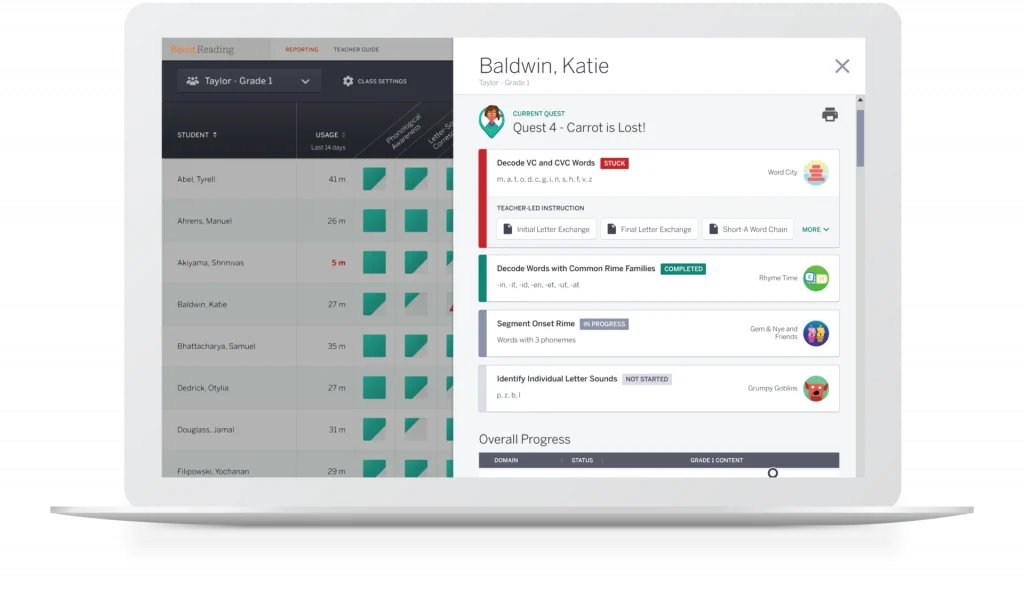
  • Herramientas integradas que permiten al maestro/la maestra saber cómo progresan los estudiantes en sus trabajos y responder oportunamente.
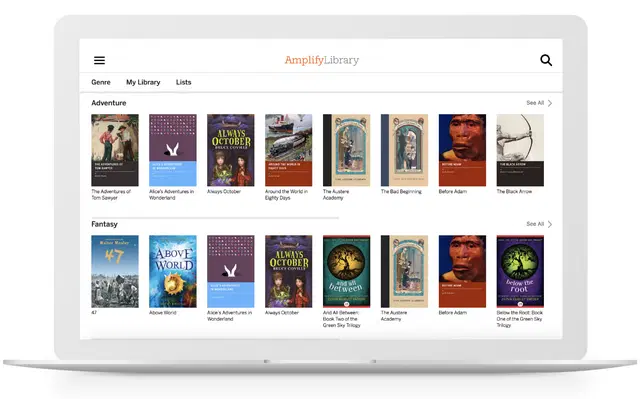
  • La Biblioteca Amplify digital, con más de 700 libros descargables de ficción y no ficción.
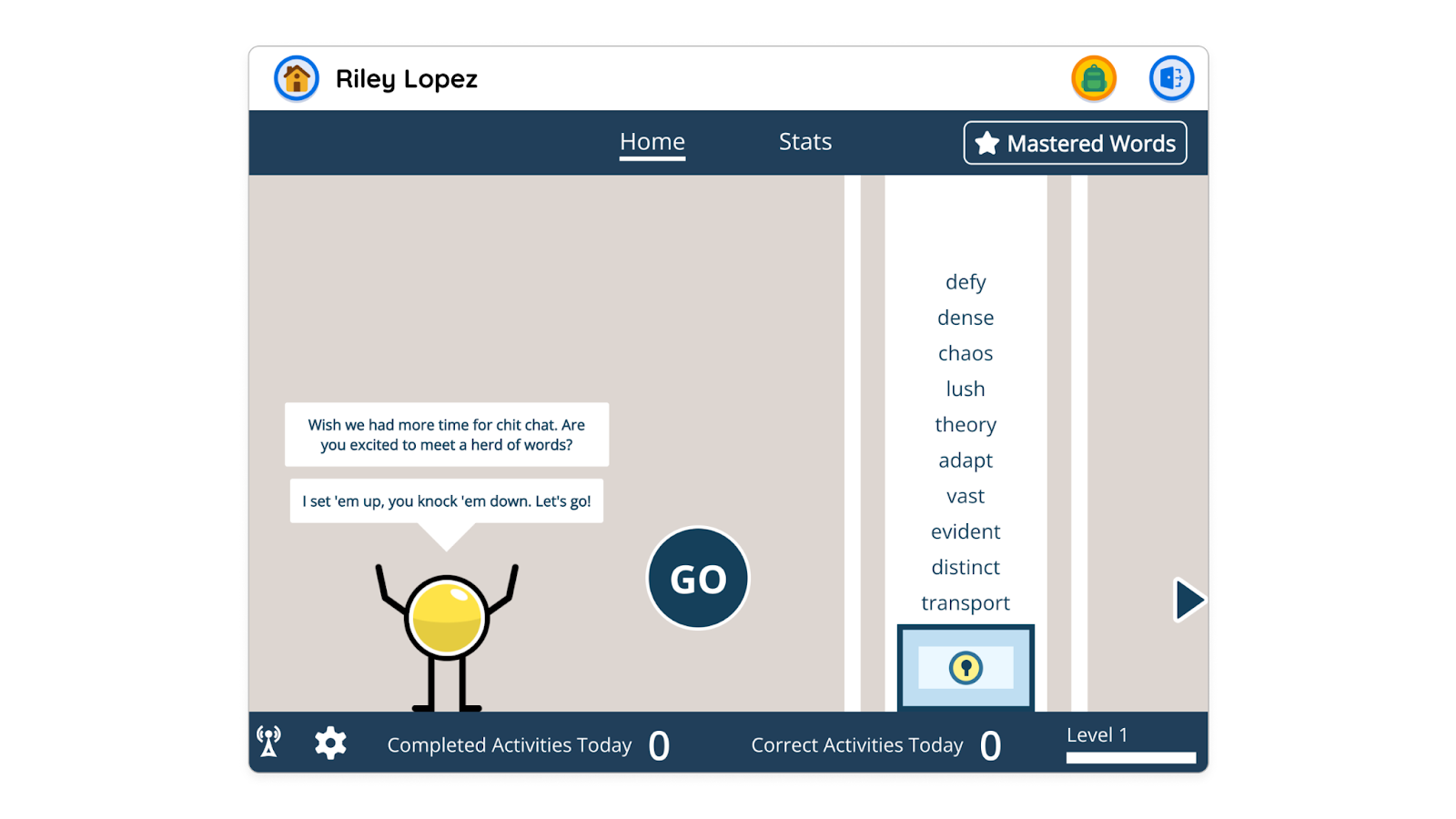
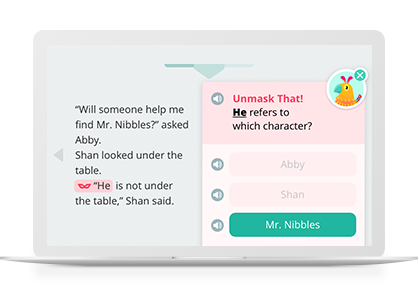
  • La aplicación de vocabulario, que usa actividades similares a juegos para ayudar a los estudiantes a dominar las palabras clave de los textos del programa. (Si su estudiante usa materiales impresos, verá las palabras resaltadas).
  • Tareas de escritura independiente llamadas Solos, disponibles en dispositivos móviles.
  • Proyectos interactivos conocidos como Quests que acompañan a determinadas unidades para ofrecer oportunidades de práctica adicionales en lectura, escritura, expresión oral y comprensión auditiva con un enfoque analítico.

Para comenzar

Cómo apoyar a su estudiante

  • Si es posible, lea con su estudiante a diario. Aun 15 minutos de lectura compartida todos los días pueden producir grandes resultados. Pueden leer secciones del texto en voz alta y de forma conjunta. Es posible que, a nivel intermedio, su estudiante disfrute de representar secciones de diálogos asumiendo el papel de alguno de los personajes de una obra o dándole un estilo dramático a algún poema que hayan estado estudiando. Si su estudiante tiene dificultad para leer en voz alta, intente leerle el texto con expresividad y pídale que se lo lea a usted después. Para practicar más, hay una gama de actividades de fluidez en los Días Flex del programa. Pida a su estudiante que le ayude a encontrar estas actividades.
  • Busque oportunidades para conversar con su estudiante sobre lo que lee y descubre. Ejemplos de preguntas que usted podría plantear: ¿Qué te llamó más la atención en lo que leíste hoy? ¿Hubo alguna oración o palabra que te resultó confusa? ¿Qué fue lo que más te sorprendió? ¿Qué crees que el autor estaba tratando de comunicar? ¿Estás de acuerdo con las ideas o descripciones del autor? ¿Qué conexiones puedes hacer entre lo que estás leyendo y tu propia vida u otros temas?
  • Escuche a su estudiante leer sus respuestas escritas o pídale que las comparta con un amigo o amiga por teléfono o mediante una aplicación de videollamada.
  • Visite con su estudiante la Biblioteca Amplify para encontrar libros de su interés que pueda leer con fluidez.
  • Recomendamos que lea el artículo Proteja a los niños en internet de la Comisión Federal de Comercio sobre seguridad digital.

Descargar textos de la Biblioteca Amplify

Si no tiene acceso continuo a internet en su casa, le sugerimos que descargue los textos esenciales de la biblioteca de Amplify por adelantado. Siga estos pasos para descargar un texto:

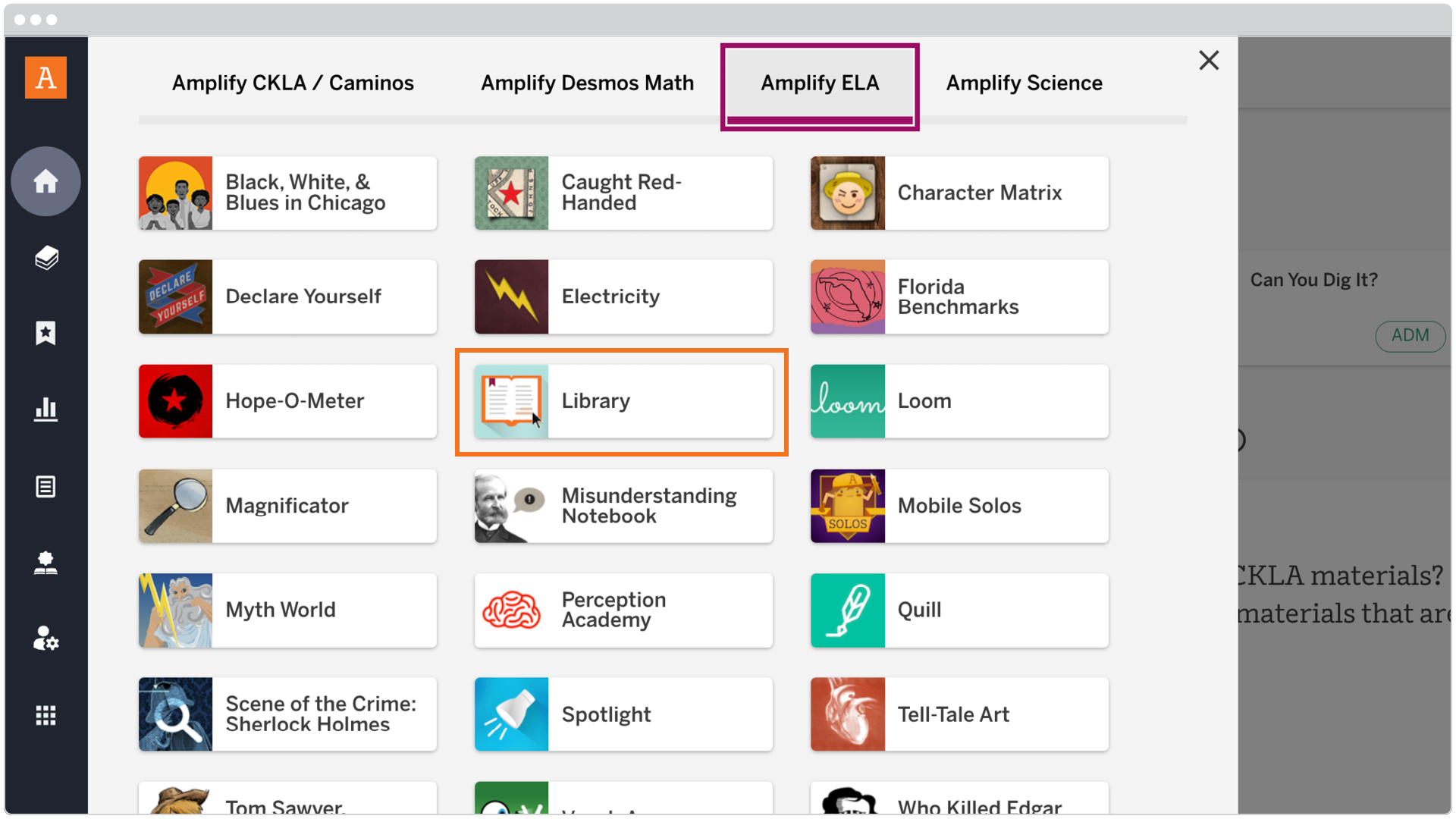
  1. Navegue hasta el menú “Program & Apps» en la parte superior de su pantalla y desplácese hasta encontrar el icono «Library». Cuando lo seleccione, la biblioteca Amplify se abrirá en una nueva pestaña.

2. Si se le solicita, siga las instrucciones para configurar un pin para la biblioteca Amplify; de lo contrario, continúe con el siguiente paso.

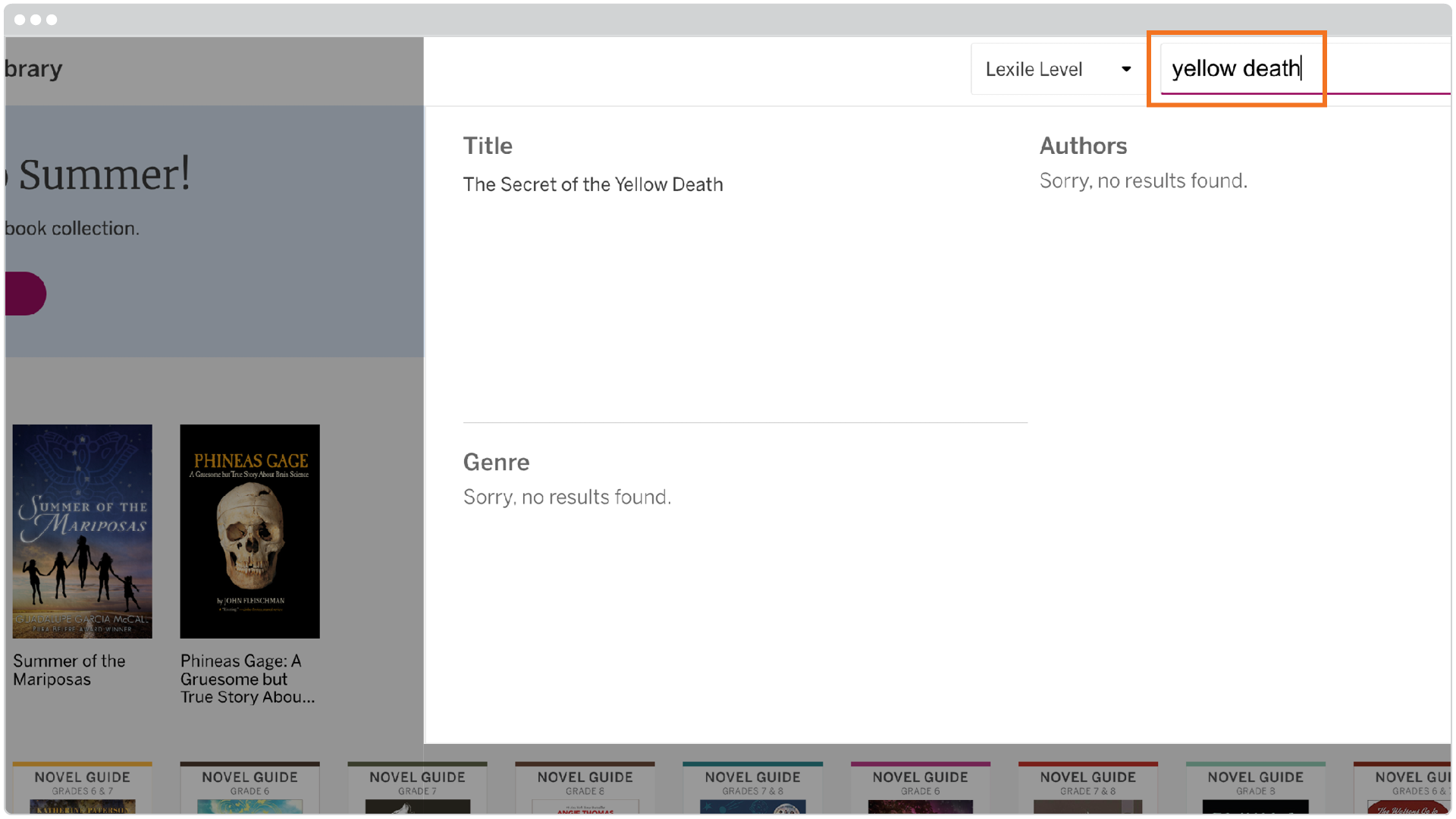
3. En la esquina superior derecha de su pantalla, busque el libro que desea descargar. Por ejemplo: “The Secret of the Yellow Death: A True Story of Medical Sleuthing”.

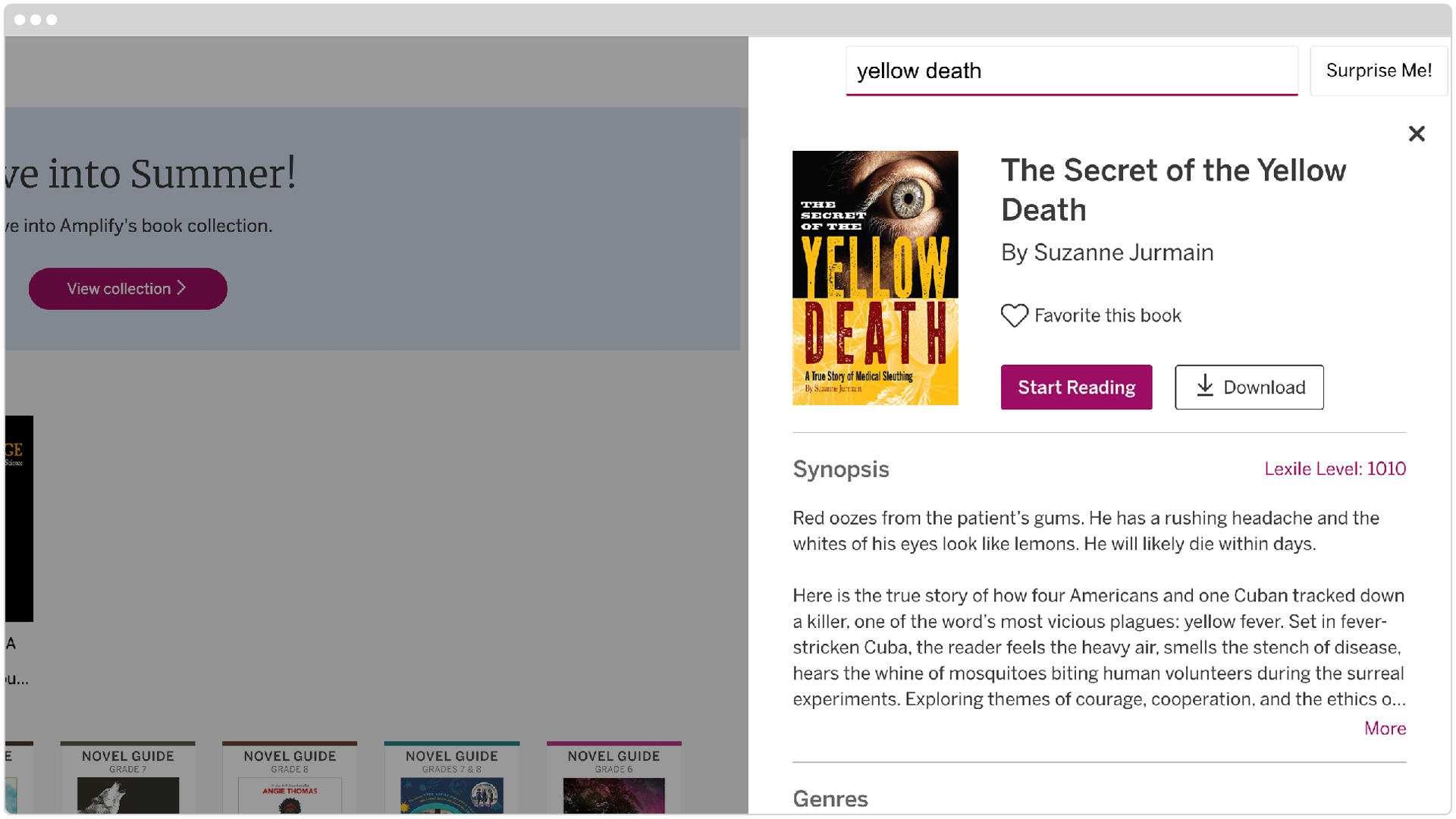
4. Ahora ubique el botón de “Download” (descargar).
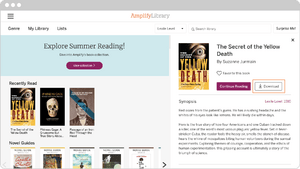
5. Una vez descargado, podrá acceder a este libro incluso cuando no tenga acceso a Internet.
Para acceder a los textos descargados:

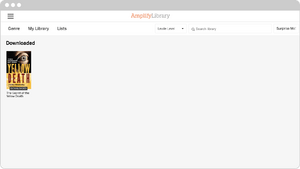
  1. En la aplicación de la biblioteca de Amplify, abra el menú desplegable «My Library» (mi biblioteca) en la esquina superior izquierda.
  2. Seleccione “Downloaded” (descargados).
  3. Elija el texto que desea leer de entre todos los textos predescargados.

Vistazo general a los materiales

No todas las escuelas funcionan de la misma manera, pero es probable que los estudiantes que asisten a escuelas que cuentan con las versiones impresa y digital del programa, tengan los siguientes materiales impresos en casa: 

  • Libro del estudiante: Incluye todas las lecturas y actividades necesarias para la enseñanza a lo largo del año. Los estudiantes pueden leer las selecciones tanto en el formato digital como en la versión impresa y hacer apuntes en cualquiera de los dos. Las lecciones de la versión impresa del Libro del estudiante reflejan las lecciones digitales, pero han sido modificadas para que resulten tan eficaces como las digitales.
  • Cuadernos de escritura: En estos cuadernos, los estudiantes responden a las consignas de escritura y realizan otras tareas escritas.

En caso de que los estudiantes no tengan acceso a los dispositivos o a internet, pueden continuar llevando a cabo tareas clave de lectura y escritura empleando la versión impresa del Libro del estudiante y los Cuadernos de escritura.
El maestrotambién puede acceder a las Guías de novelas para los estudiantes e imprimir y enviar por correo hasta doce novelas que comúnmente forman parte del programa de enseñanza. Seis de estas novelas están disponibles en la Biblioteca Amplify y la mayoría de ellas se pueden encontrar en las bibliotecas públicas.

Un vistazo a las unidades

A continuación encontrará resúmenes de cada unidad en las que su estudiante trabajará en su grado durante el año. Junto a cada unidad hay una guía descargable que permite conocer más a detalle cuál es el contenido abarcado y cómo puede ayudar a su estudiante a comprender mejor los temas.

Unidad 6A

La narrativa de Dahl

Cada estudiante comienza con escritura narrativa para aumentar rápidamente su producción de escritura, aprender la destreza básica de enfoque y familiarizarse con los hábitos y rutinas clave del salón de clases que utilizarán todo el año. Luego, aplica su nueva capacidad de observación a entretenidas lecturas de la biografía de Roald Dahl, Boy, y aprende a trabajar de cerca con evidencias del texto.

Unidad 6B

Misterios e investigaciones

Cada estudiante lee con la atención propia de un investigador, embarcándose en un estudio del cautivante mundo del trabajo de detective en distintos géneros literarios. Al final de la unidad, el niño o la niña escribe una composición para explicar cuál es el rasgo más útil de un investigador en la resolución de problemas.

Unidad 6C

Colección acerca del chocolate

Los aztecas lo usaban como moneda, Robert Falcon Scott lo llevó a la Antártida, los nazis diseñaron con él una bomba para matar a Churchill. La historia del chocolate se remonta a 3,700 años en el pasado y está repleta de vicisitudes que la vuelven un tema de investigación gratificante. En esta unidad los y las estudiantes analizan documentos de primera fuente y conducen investigaciones independientes para entender mejor la extraña y maravillosa gama de roles que el chocolate ha desempeñado en el mundo a lo largo de los siglos.

Unidad 6D

Los griegos

Los mitos griegos nos ayudan a entender no solo la cultura griega antigua, sino también el mundo que nos rodea y la función que cumplimos en él. Partiendo de las rutinas y destrezas establecidas en las unidades anteriores, estas lecciones motivan a cada estudiante a dejar atrás el enfoque en una sola persona —él mismo o ella misma o un personaje— para contemplar cuestiones más amplias sobre el papel que las personas desempeñan en el mundo y en las comunidades donde residen.

Unidad 6E

El verano de las mariposas

Las tierras fronterizas de Estados Unidos y México son lugares poblados de leyendas, tanto verdaderas como ficticias. El verano de las mariposas, de Guadalupe García McCall, implanta una versión de la Odisea en este entorno, embarcando a cinco hermanas en una aventura que transcurre en un mundo de héroes y malhechores inspirado en mitos aztecas y leyendas latinoamericanas. La experiencia ayuda a las hermanas a aceptar la disolución del matrimonio de sus padres y a encontrar fortaleza renovada en su identidad de hermanas y en su conexión a un linaje azteca. En esta unidad, cada estudiante analiza el uso que McCall da a la estructura de una epopeya para crear una narración emocionante de aventuras, y cómo la autora hace uso de la narración para celebrar el poder femenino, su herencia latina y una definición más amplia de lo que es una familia. Cada estudiante también tiene oportunidad de comparar el viaje ficticio de las jóvenes a México con la descripción del viaje real de un jovencito a Estados Unidos.

Unidad 6F

Colección acerca del Titanic

Para aprender a diferenciar las fuentes primarias, secundarias y terciarias, determinar si una fuente dada es fiable y entender los usos éticos de la información, cada estudiante formula sus propias preguntas de investigación y busca las respuestas en internet. Asumirá así el papel de uno de los pasajeros o pasajeras de la lista de embarque del Titanic y considerará cuestiones de clase y género, a medida que investiga y escribe relatos desde el punto de vista de los viajeros.

Unidad 6F y unidad 6G

Comenzar a escribir un cuento

En esta unidad cada estudiante puede poner en práctica sus destrezas de escritura creativa, para aprender elementos de narración y desarrollo de personajes, y la importancia del lenguaje vívido. Cada estudiante consigue una noción de propiedad sobre su propia escritura a medida que experimenta los diferentes impactos de sus decisiones autorales en oraciones, lenguaje, rasgos de personajes y giros de la trama.

Unidad 6F

Gramática

En esta unidad cada estudiante completa instrucciones para seguir un aprendizaje autoguiado y practica lo que el maestro y la maestra le asignará durante el año.

Unidad 7A

La narrativa y La joven del pañuelo rojo

En esta unidad se presenta la autobiografía sumamente cautivante de una joven cuya vida transcurre en China durante la Revolución Cultural. Cada estudiante aprende la historia y el contexto político de este periodo, enfocándose en el relato de alguien que vivió en la época de la revolución. A medida que cada estudiante recorre el camino de la protagonista en ese mundo convulsionado, puede apreciar los cambios que se produjeron en los sentimientos y motivaciones de la joven a lo largo del tiempo.

Unidad 7B

Carácter y conflicto

Leyendo Una pasa al sol y Inocentón, cada estudiante explora el tema de las personas que, al enfrentar adversidades, pueden infligir daño en quienes los rodean sin intención de hacerlo. Las dos narrativas se complementan para brindar a cada estudiante oportunidades de analizar las respuestas de los personajes al conflicto y el desarrollo de ideas del autor o la autora en una obra de ficción.

Unidad 7C

La ciencia del cerebro
¿Podrías sobrevivir después de que una vara de hierro te atravesara el cráneo? Phineas Gage lo hizo y su historia, escalofriante pero real, permite desarrollar la información de contexto y analizar otros textos informativos, incluyendo los contemporáneos El hombre que confundió a su mujer con un sombrero y el obviamente relevante La desmitificación del cerebro adolescente.

Unidad 7D

La poesía y Poe

Los textos de Poe siempre tienen mucho para observar, descifrar, comentar y… crisparnos los nervios. Dado que las cosas no siempre son lo que aparentan, cada estudiante usa las destrezas de lectura atenta para cuestionar si debería creer lo que el narrador de Poe les está contando.

Unidad 7E

Colección acerca de Frida y Diego

Los artistas más famosos y provocativos de México, Diego Rivera y Frida Kahlo, formaron una pareja extraordinaria que vivió en tiempos extraordinarios. Eran almas gemelas con personalidades totalmente opuestas. Las obras de Diego Rivera y Frida Kahlo y sus vidas multifacéticas ofrecen a cada estudiante un tema fértil y fascinante para examinar documentos de fuente primaria y conducir investigaciones independientes.

Unidad 7F

Colección acerca de La fiebre del oro

Cada estudiante elige entre una extensa colección de fuentes primarias y secundarias para aprender acerca de la amplia diversidad de personas que participaron en La fiebre del oro de California.

Unidad 7G

Escribir un cuento: nivel intermedio

En esta unidad cada estudiante puede poner en práctica sus destrezas de escritura creativa para aprender elementos de narración y desarrollo de personajes, y la importancia del lenguaje vívido.

Unidad 7

Gramática

En esta unidad cada estudiante completa instrucciones para seguir un aprendizaje autoguiado que el maestro o la maestra le asignará durante el año. Las sub unidades están organizadas por temas clave de gramática, de manera de que el maestro o la maestra pueda asignar el contenido que mejor se acomoda a las necesidades de sus estudiantes mientras se asegura de que trabajen con temas clave de gramática apropiados para su grado.

Unidad 8A

Perspectivas y narrativa
Esta unidad procura enseñar a cada estudiante a leer como un escritor o una escritora. Así, pone en práctica la destreza de prestar atención al oficio de la escritura: las decisiones que toma un buen escritor o escritora para darle forma a nuestra percepción de una escena o a nuestros sentimientos hacia un personaje, y para despertar nuestras emociones, sorprendernos o dejarnos pensando en lo que podría suceder después. Cada estudiante lee atentamente ejemplos de narrativas de no ficción, analiza las técnicas que usa cada autor para que sus textos evoquen emociones y practica la aplicación de estas técnicas en sus propios textos narrativos.

Unidad 8B

Libertad e igualdad
Analizamos las palabras de varios creadores —desde el poeta Walt Whitman hasta el abolicionista Frederick Douglass y el presidente Abraham Lincoln— para descubrir cómo sus escritos y obras contribuyeron a los cambios extremos de la organización social: un concepto totalmente nuevo de lo que significaba considerar a las personas “iguales”.

Unidad 8C

Ciencias y ciencia ficción
Cada estudiante leerá la obra Frankenstein de Gris Grimly, una novela gráfica que integra ilustraciones cautivantes en una versión abreviada de la edición de 1818 del libro de Mary Shelley. Combinadas con el texto de Shelley, las inquietantes —y a veces espeluznantes— representaciones de la criatura de Frankenstein diseñadas por Grimly impulsan a cada estudiante a contemplar algunos de los temas centrales del texto: el origen de la humanidad y la raíz del mal. Luego escribe un ensayo, en el cual, después de argumentar a favor de ambos lados de la cuestión, determina si en última instancia la criatura de Frankenstein debería considerarse humana.

Unidad 8D

Romeo y Julieta, de Shakespeare
Romeo y Julieta combina romance y acción, ofreciendo una amplia gama de temas y escenas que cada estudiante puede leer y representar actuando. Cada estudiante de nivel intermedio tiene la edad adecuada para identificarse con los sentimientos intensos de los amantes, y ha alcanzado la madurez suficiente como para analizar de forma crítica las decisiones que toman Romeo y Julieta.

Unidad 8E

El Holocausto: memoria y significado
Esta unidad usa una variedad de artículos, imágenes y videos de primera fuente, así como textos de no ficción literaria y no ficción gráfica, para estudiar los sucesos que hicieron posibles las atrocidades del Holocausto. Cada estudiante investiga cómo se generó y se empleó la propaganda para crear un ambiente político que llegó a corromper a toda una sociedad. Las Olimpiadas se observan a través de la lente de una campaña de propaganda internacional, al amparo de la cual los nazis comenzaron a eliminar de su cultura a las personas que no eran de lo que consideraban «raza aria». La sub unidad final examina los resultados de la doctrina nazi y su impacto en las víctimas y sobrevivientes judíos.

Unidad 8F

Colección acerca de La carrera espacial
Cada estudiante usa internet para poner a prueba sus destrezas de investigación y lectura atenta, y distingue entre fuentes fiables y fuentes no fiables.

En esta colección los estudiantes exploran documentos primarios y llevan a cabo investigación independiente para comprender mejor esta carrera espacial entre los dos superpoderes del planeta. La dramática historia de la carrera espacial ofrece a cada estudiante un generoso tema de investigación para explorar, mientras desarrollan destrezas de lectoescritura informativa, y aprenden cómo elaborar sus propias preguntas de investigación y exploran Internet en busca de respuestas.

Unidad 8

Gramática

En esta unidad cada estudiante completan instrucciones para seguir un aprendizaje autoguiado que el maestro o la maestra le asignará durante el año. Las sub unidades están organizadas por temas clave de gramática, de manera de que el maestro o la maestra pueda asignar el contenido que mejor se acomoda a las necesidades de sus estudiantes mientras se aseguran de que trabajen con temas clave de gramática apropiados para su grado.

Unidad 8G

Escribir un cuento: nivel avanzado

En esta unidad cada estudiante pueden poner en práctica sus destrezas de escritura creativa, para aprender elementos de narración y desarrollo de personajes. También aprende la importancia del lenguaje vívido para enganchar a sus lectores y atraerles al cuento.

Actividades adicionales

Quests:

Es posible que observe que su estudiante trabaja con sus compañeros en el mismo proyecto interactivo durante varios días, tratando de resolver un misterio o explicar un evento histórico. Eso es lo que sucede cuando un maestro asigna una misión: una exploración en profundidad de una semana de duración que requiere colaboración y profundiza el compromiso con textos y temas.

Aplicación de vocabulario:

La aplicación Vocab ayuda a los estudiantes a dominar el vocabulario a través de actividades similares a juegos que los desafían a pensar en morfología, analogías y sinónimos/antónimos, y a descifrar el significado a través del contexto.

Contacte con nosotros

¡Estamos aquí para ayudarle!

¿Tiene alguna pregunta sobre Amplify ELA?

Visite nuestra biblioteca de ayuda (en inglés) para buscar artículos con respuestas a sus preguntas sobre el programa.

Para obtener apoyo curricular adicional, comuníquese con el maestro de su estudiante.
¡Les damos la bienvenida, familias de Amplify ELA!

Nos complace darles la bienvenida a usted y a su estudiante al programa Amplify ELA para el nuevo año escolar y brindarles oportunidades de aprendizaje excepcionales a través de ELA. Hemos reunido una serie de recursos y guías que ayudarán a que su estudiante aproveche al máximo nuestra plataforma. Ponemos a su disposición estos materiales para que también usted pueda brindar apoyo a su estudiante a lo largo de todo el año.

Para la versión en inglés, haga clic aquí.

Illustrated collage with people playing sports, riding bikes, and a thoughtful person’s portrait, framed by natural elements and a rocket launching, next to an "EdReports Review Year 2020" badge.

¿Qué es Amplify ELA?

Amplify ELA ayuda a los estudiantes de los grados 6 a 8 a leer y comprender textos complejos que los alientan a abordar ideas interesantes y a descubrir, por sí mismos, la relevancia de estos textos. Amplify ELA es un programa mixto que incluye materiales digitales e impresos, pero también se puede utilizar solo de manera impresa. Los estudiantes que usan Amplify ELA leen textos con atención, interpretan lo que encuentran, comparten sus ideas con sus compañeros y desarrollan sus ideas por escrito. La estructura de la lección es fácil de seguir, pero lo suficientemente flexible para permitir diversas experiencias de aprendizaje y lo suficientemente variada para mantener a los estudiantes interesados.

Las características incluyen:

  • Funcionalidad que permite a cada estudiante trabajar en su propio nivel y enfrentar, al mismo tiempo, desafíos adecuados.
  • Herramientas integradas que permiten a los maestros realizar un seguimiento y responder al trabajo de los estudiantes.
  • La biblioteca digital (Amplify Library), que contiene más de 700 libros completos de ficción y no ficción descargables.
  • La aplicación de vocabulario (Vocab App), que utiliza actividades lúdicas para ayudar a que los estudiantes dominen las palabras clave de los textos del programa. (Los estudiantes que utilicen materiales impresos verán las palabras clave resaltadas.)
  • Tareas de escritura independientes llamadas Solos, disponibles en dispositivos móviles.
  • Proyectos interactivos llamados Quests que acompañan a ciertas unidades para proporcionar práctica adicional en las habilidades analíticas de lectura, escritura, habla y escucha.

Primeros pasos

Cómo apoyar a su estudiante en casa:

  • Si es posible, lea con su estudiante a diario; incluso 15 minutos de lectura juntos al día pueden tener un gran impacto. Pueden leer juntos en voz alta secciones del texto; a muchos estudiantes de secundaria les gusta adoptar el papel de un personaje de una obra de teatro e interpretar parte de sus diálogos o añadir un toque dramático a un poema en el que estén trabajando. Si su estudiante tiene dificultad para leer en voz alta, intente leerle el texto con expresividad y después pida a su estudiante que haga lo mismo. Los días flexibles del programa (Flex Days) tienen una variedad de actividades de fluidez en la lectura que sirven como práctica adicional. Pídale a su estudiante que le ayude a encontrar estas actividades.
  • Busquen momentos para conversar sobre lo que están leyendo y descubriendo. Por ejemplo, usted podría preguntarle:¿Qué te llamó la atención de lo que leíste hoy? ¿Alguna frase o palabra te resultó confusa? ¿Qué te sorprendió más? ¿Qué crees que intentaba comunicar el autor? ¿Estás de acuerdo con sus ideas o descripciones? ¿Qué conexiones puedes establecer entre lo que lees y tu propia vida u otros temas que hayas escuchado?
  • Escuche a su estudiante leer sus respuestas escritas o pídale que las comparta con un amigo por teléfono o en una videollamada.
  • Explore Amplify Library para encontrar libros que su estudiante pueda disfrutar y leer con fluidez por su cuenta.
  • Consulte el artículo Proteja a los niños en internet de la Comisión Federal de Comercio, cuyo tema es la seguridad digital.

Cómo acceder a textos en Amplify Library.

¡Invitamos a que los estudiantes utilicen los textos básicos de Amplify Library en casa! Por favor, siga los siguientes pasos para poder descargar un texto y poder leerlo sin contar con acceso a internet:

1. Diríjase al menú Programs & Apps (Programas y aplicaciones) ubicado en la parte superior de la pantalla y desplácese hacia abajo hasta encontrar el icono de Amplify Library. Cuando lo seleccione, Amplify Library se abrirá en una nueva pestaña.

A digital menu displays various educational tools and resources, with "Amplify ELA" highlighted at the top and the "Library" option outlined in orange.

2.  Si se le solicita, siga las instrucciones para configurar un pin para Amplify Library; de lo contrario, continúe con el siguiente paso.

A pop-up window prompts the user to create a four-character PIN of lowercase letters and/or numbers for offline reading, with Cancel and Submit buttons.

3. En la esquina superior derecha de la pantalla, busque el libro que desea descargar. Por ejemplo: The Secret of the Yellow Death: A True Story of Medical Sleuthing.

A digital library search page displays "yellow death" in the search bar with no results found for title, authors, or genre. Book covers are visible in the left sidebar.

4. Seleccione el botón Download (Descargar).

A digital library interface displays the book "The Secret of the Yellow Death" by Suzanne Jurmain, showing its cover, synopsis, and options to read or download.

5. Si pierde el acceso a internet mientras está en Amplify Library, podrá seguir accediendo y leyendo los libros descargados. Si la página se actualiza sin tener conexión a internet o usted intenta iniciar sesión en otro dispositivo sin tener conexión, perderá el acceso a los libros descargados hasta que se restablezca la conexión.

A dropdown menu under "My Library" shows options: Recently Read, Favorites, Downloaded (highlighted), and All Books. Below, a Recently Read section displays three book covers.

Para recuperar los textos descargados:

  1. Desde la aplicación de Amplify Library, abra el menú desplegable My Library (Mi biblioteca) ubicado en la esquina superior izquierda.
  2. Seleccione Downloaded (Descargados).
  3. Elija el texto que desea leer de entre todos los textos previamente descargados.

Vistazo general a los materiales

No todas las escuelas funcionan de la misma manera, pero los estudiantes que asisten a escuelas que tienen las ediciones impresas y digitales del programa probablemente tienen los siguientes materiales impresos en casa:

  • Edición para estudiantes (Student Edition): Incluye todas las lecturas y actividades necesarias para la instrucción a lo largo del año. Los estudiantes pueden leer las selecciones tanto en formato digital como impreso y anotar en ambos formatos. Las lecciones de la Edición para estudiantes impresa reflejan cada lección digital, pero se han modificado para que funcionen eficazmente en formato impreso.
  • Diarios de escritura (Writing Journals): Este espacio proporciona a los estudiantes la posibilidad de responder a indicaciones de escritura (Writing Prompts) y completar otras tareas escritas.

En el caso de que los estudiantes no tengan acceso a dispositivos o Internet, pueden continuar completando tareas clave de lectura y escritura utilizando las Ediciones para estudiantes impresas y los Diarios de escritura para estudiantes.

Los maestros también pueden acceder a, imprimir y enviar por correo las guías de novelas (Novel Guides) para estudiantes. Las guías abarcan hasta 12 novelas que suelen enseñarse en las escuelas. Seis de estas novelas están disponibles en Amplify Library y la mayoría debería estar disponible en una biblioteca pública.

Reseñas de unidades

A continuación, se presentan breves descripciones generales de cada unidad que su estudiante estudiará en su grado a lo largo del año. Con cada unidad se incluye una guía descargable que ofrece un repaso más detallado del contenido cubierto y de cómo puede ayudar a su estudiante a profundizar en la comprensión de los temas.

Unidad 6A

La narrativa de Dahl

Cada estudiante comienza con escritura narrativa para aumentar rápidamente su producción de escritura, aprender la destreza básica de enfoque y familiarizarse con los hábitos y rutinas clave del salón de clases que utilizarán todo el año. Luego, aplica su nueva capacidad de observación a entretenidas lecturas de la biografía de Roald Dahl, Boy, y aprende a trabajar de cerca con evidencias del texto.

Unidad 6B

Misterios e investigaciones

Cada estudiante lee con la atención propia de un investigador, embarcándose en un estudio del cautivante mundo del trabajo de detective en distintos géneros literarios. Al final de la unidad, el niño o la niña escribe una composición para explicar cuál es el rasgo más útil de un investigador en la resolución de problemas.

Unidad 6C

Colección acerca del chocolate

Los aztecas lo usaban como moneda, Robert Falcon Scott lo llevó a la Antártida, los nazis diseñaron con él una bomba para matar a Churchill. La historia del chocolate se remonta a 3,700 años en el pasado y está repleta de vicisitudes que la vuelven un tema de investigación gratificante. En esta unidad los y las estudiantes analizan documentos de primera fuente y conducen investigaciones independientes para entender mejor la extraña y maravillosa gama de roles que el chocolate ha desempeñado en el mundo a lo largo de los siglos.

Unidad 6D

Los griegos

Los mitos griegos nos ayudan a entender no solo la cultura griega antigua, sino también el mundo que nos rodea y la función que cumplimos en él. Partiendo de las rutinas y destrezas establecidas en las unidades anteriores, estas lecciones motivan a cada estudiante a dejar atrás el enfoque en una sola persona —él mismo o ella misma o un personaje— para contemplar cuestiones más amplias sobre el papel que las personas desempeñan en el mundo y en las comunidades donde residen.

Unidad 6E

El verano de las mariposas

Las tierras fronterizas de Estados Unidos y México son lugares poblados de leyendas, tanto verdaderas como ficticias. El verano de las mariposas, de Guadalupe García McCall, implanta una versión de la Odisea en este entorno, embarcando a cinco hermanas en una aventura que transcurre en un mundo de héroes y malhechores inspirado en mitos aztecas y leyendas latinoamericanas. La experiencia ayuda a las hermanas a aceptar la disolución del matrimonio de sus padres y a encontrar fortaleza renovada en su identidad de hermanas y en su conexión a un linaje azteca. En esta unidad, cada estudiante analiza el uso que McCall da a la estructura de una epopeya para crear una narración emocionante de aventuras, y cómo la autora hace uso de la narración para celebrar el poder femenino, su herencia latina y una definición más amplia de lo que es una familia. Cada estudiante también tiene oportunidad de comparar el viaje ficticio de las jóvenes a México con la descripción del viaje real de un jovencito a Estados Unidos.

Unidad 6F

Colección acerca del Titanic

Para aprender a diferenciar las fuentes primarias, secundarias y terciarias, determinar si una fuente dada es fiable y entender los usos éticos de la información, cada estudiante formula sus propias preguntas de investigación y busca las respuestas en internet. Asumirá así el papel de uno de los pasajeros o pasajeras de la lista de embarque del Titanic y considerará cuestiones de clase y género, a medida que investiga y escribe relatos desde el punto de vista de los viajeros.

Unidad 6F y unidad 6G

Comenzar a escribir un cuento

En esta unidad cada estudiante puede poner en práctica sus destrezas de escritura creativa, para aprender elementos de narración y desarrollo de personajes, y la importancia del lenguaje vívido. Cada estudiante consigue una noción de propiedad sobre su propia escritura a medida que experimenta los diferentes impactos de sus decisiones autorales en oraciones, lenguaje, rasgos de personajes y giros de la trama.

Unidad 6F

Gramática

En esta unidad cada estudiante completa instrucciones para seguir un aprendizaje autoguiado y practica lo que el maestro y la maestra le asignará durante el año.

Unidad 7A

La narrativa y La joven del pañuelo rojo

En esta unidad se presenta la autobiografía sumamente cautivante de una joven cuya vida transcurre en China durante la Revolución Cultural. Cada estudiante aprende la historia y el contexto político de este periodo, enfocándose en el relato de alguien que vivió en la época de la revolución. A medida que cada estudiante recorre el camino de la protagonista en ese mundo convulsionado, puede apreciar los cambios que se produjeron en los sentimientos y motivaciones de la joven a lo largo del tiempo.

Unidad 7B

Carácter y conflicto

Leyendo Una pasa al sol y Inocentón, cada estudiante explora el tema de las personas que, al enfrentar adversidades, pueden infligir daño en quienes los rodean sin intención de hacerlo. Las dos narrativas se complementan para brindar a cada estudiante oportunidades de analizar las respuestas de los personajes al conflicto y el desarrollo de ideas del autor o la autora en una obra de ficción.

Unidad 7C

La ciencia del cerebro
¿Podrías sobrevivir después de que una vara de hierro te atravesara el cráneo? Phineas Gage lo hizo y su historia, escalofriante pero real, permite desarrollar la información de contexto y analizar otros textos informativos, incluyendo los contemporáneos El hombre que confundió a su mujer con un sombrero y el obviamente relevante La desmitificación del cerebro adolescente.

Unidad 7D

La poesía y Poe

Los textos de Poe siempre tienen mucho para observar, descifrar, comentar y… crisparnos los nervios. Dado que las cosas no siempre son lo que aparentan, cada estudiante usa las destrezas de lectura atenta para cuestionar si debería creer lo que el narrador de Poe les está contando.

Unidad 7E

Colección acerca de Frida y Diego

Los artistas más famosos y provocativos de México, Diego Rivera y Frida Kahlo, formaron una pareja extraordinaria que vivió en tiempos extraordinarios. Eran almas gemelas con personalidades totalmente opuestas. Las obras de Diego Rivera y Frida Kahlo y sus vidas multifacéticas ofrecen a cada estudiante un tema fértil y fascinante para examinar documentos de fuente primaria y conducir investigaciones independientes.

Unidad 7F

Colección acerca de La fiebre del oro

Cada estudiante elige entre una extensa colección de fuentes primarias y secundarias para aprender acerca de la amplia diversidad de personas que participaron en La fiebre del oro de California.

Unidad 7G

Escribir un cuento: nivel intermedio

En esta unidad cada estudiante puede poner en práctica sus destrezas de escritura creativa para aprender elementos de narración y desarrollo de personajes, y la importancia del lenguaje vívido.

Unidad 7

Gramática

En esta unidad cada estudiante completa instrucciones para seguir un aprendizaje autoguiado que el maestro o la maestra le asignará durante el año. Las sub unidades están organizadas por temas clave de gramática, de manera de que el maestro o la maestra pueda asignar el contenido que mejor se acomoda a las necesidades de sus estudiantes mientras se asegura de que trabajen con temas clave de gramática apropiados para su grado.

Unidad 8A

Perspectivas y narrativa
Esta unidad procura enseñar a cada estudiante a leer como un escritor o una escritora. Así, pone en práctica la destreza de prestar atención al oficio de la escritura: las decisiones que toma un buen escritor o escritora para darle forma a nuestra percepción de una escena o a nuestros sentimientos hacia un personaje, y para despertar nuestras emociones, sorprendernos o dejarnos pensando en lo que podría suceder después. Cada estudiante lee atentamente ejemplos de narrativas de no ficción, analiza las técnicas que usa cada autor para que sus textos evoquen emociones y practica la aplicación de estas técnicas en sus propios textos narrativos.

Unidad 8B

Libertad e igualdad
Analizamos las palabras de varios creadores —desde el poeta Walt Whitman hasta el abolicionista Frederick Douglass y el presidente Abraham Lincoln— para descubrir cómo sus escritos y obras contribuyeron a los cambios extremos de la organización social: un concepto totalmente nuevo de lo que significaba considerar a las personas “iguales”.

Unidad 8C

Ciencias y ciencia ficción
Cada estudiante leerá la obra Frankenstein de Gris Grimly, una novela gráfica que integra ilustraciones cautivantes en una versión abreviada de la edición de 1818 del libro de Mary Shelley. Combinadas con el texto de Shelley, las inquietantes —y a veces espeluznantes— representaciones de la criatura de Frankenstein diseñadas por Grimly impulsan a cada estudiante a contemplar algunos de los temas centrales del texto: el origen de la humanidad y la raíz del mal. Luego escribe un ensayo, en el cual, después de argumentar a favor de ambos lados de la cuestión, determina si en última instancia la criatura de Frankenstein debería considerarse humana.

Unidad 8D

Romeo y Julieta, de Shakespeare
Romeo y Julieta combina romance y acción, ofreciendo una amplia gama de temas y escenas que cada estudiante puede leer y representar actuando. Cada estudiante de nivel intermedio tiene la edad adecuada para identificarse con los sentimientos intensos de los amantes, y ha alcanzado la madurez suficiente como para analizar de forma crítica las decisiones que toman Romeo y Julieta.

Unidad 8E

El Holocausto: memoria y significado
Esta unidad usa una variedad de artículos, imágenes y videos de primera fuente, así como textos de no ficción literaria y no ficción gráfica, para estudiar los sucesos que hicieron posibles las atrocidades del Holocausto. Cada estudiante investiga cómo se generó y se empleó la propaganda para crear un ambiente político que llegó a corromper a toda una sociedad. Las Olimpiadas se observan a través de la lente de una campaña de propaganda internacional, al amparo de la cual los nazis comenzaron a eliminar de su cultura a las personas que no eran de lo que consideraban “raza aria”. La sub unidad final examina los resultados de la doctrina nazi y su impacto en las víctimas y sobrevivientes judíos.

Unidad 8F

Colección acerca de La carrera espacial
Cada estudiante usa internet para poner a prueba sus destrezas de investigación y lectura atenta, y distingue entre fuentes fiables y fuentes no fiables.

En esta colección los estudiantes exploran documentos primarios y llevan a cabo investigación independiente para comprender mejor esta carrera espacial entre los dos superpoderes del planeta. La dramática historia de la carrera espacial ofrece a cada estudiante un generoso tema de investigación para explorar, mientras desarrollan destrezas de lectoescritura informativa, y aprenden cómo elaborar sus propias preguntas de investigación y exploran Internet en busca de respuestas.

Unidad 8

Gramática

En esta unidad cada estudiante completan instrucciones para seguir un aprendizaje autoguiado que el maestro o la maestra le asignará durante el año. Las sub unidades están organizadas por temas clave de gramática, de manera de que el maestro o la maestra pueda asignar el contenido que mejor se acomoda a las necesidades de sus estudiantes mientras se aseguran de que trabajen con temas clave de gramática apropiados para su grado.

Unidad 8G

Escribir un cuento: nivel avanzado

En esta unidad cada estudiante pueden poner en práctica sus destrezas de escritura creativa, para aprender elementos de narración y desarrollo de personajes. También aprende la importancia del lenguaje vívido para enganchar a sus lectores y atraerles al cuento.

Actividades adicionales

Quests:

Quizás observe que su estudiante trabaja con sus compañeros en el mismo proyecto interactivo durante varios días, intentando resolver un misterio o explicar un acontecimiento histórico. Eso es lo que sucede cuando un maestro asigna una misión (Quest): una exploración minuciosa de una semana que requiere colaboración y ayuda a profundizar la interacción con los textos y con los temas tratados.

Vocab App:

La aplicación de vocabulario (Vocab App) ayuda a los estudiantes a dominar las palabras del vocabulario a través de actividades lúdicas que los hacen pensar en la morfología, la analogía y los sinónimos y antónimos, y a descifrar el significado a través del contexto.

¿Tiene alguna pregunta sobre Amplify ELA?

Visite nuestra biblioteca de ayuda (en inglés) y busque respuestas a sus preguntas sobre el programa en nuestros artículos de ayuda.

Para obtener apoyo curricular adicional, comuníquese con su maestro.

Familias y cuidadores, ¡bienvenidos a Amplify Desmos Math California
K–5!

Bienvenidos al Caregiver Hub de Amplify Desmos Math California K–5. Esperamos que su estudiante disfrute explorando las matemáticas, trabajando con amigos para resolver problemas y aprendiendo conceptos nuevos e interesantes. ¡Y esperamos que ustedes disfruten de la experiencia matemática junto con ellos! A continuación, encontrarán algunas sugerencias y recursos para apoyar su aprendizaje en casa.

Obtenga más información sobre Amplify Desmos Math California.

For the English version, please click here.

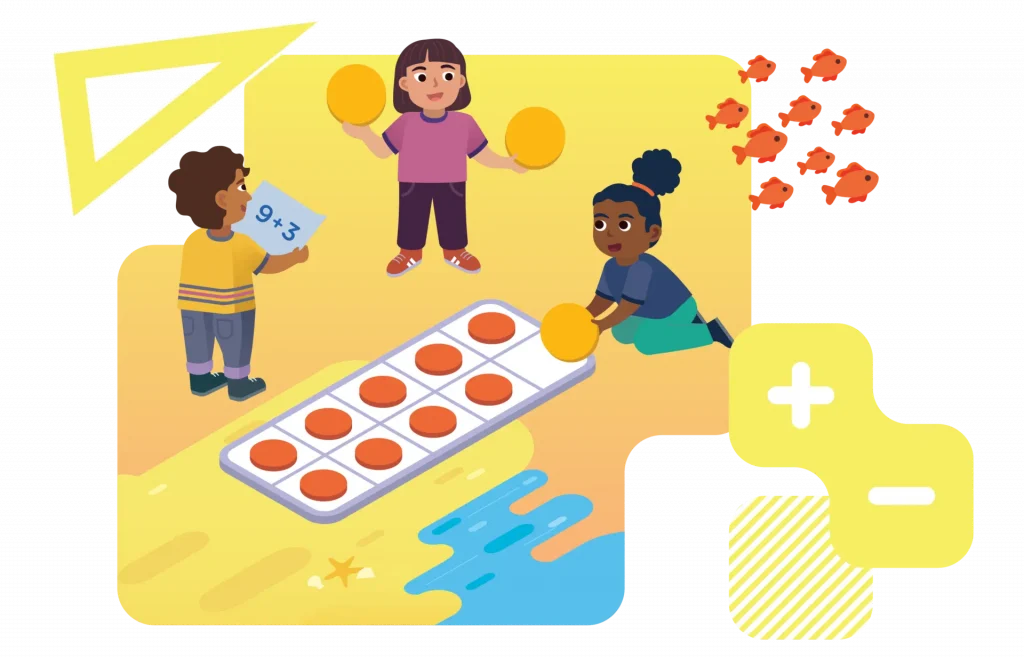
Tres niños participan en una actividad práctica de matemáticas con tarjetas numéricas y fichas sobre una cuadrícula. El fondo está decorado con peces y símbolos matemáticos.

Recursos de la unidad para cuidadores

Para cada unidad del programa, hemos creado un Recurso para cuidadores (Caregiver Resource), el cual ofrece un resumen de los conceptos clave, además de un problema del conjunto de práctica de la lección que usted puede resolver con su estudiante. Encontrará un Recurso para cuidadores en cada unidad, disponible tanto en inglés como en español.

Ingrese a Amplify Desmos Math California en casa.

Además del cuaderno de ejercicios impreso de la Edición del estudiante (Student Edition), su estudiante tendrá acceso digital a todos los materiales de aprendizaje, práctica y evaluación a través de la plataforma de Amplify. Es posible acceder al currículo digital desde la escuela o desde casa siguiendo estas instrucciones:

  • Haga clic en el botón Amplify Desmos Math California.
  • Seleccione Log in with Amplify.
  • Ingrese el nombre de usuario y la contraseña de su estudiante que el maestro les haya proporcionado.
  • Seleccione el nivel escolar deseado.

Una vez iniciada la sesión, los cuidadores pueden ver el trabajo de los estudiantes abriendo tareas anteriores.

Aprenda a navegar por la página de inicio de los estudiantes (student home page).

Vistazo general a los materiales

Amplify Desmos Math California promueve el aprendizaje mixto por medio de materiales impresos de apoyo y una experiencia digital única. Todas las lecciones en los grados K a 5 están disponibles en un cuaderno de trabajo de la Edición del estudiante. Muchas de las lecciones incluyen actividades prácticas con materiales manipulables, herramientas que ayudan a que los estudiantes hagan tangibles conceptos abstractos para poder comprenderlos. Su estudiante también trabajará con dispositivos digitales durante un número de lecciones que es apropiado para su edad.

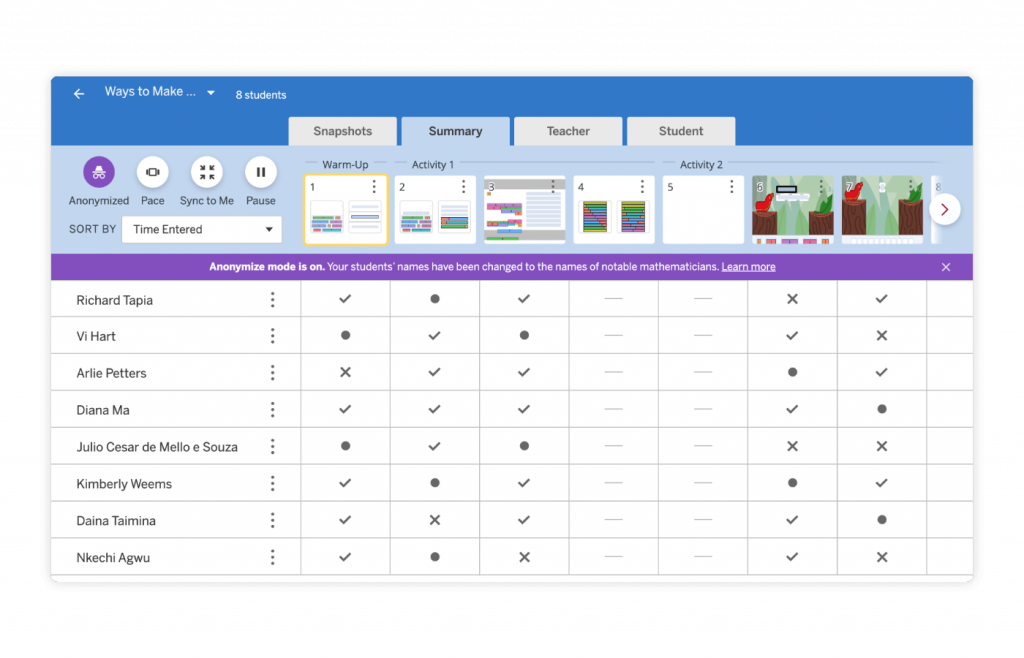
Cuando los estudiantes usan dispositivos, los maestros pueden supervisar su trabajo en tiempo real, asegurándose de que reciban el apoyo exacto que necesitan en cada parte de la lección, dentro y fuera del salón de clase.

Una interfaz digital que muestra los nombres anónimos de los estudiantes y su estado de participación en diversas actividades. La interfaz incluye opciones para realizar resúmenes, capturas de pantalla y vistas individuales de los estudiantes.

Componentes de una lección

A los estudiantes en un aula de Amplify Desmos Math California se les ve (¡y se les escucha!) haciendo preguntas, debatiendo respuestas, justificando su razonamiento, enfrentándose a problemas y trabajando juntos o de forma individual.

Una lección típica de Amplify Desmos Math California incluye:

  • Calentamiento: Un problema breve e interesante para que los estudiantes se sientan atraídos a la lección.
  • Actividades: Una o dos actividades cortas que desafíen las destrezas de los estudiantes para resolver problemas.
  • Síntesis: Una discusión para revisar y consolidar los conceptos importantes de la lección.
  • Demuestra lo que sabes (Show What You Know) y Reflexión (Reflection): Preguntas para que los estudiantes demuestren lo que aprendieron en la lección. (Nota: La evaluación de la lección “Demuestra lo que sabes” es opcional en kindergarten y primer grado).
  • Centros (Centers): Estaciones de actividades dirigidas por los estudiantes que refuerzan los conceptos matemáticos que aprendieron durante las actividades de la lección usando formatos interactivos y, a menudo, lúdicos. En kindergarten y primer grado, el tiempo destinado a los Centros se incorpora en los últimos 15 minutos de cada lección.

Para apoyar, fortalecer y ampliar el aprendizaje de los estudiantes después de la lección, Amplify Desmos Math California ofrece opciones de:

  • Diferenciación: Minilecciones (Mini-Lessons), Centros, Extensiones, Boost Personalized Learning y Fluency Practice (Práctica de la fluidez).
  • Práctica: Problemas adicionales que el maestro puede asignar para trabajar en clase o como tarea.

Apoye el aprendizaje de las matemáticas en casa.

Usted puede apoyar el aprendizaje de las matemáticas de su estudiante fuera de la escuela de muchas maneras:

El maestro puede asignar problemas de práctica al final de cada lección como trabajo en clase o como tarea. Si su estudiante ya ha completado los problemas de práctica de la lección, pídale que le explique cómo resolvió cada problema o que comente las partes que le resultaron difíciles. Haga preguntas de seguimiento para fomentar el uso del lenguaje matemático mientras explica su razonamiento, por ejemplo: “¿Cómo lo sabes?”, “¿Cómo puedes demostrar tu razonamiento?” o “¿Cómo describirías eso?”. Si su estudiante no consigue avanzar, hágale preguntas de apoyo, por ejemplo: “¿Qué información de aquí conoces?” o “¿Cómo podrías representar este problema?”.

Los juegos de Centro (Center game) se alinean con las matemáticas de la unidad y se pueden jugar con los estudiantes fuera de clase. Es posible que el maestro les explique a los estudiantes cómo jugar un juego de Centro durante o después de una lección. Si no es así, usted puede enseñarle a jugar usando instrucciones fáciles de seguir. Regístrese para obtener una cuenta gratuita y explorar los Centros y el contenido adicional para grados K a 5 en nuestras Colecciones destacadas.

Relacione las matemáticas con actividades cotidianas en casa, ya sea ir de compras, preparar la comida o planear una visita a la tienda. Su estudiante puede ayudarle a calcular cuántas manzanas más hay en el carrito que naranjas, dividir un sándwich en cuatro partes o calcular cuánto cambio recibirá si paga con un billete de diez dólares. Anímelo a señalar las maneras en que ustedes usan las matemáticas en sus quehaceres diarios.

Recuerde al estudiante que bloquearse es una parte necesaria (incluso benéfica) del proceso de aprendizaje. Muchos estudiantes (al igual que personas adultas) temen equivocarse, pero las investigaciones demuestran que cometer errores ayuda a que nuestro cerebro se desarrolle. Cuando su estudiante no consiga avanzar en un problema, anímelo a seguir intentando diferentes estrategias, aunque no esté seguro de si son correctas.

Obtenga más información.

¿Tiene alguna pregunta sobre Amplify Desmos Math California? Visite nuestra biblioteca de ayuda (en inglés) para buscar artículos con respuestas a sus preguntas sobre el programa. Para obtener más ayuda, por favor comuníquese con su maestro.

Welcome

Elementary Literacy Program – Family Welcome Letter

Lectoescritura en Español – Carta de bienvenida para las familias

Grade K

Grade 1

Grade 2

Grade 3

Grade 4

Grade 5

Welcome

Elementary Literacy Program – Family Welcome Letter

Lectoescritura en Español – Carta de bienvenida para las familias

Grade K

Grade 1

Grade 2

Grade 3

Grade 4

Grade 5

Familias y cuidadores, ¡les damos la bienvenida a Amplify Desmos Math New York para los grados K–5!

Les damos la bienvenida a Amplify Desmos Math Caregiver Hub de Amplify New York, para los grados de kindergarten a 5.º. ¡Nos entusiasma que la escuela de su estudiante haya elegido nuestro programa! Hemos diseñado este espacio para ayudarle a incentivar en su estudiante el aprendizaje de las matemáticas este año. El esfuerzo que usted realice cumple un rol fundamental en la experiencia que el estudiante tenga con las matemáticas.

Esperamos que el estudiante disfrute de explorar las matemáticas usando la tecnología a su disposición, tanto como colaborar con amigos para resolver problemas y aprender todo tipo de conceptos nuevos e interesantes. ¡Y esperamos que a usted le encante acompañarlo en esta experiencia!

Reciban un afectuoso saludo, con mucho entusiasmo por este aprendizaje conjunto.

—El equipo de Amplify Desmos Math

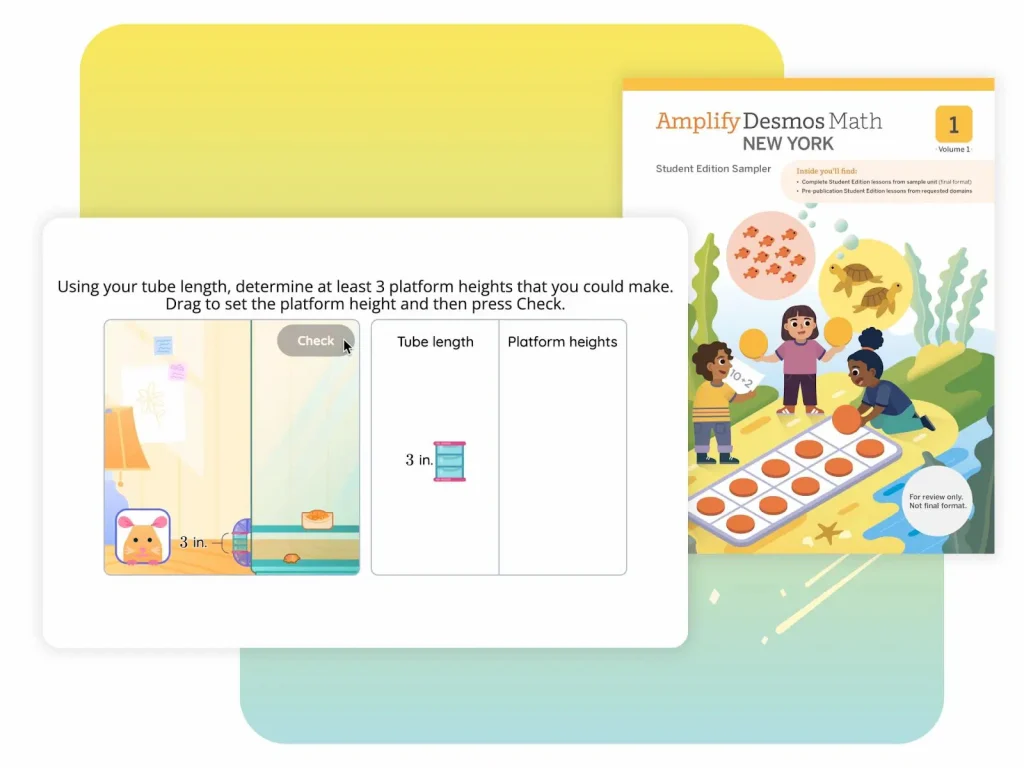
A math activity interface instructs to determine platform heights using a tube length. A student workbook titled "Amplify Desmos Math, New York, Volume 1" featuring children playing is also visible.

Presentación de Amplify Desmos Math

Amplify Desmos Math es un plan de estudios básico de matemáticas, diseñado para estudiantes de kindergarten a 5.º grado. Desarrollamos el programa con la idea de que todo método estructurado de aprendizaje que se centra en la resolución de problemas debe tomar como base la curiosidad de los estudiantes para poder desarrollar conocimientos perdurables al nivel que corresponde en cada grado. Cada lección ofrece oportunidades de desarrollar los conocimientos de los estudiantes, conectar sus ideas, mejorar su dominio de las destrezas y darles la autonomía de plantear preguntas, explorar y hacer descubrimientos. 

Amplify Desmos Math utiliza un método de enseñanza centrado en el estudiante, el cual ha demostrado mejorar significativamente el aprendizaje de las matemáticas. Nuestra misión es que su estudiante aprenda matemáticas ¡y que le encante aprenderlas! 

En cada lección, el plan de estudios de Amplify Desmos Math plantea problemas entretenidos y relevantes que solucionar, dando diariamente a los estudiantes oportunidades para pensar críticamente, colaborar y participar activamente en su propio aprendizaje.

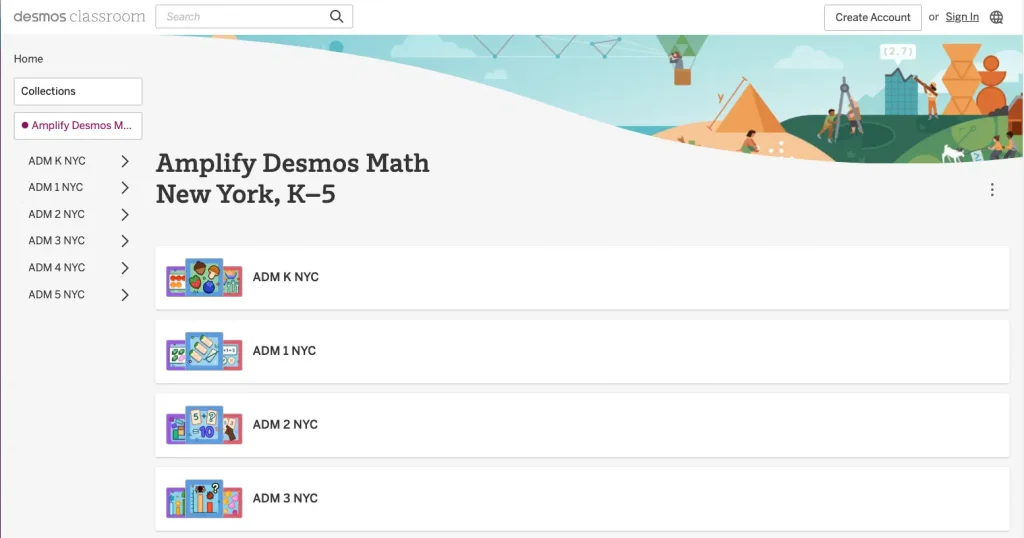
Página web de Desmos Classroom que muestra una lista de los módulos de Amplify Desmos Math para Nueva York, K-5, con opciones ADM K NYC, ADM 1 NYC, ADM 2 NYC y ADM 3 NYC.

Sobre la enseñanza de las matemáticas centrada en el estudiante

La enseñanza centrada en el estudiante puede parecer distinta a las formas de aprender matemáticas del pasado y a la manera en que usted aprendió matemáticas. En lugar de memorizar fórmulas y trucos, el aprendizaje centrado en el estudiante se enfoca en ofrecer oportunidades para descubrir cómo funcionan las matemáticas. Las investigaciones revelan que tanto estudiantes como maestros prefieren este método, además de que los maestros informan que la enseñanza centrada en el estudiante ha ayudado a los suyos a aprender más matemáticas.

A diverse group of students, one wearing a unicorn headband, looks at a teacher pointing to an amplify math bar graph on a board.

Esta forma de aprendizaje ayuda a los estudiantes a:

  • Comprender cómo funcionan los conceptos matemáticos.
  • Recordar lo que aprenden en clase y aplicar sus conocimientos a situaciones nuevas.
  • Obtener mejores resultados en exámenes estandarizados y tener mejores calificaciones que los estudiantes que aprenden con otros métodos.
  • Aprender a comunicarse tanto por escrito como verbalmente, comprender y replicar las opiniones de los demás y adquirir confianza para resolver nuevos problemas.
  • Desarrollar habilidades clave para la vida, por ejemplo, aprovechar la tecnología, completar proyectos de forma individual y en grupo y perseverar ante problemas difíciles.

¿Qué materiales utilizan los estudiantes?

Amplify Desmos Math promueve el aprendizaje por medio de materiales impresos de apoyo combinados con experiencias digitales singulares. Todas las lecciones de Amplify Desmos Math K-5 están disponibles en un libro de Edición del estudiante que usan para escribir. Muchas de las lecciones están diseñadas para incluir actividades prácticas que incorporan materiales manipulables, y una cierta cantidad de lecciones se diseñó para que los estudiantes usen dispositivos digitales como computadoras portátiles o tabletas, en función de sus edades. Dichas lecciones incluyen experiencias digitales enriquecidas que se recomienda que los maestros asignen a sus estudiantes.

Three animated women of diverse ethnicities smiling and discussing a math curriculum around a laptop at a table, with colorful abstract shapes in the background.

He aquí algunas características que puede esperar de Amplify Desmos Math para su estudiante: 

  • Lecciones que impulsan el debate en el aula para que los estudiantes puedan colaborar y así, lograr un aprendizaje conjunto y experimentar un sentido de comunidad.
  • Feedback receptivo que interpreta las respuestas de los estudiantes en el contexto apropiado y fomenta la perseverancia y la rectificación.
  • Planes de clase fáciles de seguir, probados en aulas de todo el país, con sugerencias y estrategias didácticas claras y rutinas de lenguaje matemático.
  • Problemas de práctica para lograr dominio y ayudar a los estudiantes a repasar temas anteriores.
  • Sugerencias de diferenciación para que los maestros puedan cubrir las necesidades de estudiantes diversos.
  • Evaluaciones formativas que proporcionan información sobre la comprensión de cada estudiante y permiten hacer ajustes a la enseñanza para atender las necesidades de toda la clase.
  • Evaluaciones sumativas que ayudan a los maestros a comprender qué saben los estudiantes sobre los contenidos matemáticos que han estudiado. 
  • Evaluaciones diarias en cada lección, con las cuales los maestros pueden verificar constantemente la comprensión. Un recurso para cuidadores en cada unidad, el cual incluye explicaciones de conceptos matemáticos clave y problemas para resolver con el estudiante.

Cuando los estudiantes utilizan dispositivos, los maestros pueden supervisar su trabajo en tiempo real para asegurarse de que cuentan con el apoyo que necesitan en cada sección de la lección, tanto dentro como fuera del aula. Aquí le presentamos un ejemplo de lo que un maestro ve en su panel de control para ayudarle a supervisar los razonamientos y estimular el aprendizaje de los estudiantes.

A classroom dashboard displays student names and their progress in activities, with checkmarks indicating completed tasks and circles showing ongoing or incomplete tasks.

Los estudiantes también pueden acceder a su trabajo digital en casa. He aquí un artículo sobre cómo navegar por la página de inicio para estudiantes.

¿Cómo es una lección?

En una clase de Amplify Desmos Math, se puede ver (¡y oír!) a los estudiantes al hacer preguntas, debatir respuestas, justificar sus razonamientos, resolver problemas y trabajar juntos o de forma individual.

Two students, one male and one female, are sitting at a desk with a laptop, discussing a project under a "math club" sign, with speech bubble icons above them.

Esto es lo que normalmente incluye una lección de Amplify Desmos Math:

  • Calentamiento: Un problema breve e interesante para que los estudiantes se sientan atraídos por la lección.
  • Actividades: Una o dos actividades cortas que desafían las habilidades de los estudiantes para resolver problemas.
  • Síntesis: Un debate que repasa y reúne los conceptos importantes de la lección.
  • Demuestra lo que sabes y Reflexión: Preguntas para que los estudiantes demuestren lo que aprendieron en la lección. (Nota: La evaluación “Demuestra lo que sabes” se imparte a criterio del maestro en kindergarten y 1.er grado).
  • Centros: Estaciones de actividades dirigidas por los estudiantes, las cuales refuerzan los conceptos matemáticos que se aprendieron durante las actividades de la lección a través de formatos interactivos, usualmente similares a juegos. En kindergarten y 1.er grado, el tiempo destinado a los Centros se incorpora a los últimos 15 minutos de cada lección. 

Este es el material disponible al término de la lección para apoyar, consolidar y ampliar el aprendizaje de los estudiantes:

  • Diferenciación: Minilecciones, Centros, actividades complementarias, aprendizaje personalizado y práctica de dominio. 
  • Práctica: Problemas adicionales que el maestro puede asignar como trabajo en clase o tareas para casa.

¿Cómo pueden los cuidadores incentivar el aprendizaje de las matemáticas en casa?

Utilice nuestros Recursos de apoyo de la unidad para cuidadores

Hemos agregado un recurso para cuidadores a cada unidad del programa, el cual proporciona un resumen de los conceptos clave, junto con un problema extraído del conjunto de ejercicios de práctica de la lección para que lo resuelva junto con el estudiante. 

En cada uno de los enlaces de los grados académicos a continuación, encontrará un documento con los recursos para cuidadores correspondientes a cada unidad, tanto en inglés como en español.

1.er grado
Unidad 1: Sumar, restar y trabajar con datos
English
Spanish

3.er grado
Unidad 1: Introducción a la multiplicación
English
Spanish

5.º grado
Unidad 1: Volumen
English
Spanish

Repasen juntos los problemas de práctica

El maestro puede asignar problemas de práctica al final de cada lección, como trabajo en clase o como tarea. Si el estudiante ya ha completado los problemas de práctica de la lección, pídale que le explique cómo resolvió cada problema o que le hable sobre las partes que le resultaron más difíciles. 

Haga preguntas de seguimiento al estudiante para fomentar el uso del vocabulario matemático al explicar sus razonamientos, por ejemplo, “¿cómo lo sabes?”, “¿cómo puedes mostrar tu razonamiento?” o “¿cómo describirías eso?”. 

Si el estudiante no consigue avanzar, hágale preguntas de apoyo, por ejemplo, “¿qué información de aquí conoces?” o “¿cómo podrías representar este problema?”.

Recuerde que es válido bloquearse

Haga hincapié en que bloquearse forma parte del proceso de aprendizaje e incluso es fundamental. Muchos estudiantes (¡al igual que adultos!) temen equivocarse. Sin embargo, las investigaciones demuestran que cometer errores ayuda a que el cerebro se desarrolle mejor. Cuando el estudiante no logre avanzar en un problema, anímelo a probar distintas estrategias, aunque no tenga certeza de si son correctas.

Descubran las matemáticas en la vida cotidiana

Relacionen las matemáticas con las actividades cotidianas del hogar, ya sea al ir de compras, preparar una comida o planificar una visita a una tienda. El estudiante puede ayudarle a calcular cuántas manzanas más que naranjas hay en el carrito; puede mostrarle cómo dividir un sándwich en cuartos o calcular cuánto cambio recibirán de un billete de diez dólares. Anime al estudiante a mencionar de qué forma la familia utiliza las matemáticas en sus tareas diarias.

Lea el Cuento de la unidad con el estudiante

Cada unidad de Amplify Desmos Math K–5 comienza con un cuento leído en voz alta que captura el interés de los estudiantes y contextualiza los conceptos matemáticos de la unidad. Los elementos y personajes del Cuento de la unidad aparecen en las lecciones de toda la unidad.

Acceda a nuestra colección de lecciones y actividades gratuitas para K–5

Explore nuestros contenidos gratuitos más recientes para estudiantes de kindergarten a 5.º grado en nuestra colección de destacados de Desmos Classroom. En nuestra colección gratuita, puede acceder a:

  • Lecciones digitales: interesantes lecciones interactivas.
  • Minilecciones: una mezcla de actividades impresas y digitales, diseñadas para la enseñanza a grupos pequeños.
  • Rutinas matemáticas: actividades digitales breves para iniciar la enseñanza y fomentar los diálogos matemáticos.
  • Momentos matemáticos manejables: actividades digitales de práctica que utilizan materiales manipulables virtuales de Polypad, que por su diseño, pueden usarse de forma flexible. 

Haga clic aquí para acceder a la colección e inscribirse gratuitamente.  

¿Cómo accede la familia al programa desde casa?

El estudiante tendrá acceso a los materiales de aprendizaje, práctica y evaluación a través de la plataforma de Amplify. El estudiante puede acceder al plan de estudios digital en la escuela y en casa siguiendo estas sencillas instrucciones.

  • Haga clic en el botón de color naranja Login to Amplify Desmos Math a continuación.
  • Seleccione Log in with Amplify.
  • Introduzca el nombre de usuario y la contraseña del estudiante que el maestro proporcionó.
  • Seleccione el grado del estudiante.

Welcome Texas Home Learning Users!

Note: This site is no longer being actively updated. To access the latest 2021-22 Elementary Literacy Program instructional materials, please visit my.amplify.com

If you have any questions, please reach out to texashomelearning@tea.texas.gov

Grade K

Grade 1

Grade 2

Grade 3

Grade 4

Grade 5

Coming Soon!

Fomente y exalte el razonamiento de los estudiantes aprovechando su curiosidad natural.

Amplify Desmos Math ayuda a los maestros a fomentar un aula con estudiantes entusiastas y cooperativos, partiendo de sus ideas y desarrollando diaria y firmemente los conocimientos del grado académico correspondiente de cada estudiante. For English version, please click here.

image of Desmos Classroom resource page

Amplify Classroom

Para los grados K a 12.º

Una plataforma de enseñanza y aprendizaje que ofrece una colección de lecciones digitales gratuitas y herramientas para diseñar lecciones.

  • Los maestros pueden crear sus propias lecciones con la herramienta Activity Builder.
  • También pueden explorar contenido creado por otros maestros, por ejemplo:
    • Las lecciones que crean los usuarios y se almacenan en la biblioteca.
    • Las lecciones de la Colección destacada que produce el equipo de Amplify Classroom.

Más información en classroom.amplify.com

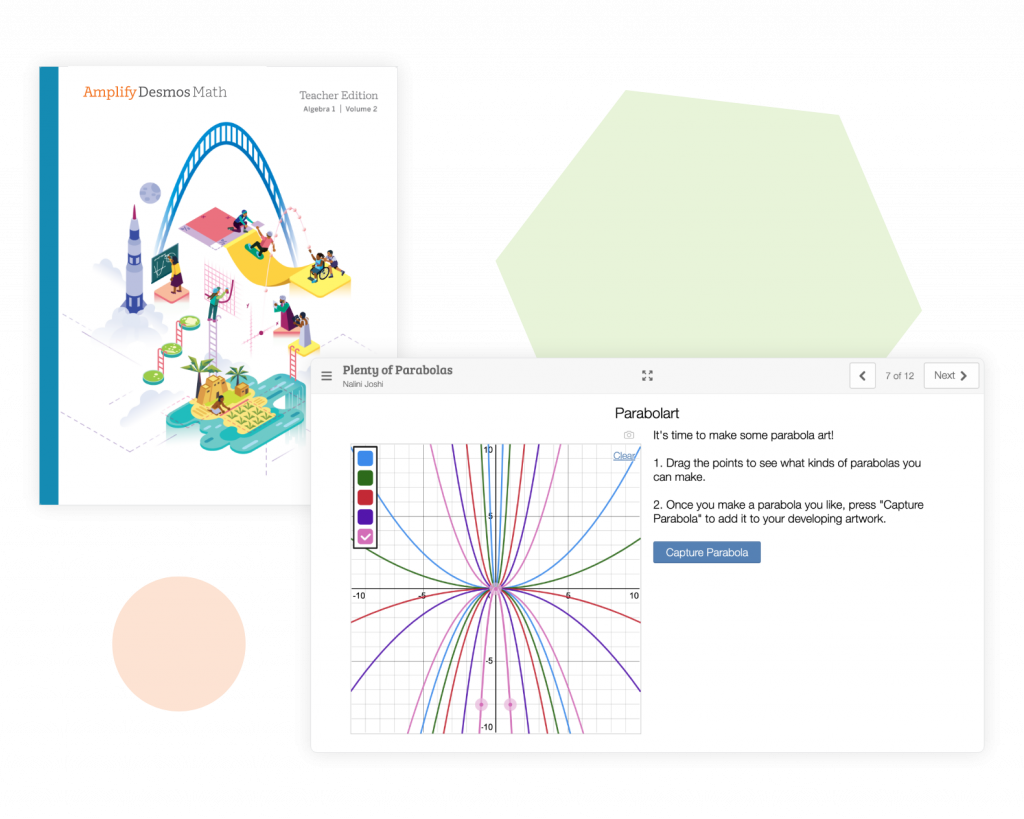
Interactive digital math lesson interface with colorful graphics showing parabola exploration and plotting tools on screen, enhanced by the New York math curriculum.

Amplify Desmos Math

Para los grados K a Álgebra 2

Próximamente: Un nuevo programa básico de prekindergarten a 12.º grado de Amplify y Desmos Classroom.

  • Un método basado en problemas que produce resultados mediante el desarrollo de una comprensión conceptual sólida, fluidez procedimental y ejemplos de uso.
  • Tecnología que inspira conexiones en el aula, fomentando la colaboración, el diálogo y la perseverancia en la resolución de problemas.
  • La curiosidad natural de los estudiantes propicia una comprensión cabal de las matemáticas y un aprendizaje que dura toda la vida.
  • Disponible en inglés y español.
  • Programma piloto para los grados K a A1 para el regreso a clases en el 2024.
Ilustración de un entorno educativo con una computadora portátil que muestra una lección de Desmos Math en pantalla, flanqueada por representaciones coloridas y abstractas de un paisaje urbano y varios gráficos.

Un nuevo programa básico para los grados preK al 12.º de Amplify y Desmos Classroom.

Amplify Desmos Math facilita tanto a los maestros como a los estudiantes la migración a un método basado en el planteamiento y la resolución de problemas, proporcionando actividades atractivas, eficaces herramientas de facilitación para el maestro y muchos apoyos para la diferenciación y la práctica.

Hemos combinado lecciones interactivas basadas en problemas con enseñanzas explícitas, refuerzos y prácticas para que los estudiantes dominen auténticamente las matemáticas. Las lecciones sientan una base sólida en cuanto a la fluidez en los procedimientos y cálculos, afianzan la comprensión de los conceptos y permiten a los estudiantes aplicar lo aprendido a situaciones del mundo real.

Amplify Desmos Math estará disponible a partir del curso escolar 2025–26. Los distritos interesados podrán probar la versión Beta a partir del otoño del 2024.

Más de lo que espera de un programa de matemáticas.

Integral

  • Plan de estudios basado en Illustrative Mathematics® IM K-12™
  • Diferenciación y práctica personalizadas
  • Evaluaciones e informes exhaustivos
  • Material didáctico en español
Cuadro ilustrativo que muestra el alcance y la secuencia del plan de estudios básico para álgebra 1 de sexto grado, segmentado en ocho unidades, con un caracol de dibujos animados en la esquina.
image of Amplify Desmos Math lesson overview of student activity

Cooperativo

  • Apoyos y herramientas eficaces para la facilitación docente
  • Los estudiantes analizan y aprenden de las ideas de los demás
  • Cada lección cuenta con materiales impresos y digitales totalmente compatibles con un aula inclusiva

Fascinante

  • Lecciones que promueven la curiosidad e inspiran a los estudiantes a resolver problemas del mundo real
  • Tecnología de Desmos Classroom que proporciona información instantánea e interactiva para potenciar el razonamiento de los estudiantes
  • Vistosas instrucciones gráficas para maestros y estudiantes
Interfaz de software educativo que muestra una lección de gráfico de barras sobre perros, con una ilustración de un corgi al lado de la pantalla como parte del plan de estudios de Amplify Desmos Math.

Qué incluye

Aprovechamos los alcances tecnológicos y las lecciones de Desmos y añadimos simples pero fascinantes componentes impresos y digitales para crear un programa sin precedentes que simplifica la enseñanza.

  • Edición para estudiantes (varios volúmenes)
  • Páginas de actividades interactivas para el estudiante
  • Interacciones enriquecidas (más información en la página 5)
  • Herramientas de colaboración
  • Práctica personalizada
  • Edición para maestros (varios volúmenes)
  • Herramientas de facilitación y seguimiento del progreso
  • Páginas de presentación
  • Apoyos pedagógicos
  • Evaluación
  • Prácticas adicionales y material fotocopiable en blanco y negro para evaluaciones

¿Necesita más información?

Llene este formulario y nos comunicaremos con usted a la brevedad.

Manténgase al día con las últimas novedades sobre Amplify Desmos Math y Desmos Classroom.

Las lecciones digitales deben potenciar el razonamiento de los estudiantes y generar debates interesantes y productivos. Regístrese para obtener más información sobre cómo Amplify Desmos Math y Desmos Classroom incitan a los estudiantes a interesarse por las matemáticas.

¡El Math Teacher Lounge está disponible!

Amplify presenta Math Teacher Lounge, un podcast con los presentadores Bethany Lockhart Johnson y Dan Meyer.

Illustration of a podcast player with "Math Teacher Lounge" and two headshots, featuring a man and a woman. Geometric shapes are scattered around.

¡El programa de Amplify CKLA da la bienvenida a las familias!

Nos complace dar la bienvenida a usted y a su estudiante al programa CKLA en el nuevo año escolar y brindar a su estudiante excelentes oportunidades educativas a través de nuestro programa. A continuación incluimos una serie de recursos y guías útiles para ayudar a que su estudiante aproveche al máximo nuestra plataforma a lo largo del año. For English version, please click here.

¿Qué es Amplify CKLA?

CKLA, o Conocimientos esenciales de Artes del Lenguaje de Amplify, es un programa de lenguaje para los grados PreK a 5 que combina un enfoque multisensorial de la fonética con textos enriquecidos y cuidadosamente secuenciados para desarrollar conocimientos sobre los contenidos. De esta manera, los estudiantes aprenden a leer y leen para aprender.

Todos los días, los estudiantes de los grados PreK a 2 completan una lección que les permite desarrollar sus destrezas básicas de lectura y otra lección que refuerza los conocimientos previos. En los grados 3 a 5, los estudiantes comienzan a dominar las destrezas de lectura y continúan ampliando su mundo.

Primeros pasos

Cómo apoyar a su niño/a en casa:

  • Si es posible, lea con su niño o niña a diario. Aun 15 minutos de lectura compartida todos los días pueden producir grandes resultados.
  • Pueden leer secciones del texto en voz alta y de forma conjunta. Si su niño o niña tiene dificultad para leer, intente leerle el texto con expresividad y pídale que se lo lea a usted después.
  • Como práctica adicional, mire las grabaciones de lectura en voz alta de los grados K a 2, o pida a su estudiante de grado 3 a 5 que use la aplicación de Vocabulario.
  • Busque oportunidades para conversar sobre lo que lee y descubre. Ejemplos de preguntas que usted podría hacerle: ¿Qué te llamó más la atención en lo que leíste hoy? ¿Hubo alguna oración o palabra que te resultó confusa? ¿Qué conclusiones sacaste de este pasaje del autor o la autora? ¿Qué crees que el autor o la autora estaba tratando de comunicar? ¿Estás de acuerdo con las ideas o descripciones del autor o la autora? ¿Qué conexiones puedes hacer entre lo que estás leyendo y tu propia vida u otros temas?
  • Escuche a su niño o niña leer sus respuestas escritas o pídale que las comparta con un amigo o una amiga en una videollamada.
  • En esta página encontrará material para ayudar a su estudiante a desarrollar destrezas básicas, como Refuerzo de las destrezas básicas y Las destrezas en casa.
  • Recomendamos que lea el artículo Proteja a los niños en internet de la Comisión Federal de Comercio sobre seguridad digital.

Inicio de sesión

Una vez que el estudiante inicia sesión, el sistema mostrará automáticamente solo los contenidos del grado correspondiente.

Estudiantes de los grados K a 2

Los estudiantes de los grados K a 2 podrán iniciar sesión con las Credenciales Compartidas que proporcionó el maestro/la maestra.

Cada estudiante ingresa en su dispositivo a learning.amplify.com.

Se hace clic en Log in y luego se introducen las credenciales de inicio de sesión o se hace clic en «Scan QR code» para iniciar sesión con un código QR. Los estudiantes ingresarán a su página de inicio, ¡donde podrán cambiar su avatar y hacer clic en un emoji para definir su estado de ánimo del día! En la página de inicio del estudiante habrá un vínculo de acceso rápido al Hub.

Nota: Los inicios de sesión compartidos son una forma de iniciar sesión en los programas digitales de Amplify para los estudiantes de los grados K a 2 de Amplify CKLA y los estudiantes que aún no han sido matriculados por su escuela o distrito. Hay un inicio de sesión compartido para los estudiantes en cada programa.

Estudiantes de los grados 3 a 5

Ir a learning.amplify.com.

Se hace clic en Log in y luego se introducen las credenciales de inicio de sesión o se hace clic en Scan QR code para iniciar sesión con un código QR. Los estudiantes ingresarán a su página de inicio, donde podrán cambiar su avatar y hacer clic en un emoji para definir su estado de ánimo del día. En la página de inicio del estudiante habrá un vínculo de acceso rápido al Hub.

Nota: Los estudiantes deben estar matriculados y tener una licencia adecuada.

Vistazo general a los materiales

Su niño o niña puede acceder al currículo digital de Amplify CKLA en casa si no puede asistir a la escuela y si tiene acceso a internet. El maestro o la maestra le dará los datos para iniciar sesión.

Libros de lectura

Estos libros de lectura han sido específicamente diseñados para que los estudiantes practiquen de manera intensiva mientras leen cuentos sencillos, pero auténticos.

En los grados K a 2, estos libros de lectura son libros de capítulos que permiten a su estudiante practicar los sonidos que acaba de aprender, aplicándolos a una experiencia de lectura auténtica que incorpora tramas convincentes y personajes interesantes.

En los grados 3 a 5, los lectores desarrollan destrezas de lectura atenta y otras destrezas de alfabetización mediante una selección de textos literarios e informativos diversos y de contenido variado.

Amplify CKLA tiene traducciones al español de lectores selectos de CKLA para los grados 3 a 5 únicamente, y están disponibles digitalmente en la Biblioteca de Amplify Hub.

Libros de actividades

En estas páginas de actividades, que son parte de las lecciones diarias, los estudiantes responden al texto que han leído, aplicando sus destrezas y conocimientos. Las páginas también incluyen evaluaciones que permiten seguir el desarrollo de las destrezas del o la estudiante. El maestro o la maestra tiene acceso a estas evaluaciones.

CKLA Hub para estudiantes

Los estudiantes acceden e interactúan con recursos multimedia en el CKLA Hub. Los estudiantes pueden emplear estos recursos digitales de forma independiente desde cualquier lugar, aprovechando por completo las experiencias educativas con multimedia que Amplify CKLA ofrece. Es compatible con laptops, Chromebooks, tabletas y computadoras de escritorio; incluso lo hemos optimizado para dispositivos móviles.

Videos de desarrollo de los conocimientos para los grados K a 2

Cada componente de Conocimiento comienza con un video de Desarrollo del Conocimiento: un cuento corto, entretenido y animado que enriquece la lección y motiva a los estudiantes con personajes, lugares y conceptos nuevos.

Biblioteca de sonidos para los grados K a 2

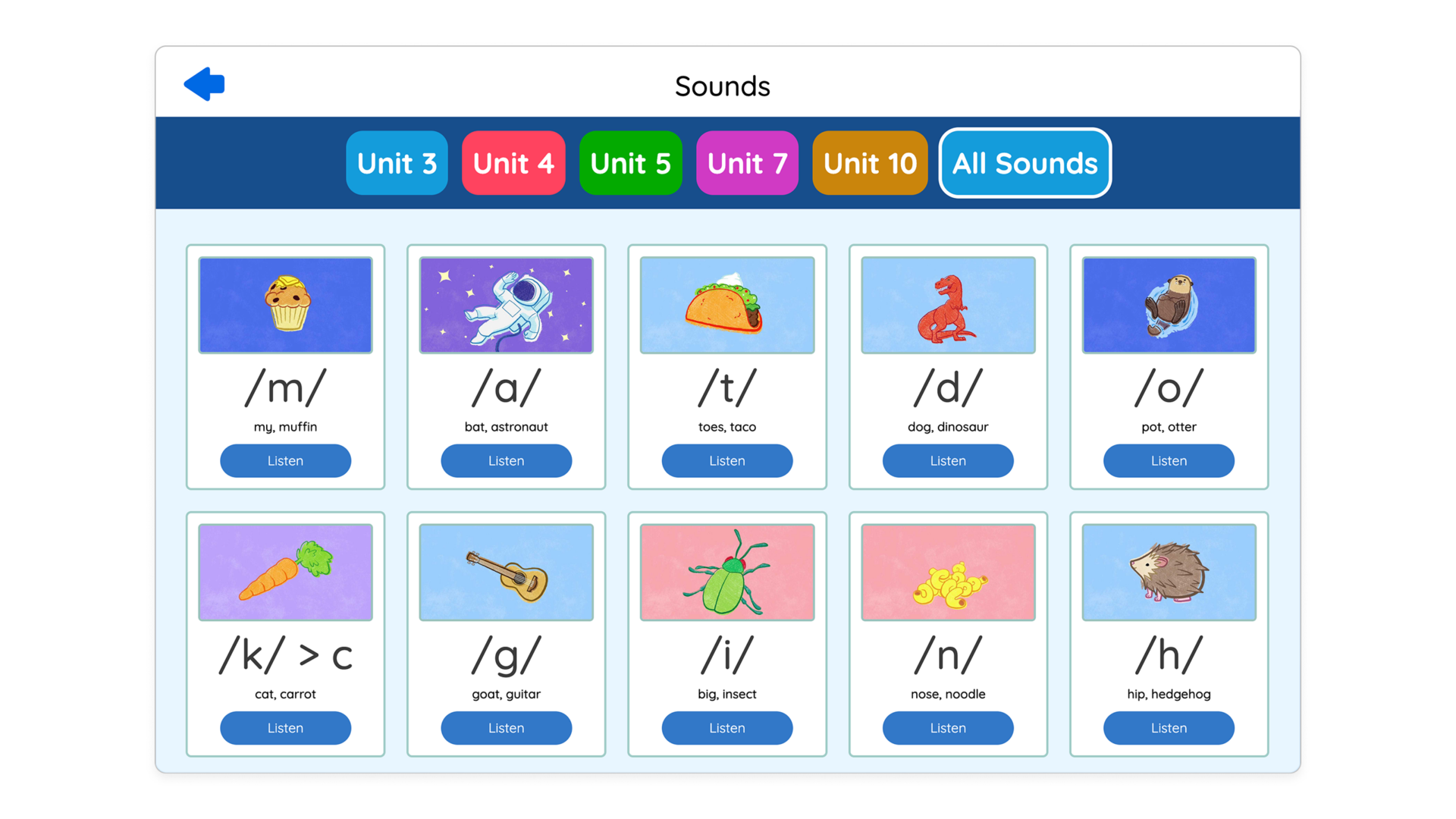
La Biblioteca de sonidos incluye sonidos grabados, canciones pegadizas y videos animados de articulación para ayudar a los estudiantes a aprender y dominar los sonidos.

Aplicación de vocabulario para los grados 3 a 5

La aplicación de vocabulario fue diseñada para practicar de forma independiente el vocabulario. Los estudiantes pueden usarla en actividades similares a juegos, las cuales presentan retos para fomentar su aprendizaje.

Grabaciones de lectura diaria en voz alta

El maestro o la maestra, así como cada estudiante, tendrán acceso a grabaciones en video de todas las lecturas en voz alta de los conocimientos de los grados K a 2 con ilustraciones de los Rotafolios.

Quests

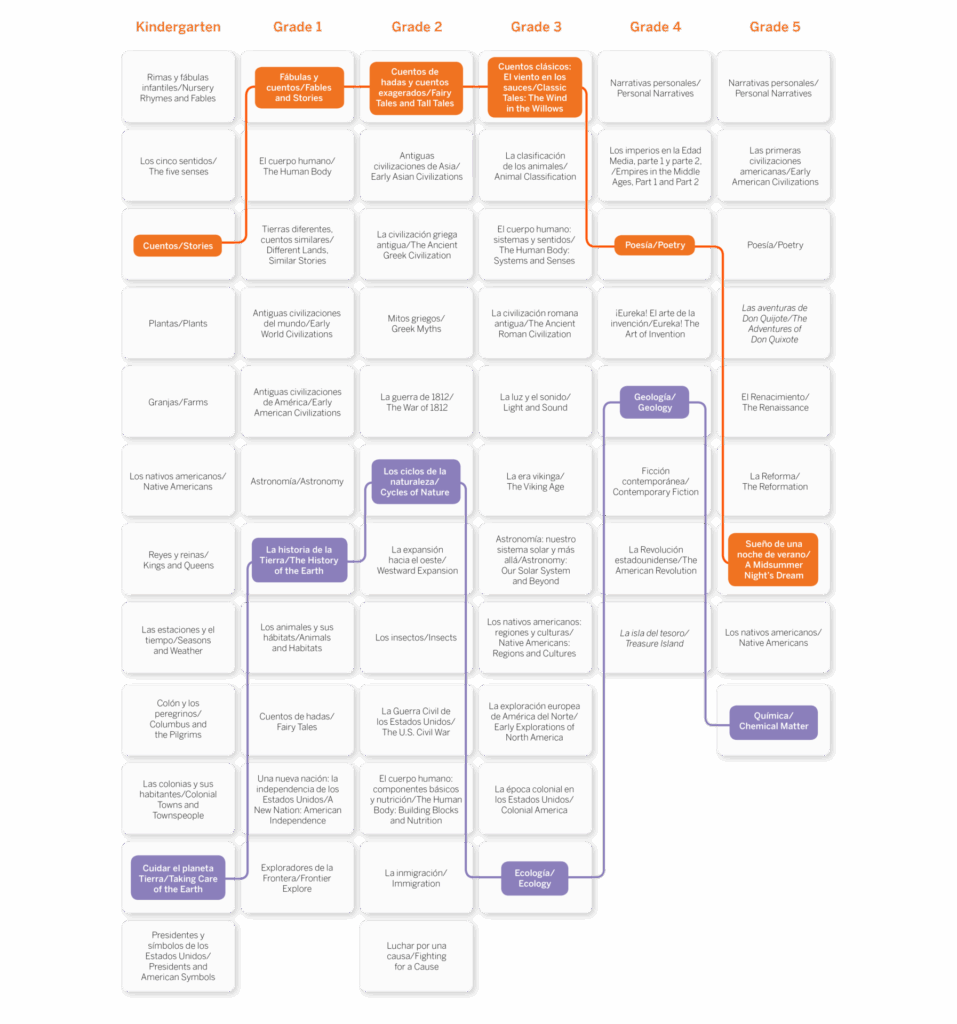
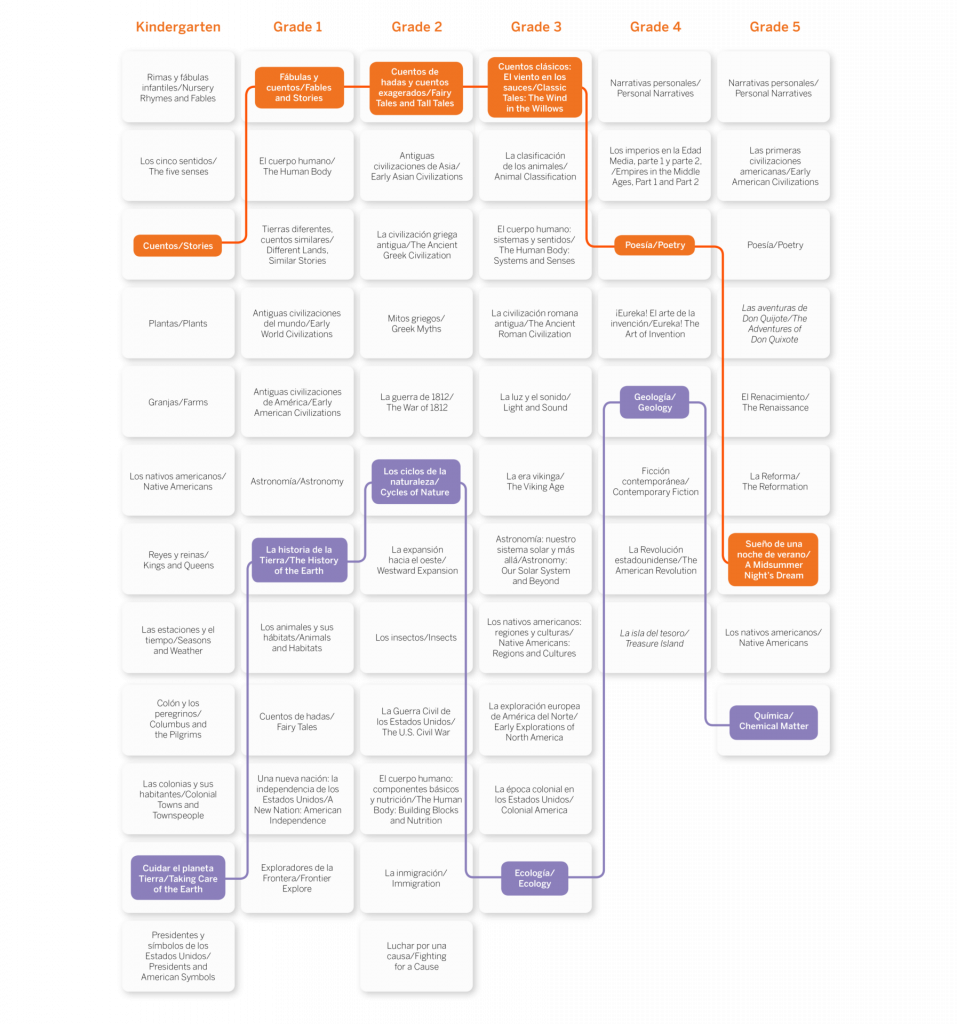
Cada uno de los grados 3 a 5 contiene un componente llamado Core Quest. En estas unidades especiales, todas las reglas habituales del salón de clases cambian y cada estudiante practica el lenguaje de maneras inesperadas. Por ejemplo, en el grado 5, aprenden a disfrutar del complejo lenguaje empleado por Shakespeare en “Sueño de una noche de verano” mediante imágenes, lectura atenta y actuación.

Resúmenes de unidades

A continuación se presentan descripciones generales rápidas de las unidades (en inglés) en las que trabajarán sus estudiantes en su grado durante todo el año. Al lado de cada unidad hay guías descargables que brindan una visión más profunda del contenido cubierto y cómo puede ayudar a sus estudiantes a mejorar su comprensión de los temas.

Contacte con nosotros

¡Estamos aquí para ayudarle!

¿Tiene alguna pregunta sobre Amplify CKLA?

Visite nuestra biblioteca de ayuda (en inglés) para buscar artículos con respuestas a sus preguntas sobre el programa.

Para obtener apoyo curricular adicional, comuníquese con el maestro de su estudiante.
Familias y cuidadores, ¡les damos la bienvenida a Amplify Desmos Math
6.º–A1!

Les damos la bienvenida al Amplify Desmos Math Caregiver Hub de los grados 6.º a Álgebra 1. Diseñamos este espacio para apoyar el desarrollo de los estudiantes en su exploración de las matemáticas. Esperamos que los estudiantes disfruten mientras aprenden las matemáticas, colaborando con amigos para resolver problemas y aprendiendo conceptos nuevos e interesantes. Esperamos también que las familias se deleiten en esta aventura matemática.

For the English version, please click here.

Presentación de Amplify Desmos Math

Amplify Desmos Math es un plan de estudios básico de matemáticas, diseñado para estudiantes de kindergarten a Álgebra 1. Cada lección ofrece oportunidades de ampliar los conocimientos de los estudiantes, asociar conceptos, perfeccionar sus destrezas y darles la autonomía de expresar preguntas, explorar y hacer descubrimientos. Los maestros pueden monitorear el trabajo de los estudiantes en tiempo real para asegurarse de que cuentan con el apoyo que necesitan tanto dentro como fuera del aula.

Páginas digitales del estudiante

Los estudiantes interactúan con el contenido de la lección usando dispositivos.

Páginas de ejercicios de práctica

Los estudiantes tienen dos páginas impresas con ejercicios de práctica, por lección, en la Edición del estudiante para practicar en clase o como tarea, además de los ejercicios de práctica en formato digital.

Esto es lo que puede esperar:

  • Lecciones interactivas que combinan instrucción en medio impreso y digital (incluyendo el libro práctico Edición del estudiante)
  • Problemas de práctica para lograr dominio y ayudar a los estudiantes a repasar temas anteriores
  • Recursos en cada lección que responden a las necesidades de estudiantes diversos
  • Evaluaciones, así como pruebas en cada lección para verificar la comprensión
  • Un recurso para cuidadores en cada unidad, el cual incluye explicaciones de conceptos matemáticos clave y actividades para realizar con el estudiante

Además de poder trabajar en la Edición del estudiante, los estudiantes pueden acceder a su trabajo digital desde casa. He aquí un artículo sobre cómo navegar la página de inicio del estudiante.

¿Qué es la enseñanza centrada en el estudiante?

La enseñanza centrada en el estudiante puede parecer distinta a las formas de aprender matemáticas en el pasado y a la manera en que usted aprendió matemáticas. En lugar de memorizar fórmulas y trucos, el aprendizaje centrado en el estudiante ofrece a los estudiantes oportunidades de descubrir cómo funcionan las matemáticas. El estudiante aprende a comunicarse por escrito y verbalmente, comprender y cuestionar las opiniones de los demás y adquirir confianza para resolver nuevos problemas. Las investigaciones demuestran que tanto estudiantes como maestros prefieren este método; los estudiantes se desempeñan mejor en evaluaciones estandarizadas y mejoran sus calificaciones y, por otra parte, los maestros informan que la enseñanza centrada en el estudiante ha ayudado a los suyos a aprender más matemáticas.

¿Cómo es una lección de Amplify Desmos Math?

Esto es lo que normalmente incluye una lección de Amplify Desmos Math:

  • Calentamiento: Una pregunta abierta o una interacción para interesar a los estudiantes en la lección.
  • Actividades: De una a tres actividades que constituyen el núcleo de cada lección.
  • Te invitamos a explorar más: Problemas que invitan a los estudiantes a explorar un concepto (a menudo uno que trasciende el objeto de la lección) minuciosamente.
  • Síntesis: Una oportunidad para que los estudiantes enuncien las ideas clave de la lección en sus propias palabras.
  • Demuestra lo que sabes y Reflexión: Una oportunidad para que los estudiantes enuncien las ideas clave de la lección en sus propias palabras.
  • Práctica: Problemas adicionales que el maestro de su estudiante puede asignar en formato digital o impreso, incluidos los ejercicios de práctica de la lección, así como el repaso de lecciones y unidades anteriores.
  • Recursos adicionales: Minilecciones, prácticas personalizadas (solo para los grados 6.º a 8.º) y actividades complementarias que los maestros emplean para apoyar, fortalecer y ampliar los conocimientos de los estudiantes durante y después de las lecciones.

¿Dónde puedo encontrar recursos a nivel de unidad?

Hemos agregado un Recurso para cuidadores a cada unidad del programa, el cual proporciona un resumen de los conceptos clave y ejemplos de cómo resolver los problemas.
En cada uno de los enlaces para los grados académicos a continuación, encontrará un documento con el Recurso para cuidadores correspondiente a cada unidad, tanto en inglés como en español.

Unidad 1: Área y área de superficie

Unidad 2: Introducción a las razones

Unidad 3: Tasas y porcentajes

Unidad 4: División de fracciones

Unidad 5: Aritmética decimal

Unidad 6: Expresiones y ecuaciones

Unidad 7: Números positivos y negativos

Unidad 8: Descripción de datos – ¡Próximamente!

  • Inglés
  • Español – ¡Próximamente!

Unidad 1: Dibujos a escala

Unidad 2: Introducción a las relaciones proporcionales

Unidad 3: Medidas de círculos

Unidad 4: Relaciones proporcionales y porcentajes

Unidad 5: Operaciones con números positivos y negativos

Unidad 6: Expresiones, ecuaciones y desigualdades

Unidad 7: Ángulos, triángulos y prismas

Unidad 8: Probabilidad y muestreo

  • Inglés
  • Español – ¡Próximamente!

Unidad 1: Transformaciones rígidas y congruencia

Unidad 2: Dilataciones, semejanza y pendiente

Unidad 3: Relaciones proporcionales y lineales

Unidad 4: Ecuaciones lineales y sistemas lineales

Unidad 5: Funciones y volumen

Unidad 6: Asociación de datos

Unidad 7: Exponentes y notación científica

Unidad 8: Teorema de Pitágoras y números irracionales

  • Inglés
  • Español – ¡Próximamente!

Unidad 1: Patrones y secuencias

Unidad 2: Ecuaciones lineales y desigualdades

Unidad 3: Descripción de datos

Unidad 4: Descripción de funciones

Unidad 5: Sistemas de ecuaciones lineales y desigualdades

Unidad 6: Funciones exponenciales

Unidad 7: Funciones cuadráticas

Unidad 8: Ecuaciones cuadráticas

  • Inglés
  • Español – ¡Próximamente!

¿Cómo puedo incentivar el aprendizaje de las matemáticas en casa?

Usted puede incentivar el aprendizaje de matemáticas de su estudiante fuera de la escuela de muchas maneras:

Descubran las matemáticas en la vida cotidiana.

Relacione las matemáticas con las actividades cotidianas del hogar, ya sea al preparar comida, ir de compras o planificar un viaje en automóvil. Su estudiante puede ayudarle a determinar el precio de un artículo con un cupón, reducir una receta a la mitad o calcular cuánto combustible necesitan para llegar a su destino.

Repasen juntos los problemas de práctica.

Invite al estudiante a que le explique paso a paso el proceso de resolución de cada problema o le platique qué partes le resultaron difíciles de resolver. Para fomentar el uso del vocabulario matemático, considere hacer las siguientes preguntas al estudiante: “¿cómo lo sabes?”, “¿cómo puedes mostrar tu razonamiento?” o “¿cómo describirías eso?”. Si el estudiante no consigue avanzar, hágale preguntas de apoyo, por ejemplo: “¿qué información de aquí conoces?” o “¿cómo podrías representar este problema?”.

Haga hincapié en que es normal bloquearse.

Recuerde al estudiante que bloquearse es una parte natural y necesaria del aprendizaje. Muchos estudiantes (al igual que personas adultas) temen equivocarse. Las investigaciones demuestran que equivocarse ayuda a que el cerebro se desarrolle. Cuando su estudiante no consiga avanzar en un problema, anímelo o anímela a probar distintas estrategias, aunque no tenga certeza de si son correctas.

¿Cómo puedo acceder al programa desde casa?

Su estudiante tendrá acceso a los materiales de aprendizaje, práctica y evaluación a través de la plataforma de Amplify. Usted y su estudiante pueden acceder al plan de estudios digital en la escuela y en casa siguiendo estas instrucciones.

  • Haga clic en el botón de Amplify Desmos Math.
  • Seleccione Iniciar sesión con Amplify.
  • Ingrese el nombre de usuario y la contraseña que el maestro entregó.
  • Seleccione el grado escolar del estudiante.

¡Bienvenidos, cuidadores de Amplify Tutoring!

¡Le damos la bienvenida a Amplify Tutoring!

Nos entusiasma poder apoyar a su estudiante poniendo a su disposición tutorías de gran alcance tanto de lectura como de matemáticas. Nuestro programa se basa en la investigación y está diseñado para fomentar la confianza, fortalecer destrezas fundamentales y acelerar el aprendizaje. También brindamos herramientas y recursos para ayudar a maestros y cuidadores a colaborar en la creación de una sólida cultura de aprendizaje en casa y en la escuela. For English version, please click here.

¿Qué es la tutoría de gran alcance?

La tutoría de gran alcance es una forma de enseñanza focalizada e impartida en grupos pequeños que puede producir beneficios significativos en el aprendizaje. Amplify Tutoring consigue estos beneficios adoptando las mejores prácticas:

Materiales de alta calidad

Los tutores imparten lecciones de lectura y matemáticas que son de alta calidad y cuya eficacia está comprobada. Usted verá un progreso y una mejora reales en los resultados individuales de su estudiante.

Tutorías de gran alcance con sesiones frecuentes y coherentes

Los tutores proporcionan atención personalizada en grupos pequeños. Nuestro programa prevé que los estudiantes participen en tres o más sesiones de 30 minutos por semana.

Relaciones de apoyo y capacitación

La formación coherente de parejas de tutores y estudiantes fomenta las relaciones y un mayor logro académico. Los tutores reciben desarrollo profesional continuo.

Amplify Tutoring está listo para brindar a su estudiante programas de tutoría eficaces e interesantes a lo largo del año.

Cada minuto cuenta.

Cada minuto cuenta para ayudar a que su estudiante aprenda y se desarrolle. Para aprovechar al máximo la tutoría, es importante que asista a tiempo y de manera regular. A continuación listamos unos breves recordatorios:

Cómo puede ayudar a su estudiante a aprovechar al máximo la tutoría:

  1. Haga de los días de tutoría una prioridad. Haga todo lo posible para que su estudiante asista a la escuela los días de tutoría. ¡Cada sesión le ayudará a avanzar más!
  2. Pregunte por el horario de tutorías. Comuníquese con su maestro o con el coordinador de tutorías para averiguar los días y horarios de las tutorías.
  3. Planifique el tiempo de las tutorías. Si puede, programe citas y otras actividades en diferentes horarios para que su estudiante no se pierda ninguna sesión.
  4. Comuníquese con el maestro de su estudiante. Si su estudiante no puede asistir a la tutoría, simplemente avísele al maestro o coordinador para que puedan apoyarlo.
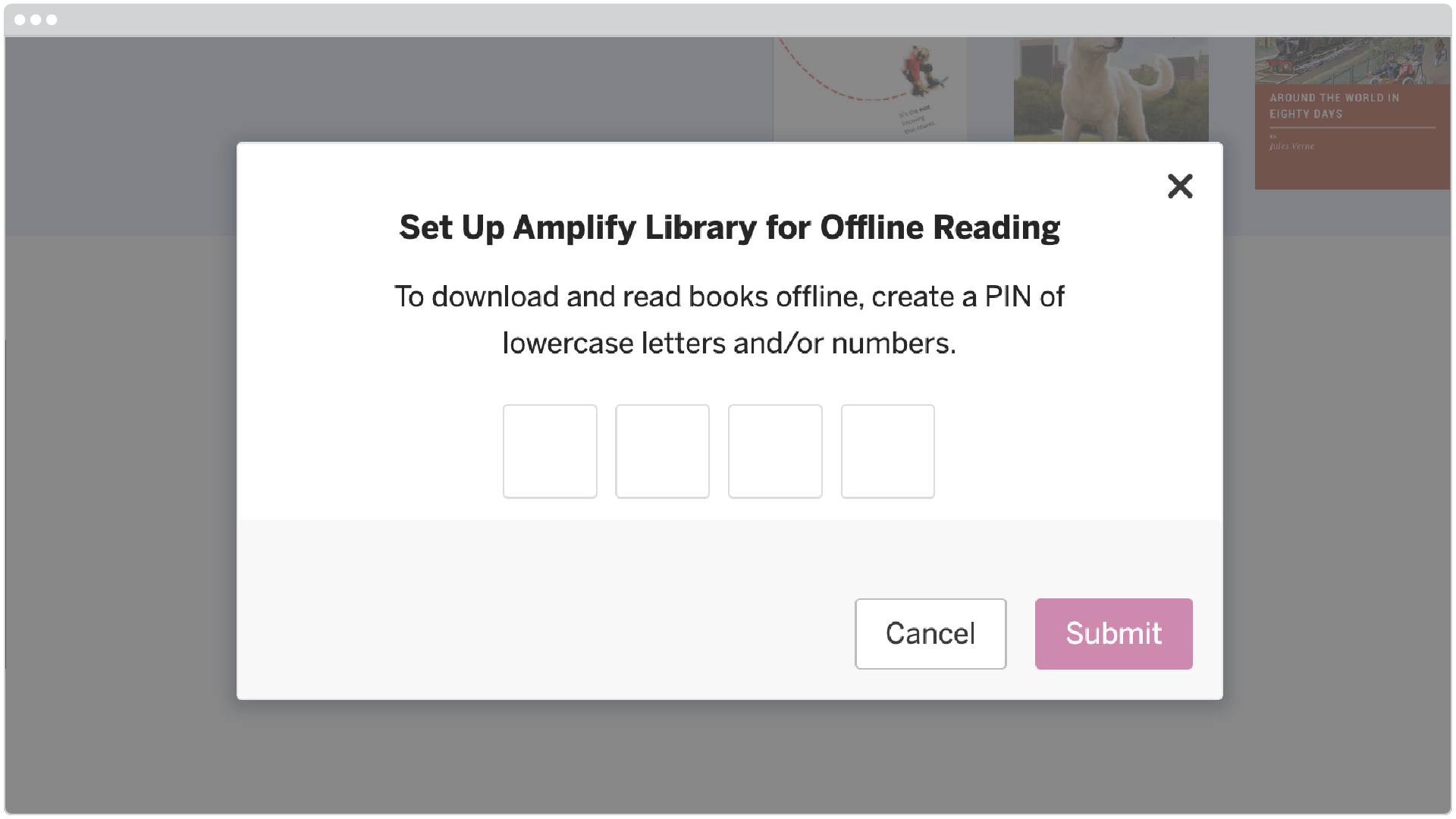
Platique con su estudiante sobre sus sesiones de Amplify Tutoring.

Hable sobre la tutoría con su estudiante, ya sea en casa o mientras se prepara para el día. Para apoyar su aprendizaje, puede considerar:

Celebrar el progreso.

Pregunte:

  • ¿Qué nuevas destrezas de lectura o de matemáticas has aprendido?
  • ¿Cómo han mejorado tu lectura o tu uso de las matemáticas desde que comenzaste la tutoría?
  • ¿Tienes alguna actividad favorita en la tutoría?

Definir metas juntos.

Pregunte:

  • ¿Qué destrezas de lectura o de matemáticas te gustaría mejorar en la tutoría?
  • ¿Qué objetivo te gustaría alcanzar al término del programa de tutoría?
  • ¿Qué pasos puedes tomar que te ayuden a alcanzar esos objetivos?
  • ¿Cómo puedo ayudarte a alcanzar tus objetivos?

Brinde apoyo

Pregunte:

  • ¿Cómo puedo ayudarte con tu trabajo de lectura o de matemáticas?
  • ¿Podemos destinar tiempo a que practiques tus destrezas cada día?
  • ¿Cuál fue la parte más interesante de tu sesión de tutoría?
  • ¿Qué te enorgullece haber logrado en las sesiones de esta semana?
  • ¿Cuándo sentiste verdadero entusiasmo por lo que estabas aprendiendo?

Materiales y recursos de apoyo para la lectoescritura en Amplify Tutoring

Two young children wearing headphones sit at a table with a laptop, smiling and giving each other a high five.

Cuidadores, a continuación encontrarán materiales y recursos que pueden serles útiles a usted y a su estudiante.

mCLASS®:

  • Las escuelas que participan en Amplify Tutoring usan mCLASS assessment (evaluación de mCLASS) y mCLASS Intervention (intervención de mCLASS).
  • mCLASS assessment identifica riesgos en la lectura y ayuda a responder a las necesidades de los estudiantes mediante intervenciones personalizadas, como las tutorías de gran alcance.
  • Consulte información sobre las evaluaciones de lectura, los recursos para los cuidadores y el desarrollo del aprendizaje en la Guía para comprender mCLASS.
  • Explore el mCLASS Caregiver Hub en inglés y español.
  • Lea la carta Home Connect de muestra que resalta las fortalezas y áreas de crecimiento de su estudiante.
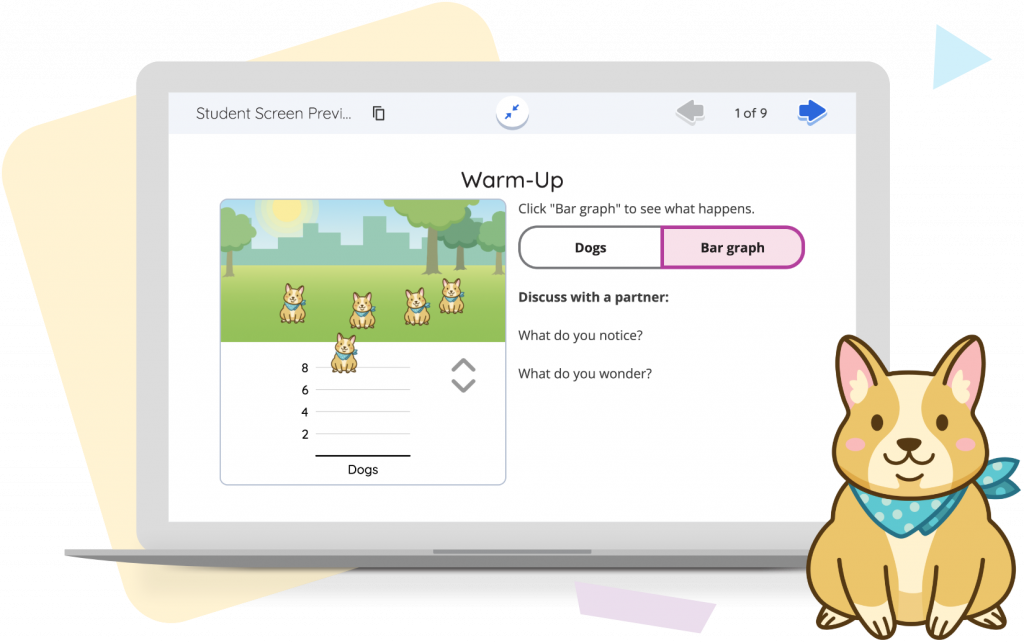
Boost Reading:

  • Boost Reading proporciona una forma de enseñanza personalizada, fundamentada en la ciencia de la lectura (Science of Reading).
  • Complementa la tutoría de gran alcance que recibe su estudiante, brindándole un sitio para practicar esas destrezas.
  • Explore los recursos para cuidadores de Boost Reading.

Nota: Todas las escuelas que participan en Amplify Tutoring usan mCLASS Intervention. Pida información a su estudiante o maestro sobre la implementación de Boost Reading.

Diagram showing a 5-step educational assessment process with steps labeled 1 to 5 in a circular flow, focusing on skills like amplifying core instruction, boosting reading, and professional development.

Materiales y recursos de apoyo para las matemáticas en Amplify Tutoring

A teacher in a red shirt sits beside a student, both looking at a laptop screen in a classroom setting with other students visible in the background.

Cuidadores, a continuación encontrarán materiales y recursos que pueden serles útiles a usted y a su estudiante.

Materiales de Amplify Math Tutoring:

  • Las escuelas que participan en Amplify Math Tutoring utilizan mCLASS math assessment (evaluación de matemática) de Amplify, Amplify Desmos Math Mini-Lessons (lecciones cortas) y Fluency by Heart (fluidez de memoria) de Amplify.
    • mCLASS assessment proporciona información valiosa sobre el razonamiento matemático de los estudiantes. Muestra cómo piensan los estudiantes sobre las matemáticas de su nivel escolar y lo que ya comprenden.
    • Las Amplify Desmos Math Mini-Lessons son las lecciones que utilizan los tutores para ayudar a guiar a su estudiante a través de los conceptos de matemáticas para su nivel escolar.
    • Fluency by Heart de Amplify es el programa de fluidez de operaciones que su estudiante usará durante la tutoría. Exhortamos a que los estudiantes continúen practicando su fluidez de operaciones con este programa ¡incluso fuera de la tutoría!

Los beneficios de la tutoría

¡Amplify Tutoring ayuda a los estudiantes que más lo necesitan! En un extenso estudio sobre Amplify Literacy Tutoring, el 70 por ciento de los estudiantes con una calificación por debajo del benchmark y que participaron con regularidad en Amplify Tutoring tuvo un desarrollo superior a la media. La probabilidad de que los estudiantes de tutoría se desarrollaran a un ritmo más acelerado fue un 22 por ciento mayor que la de sus compañeros con un perfil similar, pero que no recibían tutoría de gran alcance para el desarrollo de la lectoescritura, en su escuela. Amplify Math Tutoring también ha demostrado mejorar el desempeño académico de los estudiantes en matemáticas. Después de 15 semanas de tutoría de matemáticas, estudiantes de grados tercero a quinto mejoraron más del 15% en preguntas sobre Número y Operaciones durante su evaluación posterior.

Al brindar un apoyo focalizado y adecuado a las necesidades individuales, Amplify Tutoring permite que los estudiantes reciban la ayuda que necesitan y merecen.

Conozca cómo Amplify Tutoring acelera el aprendizaje

¿Busca ayuda o más información?

Visite amplify.com/tutoring para obtener más información sobre Amplify Tutoring.

Si necesita ayuda adicional, comuníquese con su maestro.

¡Gracias por todo lo que hace para contribuir al aprendizaje de su estudiante!

Familias y cuidadores, ¡bienvenidos a Amplify Desmos Math Texas
K–5!

Bienvenidos al Caregiver Hub de Amplify Desmos Math K–5. Esperamos que su estudiante disfrute explorando las matemáticas, trabajando con amigos para resolver problemas y aprendiendo conceptos nuevos e interesantes. ¡Y esperamos que ustedes disfruten de la experiencia matemática junto con ellos! A continuación, encontrarán algunas sugerencias y recursos para apoyar su aprendizaje en casa.

For the English version, please click here.

Tres niños participan en una actividad práctica de matemáticas con tarjetas numéricas y fichas sobre una cuadrícula. El fondo está decorado con peces y símbolos matemáticos.

Recursos de la unidad para cuidadores

Para cada unidad del programa, hemos creado un Recurso para cuidadores (Caregiver Resource), el cual ofrece un resumen de los conceptos clave, además de un problema del conjunto de práctica de la lección que usted puede resolver con su estudiante. Encontrará un Recurso para cuidadores en cada unidad, disponible tanto en inglés como en español.

Ingrese a Amplify Desmos Math en casa.

Además del cuaderno de ejercicios impreso de la Edición del estudiante (Student Edition), su estudiante tendrá acceso digital a todos los materiales de aprendizaje, práctica y evaluación a través de la plataforma de Amplify. Es posible acceder al currículo digital desde la escuela o desde casa siguiendo estas instrucciones:

  • Haga clic en el botón Amplify Desmos Math.
  • Seleccione Log in with Amplify.
  • Ingrese el nombre de usuario y la contraseña de su estudiante que el maestro les haya proporcionado.
  • Seleccione el nivel escolar deseado.

Una vez iniciada la sesión, los cuidadores pueden ver el trabajo de los estudiantes abriendo tareas anteriores.

Aprenda a navegar por la página de inicio de los estudiantes (student home page).

Vistazo general a los materiales

Amplify Desmos Math Texas promueve el aprendizaje mixto por medio de materiales impresos de apoyo y una experiencia digital única. Todas las lecciones en los grados K a 5 están disponibles en un cuaderno de trabajo de la Edición del estudiante. Muchas de las lecciones incluyen actividades prácticas con materiales manipulables, herramientas que ayudan a que los estudiantes hagan tangibles conceptos abstractos para poder comprenderlos. Su estudiante también trabajará con dispositivos digitales durante un número de lecciones que es apropiado para su edad.

Cuando los estudiantes usan dispositivos, los maestros pueden supervisar su trabajo en tiempo real, asegurándose de que reciban el apoyo exacto que necesitan en cada parte de la lección, dentro y fuera del salón de clase.

Una interfaz digital que muestra los nombres anónimos de los estudiantes y su estado de participación en diversas actividades. La interfaz incluye opciones para realizar resúmenes, capturas de pantalla y vistas individuales de los estudiantes.

Componentes de una lección

A los estudiantes en un aula de Amplify Desmos Math Texas se les ve (¡y se les escucha!) haciendo preguntas, debatiendo respuestas, justificando su razonamiento, enfrentándose a problemas y trabajando juntos o de forma individual.

Una lección típica de Amplify Desmos Math Texas incluye:

  • Calentamiento: Un problema breve e interesante para que los estudiantes se sientan atraídos a la lección.
  • Actividades: Una o dos actividades cortas que desafíen las destrezas de los estudiantes para resolver problemas.
  • Síntesis: Una discusión para revisar y consolidar los conceptos importantes de la lección.
  • Demuestra lo que sabes (Show What You Know) y Reflexión (Reflection): Preguntas para que los estudiantes demuestren lo que aprendieron en la lección. (Nota: La evaluación de la lección “Demuestra lo que sabes” es opcional en kindergarten y primer grado).
  • Centros (Centers): Estaciones de actividades dirigidas por los estudiantes que refuerzan los conceptos matemáticos que aprendieron durante las actividades de la lección usando formatos interactivos y, a menudo, lúdicos. En kindergarten y primer grado, el tiempo destinado a los Centros se incorpora en los últimos 15 minutos de cada lección.

Para apoyar, fortalecer y ampliar el aprendizaje de los estudiantes después de la lección, Amplify Desmos Math Texas ofrece opciones de:

  • Diferenciación: Minilecciones (Mini-Lessons), Centros, Extensiones, Boost Personalized Learning y Fluency Practice (Práctica de la fluidez).
  • Práctica: Problemas adicionales que el maestro puede asignar para trabajar en clase o como tarea.

Apoye el aprendizaje de las matemáticas en casa.

Usted puede apoyar el aprendizaje de las matemáticas de su estudiante fuera de la escuela de muchas maneras:

El maestro puede asignar problemas de práctica al final de cada lección como trabajo en clase o como tarea. Si su estudiante ya ha completado los problemas de práctica de la lección, pídale que le explique cómo resolvió cada problema o que comente las partes que le resultaron difíciles. Haga preguntas de seguimiento para fomentar el uso del lenguaje matemático mientras explica su razonamiento, por ejemplo: “¿Cómo lo sabes?”, “¿Cómo puedes demostrar tu razonamiento?” o “¿Cómo describirías eso?”. Si su estudiante no consigue avanzar, hágale preguntas de apoyo, por ejemplo: “¿Qué información de aquí conoces?” o “¿Cómo podrías representar este problema?”.

Los juegos de Centro (Center game) se alinean con las matemáticas de la unidad y se pueden jugar con los estudiantes fuera de clase. Es posible que el maestro les explique a los estudiantes cómo jugar un juego de Centro durante o después de una lección. Si no es así, usted puede enseñarle a jugar usando instrucciones fáciles de seguir.

kindergarten
1.er grado
2.er grado
3.er grado
4.er grado
  • ¡Muy pronto!
5.er grado

Relacione las matemáticas con actividades cotidianas en casa, ya sea ir de compras, preparar la comida o planear una visita a la tienda. Su estudiante puede ayudarle a calcular cuántas manzanas más hay en el carrito que naranjas, dividir un sándwich en cuatro partes o calcular cuánto cambio recibirá si paga con un billete de diez dólares. Anímelo a señalar las maneras en que ustedes usan las matemáticas en sus quehaceres diarios.

Recuerde al estudiante que bloquearse es una parte necesaria (incluso benéfica) del proceso de aprendizaje. Muchos estudiantes (al igual que personas adultas) temen equivocarse, pero las investigaciones demuestran que cometer errores ayuda a que nuestro cerebro se desarrolle. Cuando su estudiante no consiga avanzar en un problema, anímelo a seguir intentando diferentes estrategias, aunque no esté seguro de si son correctas.

Familias y cuidadores, ¡bienvenidos a Amplify Desmos Math
K–5!

Bienvenidos al Caregiver Hub de Amplify Desmos Math K–5. Esperamos que su estudiante disfrute explorando las matemáticas, trabajando con amigos para resolver problemas y aprendiendo conceptos nuevos e interesantes. ¡Y esperamos que ustedes disfruten de la experiencia matemática junto con ellos! A continuación, encontrarán algunas sugerencias y recursos para apoyar su aprendizaje en casa.

Obtenga más información sobre Amplify Desmos Math.

For the English version, please click here.

Tres niños participan en una actividad práctica de matemáticas con tarjetas numéricas y fichas sobre una cuadrícula. El fondo está decorado con peces y símbolos matemáticos.

Recursos de la unidad para cuidadores

Para cada unidad del programa, hemos creado un Recurso para cuidadores (Caregiver Resource), el cual ofrece un resumen de los conceptos clave, además de un problema del conjunto de práctica de la lección que usted puede resolver con su estudiante. Encontrará un Recurso para cuidadores en cada unidad, disponible tanto en inglés como en español.

Ingrese a Amplify Desmos Math en casa.

Además del cuaderno de ejercicios impreso de la Edición del estudiante (Student Edition), su estudiante tendrá acceso digital a todos los materiales de aprendizaje, práctica y evaluación a través de la plataforma de Amplify. Es posible acceder al currículo digital desde la escuela o desde casa siguiendo estas instrucciones:

  • Haga clic en el botón Amplify Desmos Math.
  • Seleccione Log in with Amplify.
  • Ingrese el nombre de usuario y la contraseña de su estudiante que el maestro les haya proporcionado.
  • Seleccione el nivel escolar deseado.

Una vez iniciada la sesión, los cuidadores pueden ver el trabajo de los estudiantes abriendo tareas anteriores.

Aprenda a navegar por la página de inicio de los estudiantes (student home page).

Vistazo general a los materiales

Amplify Desmos Math promueve el aprendizaje mixto por medio de materiales impresos de apoyo y una experiencia digital única. Todas las lecciones en los grados K a 5 están disponibles en un cuaderno de trabajo de la Edición del estudiante. Muchas de las lecciones incluyen actividades prácticas con materiales manipulables, herramientas que ayudan a que los estudiantes hagan tangibles conceptos abstractos para poder comprenderlos. Su estudiante también trabajará con dispositivos digitales durante un número de lecciones que es apropiado para su edad.

Cuando los estudiantes usan dispositivos, los maestros pueden supervisar su trabajo en tiempo real, asegurándose de que reciban el apoyo exacto que necesitan en cada parte de la lección, dentro y fuera del salón de clase.

Una interfaz digital que muestra los nombres anónimos de los estudiantes y su estado de participación en diversas actividades. La interfaz incluye opciones para realizar resúmenes, capturas de pantalla y vistas individuales de los estudiantes.

Componentes de una lección

A los estudiantes en un aula de Amplify Desmos Math se les ve (¡y se les escucha!) haciendo preguntas, debatiendo respuestas, justificando su razonamiento, enfrentándose a problemas y trabajando juntos o de forma individual.

Una lección típica de Amplify Desmos Math incluye:

  • Calentamiento: Un problema breve e interesante para que los estudiantes se sientan atraídos a la lección.
  • Actividades: Una o dos actividades cortas que desafíen las destrezas de los estudiantes para resolver problemas.
  • Síntesis: Una discusión para revisar y consolidar los conceptos importantes de la lección.
  • Demuestra lo que sabes (Show What You Know) y Reflexión (Reflection): Preguntas para que los estudiantes demuestren lo que aprendieron en la lección. (Nota: La evaluación de la lección “Demuestra lo que sabes” es opcional en kindergarten y primer grado).
  • Centros (Centers): Estaciones de actividades dirigidas por los estudiantes que refuerzan los conceptos matemáticos que aprendieron durante las actividades de la lección usando formatos interactivos y, a menudo, lúdicos. En kindergarten y primer grado, el tiempo destinado a los Centros se incorpora en los últimos 15 minutos de cada lección.

Para apoyar, fortalecer y ampliar el aprendizaje de los estudiantes después de la lección, Amplify Desmos Math ofrece opciones de:

  • Diferenciación: Minilecciones (Mini-Lessons), Centros, Extensiones, Boost Personalized Learning y Fluency Practice (Práctica de la fluidez).
  • Práctica: Problemas adicionales que el maestro puede asignar para trabajar en clase o como tarea.

Apoye el aprendizaje de las matemáticas en casa.

Usted puede apoyar el aprendizaje de las matemáticas de su estudiante fuera de la escuela de muchas maneras:

El maestro puede asignar problemas de práctica al final de cada lección como trabajo en clase o como tarea. Si su estudiante ya ha completado los problemas de práctica de la lección, pídale que le explique cómo resolvió cada problema o que comente las partes que le resultaron difíciles. Haga preguntas de seguimiento para fomentar el uso del lenguaje matemático mientras explica su razonamiento, por ejemplo: “¿Cómo lo sabes?”, “¿Cómo puedes demostrar tu razonamiento?” o “¿Cómo describirías eso?”. Si su estudiante no consigue avanzar, hágale preguntas de apoyo, por ejemplo: “¿Qué información de aquí conoces?” o “¿Cómo podrías representar este problema?”.

Los juegos de Centro (Center game) se alinean con las matemáticas de la unidad y se pueden jugar con los estudiantes fuera de clase. Es posible que el maestro les explique a los estudiantes cómo jugar un juego de Centro durante o después de una lección. Si no es así, usted puede enseñarle a jugar usando instrucciones fáciles de seguir. Regístrese para obtener una cuenta gratuita y explorar los Centros y el contenido adicional para grados K a 5 en nuestras Colecciones destacadas.

Relacione las matemáticas con actividades cotidianas en casa, ya sea ir de compras, preparar la comida o planear una visita a la tienda. Su estudiante puede ayudarle a calcular cuántas manzanas más hay en el carrito que naranjas, dividir un sándwich en cuatro partes o calcular cuánto cambio recibirá si paga con un billete de diez dólares. Anímelo a señalar las maneras en que ustedes usan las matemáticas en sus quehaceres diarios.

Recuerde al estudiante que bloquearse es una parte necesaria (incluso benéfica) del proceso de aprendizaje. Muchos estudiantes (al igual que personas adultas) temen equivocarse, pero las investigaciones demuestran que cometer errores ayuda a que nuestro cerebro se desarrolle. Cuando su estudiante no consiga avanzar en un problema, anímelo a seguir intentando diferentes estrategias, aunque no esté seguro de si son correctas.

Obtenga más información.

¿Tiene alguna pregunta sobre Amplify Desmos Math? Visite nuestra biblioteca de ayuda (en inglés) para buscar artículos con respuestas a sus preguntas sobre el programa. Para obtener más ayuda, por favor comuníquese con su maestro.

What’s included in our Spanish language arts curriculum

Amplify Core Knowledge Language Arts® (CKLA) is available in both English and Spanish. Amplify Caminos al Conocimiento Esencial, our robust Spanish language arts companion for grades K–5, supports multiple teaching models, including dual language immersion and transitional classrooms.

A laptop screen displays a kindergarten instructional webpage in Spanish, showing lesson categories with illustrated thumbnails and navigation options.

Year at a glance

The program’s intentional Knowledge Sequence from K–5 connects knowledge and vocabulary within a grade level and across grade levels, for deeper reading comprehension and preparation for college, career, and life. Instead of “activating prior knowledge,” Amplify Caminos helps you build it in the classroom from day one, for every child, expanding each student’s knowledge base long before they transition to reading to learn.

Curriculum flowchart showing reading themes and activities from Kindergarten to Grade 5, organized by grade level and literary theme, with interconnected boxes for each topic.

Units & domains at a glance

Each Knowledge Domain in grades K–2 and Unit in grades 3–5 varies in the number of days based on instructional purpose. Just as with our top-rated Amplify CKLA program, the Amplify Caminos materials engage and delight young learners with resources that are both appealing and original.

Una mujer rubia con un vestido azul cuida ovejas blancas y negras, sosteniendo un bastón de pastor. Un cerdo vestido de azul corre y un hombre de negro toca el violín en una valla. Al fondo hay una casa.

Domain

Nursery Rhymes and Fables/Rimas y fábulas infantiles

Start learning about literature with these classic Mother Goose rhymes.

Ilustración de tres personas en un paisaje cubierto de hierba, una tratando de atrapar mariposas con una red, otra escondiéndose detrás de una escultura alta y frondosa de una mano y otra con binoculares.

Domain

The Five Senses/Los cinco sentidos

Learning about the body starts with learning about how we experience the world.

Una ilustración que representa a un gran lobo con sombrero de copa liderando un desfile de animales y personas con instrumentos musicales a través de un paisaje montañoso.

Domain

Stories/Cuentos

Learn about the parts of a book and some of the stories that go in one.

Una ilustración vibrante de una escena rural con colinas, una granja, una mariposa, un sol brillante, varias verduras como tomates y lechugas, y un gusano en el suelo.

Domain

Plants/Plantas

Discover the lifecycle of plants and the history of George Washington Carver.

Ilustración de una escena de granja que muestra un camión rojo que transporta verduras, campos de cultivo, vacas pastando en una colina, un granero y un molino de viento contra un cielo azul.

Domain

Farms/Granjas

Now we know how plants make their food… but what about animals?

Ilustración de un nativo remando en una canoa en un río con búfalos pastando en un campo, tipis al fondo y pájaros volando en el cielo bajo un sol brillante.

Domain

Native Americans/Los nativos americanos

Who were the first people in America? A look at the Lenape, Wampanoag, and Lakota Sioux.

Una ilustración muestra un rey y una reina en tronos, un castillo en un acantilado y una mujer con enanos cerca de un árbol. Cortinas rojas enmarcan la escena.

Domain

Kings and Queens/Reyes y reinas

To understand fairy tales, it’s best to first understand royalty.

Ilustración que muestra las cuatro estaciones: primavera con flores, verano con árboles verdes, otoño con hojas que caen e invierno con nieve y gente en trineo. Un niño lee debajo de un árbol.

Domain

Seasons and Weather/Las estaciones y el tiempo

The study of natural cycles continues with the weather and why it happens.

Un velero de madera con símbolos de cruz roja en sus velas navega cerca de una isla tropical con exuberante vegetación y palmeras. A lo lejos se ven otros dos barcos en el agua.

Domain

Columbus and the Pilgrims/Colón y los peregrinos

A look at the first contact between Europe and the Americas, and some of its results.

Una escena histórica muestra gente afuera de una gran mansión de estilo colonial con dos chimeneas. En primer plano se ve un carruaje tirado por caballos y a la izquierda se ve una casa más pequeña.

Domain

Colonial Towns and Townspeople/Las colonias y sus habitantes

Before the War for Independence, how did the town and country depend on one another?

Ilustración de personas clasificando materiales reciclables en un parque cerca de un río contaminado. Las fábricas emiten humo al fondo, mientras que las mariposas, las flores y los árboles están presentes en el primer plano.

Domain

Taking Care of the Earth/Cuidar el planeta Tierra

We only have one Earth—here are some ways to help care for it.

Ilustración del Monte Rushmore con los rostros tallados de cuatro presidentes de Estados Unidos. Un águila vuela en primer plano.

Domain

Presidents and American Symbols/Presidentes y símbolos de los Estados Unidos

Start learning about government through the lives of five presidents.

Una ilustración caprichosa que muestra animales de granja alrededor de una casa en un árbol junto a un río. Un zorro, un conejo y una oveja interactúan mientras la gente acampa junto a una fogata al fondo. Una araña cuelga del árbol.

Domain

Fables and Stories/Fábulas y cuentos

Learn some of the key elements of a story through classic fables.

Ilustración que presenta anatomía humana, actividades de estilo de vida saludable, profesionales médicos, símbolos dietéticos, una ambulancia y microorganismos, destacando la conexión entre salud, nutrición y ejercicio.

Domain

The Human Body/El cuerpo humano

What are germs? What are the organs? And what does it all have to do with health?

Una ilustración que presenta varias escenas de cuentos de hadas y folclore, incluida una calabaza grande, un tigre, Caperucita Roja, personas con atuendos tradicionales y una pagoda roja con una montaña de fondo.

Domain

Different Lands, Similar Stories/Tierras diferentes, cuentos similares

A world tour of storytelling, and the stories that stay the same across the world.

Ilustración que muestra el antiguo Egipto con pirámides, la Esfinge, agricultores arando un campo con bueyes y ganado pastando bajo un cielo soleado.

Domain

Early World Civilizations/Antiguas civilizaciones del mundo

Rivers, farming, writing, and laws: just what does it take to build a civilization?

Escena ilustrada de la antigua Mesoamérica con maíz, un río, agricultores y pirámides al fondo. En primer plano se ve a una persona con traje tradicional.

Domain

Early American Civilizations/Antiguas civilizaciones de América

What will we find in the great temples of the Aztec, Maya, and Inca civilizations?

Ilustración de la exploración espacial: se lanza un cohete, un astronauta se para cerca de un módulo de aterrizaje, una persona usa un telescopio y aparece un planeta distante con anillos sobre un fondo estrellado.

Domain

Astronomy/Astronomía

How the Earth relates to the moon, the sun, and the rest of the planets.

Dos paleontólogos en un paisaje volcánico examinan fósiles en primer plano, mientras un volcán emite humo y lava al fondo.

Domain

The History of the Earth/La historia de la Tierra

Just what lies beneath the Earth’s surface, and what can it teach us about the past?

Una escena de vida silvestre diversa que presenta un cactus del desierto con un pájaro, un conejo, elefantes, un león, un oso polar sobre el hielo y montañas distantes bajo un cielo nublado.

Domain

Animals and Habitats/Los animales y sus hábitats

A look at the connection between how animals live and where they make their homes.

Una princesa con un vestido rosa sostiene una rana junto a un arroyo con un castillo, árboles y gente al fondo. En primer plano camina un zorro con un sombrero con una pluma roja.

Domain

Fairy Tales/Cuentos de hadas

What do fairy tales have to teach us about how stories are told?

Ilustración que muestra una escena histórica con soldados, veleros y hombres con atuendo colonial discutiendo en el interior.

Domain

A New Nation: American Independence/Una nueva nación: la independencia de los Estados Unidos

The story of the birth of the United States out of the 13 Colonies.

Los pioneros con carros cubiertos y caballos señalan hacia un valle con tipis nativos, fogatas y humo elevándose. Un oso se encuentra sobre una roca y se ven montañas al fondo.

Domain

Frontier Explorers/Exploradores de la Frontera

The story of the journey west from the newborn U.S.A. to find the Pacific Ocean.

Un hombre con un hacha se encuentra entre paisajes exagerados con un castillo, un tren con humo, un buey azul y una persona con un mono observando la escena.

Domain

Fairy Tales and Tall Tales/Cuentos de hadas y cuentos exagerados

Learn about exaggeration and characterization on the frontier.

Ilustración de un paisaje vibrante que presenta diversos monumentos culturales, incluidos templos, palacios, pirámides, una escena de elefantes, montañas distantes y fuegos artificiales en el cielo.

Domain

Early Asian Civilizations/Antiguas civilizaciones de Asia

Tour the world of classical civilization, starting with India and China.

Ilustración que muestra la antigua Grecia con un anfiteatro, estatuas, soldados con armadura, un barco y un templo en una colina rodeada de vegetación.

Domain

Ancient Greek Civilization/La civilización griega antigua

The tour continues with the philosophy and politics of Greece.

Illustration of various mythological scenes including greek gods, a flying horse, and roman architecture under a sunny sky.

Domain

Greek Myths/Mitos griegos

Dive deep into the characters and storytelling of classic myths.

Ilustración de una batalla entre barcos británicos y estadounidenses cerca de un fuerte. El barco británico está a la izquierda con soldados, mientras que el barco estadounidense está a la derecha. La gente porta una gran bandera estadounidense en primer plano.

Domain

The War of 1812/La guerra de 1812

Learn about America’s “Second War for Independence.”

Un paisaje nevado con un zorro durmiendo en una madriguera, gente corriendo y andando en bicicleta por un sendero y árboles que muestran los cambios estacionales.

Domain

Cycles in Nature/Los ciclos de la naturaleza

Introducing the natural cycles that make our lives possible.

Ilustración de carros cubiertos tirados por caballos a lo largo de un sendero en el desierto, con un coyote aullando sobre una alta formación rocosa y un tren de vapor al fondo.

Domain

Westward Expansion/La expansión hacia el oeste

Why did pioneers go west? What happened to the people who were there?

Ilustración de un jardín vibrante con flores, abejas, mariposas, una oruga en una hoja, una crisálida y un apicultor que maneja una colmena junto a un estanque.

Domain

Insects/Los insectos

Lay the grounds for animal classification by looking at solitary and social insects.

Ilustración de una escena histórica con gente escuchando el discurso de un hombre en una plataforma. Al fondo se ve un río y una procesión de personas. En primer plano hay un documento de proclamación.

Domain

The U.S. Civil War/La Guerra Civil de los Estados Unidos

Begin to grapple with U.S. history’s central crisis over slavery.

Una escena en la que aparece una persona explicando un diagrama anatómico humano, otra persona haciendo ejercicio, una cadena de ADN, campos y un microscopio de fondo.

Domain

Human Body: Building Blocks and Nutrition/El cuerpo humano: componentes básicos y nutrición

A deeper dive into the digestive system and the nutrition process.

Un grupo diverso de personas se encuentra en un muelle con vistas a un bullicioso puerto con barcos y un gran barco, un avión volando por encima y la Estatua de la Libertad al fondo.

Domain

Immigration/La inmigración

Why did people immigrate to the United States, and what did they find here?

Women in early 20th-century clothing march with signs for voting rights and justice in front of a yellow bus labeled "Cleveland Ave.," making history that can inspire lessons in a K–2 language arts curriculum.

Domain

Fighting for a Cause/Luchar por una causa

How people can do extraordinary things to make the world better for everyone.

Dos ratones antropomórficos en un bote de remos, uno de ellos remando, navegan por un río tranquilo rodeado de exuberante vegetación y árboles. El ratón que rema lleva una chaqueta azul y el otro ratón parece conversar.

Unit 1

Classic Tales: The Wind in the Willows/Cuentos Clásicos: El viento en los sauces

A deep dive into character, theme, and POV in classic stories from around the world.

Ilustración de un jaguar, una garza, una rana roja, una tortuga y un pez en un paisaje vibrante con montañas y vegetación bajo un cielo soleado.

Unit 2

Animal Classification/La clasificación de los animales

How do we classify different animals by their appearance and behavior?

Ilustración de una figura humana que muestra la anatomía interna, incluidos el cerebro, los pulmones, el corazón, el sistema digestivo y una articulación de la cadera resaltada sobre un fondo degradado.

Unit 3

The Human Body: Systems and Senses/El cuerpo humano: sistemas y sentidos

Let’s take a closer look at how the skeleton, muscles, and nervous system all work.

Un ángel se arrodilla ante una mujer sentada en un sofá dorado encima de un templo en una noche estrellada. Unas escaleras conducen al templo en un paisaje montañoso.

Unit 4

The Ancient Roman Civilization/La civilización romana antigua

What is Rome’s greatest cultural contribution? In this unit, your students decide.

Ilustración de un perro saltando bajo un árbol, persiguiendo una abeja, con una mesa en primer plano sosteniendo una jarra y vasos de limonada. El sol brilla intensamente en el cielo.

Unit 5

Light and Sound/La luz y el sonido

The science behind all the ways we see and hear the world.

Un barco vikingo con una proa en forma de dragón navega en el océano bajo un cielo azul con nubes. El barco tiene una sola vela grande y varios escudos recubren sus costados.

Unit 6

The Viking Age/La era vikinga

An immersive narrative experience about what life was like in Viking communities.

Ilustración de una escena espacial con varios planetas y anillos sobre un fondo de estrellas. Dos planetas grandes dominan el primer plano y se ven planetas más pequeños al fondo.

Unit 7

Astronomy: Our Solar System and Beyond/Astronomía: nuestro sistema solar y más allá

More about our universe, including a writing project about daily life on a space station.

Una persona sentada en el borde de un acantilado con vistas a un vasto paisaje desértico con nubes arremolinadas en el cielo.

Unit 8

Native Americans: Regions and Cultures/Los nativos americanos: regiones y culturas

How did Native American nations change their way of life in different parts of the world?

Ilustración de un velero en el océano con la costa este de América del Norte visible a la izquierda.

Unit 9

Early Explorations of North America/La exploración europea de América del Norte

What was it like to sail to North America with the early European explorers?

Una pintura representa una escena del siglo XVII con colonos, un velero al fondo y un hombre conduciendo un carro tirado por caballos cargado de mercancías. Se ve a otras personas descargando y trabajando cerca.

Unit 10

Colonial America/La época colonial en los Estados Unidos

A study of the very different ways of life in the different pre-U.S. colonies.

Ilustración que muestra el ciclo de la vida: un esqueleto en el suelo, un pájaro posado en una cerca, otro pájaro en una planta y un ave rapaz más grande arriba, todos conectados por flechas circulares.

Unit 11

Ecology/Ecología

Students keep ecologist’s journals to learn about our world and how best to protect it.

Una mano alcanza una manzana verde en una rama. Cerca hay una brújula, un termómetro, un lápiz, notas musicales y un granero rojo sobre un paisaje cubierto de hierba.

Unit 1

Personal Narratives/Narrativas personales

Read stories of personal experience… and learn to reflect on your own.

Ilustración medieval que representa un grupo de figuras con armadura a la entrada de un alto castillo gris con puente levadizo, adornado con banderas y rodeado por un paisaje decorado y fondos ornamentados.

Unit 2

Empires in the Middle Ages/Los imperios en la Edad Media, parte 1 & Los imperios en la Edad Media, parte 2

Explore the medieval history of Europe and the Middle East.

Ilustración dorada de un dragón con alas sobre fondo beige, rodeado de diversos elementos decorativos como estrellas, hojas y estampados abstractos.

Unit 3

Poetry/Poesía

Study the poetry of many nations using licensed text anthologies, and begin to write your own.

Vintage styled illustrations of a microscope, an old telephone, and a clock on textured background with geometric patterns.

Unit 4

Eureka! Student Inventor/¡Eureka! Estudiante inventor

Transform the class into a lab for students to build and present inventions.

Formaciones rocosas en un paisaje desértico con capas vibrantes y arremolinadas de arenisca roja, naranja y amarilla bajo un cielo parcialmente nublado.

Unit 5

Geology/Geología

Plate tectonics, volcanoes, erosion: all the forces that shape the Earth.

Una imagen abstracta y colorida que representa varias formas geométricas de edificios sobre un fondo azul estampado.

Unit 6

Contemporary Fiction with excerpts from The House on Mango Street/Ficción Contemporánea con Fragmentos de La Casa en Mango Street

Explore The House on Mango Street… and write a book while doing it.

Cuadro que representa a un hombre y un niño tocando una gran campana en una torre, con espectadores al fondo y un cartel de "LIBERTAD" visible.

Unit 7

American Revolution/La Revolución estadounidense

Why did America seek independence? Let’s investigate the causes and effects.

Un pequeño bote de remos con tres personas navega por mares agitados mientras dos grandes barcos luchan al fondo, con humo y fuego visibles.

Unit 8

Treasure Island/La Isla del Tesoro

How dSeek the treasure of plot in this detailed study of a classic fiction adventure.

Unit 1

Personal Narratives/Narrativas personales

Through writing and sharing their writing, students begin to identify themselves as writers.

Unit 2

Early American Civilizations/Las primeras civilizaciones americanas

Students craft a codex to explain the rise and fall of the Maya, Aztec, and Inca people.

Dos jinetes medievales a caballo, uno de ellos con la espada en alto, avanzan por un terreno rocoso. El fondo presenta un paisaje brumoso bajo un tono violeta.

Unit 3

Poetry/Poesía

Students close read many forms of poetry… and learn to write them.

Collage ilustrado con un paraguas, un cuervo, un sextante náutico, estrellas, una luna creciente y una brújula sobre un fondo beige texturizado.

Unit 4

Adventures of Don Quixote/Las Aventuras de Don Quijote

Was Don Quixote right to fight the windmill? In this full-length novel study, students decide.

Unit 5

The Renaissance/El Renacimiento

Exploring the art and literature of the Renaissance through the works of its masters.

Tres hombres vestidos con ropa de época examinan una gran hoja de papel dentro de una imprenta. Un hombre parece llevar un delantal, mientras que otro señala el papel y el tercero observa de cerca.

Unit 6

The Reformation/La Reforma

How did the printing press transform the religion and society of Europe?

Patrón botánico morado y lila con hojas, plantas y formas abstractas, incluida una luna creciente y estrellas, sobre un fondo violeta oscuro.

Unit 7

William Shakespeare’s A Midsummer Night’s Dream/Sueño de Una Noche de Verano de William Shakespeare

Students enter the world of Shakespeare by reading, designing, and acting out his work.

Retrato en tonos sepia de una joven de pelo largo, con un collar de pedrería y un chal drapeado.

Unit 8

Native Americans/Los nativos americanos

How did the policies of the U.S. government impact Native American culture and lives?

Una lupa sobre documentos que contienen una pintura de paisaje de montañas, un dibujo con la etiqueta "Raptor Claw" y una nota adhesiva con la "Pista n.° 2". También se ven un sobre y una insignia exterior.

Unit 9

Chemical Matter/Química

Students use knowledge of chemistry to solve a mystery.

Print & digital components

The program includes instructional guidance and student materials for a year of instruction, with lessons and activities that keep students engaged every day.

Component

FORMAT

Knowledge (Conocimientos) Teacher Guides (K–2)

Knowledge Strand Teacher Guides contain Amplify CKLA’s cross-curricular read-alouds and application activities, all of which are standards-based to build mastery of content knowledge and literacy skills. There is one Teacher Guide per Knowledge Domain.

Print and digital

Knowledge Image Cards (K–2)

Amplify Caminos includes Image Cards for each Knowledge Domain to bring each topic to life through vivid visuals.

Print and digital

Knowledge Flip Books (K–2)

Projectable Flip Books are provided to accompany the read-alouds in each Knowledge Domain.

Digital

Teacher Guides (3–5)

Teacher Guides for grades 3–5 units are based on content-rich topics and incorporate reading, writing, speaking, and listening skills in the context of background knowledge. There is one Teacher Guide per unit.

Print or digital

Teacher Resource Site (K–5)

The program includes a one-stop-shop website for lesson projections, digital versions of all Amplify Caminos materials, lesson planning resources, multimedia (such as eBooks), and more.

Digital

Professional Learning Site (K–5)

The Professional Learning site includes training materials, best practices, and other resources to develop program expertise. Access professional development anywhere, anytime.

Digital

Component

FORMAT

Knowledge (Conocimiento) Activity Books (K–2)

Activity Books provide students with the opportunity to deepen world and word knowledge by responding to text in a diversity of ways.

Print

Student Readers (3–5)

Student Readers serve as content-rich anchor texts for each unit. Units such as Poetry and Contemporary Fiction feature authentic texts originally written in Spanish.

Activity Books (3–5)

Activity Books in grades 3–5 provide daily opportunities for students to hone reading and writing skills within the context of each unit.

Print and digital

Explore more programs

Our programs are designed to support and complement one another. Learn more about our related programs.

Una evaluación auténtica del español creada específicamente para estudiantes bilingües que están aprendiendo a leer

Como parte del paquete mCLASS® Español, mCLASS Lectura es un evaluador universal para K a 6.º grado basado en investigaciones recientes sobre alfabetización en español que ayuda a los educadores a acelerar el progreso en la lectura para los estudiantes de habla hispana al ofrecer una paridad total entre las evaluaciones de lectura en inglés y en español. For English version, please click here.

Collage de escenas educativas: la parte superior izquierda muestra el dibujo de un ojo, la parte superior derecha tiene un ícono de voz, las imágenes inferiores muestran a estudiantes aprendiendo con maestros y libros, y logotipos centrales de plataformas digitales.

Abordar las desigualdades que enfrentan en el salón de clase los estudiantes de habla hispana en la alfabetización temprana

Los estudiantes de habla hispana han estado desatendidos y clasificados erróneamente durante décadas. Al combinar mCLASS Lectura y mCLASS con DIBELS® 8.ª edición, podrá comprender dónde se encuentran sus estudiantes de habla hispana en su trayectoria de alfabetización en inglés y español.
Basado en la ciencia que subyace a cómo los estudiantes aprenden a leer en inglés y español, el sistema mCLASS permite a los maestros conectarse con sus estudiantes de habla hispana cara a cara, uno a uno y en el idioma que les resulte más cómodo. Los maestros pueden identificar en qué punto del desarrollo de sus destrezas de lectura y escritura se encuentran realmente sus estudiantes hispanohablantes o bilingües emergentes y qué instrucción deben priorizar.

Qué dicen los expertos

“Es increíblemente importante que prestemos atención al idioma español junto con el inglés en la práctica de evaluación, para asegurarnos de no subestimar la capacidad de un porcentaje realmente significativo de la población escolar de nuestra nación.”

–Dra. Lillian Durán

Codesarrolladora de mCLASS Lectura, Ph.D., Decana Asociada de Asuntos Académicos, Facultad de Educación, Universidad de Oregón

Desarrollado por reconocidos expertos en alfabetización

El evaluador universal mCLASS® Lectura fue desarrollado conjuntamente con el Centro de Enseñanza y Aprendizaje de la Universidad de Oregon. La evaluación fue validada por Amplify en colaboración con la Dra. Lillian Durán de la Universidad de Oregón.
El desarrollo de mCLASS Lectura también involucró a un equipo de expertos reconocidos a nivel nacional que representan una variedad de regiones (México, América Central, América del Sur y el Caribe), junto con grupos focales con maestros regulares, maestros de educación especial, especialistas y administradores.

Nuestro enfoque

Alineado con la Ciencia de la lectura, mCLASS Lectura permite a los maestros conectarse con sus estudiantes a través de una evaluación observacional y en el idioma que les resulte más cómodo. Creamos mCLASS Lectura para que, cuando se use en conjunto con mCLASS con DIBELS 8.ª edición, los educadores puedan lograr una paridad completa entre las destrezas de alfabetización en inglés y español.

Paridad total entre inglés y español

mCLASS Lectura es una evaluación auténtica en español que ofrece paridad total cuando se combina con mCLASS con DIBELS 8.ª edición, que incluye informes paralelos entre evaluaciones en inglés y español así como informes únicos en dos idiomas.

Computadora portátil que muestra un gráfico con indicadores de desempeño en inglés y español en categorías como conocimiento de letras y decodificación de palabras.

Escuche a sus estudiantes leer en ambos idiomas, uno a uno

mCLASS Lectura proporciona evaluaciones en español administradas por maestros, que brindan mediciones precisas y confiables del progreso de alfabetización de cada estudiante.

Creado a partir de las últimas investigaciones sobre el desarrollo de la alfabetización en español

mCLASS Lectura es una evaluación de alta calidad que tiene en cuenta las principales diferencias entre inglés y español, no simplemente una traducción directa o transadaptación entre los dos idiomas.

Una captura de pantalla de la evaluación mCLASS Lectura que muestra la segmentación de sílabas de la palabra española "húmedo", con un cronómetro configurado en 21 segundos.
Una diapositiva de una presentación que muestra un cuadro con métricas sobre la conciencia fonológica en el desarrollo de la alfabetización de los bilingües, comparando el inglés y el español.

Transferir destrezas de un idioma a otro

Al brindar a los maestros información sobre las áreas de destrezas que sus estudiantes dominan en su idioma nativo, el programa ayuda a los hispanohablantes a desarrollar sus fortalezas y establecer conexiones con su segundo idioma. Los educadores también reciben orientación sobre la transferencia interlingüística de destrezas fundamentales en ambos idiomas.

Conozca las desigualdades que enfrentan en el salón de clase los estudiantes de habla hispana y cómo los educadores pueden abordarlas

Descargar ahora

Qué se incluye

mCLASS Lectura incluye medidas de un minuto validadas para la detección universal y de dislexia, y proporciona informes en dos idiomas para maestros y administradores.

Captura de pantalla del software mclass que muestra los resultados de las evaluaciones comparativas de los estudiantes en un gráfico con categorías para el comienzo, la mitad y el final del año.

Medidas integrales de alfabetización en español en mCLASS Lectura

mCLASS Lectura está validado para evaluar todas las destrezas fundamentales para K a 6.º grado, que incluyen:

  • Nombrar las letras
  • Conciencia fonológica
  • Principio alfabético
  • Fluidez
  • Comprensión

Informes en inglés y español

mCLASS Lectura analiza la alfabetización en español y el desarrollo de la alfabetización en inglés en paralelo, lo que le permite ver en qué nivel se encuentran los estudiantes en ambos idiomas. Conozca más sobre los informes de mCLASS Lectura.

Una computadora portátil que muestra un documento de texto extenso con títulos, viñetas y opciones de casillas de verificación.
Diapositiva de presentación titulada "identificar y leer palabras con los diptongos ia, ie, io", que presenta íconos y una lista de tres pasos para decodificar diptongos, con tres secciones y múltiples viñetas.

Actividades de instrucción para desarrollar destrezas de alfabetización en español

Con mCLASS Lectura, los educadores obtienen cientos de actividades de instrucción paso a paso para grupos pequeños o estudiantes individuales y reciben actividades eficaces para enfocarse en las destrezas de alfabetización en español en las que los estudiantes necesitan más apoyo.

Informes integrales

mCLASS Lectura proporciona informes para todos en todos los niveles, desde maestros y especialistas en alfabetización hasta directores y líderes distritales, así como padres y cuidadores en el hogar. Conozca más sobre sobre los informes de mCLASS Lectura.

Pantalla de computadora portátil que muestra una hoja de cálculo titulada "mitad de año" con columnas para los nombres de los estudiantes, calificaciones y métricas de desempeño en varias evaluaciones.
Tablet screen displaying a student's assessment summary for fluency in syllable sounds. The student, Oksana Maslova, scored 32 syllables per minute on 08/25/2021.

Datos de evaluación detallados

mCLASS Lectura proporciona transcripciones de cada evaluación e identifica patrones de error para ayudar a los educadores a tomar decisiones didácticas sobre las habilidades que más necesitan reforzar los estudiantes. El programa también incluye cartas con resultados y análisis de las evaluaciones de los estudiantes para enviar a casa o usar como base para discusiones durante las conferencias.

Lea sobre la investigación y validación que respaldan a mCLASS Lectura

Descargar nuestro informe técnico

¡Bienvenidas, familias de estudiantes de Amplify Science para primaria!

Carta de los Estándares de Ciencias para la Próxima Generación

Two documents side by side contain similar information about the NGSS for parents and guardians, one in English and one in Spanish, each with a heading and body text.

Cada unidad incluye una carta que describe los Estándares de Ciencias para la Próxima Generación y una explicación de cómo se presentan estos estándares en todas las unidades de cada grado.

Si le interesa ver cómo se incorporan estos estándares en el aprendizaje de su estudiante, haga clic abajo para descargar la carta correspondiente a su grado.

Mapas de las unidades

Two pages of a document titled "Needs of Plants and Animals: Planning for the Unit," featuring an "Unit Map" label and blocks of text in black on a white background.

Cada unidad de Amplify Science incluye un mapa para los maestros. Este documento contiene las preguntas científicas que los estudiantes encontrarán en la unidad y explica cómo hallarán las respuestas.

Si le interesa saber más, haga clic abajo, en el grado de su estudiante, para descargar el Mapa de la unidad.

Simulaciones

En los grados 3–5, el uso de aplicaciones digitales interactivas es tan solo uno de los métodos que los estudiantes emplean para interpretar los conceptos de la unidad. El siguiente video muestra un ejemplo de una simulación:

Recursos para el evento de regreso a clases

A webpage for Amplify Science displays a grid of colorful nature-themed illustrations and text promoting a core curriculum for grades K-8.

La presentación siguiente ofrece una mirada al currículo de Amplify Science. Es probable que el maestro o la maestra haya presentado este recurso en el evento escolar de regreso a clases.

Haga clic aquí para descargar la presentación.

Investigaciones en casa

Four educational posters for Amplify Science show students engaging in hands-on science activities and a scientist in a lab coat with worksheets on the right.

Si le interesa ampliar la experiencia escolar de Amplify Science en casa, vea una de las siguientes tarjetas de Perfil del científico. Considere usarlas para iniciar conversaciones sobre carreras de ciencias e ingeniería.

Haga clic aquí para descargar las tarjetas de Perfil del científico.

El programa Amplify Science también incluye varias investigaciones para hacer en casa que podrá explorar con el estudiante fuera del horario de clases. El maestro o la maestra de su estudiante podría asignar investigaciones para hacer en casa a medida que la clase avanza en las unidades, pero si desea explorarlas por su cuenta, simplemente haga clic en los siguientes nombres de las unidades. Haga clic abajo, en el grado de su estudiante.

Preguntas para conversar en casa

os documentos “Preguntas para conversar en casa” para cada unidad en los grados K-5 contienen preguntas para que las familias hagan a sus estudiantes para ayudar a guiar la discusión y el aprendizaje continuos fuera del aula.

Kindergarten

Grado 1

Grado 2

Grado 3

Grado 4

Grado 5

Sepa dónde encontrar ayuda

¡Nuestro compromiso es brindarle ayuda! ¿Tiene alguna pregunta sobre Amplify Science?

Ingrese a nuestra biblioteca de ayuda para encontrar artículos con las respuestas a sus preguntas sobre el programa. Si necesita ayuda adicional con el currículo, comuníquese con el maestro o la maestra de su estudiante.
Plan de estudios de lectura personalizado para acelerar la alfabetización en su salón de clase de K a 5.º grado

Boost Reading ayuda a los educadores de K a 5.º grado a satisfacer las necesidades de cada lector con instrucción de lectoescritura personalizada basada en la Ciencia de la lectura. Nuestros datos de eficacia, medidos por DIBELS® 8.ª edición, muestran que Boost Reading ayudó a un 36 % más de estudiantes a alcanzar el punto de referencia que aquellos que no utilizaban el programa. Este plan de estudios de lectura de Amplify se adapta a cualquier modelo de aprendizaje y proporciona conocimientos prácticos de crecimiento a lo largo del camino. For English version, please click here.

Instrucción personalizada basada en evidencia

Boost Reading es un plan de estudios de lectura suplementario dirigido por estudiantes que le brinda tiempo adicional para apoyar a otros estudiantes y refuerza la instrucción en todos los niveles de instrucción con una verdadera diferenciación en el desarrollo de destrezas. Es su asistente digital en la instrucción de alfabetización: amplía la instrucción básica, aborda las necesidades de recuperación y adapta constantemente las actividades para ayudar a cada lector a prosperar.

“¡Su equipo me ha quitado un peso de encima y estoy tan agradecida que no puedo no puedo parar de decirlo! Mi mayor preocupación durante este tiempo era cómo puedo seguir empujando a mis lectores a su nivel y darles lo que necesitan, y Boost Reading la resolvió.”

Jeanine

maestra de 2.º grado, Chicago, IL

“Este programa es extremadamente atractivo e interactivo para todos los estudiantes. ¡Rogaron poder trabajar en Boost Reading y lo lamentaron cuando llegó el momento de cerrar la sesión! Este programa es una gran adición a nuestro plan de estudios.”

Brittany

maestra de 2.º grado, Utah

“A mis estudiantes les encanta el programa y ni siquiera se dan cuenta de que están aprendiendo algunos conceptos difíciles. Sus calificaciones en lectura están mejorando incluso desde principios de año.”

Amber

maestra de ELA en secundaria, California

Nuestro enfoque

Eficacia probada y comprobada

Se ha demostrado que con solo 30 minutos de uso por semana, Boost Reading mejora los resultados en todas las mediciones de DIBELS 8.ª edición y aumenta el número de estudiantes encaminados hacia el éxito en la lectura en K a 5.º grado, cumpliendo el criterio de evidencia moderado de ESSA (nivel 2). Profundice en nuestro reciente estudio de eficacia en la página de investigación de Boost Reading.

Coherencia pedagógica en todos los niveles

El paquete integral de alfabetización temprana de Amplify, la instrucción básica Amplify CKLA, la evaluación e intervención mCLASS® y la práctica personalizada Boost Reading proporcionan una alineación perfecta y una base sólida a partir de la Ciencia de la lectura para un sistema de apoyo de múltiples niveles en su salón de clase.

Práctica de lectura sistemática y dirigida, para todos

La tecnología altamente adaptable crea mapas de destrezas individuales para cada estudiante, ya sea que estén leyendo por debajo del nivel, a nivel o por encima del nivel de grado, proporcionando recuperación y avance simultáneos en diferentes dominios de destrezas. El programa es un componente eficaz de las soluciones de intervención y recuperación de su salón de clase, con instrucción explícita para todos los estudiantes, incluidos aquellos con dislexia o en clases de educación especial.

Cerrar la brecha para estudiantes multilingües de K a 5.º grado

El programa homólogo de lectoescritura en español de Boost Reading, Boost Lectura, apoya a los estudiantes bilingües emergentes de habla hispana que aprenden a leer en su lengua materna. Cuando se usan juntos, los dos programas impulsan el crecimiento de la alfabetización en inglés y español y brindan a los maestros informes paralelos sobre el progreso de las destrezas en ambos idiomas.

Estudio de eficacia de Boost Reading

Cerrar la brecha de alfabetización para estudiantes de K a 5.º grado

Descargar ahora

Qué se incluye

Tecnología de última generación

Boost Reading se adapta constantemente para personalizar la instrucción y brindar andamiaje en las destrezas fundamentales de los estudiantes, desarrollando el dominio de una actividad motivante a la vez. Los estudiantes nunca se quedarán atascados en actividades de práctica estáticas.

Abarca todas las destrezas

El alcance y la secuencia se basan en la Ciencia de la lectura e incluyen instrucción explícita en fonética, conciencia fonológica, comprensión, vocabulario y todas las destrezas críticas para leer con fluidez y /contconfianza.

Evaluaciones de referencia y progreso

Las evaluaciones de referencia integradas miden el dominio de los estudiantes al principio, a la mitad y al final del año, y los Curioso Skill Scans miden el progreso mensual de los estudiantes que utilizan el programa sin interrumpir su participación.

Informes de crecimiento y competencia fáciles de usar

Las evaluaciones integradas da a los maestros información práctica sobre las experiencias de lectura de los estudiantes. La visibilidad del desempeño brinda a los maestros la tranquilidad de saber que los estudiantes están logrando un progreso significativo en su desarrollo de lectoescritura.

Informes para administradores y cuidadores

Los administradores y cuidadores pueden acompañar al estudiante en su trayectoria de lectura mediante datos sobre el uso del programa, el progreso en la lectura y el dominio de las destrezas.

Actividades basadas en la investigación para reforzar destrezas

Boost Reading alerta a los educadores sobre las dificultades que encuentran los estudiantes en el desarrollo de sus destrezas y ofrece lecciones y recursos de alfabetización adicionales de K a 5.º grado para que los maestros aborden y fortalezcan esas destrezas.

Insignia de premio con el texto "Premios de excelencia en tecnología y aprendizaje 2023, regreso a clases, ganador del plan de estudios de lectura personalizado K-5".

Boost Reading es un orgulloso ganador de los premios Tech & Learning Awards of Excellence: Best for Back to School 2023.

Conocer más

Explore otros programas basados en la Ciencia de la lectura.

Todos los programas de nuestro paquete de alfabetización están diseñados para apoyarse y complementarse entre sí. Conozca más sobre nuestros programas relacionados:

¡Bienvenidas, familias de estudiantes de Amplify Science para nivel intermedio!

Dos estudiantes están sentados en la mesa de una clase, colaborando en un cuaderno. Uno señala una página mientras el otro mira. Otros estudiantes están en segundo plano ocupados en sus propias actividades.

Carta de los Estándares de Ciencias para la Próxima Generación

Two documents side by side, one in English and one in Spanish, both titled with information about the NGSS for parents and guardians and containing paragraphs of text.

La carta siguiente, que también se incluye en el programa, describe los Estándares de Ciencias para la Próxima Generación y explica cómo se presentan en las unidades de Amplify Science de nivel intermedio.

Haga clic aquí para descargarla.

Video de navegación del alumno

Mire el video a continuación para obtener ayuda para los estudiantes que navegan en Amplify Science (en inglés).

Mapas de las unidades

A digital document titled "Unit Map" with the heading "What is causing Elisa, a young patient, to feel tired all the time?" followed by several paragraphs of blurred text.

Cada unidad de Amplify Science incluye un mapa para los maestros. Este documento contiene las preguntas científicas que los estudiantes encontrarán en la unidad y muestra cómo hallarán las respuestas.

Haga clic aquí para descargar el Mapa de la unidad sobre el metabolismo a modo de ejemplo (en inglés).

Si le interesa ver los mapas de las unidades del nivel escolar de su estudiante, contacte a su maestro o maestra.

Simulaciones

En los grados 6–8, el uso de aplicaciones digitales es tan solo uno de los métodos que los estudiantes emplean para interpretar los conceptos de la unidad. Este video muestra un ejemplo de una simulación:

Recursos para el evento de regreso a clases

A webpage for Amplify Science displays a grid of colorful nature-themed illustrations and text promoting a core curriculum for grades K-8.

Esta presentación ofrece una mirada al currículo de Amplify Science. Es probable que el maestro o la maestra haya presentado este recurso en el evento escolar de regreso a clases.

La tarea en familia

Four educational posters for Amplify Science show students engaging in hands-on science activities and a scientist in a lab coat with worksheets on the right.

Si les interesa ampliar la experiencia escolar de Amplify Science en casa, vean una de las siguientes tarjetas de Perfil del científico. Consideren usarlas para iniciar conversaciones sobre carreras de ciencias e ingeniería.

Haga clic aquí para descargar las tarjetas de Perfil del científico (en inglés).

El programa Amplify Science también incluye varias tareas en familia que podrá explorar con el estudiante fuera del horario de clases. El maestro o la maestra de su estudiante podría asignar tareas en familia a medida que la clase avanza en las unidades, pero si desea explorarlas por su cuenta, haga clic en los siguientes nombres de las unidades.

Sepa dónde encontrar ayuda

¡Nuestro compromiso es brindarle ayuda! ¿Tiene alguna pregunta sobre Amplify Science?

Ingrese a nuestra biblioteca de ayuda para encontrar artículos con las respuestas a sus preguntas sobre el programa. Si necesita ayuda adicional con el currículo, comuníquese con el maestro o la maestra de su estudiante.
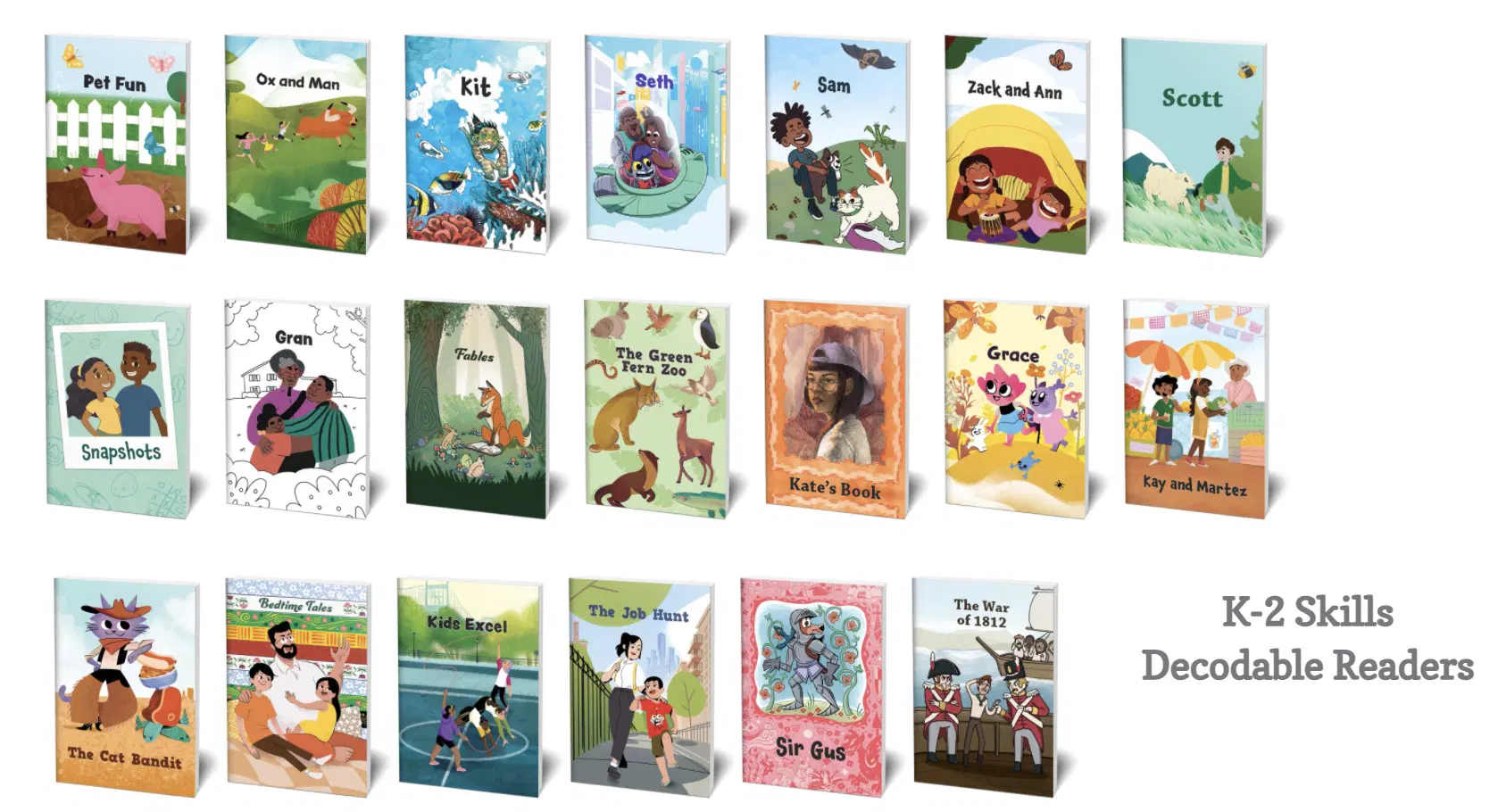
¡Les damos la bienvenida, familias de mCLASS Math!

Nos entusiasma poder colaborar con usted este año escolar para apoyar el aprendizaje de las matemáticas de su estudiante. Este Caregiver Hub de mCLASS® Math está diseñado para ayudarle a comprender cómo funciona mCLASS Math y brindarle formas sencillas de apoyar el aprendizaje de las matemáticas en casa, antes y después de las evaluaciones.
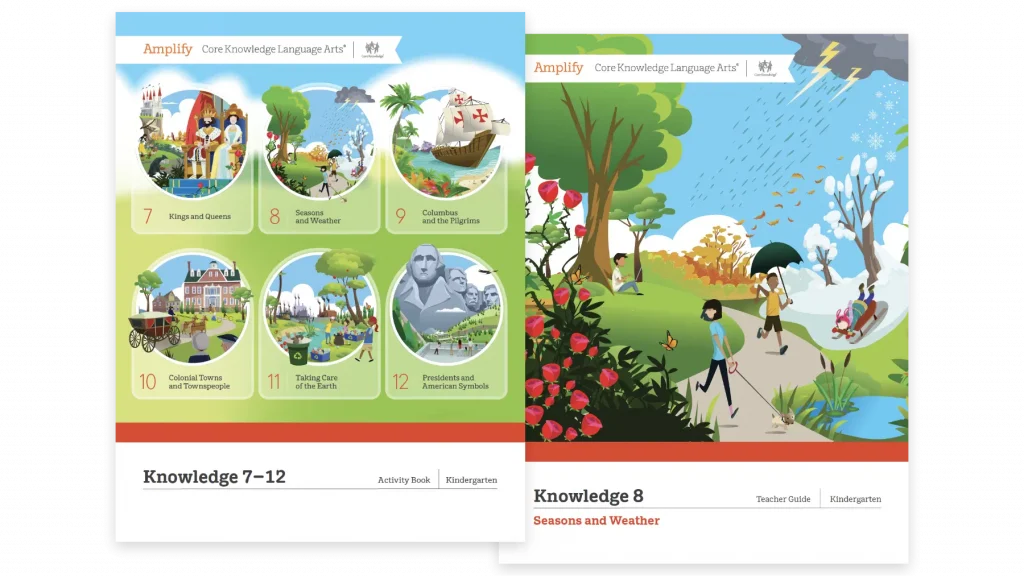
For English version, please click here.

A teacher assists a student wearing headphones at a laptop in a classroom, using math resources for teachers, while other students work at their desks in the background.

¿Qué es mCLASS Math?

mCLASS Math es un sistema de evaluación digital que ofrece a los maestros una visión clara de cómo conciben los estudiantes los conceptos matemáticos principales de su nivel escolar. También ayuda a identificar lo que su estudiante ya sabe y en qué aspectos podría necesitar más apoyo. Lo anterior permite que los maestros puedan personalizar la enseñanza y ayudar al desarrollo del aprendizaje de cada estudiante. Las evaluaciones de mCLASS Math son completamente digitales y permiten que los estudiantes demuestren su razonamiento mediante preguntas abiertas. De esa manera, los maestros obtienen una visión inmediata del progreso de los estudiantes y de sus necesidades educativas. Para obtener más información sobre la experiencia del estudiante, haga clic aquí.

Obtenga más información sobre mCLASS Math.

Primeros pasos

¿Por qué es importante evaluar?

Con las evaluaciones de mCLASS Math, los maestros comprenden no solo lo que los estudiantes ya conocen, sino también cómo piensan. Esto les permite apoyar mejor su desarrollo del aprendizaje.

Más allá de respuestas correctas o incorrectas, mCLASS Math captura cómo resuelven problemas los estudiantes, destacando sus fortalezas, experiencias, razonamientos y estrategias individuales (o “assets” (ventajas), como los llamamos colectivamente), y utilizándolos para orientar el proceso de enseñanza. Con esta información, los maestros pueden personalizar el aprendizaje, reconocer las fortalezas de los estudiantes y fomentar un crecimiento significativo.

Obtenga más información sobre la evaluación basada en “assets”.

Formas de apoyar a su estudiante

Junto a su estudiante, obtenga una vista previa de los ítems de muestra en casa.

Exploren los ítems de muestra de mCLASS Math juntos para que su estudiante se sienta más cómodo y familiarizado con la experiencia de evaluación. Estos ejemplos muestran los tipos de preguntas que su estudiante podría ver y cómo va a interactuar con la plataforma.

Mientras revisan los ítems juntos, anime a su estudiante a explicar su razonamiento. Intente hacer preguntas tales como:

  • “¿Qué te piden que resuelvas?”
  • “¿Cómo puedes demostrar tu pensamiento?”
  • “¿Puedes explicar tu respuesta?”

Si su estudiante no consigue avanzar, ayúdele con preguntas como:

  • “¿Qué sabes hasta ahora?”
  • “¿Cómo podrías representar este problema usando objetos o dibujos?”

Recuerde al estudiante que bloquearse es normal y una parte necesaria del proceso de aprendizaje. Muchos estudiantes (y personas adultas) temen cometer errores, pero las investigaciones demuestran que cometerlos ayuda a que nuestro cerebro se desarrolle. Desarrollar la confianza en el uso de las matemáticas comienza con la práctica en un espacio de apoyo donde el estudiante se sienta seguro.

Apoye a diario el proceso de aprendizaje matemático con Fluency Practice.

Ayude a su estudiante a fortalecer las habilidades matemáticas básicas (suma, resta, multiplicación y división) con solo 5 a 10 minutos diarios de Fluency Practice (Práctica de la fluidez). Fluency Practice utiliza un método de aprendizaje probado llamado repetición espaciada, con el fin de aumentar la precisión, velocidad y confianza en el uso de operaciones y datos matemáticos.

Para obtener una introducción a Fluency Practice haga clic aquí.

Otras ideas para apoyar el aprendizaje de las matemáticas

  • Siempre que sea posible, destaque el uso que haga su estudiante de las matemáticas en el mundo real y promueva esta práctica.
  • Ayude con la tarea de matemáticas tanto como sea posible.
  • Utilice frases intencionales y positivas sobre las matemáticas, incluyendo el uso que su estudiante haga de ellas.

Próximamente: Actividades matemáticas asistidas por cuidadores

Para el aprendizaje en casa, mCLASS ofrece una serie de recursos matemáticos que las familias pueden usar trabajando juntas, incluyendo actividades matemáticas asistidas por los cuidadores para ayudar a reforzar y practicar destrezas en casa.

Le recomendamos que lea el artículo Proteja a los niños en internet de la Comisión Federal de Comercio, cuyo tema es la seguridad digital.

¡Estamos aquí para ayudarle!

¿Tiene alguna pregunta sobre mCLASS Math?

Visite nuestra biblioteca de ayuda (en inglés) y busque respuestas a sus preguntas sobre el programa en nuestros artículos de ayuda.

Para obtener apoyo curricular adicional, comuníquese con su maestro.

Familias y cuidadores, ¡bienvenidos a Amplify Desmos Math 6–12!

Bienvenidos al Caregiver Hub de Amplify Desmos Math 6–12. Diseñamos este espacio para apoyar a su estudiante en su proceso de aprendizaje de las matemáticas.

En clase, su estudiante trabaja con lecciones digitales usando dispositivos, así como cuadernos de trabajo de la Edición del estudiante (Student Edition). También se le pueden asignar prácticas digitales o impresas fuera de clase. A continuación, encontrará algunas sugerencias y recursos para apoyar el aprendizaje de su estudiante en casa.

Obtenga más información sobre Amplify Desmos Math.

For the English version, please click here.

Ilustración de una persona en silla de ruedas con un casco que dirige la colocación de una pieza triangular, rodeada de símbolos matemáticos.

Recursos de la unidad para cuidadores

Para cada unidad del programa, hemos creado un Recurso para cuidadores (Caregiver Resource), el cual ofrece un resumen de la lección, además de un problema que usted puede resolver con su estudiante (y una clave de respuestas). Estos recursos están disponibles tanto en inglés como en español, junto con un glosario de términos clave en ambos idiomas.

Unidad 1: Área y área de superficie

Unidad 2: Introducción a las razones

Unidad 3: Tasas y porcentajes

Unidad 4: División de fracciones

Unidad 5: Aritmética decimal

Unidad 6: Expresiones y ecuaciones

Unidad 7: Números positivos y negativos

Unidad 8: Descripción de datos – ¡Próximamente!

Unidad 1: Dibujos a escala

Unidad 2: Introducción a las relaciones proporcionales

Unidad 3: Medidas de círculos

Unidad 4: Relaciones proporcionales y porcentajes

Unidad 5: Operaciones con números positivos y negativos

Unidad 6: Expresiones, ecuaciones y desigualdades

Unidad 7: Ángulos, triángulos y prismas

Unidad 8: Probabilidad y muestreo

Unidad 1: Transformaciones rígidas y congruencia

Unidad 2: Dilataciones, semejanza y pendiente

Unidad 3: Relaciones proporcionales y lineales

Unidad 4: Ecuaciones lineales y sistemas lineales

Unidad 5: Funciones y volumen

Unidad 6: Asociación de datos

Unidad 7: Exponentes y notación científica

Unidad 8: Teorema de Pitágoras y números irracionales

Unidad 1: Patrones y secuencias

Unidad 2: Ecuaciones lineales y desigualdades

Unidad 3: Descripción de datos

Unidad 4: Descripción de funciones

Unidad 5: Sistemas de ecuaciones lineales y desigualdades

Unidad 6: Funciones exponenciales

Unidad 7: Funciones cuadráticas

Unidad 8: Ecuaciones cuadráticas

Unidad 1: Área y área de superficie

Unidad 2: Introducción a las razones y tasas

Unidad 3: Fracciones y decimales

Unidad 4: Expresiones y ecuaciones

Unidad 5: Relaciones proporcionales y no proporcionale

Unidad 6: Porcentajes y más relaciones proporcionales

Unidad 7: Números positivos y negativos

Unidad 8: Conjuntos de datos y distribuciones

Unidad 1: Transformaciones rígidas y congruencia

Unidad 2: Dibujos a escala, dilataciones y semejanza

Unidad 3: Ecuaciones y desigualdades

Unidad 4: Relaciones lineales y sistemas de ecuaciones lineales

Unidad 5: Funciones y volumen

Unidad 6: Asociación de datos

Unidad 7: Volumen y área de superficie

Unidad 8: Exponentes y notación científica

Unidad 9: Teorema de Pitágoras y números irracionales

Ingrese a Amplify Desmos Math en casa.

Su estudiante tendrá acceso digital a todos los materiales de aprendizaje, práctica y evaluación a través de la plataforma de Amplify. Es posible acceder al currículo digital desde la escuela o desde casa siguiendo estas instrucciones:

  • Haga clic en el botón Amplify Desmos Math.
  • Seleccione Log in with Amplify.
  • Ingrese el nombre de usuario y la contraseña que el maestro de su estudiante les haya proporcionado.
  • Seleccione el nivel escolar deseado.

Una vez iniciada la sesión, usted y su estudiante podrán ver los trabajos abriendo tareas anteriores.

Aprenda a navegar por la página de inicio de los estudiantes (student home page).

Apoye el aprendizaje de las matemáticas en casa.

Usted puede apoyar el aprendizaje de las matemáticas de su estudiante fuera de la escuela de muchas maneras:

Relacione las matemáticas con las actividades cotidianas del hogar, ya sea hornear, ir de compras o planear un viaje. Su estudiante puede ayudarle a determinar el precio de un artículo con un cupón, reducir una receta a la mitad o calcular cuánto combustible necesitan para llegar a su destino.

Invite al estudiante a que le explique paso a paso cómo resolvió cada problema o le platique qué partes le resultaron difíciles de resolver. Para fomentar el uso del lenguaje matemático, considere hacer las siguientes preguntas al estudiante: “¿Cómo lo sabes?”, “¿Cómo puedes mostrar tu razonamiento?” o “¿Cómo describirías eso?”. Si el estudiante no consigue avanzar, hágale preguntas de apoyo, por ejemplo: “¿Qué información de aquí conoces?” o “¿Cómo podrías representar este problema?”.

Recuerde al estudiante que bloquearse es una parte natural y necesaria (incluso benéfica) del proceso de aprendizaje. Muchos estudiantes (al igual que personas adultas) temen equivocarse, pero las investigaciones demuestran que equivocarse ayuda a que nuestro cerebro se desarrolle. Cuando su estudiante no consiga avanzar en un problema, anímelo a seguir intentando diferentes estrategias, aunque no esté seguro de si son correctas.

Esperamos que su estudiante disfrute explorando las matemáticas, trabajando con amigos para resolver problemas y aprendiendo conceptos nuevos e interesantes. ¡Y esperamos que ambos disfruten de esta emocionante aventura matemática!

Obtenga más información.

¿Tiene alguna pregunta sobre Amplify Desmos Math? Visite nuestra biblioteca de ayuda (en inglés) para buscar artículos con respuestas a sus preguntas sobre el programa. Para obtener más ayuda, por favor comuníquese con su maestro.

¡El programa de Amplify CKLA da la bienvenida a las familias!

Nos complace darle la bienvenida a usted y a su estudiante al programa Amplify CKLA en este nuevo año escolar. Hemos reunido una serie de recursos y guías que ayudarán a que su estudiante aproveche al máximo nuestra plataforma. Ponemos a su disposición estos materiales para que también usted pueda brindar apoyo a su estudiante a lo largo de todo el año.

For English version, please click here.

Illustration of children reading, running, and jumping amid birds, greenery, letters, and a cityscape—capturing the joy of learning and connection to nature inspired by Amplify CKLA Espanol.

¿Qué es Amplify CKLA?

CKLA, o Conocimientos esenciales de Artes del Lenguaje de Amplify, es un programa de enseñanza del lenguaje para los grados PreK a 5 que desarrolla el conocimiento de contenidos. El programa combina un enfoque multisensorial de la fonética con textos enriquecidos y cuidadosamente secuenciados. De esa manera, los estudiantes aprenden a leer y “leen para aprender” de forma simultánea.

Todos los días, los estudiantes de grados PreK a 2 completan una lección que les permite desarrollar sus destrezas básicas de lectoescritura, así como una lección más que refuerza sus conocimientos previos. En los grados 3 a 5, los estudiantes comienzan a dominar sus destrezas lectoras y continúan ampliando su universo de conocimientos.

Primeros pasos

Cómo apoyar a su estudiante en casa

  • Lea con su estudiante a diario. Incluso 15 minutos de lectura compartida todos los días puede dar grandes resultados.
  • Lea secciones del texto en voz alta y de forma conjunta. Si su estudiante tiene dificultad para leer, intente leer el texto con expresividad y después pida a su estudiante que haga lo mismo. Como práctica adicional, miren las grabaciones de lectura en voz alta para grados K a 2, o pida a su estudiante que use la aplicación de vocabulario (Vocab App) para grados 3 a 5.
  • Busque oportunidades para conversar sobre lo que el estudiante lea y descubra. Por ejemplo, usted podría preguntarle: ¿Qué te llamó más la atención de lo que leíste hoy? ¿Qué aprendiste que no conocías antes? ¿Te resultó confusa alguna oración o palabra? ¿Qué crees que el autor trataba de comunicar? ¿Estás de acuerdo con las ideas o descripciones del autor? ¿Qué conexiones puedes hacer entre lo que estás leyendo y tu propia vida?
  • Pida a su estudiante que lea sus respuestas escritas. También puede pedirle que las comparta con un amigo en una videollamada.
  • Le recomendamos que lea el artículo Proteja a los niños en internet de la Comisión Federal de Comercio, cuyo tema es la seguridad digital.

Inicio de sesión

Estudiantes de grados K a 2

Los estudiantes de grados K a 2 podrán iniciar sesión usando las credenciales compartidas que proporcionó el maestro.

Diríjase a learning.amplify.com en cada dispositivo del estudiante.

Seleccione “Log in” y luego introduzca los datos de ingreso o seleccione “Scan QR code” para iniciar sesión usando un código QR. Los estudiantes ingresarán a su página principal (Student Home), ¡donde podrán cambiar su avatar y hacer clic en un emoji para definir su estado de ánimo del día! En la página principal del estudiante, encontrarán un vínculo de acceso rápido al Student Hub.

Nota: Los códigos de inicio compartidos les permiten a los estudiantes de grados K a 2, y a los estudiantes aún no matriculados por su escuela o distrito, ingresar a los programas digitales de Amplify mediante el Hub de Amplify CKLA.

Estudiantes de grados 3 a 5

Diríjase a learning.amplify.com.

Seleccione “Log in” y luego introduzca los datos de ingreso o seleccione “Scan QR code” para iniciar sesión usando un código QR. Los estudiantes ingresarán a su página principal (Student Home), ¡donde podrán cambiar su avatar y hacer clic en un emoji para definir su estado de ánimo del día! En la página principal del estudiante, encontrarán un vínculo de acceso rápido al Student Hub.

Nota: Para poder ingresar a la página principal del estudiante, los estudiantes que se encuentran en esta banda de grados deben estar matriculados y tener una licencia adecuada. Contacte a su maestro para obtener los datos de ingreso.

Vistazo general a los materiales

Si cuenta con acceso a internet, su estudiante tiene la opción de poder ingresar a parte del plan de estudios de Amplify CKLA de forma digital y desde casa. Contacte a su maestro para obtener los datos de ingreso.

Libros de actividades (Student Activity Books)

Durante las lecciones diarias, los estudiantes usan las páginas del libro de actividades para responder al texto que han leído, y poner en práctica sus destrezas y conocimientos.

Libros de lectura (Student Readers)

Los libros de lectura han sido diseñados con la finalidad de que los estudiantes practiquen de manera intensiva, leyendo cuentos sencillos y auténticos.

En los grados K a 2, los libros de lectura contienen capítulos que permiten a su estudiante practicar los sonidos para deletrear recién aprendidos y aplicarlos a una experiencia lectora que abarca tramas y personajes, así como ilustraciones y escenarios encantadores. En los grados 3 a 5, los estudiantes desarrollan destrezas de lectura atenta y otras destrezas de lectoescritura, trabajando con una variedad de textos literarios e informativos ricos en contenido.

A selection of illustrated Amplify CKLA Espanol book covers organized into three rows labeled Kindergarten, Grade 1, and Grade 2, with various titles displayed in each row.

CKLA Hub para estudiantes

Ya sea desde casa o desde el salón de clase, los estudiantes y maestros pueden ingresar al Hub de Amplify CKLA e interactuar con nuestro atractivo contenido educativo multimedia. Los estudiantes también pueden usar el Amplify Hub fuera del salón de clase, ya sea por cuenta propia o con supervisión familiar, para practicar más tiempo, o ¡para divertirse!

Los estudiantes pueden ingresar al Amplify Hub desde sus dispositivos en casa, siguiendo el mismo procedimiento que usan en el salón de clase.

A digital student dashboard for Grade 3 featuring two options: "Vocab" with a yellow character, and "Library" with an open book icon—designed to support Amplify CKLA Espanol learners.

Biblioteca de sonidos (Sound Library) para grados K a 2

La Biblioteca de sonidos incluye sonidos grabados, canciones fáciles de recordar y videos animados de articulación para ayudar a que los estudiantes aprendan y dominen los sonidos.

A digital interface displays illustrated sound cards, each showing a letter sound, example words, and a related image, with colored unit buttons above—perfect for supporting Amplify CKLA Espanol lessons.

Aplicación de vocabulario (Vocab App) para grados 3 a 5

La aplicación de vocabulario fue diseñada para practicar el vocabulario de forma independiente. Exhortamos a que los estudiantes aprovechen las actividades lúdicas de la app para fomentar su práctica, o ¡como reto adicional!

A digital flashcard interface for Amplify CKLA Espanol shows a stick figure beside a "GO" button, a word list on the right, and activity stats at the bottom.

Descripciones generales de las unidades

A continuación se listan ejemplos de la descripción general de las unidades (en inglés) en las que trabajará su estudiante durante todo el año.

Contacte con nosotros

¡Estamos aquí para ayudarle!

¿Tiene alguna pregunta sobre Amplify CKLA?

Visite nuestra biblioteca de ayuda (en inglés) y busque respuestas a sus preguntas sobre el programa en nuestros artículos de ayuda.

Para obtener apoyo curricular adicional, por favor comuníquese con su maestro.

Familias y cuidadores, ¡bienvenidos a Amplify Desmos Math California
6–12!

Bienvenidos al Caregiver Hub de Amplify Desmos Math California 6–12. Diseñamos este espacio para apoyar a su estudiante en su proceso de aprendizaje de las matemáticas.

En clase, su estudiante trabaja con lecciones digitales usando dispositivos, así como cuadernos de trabajo de la Edición del estudiante (Student Edition). También se le pueden asignar prácticas digitales o impresas fuera de clase. A continuación, encontrará algunas sugerencias y recursos para apoyar el aprendizaje de su estudiante en casa.

Obtenga más información sobre Amplify Desmos Math California.

For the English version, please click here.

Ilustración de una persona en silla de ruedas con un casco que dirige la colocación de una pieza triangular, rodeada de símbolos matemáticos.

Recursos de la unidad para cuidadores

Para cada unidad del programa, hemos creado un Recurso para cuidadores (Caregiver Resource), el cual ofrece un resumen de la lección, además de un problema que usted puede resolver con su estudiante (y una clave de respuestas). Estos recursos están disponibles tanto en inglés como en español, junto con un glosario de términos clave en ambos idiomas.

Unidad 1: Área y área de superficie

Unidad 2: Introducción a las razones

Unidad 3: Tasas y porcentajes

Unidad 4: División de fracciones

Unidad 5: Aritmética decimal

Unidad 6: Expresiones y ecuaciones

Unidad 7: Números positivos y negativos

Unidad 8: Descripción de datos – ¡Próximamente!

Unidad 1: Dibujos a escala

Unidad 2: Introducción a las relaciones proporcionales

Unidad 3: Medidas de círculos

Unidad 4: Relaciones proporcionales y porcentajes

Unidad 5: Operaciones con números positivos y negativos

Unidad 6: Expresiones, ecuaciones y desigualdades

Unidad 7: Ángulos, triángulos y prismas

Unidad 8: Probabilidad y muestreo

Unidad 1: Transformaciones rígidas y congruencia

Unidad 2: Dilataciones, semejanza y pendiente

Unidad 3: Relaciones proporcionales y lineales

Unidad 4: Ecuaciones lineales y sistemas lineales

Unidad 5: Funciones y volumen

Unidad 6: Asociación de datos

Unidad 7: Exponentes y notación científica

Unidad 8: Teorema de Pitágoras y números irracionales

Unidad 1: Patrones y secuencias

Unidad 2: Ecuaciones lineales y desigualdades

Unidad 3: Descripción de datos

Unidad 4: Descripción de funciones

Unidad 5: Sistemas de ecuaciones lineales y desigualdades

Unidad 6: Funciones exponenciales

Unidad 7: Funciones cuadráticas

Unidad 8: Ecuaciones cuadráticas

Ingrese a Amplify Desmos Math California en casa.

Su estudiante tendrá acceso digital a todos los materiales de aprendizaje, práctica y evaluación a través de la plataforma de Amplify. Es posible acceder al currículo digital desde la escuela o desde casa siguiendo estas instrucciones:

  • Haga clic en el botón Amplify Desmos Math California.
  • Seleccione Log in with Amplify.
  • Ingrese el nombre de usuario y la contraseña que el maestro de su estudiante les haya proporcionado.
  • Seleccione el nivel escolar deseado.

Una vez iniciada la sesión, usted y su estudiante podrán ver los trabajos abriendo tareas anteriores.

Aprenda a navegar por la página de inicio de los estudiantes (student home page).

Apoye el aprendizaje de las matemáticas en casa.

Usted puede apoyar el aprendizaje de las matemáticas de su estudiante fuera de la escuela de muchas maneras:

Relacione las matemáticas con las actividades cotidianas del hogar, ya sea hornear, ir de compras o planear un viaje. Su estudiante puede ayudarle a determinar el precio de un artículo con un cupón, reducir una receta a la mitad o calcular cuánto combustible necesitan para llegar a su destino.

Invite al estudiante a que le explique paso a paso cómo resolvió cada problema o le platique qué partes le resultaron difíciles de resolver. Para fomentar el uso del lenguaje matemático, considere hacer las siguientes preguntas al estudiante: “¿Cómo lo sabes?”, “¿Cómo puedes mostrar tu razonamiento?” o “¿Cómo describirías eso?”. Si el estudiante no consigue avanzar, hágale preguntas de apoyo, por ejemplo: “¿Qué información de aquí conoces?” o “¿Cómo podrías representar este problema?”.

Recuerde al estudiante que bloquearse es una parte natural y necesaria (incluso benéfica) del proceso de aprendizaje. Muchos estudiantes (al igual que personas adultas) temen equivocarse, pero las investigaciones demuestran que equivocarse ayuda a que nuestro cerebro se desarrolle. Cuando su estudiante no consiga avanzar en un problema, anímelo a seguir intentando diferentes estrategias, aunque no esté seguro de si son correctas.

Esperamos que su estudiante disfrute explorando las matemáticas, trabajando con amigos para resolver problemas y aprendiendo conceptos nuevos e interesantes. ¡Y esperamos que ambos disfruten de esta emocionante aventura matemática!

Obtenga más información.

¿Tiene alguna pregunta sobre Amplify Desmos Math California? Visite nuestra biblioteca de ayuda (en inglés) para buscar artículos con respuestas a sus preguntas sobre el programa. Para obtener más ayuda, por favor comuníquese con su maestro.

Instrucción personalizada de lectoescritura en español, ideal para todos los salones de clase

Boost Lectura es un programa basado en la Ciencia de la Lectura creado para acelerar la alfabetización en español para estudiantes de K-2. Utilizando historias cautivadoras y las últimas investigaciones sobre cómo se desarrolla la alfabetización en español, Boost Lectura involucra a los estudiantes en una instrucción de lectura digital poderosa y personalizada, todo respaldado con eficacia probada. For English version, please click here.

Ciencia de la lectura para bilingües emergentes

Basado en la metodología de la Ciencia de la lectura, Boost Lectura reconoce los matices de la lectoescritura bilingüe y el idioma español. El diseño de la instrucción se basa en cómo se desarrolla la alfabetización en español, manteniéndonos fieles a nuestro principio central de Ciencia de la lectura: la instrucción de alfabetización en cada idioma debe reflejar sus elementos lingüísticos particulares.

Conozca más sobre nuestros principios de alfabetización bilingüe.

Usamos componentes esenciales de la alfabetización bilingüe para fomentar la equidad en los salones de clase.

Conocer más

Desarrollado con expertos

El plan de estudios de alfabetización en español Boost Lectura se desarrolló en colaboración con expertos en lectoescritura en español y educadores de varias regiones de habla hispana que contribuyeron con perspectivas valiosas para la creación de contenido auténtico y relevante.

Nuestro enfoque

Los estudiantes que aprenden a leer en español merecen una instrucción auténtica y basada en investigaciones. Boost Lectura logra esto y complementa los programas curriculares y de evaluación integral de alfabetización bilingüe de Amplify. Cuando se utiliza con Boost Reading, es la primera solución de aprendizaje personalizada basada en la Ciencia de la lectura para el desarrollo de la alfabetización bilingüe en español e inglés.

Auténtica instrucción de lectoescritura en español

Boost Lectura se centra en las destrezas fundamentales (como la conciencia fonológica, las correspondencias entre letras y sonidos, la decodificación y la comprensión) que, según las investigaciones, no sólo son indispensables para aprender a leer en español, sino que también son transferibles del español al inglés. El programa se creó con la orientación e investigación de expertos sobre cómo se desarrolla la alfabetización bilingüe (particularmente la alfabetización bilingüe en español e inglés).

Ideal para cualquier modelo de salón de clase

Sin tener que dominar el español, los maestros tienen acceso a un alcance y secuencia de alfabetización en español basado en evidencia con contenido de aprendizaje dirigido a las necesidades individuales de los estudiantes. Boost Lectura puede aprovecharse en cualquier modelo de enseñanza de la lectoescritura.

Paridad entre el español y el inglés

Boost Lectura se puede combinar perfectamente con Boost Reading. Cuando se usan juntos, los dos programas desarrollan el dominio de la lectura tanto en inglés como en español para los estudiantes de K a 2.º grado, además de brindar a los maestros información valiosa sobre la progresión de las destrezas de los estudiantes en cada idioma.

Paquete integral de alfabetización bilingüe

Boost Lectura se incorpora al paquete completo de programas de alfabetización bilingüe de Amplify, incluidos Amplify Caminos y mCLASS® Lectura. Mediante una instrucción alineada, estas herramientas y materiales brindan a los educadores todo lo que necesitan para evaluar, instruir y brindar práctica en la alfabetización en español.

Profundice en Boost Lectura

Explore el poderoso y atractivo mundo del aprendizaje de la alfabetización en español.

Descargar ahora

Qué se incluye

Instrucción eficaz y de gran riqueza

Los estudiantes participarán en actividades específicas relacionadas con historias auténticas y cautivadoras que honran la cultura y las experiencias de las comunidades de habla hispana. Este potente contenido está cuidadosamente diseñado para mejorar sus destrezas de decodificación, vocabulario y comprensión lectora.

Personalización de destrezas

La tecnología adaptativa de Boost Lectura desarrolla los mapas de destrezas individuales de los estudiantes para proporcionar el contenido adecuado en el momento correcto. Los estudiantes explorarán nuevas misiones, desafíos y juegos que simultáneamente les enseñarán las destrezas fundamentales de alfabetización que los convertirán en lectores de español más seguros.

Datos e información práctica para educadores

El programa ofrece información a nivel de estudiante y de clase para ayudar a los educadores a diferenciar la instrucción, monitorear el progreso en todo el salón de clase, brindar apoyo específico sin más pruebas y acceder a recursos educativos dirigidos por maestros.

Informes paralelos en inglés y español

Cuando Boost Reading y Boost Lectura se usan juntos, los programas brindan a los educadores información paralela sobre las destrezas y el progreso de los estudiantes en cada idioma.

Explore otros programas basados en la Ciencia de la lectura.

Usamos componentes esenciales de la alfabetización bilingüe para fomentar la equidad en los salones de clase.

Instrucción personalizada de lectoescritura en español, ideal para todos los salones de clase

Boost Lectura es un programa basado en la Ciencia de la Lectura creado para acelerar la alfabetización en español para estudiantes de K-2. Utilizando historias cautivadoras y las últimas investigaciones sobre cómo se desarrolla la alfabetización en español, Boost Lectura involucra a los estudiantes en una instrucción de lectura digital poderosa y personalizada, todo respaldado con eficacia probada. For English version, please click here.

Ciencia de la lectura para bilingües emergentes

Basado en la metodología de la Ciencia de la lectura, Boost Lectura reconoce los matices de la lectoescritura bilingüe y el idioma español. El diseño de la instrucción se basa en cómo se desarrolla la alfabetización en español, manteniéndonos fieles a nuestro principio central de Ciencia de la lectura: la instrucción de alfabetización en cada idioma debe reflejar sus elementos lingüísticos particulares.

Conozca más sobre nuestros principios de alfabetización bilingüe.

Usamos componentes esenciales de la alfabetización bilingüe para fomentar la equidad en los salones de clase.

Conocer más

Desarrollado con expertos

El plan de estudios de alfabetización en español Boost Lectura se desarrolló en colaboración con expertos en lectoescritura en español y educadores de varias regiones de habla hispana que contribuyeron con perspectivas valiosas para la creación de contenido auténtico y relevante.

Nuestro enfoque

Los estudiantes que aprenden a leer en español merecen una instrucción auténtica y basada en investigaciones. Boost Lectura logra esto y complementa los programas curriculares y de evaluación integral de alfabetización bilingüe de Amplify. Cuando se utiliza con Boost Reading, es la primera solución de aprendizaje personalizada basada en la Ciencia de la lectura para el desarrollo de la alfabetización bilingüe en español e inglés.

Auténtica instrucción de lectoescritura en español

Boost Lectura se centra en las destrezas fundamentales (como la conciencia fonológica, las correspondencias entre letras y sonidos, la decodificación y la comprensión) que, según las investigaciones, no sólo son indispensables para aprender a leer en español, sino que también son transferibles del español al inglés. El programa se creó con la orientación e investigación de expertos sobre cómo se desarrolla la alfabetización bilingüe (particularmente la alfabetización bilingüe en español e inglés).

Ideal para cualquier modelo de salón de clase

Sin tener que dominar el español, los maestros tienen acceso a un alcance y secuencia de alfabetización en español basado en evidencia con contenido de aprendizaje dirigido a las necesidades individuales de los estudiantes. Boost Lectura puede aprovecharse en cualquier modelo de enseñanza de la lectoescritura.

Paridad entre el español y el inglés

Boost Lectura se puede combinar perfectamente con Boost Reading. Cuando se usan juntos, los dos programas desarrollan el dominio de la lectura tanto en inglés como en español para los estudiantes de K a 2.º grado, además de brindar a los maestros información valiosa sobre la progresión de las destrezas de los estudiantes en cada idioma.

Paquete integral de alfabetización bilingüe

Boost Lectura se incorpora al paquete completo de programas de alfabetización bilingüe de Amplify, incluidos Amplify Caminos y mCLASS® Lectura. Mediante una instrucción alineada, estas herramientas y materiales brindan a los educadores todo lo que necesitan para evaluar, instruir y brindar práctica en la alfabetización en español.

Profundice en Boost Lectura

Explore el poderoso y atractivo mundo del aprendizaje de la alfabetización en español.

Descargar ahora

Qué se incluye

Instrucción eficaz y de gran riqueza

Los estudiantes participarán en actividades específicas relacionadas con historias auténticas y cautivadoras que honran la cultura y las experiencias de las comunidades de habla hispana. Este potente contenido está cuidadosamente diseñado para mejorar sus destrezas de decodificación, vocabulario y comprensión lectora.

Personalización de destrezas

La tecnología adaptativa de Boost Lectura desarrolla los mapas de destrezas individuales de los estudiantes para proporcionar el contenido adecuado en el momento correcto. Los estudiantes explorarán nuevas misiones, desafíos y juegos que simultáneamente les enseñarán las destrezas fundamentales de alfabetización que los convertirán en lectores de español más seguro

Datos e información práctica para educadores

El programa ofrece información a nivel de estudiante y de clase para ayudar a los educadores a diferenciar la instrucción, monitorear el progreso en todo el salón de clase, brindar apoyo específico sin más pruebas y acceder a recursos educativos dirigidos por maestros.

Informes paralelos en inglés y español

Cuando Boost Reading y Boost Lectura se usan juntos, los programas brindan a los educadores información paralela sobre las destrezas y el progreso de los estudiantes en cada idioma.

Explore otros programas basados en la Ciencia de la lectura.

Usamos componentes esenciales de la alfabetización bilingüe para fomentar la equidad en los salones de clase.

¡Les damos la bienvenida, familias de Amplify Demos Math!

Bienvenidos al Caregiver Hub de Amplify Desmos Math. Diseñamos este espacio para apoyar a su estudiante en su proceso de aprendizaje de las matemáticas. Esperamos que su estudiante disfrute mientras explora las matemáticas, trabaja con amigos para resolver problemas y adquiere conceptos nuevos e interesantes. Y esperamos que usted también disfrute de este aprendizaje.

For the English version, please click here.

Dos personas colaboran para resolver un problema matemático usando una balanza con pesas etiquetadas como '5' y '8', rodeadas de símbolos matemáticos y formas geométricas.

Presentación de Amplify Desmos Math

Amplify Desmos Math es un plan básico de estudios de matemáticas diseñado para estudiantes que cursan desde kindergarten hasta el grado 12. Creemos que un enfoque estructurado del aprendizaje basado en la resolución de problemas fomenta la curiosidad de los estudiantes y ayuda a desarrollar una comprensión duradera y adecuada a su nivel escolar.

El plan de estudios de Amplify Desmos Math utiliza un método de enseñanza centrado en el estudiante. En cada lección, los estudiantes resuelven problemas interesantes y relevantes, reflexionan de manera crítica, trabajan en conjunto y participan activamente en su propio aprendizaje.

Explore recursos según el nivel escolar:

Enseñanza centrada en el estudiante

La enseñanza centrada en el estudiante puede parecer distinta a la forma en que usted aprendió matemáticas. Su objetivo es crear un entorno de aprendizaje donde los estudiantes se sientan empoderados y comprometidos con su propio proceso de aprendizaje, brindándoles oportunidades para comprender cómo funcionan las matemáticas en lugar de simplemente memorizar fórmulas y trucos. Aprenden a comunicarse tanto verbalmente como por escrito, arriban a la comprensión y al cuestionamiento de las opiniones de los demás, mientras se nutren de confianza. Este enfoque les permite recordar lo aprendido y aplicar sus conocimientos a nuevas situaciones.

A continuación listamos otros beneficios de la enseñanza centrada en el estudiante:

  • Las investigaciones muestran que los estudiantes y maestros prefieren este método.
  • Los estudiantes se desempeñan mejor en las pruebas estandarizadas y consiguen un mayor crecimiento en sus calificaciones.
  • Los maestros informan que la enseñanza centrada en el estudiante ayuda a que sus estudiantes aprendan un mayor número de conceptos matemáticos.
  • Los estudiantes desarrollan destrezas clave para tener éxito en la universidad, el lugar de trabajo y más allá. Entre estas destrezas se encuentra cómo usar la tecnología, completar proyectos de forma independiente y en equipo, y cómo perseverar ante desafíos.
Ilustración digital de un problema matemático que involucra un pez en una pecera sobre una mesa junto a una ventana con un árbol y un reloj. El problema pide explicar las variables en la ecuación "30 = α * 1,5".

Componentes de una lección

Esto es lo que normalmente incluye una lección de Amplify Desmos Math:

Calentamiento: Una pregunta o interacción de respuesta abierta para que los estudiantes se sientan atraídos a la lección.

Actividades: De una a tres actividades que constituyen el núcleo de cada lección.

Te invitamos a explorar más: Problemas que invitan a los estudiantes a explorar un concepto con mayor profundidad, a menudo más allá del alcance de la lección. Estos problemas están disponibles para todos los estudiantes de manera intencional.

Síntesis: Una oportunidad para que los estudiantes expresen las ideas claves de la lección en sus propias palabras.

Demuestra lo que sabes (Show What You Know) y Reflexión (Reflection): Una verificación de comprensión centrada en los conceptos clave de la lección.

Centros (Centers; solo en los grados K a 5): Estaciones de actividades dirigidas por los estudiantes que refuerzan los conceptos matemáticos que aprendieron durante las actividades de la lección usando formatos interactivos y, a menudo, lúdicos. En kindergarten y primer grado, el tiempo destinado a los Centros se incorpora en los últimos 15 minutos de cada lección.

Práctica: Problemas adicionales que el maestro puede asignar, como prácticas sobre la lección en curso y un repaso de lecciones o unidades previas.

Obtenga más información.

¿Tiene alguna pregunta sobre Amplify Desmos Math? Visite nuestra biblioteca de ayuda (en inglés) para buscar artículos con respuestas a sus preguntas sobre el programa. Para obtener más ayuda, por favor comuníquese con su maestro.

What’s included in our Spanish language arts curriculum

Amplify Core Knowledge Language Arts® (CKLA) is available in both English and Spanish. Amplify Caminos al Conocimiento Esencial, our robust Spanish language arts companion for grades K–5, supports multiple teaching models, including dual language immersion and transitional classrooms.

A laptop screen displays a kindergarten instructional webpage in Spanish, showing lesson categories with illustrated thumbnails and navigation options.

Year at a glance

The program’s intentional Knowledge Sequence from K–5 connects knowledge and vocabulary within a grade level and across grade levels, for deeper reading comprehension and preparation for college, career, and life. Instead of “activating prior knowledge,” Amplify Caminos helps you build it in the classroom from day one, for every child, expanding each student’s knowledge base long before they transition to reading to learn.

Curriculum flowchart showing reading themes and activities from Kindergarten to Grade 5, organized by grade level and literary theme, with interconnected boxes for each topic.

Units & domains at a glance

Each Knowledge Domain in grades K–2 and Unit in grades 3–5 varies in the number of days based on instructional purpose. Just as with our top-rated Amplify CKLA program, the Amplify Caminos materials engage and delight young learners with resources that are both appealing and original.

Una mujer rubia con un vestido azul cuida ovejas blancas y negras, sosteniendo un bastón de pastor. Un cerdo vestido de azul corre y un hombre de negro toca el violín en una valla. Al fondo hay una casa.

Domain

Nursery Rhymes and Fables/Rimas y fábulas infantiles

Start learning about literature with these classic Mother Goose rhymes.

Ilustración de tres personas en un paisaje cubierto de hierba, una tratando de atrapar mariposas con una red, otra escondiéndose detrás de una escultura alta y frondosa de una mano y otra con binoculares.

Domain

The Five Senses/Los cinco sentidos

Learning about the body starts with learning about how we experience the world.

Una ilustración que representa a un gran lobo con sombrero de copa liderando un desfile de animales y personas con instrumentos musicales a través de un paisaje montañoso.

Domain

Stories/Cuentos

Learn about the parts of a book and some of the stories that go in one.

Una ilustración vibrante de una escena rural con colinas, una granja, una mariposa, un sol brillante, varias verduras como tomates y lechugas, y un gusano en el suelo.

Domain

Plants/Plantas

Discover the lifecycle of plants and the history of George Washington Carver.

Ilustración de una escena de granja que muestra un camión rojo que transporta verduras, campos de cultivo, vacas pastando en una colina, un granero y un molino de viento contra un cielo azul.

Domain

Farms/Granjas

Now we know how plants make their food… but what about animals?

Ilustración de un nativo remando en una canoa en un río con búfalos pastando en un campo, tipis al fondo y pájaros volando en el cielo bajo un sol brillante.

Domain

Native Americans/Los nativos americanos

Who were the first people in America? A look at the Lenape, Wampanoag, and Lakota Sioux.

Una ilustración muestra un rey y una reina en tronos, un castillo en un acantilado y una mujer con enanos cerca de un árbol. Cortinas rojas enmarcan la escena.

Domain

Kings and Queens/Reyes y reinas

To understand fairy tales, it’s best to first understand royalty.

Ilustración que muestra las cuatro estaciones: primavera con flores, verano con árboles verdes, otoño con hojas que caen e invierno con nieve y gente en trineo. Un niño lee debajo de un árbol.

Domain

Seasons and Weather/Las estaciones y el tiempo

The study of natural cycles continues with the weather and why it happens.

Un velero de madera con símbolos de cruz roja en sus velas navega cerca de una isla tropical con exuberante vegetación y palmeras. A lo lejos se ven otros dos barcos en el agua.

Domain

Columbus and the Pilgrims/Colón y los peregrinos

A look at the first contact between Europe and the Americas, and some of its results.

Una escena histórica muestra gente afuera de una gran mansión de estilo colonial con dos chimeneas. En primer plano se ve un carruaje tirado por caballos y a la izquierda se ve una casa más pequeña.

Domain

Colonial Towns and Townspeople/Las colonias y sus habitantes

Before the War for Independence, how did the town and country depend on one another?

Ilustración de personas clasificando materiales reciclables en un parque cerca de un río contaminado. Las fábricas emiten humo al fondo, mientras que las mariposas, las flores y los árboles están presentes en el primer plano.

Domain

Taking Care of the Earth/Cuidar el planeta Tierra

We only have one Earth—here are some ways to help care for it.

Ilustración del Monte Rushmore con los rostros tallados de cuatro presidentes de Estados Unidos. Un águila vuela en primer plano.

Domain

Presidents and American Symbols/Presidentes y símbolos de los Estados Unidos

Start learning about government through the lives of five presidents.

Una ilustración caprichosa que muestra animales de granja alrededor de una casa en un árbol junto a un río. Un zorro, un conejo y una oveja interactúan mientras la gente acampa junto a una fogata al fondo. Una araña cuelga del árbol.

Domain

Fables and Stories/Fábulas y cuentos

Learn some of the key elements of a story through classic fables.

Ilustración que presenta anatomía humana, actividades de estilo de vida saludable, profesionales médicos, símbolos dietéticos, una ambulancia y microorganismos, destacando la conexión entre salud, nutrición y ejercicio.

Domain

The Human Body/El cuerpo humano

What are germs? What are the organs? And what does it all have to do with health?

Una ilustración que presenta varias escenas de cuentos de hadas y folclore, incluida una calabaza grande, un tigre, Caperucita Roja, personas con atuendos tradicionales y una pagoda roja con una montaña de fondo.

Domain

Different Lands, Similar Stories/Tierras diferentes, cuentos similares

A world tour of storytelling, and the stories that stay the same across the world.

Ilustración que muestra el antiguo Egipto con pirámides, la Esfinge, agricultores arando un campo con bueyes y ganado pastando bajo un cielo soleado.

Domain

Early World Civilizations/Antiguas civilizaciones del mundo

Rivers, farming, writing, and laws: just what does it take to build a civilization?

Escena ilustrada de la antigua Mesoamérica con maíz, un río, agricultores y pirámides al fondo. En primer plano se ve a una persona con traje tradicional.

Domain

Early American Civilizations/Antiguas civilizaciones de América

What will we find in the great temples of the Aztec, Maya, and Inca civilizations?

Ilustración de la exploración espacial: se lanza un cohete, un astronauta se para cerca de un módulo de aterrizaje, una persona usa un telescopio y aparece un planeta distante con anillos sobre un fondo estrellado.

Domain

Astronomy/Astronomía

How the Earth relates to the moon, the sun, and the rest of the planets.

Dos paleontólogos en un paisaje volcánico examinan fósiles en primer plano, mientras un volcán emite humo y lava al fondo.

Domain

The History of the Earth/La historia de la Tierra

Just what lies beneath the Earth’s surface, and what can it teach us about the past?

Una escena de vida silvestre diversa que presenta un cactus del desierto con un pájaro, un conejo, elefantes, un león, un oso polar sobre el hielo y montañas distantes bajo un cielo nublado.

Domain

Animals and Habitats/Los animales y sus hábitats

A look at the connection between how animals live and where they make their homes.

Una princesa con un vestido rosa sostiene una rana junto a un arroyo con un castillo, árboles y gente al fondo. En primer plano camina un zorro con un sombrero con una pluma roja.

Domain

Fairy Tales/Cuentos de hadas

What do fairy tales have to teach us about how stories are told?

Ilustración que muestra una escena histórica con soldados, veleros y hombres con atuendo colonial discutiendo en el interior.

Domain

A New Nation: American Independence/Una nueva nación: la independencia de los Estados Unidos

The story of the birth of the United States out of the 13 Colonies.

Los pioneros con carros cubiertos y caballos señalan hacia un valle con tipis nativos, fogatas y humo elevándose. Un oso se encuentra sobre una roca y se ven montañas al fondo.

Domain

Frontier Explorers/Exploradores de la Frontera

The story of the journey west from the newborn U.S.A. to find the Pacific Ocean.

Un hombre con un hacha se encuentra entre paisajes exagerados con un castillo, un tren con humo, un buey azul y una persona con un mono observando la escena.

Domain

Fairy Tales and Tall Tales/Cuentos de hadas y cuentos exagerados

Learn about exaggeration and characterization on the frontier.

Ilustración de un paisaje vibrante que presenta diversos monumentos culturales, incluidos templos, palacios, pirámides, una escena de elefantes, montañas distantes y fuegos artificiales en el cielo.

Domain

Early Asian Civilizations/Antiguas civilizaciones de Asia

Tour the world of classical civilization, starting with India and China.

Ilustración que muestra la antigua Grecia con un anfiteatro, estatuas, soldados con armadura, un barco y un templo en una colina rodeada de vegetación.

Domain

Ancient Greek Civilization/La civilización griega antigua

The tour continues with the philosophy and politics of Greece.

Illustration of various mythological scenes including greek gods, a flying horse, and roman architecture under a sunny sky.

Domain

Greek Myths/Mitos griegos

Dive deep into the characters and storytelling of classic myths.

Ilustración de una batalla entre barcos británicos y estadounidenses cerca de un fuerte. El barco británico está a la izquierda con soldados, mientras que el barco estadounidense está a la derecha. La gente porta una gran bandera estadounidense en primer plano.

Domain

The War of 1812/La guerra de 1812

Learn about America’s “Second War for Independence.”

Un paisaje nevado con un zorro durmiendo en una madriguera, gente corriendo y andando en bicicleta por un sendero y árboles que muestran los cambios estacionales.

Domain

Cycles in Nature/Los ciclos de la naturaleza

Introducing the natural cycles that make our lives possible.

Ilustración de carros cubiertos tirados por caballos a lo largo de un sendero en el desierto, con un coyote aullando sobre una alta formación rocosa y un tren de vapor al fondo.

Domain

Westward Expansion/La expansión hacia el oeste

Why did pioneers go west? What happened to the people who were there?

Ilustración de un jardín vibrante con flores, abejas, mariposas, una oruga en una hoja, una crisálida y un apicultor que maneja una colmena junto a un estanque.

Domain

Insects/Los insectos

Lay the grounds for animal classification by looking at solitary and social insects.

Ilustración de una escena histórica con gente escuchando el discurso de un hombre en una plataforma. Al fondo se ve un río y una procesión de personas. En primer plano hay un documento de proclamación.

Domain

The U.S. Civil War/La Guerra Civil de los Estados Unidos

Begin to grapple with U.S. history’s central crisis over slavery.

Una escena en la que aparece una persona explicando un diagrama anatómico humano, otra persona haciendo ejercicio, una cadena de ADN, campos y un microscopio de fondo.

Domain

Human Body: Building Blocks and Nutrition/El cuerpo humano: componentes básicos y nutrición

A deeper dive into the digestive system and the nutrition process.

Un grupo diverso de personas se encuentra en un muelle con vistas a un bullicioso puerto con barcos y un gran barco, un avión volando por encima y la Estatua de la Libertad al fondo.

Domain

Immigration/La inmigración

Why did people immigrate to the United States, and what did they find here?

Women in early 20th-century clothing march with signs for voting rights and justice in front of a yellow bus labeled "Cleveland Ave.," making history that can inspire lessons in a K–2 language arts curriculum.

Domain

Fighting for a Cause/Luchar por una causa

How people can do extraordinary things to make the world better for everyone.

Dos ratones antropomórficos en un bote de remos, uno de ellos remando, navegan por un río tranquilo rodeado de exuberante vegetación y árboles. El ratón que rema lleva una chaqueta azul y el otro ratón parece conversar.

Unit 1

Classic Tales: The Wind in the Willows/Cuentos Clásicos: El viento en los sauces

A deep dive into character, theme, and POV in classic stories from around the world.

Ilustración de un jaguar, una garza, una rana roja, una tortuga y un pez en un paisaje vibrante con montañas y vegetación bajo un cielo soleado.

Unit 2

Animal Classification/La clasificación de los animales

How do we classify different animals by their appearance and behavior?

Ilustración de una figura humana que muestra la anatomía interna, incluidos el cerebro, los pulmones, el corazón, el sistema digestivo y una articulación de la cadera resaltada sobre un fondo degradado.

Unit 3

The Human Body: Systems and Senses/El cuerpo humano: sistemas y sentidos

Let’s take a closer look at how the skeleton, muscles, and nervous system all work.

Un ángel se arrodilla ante una mujer sentada en un sofá dorado encima de un templo en una noche estrellada. Unas escaleras conducen al templo en un paisaje montañoso.

Unit 4

The Ancient Roman Civilization/La civilización romana antigua

What is Rome’s greatest cultural contribution? In this unit, your students decide.

Ilustración de un perro saltando bajo un árbol, persiguiendo una abeja, con una mesa en primer plano sosteniendo una jarra y vasos de limonada. El sol brilla intensamente en el cielo.

Unit 5

Light and Sound/La luz y el sonido

The science behind all the ways we see and hear the world.

Un barco vikingo con una proa en forma de dragón navega en el océano bajo un cielo azul con nubes. El barco tiene una sola vela grande y varios escudos recubren sus costados.

Unit 6

The Viking Age/La era vikinga

An immersive narrative experience about what life was like in Viking communities.

Ilustración de una escena espacial con varios planetas y anillos sobre un fondo de estrellas. Dos planetas grandes dominan el primer plano y se ven planetas más pequeños al fondo.

Unit 7

Astronomy: Our Solar System and Beyond/Astronomía: nuestro sistema solar y más allá

More about our universe, including a writing project about daily life on a space station.

Una persona sentada en el borde de un acantilado con vistas a un vasto paisaje desértico con nubes arremolinadas en el cielo.

Unit 8

Native Americans: Regions and Cultures/Los nativos americanos: regiones y culturas

How did Native American nations change their way of life in different parts of the world?

Ilustración de un velero en el océano con la costa este de América del Norte visible a la izquierda.

Unit 9

Early Explorations of North America/La exploración europea de América del Norte

What was it like to sail to North America with the early European explorers?

Una pintura representa una escena del siglo XVII con colonos, un velero al fondo y un hombre conduciendo un carro tirado por caballos cargado de mercancías. Se ve a otras personas descargando y trabajando cerca.

Unit 10

Colonial America/La época colonial en los Estados Unidos

A study of the very different ways of life in the different pre-U.S. colonies.

Ilustración que muestra el ciclo de la vida: un esqueleto en el suelo, un pájaro posado en una cerca, otro pájaro en una planta y un ave rapaz más grande arriba, todos conectados por flechas circulares.

Unit 11

Ecology/Ecología

Students keep ecologist’s journals to learn about our world and how best to protect it.

Una mano alcanza una manzana verde en una rama. Cerca hay una brújula, un termómetro, un lápiz, notas musicales y un granero rojo sobre un paisaje cubierto de hierba.

Unit 1

Personal Narratives/Narrativas personales

Read stories of personal experience… and learn to reflect on your own.

Ilustración medieval que representa un grupo de figuras con armadura a la entrada de un alto castillo gris con puente levadizo, adornado con banderas y rodeado por un paisaje decorado y fondos ornamentados.

Unit 2

Empires in the Middle Ages/Los imperios en la Edad Media, parte 1 & Los imperios en la Edad Media, parte 2

Explore the medieval history of Europe and the Middle East.

Ilustración dorada de un dragón con alas sobre fondo beige, rodeado de diversos elementos decorativos como estrellas, hojas y estampados abstractos.

Unit 3

Poetry/Poesía

Study the poetry of many nations using licensed text anthologies, and begin to write your own.

Vintage styled illustrations of a microscope, an old telephone, and a clock on textured background with geometric patterns.

Unit 4

Eureka! Student Inventor/¡Eureka! Estudiante inventor

Transform the class into a lab for students to build and present inventions.

Formaciones rocosas en un paisaje desértico con capas vibrantes y arremolinadas de arenisca roja, naranja y amarilla bajo un cielo parcialmente nublado.

Unit 5

Geology/Geología

Plate tectonics, volcanoes, erosion: all the forces that shape the Earth.

Una imagen abstracta y colorida que representa varias formas geométricas de edificios sobre un fondo azul estampado.

Unit 6

Contemporary Fiction with excerpts from The House on Mango Street/Ficción Contemporánea con Fragmentos de La Casa en Mango Street

Explore The House on Mango Street… and write a book while doing it.

Cuadro que representa a un hombre y un niño tocando una gran campana en una torre, con espectadores al fondo y un cartel de "LIBERTAD" visible.

Unit 7

American Revolution/La Revolución estadounidense

Why did America seek independence? Let’s investigate the causes and effects.

Un pequeño bote de remos con tres personas navega por mares agitados mientras dos grandes barcos luchan al fondo, con humo y fuego visibles.

Unit 8

Treasure Island/La Isla del Tesoro

How dSeek the treasure of plot in this detailed study of a classic fiction adventure.

Unit 1

Personal Narratives/Narrativas personales

Through writing and sharing their writing, students begin to identify themselves as writers.

Unit 2

Early American Civilizations/Las primeras civilizaciones americanas

Students craft a codex to explain the rise and fall of the Maya, Aztec, and Inca people.

Dos jinetes medievales a caballo, uno de ellos con la espada en alto, avanzan por un terreno rocoso. El fondo presenta un paisaje brumoso bajo un tono violeta.

Unit 3

Poetry/Poesía

Students close read many forms of poetry… and learn to write them.

Collage ilustrado con un paraguas, un cuervo, un sextante náutico, estrellas, una luna creciente y una brújula sobre un fondo beige texturizado.

Unit 4

Adventures of Don Quixote/Las Aventuras de Don Quijote

Was Don Quixote right to fight the windmill? In this full-length novel study, students decide.

Unit 5

The Renaissance/El Renacimiento

Exploring the art and literature of the Renaissance through the works of its masters.

Tres hombres vestidos con ropa de época examinan una gran hoja de papel dentro de una imprenta. Un hombre parece llevar un delantal, mientras que otro señala el papel y el tercero observa de cerca.

Unit 6

The Reformation/La Reforma

How did the printing press transform the religion and society of Europe?

Patrón botánico morado y lila con hojas, plantas y formas abstractas, incluida una luna creciente y estrellas, sobre un fondo violeta oscuro.

Unit 7

William Shakespeare’s A Midsummer Night’s Dream/Sueño de Una Noche de Verano de William Shakespeare

Students enter the world of Shakespeare by reading, designing, and acting out his work.

Retrato en tonos sepia de una joven de pelo largo, con un collar de pedrería y un chal drapeado.

Unit 8

Native Americans/Los nativos americanos

How did the policies of the U.S. government impact Native American culture and lives?

Una lupa sobre documentos que contienen una pintura de paisaje de montañas, un dibujo con la etiqueta "Raptor Claw" y una nota adhesiva con la "Pista n.° 2". También se ven un sobre y una insignia exterior.

Unit 9

Chemical Matter/Química

Students use knowledge of chemistry to solve a mystery.

Print & digital components

The program includes instructional guidance and student materials for a year of instruction, with lessons and activities that keep students engaged every day.

Component

FORMAT

Knowledge (Conocimientos) Teacher Guides (K–2)

Knowledge Strand Teacher Guides contain Amplify CKLA’s cross-curricular read-alouds and application activities, all of which are standards-based to build mastery of content knowledge and literacy skills. There is one Teacher Guide per Knowledge Domain.

Print and digital

Knowledge Image Cards (K–2)

Amplify Caminos includes Image Cards for each Knowledge Domain to bring each topic to life through vivid visuals.

Print and digital

Knowledge Flip Books (K–2)

Projectable Flip Books are provided to accompany the read-alouds in each Knowledge Domain.

Digital

Teacher Guides (3–5)

Teacher Guides for grades 3–5 units are based on content-rich topics and incorporate reading, writing, speaking, and listening skills in the context of background knowledge. There is one Teacher Guide per unit.

Print or digital

Teacher Resource Site (K–5)

The program includes a one-stop-shop website for lesson projections, digital versions of all Amplify Caminos materials, lesson planning resources, multimedia (such as eBooks), and more.

Digital

Professional Learning Site (K–5)

The Professional Learning site includes training materials, best practices, and other resources to develop program expertise. Access professional development anywhere, anytime.

Digital

Component

FORMAT

Knowledge (Conocimiento) Activity Books (K–2)

Activity Books provide students with the opportunity to deepen world and word knowledge by responding to text in a diversity of ways.

Print

Student Readers (3–5)

Student Readers serve as content-rich anchor texts for each unit. Units such as Poetry and Contemporary Fiction feature authentic texts originally written in Spanish.

Activity Books (3–5)

Activity Books in grades 3–5 provide daily opportunities for students to hone reading and writing skills within the context of each unit.

Print and digital

Explore more programs

Our programs are designed to support and complement one another. Learn more about our related programs.

¡El programa de Amplify Science da la bienvenida a las familias!

Nos complace darle la bienvenida a usted y a su estudiante al programa de Ciencias en el nuevo año escolar y brindar a su estudiante excelentes oportunidades educativas a través de nuestro programa.  A continuación incluimos una serie de recursos y guías útiles para ayudar a que su estudiante aproveche al máximo nuestra plataforma a lo largo del año. For English version, please click here.

¿Qué es Amplify Science?

Amplify Science es un currículo escolar estimulante para los grados K–8 que fue diseñado por expertos del Lawrence Hall of Science de UC Berkeley. A medida que usted explore el programa, notará que es diferente de cualquier otro currículo de ciencias que haya visto. Esto se debe a que en los últimos años, la enseñanza de las ciencias ha ido alejándose de las lecciones centradas en datos, tales como aquellas que requieren memorización, y actualmente favorece una modalidad enfocada en el aprendizaje en profundidad con actividades de investigación y resolución de problemas de la vida real. Este cambio en la enseñanza y el aprendizaje de ciencias está reflejado en los nuevos estándares nacionales de ciencias (Estándares de Ciencias para la Próxima Generación) y, como se lo imagina, en Amplify Science.

Para comenzar

Si bien las lecciones de Amplify Science fueron diseñadas para su uso en el salón de clases con un grupo de alumnos, hay algunas actividades que los estudiantes pueden hacer en casa con su apoyo. Antes de dar inicio a dichas actividades, recomendamos que lea el artículo Proteja a los niños en internet de la Comisión Federal de Comercio sobre seguridad digital.

Resumen de los recursos

Amplify Science integra las mejores técnicas de enseñanza y aprendizaje de ciencias. Los estudiantes tendrán numerosas oportunidades de usar materiales para el aprendizaje práctico, participar en lecturas, redactar argumentos científicos respaldados por evidencia y explorar aplicaciones digitales.

Mire el siguiente video para ver una presentación breve del enfoque y la estructura del programa Amplify Science.

Una alianza poderosa

Amplify Science es el resultado del trabajo colaborativo de expertos en la enseñanza de ciencias de Amplify y del Lawrence Hall of Science (LHS) de UC Berkeley. El equipo de expertos en ciencias, matemáticas, ingeniería y lectoescritura de LHS desarrolló el contenido del programa, mientras que el equipo de diseñadores e ingenieros de Amplify creó las herramientas y componentes que dan vida a las lecciones.

Haciendo clic aquí verá más información sobre el Lawrence Hall of Science.

Explore los recursos del nivel escolar correspondiente

Sepa dónde encontrar ayuda

¡Nuestro compromiso es brindarle ayuda!

¿Tiene alguna pregunta sobre Amplify Science?

Ingrese a nuestra biblioteca de ayuda para encontrar artículos con las respuestas a sus preguntas sobre el programa. Si necesita ayuda adicional con el currículo, comuníquese con el maestro o la maestra de su estudiante.

Presentación de Amplify Desmos Math California

Amplify Desmos Math California es un plan básico de estudios de matemáticas diseñado para estudiantes que cursan desde kindergarten hasta el grado 12. Creemos que un enfoque estructurado del aprendizaje basado en la resolución de problemas fomenta la curiosidad de los estudiantes y ayuda a desarrollar una comprensión duradera y adecuada a su nivel escolar.

El plan de estudios de Amplify Desmos Math California utiliza un método de enseñanza centrado en el estudiante. En cada lección, los estudiantes resuelven problemas interesantes y relevantes, reflexionan de manera crítica, trabajan en conjunto y participan activamente en su propio aprendizaje.

Explore recursos según el nivel escolar:

Enseñanza centrada en el estudiante

La enseñanza centrada en el estudiante puede parecer distinta a la forma en que usted aprendió matemáticas. Su objetivo es crear un entorno de aprendizaje donde los estudiantes se sientan empoderados y comprometidos con su propio proceso de aprendizaje, brindándoles oportunidades para comprender cómo funcionan las matemáticas en lugar de simplemente memorizar fórmulas y trucos. Aprenden a comunicarse tanto verbalmente como por escrito, arriban a la comprensión y al cuestionamiento de las opiniones de los demás, mientras se nutren de confianza. Este enfoque les permite recordar lo aprendido y aplicar sus conocimientos a nuevas situaciones.

A continuación listamos otros beneficios de la enseñanza centrada en el estudiante:

  • Las investigaciones muestran que los estudiantes y maestros prefieren este método.
  • Los estudiantes se desempeñan mejor en las pruebas estandarizadas y consiguen un mayor crecimiento en sus calificaciones.
  • Los maestros informan que la enseñanza centrada en el estudiante ayuda a que sus estudiantes aprendan un mayor número de conceptos matemáticos.
  • Los estudiantes desarrollan destrezas clave para tener éxito en la universidad, el lugar de trabajo y más allá. Entre estas destrezas se encuentra cómo usar la tecnología, completar proyectos de forma independiente y en equipo, y cómo perseverar ante desafíos.
Ilustración digital de un problema matemático que involucra un pez en una pecera sobre una mesa junto a una ventana con un árbol y un reloj. El problema pide explicar las variables en la ecuación "30 = α * 1,5".

Componentes de una lección

Esto es lo que normalmente incluye una lección de Amplify Desmos Math California:

Calentamiento: Una pregunta o interacción de respuesta abierta para que los estudiantes se sientan atraídos a la lección.

Actividades: De una a tres actividades que constituyen el núcleo de cada lección.

Te invitamos a explorar más: Problemas que invitan a los estudiantes a explorar un concepto con mayor profundidad, a menudo más allá del alcance de la lección. Estos problemas están disponibles para todos los estudiantes de manera intencional.

Síntesis: Una oportunidad para que los estudiantes expresen las ideas claves de la lección en sus propias palabras.

Demuestra lo que sabes (Show What You Know) y Reflexión (Reflection): Una verificación de comprensión centrada en los conceptos clave de la lección.

Centros (Centers; solo en los grados K a 5): Estaciones de actividades dirigidas por los estudiantes que refuerzan los conceptos matemáticos que aprendieron durante las actividades de la lección usando formatos interactivos y, a menudo, lúdicos. En kindergarten y primer grado, el tiempo destinado a los Centros se incorpora en los últimos 15 minutos de cada lección.

Práctica: Problemas adicionales que el maestro puede asignar, como prácticas sobre la lección en curso y un repaso de lecciones o unidades previas.

Obtenga más información.

¿Tiene alguna pregunta sobre Amplify Desmos Math California? Visite nuestra biblioteca de ayuda (en inglés) para buscar artículos con respuestas a sus preguntas sobre el programa. Para obtener más ayuda, por favor comuníquese con su maestro.

¡Les damos la bienvenida, familias de la ciudad de Nueva York!

Nos complace darles la bienvenida a usted y a su estudiante al programa Amplify Caminos Lectoescritura para el nuevo año escolar y brindarles oportunidades de aprendizaje excepcionales a través de nuestro programa. Hemos reunido una serie de recursos y guías que ayudarán a que su estudiante aproveche al máximo nuestra plataforma. Ponemos a su disposición estos materiales para que también usted pueda brindar apoyo a su estudiante a lo largo de todo el año.

Para la versión en inglés, haga clic aquí.

Una ilustración vibrante que muestra a una niña con atuendo tradicional y diversos elementos como un volcán, flora tropical y símbolos culturales a su alrededor, perfecta para cualquier centro de cuidadores.

¿Qué es Amplify Caminos Lectoescritura?

Amplify Caminos Lectoescritura es un programa integral de destrezas fundamentales para los grados K a 2 que ayuda a que los estudiantes adquieran seguridad y fluidez en la lectura.

Basado en la Ciencia de la Lectura, el programa ha sido desarrollado para respetar por completo las estructuras y matices del idioma español. En lugar de limitarse a traducir las reglas fonéticas del inglés, Amplify Caminos Lectoescritura ofrece una progresión culturalmente auténtica, basada en investigaciones y diseñada para encaminar a los estudiantes más jóvenes a alcanzar un éxito duradero como lectores.

Primeros pasos

Cómo apoyar a su estudiante en casa:

  • Si es posible, lea con su estudiante a diario; incluso 15 minutos de lectura juntos cada día pueden generar un gran impacto.
  • Lea secciones del texto en voz alta y de forma conjunta. Si su estudiante tiene dificultad para leer en voz alta, intente leer el texto con expresividad y después pídale a su estudiante que haga lo mismo.
  • Busquen momentos para conversar sobre lo que están leyendo y descubriendo en clase. Por ejemplo, usted podría preguntarle:¿Qué te llamó más la atención de lo que leíste hoy? ¿Alguna frase o palabra te resultó confusa? ¿Qué conclusión puedes sacar del pasaje del autor? ¿Qué crees que intentaba comunicar el autor? ¿Estás de acuerdo con las ideas o descripciones del autor? ¿Qué conexiones puedes establecer entre lo que estás leyendo y tu propia vida u otros temas sobre los que hayas escuchado algo?
  • Escuche a su estudiante leer las respuestas que haya escrito o pídale que las comparta con un amigo en una videollamada.
  • Consulte el artículo Proteja a los niños en internet de la Comisión Federal de Comercio, cuyo tema es la seguridad digital.

Iniciar sesión

Estudiantes de grados K a 2

Los estudiantes de grados K a 2 podrán iniciar sesión con las credenciales compartidas que proporcionó el maestro.

Desde el dispositivo del estudiante, diríjase a learning.amplify.com.

Seleccione “Log in” y luego introduzca los datos de ingreso o seleccione “Scan QR code” para iniciar sesión usando un código QR. Los estudiantes ingresarán a su página principal (Student Home), ¡donde podrán cambiar su avatar y hacer clic en un emoji para definir su estado de ánimo del día! En la página principal del estudiante, encontrarán un vínculo de acceso rápido al Student Hub.

Nota: Los códigos de inicio compartidos les permiten a los estudiantes de grados K a 2 que usan Amplify Caminos Hub, y a los estudiantes aún no matriculados por su escuela o distrito, ingresar a los programas digitales de Amplify.

Vistazo general a los materiales

Si cuenta con acceso a internet, su estudiante puede ingresar a parte del plan de estudios digital de Amplify Caminos Lectoescritura. Contacte a su maestro para obtener los datos de ingreso.

Libros de lectura

Amplify Caminos Lectoescritura es un programa de Artes del Lenguaje Español (SLA, por sus siglas en inglés), de modo que los libros de lectura están en español y se ajustan al código de español que se enseña en Amplify Caminos Lectoescritura. Estos libros solo estarán disponibles para maestros y estudiantes que implementen Caminos Lectoescritura en su salón de SLA o de dos idiomas.

Los libros de lectura están diseñados exclusivamente para brindarles a los estudiantes práctica intensiva mientras leen historias simples y auténticas.

En los grados K a 2, los libros de lectura contienen capítulos que permiten a su estudiante practicar los sonidos y patrones de deletreo recién aprendidos, así como palabras de uso común en español. Lo anterior le ayudará a comprender lo que lee y a disfrutar de cuentos encantadores con personajes interesantes.

Tres portadas de libros infantiles: "nina, la llama" con una niña y una llama, "gabi descubre algo" con una niña sosteniendo una lupa y "campo y

Cuadernos de actividades para estudiantes

Como parte de las lecciones diarias, estas páginas de actividades piden a los estudiantes que respondan al texto leído y apliquen destrezas y conocimientos. También incluyen evaluaciones (a las que tienen acceso los maestros) que monitorean el desarrollo de las destrezas de los estudiantes.

Material educativo ilustrativo de Amplify CKLA con una página colorida con una llama y un cactus, y una hoja de trabajo en blanco y negro con ejercicios de calco de letras en español para niños.

El Hub de Caminos para estudiantes

Los estudiantes acceden a recursos multimedia y disfrutan de una nueva experiencia digital en el Hub de Caminos. Pueden acceder al Hub desde casa, en el salón de clases o dondequiera que estén, lo que lo hace ideal para el aprendizaje a distancia. También es compatible con computadoras portátiles, Chromebooks, tabletas y computadoras de escritorio; incluso lo hemos optimizado para dispositivos móviles.

A digital educational interface shows two options: "Sonidos" with a saxophone icon and "Biblioteca" with an open book icon, under the label "Caminos" for Grade 2.

Sonidos para los grados K a 2

La Biblioteca de sonidos contiene grabaciones del audio de fonemas. Los maestros pueden incorporar en cualquier momento los materiales de la Biblioteca de sonidos a las actividades existentes, ya sea al comienzo de las lecciones de Lectoescritura o como un repaso divertido para el salón de clases.

Los sonidos de la biblioteca están organizados por unidad, y los sonidos de cada unidad se pueden encontrar en las pestañas de la parte superior de la pantalla. Cada pestaña contiene tarjetas para cada sonido. En cada tarjeta se puede reproducir una grabación del sonido seleccionando el icono del altavoz.

Screenshot of an Amplify CKLA language learning app displaying vowel sounds with corresponding images: tree, ring, and sheep, labeled in Spanish, with a "listen" button under each.

Biblioteca

El Hub del lector de libros electrónicos permite a los niños acceder fácilmente a toda la biblioteca de libros de Caminos Lectoescritura. Un índice sencillo facilita la navegación por libros más extensos. Los libros electrónicos de Amplify Caminos Lectoescritura incluyen el conjunto completo de libros de lectura para estudiantes de kindergarten a segundo grado.

Pantalla de selección de libros de texto en español que muestra ocho coloridas portadas de libros para segundo grado, tituladas

¿Tiene alguna pregunta sobre Amplify Caminos Lectoescritura?

Visite nuestra biblioteca de ayuda (en inglés) y busque respuestas a sus preguntas sobre el programa en nuestros artículos de ayuda.

Para obtener apoyo curricular adicional, comuníquese con su maestro.

¡Les damos la bienvenida, familias de mCLASS Lectura!

Nos complace darles la bienvenida a usted y a su estudiante al Caregiver Hub de mCLASS® Lectura en este nuevo año escolar. Hemos recopilado una serie de recursos y guías para ayudar a que su estudiante se sienta con la capacidad de crecer y aprender nuevas destrezas tanto dentro como fuera del salón de clase.

For English version, please click here.

A teacher sits at a table with three young students, holding a tablet. Flashcards with “/ho/” and “/lo/” and a sign reading “Built on the Science of Reading” showcase the power of Amplify curriculum resources & guides.

¿Qué es mCLASS Lectura?

mCLASS Lectura es un sistema auténtico de enseñanza y evaluación personalizadas del español elaborado específicamente para estudiantes bilingües que están aprendiendo a leer. Destaca las habilidades de lectura que su estudiante posee y expone las áreas en las que podría necesitar apoyo adicional.

mCLASS también proporciona a los maestros actividades didácticas de lectura para cada estudiante con base en el puntaje que obtengan durante la evaluación. Lo anterior permite brindar orientación dirigida a las habilidades específicas en las que los estudiantes podrían necesitar apoyo.

Formas de apoyar a su estudiante

Home Connect

El sitio mCLASS Home Connect® contiene recursos para practicar la lectura destinados a padres de familia y cuidadores, incluyendo lecciones para aprender en casa, organizadas por habilidad con el fin de apoyar a los estudiantes bilingües que están aprendiendo a leer en inglés. Nuestras cartas mCLASS para cuidadores, en inglés y español, brindan sugerencias de cómo las familias pueden apoyar a sus estudiantes de la mejor manera.

Screenshot of the mclass Home Connect© website homepage featuring four educational resources: phonological awareness, phonics, accurate and fluent reading, and reading comprehension.

Revise la seguridad digital.

Le recomendamos que lea el artículo Proteja a los niños en internet de la Comisión Federal de Comercio, cuyo tema es la seguridad digital.

Cómo obtener ayuda.

¿Tiene alguna pregunta sobre mCLASS Lectura?

Lea nuestra guía para cuidadores o visite nuestro centro de ayuda (en inglés) y busque respuestas a sus preguntas sobre el programa en nuestros artículos de ayuda.

Para obtener apoyo curricular adicional, comuníquese con su maestro.

¡El programa Boost Reading da la bienvenida a las familias!

Nos complace darle la bienvenida a usted y a su estudiante al Boost Reading Caregiver Hub en el nuevo año escolar. A continuación incluimos una serie de recursos y guías para ayudar a que su estudiante aproveche al máximo nuestra plataforma a lo largo del año. For English version, please click here.

¿Qué es Boost Reading?

Boost Reading es un programa de aceleración y refuerzo en lectoescritura basado en la Ciencia de la lectura que usa tecnología adaptativa para proveer aprendizaje personalizado a estudiantes de K a 5.º grado. El apasionante mundo de Boost Reading se adapta a cada lector o lectora en particular. Su estudiante puede usar el programa durante las horas escolares y, de manera independiente, en casa.

¡Le damos la bienvenida a Boost Reading!

¿Cuál es mi rol?

Asegurarse de que su estudiante pueda iniciar sesión por cuenta propia

Recomendamos que los cuidadores ayuden a su estudiante a iniciar sesión en casa.

Tenga en cuenta que pueden iniciar sesión a través de Clever u otra plataforma. El maestro o la maestra de su estudiante también puede descargar e imprimir un código QR o un usuario y contraseña únicos que los estudiantes pueden usar para iniciar sesión. Contacte al maestro o la maestra si tiene dudas o no recibió la información para el inicio de sesión.

Sugerencias

  • Practique el inicio de sesión con su estudiante de manera regular hasta que él/ella pueda iniciar sesión por su propia cuenta.
  • ¡Mantenga la información de inicio de sesión en un solo lugar para que sepa adónde ir si la olvida!

Dar a los estudiantes tiempo y espacio para que jueguen de forma independiente

Prepare a su estudiante para usar Boost Reading en casa asegurándose de que tenga auriculares y un lugar tranquilo para jugar. Boost Reading está personalizado según las necesidades de cada estudiante, así que usted no necesitará ayudarle con su aprendizaje. Una vez que él/ella pueda iniciar sesión, podrá comenzar a usar el programa.

Algunos estudiantes comenzarán con una actividad de nivelación que ayuda al programa a asignarles el mejor contenido. Para garantizar la nivelación más precisa posible, es importante que los estudiantes realicen cada actividad de manera independiente ¡Siempre será útil animar a su estudiante a divertirse y a hacer su mejor esfuerzo!

Recomendamos que lea el artículo Proteja a los niños en internet de la Comisión Federal de Comercio sobre seguridad digital.

¡Únase a la diversión!

Dentro del programa, cada estudiante tiene un compañero digital llamado Curioso. ¡Imprima las Páginas para colorear a Curioso para que su estudiante pueda decorar a su propio Curioso en papel!

Páginas para colorear a Curioso

Cómo obtener ayuda

¡Estamos aquí para ayudarle!

¿Tiene alguna pregunta sobre Boost Reading?
Visite nuestra biblioteca de ayuda (disponible en inglés) para encontrar artículos con las respuestas a sus preguntas sobre el programa.

Si necesita ayuda adicional, comuníquese con el maestro o la maestra de su estudiante.
Preguntas frecuentes de los cuidadores

Como los estudiantes pueden usar Boost Reading durante la jornada escolar, recomendamos ponerse en contacto con el maestro o la maestra de su estudiante para determinar cuánto tiempo debería usar este programa en casa. Nuestra orientación general es la siguiente:

Boost Reading
Los estudiantes que usan Boost Reading en los grados K–3.º deberían jugar durante un total de 30–45 minutos por semana, repartidos en sesiones de 10–15 minutos cada una. Los estudiantes que usan Boost Reading en los grados 4.º y 5.º deberían jugar durante un total de 40–60 minutos por semana, repartidos en sesiones de 20–30 minutos cada una.

Boost Reading y Boost Lectura
Recomendamos que, tanto en Boost Reading como en Boost Lectura, los estudiantes deben aspirar a usar ambos programas durante aproximadamente 40 minutos por semana.

Si su estudiante tiene problemas con el contenido, Boost Reading se adaptará para proporcionarle apoyo e instrucciones adicionales dentro del juego. Por esta razón, no se recomienda que los cuidadores brinden ayuda. Aunque puede ser difícil no ofrecer ayuda a su estudiante, el programa fue diseñado cuidadosamente para proporcionar el nivel de apoyo que cada estudiante necesita para avanzar.

¡El futuro es bilingüe! | The future is bilingual!

Promueva la alfabetización bilingüe con Amplify Caminos, un plan de estudios de lengua y literatura en español para K a 5.º grado que ayuda a los maestros a infundir confianza en los estudiantes para que se conviertan en lectores, escritores y pensadores competentes en español. El programa combina un amplio conocimiento del contenido con una instrucción sistemática de destrezas fundamentales que se basa en la Ciencia de la lectura y es compatible con múltiples modelos de enseñanza. For English version, please click here.

Cultivar vías de alfabetización bilingüe

Amplify Caminos está diseñado para respaldar cualquier modelo de lectoescritura bilingüe, incluidos el inglés como segundo idioma (ESL), programas bilingües de transición, modalidades de dos idiomas y programas de inmersión en español. En combinación con su complemento en el idioma inglés, Amplify Core Knowledge Language Arts (CKLA), Amplify Caminos ofrece una solución integral de lectoescritura bilingüe.

Nuestro enfoque

Basado en la Ciencia de la lectura y siguiendo los principios de alfabetización bilingüe, Amplify Caminos combina conocimientos de contenidos de gran riqueza con enseñanza sistemática de destrezas fundamentales para ofrecer un plan de estudios de lectoescritura bilingüe basado en investigaciones.

Aprovechar la Ciencia de la lectura

Al centro de la Ciencia de la lectura se encuentra la Visión simple de la lectura, una fórmula que describe cómo una lectura hábil requiere tanto la comprensión del lenguaje como el reconocimiento de palabras. Amplify Caminos se basa en este modelo, con recursos poderosos que generan resultados reales.

Caminos_simpleviewofreading-Books
Ilustración de instrucción fonética que muestra la progresión desde sonidos simples hasta sílabas complejas, unidas por flechas con ejemplos.

Desarrollar destrezas fundamentales de forma explícita y sistemática

La instrucción de Amplify Caminos se basa en cómo funciona el idioma español. Los estudiantes aprenden los sonidos de las vocales y sonidos comunes antes de combinarlos para formar sílabas y palabras. Más adelante se presentan consonantes menos frecuentes y otros elementos complejos, con una progresión intencional que prepara a los estudiantes para el éxito.

El refuerzo de los conocimientos previos impulsa los resultados

Los estudiantes profundizan y hacen conexiones entre áreas de contenido para crear una base de conocimientos sólida para comprender textos complejos. Amplify Caminos y Amplify CKLA siguen la Core Knowledge Sequence, un enfoque coherente, acumulativo y de contenido específico para desarrollar conocimientos, con temas paralelos para respaldar la enseñanza equitativa y basada en investigaciones en español e inglés de nivel 1.

Explore cómo el plan de estudios Core Knowledge mejora los puntajes de lectura y elimina las brechas en el rendimiento.

image of core knowledge language arts knowledge sequence
Amplify-Caminos_Reader_Mosaic

Textos culturalmente relevantes y exigentes

Los estudiantes aprenden sobre una variedad de temas y géneros a la vez que se comprenden mejor a sí mismos y al mundo gracias a una extensa selección de textos. La literatura en español auténtica, que incluye textos originales de autores latinos e hispanos, y los textos transadaptados conectan los temas de conocimiento y la enseñanza de destrezas fundamentales para brindar una experiencia de aprendizaje enriquecedora.

Ser bilingüe es un superpoder

El bilingüismo es una fortaleza cognitiva: las investigaciones lo atribuyen a una mayor atención, una mejor memoria de trabajo, una mayor conciencia del lenguaje y más. Honre las destrezas, fortalezas y necesidades únicas de sus estudiantes multilingües con Amplify Caminos y Amplify CKLA.

Qué se incluye

Amplify Caminos presenta atractivos materiales impresos y multimedia, accesibles desde cualquier lugar, diseñados para proporcionar una base sólida y rica de lectoescritura en cada salón de clase.

Pantalla de computadora portátil que muestra un sitio web educativo en español titulado

Materiales docentes de alta calidad

Los maestros de Amplify Caminos imparten la enseñanza de forma eficaz con recursos impresos y digitales, que incluyen:

  • Guías del maestro con diferenciación integrada.
  • Evaluaciones formales e informales.
  • Diapositivas de lecciones listas para usar y que pueden ser personalizadas.
  • Bilingual Connections para apoyar la transferencia interlingüística.
  • Recursos para docentes y desarrollo profesional a pedido.

Recursos inmersivos para estudiantes

Los estudiantes de Amplify Caminos se mantienen interesados con una amplia gama de recursos impresos y digitales, que incluyen:

  • Libros descodificables originales y Libros grandes para leer en voz alta (K a 2.º grado), Libros de lectura (3.er a 5.º grados) y antologías de literatura española auténtica (4.º y 5.º grados).
  • Diario del poeta y Diario del escritor (libros de lectura con espacio para escribir para 4.º y 5.º grados).
  • Cuadernos de actividades para estudiantes con evaluaciones integradas.
  • Unidades de investigación para investigaciones independientes desarrolladas en torno a un libro comercial.
  • Materiales de fonética multisensorial:
    • Tarjetas de letras (K a 2.º grado).
    • Tarjetas de sílabas (K a 2.º grado).
    • Tarjetas de imágenes (K a 3.er grado).
    • Además: gráficos de anclaje digitales y una biblioteca de sonidos.
Un collage de portadas de libros que representan varias ilustraciones, incluidas escenas de don quijote y otros cuentos infantiles.
CKLA Caminos_4-Robust digital materials

Experiencia digital robusta

Al igual que Amplify CKLA, Amplify Caminos se enorgullece de ser la principal oferta de material didáctico de alta calidad (HQIM, por sus siglas en inglés) en lengua y literatura de primaria, con un contenido variado y basado en la investigación, incluida una biblioteca de atractivos materiales digitales en constante expansión, que le ayuda a apoyar, motivar y cautivar el interés genuino de sus estudiantes. Desde Guías del maestro digitales hasta materiales proyectables, proporcionamos todas las herramientas necesarias para impartir con éxito cada lección.

Explore más programas basados ​​en la Ciencia de la lectura

Todos los programas de nuestro paquete de alfabetización están diseñados para apoyarse y complementarse entre sí. Conozca más sobre nuestros programas relacionados:

¡El programa de Amplify Science da la bienvenida a las familias!

Nos complace darle la bienvenida a usted y a su estudiante al programa de Ciencias en el nuevo año escolar y brindar a su estudiante excelentes oportunidades educativas a través de nuestro programa.  A continuación incluimos una serie de recursos y guías útiles para ayudar a que su estudiante aproveche al máximo nuestra plataforma a lo largo del año. For English version, please click here.

¿Qué es Amplify Science?

Amplify Science es un currículo escolar estimulante para los grados K–8 que fue diseñado por expertos del Lawrence Hall of Science de UC Berkeley. A medida que usted explore el programa, notará que es diferente de cualquier otro currículo de ciencias que haya visto. Esto se debe a que en los últimos años, la enseñanza de las ciencias ha ido alejándose de las lecciones centradas en datos, tales como aquellas que requieren memorización, y actualmente favorece una modalidad enfocada en el aprendizaje en profundidad con actividades de investigación y resolución de problemas de la vida real. Este cambio en la enseñanza y el aprendizaje de ciencias está reflejado en los nuevos estándares nacionales de ciencias (Estándares de Ciencias para la Próxima Generación) y, como se lo imagina, en Amplify Science.

A collage of six illustrations: a snowboarder, abstract clouds, magnetic fields, melting popsicles, a stargazer with telescope, and a polar bear on ice under an orange sun.

Para comenzar

Si bien las lecciones de Amplify Science fueron diseñadas para su uso en el salón de clases con un grupo de alumnos, hay algunas actividades que los estudiantes pueden hacer en casa con su apoyo. Antes de dar inicio a dichas actividades, recomendamos que lea el artículo Proteja a los niños en internet de la Comisión Federal de Comercio sobre seguridad digital.

Resumen de los recursos

Amplify Science integra las mejores técnicas de enseñanza y aprendizaje de ciencias. Los estudiantes tendrán numerosas oportunidades de usar materiales para el aprendizaje práctico, participar en lecturas, redactar argumentos científicos respaldados por evidencia y explorar aplicaciones digitales.

Cuatro íconos etiquetados que representan diferentes actividades: "Amplify Science Español" con equipo científico, "lectura" con un libro, "redacción" con un bloc de notas y "aplic

Mire el siguiente video para ver una presentación breve del enfoque y la estructura del programa Amplify Science.

Una alianza poderosa

Amplify Science es el resultado del trabajo colaborativo de expertos en la enseñanza de ciencias de Amplify y del Lawrence Hall of Science (LHS) de UC Berkeley. El equipo de expertos en ciencias, matemáticas, ingeniería y lectoescritura de LHS desarrolló el contenido del programa, mientras que el equipo de diseñadores e ingenieros de Amplify creó las herramientas y componentes que dan vida a las lecciones.

Haciendo clic aquí verá más información sobre el Lawrence Hall of Science.

Explore los recursos del nivel escolar correspondiente

Sepa dónde encontrar ayuda

¡Nuestro compromiso es brindarle ayuda!

¿Tiene alguna pregunta sobre Amplify Science?

Ingrese a nuestra biblioteca de ayuda para encontrar artículos con las respuestas a sus preguntas sobre el programa. Si necesita ayuda adicional con el currículo, comuníquese con el maestro o la maestra de su estudiante.
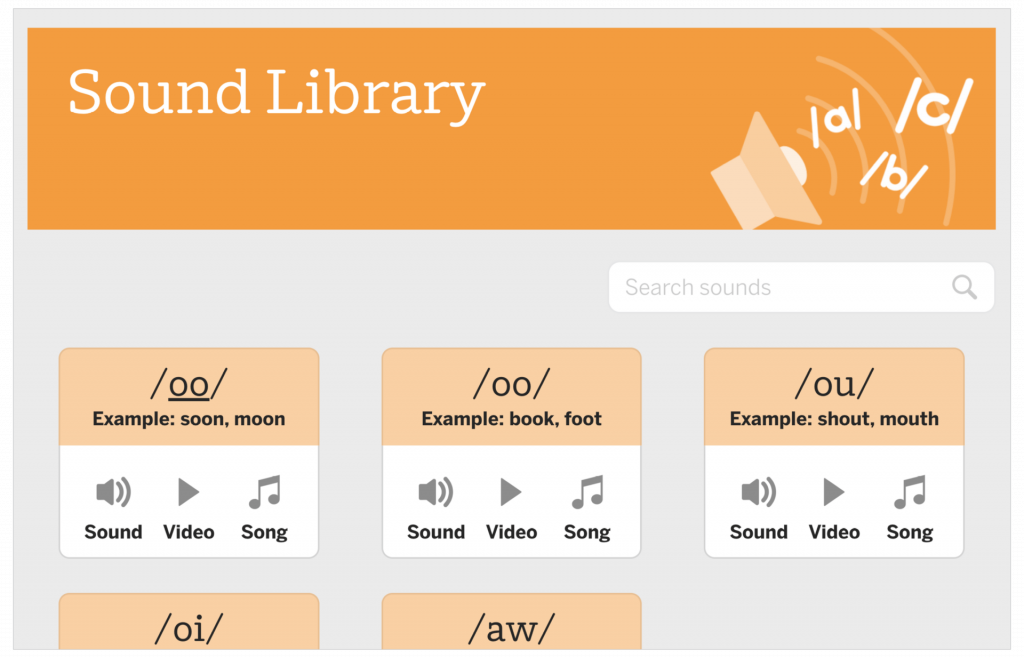
¡Les damos la bienvenida, familias de Amplify Caminos!

Nos complace darles la bienvenida a usted y a su estudiante al programa Amplify Caminos para el nuevo año escolar y brindarles oportunidades de aprendizaje excepcionales a través de nuestro programa. Hemos reunido una serie de recursos y guías que ayudarán a que su estudiante aproveche al máximo nuestra plataforma. Ponemos a su disposición estos materiales para que también usted pueda brindar apoyo a su estudiante a lo largo de todo el año.

Para la versión en inglés, haga clic aquí.

Una ilustración vibrante que muestra a una niña con atuendo tradicional y diversos elementos como un volcán, flora tropical y símbolos culturales a su alrededor, perfecta para cualquier centro de cuidadores.

¿Qué es Amplify Caminos?

Amplify Caminos es un programa de enseñanza del español para los grados K a 5. Está basado en la Ciencia de la lectura y fue creado y desarrollado completamente para el idioma español.

Hemos diseñado Amplify Caminos en torno a temas que interesan a los niños, desde temas de ciencia e historia universal hasta grandes obras literarias y artísticas. Los estudiantes conectan lo que aprenden en las distintas unidades y grados, profundizando su comprensión y participación cada año.

Primeros pasos

Cómo apoyar a su estudiante en casa:

  • Si es posible, lea con su estudiante a diario; incluso 15 minutos de lectura juntos cada día pueden generar un gran impacto.
  • Lea secciones del texto en voz alta y de forma conjunta. Si su estudiante tiene dificultad para leer en voz alta, intente leer el texto con expresividad y después pídale a su estudiante que haga lo mismo.
  • Busquen momentos para conversar sobre lo que están leyendo y descubriendo en clase. Por ejemplo, usted podría preguntarle:¿Qué te llamó más la atención de lo que leíste hoy? ¿Alguna frase o palabra te resultó confusa? ¿Qué conclusión puedes sacar del pasaje del autor? ¿Qué crees que intentaba comunicar el autor? ¿Estás de acuerdo con las ideas o descripciones del autor? ¿Qué conexiones puedes establecer entre lo que estás leyendo y tu propia vida u otros temas sobre los que hayas escuchado algo?
  • Escuche a su estudiante leer las respuestas que haya escrito o pídale que las comparta con un amigo en una videollamada.
  • Consulte el artículo Proteja a los niños en internet de la Comisión Federal de Comercio, cuyo tema es la seguridad digital.

Iniciar sesión

Estudiantes de grados K a 2

Los estudiantes de grados K a 2 podrán iniciar sesión con las credenciales compartidas que proporcionó el maestro.

Desde el dispositivo del estudiante, diríjase a learning.amplify.com.

Seleccione “Log in” y luego introduzca los datos de ingreso o seleccione “Scan QR code” para iniciar sesión usando un código QR. Los estudiantes ingresarán a su página principal (Student Home), ¡donde podrán cambiar su avatar y hacer clic en un emoji para definir su estado de ánimo del día! En la página principal del estudiante, encontrarán un vínculo de acceso rápido al Student Hub.

Nota: Los códigos de inicio compartidos les permiten a los estudiantes de grados K a 2 que usan Amplify Caminos Hub, y a los estudiantes aún no matriculados por su escuela o distrito, ingresar a los programas digitales de Amplify.

Estudiantes de grados 3 a 5

Diríjase a learning.amplify.com.

Seleccione “Log in” y luego introduzca los datos de ingreso o seleccione “Scan QR code” para iniciar sesión usando un código QR. Los estudiantes ingresarán a su página principal (Student Home), ¡donde podrán cambiar su avatar y hacer clic en un emoji para definir su estado de ánimo del día! En la página principal del estudiante (Student Home), encontrarán un vínculo de acceso rápido al Student Hub.

Nota: Para poder ingresar a la página principal de estudiante, los estudiantes que se encuentran en esta banda de grados deben estar matriculados y tener una licencia adecuada. Contacte a su maestro para obtener los datos de ingreso.

Vistazo general a los materiales

Si cuenta con acceso a internet, su estudiante puede ingresar a parte del plan de estudios digital de Amplify Caminos. Contacte a su maestro para obtener los datos de ingreso.

Libros de lectura

Amplify Caminos es un programa de Artes del Lenguaje Español (SLA, por sus siglas en inglés), de modo que los libros de lectura están en español y se ajustan al código de español que se enseña en Amplify Caminos. Estos libros solo estarán disponibles para maestros y estudiantes que implementen Caminos en su salón de SLA o de dos idiomas.

Los libros de lectura están diseñados exclusivamente para brindarles a los estudiantes práctica intensiva mientras leen historias simples y auténticas.

En los grados K a 2, los libros de lectura contienen capítulos que permiten a su estudiante practicar los sonidos y patrones de deletreo recién aprendidos, así como palabras de uso común en español. Lo anterior le ayudará a comprender lo que lee y a disfrutar de cuentos encantadores con personajes interesantes. En los grados 3 a 5, los libros de lectura contienen una variedad de textos literarios e informativos ricos en contenido, los cuales ayudan a que los estudiantes desarrollen destrezas de lectura atenta y otras destrezas de lectoescritura.

Tres portadas de libros infantiles: "nina, la llama" con una niña y una llama, "gabi descubre algo" con una niña sosteniendo una lupa y "campo y

Cuadernos de actividades para estudiantes

Como parte de las lecciones diarias, estas páginas de actividades piden a los estudiantes que respondan al texto leído y apliquen destrezas y conocimientos. También incluyen evaluaciones (a las que tienen acceso los maestros) que monitorean el desarrollo de las destrezas de los estudiantes.

Material educativo ilustrativo de Amplify CKLA con una página colorida con una llama y un cactus, y una hoja de trabajo en blanco y negro con ejercicios de calco de letras en español para niños.

El Hub de Caminos para estudiantes

Los estudiantes acceden a recursos multimedia y disfrutan de una nueva experiencia digital en el Hub de Caminos. Pueden acceder al Hub desde casa, en el salón de clases o dondequiera que estén, lo que lo hace ideal para el aprendizaje a distancia. También es compatible con computadoras portátiles, Chromebooks, tabletas y computadoras de escritorio; incluso lo hemos optimizado para dispositivos móviles.

A digital educational interface shows two options: "Sonidos" with a saxophone icon and "Biblioteca" with an open book icon, under the label "Caminos" for Grade 2.

Sonidos para los grados K a 2

La Biblioteca de sonidos contiene grabaciones del audio de fonemas. Los maestros pueden incorporar en cualquier momento los materiales de la Biblioteca de sonidos a las actividades existentes, ya sea al comienzo de las lecciones de Lectoescritura o como un repaso divertido para el salón de clases.

Los sonidos de la biblioteca están organizados por unidad, y los sonidos de cada unidad se pueden encontrar en las pestañas de la parte superior de la pantalla. Cada pestaña contiene tarjetas para cada sonido. En cada tarjeta se puede reproducir una grabación del sonido seleccionando el icono del altavoz.

Screenshot of an Amplify CKLA language learning app displaying vowel sounds with corresponding images: tree, ring, and sheep, labeled in Spanish, with a "listen" button under each.

Biblioteca

El Hub del lector de libros electrónicos permite a los niños acceder fácilmente a toda la biblioteca de libros de Caminos. Un índice sencillo facilita la navegación por libros más extensos. Los libros electrónicos de Amplify Caminos incluyen el conjunto completo de libros de lectura para estudiantes de kindergarten a quinto grado.

Pantalla de selección de libros de texto en español que muestra ocho coloridas portadas de libros para segundo grado, tituladas

Misiones

En los grados 3 a 5, cada grado incluye una Misión Básica. En estas unidades especiales se modifican todas las reglas habituales del salón de clases y los estudiantes interactúan con el lenguaje de maneras sorprendentemente nuevas. Por ejemplo, en quinto grado, aprenden a apreciar el denso lenguaje shakespeariano de “Sueño de una noche de verano” haciendo una lectura atenta, prestando atención a las imágenes evocadas e incluso representando algunas escenas.

¿Tiene alguna pregunta sobre Amplify Caminos?

Visite nuestra biblioteca de ayuda (en inglés) y busque respuestas a sus preguntas sobre el programa en nuestros artículos de ayuda.

Para obtener apoyo curricular adicional, comuníquese con su maestro.

K–5 Core Knowledge Language Arts Program – K–5 Literacy Curriculum | Amplify

To view this protected page, enter the password below:


Lleve el mundo a los estudiantes con un plan de estudios de alfabetización comprobado de PreK a 5.º grado

Amplify Core Knowledge Language Arts (CKLA) es el plan de estudios líder en alfabetización temprana basado en la Ciencia de la lectura. Mediante la combinación del desarrollo de conocimientos y de destrezas fundamentales a partir de la investigación, nuestra instrucción orienta a los educadores en el desarrollo de lectores, escritores y pensadores capaces.
Con una poderosa plataforma en línea y un plan de estudios paralelo de lengua y literatura en español, Amplify CKLA ofrece una solución integral para educadores y estudiantes de PreK a 5.º grado. For English version, please click here.

Los resultados son fruto del conocimiento previo

El plan de estudios de alfabetización de Amplify CKLA de PreK a 5.º grado equipa a los estudiantes con un rico conocimiento que se construye intencionalmente para inspirar curiosidad e impulsar resultados. Explore las investigaciónes que revelan la eficacia del plan de estudios basado en el conocimiento, así como el logro de Amplify CKLA como intervención educativa de conformidad con la ESSA (nivel 1 de evidencia fuerte).

AMPLIFY CKLA

38,000+

Salones de clase

2,700,000+

Estudiantes

50

Estados de EE. UU. y D.C.

Revisado de forma independiente y rigurosa

Amplify CKLA se encuentra entre los pocos planes de estudio que es tanto reconocido por la campaña Knowledge Matters (por su excelencia en construir conocimiento intencionalmente) y como calificado verde en EdReports, obteniendo puntuaciones verdes en todos los criterios.

Leer la reseña en EdReports

Nuestro enfoque

Basado en la Ciencia de la lectura y siguiendo el principio de Core Knowledge, el plan de estudios Amplify CKLA para PreK a 5.º grado combina conocimientos de contenido rico en historia, ciencias, literatura y artes con una instrucción sistemática de destrezas fundamentales basada en la investigación.

Basado en la Ciencia de la lectura

Como la primera casa editorial en crear un plan de estudios basado en la Ciencia de la lectura, ponemos la investigación en acción con una instrucción explícita y sistemática de destrezas fundamentales junto con una secuencia comprobada de construcción de conocimientos. En colaboración con expertos y profesionales de la educación, proporcionamos recursos poderosos que generan resultados reales. Explore nuestras historias de éxito de Ciencia de la lectura.

Diagram illustrating the interplay between language comprehension and word recognition in reading, as seen in early literacy stages. It highlights pathways through knowledge, vocabulary, and sentence understanding, reflecting principles from the CKLA reading program.

Desarrolla destrezas fundamentales con instrucción explícita y sistemática

El alcance y la secuencia basados en la investigación de Amplify CKLA progresan desde el desarrollo de destrezas simples hasta el más complejo, comenzando con la conciencia fonológica y fonémica. La instrucción le guía en la enseñanza explícita de las 150 ortografías de los 44 sonidos del inglés, con una progresión intencional y una revisión de las destrezas para preparar a sus estudiantes para el éxito.

Adopta una metodología demostrada de adquisición de conocimientos

Siguiendo la Core Knowledge Sequence, un enfoque coherente, acumulativo y de contenido específico para desarrollar conocimientos, los estudiantes profundizan y hacen conexiones entre áreas de contenido para construir una base de conocimientos sólida que les permita comprender textos complejos. Vea cómo se ha demostrado que el plan de estudios Core Knowledge mejora los puntajes de lectura y elimina las brechas en el rendimiento.

Logo of Core Knowledge featuring five colorful human figures holding hands in a circle above the text "Core Knowledge," symbolizing unity and learning. This emblem embodies the spirit of early literacy and celebrates their online language arts curriculum.

Creado en colaboración con la Core Knowledge Foundation

Amplify CKLA es el líder en materiales educativos de alta calidad para lengua y literatura de primaria, creado en colaboración con la Core Knowledge Foundation para ayudar a los estudiantes a desarrollar con eficacia un conocimiento profundo del contenido y destrezas fundamentales.

CONOCER MÁS SOBRE LA CORE KNOWLEDGE FOUNDATION

Cultivar la alfabetización bilingüe con programas paralelos en inglés y español

Amplify Caminos es el compañero perfecto en lengua y literatura del idioma español para Amplify CKLA. Los programas alineados combinan un rico conocimiento del contenido con una instrucción sistemática de destrezas fundamentales basada en la Ciencia de la lectura que sigue los principios de alfabetización bilingüe, y respalda múltiples modelos de enseñanza.

CONOCER MÁS SOBRE AMPLIFY CAMINOS

Estudio de eficacia de Amplify CKLA

Evidencia de conformidad con la ESSA (nivel 1): la adquisición de
conocimientos con Amplify CKLA
mejora los logros.

Descargar ahora

Qué se incluye

El programa proporciona atractivos materiales impresos y multimedia diseñados para construir una base sólida y rica en lectoescritura en todos los salones de clase.

CoreELD y complementos

Materiales de alta calidad para los maestros

Los maestros de Amplify CKLA brindan instrucción de manera eficaz con recursos impresos y digitales, que incluyen:

  • Guías para el maestro con diferenciación integrada.
  • Evaluaciones formales e informales.
  • Diapositivas de lecciones listas para usar y personalizables.
  • Libros comerciales y Guías literarias.
  • Recursos docentes y desarrollo profesional a pedido.

Recursos inmersivos para estudiantes

Los estudiantes de Amplify CKLA se mantienen interesados con una amplia gama de recursos impresos y digitales, que incluyen:

  • Descodificables originales y Libros grandes de lectura en voz alta (K a 2.º grado), Libros de lectura (3.er a 5.º grados) y libros comerciales (K a 5.º grado).
  • Cuadernos de actividades para estudiantes con evaluaciones integradas (K a 5.º grado).
  • Unidades de investigación para investigaciones independientes desarrollados en torno a un libro comercial (K a 5.º grado).
  • Diario del poeta y Diario del escritor (libros de lectura con espacio para escribir para 4.º y 5.º grados).
  • Misiones de conocimiento para apoyar el aprendizaje inmersivo basado en problemas en los grados 3.º a 5.º.

Materiales prácticos de fonética

La fonética multisensorial y los recursos de destrezas fundamentales ayudan a los estudiantes a practicar destrezas clave utilizando enfoques divertidos y variados que desarrollan la independencia.

  •  Carpetas para la práctica de ortografía (K).
  • Tarjetas de letras (K a 2.º grado).
  • Tarjetas de sílabas (K a 2.º grado).
  • Tarjetas de imágenes (K a 3.er grado).
  • Tarjetas de combinación de imágenes (K).
  • Rotafolios de códigos de consonantes y vocales (1.er y 2.º grados).
  • Biblioteca de sonido digital exclusiva.

Experiencia digital robusta

Los recursos para maestros y estudiantes de Amplify CKLA están disponibles a través de una plataforma de experiencia digital que mejora la instrucción y le ahorra tiempo. Con todo lo que necesita en un solo lugar, puede planificar lecciones, presentar contenido y revisar el trabajo de los estudiantes de manera eficaz.

  • Presentaciones de lecciones con diapositivas listas para usar y personalizables.
  • Herramienta dinámica para estudiantes con revisión en vivo.
  • Experiencia interactiva y amigable para los estudiantes.
  • Integración LMS.
  • Videos animados de Desarrollo de conocimiento
  • Lecturas en voz alta grabadas.
  • Sitio web de desarrollo profesional.
  • Apoyo al programa en tiempo real por correo electrónico, chat en vivo y teléfono.
Four colorful educational books are displayed against a black background. Each cover has tools like pencils, papers, and letters representing various school subjects.

Programa para estudiantes del idioma inglés

Language Studio, diseñado para Amplify CKLA, brinda instrucción diaria alineada con WIDA para que los estudiantes del idioma inglés profundicen su inglés académico.

Programa de exploración de escritura

Writing Studio, un complemento único para Amplify CKLA, ofrece una inmersión profunda en la redacción de información, narrativa y opinión para formar escritores fuertes y apasionados.

Covers of four "Writing Studio Teacher Guide" books for different grades, featuring educational icons in orange, purple, blue, and teal color schemes.

Explore otros programas basados en la Ciencia de la lectura

Todos los programas de nuestro paquete de alfabetización están diseñados para que se respalden y complementen entre sí. Aprenda más sobre nuestros programas relacionados:

Plan de estudios de lengua y literatura en inglés para la escuela intermedia

Con Amplify ELA, los estudiantes aprenden a abordar cualquier texto complejo y a hacer observaciones, a lidiar con ideas interesantes y a encontrar relevancia para ellos mismos.

Calificado como totalmente ecológico en EdReports, Amplify ELA obtuvo puntuaciones perfectas en todos los portales. For English version, please click here.

Muestra gratis
Collage featuring two scenes: upper right shows a girl in a middle school English language arts curriculum setting, lower left corner displaying children in a classroom, and graphic floral elements with butterflies throughout.

Adaptable y fácil de enseñar

Con seis niveles de diferenciación y evaluaciones integradas, los maestros pueden asegurarse de que los estudiantes adquieran destrezas clave sin interrumpir la instrucción. Debido a que el programa realiza este trabajo en segundo plano, los maestros tienen más tiempo para hacer lo que más les gusta.

Además, solo Amplify ofrece 100-Day Pathway, una guía integrada para abarcar el contenido requerido para cada nivel de grado en solo 100 días, a la vez que permite a los maestros agregar lecciones y actividades complementarias.

Calificación verde en EdReports

Calificado como verde en EdReports, Amplify ELA obtuvo puntuaciones perfectas en todos los criterios.
Los textos enriquecidos del plan de estudios Amplify ELA desarrollan conocimientos y forjan conexiones entre niveles de grado, a la vez que brindan apoyo integral tanto a estudiantes como a educadores.

Leer la reseña en EdReports

Nuestro enfoque

A través de su atractivo programa digital, poderosas herramientas de diferenciación y evaluación y guías de instrucción paso a paso, nuestro plan de estudios responde directamente a los desafíos y oportunidades que enfrentan los estudiantes y maestros de escuela intermedia.

Ver la investigación detrás del programa

Capacitamos a los estudiantes para que se conviertan en pensadores críticos.

Con el texto siempre como elemento principal, se anima a los estudiantes a generar por sí mismos ideas y opiniones sobre el significado. En lugar de centrarse en respuestas correctas o incorrectas, desarrollan ideas y opiniones sobre textos relevantes de la vida real.

Ofrecemos seis niveles de apoyo diferenciado.

Múltiples puntos de entrada y seis niveles de apoyo diferenciado integrado permiten que cada estudiante, independientemente de su fluidez o nivel de habilidad, interactúe con los mismos textos complejos y el mismo plan de estudios.

Evaluamos mientras usted enseña.

Las evaluaciones e informes integrados brindan información sobre el progreso de cada estudiante sin tener que interrumpir la instrucción diaria. Al recopilar datos en cada momento del aprendizaje, los maestros pueden responder a las necesidades de los estudiantes más rápido que nunca.

Descarga gratuita

Más allá de “hacerlo divertido”: Cuatro principios para un verdadero entusiasmo en la enseñanza de ELA en la escuela intermedia

Descargar

Qué se incluye

Amplify ELA es un plan de estudios básico riguroso que empodera a los maestros y despierta el interés de a los estudiantes de escuela intermedia.

Edición del estudiante

Disponibles en formato digital e impreso, los materiales para estudiantes sirven de guía a los alumnos de escuela intermedia a través de textos complejos y la escritura al:

  • Motivar a los estudiantes con textos narrativos e informativos de alta calidad.
  • Proporcionar videos, apoyos de audio y experiencias digitales que capten su atención.
  • Mantener todos sus escritos en un solo lugar con un Diario de escritura personal.

Edición del maestro

Disponible en formato digital e impreso, la Edición del maestro contiene toda la información que los maestros necesitan para facilitar la instrucción en el salón de clase, incluidos:

  • Planes de lecciones detallados.
  • Consejos para maestros en video integrados en la lección.
  • Alineación de estándares y boletos de salida.
  • Estrategias de diferenciación en tiempo real.
  • Informes exhaustivos.

Misiones interactivas

Las misiones son inmersiones divertidas de una semana de duración en un tema específico de múltiples capas. Permiten a los estudiantes practicar destrezas analíticas de lectura, escritura, expresión oral y comprensión auditiva, a la vez que construyen una estrecha comunidad en el salón de clase.

Una biblioteca digital para lectura independiente

La amplia Biblioteca Amplify incluye más de 700 títulos digitales de ficción, no ficción, clásicos y contemporáneos.

Amplify ELA hace más fácil la vida de los maestros

Nuestro programa garantiza que se cubran los estándares, se enseñen las destrezas y se prepare a los estudiantes con andamiaje y estímulos adecuados.

  • Diferenciación integrada para apoyar a todos los lectores.
  • Sistema de evaluación informativo y optimizado.
  • Informes exhaustivos que rastrean el progreso.
  • Potentes herramientas de comentarios.

Explore otros programas

Nuestros programas están diseñados para que se respalden y complementen entre sí. Aprenda más sobre nuestros programas relacionados:

Overview

With Amplify Science, students don’t just passively learn about science concepts. Instead, they take on the role of scientists and engineers to actively investigate and figure out real-world phenomena. They do this through a blend of cohesive and compelling storylines, hands-on investigations, collaborative discussions, literacy-rich activities, and interactive digital tools.

Watch the videos below to learn how our program empowers students to think, read, write, and argue like real scientists and engineers every day.

Overview

What Educators Say

The NGSS classroom

EdReports

Amplify Science for grades K–8 has been rated all-green by EdReports..

Read the review on Edreports.

Program structure

Our cyclical lesson design ensures students receive multiple exposures to concepts through a variety of modalities. As they progress through the lessons within a unit, students build and deepen their understanding, increasing their ability to develop and refine complex explanations of the unit’s phenomenon.

It’s this proven program structure and lesson design that enables Amplify Science to teach less, but achieve more. We designed our program to address 100% of the NGSS in just 66 days for grades K–2 and 88 days for grades 3–5.

Unit sequence

Our lessons follow a structure that is grounded in regular routines while still being flexible enough to allow for a variety of learning experiences.

In fact, our multi-modal instruction offers more opportunities for students to construct meaning, and practice and apply concepts than any other program. What’s more, our modular design means our units can be flexibly arranged to support your instructional goals.

Unit sequence
Mariposa en vuelo sobre plantas en macetas sobre una mesa, con una oruga en un tallo frondoso cerca, una regadera roja a la izquierda y un paisaje brillante al fondo.

Needs of Plants and Animals

Domains: Life Science, Earth and Space Science, Engineering Design

Unit type: Investigation

Student role: Scientists

Phenomenon: There are no monarch caterpillars in the Mariposa Grove community garden since vegetables were planted. 
Una mano tirando de una cuerda atada a una bola blanca, que interactúa con un tablero de madera con varias clavijas y bandas elásticas.

Pushes and Pulls

Domains: Physical Science, Engineering Design

Unit type: Engineering design

Student role: Pinball engineers

Phenomenon: Pinball machines allow people to control the direction and strength of forces on a ball. 
An illustration from the Sunlight and Weather unit

Sunlight and Weather

Domains: Earth and Space Science, Life Science, Engineering Design

Unit type: Modeling

Student role: Weather scientists

Phenomenon: Students at Carver Elementary School are too cold during morning recess, while students at Woodland Elementary School are too hot during afternoon recess. 
Una ilustración de una tortuga marina nadando bajo el agua, acompañada por una tortuga más pequeña, una tortuga más grande y un tiburón distante. Al fondo se ven algas.

Animal and Plant Defenses

Domain: Life Science

Unit type: Modeling

Student role: Marine scientists

Phenomenon: Spruce the Sea Turtle lives in an aquarium and will soon be released back into the ocean, where she will survive despite ocean predators. 
An illustration from the Light and Sound unit

Light and Sound

Domains: Physical Science, Engineering Design

Unit type: Engineering design

Student role: Light and sound engineers

Phenomenon: A puppet show company uses light and sound to depict realistic scenes in puppet shows. 
Ilustración que muestra un paisaje urbano dividido en noche a la izquierda con una luna y estrellas, y día a la derecha con un sol, nubes y un avión.

Spinning Earth

Domain: Earth and Space Science

Unit type: Investigation

Student role: Sky scientists

Phenomenon: The sky looks different to Sai and his grandma when they talk on the phone. 
Un elefante se encuentra debajo de un árbol y usa su trompa para arrancar un trozo de fruta.

Plant and Animal Relationships

Domains: Life Science, Engineering Design

Unit type: Investigation

Student role: Plant scientists

Phenomenon: No new chalta trees are growing in the fictional Bengal Tiger Reserve in India. 
A hand holds a red bean on a table, while a wooden stick spreads white glue and scattered beans. Also on the table are a white cup and a yellow pen.

Properties of Materials

Domains: Physical Science, Engineering Design

Unit type: Engineering design

Student role: Glue engineers

Phenomenon: Different glue recipes result in glues that have different properties. 
An illustration from the Changing Landforms unit

Changing Landforms

Domain: Earth and Space Science

Unit type: Modeling

Student role: Geologists

Phenomenon: The cliff that Oceanside Recreation Center is situated on appears to be receding over time. 
An illustration from the Balancing Forces unit

Balancing Forces

Domain: Physical Science

Unit type: Modeling

Student role: Engineers

Phenomenon: The town of Faraday is getting a new train that floats above its tracks. 
An illustration from the Inheritance and Traits unit

Inheritance and Traits

strong>Domain: Life Science

Unit type: Investigation

Student role: Wildlife biologists

Phenomenon: An adopted wolf in Graystone National Park (Wolf 44) has some traits that appear similar to one wolf pack in the park and other traits that appear to be similar to a different wolf pack. 
An illustration from the Environments and Survival unit

Environments and Survival

Domains: Life Science, Engineering Design

Unit type: Engineering design

Student role: Biomimicry engineers

Phenomenon: Over the last 10 years, a population of grove snails has changed: The number of grove snails with yellow shells has decreased, while the number of snails with banded shells has increased. 
Un orangután con un pelaje naranja cuelga de una enredadera en una densa y verde jungla con árboles y plantas, mientras el sol brilla de fondo.

Weather and Climate

Domains: Earth and Space Science, Engineering Design

Unit type: Argumentation

Student role: Meteorologists

Phenomenon: Three different islands, each a contender for becoming an Orangutan reserve, experience different weather patterns. 
An illustration from the Energy Conversions unit

Energy Conversions

Domains: Physical Science, Earth and Space Science, Engineering Design

Unit type: Engineering design

Student role: System engineers

Phenomenon: The fictional town of Ergstown experiences frequent blackouts. 
An illustration from the Vision and Light unit

Vision and Light

Domain: Physical Science, Life Science, Engineering Design

Unit type: Investigation

Student role: Conservation biologists

Phenomenon: The population of Tokay geckos in a rain forest in the Philippines has decreased since the installation of new highway lights. 
Ilustración de una costa rocosa con acantilados angulares en tonos rojizos a la izquierda y una masa de agua azul debajo.

Earth's Features

Domain: Earth and Space Science

Unit type: Argumentation

Student role: Geologists

Phenomenon: A mysterious fossil is discovered in a canyon within the fictional Desert Rocks National Park. 
An illustration from the Waves, Energy, and Information unit

Waves, Energy, and Information

Domains: Physical Science, Life Science, Earth and Space Science, Engineering Design

Unit type: Modeling

Student role: Marine scientists

Phenomenon: Mother dolphins in the fictional Blue Bay National Park seem to be communicating with their calves when they are separated at a distance underwater. 
An illustration from the Patterns of Earth and Sky unit

Patterns of Earth and Sky

Domains: Physical Science, Earth and Space Science

Unit type: Investigation

Student role: Astronomers

Phenomenon: An ancient artifact depicts what we see in the sky at different times — the sun during the daytime and different stars during the nighttime — but it is missing a piece. 
An illustration from the Modeling Matter unit

Modeling Matter

Domain: Physical Science

Unit type: Modeling

Student role: Food scientists

Phenomenon: Chromatography is a process for separating mixtures. Some solids dissolve in a salad dressing while others do not. Oil and vinegar appear to separate when mixed in a salad dressing. 
An illustration from the Earth System unit

The Earth System

Domains: Earth and Space Science, Physical Science, Engineering Design

Unit type: Engineering Design

Student role: Water resource engineers

Phenomenon: East Ferris, a city on one side of the fictional Ferris Island, is experiencing a water shortage, while West Ferris is not. 
An illustration from the Ecosystem Restoration unit

Ecosystem Restoration

Domains:Physical Science, Life Science, Earth and Space Science, Engineering Design

Unit type: Argumentation

Student role: Ecologists

Phenomenon: The jaguars, sloths, and cecropia trees in a reforested section of a Costa Rican rain forest are not growing and thriving. 

Access program

Watch the video to the right showing you how to navigate our digital platform. When you’re ready, follow the instructions below to log into your live demo account.

  • Click the orange button below to access the platform.
  • Explore as a teacher with this username (t1.cartwrightsd@demo.tryamplify.net) and this password (Amplify1-cartwrightsd).
  • Explore as a student with this username (s1.cartwrightsd@demo.tryamplify.net) and this password (Amplify1-cartwrightsd).
  • Choose your grade level from the drop-down menu.


Access the digital platform now

Resources

¡Les damos la bienvenida, familias de Boost Reading!

Nos complace darles la bienvenida a usted y a su estudiante al Caregiver Hub de Boost Reading en este nuevo año escolar. Hemos reunido una serie de recursos y guías que ayudarán a que usted pueda brindar apoyo a su estudiante a lo largo de todo el año y a que este aproveche al máximo nuestra plataforma.

For English version, please click here.

A young girl wearing headphones uses a tablet, with colorful cartoon trees and a bird character in the background. A label reads "Built on the Science of Reading" and highlights how Boost Reading supports learning.

¿Qué es Boost Reading?

Boost Reading es un programa de intervención digital dirigido por estudiantes y basado en la Ciencia de la lectura (Science of Reading). El apasionante mundo de Boost Reading utiliza tecnología adaptativa para brindar apoyo de recuperación personalizado a estudiantes de grados K a 5, adaptándose a las necesidades únicas de cada lector. Su estudiante puede usar el programa durante el horario de clase y también de forma independiente en casa.

¡Le damos la bienvenida a Boost Reading!

A cartoon bird stands on a cliff in a jungle as part of Boost Reading, with “ad” and “at” text options on screen; a face and three hearts appear in the top right corner.

¿Cuál es mi rol?

Asegúrese de que su estudiante pueda iniciar sesión por cuenta propia.

Le recomendamos que ayude a su estudiante a iniciar sesión en casa a través de Clever u otra plataforma. El maestro también puede descargar e imprimir un código QR o un nombre de usuario y contraseña únicos que su estudiante pueda usar para iniciar sesión. Si tiene dudas sobre el proceso de inicio de sesión o no recibió los datos de ingreso, comuníquese con el maestro.

Sugerencias

  • Practique el inicio de sesión con su estudiante de manera regular hasta que pueda iniciar sesión de forma independiente.
  • Mantenga sus datos de ingreso en un solo lugar para que su estudiante sepa adónde recurrir si los olvida.
Colorful illustration featuring a cat, tropical bird, deer, books to boost reading, cubes, a portal with silhouettes, and abstract purple shapes in the background.

Procure un espacio tranquilo para que su estudiante pueda trabajar.

Prepare a su estudiante para usar Boost Reading en casa: asegúrese de que tenga auriculares y un lugar tranquilo para jugar. Boost Reading es un programa personalizado que responde a las necesidades de cada estudiante, así que no necesitará asistirlo con su aprendizaje. Una vez que su estudiante pueda iniciar sesión, podrá comenzar a usar el programa por cuenta propia.

Aparte tiempo para que su estudiante pueda jugar de forma independiente.

Es posible que su estudiante comience con una actividad de nivelación que ayudará al programa a asignarle el mejor contenido, de acuerdo con su nivel de lectura. Para garantizar la nivelación más precisa posible, es importante que el estudiante realice cada actividad de manera independiente. ¡Anime a su estudiante a que se esfuerce y se divierta!

Revise la seguridad digital.

Le recomendamos que revise Proteja a los niños en internet, un sitio web de la Comisión Federal de Comercio, cuyo tema es la seguridad digital.

¡Diviértanse más!

Cada estudiante tiene un compañero digital llamado Curioso. ¡Imprima estas páginas para colorear, y compártalas con su estudiante para que decore su propio Curioso!

Two coloring pages featuring cartoon fantasy animals under banners, one reading "CURIOSOS!"—perfect to boost reading skills while kids explore whimsical creatures like a bird, lizard, and deer.

Descargue las páginas para colorear Curiosos.

Cómo obtener ayuda

Screenshot of the Amplify support page with an orange header, bear illustration, search bar, and Boost Reading help article categories displayed in a grid layout.

¡Estamos aquí para ayudarle!

¿Tiene alguna pregunta sobre Boost Reading?

Visite nuestra biblioteca de ayuda (en inglés) y busque respuestas a sus preguntas sobre el programa en nuestros artículos de ayuda.

Para obtener apoyo curricular adicional, comuníquese con su maestro.

Preguntas frecuentes

Como los estudiantes pueden usar Boost Reading durante la jornada escolar, recomendamos ponerse en contacto con el maestro o la maestra de su estudiante para determinar cuánto tiempo debería usar este programa en casa. Nuestra orientación general es la siguiente:

Boost Reading
Los estudiantes que usan Boost Reading en los grados K–3.º deberían jugar durante un total de 30–45 minutos por semana, repartidos en sesiones de 10–15 minutos cada una. Los estudiantes que usan Boost Reading en los grados 4.º y 5.º deberían jugar durante un total de 40–60 minutos por semana, repartidos en sesiones de 20–30 minutos cada una.

Boost Reading y Boost Lectura
Recomendamos que, tanto en Boost Reading como en Boost Lectura, los estudiantes deben aspirar a usar ambos programas durante aproximadamente 40 minutos por semana.

Si su estudiante tiene problemas con el contenido, le recomendamos que no intervenga. Aunque sabemos que esto puede resultar difícil, Boost Reading está diseñado para adaptarse según las respuestas de su estudiante y proporcionarle un mayor apoyo e instrucción con el fin de que pueda avanzar en el juego.

¡Les damos la bienvenida, familias de Boost Lectura!

Nos complace darles la bienvenida a usted y a su estudiante al Caregiver Hub de Boost Lectura en este nuevo año escolar. Hemos reunido una serie de recursos y guías que ayudarán a que usted pueda brindar apoyo a su estudiante a lo largo de todo el año y a que este aproveche al máximo nuestra plataforma.

For English version, please click here.

Cartoon dog in a soccer uniform kicks a "ma" ball toward a goal, saying "¡Hola!" and "Hello!"—highlighting how the Science of Reading can help boost reading skills in fun ways.

¿Qué es Boost Lectura?

Boost Lectura es un programa de intervención digital fácil de usar. El apasionante mundo de Boost Lectura proporciona enseñanza diferenciada de la lectura en español para estudiantes de grados K a 2, adaptándose a las necesidades únicas de cada lector. Su estudiante puede usar el programa durante el horario de clase y también de forma independiente en casa.

¡Bienvenidos a Boost Lectura!

Captura de pantalla de un video de dibujos animados educativos en pausa destinado a impulsar la lectura, que muestra un pájaro en un arbusto y una niña mirando desde detrás de un árbol, con opciones de palabras "ad" y "at".

¿Cuál es mi rol?

Asegúrese de que su estudiante pueda iniciar sesión por cuenta propia.

Le recomendamos que ayude a su estudiante a iniciar sesión en casa a través de Clever u otra plataforma. El maestro también puede descargar e imprimir un código QR o un nombre de usuario y contraseña únicos que su estudiante pueda usar para iniciar sesión. Si tiene dudas sobre el proceso de inicio de sesión o no recibió los datos de ingreso, comuníquese con el maestro.

Sugerencias

  • Practique el inicio de sesión con su estudiante de manera regular hasta que pueda iniciar sesión de forma independiente.
  • Mantenga sus datos de ingreso en un solo lugar para que su estudiante sepa adónde recurrir si los olvida.
Ilustración colorida de criaturas y objetos caprichosos, incluida una bola de cristal que muestra la silueta de un paisaje urbano, libros para estimular la lectura, una poción y una criatura vibrante que se asemeja a un gato.

Procure un espacio tranquilo para que su estudiante pueda trabajar.

Prepare a su estudiante para usar Boost Lectura en casa: asegúrese de que tenga auriculares y un lugar tranquilo para jugar. Boost Lectura es un programa personalizado que responde a las necesidades de cada estudiante, así que no necesitará asistirlo con su aprendizaje. Una vez que su estudiante pueda iniciar sesión, podrá comenzar a usar el programa por cuenta propia.

Aparte tiempo para que su estudiante pueda jugar de forma independiente.

Es posible que su estudiante comience con una actividad de nivelación que ayudará al programa a asignarle el mejor contenido, de acuerdo con su nivel de lectura. Para garantizar la nivelación más precisa posible, es importante que el estudiante realice cada actividad de manera independiente. ¡Anime a su estudiante a que se esfuerce y se divierta!

Revise la seguridad digital.

Le recomendamos que revise Proteja a los niños en internet, un sitio web de la Comisión Federal de Comercio, cuyo tema es la seguridad digital.

¡Diviértanse más!

Cada estudiante tiene un compañero digital personalizable llamado Curioso. ¡Imprima estas páginas para colorear, y compártalas con su estudiante para que decore su propio Curioso!

Páginas para colorear con animales de dibujos animados vestidos con atuendos festivos y la palabra "¡Impulsa la lectura!" en un cartel en la parte superior.

Descargue las páginas para colorear Curiosos.

Cómo obtener ayuda

Página de inicio del sitio web de Amplify, que presenta una barra de búsqueda, menús de navegación e íconos para mejorar los recursos de lectura y el soporte.

¡Estamos aquí para ayudarle!

¿Tiene alguna pregunta sobre Boost Lectura?

Visite nuestra biblioteca de ayuda (en inglés) y busque respuestas a sus preguntas sobre el programa en nuestros artículos de ayuda.

Para obtener apoyo curricular adicional, comuníquese con su maestro.

Preguntas frecuentes

Es posible que su estudiante use programas durante la jornada escolar, por lo que recomendamos ponerse en contacto con el maestro para determinar cuánto tiempo debe usar estos programas en casa. En general, nuestra sugerencia es la siguiente:

Boost Lectura

Los estudiantes que solamente usan Boost Lectura deberían jugar durante un total de 30 a 45 minutos por semana, repartidos en sesiones de 10 a 15 minutos cada una.

Boost Reading y Boost Lectura

Para los estudiantes que usan tanto Boost Lectura como Boost Reading, recomendamos que usen ambos programas aproximadamente 40 minutos por semana. Sugerimos repartir el tiempo total entre ambos programas, cada uno con sesiones de 10 a 15 minutos.

Si su estudiante tiene problemas con el contenido, le recomendamos que no intervenga. Aunque sabemos que esto puede resultar difícil, Boost Lectura está diseñado para adaptarse según las respuestas de su estudiante y proporcionarle un mayor apoyo e instrucción con el fin de que pueda avanzar en el juego.

What’s included in our phenomena-based science curriculum

Amplify Science is a phenomena-based science curriculum for grades K-8. This program is designed to give students engaging, realistic experiences that mirror how scientists and engineers actually work. To do this, the Lawrence Hall of Science and Amplify created compelling print and digital resources that work seamlessly together to enable students’ investigations and explorations.

Year at a glance

Amplify Science is organized around units where students are introduced to compelling phenomena and real-world problems, develop and strengthen claims by collecting evidence and testing assumptions, and apply their learning in new contexts.

Un gráfico que muestra secuencias de lecciones de ciencias desde jardín de infantes hasta quinto grado, detallando temas, números de lecciones, días de evaluación y duración de las lecciones para cada grado.

Units at a glance

In each Amplify Science unit, students are asked to inhabit the role of a scientist or engineer in order to investigate a real-world problem. These problems provide relevant, 21st-century contexts through which students investigate different scientific phenomena.

1

Needs of Plants and Animals

Students take on the role of scientists in order to figure out why there have been no monarch caterpillars in the community garden since vegetables were planted. They investigate how plants and animals get what they need to live and grow, and make a new plan for the community garden that provides for the needs of the monarch caterpillars in addition to producing vegetables for humans.

2

Pushes and Pulls

Students take on the role of pinball machine engineers as they investigate the effects of forces on the motion of an object. They conduct tests in their own prototypes (models) of a pinball machine and use what they learn to contribute to the design of a class pinball machine. Over the course of the unit, students construct a foundational understanding of why things move in different ways

Silueta de una estructura de parque infantil contra un cielo azul con nubes y tres soles amarillos.

3

Sunlight and Weather

The principals of Woodland Elementary and Carver Elementary need student weather scientists to help them explain why Woodland’s playground is warmer than Carver’s at recess. Students gather data from models of the sun and Earth’s surface and observe their own playgrounds to figure out how sunlight causes changes in the temperatures of different surfaces. Students then use models to figure out why Woodland’s playground sometimes floods.

1

Animal and Plant Defenses

Students play the role of marine scientists. In their role, students apply their understanding of plant and animal defense structures to explain to aquarium visitors how a sea turtle and her offspring can defend themselves from ocean predators when they are released into the wild.

Dos manos sosteniendo un papel con un dibujo de pirámide y árbol, iluminado por una linterna, proyectando otra sombra de la imagen en la pared.

2

Light and Sound

Students take on the role of light and sound engineers for a puppet show company as they investigate cause and effect relationships to learn about the nature of light and sound. They apply what they learn to design shadow scenery and sound effects for a puppet show.

Ilustración que muestra un paisaje urbano dividido en noche a la izquierda con una luna y estrellas, y día a la derecha con un sol, nubes y un avión.

3

Spinning Earth

As sky scientists, students explain why a boy living in a place near them sees different things in the sky than his grandma does when he talks to her on the phone. Students record, organize, and analyze observations of the sun and other sky objects as they look for patterns and make sense of the cycle of daytime and nighttime.

1

Plant and Animal Relationships

In their role as plant scientists, students work to figure out why there are no new chalta trees growing in the Bengal Tiger Reserve, which is part of a broadleaf forest. Students investigate what the chalta tree needs to survive, then collect and analyze qualitative and quantitative data to solve the mystery.

Una mano sostiene un frijol rojo sobre una mesa, mientras un palo de madera esparce pegamento blanco y frijoles esparcidos. Sobre la mesa también hay una taza blanca y una pluma amarilla.

2

Properties of Materials

As glue engineers, students are challenged to create a glue for use at their school that meets a set of design goals. Students present an evidence-based argument for why their glue mixture will be good for their school to use.

Ilustración de una costa con acantilados, un edificio de centro recreativo con un techo rojo y un letrero, árboles de hoja perenne, una bandera azul y una playa de arena debajo.

3

Changing Landforms

The director of the Oceanside Recreation Center gets a scare when a nearby cliff collapses overnight. Research reveals that the distance between the Recreation Center’s flagpole and the edge of the cliff have changed over time. Students play the role of geologists and work to figure out why the cliff has changed over time. Based on what they learn about erosion, they advise on whether it is safe to keep the center open even though the cliff is changing.

Una ilustración de un tren de alta velocidad moderno y aerodinámico que viaja por una vía elevada con un paisaje verde de fondo.

1

Balancing Forces

People in Faraday are excited to hear that a new train service will be built for their city, but concerned when they hear that it will be a floating train. Students are challenged to figure out how a floating train works in order to explain it to the citizens of Faraday. They develop models of how the train rises, floats, and then falls back to the track, and then write an explanation of how the train works.

Ilustración de una escena de bosque con un oso, un alce, pájaros en una rama y un grupo de lobos en primer plano. Las colinas y los árboles están al fondo bajo un cielo despejado.

2

Inheritance and Traits

Students play the role of wildlife biologists working in Greystone National Park. They study two wolf packs and are challenged to figure out why an adopted wolf (“Wolf 44”) in one of the packs has certain traits. Students observe variation between and within different species, investigate inherited traits and those that result from the environment, and explain the origin of several of the adopted wolf’s traits.

Ilustración de un pájaro mirando un caracol en el suelo, con hojas verdes en el lado izquierdo y un fondo de cielo azul.

3

Environments and Survival

In their role as biomimicry engineers, students work to figure out how the traits of grove snails affect their survival in different environments. They then explore how the traits of different organisms make them more likely or less likely to survive, collecting and interpreting data to understand how organisms’ traits affect their survival in different environments. Students then apply their understanding to a new challenge: designing effective solutions for the removal of invasive plants.

4

Weather and Climate

In their role as meteorologists, students gather evidence to decide where to build an orangutan reserve by analyzing patterns in weather data. After choosing the strongest evidence, students use data to make arguments about which of three fictional islands has weather most like that of orangutans’ existing habitats, Borneo and Sumatra. They then discern patterns in the locations of natural hazards in order to figure out which ones the Wildlife Protection Organization must prepare for.

Ilustración de un paisaje urbano nocturno con ventanas iluminadas y farolas, una luna visible y estrellas en el cielo. Una figura solitaria se recorta en una de las ventanas.

1

Energy Conversions

Students take on the role of systems engineers for Ergstown, a fictional town that experiences frequent blackouts, and explore reasons why an electrical system can fail. Students apply what they learned as they choose new energy sources and energy converters for the town, then write arguments for why their design choices will make the town’s electrical system more reliable.

Un gecko se prepara para atrapar un grillo bajo una farola por la noche. Las flechas amarillas ilustran la luz de la lámpara que golpea al grillo y se refleja en los ojos del gecko.

2

Vision and Light

As conservation biologists, students work to figure out why a population of Tokay geckos has decreased since the installation of new highway lights in the rainforest. Students use their understanding of vision, light, and information processing to figure out why an increase in light in the geckos’ habitat is affecting the population.

3

Earth’s Features

Playing the role of geologists, students help the director of Desert Rocks National Park explain how and when a particular fossil formed and how it came to be in its current location. Students figure out what the environment of the park was like in the past and why it has so many visible rock layers.

Dos delfines nadan bajo el agua en un ambiente teñido de azul, uno frente al otro, y uno parece abrir ligeramente la boca.

4

Waves, Energy, and Information

In their role as marine scientists, students work to figure out how mother dolphins communicate with their calves. They write a series of scientific explanations with diagrams to demonstrate their growing understanding of how sound waves travel. Then they apply what they’ve learned about waves, energy, and patterns in communication to figure out how to create patterns that can communicate information over distances.

1

Patterns of Earth and Sky

Playing the role of astronomers, students help a team of archaeologists figure out what the missing piece of a recently discovered artifact might have depicted. As they learn about the sun and other stars and the movement of Earth, students can explain what is shown on the artifact and what might be on the missing piece.

2

Modeling Matter

In their role as food scientists at a fictional company, students are introduced to the idea that all matter is made of particles too small to see, and that each different substance is made of particles (molecules) that are unique. They are then challenged to solve two problems: one requires them to separate a mixture, and the other requires them to make unmixable substances mix. Students are challenged to use the particulate model of matter to explain their work to the CEO of the company.

Ilustración de un paisaje costero con una montaña y flechas que representan el flujo del viento sobre y alrededor de la montaña, lo que indica la dinámica del flujo de aire.

3

The Earth System

The cities of East Ferris and West Ferris are located on different sides of a mountain on the fictional Ferris Island. East Ferris is having a water shortage while West Ferris is not. As water resource engineers, students learn about the Earth system to help figure out what is causing the water shortage problem and design possible solutions, including freshwater collection systems and proposals for using chemical reactions to treat wastewater.

Ilustración de una escena de la jungla en la que aparecen un guepardo y un perezoso entre un denso follaje verde y varias plantas coloridas.

4

Ecosystem Restoration

As ecologists, students work to figure out why the organisms in a part of a Costa Rican rainforest ecosystem aren’t growing and thriving. As they solve this problem, students learn more generally how organisms in an ecosystem get the matter and energy they need to survive, and then write a series of restoration plans that include arguments about why the rainforest ecosystem is not thriving and recommend actions to restore its health.

Print & digital components

The program includes instructional guidance and student materials for a year of instruction, with lessons and activities that keep students engaged every day.

Component

Format

Teacher’s Guides

Available digitally and in print, the Teacher’s Guides contain all of the information teachers need to facilitate classroom instruction, including detailed lesson plans, high-level overview documentation, differentiation strategies, standards alignments, materials and preparation steps, teacher support strategies and in-context professional development, possible student responses, and more.

Print and digital

Hands-on materials kits

Hands-on learning is integrated into every unit of Amplify Science. Each hands-on activity is supported through clear instructions for the teacher, as well as easily accessible materials in unit-specific kits. Each kit contains hands-on materials, both consumable and nonconsumable, and various print materials (e.g., Vocabulary and Key Concept cards). With Amplify Science, students can actively participate in science: gathering evidence, thinking critically, making observations, and communicating their claims.

Kit

A collection of gardening supplies including a blue bucket, soil bags, plastic cups, hose, fertilizer pellets, and a black tray on a white background.

Component

Format

Student Investigation Notebooks

Available for every unit, the Student Investigation Notebooks contain instructions for activities and space for students to record data, reflect on ideas from texts and investigations, and construct explanations and arguments.

Print and digital

Student books

The age-appropriate Student Books in Amplify Science allow students to engage with content-rich text, obtain evidence, develop research and close reading skills, and construct arguments and explanations about the ideas they are learning in class.

Print and digital

Simulations and practice tools (grades 2+)

Developed exclusively for the Amplify Science program, these serve as venues for exploration and data collection, allowing students to explore scientific concepts that might otherwise be invisible or impossible to see with the naked eye.

Digital

Laptop screen displaying a geographical simulation of a river system with zones: Upper River, Floodplain, and River Delta, including an elevation chart and controls for speed and time adjustment.

Explore more programs

Our programs are designed to support and complement one another. Learn more about our related programs.

Lleve el mundo a los estudiantes con un plan de estudios de alfabetización comprobado de PreK a 5.º grado

Amplify Core Knowledge Language Arts (CKLA) es el plan de estudios líder en alfabetización temprana basado en la Ciencia de la lectura. Mediante la combinación del desarrollo de conocimientos y de destrezas fundamentales a partir de la investigación, nuestra instrucción orienta a los educadores en el desarrollo de lectores, escritores y pensadores capaces.
Con una poderosa plataforma en línea y un plan de estudios paralelo de lengua y literatura en español, Amplify CKLA ofrece una solución integral para educadores y estudiantes de PreK a 5.º grado. For English version, please click here.

Los resultados son fruto del conocimiento previo

El plan de estudios de alfabetización de Amplify CKLA de PreK a 5.º grado equipa a los estudiantes con un rico conocimiento que se construye intencionalmente para inspirar curiosidad e impulsar resultados. Explore las investigaciónes que revelan la eficacia del plan de estudios basado en el conocimiento, así como el logro de Amplify CKLA como intervención educativa de conformidad con la ESSA (nivel 1 de evidencia fuerte).

Amplify CKLA serves

38,000+

Salones de clase

2,700,000+

Estudiantes

50

Estados de EE. UU. y D.C.

Revisado de forma independiente y rigurosa

Amplify CKLA se encuentra entre los pocos planes de estudio que es tanto reconocido por la campaña Knowledge Matters (por su excelencia en construir conocimiento intencionalmente) y como calificado verde en EdReports, obteniendo puntuaciones verdes en todos los criterios.

Leer la reseña en EdReports

Ilustración que muestra una "campaña de alfabetización temprana" con niños participando en actividades educativas y de lectura en diferentes carteles.

Nuestro enfoque

Basado en la Ciencia de la lectura y siguiendo el principio de Core Knowledge, el plan de estudios Amplify CKLA para PreK a 5.º grado combina conocimientos de contenido ricos y diversos en historia, ciencias, literatura y artes con una instrucción sistemática de destrezas fundamentales basada en la investigación.

Basado en la Ciencia de la lectura

Como la primera casa editorial en crear un plan de estudios basado en la Ciencia de la lectura, ponemos la investigación en acción con una instrucción explícita y sistemática de destrezas fundamentales junto con una secuencia comprobada de construcción de conocimientos. En colaboración con expertos y profesionales de la educación, proporcionamos recursos poderosos que generan resultados reales. Explore nuestras historias de éxito de Ciencia de la lectura.

Desarrolla destrezas fundamentales con instrucción explícita y sistemática

El alcance y la secuencia basados en la investigación de Amplify CKLA progresan desde el desarrollo de destrezas simples hasta el más complejo, comenzando con la conciencia fonológica y fonémica. La instrucción le guía en la enseñanza explícita de las 150 ortografías de los 44 sonidos del inglés, con una progresión intencional y una revisión de las destrezas para preparar a sus estudiantes para el éxito.

Adopta una metodología demostrada de adquisición de conocimientos

Siguiendo la Core Knowledge Sequence, un enfoque coherente, acumulativo y de contenido específico para desarrollar conocimientos, los estudiantes profundizan y hacen conexiones entre áreas de contenido para construir una base de conocimientos sólida que les permita comprender textos complejos. Vea cómo se ha demostrado que el plan de estudios Core Knowledge mejora los puntajes de lectura y elimina las brechas en el rendimiento.

Creado en colaboración con la Core Knowledge Foundation

Amplify CKLA es el líder en materiales educativos de alta calidad para lengua y literatura de primaria, creado en colaboración con la Core Knowledge Foundation para ayudar a los estudiantes a desarrollar con eficacia un conocimiento profundo del contenido y destrezas fundamentales.

CONOCER MÁS SOBRE LA CORE KNOWLEDGE FOUNDATION

Cultivar la alfabetización bilingüe con programas paralelos en inglés y español

Amplify Caminos es el compañero perfecto en lengua y literatura del idioma español para Amplify CKLA. Los programas alineados combinan un rico conocimiento del contenido con una instrucción sistemática de destrezas fundamentales basada en la Ciencia de la lectura que sigue los principios de alfabetización bilingüe, y respalda múltiples modelos de enseñanza.

CONOCER MÁS SOBRE AMPLIFY CAMINOS

Estudio de eficacia de Amplify CKLA

Evidencia de conformidad con la ESSA (nivel 1): la adquisición de
conocimientos con Amplify CKLA mejora los logros.

Descargar ahora

Qué se incluye

El programa proporciona atractivos materiales impresos y multimedia diseñados para construir una base sólida y rica en lectoescritura en todos los salones de clase.

CoreELD y complementos

Materiales de alta calidad para los maestros

Los maestros de Amplify CKLA brindan instrucción de manera eficaz con recursos impresos y digitales, que incluyen:

  • Guías para el maestro con diferenciación integrada.
  • Evaluaciones formales e informales.
  • Diapositivas de lecciones listas para usar y personalizables.
  • Libros comerciales y Guías literarias.
  • Recursos docentes y desarrollo profesional a pedido.

Recursos inmersivos para estudiantes

Los estudiantes de Amplify CKLA se mantienen interesados con una amplia gama de recursos impresos y digitales, que incluyen:

  • Descodificables originales y Libros grandes de lectura en voz alta (K a 2.º grado), Libros de lectura (3.er a 5.º grados) y libros comerciales (K a 5.º grado).
  • Cuadernos de actividades para estudiantes con evaluaciones integradas (K a 5.º grado).
  • Unidades de investigación para investigaciones independientes desarrollados en torno a un libro comercial (K a 5.º grado).
  • Diario del poeta y Diario del escritor (libros de lectura con espacio para escribir para 4.º y 5.º grados).
  • Misiones de conocimiento para apoyar el aprendizaje inmersivo basado en problemas en los grados 3.º a 5.º.

Materiales prácticos de fonética

La fonética multisensorial y los recursos de destrezas fundamentales ayudan a los estudiantes a practicar destrezas clave utilizando enfoques divertidos y variados que desarrollan la independencia.

  • Carpetas para la práctica de ortografía (K).
  • Tarjetas de letras (K a 2.º grado).
  • Tarjetas de sílabas (K a 2.º grado).
  • Tarjetas de imágenes (K a 3.er grado).
  • Tarjetas de combinación de imágenes (K).
  • Rotafolios de códigos de consonantes y vocales (1.er y 2.º grados).
  • Biblioteca de sonido digital exclusiva.

Experiencia digital robusta

Los recursos para maestros y estudiantes de Amplify CKLA están disponibles a través de una plataforma de experiencia digital que mejora la instrucción y le ahorra tiempo. Con todo lo que necesita en un solo lugar, puede planificar lecciones, presentar contenido y revisar el trabajo de los estudiantes de manera eficaz.

  • Presentaciones de lecciones con diapositivas listas para usar y personalizables.
  • Herramienta dinámica para estudiantes con revisión en vivo.
  • Experiencia interactiva y amigable para los estudiantes.
  • Integración LMS.
  • Videos animados de Desarrollo de conocimiento
  • Lecturas en voz alta grabadas.
  • Sitio web de desarrollo profesional.
  • Apoyo al programa en tiempo real por correo electrónico, chat en vivo y teléfono.

Programa para estudiantes del idioma inglés

Language Studio, diseñado para Amplify CKLA, brinda instrucción diaria alineada con WIDA para que los estudiantes del idioma inglés profundicen su inglés académico.

Programa de exploración de escritura

Writing Studio, un complemento único para Amplify CKLA, ofrece una inmersión profunda en la redacción de información, narrativa y opinión para formar escritores fuertes y apasionados.

Covers of four "Writing Studio Teacher Guide" books for different grades, featuring educational icons in orange, purple, blue, and teal color schemes.

Welcome to the Amplify Caminos 3rd Edition program review site.

To view this protected page, enter the password below:


About the program

mCLASS offers teacher-administered assessment, intervention, and personalized instruction for grades K–6. Know exactly how to monitor and support every student in your classroom, with features like:

  • Precise one-minute measures based on over three decades of predictive data.
  • Universal and Reading Difficulties screening in one tool.
  • Instruction that highlights observed patterns and recommends activities.
  • Robust reports for teachers, specialists, administrators, and parents.
Table displaying student reading assessment data by skill area and benchmark status, based on universal screening, with percentages and student counts for each category across the year.

The right measures at the right time

With mCLASS DIBELS 8th Edition, you’ll assess students based on grade-specific curriculum and instructional standards, in accordance with International Dyslexia Association (IDA) guidelines.

mCLASS DIBELS 8th Edition offers one-minute, easy-to-administer measures of processing speed, phonological awareness, alphabetic principle, and word reading.

DIBELS® 8th Edition subtest alignment with SB 114 requirements
RDRP Screening AreamCLASS DIBELS 8th Edition MeasureGrade KGrade 1Grade 2Grade 3Grade 4–6
Rapid naming abilityLetter Naming Fluency (LNF)A large, light peach-colored checkmark on a transparent background.A large, light peach-colored checkmark on a transparent background.
Phonological awarenessPhoneme Segmentation Fluency (PSF)A large, light peach-colored checkmark on a transparent background.A large, light peach-colored checkmark on a transparent background.
Alphabetic principleNonsense Word Fluency (NWF)A large, light peach-colored checkmark on a transparent background.A large, light peach-colored checkmark on a transparent background.A large, light peach-colored checkmark on a transparent background.A large, light peach-colored checkmark on a transparent background.
Word readingWord Reading Fluency (WRF)A large, light peach-colored checkmark on a transparent background.A large, light peach-colored checkmark on a transparent background.A large, light peach-colored checkmark on a transparent background.A large, light peach-colored checkmark on a transparent background.
Word readingOral Reading Fluency (ORF)A large, light peach-colored checkmark on a transparent background.A large, light peach-colored checkmark on a transparent background.A large, light peach-colored checkmark on a transparent background.A large, light peach-colored checkmark on a transparent background.
ComprehensionMazeA large, light peach-colored checkmark on a transparent background.A large, light peach-colored checkmark on a transparent background.A large, light peach-colored checkmark on a transparent background.
Language ComprehensionOral LanguageA large, light peach-colored checkmark on a transparent background.A large, light peach-colored checkmark on a transparent background.A large, light peach-colored checkmark on a transparent background.
VocabularyVocabularyA large, light peach-colored checkmark on a transparent background.A large, light peach-colored checkmark on a transparent background.A large, light peach-colored checkmark on a transparent background.A large, light peach-colored checkmark on a transparent background.
RANRapid Automatized Naming (Numbers)A large, light peach-colored checkmark on a transparent background.A large, light peach-colored checkmark on a transparent background.A large, light peach-colored checkmark on a transparent background.A large, light peach-colored checkmark on a transparent background.
EncodingSpellingOPTIONAL

Validated as a universal screener and a dyslexia screener

Strong reliability and validity evidence shows that DIBELS 8th Edition can effectively assess students in key skills linked to both dyslexia and broader reading difficulty. The research supporting DIBELS 8th Edition, conducted by the University of Oregon, is rigorous, meets high technical standards, and empowers educators to make well-informed decisions.

Read the DIBELS 8th Edition Dyslexia White Paper.

A document cover titled "Dyslexia Screening and DIBELS 8th Edition" by Christopher Ives, Gina Biancarosa, Hank Fien, and Patrick Kennedy from the University of Oregon College of Education. The cover has a PDF icon.

A complete system for data-based decision making

A flowchart illustrating a cyclical process: assess skills, identify risk, provide personalized instruction, progress monitor, and adjust instruction. Features images of people, charts, and a dyslexia assessment screen for comprehensive analysis.

mCLASS DIBELS 8th Edition provides rich data that helps you make informed instructional decisions and seek out further dyslexia screening evaluation if needed:

  1. Assess skills: mCLASS DIBELS 8th Edition and optional dyslexia screenings in Rapid Automatized Naming (RAN), Spelling, Vocabulary, and Oral Language accurately assess students’ abilities.
  2. Identify risk: The DIBELS 8 composite score shows each student’s risk level, with ‘Well Below Benchmark’ indicating a need for intensive support. Students who are also ‘Well Below Benchmark’ in RAN and/or Spelling have an additional Risk Indicator icon next to their name.
  3. Provide instruction: The mCLASS Instruction feature analyzes student error patterns to key dyslexia-related subtests, then recommends small groups and explicit, multi-sensory activities for reinforcing skills.
  4. Progress monitor: mCLASS includes progress-monitoring measures to track student growth in letter sounds, alphabetic principle, word reading, oral reading fluency, and comprehension, so that informed instructional decisions can be made.
  5. Adapt instruction: mCLASS displays indicators based on progress monitoring performance that indicate when a change in instruction may be needed. It also updates instruction recommendations using the latest data.

Differentiated literacy instruction

mCLASS DIBELS 8th Edition lays the groundwork for a strong Multi-Tiered System of Supports (MTSS).

In addition to identifying students with symptoms of dyslexia, mCLASS DIBELS 8th Edition data recommends early intervention, personalized instruction, and core instruction within Amplify’s early literacy suite. Based on the Science of Reading, Amplify’s early literacy suite programs follow an explicit and systematic structure, build knowledge, and instruct on all of the foundational skills essential to literacy development.

Diagram showcasing "Science of Reading Skill Development" with three branches: "Universal and Dyslexia screening," "Core instruction," "Personalized learning," and "Intervention," with accompanying photos of people interacting.

Bilingual Reading Difficulties screening

By assessing with mCLASS DIBELS 8th Edition and its Spanish counterpart, mCLASS Lectura, you’ll know with confidence whether a student truly shows signs of of reading difficulties or is experiencing difficulties learning a new language.

When used together, mCLASS DIBELS 8th Edition and mCLASS Lectura feature a Dual Language Report that analyzes Reading Difficulties screening results in both languages. The report also details how each student can leverage their strengths from one language to support growth in the other.

Student named Marisol Mejía is shown with her English and Spanish literacy scores. English scores are mostly Well Below and Below benchmark; Spanish scores are mostly at Benchmark except for one below.

Equal skill coverage in English and Spanish

mCLASS Lectura subtest alignment with SB114

RDRP screening areasEnglish measureSpanish measureDescription*
Letter Naming and RANLetter Naming Fluency (LNF)Fluidez in nombrar letras (FNL)Grades K–1: Naming letters in print. 1 minute, 1:1 administration.
Phonological Awareness (Segmentation)Phonemic Segmentation Fluency (PSF)Fluidez en la segmentación de sílabas (FSS) & Fluidez en la segmentación de fonemas (FSF)Grades K–1: Hearing and using sounds or syllables in spoken words. 1 minute, 1:1 administration.
Phonological Awareness (Elision) –¿Qué queda? (QQ)Grades K–2: Produce the part of a word that remains after deleting a syllable or phoneme. 1 minute, 1:1 administration.
Letter Sound Correspondence KnowledgeNonsense Word Fluency Correct Letter Sounds(NWF-CLS)Fluidez en los sonidos de letras (FSL)English: Grades K–3: Identify letter-sound correspondences in the context of pseudo-words. Spanish: Grades K-1: Identify letter-sounds in isolation. 1 minute, 1:1 administration.
Letter-Sound Knowledge (Receptive) –Fluidez en los sonidos de las letras K-Inicio (FSL K-Inicio)Grade K: Identify (point to) which letter makes a certain sound. Untimed, 1:1 administration.
DecodingNonsense Word Fluency Words Recoded Correctly (NWF-WRC)Fluidez en los sonidos de las sílabas (FSL)Grades K–3: Identify letter-sound correspondences in the context of pseudo-words. Spanish: Grades K–1: Identify letter-sounds in isolation. 1 minute, 1:1 administration.
Word ReadingWord-Reading Fluency (WRF)Fluidez en las palabras (FEP)Grades K–3: Reading common words easily, quickly and correctly.1 minute, 1:1 administration.
FluencyOral Reading Fluency (ORF)Fluidez en la lectura oral (FLO)Grades 1–6: Reading connected text with accuracy and automaticity. 1 minute, 1:1 administration.
Reading ComprehensionMaze¿Cuál palabra? (CP)Grades 2–6:  Understanding meaning from texts. 3 minutes, group administration.
VocabularyVocabularyVocabularioGrades K–3: Arranging letters correctly to spell words with grade appropriate features. 15 minutes, group administration.
EncodingSpellingOrtografíaGrades K–3: Arranging letters correctly to spell words with grade-appropriate features.
15 minutes, group administration.
RAN (Numbers)Rapid Automatized NamingGrades K–3: Correctly and quickly naming visual symbols, such as numbers. 1-2 minutes, 1:1 administration.
Language ComprehensionOral LanguageLenguaje oralGrades K–2: Demonstrate the ability to use words and phrases acquired through conversations, reading and being read to, and responding to texts. 5 minutes, 1:1 administration.

*Students can be assessed using off-grade measures when information on specific skills is needed.

Resources for families

Welcome California Caregivers! Please click here to learn more about mCLASS assessments. 

Families play a crucial role in helping children overcome reading challenges. mCLASS DIBELS 8th Edition and mCLASS Lectura provide a Home Connect letter after each screening to explain the results in family-friendly language, recommend activities, and direct families to a free website for additional at-home support.

A woman helps a young girl work on a computer in a classroom setting. Both are smiling and focused on the screen. Background has soft shapes in yellow and blue.

Developmentally appropriate

Computer-based assessments that require students to complete tasks silently or independently may over-identify students for intervention services, especially young learners who are still developing focus and attention abilities.

mCLASS requires students to actively demonstrate their proficiency in producing letter sounds, forming words, and reading texts. This approach to assessment aligns with IDA guidelines for effective screening of reading challenges. By choosing mCLASS for universal screening, you’ll gain accurate information about a student’s risk for reading difficulties, and gain the capability to monitor every student’s path to reading proficiency.

Additional resources

mCLASS Resources

Dyslexia Resources

Multilingual and English learners Resources

Your California team

Looking to speak directly with your local representative?
Get in touch with a California team member to learn more about our early literacy suite or request a demo account.

Dan Pier
Vice President, West
(415) 203-4810
dpier@amplify.com

Erin King
Sales Director, CA
(512) 736-3162
eking@amplify.com

NORTHERN CA
Wendy Garcia
Senior Account Executive
(510) 368-7666
wgarcia@amplify.com

BAY AREA
Lance Burbank
Account Executive
(415) 830-5348
lburbank@amplify.com

CENTRAL VALLEY and CENTRAL COAST
Demitri Gonos
Senior Account Executive
(559) 355-3244
dgonos@amplify.com

VENTURA and L.A. COUNTY
Jeff Sorenson
Associate Account Executive
(310) 902-1407
jsorenson@amplify.com

ORANGE and L.A. COUNTY
Lauren Sherman
Senior Account Executive
(949) 397-5766
lsherman@amplify.com

SAN BERNARDINO and L.A. COUNTY
Michael Gruber
Senior Account Executive
(951) 520-6542
migruber@amplify.com

RIVERSIDE AND L.A. COUNTY 
Brian Roy
Senior Account Executive
(818)967-1674
broy@amplify.com

SAN DIEGO COUNTY
Kirk Van Wagoner
Senior Account Executive
(760) 696-0709
kvanwagoner@amplify.com

BUTTE, DEL NORTE, HUMBOLDT, and SHASTA COUNTY and DISTRICTS UNDER 2250 ENROLLMENT
Kevin Mauser 
Lead Account Executive
(815) 534-0148
kmauser@amplify.com

Amplify and SFUSD Partnership

We recognize and respect the unique differences of each of our partnering districts—and that includes San Francisco USD.

Out of the box, Amplify Caminos offers districts a rich, comprehensive, research-based SELA experience. That said, no two districts are exactly alike. To that end, we are committed to working with San Francisco USD to ensure that Amplify Caminos addresses the needs of your community. This includes providing implementation guidance and support, as well as collaborating with your staff to determine which domains need to be modified or exchanged.

What is Amplify Caminos?

Amplify Caminos is a core Spanish language arts program for grades TK–5 that delivers:

  • Authentic instruction built from the ground up for the Spanish language.
  • A unique research-based approach truly built on the Science of Reading.
  • A combination of explicit foundational skills with meaningful knowledge-building.
  • Embedded support and differentiation that gets all students reading grade-level texts together.
  • Opportunities for students to see the strengths and experiences that all people share while also celebrating each others’ unique identities and experiences.


Watch the video below to learn more about Amplify Caminos for Grades K–2.


Watch the video below to learn more about Amplify Caminos for Grades 3–5.

How does Amplify Caminos work?

Amplify Caminos is built on the science of how kids learn to read—in Spanish.

Amplify Caminos is all about helping you teach students how to read, all while giving them authentic and engaging reasons to read. That’s why Amplify Caminos develops foundational skills and builds knowledge in tandem.

  • Knowledge: Through complex and authentic Spanish read-alouds with an emphasis on classroom interactivity, oral comprehension, and contextual vocabulary, students start to build their awareness of the world around them—and the way the reading skills they’re building give them access to it.
  • Skills: Starting with the sounds at the core of the Spanish
    language, students practice their phonemic awareness, handwriting skills, vocabulary, spelling, and grammar. Through daily practice, students become aware of the connection between reading and writing, building confidence as they go.
Illustration depicting the flow of genetic information, represented by ribbons transitioning from dna to rna, connected to various educational images and diagrams.

Respecting the development differences between grade ranges, Amplify Caminos teaches foundational skills and background knowledge as two distinct strands in grades K–2, and combines them into one integrated strand in grades 3–5.

Grades K–2:
Every day, students in grades K–2 complete one full lesson that explicitly and systematically builds foundational reading skills in the Amplify Caminos Lectoescritura strand, as well as one full lesson that builds robust background knowledge to access complex text in the Amplify Caminos Conocimiento strand. Through learning in each of these strands, students develop the early literacy skills necessary to help them become confident readers and build the context to understand what they’re reading.

Grades 3–5:
In grades 3–5, the Amplify Caminos Lectoescritura and Conocimiento strands are integrated in one set of instructional materials. Lessons begin to combine skills and knowledge with increasingly complex texts, close reading, and a greater writing emphasis. Students can then use their skills to go on their own independent reading adventures.

What do Amplify Caminos students explore?

Amplify Caminos builds students’ knowledge about the world.

In addition to teaching all students to crack the written code (which is vital for equity), the Amplify Caminos program helps students see the strengths and experiences we all share while celebrating their own unique identities and experiences.

This is accomplished through the exploration of topics and text that feature people who resemble students and familiar situations or experiences while also exposing them to people whose appearances, lives, beliefs, and backgrounds differ from their own.
 

Engaging domains

Amplify Caminos builds knowledge coherently across subjects and grades.

Throughout the program, students use their skills to explore domains that relate to storytelling, science, and the history of our world as seen through the eyes of many different groups.

Carefully selected to build from year-to-year, our grade-appropriate topics help students make and deepen connections while also reading, writing, and thinking creatively and for themselves.

Curriculum flowchart for Kindergarten to Grade 5, showing subject progression in language, science, and social studies, with highlighted and connected units.

New Knowledge Research Units for Grades K–5

Our brand-new Knowledge Research units carry forward Amplify Caminos’ powerful and proven instructional approach while also:

  • Adding more diversity. The rich topics and highly visual components featured in these units provide students with even more “windows and mirrors” and perspectives as they work to build knowledge.
  • Adding more authentic literature. Each new research unit revolves around a collection of high-interest authentic trade books that will spark more curiosity and inspire more inquiry.
  • Adding more flexibility. Units can be implemented for extended core instruction during flex periods, district-designated Pausing Points, or enrichment periods.

Units cover a variety of rich and relevant topics:

With these new units, students will soar to new heights with Dr. Ellen Ochoa, Amelia Earhart, and the Tuskegee Airmen. They’ll feel the rhythm as they learn about Jazz legends Miles Davis, Tito Puente, and Duke Ellington. And they’ll explore the far reaches of the world with Jacques Cousteau, Matthew Henson, and Eugenie Clark.

  • Grade K: El arte y el mundo que nos rodea
  • Grade 1: Cuentos de aventuras: relatos desde los confines de la Tierra
  • Grade 2: ¡A volar! La era de la aviación
  • Grade 3: Jazz y más
  • Grade 4: Energía: pasado, presente y futuro
  • Grade 5: Más allá de Juneteenth: de 1865 al presente

Units will be made available in English and Spanish, and will include the following components:

Why we added this unit:
“Every child is an artist,” said Picasso, meaning that every child uses art to explore and understand the world around them. El arte y el mundo que nos rodea honors that truth by introducing Kindergarten students to some of the ways in which artists have explored and understood the world around them.

This domain introduces students to artists from different time periods, countries, and cultures. Throughout the unit, students learn about different kinds of art and how artists use the world around them as they make art. They also connect this to what they have already learned about the earth, plants, and animals in other Caminos domains: GranjasPlantas, and Cuidar el planeta Tierra. In addition, students connect this to what they have learned about sculptors in the Presidentes y símbolos de los Estados Unidos domain. As they explore different artists and artistic traditions, they develop their ideas about how humans are connected to each other and to the world around them.

As you read the texts in this unit, students may observe ways in which the characters or subjects are both similar to and different from students. This is a good opportunity to teach students awareness and sensitivity, building on the idea that all people share some things in common, even as they have other things that make them unique. This unit also offers an excellent opportunity to collaborate with your school’s art teacher, as many lessons have suggested activities to help students understand the kind of art they are studying.

Within this unit, students have opportunities to:

  • Use details to describe art.
  • Identify three ways to create art.
  • Identify characteristics of cave art.
  • Sequence the steps of making pottery.
  • Describe how artists can create work connected to the world around them.
  • Describe what makes Kehinde Wiley’s portraits unique.
  • Explain how the texture of a surface can affect artwork created on it.
  • Explain what a sculpture is.
  • Describe what makes James Turrell’s artwork about the sky unique.
  • Explain what a museum is and what kinds of things you can see or do there.

Trade books in this unit:
Instruction in this unit revolves around the following collection of high-interest authentic trade books. One copy of each trade book is included with the unit materials.

  • Georgia O’Keeffe por Erica Salcedo
  • Yayoi Kusama: De aquí al infinito por Sarah Suzuki
  • Tejedora del arcoíris por Linda Elovitz Marshall
  • Las tijeras de Matisse por Jeanette Winter
  • El museo por Susan Verde
  • Quizás algo hermoso: Cómo el arte transformó un barrio por F. Isabel Campoy

Sample materials:
Take a sneak peek at the rich instruction and engaging activities for this unit by viewing the PDFs below.

Why we added this unit:
This domain introduces students to adventure stories set around the world and challenges students to dig into the adventures through research. By listening to the Read-Alouds and trade books, students increase their vocabulary and reading comprehension skills, learn valuable lessons about perseverance and teamwork, and become familiar with gathering information for research.

In this unit, students study the careers of real-world explorers Dr. Eugenie Clark and Sophia Danenberg, marvel at the inventions of Jacques Cousteau, think critically about how teamwork and collaboration can make greater adventures possible, learn about the science and technology that enable adventures, and research some of the ways humans have confronted challenges at the edges of the world, from the oceans below to space above.

Each lesson in the domain builds students’ research skills as they ask questions, gather information, and write a paragraph about their findings. Students share what they have learned about adventures in an Adventure Gallery Walkthrough. By taking on the persona of one of the adventurers they meet in the Read-Alouds and trade books, students deliver their final paragraphs as if they are a “speaking portrait” of that person. Students are invited to dress up as that adventurer if they desire.

In addition, teachers can set aside time outside the instructional block to create the picture frames students will hold as they present to the Adventure Gallery Walk guests. Frames can be made from shirt boxes, cardboard, construction paper, or any art supplies that are on hand. This might be an opportunity to collaborate with the school’s art department if resources are available. Another option is to ask students to make their frames at home with their caregivers. On the day of the Adventure Gallery Walk, students will be the hosts and take on specific jobs, such as welcoming the guests, describing their work throughout the unit, and pointing out the areas of study on the domain bulletin board. You can find a complete list of student jobs in Lesson 13.

How this unit builds knowledge:
This unit builds upon the following Caminos units that students will have encountered in the previous grade.

  • Rimas y fábulas infantiles (Kindergarten)
  • Cuentos (Kindergarten)

The specific core content targeted in these domains is particularly relevant to the Read-Alouds students will hear in Cuentos de aventuras: relatos desde los confines de la Tierra. The background knowledge students bring to this unit will greatly enhance their understanding of the trade books used in this unit.

Trade books in this unit:
Instruction in this unit revolves around the following collection of high-interest authentic trade books. One copy of each trade book is included with the unit materials.

  • My Name Is Gabito/Me llamo Gabito por Monica Brown
  • Galápagos Girl/Galapagueña por Marsha Diane Arnold
  • My Name Is Gabriela/Me llamo Gabriela por Monica Brown
  • El viaje de Kalak por María Quintana Silva y Marie-Noëlle Hébert
  • Señorita Mariposa por Ben Gundersheimer
  • Sharuko, el arqueólogo peruano/Peruvian Archaeologist Julio C. Tello por Monica Brown
  • Abuelita fue al mercado por Stella Blackstone

Sample materials:
Take a sneak peek at the rich instruction and engaging activities for this unit by viewing the PDFs below.

Why we added this unit:
With this domain, students head up, up, and away with an introduction to the soaring history of aviation. Students learn the stories of early aviators, such as the Montgolfier brothers, the Wright brothers, Aida de Acosta, and Amelia Earhart.

During the unit, students study the science of flight, including the physics concept of lift, and research the social impacts of the world of flight. Finally, students let their research skills take flight as they explore key figures from the world of aviation.

The lessons in this domain build on earlier Grade 2 Caminos domains about the westward expansion, early Greek civilizations, and Greek myths, and lay the foundation for learning about other periods of world history in future grades.

How this unit builds knowledge:
This unit builds upon the following Caminos units that students will have encountered earlier in the year.

  • La civilización griega antigua (Grade 2)
  • Mitos griegos (Grade 2)
  • La expansión hacia el oeste (Grade 2)

The specific core content targeted in these domains is particularly relevant to the Read-Alouds students will hear in ¡A volar! La era de la aviación. The background knowledge students bring to this unit will greatly enhance their understanding of the trade books used in this unit.

Trade books in this unit:
Instruction in this unit revolves around the following collection of high-interest authentic trade books. One copy of each trade book is included with the unit materials.

  • ¡A volar! Todo sobre aviones por Jennifer Prior
  • Amelia sabe volar por Mara dal Corso
  • Héroes de la aviación que cambiaron el mundo por Dan Green
  • El niño que alcanzó las estrellas por José M. Hernández
  • La niña que aprendió a volar por Sylvia Acevedo
  • Buenas Noches Capitán Mamá por Graciela Tiscareño-Sato

Sample materials:
Take a sneak peek at the rich instruction and engaging activities for this unit by viewing the PDFs below.

Why we added this unit:
This domain teaches students about the vibrant music, poetry, and culture of the Jazz Age in the United States. Students learn about famous writers and musicians like Langston Hughes, Louis Armstrong, Billie Holiday, Melba Liston, Tito Puente, and Miles Davis. They study how the jazz art form took root in the South, then spread to the North to become the sound of the Harlem Renaissance, eventually connecting people around the world in musical expression.

During this unit, students perform guided research to further explore both the history of jazz and what jazz is today. They develop research skills and then use those skills to find deeper connections between the stories and music of the Jazz Age and music today. As students learn about the world of jazz, they collaborate and share ideas with their classmates. They also practice sharing feedback focused on their written work, and, at the end of the unit, students present their research to the group.

The lessons give students opportunities to dive into the rhythms and stories of jazz, utilizing the knowledge sequence in this unit to:

  • Collaboratively generate research questions about jazz, jazz musicians, contemporary musicians from the state where they live or have lived, and the evolution of jazz music.
  • Utilize Read-Alouds, independent reading, and partner reading to learn about the Jazz Age, the Harlem Renaissance, jazz music, and biographies of celebrated jazz musicians and writers.
  • Research the answers to their generated questions, gather information, write a short research essay about a famous jazz musician, write a short essay about a contemporary musician from the state where they live or have lived, and give a presentation about their research.

How this unit builds knowledge:
Within this unit, students have opportunities to:

  • Ask relevant questions and make pertinent comments
  • Identify details in texts
  • Determine key ideas of texts by evaluating details
  • Make text-based inferences
  • Generate questions based on prior knowledge and gathered information
  • Synthesize details across texts to demonstrate comprehension
  • Discuss and explain an author’s purpose
  • Identify and cite reliable primary and secondary sources of information
  • Compose a well-organized and focused informative essay
  • Make connections between topics
  • Present information using appropriate media

Trade books in this unit:
Instruction in this unit revolves around the following collection of high-interest authentic trade books. One copy of each trade book is included with the unit materials.

  • ¡Esquivel! Un artista del sonido de la era espacial por Susan Wood
  • Ray Charles por Sharon Bell Mathis
  • Tito Puente, el Rey del Mambo por Monica Brown
  • Me llamo Celia, la vida de Celia Cruz por Monica Brown
  • ¡Azúcar! por Ivar Da Coll

In this unit, students also read the poem “Harlem” by Langston Hughes. (Available for free through the Academy of American Poets website and the Poetry Foundation website, with recorded audio available through the website for John Hancock College Preparatory High School.)

Sample materials:
Take a sneak peek at the rich instruction and engaging activities for this unit by viewing the PDFs below.

Why we added this unit:
With this domain, students become tomorrow’s problem solvers in this study of energy in the United States. Analytical reading skills are developed by examining the challenges of early energy innovators. Students then read about current energy practices and young energy change-makers across the world.

Throughout the unit, students conduct research into different sources of energy and present a proposal, putting them in the shoes of future energy innovators. They also use the knowledge sequence in this unit to:

  • Collaboratively analyze texts to identify cause-effect and problem-solution relationships.
  • Generate questions and conduct research about energy.
  • Write an opinion essay making their case for a fuel of the future.
  • Create energy proposals using primary and secondary resources.

How this unit builds knowledge:
This unit builds upon the following Caminos units that students will have encountered in previous grades as well as earlier in the year.

  • Plantas (Grade K)
  • La historia de la Tierra (Grade 1)
  • ¡Eureka! Estudiante inventor (Grade 4)

The specific core content targeted in these domains is particularly relevant to the Read-Alouds students will hear in Energía: pasado, presente y futuro. The background knowledge students bring to this unit will greatly enhance their understanding of the trade books used in this unit.

Trade books in this unit:
Instruction in this unit revolves around the following collection of high-interest authentic trade books. One copy of each trade book is included with the unit materials.

  • La historia de los combustibles fósiles por William B. Rice
  • El niño que domó el viento por William Kamkwamba y Bryan Mealer

Sample materials:
Take a sneak peek at the rich instruction and engaging activities for this unit by viewing the PDFs below.

Why we added this unit:
Within this domain, Students learn about General Granger’s announcement in Galveston, Texas on June 19, 1865, a day marked in history as Juneteenth. Texts and multimedia sources will support foundational knowledge-building about the end of slavery in the United States. A review of the first freedom announcement, President Lincoln’s Emancipation Proclamation, provides students with background knowledge to further emphasize the significance of Juneteenth in American history.

This unit also takes students on a journey beyond Juneteenth, as they study specific contributions of African Americans from 1865 to the present day. Students participate in a virtual field trip to Emancipation Park in Houston, Texas and use the knowledge sequence in this unit to:

  • Collaboratively generate research questions about Juneteenth, The Great Migration, innovators and inventors, education, the humanities, activists, and allies.
  • Use Read-Alouds, independent, and partner reading to learn about African American contributions from 1865 to the present.
  • Research to find answers to their generated questions, gather information, and write a four-chapter Beyond Juneteenth book.

How this unit builds knowledge:
This unit builds upon the following Caminos units that students will have encountered in previous grades.

  • Los nativos americanos (Grade K)
  • Una nueva nación: la independencia de los Estados Unidos (Grade 1)
  • La Guerra Civil de los Estaods Unidos (Grade 2)
  • La inmigración (Grade 2)
  • Los nativos americanos (Grade 5)

The specific core content targeted in these domains is particularly relevant to the Read-Alouds students will hear in Más allá de Juneteenth: de 1865 al presente
. The background knowledge students bring to this unit will greatly enhance their understanding of the trade books used in this unit.

Trade books in this unit:
Instruction in this unit revolves around the following collection of high-interest authentic trade books. One copy of each trade book is included with the unit materials.

  • Martí’s Song for Freedom/Martí y sus versos por la libertad escrito por Emma Otheguy
  • ¡Celebremos Juneteenth! escrito por Carole Boston Weatherford
  • Side by Side/Lado a Lado: The Story of Dolores Huerta and Cesar Chavez/La Historia de Dolores Huerta y César Chávez escrito por Monica Brown
  • Canto de alabanza para el día: Poema para la ceremonia inaugural del mandato de Barack Obama escrito por Elizabeth Alexander, traducido por Rodrigo Rojas

Sample materials:
Take a sneak peek at the rich instruction and engaging activities for this unit by viewing the PDFs below.

Diverse texts

Amplify Caminos puts a variety of texts in the hands of students every day.

Amplify Caminos includes both transadaptations and authentic texts written by Latin American and Spanish authors. In addition to featuring a diverse range of authors and topics, our texts represent individuals and characters with a broad range of identity factors, including socioeconomic status, age, ability, race, ethnicity, country of origin, religion, and more.

Amplify Caminos texts include:

  • Authentic literature: Authentic literature exposes students to a variety of text types and perspectives to deepen their knowledge of fascinating topics in social studies, science, literature, and the arts. Authentic texts support text-to-self, text-to-world, and text-to-text connections for readers.
  • Decodable Student Readers: Amplify Caminos is built on the conviction that equitable instruction is vital to an effective program. Decodable Student Readers at grades K–2 are newly re-designed to celebrate students’ diverse experiences and feature individuals with a broad range of identity factors, including socioeconomic status, age, ability, race, ethnicity, country of origin, religion, and more.
  • ReadWorks® texts: Amplify and ReadWorks have partnered to deliver high-quality texts curated to support the Amplify Caminos Knowledge Sequence and to extend student learning. Texts include high-interest nonfiction articles in topics in social studies, science, literature, and the arts. These texts are accompanied by vocabulary supports and standards-aligned formative assessment opportunities. Teachers can monitor their students’ progress using the ReadWorks reporting features.
Three book covers displaying children's books in spanish, each featuring colorful and stylized illustrations related to cultural stories.

Amplify Caminos Trade Book Collection Guide

Each book in our authentic literature collection was selected specifically to support and enhance the content of the K-2 Conocimiento Strand. These anchor texts are intended for use as an introduction to each domain—engaging students, piquing their curiosity, and building initial background knowledge—before diving into the deeper content of the domain Read-Alouds.

Every trade book has an instructional guide that includes the following:

  • Author and illustrator
  • Book summary
  • The Essential Question of the Knowledge domain, connecting the book to the domain
  • Key Tier 2 and Tier 3 vocabulary words found in the book
  • A group activity to reinforce and extend students’ knowledge and understanding
  • A performance task to help gauge students’ comprehension of concepts in the text
  • Writing prompts to expand understanding and critical thinking
  • Text complexity ratings and descriptors for quantitative, qualitative, and reader/task categories

Download the Amplify Caminos Trade Book Collection Guide for Grades K–2.

Detailed information about text complexity ratings and descriptors; additional uses for the books before, during, and after domain instruction; and the complete list of domains and books for each grade level can be found in the More About the Books section of this guide.

What makes Amplify Caminos different?

Built on the Science of Reading

Built out of the latest research in the Science of Reading, Amplify Caminos delivers explicit instruction in both foundational literacy skills (systematic phonics, decoding, and fluency) and background knowledge in grades K–2 with an integrated approach to explicit instruction in grades 3–5.

Three connected orange blocks labeled

Explicit systematic skills instruction

The skills instruction in Amplify Caminos was distinctly developed with the Spanish language in mind. Its foundational lessons are specific to the language, rather than a direct translation from Amplify CKLA’s English skills instruction.

Reading instruction begins with the vowels first, then the most common consonants, and finally the least common consonants. Students will blend and segment sounds to form syllables, and syllables to form words.

Although Spanish has a highly predictable orthography, there are a few silent letters (h is always silent, u is silent after g or q), as well as letters that can make different sounds, depending on the letters that follow them. For that reason, syllables with these letters are taught somewhat later in the progression. The same is true for syllables with infrequently occurring consonants, such as z, k, x, and w.

Coherent knowledge instruction

While students are learning how to read, the Conocimiento strand gives them authentic and engaging reasons to read.

Amplify Caminos uses spiral learning to reinforce every student’s ability to develop skills like reading, writing, speaking, and listening in Spanish that can be transferred to English. As students engage with their lessons, they explore the similarities and differences in grammar, vocabulary, writing, and language use between Spanish and English. This bridge helps students learning two languages to strengthen their knowledge in both.

Through cross-curricular content, students explore units that relate to storytelling, science, and the history of our world in a holistic and thoughtful way. With these units, you’ll bring the world to your students, showing them how reading can become an exciting, rewarding, and useful part of their lives.

A collage of illustrated book covers, including themes of Don Quixote, space exploration, and anthropomorphic animals in various scenarios, all enriched with Spanish language elements.

Embedded differentiation for all learners

Amplify Caminos provides built-in differentiation strategies and supports in every lesson.

  • Apoyo a la enseñanza y desafío: Support and Challenge suggestions in every lesson provide assistance or opportunities for more advanced work toward the goal of the lesson.
  • Notas culturales: These point-of-use notes provide additional information about the traditions, foods, holidays, word variations, and more from across the Spanish-speaking world.
  • Apoyo adicional: Every lesson in the Lectoescritura (Skills) Strand provides additional support activities suggested to reinforce foundational skills instruction. These activities can be given to any student who requires extra help, including students with special needs.

Systematic and cohesive writing instruction

Writing instruction in Amplify Caminos builds systematically and cohesively within and across grades.

In Grades K-2, writing mechanics—including handwriting and spelling—are taught in the Amplify Caminos Lectoescritura strand. Starting in Grade 1, instruction includes four steps in the writing process: planning, drafting, editing, and publishing and features lessons that have modeling, collaboration, and sharing. As students gain skills and confidence, they are able to take on more of these steps independently. Students learn to use planning techniques, including brainstorming and graphic organizers.

Beginning in Grade 4, the Amplify Caminos writing process expands to also include sharing and evaluating. In Grades 4 and 5, the writing process is no longer conceptualized as a series of scaffolded, linear steps (an important change from the Grade 3 writing process). Rather, students move between components of the writing process in a flexible manner, similar to the process mature and experienced writers follow naturally.

young male students writing with a pencil

Amplify Caminos’ writing instruction provides a clear progression through the text types in each grade.

Because Amplify Caminos has two strands of lessons in Grades K-2, Lectoescritura and Conocimiento, students are exposed to both narrative and informational texts throughout the year. In Grades 3-5, the integrated units feature study in literary, informational, or a mix of both types of texts, depending on the content of the unit.

  • Grades K–2 introduce and establish the key elements of each text type, allowing students to gain comfort and confidence writing narratives, opinions, and informative texts. This enables students to practice thinking about content in different ways, offering more depth and breadth to their understanding of core content and of the writing text types.
  • By Grade 3, students will have gained significant practice in narrative, opinion/argumentative, and informational/explanatory forms of writing and will continue to apply those skills through Grade 5.

How does Amplify Caminos integrate with the other parts of the literacy system?

Amplify Caminos + mCLASS® Lectura

Achieve complete parity between English and Spanish assessments with mCLASS Lectura for K–6. mCLASS Lectura allows teachers to connect with their Spanish-speaking students face-to-face, one-on-one, and in the language most comfortable to them. The result? Valid and reliable student data reports
available in both English and Spanish, enabling teachers to pinpoint where their Spanish-speaking or emergent bilingual students really are in their skill development and what instruction to prioritize.

Reading assessment validated for benchmark, progress monitoring, and dyslexia screening

Amplify Caminos + Amplify Reading

Amplify Reading is an engaging, adaptive digital program that extends the learning in Amplify Caminos. Amplify Reading offers support to a large sub-group of English learners (ELs) through Spanish voice-over. Spanish voiceover instructions are available in vocabulary and sentence-level comprehension games so ELs can build their vocabulary, language, and critical comprehension skills before moving into analyzing complex texts

Spanish Support

Demo access and sample materials

Ready to explore on your own? First, watch the videos below to learn about the program’s components and how to navigate the digital platform.

Physical materials walkthrough video


Digital navigation video

Demo access

Next, follow the instructions below to access your demo account.

Laptop screen displaying a login page for
  • Click the CKLA and Caminos Demo button below.
  • Select Log in with Amplify.
  • To explore as a teacher, enter this username: t1.sfusdreviewer@demo.tryamplify.net
  • To explore as a student, enter this username: s1.sfusdreviewer@demo.tryamplify.net
  • Enter the password: Amplify1-sfusdreviewer
  • Click the Programs and apps menu
  • Select CKLA Teacher Resource Site
  • Select the desire grade level
  • Use the toggle to switch between English (CKLA) and Spanish (Caminos) resources.

Sample materials

Finally, click on the grade levels below to explore your requested sample units.

Each book in our authentic literature collection was selected specifically to support and enhance the content of the K-2 Conocimiento Strand. These anchor texts are intended for use as an introduction to each domain—engaging students, piquing their curiosity, and building initial background knowledge—before diving into the deeper content of the domain Read-Alouds.

Every trade book has an instructional guide that includes the following:

  • Author and illustrator
  • Book summary
  • The Essential Question of the Knowledge domain, connecting the book to the domain
  • Key Tier 2 and Tier 3 vocabulary words found in the book
  • A group activity to reinforce and extend students’ knowledge and understanding
  • A performance task to help gauge students’ comprehension of concepts in the text
  • Writing prompts to expand understanding and critical thinking
  • Text complexity ratings and descriptors for quantitative, qualitative, and reader/task categories

Download the Amplify Caminos Trade Book Collection Guide for Grades K–2.
Detailed information about text complexity ratings and descriptors; additional uses for the books before, during, and after domain instruction; and the complete list of domains and books for each grade level can be found in the More About the Books section of this guide.

Additional resources

Amplify Caminos for SFUSD

Amplify Caminos is an authentic elementary Spanish language arts program. Like its English language counterpart, Amplify CKLA, Amplify Caminos provides explicit, systematic foundational skills instruction sequenced with deep knowledge-building content to foster comprehension. When used with Amplify CKLA, Amplify Caminos provides full parity across English and Spanish that’s suitable for any dual language implementation model.

Colorful illustration featuring a child in traditional Andean clothing, tropical plants, a volcano, a toucan, a horse rider, and the word "Gracias!" written in Spanish.

Amplify and SFUSD Partnership

We recognize and respect the unique differences of each of our partnering districts—and that includes San Francisco USD.

Out of the box, Amplify Caminos offers districts a rich, comprehensive, research-based SELA experience. That said, no two districts are exactly alike. To that end, we are committed to working with San Francisco USD to ensure that Amplify Caminos addresses the needs of your community. This includes providing implementation guidance and support, as well as collaborating with your staff to determine which domains need to be modified or exchanged.

What is Amplify Caminos?

Amplify Caminos is a core Spanish language arts program for grades TK–5 that delivers:

  • Authentic instruction built from the ground up for the Spanish language.
  • A unique research-based approach truly built on the Science of Reading.
  • A combination of explicit foundational skills with meaningful knowledge-building.
  • Embedded support and differentiation that gets all students reading grade-level texts together.
  • Opportunities for students to see the strengths and experiences that all people share while also celebrating each others’ unique identities and experiences.

Watch the video below to learn more about Amplify Caminos for Grades K–2.

Watch the video below to learn more about Amplify Caminos for Grades 3–5.

How does Amplify Caminos work?

Amplify Caminos is built on the science of how kids learn to read—in Spanish.

Amplify Caminos is all about helping you teach students how to read, all while giving them authentic and engaging reasons to read. That’s why Amplify Caminos develops foundational skills and builds knowledge in tandem.

  • Knowledge: Through complex and authentic Spanish read-alouds with an emphasis on classroom interactivity, oral comprehension, and contextual vocabulary, students start to build their awareness of the world around them—and the way the reading skills they’re building give them access to it.
  • Skills: Starting with the sounds at the core of the Spanish
    language, students practice their phonemic awareness, handwriting skills, vocabulary, spelling, and grammar. Through daily practice, students become aware of the connection between reading and writing, building confidence as they go.
A diagram illustrating reading development as intertwined strands: language comprehension and word recognition, progressing from basic skills to increasingly strategic and automatic reading.

Respecting the development differences between grade ranges, Amplify Caminos teaches foundational skills and background knowledge as two distinct strands in grades K–2, and combines them into one integrated strand in grades 3–5.

Grades K–2:
Every day, students in grades K–2 complete one full lesson that explicitly and systematically builds foundational reading skills in the Amplify Caminos Lectoescritura strand, as well as one full lesson that builds robust background knowledge to access complex text in the Amplify Caminos Conocimiento strand. Through learning in each of these strands, students develop the early literacy skills necessary to help them become confident readers and build the context to understand what they’re reading.

Grades 3–5:
In grades 3–5, the Amplify Caminos Lectoescritura and Conocimiento strands are integrated in one set of instructional materials. Lessons begin to combine skills and knowledge with increasingly complex texts, close reading, and a greater writing emphasis. Students can then use their skills to go on their own independent reading adventures.

What do Amplify Caminos students explore?

Amplify Caminos builds students’ knowledge about the world.

In addition to teaching all students to crack the written code (which is vital for fairness), the Amplify Caminos program helps students see the strengths and experiences we all share while celebrating their own unique identities and experiences.

This is accomplished through the exploration of topics and text that feature people who resemble students and familiar situations or experiences while also exposing them to people whose appearances, lives, beliefs, and backgrounds differ from their own.

Engaging domains

Amplify Caminos builds knowledge coherently across subjects and grades.

Throughout the program, students use their skills to explore domains that relate to storytelling, science, and the history of our world as seen through the eyes of many different groups.

Carefully selected to build from year-to-year, our grade-appropriate topics help students make and deepen connections while also reading, writing, and thinking creatively and for themselves.

Curriculum flowchart showing reading themes and activities from Kindergarten to Grade 5, organized by grade level and literary theme, with interconnected boxes for each topic.

New Knowledge Research Units for Grades K–5

Our brand-new Knowledge Research units carry forward Amplify Caminos’ powerful and proven instructional approach while also:

  • Adding more content for students from all walks of life. The rich topics and highly visual components featured in these units provide students with even more “windows and mirrors” and perspectives as they work to build knowledge.
  • Adding more authentic literature. Each new research unit revolves around a collection of high-interest authentic trade books that will spark more curiosity and inspire more inquiry.
  • Adding more flexibility. Units can be implemented for extended core instruction during flex periods, district-designated Pausing Points, or enrichment periods.

Units cover a variety of rich and relevant topics:

With these new units, students will soar to new heights with Dr. Ellen Ochoa, Amelia Earhart, and the Tuskegee Airmen. They’ll feel the rhythm as they learn about Jazz legends Miles Davis, Tito Puente, and Duke Ellington. And they’ll explore the far reaches of the world with Jacques Cousteau, Matthew Henson, and Eugenie Clark.

  • Grade K: El arte y el mundo que nos rodea
  • Grade 1: Cuentos de aventuras: relatos desde los confines de la Tierra
  • Grade 2: ¡A volar! La era de la aviación
  • Grade 3: Jazz y más
  • Grade 4: Energía: pasado, presente y futuro
  • Grade 5: Más allá de Juneteenth: de 1865 al presente

Units will be made available in English and Spanish, and will include the following components:

  • Teacher Guide
  • Student Activity Books
  • Image Cards
  • Trade Book Collection
  • Digital Components (for Grades K–3 and Grade 5 only)

Why we added this unit:
“Every child is an artist,” said Picasso, meaning that every child uses art to explore and understand the world around them. El arte y el mundo que nos rodea honors that truth by introducing Kindergarten students to some of the ways in which artists have explored and understood the world around them.

This domain introduces students to artists from different time periods, countries, and cultures. Throughout the unit, students learn about different kinds of art and how artists use the world around them as they make art. They also connect this to what they have already learned about the earth, plants, and animals in other Caminos domains: GranjasPlantas, and Cuidar el planeta Tierra. In addition, students connect this to what they have learned about sculptors in the Presidentes y símbolos de los Estados Unidos domain. As they explore different artists and artistic traditions, they develop their ideas about how humans are connected to each other and to the world around them.

As you read the texts in this unit, students may observe ways in which the characters or subjects are both similar to and different from students. This is a good opportunity to teach students awareness and sensitivity, building on the idea that all people share some things in common, even as they have other things that make them unique. This unit also offers an excellent opportunity to collaborate with your school’s art teacher, as many lessons have suggested activities to help students understand the kind of art they are studying.

Within this unit, students have opportunities to:

  • Use details to describe art.
  • Identify three ways to create art.
  • Identify characteristics of cave art.
  • Sequence the steps of making pottery.
  • Describe how artists can create work connected to the world around them.
  • Describe what makes Kehinde Wiley’s portraits unique.
  • Explain how the texture of a surface can affect artwork created on it.
  • Explain what a sculpture is.
  • Describe what makes James Turrell’s artwork about the sky unique.
  • Explain what a museum is and what kinds of things you can see or do there.

Trade books in this unit:
Instruction in this unit revolves around the following collection of high-interest authentic trade books. One copy of each trade book is included with the unit materials.

  • Georgia O’Keeffe por Erica Salcedo
  • Yayoi Kusama: De aquí al infinito por Sarah Suzuki
  • Tejedora del arcoíris por Linda Elovitz Marshall
  • Las tijeras de Matisse por Jeanette Winter
  • El museo por Susan Verde
  • Quizás algo hermoso: Cómo el arte transformó un barrio por F. Isabel Campoy

Sample materials:
Take a sneak peek at the rich instruction and engaging activities for this unit by viewing the PDFs below.

Why we added this unit:
This domain introduces students to adventure stories set around the world and challenges students to dig into the adventures through research. By listening to the Read-Alouds and trade books, students increase their vocabulary and reading comprehension skills, learn valuable lessons about perseverance and teamwork, and become familiar with gathering information for research.

In this unit, students study the careers of real-world explorers Dr. Eugenie Clark and Sophia Danenberg, marvel at the inventions of Jacques Cousteau, think critically about how teamwork and collaboration can make greater adventures possible, learn about the science and technology that enable adventures, and research some of the ways humans have confronted challenges at the edges of the world, from the oceans below to space above.

Each lesson in the domain builds students’ research skills as they ask questions, gather information, and write a paragraph about their findings. Students share what they have learned about adventures in an Adventure Gallery Walkthrough. By taking on the persona of one of the adventurers they meet in the Read-Alouds and trade books, students deliver their final paragraphs as if they are a “speaking portrait” of that person. Students are invited to dress up as that adventurer if they desire.

In addition, teachers can set aside time outside the instructional block to create the picture frames students will hold as they present to the Adventure Gallery Walk guests. Frames can be made from shirt boxes, cardboard, construction paper, or any art supplies that are on hand. This might be an opportunity to collaborate with the school’s art department if resources are available. Another option is to ask students to make their frames at home with their caregivers. On the day of the Adventure Gallery Walk, students will be the hosts and take on specific jobs, such as welcoming the guests, describing their work throughout the unit, and pointing out the areas of study on the domain bulletin board. You can find a complete list of student jobs in Lesson 13.

How this unit builds knowledge:
This unit builds upon the following Caminos units that students will have encountered in the previous grade.

  • Rimas y fábulas infantiles (Kindergarten)
  • Cuentos (Kindergarten)

The specific core content targeted in these domains is particularly relevant to the Read-Alouds students will hear in Cuentos de aventuras: relatos desde los confines de la Tierra. The background knowledge students bring to this unit will greatly enhance their understanding of the trade books used in this unit.

Trade books in this unit:
Instruction in this unit revolves around the following collection of high-interest authentic trade books. One copy of each trade book is included with the unit materials.

  • My Name Is Gabito/Me llamo Gabito por Monica Brown
  • Galápagos Girl/Galapagueña por Marsha Diane Arnold
  • My Name Is Gabriela/Me llamo Gabriela por Monica Brown
  • El viaje de Kalak por María Quintana Silva y Marie-Noëlle Hébert
  • Señorita Mariposa por Ben Gundersheimer
  • Sharuko, el arqueólogo peruano/Peruvian Archaeologist Julio C. Tello por Monica Brown
  • Abuelita fue al mercado por Stella Blackstone

Sample materials:
Take a sneak peek at the rich instruction and engaging activities for this unit by viewing the PDFs below.

Why we added this unit:
With this domain, students head up, up, and away with an introduction to the soaring history of aviation. Students learn the stories of early aviators, such as the Montgolfier brothers, the Wright brothers, Aida de Acosta, and Amelia Earhart.

During the unit, students study the science of flight, including the physics concept of lift, and research the social impacts of the world of flight. Finally, students let their research skills take flight as they explore key figures from the world of aviation.

The lessons in this domain build on earlier Grade 2 Caminos domains about the westward expansion, early Greek civilizations, and Greek myths, and lay the foundation for learning about other periods of world history in future grades.

How this unit builds knowledge:
This unit builds upon the following Caminos units that students will have encountered earlier in the year.

  • La civilización griega antigua (Grade 2)
  • Mitos griegos (Grade 2)
  • La expansión hacia el oeste (Grade 2)

The specific core content targeted in these domains is particularly relevant to the Read-Alouds students will hear in ¡A volar! La era de la aviación. The background knowledge students bring to this unit will greatly enhance their understanding of the trade books used in this unit.

Trade books in this unit:
Instruction in this unit revolves around the following collection of high-interest authentic trade books. One copy of each trade book is included with the unit materials.

  • ¡A volar! Todo sobre aviones por Jennifer Prior
  • Amelia sabe volar por Mara dal Corso
  • Héroes de la aviación que cambiaron el mundo por Dan Green
  • El niño que alcanzó las estrellas por José M. Hernández
  • La niña que aprendió a volar por Sylvia Acevedo
  • Buenas Noches Capitán Mamá por Graciela Tiscareño-Sato

Sample materials:
Take a sneak peek at the rich instruction and engaging activities for this unit by viewing the PDFs below.

Why we added this unit:
This domain teaches students about the vibrant music, poetry, and culture of the Jazz Age in the United States. Students learn about famous writers and musicians like Langston Hughes, Louis Armstrong, Billie Holiday, Melba Liston, Tito Puente, and Miles Davis. They study how the jazz art form took root in the South, then spread to the North to become the sound of the Harlem Renaissance, eventually connecting people around the world in musical expression.

During this unit, students perform guided research to further explore both the history of jazz and what jazz is today. They develop research skills and then use those skills to find deeper connections between the stories and music of the Jazz Age and music today. As students learn about the world of jazz, they collaborate and share ideas with their classmates. They also practice sharing feedback focused on their written work, and, at the end of the unit, students present their research to the group.

The lessons give students opportunities to dive into the rhythms and stories of jazz, utilizing the knowledge sequence in this unit to:

  • Collaboratively generate research questions about jazz, jazz musicians, contemporary musicians from the state where they live or have lived, and the evolution of jazz music.
  • Utilize Read-Alouds, independent reading, and partner reading to learn about the Jazz Age, the Harlem Renaissance, jazz music, and biographies of celebrated jazz musicians and writers.
  • Research the answers to their generated questions, gather information, write a short research essay about a famous jazz musician, write a short essay about a contemporary musician from the state where they live or have lived, and give a presentation about their research.

How this unit builds knowledge:
Within this unit, students have opportunities to:

  • Ask relevant questions and make pertinent comments
  • Identify details in texts
  • Determine key ideas of texts by evaluating details
  • Make text-based inferences
  • Generate questions based on prior knowledge and gathered information
  • Synthesize details across texts to demonstrate comprehension
  • Discuss and explain an author’s purpose
  • Identify and cite reliable primary and secondary sources of information
  • Compose a well-organized and focused informative essay
  • Make connections between topics
  • Present information using appropriate media

Trade books in this unit:
Instruction in this unit revolves around the following collection of high-interest authentic trade books. One copy of each trade book is included with the unit materials.

  • ¡Esquivel! Un artista del sonido de la era espacial por Susan Wood
  • Ray Charles por Sharon Bell Mathis
  • Tito Puente, el Rey del Mambo por Monica Brown
  • Me llamo Celia, la vida de Celia Cruz por Monica Brown
  • ¡Azúcar! por Ivar Da Coll

In this unit, students also read the poem “Harlem” by Langston Hughes. (Available for free through the Academy of American Poets website and the Poetry Foundation website, with recorded audio available through the website for John Hancock College Preparatory High School.)

Sample materials:
Take a sneak peek at the rich instruction and engaging activities for this unit by viewing the PDFs below.

Why we added this unit:
With this domain, students become tomorrow’s problem solvers in this study of energy in the United States. Analytical reading skills are developed by examining the challenges of early energy innovators. Students then read about current energy practices and young energy change-makers across the world.

Throughout the unit, students conduct research into different sources of energy and present a proposal, putting them in the shoes of future energy innovators. They also use the knowledge sequence in this unit to:

  • Collaboratively analyze texts to identify cause-effect and problem-solution relationships.
  • Generate questions and conduct research about energy.
  • Write an opinion essay making their case for a fuel of the future.
  • Create energy proposals using primary and secondary resources.

How this unit builds knowledge:
This unit builds upon the following Caminos units that students will have encountered in previous grades as well as earlier in the year.

  • Plantas (Grade K)
  • La historia de la Tierra (Grade 1)
  • ¡Eureka! Estudiante inventor (Grade 4)

The specific core content targeted in these domains is particularly relevant to the Read-Alouds students will hear in Energía: pasado, presente y futuro. The background knowledge students bring to this unit will greatly enhance their understanding of the trade books used in this unit.

Trade books in this unit:
Instruction in this unit revolves around the following collection of high-interest authentic trade books. One copy of each trade book is included with the unit materials.

  • La historia de los combustibles fósiles por William B. Rice
  • El niño que domó el viento por William Kamkwamba y Bryan Mealer

Sample materials:
Take a sneak peek at the rich instruction and engaging activities for this unit by viewing the PDFs below.

Why we added this unit:
Within this domain, Students learn about General Granger’s announcement in Galveston, Texas on June 19, 1865, a day marked in history as Juneteenth. Texts and multimedia sources will support foundational knowledge-building about the end of slavery in the United States. A review of the first freedom announcement, President Lincoln’s Emancipation Proclamation, provides students with background knowledge to further emphasize the significance of Juneteenth in American history.

This unit also takes students on a journey beyond Juneteenth, as they study specific contributions of African Americans from 1865 to the present day. Students participate in a virtual field trip to Emancipation Park in Houston, Texas and use the knowledge sequence in this unit to:

  • Collaboratively generate research questions about Juneteenth, The Great Migration, innovators and inventors, education, the humanities, activists, and allies.
  • Use Read-Alouds, independent, and partner reading to learn about African American contributions from 1865 to the present.
  • Research to find answers to their generated questions, gather information, and write a four-chapter Beyond Juneteenth book.

How this unit builds knowledge:
This unit builds upon the following Caminos units that students will have encountered in previous grades.

  • Los nativos americanos (Grade K)
  • Una nueva nación: la independencia de los Estados Unidos (Grade 1)
  • La Guerra Civil de los Estaods Unidos (Grade 2)
  • La inmigración (Grade 2)
  • Los nativos americanos (Grade 5)

The specific core content targeted in these domains is particularly relevant to the Read-Alouds students will hear in Más allá de Juneteenth: de 1865 al presente
. The background knowledge students bring to this unit will greatly enhance their understanding of the trade books used in this unit.

Trade books in this unit:
Instruction in this unit revolves around the following collection of high-interest authentic trade books. One copy of each trade book is included with the unit materials.

  • Martí’s Song for Freedom/Martí y sus versos por la libertad escrito por Emma Otheguy
  • ¡Celebremos Juneteenth! escrito por Carole Boston Weatherford
  • Side by Side/Lado a Lado: The Story of Dolores Huerta and Cesar Chavez/La Historia de Dolores Huerta y César Chávez escrito por Monica Brown
  • Canto de alabanza para el día: Poema para la ceremonia inaugural del mandato de Barack Obama escrito por Elizabeth Alexander, traducido por Rodrigo Rojas

Sample materials:
Take a sneak peek at the rich instruction and engaging activities for this unit by viewing the PDFs below.

Wide-ranging texts

Amplify Caminos puts a variety of texts in the hands of students every day.

Amplify Caminos includes both transadaptations and authentic texts written by Latin American and Spanish authors. Our texts feature a wide variety of authors, topics, individuals and characters representing many different socioeconomic statuses, ages, abilities, races, ethnicities, countries of origin, religions, and more.

Amplify Caminos texts include:

  • Authentic literature: Authentic literature exposes students to a variety of text types and perspectives to deepen their knowledge of fascinating topics in social studies, science, literature, and the arts. Authentic texts support text-to-self, text-to-world, and text-to-text connections for readers.
  • Decodable Student Readers: Decodable Student Readers at grades K–2 are newly redesigned to include students from all walks of life and educational backgrounds. They feature characters with a broad range of backgrounds, experiences, ages, races, religions, and more.
  • ReadWorks® texts: Amplify and ReadWorks have partnered to deliver high-quality texts curated to support the Amplify Caminos Knowledge Sequence and to extend student learning. Texts include high-interest nonfiction articles in topics in social studies, science, literature, and the arts. These texts are accompanied by vocabulary supports and standards-aligned formative assessment opportunities. Teachers can monitor their students’ progress using the ReadWorks reporting features.
Three children's book covers in Spanish are shown: "La Flor de Oro," "El conejo en la Luna," and "El secreto de las hormigas," each featuring illustrated artwork.

Amplify Caminos Trade Book Collection Guide

Each book in our authentic literature collection was selected specifically to support and enhance the content of the K-2 Conocimiento Strand. These anchor texts are intended for use as an introduction to each domain—engaging students, piquing their curiosity, and building initial background knowledge—before diving into the deeper content of the domain Read-Alouds.

Every trade book has an instructional guide that includes the following:

  • Author and illustrator
  • Book summary
  • The Essential Question of the Knowledge domain, connecting the book to the domain
  • Key Tier 2 and Tier 3 vocabulary words found in the book
  • A group activity to reinforce and extend students’ knowledge and understanding
  • A performance task to help gauge students’ comprehension of concepts in the text
  • Writing prompts to expand understanding and critical thinking
  • Text complexity ratings and descriptors for quantitative, qualitative, and reader/task categories

Download the Amplify Caminos Trade Book Collection Guide for Grades K–2.

Detailed information about text complexity ratings and descriptors; additional uses for the books before, during, and after domain instruction; and the complete list of domains and books for each grade level can be found in the More About the Books section of this guide.

What makes Amplify Caminos different?

Built on the Science of Reading

Built out of the latest research in the Science of Reading, Amplify Caminos delivers explicit instruction in both foundational literacy skills (systematic phonics, decoding, and fluency) and background knowledge in grades K–2 with an integrated approach to explicit instruction in grades 3–5.

Flowchart showing "Language comprehension" times "Word recognition" equals "Skilled reading," with text in both Spanish and English inside orange boxes.

Explicit systematic skills instruction

The skills instruction in Amplify Caminos was distinctly developed with the Spanish language in mind. Its foundational lessons are specific to the language, rather than a direct translation from Amplify CKLA’s English skills instruction.

Reading instruction begins with the vowels first, then the most common consonants, and finally the least common consonants. Students will blend and segment sounds to form syllables, and syllables to form words.

Although Spanish has a highly predictable orthography, there are a few silent letters (h is always silent, u is silent after g or q), as well as letters that can make different sounds, depending on the letters that follow them. For that reason, syllables with these letters are taught somewhat later in the progression. The same is true for syllables with infrequently occurring consonants, such as z, k, x, and w.

Coherent knowledge instruction

While students are learning how to read, the Conocimiento strand gives them authentic and engaging reasons to read.

Amplify Caminos uses spiral learning to reinforce every student’s ability to develop skills like reading, writing, speaking, and listening in Spanish that can be transferred to English. As students engage with their lessons, they explore the similarities and differences in grammar, vocabulary, writing, and language use between Spanish and English. This bridge helps students learning two languages to strengthen their knowledge in both.

Through cross-curricular content, students explore units that relate to storytelling, science, and the history of our world in a holistic and thoughtful way. With these units, you’ll bring the world to your students, showing them how reading can become an exciting, rewarding, and useful part of their lives.

Embedded differentiation for all learners

Amplify Caminos provides built-in differentiation strategies and supports in every lesson.

  • Apoyo a la enseñanza y desafío: Support and Challenge suggestions in every lesson provide assistance or opportunities for more advanced work toward the goal of the lesson.
  • Notas culturales: These point-of-use notes provide additional information about the traditions, foods, holidays, word variations, and more from across the Spanish-speaking world.
  • Apoyo adicional: Every lesson in the Lectoescritura (Skills) Strand provides additional support activities suggested to reinforce foundational skills instruction. These activities can be given to any student who requires extra help, including students with special needs.

Systematic and cohesive writing instruction

Writing instruction in Amplify Caminos builds systematically and cohesively within and across grades.

In Grades K-2, writing mechanics—including handwriting and spelling—are taught in the Amplify Caminos Lectoescritura strand. Starting in Grade 1, instruction includes four steps in the writing process: planning, drafting, editing, and publishing and features lessons that have modeling, collaboration, and sharing. As students gain skills and confidence, they are able to take on more of these steps independently. Students learn to use planning techniques, including brainstorming and graphic organizers.

Beginning in Grade 4, the Amplify Caminos writing process expands to also include sharing and evaluating. In Grades 4 and 5, the writing process is no longer conceptualized as a series of scaffolded, linear steps (an important change from the Grade 3 writing process). Rather, students move between components of the writing process in a flexible manner, similar to the process mature and experienced writers follow naturally.

young male students writing with a pencil

Amplify Caminos’ writing instruction provides a clear progression through the text types in each grade.

Because Amplify Caminos has two strands of lessons in Grades K-2, Lectoescritura and Conocimiento, students are exposed to both narrative and informational texts throughout the year. In Grades 3-5, the integrated units feature study in literary, informational, or a mix of both types of texts, depending on the content of the unit.

  • Grades K–2 introduce and establish the key elements of each text type, allowing students to gain comfort and confidence writing narratives, opinions, and informative texts. This enables students to practice thinking about content in different ways, offering more depth and breadth to their understanding of core content and of the writing text types.
  • By Grade 3, students will have gained significant practice in narrative, opinion/argumentative, and informational/explanatory forms of writing and will continue to apply those skills through Grade 5.

How does Amplify Caminos integrate with the other parts of the literacy system?

Amplify Caminos + mCLASS® Lectura

Achieve complete parity between English and Spanish assessments with mCLASS Lectura for K–6. mCLASS Lectura allows teachers to connect with their Spanish-speaking students face-to-face, one-on-one, and in the language most comfortable to them. The result? Valid and reliable student data reports
available in both English and Spanish, enabling teachers to pinpoint where their Spanish-speaking or emergent bilingual students really are in their skill development and what instruction to prioritize.

A laptop screen displays a slide describing the Lectura data-driven instructional cycle with sections for Assessment, Reporting, and Instruction, each illustrated with sample interface screenshots.

Amplify Caminos + Amplify Reading

Amplify Reading is an engaging, adaptive digital program that extends the learning in Amplify Caminos. Amplify Reading offers support to a large sub-group of English learners (ELs) through Spanish voice-over. Spanish voiceover instructions are available in vocabulary and sentence-level comprehension games so ELs can build their vocabulary, language, and critical comprehension skills before moving into analyzing complex texts

Language selection screen with options for English and Spanish, and an illustrated girl saying “¡Hola!” in a speech bubble. The heading reads “Idiomas.”.

Demo access and sample materials

Ready to explore on your own? First, watch the videos below to learn about the program’s components and how to navigate the digital platform.

Physical materials walkthrough video

Digital navigation video

Demo access

Next, follow the instructions below to access your demo account.

  • Click the CKLA and Caminos Demo button below.
  • Select Log in with Amplify.
  • To explore as a teacher, enter this username: t1.sfusdreviewer@demo.tryamplify.net
  • To explore as a student, enter this username: s1.sfusdreviewer@demo.tryamplify.net
  • Enter the password: Amplify1-sfusdreviewer
  • Click the Programs and apps menu
  • Select CKLA Teacher Resource Site
  • Select the desire grade level
  • Use the toggle to switch between English (CKLA) and Spanish (Caminos) resources.

Sample materials

Finally, click on the grade levels below to explore your requested sample units.

Additional resources

What my wedding taught me about choosing curriculum

The right curriculum choice isn’t only about the product—it’s about who’s by your side from start to finish. Here’s how one district found that with Amplify CKLA.

By Kelly Pruitt, Instructional Facilitator, Peninsula School District | May 28, 2026

A teacher leans over a group of elementary students who are working together at a classroom table under a "CKLA Skills" sign, guiding them through successful CKLA implementation.

Amplify literacy curriculum sample boxes – CA

To view this protected page, enter the password below:


Dual language assessment and instruction for K–6

mCLASS Lectura Texas is a universal screener for K–6 built on modern Spanish literacy research. Delivering complete parity between English and Spanish reading assessments, the program supports educators in accelerating reading growth for Spanish-speaking students.

Collage de escenas educativas: la parte superior izquierda muestra el dibujo de un ojo, la parte superior derecha tiene un ícono de voz, las imágenes inferiores muestran a estudiantes aprendiendo con maestros y libros, y logotipos centrales de plataformas digitales.

What experts say

“It’s incredibly important we attend to the Spanish language alongside English in assessment practices, to make sure we’re not underestimating the ability of a really significant percentage of our nation’s school population.”

Lillian Durán, Ph.D.

Co-Developer, mCLASS Lectura; Associate Dean for Academic Affairs, University of Oregon College of Education

Informational graphic highlighting the University of Oregon’s Center on Teaching and Learning and Dr. Lillian Durán’s validation of a universal screener in partnership with Amplify.

Built by leading biliteracy experts

The mCLASS Lectura Texas universal screener was co-developed with the Center on Teaching and Learning at the University of Oregon. The assessment was validated by Amplify in partnership with Lillian Durán of the University of Oregon.

The development of mCLASS Lectura Texas also involved a team of nationally recognized experts representing a range of regions (Mexico, Central America, South America, and the Caribbean), along with focus groups featuring classroom teachers, special education teachers, specialists, and administrators.

Our approach

Aligned to the Science of Teaching Reading, mCLASS Lectura Texas enables teachers to connect with their students through observational assessment and in the language most comfortable to them. When used in tandem with mCLASS Texas Edition, the program helps you achieve complete parity between English and Spanish literacy skills.

Complete parity between English and Spanish

mCLASS Lectura Texas is an authentic Spanish assessment that integrates seamlessly with mCLASS Texas Edition. It offers consistent reporting across both English and Spanish assessments and provides specialized dual-language reporting.

A laptop displays a table comparing English and Spanish reading assessment scores across categories, with benchmarks and below benchmark results highlighted.

Listen to your students read in both languages, one-on-one.

mCLASS Lectura Texas provides teacher-administered assessments in Spanish that deliver accurate and reliable measurements of each student’s literacy progress. 

Built from the latest research in Spanish literacy development

mCLASS Lectura Texas is a high-quality assessment that accounts for the major differences between English and Spanish, not simply a direct translation or transadaptation between the two languages. 

Screenshot of a language learning app segmenting the Spanish word "húmedo" into syllables: /hú/, /me/, /do/. A timer shows 0:21, and progress is displayed as 3 out of 3.
A curved computer screen displaying a presentation slide on phonological awareness in bilinguals, with text, two bar graphs, and an assessment in Spanish.

Transfer skills in one language to the other.

By providing teachers with insights into the skill areas in which their students are proficient in their native language, the program helps multilingual/English learners build on their strengths and make connections. Educators also receive guidance on the cross-linguistic transfer of critical skills in both languages.

What’s included

mCLASS Lectura Texas includes one-minute measures validated for universal and dyslexia screening, and provides dual language reports for teachers and administrators.

Captura de pantalla del software mclass que muestra los resultados de las evaluaciones comparativas de los estudiantes en un gráfico con categorías para el comienzo, la mitad y el final del año.

Comprehensive Spanish literacy measures in mCLASS Lectura Texas

mCLASS Lectura Texas is validated to assess for all key foundational skills for K–6, including:

  • Letter Naming.
  • Phonological Awareness.
  • Alphabetic Principle.
  • Fluency.
  • Comprehension.

Reports in English and Spanish

mCLASS Lectura Texas analyzes Spanish literacy and English literacy development side by side, enabling you to see where kids are in both languages.

Dual-monitor setup displaying a Spanish literacy educational software interface, mCLASS Lectura, with text descriptions and interactive elements.
Screenshot of a digital presentation slide titled "Identificar y leer palabras con los diptongos ia, io, ie" from a Spanish literacy course, featuring text and instructional icons.

Instructional activities to build Spanish literacy skills

With mCLASS Lectura Texas, educators get hundreds of step-by-step instructional activities for small groups or individual students and receive effective activities to target the Spanish literacy skills with which students need the most support.

Comprehensive reporting

mCLASS Lectura Texas provides reporting for everyone. This is available at all levels, from classroom teachers and literacy specialists to principles and district leaders, as well as parents and guardians at home.

A laptop screen displaying a student performance spreadsheet with various metrics including grades, benchmarks, and mCLASS Lectura assessment rates for several students.
Tablet screen displaying a student's assessment summary for fluency in syllable sounds. The student, Oksana Maslova, scored 32 syllables per minute on 08/25/2021.

Detailed assessment data

mCLASS Lectura Texas provides transcripts of every assessment and identifies error patterns to help educators make instructional decisions for students on the skills they need to work on the most. The program also includes letters with student assessment results and analysis to send home or to use as a basis for discussion at conferences.

Exciting news! mCLASS Texas and mCLASS Lectura Texas K–2 are FREE for the 2025–26 school year!

Explore more programs based in the Science of Teaching Reading.

Learn more about the Amplify Texas biliteracy suite at texas.amplify.com.

What’s included

Boost Reading (formerly Amplify Reading) for K–5 uses captivating storylines to engage students in powerful personalized reading instruction and practice. Whether students are learning to read fluently or sharpening close reading skills, Boost Reading accelerates their growth while freeing educators up to work with small groups or individual students. Explore more of the program here.

Boost Reading is a recipient of Digital Promise’s Research-Based Design and Learner Variability certifications.

Program at a glance

Boost Reading is a research-based, standards-aligned program that supports students along an adaptive path of increasingly complicated texts and literary concepts. Students find games embedded in an engaging narrative world that grows as they do, whether they are learning foundational skills or mastering close reading with our solution for reading comprehension.

Skill games at a glance

Boost Reading gives students explicit instruction in foundational skills and comprehension processes. It features more than 50 mini-games that build skills in phonics, phonological awareness, vocabulary, comprehension processes, and reading comprehension.

Ilustración de un altavoz de color oscuro con coloridos diseños circulares en su frontal. El altavoz está centrado dentro de un marco circular con degradados de verde y verde azulado. El fondo es blanco.
Zoom Boom

In Zoom Boom, students practice rhyming by listening to a word and identifying the picture of the word that rhymes with it.

Imagen pixelada de un colorido personaje de dos tonos con una cara azul y verde, con una corona amarilla, mostrado sobre un fondo degradado circular.
Gem & Nye

In Gem & Nye, students blend sounds into words, starting with compound words and syllables and then moving to beginning (onset) and ending (rime) sounds and finally individual phonemes, to identify the picture of the word the Soundbots say when blended together.

Una insignia circular con tres robots pixel art en rosa, verde y azul sobre un fondo degradado de azul a azul oscuro. La insignia tiene un borde azul claro.
Wordbots

In Wordbots, students practice segmenting words into their onsets and rimes to determine which Startbots and Endbots form a stimulus word.

Ilustración de un par de tijeras con mangos amarillos sobre un fondo circular verde, rodeadas por un borde turquesa.
Cut It Out

In Cut It Out, students isolate individual phonemes by listening to a beginning, middle, or ending sound and choosing a picture of the word containing the sound in that position.

Un círculo azul con un borde turquesa que contiene una ilustración de una rebanada de pan con un pimiento rojo.
Picky Goblins

In Picky Goblins, students practice sound-spelling correspondences for individual letters by listening to a sound from a goblin and feeding it the piece of toast with the corresponding.

Ilustración de una tostadora con una cara verde parecida a un duende en el frente y la lengua fuera, sobre un fondo naranja con un borde verde azulado.
Grumpy Goblins

In Grumpy Goblins, students learn sound-spelling correspondences for consonant digraphs and vowel teams by listening to a sound from a goblin and feeding it the piece of toast with the corresponding letter or combination.

Un monstruo verde de dibujos animados con ojos grandes, orejas puntiagudas y dos dientes visibles se encuentra sobre un fondo redondo, degradado de color naranja y amarillo con un borde azul.
Hangry Goblins

In Hangry Goblins, students practice letter-sound combinations by feeding individual letter sounds, consonant digraphs, blends, and vowel teams to goblins that become more and more “hangry” until they are given the letters that match their demands.

Una insignia circular con colores azul y verde. En el centro, el texto "gato" está dividido en "c" y "at" en las piezas del rompecabezas.
Rhyme Time

In Rhyme Time, students practice with different rime families (words that end with the same sounds and rhyme) and decode words in these families by swapping the first letter sounds of words while the ending sounds remain constant.

Una insignia circular con colores azul y verde. En el centro, el texto "gato" está dividido en "c" y "at" en las piezas del rompecabezas.
Tongue Twist

In Tongue Twist, students practice with different rime families (words that end with the same sounds and rhyme) and build words by changing the ending sound (rime) while the beginning (onset) sounds, consonant blends, and consonant digraphs remain constant.

Ilustración de un gorro de chef blanco sobre un fondo circular naranja con un borde verde azulado.
Food Truck

In Food Truck, students practice “chopping” blends, ending sounds (rimes), and whole words into beginning sounds (onsets), ending sounds, and individual letters to create orders for their hungry goblin customers. The difficulty of words and segmenting tasks increases with each level as customers order more sophisticated “dishes.”

Ícono de un paisaje urbano estilizado con un borde circular verde, un amanecer al fondo y barras horizontales rojas en el centro.
Rhyme Time

In Word City, students identify and manipulate beginning, middle, and ending letter sounds to assemble word chains that form buildings.

Un logotipo circular con una doble flecha turquesa sobre un fondo degradado que pasa del rosa en la parte superior al morado en la parte inferior, bordeado por un anillo turquesa.
Because This, That

In Because This, That, students learn how common text structures give clues to meaning by rearranging sentences to identify cause and effect or problem and solution.

Un círculo azul con un ícono de eslabón de cadena interconectado blanco en el centro y un borde verde azulado claro.
Connect It!

In Connect It!, students practice using different types of conjunctions (temporal and causal, for example) to combine two clauses into a coherent sentence.

Ilustración de un caracol rosado con ojos blancos dentro de un círculo azul y verde. El fondo es de un azul más oscuro con ondas de un azul más claro.
Message in a Bottle

In Message in a Bottle, students build their awareness of syntax and the impact word order has on meaning by unscrambling scraps of lost messages to reconstruct sentences.

Un ícono circular azul y morado con un borde turquesa, que presenta un signo de interrogación blanco en el centro flanqueado por dos rectángulos blancos a los lados.
Mind the Gap

In Mind the Gap, comprehension levels are assessed through a modified cloze exercise in which students make selections to fill in the blanks of a text where approximately every seventh word has been omitted.

Un ícono circular con un fondo degradado amarillo, que presenta tres cuadrados azules superpuestos en diferentes tonos, bordeados por un anillo verde azulado.
Show Off

In Show Off, students learn how common text structures give clues to meaning, using cues from illustrations to rearrange sentences in the correct sequential or chronological order.

Un caracol azul con ojos saltones sobre un fondo circular con rayas de arcoíris y un borde verde azulado.
Sloppy Scrolls

In Sloppy Scrolls, students practice the art of comprehension monitoring, or ensuring that they continually build and check a mental model of what they read. In the game, students are introduced to a world of enchanted scrolls that have lost their magic: they contain inconsistencies, and no longer make sense. The students must attempt to identify the inconsistencies by tapping the sentences that don’t match the rest of the passage. To increase the challenge of the game, some of the passages are presented without errors.

Un ícono circular con un borde turquesa y un fondo degradado naranja presenta un caballete de pintura que muestra una imagen de un sol detrás de las nubes.
Storyboard

In Storyboard, students practice making inferences by completing a storyboard that integrates relevant background knowledge missing from a given sentence.

Un logotipo redondo con un borde verde azulado, con un fondo morado y cuatro cuadrados blancos en una cuadrícula de 2x2. Cada cuadrado contiene un círculo o un cuadrado de color violeta o naranja.
Super Match

In Super Match, students work on developing cognitive flexibility, or the ability to track multiple elements simultaneously, by completing interactive puzzles that associate pictures and words across multiple dimensions (e.g., color and category, or starting sounds and category).

Una insignia circular con un fondo degradado de color rojo violeta, un borde verde azulado y un ícono de máscara de disfraces amarillo en el centro.
Unmask That

In Unmask That, students build their understanding of anaphora, a tool authors use to avoid repetition, by linking pronouns to their antecedents in text.

Se muestran dos íconos amarillos de caras sonrientes dentro de un círculo verde azulado. Una cara tiene un bocadillo encima con tres líneas horizontales, que indican texto. El fondo es un degradado de verde azulado y verde.
Best Buddy

In Best Buddy, students examine character traits to determine which school club provides the best fit for their fictional friends.

Dos libros con signos de interrogación en las portadas, uno amarillo y otro azul, sobre un fondo circular rojo con un borde verde azulado.
Book Club

In Book Club, students compare and contrast two books on the same topic or theme to determine which book best meets the needs of a character in the game.

Un logotipo con un borde cian, que representa cabezas de animales azules y naranjas con bocadillos encima sobre un fondo circular oscuro.
Debate-a-Ball

In Debate-a-Ball, students practice identifying the best evidence to support a claim. Students pick an animal avatar to compete with an automated opponent in debates on familiar topics. To win, students must put forward the best evidence to support each claim more frequently than their opponents. They are taught to identify evidence that is factual and strongly related to the claim.

Ilustración de dos tarjetas cuadradas redondeadas superpuestas, una con un trozo de tarta sobre fondo morado y otra con fondo rojo, rodeada por un anillo de color turquesa.
Picture This

In Picture This, students complete the illustrations for a story by identifying words that describe its setting, characters, problems, and solutions.

Una ilustración de una caja de cartón abierta dentro de un borde circular. El fondo dentro del círculo es morado y el borde es verde azulado.
Storybox

In Storybox, students choose settings, situations, and solutions to send characters on different adventures, using details and context to help them resolve problems and complete the story.

Ilustración de un hámster sonriente con una chaqueta blanca futurista con botones verdes y una pequeña antena en la cabeza, rodeada por un borde verde azulado.
Tube Tales

In Tube Tales, students learn the attributes of different genres and practice identifying them in brief texts.

Un ícono redondo con un borde verde azulado y un centro azul oscuro, que muestra un símbolo de bombilla amarilla en el medio, con pequeños rayos amarillos alrededor de la bombilla.
What’s the Big Idea

In What’s the Big Idea, students examine pictures, picture sequences, and short passages to practice differentiating the main idea from story details.

Una carita sonriente circular de color amarillo con una amplia sonrisa y ojos cerrados está centrada en un anillo azul y turquesa. El fondo es blanco.
Punchline!

In Punchline!, students learn how words can have multiple meanings by channeling their inner comedian to crack homonym-based jokes.

Un ícono circular verde con un borde azul claro que presenta una bellota marrón y amarilla en el centro.
Shades of Meaning

In Shades of Meaning, students differentiate the nuances in similar words — first by ordering them from weakest to strongest, largest to smallest, or least to greatest; then by putting them into sentences that further clarify their meaning.

Ilustración de un tucán con pico amarillo y marrón posado sobre grandes hojas verdes dentro de un marco circular.
Word Raiders

In Word Raiders, older students encounter Tier 2, high-utility words, ultimately building a visual semantic map of each word.

Digital components

The program includes resources that give students chances to apply skills they’ve learned and teachers the ability to track student progress across multiple data points.

Component

FORMAT

Teacher dashboard

The teacher dashboard required zero set-up time and uses detailed data to provide insights into student progress. Teachers can drill down into student profiles to see specific content students are working on and where they are struggling.

Digital

Component

FORMAT

eReader

Once students have engaged with a skill in the program they will get to practice on a text. Students use authentic literary and informational texts in a scaffolded environment as they complete more and more challenging tasks.udents are working on and where they are struggling.

Digital

A laptop screen displays a reading comprehension exercise asking users to identify the character referred to by "He" in a short passage.

Explore more programs

Our programs are designed to support and complement one another. Learn more about our related programs.

Screen and intervene faster with mCLASS DIBELS 8th Edition: California SB 114 Approved

California educators, Amplify’s mCLASS Assessment Suite is one of three approved screeners in California for Reading Difficulties at K–2. 

mCLASS® DIBELS® 8th Edition is an all-in-one system for Science of Reading-based reading difficulties screening, progress monitoring, and instruction for grades K-6. Amplify’s Spanish language assessment, mCLASS Lectura, works in tandem with DIBELS 8th Edition’s English assessments to help teachers understand where their Spanish-speaking students are in their English and Spanish literacy paths.

mCLASS_DyslexiaLP_M1

About the program

mCLASS offers teacher-administered assessment, intervention, and personalized instruction for grades K–6. Know exactly how to monitor and support every student in your classroom, with features like:

  • Precise one-minute measures based on over three decades of predictive data.
  • Reading difficulties screening in one tool.
  • Instruction that highlights observed patterns and recommends activities.
  • Robust reports for teachers, specialists, administrators, and parents.
A table shows class summary performance metrics in various literacy skills for beginning, middle, and end of the year, categorized into Well Below Benchmark, Below Benchmark, At Benchmark, and Above Benchmark.

The right measures at the right time

With mCLASS DIBELS 8th Edition, you’ll assess students based on grade-specific curriculum and instructional standards, in accordance with SB 114 guidelines.

mCLASS DIBELS 8th Edition offers one-minute, easy-to-administer measures of processing speed, phonological awareness, alphabetic principle, and word reading.

DIBELS® 8th Edition subtest alignment with SB 114
Screening AreamCLASS DIBELS 8th Edition MeasureGrade KGrade 1Grade 2Grade 3Grade 4–6
Rapid naming abilityLetter Naming Fluency (LNF)A large, light peach-colored checkmark on a transparent background.A large, light peach-colored checkmark on a transparent background.
Phonological awarenessPhoneme Segmentation Fluency (PSF)A large, light peach-colored checkmark on a transparent background.A large, light peach-colored checkmark on a transparent background.
Alphabetic principleNonsense Word Fluency (NWF)A large, light peach-colored checkmark on a transparent background.A large, light peach-colored checkmark on a transparent background.A large, light peach-colored checkmark on a transparent background.A large, light peach-colored checkmark on a transparent background.
Word readingWord Reading Fluency (WRF)A large, light peach-colored checkmark on a transparent background.A large, light peach-colored checkmark on a transparent background.A large, light peach-colored checkmark on a transparent background.A large, light peach-colored checkmark on a transparent background.
Word readingOral Reading Fluency (ORF)A large, light peach-colored checkmark on a transparent background.A large, light peach-colored checkmark on a transparent background.A large, light peach-colored checkmark on a transparent background.A large, light peach-colored checkmark on a transparent background.
ComprehensionMazeA large, light peach-colored checkmark on a transparent background.A large, light peach-colored checkmark on a transparent background.A large, light peach-colored checkmark on a transparent background.

Validated as a universal screener

Strong reliability and validity evidence shows that DIBELS 8th Edition can effectively assess students in key skills linked reading difficulty. The research supporting DIBELS 8th Edition, conducted by the University of Oregon, is rigorous, meets high technical standards, and empowers educators to make well-informed decisions.

Read the DIBELS 8th Edition Dyslexia White Paper.

A document cover titled "Dyslexia Screening and DIBELS 8th Edition" by Christopher Ives, Gina Biancarosa, Hank Fien, and Patrick Kennedy from the University of Oregon College of Education. The cover has a PDF icon.

A complete system for data-based decision making

A circular flowchart with images of people tutoring, a line graph, a report card, and a score indicating "Composite Goal 330, Well Below" at the center.

mCLASS DIBELS 8th Edition provides rich data that helps you make informed instructional decisions and seek out further dyslexia screening evaluation if needed:

  1. Assess skills: mCLASS DIBELS 8th Edition and additional measures in Rapid Automatized Naming (RAN), Spelling, Vocabulary, and Oral Language accurately assess students’ abilities.
  2. Identify risk: The DIBELS 8 composite score shows each student’s risk level, with ‘Well Below Benchmark’ indicating a need for intensive support. Students who are also ‘Well Below Benchmark’ in RAN and/or Spelling have an additional Risk Indicator icon next to their name.
  3. Provide instruction: The mCLASS Instruction feature analyzes student error patterns to key dyslexia-related subtests, then recommends small groups and explicit, multi-sensory activities for reinforcing skills.
  4. Progress monitor: mCLASS includes progress-monitoring measures to track student growth in letter sounds, alphabetic principle, word reading, oral reading fluency, and comprehension, so that informed instructional decisions can be made.
  5. Adapt instruction: mCLASS displays indicators based on progress monitoring performance that indicate when a change in instruction may be needed. It also updates instruction recommendations using the latest data.

Differentiated literacy instruction

mCLASS DIBELS 8th Edition lays the groundwork for a strong Multi-Tiered System of Supports (MTSS).

In addition to identifying students with symptoms of dyslexia, mCLASS DIBELS 8th Edition data recommends early intervention, personalized instruction, and core instruction within Amplify’s early literacy suite. Based on the Science of Reading, Amplify’s early literacy suite programs follow an explicit and systematic structure, build knowledge, and instruct on all of the foundational skills essential to literacy development.

Diagram showcasing "Science of Reading Skill Development" with three branches: "Universal and Dyslexia screening," "Core instruction," "Personalized learning," and "Intervention," with accompanying photos of people interacting.

Bilingual dyslexia screening

By assessing with mCLASS DIBELS 8th Edition and its Spanish counterpart, mCLASS Lectura, you’ll know with confidence whether a student truly shows signs of reading difficulties or is experiencing difficulties learning a new language.

When used together, mCLASS DIBELS 8th Edition and mCLASS Lectura feature a Dual Language Report that analyzes screening results in both languages. The report also details how each student can leverage their strengths from one language to support growth in the other.

Student named Marisol Mejía is shown with her English and Spanish literacy scores. English scores are mostly Well Below and Below benchmark; Spanish scores are mostly at Benchmark except for one below.

Equal skill coverage in English and Spanish

Screening areas English measure Spanish measure Description*
Letter Naming and RAN Letter Naming Fluency (LNF) Fluidez en nombrar letras (FNL) Grades K–1: Naming letters in print. 1 minute, 1:1 administration.
Phonological Awareness
(Segmentation)
Phonemic Segmentation Fluency (PSF) Fluidez en la segmentación de sílabas (FSF) & Fluidez en la segmentación de fonemas (FSF) Grades K–1: Hearing and using sounds or syllables in spoken words. 1 minute, 1:1 administration.
Phonological awareness (Elision)   ¿Qué queda? (QQ) Grades K–2: Produce the part of a word that remains after deleting a syllable or phoneme. 1 minute, 1:1 administration.
Letter-Sound Knowledge Nonsense Word Fluency Correct Letter Sounds (NWF-CLS) Fluidez en los sonidos de letras (FSL) English: Grades K–3: Identify letter-sound correspondences in the context of pseudo-words. Spanish: Grades K-1: Identify letter-sounds in isolation. 1 minute, 1:1 administration.
Letter-Sound Knowledge (Receptive)   Fluidez en los sonidos de las letras K-Inicio (FSL K-Inicio) Grade K: Identify (point to) which letter makes a certain sound. Untimed, 1:1 administration
Decoding Nonsense Word Fluency Words Recoded Correctly (NWF-WRC) Fluidez en los sonidos de las sílabas (LSS) English: Grades K–3: Decode orthographically regular pseudo-words
Spanish: Grades K-1: Decode orthographically regular syllables 1 minute, 1:1 administration
Word Reading Word-Reading Fluency (WRF) Fluidez en la lectura de palabras (FEP) Grades K–3: Reading common words easily, quickly and correctly.1 minute, 1:1 administration.
Fluency Oral Reading Fluency (ORF) Fluidez en la lectura oral (FLO) Grades 1–6: Reading connected text with accuracy and automaticity. 1 minute, 1:1 administration.
Reading Comprehension Maze ¿Cuál palabra? (CP) Grades 2–6:  Understanding meaning from texts. 3 minutes, group administration.
Vocabulary Vocabulary Vocabulario Grades K–3: Knowledge of grade-specific words. 15 minutes, group administration.
Encoding Spelling Ortografía Grades K–3: Arranging letters correctly to spell words with grade appropriate features
15 minutes, group administration.
RAN (Numbers) Rapid Automatized Naming Grades K–3: Correctly and quickly naming visual symbols, such as numbers. 3-4 minutes, 1:1 administration.
Language Comprehension Oral Language Lenguaje oral Grades K–2: Demonstrate the ability to use words and phrases acquired through conversations, reading and being read to, and responding to texts. 5 minutes, 1:1 administration.

*Students can be assessed using off-grade measures when information on specific skills is needed.

Dyslexia resources for families

Families play a crucial role in helping children overcome reading challenges. mCLASS DIBELS 8th Edition and mCLASS Lectura provide a Home Connect letter after each screening to explain the results in family-friendly language, recommend activities, and direct families to a free website for additional at-home support.

A woman helps a young girl work on a computer in a classroom setting. Both are smiling and focused on the screen. Background has soft shapes in yellow and blue.

Developmentally appropriate

Computer-based assessments that require students to complete tasks silently or independently may over-identify students for intervention services, especially young learners who are still developing focus and attention abilities.

mCLASS requires students to actively demonstrate their proficiency in producing letter sounds, forming words, and reading texts. This approach to assessment aligns with the California Reading Difficulties Risk Screener Selection Panel (RDRSSP) guidelines for effective screening of reading challenges. By choosing mCLASS for reading difficulties screening, you’ll gain accurate information about a student’s risk for dyslexia, and gain the capability to monitor every student’s path to reading proficiency.

Additional resources

Demo access

Please watch the navigation video for a short overview of the mClass platform, and reach out to your Amplify Account Executive (contact information below) for demo access credentials.

Questions?

Looking to speak directly with your local representative?
Get in touch with a California team member to learn more about our early literacy suite or request a demo account.

Erin King
Sales Director, CA
(512) 736-3162
eking@amplify.com

NORTHERN CA
Wendy Garcia
Senior Account Executive
(510) 368-7666
wgarcia@amplify.com

BAY AREA
Lisa Marinovich
Senior Account Executive
(831) 461-4187
lmarinovich@amplify.com

CENTRAL VALLEY and CENTRAL COAST
Demitri Gonos
Senior Account Executive
(559) 355-3244
dgonos@amplify.com

VENTURA and L.A. COUNTY
Jeff Sorenson
Associate Account Executive
(310) 902-1407
jsorenson@amplify.com

ORANGE and L.A. COUNTY
Lauren Sherman
Senior Account Executive
(949) 397-5766
lsherman@amplify.com

SAN BERNARDINO and L.A. COUNTY
Michael Gruber
Senior Account Executive
(951) 520-6542
migruber@amplify.com

RIVERSIDE and L.A. COUNTY
Erin King
Sales Director, CA
(512) 673-8526
eking@amplify.com

SAN DIEGO COUNTY
Kirk Van Wagoner
Senior Account Executive
(760) 696-0709
kvanwagoner@amplify.com

BUTTE, DEL NORTE, HUMBOLDT, and SHASTA COUNTY

DISTRICTS UNDER 2250 ENROLLMENT

Kevin Mauser

Lead Account Executive

(815) 534-0148

kmauser@amplify.com

Amplify CKLA Review for Alabama

To view this protected page, enter the password below:


Survey

We’re interested in learning more about you. Please fill out this survey!

Program overview

Boost Lectura is a high-quality, personalized Spanish literacy foundational skills program that complements Amplify Reading to build reading proficiency in both English and Spanish for grades K–2.

Student field study experience

Note: This is an early subset of the program experience. Some content may be appropriate for some students, but difficult for others. This is feedback we want to hear. The designs are also still in progress, with many aspects yet to be featured. Please email Aya Bukres with all suggestions!

Field study books and games

Below is a list of books and games (with associated skills) by grade level. Students will access these games and books through Quests.

Note: Books do not include voice-over at this time.

Kindergarten Books

¿Qué pasa con la gallina Tina?¿Qué puedes hacer con los 5 sentidos?¿Por qué croan las ranas?
Un festín de saboresUn ¡pop! en tiempoLos aluxes
El efecto mariposaLas estaciones del año

Kindergarten Games

Game NameBig IdeaSkill that will be practiced
Son sabrosónPhonological AwarenessRhyming
Alfa y betoPhonological AwarenessBlending
Jugando andoPhonological AwarenessSegmentation
Tragaletras exigentesPhonicsLetter-sound correspondences
Tragaletras gruñonesPhonicsLetter combinations
Tragaletras comelonesPhonicsReview of letter-sound correspondences and letter combinations
Investiga la escenaComprehension ProcessesGap-filling Inferences

Grade 1 Books

La leyenda de la colibríLa capibara: Un animal amigableMi ruidoso cuerpo
El zorro y el huaychaoDeseos al sol

Grade 1 Games

Game NameBig IdeaSkill that will be practiced
Alfa y betoPhonological AwarenessBlending
Jugando andoPhonological AwarenessSegmentation
Tragaletras exigentesPhonicsLetter-sound correspondences
Tragaletras gruñonesPhonicsLetter combinations
Tragaletras comelonesPhonicsReview of letter-sound correspondences and letter combinations
Silabalón: la copaPhonicsSyllable decoding
¿Aquí o alla?Phonics & Word RecognitionDecoding words with
y, g, and c
¿Esta o aquella?Phonics & Word RecognitionDecoding words with different graphemes to represent the same phoneme
¡Abra palabra!Phonics & Word RecognitionDecoding – syllable manipulation
Quita y ponPhonics & Word RecognitionDecoding – syllable manipulation
¡Conéctalo!Comprehension ProcessesUsing connectives
Investiga la escenaComprehension ProcessesGap-filling inferences

Grade 2 Books

La despedidaLa verdadera fortunaLa fascinante Ruta de la Seda
Bernardo de GálvezHormigas amigas

Grade 2 Games

Game NameBig IdeaSkill that will be practiced
¿Aquí o alla?Phonics & Word RecognitionDecoding words with y, g, and c
¿Esta o aquella?Phonics & Word RecognitionDecoding words with different graphemes to represent the same phoneme
¡Abra palabra!Phonics & Word RecognitionDecoding – syllable manipulation
Quita y ponPhonics & Word RecognitionDecoding – syllable manipulation
¡Conéctalo!Comprehension ProcessesUsing connectives
Investiga la escenaComprehension ProcessesGap-filling inferences

Consider using Boost Lectura during the following times:

  • Small group or center time
  • Choice time
  • During intervention blocks
  • After school
  • At home
  • Remote learning

Getting your students online

Amplify login page with options to log in using Google, Clever, Amplify, QR code, District SSO, or get help; a rocket illustration is on the left.

Instruct students to navigate to learning.amplify.com, and log in using the method you typically use when logging into Boost Reading.

A screen displays the question "Where are you headed?" with options "Reading" and "Lectura," and a purple "Go!" button at the bottom.

Find and click on the icon for Boost Lectura, as shown above.

At this time, students can begin playing games or reading books by clicking on “Iniciar.”

A large button labeled "INICIAR" is displayed in the center of a colorful, illustrated town map background.

Having students play games in Quests

Select a game from the list to play!

A woman smiles in a café with a blue creature beside her, a barista behind the counter, pastries on display, and three app icons with Spanish text on the right.

Students can play games in Quests by selecting the curioso icon.

A cartoon map shows various buildings, trees, and winding paths with a "Detour" sign and a blue character in the center marked by a location pin.

Students should hear quest narratives in Spanish.

The Automatic Placement Tool (APT)

The Automatic Placement Tool will be served when students first log in and choose the Lectura product. The Experience should take about 15–20 minutes total.

Students are greeted with a comical animation explaining we need their help with answering a few questions.

A concerned scientist stands in a control room surrounded by green goblin-like creatures, some using tools and wearing glasses, with a background of technological equipment.

Students are guided through a few short activities measuring different skills domains.

A digital quiz in Spanish asks, "¿Qué sílaba hace este sonido?" with a sound icon and three answer choices: "al," "en," and "ir.

Students receive closure to their experience via another short animation.

A scientist in a lab coat stands in a futuristic control room, surrounded by four small green creatures also wearing lab coats.

    Troubleshooting guide

    Please check to ensure “cookies” are accepted on your device.
    If you still receive an error message or blank screen when accessing an Amplify page, please email Aya Bukres.

    Please email Aya Bukres to confirm your login credentials.

    Screen and intervene faster with mCLASS DIBELS 8th Edition.

    California educators, did you know mCLASS® DIBELS® 8th Edition is the industry’s first all-in-one universal and dyslexia screener? This means with just one screener, you’ll gain a complete picture of your students’ grade-level reading abilities and dyslexia risk factors. Our gold-standard assessment identifies students who need more support, then recommends targeted instruction they’ll love.

    About the program

    mCLASS offers teacher-administered assessment, intervention, and personalized instruction for grades K–6. Know exactly how to monitor and support every student in your classroom, with features like:

    • Precise one-minute measures based on over three decades of predictive data.
    • Universal and dyslexia screening in one tool.
    • Instruction that highlights observed patterns and recommends activities.
    • Robust reports for teachers, specialists, administrators, and parents.
    A table shows class summary performance metrics in various literacy skills for beginning, middle, and end of the year, categorized into Well Below Benchmark, Below Benchmark, At Benchmark, and Above Benchmark.

    The right measures at the right time

    With mCLASS DIBELS 8th Edition, you’ll assess students based on grade-specific curriculum and instructional standards, in accordance with International Dyslexia Association (IDA) guidelines.

    mCLASS DIBELS 8th Edition offers one-minute, easy-to-administer measures of processing speed, phonological awareness, alphabetic principle, and word reading.

    DIBELS® 8th Edition subtest alignment with IDA Guidelines
    Dyslexia Screening AreamCLASS DIBELS 8th Edition MeasureGrade KGrade 1Grade 2Grade 3Grade 4–6
    Rapid naming abilityLetter Naming Fluency (LNF)A large, light peach-colored checkmark on a transparent background.A large, light peach-colored checkmark on a transparent background.
    Phonological awarenessPhoneme Segmentation Fluency (PSF)A large, light peach-colored checkmark on a transparent background.A large, light peach-colored checkmark on a transparent background.
    Alphabetic principleNonsense Word Fluency (NWF)A large, light peach-colored checkmark on a transparent background.A large, light peach-colored checkmark on a transparent background.A large, light peach-colored checkmark on a transparent background.A large, light peach-colored checkmark on a transparent background.
    Word readingWord Reading Fluency (WRF)A large, light peach-colored checkmark on a transparent background.A large, light peach-colored checkmark on a transparent background.A large, light peach-colored checkmark on a transparent background.A large, light peach-colored checkmark on a transparent background.
    Word readingOral Reading Fluency (ORF)A large, light peach-colored checkmark on a transparent background.A large, light peach-colored checkmark on a transparent background.A large, light peach-colored checkmark on a transparent background.A large, light peach-colored checkmark on a transparent background.
    ComprehensionMazeA large, light peach-colored checkmark on a transparent background.A large, light peach-colored checkmark on a transparent background.A large, light peach-colored checkmark on a transparent background.

    Validated as a universal screener and a dyslexia screener

    Strong reliability and validity evidence shows that DIBELS 8th Edition can effectively assess students in key skills linked to both dyslexia and broader reading difficulty. The research supporting DIBELS 8th Edition, conducted by the University of Oregon, is rigorous, meets high technical standards, and empowers educators to make well-informed decisions.

    Read the DIBELS 8th Edition Dyslexia White Paper.

    A document cover titled "Dyslexia Screening and DIBELS 8th Edition" by Christopher Ives, Gina Biancarosa, Hank Fien, and Patrick Kennedy from the University of Oregon College of Education. The cover has a PDF icon.

    A complete system for data-based decision making

    A circular flowchart with images of people tutoring, a line graph, a report card, and a score indicating "Composite Goal 330, Well Below" at the center.

    mCLASS DIBELS 8th Edition provides rich data that helps you make informed instructional decisions and seek out further dyslexia screening evaluation if needed:

    1. Assess skills: mCLASS DIBELS 8th Edition and optional dyslexia screenings in Rapid Automatized Naming (RAN), Spelling, Vocabulary, and Oral Language accurately assess students’ abilities.
    2. Identify risk: The DIBELS 8 composite score shows each student’s risk level, with ‘Well Below Benchmark’ indicating a need for intensive support. Students who are also ‘Well Below Benchmark’ in RAN and/or Spelling have an additional Risk Indicator icon next to their name.
    3. Provide instruction: The mCLASS Instruction feature analyzes student error patterns to key dyslexia-related subtests, then recommends small groups and explicit, multi-sensory activities for reinforcing skills.
    4. Progress monitor: mCLASS includes progress-monitoring measures to track student growth in letter sounds, alphabetic principle, word reading, oral reading fluency, and comprehension, so that informed instructional decisions can be made.
    5. Adapt instruction: mCLASS displays indicators based on progress monitoring performance that indicate when a change in instruction may be needed. It also updates instruction recommendations using the latest data.

    Differentiated literacy instruction

    mCLASS DIBELS 8th Edition lays the groundwork for a strong Multi-Tiered System of Supports (MTSS).

    In addition to identifying students with symptoms of dyslexia, mCLASS DIBELS 8th Edition data recommends early intervention, personalized instruction, and core instruction within Amplify’s early literacy suite. Based on the Science of Reading, Amplify’s early literacy suite programs follow an explicit and systematic structure, build knowledge, and instruct on all of the foundational skills essential to literacy development.

    Diagram showcasing "Science of Reading Skill Development" with three branches: "Universal and Dyslexia screening," "Core instruction," "Personalized learning," and "Intervention," with accompanying photos of people interacting.

    Bilingual dyslexia screening

    By assessing with mCLASS DIBELS 8th Edition and its Spanish counterpart, mCLASS Lectura, you’ll know with confidence whether a student truly shows signs of dyslexia or is experiencing difficulties learning a new language.

    When used together, mCLASS DIBELS 8th Edition and mCLASS Lectura feature a Dual Language Report that analyzes dyslexia screening results in both languages. The report also details how each student can leverage their strengths from one language to support growth in the other.

    Student named Marisol Mejía is shown with her English and Spanish literacy scores. English scores are mostly Well Below and Below benchmark; Spanish scores are mostly at Benchmark except for one below.

    Equal skill coverage in English and Spanish

    Dyslexia screening areasEnglish measureSpanish measureDescription*
    Letter Naming and RANLetter Naming Fluency (LNF)Fluidez en nombrar letras (FNL)Grades K–1: Naming letters in print. 1 minute, 1:1 administration.
    Phonological Awareness
    (Segmentation)
    Phonemic Segmentation Fluency (PSF)Fluidez en la segmentación de sílabas (FSF) & Fluidez en la segmentación de fonemas (FSF)Grades K–1: Hearing and using sounds or syllables in spoken words. 1 minute, 1:1 administration.
    Phonological awareness (Elision)¿Qué queda? (QQ)Grades K–2: Produce the part of a word that remains after deleting a syllable or phoneme. 1 minute, 1:1 administration.
    Letter-Sound KnowledgeNonsense Word Fluency Correct Letter Sounds (NWF-CLS)Fluidez en los sonidos de letras (FSL)English: Grades K–3: Identify letter-sound correspondences in the context of pseudo-words. Spanish: Grades K-1: Identify letter-sounds in isolation. 1 minute, 1:1 administration.
    Letter-Sound Knowledge (Receptive)Fluidez en los sonidos de las letras K-Inicio (FSL K-Inicio)Grade K: Identify (point to) which letter makes a certain sound. Untimed, 1:1 administration
    DecodingNonsense Word Fluency Words Recoded Correctly (NWF-WRC)Fluidez en los sonidos de las sílabas (LSS)English: Grades K–3: Decode orthographically regular pseudo-words
    Spanish: Grades K-1: Decode orthographically regular syllables 1 minute, 1:1 administration
    Word ReadingWord-Reading Fluency (WRF)Fluidez en la lectura de palabras (FEP)Grades K–3: Reading common words easily, quickly and correctly.1 minute, 1:1 administration.
    FluencyOral Reading Fluency (ORF)Fluidez en la lectura oral (FLO)Grades 1–6: Reading connected text with accuracy and automaticity. 1 minute, 1:1 administration.
    Reading ComprehensionMaze¿Cuál palabra? (CP)Grades 2–6:  Understanding meaning from texts. 3 minutes, group administration.
    VocabularyVocabularyVocabularioGrades K–3: Knowledge of grade-specific words. 15 minutes, group administration.
    EncodingSpellingOrtografíaGrades K–3: Arranging letters correctly to spell words with grade appropriate features
    15 minutes, group administration.
    RAN (Numbers)Rapid Automatized NamingGrades K–3: Correctly and quickly naming visual symbols, such as numbers. 3-4 minutes, 1:1 administration.
    Language ComprehensionOral LanguageLenguaje oralGrades K–2: Demonstrate the ability to use words and phrases acquired through conversations, reading and being read to, and responding to texts. 5 minutes, 1:1 administration.
    *Students can be assessed using off-grade measures when information on specific skills is needed.

    Dyslexia resources for families

    Families play a crucial role in helping children overcome reading challenges. mCLASS DIBELS 8th Edition and mCLASS Lectura provide a Home Connect letter after each dyslexia screening to explain the results in family-friendly language, recommend activities, and direct families to a free website for additional at-home support.

    A woman helps a young girl work on a computer in a classroom setting. Both are smiling and focused on the screen. Background has soft shapes in yellow and blue.

    Developmentally appropriate

    Computer-based assessments that require students to complete tasks silently or independently may over-identify students for intervention services, especially young learners who are still developing focus and attention abilities.

    mCLASS requires students to actively demonstrate their proficiency in producing letter sounds, forming words, and reading texts. This approach to assessment aligns with IDA guidelines for effective screening of reading challenges. By choosing mCLASS for dyslexia screening, you’ll gain accurate information about a student’s risk for dyslexia, and gain the capability to monitor every student’s path to reading proficiency.

    Additional resources

    Demo access

    Watch the navigation video above and then follow the instructions below to access your demo account.

    • Click the mCLASS Demo button below.
    • Select Log in with Amplify.
    • Enter this username and password:
      • Username: mflores1800
      • Password: 1234
    • For more demo teacher logins and for detailed navigation instructions, please click here and start at page 1.
    • Click the mCLASS Demo button below.
    • Select Log in with Amplify.
    • Enter the username and password for each particular grade:
      • Grade K username / password: mfloresk / matthew-k
      • Grade 1 username / password: mflores1807 / matthew-1
      • Grade 2 username / password: mflores1808 / matthew-2
    • For more demo student logins and for detailed navigation instructions, please click here and scroll to page 17.

    Questions?

    For questions about mCLASS or the CA RFP review, please contact:

    Erin King
    Sales Director, CA
    (512) 736-3162
    eking@amplify.com

    and CC: proposals@amplify.com

    Illustration of two children in traditional mexican attire, one playing the guitar and the other dancing, with a tropical background and "¡hola!" text.

    Amplify Caminos Pilot Packs

    Pilot educator,

    This is the beginning of the Amplify Caminos journey in your classroom! Making this important, evidence-based shift shows your commitment and dedication to your emergent bilingual students. We truly appreciate the work you’re doing and are here to help you along the way.

    As a previous pilot teacher myself, I know how overwhelming it can feel to start a new curriculum. Within this site, you’ll find resources to help you get started before your implementation training, including a materials checklist, scope and sequence documents, support videos, and more! These tools will support your 6–12 weeks of core Spanish literacy instruction with Amplify Caminos. I hope this site is helpful in getting you started with your pilot.

    Thank you for all you do,

    —Maggie Buttaccio

    Get started

    To get started with your new pilot of Amplify Caminos, you’ll first want to review the following:

    You may also find these documents helpful as you begin your pilot:

    Pilot Pack components checklist

    Below you’ll find the Amplify Caminos Pilot Pack components you should have received in your shipment, outlined by grade level and teacher/student materials. Please click your grade-level teacher materials and student materials to review the list and ensure that you received all of the materials.

    Teacher materials

    Lectoescritura Unit 4 Teacher Guide

    Teacher materials

    Lectoescritura Unit 5 Teacher Guide

    Teacher materials

    Lectoescritura Unit 6 Teacher Guide

    Teacher materials

    Lectoescritura Unit 4 Big Book

    Teacher materials

    Lectoescritura Unit 5 Big Book

    Teacher materials

    Lectoescritura Unit 6 Big Book

    Teacher materials

    Lectoescritura Large Letter Cards

    Teacher materials

    Lectoescritura Small Letter Cards

    Teacher materials

    GK Lectoescritura Image Cards SAMPLER

    Teacher materials

    Conocimiento Domain 2 Teacher Guide: Los cinco sentidos

    Teacher materials

    Conocimiento Domain 3 Teacher Guide: Cuentos

    Teacher materials

    Conocimiento Domain 4 Teacher Guide: Plantas

    Teacher materials

    Conocimiento Domain 2 Image Cards: Los cinco sentidos

    Teacher materials

    Conocimiento Domain 3 Image Cards: Cuentos

    Teacher materials

    Conocimiento Domain 4 Image Cards: Plantas

    Student materials

    Lectoescritura Unit 5 Reader

    Student materials

    Lectoescritura Unit 6 Reader

    Student materials

    Lectoescritura Unit 4 Activity Book

    Student materials

    Lectoescritura Unit 5 Activity Book

    Student materials

    Lectoescritura Unit 6 Activity Book

    Student materials

    Conocimiento SAMPLER (Domains 2, 3, 4)

    Teacher materials

    Lectoescritura Unit 1 Teacher Guide

    Teacher materials

    Lectoescritura Unit 2 Teacher Guide

    Teacher materials

    Lectoescritura Unit 3 Teacher Guide

    Teacher materials

    Lectoescritura Unit 1 Big Book

    Teacher materials

    Lectoescritura Unit 2 Big Book

    Teacher materials

    Lectoescritura Unit 3 Big Book

    Teacher materials

    Lectoescritura Large Letter Cards

    Teacher materials

    G1 Lectoescritura Image Cards SAMPLER

    Teacher materials

    Conocimiento Domain 2 Teacher Guide: El cuerpo humano

    Teacher materials

    Conocimiento Domain 3 Teacher Guide: Tierras diferentes

    Teacher materials

    Conocimiento Domain 5 Teacher Guide: Antiguas civilizaciones

    Teacher materials

    Knowledge Domain 2 Image Cards: El cuerpo humano

    Teacher materials

    Knowledge Domain 3 Image Cards: Tierras diferentes, cuentos similares

    Teacher materials

    Knowledge Domain 5 Image Cards: Antiguas civilizaciones de América

    Student materials

    Lectoescritura Unit 1 Reader

    Student materials

    Lectoescritura Unit 2 Reader

    Student materials

    Lectoescritura Unit 3 Reader

    Student materials

    Lectoescritura Unit 1 Activity Book

    Student materials

    Lectoescritura Unit 2 Activity Book

    Student materials

    Lectoescritura Unit 3 Activity Book

    Student materials

    Conocimiento SAMPLER (Domains 2, 3, 5)

    Teacher materials

    Lectoescritura Unit 1 Teacher Guide

    An orange workbook cover with white outlines of board game pieces and a game path, labeled "Lectoescritura 2" and "Español" for 1st grade.

    Teacher materials

    Lectoescritura Unit 2 Teacher Guide

    Teacher materials

    Conocimiento Domain 1 Teacher Guide: Cuentos de hadas

    Teacher materials

    Conocimiento Domain 4 Teacher Guide: Mitos griegos

    Teacher materials

    Conocimiento Domain 8 Teacher Guide: Los insectos

    Teacher materials

    Knowledge Domain 8 Image Cards: Los insectos

    Teacher materials

    Knowledge Domain 4 Image Cards: Mitos griegos

    Student materials

    Lectoescritura Unit 1 Reader

    Student materials

    Lectoescritura Unit 2 Reader

    Student materials

    Lectoescritura Unit 1 Activity Book

    Student materials

    Lectoescritura Unit 2 Activity Book

    Student materials

    Conocimiento SAMPLER (Domains 1, 4, 8)

    Teacher materials

    Unit 2 Teacher Guide: La clasificación de los animales

    An orange workbook cover with white outlines of board game pieces and a game path, labeled "Lectoescritura 2" and "Español" for 1st grade.

    Teacher materials

    Unit 5 Teacher Guide: La luz y el sonido

    Teacher materials

    Unit 8 Teacher Guide: Los nativos americanos

    Teacher materials

    Unit 5 Image Cards: La luz y el sonido

    Teacher materials

    Unit 8 Image Cards: Los nativos americanos: regiones y culturas

    Student materials

    Unit 2 Spanish Reader

    Teacher materials

    Unit 5 Spanish Reader

    Student materials

    Unit 8 Spanish Reader

    Student materials

    Unit 2 Activity Book

    Student materials

    Unit 5 Activity Book

    Student materials

    Unit 8 Activity Book

    Teacher materials

    Unit 3 Teacher Guide: Poesía

    An orange workbook cover with white outlines of board game pieces and a game path, labeled "Lectoescritura 2" and "Español" for 1st grade.

    Teacher materials

    Unit 5 Teacher Guide: Geología

    Teacher materials

    Unit 7 Teacher Guide: La Revolución estadounidense

    Student materials

    Unit 3 Poet’s Journal

    Student materials

    Unit 5 Spanish Reader

    Student materials

    Unit 7 Spanish Reader

    Student materials

    Unit 5 Activity Book

    Student materials

    Unit 7 Activity Book

    Student materials

    Anthology SAMPLER

    Teacher materials

    Unit 2 Teacher Guide: Las primeras civilizaciones americanas

    An orange workbook cover with white outlines of board game pieces and a game path, labeled "Lectoescritura 2" and "Español" for 1st grade.

    Teacher materials

    Unit 3 Teacher Guide: Poesía

    Teacher materials

    Unit 4 Teacher Guide: Las aventuras de Don Quijote

    Student materials

    Unit 2 Spanish Reader

    Student materials

    Unit 2 Activity Book

    Student materials

    Unit 3 Poet’s Journal

    Student materials

    Unit 4 Activity Book

    Student materials

    Anthology SAMPLER

    How to access the Amplify Caminos Teacher Resource Site

    You will receive your teacher demo account login information from your sales representative.

    Contact us

    Contact your account executive to sign up for implementation training.

    Sign up

    Amplify ELA Review for Washington County

    Amplify ELA is the only ELA curriculum that takes the Science of Reading to the next level.

    Truly designed for students entering the middle grades, Amplify ELA engages and empowers learners, and addresses the very specific and unique needs of students in grades 6–8.

    Scroll down to learn how ELA is uniquely designed to help all your middle schoolers make learning leaps in literacy.

    Illustration of a woman's profile with floral hair decorations, a group of diverse children reading, and an astronaut, with text "read the report: edreports review year 2019.

    Meet Amplify ELA

    Developed specifically for the needs of students entering the middle grades, Amplify ELA is a blended curriculum that promises:

    • A structured, yet flexible approach.
    • Carefully crafted, age-appropriate materials and activities that aren’t too “babyish” or too mature.
    • Complex, content-rich literature and informational texts that ensure ample opportunities for students to encounter both “windows and mirrors”.
    • Highly engaging lessons that keep adolescents plugged in and motivated to learn.
    • An instructional design that levels the playing field for every student.
    • Superior results.

    ELLs

    With Amplify ELA’s integrated and designated ELD support, English language learners are given a chance to shine.

    Embedded supports enable students to engage with and participate in discussion of grade-level texts with their grade-level peers.

    Diagram showing "amplify ela" with two branches: "integrated eld support" and "designated eld support," each detailing different educational program features.

    Access demo

    Ready to explore on your own? Follow the instructions below to access your demo account.

    Access the ELA Teacher Digital Platform

    First, watch the quick navigation video to the right. Then login using the directions below.

    • Click the ELA Teacher Platform button below.
    • Select Log in with Amplify.
    • Enter this username: t1.washcolangarts@demo.tryamplify.net
    • Enter this password: Amplify1-washcolangarts
    • Select Grade 6

    Welcome, K–5 Atlanta Public Schools!

    To view this protected page, enter the password below:


    Amplify virtual sampling

    Give the gift of biliteracy with Amplify Caminos!

    Amplify Caminos is an authentic elementary Spanish language arts program, grounded in the Science of Reading and built from the ground up for the Spanish language. Amplify Caminos provides explicit, systematic foundational skills instruction sequenced with deep knowledge-building content to foster comprehension.

    Colorful illustration featuring a landscape with a volcano and varied nature, a young girl in traditional attire, and motifs suggestive of latin american culture.

    Start your review

    Digital samples for Grades K–5 are included below along with other helpful materials for completing your review. This video provides an overview of the importance of biliteracy and how Amplify Caminos addresses this critical need.

    The Amplify Caminos Program Guide provides an in-depth view of how Amplify Caminos works, how it’s structured, and why it’s uniquely capable of helping you bring the Science of Reading to your bilingual classrooms. 

    For an even more in-depth look at Amplify Caminos, review the following materials:

    Click here to access materials!

    K–5 Materials

    Grades K–2: Dedicated knowledge building and authentic Spanish skills instruction
    Every day in Grades K–2, students complete one full lesson that builds foundational reading skills in Amplify Caminos Lectoescritura (Skills), as well as one full lesson that builds background knowledge in Amplify Caminos Conocimiento (Knowledge). By working in each of these instructional strands, students develop the skills necessary to help them become confident readers and build the context to understand what they’re reading.

    Grades 3–5: Integrated instruction
    Knowledge and Skills are integrated in one set of instructional materials. Lessons begin to combine Spanish language skills and knowledge with increasingly complex original Spanish texts, close reading, and a greater writing emphasis. Students can then use their skills to go on their own independent reading adventures.

    Diagram explaining the "simple view of reading" model, showing progression from language comprehension and word recognition to skilled reading, applied to amplify caminos spanish program materials.

    Fascinating subjects captivate students

    Amplify Caminos provides students with a variety of texts including authentic Spanish literature, novel studies, original Spanish Readers, and more. Our K–2 decodable chapter books feature relevant characters and gorgeous illustrations that honor students’ diverse backgrounds within the reading experience.

    A collage of five colorful children’s book covers with titles in spanish, featuring diverse characters and themes, including animals and cultural elements.
    Red circular logo with a stylized white "ñ" in the center, surrounded by various white slashes and letter fragments on a black background.

    Strong skills foundation

    The skills instruction in Amplify Caminos was distinctly developed with the Spanish language in mind. Its foundational lessons are specific to the language, rather than a direct translation from Amplify CKLA’s English skills instruction.

    Amplify CKLA and Caminos, the perfect dual language partners!

    Amplify CKLA is a comprehensive elementary English literacy curriculum, grounded in the Science of Reading. 

    While foundational skills instruction in Amplify Caminos was built to address the unique needs of learning the Spanish language, Amplify Caminos and Amplify CKLA cover the same knowledge building content with transadapted texts. This alignment allows for streamlined and paritable instruction across both languages that is suitable for any dual language implementation model.

    Discover the better-than-ever Amplify CKLA

    Illustration of various scenes involving animated characters in different settings, including educational, medieval, and outdoor environments.

    Connect with an Amplify Caminos expert!

    Ready to talk to a product expert? We’re here to help!

    Submit

    ¡Les damos la bienvenida, familias de mCLASS DIBELS 8th Edition!

    Nos complace darle la bienvenida a usted y a su estudiante al Caregiver Hub de mCLASS® DIBELS® 8th Edition en este nuevo año escolar. Hemos recopilado una serie de recursos y guías para ayudar a que su estudiante aproveche al máximo nuestra plataforma a lo largo del año.

    For English version, please click here.

    A woman and a boy sit at a table, looking at a tablet and a worksheet. Speech sound symbols and a "Built on the Science of Reading" label are displayed, highlighting helpful Curriculum resources & guides.

    ¿Qué es mCLASS DIBELS 8th Edition?

    mCLASS DIBELS 8th Edition es un sistema de evaluación y enseñanza que proporciona información valiosa sobre cómo los estudiantes van progresando en el desarrollo de sus destrezas de lectura crítica.

    El programa también proporciona a los maestros actividades didácticas de lectura para cada estudiante con base en el puntaje que obtengan durante la evaluación. Lo anterior permite que el maestro imparta lecciones y brinde oportunidades de práctica enfocadas en las necesidades específicas de su estudiante.
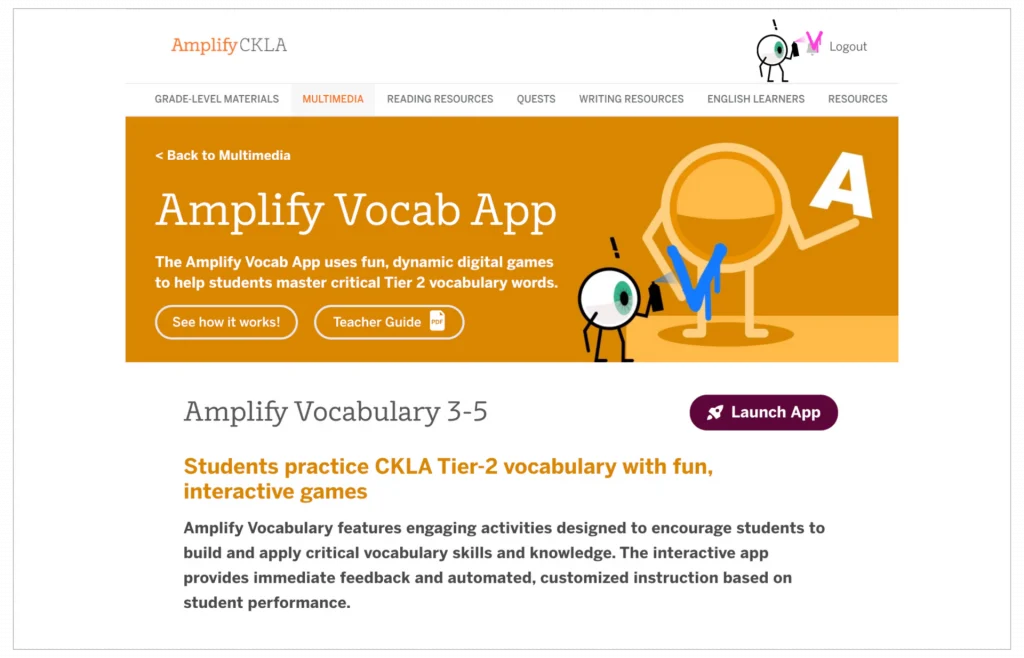
    Formas de apoyar a su estudiante

    Home Connect


    El sitio mCLASS Home Connect® contiene recursos para practicar la lectura destinados a padres de familia y cuidadores, incluyendo lecciones para aprender en casa, organizadas por habilidad con el fin de apoyar a los estudiantes. Nuestras cartas mCLASS para cuidadores, en inglés y español, brindan sugerencias de cómo las familias pueden apoyar a sus estudiantes de la mejor manera.

    Screenshot of the mclass Home Connect© website homepage featuring four educational resources: phonological awareness, phonics, accurate and fluent reading, and reading comprehension.

    Revise la seguridad digital

    Le recomendamos que lea el artículo Proteja a los niños en internet de la Comisión Federal de Comercio, cuyo tema es la seguridad digital.

    Cómo obtener ayuda.

    ¿Tiene alguna pregunta sobre mCLASS DIBELS 8th Edition?

    Lea nuestra guía para cuidadores o visite nuestro centro de ayuda (en inglés) y busque respuestas a sus preguntas sobre el programa en nuestros artículos de ayuda.

    Para obtener apoyo curricular adicional, comuníquese con su maestro.

    What’s included

    Boost Close Reading for 6–8 uses captivating storylines to engage students in powerful personalized reading instruction and practice. Whether students are learning to read fluently or sharpening close reading skills, Boost Close Reading accelerates their growth while freeing educators up to work with small groups or individual students. Explore more of the program here.

    Boost Close Reading is a recipient of Digital Promise’s Research-Based Design and Learner Variability certifications.

    Program at a glance

    Boost Close Reading is a research-based, standards aligned program that supports students along an adaptive path of increasingly complicated texts and literary concepts. Students find these games embedded in an engaging narrative world that grows as they do, whether they are learning foundational skills or mastering close reading.

    A grid with four columns labeled Imagination, Mystery, Adventure, and Rebellion, showing stages: Foundations, Learning to Read, Reading to Learn, and Reading to Understand Deeply.

    Books at a glance

    At the middle school level, Boost Close Reading sets students in a dystopian future world run by Machines, where people are told what to read and what to think. Students are recruited into the rebellion and trained in the powerful ways authors convey meaning and affect their audience. This interactive graphic novel is divided into three books with each chapter focusing on a different skill or concept.

    Ilustración de personas sentadas usando computadoras portátiles, dispuestas en un patrón repetitivo con líneas de fondo similares a circuitos que las conectan.
    Chapter 1: Arguments and their structure

    Students learn to build arguments using claims, evidence, and reasons.

    Una persona que lleva una sudadera con capucha roja sostiene un libro mientras está parada contra una pared en una ciudad futurista con edificios altos y ventanas iluminadas.
    Chapter 2: Setting and Mood

    Students learn to analyze how descriptions of setting evoke mood for the reader.

    Un grupo personas, vestidas con atuendos futuristas, se encuentran en un entorno urbano moderno mientras usan tabletas. Un cartel al fondo dice "ÓPTIMO.
    Chapter 3: Pathos

    Students learn to evaluate methods of persuasion in pathos arguments.

    Una persona con una chaqueta roja se encuentra frente a un gran robot con brazos mecánicos, rodeado de montones de escombros y piezas de maquinaria, bajo rayos de luz enfocados.
    Chapter 4: Word choice and tone

    Students learn to analyze word choices to determine tone.

    Dibujo de una figura encapuchada trepando a un edificio con drones persiguiéndolos. Un letrero de neón en el edificio dice "OBEDEZCA Y SEA LIBRE". Otra figura encapuchada observa desde un lado. Entorno urbano con edificios altos.
    Chapter 5: Logos

    Students learn to identify, analyze, and create logos arguments.

    Una figura futurista con una capa con capucha, un brazo mecánico brillante y cabello rosa brillante extiende una mano que emite una energía azul. El fondo presenta un paisaje urbano digital con edificios en forma de cuadrícula.
    Chapter 6: Figurative language

    Students learn to analyze and use figurative language.

    Una persona con cabello morado se reclina en una silla futurista dentro de una habitación con poca luz, con más sillas y monitores visibles al fondo.
    Chapter 7: Ethos

    Students learn to identify, analyze, and create ethos arguments.

    Tres personajes animados, al frente y al centro, se paran con confianza frente a edificios altos y futuristas. La figura central viste una sudadera con capucha roja, flanqueada por un individuo sonriente con un bastón y otro con cabello rubio.
    Chapter 8: Review and Synthesis

    Students review what they’ve learned in the past seven lessons and apply their knowledge to create an original protest text.

    Una caricatura de un dinosaurio verde parlante y una criatura reptil azul, ambos con armadura futurista, sobre un fondo de tablas de madera.
    Chapter 1: Narrative Arguments

    Students learn to analyze the use of narrative in arguments.

    Una ilustración de un robot con brazos en forma de garra y varias caras y formas de robot flotante en el fondo, lo que sugiere un entorno digital o virtual.
    Chapter 2: Characterization

    Students learn to identify different types of characterization and make inferences from indirect characterization.

    Dos personajes animados, uno con cabello negro y rosa con armadura oscura, el otro con piel verde azulado y cabello texturizado, están uno frente al otro en una cueva. El personaje con armadura está sentado mientras que el personaje verde azulado está de pie.
    Chapter 3: Description in arguments

    Students learn to identify sensory language and analyze its use in arguments.

    Siluetas de un grupo de nueve personas y un animal caminando por un desierto con montañas al fondo, proyectando largas sombras sobre la arena.
    Chapter 4: Conflict and character change

    Students learn to identify different types of conflict and analyze how characters change in response to conflict.

    Ilustración de animales antropomórficos con extremidades robóticas y armas, liderando una ofensiva en un contexto de fábricas y humo.
    Chapter 5: Causal reasoning

    Students learn to analyze, evaluate, and create causal arguments.

    Un personaje con armadura roja se enfrenta a figuras humanoides que emergen de las olas del agua, empuñando lanzas. Otras figuras con armadura y una pequeña criatura están a su lado, contra un cielo rosa y un fondo rocoso.
    Chapter 6: Themes

    Students learn to use analysis of character change to determine and express the theme of a literary work.

    Una persona con cabello morado se encuentra en un acantilado durante una tormenta, sosteniendo un bastón que emite rayos al cielo.
    Chapter 7: Evaluating arguments and fallacies

    Students learn to evaluate pathos, logos, and ethos arguments by checking for completeness and coherence and identifying common fallacies.

    Un grupo de personas se sienta en aguas poco profundas, frente a un barco de aspecto antiguo cubierto de musgo con una proa en forma de cabeza de dragón, bajo un cielo tormentoso con lluvia a cántaros.
    Chapter 8: Review and synthesis

    Students review what they’ve learned in the past seven chapters and apply their knowledge to putting the finishing touches on an original text.

    Una persona con sombrero y ropa informal se arrastra en una habitación roja con poca luz, iluminada por un solo foco. En primer plano aparecen varios objetos geométricos de gran tamaño.
    Chapter 1: Complex arguments

    Students learn to map out and analyze complex argument structures.

    Una persona sostiene una computadora portátil mientras una criatura grande parecida a un insecto la levanta a través de un paisaje urbano oscuro.
    Chapter 2: Narrative voice

    Students learn to identify the narrative point of view and analyze the purpose and effects of narrative voice.

    Dos personajes animados, un hombre con traje verde y abrigo marrón con bastón, y una mujer con capucha y gafas protectoras, mantienen una tensa conversación en una sala oscura y vacía.
    Chapter 3: Arguments by analogy

    Students learn to analyze and evaluate arguments by analogy.

    Una obra de arte digital que presenta símbolos de codificación verdes y formas geométricas abstractas. La escena incluye personajes que interactúan con un entorno escalonado y un gran emblema estilizado destaca en primer plano.
    Chapter 4: Style

    Students learn to identify the elements of style and analyze how they are used to achieve an author’s purpose.

    Una fila de cascos metálicos yace sobre una cinta transportadora en una instalación industrial iluminada en rojo, con un gran incendio ardiendo al fondo.
    Chapter 5: Dialectic

    Students learn to participate in dialectics by using logos arguments and crafting appropriate counterpoints.

    Un grupo personajes parecidos a superhéroes, incluida una persona con una chaqueta con capucha roja, parecen estar en acción y se dirigen hacia el espectador. El fondo es una estructura circular en forma de túnel.
    Chapter 6: Review and synthesis

    Students review the literary and argumentative tools they’ve learned throughout the three books and apply them to creating an effective rhetorical message.

    Digital components

    The program includes resources that give students chances to apply skills they’ve learned and teachers the ability to track student progress across multiple data points.

    Component

    Format

    Teacher dashboard

    The teacher dashboard requires zero set-up time and uses detailed data to provide insights into student progress. Teachers can drill down into student profiles to see specific areas of focus and where they are struggling.

    Digital

    Component

    Format

    Practice mode

    In addition to the books, speeches, and articles weaved into the narrative arc of the game, students may also access hundreds of texts in practice mode. Here, they can continue to hone their mastery of close reading skills on a wide range of authentic texts.

    digital

    Explore more programs

    Our programs are designed to support and complement one another. Learn more about our related programs.

    A closer look at grades 6–8

    Amplify Science California is based on the latest research on teaching and learning and helps teachers deliver rigorous and riveting lessons through hands-on investigations, literacy-rich activities, and interactive digital tools that empower students to think, read, write, and argue like real scientists.

    In the 6–8 classroom, this looks like students:

    • Collecting evidence from a variety of sources.
    • Making sense of evidence in a variety of ways.
    • Formulating convincing scientific arguments.

    Is your school implementing the domain model? Click here.

    Collage of four images showing children engaged in educational activities such as conducting experiments and crafting in a classroom setting.
    A four-step process diagram with icons: spark a real-world problem, explore sources, explain and elaborate, and evaluate claims, all linking to engage with cohesive storylines.

    Program structure

    Our cyclical lesson design ensures students receive multiple exposures to concepts through a variety of modalities. As they progress through the lessons within a unit, students build and deepen their understanding, increasing their ability to develop and refine complex explanations of the unit’s phenomenon.

    It’s this proven program structure and lesson design that enables Amplify Science California to teach less, but achieve more. Rather than asking teachers to wade through unnecessary content, we designed our 6–8 program to address 100% of the California NGSS in fewer lessons than other programs.

    Scope and sequence

    Every year our grades 6–8 sequence consists of 9 units, with each unit containing 10–19 lessons. Lessons are written to last a minimum of 45-minutes, though teachers can expand or contract the timing to meet their needs.

    Chart displaying educational science topics for grades 6 to 8, categorized by grade level, duration in days, and number of classes. Includes subjects like microbiome, geology, and natural selection.

    Unit types

    Each unit delivers three-dimensional learning experiences and engages students in gathering evidence from a rich collection of sources, while also serving a unique purpose.

    In grades 6–8, there are three types of units:

    • One unit is a launch unit.
    • Three units are core units.
    • Two units are engineering internships.
    Launch units

    Launch units are the first units taught in each year of Amplify Science California. The goal of the Launch unit is to introduce students to norms, routines, and practices that will be built on throughout the year, including argumentation, active reading, and using the program’s technology. For example, rather than taking the time to explain the process of active reading in every unit in a given year, it is explained thoroughly in the Launch unit, thereby preparing students to read actively in all subsequent units.

    Core units

    Core units establish the context of the unit by introducing students to a real-world problem. As students move through lessons in a Core unit, they figure out the unit’s anchoring phenomenon, gain an understanding of the unit’s disciplinary core ideas and science and engineering practices, and make linkages across topics through the crosscutting concepts. Each Core unit culminates with a Science Seminar and final writing activity.

    Engineering Internship units

    Engineering Internship units invite students to design solutions for real-world problems as interns for a fictional company called Futura. Students figure out how to help those in need, from tsunami victims in Sri Lanka to premature babies, through the application of engineering practices. In the process, they apply and deepen their learning from Core units.

    Units at a glance

    Abstract art with vibrant colors featuring a yellow silhouette of a person holding a book against a background of geometric shapes, swirling patterns, and bold textures.
    Microbiome

    Domain: Life Science

    Unit type: Launch

    Student role: Microbiological researchers

    Phenomenon: The presence of 100 trillion microorganisms living on and in the human body may keep the body healthy.  

    Abstract artwork of a person's side profile with geometric shapes and colorful patterns flowing from the head, holding a small sledgehammer. A vision chart is visible in the corner.
    Metabolism

    Domain: Life Science

    Unit type: Core

    Student role: Medical researchers

    Phenomenon: Elisa, a young patient, feels tired all the time.  

    Download unit guide

    Orange abstract background with hexagonal shapes featuring icons of a bar chart, plant, safety vest, test tube, peach, and stethoscope.
    Metabolism Engineering Internship

    Domains: Life Science, Engineering Design

    Unit type: Engineering internship

    Student role: Food engineers

    Phenomenon: Designing health bars with different molecular compositions can effectively meet the metabolic needs of patients or rescue workers.  

    Imagen que muestra un gráfico de arañas de diferentes colores con patrones distintos de patas y cuerpo, incluidas variaciones de color marrón, amarillo y azul. El fondo es una superficie oscura y texturizada.
    Traits and Reproduction

    Domain: Life Science

    Unit type: Core

    Student role: Biomedical students

    Phenomenon: Darwin’s bark spider offspring have different silk flexibility traits, even though they have the same parents.  

    Download unit guide

    Illustration of a person in a red hat and fur-lined coat with eyes closed, surrounded by large orange circles on a dark background.
    Thermal Energy

    Domain: Physical Science

    Unit type: Core

    Student role: Thermal scientists

    Phenomenon: One of two proposed heating systems for Riverdale School will best heat the school. 

    Download unit guide

    Abstract artwork depicting a bright sun with blue and orange swirling patterns next to green hills under a sky with shades of blue, orange, and red.
    Ocean, Atmosphere, and Climate

    Domains: Earth and Space Science, Physical Science

    Unit type: Core

    Student role: Climatologists

    Phenomenon: During El Niño years, the air temperature in Christchurch, New Zealand is cooler than usual.  

    An illustration from the Weather Patterns unit
    Weather Patterns

    Domains: Earth and Space Science, Physical Science

    Unit type: Core

    Student role: Forensic meteorologists

    Phenomenon: In recent years, rainstorms in Galetown have been unusually severe.  

    Download unit guide

    An illustration from the Earth's Changing Climate unit
    Earth’s Changing Climate

    Domains: Earth and Space Science, Life Science

    Unit type: Core

    Student role: Climatologists

    Phenomenon: The ice on Earth’s surface is melting.  

    Download unit guide

    Abstract geometric design in shades of blue and purple featuring a hexagon with icons of a building, wrench, molecules, sun, paint can, and screwdriver.
    Earth’s Changing Climate Engineering Internship

    Domains: Earth and Space Science, Engineering Design

    Unit type: Engineering internship

    Student role: Civil engineers

    Phenomenon: Designing rooftops with different modifications can reduce a city’s impact on climate change.  

    A barren, rocky desert landscape with rover tracks leading to a distant vehicle on a hill under a hazy sky.
    Geology on Mars

    Domain: Earth and Space Science

    Unit type: Launch

    Student role: Planetary geologists

    Phenomenon: Analyzing data about landforms on Mars can provide evidence that Mars may have once been habitable. 

    Two prehistoric reptiles with long snouts and tails are near the shore, one on land and one in water, with plants, rocks, and an island in the background.
    Plate Motion

    Domain: Earth and Space Science

    Unit type: Core

    Student role: Geologists

    Phenomenon: Mesosaurus fossils have been found on continents separated by thousands of kilometers of ocean, even though the Mesosaurus species once lived all together.  

    Download unit guide

    Geometric design featuring a telescope, mountain, sound waves, and cosmic elements on a purple hexagonal background.
    Plate Motion Engineering Internship

    Domains: Earth and Space Science, Engineering Design

    Unit type: Engineering internship

    Student role: Mechanical engineering interns

    Phenomenon: Patterns in earthquake data can be used to design an effective tsunami warning system.  

    Illustration of a cross-section of Earth showing a volcano near the ocean. Trees, mountains, and clouds are visible above, with subterranean layers below.
    Rock Transformations

    Domain: Earth and Space Science

    Unit type: Core

    Student role: Geologists

    Phenomenon: Rock samples from the Great Plains and from the Rocky Mountains — regions hundreds of miles apart — look very different, but have surprisingly similar mineral compositions.  

    Download unit guide

    Ilustración que muestra las etapas de fusión de una paleta de naranja: entera, parcialmente derretida, más derretida y casi derretida por completo, con palitos de madera, sobre un fondo morado.
    Phase Change

    Domains: Physical Science, Earth and Space Science

    Unit type: Core

    Student role: Chemists

    Phenomenon: A methane lake on Titan no longer appears in images taken by a space probe two years apart

    Download unit guide

    Green geometric background with a hexagonal emblem containing a parachute icon, ruler, bandage, and stacked layers on a gradient pattern.
    Force and Motion Engineering Internship

    Domains: Engineering Design, Physical Science

    Unit type: Engineering internship

    Student role: Mechanical engineering interns

    Phenomenon: Designing emergency supply delivery pods with different structures can maintain the integrity of the supply pods and their contents.  

    An illustration from the Chemical Reactions unit
    Chemical Reactions

    Domains: Physical Science, Life Science, Earth and Space Science

    Unit type: Core

    Student role: Forensic chemists

    Phenomenon: A mysterious brown substance has been detected in the tap water of Westfield.  

    Download unit guide

    An illustration of a whale with jellyfish and turtles from Amplify Science
    Populations and Resources

    Domains: Life Science, Earth and Space Science

    Unit type: Core

    Student role: Biologists

    Phenomenon: The size of the moon jelly population in Glacier Sea has increased. 

    Download unit guide

    Low-poly landscape with trees and mushrooms. A fox sniffs the ground, a rabbit sits nearby, and mountains and sun are in the background.
    Matter and Energy in Ecosystems

    Domains: Life Science, Earth and Space Science, Physical Science

    Unit type: Core

    Student role: Ecologists

    Phenomenon: The biodome ecosystem has collapsed.  

    Download unit guide

    Two people climbing rocky terrain; illustrations show a hiking boot and a belt with gear.
    Harnessing Human Energy

    Domains: Physical Science, Earth and Space Science, Engineering Design

    Unit type: Launch

    Student role: Energy scientists

    Phenomenon: Rescue workers can use their own human kinetic energy to power the electrical devices they use during rescue missions.  

    Illustration of a futuristic space station with large solar panels, orbiting in deep space, emitting a blue glow from its propulsion system.
    Force and Motion

    Domain: Physical Science

    Unit type: Core

    Student role: Physicists

    Phenomenon: The asteroid sample-collecting pod failed to dock at the space station as planned.

    Download unit guide

    Green geometric graphic featuring icons: a baby, thermometer, layers, medical alert, and a flame.
    Phase Change Engineering Internship

    Domains: Engineering Design, Physical Science

    Unit type: Engineering internship

    Student role: Chemical engineering interns

    Phenomenon: Designing portable baby incubators with different combinations of phase change materials can keep babies at a healthy temperature.  

    Illustration of a roller coaster filled with people, hands raised, going down a steep track against a bright blue sky with clouds.
    Magnetic Fields

    Domain: Physical Science

    Unit type: Core

    Student role: Physicists

    Phenomenon: During a test launch, a spacecraft traveled much faster than expected.  

    An illustration from the Light Waves unit
    Light Waves

    Domains: Physical Science, Life Science, Earth and Space Science

    Unit type: Core

    Student role: Spectroscopists

    Phenomenon: The rate of skin cancer is higher in Australia than in other parts of the world.

    Download unit guide

    A city skyline at night with a prominent full moon, stars in the sky, and a bridge silhouette on the left.
    Earth, Moon, and Sun

    Domains: Earth and Space Science, Physical Science

    Unit type: Core

    Student role: Astronomers

    Phenomenon: An astrophotographer can only take pictures of specific features on the Moon at certain times.  

    Download unit guide

    Four low-poly dinosaurs with missing body sections are standing in a row; one is yellow, and the others are green. They have purple spikes and red patches on their bodies.
    Natural Selection

    Domains: Life Science, Earth and Space Science

    Unit type: Core

    Student role: Biologists

    Phenomenon: The newt population in Oregon State Park has become more poisonous over time.  

    Download unit guide

    Red geometric background with icons including a mosquito, DNA strand, bar chart, and world map inside a hexagon.
    Natural Selection Engineering Internship

    Domains: Engineering Design, Life Science

    Unit type: Engineering internship

    Student role: Clinical engineers

    Phenomenon: Designing malaria treatment plans that use different combinations of drugs can reduce drug resistance development while helping malaria patients.  

    Two giant tortoises with long necks stand near water; one tortoise feeds on leaves from a tree while the other is near dense vegetation.
    Evolutionary History

    Domains: Life Science, Earth and Space Science

    Unit type: Core

    Student role: Paleontologists

    Phenomenon: A mystery fossil at the Natural History Museum has similarities with both wolves and whales.    

    Download unit guide

    Celebrating Keppel Union: A Science of Reading Star Award winner

    Celebrating Keppel Union: A Science of Reading Star Award winner

    To view this protected page, enter the password below:


    Welcome, Jordan K-8 reviewers!

    To view this protected page, enter the password below:


    Amplify literacy curriculum sample boxes – TX

    To view this protected page, enter the password below:


    A closer look at grades 6–8 (domain)

    Amplify Science California is based on the latest research on teaching and learning and helps teachers deliver rigorous and riveting lessons through hands-on investigations, literacy-rich activities, and interactive digital tools that empower students to think, read, write, and argue like real scientists.

    In the 6–8 classroom, this looks like students:

    • Collecting evidence from a variety of sources.
    • Making sense of evidence in a variety of ways.
    • Formulating convincing scientific arguments.

    Is your school implementing the integrated model? Click here.

    Collage of four images showing children engaged in educational activities such as conducting experiments and crafting in a classroom setting.
    Graphic showing a research process with four steps: spark intrigue with a real-world problem, explore evidence, explain and elaborate, and evaluate claims, connected in a cycle with arrows.

    Program structure

    Our cyclical lesson design ensures students receive multiple exposures to concepts through a variety of modalities. As they progress through the lessons within a unit, students build and deepen their understanding, increasing their ability to develop and refine complex explanations of the unit’s phenomenon.

    It’s this proven program structure and lesson design that enables Amplify Science California to teach less, but achieve more. Rather than asking teachers to wade through unnecessary content, we designed our 6–8 program to address 100% of the California NGSS in fewer lessons than other programs.

    Scope and sequence

    Every year of our grades 6–8 sequence consists of 9 units, with each unit containing 10–19 lessons. Lessons are written to last a minimum of 45 minutes, though teachers can expand or contract the timing to meet their needs.

    A grid of educational icons, each representing a different science topic, such as earth and space science, life science, and physical science, with titles and lesson counts.

    Unit types

    Each unit delivers three-dimensional learning experiences and engages students in gathering evidence from a rich collection of sources, while also serving a unique purpose.

    In grades 6–8, there are three types of units:

    • One unit is a launch unit.
    • Three units are core units.
    • Two units are engineering internships.
    Launch units

    Launch units are the first units taught in each year of Amplify Science California. The goal of the Launch unit is to introduce students to norms, routines, and practices that will be built on throughout the year, including argumentation, active reading, and using the program’s technology. For example, rather than taking the time to explain the process of active reading in every unit in a given year, it is explained thoroughly in the Launch unit, thereby preparing students to actively read in all subsequent units.

    Core units

    Core units establish the context of the unit by introducing students to a real-world problem. As students move through lessons in a Core unit, they figure out the unit’s anchoring phenomenon, gain an understanding of the unit’s disciplinary core ideas and science and engineering practices, and make linkages across topics through the crosscutting concepts. Each Core unit culminates with a Science Seminar and final writing activity.

    Engineering Internship units

    Engineering Internship units invite students to design solutions for real-world problems as interns for a fictional company called Futura. Students figure out how to help those in need, from tsunami victims in Sri Lanka to premature babies, through the application of engineering practices. In the process, they apply and deepen their learning from Core units.

    Units at a glance

    A barren, rocky desert landscape with rover tracks leading to a distant vehicle on a hill under a hazy sky.
    Geology on Mars

    Domain: Earth and Space Science

    Unit type: Launch

    Student role: Planetary geologists

    Phenomenon: Analyzing data about landforms on Mars can provide evidence that Mars may have once been habitable.    

    Two prehistoric reptiles with long snouts and tails are near the shore, one on land and one in water, with plants, rocks, and an island in the background.
    Plate Motion

    Domain: Earth and Space Science

    Unit type: Core

    Student role: Geologists

    Phenomenon: Mesosaurus fossils have been found on continents separated by thousands of kilometers of ocean, even though the Mesosaurus species once lived all together.    

    Download unit guide

    Geometric design featuring a telescope, mountain, sound waves, and cosmic elements on a purple hexagonal background.
    Plate Motion Engineering Internship

    Domain: Earth and Space Science

    Unit type: Engineering internship

    Student role: Mechanical engineering interns

    Phenomenon: Patterns in earthquake data can be used to design an effective tsunami warning system.    

    Illustration of a cross-section of Earth showing a volcano near the ocean. Trees, mountains, and clouds are visible above, with subterranean layers below.
    Rock Transformations

    Domain: Earth and Space Science

    Unit type: Core

    Student role: Geologists

    Phenomenon: Rock samples from the Great Plains and from the Rocky Mountains — regions hundreds of miles apart — look very different, but have surprisingly similar mineral compositions.    

    Download unit guide

    A city skyline at night with a prominent full moon, stars in the sky, and a bridge silhouette on the left.
    Earth, Sun, and Moon

    Domain: Earth and Space Science

    Unit type: Core

    Student role: Astronomers

    Phenomenon: An astrophotographer can only take pictures of specific features on the Moon at certain times.    

    Download unit guide

    Abstract artwork depicting a bright sun with blue and orange swirling patterns next to green hills under a sky with shades of blue, orange, and red.
    Ocean, Atmosphere, and Climate

    Domain: Earth and Space Science

    Unit type: Core

    Student role: Climatologists

    Phenomenon: During El Niño years, the air temperature in Christchurch, New Zealand is cooler than usual.    

    Ilustración de un pueblo con casas, campos y montañas bajo un cielo nublado con olas de viento o lluvia.
    Weather Patterns

    Domain: Earth and Space Science

    Unit type: Core

    Student role: Forensic meteorologists

    Phenomenon: In recent years, rainstorms in Galetown have been unusually severe.    

    Download unit guide

    Un oso polar se encuentra sobre un pequeño témpano de hielo en el océano con un sol naranja en el cielo y lejanas montañas heladas al fondo.
    Earth’s Changing Climate

    Domain: Earth and Space Science

    Unit type: Core

    Student role: Climatologists

    Phenomenon: The ice on Earth’s surface is melting.    

    Download unit guide

    Abstract geometric design in shades of blue and purple featuring a hexagon with icons of a building, wrench, molecules, sun, paint can, and screwdriver.
    Earth’s Changing Climate Engineering Internship

    Domain: Earth and Space Science

    Unit type: Engineering internship

    Student role: Civil engineers

    Phenomenon: Designing rooftops with different modifications can reduce a city’s impact on climate change.    

    Abstract art with vibrant colors featuring a yellow silhouette of a person holding a book against a background of geometric shapes, swirling patterns, and bold textures.
    Microbiome

    Domain: Life Science

    Unit type: Launch

    Student role: Microbiological researchers

    Phenomenon: The presence of 100 trillion microorganisms living on and in the human body may keep the body healthy.    

    Abstract artwork of a person's side profile with geometric shapes and colorful patterns flowing from the head, holding a small sledgehammer. A vision chart is visible in the corner.
    Metabolism

    Domain: Life Science

    Unit type: Core

    Student role: Medical researchers

    Phenomenon: Elisa, a young patient, feels tired all the time.    

    Download unit guide

    Orange abstract background with hexagonal shapes featuring icons of a bar chart, plant, safety vest, test tube, peach, and stethoscope.
    Metabolism Engineering Internship

    Domain: Life Science

    Unit type: Engineering internship

    Student role: Food engineers

    Phenomenon: Designing health bars with different molecular compositions can effectively meet the metabolic needs of patients or rescue workers.    

    Imagen que muestra un gráfico de arañas de diferentes colores con patrones distintos de patas y cuerpo, incluidas variaciones de color marrón, amarillo y azul. El fondo es una superficie oscura y texturizada.
    Traits and Reproduction

    Domain: Life Science

    Unit type: Core

    Student role: Biomedical students

    Phenomenon: Darwin’s bark spider offspring have different silk flexibility traits, even though they have the same parents.    

    Download unit guide

    An illustration of a whale with jellyfish and turtles from Amplify Science
    Populations and Resources

    Domain: Life Science

    Unit type: Core

    Student role: Biologists

    Phenomenon: The size of the moon jelly population in Glacier Sea has increased.    

    Download unit guide

    Low-poly landscape with trees and mushrooms. A fox sniffs the ground, a rabbit sits nearby, and mountains and sun are in the background.
    Matter and Energy in Ecosystems

    Domain: Life Science

    Unit type: Core

    Student role: Ecologists

    Phenomenon: What caused the mysterious crash of a biodome ecosystem?    

    Download unit guide

    Four low-poly dinosaurs with missing body sections are standing in a row; one is yellow, and the others are green. They have purple spikes and red patches on their bodies.
    Natural Selection

    Domain: Life Science

    Unit type: Core

    Student role: Biologists

    Phenomenon: The newt population in Oregon State Park has become more poisonous over time.    

    Download unit guide

    Red geometric background with icons including a mosquito, DNA strand, bar chart, and world map inside a hexagon.
    Natural Selection Engineering Internship

    Domain: Life Science

    Unit type: Engineering internship

    Student role: Clinical engineers

    Phenomenon: Designing malaria treatment plans that use different combinations of drugs can reduce drug resistance development while helping malaria patients.  

    Two giant tortoises with long necks stand near water; one tortoise feeds on leaves from a tree while the other is near dense vegetation.
    Evolutionary History

    Domain: Life Science

    Unit type: Core

    Student role: Paleontologists

    Phenomenon: A mystery fossil at the Natural History Museum has similarities with both wolves and whales.    

    Download unit guide

    Two people climbing rocky terrain; illustrations show a hiking boot and a belt with gear.
    Harnessing Human Energy

    Domain: Physical Science

    Unit type: Launch

    Student role: Energy scientists

    Phenomenon: Rescue workers can use their own human kinetic energy to power the electrical devices they use during rescue missions.    

    Illustration of a futuristic space station with large solar panels, orbiting in deep space, emitting a blue glow from its propulsion system.
    Force and Motion

    Domain: Physical Science

    Unit type: Core

    Student role: Physicists

    Phenomenon: The asteroid sample-collecting pod failed to dock at the space station as planned.    

    Download unit guide

    Green geometric background with a hexagonal emblem containing a parachute icon, ruler, bandage, and stacked layers on a gradient pattern.
    Force and Motion Engineering Internship

    Domain: Physical Science

    Unit type: Engineering internship

    Student role: Mechanical engineering interns

    Phenomenon: Designing emergency supply delivery pods with different structures can maintain the integrity of the supply pods and their contents. 

    Illustration of a roller coaster filled with people, hands raised, going down a steep track against a bright blue sky with clouds.
    Magnetic Fields

    Domain: Physical Science

    Unit type: Core

    Student role: Physicists

    Phenomenon: During a test launch, a spacecraft traveled much faster than expected.    

    Illustration of a person in a red hat and fur-lined coat with eyes closed, surrounded by large orange circles on a dark background.
    Thermal Energy

    Domain: Physical Science

    Unit type: Core

    Student role: Thermal scientists

    Phenomenon: One of two proposed heating systems for Riverdale School will best heat the school.    

    Download unit guide

    Ilustración que muestra las etapas de fusión de una paleta de naranja: entera, parcialmente derretida, más derretida y casi derretida por completo, con palitos de madera, sobre un fondo morado.
    Phase Change

    Domain: Physical Science

    Unit type: Core

    Student role: Chemists

    Phenomenon: A methane lake on Titan no longer appears in images taken by a space probe two years apart.    

    Download unit guide

    Green geometric graphic featuring icons: a baby, thermometer, layers, medical alert, and a flame.
    Phase Change Engineering Internship

    Domain: Physical Science

    Unit type: Engineering internship

    Student role: Chemical engineering interns

    Phenomenon: Designing portable baby incubators with different combinations of phase change materials can keep babies at a healthy temperature.    

    Obra de arte digital abstracta que presenta numerosos círculos rojos y grises superpuestos sobre un fondo dividido de azul y violeta claro, creando una composición dinámica y enérgica.
    Chemical Reactions

    Domain: Physical Science

    Unit type: Core

    Student role: Forensic chemists

    Phenomenon: A mysterious brown substance has been detected in the tap water of Westfield.    

    Download unit guide

    An illustration from the Light Waves unit
    Light Waves

    Domain: Physical Science

    Unit type: Core

    Student role: Spectroscopists

    Phenomenon: The rate of skin cancer is higher in Australia than in other parts of the world.    

    Download unit guide

    Amplify literacy curriculum sample boxes

    To view this protected page, enter the password below:


    Welcome, Amplify Desmos Math California families!

    Welcome to the Amplify Desmos Math California Caregiver Hub. We’ve designed this space to help you support your student along their math journey. We hope your student enjoys exploring math, working with friends to solve problems, and learning new and interesting concepts. And we hope you enjoy the math journey with them.

    Para la versión en español, haga clic aquí.

    Two children place large math cards with the numbers 5, 8, and the variable y on a balance scale, surrounded by math symbols, a triangle, and balloons.

    Introducing Amplify Desmos Math California

    Amplify Desmos Math California is a core math curriculum for kindergarten through grade 12. We believe that a structured approach to problem-based learning builds on students’ curiosity to develop lasting grade-level understanding.

    The Amplify Desmos Math California curriculum uses student-centered instruction. In every lesson, students solve engaging and relevant problems, think critically, work collaboratively, and actively participate in their own learning.

    Explore grade-level resources:

    Student-centered instruction

    Student-centered instruction may look different from the way you learned math. It aims to create a learning environment where students feel empowered and engaged in their own learning journey, providing them opportunities to figure out how math works instead of simply memorizing formulas and tricks. They learn to communicate both verbally and in writing, come to understand and challenge the opinions of others, and build confidence. This approach enables students to remember what they learn and apply their knowledge to new situations. 

    Here are some other benefits to student-centered instruction:

    • Research shows that students and teachers prefer this method
    • Students perform better on standardized tests and have more growth in their grades.
    • Teachers report that student-centered instruction helps their students learn more math.
    • Students develop key skills for success in college, the workplace, and beyond, such as using technology, completing projects independently and with others, and persevering through challenges.
    Ilustración digital de un problema matemático que involucra un pez en una pecera sobre una mesa junto a una ventana con un árbol y un reloj. El problema pide explicar las variables en la ecuación "30 = α * 1,5".

    Components of a lesson

    A typical Amplify Desmos Math California lesson includes:

    • Warm-Up: An open-ended question or interaction to draw students into the lesson.
    • Activities: One to three activities that make up the heart of each lesson.
    • You’re Invited to Explore More: Problems that invite students to explore a concept—often beyond the scope of the lesson—more deeply. These problems are intentionally available to all learners.
    • Synthesis: An opportunity for students to put the key ideas from the lesson into their own words.
    • Show What You Know and Reflection: A check for understanding focused on key concepts from the lesson.
    • Centers (grades K–5 only): Student-led activity stations that reinforce the math learned during lesson activities through interactive and often game-like formats. In kindergarten and grade 1, time for Centers is built into the last 15 minutes of every lesson.
    • Practice: Additional problems your student’s teacher may assign, including practice about the current lesson and review from previous lessons and units.

    Get more information.

    Have a question about Amplify Desmos Math California? Visit our help library to search for articles with answers to your program questions. For additional support, please contact your student’s teacher.

    Your Beyond My Years 2024 recap!

    In August of last year, our teaching podcast Beyond My Years took its first steps—and in no time we were exploring a lot of new territory on our journey to soak up teacher advice and wisdom from seasoned educators across the globe. Their experiences became our experiences. So let’s recap some of the top moments of 2024.

    In 2024 on Beyond My Years we:

    Traveled 3,469 miles to Stasia, Alaska.

    We ventured all the way to the northernmost part of Alaska alongside Patti and Rod Lloyd to teach in a rural indigenous community. Joining such a rich and unique culture as outsiders taught Patti and Rod the importance of learning from their students.

    “Even though they’re coming to me at five and six years old, they are coming with a lot of rich knowledge that I don’t have. And if I remain open and work with them, I’ve got a lot to learn.” —Rod Lloyd

    Went back to school at the age of 80.

    When the United Kingdom put out a call in 2020 for retired educators to return to aid a national shortage, Eric Jones knew he still had more left to teach, even at the age of 80! He knows that to stay in the education field as long as he has you need to celebrate and honor all areas of what a teacher does. When you honor every piece of the work you can do, you can make sure every moment stays aligned with your goals and serves your students.

    “I like teaching kids things they didn’t know before and now they’re excited about. I love the idea that they will then move on into realms of industry and economic success that I would never dream of.” —Eric Jones

    Shared our first Amplify podcast episode entirely in Spanish.

    We even had our first bonus episode entirely in Spanish with Luz Selenia Muñoz. She taught us that some things transcend language—like the importance of knowing the “why” behind student behavior. According to Luz, whether your classroom is monolingual or multilingual, it is important to make connections with your students. You will see what they need and know what their triggers are. Behavior improves when you understand what your kids are going through.

    “Yo creo que le diría que tenga paciencia. Paciencia. Que respire. Que las cosas van a mejorar cada día.” —Luz Selenia Muñoz

    “I think I would tell them to be patient. Be patient. Breathe. Things will change for the better with every passing day.” —Luz Selenia Muñoz

    Took time for ourselves.

    Kamphet Pease called out the overachiever in all of us educators. An important piece of teacher advocacy: We all took a hard look at our school to-do lists together and recognized that we have to do better at prioritization—including prioritizing self-care.

    “Make sure you take care of yourself as well. Take the time to go for a walk, take the time to take a bubble bath, cook for yourself, whatever you find enjoyment in.” —Kamphet Pease

    Want even more of the best of the best from season one of Beyond My Years, which is brought to you by the team that produces Science of Reading: The PodcastDownload our key takeaways, a curated collection of invaluable wisdom and practical guidance from our lineup of inspiring educator guests.

    More to explore:

    What’s included in our K–8 literacy assessment and instruction suite

    mCLASS DIBELS 8th Edition® provides every teacher, coach, and administrator with a data-driven system that supports each student’s unique needs—from efficient one-minute skills assessments in English and Spanish to granular diagnostic insights. You’ll have all of the tools you need to ensure your students receive effective instruction and discover their true skills as readers.

    Learn more about mCLASS’s precise measurement, predictive results, and preventive instruction.

    Skills at a glance

    mCLASS includes benchmark, progress monitoring and dyslexia screening measures in English and Spanish that are predictive of long-term reading success and detect the critical early warning signs of dyslexia risk. Together, mCLASS DIBELS 8th Edition and mCLASS Lectura identify whether a student is at risk due to a stronger proficiency in one language or difficulties associated with dyslexia.

    Equal skill coverage in English and Spanish

    *Fluidez en nombrar letras (FNL) in Spanish and Letter Naming Fluency (LNF) in English are validated as phonological processing measures (also known as RAN), thus making RAN available in both languages.

    Additional dyslexia screening measures

    Educator and caregiver reports

    The rich data you collect through direct observation is instantly available from a variety of reports that simplify student growth analysis and instructional planning. All stakeholders, from teachers and administrators to parents and guardians, will gain a deep understanding of student performance and know how to provide extra practice. See the complete mCLASS Reporting Guide.

    Class and student reports

    Detailed class and student reports help you quickly pinpoint which students need more support. You’ll be able to see every student’s skill progression from the beginning of their literacy journey to later grades and know exactly when a change in instruction is needed. Measure transcripts from every benchmark and progress monitoring probe also provide you with insight into student responses during assessment.

    Goal setting

    mCLASS includes tools for setting goals and evaluating growth outcomes to ensure the instruction you are providing each individual student is meeting their needs and accelerating their growth. The program uses each student’s initial performance to assign goals, which you can further customize as their learning progresses.

    Administrator reports

    The mCLASS reporting and analysis suite makes it possible to analyze performance trends across a variety of demographic categories at the class, school, district, and state level. Principals, administrators, and district leaders are empowered to evaluate the success of instructional strategies, allocate training resources, or decide where to deploy additional staff.

    Caregiver reports

    The Home Connect letter allows educators to share information about a child’s reading development with parents and guardians in simple charts and family-friendly language. The letters provided include instructional resources in print and online for families to help practice skills at home.

    Data-driven instruction

    mCLASS helps you make sense of data by instantly providing targeted instructional recommendations and teacher resources based on students’ assessment results. mCLASS data also informs instruction within Amplify’s suite of intervention, personalized learning, and core programs grounded in the Science of Reading.

    Automatic small-group and one-on-one instruction

    The mCLASS Instruction feature included with DIBELS 8th Edition and mCLASS Lectura automatically generates skill profiles and recommends teacher-led activities for small groups and individual students. Recommendations can be updated based on the latest benchmark and progress monitoring results.

    Tier 2 and 3 instruction with mCLASS Intervention

    mCLASS data not only helps you identify which students are in need of intensive support, but also places them into Amplify’s Tier 2 and 3 instruction program, mCLASS Intervention. mCLASS Intervention builds a skill profile for each student, forms engaging lesson plans, and updates the instructional recommendations every ten days based on the latest benchmark and progress monitoring results.

    Core instruction with Amplify CKLA

    By combining the results from mCLASS assessments with Amplify CKLA, you can provide targeted whole-class instruction specific to your students’ risk levels and areas of growth. The small-group instruction recommendations in mCLASS provide activities that reinforce what students have learned during Amplify CKLA core instruction.

    Personalized practice with Boost Reading

    mCLASS data seamlessly integrates with Boost Reading to personalize student practice in targeted skill areas. With more than 50 immersive mini-games that build skills in phonics, phonological awareness, vocabulary, and comprehension, Boost Reading provides students with independent practice time they’ll love, while freeing teachers up to provide small-group instruction.

    Explore more programs based on the Science of Reading

    The programs in our literacy suite are designed to support and complement each other. Learn more about our related programs.

    mCLASS Intervention

    Boost Reading

    Amplify CKLA

    Inspiring the next generation of scientists, engineers, and curious citizens

    Amplify Science is a breakthrough curriculum designed to address the NYS Science Learning Standards. Authored by the industry-leading team at the Lawrence Hall of Science, Amplify Science is a highly-engaging, phenomena-based curriculum for grades K-8 that integrates the latest research and practices in science education, as well as interactive digital tools and hands-on activities, to teach students to think, read, write, and argue like real scientists and engineers.

    • Dos niños están sentados en una mesa redonda en un salón de clases, mirando juntos la pantalla de una computadora portátil. Ambos parecen comprometidos y están sonriendo.
    • Dos niñas en un salón de clases realizan un experimento científico con agua y una pajita, una sostiene una taza y la otra observa. Las hojas de trabajo y los materiales están sobre la mesa.
    • Ocean, Atmosphere, and Climate digital simulation

    Explore Amplify Science

    Explore Amplify Science

    Amplify Science for elementary school

    Our complete program for Grades K-5 recognizes the importance of students’ engagement with hands-on experiences, and amplifies those with literacy-rich activities, closely aligned digital materials and award-winning, informational books.

    Amplify Science for middle school

    Our complete program for grades 6-8 is a new curriculum that integrates the latest strategies in science teaching and learning with phenomena-driven storylines, hands-on investigations, and interactive digital tools to inspire the next generation of scientists and engineers.

    Transitioning to the NGSS and 3-Dimensional Learning

    Join us for the “Transitioning to the NGSS and 3-Dimensional Learning” workshop!

    While at the event:

    • Build your knowledge around the NGSS and 3-Dimensional learning
    • See how Amplify Science embodies the instructional shifts
    • Enjoy lunch with colleagues and Amplify Science partners
    • Get preview access to Amplify Science K–8 for your school

    Thursday, October 18, 2018
    Sheraton Niagara Falls
    300 3rd St
    Niagara Falls, NY 14303

    See the full agenda and register today!

    Welcome, Achieve reviewers!

    Authored by UC Berkeley’s Lawrence Hall of Science, Amplify Science was designed from the ground up for the Next Generation Science Standards to teach students to think, read, write, and argue like real scientists and engineers. The program combines literacy-rich activities with hands-on learning and digital tools to engage students in exploring a compelling real-world phenomenon in every unit.

    On this site, you will find easy-to-follow instructions and resources to support your review.

    • Un niño que usa gafas de seguridad examina un objeto cerca de su cara mientras sostiene un pequeño trozo de material blanco.
    • Dos niñas en un salón de clases realizan un experimento científico con agua y una pajita, una sostiene una taza y la otra observa. Las hojas de trabajo y los materiales están sobre la mesa.
    • Un oso polar se encuentra sobre un pequeño témpano de hielo en el océano con un sol naranja en el cielo y lejanas montañas heladas al fondo.
    • Mariposa en vuelo sobre plantas en macetas sobre una mesa, con una oruga en un tallo frondoso cerca, una regadera roja a la izquierda y un paisaje brillante al fondo.

    Units for review

    Amplify Science is a blended learning program where students take on the roles of scientists and engineers to solve real-world problems.

    As a reviewer, you’ll have access to three Amplify Science units:

    • Grade 1: Plant and Animal Defenses
    • Grade 3: Weather and Climate
    • Middle School: Light Waves

    Below you will find log in instructions for the digital curriculum.

    Teacher account

    Click the orange button and choose “Log in with Amplify” using the login information below:

    Username: t1.achievereview@tryamplify.net
    Password: AmplifyNumber1

    Click here to view the full program guide.

    If you have logged into Amplify Science in the past, you will need to log in with the new credentials above.

    When you are finished reviewing, sign out of the digital curriculum. Need help?

    Grade K

    • Needs of Plants and Animals
    • Pushes and Pulls
    • Sunlight and Weather

    Grade 1

    • Animal and Plant Defenses
    • Light and Sound
    • Spinning Earth

    Grade 2

    • Plant and Animal Relationships
    • Properties of Materials
    • Changing Landforms

    Grade 3

    • Balancing Forces
    • Inheritance and Traits
    • Environments and Survival
    • Weather and Climate

    Grade 4

    • Energy and Conversions
    • Vision and Light
    • Earth’s Features
    • Waves, Energy, and Information

    Grade 5

    • Patterns of Earth and Sky
    • Modeling Matter
    • The Earth System
    • Ecosystem Restoration

    Earth and Space Science

    • Launch: Geology on Mars
    • Plate Motion
    • Engineering Internship: Plate Motion
    • Rock Transformations
    • Earth, Moon, and Sun
    • Ocean, Atmosphere, and Climate
    • Weather Patterns
    • Earth’s Changing Climate
    • Engineering Internship: Earth’s Changing Climate

    Life Science

    • Launch: Microbiome
    • Metabolism
    • Engineering Internship: Metabolism
    • Traits and Reproduction
    • Populations and Resources
    • Matter and Energy in Ecosystems
    • Natural Selection
    • Engineering Internship: Natural Selection
    • Evolutionary History

    Physical Science

    • Launch: Harnessing Human Energy
    • Force and Motion
    • Engineering Internship: Force and Motion
    • Magnetic Fields
    • Thermal Energy
    • Phase Change
    • Engineering Internship: Phase Change
    • Chemical Reactions
    • Light Waves

    What is Amplify Caminos?

    Amplify Caminos is a core Spanish language arts program for grades TK–5 that delivers:

    • Authentic instruction built from the ground up for the Spanish language.
    • A unique research-based approach truly built on the Science of Reading.
    • A combination of explicit foundational skills with meaningful knowledge-building.
    • Embedded support and differentiation that gets all students reading grade-level texts together.
    • Opportunities for students to see the strengths and experiences that all people share while also celebrating each others’ unique identities and experiences.
    A diagram illustrates two processes, language comprehension and word recognition, integrating into reading comprehension with colorful braided strands and related educational materials.

    How does Amplify Caminos work?

    Daily instruction

    Grades K–2: Dedicated knowledge-building and explicit skills instruction
    Every day, students in Grades K–2 complete one full lesson that builds foundational reading skills in the Amplify Caminos Lectoescritura strand, as well as one full lesson that builds background knowledge in the Amplify Caminos Conocimiento strand. Through learning in each of these strands, students develop the early literacy skills necessary to help them become confident readers and build the context to understand what they’re reading.

    Grades 3–5: Integrated instruction
    In Grades 3–5, the Amplify Caminos Lectoescritura and Conocimiento strands are integrated in one set of instructional materials. Lessons begin to combine skills and knowledge with increasingly complex texts, close reading, and a greater writing emphasis. Students can then use their skills to go on their own independent reading adventures.

    Formative and summative assessments

    A young boy sitting at a desk writes in a notebook with a pencil; another student is seated beside him, also writing.

    Amplify CKLA features a progression of moment-by-moment assessments to benchmark assessments. Assessment and feedback give teachers the information they need to differentiate instruction effectively.

    Checks for Understanding
    Each lesson segment incorporates checks for understanding to increase engagement and to let teachers make real-time adjustments to their instruction.

    Formative Assessment
    Each lesson goal is tied to a formative assessment opportunity, allowing teachers to see which students need more support with a benchmark.

    Mid- and End-of-Unit Assessments
    Mid-Unit and End-of-Unit Assessments provide valuable information on the skills and content students have mastered. Digital end-of-unit assessments are available on a variety of platforms.

    Benchmark and Placement Assessments
    Benchmark and Placement Assessments help teachers set goals and monitor the growth of each student, providing a baseline at the beginning of the year and ensuring students are advancing toward grade-level objectives.

    What makes Amplify Caminos different?

    Built on the Science of Reading

    Built out of the latest research in the Science of Reading, Amplify Caminos delivers explicit instruction in both foundational literacy skills (systematic phonics, decoding, and fluency) and background knowledge in grades K–2 with an integrated approach to explicit instruction in grades 3–5.

    Explicit systematic skills instruction

    The skills instruction in Amplify Caminos was distinctly developed with the Spanish language in mind. Its foundational lessons are specific to the language, rather than a direct translation from Amplify CKLA’s English skills instruction.

    Reading instruction begins with the vowels first, then the most common consonants, and finally the least common consonants. Students will blend and segment sounds to form syllables, and syllables to form words.

    Although Spanish has a highly predictable orthography, there are a few silent letters (h is always silent, u is silent after g or q), as well as letters that can make different sounds, depending on the letters that follow them. For that reason, syllables with these letters are taught somewhat later in the progression. The same is true for syllables with infrequently occurring consonants, such as z, k, x, and w.

    Coherent knowledge instruction

    While students are learning how to read, the Conocimiento strand gives them authentic and engaging reasons to read.

    Amplify Caminos uses spiral learning to reinforce every student’s ability to develop skills like reading, writing, speaking, and listening in Spanish that can be transferred to English. As students engage with their lessons, they explore the similarities and differences in grammar, vocabulary, writing, and language use between Spanish and English. This bridge helps students learning two languages to strengthen their knowledge in both.

    A collage of Spanish-language educational book covers and pages featuring illustrated scenes, including a rabbit, a person observing stars, and children playing outside.

    Through cross-curricular content, students explore units that relate to storytelling, science, and the history of our world in a holistic and thoughtful way. With these units, you’ll bring the world to your students, showing them how reading can become an exciting, rewarding, and useful part of their lives.

    Commitment to equity and diversity

    Amplify Caminos builds students’ knowledge about the world, helping them see people who resemble them and their familiar situations or experiences while also exposing them to people whose appearances, lives, beliefs, and backgrounds differ from their own.

    In addition to teaching all students to crack the written code (which is vital for equity), the Amplify Caminos program helps students celebrate their own unique identities and experiences while also seeing the strengths and experiences we all share.

    Two astronauts in space suits float above planets, a woman sings with musical notes, a hot air balloon with passengers flies, and a person sketches a landscape in a colorful, whimsical scene.

    Amplify Caminos includes both transadaptations and authentic texts written by Latin American and Spanish authors.

    Three Spanish-language children's books are displayed: "La flor de oro," "El conejo en la Luna," and "El secreto de las hormigas," each with illustrated covers.

    Our decodable Student Readers celebrate students’ diverse experiences and feature individuals with a broad range of identity factors, including socio-economic status, age, ability, race, ethnicity, country of origin, and more.

    Five colorful children's books in Spanish are displayed, featuring illustrated covers with diverse characters, a llama, and a giant cactus.

    Our new Knowledge Research units carry forward Amplify Caminos’ powerful and proven instructional approach while also:

    • Adding more diversity. The rich topics and highly visual components featured in these units provide students with even more “windows and mirrors” and perspectives as they work to build knowledge.
    • Adding more authentic literature. Each new research unit revolves around a collection of high-interest authentic trade books that will spark more curiosity and inspire more inquiry.
    • Adding more flexibility. Units can be implemented for extended core instruction during flex periods, district-designated Pausing Points, or enrichment periods.
    Three illustrations: children swimming in a pool, a diverse group of four people standing, and people caring for a tree surrounded by plants and glowing light.

    Embedded differentiation for all learners

    Amplify Caminos provides built-in differentiation strategies and supports in every lesson.

    • Apoyo a la enseñanza y desafío: Support and Challenge suggestions in every lesson provide assistance or opportunities for more advanced work toward the goal of the lesson.
    • Notas culturales: These point-of-use notes provide additional information about the traditions, foods, holidays, word variations, and more from across the Spanish-speaking world.
    • Apoyo adicional: Every lesson in the Lectoescritura (Skills) Strand provides additional support activities suggested to reinforce foundational skills instruction. These activities can be given to any student who requires extra help, including students with special needs.

    Sample materials

    Demo access

    A laptop screen displays the Amplify login page with options to log in using Google, Clever, Amplify, QR code, District SSO, or get help.

    Follow the instructions below to access your demo account.

    • Click the Caminos Demo button below.
    • Select Log in with Amplify.
    • To explore as a teacher, enter this username:

              t1.montgomery2024ela@demo.tryamplify.net

    • To explore as a student, enter this username:

              s1.montgomery2024ela@demo.tryamplify.net

    • Enter the password: Amplify1-montgomery2024ela
    • Click the Programs and apps menu
    • Select CKLA Teacher Resource Site
    • Select the desire grade level
    • Use the toggle to switch between English (CKLA) and Spanish (Caminos) resources.

    Check out these additional resources

    Caminos review resources:

    What is mCLASS?

    mCLASS is a best-in-class assessment platform that houses a suite of proven, gold-standard assessment measures and tools that can be flexibly combined to meet the unique literacy needs of both teachers and students across grades K–6, including:

    • Universal screening
    • Diagnostic assessment
    • Dyslexia screening
    • Progress monitoring
    • Dual language reporting
    • Targeted teacher-led instruction

    What is the Lectura assessment?

    The Lectura assessment is a brand-new interim and diagnostic assessment that consists of measures based on the latest research of how Spanish literacy develops.

    Co-developed with the Center on Teaching and Learning at the University of Oregon (UO CTL) and validated in partnership with Dr. Lillian Durán, the Lectura assessment was created to provide educators with a high-quality, evidence-based tool to support understanding of Spanish-speaking students’ biliteracy development, specifically foundational Spanish reading skills, which includes measures of phonological awareness, alphabetic understanding and decoding, reading fluency, and reading comprehension.

    The measures in Lectura were written from the ground-up to assess students’ literacy development based on how Spanish literacy develops. Measures explicitly account for the syllabic and morphological structures of Spanish, and connected text was written and calibrated with respect to syntactical, lexical, and grammatical rules of Spanish. For example, phonological awareness is measured using syllable segmentation, and letter sounds and syllable reading are included in the decoding subtests for greater face-validity (in lieu of pseudowords). Word choice reflects the multisyllabic word complexity and variety of Spanish, driven by how decoding skills develop in Spanish. As such, Lectura provides instructionally actionable data for all students, including those scoring below the benchmark and those who meet or exceed the benchmark.

    The Lectura assessment measures were purposefully designed, developed, field tested, and evaluated to address limitations that educators of Spanish speaking students have experienced in assessments. Specifically in these ways:

    • Assessment measures based on current research on how Spanish literacy is developed
    • Culturally responsive word choice and content reflecting the regional diversity of Spanish
    • Technical adequacy established through rigorous study
    • A sample size and geographic diversity reflecting the broad population of Spanish speakers across the U.S.
    • Complete parity with English solutions (instructional tools, skill coverage)

    Assessment measures by grade

    Lectura measures at each grade level 
    Measure Grade K Grade 1 Grade 2 Grade 3
    Fluidez en nombrar letras A large, light peach-colored checkmark on a transparent background. A large, light peach-colored checkmark on a transparent background. A large, light peach-colored checkmark on a transparent background.  
    Fluidez en la segmentación de sílabas A large, light peach-colored checkmark on a transparent background. A large, light peach-colored checkmark on a transparent background.    
    ¿Qué queda? A large, light peach-colored checkmark on a transparent background. A large, light peach-colored checkmark on a transparent background. A large, light peach-colored checkmark on a transparent background.  
    Fluidez en los sonidos de letras A large, light peach-colored checkmark on a transparent background. A large, light peach-colored checkmark on a transparent background.    
    Fluidez en los sonidos de sílabas A large, light peach-colored checkmark on a transparent background. A large, light peach-colored checkmark on a transparent background.    
    Fluidez en las palabras A large, light peach-colored checkmark on a transparent background. A large, light peach-colored checkmark on a transparent background. A large, light peach-colored checkmark on a transparent background. A large, light peach-colored checkmark on a transparent background.
    Fluidez en la lectura oral   A large, light peach-colored checkmark on a transparent background. A large, light peach-colored checkmark on a transparent background. A large, light peach-colored checkmark on a transparent background.
    ¿Cuál palabra?   A large, light peach-colored checkmark on a transparent background. A large, light peach-colored checkmark on a transparent background. A large, light peach-colored checkmark on a transparent background.
    Amplify measures at each grade level
    Oral Language Español A large, light peach-colored checkmark on a transparent background. A large, light peach-colored checkmark on a transparent background. A large, light peach-colored checkmark on a transparent background.  
    Vocabulario A large, light peach-colored checkmark on a transparent background. A large, light peach-colored checkmark on a transparent background. A large, light peach-colored checkmark on a transparent background. A large, light peach-colored checkmark on a transparent background.

    Assessment measures sample videos

    Please note that the videos below are intended for illustrative purposes only. Performance levels in mCLASS Lectura have yet to be finalized.

    mCLASS Lectura measure: Fluidez en nombrar letras (FNL)

    Students are asked to identify as many uppercase and lowercase letter names as they can in one minute.

    mCLASS Lectura measure: Fluidez en los sonidos de letras (FSL)

    Students are asked to identify the sounds of as many uppercase and lowercase letters as they can in one minute.
    mCLASS Lectura measure: Fluidez en los sonidos de sílabas (LSS)

    Students are presented with a page of printed orthographically regular Spanish syllables and asked to read as many syllables as they can in one minute.

    mCLASS Lectura measure: Fluidez en la lectura oral (FLO)

    Students are presented with an authentically written informational or narrative passage of Spanish connected text and asked to read as much of the passage as they can in one minute.
    mCLASS Lectura measure: ¿Qué Queda? (QQ)

    Students are presented with a word orally and then the examiner omits part of the word (i.e., compound word part, syllable, or phoneme). Students are asked to identify what word remains after the word part has been elided.

    How is mCLASS Lectura different?

    mCLASS Lectura combines the power of the mCLASS assessment platform and the effectiveness of the Lectura assessment measures. As a result – educators across the state are empowered with latest and greatest assessment tool.

    More than a test, mCLASS Lectura is an integrated system that closes the knowing-doing gap by helping teachers take immediate instructional action that’s right for each and every student. What’s more, it addresses the classroom inequities Spanish-speaking students face along their early literacy journeys.

    Spanish-speaking students have been underserved and misclassified for decades. With mCLASS Lectura, teachers of Spanish-speaking students finally have access to the same robust assessment tools that have been available to teachers of English-speaking students for years.

    Plus! When mCLASS Lectura and DIBELS 8th Edition are used together, teachers are empowered with a more holistic view of their Spanish-speaking students abilities in both English and Spanish, making instructional next steps more targeted and effective.
    How is mCLASS Lectura different?

    1. It gives teachers access to authentic Spanish measures. Amplify is the only provider of the Lectura assessment. Rather than a direct translation of an English assessment, our solution is the only one to provide teachers a research-based, authentic Spanish assessment that is both valid and reliable.
    2. It makes it faster and easier to understand where every student is in their early literacy journey. By combining 1:1 observational diagnostic assessments, dyslexia screening, progress monitoring, instant scoring, rigorous reporting, automatic student grouping, and targeted instruction all in one place, it reduces the instructional delays associated with manual scoring, manual data analysis, and manual lesson planning.
    3. It brings more equity to the classroom. When used in conjunction with mCLASS DIBELS 8th Edition, teachers have access to Dual Language Reports that highlight a students strengths and weaknesses in both English and Spanish.
    4. It makes every instructional minute count. In addition to one-minute measures that quickly gauge student progress toward reading proficiency, it leverages a teacher’s most powerful instructional tool — their own 1:1 observations.
    5. It drives growth more efficiently. Rather than relying on broad composite scores alone, granular data and in-depth insights for every student help teachers pinpoint exact skill gaps and areas of unfinished learning, making whole-group, small-group, and 1:1 instruction more targeted and effective.
    6. It saves teachers time. Instant reports, automatic student groups, and ready-to-teach lessons mean teachers spend less time cobbling together materials and more time working directly with students and responding to their needs.

    Assessment systems must enable and compel educators to answer not just the “What?” questions, but also the “So What?” and “Now What?” questions. These are the questions that are essential in transforming classroom instruction, and the questions that mCLASS Lectura helps teachers answer with confidence.

    How does mCLASS Lectura support screening for dyslexia risk?

    mCLASS Lectura subtests have been specifically designed and validated to screen for dyslexia risks.

    mCLASS Lectura was specifically developed to ensure the measure is able to meet state-level screening requirements for both dyslexia and universal reading screening. The research and development of Lectura was designed with this use in mind to accurately identify reading difficulties, including difficulties related to risk for dyslexia.

    How does mCLASS Lectura turn data into instant action?

    mCLASS Lectura gives you instant results and clear next steps for each student.

    Quick and actionable reports provide detailed insight into students’ reading development across foundational literacy skills for teachers, specialists, administrators, and caregivers.

    Screenshot of an educational software dashboard displaying student progress, with tabs for instruction and home connection in dual language.

    Diagnostic assessment

    mCLASS Lectura analyzes individual student response data through a scoring algorithm which aligns to the Colorado Department of Education’s stated purpose of a diagnostic assessment.

    Our innovative approach to diagnostic assessment leverages an item-level evaluation of individual student responses in order to provide deeper insights into specific student weaknesses and areas of improvement. mCLASS Lectura analyzes individual student response data through a scoring algorithm which aligns to the Colorado Department of Education’s stated purpose of a diagnostic: “… to pinpoint a student’s specific area(s) of weakness and provide in-depth information about students’ skills and instructional needs.”

    Ready-to-teach instruction

    Immediately following the analysis of individual student responses, mCLASS Lectura provides an in-depth diagnostic report complete with suggested next steps, also known as “mCLASS Instruction.”

    mCLASS Instruction evaluates each student’s responses on each individual subtest and instantly:

    • Provides a list of specific needs by student, such as struggling with medial vowel sounds or difficulty reading words with consonant blends.
    • Groups students automatically based on similar discrete skill needs, not simply composite scores like other assessment tools.
    • Recommends a variety of ready-to-teach lessons that specifically target each individual student’s areas of need or common areas of need for small-group instruction.

    Classroom skill and benchmark summary

    The Classroom Skill Summary report is a dashboard showing benchmark performance on each skill. Teachers can use it to determine which skill areas need instructional focus at a classroom level.

    The Classroom Benchmark Summary report is a classroom-wide view of overall reading performance. Teachers can use this report to determine if composite scores improved, declined, or remained the same each semester.

    Detailed benchmark performance

    Teachers can see each student’s performance during the current school year, on each subtest as well as the overall composite. The benchmark goal displays below the subtest name when applicable. The ability to sort the columns in this report gives teachers more flexibility to analyze data the way they prefer.

    Dual language reports

    When mCLASS Lectura and mCLASS with DIBELS 8th Edition are used together, teachers will receive an asset-based picture of a student’s biliteracy and instructional guidance on how to leverage literacy skills in one language to support literacy skill development in the second language.

    • Side-by-side view of foundational literacy skills in English and Spanish
    • Explicit guidance to teachers to support asset-based instruction using cross-linguistic transfer strategies
    Screenshot of a student's mCLASS Lectura literacy skills evaluation report detailing progress in English and Spanish reading abilities, with charts and textual information.

    Progress monitoring summary

    See which subtests have been assessed since the most recent benchmark assessment, how students performed on the three most recent progress monitoring assessments for each measure, and which students have not been progress monitored since the benchmark assessment.

    Colorado READ Plans

    The Colorado READ Act places importance on considering students’ English proficiency and the impact it may have on assessment. Thus the READ Act provides an option for districts to assess Spanish-speaking students in their native language, who are not yet partially proficient in English.

    Amplify recommends that a student who is categorized by the mCLASS Lectura composite score as “At High Risk” (denoted in all reports as “red”) be considered as potentially having a “Significant Reading Deficiency,” then further diagnosed using mCLASS’ Instruction diagnostics.

    When devising a READ Plan, teachers and instructional staff should first consider students at high risk on mCLASS Lectura as potentially having a “Significant Reading Deficiency,” and eligible for a READ Plan. Students are then further diagnosed using mCLASS’ Instruction diagnostics. When devising a READ Plan, teachers can rely on the relevant mCLASS Instruction and Reports to comply with the READ Act.

    Caregiver supports

    The mCLASS Home Connect letter provides parent and caregivers information in English or Spanish about the student’s literacy and guidance on how to support their child at home.

    Screenshot of a digital document showing a student's performance evaluation, with text, tables, and color-coded performance ratings.

    Explore our self-guided tour

    Our self-guided tour is a great way to orient yourself to the organization of our mCLASS platform. Click the button below to get started.

    A webpage titled "mCLASS overview" featuring text about the mCLASS early literacy suite for grades K-6. The page includes photos of children engaged in reading activities and navigation options on the left.

    Contact us

    Looking to speak directly with your Colorado representative? Get in touch with a team member by emailing HelloColorado@amplify.com or by calling us directly.

    Enrollment over 2,500 students
    Enrollment under 2,500 students
    Man wearing a blue plaid shirt and blue blazer, smiling at the camera against a plain light background. A woman with curly hair wearing glasses.

    Monty Lammers

    Senior Account Executive

    (719) 964-4501

    mlammers@amplify.com

    Vanessa Scott

    Account Executive

    (602) 690-9216

    vscott@amplify.com

    What is mCLASS?

    mCLASS is a best-in-class assessment platform that houses a suite of proven, gold-standard assessment measures and tools that can be flexibly combined to meet the unique literacy needs of both teachers and students across grades K–6, including:

    • Universal screening
    • Diagnostic assessment
    • Text Reading and Comprehension (a.k.a. running records via Amplify Atlas Español)
    • Dyslexia screening
    • Progress monitoring
    • Dual language reporting
    • Targeted teacher-led instruction

    What is the Lectura assessment?

    The Lectura assessment is a brand-new interim and diagnostic assessment that consists of measures based on the latest research of how Spanish literacy develops.

    Co-developed with the Center on Teaching and Learning at the University of Oregon (UO CTL) and validated in partnership with Dr. Lillian Durán, the Lectura assessment was created to provide educators with a high-quality, evidence-based tool to support understanding of Spanish-speaking students’ biliteracy development, specifically foundational Spanish reading skills, which includes measures of phonological awareness, alphabetic understanding and decoding, reading fluency, and reading comprehension.

    The measures in Lectura were written from the ground-up to assess students’ literacy development based on how Spanish literacy develops. Measures explicitly account for the syllabic and morphological structures of Spanish, and connected text was written and calibrated with respect to syntactical, lexical, and grammatical rules of Spanish. For example, phonological awareness is measured using syllable segmentation, and letter sounds and syllable reading are included in the decoding subtests for greater face-validity (in lieu of pseudowords). Word choice reflects the multisyllabic word complexity and variety of Spanish, driven by how decoding skills develop in Spanish. As such, Lectura provides instructionally actionable data for all students, including those scoring below the benchmark and those who meet or exceed the benchmark.

    The Lectura assessment measures were purposefully designed, developed, field tested, and evaluated to address limitations that educators of Spanish speaking students have experienced in assessments. Specifically in these ways:

    • Assessment measures based on current research on how Spanish literacy is developed
    • Culturally responsive word choice and content reflecting the regional diversity of Spanish
    • Technical adequacy established through rigorous study
    • A sample size and geographic diversity reflecting the broad population of Spanish speakers across the U.S.
    • Complete parity with English solutions (instructional tools, skill coverage)

    Assessment measures by grade

    Lectura measures at each grade level 
    Measure Grade K Grade 1 Grade 2 Grade 3 Grades 4–6
    Fluidez en nombrar letras A large, light peach-colored checkmark on a transparent background.    
    Fluidez en la segmentación de sílabas      
    ¿Qué queda? A large, light peach-colored checkmark on a transparent background. A large, light peach-colored checkmark on a transparent background. A large, light peach-colored checkmark on a transparent background.    
    Fluidez en los sonidos de letras      
    Fluidez en los sonidos de sílabas      
    Fluidez en las palabras
    Fluidez en la lectura oral  
    ¿Cuál palabra?   A large, light peach-colored checkmark on a transparent background.
    Amplify measures at each grade level
    Oral Language Español    
    Vocabulario

    Assessment measures sample videos

    Please note that the videos below are intended for illustrative purposes only. Performance levels in mCLASS Lectura have yet to be finalized.

    mCLASS Lectura measure: Fluidez en nombrar letras (FNL)

    Students are asked to identify as many uppercase and lowercase letter names as they can in one minute.

    mCLASS Lectura measure: Fluidez en los sonidos de letras (FSL)

    Students are asked to identify the sounds of as many uppercase and lowercase letters as they can in one minute.

    mCLASS Lectura measure: Fluidez en los sonidos de sílabas (LSS)

    Students are presented with a page of printed orthographically regular Spanish syllables and asked to read as many syllables as they can in one minute.

    mCLASS Lectura measure: Fluidez en la lectura oral (FLO)

    Students are presented with an authentically written informational or narrative passage of Spanish connected text and asked to read as much of the passage as they can in one minute.

    mCLASS Lectura measure: ¿Qué Queda? (QQ)

    Students are presented with a word orally and then the examiner omits part of the word (i.e., compound word part, syllable, or phoneme). Students are asked to identify what word remains after the word part has been elided.

    What makes mCLASS Lectura different?

    mCLASS Lectura combines the power of the mCLASS assessment platform and the effectiveness of the Lectura assessment measures. As a result – educators are empowered with latest and greatest assessment tool.

    More than a test, mCLASS Lectura is an integrated system that closes the knowing-doing gap by helping teachers take immediate instructional action that’s right for each and every student. What’s more, it addresses the classroom inequities Spanish-speaking students face along their early literacy journeys.

    Spanish-speaking students have been underserved and misclassified for decades. With mCLASS Lectura, teachers of Spanish-speaking students finally have access to the same robust assessment tools that have been available to teachers of English-speaking students for years.

    Plus! When mCLASS Lectura and DIBELS 8th Edition are used together, teachers are empowered with a more holistic view of their Spanish-speaking students abilities in both English and Spanish, making instructional next steps more targeted and effective.

    What makes mCLASS Lectura different?

    1. It gives teachers access to authentic Spanish measures. Amplify is the only provider of the Lectura assessment. Rather than a direct translation of an English assessment, our solution is the only one to provide teachers a research-based, authentic Spanish assessment that is both valid and reliable.
    2. It makes it faster and easier to understand where every student is in their early literacy journey. By combining 1:1 observational diagnostic assessments, dyslexia screening, progress monitoring, instant scoring, rigorous reporting, automatic student grouping, and targeted instruction all in one place, it reduces the instructional delays associated with manual scoring, manual data analysis, and manual lesson planning.
    3. It brings more equity to the classroom. When used in conjunction with mCLASS DIBELS 8th Edition, teachers have access to Dual Language Reports that highlight a students strengths and weaknesses in both English and Spanish.
    4. It makes every instructional minute count. In addition to one-minute measures that quickly gauge student progress toward reading proficiency, it leverages a teacher’s most powerful instructional tool — their own 1:1 observations.
    5. It drives growth more efficiently. Rather than relying on broad composite scores alone, granular data and in-depth insights for every student help teachers pinpoint exact skill gaps and areas of unfinished learning, making whole-group, small-group, and 1:1 instruction more targeted and effective.
    6. It saves teachers time. Instant reports, automatic student groups, and ready-to-teach lessons mean teachers spend less time cobbling together materials and more time working directly with students and responding to their needs.

    Assessment systems must enable and compel educators to answer not just the “What?” questions, but also the “So What?” and “Now What?” questions. These are the questions that are essential in transforming classroom instruction, and the questions that mCLASS Lectura helps teachers answer with confidence.

    How does mCLASS Lectura support screening for dyslexia risk?

    mCLASS Lectura subtests have been specifically designed and validated to screen for dyslexia risks.

    mCLASS Lectura was specifically developed to ensure the measure is able to meet state-level screening requirements for both dyslexia and universal reading screening. The research and development of Lectura was designed with this use in mind to accurately identify reading difficulties, including difficulties related to risk for dyslexia.

    How does mCLASS Lectura support the use of running records?

    Track your students’ reading progress from every angle with the Text Reading and Comprehension (TRC) assessment. When TRC is paired with the Lectura assessment, classroom teachers unlock the ability to record reading behaviors through running digital records. Available in English and Spanish, it measures reading comprehension and provides insight into how each student finds meaning in text.

    A digital interface showing a step-by-step guide in Spanish for a language and oral class. The guide includes sections on content and organization with expandable details for each step.

    How does mCLASS Lectura turn data into instant action?

    mCLASS Lectura gives you instant results and clear next steps for each student.

    Quick and actionable reports provide detailed insight into students’ reading development across foundational literacy skills for teachers, specialists, administrators, and caregivers.

    Screenshot of an educational software dashboard displaying student progress, with tabs for instruction and home connection in dual language.

    Diagnostic assessment

    mCLASS Lectura analyzes individual student response data through a proprietary scoring algorithm that pinpoints a student’s specific area(s) of growth and improvement, providing classroom teachers in-depth insight into a students’ instructional needs.

    Ready-to-teach instruction

    Immediately following the analysis of individual student responses, mCLASS Lectura provides an in-depth diagnostic report complete with suggested next steps, also known as “mCLASS Instruction.”

    mCLASS Instruction evaluates each student’s responses on each individual subtest and instantly:

    • Provides a list of specific needs by student, such as struggling with medial vowel sounds or difficulty reading words with consonant blends.
    • Groups students automatically based on similar discrete skill needs, not simply composite scores like other assessment tools.
    • Recommends a variety of ready-to-teach lessons that specifically target each individual student’s areas of need or common areas of need for small-group instruction.

    Classroom skill and benchmark summary

    The Classroom Skill Summary report is a dashboard showing benchmark performance on each skill. Teachers can use it to determine which skill areas need instructional focus at a classroom level.

    The Classroom Benchmark Summary report is a classroom-wide view of overall reading performance. Teachers can use this report to determine if composite scores improved, declined, or remained the same each semester.

    Detailed benchmark performance

    Teachers can see each student’s performance during the current school year, on each subtest as well as the overall composite. The benchmark goal displays below the subtest name when applicable. The ability to sort the columns in this report gives teachers more flexibility to analyze data the way they prefer.

    Dual language reports

    When mCLASS Lectura and mCLASS with DIBELS 8th Edition are used together, teachers will receive an asset-based picture of a student’s biliteracy and instructional guidance on how to leverage literacy skills in one language to support literacy skill development in the second language.

    • Side-by-side view of foundational literacy skills in English and Spanish
    • Explicit guidance to teachers to support asset-based instruction using cross-linguistic transfer strategies
    Screenshot of a student's mCLASS Lectura literacy skills evaluation report detailing progress in English and Spanish reading abilities, with charts and textual information.

    Progress monitoring summary

    See which subtests have been assessed since the most recent benchmark assessment, how students performed on the three most recent progress monitoring assessments for each measure, and which students have not been progress monitored since the benchmark assessment.

    Caregiver supports

    The mCLASS Home Connect letter provides parent and caregivers information in English or Spanish about the student’s literacy and guidance on how to support their child at home.

    Screenshot of a digital document showing a student's performance evaluation, with text, tables, and color-coded performance ratings.

    What is mCLASS?

    mCLASS is a best-in-class assessment platform that houses a suite of proven, gold-standard assessment measures and tools that can be flexibly combined to meet the unique literacy needs of both teachers and students across grades K–6, including:

    • Universal screening
    • Diagnostic assessment
    • Text Reading and Comprehension (a.k.a. running records via Amplify Atlas Español)
    • Dyslexia screening
    • Progress monitoring
    • Dual language reporting
    • Targeted teacher-led instruction

    What is the Lectura assessment?

    The Lectura assessment is a brand-new interim and diagnostic assessment that consists of measures based on the latest research of how Spanish literacy develops.

    Co-developed with the Center on Teaching and Learning at the University of Oregon (UO CTL) and validated in partnership with Dr. Lillian Durán, the Lectura assessment was created to provide educators with a high-quality, evidence-based tool to support understanding of Spanish-speaking students’ biliteracy development, specifically foundational Spanish reading skills, which includes measures of phonological awareness, alphabetic understanding and decoding, reading fluency, and reading comprehension.

    The measures in Lectura were written from the ground-up to assess students’ literacy development based on how Spanish literacy develops. Measures explicitly account for the syllabic and morphological structures of Spanish, and connected text was written and calibrated with respect to syntactical, lexical, and grammatical rules of Spanish. For example, phonological awareness is measured using syllable segmentation, and letter sounds and syllable reading are included in the decoding subtests for greater face-validity (in lieu of pseudowords). Word choice reflects the multisyllabic word complexity and variety of Spanish, driven by how decoding skills develop in Spanish. As such, Lectura provides instructionally actionable data for all students, including those scoring below the benchmark and those who meet or exceed the benchmark.

    The Lectura assessment measures were purposefully designed, developed, field tested, and evaluated to address limitations that educators of Spanish speaking students have experienced in assessments. Specifically in these ways:

    • Assessment measures based on current research on how Spanish literacy is developed
    • Culturally responsive word choice and content reflecting the regional diversity of Spanish
    • Technical adequacy established through rigorous study
    • A sample size and geographic diversity reflecting the broad population of Spanish speakers across the U.S.
    • Complete parity with English solutions (instructional tools, skill coverage)

    Assessment measures by grade

    Lectura measures at each grade level 
    Measure Grade K Grade 1 Grade 2 Grade 3 Grades 4–6
    Fluidez en nombrar letras A large, light peach-colored checkmark on a transparent background. A large, light peach-colored checkmark on a transparent background. A large, light peach-colored checkmark on a transparent background.    
    Fluidez en la segmentación de sílabas A large, light peach-colored checkmark on a transparent background. A large, light peach-colored checkmark on a transparent background.      
    ¿Qué queda? A large, light peach-colored checkmark on a transparent background. A large, light peach-colored checkmark on a transparent background. A large, light peach-colored checkmark on a transparent background.    
    Fluidez en los sonidos de letras A large, light peach-colored checkmark on a transparent background. A large, light peach-colored checkmark on a transparent background.      
    Fluidez en los sonidos de sílabas A large, light peach-colored checkmark on a transparent background. A large, light peach-colored checkmark on a transparent background.      
    Fluidez en las palabras A large, light peach-colored checkmark on a transparent background. A large, light peach-colored checkmark on a transparent background. A large, light peach-colored checkmark on a transparent background. A large, light peach-colored checkmark on a transparent background. A large, light peach-colored checkmark on a transparent background.
    Fluidez en la lectura oral   A large, light peach-colored checkmark on a transparent background. A large, light peach-colored checkmark on a transparent background. A large, light peach-colored checkmark on a transparent background. A large, light peach-colored checkmark on a transparent background.
    ¿Cuál palabra?   A large, light peach-colored checkmark on a transparent background. A large, light peach-colored checkmark on a transparent background. A large, light peach-colored checkmark on a transparent background. A large, light peach-colored checkmark on a transparent background.
    Amplify measures at each grade level
    Oral Language Español A large, light peach-colored checkmark on a transparent background. A large, light peach-colored checkmark on a transparent background. A large, light peach-colored checkmark on a transparent background.    
    Vocabulario A large, light peach-colored checkmark on a transparent background. A large, light peach-colored checkmark on a transparent background. A large, light peach-colored checkmark on a transparent background. A large, light peach-colored checkmark on a transparent background. A large, light peach-colored checkmark on a transparent background.

    Assessment measures sample videos

    Please note that the videos below are intended for illustrative purposes only. Performance levels in mCLASS Lectura have yet to be finalized.

    mCLASS Lectura measure: Fluidez en nombrar letras (FNL)

    Students are asked to identify as many uppercase and lowercase letter names as they can in one minute.

    mCLASS Lectura measure: Fluidez en los sonidos de letras (FSL)

    Students are asked to identify the sounds of as many uppercase and lowercase letters as they can in one minute.

    mCLASS Lectura measure: Fluidez en los sonidos de sílabas (LSS)

    Students are presented with a page of printed orthographically regular Spanish syllables and asked to read as many syllables as they can in one minute.

    mCLASS Lectura measure: Fluidez en la lectura oral (FLO)

    Students are presented with an authentically written informational or narrative passage of Spanish connected text and asked to read as much of the passage as they can in one minute.

    mCLASS Lectura measure: ¿Qué Queda? (QQ)

    Students are presented with a word orally and then the examiner omits part of the word (i.e., compound word part, syllable, or phoneme). Students are asked to identify what word remains after the word part has been elided.

    What makes mCLASS Lectura different?

    mCLASS Lectura combines the power of the mCLASS assessment platform and the effectiveness of the Lectura assessment measures. As a result – educators are empowered with latest and greatest assessment tool.

    More than a test, mCLASS Lectura is an integrated system that closes the knowing-doing gap by helping teachers take immediate instructional action that’s right for each and every student. What’s more, it addresses the classroom inequities Spanish-speaking students face along their early literacy journeys.

    Spanish-speaking students have been underserved and misclassified for decades. With mCLASS Lectura, teachers of Spanish-speaking students finally have access to the same robust assessment tools that have been available to teachers of English-speaking students for years.

    Plus! When mCLASS Lectura and DIBELS 8th Edition are used together, teachers are empowered with a more holistic view of their Spanish-speaking students abilities in both English and Spanish, making instructional next steps more targeted and effective.

    What makes mCLASS Lectura different?

    1. It gives teachers access to authentic Spanish measures. Amplify is the only provider of the Lectura assessment. Rather than a direct translation of an English assessment, our solution is the only one to provide teachers a research-based, authentic Spanish assessment that is both valid and reliable.
    2. It makes it faster and easier to understand where every student is in their early literacy journey. By combining 1:1 observational diagnostic assessments, dyslexia screening, progress monitoring, instant scoring, rigorous reporting, automatic student grouping, and targeted instruction all in one place, it reduces the instructional delays associated with manual scoring, manual data analysis, and manual lesson planning.
    3. It brings more equity to the classroom. When used in conjunction with mCLASS DIBELS 8th Edition, teachers have access to Dual Language Reports that highlight a students strengths and weaknesses in both English and Spanish.
    4. It makes every instructional minute count. In addition to one-minute measures that quickly gauge student progress toward reading proficiency, it leverages a teacher’s most powerful instructional tool — their own 1:1 observations.
    5. It drives growth more efficiently. Rather than relying on broad composite scores alone, granular data and in-depth insights for every student help teachers pinpoint exact skill gaps and areas of unfinished learning, making whole-group, small-group, and 1:1 instruction more targeted and effective.
    6. It saves teachers time. Instant reports, automatic student groups, and ready-to-teach lessons mean teachers spend less time cobbling together materials and more time working directly with students and responding to their needs.

    Assessment systems must enable and compel educators to answer not just the “What?” questions, but also the “So What?” and “Now What?” questions. These are the questions that are essential in transforming classroom instruction, and the questions that mCLASS Lectura helps teachers answer with confidence.

    How does mCLASS Lectura support screening for dyslexia risk?

    mCLASS Lectura subtests have been specifically designed and validated to screen for dyslexia risks.

    mCLASS Lectura was specifically developed to ensure the measure is able to meet state-level screening requirements for both dyslexia and universal reading screening. The research and development of Lectura was designed with this use in mind to accurately identify reading difficulties, including difficulties related to risk for dyslexia.

    How does mCLASS Lectura support the use of running records?

    Track your students’ reading progress from every angle with the Text Reading and Comprehension (TRC) assessment. When TRC is paired with the Lectura assessment, classroom teachers unlock the ability to record reading behaviors through running digital records. Available in English and Spanish, it measures reading comprehension and provides insight into how each student finds meaning in text.

    Screenshot of a website feedback form with sections titled

    How does mCLASS Lectura turn data into instant action?

    mCLASS Lectura gives you instant results and clear next steps for each student.

    Quick and actionable reports provide detailed insight into students’ reading development across foundational literacy skills for teachers, specialists, administrators, and caregivers.

    Screenshot of an educational software dashboard displaying student progress, with tabs for instruction and home connection in dual language.

    Diagnostic assessment

    mCLASS Lectura analyzes individual student response data through a proprietary scoring algorithm that pinpoints a student’s specific area(s) of growth and improvement, providing classroom teachers in-depth insight into a students’ instructional needs.

    Ready-to-teach instruction

    Immediately following the analysis of individual student responses, mCLASS Lectura provides an in-depth diagnostic report complete with suggested next steps, also known as “mCLASS Instruction.”

    mCLASS Instruction evaluates each student’s responses on each individual subtest and instantly:

    • Provides a list of specific needs by student, such as struggling with medial vowel sounds or difficulty reading words with consonant blends.
    • Groups students automatically based on similar discrete skill needs, not simply composite scores like other assessment tools.
    • Recommends a variety of ready-to-teach lessons that specifically target each individual student’s areas of need or common areas of need for small-group instruction.

    Classroom skill and benchmark summary

    The Classroom Skill Summary report is a dashboard showing benchmark performance on each skill. Teachers can use it to determine which skill areas need instructional focus at a classroom level.

    The Classroom Benchmark Summary report is a classroom-wide view of overall reading performance. Teachers can use this report to determine if composite scores improved, declined, or remained the same each semester.

    Detailed benchmark performance

    Teachers can see each student’s performance during the current school year, on each subtest as well as the overall composite. The benchmark goal displays below the subtest name when applicable. The ability to sort the columns in this report gives teachers more flexibility to analyze data the way they prefer.

    Dual language reports

    When mCLASS Lectura and mCLASS with DIBELS 8th Edition are used together, teachers will receive an asset-based picture of a student’s biliteracy and instructional guidance on how to leverage literacy skills in one language to support literacy skill development in the second language.

    • Side-by-side view of foundational literacy skills in English and Spanish
    • Explicit guidance to teachers to support asset-based instruction using cross-linguistic transfer strategies
    Screenshot of a student's mCLASS Lectura literacy skills evaluation report detailing progress in English and Spanish reading abilities, with charts and textual information.

    Progress monitoring summary

    See which subtests have been assessed since the most recent benchmark assessment, how students performed on the three most recent progress monitoring assessments for each measure, and which students have not been progress monitored since the benchmark assessment.

    Caregiver supports

    The mCLASS Home Connect letter provides parent and caregivers information in English or Spanish about the student’s literacy and guidance on how to support their child at home.

    A student evaluation report for Gabriel Archuleta showing categories, descriptions, progress charts, and comments on reading abilities and areas for growth.

    Clickable demo

    Our clickable demo is a great way to orient yourself to the organization of our mCLASS platform and the mCLASS Lectura assessment. Click the button below to get started.

    Amplify Lectura clickable demo

    Here you will find 10 interactive screens:

    • Screen 2: Scroll down to the class list. Find Gabriel Archulata. Click on his score for “Decodificación”.
    • Screen 3: Explore Gabriel’s measure transcript. Then click on the gray arrow to the far right to advance to the next screen.
    • Screen 4: Click on the “Instruction” tab.
    • Screen 5: Scroll down to “Decoding Group 4” and click “See Activities”.
    • Screen 6: Click on the first activity called “Identificar y leer palabras con los dígrafos ch y ll.”
    • Screen 7: Click on the gray arrow to the far right to advance to the next screen.
    • Screen 8: Explore the detailed “Student” tab and then click the “Dual Language” tab.
    • Screen 9: Scroll down to the section about Gabriel’s phonological awareness skills. Click on the link called “Cross-Linguistic Transfer: Phonological Awareness”.
    • Screen 10: Click on the gray arrow to the far right to advance to the next screen. Explore the “Home Connect” letter.

    What is Amplify Caminos?

    Amplify Caminos is a core Spanish language arts program for grades TK–5 that delivers:

    • Authentic instruction built from the ground up for the Spanish language.
    • A unique research-based approach truly built on the Science of Reading.
    • A combination of explicit foundational skills with meaningful knowledge-building.
    • Embedded support and differentiation that gets all students reading grade-level texts together.
    • Opportunities for students to see the strengths and experiences that all people share while also celebrating each others’ unique identities and experiences.
    Infographic illustrating reading development as two strands—language comprehension and word recognition—that intertwine to form skilled reading, progressing from basic to advanced abilities.

    How does Amplify Caminos work?

    Grades K–2: Dedicated knowledge-building and explicit skills instruction
    Every day, students in Grades K–2 complete one full lesson that builds foundational reading skills in the Amplify Caminos Lectoescritura strand, as well as one full lesson that builds background knowledge in the Amplify Caminos Conocimiento strand. Through learning in each of these strands, students develop the early literacy skills necessary to help them become confident readers and build the context to understand what they’re reading.

    Grades 3–5: Integrated instruction
    In Grades 3–5, the Amplify Caminos Lectoescritura and Conocimiento strands are integrated in one set of instructional materials. Lessons begin to combine skills and knowledge with increasingly complex texts, close reading, and a greater writing emphasis. Students can then use their skills to go on their own independent reading adventures.

    What makes Amplify Caminos different?

    Built on the Science of Reading

    Built out of the latest research in the Science of Reading, Amplify Caminos delivers explicit instruction in both foundational literacy skills (systematic phonics, decoding, and fluency) and background knowledge in grades K–2 with an integrated approach to explicit instruction in grades 3–5.

    Explicit systematic skills instruction

    The skills instruction in Amplify Caminos was distinctly developed with the Spanish language in mind. Its foundational lessons are specific to the language, rather than a direct translation from Amplify CKLA’s English skills instruction.

    Reading instruction begins with the vowels first, then the most common consonants, and finally the least common consonants. Students will blend and segment sounds to form syllables, and syllables to form words.

    Although Spanish has a highly predictable orthography, there are a few silent letters (h is always silent, u is silent after g or q), as well as letters that can make different sounds, depending on the letters that follow them. For that reason, syllables with these letters are taught somewhat later in the progression. The same is true for syllables with infrequently occurring consonants, such as z, k, x, and w.

    Coherent knowledge instruction

    While students are learning how to read, the Conocimiento strand gives them authentic and engaging reasons to read.

    Amplify Caminos uses spiral learning to reinforce every student’s ability to develop skills like reading, writing, speaking, and listening in Spanish that can be transferred to English. As students engage with their lessons, they explore the similarities and differences in grammar, vocabulary, writing, and language use between Spanish and English. This bridge helps students learning two languages to strengthen their knowledge in both.

    Through cross-curricular content, students explore units that relate to storytelling, science, and the history of our world in a holistic and thoughtful way. With these units, you’ll bring the world to your students, showing them how reading can become an exciting, rewarding, and useful part of their lives.

    A collage of illustrated children's book pages in Spanish, featuring a knight, animals, and a group of children, with one page showing Spanish text.

    Embedded differentiation for all learners

    Amplify Caminos provides built-in differentiation strategies and supports in every lesson.

    • Apoyo a la enseñanza y desafío: Support and Challenge suggestions in every lesson provide assistance or opportunities for more advanced work toward the goal of the lesson.
    • Notas culturales: These point-of-use notes provide additional information about the traditions, foods, holidays, word variations, and more from across the Spanish-speaking world.
    • Apoyo adicional: Every lesson in the Lectoescritura (Skills) Strand provides additional support activities suggested to reinforce foundational skills instruction. These activities can be given to any student who requires extra help, including students with special needs.

    Commitment to equity

    Illustration of two astronauts in space, a woman singing, a child drawing, and people in a hot air balloon with a colorful, imaginative background.

    We believe we have a responsibility to provide literacy instruction that gives every student an equal opportunity to succeed and even excel. Amplify Caminos builds students’ knowledge about the world, helping them see people who resemble them and their familiar situations or experiences while also exposing them to people whose appearances, lives, beliefs, and backgrounds differ from their own.

    In addition to teaching all students to crack the written code (which is vital for equity), the Amplify Caminos program helps students celebrate their own unique identities and experiences while also seeing the strengths and experiences we all share.

    Amplify Caminos includes both transadaptations and authentic texts written by Latin American and Spanish authors. Authentic literature exposes students to a variety of text types and perspectives to deepen their knowledge of fascinating topics in social studies, science, literature, and the arts. Authentic texts support text-to-self, text-to-world, and text-to-text connections for readers.

    Three children's book covers in Spanish are shown: "La Flor de Oro," "El conejo en la Luna," and "El secreto de las hormigas," each with colorful illustrations.
    • Amplify Caminos is built on the conviction that equitable instruction is vital to an effective program. Decodable Student Readers celebrate students’ diverse experiences and feature individuals with a broad range of identity factors, including socio-economic status, age, ability, race, ethnicity, country of origin, and more.
    Five colorful children's books in Spanish are displayed, featuring illustrated covers with diverse characters, a llama, and a giant cactus.

    How does Amplify Caminos integrate with the other parts of the literacy system?

    Amplify Caminos + mCLASS® Lectura

    Achieve complete parity between English and Spanish assessments with mCLASS Lectura for K–6. mCLASS Lectura allows teachers to connect with their Spanish-speaking students face-to-face, one-on-one, and in the language most comfortable to them. The result? Valid and reliable student data reports
    available in both English and Spanish, enabling teachers to pinpoint where their Spanish-speaking or emergent bilingual students really are in their skill development and what instruction to prioritize.

    A laptop screen displays a slide titled "Lectura data-driven instructional cycle" with sections for Assessment, Reporting, and Instruction, each showing a sample screenshot.

    Amplify Caminos + Amplify Reading

    Amplify Reading is an engaging, adaptive digital program that extends the learning in Amplify Caminos. Amplify Reading offers support to a large sub-group of English learners (ELs) through Spanish voice-over. Spanish voiceover instructions are available in vocabulary and sentence-level comprehension games so ELs can build their vocabulary, language, and critical comprehension skills before moving into analyzing complex texts

    A language selection screen with options for English and Spanish, featuring a waving girl saying "¡Hola!" in a speech bubble.

    Sample materials

    Demo access

    A laptop screen displays the Amplify login page with options to log in using Google, Clever, Amplify, scan QR code, or use district SSO.

    Follow the instructions below to access your demo account.

    • Click the CKLA and Caminos Demo button below.
    • Select Log in with Amplify.
    • To explore as a teacher, enter this username: t1.westadackla@demo.tryamplify.net
    • To explore as a student, enter this username: s1.westadackla@demo.tryamplify.net
    • Enter the password: Amplify1-westadackla
    • Click the Programs and apps menu
    • Select CKLA Teacher Resource Site
    • Select the desire grade level
    • Use the toggle to switch between English (CKLA) and Spanish (Caminos) resources.

    Note: Your demo account access expires on January 19, 2023.

    CKLA and Caminos Demo

    Check out these additional resources

    Caminos review resources:

    What is mCLASS?

    mCLASS is a best-in-class assessment platform that houses a suite of proven, gold-standard assessment measures and tools that can be flexibly combined to meet the unique literacy needs of both teachers and students across grades K–6, including:

    • Universal screening
    • Diagnostic assessment
    • Text Reading and Comprehension (a.k.a. running records via Amplify Atlas Español)
    • Dyslexia screening
    • Progress monitoring
    • Dual language reporting
    • Targeted teacher-led instruction

    What is the Lectura assessment?

    The Lectura assessment is a brand-new interim and diagnostic assessment that consists of measures based on the latest research of how Spanish literacy develops.

    Co-developed with the Center on Teaching and Learning at the University of Oregon (UO CTL) and validated in partnership with Dr. Lillian Durán, the Lectura assessment was created to provide educators with a high-quality, evidence-based tool to support understanding of Spanish-speaking students’ biliteracy development, specifically foundational Spanish reading skills, which includes measures of phonological awareness, alphabetic understanding and decoding, reading fluency, and reading comprehension.

    The measures in Lectura were written from the ground-up to assess students’ literacy development based on how Spanish literacy develops. Measures explicitly account for the syllabic and morphological structures of Spanish, and connected text was written and calibrated with respect to syntactical, lexical, and grammatical rules of Spanish. For example, phonological awareness is measured using syllable segmentation, and letter sounds and syllable reading are included in the decoding subtests for greater face-validity (in lieu of pseudowords). Word choice reflects the multisyllabic word complexity and variety of Spanish, driven by how decoding skills develop in Spanish. As such, Lectura provides instructionally actionable data for all students, including those scoring below the benchmark and those who meet or exceed the benchmark.

    The Lectura assessment measures were purposefully designed, developed, field tested, and evaluated to address limitations that educators of Spanish speaking students have experienced in assessments. Specifically in these ways:

    • Assessment measures based on current research on how Spanish literacy is developed
    • Culturally responsive word choice and content reflecting the regional diversity of Spanish
    • Technical adequacy established through rigorous study
    • A sample size and geographic diversity reflecting the broad population of Spanish speakers across the U.S.
    • Complete parity with English solutions (instructional tools, skill coverage)

    Assessment measures by grade

    Lectura measures at each grade level 
    Measure Grade K Grade 1 Grade 2 Grade 3 Grades 4–6
    Fluidez en nombrar letras A large, light peach-colored checkmark on a transparent background. A large, light peach-colored checkmark on a transparent background. A large, light peach-colored checkmark on a transparent background.    
    Fluidez en la segmentación de sílabas A large, light peach-colored checkmark on a transparent background. A large, light peach-colored checkmark on a transparent background.      
    ¿Qué queda? A large, light peach-colored checkmark on a transparent background. A large, light peach-colored checkmark on a transparent background. A large, light peach-colored checkmark on a transparent background.    
    Fluidez en los sonidos de letras A large, light peach-colored checkmark on a transparent background. A large, light peach-colored checkmark on a transparent background.      
    Fluidez en los sonidos de sílabas A large, light peach-colored checkmark on a transparent background. A large, light peach-colored checkmark on a transparent background.      
    Fluidez en las palabras A large, light peach-colored checkmark on a transparent background. A large, light peach-colored checkmark on a transparent background. A large, light peach-colored checkmark on a transparent background. A large, light peach-colored checkmark on a transparent background. A large, light peach-colored checkmark on a transparent background.
    Fluidez en la lectura oral   A large, light peach-colored checkmark on a transparent background. A large, light peach-colored checkmark on a transparent background. A large, light peach-colored checkmark on a transparent background. A large, light peach-colored checkmark on a transparent background.
    ¿Cuál palabra?   A large, light peach-colored checkmark on a transparent background. A large, light peach-colored checkmark on a transparent background. A large, light peach-colored checkmark on a transparent background. A large, light peach-colored checkmark on a transparent background.
    Amplify measures at each grade level
    Oral Language Español A large, light peach-colored checkmark on a transparent background. A large, light peach-colored checkmark on a transparent background. A large, light peach-colored checkmark on a transparent background.    
    Vocabulario A large, light peach-colored checkmark on a transparent background. A large, light peach-colored checkmark on a transparent background. A large, light peach-colored checkmark on a transparent background. A large, light peach-colored checkmark on a transparent background. A large, light peach-colored checkmark on a transparent background.

    Assessment measures sample videos

    Please note that the videos below are intended for illustrative purposes only. Performance levels in mCLASS Lectura have yet to be finalized.

    mCLASS Lectura measure: Fluidez en nombrar letras (FNL)

    Students are asked to identify as many uppercase and lowercase letter names as they can in one minute.

    mCLASS Lectura measure: Fluidez en los sonidos de letras (FSL)

    Students are asked to identify the sounds of as many uppercase and lowercase letters as they can in one minute.

    mCLASS Lectura measure: Fluidez en los sonidos de sílabas (LSS)

    Students are presented with a page of printed orthographically regular Spanish syllables and asked to read as many syllables as they can in one minute.

    mCLASS Lectura measure: Fluidez en la lectura oral (FLO)

    Students are presented with an authentically written informational or narrative passage of Spanish connected text and asked to read as much of the passage as they can in one minute.

    mCLASS Lectura measure: ¿Qué Queda? (QQ)

    Students are presented with a word orally and then the examiner omits part of the word (i.e., compound word part, syllable, or phoneme). Students are asked to identify what word remains after the word part has been elided.

    What makes mCLASS Lectura different?

    mCLASS Lectura combines the power of the mCLASS assessment platform and the effectiveness of the Lectura assessment measures. As a result – educators are empowered with latest and greatest assessment tool.

    More than a test, mCLASS Lectura is an integrated system that closes the knowing-doing gap by helping teachers take immediate instructional action that’s right for each and every student. What’s more, it addresses the classroom inequities Spanish-speaking students face along their early literacy journeys.

    Spanish-speaking students have been underserved and misclassified for decades. With mCLASS Lectura, teachers of Spanish-speaking students finally have access to the same robust assessment tools that have been available to teachers of English-speaking students for years.

    Plus! When mCLASS Lectura and DIBELS 8th Edition are used together, teachers are empowered with a more holistic view of their Spanish-speaking students abilities in both English and Spanish, making instructional next steps more targeted and effective.

    What makes mCLASS Lectura different?

    1. It gives teachers access to authentic Spanish measures. Amplify is the only provider of the Lectura assessment. Rather than a direct translation of an English assessment, our solution is the only one to provide teachers a research-based, authentic Spanish assessment that is both valid and reliable.
    2. It makes it faster and easier to understand where every student is in their early literacy journey. By combining 1:1 observational diagnostic assessments, dyslexia screening, progress monitoring, instant scoring, rigorous reporting, automatic student grouping, and targeted instruction all in one place, it reduces the instructional delays associated with manual scoring, manual data analysis, and manual lesson planning.
    3. It brings more equity to the classroom. When used in conjunction with mCLASS DIBELS 8th Edition, teachers have access to Dual Language Reports that highlight a students strengths and weaknesses in both English and Spanish.
    4. It makes every instructional minute count. In addition to one-minute measures that quickly gauge student progress toward reading proficiency, it leverages a teacher’s most powerful instructional tool — their own 1:1 observations.
    5. It drives growth more efficiently. Rather than relying on broad composite scores alone, granular data and in-depth insights for every student help teachers pinpoint exact skill gaps and areas of unfinished learning, making whole-group, small-group, and 1:1 instruction more targeted and effective.
    6. It saves teachers time. Instant reports, automatic student groups, and ready-to-teach lessons mean teachers spend less time cobbling together materials and more time working directly with students and responding to their needs.

    Assessment systems must enable and compel educators to answer not just the “What?” questions, but also the “So What?” and “Now What?” questions. These are the questions that are essential in transforming classroom instruction, and the questions that mCLASS Lectura helps teachers answer with confidence.

    How does mCLASS Lectura support screening for dyslexia risk?

    mCLASS Lectura subtests have been specifically designed and validated to screen for dyslexia risks.

    mCLASS Lectura was specifically developed to ensure the measure is able to meet state-level screening requirements for both dyslexia and universal reading screening. The research and development of Lectura was designed with this use in mind to accurately identify reading difficulties, including difficulties related to risk for dyslexia.

    How does mCLASS Lectura support the use of running records?

    Track your students’ reading progress from every angle with the Text Reading and Comprehension (TRC) assessment. When TRC is paired with the Lectura assessment, classroom teachers unlock the ability to record reading behaviors through running digital records. Available in English and Spanish, it measures reading comprehension and provides insight into how each student finds meaning in text.

    Screenshot of a website feedback form with sections titled

    How does mCLASS Lectura turn data into instant action?

    mCLASS Lectura gives you instant results and clear next steps for each student.

    Quick and actionable reports provide detailed insight into students’ reading development across foundational literacy skills for teachers, specialists, administrators, and caregivers.

    Screenshot of an educational software dashboard displaying student progress, with tabs for instruction and home connection in dual language.

    Diagnostic assessment

    mCLASS Lectura analyzes individual student response data through a proprietary scoring algorithm that pinpoints a student’s specific area(s) of growth and improvement, providing classroom teachers in-depth insight into a students’ instructional needs.

    Ready-to-teach instruction

    Immediately following the analysis of individual student responses, mCLASS Lectura provides an in-depth diagnostic report complete with suggested next steps, also known as “mCLASS Instruction.”

    mCLASS Instruction evaluates each student’s responses on each individual subtest and instantly:

    • Provides a list of specific needs by student, such as struggling with medial vowel sounds or difficulty reading words with consonant blends.
    • Groups students automatically based on similar discrete skill needs, not simply composite scores like other assessment tools.
    • Recommends a variety of ready-to-teach lessons that specifically target each individual student’s areas of need or common areas of need for small-group instruction.

    Classroom skill and benchmark summary

    The Classroom Skill Summary report is a dashboard showing benchmark performance on each skill. Teachers can use it to determine which skill areas need instructional focus at a classroom level.

    The Classroom Benchmark Summary report is a classroom-wide view of overall reading performance. Teachers can use this report to determine if composite scores improved, declined, or remained the same each semester.

    Detailed benchmark performance

    Teachers can see each student’s performance during the current school year, on each subtest as well as the overall composite. The benchmark goal displays below the subtest name when applicable. The ability to sort the columns in this report gives teachers more flexibility to analyze data the way they prefer.

    Dual language reports

    When mCLASS Lectura and mCLASS with DIBELS 8th Edition are used together, teachers will receive an asset-based picture of a student’s biliteracy and instructional guidance on how to leverage literacy skills in one language to support literacy skill development in the second language.

    • Side-by-side view of foundational literacy skills in English and Spanish
    • Explicit guidance to teachers to support asset-based instruction using cross-linguistic transfer strategies
    Screenshot of a student's mCLASS Lectura literacy skills evaluation report detailing progress in English and Spanish reading abilities, with charts and textual information.

    Progress monitoring summary

    See which subtests have been assessed since the most recent benchmark assessment, how students performed on the three most recent progress monitoring assessments for each measure, and which students have not been progress monitored since the benchmark assessment.

    Caregiver supports

    The mCLASS Home Connect letter provides parent and caregivers information in English or Spanish about the student’s literacy and guidance on how to support their child at home.

    Screenshot of a digital document showing a student's performance evaluation, with text, tables, and color-coded performance ratings.

    Clickable demo

    Our clickable demo is a great way to orient yourself to the organization of our mCLASS platform and the mCLASS Lectura assessment. Click the button below to get started.

    Amplify Lectura clickable demo

    Here you will find 10 interactive screens:

    • Screen 2: Scroll down to the class list. Find Gabriel Archulata. Click on his score for “Decodificación”.
    • Screen 3: Explore Gabriel’s measure transcript. Then click on the gray arrow to the far right to advance to the next screen.
    • Screen 4: Click on the “Instruction” tab.
    • Screen 5: Scroll down to “Decoding Group 4” and click “See Activities”.
    • Screen 6: Click on the first activity called “Identificar y leer palabras con los dígrafos ch y ll.”
    • Screen 7: Click on the gray arrow to the far right to advance to the next screen.
    • Screen 8: Explore the detailed “Student” tab and then click the “Dual Language” tab.
    • Screen 9: Scroll down to the section about Gabriel’s phonological awareness skills. Click on the link called “Cross-Linguistic Transfer: Phonological Awareness”.
    • Screen 10: Click on the gray arrow to the far right to advance to the next screen. Explore the “Home Connect” letter.

    What is mCLASS?

    mCLASS is a best-in-class assessment platform that houses a suite of proven, gold-standard assessment measures and tools that can be flexibly combined to meet the unique literacy needs of both teachers and students across grades K–6, including:

    • Universal screening
    • Diagnostic assessment
    • Dyslexia screening
    • Progress monitoring
    • Dual language reporting
    • Quick 1-minute assessment measures
    • Real-time results, instant analysis, automatic student grouping
    • Targeted teacher-led instruction with ready-to-use mini-lessons

    What is the Lectura assessment?

    The Lectura assessment is a brand-new interim and diagnostic assessment that consists of measures based on the latest research of how Spanish literacy develops.

    Co-developed with the Center on Teaching and Learning at the University of Oregon (UO CTL) and validated in partnership with Dr. Lillian Durán, the Lectura assessment was created to provide educators with a high-quality, evidence-based tool to support understanding of Spanish-speaking students’ biliteracy development, specifically foundational Spanish reading skills, which includes measures of phonological awareness, alphabetic understanding and decoding, reading fluency, and reading comprehension.

    The measures in Lectura were written from the ground-up to assess students’ literacy development based on how Spanish literacy develops. Measures explicitly account for the syllabic and morphological structures of Spanish, and connected text was written and calibrated with respect to syntactical, lexical, and grammatical rules of Spanish. For example, phonological awareness is measured using syllable segmentation, and letter sounds and syllable reading are included in the decoding subtests for greater face-validity (in lieu of pseudowords). Word choice reflects the multisyllabic word complexity and variety of Spanish, driven by how decoding skills develop in Spanish. As such, Lectura provides instructionally actionable data for all students, including those scoring below the benchmark and those who meet or exceed the benchmark.

    The Lectura assessment measures were purposefully designed, developed, field tested, and evaluated to address limitations that educators of Spanish speaking students have experienced in assessments. Specifically in these ways:

    • Assessment measures based on current research on how Spanish literacy is developed
    • Culturally responsive word choice and content reflecting the regional diversity of Spanish
    • Technical adequacy established through rigorous study
    • A sample size and geographic diversity reflecting the broad population of Spanish speakers across the U.S.
    • Complete parity with English solutions (instructional tools, skill coverage)

    Assessment measures by grade

    Lectura measures at each grade level 
    Measure Grade K Grade 1 Grade 2 Grade 3
    Fluidez en nombrar letras A large, light peach-colored checkmark on a transparent background. A large, light peach-colored checkmark on a transparent background. A large, light peach-colored checkmark on a transparent background.  
    Fluidez en la segmentación de sílabas A large, light peach-colored checkmark on a transparent background. A large, light peach-colored checkmark on a transparent background.    
    ¿Qué queda? A large, light peach-colored checkmark on a transparent background. A large, light peach-colored checkmark on a transparent background. A large, light peach-colored checkmark on a transparent background.  
    Fluidez en los sonidos de letras A large, light peach-colored checkmark on a transparent background. A large, light peach-colored checkmark on a transparent background.    
    Fluidez en los sonidos de sílabas A large, light peach-colored checkmark on a transparent background. A large, light peach-colored checkmark on a transparent background.    
    Fluidez en las palabras A large, light peach-colored checkmark on a transparent background. A large, light peach-colored checkmark on a transparent background. A large, light peach-colored checkmark on a transparent background. A large, light peach-colored checkmark on a transparent background.
    Fluidez en la lectura oral   A large, light peach-colored checkmark on a transparent background. A large, light peach-colored checkmark on a transparent background. A large, light peach-colored checkmark on a transparent background.
    ¿Cuál palabra?   A large, light peach-colored checkmark on a transparent background. A large, light peach-colored checkmark on a transparent background. A large, light peach-colored checkmark on a transparent background.
    Amplify measures at each grade level
    Oral Language Español A large, light peach-colored checkmark on a transparent background. A large, light peach-colored checkmark on a transparent background. A large, light peach-colored checkmark on a transparent background.  
    Vocabulario A large, light peach-colored checkmark on a transparent background. A large, light peach-colored checkmark on a transparent background. A large, light peach-colored checkmark on a transparent background. A large, light peach-colored checkmark on a transparent background.

    Assessment measures sample videos

    Please note that the videos below are intended for illustrative purposes only. Performance levels in mCLASS Lectura have yet to be finalized.

    mCLASS Lectura measure: Fluidez en nombrar letras (FNL)

    Students are asked to identify as many uppercase and lowercase letter names as they can in one minute.

    mCLASS Lectura measure: Fluidez en los sonidos de letras (FSL)

    Students are asked to identify the sounds of as many uppercase and lowercase letters as they can in one minute.

    mCLASS Lectura measure: Fluidez en los sonidos de sílabas (LSS)

    Students are presented with a page of printed orthographically regular Spanish syllables and asked to read as many syllables as they can in one minute.

    mCLASS Lectura measure: Fluidez en la lectura oral (FLO)

    Students are presented with an authentically written informational or narrative passage of Spanish connected text and asked to read as much of the passage as they can in one minute.

    mCLASS Lectura measure: ¿Qué Queda? (QQ)

    Students are presented with a word orally and then the examiner omits part of the word (i.e., compound word part, syllable, or phoneme). Students are asked to identify what word remains after the word part has been elided.

    How is mCLASS Lectura different?

    mCLASS Lectura combines the power of the mCLASS assessment platform and the effectiveness of the Lectura assessment measures. As a result – educators across the state are empowered with latest and greatest assessment tool.

    More than a test, mCLASS Lectura is an integrated system that closes the knowing-doing gap by helping teachers take immediate instructional action that’s right for each and every student. What’s more, it addresses the classroom inequities Spanish-speaking students face along their early literacy journeys.

    Spanish-speaking students have been underserved and misclassified for decades. With mCLASS Lectura, teachers of Spanish-speaking students finally have access to the same robust assessment tools that have been available to teachers of English-speaking students for years.

    Plus! When mCLASS Lectura and DIBELS 8th Edition are used together, teachers are empowered with a more holistic view of their Spanish-speaking students abilities in both English and Spanish, making instructional next steps more targeted and effective.

    How is mCLASS Lectura different?

    1. It gives teachers access to authentic Spanish measures. Amplify is the only provider of the Lectura assessment. Rather than a direct translation of an English assessment, our solution is the only one to provide teachers a research-based, authentic Spanish assessment that is both valid and reliable.
    2. It makes it faster and easier to understand where every student is in their early literacy journey. By combining 1:1 observational diagnostic assessments, dyslexia screening, progress monitoring, instant scoring, rigorous reporting, automatic student grouping, and targeted instruction all in one place, it reduces the instructional delays associated with manual scoring, manual data analysis, and manual lesson planning.
    3. It brings more equity to the classroom. When used in conjunction with mCLASS DIBELS 8th Edition, teachers have access to Dual Language Reports that highlight a students strengths and weaknesses in both English and Spanish.
    4. It makes every instructional minute count. In addition to one-minute measures that quickly gauge student progress toward reading proficiency, it leverages a teacher’s most powerful instructional tool — their own 1:1 observations.
    5. It drives growth more efficiently. Rather than relying on broad composite scores alone, granular data and in-depth insights for every student help teachers pinpoint exact skill gaps and areas of unfinished learning, making whole-group, small-group, and 1:1 instruction more targeted and effective.
    6. It saves teachers time. Instant reports, automatic student groups, and ready-to-teach lessons mean teachers spend less time cobbling together materials and more time working directly with students and responding to their needs.

    Assessment systems must enable and compel educators to answer not just the “What?” questions, but also the “So What?” and “Now What?” questions. These are the questions that are essential in transforming classroom instruction, and the questions that mCLASS Lectura helps teachers answer with confidence.

    How does mCLASS Lectura support screening for dyslexia risk?

    mCLASS Lectura subtests have been specifically designed and validated to screen for dyslexia risks.

    mCLASS Lectura was specifically developed to ensure the measure is able to meet state-level screening requirements for both dyslexia and universal reading screening. The research and development of Lectura was designed with this use in mind to accurately identify reading difficulties, including difficulties related to risk for dyslexia.

    How does mCLASS Lectura turn data into instant action?

    mCLASS Lectura gives you instant results and clear next steps for each student.

    Quick and actionable reports provide detailed insight into students’ reading development across foundational literacy skills for teachers, specialists, administrators, and caregivers.

    A classroom assessment dashboard shows student reading levels categorized as well below, below, at, and above benchmark, with percentage and student counts for each group.

    Diagnostic assessment

    mCLASS Lectura analyzes individual student response data through a innovative scoring algorithm that leverages an item-level evaluation of individual student responses in order to provide deeper insights into specific student weaknesses and areas of improvement.

    Ready-to-teach instruction

    Immediately following the analysis of individual student responses, mCLASS Lectura provides an in-depth diagnostic report complete with suggested next steps, also known as “mCLASS Instruction.”

    mCLASS Instruction evaluates each student’s responses on each individual subtest and instantly:

    • Provides a list of specific needs by student, such as struggling with medial vowel sounds or difficulty reading words with consonant blends.
    • Groups students automatically based on similar discrete skill needs, not simply composite scores like other assessment tools.
    • Recommends a variety of ready-to-teach lessons that specifically target each individual student’s areas of need or common areas of need for small-group instruction.

    Classroom skill and benchmark summary

    The Classroom Skill Summary report is a dashboard showing benchmark performance on each skill. Teachers can use it to determine which skill areas need instructional focus at a classroom level.

    The Classroom Benchmark Summary report is a classroom-wide view of overall reading performance. Teachers can use this report to determine if composite scores improved, declined, or remained the same each semester.

    Detailed benchmark performance

    Teachers can see each student’s performance during the current school year, on each subtest as well as the overall composite. The benchmark goal displays below the subtest name when applicable. The ability to sort the columns in this report gives teachers more flexibility to analyze data the way they prefer.

    Dual language reports

    When mCLASS Lectura and mCLASS with DIBELS 8th Edition are used together, teachers will receive an asset-based picture of a student’s biliteracy and instructional guidance on how to leverage literacy skills in one language to support literacy skill development in the second language.

    • Side-by-side view of foundational literacy skills in English and Spanish
    • Explicit guidance to teachers to support asset-based instruction using cross-linguistic transfer strategies
    A student profile page shows Gabriel Archuleta’s literacy skills report, including performance graphs, assessment notes, and a list of classmates on the left sidebar.

    Progress monitoring summary

    See which subtests have been assessed since the most recent benchmark assessment, how students performed on the three most recent progress monitoring assessments for each measure, and which students have not been progress monitored since the benchmark assessment.

    Caregiver supports

    The mCLASS Home Connect letter provides parent and caregivers information in English or Spanish about the student’s literacy and guidance on how to support their child at home.

    A school progress report for Gabriel Archuleta displays reading skills, proficiency levels with colored bars, teacher comments, and recommendations for improvement.

    Explore our self-guided tour

    Our self-guided tour is a great way to orient yourself to the organization of our mCLASS platform. Click the button below to get started.

    mCLASS self-guided tour

    What is mCLASS?

    mCLASS is a best-in-class assessment platform that houses a suite of proven, gold-standard assessment measures and tools that can be flexibly combined to meet the unique literacy needs of both teachers and students across grades K–6, including:

    • Universal screening
    • Diagnostic assessment
    • Dyslexia screening
    • Progress monitoring
    • Dual language reporting
    • Targeted teacher-led instruction

    What is the Lectura assessment?

    The Lectura assessment is a brand-new interim and diagnostic assessment that consists of measures based on the latest research of how Spanish literacy develops.

    Co-developed with the Center on Teaching and Learning at the University of Oregon (UO CTL) and validated in partnership with Dr. Lillian Durán, the Lectura assessment was created to provide educators with a high-quality, evidence-based tool to support understanding of Spanish-speaking students’ biliteracy development, specifically foundational Spanish reading skills, which includes measures of phonological awareness, alphabetic understanding and decoding, reading fluency, and reading comprehension.

    The measures in Lectura were written from the ground-up to assess students’ literacy development based on how Spanish literacy develops. Measures explicitly account for the syllabic and morphological structures of Spanish, and connected text was written and calibrated with respect to syntactical, lexical, and grammatical rules of Spanish. For example, phonological awareness is measured using syllable segmentation, and letter sounds and syllable reading are included in the decoding subtests for greater face-validity (in lieu of pseudowords). Word choice reflects the multisyllabic word complexity and variety of Spanish, driven by how decoding skills develop in Spanish. As such, Lectura provides instructionally actionable data for all students, including those scoring below the benchmark and those who meet or exceed the benchmark.

    The Lectura assessment measures were purposefully designed, developed, field tested, and evaluated to address limitations that educators of Spanish speaking students have experienced in assessments. Specifically in these ways:

    • Assessment measures based on current research on how Spanish literacy is developed
    • Culturally responsive word choice and content reflecting the regional diversity of Spanish
    • Technical adequacy established through rigorous study
    • A sample size and geographic diversity reflecting the broad population of Spanish speakers across the U.S.
    • Complete parity with English solutions (instructional tools, skill coverage)

    Assessment measures by grade

    Lectura measures at each grade level 
    MeasureGrade KGrade 1Grade 2Grade 3
    Fluidez en nombrar letras
    Fluidez en la segmentación de sílabas
    ¿Qué queda?
    Fluidez en los sonidos de letras
    Fluidez en los sonidos de sílabas
    Fluidez en las palabras
    Fluidez en la lectura oral
    ¿Cuál palabra?
    Amplify measures at each grade level
    Oral Language Español
    Vocabulario

    Assessment measures sample videos

    Please note that the videos below are intended for illustrative purposes only. Performance levels in mCLASS Lectura have yet to be finalized.

    mCLASS Lectura measure: Fluidez en nombrar letras (FNL)

    Students are asked to identify as many uppercase and lowercase letter names as they can in one minute.

    mCLASS Lectura measure: Fluidez en los sonidos de letras (FSL)

    Students are asked to identify the sounds of as many uppercase and lowercase letters as they can in one minute.

    mCLASS Lectura measure: Fluidez en los sonidos de sílabas (LSS)

    Students are presented with a page of printed orthographically regular Spanish syllables and asked to read as many syllables as they can in one minute.

    mCLASS Lectura measure: Fluidez en la lectura oral (FLO)

    Students are presented with an authentically written informational or narrative passage of Spanish connected text and asked to read as much of the passage as they can in one minute.

    mCLASS Lectura measure: ¿Qué Queda? (QQ)

    Students are presented with a word orally and then the examiner omits part of the word (i.e., compound word part, syllable, or phoneme). Students are asked to identify what word remains after the word part has been elided.

    How is mCLASS Lectura different?

    mCLASS Lectura combines the power of the mCLASS assessment platform and the effectiveness of the Lectura assessment measures. As a result – educators across the state are empowered with latest and greatest assessment tool.

    More than a test, mCLASS Lectura is an integrated system that closes the knowing-doing gap by helping teachers take immediate instructional action that’s right for each and every student. What’s more, it addresses the classroom inequities Spanish-speaking students face along their early literacy journeys.

    Spanish-speaking students have been underserved and misclassified for decades. With mCLASS Lectura, teachers of Spanish-speaking students finally have access to the same robust assessment tools that have been available to teachers of English-speaking students for years.

    Plus! When mCLASS Lectura and DIBELS 8th Edition are used together, teachers are empowered with a more holistic view of their Spanish-speaking students abilities in both English and Spanish, making instructional next steps more targeted and effective.

    How is mCLASS Lectura different?

    1. It gives teachers access to authentic Spanish measures. Amplify is the only provider of the Lectura assessment. Rather than a direct translation of an English assessment, our solution is the only one to provide teachers a research-based, authentic Spanish assessment that is both valid and reliable.
    2. It makes it faster and easier to understand where every student is in their early literacy journey. By combining 1:1 observational diagnostic assessments, dyslexia screening, progress monitoring, instant scoring, rigorous reporting, automatic student grouping, and targeted instruction all in one place, it reduces the instructional delays associated with manual scoring, manual data analysis, and manual lesson planning.
    3. It brings more equity to the classroom. When used in conjunction with mCLASS DIBELS 8th Edition, teachers have access to Dual Language Reports that highlight a student’s strengths and weaknesses in both English and Spanish.
    4. It makes every instructional minute count. In addition to one-minute measures that quickly gauge student progress toward reading proficiency, it leverages a teacher’s most powerful instructional tool — their own 1:1 observations.
    5. It drives growth more efficiently. Rather than relying on broad composite scores alone, granular data and in-depth insights for every student help teachers pinpoint exact skill gaps and areas of unfinished learning, making whole-group, small-group, and 1:1 instruction more targeted and effective.
    6. It saves teachers time. Instant reports, automatic student groups, and ready-to-teach lessons mean teachers spend less time cobbling together materials and more time working directly with students and responding to their needs.

    Assessment systems must enable and compel educators to answer not just the “What?” questions, but also the “So What?” and “Now What?” questions. These are the questions that are essential in transforming classroom instruction, and the questions that mCLASS Lectura helps teachers answer with confidence.

    How does mCLASS Lectura support screening for dyslexia risk?

    mCLASS Lectura subtests have been specifically designed and validated to screen for dyslexia risks.

    mCLASS Lectura was specifically developed to ensure the measure is able to meet state-level screening requirements for both dyslexia and universal reading screening. The research and development of Lectura was designed with this use in mind to accurately identify reading difficulties, including difficulties related to risk for dyslexia.

    How does mCLASS Lectura turn data into instant action?

    mCLASS Lectura gives you instant results and clear next steps for each student.

    Quick and actionable reports provide detailed insight into students’ reading development across foundational literacy skills for teachers, specialists, administrators, and caregivers.

    A tablet screen displays an mCLASS assessment dashboard showing class reading performance data by benchmark categories and percentages for Springfield, Washington Elementary.

    Diagnostic assessment

    mCLASS Lectura analyzes individual student response data through a scoring algorithm which aligns to the Colorado Department of Education’s stated purpose of a diagnostic assessment.

    Our innovative approach to diagnostic assessment leverages an item-level evaluation of individual student responses in order to provide deeper insights into specific student weaknesses and areas of improvement. mCLASS Lectura analyzes individual student response data through a scoring algorithm which aligns to the Colorado Department of Education’s stated purpose of a diagnostic: “… to pinpoint a student’s specific area(s) of weakness and provide in-depth information about students’ skills and instructional needs.”

    Ready-to-teach instruction

    Immediately following the analysis of individual student responses, mCLASS Lectura provides an in-depth diagnostic report complete with suggested next steps, also known as “mCLASS Instruction.”

    mCLASS Instruction evaluates each student’s responses on each individual subtest and instantly:

    • Provides a list of specific needs by student, such as struggling with medial vowel sounds or difficulty reading words with consonant blends.
    • Groups students automatically based on similar discrete skill needs, not simply composite scores like other assessment tools.
    • Recommends a variety of ready-to-teach lessons that specifically target each individual student’s areas of need or common areas of need for small-group instruction.

    Classroom skill and benchmark summary

    The Classroom Skill Summary report is a dashboard showing benchmark performance on each skill. Teachers can use it to determine which skill areas need instructional focus at a classroom level.

    The Classroom Benchmark Summary report is a classroom-wide view of overall reading performance. Teachers can use this report to determine if composite scores improved, declined, or remained the same each semester.

    Detailed benchmark performance

    Teachers can see each student’s performance during the current school year, on each subtest as well as the overall composite. The benchmark goal displays below the subtest name when applicable. The ability to sort the columns in this report gives teachers more flexibility to analyze data the way they prefer.

    Dual language reports

    When mCLASS Lectura and mCLASS with DIBELS 8th Edition are used together, teachers will receive an asset-based picture of a student’s biliteracy and instructional guidance on how to leverage literacy skills in one language to support literacy skill development in the second language.

    • Side-by-side view of foundational literacy skills in English and Spanish
    • Explicit guidance to teachers to support asset-based instruction using cross-linguistic transfer strategies
    A student profile page displays Gabriel Archuleta's Spanish literacy assessment scores, progress bars, and recommendations for supporting his biliteracy development in English and Spanish.

    Progress monitoring summary

    See which subtests have been assessed since the most recent benchmark assessment, how students performed on the three most recent progress monitoring assessments for each measure, and which students have not been progress monitored since the benchmark assessment.

    Colorado READ Plans

    The Colorado READ Act places importance on considering students’ English proficiency and the impact it may have on assessment. Thus the READ Act provides an option for districts to assess Spanish-speaking students in their native language, who are not yet partially proficient in English.

    Amplify recommends that a student who is categorized by the mCLASS Lectura composite score as “At High Risk” (denoted in all reports as “red”) be considered as potentially having a “Significant Reading Deficiency,” then further diagnosed using mCLASS’ Instruction diagnostics.

    When devising a READ Plan, teachers and instructional staff should first consider students at high risk on mCLASS Lectura as potentially having a “Significant Reading Deficiency,” and eligible for a READ Plan. Students are then further diagnosed using mCLASS’ Instruction diagnostics. When devising a READ Plan, teachers can rely on the relevant mCLASS Instruction and Reports to comply with the READ Act.

    Caregiver supports

    The mCLASS Home Connect letter provides parent and caregivers information in English or Spanish about the student’s literacy and guidance on how to support their child at home.

    Student progress report with evaluation categories, colored progress bars, and comments about Gabriel Archuleta’s performance in first grade at midyear.

    Explore our self-guided tour

    Our self-guided tour is a great way to orient yourself to the organization of our mCLASS platform. Click the button below to get started.

    A webpage titled "mCLASS overview" featuring text about the mCLASS early literacy suite for grades K-6. The page includes photos of children engaged in reading activities and navigation options on the left.

    Our Instructional model

    The Amplify Science program is rooted in the proven, research-based pedagogy of Do, Talk, Read, Write, Visualize. Here’s how each element works:

    DO
    First-hand investigations are an important part of any science classroom, and Amplify Science has students getting hands-on in every unit, from building models of protein molecules to experimenting with electrical systems.

    TALK
    Student-to-student discourse and full class discussions are an integral part of the program. Students are provided with numerous opportunities to engage in meaningful oral scientific argumentation, all while fostering a collaborative classroom environment.

    READ
    Students read scientific articles, focusing their reading activities on searching for evidence related to their investigation, and importantly, on asking and recording questions as they read through fascinating texts on 21st-century topics.

    WRITE
    Following real-world practices, students write scientific arguments based on evidence they’ve collected, making clear their reasoning about how a given piece of evidence connects to one of several claims.

    VISUALIZE
    By manipulating digital simulations and using modeling tools to craft visualizations of their thinking— just as real scientists and engineers do—students take their learning far beyond the confines of what they can physically see in the classroom in an exciting and authentic way.

    Supporting resources

    Scope and sequence

    GRADE

    UNITS

    Kindergarten

    • Needs of Plants and Animals
    • Pushes and Pulls
    • Sunlight and Water

    Grade 1

    • Animal and Plant Defenses
    • Light and Sound
    • Spinning Earth

    Grade 2

    • Plant and Animal Relationships
    • Properties of Materials
    • Changing Landforms

    Grade 3

    • Balancing Forces
    • Inheritance and Traits
    • Environments and Survival
    • Weather and Climate

    Grade 4

    • Energy Conversions
    • Vision and Light
    • Earth’s Features
    • Waves, Energy, and Information

    Grade 5

    • Patterns of Earth and Sky
    • Modeling Matter
    • The Earth System
    • Ecosystem Restoration

    GRADE

    UNITS

    Grade 6

    • Launch: Microbiome
    • Metabolism
    • Metabolism Engineering Internship
    • Thermal Energy
    • Plate Motion
    • Plate Motion Engineering Internship
    • Rock Transformations
    • Weather Patterns
    • Ocean, Atmosphere, and Climate

    Grade 7

    • Launch: Harnessing Human Energy
    • Phase Change
    • Phase Change Engineering Internship
    • Magnetic Fields
    • Earth’s Changing Climate
    • Earth’s Changing Climate Engineering Internship
    • Chemical Reactions
    • Populations and Resources
    • Matter and Energy in Ecosystems

    Grade 8

    • Launch: Geology on Mars
    • Earth, Moon, and Sun
    • Light Waves
    • Force and Motion
    • Force and Motion Engineering Internship
    • Traits and Reproduction
    • Natural Selection
    • Natural Selection Engineering Internship
    • Evolutionary History

    South Carolina College- and Career-Ready Science Standards 2021

    Amplify Science was designed from the ground up to meet the Next Generation Science Standards (NGSS), and the South Carolina College- and Career-Ready Science Standards 2021 are closely aligned to the NGSS at K-8. The guidance below is meant to provide support for integrating additional companion activities that support full coverage of the South Carolina College- and Career-Ready Science Standards 2021.

    Organized by grade level, each section below will outline:

    • Additional activities that support 100% alignment to the  South Carolina College- and Career-Ready Science Standards 2021; 
    • The standard being addressed with the activities; 
    • The recommended placement of the activities within a specific Amplify Science unit; and 
    • PDFs of any accompanying materials that are necessary to implement the activities.

    Standard: MS-PS1-4: Develop a model that predicts and describes changes in particle motion, temperature, and state of a pure substance when thermal energy is added or removed.
    Recommended placementThermal Energy unit, Lesson 4.4, addition to Activity 3
    Materials“Liquid Oxygen”
    By reading the article “Liquid Oxygen,” which describes how the relationship between attraction and kinetic energy determines when a substance changes phase, students extend their understanding of the possible effects of adding or removing thermal energy to include changes in state (phase). Oxygen is one of the most common elements in the world, but most people are only familiar with oxygen in the gas phase. Because oxygen molecules are only weakly attracted to one another, condensing oxygen is difficult. This article introduces students to molecular attraction and discusses its role in phase change, including how it can be used to turn oxygen from a gas to a liquid.
    Instructions:
    Download PDFs of the “Liquid Oxygen” and distribute it to students. Before they begin reading, remind students of the Active Reading Guidelines. 

    Standard: MS-PS4-2: Develop and use a model to describe that waves are reflected, absorbed, or transmitted through various materials.
    Recommended placementWeather Patterns unit, Lesson 4.4, addition to Activity 3
    Materials“Harvesting Sunlight”, “Why No One in Space Can Hear You Scream” and “Making Waves at Swim Practice”
    After investigating weather patterns, which includes a focus of the effects of energy from sunlight, students extend their learning about light by reading three articles about light and other waves.
    “Harvesting Sunlight:” Students read this article to learn about the types of light from the sun that plants use for photosynthesis. The article describes how the sun emits all types of light, but plants can only use certain types of visible light for photosynthesis, mostly red and blue light. Plants also absorb other types of light, and these types of light affect plants in different ways. Students use this information to gather evidence that there are different types of light that can affect a material in different ways.
    “Why No One in Space Can Hear You Scream:” Students read this article to learn about how waves are transmitted. Explosions that would be deafening on Earth are silent in space. This is because sound is produced by sound waves and, unlike light waves, sound waves need matter to travel through. Reading about this phenomenon helps students understand the similarities and differences between mechanical and electromagnetic waves.
    “Making Waves at Swim Practice:” A practice for the school swim team provides an everyday context for discussing light waves and sound waves in this engaging article. First, the article explores sound waves traveling through different materials–the air, the water of the pool, and even a metal poolside bench. Students discover that sound waves travel at different speeds in different materials. The later part of the article discusses light waves, which also travel at different speeds in different materials. As light waves move from one material to another, they change speed and bend. This bending of light waves is called refraction, and it explains why objects that are partly in the water and partly out of the water (such as the legs of a person sitting on the side of a pool) appear ripply and bent.
    Instructions:
    Plan one class period for each article. Download PDFs of the  “Harvesting Sunlight,” “Why No One in Space Can Hear You Scream,” and “Making Waves at Swim Practice” articles. For each article, before students begin reading, preview the article and discuss what students already know and what they wonder about the topic, then remind students of the Active Reading Guidelines. 

    Standard: MS-PS2-3: Ask questions about data to determine the factors that affect the strength of electric and magnetic forces. MS-PS2-5: Conduct an investigation and evaluate the experimental design to provide evidence that fields exist between objects exerting forces on each other even though the objects are not in contact.
    Recommended placementHarnessing Human Energy unit, Lesson 3.4, after Activity 1
    Materials“Earth’s Geomagnetism” and “Painting with Static Electricity”
    After concluding their investigations of energy transfers and conversions, students read two articles that introduce the topic of forces that act at a distance.
    “Earth’s Geomagnetism:” What makes a compass needle point north, no matter what? This article introduces students to Earth’s geomagnetic field and the field lines scientists use to show its direction.
    “Painting with Static Electricity:” This article gives students the opportunity to learn about electrostatic fields and forces in the context of spray painting without making a mess. Electrostatic painting systems use electrostatics to draw spray paint toward the object being painted, and nowhere else. Painters charge the object they are painting with a negative charge and the paint with a positive charge. The opposite charges are attracted to one another, causing the paint to move toward the object. This surprising use of electrostatics saves time and paint and keeps things tidy!
    Instructions
    Plan one class period for each article. Download PDFs of the “Earth’s Geomagnetism” and “Painting with Electricity” articles. For each article, before students begin reading, preview the article and discuss what students already know and what they wonder about the topic, then remind students of the Active Reading Guidelines. 

    What’s included

    Science articles
    The middle school science articles serve as sources for evidence collection and were authored by science and literacy experts at the Lawrence Hall of Science.

    Student Investigation Notebooks
    Available for every unit, the Student Investigation Notebooks provide space for students to:

    • Record data
    • Reflect on ideas from texts and investigations
    • Construct explanations and arguments

    Available with full-color article compilations for middle school units.

    Cuatro folletos blancos con detalles en naranja brillante y varias imágenes de temas de la naturaleza en las portadas. Los títulos son parcialmente visibles, centrándose en información sobre el agua y sus usos.

    Digital student experience
    Students access the digital simulations and modeling tools, as well as lesson activities and assessments, through the digital student experience. Students can interact with the digital student experience as they:

    • Conduct hands-on investigations
    • Engage in active reading and writing activities
    • Participate in discussions
    • Record observations
    • Craft end-of-unit scientific arguments
    Una fotografía de tres pantallas de computadora que muestran diferentes interfaces de software: código sobre un fondo negro, un mapa de calor del clima y un entorno de programación gráfico.

    Teacher’s Guides
    Available digitally and in print, the Teacher’s Guides contain all of the information teachers need to facilitate classroom instruction, including:

    • Classroom Slides
    • Detailed lesson plans
    • Unit and chapter overview documentation
    • Differentiation strategies
    • Standards alignments
    • In-context professional development
    A laptop displaying the Geology on Mars webpage sits beside a book titled "Geology on Mars," both featuring the same cover image of Mars and a spacecraft, perfect for enhancing three-dimensional learning in any science classroom.

    Hands-on materials kits
    Hands-on learning is at the heart of Amplify Science. Each unit kit contains:

    • Consumable and non-consumable hands-on materials
    • Print classroom display materials
    • Premium print materials for student use (sorting cards, maps, etc.)
    A perforated rectangular board, three small containers with different powders, a black battery holder with red wires, and three colored alligator clips are arranged on a white background.

    Remote and hybrid learning supports

    Una persona sentada en un escritorio usando una computadora portátil, con una estantería que contiene libros, una pecera y una pelota de fútbol cerca.

    Amplify has launched a new remote learning solution called Amplify Science@Home. Intended to make extended remote learning and hybrid learning easier, Amplify Science@Home includes two useful options for continuing instruction: @Home Videos and @Home Units. 

    Amplify Science @Home Videos are recordings of real Amplify Science teachers teaching the lessons. For those teachers who are unable to meet synchronously with their students, the recorded lessons are a great way to keep their students on track and engaged with Amplify Science while at home. These videos will be produced for all K–5 units, and for the first four units of each 6–8 grade level. Their release will be rolling, beginning in August.   

    Amplify Science@Home Units are modified versions of Amplify Science units, strategically designed to highlight key activities from the program. The @Home Units take significantly less instructional time than the complete Amplify Science program and allow students to engage with science at home. @Home Units will be developed for all Amplify Science K–8 units. Each @Home unit includes:

    • Teacher overviews explaining how to use the materials, including suggestions for enhancing the @Home Units if synchronous learning or in-class time with students is available.
    • Overviews to send home to families.

    Student materials are available in two formats:

    • @Home Slides (PDF/PPT) + Student Sheets (PDF) for students with access to technology at home.
    • Downloadable @Home Packets (PDF) for students without access to technology at home.

    Download the Remote and hybrid learning guide.

    Looking for help?

    Powerful (and free!) pedagogical support

    Amplify provides a unique kind of support you won’t find from other publishers. We have developed an educational support team of former teachers and administrators who provide pedagogical support for every Amplify curriculum, assessment, and intervention program. This service is completely free for all educators who are using our programs and includes:

    • Guidance for developing lesson plans and intervention plans
    • Information on where to locate standards and other planning materials
    • Recommendations and tips for day-to-day teaching with Amplify programs
    • Support with administering and interpreting assessment data and more

    To reach our pedagogical team, use our live chat within your program, call (800) 823-1969, or email edsupport@amplify.com

    Timely technical and program support

    Our technical and program support is included and available from 7 a.m. to 7 p.m. ET, Monday through Friday, through a variety of channels, including a live chat program that enables teachers to get immediate help in the middle of the school day.

    For your most urgent questions:

    • Use our live chat within your program
    • Call our toll-free number: (800) 823-1969

    For less urgent questions:

    Contact us

    Contact your South Carolina team representatives:
    Jeff Rutter
    Field Manager
    jrutter@amplify.com
    (727) 512-8440

    Lisa Jurovaty
    Account Executive (West South Carolina)
    ljurovaty@amplify.com
    (803) 526-1899

    Cathy McMillan (East South Carolina)
    Senior Account Executive
    cmcmillan@amplify.com
    (904) 465-9904