FL review ELA (state)
What’s included in our literacy curriculum for 6–8
Amplify ELA is a blended literacy curriculum designed specifically for grades 6–8. The heart of every lesson is the text. Our core English Language Arts curriculum enables teachers to teach skills through texts and develop their students’ muscles for building meaning through reading. With Amplify ELA, students learn to attack any complex text and make observations, grapple with interesting ideas, and find relevance for themselves.
Year at a glance
Each grade includes six core units centered on literary or informational texts, delivered in several forms of media. In addition to these main units, students will engage with targeted Grammar lessons and a dedicated Story Writing unit, plus two to three immersive learning experiences called Quests.
Grade 6 core units

Dahl & Narrative
1 assessment lesson
4 sub-units | 28 lessons | 4-6 weeks

Mysteries & Investigations
1 assessment lesson
5 sub-units | 32 lessons | 4-6 weeks

The Chocolate Collection
1 assessment lesson
5 sub-units | 25 lessons | 4-6 weeks
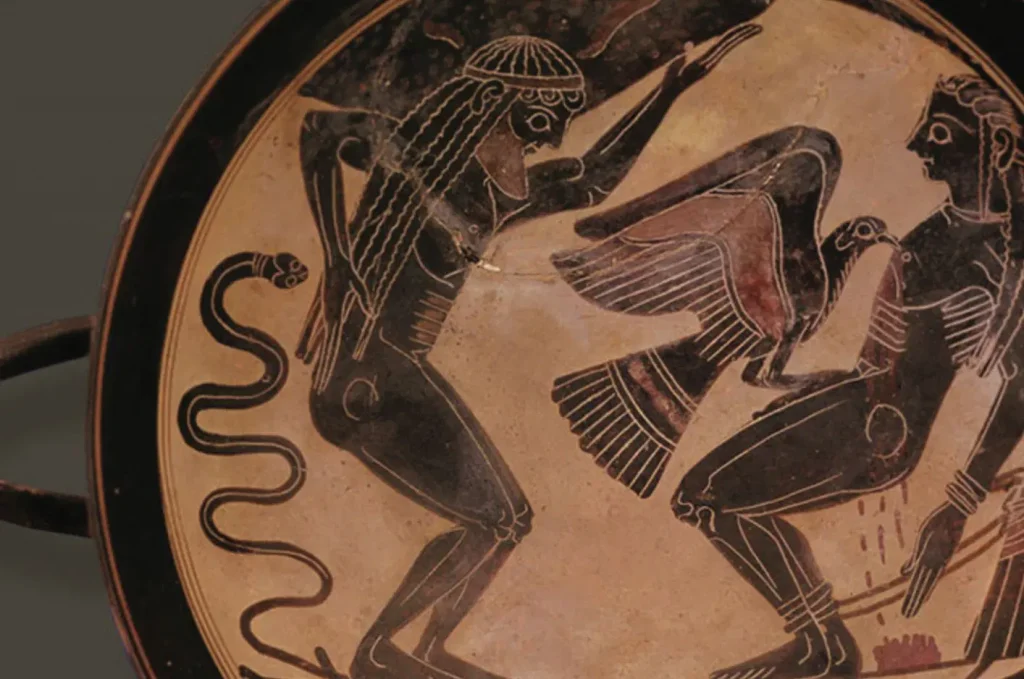
The Greeks
Myth World Quest
1 assessment lesson
4 sub-units | 25 lessons | 4-6 weeks

Summer of the Mariposas
1 assessment lesson
2 sub-units | 27 lessons | 4-6 weeks
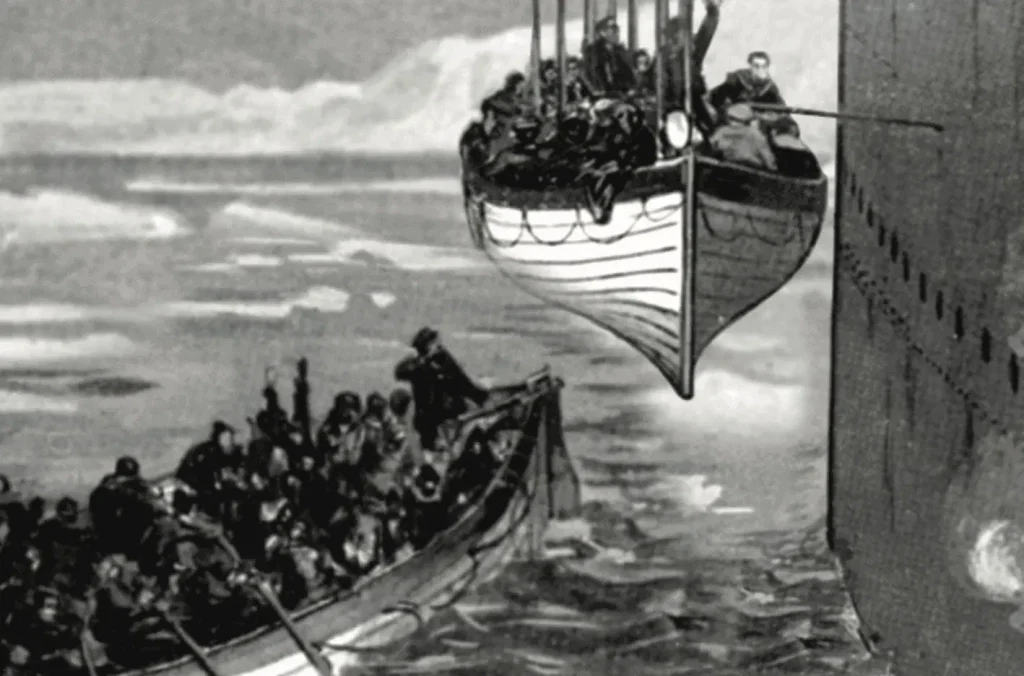
The Titanic Collection
1 assessment lesson
5 sub-units | 25 lessons | 4-6 weeks
Grade 7 core units

Red Scarf Girl
1 assessment lesson
4 sub-units | 31 lessons | 4-6 weeks

Character & Conflict
1 assessment lesson
4 sub-units | 29 lessons | 4-6 weeks
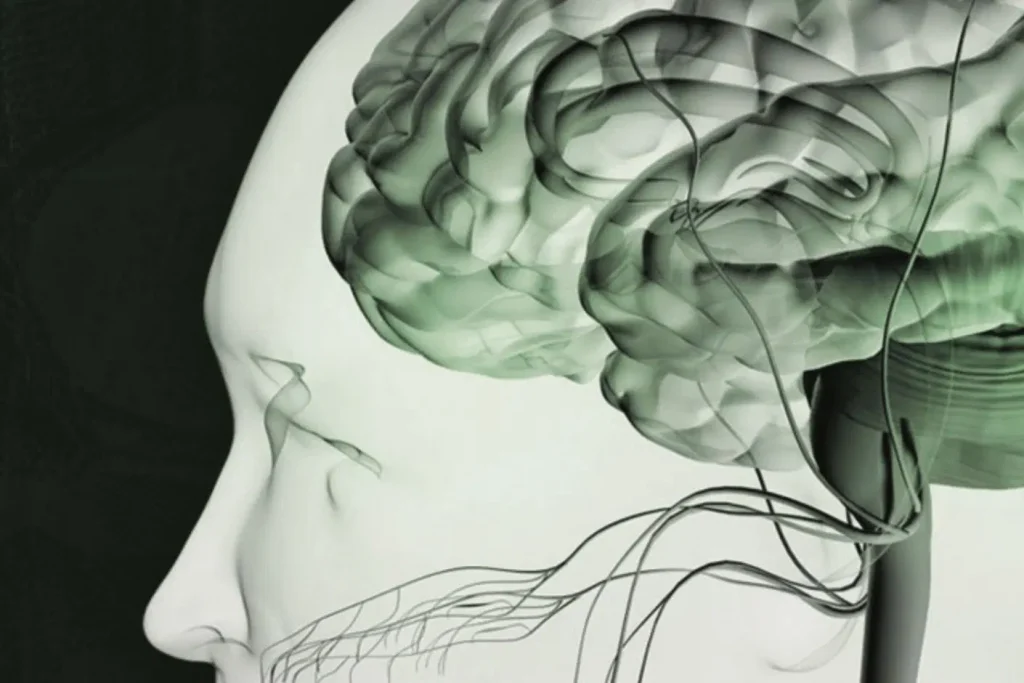
Brain Science
Perception Academy Quest
1 assessment lesson
4 sub-units | 25 lessons | 4-6 weeks
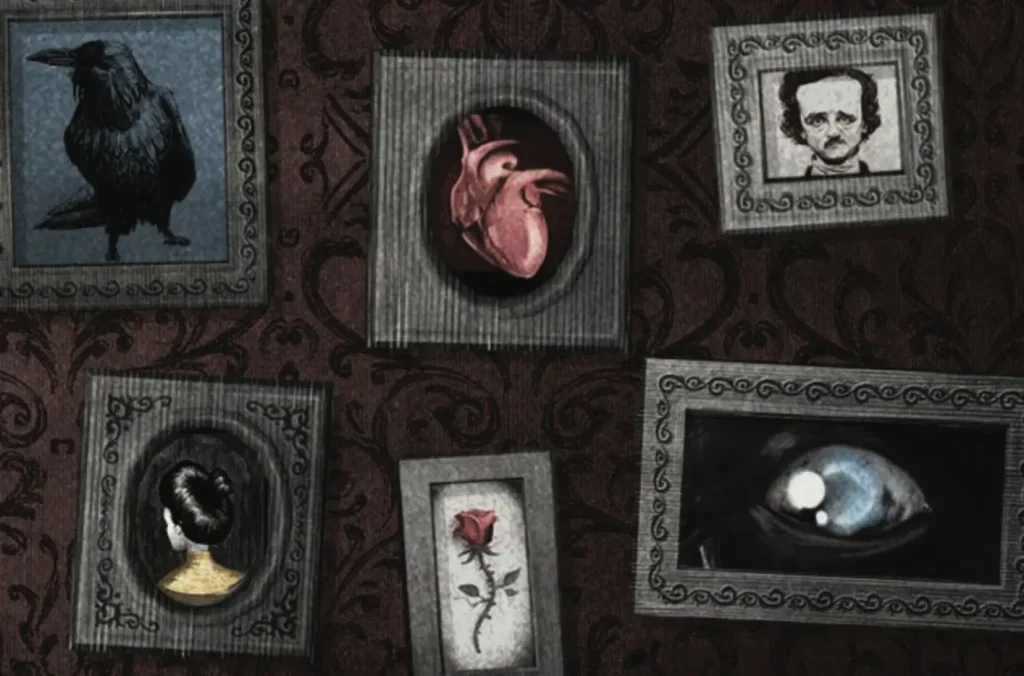
Poetry & Poe
The “Who Killed Edgar Allen Poe” Quest
1 assessment lesson
5 sub-units | 29 lessons | 4-6 weeks

The Frida & Diego Collection
1 assessment lesson
5 sub-units | 25 lessons | 4-6 weeks
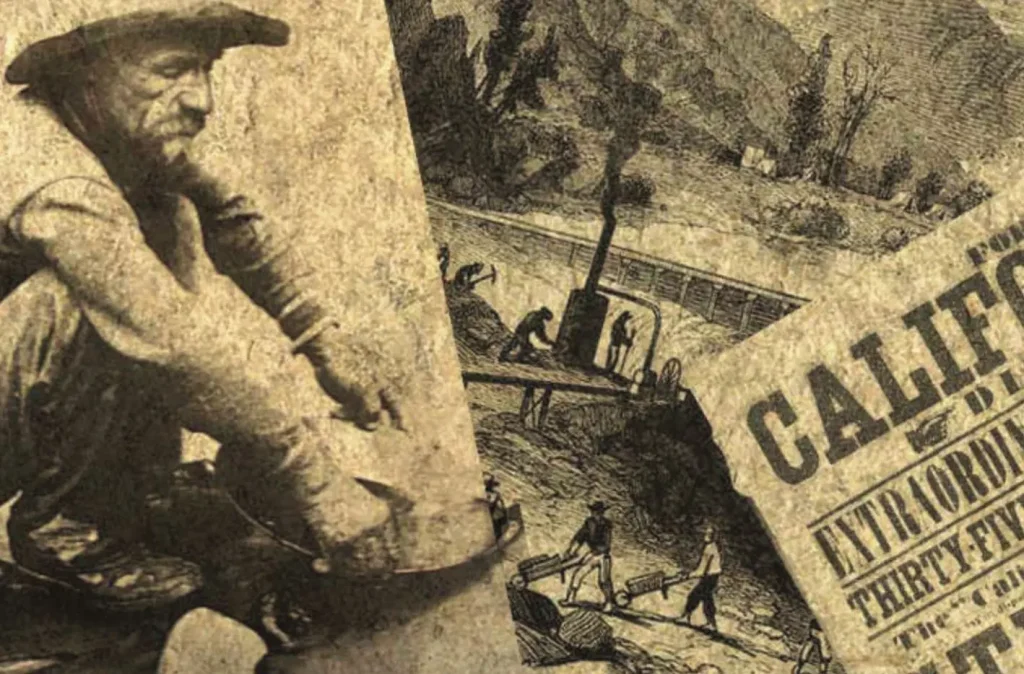
The Gold Rush Collection
1 assessment lesson
5 sub-units | 25 lessons | 4-6 weeks
Grade 8 core units

Perspectives & Narrative
1 assessment lesson
4 sub-units | 27 lessons | 4-6 weeks

Liberty & Equality
1 assessment lesson
6 sub-units | 38 lessons | 4-6 weeks
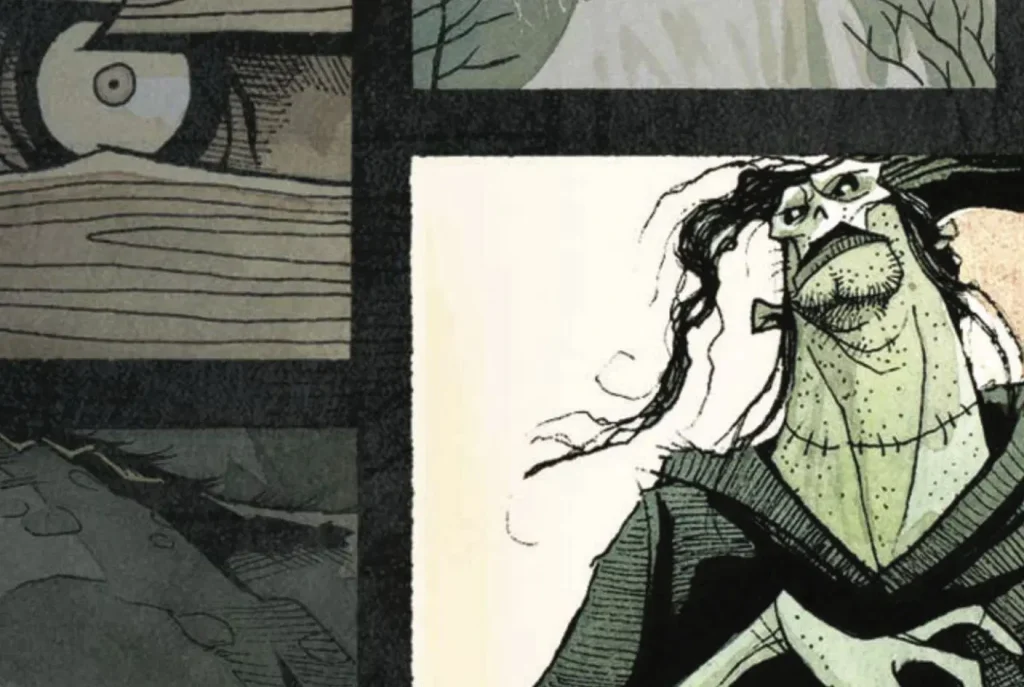
Science & Science Fiction
1 assessment lesson
3 sub-units | 29 lessons | 4-6 weeks
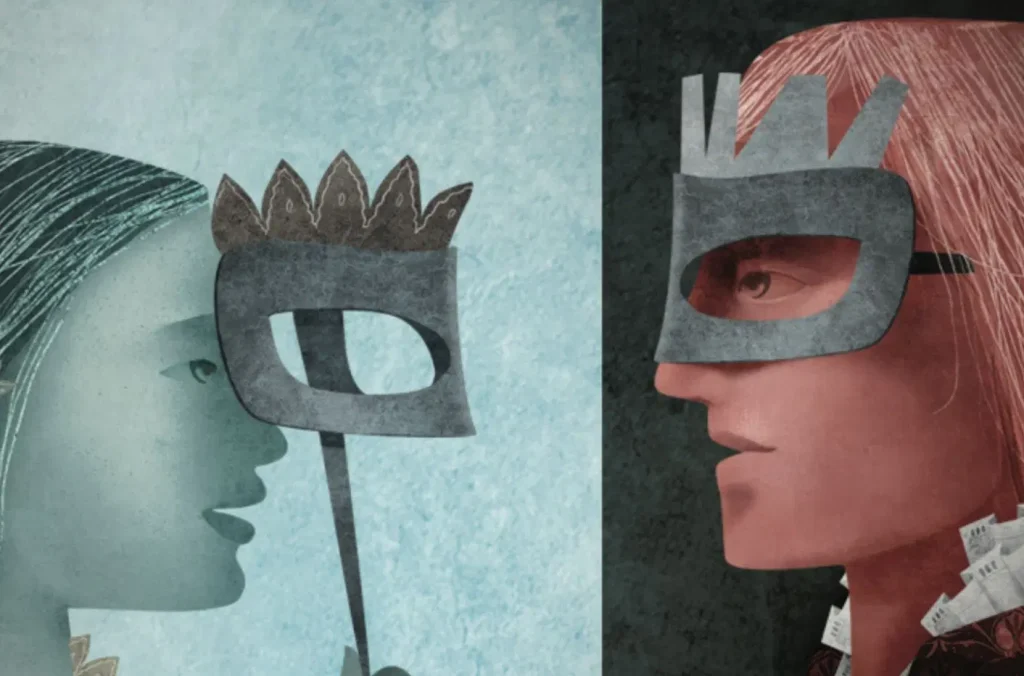
Shakespeare’s Romeo & Juliet
1 assessment lesson
2 sub-units | 22 lessons | 4-6 weeks

The Holocaust: Memory & Meeting
1 assessment lesson
6 sub-units | 21 lessons | 4-6 weeks

The Space Race Collection
1 assessment lesson
5 sub-units | 25 lessons | 4-6 weeks
Units at a glance
Amplify ELA lessons follow a structure both grounded in regular routines and flexible enough to allow for a variety of learning experiences. Lesson structures vary from day to day, ensuring that students are always engaged.
Learn more in the Amplify ELA Grade Overview.
Unit 6A
Dahl & Narrative
Students begin with narrative writing to develop foundational Focus skills and establish key classroom routines. Teachers use this work to create targeted feedback cycles and build a vibrant community centered on diverse experiences. Students then apply observational skills to Roald Dahl’s Boy: Tales of Childhood, learning to work closely with textual evidence.
Unit 6B
Mysteries & Investigations
Students read like an investigator to embark on a multi-genre study into the mesmerizing world of scientific and investigative sleuthing. The Secret of the Yellow Death: A True Story of Medical Sleuthing by Suzanne Jurmain, and Sir Arthur Conan Doyle’s Sherlock Holmes stories take place in the late 19th century, when medical diagnostics and criminal investigations were still evolving into scientific fields.
Unit 6C
The Chocolate Collection
Students explore primary documents and research the diverse cultural roles chocolate has played over 3,700 years, from its various uses in ancient Mexico to issues with modern production. Along the way, they build information literacy skills, craft research questions, and collaborate in Socratic seminars. Students also learn how to construct an evidence-based argument and use those skills to write pieces aimed at convincing readers about chocolate preferences, school lunch policies, and recommendations for local candy stores.
Unit 6D
The Greeks
Students closely explore and analyze three stories from Greek mythology: “Prometheus,” “Odysseus,” and “Arachne.” Drawing on the routines and skills established in previous units, these lessons ask students to move from considering the state of a single person to contemplating broader questions concerning the role people play in the world and the various communities they inhabit.
Unit 6E
Summer of the Mariposas
Students read Summer of the Mariposas by Guadalupe García McCall, a contemporary Latino retelling of The Odyssey. Following five sisters on their journey into Mexico and back, students explore this reimagining of the hero’s journey as they encounter Mexican folklore and Aztec legends along the way. Students analyze character development, compare the novel to Homer’s original, research Aztec mythology, explore symbolism, and engage in collaborative discussions before writing an essay about what makes the heroes successful.
Unit 6F
The Titanic Collection
Students explore primary documents and conduct research to understand the 1912 Titanic disaster, building information literacy skills by examining artifacts such as dining menus, ship photos, telegraph transcripts, and newspaper accounts. Each student is assigned a passenger from the manifest and writes a narrative account from that person’s perspective, considering different views. Students also participate in Socratic seminars to examine the complicated issues within the Titanic story.

Unit 7A
Red Scarf Girl & Narrative
Students begin with narrative writing to develop foundational Focus skills while teachers establish targeted feedback cycles and build a classroom community centered on diverse experiences. After exploring how they describe their own experiences and emotions, students apply the same close attention to analyzing details in Ji-li Jiang’s Red Scarf Girl: A Memoir of the Cultural Revolution.
Unit 7B
Character & Conflict
Students analyze characters’ responses to conflict and examine how authors use character interactions to develop theme and perspective. They read Carson McCullers’ “Sucker” and Lorraine Hansberry’s A Raisin in the Sun, both texts that explore how families facing hardships can support and harm one another. Students observe complex character growth and discuss issues of identity, family obligations, and differing notions of success.
Unit 7C
Brain Science
Students explore narrative nonfiction and informational texts about brain science to understand what it means to be human and how their developing brains impact daily experiences. They also build awareness of their cognitive strengths and analyze the structures of informational texts and scientific arguments. Key texts include Phineas Gage, Inventing Ourselves: The Secret Life of the Teenage Brain, and Oliver Sacks’ The Man Who Mistook His Wife for a Hat.
Unit 7D
Poetry & Poe
Students learn visualization techniques to read like a movie director, beginning with poems by D.H. Lawrence, Federico García Lorca, and Emily Dickinson to form mental images. They then read three Edgar Allan Poe texts, creating storyboards and analyzing narrative elements to learn about unreliable narrators. Students also participate in the murder-mystery Quest “Who Killed Edgar Allan Poe?” and write an essay arguing whether they can trust a narrator in the unit’s texts.
Unit 7E
The Frida & Diego Collection
Students explore primary source documents and research on Mexican artists Diego Rivera and Frida Kahlo, learning how they drew inspiration from Latin American folklore, politics, and customs. Along the way, students build information literacy by generating research questions and visual analysis skills through close reading of key paintings. They also compare the artists’ descriptive writing to Shakespeare’s and analyze figurative language. The unit culminates in a research project showcasing their interpretation of Frida and Diego’s work and legacy.
Unit 7F
The Gold Rush Collection
Students explore primary documents and conduct research on the California Gold Rush, building information literacy skills and constructing research questions. They also learn about the diverse people who participated, compare fictional and historical accounts, and participate in Socratic seminars. Students write narrative accounts from specific perspectives and complete a culminating research assignment combining essay and media project elements.
Unit 8A
Perspectives & Narrative
Students learn to read like writers, paying attention to craft and writing moves that shape reader experience and developing Focus and Showing skills as they build collaborative classroom routines. Students study three narrative texts, exploring themes of belonging and identity through close reading. They also practice alternating between analytic and narrative writing, and conclude with an essay arguing whether the mothers in Amy Tan’s “Fish Cheeks” are role models.
Unit 8B
Liberty & Equality
Students study Civil War-era writings that debate the meaning of “all men are created equal,” exploring various perspectives on American ideals. Key texts include Walt Whitman’s Leaves of Grass, Frederick Douglass’ Narrative, and Harriet Ann Jacobs’s Incidents in the Life of a Slave Girl. The unit culminates with an essay examining Douglass’s arguments and Lincoln’s Gettysburg Address to consider what America means by “all men are created equal.”
Unit 8C
Science & Science Fiction
Students read Gris Grimly’s Frankenstein, a graphic novel adaptation of Mary Shelley’s novel, exploring themes of creator responsibility, societal influence, and the risks of scientific inquiry. They trace Victor’s sympathy for his creation, rewrite scenes from the creature’s perspective, and debate whether Victor owes the creature a companion. The unit concludes with an essay determining whether the creature should be considered human.
Unit 8D
Shakespeare’s Romeo & Juliet
Students read five excerpts from Shakespeare’s Romeo and Juliet to learn key elements of Shakespearean English through close reading. They practice memorizing and reciting the famous “Prologue,” put on stage performances, translate Shakespeare’s language into contemporary terms, and study the Shakespearean sonnet form. The unit concludes with an essay arguing whether love or hate is responsible for Romeo’s death.
Unit 8E
Holocaust: Memory & Meaning
Students use close reading to explore memoirs and primary sources that address two key Holocaust questions: How do societies become participants in atrocity, and what are our responsibilities as witnesses? Students analyze multiple perspectives through texts, including Alexander Kimel’s “I Cannot Forget,” Irene Butter’s Shores Beyond Shores, 1936 Olympics propaganda, and excerpts from Maus and Night.
Unit 8F
The Space Race Collection
Students explore primary documents and conduct research on the Space Race. They build information literacy skills, construct research questions, and learn about diverse participants from Soviet cosmonauts to American heroes like Buzz Aldrin and Katherine Johnson. Each student researches an assigned cosmonaut or astronaut and writes space blog entries from their perspective. Students also complete a capstone research essay and media project.
Print & digital components
The program includes instructional guidance and student materials for a year of instruction, with lessons and activities that keep students engaged every day.

Teacher materials
Teacher Edition
Available digitally and in print, the Teacher’s Edition contains all the information teachers need to facilitate classroom instruction, including detailed lesson plans, video teacher tips, presentation slides, standards alignment, Exit Tickets, real-time differentiation strategies, and robust reporting.
Student materials
Student Edition
Available digitally and in print, student materials guide middle schoolers through complex texts and writing by engaging them with high-quality narrative and informational texts—providing videos, audio supports, and a digital experience that captures their attention. They also keep all of their writing in one place with a personal Writing Journal.

Explore more programs
Our programs are designed to support and complement one another. Learn more about our related programs.
Pasco County’s review of the B.E.S.T. program for middle schools, Amplify ELA Florida Edition
Review of the B.E.S.T. program for Palm Beach middle schools, Amplify ELA Florida
Review of the B.E.S.T. program for middle schools, Amplify ELA Florida Edition
Welcome, Richmond City reviewers!
Thank you for taking the time to review Amplify ELA for middle school. The items below will allow you to experience our blended program with access to our print materials, digital curriculum, and resources to support your review.
Amplify ELA’s blended model enables teachers to design instruction based on their classroom needs and resources. Our engaging print edition highlights the many digital experiences teachers can share with students through classroom projections. Teachers can make choices about when their students use devices while providing 100% standards coverage and without compromising learning.

Digital program
The content and instruction in Amplify ELA’s digital program mirrors the content provided in the print Teacher Edition and Student Edition. However, the digital program offers more opportunity to engage students through the use of multimedia and a variety of learning apps. Teachers will also find embedded apps to help with scoring, providing student feedback, and reporting.
Visit learning.amplify.com/ela-v2 to review Amplify ELA’s digital program.

Grade 6 materials


Student Edition:

Grade 7 materials


Student Edition:
Grade 8 materials


Student Edition:

Resources

Resources to help with your review:
Overview Presentation
After watching the video to the right, scroll down to learn even more, download resources, and access a demo.
What is Amplify ELA?
Amplify ELA is a core program for grades 6–8 that delivers:
- A unique research-based approach designed to get all students reading grade-level text together.
- An instructional design that inspires students to read more deeply, write more vividly, and think more critically.
- A rich combination of dynamic texts, lively discussions, and interactive Quests that truly engages middle schoolers and inspires them to participate in learning.
Interested to learn more about the research behind the program?
Click the link to access the Amplify ELA Research Hub.


How does it work?
Amplify ELA provides everything you need to deliver a full year’s worth of high-quality instruction.
Each grade level includes six multimedia units, which feature a blend of complex literary texts and primary source documents. Amplify ELA also provides immersive learning experiences called Quests, a dedicated story writing unit, access to the Amplify digital library, and flexible instructional units on grammar, poetry, and novel studies. To see the structure of the program at each grade level, please click the tiles below.
Looking for a more flexible version of the curriculum? Check out our abridged lesson pathways ensure full coverage of the standards in just 100 days.


What do students explore?
Amplify ELA provides everything teachers need to deliver a full year’s worth of standards-based instruction.
Each grade level of Amplify ELA consists of six multimedia units. Four or five of the units are focused on complex literary texts and one or two are collections based on primary source documents and research. Each grade also provides two or three immersive learning experiences called Quests, a dedicated story writing unit, and a poetry unit.
Download the unit overviews below to learn more.


How does it engage all students?
Watching students mature into adolescents: inspiring. Knowing how to engage and motivate their changing brains: science.
The middle school years are marked by a period of tremendous growth and change for students – physically, emotionally, and socially. Amplify ELA understands and embraces these changes, and delivers instruction specifically designed to tap into adolescents’ natural inclinations toward collaboration, exploration, and autonomy.



Differentiation
Amplify believes all students are capable of reading grade level text together.
Amplify ELA ensures all students have access to the same text. With six distinct levels of differentiation, your student is supported or challenged in a way that meets their unique needs. This includes ELLs at the Developing, Expanding, and Bridging levels as well as students needing substantial support or an extra challenge.


Assessment
In Amplify ELA, all units include a robust system of embedded assessment that provides teachers with actionable student performance data long before end-of-unit or benchmark exams. The Embedded Assessment Measure (EAM) reports allow teachers to easily track and interpret student performance without ever interrupting the flow of daily instruction to test students.
Clear and actionable student performance data
With intelligent feedback tools and embedded assessments, Amplify ELA makes it easy to monitor student progress and intervene where needed—no matter where teaching and learning is taking place.
Automated Writing Assessment
Amplify’s Automated Writing Evaluation assesses student writing for Focus, Use of Evidence, and Conventions, providing critical feedback for teachers and data for Amplify’s writing reports.
Reporting
Amplify ELA Reporting provides teachers with clear data to understand patterns of student performance and deliver scaffolds and supports as students need them.
Click this link for more information on assessments in Amplify ELA.
Access demo
Ready to explore on your own? Follow the instructions below to access your demo account.
Explore as a teacher
First, watch the quick teacher navigation video to the right. Then, follow the instructions below to access your demo account.
- Click this link: Amplify ELA Online Demo Access
- Select Teacher
- Select Get Started
- Select the desired grade level once logged in.
Explore as a student
First, watch the quick student navigation video to the right. Then, follow the instructions below to access your demo account.
- Click this link: Amplify ELA Online Demo Access
- Select Student
- Select Get Started
- Select the desired grade level once logged in.
Welcome, Lake Washington reviewers!
Amplify ELA – Review for grades 6-8
Corona-Norco Unified School District
Amplify ELA – Atlanta Review3
AL review ELA (state)
Miami review ELA
FL review ELA (state)
Welcome, Amplify ELA families!
We’re excited to welcome you and your student to the Amplify ELA program for the new school year, and to provide you with exceptional learning opportunities through ELA. We’ve assembled the following resources and guides to help you support your student and enable them to have the most productive experience with our platform throughout the year.
Para la versión en español, haga clic aquí.

What is Amplify ELA?
Amplify ELA helps students in grades 6–8 read and understand complex texts that encourage them to grapple with interesting ideas and find relevance for themselves. Amplify ELA is a blended program that includes both digital and print materials, but can also be used as a print-only version. Students using Amplify ELA read text passages closely, interpret what they find, discuss their thinking with peers, and develop their ideas in writing. The lesson structure is easy to follow, but flexible enough to allow for a variety of learning experiences and varied enough to keep students engaged.
Features include:
- Functionality that allows individual students to work at their own level while also being challenged appropriately.
- Built-in tools that allow teachers to track and respond to student work.
- The digital Amplify Library, which contains more than 700 downloadable, full-length fiction and nonfiction books.
- The Vocab App, which uses game-like activities to help students master keywords from the program’s texts. (Students using print materials will see keywords highlighted.)
- Independent writing assignments called Solos, available on mobile devices.
- Interactive projects called Quests that accompany certain units to provide additional practice with analytical reading, writing, speaking, and listening skills.
Getting started
How you can support the child in your care:
- If possible, read with your student daily; even 15 minutes of reading together each day can make a huge impact. You can read aloud sections of the text together—many middle grade students enjoy performing sections of dialogue by taking on the role of a character in a play, or adding some dramatic flair to a poem with which they are working. If your student struggles with reading aloud, you might try reading the text to them with expression, then having them read it back to you. For additional practice, there are an array of fluency activities in the program’s Flex Days. Ask your student to help you find these activities.
- Find moments to discuss what they are reading and discovering. Examples of questions you could ask: What stood out to you from what you read today? Were any sentences or words confusing? What was most surprising? What do you think the writer was trying to communicate? Do you agree with the writer’s ideas or descriptions? What connections can you make between what you are reading and your own life, or other issues you’ve heard about?
- Listen to your student read their written responses or have them share with a friend over the phone or video chat.
- Browse the Amplify Library with your student to find books they’ll enjoy and be able to read fluently and independently.
- Review this Protecting Kids Online website by the Federal Trade Commission addressing digital safety.
Accessing texts in the Amplify Library
We encourage students to utilize the core texts from the Amplify Library while at home! Please follow these steps to download a text for offline reading:
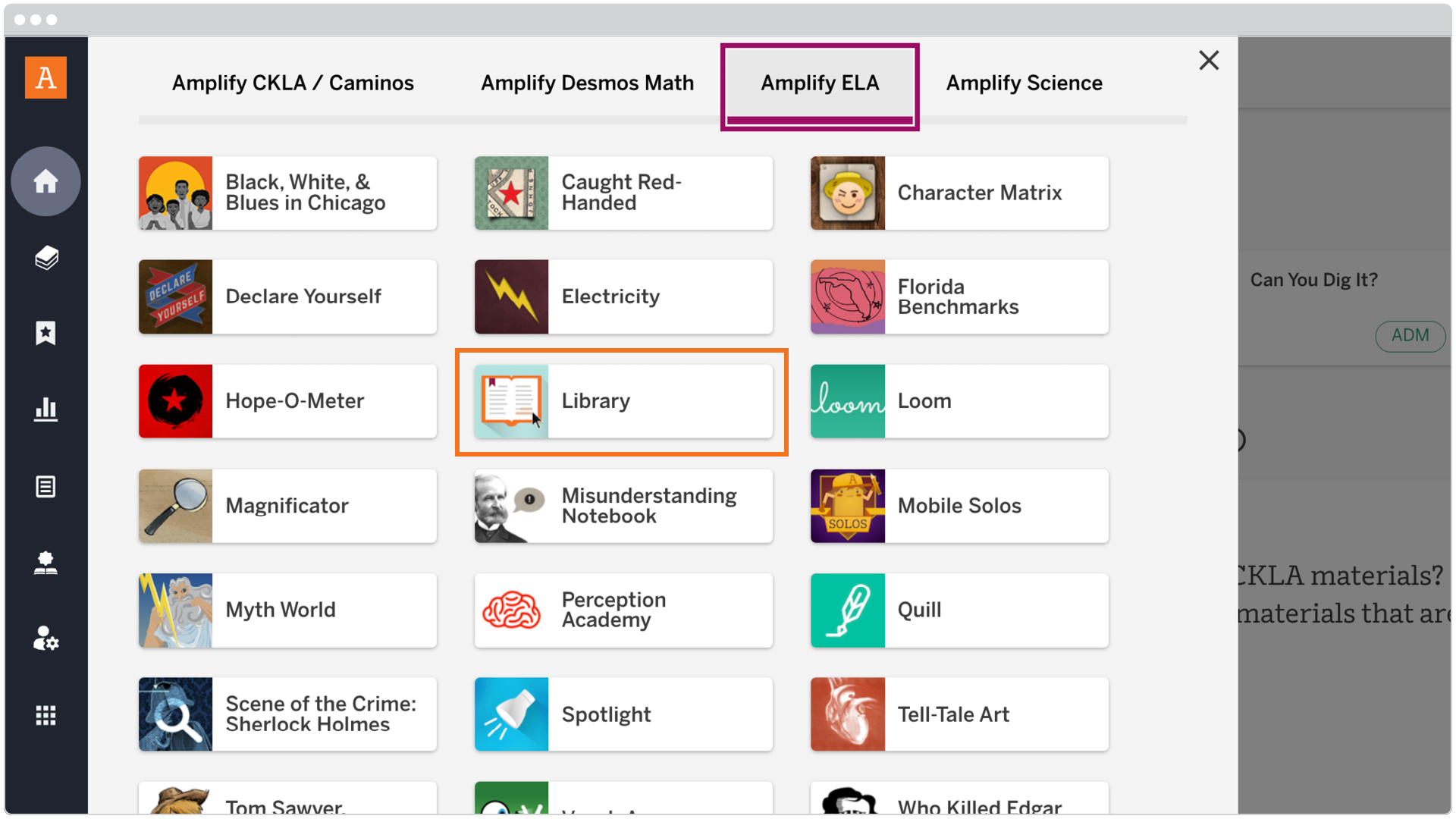
1. Navigate to the Program & Apps menu at the top of your screen and scroll through to find the Amplify Library icon. When you select it, the Amplify Library will open in a new tab.
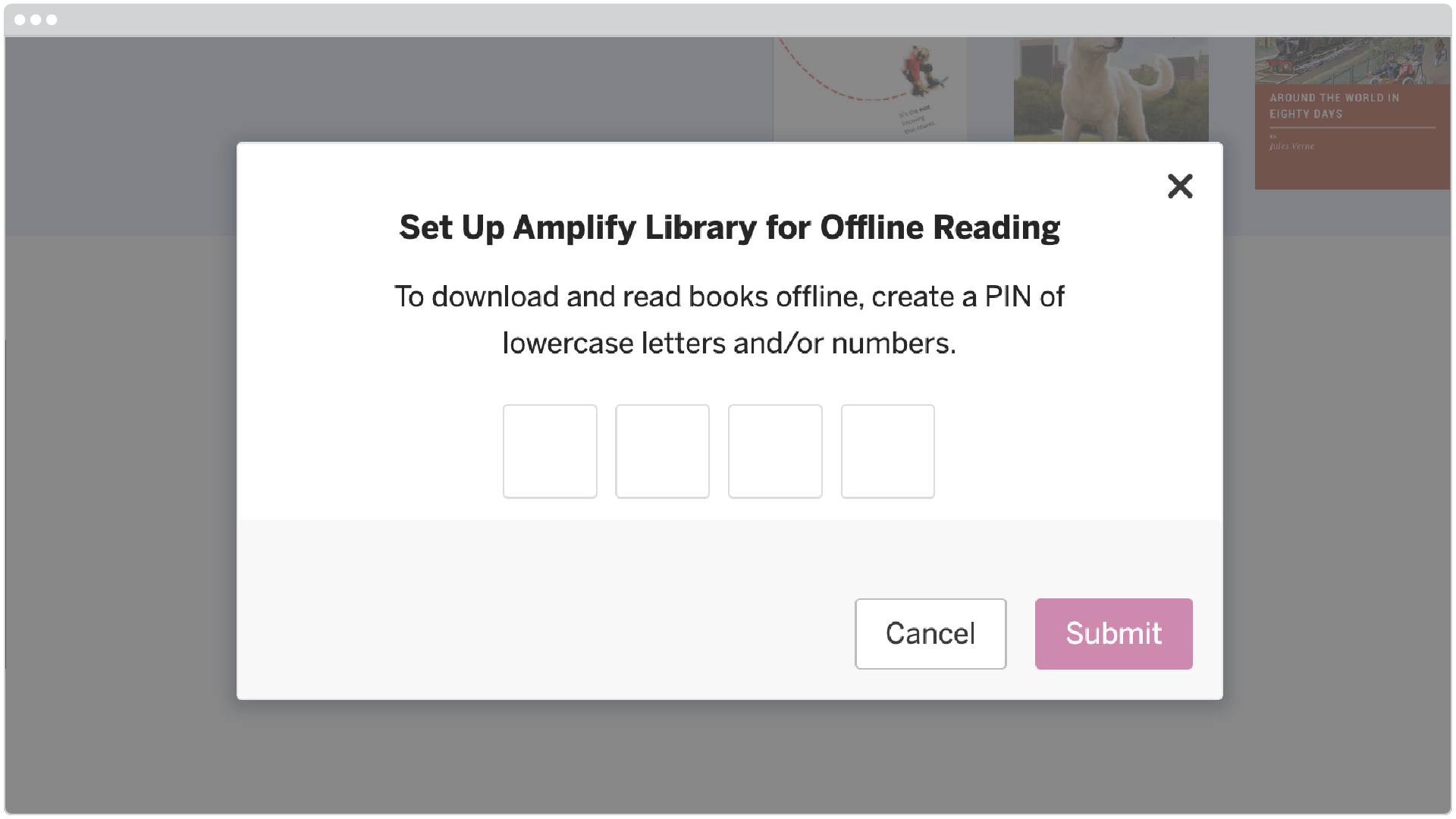
2. If prompted, follow the directions to set up a pin for the Amplify Library; otherwise, proceed to the next step.
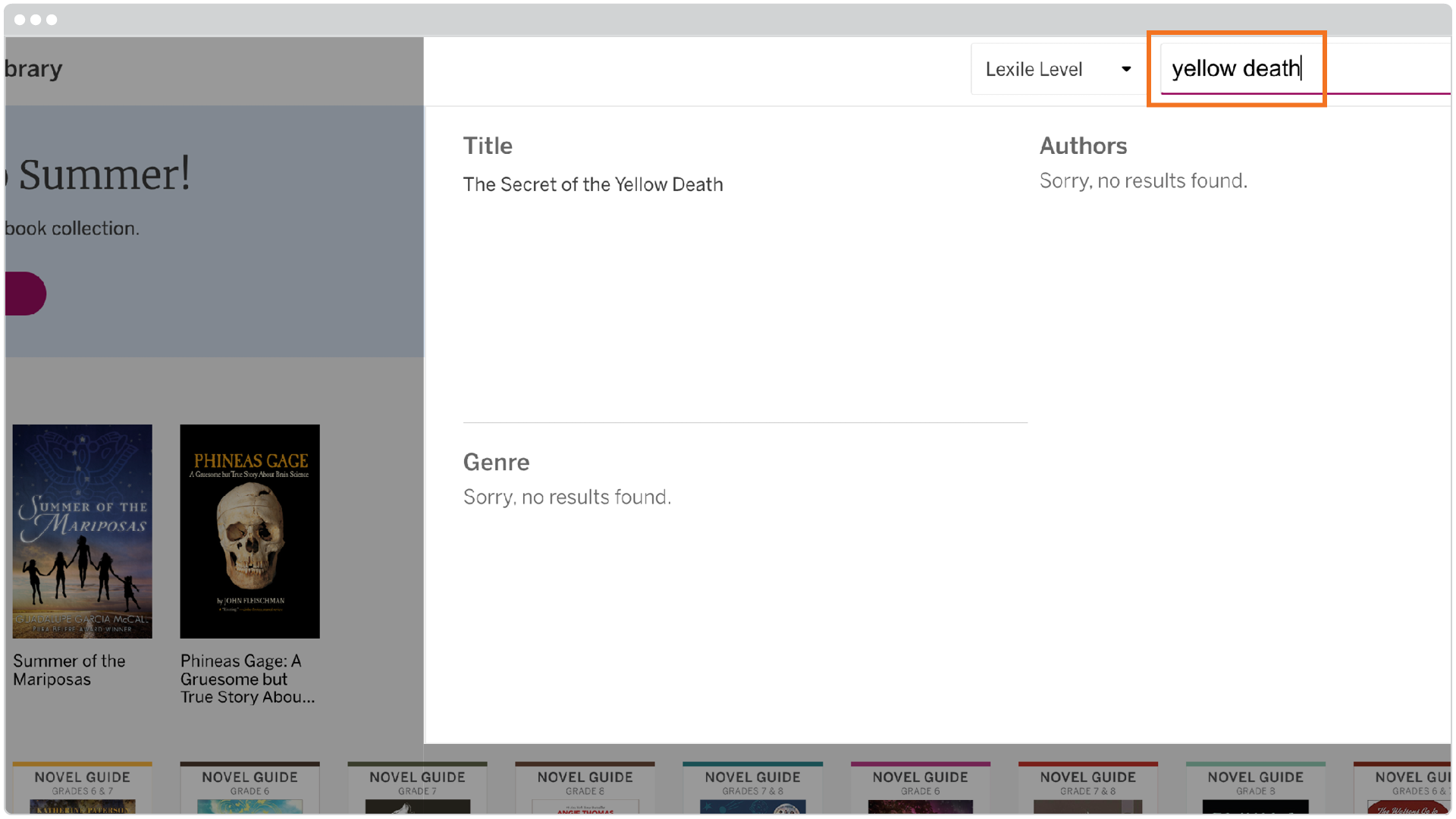
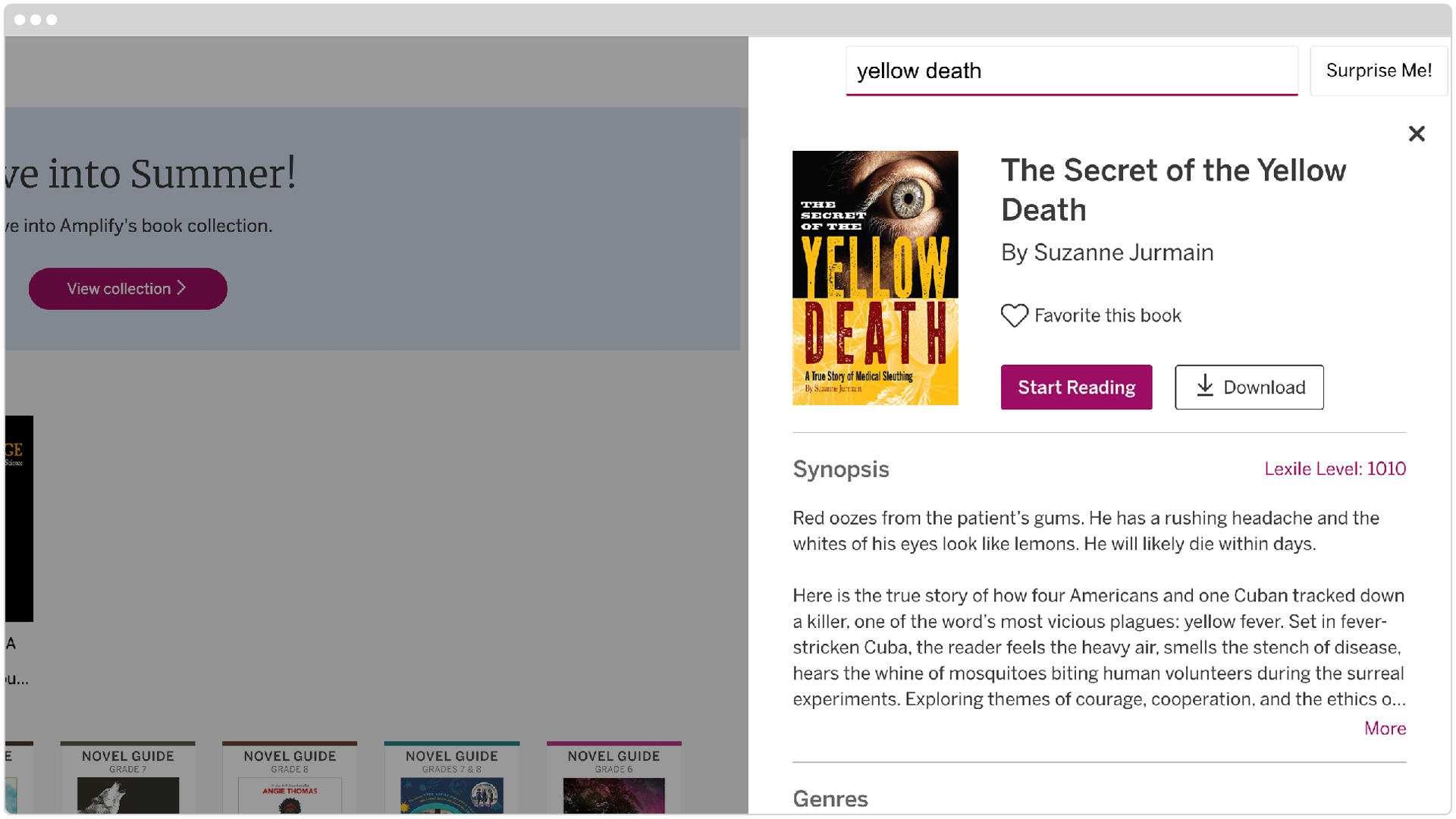
3. In the upper right corner of your screen, search for the book you would like to download. Example: The Secret of the Yellow Death: A True Story of Medical Sleuthing.
4. Select the Download button.
5. If you lose connection while still in the Amplify Library, you can continue to access and read the downloaded book(s). If the page refreshes without internet access, or you try to login on another device without internet access, you will lose access to the downloaded book(s) until the internet connection is restored.
To retrieve your downloaded texts:
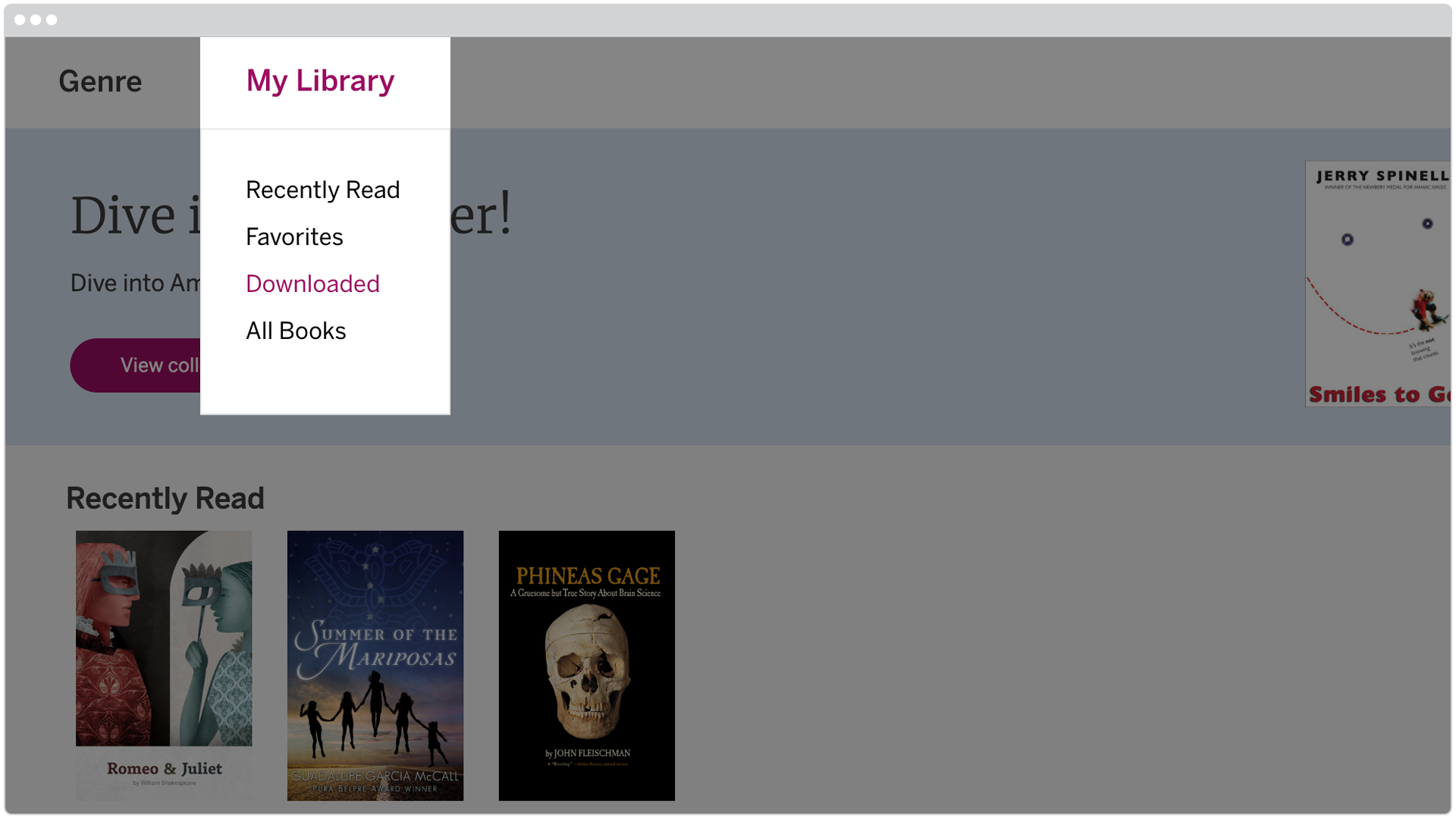
- In the Amplify Library app, open the My Library drop-down menu in the upper left corner.
- Select Downloaded.
- Choose the text you wish to read from all of your pre-downloaded texts.
Materials overview
Not every school will operate the same way, but students attending schools that have both the print and digital editions of the program will likely have the following print materials at home:
- Student Edition: This includes all of the readings and activities necessary for instruction throughout the year. Students can read the selections both digitally and in print, annotating in either format. The lessons in the print Student Edition reflect each digital lesson, but have been modified to work effectively in print.
- Writing Journals: This provides space for students to respond to Writing Prompts and complete other written assignments.
In the case that students are without access to devices or the internet, they can continue to complete key reading and writing assignments using the print Student Editions and student Writing Journals.
Teachers can also access, print, and mail student Novel Guides for up to 12 commonly taught novels. Six of these novels are available in the Amplify Library, and most should be available in a public library.
Unit overviews
Below are quick overviews of each unit your student will be working through in their grade throughout the year. Included along with each unit is a downloadable guide that provides a more in-depth look at what content is covered and how you can help your student advance their understanding of the topics.
- Unit 6A: Dahl & Narrative
- Students begin with narrative writing to quickly boost their writing production, learn the foundational skill of focus, and become comfortable with key classroom habits and routines they will use all year. Students then apply their new observational focus to some lively readings from Roald Dahl’s memoir Boy and learn how to work closely with textual evidence.
- Unit 6B: Mysteries & Investigations
- Students read like an investigator to embark on a multi-genre study of the mesmerizing world of scientific and investigative sleuthing. At the end of the unit, students write an essay explaining which trait is most useful to problem-solving investigators.
- Unit 6C: The Chocolate Collection
- The Aztecs used it as currency. Robert Falcon Scott took it to the Antarctic. The Nazis made it into a bomb designed to kill Churchill. The 3,700-year-long history of chocolate is full of twists and turns, making it a rich and rewarding research topic. In this unit, students explore primary source documents and conduct independent research to better understand the strange and wonderful range of roles that chocolate has played for centuries around the world.
- Unit 6D: The Greeks
- Greek myths help us understand not only ancient Greek culture but also the world around us and our role in it. Drawing on the routines and skills established in previous units, these lessons ask students to move from considering the state of a single person—themselves or a character—to contemplating broader questions concerning the role people play in the world and the communities they inhabit within it.
- Unit 6E: Summer of Mariposas
- The borderlands between the United States and Mexico are the place of legends, both true and fictional. Summer of the Mariposas, by Guadalupe Garcia McCall, plants a retelling of the Odyssey into this setting, launching five sisters on an adventure into a world of heroes and evildoers derived from Aztec myths and Latinx legends. On the journey, the sisters reconcile the dissolution of their parent’s marriage and find new strength in their identity and connection to Aztec lineage. Students consider how McCall uses the structure of the hero’s journey to celebrate women, heritage, and a broad definition of family. Students also have the opportunity to compare these characters’ fictional journey into Mexico to a description of one boy’s true journey into the United States.
- Unit 6F: The Titanic Collection
- In this research unit, students learn to tell the difference between primary, secondary, and tertiary sources; determine if a given source is reliable; and understand the ethical uses of information. Students then construct their own research questions and explore the internet for answers. They also take on the role of a passenger from the Titanic’s manifest to consider gender and class issues as they research and write narrative accounts from the point of view of their passenger.
- Unit 6G: Beginning Story Writing
- In this unit, students get to practice their creative writing skills and learn the elements of storytelling and character development, as well as the importance of vivid language. Students gain a sense of ownership over their writing as they experiment with the impact of their authorial choices on sentences, language, character traits, and plot twists.
- Grade 6: Grammar
- In this unit, students complete self-guided grammar instruction and practice that teachers assign to them throughout the year. Sub-units are organized by key grammar topics, so teachers can assign the content that best meets their student’s needs while making sure students work with the key grammar topics for their grades.
- Unit 7A: Red Scarf Girl & Narrative
- In this study of a highly engaging memoir of a young woman growing up in China during the Cultural Revolution, students quickly learn the history and politics of this tumultuous period by focusing on the story of someone living through the upheaval. As students follow her journey through a world turned upside down, they will track the changes in her feelings and motivations over time.
- Unit 7B: Character & Conflict
- By reading the play A Raisin in the Sun and the short story “Sucker,” students explore how people facing hardships can inflict unintentional harm on the people around them. The two narratives work together to provide opportunities for students to analyze characters’ responses to conflict and the author’s development of ideas over the course of a piece of fiction.
- Unit 7C: Brain Science
- Could you survive an iron rod through your skull? Phineas Gage did, and his gruesome-but-true story allows students to build background information and analyze other informational texts, including the contemporary The Man Who Mistook His Wife For A Hat and the relevant Demystifying the Adolescent Brain.
- Unit 7D: Poetry & Poe
- Poe’s texts always offer so much to notice, decipher, talk about—and creep us out. Since things are not always what they seem, students must use close reading skills to question whether they should believe what Poe’s narrator is telling them … or not.
- Unit 7E: The Frida & Diego Collection
- Mexico’s most famous and provocative artists, Diego Rivera and Frida Kahlo, were an extraordinary couple who lived in extraordinary times. They were both soul mates and complete opposites. Their multifaceted lives and work offer students rich and fascinating subjects to study as they examine primary source documents and conduct independent research.
- Unit 7F: The Gold Rush Collection
- In this research unit, students choose from a large collection of primary and secondary sources to learn about the wide range of people who took part in the California Gold Rush. They also take on the role of someone who lived during the gold rush and write journal entries from their perspective.
- Unit 7G: Intermediate Story Writing
- In this unit, students get to practice their creative writing skills and learn the elements of storytelling and character development, as well as the importance of vivid language. Students gain a sense of ownership over their writing as they experiment with the impact of their authorial choices on sentences, language, character traits, and plot twists.
- Grade 7: Grammar
- In this unit, students complete self-guided grammar instruction and practice that teachers assign to them throughout the year. Sub-units are organized by key grammar topics, so teachers can assign the content that best meets their student’s needs while making sure students work with the key grammar topics for their grades.
- Unit 8A: Perspectives & Narrative
- This unit aims to teach students to read like writers. They practice paying attention to the craft of writing and to the moves a good writer makes to shape the way we see a scene or feel about a character—to stir us up, surprise us, or leave us wondering what will happen next. Students closely read examples of rich, layered narrative nonfiction, analyze the techniques each author uses to make their writing resonate, and practice applying these techniques to their own narrative writing.
- Unit 8B: Liberty & Equality
- In this unit, students look at the words of a range of creators—from poet Walt Whitman to abolitionist Frederick Douglass to President Abraham Lincoln—to see how their writing contributed to an extreme shift in social organization: a whole new concept of what it means for people to be considered “equal.” They also study multiple perspectives on the Civil War, including the memoir of a girl who was enslaved, a confederate girl’s diary, and a nonfiction account of the young boys who served as soldiers during the war.
- Unit 8C: Science & Science Fiction
- Students read Gris Grimly’s Frankenstein, a graphic novel that adds captivating illustrations to an abridgment of the 1818 edition of Mary Shelley’s book. Paired with Shelley’s text, Grimly’s haunting—and, at times, horrific—representations of Frankenstein’s creature push students to wrestle with some of the text’s central themes: the source of humanity and the root of evil. Students then write an essay in which, after arguing both sides of the question, they determine whether or not Frankenstein’s creature should ultimately be considered human.
- Unit 8D: Shakespeare’s Romeo & Juliet
- Romeo and Juliet combines romance with action, offering a wide range of themes and scenes for students to read about and act out. Your middle schoolers are at the right age to identify with the lovers’ strong feelings—and also old enough to think critically about the choices Romeo and Juliet make.
- Unit 8E: Holocaust: Memory & Meaning
- This unit uses a range of primary source articles, images, and videos, as well as literary nonfiction and graphic nonfiction, to study what made the atrocities of the Holocaust possible. Students investigate how propaganda was generated and employed to create a political environment that ultimately corrupted a society. The Olympics are seen through the lens of an international propaganda campaign, providing cover for Nazis to begin eliminating non-Aryans from their culture. The final sub-unit examines the outcomes of Nazi doctrine and the impact on Jewish victims and survivors.
- Unit 8F: The Space Race Collection
- In this unit, students to put their research and close-reading skills to the test to distinguish between reliable and unreliable sources, explore primary documents, and conduct independent research to better understand the space race that took place between two of the world’s superpowers. This dramatic story offers students a rich research topic to explore as they build information literacy skills, learn how to construct their own research questions, and explore the internet for answers.
- Grade 8: Grammar
- In this unit, students complete self-guided grammar instruction and practice that teachers assign to them throughout the year. Sub-units are organized by key grammar topics, so teachers can assign the content that best meets their student’s needs while making sure students work with the key grammar topics for their grades.
- Unit 8G: Advanced Story Writing
- In this unit, students get to practice their creative writing skills. They’ll learn the elements of storytelling and character development, and the power of vivid language to grab readers and pull them into a story.
Additional activities
Quests:
You may notice your student working with peers on the same interactive project over several days, trying to solve a mystery or explain a historical event. That’s what happens when a teacher assigns a Quest: an in-depth week-long exploration that requires collaboration and deepens engagement with texts and topics.
Vocab App:
The Vocab App helps students master vocabulary words through game-like activities that challenge them to think through morphology, analogy, and synonyms/antonyms, and to decipher meaning through context.
Have a question about Amplify ELA?
Visit our help library to search for articles with answers to your program questions.
For additional curriculum support, please contact your student’s teacher.
Tennessee’s review of Amplify ELA student materials
Thank you for taking the time to review Amplify ELA for middle school. The items below will allow you to experience our blended program with access to our student print materials and digital curriculum.
Amplify ELA’s blended model enables teachers to design instruction based on their classroom needs and resources. Our engaging print edition highlights the many digital experiences that can be shared with students through classroom projections. Teachers can make choices about when their students use devices while providing 100% standards coverage and without compromising learning.
Digital Program
The content and instruction in Amplify ELA’s digital program mirrors the content provided in the print Teacher Edition and Student Edition. However, the digital program offers more opportunity to engage students through the use of multimedia and a variety of learning apps.
To access the Student Edition within the digital program, visit learning.amplify.com and enter the following credentials when logging in with Amplify:
USERNAME: t.elav2-autologin@tryamplify.net
PASSWORD: Demo1234
Grade 6
Grade 7
Grade 8
Tennessee’s review of Amplify ELA for middle school
Thank you for taking the time to review Amplify ELA for middle school. The items below will allow you to experience our blended program with access to our print materials, digital curriculum, and resources to support your review.
Amplify ELA’s blended model enables teachers to design instruction based on their classroom needs and resources. Our engaging print edition highlights the many digital experiences teachers can share with students through classroom projections. Teachers can make choices about when their students use devices while providing 100% standards coverage and without compromising learning.
Digital Program
The content and instruction in Amplify ELA’s digital program mirrors the content provided in the print Teacher Edition and Student Edition. However, the digital program offers more opportunity to engage students through the use of multimedia and a variety of learning apps. Teachers will also find embedded apps to help with scoring, providing student feedback, and reporting.
To review the digital program, visit learning.amplify.com and enter the credentials that were provided on the cover of your Getting Started guide.
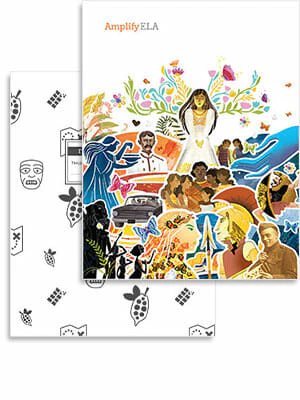
Grade 6 materials

Student Edition:

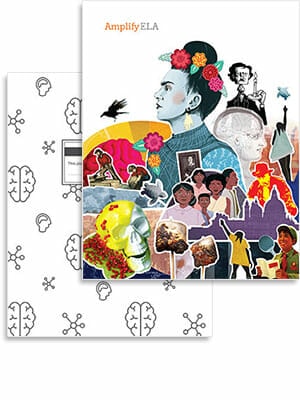
Grade 7 materials
Student Edition:

Grade 8 materials

Student Edition:

Resources
Resources to help with your review:
Get to know Amplify ELA
Start by taking a look at the Amplify ELA Program Guide, where you’ll find:
- Grade-level overviews for grades 6–8 (pages 11–31)
- Amplify ELA pedagogy (page 10)
- Sample lesson routine (page 38)
- Amplify ELA foundations (pp 70-80)
Want to go deeper or look at Amplify ELA’s approach to writing, vocabulary, grammar, and differentiation? Check out the Table of Contents for all this and much more!
Navigating the curriculum
Amplify ELA is a truly blended curriculum, designed specifically for grades 6–8. The program includes instructional guidance and student materials for a year of instruction, with lessons and activities that keep students engaged every day. Materials can be accessed either digitally or through print materials, depending on what your class needs.
Navigating in print
- Watch this video exploring the print resources available for students and teachers in Amplify ELA.
- Follow this link to open an ebook version of the print materials for your grade level and explore Unit A (the first unit).
Navigating digital
- Watch this video exploring the digital curriculum platform and the many resources available for teachers and students.
- Log in to the curriculum at learning.amplify.com using the demo account and password provided by your Sales rep.
- Once you have finished the tour, try out the scavenger hunt below!
Amplify ELA Scavenger Hunt
Inside a lesson
1. Overview & planning

The Lesson Brief equips teachers with the tools they need to plan instruction. It begins with an Overview, which describes the big ideas students will grapple with and summarizes the lesson’s sequence of activities. Next, there is a Preparation section, which points out key moments and materials to prepare. The Preparation section also describes the location and content of the lesson’s Exit Ticket.
The Lesson Brief also includes: the Lesson Objective, which details the reading, writing, and/or speaking and listening objectives; Words to Use, which points out key vocabulary from the reading; Skills & Standards, which lists the focus and coverage standards; and Differentiation, which describes differentiated supports and provides additional suggestions for modifying activities.
2. Vocab App

The Vocab App helps students master vocabulary words through game-like activities based on morphology, analogy, synonyms/ antonyms, and deciphering meaning. These activities help students develop dictionary skills by focusing on parts of speech, etymology, and multiple meanings. There are also activities for ELL-appropriate words from the unit’s texts, asking students to match an English definition, Spanish translation, context sentence, audio pronunciation, and visual definition. These activities also align to vocabulary standards.
Vocab App (Teacher View)
3. Work Visually

Visualization activities are an essential part of Amplify ELA, as they open the door to more comprehensive understanding of complex texts. In these learning experiences, students break apart the text in visual ways or use visual cues to “see” key details as they construct meaning.
In this early lesson from grade 7, students unpack propaganda images and short videos from the Chinese Cultural Revolution to build their understanding of the setting before beginning the memoir Red Scarf Girl.
Other units include visualization activities such as using an app to “see” the evidence for and against scientific theories, making storyboards and planning visual adaptations of texts to “read like a movie director,” and comparing and contrasting illustrations with key textual moments.
4. Author Videos & Dramatic Readings

Students benefit from using listening comprehension skills as they build fluency with complex texts. In these close reading experiences, students listen to the text, perform the text out loud, or watch a dramatic reading of the text.
In this lesson, students listen and watch as author Ji-Li Jiang reads the opening prologue of her memoir, Red Scarf Girl. Her facial expressions, tone of voice, and emphasis help students develop early ideas about what matters to this narrator.
Additional author videos and dramatic readings are embedded in other units. In Unit 8D: Shakespeare’s Romeo & Juliet, students watch WordPlay Shakespeare videos where actors perform each selected scene next to the text of that excerpt. In Unit 8B: Liberty & Equality, two members of the Marvel cinematic universe—Chadwick Boseman and Elizabeth Olsen—offer masterful performances of Narrative of the Life of Frederick Douglass, an American Slave and A Confederate Girl’s Diary.
5. Reading/eReader

Reading standards establish high expectations for all students, even as they enter the middle grades at a variety of reading levels. In Amplify ELA lessons, students access universal supports embedded in the eReader (and built into the print versions of the text) to help them participate fully in grade-level activities.
Point-of-use vocab in print: The print Student Edition places key vocabulary words and their relevant definitions in the text margin to support students and keep them reading.
Reveal: By clicking on these pre-selected words, students access short contextual definitions for key and challenging vocabulary.
Highlight, Bookmark, and Notes: The digital highlighting, bookmarking, and annotation tools allow students to save and review any text notes from any lesson.
Text size and line spacing: Students can adjust text size and line spacing to find what works best for them
6. Writing

Two or three times a week, students complete their reading work by developing a piece of writing to refine their reading analysis. They write for 10–15 minutes, focusing on one claim in response to a prompt, and using evidence from the text in support of their claim.
In this lesson, students build on their discussion of the setting and their analysis of the passage to determine the author’s point of view at the start of her memoir.
Differentiated supports: Five levels of differentiated supports can be assigned in the moment or in advance to help every student work productively. Levels can be assigned ahead of time (by simply dragging and dropping students into groups) and students remain in their assigned levels until they’re changed by the teacher. For more information on differentiation in Amplify ELA, click here.
Automated Writing Evaluation: The Automated Writing Evaluation (AWE) tool has been developed in conjunction with Amplify’s regular writing activities, which ask students to use textual evidence to develop one focused idea or claim about the text and communicate that idea clearly and effectively to an audience. AWE is a tool designed to help teachers understand, track, and support student skill progress with these key foundational skills, which are a strong indicator of a student’s analytic writing proficiency. AWE provides auto scores for Focus and Conventions, allowing teachers to prioritize their assessment of a student’s progress with Use of Evidence, a skill that is relatively new for many middle-grade students.
7. Share

Establishing a supportive writing community in the classroom helps students develop their voices as writers. Each writing activity is coupled with a sharing session, where clear routines and student-facing feedback protocols support students as they share and respond to each other’s writing. Here, students try out their writing with an audience of their peers to figure out how to express their ideas in a clear and convincing way. In addition, these sharing sessions allow students to learn from the range of perspectives in the classroom.
Clear and consistent Response Starters ensure that students provide feedback that targets key skills and focuses on where a student is using a skill effectively, fostering an effective and supportive feedback environment.
8. Solos
Solos are an important part of the ELA curriculum, and are designed to be completed as homework—but not every student has a computer at home. However, most students DO have access to a mobile device. The new Mobile Solos give every student access to this part of the curriculum, protecting valuable classroom time for lessons and group activities.
Navigating the first unit
Dig into Unit A
It’s time to continue your journey by exploring the first unit!
- Choose a 6th-, 7th-, or 8th-grade Unit A.
- Find the Print Materials for your grade level’s Unit A and review the unit overview. (password: middle678school)
- Log in to the curriculum and navigate to your chosen unit.
- Scroll down to the unit guide. Open each section and read it.
- Read the background and context document in the Materials section.
- Go to Sub-unit 3 and read the Sub-unit Overview.
- Choose two lessons to explore further.
- Open the first lesson and read the Lesson Overview. Be sure to open and read each section in the Lesson Overview.
- Open each activity tab and read the teacher Instructional Guide. Familiarize yourself with the entire lesson and note where students are building reading and writing skills
- Repeat with the second lesson.
Diving Deeper
Check out Amplify ELA’s professional learning website, featuring self-guided training modules and videos to help you with planning and pacing, navigation, and learning key curriculum features.
You can log in using your Amplify credentials or the demo account and password provided by your sales rep.
Additional support
As you continue to explore the curriculum, you may also want to take a look at the Amplify ELA Resources Website, which is full of additional information on the program. If you have any questions, please contact us through the Amplify Help section.
And you’ll find even more information by watching this session from our Literacy Symposium, in which Sarah Kitzmiller from the Niswonger Foundation and Teddy Redding from Amplify discuss some of the challenges of the 2020–21 school year.
Amplify’s Literacy Symposium session: Focusing on the Fundamentals to Start the Year Right
You may choose to view other sessions from the Literacy Symposium as well, all accessible from the schedule menu in the top left corner.
This webinar also offers valuable insight, with Baltimore City middle school ELA teacher Lucas Drerup describing his experiences with Amplify ELA and discussing how he brings middle school ELA to life, even in a remote teaching setting.
How to bring middle school ELA to life: A teacher’s perspective
Support
- elahelp@amplify.com
- Amplify Help Center
- 1(800) 823-1969
Louisiana review of Amplify ELA for middle school
Louisiana’s review of Amplify ELA for middle school
Welcome, NYC reviewers!
Welcome, Amplify ELA reviewers!
Committed to reading equity
We believe that all students have the right to read complex texts and engage in rich classroom discussions. They should also see themselves reflected and experience new worlds through reading.
This commitment guides our text selection, unique artwork, and dedication to reaching every student where they are.

Text selection
Texts in the Amplify ELA curriculum cover a wide range of topics, themes, and genres, with differentiated supports that ensure that all students can work through each reading and lesson. Taken as a whole, the texts show students a diverse picture of the world, while fostering a lifelong love of reading.

In the Liberty & Equality unit, students reflect on the harrowing journeys and avenues to freedom that enslaved African-Americans were forced to forge.
Students read A Raisin in the Sun, a play that focuses on the impact of poverty and racial tensions on family relationships and identity within an African-American family.
In the Summer of the Mariposas unit, students dive into a retelling of the Odyssey through a contemporary Hispanic lens as they explore sibling and extended-family relationships.
In the Perspectives and Narrative unit, students explore a coming of age moment for an adolescent daughter of immigrant parents.
In the Red Scarf Girl and Narrative unit, students learn about a key historic moment in Asian and world history, while making connections to relatable themes like authority figures imposing rules on children, and family and peer loyalties standing at odds.

In the Mysteries & Investigations unit, many of the texts present an ethnically and culturally diverse group of characters, including many pre-teen or teen protagonists rebelling against authority, navigating their relationships with their peers and families, and figuring out their unique identities.
Created with diverse perspectives
With our new illustrations, time spent in our classrooms will feel relevant and relatable to every student. We’ve brought together an art team with unique perspectives and visual styles so that their diversity can shine along with the
complex texts in our curriculum, and illuminate their relationship with our literature. Everyone deserves to see themselves as the hero of a story. It is our hope that our students will find themselves within our program, and will be ever more curious in their learning, and engaged in their reading.

Paige Womack
Dive into the world of Mysteries &
Investigations with Dr. Womack,
the illustrator who may have once
become a scientist…

Tre McClendon
Meet Tre, a seeker and traveller that became homies Fredrick Douglass through illustrating his narrative for our program…

Jackie Pierson
There’s no one way to be a maker, and Jackie certainly has made a lot of things. Check out the weird and mysterious world of her miniatures…

Elizabeth Dantzler
She’s been drawing characters and comics ever since middle school. Now see the drama of Edel’s work in the mythos of the Greeks…

Caroline Hadilaksono
Travel through countries and narratives with Caroline, as she shares her delicate watercolors for illustrating the hero’s journey…

Patrick Mahony
The haunting work that Patrick creates will leave you feeling a sense of melancholy and longing, but not without hope for the future…

Edel Ferri
She’s been drawing characters and comics ever since middle school. Now see the drama of Edel’s work in the mythos of the Greeks…

Eddie Pena
As a latino American, Eddie is an illustrator, a father, and a teacher. He is working in collaboration with Poetry in America to use his heritage as inspiration…

Tory Novikova
Listen to a word from Tory, the Art Director at Amplify, on how the vision
was set for the project and how she brought the team together that would get to illustrate ELA…
Fanart
Here is a library of all the inspiring art that our beloved fans have submitted for our program. Do you or your students have a favorite literary character from our program? Send us your fanart to be shared with our community here!

Welcome, Atlanta reviewers!
Welcome, Atlanta reviewers!
Welcome, San Diego reviewers!
At Amplify, we believe Pennsylvania students and teachers deserve high quality instructional materials.
That’s why we partner with schools across the Keystone State to meet their core curriculum, assessment, and intervention goals. With solutions grounded in research and evidence-based practices, Amplify is leading the way with rigorous and relevant learning experiences.
Select a program below to learn more.


Amplify Desmos Math (K–12)
Amplify Desmos Math is a comprehensive K–12 math suite that has everything in one place: benchmark and progress monitoring, core instruction, integrated personal learning, embedded intervention, and more. This structured, problem-based approach builds on students’ curiosity while strategically developing math fluency and lasting grade-level understanding. The program delivers:
- Engaging, discourse-rich math lessons that fuel classroom conversations and drive the learning process.
- Comprehensive integrated resources, including print and digital, along with manipulatives and Centers Kits in K–5.
- Real-time insights, data, and reporting that inform instruction and celebrate student thinking.
Flexible, social problem-solving experiences
Digital lessons should be able to bring student thinking to the surface and spark productive discussions. We bring this vision to life with interactive social, collaborative lessons powered by Desmos technology.

mCLASS early literacy assessment and intervention (K–8)
Effective universal screening and progress monitoring means that every student is an individual and targeted instruction should become a reality, not a dream.
mCLASS® is the gold-standard K–8 assessment and intervention suite for early literacy that helps every child learn to read confidently.
- Universal screening presented in one-minute measures shows where your students are, who is at risk, and where to target instruction.
- Dyslexia screening identifies students who are at risk for reading difficulties without needing an additional assessment system
- Elimination of manual assessment process gives you instant results and clear next steps for each student.
- Progress monitoring allows you to quickly adjust to student needs, based on how they are responding to instruction.
The power of mCLASS
Based on decades of leading literacy research, mCLASS lets you know exactly which part of a skill a student is struggling with, then gives you effective next steps and lesson plans.
Watch how mCLASS can help teachers:
- Save hours of time.
- Catch at-risk students earlier.
- Connect data to personalized learning.

Amplify Core Knowledge Language Arts (PreK–5)
High-quality, content-rich instruction should combine multisensory phonics instruction with knowledge-rich texts and interactive multimedia resources.
Built on the Science of Reading, Amplify Core Knowledge Language Arts® (CKLA) sequences deep content knowledge with research-based foundational skills.
- Explicit, systematic foundational skills lessons are easy to teach and exciting to learn.
- Deep knowledge-building across units and grades helps access complex text, so real comprehension can happen.
- Rich, authentic texts with engaging topics and immersive learning support students wherever they are.
Students love CKLA. But don’t just take our word for it.
Amplify CKLA is impactful for teachers, administrators, families, and most of all—students! Hear what students think about Amplify CKLA.

Boost Reading (K–5)
Authentic personalized learning should be developmentally appropriate, grounded in research, and truly adaptive.
Boost Reading is a personalized, digital supplemental reading tool for grades K–5 featuring:
- Research-based approach to critical literacy skill development that is proven to accelerate reading growth in just 30 minutes per week.
- Captivating storylines and games with powerful individualized reading instruction and practice to bridge learning gaps while learning independently.
- Actionable data that offers deeper insights into student performance and needs.
Boost Reading keeps all students playing and motivated to learn.
Boost Reading includes age-appropriate storylines that excite students’ curiosity. Regardless of their reading ability, students are placed in a year-long storyline that is developmentally appropriate for them. As students grow, so do the immersive worlds around them.

Amplify ELA (6–8)
Amplify ELA is the only program truly designed to support middle school students at this critical developmental moment. We ensure that skills are taught, standards are covered, and the test is prepped – all while bringing texts to life and differentiating instruction.
- Rich, complex text and research-based instruction at the center of every lesson to build the vocabulary, knowledge, and skills needed in middle school, high school, and beyond.
- Multiple points of entry and differentiated support allow every student, regardless of fluency or ability, to engage deeply in the same curriculum.
- Immersive digital apps that offer engaging interactive experiences where students work with key skills in brand new ways.
We are the program for middle schoolers.
Let’s face it– middle school students are different from high school students. That’s why they deserve a program of their own.

Boost Close Reading (6–8)
Middle school students need to exercise their close reading skills in order to deeply comprehend across the curriculum. Based on a riveting storyline designed especially for middle schoolers, Boost Close Reading helps students find deeper meaning in a digital journey like no other.
- Inspire engagement via high-interest storytelling, choose-your-own adventure experiences, and skill-building features.
- Explore topics like claim, evidence, reasoning, word choice, and tone in both literary and informational texts.
- Detailed teacher dashboards display student progress, performance, and usage information, offering easy-to-access insights on areas of strength and weakness.
Fight the machines and save the world.
Before the machines took over, humans could fend for themselves. Now humanity is trapped. And their only hope? You.

Amplify Science Pennsylvania (K–8)
Amplify Science Pennsylvania is a proven K–8 curriculum that develops critical thinkers who are prepared to solve problems in their communities and beyond. It features:
- Phenomena-based exploration and three-dimensional learning where students take on the roles of scientists and engineers to solve real-world problems.
- Immersive hands-on activities that teach students how to gather evidence, ask questions, and develop and defend claims.
- Literacy-rich science instruction that enables young scientists to become excellent readers, writers, and speakers.
- Custom lessons specifically designed to meet Pennsylvania’s STEELS standards.

Do, Talk, Read, Write students outperform their peers.

English language learners who use Do, Talk, Read, Write outperform their ELL peers.

Do, Talk, Read, Write increases learning outcomes.
Get Support
Contact us




Leading with the head and the heart: Enacting lasting literacy change, with Mitchell Brookins



Meet Our Guest(s):

Mitchell Brookins
Mitchell Brookins is a Director of Content with Leading Educators. At heart, he is a teacher first, and has spent years studying, exploring, and refining his practices to yield student learning. From his National Board Certification to studying as a doctoral student of Educational Administration, Brookins understands the interconnectedness between teaching and learning. He has been a teacher; district leader of RTI and literacy; school administrator; consultant with the National Board of Professional Teaching Standards; instructional coach with EdConnective; and professional development facilitator of ELA, math, and Leadership Institutes with UnboundEd.
Meet our host, Susan Lambert
Susan Lambert is the Chief Academic Officer of Elementary Humanities at Amplify, and the host of Science of Reading: The Podcast. Her career has been focused on creating high-quality learning environments using evidence-based practices. Susan is a mom of four, a grandma of four, a world traveler, and a collector of stories.
As the host of Science of Reading: The Podcast, Susan explores the increasing body of scientific research around how reading is best taught. As a former classroom teacher, administrator, and curriculum developer, Susan is dedicated to turning theory into best practices that educators can put right to use in the classroom, and to showcasing national models of reading instruction excellence.

Quotes
“My calling is so that children can one day stand on their own without scaffolds, that children will one day reap the benefits that literacy is liberty, that children will one day be able to teach someone else the power that only literacy can bring.”