Episode 10: Myths and misconceptions about universal screening with Nancy Nelson




Join us for the third episode in our Winter Wrap-Up! In this episode from season 3 of Math Teacher Lounge: The Podcast, we sit down with Dr. Valerie Henry to talk about math fluency and what that means for students. Listen as we dig into the research, hear Val’s three-part definition of fluency, and explore her five principles for developing it.
Explore more from Math Teacher Lounge by visiting our main page.
Dan Meyer (00:03)
Hey folks. Welcome back. This is Math Teacher Lounge, and I am one of your hosts, Dan Meyer.
Bethany Lockhart Johnson (00:07):
And I’m your other host, Bethany Lockhart Johnson. Hi, Dan.
Dan Meyer (00:11):
Hey, great to see you. We have a big one this week to chat about and some fantastic guests. We are chatting about fluency, which is the sort of word and concept that I feel like people have very, very non-neutral associations with it. A lot of them are very negative, for a lot of people.
Bethany Lockhart Johnson (00:26):
I saw you frown a little. What’s up with that, Dan? You kind of, like, shrank.
Dan Meyer (00:30):
I have strong feelings about it. You know, there’s lots of ways that people go about helping people become fluent in mathematics. And a lot of them are harmful for students, and ineffective. And it got me thinking about fluency as it exists outside of the world of mathematics, where we have a lot of very clear images of it. We’re getting fluent in things all the time. Like, as humans. Human development is the story of fluency. And I just was wondering….Bethany, would you describe yourself as fluent at something outside of the world of mathematics? What is that? How’d you get fluent at it? What was the process?
Bethany Lockhart Johnson (01:05):
Hmm, I think I’m a pretty fluent reader. I read all the time. I’m a happier person if I’ve read that day. I once saw this poster in a classroom; it said “10 Ways to Become a Better Reader: Read, Read, Read, Read, Read…you know, 10 times. Get it? Reading? You get better at reading by reading! So I would say reading. And it’s been kind of cool—I have a one-year-old who, it’s been really exciting slash overwhelmingly anxiety-producing to see him get very fluent with walking slash running, ’cause he’s getting faster every day. And it’s kind of fun. When I think of what’s something somebody’s trying to get fluent with…walking! He’s trying to be more fluid. He’s practicing transitions. He doesn’t wanna hold my hand while he traverses rocky terrain. He’s getting better at it. He’s practicing. What about you? What’s something…?
Dan Meyer (02:08):
I think about driving a lot. I’m a very fluent driver and I think a lot about when I was first a driver, you know? And how l have my hands on 10 and 2, vice grip, and do not talk to me; do not ask me anything; don’t ask me my NAME. I need to focus so hard. And then a year later, you know, I’m driving with one hand, smash the turn signal, take a sip off of whatever, change the CD. And then it’s no big deal.
Bethany Lockhart Johnson (02:38):
Wait, did you pass the first time? Your test?
Dan Meyer (02:40):
Yeah, I don’t like to brag about it. <laugh> But I do all the time. <laugh> But I got a hundred on my driving test. I don’t care who knows it. And I hope it’s everybody. But I guess all of this is just to say there are areas of life where fluency feels natural, with the case of walking. There’s areas of life where fluency feels motivating, with like driving—I wanna be able to switch the CD out or whatever. And there’s areas where fluency feels terrifying and hard to come by, like mathematics, sometimes. So we have a set of guests here. Our first guest will help us figure out what do we mean by fluency? And what’s the research say about what fluency is and how students develop it in mathematics? And then our other guests will help us think about what it looks like in practice in the classroom. What are some novel, new ways to work on fluency? So first up we have Val Henry, Dr. Val Henry.
Bethany Lockhart Johnson (03:32):
So we knew we needed help with the fluency definition, because when we think about it, it’s kind of big, right? And we wanted to look at what research about fluency really says. So we called on Valerie Henry. Val is a nationally board-certified teacher, taught middle school for 17 years, and since 2002 has worked with undergraduates graduates, credential candidates as a lecturer at the University of California, Irvine, one of my alma maters. So after doing her dissertation on addition and subtraction fluency in first grade, Val created a project to study ways to build addition and subtraction and multiplication and division fluency while also developing number sense in algebraic thinking. And the pilot grew and grew over the last 18 years into a powerful daily mini-lesson approach to facts fluency called FactsWise. And when we thought of fluency, the first person I thought of was Val. Welcome, Val Henry, to the Lounge! I’m so excited to have you here. Welcome.
Valerie Henry (04:36):
Thanks, Bethany. And thanks to you, Dan. It’s great to be here today.
Dan Meyer (04:41):
Great to have you; help yourself to whatever you find in the fridge. The names that people write down on those things in the bags are just recommendations. It’s potluck-style here. I’m curious, Val, if you’re, like, on an airplane, someone asks you what you do, and you say you study fluency…what is the layperson’s definition of what does it mean to be fluent in mathematics? And if you can give a brief tour through what the research says about what works and what doesn’t that would really help us orient our conversation here.
Valerie Henry (05:12):
The first thing I have to do when I talk to somebody on a plane is define the idea of fluency. And I often use an example of tying your shoelaces. Because that works with first graders as well as adults. This idea that when we first start trying to put our shoes on and get those shoelaces tied, somebody tries to, first of all, just do it for us. But then of course maybe tries to teach us the bunny-ears approach. And we struggle and struggle as little kids and eventually either the bunny-ears approach or something else starts to work for us. But we still have to pay attention to it. We have to think hard and it’s not easy. And then over time we get to the point where we basically don’t even think about it. When I tie my shoes in the morning. I’m not thinking about right-over-left and left-over-right and all of those things. I just do it. And so that’s a good, easy example of becoming fluent with something. I think what we’re talking about today though, is the basics, the adding and subtracting that we hope kids are going to have mastered maybe by second grade, and the multiplication and division facts that we wanna maybe have mastered by third, maybe fourth grade. So now what does that mean to become fluent with those basics? I have a three-part definition that seems to match up really nicely with the common core approach to fluency. Which is, first of all, we want the answers to be correct. And then second, we want the answers to be easy to know. And so what does that mean? Well, to me, it means without needing to count,
Bethany Lockhart Johnson (07:12):
You mean without having to kind of muscle through it? Or say more about you mean.
Valerie Henry (07:16):
Well, I guess what I mean is that when you watch a young child try and solve something even as simple as two plus three, they might put up two fingers and then go 3, 4, 5 with three more fingers winding up on their hand, one or the other of their hands. While they’re doing that, they don’t really have a sense of whether even their answer is right or not, quite often. Especially when you get to the larger adding and subtracting problems, you can see a lot of errors happening as they’re trying to count. And it’s taking up cognitive energy to do that counting process, especially as you get to the larger quantities. So my definition of fluency now is “getting it right without needing to do that hard work like counting.” Now, some people might say, well, we just want them to have ’em memorized. But in my research, I’ve learned that a lot of very fluid adults don’t always have every fact memorized. In fact, if you ask a room full of adults, what’s seven plus nine, you might learn that they can all get it correct quickly, quickly…but they don’t all have it memorized. And so when you ask them, “How did you get that?” Many of them will say, “Well, I just gave one from the 7 to the 9 and I know that 10 plus 6 is 16.”
Bethany Lockhart Johnson (08:53):
That’s such an important distinction. My brain literally just did that actually!
Valerie Henry (08:58):
<laugh> Right? <laugh> But you’re fluid with it, because it doesn’t take you much cognitive energy at all.
Bethany Lockhart Johnson (09:05):
Right.
Valerie Henry (09:07):
So now we have “correct without needing to put that cognitive energy,” which usually means that you’re counting. And then the third thing is “relatively quickly,” so that you’re not spending 15 seconds trying to figure it out. Even that part-whole strategy approach can be done really quickly, almost instantaneously. Or it can take a long time. So if a student can get the answer correct within, you know, three or four seconds— is I’m pretty generous—I figure that they’re pretty darn fluent with that fact. So that’s my three-part definition of these basics, fluency.
Dan Meyer (09:55):
I love the distinction between getting it correct and getting it quick. It’s possible to be quick with wrong answers. It’s possible to be like, “Those are separate components there.” And I echo Bethany’s appreciation for this third option in between knowing it instantaneously through memorization and muscling through it. But there’s like a continuum there of how much energy it took you to come up with it that all feels extremely helpful.
Valerie Henry (10:21):
And you know, one of the things that I’ve noticed is that when kids are pressured to come up with those instantaneous answers, they often default to guessing and get it wrong.
Bethany Lockhart Johnson (10:30):
Mm, yeah.
Valerie Henry (10:30):
So that’s one of the things that I’ve learned is that as we’re trying to help students develop fluency, it’s important to start with building their conceptual understanding of what it means to do, you know, 3 times 9 and what the correct answer is, maybe using manipulatives or representations of some sort. Not skip-counting! I really have found that skip-counting just perpetuates itself in many students’ minds and that they never stop skip-counting, which means they’re putting in not very much mental energy if it’s 2 times 3 but a ton of mental energy if it’s 7 times 8. Because frankly, it’s really hard to skip count by sevens. And by eights.
Bethany Lockhart Johnson (11:18):
I can get to 14 and then I’m like, wait, wait, what was next? Right? No, no, no…21! What do you feel are some misconceptions that maybe teachers, maybe parents have about fluency in math?
Valerie Henry (11:30):
I think maybe one of the first ones is that if students count or skip-count, their answers repetitively over and over and over and over, that they’re bound to memorize them. And the study that I did back in 2004, I actually had a school that had decided that they were going to do time tests with their students every day, all year. And that undoubtedly by the end of the year, those students would be fluent.
Bethany Lockhart Johnson (12:06):
And to clarify by time test, you mean like, sit down, pencil, paper, ready, go, worksheet kind of thing.
Valerie Henry (12:15):
Yes.
Bethany Lockhart Johnson (12:16):
Some of us might remember quite vividly.
Valerie Henry (12:18):
<laugh> Very vividly. And you know, you have to get it done within a certain amount of time. So they made it fun for the students. Apparently the students enjoyed it. I was a little leery about that, but in the end, when I went and checked on the students and I did one-on-one assessments with half of the students in every class that were randomly selected so that I could get a sense of where they were with their fluency—and these were first graders—they basically had nothing memorized. They were simply counting as fast as they possibly could. And, you know, mostly getting the right answers. But they had not memorized. So that’s one of the myths, I think, is that repetitive practice of counting gets you to memorization.
Bethany Lockhart Johnson (13:10):
If I put it in front of you enough times, you’ll become fluent.
Valerie Henry (13:14):
Right, right. Now these students didn’t really get any instruction, any help learning these. They just simply tested over and over and over. So that’s another thing that I think is a misconception. It’s that if we test students, but don’t really teach them fluency, then they’re going to become fluent. If we just test them every Friday or that kind of thing. And that they’ll learn them at home. But really what that means is a few lucky kids who have parents who have the time and the energy and the background to know how to help will take that job on at home. Not that many students are really that fortunate.
Dan Meyer (14:01):
It’s almost like the traditional approach, or the approach you’re describing, confuses process and product. It says, “Well, the product is that eventually fluent students will be able to do something like this, see these problems and answer them, answer them quickly,” and says, “Well, that must be the process then as well; let’s give them that products a whole lot.” But as I hear you describe fluency with bunny ears on shoelaces, there’s these images and approaches and techniques that require a very active teacher presence to support the development of it. That’s just kind of interesting to me.
Valerie Henry (14:35):
My initial project, the pilot project that I tried, was to simply ask teachers to follow five key principles. And the first one was to do something in the classroom every day for—I told them, even if you’ve only got five or 10 minutes, work on fluency for five or 10 minutes a day, and let’s see what happens. So that was one key element was just to teach it and to give students opportunities to get what the research calls for when you’re trying to memorize, which is actually immediate feedback. When I talk about immediate feedback with my student teachers, I say, “I’m talking about within one or two seconds of trying a problem, and then sort of immediately knowing, getting feedback of whether you got the answer right or not so that your brain can kind of gain that confidence. ‘Oh, not only did I come up with an answer, but somebody’s telling me it’s the correct answer.’”
Dan Meyer (15:38):
There’s a lot of apps now in the digital world that offer students questions about arithmetic or other kinds of mathematical concepts and give immediate feedback of a sort: the feedback of “You’re right; you’re wrong” sort. Is that effective fluency development, in your view?
Valerie Henry (15:57):
I haven’t heard and I haven’t seen them being super-effective. The ways I think about this are “Immediate feedback isn’t the only thing we need.” Probably one of the biggest things that we need is for students to develop strategies. And this is one of the other things I’ve learned from international research, from countries that do have students who become very fluent very early, is that they don’t shoot straight for memorization, but they go through this process of taking students from doing some counting and then quickly moving them to trying to use logic. So, “Hey, you really are confident that 2 + 2 is 4; so now let’s use that to think about 2 + 3.” Actually, as an algebra teacher, I would much rather have students that have a combination of memorization and these strategies, than students who’ve only memorized. Isn’t that interesting that my most successful algebra students were good strategy thinkers. Not just good memorizers.
Bethany Lockhart Johnson (17:09):
So you mentioned there were five that kind of helped root this idea in like, “What can teachers do? What is the best thing that teachers can do to support with fact fluency?” So, everyday was key.
Valerie Henry (17:22):
Then the next principle that I really focus on is switching immediately to the connected subtractions so that students—
Bethany Lockhart Johnson (17:33):
Not waiting until you’ve gotten all the way through addition. But making “Ooh!”
Valerie Henry (17:38):
Totally. And I didn’t do that the first year. And when we looked at the results of the assessments at the end of the year, we realized that our students were so much weaker in subtraction than addition. So the following pilot year, we tried this other approach of doing subtraction right after the students had developed some fluency with that small chunk of addition. And we got such better subtraction results.
Bethany Lockhart Johnson (18:11):
What are the other principles?
Valerie Henry (18:13):
The biggest one is to use these strategies. So the strategies makes the third. And then the fourth I would say is to go from concrete to representational to abstract.
Bethany Lockhart Johnson (18:27):
Don’t put away those manipulatives. Don’t put away those tools.
Valerie Henry (18:31):
Oh, so important to come back to them for multiplication and division. And my fifth principle is to wait on assessment. To use it as true assessment, but not race to start testing before students have had a chance to go through this three-phase process. Which is conceptual understanding with manipulatives; building strategies, usually with representations; and then working on building some speed until it’s just that natural fluency.
Bethany Lockhart Johnson (19:07):
I wanna say thank you so much for offering your really learned perspective, because you have not only done the research, but seen it in action and seen how shifting our notions of fluency and what fluency can be and what a powerful foundation it can be for all mathematicians. Really, that shift is so powerful. And I appreciate you sharing it with our listeners and with us. So we’re so excited that we got to talk with you today, Val—
Dan Meyer (19:35):
Thank you, Dr. Henry.
Valerie Henry (19:37):
You’re welcome!
Dan Meyer (19:41):
With us now we have Graham Fletcher and Tracy Zager, a couple of people who understand fluency at a very deep and classroom level. I wanna introduce them and get their perspective on what we’re trying to solve here with fluency. So Graham Fletcher has served in education in a lot of different roles: as a classroom teacher, math coach, math specialist, and he’s continually seeking new and innovative ways to support students and teachers in their development of conceptual understanding in elementary math. He’s the author, along with Tracy, of Building Fact Fluency, a fluency kit we’ll talk about, and openly shares so much of his wisdom and resources at gfletchy.com. Tracy Johnson Zager is a district math coach who loves to get teachers hooked on listening to kids’ mathematical ideas. She is a co-author of this toolkit, Building Fact Fluency, and the author of Becoming the Math Teacher You Wish You’d Had: Ideas and Strategies from Vibrant Classrooms. Tracy also edits professional books for teachers at Stenhouse Publishers, including, yours truly. Thank you for all that insight, Tracy, and support on the book.
Bethany Lockhart Johnson (20:49):
Dan and I were talking at the beginning of the episode about things we feel like, “Hey, I’m fluent in that. I’m fluent in that.”
Dan Meyer (20:55):
Just very curious: What’s something you would like to get fluent in outside of the world of mathematics, let’s say?
Tracy Zager (21:00):
I’ll say understanding the teenage brain, as the parent of a 13-year-old and 15-year-old. That’s the main thing I’m working on becoming fluent in!
Bethany Lockhart Johnson (21:10):
Ooh!
Dan Meyer (21:13):
A language fluency, perhaps. All right, Graham. How about you?
Graham Fletcher (21:16):
For me typing, it’s always been an Achilles heel of mine. So voice-to-text has been my friend. But it’s also been my nemesis in much of my texting here and working virtually over the last couple years. So yeah, typing.
Dan Meyer (21:33):
Do you folks have some way of helping us understand the difference in how fluency is handled by instructors and by learners?
Tracy Zager (21:40):
I would say that the lay meaning of fluency is definitely a little different than what we mean in the math education realm. When we’re talking about math fact fluency, which is just one type of fluency. So you gotta think about procedural fluency and computational fluency; there are lots of types of fluency in math. And Graham and I had the luxury of really focusing in specifically on math fact fluency. We’re looking at kind of a subset of the procedural fluency. So the words you hear in all the citations are accurate, efficient, and flexible. There’s this combination of kids get the right answer in a reasonable amount of time and with a reasonable amount of work and they can match their strategy or their approach to the situation. That’s where that flexibility comes in. And there’s like lots more I wanna say about that about sort of…I think one issue that comes up around fluency is that people are in a little bit of a rush. So they tend to think of the fluency as this automaticity or recall of known facts without having to think about it. And that is part of the end goal, but that’s not the journey to fluency. So this is one of the things that Graham and I thought about a lot was the path to fluency. The goal here it’s that student in middle school who’s learning something new doesn’t have to expend any effort to gather that fact. And they might do it because they’ve done it so many different ways that they’ve got it, and now they just know it, or they might be like my friend who’s a mathematician who still, if you say, “Six times 8,” she thinks in her head, “Twelve, 24, 48…” and she does this double-double-double associative property strategy. And it’s so efficient, you would never know. And that’s totally great. That’s fine. That’s not slowing her down. That’s not providing a drag in the middle of a more complex problem or new learning. So we’re really focused on having elementary school students be able to enter the middle and high school standards without having that pull out of the new thinking.
Graham Fletcher (23:53):
And as I think about that, I think about how so many students will memorize their facts, but then they haven’t memorized them with understanding. So that when they move into middle school and they move into high school, it’s almost like new knowledge and new understanding that’s applied from a stand-alone skill.
Bethany Lockhart Johnson (24:10):
So something that felt really unique to me, Graham, as I was diving into the toolkit, is your use of images, Tracy, Graham, is the way that you use images to help students notice and wonder to start making sense of these quantities and the decomposition of numbers using images. Can you talk a little bit about how images played a part in the way that you think about this building a fact fluency?
Graham Fletcher (24:41):
What I realized is so many times when we approach math with just naked numbers with so many of our elementary students, the numbers aren’t visible. The quantities. They can’t see them; they can’t move them. They’re just those squiggly figures that we were talking about earlier on. So how is it that we make the quantities visible, to where students feel as if they can grab an apple and move it around? Because a lot of times we start with the naked numbers and then if kids don’t get the naked numbers, then we kind of backfill it. But what would happen if we start with the images? And then from there, these rich, flourishing mathematical conversations develop from the images. And I think that was the premise and the goal of the toolkit.
Tracy Zager (25:22):
When you look at how fact fluency has traditionally been taught, it’s all naked numbers. And sometimes we wrote ’em sideways. Like, that’s it. That was our variety of task type. Right? Sometimes it’s vertical; sometimes it’s horizontal. And that was it. And I’ve just known way too many kids who couldn’t find a hook to hang their hat on with that. It didn’t connect to anything. And so part of why I knew Graham was the perfect person for this project was his strength in multimedia photography, art, video. And so we started from this idea of contexts that for each lesson string in the toolkit, there’s some kind of context. An everyday object, arranged in some kind of a way that reveals mathematical structure and invites students to notice the properties. So we start with images of everyday objects: tennis balls, paint pots…um, help me out; here are a million of them. Crayons—
Bethany Lockhart Johnson (26:18):
Crayons, markers.
Tracy Zager (26:18):
Shoes, right? Sushi, origami paper, all kinds of things in the different toolkits. So there’s a series of images or a three-act task or both around those everyday objects, and then story problems grounded in that context. And then there are images with mathematical tools that bring out different ideas, but relate in some way to the image talks. And we do all of that before we get to the naked number talk. Which we do, and by the time you get to the number talk, it’s pretty quick, ’cause they’ve been reasoning about cups of lemonade. And now when you give them the actual numerals, they’re all over it.
Bethany Lockhart Johnson (27:03):
I have to say too, as somebody who—particularly in middle school—navigated math anxiety, we recently talked with Allison Hintz and Anthony Smith about their amazing book Mathematizing Children’s Literature.
Tracy Zager (27:14):
Yay!
Bethany Lockhart Johnson (27:14):
And I was explaining, like, if I sat down at the beginning of a math class and my teacher opened a picture book and said, “We’re gonna start here,” I felt my whole body relax. And if we start with this image, if we start with just looking at an image and making sense of an image, I feel like that could be such a powerful touchstone for all the work you do from there.
Tracy Zager (27:41):
That’s core. That’s a core design principle, is that invitational access. There are no barriers to entry. There’s nothing to decode. There’s nothing formal. We’ve been learning from Dan for years about this, right? Of starting with the informal and then eventually layering in the formal. I was in a class in Maine where they were doing an image talk and it’s these boxes of pencils. It’s a stack of boxes of pencils and they’re open and you can see there are 10 pencils in each box. And so there are five boxes of pencils each with 10 pencils in it. And then the next image is 10 boxes of pencils and each box is half full. So now it’s 10 boxes each with five. And the kids are talking and talking and then the third image, I think there are seven boxes each with 10 pencils in it. And she said, “What do you think the next picture’s gonna be?” And this girl said, “You just never know with these people!” <laugh> I dunno!”
Bethany Lockhart Johnson (28:37):
That’s kinda true. Knowing you both, it’s kinda true.
Tracy Zager (28:42):
Like if it’s seven boxes with 10 in it, one kid said, I think it’s gonna be 14 boxes of five. And other kids are like, I think it’s gonna be 10 boxes with seven. And they start talking about which of those there are and the relationships between—
Bethany Lockhart Johnson (28:58):
But they’re making sense of numbers!
Tracy Zager (28:59):
Totally. So all the kids felt invited. They can offer something up. They’re noticing and wondering about that image. They’re talking about it in whatever informal language or home language that they speak. And that was core to us. That was a huge priority, because honestly, one of the motivations to talk about fluency is that it’s always been this gatekeeper. It has served to keep kids out of meaningful math. Particularly kids from marginalized or historically excluded communities. So they’re back at the round table, doing Mad Minutes, while the more advantaged kids are getting to do rich problem solving. And so, we thought, what if we could teach fact fluency through rich problem solving that everybody could access? That was like square one for us.
Bethany Lockhart Johnson (29:45):
That’s huge.
Dan Meyer (29:46):
That’s great to hear. What’s been helpful for me is to understand that students who are automatic, that’s just kind of what’s on the surface of things. And that below that might be some really robust kind of foundation or scaffolding that bleeds to a larger building being built, or it might be just really rickety and not offer a sturdy place to build farther up. It’s been really exciting to hear that. I wonder if you’d comment for a moment about, in the digital age and—I’m at Desmos and our sponsors are Amplify and we all work in the digital world quite a bit. There are a lot of what report to be solutions to the fluency issue, to developing fluency in the digital world. Just lots and lots of them. Some that are quite well used, others that are just like X, Y, or Z app on the market. You can find something. Do you have perspectives on these kinds of digital fluency building apps? Like, what about them works or doesn’t work? Let us know. Graham, how about you? And then Tracy, I’d love to hear your thoughts too.
Graham Fletcher (30:47):
Yeah, I think that’s a great question, ’cause there’s a lot of shiny bells and whistles out there right now that can really excite a lot of teachers. But I always come back to what works for me as a classroom teacher is probably gonna work in a digital world as well. So what are the things that I love and honor most about being in front of students, and how can I capture that in that virtual world? I think one of the things that really helps students make connections is coherence. I think coherence, especially when you leave students for—you don’t get to talk with them after the lesson is done—so I think about how we can purposefully sequence things through a day-to-day basis. I think coherence is something that gets really lost when we talk about fluency, especially with whether it be digital or whether it be print, because what ends up happening is we say, “OK, we have all these strategies we need to teach,” and it becomes a checklist. So how is it that we can just provide students the opportunity to play around in a space, whether it be digital or in person, but in a meaningful way that allows them the time and the space and that area to breathe and think, but be coherent. And connecting those lessons along the way. And I think coherence is one thing that a lot of the times it’s harder to—when we’re in the weeds, it’s so hard and difficult to zoom back out and say, “Do all these lessons connect? How do they intentionally connect? And how do they purposefully connect?” And without coherence, everything’s kind of broken down into that granular level. So when looking at—I think about Desmos and I think about the Toolkit and I think about how Tracy and I talked a lot about, “Well, this, does it connect with the context problem, does it connect with the image talk, or the lessons? Like, how does it all connect and how are we providing students an opportunity to make connections between the day-to-day instruction and lessons that we tackle?”
Tracy Zager (32:44):
I’m reminded of a conversation that Dan, you and I had a long time ago, in Portland, Maine, in a bar. I’ll just be honest. <laugh> And we were talking about how, in the earlier days of Desmos, you were stressed out by what you saw, which was kids one-on-one, on a device, in a silent room. And you were like, no, this is not it. This is not what technology is here to serve. We can do so many things better using technology appropriately, but we can’t lose talk and we can’t lose relationships and we can’t lose formative assessment and teachers listening to kids and kids listening to each other and helping each other understand their thinking. Right? So when I think about the tech that’s out there for fact fluency, most of it is gonna violate all rules I have around time testing. So that a whole bunch of it, I would just toss on that premise. They’re really no different than flashcards. It’s just flashcards set in junkyard heaps. Or, you know, underground caverns. Or with a volcano or whatever. It’s the same thing. There are some lovely visuals—I’m thinking of Berkeley Everett’s Math Flips. Those are really pretty. Mathigon has some really nice stuff that’s digital. And I think that those resources invite you to kind of ponder and notice things and talk about them. All the tools that we design in the toolkit are designed to get people talking to each other, and give teachers opportunities to pull alongside kids and listen in and understand where they are. For example, our games, we didn’t design the games to be played digitally, even though you could, and people did during COVID, because we want kids on the rug, next to each other, on their knees; I’ve seen kids like across tables. I was in a school recently where a kid was like, “I hope you believe in God, ’cause you’re going…!” You know what I mean? <laugh>. Like they’re all pumped up.
Bethany Lockhart Johnson (34:41):
They’re invested!
Tracy Zager (34:45):
They’re psyching each other up and down and they’re interacting and it’s social and the teacher’s walking around and she’s listening to the games. And they don’t actually need any bells and whistles. They need dice and they need counters and they need this game that is actually a game. In all of our conversations, games have to actually be games. Games cannot be “roll and record.” Games have to involve strategy. They have to be fun. So in designing those games, we didn’t feel like it brought any advantage to make that a digital platform. But things that did bring advantages digitally, like the ability to project these beautiful images or to use short video in the classroom, that really was a value-add that enabled us to do something different in math class than we had done before, and to get kids talking in a different way than they ever had before. When I think about fluency, historically, if you say like, “OK, it’s time to practice our math facts,” you hear a lot of groans. And when I see a Building Fact Fluency classroom and I say, “OK, it’s BFF time!” There’s like a “YEAAAAHHH!” You know? And so that’s what we’re after.
Graham Fletcher (35:47):
It’s all about kids, really, for us. And I think at the heart of it, we made all the decisions with teachers and kids at the forefront of it.
Tracy Zager (35:55):
I know of high schoolers who are newcomers, who have experienced very little formal education, and speak in other languages, are using it as high schoolers, because it involves language and math and all the deep work in the properties and it’s accessible, but it’s also not at all condescending or patronizing. Like we designed it to be appropriate for older kids. So that’s just something that I think we’re both really proud of. One thing we thought a lot about, especially in the multiplication-division kit is how a classroom teacher could use it and a coordinating educator in EL, Title, special education, intervention could also use it because there’s so much in it, that students could get to be experts, if they got extra time in it, using something that’s related and would give them additional practice. So they could play a game a little bit earlier than the rest of the classes. And they could come in already knowing about that game, or they could do a related task. We have all these optional tasks that no classroom teacher would ever have time to teach it all. So the special educator could use it and have kids doing a Same and Different or a True/False, or some of the optional games. And then the work in both special education and general education could connect.
Dan Meyer (37:20):
I just wanna say that this is an area that for so many students, as you’ve said, Tracy, it presents a barrier. It’s a very emotionally fraught area of mathematics. And we really appreciate the wisdom you brought here. And just the care you’ve brought to the product itself. Your knowledge of teaching, knowledge of math, and yeah, especially a love for students feels like it’s really infused throughout Building Fact Fluency. If our listeners want to know more outside of this podcast, outside of the product itself, where can they find your words, your voice? Where you folks at these days? Tell ’em, Graham would you?
Graham Fletcher (37:57):
You can find us at Stenhouse, Building Fact Fluency. And then Tracy and I, currently playing around, sharing ideas a lot on Twitter, under the hashtag #BuildingFactFluency. That’s kind of where we can all come together and share ideas. And then also on the Facebook community, where there’s lots of teachers sharing ideas.
Bethany Lockhart Johnson (38:19):
If you were to ask our listeners like, “Hey, if you wanna keep thinking about this, here’s something you could try or here’s something you could go do,” what could be a challenge that we could share that could help us continue this conversation?
Graham Fletcher (38:35):
Online you can actually download a full lesson string. And a lesson string is a series of activities and resources that are purposefully connected. You can pick one or two of those from the Stenhouse web site, Building Fact Fluency. You can try the game. You can try one of those strategy-based games. You can try an image talk and just see how it goes. And just share and reflect back, whether on Twitter or on Facebook. But it’s kind of there, if you wanna give it a whirl. And as Tracy was sharing, even if you’re a middle-school teacher or a high-school teacher, we really tried to think about those middle-school and high-school students keeping it grade level-agnostic. Just so every student has those opportunities for those mathematical conversations. So download a lesson string and give it a whirl, and we’d love to hear how it goes.
Dan Meyer (39:25):
Bethany and I will be working the same challenge with people in our life.
Bethany Lockhart Johnson (39:29):
Yes.
Dan Meyer (39:29):
Enjoying some fact fluency with people in our homes, perhaps. We’ll see. And we’ll be sharing the results in the Math Teacher Lounge Facebook group. Graham and Tracy, thanks so much for being here. It was such a treat to chat with you both.
Bethany Lockhart Johnson (39:42):
I love learning with you and just helping to shift this idea of fluency into something that can be accessible and powerful and positive.
Join our community and get new episodes every other Tuesday!
We’ll also share new and exciting free resources for your classroom every month.


Valerie Henry has been a math educator since 1986. She taught middle school math for 17 years and has worked as a lecturer at University of California Irvine since 2002. After doing her 2004 dissertation research on addition/subtraction fluency in first grade, Valerie created FactsWise, a daily mini-lesson approach that simultaneously develops fluency, number sense, and algebraic thinking. Additionally, she has provided curriculum and math professional development for K-12 teachers throughout her career, working with individual schools, districts, county offices of education, Illustrative Mathematics, the SBAC Digital Library, and the UCI Math Project.

Math Teacher Lounge is a biweekly podcast created specifically for K–12 math educators. In each episode co-hosts Bethany Lockhart Johnson (@lockhartedu) and Dan Meyer (@ddmeyer) chat with guests, taking a deep dive into the math and educational topics you care about.
Join the Math Teacher Lounge Facebook group to continue the conversation, view exclusive content, interact with fellow educators, participate in giveaways, and more!

The Science of Reading: it’s not just for Language Arts.
As host Eric Cross and expert guest Susan Lambert discuss in this Science Connections webinar, the Science of Reading also provides a powerful foundation for science learning.
Here’s what they had to say about bringing evidence-based literacy strategies into the science classroom.
Strictly speaking, the Science of Reading refers to the vast body of research we now have—and put into practice—on the systematic, explicit, and cumulative instruction required for students to learn to read.
There is a misconception that when we’re talking about the Science of Reading, we’re just talking about reading.
—Susan Lambert, Amplify’s Chief Academic Officer for Elementary Humanities
In fact, we’re talking about comprehensive literacy, which encompasses all the essential—and interdependent—components of literacy, including background knowledge, vocabulary, and both comprehension and expression.
In other words, it’s the listening, speaking, reading, and writing that scientists do in the real world—and that students do to engage with and connect to science learning. As we discussed in this post, developing students’ literacy in science helps them develop scientific literacy. And science literacy allows students to become critical thinkers, problem solvers, and strategic questioners—in science and beyond.
What do these literacy strategies look like in practice? Eric puts them to use regularly—and here’s how you can, too.
For more of Eric’s strategies, watch the webinar: Science Connections: Accelerating Learning in Science with the Science of Reading.
Webinars:
Curriculum: Amplify Science
Amplify blog:

What do Albert Einstein, Whoopi Goldberg, and Percy Jackson have in common?
A diagnosis (albeit retroactive or speculative) of dyslexia.
Fortunately, our understanding of the condition has progressed since the days of Einstein—and it’s also more accurate than it’s portrayed in The Olympians. (Percy’s challenges in that beloved series are said to result from his brain being “hard-wired” for ancient Greek, which is…not really a thing.)
So what do we know now? “You can screen early, and you can intervene just as early,” says Emily Lutrick, a preK–5 curriculum and dyslexia coordinator with almost 20 years of experience in education (and a guest on Science of Reading: The Podcast).
Let’s take a look at more of what we know about what dyslexia is (and is not), what students with these challenges struggle with, and the importance—and power—of early intervention.
Dyslexia is a neurological condition that affects the way a person’s brain processes written and spoken language—and thus their ability to read, write, and spell. It shows up as difficulties in accurate and fluent word recognition, spelling, and decoding.
More precisely, people with dyslexia often experience challenges in phonological awareness. They may struggle to break down words into their component sounds and to recognize the relationships between letters and sounds. These difficulties can make reading and writing laborious, and can—understandably—bring down a student’s performance and confidence. It’s a lifelong condition that requires (and responds to) specific research-based interventions.
In the United States, the National Institutes of Health (NIH) estimates that about 15–20% of the population has symptoms indicating a risk of dyslexia or reading difficulty. The condition occurs across different cultures, languages, generations, and socioeconomic backgrounds.
Dyslexia is not a result of laziness, poor teaching, or lack of effort (or of being a demi-god).
Let’s debunk some other misconceptions:
Dyslexia is also not a one-size-fits-all condition. Some common types include:
Early intervention is key to helping students with dyslexia reach their full potential. Research has shown that identifying and addressing the condition in the earliest possible stages of education can significantly improve student reading and writing abilities—and so much more.
Early intervention generally focuses on building foundational skills such as phonemic awareness, phonics, decoding, and reading fluency. It might include specialized instruction, assistive technology, and modifications to classroom materials and assessments.
Intervention has an emotional and social impact, too. Dyslexia can bring down a student’s confidence and even keep them on the social sidelines. By identifying and addressing dyslexia early, teachers can provide their students with access to emotional support and opportunities to catch and keep up with their peers, which helps them remain part of the classroom community.
Before intervention comes identification. That’s why mCLASS® includes built-in dyslexia screening, with reliable tools such as:
And before all that, it’s important that teachers be the first eyes and ears. They may ask caregivers about any family history of reading difficulties, as the condition often has a genetic component. Lutrick watches for students who might be struggling to read fluently or think meta-cognitively about text. ”You know that they’ve got the ability but something is just blocking them,” she says.
One diagnostic tack she takes: Asking them to try to decode nonsense words. “For a child who is struggling and at risk of reading difficulty, every word may be a nonsense word,” she says. “Do they have the skills necessary to break it down? If not, I would like to try to help them fill those gaps as quickly as I can.” (mCLASS also includes a Nonsense Word Fluency assessment.)
And it’s possible to intervene even before that, as podcast host Susan Lambert notes: “If we are not already doing systematic and explicit phonics in kindergarten and first grade, there is a possibility that we wouldn’t identify those kids.”
Lutrick also points out that dyslexia can be disguised in many different ways. “Look at every student and see if there is something behind the mask,” she says. “We need to task ourselves to really look at every individual student as if each one of them is critically important, which we all believe, or we wouldn’t be in this profession.”
Understanding student thinking is the key to accelerating student performance.
Welcome to mCLASS® Math, the benchmarking and progress monitoring system for grades K–8 that measures proficiency, reveals underlying mathematical thinking, and informs instructional support for every learner. Analyzing student responses to reveal valid underlying mathematical thinking—even in wrong answers—helps better target individualized instructional recommendations that build grade-level proficiency.
mCLASS Math’s research-based benchmark and progress monitoring assessment system tracks performance against grade-level expectations to help predict later growth outcomes.
With screening and diagnostic capabilities and empirically established cut scores to assess risk, mCLASS Math reporting helps educators pinpoint strengths and areas of growth for individualized instructional support for every student. Together, these establish a strong Multi-Tiered System of Supports (MTSS).
This powerful assessment is digitally assigned to the whole class three times annually: beginning-of-year (BOY), middle-of-year (MOY), and end-of-year (EOY). The open responses of the assessment give more robust data-points gathered from each item, and it only takes 30 to 40 minutes to complete.
Designed to target critical grade-level skills that predict success, the rich data can be used as a diagnostic tool for Tier 2 and Tier 3 intervention and flags for the potential risk of dyscalculia.
mCLASS Progress Monitoring assessments help teachers chart students’ progression between benchmark assessment windows. For students receiving targeted support, mCLASS Progress Monitoring determines if intervention is effective or adjustments are needed to enhance student learning.
These short yet effective assessments enable teachers to monitor a student’s math performance between mCLASS Benchmark assessments. mCLASS Progress Monitoring assessments can be assigned to a select group of students needing targeted support in a specific skill or Tier 2 or Tier 3 intervention, and are aligned around crucial math domains for each grade level.
With the groundbreaking digital analysis of student thinking, mCLASS Math teachers can rely on the predictive validity of assessments in less time.
The powerful Student Response Analysis of open-ended questions provides deep insight into what and how students think—faster and with fewer questions.

mCLASS Math’s dynamic data reports offer a window into student thinking, reliably guiding intervention across Tiers 1–3.
The more teachers understand how their students think, the better they can support their growth. The assessment system recognizes students’ individual strengths, experiences, understandings, and strategies—or assets, as we collectively refer to them—to inform the robust data that powers mCLASS Math.
Empirically established cut scores and domain-specific measures help teachers plan for tiered intervention with classroom, school, and district-level performance reports set to predict end-of-year outcomes.
To reinforce learning at home, Home Connect letters provide caregivers with easy-to-use reports on their child’s math development.
The Student Thinking Report gives teachers actionable recommendations tailored to how individual students or groups of students approach problems. By understanding the different ways of thinking in skimmable, yet robust, reports, teachers have the tools they need to efficiently plan differentiation to achieve instructional targets.
Actionable recommendations enable teachers to quickly differentiate with intervention resources aligned to common misconceptions.
Based on decades of research for best practices in math, mCLASS Math efficiently assesses students’ skills and thinking to give teachers instant recommendations for small group and individualized instruction.
Following research from leading math experts and an in-depth validation analysis through WestEd, a technical report will be released summer 2025.
A dedicated team at Amplify with over 500 combined years of classroom teaching, school leadership, and assessment experience thoughtfully created mCLASS Math with teachers and students in mind.
Following research from leading math experts and an in-depth validation analysis through WestEd, data will be continuously released starting in spring 2025.

Sandra Pappas
Associate Director of Research

Patrick Callahan, Ph.D.
Educator and Founder of Math ANEX

Jason Zimba, Ph.D.
Chief Academic Officer of STEM
at Amplify
The mCLASS Math K–5 assessment system is designed to provide educators with reliable and valid measures to identify students needing additional support in mathematics and to inform instructional decisions. Preliminary data presents evidence supporting the psychometric quality of the assessment using the technical standards outlined by the National Center on Intensive Intervention (NCII) and state requirements for screening measures.
mCLASS Math works alongside your core instruction, differentiation, and intervention. The data model behind mCLASS Math provides comprehensive data for each student across grades K–8, easily connecting teachers to the immediate next steps that will support, strengthen, and stretch all learners.
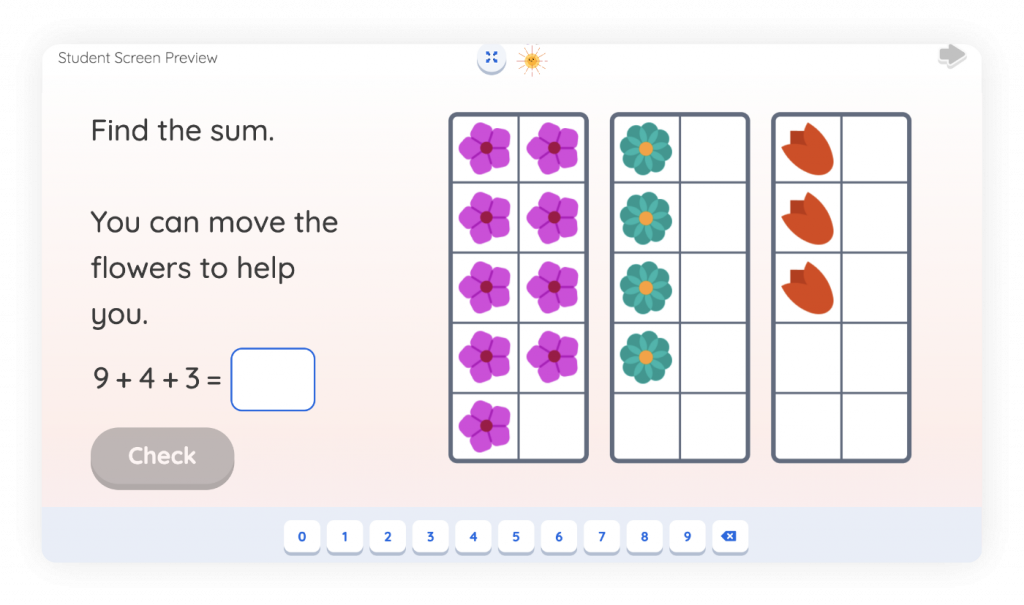
Personalized Learning accelerates student growth with daily, targeted 15-minute digital activities. Supported by a virtual tutor, students tackle individualized tasks linked to daily lessons, receiving just-in-time support to foster grade-level success.

Teacher-led, 15-minute Mini-Lessons can build grade-level proficiency by providing research-based, targeted intervention to small groups of students who need additional support.

Reinforce students’ understanding of concepts through collaborative, hands-on Centers (grades K–5). These student-led routines provide additional practice with vertical alignment across grade levels.
Fluency Practice uses spaced repetition, an evidence-based approach to promoting memory retention, to teach basic facts. The adaptive nature of the practice allows students to focus less and less on the facts they already know. We’ve partnered with Math for Love to iterate on the popular Multiplication by Heart to create Division by Heart and Addition and Subtraction by Heart I & II. These proven fluency decks—plus Skills Fluency for supporting procedural fluency practice—help students practice crucial skills independently.
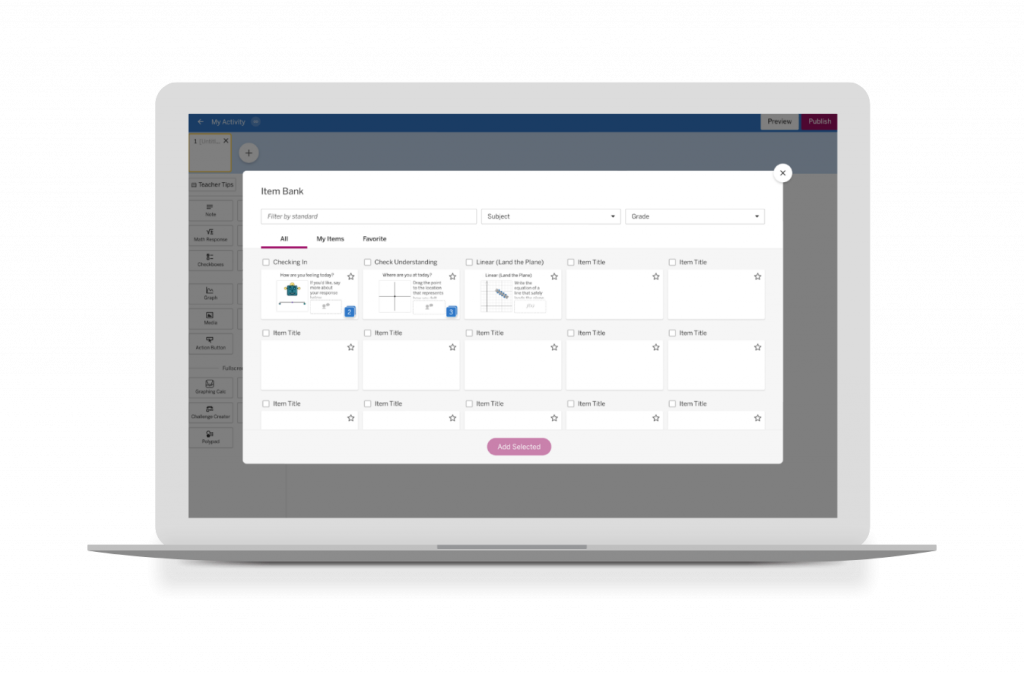
Item Banks provide space for teachers to create custom practice and assessments by using filters and searching for standards, summative-style items, and more.

All students should have access to fun and challenging problems. Extensions are 10- to 15-minute activities aligned to the most critical topics for the grade, providing flexible, low-lift activities for the whole class or targeted intervention to small groups of students ready for an extra challenge.
As part of Amplify Desmos Math, Amplify’s comprehensive math suite, mCLASS Math provides a strong foundation of actionable data to help teachers diagnose and capitalize on student strengths. Amplify Desmos Math ensures that you have all the core, intervention, and personalized instruction you need to support each stage of a student’s math journey.

In this episode, Eric Cross sits with K–5 educator Janis Lodge to chat about building on her own science curriculum to create meaningful project-based learning experiences. Janis shares her work teaching Gifted and Talented Education (GATE), and how to use those practices to help accelerate the learning of all students. Eric and Janis also talk about making time for science within K–5 classrooms. Explore more from Science Connections by visiting our main page.
Janis Lodge (00:00):
To me, the reward of having those kids feel like they accomplished something and the way that they can take ownership of it and go in so many different directions, I cannot take that away from them. That’s such an opportunity that if I have the means to do it, I have to just take it and run with it.
Eric Cross (00:18):
Welcome to Science Connections. I’m your host, Eric Cross. My guest today is Janis Lodge. Janis is a third-grade teacher in Orange County, California, with a specialization in gifted and talented education. Recently, Janis was awarded the Orange County Council for the Gifted and Talented Education Classroom grant. This grant funds a project that provides an extension to her third-grade science unit about environments and survival. Through this project, students will think like a biomimicry engineer as they design a robot that is inspired by an innovation found in nature. In this episode, we discuss how she uses interdisciplinary teaching practices to make time for science learning; why gifted and talented education strategies can benefit all students; and her process for creating a problem-based lesson that ultimately earned her a grant for her classroom. And now, please enjoy my conversation with Janis Lodge. One, welcome! Thanks for being here.
Janis Lodge (01:14):
Of course, I am happy to do it. I’m excited for the opportunity.
Eric Cross (01:17):
Of course! Yeah. Elementary school teachers in science, I feel like there’s so many things to have conversations about. And some of the things that you’ve really focused on, I think, are, really, really important. But I wanna start off with your journey of you becoming a teacher in the classroom. And so, would you kind of give your background, your origin story? How did you end up as a third-grade teacher?
Janis Lodge (01:37):
Well, my story is definitely not a traditional story. Before I was a teacher, I was actually living in Maui, Hawaii. I moved there right after college. I went to Chico State in Northern California. And I got a degree in graphic design. And after I graduated, well, I should give a little bit of a backstory. My last summer before graduating, I spent the whole summer in Maui and I just fell in love with it. So when I graduated, I decided instead of applying for jobs in Northern California, I’m just gonna put some resumes out in Maui and see if I can get a job. And I did. I ended up getting a job doing graphic design and marketing for a kite surf company out there. And I ended up just staying for seven years on the island. And after about seven years, I kind of got a little bit of island fever and decided I wanted to come back to California. I wasn’t sure exactly what I wanted to do, but I just had this calling that I need to do something a little more fulfilling with my life. And I started thinking about different ideas and dreams I had. And I actually started thinking about when I was younger, right? I had this dream. If you were to ask me when I was 10 years old what I wanted to be when I grow up, it would be elementary school teacher.
Eric Cross (02:48):
Really?
Janis Lodge (02:48):
Believe it or not. When I was younger, I transformed my bedroom into a classroom. My stuffed animals were my students. I just thought I’m gonna be the next best teacher ever. And you know, as I went through life and kind of went in different directions, I kind of lost sight of that dream a little bit. But for some reason, when I decided to change careers, I just remembered that. And so I just decided to go get my teaching credential and see if it worked out. And it was probably the best decision I made. I feel like everything just fell perfectly into place. I ended up getting a job at an amazing school, and now, five years later, I’m a third grade teacher.
Eric Cross (03:28):
So one of the questions I have to ask, and talking to elementary school teachers, this comes up a lot: How do you make time for science as an elementary school teacher who’s teaching everything? And let me kind of premise this with, at least for those of us in California, and I’m sure the rest of the states too, but we know this; There’s kind of this pressure with pacing and then even, depending on what school you’re at, math and English tend to get the bulk of things. And maybe there’s this perception also of like, well, I gotta teach math and English, and sometimes science gets put to the back burner for different reasons.
Janis Lodge (03:57):
Well, you’re exactly right. The beginning of the year, we were provided with a pacing from the district. And you know, they try to keep us on track, saying, “You should be starting Unit 2 at this time.” But other than that, there’s really no specific guidelines of how many days we’re supposed to be teaching or for how long. But one kind of secret that I’ve discovered is that I can weave science into the other subjects, specifically with language arts. So quite often what I do is I take a look at the language arts standard, and if it’s identifying the key details and the main idea, well I can do that with the science books used from the curriculum. So I’ll just pull those readers and we’ll do the exact same skill, start with the same standard, but we’ll use the content from science. By doing that, we call that kind of like interdisciplinary study. And the students really enjoy that more, too, because they’re using the same skills but they’re diving deeper into the content.
Eric Cross (04:54):
Right.
Janis Lodge (04:55):
And so also that helps build the background knowledge. So then when it comes to time where, if I want to do a science lab or a science investigation, now they already have that background knowledge ’cause we already dove deep into the reading and they can apply that pretty quickly right away into their lab or whatever activity they’re doing.
Eric Cross (05:12):
Can you give an example maybe of how you might pull out something that might be a skill that you’re trying to develop, maybe in an English content, but you would pull that out in a science lesson, maybe? What would you do?
Janis Lodge (05:25):
We’re actually doing that right now. So we’re in our second unit of science and they’re studying inheritance and traits and they’re looking at different organisms to see how they have adaptations to help them survive in their environment. So coincidentally part of the literacy skills is to look at multiple sources, do research, and summarize and make analysis of what they’re reading. And so we have different varied resources. I have websites; I have books, ebooks, videos, and pictures. And they’re choosing which four sources they want to use. And then, then they’re coming up with a summary at the end and then putting together a Google Slides presentation based on whatever organism that they chose.
Eric Cross (06:05):
Did you have a science background before becoming an elementary school teacher?
Janis Lodge (06:11):
Um, none. Besides what I, you know, took in high school and college.
Eric Cross (06:16):
Did you find it easy to kind of lean into the science, or was it something you just kind of jumped into and said, “All right, I’m gonna get after it”?
Janis Lodge (06:23):
What’s interesting is if, you know, throughout my education, my favorite subjects were English and reading and writing and art. And quite honestly, science wasn’t my favorite subject. But I think because of that, that inspires me to come up with creative ways of presenting the information to them and making it exciting and engaging for them, because I don’t want them to feel that way. I want them to be excited about all subjects. And I think that’s the beauty of combining the different subjects like I mentioned before. Like I say, you know, “What would a scholar do? Think like a wildlife biologist. And like with my project, think like a biomimicry engineer.” And so it kind of shifts their thinking. Like, it’s not just, “Oh, we have to study science.” It’s like, “No, you are the scientist; you are a meteorologist; or you are an author. How would an author write about this? How would an illustrator capture this in a photo or a comic strip?” And so, when you really combine those disciplines, you can take it to another level. So even if science isn’t their favorite subject, like maybe it wasn’t for me growing up, they can still take something they’re passionate about and apply the science content to it and they really resonate with them.
Eric Cross (07:37):
You leaned into your strengths. Which are more like, coming into it, you had all these kind of creative strengths. You have that background as a graphics designer. You were into the arts. But then with those strengths, did that kinda give you more confidence to dive into the science work, because you approached it from your assets that you were already coming to the table with?
Janis Lodge (07:55):
Yeah.You said it perfectly. If you look at it from a different lens, there’s all these different ways you can approach science.
Eric Cross (07:59):
I find it in my own science class, too. We’re all teaching the same standards. But how I approach it is through Eric Cross’s kind of personality and understanding and my angle, and another teacher might do it a different way. But we’re all leading to the same destination.
Janis Lodge (08:14):
Exactly.
Eric Cross (08:15):
That kind of leads me to my next question, and this is having to do with the project that you just alluded to. The biomimicry project. So you did a biomimicry project. Would you consider that like a project based-learning assignment?
Janis Lodge (08:26):
Well, this will be the third year that I’ve taught this unit. And when I wrapped it up last year, it’s through the Amplify Science program, and they do a wonderful job of having a lot of investigations and really thinking like a biomimicry engineer. But the final part of the unit was to design a robot inspired by a giraffe, to eliminate invasive plants in a particular environment. And the project part of it at the end was to create a model using Popsicle sticks and pipe cleaners. And then the other part of it was a digital simulation where they would put in different shape structures of teeth, and kind of reconfigure the shape of the mouth. And then they’d put in what they think is effective, and then the computer would say, oh, you’re 98% successful or 70% successful. And I remember at the end of it the students were like, “OK, well when do we make the robots?” And I thought, “Well, we’re just doing the simulation, or we’re just doing this model out of Popsicle sticks; we’re not actually gonna make a robot.” And they just seemed so disappointed. And that’s kind of how the wheels started turning my head like, “Well, what if they actually could make a robot? The only thing stopping me is I don’t have the materials to do it.” So, shortly after that unit wrapped up, coincidentally I saw the email about this grant opportunity that was being offered through the Orange County Council for Gifted Education. And they said, If you have a project that you wanna get funded that would promote GATE strategies within the classroom, then you can submit this proposal. So that’s how the ball got rolling for that proposal. And I researched different robotics kits and different companies and I found one that was really user-friendly for third graders, and not so difficult for me to learn as well.
Eric Cross (10:10):
You’re a risk taker. Like, I’m already seeing this as I’m talking to you. Is that just who you are or do you have a network? Like what keeps you taking these risks?
Janis Lodge (10:18):
I don’t really consider it a risk, because it’s exciting for me. Like I said, I don’t know that much about robotics, but the idea of learning more and then teaching that to my students is exciting. And you know, there was a little bit of risk ’cause I’m deviating a little bit from the curriculum, from the standard lesson, but to me, the reward of having those kids feel like they accomplished something, and the way that they can take ownership of it and go in so many different directions, and on top of that, develop coding skills and computer science skills and robotic skills, to me it was just like I cannot take that away from them. That’s such an opportunity that if I have the means to do it, I have to just take it and run with it. So I think just being inspired by the potential outcomes of what could happen is what made me take that risk.
Eric Cross (11:05):
Did you just kind of create this from scratch? Did you work with a team of people? How did you come to the point where you were ready to present this for the grant?
Janis Lodge (11:12):
Pretty much from scratch. Like I said, the Amplify unit, it does teach them about robotics that were inspired by nature. So some of the materials that they read, and there’s some videos that show really great examples. There’s like a robotic arm that was inspired by an elephant trunk. There’s a book that shows what this field is, biomimicry engineer, they actually show like what they do in that field. And I thought this is a perfect way to apply it because the curriculum’s already pretty much set it up for me; now I just have to add this one final component to it. And essentially it becomes project-based learning at that point, because they’re taking their knowledge and their skills that they’ve learned up to that point. Even the unit that we’re doing doing right now is building up to it. So it’s kind of that final—instead of giving them a test at the end and saying, “OK, tell me what you learned about inheritance and traits and environments,” they can actually take that knowledge and apply it to an innovation or creation that comes out of their own mind, which is so much more powerful.
Eric Cross (12:11):
Do they connect to any other learning goals as they’re doing these projects?
Janis Lodge (12:15):
Well, I think first and foremost, the 21st century skills that from day one I tell them, the four Cs: collaboration, creativity, communication, and critical thinking. All of those are woven in through this lesson. From the beginning, we talked about the whole engineering design process. So from the beginning, they start with a question and oftentimes that actually can be the hardest for them to think about, “What’s a scientific question or a problem that I wanna solve?” If they’re passionate about, maybe, a sport or the environment or something within their school, I go, “There it is. OK, that’s the problem. How can you design something inspired by nature to solve that problem?” And then, from there they go into the planning and the designing and the testing and then the improving. So going through that engineering design process, I think, is what really makes them feel like they are the engineer going through this. And they can make mistakes. They can take risks. A lot of my students I’ve found are afraid to take risks. They wanna make sure they succeed. And they need that challenge to know that if they do fail, that’s OK. We can just revisit this. We can test it. We can look at it in a different way.
Eric Cross (13:27):
You maybe wonder about, how do you assess something like this?
Janis Lodge (13:30):
I think that’s where all those stages along the way are important. Because I wanna make sure that they have a plan and that it’s based on the knowledge that they’ve gained in the unit. I think one of the other things about project-based learning is the final product of how they demonstrate their mastery. And in my classroom I oftentimes give them a choice of how they’re gonna present that to me. So maybe they’re going to write it out like an essay. Maybe they’re gonna create a Google slide. Maybe they’re gonna make a video. Maybe they’re going to—obviously in this part they will have the model, but they’ll have to have some way to explain it to me. And I think giving them that choice gives them the opportunity to show it in the way that’s meaningful to them.
Eric Cross (14:14):
And are you using like a rubric when you’re grading these assignments? Or, how do you actually grade it?
Janis Lodge (14:20):
Yes. So we have a rubric that’s provided to us for the written component that all the students will do at the end. But I can take that same rubric and see if they’ve applied that to the project. So even the verbiage wouldn’t really need to change. I think it’s still important that the students are able to demonstrate this in written form and so all of them will still complete that written component, but to also give them the opportunity to show that in the modality of their choice. I think is really important too.
Eric Cross (14:48):
Right. And you have some students that feel much more comfortable being able to present orally versus—
Janis Lodge (14:53):
Exactly.
Eric Cross (14:53):
—versus writing versus maybe doing a video. I mean, we see that in middle school and in high school too. Students show their knowledge or their understanding of a topic depending on the medium in different ways, and some better than others. Some may find that they can communicate it a lot better orally, but when pen goes to paper or fingers go to keyboard, you might grade it completely different, ’cause they’re not able to transfer what’s in their mind into writing. And the way you’re doing it, and giving that student choice, they probably have so much more buy-in, I’d imagine, because they get to pick what they get to do.
Janis Lodge (15:21):
Right.
Eric Cross (15:22):
You said something earlier and I wanna come back to it. So you mentioned GATE, and GATE is not something that I hear a lot in my world, but it was something I heard a lot when I was in school. There were kind of all of these perceptions and ideas about GATE. You’re a GATE teacher, correct?
Janis Lodge (15:38):
Right.
Eric Cross (15:39):
What is GATE, and what is it like being a GATE teacher? What are the misconceptions, if any, that you might have heard or come across?
Janis Lodge (15:46):
Well, so GATE stands for Gifted and Talented Education. And first and foremost, I think a misconception is that we’re just kind of doing whatever we want; we come up with our own lessons and teach a totally different curriculum. Which is definitely a myth. Because we start with the exact same standards as any other third grade class that you’d walk into. That’s definitely where we start. But I think in addition to the standards, we also implement what are called GATE standards: So they’re Depth, Complexity, Acceleration, and Novelty. And there’s a lot of tools that we use in the classroom, different strategies. You’ll see things like the prompts of Depth and Complexity. We’ll use things like “think like a disciplinarian”; I’m doing “think like a biomimicry engineer.” But really, all they are are just thinking tools and strategies to elevate students thinking and kind of go below that surface level of the content to dive deeper. It also provides opportunities for acceleration. So for example, our last science unit, it was on magnetic force, and there was a handful of students that just grasped the concepts right away, and they’re ready for something else. They’re ready for more rigor. They need some challenge. And so at that point I can kind of pull that group aside and provide some differentiation for them. And I said, “OK, well, you understand the concept of magnetic force, balanced forces. So now what I want you to do is think about something that you’re really passionate about, and how could you use magnetic force somewhere in that field—again to solve a problem, problem-based learning—and present it to me?” So they create this form, it’s like a “think like a disciplinarian” frame, and one of them was “think like a hockey player.” And he’s trying to think of a way that he can incorporate magnetic force. Anyway, I could go on and on. But basically it’s finding what these students’ passions are. And I do that with all my students. And I should probably preface this by saying that even though these are standards that I implement in my classroom because it’s a GATE classroom, these are practices and tools that can be applied to any learner, at any age. And they really just enrich the education for all students.
Eric Cross (18:02):
So your classroom is, is a mixed classroom. There’s GATE students and then general—
Janis Lodge (18:05):
Right.
Eric Cross (18:07):
—students, non-GATE students, in the same class. It’s interesting because I imagine GATE is kind of scaffolding up to a higher level, but then, you also said something that I’ve noticed when I’m creating scaffolds for my students to support them, who may not be at a grade level, maybe in reading or literacy or math, those same scaffolds can help all students.
Janis Lodge (18:27):
So yeah, I don’t just go, “OK, you’re my GATE students; I’m gonna use these practices on you.” I use it for the whole class. But I’m also surprised by having that mix of these different learning styles. A lot of times students are inspired by other students, or, you know, we have this big thing about one of the prompts is Multiple Perspectives. I try to do that as much as I can, because students are inspired by the ideas of their peers. And quite often, if they hear it from a peer, it could be exactly what I just said, but they heard their student say it in a different way and it just clicks and they’re like, “Wow, I get that.”
Eric Cross (19:00):
I think a lot of teachers struggle or, or maybe feel ill-equipped, to support higher-level students. Did you get trained to be a GATE teacher? First lemme ask that question: Did you get special training for this?
Janis Lodge (19:13):
Yes. I went through a course, I think it was like a six-week certification course, through my district.
Eric Cross (19:19):
OK, so you got a special training, which—I’ve been in the classroom for nine years; I teach at a university as an adjunct professor; but I’ve never been trained on teaching gifted or accelerated students. And I’m kind of wondering now, like, do you feel like it made you a better teacher?
Janis Lodge (19:33):
Absolutely.
Eric Cross (19:34):
And if so, how do I get to do this?
Janis Lodge (19:36):
Well, it’s through the county. I mean, anybody can get trained and certified how to teach this way. But, just like you said, I think coming out of that, my eyes were just open, and my biggest takeaway is that these practices, even though they are designed for gifted and talented, it really kind of reshaped my thinking about how I, number one, present material to the students, that I’m doing it in an engaging way, and I’m not just lecturing at them; there’s opportunities for them to collaborate and communicate and use multiple resources. So, you know, how I’m teaching has changed. And then also, how I’m providing opportunities for them to demonstrate their learning. And a lot of that is project-based learning, because once they have the knowledge and skills they need to do something with it. I mean, that’s really the true definition of innovation, is taking the skills or taking something that you’ve learned, and now go with it. Run with it.
Eric Cross (20:32):
How can we take what you’ve learned and then kind of spread it, so teachers have this in their toolkit, too? Like for me, I have multiple ways to be able to support reading and literacy and math and tools and sentence frames. And my students who have special learning plans, I have a have a lot of tool sets for that. I wanna build my tool sets for this other area for my students who want to continue, who wanna run, or go beyond, or even stretch themselves. I think we need to take some of the things that you’re doing and not make them kind of like this exclusive group, but also let’s share it with everyone, ’cause if everybody can access it—
Janis Lodge (21:03):
I agree.
Eric Cross (21:03):
—we might see a lot more potential or a lot more opportunities for students who might not otherwise have them.
Janis Lodge (21:08):
And one thing: My school, I’m really proud to say that my principal has seen that. You know, he’s like, “Well why are we just keeping this in the GATE classroom?” So he’s working on getting all of our teachers certified.
Eric Cross (21:19):
No, I love what you’re doing and your principal sounds, sounds awesome for doing that and recognizing that this can benefit more students than just the ones who, you know, pass the Raisin Test, I think it’s what it was called when I was taking it, or whatever it is back then.
Janis Lodge (21:31):
Exactly.
Eric Cross (21:32):
We’ve talked about project-based learning, the GATE classroom…I kind of wanna come back to you as we wrap up. Thinking about, like, the jobs that you and I do, and the people that listen to this podcast, we have one of the few jobs that people remember us for a lifetime. And I wanna ask you, who was someone that was maybe inspirational in your educational career, that inspired you, or is maybe one of the most memorable? You might have several…but who is someone that was memorable to you in your career, and why? Why were they memorable to you?
Janis Lodge (22:02):
Yeah. Well, obviously, when I was younger, I was definitely inspired by all my teachers. The fact that I turned my bedroom into a classroom…I just was just in awe of this profession. But I think one that really resonated with me was my junior year in high school. I was taking a newspaper class and the teacher was Mrs. Kavanaugh, and she really taught us everything from writing the articles to the editing, to putting the pages together. And I remember in that class I was working on this program called QuarkXPress. I don’t even know if it exists anymore. But I was just fascinated with putting all these pieces together that we’d worked on for so long and getting the articles, picking the pictures, the illustrations and the titles. And I remember her looking at me saying, “You really enjoy this, don’t you?” And I said, “Yeah.” And she said, “Well, I have a computer graphics elective class that you should take next year.” And I thought, “OK, I’d love to do this, this opportunity to expand my knowledge and my skills.” So because of that, I took the computer graphics class the next year and I just remember throughout the whole time, she was just constantly encouraging me and acknowledging my skills. And I find myself doing that as a teacher as well. ‘Cause that really resonated with me. And it’s funny, this summer I was going through some boxes of some old stuff from high school, and I found this handout that I had made, because I remember my senior year of high school, she said, “Janis, you know what? You’re doing such a great job; we have these new, incoming students coming into the newspaper class, and I’d love for you to actually teach them how to do this pagination on this QuarkXPress program. I want you to put something together and actually teach it to them.” I thought, “Wow, she believes in me that much that she’s gonna let me teach this to the incoming students.” But I think my takeaway from that was that she gave me the opportunity to take those skills and actually do something with them, to apply them right away.
Eric Cross (23:53):
Mrs. Kavanaugh. Miss Kavanaugh. Shout-out to Miss Kavanaugh. As you told that story, I heard you as a teacher because I’m hearing she’s applying these GATE strategies in that situation. That’s what that’s what I heard.
Janis Lodge (24:08):
Yeah, absolutely.
Eric Cross (24:09):
She personalized this learning. She created a specialized opportunity. You presented to a real audience that was authentic. It had this personalization in it and this rigor and this challenge and it made a huge impact. And it’s just amazing to listen to you and hear this come full-circle, and now you’re doing this with little ones. And I just wanna thank you for your time in doing the interview, sharing your story with how you became a teacher, your students, the projects that you do. And just like so many teachers, going the extra mile for your kids and bringing in these really important 21st century skills; they’re gonna be so much better off for it. And I know it makes my job easier when I get them in the classroom, so thank you.
Janis Lodge (24:49):
Yeah. Well, thank you for the opportunity.
Eric Cross (24:51):
My pleasure. Thanks so much for listening and we wanna hear more about you and the educators who inspire you. You can nominate them as a future guest on Science Connections by emailing STEM@amplify.com. That’s S -T-E-M at amplify dot com. And be sure to click subscribe, wherever you listen to podcasts, and join our Facebook group, Science Connections: The Community. Until next time.
Join our community and get new episodes every other Wednesday!
We’ll also share new and exciting free resources for your classroom every month!
Janis Lodge is a third grade teacher in Orange County, California. Her career in education started six years ago when she decided to follow her passion of making a positive difference in the lives of young scholars. Prior to teaching, Janis lived in Maui, Hawaii for seven years, working in the field of graphic design, marketing, and hospitality. She has found that her interest in innovation, project-based learning, and inquiry-driven exploration has helped shape her into the educator she is today. STEAM is integrated regularly into her classroom, and her students continually develop 21st century skills through a variety of unique projects. Janis is also a PAL (Peer Assistance Leadership) Advisor for her school, where she helps young leaders (4th-6th graders) cultivate their leadership skills and empowers them to make a positive difference in their school and community. Janis was recently awarded the Orange County Council for the Gifted & Talented Education Classroom Grant, which will provide an extension to the third grade Amplify Science Unit: Environments and Survival.

Welcome to Science Connections! Science is changing before our eyes, now more than ever. So…how do we help kids figure that out? We will bring on educators, scientists, and more to discuss the importance of high-quality science instruction. In this episode, hear from our host Eric Cross about his work engaging students as a K-8 science teacher. Listen here!

Fluency in math can oftentimes be associated with negative experiences with its development— timed worksheets, for example. Bethany and Dan are joined by three guests to better understand fluency and how to make its approach fun. Dr. Val Henry shares her three-part definition of fluency and her five principles for developing it. Additionally, Tracy Zager and Graham Fletcher join Bethany and Dan to better understand fluency through a lens of equity and using multimedia as a tool.
Explore more from Math Teacher Lounge by visiting our main page.
Dan Meyer (00:03)
Hey folks. Welcome back. This is Math Teacher Lounge, and I am one of your hosts, Dan Meyer.
Bethany Lockhart Johnson (00:07):
And I’m your other host, Bethany Lockhart Johnson. Hi, Dan.
Dan Meyer (00:11):
Hey, great to see you. We have a big one this week to chat about and some fantastic guests. We are chatting about fluency, which is the sort of word and concept that I feel like people have very, very non-neutral associations with it. A lot of them are very negative, for a lot of people.
Bethany Lockhart Johnson (00:26):
I saw you frown a little. What’s up with that, Dan? You kind of, like, shrank.
Dan Meyer (00:30):
I have strong feelings about it. You know, there’s lots of ways that people go about helping people become fluent in mathematics. And a lot of them are harmful for students, and ineffective. And it got me thinking about fluency as it exists outside of the world of mathematics, where we have a lot of very clear images of it. We’re getting fluent in things all the time. Like, as humans. Human development is the story of fluency. And I just was wondering….Bethany, would you describe yourself as fluent at something outside of the world of mathematics? What is that? How’d you get fluent at it? What was the process?
Bethany Lockhart Johnson (01:05):
Hmm, I think I’m a pretty fluent reader. I read all the time. I’m a happier person if I’ve read that day. I once saw this poster in a classroom; it said “10 Ways to Become a Better Reader: Read, Read, Read, Read, Read…you know, 10 times. Get it? Reading? You get better at reading by reading! So I would say reading. And it’s been kind of cool—I have a one-year-old who, it’s been really exciting slash overwhelmingly anxiety-producing to see him get very fluent with walking slash running, ’cause he’s getting faster every day. And it’s kind of fun. When I think of what’s something somebody’s trying to get fluent with…walking! He’s trying to be more fluid. He’s practicing transitions. He doesn’t wanna hold my hand while he traverses rocky terrain. He’s getting better at it. He’s practicing. What about you? What’s something…?
Dan Meyer (02:08):
I think about driving a lot. I’m a very fluent driver and I think a lot about when I was first a driver, you know? And how l have my hands on 10 and 2, vice grip, and do not talk to me; do not ask me anything; don’t ask me my NAME. I need to focus so hard. And then a year later, you know, I’m driving with one hand, smash the turn signal, take a sip off of whatever, change the CD. And then it’s no big deal.
Bethany Lockhart Johnson (02:38):
Wait, did you pass the first time? Your test?
Dan Meyer (02:40):
Yeah, I don’t like to brag about it. <laugh> But I do all the time. <laugh> But I got a hundred on my driving test. I don’t care who knows it. And I hope it’s everybody. But I guess all of this is just to say there are areas of life where fluency feels natural, with the case of walking. There’s areas of life where fluency feels motivating, with like driving—I wanna be able to switch the CD out or whatever. And there’s areas where fluency feels terrifying and hard to come by, like mathematics, sometimes. So we have a set of guests here. Our first guest will help us figure out what do we mean by fluency? And what’s the research say about what fluency is and how students develop it in mathematics? And then our other guests will help us think about what it looks like in practice in the classroom. What are some novel, new ways to work on fluency? So first up we have Val Henry, Dr. Val Henry.
Bethany Lockhart Johnson (03:32):
So we knew we needed help with the fluency definition, because when we think about it, it’s kind of big, right? And we wanted to look at what research about fluency really says. So we called on Valerie Henry. Val is a nationally board-certified teacher, taught middle school for 17 years, and since 2002 has worked with undergraduates graduates, credential candidates as a lecturer at the University of California, Irvine, one of my alma maters. So after doing her dissertation on addition and subtraction fluency in first grade, Val created a project to study ways to build addition and subtraction and multiplication and division fluency while also developing number sense in algebraic thinking. And the pilot grew and grew over the last 18 years into a powerful daily mini-lesson approach to facts fluency called FactsWise. And when we thought of fluency, the first person I thought of was Val. Welcome, Val Henry, to the Lounge! I’m so excited to have you here. Welcome.
Valerie Henry (04:36):
Thanks, Bethany. And thanks to you, Dan. It’s great to be here today.
Dan Meyer (04:41):
Great to have you; help yourself to whatever you find in the fridge. The names that people write down on those things in the bags are just recommendations. It’s potluck-style here. I’m curious, Val, if you’re, like, on an airplane, someone asks you what you do, and you say you study fluency…what is the layperson’s definition of what does it mean to be fluent in mathematics? And if you can give a brief tour through what the research says about what works and what doesn’t that would really help us orient our conversation here.
Valerie Henry (05:12):
The first thing I have to do when I talk to somebody on a plane is define the idea of fluency. And I often use an example of tying your shoelaces. Because that works with first graders as well as adults. This idea that when we first start trying to put our shoes on and get those shoelaces tied, somebody tries to, first of all, just do it for us. But then of course maybe tries to teach us the bunny-ears approach. And we struggle and struggle as little kids and eventually either the bunny-ears approach or something else starts to work for us. But we still have to pay attention to it. We have to think hard and it’s not easy. And then over time we get to the point where we basically don’t even think about it. When I tie my shoes in the morning. I’m not thinking about right-over-left and left-over-right and all of those things. I just do it. And so that’s a good, easy example of becoming fluent with something. I think what we’re talking about today though, is the basics, the adding and subtracting that we hope kids are going to have mastered maybe by second grade, and the multiplication and division facts that we wanna maybe have mastered by third, maybe fourth grade. So now what does that mean to become fluent with those basics? I have a three-part definition that seems to match up really nicely with the common core approach to fluency. Which is, first of all, we want the answers to be correct. And then second, we want the answers to be easy to know. And so what does that mean? Well, to me, it means without needing to count,
Bethany Lockhart Johnson (07:12):
You mean without having to kind of muscle through it? Or say more about you mean.
Valerie Henry (07:16):
Well, I guess what I mean is that when you watch a young child try and solve something even as simple as two plus three, they might put up two fingers and then go 3, 4, 5 with three more fingers winding up on their hand, one or the other of their hands. While they’re doing that, they don’t really have a sense of whether even their answer is right or not, quite often. Especially when you get to the larger adding and subtracting problems, you can see a lot of errors happening as they’re trying to count. And it’s taking up cognitive energy to do that counting process, especially as you get to the larger quantities. So my definition of fluency now is “getting it right without needing to do that hard work like counting.” Now, some people might say, well, we just want them to have ’em memorized. But in my research, I’ve learned that a lot of very fluid adults don’t always have every fact memorized. In fact, if you ask a room full of adults, what’s seven plus nine, you might learn that they can all get it correct quickly, quickly…but they don’t all have it memorized. And so when you ask them, “How did you get that?” Many of them will say, “Well, I just gave one from the 7 to the 9 and I know that 10 plus 6 is 16.”
Bethany Lockhart Johnson (08:53):
That’s such an important distinction. My brain literally just did that actually!
Valerie Henry (08:58):
<laugh> Right? <laugh> But you’re fluid with it, because it doesn’t take you much cognitive energy at all.
Bethany Lockhart Johnson (09:05):
Right.
Valerie Henry (09:07):
So now we have “correct without needing to put that cognitive energy,” which usually means that you’re counting. And then the third thing is “relatively quickly,” so that you’re not spending 15 seconds trying to figure it out. Even that part-whole strategy approach can be done really quickly, almost instantaneously. Or it can take a long time. So if a student can get the answer correct within, you know, three or four seconds— is I’m pretty generous—I figure that they’re pretty darn fluent with that fact. So that’s my three-part definition of these basics, fluency.
Dan Meyer (09:55):
I love the distinction between getting it correct and getting it quick. It’s possible to be quick with wrong answers. It’s possible to be like, “Those are separate components there.” And I echo Bethany’s appreciation for this third option in between knowing it instantaneously through memorization and muscling through it. But there’s like a continuum there of how much energy it took you to come up with it that all feels extremely helpful.
Valerie Henry (10:21):
And you know, one of the things that I’ve noticed is that when kids are pressured to come up with those instantaneous answers, they often default to guessing and get it wrong.
Bethany Lockhart Johnson (10:30):
Mm, yeah.
Valerie Henry (10:30):
So that’s one of the things that I’ve learned is that as we’re trying to help students develop fluency, it’s important to start with building their conceptual understanding of what it means to do, you know, 3 times 9 and what the correct answer is, maybe using manipulatives or representations of some sort. Not skip-counting! I really have found that skip-counting just perpetuates itself in many students’ minds and that they never stop skip-counting, which means they’re putting in not very much mental energy if it’s 2 times 3 but a ton of mental energy if it’s 7 times 8. Because frankly, it’s really hard to skip count by sevens. And by eights.
Bethany Lockhart Johnson (11:18):
I can get to 14 and then I’m like, wait, wait, what was next? Right? No, no, no…21! What do you feel are some misconceptions that maybe teachers, maybe parents have about fluency in math?
Valerie Henry (11:30):
I think maybe one of the first ones is that if students count or skip-count, their answers repetitively over and over and over and over, that they’re bound to memorize them. And the study that I did back in 2004, I actually had a school that had decided that they were going to do time tests with their students every day, all year. And that undoubtedly by the end of the year, those students would be fluent.
Bethany Lockhart Johnson (12:06):
And to clarify by time test, you mean like, sit down, pencil, paper, ready, go, worksheet kind of thing.
Valerie Henry (12:15):
Yes.
Bethany Lockhart Johnson (12:16):
Some of us might remember quite vividly.
Valerie Henry (12:18):
<laugh> Very vividly. And you know, you have to get it done within a certain amount of time. So they made it fun for the students. Apparently the students enjoyed it. I was a little leery about that, but in the end, when I went and checked on the students and I did one-on-one assessments with half of the students in every class that were randomly selected so that I could get a sense of where they were with their fluency—and these were first graders—they basically had nothing memorized. They were simply counting as fast as they possibly could. And, you know, mostly getting the right answers. But they had not memorized. So that’s one of the myths, I think, is that repetitive practice of counting gets you to memorization.
Bethany Lockhart Johnson (13:10):
If I put it in front of you enough times, you’ll become fluent.
Valerie Henry (13:14):
Right, right. Now these students didn’t really get any instruction, any help learning these. They just simply tested over and over and over. So that’s another thing that I think is a misconception. It’s that if we test students, but don’t really teach them fluency, then they’re going to become fluent. If we just test them every Friday or that kind of thing. And that they’ll learn them at home. But really what that means is a few lucky kids who have parents who have the time and the energy and the background to know how to help will take that job on at home. Not that many students are really that fortunate.
Dan Meyer (14:01):
It’s almost like the traditional approach, or the approach you’re describing, confuses process and product. It says, “Well, the product is that eventually fluent students will be able to do something like this, see these problems and answer them, answer them quickly,” and says, “Well, that must be the process then as well; let’s give them that products a whole lot.” But as I hear you describe fluency with bunny ears on shoelaces, there’s these images and approaches and techniques that require a very active teacher presence to support the development of it. That’s just kind of interesting to me.
Valerie Henry (14:35):
My initial project, the pilot project that I tried, was to simply ask teachers to follow five key principles. And the first one was to do something in the classroom every day for—I told them, even if you’ve only got five or 10 minutes, work on fluency for five or 10 minutes a day, and let’s see what happens. So that was one key element was just to teach it and to give students opportunities to get what the research calls for when you’re trying to memorize, which is actually immediate feedback. When I talk about immediate feedback with my student teachers, I say, “I’m talking about within one or two seconds of trying a problem, and then sort of immediately knowing, getting feedback of whether you got the answer right or not so that your brain can kind of gain that confidence. ‘Oh, not only did I come up with an answer, but somebody’s telling me it’s the correct answer.’”
Dan Meyer (15:38):
There’s a lot of apps now in the digital world that offer students questions about arithmetic or other kinds of mathematical concepts and give immediate feedback of a sort: the feedback of “You’re right; you’re wrong” sort. Is that effective fluency development, in your view?
Valerie Henry (15:57):
I haven’t heard and I haven’t seen them being super-effective. The ways I think about this are “Immediate feedback isn’t the only thing we need.” Probably one of the biggest things that we need is for students to develop strategies. And this is one of the other things I’ve learned from international research, from countries that do have students who become very fluent very early, is that they don’t shoot straight for memorization, but they go through this process of taking students from doing some counting and then quickly moving them to trying to use logic. So, “Hey, you really are confident that 2 + 2 is 4; so now let’s use that to think about 2 + 3.” Actually, as an algebra teacher, I would much rather have students that have a combination of memorization and these strategies, than students who’ve only memorized. Isn’t that interesting that my most successful algebra students were good strategy thinkers. Not just good memorizers.
Bethany Lockhart Johnson (17:09):
So you mentioned there were five that kind of helped root this idea in like, “What can teachers do? What is the best thing that teachers can do to support with fact fluency?” So, everyday was key.
Valerie Henry (17:22):
Then the next principle that I really focus on is switching immediately to the connected subtractions so that students—
Bethany Lockhart Johnson (17:33):
Not waiting until you’ve gotten all the way through addition. But making “Ooh!”
Valerie Henry (17:38):
Totally. And I didn’t do that the first year. And when we looked at the results of the assessments at the end of the year, we realized that our students were so much weaker in subtraction than addition. So the following pilot year, we tried this other approach of doing subtraction right after the students had developed some fluency with that small chunk of addition. And we got such better subtraction results.
Bethany Lockhart Johnson (18:11):
What are the other principles?
Valerie Henry (18:13):
The biggest one is to use these strategies. So the strategies makes the third. And then the fourth I would say is to go from concrete to representational to abstract.
Bethany Lockhart Johnson (18:27):
Don’t put away those manipulatives. Don’t put away those tools.
Valerie Henry (18:31):
Oh, so important to come back to them for multiplication and division. And my fifth principle is to wait on assessment. To use it as true assessment, but not race to start testing before students have had a chance to go through this three-phase process. Which is conceptual understanding with manipulatives; building strategies, usually with representations; and then working on building some speed until it’s just that natural fluency.
Bethany Lockhart Johnson (19:07):
I wanna say thank you so much for offering your really learned perspective, because you have not only done the research, but seen it in action and seen how shifting our notions of fluency and what fluency can be and what a powerful foundation it can be for all mathematicians. Really, that shift is so powerful. And I appreciate you sharing it with our listeners and with us. So we’re so excited that we got to talk with you today, Val—
Dan Meyer (19:35):
Thank you, Dr. Henry.
Valerie Henry (19:37):
You’re welcome!
Dan Meyer (19:41):
With us now we have Graham Fletcher and Tracy Zager, a couple of people who understand fluency at a very deep and classroom level. I wanna introduce them and get their perspective on what we’re trying to solve here with fluency. So Graham Fletcher has served in education in a lot of different roles: as a classroom teacher, math coach, math specialist, and he’s continually seeking new and innovative ways to support students and teachers in their development of conceptual understanding in elementary math. He’s the author, along with Tracy, of Building Fact Fluency, a fluency kit we’ll talk about, and openly shares so much of his wisdom and resources at gfletchy.com. Tracy Johnson Zager is a district math coach who loves to get teachers hooked on listening to kids’ mathematical ideas. She is a co-author of this toolkit, Building Fact Fluency, and the author of Becoming the Math Teacher You Wish You’d Had: Ideas and Strategies from Vibrant Classrooms. Tracy also edits professional books for teachers at Stenhouse Publishers, including, yours truly. Thank you for all that insight, Tracy, and support on the book.
Bethany Lockhart Johnson (20:49):
Dan and I were talking at the beginning of the episode about things we feel like, “Hey, I’m fluent in that. I’m fluent in that.”
Dan Meyer (20:55):
Just very curious: What’s something you would like to get fluent in outside of the world of mathematics, let’s say?
Tracy Zager (21:00):
I’ll say understanding the teenage brain, as the parent of a 13-year-old and 15-year-old. That’s the main thing I’m working on becoming fluent in!
Bethany Lockhart Johnson (21:10):
Ooh!
Dan Meyer (21:13):
A language fluency, perhaps. All right, Graham. How about you?
Graham Fletcher (21:16):
For me typing, it’s always been an Achilles heel of mine. So voice-to-text has been my friend. But it’s also been my nemesis in much of my texting here and working virtually over the last couple years. So yeah, typing.
Dan Meyer (21:33):
Do you folks have some way of helping us understand the difference in how fluency is handled by instructors and by learners?
Tracy Zager (21:40):
I would say that the lay meaning of fluency is definitely a little different than what we mean in the math education realm. When we’re talking about math fact fluency, which is just one type of fluency. So you gotta think about procedural fluency and computational fluency; there are lots of types of fluency in math. And Graham and I had the luxury of really focusing in specifically on math fact fluency. We’re looking at kind of a subset of the procedural fluency. So the words you hear in all the citations are accurate, efficient, and flexible. There’s this combination of kids get the right answer in a reasonable amount of time and with a reasonable amount of work and they can match their strategy or their approach to the situation. That’s where that flexibility comes in. And there’s like lots more I wanna say about that about sort of…I think one issue that comes up around fluency is that people are in a little bit of a rush. So they tend to think of the fluency as this automaticity or recall of known facts without having to think about it. And that is part of the end goal, but that’s not the journey to fluency. So this is one of the things that Graham and I thought about a lot was the path to fluency. The goal here it’s that student in middle school who’s learning something new doesn’t have to expend any effort to gather that fact. And they might do it because they’ve done it so many different ways that they’ve got it, and now they just know it, or they might be like my friend who’s a mathematician who still, if you say, “Six times 8,” she thinks in her head, “Twelve, 24, 48…” and she does this double-double-double associative property strategy. And it’s so efficient, you would never know. And that’s totally great. That’s fine. That’s not slowing her down. That’s not providing a drag in the middle of a more complex problem or new learning. So we’re really focused on having elementary school students be able to enter the middle and high school standards without having that pull out of the new thinking.
Graham Fletcher (23:53):
And as I think about that, I think about how so many students will memorize their facts, but then they haven’t memorized them with understanding. So that when they move into middle school and they move into high school, it’s almost like new knowledge and new understanding that’s applied from a stand-alone skill.
Bethany Lockhart Johnson (24:10):
So something that felt really unique to me, Graham, as I was diving into the toolkit, is your use of images, Tracy, Graham, is the way that you use images to help students notice and wonder to start making sense of these quantities and the decomposition of numbers using images. Can you talk a little bit about how images played a part in the way that you think about this building a fact fluency?
Graham Fletcher (24:41):
What I realized is so many times when we approach math with just naked numbers with so many of our elementary students, the numbers aren’t visible. The quantities. They can’t see them; they can’t move them. They’re just those squiggly figures that we were talking about earlier on. So how is it that we make the quantities visible, to where students feel as if they can grab an apple and move it around? Because a lot of times we start with the naked numbers and then if kids don’t get the naked numbers, then we kind of backfill it. But what would happen if we start with the images? And then from there, these rich, flourishing mathematical conversations develop from the images. And I think that was the premise and the goal of the toolkit.
Tracy Zager (25:22):
When you look at how fact fluency has traditionally been taught, it’s all naked numbers. And sometimes we wrote ’em sideways. Like, that’s it. That was our variety of task type. Right? Sometimes it’s vertical; sometimes it’s horizontal. And that was it. And I’ve just known way too many kids who couldn’t find a hook to hang their hat on with that. It didn’t connect to anything. And so part of why I knew Graham was the perfect person for this project was his strength in multimedia photography, art, video. And so we started from this idea of contexts that for each lesson string in the toolkit, there’s some kind of context. An everyday object, arranged in some kind of a way that reveals mathematical structure and invites students to notice the properties. So we start with images of everyday objects: tennis balls, paint pots…um, help me out; here are a million of them. Crayons—
Bethany Lockhart Johnson (26:18):
Crayons, markers.
Tracy Zager (26:18):
Shoes, right? Sushi, origami paper, all kinds of things in the different toolkits. So there’s a series of images or a three-act task or both around those everyday objects, and then story problems grounded in that context. And then there are images with mathematical tools that bring out different ideas, but relate in some way to the image talks. And we do all of that before we get to the naked number talk. Which we do, and by the time you get to the number talk, it’s pretty quick, ’cause they’ve been reasoning about cups of lemonade. And now when you give them the actual numerals, they’re all over it.
Bethany Lockhart Johnson (27:03):
I have to say too, as somebody who—particularly in middle school—navigated math anxiety, we recently talked with Allison Hintz and Anthony Smith about their amazing book Mathematizing Children’s Literature.
Tracy Zager (27:14):
Yay!
Bethany Lockhart Johnson (27:14):
And I was explaining, like, if I sat down at the beginning of a math class and my teacher opened a picture book and said, “We’re gonna start here,” I felt my whole body relax. And if we start with this image, if we start with just looking at an image and making sense of an image, I feel like that could be such a powerful touchstone for all the work you do from there.
Tracy Zager (27:41):
That’s core. That’s a core design principle, is that invitational access. There are no barriers to entry. There’s nothing to decode. There’s nothing formal. We’ve been learning from Dan for years about this, right? Of starting with the informal and then eventually layering in the formal. I was in a class in Maine where they were doing an image talk and it’s these boxes of pencils. It’s a stack of boxes of pencils and they’re open and you can see there are 10 pencils in each box. And so there are five boxes of pencils each with 10 pencils in it. And then the next image is 10 boxes of pencils and each box is half full. So now it’s 10 boxes each with five. And the kids are talking and talking and then the third image, I think there are seven boxes each with 10 pencils in it. And she said, “What do you think the next picture’s gonna be?” And this girl said, “You just never know with these people!” <laugh> I dunno!”
Bethany Lockhart Johnson (28:37):
That’s kinda true. Knowing you both, it’s kinda true.
Tracy Zager (28:42):
Like if it’s seven boxes with 10 in it, one kid said, I think it’s gonna be 14 boxes of five. And other kids are like, I think it’s gonna be 10 boxes with seven. And they start talking about which of those there are and the relationships between—
Bethany Lockhart Johnson (28:58):
But they’re making sense of numbers!
Tracy Zager (28:59):
Totally. So all the kids felt invited. They can offer something up. They’re noticing and wondering about that image. They’re talking about it in whatever informal language or home language that they speak. And that was core to us. That was a huge priority, because honestly, one of the motivations to talk about fluency is that it’s always been this gatekeeper. It has served to keep kids out of meaningful math. Particularly kids from marginalized or historically excluded communities. So they’re back at the round table, doing Mad Minutes, while the more advantaged kids are getting to do rich problem solving. And so, we thought, what if we could teach fact fluency through rich problem solving that everybody could access? That was like square one for us.
Bethany Lockhart Johnson (29:45):
That’s huge.
Dan Meyer (29:46):
That’s great to hear. What’s been helpful for me is to understand that students who are automatic, that’s just kind of what’s on the surface of things. And that below that might be some really robust kind of foundation or scaffolding that bleeds to a larger building being built, or it might be just really rickety and not offer a sturdy place to build farther up. It’s been really exciting to hear that. I wonder if you’d comment for a moment about, in the digital age and—I’m at Desmos and our sponsors are Amplify and we all work in the digital world quite a bit. There are a lot of what report to be solutions to the fluency issue, to developing fluency in the digital world. Just lots and lots of them. Some that are quite well used, others that are just like X, Y, or Z app on the market. You can find something. Do you have perspectives on these kinds of digital fluency building apps? Like, what about them works or doesn’t work? Let us know. Graham, how about you? And then Tracy, I’d love to hear your thoughts too.
Graham Fletcher (30:47):
Yeah, I think that’s a great question, ’cause there’s a lot of shiny bells and whistles out there right now that can really excite a lot of teachers. But I always come back to what works for me as a classroom teacher is probably gonna work in a digital world as well. So what are the things that I love and honor most about being in front of students, and how can I capture that in that virtual world? I think one of the things that really helps students make connections is coherence. I think coherence, especially when you leave students for—you don’t get to talk with them after the lesson is done—so I think about how we can purposefully sequence things through a day-to-day basis. I think coherence is something that gets really lost when we talk about fluency, especially with whether it be digital or whether it be print, because what ends up happening is we say, “OK, we have all these strategies we need to teach,” and it becomes a checklist. So how is it that we can just provide students the opportunity to play around in a space, whether it be digital or in person, but in a meaningful way that allows them the time and the space and that area to breathe and think, but be coherent. And connecting those lessons along the way. And I think coherence is one thing that a lot of the times it’s harder to—when we’re in the weeds, it’s so hard and difficult to zoom back out and say, “Do all these lessons connect? How do they intentionally connect? And how do they purposefully connect?” And without coherence, everything’s kind of broken down into that granular level. So when looking at—I think about Desmos and I think about the Toolkit and I think about how Tracy and I talked a lot about, “Well, this, does it connect with the context problem, does it connect with the image talk, or the lessons? Like, how does it all connect and how are we providing students an opportunity to make connections between the day-to-day instruction and lessons that we tackle?”
Tracy Zager (32:44):
I’m reminded of a conversation that Dan, you and I had a long time ago, in Portland, Maine, in a bar. I’ll just be honest. <laugh> And we were talking about how, in the earlier days of Desmos, you were stressed out by what you saw, which was kids one-on-one, on a device, in a silent room. And you were like, no, this is not it. This is not what technology is here to serve. We can do so many things better using technology appropriately, but we can’t lose talk and we can’t lose relationships and we can’t lose formative assessment and teachers listening to kids and kids listening to each other and helping each other understand their thinking. Right? So when I think about the tech that’s out there for fact fluency, most of it is gonna violate all rules I have around time testing. So that a whole bunch of it, I would just toss on that premise. They’re really no different than flashcards. It’s just flashcards set in junkyard heaps. Or, you know, underground caverns. Or with a volcano or whatever. It’s the same thing. There are some lovely visuals—I’m thinking of Berkeley Everett’s Math Flips. Those are really pretty. Mathigon has some really nice stuff that’s digital. And I think that those resources invite you to kind of ponder and notice things and talk about them. All the tools that we design in the toolkit are designed to get people talking to each other, and give teachers opportunities to pull alongside kids and listen in and understand where they are. For example, our games, we didn’t design the games to be played digitally, even though you could, and people did during COVID, because we want kids on the rug, next to each other, on their knees; I’ve seen kids like across tables. I was in a school recently where a kid was like, “I hope you believe in God, ’cause you’re going…!” You know what I mean? <laugh>. Like they’re all pumped up.
Bethany Lockhart Johnson (34:41):
They’re invested!
Tracy Zager (34:45):
They’re psyching each other up and down and they’re interacting and it’s social and the teacher’s walking around and she’s listening to the games. And they don’t actually need any bells and whistles. They need dice and they need counters and they need this game that is actually a game. In all of our conversations, games have to actually be games. Games cannot be “roll and record.” Games have to involve strategy. They have to be fun. So in designing those games, we didn’t feel like it brought any advantage to make that a digital platform. But things that did bring advantages digitally, like the ability to project these beautiful images or to use short video in the classroom, that really was a value-add that enabled us to do something different in math class than we had done before, and to get kids talking in a different way than they ever had before. When I think about fluency, historically, if you say like, “OK, it’s time to practice our math facts,” you hear a lot of groans. And when I see a Building Fact Fluency classroom and I say, “OK, it’s BFF time!” There’s like a “YEAAAAHHH!” You know? And so that’s what we’re after.
Graham Fletcher (35:47):
It’s all about kids, really, for us. And I think at the heart of it, we made all the decisions with teachers and kids at the forefront of it.
Tracy Zager (35:55):
I know of high schoolers who are newcomers, who have experienced very little formal education, and speak in other languages, are using it as high schoolers, because it involves language and math and all the deep work in the properties and it’s accessible, but it’s also not at all condescending or patronizing. Like we designed it to be appropriate for older kids. So that’s just something that I think we’re both really proud of. One thing we thought a lot about, especially in the multiplication-division kit is how a classroom teacher could use it and a coordinating educator in EL, Title, special education, intervention could also use it because there’s so much in it, that students could get to be experts, if they got extra time in it, using something that’s related and would give them additional practice. So they could play a game a little bit earlier than the rest of the classes. And they could come in already knowing about that game, or they could do a related task. We have all these optional tasks that no classroom teacher would ever have time to teach it all. So the special educator could use it and have kids doing a Same and Different or a True/False, or some of the optional games. And then the work in both special education and general education could connect.
Dan Meyer (37:20):
I just wanna say that this is an area that for so many students, as you’ve said, Tracy, it presents a barrier for their inclusion in mathematics. It’s a very emotionally fraught area of mathematics. And we really appreciate the wisdom you brought here. And just the care you’ve brought to the product itself. Your knowledge of teaching, knowledge of math, and yeah, especially a love for students feels like it’s really infused throughout Building Fact Fluency. If our listeners want to know more outside of this podcast, outside of the product itself, where can they find your words, your voice? Where you folks at these days? Tell ’em, Graham would you?
Graham Fletcher (37:57):
You can find us at Stenhouse, Building Fact Fluency. And then Tracy and I, currently playing around, sharing ideas a lot on Twitter, under the hashtag #BuildingFactFluency. That’s kind of where we can all come together and share ideas. And then also on the Facebook community, where there’s lots of teachers sharing ideas.
Bethany Lockhart Johnson (38:19):
If you were to ask our listeners like, “Hey, if you wanna keep thinking about this, here’s something you could try or here’s something you could go do,” what could be a challenge that we could share that could help us continue this conversation?
Graham Fletcher (38:35):
Online you can actually download a full lesson string. And a lesson string is a series of activities and resources that are purposefully connected. You can pick one or two of those from the Stenhouse web site, Building Fact Fluency. You can try the game. You can try one of those strategy-based games. You can try an image talk and just see how it goes. And just share and reflect back, whether on Twitter or on Facebook. But it’s kind of there, if you wanna give it a whirl. And as Tracy was sharing, even if you’re a middle-school teacher or a high-school teacher, we really tried to think about those middle-school and high-school students keeping it grade level-agnostic. Just so every student has those opportunities for those mathematical conversations. So download a lesson string and give it a whirl, and we’d love to hear how it goes.
Dan Meyer (39:25):
Bethany and I will be working the same challenge with people in our life.
Bethany Lockhart Johnson (39:29):
Yes.
Dan Meyer (39:29):
Enjoying some fact fluency with people in our homes, perhaps. We’ll see. And we’ll be sharing the results in the Math Teacher Lounge Facebook group. Graham and Tracy, thanks so much for being here. It was such a treat to chat with you both.
Bethany Lockhart Johnson (39:42):
I love learning with you and just helping to shift this idea of fluency into something that can be accessible and powerful and positive.
Join our community and get new episodes every other Tuesday!
We’ll also share new and exciting free resources for your classroom every month.
Valerie Henry has been a math educator since 1986. She taught middle school math for 17 years and has worked as a lecturer at University of California Irvine since 2002. After doing her 2004 dissertation research on addition/subtraction fluency in first grade, Valerie created FactsWise, a daily mini-lesson approach that simultaneously develops fluency, number sense, and algebraic thinking. Additionally, she has provided curriculum and math professional development for K-12 teachers throughout her career, working with individual schools, districts, county offices of education, Illustrative Mathematics, the SBAC Digital Library, and the UCI Math Project.
Graham Fletcher has served in education as a classroom teacher, a math coach, and currently as a math specialist. He is continually seeking new and innovative ways to support students and teachers in their development of conceptual understanding in elementary mathematics. He is the author of Building Fact Fluency and openly shares many of his resources at gfletchy.com. Follow him on Twitter.
Tracy Johnston Zager is a district math coach who loves to get teachers hooked on listening to kids’ mathematical ideas. She is a co-author of the Building Fact Fluency toolkits and the author of Becoming the Math Teacher You Wish You’d Had: Ideas and Strategies from Vibrant Classrooms. Tracy also edits professional books by teachers, for teachers at Stenhouse Publishers. Follow her on Facebook.

Math Teacher Lounge is a biweekly podcast created specifically for K–12 math educators. In each episode co-hosts Bethany Lockhart Johnson (@lockhartedu) and Dan Meyer (@ddmeyer) chat with guests, taking a deep dive into the math and educational topics you care about.
Join the Math Teacher Lounge Facebook group to continue the conversation, view exclusive content, interact with fellow educators, participate in giveaways, and more!
The Amplify Science digital experience unlocks a whole new level of engagement and impact. With the digital experience, everything you need is in one place, saving you time and making it easier than ever to plan lessons, present digital content, and review student work. Students engage with content in one access point, unlocking deep engagement through digital books, simulations, and practice tools.
Read the review on EdReports.
Make lesson planning easier with slides-based lessons and integrated teacher guidance.
View student thinking in real time with the live review tool embedded within every student experience lesson.
Student Home offers one intuitive access point for students to fully engage with classroom instruction. Students can:
The digital experience integrates with various LMSs, allowing you and your students to access Amplify Science with the software you’re already comfortable using.

Since 2019, Science of Reading: The Podcast has delivered the latest insights from researchers and practitioners in early reading. Hosted by Amplify’s Chief Academic Officer Susan Lambert, each episode welcomes a renowned leader in the education and literacy community, explores a timely topic related to the Science of Reading, and offers instructional advice to educators implementing evidence-based practices in their schools.
New to the podcast? Here are 10 popular episodes to acquaint yourself with the Science of Reading. Listen, enjoy, and subscribe — we have new episodes every other Wednesday!
Susan hosts Natalie Wexler for a deep dive into her latest book, The Knowledge Gap: The Hidden Cause of America’s Broken Education System—And How to Fix It, and a discussion of the lack of equity in reading education among students, the benefits of knowledge-rich curriculum inside and beyond the classroom, why it’s important to build background knowledge while teaching foundational skills, and why professional development doesn’t seem to be making a difference and how it can be improved.
Susan sits down with Emily Hanford, education reporter and host of the Education Post podcast, to examine the big takeaways from her experience reporting on dyslexia and the patterns that emerged in her investigation; why reading instruction isn’t more aligned with the Science of Reading; and the evolution of whole language, balanced literacy, and phonics instruction.
Reading expert Tim Shanahan discusses his view on teaching reading, including an explanation of the four crucial things you need to teach reading, and what it means to really do a “close read” in literature.
Dive into the first episode of our Deconstructing the Rope series as Dr. Jane Oakhill, professor of experimental psychology at the University of Sussex, provides an overview of Scarborough’s Reading Rope. She also emphasizes the importance of inferencing in comprehension, why the Simple View of Reading is still relevant almost 40 years later, and how each element of the Rope comes together to deconstruct the complexity of reading.
Join Dr. Louisa Moats, President of Moats Associates Consulting, as she unwinds decoding, a strand of Scarborough’s Reading Rope. In the third episode of our Deconstructing the Rope series, Louisa highlights the significance of decoding in the Science of Reading and discusses the value of becoming students of our own language. She also explains the reciprocal relationship between decoding and encoding and why both are essential to provide effective phonics instruction to children in the classroom.
Join Sonia Cabell, Assistant Professor of Education at Florida State University, as she shares findings from her research trials on content-rich literacy curricula and whether activating students’ background knowledge alongside explicit phonics instruction is more effective than traditional approaches. She also explains what constitutes “compelling evidence” in the Science of Reading and why students need to interact with both written and spoken language while learning to read.
Join Dr. Bruce McCandliss, Professor at the Graduate School of Education of Stanford University, as he unwinds sight recognition, a strand of Scarborough’s Reading Rope. In the fifth episode of our series, Bruce explains the role of sight and word recognition in the Science of Reading and highlights the importance of the rapid integration of print, speech, and meaning. He also encourages listeners to be cognizant of the ever-changing technological learning environment while nurturing young readers and writers.
Join Dr. LaTonya Goffney, Superintendent of Schools for Aldine Independent School District in Texas, as she recounts her two-year journey with her team of district educators to adopt a new early literacy curriculum. Hear how they successfully challenged the traditional adoption process, studied the science of teaching reading, analyzed student data and experiences, and developed a district-wide set of beliefs and expectations.
In this special episode, Dr. Maria Murray, President, and CEO of The Reading League analyze the intricacies of literacy instruction and shares common misconceptions that educators have about the Science of Reading. She also explains why the Science of Reading: A Defining Movement coalition was founded: the belief in a clear understanding of what the Science of Reading is and what it is not, in order to promote the proper use of instructional practices aligned with its findings.
Which practice is at the top of the eight NGSS Science and Engineering Practices? Good question! It’s asking questions and defining problems.
And why is asking questions so important? (Also a good question.)
Because science isn’t just facts. Science is a process of finding answers—a process that starts with questions. That’s why students learn like scientists best in a science classroom defined by phenomena-based learning, also known as inquiry-based learning.
How can science educators bring this approach into the classroom?
That’s one question host Eric Cross and science educator and professional development facilitator Jessica Kesler address in the latest episode of Amplify’s Science Connections: The Podcast.
Kesler’s mission at TGR Foundation, a Tiger Woods charity, is to empower educators to create engaging classrooms that foster future leaders.
“We train teachers on STEM competencies and the pedagogical tools and strategies to implement the STEM we’re doing in our learning labs,” she says. “Then they can implement it in the classroom and have this multiplicative effect that can help us reach millions of kids and prepare them for careers.”
Those pedagogical approaches include student-centered learning practices. Using those practices, teachers spend less time delivering facts and more time asking questions, while developing students’ ability to do the same.
That’s how we shift science from, as the NGSS frames it, “learning about” to “figuring out.”
Per the NGSS: “The point of using phenomena to drive instruction is to help students engage in practices to develop the knowledge necessary to explain or predict the phenomena. Therefore, the focus is not just on the phenomenon itself. It is the phenomenon plus the student-generated questions about the phenomenon that guides the learning and teaching. The practice of asking questions or identifying problems becomes a critical part of trying to figure something out.”
Kesler recognizes that a shift to inquiry-based learning can’t be made overnight, or all at once. “We never suggest overhauling your classroom…add a little bit here and there and see how it impacts your students.”
Here are some strategies Kesler suggests for empowering educators to deliver inquiry-based science learning.
Definitely test, explore, experiment—even take risks—and ask your own questions. After all, the inquiry mindset is for you, too!
Explore how Amplify Science supports inquiry-based learning.
Listen to all of Season 1, Episode 10, Empowering the science educator: Jessica Kesler, and find more episodes and strategies from Amplify’s Science Connections: The Podcast.

No one is born knowing the quadratic formula, or how to measure a triangle—math needs to be taught.
Likewise, no one is born a “math person”—or not a math person. And no one is born with math anxiety.
“Children don’t come with math anxiety,” says Dr. Rosemarie Truglio, senior vice president of curriculum and content for Sesame Workshop and a guest on Math Teacher Lounge. “Math anxiety is learned.” That’s actually good news because it means math anxiety can be unlearned, too. We can teach students (and even teachers) how to overcome it. In this post, we’ll cover some helpful learning strategies, teacher tips, and supports for caregivers.
First, let’s review what math anxiety is and is not.
Math anxiety is more than just finding math challenging, or feeling like you’re not a math person. Dr. Gerardo Ramirez, associate professor of educational psychology at Ball State University, defines it as “a fear or apprehension in situations that might involve math or situations that you perceive as involving math. Anything from tests to homework to paying a tip at a restaurant.” Here’s what else we know:
Math anxiety can arise from the contexts and cultures in which students encounter math, so it makes sense that we can also create conditions that can help reduce it—and even prevent it from taking hold. Here are some key strategies for helping even the most math-anxious students thrive:
Caregivers may be accustomed to reading to students at home, but sitting together and doing math? Probably less so. Some caregivers may even inadvertently perpetuate math anxiety—or the ideas that feed it—by repeating some of the associated stereotypes and misconceptions. (“Sorry, kiddo, grandpa’s not a math person.”)
Teachers can address this by sending materials home to support caregivers in engaging kids in math. Math games, for example, offer a fun, accessible opportunity for home practice—and they can even be played at bedtime, along with story time.
In general, teachers can also encourage caregivers to:
Teachers have the ability to reduce math anxiety and help students unlearn the stereotypes associated with it by building a positive math ecosystem. They can build a positive community in their math classroom, set caregivers up for success in supporting students at home, and even shine a light on their own relationship to math.
To learn more, tune in to Season 5 of Math Teacher Lounge, dive into our math webinars, and read the rest of our math blog.

In the final episode of the season, Eric sits down with his friend and professional development facilitator, Jessica Kesler. Jessica describes her passion for sharing free, high-quality, empathy-centered professional development for K12 educators. Jessica also shares her experience jumping into leadership positions while teaching in Philadelphia. Eric also chats with Jessica about how students often lean on teachers for more than delivering content. Explore more from Science Connections by visiting our main page.
Jessica Kesler (00:01):
One student at a time, isn’t gonna bring a million students through the door. But if we focus on their teachers, then they can implement it in their classroom and have this multiplicative effect that can continue on and help us to reach those millions of kids and helping them be prepared for future careers.
Eric Cross (00:19):
Welcome to science connections. I’m your host. Eric Cross. My guest today is Jessica Kessler. Jessica’s director of professional learning at TGR foundation, which is a tiger woods charity. There she creates and leads free stem, professional learning opportunities for educators across the country. Prior to working at TGR, Jessica worked as an elementary, middle and high school science teacher while fulfilling several leadership roles, including science department, chair and principal intern. In this episode, Jessica shares some of her classroom experiences while working in Philadelphia, where she was in classrooms, where her students needed her to be more than just her content. She also addresses how designing professional learning with empathy for teachers in mind creates better experiences for teachers. And now please enjoy my discussion with Jessica Kessler. So let’s, let’s start off with St. Joseph’s chemistry college to the classroom, like your origin story. What led you to ultimately get into the classroom and being successful, even just looking at, at your kinda like your resume or your CV of all of the things that you’ve done. You definitely weren’t idle, but start off with chem. Yeah. Like where did that passion come from?
Jessica Kesler (01:27):
Yeah. So when I was younger, I just had this burning passion to help people. Right. And when you’re young and you think about helping people, you think about doctors, doctors help people. Right. So I had this idea that I wanna be a surgeon. I wanna be a black surgeon. I wanna be a young girl, female Charles drew, and I just wanna go out there and do it. And so my mom is actually an alum of St Joe’s. So I spent a lot of time on campus cuz as she was getting her mini master’s degrees I will visit campus with her often. And so when I applied, I had the scholarships, had everything and I went in ready to be bio ready to be a surgeon. I took my first bio class and I was like, yes, let’s talk about the human body. And let’s get into dissections and sections. And they were like, okay, so a plant so has this. And I was like, Ooh <laugh> I was like, this is not what I was expecting at all. It just felt so detached from the trajectory that I wanted to take. And it just did not feed that passion of helping people in the immediate moment.
Eric Cross (02:31):
Did it, did it feel too abstract?
Jessica Kesler (02:33):
It felt abstract. It felt boring. Okay. And one thing I didn’t want was to be like stuck, bored. Like if I’m not being stimulated in a good way, mm-hmm <affirmative> then it’s not gonna last, but I love science. So I switched over to chemistry cuz I’m like this chemistry is exciting. I’m mixing things together. I’m producing new things. I’m doing extractions. I’m being introduced to machinery that I haven’t seen before. I’m loving it. I’m doing a math. The math is awesome. And so I switched over to chem and I started doing research in the summers and things like that. My research was around water quality in Philadelphia and looking at different natural water sources and comparing them and all those great things. But I was in a lab and the lab had no windows and I was stuck talking to this atomic absorption specter every day.
Jessica Kesler (03:24):
And I hit that, that wall again, where it was like, is this the rest of my life? Like talking to these machines and not having windows and not being able to interact with people. What is this? This can’t be life. And so I was seeking out some new opportunities that said, Hey, I need more money. First of all. So I’m like, I call the financial aid office like every week, like, Hey, what’s out today. What new scholarships do you have? I’m applying for everything. Like it was my goal to not have to pay for much of my education. And so I was talking to them and they’re like, Hey, you’re in science. There’s this awesome opportunity called a noise scholarship where they’ll pay for your last year and your master’s degree. If you go into education mm-hmm <affirmative> and I sat on it and I was like, this makes so much sense to me.
Jessica Kesler (04:12):
I was like, I’ve been literally tutoring my peers and teaching in churches and all this other kind of stuff. My whole life. It makes so much sense. How come nobody ever said this before? <Laugh> and so I applied for the noise scholarship, got in and started, you know, mm-hmm, <affirmative> doing practicums in the classroom as I went through my last year as a chemistry major and my first year for my masters and it just felt so right. And I was like, I can do this. And of course there were a lot of people who told me, no, Josh, you can’t do that. Like these kids will eat you alive. And I’m like I don’t think so. <Laugh> but, but that’s give it a go. And I stepped into the classroom and it, it just felt like, felt like it was always meant to be there.
Eric Cross (04:57):
So you were able to, you were able to make that connection between, I mean, if you’re, if you’re studying chemistry and bio and going into stem, I mean, there’s, there’s an aptitude there, but then you realize that this there’s a road that you could take that leads you into a room with no windows. And you’re just hanging out with machines all day
Jessica Kesler (05:14):
And I’m not helping people. Right. Right. And that was, my passion was like, I’m not helping people sitting in this room. I need to be a person that’s outside telling people about what happens in the room. Right. And how they can get involved and like what’s going on in here. Like that’s, that’s where I can be useful.
Eric Cross (05:28):
When you were, you were in Philly when you were teaching, what were you teaching when you were there?
Jessica Kesler (05:33):
So I started off teaching eighth grade science first job in north Philadelphia, teaching eighth grade science and just a, a funding tangent that first day a student called me a B
Eric Cross (05:44):
Trial by fire
Jessica Kesler (05:45):
Trial by fire called me out in front of like the whole floor. We were outside doing line drills and just was like, I hate you miss Kusa your B. And I was like, oh, this is it. This is it. This is where you stand your ground and you take it or you, you bail out <laugh> and you go back into the lab mm-hmm <affirmative>. And of course at the end of that, that traumatic experience between all the kids, like two months later, she wanted me to adopt her. So like everything comes full circles. Right.
Eric Cross (06:10):
That’s how it is. Right.
Jessica Kesler (06:11):
But I started teaching eighth grade science. There’s not a lot of science teachers at that level who actually have a science background. Most of them have elementary school background. So I’m the only scientist walking into the science classroom and saying, this is how science actually works. And so I ended up taking a lot of onus of science while I was there. Ended up building out the K through eight curriculum for science. I ended up doing like a science strategic plan to submit to the district. I ended up leading out our first couple stem nights and like really leading the stem department and kind of our science department. And this was as like a second, third year teacher <laugh> know, but nobody else had the science mm-hmm, <affirmative> the way that I had the science and the education. So it really opened up a door for me to be able to, to run full steam with all those things.
Eric Cross (07:04):
So MI was it primarily middle school during those, those years that you were there?
Jessica Kesler (07:07):
So there, I started with middle school and I did that purposefully because I was still young and I wanted there to be a good age gap between me and the students. And then I moved up to high school and taught high school chemistry, also taught a couple other different subjects while I was at that school. But primarily high school chemistry. Then I actually took a big leap down and I said, okay. I was going for my second master’s degree in educational leadership. And I was going for my principal cert. And I said, if I’m gonna be a principal of a school, then I need to understand all the levels of education and how they operate, cuz they operate really differently. So I said, I started in middle school, went to high school. I don’t have elementary school experience. In fact, I’d spent a day in a kindergarten classroom and I was like this never again, but I was like, I need to go back down there and I need to figure out how this system works because you know, I never know where I’m gonna land as far as principalship.
Jessica Kesler (08:01):
So I went and taught fourth grade.
Eric Cross (08:03):
How was that experience?
Jessica Kesler (08:05):
So imagine me going from teaching high school, seniors and juniors Uhhuh and like they’re self-sufficient and you know, they’re independent, they’re driving to school and all these things. And then I immediately drop down and go into fourth grade where these kids are crying every five seconds. They still have like a lot of bodily fluids, like there’s noses running and things. And like <laugh>, I was like a fish outta water. I was like, what is this? What’s going on down here. But those kids pour out so much love. And they, you, you become another parent to them. Mm-Hmm <affirmative> your high schoolers know who their parents are. They kind of are finding their place in society, but the little ones, they only know big people as parents, small people as equal. So they see you as another parent. So it taught me a lot about, you know, patience and breaking information down, even smaller. I had to figure out new and inventive ways to teach science and bring it down so far that they would be able to grab onto it and achieve it. And it was a challenge, but at the end it paid off, we were running, we were hitting like great markers for all of our PSSA goals that year. I mean, we were really knocking it out the park
Eric Cross (09:17):
And this backstory leads into how we met and adds to the picture as to why I really want to have you on, because your involvement with TGR, which is where I want to go next for the folks listening. I bet a lot of them have no idea what it’s about, just like I did. And now me learning about TGR foundation and meeting you I would love to make sure that everyone knows about it and what they offer.
Jessica Kesler (09:39):
Absolutely. So TGR foundation, a tiger woods charity was founded by tiger woods and his father with a mission to really introduced them education to students in low income minority populations and prepare them for success in their world and their future careers moving forward. And so was founded in 1996 and went through several changes in iterations since 1996. But eventually opened up its first learning lab, which is in Anaheim, California. And through the learning lab, they opened up these satellite sites. So they basically partner with schools to provide after school education and robotics and wearable electronics and things like that. And they would partner with schools to teach these courses after school, they would pay the teacher, pay for the materials and stuff like that to provide more opportunity for students in different areas. And so that’s how I was introduced to the foundation because while I was teaching high school my good friend and previous manager, Jason Porter shout out to JP Jason Porter used to lead the tiger woods foundation when it was the tiger woods foundation.
Jessica Kesler (10:52):
He used to lead the afterschool program. And when I joined that high school, he said, Jess, you got all this great content, knowledge, all this great enthusiasm, and we wanna get more women into this robotics. We wanna get them engaged in this process of, of stuff. And you will be a great role model to start bringing in more of our female students. And I was like, great, sign me up. And that’s where I started working with the TGR foundation, right after school programs, getting my students into robotics, competitions and clubs, doing different challenges and design challenges. And then after some time, a few years, they actually needed someone to come to the DC area and support the development of professional learning and partnerships here in DC, as they were continuing to expand. And really it came out of the idea that tiger gave this big mission to the organization that he wanted to reach millions of kids.
Jessica Kesler (11:48):
He said millions and everybody said, what millions, what M <laugh>. So the foundation was like, okay, well we can’t reach millions by just tackling one student at a time, right? Not one student at a time, isn’t gonna bring a million people or students through the door. But if we focus on their teachers, mm-hmm <affirmative>, then those teachers not only spend most of their day with these students and learn the basics of their skills with these students. But each one of those teachers has 30 to 150 200 students that they see every day. And that’s how we multiply this effect. So we train the teachers on all the stem competencies and the pedagogical tools and strategies to implement the stem that we’re doing in our learning labs. And then they can implement it in our classroom and have this multiplicative effect that can continue on and help us to reach those millions of kids and helping them be prepared for future careers.
Eric Cross (12:44):
And so D divide the effort, multiply the effects. Exactly. And then when I was exposed to it, this was over zoom. Now, how long has it been going on? Has it always been virtualized or did you do the, were you all doing this before? We all went online
Jessica Kesler (12:57):
Before the pandemic man, the glory days, right before pandemic, it feels like I’m talking about prehistoric times, right? Like back in the dinosaur, like era, like, I don’t know, pre we actually did these workshops in a person. So we would invite people to come to DC, invite teachers in Philadelphia to do a Philly one. We were in New Mexico. We were in Florida. We were, I mean, we were everywhere and this would be a extremely hands on engaging workshops. So not only do we focus on this is the theory and the philosophy behind the pedagogy, but we would also focus on like creating a student experience for the teacher, having the teacher flip into student mode and put on that student hat and actually go through sample lessons, model lessons and activities as the student so that they can feel it. So you can feel if, if you feel confused, your students are gonna feel confused.
Jessica Kesler (13:52):
If you feel like this is challenging, you, your students are gonna feel the challenge. If you are, don’t understand the instructions, your students will understand the instructions. So it gives us a different perspective and it puts us in their shoes. So we can better empathize with them and create more responsive lesson planning. So we flipped them into that student role for that purpose. When COVID hit, we went virtual, but virtual allowed us to reach teachers that we probably would’ve never hit. So it was kind of that blessing and disguise, right? It was like we didn’t keep people as long cuz obviously virtually you’re not, you don’t wanna stare at a screen for eight hours. So we cut it down. We revised it a little bit, but we kept the hands on philosophy and feel of it going by, you know, using materials that they could find at home really modeling what education could look like.
Jessica Kesler (14:41):
Mm-Hmm <affirmative> if you used your Z zoom room to capacity, or if you had these materials and resources or rethought your lesson plans and structures. So we went virtual and not only were we able to hit so many more thirst that first year thirsty educators ready to get, dive into it, ready for some comradery with fellow educators. But we were also able to expand our international network. We were able to get so many international educators through our global work that it was, it was beyond what we had when we were in person. So it really had this skyrocketing effect.
Eric Cross (15:20):
There’s professional learning pathways and then virtual stem studio. Is that right for professional development for like teachers who are listening, are those the two kind of main prongs?
Jessica Kesler (15:30):
Yeah. So a stem studio is basically just one, right? And a pathway is a collection. So we now offer four stem studios, four separate stem studios. The first one is on inquiry mindset. You attended that one area. And it’s really about for teachers who are changing their perspective on what the classroom should look and feel like, especially administrators too. It’s about developing that inquiry mindset. So you understand and you feel, and you practice and you learn the tools that are necessary for inquiry to happen in your classroom. We never promote overhauling your classroom. We’re just saying, add a little bit here and there and see how it impacts your students. The second one is on making inquiry, visible, making inquiry visible is all about making students thinking visible in the moment. What are tools and strategies that you use so that students can illuminate their thinking for themselves, but for you and their peers as well and how we benefit from that.
Jessica Kesler (16:28):
So not only do the students get to see their own thinking as they progress and you get to tell the story of how their minds have evolved, but you, as the teacher get to see, oh, this is where everyone is making the mistake, or this is how this misconception came about. Or this is where I need to target for my next lesson. So it makes you more responsive in the moment. And then the third and fourth one where we’re actually launching for a small group this summer, it won’t be available to the masses until maybe a year or two down the line. We have one small group that we’re just going to test it out with. The third one is about developing your inquiry environment. So thinking not just about your physical space, but thinking about your intellectual space too. So what are the things that you can embed into your physical space and develop in a student’s intellectual space that will help you create a holistic inquiry environment?
Eric Cross (17:22):
So this is this inquiry space, not just physical, but then also the intellectual environment
Jessica Kesler (17:26):
Intellectual. Exactly. And it focuses in on the design process and how we design spaces. Because as a teacher, we take a lot of background in the background onus of de creating these spaces. If you take someone out of an old habit or space and tell them, oh, we are gonna change in your minds and teach inquiry, but put them back in the same environment, they’re gonna be conflicted, right? Their bodies wanna do one thing, their minds wanna do another thing. And they don’t know how to bridge the gap between the two. So this is a really illuminating, like how do you change all the spaces? How do you design a flow in space in your classroom and in your students thinking that allows them to be productive in that inquiry environment. It’s really good stuff
Eric Cross (18:11):
Who creates these experiences for teachers.
Jessica Kesler (18:14):
We do. So me and my teammate, Holly, Dard shout out HD. Holly Dard, we really put our brains together and developed these. So it’s a really a team effort because like Jason Porter, Eric even David Tong when he was with us, really collectively thought about what it is that we wanted educators to experience. And then Holly and I do a lot of the grunt work, but then we really collectively put it all together and make it what it is. So I have a heavy hand and a lot of that. And in fact, inquiry four is all about the entrepreneurial mindset. So oftentimes educators don’t consider themselves entrepreneurs, but if you take a look at what an entrepreneur is and what they do on a regular basis, educators are entrepreneurs, but we are missing an opportunity to use our entrepreneurialship in the classroom to drive for stem competencies in inquiry based practices. And so in, in stem studio, four, we really focus in on how the educator is the entrepreneur of their classroom, but also uses entrepreneurial techniques to tackle issues in their schools, districts, and spheres of influence. So it’s really taking the educator to the next level of their teaching practice through entrepreneurship. This is some deep stuff.
Eric Cross (19:37):
It is, well, this entrepreneurial mindset is, is something that I’ve heard before. And I definitely see the link between even the term teacherpreneur beyond just selling lessons on teachers, pay teachers. <Laugh> it’s way bigger than that,
Jessica Kesler (19:52):
Where entrepreneurs actually in the classroom, not just because we do things on the side to make money. Exactly.
Eric Cross (19:57):
A lot of teachers hear that. They’re like, yeah, I got, you know, I got, got a few jobs going on. Exactly. Yeah. And, and I think one thing we, I should have said this earlier, and I’ll, I’ll say the intro, but these are all free.
Jessica Kesler (20:07):
This is largely sponsored by do OD stem as well. So we have a partnership with D O D stem and they have been driving forth the department of defenses, strategic stem plan for years. And as a part of that, they give us funding in order to provide these opportunities for educators for free. So literally educators don’t have to come with anything. And we are giving you not only the content of our, our lessons and our instruction, but we’re also going give you a chance to earn a free micro credential. So people are spending 12 plus hours with us in a workshop which sounds like a lot of time, but it’s over a series of time and days. But we wanna give you something that means something after that, we wanna give you a micro credential to add to your resume, to show your administrator, to show that you have achieved the next level in your professional learning career.
Jessica Kesler (20:59):
Right? And if you finish the pathway, which is all for, then we give you our TGR foundation certificate that says that you’ve completed so much professional learning in these areas that you are basically a warrior of inquiry that you are ready to go out and really lay inquiry out in new creative ways, not in your CLA just in your classroom, but everywhere you go in your district, in your school. And on top of that, we just offer so many other great free partnership incentives like discovery, education, experience licenses. We’re doing raffles this summer. We’re giving out free a free meal voucher so that you can get some lunch. One of these days we’re offering $50 gift cards so that people can get school supplies. So anything you do with us, and you’re like, man, I really wish I could have this so that I can do that in my classroom. We wanna break down all the barriers that prevent teachers from doing this stuff in their classroom, actively engaging in this stuff. And we give you a free copy of the books that we reference. Again, trying to break down the barriers,
Eric Cross (22:00):
What are some of the things that you’ve noticed kind of being on both sides of science teaching in the classroom, and then in training trends with teachers, things like moments that have been great or, or challenges that you’re noticing teachers experiencing, especially maybe changes in differences from a, from, you know, an outsider’s perspective. Seeing what teachers are experiencing are like, since you’ve been doing PDs for folks.
Jessica Kesler (22:22):
Yeah. So it’s actually really interesting being on both sides of the fence. You know, what I always noticed is that teachers are eager, but they’re tired. They’re wanting to learn, but they can’t take advantage of every opportunity to learn. And especially during COVID time, if you take a look at even all the professional learning that’s happening across the world right now, attendance is going down because teachers are so burnt out this hybrid space, this either we’re in person, but we’re still wearing masks and still social distancing and all this other stuff, or I’m still virtual or I’m virtual some days and I’m in person other days, it’s just wearing our teachers out. And I think we notice that as we see a large numbers of friends and family just start to retire, right? Like people are just like, I don’t know if I can adapt to another change in education.
Jessica Kesler (23:14):
Like education goes through these waves of big changes and it’s hard for everybody to adapt to, but for those who are willing to stick it out and those who are able to stick it out and, and still have that energy and enthusiasm to learn, they come in so hungry for more resources, so hungry to learn more and they still have their why at the top of their minds, as they think about why they do this it’s for the kids it’s to drive this mission is to get more kids excited about this. And they just come in so passionate. So once they come in, once we can get them to come in they stick with us for a really long time. They’re like, what else do you have? What else do you have? What else do you have? But we hear, still hear the common threads of like, do I have time for this?
Jessica Kesler (23:58):
Do I have the funding for this? Do I have the energy for this? Do, will my students understand this? And we are constantly facing that challenge of trying to address those things by, but keeping the excitement going, like we know you don’t have enough time. We’re gonna call it out from the start. I know you don’t have enough time to try to do 29 extra things. Mm-Hmm <affirmative>. But my advice is always, but do one thing at a time, start with something small, asking your students a few questions rather than lecturing to them. Doesn’t take a whole lot of extra time, but it gives you so much extra insight. So let’s not work, you know, harder, let’s work smarter. Let’s embed this into our, our work together. And I always say that we’re not asking you to add to your plate. You know, it’s not Thanksgiving where you just pile, keep piling on a plate.
Jessica Kesler (24:47):
It’s it’s a time where you organize the plate. It’s allowing inquiry to restructure your plate so that everything has its place and its time mm-hmm <affirmative> do you wanna leave room so that the educator feels comfortable trying some new initiative? That’s why we encourage admin. We have librarians attend elementary school teachers, administrators, we, and we encourage it because everyone can support the classroom. And if administrators are more in touch with these new practices and tools and strategies, then they can help facilitate the learning. As the teachers are trying new things and coaching them in specific areas. So we really opened the door for some studios, for any and all who are gonna participate in that child’s education, because us all rallying around them as that three-legged stool helps to create that environment and helps support the teacher. The teachers need support, and we’re trying to do our part by providing the resources and the tools, but they need everyone else to.
Eric Cross (25:42):
We don’t always think about it as a way to support, to get support in our classrooms for ourselves. But I agree with you by, by educating vertically up the chain, you know, vice principal, principal, whoever it is, mm-hmm <affirmative> superintendent getting them on boarding and, and educating them to see what’s ex expected. We’ll open up doors and more freedoms for you because now you just have this vertical alignment of folks kind of on the same wave length. Exactly.
Jessica Kesler (26:07):
Yep. And that’s why we love districts. Anaheim union school district is actually one of our partners this year, where they have invited their teachers to participate in the whole pathway because they know how important it is that we practice these tools and strategies. And they want as many educators in the same space going through this at the same time as possible so that we can support each other through it. And so that we don’t feel like islands, oftentimes as educators, we feel like islands we’re in our classroom day in and day out. And we don’t feel like there’s anybody else who’s doing the same things we’re doing and supporting the work that we’re doing. So when we get administrators who support it, it’s magical. It can be magical.
Eric Cross (26:47):
What are some opportunities that are coming up if somebody’s listening and they, they wanna sign up for something, are there things coming up this month or next month or in the summer that they can participate in?
Jessica Kesler (26:55):
Yeah, for sure. So we’ve been doing our monthly workshops. And if you go to our website, so if you actually go to TGR foundation.org and slash stem studio you’ll actually see our summer events already posted, already live for everybody to start engaging in. And again, everything is free. So registration is open and available for everybody to participate. We are offering that first inquiry stem studio inquiry mindset twice the week of June 21st and the week of June 28th, two opportunities for educators to join us for inquiry mindset for the first one. And then also in July, we’re offering the second one making inquiry visible, and that’s the week of July 12th. So again, all free stuff, raffle prizes are available for those who register early and get in there and reserve their seat. It is limited seating. And so, yeah, a bunch of opportunities coming up this summer and guess what all you have to do is sign up and then you get all these free things coming your way. You get to look forward to all this exciting stuff. So TGR foundation.org/studio.
Eric Cross (28:01):
And if folks wanna follow you in your career, your journey.
Jessica Kesler (28:05):
Yeah. I’m on Twitter and LinkedIn, for sure. And it’s Jessica Kessler, K E S L E R one S
Eric Cross (28:12):
I wanna honor your time. And as we close, you’ve been an educator of impact in, in your own classroom. And I know you’re still teaching actively now, and you’ve also made an impact on me and other educators through your professional development. And, and the last question I’d like to end with is who’s the most memorable teacher or learning experience that you had during K eight. When you think about you, your time in school, who was a memorable teacher or a moment that kind of stands out to you and what was it that they did that made them memorable?
Jessica Kesler (28:44):
It was that one teacher who brought me my first T I, 84. You remember when a new calculators came out, I had a teacher give me one amazing, but I think in high school, there was really a turn about where I had miss Caroline and Mr. Canello math and Spanish teacher. So two opposite wings of the, the education spectrum there. But most of all, they listened. They listened to me. I felt seen with those teachers, they supported me. They listened to me, they saw my potential. And they just rallied around me and continued to support me thereafter. Even afterwards, I continued to reach out to those educators. And I think that’s what drives me to be that force for, for my students. And I remember my most memorable heart touching education experience was probably, I had a high school student get interviewed by the newspaper.
Jessica Kesler (29:38):
And they were like, oh, what’s your favorite classes? And what’s your favorite this, and what’s your favorite of that? And he was like, well, I love chemistry, which is what I was teaching. It was like, and I love my after school robotics team. I was leading and I love this and this and this. And he basically listed all the stuff that I was doing that I was teaching and that I was leading in the school. And I was like this one student, literally out of all the classes and experiences he’s experiencing is really just calling out everything that I’m doing. And I feel like it’s because he felt seen, he felt heard. He was like, this person is listening to me. And no matter what space we’re in this teacher is, is there for me. And so I try to be that wherever I go, <laugh>,
Eric Cross (30:16):
It’s amazing how making someone feel seen and, and making them feel important and heard, and, and being present for them. All of a sudden opens up their interests into the subjects that you’re teaching. Thank you for, for making time for serving our kids for serving teachers during a hard time, and for making PD one, being part of an organization that made it free and serve teachers, but also making PD fun and enthusiastic. I think that was one of the things in addition to the empathy that you led with, but also your enthusiasm and passion was something that really resonated with me. And it made our time together. Feel like something that was, was making me a better teacher for my kids. And so, thanks for making time for us tonight. Oh,
Jessica Kesler (30:53):
Bless face.
Eric Cross (30:57):
Thanks so much for joining me and Jessica today. If you have any great lessons or ways that you connect with students, please email us@stemamplifycom.wpengine.com. That’s S TM amplifycom.wpengine.com. And please remember to support the podcast by clicking subscribe, wherever you listen to podcasts, you can also hear more about the podcast in our Facebook group, science connections, the community until next time.
Join our community and get new episodes every other Tuesday!
We’ll also share new and exciting free resources for your classroom every month.
In the final episode of the season, Eric sits down with his friend and professional development facilitator, Jessica Kesler. Jessica describes her passion for sharing free, high-quality, empathy-centered professional development for K12 educators. Jessica also shares her experience jumping into leadership positions while teaching in Philadelphia. Eric also chats with Jessica about how students often lean on teachers for more than delivering content.
Welcome to Science Connections! Science is changing before our eyes, now more than ever. So…how do we help kids figure that out? We will bring on educators, scientists, and more to discuss the importance of high-quality science instruction. In this episode, hear from our host Eric Cross about his work engaging students as a K-8 science teacher. Listen here!