Winter Wrap-Up 03: Ideas to build math fluency
Promotional graphic for "Math Teacher Lounge" episode featuring Valerie Henry, Ed.D., on ideas to build math fluency, with a photo of Valerie Henry in the bottom right corner.

Join us for the third episode in our Winter Wrap-Up! In this episode from season 3 of Math Teacher Lounge: The Podcast, we sit down with Dr. Valerie Henry to talk about math fluency and what that means for students. Listen as we dig into the research, hear Val’s three-part definition of fluency, and explore her five principles for developing it.

Explore more from Math Teacher Lounge by visiting our main page

Download Transcript

Dan Meyer (00:03)

Hey folks. Welcome back. This is Math Teacher Lounge, and I am one of your hosts, Dan Meyer.

Bethany Lockhart Johnson (00:07):

And I’m your other host, Bethany Lockhart Johnson. Hi, Dan.

Dan Meyer (00:11):

Hey, great to see you. We have a big one this week to chat about and some fantastic guests. We are chatting about fluency, which is the sort of word and concept that I feel like people have very, very non-neutral associations with it. A lot of them are very negative, for a lot of people.

Bethany Lockhart Johnson (00:26):

I saw you frown a little. What’s up with that, Dan? You kind of, like, shrank.

Dan Meyer (00:30):

I have strong feelings about it. You know, there’s lots of ways that people go about helping people become fluent in mathematics. And a lot of them are harmful for students, and ineffective. And it got me thinking about fluency as it exists outside of the world of mathematics, where we have a lot of very clear images of it. We’re getting fluent in things all the time. Like, as humans. Human development is the story of fluency. And I just was wondering….Bethany, would you describe yourself as fluent at something outside of the world of mathematics? What is that? How’d you get fluent at it? What was the process?

Bethany Lockhart Johnson (01:05):

Hmm, I think I’m a pretty fluent reader. I read all the time. I’m a happier person if I’ve read that day. I once saw this poster in a classroom; it said “10 Ways to Become a Better Reader: Read, Read, Read, Read, Read…you know, 10 times. Get it? Reading? You get better at reading by reading! So I would say reading. And it’s been kind of cool—I have a one-year-old who, it’s been really exciting slash overwhelmingly anxiety-producing to see him get very fluent with walking slash running, ’cause he’s getting faster every day. And it’s kind of fun. When I think of what’s something somebody’s trying to get fluent with…walking! He’s trying to be more fluid. He’s practicing transitions. He doesn’t wanna hold my hand while he traverses rocky terrain. He’s getting better at it. He’s practicing. What about you? What’s something…?

Dan Meyer (02:08):

I think about driving a lot. I’m a very fluent driver and I think a lot about when I was first a driver, you know? And how l have my hands on 10 and 2, vice grip, and do not talk to me; do not ask me anything; don’t ask me my NAME. I need to focus so hard. And then a year later, you know, I’m driving with one hand, smash the turn signal, take a sip off of whatever, change the CD. And then it’s no big deal.

Bethany Lockhart Johnson (02:38):

Wait, did you pass the first time? Your test?

Dan Meyer (02:40):

Yeah, I don’t like to brag about it. <laugh> But I do all the time. <laugh> But I got a hundred on my driving test. I don’t care who knows it. And I hope it’s everybody. But I guess all of this is just to say there are areas of life where fluency feels natural, with the case of walking. There’s areas of life where fluency feels motivating, with like driving—I wanna be able to switch the CD out or whatever. And there’s areas where fluency feels terrifying and hard to come by, like mathematics, sometimes. So we have a set of guests here. Our first guest will help us figure out what do we mean by fluency? And what’s the research say about what fluency is and how students develop it in mathematics? And then our other guests will help us think about what it looks like in practice in the classroom. What are some novel, new ways to work on fluency? So first up we have Val Henry, Dr. Val Henry.

Bethany Lockhart Johnson (03:32):

So we knew we needed help with the fluency definition, because when we think about it, it’s kind of big, right? And we wanted to look at what research about fluency really says. So we called on Valerie Henry. Val is a nationally board-certified teacher, taught middle school for 17 years, and since 2002 has worked with undergraduates graduates, credential candidates as a lecturer at the University of California, Irvine, one of my alma maters. So after doing her dissertation on addition and subtraction fluency in first grade, Val created a project to study ways to build addition and subtraction and multiplication and division fluency while also developing number sense in algebraic thinking. And the pilot grew and grew over the last 18 years into a powerful daily mini-lesson approach to facts fluency called FactsWise. And when we thought of fluency, the first person I thought of was Val. Welcome, Val Henry, to the Lounge! I’m so excited to have you here. Welcome.

Valerie Henry (04:36):

Thanks, Bethany. And thanks to you, Dan. It’s great to be here today.

Dan Meyer (04:41):

Great to have you; help yourself to whatever you find in the fridge. The names that people write down on those things in the bags are just recommendations. It’s potluck-style here. I’m curious, Val, if you’re, like, on an airplane, someone asks you what you do, and you say you study fluency…what is the layperson’s definition of what does it mean to be fluent in mathematics? And if you can give a brief tour through what the research says about what works and what doesn’t that would really help us orient our conversation here.

Valerie Henry (05:12):

The first thing I have to do when I talk to somebody on a plane is define the idea of fluency. And I often use an example of tying your shoelaces. Because that works with first graders as well as adults. This idea that when we first start trying to put our shoes on and get those shoelaces tied, somebody tries to, first of all, just do it for us. But then of course maybe tries to teach us the bunny-ears approach. And we struggle and struggle as little kids and eventually either the bunny-ears approach or something else starts to work for us. But we still have to pay attention to it. We have to think hard and it’s not easy. And then over time we get to the point where we basically don’t even think about it. When I tie my shoes in the morning. I’m not thinking about right-over-left and left-over-right and all of those things. I just do it. And so that’s a good, easy example of becoming fluent with something. I think what we’re talking about today though, is the basics, the adding and subtracting that we hope kids are going to have mastered maybe by second grade, and the multiplication and division facts that we wanna maybe have mastered by third, maybe fourth grade. So now what does that mean to become fluent with those basics? I have a three-part definition that seems to match up really nicely with the common core approach to fluency. Which is, first of all, we want the answers to be correct. And then second, we want the answers to be easy to know. And so what does that mean? Well, to me, it means without needing to count,

Bethany Lockhart Johnson (07:12):

You mean without having to kind of muscle through it? Or say more about you mean.

Valerie Henry (07:16):

Well, I guess what I mean is that when you watch a young child try and solve something even as simple as two plus three, they might put up two fingers and then go 3, 4, 5 with three more fingers winding up on their hand, one or the other of their hands. While they’re doing that, they don’t really have a sense of whether even their answer is right or not, quite often. Especially when you get to the larger adding and subtracting problems, you can see a lot of errors happening as they’re trying to count. And it’s taking up cognitive energy to do that counting process, especially as you get to the larger quantities. So my definition of fluency now is “getting it right without needing to do that hard work like counting.” Now, some people might say, well, we just want them to have ’em memorized. But in my research, I’ve learned that a lot of very fluid adults don’t always have every fact memorized. In fact, if you ask a room full of adults, what’s seven plus nine, you might learn that they can all get it correct quickly, quickly…but they don’t all have it memorized. And so when you ask them, “How did you get that?” Many of them will say, “Well, I just gave one from the 7 to the 9 and I know that 10 plus 6 is 16.”

Bethany Lockhart Johnson (08:53):

That’s such an important distinction. My brain literally just did that actually!

Valerie Henry (08:58):

<laugh> Right? <laugh> But you’re fluid with it, because it doesn’t take you much cognitive energy at all.

Bethany Lockhart Johnson (09:05):

Right.

Valerie Henry (09:07):

So now we have “correct without needing to put that cognitive energy,” which usually means that you’re counting. And then the third thing is “relatively quickly,” so that you’re not spending 15 seconds trying to figure it out. Even that part-whole strategy approach can be done really quickly, almost instantaneously. Or it can take a long time. So if a student can get the answer correct within, you know, three or four seconds— is I’m pretty generous—I figure that they’re pretty darn fluent with that fact. So that’s my three-part definition of these basics, fluency.

Dan Meyer (09:55):

I love the distinction between getting it correct and getting it quick. It’s possible to be quick with wrong answers. It’s possible to be like, “Those are separate components there.” And I echo Bethany’s appreciation for this third option in between knowing it instantaneously through memorization and muscling through it. But there’s like a continuum there of how much energy it took you to come up with it that all feels extremely helpful.

Valerie Henry (10:21):

And you know, one of the things that I’ve noticed is that when kids are pressured to come up with those instantaneous answers, they often default to guessing and get it wrong.

Bethany Lockhart Johnson (10:30):

Mm, yeah.

Valerie Henry (10:30):

So that’s one of the things that I’ve learned is that as we’re trying to help students develop fluency, it’s important to start with building their conceptual understanding of what it means to do, you know, 3 times 9 and what the correct answer is, maybe using manipulatives or representations of some sort. Not skip-counting! I really have found that skip-counting just perpetuates itself in many students’ minds and that they never stop skip-counting, which means they’re putting in not very much mental energy if it’s 2 times 3 but a ton of mental energy if it’s 7 times 8. Because frankly, it’s really hard to skip count by sevens. And by eights.

Bethany Lockhart Johnson (11:18):

I can get to 14 and then I’m like, wait, wait, what was next? Right? No, no, no…21! What do you feel are some misconceptions that maybe teachers, maybe parents have about fluency in math?

Valerie Henry (11:30):

I think maybe one of the first ones is that if students count or skip-count, their answers repetitively over and over and over and over, that they’re bound to memorize them. And the study that I did back in 2004, I actually had a school that had decided that they were going to do time tests with their students every day, all year. And that undoubtedly by the end of the year, those students would be fluent.

Bethany Lockhart Johnson (12:06):

And to clarify by time test, you mean like, sit down, pencil, paper, ready, go, worksheet kind of thing.

Valerie Henry (12:15):

Yes.

Bethany Lockhart Johnson (12:16):

Some of us might remember quite vividly.

Valerie Henry (12:18):

<laugh> Very vividly. And you know, you have to get it done within a certain amount of time. So they made it fun for the students. Apparently the students enjoyed it. I was a little leery about that, but in the end, when I went and checked on the students and I did one-on-one assessments with half of the students in every class that were randomly selected so that I could get a sense of where they were with their fluency—and these were first graders—they basically had nothing memorized. They were simply counting as fast as they possibly could. And, you know, mostly getting the right answers. But they had not memorized. So that’s one of the myths, I think, is that repetitive practice of counting gets you to memorization.

Bethany Lockhart Johnson (13:10):

If I put it in front of you enough times, you’ll become fluent.

Valerie Henry (13:14):

Right, right. Now these students didn’t really get any instruction, any help learning these. They just simply tested over and over and over. So that’s another thing that I think is a misconception. It’s that if we test students, but don’t really teach them fluency, then they’re going to become fluent. If we just test them every Friday or that kind of thing. And that they’ll learn them at home. But really what that means is a few lucky kids who have parents who have the time and the energy and the background to know how to help will take that job on at home. Not that many students are really that fortunate.

Dan Meyer (14:01):

It’s almost like the traditional approach, or the approach you’re describing, confuses process and product. It says, “Well, the product is that eventually fluent students will be able to do something like this, see these problems and answer them, answer them quickly,” and says, “Well, that must be the process then as well; let’s give them that products a whole lot.” But as I hear you describe fluency with bunny ears on shoelaces, there’s these images and approaches and techniques that require a very active teacher presence to support the development of it. That’s just kind of interesting to me.

Valerie Henry (14:35):

My initial project, the pilot project that I tried, was to simply ask teachers to follow five key principles. And the first one was to do something in the classroom every day for—I told them, even if you’ve only got five or 10 minutes, work on fluency for five or 10 minutes a day, and let’s see what happens. So that was one key element was just to teach it and to give students opportunities to get what the research calls for when you’re trying to memorize, which is actually immediate feedback. When I talk about immediate feedback with my student teachers, I say, “I’m talking about within one or two seconds of trying a problem, and then sort of immediately knowing, getting feedback of whether you got the answer right or not so that your brain can kind of gain that confidence. ‘Oh, not only did I come up with an answer, but somebody’s telling me it’s the correct answer.’”

Dan Meyer (15:38):

There’s a lot of apps now in the digital world that offer students questions about arithmetic or other kinds of mathematical concepts and give immediate feedback of a sort: the feedback of “You’re right; you’re wrong” sort. Is that effective fluency development, in your view?

Valerie Henry (15:57):

I haven’t heard and I haven’t seen them being super-effective. The ways I think about this are “Immediate feedback isn’t the only thing we need.” Probably one of the biggest things that we need is for students to develop strategies. And this is one of the other things I’ve learned from international research, from countries that do have students who become very fluent very early, is that they don’t shoot straight for memorization, but they go through this process of taking students from doing some counting and then quickly moving them to trying to use logic. So, “Hey, you really are confident that 2 + 2 is 4; so now let’s use that to think about 2 + 3.” Actually, as an algebra teacher, I would much rather have students that have a combination of memorization and these strategies, than students who’ve only memorized. Isn’t that interesting that my most successful algebra students were good strategy thinkers. Not just good memorizers.

Bethany Lockhart Johnson (17:09):

So you mentioned there were five that kind of helped root this idea in like, “What can teachers do? What is the best thing that teachers can do to support with fact fluency?” So, everyday was key.

Valerie Henry (17:22):

Then the next principle that I really focus on is switching immediately to the connected subtractions so that students—

Bethany Lockhart Johnson (17:33):

Not waiting until you’ve gotten all the way through addition. But making “Ooh!”

Valerie Henry (17:38):

Totally. And I didn’t do that the first year. And when we looked at the results of the assessments at the end of the year, we realized that our students were so much weaker in subtraction than addition. So the following pilot year, we tried this other approach of doing subtraction right after the students had developed some fluency with that small chunk of addition. And we got such better subtraction results.

Bethany Lockhart Johnson (18:11):

What are the other principles?

Valerie Henry (18:13):

The biggest one is to use these strategies. So the strategies makes the third. And then the fourth I would say is to go from concrete to representational to abstract.

Bethany Lockhart Johnson (18:27):

Don’t put away those manipulatives. Don’t put away those tools.

Valerie Henry (18:31):

Oh, so important to come back to them for multiplication and division. And my fifth principle is to wait on assessment. To use it as true assessment, but not race to start testing before students have had a chance to go through this three-phase process. Which is conceptual understanding with manipulatives; building strategies, usually with representations; and then working on building some speed until it’s just that natural fluency.

Bethany Lockhart Johnson (19:07):

I wanna say thank you so much for offering your really learned perspective, because you have not only done the research, but seen it in action and seen how shifting our notions of fluency and what fluency can be and what a powerful foundation it can be for all mathematicians. Really, that shift is so powerful. And I appreciate you sharing it with our listeners and with us. So we’re so excited that we got to talk with you today, Val—

Dan Meyer (19:35):

Thank you, Dr. Henry.

Valerie Henry (19:37):

You’re welcome!

Dan Meyer (19:41):

With us now we have Graham Fletcher and Tracy Zager, a couple of people who understand fluency at a very deep and classroom level. I wanna introduce them and get their perspective on what we’re trying to solve here with fluency. So Graham Fletcher has served in education in a lot of different roles: as a classroom teacher, math coach, math specialist, and he’s continually seeking new and innovative ways to support students and teachers in their development of conceptual understanding in elementary math. He’s the author, along with Tracy, of Building Fact Fluency, a fluency kit we’ll talk about, and openly shares so much of his wisdom and resources at gfletchy.com. Tracy Johnson Zager is a district math coach who loves to get teachers hooked on listening to kids’ mathematical ideas. She is a co-author of this toolkit, Building Fact Fluency, and the author of Becoming the Math Teacher You Wish You’d Had: Ideas and Strategies from Vibrant Classrooms. Tracy also edits professional books for teachers at Stenhouse Publishers, including, yours truly. Thank you for all that insight, Tracy, and support on the book.

Bethany Lockhart Johnson (20:49):

Dan and I were talking at the beginning of the episode about things we feel like, “Hey, I’m fluent in that. I’m fluent in that.”

Dan Meyer (20:55):

Just very curious: What’s something you would like to get fluent in outside of the world of mathematics, let’s say?

Tracy Zager (21:00):

I’ll say understanding the teenage brain, as the parent of a 13-year-old and 15-year-old. That’s the main thing I’m working on becoming fluent in!

Bethany Lockhart Johnson (21:10):

Ooh!

Dan Meyer (21:13):

A language fluency, perhaps. All right, Graham. How about you?

Graham Fletcher (21:16):

For me typing, it’s always been an Achilles heel of mine. So voice-to-text has been my friend. But it’s also been my nemesis in much of my texting here and working virtually over the last couple years. So yeah, typing.

Dan Meyer (21:33):

Do you folks have some way of helping us understand the difference in how fluency is handled by instructors and by learners?

Tracy Zager (21:40):

I would say that the lay meaning of fluency is definitely a little different than what we mean in the math education realm. When we’re talking about math fact fluency, which is just one type of fluency. So you gotta think about procedural fluency and computational fluency; there are lots of types of fluency in math. And Graham and I had the luxury of really focusing in specifically on math fact fluency. We’re looking at kind of a subset of the procedural fluency. So the words you hear in all the citations are accurate, efficient, and flexible. There’s this combination of kids get the right answer in a reasonable amount of time and with a reasonable amount of work and they can match their strategy or their approach to the situation. That’s where that flexibility comes in. And there’s like lots more I wanna say about that about sort of…I think one issue that comes up around fluency is that people are in a little bit of a rush. So they tend to think of the fluency as this automaticity or recall of known facts without having to think about it. And that is part of the end goal, but that’s not the journey to fluency. So this is one of the things that Graham and I thought about a lot was the path to fluency. The goal here it’s that student in middle school who’s learning something new doesn’t have to expend any effort to gather that fact. And they might do it because they’ve done it so many different ways that they’ve got it, and now they just know it, or they might be like my friend who’s a mathematician who still, if you say, “Six times 8,” she thinks in her head, “Twelve, 24, 48…” and she does this double-double-double associative property strategy. And it’s so efficient, you would never know. And that’s totally great. That’s fine. That’s not slowing her down. That’s not providing a drag in the middle of a more complex problem or new learning. So we’re really focused on having elementary school students be able to enter the middle and high school standards without having that pull out of the new thinking.

Graham Fletcher (23:53):

And as I think about that, I think about how so many students will memorize their facts, but then they haven’t memorized them with understanding. So that when they move into middle school and they move into high school, it’s almost like new knowledge and new understanding that’s applied from a stand-alone skill.

Bethany Lockhart Johnson (24:10):

So something that felt really unique to me, Graham, as I was diving into the toolkit, is your use of images, Tracy, Graham, is the way that you use images to help students notice and wonder to start making sense of these quantities and the decomposition of numbers using images. Can you talk a little bit about how images played a part in the way that you think about this building a fact fluency?

Graham Fletcher (24:41):

What I realized is so many times when we approach math with just naked numbers with so many of our elementary students, the numbers aren’t visible. The quantities. They can’t see them; they can’t move them. They’re just those squiggly figures that we were talking about earlier on. So how is it that we make the quantities visible, to where students feel as if they can grab an apple and move it around? Because a lot of times we start with the naked numbers and then if kids don’t get the naked numbers, then we kind of backfill it. But what would happen if we start with the images? And then from there, these rich, flourishing mathematical conversations develop from the images. And I think that was the premise and the goal of the toolkit.

Tracy Zager (25:22):

When you look at how fact fluency has traditionally been taught, it’s all naked numbers. And sometimes we wrote ’em sideways. Like, that’s it. That was our variety of task type. Right? Sometimes it’s vertical; sometimes it’s horizontal. And that was it. And I’ve just known way too many kids who couldn’t find a hook to hang their hat on with that. It didn’t connect to anything. And so part of why I knew Graham was the perfect person for this project was his strength in multimedia photography, art, video. And so we started from this idea of contexts that for each lesson string in the toolkit, there’s some kind of context. An everyday object, arranged in some kind of a way that reveals mathematical structure and invites students to notice the properties. So we start with images of everyday objects: tennis balls, paint pots…um, help me out; here are a million of them. Crayons—

Bethany Lockhart Johnson (26:18):

Crayons, markers.

Tracy Zager (26:18):

Shoes, right? Sushi, origami paper, all kinds of things in the different toolkits. So there’s a series of images or a three-act task or both around those everyday objects, and then story problems grounded in that context. And then there are images with mathematical tools that bring out different ideas, but relate in some way to the image talks. And we do all of that before we get to the naked number talk. Which we do, and by the time you get to the number talk, it’s pretty quick, ’cause they’ve been reasoning about cups of lemonade. And now when you give them the actual numerals, they’re all over it.

Bethany Lockhart Johnson (27:03):

I have to say too, as somebody who—particularly in middle school—navigated math anxiety, we recently talked with Allison Hintz and Anthony Smith about their amazing book Mathematizing Children’s Literature.

Tracy Zager (27:14):

Yay!

Bethany Lockhart Johnson (27:14):

And I was explaining, like, if I sat down at the beginning of a math class and my teacher opened a picture book and said, “We’re gonna start here,” I felt my whole body relax. And if we start with this image, if we start with just looking at an image and making sense of an image, I feel like that could be such a powerful touchstone for all the work you do from there.

Tracy Zager (27:41):

That’s core. That’s a core design principle, is that invitational access. There are no barriers to entry. There’s nothing to decode. There’s nothing formal. We’ve been learning from Dan for years about this, right? Of starting with the informal and then eventually layering in the formal. I was in a class in Maine where they were doing an image talk and it’s these boxes of pencils. It’s a stack of boxes of pencils and they’re open and you can see there are 10 pencils in each box. And so there are five boxes of pencils each with 10 pencils in it. And then the next image is 10 boxes of pencils and each box is half full. So now it’s 10 boxes each with five. And the kids are talking and talking and then the third image, I think there are seven boxes each with 10 pencils in it. And she said, “What do you think the next picture’s gonna be?” And this girl said, “You just never know with these people!” <laugh> I dunno!”

Bethany Lockhart Johnson (28:37):

That’s kinda true. Knowing you both, it’s kinda true.

Tracy Zager (28:42):

Like if it’s seven boxes with 10 in it, one kid said, I think it’s gonna be 14 boxes of five. And other kids are like, I think it’s gonna be 10 boxes with seven. And they start talking about which of those there are and the relationships between—

Bethany Lockhart Johnson (28:58):

But they’re making sense of numbers!

Tracy Zager (28:59):

Totally. So all the kids felt invited. They can offer something up. They’re noticing and wondering about that image. They’re talking about it in whatever informal language or home language that they speak. And that was core to us. That was a huge priority, because honestly, one of the motivations to talk about fluency is that it’s always been this gatekeeper. It has served to keep kids out of meaningful math. Particularly kids from marginalized or historically excluded communities. So they’re back at the round table, doing Mad Minutes, while the more advantaged kids are getting to do rich problem solving. And so, we thought, what if we could teach fact fluency through rich problem solving that everybody could access? That was like square one for us.

Bethany Lockhart Johnson (29:45):

That’s huge.

Dan Meyer (29:46):

That’s great to hear. What’s been helpful for me is to understand that students who are automatic, that’s just kind of what’s on the surface of things. And that below that might be some really robust kind of foundation or scaffolding that bleeds to a larger building being built, or it might be just really rickety and not offer a sturdy place to build farther up. It’s been really exciting to hear that. I wonder if you’d comment for a moment about, in the digital age and—I’m at Desmos and our sponsors are Amplify and we all work in the digital world quite a bit. There are a lot of what report to be solutions to the fluency issue, to developing fluency in the digital world. Just lots and lots of them. Some that are quite well used, others that are just like X, Y, or Z app on the market. You can find something. Do you have perspectives on these kinds of digital fluency building apps? Like, what about them works or doesn’t work? Let us know. Graham, how about you? And then Tracy, I’d love to hear your thoughts too.

Graham Fletcher (30:47):

Yeah, I think that’s a great question, ’cause there’s a lot of shiny bells and whistles out there right now that can really excite a lot of teachers. But I always come back to what works for me as a classroom teacher is probably gonna work in a digital world as well. So what are the things that I love and honor most about being in front of students, and how can I capture that in that virtual world? I think one of the things that really helps students make connections is coherence. I think coherence, especially when you leave students for—you don’t get to talk with them after the lesson is done—so I think about how we can purposefully sequence things through a day-to-day basis. I think coherence is something that gets really lost when we talk about fluency, especially with whether it be digital or whether it be print, because what ends up happening is we say, “OK, we have all these strategies we need to teach,” and it becomes a checklist. So how is it that we can just provide students the opportunity to play around in a space, whether it be digital or in person, but in a meaningful way that allows them the time and the space and that area to breathe and think, but be coherent. And connecting those lessons along the way. And I think coherence is one thing that a lot of the times it’s harder to—when we’re in the weeds, it’s so hard and difficult to zoom back out and say, “Do all these lessons connect? How do they intentionally connect? And how do they purposefully connect?” And without coherence, everything’s kind of broken down into that granular level. So when looking at—I think about Desmos and I think about the Toolkit and I think about how Tracy and I talked a lot about, “Well, this, does it connect with the context problem, does it connect with the image talk, or the lessons? Like, how does it all connect and how are we providing students an opportunity to make connections between the day-to-day instruction and lessons that we tackle?”

Tracy Zager (32:44):

I’m reminded of a conversation that Dan, you and I had a long time ago, in Portland, Maine, in a bar. I’ll just be honest. <laugh> And we were talking about how, in the earlier days of Desmos, you were stressed out by what you saw, which was kids one-on-one, on a device, in a silent room. And you were like, no, this is not it. This is not what technology is here to serve. We can do so many things better using technology appropriately, but we can’t lose talk and we can’t lose relationships and we can’t lose formative assessment and teachers listening to kids and kids listening to each other and helping each other understand their thinking. Right? So when I think about the tech that’s out there for fact fluency, most of it is gonna violate all rules I have around time testing. So that a whole bunch of it, I would just toss on that premise. They’re really no different than flashcards. It’s just flashcards set in junkyard heaps. Or, you know, underground caverns. Or with a volcano or whatever. It’s the same thing. There are some lovely visuals—I’m thinking of Berkeley Everett’s Math Flips. Those are really pretty. Mathigon has some really nice stuff that’s digital. And I think that those resources invite you to kind of ponder and notice things and talk about them. All the tools that we design in the toolkit are designed to get people talking to each other, and give teachers opportunities to pull alongside kids and listen in and understand where they are. For example, our games, we didn’t design the games to be played digitally, even though you could, and people did during COVID, because we want kids on the rug, next to each other, on their knees; I’ve seen kids like across tables. I was in a school recently where a kid was like, “I hope you believe in God, ’cause you’re going…!” You know what I mean? <laugh>. Like they’re all pumped up.

Bethany Lockhart Johnson (34:41):

They’re invested!

Tracy Zager (34:45):

They’re psyching each other up and down and they’re interacting and it’s social and the teacher’s walking around and she’s listening to the games. And they don’t actually need any bells and whistles. They need dice and they need counters and they need this game that is actually a game. In all of our conversations, games have to actually be games. Games cannot be “roll and record.” Games have to involve strategy. They have to be fun. So in designing those games, we didn’t feel like it brought any advantage to make that a digital platform. But things that did bring advantages digitally, like the ability to project these beautiful images or to use short video in the classroom, that really was a value-add that enabled us to do something different in math class than we had done before, and to get kids talking in a different way than they ever had before. When I think about fluency, historically, if you say like, “OK, it’s time to practice our math facts,” you hear a lot of groans. And when I see a Building Fact Fluency classroom and I say, “OK, it’s BFF time!” There’s like a “YEAAAAHHH!” You know? And so that’s what we’re after.

Graham Fletcher (35:47):

It’s all about kids, really, for us. And I think at the heart of it, we made all the decisions with teachers and kids at the forefront of it.

Tracy Zager (35:55):

I know of high schoolers who are newcomers, who have experienced very little formal education, and speak in other languages, are using it as high schoolers, because it involves language and math and all the deep work in the properties and it’s accessible, but it’s also not at all condescending or patronizing. Like we designed it to be appropriate for older kids. So that’s just something that I think we’re both really proud of. One thing we thought a lot about, especially in the multiplication-division kit is how a classroom teacher could use it and a coordinating educator in EL, Title, special education, intervention could also use it because there’s so much in it, that students could get to be experts, if they got extra time in it, using something that’s related and would give them additional practice. So they could play a game a little bit earlier than the rest of the classes. And they could come in already knowing about that game, or they could do a related task. We have all these optional tasks that no classroom teacher would ever have time to teach it all. So the special educator could use it and have kids doing a Same and Different or a True/False, or some of the optional games. And then the work in both special education and general education could connect.

Dan Meyer (37:20):

I just wanna say that this is an area that for so many students, as you’ve said, Tracy, it presents a barrier. It’s a very emotionally fraught area of mathematics. And we really appreciate the wisdom you brought here. And just the care you’ve brought to the product itself. Your knowledge of teaching, knowledge of math, and yeah, especially a love for students feels like it’s really infused throughout Building Fact Fluency. If our listeners want to know more outside of this podcast, outside of the product itself, where can they find your words, your voice? Where you folks at these days? Tell ’em, Graham would you?

Graham Fletcher (37:57):

You can find us at Stenhouse, Building Fact Fluency. And then Tracy and I, currently playing around, sharing ideas a lot on Twitter, under the hashtag #BuildingFactFluency. That’s kind of where we can all come together and share ideas. And then also on the Facebook community, where there’s lots of teachers sharing ideas.

Bethany Lockhart Johnson (38:19):

If you were to ask our listeners like, “Hey, if you wanna keep thinking about this, here’s something you could try or here’s something you could go do,” what could be a challenge that we could share that could help us continue this conversation?

Graham Fletcher (38:35):

Online you can actually download a full lesson string. And a lesson string is a series of activities and resources that are purposefully connected. You can pick one or two of those from the Stenhouse web site, Building Fact Fluency. You can try the game. You can try one of those strategy-based games. You can try an image talk and just see how it goes. And just share and reflect back, whether on Twitter or on Facebook. But it’s kind of there, if you wanna give it a whirl. And as Tracy was sharing, even if you’re a middle-school teacher or a high-school teacher, we really tried to think about those middle-school and high-school students keeping it grade level-agnostic. Just so every student has those opportunities for those mathematical conversations. So download a lesson string and give it a whirl, and we’d love to hear how it goes.

Dan Meyer (39:25):

Bethany and I will be working the same challenge with people in our life.

Bethany Lockhart Johnson (39:29):

Yes.

Dan Meyer (39:29):

Enjoying some fact fluency with people in our homes, perhaps. We’ll see. And we’ll be sharing the results in the Math Teacher Lounge Facebook group. Graham and Tracy, thanks so much for being here. It was such a treat to chat with you both.

Bethany Lockhart Johnson (39:42):

I love learning with you and just helping to shift this idea of fluency into something that can be accessible and powerful and positive.

Stay connected!

Join our community and get new episodes every other Tuesday!

We’ll also share new and exciting free resources for your classroom every month.

What Valerie Henry says about math

“A lot of very fluent adults don’t always have every fact memorized. ”

– Val Henry

Meet the guest

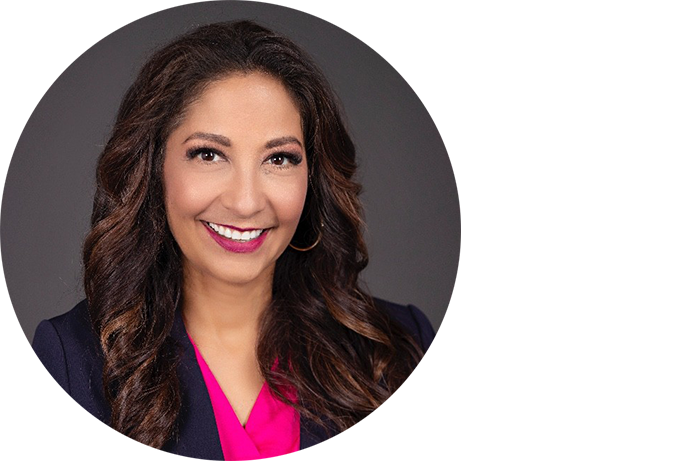
Valerie Henry has been a math educator since 1986. She taught middle school math for 17 years and has worked as a lecturer at University of California Irvine since 2002. After doing her 2004 dissertation research on addition/subtraction fluency in first grade, Valerie created FactsWise, a daily mini-lesson approach that simultaneously develops  fluency,  number sense, and algebraic thinking. Additionally, she has provided curriculum and math professional development for K-12 teachers throughout her career, working with individual schools, districts, county offices of education, Illustrative Mathematics, the SBAC Digital Library, and the UCI Math Project.

An older person with short gray hair and glasses, wearing a blue sweater, is outdoors with greenery and a fence in the background.
Podcast cover for "Math Teacher Lounge" with Bethany Lockhart Johnson and Dan Meyer; bold text on orange and teal semicircle background.

About Math Teacher Lounge: The podcast

Math Teacher Lounge is a biweekly podcast created specifically for K–12 math educators. In each episode co-hosts Bethany Lockhart Johnson (@lockhartedu) and Dan Meyer (@ddmeyer) chat with guests, taking a deep dive into the math and educational topics you care about.

Join the Math Teacher Lounge Facebook group to continue the conversation, view exclusive content, interact with fellow educators, participate in giveaways, and more!

What’s included in our Spanish language arts curriculum

Amplify Core Knowledge Language Arts® (CKLA) is available in both English and Spanish. Amplify Caminos al Conocimiento Esencial, our robust Spanish language arts companion for grades K–5, supports multiple teaching models, including dual language immersion and transitional classrooms.

A laptop screen displays a kindergarten instructional webpage in Spanish, showing lesson categories with illustrated thumbnails and navigation options.

Year at a glance

The program’s intentional Knowledge Sequence from K–5 connects knowledge and vocabulary within a grade level and across grade levels, for deeper reading comprehension and preparation for college, career, and life. Instead of “activating prior knowledge,” Amplify Caminos helps you build it in the classroom from day one, for every child, expanding each student’s knowledge base long before they transition to reading to learn.

Curriculum flowchart showing reading themes and activities from Kindergarten to Grade 5, organized by grade level and literary theme, with interconnected boxes for each topic.

Units & domains at a glance

Each Knowledge Domain in grades K–2 and Unit in grades 3–5 varies in the number of days based on instructional purpose. Just as with our top-rated Amplify CKLA program, the Amplify Caminos materials engage and delight young learners with resources that are both appealing and original.

Una mujer rubia con un vestido azul cuida ovejas blancas y negras, sosteniendo un bastón de pastor. Un cerdo vestido de azul corre y un hombre de negro toca el violín en una valla. Al fondo hay una casa.

Domain

Nursery Rhymes and Fables/Rimas y fábulas infantiles

Start learning about literature with these classic Mother Goose rhymes.

Ilustración de tres personas en un paisaje cubierto de hierba, una tratando de atrapar mariposas con una red, otra escondiéndose detrás de una escultura alta y frondosa de una mano y otra con binoculares.

Domain

The Five Senses/Los cinco sentidos

Learning about the body starts with learning about how we experience the world.

Una ilustración que representa a un gran lobo con sombrero de copa liderando un desfile de animales y personas con instrumentos musicales a través de un paisaje montañoso.

Domain

Stories/Cuentos

Learn about the parts of a book and some of the stories that go in one.

Una ilustración vibrante de una escena rural con colinas, una granja, una mariposa, un sol brillante, varias verduras como tomates y lechugas, y un gusano en el suelo.

Domain

Plants/Plantas

Discover the lifecycle of plants and the history of George Washington Carver.

Ilustración de una escena de granja que muestra un camión rojo que transporta verduras, campos de cultivo, vacas pastando en una colina, un granero y un molino de viento contra un cielo azul.

Domain

Farms/Granjas

Now we know how plants make their food… but what about animals?

Ilustración de un nativo remando en una canoa en un río con búfalos pastando en un campo, tipis al fondo y pájaros volando en el cielo bajo un sol brillante.

Domain

Native Americans/Los nativos americanos

Who were the first people in America? A look at the Lenape, Wampanoag, and Lakota Sioux.

Una ilustración muestra un rey y una reina en tronos, un castillo en un acantilado y una mujer con enanos cerca de un árbol. Cortinas rojas enmarcan la escena.

Domain

Kings and Queens/Reyes y reinas

To understand fairy tales, it’s best to first understand royalty.

Ilustración que muestra las cuatro estaciones: primavera con flores, verano con árboles verdes, otoño con hojas que caen e invierno con nieve y gente en trineo. Un niño lee debajo de un árbol.

Domain

Seasons and Weather/Las estaciones y el tiempo

The study of natural cycles continues with the weather and why it happens.

Un velero de madera con símbolos de cruz roja en sus velas navega cerca de una isla tropical con exuberante vegetación y palmeras. A lo lejos se ven otros dos barcos en el agua.

Domain

Columbus and the Pilgrims/Colón y los peregrinos

A look at the first contact between Europe and the Americas, and some of its results.

Una escena histórica muestra gente afuera de una gran mansión de estilo colonial con dos chimeneas. En primer plano se ve un carruaje tirado por caballos y a la izquierda se ve una casa más pequeña.

Domain

Colonial Towns and Townspeople/Las colonias y sus habitantes

Before the War for Independence, how did the town and country depend on one another?

Ilustración de personas clasificando materiales reciclables en un parque cerca de un río contaminado. Las fábricas emiten humo al fondo, mientras que las mariposas, las flores y los árboles están presentes en el primer plano.

Domain

Taking Care of the Earth/Cuidar el planeta Tierra

We only have one Earth—here are some ways to help care for it.

Ilustración del Monte Rushmore con los rostros tallados de cuatro presidentes de Estados Unidos. Un águila vuela en primer plano.

Domain

Presidents and American Symbols/Presidentes y símbolos de los Estados Unidos

Start learning about government through the lives of five presidents.

Una ilustración caprichosa que muestra animales de granja alrededor de una casa en un árbol junto a un río. Un zorro, un conejo y una oveja interactúan mientras la gente acampa junto a una fogata al fondo. Una araña cuelga del árbol.

Domain

Fables and Stories/Fábulas y cuentos

Learn some of the key elements of a story through classic fables.

Ilustración que presenta anatomía humana, actividades de estilo de vida saludable, profesionales médicos, símbolos dietéticos, una ambulancia y microorganismos, destacando la conexión entre salud, nutrición y ejercicio.

Domain

The Human Body/El cuerpo humano

What are germs? What are the organs? And what does it all have to do with health?

Una ilustración que presenta varias escenas de cuentos de hadas y folclore, incluida una calabaza grande, un tigre, Caperucita Roja, personas con atuendos tradicionales y una pagoda roja con una montaña de fondo.

Domain

Different Lands, Similar Stories/Tierras diferentes, cuentos similares

A world tour of storytelling, and the stories that stay the same across the world.

Ilustración que muestra el antiguo Egipto con pirámides, la Esfinge, agricultores arando un campo con bueyes y ganado pastando bajo un cielo soleado.

Domain

Early World Civilizations/Antiguas civilizaciones del mundo

Rivers, farming, writing, and laws: just what does it take to build a civilization?

Escena ilustrada de la antigua Mesoamérica con maíz, un río, agricultores y pirámides al fondo. En primer plano se ve a una persona con traje tradicional.

Domain

Early American Civilizations/Antiguas civilizaciones de América

What will we find in the great temples of the Aztec, Maya, and Inca civilizations?

Ilustración de la exploración espacial: se lanza un cohete, un astronauta se para cerca de un módulo de aterrizaje, una persona usa un telescopio y aparece un planeta distante con anillos sobre un fondo estrellado.

Domain

Astronomy/Astronomía

How the Earth relates to the moon, the sun, and the rest of the planets.

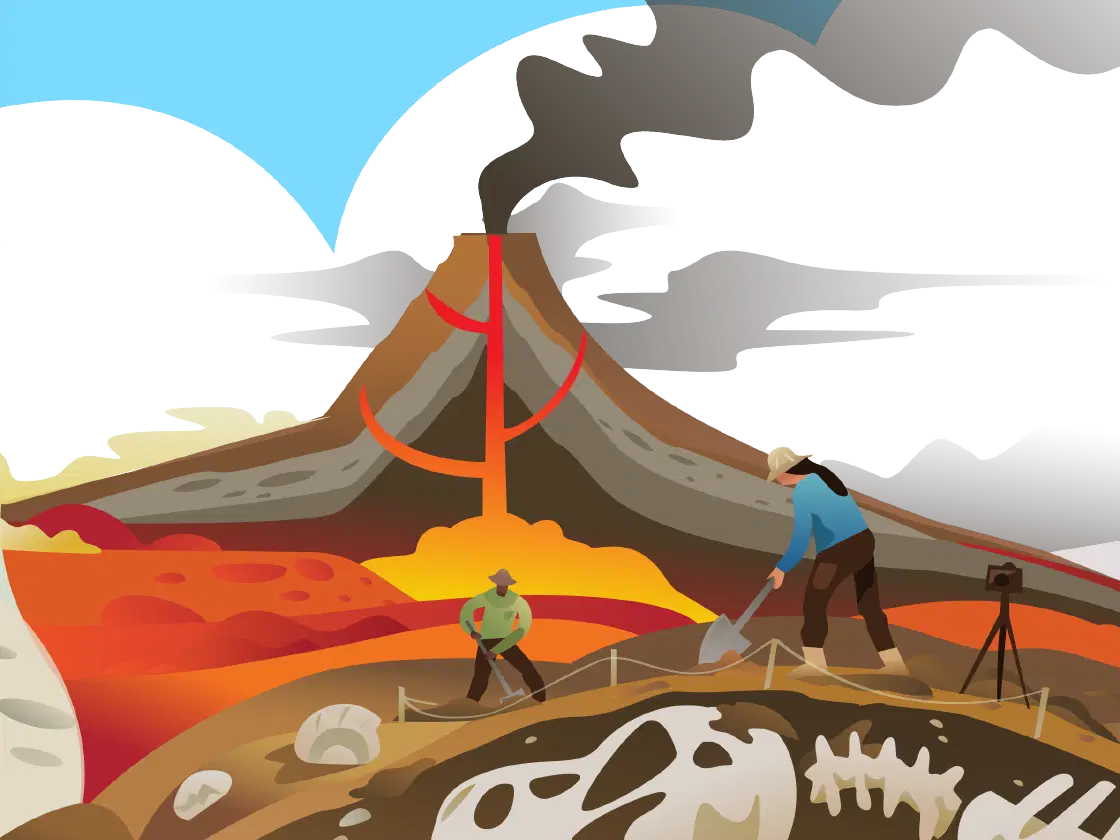
Dos paleontólogos en un paisaje volcánico examinan fósiles en primer plano, mientras un volcán emite humo y lava al fondo.

Domain

The History of the Earth/La historia de la Tierra

Just what lies beneath the Earth’s surface, and what can it teach us about the past?

Una escena de vida silvestre diversa que presenta un cactus del desierto con un pájaro, un conejo, elefantes, un león, un oso polar sobre el hielo y montañas distantes bajo un cielo nublado.

Domain

Animals and Habitats/Los animales y sus hábitats

A look at the connection between how animals live and where they make their homes.

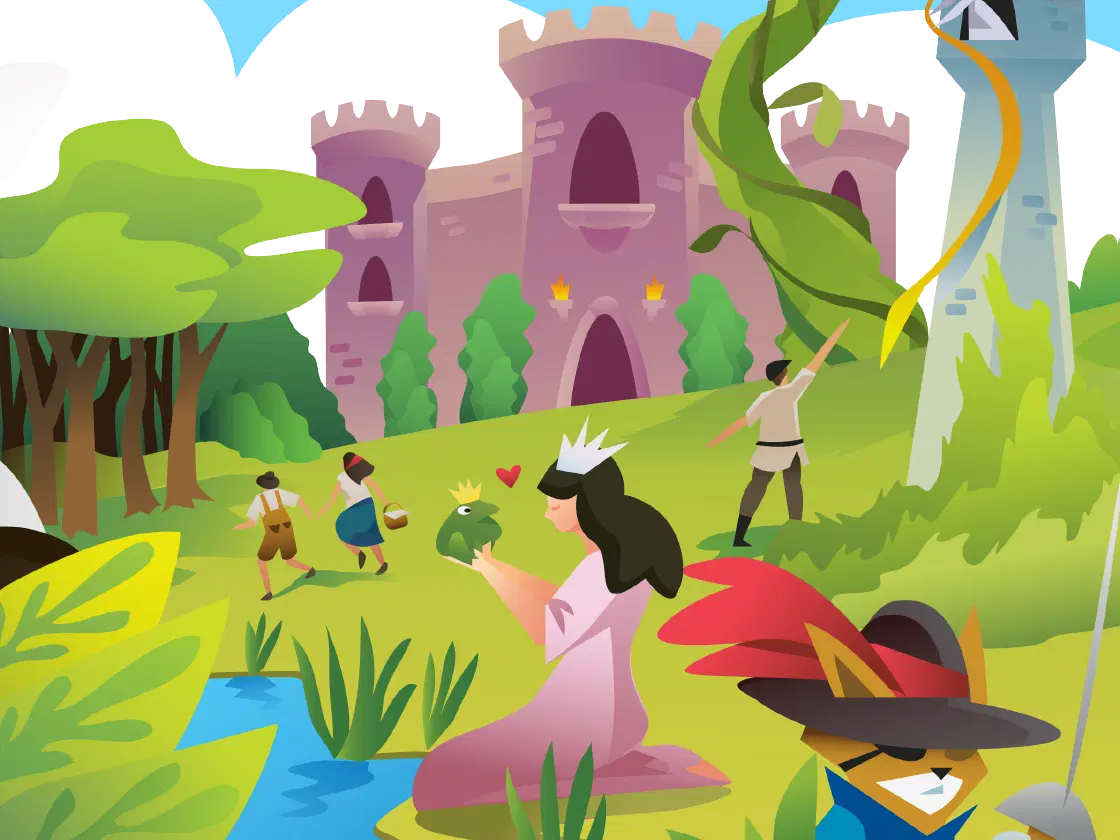
Una princesa con un vestido rosa sostiene una rana junto a un arroyo con un castillo, árboles y gente al fondo. En primer plano camina un zorro con un sombrero con una pluma roja.

Domain

Fairy Tales/Cuentos de hadas

What do fairy tales have to teach us about how stories are told?

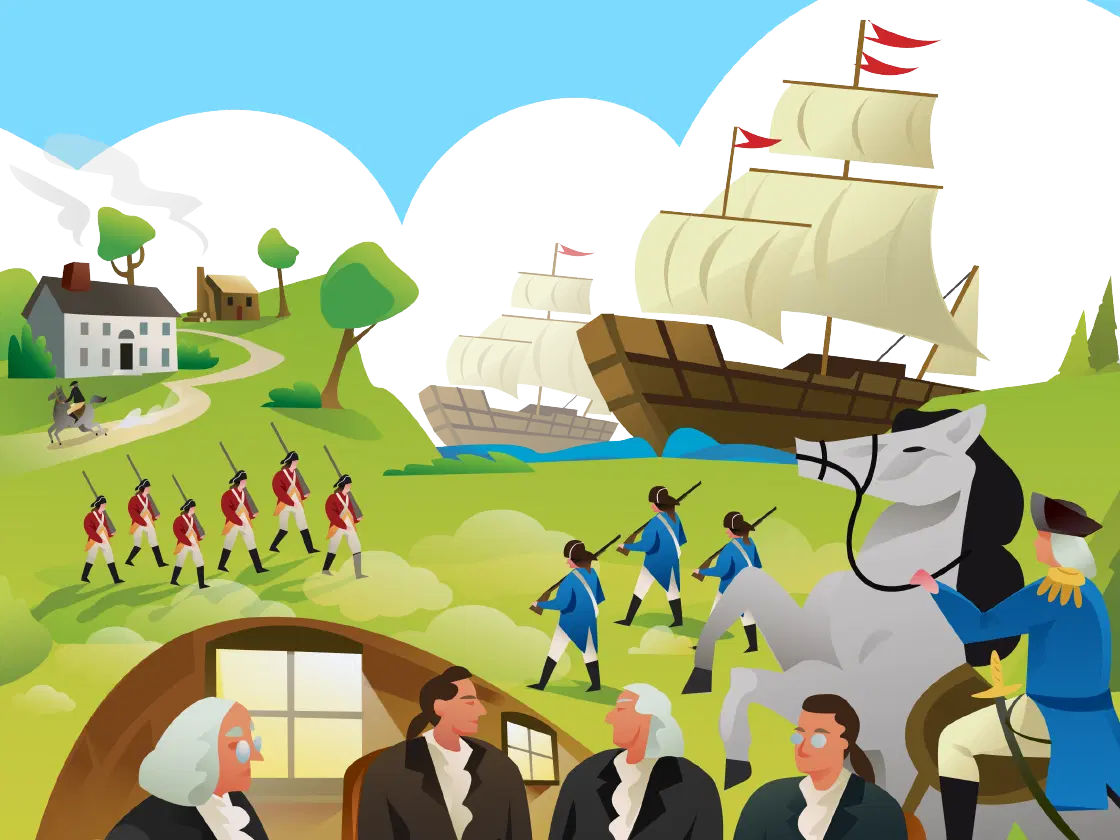
Ilustración que muestra una escena histórica con soldados, veleros y hombres con atuendo colonial discutiendo en el interior.

Domain

A New Nation: American Independence/Una nueva nación: la independencia de los Estados Unidos

The story of the birth of the United States out of the 13 Colonies.

Los pioneros con carros cubiertos y caballos señalan hacia un valle con tipis nativos, fogatas y humo elevándose. Un oso se encuentra sobre una roca y se ven montañas al fondo.

Domain

Frontier Explorers/Exploradores de la Frontera

The story of the journey west from the newborn U.S.A. to find the Pacific Ocean.

Un hombre con un hacha se encuentra entre paisajes exagerados con un castillo, un tren con humo, un buey azul y una persona con un mono observando la escena.

Domain

Fairy Tales and Tall Tales/Cuentos de hadas y cuentos exagerados

Learn about exaggeration and characterization on the frontier.

Ilustración de un paisaje vibrante que presenta diversos monumentos culturales, incluidos templos, palacios, pirámides, una escena de elefantes, montañas distantes y fuegos artificiales en el cielo.

Domain

Early Asian Civilizations/Antiguas civilizaciones de Asia

Tour the world of classical civilization, starting with India and China.

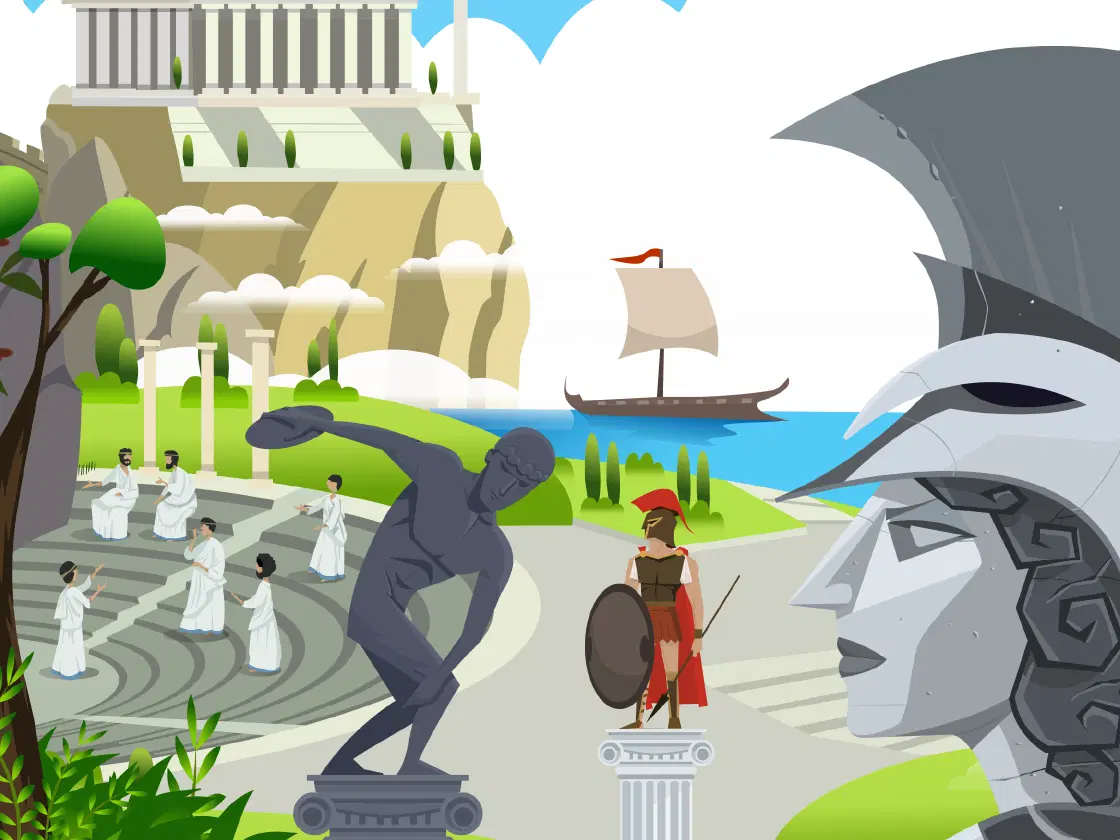
Ilustración que muestra la antigua Grecia con un anfiteatro, estatuas, soldados con armadura, un barco y un templo en una colina rodeada de vegetación.

Domain

Ancient Greek Civilization/La civilización griega antigua

The tour continues with the philosophy and politics of Greece.

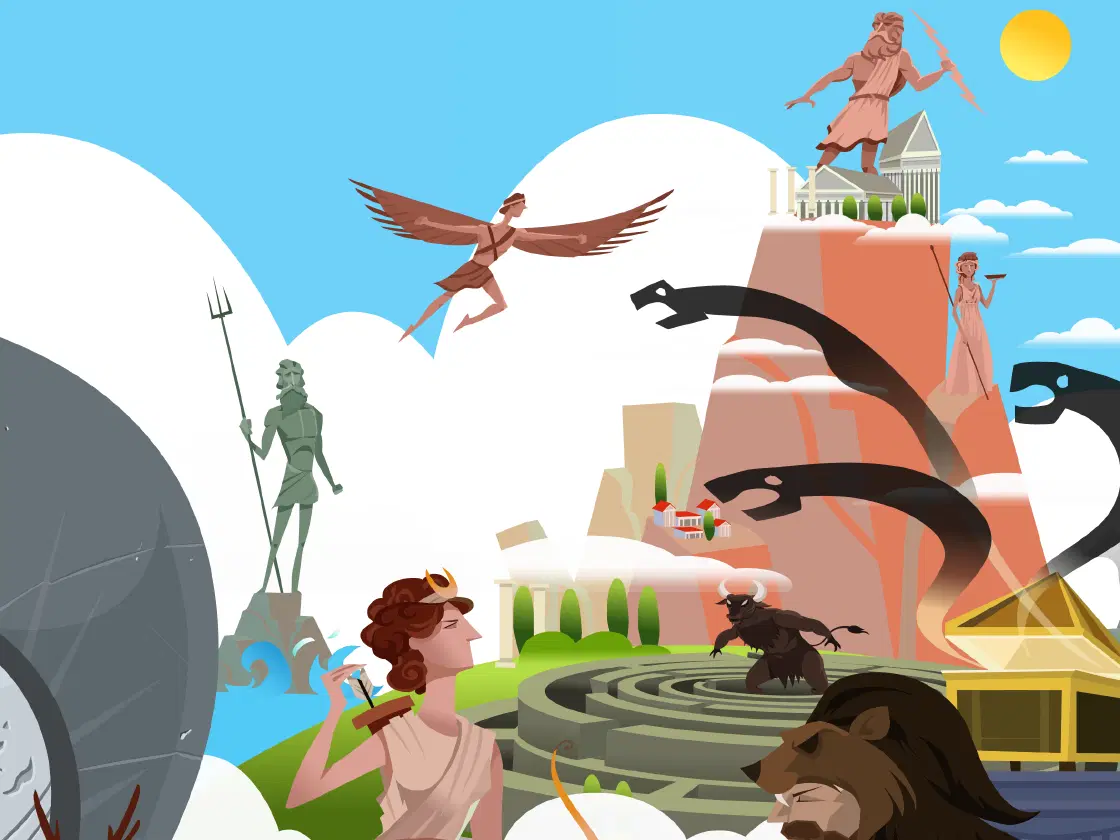
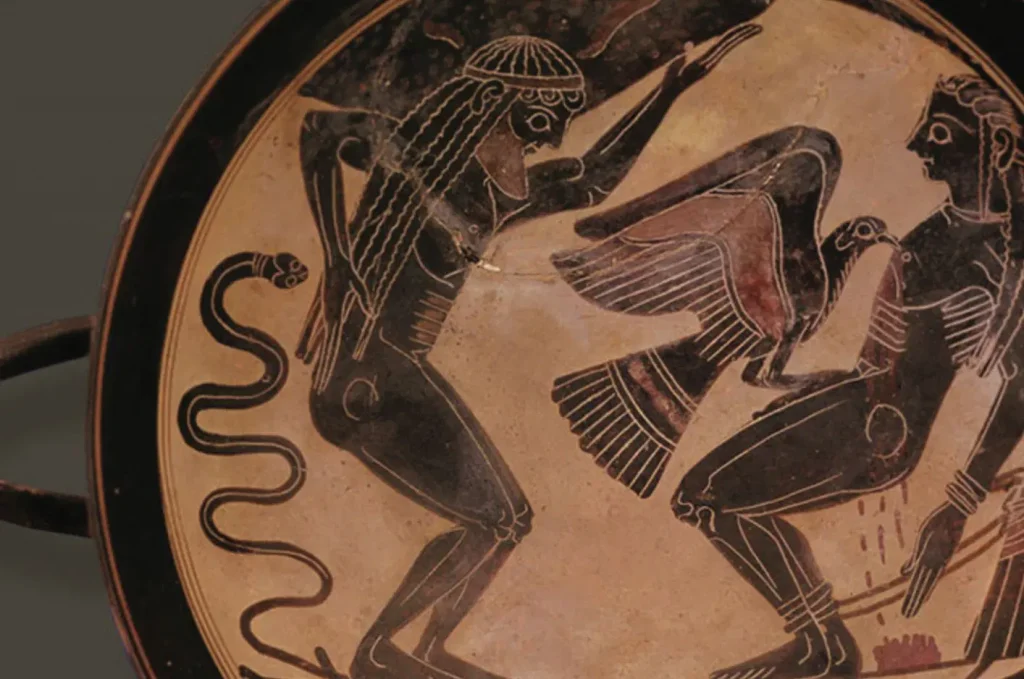
Illustration of various mythological scenes including greek gods, a flying horse, and roman architecture under a sunny sky.

Domain

Greek Myths/Mitos griegos

Dive deep into the characters and storytelling of classic myths.

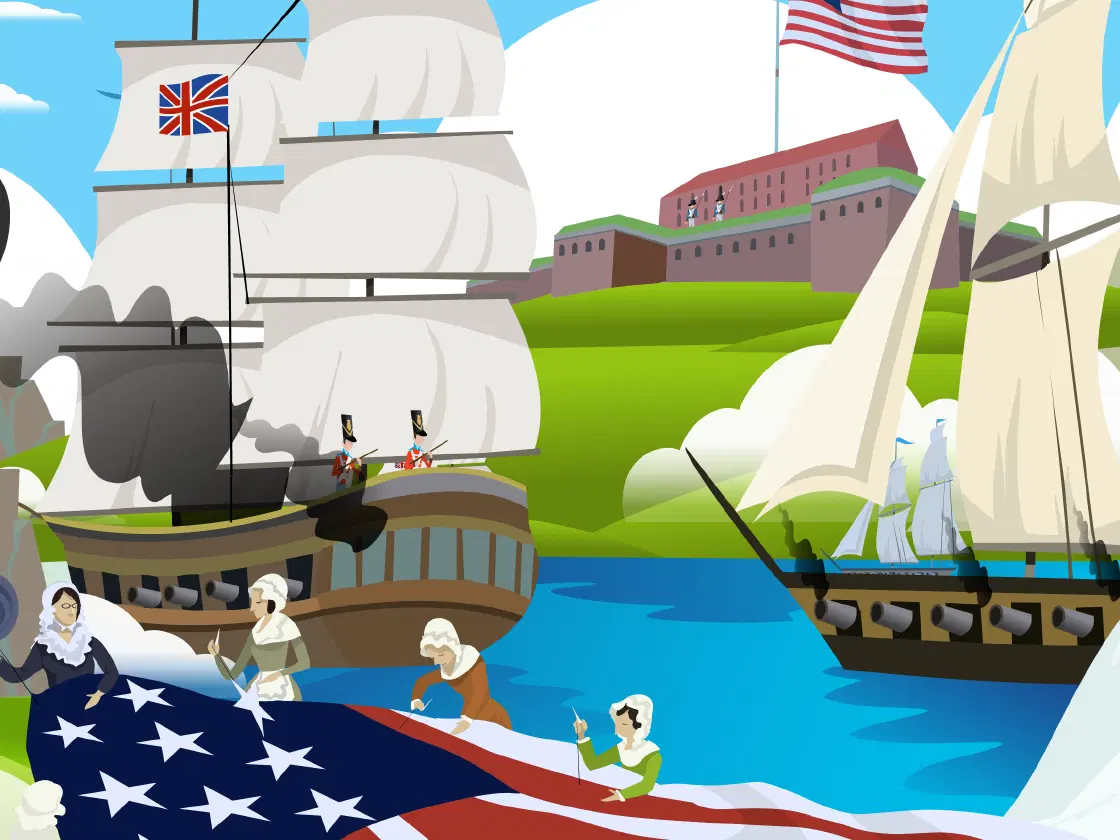
Ilustración de una batalla entre barcos británicos y estadounidenses cerca de un fuerte. El barco británico está a la izquierda con soldados, mientras que el barco estadounidense está a la derecha. La gente porta una gran bandera estadounidense en primer plano.

Domain

The War of 1812/La guerra de 1812

Learn about America’s “Second War for Independence.”

Un paisaje nevado con un zorro durmiendo en una madriguera, gente corriendo y andando en bicicleta por un sendero y árboles que muestran los cambios estacionales.

Domain

Cycles in Nature/Los ciclos de la naturaleza

Introducing the natural cycles that make our lives possible.

Ilustración de carros cubiertos tirados por caballos a lo largo de un sendero en el desierto, con un coyote aullando sobre una alta formación rocosa y un tren de vapor al fondo.

Domain

Westward Expansion/La expansión hacia el oeste

Why did pioneers go west? What happened to the people who were there?

Ilustración de un jardín vibrante con flores, abejas, mariposas, una oruga en una hoja, una crisálida y un apicultor que maneja una colmena junto a un estanque.

Domain

Insects/Los insectos

Lay the grounds for animal classification by looking at solitary and social insects.

Ilustración de una escena histórica con gente escuchando el discurso de un hombre en una plataforma. Al fondo se ve un río y una procesión de personas. En primer plano hay un documento de proclamación.

Domain

The U.S. Civil War/La Guerra Civil de los Estados Unidos

Begin to grapple with U.S. history’s central crisis over slavery.

Una escena en la que aparece una persona explicando un diagrama anatómico humano, otra persona haciendo ejercicio, una cadena de ADN, campos y un microscopio de fondo.

Domain

Human Body: Building Blocks and Nutrition/El cuerpo humano: componentes básicos y nutrición

A deeper dive into the digestive system and the nutrition process.

Un grupo diverso de personas se encuentra en un muelle con vistas a un bullicioso puerto con barcos y un gran barco, un avión volando por encima y la Estatua de la Libertad al fondo.

Domain

Immigration/La inmigración

Why did people immigrate to the United States, and what did they find here?

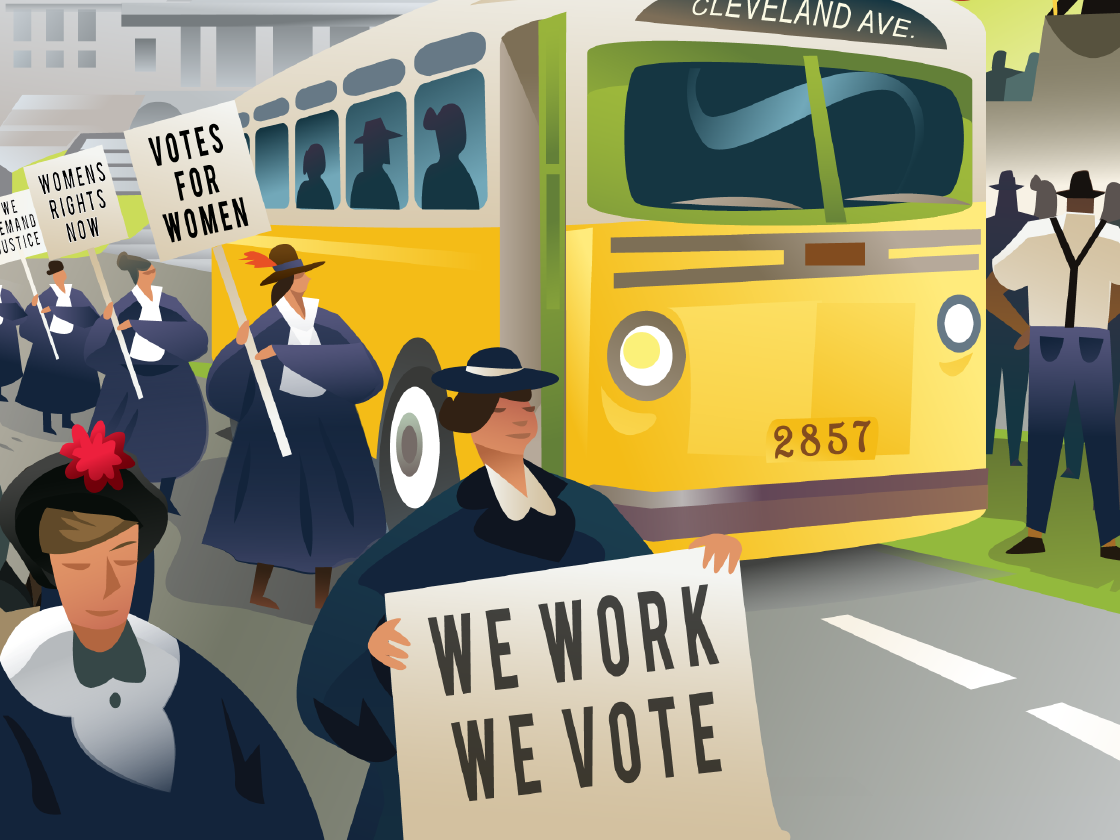
Women in early 20th-century clothing march with signs for voting rights and justice in front of a yellow bus labeled "Cleveland Ave.," making history that can inspire lessons in a K–2 language arts curriculum.

Domain

Fighting for a Cause/Luchar por una causa

How people can do extraordinary things to make the world better for everyone.

Dos ratones antropomórficos en un bote de remos, uno de ellos remando, navegan por un río tranquilo rodeado de exuberante vegetación y árboles. El ratón que rema lleva una chaqueta azul y el otro ratón parece conversar.

Unit 1

Classic Tales: The Wind in the Willows/Cuentos Clásicos: El viento en los sauces

A deep dive into character, theme, and POV in classic stories from around the world.

Ilustración de un jaguar, una garza, una rana roja, una tortuga y un pez en un paisaje vibrante con montañas y vegetación bajo un cielo soleado.

Unit 2

Animal Classification/La clasificación de los animales

How do we classify different animals by their appearance and behavior?

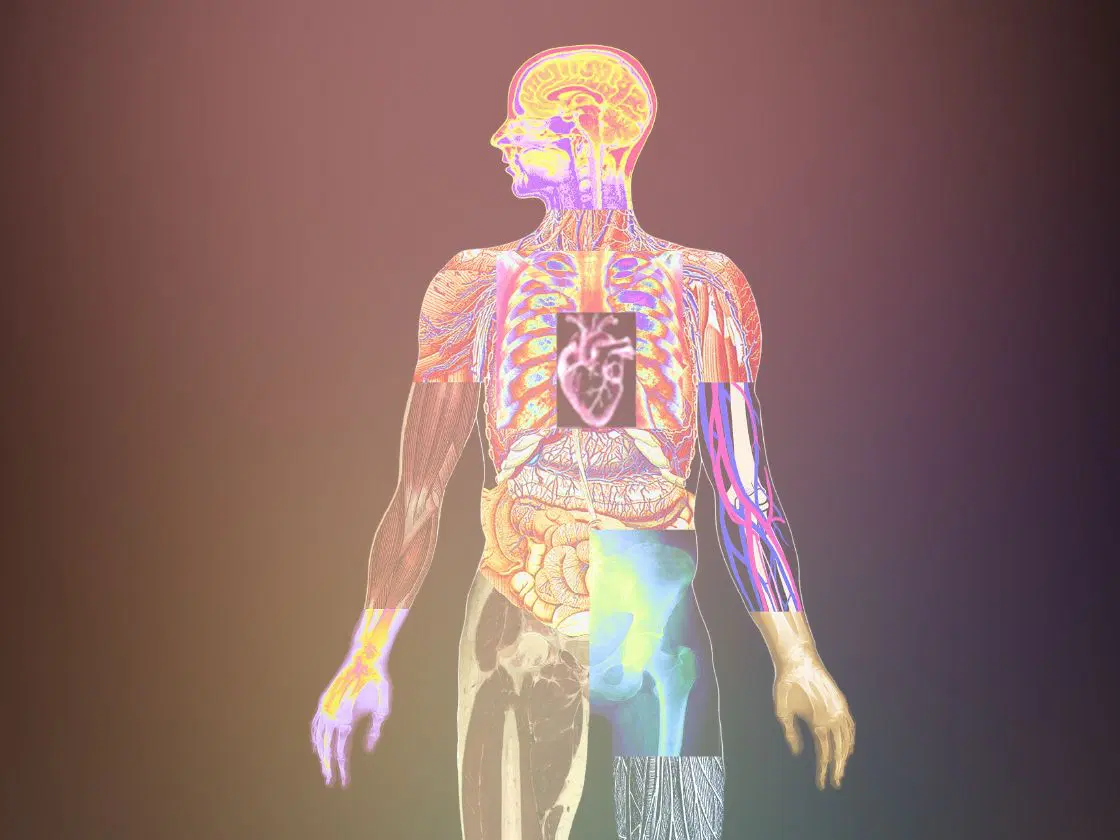
Ilustración de una figura humana que muestra la anatomía interna, incluidos el cerebro, los pulmones, el corazón, el sistema digestivo y una articulación de la cadera resaltada sobre un fondo degradado.

Unit 3

The Human Body: Systems and Senses/El cuerpo humano: sistemas y sentidos

Let’s take a closer look at how the skeleton, muscles, and nervous system all work.

Un ángel se arrodilla ante una mujer sentada en un sofá dorado encima de un templo en una noche estrellada. Unas escaleras conducen al templo en un paisaje montañoso.

Unit 4

The Ancient Roman Civilization/La civilización romana antigua

What is Rome’s greatest cultural contribution? In this unit, your students decide.

Ilustración de un perro saltando bajo un árbol, persiguiendo una abeja, con una mesa en primer plano sosteniendo una jarra y vasos de limonada. El sol brilla intensamente en el cielo.

Unit 5

Light and Sound/La luz y el sonido

The science behind all the ways we see and hear the world.

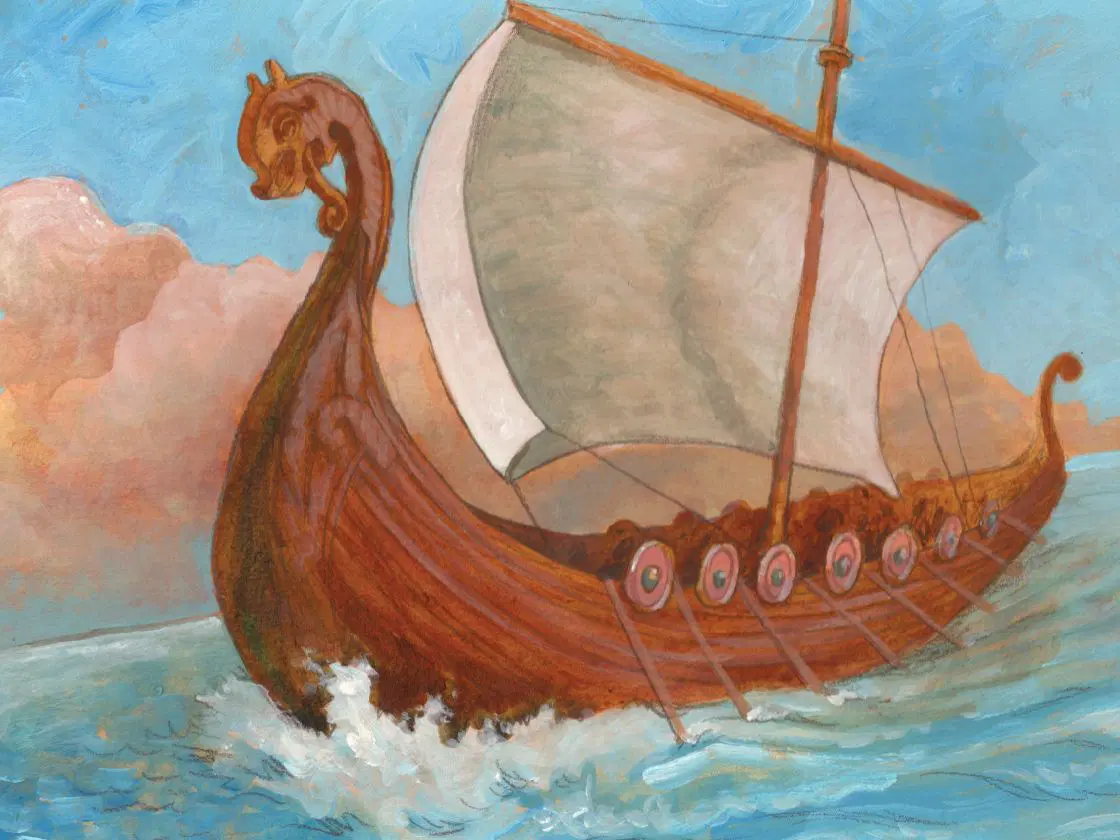
Un barco vikingo con una proa en forma de dragón navega en el océano bajo un cielo azul con nubes. El barco tiene una sola vela grande y varios escudos recubren sus costados.

Unit 6

The Viking Age/La era vikinga

An immersive narrative experience about what life was like in Viking communities.

Ilustración de una escena espacial con varios planetas y anillos sobre un fondo de estrellas. Dos planetas grandes dominan el primer plano y se ven planetas más pequeños al fondo.

Unit 7

Astronomy: Our Solar System and Beyond/Astronomía: nuestro sistema solar y más allá

More about our universe, including a writing project about daily life on a space station.

Una persona sentada en el borde de un acantilado con vistas a un vasto paisaje desértico con nubes arremolinadas en el cielo.

Unit 8

Native Americans: Regions and Cultures/Los nativos americanos: regiones y culturas

How did Native American nations change their way of life in different parts of the world?

Ilustración de un velero en el océano con la costa este de América del Norte visible a la izquierda.

Unit 9

Early Explorations of North America/La exploración europea de América del Norte

What was it like to sail to North America with the early European explorers?

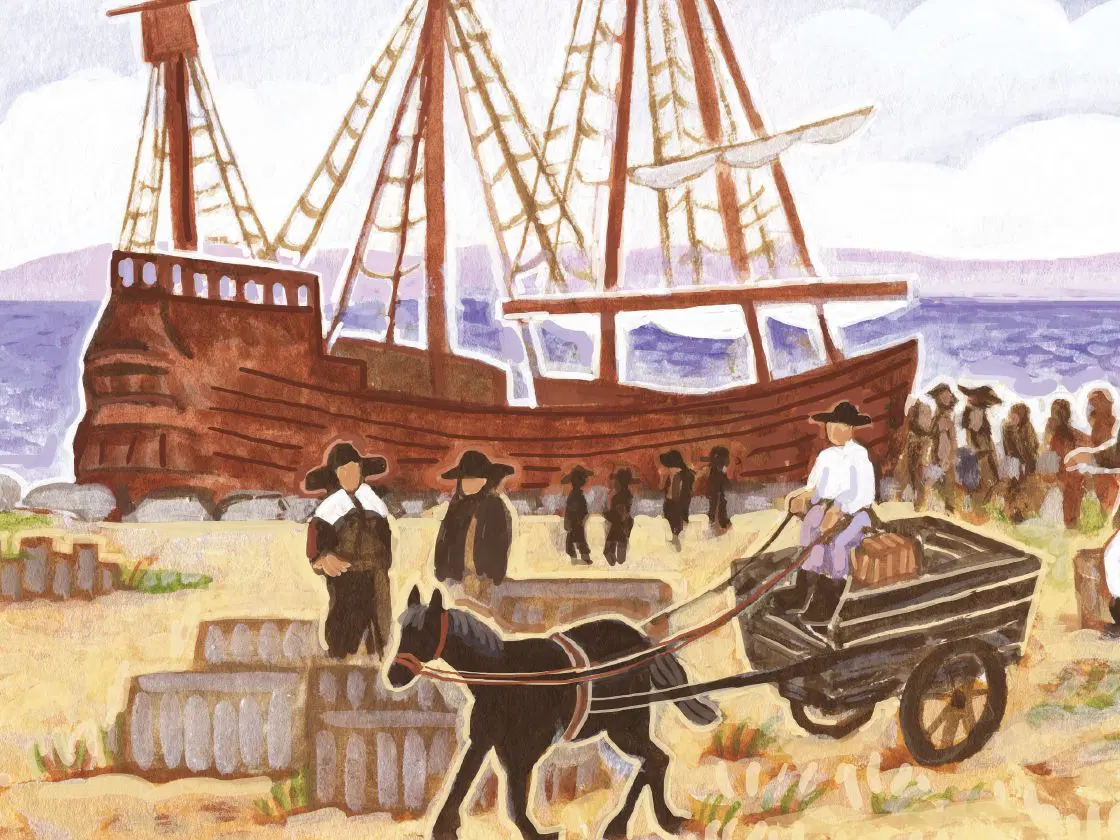
Una pintura representa una escena del siglo XVII con colonos, un velero al fondo y un hombre conduciendo un carro tirado por caballos cargado de mercancías. Se ve a otras personas descargando y trabajando cerca.

Unit 10

Colonial America/La época colonial en los Estados Unidos

A study of the very different ways of life in the different pre-U.S. colonies.

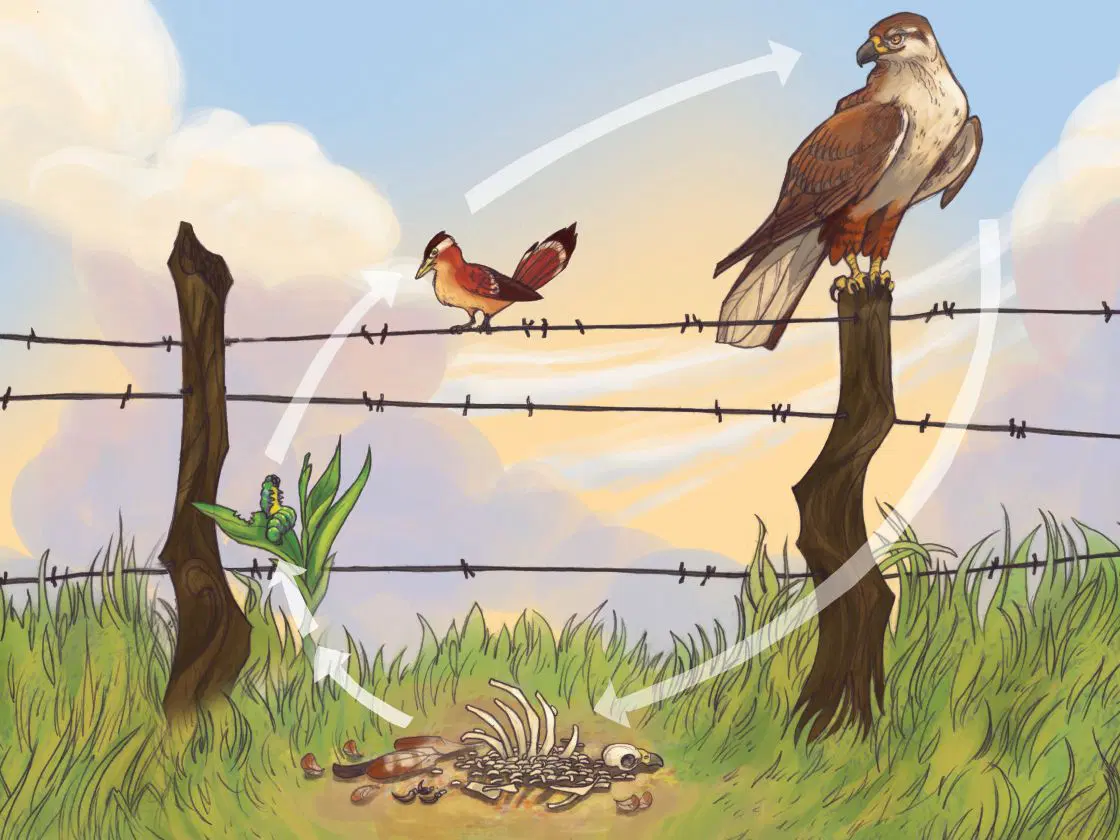
Ilustración que muestra el ciclo de la vida: un esqueleto en el suelo, un pájaro posado en una cerca, otro pájaro en una planta y un ave rapaz más grande arriba, todos conectados por flechas circulares.

Unit 11

Ecology/Ecología

Students keep ecologist’s journals to learn about our world and how best to protect it.

Una mano alcanza una manzana verde en una rama. Cerca hay una brújula, un termómetro, un lápiz, notas musicales y un granero rojo sobre un paisaje cubierto de hierba.

Unit 1

Personal Narratives/Narrativas personales

Read stories of personal experience… and learn to reflect on your own.

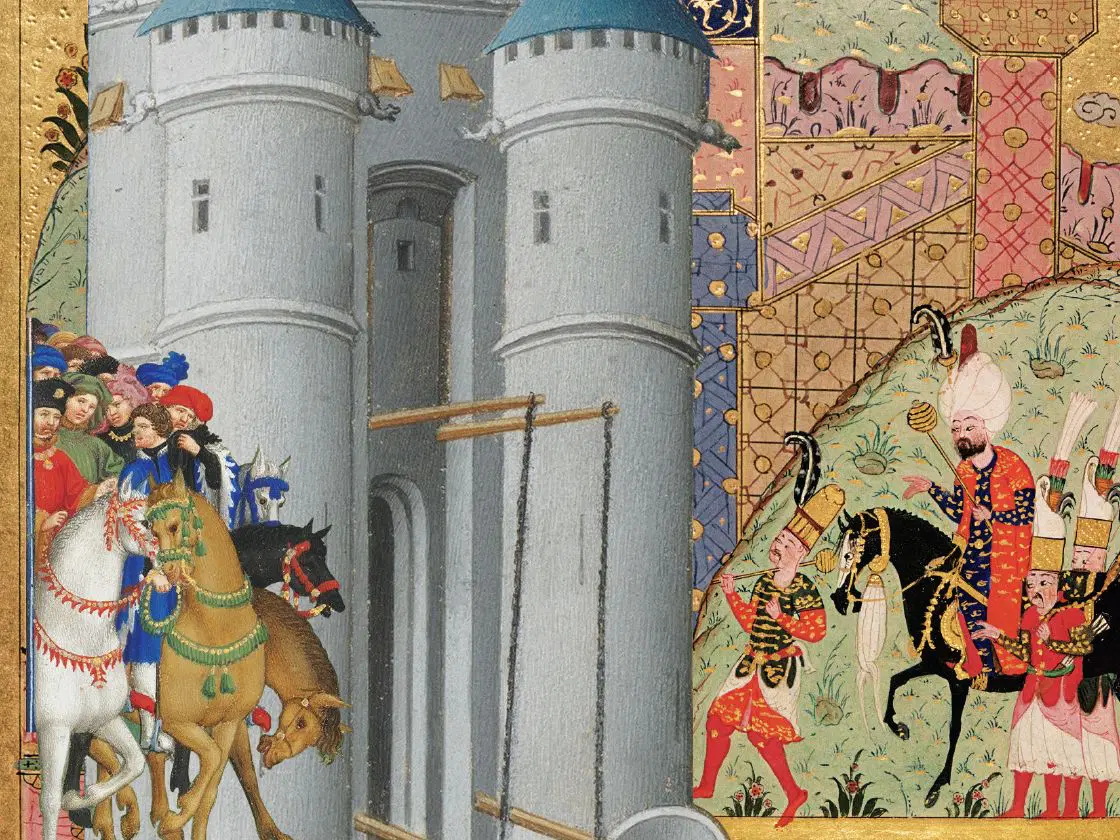
Ilustración medieval que representa un grupo de figuras con armadura a la entrada de un alto castillo gris con puente levadizo, adornado con banderas y rodeado por un paisaje decorado y fondos ornamentados.

Unit 2

Empires in the Middle Ages/Los imperios en la Edad Media, parte 1 & Los imperios en la Edad Media, parte 2

Explore the medieval history of Europe and the Middle East.

Ilustración dorada de un dragón con alas sobre fondo beige, rodeado de diversos elementos decorativos como estrellas, hojas y estampados abstractos.

Unit 3

Poetry/Poesía

Study the poetry of many nations using licensed text anthologies, and begin to write your own.

Vintage styled illustrations of a microscope, an old telephone, and a clock on textured background with geometric patterns.

Unit 4

Eureka! Student Inventor/¡Eureka! Estudiante inventor

Transform the class into a lab for students to build and present inventions.

Formaciones rocosas en un paisaje desértico con capas vibrantes y arremolinadas de arenisca roja, naranja y amarilla bajo un cielo parcialmente nublado.

Unit 5

Geology/Geología

Plate tectonics, volcanoes, erosion: all the forces that shape the Earth.

Una imagen abstracta y colorida que representa varias formas geométricas de edificios sobre un fondo azul estampado.

Unit 6

Contemporary Fiction with excerpts from The House on Mango Street/Ficción Contemporánea con Fragmentos de La Casa en Mango Street

Explore The House on Mango Street… and write a book while doing it.

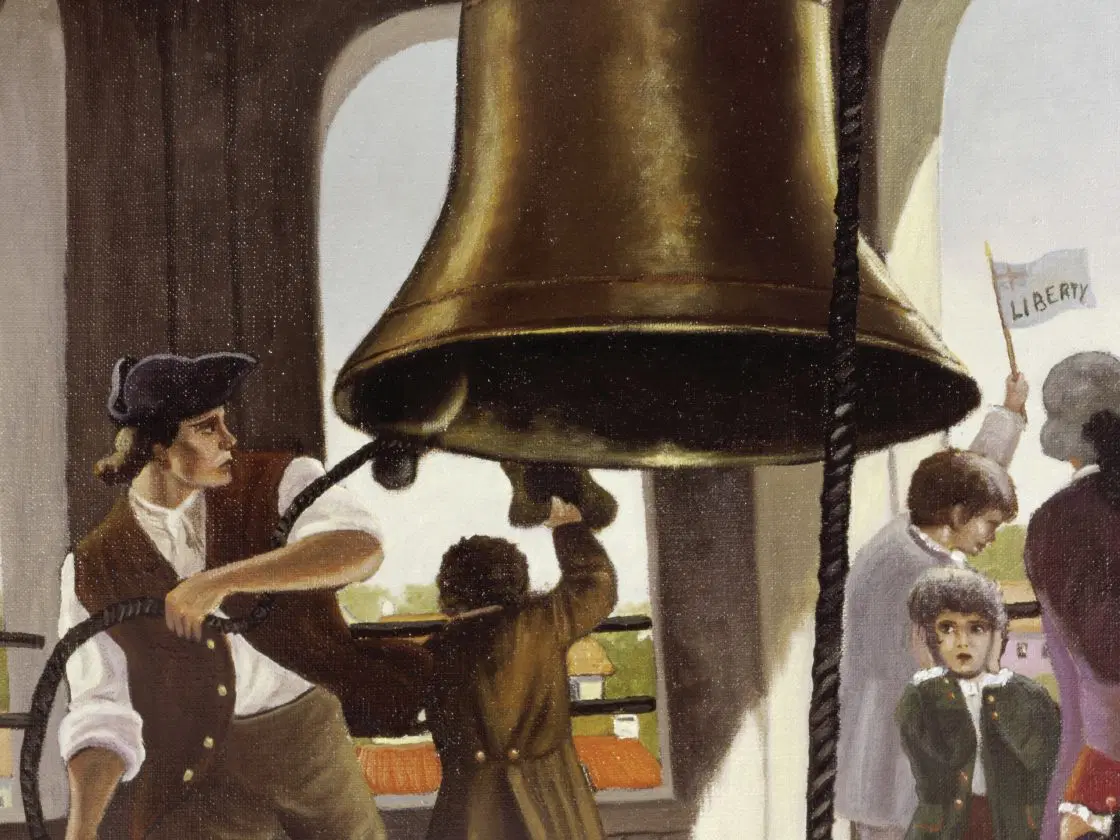
Cuadro que representa a un hombre y un niño tocando una gran campana en una torre, con espectadores al fondo y un cartel de "LIBERTAD" visible.

Unit 7

American Revolution/La Revolución estadounidense

Why did America seek independence? Let’s investigate the causes and effects.

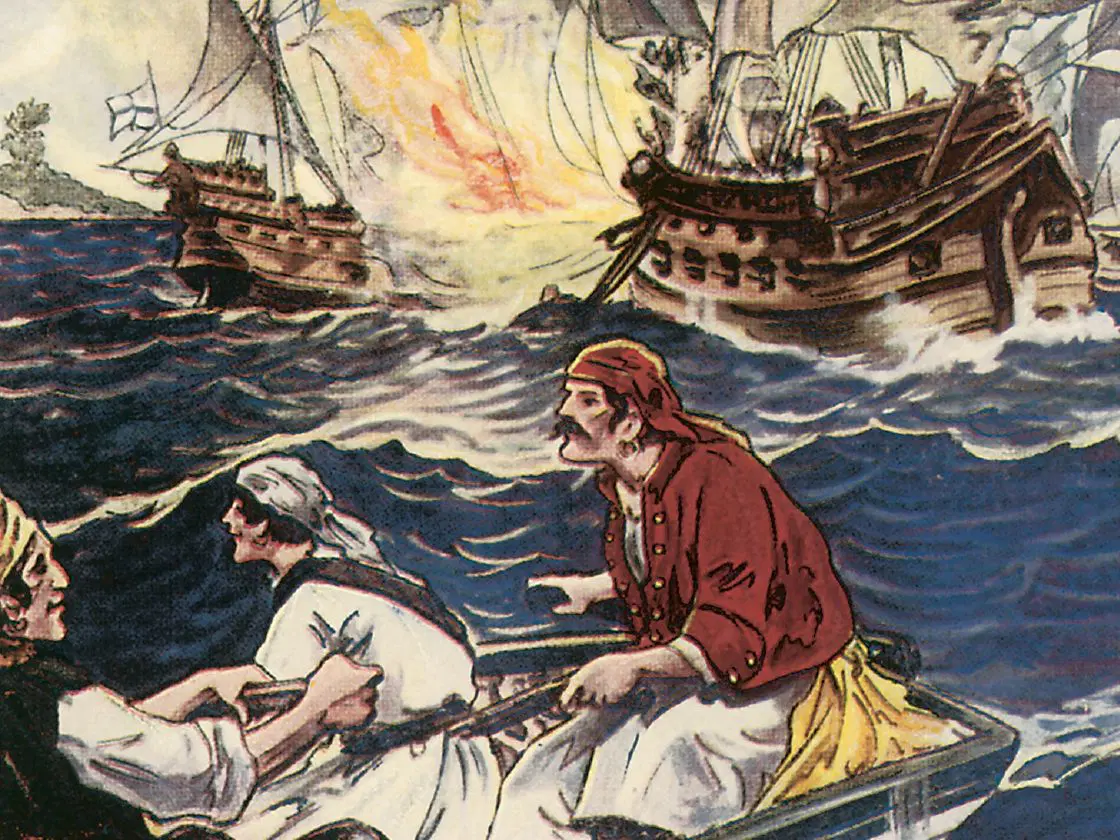
Un pequeño bote de remos con tres personas navega por mares agitados mientras dos grandes barcos luchan al fondo, con humo y fuego visibles.

Unit 8

Treasure Island/La Isla del Tesoro

How dSeek the treasure of plot in this detailed study of a classic fiction adventure.

Unit 1

Personal Narratives/Narrativas personales

Through writing and sharing their writing, students begin to identify themselves as writers.

Unit 2

Early American Civilizations/Las primeras civilizaciones americanas

Students craft a codex to explain the rise and fall of the Maya, Aztec, and Inca people.

Dos jinetes medievales a caballo, uno de ellos con la espada en alto, avanzan por un terreno rocoso. El fondo presenta un paisaje brumoso bajo un tono violeta.

Unit 3

Poetry/Poesía

Students close read many forms of poetry… and learn to write them.

Collage ilustrado con un paraguas, un cuervo, un sextante náutico, estrellas, una luna creciente y una brújula sobre un fondo beige texturizado.

Unit 4

Adventures of Don Quixote/Las Aventuras de Don Quijote

Was Don Quixote right to fight the windmill? In this full-length novel study, students decide.

Unit 5

The Renaissance/El Renacimiento

Exploring the art and literature of the Renaissance through the works of its masters.

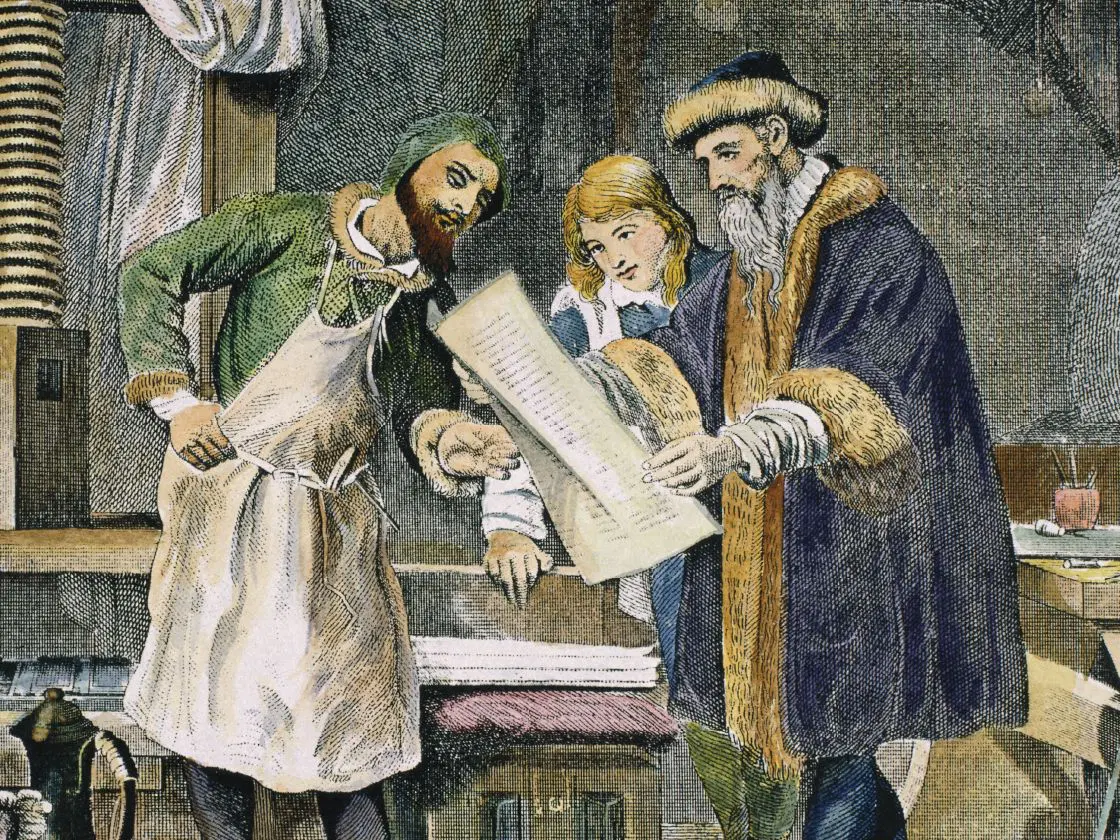
Tres hombres vestidos con ropa de época examinan una gran hoja de papel dentro de una imprenta. Un hombre parece llevar un delantal, mientras que otro señala el papel y el tercero observa de cerca.

Unit 6

The Reformation/La Reforma

How did the printing press transform the religion and society of Europe?

Patrón botánico morado y lila con hojas, plantas y formas abstractas, incluida una luna creciente y estrellas, sobre un fondo violeta oscuro.

Unit 7

William Shakespeare’s A Midsummer Night’s Dream/Sueño de Una Noche de Verano de William Shakespeare

Students enter the world of Shakespeare by reading, designing, and acting out his work.

Retrato en tonos sepia de una joven de pelo largo, con un collar de pedrería y un chal drapeado.

Unit 8

Native Americans/Los nativos americanos

How did the policies of the U.S. government impact Native American culture and lives?

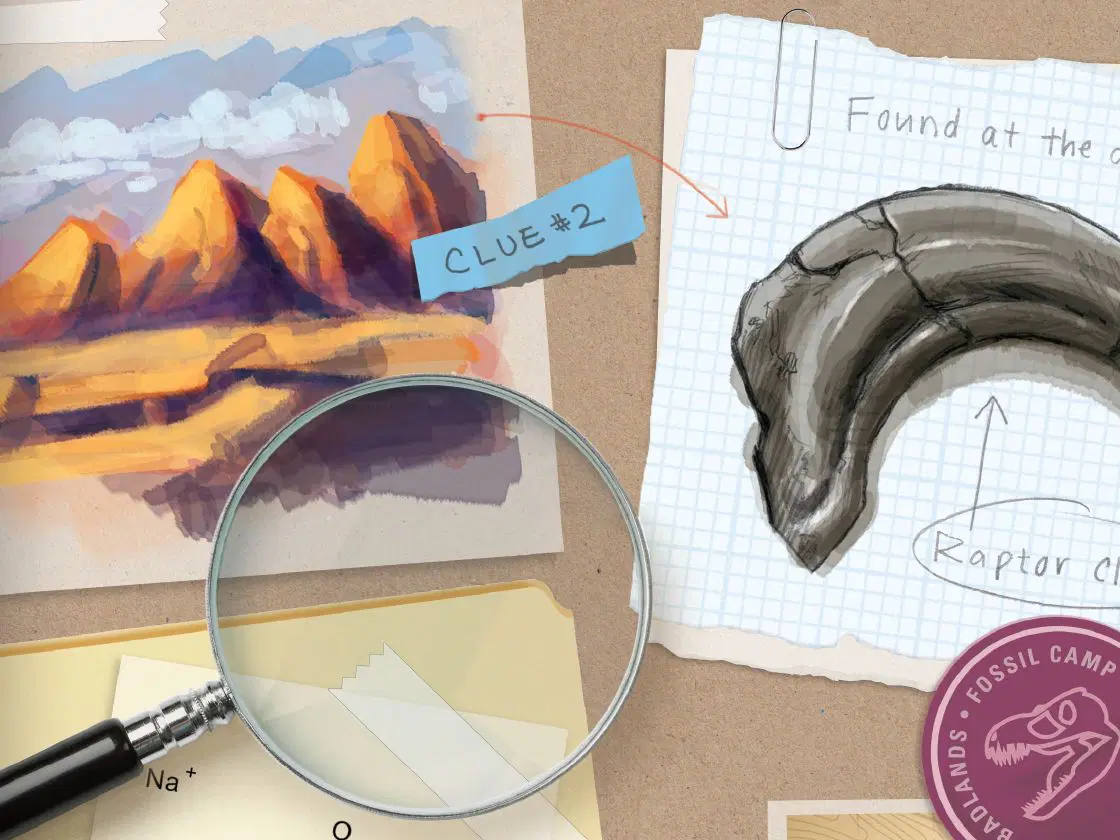
Una lupa sobre documentos que contienen una pintura de paisaje de montañas, un dibujo con la etiqueta "Raptor Claw" y una nota adhesiva con la "Pista n.° 2". También se ven un sobre y una insignia exterior.

Unit 9

Chemical Matter/Química

Students use knowledge of chemistry to solve a mystery.

Print & digital components

The program includes instructional guidance and student materials for a year of instruction, with lessons and activities that keep students engaged every day.

Component

FORMAT

Knowledge (Conocimientos) Teacher Guides (K–2)

Knowledge Strand Teacher Guides contain Amplify CKLA’s cross-curricular read-alouds and application activities, all of which are standards-based to build mastery of content knowledge and literacy skills. There is one Teacher Guide per Knowledge Domain.

Print and digital

Knowledge Image Cards (K–2)

Amplify Caminos includes Image Cards for each Knowledge Domain to bring each topic to life through vivid visuals.

Print and digital

Knowledge Flip Books (K–2)

Projectable Flip Books are provided to accompany the read-alouds in each Knowledge Domain.

Digital

Teacher Guides (3–5)

Teacher Guides for grades 3–5 units are based on content-rich topics and incorporate reading, writing, speaking, and listening skills in the context of background knowledge. There is one Teacher Guide per unit.

Print or digital

Teacher Resource Site (K–5)

The program includes a one-stop-shop website for lesson projections, digital versions of all Amplify Caminos materials, lesson planning resources, multimedia (such as eBooks), and more.

Digital

Professional Learning Site (K–5)

The Professional Learning site includes training materials, best practices, and other resources to develop program expertise. Access professional development anywhere, anytime.

Digital

Component

FORMAT

Knowledge (Conocimiento) Activity Books (K–2)

Activity Books provide students with the opportunity to deepen world and word knowledge by responding to text in a diversity of ways.

Print

Student Readers (3–5)

Student Readers serve as content-rich anchor texts for each unit. Units such as Poetry and Contemporary Fiction feature authentic texts originally written in Spanish.

Activity Books (3–5)

Activity Books in grades 3–5 provide daily opportunities for students to hone reading and writing skills within the context of each unit.

Print and digital

Explore more programs

Our programs are designed to support and complement one another. Learn more about our related programs.

S3-05: Thinking is power

A graphic with the text "Science Connections" and "Amplify" features colorful circles and curved lines on a dark gray background.

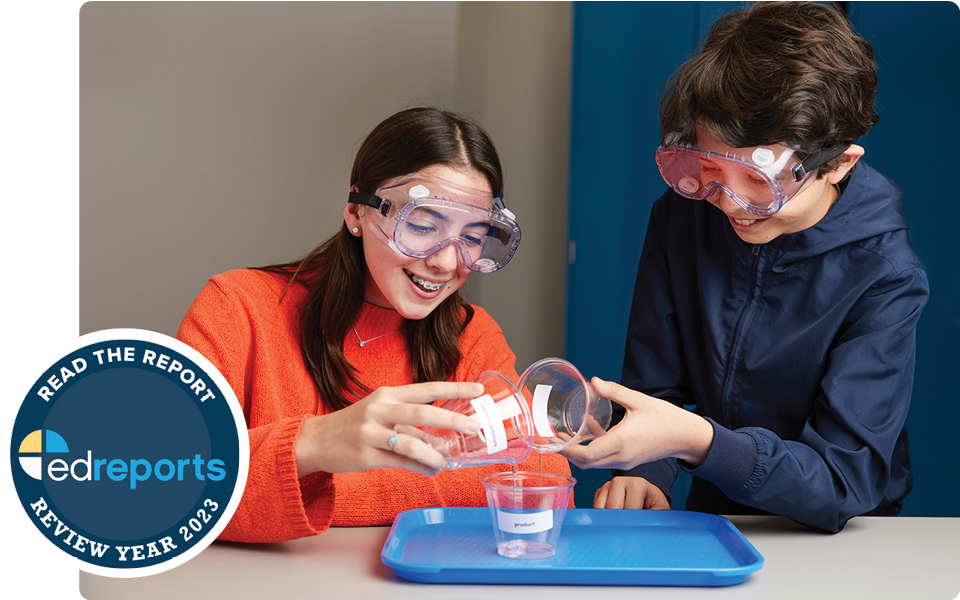
Join us as we sit down with Melanie Trecek-King, college professor and creator of Thinking is Power, to explore how much of an asset science can truly be in developing the skills students need to navigate the real world. You’ll learn about “fooling” students and the importance of developing critical thinking, information literacy, and science literacy in the classroom. We’ll also share real strategies and lesson examples that help build these essential skills and engage students in learning.

And don’t forget to grab your Science Connections study guide to track your learning and find additional resources!

We hope you enjoy this episode and explore more from Science Connections by visiting our main page!

DOWNLOAD TRANSCRIPT

Melanie Trecek-King (00:00):

We say knowledge is power, but it’s not enough to know things. And there’s too much to know. So being able to think and not fall for someone’s bunk is my goal for my students.

Eric Cross (00:12):

Welcome to Science Connections. I’m your host, Eric Cross. On this third season, we’ve been talking about science’s underdog status. And just this past March at the NSTA conference in Atlanta, I had the chance to speak with science educators from around the country about this very topic.

Hermia Simanu (00:28):

Right now, there’s only two teachers in our high school teaching science.

Shane Dongilli (00:32):

I have 45 minutes once a week with each class. The focus is reading and math.

Alexis Tharpe (00:38):

Oftentimes science gets put by the wayside. And you know, I love math and I love my language arts, but I also think science needs to place be placed on that high pedestal as well.

Askia Little (00:46):

In fifth grade, oh, they teach science, because that’s the only grade that it’s tested.

Eric Cross (00:50):

That was Hermia Simanu from American Samoa. Her team flew for three days to make it to the conference. You also heard from Shane Dongilli from North Carolina, Alexis Tharpe from Virginia, and Askia Little from Texas. All of these teachers were excited to be at the conference and had a lot to say about the state of science education in their local schools. Throughout this season, we’ve been trying to make the case for science, showing how science can be utilized more effectively in the classroom. We’ve explored the evidence showing that science supports literacy instruction. We’ve talked about science and the responsible use of technology like AI. My hope is that all of you listeners out there can use some of this evidence to feel empowered to make the case for science in your own communities. And on this episode, we’re going to examine how science can help develop what might be the most important skill that we try to develop in our students: Good thinking. On this episode, I’m joined by a biologist who actually advocated for eliminating the Intro to Bio course at her college. Instead, Professor Trecek-King created a new course focused on critical thinking, information literacy, and science literacy skills. In this conversation, we discuss why the science classroom is such a good environment for helping students become better thinkers. Now, I don’t think that you can make a much stronger argument for science than using it to develop the skills that Melanie describes in this conversation. So, without further ado, I’m thrilled to bring you this conversation with Melanie Trecek-King, Associate Professor of Biology at Massasoit Community College, and creator of Thinking Is Power. Here’s Melanie.

Eric Cross (02:29):

Well, Melanie, thank you for joining us on the show. It’s so good to have you.

Melanie Trecek-King (02:34):

I am so happy to be here.

Eric Cross (02:35):

Now, I went to your session at NSTA in Chicago … I think it was two years ago. A couple years ago. And I was listening to your session, and as I was listening to you, I started Reverse Engineering in my mind what you were doing with your college students. I started reverse engineering the K–8. I was like, “This is amazing.” Where has what you’ve been doing been hiding? We need this not just in the college, higher ed. We need this all the way up and down. Because I hadn’t seen it before. So I think a good place for us to start is gonna be like the story of how and why you as a biologist wound up making the case to actually eliminate the Intro to Biology course at your college. So can you start off and tell us a little bit about that story?

Melanie Trecek-King (03:20):

Sure. So I started teaching at a community college in Massachusetts. And I absolutely love teaching at a community college. And I was teaching the courses that people who don’t wanna be scientists when they grow up have to take to fulfill their science requirement. And that course was Intro Bio. And I tried every way I could figure out to make that class be useful,] relevant to students. I mean, the thing is, our world is based on science and you have to understand science to be a good consumer of information, to make good decisions. And I’m a biologist, so it pains me to say this, but you know, somewhere in the middle of teaching students about the stages of mitosis and protein synthesis, I thought, “Is this really — like, if I have one semester that’s gonna be the last chance that someone’s gonna get a science education, is this really what they need?” And I just decided, “No.” So, to my college’s credit, they were very supportive. I went to them and said, “You know, I think we should assess the non-majors courses. Like, why do we teach non-majors science?” And we all agreed, well, it was for science literacy. OK, great. Do our existing non-majors courses do that? And so we evaluated each of the courses. I made a case that Intro Bio was not doing it. And so we actually replaced it with a course that I call Science for Life. And the whole course is designed to teach science literacy, critical thinking, and information literacy skills.

Eric Cross (04:48):

And so you did this while you were looking at mitosis. And you’re looking at students who may or may not be science majors. And then kind of asking that question. I know every educator asks this, and whether or not it’s welcomed or supported is a different question: “Is what I’m teaching actually gonna be relevant and useful later on down the road for this group of students?” And you actually got to run with it and then create this course, this new course. So, what were the skills that you were hoping to achieve with the new course you developed, and and why were those skills so important?

Melanie Trecek-King (05:21):

Well, if I just go back for a second to what you said, ’cause it, really hit me: I remember the actual moment — it had been building up to that point, but the actual moment that it hit me — I was teaching students the stages of mitosis. And I was applying it to cancer, because the thought is that if we use issues that are relevant to students to teach concepts, that it will be more meaningful to them. They’ll learn it better; they’ll be able to apply it. And they just looked absolutely deflated. They didn’t wanna be there. And I had this moment where I thought, “You know, if, if these students ever have cancer somewhere in their lives, is what I taught them going to be something that they remember? Is it going to be useful to them?” And quite frankly, like, no. <Laugh> They’re not gonna remember proto-oncogenes. And quite frankly, is that really what they need to know at that moment? What they need to know is, “What does this mean? Who is a reliable source of information here? If these treatments are recommended, what is the evidence for them? What are the cost-benefit analyses? Where do I go to find reliable information?” And in that space, cancer in particular, we have this whole field of — I wanna say charlatans, ’cause they may not actually be lying, but they’re pedaling false cures, false hopes. And people need that kind of hope, and so in their time of need, they’re more likely to fall for that kind of thing. Which leads me to the skills that I teach students. I call them this tree of skills. And the order is important. I start — and there’s a lot of overlap to be fair — but critical thinking, and then information literacy, and science literacy. The idea is that students carry in their pockets access to basically all of human’s knowledge at this moment in time. And if they needed to access it, they could. The question is, do they know what they’re looking for? Are they aware of their own biases that are leading them to certain sources, or certain false hopes? Are there certain things that are making them more vulnerable to the people that might prey on them? Are they able to use that information to make good decisions? There’s a great Carl Sagan quote, and it’s something like, “If we teach people only the findings of science, no matter how useful or even inspiring they may be, without communicating the method, then how is anyone to be able to tell the difference between science and pseudoscience?” So yes, the process of science is a process of critical thinking. However, we do tend to present science most of the time. Like, here’s what science has learned. And to be fair, those things that we’ve learned from science are really useful and inspiring. But if we don’t teach the process, so you’ve got somebody now who let’s say has been diagnosed with cancer and is on their phone and they’re scrolling through social media and everything looks the same. And of course the algorithms learn who you are. Next thing you know, there’s all of these like pseudo-treatments popping up. It all looks the same. Somebody who says that acupuncture can be used to cure cancer can feel the same, from someone who doesn’t understand the process of science, as a medical fact. And so the process is the process of critical thinking. My class everything is open note. The quizzes are open note. The exams — and I say open note, they’re also open online, because I know for the rest of their life they’re gonna have resources available to them; I want them to be good consumers with that information, which to me requires metacognition and critical thinking and information literacy and all those skills that I’m trying to teach them.

Eric Cross (08:58):

You’re basically taking what … we’ve taught science for so long. And more recently, it’s changed to more focusing on skills. At least in K through 12. But a lot of it was just memorization of a ton of different things that now we can pull up our phone, go on the internet. You can pull up a lot of those facts. But those facts don’t necessarily translate to actual real-world skills. When I listen to… I kind of make this analogy sometimes: students say … it’s funny, I have 12-year-olds that say this. They go, “How come they don’t teach us how to do our taxes?” And you know they’re regurgitating what they hear from adults, right? “Teach us real-world skills!” And I was like, really, if we taught you right now how to do your taxes, how many of you would really be like, “Oh, this is an awesome lesson! We’re really engaged!” But their point is that “I wanna learn something that I could actually use later on, that’s that I’m gonna carry on.” And in your course, you’re talking about these skills that actually can apply. Like you said, if I had cancer and I’m looking at different types of medical procedures, do I have the skills to really be able to evaluate and make informed decisions on that? And that’s, that’s not something that I’ve seen explicitly taught really anywhere. And I hadn’t heard anybody talk about it, really, until I heard your session, where you’ve kind of unpacked this, and over the last couple of years, have created some programs or resources for educators, where they can take this into their classroom. So what were some of those skills, again? What were were some of the skills that you thought, “I wanna make sure that my students can walk out and they know how to do this and apply it to maybe several different fields”?

Melanie Trecek-King (10:35):

Oh, that’s a really good question. Because the whole thing was a process for me. Like, when I finally let go of Intro Bio, I was so glad to see that class go, by the way. ‘Cause I just felt like I was beating a dead horse. So when I let go of it, I thought, “What do they need instead?” And for me, what I realized was I was trying to make the class I would’ve wanted to take. I realized the things that I personally didn’t know, that my own education maybe let me down a bit. But things that I thought were important. So then I took all of those, synthesized them, tried to figure out the best order. The class is currently in its third iteration. And I hope every iteration is an improvement. But I’m thinking about the students that I taught before the pandemic. It was Intro Bio. Up to just maybe the couple years before the pandemic, and during the pandemic, we had a new virus and we had a new vaccine and we had new treatments. There was hydroxychloroquine and there was ivermectin and then there’s masks. Are masks effective? Well, you know, in what circumstances? What kind of mask? There are all of these questions. And that whole thing was we saw science playing out in real time.

Eric Cross (11:50):

Absolutely.

Melanie Trecek-King (11:51):

And so were my students able to follow that? And then what happened in that process is that science became politicized. And in a time where things are uncertain and we need answers, ’cause it’s scary, people want certainty and science doesn’t tend to provide that. Especially when it’s just starting out. And then when it becomes politicized, people decide that they’re going to — it’s not necessarily a conscious decision — but they retreat into what people in their camps are saying or their groups are saying. Which actually leads me to one of the more important parts of information literacy skills in there, which is most of our knowledge is shared. We tend to have overinflated senses of what we individually know. And studies actually show that with Google, if you have access to Google, you think you’re smarter than if you don’t have access to Google. But we all have access to knowledge in our communities, and that’s one of the reasons humans are so successful, is that we can each specialize in different things and share our expertise and become greater than the sum of our parts. The problem with that, of course, is that we forget what we don’t know, and we assume that we know what the community knows. And so recognizing the limits of your own knowledge and how different communities produce knowledge, like the different epistemic processes that communities use to come to knowledge. When it comes down to it, an important part of knowing is knowing who to trust, right? Knowing where the source of knowledge lives. And in order to do that, you have to understand the processes that they’re using to come to that knowledge and the limits of your own knowledge. And then how to find who has that knowledge so that you can use that to make better decisions.

Eric Cross (13:38):

So, when I hear what you’re doing with your college students, and I think about what I’m doing in the classroom, in the middle school, we are really focusing on literacy as skills. Reading, writing, speaking, listening. And then when I think of the next step of the journey, your information literacy and the literacy you’re teaching is really the application of those things in the real world. And the examples that you gave are very critical examples. Evaluating claims about Covid. Making informed decisions about a medical procedure that you might need. And we all get that applied to us. We’re scrolling through social media and somehow social media is listening. It’s figuring out exactly what I’m doing, because all of a sudden the ads are telling me … how did you know I was alking about KitchenAid mixers now? I just said KitchenAid mixers and it’s gonna show up in my feed! But <laugh> I take that in the same way from the same place that I take in maybe an oncologist. So it’s it’s coming through the same channels. So now I kind of wanna pivot. So we’ve talked about what you’re doing, why you’re doing it, the connection between “am I really teaching the skills that my students need in the science class? Is it really critical thinking explicitly or is it just kind of implied?” Now I wanna ask you how you do it. What’s the annotated, abbreviated kind of syllabus of your course?

Melanie Trecek-King (15:03):

So the course is called Science for Life. And the premise behind it is the kinds of skills and understanding of the process of science that they would need to make good decisions to be empowered in a world based on science. And so the very first lecture, I say, “OK, I’m gonna tell you a story and I just want you to listen to the story. And at the end I’m gonna ask you why I told the story.” And the story that I tell them is some of the history of the witchcraft trials in Europe. And I start with the Malleus Maleficarum, or the Hammer of Witches, from the Pope, and about how people would accuse witches of causing birth defects or storms or crops dying. And, the best evidence that they had to absolutely know somebody was a witch was if somebody accused them, and then if they were accused, if they confessed. OK? But the problem is, to get them to confess, they would torture them. Roasting over coals, or splitting until somebody broke. And so I tell my students, “OK, this was absolute proof that someone was guilty of witchcraft. I don’t know about you; I would confess to anything, right? Make it stop!” So this is where I get to ask students, “Why would I ask you this? Why would I tell you this story? And traumatize you on the very first day of lecture?” And they see the reasoning, right? They thought they had evidence. The question was, is that good evidence? And so, you know, I’m getting students to have a basic understanding of epistemology, right? Without calling it that, or without going into all of the philosophical background of epistemology. Apply this to your own reasoning. What are you wrong about? Well, you probably wouldn’t know. OK, how would you know if you were wrong? Like what kinds of things do you feel that you’re so right about? How good is your evidence for that? So what I want them to do is internalize the thinking about thinking, and analyzing how they come to conclusions, and proportioning how strongly they believe. Their confidence in how right they are. So I think starting with that kind of misinformation, and getting students to internalize that process is important. But I think the example is really useful, because most of my students don’t believe in witchcraft. Right? So it’s not an issue that would immediately threaten them in some way. So when, when a belief is tied to identity or how we see ourselves or is really important to us, then it’s very difficult to be objective about that belief. And so by starting with witchcraft, it’s not triggering. I get them to think about thinking and practice that muscle so that when we get to those more important issues, they have the skills they need to evaluate them.

Eric Cross (17:55):

So would it be fair to say that your Science for Life class is really applied scientific thinking for the real world?

Melanie Trecek-King (18:01):

Absolutely. That’s the idea. I mean, science is too good to keep to ourselves, right? And it’s everywhere. So how can you understand the world through a scientific lens?

Eric Cross (18:10):

What are the nuts and bolts of how you teach your students these strategies? What do you do? What are some strategies and techniques that we can maybe share with listeners? And then where I want to go after that is I wanna ask you, how early do you think this can be started? So lemme start off first with, what do you do?

Melanie Trecek-King (18:28):

So I use three different strategies. One is, I provide students with a toolkit. And the toolkit is one that I created and it is like my one toolkit to rule them all. It is trying to apply critical thinking and science reasoning all together in one place. So that if students are met with a claim, they’ve got the toolkit with an acronym. They can now start and have somewhere to go. In that if I gave you a claim and said, “Just critically think through this claim,” I mean, that’s a mighty task. But if you have a structured toolkit, then it’s hopefully a systemic way that’s helpful. The toolkit is summarized by FLOATER. I have published it on Skeptical Inquirer. It’s free. So it’s Falsifiability, Logical, Objectivity, Alternative Explanations, Tentative Conclusions, Evidence, and Reproducibility. So I provide students with a toolkit. The next thing I do is I use a lot of misinformation in class. Back to what Carl Sagan says: What I heard was we should use pseudoscience to teach students the difference between a pseudo-scientific process and a scientific process. So, I use science denial, conspiracy theories, and give my students a lot of opportunities to practice evaluating claims with the toolkit. And the other thing I do is, I use inoculation activities. So inoculation theory is based on William McGuire’s original research in the ’60s, which is basically like a vaccine analogy. Where you can inject a small amount of a virus or bacterium into the body, so that it creates an immune response, so that it can learn the real thing. And so in the real world, it can fight it off. Inoculation theory does the same thing, but with misinformation. So, what we can do is, in controlled environments, expose students to little bits of misinformation so that they can recognize it in the real world. There’s different kinds of inoculation, but I’m a big fan of what’s called active and technique-based inoculation. So technique-based means that students are learning not the facts of misinformation, not factually why this thing is wrong, but about the technique used to deceive. So maybe the use of fake experts. Or maybe the use of anecdotes. Or the use of logical fallacies. The other part of that is active, which is where students create the misinformation. So for example, my students, just now, we finished covering pseudoscience. And I teach students the characteristics of pseudoscience. And basically we have fun with it. Where they pretend to be grifters and they sell a pseudoscience product. And so they have to make an ad like they’d see on social media, using the different techniques. And the point there is that it’s supposed to be funny, right? And lighthearted. But in a real way, by using the techniques used to sell something like pseudoscience, it’s opening their eyes. You can’t unsee how every alternative product has, “it’s an all-natural and used for centuries and millions use it and look at this person who says, ‘Wow, it worked for me!’ And it’s certified by some society that doesn’t exist, but this doctor behind it says that it’s really great!” I mean, it’s all the same stuff. So they create the misinformation using their own techniques.

Eric Cross (22:02):

That’s one of my favorite things that you’ve talked about, and I want to dive in that a little bit more. But when you’re teaching the toolkit, FLOATER, what does that look like in the classroom, when you’re actually breaking all of those things down? What does it look like as you’re walking your students through this, and you’re kind of coaching them on all of those different things? ‘Cause I feel like some things might be like, “Oh yeah, I got that.” And then some of them might be, “Oh, what is that?”

Melanie Trecek-King (22:24):

Yeah, it takes me probably a good solid lecture to get through the basis of the toolkit. But then over the rest of the semester, I’ll spend more time going into different parts, different rules, a bit more in-depth. So, for example, logical fallacies and objectivity. So the rule of objectivity basically states that you need to be honest with yourself. I’m gonna quote Feynman here, so: “The first principle is that you must not fool yourself — and you are the easiest person to fool.” We don’t tend to think that we can be fooled. But of course we can. So actually, if you wanna talk about it, I start class by fooling my students.

Eric Cross (23:03):

Wait, what do you do? What do you do for that?

Melanie Trecek-King (23:05):

Oh, so this is really fun. Day 1 of class, after the syllabus, I tell my … so you’re in my class now, Eric. “So I have a friend, and she’s a psychic. She’s an astrologer and she’s pretty good at what she does. I mean, she’s got books and she’s been on TV and stuff. She knows I teach this course about skepticism. And so she’s agreed to test how effective she is by providing personality assessments to students in class. So if you wanna participate, what I need from you is your birthday, your full name, answer a few questions. Like, if your house was on fire and you could take one thing, what would it be? Or if you could get paid for anything to do anything for a living, what would it be? Um, there’s a third one. Oh! If you could have any superpower, what would it be?” So the next class, it’s usually over a weekend. The next class I say, “OK, I’ve got your personality assessments back, but remember, we wanna test how effective she is. So in order to do that, I need you to read your profile as quietly as possible. And then I’m gonna have you rate her accuracy on a scale of 1 to 5. OK? So close your eyes; rate her.” Over the years doing this, it’s about a 4.3 to 4.5 out of 5. They think she’s pretty accurate. OK? “So now, if you feel comfortable, get with a person next to you. And I want you to talk about what parts of the personality assessment really spoke to you and, and why, and why you thought she was accurate or not.” And it takes them 5, 10 minutes before they realize they all got the same one. So, this is not my original experiment. It was first done by Bertram Forer in … I think it was the ’50s. And it’s done in psychology classrooms. James Randi made it famous. But the personality assessment itself is full of what are called Barnum statements. So, named after P.T. Barnum. These are statements that are very generic. So, “You have a need to be liked and admired by people. You are often quiet and reserved, but there are times where you can be the life of the party.”

Eric Cross (25:13):

How do you know this about me, by the way? This is a — I feel like you know me right now.

Melanie Trecek-King (25:17):

“There are times where you’ve wondered whether you’ve done the right thing.”

Eric Cross (25:19):

This is getting weird.

Melanie Trecek-King (25:21):

I’m just on fire, right? So these are Barnum statements. They’re the basis of personality assessment.

Eric Cross (25:29):

Mel, can I pause you right there? You said Barnum. Is that the same Barnum, like Barnum & Bailey Circus?

Melanie Trecek-King (25:34):

Yeah. P.T. Barnum, who didn’t actually say “There’s a sucker born every minute,” but we attribute him with that kind of ethos. These statements though, if you read a horoscope or even like personality indicators, like the MBTI, it is basically pseudo-scientific. And it ends up with lots of these Barnum statements. They produce what’s called the Barnum Effect, which is, “Wow, that’s so me! How did you know me?” I could even do more. Like, you have a box of photos in your house that need to be sorted. Or unused prescriptions. And these can apply to nearly everyone, but they produce this effect where we go, “Wow, that is so me!” Right? So by fooling them this way, I get to … well, so the next thing is, “Yes, I lied to you. And I’d like to tell you I won’t do that again. But I’m not going to, ’cause I might. So be on your guard.” But I did it for free. And why did I do it? “I did it because I could tell you ‘I could fool you,’ but you wouldn’t necessarily believe me. So I fooled you, so that you would learn what it feels like to be fooled.” It’s not fun. But we’re gonna make a joke outta this. And students are almost never upset about this ’cause it’s a fun process and they’re all fooled. And again, the point is, I didn’t disprove psychic powers. I didn’t just disprove psychics with this exercise. But I did show you how easy it was to fake. So if somebody is gonna tell you that they can know these things about you through some way, hopefully the evidence they provide should be stronger than something that’s easily faked. Right? Extraordinary claims require extraordinary evidence. If you claim to be able to read my personality based on my birthdate, then I need more than something that you can be taught to do in 15 minutes. So, I fool them to convince them that they could be fooled.

Eric Cross (27:27):

You’re giving them a practice scenario for thinking. And I was thinking about basketball. I grew up playing basketball. And my coach would have our own team be the defenders of the next team we were gonna play, so that we can be prepared for the defense. We were gonna see. Now, when I’m thinking about education, and what you just said reminded me of this, it’s like we’re often just teaching offense. We’re always teaching the plays. We’re always teaching what to do. But we rarely teach defense. What happens when someone comes towards you and, and they challenge you or they come at you with claims? How do we evaluate this? And I think in pockets we do it. We do claim-evidence-reasoning. We present claims and evidence and reasoning. But we don’t always have practice defending them. And I think there’s great resources. There’s Argumentation Toolkit and there’s all these awesome resources that do this. But does that fit? You’re kind of having them practice defense?

Melanie Trecek-King (28:26):

Yeah. You know, that’s brilliant. I never considered that analogy. But, yeah, in the real world, you don’t just get to always try to score all the time. Someone’s gonna challenge you and give you a claim that maybe you haven’t heard before. So how do you think through it?

Eric Cross (28:41):

Yeah. And you become better. So now I’m thinking about how early could we start doing this? For one, I love the idea of lying to your students, because I do that. And it’s just such a fun scenario. How early could we start implementing these strategies or these ideas or these toolkits? In your mind, what do you imagine? How early could we start this with young people?

Melanie Trecek-King (29:07):

Yeah. I’m so glad you asked that question, ’cause honestly, by the time they get to me, it’s almost too late. And I don’t wanna say it’s too late, ’cause it’s never too late. But, oh, we need to start so much earlier! That example that I gave about the selling pseudoscience argument? I have a wonderful colleague, Bertha Vasquez, who’s a middle school teacher in Miami and the director of TIES at CFI. She did this with her middle school students. And quite frankly, their examples were just as good, or in some cases better, than my college students. And they had so much fun with it, too. And she just said that, you know, <laugh>, they actually are more savvy with the kinds of things that they see online than we — I don’t wanna say give them credit for. But almost that we want to believe. My students give me examples of things that are from corners of the internet that I didn’t know existed. And quite frankly, that’s probably a good thing for my own mental health. But students are on there too, like middle school students, and we need to prepare them for the kinds of things that they see in the wild.

Eric Cross (30:13):

So in middle school, definitely. Now, you’ve also done some work in high school as well, right? In Oklahoma? Did you do some. …?

Melanie Trecek-King (30:17):

Yeah.

Eric Cross (30:18):

…some work with high schoolers? What was that like? Did you see any impact there?

Melanie Trecek-King (30:21):

So I didn’t actually do it in Oklahoma. I have taught the course … actually, you were talking about younger kids. I’ve taught the course to high schoolers in my area that are parts of dual enrollment. And they absolutely ate up the curriculum. And they were wonderful, wonderful students. And it was completely appropriate for … they were juniors, actually. But the course has also been taught in Oklahoma, through a dual enrollment program as well. And it was a small sample size. But we have pre-post testing that showed that it improved their critical thinking, their acceptance of science. But anecdotally the head of the program there said that in his years doing this, he’d never seen a course that helped them improve in their other courses so well. So, I felt very rewarded by hearing this. But apparently their critical thinking skills and information literacy skills helped them succeed in their other courses that they were taking. And I love that the students were transferring those skills to other classes. That’s the whole point.

Eric Cross (31:23):

And that’s a big … I think that what you just said is really the core, especially of what we’ve been talking about this season: What you’re talking about and what you’re teaching can transfer and supports literacy. And this is an example of science doing that across all other content areas. So I think that that’s huge, that that was said. What do people say about this course? I know I went on your website, and I looked at some of the comments that some folks were saying, and I know it’s just a snippet, but what do you hear from the education world about this? Because I don’t see it in many places. I see it kind of embedded, sprinkled into different content areas. But you’re actually teaching it explicitly. Do you tend to find positive feedback, overwhelmingly? Or do you get pushback on on some of this? What’s it been like for you?

Melanie Trecek-King (32:16):

I think the biggest pushback — and it’s good pushback, and I would agree entirely — is with inoculation activities, you do need to be careful to, when you debrief students, you wanna tell them why you did what you did and to use their powers for good and not for fooling other people. And I think importantly, for not putting misinformation out into the wild without having context around it. So if you do these kinds of inoculation activities, like if you have your students create pseudoscience ads, don’t just let them put them on social media. Obviously, you can’t control everything that they’re doing. But explain to them why you wouldn’t wanna do that. As far as everything else, I’ve heard really great feedback. You’re referencing my website. So, when I put together the course, I was trying to find resources for students to read. Textbooks are ridiculously expensive and I couldn’t find anything that I really wanted students to buy. So I just started writing, and I put it on my site. I have a site that’s basically the core of the curriculum. More in progress. And then I’ve got some of the topics that we explore and those are all assigned readings. My students are captive, in that I know they want a grade, and for four months they have to sit with me for the entire semester, in that I’ve specifically ordered the content in a way that would be most conducive to them learning these things. On the internet, though, and on social media, ’cause I post on there as well, people come in from all kinds of entry points, and so the goal would be to have them start at the beginning and go to the end. But people … I’m pleasantly surprised that there is an audience for critical thinking and science literacy content out there. And so that really warms my heart. But I am doing more and more for educators. And so I have a section for educators. I put content on there. I put assignments, the assignments that we’ve talked about and more, are on there. And the educators that I’ve had use it have just been really wonderful. Like, I hear great things. If I might, the biggest issue that I’m having is actually reaching educators. I’ve gone to — I met you at NSCA, actually, that was only last summer.

Eric Cross (34:30):

Oh, wow. Wow.

Melanie Trecek-King (34:32):

Right?

Eric Cross (34:32):

Yeah, you’re right. It wasn’t even a year.

Melanie Trecek-King (34:35):

Yeah, I think it was like July last year. So, um, you’ve been to the conferences. And I just went to the last one as well. But I have yet to figure out a way to really get in front of enough educators to share the content. So if anybody’s listening and is interested in learning more, please let me know! <Laugh>

Eric Cross (34:52):

Yes. And we talked about your website, but I didn’t say what the website was. So it’s ThinkingIsPower.com.

Melanie Trecek-King (34:57):

Yes.

Eric Cross (34:58):

And on there, there’s tons of resources. There is the toolkit. And it’s all free.

Melanie Trecek-King (35:06):

Yes.

Eric Cross (35:07):

And there’s a dope t-shirt on there that I just bought today, that Melanie’s actually wearing right now. It says, “Be curious, be skeptical, and be humble.” And I love that. Because I think one of the things that we can’t forget about teaching people how to think and critically evaluating information, sometimes those conversations can become very dehumanizing. And what I mean by that is it sometimes can become, like, intellectual sport, where we forget that there’s a human being on the other other side. And we lose that empathy and compassion. We can kind of see that. It just becomes this intellectual jousting and arguing. And one of the things I know about you, and when you talk about this or you talk about the work that you do, and even the shirt that you’re wearing, there’s this, “be humble.” There’s this human that is never lost in this. And you said it, too: When you’re teaching your students and you’re equipping them with all of these intellectual skills and all of these tools, to use it for good. So to maintain your humanity, to maintain your character, and then to use it to edify and lift people up, not to go out and do harm. That balance, I think, is so, so important. So it’s something that I really appreciate about you and how you teach.

Melanie Trecek-King (36:19):

I appreciate those kind words. Actually—

Eric Cross (36:21):

Oh, of course!

Melanie Trecek-King (36:22):

—and if I might, I sometimes see people using critical thinking like a weapon. It’s like, “I have learned fallacies and I’m just gonna use the tools of critical thinking to tell you why you’re stupid, or why you’re wrong, and why my position is right!” But real critical thinking involves applying those same standards to your own thought processes. And even something like argumentation: the goal of our argumentation is not to BE right; it’s to GET it right. And so we’re on the same team. If we’re arguing about something, if the idea is in scientific argumentation we’re trying to find the truth, which one of us is making a better argument based on the evidence? Can your perspective help me see my own blind spots and vice versa? And the more different perspectives that we have, the more able we are to find whatever reality is. But we are in this together. And so, yeah, I think … I’m glad to hear that that’s coming through. But if you don’t have the kind of humility that says, “You know, I could be wrong,” then you’re never gonna change your mind anyway. So having the humility to say, I’m wrong. <Laugh>

Eric Cross (37:33):

Yeah. You end up just seeing people just defend turf, as opposed to support “look for truth.” And I know for me, my own education journey, I end up with more questions than answers anyways. So I go in trying to find an answer for something and I end up with 10 more questions. And I go, “OK, this is kind of how it is.” You go down this rabbit hole and you just end up with all these different questions. And it forces the humility, because you’re like, “I don’t know! I think this is what it could be, but it could also be these other answers or explanations. So this is just where I’m at, based on what we know right now, at this present time, which might shift.”

Melanie Trecek-King (38:07):

And that sounds reasonable. Yes. Which might shift. Yes.

Eric Cross (38:11):

And especially for us as life-science biology teachers, our content is something that definitely shifts. I know some of the things I teach now are not things that I learned when I was even in middle school. Just because things evolve. They change. We learn, we get new data. That’s just the way it is.

Melanie Trecek-King (38:24):

<Sighs> And Pluto is no longer a planet.

Eric Cross (38:26):

I know. Rest in — well, no, Pluto’s still there. Yeah. It’s no longer a planet. But that was one part of my kindergarten memorizations <laugh> is Pluto being in there.

Melanie Trecek-King (38:36):

Gotta change your mind.

Eric Cross (38:38):

I know. Any words of advice for science educators out there who want to focus more on honing these critical thinking skills and strategies with their own students, but they don’t know where to start? Where would you point them? Or what advice would you give them?

Melanie Trecek-King (38:52):

I think start with what you want the students to know. And not necessarily the FACTS that you want students to know, but start with the skills that you want them to know. And then really be honest with your process. When I designed Science for Life, I started with, “these are the skills that I want students to know.” And everything was in service of that. So this sort of backwards design, I think, helped me follow a path that was more likely to be useful, if that makes any sense. But it really required doing it all over again. So don’t be afraid to question the things that you’re currently doing, even if that’s all you’ve been taught or all you know.

Eric Cross (39:41):

What I’m hearing is, don’t be afraid to question your own assumptions about what you’re doing. And don’t be afraid to adapt or change or modify. Kinda, pivot. Be flexible.

Melanie Trecek-King (39:51):

Yes, be flexible and pivot. And this is where I’m in a different position than middle school and high school educators. Because I have complete freedom over what I teach in my class.

Eric Cross (40:01):

Sure.

Melanie Trecek-King (40:01):

At the end of the semester, I always joke with non-majors that there’s nothing they have to know, which actually gives me a lot of flexibility, because I could teach ’em a lot of different things. So if there are things that you have to teach students, obviously that’s one thing. But I personally think that the way that we’ve been teaching science needs a refresher. A rethinking. And so I would say, “If you want your students to learn science literacy, honestly ask, what does that mean to you? And what would that look like to get to that point?” For me, though, it was also keeping in mind that maybe I didn’t already know the best way to do that.

Eric Cross (40:43):

One of the things you mentioned earlier is trying to reach out to educators. And I know that when we work together, it’s a force multiplier. And what you’re doing is developing skills. And there’s these skills that are happening right now in academia that you’re doing. And then how do we transfer that into middle and high school. Or, I’m sorry, middle and elementary school, high school. We need to get more people into this conversation to kind of brainstorm and figure that out. We have a Facebook group, Science Connections: The Community, where we have educators that gather. That can be one place we start the conversation. And again, I know on your website you’ve been super active on social media; you’ve grown your presence on Twitter and all these different places, engaging with folks. Which is awesome. ‘Cause I know I see your posts and I’m saving the things that you’re posting and I’m thinking of ways that I can do it in my classroom. I’m gonna take that product. By the way, is that on your website, the lesson that you do with the product?

Melanie Trecek-King (41:43):

No, actually. So the article, “How to Sell Pseudoscience” is … I know Bertha Vasquez wrote up a version of it.

Eric Cross (41:50):

Maybe we can grab that. ‘Cause we might be able to put that into the show notes for folks, because she’s a middle school educator. If there’s already something that’s been done for teachers like us, we’re like, “Yeah, let me get that and let me remix it and make it my own!” if there’s already a exemplar out there.

Melanie Trecek-King (42:04):

Yeah, she’s done it. And so I will absolutely share that with you.

Eric Cross (42:08):

So, all season long, we’ve been talking about science as the underdog. We kind of framed it, you know, science oftentimes takes a back seat to math and English. It’s kinda the first thing to go. Or the first area where time can get cut. Because of what gets tested gets focused on, oftentimes. And then in addition to that, when you’re a multi-subject teacher, elementary science isn’t just one thing — it’s every field. You know, you’re a biologist, which is different than a geologist. And when you’re teaching every subject, that’s a lot. And you might not have had a science class for years. And the realities that we’re seeing over and over with different researchers and practitioners is that science could actually enhance literacy, and building those skills. And I think you really talked about it with the critical thinking skills. Those can transfer. Or the administrator that said, “This is one of the only courses I’ve seen where it transfers to other areas.” Could you share maybe with our listeners, just any advice for advocating for science in their own world?

Melanie Trecek-King (43:13):

Wow, I’m not sure I’m qualified to answer that question! One of the things that comes to mind though — because I was listening to your last episode and educators … I honestly didn’t realize how little time they had for science. And how often science was then the first to go, to allow room for other subjects. But science overlaps with a lot of other issues. And so I feel like there could be a way to bring in science when teaching these other subjects. So, for example, argumentation and logical fallacies are easy to apply to reading and writing. Information literacy, and being able to find good information online, teaching students how to laterally read, to be able to check a source, or how to use Google effectively, to put in neutral search terms to find sources, or teaching students how to recognize the characteristics of conspiratorial thinking: All of these things can overlap with so many other subjects. So the scientist in me is a little biased towards science being important enough to do this. But try to bring it into the other subjects. It doesn’t have to be completely separate.

Eric Cross (44:43):

So integrating science into other things. And I … big believer. And a hundred percent agree with you. Now I’m gonna ask a question that kinda like takes us backwards. You shared an app with me when we first met that I thought was really cool. And I know it’s a friend or colleague of yours. But as a middle school teacher, I thought it was great, because it was something that my students could download and practice some of the skills that you’re talking about. Would you talk a little bit about the cranky uncle? Is it the Cranky Uncle app?

Melanie Trecek-King (45:17):

Cranky Uncle.

Eric Cross (45:18):

Could you share a little bit about that?

Melanie Trecek-King (45:20):

Yeah. Cranky Uncle is awesome. So, Cranky Uncle is the brainchild of John Cook, who is the founder of Skeptical Science and the author of the 97% Consensus study on climate change. Cranky Uncle … so he’s also a cartoonist. And Cranky Uncle is a cartoon game where … I don’t even have to explain who Cranky Uncle is to my students. Everybody inherently gets the, the character, right? So he’s like the guy at Thanksgiving that you don’t wanna talk to because he denies climate change and he’s just really cranky. But Cranky Uncle uses the techniques of science denial, which are summarized by the acronym FLICC: So it’s Fake experts, Logical fallacies, Impossible expectations, Cherry-picking, and Conspiratorial thinking. So he uses those techniques. Again, this is technique-based inoculation. So they recognize the techniques in the game, and you earn cranky points. And as you make Cranky crankier and crankier because you’re recognizing his techniques, you learn the techniques of science denial, and level up and open up other techniques. This is another one of those examples where climate change has a lot of science behind it, right? And if you wanted to get to the science behind climate change for any particular issue … so let’s say it’s cold today, so I’m gonna say there’s no climate change. OK? If I’m gonna unpack that at a factual level, and with science, we could be here for a while. But if I told you, “That’s like saying, ‘I just ate a sandwich so there’s no global hunger.’” OK? So that’s a parallel argument. Humorous. Love to use this kind of argumentation, ’cause it makes for some … I mean, it’s funny, but you get the point. It’s an anecdote. And anecdotes aren’t good evidence. So just like that, you could teach the technique of using an anecdotal fallacy for climate-change denial. So, I have my students play this game. You could do it when you’re studying argumentation. You could do it for science denial. I use an inoculation extension with that, where I have my students pretend that … um, actually, back up for a second. So I teach a class on critical thinking. And at the end of semesters I would get emails from students on, well, they’re failing the class, but they really shouldn’t, for all of these reasons. And reading these emails, I’m like, “If you think that’s a good argument, you clearly didn’t learn what I was hoping you would learn.” So I now have my students, early in the semester, after they play Cranky, pretend that it is the end of the semester and you’re failing the class and you’re failing because you didn’t do the work. Use at least four of the fallacies from class to argue for why you should pass. So they have to put it on a discussion forum, and they’ll say things like, “Well, if you fail me, then I won’t get into graduate school and then people will die and it will all be your fault.” Or, “My dog died, and so I was really sad.” Or, um, “You’re just a terrible teacher. And you’re short. So I don’t like you.” Or that kind of thing. So, oh, they love to attack my character. It’s really funny. But it’s supposed to be funny. And the point is, the students are using those arguments, they’re using the fallacies, to argue for something. And so by creating that misinformation themselves, they learn how those fallacies work. But taken together, I mean, everything that we just talked about there, Cranky Uncle, and the fallacy assignment, or whatever iteration you want that to be in, that doesn’t have to be in a purely science unit. Right? That could be sociology. It could be argumentation. It could be English.

Eric Cross (49:01):

Absolutely. That could be totally a prompt in an English class. And practiced in there. And then this could be an interdisciplinary thing, going back and forth between English and and science. Just having these discussions and looking at it from different angles. And you’re practicing the skills in two different contexts. So you get into argumentation. And then that app, I know I had fun with it. And the questions on there definitely resonate with people in my own family. I’m like, “I feel like I’m talking to exactly somebody that I’m related to right now.” <Laugh> Melanie, anything else that you wanna share, or discuss or highlight, before we wrap up?

Melanie Trecek-King (49:39):

So we could talk about lateral reading, if you like. ‘Cause I know a lot of educators use the crap test.

Eric Cross (49:45):

Please, please, please talk about that.

Melanie Trecek-King (49:47):

So, when evaluating sources, a lot of educators teach what’s called the CRAP test. And I wish I remembered what it stood for. But basically what you do, a lot of us have been taught when you go to a website, to figure out if it’s reliable, you wanna go to the about page. Read the mission; see who they are; maybe read some of the content; evaluate the language. So is it inflammatory? Are they making logical arguments? Are the links to reputable sources as well? And the problem is that if a site wants to mislead you, they’re not going to tell you that it’s a bunk site, right? They’re just gonna do a good job of misleading you. And so, what you wanna do instead … the CRAP test basically is an evaluation of a site. And that’s what’s called vertical reading. So you’re looking through a site to determine if it’s reliable. Uh, I think his name’s Sam Wineberg at Stanford, proposed something called lateral reading. Where, instead of on the site, what you wanna do is literally open a new tab and into the search engine type the source. You could do the claim, too. And then something like Reliability or FactCheck or whatever it’s that you’re checking, and then see what other reputable sites have to say about it. So, in their study, actually, they did a really interesting study where they compared professional fact checkers to PhD historians to Stanford undergrads. And they evaluated — I wish you could … um, there’s two pediatrician organizations. One’s like the American Association of Pediatrics and the American Academy of Pediatricians, something like that. They’re very similar sounding. So you give them to students. I do this with my students as well, the same study. So I give my students those two websites. And I say, “Which one of these is more reliable?” And they do exactly what most of us do, which is spend time on the site looking around. And most of the time, if not nearly all the time, they come to the wrong conclusion. And so then I tell them what lateral reading is: “OK, instead of looking through the site, open a new tab, search the organization and reliability.” Something like that. And it takes probably 30 seconds before they realize one of them has been dubbed by the Southern Poverty Law Center as a hate group. As opposed to the other one, which is like a hundred year old huge pediatrician organization that produces their own journals and so on. But nearly all my students are fooled. And in the study, none of the fact checkers were fooled. I’m gonna get the number right. It’s something like 50% of the historians and 20% of the Stanford undergraduates got the correct answer. And they spent a lot more time on it. So it’s a great way to teach students how to use the power of the internet to evaluate sources much more quickly and, effectively. And yes, use Wikipedia, right? Wikipedia is not a final answer, but Wikipedia is actually pretty accurate. So if Wikipedia is the first place you stop, then yes, go there, see what Wikipedia says, and then follow some of their sources.

Eric Cross (52:47):

What popped in my head was like, Yelp reviews for websites. That almost sounds like what it was. It’s like when I search for a product, I don’t go and read the product description marketing. ‘Cause that’s all designed to sell me on something. But I’ll go and look in Reliability, if it’s like a car, or just other sites to cross-reference. And that sounds like what you were talking about is like cross-referencing. Seeing what FactChecker [sic] said about this site, versus seeing what a site says about itself.

Melanie Trecek-King (53:14):

Well, that’s a great analogy. Because if I wanted to know if a product was effective, what the manufacturer says about the product, clearly there’s a strong chance of bias. Right? They’re going to be on their best, um, put their best foot forward. Versus, what do independent reviewers say about this product?

Eric Cross (53:35):

Yep. And I am known to research something to death. And I get something called “paralysis by analysis.”

Melanie Trecek-King (53:42):

Ohhhh, yeah.

Eric Cross (53:44):

And it’s so bad that even if I’m trying to buy, like, towels, I need to find the best-bang-for-the-buck towel. I have to defer some of these decisions out, because I’m on the internet for three hours now. I’ll be a pseudo-expert in towels, and thread count, and all of that stuff. But yeah, that maybe that’s just the science person.

Melanie Trecek-King (54:03):

I mean, I feel your pain. I do the same thing. <Laugh> It’s annoying. Like, it’s just towels. What does it really matter? But yeah.

Eric Cross (54:10):

Coffee! It doesn’t matter what it is. I just need to go, “OK, I have to use these powers for good. Otherwise I’m gonna be researching forever.”

Melanie Trecek-King (54:16):

I wanna say one other thing. So, again, this is a college class and I have a lot of freedom. But one of the driving philosophies behind the class is a wonderful quote in a book, Schick and Vaughn, How to Think about Weird Things. And they said, “The quality of your life is determined by the quality of your decisions, and the quality of your decisions is determined by the quality of your thinking.” And I know my students want a grade. But I’m really trying to teach them how to be empowered through better thinking. That’s where the name “Thinking is Power” came from. I mean, we say “Knowledge is Power,” but it’s not enough to know things. And there’s too much to know. So being able to think and be empowered to have your own agency and not fall for someone’s bunk is my goal for my students.

Eric Cross (55:07):

And doing that is gonna help them through the rest of their lives. Not be swindled, not be taken advantage of, be able to make better decisions. There’s so many benefits to building that skill. And I know your students have definitely grown and benefited. I’m sure you’ve heard, long after you’ve taught them, heard back from them and how they’ve applied that course to their lives. Melanie, thank you so much for being here. For a few things. One, for providing and filling this space where there’s such a need. Again, the critical thinking resources, the tools that you used, are so, so important. If we ever lived in a time where they were critical, it was really what we experienced during the pandemic in the last few years. We watched people’s information literacy and science literacy play out in real time. And we literally saw life-and-death decisions being made based off those skills. That highlighted, I think how important this is. And then, taking the time to generate resources for educators like myself, that we can take and adapt and put into our classroom and start teaching our students. ‘Cause like you said, by the time they get to you, they’re, they’re so far downstream or so far in a system that, depending on the teachers that they’ve had and the education system they’ve been in, may or may not have even touched on these things. They might have learned a lot of facts, but they may not have built their muscle to be able to critically analyze and interpret the world around them. And you’ve just — even the last year, it hasn’t even been a year since we talked the first time — I’ve watched your resources continue to grow, and you share them. And so I, on behalf of those of us in K–12, thank you. And thank you for being here.

Melanie Trecek-King (56:49):

Oh, well, thank you so much for this opportunity. Thank you for everything that you do, reaching out to other educators and for giving me a platform to hopefully reach other educators.

Eric Cross (57:00):

Thanks so much for listening to my conversation with Melanie Trecek-King, Associate Professor of Biology at Massasoit Community College and creator of Thinking Is Power. Make sure you don’t miss any new episodes of Science Connections by subscribing to the show, wherever you get podcasts. And while you’re there, we’d really appreciate it if you can leave us a review. It’ll help more listeners to find the show. You can find more information on all of Amplify shows at our podcast hub, Amplify.com/Hub. Thanks again for listening.

Stay connected!

Join our community and get new episodes every other Wednesday!

We’ll also share new and exciting free resources for your classroom every month!

What Melanie Trecek-King says about science

“Students carry in their pocket access to basically all of humanity’s knowledge at this moment in time. The question is: do they know what they’re looking for?”

– Melanie Trecek-King

Associate Professor of Biology at Massasoit Community College and creator of Thinking is Power

Meet the guest

Melanie Trecek-King is the creator of Thinking is Power, an online resource that provides critical thinking education to the general public. She is currently an associate professor of biology at Massasoit Community College, where she teaches a general-education science course designed to equip students with empowering critical thinking, information literacy, and science literacy skills. An active speaker and consultant, Trecek-King loves to share her “teach skills, not facts” approach with other science educators, and help schools and organizations meet their goals through better thinking. Trecek-King is also the education director for the Mental Immunity Project and CIRCE (Cognitive Immunology Research Collaborative), which aim to advance and apply the science of mental immunity to inoculate minds against misinformation.

A woman with long blonde hair and a black top is shown in front of a blue background, framed by a circular graphic with an illustrated flask in the corner.
A laptop screen displays the “Science Connections: The Community” private group page, with science-themed icons decorating the background and edges.

About Science Connections

Welcome to Science Connections! Science is changing before our eyes, now more than ever. So…how do we help kids figure that out? We will bring on educators, scientists, and more to discuss the importance of high-quality science instruction. In this episode, hear from our host Eric Cross about his work engaging students as a K-8 science teacher. 

S3 – 04. Ideas to build math fluency with Valerie Henry, Graham Fletcher, and Tracy Zager

Promotional image for "Math Teacher Lounge" Season 3, Episode 4 titled "Ideas to Build Math Fluency," featuring Valerie Henry, Tracy J. Zager, and Graham Fletcher.

Fluency in math can oftentimes be associated with negative experiences with its development— timed worksheets, for example. Bethany and Dan are joined by three guests to better understand fluency and how to make its approach fun. Dr. Val Henry shares her three-part definition of fluency and her five principles for developing it. Additionally, Tracy Zager and Graham Fletcher join Bethany and Dan to better understand fluency through a lens of equity and using multimedia as a tool.

Explore more from Math Teacher Lounge by visiting our main page

Download Transcript

Dan Meyer (00:03)

Hey folks. Welcome back. This is Math Teacher Lounge, and I am one of your hosts, Dan Meyer.

Bethany Lockhart Johnson (00:07):

And I’m your other host, Bethany Lockhart Johnson. Hi, Dan.

Dan Meyer (00:11):

Hey, great to see you. We have a big one this week to chat about and some fantastic guests. We are chatting about fluency, which is the sort of word and concept that I feel like people have very, very non-neutral associations with it. A lot of them are very negative, for a lot of people.

Bethany Lockhart Johnson (00:26):

I saw you frown a little. What’s up with that, Dan? You kind of, like, shrank.

Dan Meyer (00:30):

I have strong feelings about it. You know, there’s lots of ways that people go about helping people become fluent in mathematics. And a lot of them are harmful for students, and ineffective. And it got me thinking about fluency as it exists outside of the world of mathematics, where we have a lot of very clear images of it. We’re getting fluent in things all the time. Like, as humans. Human development is the story of fluency. And I just was wondering….Bethany, would you describe yourself as fluent at something outside of the world of mathematics? What is that? How’d you get fluent at it? What was the process?

Bethany Lockhart Johnson (01:05):

Hmm, I think I’m a pretty fluent reader. I read all the time. I’m a happier person if I’ve read that day. I once saw this poster in a classroom; it said “10 Ways to Become a Better Reader: Read, Read, Read, Read, Read…you know, 10 times. Get it? Reading? You get better at reading by reading! So I would say reading. And it’s been kind of cool—I have a one-year-old who, it’s been really exciting slash overwhelmingly anxiety-producing to see him get very fluent with walking slash running, ’cause he’s getting faster every day. And it’s kind of fun. When I think of what’s something somebody’s trying to get fluent with…walking! He’s trying to be more fluid. He’s practicing transitions. He doesn’t wanna hold my hand while he traverses rocky terrain. He’s getting better at it. He’s practicing. What about you? What’s something…?

Dan Meyer (02:08):

I think about driving a lot. I’m a very fluent driver and I think a lot about when I was first a driver, you know? And how l have my hands on 10 and 2, vice grip, and do not talk to me; do not ask me anything; don’t ask me my NAME. I need to focus so hard. And then a year later, you know, I’m driving with one hand, smash the turn signal, take a sip off of whatever, change the CD. And then it’s no big deal.

Bethany Lockhart Johnson (02:38):

Wait, did you pass the first time? Your test?

Dan Meyer (02:40):

Yeah, I don’t like to brag about it. <laugh> But I do all the time. <laugh> But I got a hundred on my driving test. I don’t care who knows it. And I hope it’s everybody. But I guess all of this is just to say there are areas of life where fluency feels natural, with the case of walking. There’s areas of life where fluency feels motivating, with like driving—I wanna be able to switch the CD out or whatever. And there’s areas where fluency feels terrifying and hard to come by, like mathematics, sometimes. So we have a set of guests here. Our first guest will help us figure out what do we mean by fluency? And what’s the research say about what fluency is and how students develop it in mathematics? And then our other guests will help us think about what it looks like in practice in the classroom. What are some novel, new ways to work on fluency? So first up we have Val Henry, Dr. Val Henry.

Bethany Lockhart Johnson (03:32):

So we knew we needed help with the fluency definition, because when we think about it, it’s kind of big, right? And we wanted to look at what research about fluency really says. So we called on Valerie Henry. Val is a nationally board-certified teacher, taught middle school for 17 years, and since 2002 has worked with undergraduates graduates, credential candidates as a lecturer at the University of California, Irvine, one of my alma maters. So after doing her dissertation on addition and subtraction fluency in first grade, Val created a project to study ways to build addition and subtraction and multiplication and division fluency while also developing number sense in algebraic thinking. And the pilot grew and grew over the last 18 years into a powerful daily mini-lesson approach to facts fluency called FactsWise. And when we thought of fluency, the first person I thought of was Val. Welcome, Val Henry, to the Lounge! I’m so excited to have you here. Welcome.

Valerie Henry (04:36):

Thanks, Bethany. And thanks to you, Dan. It’s great to be here today.

Dan Meyer (04:41):

Great to have you; help yourself to whatever you find in the fridge. The names that people write down on those things in the bags are just recommendations. It’s potluck-style here. I’m curious, Val, if you’re, like, on an airplane, someone asks you what you do, and you say you study fluency…what is the layperson’s definition of what does it mean to be fluent in mathematics? And if you can give a brief tour through what the research says about what works and what doesn’t that would really help us orient our conversation here.

Valerie Henry (05:12):

The first thing I have to do when I talk to somebody on a plane is define the idea of fluency. And I often use an example of tying your shoelaces. Because that works with first graders as well as adults. This idea that when we first start trying to put our shoes on and get those shoelaces tied, somebody tries to, first of all, just do it for us. But then of course maybe tries to teach us the bunny-ears approach. And we struggle and struggle as little kids and eventually either the bunny-ears approach or something else starts to work for us. But we still have to pay attention to it. We have to think hard and it’s not easy. And then over time we get to the point where we basically don’t even think about it. When I tie my shoes in the morning. I’m not thinking about right-over-left and left-over-right and all of those things. I just do it. And so that’s a good, easy example of becoming fluent with something. I think what we’re talking about today though, is the basics, the adding and subtracting that we hope kids are going to have mastered maybe by second grade, and the multiplication and division facts that we wanna maybe have mastered by third, maybe fourth grade. So now what does that mean to become fluent with those basics? I have a three-part definition that seems to match up really nicely with the common core approach to fluency. Which is, first of all, we want the answers to be correct. And then second, we want the answers to be easy to know. And so what does that mean? Well, to me, it means without needing to count,

Bethany Lockhart Johnson (07:12):

You mean without having to kind of muscle through it? Or say more about you mean.

Valerie Henry (07:16):

Well, I guess what I mean is that when you watch a young child try and solve something even as simple as two plus three, they might put up two fingers and then go 3, 4, 5 with three more fingers winding up on their hand, one or the other of their hands. While they’re doing that, they don’t really have a sense of whether even their answer is right or not, quite often. Especially when you get to the larger adding and subtracting problems, you can see a lot of errors happening as they’re trying to count. And it’s taking up cognitive energy to do that counting process, especially as you get to the larger quantities. So my definition of fluency now is “getting it right without needing to do that hard work like counting.” Now, some people might say, well, we just want them to have ’em memorized. But in my research, I’ve learned that a lot of very fluid adults don’t always have every fact memorized. In fact, if you ask a room full of adults, what’s seven plus nine, you might learn that they can all get it correct quickly, quickly…but they don’t all have it memorized. And so when you ask them, “How did you get that?” Many of them will say, “Well, I just gave one from the 7 to the 9 and I know that 10 plus 6 is 16.”

Bethany Lockhart Johnson (08:53):

That’s such an important distinction. My brain literally just did that actually!

Valerie Henry (08:58):

<laugh> Right? <laugh> But you’re fluid with it, because it doesn’t take you much cognitive energy at all.

Bethany Lockhart Johnson (09:05):

Right.

Valerie Henry (09:07):

So now we have “correct without needing to put that cognitive energy,” which usually means that you’re counting. And then the third thing is “relatively quickly,” so that you’re not spending 15 seconds trying to figure it out. Even that part-whole strategy approach can be done really quickly, almost instantaneously. Or it can take a long time. So if a student can get the answer correct within, you know, three or four seconds— is I’m pretty generous—I figure that they’re pretty darn fluent with that fact. So that’s my three-part definition of these basics, fluency.

Dan Meyer (09:55):

I love the distinction between getting it correct and getting it quick. It’s possible to be quick with wrong answers. It’s possible to be like, “Those are separate components there.” And I echo Bethany’s appreciation for this third option in between knowing it instantaneously through memorization and muscling through it. But there’s like a continuum there of how much energy it took you to come up with it that all feels extremely helpful.

Valerie Henry (10:21):

And you know, one of the things that I’ve noticed is that when kids are pressured to come up with those instantaneous answers, they often default to guessing and get it wrong.

Bethany Lockhart Johnson (10:30):

Mm, yeah.

Valerie Henry (10:30):

So that’s one of the things that I’ve learned is that as we’re trying to help students develop fluency, it’s important to start with building their conceptual understanding of what it means to do, you know, 3 times 9 and what the correct answer is, maybe using manipulatives or representations of some sort. Not skip-counting! I really have found that skip-counting just perpetuates itself in many students’ minds and that they never stop skip-counting, which means they’re putting in not very much mental energy if it’s 2 times 3 but a ton of mental energy if it’s 7 times 8. Because frankly, it’s really hard to skip count by sevens. And by eights.

Bethany Lockhart Johnson (11:18):

I can get to 14 and then I’m like, wait, wait, what was next? Right? No, no, no…21! What do you feel are some misconceptions that maybe teachers, maybe parents have about fluency in math?

Valerie Henry (11:30):

I think maybe one of the first ones is that if students count or skip-count, their answers repetitively over and over and over and over, that they’re bound to memorize them. And the study that I did back in 2004, I actually had a school that had decided that they were going to do time tests with their students every day, all year. And that undoubtedly by the end of the year, those students would be fluent.

Bethany Lockhart Johnson (12:06):

And to clarify by time test, you mean like, sit down, pencil, paper, ready, go, worksheet kind of thing.

Valerie Henry (12:15):

Yes.

Bethany Lockhart Johnson (12:16):

Some of us might remember quite vividly.

Valerie Henry (12:18):

<laugh> Very vividly. And you know, you have to get it done within a certain amount of time. So they made it fun for the students. Apparently the students enjoyed it. I was a little leery about that, but in the end, when I went and checked on the students and I did one-on-one assessments with half of the students in every class that were randomly selected so that I could get a sense of where they were with their fluency—and these were first graders—they basically had nothing memorized. They were simply counting as fast as they possibly could. And, you know, mostly getting the right answers. But they had not memorized. So that’s one of the myths, I think, is that repetitive practice of counting gets you to memorization.

Bethany Lockhart Johnson (13:10):

If I put it in front of you enough times, you’ll become fluent.

Valerie Henry (13:14):

Right, right. Now these students didn’t really get any instruction, any help learning these. They just simply tested over and over and over. So that’s another thing that I think is a misconception. It’s that if we test students, but don’t really teach them fluency, then they’re going to become fluent. If we just test them every Friday or that kind of thing. And that they’ll learn them at home. But really what that means is a few lucky kids who have parents who have the time and the energy and the background to know how to help will take that job on at home. Not that many students are really that fortunate.

Dan Meyer (14:01):

It’s almost like the traditional approach, or the approach you’re describing, confuses process and product. It says, “Well, the product is that eventually fluent students will be able to do something like this, see these problems and answer them, answer them quickly,” and says, “Well, that must be the process then as well; let’s give them that products a whole lot.” But as I hear you describe fluency with bunny ears on shoelaces, there’s these images and approaches and techniques that require a very active teacher presence to support the development of it. That’s just kind of interesting to me.

Valerie Henry (14:35):

My initial project, the pilot project that I tried, was to simply ask teachers to follow five key principles. And the first one was to do something in the classroom every day for—I told them, even if you’ve only got five or 10 minutes, work on fluency for five or 10 minutes a day, and let’s see what happens. So that was one key element was just to teach it and to give students opportunities to get what the research calls for when you’re trying to memorize, which is actually immediate feedback. When I talk about immediate feedback with my student teachers, I say, “I’m talking about within one or two seconds of trying a problem, and then sort of immediately knowing, getting feedback of whether you got the answer right or not so that your brain can kind of gain that confidence. ‘Oh, not only did I come up with an answer, but somebody’s telling me it’s the correct answer.’”

Dan Meyer (15:38):

There’s a lot of apps now in the digital world that offer students questions about arithmetic or other kinds of mathematical concepts and give immediate feedback of a sort: the feedback of “You’re right; you’re wrong” sort. Is that effective fluency development, in your view?

Valerie Henry (15:57):

I haven’t heard and I haven’t seen them being super-effective. The ways I think about this are “Immediate feedback isn’t the only thing we need.” Probably one of the biggest things that we need is for students to develop strategies. And this is one of the other things I’ve learned from international research, from countries that do have students who become very fluent very early, is that they don’t shoot straight for memorization, but they go through this process of taking students from doing some counting and then quickly moving them to trying to use logic. So, “Hey, you really are confident that 2 + 2 is 4; so now let’s use that to think about 2 + 3.” Actually, as an algebra teacher, I would much rather have students that have a combination of memorization and these strategies, than students who’ve only memorized. Isn’t that interesting that my most successful algebra students were good strategy thinkers. Not just good memorizers.

Bethany Lockhart Johnson (17:09):

So you mentioned there were five that kind of helped root this idea in like, “What can teachers do? What is the best thing that teachers can do to support with fact fluency?” So, everyday was key.

Valerie Henry (17:22):

Then the next principle that I really focus on is switching immediately to the connected subtractions so that students—

Bethany Lockhart Johnson (17:33):

Not waiting until you’ve gotten all the way through addition. But making “Ooh!”

Valerie Henry (17:38):

Totally. And I didn’t do that the first year. And when we looked at the results of the assessments at the end of the year, we realized that our students were so much weaker in subtraction than addition. So the following pilot year, we tried this other approach of doing subtraction right after the students had developed some fluency with that small chunk of addition. And we got such better subtraction results.

Bethany Lockhart Johnson (18:11):

What are the other principles?

Valerie Henry (18:13):

The biggest one is to use these strategies. So the strategies makes the third. And then the fourth I would say is to go from concrete to representational to abstract.

Bethany Lockhart Johnson (18:27):

Don’t put away those manipulatives. Don’t put away those tools.

Valerie Henry (18:31):

Oh, so important to come back to them for multiplication and division. And my fifth principle is to wait on assessment. To use it as true assessment, but not race to start testing before students have had a chance to go through this three-phase process. Which is conceptual understanding with manipulatives; building strategies, usually with representations; and then working on building some speed until it’s just that natural fluency.

Bethany Lockhart Johnson (19:07):

I wanna say thank you so much for offering your really learned perspective, because you have not only done the research, but seen it in action and seen how shifting our notions of fluency and what fluency can be and what a powerful foundation it can be for all mathematicians. Really, that shift is so powerful. And I appreciate you sharing it with our listeners and with us. So we’re so excited that we got to talk with you today, Val—

Dan Meyer (19:35):

Thank you, Dr. Henry.

Valerie Henry (19:37):

You’re welcome!

Dan Meyer (19:41):

With us now we have Graham Fletcher and Tracy Zager, a couple of people who understand fluency at a very deep and classroom level. I wanna introduce them and get their perspective on what we’re trying to solve here with fluency. So Graham Fletcher has served in education in a lot of different roles: as a classroom teacher, math coach, math specialist, and he’s continually seeking new and innovative ways to support students and teachers in their development of conceptual understanding in elementary math. He’s the author, along with Tracy, of Building Fact Fluency, a fluency kit we’ll talk about, and openly shares so much of his wisdom and resources at gfletchy.com. Tracy Johnson Zager is a district math coach who loves to get teachers hooked on listening to kids’ mathematical ideas. She is a co-author of this toolkit, Building Fact Fluency, and the author of Becoming the Math Teacher You Wish You’d Had: Ideas and Strategies from Vibrant Classrooms. Tracy also edits professional books for teachers at Stenhouse Publishers, including, yours truly. Thank you for all that insight, Tracy, and support on the book.

Bethany Lockhart Johnson (20:49):

Dan and I were talking at the beginning of the episode about things we feel like, “Hey, I’m fluent in that. I’m fluent in that.”

Dan Meyer (20:55):

Just very curious: What’s something you would like to get fluent in outside of the world of mathematics, let’s say?

Tracy Zager (21:00):

I’ll say understanding the teenage brain, as the parent of a 13-year-old and 15-year-old. That’s the main thing I’m working on becoming fluent in!

Bethany Lockhart Johnson (21:10):

Ooh!

Dan Meyer (21:13):

A language fluency, perhaps. All right, Graham. How about you?

Graham Fletcher (21:16):

For me typing, it’s always been an Achilles heel of mine. So voice-to-text has been my friend. But it’s also been my nemesis in much of my texting here and working virtually over the last couple years. So yeah, typing.

Dan Meyer (21:33):

Do you folks have some way of helping us understand the difference in how fluency is handled by instructors and by learners?

Tracy Zager (21:40):

I would say that the lay meaning of fluency is definitely a little different than what we mean in the math education realm. When we’re talking about math fact fluency, which is just one type of fluency. So you gotta think about procedural fluency and computational fluency; there are lots of types of fluency in math. And Graham and I had the luxury of really focusing in specifically on math fact fluency. We’re looking at kind of a subset of the procedural fluency. So the words you hear in all the citations are accurate, efficient, and flexible. There’s this combination of kids get the right answer in a reasonable amount of time and with a reasonable amount of work and they can match their strategy or their approach to the situation. That’s where that flexibility comes in. And there’s like lots more I wanna say about that about sort of…I think one issue that comes up around fluency is that people are in a little bit of a rush. So they tend to think of the fluency as this automaticity or recall of known facts without having to think about it. And that is part of the end goal, but that’s not the journey to fluency. So this is one of the things that Graham and I thought about a lot was the path to fluency. The goal here it’s that student in middle school who’s learning something new doesn’t have to expend any effort to gather that fact. And they might do it because they’ve done it so many different ways that they’ve got it, and now they just know it, or they might be like my friend who’s a mathematician who still, if you say, “Six times 8,” she thinks in her head, “Twelve, 24, 48…” and she does this double-double-double associative property strategy. And it’s so efficient, you would never know. And that’s totally great. That’s fine. That’s not slowing her down. That’s not providing a drag in the middle of a more complex problem or new learning. So we’re really focused on having elementary school students be able to enter the middle and high school standards without having that pull out of the new thinking.

Graham Fletcher (23:53):

And as I think about that, I think about how so many students will memorize their facts, but then they haven’t memorized them with understanding. So that when they move into middle school and they move into high school, it’s almost like new knowledge and new understanding that’s applied from a stand-alone skill.

Bethany Lockhart Johnson (24:10):

So something that felt really unique to me, Graham, as I was diving into the toolkit, is your use of images, Tracy, Graham, is the way that you use images to help students notice and wonder to start making sense of these quantities and the decomposition of numbers using images. Can you talk a little bit about how images played a part in the way that you think about this building a fact fluency?

Graham Fletcher (24:41):

What I realized is so many times when we approach math with just naked numbers with so many of our elementary students, the numbers aren’t visible. The quantities. They can’t see them; they can’t move them. They’re just those squiggly figures that we were talking about earlier on. So how is it that we make the quantities visible, to where students feel as if they can grab an apple and move it around? Because a lot of times we start with the naked numbers and then if kids don’t get the naked numbers, then we kind of backfill it. But what would happen if we start with the images? And then from there, these rich, flourishing mathematical conversations develop from the images. And I think that was the premise and the goal of the toolkit.

Tracy Zager (25:22):

When you look at how fact fluency has traditionally been taught, it’s all naked numbers. And sometimes we wrote ’em sideways. Like, that’s it. That was our variety of task type. Right? Sometimes it’s vertical; sometimes it’s horizontal. And that was it. And I’ve just known way too many kids who couldn’t find a hook to hang their hat on with that. It didn’t connect to anything. And so part of why I knew Graham was the perfect person for this project was his strength in multimedia photography, art, video. And so we started from this idea of contexts that for each lesson string in the toolkit, there’s some kind of context. An everyday object, arranged in some kind of a way that reveals mathematical structure and invites students to notice the properties. So we start with images of everyday objects: tennis balls, paint pots…um, help me out; here are a million of them. Crayons—

Bethany Lockhart Johnson (26:18):

Crayons, markers.

Tracy Zager (26:18):

Shoes, right? Sushi, origami paper, all kinds of things in the different toolkits. So there’s a series of images or a three-act task or both around those everyday objects, and then story problems grounded in that context. And then there are images with mathematical tools that bring out different ideas, but relate in some way to the image talks. And we do all of that before we get to the naked number talk. Which we do, and by the time you get to the number talk, it’s pretty quick, ’cause they’ve been reasoning about cups of lemonade. And now when you give them the actual numerals, they’re all over it.

Bethany Lockhart Johnson (27:03):

I have to say too, as somebody who—particularly in middle school—navigated math anxiety, we recently talked with Allison Hintz and Anthony Smith about their amazing book Mathematizing Children’s Literature.

Tracy Zager (27:14):

Yay!

Bethany Lockhart Johnson (27:14):

And I was explaining, like, if I sat down at the beginning of a math class and my teacher opened a picture book and said, “We’re gonna start here,” I felt my whole body relax. And if we start with this image, if we start with just looking at an image and making sense of an image, I feel like that could be such a powerful touchstone for all the work you do from there.

Tracy Zager (27:41):

That’s core. That’s a core design principle, is that invitational access. There are no barriers to entry. There’s nothing to decode. There’s nothing formal. We’ve been learning from Dan for years about this, right? Of starting with the informal and then eventually layering in the formal. I was in a class in Maine where they were doing an image talk and it’s these boxes of pencils. It’s a stack of boxes of pencils and they’re open and you can see there are 10 pencils in each box. And so there are five boxes of pencils each with 10 pencils in it. And then the next image is 10 boxes of pencils and each box is half full. So now it’s 10 boxes each with five. And the kids are talking and talking and then the third image, I think there are seven boxes each with 10 pencils in it. And she said, “What do you think the next picture’s gonna be?” And this girl said, “You just never know with these people!” <laugh> I dunno!”

Bethany Lockhart Johnson (28:37):

That’s kinda true. Knowing you both, it’s kinda true.

Tracy Zager (28:42):

Like if it’s seven boxes with 10 in it, one kid said, I think it’s gonna be 14 boxes of five. And other kids are like, I think it’s gonna be 10 boxes with seven. And they start talking about which of those there are and the relationships between—

Bethany Lockhart Johnson (28:58):

But they’re making sense of numbers!

Tracy Zager (28:59):

Totally. So all the kids felt invited. They can offer something up. They’re noticing and wondering about that image. They’re talking about it in whatever informal language or home language that they speak. And that was core to us. That was a huge priority, because honestly, one of the motivations to talk about fluency is that it’s always been this gatekeeper. It has served to keep kids out of meaningful math. Particularly kids from marginalized or historically excluded communities. So they’re back at the round table, doing Mad Minutes, while the more advantaged kids are getting to do rich problem solving. And so, we thought, what if we could teach fact fluency through rich problem solving that everybody could access? That was like square one for us.

Bethany Lockhart Johnson (29:45):

That’s huge.

Dan Meyer (29:46):

That’s great to hear. What’s been helpful for me is to understand that students who are automatic, that’s just kind of what’s on the surface of things. And that below that might be some really robust kind of foundation or scaffolding that bleeds to a larger building being built, or it might be just really rickety and not offer a sturdy place to build farther up. It’s been really exciting to hear that. I wonder if you’d comment for a moment about, in the digital age and—I’m at Desmos and our sponsors are Amplify and we all work in the digital world quite a bit. There are a lot of what report to be solutions to the fluency issue, to developing fluency in the digital world. Just lots and lots of them. Some that are quite well used, others that are just like X, Y, or Z app on the market. You can find something. Do you have perspectives on these kinds of digital fluency building apps? Like, what about them works or doesn’t work? Let us know. Graham, how about you? And then Tracy, I’d love to hear your thoughts too.

Graham Fletcher (30:47):

Yeah, I think that’s a great question, ’cause there’s a lot of shiny bells and whistles out there right now that can really excite a lot of teachers. But I always come back to what works for me as a classroom teacher is probably gonna work in a digital world as well. So what are the things that I love and honor most about being in front of students, and how can I capture that in that virtual world? I think one of the things that really helps students make connections is coherence. I think coherence, especially when you leave students for—you don’t get to talk with them after the lesson is done—so I think about how we can purposefully sequence things through a day-to-day basis. I think coherence is something that gets really lost when we talk about fluency, especially with whether it be digital or whether it be print, because what ends up happening is we say, “OK, we have all these strategies we need to teach,” and it becomes a checklist. So how is it that we can just provide students the opportunity to play around in a space, whether it be digital or in person, but in a meaningful way that allows them the time and the space and that area to breathe and think, but be coherent. And connecting those lessons along the way. And I think coherence is one thing that a lot of the times it’s harder to—when we’re in the weeds, it’s so hard and difficult to zoom back out and say, “Do all these lessons connect? How do they intentionally connect? And how do they purposefully connect?” And without coherence, everything’s kind of broken down into that granular level. So when looking at—I think about Desmos and I think about the Toolkit and I think about how Tracy and I talked a lot about, “Well, this, does it connect with the context problem, does it connect with the image talk, or the lessons? Like, how does it all connect and how are we providing students an opportunity to make connections between the day-to-day instruction and lessons that we tackle?”

Tracy Zager (32:44):

I’m reminded of a conversation that Dan, you and I had a long time ago, in Portland, Maine, in a bar. I’ll just be honest. <laugh> And we were talking about how, in the earlier days of Desmos, you were stressed out by what you saw, which was kids one-on-one, on a device, in a silent room. And you were like, no, this is not it. This is not what technology is here to serve. We can do so many things better using technology appropriately, but we can’t lose talk and we can’t lose relationships and we can’t lose formative assessment and teachers listening to kids and kids listening to each other and helping each other understand their thinking. Right? So when I think about the tech that’s out there for fact fluency, most of it is gonna violate all rules I have around time testing. So that a whole bunch of it, I would just toss on that premise. They’re really no different than flashcards. It’s just flashcards set in junkyard heaps. Or, you know, underground caverns. Or with a volcano or whatever. It’s the same thing. There are some lovely visuals—I’m thinking of Berkeley Everett’s Math Flips. Those are really pretty. Mathigon has some really nice stuff that’s digital. And I think that those resources invite you to kind of ponder and notice things and talk about them. All the tools that we design in the toolkit are designed to get people talking to each other, and give teachers opportunities to pull alongside kids and listen in and understand where they are. For example, our games, we didn’t design the games to be played digitally, even though you could, and people did during COVID, because we want kids on the rug, next to each other, on their knees; I’ve seen kids like across tables. I was in a school recently where a kid was like, “I hope you believe in God, ’cause you’re going…!” You know what I mean? <laugh>. Like they’re all pumped up.

Bethany Lockhart Johnson (34:41):

They’re invested!

Tracy Zager (34:45):

They’re psyching each other up and down and they’re interacting and it’s social and the teacher’s walking around and she’s listening to the games. And they don’t actually need any bells and whistles. They need dice and they need counters and they need this game that is actually a game. In all of our conversations, games have to actually be games. Games cannot be “roll and record.” Games have to involve strategy. They have to be fun. So in designing those games, we didn’t feel like it brought any advantage to make that a digital platform. But things that did bring advantages digitally, like the ability to project these beautiful images or to use short video in the classroom, that really was a value-add that enabled us to do something different in math class than we had done before, and to get kids talking in a different way than they ever had before. When I think about fluency, historically, if you say like, “OK, it’s time to practice our math facts,” you hear a lot of groans. And when I see a Building Fact Fluency classroom and I say, “OK, it’s BFF time!” There’s like a “YEAAAAHHH!” You know? And so that’s what we’re after.

Graham Fletcher (35:47):

It’s all about kids, really, for us. And I think at the heart of it, we made all the decisions with teachers and kids at the forefront of it.

Tracy Zager (35:55):

I know of high schoolers who are newcomers, who have experienced very little formal education, and speak in other languages, are using it as high schoolers, because it involves language and math and all the deep work in the properties and it’s accessible, but it’s also not at all condescending or patronizing. Like we designed it to be appropriate for older kids. So that’s just something that I think we’re both really proud of. One thing we thought a lot about, especially in the multiplication-division kit is how a classroom teacher could use it and a coordinating educator in EL, Title, special education, intervention could also use it because there’s so much in it, that students could get to be experts, if they got extra time in it, using something that’s related and would give them additional practice. So they could play a game a little bit earlier than the rest of the classes. And they could come in already knowing about that game, or they could do a related task. We have all these optional tasks that no classroom teacher would ever have time to teach it all. So the special educator could use it and have kids doing a Same and Different or a True/False, or some of the optional games. And then the work in both special education and general education could connect.

Dan Meyer (37:20):

I just wanna say that this is an area that for so many students, as you’ve said, Tracy, it presents a barrier for their inclusion in mathematics. It’s a very emotionally fraught area of mathematics. And we really appreciate the wisdom you brought here. And just the care you’ve brought to the product itself. Your knowledge of teaching, knowledge of math, and yeah, especially a love for students feels like it’s really infused throughout Building Fact Fluency. If our listeners want to know more outside of this podcast, outside of the product itself, where can they find your words, your voice? Where you folks at these days? Tell ’em, Graham would you?

Graham Fletcher (37:57):

You can find us at Stenhouse, Building Fact Fluency. And then Tracy and I, currently playing around, sharing ideas a lot on Twitter, under the hashtag #BuildingFactFluency. That’s kind of where we can all come together and share ideas. And then also on the Facebook community, where there’s lots of teachers sharing ideas.

Bethany Lockhart Johnson (38:19):

If you were to ask our listeners like, “Hey, if you wanna keep thinking about this, here’s something you could try or here’s something you could go do,” what could be a challenge that we could share that could help us continue this conversation?

Graham Fletcher (38:35):

Online you can actually download a full lesson string. And a lesson string is a series of activities and resources that are purposefully connected. You can pick one or two of those from the Stenhouse web site, Building Fact Fluency. You can try the game. You can try one of those strategy-based games. You can try an image talk and just see how it goes. And just share and reflect back, whether on Twitter or on Facebook. But it’s kind of there, if you wanna give it a whirl. And as Tracy was sharing, even if you’re a middle-school teacher or a high-school teacher, we really tried to think about those middle-school and high-school students keeping it grade level-agnostic. Just so every student has those opportunities for those mathematical conversations. So download a lesson string and give it a whirl, and we’d love to hear how it goes.

Dan Meyer (39:25):

Bethany and I will be working the same challenge with people in our life.

Bethany Lockhart Johnson (39:29):

Yes.

Dan Meyer (39:29):

Enjoying some fact fluency with people in our homes, perhaps. We’ll see. And we’ll be sharing the results in the Math Teacher Lounge Facebook group. Graham and Tracy, thanks so much for being here. It was such a treat to chat with you both.

Bethany Lockhart Johnson (39:42):

I love learning with you and just helping to shift this idea of fluency into something that can be accessible and powerful and positive.

Stay connected!

Join our community and get new episodes every other Tuesday!

We’ll also share new and exciting free resources for your classroom every month.

What Valerie Henry says about math

“A lot of very fluent adults don’t always have every fact memorized. ”

– Val Henry

Meet the guests

Valerie Henry has been a math educator since 1986. She taught middle school math for 17 years and has worked as a lecturer at University of California Irvine since 2002. After doing her 2004 dissertation research on addition/subtraction fluency in first grade, Valerie created FactsWise, a daily mini-lesson approach that simultaneously develops  fluency,  number sense, and algebraic thinking. Additionally, she has provided curriculum and math professional development for K-12 teachers throughout her career, working with individual schools, districts, county offices of education, Illustrative Mathematics, the SBAC Digital Library, and the UCI Math Project.

Graham Fletcher has served in education as a classroom teacher, a math coach, and currently as a math specialist. He is continually seeking new and innovative ways to support students and teachers in their development of conceptual understanding in elementary mathematics. He is the author of Building Fact Fluency and openly shares many of his resources at gfletchy.com. Follow him on Twitter.

Tracy Johnston Zager is a district math coach who loves to get teachers hooked on listening to kids’ mathematical ideas. She is a co-author of the Building Fact Fluency toolkits and the author of Becoming the Math Teacher You Wish You’d Had: Ideas and Strategies from Vibrant Classrooms. Tracy also edits professional books by teachers, for teachers at Stenhouse Publishers. Follow her on Facebook.

A collage of three headshots: an older woman with glasses, a man with a beard in a blue shirt, and a woman with dark hair smiling in front of greenery.
A graphic with the text "Math Teacher Lounge with Bethany Lockhart Johnson and Dan Meyer" on colored overlapping circles.

About Math Teacher Lounge: The podcast

Math Teacher Lounge is a biweekly podcast created specifically for K–12 math educators. In each episode co-hosts Bethany Lockhart Johnson (@lockhartedu) and Dan Meyer (@ddmeyer) chat with guests, taking a deep dive into the math and educational topics you care about.

Join the Math Teacher Lounge Facebook group to continue the conversation, view exclusive content, interact with fellow educators, participate in giveaways, and more!
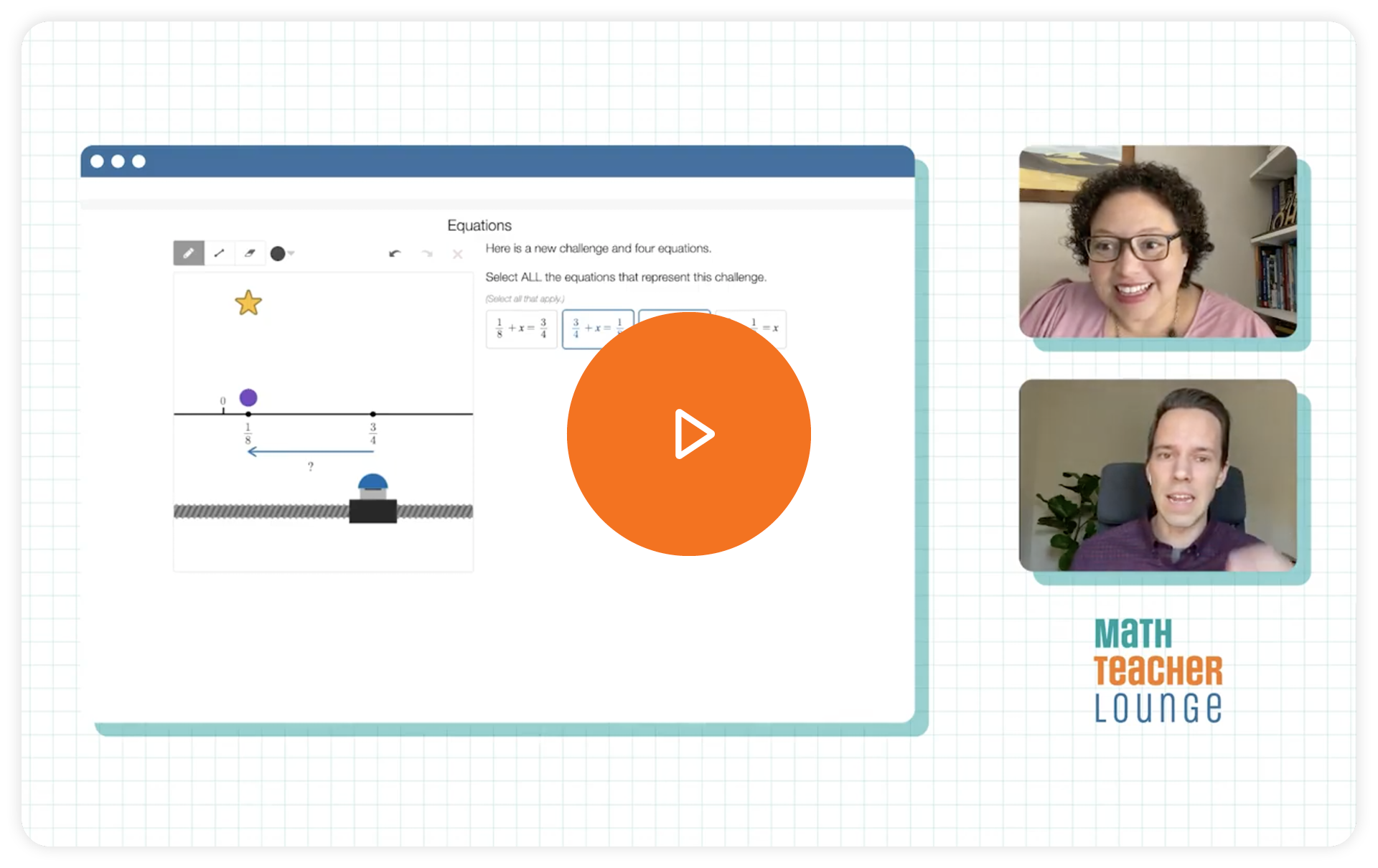

The power of productive struggle in K–5 math

A cartoon pizza cut into slices with a serving spatula in the center, flanked by colorful shapes and a cartoon animal on the right—an engaging way to spark curiosity about procedural fluency and fluency in math.

Struggling is not necessarily fun. It can be uncomfortable and frustrating. It can even feel like a great reason to give up.

But struggling and learning often go hand in hand. The key is for that struggle to be productive—for it to feel like something you worked through until you were successful, providing the confidence you need to tackle the next hard task.

That’s especially true—and essential—in math learning.

The key is productive struggle: the kind of effort that stretches students’ thinking without shutting them down. When designed intentionally, math activities for elementary students can challenge learners while still supporting confidence, curiosity, and persistence.

Here’s more about how productive struggle helps math students succeed.

What is productive struggle?

Productive struggle refers to students grappling with challenging problems that are not immediately solvable, but still within reach. It’s the space where students test ideas, make mistakes, revise strategies, and slowly build understanding.

Research shows that productive struggle helps learners move beyond surface-level memorization and toward deeper, more durable learning.

Rather than being told exactly what to do, students are encouraged to reason, explain, and persevere.

This doesn’t mean leaving students to flounder. Productive struggle requires clear goals, thoughtful scaffolds, and meaningful tasks so students know what they’re working toward and believe they can get there.

The role of growth mindset in math learning

Productive struggle is closely tied to another key idea: growth mindset.

A growth mindset is the belief that ability comes not from innate, baked-in talent, but through effort, strategies, and learning from mistakes. In the math classroom, this mindset helps students see challenges not as threats, but as opportunities.

When teachers communicate high expectations and normalize mistakes as part of learning, students are more willing to take risks. They begin to stop saying, “I can’t do this math problem,” and start saying, “I’m not there yet.”

This shift matters, especially in elementary grades. Students who develop a growth mindset early may be better equipped to avoid math anxiety and to handle increasingly complex math concepts, because they’ve learned that struggle is not a sign of failure, but part of the process.

Why struggle feels risky—and why it’s worth it

Supporting productive struggle can feel risky for teachers. Classrooms are busy. Time is limited. And no one wants students to feel frustrated or discouraged.

But avoiding struggle altogether creates its own problems. When math activities are too procedural or overly scaffolded, students may complete tasks without truly understanding them. Over time, students may come to believe that math is about following steps rather than making sense of ideas.

By contrast, well-designed struggle builds investment. Students engage more deeply when they’re asked to think, explain, and choose strategies. They develop problem-solving skills, perseverance, confidence, and a stronger sense of ownership over their learning.

What productive struggle looks like in practice

In classrooms that support productive struggle, students are actively involved, even when tasks are challenging. You might hear students explaining their reasoning, comparing strategies, or revising their thinking after a mistake.

Effective math activities for elementary students include:

  • Multiple entry points so all learners can begin.
  • Opportunities for students to explain why their strategy works.
  • Support for more than one correct approach.
  • Clear expectations paired with flexible pathways.

Even in kindergarten math activities, productive struggle for the youngest learners might look like counting, sorting, or representing numbers in different ways, paired with questions that prompt reasoning rather than quick answers.

Students need tasks that are mathematically meaningful, paired with structures that help them persist: opportunities to talk, visual representations, strategic questioning, and time to reflect.

In this way, struggle builds math muscle. Productive struggle helps students feel on top of their math game—and ready to learn more.

Math that motivates your K–5 students

As a K–5 teacher, your day is a constant balance of subjects, personalities, and priorities. With so many different dynamics and responsibilities, math class shouldn’t be another struggle to muscle through!

That’s why we’ve compiled a wealth of resources and activities to help you engage students; meet instructional goals; and encourage fluency, number sense, and discussion in your classroom. 

Three children paint the walls of a room; one holds a paper with the fraction 2/3, while math symbols and a tree appear in the background.
A booklet titled "The Power of Fluency: Cultivating Flexible, Confident Problem-Solvers" with an illustrated cover and an open page showing text and graphics about classroom fluency.

The power of fluency

Teachers work to achieve so many outcomes during their math block. While balancing multiple priorities, it’s important to remember that procedural fluency remains integral to student learning. Access this guide to unpack the power of fluency and find free math fluency practice to use in your next lesson.

10 low-prep, high-impact math activities that get to some serious math

Envision your classroom engaged in a difficult math task—all students are participating, leveraging different scaffolds that you intentionally prepared ahead of time. Engagement is high, and students are both challenged and motivated. Make this a reality in your school with our free activities designed to encourage productive struggle while reaching all learners.

A teacher holds a clipboard while a student points at a chalkboard labeled "Guinea Pig," "Millipede," and "Goldfish" in a classroom setting.
A presentation slide titled "Three Practices to Support Problem-Based Learning" features students and teachers engaged in classroom activities and math instruction.

Three practices to support problem-based learning

As educators, we want all students to develop a rich and deep understanding of the math they experience in our classrooms. A problem-based learning approach supports this by centering problem-solving in ways that build lifelong mathematical proficiency. Read this guide for practical tips on introducing problem-based learning and deeper conceptual understanding into your math classroom.

Best practices from real educators like you

Learn tried and true strategies for leveling up math instruction from Beyond My Years podcast guests like Amplify’s own Dan Meyer, teacher and My Kindergarten Math Workbook author Keri Brown, educator and speaker Mike Flynn, teacher and I Hate Math author Ian Brown, and more!
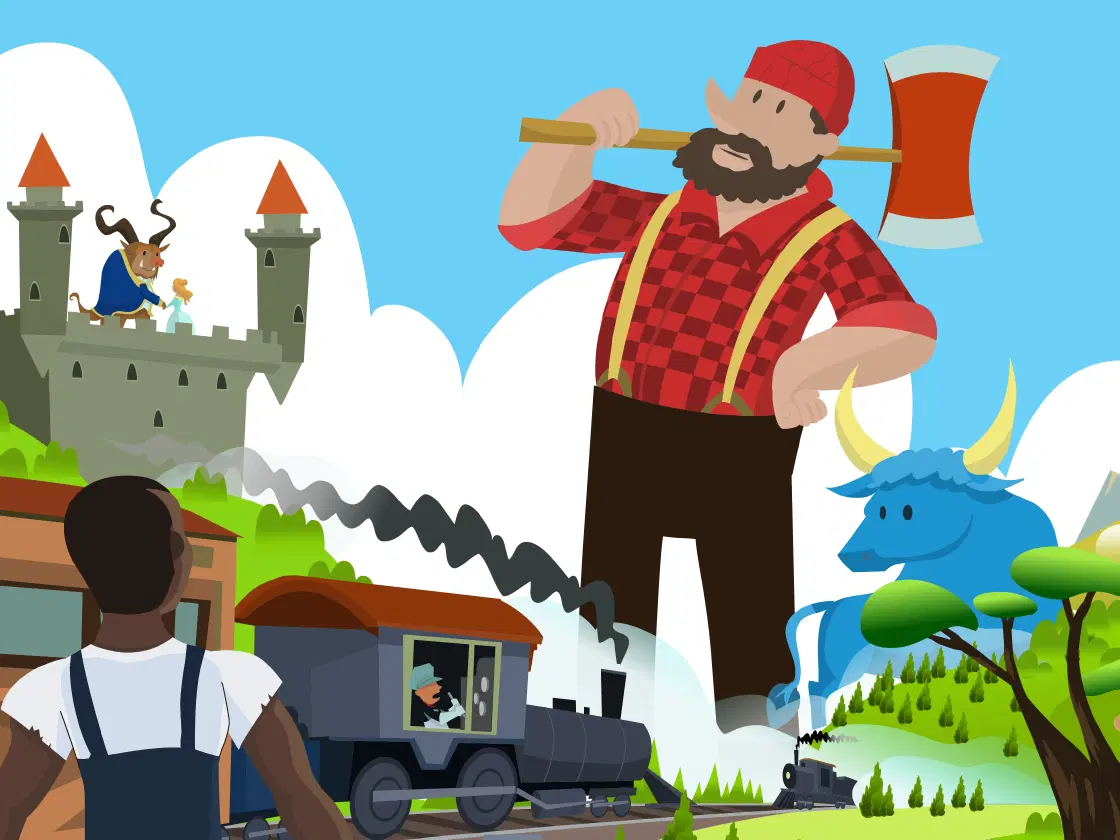
More free resources for K–5 educators

Two children paint a wall while holding a "2/3" sign; another child on the floor holds a "3 x 3" sign near a bookshelf.

K–5 Insider

Sign up for our monthly email to get new K–5 content and activities directly in your inbox.

sign up 

A printed guide titled "What are math routines, and how can you use them?" for grades K–5, with instructions and example math routine cards displayed.

K–5 instructional routine cards

Find easy-to-implement routines to keep students interacting and engaged with a lesson.

Download

A student and a teacher look at a laptop screen and smile in a classroom with colorful posters on the wall.

Math that motivates: Success stories

See how real teachers and students are unlocking new levels of engagement and comprehension, proving that everyone can be a math person.

LEARN MORE 

Ready to make every student a math person?

Connect with a product expert today.

FAQ for K–5 educators

Procedural fluency is the ability to use procedures flexibly, accurately, and efficiently to solve problems. Procedural fluency goes beyond memorization—students develop fluency when they understand number relationships and can choose from multiple strategies based on the numbers involved.

Students who understand why procedures work feel confident tackling challenging problems. When students can choose strategies that make sense to them, rather than relying on rote memorization, they develop agency and see themselves as capable mathematical thinkers.

Understanding how numbers connect helps students develop flexible thinking and multiple solution strategies. Timed tests often prioritize speed over understanding, which can create math anxiety and discourage the productive struggle that deepens learning.

Teachers can achieve this balance by using a predictable routine: warm-ups for fluency practice, a core problem-solving activity during which students explore multiple strategies, and structured discussion to connect different approaches. This structure ensures both skill-building and mathematical discourse happen daily.

Synthesizing learning means bringing the lesson together by highlighting the key mathematical idea that students have just explored. After students share strategies, the teacher helps them make connections between different approaches and names the big takeaway, often through a brief summary or exit ticket.

The Five Practices for Orchestrating Productive Mathematical Discussions are: 1) Anticipating student strategies before the lesson, 2) monitoring student work during the activity, 3) selecting specific students to share, 4) sequencing presentations in a purposeful order, and 5) connecting different strategies to the mathematical goal.

Productive struggle is when students grapple with challenging problems that require genuine thinking, but that remain accessible with appropriate support. It’s essential for deeper understanding, because it compels students to think critically, test strategies, and build perseverance, moving beyond surface-level memorization.

They can celebrate mistakes as learning opportunities and emphasize that understanding develops through effort and persistence. They can also create a safe classroom environment in which all students feel comfortable sharing their developing ideas and foster structured discussions during which multiple strategies are valued, helping students see that there’s more than one right way to think mathematically.

These are problems accessible to all students (that’s the low floor) but open enough to challenge advanced thinkers (that’s the high ceiling). Tasks like these allow multiple entry points and solution strategies, making them ideal for generating rich classroom discussion in which every student can participate meaningfully.

Such routines build number sense and fluency while making discussions predictable and low stakes. These brief, structured activities (5–10 minutes) activate prior knowledge, help students see number relationships, and give everyone practice explaining their thinking—all without requiring extensive preparation or materials.

They can do so by maintaining meaningful objectives while providing varied supports—ensuring that students understand what’s being asked, offering manipulatives and visual tools, allowing partner discussion before whole-class sharing, asking guiding questions without giving away the answer, and strategically grouping students. The goal is supporting access to challenging work, not making it easier.

What’s included in our Spanish language arts curriculum

Amplify Core Knowledge Language Arts® (CKLA) is available in both English and Spanish. Amplify Caminos al Conocimiento Esencial, our robust Spanish language arts companion for grades K–5, supports multiple teaching models, including dual language immersion and transitional classrooms.

A laptop screen displays a kindergarten instructional webpage in Spanish, showing lesson categories with illustrated thumbnails and navigation options.

Year at a glance

The program’s intentional Knowledge Sequence from K–5 connects knowledge and vocabulary within a grade level and across grade levels, for deeper reading comprehension and preparation for college, career, and life. Instead of “activating prior knowledge,” Amplify Caminos helps you build it in the classroom from day one, for every child, expanding each student’s knowledge base long before they transition to reading to learn.

Curriculum flowchart showing reading themes and activities from Kindergarten to Grade 5, organized by grade level and literary theme, with interconnected boxes for each topic.

Units & domains at a glance

Each Knowledge Domain in grades K–2 and Unit in grades 3–5 varies in the number of days based on instructional purpose. Just as with our top-rated Amplify CKLA program, the Amplify Caminos materials engage and delight young learners with resources that are both appealing and original.

Una mujer rubia con un vestido azul cuida ovejas blancas y negras, sosteniendo un bastón de pastor. Un cerdo vestido de azul corre y un hombre de negro toca el violín en una valla. Al fondo hay una casa.

Domain

Nursery Rhymes and Fables/Rimas y fábulas infantiles

Start learning about literature with these classic Mother Goose rhymes.

Ilustración de tres personas en un paisaje cubierto de hierba, una tratando de atrapar mariposas con una red, otra escondiéndose detrás de una escultura alta y frondosa de una mano y otra con binoculares.

Domain

The Five Senses/Los cinco sentidos

Learning about the body starts with learning about how we experience the world.

Una ilustración que representa a un gran lobo con sombrero de copa liderando un desfile de animales y personas con instrumentos musicales a través de un paisaje montañoso.

Domain

Stories/Cuentos

Learn about the parts of a book and some of the stories that go in one.

Una ilustración vibrante de una escena rural con colinas, una granja, una mariposa, un sol brillante, varias verduras como tomates y lechugas, y un gusano en el suelo.

Domain

Plants/Plantas

Discover the lifecycle of plants and the history of George Washington Carver.

Ilustración de una escena de granja que muestra un camión rojo que transporta verduras, campos de cultivo, vacas pastando en una colina, un granero y un molino de viento contra un cielo azul.

Domain

Farms/Granjas

Now we know how plants make their food… but what about animals?

Ilustración de un nativo remando en una canoa en un río con búfalos pastando en un campo, tipis al fondo y pájaros volando en el cielo bajo un sol brillante.

Domain

Native Americans/Los nativos americanos

Who were the first people in America? A look at the Lenape, Wampanoag, and Lakota Sioux.

Una ilustración muestra un rey y una reina en tronos, un castillo en un acantilado y una mujer con enanos cerca de un árbol. Cortinas rojas enmarcan la escena.

Domain

Kings and Queens/Reyes y reinas

To understand fairy tales, it’s best to first understand royalty.

Ilustración que muestra las cuatro estaciones: primavera con flores, verano con árboles verdes, otoño con hojas que caen e invierno con nieve y gente en trineo. Un niño lee debajo de un árbol.

Domain

Seasons and Weather/Las estaciones y el tiempo

The study of natural cycles continues with the weather and why it happens.

Un velero de madera con símbolos de cruz roja en sus velas navega cerca de una isla tropical con exuberante vegetación y palmeras. A lo lejos se ven otros dos barcos en el agua.

Domain

Columbus and the Pilgrims/Colón y los peregrinos

A look at the first contact between Europe and the Americas, and some of its results.

Una escena histórica muestra gente afuera de una gran mansión de estilo colonial con dos chimeneas. En primer plano se ve un carruaje tirado por caballos y a la izquierda se ve una casa más pequeña.

Domain

Colonial Towns and Townspeople/Las colonias y sus habitantes

Before the War for Independence, how did the town and country depend on one another?

Ilustración de personas clasificando materiales reciclables en un parque cerca de un río contaminado. Las fábricas emiten humo al fondo, mientras que las mariposas, las flores y los árboles están presentes en el primer plano.

Domain

Taking Care of the Earth/Cuidar el planeta Tierra

We only have one Earth—here are some ways to help care for it.

Ilustración del Monte Rushmore con los rostros tallados de cuatro presidentes de Estados Unidos. Un águila vuela en primer plano.

Domain

Presidents and American Symbols/Presidentes y símbolos de los Estados Unidos

Start learning about government through the lives of five presidents.

Una ilustración caprichosa que muestra animales de granja alrededor de una casa en un árbol junto a un río. Un zorro, un conejo y una oveja interactúan mientras la gente acampa junto a una fogata al fondo. Una araña cuelga del árbol.

Domain

Fables and Stories/Fábulas y cuentos

Learn some of the key elements of a story through classic fables.

Ilustración que presenta anatomía humana, actividades de estilo de vida saludable, profesionales médicos, símbolos dietéticos, una ambulancia y microorganismos, destacando la conexión entre salud, nutrición y ejercicio.

Domain

The Human Body/El cuerpo humano

What are germs? What are the organs? And what does it all have to do with health?

Una ilustración que presenta varias escenas de cuentos de hadas y folclore, incluida una calabaza grande, un tigre, Caperucita Roja, personas con atuendos tradicionales y una pagoda roja con una montaña de fondo.

Domain

Different Lands, Similar Stories/Tierras diferentes, cuentos similares

A world tour of storytelling, and the stories that stay the same across the world.

Ilustración que muestra el antiguo Egipto con pirámides, la Esfinge, agricultores arando un campo con bueyes y ganado pastando bajo un cielo soleado.

Domain

Early World Civilizations/Antiguas civilizaciones del mundo

Rivers, farming, writing, and laws: just what does it take to build a civilization?

Escena ilustrada de la antigua Mesoamérica con maíz, un río, agricultores y pirámides al fondo. En primer plano se ve a una persona con traje tradicional.

Domain

Early American Civilizations/Antiguas civilizaciones de América

What will we find in the great temples of the Aztec, Maya, and Inca civilizations?

Ilustración de la exploración espacial: se lanza un cohete, un astronauta se para cerca de un módulo de aterrizaje, una persona usa un telescopio y aparece un planeta distante con anillos sobre un fondo estrellado.

Domain

Astronomy/Astronomía

How the Earth relates to the moon, the sun, and the rest of the planets.

Dos paleontólogos en un paisaje volcánico examinan fósiles en primer plano, mientras un volcán emite humo y lava al fondo.

Domain

The History of the Earth/La historia de la Tierra

Just what lies beneath the Earth’s surface, and what can it teach us about the past?

Una escena de vida silvestre diversa que presenta un cactus del desierto con un pájaro, un conejo, elefantes, un león, un oso polar sobre el hielo y montañas distantes bajo un cielo nublado.

Domain

Animals and Habitats/Los animales y sus hábitats

A look at the connection between how animals live and where they make their homes.

Una princesa con un vestido rosa sostiene una rana junto a un arroyo con un castillo, árboles y gente al fondo. En primer plano camina un zorro con un sombrero con una pluma roja.

Domain

Fairy Tales/Cuentos de hadas

What do fairy tales have to teach us about how stories are told?

Ilustración que muestra una escena histórica con soldados, veleros y hombres con atuendo colonial discutiendo en el interior.

Domain

A New Nation: American Independence/Una nueva nación: la independencia de los Estados Unidos

The story of the birth of the United States out of the 13 Colonies.

Los pioneros con carros cubiertos y caballos señalan hacia un valle con tipis nativos, fogatas y humo elevándose. Un oso se encuentra sobre una roca y se ven montañas al fondo.

Domain

Frontier Explorers/Exploradores de la Frontera

The story of the journey west from the newborn U.S.A. to find the Pacific Ocean.

Un hombre con un hacha se encuentra entre paisajes exagerados con un castillo, un tren con humo, un buey azul y una persona con un mono observando la escena.

Domain

Fairy Tales and Tall Tales/Cuentos de hadas y cuentos exagerados

Learn about exaggeration and characterization on the frontier.

Ilustración de un paisaje vibrante que presenta diversos monumentos culturales, incluidos templos, palacios, pirámides, una escena de elefantes, montañas distantes y fuegos artificiales en el cielo.

Domain

Early Asian Civilizations/Antiguas civilizaciones de Asia

Tour the world of classical civilization, starting with India and China.

Ilustración que muestra la antigua Grecia con un anfiteatro, estatuas, soldados con armadura, un barco y un templo en una colina rodeada de vegetación.

Domain

Ancient Greek Civilization/La civilización griega antigua

The tour continues with the philosophy and politics of Greece.

Illustration of various mythological scenes including greek gods, a flying horse, and roman architecture under a sunny sky.

Domain

Greek Myths/Mitos griegos

Dive deep into the characters and storytelling of classic myths.

Ilustración de una batalla entre barcos británicos y estadounidenses cerca de un fuerte. El barco británico está a la izquierda con soldados, mientras que el barco estadounidense está a la derecha. La gente porta una gran bandera estadounidense en primer plano.

Domain

The War of 1812/La guerra de 1812

Learn about America’s “Second War for Independence.”

Un paisaje nevado con un zorro durmiendo en una madriguera, gente corriendo y andando en bicicleta por un sendero y árboles que muestran los cambios estacionales.

Domain

Cycles in Nature/Los ciclos de la naturaleza

Introducing the natural cycles that make our lives possible.

Ilustración de carros cubiertos tirados por caballos a lo largo de un sendero en el desierto, con un coyote aullando sobre una alta formación rocosa y un tren de vapor al fondo.

Domain

Westward Expansion/La expansión hacia el oeste

Why did pioneers go west? What happened to the people who were there?

Ilustración de un jardín vibrante con flores, abejas, mariposas, una oruga en una hoja, una crisálida y un apicultor que maneja una colmena junto a un estanque.

Domain

Insects/Los insectos

Lay the grounds for animal classification by looking at solitary and social insects.

Ilustración de una escena histórica con gente escuchando el discurso de un hombre en una plataforma. Al fondo se ve un río y una procesión de personas. En primer plano hay un documento de proclamación.

Domain

The U.S. Civil War/La Guerra Civil de los Estados Unidos

Begin to grapple with U.S. history’s central crisis over slavery.

Una escena en la que aparece una persona explicando un diagrama anatómico humano, otra persona haciendo ejercicio, una cadena de ADN, campos y un microscopio de fondo.

Domain

Human Body: Building Blocks and Nutrition/El cuerpo humano: componentes básicos y nutrición

A deeper dive into the digestive system and the nutrition process.

Un grupo diverso de personas se encuentra en un muelle con vistas a un bullicioso puerto con barcos y un gran barco, un avión volando por encima y la Estatua de la Libertad al fondo.

Domain

Immigration/La inmigración

Why did people immigrate to the United States, and what did they find here?

Women in early 20th-century clothing march with signs for voting rights and justice in front of a yellow bus labeled "Cleveland Ave.," making history that can inspire lessons in a K–2 language arts curriculum.

Domain

Fighting for a Cause/Luchar por una causa

How people can do extraordinary things to make the world better for everyone.

Dos ratones antropomórficos en un bote de remos, uno de ellos remando, navegan por un río tranquilo rodeado de exuberante vegetación y árboles. El ratón que rema lleva una chaqueta azul y el otro ratón parece conversar.

Unit 1

Classic Tales: The Wind in the Willows/Cuentos Clásicos: El viento en los sauces

A deep dive into character, theme, and POV in classic stories from around the world.

Ilustración de un jaguar, una garza, una rana roja, una tortuga y un pez en un paisaje vibrante con montañas y vegetación bajo un cielo soleado.

Unit 2

Animal Classification/La clasificación de los animales

How do we classify different animals by their appearance and behavior?

Ilustración de una figura humana que muestra la anatomía interna, incluidos el cerebro, los pulmones, el corazón, el sistema digestivo y una articulación de la cadera resaltada sobre un fondo degradado.

Unit 3

The Human Body: Systems and Senses/El cuerpo humano: sistemas y sentidos

Let’s take a closer look at how the skeleton, muscles, and nervous system all work.

Un ángel se arrodilla ante una mujer sentada en un sofá dorado encima de un templo en una noche estrellada. Unas escaleras conducen al templo en un paisaje montañoso.

Unit 4

The Ancient Roman Civilization/La civilización romana antigua

What is Rome’s greatest cultural contribution? In this unit, your students decide.

Ilustración de un perro saltando bajo un árbol, persiguiendo una abeja, con una mesa en primer plano sosteniendo una jarra y vasos de limonada. El sol brilla intensamente en el cielo.

Unit 5

Light and Sound/La luz y el sonido

The science behind all the ways we see and hear the world.

Un barco vikingo con una proa en forma de dragón navega en el océano bajo un cielo azul con nubes. El barco tiene una sola vela grande y varios escudos recubren sus costados.

Unit 6

The Viking Age/La era vikinga

An immersive narrative experience about what life was like in Viking communities.

Ilustración de una escena espacial con varios planetas y anillos sobre un fondo de estrellas. Dos planetas grandes dominan el primer plano y se ven planetas más pequeños al fondo.

Unit 7

Astronomy: Our Solar System and Beyond/Astronomía: nuestro sistema solar y más allá

More about our universe, including a writing project about daily life on a space station.

Una persona sentada en el borde de un acantilado con vistas a un vasto paisaje desértico con nubes arremolinadas en el cielo.

Unit 8

Native Americans: Regions and Cultures/Los nativos americanos: regiones y culturas

How did Native American nations change their way of life in different parts of the world?

Ilustración de un velero en el océano con la costa este de América del Norte visible a la izquierda.

Unit 9

Early Explorations of North America/La exploración europea de América del Norte

What was it like to sail to North America with the early European explorers?

Una pintura representa una escena del siglo XVII con colonos, un velero al fondo y un hombre conduciendo un carro tirado por caballos cargado de mercancías. Se ve a otras personas descargando y trabajando cerca.

Unit 10

Colonial America/La época colonial en los Estados Unidos

A study of the very different ways of life in the different pre-U.S. colonies.

Ilustración que muestra el ciclo de la vida: un esqueleto en el suelo, un pájaro posado en una cerca, otro pájaro en una planta y un ave rapaz más grande arriba, todos conectados por flechas circulares.

Unit 11

Ecology/Ecología

Students keep ecologist’s journals to learn about our world and how best to protect it.

Una mano alcanza una manzana verde en una rama. Cerca hay una brújula, un termómetro, un lápiz, notas musicales y un granero rojo sobre un paisaje cubierto de hierba.

Unit 1

Personal Narratives/Narrativas personales

Read stories of personal experience… and learn to reflect on your own.

Ilustración medieval que representa un grupo de figuras con armadura a la entrada de un alto castillo gris con puente levadizo, adornado con banderas y rodeado por un paisaje decorado y fondos ornamentados.

Unit 2

Empires in the Middle Ages/Los imperios en la Edad Media, parte 1 & Los imperios en la Edad Media, parte 2

Explore the medieval history of Europe and the Middle East.

Ilustración dorada de un dragón con alas sobre fondo beige, rodeado de diversos elementos decorativos como estrellas, hojas y estampados abstractos.

Unit 3

Poetry/Poesía

Study the poetry of many nations using licensed text anthologies, and begin to write your own.

Vintage styled illustrations of a microscope, an old telephone, and a clock on textured background with geometric patterns.

Unit 4

Eureka! Student Inventor/¡Eureka! Estudiante inventor

Transform the class into a lab for students to build and present inventions.

Formaciones rocosas en un paisaje desértico con capas vibrantes y arremolinadas de arenisca roja, naranja y amarilla bajo un cielo parcialmente nublado.

Unit 5

Geology/Geología

Plate tectonics, volcanoes, erosion: all the forces that shape the Earth.

Una imagen abstracta y colorida que representa varias formas geométricas de edificios sobre un fondo azul estampado.

Unit 6

Contemporary Fiction with excerpts from The House on Mango Street/Ficción Contemporánea con Fragmentos de La Casa en Mango Street

Explore The House on Mango Street… and write a book while doing it.

Cuadro que representa a un hombre y un niño tocando una gran campana en una torre, con espectadores al fondo y un cartel de "LIBERTAD" visible.

Unit 7

American Revolution/La Revolución estadounidense

Why did America seek independence? Let’s investigate the causes and effects.

Un pequeño bote de remos con tres personas navega por mares agitados mientras dos grandes barcos luchan al fondo, con humo y fuego visibles.

Unit 8

Treasure Island/La Isla del Tesoro

How dSeek the treasure of plot in this detailed study of a classic fiction adventure.

Unit 1

Personal Narratives/Narrativas personales

Through writing and sharing their writing, students begin to identify themselves as writers.

Unit 2

Early American Civilizations/Las primeras civilizaciones americanas

Students craft a codex to explain the rise and fall of the Maya, Aztec, and Inca people.

Dos jinetes medievales a caballo, uno de ellos con la espada en alto, avanzan por un terreno rocoso. El fondo presenta un paisaje brumoso bajo un tono violeta.

Unit 3

Poetry/Poesía

Students close read many forms of poetry… and learn to write them.

Collage ilustrado con un paraguas, un cuervo, un sextante náutico, estrellas, una luna creciente y una brújula sobre un fondo beige texturizado.

Unit 4

Adventures of Don Quixote/Las Aventuras de Don Quijote

Was Don Quixote right to fight the windmill? In this full-length novel study, students decide.

Unit 5

The Renaissance/El Renacimiento

Exploring the art and literature of the Renaissance through the works of its masters.

Tres hombres vestidos con ropa de época examinan una gran hoja de papel dentro de una imprenta. Un hombre parece llevar un delantal, mientras que otro señala el papel y el tercero observa de cerca.

Unit 6

The Reformation/La Reforma

How did the printing press transform the religion and society of Europe?

Patrón botánico morado y lila con hojas, plantas y formas abstractas, incluida una luna creciente y estrellas, sobre un fondo violeta oscuro.

Unit 7

William Shakespeare’s A Midsummer Night’s Dream/Sueño de Una Noche de Verano de William Shakespeare

Students enter the world of Shakespeare by reading, designing, and acting out his work.

Retrato en tonos sepia de una joven de pelo largo, con un collar de pedrería y un chal drapeado.

Unit 8

Native Americans/Los nativos americanos

How did the policies of the U.S. government impact Native American culture and lives?

Una lupa sobre documentos que contienen una pintura de paisaje de montañas, un dibujo con la etiqueta "Raptor Claw" y una nota adhesiva con la "Pista n.° 2". También se ven un sobre y una insignia exterior.

Unit 9

Chemical Matter/Química

Students use knowledge of chemistry to solve a mystery.

Print & digital components

The program includes instructional guidance and student materials for a year of instruction, with lessons and activities that keep students engaged every day.

Component

FORMAT

Knowledge (Conocimientos) Teacher Guides (K–2)

Knowledge Strand Teacher Guides contain Amplify CKLA’s cross-curricular read-alouds and application activities, all of which are standards-based to build mastery of content knowledge and literacy skills. There is one Teacher Guide per Knowledge Domain.

Print and digital

Knowledge Image Cards (K–2)

Amplify Caminos includes Image Cards for each Knowledge Domain to bring each topic to life through vivid visuals.

Print and digital

Knowledge Flip Books (K–2)

Projectable Flip Books are provided to accompany the read-alouds in each Knowledge Domain.

Digital

Teacher Guides (3–5)

Teacher Guides for grades 3–5 units are based on content-rich topics and incorporate reading, writing, speaking, and listening skills in the context of background knowledge. There is one Teacher Guide per unit.

Print or digital

Teacher Resource Site (K–5)

The program includes a one-stop-shop website for lesson projections, digital versions of all Amplify Caminos materials, lesson planning resources, multimedia (such as eBooks), and more.

Digital

Professional Learning Site (K–5)

The Professional Learning site includes training materials, best practices, and other resources to develop program expertise. Access professional development anywhere, anytime.

Digital

Component

FORMAT

Knowledge (Conocimiento) Activity Books (K–2)

Activity Books provide students with the opportunity to deepen world and word knowledge by responding to text in a diversity of ways.

Print

Student Readers (3–5)

Student Readers serve as content-rich anchor texts for each unit. Units such as Poetry and Contemporary Fiction feature authentic texts originally written in Spanish.

Activity Books (3–5)

Activity Books in grades 3–5 provide daily opportunities for students to hone reading and writing skills within the context of each unit.

Print and digital

Explore more programs

Our programs are designed to support and complement one another. Learn more about our related programs.

What’s included in our literacy curriculum for 6–8

Amplify ELA is a blended literacy curriculum designed specifically for grades 6–8. The heart of every lesson is the text. Our core English Language Arts curriculum enables teachers to teach skills through texts and develop their students’ muscles for building meaning through reading. With Amplify ELA, students learn to attack any complex text and make observations, grapple with interesting ideas, and find relevance for themselves.

Year at a glance

Each grade includes six core units centered on literary or informational texts, delivered in several forms of media. In addition to these main units, students will engage with targeted Grammar lessons and a dedicated Story Writing unit, plus two to three immersive learning experiences called Quests.

Dahl & Narrative

1 assessment lesson
4 sub-units | 28 lessons | 4-6 weeks

A man with a mustache looks through a microscope at a slide, with abstract yellow lines in the background.

Mysteries & Investigations

1 assessment lesson
5 sub-units | 32 lessons | 4-6 weeks

A man with a mustache looks through a microscope at a slide, with abstract yellow lines in the background.

The Chocolate Collection

1 assessment lesson
5 sub-units | 25 lessons | 4-6 weeks

The Greeks

Myth World Quest

1 assessment lesson
4 sub-units | 25 lessons | 4-6 weeks

A man with a mustache looks through a microscope at a slide, with abstract yellow lines in the background.

Summer of the Mariposas

1 assessment lesson
2 sub-units | 27 lessons | 4-6 weeks

A man with a mustache looks through a microscope at a slide, with abstract yellow lines in the background.

The Titanic Collection

1 assessment lesson
5 sub-units | 25 lessons | 4-6 weeks

A man with a mustache looks through a microscope at a slide, with abstract yellow lines in the background.

Red Scarf Girl

1 assessment lesson
4 sub-units | 31 lessons | 4-6 weeks

A man with a mustache looks through a microscope at a slide, with abstract yellow lines in the background.

Character & Conflict

1 assessment lesson
4 sub-units | 29 lessons | 4-6 weeks

A man with a mustache looks through a microscope at a slide, with abstract yellow lines in the background.

Brain Science

Perception Academy Quest

1 assessment lesson
4 sub-units | 25 lessons | 4-6 weeks

A man with a mustache looks through a microscope at a slide, with abstract yellow lines in the background.

Poetry & Poe

The “Who Killed Edgar Allen Poe” Quest

1 assessment lesson
5 sub-units | 29 lessons | 4-6 weeks

A man with a mustache looks through a microscope at a slide, with abstract yellow lines in the background.

The Frida & Diego Collection

1 assessment lesson
5 sub-units | 25 lessons | 4-6 weeks

A man with a mustache looks through a microscope at a slide, with abstract yellow lines in the background.

The Gold Rush Collection

1 assessment lesson
5 sub-units | 25 lessons | 4-6 weeks

A man with a mustache looks through a microscope at a slide, with abstract yellow lines in the background.

Perspectives & Narrative

1 assessment lesson
4 sub-units | 27 lessons | 4-6 weeks

A man with a mustache looks through a microscope at a slide, with abstract yellow lines in the background.

Liberty & Equality

1 assessment lesson
6 sub-units | 38 lessons | 4-6 weeks

A man with a mustache looks through a microscope at a slide, with abstract yellow lines in the background.

Science & Science Fiction

1 assessment lesson
3 sub-units | 29 lessons | 4-6 weeks

A man with a mustache looks through a microscope at a slide, with abstract yellow lines in the background.

Shakespeare’s Romeo & Juliet

1 assessment lesson
2 sub-units | 22 lessons | 4-6 weeks

A man with a mustache looks through a microscope at a slide, with abstract yellow lines in the background.

The Holocaust: Memory & Meeting

1 assessment lesson
6 sub-units | 21 lessons | 4-6 weeks

A man with a mustache looks through a microscope at a slide, with abstract yellow lines in the background.

The Space Race Collection

1 assessment lesson
5 sub-units | 25 lessons | 4-6 weeks

Units at a glance

Amplify ELA lessons follow a structure both grounded in regular routines and flexible enough to allow for a variety of learning experiences. Lesson structures vary from day to day, ensuring that students are always engaged.

Learn more in the Amplify ELA Grade Overview.

Unit 6A

Dahl & Narrative

Students begin with narrative writing to develop foundational Focus skills and establish key classroom routines. Teachers use this work to create targeted feedback cycles and build a vibrant community centered on diverse experiences. Students then apply observational skills to Roald Dahl’s Boy: Tales of Childhood, learning to work closely with textual evidence.

Unit 6B

Mysteries & Investigations

Students read like an investigator to embark on a multi-genre study into the mesmerizing world of scientific and investigative sleuthing. The Secret of the Yellow Death: A True Story of Medical Sleuthing by Suzanne Jurmain, and Sir Arthur Conan Doyle’s Sherlock Holmes stories take place in the late 19th century, when medical diagnostics and criminal investigations were still evolving into scientific fields.

Unit 6C

The Chocolate Collection

Students explore primary documents and research the diverse cultural roles chocolate has played over 3,700 years, from its various uses in ancient Mexico to issues with modern production. Along the way, they build information literacy skills, craft research questions, and collaborate in Socratic seminars. Students also learn how to construct an evidence-based argument and use those skills to write pieces aimed at convincing readers about chocolate preferences, school lunch policies, and recommendations for local candy stores.

Unit 6D

The Greeks

Students closely explore and analyze three stories from Greek mythology: “Prometheus,” “Odysseus,” and “Arachne.” Drawing on the routines and skills established in previous units, these lessons ask students to move from considering the state of a single person to contemplating broader questions concerning the role people play in the world and the various communities they inhabit.

Unit 6E

Summer of the Mariposas

Students read Summer of the Mariposas by Guadalupe García McCall, a contemporary Latino retelling of The Odyssey. Following five sisters on their journey into Mexico and back, students explore this reimagining of the hero’s journey as they encounter Mexican folklore and Aztec legends along the way. Students analyze character development, compare the novel to Homer’s original, research Aztec mythology, explore symbolism, and engage in collaborative discussions before writing an essay about what makes the heroes successful.

Unit 6F

The Titanic Collection

Students explore primary documents and conduct research to understand the 1912 Titanic disaster, building information literacy skills by examining artifacts such as dining menus, ship photos, telegraph transcripts, and newspaper accounts. Each student is assigned a passenger from the manifest and writes a narrative account from that person’s perspective, considering different views. Students also participate in Socratic seminars to examine the complicated issues within the Titanic story.

Unit 7A

Red Scarf Girl & Narrative

Students begin with narrative writing to develop foundational Focus skills while teachers establish targeted feedback cycles and build a classroom community centered on diverse experiences. After exploring how they describe their own experiences and emotions, students apply the same close attention to analyzing details in Ji-li Jiang’s Red Scarf Girl: A Memoir of the Cultural Revolution.

Unit 7B

Character & Conflict

Students analyze characters’ responses to conflict and examine how authors use character interactions to develop theme and perspective. They read Carson McCullers’ “Sucker” and Lorraine Hansberry’s A Raisin in the Sun, both texts that explore how families facing hardships can support and harm one another. Students observe complex character growth and discuss issues of identity, family obligations, and differing notions of success.

Unit 7C

Brain Science

Students explore narrative nonfiction and informational texts about brain science to understand what it means to be human and how their developing brains impact daily experiences. They also build awareness of their cognitive strengths and analyze the structures of informational texts and scientific arguments. Key texts include Phineas Gage, Inventing Ourselves: The Secret Life of the Teenage Brain, and Oliver Sacks’ The Man Who Mistook His Wife for a Hat.

Unit 7D

Poetry & Poe

Students learn visualization techniques to read like a movie director, beginning with poems by D.H. Lawrence, Federico García Lorca, and Emily Dickinson to form mental images. They then read three Edgar Allan Poe texts, creating storyboards and analyzing narrative elements to learn about unreliable narrators. Students also participate in the murder-mystery Quest “Who Killed Edgar Allan Poe?” and write an essay arguing whether they can trust a narrator in the unit’s texts.

Unit 7E

The Frida & Diego Collection

Students explore primary source documents and research on Mexican artists Diego Rivera and Frida Kahlo, learning how they drew inspiration from Latin American folklore, politics, and customs. Along the way, students build information literacy by generating research questions and visual analysis skills through close reading of key paintings. They also compare the artists’ descriptive writing to Shakespeare’s and analyze figurative language. The unit culminates in a research project showcasing their interpretation of Frida and Diego’s work and legacy.

Unit 7F

The Gold Rush Collection

Students explore primary documents and conduct research on the California Gold Rush, building information literacy skills and constructing research questions. They also learn about the diverse people who participated, compare fictional and historical accounts, and participate in Socratic seminars. Students write narrative accounts from specific perspectives and complete a culminating research assignment combining essay and media project elements.

Unit 8A

Perspectives & Narrative

Students learn to read like writers, paying attention to craft and writing moves that shape reader experience and developing Focus and Showing skills as they build collaborative classroom routines. Students study three narrative texts, exploring themes of belonging and identity through close reading. They also practice alternating between analytic and narrative writing, and conclude with an essay arguing whether the mothers in Amy Tan’s “Fish Cheeks” are role models. 

Unit 8B

Liberty & Equality

Students study Civil War-era writings that debate the meaning of “all men are created equal,” exploring various perspectives on American ideals. Key texts include Walt Whitman’s Leaves of Grass, Frederick Douglass’ Narrative, and Harriet Ann Jacobs’s Incidents in the Life of a Slave Girl. The unit culminates with an essay examining Douglass’s arguments and Lincoln’s Gettysburg Address to consider what America means by “all men are created equal.”

Unit 8C

Science & Science Fiction

Students read Gris Grimly’s Frankenstein, a graphic novel adaptation of Mary Shelley’s novel, exploring themes of creator responsibility, societal influence, and the risks of scientific inquiry. They trace Victor’s sympathy for his creation, rewrite scenes from the creature’s perspective, and debate whether Victor owes the creature a companion. The unit concludes with an essay determining whether the creature should be considered human.

Unit 8D

Shakespeare’s Romeo & Juliet

Students read five excerpts from Shakespeare’s Romeo and Juliet to learn key elements of Shakespearean English through close reading. They practice memorizing and reciting the famous “Prologue,” put on stage performances, translate Shakespeare’s language into contemporary terms, and study the Shakespearean sonnet form. The unit concludes with an essay arguing whether love or hate is responsible for Romeo’s death.

Unit 8E

Holocaust: Memory & Meaning

Students use close reading to explore memoirs and primary sources that address two key Holocaust questions: How do societies become participants in atrocity, and what are our responsibilities as witnesses? Students analyze multiple perspectives through texts, including Alexander Kimel’s “I Cannot Forget,” Irene Butter’s Shores Beyond Shores, 1936 Olympics propaganda, and excerpts from Maus and Night.

Unit 8F

The Space Race Collection

Students explore primary documents and conduct research on the Space Race. They build information literacy skills, construct research questions, and learn about diverse participants from Soviet cosmonauts to American heroes like Buzz Aldrin and Katherine Johnson. Each student researches an assigned cosmonaut or astronaut and writes space blog entries from their perspective. Students also complete a capstone research essay and media project.

Print & digital components

The program includes instructional guidance and student materials for a year of instruction, with lessons and activities that keep students engaged every day.

A diagram shows the Amplify ELA curriculum with examples of the digital teacher edition on a tablet, print teacher edition pages, and a teacher projection of an artwork on a screen.

Teacher materials

Teacher Edition

Available digitally and in print, the Teacher’s Edition contains all the information teachers need to facilitate classroom instruction, including detailed lesson plans, video teacher tips, presentation slides, standards alignment, Exit Tickets, real-time differentiation strategies, and robust reporting.

Student materials

Student Edition

Available digitally and in print, student materials guide middle schoolers through complex texts and writing by engaging them with high-quality narrative and informational texts—providing videos, audio supports, and a digital experience that captures their attention. They also keep all of their writing in one place with a personal Writing Journal.

A collection of Amplify ELA materials including a print student edition, a digital student edition on a laptop, a writing journal, and an Arachne literature module.

Explore more programs

Our programs are designed to support and complement one another. Learn more about our related programs.

Professional development for core programs

Amplify professional development provides learning experiences that intentionally develop the knowledge and skills you need for effective and self-sustaining implementation.

Learn and apply impactful instructional techniques and develop a deeper understanding of your Amplify program(s) by investing in professional development.

Professional Learning Partner Guide Certified Provider

Amplify professional development has been vetted by Rivet Education’s team through a rigorous three-step process and is listed in the Professional Learning Partner Guide.

Two women smiling and looking at a laptop screen, sitting at a desk with a water bottle and notepad. decorative yellow and orange speech bubbles and shapes overlay the image.

About Amplify core programs

Amplify’s high-quality programs make it easier for you to teach inspiring, impactful lessons that celebrate and develop the brilliance of your students. By equipping teachers with resources and strategies to provide robust scaffolding and differentiated instruction, Amplify’s core programs ensure that all students can fully engage with rigorous subject matter.

Literacy

  • Amplify ELAR K–5
  • Amplify SLAR K–5
  • Amplify ELAR 6–8

STEM

  • Amplify Math
  • Desmos Math
  • Amplify Desmos Math (for Grades K–Algebra 1)*
  • Amplify Science

We provide PD sessions for all Amplify programs. Contact your account executive to discuss the extended catalog of PD session options or request a quote.

*Amplify Desmos Math is a new core PreK–12 program from Amplify and Desmos Classroom—available in English and Spanish—that applies a problem-based approach to get results by developing deep conceptual understanding, procedural fluency, and application. Contact us to learn more about the packages and sessions currently available.

About Amplify Professional Development (PD)

Change is more likely to stick and get results when you take a systemic approach. Partner with us to do just that by developing a learning plan that will drive your program implementation, enrich your instructional practices, and increase student impact. Begin and Practice packages are available for core programs.


Prepare

Begin

Practice

Advance
Program-agnostic sessions will set up educators for success in areas such as the Science of Reading and/or problem-based approaches to math. Program-aligned packages will support those who are new to Amplify’s programs. Program-aligned packages will support those who have experience using Amplify’s programs. Offerings will support advanced implementation, build capacity for instructional leaders, certify in-house trainers to deliver Launch sessions, and more.

At each phase of implementation, we offer a range of unique packages and offerings. Sessions are strategically bundled for multiple touch points throughout the year. A variety of high-quality sessions set educators up for success with Amplify programs—whether you’re years into using them or just starting out.

Session types

Select a package to uncover the benefits of a customizable Coach session.

LAUNCH STRENGTHEN COACH
Beginning of year Mid-year, end of year Mid-year, end of year
Illustration of a rocket ship with a red tip, gray fins, and orange flames, featuring a person with red hair visible through a window.
Illustration of a woman with red hair lifting a dumbbell, sweating and flexing her arm to show a muscle.
Three people are in a rowboat; two are rowing while the third faces them, appearing to give instructions or shout.
Propel your teachers into the new school year with sessions that introduce them to their Amplify program and support them in a strong implementation.
Boost implementation with sessions that target specific instructional practices.
Guide teachers and leaders with targeted learning tailored to their specific needs.
Before teaching
After 6+ weeks of teaching
 
Select a package to reveal the components of a launch session. To explore the core strengthen sessions, select your program: Select a package to uncover the benefits of a customizable Coach session.

Interactive sessions empower teachers and leaders implementing Amplify programs, giving them the tools and skills they need to inspire all students to think deeply, creatively, and for themselves.

Explore enhancement options to see how you can further customize your package to build capacity in teachers and leaders and meet the needs of all learners within Amplify literacy, biliteracy, and/or STEM program(s).

Begin packages

You’re in your first year of implementation. You’re ready to start making the shift to evidence-based practices, using your Amplify program(s). You know that individual change is critical to organizational change. Let us support educators with professional development that develops new skills, knowledge, and a positive orientation to change.

Explore the program-aligned package options below to learn more about the modality and duration of each Launch, Strengthen, and Coach session available to you during your first year of implementation.

Select from flexible on-site, hybrid, or virtual packages, including:

  • Launch sessions to introduce Amplify programs and support strong implementation.
  • Strengthen sessions to deepen understanding of the program.
  • Coach sessions to elevate instructional practice and help meet teachers’ and schools’ specific needs.

Each package supports up to 30 participants in similar grade bands.

Overview: Begin packages for Amplify core programs

Package title and duration On-site package (15 hours) Hybrid
on-site package
(15 hours)
Hybrid 10 package (10 hours) Hybrid virtual package (15 hours) Virtual package   (7 hours)
Launch
One session per package
On-site
6 hr.
On-site
6 hr.
On-site
3 hr.
Virtual
6 hr.
(2 half-days)
Virtual
3 hr.
Strengthen
One session per package
On-site
3 hr.
Virtual
3 hr.
Virtual
1 hr.
Virtual
3 hr.
Virtual
1 hr.
Coach
One session per package
On-site
6 hr.
On-site
6 hr.
On-site
6 hr.
On-site
6 hr.
Virtual
3 hr.
Suggested enhancements
Launch add-on On-site or virtual,
3 hr. session
Program overview for leaders

On-site package

Begin: On-site packages include program-aligned, on-site Launch, Strengthen, and Coach sessions. Providing 15 hours of professional development for up to 30 participants, this package will build understanding of research-based practices supported by Amplify program(s) and develop knowledge and skills through a variety of curated sessions.

Begin: On-site package

(15 hours for 30 participants)
    Select the session to learn more.
Launch (1) On-site, 6-hr. session Initial training for teachers
Strengthen (1) On-site, 3-hr. session Explore Core Literacy and Core STEM Strengthen sessions. Session titles scheduled upon request.
Coach (1) On-site, 6-hr. session Coach session
Suggested enhancements On-site or virtual,
3-hr. session
Program overview for leaders

Launch

Propel your school or district into the new school year. Program-aligned Launch sessions introduce teachers and leaders to their unique Amplify program(s) and support a strong implementation.

Initial training for teachers

On-site, 6 hours

Initial training sessions are designed for educators who are new to our program. In our initial training session, educators are oriented to the key components of their program(s), including learning how to navigate, teach, and monitor student progress, while exploring content and program resources. Participants will leave the session with foundational knowledge and skills necessary to begin teaching with the program.

Session options: Amplify ELAR, Amplify SLAR, or Amplify ELAR/SLAR biliteracy, Amplify ELAR 6–8, Amplify Math, Amplify Desmos Math (Grades K–5 or 6–A1), Amplify Science (Grades K–5 or 6–8)

Audience: Teachers, instructional staff (maximum 30 participants)

Suggested enhancement: Program overview for leaders

On-site or virtual, 3 hours

The program overview for leaders session supports district and school-level instructional leaders in effectively coordinating the implementation of the program. Leaders will learn the foundational elements of the program, build an understanding of the key teacher and student practices to look for in classrooms, and develop an implementation plan.

Session options: Amplify ELAR, Amplify SLAR, or Amplify ELAR/SLAR biliteracy; Amplify ELAR 6–8, Amplify Math, Amplify Desmos Math (Grades K–5 or 6–A1), Amplify Science (Grades K–5 or 6–8)

Audience: Leaders (maximum 30 participants)

Strengthen

Strengthen your Amplify implementation with program-specific sessions that support personalized learning and practice in your classroom.

To explore the core strengthen sessions, select your program:

Amplify will partner closely with you to select the appropriate session(s) that will deepen educators’ understanding of Amplify program(s) and equip them with the tools they need to improve students’ learning outcomes. Each package includes one Strengthen session. Additional sessions can be added as Enhancements.

Coach

Elevate instructional practice and help meet teachers’ and schools’ specific needs with customizable Coach sessions.

Coach session

On-site, 6 hours

Coaching sessions focus on building internal school and district capacity and leadership excellence. Coaching is customized to meet a school or district’s needs and can include model lessons, observations, walk-throughs, and/or co-planning.

Session options: Amplify ELAR, Amplify SLAR, or Amplify ELAR/SLAR biliteracy, Amplify Math, Amplify Desmos Math, Amplify Science (Grades K–5 or 6–8)

Audience: Individual teachers, grade-level teams, PLCs,
and/or instructional leaders (maximum 30 participants)

Hybrid 15 on-site package

Begin: Hybrid 15 on-site packages include program-aligned, on-site Launch, Strengthen, and Coach sessions. Providing 15 hours of professional development for up to 30 participants, this package will build understanding of research-based practices supported by Amplify program(s) and develop knowledge and skills through a variety of curated sessions.

Begin: Hybrid 15 on-site package

(15 hours for 30 participants)
    Select the session to learn more.
Launch (1) On-site, 6-hr. session Initial training for teachers
Strengthen (1) Virtual, 3-hr. session Explore the Core Literacy and Core STEM Strengthen sessions. Session titles scheduled upon request.
Coach (1) On-site, 6-hr. session Coach session
Suggested enhancements On-site or virtual,
3-hr. session
Program overview for leaders

Launch

Propel yourself into the new school year. Program-aligned Launch sessions introduce teachers and leaders to their unique Amplify program(s) and support a strong implementation.

Initial training for teachers

On-site, 6 hours

Initial training sessions are designed for educators who are new users. In our initial training session, educators are oriented to the key components of the program, including learning how to navigate, teach, and monitor student progress, while exploring content and program resources. Participants will leave the session with foundational knowledge and skills necessary to begin teaching with the program.

Session options: Amplify ELAR, Amplify SLAR, or Amplify ELAR/SLAR biliteracy, Amplify ELAR 6–8, Amplify Math, Amplify Desmos Math (Grades K–5 or 6–A1), Amplify Science (Grades K–5 or 6–8)

Audience: Teachers, instructional staff (maximum 30 participants)

Suggested enhancement: Program overview for leaders

On-site or virtual, 3 hours

The program overview for leaders session supports district and school-level instructional leaders in effectively supporting the implementation of the program. Leaders will learn the foundational elements of the program, build an understanding of the key teacher and student practices to look for in classrooms, and develop an implementation plan.

Session options: Amplify ELAR, Amplify SLAR, or Amplify ELAR/SLAR biliteracy; Amplify ELAR 6–8, Amplify Math, Amplify Desmos Math (Grades K–5 or 6–A1), Amplify Science (Grades K–5 or 6–8)

Audience: Leaders (maximum 30 participants)

Strengthen

Strengthen your Amplify implementation with program-specific sessions that support personalized learning and practice in your classroom.

To explore the core strengthen sessions, select your program:

Amplify will closely partner with you to select the appropriate session(s) that will deepen educators’ understanding of Amplify program(s) and equip them with the tools they need to improve student’s learning outcomes. Each package includes one Strengthen session. Additional sessions can be added as Enhancements.

Coach

Elevate instructional practice and help meet teachers’ and schools’ specific needs with customizable Coach sessions.

Coach session

On-site, 6 hours

Coaching sessions focus on building internal school and district capacity and leadership excellence. Coaching is customized to meet a school or district’s needs and can include model lessons, observations, walk-throughs, and/or co-planning.

Session options: Amplify ELAR, Amplify SLAR, or Amplify ELAR/SLAR biliteracy, Amplify Math, Amplify Desmos Math, Amplify Science

Audience: Individual teachers, grade-level teams, PLCs,and/or instructional leaders (maximum 30 participants)

Hybrid 10 package

The Begin: Hybrid 10 package includes program-aligned, on-site and virtual Launch, Strengthen, and Coach sessions. Providing 10 hours of professional development for up to 30 participants, this package will build understanding of research-based practices supported by Amplify program(s) and develop knowledge and skills through a variety of curated sessions.

Begin: Hybrid 10 package

(10 hours for up to 30 participants)
    Select the session to learn more.
Launch (1) On-site, 6-hr. session Program overview for teachers
Strengthen (1) Virtual, 1-hr. session Explore Core Literacy and Core STEM Strengthen sessions. Session titles scheduled upon request.
Coach (1) On-site, 6-hr. session Coach session
Suggested enhancements On-site or virtual,
3-hr. session
Program overview for leaders

Launch

Propel your school or district into the new school year. Program-aligned Launch sessions introduce teachers and leaders to their unique Amplify program(s) and support a strong implementation.

Program overview for teachers

On-site, 3 hours

Program overview sessions provide a basic introduction for educators who are new users of the program. In a program overview session, educators learn how to get started with the key features and materials of the program.

Session options: Amplify ELAR, Amplify SLAR, or Amplify ELAR/SLAR biliteracy, Amplify Math, Amplify Desmos Math (Grades K–5 or 6–A1), Amplify Science (Grades K–5 or 6–8)

Audience: Teachers, instructional staff (maximum 30 participants)

Suggested enhancements: Program overview for leaders

On-site or virtual, 3 hours

The program overview for leaders session supports district and school-level instructional leaders in effectively supporting the implementation of the program. Leaders will learn the foundational elements of the program, build an understanding of the key teacher and student practices to look for in classrooms, and develop an implementation plan.

Session options: Amplify ELAR, Amplify SLAR, or Amplify ELAR/SLAR biliteracy; Amplify ELAR 6–8, Amplify Math, Amplify Desmos Math (Grades K–5 or 6–A1), Amplify Science (Grades K–5 or 6–8)

Audience: Leaders (maximum 30 participants)

Strengthen

Strengthen your Amplify implementation with program-specific sessions that support personalized learning and practice in your classroom.

To explore the available core strengthen sessions, select your program:

Amplify will closely partner with you to select the appropriate session(s) that will deepen educators’ understanding of your Amplify program(s) and equip them with the tools they need to improve student’s learning outcomes. Each package includes one Strengthen session. Additional sessions can be added as Enhancements.

Coach

Elevate instructional practice and help meet teachers’ and schools’ specific needs with customizable Coach sessions.

Coach session

On-site, 6 hours

Coaching sessions focus on building internal school and district capacity and leadership excellence. Coaching is customized to meet a school or district’s needs and can include model lessons, observations, walk-throughs, and/or co-planning.

Session options: Amplify ELAR, Amplify SLAR, or Amplify ELAR/SLAR biliteracy, Amplify Math, Amplify Desmos Math, Amplify Science (Grades K–5 or 6–8)

Audience: Individual teachers, grade-level teams, PLCs,
and/or instructional leaders (maximum 30 participants)

Hybrid 15 virtual package

Begin: Hybrid 15 virtual packages include program-aligned, on-site Launch, Strengthen, and Coach sessions. Providing 15 hours of professional development for up to 30 participants, this package will build understanding of research-based practices supported by Amplify program(s) and develop knowledge and skills through a variety of curated sessions.

Begin: Hybrid 15 virtual package

(15 hours for up to 30 participants)
    Select the session to learn more.
Launch (1) Virtual, 6-hr. session
(2 half-days)
Initial training for teachers
Strengthen (1) Virtual, 3-hr. session Explore Core Literacy and Core STEM Strengthen sessions. Session titles scheduled upon request.
Coach (1) On-site, 6-hr. session Coach session
Suggested enhancements On-site or virtual,
3-hr. session
Program overview for leaders

Launch

Propel your school or district into the new school year. Program-aligned Launch sessions introduce teachers and leaders to their unique Amplify program(s) and support a strong implementation.

Initial training for teachers

Virtual, 6 hours (2 half-days)

Initial training sessions are designed for educators who are new to our program. In our initial training session, educators are oriented to the key components of their program(s), including learning how to navigate, teach, and monitor student progress, while exploring content and program resources. Participants will leave the session with foundational knowledge and skills necessary to begin teaching with the program.

Session options: Amplify ELAR, Amplify SLAR, or Amplify ELAR/SLAR biliteracy, Amplify Math, Amplify Desmos Math (Grades K–5 or 6–A1), Amplify Science (Grades K–5 or 6–8)

Audience: Teachers, instructional staff (maximum 30 participants)

Suggested enhancement: Program overview for leaders

On-site or virtual, 3 hours

The program overview for leaders session supports district and school-level instructional leaders in effectively supporting the implementation of the program. Leaders will learn the foundational elements of the program, build an understanding of the key teacher and student practices to look for in classrooms, and develop an implementation plan.

Session options: Amplify ELAR, Amplify SLAR, or Amplify ELAR/SLAR biliteracy; Amplify ELAR 6–8, Amplify Math, Amplify Desmos Math (Grades K–5 or 6–A1), Amplify Science (Grades K–5 or 6–8)

Audience: Leaders (maximum 30 participants)

Strengthen

Strengthen your Amplify implementation with program-specific sessions that support personalized learning and practice in your classroom.

To explore the available core strengthen sessions, select your program:

Amplify will closely partner with you to select the appropriate session(s) that will deepen educators’ understanding of Amplify program(s) and equip them with the tools they need to improve students’ learning outcomes. Each package includes one Strengthen session. Additional sessions can be added as Enhancements.

Coach

Elevate instructional practice and help meet teachers’ and schools’ specific needs with customizable Coach sessions.

Coach session

On-site, 6 hours

Coaching sessions focus on building internal school and district capacity and leadership excellence. Coaching is customized to meet a school or district’s needs and can include model lessons, observations, walk-throughs, and/or co-planning.

Session options: Amplify ELAR, Amplify SLAR, or Amplify ELAR/SLAR biliteracy, Amplify ELAR 6–8, Amplify Math, Amplify Desmos Math (Grades K–5 or 6–A1), Amplify Science (Grades K–5 or 6–8)

Audience: Individual teachers, grade-level teams, PLCs, and/or instructional leaders (maximum 30 participants)

Virtual package

Begin: Virtual packages include program-aligned, on-site Launch, Strengthen, and Coach sessions. Providing seven hours of professional development for up to 30 participants, this package will build understanding of research-based practices supported by Amplify program(s) and develop knowledge and skills through a variety of curated sessions.

Begin: Virtual package

(7 hours for up to 30 participants)
    Select the session to learn more.
Launch (1) Virtual, 3-hr. session Program overview for teachers
Strengthen (1) Virtual, 1-hr. session Explore Core Literacy and Core STEM Strengthen sessions. Session titles scheduled upon request.
Coach (1) Virtual, 3-hr. session Coach session
Suggested enhancements
Launch add-on
On-site, 3-hr. session Program overview for leaders

Launch

Propel your school or district into the new school year. Program-aligned Launch sessions introduce teachers and leaders to their unique Amplify program(s) and support a strong implementation.

Program overview for teachers

Virtual, 3 hours

Program overview sessions provide a basic introduction for educators who are new users of the program. In a program overview session, educators learn how to get started with the key features and materials of the program.

Session options: Amplify ELAR, Amplify SLAR, or Amplify ELAR/SLAR biliteracy, Amplify ELAR 6–8, Amplify Math, Amplify Desmos Math (Grades K–5 or 6–A1), Amplify Science (Grades K–5 or 6–8)

Audience: Teachers, instructional staff (maximum 30 participants)

Suggested enhancement: Program overview for leaders

Virtual, 3 hours

The program overview for leaders session supports district and school-level instructional leaders in effectively supporting the implementation of the program. Leaders will learn the foundational elements of the program, build an understanding of the key teacher and student practices to look for in classrooms, and develop an implementation plan.

Session options: Amplify ELAR, Amplify SLAR, or Amplify ELAR/SLAR biliteracy; Amplify ELAR 6–8, Amplify Math, Amplify Desmos Math (Grades K–5 or 6–A1), Amplify Science (Grades K–5 or 6–8)

Audience: Leaders (maximum 30 participants)

Strengthen

Strengthen your Amplify implementation with program-specific sessions that support personalized learning and practice in your classroom.

To explore the available core strengthen sessions, select your program:

Amplify will closely partner with you to select the appropriate session(s) that will deepen educators’ understanding of your Amplify program(s) and equip them with the tools they need to improve students’ learning outcomes. Each package includes one Strengthen session. Additional sessions can be added as Enhancements.

Coach

Elevate instructional practice and help meet teachers’ and schools’ specific needs with customizable Coach sessions.

Coach session

Virtual, 3 hours

Coaching sessions focus on building internal school and district capacity and leadership excellence. Coaching is customized to meet a school or district’s needs and can include model lessons, observations, walk-throughs, and/or co-planning.

Session options: Amplify ELAR, Amplify SLAR, or Amplify ELAR/SLAR biliteracy, Amplify ELAR 6–8, Amplify Math, Amplify Desmos Math (Grades K–5 or 6–A1), Amplify Science (Grades K–5 or 6–8)

Audience: Individual teachers, grade-level teams, PLCs,
and/or instructional leaders (maximum 30 participants)

Practice packages

You’re becoming familiar with Amplify programs and are ready to deepen your knowledge and implementation. Our team will facilitate learning that emphasizes deeper understanding of resources and instructional practices through learning experiences focused on continuous improvement, enhancing your understanding of your Amplify program(s), and customized coaching.

Explore the program-aligned package options below to learn more about the modality and duration of each Strengthen and Coach session available to you at any time during your second year of implementation.

Select from flexible on-site, hybrid, or virtual packages, including:

  • Strengthen sessions to deepen understanding of the program, expand practice, and drive student outcomes.
  • Coach sessions to elevate instructional practice and help meet teachers’ and schools’ specific needs.

Each package supports up to 30 participants in similar grade bands.

Overview: Practice packages for Amplify core programs

Select the package title to view session descriptions

Package title and duration On-site package
(15 hours)
Hybrid 15 package
(15 hours)
Hybrid 13 package
(13 hours)
Virtual package
(9 hours)
Strengthen*  One session per package On-site, 3-hr. Virtual, 3-hr. Virtual,1-hr. Virtual, 3-hr.

Coach
Two sessions per package    

On-site, 6-hr. On-site, 6-hr. On-site, 6-hr. Virtual, 3-hr.

*The topics of the Strengthen sessions will vary in Practice packages as determined by the needs of the school/district.

Suggested enhancements
Select the sessions to learn more.
Launch add-on
Virtual, 1-hr. session Amplify ELAR Grade 3 Skills supplement training for teachers

On-site package

Practice: On-site packages include program-aligned, on-site Strengthen and Coach sessions. Providing 15 hours of professional development for up to 30 participants, this package will build understanding of research-based practices supported by Amplify program(s) and develop knowledge and skills through a variety of curated sessions.

Practice: On-site package

(15 hours for up to 30 participants)
    Select the session to learn more.
Strengthen (1) On-site, 3-hr. session Explore Core Literacy and Core STEM Strengthen sessions. Session titles scheduled upon request.
Coach (2) On-site, 6-hr. session Practice: Coach session
Suggested enhancements
Select the sessions to learn more.
Launch add-on
Virtual, 1-hr. session Amplify ELAR Grade 3 Skills supplement training for teachers

Strengthen

Strengthen your Amplify implementation with program-specific sessions that support personalized learning and practice in your classroom.

To explore the available core strengthen sessions, select your program:

Amplify will closely partner with you to select the appropriate session(s) that will deepen educators’ understanding of Amplify program(s) and equip them with the tools they need to improve student’s learning outcomes. Each package includes one Strengthen session. Additional sessions can be added as Enhancements.

Coach

Elevate instructional practice and help meet educators’ specific needs with customizable Coach sessions.

Coach session

On-site, 6 hours

Coaching sessions focus on building internal school and district capacity and leadership excellence. Coaching is customized to meet a school or district’s needs and can include model lessons, observations, walk-throughs, and/or co-planning.

Session options: Amplify ELAR, Amplify SLAR, or Amplify ELAR/SLAR biliteracy, Amplify ELAR 6–8, Amplify Math, Amplify Desmos Math (Grades K–5 or 6–A1), Amplify Science (Grades K–5 or 6–8)

Audience: Individual teachers, grade-level teams, PLCs, and/or instructional leaders (maximum 30 participants)

Suggested enhancement: Amplify ELAR Grade 3 Skills supplement for teachers

Virtual, 1 hour

Participants will get an overview of how to implement Amplify ELAR Grade 3 Skills in their classrooms! Learn the foundational elements of Amplify ELAR Grade 3 Skills, including becoming familiar with materials and key lesson components.

Session options: Amplify ELAR

Audience: Grade 3–5 teachers, instructional staff (maximum 30 participants)

Hybrid 15 package

Practice: Hybrid on-site packages include program-aligned, on-site and virtual Strengthen and Coach sessions. Providing 15 hours of professional development for up to 30 participants, this package will build understanding of research-based practices supported by Amplify program(s) and develop knowledge and skills through a variety of curated sessions.

Practice: Hybrid 15 package

(15 hours for 30 participants)
    Select the session to learn more.
Strengthen (1) Virtual, 3-hr. session Explore Core Literacy and Core STEM Strengthen sessions. Session titles scheduled upon request.
Coach (2) On-site, 6-hr. sessions Coach session
Suggested enhancements
Select the sessions to learn more.
Launch add-on Virtual, 1-hr. session Amplify ELAR Grade 3 Skills supplement training for teachers

Strengthen

Strengthen your Amplify implementation with program-specific sessions that support personalized learning and practice in your classroom.

To explore the available core strengthen sessions, select your program:

Amplify will closely partner with you to select the appropriate session(s) that will deepen educators’ understanding of your Amplify program(s) and equip them with the tools they need to improve students’ learning outcomes. Each package includes one Strengthen session. Additional sessions can be added as Enhancements.

Coach

Elevate instructional practice and help meet educators’ specific needs with customizable Coach sessions.

Coach session

On-site, 6 hours

Coaching sessions focus on building internal school and district capacity and leadership excellence. Coaching is customized to meet a school or district’s needs and can include model lessons, observations, walk-throughs, and/or co-planning.

Session options: Amplify ELAR, Amplify SLAR, or Amplify ELAR/SLAR biliteracy, Amplify ELAR 6–8, Amplify Math, Amplify Desmos Math (Grades K–5 or 6–A1), Amplify Science (Grades K–5 or 6–8)

Audience: Individual teachers, grade-level teams, PLCs,
and/or instructional leaders (maximum 30 participants)

Suggested enhancement: Amplify ELAR Grade 3 Skills supplement for teachers

Virtual, 1 hour

Ideal add-on to Launch sessions
Participants will get an overview of how to implement Amplify ELAR Grade 3 Skills in their classrooms! Learn the foundational elements of Amplify ELAR Grade 3 Skills, including becoming familiar with materials and key lesson components.

Session options: Amplify ELAR

Audience: Grade 3–5 teachers, instructional staff (maximum 30 participants)

Hybrid 13 package

Practice: Hybrid on-site packages include program-aligned, on-site and virtual Strengthen and Coach sessions. Providing 13 hours of professional development for up to 30 participants, this package will build understanding of research-based practices supported by Amplify program(s) and develop knowledge and skills through a variety of curated sessions.

Practice: Hybrid 13 package

(13 hours for 30 participants)
    Select the session to learn more.
Strengthen (1) Virtual, 1-hr. session Explore Core Literacy and Core STEM Strengthen sessions. Session titles scheduled upon request.
Coach (2) On-site, 6-hr. sessions Coach session
Suggested enhancements
Select the sessions to learn more.
Launch add-on Virtual, 1-hr. session Amplify ELAR Grade 3 Skills supplement training for teachers

Strengthen

Strengthen your Amplify implementation with program-specific sessions that support personalized learning and practice in your classroom.

To explore the available core strengthen sessions, select your program:

Amplify will closely partner with you to select the appropriate session(s) that will deepen educators’ understanding of Amplify program(s) and equip them with the tools they need to improve students’ learning outcomes. Each package includes one Strengthen session. Additional sessions can be added as Enhancements.

Coach

Elevate instructional practice and help meet educators’ specific needs with customizable Coach sessions.

Coach session

On-site, 6 hours

Coaching sessions focus on building internal school and district capacity and leadership excellence. Coaching is customized to meet a school or district’s needs and can include model lessons, observations, walk-throughs, and/or co-planning.

Session options: Amplify ELAR, Amplify SLAR, or Amplify ELAR/SLAR biliteracy, Amplify ELAR 6–8, Amplify Math, Amplify Desmos Math (Grades K–5 or 6–A1), Amplify Science (Grades K–5 or 6–8)

Audience: Individual teachers, grade-level teams, PLCs, and/or instructional leaders (maximum 30 participants)

Suggested enhancement: Amplify ELAR Grade 3 Skills supplement for teachers

Virtual, 1 hour

Ideal add-on to Launch sessions
Participants will get an overview of how to implement Amplify ELAR Grade 3 Skills in their classrooms! Learn the foundational elements of Amplify ELAR Grade 3 Skills, including becoming familiar with materials and key lesson components.

Session options: Amplify ELAR

Audience: Grade 3–5 teachers, instructional staff (maximum 30 participants)

Virtual package

Practice: Virtual packages include program-aligned, virtual Strengthen and Coach sessions. Providing nine hours of professional development for up to 30 participants, this package will build understanding of research-based practices supported by Amplify program(s) and develop knowledge and skills through a variety of curated sessions.

Practice: Virtual package

(9 hours for 30 participants)
    Select the session to learn more.
Strengthen (1) Virtual, 3-hr. session Explore Core Literacy and Core STEM Strengthen sessions. Session titles scheduled upon request.
Coach (2) Virtual, 3-hr. sessions Coach session
Suggested enhancements
Select the sessions to learn more.
Launch add-on Virtual, 1-hr. session Amplify ELAR Grade 3 Skills supplement training for teachers

Strengthen

Strengthen your Amplify implementation with program-specific sessions that support personalized learning and practice in your classroom.

To explore the available core strengthen sessions, select your program:

Amplify will closely partner with you to select the appropriate session(s) that will deepen educators’ understanding of your Amplify program(s) and equip them with the tools they need to improve student’s learning outcomes. Each package includes one Strengthen session. Additional sessions can be added as Enhancements.

Coach

Support teachers and leaders with learning experiences tailored to meet their specific needs.

Coach session

On-site, 6 hours

Elevate instructional practice and help meet educators’ specific needs with customizable Coach sessions.

Session options: Amplify ELAR, Amplify SLAR, or Amplify ELAR/SLAR biliteracy, Amplify ELAR 6–8, Amplify Math, Desmos Math 6–A1, Amplify Desmos Math (Grades K–5 or 6–A1), Amplify Science (Grades K–5 or 6–8)

Audience: Individual teachers, grade-level teams, PLCs,
and/or instructional leaders (maximum 30 participants)

Suggested enhancement: Amplify ELAR Grade 3 Skills supplement for teachers

Virtual, 1 hour

Ideal add-on to Launch sessions
Participants will get an overview of how to implement Amplify ELAR Grade 3 Skills in their classrooms! Learn the foundational elements of Amplify ELAR Grade 3 Skills, including becoming familiar with materials and key lesson components.

Session options: Amplify ELAR

Audience: Grade 3–5 teachers, instructional staff (maximum 30 participants)

Enhancement options

Want to extend learning for teachers and leaders? Have a unique need that you’d like to address? Seeking more targeted coaching options? Our package enhancements allow you to tailor your PD experience to meet the needs of your staff, whether they’re new or returning to the program.

Enhancements can be purchased for all teachers/leaders or a subset of educators.

General enhancement offerings

Add-on session name Leadership Launch session Leadership Strengthen session Launch
(Practice) session
Strengthen session
Coach session
Amplify ELAR Grade 3 Skills supplement for teachers session
Session audience Leader Leader Teacher, Leader Teacher, Leader Teacher, Leader Teacher
Session modality
/duration
On-site
3-hr.
On-site
3-hr.
On-site
6-hr.
On-site
3-hr.
On-site
6-hr.
Virtual
1-hr.
Virtual
3-hr.
Virtual
3-hr.
On-site
3-hr.
Virtual
3-hr.
Virtual
3-hr.
Virtual 6 hr.
(2 half-days)
Virtual
1-hr.
Virtual
3-hr.

Biliteracy packages

Biliteracy packages for Amplify ELAR and Amplify SLAR

Built on the Science of Reading, Amplify Texas English Language Arts and Reading (ELAR) sequences deep content knowledge with research-based foundational skills. Amplify ELAR is a K–5 literacy curriculum that inspires curiosity and drives results, empowering all students with rich background knowledge.

Amplify SLAR serves as the perfect Spanish language arts partner to Amplify ELAR. These aligned programs combine deep content knowledge with systematic foundational skills instruction grounded in the Science of Reading. They adhere to biliteracy principles and support multiple teaching models.

The table below lists Amplify ELAR and Amplify SLAR packages for first year implementation and beyond.

Begin packages

  On-site
package

(15 hours)
Hybrid on-site package
(15 hours)
Hybrid virtual package
(15 hours)
Virtual package
(10 hours)
Select the session title to view each description.
Launch session
Initial training for teachers
On-site 6 hr. On-site 6 hr.  Virtual, 6 hr. (2 half-days) Virtual, 6 hr. (2 half-days)
Strengthen session
Session titles scheduled upon request.
On-site 3 hr. Virtual 3 hr. Virtual 3 hr. Virtual 1 hr.
Explore Core Literacy Strengthen sessions aligned with the duration and modality of your biliteracy package.
Coach session On-site 6 hr. On-site 6 hr. On-site 6 hr. Virtual 3 hr.

Practice packages

  On-site
package

(15 hours)
Hybrid 15 package
(15 hours)
Hybrid 13 package
(13 hours)
Virtual package
(9 hours)
Strengthen session On-site 3 hr. Virtual 3 hr. Virtual 1 hr. Virtual 3 hr.
Explore Core Literacy Strengthen sessions aligned with the duration and modality of your biliteracy package.
Coach sessions (2) On-site 6 hr. On-site 6 hr. On-site 6 hr. Virtual 3 hr.

Companion programs

Additional sessions are available for Amplify ELAR’s companion programs (Writing Studio and Language Studio).

To learn more about enhancing your Amplify experience by purchasing companion programs and/or accompanying PD sessions, please contact your account executive.

Get in touch with a PD expert

We’re here to provide answers and guidance as you explore your PD journey. Fill out the form to connect with us and discover how Amplify PD can enhance your educational journey.

Language comprehension: Building mental models

©Alexander Huth / The Regents of the University of California

Throughout this five-part series, we will cover the main components of the Science of Reading (SoR) and provide additional resources and research to guide your exploration and implementation of this important movement.

Say you’re given a passage of text to read. This particular paragraph describes half an inning of a made-up baseball game.

After you read the passage, you are asked to reenact the scene.

Which is more likely to aid your success?

A. Your ability to read

B. Your knowledge of baseball

C. It makes no difference

Would you be surprised to know the answer is actually B?

In part one of our series, “What is the Science of Reading anyway?,” we discussed the two main components of the Science of Reading: decoding (converting written words into speech) and language comprehension (understanding that speech). We also provided in-depth coverage of both learning and teaching how to decode the symbols of the English alphabet and strengthen the reading muscle.

LANGUAGE COMPREHENSION

In 1988, two young researchers and 64 students took part in an experiment that has forever changed how we think about reading and comprehension. One by one, the students were handed the same story covering half an inning of a made-up baseball game and asked to reenact it.

To the researchers’ surprise, they found that reading ability had little impact on how well kids understood the story—but knowledge of baseball did. In fact, students who were weak readers did as well as strong readers if they had knowledge of baseball.

Teaching knowledge explicitly improves reading comprehension. As Willingham has said, “Reading tests are knowledge tests in disguise.”

Researchers at the Haskins Lab at Yale tested this theory and found an extraordinarily high correlation between how well a 7-to-9-year-old child can recognize words and how well they comprehend text.

Common teaching mistake — Strategy instruction

So if reading comprehension is driven by a student’s vocabulary and knowledge, are widely taught strategies like finding the main idea equally critical?

Many strategies make intuitive sense: Stopping and re-reading when comprehension breaks down, for instance, is helpful for many children. But teaching the main idea strategy over and over is less helpful.

It is hard to find the main idea of a piece of writing if you don’t really understand any of the ideas in it. And even if you know a strategy — like re-reading when stuck — you also need to be well-versed in when to apply the strategy. You need to notice that you didn’t understand the text.

Often, strategy instruction neglects to offer students practice with identifying the situations in which they should use the strategy.

In the 1940s, a skills shift began to take place in education systems throughout the world. Its effects can be traced in the U.K., Sweden, Germany, and, most recently, France. This shift brought an emphasis on reading and math, squeezing out the broader knowledge taught in the sciences and social sciences. Some have linked the decline in standardized test scores—the SAT in the U.S. and the DEPP national exam in France—to this shift.

The National Survey of Science and Mathematics Education reported that today, classes in grades K–3 spend just 19 minutes per day on science and 16 minutes per day on social science.

To counter this loss of broader knowledge in our students, research suggests that we teach comprehension strategies in moderation and use the freed-up time to build knowledge (and vocabulary).

But simply exposing students to everyday speech doesn’t build a strong vocabulary. In a typical conversation, there are around 20 unusual words—such as dismayed or zeal—per 1000 words. Newspapers and books contain more than twice as many. Rich vocabulary, then, is gained not solely through speech, but through reading. Rich vocabulary, then, is gained not solely through speech, but through reading—especially when reading a variety of text types.

Mental models

Some readers with good word recognition, vocabulary, and knowledge are still weak comprehenders. Why might this be the case?

After students read a passage, they aren’t likely to recall the precise wording, but they will probably remember the ideas. Researchers use the term mental model to describe the structure you create in your mind to perform this feat of comprehension. Think of the process of building a mental model as a sort of micro-comprehension. Weak comprehenders build poor models. Hence, when asked prediction or mapping character development questions, they answer poorly.

There are four critical skills students need to improve their mental modeling:

  1. Decoding the usage of anaphoras (she, they, him). Some early readers can’t reliably figure out who the pronoun is referring to, especially in ambiguous text.
  2. Understanding the use of markers to signal ways that the text fits together — connectives, (like so, though, whenever) structure cues, and directions. Inexperienced readers may not know that but, though, yet, and however signal that something opposite follows.
  3. Writers make assumptions about what can be left unstated. For instance, when they read “Carla forgot her umbrella and got very wet today,” good readers will use their prior knowledge to conclude that it rained. Weaker readers who fail to make these gap-filling inferences wind up with gaps in their mental model.
  4. When something doesn’t make sense, you stop, re-read, and try to figure it out. Weaker readers just keep going—not because they’ve failed to figure it out, but because they’ve failed to notice that they don’t understand. They need explicit instruction in monitoring comprehension as they read.

Overview

Think of reading as a suitcase that you need two keys to open. The first key is word-level decoding, a skill that becomes automatic and fluent. The second key is language, vocabulary, and domain-specific knowledge. The more words you can decode, the more new words — and their meanings — you can learn. Similarly, the more knowledge you have on a topic, the more you can soak up on the same topic — and on related topics.

These two keys make up the Science of Reading. When schools focus heavily on one key or the other, the suitcase doesn’t open. So now the greater task of applying this knowledge in the classroom awaits us.

For more in-depth examples, brain scans, and information about the Science of Reading, download our free primer:

Science of Reading – Make the Shift Today

The 5 patterns we found in schools with improved reading

After a decade of tracking students’ pathways in early reading, we’ve been able to identify the schools getting outsized results—so we called them to ask what they’re doing! And so far, we’ve identified five consistent patterns.

1. Start early.

Schools that deliver the strongest results work hard to get kids on track — and often ahead — in kindergarten. Why? Those who get through the decoding stage by age eight begin building vocabulary and background knowledge through reading itself. These schools reason that it’s easier to get students ahead from the start than to try to catch them up later.

2. Surround kids with books.

Reading at the right level improves decoding, vocabulary, knowledge, and stamina. In a recent study, 11 students who read an extra seven minutes per day in class had substantially higher reading rates than other students. Those minutes add up to 160,020 additional words read each school year, and reading volume is important in building knowledge—even more so than cognitive ability.

3. Measure.

All schools collect data; the best ones think of it as measurement. For instance, they measure whether an intervention is having the expected impact. If not, they introduce new, temporary measures for attendance, perhaps, or fidelity of implementation. They are constantly tinkering and learning. They describe themselves as never satisfied.

4. Create a support team.

One of the most effective practices we found is ensuring that students get extra support when they need it. Classroom teachers can have a hard time reaching everyone, even with the best intentions. A cross-classroom team can base its decisions on careful data analysis and do whatever it takes to ensure extra resources are found and allocated where they’re needed most.

5. Beat summer.

Summer is brutal. Students often lose as much as half of their hard-won gains from the school year over the summer weeks, and the loss is especially steep for students from lower-income households. But even a few minutes a week of reminder exercises can reverse these losses, just as using a muscle prevents atrophy.

Reading at a college-entry level is a virtuoso performance. Even reading on level by third grade requires a constellation of successes — from mastering the sound-spelling patterns of English, to the painstaking accumulation of vocabulary and knowledge necessary to make sense of sentences. The simple verb to read hardly feels adequate to describe what students are doing when they make sense of the text. Ensuring the effortless enjoyment of reading for all is one of the great social undertakings of our time. We’re so happy to be working toward this noble goal with you.

Inquiry-based learning: 3 tips for science teachers

Which practice is at the top of the eight NGSS Science and Engineering Practices? Good question! It’s asking questions and defining problems.

And why is asking questions so important? (Also a good question.) 

Because science isn’t just facts. Science is a process of finding answers—a process that starts with questions. That’s why students learn like scientists best in a science classroom defined by phenomena-based learning, also known as inquiry-based learning.  

How can science educators bring this approach into the classroom? 

That’s one question host Eric Cross and science educator and professional development facilitator Jessica Kesler address in the latest episode of Amplify’s Science Connections: The Podcast.

The power of questions

Kesler’s mission at TGR Foundation, a Tiger Woods charity, is to empower educators to create engaging classrooms that foster future leaders.

“We train teachers on STEM competencies and the pedagogical tools and strategies to implement the STEM we’re doing in our learning labs,” she says. “Then they can implement it in the classroom and have this multiplicative effect that can help us reach millions of kids and prepare them for careers.”

Those pedagogical approaches include student-centered learning practices. Using those practices, teachers spend less time delivering facts and more time asking questions, while developing students’ ability to do the same.

That’s how we shift science from, as the NGSS frames it, “learning about” to “figuring out.”

Per the NGSS: “The point of using phenomena to drive instruction is to help students engage in practices to develop the knowledge necessary to explain or predict the phenomena. Therefore, the focus is not just on the phenomenon itself. It is the phenomenon plus the student-generated questions about the phenomenon that guides the learning and teaching. The practice of asking questions or identifying problems becomes a critical part of trying to figure something out.”

Inquiry-based learning examples and approaches

Kesler recognizes that a shift to inquiry-based learning can’t be made overnight, or all at once. “We never suggest overhauling your classroom…add a little bit here and there and see how it impacts your students.”

Here are some strategies Kesler suggests for empowering educators to deliver inquiry-based science learning.

  1. Cultivate an inquiry mindset. We live in a world where answers to pretty much everything are right on our phones, right in our pockets. That ease and accessibility can dampen student curiosity. But when teachers start shifting focus from asking students for answers to asking them to develop smart questions, students can grow that mental inquiry muscle.
  2. Make inquiry visible. No need to be sneaky—you can be explicit with students about what you’re doing, and what you’re inviting them to do. Think: “What are tools and strategies you can use so that students can illuminate their thinking for themselves and for you and their peers?” Kesler says. “So the students get to see their own thinking as they progress, and you get to tell the story of how their minds have evolved.” Paying attention to student questions also enables you to observe where students are making mistakes, where misconceptions come up, and where you should target your next lesson, Kesler adds. “So it makes you more responsive in the moment.”
  3. Build an inquiry environment. Asks Kesler: “What are the things that you can embed into your physical space and develop in a student’s intellectual space that will help you create a holistic inquiry environment?” There’s no one right answer, but a shift in environment can support a shift in intellectual approach. (Consider the opposite: “If you take someone out of an old habit or space and tell them, ‘We are gonna change your minds and teach inquiry,’ but put them back in the same environment, they’re going to be conflicted,” Kesler says. You could create displays that present questions rather than facts, or arrange the room to support conversation rather than lecture—whatever makes sense for your space.

Definitely test, explore, experiment—even take risks—and ask your own questions. After all, the inquiry mindset is for you, too!

Learn more

Explore how Amplify Science supports inquiry-based learning.

Listen to all of Season 1, Episode 10, Empowering the science educator: Jessica Kesler, and find more episodes and strategies from Amplify’s Science Connections: The Podcast.

Hello, Colorado leaders!

In partnership with CDE, we’re excited to offer a number of opportunities for Colorado educators in the Early Literacy Assessment Tool (ELAT) Project this school year.

This site will keep you informed on available professional development opportunities and provide access to resources and videos in support of a seamless implementation throughout the school year.

Need help?

Please contact Kim Ballantyne with additional questions.

Logo for the Colorado Department of Education showing a mountain scene with trees and the CDE emblem next to the text "Colorado Department of Education.

News and updates

Returning ELAT participants for the 26-27 school year sign up here

New to ELAT participants for the 26-27 school year sign up here

  • Information about sessions just for Colorado
  • Want to learn about the Additional Measures that can identify reading difficulties including dyslexia?
  • Professional Development for new and returning ELAT project participants is available! Scroll this site to learn more about this and other professional learning opportunities.
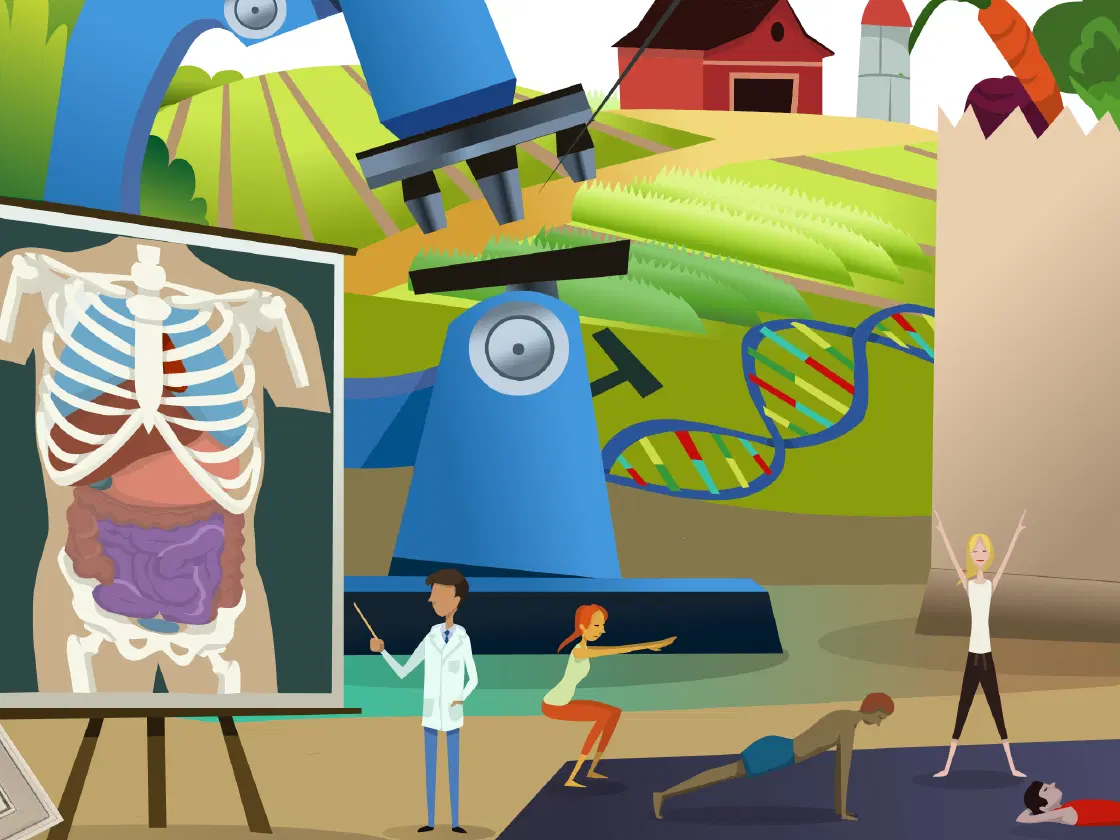
  • Coaching is now available for all ELAT participants.  Sign up HERE
  • Learn more about mCLASS®.
  • Explore more PD options for your Amplify assessment and intervention programs.

Professional learning journey

Four connected circular icons illustrating a business process: idea generation, planning, execution, and achievement, depicted with relevant symbols.

Prepare

Begin

Practice

Advance

Program-agnostic sessions will set up educators for success in areas such as the Science of Reading and/or problem-based approaches to math. Program-aligned packages will support those who are new to Amplify’s programs. Program-aligned packages will support those who have experience using Amplify’s programs. Offerings will support advanced implementation, build capacity for instructional leaders, certify in-house trainers to deliver Launch sessions, and more.

Significant, lasting change is more likely when you take a systemic approach. Partner with us to do just that by developing a professional development plan that will drive your program implementation, enrich your instructional practices, and increase student impact. Begin and Practice packages are available for assessment programs, while tiered sessions are available for intervention programs.

With a range of unique packages for each phase of implementation, professional learning sessions are strategically bundled for multiple touch points throughout the year. High-quality sessions set you up for success with Amplify programs—whether you’re years into using them or just starting.

Illustration of a rocket ship with a red tip, gray fins, and orange flames, featuring a person with red hair visible through a window.

Launch sessions

Recommended timing: Beginning-of-year

Propel your teachers into the new school year with sessions that introduce them to their Amplify program and support them in a strong implementation.

  1. mCLASS DIBELS® 8th Edition and/or mCLASS Lectura administration and instruction essentials
  2. mCLASS DIBELS 8th Edition and/or mCLASS Lectura administration and scoring training
Illustration of a woman with red hair lifting a dumbbell, sweating and flexing her arm to show a muscle.

Strengthen sessions

Recommended timing: Mid-year, end-of-year

Boost implementation with sessions that target specific instructional practices.

  1. Progress monitoring to drive student outcomes for teachers
  2. Measuring student growth across benchmarks for teachers
  3. Data walk-through for leaders
  4. Creating a data-driven classroom for teachers
  5. Building a data-driven culture for leaders
Three people are in a rowboat; two are rowing while the third faces them, appearing to give instructions or shout.

Coach sessions

Recommended timing: Mid-year, end-of-year

Guide teachers and leaders with targeted learning tailored to their specific needs.

Additional Coach opportunities with an Amplify trainer (Use this survey to sign up.)

Important information

In partnership with CDE, we’re excited to offer a number of opportunities for Colorado educators in the ELAT (Early Literacy Assessment Tool) Project this school year.

  • For schools new to the ELAT Project (2024–25): Sign up for professional development.
  • For schools returning to the ELAT Project (2024–25): Sign up for professional development.

Need help? Please direct any questions about ELAT Professional Development to Kim Ballantyne, PD Strategist. If you have questions related to CDE, please contact Megan Rogers.

Participation notebooks for mCLASS DIBELS 8th Edition and mCLASS Lectura can be found here.

Complete this survey for your training. Your trainer will provide you with a six-digit code to complete the survey.

Square graphic with "Science of Reading: The Podcast" text, an open book, geometric shapes, and the Amplify logo on a yellow and blue background.

Additional resources

Check out Amplify for the most up-to-date information and resources provided by Amplify, such as:

Meet the Team

Kim Ballantyne

Professional Development Strategist

Kballantyne@amplify.com 

CDE ELAT support

elat@cde.state.co.us 

Laptop screen displaying a customer support chat window with options to start a new conversation or search for articles; greeting message reads "Hi Teacher.

Questions?

Need an answer fast? Our chat agents are standing by to assist you! Simply log in at learning.amplify.com and click the orange chat button in the bottom right corner. Here, you can chat live with our support team or search the help collection for step-by-step guidance.

Welcome, Arizona educators!
Dear Arizona educator,

Thank you for your interest in Amplify’s core, assessment, intervention, and supplemental programs. Amplify’s resources are different to make a difference—and the results are undeniable. Explore our unique, research-based approaches built right into our high-quality instructional materials. If you have any questions, please don’t hesitate to reach out.

With great respect for what you do,

The Arizona Amplify team

Simple illustration of Arizona with a star marking a location, two green cacti, sun, and clouds in the background.

Early Literacy Suite

Based on 20 years of experience with the Science of Reading, Amplify’s early literacy suite combines the crucial elements of core curriculum, intervention, and personalized learning. Our programs ensure that all educators have what they need to support every student within an aligned system based on research and effective practices. Amplify CKLA received all-green ratings from EdReports. Read the review on EdReports.

Illustration of a bear on a rock overlooking a campsite in a valley with mountains, trees, tents, and people; includes an EdReports review badge in the lower right corner.
Collage image featuring a girl with a crown looking at a sunset, a boy reading about the Amplify ELA program, and the "read the report review year 2020 edreports" logo

Amplify ELA

Amplify ELA is a blended curriculum designed specifically for grades 6–8. At the heart of every lesson is the text. We enable teachers to teach skills texts and develop their students’ muscles for building meaning through reading. With Amplify ELA, students learn to attack any complex text and make observations, grapple with interesting ideas, and find relevance for themselves. Rated all green by EdReports, Amplify ELA earned perfect scores across all gateways. Read the review on EdReports.

Amplify Science

Amplify Science empowers students to think, read, and write like real scientists and engineers. Amplify Science K–8 received all-green ratings in EdReports’ review of national middle-school science curricula. Read the review on EdReports.

Two students wearing safety goggles conduct a science experiment together, pouring liquid between plastic cups over a blue tray on a classroom table.
A laptop displaying a graph on a webpage labeled "Robots" sits next to two textbooks titled "Amplify Desmos Math," one being the teacher edition and the other for grade 6, exemplifying student-centered instruction through math technology.

Amplify Desmos Math

Meet Amplify Desmos Math. Our structured approach to problem-based learning systematically builds on students’ curiosity to develop lasting grade-level understanding.

Contact us

Support is always available. Our team is dedicated to helping you and can be reached at any time by emailing or calling us directly.

A man with a beard and short hair, wearing a striped suit, blue shirt, and orange tie, poses against a plain white background.

Tommy Gearhart

Senior Account Executive

(505) 206-7661

tgearhart@amplify.com

A woman with long, wavy brown hair, wearing a dark blazer and a bright pink blouse, smiles at the camera against a plain gray background.

Yvonne Rohde

Senior Account Executive

(480) 673-0019

yrohde@amplify.com

A woman with straight dark brown hair and light skin smiles at the camera, wearing a black top and gold earrings, in front of a white brick wall.

Laina Armbruster

Account Executive

(602) 791-4135

larmbruster@amplify.com

Season 9, Episode 7

Neurodiversity and the reading brain, with Ioulia Kovelman, Ph.D.

Susan is joined by Ioulia Kovelman, Ph.D., professor in the Department of Psychology at the University of Michigan, to give educators the perspective of a developmental cognitive neuroscientist on literacy development. Starting with the basics of cognitive science versus brain science, Ioulia gives a comprehensive overview into how the brain changes as children learn to read, including differences seen in neurodiverse students and multilingual/English learners. Ioulia then answers a question from our listener mailbag on neuroscience and dyslexia and how current research can inform teaching strategies. Ioulia ends with a rallying message that scientists, teachers, and children cannot stand alone and need to find ways to connect with each other to strengthen literacy as a whole.

Meet Our Guest(s):

Ioulia Kovelman, Ph.D.

Ioulia Kovelman, Ph.D.

Ioulia Kovelman, Ph.D., is a professor of Psychology at the University of Michigan. She studies literacy development in children who speak English and other languages. As a developmental cognitive neuroscientist, she uses a child-friendly functional Near Infrared Spectroscopy (fNRS) brain-imaging method to examine how learning to read changes children’s language, cognition, and brain. These studies include research with typically developing readers and at-risk learners such as those with dyslexia and developmental language disorders (DLD). In her current research, Ioulia focuses on children learning to speak and read in English, Spanish, and Chinese. Through this work, she addresses the universal, language-specific, and bilingual influences on child reading development and dyslexia.

Meet our host, Susan Lambert

Susan Lambert is the Chief Academic Officer of Elementary Humanities at Amplify, and the host of Science of Reading: The Podcast. Throughout her career, she has focused on creating high-quality learning environments using evidence-based practices. Lambert is a mom of four, a grandma of four, a world traveler, and a collector of stories.

As the host of Science of Reading: The Podcast, Lambert explores the increasing body of scientific research around how reading is best taught. As a former classroom teacher, administrator, and curriculum developer, Lambert is dedicated to turning theory into best practices that educators can put right to use in the classroom, and to showcasing national models of reading instruction excellence.

Portrait of a woman with short blonde hair, wearing glasses, a black top, and a necklace. She is smiling and facing the camera.

Quotes

“When you begin to read, you really have to analyze everything in front of you. The letter, the shape of the letter, how it connects to the sound. And proficient readers just look at the whole thing and they grab it—and it's like they heard it. It is almost no difference. I speak; I read; it's a continuous stream of language and I just grab it.”

—Ioulia Kovelman, Ph.D.

“We talked about languages being different. They're exercising slightly different muscles of your language system.”

—Ioulia Kovelman, Ph.D.

“Science is informed by teachers and children. We're all together. I do not teach children. Teachers don't usually do science. But we have to find ways of connecting with each other.”

—Ioulia Kovelman, Ph.D.