S1-05: How does coding fit in the science classroom? A conversation with Aryanna Trejo of Code.org
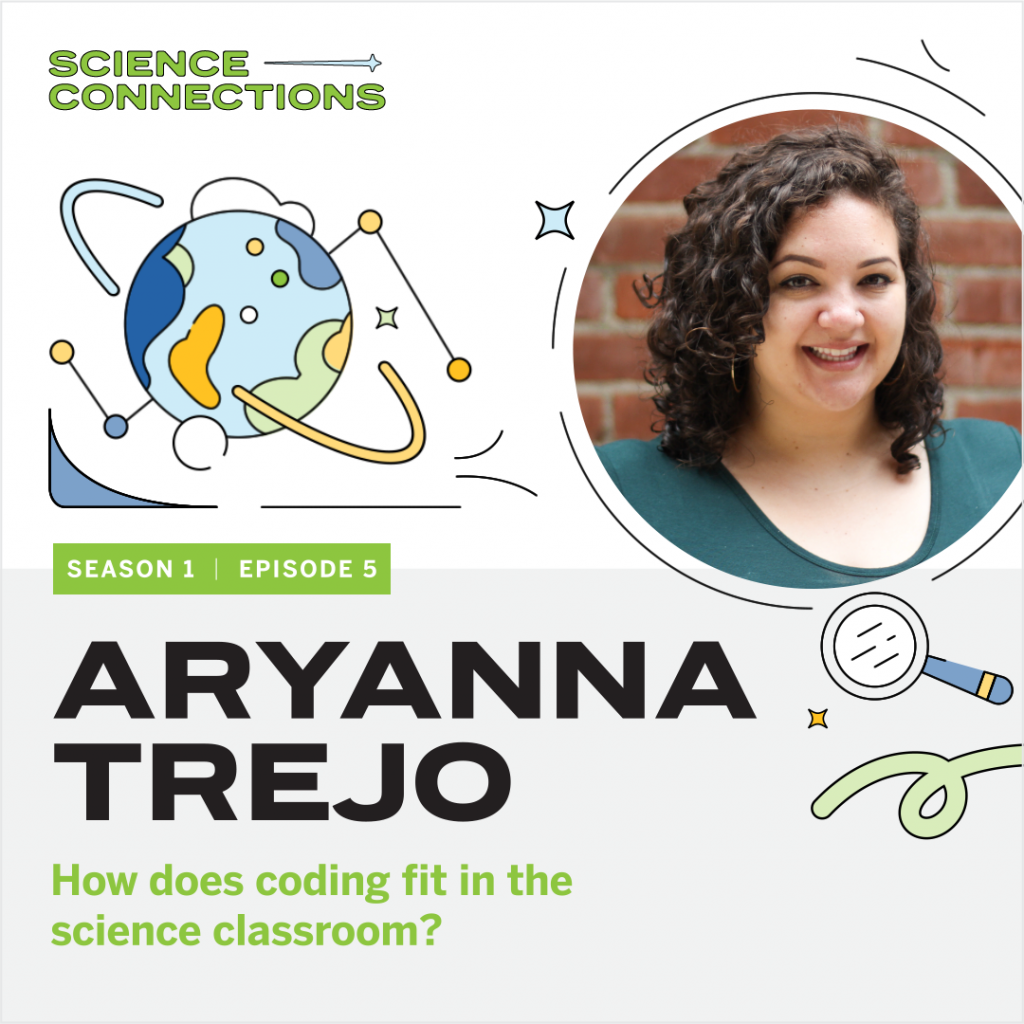
Podcast cover titled "Science Connections" featuring Aryanna Trejo, Season 1, Episode 5. It includes abstract illustrations of a globe and telescope, discussing coding in the science classroom.

In this episode, Eric sits down with Aryanna Trejo, a professional learning specialist of Code.org. Aryanna shares her journey from working as an elementary teacher in New York City and Los Angeles to teaching other educators at Code.org. Eric and Aryanna chat about computer literacy within the science classroom, problem-solving skills, and ways to model productive struggle for students. Aryanna also shares ways to teach coding and computer literacy in schools, no matter the classroom’s technology level. Explore more from Science Connections by visiting our main page.

Download Transcript

Aryanna Trejo (00:00):

I would hear teachers saying things like, “Well, I just can’t do coding; this is too hard for me; the time has passed.” And I would ask them, “Would you say that to your student about math or English?” And they would always sheepishly go, “No.” And I’d say, “Well, be as kind to yourself as you would be to your student.”

Eric Cross (00:19):

Welcome to Science Connections. I’m your host, Eric Cross. My guest today is Aryanna Trejo. Aryanna is a member of the professional learning team at Code.org. Before joining Code.org, Aryanna led computer science professional development for elementary school teachers, and served as an instructional coach for new educators. She also taught fourth and fifth grade in both New York City and in Los Angeles. In this episode, we discuss Aryanna’s journey to Code.org, where she helps educators connect coding to real life, how to use a rubber duck to solve problems, and how coding and computer science principles can be taught to students in areas without access to the internet…or even a computer. I hope you enjoy my conversation with Aryanna Trejo. So I was born and raised here, and I saw that you went to UC San Diego.

Aryanna Trejo (01:11):

I did, I did. I actually just put a deposit down on an apartment in University Heights, ’cause I’m moving back.

Eric Cross (01:16):

You’re coming back?

Aryanna Trejo (01:17):

I’m coming back. Yeah.

Eric Cross (01:19):

So if you need a classroom to visit….

Aryanna Trejo (01:21):

I would love to do more classroom observations!

Eric Cross (01:24):

Are we doing this? Let’s do—we’re making this happen.

Aryanna Trejo (01:26):

We are. Yeah. So I’ll be there. I’m moving there in April. I actually grew up in Orange County too, so I’m like a very diehard SoCal person.

Eric Cross (01:35):

So I feel like I know the answer to, hopefully—Tupac or Biggie? ‘Cause you’re on the East Coast, and you’re on the West Coast.

Aryanna Trejo (01:40):

Yeah. I like Tupac, but I have more Biggie songs committed to memory. Which is not a lot. I have “Juicy” and “Hypnotized” memorized.

Eric Cross (01:53):

All right. So you’re just memorizing, and you have the Biggie songs memorized, but not the Tupac ones.

Aryanna Trejo (01:58):

No, but I do love Tupac songs. You know, it’s like, Biggie has the flow, but Tupac has the lyrics. Nobody’s—they both have something really amazing about them.

Eric Cross (02:06):

You know, I can respect that you broke it down into both of their strengths.

Aryanna Trejo (02:11):

Thanks for buttering me up before this interview. And not….

Eric Cross (02:15):

<laugh> Oh, we already started.

Aryanna Trejo (02:16):

Huh? We already started?

Eric Cross (02:17):

We’re already started. Yeah. We’re already into this.

Aryanna Trejo (02:19):

We’re into it.

Eric Cross (02:21):

You were in the classroom, fourth and fifth grade, and you were doing TFA.

Aryanna Trejo (02:26):

I did. I did Teach For America. I was 2012, New York City Corps. Right after graduation. ‘Cause I graduated UC San Diego in 2012. So graduation was on June 17th, and I touched down at JFK on June 19th.

Eric Cross (02:40):

Even though I wasn’t in TFA, I know a lot of the fellows that are in it. And there’s just some phenomenal teachers in there. How long were you doing elementary school when you were teaching?

Aryanna Trejo (02:49):

Yeah, I taught for—well, I did, three years of teaching fourth grade. Then there happened to be an instructional coach opening in my fourth year. I took that, did some instructional coaching within the same network, and then I moved back to LA and I taught fifth grade for a year.

Eric Cross (03:11):

  1. And what was it like now? Did you go to Code.org right after the classroom?

Aryanna Trejo (03:17):

No, I didn’t. No. I transitioned after teaching fifth grade for a year in downtown Los Angeles, in the Pico-Union neighborhood. I ended up getting this email out of the blue from someone who had actually found me through the Teach for America job site. ‘Cause I was hitting the pavement; I was really looking to transition out of the classroom. And she invited me to interview with this company called 9 Dots. And they taught computer science to kids K–6 throughout Los Angeles and Compton. And I was like, “Sure, no problem. Let’s do it.” So I interviewed, I got the job, and yeah, that’s how I transitioned to 9 Dots. And then after almost four years there, I transitioned to Code.org, with the same person. Actually, she moved over to Code.org first, and then she helped me get this job.

Eric Cross (04:07):

Oh, that’s happened a lot—like, that relationship kinda carries over.

Aryanna Trejo (04:11):

Yeah. We’re meant to be coworkers.

Eric Cross (04:13):

Yeah. Are you still? Is she still there? Are you both still together?

Aryanna Trejo (04:17):

Yeah, we’re on the same team and it’s nice. I saw her last night for Happy Hour, with another coworker who’s in LA. So we’re tight. And she’s a wonderful, wonderful mentor to me.

Eric Cross (04:28):

That’s great. Did you have computer-science background, when you were doing elementary school teaching? Did you have—

Aryanna Trejo (04:34):

No. <laugh> Not at all. When I was teaching in New York City, I had like four desktop computers in my classroom, and we rarely used them. Which was such a shame. And then when I moved to Los Angeles and taught fifth grade there, we were a one-to-one school, and the joys of that are just amazing. It was just really wonderful to, you know, get the students used to typing on the computer, using different software to submit their assignments. Getting creative—as creative as you can get—with Google Slides. You know, to show off what they know. And stuff like that. That’s all I had, though. And you know, when I transitioned to 9 Dots I was like, “Sure, why not? Let’s give a shot.” And I learned a lot. It was really interesting, yeah.

Eric Cross (05:26):

And so now at Code.org you are…well, so my journey with Code.org, I’ve been in the classroom for eight years. Still in the classroom as of…an hour ago, I was there. <Laugh> And I use Code.org, and I feel like I’ve checked it periodically, and I feel like it’s evolved over the gaps. And I’ve seen it. It’s become more robust in the things that they offer, over the years I’ve been an educator. Just to kind of…could you give a thumbnail sketch? Like, what is Code.org? Who’s it for? Who’s the target audience? What resources are there?

Aryanna Trejo (06:00):

Yeah. So it’s for everyone. It is a nonprofit that provides curriculum and training and a platform for teachers and students. We provide curriculum for K through 12. It’s completely free. And it comes with lesson plans, slideshows, all that. We focus specifically on underrepresented groups. So we have targeted measures for Black students, for Native American students, for students who identify as female. That’s a huge part of our mission. But we’re really working to expand access to computer science to as many students as we can.

Eric Cross (06:41):

One of the things I’m hearing in your story is you were teaching in Compton; you were in Bronx, New York. One of the reasons why I got into the classroom is because of educators, and the impact they made on me in exposing me to science and technologies I’d never had access to. And that intentionality, that you’re going about it…are there…not just the code, but how you bring that across to different groups…are there strategies, or are there ways to connect this idea of coding to diverse groups and diverse audiences? Or is it kind of, the curriculum applies for everyone? ‘Cause in science, when I’m teaching, I’m always trying to make what I’m doing relevant to the backgrounds of my students.

Aryanna Trejo (07:28):

Sure.

Eric Cross (07:28):

So I’m teaching biology, and I’m trying to make this kind of connection. Sometimes it’s more organic; sometimes it feels kind of forced. Because it’s just not always a nice fit. But it sounds like Code.org is really about inclusion. And in the numbers that I’ve seen for representation, in especially computer science software engineers, the groups that you’re focusing on are not necessarily represented in the professional workforce. At least disproportionately.

Aryanna Trejo (07:54):

Yeah, absolutely. Yeah, that’s correct.

Eric Cross (07:57):

And so how do you go about being intentional about reaching groups that we don’t see in, you know, the Silicon Valley software engineers? How do you start that? Like, at a young age, do you look for specific schools in specific areas to say, “We are going to bring this to the school. We’re going out to these populations of the cities”? Because we’re just not seeing…you know, on the map, we’re not seeing anybody really doing anything with coding here. Or we’re not seeing the numbers come out of these areas, out of these cities, of students who are going into STEM or going into computer science fields.

Aryanna Trejo (08:41):

Yeah. I don’t necessarily work on the recruitment side of it, is the issue, in my position. But I do work on the professional learning, that is brought out to teachers. And we have a huge focus on equity throughout the workshops that we create from K–12. It’s something we’re really passionate about. We definitely aim to prepare teachers to teach computer science. That’s a huge part of it. Knowing the content, but also thinking through, “What does recruitment look like at your school to make sure that the demographics of your classroom match the demographics of your entire school?” Also, thinking through, “How can we make sure that female students feel included in your classroom? How can we make sure that we are, giving students creativity to think about, or we are setting students up to be creative and think about the problems that are in their community, and how they can use computer science to solve them, or at least work towards them?”

Eric Cross (09:39):

So solving real-world problems and that inclusion aspect…are there things like…you were saying “female or students who identify as female”…are there things that teachers can do to ensure that they’re being more inclusive? Or to recruit, or encourage more female students to take part? One of the things I was thinking of, that I’ve seen, is I’ve seen coding kind of camps.

Aryanna Trejo (10:06):

Sure.

Eric Cross (10:08):

That were specifically for a female audience. And that seemed to help with recruitment. Is that something that you see on your side?

Aryanna Trejo (10:16):

That’s not something that we set up, no. But the curriculum that I work with is CS Principles. And it’s offered as an Advanced Placement course, as well as an AP class. So that’s a curriculum that’s designed for students who are in grades 10 through 12. And so at that point, we can really talk to teachers and ask them what the recruitment strategy is. But in terms of strategies that teachers can use to recruit those students…I mean, I’ve heard over and over from lots of different teachers who identify as female that they didn’t think that computer science was for them, until they saw a role model in that position. And so just being a role model for those students is really wonderful.

Eric Cross (11:00):

And I see it too, with—like, we do “Draw a Scientist” activity, which is like a popular science thing—

Aryanna Trejo (11:05):

Sure, yeah, I’m familiar.

Eric Cross (11:05):

But it’s the same thing, right? Like, it fleshes out. My students don’t draw themselves as scientists. They draw what they perceive, based on what television says. I imagine with computer science, it’s probably really similar, when you think about “What’s a software engineer look like?” Do students tend to draw themselves? Or is it even a mystery? Because I don’t even know what a software engineer looks like.

Aryanna Trejo (11:28):

Yeah, absolutely. Well, one of the things we love to do with our professional learning workshops is talk about understanding yourself, your identities, how they show up in the classroom as biases. And, you know, things like stereotype threat. We see that as really important to understand, and think through, and consider, before you step into the classroom. So that you’re not, you know, coddling certain groups of students because you don’t believe that they are able to be successful in computer science. Holding all the students to the same expectations and believing that they can succeed. And computer science, I think a lot of the times people have this conception of it being this utopian, bias-less, technocratic field. When in reality, everything has bias. And people talk about algorithmic bias and facial recognition, but also the people who created computers and computer languages have their own bias that comes through. And I think it’s really important to show students that. So that they can, one, know what they’re working with, and two, make sure that they can create products that reduce that bias.

Eric Cross (12:50):

It’s like…it’s not objective, just because we’re creating software. Like, once it gets to a point of being so sophisticated…I think, like, AI software, right? With facial recognition? And we’re seeing more and more articles come out about, you know, predicting trends based on historical data.

Aryanna Trejo (13:12):

Sure.

Eric Cross (13:13):

But then, the trends and things that they’re seeing tend to target things that have happened in the past. But it also doesn’t take into consideration a lot of other factors that can lead to certain groups or populations being identified. And I’ve seen some articles lately about how your code is really just representation of what you put into it. And like you just said, your bias—if you have that, conscious or unconscious—you’re gonna put that into your code. And the input is gonna be an impact, is gonna impact the output.

Aryanna Trejo (13:44):

Yeah, absolutely. Or even just—and I’m ashamed to say this, ’cause this is an idea that came to me just recently, through an article that I read—but computers themselves have bias. The hardware assumes that you have vision, that you can see the screen, that you are able-bodied, that you can use your hands to work the keyboard, the mouse, et cetera, and that you don’t have to use assistive technology. You know, there are small things like that, where we think that technology, like I said, is this utopian, futuristic science…but there are biases throughout.

Eric Cross (14:19):

You’re absolutely right. I’ve never even—I’ve never even considered that. Even though I do use assistive tech, and figure it out, I’ve never thought from the ground up, the process is built for an able-bodied, sighted, hearing person.

Aryanna Trejo (14:31):

Exactly.

Eric Cross (14:32):

To be able to engage with the hardware. And then these other things, these tertiary things that we kind of add on, so that you can do this, but it’s not designed from the ground up for people who are, you know, different audiences, physically. So I’m glad you brought that up, though. Now I’ve seen—and I haven’t done this—but I know Hour of Code is a big thing. And this is something that’s ongoing. Can you talk a little bit about what Hour of Code is? I know it’s, it’s a big thing for the classroom teachers.

Aryanna Trejo (15:08):

Yeah. So Hour of Code is really exciting, and it’s just blossomed from something small to something tremendous. This year is gonna be the 10th Hour of Code. So what it is, is it happens during CS Education Week in December, during Grace Hopper’s—or to honor Grace Hopper’s birthday. She was a computer scientist and Navy Admiral. And basically the aim of it is to get as many students on the computer doing an hour of code, and demystify what coding is. You know, to do seed-planting. To show teachers that this is something that you can facilitate for your students. And also to show students like, “Hey, computer science is something you can absolutely do. Not just for an hour, but more if you want.” So, yeah. Now it’s worldwide, and it’s really exciting.

Eric Cross (15:58):

That’s awesome. And I think about teachers and I still hear the apologetic—when I’m helping teachers in the classroom with education technology—the self-deprecating “I’m a dinosaur; I’m not good with tech,” which is never true. Like, they’re better than they even realize. And I feel like sometimes there’s still a stigma, too. It’s like <laugh> The Simpsons’ Comic Book Store Guy. The condescending tech support person—

Aryanna Trejo (16:27):

Sure.

Eric Cross (16:28):

—who has that tone. And so I feel like some people have been so negatively impacted by that person. So I know when I’m helping people, I actually try to go full-spectrum the other side. But I’m thinking about teachers’ barrier to entry. Sometimes code is like, “Whoa.” And I don’t teach computer science. Do you see those barriers to entry, or at least the perception of them? And then, what’s the reality for like someone listening, and going, “I’m a fourth grade teacher,” or “I’m a humanities teacher in ninth grade.” What’s the perception that you see, versus reality, with the teachers that you train? Is it much more accessible than we think? Or is there a level of sophistication that you have to have coming into it?

Aryanna Trejo (17:10):

No, not at all. I know computer science, and that says a lot! <Laugh> You know, I know my own corner of computer science. And you know, that’s me being self-deprecating, too. But I think learning computer science has helped me in so many different ways that I wasn’t expecting. I recently took the GRE in hopes of, you know, getting back into grad school. And I think just the way that computer science teaches you to search for bugs in your code, or errors, and kind of tirelessly look at a problem from multiple different angles, I was able to carry that into the math that I was doing. And I noticed just a huge difference in the way that I approached it, and the way that I was open to it. But you asked a great question, in regards to the barriers to technology. In my position at 9 Dots, I was working directly with teachers to lead professional development with them. Sometimes it would be a full day; sometimes it would be an hour after school. And the one thing that I always had in my back pocket that was really useful is that I would hear teachers saying things like, “Well, I just can’t do coding; this is too hard for me; the time has passed.” And I would ask them, “Would you say that to your student about math or English?” And they would always sheepishly go, “No.” And I’d say, “Well, be as kind to yourself as you would be to your student.” You know, it takes some patience and nobody’s gonna get it perfect 100 percent of the time. Have I banged my head against the wall trying to solve one tiny little syntax error in my code? Absolutely! But it feels absolutely phenomenal to fix that. And I was an English major in undergrad, and I had never done computer science before. So it’s something that becomes really satisfying.

Eric Cross (19:07):

Yeah, I imagine. I had someone—a trainer or a presenter—one time bring up the fact that our students rarely get to see us learn in real time.

Aryanna Trejo (19:19):

Yeah.

Eric Cross (19:19):

So we don’t get to ever really model failure. I mean, unless we’re in a classroom situation <laughs> in our failures, with classroom management. Then they see it, they see it! But they don’t get to see us model learning failure. And I don’t mean like failure—and yes, I know, “first attempt is learning,” and “no such thing as failure”—that’s not what I’m talking about. But just when we’re not successful with our code, and then we experience real-time frustration.

Aryanna Trejo (19:42):

Yep.

Eric Cross (19:42):

And they said that is actually a great learning experience for your students to watch you go through productive struggle. And that was really liberating for me. Because now I’m in the classroom, and I’m trying to go through it with my students, and the beautiful thing was, they started helping me. We were all trying to solve the problem. And then we had this authentic problem-solving experience. I think it was like a Scratch program, where we were trying to solve, trying to embed it somewhere, or something. And then, in the background of the class: “Mr. Cross! I got it! I figured it out!” And it was this really neat bonding experience. And I felt that—your ears get red, and you get hot, ’cause you’re not—

Aryanna Trejo (20:19):

Oh yeah.

Eric Cross (20:20):

You don’t know it! And you’re in front of 36 kids! And I said, “OK, I need to tell them how I feel.”

Aryanna Trejo (20:25):

Yeah.

Eric Cross (20:26):

So I said, “Now I feel really frustrated.” Like, “I want to go through this, and here’s my thoughts.” ‘Cause I knew that it would be helpful if they saw and would hear my thoughts. So I just did a quick think-aloud and I said, “In my head, <laugh> I want to just quit,” I said, “But I realize that this is the part where my learning’s happening. So I just want you all to hear what’s going on in my brain.” And now I feel like when I’m doing coding with my students, and it’s just basic coding, I feel much more comfortable, like, not knowing. But I needed someone to release me from that “I have to be the expert in everything” to do it.

Aryanna Trejo (21:06):

And teachers are used to being the experts. Right? And they should be. And coding is just such a different landscape. But I think once you kind of give over to the power of tinkering, I think it’s really gratifying. I love being able to…you can revise a sentence, and then read your paragraph back to yourself in English, and say, “OK, I get it.” But there’s something so gratifying about changing a line of code or a block and then being able to hit play and watch your program come to life, and say, “Hmm, that’s not quite what I wanted. Let’s try something different.”

Eric Cross (21:39):

I love your connection to tinkering. ‘Cause—I had never thought about it—’cause I love tinkering with my hands. But I always think about physical things. But coding is exactly that. It’s tinkering.

Aryanna Trejo (21:47):

It’s exactly that.

Eric Cross (21:47):

That’s exactly what it is.

Aryanna Trejo (21:49):

And a lot of it is, for me, especially when I’m trying something new, it’s guess-and-check. It’s like, “OK, that didn’t work. What if I add a semicolon here? Will it finally work? Or what if I add a ‘for’ loop? Will this get me what I want?” And it’s wonderful because you have that with students as well. Like, you have that record of their thinking, and you can ask them to go step-by-step and tell you, you know, “First, I added this, because I wanted the program to do this,” and so on and so forth. And so you have that record, but you can always get rid of it. Students often wanna get completely get rid of it. That’s something that I’ve noticed a lot as I’ve taught computer science. But, once you can get them to target the specific parts of the program, tinker with that, and continue, that’s a really wonderful learning space. There was also something you said about modeling failure. I love the fact that in computer science you can model failure for your students. You said to your students, “I’m getting frustrated.” I love that, because I never got that in math. Nobody ever showed me what it was like to be frustrated with graphing a parabola. Right? Like, my math teachers were always like, “Doot, doot, doot, here you go, you’re done!” <Laugh> And I would get so frustrated, because it didn’t come that easily to me. And I think there’s two parts to that. So there’s modeling the learning and the thinking and the productive struggle, but also there’s the identity of being a computer scientist and modeling what that looks like. So for me, when I get really frustrated with a program, I walk away. I take five minutes. I take a deep breath. I say, “I’m not gonna think about it in these five minutes.” And I come back to it. And I think once you start teaching computer science, you can facilitate that for students. And there’s so many different strategies that they can pick up. They can pick up rubber ducking, which is where they pick up a rubber duck or a similar object, and they talk to it as if they were a partner and talk through their code. And oftentimes, as you’re rubber ducking, you’re gonna find that error, because you’re explaining it to someone who’s a stand-in for a novice. And rubber ducking is a well-known strategy for computer scientists who make it their career. You know, there’s pair programming. Some students love pair programming; some students hate it. But the students start to build this identity about how they problem-solve. And how they approach failure. And I just love that.

Eric Cross (24:31):

I’m writing this down. Because the rubber-ducking strategy, I love. I just imagine my seventh graders, a bunch of 13-year-olds with, like, rubber on the desk. And not necessarily in coding, but I was thinking in my science class. And they’re working through a challenge, and they’re all looking at this duck, and they’re talking to it. But I just love the the idea of externalizing your thought process and talking through it yourself so that you can hopefully arrive at a conclusion. But it’s such a great practice, and this is something that’s been around for a long time, apparently. So.

Aryanna Trejo (24:59):

Yeah. Yeah. It’s a real thing. And you know, you can go low-fi. It doesn’t have to be a rubber duck. You can have students talk to their pencils or their imaginary friends. That’s not the issue; the issue is, you know, talking to somebody.

Eric Cross (25:10):

I know you support teachers. But I just wanted to…I was just curious about your typical day, what that’s like. And then what you do, how you support ’em.

Aryanna Trejo (25:15):

So, at my previous job at 9 Dots, I was in there with the teachers in the classrooms. I was coaching our internal staff who went out to co-teach with teachers. And I loved that. And I had such a great impact on a local scale. But now at Code.org, I have a much broader impact. But I don’t get to interface with—that’s such a tech-y word!—I don’t get to interact with—

Eric Cross (25:42):

You work at Code.org! You get to—

Aryanna Trejo (25:42):

I know! But I’m a teacher at heart, forever, right? That’s my identity that I forged when I was 22 years old. And a typical day looks like opening up my computer, taking a look at my calendar. I often have meetings to talk about, different things that we’re doing to support our facilitators who go out to our teachers and lead their workshops for them. I recently worked on a product that was designed for CS principles, teachers, to onboard to the course if they weren’t able to get into an in-person workshop. And it’s completely self-paced, so it gives teachers an on-ramp into the course. And now I’m working on some in-person workshop agendas. So I feel really wonderful that my work is going out to thousands of teachers. But at the same time, I really, really miss talking to teachers. Because that’s something that energizes me so much.

Eric Cross (26:46):

When should students start learning computer science? I feel like we see it in this kind of narrow lane. Like, this is computer science if you make an app. Can it be more than that? As far as like the benefit of computer science? And—I guess two-part question—when should students, one, start being exposed to it? And then two, what are some of the benefits beyond just, “I wanna just make an app”?

Aryanna Trejo (27:08):

I taught coding to kindergartners. It can start as early as you as you want it to. And it doesn’t necessarily need to be on the computer. A lot of students that I worked with didn’t have computers at home, were interacting with computers for the first time. And that’s a huge barrier, of course, to a lot of teachers. But there are so many unplugged lessons that you can do to start to start to have students think about algorithms, which is just a series of steps to complete to solve a problem. As long as a student can use a computer, I think they can do computer science. There are products out there like codeSpark, where students—and Code.org has these products too—where students are moving an avatar around a board, kind of like a quadrant to…you know, they feed the directions to a computer and then the computer enacts it for them. And with that, they can learn algorithms. You know, that is computer science. And a lot of people don’t see it that way, but it really is. And it starts to set students up for more complex thinking as they move on.

Eric Cross (28:13):

One of the biggest underserved communities, geographically, are students in rural areas.

Aryanna Trejo (28:20):

Yep.

Eric Cross (28:21):

They can be reservations; they can be places just not an urban area. Is there a way to serve our communities of students and bring these skills in an unplugged way?

Aryanna Trejo (28:32):

Yeah. Yeah. If you typed in “unplugged computer science lessons” to Google, you’ll have a ton of hits. And there are so many students out there—not just in rural areas. But there’s incarcerated students. It hurts my heart to even say those words, but in urban areas too. Like in my classroom, where I only had four desktop computers. Access is a real struggle. And there’s things, like I said, instead of moving an avatar around a grid on the computer, I used to have an actual mat that I would take out to my kindergarten classrooms, lay it out, and it would have a grid on it. And we’d have one of the students act as the avatar and the rest of the students would give them directions to get to a different point on the grid. And there, you’re building an algorithm or just a series of steps. Like I said, it’s not some fancy term to solve a problem. And there’s multiple ways to solve that problem, too. And I think investigating that can be a really good way to stretch those lessons.

Eric Cross (29:32):

It almost sounds like an oxymoron, but this low-tech computer science strategy. Develop these skills and then transfer that once you have access to the tools.

Aryanna Trejo (29:39):

Yeah. Yeah. Absolutely. And I think it’s a good way for students who need kinesthetic means to start to understand something, or just different learning styles, to start transferring that over.

Eric Cross (29:53):

I probably have students in the classroom where those kinesthetic moving things would help be a great way—or WILL be a great way—for them to learn the principles and the fundamentals of coding. Instead of only giving the option to just do the computer, actually giving them some choice. Or giving them a way to be able to manipulate things. We’re still in the system of education that’s still very siloed. It’s been the same way for a hundred years. We got math and then we got science and we got English. I’m wondering, how can a teacher fit this into their daily lessons? And then, do you have any experiences or stories or things that you’ve seen, just really creative ways that you’ve seen teachers incorporate this? Outside the norm of, “This is a computer science class; we’re just gonna code.” But have you seen it branch out? In the trainings that you’ve done?

Aryanna Trejo (30:40):

I’ve seen examples of that. I’ve seen a teacher use Scratch to demonstrate different climates of California, and show the different climates. This past year for Hour of Code, my friend Amy—the one who helped me move to 9 Dots and at Code.org—she created this incredible tutorial called Poetry Bot. And it was a way to get students to match the mood of the poem to some of the elements that were happening in the stage. So they would have different backgrounds show up at different parts of the poem. When the words would show up, they would have different sprites show up. They would have, sometimes, sounds. Or the text would show up with different animations. So there are cross-curricular opportunities everywhere, if you can be creative enough to find them, or if you beg, borrow, steal from other educators who are doing this incredible work out there.

Eric Cross (31:36):

Yeah. I say this all the time, but I’m an educational DJ, not an MC.

Aryanna Trejo (31:44):

Oh yeah.

Eric Cross (31:45):

So MCs write their lyrics and DJs remix with things that other people have done.

Aryanna Trejo (31:48):

Absolutely.

Eric Cross (31:48):

I was like, I’m a DJ. I was like, all day. Sometimes I’ll write a lyric, once or twice, but most of the time I’m remixing things. So teachers, if you’ve been out there and you got an awesome interdisciplinary thing, or you’ve incorporated coding and it’s something that’s traditionally not seen, please send it to us. Share it with us.

Aryanna Trejo (32:03):

Yeah. And there are so many different places where you can find that. We have a forum for Code.org, but there’s also CSTA, the Computer Science Teachers Association. You can join your local chapter and get to know other computer science teachers out there.

Eric Cross (32:19):

I guess…to wrap up, I’ve been using Scratch programming, the MIT website. My students do the basic animated name, CS First, stuff. But over the years, I’ve noticed that my students are coming in with a higher level of sophistication in Scratch to where now the differentiation…some of my students are just doing very basic…and then I have other students who’ve created full-on video games with complex…like, you look at their Scratch page and it’s just an amazing amount of blocks and integrations and things that they have. Is there anything on Code.org that could be a next step? That takes them beyond, maybe like the visuals? And if so, what would be a good next step, to take students to advance them to another platform? There’s so many coding languages out there, I feel like. Or I might not even be thinking about that the right way.

Aryanna Trejo (33:20):

No, I think you are. You know, we have three different curricula out on our website right now. We have CS Fundamentals, which is probably more in line with what you’re talking about. We have a free CS Discoveries curriculum, and that is designed for, grades, I believe, 6 through 10. And that would be a really good entry point, for both teachers and for students.

Eric Cross (33:44):

There’s a lot of new stuff that I hadn’t seen yet, a few years ago.

Aryanna Trejo (33:49):

Yeah.

Eric Cross (33:49):

So I was really excited.

Aryanna Trejo (33:50):

One thing that I do know is that CS Discovery has just added an artificial intelligence slash machine-learning unit, that you can just pick up and give to your students. You don’t have to go in order with CS Discoveries, like you do with CS Principles. And I’ve gone through some of those lessons. They are really rad. And I would’ve loved to have learned that when I was in middle school or high school. So yeah, we’re constantly thinking of how we can make things one, relevant to our students, and two relevant to what’s going on in the world.

Eric Cross (34:20):

So would I be overselling it if I said, “If you go through this, you’ll be able to create an AI or a neural net to do all your homework”?

Aryanna Trejo (34:26):

You would be overselling it.

Eric Cross (34:27):

I would be? OK. So what I’ll do is, I’ll wait until the end of the school year, and then introduce it, and then by the time they’ve realized it’s not true, they’ll be eighth graders.

Aryanna Trejo (34:35):

There you go. Good old bait-and-switch.

Eric Cross (34:37):

You’re amazing. Thank you for serving teachers, and for being part of such a great organization that puts out great stuff. So much free curricula for teachers to be able to use. Especially nowadays we hunt and scour the internet for those types of things. And to be able to bring computer literacy into the classroom, and with your focus of serving communities of underrepresented groups, it feels good to know that not only is it high-quality material, but it’s also trying to raise everyone up. Because ultimately when we have more people trying to solve a common problem, we come up with better solutions. And I was talking to somebody who was a materials engineer somewhere in Europe, and he said one of the things about the U.S., As he was critiquing me on this flight, critiquing the U.S., He said, “One of the things about your country is that you have a heterogeneous group of people who, in a group, when you have multiple perspectives attacking a problem, you come up with more novel solutions.” He says, “That’s one of the great things, is that there’s not necessarily just a hive mind.” And I think that that’s one of the great things. We uplift different communities, and we uplift women, people of color, people who, have backgrounds that parents didn’t go to college but have these amazing qualities and strengths. And we put everybody focusing on the same issue. We come up with novel solutions that we wouldn’t have come up with if only select groups were trying to look at it and solve it. And so—.

Aryanna Trejo (36:22):

Yeah.

Eric Cross (36:23):

And we couldn’t do that without organizations like yours, that help empower teachers. So.

Aryanna Trejo (36:27):

Yeah! You really said it.

Eric Cross (36:29):

You’re coming to my classroom when you’re back in San Diego?

Aryanna Trejo (36:31):

Yeah! I totally will. Yeah. Let’s make it happen.

Eric Cross (36:34):

Last question. If you think back in your schooling, your own schooling, K through college, is there a person or a teacher that had a big impact on you? Or a learning experience that had an impact on you? And it could be, you know, positive or negative. But something that impacted you, even to this day, that stands out to you, that you remember?

Aryanna Trejo (36:56):

This is a big diversion from the topics that we’re talking about. But in grades 10 through 12, my drama teacher, Mr. Byler, who I still talk with, was such a huge impression on me. Really wonderful. And I couldn’t tell you the teaching moves that he did that were wonderful. I don’t know much about his management. But I can tell you that he gave me space to be confident, and grow into myself, through drama productions. They were high school productions, so they weren’t amazing. But I just really came into myself in high school, because I had the confidence to get on stage. And he was just such a wonderful mentor to all of us. So, props to Mr. Byler.

Eric Cross (37:39):

Shout out to Mr. Byler for creating space for Aryanna to fly! Thanks for making time, after your workday, to talk with us and to share Code.org with teachers.

Aryanna Trejo (37:54):

Of course. Happy to.

Eric Cross (37:59):

Thanks so much for joining me and Aryanna today. We want to hear more about you. If you have any great lessons or ways to keep student engagement high, please email us at stem@amplify.com. Make sure to click subscribe wherever you listen to podcasts. And join our brand new Facebook group, Science Connections: The Community for some extra content.

Stay connected!

Join our community and get new episodes every other Tuesday!

We’ll also share new and exciting free resources for your classroom every month.

What Aryanna Trejo says about science

“I would hear teachers saying things like, ‘Well I just can’t do coding, it’s just too hard for me.’ And I would ask them…Would you say that to your student about math or English? Be as kind to yourself as you would be to your student.”

– Aryanna Trejo

Professional Learning Specialist, Code.org

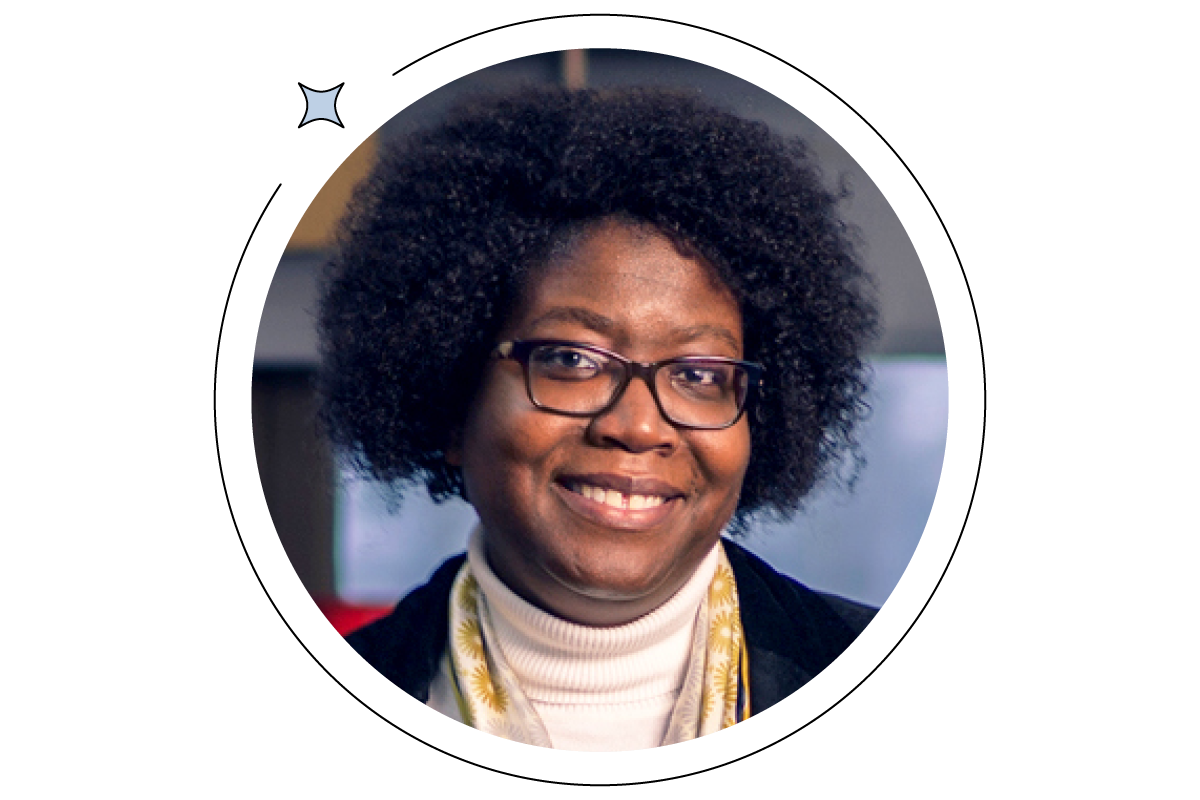
Meet the guest

Aryanna is a member of the Code.org Professional Learning Team. Before joining Code.org, Aryanna led computer science professional development for K-6 teachers and served as an instructional coach for new educators. She also taught fourth and fifth grade in New York City and Los Angeles. In her spare time, Aryanna loves taking advantage of the California sunshine, creating wheel-thrown pottery, and hanging out with her dog Lola.

Person with curly hair smiling, standing in front of a brick wall. Circular frame with decorative star in the corner.

About Science Connections

Welcome to Science Connections! Science is changing before our eyes, now more than ever. So…how do we help kids figure that out? We will bring on educators, scientists, and more to discuss the importance of high-quality science instruction. In this episode, hear from our host Eric Cross about his work engaging students as a K-8 science teacher. Listen here!

Let’s dig into your K–2 Experience Kit!

If you’re here, you either have your Amplify CKLA Experience Kit in hand or it’s on its way. Welcome! This site pairs with your boxed kit to help you understand the unit you received; see how it fits into the full K–5 program; and access exclusive tools, pacing support, and bonus resources you won’t find in the box.

Getting started

Here you’ll find a quick tour of your Experience Kit and see how it connects to the full Amplify CKLA program.

About your boxed kit

Your kit includes all of the print materials needed for you and your students to experience a complete Knowledge Strand unit of rich, content-based lessons that build vocabulary, comprehension, and curiosity. 

About the full program

Amplify CKLA is a comprehensive K–5 literacy program grounded in the Science of Reading, with three distinct strands:

  • K–2 Knowledge Strand: Builds background knowledge and vocabulary through daily read-alouds, guided discussion, and writing in context. (The unit in your kit comes from this strand!)
  • K–2 Skills Strand: Develops decoding, fluency, and transcription skills through explicit, systematic instruction with hands-on, multimodal practice.
  • 3–5 Integrated Strand: Strengthens reading, writing, speaking, and listening as knowledge and skills come together with complex texts, close reading, and a focus on morphology.

For a deeper dive, explore the Amplify CKLA Program Guide.

Experience the Skills Strand

While your kit spotlights the Knowledge Strand, you can also explore the Skills Strand here—including lesson recommendations by grade and time (beginning, middle, or end) of year.

Kindergarten

About this unit

Identify continents, oceans, and places around the world, then create postcards to share new discoveries.

What’s in your kit

Here’s what you’ll find inside—take a quick peek to make sure everything’s there!

A spiral-bound teacher guide titled "All Around the World: Geography" features images of a globe, landscapes, and children, with a classroom background.

1 Teacher Guide

Book cover titled "All Around the World: Geography" features a classroom globe on a desk, with a blurred landscape of grass and flowers in the background.

1 Student Activity Book

A book cover titled "All Around the World: Geography" features a globe, children, and photos of various landscapes.

Image Cards

*Each student receives their own Student Activity Book in a full implementation.

Additional resources

As you prepare to teach this unit, explore the:

  • Curriculum map: Includes a unit summary, writing focus, overall learning outcomes, and standards taught and assessed.
  • Caregiver Letter: Shares an overview of the unit, plus conversation starters to keep the learning going at home.
  • Pacing options: The full unit takes 16 days—if time is tight, you can also try our 5- and 10-day plans.
  • Skills Strand: Try sample Skills lessons alongside your Knowledge unit for practice in phonics, decoding, fluency, and writing.

Grade 1

About this unit

Learn about maps, compare landforms, and connect global geography to local neighborhoods.

What’s in your kit

Here’s what you’ll find inside—take a quick peek to make sure everything’s there!

A spiral-bound teacher guide titled "Charting the World: Geography" features a hand-drawn world map and school supplies on the cover.

1 Teacher Guide

Book cover titled "Charting the World: Geography Activity Book" with an illustrated world map, magnifying glass, and compass on a dark blue, space-themed background.

1 Student Activity Book

A children's geography book cover showing hand-drawn world maps, a compass, colored pencils, and the title "Charting the World: Geography.

Image Cards

*Each student receives their own Student Activity Book in a full implementation.

Additional resources

As you prepare to teach this unit, explore the:

  • Curriculum map: Includes a unit summary, writing focus, overall learning outcomes, and standards taught and assessed.
  • Caregiver Letter: Shares an overview of the unit, plus conversation starters to keep the learning going at home.
  • Pacing options: The full unit takes 16 days—if time is tight, you can also try our 5- and 10-day plans.
  • Skills Strand: Try sample Skills lessons alongside your Knowledge unit for practice in phonics, decoding, fluency, and writing.

Grade 2

About this unit

Explore rhyme, rhythm, and meaning in many kinds of poems—from silly to serious—and write original stanzas with style.

What’s in your kit

Here’s what you’ll find inside—take a quick peek to make sure everything’s there!

A spiral-bound book titled "Sounds and Stanzas: Poetry" shows a hand holding an open book with illustrated animals and vines emerging from its pages.

1 Teacher Guide

Cover of an activity book titled “Sounds and Stanzas: Poetry” for grade 2, featuring a painting palette, paint brushes, and an outdoor scene with clouds and mountains.

1 Student Activity Book

A person sits reading a book outdoors with illustrated animals and musical notes floating above, on the cover of a book titled "Sounds and Stanzas: Poetry.

Image Cards

*Each student receives their own Student Activity Book in a full implementation.

Additional resources

As you prepare to teach this unit, explore the:

  • Curriculum map: Includes a unit summary, writing focus, overall learning outcomes, and standards taught and assessed.
  • Caregiver Letter: Shares an overview of the unit, plus conversation starters to keep the learning going at home.
  • Pacing options: The full unit takes 16 days—if time is tight, you can also try our 5- and 10-day plans.
  • Skills Strand: Try sample Skills lessons alongside your Knowledge unit for practice in phonics, decoding, fluency, and writing.

Digital platform

Your Experience Kit pairs with an Amplify CKLA demo account in Amplify Classroom, our digital platform. Explore your unit with digital materials and interactive tools including ready-to-use, customizable lesson screens and digital assessments. 

Haven’t received your login info? No problem—check with your admin team or complete our support site form

Pacing options

Short on time? We’ve got you covered. We recommend teaching the full 16-day unit as outlined in the Teacher Guide to fully experience the power of Amplify CKLA instruction. That said, we know your time is limited—and valuable! 

That’s why we’ve created pacing options to help you explore the unit on your schedule: 

5-day experience10-day experience
(slower pace)
10-day experience
(extended)
Teach Lessons 1–5 (1 lesson per day) for a focused snapshot of the unit.Teach Lessons 1–5 (spreading each lesson over 2 days)—ideal for shorter blocks or a more relaxed pace.Teach Lessons 1–10 (1 lesson per day) for a deeper dive into the unit.

💡 Tip: Many educators new to Amplify CKLA prefer the 10-day, slower-paced option. It offers room to slow down without losing the flow of instruction for you and your students.

Pacing like a pro

  • Start with the Unit Introduction in the Teacher Guide—it provides key background information and teaching tips.
  • Pausing Point and assessment days aren’t included here, but feel free to use them if time allows.
  • Teaching in shorter blocks? No problem. Just continue where you left off the next day! (Skipping ahead isn’t recommended, as each lesson builds on the last.)

Skills Strand

Your kit features a Knowledge Strand unit, but you can also explore the Skills Strand here! In K–2, the Skills Strand delivers explicit, systematic instruction in phonics, decoding, fluency, and writing, giving students the strong foundational skills they need to become confident, capable readers alongside their knowledge-building lessons.

See it in action. Visit our Amplify CKLA Skills in action page to watch real teachers and students during a lesson.

Try it yourself. Access Skills Strand lessons in your Amplify Classroom demo account! Use our Try it guide for recommendations tailored to your grade and time of year.

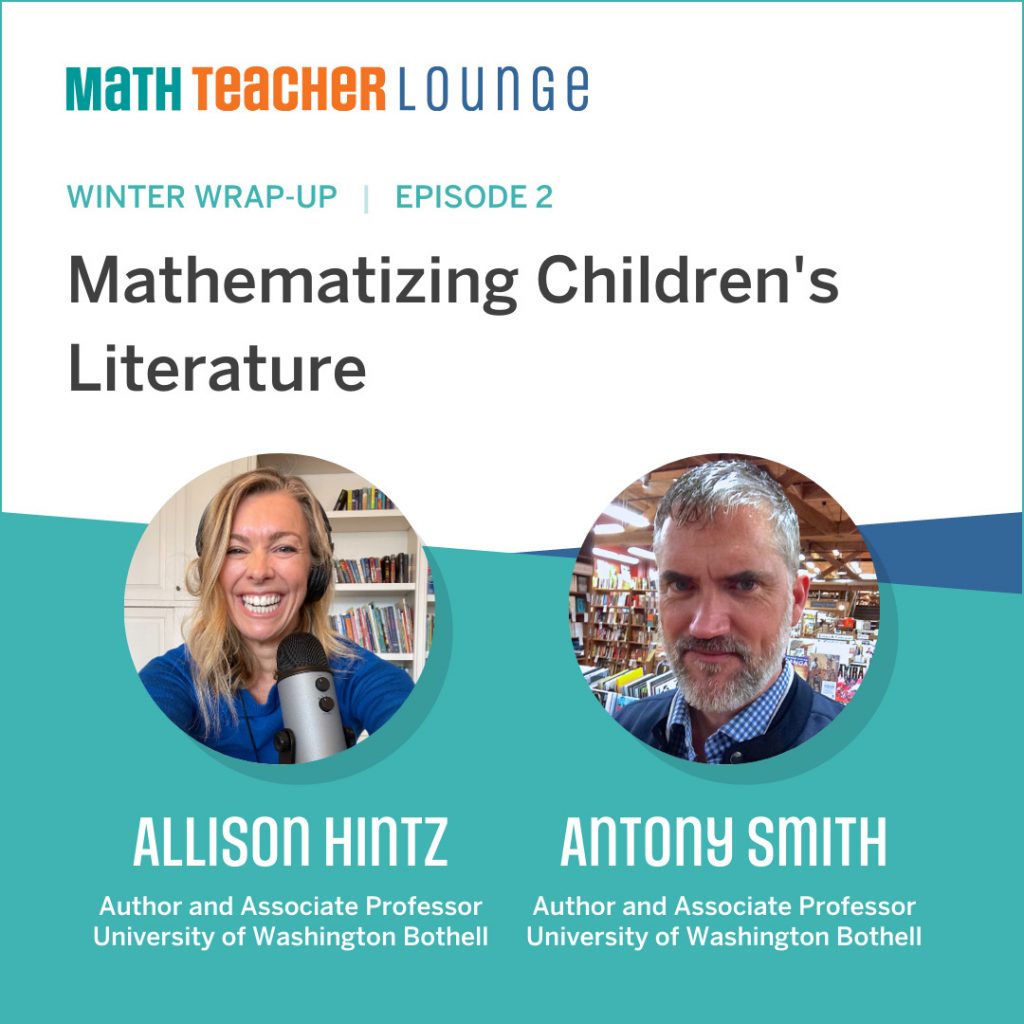
Winter Wrap-Up 02: Mathematizing Children’s Literature

Promotional graphic for Math Teacher Lounge podcast, episode 2, featuring Allison Hintz and Antony Smith, discussing how mathematizing children's literature can build math fluency.

While we’re hard at work producing the exciting fifth season of Math Teacher Lounge: The Podcast, we’re continuing to share some of our favorite conversations from our first four seasons. This time around, we’re revisiting our popular episode that connected literacy and math!

In this episode, we sit down with Allison Hintz and Antony Smith, authors of Mathematizing Children’s Literature, to talk about what would happen if we were to approach children’s literature, and life, through a math lens–and how we can apply those same techniques to classroom teaching!

Explore more from Math Teacher Lounge by visiting our main page

Download Transcript

Bethany Lockhart Johnson (00:02):

Hi, I’m Bethany Lockhart Johnson.

Dan Meyer (00:04):

Hi, I’m Dan Meyer.

Bethany Lockhart Johnson (00:05):

And we are so excited for another episode of Math Teacher Lounge. And as you know, podcast format; you’re listening now. I think one beautiful thing about the podcast format is that it gives us a little bit more time to have these rich conversations. And I promise I won’t do it, but I could talk to our guests for hours, hours! Authors Allison Hintz and Tony Smith have just released Mathematizing Children’s Literature: Sparking Connections, Joy, and Wonder Through Read-Alouds and Discussion. And today we get to talk to the authors. Allison, Tony, welcome. Welcome to the lounge.

Allison Hintz (00:53):

Thank you. We’re so grateful to be here.

Bethany Lockhart Johnson (00:55):

We’re so excited to have you here. And I wanna say that my very first—was it my first math conference? Maybe it was my first math conference—up in Seattle, the CGI conference, and I’m all like, you know, wide-eyed and just like, “Can this be a place for me, this math community?” Re-envisioning my relationship with math and thinking about myself as a math teacher, what? And I went to your session on mathematizing children’s literature, and I was just so fired up. I was so wowed by your ideas, your energy, and your passion for students’ thinking. And I feel like as I read this book, I felt like I was hanging out with you. Like you were just so encouraging all the way through. Of educators, of other folks working with young people, and really guiding us how to listen with joy and with an open curious mind.

Dan Meyer (02:03):

Yeah. I would love to hear a bit about the genesis of this book for you folks. Like, I’m coming at this from a secondary educator lens. I’ve got small kids, so that’s also part of my interest here. But I love any book, any idea that seeks to merge what seems like two disparate worlds. Like it’s often the case that we feel like, well, there’s approaches for ELA and approaches for math, and they’re kind of separate disciplines. And these poor elementary teachers have to learn all of them and be experts at all of them. And here you both come along and say, “Hey, what if they are the same kind of technique?” Can you just speak to how this came about?

Allison Hintz (02:38):

Definitely. Tony, do you wanna take a try? Do you want me to start us off?

Antony Smith (02:42):

I can start. We oftentimes present and talk together and so we kinda switch back and forth. So that’s just how we are. So probably about eight or nine years ago, Allison and I, our offices were next to each other on our small campus. We’re both professors and we just happened to have a few children’s books that we looked at together and we were just thumbing through the pages. We really liked children’s literature. And we noticed that I would stop at certain points wondering about character motive or plot or sequence of events or language use. And Allison would stop at very different points in the book and notice number and concepts or something about mathematics. And that’s when we started to wonder, what would it be like if we were sharing a children’s book with a group of children and we put our ideas together? Where would we stop? What would we talk about? What would we ask children about in terms of their thinking and what they notice?

Allison Hintz (03:42):

And so we started playing with these questions that we had and started approaching stories with multiple lenses to see what kinds of things would children notice and what kinds of things might they say. And we were also on our own journey in trying to understand how to plan for and facilitate lively discussions and classrooms that surface really complex mathematics. And it felt like stories were a place where that might be a fruitful context for hearing children’s thinking. We’ve worked with a lot of teachers and students in our region. We live in the Seattle area and we’ve applied for some funding over time that’s really helped us be in a lot of community-based organizations and educational contexts and libraries and pediatricians’ offices and classrooms, various classrooms, and see what’s interesting about this and what might teachers and children do with stories that would surface complex mathematics to think about together.

Antony Smith (04:41):

Over time, we came to the realization that if we wanted to hear children’s ideas, we had to stop bombarding them with questions. <laugh> Yeah. And at first it made it worse that we were asking them math and literacy questions at the same time. And so we realized that what we needed to do was to back off and to ask children what they noticed and wondered.

Bethany Lockhart Johnson (05:01):

Can you say more about that and how that kind of evolved into mathematizing children’s literature?

Antony Smith (05:07):

We did work with a number of very thoughtful, talented classroom teachers and children’s librarians in public library systems who were just so masterful at asking open-ended prompts and questions, rather than kind of like the de facto reading quiz, that a read-aloud can become, which I’ve always disliked as a literacy educator. And we realized in our observing these read-alouds or interactive read-alouds or shared reading experiences that given the opportunity in the space and an adult who was actually listening, that children came up with all of the ideas we would have asked them about and more. So we didn’t have to be bombarding them with questions. They were already much more thoughtful than what would’ve been sufficient to answer our questions.

Allison Hintz (05:58):

And much like mathematics, it was really an iterative process. You know, we had some clunky read-aloud discussions where we were trying to accomplish so much and toggling multiple chart papers and different colored pens and all sorts of “how do we capture these ideas” and “do we separate ’em? do we keep ’em together?” And so it’s really been over time that with partners, we’ve learned these ways of having multiple reads of the same story that allow us to hear what children notice and wonder, and then to delve more deeply into their questions and their ideas through multiple reads where we might spotlight literary ideas that they notice; we might spotlight mathematical ideas that they notice. We might make purposeful integrations between those. But we found it to be most productive—and Kristin Gray really help us think about this—to have an open Notice and Wonder, get everything out much like an open-strategy share. We welcome here, record all the ideas, and it goes all over everywhere. You know, it can be a really not math-y noticing! And those are amazing! So there’s a lot of, um, yes, there is a ladybug on this page! The grandma is wearing green triangle earrings! Oh, your grandma wears green earrings! I mean, it all comes out.

Bethany Lockhart Johnson (07:27):

Wait, have you been in my classroom? ‘Cause that’s exactly— <laugh>

Allison Hintz (07:29):

<laugh> And then, you know, we think of it a lot like if math teachers might use the 5 Practices for selecting and sequencing, or if you might move from an open-strategy share to a targeted share, how can we get out all the questions that children are asking and then step back from them, take some time to really think about what they’re telling us they’re curious about, and plan some purposeful, intentional subsequent discussions that can delve more deeply into their ideas.

Dan Meyer (08:02):

I’d love to go into that a little bit more if that’s all right. Um, I’m gonna speak from someone who doesn’t have an elementary background and I’m gonna voice some worries that I had, some anxiety. One anxiety I have like in a classroom or a curriculum is when there’s no room for student ideas. Right? When it’s like, oh, there’s just room for the curriculum author or the teacher here. That is a sadness. But I when I see an instructional environment like you’re describing here, where there is openness to all kinds of different student ideas, of different levels of formality, from different kinds of cultural fonts of knowledge or wherever, I also get a little bit nervous because that, like, increases the risk that a student might come to understand that “my ideas are not good enough,” whereas in the class with no room for their ideas from their home or their language or their hobbies, like, they’re not gonna internalize the message that, “that wasn’t good enough.” And so I’m really curious as you move from the open Notice and Wonder where kids share all of themselves with you, and then you move to a targeted focus on some sort of disciplinary objective, how do you navigate that tension and help students feel like their contributions are valuable, even though we aren’t taking them up per se?

Allison Hintz (09:18):

That’s such an important question. I mean, I think we’ve grappled with this broadly in math education. I think any time we’re thinking about which ideas we choose to take up to pursue to consider, we have a responsibility to think carefully about whose ideas are being taken up and heard and considered. And so one of the tensions I hear you naming, I think, Dan, is when we engage in lively discussion where children’s thinking’s at the center, how do we make sure to upend and interrupt kinda status norms that run the risk of being deepened? Um, and I think by paying attention to whose ideas are taken up as much as which ideas are taken up, and what’s the mathematics we wanna explore is one tension. Um, another tension I might hear you naming is, you know, the complications that teachers face with time and pressure and coverage, and which mathematics ends up getting worked on. And, um, you know, it’s something we’ve really had to struggle with in mathematics education, where we move to more discussion-oriented classrooms that are really centered in sense-making to know that it takes a lot of time to do this thoughtful, thoughtful work. Um, does that begin to get at some of the tensions you’re raising? Is there, is there more you’re thinking about?

Dan Meyer (10:53):

I think it’s really helpful that you kind of broadened the scope of the question beyond your book to “this is an issue that we are, you know, really challenged by and focused on broadly in math education.” And, um, I appreciate you bringing the element in of whose idea—not just which idea is taken up, but whose idea is taken up—is an opportunity where, let’s say, multiple people raise an idea that is towards an objective the teacher has, they have the opportunity to disrupt certain kinds of status, like ideas about status, in that moment. From your perspective, like, are there techniques to say, I don’t know, parking-lot certain kinds of questions and say like, “Hey, like these are awesome”? I don’t know. I just know that I see kids at like ninth grade. They are very reticent, often. They’ve internalized totally this sense of like, “I’m not gonna just, like, share about the pants the grandma’s wearing, you know; that will not be received well.” And so I’m just kinda wondering how that happens and like, what are the ways we can disrupt that? That process?

Antony Smith (11:54):

So thinking about that, Dan, from the teacher’s perspective, in those kinds of scenarios where you wanna honor each child’s contribution, a couple of things that come to mind: One is that by, you know, initially by modeling what I as a teacher, something that I notice or wonder about, helps kind of set the expectation for what kind of response would be encouraged. And it’s broad, but it gives an example. And then also we really try to record or to chart all of the ideas that are shared so that we can revisit and honor those together. And then either later or on another day, if we choose one or two of those to explore in some way within a more focused read, then another thing that we do is have the idea investigation afterward that continues that thought, but goes back to being as open-ended as possible, so that those students or children who maybe didn’t have their idea as the one that was focused on by the group could go back to that or explore some other idea of their own, so that the idea investigation isn’t a lockstep extension activity, which is why we don’t call it that. So they could again bring in their own perspective. But I have to say from the teacher’s point of view, there is that moment of potential panic <laugh> because there is that power transfer when you’re asking children to help steer where this is going. And if you really mean it, you have to let them steer a little bit. And that can be terrifying. And, um, I always think of one teacher, Ashley, we worked with who read an adorable book, Stack the Cats, by Susie Ghahremani. And in that book, there’s a point where there are eight cats and they’re kind of trying to be a tower of cats and they fall and they’re sort of in the air on that page. And she asked her first graders—she stopped, and she asked, “How, do you think, how will the cats land?” And for about a minute and a half, the entire <laugh> class, was silent. They had their little papers; they had chart paper; they had clipboards; they had everything they needed. But that unusual phenomenon of a group of six- and seven-year-olds actually just sitting and thinking and not being peppered with activities was really stressful, but amazing. And then, after about the 90 seconds, they started out into their exploration of how the eight cats might land. They just needed a minute to think. And it’s so rare that we’re able to let children have that.

Allison Hintz (14:40):

In that same moment, Ashley, who’s a learning partner to us, she turned to us kind of quietly, like, “Should I pose a different question?” And <laugh>, we’re like, “No, let’s stick with it. Let’s see what happens.” So I think it creates this space too, this thinking culture, right? And this culture of “what does that mean to really pose a rich task?That’s open-ended, where there’s multiple access points?” Those eight cats could land in so many different ways. And there was broad access, there was a wide range of all the cats landing, and one’s on their feet, ’cause cats always land on their feet <laugh>, and there was every combination. And so, um, I think what’s really interesting—and to me, this brings back to your wonder, Dan—is, you know, “What’s the risk in openness?” And there’s always risk in openness. Um, it’s scary as a teacher, right? If I’m not the authority of knowledge and I don’t have control over where we’re gonna go, it might get into places that I didn’t anticipate. Or I don’t really feel as solid in the math as I want to. Or I don’t know what it sounds like to stick with silence and wait time, to know if my students are really in productive struggle or if that question was a flop. And so, um, I think this is some practice space for young mathematicians and teachers of mathematics, and just teachers, to explore with that openness and kind of the risk of the openness required for complex thinking to emerge.

Bethany Lockhart Johnson (16:12):

You know, it feels like the way you’re both describing this, it really is a culture shift, right? I kept feeling like I was given permission to be a beginner as I read this book. Like I was really…I loved how you said, I believe it was you, Allison, when you were in the class, you had a couple index card that you kept on your clipboard and that as you walked around, you were like, “Hey, if I don’t know what to ask, I ask one of these questions.” You know? And just this idea that, that, like Dan was saying, there is that loss of control, but that’s also a way to create this culture where students ideas are valued and we are allowing students to really generate the questions, which I thought was such an important idea to explore.

Allison Hintz (17:00):

We started this work long ago, super-excited about math-y books. And we saw a lot of potential in them and we still do. But the limitation we saw is that math-y books, they, they put forth a certain mathematics to be curious about. In some ways they tell you what mathematics to think about. So we started asking ourselves what would happen if we considered any story a chance to engage as mathematical sense-makers. And we started playing with non-math-y books and we got to a place where we could consider every story an opportunity to engage in mathematical thinking. And so we started noticing things over times, oh, these books tend to be really math-y. We call those text-dependent. We’d have to pay attention to the mathematics to understand the story. Whereas this pile of stories, these, they’re not overtly math-y. You could really enjoy the story and not pay attention to mathematics and have an amazing conversation. But what would happen if we thought of about this story as mathematical sense-makers and how might it deepen our understanding of the story? And then this other teetering pile of books, these are books where, you know, children didn’t tend to engage as overtly as mathematicians in it, but there’s opportunities in this story to go back to something—to a moment, to an illustration, to a comment—and think as mathematicians. And those were more about illustration exploring. And so, as we notice these different kinds of books, we really broaden what we thought about. And I think one of the things we really wanna think about in community through this book is what happens if we approach any story, every story, as mathematical sense-makers, because stories are alive in children’s lives, in homes and communities and in schools. And it’s a broad opportunity that we wanna take up. I was thinking, as I stay in this strait for just a moment about book selection, before we move into that process, um, Bethany in a previous MTL, you talked about representation.

Bethany Lockhart Johnson (19:12):

Mm, yeah.

Allison Hintz (19:14):

And do you remember when you shared the image of hair braiding?

Bethany Lockhart Johnson (19:19):

Yes. Vividly, yes. <laugh>.

Allison Hintz (19:22):

Yeah. And can you say just what that meant to you? What that….

Bethany Lockhart Johnson (19:27):

Yeah. Well, it was from a conference; Sunil Singh had used it and was talking about the artistry in mathematics and beauty in hair braiding. And, um, particularly, he was showing this particular image of this Black woman with her hair braided in profile and looking at the angles and the symmetry. And I shared that, you know, I spent so many hours in the beauty shop with my aunties and my mom and my grandma and continue to, to this day, that it just, it struck me immediately as familiar. And it struck me immediately as seeing an image that was reflective of my lived reality, projected as valuable and worthwhile for consideration in the world of mathematics. Which is not what I felt as a student of mathematics as a young adult or child. So it was this beautiful moment of, for me, the power of when we see images and we allow opportunities for re-envisioning what may be a common practice for that student, or may be something that they see every day.

Allison Hintz (20:44):

And in that same way, that image that was put up, we wanna think really carefully about representation in the stories that we select. And when we think of stories as mirrors or windows, we really wanna be mindful in story selection of whose stories are told and whose stories are heard. And when you said that you would sit down to listen to a story and you felt at ease or that you saw an image and you saw yourself that can be and should be something we really think carefully about when we select the stories that we select.

Dan Meyer (21:21):

It’s a wider path for representation of different kinds of people in literature, because people’s stories seem so much more present and towards the surface of their lives, versus, say, the abstractions and numbers and shapes in mathematics. It feels like more of a struggle to find ways to show people, hey, like you’re here, this, this place belongs to you. So in all these reasons, I think it’s really great you folks are using literature, which has this history of humanities, literally humanities, as a vehicle for mathematics. That seems pretty special here.

Antony Smith (21:56):

We both go to libraries and bookstores and look through books as often as we can, but also our partner, a children’s librarian, Mie-Mie Wu, helped us go through—when we would meet, she would bring three or four hundred books at a time.

Bethany Lockhart Johnson (22:13):

When you described her wheeling in the cart, oh, I wish I been in that room! <Laugh>

Antony Smith (22:18):

And the cart was, you know, probably three or four times bigger than she was sometimes. And we would go through hundreds of books and look at them and listen to her thoughts as a skilled librarian sharing with families, diverse families, and what catches the attention of a three-year-old sitting with her grandfather. And that was really a valuable, helpful experience. And it’s a partnership that continues. So in Last Stop on Market Street—and this is in the book; we talk about this, this children’s book quite a bit—in this story, CJ with his Nana, his grandmother, are riding the bus to the last stop on Market Street in San Francisco, to go, as we will find out, to help serve in a soup kitchen to help the community. And the teacher, Susan Hadreas, had the children record their ideas. She charted them in an open Notice and Wonder read. And one of the ideas that a young boy noticed was that CJ on the bus…a man with a guitar starts playing the guitar on the bus and CJ closes his eyes and it says CJ’s chest grew full. And he was lost in the sound and the sound gave him the feeling of magic. So this boy said, “I wonder, what does that feel like if you’re feeling the magic? What’s that?” And that was one of many ideas in the open Notice and Wonder, and Allison will talk about the math lens read, but first Susan went back and read with them. She had that idea, she circled it on the chart paper, and another day that week, she said, let’s go back and visit this story we really liked. And remember, we wondered what feeling the magic was like. Let’s go back through and let’s keep track of all the feelings and emotions that CJ had across the journey to the soup kitchen in this book. And so they did another read of the story; they were very familiar with it, of course, but they noticed new things and they also, every few pages, stopped and she helped chart all of the emotions that CJ experienced from envy to excitement to sadness. There’s a huge range in this book. And it was fascinating.

Allison Hintz (24:36):

I think one of the things that the children noticed was that CJ’s feelings were shaped by community. And that he shaped and shaped…he was shaped by and helped shape his community. And so the ways that he felt across the story were impacted by the other characters that he comes across. The guitar man on the bus. The bus driver who can pull a coin out from behind someone’s ear. The lady with the butterflies in the jar. Nana helping him to see the rainbow. And the students started, you know, being curious about that. How do we shape and how are we shaped by community? What communities are we a part of? This class is one community. I’m in many communities across my life. And they started to quantify the number of people in the story. So Mrs. Hedreas went back for a math lens read, and she said, let’s just keep track of and pay attention to how many people are in CJ’s life in this day. Because I can hear you starting to think about quantity. This class at the same time in other areas of the day had been working on counting collections, how to keep track, so they got out their tools. Some people pulled out ten frames, some people pulled out clipboards. They had a wide range of things they could use to help them keep track. They developed their own strategy, keep track however you want. She did a quicker read through it, flipping the pages, and then they get into these debates: <laugh> “We already counted that person!” “But they took their hat off and put it down to collect money!

Antony Smith (26:10):

“What about the dog?”

Allison Hintz (26:11):

“That’s the same person!” “Yeah, there’s a dog pound in his community!” <laugh> “Do animals count in our community?”

Bethany Lockhart Johnson (26:17):

I love it!

Allison Hintz (26:17):

“Yes, they count!” Uh, and so we went through and quantified and there was really this understanding as you saw these people throughout the story that communities can be of different sizes, but community has impact. And you have responsibility in your community to show up and to lean in and to know that bringing your full, authentic, vulnerable self, you shape people and they shape you. And what communities are people a part of. And it turned into this really interesting discussion about quantity and helped us think more about quantity and community. I think a really important moment for us and for that class was the transition from being people who almost did mathematics to a story, like counted things on a page, um, count acorns on a page in an autumn book, to being mathematicians who thought within the story.

Antony Smith (27:17):

And then two idea investigations that came from that —not at the same time, of course, but with the same group of children—one was they identified an emotion of their own and wrote and drew about that. And also, who helped them address or get out of or acknowledge that emotion. And then the other idea investigation was that all of the children drew or kind of mapped out a community that they were part of. Whether it was their neighborhood or their classroom or their soccer team or whatever it was. And so then those investigations strengthened the connections of those concepts to the lives of those children.

Bethany Lockhart Johnson (28:05):

Well, I, actually wanted to ask you about idea investigations. Because I feel like that was such an important invitation in your book. And the way I understood the idea investigation is you’re really paying attention to what’s coming up in your other reads. Right? And then these are opportunities to extend the thinking, or like you said, to extend a particular aspect: What’s your community? Can we map your community? Or what’s a particular emotion? And it was in such contrast to what I think I have probably done in my classroom more than once, which was like, “Oh, we read this story about seals. So now my story problem is gonna be about seals, right? <laugh> Like in the story, you know, Jojo, the seal had five balls. <laugh> So if Jojo still had five balls and two of them bounced away…” You know, or whatever. Right? But that’s not what an idea investigation is. Right?

Allison Hintz (29:03):

Yeah. I think this is where we also had some stumbles and can totally relate to what you’re saying as previous classroom teachers as well. We have come to a place where we are pretty in favor of a super open-ended idea investigation that takes up the things that have surfaced in the multiple reads and making sure it’s a rich task with many, many ways children can engage with that. There’s many, many, many right answers or ways to engage. Less is more there. So we moved way away from, like, even a worksheet that might have an idea from it to blank paper and math tools and places to get into some productive struggle around some of the complex things that were raised.

Antony Smith (29:59):

A challenge with worksheets is that they put a frame around children’s ideas. So either there are only three lines to write on, or there’s only a small box to draw in. Whereas a blank page really opens up the possibility. Um, and so—is it Ann Jonas who wrote Splash!? sorry, I don’t have it in front of me—the book Splash!, about animals that end up in and out of the pond, including a cat that is not happy about ending up in the pond, an idea investigation after that for very young children was, with the list of the different creatures displayed at the front of the room: On blank paper, hey, draw your own pond and decide how many of which and each type of animal you want in your pond and then write about it. Just on blank paper. And so that allowed some children to draw, like, three giant goldfish. But other children drew 17 frogs and three cats. And, and just, it lets children follow—

Bethany Lockhart Johnson (31:02):

It was theirs, right? It was theirs.

Antony Smith (31:04):

Their idea. <laugh> And that comes partly from, I think, as Allison mentioned, we both were classroom teachers before moving into academia. And I remember giving children worksheets, particularly math worksheets, where they weren’t necessarily bad, but right at the bottom, it says like, explain your strategy. And it gives two lines.

Bethany Lockhart Johnson (31:23):

Right! <laugh>

Antony Smith (31:25):

The only thing a seven-year-old can write there is “I thought.” Or “I solved it.” <laugh> And that’s not where we need to go.

Dan Meyer (31:34):

Yeah. If I could just ask the indulgence of the primary crowd here, like, I’m trying to make sense of all this. And I just wanna like, offer my perspective. My summary statement of what’s going on here. I’m trying to—I love how you both came here—

Bethany Lockhart Johnson (31:45):

<laughs> How ya doin’, Dan? How ya doin’?

Dan Meyer (31:47):

<laughs> I’m, ah, A, I’m loving this a lot. Um, B, I came in here loving how you folks are broadening the work of primary education to kind of find commonalities between these sometimes seemingly disparate kinds of teaching in ELA and math. Love that, I wanna say. But I think you folks are describing, with all these teachers you observed and your own work, is the work of attaching meaning to what students might not realize yet has meaning. Or they might think it only has one kind of meaning. But you, the teacher, with their knowledge, realizes that there are many more dimensions of meaning that can be attached to those thoughts. And I’m hearing that from you folks, when you describe A, what math is and the power of a teacher to name a thing as mathematical. Like, “Oh, you didn’t think math was that, but math is noticing; math is wondering; math is asking questions,” for one. But also this work you’re describing of how, like, first the task has to invite lots of student thoughts and then to say like, “Oh, I see that there’s a similarity to these two.” And to raise those up for a conversation or to ask a question like to extend one person’s, one student’s question a little bit more. But it’s always…I’m just hearing you folks attaching more meaning than the student might have originally thought. I appreciate the conversation. That’s really interesting.

Bethany Lockhart Johnson (33:03):

Well, and now that the book is out, I think it’s gonna keep evolving, right? Now that it’s gonna be in the hands of teachers and librarians and educators and caregivers, it’s exciting to see kind of where it goes next. Which actually brings us to our MTL challenge. Dan Meyer, do you wanna share?

Dan Meyer (33:22):

Math Teacher Lounge, we have a challenge for the folks who listen and we’d love for them to hop into the Facebook group Math Teacher Lounge, or hit us up on Twitter at @MTLShow and just, like, kind of exercise beyond listening, exercise the ideas you folks are talking about, some kind of a challenge that can help us dive deeper into your ideas. So what would you folks suggest for our crowd, for our listeners?

Allison Hintz (33:42):

I would love to invite people to playfully experiment with a favorite story, with a story that’s new to you. I would love to invite listeners to sit with a story maybe on your own, and just ask yourself as a mathematician: What do you notice and wonder in this story? Don’t feel any pressure. Maybe sit with a child or some children and listen to what they notice and wonder. Like, really listen! Don’t ask questions! But hear their questions and place children at the center and consider multiple reads. Consider continuing to pursue their questions. And we have a planning template that might support people in kind of sketching out some ideas if you’re open to playing with that too.

Bethany Lockhart Johnson (34:34):

And we will post—

Dan Meyer (34:36):

That’s awesome.

Bethany Lockhart Johnson (34:36):

—a link for that planning template in our Facebook group and on Twitter as well. So thank you so much for that resource, because I think it’ll definitely help. It could help you, like you said, it could help you kind of organize your thoughts or help you think about this work in a new way. So thank you for that resource and thank you for the amazing resource that is Mathematizing Children’s Literature. I am so excited to continue to engage with you both and with listeners as they dive into this book. If folks want to engage with you more, where can they find you? How can they reach you?

Allison Hintz (35:12):

Well, we’re on Twitter.

Bethany Lockhart Johnson (35:14):

Great.

Dan Meyer (35:15):

What’s your home address? <laugh>

Bethany Lockhart Johnson (35:24):

Wait, let me try that again. <laugh> ‘Cause it does sound like I’m like, <fake ominous voice> “Where can they find you?”

Allison Hintz (35:29):

4-2-5…. <laughs>

Antony Smith (35:32):

At the bookstore!

Bethany Lockhart Johnson (35:34):

Y’all, if folks want to continue this conversation or share these ideas or the math challenge, how can they tag you? How can they, they reach you on the World Wide Web, besides the Math Teacher Lounge Facebook group?

Antony Smith (35:50):

Yeah. Well, we are both on Twitter, and we’ve been trying to promote the hashtag #MathematizingChildrensLiterature. It’s very long, but once you type it once, your phone or computer…

Bethany Lockhart Johnson (36:01):

Easy. Yeah, those click, right? Is that what it is now?

Antony Smith (36:03):

<laugh> The other is that we do for our project, we have an Instagram account that is @MathematizeChildren’sLiterature.

Allison Hintz (36:11):

We care really deeply about hearing from people. You know, we think our ideas are constantly evolving and that there’s such exciting room to grow. And we just felt compelled to share what we were learning now so that together we could learn and build vibrant experiences for young children and teachers and families through stories. So we want to hear from people! We wanna learn about stories that are important in your lives and what children say, and grow these ideas together.

Bethany Lockhart Johnson (36:42):

And credit to Dan, you told me you went and ordered a bunch of the books they have on the suggested read list.

Dan Meyer (36:48):

Oh my gosh.

Bethany Lockhart Johnson (36:49):

You read ’em to your son.

Dan Meyer (36:50):

I got such a side-eye from my significant others around here for what I dropped on Amazon in one night! <laugh> Uh, all these books I didn’t have. Some of them I did. We are not fully illiterate around here! We do love the written word at the Meyer household! But there were a bunch that that I grabbed. I’m morseling them out day by day.

Bethany Lockhart Johnson (37:09):

Wait, at bedtime I read my one-year-old One Is a Snail, Ten Is a Crab. <laugh> And let me tell you, he had vigorous pointing and “Da? Da da da da?”

Allison Hintz (37:22):

<laugh> Aww, da da!

Bethany Lockhart Johnson (37:22):

So hey, we’re on the road. <laugh> <music> Deeply grateful, not only for your work and your beautiful book and your work, but also for the invitation to dive into the world of children’s literature in a way that many of us have not before. And it’s fun! Thank you, Tony. And thank you, Allison. And thanks for hanging out in the lounge.

Allison Hintz (37:48):

Thanks for having the lounge!

Antony Smith (37:49):

It’s been fun!

Allison Hintz (37:52):

Thank you both.

Stay connected!

Join our community and get new episodes every other Tuesday!

We’ll also share new and exciting free resources for your classroom every month.

What Allison Hintz says about math

“We started asking ourselves, “what would happen if we considered any story a chance to engage as mathematical sensemakers”.”

– Allison Hintz

Author and Associate Professor, University of Washington Bothell

Meet the guest

Allison B. Hintz: Dr. Hintz’s research and teaching are in the area of mathematics education. Her focus on mathematics came about during her years as a fifth grade teacher – it was alongside her students that she developed her own positive identity as a mathematician! Today she studies teaching and learning, specifically facilitating engaging discussion. Her research and teaching happen in partnership with educators and children in formal and informal settings and focuses on beliefs and practices that support all children in lively mathematics learning. She is a co-author, with Elham Kazemi, of Intentional Talk: How to Structure and Lead Productive Mathematical Discussions.

Twitter: @allisonhintz124

Antony T. Smith: Antony T. Smith is an associate professor of literacy education at the University of Washington, Bothell. He works alongside teachers to create engaging literacy-mathematics learning experiences through exploring and discussing children’s literature. He is committed to the concepts of motivation, engagement, challenge, and creativity in literacy teaching and learning.

 Twitter: @smithant  Instagram: mathematizechildrensliterature

Two people appear in separate circular frames; the woman is smiling and wearing headphones, while the man stands in front of bookshelves, perhaps discussing Mathematizing Children’s Literature.
Podcast cover for "Math Teacher Lounge" with Bethany Lockhart Johnson and Dan Meyer; bold text on orange and teal semicircle background.

About Math Teacher Lounge: The podcast

Math Teacher Lounge is a biweekly podcast created specifically for K–12 math educators. In each episode co-hosts Bethany Lockhart Johnson (@lockhartedu) and Dan Meyer (@ddmeyer) chat with guests, taking a deep dive into the math and educational topics you care about.

Join the Math Teacher Lounge Facebook group to continue the conversation, view exclusive content, interact with fellow educators, participate in giveaways, and more!

Amplifying Your District Award winner

This Amplifying Your District Award honored two district leaders who are driving change using the Science of Reading in 2021. Motivated by low literacy rates in her school district, Alli Rice dug into the research behind the Science of Reading because she was determined to increase equity. Through various events and Knowledge Builders for the teachers in her care, she then effectively led the shift to a research-based curriculum in her district. Read on for our conversation with Alli about her work with the Science of Reading!

What does the Science of Reading mean to you?

For me, it’s really about equity. Thousands of kids are already a step behind because of their skin color, their neighborhood, or their zip code,  all of these things that really shouldn’t define their academic ability or their opportunity in life. I’ve looked at statistics around prison populations and illiteracy rates. Some, so many adults are functionally illiterate and they can’t fully understand. They can’t even read their prescriptions.

I also work for a district where most of our kids are on the lower end for socioeconomic status. We have a very high ELL population and 63 home languages spoken in my district. And we are the urban center of our area. Historically, we have been a balanced literacy district, but we have watched our test scores decline.

Since discovering the Science of Reading and this completely different approach to teaching literacy, I feel like I have unlocked Pandora’s box of potential. By addressing our core and aligning our teaching practices, our students can feel success and our teachers will, too. My teachers here have the biggest hearts of any educators I have ever worked with, and they work tirelessly day in and day out to support our students. We try to provide as many enrichment opportunities to all of our kids and to expose them to the greatest and the best. The ability to read, to me, is the greatest civil right. If we’re not providing them that, I can’t sleep at night.

What news, materials, or information do you consume to help you teach?

We use Amplify CKLA and Amplify Reading and those programs are just wonderful. I am also an avid listener of Science of Reading: The Podcast. We arranged for Natalie Wexler and Susan Lambert to do a live professional development session in our district, which was so fantastic, especially for our most reluctant coaches and administrators. Our district-wide LETRS training has also been life-changing. We currently have 800 people who are completing the training, which has helped to align the district and put us all on this path to success.

One particularly impactful thing, and that I rely heavily on for support, is my teacher cadre. Each cadre is about 14 teachers in the district and they represent all of our clusters. We’ve partnered up with our Diversity, Equity, and Inclusion department to do text bias reviews on materials, which has been important for our adaptations for cultural responsiveness. Our selection cadre came from that as well, when we landed on Amplify CKLA for K–3. The teacher input and camaraderie I get from my cadre is so instrumental and I am so grateful for them.

What advice do you have for teachers starting out with the Science of Reading?

Find your people, find your community. I remember Margaret Goldberg’s presentation during last spring’s Science of Reading symposium, and how she said you need to find your dots,  you need to seek out like-minded people and go where they are. Find those people who are ready to make the change like you are, or perhaps have already done it, and can be that positive support system you need to make a difference. Don’t be afraid to message people on Twitter or Facebook or LinkedIn, ask about their experiences, and build that community around you. Find the ones who are going to partner with you, who will lead you the right way, who will take your calls. And read all the books!

Watch the Science of Reading awards show!

S2-03: Building meaningful student connections in the science classroom

Promotional image for a podcast episode titled "Sharita Ware: Building meaningful student connections," featuring Sharita Ware and "Science Connections" branding.

In this episode, Eric Cross sits down with Indiana State Teacher of the Year, Sharita Ware, to talk about how to successfully build meaningful student connections in the science classroom. Sharita shares her journey from a corporate career to becoming Indiana’s 2022 Teacher of the Year, and her passion for creating project-based lessons for her students. Together, Eric and Sharita discuss how educators can teach students to love science content by building strong relationships, adding in other content areas, and supporting students’ imagination. Explore more from Science Connections by visiting our main page.

Download Transcript

Sharita Ware (00:00):
I try to create that equal playing field where there’s nobody’s voice, that’s more important than anyone else’s and try to make them all feel that what they have to say is important.

Eric Cross (00:14):
Welcome to science connections. I’m your host Eric. My guest today is Sheta where Sheta is the 2022 Indiana state teacher of the year. And in her 10 year career, as an engineering and technology teacher, she has dedicated herself to helping students build knowledge and skills for high school and life. Beyond. In this episode, we discuss how she inspires her seventh and eighth grade students to build problem solving and critical thinking skills through hands on real world and collaborative projects. She is as humble as she is knowledgeable and through our conversation, it was easy for me to see why her students feel successful under her guidance. And now please enjoy my conversation with Sharita Ware.

Eric Cross (00:59):
Can I start off by saying congratulations on teacher of the year. Thank you for the state of Indiana. Um, that’s amazing. So I, I, I did watch, uh, your videos, uh, short interviews, and then you spoke, was it Purdue? Yes. You were there. And so, uh, to see if fellow seventh grade, eighth grade science teacher out there being celebrated, like I was so excited, so yeah, I wanted to congratulate you on that and, and just kind of talk to you about like your teaching journey and ask you, uh, maybe just kind of start off with your story about what brought you into, into the classroom, especially the middle school.

Sharita Ware (01:29):
Classroom. So what happened is when I was working in industry as an engineer and when my husband and I got married, we decided that I was gonna, um, stay home with the kids because, you know, we wanted, um, our influence to be greater on our kids than, you know, the people that would be watching them, you know, because they would ultimately spend more time with them than they would with us. And, and so, um, I stayed home and when my youngest was going to be going to kindergarten the next year, I was like, okay, what am I going to do? Cuz I really don’t necessarily feel like I need to stay at home. Mm-hmm <affirmative> but um, I knew going back to industry would be a challenge just because in my field, I, I was traveling a lot before I got married and had kids.

Sharita Ware (02:14):
And so I knew that that wouldn’t really be conducive to again, raising children. So I, I get this email, my inbox for Woodrow Wilson, teaching fellowship at Purdue. And they were just looking for people in stem fields to go into teaching. And I was like, okay. And it was a national search, you know, I filled out the application, we had to go in and do some sample teaching mm-hmm <affirmative>. And I was picked as, as one of the, the teachers to go through the program. And I started off thinking I wanted high school. And the really cool thing about this, uh, program is that we had long observation periods at high school and at middle schools. And so we would go to a school and we’d stay there two or three weeks. And so it, it kind of gave you right. A little bit more insight to what happened on a daily basis. And after those observations, I was like, I like middle school better than I, uh, like high school. And so I just kind of went that direction and you know, the rest is history. So

Eric Cross (03:19):
I feel like our stories are similar because I went into teaching thinking I wanted to do high school because I like the maturity and you a little bit more sophistication, advanced things, but yes, middle school, I felt like I can, I could get them more upstream before and kind of help shape mm-hmm <affirmative> that experience for them? Because I feel like at middle school is really where they kind of decide like what they can do based on their experiences.

Sharita Ware (03:39):
I found in the middle school that the kids, I mean, they just, they clamor around you and they’re like, what are we doing today? You know? And they get so excited and, um, they’re, they’re just, I don’t know, I guess in some ways, just more hungry in the sense of like they’re willingness to, um, now sometimes they’re a little reluctant, but you know, their willingness just to try new things. And I think, um, my students really what I have found over the years that they have found a safe space and I hear the kids, you know, say to me so many times that, you know, it it’s safe. I feel, I feel safe in here. And, and it’s not something that in my mind I’m thinking about, oh, I need to make this a safe place. It’s just, I guess part of just who I am as a person has created this environment of, of safety and, and the kids recognize that, you know, I don’t play favorites. You know, everybody starts out mm-hmm, <affirmative> on equal footing. I, I don’t care what your backstory is. I don’t care how many times I see you in the hallway when I’m walking during my prep. You know, when you hit my room, I’m, I’m gonna treat you the same way on day one, that I treat everybody else.

Eric Cross (04:54):
You really understand how to build culture with, in, with your classroom, with your students. And, and you said they feel safe, but is there anything that you do that someone could like apply? And like you found that you’ve gotten a lot of just relational capital through doing these things, or is it just your personality? Like how, how do you build those connections?

Sharita Ware (05:12):
You know, growing up being a, a very quiet person. I, I think a lot of times my voice was ignored because I was the quiet kid in the back of the room. And oftentimes I became seen or heard because of my work, you know, in the beginning it was kind of like, oh, she’s just this quiet girl in the back of the room. And then, you know, the first essay was due or the first project was due. And then it was like, oh, you know, then you’re the person to be on, you know, people’s teams. And, and that, I don’t know, that always kind of bothered me because, you know, I’m thinking just because you’re not the loudest person in the room doesn’t mean that you don’t have something to say, mm-hmm <affirmative>, you just might not be talking all the time. You know? And, and so for my students, I just, I try to create that equal playing field where there’s, nobody’s voice, that’s more important than anyone else’s and try to make them all feel like that what they have to say, or what they have to contribute is, is enough, is good.

Sharita Ware (06:14):
Enough is important as…

Eric Cross (06:16):
It is, as it is. And there’s probably a lot of things that you do. But in addition to building these relationships, what do you do? Like how do you make your learning fun for students?

Sharita Ware (06:25):
I think, um, I’m also a little bit on the silly side. Um, we do a, a Barbie prosthetic leg project, and this was after trial and error of having the kids make full size prosthetic legs. And I try to make it as real world as possible, but with none of the children being amputee or, you know, having access to someone, it was really hard for them to really visualize what needed to happen. Mm-hmm <affirmative>. And so, um, I found this Barbie that had a prosthetic leg and I was like, well, LA, so I just started collecting Barbies and chopping their legs off <laugh>. And so I have this jar of Barbie legs. And so, and I said, you’re gonna make prosthetic legs. And I lay this jar of legs on the counter and the kids are like, like they gasp and then they crack up and then they’re like, okay, this lady’s crazy. So…

Eric Cross (07:22):
That’s when you take off your scarf and there’s this necklace of just Barbie legs that are just around and you’re like, I’m a middle school teacher and they go, oh, okay. I understand. Yeah. Yeah. It’s totally fine. Is this a lesson that someone that you made up or is it something that you’ve re remixed? Is it something that someone could do if they looked it up anywhere?

Sharita Ware (07:38):
Um, so I think teach engineering has the, the full size leg that the kids make. And that’s where I initially got it from.

Eric Cross (07:47):
Is that the website teach engineering?

Sharita Ware (07:49):
Yes. And, um, I, in fact, I get lots of ideals from there. Um, and I, I always usually tweak them, but it’s, it’s one of those things that kind of gets your brain going. And so it was kind of a mixture of, uh, project lead the way gateway to technology and the teach engineering. And I think the project lead the way had us making like braces, uh, for, um, kids with, um, like cerebral palsy or, or something like that. And the kids did okay with that project. Uh, but I wanted to go just a little bit, uh, deeper with it because part of what I was wanting them to do is that context and that connection, that human connection, because for me, it’s not just enough for them to make a project. Uh, before we start this prosthetic leg, I read them a story out of a Scholastic magazine, and it’s a, a teenage girl that lost her leg in a boating accident.

Sharita Ware (08:42):
And she was super active, um, playing sports and running. And, and so I was, you know, trying to get the kids to, you know, make that connection, someone close to their age. Um, and then how it’s not, it’s, it’s more than about her physical healing. It’s also about her mental healing and how she had to, you know, talk to herself to say that she could, you know, recover and, and come back from this and still go on to do all of the things that she was doing before. Um, and in some ways it’s kind of cool because, um, you know, she has a running prosthetic, she has a, a swimming prosthetic, and she has her every day with the pain and toils prosthetic. So just trying to, you know, help them to see that it’s more than just the, you know, the biomedical mechanical engineering aspect of the project.

Sharita Ware (09:30):
And so they have to design for comfort. They have to design for, um, swelling. And then, um, they also can, if they, if they want to, they don’t have to, if they want to, they can create their own backstory. So when they get there, um, we have a day where they are introduced to their client, so they get to meet their Barbie and, and then they get to decide if they want a backstory and, and then do their research based off of that. So if it’s someone that was a runner, then they can design a prosthetic running blade. So just, they have lots of, uh, flexibility.

Eric Cross (10:04):
The, that aspect of adding the narrative. It does so much for like listening to it on the outside. It one, it adds this humanity to, you know, what can sometimes just feel like it may be cold, logical stem. We’re just, we’re just doing things. We’re fixing things. We’re, you know, we’re discovering things, but really the stem has value when we’re actually applying it to, to, to serve humanity or our ecosystem or whatever it is. There was a, a coding, uh, class I was doing with my students and I showed them this app called be my eyes. And it’s for people who are visually impaired and it pairs them with a volunteer. And when they call, and there’s a whole huge pool of volunteers and I’m one of them. And when my, when it happens in class, I answer and it uses the FaceTime. So the person who’s visually impaired is holding up their phone and you see what they see and you tell them and real time what’s happening.

Sharita Ware (10:54):
Oh, wow. That’s so cool.

Eric Cross (10:56):
These are, these were the things I think for students that the story, the, the human part of it, mm-hmm, <affirmative>, it must bring in so many more students into engagement.

Sharita Ware (11:05):
Yeah. I, I feel like it does because I, I think, um, and, you know, along the journey, they kind of lose, um, they lose sight a little bit because, you know, they get out in the lab and they have access to all of these different materials. And I think, you know, truly making it, you know, project based for me is I try not to control the materials too much. Um, I try not to make it so wide that they just get lost, but I try to throw a few curve balls in there, you know, of, of materials that really don’t make sense to use, but they kind of think they make sense to use. Um, because the, the, the meat of it is that the prosthetic leg is a similar size of the original leg and that the, the knee functions. And so I don’t limit, and I grade them off of efficient use of materials.

Sharita Ware (11:59):
So, and that just throws them off because I think, well, how many Popsicle sticks can I use? And I’m like, you can use as many as you like, but remember, this is a prosthetic leg that, um, your Barbie, which is one six scale, um, is going to be wearing all day. So you could think that a Popsicle stick, if you chose to use a Popsicle stick is kind of like dragging around a two by four <laugh>, you know? So do, is that what you really want to use as your material? And some of the kids really think about it and saying, okay, I’m, I’ve got this aluminum rod, okay. This is probably what I would use for my bone structure, because it’s lightweight, but yet it is supportive. And then sometimes they come up with their own ideas in terms of materials, like one student brought in his, um, 3d doodle pin mm-hmm <affirmative> and he made joints and everything with this pin.

Sharita Ware (12:54):
And I’m, and I had delayed buying one, cause I’m like, I, how do you have control over that thing? Mm-hmm <affirmative> he brought that in and he did probably two or three iterations of it and, and got it to work where even the knee where it bit back 90 degrees, but it stopped. He made like, so that it didn’t bend forward. It blows my mind. I’m like so many UN unexpected things have, have happened just from my, um, teaching style. Now I did have, my first few years, I had a, a teaching coach, um, come in and, um, I asked her to come into my room because I just wanted to make sure because I was not a traditional teacher. She said, this classroom is amazing. And, and I think the one thing that she helped me with was, was purpose and consistency and the sense of making sure that with the standards that all of these cool things and ways of being, um, that I was doing in my classroom, that, that I kept it purposeful and intentional. So many times as educators, I know in having student teachers again, ask yourself the question, what is the big picture I want the kids to take away. And once you ask that question, then everything that you have them do will lead to that big picture. Well, it should lead to that big picture.

Eric Cross (14:22):
So it sounds like they’re, you’re starting with this end goal in mind and then kind of backwards planning to get there. Yeah. Do you think you would’ve been the same type of teacher if you would’ve gone straight from college into the classroom? No. And if, if, no, as you’re shaking your head, what do you think it is about? Cause I’ve been asking myself these questions, like just over the years, what is it about coming from industry and going into the classroom? Do you feel like, is how has that impacted you in how you teach?

Sharita Ware (14:45):
Well, I think it’s twofold cuz I was older. I already had three children. I think the combination for me, I think is I was already a mom and I had worked in industry. So the behavior aspect of kids and, and then having that real world experience. And I, I just feel like whether it’s in the classroom, um, marriage, kids, to me, it’s 90% relationship, you know, and the rest will work itself out. That’s, that’s just my, my take on it. But I, I feel like having kids, so some of the behavioral things I kind of was aware of, you know, and just learned many times just not to react to some of the things that they did.

Eric Cross (15:31):
Which is huge. Right. Especially in middle school is controlling your reactions.

Sharita Ware (15:35):
Yes. Cuz that’s what they want. You know? And, and I had this student last year as well. She’s brilliant. And so if she cannot wrap her mind around the purpose of what you’re doing and, and you’re pushing her to do something that she doesn’t think is necessary, mm-hmm <affirmative>, she kind of has these meltdowns. And, and so we just had this, you know, I don’t know, we just came to this understanding and it, and it works to control the meltdowns. I tried to make sure. And, and I used her as a gauge because I knew she wasn’t, she wasn’t getting upset because she didn’t understand. She didn’t understand the why mm-hmm <affirmative>. And so I felt like if she got the why then so would everyone else. So when she, if she was okay with it, then I was like, okay, then I must have explained it well enough.

Sharita Ware (16:25):
And so in my mind that I really need to make sure they understand the, again, going back to that purpose <laugh> and intention, making sure that that is clear. And then I think that’s what gets lost. Sometimes mm-hmm <affirmative> uh, with us as teachers, we, we know where we want the kids to go and we want us to trust the process, you know, just do it because I said so, but sometimes, you know, empowering your children to under to understand the why, because that again is what allows them to be able to do bigger and greater things on their own. So on that next project comes along. They’re starting to tell you, well, first we need to make sure we understand what, um, we’re being asked to do to do. So we have to define the question. We have to make our driving question that will help us stay focused. And, and you’re just standing up there going, okay, now you don’t need me. I’ll go here and sit down. <laugh> so it’s, uh, it is really cool.

Eric Cross (17:28):
Now I’m thinking about my own kids. Like, do my students know the why behind the lesson we did today? It’s one area of growth that I wanna make sure I do this year with my students. And so I really appreciate that. So the, and you just hit on something that is, has been in the forefront of my mind lately and math and English as you know, tend to be prioritized in schools everywhere because it’s what state tested. And it’s what, you know, this is a whole other conversation, but I’ve been talking to math teachers frequently about one of the challenges that they experience or they’ve been telling me is that math is kind of taught. Like it’s just computational, you’re solving these problems, but it’s really separated from any real life application. A lot of times, you know, it’s pizza or gumballs or, or just fictional scenarios and students don’t perform well many times. And some of the reasons why is cuz just no connection. I don’t want to solve puzzles. Like it’s not my jam. Do you have any just inside or, or perspective on how math is, is taught in maybe a way that you think it would students would benefit more?

Sharita Ware (18:32):
You know how kids learn in elementary school, you’ve got this, the same teacher teaching all of the subjects. And so wouldn’t that be an awesome opportunity for you to have like these, these projects where I feel like you could, a class could legit work on the same project for a whole entire year. And so couldn’t the English be writing your persuasive letter to the mayor, asking him to do this or do that. And the process of doing that they’re, they’re, they’re writing with a purpose with a true purpose. Um, and then when they’re doing math, you know, they want, they want a new neighborhood park. So, you know, well how much is this gonna cost? Well, math, what size is it gonna be math? Let’s see what it looks like, art, you know, you just, you have all of this things. And then of course then science.

Sharita Ware (19:32):
So if it’s on a heel, how can we, you know, deal with erosion? And you know, you can just pull so many different things into that. And so not only are they learning, but they’re narrowed in and focused on a project, they’re, they’re able to dive deep into, you know, learning more of learning, how to express themselves and communicate with real people. So it’s more of taking these compartmentalized learning that we do in middle school and high school. Mm-hmm, <affirmative> where you’re almost learning apprenticeship style. Mm-hmm <affirmative>, you know, you have these master educators and it’s not about them being the best at math or being the best at this or that. Cuz there’s so many tools now that could help you through that. But you’re, you’re giving, you’re teaching them so many life skills and so many ways to think and problem solve that, that we’re just that the kids just don’t have.

Eric Cross (20:27):

I think that that is amazing. And I think that in that situation, what I’m hearing is we’re going deeper, not wider because there are a lot of different concepts that kids are expected to learn. Or I should say there are several concepts that teachers are expected to teach doesn’t necessarily mean that our kids are learning, but we’re teaching them. And this way you’re embedded it into an authentic context. Students are able to go through this cycle just like real life. And then they’re also able to build these kind of really transdisciplinary skills. Not only am I learning the math, the English, the the, but I’m also learning the interpersonal skills of being able to sell myself and present myself in a way that’s winsome. And it’s especially powerful coming from someone from industry. Last question, even just listening to you, I know you, you are this for a lot of people, but I wanted to ask you who inspires you?

Sharita Ware (21:14):
I think there have been lots of people over the years. Like I’m thinking of my shop teacher who has since, uh, the last few years passed away. Um, he was one of those people, I think similar personality to me, super quiet person, but he was always in the background on my journey and his name was Joe Mo and we called her Madam Carol was my 10th grade English lit teacher. And she was the one that started reading my work out in front of the class. And you know, and that just gave me courage, not so much to be seen. Uh, but that the work I was doing was, was good. And, and I think I needed that kind of encouragement. Lastly, my students inspire me because when I look at their faces and see the excitement, I think of those students for the first time and, and, and think about this seventh and eighth graders for the first time feeling like they really have something to say, they really have something to contribute of value. And, and I do it for them. You know, the reason why I am here in this moment is because of them. Um, without them, you wouldn’t be talking to me <laugh>

Eric Cross (22:37):
This is, this is true. This is, this is true. You would probably never say this about yourself, but you just exude a humility and a service in how you talk about your students and yourself. And I just wanna thank you for using your gifts, but I don’t wanna just call them gifts because it makes it sound like you didn’t earn ’em and your skills that you’ve earned and worked very hard to acquire over the years to go back into the classroom and leave industry, cuz you, you could have gone back to industry too, but you decided not to. And you could have worked in the industry and your hours were a little different pay is a little different, but you came back to serve the kids of Indiana and because of you and because of that choice, those students have a brighter future and believe in themselves and they’re finding their voice. And I want to thank you for that and for representing all of us stem teachers who are in middle school and being that leader. So thank you for that and thank you for being on the podcast.

Sharita Ware (23:24):
You’re welcome. Thank you for having me.

Eric Cross (23:28):
Thank so much for listening. Now we wanna hear more about you in the amazing work you’re doing for students. Do you have any educators who inspire you? You can nominate them as a future guest on science connections by emailing stem, amplifycom.wpengine.com. That’s ST E M amplifycom.wpengine.com. Make sure to click, subscribe wherever you listen to podcasts and join our Facebook group science connections, the community until next time.

Stay connected!

Join our community and get new episodes every other Wednesday!

We’ll also share new and exciting free resources for your classroom every month!

What Sharita Ware says about science

“Sometimes, empowering your students to understand the why is what allows them to be able to do bigger and greater things on their own.”

– Sharita Ware

Engineer and Technology Teacher, 2020 Indiana Teacher of the Year

Meet the guest

Sharita Ware, a Purdue University graduate, is in her 10th year of teaching engineering and technology education to middle school students in the Tippecanoe School Corporation. Ware challenges her students with real-world, problem-based design scenarios that will help them contribute to global technology and integrated STEM. Follow her on Twitter and Instagram.

A woman with curly black hair, glasses, and a white turtleneck smiles at the camera.

About Science Connections

Welcome to Science Connections! Science is changing before our eyes, now more than ever. So…how do we help kids figure that out? We will bring on educators, scientists, and more to discuss the importance of high-quality science instruction. In this episode, hear from our host Eric Cross about his work engaging students as a K-8 science teacher. Listen here!

A continuous line drawing of three people sitting at a table, appearing to look at or discuss something on the tabletop.

Careers

We’re looking for innovators and optimists to join us in developing next-generation curriculum and assessment programs for K–12 schools.

Who we are

Remote first. Brooklyn based. In person sometimes. Amplify is powered by a collaborative team of education, technology, and creative professionals who develop next-generation programs that inspire teachers and students to do their best work.  Apply for one of our open positions.

A simple line drawing of a magnifying glass and large circle, connected by a continuous, looping line on a plain white background.

People and culture

Amplify is a purpose-driven community where cross-functional teams work together to create high-quality programs.

Share our view.

With headquarters in Brooklyn’s DUMBO neighborhood, we’re at the center of New York’s thriving tech and creative community.

View of the Manhattan Bridge framed between two brick buildings under a blue sky with clouds.
Two men stand in an office, one in a blue shirt and the other in a red-checked shirt, looking at computer monitors and appearing engaged in conversation.

Get inspired.

We take an agile approach that enables us to adapt our programs to the needs of teachers and students. Collaboration helps us stay innovative.

Meet the team.

Our common purpose drives us to work across disciplines to develop next-generation solutions for the classroom. Meet some of our team members.

Image showing headshots of thirteen diverse adults, each smiling, against a neutral background.
Three people smiling, each in a circular frame on a light grey background.

Leadership

Amplify’s leadership includes executives and board members from the fields of education, technology, design, business, and media.

Hiring practices

We hire and develop people with the broadest range of talents, life stories, and experiences, and together we build a cohesive team. We follow fair hiring practices and create an environment where team members feel valued, empowered, and heard.

A man in a yellow shirt works on a laptop at a desk in an office with other people in the background.

Amplify workplace awards

What we offer

Amplify employees report feeling engaged and eager to come to work every day. They’re motivated by our mission of improving the lives of teachers and students. And learning isn’t just for the students we serve—we are dedicated to providing our employees opportunities for ongoing growth. Explore our benefits in detail.

A simple line drawing shows an apple on the left and three overlapping rectangles on the right, connected by a looping continuous line on a plain background.
An orange outline of a heart with a solid orange dot on the lower right curve.

Full benefits

Our health insurance options include health, dental, and vision coverage for spouses, domestic partners, and children—effective on your date of hire. We make a generous contribution to all employee HSA plans, which can be used to cover eligible health expenses. We offer unlimited paid time off, a 401(k) plan with an employer match, long- and short-term disability, and employer-sponsored employee life insurance. We offer paid parental leave, backup childcare and backup eldercare. On top of all that, we also provide our full-time employees with a robust voluntary benefits program that includes coverage options for everyone in the family, including pets.

Simple orange outline of a lightbulb with three small lines above it, symbolizing an idea or inspiration, on a white background.

Opportunities for inspiration

Amplify believes in the importance of supporting charitable nonprofits in the communities where we live and work. We encourage employees to support organizations that promote the welfare of children and families in the areas of education, health, and social services. One way for employees to give back is through our Volunteer Time Off program, which allows employees to take 16 hours each year to contribute to an eligible charitable or nonprofit organization.

An orange outline of a graduation cap with a tassel hanging down and ending in a filled orange circle.

Tuition reimbursement

Full-time employees who are enrolled in an accredited college or university course related to their areas of work are eligible to receive tuition reimbursement.

We’re hiring.

Want to use your talents to make a real difference—and have fun doing it? Come join us.

View open positions