Winter Wrap-Up 01: Problem-solving and facilitating classroom discussions
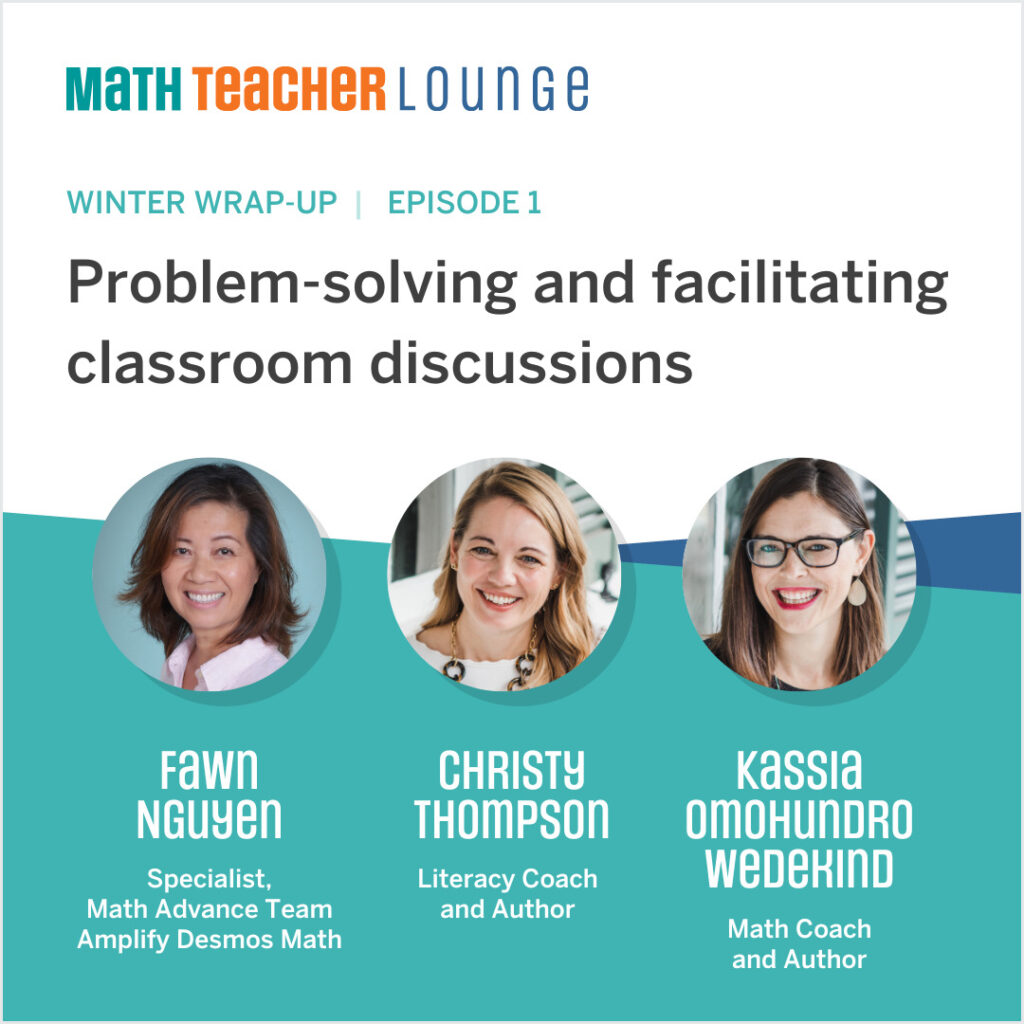
Promotional graphic for Math Teacher Lounge podcast, episode 1, featuring Fawn Nguyen, Christy Thompson, and Kassia Omohundro Wedekind discussing classroom problem-solving and discussions.

As we prep for an exciting new season of Math Teacher Lounge: The Podcast, hosts Bethany Lockhart Johnson and Dan Meyer are looking back at the amazing speakers and conversations from past episodes and sharing some of their favorites!

First up: A season 2 double feature of the power of problem-solving with Fawn Nguyen and Facilitating Classroom Discussions with authors Christy Hermann Thompson and Kassia Omohundro Wedekind.

Fawn is a specialist on Amplify’s advanced math team and a former math teacher and math coach—so she knows her stuff! You’ll hear about her five criteria for good problem-solving problems, and the power and importance of exposing all students to problem-solving.

Then, we’ll move into Bethany and Dan’s conversation with Christy and Kassia to learn how hands-down conversations allow students to become better listeners and the steps you can take to implement hands-down conversations in your classroom.

Explore more from Math Teacher Lounge by visiting our main page.

Download Transcript

Dan Meyer: (00:01)

Hey folks. Welcome back to Math Teacher Lounge. My name is Dan Meyer.

Bethany Lockhart Johnson: (00:03)

And I’m Bethany Lockhart Johnson. Hello! Happy New Year! Hello, Dan Meyer.

Dan Meyer: (00:09)

HNY, Bethany. HNY to you and to all of the listeners out there in Math Teacher Lounge. HNY is the abbreviation that I use sometimes.

Bethany Lockhart Johnson: (00:18)

Oh, is that what that is? Is that—I wasn’t sure what that was. If on my birthday you send me HBD…no.

Dan Meyer: (00:25)

Yeah.

Bethany Lockhart Johnson: (00:25)

No. Unacceptable.

Dan Meyer: (00:27)

I will. No, you want the full thing. To demonstrate my care for your birthday, I gotta spell the whole thing out. I’m just trying to stay relevant. You know, I’m just trying to stay relevant and youthful. So I’m using The Abreevs.

Bethany Lockhart Johnson: (00:38)

The Brevvies.

Dan Meyer: (00:40)

To the extent of even abbreviating the word “abbreviation.” . So, any New Year’s resolutions you wanna share with the listeners, Bethany? While you think, I’ll just share mine real quick here. This is the year of the perfect Wordle streak for yours truly, Dan Meyer. I’m going the full 365. Watch. Watch me do it, folks. I’m naming it here. Live on air. recorded on air. Perfect Wordle year. What you got for the listeners, Bethany?

Bethany Lockhart Johnson: (01:10)

Let’s see. It’s raining very hard here in Southern California, and my newest resolution is to embrace nature. My child wants nothing more than to go and splash in all the puddles.

Dan Meyer: (01:22)

Nice.

Bethany Lockhart Johnson: (01:23)

And be amongst the mud. And what I’m gonna keep telling myself—and so far, so far, I’ve been doing pretty good with this—thrive, child. Splash. Squish. We can dry you off. You will not melt. So I want to keep finding opportunities. Like, for instance, my response is, “It’s pouring rain. Let’s stay under covers and let’s read this book together!” And his response is like, banging on the windows, like, “Please let me go outside.” So I myself have some rain boots. I’m going to go forth and splash with my child. So hopefully you’ll see me doing that a bit more.

Dan Meyer: (02:08)

Love that.

Bethany Lockhart Johnson: (02:09)

Ask me what I’m doing. I’m outside, splashing in nature.

Dan Meyer: (02:12)

I don’t wanna put words in your mouth, but I have felt a bit like parenting is a means for rounding out aspects of my own personality that I have felt are—or habits or hobbies that are lacking. Like, I’ve never been real outdoorsy or into camping, but I don’t want that to limit my own kids’ aspirations or interests. So let’s do the thing that’s not super natural for me, for their own sake. Which is kind of what I’m hearing a little bit from you, which—that sounds exciting.

Bethany Lockhart Johnson: (02:35)

Do you wanna go camping together? Like, our families?

Dan Meyer: (02:38)

Uhhh. Let’s take this one off the air. I also love something that’s more relevant to a teachers audience that you said, that I think is super interesting, is how there’s ways that we can make the jobs harder for ourselves, that are optional. And what I hear from you is like, “I’m just not gonna freak out. We’re getting wet. We’re getting soggy. And I’m just not gonna freak out.” And I just think that that’s interesting to think about, the things that we take on, you know, that’s optional. Freaking out is optional, sometimes. And there’s other areas, I think, for parenting or for teaching, where it’s like, “Oh, do I really need to choose this particular battle?” And to reconsider that.

Bethany Lockhart Johnson: (03:19)

And in that spirit, our whole Wordle episode that we talked about? Do you remember you talked about how beautiful Wordle mistakes are, and how you keep learning from mistakes? I mean, you obviously want the final correct answer, but just, you know, when you get on a losing streak, Dan, I hope you’ll continue to pat yourself on the back.

Dan Meyer: (03:38)

Well, I will not be taking on a losing streak, or even lose one day. This is what’s gonna happen here. I’m just speaking that and putting it out in the universe.

Bethany Lockhart Johnson: (03:49)

Speak it!

Dan Meyer: (03:50)

But if it happens, I will be taking a long break from all human interaction. And lamenting, as I do.

Bethany Lockhart Johnson: (03:59)

Camping. Dan’s off in the woods, weeping.

Dan Meyer: (04:01)

That’s right. That’s right. Yeah. Well, we wanna share with you folks—an exciting programming note is that we are currently working very hard on producing a special fifth season of this podcast. You thought the other seasons were special? Let me tell you, this fifth season gives new meaning to the word “special.” And we can’t wait to tell you more about that. But in the meantime, Bethany, you wanna tell ’em what we’re up to in the meantime?

Bethany Lockhart Johnson: (04:26)

Well, Dan and I went back and we were having a conversation about some of our most favorite conversations, or the conversations that people bring up to us. Like, when we were at the CMC conference, or NCTM, folks, when we talk about the podcast, they’re like, “Oh, I loved this one.” “Oh, I love this one.” And that, to me, I don’t know, that is exciting. And so, while we’re putting together this new season over these next few weeks, we’re gonna feature a few of our favorite conversations from our first four seasons. Dan, four seasons!

Dan Meyer: (04:59)

We’ve been at this for four seasons! And I do want to just emphasize something you said, Bethany: that all of our conversations are our favorite conversations. They’re all our special children. What we just felt like you, the listeners, did not quite learn enough from some of these, and so we really needed you to hear them again to make sure you got everything that you should get out of them. So, let’s tell ’em who’s up first. And who’s up first is a conversation we had about problem-solving with Fawn Nguyen, who’s an advanced math team specialist here at Amplify. Been a former math coach, math teacher. Just really done the work, is what I’d say about Fawn.

Bethany Lockhart Johnson: (05:38)

If you have been listening to this podcast, you’re like, “Whoa, whoa. Wait, I have not missed an episode. I didn’t hear Fawn’s interview.” That is because we used to be video only, not podcasts. So this conversation with Fawn was from, what, our second season?

Dan Meyer: (05:55)

Yeah.

Bethany Lockhart Johnson: (05:56)

And we were on video. And another thing about it is it was, this is a conversation that, when folks talk about problem-solving, a lot of the responses we’ve gotten are like, “Wait, I’ve never thought of problem-solving this way.” In fact, you’ll hear us say that exact thing . So we really appreciated the time with Fawn. And yeah.

Dan Meyer: (06:17)

Enjoy it, folks. Especially enjoy Fawn’s—I think a four-part?—definition of problem-solving, a word that’s often kind of mushily defined. And Fawn really goes into, I think, precision and depth on it. So hope you folks enjoy it.

Dan Meyer: (06:35)

Give a wave, Fawn, to the camera. Would you? Cool. Fawn has been a teacher for a very long time. She is someone who could have left the classroom at any point and taken any number of jobs in the math-teaching universe. But I’ve always admired that Fawn has taught kids for a very long time, and that has given her, in my view, just a lot of clarity on what is important to her about students. I’ve seen her not get upset or obsessed with certain kinds of small niche issues that a lot of us, like, they get a lot of us down in the classroom, sometimes. And she’s maintained a laser focus on among many other things, problem-solving as a virtue in mathematics classrooms. So, please welcome Fawn to our show. Fawn, thanks so much for being here.

Fawn Nguyen: (07:18)

Hey, thank you so much. Thank you. I am so excited and honored that you guys invited me for this, Bethany and Dan.

Bethany Lockhart Johnson: (07:24)

Thank you for being here.

Fawn Nguyen: (07:26)

I love you, Bethany. Dan, I can tolerate, but I love you.

Dan Meyer: (07:30)

I really worked myself up there on that complimentary opening for you, and that’s how you get me back, here? OK. Problem-solving is fully on the consciousness of math teachers. Every math teacher knows that they need to say, like, “Yeah, oh, problem-solving. Yes. Love it. Do it. I dig it.” But even so, I feel like it’s become kind of a buzzword. Like, it’s not always obvious what that means…or am I doing problem-solving, really? So we’re curious: As someone who is a problem-solving expert, who is asked all over the world to talk about problem-solving: How do I know if I’m doing problem-solving in my classroom?

Fawn Nguyen: (08:12)

This is not my definition of it, but—nor am I an expert, by the way, Dan, thank you! but I try really, really hard and work on it!—my definition—or it’s not my definition, but I like it because it’s short and honest—is “problem-solving is what we do when we don’t know what to do.” And so—

Bethany Lockhart Johnson: (08:32)

Ooh!

Fawn Nguyen: (08:32)

—with that mind-frame, I’m hoping teachers think more about what they task. Because I think it gets mislabeled a lot, as to what is problem-solving. If the kids already know what to do, there’s a solution path. Then it’s not problem-solving.

Dan Meyer: (08:48)

Yeah. So what are examples then? An example of, like, I might call something problem-solving, but it it fails that particular definition that you just proposed there. Very short, very honest definition.

Fawn Nguyen: (08:59)

Just, it needs to have constraint and contradiction to what the kids think naturally. It should come as a surprise. There’s an element of surprise in it. There’s tension.

Dan Meyer: (09:11)

Maybe if there’s harder numbers or, you know, decimals or fractions in the same kind of procedure…I can feel myself thinking, “Yeah, this is hard. This is problem-solving. Problem-solving equals hard. But we already know what to do.”

Fawn Nguyen: (09:27)

Or just word problems. That’s the most common thing. As soon as it just has words attached to the math, it becomes problem-solving. But that’s just coding it to me. That’s just coding it with words, wrapping it around. It doesn’t mean anything until we read through and see if there’s true problem-solving in it.

Bethany Lockhart Johnson: (09:45)

Like, what’s the moment that it becomes problem-solving? In the way that you envision it?

Fawn Nguyen: (09:53)

Well, I think there’s the bigger problem-solving of really bringing a task…I wanna call it left field. It just—we rarely ever, if ever, see it in the regular coursework, but it can also be problem-solving if we just take what we expect the children to do at the end of the unit, how about we front-load that? To me, that’s also problem-solving. And I’m trying to encourage teachers to do that last problem first. The task writers put more thought—not that they don’t do the rest of it!—but you know, this is a special one, because they label it “challenge,” or “enrichment,” or “are you ready for more?” I’ve seen those. And so it is this really special problem. And I would love for us to think about “do that first.” Because my biggest fear is that because it comes at the end, that not all the children are involved. And so that to me is the saddest part. Because we might not get to it, right? In mathematics, we always think, “OK, well, let’s do these problems and then we don’t have time for the rest.” But I think that’s your richest task right there, is at the very end. So why don’t we front-load it, start it, and it’s OK—of course it’s OK!—that we don’t all get it. But the exposure to all students is so important. Talk about, you know, equity. Talk about that, everybody gets the same thing. If everyone dug into that first one with everybody’s collaboration, and we get to share that, and then we leave it, because “Yeah, OK, now we learn more of the other stuff, right? That hopefully support. And then we can go back. And now everybody had a chance to go get into it, and then we can come back to it as, as many problems, we need to go back to it.”

Bethany Lockhart Johnson: (11:37)

And that feels so powerful. Because it feels like—as a teacher, I’m thinking it would also inform my work, how I approach the unit, and how I approach the next steps. Right? Like, what kind of work would we be doing if I let it, if I allow it, to change the way that I approach the unit.

Dan Meyer: (11:58)

Yeah. What you’re describing is so powerful, and really asks a lot of the task designers as well, I think. There are problem-solving tasks that really require, like, abstract knowledge of the way formulas and variables fit together. And what I love about what Amplify is doing with their problem-solving, what you’re helping them do, is that they start with a true low floor that can draw in every student. And they might get stuck at different places; that’s fine. But everyone has a way in. That’s exciting.

Fawn Nguyen: (12:24)

It’s a big deal for me to have this opportunity and this trust, to integrate problem-solving into the curriculum, make it intentional. It’s difficult to implement. It is, to be honest. Because for me, what is a good task? This makes one of my four criteria: One is, it is non-routine. It is simply stated. Simply stated—that’s like your low floor. And then has multiple solutions. And the fourth: This makes it. Because that the teacher enjoys solving it. And so you have to enjoy solving it to bring it. Because so that way I can say to my kids, “This is my gift.” It really is, Because, you know, it has so much fun and joy. And I appreciate the struggle. And I wanna illustrate an example. For example, let’s say Dan and I are classmates. And I know that Dan gets A’s on his tests and the lowest score he ever got was an 89%. I, on the other hand, just sitting right next to him, I average D. I have a D average on everything. While Bethany, our amazing and wonderful teacher, brings in a problem. And when she brings it in, she says, “I worked on this problem. I found this problem; I worked on it; and I struggled with it. And it was amazing. I enjoyed it so much, I’m sharing it with you.” And all of a sudden it’s like, “OK!” And I”m sitting there, right? My teacher loves this problem so much; she’s bringing it in to share with us. And now, all of a sudden, it’s not, you know…and I know she only gives us non-routine. When she talks about problem-solving, it’s non-routine. So it’s not directly tied to the textbook that I’ve been struggling with. So it gives me a chance, it gives me a chance to contribute. To think differently. And now, suddenly I look forward to working with Dan, because in this space, in this problem-solving space, Dan is no longer Mr. Know-It-All. And so that’s what I mean by—I am saying this a hundred times, and I will not stop saying it—problem-solving levels the playing field. Our world is filled with unsolved problems. Are you kidding me? Right? We look around us, we have so many things that are not solvable, or people are working on it, and yet in mathematics, what happens? The bell rings; we start; and we solve everything during that time, and we leave. And that’s…yeah. No! No! We need to wrestle with problems.

Dan Meyer: (15:04)

And that was our conversation with Fawn Nguyen, which we first released way back in November, 2021. You folks can follow Fawn on Twitter at Fawn P Nguyen. Um, that’s @ F A W N P N G U Y E N.

Bethany Lockhart Johnson: (15:18)

So our episode today is a double feature. We are featuring another conversation that we loved from Season Two. This is a conversation with Christy Hermann Thompson and Kassia Omohundro Wedekind. They’re authors of the book, “Hands Down, Speak Out: Listening and Talking Across Literacy and Math.” And I don’t know if you remember, but not only did we have a conversation with them, but we did a whole book study on Facebook, a Facebook Live book study, over the course of several months. And it was one of my most favorite things. And then they did a webinar at the end. So our conversation with them on the podcast for me felt like such a beautiful dive into their book. And you know, I’ve said it before, you think you have something down in the classroom, you’re like, “Oh, hand-raising, I’ve got that down.” You think you have it down, but then somebody says, “OK, but have you ever considered thiiiis?” You know, and it just—

Dan Meyer: (16:17)

NOT that??

Bethany Lockhart Johnson: (16:18)

, Not that? Something totally different? And I loved talking with them. They’re a lot of fun. And I loved the book.

Dan Meyer: (16:23)

Wonderful conversation, great book. Very provocative ideas. Yeah. As someone who’s like, “OK, classroom management, I gotta get the hand-raising going…”. In the classroom before we talked, they offered a really potent challenge to some really standard classroom management ideas. Yeah. Loved it.

Bethany Lockhart Johnson: (16:40)

And this conversation also offers some really practical tips for facilitating student conversations. So we think you’ll enjoy it. Here’s our conversation with Christy and Kassia.

Bethany Lockhart Johnson: (16:53)

So today we are talking about “Hands Down, Speak Out: Listening and Talking Across Literacy and Math, K—5.” And we have the authors here, Kassia Omohundro Wedekind and Christy Hermann Thompson. Before we begin, let’s define what a hands-down conversation is. A hands-down conversation is just another way to structure discourse in your classroom. So in a typical classroom, you might see students raising their hand and waiting on a teacher to call on them before they share their ideas or engage in discussion. But in a hands-down conversation, it’s students’ ideas and voices that are taking the lead, and teachers are stepping back and focusing on listening and facilitating. Hello! Welcome to the Lounge.

Kassia Omohundro Wedekind: (17:44)

Thank you. We’re excited to be here. We’re fans of Season One. So we’re ready to go.

Dan Meyer: (17:50)

I was a secondary teacher but I still found so much to love about the book. I think facilitating conversations is just generally challenging, and perhaps even more so in math, where answers feel so tightly dialed-in, in lots of ways. But I loved it. I would love for you to just explain to our audience, what is a hands-down conversation and how does that contrast with what might be standard practice for some people? For some classes?

Christy Hermann Thompson: (18:13)

We just started using the term hands-down conversation because we wanted to differentiate the fact that there are different times to have different types of dialogue in the math classroom, in the literacy classroom. And we use this as one of our tools. Right? It’s not that every day, all day long, we’re very against hand-raising and should never see that again. We find that having this as one of our tools will be where we make really clear to the students that this is a moment where we’re turning it over to you to negotiate the space and make the decisions about when your voice comes in and who speaks next. You know, carry on kind of like that dinner table or that playground or, you know, whatever is your natural habitat for talk. And bringing that into the classroom and then hoping that it also someday transfers back out of the classroom back into the real world.

Bethany Lockhart Johnson: (19:09)

For the teachers who feel like that’s terrifying to have students just start speaking, and speaking without any sort of control or my little equity sticks, my little popsicle sticks, or my popcorn, or whatever other thing they’re using, what would you say is the first step?

Christy Hermann Thompson: (19:25)

So I think recognizing and naming that fear is part of it. And then saying to yourself, “What’s the worst that could happen here?” You know, I think the worst that could happen is that nobody talks and it’s totally silent. Or on the other hand, everybody talks at the same time. And both of those things will happen! And so what? It’s gonna be messy. And if you just acknowledge that it’s gonna look messy, and that’s part of growing; that every child as they learn—and every adult—is messy as they grow.

Kassia Omohundro Wedekind: (19:59)

And we have to see what kinds of things will happen in a hands-down conversation. Like there’s no prerequisite. You just start and then you see what happens. And those are the signs that tell you, “What can help this community grow as talkers and listeners? If everyone’s talking at the same time, and they’re kind of pushing each other over with their words by saying, “I have something to add!” “I have something to add!” or something like that, that’s a common thing that sometimes happens at the beginning. Then you know that the next step is to do some work about how to hold your thoughts back, how to add, wait for a space in the conversation to talk. And those are all things we need people to know out in the world.

Bethany Lockhart Johnson: (20:41)

So can you give an example of a micro-lesson that…well, first, what do you define as a micro-lesson? And then, what’s an example of one that maybe somebody who wants to dip their toe into the world of hands-down conversations that they could try?

Christy Hermann Thompson: (20:56)

The reason we call them micro-lessons is because we wanted to differentiate from the term mini lesson, which is out there and tends to describe about 10 or 15 minutes that might take place at the beginning of a work period of time. And this is much smaller than that. We usually follow a pretty predictable structure of naming. Here’s this thing that’s so helpful when we’re having conversations, and we love to especially be able to name something that a student had done: “Kaylee did this yesterday and it really helped us.” So what we might call that is, “And then here’s how Kaylee and other people might do that. They might do something like this.” And, you know, having a little anchor chart, so there’s a visual reminder of that skill. “So when we’re having a conversation today, you could try…”. And that’s basically a micro-lesson, just in a nutshell.

Kassia Omohundro Wedekind: (21:51)

When I was doing these hands-down conversations and I had more space for myself to listen as a teacher, I’m like, “Well, look at those kids, like, slumped onto the ground, like, pulling the carpet apart, but they’re having this amazing conversation!” And so I learned that listening is a lot broader. So in this lesson that I’m thinking about, we just talk with kids about what are lots of different ways that listening can look like. Sometimes with younger kids, I’ll take pictures of them listening in different ways and we’ll notice things about them together. And then we invite them to talk with their Turn and Talk partner about like, “How do you like to be listened to?” Or “Tell me about how you listen.” And just kind of broaden that. And really, I like to think that like the micro-lessons are for the kids, but also I’m saying those things to say them for myself. Like, “Remember, you don’t have to insist that kids are staring each other down in the eyes all the time. Like, “It’s OK when they’re doing other things. There’s other ways of listening.” So I think I’ve learned as much from the micro-lessons each time I do them as the kids that I’m trying to help grow as listeners and talkers, as well.

Dan Meyer: (23:00)

You folks have a lot of really eloquent ideals you express, around democratic classrooms and engagement. But you also have just some very tangible, practical…even down to, like, how a teacher positions their body in space and the way they use their eyes to connect. I think it would be really helpful for teachers to hear that it’s not just they’re signing on to a manifesto of sorts, but there’s ways they can act their way into the beliefs that you both expressed here.

Christy Hermann Thompson: (23:26)

When I’m starting hands-down conversation work, if I put myself a little bit outside of the circle and look down, and give myself a clipboard, it, it helps me bite my tongue and it helps me give better wait time and see what the kids are doing before I have that tendency to jump in and teach and do lots of teacher-y things.

Bethany Lockhart Johnson: (23:48)

Kassia and Christy, thank you so much for joining us. We are so excited to have this conversation and to share your work. This is exciting. And I feel like this conversation is just the beginning of a deeper dive into this book.

Kassia Omohundro Wedekind: (24:01)

Thanks for having us.

Christy Hermann Thompson: (24:02)

Thank you.

Dan Meyer: (24:03)

Thank you both.

Bethany Lockhart Johnson: (24:06)

Thanks so much for listening to our conversations with Fawn Nguyen and Christy Hermann Thompson and Kassia Omohundro Wedekind, both of which were released in 2021, part of our second season. And, you know, we hoped you enjoyed listening to it for a first, second, maybe third, fourth time.

Dan Meyer: (24:24)

Let’s be real. There’s some real fans out there.

Bethany Lockhart Johnson: (24:26)

We loved it then. We love it now!

Dan Meyer: (24:28)

Yep, yep, yep. Please keep in touch with the show by following us on Twitter at MTL Show, and join our Facebook group, the Math Teacher Lounge community. We’d love to hear from you there. And please stay tuned for more info on what we’re cooking up here in the Math Teacher Lounge. Thank you folks for listening. Take care, Bethany.

Bethany Lockhart Johnson: (24:47)

Bye now.

Stay connected!

Join our community and get new episodes every other Tuesday!

We’ll also share new and exciting free resources for your classroom every month.

What Fawn Nguyen says about math teaching

“It’s a big deal for me to have the opportunity and this trust to integrate problem-solving into the curriculum.”

– Fawn Nguyen

Specialist, Math Advance Team, Amplify Desmos Math

Meet the guests

Fawn Nguyen

Fawn began her work with Amplify in 2022 as a Math Advance Team Specialist. She was a math coach for a K-8 school district for three years, and a middle school teacher for 30 years before that. Fawn has also received a number of accolades as an educator.

Christy Thompson

Christy Thompson is a Literacy Coach in Fairfax County Public Schools in Virginia. She has spent her teaching and coaching career particularly focused on listening to and learning from the talk of our youngest students.

Kassia Omohundro Wedekind

Kassia Omohundro Wedekind spent many wonderful years as a classroom teacher and math coach in Fairfax County Public Schools in Virginia and now splits her time between being an independent math coach and an editor at Stenhouse Publishers. Her favorite days are spent in classrooms learning from the many ways children talk, listen and negotiate meaning together.

Three women are pictured separately in circular frames, each smiling and facing the camera, against a white background with overlapping pastel shapes—perfect for highlighting math teacher lounge discussions or sharing essential math teacher resources.
A graphic with the text "Math Teacher Lounge with Bethany Lockhart Johnson and Dan Meyer" on colored overlapping circles.

About Math Teacher Lounge: The podcast

Math Teacher Lounge is a biweekly podcast created specifically for K–12 math educators. In each episode co-hosts Bethany Lockhart Johnson (@lockhartedu) and Dan Meyer (@ddmeyer) chat with guests, taking a deep dive into the math and educational topics you care about.

Join the Math Teacher Lounge Facebook group to continue the conversation, view exclusive content, interact with fellow educators, participate in giveaways, and more!

Welcome, LAUSD educators!

Introducing Amplify Desmos Math California, a curiosity-driven TK–12 program that builds lifelong math proficiency.

Our program fully aligns with LAUSD’s screen-time resolution. We are 100% print-based, with optional
technology resources available, in direct accordance with the school board’s newly approved guidelines.

Start by watching our welcome video to the right, then learn more about the program and begin your review below.

Curriculum overview

Watch the videos below for an overview of Amplify Desmos Math California:

Built for California

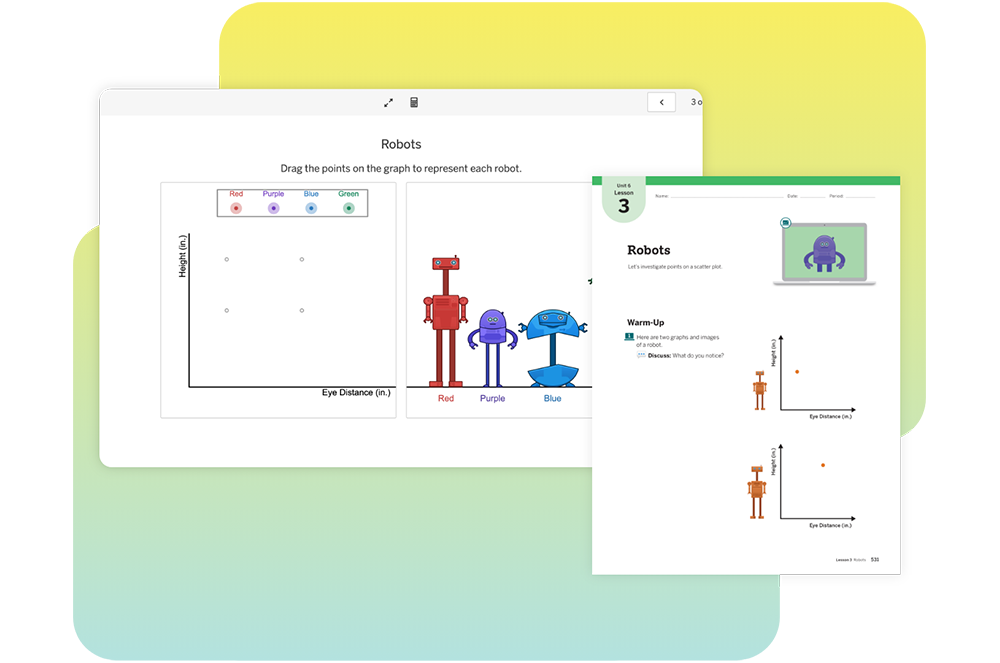
An educational worksheet on robots, featuring a graph with red, purple, and blue robot icons, and instructions for a warm-up activity.

The Amplify Desmos Math California program is designed around the vision articulated in the Mathematics Framework for California Public Schools: Kindergarten Through Grade Twelve to enable all California students to become powerful users of mathematics. Our program incorporates the latest research in student learning, meaning that we:

  • Focus on the Big Ideas: Amplify Desmos Math California’s courses, units, and lessons are centered around the Big Ideas. Big Ideas, like standards, are not considered in isolation. In addition to each unit and lesson’s focal Big Ideas, Amplify Desmos Math California also provides connections among the Big Ideas across units and lessons.
  • Center on open and engaging tasks: Amplify Desmos Math California is grounded in engaging tasks meant to address students’ often-asked question: “Why am I learning this?”  Students are invited into learning with low-floor, high-ceiling tasks that provide an entry point for all. Open tasks in Amplify Desmos Math California provide the space for students to try on multiple strategies and represent their thinking in different ways, and allow student explanation and discussion to serve as the center of the classroom. All lessons offer both print and digital representations.
  • Provide enhanced digital experiences: Amplify Desmos Math California includes digitally-enhanced lesson activities, incorporating interactive digital tools alongside print materials. These purposefully-placed resources allow students to visualize mathematical concepts, receive actionable feedback while practicing, encounter personalized learning support from an onscreen tutor, and engage in discussions about their thinking and approaches.
  • Treat core instruction and differentiation as integral partners: The Amplify Desmos Math California curriculum provides teachers with lessons, strategies, and resources to eliminate barriers and increase access to grade-level content without reducing the mathematical demand of tasks. Every activity has multiple entry points to ensure that all students are supported and challenged. Intervention and personalized learning activities are directly connected to lesson content and offer students individualized support as they dive into the mathematics.

About the program

Taking the IM content further.

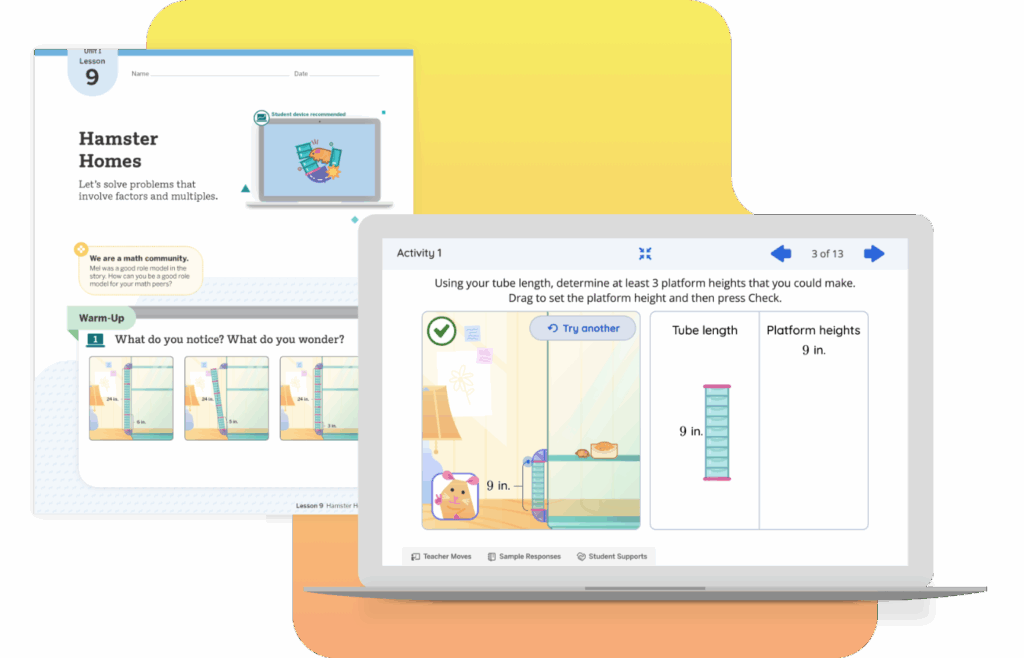
A laptop displays a math activity about platform heights and tube length, while a worksheet titled "Hamster Homes" is visible in the background.

Amplify Desmos Math California is a curiosity-driven program that builds lifelong math proficiency. Each lesson poses problems that invite a variety of approaches before guiding students to connect their understanding of the learning goals.

Students encounter math problems they’re eager to solve, while teachers spend more time where it’s most impactful: creating a collaborative classroom of learners.

We chose to base our program on the extensively field-tested IM K–12 MathTM authored by Illustrative Mathematics. IM K–12 Math is a problem-based curriculum. It asks students to grapple with well-designed and thoughtfully sequenced real-world mathematical problems to build their understanding of how to efficiently solve them.

Begin your review to see how we’ve taken the IM K–12 Math content further.

Begin your review

Using a Google Chrome or Safari web browser, click the orange button below or navigate to learning.amplify.com and select “Log in with Amplify.”

English credentials

Spanish credentials

Rethinking reading comprehension

Collage of educational web pages and images featuring children reading, book graphics, and the title “Understanding Comprehension: The Heartbeat of Literacy,” highlighting interactive lessons and free teaching resources.

Have you ever listened to a student read aloud fluently about something—say, the life cycle of sea turtles—only to discover afterward that they couldn’t explain a single thing about…the life cycle of sea turtles? It’s a familiar classroom moment, and it reveals how easy it is to misunderstand what comprehension really is.

Comprehension is often framed only as the product of reading: the answers students give when asked to find the main idea, identify a theme, or summarize a passage.

But the Science of Reading tells us that comprehension is more than an outcome. Comprehension is also a dynamic process that unfolds as readers move through a text, powered by the interactions among words on the page and the knowledge and reasoning they bring to it. That’s why we like to think of it as the heartbeat of literacy.

Why comprehension is both product and process

For decades, much of classroom instruction has focused on language comprehension products: the demonstrations of understanding that happen after reading. Those are important, but they don’t tell the whole story.

That’s because products depend on processes. If students do not build a coherent mental model of what they’re reading—while they’re reading—they may succeed at reading, but not at comprehending.

This is the missing link that researchers like Hugh Catts, Ph.D., and Jane Oakhill, Ph.D., have revealed: Comprehension isn’t something readers suddenly have at the end of a passage. It’s also something they do all along the way.

What comprehension processes look like

Comprehension processes are the mental moves students make to construct meaning as they read. All students need explicit instruction and practice in order to learn to do this automatically. Some of the most important processes include:

  • Inference-making: Filling in gaps the author leaves unsaid. If a story says “Carlos forgot his umbrella and got wet,” readers must supply the missing piece: It rained.
  • Anaphora resolution: Figuring out who pronouns such as he or she refer to. For instance, in a passage where “Charmaine passed the ball to Kendra, and she scored,” not all readers may track that she refers to Kendra.
  • Monitoring meaning: Noticing when something doesn’t make sense and rereading to fix it. Think of a student breezing through a science lab procedure but not realizing they’ve misunderstood a key step.
  • Recognizing connectives: Using words like because, however, or meanwhile to understand how ideas fit together in a text about history, math, or literature.
  • Visualizing: Building a mental picture—whether that’s of how a caterpillar becomes a butterfly, or how a character’s feelings shift across a story.

When these processes don’t happen, comprehension breaks down—even for students who can decode fluently. That’s why teaching comprehension can’t mean just assigning comprehension questions. It has to mean teaching students how to think with text in real time.

The role of knowledge and writing

Processes don’t exist in isolation. They depend on, and are strengthened by, what students already know and what they can express in writing.

  • Knowledge: The more background students bring to a text, the easier it is for them to make inferences and connect ideas. A child who already knows a little about baseball will understand a passage about a pitcher’s strategy much more readily than one encountering the game for the first time.
  • Writing: Writing about reading reinforces comprehension. When students summarize a biography in their own words, draft a response to a novel, or synthesize ideas from multiple sources, they are practicing the very processes—like making connections and organizing ideas—that skilled readers rely on.

This interplay—reading feeding knowledge, knowledge feeding comprehension, writing reinforcing both—creates a cycle of literacy growth that goes far beyond the end-of-text quiz.

Rethinking classroom practice

Working on individual comprehension skills can help in the short term. But long-term literacy success—for all students—requires explicit instruction and practice in all the comprehension processes needed to build comprehension products.

So what does it mean to teach comprehension as a process, not just a product?

Weaving effective instruction in comprehension strategies into everyday literacy work. A few examples:

  • Model your thinking. Pause mid-reading to ask, “Who does she refer to here?” or “That didn’t make sense—let’s go back.”
  • Highlight connectives. Teach words like although or consequently explicitly, showing how they signal relationships between ideas.
  • Promote monitoring. Encourage students to ask themselves, “Does this make sense?” and to reread when it doesn’t.
  • Build knowledge deliberately. Use content-rich texts in science, history, and the arts to give students the context they need for stronger comprehension.
  • Pair reading with writing. Even short written responses—“Why do you think the character acted that way?”—help solidify understanding and make comprehension processes visible.

These practices shift comprehension instruction from an after-the-fact check to an in-the-moment skill set students can carry into every subject.

Want to dig deeper?

Expanding our understanding of comprehension as both product and process is one of the most important shifts the Science of Reading has brought to literacy instruction. It reminds us that comprehension isn’t just a mysterious outcome at the end of reading—it’s the ongoing work of making meaning along the way.

To help educators explore this shift, we’ve created the new Science of Reading: Comprehension 101 bundle. These resources break down the research and provide strategies you can use right away. When we teach comprehension as the ongoing process it truly is, we keep the heartbeat of literacy strong for every reader.

Inside, you’ll find the following resources:

  • Our anchor ebook: Understanding Comprehension: The Heartbeat of Literacy
  • Infographic: The missing link in reading comprehension
  • Ebook: Knowledge, Reading, and Writing: The Secret Recipe for Literacy Success
  • Podcast: “Science of Reading Essentials: Comprehension” episode and listening guide
  • Webinar: Rethinking Reading Comprehension: Reflections on Hugh Catts’ and Jane Oakhill’s Research

New professional development series for science educators

New year’s resolutions generally don’t work—unless, experts say, they’re specific, measurable, and backed by science (like … getting more sleep so you feel more rested). So if you’ve resolved (or at least planned) to do more science professional development this year, we got you.

Our new, free, on-demand professional development webinars are ready to be added to your calendar. Designed for the era of NGSS, they offer research-based ways for you to engage your students deeply in science this year. (But we hope you’ll find a way to get more sleep, too!)

Phenomena-based science learning for next-level engagement

The Next Generation Science Standards (NGSS) are designed to deliver this key shift: Students go from learning about to figuring out. Instead of delivering information, teachers invite students to explore the power of phenomena-based learning in science. By focusing first on real-life scenarios and thoughtful questions over abstract correct answers, this approach cultivates students’ voices and curiosity. It gets them to the right answers—but in a way that helps them think, read, write, and argue like real scientists and engineers.

The NGSS also delivers three-dimensional science instruction. This means that each standard includes the following three dimensions:

  1. Science and Engineering Practices: the actual behaviors that scientists and engineers engage in as they investigate and create.
  2. Cross-cutting Concepts: concepts that appear across and link various domains of science. They include: Patterns, similarity, and diversity; cause and effect; scale, proportion, and quantity; systems and system models; energy and matter; structure and function; and stability and change.
  3. Disciplinary Core Ideas: The fundamental scientific ideas that make up the core content of the NGSS.

A look at our webinars

Featuring curriculum experts from UC Berkeley’s Lawrence Hall of Science, our webinars will  show you what these approaches look like in real classrooms.

COURSE 1

Establishing a Culture of Figuring Out in Your Next Generation Science Classroom

Explore ways to cultivate curiosity and value student voices while utilizing the structures and content from phenomena-based, literacy-rich science curricula designed for the Next Generation Science Standards.

Watch on demand now!

COURSE 2

Lead with Phenomena and the Three Dimensions Will Follow

Reframe your K–8 science instruction by focusing on phenomena. Learn about the shift in science teaching and classroom practices toward one where students are figuring out, not learning about.

Watch on demand now!

COURSE 3

Leveraging Science to Accelerate Learning

Learn about an approach to teaching and learning science that not only meets state science standards, but can also be used to support accelerated student learning across all subject areas.

Watch on demand now!

Also:

Tune into Science Connections:The Podcast.
Learn more about the NGSS.
Explore more Amplify webinars.
Have a phenomenal 2023 in science!

Reading comprehension strategies grounded in science

When we teach reading using what science (specifically the Science of Reading) tells us, we guide the brain to start recognizing and understanding those letters, syllables, and words. And the most effective reading comprehension strategies depend not only on explicit instruction, but on building background knowledge.

Comprehension instruction: Breaking it down

According to the Simple View of Reading, two cognitive capacities are required for proficient reading: (1) decoding, and (2) language comprehension.

“Reading comprehension is the product, not the sum, of those two components,” says Dr. Jane Oakhill, professor of experimental psychology at the University of Sussex. “If one of them is zero, then overall reading ability is going to be zero.”

As Oakhill explains further on Science of Reading: The Podcast, each component contains its own set of distinct skills and processes. It’s crucial to help students develop all of these capacities.

Building mental models for new information

Some readers are great at decoding but struggle with language comprehension. Why might that be—and how can you support them?

Here’s some context: After you read this paragraph, you aren’t likely to recall the precise wording—but you will probably remember the idea. Researchers use the term mental model to describe the cognitive strategies for the structure you create in your mind to perform this feat of comprehension.

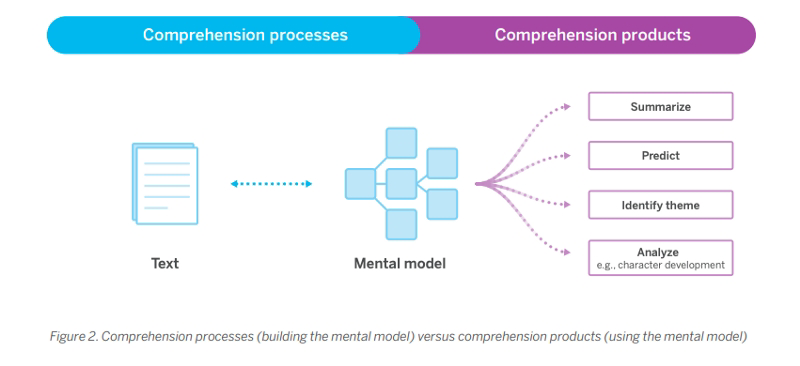
Historically, educators have thought about the process of comprehension — everything that happens after each word is recognized — as a black box. But now we know that there are two levels of comprehension at work: comprehension processes and comprehension products.

Comprehension processes are the steps you take to build a mental model of a text during reading. Comprehension products refer to the work you are able to do with that model after reading.

Think of the process of building a mental model as a sort of micro-comprehension. Weaker comprehenders build weaker models, so they may struggle when asked to create a narrative text summary, identify a theme, put together predictions, or describe key details of a character’s evolving beliefs.

By actively engaging with text, connecting prior knowledge, utilizing graphic organizers, receiving explicit instruction, and exploring new information, students can learn to build robust mental models that enhance their comprehension of the text. These mental models serve as frameworks for understanding, organizing, and synthesizing information, which then leads to improved comprehension, retention, and critical thinking.

Researchers have identified as many as 17 comprehension processes that affect students’ ability to build and use their mental models. The following are a few of the comprehension processes that weak comprehenders most commonly struggle with, and that with practice, can be targeted for skill development and improved overall comprehension.

  • Anaphora (using pronouns to refer to an earlier word or phrase): Some readers struggle to process pronoun relationships (Megherbi & Ehrlich, 2005), identify antecedents, and answer questions that require resolution of anaphora (Yuill & Oakhill, 1988).
  • Gap-filling inference: When reading the sentence “Carla forgot her umbrella and got soaking wet,” more skilled readers will conclude that it rained. A lack of awareness of when and how to activate background knowledge to fill in gaps may hinder a student’s ability to make inferences and comprehend the text as a whole (Cain & Oakhill, 1999).
  • Marker words: Writers use connective words (e.g., sothough, and yet), structure cues (e.g., meanwhile), and predictive cues (e.g., “There are three reasons why…”) to signal ways that text fits together. Students with limited knowledge of the meaning and function of these words may struggle with the meaning of the text (Oakhill, et al., 2015).
  • Comprehension monitoring: When proficient readers encounter difficulty, they tend to stop, reread, and try to figure it out. Less proficient readers may just keep going or fail to recognize that what they’re reading doesn’t fit their mental model.

Two strategies that you can employ in your classroom to guide students in comprehension strategy instruction:

  • Graphic organizers: Use graphic organizers such as concept maps, story maps, or Venn diagrams to help students learn to visually organize information and relationships within the text. Visualization enhances comprehension (Graesser, et al., 1994). As the text progresses, students can refer to and update their models.
  • Comprehension monitoring: Teach readers to monitor their comprehension while reading by pausing to reflect on their understanding, clarify confusing points, and adjust their reading strategies as needed. Monitoring comprehension helps good readers stay engaged and actively construct meaning from the text.

How background knowledge powers comprehension

The Science of Reading demonstrates the importance of systematic and explicit phonics instruction. But students don’t have to learn phonics or decoding before knowledge comes into the equation. In fact, the opposite might even be true.

Let’s say you’re handed a passage of text describing part of a baseball game. You read the text, and then you’re asked to reenact that part of the game. Which is most likely to help you do so?

  1. Your ability to read
  2. Your knowledge of baseball
  3. Neither

If you answered “2,” you’re batting 1,000. This example summarizes an influential 1988 study that concluded that the strongest predictor of comprehension was knowledge. In the study, which showed readers (with varying degrees of background knowledge about baseball) a passage describing a game, struggling readers comprehended as well as strong readers—as long as they had prior knowledge of baseball.

“The background knowledge that children bring to a text is also a contributor to language comprehension,” says Sonia Cabell, Ph.D., an associate professor at Florida State University’s School of Teacher Education, on Science of Reading: The Podcast.

In fact, background knowledge is the scaffolding upon which readers build connections between prior knowledge and new words. Students with average reading ability and some background knowledge of a topic will generally comprehend a text on that topic as well as stronger readers who lack that knowledge.

But until recently, literacy instruction has typically focused on decontextualized skills—finding the main idea, making inferences—rather than on the content of texts and resources that students engage with. According to Cabell, what we know about knowledge and comprehension should inform instruction for the whole class. “I think most, if not every, theory of reading comprehension implicates knowledge,” she says. “But that hasn’t necessarily been translated into all of our instructional approaches.”

How can we help build background knowledge while teaching reading? Here are some strategies backed by science.

  • Systematically build the knowledge that will become background knowledge. Use a curriculum grounded in topics that build on one another. “When related concepts and vocabulary show up in texts, students are more likely to retain information and acquire new knowledge,” say education and literacy experts Barbara Davidson and David Liben. According to them, this retention even continues into subsequent grades. “Knowledge sticks best when it has associated knowledge to attach to.”
  • Provide instruction that engages deeply with contentResearch shows that students—and teachers, too—actually find this content-priority approach more rewarding than, in Davidson and Liben’s words, “jumping around from topic to topic in order to practice some comprehension strategy or skill.”
  • Support students in acquiring vocabulary related to content. Presenting keywords and concepts prior to reading helps students comprehend text more deeply. Spending more time on each topic helps students learn more topic-related words and more general academic vocabulary they’ll encounter in other texts.
  • Use comprehension strategies in service of the content. While building knowledge systematically, teachers can use proven strategies—such as chunking and creating graphic organizers—to help students develop skills they can use to support their for understanding of important information.
  • Use discussions and writing to help students learn content. Invite students to share their interpretations, supporting their thought processes in their own words and connecting with peers’ perspectives.
  • Help students forge connections in small groups. Help students draw connections between reading lessons and units—and their own experiences—as they grow their knowledge base together.

Every day, the Science of Reading has more to tell us about comprehension as a multifaceted skill that requires a combination of various strategies, tools, and techniques to unlock meaning from text. Because of this body of research, we know that when educators bring intentional and evidence-based practices into the classroom, students can enhance their ability to comprehend grade level text, analyze information critically, and engage with diverse subject areas. By nurturing students’ reading comprehension skills grounded in the Science of Reading, educators can empower students to become good readers who can navigate complex texts with confidence and understanding.

Explore more

The Amplify blog:

Science of Reading: The Podcast

S1-01: The journey from student to SpaceX engineer: Juan Vivas

Illustration of Earth with text about a podcast episode featuring Juan Vivas, discussing the journey from student to SpaceX engineer. Includes a photo of a smiling person in a suit.

In this episode, we join Eric Cross as he talks to supply chain engineer Juan Vivas of SpaceX about his experiences growing up as a Latino in STEM. Juan shares his story of moving to the United States to study engineering and becoming successful in his career as a scientist. Juan openly discusses the experiences that made a difference in his life and the teachers that inspired him along the way. He also shares his experience as an engineer in different fields, as well as what it’s like to work in the supply chain during COVID.

Explore more from Science Connections by visiting our main page.

Download Transcript

Juan Vivas (00:00):

But to me, based on my experience so far, I think the best way to put it: An engineer is a technical problem-solver.

Eric Cross (00:28):

Welcome to Science Connections. I’m your host, Eric Cross. My guest today is Juan Vivas. Juan is a supply chain engineer for SpaceX. His career in STEM has pivoted from chemical engineering to working on foods like Cinnamon Toast Crunch to his current role at SpaceX, where he’s responsible for his work on Starlink, a technology that uses low-orbit satellites to provide internet access across the world. In this episode, Juan shares his story of how he became an engineer and how a thoughtful teacher used robotics to inspire him. I hope you enjoy this great conversation with Juan Vivas. Juan, thanks for being here.

Juan Vivas (01:14):

Yeah, yeah, of course! Super-excited to be here.

Eric Cross (01:19):

Hey, and starting off, I kind of like to ask your origin story. We were talking earlier about Marvel, and your journey of one working for…what I consider the closest thing that we have to SHIELD in the Marvel stories is SpaceX. Like with my own students, we talk about SpaceX like it’s a fictional thing, and we watch the rocket launches together and we watch the recovery and it’s so cool.

Juan Vivas (01:45):

Yeah.

Eric Cross (01:46):

And so when I knew that we were gonna be able to talk to you, I was excited. Like, I felt like I was a kid.

Juan Vivas (01:51):

<Laugh>

Eric Cross (01:51):

So I’d love to hear your origin story of you ultimately landing at SpaceX. And begin wherever kind of seems most natural to you.

Juan Vivas (01:59):

Yeah, yeah, of course. You know, I wasn’t one of those kids at from a young age I said “Oh, I’m gonna be an engineer.” Right? “I want to go and build all these things.” Where I grew up, and the social circle that I had, a lot of people were like doctors or lawyers. Just figured, you know, I’ll go to med school and go down the same path that 90% of like everyone else was gonna take. But in high school, I actually got into robotics. And, kind of like I mentioned, I wanted to do med school, that is what I figured I would end up doing. And then I got into robotics in high school. And I think that was what really kind of like changed my perspective of what I wanted to do, because basically these competitions were just—it was full-on driven by students. So we designed, programmed, and manufactured, like, the entire robot itself. And so through that I ended up doing a summer engineering program at the University of Maryland, the summer before going into my senior year in high school. And there we worked on a competition with underwater robots. And so we spent the entire summer, kind of similar scenario, designing a robot, manufacturing it, programming it. And then in the end it was like a competition in the buoyancy tank with different teams. And, you know, I think one thing that was really neat about that experience is that I got to hear Dr. John C. Mathers, who is a Nobel Prize physicist, speak to us in a room with, like, only 10 high school students. And just hearing his experience of where he started and the accomplishment that he’s been able to do, down in the STEM path, was really neat. And that summer was my final decision that I’m “OK, I know I want to be an engineer.” What’s interesting is I ended up choosing chemical engineering, instead of mechanical, which a lot of people, you know, based on all the experience that led me up to be an engineer, they asked me why I didn’t choose mechanical engineering. And I think one of the reasons why I chose chemical engineering is it’s very process-based. So one thing needs to happen, and there’s different inputs to that one step, and that step has an end-to-end reaction to it, right? So certain things need to happen in step one in order for step two to occur. And however the inputs happen in step one, it’s gonna affect the rest of the process. Honestly, very different than what I thought it was really gonna be. But what’s neat about chemical engineering is that it’s one of the most versatile engineering majors that you can have. Chemical engineering, because you work with a lot of process bases. Everything has a process, right? Everything needs to start with step one, and with, you know, step 10, whatever. And it’s all about optimization and improvement along those processes. So you can really take chemical engineering principles and apply ’em to different areas of a career, which is essentially the experience that I had in college. I had three internships with Dow Chemical where I did environmental health and safety, production, and supply-chain improvement. I then did research and development with Clorox. And then I did manufacturing engineering with General Mills. So really different job roles, different aspects, but same methodology applied.

Eric Cross (05:36):

I feel like there’s so much that you just said, <laugh> and I was trying to always, “I wanna ask him about that!” And in there, what I heard was there was a real pivotable, pivot moment in your life. Was the club…or was it a club, the robotics program? Or was that a class?

Juan Vivas (05:53):

You know, it was actually…it was VEX Robotics, specifically.

Eric Cross (05:56):

It was VEX! OK. Yeah, yeah. Really popular. And they still have it; I think we actually have some downstairs. So it was a club, and not necessarily a formal environment, where you were able to build. And it’s both collaborative and competitive, right? Like, there’s both aspects.

Juan Vivas (06:11):

Yep. Yep.

Eric Cross (06:11):

And, and then you had access to one of the only two facilities in the country that have these…were they buoyancy tanks?

Juan Vivas (06:20):

Buoyancy tanks, yep.

Eric Cross (06:21):

And there’s this book, Malcolm Gladwell’s Outliers, and then another similar book called Balance. It talks about how some of these innovators, like Steve Jobs and, and Bill Gates, they had access to things that other people didn’t. So, like, Bill Gates, I think at the University of Washington, had a computer that, you know, no one else did. And Jobs had one at, like, Hewlett-Packard. So it gave you this awesome headstart, where you’re able to test things in a real-life environment that kind of transfers into real-world skills. And then a few internships, so like, internships and mentors. So you had these people in the industry or people who were front-runners that were able to pour into you and give you these opportunities. And so it’s really neat to see how a program that starts as a club, kind of a competitive thing that introduced you to it and hooked you, then led to unfolding all of these opportunities that ultimately led you up to being here. And there’s one part—in looking at your LinkedIn profile, there’s a couple of really cool things that stand out. There’s a lot of cool things, but there’s two that really stood out. So one, working at SpaceX, and we’ll talk more about that, but I wanna go to General Mills and Cinnamon Toast Crunch. Because Cinnamon Toast Crunch is amazing.

Juan Vivas (07:39):

Yeah.

Eric Cross (07:39):

And you were part of the supply chain for that. In my head, I’m thinking, OK, like, what is he like responsible for? Like, getting the cinnamon and sugar?

Juan Vivas (07:51):

<Laugh>

Eric Cross (07:51):

What was, what did your job entail, when you were running that?

Juan Vivas (07:55):

There, I didn’t even know what I was gonna be doing until my first day. It was just, whatever the business need is, that’s where you’re gonna be put. So this was actually a high-priority plan for General Mills. And the production line that made Cinnamon Toast Crunch was split up into processes. So you have, they call it the process-process side, which is like literally raw materials, like making the cereal from scratch, baking it, adding the sugar, and then sending it to be packaged. And then you have the packaging-process side. so I was then placed as a packaging process lead, for the packaging side of that production line. So I was accountable for two packaging lines that packed out Cinnamon Toast Crunch. And that is where—that was actually my first real, you know, call it “real job,” like graduated college, going straight into the industry. I was a process lead for the packaging side of Cinnamon Toast Crunch.

Eric Cross (08:54):

So you went from cereal to rockets, <laugh>, which which is an amazing trajectory to have.

Juan Vivas (09:03):

Yeah. Yeah.

Eric Cross (09:04):

And when you kind of mentioned, back in your story about medical school, and, you know, it’s kinda like, what you see people doing, and you’re “OK, this is what I think I wanna do.” And then we have a perception in our mind about what a certain job’s gonna be like. And then reality hits. I think a lot of—when I ask my students, “What do you wanna do?” They think, like, “lawyer!” and when they think “lawyer!” they’re like, “I’m good at arguing!” Right? And until they find—until they talk to some lawyers and they find out like what that career can look like.

Juan Vivas (09:28):

Yeah.

Eric Cross (09:28):

You’re not just in the courtroom showing off your arguing skills. But, like, an engineer, when I talk to my students about what does it mean to be an engineer, often it’s very linear. It’s “I build bridges,” or, you know, maybe cars, but you’re a supply chain engineer. And, and that’s something that I think, now more than ever, it’s probably an incredibly critical role, especially considering that all of these supply constraints. Can you—what is a supply chain engineer? And what does it look like in your day-to-day? How is engineering rolled into that?

Juan Vivas (10:03):

Yeah, yeah. I think that’s an excellent question. I, too, once thought that engineering was just “I’m gonna be actually making something physical,” and like being super engineer-y about it. But, to me, based on my experience so far, I think the best way to put it: An engineer is a technical problem solver. As a supply chain engineer, specifically right now in my role at SpaceX…you know, as you can guess, the supply chain in the entire world is crazy. There’s no raw materials anywhere, and nothing can ever get on time. And so what I work on is I help our suppliers develop processes to meet the design criteria that we set up for like a specific part. As my job as a supply chain engineer, it’s “Can I take this design and make it manufacturable?” Right? “Can I go to any supplier and can they actually make this to the tolerance that the design engineer set them to be?” Nine out of 10 cases, the answer is no, essentially, is the best high-level way to put it.

Eric Cross (11:10):

When you’re solving these problems, is it this iterative process of going back and forth? Or is it just this aha-moment when you finally figure things out? ‘Cause I imagine they’re coming up with a design; you’re going back and saying, “Can this be manufactured?” or “Can it be done?” They’re saying no 90% of the time. And then are you the one responsible for kind of iterating on this, or changing it and then going back to them and telling them, asking them, until you get a yes? Is that—

Juan Vivas (11:33):

Yep. Yep, yep. Exactly. So we go through a process called Design for Manufacturing, DFMing. And where I essentially take, you know, the design engineer’s proposal, and then I have conversations with the suppliers, and then, that’s where the iteration begins. Where we go back and forth, back and forth, until we kind of meet in the middle to have something that can be manufacturable. Most of the times, in my experience, suppliers will always tell you no, just because they always want something that is manufactured really easily. And so you just gotta learn through experience. Like, when are they actually telling you something that’s a fact, versus when they’re just trying to you know, get out of a tolerance, or that “all right, all right, they mentioned that would just like make their jobs a little bit more difficult.”

Eric Cross (12:17):

So I’m hearing like there’s soft skills that are woven into the technical skills that you also need to be able to have.

Juan Vivas (12:23):

Oh, yes, absolutely. Yeah. I think, you know, as an engineer—and this is something, again, that I feel like you can only learn through experience—you’re gonna see that it’s not just you working to solve this one problem. Especially for a supply chain engineer. You’re talking with marketing; you’re talking with an industrial design team; you’re talking with logistics; you’re talking with procurement, materials management—just a whole set of people that don’t necessarily have technical background. Right? So sometimes, depending on the audience that I’m targeting, I’m always very, very peculiar on what is my target audience, right? How can I—how deep in my technical knowledge do I need to go? Because if I just, you know, talk straight Engineer, they either don’t care or they’re gonna be really confused about what I’m saying. So there is a stronghold of soft skills that definitely go into engineering, which I think are really important to communicate, you know, to, let’s say, students that are really interested in engineering. So you can be extremely smart and intelligent and really good at problem-solving, but if you don’t have those soft skills that you apply in the real world—’cause in the real world, you’re never only gonna be working with engineers, no matter like where you’re at—so having those soft skills to be able to manage with different backgrounds and different sort of people and different ways of thinking, it’s, I feel, really critical, for, for an engineer in the real world.

Eric Cross (13:50):

No, I think that’s a great point. It reminds me of teaching! And so many other professions where your ultimate goal is to really pour into this person in front of you and help develop them and create a sense of inquiry and wonder and personal growth and inspiration. But you’re also working within constraints and people and relationships. You know, you have your other teachers, you have parents, you have administrators, you have a district, you have communities, stakeholders. You have all of these different dynamics that you have to kind of navigate in order to ultimately help this child thrive. Versus just, like, being in the classroom: “OK, I just got <laugh>, the hundred or 200 students, just you and me. That’s it.” But that’s not the real world. And there’s this report that came out, I think Google ran it, Project Oxygen and Project Aristotle, and they asked the question, “What are the most effective traits of a good team and a manager?” And the top seven skills were all soft skills. So it is like exactly what you’re saying, where, yeah, it’s great that you have this technical aptitude, but if you’re not able to work with other people, problem-solve together, work with people of different backgrounds and perspectives, then you’re gonna run into some roadblocks. And that kind of dovetails, like, looking at things like if you looked at education from the perspective of an engineer. So you’re all about optimizing, right? Optimizing, working with what you got. When you look at education, are there any things that you would optimize to help improve the experience of students? Like, looking back, that you would fine-tune, that you think could provide better outcomes in the classroom?

Juan Vivas (15:28):

You know, I feel…I don’t know. Obviously I’m not a teacher. And I’m sure teachers just have so much stuff going on. But I think just like, finding…giving a chance to those students that you see a lot of potential in and really taking the time to mold them. You know, I did have a teacher who was able to mold me and give me that kind of one-on-one personal experience, right? I think honestly to me it just comes down to mentorship, and motivating students on what, you know, they’re passionate for. Like, putting them in front of engineers, right? Like finding engineers to come volunteer and explain to them. I genuinely believe it just takes one spark to really get a student on a trajectory where they can make an impact in the future. So to me, it comes down to, really, exposure. How much are you really exposing your students to…you know what, something I’ve learned, when I joined SpaceX, is that Elon doesn’t believe—well, you know, there there’s a lot of things that Elon believes and not believes in; there’s a whole different type of conversation!—but he doesn’t think that you can just take a curriculum, let’s say, and just apply it massively to everyone and expect like everyone to be it. That’s just naturally not how it works, right? Students learn at different paces; they have different sort of interests. This is actually why he created his own school for his kids in LA, called Ad Astra. You know, if you take that mentality, what that school is doing is that they’re working at the students’ pace and at the student’s interests, right? And I actually have a coworker who has his kids in that school. And I mean, these are one of the most brilliant kids I’ve ever known. Like, they are taking differential equations in the eighth grade. And I didn’t know what differential equations was until I was in college already and they told me, “This is a class you have to take.” <Laugh>. But it’s finding that crossway where, where is the curiosity of the student? What are they really interested in? and exposing them to that.

Eric Cross (17:51):

Yeah. And what I’m hearing of that is, in teacher-speak, a lot of personalized learning. Like you were talking about…is it Ad Astra?

Juan Vivas (17:59):

Ad Astra? Yep.

Eric Cross (18:01):

Ad Astra. You know, every student learns in their own way and they develop knowledge in their own way. And being able to personalize learning according to the students’ abilities and needs, and then accelerate or slow down, really produces some amazing effects. I know this is something that we as teachers try to do with the classroom. Scaling it is the challenge. But it’s great because even with people who are in charge of policy or people who have decision-making ability, hearing people from the top down saying, “Hey, look, this is what worked for me. This is how I was able to become successful. I had a teacher that was able to be a mentor to me because they knew me, they had a relationship with me, they were able to tap into my passions and use those passions to drive me to do or put me in programs that I might not have known about because they, they knew who I was.” And it’s not one-size-fits-all for everyone. So having—maybe it’s curriculum or learning experiences that are kind of modular, where students are able to maybe try on different things and get that exposure, I’m a big, big believer, like you are, in mentorship. That was a huge, huge thing in my life. Having mentors. It’s the reason why I became a science teacher. In seventh grade, I had a mentor who had us doing college-level science, you know, at UC San Diego. And it completely changed the trajectory of my life, in a direction that I wouldn’t have had without him. So I think that’s great. And it’s something that we as teachers would appreciate hearing. Going back to what you said…earlier you said your wife is a supply chain engineer as well. And so that means that there’s two people who are process-minded in the household. And this is kind of a lighter question, but I gotta wonder, do you have the most optimized flow for grocery shopping? <Laugh> Because…

Juan Vivas (19:49):

Yeah, I think we don’t spend more than like 20 minutes at a grocery store. Mind you, we only shop at Trader Joe’s and we have a very specific list before going in. And if you ever shop at Trader Joe’s, you just know where everything is ’cause it’s always there and it’s small, right? But yeah, like we’re, we’re in and out in like 15, 20 minutes. It’s great.

Eric Cross (20:11):

I love it. I love it. I feel like I’m that way by design. I go in with a purpose and this is exactly what I want. I know where the cookie butter is, <laugh>, I know where my coffee is, and then, OK, I’m in and out. Apple Pay or whatever I’m using. And then we’re good to go. Do you think…so as someone listening to this or some people even just becoming aware of supply chain engineering, what advice would you give someone that’s interested in pursuing this career path? If you maybe reverse-engineered your process, knowing what you know now, you were gonna give advice, you were that mentor, what are just some kind of tips or ideas or thoughts or trajectories that you’d think that they should aim for? I’m assuming like robotics….

Juan Vivas (20:56):

Yeah. You know, I think I would say definitely finding some sort of program that exposes you to a lot of things that you won’t be exposed to, like on a day-to-day basis, or something that you just can’t be exposed to naturally at school. And mentorship, honestly. I was born in Colombia and my parents were both—they’re still both professionals, but they were both professionals in Colombia. And when we moved to this country, this was like December of 1999. My parents started from scratch, and so they didn’t really grow up in the States, right? So when it was my time to go to college and do all of this stuff, it was just like me on my own figuring this stuff out. And, you know, they definitely made some mistakes when it came to college applications and whatnot. But once I was in college, I knew that the best way for my success was gonna be through mentorship. And that’s when I joined the, Society of Hispanic Professional Engineers, which is a nationwide organization. And each college, well, most college campuses, have their own chapter. In joining that, I was exposed to resume workshops, mock interviews—basically how do you even talk to a recruiter? Which is so critical, right? And personally that that organization was really what molded my actual professional career.

Eric Cross (22:19):

There’s this theme that I’m hearing, kind of weaving through this. And in addition to—as we’re talking about STEM and technical skills, in addition to that, there’s this thread that I’m receiving of…being able to form relationships with other people, for our students, is an important skill to teach and should be taught explicitly. Which isn’t…it’s not really a curriculum, right? Like, you don’t get tested on your ability to….conflict resolution or how to write an email or how to develop a relationship. And then the other part in I think what you just said is the aspect of community. Through this organization, you learned kind of some of these hidden rules, maybe I would call it.

Juan Vivas (23:04):

Yep.

Eric Cross (23:04):

It’s not that you didn’t have the…you had the aptitude. You had the drive. But there were these kind of hidden rules, and from moving to the US, you needed a community to be able to show you, so that you can kind of go through the proper steps.

Juan Vivas (23:16):

Exactly.

Eric Cross (23:17):

And so that created a lot of value for you.

Juan Vivas (23:19):

Yep.

Eric Cross (23:20):

Well, the last question that I have is, is just kind of a wondering. You have this awesome story, and the story continues to unfold. I gotta say, <laugh> I’m gonna be following your LinkedIn profile, because I think you just have kind of the coolest trajectory of going from, you know, General Mills, working in chemical engineering, and then ultimately it’s SpaceX. And every time I see the rocket taking off and landing, I’m gonna be thinking, thinking about you. So cool!

Juan Vivas (23:47):

Yeah. Yeah.

Eric Cross (23:49):

And personally, I have a hope that one day, one of my students will be at a company, you know, like SpaceX or Tesla or wherever, and one day I get to interview them and talk to them and see what they say. But the last question I want to ask is, is there, is there a teacher who inspired you, or a memorable experience that you have that made an impact on you?

Juan Vivas (24:16):

Yeah, yeah, of course. It was kind of you know, middle school going into high school. The way my school worked, everything was divided from pre-kindergarten, whatever, first to sixth grade, and then seventh grade to 12th grade. So I had a high school science teacher, Ms. Brown, Ms. Velda Brown, who, came from a small little island town on the east coast of Canada. Somehow landed, in the high school that I went to, to teach science. Going back to the beginning of the story where I mentioned that I figured whatever, I’ll go to med school. I played soccer, basketball, and, you know, I said, “I’ll figure it out once I graduate.” It might have been like life science in the eighth grade or something like that. But then she went on to teach me chemistry and physics as well. And when I was in the 10th grade, she approached me and she asked me if I wanted to join the robotics club. And I remember saying robotics? I don’t know. You know, naturally, in school, it’s different sorts of crowds: people that play sports and people that are like in like STEM clubs or whatever. And I was, “Ah, I don’t know; I don’t know how I feel about robotics; not really my thing….” But somehow she convinced me to join robotics. It’s me, coming into this group of kids that already knew each other, and they were all working on robotics. And I’m, “Yeah, I mean, I guess I’m just here to try this thing out.” It was a thing where we met every single Saturday at like seven in the morning. And there were times where I literally had to choose, “Do I go to like a soccer game or do I go to you help my team with robotics?” And I completely loved it. Like, I fell in love with the aspect of building something from scratch, and just making it operative. And she ended up just being a huge mentor for me in high school, actually. With her, with the help of her, I ended up opening the robotics club at my school. And before I left, we opened it up to middle schoolers. And then, you know, later, years later down the road when I was in college, I found out that it was now a whole-school thing. So there was an elementary robotics club at the school, the middle school one, and then the high school one were still a thing like years after I left. And that was like just so amazing to hear. But yeah, it was Ms. Velda Brown, my high school science teacher, that really took her time to mold me and get me into robotics, and really mentor me. And honestly, I’m sure you as teachers, you guys probably hear about it a lot, but you can have a lot of power in shaping a kid by just telling—believing in them, right? She believed in me so much that I would go on to be a successful engineer. And I’m. “OK, yeah, yeah, you’re just saying it.” But she spoke life into her students up to this day. I still speak about it with my wife, and when I’m in conversations about this, that if it wasn’t for my high school science teacher, I would not—well, no, I would probably not be an engineer right now.

Eric Cross (27:38):

Wow. Shout out to Ms. Velda Brown <laugh>. Would you say she spoke…I think one thing that just resonated with me is when you said she “spoke life” into you.

Juan Vivas (27:46):

Yeah.

Eric Cross (27:46):

That was really powerful. And I think we as teachers have that power and we don’t realize it. Because, you know, we get so we’re so familiar and living day-to-day, but we do have the power of life, speaking life, into our young people. And, yeah, that was—

Juan Vivas (28:03):

Absolutely, yeah. You know, I think obviously people grew up with different backgrounds, different communities, life situations, right? So imagine having like a student that is similar in that environment and then they just hear someone at their school, like, “Hey, you’re really good at this. why don’t you consider doing this?” And that’s when I feel teachers have that power. Where like they don’t necessarily know the background, but they can make that opportunity, or make that decision in the moment, to really shape a student’s life.

Eric Cross (28:37):

And we need to hear that. And I think, I hope that other teachers listening to this will be reminded that many times we don’t get to reap the harvest. We don’t get to see the <laugh> Juan Vivases at SpaceX. They just kind of go, and they disappear, and we hope for the best, and we get a new group. But every once in a while they come back, and we get to see what our watering or seed-planting was able to produce. And so, just know that you sharing your story for educators, and for definitely Ms. Brown, makes a huge difference and is a huge encouragement. So.

Juan Vivas (29:11):

You know, I think we touched on earlier, you know, how do I end up going from cereal to rockets, right? And I think it ties along with what I mentioned earlier of just taking—as an engineer, you’re really a critical problem solver, right? And you think that methodology. And if you find a way, you can apply it to different sectors. When I was doing a lot of like the packaging process stuff at General Mills, being a lead on a high-volume manufacturing line, what I do for SpaceX specifically, right now, I’m actually on the Starlink project. So if you’re up to date with Starlink, it’s, it’s essentially high reliable, fast internet that we’re providing to areas where usually people don’t have access to internet, right? Or maybe they do, but it’s extremely expensive. Because to an internet provider company, the benefit is not there, if they extend an entire internet fiber line out to their place because it’s only directed to them, right? So that’s, that’s essentially what Starlink is trying to solve. And this is the first time that SpaceX is facing a consumer packaging scenario. Before it was just rockets. And now they’re selling a product to consumers. They had never done that before, especially in a high-volume manufacturing setting. And so I am the supplier development engineer for all the consumer-facing packaging for the Starlink product itself. And that’s essentially how all those thoughts connected, where I had this experience coming from General Mills and packaging high-volume manufacturing. And then when Starlink started, they’re all, “Right, well, who knows anything about packaging?” Right? “We know so much about rockets, we need someone with this technical background.” And that’s essentially how I bridge over to SpaceX.

Eric Cross (31:11):

And so while you’re working at SpaceX, you’re working on Starlink, which I know you mentioned that—you said that it’s providing internet globally, which in and of itself, we—especially those of us that live in major cities—we kind of take for granted. Internet is like a utility. But we don’t maybe realize that in many parts of the world, internet is not reliable or even accessible.

Juan Vivas (31:33):

Right. Right.

Eric Cross (31:34):

I see every once in a while, I think, the StarlinK satellites sometimes are visible?

Juan Vivas (31:38):

Yep.

Eric Cross (31:39):

Low orbit?

Juan Vivas (31:39):

Yeah. Yeah. You can go—they’ll kind of be like a little train of bright stars that move along together. Yep.

Eric Cross (31:46):

And that must—that must feel…I mean, we all have jobs and we’re all doing different things, but you’re working on a project and you’re engineering something that actually can provide a lot of opportunities or close a gap in some parts of the world where they don’t have access to internet. They’re gonna be able to have access and be connected all over. I dunno, the word would be “existential.” Existential value. Like, what you’re doing is actually providing a service for people. Humanity. Like, addressing a critical need in many, many places around the world.

Juan Vivas (32:26):

Yeah. We’ve had stories where we have sent Starlink kids to a small school in a village in rural Chile, right in South America. And for the first time ever, they’ve had internet. We have supported disaster relief in Europe. I think this past summer, Europe had really bad floods. We sent Starlink kits out there. You know, the vision of working at an Elon Musk company and SpaceX and Starlink—this is all stuff that is being done for the first time in history. We have never, ever done anything like this before until now. And to be able to provide those that don’t have the access to—to your point, it’s kind of wild, right? Like we, we just take it for granted. “Oh yeah, I just have internet. Let me log on.” There are people on Earth right now that have never been on the internet. Or don’t even know what the internet is. And that’s essentially the, the gap that Startlink is starting to close.

Eric Cross (33:26):

Yeah. We think about that while my students are doing TikTok dances. <Laugh> And there are people who, you know, never, never been connected. And, it kind of makes me more like, just inside, if I can ask: What’s it like working at SpaceX? I showed my students what it’s like working at some of the Silicon Valley companies. ‘Cause just to show them there’s slides and food and, you know, they kind developed this ecosystem inside so that it’s really kind of homey to kind of keep you there, you know. When you’re working and there’s bikes and things like that. And that’s a very Silicon Valley type of thing. But, you know, in listening to you talk about SpaceX and Elon, you know, you’re with a really visionary kind of company, and when I hear you talk about it, there’s I can hear this passion, this, “we’re doing something.” Is that culture, like, pervasive everywhere? Are you around folks that kind of are on that same wavelength? Because I definitely get it from you as you talk about what you do.

Juan Vivas (34:28):

Yeah, yeah. Definitely. I think, as an engineer, you know, going to SpaceX and working at SpaceX, it’s essentially—personally, I believe right now in the US it’s like the mecca of engineering, right? Like, it is where engineering in this most, you know, shape and manner, it’s being applied. I think what’s really interesting is that the way that Elon looks at it is just iterate, and iterate fast, right? Like, fail and fail fast. I think as an engineer, you always want to have things perfect, right? And so you spend a lot of time in making a decision or investigating something or whatever. And working at SpaceX is the complete opposite. It’s just you know, “Assume, state your assumptions—like, what are you assuming right now? What are the risk at it? And just make a decision and then see what the result is.” You know, so it’s an environment where you learn, really quick.

Eric Cross (35:28):

You said something that I think was powerful and I hope, I think <laugh>, this is definitely, I’m gonna get a clip of this <laugh> of you saying it. Because it speaks directly to, I think, what a lot of students struggle with in the classroom, is there’s this competition or feeling that you always need to be right. And you need to be right the first try, on the first time. And a lot of times it’s because students will compare themselves to each other, or there’s a tremendous amount of pressure to be successful. But you said, “Fail and fail fast, iterate, state your assumptions.” And it sounds like this critical part of being an engineer or in what you do, like there’s no room for ego or attaching your identity or your sense of value or worth or ability to whether you’re able to solve a problem in the first try.

Juan Vivas (36:13):

Yep.

Eric Cross (36:14):

Like, you have to be OK with the cycle, is kind of what I’m hearing from you. Is that, is that right?

Juan Vivas (36:19):

Yep. Exactly. It only took six months to develop the product from scratch and launch it to the public, which is insane. Nowhere in the world will any company ever iterate that fast and come up with a brand-new project. But it’s because of that mentality—like you’re saying, it’s not about like just trying to make it perfect and have all this information. And I think Elon has learned this personally, you know, through Tesla and the beginning of SpaceX. It’s, “I can wait to have all this information, and most likely I’m still gonna be wrong after I make the decision.” So it’s, “Might as well take the risk, do the decision, and then just see where you learn from it, right?” And then you keep applying that, applying that. So it’s like you iterate, iterate, iterate, iterate until you get what you want.

Eric Cross (37:00):

I think this is even, like, great advice. I’m taking this personally because I get paralysis by analysis <laugh>.

Juan Vivas (37:06):

Yep.

Eric Cross (37:07):

You know, I’ll research something to death but then not actually execute. Like, I need to make a decision and do it and then course-correct along the way. Somebody once told me it’s a lot easier to turn a moving car than it is a car that’s sitting still. And so as you’re kind of flowing, you’re just making these adjustments along the way until you end up on the path that you want to be. So I think that there’s so many gems in the things that you’re saying right now. What I’m thinking through the lens of my seventh graders that want to work in any STEM field—I mean, really, any field in general, but especially engineering, especially the STEM fields—knowing that, pick it, make a decision, move forward, and then course-correct along the way. That’s what science looks like in the real world.

Juan Vivas (37:49):

Yep. Exactly. Yep. And definitely most important—and I feel like this is sometimes where, not necessarily education in general, but it’s just, we want students to, “OK, you need to get it right the perfect time, right?” But it’s like, every student is gonna think differently. A student is gonna take a different assumption based on their background and experiences. And I mean, you know, we can go a lot deeper in that, but the way a student is shaped, they’re gonna take certain assumptions. So that’s where it gets interesting. OK, why are you assuming that? Where’s your thought process in this?

Eric Cross (38:25):

And we all come from different backgrounds and mindsets and filters and biases that cause us to look at something a certain way. And it’s not just like calling it out, just going, “Hey look, this is what it is.” Like autopsy without blame, this is what I’m working with. Let’s discuss it openly. Right? And if we started that process earlier, you know, younger, in classrooms, we can de-stigmatize the right answer being the best answer more, as opposed to focusing on process as opposed to outcome. And then you kinda get used to wanting to go through the process. I look at it like video games and I talk to my students. I say, “You know, you don’t pick up a video game that’s brand-new and then play it and then you die once and you’re ‘Ah, I’m never gonna play this game again.’ You know, it just doesn’t work that way. You’re going through this iterative process, and no matter what you play, you’re trying things differently. You’re data collecting. And then you’re making new decisions based on the data that you collected.” And for some of my kids, they’ll just raise their hands, say, “No, I just get mad and throw the controller across the room.” <Laugh> But I go, “Yeah, and then you’ll try it again.”

Juan Vivas (39:33):

The best way to know how not to do something is to fail. And so you already…I mean, what is that famous quote? I think that’s why Thomas Edison’s, “Oh, I, did not fail 99 times. Right? I only found 99 times…” I mean, that is that is true. And I feel like at work in a SpaceX, that is something that probably the core of it comes from there. It’s you know, any failure, quote unquote, that you may take it as a failure, it’s really not. You’re just “OK, we, we tried that. It didn’t work. Like what are we gonna do next?” So it’s just like taking that learning and like moving off with it quickly.

Eric Cross (40:09):

I heard a couple of teachers say, “Things fail: First Attempt In Learning: F A I L.” And then another teacher, one of my mentor teachers, she said, “There’s no such thing as failure, just data, in science.”

Juan Vivas (40:20):

Mm-hmm. <affirmative>. Exactly. Yep.

Eric Cross (40:23):

And so I’ve always taken that to heart. And I share that with my own students, just, “A ‘no,’ a lot of times, will tell you more information than a ‘yes.’” ‘Cause if something works in the first try, you may not exactly know why it worked. It just did.

Juan Vivas (40:34):

Yeah. Yep.

Eric Cross (40:37):

So yeah. Well, I went on your time, brother. Dude. <laugh>. The time flew. It was…

Juan Vivas (40:46):

Yeah.

Eric Cross (40:47):

There were so many things I was trying to write out as you were talking, that I just felt like, “This guy is sharing so many gems!” But yeah, I want to thank you for taking time outta your day and for sharing that information for your passion for what you do. And, I don’t know, I think that students and teachers that listen to this will get an insight from a perspective that really matters. ‘Cause ultimately we’re, we’re trying to really prepare our students for real life. Maybe I’ll email you privately if I order a Tesla, if you can move me higher up the Cybertruck line. <laugh>

Juan Vivas (41:22):

Yeah. No promises.

Eric Cross (41:24):

<laugh>

Juan Vivas (41:25):

Yeah. No, I appreciate you guys having me, having me here, and be able to speak on my experience. And hopefully it sparks a couple, one, even if it’s just one teacher that will spark another student, that is already success there. So.

Eric Cross (41:42):

Well I know, I know what you said resonates with me and it fills my cup. And I’m excited. So I’m already thinking of some ideas of things that I can do, just because of this conversation, and I know other people will as well. And, again, this is Juan Vivas, who’s a supply development engineer at SpaceX. He’s worked at some amazing places. And someone who believes deeply in not only the power of the technical skills, but the heart skills, and how community makes a huge impact in his life. It made a huge impact in him ultimately becoming a scientist, and now working on a project at SpaceX, Starlink, that is going to provide access to the world, to the web. And that’ll ultimately help us solve more problems and innovate and create some solutions that will benefit everybody. Thank you, sir. Appreciate you.

Juan Vivas (42:30):

Yeah, thank you. Thank you so much, Eric. Appreciate it.

Stay connected!

Join our community and get new episodes every other Tuesday!

We’ll also share new and exciting free resources for your classroom every month.

What Juan Vivas says about engineering

“Based on my experience so far, I think the best way to put it… an engineer is a technical problem solver.”

– Juan Vivas

Supplier development engineer, SpaceX

Meet the guest

Juan Vivas is a chemical engineer currently working as a Supplier Development Engineer at SpaceX. Juan got his start at the University of Florida, where he led the Society of Hispanic Engineers (SHPE) as vice president. He’s worked for companies like Clorox, Dow Chemical, and General Mills. Juan lives in Los Angeles, California with his wife and two dogs.

Man in a suit and tie smiling at the camera with a blurred green background.

About Science Connections: The podcast

Welcome to Science Connections: The Podcast! Science is changing before our eyes, now more than ever. So…how do we help kids figure that out? We will bring on educators, scientists, and more to discuss the importance of high-quality science instruction. In this episode, hear from our host Eric Cross about his work engaging students as a K-8 science teacher.

1. Service Overview

As a provider of technology solutions to schools, Amplify’s commitment to data privacy and security is essential to our organization. This overview of Amplify’s Information Security Program describes physical, technical and administrative safeguards Amplify implements to protect student data in our care.

Company profile

Amplify Education, Inc. (Amplify) is a privately held company founded in 2000 as Wireless Generation. Amplify’s products include curriculum and instruction, assessment and intervention, professional development services and consulting services for K-12 education.

Service hosting

Amplify leverages Amazon Web Services (AWS) as its cloud hosting provider. Within AWS, Amplify utilizes Virtual Private Clouds (VPCs), which provide an isolated cloud environment within the AWS infrastructure. External network traffic to a VPC is managed via gateway and firewall rules, which are maintained in source code control to ensure that the configuration remains in compliance with Amplify security policy. In addition, the production VPCs and the development VPCs are isolated from each other and maintained in separate AWS accounts.

2. Policies & standards

Information security program

Amplify maintains a comprehensive information security program based on the National Institute of Standards and Technology (NIST) Cybersecurity Framework and the NIST SP 800-53 Rev. 5 family of information security controls. These provide a robust framework of best practices from which an organization can build its security policies and protocols based on identified risks, compliance requirements, and business needs. They cover critical practice areas, including access control, configuration management, incident response, security training, and other information security domains.

Governance

Amplify’s Information Security Committee has primary responsibility for the development, maintenance, and implementation of the Amplify information security program. The Information Security Committee is responsible for all information risk management activities within the company and is composed of technology, business and legal leaders from the organization. The Committee meets weekly and includes a dedicated VP of Information Security and a program manager to oversee, direct and coordinate its activities.

Policy execution

Adherence to the internal Amplify information security policy is an obligation of every Amplify employee. Amplify conducts a series of internal monitoring procedures to verify compliance with internal information security policies, and all Amplify employees undergo annual criminal background checks. In addition, any third-party contractors who come into contact with systems that may contain student data are contractually bound to maintain security and privacy of the data.

3. Data access controls

Access control

Amplify’s access control principles dictate that all student data we store on behalf of customers is only accessible to district-authorized users and to a limited set of internal Amplify users who may only access the data for purposes authorized by the district. Districts maintain control over their internal users and may grant or revoke access.

In limited circumstances and strictly for the purposes of supporting school districts and maintaining the functionality of systems, certain Amplify users may access Amplify systems with student data. All such access to student data by Amplify technicians or customer support requires both authentication and authorization to view the information.

Encryption

Data encryption is an important element of our protection of sensitive data at rest and in transit, and is reviewed and updated as appropriate annually, based on the latest standards and guidelines published by OWASP and NIST.

  • In transit: Amplify encrypts all student data in transit over public connections, using Transport Layer Security (TLS), commonly known as SSL, using industry-standard protocols, ciphers, algorithms, and key sizes.
  • At rest: Amplify encrypts student data at rest using the industry-standard AES-256 encryption algorithm.

4. Application security by design

Building the right roles into applications

Permissions within Amplify applications are designed on the principle that school districts control access to all student data. To facilitate this, Amplify applications are designed so that roles and permissions flow from the district to the individual user. For example, applications that offer schools a way to collect and report on assessment results have a web interface that requires district administrators to authorize individuals to view student data.

Security controls within applications are used to ensure that the desired privacy protections are technically enforced within the system. For example, if a principal is supposed to see only the data related to his or her school, Amplify ensures that, throughout the design and development process, our products restrict principals from seeing records for any students outside his or her school.

To make sure Amplify applications properly enforce permissions and roles, our development teams conduct reviews early in the design process to ensure roles and permissions are an essential component of the design of new applications.

Building security controls into applications

Amplify applications are also developed to minimize security vulnerabilities and ensure industry-standard application security controls are in place.

As part of the development process, Amplify has a set of application security standards that all applications handling student data are required to follow, including:

  • Student data is secured using industry standard encryption when in transit between end-users and Amplify systems.
  • Applications are built with password brute-force attack prevention.
  • User sessions expire after a fixed period of time.

We also conduct manual and automated static code analysis as well as dynamic application security testing to preemptively identify vulnerabilities published by industry leaders such as OWASP (Open Web Application Security Project)

5. Proactive security

Risk assessments

Amplify periodically engages a security consulting firm to conduct risk assessments, aimed at identifying and prioritizing security vulnerabilities. The Information Security Committee coordinates remediation of the vulnerabilities. The security consulting firm also provides ongoing advice on current risks and advises on remediation of vulnerabilities and incident response.

Penetration testing

Amplify engages third-party firms to continually conduct application penetration testing.  The purpose of this testing is to test for application security vulnerabilities in the production environment.  We work with third party penetration testing program partners. Third-party testing involves a combination of automated and manual testing.

Vulnerability management

Amplify ensures that its systems are free of known vulnerabilities in several ways. Every production server runs vulnerability detection software that compares the installed software against a global database of known vulnerabilities. Secondly, we employ real time network monitoring that reports on any potentially malicious traffic. In addition, a third-party security firm continually reviews all of our system logs for potential security breaches. Lastly we continually test our applications against common malicious internet traffic. Violations in any of these areas will alert one of our operations teams, who are available around the clock.

In addition, Amplify participates in a private bug bounty program through HackerOne, working with the security community to find security vulnerabilities and support our efforts to keep our data and systems safe and secure.

Endpoint security

Access to production systems at Amplify is restricted to a limited set of internal Amplify users to support technical infrastructure, troubleshoot customer issues, or other purposes authorized by the district. In addition, Amplify requires multi-factor (MFA) authentication methods for access to all production systems. MFA involves a combination of something only the user knows and something only the user can access. For example, MFA for administrative access could involve entering a password as well as entering a one-time passcode sent via text message to the administrator’s mobile phone. The use of MFA reduces the possibility that an unauthorized individual could use a compromised password to access a system.

Infrastructure security

Network filtering technologies are used to ensure that production environments with student data are properly segmented from the rest of the network. Production environments only have limited external access to enable customers to use our web interfaces and other services. In addition, Amplify uses firewalls to ensure that development servers have no access to production environments.

Other measures that Amplify takes to secure its operational environment include system monitoring to detect anomalous activity that could indicate potential attacks and breaches.

Security training

At Amplify, we believe that protecting student data is the responsibility of all employees. We implemented a comprehensive information security awareness training program that all employees  undergo upon initial hire, with an annual refresher training. We also provide information security training and annual social engineering tests for specific departments based on role.

6. Reactive security

Monitoring

Intrusion detection and prevention systems (IDS/IPS) are in place to analyze the network device logs, monitor the network and report anomalous activity for appropriate resolution.

Incident response

Amplify maintains a comprehensive Security Incident Response Policy Plan, which sets out roles, responsibilities and procedures for reporting, investigation, containment, remediation and notification of security incidents. Amplify works with reputable firms for incident response and digital forensics support, as well as annual table-top exercises in coordination with cybersecurity experts.

Business Continuity Planning and Disaster Recovery

Amplify maintains a comprehensive Business Continuity Planning and Disaster Recovery Plan (BCP/DR), to guide personnel in procedures to protect against business disruptions caused by an unexpected event. The plans and related operations processes are tested on a semiannual basis, with ensuing operations improvement and remediation work.

7. Compliance

Audits

In addition to penetration testing and other proactive security testing and monitoring outlined above, Amplify undergoes annual SOC 2 Type 2 examinations of controls relevant to security. The examination is formally known as a Type 2 Independent Service Auditor’s Report on Controls Relevant to Security. The most recent examination was conducted by Schellman & Company, LLC and covers the period from April 1, 2024–March 31, 2025. The report states that Amplify’s systems meet the criteria for the security principle and opine on management’s description of the organization’s system and the suitability of the design of controls to protect against unauthorized access, use, or modification.

The Type 2 report also opines on the operating effectiveness of controls over the review period. This means that our auditors confirmed that we have continued to follow established security controls over the period of time of the review.

Certifications

SOC 2: Amplify successfully completed the SOC 2 Type 2 examination of controls relevant to security (see above, under “Audits”).

Privacy

Amplify’s products are built to facilitate district compliance with applicable data privacy laws, including FERPA and state laws related to the collection, access and review and disclosure of student data. Amplify’s Customer Privacy Policy describes the types of information collected and maintained on behalf of our school district customers and limitations on use and sharing of that data.

8. Supporting documentation

In the course of customer security assessment, the following documentation can be provided by Amplify upon customers’ request:

  • Penetration Testing Report
  • Risk Assessment Report
  • SOC 2 Type 2 Report

9. Report a vulnerability

To report a security vulnerability, click here.