S4 – 02. Bethany and Dan share their math biographies

In this episode, co-hosts Bethany Lockhart Johnson and Dan Meyer get personal and share their “math bios”—their early experiences with math and how those experiences turned them into the educators they are today.
Explore more from Math Teacher Lounge by visiting our main page.
Dan Meyer (00:00):
We’re recording. What’s up, everybody. This is Dan Meyer with Math Teacher Lounge.
Bethany Lockhart Johnson (00:08):
And I’m Bethany Lockhart Johnson. We are so excited to be back. Season Four, Episode Two. Hi, Dan.
Dan Meyer (00:16):
Hey, Bethany, how are you doing today?
Bethany Lockhart Johnson (00:18):
I’m so excited to be talking with you! You know, as we record this, our reunion at NCTM is getting closer and closer.
Dan Meyer (00:28):
The NCTM live show is gonna be bonkers. I don’t think people are ready for it. You think you know what we’re about on MTL from listening to us, but the live show is gonna be outta control. You cannot imagine how many clowns and elephants Bethany wants to have at the live show. We’re still—we’re trying to talk her down from like three to one, but we’ll see.
Bethany Lockhart Johnson (00:44):
All I want is the t-shirt cannon. Because I used to go to these baseball games and they would have a t-shirt cannon. And I thought, I wanna operate a t-shirt cannon! So like, if I could be standing on stage aiming t-shirts at people who are jumping up and down requesting a t-shirt? I don’t know. Doesn’t that sound fun?
Dan Meyer (01:01):
Sounds awesome. High point of my college education was catching a t-shirt. No, it was—it was a burrito. It was a burrito cannon. But I think it was just a t-shirt cannon, but it was a burrito cannon. And I caught a burrito at a game and it was probably the most memorable moment of all of college education for me.
Bethany Lockhart Johnson (01:16):
Was the burrito still warm?
Dan Meyer (01:18):
Oh yeah. I think it got—like, I think it might’ve been warm at one point and then it got warmed back up through the muzzle velocity of the cannon. So it was a pretty great system they had going on there. <Laugh> Yeah. <Laugh> Anyway, I’m off topic, but, we’re thrilled to—I’m thrilled to chat with you and we’re thrilled to be listened to by you folks out there in MTL land. In the lounge itself. We got a fun show today.
Bethany Lockhart Johnson (01:40):
So if you listen to Episode One—which if you haven’t, hope you go back and listen to it—if you listen to Season Four, Episode One, you’re gonna hear—we asked Huon, KT, who is this delight of a joyful teacher. We asked her to talk to us about what’s her math bio. And we want to ask all of our guests—like, I wanna go back and ask every single guest we’ve ever had to tell us their math bio.
Dan Meyer (02:06):
Yep.
Bethany Lockhart Johnson (02:06):
Because, while seemingly simple in nature, our students enter our math classroom already having had this relationship with math and these notions about their role in math or what they think about math. And it impacts our school year with them if we’re a teacher. And it impacts our relationship with math as we move through our education and beyond. Right? And I I’m so excited about this question, ’cause I think it also ties into this theme for Season Four, which is joyful math, and diving into “When has math felt joyful? When has it not? Does it feel like—how do we think about how our math bio, our relationship with math, has evolved into a joyful or less joyful place?”
Dan Meyer (02:54):
I get it. And what’s really key here, I think, is that teaching more than other professions is a generational profession. You know what I’m saying? Like, no one is like, “Well, you know, I sold insurance to you and now you’re selling insurance to, you know, my grandkids; that’s amazing!” But people are always posting photos when, like, you teach someone who then becomes a teacher later. Teaching is a generational sort of thing. So the kinds of joyful experiences that we offer or don’t offer students now affect the experiences that students who haven’t even been born yet will have, you know, some 20, 30 years later. That, to me, is a trip. And well-worth exploring, you know, how we got here, mathematically speaking.
Bethany Lockhart Johnson (03:39):
I remember a friend had sent me this image of an assignment that her son got that was asking for their Mathography. They wanted to know about their history of mathematics. And this was their first assignment. And this teacher, I would like to imagine, read them all and used it to inform conversations about students’ relationship with math. And, you know, some of the questions they asked were thinking about whether you consider yourself, quote, unquote, “good at math.” Like “what kind of experiences have you had? What do you like or dislike about math? What is, you know—what do you expect to learn in math this year?” Just asking students to actually pause and examine and reflect on their relationship and then also looking forward to, like, what kind of a classroom community do we wanna create? And I loved that assignment. And yeah, so today’s episode Dan, guess what?
Dan Meyer (04:32):
What’s going on? What’s happening?
Bethany Lockhart Johnson (04:33):
I figured we should ask each other about our math bio.
Dan Meyer (04:39):
I think the people out there would love to know this about us. ‘Cause you know, we’re both awesome. But also what’s really cool here is that like, I don’t know this about you. Like not, not a lot. You know, the folks at Amplify, they kind of assembled me and Bethany together in the same way that record labels assembled pop boy bands, girl bands, that kind of thing, back in the day. You know, grabbing some stars from screen or film and just like throwing ’em together and saying, “All right, now you’re here to perform together.” And so it’s just a really good moment for us to, like, settle back and just know who we’ve been working with for the last three seasons and change here. I love it.
Bethany Lockhart Johnson (05:15):
Well, I don’t know. I don’t actually agree with that, Dan. Because don’t you remember? We knew each other beforehand. And while I would like to think of us as…oh, I’ll say One Direction—well, no, One Direction is now defunct. Who’s another band that got formed by one of those shows and is still together and still—
Dan Meyer (05:33):
BTS! K-Pop, you know! Let’s go!
Bethany Lockhart Johnson (05:35):
K-pop. BTS.
Dan Meyer (05:38):
Let’s go, Bethany <laugh>.
Bethany Lockhart Johnson (05:39):
So can we incorporate some K-pop into the NCTM Math Teacher Lounge live episode? Don’t answer now. Don’t answer now. OK. So not only are we gonna share our math bios, but we want to encourage you listeners to share your math bio with somebody in your life. It could be a child in your life, maybe talking to your kiddo about what was it like. What was math like for you? It could be a student that you have. It could be a partner, a friend, a parent. I mean, the sky’s the limit. Share your math bio. And most of all, share with us. We wanna hear about your math bio and you can share it with us at Twitter, at MTLShow, or in our Facebook group, Math Teacher Lounge.
Dan Meyer (06:26):
Stop on by, please. All right. I’m gonna just share like, just a couple of quick, signposts. Not the full bio. Gotta leave them wondering about something here. But here’s a few quick highlights and lowlights of my math bio and how, maybe, it made me the teacher that I was and the educator I am. Is that cool?
Bethany Lockhart Johnson (06:44):
Wait, I didn’t even, I didn’t ask you yet.
Dan Meyer (06:46):
Ask me what?
Bethany Lockhart Johnson (06:47):
Hey, Dan!
Dan Meyer (06:49):
Is there like a magical word? Like, what’s your math bio? <Laugh> Oh, go for it. No, no, that’s right. They won’t know what I’m talking about. Why is he talking about his math bio? Bethany—
Bethany Lockhart Johnson (06:57):
That whole lead-in that we just gave? They might not know.
Dan Meyer (07:00):
Yeah. We just talked about math bios for the last 20 minutes. But yeah, they might not know what we’re—
Bethany Lockhart Johnson (07:04):
<laugh> So Dan, why don’t you go first? ‘Cause I know you were gonna ask me to go first, but why don’t you go first? Dan? What’s your math bio?
Dan Meyer (07:12):
Oh, wow. Well, thank you for the formal invitation to share my math bio, Bethany Lockhart Johnson. So, I’ll just share—I just wanna share a couple items here, not the full history. Gotta leave ’em—leave a little mystery in there, you know what I’m saying? But here’s a few highlights and lowlights, and I think what it means for me as an educator. So, I was homeschooled for eight years. That was big—did a lot of math learning on my own. Couple of lowlights from that, a lot of highlights, in terms of just like being able to, like, learn at my own rate and just jump on ahead and pursue different wacky things. But I tried to switch into public school in fourth grade and I lasted, um, four hours. I didn’t even go to class. I enrolled and then it was like, boom, I was out of there. Because we went to the school; we met the teacher, saw the room, very nice person and place. But I got the homework assignment and the homework assignment was gibberish. I had no idea what to do and such was this feeling of just, like, despair and hopelessness, I was like, I cannot be a part of this. I remember the assignment. It was about identifying scalene, isosceles, and equilateral triangles. I’ll tell you this: I am quite good at that now. But at the time, like, I didn’t know what those words meant. And you know, at that moment we had Encyclopedia Britannica, could not Google this or even Ask Jeeves or AltaVista this so well back then. It just—it was an entry moment of failure and realizing that so much of math is like a, kind of a social kind of construct. And if you’re not part of that social circle, what can you do? So that was a bummer. Another bummer was eighth-grade math, learned it all by way of videotape. You know, put in the tape and watch—not gonna say the person’s name and not this person’s fault—but it was just like watching someone work on a whiteboard. Kind of a precursor to Khan Academy, kind of a drag. Went to high school—
Bethany Lockhart Johnson (09:02):
Wait, wait, wait, wait. We were—I’m not ready to jump to high school. Wait. Can you pause for just a second?
Dan Meyer (09:06):
Yeah. Rock on.
Bethany Lockhart Johnson (09:07):
I just need you to go back to the triangle thing. So in that moment, what did that mean for you that you had had all these experiences with math and then you encounter math in a completely different sphere, a public school, and it did not have a connection or meaning to you because prior to that, it sounds like it was pretty positive. Right? Explore these things you’re curious about; there’s not, like, a level you need to stick with…
Dan Meyer (09:33):
Yep, yep. Yeah. I think that’s right. Maybe it was a little bit of a classic, like, “Oh, I didn’t have a growth mindset; my mindset was like, ‘Oh, I’m good at math because I am, you know, born that way,’” and all of a sudden, that identity was, you know, thrown into question. And, you know, my foundation was all of a sudden quite shaky. And yeah, that’s—you know, I think I taught a lesson recently where I was like, “Hey, this whole thing with a less-than or equal-to sign and a greater-than or equal-to sign, like what those signs are: it’s just, it’s language. And if it’s confusing to you, it’s not because you’re bad at math; it’s ’cause language is oftentimes confusing ’cause people have to agree on it.” So I dunno, that sort of thing is kind of filtered in, filtered back in periodically, some sympathy for like how a lot of math is like just socially agreed upon ways of working with, you know, numbers, shapes, patterns, that kind of thing.
Bethany Lockhart Johnson (10:20):
OK.
Dan Meyer (10:21):
Anyway.
Bethany Lockhart Johnson (10:21):
- And in this home school—I have a lot of questions about that, but I’ll stick to one—were you in a community of people that you talked about these math ideas with? Were you homeschooled solo? You have a sibling, so I think you were together, right?
Dan Meyer (10:39):
Yeah. Yeah. I’ve got a twin sister. So we were, you know, like, right on with each other the whole way through there. And yeah, so we had—but it wasn’t, it wasn’t like a—it was a lot of individual work, with my flavor of homeschooling.
Bethany Lockhart Johnson (10:54):
- Got it. And the tapes—wait, before you go to high school, the tapes, the VHS tapes, which I’m just loving this image—
Dan Meyer (11:02):
Yeah.
Bethany Lockhart Johnson (11:02):
Was that a positive experience? Was that because that was an area of math that whoever was homeschooling you wasn’t that comfortable with? Why was it that route for the tapes, and what was that? Was that joyful for you?
Dan Meyer (11:15):
Yeah, definitely not joyful. Yeah, it was like, if you had questions, you couldn’t really ask them of the VHS tape. It didn’t work out so well in that way. And it was a lot of operational-type math. It was, you know—there was no give and take; it was all kind of take. From the video teacher. And yeah, I was doing that because my homeschool teacher, my mom, who is very smart in lots of areas, did not have the math knowledge or confidence, especially to help with math at eighth grade. And that was a big reason why, flash-forward to the next year, went to high school.
Bethany Lockhart Johnson (11:48):
Nice segue. OK.
Dan Meyer (11:50):
<laugh> You caught up to high school…I encountered just like four years of just crazy-good, just bonkers-good math teachers who just really changed a lot for me. Especially, Mr. Bishop and Mr. Cavender, very cool folks who did a lot. And especially, I think Mr. Bishop and Cavender both modeled for me what curiosity from a knowledgeable adult looks like. Like someone who, you know, now I can say to myself, “Oh, they were kind of like putting on an act of being very curious about answers they were hearing for the 2000th time from a student,” let’s say, but what a powerful experience that was for me to feel like, “Oh, wow, my thoughts are interesting to someone besides myself.” I got like, maybe it’s two real highlights that I’ll just point to, from my math bio that made me the math teacher and person that I am. Let’s see here. Maybe three, if you you’ll indulge me. One is just like the idea that you could do math wherever you have your brain, a pencil and a paper. And so I remember like in high school, I was in church with my family and kind of a little bit bored of whatever’s going on. And I just had the Bolton and I like drew a pentagon, a regular one, then a hexagon, a regular one, and kept on drawing, like adding sides to the shape. And it was like, it was becoming a circle. And, you know, I was able to take the area of each of those shapes and say, you know, “What happens as you send the number of sides to infinity?” And watch as the formula for area of a circle, Pi R squared, popped out. And it was kind of a literal religious experience, in that moment, just like, “Wow, like my brain’s so cool and math is so cool and paper and pencil’s so cool.” And so there’s that. Just that kind of experience was pretty awesome. And then I would just say like, I’ve had some really fantastic experiences with math in the world itself. Stuff like—let’s see, this is gonna invite more questions from Bethany, probably, maybe I should avoid—I got, I have a Guinness—I have a Guinness world record that’s almost 20 years old. This Guinness world record is—it’s old enough to drive basically at this point. And almost old enough to drink. But like it was—it was a record for chaining the longest paper clip chain together in 24 hours. And the only way I was able to break that record was through mathematics. Where, like, I would be finishing a box of clips. And I would say to my buddy who was there, “I just finished a box of clips.” And that person would type in the number of clips that I had just done. And then a mathematical formula that I had created would tell me how many—how long the chain was at that point. It was being rolled around a spool. And like, it’s just like, wow. So math just made this possible. You know, math revealed that the record I was trying to beat was beatable, because I did the math on it. It was, like, thousands of feet long in 24 hours. And other folks might be like, “Oh, like, that’s that’s huge!” But me, I was like, “All right, let’s divide this out. You know, divide by 24 hours in a day, divide by 60 minutes an hour, 60 seconds in a minute. Oh, that’s like one clip every four seconds. That’s really slow.” You know, think about that <counts aloud>, “Clip, two, three, four. Clip two, three…” It was just slow. So math helped me, you know, wreck that record. Which to my knowledge still still stands. Don’t get any ideas, Math Teacher Lounge Folks! Is this news to you, Bethany? You haven’t blinked in the last, like, five minutes. I’m curious if this is new.
Bethany Lockhart Johnson (15:20):
It is news to me. And I have so many questions. Because OK, if four seconds was slow, so then what was your like—so then I’m assuming a hundred clips per box? Like, what was the rate, you know, per box? How long did it take you to complete a box? What did this friend like? Did this friend stick with you for the whole 24 hours? Did you really do it for 24 hours? Or once you beat the record, did you rest? How did you account for biological function? Like, needs? Like a restroom?
Dan Meyer (15:51):
<Interrupting> Like what?
Bethany Lockhart Johnson (15:51):
Eating.
Dan Meyer (15:51):
Like what, Bethany? OK.
Bethany Lockhart Johnson (15:52):
Um, Sleep.
Dan Meyer (15:55):
So yeah, maybe we dive into some of the specifics in a different time.
Bethany Lockhart Johnson (15:59):
Just tell me one of ’em. Tell me one.
Dan Meyer (15:59):
I’ll just say. So as to discourage other Math Teacher Lounge listeners from taking this on—back off of the record, folks!—this was back in college, so I was a little more limber back then. But I did one—I think it was 1.8 seconds per clip. For an entire 24 hours. Just like, so just like think about it, would you? If you’re gonna step to me on this one, just think about that, OK? And then, and then, you know, make an informed decision.
Bethany Lockhart Johnson (16:28):
Wait. Wait, wait, I just wanna tell you one thing. I’m picturing somebody with a straw, and like, giving you water as you keep clipping. I’m picturing, like, music, I…
Dan Meyer (16:37):
That’s not far. That’s not far. That’s not far from—yeah.
Bethany Lockhart Johnson (16:40):
So many questions! OK. Go on. Sorry, sorry, sorry. Go on. This is your bio.
Dan Meyer (16:44):
We gotta, I gotta wrap this up. I wanna hear your bio. But, like, I would just say like this move to this sense that math is actually a thing that’s useful for more than just a grade; it’s useful for more than just, you know, the societal, you know, adulation that comes from being a math nerd. That kind of thing. And so that, I think that affected a lot of math teaching for me. And, if I gotta, like, summarize math teaching itself in a journey, it went from like, “Hey kids, aren’t I awesome?” to, “Hey kids, isn’t math awesome?” to “Hey kids, aren’t you awesome?” And like that journey was facilitated by lots and lots of people, you know, a lot of personal growth, but at this point, at one point I was like, “Hey, math can help you get records and whatnot. It’s really useful.” And now I’m like, “Wow, your brain’s just doing just really interesting things. I can help you understand how interesting those things are, and maybe make them more interesting, or interesting in a different way, with some help here.” Let’s put a pin in that. That’s the math bio.
Bethany Lockhart Johnson (17:50):
- So I have no doubt that if you ask someone in your life, listeners, for their math bio, that you will discover things about them that you never knew. Literally the questions that I have…I have so many question. And Dan is very good at, you know, bringing me back. Bring me back, like, come on, come on. But I just wanna say, overall, your journey seems pretty joyful. It seems pretty joyful. It seems pretty full of confidence. I don’t wanna say “ego” in a negative way, but I wanna say you were buoyed by these experiences that allowed you to feel like math was a place for you to thrive.
Dan Meyer (18:36):
Right.
Bethany Lockhart Johnson (18:36):
Where you could try out things. You could try it out and just, “I could do that!” Right? Like…your relationship just felt very, like…you felt like you had autonomy, agency, perhaps much like you, you operate in this world. Dan, is that, is that right <laugh>?
Dan Meyer (18:54):
Yeah, I think it’s fair to say. And without telling too much of her story, my twin sister with whom I share most things, including genetics, you know—she had a very different experience in math early on. She’s brilliant. She’s a doctor. And not, you know, the book kind of doctor that I am, but like a real, you know, medical doctor. She’s brilliant. But we were—we encountered different messages about who math was made for, early on in, you know, in our entire math learning. And she—we both digested the messages that we were sent, and took, you know, different, different paths because of them, for sure.
Bethany Lockhart Johnson (19:31):
Funny how that works. I thank you, Dan. I do. For in all sincerity, I appreciate you sharing that. And I think that it’s exciting to hear how it influenced your teaching. It feels like you want to cultivate those experiences for your students. And I’ve been in the room when you’ve presented; I was in a room where you taught a class live. It felt like you were making space for the students to have these aha moments. And it feels like in your work at Desmos, and now Amplify, you’re trying to create these products that allow folks to recreate these amazing math moments. Right? And that it’s for everyone and that it’s accessible and it can be very positive. I feel like I have this new perspective on kind of the energy you bring to your teaching. So thank you for sharing that.
Dan Meyer (20:24):
Yeah. Been a pleasure. Thanks for your questions here, Bethany. And it’s been—it’s been fun to reflect on it. And I do—I do feel very lucky in lots of ways. Privileged. Lucky. I know, like—I think the world has been set up for my success in lots of ways, as who I am. But I do just…yeah, I feel—I want more people to experience what it’s like when you walk into a math classroom and it’s like, “Hey, this place is for you. You have interesting thoughts about this. Let’s get ’em out.” So that’s awesome. I would love to hear about you and how you…I mean, we have taught different kinds of kids. You know, I taught kids who I think were somewhat set in, they’re a little bit more solid at secondary in who they are as a math learner. Like “I know who math is and who I am with math.” And I’m really excited to hear what your math bio allowed you to do with students who were perhaps open to the idea that they are very mathematical or at least not yet closed off to those possibilities. So, yeah. What are some of the high, the, you know, the high and low water marks of the making of Bethany Lockhart Johnson, math teacher? <Laugh>
Bethany Lockhart Johnson (21:24):
Thanks for asking, Dan. <Laugh> I’ve shared aspects of my math bio because I think it really informs the way that I talk to people about math and think about math. And I like to share it because I want folks to consider their own journey with math, as we like engage with problem-solving and sense-making and thinking about the students in our classroom. My dad is a math and computer science major. So he had a computer very early on. I wish he had invested in Apple early on when he had like one of the first Apple computers ever. And, sorry, dad, but it’s true. I do wish you had done that.
Dan Meyer (22:10):
I’m sure he does too.
Bethany Lockhart Johnson (22:11):
Oh, he does. So math and computers and conversations about counting, you know, it felt like it was kind of just normal. Like it was around me. And I went to Montessori, which is a private school that—oh, they have some public Montessori—but it’s very self-directed. And so we would have these kind of charts, these goals for the day that you explored. And so we would explore math in very, I don’t know, very organic ways, with these natural materials. And I feel like I excelled at math, but it wasn’t something that I was conscious of. It was just like, “Oh, well, yeah. Math, it’s, you know, something we do.” And then when I went to—when I left Montessori in fourth grade, I remember that year being a lot of like repetition. I was like, well, we did this. We covered this. And except for the mission project that we hadn’t done, that was all new. And that’s it. For another time I’ll share about that. But <laugh> then, they actually, I was moved with a group of students to the fifth grade math class, ’cause we had already done the work that we were doing. And so, it wasn’t that it felt like it came easily, but it did make sense. What we were doing made sense. And then it all kind of changed. There was a lot of change in my family. There was, like, missed school time. And we moved and I went to a new middle school and I was in this environment with students who—it was like an accelerated program. And so I was in this environment with students who were pretty competitive with each other. And I remember going—and I was not from of a competitive environment; like Montessori is not competitive. It’s not about that.
Dan Meyer (24:02):
Right. Right.
Bethany Lockhart Johnson (24:02):
It’s—it was very strange to me that I would be competing against anyone, even competing against myself. And I, you know, knew how to set goals. But it was a different level of energy. And I felt like, because I wasn’t competitive in that nature, I felt like that kind—I felt on the outside of a lot of the energy. Besides the regular, like, middle-school feeling outside of things. And I remember the first friend that I made. Hi, Susan! She had said to me, this was like maybe our second week of school, she’s like, “Oh, at lunchtime, come with me to math club.” And I was like, “OK.” And I remember walking into that room and I had no idea what was going on. And so that was one of the first times where I was just like, “Whoa, I have absolutely no concept of what they’re talking about or what.” These are my peers. I felt very—it was very—it was strange. It was strange. I was like, “This doesn’t feel like a space for me at all.” When I think ordinarily I was kind of excited about the idea of going to math club at lunch, you know? And over middle school, I kind of just got progressively more and more behind. It started with missing some work and then missing more and then checking out. And, you know, the problem was that I really made it about myself. That, like, it wasn’t something that I was then good at or could do. When really it was that well, pre-algebra, I was having a really hard time in like the rest of my life. And so I wasn’t real present in that class. And so when I got to algebra, it didn’t make a whole lot of sense. And then if I missed Monday, Tuesday, and Wednesday, well, Thursday is gonna be hard, you know? And, it just got progressively harder and harder. So I had this great idea that between eighth grade and ninth grade, I was going to take this accelerated geometry class. ‘Cause that was the ninth grade class, it was geometry. And I would take it. It was like geometry in three weeks or something. So then when I entered high school, I would’ve gotten this like jumpstart. But I wish I had said, “Oh, I’ll take this, and then in ninth grade I’ll take geometry.” So like I’ve already kind of gotten a preview of the material. But instead I went to the 10th grade math, which was like intermediate algebra, trigonometry. I had absolutely no clue what was going on. And I had a very, very difficult time and I wasn’t ready for that class. But it was exacerbated by the fact that this teacher felt very free to let the freshmen in that class know that they shouldn’t be in that class. That this class was for 10th graders.
Dan Meyer (26:49):
Oh wow. Oh, wow.
Bethany Lockhart Johnson (26:51):
And we had a rather contentious relationship. And I will never forget that we were in the hallway, and he says to me, “You don’t belong here.” And I’ve talked to—I’ve talked to a girlfriend of mine about her experiences with this teacher and she has the fondest memories.
Dan Meyer (27:13):
Wow.
Bethany Lockhart Johnson (27:14):
She—in fact, almost everyone I’ve spoken with, you know, if we are talking about past teachers or, “Oh, what was that class like?” I mean, they just have these wonderful memories! And for me, my sense of like belonging was already so on a tight rope anyway, that to have this adult, this teacher, tell me, “You do not belong here,” just crushed me. And in hindsight, I think he was saying like, “This class is too hard for you.” I mean, maybe. <Laugh> But all I heard was “You don’t belong here.” And I extrapolated it to connect to math and to anything having to do with math in general. And it just got worse and worse through high school in the world of math. My next math class was even—I had to repeat that class, and still didn’t understand what was going on, and felt more out of place, and, you know, it’s one of those things that I just kind of had started to accept that, I guess, math isn’t for me. I guess I’m just not a math person. Or whatever these stories are that I started to create and build and find evidence for around me that was informing that this wasn’t for me. And I had always done well in school. I was in, you know, accelerated classes. I felt like I was capable of problem solving. And yet in math, I just felt like I had all of this evidence saying that I didn’t belong there. And so when I went to college, I took whatever two math classes were—you know, I was in performing arts and then I did ethnic studies as well. And I remember you had to take two math classes that were GEs. There were these classes that if you don’t wanna deal with math, you go take those classes. And I was like, “Oh yeah, I’ll take that. I’ll take that.” The gulf widened, you know? <Laugh> And I didn’t feel like anxiety when I had to do things like balance my checkbook or navigate math in everyday spaces. It was just, it would never occur to me that I would like seek out opportunities to engage with math or think about it or talk about it.
Dan Meyer (29:35):
That is—yeah, that’s just so wild, how, I don’t know, like it’s often, from the student’s perspective, it is them in a vacuum with math, and the two of them interact and decide if, you know, if they’re right for each other. But from the grown-up perspective, it’s just, you know, it’s a little bit clearer that your story with math was not just you in math, but you with, you know, various external things happening. With family, various teachers playing their different roles—sometimes, you know, really tragic and horrible roles—and then like the compounding mathematical debt that it feels like you were kind of building up, as challenges in one year didn’t get resolved and moved into the next year and so on. And all that makes me wonder—it makes me, like really, really scared, first of all, because I would bet that your teacher might not even remember that moment, that for you is part of just a pivotal moment in your math story, and how many kids have I played—have I been a part of their story in that way and wouldn’t even recall? You know what I’m saying? So that’s a scary part. And then also I’m just wondering, like, how can we, how can we help kids who are in those moments recognize that, “Oh, this kid is like absent a bunch,” and give them more resources to be successful rather than say, “Well, you just gotta try harder now.” Those are things I’m wondering, hearing your story. Thank you for sharing that. I’d love to know more about how you then became a teacher and what all that did for you as you helped students.
Bethany Lockhart Johnson (31:06):
Well, but to answer what you were saying, it wasn’t that I wasn’t—I was always absent physically, but at least like mentally at that point, because it had become so difficult. It didn’t make sense to me. So I was just really checked out in math class, you know? So in hindsight, you know, as a teacher, for sure I can look back, and especially hearing these stories and these experiences my friend had with this teacher and just like chalks up as one of like her most favorite teachers ever! And you know, he clearly did a great job for so many students. But for me, and I think for some people, they would’ve taken those challenges and, you know, it would have fortified them in a different way or something. But for me, I took it upon myself to mean certain things about myself and about my ability and what I was capable of. And so I think, I think in some ways, you know, yeah, it’s all, it’s all interconnected. You know, when your students walk in the door, they’re not this—the things that are impacting them in their life are coming into the room with them. And I don’t think we can take that for granted and think, “Well, if they just focus hard enough…”
Dan Meyer (32:21):
Yeah.
Bethany Lockhart Johnson (32:23):
So let’s go back to my love of Oprah. You know, Oprah talks about living your best life. And something I really appreciate about Oprah is that she encourages you to examine, like, sticking points, right? Like she doesn’t just say, “Well, this…just pretend nothing ever happened, and everything’s fine!” You know, she really talks about making time for reflection. And I kind of got mad that anytime I thought about math, or math schooling came up. Or, you know, whatever, any time that came up that I just felt UGH about it. And I felt like a failure. And I’m like, “You know what, what if I took a math class? And I’m an adult at this point. I’ve graduated. I have—I’ve left college. I have my degrees. But I said, “What if I took a math class?” So I went down to, the city college and I found out that you have to take this exam, like a placement exam. And I went and took the placement exam. And I remember it’s one of the responsive tests where if you get it right, the next question’s a little harder. And so I’m taking it, panicking, because it’s getting more like…I just, you know. And I remember it placed me in like, whatever, Algebra Something, this class that was far more advanced than I thought I should be in. And I was like, there’s been a mistake! You know, and I went to the counselor and said, you know, “I got these results, but I couldn’t answer a lot of the questions on the test.” She’s like, “No, no, no, that’s how it works.” So I go take this class and the class was hard. And I decided that I was just gonna keep showing up. And every day before class, I kid you not, they had a little math…it was like a math center where you could go in and they had a bunch of tables and you’d sit at the table and you could sit and do your work or whatever. If you had a question, you walked up and put your name on a clipboard and then somebody would come and help you. So I did that, every single—like before every single class I would go in. I’d sit there. I’d do the work. I’d go. And I’d get help. Like somebody would walk over and you know, some kid for whom they’re like this…you know, they’re math—it might be you, Dan! It could be you! It could have been you! You know, would walk over and be like—
Dan Meyer (34:38):
Yeah, I was in Help like that. Naw, it’s awesome. Love, love those people. Yeah.
Bethany Lockhart Johnson (34:42):
And you know, I did it. And I did so well in the class. I did exceedingly well in the class. And I said—
Dan Meyer (34:50):
Take that! Take that, everything! Every other math experience!
Bethany Lockhart Johnson (34:53):
I said, what?
Dan Meyer (34:55):
Yeah!
Bethany Lockhart Johnson (34:55):
Wait a second.
Dan Meyer (34:56):
Yeah.
Bethany Lockhart Johnson (34:57):
And it was that I was present. I was not afraid to look at what didn’t make sense. And if something didn’t make sense, it didn’t mean there was something wrong with me. Whaaaaat?
Dan Meyer (35:10):
Yeah. Yeah.
Bethany Lockhart Johnson (35:10):
So I was just in such a different space. And then I took another math class and that class was even harder. And I did the same thing where I went to the little lab and, you know, and it just buoyed me. And it made me realize that, like, this story, that my experience with it was very powerful and that was a real lived experience, but that it didn’t have to define my relationship with math. But then! I decided I wanted to go back to school to become a classroom teacher. And I totally—this was a couple years after that math class experience. So now, you know, I’m healing my relationship with math through basic positive experiences, da, da, da, you know, doing other work. But fast-forward, for a whole number of reasons, decided to become a classroom teacher. And I freaked out. All of my—like, I’m studying for the GRE and the CSET and all the things you have to the hoops you have to jump through to apply to the masters program and the credential program. And I freaked out. I was so close to quitting, Dan. Because I was convinced that the reason I couldn’t be a classroom teacher is because I wasn’t capable in math. Like I was—it was all that resurfaced. And even though I now had evidence to say something different, to the contrary, it was still so visceral. And I was so scared. But I passed that Math CSET.
Dan Meyer (36:47):
Get it.
Bethany Lockhart Johnson (36:47):
I did well enough on the GRE—
Bethany Lockhart Johnson (36:50):
Yes!
Bethany Lockhart Johnson (36:50):
You know, I finished my credential. I worked really, really hard. I had to work so hard in my student placement, when I was student teaching for a fifth-grade class, ’cause I felt like, “Oh my God!” I mean, now I could do the mathematics, but I couldn’t TEACH it to someone, you know? But I had amazing professors at UCI, and my math professors really like just—and my mentor teacher! shout out to Jennifer! shout out to Phil!—these amazing mentor teachers who just loved teaching and who loved—like you said, you have these teachers in your life who you got to see the way that they listened to students. They taught me about that love of listening to students. And then I fell in love with, you know, CGI, cognitively guided instruction, and started learning all about all of these educators who just wanna learn from students’ thinking. And it was just so powerful. And I realize as a kindergarten teacher that I have this really special role in helping to create space for a positive school experience. Like we get to talk about—I talk about my students as mathematicians; they’re writers; they’re thinkers; they’re problem-solvers. And I also want to make space for parents. Some of them, this is their first kid in kindergarten, and they brought all of their experiences, a lot of it negative, that they had had with mathematics. So I felt like it was such an exciting opportunity to help show parents how they could have conversations about math with their students. That also, I hope helped heal their own anxiety with mathematics.
Dan Meyer (38:41):
Right, right.
Bethany Lockhart Johnson (38:42):
Like, I’ve not even scratched the surface of math learning. But I just have such a changed perspective and relationship with math. And I just fell in love with the sense-making. And I fell in love with the journey of it. I still experience math anxiety about a wide variety of things, but I do love it. And I feel like there’s a space for me in relationship with math. And that really excites me.
Dan Meyer (39:09):
Yeah. Wow. Listen to that folks. We, we don’t deserve her! Bethany Lockhart Johnson! She got some math game and could have gone off there and, you know, become an accountant or something. And she chose to hang with kids and their parents. That’s so wild that you’re like rehabbing parents and their self-conception about mathematics at the same time. I think that is so cool.
Bethany Lockhart Johnson (39:32):
Well, thanks Dan Meyer. I gotta tell you, I don’t know when or if I’ve ever shared that much of my math story. So there is a certain amount of vulnerability there. But thanks for listening. And I’m glad that, you know—I think there’s space for us to talk about these things that we care deeply about, but that can be really complicated.
Dan Meyer (39:56):
Yes. Yes. And I love how you you’ve really sharpened the point on what I feel like I know in my brain, but not my body all the time: That individual teachers are huge. Like, individual teachers, and individual moments of teaching, are just not something to play with. You know, like that kid that’s in fifth grade having a tough time, like there could be a month or a day-long period where all of a sudden, like, you’re just like, “Oh yeah, I’m back in the mix; like, me and math are still buddies.” And there’s also like moments that you had, where like one casual word from a teacher can just really put a huge wedge between you and a discipline that needs and wants you and your intellect in it.That’s a really powerful testimonial. Not just for math, but for teaching, your teaching bio.
Bethany Lockhart Johnson (40:43):
I agree with you. And I also, I also…you know, I think we can’t put this—we are human. Teachers are human. And so I’m sure there’s things I’ve said to students. Twenty-second story: a student stapled his finger in my class. <Laugh> And I remember holding his hand and saying, “Why did you do that?” And I wasn’t yelling at him, but it was like, I am sure the panic in my face…like, that’s what he’s gonna remember about kindergarten. Right? <Laugh>.
Dan Meyer (41:19):
Yeah.
Bethany Lockhart Johnson (41:20):
That. He will remember that. He won’t remember the really cool city project we did. He’s gonna remember his teacher holding his hand, in his face: “Why did you do that?”
Dan Meyer (41:30):
Yeah. Yeah.
Bethany Lockhart Johnson (41:30):
You know, so we’re human. And yes, it was awful that that teacher said that to me. There were a thousand other ways that he could have said whatever it was he was thinking. And that did deeply wound me. But despite his influence—because teachers do have a lot of power and I think they need to examine that power, ongoing—it still doesn’t have to define us. So I don’t wanna put this pressure, like—
Bethany Lockhart Johnson (41:55):
Sure.
Bethany Lockhart Johnson (41:56):
“So never ever say anything negative!” You know, we’re human.
Dan Meyer (42:00):
I feel like that kid is currently on some office-supply podcast talking about “your office-supply bio” and saying, “Let me tell you how I first got really freaked out by staples. Here’s the deal: I only use paper clips. And here’s why.”
Bethany Lockhart Johnson (42:15):
“Here’s why.” But then—callback!—he’s going to stumble upon THIS podcast and think, “And because I’m so adept with paper clips, I can beat that record!”
Dan Meyer (42:30):
Though—aaay! whoa! Settle down!
Bethany Lockhart Johnson (42:31):
BOOM.
Dan Meyer (42:31):
Don’t get any ideas, kid. No way. Uh-uh. I don’t like that at all. That’s not what—that’s not what I want to have happen here. No, thank you.
Bethany Lockhart Johnson (42:41):
Well, I’m spent, Dan. I need a nap.
Dan Meyer (42:45):
Yeah. I need a box of Kleenex. I need a nap. I need a—yeah, for sure, a baba. Uh-huh. Definitely. Hey, so look, I’m not expecting you folks out there in the lounge to kind of give us the same depth or breadth. You know, we are here, of course, for your entertainment. Feast on our stories and dramas. But I would love to know at some point, like, what are a few, a few moments that really came to define you mathematically? Came to influence you as a teacher? I think we would do really well for each other to understand that about all of our processes. So yeah, I would just toss in a plug in for Twitter, @MTLShow, or Facebook, Math Teacher Lounge; it would be fantastic to hear from you.
Bethany Lockhart Johnson (43:24):
Thanks so much for listening.
Dan Meyer (43:25):
Thanks, folks. Bye now.
Stay connected!
Join our community and get new episodes every other Tuesday!
We’ll also share new and exciting free resources for your classroom every month.


Meet the guests
Dan Meyer
Dan Meyer taught high school math to students who didn’t like high school math. He has advocated for better math instruction on CNN, Good Morning America, Everyday With Rachel Ray, and TED.com. He earned his doctorate from Stanford University in math education and is currently the Dean of Research at Desmos, where he explores the future of math, technology, and learning. Dan has worked with teachers internationally and in all 50 United States and was named one of Tech & Learning’s 30 Leaders of the Future.
Bethany Lockhart Johnson
Bethany Lockhart Johnson is an elementary school educator and author. Prior to serving as a multiple-subject teacher, she taught theater and dance and now loves incorporating movement and creative play into her classroom. Bethany is committed to helping students find joy in discovering their identities as mathematicians. In addition to her role as a full-time classroom teacher, Bethany is a Student Achievement Partners California Core Advocate and is active in national and local mathematics organizations. Bethany is a member of the Illustrative Mathematics Elementary Curriculum Steering Committee and serves as a consultant, creating materials to support families during distance learning.

About Math Teacher Lounge: The podcast
Math Teacher Lounge is a biweekly podcast created specifically for K–12 math educators. In each episode co-hosts Bethany Lockhart Johnson (@lockhartedu) and Dan Meyer (@ddmeyer) chat with guests, taking a deep dive into the math and educational topics you care about.
Join the Math Teacher Lounge Facebook group to continue the conversation, view exclusive content, interact with fellow educators, participate in giveaways, and more!
You might also like:
S5.E6. Why skepticism is essential to the Science of Reading, with Dr. Claude Goldenberg
S1-08: The importance of risk-taking in the science classroom, a conversation with Valeria Rodriguez

In this episode, our host Eric Cross sits down with Miami-based educator Valeria Rodriguez. Valeria shares her journey of serving in the Peace Corps, working a corporate job, and eventually finding her passion as a middle-school science teacher. Listen in as Valeria explains how sketchnoting, a form of note-taking that utilizes illustrations, encourages student choice and creativity in her classroom. Eric and Valeria also discuss the importance of risk-taking within the science classroom, and how their own mistakes can be crucial in modeling resilience for students. Lastly, Valeria shares experiences she had with several teachers who inspired her throughout her career. Explore more from Science Connections by visiting our main page.
Valeria Rodriguez (00:00):
There’s so many things that drawing to me makes an essential connection to. It tells me no matter what, I can continue placing lines on my paper and creating the image I want. Some people will say they messed up the drawing. You know what? They gave it character.
Eric Cross (00:19):
Welcome to Science Connections. I’m your host, Eric Cross. My guest today is Valeria Rodriguez. Valeria is a science educator, instructional technologist, and illustrator, who is currently part of a steam team where she teaches third through fifth graders in Miami, Florida. Valeria has presented and led workshops at education conferences like NSTA, ISTI, and SXSWEdu. In this episode, we discuss how she uses real-world projects to make lessons more meaningful, and why teaching students how to sketchnote increases their conceptual understanding in science. I hope you enjoy this pun-filled conversation with Valeria Rodriguez.
New Speaker (00:58):
Now you’re in Miami and you have a biology background. We’re like kindred spirits. Like we do the same thing. I teach biology here in San Diego at a middle school called Albert Einstein Academy. So I’m in a seventh grade classroom teaching life science.
Valeria Rodriguez (01:11):
That’s so cool. That’s how I started.
Eric Cross (01:13):
Is it?
Valeria Rodriguez (01:13):
Mm-Hmm <affirmative> I started teaching middle school science for seven years, doing life science in my biology background.
Eric Cross (01:20):
How’d you get started? Like where did you kind of begin?
Valeria Rodriguez (01:22):
Well, I went to UF for undergrad as a runner, and I thought I was gonna go to the Olympics, but you know, running in college is hard. And you quickly like realize a path as a full-time athlete is really hard. And one of the days that I was having one of those, like “come Jesus moments” of what am I gonna do with my life, I walked by a sign that said life is calling. And I’m like, okay, <laugh>
Eric Cross (01:52):
You literally had a sign.
Valeria Rodriguez (01:53):
There was a sign. So I was like, I’m reading the sign. I’m following the arrows. And it was for the Peace Corps. And so I went to this meeting and everything that I’ve ever done student government, athletics school education, my backgroundmy family’s from Columbia–everything in that meeting came together and they’re like, we need all these skills. And I’m like, I have those. Those are my skills. And they’re like every Peace Corps volunteer teaches. And so I went in as an agriculture volunteer to Panama because of my major and my background in biology. And while I was in the Peace Corps doing the work, I was teaching at the local school. And I realized that the most sustainable way to create any change is through education. When I came back, I was like, well, what do you do if your first job in the world is in the Peace Corps? Like my background was, you know, managing a machete in a field and teaching second through eighth grade in one classroom, on a chalkboard, you know, in English and in Spanish, while teaching the teacher and the students. So I found that going into teaching allowed me to put some of those skills, that wide array of skills that I had collected until that moment, into practice. And it allowed me to do the arts, do the running, do the science, do the connecting with the community in one place here in the states.
Eric Cross (03:34):
I don’t know if I’m just romanticizing, but you were in Panama and you were doing this amazing teaching. I don’t know. Do you compare it to teaching now in the classroom? Is there anything that ever like makes you wish that you were kind of in that environment again? Or are you kind of, do you like the more kind of technology side of things?
Valeria Rodriguez (03:48):
I tell my students all the time that I miss it, because when I was in Panama, I was in Licencia. They looked at me like this, all knowing being. If they couldn’t come to class because the kids literally had to work, they would bring me their assignment, like run it to me and then run back to their parents. Like, “I had to turn it in, but I have to go to work.” And I’m like, oh my gosh. And like here, sometimes I feel like, you know, I have to negotiate and convince my students to want to give me their work. And maybe it’s because we take a lot of things for granted. I mean, I didn’t have running water in my community. Here, you know, we have everything. I miss how we appreciated — like, my parents would send suitcases of materials for me to hand out to my students, like color and stuff, notebooks, things like that — and the kids would like, hold that notebook, like pristine and here sometimes my students aren’t as careful with materials. And I’m like, why are you breaking the crayon box? <Laugh>
Eric Cross (04:54):
I’m thinking about that. Just even just bringing pens and crayons and how that’s valued. And then a culture that’s built around esteeming teachers, and you’re this essential member of the community — and you feel that. It’s palpable.
Valeria Rodriguez (05:08):
Yeah. And here, sometimes I ask students like, what do you wanna be when you grow up? And you get all sorts of answers, but in my community, it’s gonna sound funny, but they were like, we wanna be a teacher. Like, that means that we would know a lot of stuff and they would put their hair up in a bun, ‘cause I always have it in a bun, and they would write stuff when they were playing and they would act me out <laugh> and I’m like, do I, do I do that? <Laugh> I genuinely got a very rich experience in the time that I was there. And what I learned the most was how to try to not do as much, it’s like a lesson that I’m still trying to learn because like I’m here with the U.S. Mentality of go, go, go.
Valeria Rodriguez (05:58):
And they’re like, but we already did, you know, two things like now we stop. And I’m like, but, but why? And they’re like, you can do that tomorrow. And I’m like, but no, like we’re gonna run out of time. For me. It was a lot of struggle of like slow down. And as a teacher, I feel like I’m always like on the treadmill at a thousand speed. And sometimes I have to tell myself like slow down, be in this moment, like a parent texted me today that her daughter was walking with her dad and said, daddy, let’s talk about the layers of the soil. And I was like, I need to stop right now and acknowledge that this happened. She’s in third grade and she’s asking her dad, you know, she could ask him about anything, and she’s asking him about soil. That’s essential for everything. And we don’t even think about soil here. Like my community had tons of erosion and every year there were less and less crops being able to be produced. We’re not talking about that here. And yet, my student asked her dad here in Miami, <laugh> about soil. And that conversation happened because of our class.
Eric Cross (07:03):
And you allowed yourself to be present and experience and feel that that communication came to you.
Valeria Rodriguez (07:09):
Yeah. We put so much stuff out there and we don’t know where it lands. If it lands on dirt or soil, <laugh>
Eric Cross (07:16):
There you go. I like it. Yeah. Bringing it back. But you’re, I think you’re what you’re saying. Resonates with a lot of educators that’ll be listening to this is that there’s so much that you do. And there’s even times when we do get the feedback, there might be a letter or a card or something, but like, to your point, like we look to the next thing instead of stopping, being present and allowing yourself to absorb it. I think I need to put that up on my, like on my wall, like this, just be present. Now you came back and then you went into the classroom here and you started off teaching science.
Valeria Rodriguez (07:46):
I didn’t go straight into the classroom. I knew that I wanted to continue teaching. But I wasn’t back here in Miami. When I moved back, I moved to Austin. And I ended up getting married and there, I started teaching Spanish as a second language like corporate classes. And I was kind of like tiptoeing around, like, do you dive into education? ‘Cause The idea of a teacher here is very different than the teacher idea that I had while in the peace Corps. So he, a lot of people were like, you can do so many things. Why would you teach? And I was like insulted <laugh>. I was like, wait, what do you mean? Like even to this day, I’ve started a blog post, maybe 20 times with that statement because people all the time are like, you’re so talented. Why do you teach? And it drives me crazy because it makes me feel like they’re looking down on my choice <laugh> but I came to terms with it that it’s just like a societal thing. Cause of that quote, like those who can’t do teach. And I was like, let me let this go.
Eric Cross (09:01):
I find though that educators who come in as a second career, come in with a, a, a variety of skill sets that I, I think you can only get when you’re outside of academia. I mean, you can, you can develop them, you know, going kind of K12 education college and then into the classroom. But those soft skills, the business skills, a lot of those things you really develop. And it’s funny ‘cause your, your story almost sounds like some of the people that I know that work in big tech firms, they have this eclectic story and then now they’re, you know, working for Google or Facebook or something, but that actually was a as set to them because they are able to see the world through multiple perspectives. And I’m hearing kind of a distinguish between art of teaching and the science of teaching. Like you had the, maybe the art connecting ideas, these things, and then the science, like the quote unquote like formal teaching. Okay. That had to get built on later. Like am I hearing that right?
Valeria Rodriguez (09:55):
Yeah. The that’s what rocks I’m teaching the rock cycle right now. So I’m, I’m under a lot of heat and pressure <laugh>
Eric Cross (10:02):
We got the funds, we got the funds rolling. All right. All right. So bringing in the, so the, the art side or the science side we have, and then we just have this amazing illustrator. Now you mentioned your website and we’re gonna post it somewhere, but just so we have it here to, and you say, what is your website where all your majors and sketch notes can be found,
Valeria Rodriguez (10:21):
Www dot Valia, sketches.com.
Eric Cross (10:23):
Okay. So folks that are listening, if you wanna check out the art, there’s some awesome stuff on there, as well as Twitter and Instagram. And we’ll make sure we have it handles in the, the bio of the podcast and the notes. Your art’s amazing. I looked, I checked it. I saw inauguration. I saw astronauts. I saw all kinds of different things. How do you use that in the classroom
Valeria Rodriguez (10:45):
To draw connections? The ones? So what I do is I airplay my iPad onto the board. And sometimes as I’m talking, I’ll draw things, draw things I’m saying, or assignments I’ll sketch out different ideas, or maybe like the schedule I’ll have an icon of some sort that represents things. I use it for everything and anything, because just the way that I tell my students that science is everywhere. I, we don’t realize how programmed we are to use images to for, for information they’re in the street. Bathroom signs, we see the zoom little link, like the image, the icon of zoom. And we know that it’s a call the apps. You know, our phone doesn’t have the words for everything that we’re opening. We just have a list of images that represent information. So we’re programs for this. And all I’m doing is showing my students how we’re programmed for it because we’re so used to seeing images, to represent things that we’re taking it for granted again.
Valeria Rodriguez (12:03):
And sometimes my students will like, I’ll write something and I ask them, make your own visual vocabulary. So I give them the word of the definition for every unit, the younger ones, I give them the definition they have to plug in the word and an image, the older ones, I give them the word they have to plug in the definition and an image. But I don’t tell them what to draw because they need to create an image that will help them to remember the definition. Not me. I tell them, I wrote the list. I know the words, you’re the one that needs to think of something that’s going to help you to remember this. You need to draw a connection to this information. Like I use it and I mess up all the time. And I, I scratch things out because I feel that my students or the student that I’ve had in general are risk averse.
Valeria Rodriguez (12:57):
They don’t want to make mistakes. And drawing is one of those things that it taught me that it’s okay to make mistakes. Like people won’t buy commit to buying houses or they won’t commit to things because they’re gonna make a, I’m like, you can sell the house. You can move again. I mean, I’ve lived in a lot of cities. I’ve been married, divorce, gone out with people. It’s worked out it hasn’t you know, there’s, there’s so many things that drawing to me makes an essential connection to <affirmative> that it tells me no matter what I can continue placing lines on my paper and creating the image I want. And if a line doesn’t necessarily go in the direction, I want it to, I can continue shaping it so that the overall image is in the direction I want. And I can look past those line here and there that some people will say they messed up the drawing. You know what? They gave it character. I, I cycle and I have scars everywhere. They give me character and I keep writing. The overall image in my head is I’m a cyclist, not I’m banged up. <Laugh>
Eric Cross (14:14):
I feel like there’s so much to mind in what you just said. This was like a mini-Ted talk. And I couldn’t write fast enough because there were so many gems of the things that you said, but let me say something worse. And this is I’m gonna be surface with this because, and it’s your fault because you got me thinking in puns and you said, take it for granted. And I said, take it for granted because you’re talking about the rock cycle. So that’s what I heard way back. Anyways, you have your students creating what, but it’s low tech, which is really cool because a lot of times we think of creating content and it’s kind of high tech, but they’re creating something. And this is for us, like as biology folks, like you’re using kind of like this neuroscience that exists about students, creating an art to help them learn.
Eric Cross (14:55):
And this is something that I, I feel gets missed a lot in. When we talk about the quote unquote, the formal teacher training is the element of how creating an art can actually lead to improved learning in the classroom. It’s something you have to go to like a conference to kind of go and see or something, but it’s not as, it’s not as pervasive everywhere. And that thing about risk averse. I feel like I, you spoke to my own life. What I see ‘cause with my own seventh graders, I see the same fear or anxiety when I ask them to draw. As I do, when I ask them to give me a hypothesis about a phenomenon that I’m gonna teach and I say, it’s okay to be wrong, but I see them drift to the Chromebook and want to Google it. You know what you just said about just try it and you can always change and giving character, I feel like is just a great message for everybody to hear
Valeria Rodriguez (15:48):
Today. Students made fossil, right? ‘Cause They’re learning about rocks and we made using plaster, but then I put the green screen up and not only did they make it and they excavated them, but then we put it on the green screen. And they’re like all of a sudden at a dig site,
Eric Cross (16:04):
What I’m seeing right now for those of you who are listening is, is students who are on, is this on IMO?
Valeria Rodriguez (16:10):
This is on we video
Eric Cross (16:12):
Video and they’re holding up fossils that they made. But in the background, because there was a green screen, there’s an overlay of like a, a rock dig site. So the students legitimately look like they’re paleontologists or something somewhere.
Valeria Rodriguez (16:24):
Exactly. And so it’s, it’s not just creating lines, right? The sketching transfers to so much be because even the want, not wanting to make a mistake with their fossil. One of the kids today, when he took off the, the Plato, ‘cause we put the Plato at the base. Then we put in either a shell or some sort of artifact that they were going to fossilize. And then we put in the plaster when he took off the Plato, a piece broke off and everybody’s like, I can’t believe you broke your fossil. And I’m like, not the first. Okay. Do you know how many of these guys and girls have been out there? And all of a sudden they find a dinosaur bone and they’re walking and they fall. And this fossil that took billions of years is all of a sudden broken. I’m like this selfie, the original selfies, these animals died in commitment to their selfies.
Valeria Rodriguez (17:19):
And here you are dropping the bone. So they were all laughing, but it was to go away from the fact that, oh my God, you broke it. You made a mistake. You drew the wrong line. You asked the wrong question. Like no big deal. Keep digging, shout out to the teachers that try doing the projects that they have. They don’t feel completely comfortable with or you know, that they take risks doing. Because even though in theory, it’s like suggested and schools want that or communities want that when it comes down to it, people also expect us to do things at work. But part of our job is also taking risks. Like we did a tethered weather balloon launch the other day because we couldn’t get approval to release the weather balloon in the atmosphere since we’re near an airport. And it was too short of a time.
Valeria Rodriguez (18:14):
And I remember a parent said, oh, you’re not releasing the balloon. And I was like, well, this is a lot of work too. <Laugh> we, you know, we’re, we’re doing the tethered launch. This is a hard project. So the other day when I heard that comment, like I went back to my class and I was like, you know what? I took a risk to do this project. I could have played it safe with a handout of a weather balloon <laugh> or you know, a YouTube video. It’s it’s the, the fact that we’re continuing to push. And so I wanna like really thank the teachers that keep trying to do the hard things that aren’t like tried and tested because it’s scary. Yeah.
Eric Cross (18:57):
Yeah. There aren’t a lot of opportunities for them to have adults that they see in positions of authority or that they respect or admire model failure. And I don’t mean failure in the, like the negative pejorative sense, but like things just not working out and then seeing how you respond to it, ‘cause you’re modeling, taking a risk. But like with real stakes, it’s authentic. I had students swab the campus and we put it in auger dishes and Petri sealed it up and then let it grow room temperature, but we kept it you know, cool enough at 75 degrees. So it wouldn’t be able to survive any, anything pathogenic. And then students, you know, I took pictures of them and then showed them the results. So the students never interacted with it and some things grew and some things didn’t, it was mostly, you know, fungi and some bacteria, but I showed them like, how come mine didn’t grow? And I was like, well, you know, it could have been how we swabbed. It could have been some things don’t grow the temperature, we kept it at, but some of the experiments didn’t yield the cool results. And that was okay. But I front loaded the expectation so that if everything did go great, sweet, but managing expectation, I found really helps to mitigate the pressure.
Valeria Rodriguez (20:01):
Yeah. Well another project that we’ve participated in is growing beyond earth where we’re planting seeds that contribute to like a huge set of data for cultivars that are being considered for growth on the international space station. And my students are like, well, you know, we just have six little pots, like what is this? And I’m like, yeah, we have two little seeds in each of these pots. And we are one data set in like hundreds of data sets that they’re collecting. But we are contributing two research on the international space station. You don’t have to be the next bill gates or the next, you know, Steve jobs. Like everyone thinks they’re gonna be the next big thing. Like you can also be a seed. That’s part of a really big project and that is okay. Like everyone can’t be the next big thing
Eric Cross (20:48):
And the other. And the other thing, I think what Gladwell talks about this in outliers and there’s another book called bounce, but a lot of the people that we see is successful or famous, we don’t realize that their background and their exposure to things was one of the things that led them there, both jobs and gates had access, you know, gates had access at, at the university of Washington to like one of the first computers and then jobs at, at Hewlett Packard. The story go goes on and on, but we don’t see the lineage of some of these people and where they come from. We just see the end result. You just see LeBron James winning a championship or something. We just want the, the end result the, the glory, but not the sweat that it takes to get there. They don’t, we don’t really see that as much, which leads me to like the next thing I wanted to ask you is how do you, and I kind of saw it just now, but how do you engage your kids in the classroom?
Valeria Rodriguez (21:36):
Well, I think I’m funny. Some of them don’t do
Eric Cross (21:38):
They like the puns
Valeria Rodriguez (21:39):
<Laugh> some of them do. And some of them don’t get them. They get them later. And I see when they get it, I like to engage them by bringing in real people, real examples of things, real research when possible. Right. I can’t put them in a real dig site. So the green screen helps me do that. But one of my students yesterday, other day before was like, you have such cool friends because I’ll say, oh, one of my friends does blah, blah, blah. Or, or, oh, when we go to Kennedy space center, we’re gonna, you know, talk to one of my friends. Who’s doing research on, you know, chilies in space and they’re like, wow, your friends are so cool. And I took that moment to tell them, be mindful of the people that you collect as friends in your life, like make good choices, surround yourself with awesome people, people so that you can share ideas. Like you connect with friends who you inspire you to do more. I try to engage them by giving them examples of things that people around me are doing that connect to what we’re doing. Do
Eric Cross (22:43):
You, do you explicitly or intentionally teach soft skills or is it just something that you just kind of organically do natural or are you mindful about making sure that you’re doing that
Valeria Rodriguez (22:52):
A hundred percent? You have to be explicit about it with amplify? Actually, we, we did a poster for incorporating social, emotional skills and other soft skills into the classroom because sometimes we just like other things like writing and, and reading, you know, we silo all these things in education and the school counselor, can’t be the one to deal with everything. You know, you have to deal with things as they surface. And sometimes my kids ha are frustrated because I ask them to think I don’t have yes or no answers. I have, you know, we are gonna launch a high altitude weather balloon. We don’t know how high it’s gonna go. We don’t know what’s gonna happen. We don’t, we don’t know if we’re gonna find it when the <laugh>, when the balloon bursts and it lands in the ocean, are we gonna find it? Is the GPS tracker gonna work?
Valeria Rodriguez (23:47):
Are we gonna lose all that money? I don’t know, but we have to do all the steps and find out. But with kids, they don’t have the skills yet. And I can’t wait for the counselor to come in and talk about handle the frustration that they’re feeling over. Not knowing the correct question to ask, because by the time they go meet with her, the moments pass, I have to stop and say, Hey, like check in with, with what you’re doing. It’s okay to be frustrated. You can’t take it out on a classmate. You can’t take it out on me.
Eric Cross (24:14):
So you were, you, you were intentional about teaching these skills to your students and you had the relationship. So it makes sense that you were the one to bring it across ‘cause you see them more than anybody does. You know, we’ve, we’ve, we’ve imagined. Teaching is for a long time. It’s been okay, you’re the science content expert. You’re the English expert, but so much as teaching evolves, there are these skills or like EQ emotional intelligence that you kind of have to have kind of coming in. Because like those moments, like no having the presence of mind to stop and why a young person through identifying how they feel, why, where it came from. Those aren’t always covered in those aren’t really covered in your methods classes when you’re in college, getting your, your degree or something. Now when you’re you’re sketch noting and for teachers who are, or one, could you just maybe give like a brief explanation of sketch, noting for somebody who may not be familiar with it, like how I was sketch any different than just drawing a picture randomly or something.
Valeria Rodriguez (25:10):
Okay. So you’re creating visual summaries. You’re using text and images combined in different ways to take notes. And before you know how we had like these shorthand things that the squiggly meant an indent and something else meant something else. And we had these lists of things when they would edit our papers, that represented things. It’s kind of like that for your brain. So you’re making a list of maybe icons or small sketches that represent things for you. So as you’re taking notes, you hear things. And when people talk now and they, they say, you know, I’m on the fence about this. Like I literally see a fence. And when they’re talking, I write the note, it’s almost like a T toe with pointy tops and I put a stick figure on top of it. And so later when I look at it, I think, oh, that’s right. My friend is on the fence about that decision
Eric Cross (26:08):
For a new teacher or even a, a, a experienced teacher. That’s interested in sketch noting, where, where would you recommend? They start like the structurize? Like, do you give creative freedom? Are they doing this paper and pencil vocabulary words? Are they up? Like, what are some just kind of maybe three basic things to kind of get started for someone who was just curious about it.
Valeria Rodriguez (26:29):
So it has to be simple because if it requires a lot of energy to go in, then you’re gonna be more hesitant to do it. For example, I wouldn’t start summarizing a video because it’s moving really fast or a live presentation is really hard. So with students, I would start with here’s a paragraph, make a visual summary of it, or here’s a vocabulary list, make an image to represent each word. Then you would move into, well, you know, here’s a unit summarize the three main topics in unit. Then you can move onto like a little YouTube video. That’s like 10 minutes a Ted talk, make a visual summary of the Ted talk because they can pause it.
Eric Cross (27:11):
Mm. Okay.
Valeria Rodriguez (27:13):
The hardest thing is live presentations, ‘cause in conversations you can say, oh, can you say that again? Sketch, noting. You start seeing how people organize or don’t their thoughts when they speak. Because when you start writing things down and all the information is about one thing and then like two blue ORPS about something else. You’re like, wow, that was really unbalanced. So then when you start teaching, you tell them what you’re gonna tell them, you tell them and then you tell them what you told them. So they can check that they put the notes in the right places and you tell them what you’re gonna tell. So they can prep the pathway that they’re gonna set up their notes and I have to be explicit. And I have to say like, I’m gonna talk about the rock cycle. So if I were you, I would put, you know, these four boxes. Oh, but there’s three types of rocks. See? I’m like, yeah, but magma. So let’s put it in the cycle, you know? And, and then I’m like, if I were you, I would put an arrow from here to here because this is how, you know, after erosion and then, you know, heat and pressure. But then it connects like this. So the arrows are gonna help me to remember the directions
Eric Cross (28:13):
As we wind down. There’s there’s one question I wanna ask you there, you are bringing together this science, the, the art, the social, emotional learning, the relationships with your students outside content, like there’s so many different things that you bring in the classroom that is clearly gonna make you a memorable educator for your kids. It just, it’s just, I’m just listening to your learning environment. And it’s so rich who is one teacher that really expired you. So
Valeria Rodriguez (28:38):
There’s a few people that stand out overall. I had very encouraging teachers. I had that one teacher that didn’t like my drawing <laugh> she also stands out <laugh>
Eric Cross (28:49):
We have those too.
Valeria Rodriguez (28:49):
Yeah. So I have colleagues that stand out to me that inspire me every day to like keep trying. And then I had a teacher in high school who I actually work with her daughter now at the school that I work at. And I didn’t even know her mom would make us write almost the whole class. And it was world history. And I remember hearing her say when she was talking about the Roman empire that it fell because it reached more than it can grab. So it kept extending too far out. And I heard that, like I think about, yes, I can keep reaching for things in education and reaching for things in my classroom. But I have to come back to like, what can I hold? I don’t wanna reach further than what I can hold. And yes, I have to believe in myself. And I tell my students to believe in themselves,
Eric Cross (29:38):
I’m in this, I’m in this sketch noting mindset. Because when you said what Ms. Brown shared with you, I thought of a hand reaching out, but then things kind of slipping through it. And I another hand with like a fist right next to it. So even in our conversation here last hour, I I’m thinking in pictures now. And so I’m like, if I can do it, they can do it. Like if you know, ‘cause I am just not the person who spends a lot of time committing to draw. Because a lot of times when I was that student who tried to draw and we get frustrated and look around and now I feel like this is, I wanna try this again. I wanna share this with my students and encourage them. This is gonna be a lot of fun. I look forward to continuing to see the sketch notes that you do. And maybe I’ll, I’ll show you one of mine. Like eventually I don’t know if you can see that there that’s my stick figures. Those of you who are listening right now, I drew, I was drawing stick figures and taking notes while Blair was dropping all of this, these like gems and wisdom in here. So
Valeria Rodriguez (30:31):
Maybe we can do a challenge that once people hear this podcast, they can tag us somehow in the sketch note that they create I’m in. So we see what they a take from it. Because that’s the other thing about sketch noting, you think you’re emphasizing something and all of a sudden people are walking away with something else that resonated to them. And you’re like, wow. And here I was thinking that this was what we were talking about. And this is what really jumped out at them.
Eric Cross (30:57):
Your kids are lucky that you’re in front of them, not just because of how you teach, but how you access all of these different parts of their creativity and their thinking and apply, integrate all of these soft skills and social, emotional skills and just life skills and your experience connecting them to the outside world. They, and like you said, and how we started, you know, where you started in Panama, the students realized what you represent and what you meant to them. And I feel like your students, when they get older, they may not realize it in the time, but as they get older and reflect back, they’ll be telling stories about you. So yeah. Thanks for making time and thanks for being here.
Valeria Rodriguez (31:34):
Well thank you too, ‘cause I know you’re in the classroom and making time to do other things outside the classroom. Isn’t always easy, but it’s what keeps us going in different ways.
Eric Cross (31:49):
Thanks so much for joining me in Valer today. We wanna hear more about you. If you have any great lessons or ways to keep student engagement high, please email us@stemamplifycom.wpengine.com. That’s TM five.com. Make sure to click, subscribe wherever you listen to podcasts and join our brand new Facebook group science connections, the community for some extra content.
Stay connected!
Join our community and get new episodes every other Tuesday!
We’ll also share new and exciting free resources for your classroom every month.
Meet the guest
Valeria is an educator, instructional technologist, graphic facilitator, and dreamer. She currently works as a Science teacher as part of a STEAM Team in Miami, Florida teaching third through fifth graders as a free-lance graphic facilitator. She loves to connect with passionate educators she meets around the country. Valeria has presented and led workshops at educational conferences like SXSWEdu, ISTE, NSTA, NSTA STEM Forum, SHIFTinEDU, FAST, FCIS, and SEEC. When she is not teaching or sketching, Valeria can be found adventuring with her family around the world, training for triathlons, and creating opportunities to empower kids in all kinds of communities.
You can check Valeria’s work on her website and follow her on Twitter & Instagram.

About Science Connections
Welcome to Science Connections! Science is changing before our eyes, now more than ever. So…how do we help kids figure that out? We will bring on educators, scientists, and more to discuss the importance of high-quality science instruction. In this episode, hear from our host Eric Cross about his work engaging students as a K-8 science teacher. Listen here!


What is Amplify CKLA?
Amplify CKLA is a core ELA program for grades PK–5 that delivers:
- A unique research-based approach truly built on the Science of Reading.
- A combination of explicit foundational skills with meaningful knowledge-building.
- Embedded support and differentiation that gets all students reading grade-level texts together.
- Opportunities for students to see the strengths and experiences that all people share while also celebrating each others’ unique identities and experiences.
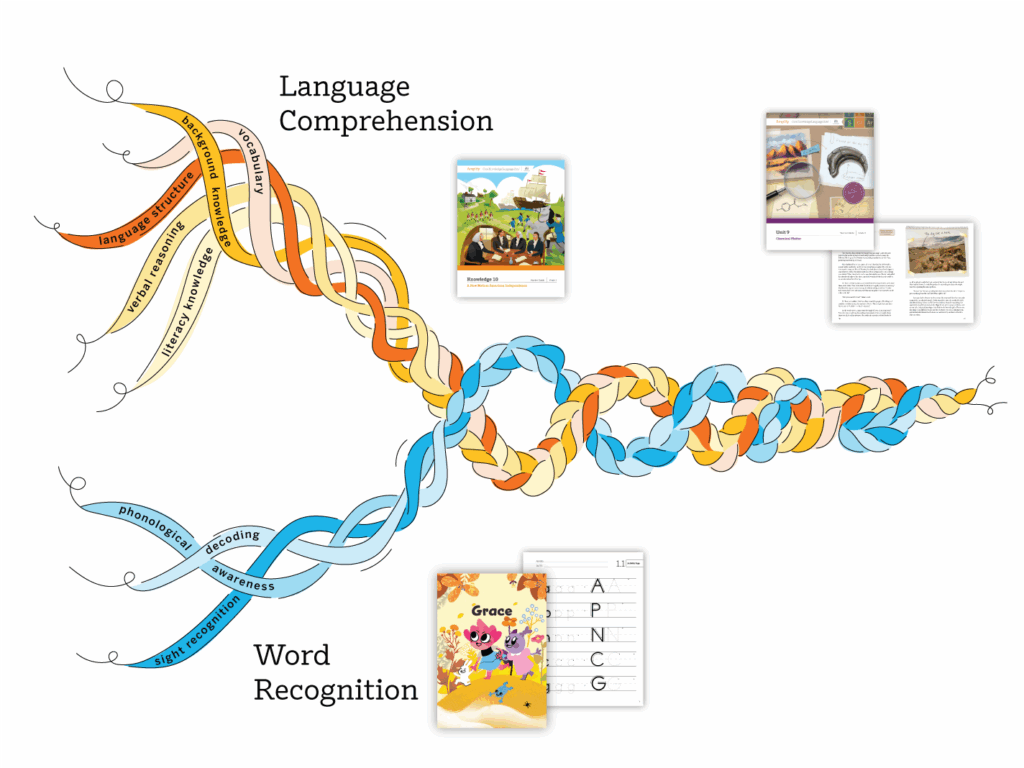
How does Amplify CKLA work?
Daily instruction
Grade PreK: Developmentally appropriate foundational knowledge
Our PreK program delivers developmentally appropriate instruction and activities that do more than lay the groundwork for foundational skills—they offer content knowledge, incorporating research that shows true literacy requires background knowledge in history, science, art, and literature. Amplify CKLA PreK easily fits into any class routine, with 45 minutes of interactive instruction designed to accommodate full-day or half-day schedules.
Grades K–2: Dedicated knowledge-building and explicit skills instruction
Every day, students in Grades K–2 complete one full lesson that explicitly and systematically builds foundational reading skills in the Skills Strand, as well as one full lesson that builds robust background knowledge to access complex text in the Knowledge Strand. Through learning in each of these strands, students develop the early literacy skills necessary to help them become confident readers and build the context to understand what they’re reading.
Grades 3–5: Integrated instruction
In Grades 3–5, Knowledge and Skills are integrated in one set of instructional materials. Lessons begin to combine skills and knowledge with increasingly complex texts, close reading, and a greater writing emphasis. Students can then use their skills to go on their own independent reading adventures.
Formative and summative assessments

Amplify CKLA features a progression of moment-by-moment assessments to benchmark assessments. Assessment and feedback give teachers the information they need to differentiate instruction effectively.
Checks for Understanding
Each lesson segment incorporates checks for understanding to increase engagement and to let teachers make real-time adjustments to their instruction.
Formative Assessment
Each lesson goal is tied to a formative assessment opportunity, allowing teachers to see which students need more support with a benchmark.
Mid- and End-of-Unit Assessments
Mid-Unit and End-of-Unit Assessments provide valuable information on the skills and content students have mastered. Digital end-of-unit assessments are available on a variety of platforms.
Benchmark and Placement Assessments
Benchmark and Placement Assessments help teachers set goals and monitor the growth of each student, providing a baseline at the beginning of the year and ensuring students are advancing toward grade-level objectives.
Download our CKLA Assessment Sampler
What makes Amplify CKLA different?
Integration with mCLASS DIBELS 8
Amplify CKLA is the only core ELA program that integrates with mCLASS DIBELS 8th Edition.
The CKLA Connect feature matches your students with targeted CKLA lessons based on their mCLASS DIBELS 8th Edition assessment data. In other words, it aligns your assessments more closely with your core curriculum while recommending effective differentiated instruction.
Download this guide to connecting mCLASS DIBELS 8 with Amplify CKLA
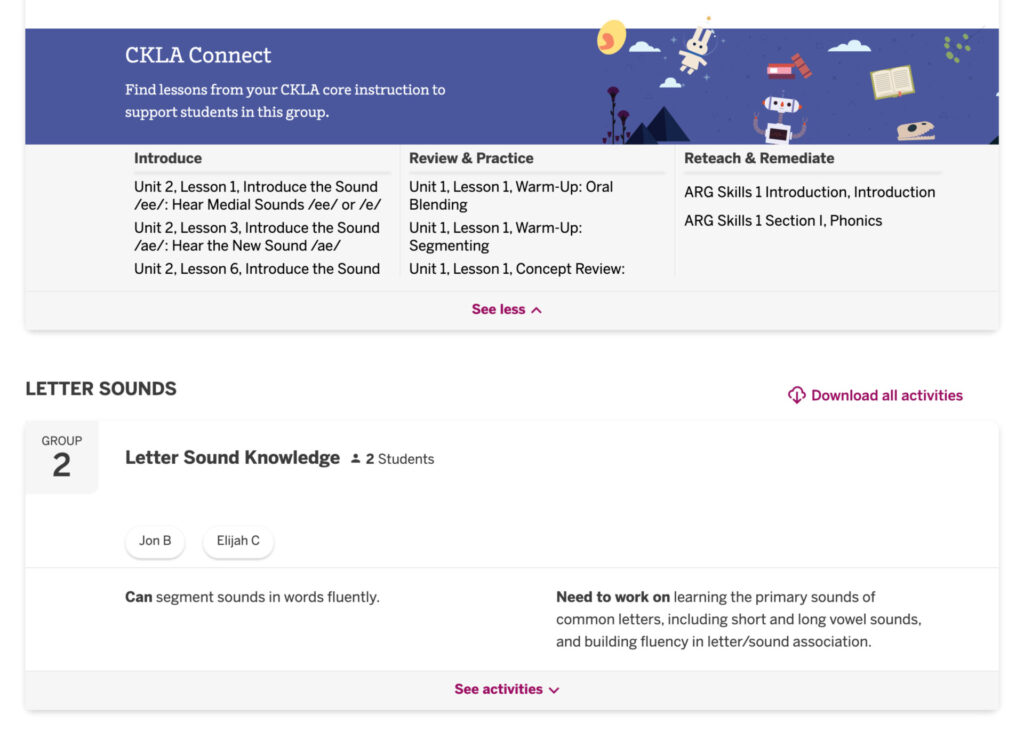
Built on the Science of Reading
Built out of the latest research in the Science of Reading, Amplify CKLA delivers explicit instruction in foundational knowledge in PreK, both foundational literacy skills (systematic phonics, decoding, and fluency) and background knowledge in grades K–2, and an integrated approach to explicit instruction in grades 3–5.
Review this Science of Reading toolkit to learn more about the Science of Reading best practices integrated throughout CKLA.
Explicit systematic skills instruction
Great reading instruction starts with helping kids develop great decoding skills. By building a solid foundation of phonological awareness and phonics, reading the words on the page becomes automatic so that comprehension and critical thinking can happen. Our instruction is supported by:
- Step-by-step lessons with multisensory approaches, clear lesson objectives, and embedded formative assessments.
- Decodable books and student readers with ebook and audiobook versions that feature interesting plots and relatable characters.
- An engaging sound library with fun songs and videos that develop phonological awareness.
- An interactive Vocab App featuring engaging activities with immediate feedback and automated, customized instruction based on student performance.
Coherent knowledge instruction
Students build grade-appropriate subject-area knowledge and vocabulary in history, science, literature, and the arts while learning to read, write, and think creatively and for themselves. Our instruction is supported by:
- Knowledge builders that provide a quick overview of each domain with its key ideas.
- Interactive Read-Alouds designed to build knowledge and vocabulary.
- Content-rich anchor texts that support students as they tackle increasingly complex text and sharpen their analytical skills.
- Social and emotional learning paired with lessons in civic responsibility.

Embedded differentiation for all learners
Amplify CKLA provides built-in differentiation strategies in every lesson for all students, including supports for English language learners and Standard English learners.
- Access supports for ELLs: Integrated ELD supports in each lesson segment for English learners and Standard English learners are specific to students’ mastery of the lesson’s objectives.
- Support and Challenge for all learners: Lessons include Support and Challenge suggestions that provide assistance or opportunities for more advanced work toward the goal of the lesson. These supports are suitable for all learners, including ELLs.
- 30 minutes of Additional Support in every Skills lesson: In the Skills Strand, every lesson concludes with an Additional Support section of recommendations for 30 minutes of extended instruction and activities, directly aligned to the skills taught in the lesson to assist students who need more support in mastering the lesson’s objectives.
- Intervention Toolkit: The Intervention Toolkit provides easy-to-use resources to assist teachers in filling gaps in students’ foundational skills. Teachers will find of hundreds of activities to support phonics, fluency, comprehension, handwriting, and other key skills.
Designated ELD with Language Studio
Amplify CKLA’s designated English Language Development (ELD) component—Language Studio—helps English learners preview and revisit key content within core instruction, building a foundation of academic vocabulary and background knowledge. Core instruction lessons include point-of-use supports for English learners and Support and Challenge strategies for all learners.

This carefully developed program follows the CKLA Knowledge domains, previewing and reinforcing skills and content from core instruction using instruction specifically built for English learners. The program is also designed around frequent formative assessment, including assessment of language proficiency, giving you effective ways to guide and support your English learners.
Language Studio supports teachers and English learners through the following:
- 30 minutes of instruction with lesson segments are carefully designed around Content Knowledge, Meaning Making, Language Development, Effective Expression, and Foundational Skills.
- Every Language Studio lesson accompanies a core lesson, helping English learners deepen domain and academic vocabulary that will help them access core content.
- Culminating tasks support core projects and target the same skills as primary instruction.
Writing emphasis with Writing Studio
With Writing Studio, students in Grades K-5 focus deeply on the three key text types informative, narrative, and opinion–while applying both the skills and knowledge from the core program.
Writing Studio supports students through:
- Expanding on core writing instruction to develop analytical thinking through writing.
- Lessons that focus on writing standards, providing intensive focus and application to strengthen skills.
- Opportunities to apply knowledge in new contexts and deepen comprehension through writing.
- Scaffolded writing projects to help all students find success within the stages of the writing process.

Writing Studio lessons:
- Allow teachers to differentiate through Support and Challenge prompts for students at all levels, and Access Supports for ELLs.
- Spark creativity with authentic writing projects that call on students to engage deeply with rich topics and sources.
- Implement careful design and provide rubrics so that students’ writing skills can visibly grow throughout the year.
A culminating project in each grade asks students to apply their knowledge and understanding of text types and to select the appropriate text type for a final piece of writing.
Personalized practice with Boost Reading
Boost Reading is the student-driven skill practice program within CKLA, providing differentiated, digital instruction in both foundational skills and comprehension strategies. Because Boost Reading is built on the same approach to reading as CKLA, students are able to extend their learning from the core program further, at their own pace.
Amplify CKLA and Boost Reading reinforce each other through:
- An aligned scope and sequence and instructional approach: In both programs, students get instruction and practice in phonological awareness and phonics, with the most common, least ambiguous spellings first.
- Consistent vocabulary words: Many Amplify CKLA words are taught and practiced in Boost Reading vocabulary games.
- Complementary texts: Fiction and nonfiction books within Boost Reading reinforce Amplify CKLA knowledge domains.
- Seamless integrations between platforms: Students can easily access Boost Reading directly from the Amplify CKLA Student Hub.
Ready-to-go slides and all-in-one platform
The slides-based Amplify CKLA digital experience enhances instruction while saving you time. Everything you need is all in one place, making it easier than ever to plan lessons, present digital content, and review student work.
- Simplify planning and instruction: Teachers have access to ready-to-use and customizable lesson presentation slides, complete with all the prompts from the print Teacher Guide embedded in the teacher view. As teachers deliver each lesson, students can engage with the content in one cohesive
experience—through Activity Books, slides, digital components, videos, Student Readers, and more. - Interactive student activities: Through the Student Home, students can easily access digital lessons with slides, Activity Pages, ebooks, videos, and other interactive resources from one simple dashboard.
- Your teacher command center: You’re provided with the tools you need to ensure a productive digital experience that’s personalized to meet your students’ needs. This includes a teacher home from which to launch and track lessons, LMS integrations such as Google Classroom and Microsoft Teams, and other customizations based on classroom needs.
- Get real-time insights into your students’ work: The innovative live review tool enables you to keep an eye on students drawing, recording audio, uploading and capturing images, and typing or writing in pre-placed text boxes in their Activity Pages.
Navigating the program
Digital navigation walkthrough
Physical materials walkthrough
Sample materials
Integrated Strand
Demo access
Follow the instructions below to access your demo account.
- Click the CKLA Demo button below.
- Go to learning.amplify.com
- Select Log in with Amplify
- To explore as a student, enter this username:
- Enter the password: Amplify1-mcps2024
- Click the desired program on the left side of the page.
Additional resources
Amplify CKLA review resources:
- CKLA Program Guide for Grades K–5
- CKLA Program Guide for PreK
- Diversity, equity, and inclusion in CKLA
- CKLA Culturally Responsive Curriculum Scorecard
- CKLA Equity Guide for Grades K–5
- CKLA and Social Emotional Competencies
- Text complexity in CKLA
- CKLA Caregiver Hub
- CKLA Sample Caregiver Letters
- Assessments in CKLA for Grades K–5
- Assessments in CKLA PreK
- Remote and hybrid learning with CKLA
- Amplify CKLA Scopes and Sequences
- Grade K Skills and Knowledge
- Grade 1 Skills and Knowledge
- Grade 2 Skills and Knowledge
- Grade 3 Integrated
- Grade 4 Integrated
- Grade 5 Integrated
Digital Teacher’s Guide – grades K–5
Click below and select “Teacher” on the login screen to preview the curriculum
Click here to view a materials list.
If you have logged in to Amplify Science in the past, you will need to log in with the new credentials above.
When you are finished reviewing, sign out of the digital curriculum. Need help?
Student digital resources – grades K–5
Students in elementary school work primarily offline. Students in grades 2 through 5 have access to digital simulations and modeling tools through the Student Apps page. Click below to view the Amplify Science Digital Student Library.
When you are finished reviewing, sign out of the digital curriculum. Need help?
Course structure for grades K–5
- Needs of Plants and Animals
- Pushes and Pulls
- Sunlight and Weather
- Animal and Plant Defenses
- Light and Sound
- Spinning Earth
- Plant and Animal Relationships
- Properties of Materials
- Changing Landforms
- Balancing Forces
- Inheritance and Traits
- Environments and Survival
- Weather and Climate
- Energy and Conversions
- Vision and Light
- Earth’s Features
- Waves, Energy, and Information
- Patterns of Earth and Sky
- Modeling Matter
- The Earth System
- Ecosystem Restoration
Contact your Redmond representative directly
Patrick Momsen
District Manager
Email: pmomsen@amplify.com
Phone: 541-207-2148
Coming soon!
Amplify Desmos Math for California
Hello! We’re building a brand-new TK–12 core mathematics curriculum for California called Amplify Desmos Math.
We’re seeking your help to ensure we deliver on the promise of the new California Mathematics Framework and meet the needs of your entire community. Are you interested in sharing your thoughts?

Available now
As a math teacher, you work every day to celebrate student brilliance, build deep conceptual understanding, and create the conditions for every student to be successful.
We’re here to help.

Desmos Classroom
Desmos Classroom is a free lessons-building platform that features lessons, lesson-building tools, sharing features, and more.
Built by math educators, the Desmos Classroom platform allows teachers to create interactive lessons with authentic problems and opportunities to increase student discourse and engagement. Plus, the platform includes more than 200 free lessons created by Desmos curriculum specialists and math educators across the nation.
Desmos Math 6–A1
Creating your own lessons can be powerful, and also time-consuming. Desmos Math 6–A1 does the heavy lifting for you.
The Desmos Math 6–A1 curriculum provides a full-year of ready-made standards-based lessons that help students develop conceptual understanding while giving you visibility into all their thinking. Plus, every lesson is fully customizable, giving you the freedom to make each lesson your own.
Coming soon
Amplify Desmos Math is a brand-new TK–12 core mathematics curriculum for California.
Powered by Desmos Classroom technology, our lessons make engaging, visual, and collaborative learning moments possible while providing teachers with real-time insights into student thinking.
Unlike other programs, Amplify Desmos Math strikes the right balance between conceptual understanding, procedural fluency, and application. Plus, it does it in a way that builds positive math identities, inspires math language development and rich discourse, and makes every student feel brilliant.
The program delivers what math educators want and need: standards-aligned print and digital lessons that capture students’ interest every day; the right mix of informal and more substantive formative and summative assessments; differentiation support; additional practice sets; and Spanish language supports.
The program delivers what school and district leaders want and need: a coherent core program based on the industry-
leading IM K–12 Math
TM by Illustrative Mathematics®; a comprehensive suite of usage and performance reports that gives educators a better sense of which students might be at risk of falling behind; and a team from Amplify.
Math Matters Events
What’s next in math education? Join our series of intimate talks featuring experts like Sunil Singh, Phil Daro, and Fawn Nguyen to learn more about where math education is heading. Who knows, we might even throw in a margarita or martini mixology lesson too!
Interested in participating? Sign up for alerts to get first dibs on these limited attendance sessions.

Math Educator Roundtables
Share your voice! Our educator roundtables have one goal: to learn what you need and want in your next math curriculum. Whether you’re an administrator or a teacher, or have two years of experience or 20, we want to hear from you!
Interested in participating? Sign up for alerts about upcoming dates and locations for these limited attendance sessions.

Math Field Trials
Help us put our program to the test. Become a Field Trial classroom and provide invaluable feedback that will directly impact the development of Amplify Math. You might be an amazing field trial teacher if:
- You love math.
- You know young people are capable of just about anything.
- You understand that giving candid feedback can help the next generation of students redefine what amazing looks like.
Interested in participating? Sign up to be considered as one of our field trial classrooms.

S1-09: Supporting K–8 science students in the digital world: Ricky Mason

In this episode, Eric sits down with Ricky Mason, chief executive officer of BrainSTEM. Ricky shares his passion for inspiring students into science careers, and his path from an engineering career with organizations like the Department of Defense, National Aeronautics and Space Administration, and the Central Intelligence Agency to starting BrainSTEM, an education program that develops creative digital tools to enable all teachers and students to dive deeper into STEM content. Ricky and Eric talk about representation in science classrooms and the importance of embedding fun within K–8 science content! Explore more from Science Connections by visiting our main page.
Ricky Mason (00:00):
I feel like comfort is where dreams go to die. And I’m still dreaming every night. So I’ll wake up, chasing them.
Eric Cross (00:08):
Welcome to Science Connections. I’m your host, Eric Cross. My guest today is Ricky Mason. Ricky is an engineer whose career included lead roles at the Department of Defense, NASA, and the CIA. Ricky transitioned to education as an adjunct faculty at the University of Kentucky. And while there, he founded BrainSTEM, an edtech company that developed a 3D virtual reality metaverse for STEM education. Today, BrainSTEM serves public school districts, private schools, and nonprofits. And in this episode, we discuss what led Ricky to creating BrainSTEM Metaversity, and how he’s using the metaverse to transform STEM learning for students. And now please enjoy my conversation with Ricky Mason. How did you, so like maybe going back doing your origin story, maybe you can talk about it, but brother, you don’t sleep. Talk about keep making moves, your hashtag, I mean, I was looking at your LinkedIn profiles, looking at your details. You get after it. I was getting tired just reading it. I was like John Hopkins, electrical engineering, real estate, starting companies. You must have that gene where it’s like four hours of sleep and then you’re like, ready to go.
Ricky Mason (01:19):
Yeah, man. My mom told me if I didn’t stay busy, then I’m in trouble. So when I was about 14, she told me that. I said, well, Mama, I guess I’m gonna stay busy then. And yeah, man, that’s just been my life. I feel like if I don’t keep making moves, then I’m in trouble. So, feel like comfort is where dreams go to die and I’m still dreaming every night. So I’ll wake up chasing them.
Eric Cross (01:44):
I feel like a kindred spirit with you. So, were you always interested in STEM like, was there something like a moment or a year where you remember you were like, this is my jam. This is what I’m gonna get into.
Ricky Mason (01:57):
Yeah, man. When it really clicked for me was in the fifth grade. I was at a school assembly and an IBM engineer came in and he brought a robot and he programmed it with punch cards right on the stage. And I got the opportunity to come up andyou know, put one of the punch cards in the robot to program it. And I asked him, I’m like, what is your job? He said, I’m a robotics engineer. And I went home right after that assembly and I said, Mom, that’s what I wanna do, become a robotics engineer. And my mom would take me to the libraries. Well, I felt like I was getting outta bible study on Wednesdays by going to the library. So I went there and I started researching robots.
Ricky Mason (02:39):
And at the time the robots that were popular were all being sent to space. And it was the spiritless. It was being sent to Mars. And I said, Mom, well, I guess I gotta become an astronaut if I’m gonna be a robotics engineer. And that’s kind of what set me out on that dream. And my mom started trying to find outlets for me to get involved in STEM, but it was really tough to find those outlets, you know, especially in that fifth to eighth grade range here in Kentucky. So that was kind of where it started for me man, when I knew that yeah, engineering is what I wanna do.
Eric Cross (03:14):
What does an electrical engineer do? I imagine there’s different types of specialties, but like, was there something that you specialize in that you focused on or was it, is it just kind of like a generalist field?
Ricky Mason (03:23):
Yeah, so I would say, yeah, man, it’s a huge field. So you could be doing anything from, you know, power, like power coming into your house. So those large power systems all the way down to nanotechnology and microchips. I like to tell people I’m a real full stack engineer, so my wheelhouse is kind of from the PCD, the little green computer chips, all the way to the cloud. Over my career, I’ve had some pretty cool jobs. One of those things was I was a test engineer for the army. So I got to test weapons up at Aberdeen Proving Ground for the Army. So I got to drive those weapons and test them before they went to theater there. After that,I worked at United Launch Alliance down at Cape Canaveral where I launched five rockets.
Ricky Mason (04:07):
So I was a part of the electrical ground systems team there where we were responsible for all of the electrical systems on the rocket while it was on the pad. Somonitoring the temperature of the rocket, the fuel, the entire system for safety while it was on that pad. And then finally I worked at the CIA as a computer engineer building data centers and as a data center architect for some of our remote systems and virtualizing our systems. So kind of had a broad spectrum of things there. And then finally coming back to the University of Kentucky as a research engineer and faculty. I developed drone technology for monitoring crops. So flying drones over crops with LIDAR, just like self-driving cars with high-definition cameras to pull in data about those crops, to help farmers determine about pesticides fertilizers, and the overall health of their crops from a remote location.
Eric Cross (05:10):
It’s so neat to hear you talk about it and to see how this is all built up to what you do now with BrainSTEM. How would you explain what BrainSTEM is? I know that’s your, that’s kind of your baby right now and what you’ve been working on a few years.
Ricky Mason (05:23):
Yeah, man, we started BrainSTEM in 2019 officially, but I would say BrainSTEM has been almost 10 years in coming. While I was in undergrad, I played football at the University of Kentucky. But I got hurt going into my sophomore year and that kind of shattered my dreams of football. And that’s when I really got back into engineering. One of my professors asked me to come to a robotics competition and I saw these third graders and sixth graders programming robots. And I’m like, oh my God, they’re programming robots! And I had no idea how to code or what to do with these things. And where was this a when I was a kid? And so I immediately bought one of those robots and taught myself how to program it <laugh> and then we started a robotics team in Lexington,there at a church.
Ricky Mason (06:10):
And we got a sponsorship from Lexmark to start that team. And that was kind of my first leap into STEM and teaching STEM and creating programs for students in STEM. I did that in undergrad and like I said, fast forward 10 years later, I’m teaching at the University of Kentucky and we’re struggling to recruit STEM students. Why aren’t students going into STEM? I hear too many adults tell me, oh man, I wish I would’ve done engineering, or I started out in engineering, but I left engineering or I wish I could go back to school for engineering or learn to code. And I’m like, I asked them like, why didn’t you do this? What happened? And often it’s like, it was the math. It was, oh, I didn’t get into it until I was in college. And I’m like, well, that’s the key.
Ricky Mason (06:52):
I knew I wanted to do this in the fifth grade. And I started with a plan in the fifth grade to achieve these goals and dreams. And I started doing that research and realizing that the same problem existed that I had. There was no outlet for kids to get involved in STEM, and so many kids have an affinity for STEM an early age. So we started BrainSTEM to provide access to STEM education and exposure STEM careers, STEM professionals, and just to STEM fields as a whole, because too often kids may know about the term, engineer, or the term, scientists, but they don’t really know what those people do or have a strong connection with the field or have any hands-on projects that they kind of done around those things or met anyone like me.
Ricky Mason (07:42):
I didn’t meet an engineer until I was in college. So that has really been impactful for some of the students that we’ve been able to touch. I had a family reach out to me. They moved to Lexington from California and they were like, man, I really want my ninth-grade son to get involved in engineering. So we started a weekend program with that one student and it went amazing. Like we competed in science fairs, we applied for different college programs and things like that. So it became an entire like mentorship program. And I’m proud to say that a year ago, he actually graduated with his bachelor’s in electrical engineering from your side of town, UCSB. It was just awesome to actually see this come full circle. And that’s kind of one of the first things that we did before we actually formalized as BrainSTEM University.
Eric Cross (08:34):
What will be like your elevator pitch for a teacher? If you were gonna say, this is what BrainSTEM does. I have the luxury of going through it on the site, but since we’re on a podcast, how would you kind of pitch it to people letting them know, like what, what does it do? Who does it serve?
Ricky Mason (08:47):
Yeah. So BrainSTEM provides STEM curriculum and STEM magnets for schools and nonprofits looking to increase access to STEM for K through 12 students. We also have launched our BrainSTEM Metaversity, a metaverse product for teachers to take their 2D Google classroom and convert it into a 3D metaverse classroom where students can collaborate during a 3D class. So all of your students show up as their avatars that they can select from our inventory of 150 avatars, and enjoy class in a 3D gameified Minecraft like World.
Eric Cross (09:26):
So I made my avatar by the way. It’s kind of tight, I have to say, it’s kind of tight. Hey, I’m gonna share. So those of you in the podcasts I’ll share it so you can see it. You’re not gonna be able to see it right now, but since I have the man himself I gotta share it with him just so I can get a reaction. So can you see that?
Ricky Mason (09:43):
Yeah. <laugh> That’s so good.
Eric Cross (09:44):
I feel like I wanna look like him though. I want him in real life. Like I want be able to switch to looking like my avatar
Ricky Mason (09:52):
<Laugh>
Eric Cross (09:54):
That was the first thing that I jumped on, when I went on your site, was making the avatar and I had so much fun doing it. I actually took longer than I probably wanna admit cause I was like customizing everything
Ricky Mason (10:03):
Yeah, man. It’s so fun. And that’s exactly what, you know, when you can show up as the person you want, it changes your whole being. I’ve seen kids that are quiet in class. They show up as their avatar and they’re talkative, they’re asking questions, they’re moving around the room, interacting with other kids. I feel like it’s almost like a superpower just to put your avatar on.
Eric Cross (10:25):
So what is something that a teacher could have their students go and learn or do if they, if they signed up,
Ricky Mason (10:31):
Let’s kick it off. So how we started with the metaverses, was teaching coding. So our first class was Minecraft and Python coding in the metaverse. So students showed up in the metaverse with our virtual instructor, that instructor led a lecture in the metaverse and then those students could collaborate on their Python games. So, they created and built the game in Python. We shared those games in the metaverse and we have our leaderboards that are in the metaverse, as they’re completing these challenges, including these games, then sharing them back in the metaverse with other students and getting that feedback on their game. So we’ve seen huge excitement from students when I can come back in and see my friend’s work. Like too often, students don’t get to see their work and that’s motivation to do better when I’m like, Jim’s gonna see my work. It’s amazing to see that motivation when students are sharing their work with other kids and not just their parent or just them and the teacher or seeing their grades. It’s been really cool to see.
Eric Cross (11:33):
You have that genuine audience too. Like that real-time feedback. And then like an authentic audience for students that makes everything seem, it takes it up a notch.
Ricky Mason (11:42):
Yeah, man. And then as we have built on this platform, so like you said with that avatar, so think if you created a really cool looking avatar and other students wanted to be that avatar, we have a way of sharing that avatar back into the world and in the inventory so that other students could then be your avatar. Or, if you create a world, we could then share that world back into the inventory, so the teacher could have class in a world that you created.
Eric Cross (12:07):
They’re creating content, not just consuming it. They’re actually creating content that could be shared across like grade levels or students.
Ricky Mason (12:14):
Well, we’re gonna say right now it’s just within your classroom. Eventually yes, we want students to be able to share that across school districts. At least we think that data will be probably limited to those kinds of realms as far as schools go. But you’ll be able to share this across sixth grade. We’ll be able to see what everyone in the sixth grade is doing in their STEM class or their game development class or their history class, per se, even if they’re giving back a presentation or what we have here in JCPS is backpack skills of success, where students are presenting on things that they’re learning that relate back to core competencies that the district is focused on. And I think that sharing those in the metaverse and doing those in the 3D world will be an awesome experience for students.
Eric Cross (12:56):
Are you seeing anything else as far as those skills that we see that are needed in coding? Is there something that the VR adds that was distinct from maybe just a kid with a Chromebook in his class that it’s just him in isolation doing the coding? Was there any like aha moments or surprises when they’re in the VR world doing this?
Ricky Mason (13:13):
I think the biggest thing is we could actually show them real examples of code working in other ways. Sofor example, if we’re working through loops, we can show them something looping. We can relate these functions to real-world things happening in the VR world so that they can see and better relate the actual concept with visuals, if that makes sense. So, you’re in loop Allen the whole time you’re learning about loops. You’re immersed in that kind of world. What we’ve seen is students really start to, you know, they it pick up and it clicks a lot faster because some of these concepts are so abstract for students to understand, when we can relate them to things in that world that they see that are in front of them, that they can grasp before we go to okay, type in “while” “”parentheses” <laugh> they can thenrelate that and pick up on those clues a lot better after they’ve seen those things in the world.
Eric Cross (14:09):
So they can actually visualize it in the metaverse. Whereas outside of it, it’s more just, just text-based coding and they’re not isolated. Like the first thing I’m thinking about is how like, with my own students, when they’re learning Sratch or Python, it’s not easy to share back and forth because they all are on individual accounts and they’d have to go on a different computer, or we’d have to find some way to publish it. And then all the kids would have to access it. But it sounds like in the metaversity classrooms, it’s easy for students in that same class to see each other’s work. Am I getting that right?
Ricky Mason (14:37):
Yeah. So most of our classrooms are limited to 24 students and in some of our breakout classrooms, we limit them to about eight students. Everybody can share their screen, so students can share their screen in the metaverse. They can share their video in the metaverse. They can share documents in the metaverse. They can share their, like I said, their code or anything that they want to share with other students. They can kind of do that. So it’s been a really cool product, I think, for students to almost find independence to work within a group, in an online setting. As they’ve been working through these problems online and remote it’s been really cool to see how they use the metaverse and break out. Even in a class, they can go off into a section because it’s all spacial. If you walk away, I can’t hear your conversation. So they can go into a little section within a metaverse class and have their own breakout. And a teacher can walk over to them. Okay. You guys are working over here. Let me walk to my next group. Just like in class. So it’s been really cool to see those students use the metaverse like that.
Eric Cross (15:41):
Just listening to you talk about this. One of the exciting things about emerging technologies or taking what the private sector does, and someone with a mind like yourself, and go, how do I use this for education? Like, that’s something that like excites me and you’ve run with it. But I just thought about, you’re doing an hour of code, you’ve created this metaverse, and you can bring in somebody, a professional into the metaverse, but they’re in, you know, the Bay area, but they could be a software engineer for Tesla or Google or anybody. Could they move around the metaverse and take a look at different students’ work and interact in that way.
Ricky Mason (16:17):
Yeah, man, we get in there. We make metaverse selfies. I drop Lambos in the metaverse, we take picture with Lambos. We have scavenger hunts in the metaverse. It’s a really awesome experience. And that’s one of the big things I think that is so powerful, is like you said, we could have that engineer, that celebrity, we could have Travis Scott, you know, in the world meeting thousands of kids motivating them because they met their STEM goals. They met their, you know, their testing school goals or whatever. These are things that kids really care about. If I get the Travis Scott avatar or the Elon Musk avatar, because I completed the Elon Musk rocket challenge, like that’s huge for me to show up in class as that avatar, like it’s just like Fortnite and it’s bringing all of those mechanics into the classroom.
Eric Cross (17:07):
When I hear you talk about the metaverse and I hear you talk about the potential of where you want to go with it, I think about my own students, and I think about, how they would really have a genuine interest and desire to want to do this and probably be doing it when they don’t have to, like at home at night wanting to go back into it and interact. And, you’re also building this virtual community. I mean, are you seeing that like, cause I’m hearing that?
Ricky Mason (17:28):
Yeah, man, building that community is huge. And I often tell people all the time, I want the STEM community to be just like the basketball community, the football community. I want students to have that camaraderie built around them for learning STEM and participating in STEM activities and competitions. Because when you see students out there at a robotics, they have the same zeal, the same, you know, everything that you find at a football competition. So we just have to get behind them and back those events with the same enthusiasm that we back sports. And that’s the environment that I want to create for STEM students and for that STEM community, because I longed for that community when I was in school. And like I said, I had it in football, but I wanted both. I wanted the best of both worlds. I wanted my robotics guys and my football guys to show up together here at the competition and have a good time.
Eric Cross (18:23):
You’re absolutely right. Like robotics STEM, these things, community helps fuel like people’s interest and working together. And it brings people from the outside who are seeking that community. Like, hey, my friends are doing this, I wanna kind of check it out. That’s how we recruit a wider swath of our population into it. So it’s not this kind of very narrow channel of folks who are going into STEM.
Ricky Mason (18:45):
If you can’t find that community. I mean for me, I felt like I was the only one playing football who was interested in robotics. So I never told anybody because I didn’t feel like that related to anybody within my vicinity. So I kept that to myself and that’s the biggest thing. I think if we get these kids just talking more about their interests, because a lot of them are interested in robotics and space and these STEM topics, but they don’t have anyone that’s really nudging them or asking them or piquing their interest in those spaces and saying, hey man, it’s okay to, you know, learn about robots. It’s okay to geek out on space. <Laugh> So that’s been my goal and that’s kind of why I felt like this was the time in my career for me to kind of do this, be a face for STEM education and inspire kids to chase their goals and dreams. Over my career, I’ve had some really cool jobs, but I felt like I could keep doing cool jobs, but I’m like at the right age to still connect with those students and inspire them to chase their dreams. And that’s why I feel like right now, man, it’s just an opportune time to get these students involved in STEM.
Eric Cross (20:01):
We don’t get that. Oftentimes, when we’re solely doing the cool job or simply in the private sector, we don’t get those experiences as much as we do when we’re able to actually serve our community or students or take our passion, our skill set, and use it to serve another person. I hear that like, as you describe what you’re doing now is like, there’s something beyond just, you know, the using your skills and doing cool stuff, but there’s something I hear. That’s helping people and actually doing something you believe in that resonates deeply in you. And I can hear it as you talk about it.
Ricky Mason (20:30):
It’s been just amazing to actually chart out that journey. Like I said, and like tell kids, like, no man, I’m from right up the block from you, cause I mean, I’m building this back at home in my hometown. And that’s the reason why I kind of came back to kind of do that in my hometown, because I really want to, you know, relate to those students and inspire, you know, students here. Nobody thinks about technology coming out of Kentucky and that’s been a gift and a curse, I guess, with launching BrainSTEM in Kentucky. When I first started, I said, we’re a STEM education company, people are asking me what is STEM? So, that was where we started out with this in 2019, all the way to, you know, hey, in 2020, we’re gonna launch a metaverse. A metaverse! What is that? It’s been amazing to try to change the minds of not only Kentuckians about STEM and the importance of STEM, but the world that a metaverse company is coming outta Kentucky. <Laugh>
Eric Cross (21:31):
The work that you’re doing and, it exists beyond you and you probably know this, but as a Black science educator out here in San Diego … We don’t see people who look like all of us in this work often, and I saw that you had created something, a network group, network and chill. And that was one of the things, we had touched on community, but I thought that that was so huge because we need each other.
Ricky Mason (21:55):
I feel like that was the biggest thing for us in engineering. Like I showed up to my first internship and I’m like, I mean, my boss was cool. Everything else was cool, but I just didn’t feel like, hey, this is a community for me. And I almost changed my major because of that. But I’m glad that I didn’t, it’s huge to have more of us represented in, in these spaces.
Eric Cross (22:16):
And you know, in engineering, especially when we look at the disproportionate, you know, men versus women. Like it’s not, you know, it’s not just culture, but it’s, you know, gender, all of these different things. And if we’re gonna change it, I think a program like yours that gets exposure to all kids and then giving them choice. What advice would you give to students? Or what advice I should say, do you give to students now? When you see like your younger self in the different kind of K12 grades who are thinking about their futures or they’re thinking about STEM, what do you say to them?
Ricky Mason (22:46):
So my biggest advice, man is start now. Whatever that big thing is, that big dream is that you have, what is that now? You’re thinking about planes. You’re thinking about robots. You’re thinking about RC cars, whatever that is. Let’s start now. Let’s get your hands on an RC car. Let’s take it apart. Let’s start coding. Let’s start thinking about those problems now. But the biggest thing is, is getting kids used to solving tough problems. Typically, most students that have an affinity for, you know, STEM — and you just know that that kid’s gonna go into, STEM — they’re problem solvers. They’re typically looking and seeking those tough problems and seeking opportunities to learn. That’s where I feel like it’s parents’ jobs to provide that environment to foster, that zeal. A five-year-old kid, we started our STEM program with them at the beginning of this month.
Ricky Mason (23:39):
The first day I came in after I told him I was a rocket scientist. And now he’s like, well, I wanna be a pilot. I said, if you pay attention to this class, we’re gonna get you started on your way to being a pilot. And he knows all the parts of a rocket and he knows a rocket needs an oxidizer. And he knows the fuselage, the wings, the wing flaps. He knows all the different parts of the plane and how the forces, the drag, the lift, the weight, he knows how those are working cause we talked about those in class and he has so much more confidence and it came all to fruition when a kid said, wow, I thought it was gonna be really hard to be a robotics engineer. And I’m like, no, that’s not gonna be that hard. That is exactly what we set out to do when we started BrainSTEM, was to break down those barriers and those walls and build that confidence and say, look man, you can do this. It’s easy.
Eric Cross (24:26):
Society doesn’t help much either because one of our terms, right, if something’s really hard, or if something’s not hard, we say it’s not rocket science. That implies that rocket science is really hard and inaccessible. If kids would hear that it kind of instills in their brain, okay. It’s really hard, it’s probably too hard for me. To that point to parents, it sounds like a lot of just exposure, like giving students the opportunity to be able to be exposed to these things and letting them create wonder from it.
Ricky Mason (24:51):
Yeah, man. I often tell parents we’re gonna set kids up to go pro no matter what,
Eric Cross (24:56):
And those skill sets transfer, whether they decide to go into coding or they decide to manage a bank, you’re still gonna be dealing with people. You’re still gonna be problem-solving. You’re still gonna have to come up with creative solutions to things. It sounds like through a program like this, they learn those skills early.
Ricky Mason (25:12):
Yes. And I think that one thing that parents don’t think about … We talk about all the STEM and we want smart kids, but we need those soft skills also within STEM. So those competitions, getting them involved in those communities with STEM students is really huge in presenting their ideas because oftentimes, you know, our STEM guys, we’re in a lab working and that’s where we love and that’s where we wanna be because we haven’t, you know, been prepared to talk and present our ideas. So I think that’s a huge part of what we have to teach our STEM students. And we do that by providing that community and those opportunities for them to, you know, do that.
Eric Cross (25:47):
Thinking about where you are now, looking back on your K-12 education, were there any teachers that stood out to you or that inspired you as I even just say that, can you think of a particular teacher or one or two?
Ricky Mason (26:00):
When I think about my teachers, my teachers really taught me to solve those tough problems and those subjects that you don’t kinda like <laugh>, cause I was always a great student, but my teachers helped me to focus on those subjects that I didn’t so much, you know, enjoy. So I enjoyed math and science, but English social studies, like why do I have to be here? I had two teachers during my high school career that really supported me in that regard, and helping me to be the best student all aroundfrom like I said, STEM to English and social studies, and making me realize that I have to be a well-rounded student if I’m gonna be truly successful. As far as engineering, man, I would say one guy, my teacher, Nick Bazar up at John Hopkins. During my master’s there, I had a really cool project. I got to do data forensics on a real live murder case. <Laugh> That was really inspiring because I’m like, wow, this is real life where my coding skills are being used in a jury trial <laugh>. And so that was a really cool experience to partner with my professor to kind of do that. I mean, that was just mind blowing that I got to help with that and that, I mean, he was using his programming skills to help solve a murder case.
Eric Cross (27:22):
What’s the best way for people to connect with you and follow your journey? And if a teacher’s interested and they’re listening to this and they’re hearing, okay, this metaverse coding thing sounds awesome, I want to get involved, I wanna know more, where can people go? What steps should they take to be able to get connected to you and what you’re doing?
Ricky Mason (27:40):
Yeah. So you can check us out at brainSTEMu.com, that’s brainSTEM, the letter “u” dot com and on all social medias, we’re BrainSTEMu or BrainSTEM University. Teachers, right now, we are doing our free course for teachers. So sign up at brainstemu.com. You can sign up for your class to get into a free metaverse experience, just so you can kind of check it out and get your class into the metaverse and see how your students like the metaverse, how you like teaching in the metaverse and convert one of your 2D lessons from Google classroom into a metaverse classroom. For me, I’m Ricky Mason, 5 0 2 on all social media platforms. So you can just type that in Ricky Mason502 and get with me there.
Eric Cross (28:28):
Nice. Well Ricky, I wanna thank you for sharing your story and creating BrainSTEM. And then for, I know you’re a man of tremendous talents and skills and accomplishments, and you’re focusing all that on not only being back in your community, but also creating something for younger versions of you and opening up opportunities that they might not otherwise have, as you said, folks are like, what is STEM? And that is exactly where we need those seeds planted. So thank you for doing that.
Ricky Mason (28:55):
Oh man, this is awesome. I appreciate you, man for hosting this podcast and providing this platform and sharing the message of, you know, educators and people in the space.
Eric Cross (29:07):
Thanks so much for joining me and Ricky today. Make sure to support Science Connections by subscribing wherever you listen to podcasts. And you could hear more from Ricky in our Facebook group, Science Connections the community, where you can check out all the exclusive content. Until next time.
Stay connected!
Join our community and get new episodes every other Tuesday!
We’ll also share new and exciting free resources for your classroom every month.
Meet the guest
Ricky Mason is the dynamic CEO and founder of BrainSTEM, an ed-tech company that developed a metaverse for education. His corporate career included lead engineer roles at the DoD, NASA, and CIA. Ricky transitioned to education as adjunct faculty at the University of Kentucky. While there, he started BrainSTEM to bring innovative technology and an inspirational curriculum to STEM education. Today, BrainSTEM serves public school districts, private schools, and nonprofits.
Follow Ricky on all social media @rickymason502

About Science Connections
Welcome to Science Connections! Science is changing before our eyes, now more than ever. So…how do we help kids figure that out? We will bring on educators, scientists, and more to discuss the importance of high-quality science instruction. In this episode, hear from our host Eric Cross about his work engaging students as a K-8 science teacher. Listen here!


S1-10: Empowering the science educator: Jessica Kesler

In the final episode of the season, Eric sits down with his friend and professional development facilitator, Jessica Kesler. Jessica describes her passion for sharing free, high-quality, empathy-centered professional development for K12 educators. Jessica also shares her experience jumping into leadership positions while teaching in Philadelphia. Eric also chats with Jessica about how students often lean on teachers for more than delivering content. Explore more from Science Connections by visiting our main page.
Jessica Kesler (00:01):
One student at a time, isn’t gonna bring a million students through the door. But if we focus on their teachers, then they can implement it in their classroom and have this multiplicative effect that can continue on and help us to reach those millions of kids and helping them be prepared for future careers.
Eric Cross (00:19):
Welcome to science connections. I’m your host. Eric Cross. My guest today is Jessica Kessler. Jessica’s director of professional learning at TGR foundation, which is a tiger woods charity. There she creates and leads free stem, professional learning opportunities for educators across the country. Prior to working at TGR, Jessica worked as an elementary, middle and high school science teacher while fulfilling several leadership roles, including science department, chair and principal intern. In this episode, Jessica shares some of her classroom experiences while working in Philadelphia, where she was in classrooms, where her students needed her to be more than just her content. She also addresses how designing professional learning with empathy for teachers in mind creates better experiences for teachers. And now please enjoy my discussion with Jessica Kessler. So let’s, let’s start off with St. Joseph’s chemistry college to the classroom, like your origin story. What led you to ultimately get into the classroom and being successful, even just looking at, at your kinda like your resume or your CV of all of the things that you’ve done. You definitely weren’t idle, but start off with chem. Yeah. Like where did that passion come from?
Jessica Kesler (01:27):
Yeah. So when I was younger, I just had this burning passion to help people. Right. And when you’re young and you think about helping people, you think about doctors, doctors help people. Right. So I had this idea that I wanna be a surgeon. I wanna be a black surgeon. I wanna be a young girl, female Charles drew, and I just wanna go out there and do it. And so my mom is actually an alum of St Joe’s. So I spent a lot of time on campus cuz as she was getting her mini master’s degrees I will visit campus with her often. And so when I applied, I had the scholarships, had everything and I went in ready to be bio ready to be a surgeon. I took my first bio class and I was like, yes, let’s talk about the human body. And let’s get into dissections and sections. And they were like, okay, so a plant so has this. And I was like, Ooh <laugh> I was like, this is not what I was expecting at all. It just felt so detached from the trajectory that I wanted to take. And it just did not feed that passion of helping people in the immediate moment.
Eric Cross (02:31):
Did it, did it feel too abstract?
Jessica Kesler (02:33):
It felt abstract. It felt boring. Okay. And one thing I didn’t want was to be like stuck, bored. Like if I’m not being stimulated in a good way, mm-hmm <affirmative> then it’s not gonna last, but I love science. So I switched over to chemistry cuz I’m like this chemistry is exciting. I’m mixing things together. I’m producing new things. I’m doing extractions. I’m being introduced to machinery that I haven’t seen before. I’m loving it. I’m doing a math. The math is awesome. And so I switched over to chem and I started doing research in the summers and things like that. My research was around water quality in Philadelphia and looking at different natural water sources and comparing them and all those great things. But I was in a lab and the lab had no windows and I was stuck talking to this atomic absorption specter every day.
Jessica Kesler (03:24):
And I hit that, that wall again, where it was like, is this the rest of my life? Like talking to these machines and not having windows and not being able to interact with people. What is this? This can’t be life. And so I was seeking out some new opportunities that said, Hey, I need more money. First of all. So I’m like, I call the financial aid office like every week, like, Hey, what’s out today. What new scholarships do you have? I’m applying for everything. Like it was my goal to not have to pay for much of my education. And so I was talking to them and they’re like, Hey, you’re in science. There’s this awesome opportunity called a noise scholarship where they’ll pay for your last year and your master’s degree. If you go into education mm-hmm <affirmative> and I sat on it and I was like, this makes so much sense to me.
Jessica Kesler (04:12):
I was like, I’ve been literally tutoring my peers and teaching in churches and all this other kind of stuff. My whole life. It makes so much sense. How come nobody ever said this before? <Laugh> and so I applied for the noise scholarship, got in and started, you know, mm-hmm, <affirmative> doing practicums in the classroom as I went through my last year as a chemistry major and my first year for my masters and it just felt so right. And I was like, I can do this. And of course there were a lot of people who told me, no, Josh, you can’t do that. Like these kids will eat you alive. And I’m like I don’t think so. <Laugh> but, but that’s give it a go. And I stepped into the classroom and it, it just felt like, felt like it was always meant to be there.
Eric Cross (04:57):
So you were able to, you were able to make that connection between, I mean, if you’re, if you’re studying chemistry and bio and going into stem, I mean, there’s, there’s an aptitude there, but then you realize that this there’s a road that you could take that leads you into a room with no windows. And you’re just hanging out with machines all day
Jessica Kesler (05:14):
And I’m not helping people. Right. Right. And that was, my passion was like, I’m not helping people sitting in this room. I need to be a person that’s outside telling people about what happens in the room. Right. And how they can get involved and like what’s going on in here. Like that’s, that’s where I can be useful.
Eric Cross (05:28):
When you were, you were in Philly when you were teaching, what were you teaching when you were there?
Jessica Kesler (05:33):
So I started off teaching eighth grade science first job in north Philadelphia, teaching eighth grade science and just a, a funding tangent that first day a student called me a B
Eric Cross (05:44):
Trial by fire
Jessica Kesler (05:45):
Trial by fire called me out in front of like the whole floor. We were outside doing line drills and just was like, I hate you miss Kusa your B. And I was like, oh, this is it. This is it. This is where you stand your ground and you take it or you, you bail out <laugh> and you go back into the lab mm-hmm <affirmative>. And of course at the end of that, that traumatic experience between all the kids, like two months later, she wanted me to adopt her. So like everything comes full circles. Right.
Eric Cross (06:10):
That’s how it is. Right.
Jessica Kesler (06:11):
But I started teaching eighth grade science. There’s not a lot of science teachers at that level who actually have a science background. Most of them have elementary school background. So I’m the only scientist walking into the science classroom and saying, this is how science actually works. And so I ended up taking a lot of onus of science while I was there. Ended up building out the K through eight curriculum for science. I ended up doing like a science strategic plan to submit to the district. I ended up leading out our first couple stem nights and like really leading the stem department and kind of our science department. And this was as like a second, third year teacher <laugh> know, but nobody else had the science mm-hmm, <affirmative> the way that I had the science and the education. So it really opened up a door for me to be able to, to run full steam with all those things.
Eric Cross (07:04):
So MI was it primarily middle school during those, those years that you were there?
Jessica Kesler (07:07):
So there, I started with middle school and I did that purposefully because I was still young and I wanted there to be a good age gap between me and the students. And then I moved up to high school and taught high school chemistry, also taught a couple other different subjects while I was at that school. But primarily high school chemistry. Then I actually took a big leap down and I said, okay. I was going for my second master’s degree in educational leadership. And I was going for my principal cert. And I said, if I’m gonna be a principal of a school, then I need to understand all the levels of education and how they operate, cuz they operate really differently. So I said, I started in middle school, went to high school. I don’t have elementary school experience. In fact, I’d spent a day in a kindergarten classroom and I was like this never again, but I was like, I need to go back down there and I need to figure out how this system works because you know, I never know where I’m gonna land as far as principalship.
Jessica Kesler (08:01):
So I went and taught fourth grade.
Eric Cross (08:03):
How was that experience?
Jessica Kesler (08:05):
So imagine me going from teaching high school, seniors and juniors Uhhuh and like they’re self-sufficient and you know, they’re independent, they’re driving to school and all these things. And then I immediately drop down and go into fourth grade where these kids are crying every five seconds. They still have like a lot of bodily fluids, like there’s noses running and things. And like <laugh>, I was like a fish outta water. I was like, what is this? What’s going on down here. But those kids pour out so much love. And they, you, you become another parent to them. Mm-Hmm <affirmative> your high schoolers know who their parents are. They kind of are finding their place in society, but the little ones, they only know big people as parents, small people as equal. So they see you as another parent. So it taught me a lot about, you know, patience and breaking information down, even smaller. I had to figure out new and inventive ways to teach science and bring it down so far that they would be able to grab onto it and achieve it. And it was a challenge, but at the end it paid off, we were running, we were hitting like great markers for all of our PSSA goals that year. I mean, we were really knocking it out the park
Eric Cross (09:17):
And this backstory leads into how we met and adds to the picture as to why I really want to have you on, because your involvement with TGR, which is where I want to go next for the folks listening. I bet a lot of them have no idea what it’s about, just like I did. And now me learning about TGR foundation and meeting you I would love to make sure that everyone knows about it and what they offer.
Jessica Kesler (09:39):
Absolutely. So TGR foundation, a tiger woods charity was founded by tiger woods and his father with a mission to really introduced them education to students in low income minority populations and prepare them for success in their world and their future careers moving forward. And so was founded in 1996 and went through several changes in iterations since 1996. But eventually opened up its first learning lab, which is in Anaheim, California. And through the learning lab, they opened up these satellite sites. So they basically partner with schools to provide after school education and robotics and wearable electronics and things like that. And they would partner with schools to teach these courses after school, they would pay the teacher, pay for the materials and stuff like that to provide more opportunity for students in different areas. And so that’s how I was introduced to the foundation because while I was teaching high school my good friend and previous manager, Jason Porter shout out to JP Jason Porter used to lead the tiger woods foundation when it was the tiger woods foundation.
Jessica Kesler (10:52):
He used to lead the afterschool program. And when I joined that high school, he said, Jess, you got all this great content, knowledge, all this great enthusiasm, and we wanna get more women into this robotics. We wanna get them engaged in this process of, of stuff. And you will be a great role model to start bringing in more of our female students. And I was like, great, sign me up. And that’s where I started working with the TGR foundation, right after school programs, getting my students into robotics, competitions and clubs, doing different challenges and design challenges. And then after some time, a few years, they actually needed someone to come to the DC area and support the development of professional learning and partnerships here in DC, as they were continuing to expand. And really it came out of the idea that tiger gave this big mission to the organization that he wanted to reach millions of kids.
Jessica Kesler (11:48):
He said millions and everybody said, what millions, what M <laugh>. So the foundation was like, okay, well we can’t reach millions by just tackling one student at a time, right? Not one student at a time, isn’t gonna bring a million people or students through the door. But if we focus on their teachers, mm-hmm <affirmative>, then those teachers not only spend most of their day with these students and learn the basics of their skills with these students. But each one of those teachers has 30 to 150 200 students that they see every day. And that’s how we multiply this effect. So we train the teachers on all the stem competencies and the pedagogical tools and strategies to implement the stem that we’re doing in our learning labs. And then they can implement it in our classroom and have this multiplicative effect that can continue on and help us to reach those millions of kids and helping them be prepared for future careers.
Eric Cross (12:44):
And so D divide the effort, multiply the effects. Exactly. And then when I was exposed to it, this was over zoom. Now, how long has it been going on? Has it always been virtualized or did you do the, were you all doing this before? We all went online
Jessica Kesler (12:57):
Before the pandemic man, the glory days, right before pandemic, it feels like I’m talking about prehistoric times, right? Like back in the dinosaur, like era, like, I don’t know, pre we actually did these workshops in a person. So we would invite people to come to DC, invite teachers in Philadelphia to do a Philly one. We were in New Mexico. We were in Florida. We were, I mean, we were everywhere and this would be a extremely hands on engaging workshops. So not only do we focus on this is the theory and the philosophy behind the pedagogy, but we would also focus on like creating a student experience for the teacher, having the teacher flip into student mode and put on that student hat and actually go through sample lessons, model lessons and activities as the student so that they can feel it. So you can feel if, if you feel confused, your students are gonna feel confused.
Jessica Kesler (13:52):
If you feel like this is challenging, you, your students are gonna feel the challenge. If you are, don’t understand the instructions, your students will understand the instructions. So it gives us a different perspective and it puts us in their shoes. So we can better empathize with them and create more responsive lesson planning. So we flipped them into that student role for that purpose. When COVID hit, we went virtual, but virtual allowed us to reach teachers that we probably would’ve never hit. So it was kind of that blessing and disguise, right? It was like we didn’t keep people as long cuz obviously virtually you’re not, you don’t wanna stare at a screen for eight hours. So we cut it down. We revised it a little bit, but we kept the hands on philosophy and feel of it going by, you know, using materials that they could find at home really modeling what education could look like.
Jessica Kesler (14:41):
Mm-Hmm <affirmative> if you used your Z zoom room to capacity, or if you had these materials and resources or rethought your lesson plans and structures. So we went virtual and not only were we able to hit so many more thirst that first year thirsty educators ready to get, dive into it, ready for some comradery with fellow educators. But we were also able to expand our international network. We were able to get so many international educators through our global work that it was, it was beyond what we had when we were in person. So it really had this skyrocketing effect.
Eric Cross (15:20):
There’s professional learning pathways and then virtual stem studio. Is that right for professional development for like teachers who are listening, are those the two kind of main prongs?
Jessica Kesler (15:30):
Yeah. So a stem studio is basically just one, right? And a pathway is a collection. So we now offer four stem studios, four separate stem studios. The first one is on inquiry mindset. You attended that one area. And it’s really about for teachers who are changing their perspective on what the classroom should look and feel like, especially administrators too. It’s about developing that inquiry mindset. So you understand and you feel, and you practice and you learn the tools that are necessary for inquiry to happen in your classroom. We never promote overhauling your classroom. We’re just saying, add a little bit here and there and see how it impacts your students. The second one is on making inquiry, visible, making inquiry visible is all about making students thinking visible in the moment. What are tools and strategies that you use so that students can illuminate their thinking for themselves, but for you and their peers as well and how we benefit from that.
Jessica Kesler (16:28):
So not only do the students get to see their own thinking as they progress and you get to tell the story of how their minds have evolved, but you, as the teacher get to see, oh, this is where everyone is making the mistake, or this is how this misconception came about. Or this is where I need to target for my next lesson. So it makes you more responsive in the moment. And then the third and fourth one where we’re actually launching for a small group this summer, it won’t be available to the masses until maybe a year or two down the line. We have one small group that we’re just going to test it out with. The third one is about developing your inquiry environment. So thinking not just about your physical space, but thinking about your intellectual space too. So what are the things that you can embed into your physical space and develop in a student’s intellectual space that will help you create a holistic inquiry environment?
Eric Cross (17:22):
So this is this inquiry space, not just physical, but then also the intellectual environment
Jessica Kesler (17:26):
Intellectual. Exactly. And it focuses in on the design process and how we design spaces. Because as a teacher, we take a lot of background in the background onus of de creating these spaces. If you take someone out of an old habit or space and tell them, oh, we are gonna change in your minds and teach inquiry, but put them back in the same environment, they’re gonna be conflicted, right? Their bodies wanna do one thing, their minds wanna do another thing. And they don’t know how to bridge the gap between the two. So this is a really illuminating, like how do you change all the spaces? How do you design a flow in space in your classroom and in your students thinking that allows them to be productive in that inquiry environment. It’s really good stuff
Eric Cross (18:11):
Who creates these experiences for teachers.
Jessica Kesler (18:14):
We do. So me and my teammate, Holly, Dard shout out HD. Holly Dard, we really put our brains together and developed these. So it’s a really a team effort because like Jason Porter, Eric even David Tong when he was with us, really collectively thought about what it is that we wanted educators to experience. And then Holly and I do a lot of the grunt work, but then we really collectively put it all together and make it what it is. So I have a heavy hand and a lot of that. And in fact, inquiry four is all about the entrepreneurial mindset. So oftentimes educators don’t consider themselves entrepreneurs, but if you take a look at what an entrepreneur is and what they do on a regular basis, educators are entrepreneurs, but we are missing an opportunity to use our entrepreneurialship in the classroom to drive for stem competencies in inquiry based practices. And so in, in stem studio, four, we really focus in on how the educator is the entrepreneur of their classroom, but also uses entrepreneurial techniques to tackle issues in their schools, districts, and spheres of influence. So it’s really taking the educator to the next level of their teaching practice through entrepreneurship. This is some deep stuff.
Eric Cross (19:37):
It is, well, this entrepreneurial mindset is, is something that I’ve heard before. And I definitely see the link between even the term teacherpreneur beyond just selling lessons on teachers, pay teachers. <Laugh> it’s way bigger than that,
Jessica Kesler (19:52):
Where entrepreneurs actually in the classroom, not just because we do things on the side to make money. Exactly.
Eric Cross (19:57):
A lot of teachers hear that. They’re like, yeah, I got, you know, I got, got a few jobs going on. Exactly. Yeah. And, and I think one thing we, I should have said this earlier, and I’ll, I’ll say the intro, but these are all free.
Jessica Kesler (20:07):
This is largely sponsored by do OD stem as well. So we have a partnership with D O D stem and they have been driving forth the department of defenses, strategic stem plan for years. And as a part of that, they give us funding in order to provide these opportunities for educators for free. So literally educators don’t have to come with anything. And we are giving you not only the content of our, our lessons and our instruction, but we’re also going give you a chance to earn a free micro credential. So people are spending 12 plus hours with us in a workshop which sounds like a lot of time, but it’s over a series of time and days. But we wanna give you something that means something after that, we wanna give you a micro credential to add to your resume, to show your administrator, to show that you have achieved the next level in your professional learning career.
Jessica Kesler (20:59):
Right? And if you finish the pathway, which is all for, then we give you our TGR foundation certificate that says that you’ve completed so much professional learning in these areas that you are basically a warrior of inquiry that you are ready to go out and really lay inquiry out in new creative ways, not in your CLA just in your classroom, but everywhere you go in your district, in your school. And on top of that, we just offer so many other great free partnership incentives like discovery, education, experience licenses. We’re doing raffles this summer. We’re giving out free a free meal voucher so that you can get some lunch. One of these days we’re offering $50 gift cards so that people can get school supplies. So anything you do with us, and you’re like, man, I really wish I could have this so that I can do that in my classroom. We wanna break down all the barriers that prevent teachers from doing this stuff in their classroom, actively engaging in this stuff. And we give you a free copy of the books that we reference. Again, trying to break down the barriers,
Eric Cross (22:00):
What are some of the things that you’ve noticed kind of being on both sides of science teaching in the classroom, and then in training trends with teachers, things like moments that have been great or, or challenges that you’re noticing teachers experiencing, especially maybe changes in differences from a, from, you know, an outsider’s perspective. Seeing what teachers are experiencing are like, since you’ve been doing PDs for folks.
Jessica Kesler (22:22):
Yeah. So it’s actually really interesting being on both sides of the fence. You know, what I always noticed is that teachers are eager, but they’re tired. They’re wanting to learn, but they can’t take advantage of every opportunity to learn. And especially during COVID time, if you take a look at even all the professional learning that’s happening across the world right now, attendance is going down because teachers are so burnt out this hybrid space, this either we’re in person, but we’re still wearing masks and still social distancing and all this other stuff, or I’m still virtual or I’m virtual some days and I’m in person other days, it’s just wearing our teachers out. And I think we notice that as we see a large numbers of friends and family just start to retire, right? Like people are just like, I don’t know if I can adapt to another change in education.
Jessica Kesler (23:14):
Like education goes through these waves of big changes and it’s hard for everybody to adapt to, but for those who are willing to stick it out and those who are able to stick it out and, and still have that energy and enthusiasm to learn, they come in so hungry for more resources, so hungry to learn more and they still have their why at the top of their minds, as they think about why they do this it’s for the kids it’s to drive this mission is to get more kids excited about this. And they just come in so passionate. So once they come in, once we can get them to come in they stick with us for a really long time. They’re like, what else do you have? What else do you have? What else do you have? But we hear, still hear the common threads of like, do I have time for this?
Jessica Kesler (23:58):
Do I have the funding for this? Do I have the energy for this? Do, will my students understand this? And we are constantly facing that challenge of trying to address those things by, but keeping the excitement going, like we know you don’t have enough time. We’re gonna call it out from the start. I know you don’t have enough time to try to do 29 extra things. Mm-Hmm <affirmative>. But my advice is always, but do one thing at a time, start with something small, asking your students a few questions rather than lecturing to them. Doesn’t take a whole lot of extra time, but it gives you so much extra insight. So let’s not work, you know, harder, let’s work smarter. Let’s embed this into our, our work together. And I always say that we’re not asking you to add to your plate. You know, it’s not Thanksgiving where you just pile, keep piling on a plate.
Jessica Kesler (24:47):
It’s it’s a time where you organize the plate. It’s allowing inquiry to restructure your plate so that everything has its place and its time mm-hmm <affirmative> do you wanna leave room so that the educator feels comfortable trying some new initiative? That’s why we encourage admin. We have librarians attend elementary school teachers, administrators, we, and we encourage it because everyone can support the classroom. And if administrators are more in touch with these new practices and tools and strategies, then they can help facilitate the learning. As the teachers are trying new things and coaching them in specific areas. So we really opened the door for some studios, for any and all who are gonna participate in that child’s education, because us all rallying around them as that three-legged stool helps to create that environment and helps support the teacher. The teachers need support, and we’re trying to do our part by providing the resources and the tools, but they need everyone else to.
Eric Cross (25:42):
We don’t always think about it as a way to support, to get support in our classrooms for ourselves. But I agree with you by, by educating vertically up the chain, you know, vice principal, principal, whoever it is, mm-hmm <affirmative> superintendent getting them on boarding and, and educating them to see what’s ex expected. We’ll open up doors and more freedoms for you because now you just have this vertical alignment of folks kind of on the same wave length. Exactly.
Jessica Kesler (26:07):
Yep. And that’s why we love districts. Anaheim union school district is actually one of our partners this year, where they have invited their teachers to participate in the whole pathway because they know how important it is that we practice these tools and strategies. And they want as many educators in the same space going through this at the same time as possible so that we can support each other through it. And so that we don’t feel like islands, oftentimes as educators, we feel like islands we’re in our classroom day in and day out. And we don’t feel like there’s anybody else who’s doing the same things we’re doing and supporting the work that we’re doing. So when we get administrators who support it, it’s magical. It can be magical.
Eric Cross (26:47):
What are some opportunities that are coming up if somebody’s listening and they, they wanna sign up for something, are there things coming up this month or next month or in the summer that they can participate in?
Jessica Kesler (26:55):
Yeah, for sure. So we’ve been doing our monthly workshops. And if you go to our website, so if you actually go to TGR foundation.org and slash stem studio you’ll actually see our summer events already posted, already live for everybody to start engaging in. And again, everything is free. So registration is open and available for everybody to participate. We are offering that first inquiry stem studio inquiry mindset twice the week of June 21st and the week of June 28th, two opportunities for educators to join us for inquiry mindset for the first one. And then also in July, we’re offering the second one making inquiry visible, and that’s the week of July 12th. So again, all free stuff, raffle prizes are available for those who register early and get in there and reserve their seat. It is limited seating. And so, yeah, a bunch of opportunities coming up this summer and guess what all you have to do is sign up and then you get all these free things coming your way. You get to look forward to all this exciting stuff. So TGR foundation.org/studio.
Eric Cross (28:01):
And if folks wanna follow you in your career, your journey.
Jessica Kesler (28:05):
Yeah. I’m on Twitter and LinkedIn, for sure. And it’s Jessica Kessler, K E S L E R one S
Eric Cross (28:12):
I wanna honor your time. And as we close, you’ve been an educator of impact in, in your own classroom. And I know you’re still teaching actively now, and you’ve also made an impact on me and other educators through your professional development. And, and the last question I’d like to end with is who’s the most memorable teacher or learning experience that you had during K eight. When you think about you, your time in school, who was a memorable teacher or a moment that kind of stands out to you and what was it that they did that made them memorable?
Jessica Kesler (28:44):
It was that one teacher who brought me my first T I, 84. You remember when a new calculators came out, I had a teacher give me one amazing, but I think in high school, there was really a turn about where I had miss Caroline and Mr. Canello math and Spanish teacher. So two opposite wings of the, the education spectrum there. But most of all, they listened. They listened to me. I felt seen with those teachers, they supported me. They listened to me, they saw my potential. And they just rallied around me and continued to support me thereafter. Even afterwards, I continued to reach out to those educators. And I think that’s what drives me to be that force for, for my students. And I remember my most memorable heart touching education experience was probably, I had a high school student get interviewed by the newspaper.
Jessica Kesler (29:38):
And they were like, oh, what’s your favorite classes? And what’s your favorite this, and what’s your favorite of that? And he was like, well, I love chemistry, which is what I was teaching. It was like, and I love my after school robotics team. I was leading and I love this and this and this. And he basically listed all the stuff that I was doing that I was teaching and that I was leading in the school. And I was like this one student, literally out of all the classes and experiences he’s experiencing is really just calling out everything that I’m doing. And I feel like it’s because he felt seen, he felt heard. He was like, this person is listening to me. And no matter what space we’re in this teacher is, is there for me. And so I try to be that wherever I go, <laugh>,
Eric Cross (30:16):
It’s amazing how making someone feel seen and, and making them feel important and heard, and, and being present for them. All of a sudden opens up their interests into the subjects that you’re teaching. Thank you for, for making time for serving our kids for serving teachers during a hard time, and for making PD one, being part of an organization that made it free and serve teachers, but also making PD fun and enthusiastic. I think that was one of the things in addition to the empathy that you led with, but also your enthusiasm and passion was something that really resonated with me. And it made our time together. Feel like something that was, was making me a better teacher for my kids. And so, thanks for making time for us tonight. Oh,
Jessica Kesler (30:53):
Bless face.
Eric Cross (30:57):
Thanks so much for joining me and Jessica today. If you have any great lessons or ways that you connect with students, please email us@stemamplifycom.wpengine.com. That’s S TM amplifycom.wpengine.com. And please remember to support the podcast by clicking subscribe, wherever you listen to podcasts, you can also hear more about the podcast in our Facebook group, science connections, the community until next time.
Stay connected!
Join our community and get new episodes every other Tuesday!
We’ll also share new and exciting free resources for your classroom every month.
Meet the guest
In the final episode of the season, Eric sits down with his friend and professional development facilitator, Jessica Kesler. Jessica describes her passion for sharing free, high-quality, empathy-centered professional development for K12 educators. Jessica also shares her experience jumping into leadership positions while teaching in Philadelphia. Eric also chats with Jessica about how students often lean on teachers for more than delivering content.
About Science Connections
Welcome to Science Connections! Science is changing before our eyes, now more than ever. So…how do we help kids figure that out? We will bring on educators, scientists, and more to discuss the importance of high-quality science instruction. In this episode, hear from our host Eric Cross about his work engaging students as a K-8 science teacher. Listen here!


Winter Wrap-Up 01: Problem-solving and facilitating classroom discussions
As we prep for an exciting new season of Math Teacher Lounge: The Podcast, hosts Bethany Lockhart Johnson and Dan Meyer are looking back at the amazing speakers and conversations from past episodes and sharing some of their favorites!
First up: A season 2 double feature of the power of problem-solving with Fawn Nguyen and Facilitating Classroom Discussions with authors Christy Hermann Thompson and Kassia Omohundro Wedekind.
Fawn is a specialist on Amplify’s advanced math team and a former math teacher and math coach—so she knows her stuff! You’ll hear about her five criteria for good problem-solving problems, and the power and importance of exposing all students to problem-solving.
Then, we’ll move into Bethany and Dan’s conversation with Christy and Kassia to learn how hands-down conversations allow students to become better listeners and the steps you can take to implement hands-down conversations in your classroom.
Explore more from Math Teacher Lounge by visiting our main page.
Dan Meyer: (00:01)
Hey folks. Welcome back to Math Teacher Lounge. My name is Dan Meyer.
Bethany Lockhart Johnson: (00:03)
And I’m Bethany Lockhart Johnson. Hello! Happy New Year! Hello, Dan Meyer.
Dan Meyer: (00:09)
HNY, Bethany. HNY to you and to all of the listeners out there in Math Teacher Lounge. HNY is the abbreviation that I use sometimes.
Bethany Lockhart Johnson: (00:18)
Oh, is that what that is? Is that—I wasn’t sure what that was. If on my birthday you send me HBD…no.
Dan Meyer: (00:25)
Yeah.
Bethany Lockhart Johnson: (00:25)
No. Unacceptable.
Dan Meyer: (00:27)
I will. No, you want the full thing. To demonstrate my care for your birthday, I gotta spell the whole thing out. I’m just trying to stay relevant. You know, I’m just trying to stay relevant and youthful. So I’m using The Abreevs.
Bethany Lockhart Johnson: (00:38)
The Brevvies.
Dan Meyer: (00:40)
To the extent of even abbreviating the word “abbreviation.” . So, any New Year’s resolutions you wanna share with the listeners, Bethany? While you think, I’ll just share mine real quick here. This is the year of the perfect Wordle streak for yours truly, Dan Meyer. I’m going the full 365. Watch. Watch me do it, folks. I’m naming it here. Live on air. recorded on air. Perfect Wordle year. What you got for the listeners, Bethany?
Bethany Lockhart Johnson: (01:10)
Let’s see. It’s raining very hard here in Southern California, and my newest resolution is to embrace nature. My child wants nothing more than to go and splash in all the puddles.
Dan Meyer: (01:22)
Nice.
Bethany Lockhart Johnson: (01:23)
And be amongst the mud. And what I’m gonna keep telling myself—and so far, so far, I’ve been doing pretty good with this—thrive, child. Splash. Squish. We can dry you off. You will not melt. So I want to keep finding opportunities. Like, for instance, my response is, “It’s pouring rain. Let’s stay under covers and let’s read this book together!” And his response is like, banging on the windows, like, “Please let me go outside.” So I myself have some rain boots. I’m going to go forth and splash with my child. So hopefully you’ll see me doing that a bit more.
Dan Meyer: (02:08)
Love that.
Bethany Lockhart Johnson: (02:09)
Ask me what I’m doing. I’m outside, splashing in nature.
Dan Meyer: (02:12)
I don’t wanna put words in your mouth, but I have felt a bit like parenting is a means for rounding out aspects of my own personality that I have felt are—or habits or hobbies that are lacking. Like, I’ve never been real outdoorsy or into camping, but I don’t want that to limit my own kids’ aspirations or interests. So let’s do the thing that’s not super natural for me, for their own sake. Which is kind of what I’m hearing a little bit from you, which—that sounds exciting.
Bethany Lockhart Johnson: (02:35)
Do you wanna go camping together? Like, our families?
Dan Meyer: (02:38)
Uhhh. Let’s take this one off the air. I also love something that’s more relevant to a teachers audience that you said, that I think is super interesting, is how there’s ways that we can make the jobs harder for ourselves, that are optional. And what I hear from you is like, “I’m just not gonna freak out. We’re getting wet. We’re getting soggy. And I’m just not gonna freak out.” And I just think that that’s interesting to think about, the things that we take on, you know, that’s optional. Freaking out is optional, sometimes. And there’s other areas, I think, for parenting or for teaching, where it’s like, “Oh, do I really need to choose this particular battle?” And to reconsider that.
Bethany Lockhart Johnson: (03:19)
And in that spirit, our whole Wordle episode that we talked about? Do you remember you talked about how beautiful Wordle mistakes are, and how you keep learning from mistakes? I mean, you obviously want the final correct answer, but just, you know, when you get on a losing streak, Dan, I hope you’ll continue to pat yourself on the back.
Dan Meyer: (03:38)
Well, I will not be taking on a losing streak, or even lose one day. This is what’s gonna happen here. I’m just speaking that and putting it out in the universe.
Bethany Lockhart Johnson: (03:49)
Speak it!
Dan Meyer: (03:50)
But if it happens, I will be taking a long break from all human interaction. And lamenting, as I do.
Bethany Lockhart Johnson: (03:59)
Camping. Dan’s off in the woods, weeping.
Dan Meyer: (04:01)
That’s right. That’s right. Yeah. Well, we wanna share with you folks—an exciting programming note is that we are currently working very hard on producing a special fifth season of this podcast. You thought the other seasons were special? Let me tell you, this fifth season gives new meaning to the word “special.” And we can’t wait to tell you more about that. But in the meantime, Bethany, you wanna tell ’em what we’re up to in the meantime?
Bethany Lockhart Johnson: (04:26)
Well, Dan and I went back and we were having a conversation about some of our most favorite conversations, or the conversations that people bring up to us. Like, when we were at the CMC conference, or NCTM, folks, when we talk about the podcast, they’re like, “Oh, I loved this one.” “Oh, I love this one.” And that, to me, I don’t know, that is exciting. And so, while we’re putting together this new season over these next few weeks, we’re gonna feature a few of our favorite conversations from our first four seasons. Dan, four seasons!
Dan Meyer: (04:59)
We’ve been at this for four seasons! And I do want to just emphasize something you said, Bethany: that all of our conversations are our favorite conversations. They’re all our special children. What we just felt like you, the listeners, did not quite learn enough from some of these, and so we really needed you to hear them again to make sure you got everything that you should get out of them. So, let’s tell ’em who’s up first. And who’s up first is a conversation we had about problem-solving with Fawn Nguyen, who’s an advanced math team specialist here at Amplify. Been a former math coach, math teacher. Just really done the work, is what I’d say about Fawn.
Bethany Lockhart Johnson: (05:38)
If you have been listening to this podcast, you’re like, “Whoa, whoa. Wait, I have not missed an episode. I didn’t hear Fawn’s interview.” That is because we used to be video only, not podcasts. So this conversation with Fawn was from, what, our second season?
Dan Meyer: (05:55)
Yeah.
Bethany Lockhart Johnson: (05:56)
And we were on video. And another thing about it is it was, this is a conversation that, when folks talk about problem-solving, a lot of the responses we’ve gotten are like, “Wait, I’ve never thought of problem-solving this way.” In fact, you’ll hear us say that exact thing . So we really appreciated the time with Fawn. And yeah.
Dan Meyer: (06:17)
Enjoy it, folks. Especially enjoy Fawn’s—I think a four-part?—definition of problem-solving, a word that’s often kind of mushily defined. And Fawn really goes into, I think, precision and depth on it. So hope you folks enjoy it.
Dan Meyer: (06:35)
Give a wave, Fawn, to the camera. Would you? Cool. Fawn has been a teacher for a very long time. She is someone who could have left the classroom at any point and taken any number of jobs in the math-teaching universe. But I’ve always admired that Fawn has taught kids for a very long time, and that has given her, in my view, just a lot of clarity on what is important to her about students. I’ve seen her not get upset or obsessed with certain kinds of small niche issues that a lot of us, like, they get a lot of us down in the classroom, sometimes. And she’s maintained a laser focus on among many other things, problem-solving as a virtue in mathematics classrooms. So, please welcome Fawn to our show. Fawn, thanks so much for being here.
Fawn Nguyen: (07:18)
Hey, thank you so much. Thank you. I am so excited and honored that you guys invited me for this, Bethany and Dan.
Bethany Lockhart Johnson: (07:24)
Thank you for being here.
Fawn Nguyen: (07:26)
I love you, Bethany. Dan, I can tolerate, but I love you.
Dan Meyer: (07:30)
I really worked myself up there on that complimentary opening for you, and that’s how you get me back, here? OK. Problem-solving is fully on the consciousness of math teachers. Every math teacher knows that they need to say, like, “Yeah, oh, problem-solving. Yes. Love it. Do it. I dig it.” But even so, I feel like it’s become kind of a buzzword. Like, it’s not always obvious what that means…or am I doing problem-solving, really? So we’re curious: As someone who is a problem-solving expert, who is asked all over the world to talk about problem-solving: How do I know if I’m doing problem-solving in my classroom?
Fawn Nguyen: (08:12)
This is not my definition of it, but—nor am I an expert, by the way, Dan, thank you! but I try really, really hard and work on it!—my definition—or it’s not my definition, but I like it because it’s short and honest—is “problem-solving is what we do when we don’t know what to do.” And so—
Bethany Lockhart Johnson: (08:32)
Ooh!
Fawn Nguyen: (08:32)
—with that mind-frame, I’m hoping teachers think more about what they task. Because I think it gets mislabeled a lot, as to what is problem-solving. If the kids already know what to do, there’s a solution path. Then it’s not problem-solving.
Dan Meyer: (08:48)
Yeah. So what are examples then? An example of, like, I might call something problem-solving, but it it fails that particular definition that you just proposed there. Very short, very honest definition.
Fawn Nguyen: (08:59)
Just, it needs to have constraint and contradiction to what the kids think naturally. It should come as a surprise. There’s an element of surprise in it. There’s tension.
Dan Meyer: (09:11)
Maybe if there’s harder numbers or, you know, decimals or fractions in the same kind of procedure…I can feel myself thinking, “Yeah, this is hard. This is problem-solving. Problem-solving equals hard. But we already know what to do.”
Fawn Nguyen: (09:27)
Or just word problems. That’s the most common thing. As soon as it just has words attached to the math, it becomes problem-solving. But that’s just coding it to me. That’s just coding it with words, wrapping it around. It doesn’t mean anything until we read through and see if there’s true problem-solving in it.
Bethany Lockhart Johnson: (09:45)
Like, what’s the moment that it becomes problem-solving? In the way that you envision it?
Fawn Nguyen: (09:53)
Well, I think there’s the bigger problem-solving of really bringing a task…I wanna call it left field. It just—we rarely ever, if ever, see it in the regular coursework, but it can also be problem-solving if we just take what we expect the children to do at the end of the unit, how about we front-load that? To me, that’s also problem-solving. And I’m trying to encourage teachers to do that last problem first. The task writers put more thought—not that they don’t do the rest of it!—but you know, this is a special one, because they label it “challenge,” or “enrichment,” or “are you ready for more?” I’ve seen those. And so it is this really special problem. And I would love for us to think about “do that first.” Because my biggest fear is that because it comes at the end, that not all the children are involved. And so that to me is the saddest part. Because we might not get to it, right? In mathematics, we always think, “OK, well, let’s do these problems and then we don’t have time for the rest.” But I think that’s your richest task right there, is at the very end. So why don’t we front-load it, start it, and it’s OK—of course it’s OK!—that we don’t all get it. But the exposure to all students is so important. Talk about, you know, equity. Talk about that, everybody gets the same thing. If everyone dug into that first one with everybody’s collaboration, and we get to share that, and then we leave it, because “Yeah, OK, now we learn more of the other stuff, right? That hopefully support. And then we can go back. And now everybody had a chance to go get into it, and then we can come back to it as, as many problems, we need to go back to it.”
Bethany Lockhart Johnson: (11:37)
And that feels so powerful. Because it feels like—as a teacher, I’m thinking it would also inform my work, how I approach the unit, and how I approach the next steps. Right? Like, what kind of work would we be doing if I let it, if I allow it, to change the way that I approach the unit.
Dan Meyer: (11:58)
Yeah. What you’re describing is so powerful, and really asks a lot of the task designers as well, I think. There are problem-solving tasks that really require, like, abstract knowledge of the way formulas and variables fit together. And what I love about what Amplify is doing with their problem-solving, what you’re helping them do, is that they start with a true low floor that can draw in every student. And they might get stuck at different places; that’s fine. But everyone has a way in. That’s exciting.
Fawn Nguyen: (12:24)
It’s a big deal for me to have this opportunity and this trust, to integrate problem-solving into the curriculum, make it intentional. It’s difficult to implement. It is, to be honest. Because for me, what is a good task? This makes one of my four criteria: One is, it is non-routine. It is simply stated. Simply stated—that’s like your low floor. And then has multiple solutions. And the fourth: This makes it. Because that the teacher enjoys solving it. And so you have to enjoy solving it to bring it. Because so that way I can say to my kids, “This is my gift.” It really is, Because, you know, it has so much fun and joy. And I appreciate the struggle. And I wanna illustrate an example. For example, let’s say Dan and I are classmates. And I know that Dan gets A’s on his tests and the lowest score he ever got was an 89%. I, on the other hand, just sitting right next to him, I average D. I have a D average on everything. While Bethany, our amazing and wonderful teacher, brings in a problem. And when she brings it in, she says, “I worked on this problem. I found this problem; I worked on it; and I struggled with it. And it was amazing. I enjoyed it so much, I’m sharing it with you.” And all of a sudden it’s like, “OK!” And I”m sitting there, right? My teacher loves this problem so much; she’s bringing it in to share with us. And now, all of a sudden, it’s not, you know…and I know she only gives us non-routine. When she talks about problem-solving, it’s non-routine. So it’s not directly tied to the textbook that I’ve been struggling with. So it gives me a chance, it gives me a chance to contribute. To think differently. And now, suddenly I look forward to working with Dan, because in this space, in this problem-solving space, Dan is no longer Mr. Know-It-All. And so that’s what I mean by—I am saying this a hundred times, and I will not stop saying it—problem-solving levels the playing field. Our world is filled with unsolved problems. Are you kidding me? Right? We look around us, we have so many things that are not solvable, or people are working on it, and yet in mathematics, what happens? The bell rings; we start; and we solve everything during that time, and we leave. And that’s…yeah. No! No! We need to wrestle with problems.
Dan Meyer: (15:04)
And that was our conversation with Fawn Nguyen, which we first released way back in November, 2021. You folks can follow Fawn on Twitter at Fawn P Nguyen. Um, that’s @ F A W N P N G U Y E N.
Bethany Lockhart Johnson: (15:18)
So our episode today is a double feature. We are featuring another conversation that we loved from Season Two. This is a conversation with Christy Hermann Thompson and Kassia Omohundro Wedekind. They’re authors of the book, “Hands Down, Speak Out: Listening and Talking Across Literacy and Math.” And I don’t know if you remember, but not only did we have a conversation with them, but we did a whole book study on Facebook, a Facebook Live book study, over the course of several months. And it was one of my most favorite things. And then they did a webinar at the end. So our conversation with them on the podcast for me felt like such a beautiful dive into their book. And you know, I’ve said it before, you think you have something down in the classroom, you’re like, “Oh, hand-raising, I’ve got that down.” You think you have it down, but then somebody says, “OK, but have you ever considered thiiiis?” You know, and it just—
Dan Meyer: (16:17)
NOT that??
Bethany Lockhart Johnson: (16:18)
, Not that? Something totally different? And I loved talking with them. They’re a lot of fun. And I loved the book.
Dan Meyer: (16:23)
Wonderful conversation, great book. Very provocative ideas. Yeah. As someone who’s like, “OK, classroom management, I gotta get the hand-raising going…”. In the classroom before we talked, they offered a really potent challenge to some really standard classroom management ideas. Yeah. Loved it.
Bethany Lockhart Johnson: (16:40)
And this conversation also offers some really practical tips for facilitating student conversations. So we think you’ll enjoy it. Here’s our conversation with Christy and Kassia.
Bethany Lockhart Johnson: (16:53)
So today we are talking about “Hands Down, Speak Out: Listening and Talking Across Literacy and Math, K—5.” And we have the authors here, Kassia Omohundro Wedekind and Christy Hermann Thompson. Before we begin, let’s define what a hands-down conversation is. A hands-down conversation is just another way to structure discourse in your classroom. So in a typical classroom, you might see students raising their hand and waiting on a teacher to call on them before they share their ideas or engage in discussion. But in a hands-down conversation, it’s students’ ideas and voices that are taking the lead, and teachers are stepping back and focusing on listening and facilitating. Hello! Welcome to the Lounge.
Kassia Omohundro Wedekind: (17:44)
Thank you. We’re excited to be here. We’re fans of Season One. So we’re ready to go.
Dan Meyer: (17:50)
I was a secondary teacher but I still found so much to love about the book. I think facilitating conversations is just generally challenging, and perhaps even more so in math, where answers feel so tightly dialed-in, in lots of ways. But I loved it. I would love for you to just explain to our audience, what is a hands-down conversation and how does that contrast with what might be standard practice for some people? For some classes?
Christy Hermann Thompson: (18:13)
We just started using the term hands-down conversation because we wanted to differentiate the fact that there are different times to have different types of dialogue in the math classroom, in the literacy classroom. And we use this as one of our tools. Right? It’s not that every day, all day long, we’re very against hand-raising and should never see that again. We find that having this as one of our tools will be where we make really clear to the students that this is a moment where we’re turning it over to you to negotiate the space and make the decisions about when your voice comes in and who speaks next. You know, carry on kind of like that dinner table or that playground or, you know, whatever is your natural habitat for talk. And bringing that into the classroom and then hoping that it also someday transfers back out of the classroom back into the real world.
Bethany Lockhart Johnson: (19:09)
For the teachers who feel like that’s terrifying to have students just start speaking, and speaking without any sort of control or my little equity sticks, my little popsicle sticks, or my popcorn, or whatever other thing they’re using, what would you say is the first step?
Christy Hermann Thompson: (19:25)
So I think recognizing and naming that fear is part of it. And then saying to yourself, “What’s the worst that could happen here?” You know, I think the worst that could happen is that nobody talks and it’s totally silent. Or on the other hand, everybody talks at the same time. And both of those things will happen! And so what? It’s gonna be messy. And if you just acknowledge that it’s gonna look messy, and that’s part of growing; that every child as they learn—and every adult—is messy as they grow.
Kassia Omohundro Wedekind: (19:59)
And we have to see what kinds of things will happen in a hands-down conversation. Like there’s no prerequisite. You just start and then you see what happens. And those are the signs that tell you, “What can help this community grow as talkers and listeners? If everyone’s talking at the same time, and they’re kind of pushing each other over with their words by saying, “I have something to add!” “I have something to add!” or something like that, that’s a common thing that sometimes happens at the beginning. Then you know that the next step is to do some work about how to hold your thoughts back, how to add, wait for a space in the conversation to talk. And those are all things we need people to know out in the world.
Bethany Lockhart Johnson: (20:41)
So can you give an example of a micro-lesson that…well, first, what do you define as a micro-lesson? And then, what’s an example of one that maybe somebody who wants to dip their toe into the world of hands-down conversations that they could try?
Christy Hermann Thompson: (20:56)
The reason we call them micro-lessons is because we wanted to differentiate from the term mini lesson, which is out there and tends to describe about 10 or 15 minutes that might take place at the beginning of a work period of time. And this is much smaller than that. We usually follow a pretty predictable structure of naming. Here’s this thing that’s so helpful when we’re having conversations, and we love to especially be able to name something that a student had done: “Kaylee did this yesterday and it really helped us.” So what we might call that is, “And then here’s how Kaylee and other people might do that. They might do something like this.” And, you know, having a little anchor chart, so there’s a visual reminder of that skill. “So when we’re having a conversation today, you could try…”. And that’s basically a micro-lesson, just in a nutshell.
Kassia Omohundro Wedekind: (21:51)
When I was doing these hands-down conversations and I had more space for myself to listen as a teacher, I’m like, “Well, look at those kids, like, slumped onto the ground, like, pulling the carpet apart, but they’re having this amazing conversation!” And so I learned that listening is a lot broader. So in this lesson that I’m thinking about, we just talk with kids about what are lots of different ways that listening can look like. Sometimes with younger kids, I’ll take pictures of them listening in different ways and we’ll notice things about them together. And then we invite them to talk with their Turn and Talk partner about like, “How do you like to be listened to?” Or “Tell me about how you listen.” And just kind of broaden that. And really, I like to think that like the micro-lessons are for the kids, but also I’m saying those things to say them for myself. Like, “Remember, you don’t have to insist that kids are staring each other down in the eyes all the time. Like, “It’s OK when they’re doing other things. There’s other ways of listening.” So I think I’ve learned as much from the micro-lessons each time I do them as the kids that I’m trying to help grow as listeners and talkers, as well.
Dan Meyer: (23:00)
You folks have a lot of really eloquent ideals you express, around democratic classrooms and engagement. But you also have just some very tangible, practical…even down to, like, how a teacher positions their body in space and the way they use their eyes to connect. I think it would be really helpful for teachers to hear that it’s not just they’re signing on to a manifesto of sorts, but there’s ways they can act their way into the beliefs that you both expressed here.
Christy Hermann Thompson: (23:26)
When I’m starting hands-down conversation work, if I put myself a little bit outside of the circle and look down, and give myself a clipboard, it, it helps me bite my tongue and it helps me give better wait time and see what the kids are doing before I have that tendency to jump in and teach and do lots of teacher-y things.
Bethany Lockhart Johnson: (23:48)
Kassia and Christy, thank you so much for joining us. We are so excited to have this conversation and to share your work. This is exciting. And I feel like this conversation is just the beginning of a deeper dive into this book.
Kassia Omohundro Wedekind: (24:01)
Thanks for having us.
Christy Hermann Thompson: (24:02)
Thank you.
Dan Meyer: (24:03)
Thank you both.
Bethany Lockhart Johnson: (24:06)
Thanks so much for listening to our conversations with Fawn Nguyen and Christy Hermann Thompson and Kassia Omohundro Wedekind, both of which were released in 2021, part of our second season. And, you know, we hoped you enjoyed listening to it for a first, second, maybe third, fourth time.
Dan Meyer: (24:24)
Let’s be real. There’s some real fans out there.
Bethany Lockhart Johnson: (24:26)
We loved it then. We love it now!
Dan Meyer: (24:28)
Yep, yep, yep. Please keep in touch with the show by following us on Twitter at MTL Show, and join our Facebook group, the Math Teacher Lounge community. We’d love to hear from you there. And please stay tuned for more info on what we’re cooking up here in the Math Teacher Lounge. Thank you folks for listening. Take care, Bethany.
Bethany Lockhart Johnson: (24:47)
Bye now.
Stay connected!
Join our community and get new episodes every other Tuesday!
We’ll also share new and exciting free resources for your classroom every month.
Meet the guests
Fawn Nguyen
Fawn began her work with Amplify in 2022 as a Math Advance Team Specialist. She was a math coach for a K-8 school district for three years, and a middle school teacher for 30 years before that. Fawn has also received a number of accolades as an educator.
Christy Thompson
Christy Thompson is a Literacy Coach in Fairfax County Public Schools in Virginia. She has spent her teaching and coaching career particularly focused on listening to and learning from the talk of our youngest students.
Kassia Omohundro Wedekind
Kassia Omohundro Wedekind spent many wonderful years as a classroom teacher and math coach in Fairfax County Public Schools in Virginia and now splits her time between being an independent math coach and an editor at Stenhouse Publishers. Her favorite days are spent in classrooms learning from the many ways children talk, listen and negotiate meaning together.

About Math Teacher Lounge: The podcast
Math Teacher Lounge is a biweekly podcast created specifically for K–12 math educators. In each episode co-hosts Bethany Lockhart Johnson (@lockhartedu) and Dan Meyer (@ddmeyer) chat with guests, taking a deep dive into the math and educational topics you care about.
Join the Math Teacher Lounge Facebook group to continue the conversation, view exclusive content, interact with fellow educators, participate in giveaways, and more!
You might also like:
What’s included in our Spanish language arts curriculum
Amplify Core Knowledge Language Arts® (CKLA) is available in both English and Spanish. Amplify Caminos al Conocimiento Esencial, our robust Spanish language arts companion for grades K–5, supports multiple teaching models, including dual language immersion and transitional classrooms.

Year at a glance
The program’s intentional Knowledge Sequence from K–5 connects knowledge and vocabulary within a grade level and across grade levels, for deeper reading comprehension and preparation for college, career, and life. Instead of “activating prior knowledge,” Amplify Caminos helps you build it in the classroom from day one, for every child, expanding each student’s knowledge base long before they transition to reading to learn.

Units & domains at a glance
Each Knowledge Domain in grades K–2 and Unit in grades 3–5 varies in the number of days based on instructional purpose. Just as with our top-rated Amplify CKLA program, the Amplify Caminos materials engage and delight young learners with resources that are both appealing and original.

Domain
Nursery Rhymes and Fables/Rimas y fábulas infantiles
Start learning about literature with these classic Mother Goose rhymes.

Domain
The Five Senses/Los cinco sentidos
Learning about the body starts with learning about how we experience the world.

Domain
Stories/Cuentos
Learn about the parts of a book and some of the stories that go in one.

Domain
Plants/Plantas
Discover the lifecycle of plants and the history of George Washington Carver.

Domain
Farms/Granjas
Now we know how plants make their food… but what about animals?

Domain
Native Americans/Los nativos americanos
Who were the first people in America? A look at the Lenape, Wampanoag, and Lakota Sioux.

Domain
Kings and Queens/Reyes y reinas
To understand fairy tales, it’s best to first understand royalty.

Domain
Seasons and Weather/Las estaciones y el tiempo
The study of natural cycles continues with the weather and why it happens.

Domain
Columbus and the Pilgrims/Colón y los peregrinos
A look at the first contact between Europe and the Americas, and some of its results.
Domain
Colonial Towns and Townspeople/Las colonias y sus habitantes
Before the War for Independence, how did the town and country depend on one another?

Domain
Taking Care of the Earth/Cuidar el planeta Tierra
We only have one Earth—here are some ways to help care for it.

Domain
Presidents and American Symbols/Presidentes y símbolos de los Estados Unidos
Start learning about government through the lives of five presidents.

Domain
Fables and Stories/Fábulas y cuentos
Learn some of the key elements of a story through classic fables.

Domain
The Human Body/El cuerpo humano
What are germs? What are the organs? And what does it all have to do with health?

Domain
Different Lands, Similar Stories/Tierras diferentes, cuentos similares
A world tour of storytelling, and the stories that stay the same across the world.

Domain
Early World Civilizations/Antiguas civilizaciones del mundo
Rivers, farming, writing, and laws: just what does it take to build a civilization?

Domain
Early American Civilizations/Antiguas civilizaciones de América
What will we find in the great temples of the Aztec, Maya, and Inca civilizations?

Domain
Astronomy/Astronomía
How the Earth relates to the moon, the sun, and the rest of the planets.

Domain
The History of the Earth/La historia de la Tierra
Just what lies beneath the Earth’s surface, and what can it teach us about the past?

Domain
Animals and Habitats/Los animales y sus hábitats
A look at the connection between how animals live and where they make their homes.
Domain
Fairy Tales/Cuentos de hadas
What do fairy tales have to teach us about how stories are told?

Domain
A New Nation: American Independence/Una nueva nación: la independencia de los Estados Unidos
The story of the birth of the United States out of the 13 Colonies.

Domain
Frontier Explorers/Exploradores de la Frontera
The story of the journey west from the newborn U.S.A. to find the Pacific Ocean.
Domain
Fairy Tales and Tall Tales/Cuentos de hadas y cuentos exagerados
Learn about exaggeration and characterization on the frontier.

Domain
Early Asian Civilizations/Antiguas civilizaciones de Asia
Tour the world of classical civilization, starting with India and China.
Domain
Ancient Greek Civilization/La civilización griega antigua
The tour continues with the philosophy and politics of Greece.

Domain
Greek Myths/Mitos griegos
Dive deep into the characters and storytelling of classic myths.

Domain
The War of 1812/La guerra de 1812
Learn about America’s “Second War for Independence.”

Domain
Cycles in Nature/Los ciclos de la naturaleza
Introducing the natural cycles that make our lives possible.

Domain
Westward Expansion/La expansión hacia el oeste
Why did pioneers go west? What happened to the people who were there?

Domain
Insects/Los insectos
Lay the grounds for animal classification by looking at solitary and social insects.

Domain
The U.S. Civil War/La Guerra Civil de los Estados Unidos
Begin to grapple with U.S. history’s central crisis over slavery.
Domain
Human Body: Building Blocks and Nutrition/El cuerpo humano: componentes básicos y nutrición
A deeper dive into the digestive system and the nutrition process.

Domain
Immigration/La inmigración
Why did people immigrate to the United States, and what did they find here?
Domain
Fighting for a Cause/Luchar por una causa
How people can do extraordinary things to make the world better for everyone.
Unit 1
Classic Tales: The Wind in the Willows/Cuentos Clásicos: El viento en los sauces
A deep dive into character, theme, and POV in classic stories from around the world.
Unit 2
Animal Classification/La clasificación de los animales
How do we classify different animals by their appearance and behavior?
Unit 3
The Human Body: Systems and Senses/El cuerpo humano: sistemas y sentidos
Let’s take a closer look at how the skeleton, muscles, and nervous system all work.
Unit 4
The Ancient Roman Civilization/La civilización romana antigua
What is Rome’s greatest cultural contribution? In this unit, your students decide.

Unit 5
Light and Sound/La luz y el sonido
The science behind all the ways we see and hear the world.

Unit 6
The Viking Age/La era vikinga
An immersive narrative experience about what life was like in Viking communities.

Unit 7
Astronomy: Our Solar System and Beyond/Astronomía: nuestro sistema solar y más allá
More about our universe, including a writing project about daily life on a space station.

Unit 8
Native Americans: Regions and Cultures/Los nativos americanos: regiones y culturas
How did Native American nations change their way of life in different parts of the world?

Unit 9
Early Explorations of North America/La exploración europea de América del Norte
What was it like to sail to North America with the early European explorers?
Unit 10
Colonial America/La época colonial en los Estados Unidos
A study of the very different ways of life in the different pre-U.S. colonies.
Unit 11
Ecology/Ecología
Students keep ecologist’s journals to learn about our world and how best to protect it.

Unit 1
Personal Narratives/Narrativas personales
Read stories of personal experience… and learn to reflect on your own.
Unit 2
Empires in the Middle Ages/Los imperios en la Edad Media, parte 1 & Los imperios en la Edad Media, parte 2
Explore the medieval history of Europe and the Middle East.

Unit 3
Poetry/Poesía
Study the poetry of many nations using licensed text anthologies, and begin to write your own.

Unit 4
Eureka! Student Inventor/¡Eureka! Estudiante inventor
Transform the class into a lab for students to build and present inventions.

Unit 5
Geology/Geología
Plate tectonics, volcanoes, erosion: all the forces that shape the Earth.

Unit 6
Contemporary Fiction with excerpts from The House on Mango Street/Ficción Contemporánea con Fragmentos de La Casa en Mango Street
Explore The House on Mango Street… and write a book while doing it.

Unit 7
American Revolution/La Revolución estadounidense
Why did America seek independence? Let’s investigate the causes and effects.

Unit 8
Treasure Island/La Isla del Tesoro
How dSeek the treasure of plot in this detailed study of a classic fiction adventure.

Unit 1
Personal Narratives/Narrativas personales
Through writing and sharing their writing, students begin to identify themselves as writers.

Unit 2
Early American Civilizations/Las primeras civilizaciones americanas
Students craft a codex to explain the rise and fall of the Maya, Aztec, and Inca people.

Unit 3
Poetry/Poesía
Students close read many forms of poetry… and learn to write them.

Unit 4
Adventures of Don Quixote/Las Aventuras de Don Quijote
Was Don Quixote right to fight the windmill? In this full-length novel study, students decide.

Unit 5
The Renaissance/El Renacimiento
Exploring the art and literature of the Renaissance through the works of its masters.
Unit 6
The Reformation/La Reforma
How did the printing press transform the religion and society of Europe?

Unit 7
William Shakespeare’s A Midsummer Night’s Dream/Sueño de Una Noche de Verano de William Shakespeare
Students enter the world of Shakespeare by reading, designing, and acting out his work.

Unit 8
Native Americans/Los nativos americanos
How did the policies of the U.S. government impact Native American culture and lives?
Unit 9
Chemical Matter/Química
Students use knowledge of chemistry to solve a mystery.
Print & digital components
The program includes instructional guidance and student materials for a year of instruction, with lessons and activities that keep students engaged every day.
Component
FORMAT
Knowledge (Conocimientos) Teacher Guides (K–2)
Knowledge Strand Teacher Guides contain Amplify CKLA’s cross-curricular read-alouds and application activities, all of which are standards-based to build mastery of content knowledge and literacy skills. There is one Teacher Guide per Knowledge Domain.
Print and digital
Knowledge Image Cards (K–2)
Amplify Caminos includes Image Cards for each Knowledge Domain to bring each topic to life through vivid visuals.
Print and digital
Knowledge Flip Books (K–2)
Projectable Flip Books are provided to accompany the read-alouds in each Knowledge Domain.
Digital
Teacher Guides (3–5)
Teacher Guides for grades 3–5 units are based on content-rich topics and incorporate reading, writing, speaking, and listening skills in the context of background knowledge. There is one Teacher Guide per unit.
Print or digital
Teacher Resource Site (K–5)
The program includes a one-stop-shop website for lesson projections, digital versions of all Amplify Caminos materials, lesson planning resources, multimedia (such as eBooks), and more.
Digital
Professional Learning Site (K–5)
The Professional Learning site includes training materials, best practices, and other resources to develop program expertise. Access professional development anywhere, anytime.
Digital
Component
FORMAT
Knowledge (Conocimiento) Activity Books (K–2)
Activity Books provide students with the opportunity to deepen world and word knowledge by responding to text in a diversity of ways.
Student Readers (3–5)
Student Readers serve as content-rich anchor texts for each unit. Units such as Poetry and Contemporary Fiction feature authentic texts originally written in Spanish.
Activity Books (3–5)
Activity Books in grades 3–5 provide daily opportunities for students to hone reading and writing skills within the context of each unit.
Print and digital
Explore more programs
Our programs are designed to support and complement one another. Learn more about our related programs.
Ready to register?
Coming soon! Please select one preferred date and time to register for our session(s) beginning February 2023.
Need to reschedule?
Should you need to reschedule, please select an available date and time, then select the “reschedule” option before submitting the form.
Keep checking back. Registration links are coming soon!
Need help?
If you’ve attempted to sign up and all sessions are full, please submit this form to be connected with your Amplify professional development partner.
S2-06: Making time for science in the K–5 classroom

In this episode, Eric Cross sits down with TikTok star and podcast host Lauran Woolley about her experience teaching science content within her K–5 classroom. Lauran shares how she’s learned how to make time for science, and what most K–5 teachers experience when creating their own science curriculum. Lauran also talks about her rise in popularity on TikTok, her podcast, Teachers Off Duty, and establishing strong relationships with her 5th grade students. Explore more from Science Connections by visiting our main page.
Lauran Woolley (00:00):
I wanna make sure that they’re ready for the real world, and I wanna make sure that they’re able to apply these things that I’m teaching them in their life, not on a multiple choice test.
Eric Cross (00:11):
Welcome to Science Connections. I’m your host Eric Cross. My guest today is Lauren Woolley. Lauren is a full-time fifth grade teacher in Leetonia, Ohio, who has amassed a following of 5.5 million subscribers on TikTok and over 1 million followers on YouTube. She’s also co-host of the podcast, Teachers Off Duty. Lauren has combined her teaching vocation and her talent for entertaining to connect with her students and encourage teachers across the world using her own unique style of edutainment. My most vivid memory from our discussion was her sincerity and openness about her experiences. It quickly became obvious to me that her personal transparency was a characteristic that she has remained grounded in despite her social media success. And now, please enjoy my discussion with Lauren Woolley.
Eric Cross (00:53):
You’re currently teaching fifth grade?
Lauran Woolley (00:55):
Yes.
Eric Cross (00:55):
What is it like to teach all content areas? ‘Cause I’m a middle school science teacher.
Lauran Woolley (00:59):
I didn’t always teach all content areas. First I started in second grade, so I used to teach like primary. I taught that for about three years. And I only really got my 4-5 endorsement because it was told to me that it would make me more marketable as a teacher. So I got it <laugh>. I was like, I’m never gonna use that. And then, my second year teaching, my class had low numbers and they collapsed my second grade classroom, split up my students, and then moved me to fifth grade in January. I had to take over a fifth grade class with all content areas in the middle of a school year. And it was really hard. It was like probably one of the most challenging things I’ve ever had to do teaching. When I got my job at my current school, it was only language arts, social studies.
Lauran Woolley (01:46):
So we only have two fifth grade classes. My other teacher would teach math, science. I taught language arts, social studies, and then the timeframes weren’t matching up. Like, I didn’t have enough time in my schedule for all the things we had to do in our curriculum. And she had like a little bit too much time. We realized as a district that it would be better for our fifth grade classes to just be self-contained. And last year was the first year I taught all five subjects. And I liked the variety of teaching everything because when I taught just language arts, social studies, I just felt like I was repeating myself twice a day. <laugh>. It was kind of boring for me. So like, I like doing all of it. <laugh>.
Eric Cross (02:24):
Yeah. With all of your talents and like your background and what I’ve seen, I could totally see why having all the different content areas would like make sense. Are you using a set curriculum? How do you come up with what to teach? Do you do it with teams? Like who comes up with that?
Lauran Woolley (02:36):
Uh, me, myself and I.
Eric Cross (02:38):
Well done.
Lauran Woolley (02:39):
My school, for literacy we’re using literacy collaborative. Then for math, we just adopted bridges, which I love and it’s very hands-on, very like student-led. For science, we had nothing. And I am not a science, or was not a science teacher at the time when I took over. So I panicked a bit and I was like, “Hey, can we have some kind of science curriculum? ‘Cause I got nothing.” And it’s not hard to look at the state standards and figure out what you need to teach them, but having no resources to go off of is extremely difficult. And luckily I have an older brother, he’s like three years older than me and he’s also a teacher. He actually is a science teacher. ‘Cause that first year that I was teaching all subjects, I was like, “Hey Ryan, can you just like send me all of your Google Drive files for science <laugh>?
Lauran Woolley (03:33):
And he’s like, “Yeah, sure.” So he kind of was like a mentor for like the first year that I taught science. And this year being my second full year teaching science, I feel much more confident. I’m still using his resources. We don’t have a dedicated curriculum at my school. So that’s like one thing I’ve been fighting my school on. And not that they don’t wanna get us one, but like they were focused on getting the math curriculum last year. And then I was told, okay, this year will be science because in my state, fifth grade is a tested area for science and we have no curriculum.
Eric Cross (04:04):
Ryan, keep doing what you’re doing big bro. Second, thank you to every teacher who’s had a Google Drive folder full of curriculum that you graciously shared to a new teacher or someone else that they could have.
Lauran Woolley (04:18):
Can we just say like, can schools, like schools, please get your teacher’s science curriculums.
Eric Cross (04:24):
No, absolutely right. And there is this way of thinking that, especially as a science teacher, it’s something that is dear to my heart, but we do want to develop these math and English skills that’s important and we need that for science. But we’ve always taught so siloed for so long, but that’s not the way that we learn and that’s not the way life works. Something that intrigued me about what you said, and I think a lot of people can relate to it, and I know I can because that was me, is you created your own content or your science content. Like you’re kind of piecing that together from what Ryan had shared with you. How do you make time for that with all of the other things that you’re doing and pressures of state testing and things like that. Like how do you weave that into your teaching?
Lauran Woolley (05:02):
So we have like things that are non-negotiable in our schedules. Like we have to have so many minutes of this, so many minutes of that, so many minutes of whatever else. Well, the first year, I was self-contained. I was like, okay, my main goal, because science is a tested area, I wanna make sure that I get in science every single day, 90% of the time I’m able to get anywhere from 30 to 45 minutes of science every day. But this year it was my goal to make sure that I was getting science done and like we were doing meaningful lessons. And last year I didn’t do this, but this year I’m doing a Christmas center for STEM. So I got it off of Teachers Pay Teachers. I’m sorry, I can’t remember who it was made by, but it’s called Jingle All the Way and it’s like building Santa’s new sleigh. And so like the kids have an activity where they have popsicle sticks, straws, a plastic cup and then like tape. And they have to build a new sleigh for Santa and see how many pennies their sleigh can hold. Like talk about a sleigh being lightweight but also strong and like what would make it strong and different things like that. So I’ve been trying to incorporate a lot more STEM activities. And then something I really like to use for experiment days, I call them lab days, is Gizmo. Have you heard of Gizmo?
Eric Cross (06:15):
Yeah. The simulations.
Lauran Woolley (06:16):
Yeah. My brother showed me that too and he was using it in his class. I mean there’s so many different ones that they have that align with the standards and they have like student lab sheets that go with them and teacher guides and stuff. I’ve just been trying to like up my game a little bit more this year, because last year I was like struggling to get all of the standards in before state testing came around because, can we agree, state testing should not be as early as it is? Our state test happens in like March and we have two months of school left. So like, we better be done with standards by February so we could review, because otherwise we’re kind of outta luck because we run outta time.
Eric Cross (06:59):
Yes. That and there’s all kinds of other things that state testing brings with it that we could spend a lot of time probably critiquing and talking about like as far as what’s ideal for kids and what’s the best way to measure and assess learning. That is one question I wanna ask you though, because I know with your work on TikTok and Instagram and YouTube, you must be connected to a pretty vast teacher network and maybe you have like, kinda like more of an inner circle of people, but you must come across so many different perspectives and get into great discussions. Is there <laugh>, is there anything that kind of stands out to you as far as if you were in charge of what we’re doing? Because that’s kind of the system that we all live in and we kind of are trying to internally change it, but it’s been that way for a long time and we just kind of have to work within it until we can make changes. But if you were to, I dunno from an elementary school perspective, change or modify the way kids are learning, what would you do if you had Monarch ability?
Lauran Woolley (07:54):
Okay, I got three main things I’m thinking in my head. Okay, first things first, we got Maslow’s hierarchy of needs. Okay. If kids are coming to school hungry, if they’re coming to school and don’t have, you know, fresh clothing to put on, if they’re coming to school and they have issues at home that they are dealing with, that they are not okay with, the learning is not happening. That’s secondary. They don’t, it doesn’t matter to them. It doesn’t matter to me because what’s most important is that child as a human being and whether or not they’re okay. If I had unlimited resources, I would love to be able to build like a little mini village inside a school and have like a clothing store that kids could grab stuff from. Or like a, you know how I know how school have like closets and food pantries, but like a real place they could get some new clothes, not like hand-me-down clothes, like a store they could go and grab some food if they needed food for their homes or whatever. We have like an onsite counselor but not like a school counselor, like a therapist-type counselor for like mental health. Having some kind of like health clinic, not just like a school nurse because, let’s be real, our school nurses see everything <laugh> and they do not get enough credit, but like to have like a little like urgent care clinic, like basically a small town <laugh> inside a school that like kids would have all of the resources that they need met. Like that would be my number one thing that I would love to do. I have taught in, you know, I’ve only taught in two different schools, but like I’ve seen a lot of things and the number one thing that keeps coming back is just like home lives and mental health and having someone to talk to.
Lauran Woolley (09:41):
And I think our kids don’t have enough of that. Second of all, would be obviously state testing. Because I mean, it’s good to see like where our kids are at. I don’t think it should be used punitively and I don’t think that it should be putting as much pressure on teachers and students the way that it is. It’s not effective that way at all. Let teachers do their jobs without us having to, like, ’cause honestly, who’s not gonna say that they’re not trying to set their students up to do the best on that test. Our evaluation depends on it. I’m gonna make sure my students are prepared for it. I’m gonna teach all the standards, but like, I shouldn’t have to be teaching so that they could do well on a test. I wanna make sure that they’re ready for the real world and I wanna make sure that they’re able to apply these things that I’m teaching them in their life, not on a multiple choice test. Third of all, <laugh>.
Eric Cross (10:33):
This, this is great. And I think a lot of teachers will listen and be like, “That’s what I’m talking about right there.” Keep going. You’re on three.
Lauran Woolley (10:40):
That would be two teachers in every classroom. Either two teachers in each room or like a teacher and a paraprofessional in each room, because there’s not even an argument that teachers are more effective when they have help.
Eric Cross (10:54):
I would even carry the math on further and say that it’s a force multiplier, like exponentially, that it’s not just, it’s not just like a one plus one equals two teachers. It’s almost like you can almost have like three or four just because of the energy and the synergy that can be created between the two. And you can push off of each other, encourage one another and both support different types of students. So I agree a hundred percent. I think that if you had two teachers that were in sync and planning together and talking about kids all of the time, you would be able to go deeper with students. You’d be able to find out those things that you talked about in Maslow’s because sometimes we don’t find out about it until a parent-teacher conference or kids left our classroom. I wish I would’ve known that. The student was without these things in the very beginning.
Lauran Woolley (11:41):
Absolutely. Mm-hmm.
Eric Cross (11:42):
So when do you start in the school and do we go on LinkedIn to sign up and apply or is it like a lottery system? Like, ’cause you know, I was gonna get a lot of attention.
Lauran Woolley (11:52):
I would love to Oprah Winfrey this and like build my own school <laugh>.
Eric Cross (11:56):
We gotta get those followers up. We gotta build up the sponsorships. We gotta get you up to a hundred million.
Lauran Woolley (12:01):
Listen, if all of my followers across all my platforms donated like $2, we could have $12 million to build a school. <laugh>.
Eric Cross (12:10):
Think about like, DonorsChoose, right? People do that. And I know there’s mixed feelings about it because we need stuff in our classroom. I’m just gonna say that. All right. So, whether I have to ask for it on a website or whatever, but people want to give directly to kids, or people who need it. And I think when there’s opportunities like that, that are visible, people are more likely to want to.
Lauran Woolley (12:29):
In reality, should other people have to fund education in classrooms? No. That’s literally what your taxes are for. A government-funded classroom versus a teacher-funded classroom are two different things. And we know that. But if teachers are asking for things or asking for donations on Amazon or on DonorsChoose, just know in your heart that that teacher has probably already shelled out a lot of their own cash to do that. It’s not that they’re, you know, asking for handouts or anything like that. They’re trying to give their students the best that they can and that’s the thought process behind it. And until we get changes in our education system or changes in legislature that will allow us to do that or will allow classroom budgets, I mean, our hands are tied. Like there’s only so much teachers can do. I’m very fortunate to teach in a district that sees the value in spending money on their teachers and students. And, like my school, like I said, they just shelled out thousands of dollars on a new math curriculum. They bought school supplies. Literally every teacher made their school supply list this year. And then the district went in and paid for every single student’s school supplies in the entire district.
Eric Cross (13:49):
Can we get a shout out to your district real quick?
Lauran Woolley (13:51):
Uh, yeah. I mean, shout out Leetonia schools like, I mean, you guys are awesome and I’ll shout that from the rooftops. I love where I teach. Like I really do think that they value our students and they care about our students and our admin is great. We got a new superintendent a couple years ago. He’s been doing a phenomenal job and I really love it and I’m glad I teach there.
Eric Cross (14:12):
When you move out of the classroom, you know, in any position of leadership, you do have the microscope or magnifying glass on you and a lot of times it’s critical. And not unjustifiably so, I mean, there’s a lot of things that can be critiqued. However, what we don’t always hear is the success stories or where it’s working for teachers and why. And we need leaders to be able to talk to each other and find, “Hey, it’s working in your district? Oh, I just heard, I just heard this district get shot out. I’m gonna go reach out to those people. Hey, what are you doing?” Because we connect with each other, but I think when you go like a level up, that kind of getting up the top of the mountain, the, the connection sometimes can become more difficult for people. There’s not a lot of, I don’t know, maybe there are, but admin influencers.
Lauran Woolley (14:54):
Oh yeah, there definitely are. And I’ve met some really incredible ones. I’m on a committee at my school, it’s called NNPS, it’s the National Network of Partnership Schools. It was started out of Ohio State University. Essentially it is a committee in the school that’s dedicated to bringing together the community and businesses and partnering with people to make our school as strong as it can be. We started last year and we did a bear breakfast, ’cause our mascot is a bear. And we had Christmas things and we had the choir caroling, and we had pancake breakfast for everybody and it was completely free. It was just really nice to see everybody come together. And it feels like the culture changes when people work together and come together for the betterment of the school and for the students. And I think what’s challenging is that so many people have such a negative experience from their schooling that they’re hesitant to get involved in their kids’ schooling. I urge any parents out there, any guardians out there that are, you know, in that mindset where you’re like, I didn’t like my teachers in school, or I had this, this, this and happened to me at school. Give it a chance to know that things have changed and things are changing.
Eric Cross (16:11):
I definitely agree with you about parent engagement and getting involved and sometimes parents, they just don’t know that they should. But wow, your voice is so powerful, especially at board meetings and things like that. Getting stakeholders involved, creating community, which it sounds like your school did a great job or your district did a great job of. The last question I wanna ask you, and it’s kind of going back to who your influencer was, is you now are in a position where your impact exceeds more than, you know. You’re planting so many seeds you’re sharing, and you’ll hear maybe a few, or I’m sure you’ll hear the things that kind of come back to you, but that’s only a fraction. But I wanted to ask you, like, as you think back on your career as an educator or when you were in school K through five or K through 12, is there anyone who stands out to you or who was maybe your influencer or teacher who made a big difference that was memorable? And if so, who was it and what was it about them or what did they do?
Lauran Woolley (17:01):
So I had a lot of teachers that I really had good relationships with and I loved school growing up. But one always stood out in particular, and that was my ninth grade English teacher and her name is Andrea Reid. She was the first person who really told me that I was talented at something and that I could succeed in something because she was the English teacher. She was also a coach of the speech and debate team at my high school. Just one day after school. She was like, “Hey, like you should come to speech tryouts.” So I went to tryouts, like I did it not thinking like I cared if I made it or didn’t, and then I made the team. And honestly, I feel like speech was the starting point of all of it. I competed in speech and debate for four years of high school and she was my coach.
Lauran Woolley (17:49):
I always have horrible nervousness with public speaking, even though I do it a lot. And she would always give me like the best hype speeches and the best confidence boosters. And I feel like speech started my love of acting and started my love of like, you know, comedy and stuff like that. And so therefore TikTok happened and I don’t think any of this would’ve happened had it not been for her and her opening that door for me and telling me, “Hey, you would be good at this. You should try it.” We’re still friends to this day, 15 years later, and she is like an older sister to me and I love it.
Eric Cross (18:26):
That’s amazing. Andrea Reed, that’s her name.
Lauran Woolley (18:28):
Andrea, yep.
Eric Cross (18:29):
Andrea. Andrea Reid. Ms. Reid, thank you, for inspiring Lauran and <laugh> because of your impact, now it’s impacting so many others and as teachers, like, we don’t even, we don’t know, but it’s so humbling to know that like the words that we say to people have that impact and power. It’s so, it’s, it’s so inspiring to me. One of the things that resonate with you so much is your transparency. Like in your depth. Like even as just listening to you talk, you normalize and humanize so many things that we experience and I’m sure that’s what a lot of the people that watch you connect with. You show your life, your family, your house, all these things that are happening. And I was just looking through the comments and there’s just so many people that are warmed. Not just your students, but like so many teachers. So thank you for doing what you’re doing and I wish you tremendous success. Thank you for your time.
Lauran Woolley (19:17):
No, thank you so much for having me. This was awesome. I just wish everybody a great school year and I hope that we all make it through winter break. <laugh>.
Eric Cross (19:27):
Thanks so much for listening to this season of Science Connections. I love learning about science educators just like you. You can nominate educators that inspire you to become a future guest on Science Connections by emailing STEM@amplify.com. That’s S T E M at amplifycom.wpengine.com. Make sure to click subscribe wherever you listen to podcasts and tune in for a brand new season of Science Connections coming soon.
Stay connected!
Join our community and get new episodes every other Wednesday!
We’ll also share new and exciting free resources for your classroom every month!
Meet the guest
Lauran Woolley is a fifth grade teacher in Northeast Ohio. She has loved being able to combine her love of education and entertainment into one career. Her goal is not only to humanize educators to both families and students, but to create a safe space for her students on the internet. She has had the privilege of collaborating with educators around the world to shed a light on this amazing career. You can listen and watch the Teachers Off Duty podcast here!

About Science Connections
Welcome to Science Connections! Science is changing before our eyes, now more than ever. So…how do we help kids figure that out? We will bring on educators, scientists, and more to discuss the importance of high-quality science instruction. In this episode, hear from our host Eric Cross about his work engaging students as a K-8 science teacher.


Texas Public Reviewers: Welcome to Amplify Texas ELAR/SLAR 2nd Edition!
Thank you for taking the time to review Amplify Texas ELAR 2nd Edition and Amplify Texas SLAR 2nd Edition. This site provides the login steps and tools you need to review the programs.
After you’ve followed the steps below to log in, watch the short orientation videos to help you navigate the Amplify Texas ELAR/SLAR 2nd Edition platform.
The helpful Navigation Guides with live links and other documents to guide your review can be found below as well.

Login credentials:

Step 1
Go to learning.amplify.com and select Log in with Amplify.
Enter the username and password:
Username: elar_slar_2e_public@tryamplify.com
Password: AmplifyNumber1
Step 2
Select TX ELAR Submission (English) or TX SLAR Submission (Spanish) under Your Programs.


Step 3
Select ELAR Second Edition or SLAR segunda edición to access the program you will be reviewing.
Step 4
Once you’re in the program, select a grade level to explore the digital curriculum.

Orientation videos
View these short introductory videos to help you navigate the Amplify Texas ELAR/SLAR 2nd edition platform.
ELAR Navigation Guides
Tip: Be sure you’re logged into the Amplify Texas ELAR/SLAR platform (steps above) before clicking on the links in these documents.
ELAR Component Lists
Access the full list of components for Amplify Texas ELAR 2nd Edition by clicking the links below.
Texas State Reviewers: Welcome to Amplify Texas ELAR/SLAR 2nd Edition!
Thank you for taking the time to review Amplify Texas ELAR 2nd Edition and Amplify Texas SLAR Texas 2nd Edition. This site provides the login steps and tools you need to review the programs.
After you’ve followed the steps below to log in, watch the short orientation videos linked below to help you navigate the Amplify Texas ELAR/SLAR 2nd Edition platform.
The helpful Navigation Guides with live links and other documents to guide your review can be found below as well.
Login credentials:
Step 1
Go to learning.amplify.com and select Log in with Amplify.
Enter the username and password:
Username: elar_slar_2e_reviewers@tryamplify.com
Password: AmplifyNumber1
Step 2
Select TX ELAR Submission (English) or TX SLAR Submission (Spanish) under Your Programs.
Step 3
Select ELAR Second Edition or SLAR segunda edición to access the program you will be reviewing.
Step 4
Once you’re in the program, select a grade level to explore the digital curriculum.

Orientation videos
View these short introductory videos to help you navigate the Amplify Texas ELAR/SLAR 2nd edition platform.
ELAR Navigation Guides
Tip: Be sure you’re logged into the Amplify Texas ELAR/SLAR platform (steps above) before clicking on the links in these documents.
ELAR Components List
Access the full list of components for Amplify Texas ELAR 2nd Edition by clicking the links below.
S5-01. Investigating math anxiety in the classroom
Season 5 is here! This season, we’ll be talking all about math anxiety: what it is, what causes it, and what we can do to prevent or ease this anxiety in the math classroom. To launch this very important theme, we sat down with Dr. Gerardo Ramirez, associate professor of educational psychology at Ball State University.
As someone who’s been studying math anxiety for more than a decade, he had some interesting research and advice to share on why math anxiety affects so many students (and adults), and tips for how to start reducing it.
Listen now and don’t forget to grab your MTL study guide to track your learning and make the most of this episode!
Enjoy this episode and explore more from Math Teacher Lounge by visiting our main page.
Dan Meyer (00:01):
Hey, folks. Welcome back to Math Teacher Lounge. I’m one of your hosts, Dan Meyer.
Bethany Lockhart Johnson (00:05):
And I am your other host. I’m Bethany Lockhart Johnson. Season five! Hello!
Dan Meyer (00:11):
Bethany, how are you doing? How have you been spending the long break between our recording sessions?
Bethany Lockhart Johnson (00:16):
As much as I loved sharing content from previous seasons, I am so thrilled that we’re back for season five. I have been, you know, chasing a toddler. I think he’s already tired of me saying, “Ooh, can we count that?” He’s like [sighs] “One two, one two.” Like, he’s done already.
Dan Meyer (00:36):
Too much counting. Yeah, I worry about that so much, that my love of mathematics might be perceived by my kids as smothering. Yeah, I worry about the same. We shared with you folks some bangers of reruns, in my humble opinion. Some great guests. But, we’ve been excited—me and Bethany—to hop back on the mics, on the ones and twos, and explore some new ideas together.
Bethany Lockhart Johnson (01:01):
Well, I loved our season talking about joy in mathematics. And personally I could…like, we could turn this whole podcast into joy in mathematics. However, we’re kind of going a different route. Because if you ask folks why they don’t feel joy in mathematics, a lot of times at the root of that is some really intense math anxiety. So this whole season, we’re going to be delving into math anxiety. Exploring what it is, who has it, why do we think it happens, what do we think we can do about it, and how can we navigate through it, so that we can experience that joy in math? These are questions that we’re gonna explore over the course of the season. Dan Meyer, how do you feel about that?
Dan Meyer (01:49):
It feels big and it feels personal. I mean, as we shared in our math stories back from season…whatever it was, math anxiety was a huge part.
Bethany Lockhart Johnson (01:59):
It was last season, Dan.
Dan Meyer (02:00):
Last…? I mean, who can remember? Big part of your journey. I’ve had some very punctuated but intense moments of anxiety in math class. And socially, we have built math up to be this incredibly powerful thing. You know, restricting movement on economic ladders, preventing people from getting into careers they want. Whether or not they have much to do with math class, math anxiety is a really large part of educational but also social life. And yeah, I’m really excited to explore it with you. We’re bringing on some really excellent guests. Some researchers, yes. But not just researchers! Also people who practice in the field and know firsthand what it looks like to resolve issues of anxiety with students.
Bethany Lockhart Johnson (02:45):
Yeah, you’re right, Dan. My math story contained quite a bit of math anxiety, so I am particularly invested in this season. I mean, I still navigate math anxiety. And, you know, many of us do, and let’s talk about it. And let’s—I love that you reminded me. We’re gonna have a lot of great researchers all throughout the season, and a lot of times folks feel like the research happening, there’s sometimes a gap between researchers and what’s actually happening in the classroom. Not in all cases, but a lot of times. Right? And I remember a lot of conversation about the latest research when I was in grad school, but unless you’re actively studying something, sometimes we don’t know what’s happening. Right? We’re really focused on what’s happening right in front of us in our classroom. So let’s take some of that research; let’s break it down; let’s talk to some of the folks who are thinking about this for the bulk of their day, right?
Dan Meyer (03:41):
Yep. So we got our first guest coming up in a moment here.
Bethany Lockhart Johnson (03:45):
So to kick off this season, we’re starting episode one by talking to Dr. Gerardo Ramirez, Associate Professor of Educational Psychology at Ball State University. And he’s been researching math anxiety for more than a decade. He’s worked with so many amazing folks in the field. He’s worked with students, he’s worked with teachers, with educators…I’m just so excited to talk to him. If you look up math anxiety, you see his name as one of the folks who is really thinking about this at so many different angles, and we get to talk to him. So enjoy our conversation with Dr. Gerardo Ramirez.
Dan Meyer (04:29):
We are so excited to have Dr. Gerardo Ramirez on the show with us. Dr. Ramirez is an Associate Professor of Educational Psychology at Ball State University. Thanks so much for joining us.
Dr. Gerardo Ramirez (04:40):
Yeah, thank you for inviting me to talk about math anxiety.
Bethany Lockhart Johnson (04:43):
So with your interview, Dr. Ramirez, we are actually launching the season. We’re gonna be talking about all different aspects of math anxiety, and it feels pretty perfect that you are first guest of the season, because of the sheer breadth of research and conversations you’ve had about math anxiety. Could you start us off kind of telling us a story of how did you get interested in studying math anxiety? Or why, you know, why did you dive into this topic that, you know, I think a lot of folks might…like, if you’re on a plane, and you say, “Oh, I study math anxiety,” what kind of reaction are you gonna get?
Dr. Gerardo Ramirez (05:24):
Oh, sure. Yeah. I think most people are actually very interested because they all have their own story about feeling anxious about math, or just being anxious about evaluation situations that involve math. And, yeah, they wanna share those stories. People feel quite comfortable talking about their anxiety about math, for some reason. But for me, I started off, when I was in undergrad, I was studying to take the GRE quiz. I was hoping to go into a psych program. But I wasn’t exactly sure what direction yet. As I took some of the practice tests, there’s some situations in which I was very nervous about taking the practice test. And I just noticed that I did really poorly on some of these exams. And so I became very interested in issues like choking under pressure, which means when you underperform relative to what you expected to perform. And so, as I was researching these issues, I started to come across this whole field of math anxiety. And I saw that while there are some people who choke under pressure during tests, there are other people who just have a strong general fear of mathematics.
Dan Meyer (06:29):
That’s really helpful. I can imagine you’re doing a lot of free psychology sessions, free therapy for people on airplanes when they bring to you their own stories of math. So let’s thank you for your service in that sense. I’m super-curious. So Bethany and I have both taught math. We both have seen firsthand what it looks like when a student is anxious in math class, though maybe we don’t have kind of the clinical language to describe it. And I’m curious, from a clinical sense, how do we define math anxiety?
Dr. Gerardo Ramirez (06:57):
Sure. So first off, math anxiety is not something that you would find in the DSM, for instance. But we generally define that as a fear or apprehension to situations that involve math. So it doesn’t have to necessarily be educational situations. It could be someone asks you a math-related question during a party, or you have to calculate the tip at a restaurant, for instance. It doesn’t have to be about schooling situations, although that’s obviously where it seems to matter a lot for many people. So it is basically a fear or apprehension to situations that involve math. And I think distinguishing the term “fear” from “anxiety” is really important here. A lot of times people use those terms interchangeably, and the term “fear” is obviously within our definition of math anxiety. But oftentimes what differentiates anxiety from fear is that, anxiety is—think of it like a recipe. Anxiety is fear plus a little bit of unknown. OK? So if, for instance, if you hated snakes, and they threw a snake at you, you’d be in intense fear. Whereas if you hated snakes and they said, “There is a snake in the room, but I’m not gonna tell you where,” that’s gonna cause anxiety. And so the reason why we call it math anxiety is because a lot of times people experience this fear for a possible unknown future that involves math or possible unknown evaluations that people might have about your competence, because of math. And so for a lot of kids, they feel anxious about how they’re gonna do on a test or whether they’re gonna be able to pass a class or whether they’ll be able to understand what you’re saying in your lessons, for instance. And so the anxiety component really gets at fear of something that’s unknown, but related to mathematics situations.
Dan Meyer (08:47):
Math is somewhere in the ceiling right now. Perhaps I might be surprised with a math situation!
Dr. Gerardo Ramirez (08:52):
Yeah. yep.
Dan Meyer (08:52):
So I have this tendency to assume that every other subject that we teach has it better and easier than math does. It’s not true. I know this is not true. But I’m kind of curious here. Is math anxiety, like, part of a general just set of anxiety around schooling itself? Like, is there a reading anxiety, a writing anxiety, and does that all just flow from the same kind of fount of anxiety around schooling or situations about learning? And what makes math special in this regard? If it is its own special anxiety, for instance?
Dr. Gerardo Ramirez (09:27):
There are different…so some people obviously suffer from generalized anxiety. Right? And so they would, you know, feel anxious both for evaluative and non-evaluative situations. But in the research that we’ve done and that other people have done, there are differences between things like reading anxiety, math anxiety; I’ve also studied spatial and creativity anxiety. A lot of times what we’re trying to do in these studies is we measure all of the above, and we try to show that, look, math anxiety predicts math situations above and beyond these other things. So yeah, we definitely distinguish those things. And so what’s special about math is that, well, I think the symbolic nature is a big part of it. The abstract symbolic nature is just not as tangible to students. They can’t touch it. And so it doesn’t allow ’em to use their full cognitive faculties to play with it, as you might see, for instance, in science. Or it doesn’t allow people to relate math to their own interests the way you might see, for instance, in English. So maybe I hate reading novels, but I’m interested in zombies and you give me a book on zombies, well, ok, great, you’ve connected my personal assets to the topic. Whereas with math, either that’s harder to do or instructors don’t do such a good job of setting that connection up.
Bethany Lockhart Johnson (10:46):
Also, I think, you know, I’ve heard of students being really anxious, let’s say, during a reading session, when teachers used to do—hopefully they’re still not doing it—the popcorn reading, where you just randomly call on a student to read out a sentence. Right? But you don’t really hear students or adults talking about, “Oh, no, no, no, I don’t read; I don’t mess with reading.” You know? Whereas with math, you do hear, “Oh, I’m not a math person. Oh no, no, no, don’t ask me any math questions.” And that is such a distinction.
Dr. Gerardo Ramirez (11:18):
Yeah. And I think a lot of that’s because it’s just so common. As an adult, to be nervous about reading is kind of an uncommon thing. So people feel a stigma around admitting that. But math is something that everyone feels like they’re inadequate in. And so there’s a lot of comfort in telling you how they’re just one of the many people who don’t like math. And that, you know, can have a lot of different consequences and outcomes. I think on the one hand, I think for a lot of kids it becomes a normalized message that if you fear math, that’s OK, join the club. Right? But we have to be careful about that, ’cause a lot of math anxiety researchers will oftentimes say, part of what leads to math anxiety is adults normalizing that it’s OK to be scared of math. So I think a lot of times adults, teachers, for instance, math teachers, they’ll tell kids, “You know, if you’re scared, that’s OK.” And so a lot of the math anxiety community says, “No, no, no, you’re not supposed to do that.” But my recent view is different. I view that as a form of validation. Because math is hard. And so telling kids, “Hey, look, it’s actually easy if you just try,” I don’t think that’s true. It’s actually just hard. And I think even if it was easy, to the kid, it feels hard! And I think something that’s not really well-studied right now in our field is the value of validating people’s math negative math experiences. We don’t want to validate that, ’cause we think that we’re gonna reinforce that. But actually, I think the opposite. I think when you validate people’s negative math experiences, it helps ’em to feel that they can handle it. They can start to take control over their own emotions.
Bethany Lockhart Johnson (12:52):
I love that. And I, I actually, I think that’s so powerful, what you’re talking about, that validation. I taught kindergarten, and I vividly remember being in a parent-teacher conference and that parent saying, “Oh, I wasn’t a math person either,” right? Or, you know, their language and their experience with their own math schooling, their anxiety about math was actually impacting their students’ experience of math. Or the conversation that, when I would go to talk about a math assessment, let’s say, you could see the parent actually tensing up. And there was this moment of validation, that I felt like we needed to make space for that in the conversation with the parents, right?
Dr. Gerardo Ramirez (13:38):
Yeah.
Bethany Lockhart Johnson (13:38):
Like, this is a real thing. And we are working on teaching students that math is something that gets to—your experience with math gets to look all sorts of different ways. And it’s OK if we, you know, make a mistake, or if we kind of only get this part, but we’ve really got that part. Or let’s talk about it; let’s write about it. So I really feel like that that validation is something that’s so missing. And instead of the validation, like you said, you see folks being like, “Oh yeah, me neither. I’m not a math person either.” Right?
Dr. Gerardo Ramirez (14:10):
Yeah. I think…part of the reason why people are comfortable sharing this because they’re looking for validation also. When they say, “Oh, I’m not a math person,” you know, I think they’re hoping that, you’ll say like, “Yeah, me neither,” or “Of course not, ’cause math is terrible.” Right? They’re looking for validation, not to reinforce their perspective, but to feel that it’s OK not to be a math person. And I think that’s one of the techniques that I’m trying to work on in my research right now, is to provide evidence that actually people will work harder when you validate their math experience. You don’t have to tell them a positive story per se. If your current story is “Math is hard and I’m very, very anxious; I’m scared,” then we can just validate that and help you work through that. And it actually will strengthen our relationships. Because if you’re a student and you’re struggling with math and I tell you, “Yeah, it’s hard; it’s OK to struggle with math,” that makes you feel seen. And that’s gonna lead you to want to ask me more for help, because I’m someone who understands you. And that’s a great, you know, remediation opportunity.
Dan Meyer (15:14):
A common thread that I think I’m seeing here in several answers is that math sometimes asks students to disassociate part of themselves. Where success in math oftentimes means working from an a level of abstraction with symbols, like you said, that can feel alien. Like, who am I here? And in the same way, I love that you’re proposing we validate and reassociate people with a very deeply felt part of themselves that is anxious about mathematics.
Dr. Gerardo Ramirez (15:44):
Yeah. I mean, I think that’s what validation’s supposed to do, right? So a lot of us, when we feel these strong emotions, we wonder, “Is this even a real thing? Are other people feeling this? Is there something wrong with me?” So we feel the emotions, but we can’t actually deal with them, because we wonder if they’re legitimate. And so when someone says, like, “Yeah, this is hard,” it crystallizes that emotion. And once something is made real, you can actually choose how you want to deal with it. Some kids are gonna deal with it by staying anxious. But some people are gonna choose to deal with it by saying, “Well, there’s nothing I can do about it now; I have to take this math test, so I’m just gonna think positive.” And that’s great. If the kid can end up saying that to themselves, that’s much more effective than me telling the kid, “Hey, you just gotta think positive. You’re gonna start the test anyway.” And so we want the kid to make meaning of their experience, and the way we do that is by crystallizing their emotions through validation.
Dan Meyer (16:36):
Yeah. I love that. And so what you’re proposing there, I think, sounds like, a solution, like a post-talk solution after students are feeling anxiety.
Dr. Gerardo Ramirez (16:43):
Yes.
Dan Meyer (16:43):
To validate and empathize.
Dr. Gerardo Ramirez (16:45):
Yes.
Dan Meyer (16:45):
And over the course of our season, we hope to explore a lot about solutions to math anxiety that are preventative, that reduce the odds of anxiety arising, through instruction and curriculum, before it arises. And I’m just wondering if you’ve seen anything that would hint at either specific or general words of wisdom you wanna share with the educators, about not just addressing it after the fact, but preventing math anxiety before it arises?
Dr. Gerardo Ramirez (17:14):
To be honest, at this point, I haven’t seen enough evidence for me to recommend anything concretely as an intervention for math anxiety, or an intervention to prevent its development. All I can really do here is rely a lot on the more broad cognitive-behavioral research on anxiety, which says that one of the ways we prevent people from developing anxiety is by helping them to make more positive appraisals of challenge situations. So a lot of times, when kids are challenged, they don’t know how to interpret that. “What does it mean that I’m struggling with this thing?” And so that’s where I think a lot of teachers can help students’ interpretations of that. ‘Cause if you leave kids to their own devices, they’re gonna think, “I’m struggling because I’m stupid. I’m struggling because I’m not good enough. I’m struggling because my dad is right; I’m gonna be a failure.” You know? They’re going to impose an interpretation to a challenge situation regardless. And so, as teachers, one thing we can do is we can help shape that interpretation and say, “What does it mean to struggle with math? People will say it means you’re stupid. That’s one interpretation. What’s another one? It means that your brain is working really hard to think through something. That’s another interpretation. What’s better? What do you think is more helpful?” And then, helping students to see how interpretations matter to how you ultimately feel about something. And that’s a very metacognitive way of thinking about things. So yeah, I would say that one way to prevent it is to help students to take more positive interpretations of their experience. But another way, and I think a more successful way, I think, is to give students early experiences where they feel efficacious dealing with math. One of the ways you do that, for instance, is by obviously making sure that the students understand the material—but that’s obvious; people are trying to do that. One of my favorite recommendations is to keep reassigning assignments, the same exact assignment, for, say, three weeks, back-to-back. So if in week one you do the homework assignment, you do OK, you don’t do so great, when week two you do it, you give the exact same assignment, and now the student can see like, “Wow, OK, this was much easier.” And then, week three, you give the exact same assignment; now the kid’s feeling really confident. And the reason why that’s great is because it helps kids to see that they’re growing in confidence. A lot of times kids don’t get to see that because we’re constantly throwing new assessments at them. And so they’re never seeing that growth. All they’re seeing is a new challenge, a new challenge, a new challenge. So I think we need to set up situations where they can feel that they’re growing, when we keep the assessment static. That can be a formative assessment, for instance—doesn’t have to be a summative assessment.
Bethany Lockhart Johnson (19:55):
That feels so powerful and it feels like it really connects to that validation piece, right? We are actually helping to create a culture in our math classroom where we might struggle with something, but we keep revisiting it. And it’s not so much to reach mastery, but as Dr. Megan Franke — we talked to her about this partial understanding and about pulling on those threads of things that you do understand, so that you can build your confidence…build, not just confidence, but build your…I guess, kind of get your footing, right? You’re saying, “Well, I do understand this. I see how this works.” And if I’m revisiting an assignment, I feel like that would give me permission to like, “Hey, I don’t have to have this figured out on the first pass. You know?
Dr. Gerardo Ramirez (20:44):
Yes, yes. Yeah. I mean, I’m gonna give you a silly analogy, but I think it works. You know, a lot of times people will have nightmares, right? And they’ll keep having the same nightmare over and over again, right? And so one reason that we suspect this happens is because they haven’t worked through whatever that nightmare’s supposed to be about. So if, say, I’m scared of driving, I may be having the same dream about driving and crashing over and over. And we keep having these nightmares. And I think math anxiety is kind of like a waking nightmare, where you keep rehashing something because you haven’t had the chance to finally address that dragon. You know? And so if someone was having a lot of fear over driving, then one behavioral approach would be, you know, to work with a therapist to actually get behind the wheel and maybe drive around the same track over and over until you feel comfortable at that, and then the nightmares stop. Well, the same thing is true, I think, about math, math and math anxiety, is that you wanna give people these opportunities to feel confident by going back to that original experience that caused them to feel anxious, and saying, “This one assignment that we did in week three that really freaked you out, let’s try it again now in week five. How was that?” “Yeah, it wasn’t so bad. It was still kind of annoying.” “OK, we’ll we’ll come back to it.” “Now it’s week seven. Now let’s go back to that assignment. How is it now?” “That’s actually…it wasn’t that terrible.” And that gives people the opportunity to reflect on how they’ve grown past that nightmare.
Bethany Lockhart Johnson (22:05):
I have to say, Dan talked about you being like a therapist. I’m like, wait, “How did you know, Dr. Ramirez? I did have this recurring dream! I did! And I had to face it. No, but I had such intense math anxiety in high school and it was debilitating. And the biggest thing for me, I thought I was the only one. I thought there was something wrong with me. I thought, “Why can’t I figure this out?” There wasn’t a conversation about “Here are some tools,” or “Here are some, some, some…”. Like, “This is OK, for you to feel scared about this or overwhelmed!”
Dr. Gerardo Ramirez (22:41):
Mm-hmm. Mm-hmm.
Bethany Lockhart Johnson (22:42):
You know, I think often when we talk about how widespread math anxiety is, I think a lot of folks automatically jump to high schoolers or college students avoiding math courses. But we see this in really young kids.
Dr. Gerardo Ramirez (22:56):
Yeah. So people are…people are just constantly making meaning of themselves, regardless of the age range. And that’s true even with young kids; they are trying to figure out who they are. Right? And so one of the things you see oftentimes with young kids is you ask ’em, “What are you good at?” And they say, “Everything!” And that’s their attempt to, you know, make meaning of themselves. But sometimes they’re not good at everything. Sometimes they actually struggle in math. And I think even early on, they have to make meaning of that. They say, “Well, I’m good at everything except math.” And how do you make sense of that? Well, why not math? “Oh, because math is terrible. It’s not for everybody. You know, it’s not something that I like.” And so, yeah, in a lot of the studies that we did early on, we basically went into these first-grade classrooms with the purpose of trying to assess whether we can actually show variability in kids’ math anxiety, even early on. In other other words, do kids even report feeling anxious about math situations? Or do they tell us that they’re great at everything? And what we found was that in fact, a good chunk of kids are, again, perfectly willing to tell you that “No, certain situations involving math make me very anxious.” Counting or addition, or doing a problem on the board. And the way we do that is by—I think there are probably more sophisticated ways that can be done, but this is the best we have at this point—is we go in there and we ask them, we show them a bunch of smiley faces and anxious faces. And we say, “I want you to tell me how you feel about these different situations that involve math.” And so we say, “If you feel kind of nervous, I want you to point to this face. If you feel very nervous, point to this face.” And we basically will read to them situations. We’ll say, “How would you feel if your teacher asked you to open up your new math textbook and you saw all the numbers inside of it?” And they’ll point to the really nervous face. So right now, those are some of the more reliable assessments for math anxiety among young kids. And that work showed us that even young kids are self-reporting math anxiety.
Dan Meyer (24:51):
Obviously this is worth our study, because we would hope people would not feel anxious in general, and especially if we have a mandated…kids are mandated to be in math classes for their entire childhood. So I see the need for this study, these studies. I’m curious: What are the consequences, though? Like what, what correlates with math anxiety? What are other reasons why we should care about math anxiety and work to remediate it?
Dr. Gerardo Ramirez (25:16):
Oh, sure. So it correlates with their actual math performance. It can correlate when they choose to do homework. Right? So a lot of times, the parents report having to fight with their kids over math homework a lot. And you also oftentimes see a lot of frustration over mathematics specifically. And so it can, you know, not only affect their academic ongoing outcomes, like math tests and math assignments, but it can also affect their relationship with their parents. So if every time you come home, your dad’s screaming at you because you haven’t done your math homework, and when he asks you to solve the problem in front of them, you don’t remember, ’cause you were checked out, ’cause you’re so stressed out, that’s gonna cause a really negative experience. You know, a lot of times people grow up and they still remember their dad screaming at them over the math homework. You know, it’ll affect your relationship with your teacher. So if you’re making me feel incompetent, if you’re stressing me out, you’re not the kind of person I wanna come to for help. So it can predict relational outcomes as well as academic outcomes. And down the line, of course, when it affects students’ opportunities to get into things like AP classes, it affects students standardized test performance and their choice of colleges, as well as scholarship opportunities.
Dan Meyer (26:29):
Once you show that it correlates to performance, then that opens up a whole range of other correlations that are pretty important, it sounds like. Whether that’s career options or, you know, post-secondary education and the like.
Dr. Gerardo Ramirez (26:40):
Yeah. And a lot of times, when people are choosing a career at college, a lot of times students will make a decision specifically based on what career has less math requirements or less math courses. So I think this finding needs to be verified further. But, there’s some studies showing that, for instance, elementary ed teachers, one factor that feeds into the decision to go into elementary ed is the math requirements are very low in elementary ed. So that can…obviously it’s not what we wanna hear, because these are our first formal math teachers, right? For our kids.
Bethany Lockhart Johnson (27:16):
It feels so powerful, the impact that math anxiety can have, not only while you’re in, let’s say, elementary school, high middle school, high school, but then the impacts beyond that in terms of your career. And I shared this last season, when we talked about our personal math story, but I know when I was navigating the deepest part of my math anxiety, I really felt like, maybe this is a reason I can’t be an elementary school teacher. Because I was so worried that I wouldn’t be able…not that I wouldn’t understand the math for fourth grade, fifth grade, but that there was something about my ability to teach it or understand it or develop a love and passion for it that I wouldn’t be able to do. And I really had to reclaim it in my own way. But, you know, something that I think is so powerful about your research is just the applicability — not only to the field of mathematics, but folks’ everyday lives. And the way that you have talked in the past about math being a gatekeeper…I have a family member who, brilliant American Sign Language interpreter. I mean, amazing. Like a dance with her fingers. I could just watch it all day. And she actually didn’t complete the program because she couldn’t complete the math requirements. And I remember talking to her about like, “Well, have you gone to the free tutoring? Have you gone to, you know, this or that?” But it was a paralyzing fear, you know? So Dr. Ramirez, what do you wish educators understood about math anxiety? Or the research about math anxiety? Or maybe even the general public at large, what do you wish folks understood about math anxiety?
Dr. Gerardo Ramirez (28:58):
Oh, I think that a lot of students, they struggle with math. And I think we wanna normalize that struggle as much as possible. We want to create a culture where it’s OK to do math slow; it’s ok to take your time. And I know that’s not possible with a lot of these requirements that a lot of math teachers have to do. But I think if we want to prevent math anxiety, we have to create opportunities to tell better stories. So that’s ultimately what I tell people is, why do people develop math anxiety? Because they had experiences that challenged their competency and they told a negative story. And so making space to reflect in math classrooms about what does it mean to go slow in math, or what does it mean to make mistakes, and then helping kids to tell better stories, I think it’s really the best thing we can do as math educators. ‘Cause you know, your job is not to be a therapist ultimately. You know, there’s only so much math teachers can do. But I think one of the most powerful things we can create is setting up students’ experiences where they feel confident, and they can tell better stories, so they can have better dreams about math.
Dan Meyer (30:06):
Really appreciate this introduction to math anxiety. It’s been a fantastic kickoff to our season. Dr. Ramirez, thank you so much for joining us.
Dr. Gerardo Ramirez (30:14):
Sure. Thank you.
Dan Meyer (30:16):
Thank you folks so much for listening to that conversation with Dr. Gerardo Ramirez, Associate Professor of Educational Psychology at Ball State University.
Bethany Lockhart Johnson (30:25):
Dan, OK, if not for your frantic signaling, I would’ve probably asked another 20 questions. I need to know what you thought .
Dan Meyer (30:34):
I found it interesting at all points. And especially I think I started to understand a little bit better where the anxiety comes from for some students. I got a little bit here, which is that I think math, more than other disciplines, involves alienation. Check that word. You like that? Alienation? I’m into it. I’m feeling it. It’s like…to get good at math, to be successful in math, you gotta, as a kid, lose your attachment to the world you understand. And I mean, “got to” as in like, “you are asked to” — many times, unfortunately, by curriculum and instruction. Which is to say, you’re turning things you can hold onto into numerals. Right? You’re turning the world and its patterns that you can see and touch into Xs and Ys. And I just don’t know that other disciplines deal with that as much. Maybe I’m wrong and just guilty of, you know, “grass is always greener” syndrome here. But I think that’s an experience that kids have in math. And I thought that Dr. Ramirez got at that when he’s talking about the need to validate a student’s experience of anxiety. Like, in treating anxiety, sometimes we alienate people further by just like saying, “Oh, no, no, no, it’s just like, you need to, you know, drill yourself more, practice more,” and kind of invalidate that. So this feeling of alienation, I think permeates a lot of math instruction. I’m looking forward to learning more about that with our future episodes
Bethany Lockhart Johnson (32:00):
Alienation. That’s interesting. I definitely felt, I definitely felt isolated and alone many times in my math journey, when I was having my…you know, in high school, when I was feeling like, “Clearly everyone can look at tan, sign, cosign, and that means something to them.” Right? I think it’s really interesting, because I’m thinking about the other disciplines; I’m running through them, and I’m like, even in science, which can seem abstract, so oftentimes there’s these experiments that accompany these concepts, where you’re like, “Look at this concept made real in front of you.” Right? . And so yeah, that’s really interesting.
Dan Meyer (32:39):
You’re always one step away from blowing something up! Or, you know, dissecting something that’s tangible to you.
Bethany Lockhart Johnson (32:46):
Yeah. That’s really interesting. I did really love how he brought up the abstract. And how, I think, even validating it…he talked so much about validation. Which to me was like, YES. If somebody just said, “Hey, it’s not only possible to have math anxiety, but it also doesn’t mean that you don’t belong here.” If somebody had said that, it would’ve literally changed the trajectory, you know? And I wonder what those conversations could look like in our classrooms, where teachers celebrate that. Like, WHOA, this is a new way to think of this. This is a new way. Asking how many, or what do you notice for this image, through a mathematical lens, or looking…we talked to Alison Hintz and Antony Smith, like mathematizing books, like looking through these lenses — it’s an invitation to step into this other world, right? But there’s not only one way to do it. And I think oftentimes it’s like that anxiety of “Am I gonna say the right thing?” or “Am I gonna notice the right thing?” Right? How do we create that space more, where there’s so many possibilities and we want kiddos to notice what they notice, right?
Dan Meyer (33:54):
You gotta become a certain kind of person to be successful in math class. I feel like is part of the implied deal. Where you’ve gotta—like how you said—say a certain thing or think about a certain thing a certain kind of way. You’re trying to become someone who is not necessarily you. Which I think is fundamentally an experience of alienation, separating you from important parts of yourself.
Bethany Lockhart Johnson (34:19):
I will never, ever dive into mathematics on the scale and level that you have with your PhD. You understand math in a way that my brain just…I won’t get there, right? And yet I’m allowed to call myself a mathematician, with all of my deep dives in elementary math and my love of early numeracy and thinking about how we start thinking about counting and numbers. Right? It’s like, if we make more space for what mathematicians can look like, and what is your personal relationship with math…I mean, that to me feels really exciting. ‘Cause I think we both have something to offer each other.
Dan Meyer (35:03):
I think I have never found early math more interesting than when I talk to early math educators. And learn just like all the different ways that students come to understand a concept that I had thought was simple. Like addition of whole numbers. Whoa! There’s a lot of ways kids do that work, and their brains think those thoughts. And, yeah. That’s a good word there you’re offering us and our listeners.
Bethany Lockhart Johnson (35:27):
Yeah. Yeah. I’m really excited about this season. I think there’s — again, there’s no way we’re gonna cover all facets of math anxiety. But I think having the chance to explore it over the course of a season is going to be really fascinating. And really, I hope, destigmatize it and open up the conversation for our listeners. And, you know, if you listeners…we wanna know what you thought of this episode. Do you have any particular questions? Do you have questions related to math anxiety? Questions related to this episode? We are in development for this season, so we’re gonna do our best to get those questions answered. You can keep in touch with us in our Facebook discussion group, Math Teacher Lounge Community, and on Twitter at MTLshow.
Dan Meyer (36:14):
Next time, we’re gonna go deeper into the causes and consequences of math anxiety.
Dr. Erin Maloney (36:20):
It’s not just the case that people who are bad at math are anxious about it. It’s actually that the anxiety itself can cause you to do worse in math. And that for me is really exciting, ’cause it means that if we can change your mindset, then we can really set you on a path with several more options available to you.
Dan Meyer (36:41):
Til next time folks,
Bethany Lockhart Johnson (36:41):
Bye.
Stay connected!
Join our community and get new episodes every other Tuesday!
We’ll also share new and exciting free resources for your classroom every month.
Meet the guest
Dr. Gerardo Ramirez obtained his Ph.D. from the University of Chicago, where he studied the role of teachers and parents in shaping the math attitudes of their students, as well as reappraisal techniques to help students cope with anxiety during testing situations.
Dr. Ramirez is currently an associate professor at Ball State, where he examines the role of frustration, empathy, and cultural capital in shaping students’ success and persistence.

About Math Teacher Lounge
Math Teacher Lounge is a biweekly podcast created specifically for K–12 math educators. In each episode co-hosts Bethany Lockhart Johnson (@lockhartedu) and Dan Meyer (@ddmeyer) chat with guests, taking a deep dive into the math and educational topics you care about.
Join the Math Teacher Lounge Facebook group to continue the conversation, view exclusive content, interact with fellow educators, participate in giveaways, and more!
You might also like:
S4 – 03: LIVE from NCTM with Bethany and Dan
In this episode, co-hosts Bethany Lockhart Johnson and Dan Meyer are LIVE with more than one hundred Math Teacher Lounge listeners at the recent National Council of Teachers of Mathematics conference. Listen in as they answer the pressing question: Who is the best teacher in film or television?
Explore more from Math Teacher Lounge by visiting our main page.
Presenter (00:00):
Ladies and gentlemen, from Math Teacher Lounge, we have Bethany Lockhart Johnson and Dan Meyer! <cheering>
Bethany Lockhart Johnson (00:08):
Doesn’t go well that the door was locked. Like, I could not get in! <Laugh>
Dan Meyer (00:12):
Yeah. Gotcha. All right. We’re gonna sit a little bit. Let’s see how that works—
Bethany Lockhart Johnson (00:16):
Hi!
Dan Meyer (00:16):
Yeah. I think we’ll stand up? Or whaddaya think, sit…?
Bethany Lockhart Johnson (00:19):
Should we stand? Hi.
Dan Meyer (00:22):
Hello. Great to see you folks. Yeah, I can hear you.
Bethany Lockhart Johnson (00:25):
Can you hear me? That’s—I know YOU can me. Can you hear me OK? OK! We’re here. Hello. Thank you for like, lining up and coming out and being here. Thank you!
Dan Meyer (00:35):
Means so much to me that you could be here for me, on my show, with Bethany Lockhart Johnson, my co-host. <Audience laughs>
Bethany Lockhart Johnson (00:40):
The hour has just started.
Dan Meyer (00:42):
We’re just getting going. Yeah. If you folks have heard the podcast, you don’t know how much gets cut out. And it’s like, mostly me just having, you know, anxious nerves and saying something silly and then we cut it out and we can’t do that here today. So it should be real fun for all of us, I think. Yeah.
Bethany Lockhart Johnson (00:55):
It’s not true. It’s mostly dancing. “Bethany, can you stop talking? Bethany?” Cause it’s mostly—
Dan Meyer (00:59):
“It’s my turn. It’s my turn! Bethany <laugh>! I haven’t been heard for a while.”
Bethany Lockhart Johnson (01:02):
Dan. We’re at an in-person conference.
Dan Meyer (01:05):
In-person BIG conference, I would say. I’d say a big conference. Yeah.
Bethany Lockhart Johnson (01:08):
And have you been to the Amplify booth?
Dan Meyer (01:11):
I have! Have these people? There’s a claw machine with free socks.
Bethany Lockhart Johnson (01:16):
Yeah. You’re saving me socks, right? That’s what you’re saying. <Laugh> I mean, it’s exciting. How has your conference been so far?
Dan Meyer (01:21):
So far it’s been a blast. I feel fed. I feel like the community’s been awesome. How are you feeling about it?
Bethany Lockhart Johnson (01:29):
OK. Let’s talk about me for just a second.
Dan Meyer (01:31):
Yeah. Talk about you.
Bethany Lockhart Johnson (01:31):
Last night, Dan, was the very first night that I was away from my toddler. <Audience: Aw!>
Dan Meyer (01:38):
Big commitment being here. Thank you.
Bethany Lockhart Johnson (01:40):
I got super-emotional walking back to the hotel after dinner, and then I got in my room, <laugh> I put on pajamas, and I turned on music. I slept so good!
Dan Meyer (01:50):
Yeah. <Audience laughs> Give it up for no kids! <Audience laughs> Hey!
Bethany Lockhart Johnson (01:55):
I love him so much. But I slept all the way through the night. Oh, by the way, I ordered room service in the morning.
Dan Meyer (02:01):
On Amplify.
Bethany Lockhart Johnson (02:01):
That bill’s coming. But it’s been a great conference and I’m so delighted to be here in person and to get to share energy…and hopefully that’s all we’re sharing today. Y’all got your tests, right? Yep. Sharing energy and community today. Because we know it’s been hard. Hardness. Hard.
Dan Meyer (02:25):
Yeah.
Bethany Lockhart Johnson (02:26):
Years. Hard. And to be in person, I know conferences reinvigorate me and I go back into my educational spaces feeling revitalized with new connections and new ideas to try. So yeah, I’ve been excited to be here. And thank you all for being here.
Dan Meyer (02:40):
Yep. I don’t care if I get six different strains of Covid here. I’m just thrilled to be here. <Audience laughs> I don’t know if you’ve had the same feeling, though, Bethany, you folks…I’m a little bit confused to some degree about what we’re doing. I just wanna be really transparent. This is my sarcastic voice but I’m being sincere here. It kind of feels like we’re in a little bit of a time capsule. Like we all got in a time capsule in 2019 and, you know, you open it back up and it’s like, OK, so we’re still, you know, talking about X, Y, or Z protocol for establishing classroom routines or whatever. And I’m like, OK! Like, I loved that in 2019! But I do admit, I’m still trying to figure out a little bit like, what are we doing now? What’s our relationship to the world out there? Things are very different. I have had some great sessions that I’ve enjoyed. I’m also like, still waiting for a session to draw a little blood. Do you know what I mean? Like there’s been sessions…no? OK. You’ve been in these sessions where it’s like, “Oh, ow.” Like, and you look down and there’s and there’s blood there. It’s like, I thought I knew what we were up to. Like, I thought I knew what teaching was and how we relate to the world. I dunno, like in any Danny Martin session in 2019, “Take a Knee” was one, where I was like, “Oh, OK. Like, I’m not as hot as I think I am here. Like, I’m part of a system.” That kind of thing for me draws blood. And I haven’t been in one of those yet. Been some great sessions. I’m a little hopeful that today we draw a little blood and think about what we’re doing here, is my hope here, if that’s OK. So Bethany’s gonna moderate that impulse and she’ll be the fun one and I’ll be the blood-drawing one.
Bethany Lockhart Johnson (04:05):
No, I don’t…that metaphor doesn’t speak to me personally. But what I will say is, I get what you’re saying about really wanting to be in that room where there’s like this synergy happening. No promises about that today other than—
Dan Meyer (04:18):
I promise. <Audience laughs> Go on.
Bethany Lockhart Johnson (04:20):
Other than I get what you’re saying. I’ll find my own metaphor that does not involve bloodshed, but.
Dan Meyer (04:25):
Sure. There’s a lot of ways we we could go about this today. And the one that I’m excited about is, you know, we could like, you know, analyze some results from students, and talk about what went into that. Look at classroom video. Lots of possibilities. But here’s what we’re up to today. Hope you’re into it. Which is, we are here in the heart of the entertainment industry. You know, Tinseltown! Um, the Big Apple! Uh…
Bethany Lockhart Johnson (04:47):
No!
Dan Meyer (04:47):
Come on. What do you got here? Um…
Bethany Lockhart Johnson (04:51):
It was daytime at night. Like the lights were so bright.
Dan Meyer (04:54):
The City of Lights.
Bethany Lockhart Johnson (04:55):
There was a movie premiere outside my hotel room, which I was not invited to, unfortunately. But so what are we doing today?
Dan Meyer (05:01):
So here’s what we’re doing. We are gonna settle, once and for all, a question you have not asked yourself yet, perhaps, but will want to know the answer to in a moment. Which is: Who is the best teacher in all of film or television? OK? We’re gonna do that. It’ll be fun. But I hope that in debating this a little bit with a special guest we’ll bring up in a moment, that we will start to uncover some truths about what makes good teaching. How that’s different from teaching as we see it in movies and tv. Why middle-class America wants teachers to look a certain way in movies and tv. What all that means. And it’ll be awesome. I think. I’m hopeful it’ll be awesome. So what we did here is we’ve invited eight people. Eight folks you people may have known. You’ve been in their sessions today, in this conference, perhaps. And asked them: Who’s your fave? Like, we might have our favorites, but we wanted to democratize it a bit. So asked some cool people who you folks like, who are very smart and thoughtful about teaching: Who’s your favorite teacher?
Bethany Lockhart Johnson (05:58):
A few of whom are in this room. Thank you for your submission.
Dan Meyer (06:00):
Thank so much. Yeah. We’ll see what happens here. <laugh>
Bethany Lockhart Johnson (06:03):
As they shrink down.
Dan Meyer (06:03):
Yeah. Might draw some blood that I don’t mean to right now. We’ll see. OK.
Bethany Lockhart Johnson (06:06):
That metaphor, what IS that??
Dan Meyer (06:07):
Yeah. Yeah. I love it. I’m still going with it. <laugh> And you folks will be a huge part of this. THE part of this, really. So what will happen is I’ll share with you our first nominees. A few of us will make a case for our favorites, or least favorites, as the case may be sometimes. And then by applause, by acclamation, you folks will decide who wins and advances to the next round. Start with eight, move to four. You folks know math.You know where this goes. OK.
Bethany Lockhart Johnson (06:34):
No, keep going. Keep going.
Dan Meyer (06:36):
Two, then one.
Bethany Lockhart Johnson (06:36):
Yeah. Got it.
Dan Meyer (06:37):
Then a half of it. No?
Bethany Lockhart Johnson (06:38):
He had to school me on the making of brackets. But we got it. Yeah.
Dan Meyer (06:41):
How brackets work.
Bethany Lockhart Johnson (06:41):
But we got it. March Madness, what?
Dan Meyer (06:44):
Yeah, in order to do this right, we had to bring up—all the folks that you’ll see are also former Math Teacher Lounge guests, or like, just fan favorites. And we’re also bringing up a former Math Teacher Lounge guest to help us decide this and debate this in a respectful manner.
Bethany Lockhart Johnson (06:59):
New dad.
Dan Meyer (07:00):
New dad.
Bethany Lockhart Johnson (07:01):
You see where my brain’s still at? I miss him. <Laughs>
Dan Meyer (07:03):
Friend from San Diego. Really cool teacher.
Bethany Lockhart Johnson (07:06):
Incredible teacher.
Dan Meyer (07:06):
Works at Desmos and Amplify. And I just want you to welcome up your friend and mine. Chris Nho!
Bethany Lockhart Johnson (07:11):
Chris Nho!
Dan Meyer (07:13):
Come up, Chris. Let’s go, buddy. We didn’t talk about it, but did you want to do the cornball stuff too?
Chris Nho (07:22):
Wow. Would I love to do—
Bethany Lockhart Johnson (07:23):
And then the door could be locked! And then you have to wait and like, just—
Chris Nho (07:27):
Yeah, I’ll skip that part.
Bethany Lockhart Johnson (07:28):
Hi. Welcome. You’re here. We’re here in person.
Chris Nho (07:30):
Very glad to be here. Thank you all for having me.
Dan Meyer (07:33):
Tell me who you are.
Chris Nho (07:34):
My name is Chris Nho. I live in San Diego. I’m a new dad. A three month old, just had. Yeah, she’s actually here at the conference with us in the hotel room. And I promise you she is not by herself. She is with…come on. I was like, “Hey, just gimme one hour. I’ll be right back. I have to do very important work.” But yeah, I think I got invited here because I have opinions and I’m willing to draw…some…blood.
Dan Meyer (08:02):
There we go! Two outta three! We’re good on the metaphor now.
Bethany Lockhart Johnson (08:06):
We’re so glad you’re here. If you haven’t listened to the episode where Chris and Molly and some other public math folks share their ideas and ideas of how to take math out into the world, please listen, because we had a blast.
Dan Meyer (08:19):
Inspiring work. Really inspiring work. Very cool. Cool. OK. Right on. OK.
Bethany Lockhart Johnson (08:23):
Let’s do this!
Dan Meyer (08:24):
Let’s get started here. Yeah! <Audience cheers> Yeah. And we might ask you who your favorite teacher is, who’s missing from our list of eight? We might have forgotten some people. Anyway. All right. So here’s our first two. Our first two are nominated by way of, let’s see, um, Mandy Jansen is a professor at the University of Delaware. Got some awesome talks here this week, a Shadow Con talk last night. She’ll be nominating one. And also, um, Lani Horn is a professor at Vanderbilt, also extremely cool, prolific author and speaker, just all-around great human and friend of teachers everywhere. And she’ll nominate another in this bracket, which is the Northeastern Comedy bracket, Northeastern comedy bracket.
Bethany Lockhart Johnson (09:06):
It just worked out that way.
Dan Meyer (09:07):
Yeah. Here it is. Here is Tina Fey in Mean Girls.
Tina Fey in Mean Girls (09:12):
“OK. Everybody close your eyes. All right. I want you to raise your hand if you have ever had a girl say something bad about you behind your back. Open your eyes. Now close your eyes again. And this time I want you to raise your hand if you have ever said anything about a friend behind her back. Open up. It’s been some girl-on-girl crime here.”
Lani Horn (09:52):
I am nominating Sharon Norbury from Mean Girls as the best movie math teacher. She is an awesome teacher who is always there for her kids. She always sees the best in them. She shows that she can forgive even some pretty bad behavior, if she sees that kids are trying. She’s a strong feminist who makes sure that smart girls don’t dumb themselves down just to impress boys.
Tina Fey in Mean Girls (10:22):
“Katie, I know that having a boyfriend may seem like the most important thing in the world right now, but you don’t have to dumb yourself down to get guys to like you.”
Lani Horn (10:30):
She’s also super hard-working. She works three jobs. She’s always there for the kids. She plays piano in the talent show and takes them to Mathlete competitions. And she’s also socially aware. And when things go really badly among the girls, she does some pretty creative things to try to get them to be kinder to each other.
Dan Meyer (10:54):
OK. That’s one.
Bethany Lockhart Johnson (10:55):
Helen Case.
Dan Meyer (10:57):
All right. Settle down. Settle down. Settle down. All right.
Bethany Lockhart Johnson (10:59):
Piano too!
Dan Meyer (11:00):
Bethany’s already trying to bias people here. All right. Chill out. Hold on. So next one is Mandy Jansen with Jack Black from School of Rock. Uh-oh. Uh-oh.
Jack Black in School of Rock (11:09):
“What was your name?”
Kid in School of Rock (11:10):
“Katie.”
Jack Black in School of Rock (11:11):
“Katie. What was that thing you were playing today? The big thing.”
Kid in School of Rock (11:14):
“Cello.”
Jack Black in School of Rock (11:15):
“OK. This is a bass guitar and it’s the exact same thing, but instead of playing like this, you tip it on the side. Chellooooo! You’ve got a bass! <Laugh> Try it on.”
Mandy Jansen (11:25):
And I’m nominating for best teacher in a film Jack Black as Dewey Finn playing Mr. Ned Schneebly in the film School of Rock. So why this portrayal? First of all, playing a longterm sub. Those are so hard to find right now. <Audience laughs> Really hard. And then he teaches using class projects. That’s brilliant. Integrated learning. And then love this. He gives students roles and tasks that are differentiated and align to the specific strengths that each student has.
Kid 2 in School of Rock (12:05):
“I can also play clarinet, you know!”
Jack Black in School of Rock (12:06):
“I’ll find something for you when we get back from lunch. I’ll assign the rest of you killer positions.”
Mandy Jansen (12:13):
And the film culminates in a performance of a collaborative song that they all wrote and performed together. And the students experience that collaboration and teamwork and creating something beautiful is much more important than winning first place. And finally, one of the songs that the character sings in the film is “Math is a Wonderful Thing.” Can’t beat that.
Dan Meyer (12:40):
All right. That’s tough. That’s tough. So here’s the deal. What we have right now is just a quick minute—so Bethany, you ranked, we all ranked our own faves here outta the list of eight. And Bethany put Jack Black in School of Rock a bit higher than Tina Fey in Mean Girls.
Bethany Lockhart Johnson (12:54):
Missed the piano part though.
Dan Meyer (12:55):
And Chris, vice versa here. So Bethany, would you start us off and just make a quick case here for Jack Black versus Tina Fey?
Bethany Lockhart Johnson (13:01):
OK. So here’s what I’m thinking. There’s been rumor that maybe they’re putting less than credentialed people into classrooms to fill teaching gaps. I mean, just rumor. And so here’s this guy who is a rocker. He is not a substitute. He has no teaching training. And yet he goes in there and it turns out that he has the ability to see students’ potential and to recognize their unique abilities. And like Mandy said, he really tapped into, like, he saw them and said, “No, more is possible for you than what you think is possible.” And there’s like real sub anxiety. When you walk in, you can either be like, happy there’s a sub, but I was usually really nervous. Right? And he goes in and he makes that classroom into a home.
Dan Meyer (13:53):
Wow.
Chris Nho (13:54):
Wow.
Dan Meyer (13:56):
Chris, speak on it. Tina Fey needs you. Chris.
Chris Nho (13:59):
Tina Fey. Here we go. I’m gonna argue here that—when was that movie made?
Dan Meyer (14:03):
T is for terrific. I is for Interesting.
Chris Nho (14:06):
Decades ago. And I’m gonna argue that Tina Fey was very progressive for her time. OK, let’s talk about social emotional learning. Hello. <Audience laughs> Love that. Right? Stand up if, I mean, she’s getting people to talk about their emotions. And there’s a curriculum. But let’s just pause, because that’s not what’s really happening in the classroom right now. So social emotional learning, I think she’s, she’s got that a lot. And then number two, you know, if you remember the plot of Mean Girls a little bit, she gets her name written in that Burn Book. Like she sees what they say about her. Restorative justice. Let’s go. <Audience laughs>.
Dan Meyer (14:38):
Whom amongst us. Yes.
Chris Nho (14:40):
You write Mr. Nho in the Burn Book?? Well, your grade book is gonna look like a Burn Book! OK? <Audience laughs> Tina Fey, Tina Fey, she was like, “No, you know, know what? I’m actually gonna spend more time with you. You’re gonna become a mathlete.” And Lindsay Lohan discovers—she drops the most iconic line in all of math education. “The limit does not exist.” Thank you, Tina Fey, for that. For that gift.
Dan Meyer (15:04):
Bless. Bless you. Tina Fey. Wow.
Bethany Lockhart Johnson (15:05):
Oh, man. Wow.
Dan Meyer (15:09):
Let’s see what the people say here. I do wanna just add one quick thing about—it’s interesting to me how often in these movies—just kind of go in a little bit, zoom out just a minute—how often it’s a teacher who has no training as a teacher. <Bethany laughs> I am kind of curious why it is. Like, those are the movies that get hot, that get made. Again, these are all kind of a mirror of the taste of the moviegoing public. You know what I’m saying? Like, these, these are not movies—I wanna believe they are made for me and for us as teachers. But they are not. There’s not enough of us to justify, you know, Jack Black’s, you know, M&M budget or whatever he’s got going on in his trailer or whatever. That needs to be for everybody in middle-class America. So what is it about middle-class America that wants to see teaching as something that anybody can do? Just like, you know, just, just run up there in your van and make it happen.
Bethany Lockhart Johnson (15:54):
Magic magically manifests.
Dan Meyer (15:56):
Yeah. Manifest. Yeah. That’s just interesting to me. I just toss that out there as some red meat. Let’s see what the people say here. All right, OK, so you’re ready. Let’s get the bracket going here. The question is Tina Fey versus Jack Black. You had a moment here. Just whisper to someone real fast who you’re going for here real quick. What are you thinking here? <Crowd murmuring> All right. Crowd’s buzzing. Crowd’s buzzing. Would you folks…? All right. Bring it back. Go ahead and make some noise for Tina Fey. <Crowd cheers> OK. OK. Make some noise for Jack Black! <Crowd cheers> Judges say Tina Fey. Tina Fey moves on. All right. All right.
Chris Nho (16:44):
Stunned. I’m stunned. I’m speechless.
Bethany Lockhart Johnson (16:46):
Tina Fey moves on. Wow.
Dan Meyer (16:48):
This has exceeded my expectations in terms of having some fun, but also getting deep, getting deep and real about teaching. I’m into this right here. Yeah. What’s up?
Bethany Lockhart Johnson (16:54):
That’s the goal. That’s the goal. OK. You wanted blood? Oooh, this next matchup might just be where that blood comes forth! OK. Stretch. Warm up. Dan Meyer, who’s up next?
Dan Meyer (17:11):
We’ve got the animated/animatronic round here in the Southeast. And repping the two contestants here, who do we have? We have Allison Hintz, professor, author outta Washington, as one of the two nominators. And the other nominator is one of my heroes, though we’ll find out very wrong about this nomination, Jenna Laib, who’s in the crowd, and I’m trying not to make eye contact here. <Laugh> And here are the two nominations. A couple minutes each. And then we’ll chat about it. And one of us will probably die. But we’ll see how it goes.
Allison Hintz (17:50):
A long, long time ago, in a galaxy far, far away, MTL, we began learning from the Jedi Master of Teaching. With the Socratic and experiential approach. With unparalleled mindfulness, compassion, and humility. The best teacher in TV and film, Yoda is. <Audience laughs> Yoda lives the values we share as teachers and learners. He humbly comes alongside us as we construct new knowledge.
Yoda (18:29):
“You must unlearn what you have learned.”
Allison Hintz (18:32):
Yoda allows us to struggle and sees mistakes as critical to learning.
Yoda (18:39):
“The greatest teacher, failure is.”
Allison Hintz (18:43):
Yoda values curiosity and reminds us of the beauty and joy of teachers learning from children.
Yoda (18:52):
“Truly wonderful, the mind of a child is.”
Allison Hintz (18:59):
MTL! Join the Resistance! Let the force flow through you in declaring, the best teacher in TV and film, Yoda is.
Dan Meyer (19:18):
Give it up for Allison Hintz! All right! <Audience applauds>
Bethany Lockhart Johnson (19:20):
Alison! And to have that on hand too, which Is kind of perfect.
Bethany Lockhart Johnson (19:26):
Just to be clear, the helmet is not a part of a Zoom background.
Dan Meyer (19:29):
You may evaluate the quality of the nomination based on the costumes of the nominator. That is acceptable. That’s acceptable.
Bethany Lockhart Johnson (19:35):
That is a REAL HELMET.
Dan Meyer (19:35):
All right. The next nominator here, this one is from Jenna Laib, math coach, all-around stellar human. Here we go. This is Ms. Frizzle.
Ms. Frizzle (19:42):
“Single file, class. Our rotten field trip has only just begun.”
Jenna Laib (19:47):
And I think that the best teacher from TV or movies is Ms .Valerie Frizzle from The Magic School Bus. First and foremost, Ms. Frizzle believes in her students. She encourages them to take an active role in their learning, and also to advocate for change in their local community. For example, there’s an episode where there is a logger who’s gonna cut down a rotting log that would benefit the local ecosystem. And the students figure out a way to convince him to leave the log so that all of the animals and the plant life can benefit. She orchestrates really challenging situations for these students, and she allows them the space to ask questions and engage in problem-solving and puzzle their way out of these really, really difficult scenarios. Ms. Frizzle has unmatched pedagogy. She’s bold, she’s innovative, and she’s a major proponent of experiential learning. So these students are heading straight into a storm to learn about weather systems. <Audience laughs> These students are heading into the human body to learn about digestion and disease. They literally get baked into a cake to learn about some chemistry and reactions.
Children in The Magic School Bus (20:54):
“What’s happening?” <Audience laughs> “Why is it suddenly getting so hot?” “Maybe it’s because the floor is on fire!” <Audience laughs>
Jenna Laib (21:02):
This pedagogy is all led by her outstanding catchphrase, which is:
Ms. Frizzle (21:06):
“Take chances; make mistakes; get messy!”
Jenna Laib (21:14):
From her pedagogy to the classroom community that she creates, Ms. Frizzle is an inspiration, and that is why I think that she is the best teacher from TV or film. <Audience applauds>
Dan Meyer (21:25):
Right on! Give it up for Jenna. Give it up for Jenna. All right. I’m gonna take first pass at this. Chris knows my argument already, so I’m gonna take this here. I see some of you are feeling how I’m feeling on this one. OK, so I don’t have tons to say in favor of Yoda. I think it was all true what Allison said. I think the costume was banging. It was awesome. So there’s all that, but I have more to say against Ms. Frizzle than for Yoda.
Bethany Lockhart Johnson (21:48):
No, no, no. Wait a second!
Bethany Lockhart Johnson (21:49):
Let’s let it happen. Bethany, I’ve come prepared.
Dan Meyer (21:54):
I may have made a misstep here, I realize.
Bethany Lockhart Johnson (21:56):
I’ve come prepared.
Dan Meyer (21:56):
So I think Jenna is all correct. I think those clips spoke for themselves. I think that what they add up to, to me, is not “great teacher,” but more “someone who should be locked up.” <Audience laughs> Or at the very minimum, “someone who should be kept away from children.” <Audience laughs> Do not let that woman around children. I mean, check it out. Look, I don’t wanna throw down credentials. I’ve been to grad school, though. I know how this works. When your brain is stressed, you get these—all the cortisol happens. Your working memory shrinks up. You cannot learn when you’re stressed. And those kids, like whatever lesson Ms. Frizzle is teaching by sending them into an oven, I repeat, an oven <audience laughs>, like, they’re not gonna learn anything ’cause their brains are freaking out with stress and fear. OK?
Bethany Lockhart Johnson (22:41):
“What’s happening??”
Dan Meyer (22:43):
“What’s happening? Am I on fire? Well…I’m learning lots, though! Sure is magical!” <Audience laughs> It’s like, “No. Get that woman out of a classroom.” That’s my opening and closing argument. Right? There’s all it is.
Chris Nho (23:01):
All right. All right. All right.
Bethany Lockhart Johnson (23:02):
Chris knows.
Chris Nho (23:03):
I’ve got, I’ve got lots to say. First off, I think Dan was in charge of the editing of those video clips. So let’s let that be—you know, let the record stand. <Audience laughs>
Dan Meyer (23:11):
Where’s the lie though? Where’s the lie?
Chris Nho (23:14):
And, you know, second, I think, um—this is the guy up here saying, “I wanna see blood.” You know? And then he has a teacher who literally takes the students into a blood cell and, and you get a little scared! You get a little worried for the students, you know? So I just don’t get it, Dan. This or that. OK? I think Ms. Frizzle—so I actually went to a project-based learning school. I taught at a project-based learning school. And the best thing about it is like, your learning, it doesn’t just stay in this box of math lesson or writing lesson, history lesson. And I think with Ms. Frizzle, like you can’t help but learn things because you are getting baked in a cake. <Audience laughs> Yeah, it is a little scary. And I imagine there’s cortisol and things happening, but guess what? Probably the next episode, they go into their own brains and explore what’s happening. That kind of thing. You know?
Dan Meyer (24:07):
The kids that survived, just be clear. <Audience laughs>
Chris Nho (24:10):
Yeah. OK. Would I want Nora, my three-month-old, to be babysat by Ms. Frizzle? Maybe not. <Audience laughs> But what I have to say about Yoda is Yoda maybe wins the best tutor award. Give it up for Yoda’s Best Tutor Award.
Bethany Lockhart Johnson (24:24):
Oh, yeah…
Chris Nho (24:25):
That ratio’s looking really nice. I could teach the heck outta Luke Skywalker. OK? But 20 little Luke Skywalkers running around. I’m not sure. OK?
Dan Meyer (24:34):
Luke did survive the training, though. <Audience laughs> So that’s awfully nice to say about it. All right, Great words from Chris here. I’m still not convinced. We’ll see how you’re convinced here. Would you whisper to someone where you’re leaning here? Frizzle or Yoda? <Audience buzzing>
Chris Nho (24:47):
I tried. I tried.
Dan Meyer (24:53):
All right. That’s enough of that. Let’s hear it folks. Give it up for Yoda. <Audience cheers> Give it up. Give it up. You. Give. It. Up.
Chris Nho (25:05):
Hey, next. Next.
Dan Meyer (25:06):
All right. All right, all right. <Mutters> Give it up for Ms. Frizzle. <Audience cheers louder> I dunno, it’s pretty close. Call a tie. Maybe Yoda? Yoda by nose? <Audience laughs> All right. All right. Let’s…let me see who’s it. Let’s get the people advancing here. I’ll keep on moving here.
Chris Nho (25:26):
As you’re doing that. Um, Dan ranked Ms. Frizzle last in his personal ranking. And I ranked Ms. Frizzle very high, so we knew this one would be spicy,
Bethany Lockhart Johnson (25:36):
<laugh> Spicy it was. Are you having a good time so far? <Audience cheers> So while we love seeing these images and we love seeing these video clips, at the core, what are these things about how teachers are portrayed? And how accurate is that to our real lives? I mean, besides the cake part, right? That my chemistry class did often feel like I was on fire. I was so stressed in it. Um, we’re ready?
Dan Meyer (26:05):
Yep. Great. We’re ready, we’re up here. So the next two nominees are coming to you folks from Tracy Zager, who is the editor of my book, forthcoming in 2027 at the earliest and 2032 at the latest. And also your very own Zak Champagne from Florida, here in the room. Hey, Zak. Zak, let’s see who the nominations are. I’m gonna skip past that, didn’t work out so well for me. Here it is. This is Marshall Kane from the TV show Community.
Michael K. Williams in Community (26:32):
“You two complete your case to the class and let them decide your grades.”
Joel McHale in Community (26:37):
“Professor, thank you.”
Michael K. Williams in Community (26:40):
“It’s not a favor, Mr. Winger. Man’s gotta have a code.”
Joel McHale in Community (26:44):
“Awesome.”
Zak Champagne (26:46):
This is a pitch for an underdog. This teacher didn’t stand on desks or encourage his students to follow their musical passions. In fact, this teacher was seen only in a few episodes of my favorite TV show of all time, Community, Community has set at Greendale Community College in Colorado. And in season three, we get to meet Dr. Marshall Kane, a biology professor whose story is an inspiration to anyone who just takes the time to look and listen. Dr. Marshall Kane slowly earned his PhD while in prison, serving a sentence of 25 to life. In his classroom, he inspires students to love biology, question why LEGO has become so complicated, and randomly pairs his students for group projects to ensure no one feels left out. His greatest performance comes when a group of students believe their yam project was intentionally sabotaged. Dr. Kane took this as an opportunity for some trans-disciplinary real-world learning. So yes, at community college, he felt that a middle-school mock trial was the best way to determine who killed the yam. So let’s all pick the underdog and vote for Dr. Marshall Kane. After all, man’s gotta have a code. <Audience goes “oh!” and applauds>
Dan Meyer (27:53):
Thank you, Zak.
Bethany Lockhart Johnson (27:54):
I have a code.
Dan Meyer (27:56):
Next up is Tracy Zager, nominating an unusual nomination, not a single person, but an ensemble performance. A bunch of people from a movie called Searching for Bobby Fisher. Here we go.
Rapid-fire movie dialogue (28:11):
“What’s that?” “Schleimann attack.” “Schleimann attack? Where’d you learn that from, a book?” “No, my teacher taught me.” “Aw, your teacher. Well, forget it. Play like you used to, from the gut. Get your pawns rolling on the queen’s side.”
Tracy Zager (28:26):
Hey, Math Teacher Lounge. This is Tracy Zager. I’m excited to share my nominee for the best movie teacher. But I have to admit that when I first got the email, I thought, oh, who am I gonna nominate? Because most movies about teachers are highly problematic. They usually have like a saviorism thing, usually white saviors. And I just felt like I couldn’t suggest any of those. So rather than nominate a movie about a single teacher, I wanted to nominate a movie that taught me something about teaching. And that movie is a deep cut. It’s Searching for Bobby Fischer. It’s a movie about a chess prodigy. And what I love about it is that all of the different adults in the movie are in teacher roles in some way. And the student, Josh, the chess player, is a fully realized character, not an empty pail, who pulls from the strengths of each one of those adults while also dealing with their flaws and humanity. And there’s just beautiful synergy in the way he gets the best out of everybody, but also has to overcome some of the barriers that they put in front of him. So I feel like it’s a much more authentic and humbling, but also inspiring, movie about the power of teaching. So if you haven’t ever seen it, check it out. And I can’t wait to see who the other nominees are. Thanks so much.
Dan Meyer (29:53):
Right on. Thank you, Tracy. Wherever you are. <Applause> We’ll move a little quicker here. I’m curious, Bethany, you put Marshall Kane pretty high. I put Bobby Fischer pretty high. What do you have to say about Marshall Kane for us here?
Bethany Lockhart Johnson (30:04):
Well, I just wanna say two things. One is that, like Zak said, he has this code of conduct that he brings in. And he stays true to it no matter what happens. If you saw him in in Community, you know that he held himself up to such high esteem, but not just himself, his students as well. And he took accountability when he felt he had done wrong, even though, well, that’s controversy. But first—oh, the other thing, rest in peace, Michael K. Williams. Oh my gosh. The actor who plays Marshall K. And the thing that I wanna say most of all about it is that he brings his whole self to the classroom. He was in prison for decades. He brings his whole self and says, “This is who I was. This is who I am today. And this is how we can work together as a community.”
Dan Meyer (30:58):
That’s big. I love your comments about code of conduct too. It makes me wish that Ms. Frizzle had a code of conduct also.
Bethany Lockhart Johnson (31:05):
I knew that was coming back!
Chris Nho (31:06):
Two slides ago, Dan. That was two slides ago.
Dan Meyer (31:08):
Can’t let it go. So yeah, I love what you said there. I have no strong beef here either way. Bobby Fischer’s a movie I have loved dearly and can’t be objective about it. I love that the kid in that movie, more than any other movie here, the kid teaches the adults so much through his innocence and how he challenges them and how they’re treating him. Dig all that so much. Will not, will not begrudge anyone any vote either way here. I do begrudge many of you your vote in previous rounds. <Audience laughs> So let’s just, let’s hear. We’re not gonna ask you folks at all to chitchat. We’re gonna move on this one. So would you folks make some noise here for Marshall Kane in Community? OK. OK. And would you make some noise here for Bobby Fischer, the kid in Bobby Fischer, the ensemble? <Audience cheers, applauds>
Bethany Lockhart Johnson (31:56):
Marshall Kane.
Dan Meyer (31:57):
Marshall Kane takes it. All right. Good job, Marshall Kane! All right. Zak’s feeling good. Moving on to the final four here, Zak, right on. OK. Our last—the Northwest Division here is also the large urban district division here. We have a couple different teachers in sets of large urban schools. They’re nominated, they’re advanced by a couple people here. One is past president of NCTM, Robert Berry. And another is Fawn Nguyen, Southern California phenom. Great teacher and friend of lots of us. Um, let’s see who they nominated here. First from Robert Berry, let’s see, who is it here? Janine Teagues from Abbott Elementary.
Abbott Elementary dialogue (32:37):
“Hey, you know what? I’m probably probably gonna be Kenny’s second-grade teacher. Why don’t you just let him get a head start with me today?” “That’d be great.” “Yeah? OK. Hey, Kenny, would you like to be in my group today?” “Not really.” “That’s the spirit.”
Robert Berry (32:54):
My nomination is gonna be Quinta Brunson, the Emmy Award-winning Quinta Brunson from Abbott Elementary. Janine Teagues is the character. She exemplifies care not only from an affect way, but she also exemplifies care in the things that she does for her students. While the scenes in the show are entertaining, they do represent the challenges that teachers experience when they’re trying to meet the needs of her students. So she goes, goes all out for her students and finding resources. She accesses other people to get resources for her students. But the care shows up in the way that she is mindful of their needs. And so, for me, when I think about teachers and teaching, sometimes we can talk about pedagogy, but sometimes we also can talk about those kind of intangibles that makes a teacher a great teacher. It is apparent from her students that she cares about them, she supports them, and she goes all out 100% for her students. Janine Teagues, Quinta Brunson is, I think, is my choice of the best teacher on television because of the realism and the representation that she brings to this character of what teaching is about. <Applause>
Dan Meyer (34:28):
Right on. Right on. OK. OK. Next up, we’ve got, Fawn Nguyen is nominating Erin Gruwell from Freedom Writers. Here we go.
Hilary Swank in Freedom Writers movie (34:39):
“Look, you can either sit in your seats reading those workbooks or you can play a game. Either way, you’re in here till the bell rings. OK? This is called the Line Game. I’m gonna ask you a question. If that question applies to you, you step onto the line and then step back away for the next question. Easy, right? The first question. How many of you have the new Snoop Dog album? <kids move around> OK, back away. Next question. How many of you have seen Boys in the Hood?”
Fawn Nguyen (35:26):
We all learn about Miss G and her 150 students in the movie Freedom Writers starring Hilary Swank. All great teachers share a common set of traits. They care deeply about their students, have high expectations of them, and always believing wholeheartedly that they will succeed. Great teachers go above and beyond, not because they extraordinary—as Anne Gruwell would always refer to herself as an ordinary teacher—but because extraordinary things happen to people when we believe in them, give them hope, help them write their own story with a different ending. So what stood out for me with Miss G is the scope of her reach, the ever-expanding sphere of her humanity. The red tape she had placed on the classroom floor for the line game shows just how much we all have in common despite our differences. Her students didn’t just learn from her; they learned from one another. If you’d like to be part of this expanding sphere to give voice and hope, please check out Freedom Writers Foundation dot org.
Dan Meyer (36:38):
OK. This right here is a tough one for us. Thank you, Fawn. We collectively ranked—that’s our number one seed and number eight seed, which I hasten to say does not have to do with Erin Gruwell, a person, but the portrayal and the movie. So we don’t have like a whole lot of…there’s not a lot of defense we have to offer here of our eighth seed. And I heard like a kind of a little bit of a murmur over the crowd on Erin Gruwell. So I’m more interested than having a defense back and forth. I’d be curious what you, Bethany, think about what, like, what both movies have to say about like, what teaching is, especially teaching urban schools with black and brown kids and lower-class kids, for instance. They both have, I think, very different things to say about them. Do you have thoughts about that?
Bethany Lockhart Johnson (37:19):
Well, it’s interesting because there is some overlap in the sense that the arguments that both Fawn and Robert Berry put out, they both care deeply about their students, right? We’re not gonna argue that. They care deeply. And something that I would say about Miss Teagues is there’s something about the way that she sees not only her classroom, her students, but she sees all of the students in the school as her students. And her idea of resource generation is really helping the teachers to generate resources from their community themselves, and to also realize that the students see themselves reflected in the teachers. And I think that—you know, again, this is not about the real person—but the movie portrayal, and we often see kind of this, for Freedom Writers, we often see this like, Great Last Hope whisked in and her personal sacrifices are what makes these students, these brown and black students’ transformation possible. Because of her sacrifices. Including her marriage. Including, you know, three jobs. And it’s just portrayed in a way that I think really celebrates her sacrifices rather than what the students have already brought—they already come into the room bringing so much as they are, already, without her intervention.
Dan Meyer (38:38):
I love the portrayal of the teacher as part of a community of teachers. Versus in so many of these movies, it’s the teacher as the only person who gets it, you know, oftentimes coming from outside of the world of teaching and everyone’s against them and wants ’em just to fall in line and do the thing we always do, and they’re the outlier. But in Abbott Elementary, it’s like we all rise and we fall together. And teachers are investing in each other’s success, especially with Gregory the longterm sub. We’re all rooting for his, you know, his flourishing. I love that. And yeah. That’s bigtime.
Chris Nho (39:09):
Yeah, I think one interesting thing is that Freedom Writers, when it came out, I think it was like a commercial success.
Bethany Lockhart Johnson (39:17):
Oh, big time. Yeah. It was.
Chris Nho (39:18):
It probably influenced a lot of people to try teaching out. So I do wonder what it says about us, right? Like that we want teaching to fit this narrative, and we wanna be those people who could go into a classroom and <puts on “cool voice”> “Y’all listen to Snoop Dog?” and just have that question HIT. <laughter> And you know, I’ve taught in a large urban school district, and I’ve been that person and I’ve seen other people try and be that person. And I think stepping away from it a little bit, just—it’s a reflection of what people want out of teaching and what they think better education looks like.
Dan Meyer (39:57):
Yeah, yeah. This idea that, so I’m a middle-class person, let’s say, and like, there’s this idea, like, “I know what I would do if I was going into circumstances of impoverishment.” Like I have—
Bethany Lockhart Johnson (40:06):
“All they really need is…”
Dan Meyer (40:07):
…for me to give ’em some real talk and tell ’em, you know, pull their pants up or whatever, listen to Snoop Dog, that kind of thing. And that will be the key. And that’s not how it is in, you know, in Jack Black in School of Rock or Tina Fey school, which are, you know, coded as largely like upper-class or largely white schools. And in those movies, it’s interesting, like how it’s about students discovering themselves, oftentimes. And the central figures are often students. And the students need to reject an oppressive parent figure or something and find themselves. But no, in Freedom Writers, it’s like, “You need to become more like the middle-class teachers who are coming in here to give you this wisdom.” It’s just interesting. I do find it—a pet peeve of mine is when movies portray teachers as only successful if you endure, for instance, the failure of your marriage, or even in Stand and Deliver, for instance, like Jaime Escalante, they depict him having a heart attack. And, like, the job oughta be…easier. <Audience laughs>
Chris Nho (41:04):
Truth.
Bethany Lockhart Johnson (41:05):
That’s the barometer for how much….
Dan Meyer (41:09):
Like, no heart attacks and no divorces related to the job, that kind of thing. I do love how in Abbott—one last thing and we’ll vote and Abbott will win <audience laughs>—is like how, like there, there is a lot of degradation in Abbott, but it’s not a divorce or a heart attack—it’s the petty indignities of asking a student, “Do you wanna hang with me?” And a student says, “Nah, not really.” And that just spoke to me like how it’s not cinematic, but teaching, successful teaching, is like a collection of developing an immunity to students saying, “You’re not hot.” <Laugh> You know? And so I love that. I do wish that there was more depiction of students in Abbott Elementary. It’s a lot of adult stuff. Whatever. Give it up for Abbott, if you would, please. Let’s just get this done here. All right. That’s plenty. That’s plenty. Not gonna ask folks about Freedom Writers. OK, let’s move on to— all right, let’s hear it for Freedom Writers! Yeah. OK, cool. We go, yep.
Chris Nho (42:05):
Plot twist!
Bethany Lockhart Johnson (42:07):
OK, let’s see our final four. Cut and paste. Real time. Real time.
Audience member (42:12):
Where’s Dolores Umbridge?
Dan Meyer (42:14):
Oh….
Bethany Lockhart Johnson (42:16):
Hey, did you hear that? He said, “Where’s Dolores Umbridge?”
Dan Meyer (42:20):
All right. OK.
Bethany Lockhart Johnson (42:20):
See, we missed so many. We could…
Dan Meyer (42:21):
So coming up here, we’ve got in the Eastern Conference, Tina Fey and Ms. Frizzle. Y’all know how I feel about that one. Let’s just get this one done. OK, let’s give it up for Tina Fey. Let’s hear it. <Audience cheers> OK. All right. Yes! Let’s give it up for menace to children everywhere, the terror, the Ms. Frizzle. <Audience cheers> One more time for Tina Fey. Let’s hear it. <Audience cheers> One more time for Ms. Frizzle. Let’s hear it. <Audience cheers>
Bethany Lockhart Johnson (42:59):
Yeah. OK.
Dan Meyer (43:00):
It took ’em one round, but they made the right call in the end. <Laugh>
Chris Nho (43:04):
All it took was 10 minutes of constant Ms. Frizzle-bashing. <Laugh>
Dan Meyer (43:09):
Persevering and problem-solving, that’s my game. Yes. All right. So, do either of you want to influence the audience one way or the other?
Bethany Lockhart Johnson (43:16):
That’s not how I play, Dan.
Dan Meyer (43:18):
Oh, OK. Yeah, that’s true. That’s true. You’re good. On Abbott versus Marshall Kane, should we just let ’em have it? All right. All right. Give it up For Abbott Elementary. Not bad. And for Marshall Kane. OK. OK. I hear Zak and five other people. All right, cool. <laugh> Right on. All right. We got our, we got our finals,
Bethany Lockhart Johnson (43:45):
We did it. We made it to two. And we know: We left out a lot of people. Right? And honestly, I kind of wish we could poll like everyone. I mean, think you put it on Twitter, right? Like, who would you pick? But I would say we had a pretty solid eight there. I’m excited to see who… Look at the little crown he put, you guys. Come on.
Dan Meyer (44:05):
I worked hard for you. For you. <Laugh> Yeah. I liked that it was a good bunch that had a lot of different kinds of qualities…and lack of qualities in some cases. And it allowed us that—I shouldn’t knock her while she’s down, and she IS down, it’s true. <Laugh> And I appreciate the conversation we’ve had, what they have revealed overall about teaching and what the world wants teaching to be versus what it actually is or actually should be. I appreciate that. So let’s settle this here. Give it up, if you would, for Abbott Elementary. <Audience cheers> And give it up for Tina Fey in Mean Girls. <Audience cheers>
Bethany Lockhart Johnson (44:49):
Wow.
Dan Meyer (44:51):
That was close. I almost give that to Tina Fey.
Audience member (44:55):
Yeah, we do!
Dan Meyer (44:55):
I don’t know. That was a bracket-buster for me right there. Yeah. I lost money in the office pool off that right there. Maybe let’s just find out one more time here. One more time.
Bethany Lockhart Johnson (45:03):
Last time.
Dan Meyer (45:03):
Time to summon up all your conviction on one or the other here. No half-measures right now. All right.
Bethany Lockhart Johnson (45:07):
Emmy Award-winning Quinta Brunson.
Dan Meyer (45:09):
Yeah, you saw Robert Berry on that, right? He was like, “Oh, I got one more card to play. Emmy Award-winning.” That’s admissible. That’s admissible. We’ll take that. All right. So…give it up for Abbott Elementary, one last time. <Audience cheers> OK. All right. All right. And give it up for Tina Fey in Mean Girls. <Audience cheers>
Bethany Lockhart Johnson (45:30):
Drumroll, please!
Chris Nho (45:33):
Best teacher is….
Dan Meyer (45:34):
Tina Fey in Mean Girls! Yeah. Not a bad pick.
Bethany Lockhart Johnson (45:39):
I love it. And I think, too, I think we’re gonna have a little bit of a more reflective lens than we thought we did when we see depictions of teachers in film and television. And, you know, hopefully we’ll see some new tropes come in, right?
Dan Meyer (45:55):
Yep. Yeah. Every dollar we spend on movies with lousy teachers is just encouraging these people to make more lousy teacher movies, you know? Awesome. Thank you for being here for a live taping—
Bethany Lockhart Johnson (46:06):
Thank you for being here.
Dan Meyer (46:06):
—of our podcast, Math Teacher Lounge, in a hot room. Appreciate that. Yeah, it’s been fun for us to have you here. Um, super-important, super-important final remark: Bethany loves Oprah and Oprah occasionally, in the show—
Bethany Lockhart Johnson (46:18):
Is she coming?! Is she here?!
Dan Meyer (46:19):
Not here! Not here! Calm down. Calm down. Um, but we do have in Oprah fashion, not something—
Bethany Lockhart Johnson (46:24):
Oh. Oh, OK. Oh, that’s, that’s OK. Sorry. I got, had really excited for a second. As if the Amplify playing cards, The Amplify t-shirts being chucked at you at high speed—I did try to get a t-shirt cannon, and that was quickly ruled out <laugh>. They didn’t know about my rocket arm, right?
Dan Meyer (46:46):
Yeah, you got a cannon. <Laugh>
Bethany Lockhart Johnson (46:47):
Yeah. Oh, that’s a compliment. Oh, is that a compliment? Thank you, Dan. Thank you. Look under your seat because we have five winners. We wanna thank you for being here in person. We wanna thank the folks who are listening. We wanna thank Amplify. Oh my God. Somebody just pulled off the chair tag. You get to take that chair home with you.
Dan Meyer (47:08):
Does anybody have a prize?
Bethany Lockhart Johnson (47:10):
OK, stand up if you…stand up if you…Yes! Stand up if you have one!
Dan Meyer (47:16):
Free set of classroom dry-erase boards, right here. Congratulations.
Bethany Lockhart Johnson (47:22):
And for you who pulled off the chair tag, I don’t know. We gotta we gotta find something for you.
Dan Meyer (47:27):
Put that in your backpack.
Bethany Lockhart Johnson (47:30):
Thank you again for being here. Thank you. Amplify. Thank you, Desmos. Thank you. Dan Meyer.
Dan Meyer (47:36):
Thank you folks. Chris, thank you buddy.
Bethany Lockhart Johnson (47:38):
Chris! Chris Nho, everybody!
Dan Meyer (47:40):
We will be, we will be at—Bethany and I will be at the booth, if you wanna chit-chat and hang out, sign some stuff. Whatever. You wanna have Bethany sign you, she’ll do that. Um, come on down to the Amplify booth and we’ll—
Bethany Lockhart Johnson (47:50):
We’ll talk to you more about Ms. Frizzle.
Dan Meyer (47:52):
Fun and prizes. I will share with my real thoughts about Ms. Frizzle down there. I’d love to see you. Thanks for being here, folks.
Bethany Lockhart Johnson (47:57):
Thanks for listening. Bye.
Stay connected!
Join our community and get new episodes every other Tuesday!
We’ll also share new and exciting free resources for your classroom every month.
Meet the guests
Dan Meyer
Dan Meyer taught high school math to students who didn’t like high school math. He has advocated for better math instruction on CNN, Good Morning America, Everyday With Rachel Ray, and TED.com. He earned his doctorate from Stanford University in math education and is currently the Dean of Research at Desmos, where he explores the future of math, technology, and learning. Dan has worked with teachers internationally and in all 50 United States and was named one of Tech & Learning’s 30 Leaders of the Future.
Bethany Lockhart Johnson
Bethany Lockhart Johnson is an elementary school educator and author. Prior to serving as a multiple-subject teacher, she taught theater and dance and now loves incorporating movement and creative play into her classroom. Bethany is committed to helping students find joy in discovering their identities as mathematicians. In addition to her role as a full-time classroom teacher, Bethany is a Student Achievement Partners California Core Advocate and is active in national and local mathematics organizations. Bethany is a member of the Illustrative Mathematics Elementary Curriculum Steering Committee and serves as a consultant, creating materials to support families during distance learning.
About Math Teacher Lounge: The podcast
Math Teacher Lounge is a biweekly podcast created specifically for K–12 math educators. In each episode co-hosts Bethany Lockhart Johnson (@lockhartedu) and Dan Meyer (@ddmeyer) chat with guests, taking a deep dive into the math and educational topics you care about.
Join the Math Teacher Lounge Facebook group to continue the conversation, view exclusive content, interact with fellow educators, participate in giveaways, and more!
You might also like:

Early literacy assessment and intervention, grounded in the Science of Reading
mCLASS® is an all-in-one system for Science of Reading-based universal screening, dyslexia screening, progress monitoring, and instruction for grades K–8. Powered by DIBELS® 8th Edition, mCLASS helps you measure and strengthen the foundational skills that all students need to become confident readers.
What is mCLASS?
mCLASS, the only digital provider of DIBELS 8th edition assessments, provides universal screening, dyslexia screening and progress monitoring to assess your students on their reading trajectory and what skills they need to develop.
You’ll observe students as they form sounds or read words and text. Then, mCLASS instantly scores and analyzes student response patterns to provide you with diagnostic data and instructional focus for each student and group.
With mCLASS, you’ll have everything you need to support every type of learner in your classroom, including advanced learners, multilingual learners, and students with signs of dyslexia.
Valid and reliable DIBELS 8th Edition assessments
Developed in partnership with the University of Oregon, mCLASS DIBELS 8th Edition is founded on the strongest-ever research base for predicting reading proficiency, including identifying those at risk for dyslexia.
For more than 30 years, the University of Oregon has led the research behind DIBELS (Dynamic Indicators of Basic Early Literacy Skills). mCLASS is the only licensed digital provider of the evidence-based DIBELS 8th Edition assessment. See more of our research.
Our approach
mCLASS provides rich data to help you match Science of Reading-based instruction with your students’ precise needs. You’ll be able to monitor the effectiveness of instruction and make timely decisions when students or classrooms need extra support.
Grounded in the Science of Reading
From phonics to fluency and comprehension, mCLASS assesses the skills that are most critical for students to become successful readers. Once students are assessed, you’ll have the data you need to drive instructional decisions at the classroom, school, and district level.
- Data you can trust, with teacher-administered assessments
- Skill-level data aligned with the Science of Reading
- Data-driven instructional recommendations to support intervention, remediation, and enrichment
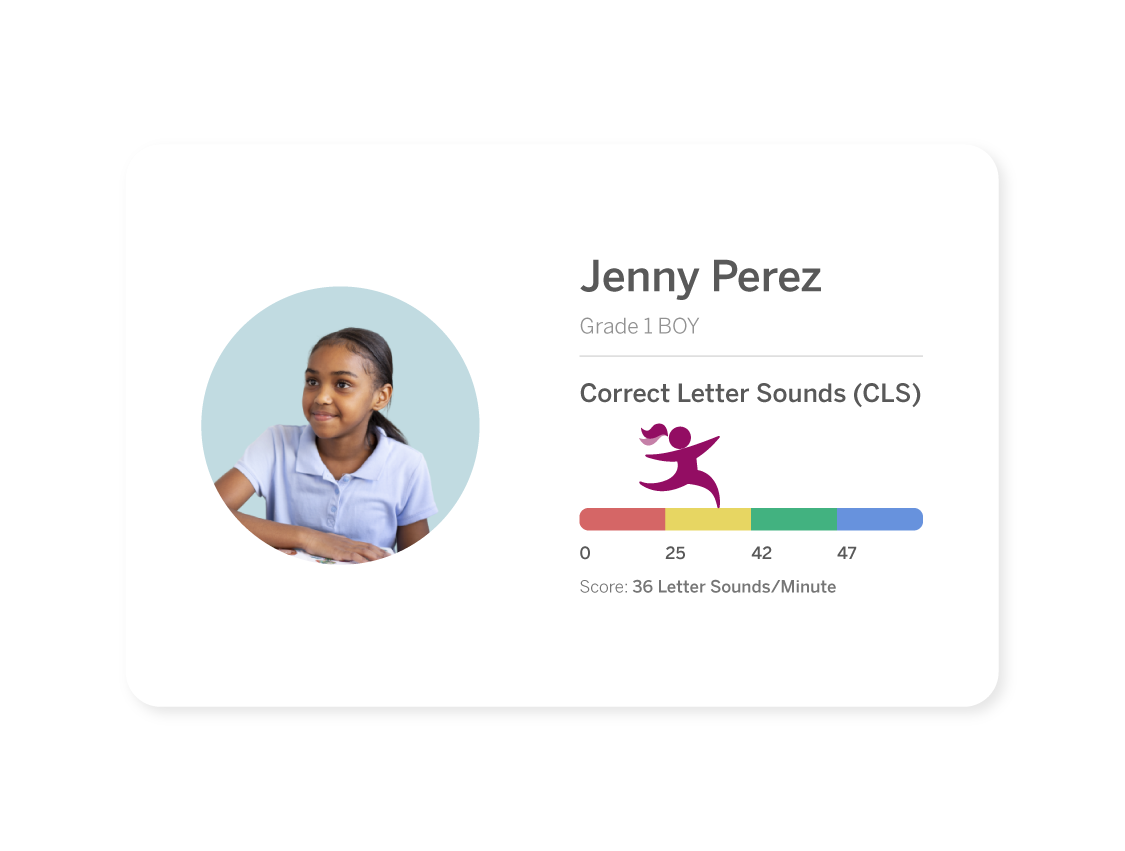
Precise, trustworthy data through direct observation
Our approach to assessment is focused on providing you with immediate insights you can trust. Through direct observation of students and detailed reports, including assessment transcripts and diagnostic error patterns, you’ll have total transparency into each student’s performance.
Instant analysis and next steps
With mCLASS, you can interpret and act on data in real time with instant instructional guidance based on benchmark and progress-monitoring results. In one click, teachers can access differentiated skill-based groups and targeted resources to develop students’ foundational literacy skills.

A complete picture of English and Spanish biliteracy
Amplify’s Spanish language assessment, mCLASS Lectura (K–6), works in tandem with DIBELS 8th Edition’s English assessments to highlight areas of growth as students develop into bilingual readers. mCLASS Lectura provides complete parity with English mCLASS assessments, skill coverage, instructional tools, and reporting.
Ready to continue your learning journey?
Help build teacher confidence and improve effectiveness of intervention delivery with mCLASS professional development. Launch sessions help your team get up and running, while Strengthen sessions help teachers go beyond the basics.


What’s included
The mCLASS program includes quick assessments of critical reading skills, real-time reporting, and data-driven instructional recommendations.
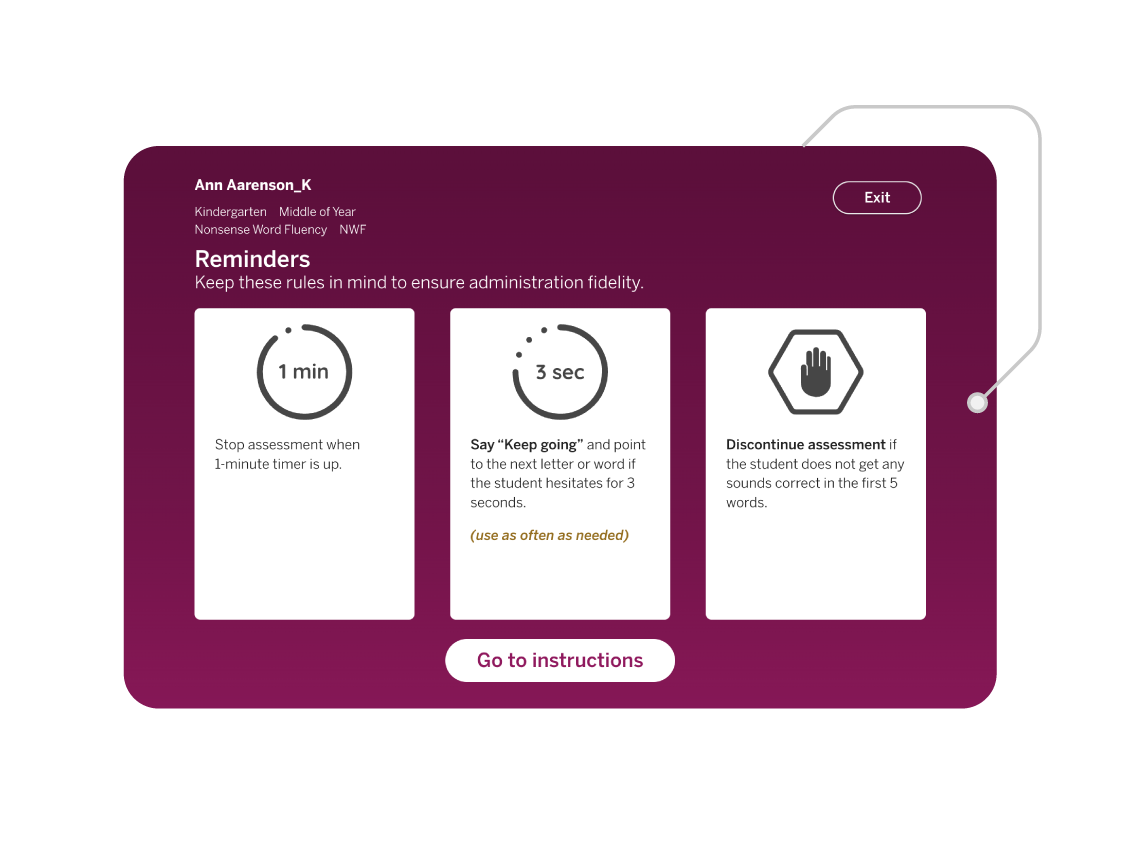
Efficient one-minute measures
DIBELS 8th Edition’s predictive one-minute assessments of phonemic awareness, phonics, fluency, and comprehension are proven to identify risk as early as possible.
- Phonological awareness
- Alphabetic principle/phonics
- Reading fluency
- Reading accuracy
- Reading comprehension
Early detection of dyslexia symptoms
With mCLASS, you can efficiently screen students and assess the full range of skills linked to dyslexia risk factors at the same time. mCLASS DIBELS 8th Edition and mCLASS Lectura are both validated as dyslexia screeners for English and Spanish, with additional Vocabulary, Spelling, RAN, and Language Comprehension measures available at no additional cost.
Progress monitoring and goal setting
To help you target the right skills and areas of instruction, mCLASS recommends progress-monitoring measures and automatically sets meaningful, attainable goals for each student. Our Zones of Growth goal setting framework examines your student’s DIBELS scores to predict the rate of growth they need to reach end-of-year goals.
- Automatic progress monitoring recommendations
- Customizable goals
- Semester and full-year growth reports
Differentiated instruction for all students
Our library of more than 500 evidence-based activities makes it easy to plan lessons that reinforce your core instruction. The embedded professional development supports consider the varied language backgrounds of all students and provide cross-linguistic transfer and language variety guidance to inform phonological awareness instruction.


One-of-a-kind dual language reporting
When you use mCLASS DIBELS 8th Edition with mCLASS Lectura, you can identify and develop students’ English and Spanish literacy skills regardless of your own Spanish-language proficiency. With the dual language report, you can see a side-by-side view of students’ assessment results and receive instructional guidance based on the data.
Educator and caregiver reports
Easy-to-use reports, ranging from classroom-level to school- and district-wide, help you evaluate each student’s reading skills over time and pinpoint exactly when a change in instruction is needed.
To reinforce learning at home, the Home Connect feature provides letters to caregivers about their child’s reading development in English and Spanish, and includes activities for reinforcement at home or on the go.

Instructional alignment across all tiers
Amplify’s early literacy system ensures that you have all the core, intervention, and personalized instruction you need to support each stage of a student’s literacy journey. mCLASS data drives placement into mCLASS Intervention and Boost Reading personalized learning. It also recommends core instruction resources within Amplify CKLA core curriculum based on the skills in which students need additional practice.
Explore more programs based on the Science of Reading
Our literacy programs are designed to support and complement each other. Learn more about our related programs.

Supporting multilingual learners—by supporting their families
Teachers know that multilingual/English learners (ML/ELs) are an important and fast-growing population in today’s classrooms. In 2021, more than 10% of students enrolled in public schools across the U.S. were identified as English language learners, with some projections suggesting this number could reach 40% by 2030.
But when it comes to partnering with the families of ML/ELs for student success, we’re just beginning to tap into what’s possible.
I’m an ML/EL teacher and former homeroom teacher at a school serving many ML/ELs.
Here’s what I’ve learned about best practices for bridging the school-to-home communication gap and partnering with families (all families!) to ensure their child’s success.
Recognizing the communication gap: Common challenges with multilingual families
In my experience, three common barriers can stand in the way of strong family engagement and student success:
- Cultural expectations around parent-teacher communication: In many cultures, school is considered the teacher’s domain. Reaching out may be seen as crossing a line—or simply not expected at all.
- Logistical challenges: Unpredictable schedules may lead to missed messages, delayed responses, or inconsistent availability.
- Language barriers: If a message isn’t in a language a caregiver understands, it’s unlikely they’ll respond—not because they don’t care, but because they can’t fully engage.
Supporting multilingual learners starts with recognizing these barriers not as signs of disconnection, but as invitations to shift our approach. There are best practices we can adopt to help bridge the gap—and build the trust and relationships our students need to thrive.
Tools and strategies for better parent-teacher communication
If you want to communicate with families who speak a variety of different languages, the first step is finding the method of contact that works best for each of them. My school uses an auto-translating app called ParentSquare for home communications—but not all families I’ve worked with respond to ParentSquare messages. So if a family isn’t responsive to one mode of communication, try another!
It’s a good idea to ask families on Back-to-School Night—or whenever your students first arrive—if they have a preferred mode of communication. I’ve found I get the best response rate by creating a Google Voice number and communicating via text, first translating through an app if needed.
Keep a log of this information so you have it on hand when you need it. In the long run, this will be easier for both you and your students’ caregivers than you chasing them down to get them to download, log into, or check a specific app.
The important thing is to consider making contact essential, and to keep trying until you find the mode that works for both you and the parents of your ML/EL students.
Setting the tone for strong family engagement
If you want to forge a strong family-school partnership (and you should!), you also need to set the tone. When families have a different cultural understanding of school engagement than what you’re used to, I’ve found that it helps to explicitly solicit parent input, explaining how a partnership between caregiver and teacher will help support their child’s success.
Let them know how and why they should get in touch with you, and make it easy by reaching out proactively with brief, positive updates.
What multilingual families really want to know
Perhaps most importantly, ask families what they want to know! I’ve attended many parent-teacher conferences—both for my own students and as an interpreter—and I’m frequently struck by how many multilingual families respond when I ask what questions they have. Many families who haven’t previously reached out are suddenly overflowing with questions.
The most common one I get is how they can support their child’s academic journey at home. Parents also frequently request updates about behavior. Understand that just because a family isn’t asking these questions proactively doesn’t mean they don’t care. When I explicitly ask parents what they need, their responses make it abundantly clear that they are deeply invested in their child’s schooling and success.
I’ve also learned that many families—especially those who speak a language other than English at home—may not know that there are many ways to support their child’s growth, even if classroom instruction is not in their home language.
Think about what tips and resources you can most easily provide: Do your students’ parents know that reading or reciting poems, songs, or chants in their home language helps literacy growth? Could you send home simple board games from the classroom to reinforce key skills? Would signing up for a library card give them access to resources they didn’t know were available? Many caregivers of ML/EL students have told me they lack the tools to get involved—but are eager to engage once given tangible strategies.
How teachers can go the extra mile
In order to give our students and their families the support they need, it’s critical that we challenge our internal biases and assumptions. If we assume parents are uninterested or uninvolved, we avoid an opportunity to think creatively about how to bridge communication gaps and facilitate family involvement. We also cut off a world of possibility for our students and limit their access to the academic success that comes from parent involvement.
Working with the families of ML/ELs may bring added responsibilities—but it’s also a unique privilege, full of new opportunities. In teaching ML/ELs, I’ve found that I get to be a cultural bridge—one of the people providing warmth, stability, and welcome to families navigating a new culture. School can be overwhelming in a new country or different language—but a teacher who goes the extra mile can ensure success for both students and families.
Additional resources
- Let’s keep the conversation going! Join the discussion in our Amplify learning communities.
- Discover a suite of Spanish literacy curriculum and assessment programs designed to build confident readers with Amplify’s biliteracy suite.
- Read how you can use the Science of Reading to boost your biliteracy instruction in this blog post.
Free, high-quality lessons without the scavenger hunt.
Discover more than a thousand free lessons bursting with interactivity—across K–12 math, literacy, and science.



More than 300,000 teachers turn to Amplify Classroom for captivating lessons and virtual manipulatives.
Get your classroom buzzing with our powerful teaching tools.
Tailor lessons to fit your needs.
Easily customize premade lessons or create your own with our drag-and-drop lesson builder.
Share and celebrate student ideas.
Take snapshots of classwork to foster discussion and highlight student thinking.
Gain insights into student thinking.
Monitor your students’ ideas in real time so you can adapt instruction on the fly.
Control the flow of instruction.
Pace students to specific parts of the lesson, or pause to explore concepts more deeply.
What are people saying?
Martin Joyce
@martinsean
Love this #AmplifyClassroom kindergarten activity! First the octopus checks sums of 8 then the sea urchin comes out. Great job. I’ve been wary about making my kids not hate math (no drill n kill) and they’re asking can we do math on the computer before bed. Yes! Cc @ddmeyer
Traci Jackson
@traciteacher
After an audible groan b/c the activity was paused, Ss made sense of ordered pairs through a purposeful #AmplifyClassroom experience! This S pair wrote without any prompting. Great collaboration and learning in 5th grade today!
Mark Labuda
@mrmlabuda
Hands down the best virtual manipulatives I’ve ever come across.

Join our community
More than 30,000 educators share advice, lessons, wins, and more in our Amplify Classroom Educators Group. Be a part of the conversation!
Interested in learning about the benefits of being an Amplify customer?
Amplify Classroom FAQ
Amplify Classroom (formerly Desmos Classroom) is a free K–12 teaching platform that gives educators access to a library of high-quality, interactive lessons in math, literacy, and science. The platform is built with tools that promote student engagement and collaboration, while giving teachers real-time visibility into student thinking.
Amplify Classroom supports K–12 educators across math, science, and literacy. The platform offers more than 1,000 free interactive lessons, with content designed to build deeper understanding and student engagement at every grade level.
No. Teachers can create a free Amplify Classroom account and immediately access teaching tools and hundreds of lessons without a district license or subscription. Paid programs such as Amplify Desmos Math and Amplify Core Knowledge Language Arts (CKLA) also run on Amplify Classroom, and you can access that content through the same platform if your school or district subscribes to these programs.
Some schools and districts require that specific URLs be added to their allowlist before teachers can access Amplify Classroom. A full list of permitted domains can be found at amplify.com/allowlist. Teachers should share this information with their school or district IT team.
Amplify Classroom offers built-in tools that promote real-time teacher visibility and student engagement. Key features include:
- Real-time student insights: See student responses and thinking as they happen, all in one easy-to-use teacher dashboard.
- Teacher pacing controls: Pause a lesson or advance all student screens simultaneously.
- Select and sequence student work: Highlight student ideas live by selecting and sharing student work during a discussion.
- Anonymous student sharing: Display student work to the class without showing students’ real names.
- Lesson customization: Copy and edit pre-built K–12 lessons or build your own from scratch using our drag-and-drop lesson builder.
- Class management tools: Create and manage multiple classes, add co-teachers, and organize rosters.
Yes. Teachers can customize our K–12 lessons or even create lessons from scratch to meet their students’ unique needs. This includes adding things like pre-made screens, images, multiple-choice questions, graphs, and more with our drag-and-drop lesson builder.
Yes. Many teachers use Amplify Classroom to supplement their existing curriculum. The platform can be integrated into any part of a teacher’s day, with a wide library of lessons and tools for core or supplemental instruction.
For schools seeking a full core curriculum, Amplify also offers paid programs including Amplify Desmos Math and Amplify CKLA, both fully integrated into the platform.
Yes. Amplify Classroom supports signing in with Google. Teachers can import class rosters directly from Google Classroom to streamline setup. For Amplify customers, Clever integration is available for school and district rostering. You can learn more about our integrations here.
Amplify Classroom is built to facilitate compliance with applicable student data privacy laws, including FERPA, COPPA and other applicable laws related to the collection and use of student data. To provide Amplify Classroom to students, Amplify receives Student Data as a “school official” in accordance with Section 99.31 of FERPA and COPPA guidance, and operates at the direction of the school. You can read more about this in our Acceptable Use Policy and Customer Privacy Policy.
The 6–8 ELAR solution for Texas Home Learning
Your TEKS-aligned Texas language arts and reading core and supplemental resources have been built specifically for middle school learners—wherever their learning takes place.

What is Amplify ELAR?
Amplify ELAR Texas is a high-interest TEKS-aligned blended language arts and reading curriculum designed specifically for grades 6–8. With Amplify ELAR, students learn to tackle any complex text by making observations, grappling with interesting ideas, and finding relevance for themselves. Students are engaged through dynamic texts, lively classroom discussions, and meaningful digital experiences.
- Full TEKS coverage: Standards are clearly labeled in each lesson, so teachers can save time planning and get back to what they love: teaching.
- Five levels of differentiation: Based on each student’s needs and the performance measures within Amplify ELAR reports, a teacher can choose the differentiation level that’s right for everyone.
- Embedded assessments: Teachers benefit from uninterrupted instructional time and a continuously updated picture of each student’s progress with key skills and standards.
- Powerful feedback tools: Comprehensive tools help teachers maximize both the quantity and quality of feedback.
- Robust reporting: Our Reporting app offers information on student progress to inform instructional decisions.
- All in one place: Embedded teacher support, differentiation tools, student data, text, and other curriculum features—all right at your fingertips.

Built to engage your students
Amplify ELAR Texas includes rich multimedia resources designed to engage all your students, wherever they’re learning. Linked directly within the digital program, these resources will allow your students to access text in new ways. This innovative way for students to interact with the text they are presented will expand their personal comprehension toolkit while opening up a new world of literature.


Amplify Reading Texas 6–8
Amplify Reading Texas: 6–8 Edition is a digital reading program for grades 6–8, designed to teach analytic reading through instruction and practice using both literary and informational texts. The program takes the form of an interactive graphic novel called The Last Readers, in three “books” of 6–8 chapters.
Professional learning
Amplify employs a national cohort of 50+ ELA facilitators, all of whom have experience as former classroom teachers and many of whom are former school and/or district leaders. Our professional learning team has decades of experience working with large districts across the nation. Amplify has experience supporting district launches over multiple years and has partnered with districts of all sizes nationwide. We develop deep partnerships with districts, tailoring professional learning to their unique needs.

Sign-up
If you are interested in using Amplify’s Texas Home Learning resources for grades 6—8, select the appropriate button below.
Individual teachers not part of a school or district enrollment, caregivers and parents watch this video or use this document to guide you through the steps in the self-enrollment process.

District, school or ESC leader sign up
you are a leader of a district, school or ESC and want to use these resources school- or district-wide, please fill out the form to the right. If you are a teacher choosing to use Amplify resources for one class (not the whole school or grade) or if you are a parent/caregiver, please click here.
What is mCLASS?
mCLASS is a best-in-class assessment platform that houses a suite of proven, gold-standard assessment measures and tools that can be flexibly combined to meet the unique literacy needs of both teachers and students across grades K–6, including:
- Universal screening
- Diagnostic assessment
- Dyslexia screening
- Progress monitoring
- Dual language reporting
- Targeted teacher-led instruction
What is the DIBELS 8th Edition assessment?
Developed by the University of Oregon, the DIBELS 8th Edition is the latest version of the DIBELS® (Dynamic Indicators of Basic Early Literacy Skills) assessment.
With this latest version, the University of Oregon Center on Teaching and Learning (UO CTL) made significant efforts to ensure measures would meet state-level screening requirements for universal screening, diagnostic assessment, and dyslexia screening. To support this, measures were updated based on the latest research to meet increased standards of reliability and validity. In addition, adaptive procedures and discontinue rules focus on the assessment of priority skills and prevent over-testing.
Summary of changes:
- Consistent measures within grades will provide improved growth measurement.
- All subtests have been revised to be grade-specific and to increase in difficulty, covering a full progression of skills and minimizing floor and ceiling effects. This provides the opportunity for students to demonstrate what they know and further pinpoint what they don’t know.
- Phoneme Segmentation Fluency replaces First Sound Fluency. The expanded coverage minimizes floor effect and provides information about difficulty in Phonemic Awareness skills without the additional First Sound Fluency measure.
- A new subtest, Word Reading Fluency, helps identify students with poor sight word reading skills that other subtests miss.
- For all measures, the basic scoring procedures remain the same. For Nonsense Word Fluency, credit is given for recording words as whole words even if the student misses in the first attempt.
- Oral Reading Fluency is now only one passage, instead of three. Retell has been removed. Thus, Oral Reading Fluency assessment will take a third of the time.
Assessment measures by grade
| DIBELS measures at each grade level | ||||
| Measure | Grade K | Grade 1 | Grade 2 | Grade 3 |
| Letter naming fluency |  |
|
||
| Phonemic segmentation fluency | |
|
||
| Nonsense word fluency | |
|
|
|
| Word reading fluency | |
|
|
|
| Oral reading fluency | |
|
|
|
| Maze (basic comprehension) | |
|
||
| Amplify measures at each grade level | ||||
| Oral language | |
|
|
|
| Vocabulary | |
|
|
|
Assessment measures sample videos
DIBELS 8th Edition measure: Phonemic Segmentation Fluency (PSF)
DIBELS 8th Edition measure: Nonsense Word Fluency (NWF)
DIBELS 8th Edition measure: Letter Naming Fluency (LNF)
DIBELS 8th Edition measure: Word Reading Fluency (WRF)
DIBELS 8th Edition measure: Oral Reading Fluency (ORF)
How is mCLASS with DIBELS 8th Edition different?
mCLASS with DIBELS 8th Edition combines the power of the mCLASS assessment platform and the effectiveness of the DIBELS 8th Edition assessment measures. As a result – educators across the state are empowered with the latest and greatest assessment tool.
More than a test, mCLASS with DIBELS 8th Edition is an integrated system that closes the knowing-doing gap by helping teachers take immediate instructional action that’s right for each and every student.
Assessment systems must enable and compel educators to answer not just the “What” questions, but also the “So What” and “Now What” questions. These are the questions that are essential in transforming classroom instruction, and the questions that mCLASS with DIBELS 8th Edition helps teachers answer with confidence.
How is mCLASS with DIBELS 8th Edition different?
- It gives teachers access to the latest digital version of the DIBELS assessment. Amplify is the only licensed provider of the digital DIBELS 8th Edition assessment. As such, our solution is the only one to enhance the DIBELS 8th Edition assessment with the power, reliability, and quickness of the mCLASS system.
- It makes it faster and easier to understand where every student is in their early literacy journey. By combining 1:1 observational diagnostic assessments, dyslexia screening, progress monitoring, instant scoring, rigorous reporting, automatic student grouping, and targeted instruction all in one place, it reduces the instructional delays associated with manual scoring, manual data analysis, and manual lesson planning.
- It brings more equity to the classroom. When used in conjunction with mCLASS Lectura, teachers have access to dual language reports that highlight a student’s strengths and weaknesses in both English and Spanish.
- It makes every instructional minute count. In addition to one-minute measures that quickly gauge student progress toward reading proficiency, it leverages a teacher’s most powerful instructional tool — their own 1:1 observations.
- It drives growth more efficiently. Rather than relying on broad composite scores alone, granular data and in-depth insights for every student help teachers pinpoint exact skill gaps and areas of unfinished learning, making whole-group, small-group, and 1:1 instruction more targeted and effective.
- It saves teachers time. Instant reports, automatic student groups, and ready-to-teach lessons mean teachers spend less time cobbling together materials and more time working directly with students and responding to their needs.
How does mCLASS with DIBELS 8th Edition support screening for dyslexia risk?
DIBELS 8th Edition measures have been updated based on the latest research. They now offer stronger measures of processing speed, phonological awareness, and alphabetic principles for dyslexia screening purposes.
To support this, a new subtest in Word Reading Fluency was introduced and revisions were made to Letter Naming Fluency, Phonemic Segmentation Fluency, and Nonsense Fluency subtests to improve their ability to screen for deficits commonly associated with dyslexia risk, such as phonological awareness, rapid naming ability, and alphabetic principle. These measures provide early warning signs for neurological processing difficulties that contribute to risk for dyslexia (Wolf & Bowers, 1999; Denckla & Rudel, 1974).
Moreover, measures in Oral Language and Vocabulary are included to provide additional information to help evaluate additional risk areas associated with dyslexia risk.
How does mCLASS with DIBELS 8th Edition turn data into instant action?
mCLASS with DIBELS 8th Edition gives you instant results and clear next steps for each student.
Quick and actionable reports provide detailed insight into students’ reading development across foundational literacy skills for teachers, specialists, administrators, and caregivers.
Diagnostic assessment
mCLASS with DIBELS 8th Edition analyzes individual student response data through a scoring algorithm which aligns to the Colorado Department of Education’s stated purpose of a diagnostic assessment.
Our innovative approach to diagnostic assessment leverages an item-level evaluation of individual student responses in order to provide deeper insights into specific student weaknesses and areas of improvement. mCLASS with DIBELS 8th Edition analyzes individual student response data through a scoring algorithm which aligns to the Colorado Department of Education’s stated purpose of a diagnostic: “… to pinpoint a student’s specific area(s) of weakness and provide in-depth information about students’ skills and instructional needs.”
For a full list of diagnostic observations, click the button below to download the Digital Assessment Materials navigation guide.
Ready-to-teach instruction
Immediately following the analysis of individual student responses, mCLASS with DIBELS 8th Edition provides an in-depth diagnostic report complete with suggested next steps, also known as “mCLASS Instruction.”
mCLASS Instruction evaluates each student’s responses on each individual subtest and instantly:
- Provides a list of specific needs by student, such as struggling with medial vowel sounds or difficulty reading words with consonant blends.
- Groups students automatically based on similar discrete skill needs, not simply composite scores like other assessment tools.
- Recommends a variety of ready-to-teach lessons that specifically target each individual student’s areas of need or common areas of need for small-group instruction.
Classroom skill and benchmark summary
The Classroom Skill Summary report is a dashboard showing benchmark performance on each skill. Teachers can use it to determine which skill areas need instructional focus at a classroom level.
The Classroom Benchmark Summary report is a classroom-wide view of overall reading performance. Teachers can use this report to determine if composite scores improved, declined, or remained the same each semester.
Detailed benchmark performance
Teachers can see each student’s performance during the current school year, on each subtest as well as the overall composite. The benchmark goal displays below the subtest name when applicable. The ability to sort the columns in this report gives teachers more flexibility to analyze data the way they prefer.
Dyslexia screening
Identify students who are at risk for reading difficulties, including dyslexia, based on their results from foundational skills measures and additional measures as needed by local policies.
Progress monitoring summary
See which subtests have been assessed since the most recent benchmark assessment, how students performed on the three most recent progress monitoring assessments for each measure, and which students have not been progress monitored since the benchmark assessment.
Goal setting tool
The Zones of Growth (ZoG) analysis uses a rich set of national data to determine student goals for the next benchmark period. Teachers can use the Goal Setting Tool to view these recommended goals or modify the default goals for individual students as they see fit, if the default goal is too challenging or not challenging enough.
Growth outcomes
Teachers and interventionists can see each student’s actual growth achieved and how it compares to the goal that was set for the student.
Colorado READ Plans
Amplify recommends that a student who is categorized by the DIBELS 8th Edition composite score as “At High Risk” (denoted in all reports as “red”) be considered as potentially having a “Significant Reading Deficiency,” then further diagnosed using mCLASS’ Instruction diagnostics.
When devising a READ Plan, teachers and instructional staff should first consider students at high risk on DIBELS 8th Edition as potentially having a “Significant Reading Deficiency,” and eligible for a READ Plan. Students are then further diagnosed using mCLASS’ Instruction diagnostics. When devising a READ Plan, teachers can rely on the relevant mCLASS Instruction and Reports to comply with the READ Act.
Caregiver supports
The mCLASS Home Connect website houses literacy resources for parents and caregivers, including at-home lessons organized by skill. Our mCLASS parent/caregiver letters in English and Spanish ensure that families know how to best support their child.
Explore our self-guided tour
Our self-guided tour is a great way to orient yourself to the organization of our mCLASS platform. Click the button below to get started.
Contact us
Looking to speak directly with your Colorado representative? Get in touch with a team member by emailing HelloColorado@amplify.com or by calling us directly.
Enrollment over 2,500 students

Monty Lammers
Senior Account Executive
(719) 964-4501
Amplify Science Resources for NYC (6-8)
This page has been archived. For the latest information, please visit the NYC Resource Site.
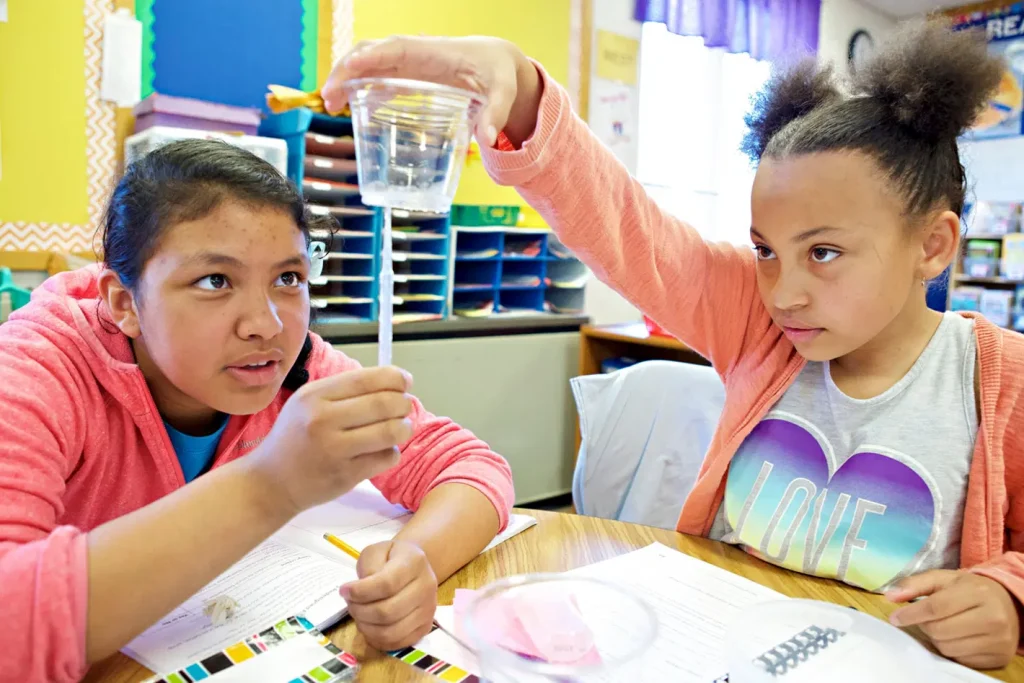
Welcome!
As the 2021-2022 school year kicks into full gear, you’re likely thinking about making your classroom responsive to student needs due to the covid-19 pandemic.
- CLRT in Amplify Science
- SEL in Amplify Science
- Responsive Relaunch Introduction Video
- Responsive Relaunch NYC Brief
Got additional questions? Use Zoom to attend office hours with Adaliz Gonzalez, the DOE’s Middle School Science Lead on Thursdays from 3-4pm.
Meeting ID: 852 2280 0969
Passcode: 528986
A powerful partnership
Amplify Science was developed by the science education experts at UC Berkeley’s Lawrence Hall of Science and the digital learning team at Amplify.

NYC Newsletters
- February 2022
- January 2022
- December 2021
- October 2021
- September 2021
- June 2021
- May 2021
- April 2021
- March 2021
- February 2021
- January 2021
- December 2020
- October 2020
Educator Spotlight Submission
Calling all NYC DOE educators! Do you know an educator who has gone above and beyond? Would you like to highlight your teaching experience for others? Submit nominations here to see them featured as a spotlight in a future edition of our monthly newsletter and on our Instagram pages!
Introduction
This page includes planning, implementation, and professional learning resources for NYC schools using Amplify Science. Please take a moment to familiarize yourself with the categories in the navigation bar on the left side of the page, so that you’ll be able to easily find what you need.
Most New York City educators come here looking for specific information, but if you’re new to Amplify Science, we recommend you read through the program guide to learn a little about the program.
New to Amplify? – Start HERE!
Teachers and Administrators
Step 1: Review the Amplify Science Overview Video.
Step 2: Review the NYC Scope and sequence for 21-22 school year.
Step 3: Review the Unpacking the Kit Videos listed below to understand what’s in your unit 1 kit.
Step 4: Access your unique Log-in information to log-in to the Amplify Science Curriculum outlined below under Login support
Step 5: Log into the platform and access our Program Hub. Select Using this site for self study for a complete suite of training videos and resources for an initial orientation video series.
Step 6: Log into the curriculum and begin studying the Unit Map and Teacher’s Guide resources and begin planning your first lesson. Print out the NYC Program Guide for essential program information.
Step 7: Administrator’s ONLY – Review the new administrator orientation presentation for an overview of the program. Review other materials under Admin Resources.
NOTE: Should you need any additional guidance on how to get started with prep (or anything else!), please feel free to get in touch with our pedagogical support team. They are available Monday-Friday from 7AM-7PM EST. You can reach them via the chat icon in the lower right- hand corner of your screen when logged in, through email (help@amplify.com), or via phone (800-823-1969).
Getting started resources
- NYC Resource Site overview – quick links
- Tech requirements
- Classroom Technology Quick Start Guide – a one-page guide to using Amplify Science in a variety of technology environments
Login Support
- Login video: Classroom teacher login with Amplify
- 6-8 science teacher: Login with Amplify or TeachHub (district preferred login method)
- 6-8 administrator: Login with Amplify or TeachHub (district preferred login method)
- 6-8 students: Login with Amplify or TeachHub (district preferred login method)
- Other staff (co-teachers, ICT, etc.): Administrator instructions for creating a Shared Teacher Login
- How to reset student(s) password
- How to log my class out of a shared device
- Clever class logout instructions
Materials
Unpacking your first Amplify Science classroom kit
- Unpacking kit video: Metabolism
- Unpacking kit video: Plate Motion
- Unpacking kit video: Force and Motion video
21-22 Login Update
The temporary login credentials for fall ’21 have been deactivated.
Please make sure you check out the Getting started resources > Login Support below for instructions around teacher and student logins. If there are any issues, please confirm with your STARS programmer that your classes are assigned correctly and then contact our Amplify Help Desk at help@amplify.com or at 1-800-823-1969 for further assistance.
Implementation resources
21-22 NYC Scope and Sequence and Pacing Guide
Use our NYC Field Trip List to plan an engaging field trip for your students!
NYC Companion Lesson Guides
The format of the NYC Companion Lessons is similar to other Amplify Science lessons. Some companion lessons are designed to require more than a single class period to teach, so each lesson includes pacing suggestions. Science Background sections support teachers with the science content introduced in the lessons. For students’ written work, possible student responses are included at the end of each lesson guide.
The Lesson Guides are available in the last section of each unit’s print Teacher’s Guide and can be downloaded from the tables in the downloads section below.
NYC Companion Lesson Copymasters
Each NYC Companion Lesson has an accompanying Copymaster (for creating student sheets) that can be copied and distributed to students or used as a visual reference. The NYC Companion Lessons require students to have physical copies of the student sheets. The copymasters are available to download as printable PDF files from the tables in the downloads section below.
Grade 6 Lesson guides and Copymasters
- Companion lesson: Insert after Lesson 2.2
- Time frame: 60 minutes (can spread across multiple class periods)
- NYSP–12SLS: PE: MS-PS3-6, DCI: PS3.B
- Links (click to download):
- Companion lesson: Insert after Lesson 3.3
- Time frame: Two 45-minute class periods
- NYSP–12SLS: PE: MS-PS2-3, MS-PS2-5, DCI: PS2.B
- Links (click to download):
- Companion lesson: Insert after Lesson 3.3 and after Investigating Non-Touching Forces
- Time frame: 60 minutes (first and second reads can be spread across two class periods)
- NYSP–12SLS: PE: MS-PS2-5, MS-PS2-3, DCI: PS2.B
- Links (click to download):
- Companion lesson: Insert after Lesson 2.5
- Time frame: 105 minutes (can be spread across multiple class periods)
- NYSP–12SLS: PE: MS-PS1-6, DCI: PS1.B
- Links (click to download):
- Companion lesson: Insert after Lesson 3.4
- Time frame: 60 minutes (first and second reads can be spread across two class periods)
- NYSP–12SLS: PE: MS-LS2-5, DCI: LS2.C, LS4.D
- Links (click to download):
- Companion lesson: Insert after Lesson 1.3
- Time frame: 60 minutes (first and second reads can be spread across two class periods)
- NYSP–12SLS: PE: MS-ESS2-4, DCI: ESS2.C
- Links (click to download):
- Companion lesson: Insert after Lesson 3.3*
- Time frame: 90 minutes (can be spread across multiple class periods)
- NYSP–12SLS: PE: MS-PS1-7, MS-ESS2-6, DCI: PS1.A, ESS2.C
- Links (click to download):
*Note: The homework assignment for Ocean, Atmosphere, and Climate Lesson 3.3 (reading the article “Deep Ocean Currents: Driven by Density”) should be assigned after the Investigating Deep Ocean Currents companion lesson rather than after Lesson 3.3.
Grade 7 Lesson Guides and Copymasters
- Companion lesson: Insert after Lesson 3.2
- Time frame: 60 minutes (first and second reads can be spread across two class periods)
- NYSP–12SLS: PE: MS-LS1-3, DCI: PS3.D, LS1.A
- Links (click to download):
- Companion lesson: Insert after Lesson 3.3 or later
- Time frame: Three 45-minute class periods, each several days apart
- NYSP–12SLS: PE: MS-LS1-8, DCI: LS1.D
- Links (click to download):
- Companion lesson: Insert after Lesson 3.5
- Time frame: 60 minutes (first and second reads can be spread across two class periods)
- NYSP–12SLS: PE: MS-LS1-6, MS-LS1-7, DCI: LS1.C, PS3.D
- Links (click to download):
- Companion lesson: Insert after Lesson 2.2
- Time frame: 60 minutes (first and second reads can be spread across two class periods)
- NYSP–12SLS: PE: MS-PS1-4, DCI: PS3.A
- Links (click to download):
- Companion lesson: Insert after Lesson 1.3
- Time frame: 60 minutes
- NYSP–12SLS: PE: MS-PS1-7, DCI: PS1.A
- Links (click to download):
- Companion lesson: Insert after Lesson 2.3, 2.4, or 2.5
- Time frame: Two 45-minute class periods
- NYSP–PE: MS-PS1-8, MS-PS1-2 DCI: PS1.A, PS1.B
- Links (click to download):
Grade 8 Lesson Guides and Copymaster
- Companion lesson: Insert after Lesson 2.2
- Time frame: 90 minutes (can be spread across multiple class periods)
- NYSP–12SLS: PE: MS-PS3-2, MS-PS3-5
- Links (click to download):
NYC Companion Kits
Materials needed to teach Amplify Science lessons are provided in a kit for each unit. While some materials used in the NYC Companion Lessons are also found in a unit’s kit, materials specific to the companion lessons are provided in NYC Companion Kits. The contents of each kit and any additional materials needed to teach the companion lessons are listed in the PDFs provided below. Please select your grade to view or download the list.
NYC Student Editions (print)
The NYC Student Editions are durable student references that compile all reading material required for a grade level, including the articles students read for NYC Companion Lessons. Students reading in the Student Edition should annotate the text directly with sticky notes to achieve the full benefits of Active Reading. The Active Reading approach was designed as an interactive process in which students highlight and annotate digital or hard copies of articles directly. Printable versions of the articles are available in the downloads section below.
- Harnessing Human Energy: Printable article: “Magnetic Force and Rainbow Trout”
- Harnessing Human Energy: Printable article: “Gravity and Bats”
- Harnessing Human Energy: Printable article: “Electrostatic Force and Bees”
- Populations and Resources: Printable article: “The Amazing Variety of Life in a Coral Reef”
- Weather Patterns: Printable article: “What Makes Water Move?”
- Metabolism: Printable article: “How You Are Like a Sneezing Iguana”
- Metabolism: Printable article: “How Do Trees Grow So Huge Without Eating?”
- Phase Change: Printable article: “Icy Heat”
- Chemical Reactions: Printable article: “This Is Not an Oxygen Tank”
It is recommended that NYC teachers insert this additional lesson between Lessons 3.1 and 3.2 in order to have students complete a reading assignment in class along with an additional Sim activity.
- Lesson: Earth, Moon and Sun: Modeling Seasons
- Lesson Placement: Insert between Lessons 3.1 and 3.2*
- Links (click to download):
*If teaching this Modeling Seasons lesson, do not assign reading “The Endless Summer of the Arctic Tern” article for homework in Lesson 3.1. However, students should still model a lunar eclipse with the Modeling Tool for homework, as they will be revisiting and revising this model in Lesson 3.3.
NYC Investigation Notebooks (for teacher download)
- Harnessing Human Energy*
- Thermal Energy*
- Populations and Resources*
- Matter and Energy in Ecosystems
- Weather Patterns*
- Ocean, Atmosphere, and Climate*
- Earth’s Changing Climate
* includes NYC Companion Lesson Copymaster(s)
- Microbiome
- Metabolism*
- Phase Change*
- Chemical Reactions*
- Plate Motion
- Engineering Internship: Plate Motion
- Rock Transformations
- Engineering Internship: Earth’s Changing Climate
* includes NYC Companion Lesson Copymaster(s)
- Geology on Mars
- Earth, Moon, and Sun
- Force and Motion
- Engineering Internship: Force and Motion
- Magnetic Fields*
- Light Waves
- Traits and Reproduction
- Natural Selection
- Evolutionary History
* includes NYC Companion Lesson Copymaster(s)
Admin resources
- Getting started checklist
- Implementation rubric
- Look-for tool
- NEW Administrator data reports overview
- NYC Resource Site overview – quick links
- 2021 Grade 6-8 Instructional Leaders: Analyzing Student Assessment Data Agenda and Presentation
- 2021 Grade 6-8 Administrators: Utilizing the Amplify Science Assessment System Agenda and Presentation
- 2020 New Administrator Orientation Presentation with Participant Notebook
- 2020 Returning Administrator Orientation Agenda
- 2020 Amplify Science Remote & Hybrid Resources for Administrators Webinar
- 2020 Supporting Multilingual Learners for Administrators Webinar
- 2020 Accessing Complex Texts: Administrators Webinar
- 2020 Academic Discourse and Questioning Strategies: Administrators Webinar
- 2021 Planning For Next Year: Administrators Agenda, Participant Notebook, and Presentation
- 2021 Planning For Next Year: Instructional Leads Agenda, Participant Notebook, and Presentation
Remote and hybrid learning resources
In response to the shifts towards remote learning, Amplify has created resources for using our programs remotely. Please visit our Program Hub accessible via your Teacher Platform for all of our hybrid and remote learning supports which includes guidance for teachers and parents/guardians.
Additionally, please see below where you’ll find the recordings from our recently held webinars on our remote learning resources and some best practices for implementing Amplify Science in a distance learning setting.
Resource guides
- 20-21 Scope and sequence/pacing guide
- K-8 Remote and hybrid learning guide
- 6-8 Planning Tool for @Home Resources
Professional learning opportunities
Interested in attending training? Check out and sign up for this year’s PL offerings here!
Election Day 21-22 PL
Grade 6 Guided Planning Presentation and Webinar
Grade 7 Guided Planning Presentation and Webinar
Grade 8 Guided Planning Presentation and Webinar
Grades 6-8 Unpacking Phenomena Presentation and Webinar
All 2020-2021 PL session materials can be found below under Professional learning resources.
Amplify Science Back-to-School Recorded Webinars – Amplify held a series of national office hours throughout the summer and fall to share information about our new resources to support remote and hybrid learning– including recommendations about what to prioritize from your curriculum and essential refresher topics, such as how to navigate your program and find the best planning resources. Feel free to watch all recorded sessions at your convenience.
Archived Professional Learning Resources
Winter 2022
- Guided Planning: Unit Internalization Agenda, Participant notebook, and Presentation
Spring 2021
- Planning For Next Year Agenda, Participant notebook, and Grade 6 Presentation
Winter 2021
- Guided Planning: Matter and Energy in Ecosystems Agenda, Participant notebook, and Grade 6 Presentation
- Engaging English Learners in 3-D Learning Agenda, Participant notebook, and Grade 6 Presentation
- Accessing Complex Text in Amplify Science Agenda, Participant notebook, and Grade 6 Presentation
- Applying Reading and Writing Strategies in Amplify Science Agenda, Participant notebook, and Grade 6 Presentation
Fall 2020
- Grade 6: Academic Discourse and Questioning Strategies Webinar
- Accessing Complex Texts: Ocean, Atmosphere, and Climate Webinar
- Grade 6: Ocean, Atmosphere, and Climate Guided Unit Internalization Presentation and Planning document
- Grades 6-8: Supporting Students with Special Needs in Remote Learning Presentation with Participant Notebook
- Grade 6: Supporting Multilingual Learners Webinar
- Grade 6: Thermal Energy Guided Unit Internalization Presentation and Participant Notebook with @Home Resources (Election Day PL)
- Grades 6-8 Navigating Program Essentials: Agenda, Presentation, Participant Notebook
- Grade 6: Progress Builds & Embedded Assessments Webinar
- Grade 6: Amplify Science Remote & Hybrid Resources Webinar
Summer 2020
- Returning Teachers: Guided Planning Workshop Remote and Hybrid LearningAgenda,Presentation, and Webinar
- 6-8 New Teacher Institute Agenda: Day One and Day Two with Participant Notebook
Summer 2019- Harnessing Human Energy and Thermal Energy
Fall 2019- Population and Resources with Participant Notebook
Winter 2022
- Guided Planning: Unit Internalization Agenda, Participant notebook, and Presentation
Spring 2021
- Planning For Next Year Agenda, Participant notebook, and Grade 7 Presentation
Winter 2021
- Engaging English Learners in 3-D Learning Agenda, Participant notebook, and Grade 7 Presentation
- Accessing Complex Text in Amplify Science Agenda, Participant notebook, and Grade 7 Presentation
- Applying Reading and Writing Strategies in Amplify Science Agenda, Participant notebook, and Grade 7 Presentation
Fall 2020
- Grade 7: Academic Discourse and Questioning Strategies Webinar
- Accessing Complex Texts: Phase Change Webinar
- Grade 7: Phase Change Guided Unit Internalization Presentation and Planning document
- Grades 6-8: Supporting Students with Special Needs in Remote Learning Presentation with Participant Notebook
- Grade 7: Supporting Multilingual Learners Webinar
- Grade 7: Metabolism Guided Unit Internalization Presentation and Participant Notebook with @Home Resources (Election Day PL)
- Grades 6-8 Navigating Program Essentials Agenda, Presentation, Participant Notebook
- Grade 7: Progress Builds & Embedded Assessments Webinar
- Grade 7: Amplify Science Remote & Hybrid Resources Webinar
Summer 2020
- Returning Teachers: Guided Planning Workshop Remote and Hybrid LearningAgenda,Presentation, and Webinar
- 6-8 New Teacher Institute Agenda, Day One and Day Two with Participant Notebook
Summer 2019 – Microbiome and Metabolism
Fall 2019 – Phase Change with Participant Notebook
Winter 2022
- Guided Planning: Unit Internalization Agenda, Participant notebook, and Presentation
Spring 2021
- Planning For Next Year Agenda, Participant notebook, and Grade 8 Presentation
Winter 2021
- Guided Planning: Traits and Reproduction Agenda, Participant notebook, and Grade 8 Presentation
- Engaging English Learners in 3-D Learning Agenda, Participant notebook, and Grade 8 Presentation
- Accessing Complex Text in Amplify Science Agenda, Participant notebook, and Grade 8 Presentation
- Applying Reading and Writing Strategies in Amplify Science Agenda, Participant notebook, and Grade 8 Presentation
Fall 2020
- Grade 8: Academic Discourse and Questioning Strategies Webinar
- Accessing Complex Texts: Earth, Moon, and Sun Webinar
- Grades 6-8: Unpacking the Engineering Internship Presentation and Participant Notebook
- Grades 6-8: Supporting Students with Special Needs in Remote Learning Presentation with Participant Notebook
- Grade 8: Supporting Multilingual Learners Webinar
- Grade 8: Force and Motion Guided Unit Internalization Presentation and Participant Notebook with @Home Resources (Election Day PL)
- Grades 6-8 Navigating Program Essentials Agenda, Presentation, Participant Notebook
- Grade 8: Progress Builds & Embedded Assessments Webinar
- Grade 8: Amplify Science Remote & Hybrid Resources Webinar
Summer 2020
- Returning Teachers: Guided Planning Workshop Remote and Hybrid LearningAgenda, Presentation, and Webinar
- 6-8 New Teacher Institute Agenda: Day One and Day Two with Participant Notebook
Summer 2019 – Geology on Mars and Earth, Moon, Sun
Fall 2019 – Force and Motion with Participant Notebook
Caregiver resources
Questions
For general questions about the Amplify program (navigation, pedagogy, login), please reach out:
Email – scihelp@amplify.com
Phone – call toll-free at (800) 823-1969, Monday to Friday, 7 a.m.–7 p.m. ET
Amplify Chat – click the Amplify Chat icon within the individual teacher account
What’s included in our grades K–2 language arts curriculum
Amplify Core Knowledge Language Arts® (CKLA) is a comprehensive early literacy curriculum, grounded in the Science of Reading. The K–2 curriculum sequences deep content knowledge-building with research-based foundational skills. With Amplify CKLA, you’ll have the instruction and guidance of proven, evidence-based practices to help all of your students become strong readers, writers, and thinkers.
Choose Level
Year at a glance
The Amplify CKLA curriculum is modeled after proven research in early literacy that supports a two-strand approach to literacy instruction in the early years. With this approach, students in Grades K–2 complete one full lesson per day that builds foundational reading skills in the Skills Strand, as well as one full lesson that builds background knowledge in the Knowledge Strand. The deep content knowledge is sequenced together with research-based foundational skills in Grades K–2 so that students develop the early literacy skills necessary to help them become confident readers, as well as build the context to understand what they’re reading.
In Grades 3–5, lessons combine skills and knowledge with increasingly complex texts, close reading, and a greater emphasis on writing. Students start to use their skills to go on their own independent reading adventures, further opening up their worlds.

Units & domains at a glance
The number of days to complete each Skills Unit and Knowledge Domain varies based on instructional purpose.
Knowledge Domain 1
Nursery Rhymes and Fables
Well-known fables introduce students to new vocabulary, build phonological awareness, and prompt discussion of character, virtues, and behavior.
Number of Lessons: 12
Knowledge Domain 2
The Five Senses
Students explore how they learn about the world using their five senses: sight, hearing, smell, taste, and touch.
Number of Lessons: 8
Knowledge Domain 3
Stories
Students develop an awareness of language and recurring themes in children’s literature, including classic stories, trickster tales, and fiction from other cultures.
Number of Lessons: 10
Knowledge Domain 4
Plants
Read-aloud texts introduce students to basic knowledge of ecology, parts of plants, how plants grow, and the interdependence of all living things.
Number of Lessons: 11
Knowledge Domain 5
Farms
Students identify several farm animals and crops and contrast how plants make their food with how animals get their food.
Number of Lessons: 9
Knowledge Domain 6
Native Americans
Students explore cultures of three Native American groups, as well as how conditions in different geographical regions influence their ways of life.
Number of Lessons: 8
Knowledge Domain 7
Kings and Queens
Students listen to read-aloud texts, both fiction and nonfiction, about kings, queens, and royal families, which build students’ understanding of royal customs.
Number of Lessons: 8
Knowledge Domain 8
Seasons and Weather
This is an introduction to weather and the seasons, where students learn that regions of Earth experience different characteristic weather patterns throughout the year.
Number of Lessons: 8
Knowledge Domain 9
Columbus and the Pilgrims
A look at the first contact between Europe and the Americas and some of its results.
Number of Lessons: 9
Knowledge Domain 10
Colonial Towns and Townspeople
Students are introduced to the early history of the United States as they explore what life was like for people in colonial times.
Number of Lessons: 10
Knowledge Domain 11
Taking Care of the Earth
Students are introduced to the importance of environmental awareness and conservation as they become familiar with the earth’s natural resources.
Number of Lessons: 10
Knowledge Domain 12
Presidents and American Symbols
Students learn about the legacies of five famous presidents, several national symbols, the branches of government, the role of the president, and elections.
Number of Lessons: 9

Skills Unit 1
Students build phonological awareness through environmental noises, words within sentences, and sounds within words. They learn basic strokes used to form letters.

Skills Unit 2
Students learn how to blend syllables together to form multisyllabic words. They orally produce two- and three-sound words by blending sounds.

Skills Unit 3
Students learn eight new sounds and practice blending them into words. They learn how to write letters that represent the new sounds.

Skills Unit 4
With oral language games, chaining exercises, and shared reading, students practice blending eight new sounds into words and writing the sound-letter correspondences.

Skills Unit 5
Eight new sounds are introduced, including a spelling alternative for /k/. Students continue to practice previously learned sound-letter correspondences.

Skills Unit 6
Students are introduced to consonant clusters, letter names, and rhyming words. Students begin to read text independently using decodable Student Readers.

Skills Unit 7
Students learn about various digraphs. Students practice blending and segmenting the sounds through phonemic awareness and phonics activities, chaining exercises, and reading.

Skills Unit 8
This unit introduces students to double-letter spellings for consonant sounds, as well as seven new high-frequency Tricky Words.
Skills Unit 9
Students practice writing uppercase letters and learn 17 new Tricky Words. Students answer comprehension questions about stories in the Student Reader.

Skills Unit 10
Students learn the basic code spelling for the five long vowel sounds. Students are administered a cumulative end-of-year assessment.
Knowledge Domain 1
Fables and Stories
Students are introduced to fables and stories, increase vocabulary and reading comprehension skills, and become familiar with the key elements of a story.
Number of Lessons: 10
Knowledge Domain 2
The Human Body
Students are introduced to the systems of the human body, care of the body, germs and disease, vaccines, and keys to good health.
Number of Lessons: 10
Knowledge Domain 3
Different Lands, Similar Stories
Students encounter cultures from around the world as they explore the ways in which folktales from different lands treat similar themes or characters.
Number of Lessons: 9
Knowledge Domain 4
Early World Civilizations
Students explore Mesopotamia and Egypt and learn about the importance of rivers, farming, writing, laws, art, and beliefs.
Number of Lessons: 16
Knowledge Domain 5
Early American Civilizations
Students compare and contrast key features of the early civilizations of the Maya, Aztec, and Inca, and explore the development of cities.
Number of Lessons: 11
Knowledge Domain 6
Astronomy
In this introduction to the solar system, students learn about Earth in relation to the moon, other planets, the sun, and the stars.
Number of Lessons: 9
Knowledge Domain 7
The History of the Earth
Students learn about the geographical features of Earth’s surface, the layers of the earth, rocks and minerals, volcanoes, geysers, fossils, and dinosaurs.
Number of Lessons: 8
Knowledge Domain 8
Animals and Habitats
Students focus on the interconnectedness of living things as they learn what a habitat is and explore specific types of habitats.
Number of Lessons: 9
Knowledge Domain 9
Fairy Tales
Students learn about the Brothers Grimm, identify common elements of fairy tales, make interpretations, and compare and contrast different tales.
Number of Lessons: 9
Knowledge Domain 10
A New Nation: American Independence
Students are introduced to important historical figures and events in the story of how the 13 colonies became an independent nation.
Number of Lessons: 12
Knowledge Domain 11
Frontier Explorers
Students are introduced to exploration of the American West, its key figures, and how colonists spread westward, including their interactions with native peoples.
Number of Lessons: 11
Skills Unit 1
Unit 1 provides a review of the sounds/spellings taught in the CKLA Kindergarten curriculum. Teachers administer the beginning-of-year assessment.
Skills Unit 2
Students read and write words with long vowel spellings and learn new Tricky Words. The unit also includes grammar lessons on nouns.

Skills Unit 3
Work continues on vowel sounds and their spellings. Grammar focus is on verbs and verb tense. Formal instruction in the writing process begins.

Skills Unit 4
Students work with /r/-controlled vowel sounds. Students practice segmenting two-syllable words. Adjectives are introduced as students practice descriptive writing.

Skills Unit 5
Students work with spelling alternatives for sounds. Students also learn to identify sentence types. They plan, draft, and edit opinion letters.

Skills Unit 6
Students continue to work with several spelling alternatives for sounds. Students review nouns and pronouns. They plan, draft, and edit personal narratives.

Skills Unit 7
Students focus on spelling alternatives for sounds. Students plan, draft, and edit an informative/explanatory text. Students are administered an end-of-year assessment.
Knowledge Domain 1
Fairy Tales and Tall Tales
Students consider characteristic elements of fairy tales and tall tales and consider problems faced by the characters and lessons each story conveys.
Number of Lessons: 8
Knowledge Domain 2
Early Asian Civilizations
Students are introduced to Asia, specifically India and China. In addition, students are introduced to related folktales and poetry.
Number of Lessons: 14
Knowledge Domain 3
Ancient Greek Civilization
Students explore the civilization of ancient Greece, which lives on in many ways—in our language, government, art, architecture, the Olympics, and more.
Number of Lessons: 12
Knowledge Domain 4
Greek Myths
Building on the Ancient Greek Civilization domain, students explore common characteristics and story elements of several well-known Greek myths and mythical characters.
Number of Lessons: 10
Knowledge Domain 5
The War of 1812
Students are introduced to major figures and events in the War of 1812, sometimes called America’s “second war for independence.”
Number of Lessons: 8
Knowledge Domain 6
Cycles in Nature
Students are introduced to natural cycles that make life on Earth possible, such as seasonal cycles, life cycles, and the water cycle.
Number of Lessons: 9
Knowledge Domain 7
Westward Expansion
Students are introduced to an important period in the history of the United States—the time of westward expansion during the 1800s.
Number of Lessons: 9
Knowledge Domain 8
Insects
Students learn about the helpful and harmful characteristics of insects, insect life cycles, and social insects such as bees and ants.
Number of Lessons: 8
Knowledge Domain 9
The U.S. Civil War
Students learn about the controversy between the North and the South over slavery and about key historical figures during that time.
Number of Lessons: 11
Knowledge Domain 10
Human Body: Building Blocks and Nutrition
Students learn about the human body, including body systems, good nutrition, keys to good health, and the advances in microbiology made by Anton van Leeuwenhoek.
Number of Lessons: 9
Knowledge Domain 11
Immigration
Students explore the idea of e pluribus unum and the importance of immigration in the history of the United States.
Number of Lessons: 10
Knowledge Domain 12
Fighting for a Cause
Students explore the connection between ideas and actions, and see how people can do extraordinary things to change the dominant ideas and actions of an entire nation.
Number of Lessons: 9

Skills Unit 1
Sound-spellings with an emphasis on consonant sounds, one- and two-syllable words, and Tricky Words are reviewed. The beginning-of-year assessment is administered.

Skills Unit 2
The unit focus is on various sound-spellings and words with one- and two-syllables. Students begin the writing process, writing narratives and opinions.

Skills Unit 3
Practice with spelling alternatives continues. Grammar focuses on capitalization, quotation marks, ending punctuation, and common and proper nouns. Students write personal narratives.

Skills Unit 4
Students practice a range of spelling alternatives. Students practice persuasive writing as part of a friendly letter. Students learn more about nouns and verbs.

Skills Unit 5
Students practice chunking sounds as they read multisyllabic words. Grammar work includes adjectives, subjects, and predicates. Writing includes rewriting a story ending.

Skills Unit 6
Students review advanced phonics and grammar skills. Students are introduced to expository/report writing. Students take an end-of-year assessment.
Program components
The program includes instructional guidance and student materials for a year of instruction, with lessons and activities that keep students engaged every day.
Component
FORMAT
Knowledge Strand Teacher Guide
Knowledge Strand Teacher Guides contain Amplify CKLA’s cross-curricular read-alouds and application activities, all of which are standards-based to build mastery of content knowledge and literacy skills. There is one Teacher Guide per Knowledge Domain.
Print or digital
Knowledge classroom materials
Amplify CKLA includes oversized Flip Books and smaller Image Cards that bring each topic to life through vivid visuals.
Print or digital
Skills Strand Teacher Guide
Amplify CKLA Skills Strand Teacher Guides include comprehensive research-based instruction in phonological and phonemic awareness, phonics, print concepts, the alphabetic principle, grammar, writing mechanics, comprehension, spelling, and other critical foundational literacy skills.
Print or digital
Hands-on Skills ancillaries
Dynamic classroom materials include student Chaining Folders, Small and Large Letter Cards, Spelling Cards, Sound Cards, Big Books, Vowel and Consonant Code Flip Books, Code Charts, and more.
Print or digital
Assessment and Remediation Guide
The unit-by-unit Assessment and Remediation Guide provides thousands of pages of activities for reteaching, differentiation, and additional practice.
Print or digital

Digital experience
The Amplify CKLA digital experience delivers ready-made, customizable, slides-based lesson presentations to enhance instruction and save time. Everything needed to plan and present high-quality, engaging early literacy instruction is in one convenient place.
Digital
Component
FORMAT
Knowledge Strand Activity Books
Knowledge Strand Activity Books provide students with the opportunity to deepen world and word knowledge by responding to text in a diversity of ways.

Skills Strand Student Reader
Unique decodable Student Readers provide direct practice with just-learned sound-spelling patterns, using compelling stories and characters to integrate phonics and comprehension.
Skills Strand Activity book
Skills Strand Activity Books support the program’s connected approach to reading and writing, providing ample opportunities to respond to text while building core skills.
Digital experience
The Amplify CKLA digital experience delivers ready-made, customizable, slides-based lesson presentations to enhance instruction and save time. Everything needed to plan and present high-quality, engaging early literacy instruction is in one convenient place.
Digital
Explore more programs
Our programs are designed to support and complement one another. Learn more about our related programs.


Understanding dyslexia and the power of early intervention

What do Albert Einstein, Whoopi Goldberg, and Percy Jackson have in common?
A diagnosis (albeit retroactive or speculative) of dyslexia.
Fortunately, our understanding of the condition has progressed since the days of Einstein—and it’s also more accurate than it’s portrayed in The Olympians. (Percy’s challenges in that beloved series are said to result from his brain being “hard-wired” for ancient Greek, which is…not really a thing.)
So what do we know now? “You can screen early, and you can intervene just as early,” says Emily Lutrick, a preK–5 curriculum and dyslexia coordinator with almost 20 years of experience in education (and a guest on Science of Reading: The Podcast).
Let’s take a look at more of what we know about what dyslexia is (and is not), what students with these challenges struggle with, and the importance—and power—of early intervention.
What is dyslexia?
Dyslexia is a neurological condition that affects the way a person’s brain processes written and spoken language—and thus their ability to read, write, and spell. It shows up as difficulties in accurate and fluent word recognition, spelling, and decoding.
More precisely, people with dyslexia often experience challenges in phonological awareness. They may struggle to break down words into their component sounds and to recognize the relationships between letters and sounds. These difficulties can make reading and writing laborious, and can—understandably—bring down a student’s performance and confidence. It’s a lifelong condition that requires (and responds to) specific research-based interventions.
In the United States, the National Institutes of Health (NIH) estimates that about 15–20% of the population has symptoms indicating a risk of dyslexia or reading difficulty. The condition occurs across different cultures, languages, generations, and socioeconomic backgrounds.
Common misconceptions about dyslexia
Dyslexia is not a result of laziness, poor teaching, or lack of effort (or of being a demi-god).
Let’s debunk some other misconceptions:
- Dyslexia is not a visual problem that causes readers to mix up letters like “b” and “d.” People with dyslexia struggle to match letters to sounds. (Confusing letters is actually common—lots of kids do it, and then move past it, as they learn to read.)
- We don’t have to wait for students to “fail” in order to identify signs of dyslexia. Some clues and signs may emerge even before students start school, such as a delay in learning tasks like tying shoes and telling time, or difficulties with self-expression; following directions; or learning the alphabet, rhymes, or times tables.
- Students with dyslexia do not just need more time to learn to read. Dyslexia is not something outgrown. Students who are at risk of developing dyslexia need consistent, high-quality, research-based instruction.
- People with dyslexia are slower / not as smart. On the contrary, people with dyslexia are able to think as quickly and creatively as others, and are just as intelligent.
- Students with dyslexia need to use different materials than everyone else. Students with dyslexia can actually succeed using the same texts and curricula as their peers!
- Students with dyslexia do have the potential to read at grade level when they have access to early intervention, targeted supports, and a flexible curriculum. In fact, a study at the University of Washington showed that only eight weeks of specialized instruction strengthened neural circuitry—and improved reading performance.
Types of dyslexia
Dyslexia is also not a one-size-fits-all condition. Some common types include:
- Phonological dyslexia: This type of dyslexia primarily affects a person’s ability to decode words and recognize the sounds associated with letters and letter combinations.
- Surface dyslexia: Students with surface dyslexia may struggle with irregular words that do not follow common phonetic rules but be able to read more regular words accurately.
- Rapid naming deficit: This type of dyslexia is characterized by difficulty in rapidly naming familiar objects, colors, or symbols.
- Double deficit dyslexia: Individuals with double deficit dyslexia exhibit both phonological and rapid naming deficits.
The importance of early intervention
Early intervention is key to helping students with dyslexia reach their full potential. Research has shown that identifying and addressing the condition in the earliest possible stages of education can significantly improve student reading and writing abilities—and so much more.
Early intervention generally focuses on building foundational skills such as phonemic awareness, phonics, decoding, and reading fluency. It might include specialized instruction, assistive technology, and modifications to classroom materials and assessments.
Intervention has an emotional and social impact, too. Dyslexia can bring down a student’s confidence and even keep them on the social sidelines. By identifying and addressing dyslexia early, teachers can provide their students with access to emotional support and opportunities to catch and keep up with their peers, which helps them remain part of the classroom community.
Screening for dyslexia
Before intervention comes identification. That’s why mCLASS® includes built-in dyslexia screening, with reliable tools such as:
- Phonological Awareness Assessment: Assesses a student’s ability to recognize and manipulate sounds in words.
- Rapid Automatized Naming (RAN) Test: Evaluates how quickly a student can name.
And before all that, it’s important that teachers be the first eyes and ears. They may ask caregivers about any family history of reading difficulties, as the condition often has a genetic component. Lutrick watches for students who might be struggling to read fluently or think meta-cognitively about text. ”You know that they’ve got the ability but something is just blocking them,” she says.
One diagnostic tack she takes: Asking them to try to decode nonsense words. “For a child who is struggling and at risk of reading difficulty, every word may be a nonsense word,” she says. “Do they have the skills necessary to break it down? If not, I would like to try to help them fill those gaps as quickly as I can.” (mCLASS also includes a Nonsense Word Fluency assessment.)
And it’s possible to intervene even before that, as podcast host Susan Lambert notes: “If we are not already doing systematic and explicit phonics in kindergarten and first grade, there is a possibility that we wouldn’t identify those kids.”
Lutrick also points out that dyslexia can be disguised in many different ways. “Look at every student and see if there is something behind the mask,” she says. “We need to task ourselves to really look at every individual student as if each one of them is critically important, which we all believe, or we wouldn’t be in this profession.”
More to explore
- Science of Reading: The Podcast, Season 7, Episode 7: Debunking the “gift” of dyslexia in children with Dr. Tim Odegard
- Science of Reading: The Podcast, Season 1, Episode 6: The facts and myths of dyslexia with Emily Lutrick
- Dyslexia Fact vs. Fiction
- mCLASS® Dyslexia Toolkit
mCLASS® with DIBELS® 8th Edition for Colorado

Amplify CKLA 3rd Edition Pilot Packs
Beginning-of-year pilot
We know it can be overwhelming to start a new curriculum, but we’re here to help every step of the way! Within this site, you’ll find resources to help you get started before your implementation training, including a materials checklist, unit and domain summaries, support videos, and more. These tools will support your core literacy instruction with Amplify CKLA during your pilot period. We hope this site is helpful in getting you started.
Beginning-of-year pilot
Get started
To get started with your new pilot of Amplify CKLA 3rd Edition, you’ll first want to review the following:
You may also find the resources below helpful as you begin your pilot:
Access key materials designed to support your review of Amplify CKLA 3rd Edition.
- Program Guide
- Components checklist
- Knowledge Sequence
- Unit Summaries
- Full Program Review site
- Password: TheNextChapter
Amplify CKLA’s all-in-one digital platform offers essential tools that streamline instruction for teachers and engage students with meaningful content. Teachers can plan and deliver lessons efficiently, while students can access assignments, assessments, and fun practice games.
Presentation Screens
Deliver interactive lessons with ready-made, customizable slides for every lesson.
Auto-scored digital assessments
Assess vocabulary, comprehension, and knowledge development at the end of each K–2 Knowledge and 3–5 Integrated Unit.
Standards-based reports
Identify strengths and growth areas for individuals or your entire class. Interactive dashboards offer detailed results from assessments and activities.
Skill-building practice games
Engage students with interactive games that reinforce concepts and make learning fun. Powered by Boost Reading™, these games align with lessons and provide real-time feedback.
eReader
Students access texts, take notes, and use audio-enabled eReaders to enhance their reading experience.
Sound Library
Students watch articulation videos and listen to songs for each sound to support phonological awareness.


Beginning-of-year Pilot Pack materials
Below are the components of your Amplify CKLA Pilot Pack, organized by grade level and teacher/student materials. Please click on your grade level to review the teacher and student materials listed and verify that all items have been received.

Teacher materials
Skills Unit 1 Teacher Guide

Teacher materials
Skills Unit 2 Teacher Guide
Teacher materials
Skills Unit 3 Teacher Guide

Teacher materials
Skills Unit 4 Teacher Guide
Teacher materials
Skills Unit 5 Teacher Guide

Teacher materials
Skills Unit 4 Big Book
Teacher materials
Skills Unit 5 Big Book
Teacher materials
Small Letter Card Set

Teacher materials
Large Letter Card Set
Teacher materials
Sound Posters Sample

Teacher materials
Sound Cards Sample
Teacher materials
Skills Assessment Guide (Black Line Master)
Teacher materials
Knowledge 1 Teacher Guide
Teacher materials
Knowledge 2 Teacher Guide

Teacher materials
Knowledge 3 Teacher Guide
Teacher materials
Knowledge 4 Teacher Guide

Teacher materials
Knowledge 1 Image Cards
Teacher materials
Knowledge 2 Image Cards

Teacher materials
Knowledge 3 Image Cards
Teacher materials
Knowledge 4 Image Cards
Student materials
Skills 1–5 Activity Book Sample
Student materials
Chaining Folder
Student materials
Picture Reader Sample

Student materials
Knowledge 1–4 Activity Book Sample
Teacher materials
Skills Unit 1 Teacher Guide
Teacher materials
Skills Unit 2 Teacher Guide
Teacher materials
Skills Unit 3 Teacher Guide

Teacher materials
Skills Unit 1 Big Book

Teacher materials
Skills Unit 2 Big Book
Teacher materials
Skills Unit 3 Big Book

Teacher materials
Code Poster Set

Teacher materials
Spelling Card Set

Teacher materials
Large Letter Card Set

Teacher materials
Skills Assessment Guide (Black Line Master)
Teacher materials
Knowledge 1 Teacher Guide

Teacher materials
Knowledge 2 Teacher Guide
Teacher materials
Knowledge 3 Teacher Guide
Teacher materials
Knowledge 4 Teacher Guide
Teacher materials
Knowledge 1 Image Cards
Teacher materials
Knowledge 2 Image Cards

Teacher materials
Knowledge 3 Image Cards
Teacher materials
Knowledge 4 Image Cards
Student materials
Skills 1–3 Activity Book
Student materials
Skills Unit 1 Reader
Student materials
Skills Unit 2 Reader
Student materials
Skills Unit 3 Reader

Student materials
Knowledge 1-4 Activity Book Sample
Teacher materials
Skills Unit 1 Teacher Guide
Teacher materials
Skills Unit 2 Teacher Guide

Teacher materials
Skills Unit 3 Teacher Guide

Teacher materials
Code Posters
Teacher materials
Spelling Card Set
Teacher materials
Skills Assessment Guide (Black Line Master)
Teacher materials
Knowledge 1 Teacher Guide
Teacher materials
Knowledge 2 Teacher Guide

Teacher materials
Knowledge 3 Teacher Guide

Teacher materials
Knowledge 4 Teacher Guide

Teacher materials
Knowledge 2 Image Cards
Teacher materials
Knowledge 3 Image Cards

Teacher materials
Knowledge 4 Image Cards

Student materials
Skills 1–3 Activity Book Sample

Student materials
Skills Unit 1 Reader

Student materials
Skills Unit 2 Reader

Student materials
Skills Unit 3 Reader
Student materials
Knowledge 1-4 Activity Book Sample
Teacher materials
Unit 1 Teacher Guide
Teacher materials
Unit 2 Teacher Guide
Teacher materials
Unit 3 Teacher Guide
Teacher materials
Unit 4 Teacher Guide
Teacher materials
Unit 1 Image Cards

Teacher materials
Unit 3 Image Cards

Teacher materials
Unit 4 Image Cards

Teacher materials
Spelling Card Set

Student materials
Unit 1–2 Activity Book

Student materials
Unit 3 Poet’s Journal

Student materials
Unit 4 Activity Book

Student materials
Unit 1 Reader
Student materials
Unit 2 Reader

Student materials
Unit 4 Reader

Teacher materials
Skills Unit 1 Teacher Guide (supplemental)
Teacher materials
Skills Unit 2 Teacher Guide (supplemental)

Teacher materials
Skills Assessment Guide Black Line Master (supplemental)
Student materials
Skills Activity Book: Unit 1–2 Black Line Master (supplemental)
Teacher materials
Unit 1 Teacher Guide

Teacher materials
Unit 2 Teacher Guide
Teacher materials
Unit 3 Teacher Guide

Teacher materials
Unit 4 Teacher Guide
Student materials
Unit 1–2 Activity Book

Student materials
Unit 3 Poet’s Journal

Student materials
Unit 4 Inventor’s Notebook
Student materials
Unit 1 Reader
Student materials
Unit 2 Reader
Student materials
Unit 4 Reader
Teacher materials
Unit 1 Teacher Guide

Teacher materials
Unit 2 Teacher Guide

Teacher materials
Unit 3 Teacher Guide
Teacher materials
Unit 4 Teacher Guide

Student materials
Unit 1–2 Activity Book
Student materials
Poet’s Journal
Student materials
Unit 4 Activity Book
Student materials
Unit 1 Reader

Student materials
Unit 2 Reader
Student materials
Unit 4 Reader
Access the Amplify CKLA all-in-one digital platform
Teachers and students piloting CKLA 3rd Edition will receive login information to access the digital platform.
If you have not received your login information please contact your administrative team. If you are in charge of licensing and enrollment for your school/district and have not received login information please reach out to your account representative or help@amplify.com.
Welcome to Amplify Desmos Math!
S3-02: How science strengthens literacy and language development
In our second episode of the season, we continue finding ways that science is overlooked and how it can be better utilized in schools—and as an ally to other subjects!
We sat down with Susan Gomez Zwiep, former middle school science teacher and senior science educator and staff advocate at BSCS Science Learning. She shared past experiences and research that shows the benefits of integrating science and literacy, as well as strategies for applying these ideas in the classroom.
We hope you enjoy this episode and explore more from Science Connections by visiting our main page!
Dr. Susan Gomez Zwiep (00:00):
We started to see this trend of students communicating more in English because they were excited about the science that they had been learning.
Eric Cross (00:10):
Welcome to Science Connections. I’m your host Eric Cross. In this third season, we’re exploring the theme of science as the underdog. And last time around, we delved into the data showing that compared to other subjects, science is often put on the back burner. Now it’s time to explore why it’s so important to change that and how to do it effectively. So over the course of these coming episodes, we’re gonna make the case for science and equip you with data and strategies for advancing science in your own home, school, or community. To kick things off, we’re going to spend a few episodes going in depth on the integration of science and English instruction. We know we need to dramatically improve literacy rates in this country, and as we’ll show in the coming episodes, science can be a key ally in that goal. We’ll also show how language development and literacy instruction can support science. Yes, it can be a win-win, folks. To start out, I’m joined by someone who has been studying science and language development for more than a decade. Dr. Susan Gomez Zwiep is a senior science educator and staff advocate for BSCS Science Learning. On this episode, she talks about her own experience as a middle school science teacher and share some key insights and strategies from the research on integrating science and English language development. Please enjoy this conversation with Dr. Susan Gomez Zwiep.
Eric Cross (01:36):
Welcome to the podcast. Thank you for being here and having this really important conversation. So I’m so glad you can make it, Susan.
Dr. Susan Gomez Zwiep (01:43):
Yeah, I’m excited to be here.
Eric Cross (01:44):
We’re gonna talk all about language development and science. But first I was hoping that you can just kind of set the stage and tell the listeners about yourself and how you came about to studying this specific subject.
Dr. Susan Gomez Zwiep (01:57):
Sure. So I am a California native. I grew up in the San Gabriel Valley and that’s where I started teaching. I have an undergraduate degree in integrated biology from UC Berkeley. And I thought I was gonna go be a field scientist. And while I was waiting for grad school applications to run their course, I took a substitute job in Montebello to kind of bide my time. And because I had a science degree, they asked if I would take a permanent placement, well, a temporary permanent placement. And I said sure. And found myself teaching seventh and eighth grade general science to a population that at the time was about 68% English language learners, in a school that you would consider urban, under-resourced with a community that was large percentage immigrants from Mexico, Central and South America. And I never looked back. I kept that job.
Dr. Susan Gomez Zwiep (03:04):
I loved it. I love the middle school classroom. I love teaching science to my middle school students and truly, truly just found a really good home for my love of science, but also my love for talking about science and helping other people understand science. So at some point I was entertained with the idea of going to graduate school. So while I was still teaching, I actually did a Ph.D. At the University of Southern California in the science education field. And once there, realized that I actually had a unique experience in higher ed, that experience of teaching with populations that are learning English or have home languages other than English, was actually not common in higher ed circles. And being from that community was also not common. And so I pretty quickly leveraged that experience to combat what I think is universally agreed as an equity issue that in my school where I taught, the district had advocated for ELs to get an extra hour of language development in order to promote their English language proficiency.
Dr. Susan Gomez Zwiep (04:28):
And, our principal wisely said, there are not enough English-only students in this school to do that without losing all of our science teachers because there’s not enough kids left to actually fill a day, a teacher’s day. And she said, these kids learn more language in their science courses than they do anywhere else, so I don’t wanna remove that. But the reality is, is that at that time–this was in the late nineties, early two thousands–if you were not proficient in English, you went to more time with language development. And that makes a lot of sense in some ways. But when you look at the big picture, you realize, well, that means those kids aren’t going to science and they’re not having opportunities to have consistent quality science learning opportunities simply because they spoke a language other than English at home. And so that’s really how I fell into this work.
Eric Cross (05:28):
And that has a downstream effect. I mean, once you start pulling students from a course, that automatically sets the trajectory for later outcomes, which we ultimately see in STEM fields where we, we don’t see the population of our students represented in the STEM fields. Now, I know this goes back a few years, but you were doing research for your Ph.D. What did you start to follow?
Dr. Susan Gomez Zwiep (05:50):
Yeah, so I eventually took a position at Cal State Long Beach, which was not by chance, it’s a Hispanic-serving institution, and that’s where I wanted to do my academic work. And once I was there, sought funding with a district to support elementary science learning. So it had a teacher professional learning component that was both summer and in-class, sort of like PD in the classroom component. And the district came back and said, the only way you are gonna get time to even talk about science in elementary school is if it’s attached to language development. And so that’s what we did. It was a three-year grant, there was a sister grant that followed–so all told, it was about a five-year program where we basically said, what if instead of following the traditional ELD, English Language Development curriculum, we modified and put science as the context for language development in the K2 bands.
Dr. Susan Gomez Zwiep (07:01):
Teachers at the district traditionally had not been excited about their language development curriculum until we said, we’re gonna take that and we’re gonna do some science instead. And then they were like, no, no, no! We love our ELD curriculum. But they hung in there with us. The project was successful enough that it actually became a K4 and then a K5 project. The district ended up having to put in a ton of money into this because the grant only paid for so much. But their schools actually wanted “in” ’cause what they heard is when we put science as a context for language development, kids were talking more. Kids were speaking in English more. Kids were writing more. Kids were engaged. And the ultimate, kids were developing English quickly and in a community where you could actually operate within the community without speaking English. These are Spanish-speaking communities and the schools operated in Spanish outside the classroom. So if you walked into the school’s office, the principal secretary, the person who manned the door, spoke Spanish. The field supervisors that the lunch supervisors spoke Spanish.
Eric Cross (08:17):
The non-teaching staff that are supporting the rest of the students outside of the classroom.
Dr. Susan Gomez Zwiep (08:23):
Yeah. Everybody spoke Spanish and they spoke Spanish at school. And even the principals came back and said, from being in this project, that the kids were coming into the office and had transitioned to communicating in English, especially when they wanted to talk about science, and they really wanted to talk about science ’cause they were super excited about the stuff that they were learning. So we started to see this trend of students communicating more in English because they were excited about the science that they had been learning. And yeah, that sold itself and we had schools jumping in.
Eric Cross (09:01):
So you started off in a situation where you were told that you had to, if you wanna get science and you had to merge it into English, basically. And is it fair to say that that’s because of testing requirements that schools have on them? Like this is what gets analyzed or what was the purpose behind that?
Dr. Susan Gomez Zwiep (09:15):
It was district policy and it was site policy and those policies were put into place for very good intentions. Students don’t get reclassified into English only, and reclassification is how you traditionally got access to all this other programming, electives, AP college prep, all those other things. And the best way to get them reclassified was to learn English, and to learn it sooner rather than later. So it was in an attempt to get kids reclassified from English learner to English proficient.
Eric Cross (09:55):
And then during that process it was able to be expanded to K4. And then with these open-minded teachers, you gave them the content, they used science as the context for learning. And then your students who were mostly emerging bilinguals and multilingual students, you found that they started speaking English more frequently. What did you make of that result? Like what did you come to after seeing all that happen?
Dr. Susan Gomez Zwiep (10:20):
So I do wanna say that there’s a couple of reasons why we think this works so well. But I have to really acknowledge that there were linguistics, second language acquisition experts that were part of this team. And we wouldn’t have been able to make any of this work if it was purely science educators leading this cause. There’s a lot we didn’t understand about language development, and they really helped us. But one of the things that we think is unique about science, there’s a few really important aspects–one is that we all have experiences in the natural world, since we can process outside information, right? We all have observations, things we’ve observed with our eyes, we’ve heard, we’ve felt, and all of those experiences build some pretty good science ideas before we enter formal schooling. You know, kids already have ideas about this.
Dr. Susan Gomez Zwiep (11:20):
We don’t have to give them language for it. They already have these concepts and experiences. The other thing is that we are inherently interested in the natural world we occupy. And so we’re curious, science is often considered cool, there are science channels and science fiction movies and science fiction books and magazines–and this is just … it’s just cool. And that tended to be the trigger, you know, when we gave kids something interesting to observe. A Ziploc bag with water that we added an Alka-Seltzer to, and strange things starts happening in the baggie. That curiosity, that excitement allowed kids to leap over any concerns they had about the language they were supposed to use in the classroom. One of the most difficult things about learning a language is using a language that is imperfect. So saying things and communicating in a language that you are not a hundred percent confident about, that you’re not sure you’re using the right words or the right tenses. But when kids were excited about this thing in a Ziploc bag, they didn’t care. They communicated however they could, sometimes in their primary language or their home language, sometimes in imperfect English, but by and large they just communicated. They did it in oral language, like listening and speaking, but they also did it in writing. And that was easy. Like we didn’t have to do anything other than provide interesting science experiences. And that’s, that’s pretty common.
Eric Cross (13:06):
Yeah. I feel like, to co-sign on the science is cool, it is objectively, if a matter of fact, even just looking at the Oscars, like we have multiverse, you know, we have sci-fi you know, the costume designer of Wakanda Forever. We have all of these different movies that are all founded in some kind of these scientific principles. And so the idea that science is cool and organic, naturally engaging is something I think we, we all can connect to and it resonates with all of us. So I feel like is sort of your origin story too.
Dr. Susan Gomez Zwiep (13:33):
That’s the origin story.
Eric Cross (13:34):
That’s the origin story right there, to continue with this like movie theme. Now if we fast forward to today, based on all the research that you’ve seen since then, and your experience, why would you advocate merging English language development and science?
Dr. Susan Gomez Zwiep (13:49):
Well, for one, the research that we conducted actually provided some really nice evidence that showed, even though we had essentially stole minutes from language development time and inserted science. And on state mandated tests and on their students’ language proficiency measures, the kids in the program with the blended, did significantly better than students who were getting ELD instruction alone. Traditional ELD instruction. And that kind of blew our mind. We would’ve been happy if they had done just fine. Like we could put science into a student’s day and do no harm. They could get their language development; they could get science. But in fact, what we found was that they did better. That they actually gained English more quickly and it showed up in multiple measures, including the state English language arts assessment, which again, kind of blew our mind.
Eric Cross (14:55):
So just to be clear about the study that you did, you looked at two groups and one was the blended science and English language development, and then the other one was a control group. And the blended group ended up showing more improvement.
Dr. Susan Gomez Zwiep (15:09):
Yes. So there’s quite a bit of research now, this research was done in the early two thousands, and the research has built around it to really suggest that this does seem to be a more efficient way to promote language development while still maintaining students’ access to a core content area. But in recent years, the standards have shifted and that has been just a remarkable, wonderful change. And both standards have shifted. So when we did our research, we did it under the old California Science standards that were fairly heavy in technical terms. They were heavy in science concepts rather than kids doing things. And they were a much narrower focus.
Eric Cross (16:04):
And these are the standards that most of us grew up on, right? Those of us who are pretty much teachers in the classroom today pretty much grew up on what you’re talking about. Is that fair to say?
Dr. Susan Gomez Zwiep (16:12):
That’s fair to say, yes. So the new standards that we have now, the California NGSS Standards emphasize not just ideas, but they also emphasize students doing things in science. And we didn’t have to build-in language portions to the standards. They now exist. The NGSS is a very, very rich linguistic opportunity for students. And at the same time, the way we’ve thought about language development has also shifted. We used to talk about language and science… we used to think about science as a lot of words, and you had to know the words, you had to have this technical language. And we’ve sort of shifted that to really thinking about, language is no longer a prerequisite for science learning. Language is now developed through the science learning or the content learning experiences.
Eric Cross (17:11):
So now there’s more chances to integrate English into science. Have you seen success stories or have you seen examples of this? Maybe just anecdotes of teachers kind of doing this since you’ve been doing this research and kind of watching. If so, would you mind sharing one or two?
Dr. Susan Gomez Zwiep (17:30):
Yeah. And I will just give a nod to Dr. Dr. Okie Lee who’s now at NYU who has really led sort of this reconception of language and science. And one of the ways she talks about it is this notion that I enter this learning experience, I enter this observation of this phenomena with fairly naive, simple scientific ideas. And my language about it is equally simple. But as I develop more and more ideas, as my understanding of the phenomenon, what I figured out becomes more sophisticated, I need more sophisticated language. And so what we’re starting to see are these spaces where teachers are building science ideas and science and understanding along with the language. And in order to do that, you really need to know what’s the storyline arc of my science lesson? What do they figure out in lesson one? What do they figure out in lesson two?
Dr. Susan Gomez Zwiep (18:35):
What do they figure out in lesson three? How are the science ideas building over time? So that I can then look at the language that they’re using and what language supports do I need in order to allow students to not only engage and figure things out, but communicate their ideas about it. And so we’re seeing teachers blow up what we call language, what we call text. It’s not just words. It’s not just sentences written on a paper, but it’s models, it’s pictorial representations, it’s gestures, it’s this wide range. We pretty much said, let’s blow language up. Let’s like use all of the linguistic registers that we have in order to make meaning of what we’re seeing it in together in this classroom. So that’s one thing that we’re starting to see. The other thing is that teachers are really allowing students opportunities to use what we call social language, non-standard dialects.
Dr. Susan Gomez Zwiep (19:40):
The language I use at home and with my friends. Because earlier I had said, we have all these experiences and those experiences in the world are tied up in my social register. They’re tied up in my home language ’cause that’s where I experience them. And to let students have access to using that language in the classroom, especially initially in a unit, means we’re giving ’em access to those experiences that they have that are related to the phenomena under study. So I totally understand the benefit of promoting academic language and promoting language frames and forms that we use in more academic settings. But it’s a sticky wicket. You have to be careful how you tell students about the way you want them to communicate. Because when we tell them that language that you use at home with your friends and family is not welcome here, we can send a message that they’re not welcome here. And that those experiences that they have outside of classroom about how things fall, the way sunlight heats up different surfaces, where you’ll find plants and what plants you will find based on conditions. All of those experiences, we’re sending a message that those are not welcome in the classroom. And so this expansion of language, including non-standard dialects and even home language, is really important for letting students bring their whole selves into the classroom.
Eric Cross (21:23):
I love what you just said. It legitimizes the funds of knowledge, the language, the cultures that our students are bringing to the table. I remember when I first learned the word code-switching in college and you know, I’m biracial, I grew up in my home community and my school community were two different communities and I ethnically, culturally belonged to both. And I had to code-switch in order to kind of survive and be accepted into different communities. And not until I was in college did I actually understand what I was doing. Now there were all kinds of teasing and jokes that went on to how I would talk if I code-switched improperly. And in my classroom, I would see students who would explain concepts in a way that was maybe like a casual register. They just were explaining it the best way they could.
Eric Cross (22:10):
And the way they were speaking was kind of denigrated or it was seen as negative even though they were communicating their concept. And when I became a middle school teacher, one of my, I don’t know, it’s like sometimes when you teach, you get to, you change how you were taught or what you experience and legitimizing my students’ language, and they would tell these beautiful stories and in their most common like, casual language, but they’re explaining the concept brilliantly. And it was phenomenal to see this barrier be removed of saying, you have to talk like this in order to be a scientist or you have to say these right words. And, and that’s what I feel like I’m hearing that in how you’re describing kind of how science has been done and what language can do to certain groups of students.
Dr. Susan Gomez Zwiep (22:58):
Yeah, very much so. And you know, back to the origin story, you know, I grew up in a multi-generational household. My mom, my aunt, my grandmother, Spanish was their first language, but they lost it because my mom was raised in Riverside and she, you know, went to school in the, the fifties and sixties and back then you weren’t allowed to speak Spanish at school. And so they lost the language.
Eric Cross (23:27):
They weren’t allowed to speak it at all.
Dr. Susan Gomez Zwiep (23:29):
At all. I didn’t directly observe it, but that is the story that my family tells, that there was no English spoken anywhere on school grounds. And that was a different issue. Right? That was very much for people unfamiliar with some of the history in Southern California. Their segregated schools, severe racism, linguistic racism, racial racism against Mexicans was a real thing. But yet I grew up in this household where the sort of way of speaking, like I think many Mexican households, the context is everything. So you can’t get to the facts until you’ve told the whole context of everything happening around it. So we used to joke that we couldn’t send my grandmother to the doctor by herself ’cause he had 15 minutes, and she was gonna take 20 just to tell him how she got there before she got to why she was there. But this telling of the context, the telling of the story around the idea is part of the linguistic, this sort of linguistic way of my household. When I got to school, I had to learn to drop it because teachers found me off topic. You know, I still have to be careful how I express things and sometimes I’m not a fast storyteller <laugh>, and I monitor that for myself. So I can only imagine what it’s like to be a kid in a classroom.
Eric Cross (24:59):
Right. And there are so many constraints in the school day, you know, especially if you’re multi-subject and you’re elementary and you’re teaching multiple subjects and someone’s trying to tell a story and you’re just like, land the plane! And they’ve, you know, gotta tell ’em the story, but realizing that when you look at it through a lens of like, culturally, this is how we communicate, then it reframes what the student is trying to do. They’re communicating to you based on how they’ve learned to communicate and they’re including essential parts of the story. And so how do you both honor that while also, you know, certain things like brevity and being concise and things like that that they’ll have to learn. But also honoring that and making sure that there’s space for that in your classroom. Even me, I’m thinking about this where I had students record this video and it was one minute to two-and-a-half minutes explaining three concepts. And I had students coming up to me afterwards saying, Mr. Cross, I need to record two videos because two-and-a-half minutes is not long enough. And I was like, how? I even extended it. But I’m realizing and listening to you and going, they’re probably not just getting to the point. They’re probably including more context into this because that’s how they story tell and that was actually part of the lesson.
Eric Cross (26:12):
So now I need to go back and extend their time that I’ve given them for <laugh> that project. I wanna come back to kind of, since we’re on this topic about why this is also an equity issue. Mm-hmm. <affirmative>. So we were talking about language, you touched on this a bit, and we were talking about integrating into science, but can we go a little bit further into how this integrated approach maybe can benefit English language learners in particular? And maybe anything else that’s related to equity that comes to mind.
Dr. Susan Gomez Zwiep (26:40):
So there’s a couple of layers of the equity issue. The most tangible and clear is student access. If we wait until students develop English proficiency to allow them access to quality science learning, we lose a tremendous number of students that could not only could they benefit from science, we could benefit from their entering this science conversation. And I was at a university and I was in a college of natural sciences and we were dedicated to increasing the diversity of the faculty. And it was a struggle ’cause the number of Ph.D. science ed or biology or chemistry academics that come from marginalized populations is very, very small. And it’s not by accident. You know, the number of students that make it into the next level, that make it into college prep courses, that make it into STEM majors, that complete STEM majors and go on to either careers or advanced degrees narrows at every possible step.
Dr. Susan Gomez Zwiep (28:01):
And so the equity issue is really one of access. And as basic as that is, it’s the easiest to solve. So that’s the first layer of equity. But the second issue around equity is how we engage these students once they’re in this space. Do we make it possible for them to see themselves as a scientist or an engineer? Are we creating learning experiences that not only allow them to use all the sense-making resources that they have, but do we make them feel like they’re valuable and useful in that space? Because there’s a lot of people that will say, I could be successful as a scientist, but I’m not willing to give up who I am in order to do that. And that’s a real thing. There’s a lot of research about like, why are they leaving? Like why, you know, is it because they’re not able?
Dr. Susan Gomez Zwiep (29:05):
Is it because they don’t see themselves as being capable? And now I think we’re looking at this as a different issue. It’s not that students don’t see themselves as capable and not that they’re not achieving. They see the cost that it will take to enter these fields and essentially not be able to be their full selves. So that’s the second equity issue. And in both cases we lose. As a society, we lose. We lose access to the full range of human resources that we have, and we lose access to their unique perspectives that they would bring to real problems facing us. It’s like all hands-on deck. We need to stop making it too difficult to participate in the conversation and we need to be more inclusive about how we invite these other perspectives and how we respect and utilize their ways of sense-making. That may not be Western science ways that we have in our books now, but hopefully those science materials are gonna change and we’re gonna start to see other ways of sense-making and other people involved in the stories that we tell around science concepts.
Eric Cross (30:29):
And just to be clear, this practice in integration, while it lifts up equity for marginalized or underrepresented groups or students who are emerging bilinguals or students who typically we don’t see representation of, this approach also benefits native speakers as well. Correct?
Dr. Susan Gomez Zwiep (30:47):
Yeah. And there’s actually a group of native speakers that come from text poor homes. It’s typical in underserved communities. Poor people living in poverty that may be native English speakers. They may not be marginalized populations. But they don’t have access to like text. And so that’s another group altogether that needs linguistic support. And then once you have all voices in the room contributing, everybody benefits because now the conversation, the building understanding conversation we’re having or the sense-making conversation that we’re having has everybody involved. And we all benefit from that.
Eric Cross (31:33):
And we see, I think one of the benefits about a country like the U.S., is we have such a heterogeneous group of people. And when we’re moving in the same direction, we’re all coming to the same problem, but from different perspectives and we’re able to come up with more innovative and novel solutions to them. And that’s kind of what I’m hearing is like as we generate scientists that are all coming from different backgrounds, we’re gonna be able to solve future problems, current problems a lot more effectively because nobody has a monopoly on perspective. Nobody has a monopoly on knowledge or the fastest way to do something or the best way to do something.
Dr. Susan Gomez Zwiep (32:11):
Right. Right. And traditionally we really have privileged particular experiences, particular ways of sense-making particular linguistic registers. And if we could just kind of put that privileged ways aside and open up space for everybody to feel like they have a voice, I think the next generation could change the world. I think they could solve some real problems. I’m truly hopeful that they would see themselves not just as capable, but as necessary in these pursuits.
Eric Cross (32:50):
So what does it actually look like today to do this work in instruction well? So to integrate the science, to integrate literacy, to take the benefits of the things that we’ve been talking about. What are some practical things that educators could do to get started, whether it’s in early, you know, K5 or middle school or even high school.
Dr. Susan Gomez Zwiep (33:13):
So I will say, I’m gonna kind of separate ’cause in the elementary space, students are primarily developing literacy in multiple languages. The language of the classroom, typically English, home language, languages, they may be multilingual. In the secondary setting where students tend to have developed social language in some language, it’s a little different. So I’m gonna kind of separate those two. So for elementary spaces where teachers tend to teach multiple things, I recommend that you get a partner. Don’t do this work alone. You cannot do this work alone. I mean you can, but it’s very frustrating and not nearly as much fun. So you really wanna take a look at what is the science that kids are going to be engaged in. Because when we look at science first and build language development around it, the experience tends to be more authentic and organic.
Dr. Susan Gomez Zwiep (34:18):
And what we used to do is we used to, like when we were talking about the science, we’d monitor the language we were using and then use that to say these are the registers. This is the language that we use when we were thinking about this. So if students are gonna use this, these are the scaffolds they’re gonna need. ‘Cause to do it, well, to do it efficiently, the scaffolds need to be specific to the science learning. So if we’re doing cause and effect, those are specific linguistic scaffolds that are different than if, say we’re doing model and systems and systems models, those are a whole other slew of scaffolds. And so you wanna be really tending to, what is the science being discussed and what is the language that kids are going to use and build scaffolds around it.
Dr. Susan Gomez Zwiep (35:10):
And then you also wanna think about what is the social language? What are the experience that kids will have either in words or pictures that I can leverage in this space. And then you wanna do that for the arc of the unit and slowly increase sophistication around those linguistic supports, as well as the science learning. But if kids have social language and they’re now in, there’s a group we call long-term English learners who have not been reclassified way beyond what the typical reclassification is. And that actually is important to think about because if you think about the kinder group, the group of kindergartners that enter a school when they’re five or six, those kids are going to go from grade to grade to grade. And as students develop proficiency, will get reclassified and they move out of this group that we’re still calling English learners.
Dr. Susan Gomez Zwiep (36:10):
So by the time you get to like seventh, eighth, ninth grade, if they’re still students in that category, they have very different needs on average than the group we started with. Often when we talk about secondary or these long-term English learners, we can leverage social language a lot more, but have to build the scaffolds more carefully around, for lack of a better word, the more academic content transferring that those social nonverbal language into more sophisticated forms. I think in any setting, you wanna utilize your resources. If I’m in a secondary space and I have a language development teacher and I’m not talking to her or him or they, that’s a problem. You need to go talk to the other people that have these same kids and talk to them about, how are you engaging in language, what are you doing?
Dr. Susan Gomez Zwiep (37:07):
Because you know, you could actually have a lesson, maybe this is a lesson about energy and you’re using a model and the kids are creating an initial model. And over in ELD land, they’re doing some linguistic supports. They’re working on some forms and functions of language. You could talk about the catapult, you could talk about the solar heater. You could use the context of the science conversation, which has a whole bunch of tangible experiences. You know, there’s the solar heater in front of you. I don’t need to keep it all in my head ’cause it’s in front of me and we can point to things and talk about things by manipulating the materials. And then I can take all of that and my ELD partner can use that as context when available. But it takes collaboration, but it’s collaboration well spent. And it’s more challenging in the initial phases of the collaboration. Once you kind of the get into the groove, it becomes a lot easier.
Eric Cross (38:16):
The meta of this, as we talk about integrating science and literacy is, and this is great advice, but it’s basically integrate your science teachers with your English teachers and co-plan and do this work together. It’s a force multiplier. One, you’re both, you’re getting two specialists together. It also, I’m just listening to just the parallels. It also resembles what you actually do in the STEM fields of collaboration working together to problem-solve, and you’re modeling for your students what you want to happen. And if I was an administrator listening to this, someone who had control, like master schedules and things like that, there also needs to be space created for these teachers to talk to each other and plan and do all these other things to kind of maybe come up with like interdisciplinary units or even just meet and begin the conversation. It just seems like such great advice.
Dr. Susan Gomez Zwiep (39:07):
Yeah. We’re professionals. We have academic degrees and credentials and experience in the classroom and yet more often than not, we leave it to the students in the seats to make the connections between my class and the class they go to next. And that’s not fair. We need to be talking to each other. So if we’re talking about argumentation, argumentation in science and argumentation in ELA and argumentation in math–we’re not even talking about the same thing. I mean, cognitively we’re talking about taking some evidence and creating a claim and supporting it, but what we mean by evidence is very different in the different disciplines. What counts as more convincing evidence changes. And yet we assume that because we say evidence in one class, the kids know what we’re talking about. And the kids are sitting there going, which one is this? Which evidence are you talking about? Because last period it was something else. And so I think we also need to really consider who’s in the best position to clarify the connections and the integration because we leave it to kids more often than not right now.
Eric Cross (40:19):
I agree. Just having those conversations and defining your terms and agreeing on them just to make it easier for students. ‘Cause you’re right, they are left to make those connections or bridge the gaps. And when you have an education system for many schools, I think most of us, it’s still pretty siloed. You’re still kind of like, especially when you’re in secondary, it’s we’re doing this or even elementary, different times of the day you do different subjects, versus the way that we experience life itself or even our professions. We’re actually integrating science and math and reading and writing throughout the day, and ebbs and flows going back and forth. And without making those explicit connections, we’re leaving a lot of things to chance, hoping that the learning’s there in such a valuable moment. Before we go, I’m wondering if you have a parting message for listeners about the topic of integrating science and literacy. You’ve already said so many amazing things, but you have the platform speaking to educators and folks out there. What would you wanna say to them?
Dr. Susan Gomez Zwiep (41:18):
This is not an easy endeavor. The system that we operate in does not make this effort easy, but it is worth it. It is worth it to the kids in our classrooms. It is worth it to the building of a scientific community and a scientifically literate populace. It’s important to solving problems in the future. It’s important to have kids feel like regardless of how they say things, that they belong in a classroom. If we can relax the sort of linguistic demands on kids and let them enter science learning in a way that allows them to use all their resources and they’re curious, they can really leverage both areas in a way that they don’t do individually. It’s really hard to think about what it is I’m trying to say if I’m worried about how I have to say it. And so we really need to think about, when are those times that we’re gonna let kids just tell us what it is that they’re excited about and when is it that we’re going to help them craft a more formalized language around those ideas. Right now we do a really good job at that second half. We need to do better at the first.
Eric Cross (42:46):
Susan, thank you so much for joining us today and for sharing your expertise and your wisdom and your passion for serving the students and for bringing everybody to the table through language and through science. We really appreciate it and the listeners will too.
Dr. Susan Gomez Zwiep (43:03):
Thank you so much. This is my favorite topic.
Eric Cross (43:06):
Thanks so much for listening to my conversation with Dr. Susan Gomez Zwiep, senior science educator and staff advocate at BSCS Science Learning. And please remember to subscribe to Science Connections so that you don’t miss any of the episodes in this exciting third season. And while you’re there, we’d really appreciate it if you can leave us a review. It’ll help more listeners find the show. Next time on the show, we’re going to continue exploring the how and why of integrating science and literacy instruction.
Speaker 3 (43:35):
When we interview scientists, they spend a lot of their time reading the work of other scientists and writing their findings, writing grant proposals, presenting at conferences. A huge part of the work of a scientist is not just at a bench conducting experiments, but even if you’re conducting experiments, you’re using your literacy processes to think about what you’re seeing in your experiment.
Eric Cross (43:57):
That’s next time on Science Connections. Thanks so much for listening.
Stay connected!
Join our community and get new episodes every other Wednesday!
We’ll also share new and exciting free resources for your classroom every month!
Meet the guests
Susan Gomez Zwiep began her career in science education as a middle school science teacher in Los Angeles where she spent over 12 years working in urban schools. Prior to joining BSCS, Susan worked at California State University, Long Beach as a Professor of Science Education.
Susan has also worked as a Regional Director for the K-12 Alliance, providing high-quality professional development in science and mathematics for K12 educators, including the CA NGSS Early Implementer Initiative. Susan consistently works toward establishing equitable access for all students to rigorous, inquiry-based science instruction and supporting teachers in their journey to become advocates for students, science education, and their own professional development.

About Science Connections
Welcome to Science Connections! Science is changing before our eyes, now more than ever. So…how do we help kids figure that out? We will bring on educators, scientists, and more to discuss the importance of high-quality science instruction. In this episode, hear from our host Eric Cross about his work engaging students as a K-8 science teacher.
You might also like:


S2-04: Gamification in the K–8 classroom

In this episode, Eric Cross sits down with his colleague and friend Fabian Hofmann to talk through gamification in the K–8 classroom. They discuss Fabian’s experience teaching outside of the United States, and the differences in classrooms outside of the country. Fabian explains the integration of game mechanisms in the classroom, standard-based grading, and shifting student thinking about learning by forming strong relationships. Fabian also shares how he created a new STEM course at his school revolving around his own passion for Star Wars. Explore more from Science Connections by visiting our main page.
Fabian Hofmann (00:00):
In Mr. Hofmann’s class, I get to earn points and I get to be a Jedi. I can suspend my disbelief and I’m learning history, but at the same time, I’m traveling through the galaxy.
Eric Cross (00:13):
Welcome to Science Connections. I’m your host, Eric Cross. My guest today is Fabian Hofmann. Fabian is a middle school IB educator, currently teaching seventh grade multimedia design and history at Albert Einstein Academy’s middle school here in San Diego, California. He also hosts the podcast Rebel Teacher Alliance, a podcast dedicated to encouraging and supporting teachers to rethink student engagement. Fabian’s one of the most innovative teachers that I’ve ever met. His use of technology and gamification makes learning fun and accessible for our students. And I have firsthand experience with these students because we teach on the same team and have worked alongside each other during my entire career as a teacher. In this episode, we discuss gamification of the classroom, how he approaches grading from an innovator’s mindset, and his newest STEM class, Immersive Design, where his students are working with former Disney Imagineers to completely renovate their classroom into an interactive Star Wars-themed learning environment. And now, please enjoy my conversation with my good friend and colleague, Fabian Hofmann. We’ve worked together for how many years now? How many years have you been at Einstein?
Fabian Hofmann (01:23):
Well, I started when you started, like after you were student teaching, so 2014.
Eric Cross (01:28):
OK, so it’s been a while.
Fabian Hofmann (01:30):
Yeah. And then I took two years off and I went to Hawaii. I couldn’t handle the pressure. And then I came back. So we’ve worked together for six years but known each other for eight.
Eric Cross (01:39):
What’s your origin story? We’re gonna talk about your origin story. I told you.
Fabian Hofmann (01:42):
All right, cool. Right. So when I was a little boy…no. <Laugh>
Eric Cross (01:46):
This podcast is not that long!
Fabian Hofmann (01:49):
So no, I started out, teaching in 2009. I started student teaching in Germany and was teaching history and English. Did this two-year student-teaching program there. And then, when I was done, my wife and I, she’s American, we got married and we decided to move to the States. And then I started teaching at a German cultural center called the Goethe-Institut in San Francisco. We lived in the Bay Area. And from there, after a year we moved down to San Diego; I started subbing; I worked for a year at High Tech High. I taught humanities there. And then, after that year, I ended up at Einstein teaching German because that was what was available. I didn’t want to teach German. That wasn’t like, on the top of my list. But it made sense because I had taught German in San Francisco and it kind of was like, “Well, I can do that, I guess.” And then, yeah, and then I went back to—we went to Hawaii for a couple of years and then I came back here to start teaching history. So I’ve taught like a million things essentially.
Eric Cross (02:52):
And then during that time, what’s your evolution been like in the classroom? Kind of like your view of education? And how does that play out in your day-to-day with kids?
Fabian Hofmann (02:59):
So when I started teaching here in the States, I noticed that it’s very different. Technology was much further along here than it was in Germany. So when I got here and we had like an iPad cart; I helped setting up the iPad carts. And I worked with the Chromebooks and I was like, holy, holy crap, this is so cool. Like, kids can like actually do things with this technology. And then, I mean, I love technology. I’ve had an iPad when it came out and stuff like that. And so I was like, “Oh, so how about we use this in our classroom?” And so I always moved—I moved very quickly to having students create on the iPad. And at first it was like, “Oh, we use the Apple apps and stuff.” And then I went to an ed-tech teacher summit here in San Diego and my eyes were like opened to, “Oh my God, there’s so much more than just the Apple apps.” And ever since then I was like, “OK, we’re gonna use this; we’re gonna do that.” It’s just crazy stuff that I thought was cool and that students really seemed to enjoy, because it wasn’t like a typical language class; it was more like, “Well, what can we do to create, and how can we somehow still use the language but we are learning coding at the same time, or we are creating something in 3D at the same time?” Like, I was always trying to make it have two angles: the language angle, obviously, and then also the technology angle.
Eric Cross (04:25):
What was it that kept you kind of pushing? ‘Cause I remember the beginning in the Classcraft days to where you are now, I feel like you’re like light-years ahead of where you started.
Fabian Hofmann (04:37):
So you were actually the one who showed me Classcraft, which is like a gamification portal, kind of off-the-shelf thing that you can subscribe to. It has some free features and it’s like a gamification platform where students can create characters. And then these characters go on adventures. That’s like their avatar, and they get experience points in the classroom game and stuff happens. You can create, like, adventure paths for them. So if you have an assignment that you want students to do that has different steps, so, that could be an adventure path. That’s what I liked about Classcraft, is like this idea of like, “OK, we’re taking a game and applying it.” But it wasn’t enough for me. And so I started developing my own classroom game. I did some reading. I met online with John Meehan, worked with him. I read the book by Michael Matera, Explore Like a Pirate. And so it just broadened my whole world to, or just opened the world of gamification to me.
Eric Cross (05:38):
You present on gamification; you mentor other teachers on gamification. You host a podcast where you talk about it. But for those people who haven’t done it or gotten into it or maybe have a perception of it maybe that’s not quite accurate, can you talk a little bit about like what gamification is and what it’s not?
Fabian Hofmann (05:54):
- So the biggest difference…we all know game-based learning, because we all do it. We use Quizlet; we use quizzes; we use Gimkit, Blookit, Jeopardy, anything like that. Those are game based. That’s game-based learning. So using a game to facilitate learning. Which is great. I love game-based learning too. But the difference is with gamification, in the pure definition of gamification, is that you’re using game mechanics and elements and apply them to a non-game setting. A couple of smart educators were like, “Why don’t we just do that in our classroom?” And so we borrow these elements, these mechanics, these game mechanics, like getting experience points, and applying them to the classroom. So anything that students do, they earn points. So they turn in an assignment, that gets you a hundred points. They go and do something extra for the class, they get 50 points. Whatever it is, whatever your value is. That’s one aspect, like a leaderboard, virtual money, stuff like that that just in reality is not necessary, but you’re putting it somewhere where it doesn’t exist. And all of a sudden students have this weird shift in their view where it’s like, “Well, school is school, but in Mr. Hofmann’s class, I get to earn points and I get to be a Jedi and I can suspend my disbelief and I’m learning history, but at the same time I’m like traveling through the galaxy.” And it’s just amazing how that shift happens just because we’re changing the language a little bit.
Eric Cross (07:29):
Yeah. You seem to have like tapped into something that is already kind of in that zeitgeist culture thing. We’re gaming and it appeals to—I know it appeals to our students regardless of how they feel about even the subject that’s being taught, the fact that they’re immersed into this environment where they’re taking on this character role and they’re part of this bigger narrative. And you’ve so dynamically constructed this whole storyline and these experiences, and they’re learning experiences, like, they’re learning, but they’re enjoying it in a different way. But I wanted to ask you about something that I really admire that you do, and it’s how you grade. And I remember the first time you said this, we were in a parent-teacher conference and we’re all talking on Zoom with these parents and we’re all sharing our spiel. And you go, I don’t grade kids. They grade themselves. Can you talk a little bit about your conferencing with students? The rubric you use like that that, I’ve really been paying close attention to lately.
Fabian Hofmann (08:24):
Yeah. So, when I was working in Hawaii, I noticed I was teaching English, and grading papers in English is really not fun. Like, that is like my least favorite thing. Some teachers are like, “Yeah, it’s grading! Awesome! I can read stuff!” For me, it’s like, yes, I like to read stuff, but I—and it was the same in German class. I gave them feedback. Sometimes I would use oral feedback, I would, like, record stuff for them, and they would listen to it, and then they would work on it. And so I noticed when I’m giving them feedback and its oral feedback, they’re more inclined to actually work on the stuff that I was critiquing, versus when I sat down and I wrote something. They would never read it. Or some would, and most of them would not. And so I was like, this sucks. <Laughs> And I encountered this book called Hacking Assessment, because it’s such a waste of time, right? You spend so much time, because you wanna do the due diligence. And for those few kids who actually do care, that benefits them. But I want this to benefit everybody. And so I read this book called Hacking Assessment, by Starr Sackstein. And she talks about how she put the onus of grading into the student hands, essentially. And so she did standard-based grading and essentially said, “You know what? Here’s the thing. I am not going to grade you anymore. You are going to get a rubric that we are going to dissect and explain and make sure that you understand. And then you sit down and you give yourself a grade based on this rubric.” And I was like, “Wow, what? That is….I can do that? And the cool thing about this book is that she covers all the roadblocks that we as teachers have. And she explains, like, she gives examples on what we can do to convince parents, to convince admin, to convince the community, convince other teachers why what we’re doing is much, much better for a student than the previous system is. If you think about it, when a student comes into school, they start at a hundred, they start the year at a hundred, and all they’re doing is just lose points. And they’re just trying to keep up. Right? And it kind of flips this on its head, because not only with the gamification, I’m changing the name of the game, literally, but I’m also now with ungrading, I’m giving them the responsibility and the accountability to really look at their stuff and really be critical about how they’re doing. And I taught like normal in my first year in Hawaii when I was teaching English, by me grading everything and turning it and giving it to them. And I used peer grade and I did all that kind of stuff. But in the end, I was always the one responsible for the grade. But then I started to do the ungrading move and I just started to conference with kids and started giving them feedback, with the help of gamification, because there’s like a bunch of rubrics you can use to make it more fun. But all of a sudden, kids that in the year before would’ve failed my class in English, because they were English learners; they were just not into it; they didn’t care as much…all of a sudden that flipped completely. I did the exact same content again. We had to write an essay and all of a sudden, the essays were all like, up there, because we sat down, we talked about it, we went through this review process, gave them feedback. In the end, they could say, “Hey, I want this grade. And then I still have the last say. I would say, say, “Yep, sounds good.” Or “If you wanna get an A on this, or whatever it was, a 4, then here are the things you still need to do.” And because I did that, all of a sudden, the students are like, “Oh, that’s all I need to do?” And then they did it and turned it in, and all of a sudden, they got a 4. It’s, it’s amazing how that the conferencing with students, how that shifted their attitude. And I got to know my students way better than I ever had.
Eric Cross (12:20):
Yeah. That’s, that’s one of the things that I’ve noticed. And I watch you get so much more facetime with students having conferences than I do. I find myself grading…and, you know, at our school, it’s mastery-based instruction, so students can retake assessments, but you’re absolutely right: I give a grade; they get a score; and some of ’em score lower, but in their minds it’s like, OK, I’m done with that. And even though they can retake it, such a small percentage actually do. But the information that I give them in the feedback is often not read. But you’re sitting down and having a conversation and really listening and there’s so much more of a connection that you have. I just think it’s so rich. But the question I have now is how do you make the time for those conversations with those kids in your class?
Fabian Hofmann (13:01):
Yeah, it’s definitely a learning curve. Like the first year I did it, it was horrible. Like <laugh>, it cost so much time. Because kids came, because when it was time to grading, because I had not figured it out yet, I had not streamlined it. And I’m still learning. I’m still trying to figure this out and do it even better. But the idea is that you do something, you check in with me really quick. That doesn’t have to be like a full-on conference. It’s—I walk around or I call them up and say, “Hey, I saw you working on this. How did, how are you doing there? How many—” Like, let’s say I use a rubric that gives them crystals for different parts. They write the introduction; they write a bibliography; whatever, so I can bring them up and say, “Hey, how is the bibliography looking?” And they’re like, “Oh yeah, I’m missing…like, I only have like one or two sources.” And then we say, “OK, so right now you would get two crystals out of three because you have something. When you come back, you get all the crystals.” And so that’s a gamified aspect again, right? They’re coming back to get more crystals, not because they wanna do better necessarily. But because they’re like, “Hey, I wanna get those crystals because it gives me points in the game.” They are very good about like grading themselves and kind of like, they’re really hard on themselves sometimes too. And I have students who are like—
Eric Cross (14:08):
Yeah, they are.
Fabian Hofmann (14:09):
“Well, how can you make sure that people don’t just give themselves an eight?” And I’m like, “Because there’s a system in place that that does not happen. Like, there is a rubric, and if they cannot back up what they want, then it’s not gonna happen. They can write an eight all day long. I’m still the person entering it into the grade book!” <Laugh>
Eric Cross (14:27):
And let me premise this for listeners who don’t teach at IB schools, which is probably like most people.
Fabian Hofmann (14:31):
Yeah.
Eric Cross (14:32):
So IB, we teach zero through eight on a rubric system. And seven-eight is kind of like the A, kind of, quote-unquote. I know IB people are probably cringing when I say that, but <laugh>, you know, when you transfer it to like a high school? Seven, eight would be the highest score, you know. Four, five, six. So when we say eight, we’re talking about the highest score.
Fabian Hofmann (14:49):
Yeah. And so it’s really interesting because I can call them out on stuff, and it’s a one-on-one conversation, right? And if, especially if they turn something in that is not great, and they give themselves like a—I don’t know, like a C, let’s say, or a four, or whatever it is—and they’re like, “And you’re happy with that?” And then they’re standing there and they’re like, like, “No…?” <Laugh> And all of a sudden there’s a conversation. Where it’s like, and then I can be very intentionally like, “Hey man, I know you can do better. I would not—I’m not gonna accept this. I’m gonna push you to turn this in again.” And most of them actually sit down and do more. It’s a process. It takes a while. It’s not pretty in the beginning. But the payout is, so it’s incredible. Just like the amount of time that I get to spend with students, like specifically talking to them about things that they still need to work on, celebrating stuff they do, it’s incredible. Like the relationships are just so different than what I had years ago.
Eric Cross (15:50):
And you’ve also created a system where we preach—and schools always talk about this Dweck growth mindset and not having a fixed mindset, but I wonder how many opportunities or how systems are set up that are actually fixed, where it’s like one and done, OK, you did this exam and then that’s it, but there’s no opportunities to grow until the next exam! Which is gonna be….or whatever the assessment is, which is a whole different area of content or different topic or whatever. But here, you’re actually able to facilitate this growth mindset and push back if a student says, like, “Well that’s—I just got a four,” and you can actually pour into them and talk to them. And do you ever hear more about a student’s story as to why they were where they’re at, as you’re having these conferences?
Fabian Hofmann (16:29):
Oh, absolutely. Like for some kids who, who are just like not getting the work done or whatever, there’s always something where it’s not because they’re not smart or because they’re lazy. It’s like, sometimes, literally they tell you, well, ’cause I ask them, “Hey, can you work on this at home?” Or “Can you come in during lunch, after school, whatever? I’m always here.” And then they drop some bombs on you, like, “Hey, my parents, like, divorced. My mom lives in Mexico.” ‘Cause we live in San Diego. So some students live in Mexico and come to school here in San Diego and they get stuck at the border or, even though they have internet at home, they have to share. It’s like kind of what we experienced during the pandemic, where it’s like, there’s like three kids at home and one computer. Stuff like that. Right? And it’s these stories where you’re like, first of all, it’s very humbling ’cause they’re going through stuff that I never had to go through. I mean, my childhood was not amazing, but compared to what they’re going through, it’s like, “Oh yeah, that exists.” And it kind of like puts you in your place a little bit. It’s also because of the system that I use. There’s no late, really, in my class. Some of the students are like, “I need to subtract points from my grade because I turned it in late.” And I’m like, “No, no, no, no, no. The fact that you’re doing it is quote-unquote punishment enough ’cause you have to do it outside of class, you have to do it at home; you have to do it during lunch. Like, that is, that is not comfortable. You’re still doing it. So why would I punish you by taking a grade away? That doesn’t make sense. You got the work done. That’s all that matters.” I try to be that person that like is understanding. It’s still pushing them to do their best and reminding them and harping on them. And with the spark that I threw in there and fanning that flame of them becoming a better student because I’m supporting them. You’re supporting them. We’re all—our seventh-grade team is incredibly supportive. And then some people might push back, like “That’s not preparing them for the real world.” This is the real world.
Eric Cross (18:20):
There’s a lot of life skills that they’re gonna need…but like, they’re 12 right now! Or 11 or six, you know, whatever it is! Let’s—we can hold off on taxes and the crushing weight of adult reality later on. You got it done! Well-done! I do wanna talk about this thing that is your baby lately, this embryonic thing that you’ve been growing and I’ve been fortunate to be able to watch it since its inception. But you have this class that you created from scratch that’s essentially a STEM class. Two questions: Why did you create the class? And you’ve done some uncommon things. I’m gonna leave it wide open just for you to talk about it because it’s your baby and I’ve been fortunate to be able to watch it from the start. So can you talk about that?
Fabian Hofmann (19:01):
So yeah, so I’m obsessed with Star Wars. I think that’s putting it mildly. I love Star Wars. Always have. My classroom game is called Jedi Academy. And I’ve been playing around with this idea of creating a room that is more immersive. So I put a space, like a window to space, on my wall. I have the Millennium Falcon in my room. I have like a bunch of Resistance stuff or whatever. Anything Star Wars, you can find in my classroom. It’s not like overloaded, but I was very intentional in the things that I put in there, because I want my students to come in and feel like they are playing the game. And one of those things that I used was like smells; I used sounds to try to immerse them more. And then so one day I was like, wouldn’t it be cool to create a classroom that looks literally like a Star Wars set? Like you walked onto a set. Onto a spaceship, onto a rebel base, onto whatever it is. And how can I, how can I make that happen? And then we talked about it and you were like, “Yeah, how about you let the kids do it?” And that’s kind of how the course was born. And now I have students in my classroom who are in the process of designing a classroom based on Star Wars. And they’re gonna build everything. And we’re all learning at the same time. I’ve never done anything like this. I do like STEM, but I’ve never like actually made it a class. And so I contacted a bunch of people on LinkedIn ’cause I was like, it would be cool to talk to an Imagineer and to get like my foot in the door at Disney and then have an Imagineer come in and tell us about what they did. I have this book called The Art of Galaxy’s Edge, which is like the Star Wars land in Disneyland. And I just looked at the list and was like, “Who could be a good person to contact here?” And it said one of them was Eric Baker, and it said, “Executive Creative Director.” And I googled him or I looked for him on LinkedIn and I found him and I was like, “I’m just gonna send him a message. I’m just gonna tell him what I do in my class in history, gamification and all that, and they’re Jedi, and blah, blah, blah.” And he wrote back! Like, he was the only person that wrote back. I wrote a bunch of people and he was like, “Yeah, I’d be super-interested. I don’t know what you want me to do, but I’m down.” And so it created this relationship between me and Eric Baker who used to work for Imagineering, who are like the people at Disney who create the rides in the park and all that. And I talked to him and he gave me some feedback on the room. And then he was like, “Oh, so if you ever want me to talk to students, I’m down.” I was like, “Uh, yes!” And so we had him Zoom in. He talked about his life and how he became one of the people to look for when it comes to theme park design and to create immersive experiences. And I contacted other people on YouTube, like somebody who is like a Star Wars room builder. He’s willing to chat with us about this project. And then, I discovered that there is this thing called Imagination Campus at Disneyland, which they offer workshops on immersive storytelling. And I was like, “Oh, that’s what I want! I want my students to tell a story with my room!” And so I wrote up a proposal. Took a long time, but they signed—our admin signed it off. We kind of financed it. And then, about two weeks ago, you came along, another teacher, and we took 30something students to Disneyland and they did this workshop where they learned all about like how the Imagineers design story elements and put them in the parks. And then we took all of the kids to Galaxy’s Edge. And we took a bunch of photos. We went on the rides together. We had this collective experience. And it was life-changing for a lot of students. Because, I mean, we’re a Title One school; there’s like, we have about 60% free or reduced lunch. And a lot of them had never been to Disneyland. About half of them had never been. Some of them went when they were little. And so just watching their faces, going to Disneyland, watching them walk into Galaxy’s Edge, experiencing all these things, it was just, my mind was just blown. And I like literally, I don’t know if you noticed, but I was just smiling. Literally.
Eric Cross (23:19):
You were loving it.
Fabian Hofmann (23:20):
Yeah. Then we come back and we have these amazing conversations about design and what they noticed and how they created this immersive experience in their world. And we talk about how we can bring this back to our classroom. And parents are sending emails saying, “Oh my God, we’re so happy that you did this for our kids and you’re the coolest teacher.”
Eric Cross (23:39):
You touched on something that I wanted to ask you about. So you stay connected to people that inspire you, I feel like, or you have a pretty broad network of educators and professionals. Like, how much does that play into what you do in the classroom and the ideas that you have, as your network or your community of people?
Fabian Hofmann (23:57):
So the one network that helped me the most is Twitter. And I know people have opinions about Twitter, for good reason. But when I started to gamify, I just started to follow specific hashtags for areas that interested me. And that was gamification; eXPdup, which is like Explore like a Pirate—it’s an acronym. And it just opened up all these people, all these people, all these educators who are out there just like doing cool stuff and sharing it on Twitter. And I started connecting with them. And one of them is on my podcast. We met through Twitter; we started sharing stuff. We started talking about the things that we do. We both happened to have a gamified classroom. And so we connected over this thing Twitter, and now we’re like friends and we’re presenting together at Q and all those places. Teacher Twitter is incredibly supportive and people want to show you the stuff that they work on, just like I do. Like when I have stuff that I worked out, I shared it on there. And it’s so fun to hear back from teachers saying, “Hey, this looks awesome.” It’s just, it makes you feel good and it makes you feel like, “Oh, what I’m doing is not a total waste of time.” <Laugh>
Eric Cross (25:10):
<laugh> Those thoughts do creep in, right? Like, even though you’re doing something awesome and you might think so, we become our own worst critic sometimes, or we always see the things that we can improve and we overlook the things that we’re doing well. Fabian, where can people hear more about you, about gamification, about what you’re doing in the classroom, about how you’re innovating? I know you talk about this stuff with some—and you talk about it with some pretty legit people in the education industry. So can you tell some folks where they can hear more about it?
Fabian Hofmann (25:37):
So you can find me on Twitter at Hofmann edu—one F, two Ns—edu, and then I also host a podcast called Rebel Teacher Alliance. There’s three of us, where we talk all things gamification. But we also talk to teachers who don’t gamify at all. And we just, we just invite people who are interesting, who have stuff to share, who do cool stuff. You can find the podcast on the internet at Rebel Teacher Alliance dot com. Follow us there. If you wanna be a guest, just send a message and we’ll get you on.
Eric Cross (26:10):
Fabian, I’m gonna gush on you right now, but when you came back to Einstein, I was so happy because I knew that you sharpened me; you make me a better science teacher. Your innovation, your passion for kids, your sense of humor, your outside-the-box thinking, all of that. And when you got onto the seventh-grade team and you were here, I just knew that it was going to be awesome. And it has been. And so as a teaching colleague, as a friend, dude, you just rock, man. I’m super proud of you. And thank you for making me better.
Fabian Hofmann (26:40):
Aw, now I’m starting to cry. It’s like, don’t…
Eric Cross (26:43):
<laugh>. All true, dude. All true, my brother.
Fabian Hofmann (26:46):
Thank you.
Eric Cross (26:46):
All true. And thank you for letting me be part of the journey and I will definitely be walking down the hall asking you questions as I try to implement some of these great ideas that you’re doing with kids. Thanks so much for listening. And now we wanna hear more about you. Do you know any inspiring educators? Nominate them as a future guest on Science Connections by emailing STEM at amplifycom.wpengine.com. That’s S T E M at amplifycom.wpengine.com. Make sure to click subscribe wherever you listen to podcasts and join our Facebook group, Science Connections: The Community. Until next time.
Stay connected!
Join our community and get new episodes every other Wednesday!
We’ll also share new and exciting free resources for your classroom every month!
Meet the guest
Fabian Hofmann is a middle school International Baccalaureate teacher and host of the Podcast, Rebel Teacher Alliance. He is currently teaching 7th grade History and Multimedia Design just down the hall from Eric Cross at Albert Einstein Academies Middle School in San Diego. To engage students, he uses technology and gamification. Students embark on a year-long journey through a galaxy far, far away to learn the ways of the “Force” and some world history along the way. Follow him on Twitter and check out the Rebel Teacher Alliance podcast.

About Science Connections
Welcome to Science Connections! Science is changing before our eyes, now more than ever. So…how do we help kids figure that out? We will bring on educators, scientists, and more to discuss the importance of high-quality science instruction. In this episode, hear from our host Eric Cross about his work engaging students as a K-8 science teacher.
You might also like:


Welcome, Texas educators!
mCLASS® Texas Edition has been selected as the Texas Education Agency (TEA)–approved alternative free Reading Diagnostic Tool for Kindergarten and as one of the free options for grades 1–2, as legislated by HB3.
mCLASS Texas Edition provides a full K–6 assessment solution, enabling you to leverage and connect valuable student data from the beginning of their literacy journey to later grades, reflecting a reliable and valid view of every student’s progression.
Introducing mCLASS Lectura! This revolutionary Spanish assessment ensures complete parity between English and Spanish-speaking students.
*For mCLASS Texas Edition customers who have already opted into the program, please visit our onboarding site to learn how to get started.
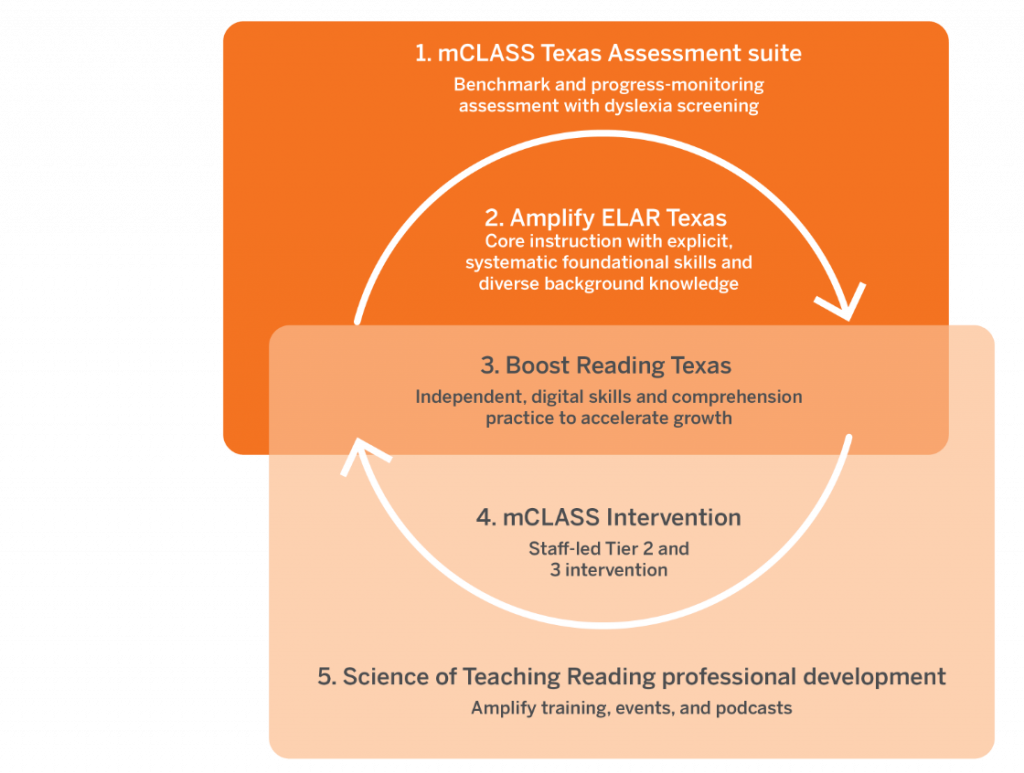
What is mCLASS Texas Edition?
mCLASS Texas Edition is an integrated, gold standard literacy system that offers teacher-administered assessment and holistic instruction for grades K–6. Teachers often complain about the need to cobble together a number of different tools. They don’t trust their screener so they use something else to monitor progress.
The mCLASS comprehensive system includes efficient one-minute measures, a built-in dyslexia screener, teacher-led and student-driven instruction, intervention, and robust reports for teachers and administrators. It’s all you’ll need to monitor and support every type of student learner in your classroom.
We’re excited to introduce mCLASS Lectura! mCLASS Lectura works with mCLASS’s DIBELS 8th Edition to deliver universal and dyslexia screening in both languages. This powerful tool is the only assessment to offer a dual language instructional report that shows how a student is reading in each language.
Built for Texas educators
TEA has established a bold vision for teaching and learning by:
- Enabling universal, multidimensional assessment.
- Supporting differentiated instruction based on diagnostics.
- Making the resulting data useful for teachers and parents.
mCLASS Texas Edition is built on decades of research at the Center on Teaching and Learning at the University of Oregon, a national center for early childhood assessment and instruction. The measures are already in use in hundreds of districts in Texas.
CLICK HERE to explore a walkthrough of mCLASS Texas Edition and mCLASS Lectura (or click the image to the right).
mCLASS® Texas Edition and mCLASS Lectura Reporting
Quick and actionable reports provide detailed insight into students’ reading development across foundational literacy skills for classroom teachers and literacy specialists, principals and district leaders, and parents and guardians at home.
mCLASS Texas Edition gives you instant results and clear next steps for each student.
When mCLASS Texas Edition is used in tandem with the brand new, mCLASS Lectura, educators will have access to a dual language instructional report that shows how a student is reading in each language.
Personalized learning for every student
Boost Reading (formerly Amplify Reading) is a K–8 student-driven literacy program that provides both remediation and enrichment for all students, leveraging the power of compelling storytelling to engage students in personalized reading instruction and practice.
At its heart, there are 3 main areas that make Boost Reading a unique supplemental learning program:
- The program meets all students where they are with powerful individualized instruction and practice
- Age-appropriate narratives create a learning experience that leaps off the screen
- Research shows Boost Reading improves student performance–particularly among English Learners–reducing the overall percentage of students at risk of reading difficulty.
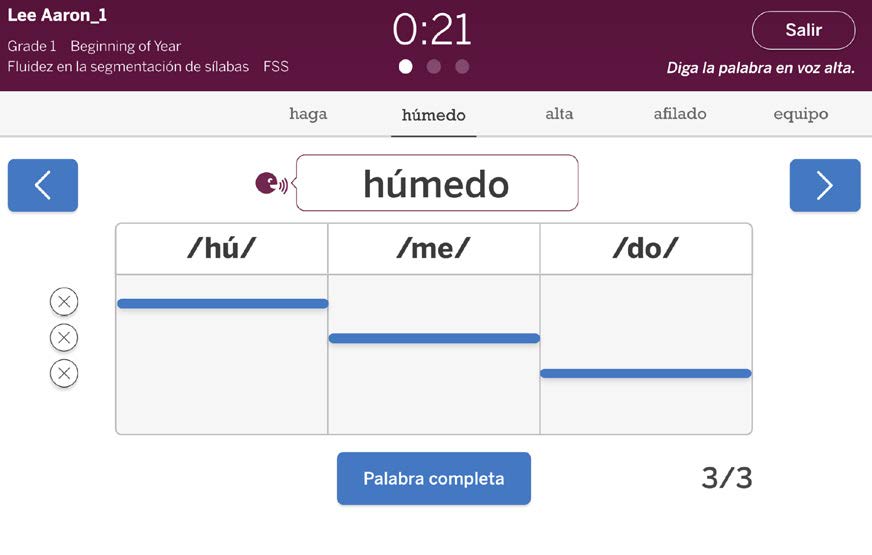
Introducing mCLASS Lectura: Dual Language assessment and instruction for K-6!
Here’s what mCLASS Lectura delivers to help teachers know what instruction to prioritize:
- An authentic dual language assessment that works in tandem with mCLASS Texas Edition to deliver universal and dyslexia screening in both languages.
- The only assessment to offer a dual language instructional report that shows how a student is reading in each language. This helps the teacher tailor instructional recommendations for each student based on the identified transferable skills from one language to another.
- Complete parity between English and Spanish solutions at all levels, with full coverage of the key foundational skills required by Texas
Click here to learn more about mCLASS Lectura.
Dyslexia screening: Catch at-risk students early
Early intervention is critical. mCLASS Texas with DIBELS 8th Edition aligns to the state’s rigorous requirements around dyslexia screening as outlined in the Texas Dyslexia Handbook.
Check out mCLASS Texas measures for DIBELS and Lectura here.
Get universal and dyslexia screening in one single powerful tool—no additional assessment system required.
Emergency Rules Related to Dyslexia Screening are available that address the 2019-20 school year kindergarten end-of-year dyslexia screening and have implications for the 2020/2021 school year 1st grade BOY administration of Commissioner-approved or LEA designated reading instrument. This new screening requirement applies to 1st grade students who were not screened for dyslexia at EOY of their kindergarten year.
Download our dyslexia toolkit to learn more.


mCLASS Texas Alignment with the Texas Essential Knowledge and Skills (TEKS)
mCLASS Texas Edition includes multiple measures. In English, it includes DIBELS 8th Edition and screeners of vocabulary, spelling, and oral language. In Spanish, it includes IDEL, screeners of vocabulary, oral language, and spelling.
Curious about required kindergarten beginning-of-year measures for ECDS Texas? Check out more details here!
Complete K–6 solution
Amplify also provides additional top-rated literacy programs that connect with mCLASS Texas Edition to give educators a robust, comprehensive package that covers all of their instructional needs.
- mCLASS Intervention is a staff-led reading intervention for K–6 that performs data analysis and lesson sequencing with Tier 2 and Tier 3 small-group intervention to get struggling readers back on track.
- Text Reading and Comprehension (TRC) for K–6 provides teachers with additional comprehension measures within the mCLASS platform, featuring a digital reading record and connected book sets.
- mCLASS Math offers universal screening and progress monitoring with diagnostic interviews to provide a rich view of at-risk students and gauge the effectiveness of math instruction.


Frequently asked questions
Interested in learning more? Read this FAQ we’ve put together based on questions we’ve received about mCLASS Texas Edition.
Remote and hybrid assessment and learning guide
mCLASS® Texas Edition has created a collection of resources to help users plan for a variety of scenarios for the 2020–2021 school year.
*The TEA has offered a a one-time waiver to school districts for the 2020-2021 school year. They continue to encourage LEAs to adopt a kindergarten screener, as districts will still need to meet dyslexia screening requirements for grades K and 1 for the 2020–21 school year.
Contact your Texas representative
Looking to speak directly with an mCLASS Texas Edition representative? Get in touch with the mCLASS Texas team to learn more about using the program:
Email: texas@amplify.com

Raymundo Rodriguez, M.Ed.
Vice President, South Central
Marty Pitts
Senior Account Executive
Mindi Jones
District Manager, South Central
Carla Small
Senior Account Executive

Mary Brown
Senior Account Executive
Katie Gentry-Funk
Senior Account Executive
Hector Gomez
Account Executive

Mark Ramos
Account Executive, Inside Sales

Melanie Ferry
Senior Account Executive, Inside Sales
Kelley Simpson
Account Executive, Inside Sales
Opt in today
Fill out the form to sign up for mCLASS/mCLASS Lectura! If you have any questions as you complete the form, you can reach our Texas team at texas@amplify.com.
Steps for Interviewing
Amplify Professional Learning Specialist Applicants
Congratulations on being invited to interview for the Professional Learning Specialist role!
Please take these three steps in order to schedule and prepare for your interview.
Step 1: Review the PLS Flipbook
Step 2: Schedule your Interview
Step 3: Prepare for your Interview
Interviews for Cohort 2 will take place from April 27th – May 8th.


Step 1: Review the PLS Flipbook
Amplify Professional Learning Specialists (PLS) will be responsible for facilitating high-quality professional development (PD) to teachers and school leaders, ensuring educators feel confident taking steps to implement our programs and ultimately drive student success.
Please read the PLS flipbook to ensure you have a clear understanding of the role and ensure this is the right fit for you. These details are captured in pages 16 – 33 of the flipbook.
Several key PLS responsibilities are highlighted below:
- Delivering remote and onsite professional development for approximately 30-40 educators per session during the summer season (May – September 2026), possibly longer.
- Must be available to be scheduled during normal school hours (Monday–Friday) in all U.S. time zones.
- Must be available an average of three days per week on Monday through Friday from July 13–August 21. Three consecutive days is strongly recommended as it will potentially lead to more onsite delivery opportunities.
- PLSs who are current educators and returning to full-time roles at school/districts must have a return to work date after August 21st.
- Traveling via car, plane, and/or public transportation, sometimes with minimal advance notice and including overnight stay at hotels.
- Paying all travel-related expenses in advance, with reimbursements being processed 2-3 weeks following submission of the expense reimbursement requests.
Please reach out to pls_hiring@amplify.com if you have additional questions.
Step 2: Schedule Your Interview
Our second round of interviews will take place between April 27th – May 8th. We do not have any earlier interviews available, all available slots are shown on the calendars linked below.
Please schedule an interview for the specific role for which you have applied:
- Literacy or STEM Candidates: schedule a 30 minute interview by clicking here: “PLS Interviews: May 2026”
- Bilingual Candidates: schedule a 45 minute interview by clicking here: “Bilingual PLS Interviews: May 2026” only. You do not need to sign up for a separate 30 minute interview.
- Once you have scheduled your interview, you should receive a confirmation email from Calendly. If you do not receive this email, please reach out to PLS_hiring@amplify.com for support.
If you need to reschedule your interview, you may do so directly by clicking the reschedule link in the confirmation email from Calendly to select a new interview option during the current interview window. Once you have rescheduled, you will receive a new confirmation email and updated calendar invitation. Please do not sign up for more than one interview.
We ask that you only reschedule if absolutely necessary and request at least 24 hours notice prior to your interview day/time.
Step 3: Prepare for Interview
Prior to your scheduled interview, prepare your interview activity! Please view the video to the right for help preparing.
- Guidance for the task can be found here: PLS Performance Task Guidance Document
- You should come ready to share your screen via Google Meet and present the provided activity in under 5 minutes.
- Talking points are included for each screen to guide your presentation.
- During your interview we will be looking for proficiency with the following tech skills: independently sharing screen, speech matching animation, and moving from screen to screen with ease.

Offer, Onboarding, and Training
- Qualified candidates will receive an offer via email. The offer will include your product placement and regional assignment.
- If you accept the offer, our partner contracting agency will reach out to you to provide the necessary documentation to begin the onboarding process. This will include a background check. You will also need to provide college transcripts, please begin gathering these items.
- Once you have completed the onboarding process with our partner contracting agency, you will begin your official Amplify PLS onboarding process on May 11th for Cohort 1 or June 15th for Cohort 2. A majority of onboarding will be remote, with one in person training on June 6th – 7th for Cohort 1 and July 8th – 9th for Cohort 2. More details to come!
- Once you are certified, our PD Operations team will begin to schedule you for PD engagements within your region and across the country!
Info Session
Get more details from PD staff members about the PLS role, regional placement, the onboarding process, and ongoing support.
We will address the most common questions we receive:
- What is the role of a PLS?
- Where will I deliver sessions? What content will I deliver?
- How will onboarding work?
- How will I be supported?
The information session recording can be watched here.
Passcode: @N+4hmfi
Thank you for your interest!
Contact us with questions at pls_hiring@amplify.com
Amplify customer support hub
Quickly find support for every step of your journey, whether you’re new to our programs or a long-time partner. Our support hub offers personalized, responsive assistance to drive strong implementation and boost student outcomes.
Round-the-clock help resources
Access comprehensive support anytime, anywhere with our 24/7 Help Center. Find articles, answers, and quick links with ease in this collection of resources.
For system status updates, click on Amplify System Status.
Need immediate assistance?
Whether you have a free account or your district has purchased an Amplify program, we’re here to help.

Request Support.
Free account users and customers can open a case for assistance.
Full program customer support
Phone support
Speak directly with our knowledgeable agents.
Call: +1 (800) 823-1969
Hours:
Monday through Friday
7 a.m. — 7 p.m. ET
Live chat
Connect instantly inside your program(s).
Log in at learning.amplify.com and click the chat button in the bottom right corner.
Continuous support along your journey
Personalized assistance
Our team helps with purchasing, order fulfillment, enrollment, and more.

From purchase to implementation
Collaborate with our sales team to explore programs tailored to your unique needs.

Smooth ordering and payment
Enjoy seamless purchasing with our dedicated team. For quick help, visit our payment support site or contact your account executive.

Ongoing success and growth
After processing your purchase, our specialized teams guide you through onboarding, professional development, materials delivery, digital setup, and implementation launch.
Discover the tools to transform teaching.
Continued learning and growth
Learn with us:
Join our free online webinars and events to explore thought leadership and gain insights. Stay informed about the latest in education.
Elevate your practice:
Explore paid professional development to enhance your skills and integrate our programs effectively. Our resources are tailored to support your success.
Your voice matters!
Join our lively Facebook communities to connect with fellow educators, share insights, and be part of a network advocating for student success and innovative education.
What’s included in our Spanish language arts curriculum
Amplify Core Knowledge Language Arts® (CKLA) is available in both English and Spanish. Amplify Caminos al Conocimiento Esencial, our robust Spanish language arts companion for grades K–5, supports multiple teaching models, including dual language immersion and transitional classrooms.
Year at a glance
The program’s intentional Knowledge Sequence from K–5 connects knowledge and vocabulary within a grade level and across grade levels, for deeper reading comprehension and preparation for college, career, and life. Instead of “activating prior knowledge,” Amplify Caminos helps you build it in the classroom from day one, for every child, expanding each student’s knowledge base long before they transition to reading to learn.
Units & domains at a glance
Each Knowledge Domain in grades K–2 and Unit in grades 3–5 varies in the number of days based on instructional purpose. Just as with our top-rated Amplify CKLA program, the Amplify Caminos materials engage and delight young learners with resources that are both appealing and original.
Domain
Nursery Rhymes and Fables/Rimas y fábulas infantiles
Start learning about literature with these classic Mother Goose rhymes.
Domain
The Five Senses/Los cinco sentidos
Learning about the body starts with learning about how we experience the world.
Domain
Stories/Cuentos
Learn about the parts of a book and some of the stories that go in one.
Domain
Plants/Plantas
Discover the lifecycle of plants and the history of George Washington Carver.
Domain
Farms/Granjas
Now we know how plants make their food… but what about animals?
Domain
Native Americans/Los nativos americanos
Who were the first people in America? A look at the Lenape, Wampanoag, and Lakota Sioux.
Domain
Kings and Queens/Reyes y reinas
To understand fairy tales, it’s best to first understand royalty.
Domain
Seasons and Weather/Las estaciones y el tiempo
The study of natural cycles continues with the weather and why it happens.
Domain
Columbus and the Pilgrims/Colón y los peregrinos
A look at the first contact between Europe and the Americas, and some of its results.
Domain
Colonial Towns and Townspeople/Las colonias y sus habitantes
Before the War for Independence, how did the town and country depend on one another?
Domain
Taking Care of the Earth/Cuidar el planeta Tierra
We only have one Earth—here are some ways to help care for it.
Domain
Presidents and American Symbols/Presidentes y símbolos de los Estados Unidos
Start learning about government through the lives of five presidents.
Domain
Fables and Stories/Fábulas y cuentos
Learn some of the key elements of a story through classic fables.
Domain
The Human Body/El cuerpo humano
What are germs? What are the organs? And what does it all have to do with health?
Domain
Different Lands, Similar Stories/Tierras diferentes, cuentos similares
A world tour of storytelling, and the stories that stay the same across the world.
Domain
Early World Civilizations/Antiguas civilizaciones del mundo
Rivers, farming, writing, and laws: just what does it take to build a civilization?
Domain
Early American Civilizations/Antiguas civilizaciones de América
What will we find in the great temples of the Aztec, Maya, and Inca civilizations?
Domain
Astronomy/Astronomía
How the Earth relates to the moon, the sun, and the rest of the planets.
Domain
The History of the Earth/La historia de la Tierra
Just what lies beneath the Earth’s surface, and what can it teach us about the past?
Domain
Animals and Habitats/Los animales y sus hábitats
A look at the connection between how animals live and where they make their homes.
Domain
Fairy Tales/Cuentos de hadas
What do fairy tales have to teach us about how stories are told?
Domain
A New Nation: American Independence/Una nueva nación: la independencia de los Estados Unidos
The story of the birth of the United States out of the 13 Colonies.
Domain
Frontier Explorers/Exploradores de la Frontera
The story of the journey west from the newborn U.S.A. to find the Pacific Ocean.
Domain
Fairy Tales and Tall Tales/Cuentos de hadas y cuentos exagerados
Learn about exaggeration and characterization on the frontier.
Domain
Early Asian Civilizations/Antiguas civilizaciones de Asia
Tour the world of classical civilization, starting with India and China.
Domain
Ancient Greek Civilization/La civilización griega antigua
The tour continues with the philosophy and politics of Greece.
Domain
Greek Myths/Mitos griegos
Dive deep into the characters and storytelling of classic myths.
Domain
The War of 1812/La guerra de 1812
Learn about America’s “Second War for Independence.”
Domain
Cycles in Nature/Los ciclos de la naturaleza
Introducing the natural cycles that make our lives possible.
Domain
Westward Expansion/La expansión hacia el oeste
Why did pioneers go west? What happened to the people who were there?
Domain
Insects/Los insectos
Lay the grounds for animal classification by looking at solitary and social insects.
Domain
The U.S. Civil War/La Guerra Civil de los Estados Unidos
Begin to grapple with U.S. history’s central crisis over slavery.
Domain
Human Body: Building Blocks and Nutrition/El cuerpo humano: componentes básicos y nutrición
A deeper dive into the digestive system and the nutrition process.
Domain
Immigration/La inmigración
Why did people immigrate to the United States, and what did they find here?
Domain
Fighting for a Cause/Luchar por una causa
How people can do extraordinary things to make the world better for everyone.
Unit 1
Classic Tales: The Wind in the Willows/Cuentos Clásicos: El viento en los sauces
A deep dive into character, theme, and POV in classic stories from around the world.
Unit 2
Animal Classification/La clasificación de los animales
How do we classify different animals by their appearance and behavior?
Unit 3
The Human Body: Systems and Senses/El cuerpo humano: sistemas y sentidos
Let’s take a closer look at how the skeleton, muscles, and nervous system all work.
Unit 4
The Ancient Roman Civilization/La civilización romana antigua
What is Rome’s greatest cultural contribution? In this unit, your students decide.
Unit 5
Light and Sound/La luz y el sonido
The science behind all the ways we see and hear the world.
Unit 6
The Viking Age/La era vikinga
An immersive narrative experience about what life was like in Viking communities.
Unit 7
Astronomy: Our Solar System and Beyond/Astronomía: nuestro sistema solar y más allá
More about our universe, including a writing project about daily life on a space station.
Unit 8
Native Americans: Regions and Cultures/Los nativos americanos: regiones y culturas
How did Native American nations change their way of life in different parts of the world?
Unit 9
Early Explorations of North America/La exploración europea de América del Norte
What was it like to sail to North America with the early European explorers?
Unit 10
Colonial America/La época colonial en los Estados Unidos
A study of the very different ways of life in the different pre-U.S. colonies.
Unit 11
Ecology/Ecología
Students keep ecologist’s journals to learn about our world and how best to protect it.
Unit 1
Personal Narratives/Narrativas personales
Read stories of personal experience… and learn to reflect on your own.
Unit 2
Empires in the Middle Ages/Los imperios en la Edad Media, parte 1 & Los imperios en la Edad Media, parte 2
Explore the medieval history of Europe and the Middle East.
Unit 3
Poetry/Poesía
Study the poetry of many nations using licensed text anthologies, and begin to write your own.
Unit 4
Eureka! Student Inventor/¡Eureka! Estudiante inventor
Transform the class into a lab for students to build and present inventions.
Unit 5
Geology/Geología
Plate tectonics, volcanoes, erosion: all the forces that shape the Earth.
Unit 6
Contemporary Fiction with excerpts from The House on Mango Street/Ficción Contemporánea con Fragmentos de La Casa en Mango Street
Explore The House on Mango Street… and write a book while doing it.
Unit 7
American Revolution/La Revolución estadounidense
Why did America seek independence? Let’s investigate the causes and effects.
Unit 8
Treasure Island/La Isla del Tesoro
How dSeek the treasure of plot in this detailed study of a classic fiction adventure.
Unit 1
Personal Narratives/Narrativas personales
Through writing and sharing their writing, students begin to identify themselves as writers.
Unit 2
Early American Civilizations/Las primeras civilizaciones americanas
Students craft a codex to explain the rise and fall of the Maya, Aztec, and Inca people.
Unit 3
Poetry/Poesía
Students close read many forms of poetry… and learn to write them.
Unit 4
Adventures of Don Quixote/Las Aventuras de Don Quijote
Was Don Quixote right to fight the windmill? In this full-length novel study, students decide.
Unit 5
The Renaissance/El Renacimiento
Exploring the art and literature of the Renaissance through the works of its masters.
Unit 6
The Reformation/La Reforma
How did the printing press transform the religion and society of Europe?
Unit 7
William Shakespeare’s A Midsummer Night’s Dream/Sueño de Una Noche de Verano de William Shakespeare
Students enter the world of Shakespeare by reading, designing, and acting out his work.
Unit 8
Native Americans/Los nativos americanos
How did the policies of the U.S. government impact Native American culture and lives?
Unit 9
Chemical Matter/Química
Students use knowledge of chemistry to solve a mystery.
Print & digital components
The program includes instructional guidance and student materials for a year of instruction, with lessons and activities that keep students engaged every day.
Component
FORMAT
Knowledge (Conocimientos) Teacher Guides (K–2)
Knowledge Strand Teacher Guides contain Amplify CKLA’s cross-curricular read-alouds and application activities, all of which are standards-based to build mastery of content knowledge and literacy skills. There is one Teacher Guide per Knowledge Domain.
Print and digital
Knowledge Image Cards (K–2)
Amplify Caminos includes Image Cards for each Knowledge Domain to bring each topic to life through vivid visuals.
Print and digital
Knowledge Flip Books (K–2)
Projectable Flip Books are provided to accompany the read-alouds in each Knowledge Domain.
Digital
Teacher Guides (3–5)
Teacher Guides for grades 3–5 units are based on content-rich topics and incorporate reading, writing, speaking, and listening skills in the context of background knowledge. There is one Teacher Guide per unit.
Print or digital
Teacher Resource Site (K–5)
The program includes a one-stop-shop website for lesson projections, digital versions of all Amplify Caminos materials, lesson planning resources, multimedia (such as eBooks), and more.
Digital
Professional Learning Site (K–5)
The Professional Learning site includes training materials, best practices, and other resources to develop program expertise. Access professional development anywhere, anytime.
Digital
Component
FORMAT
Knowledge (Conocimiento) Activity Books (K–2)
Activity Books provide students with the opportunity to deepen world and word knowledge by responding to text in a diversity of ways.
Student Readers (3–5)
Student Readers serve as content-rich anchor texts for each unit. Units such as Poetry and Contemporary Fiction feature authentic texts originally written in Spanish.
Activity Books (3–5)
Activity Books in grades 3–5 provide daily opportunities for students to hone reading and writing skills within the context of each unit.
Print and digital
Explore more programs
Our programs are designed to support and complement one another. Learn more about our related programs.
Welcome, Achieve reviewers!
Authored by UC Berkeley’s Lawrence Hall of Science, Amplify Science was designed from the ground up for the Next Generation Science Standards to teach students to think, read, write, and argue like real scientists and engineers. The program combines literacy-rich activities with hands-on learning and digital tools to engage students in exploring a compelling real-world phenomenon in every unit.
On this site, you will find easy-to-follow instructions and resources to support your review.


Units for review
Amplify Science is a blended learning program where students take on the roles of scientists and engineers to solve real-world problems.
As a reviewer, you’ll have access to three Amplify Science units:
- Grade 1: Plant and Animal Defenses
- Grade 3: Weather and Climate
- Middle School: Light Waves
Below you will find log in instructions for the digital curriculum.
Teacher account
Click the orange button and choose “Log in with Amplify” using the login information below:
Username: t1.achievereview@tryamplify.net
Password: AmplifyNumber1
Click here to view the full program guide.
If you have logged into Amplify Science in the past, you will need to log in with the new credentials above.
When you are finished reviewing, sign out of the digital curriculum. Need help?
Grade K
- Needs of Plants and Animals
- Pushes and Pulls
- Sunlight and Weather
Grade 1
- Animal and Plant Defenses
- Light and Sound
- Spinning Earth
Grade 2
- Plant and Animal Relationships
- Properties of Materials
- Changing Landforms
Grade 3
- Balancing Forces
- Inheritance and Traits
- Environments and Survival
- Weather and Climate
Grade 4
- Energy and Conversions
- Vision and Light
- Earth’s Features
- Waves, Energy, and Information
Grade 5
- Patterns of Earth and Sky
- Modeling Matter
- The Earth System
- Ecosystem Restoration
Earth and Space Science
- Launch: Geology on Mars
- Plate Motion
- Engineering Internship: Plate Motion
- Rock Transformations
- Earth, Moon, and Sun
- Ocean, Atmosphere, and Climate
- Weather Patterns
- Earth’s Changing Climate
- Engineering Internship: Earth’s Changing Climate
Life Science
- Launch: Microbiome
- Metabolism
- Engineering Internship: Metabolism
- Traits and Reproduction
- Populations and Resources
- Matter and Energy in Ecosystems
- Natural Selection
- Engineering Internship: Natural Selection
- Evolutionary History
Physical Science
- Launch: Harnessing Human Energy
- Force and Motion
- Engineering Internship: Force and Motion
- Magnetic Fields
- Thermal Energy
- Phase Change
- Engineering Internship: Phase Change
- Chemical Reactions
- Light Waves
Welcome
Elementary Literacy Program – Family Welcome Letter
Lectoescritura en Español – Carta de bienvenida para las familias
Grade K
- Skills Unit 1
- Skills Unit 2
- Skills Unit 3
- Skills Unit 4
- Knowledge Domain 1: Nursery Rhymes and Fables
- Knowledge Domain 2: The Five Senses
- Knowledge Domain 3: Stories: Fairy Tales and Folktales
- Knowledge Teacher Guide 3: Stories: Fairy Tales and Folktales
- Knowledge Trade Book Guide 3: Stories: Fairy Tales and Folktales
- Knowledge Digital Components 3: Stories: Fairy Tales and Folktales
- Knowledge Flip Book 3: Stories: Fairy Tales and Folktales
- Knowledge Image Cards 3: Stories: Fairy Tales and Folktales
- Knowledge Domain 4: Plants: How Do They Grow?
- Ancillary Materials
- Skills Unit 1
- Skills Activity Book 1 (PDF)
- Skills Unit 2
- Skills Activity Book 2 (PDF)
- Skills Unit 3
- Skills Activity Book 3 (PDF)
- Skills Unit 4
- Skills Activity Book 4 (PDF)
- Knowledge Domain 1: Nursery Rhymes and Fables
- Knowledge Domain 2: The Five Senses
- Knowledge Activity Book 2: The Five Senses (PDF)
- Knowledge Activity Book 2: The Five Senses (Editable PDF)
- Knowledge Domain 3: Stories: Fairy Tales and Folktales
- Knowledge Domain 4: Plants: How Do They Grow
- Read-Aloud Videos
- Conocimiento 1: Rimas y fábulas infantiles
- Conocimiento 2: Los cinco sentidos
- Conocimiento 3: Cuentos: cuentos de hadas y cuentos populares
- Guía del maestro – Conocimiento 3: Cuentos: cuentos de hadas y cuentos populares
- Componentes digitales – Conocimiento 3: Cuentos: cuentos de hadas y cuentos populares
- Rotafolio de imágenes – Conocimiento 3: Cuentos: cuentos de hadas y cuentos populares
- Tarjetas de imágenes – Conocimiento 3: Cuentos: cuentos de hadas y cuentos populares
- Conocimiento 4: Plantas: ¿cómo crecen?
- Conocimiento 1: Rimas y fábulas infantiles
- Conocimiento 2: Los cinco sentidos
- Conocimiento 3: Cuentos: cuentos de hadas y cuentos populares
- Conocimiento 4: Plantas: ¿cómo crecen?
- Lectura en voz alta
- English
- Español
Grade 1
- Skills Unit 1
- Skills Unit 2
- Skills Unit 3
- Knowledge Domain 1: Fables and Stories
- Knowledge Domain 2: The Human Body
- Knowledge Domain 3: Different Lands, Similar Stories: Tales Around the World
- Knowledge Teacher Guide 3: Different Lands, Similar Stories: Tales Around the World
- Knowledge Trade Book Guide 3: Different Lands, Similar Stories: Tales Around the World
- Knowledge Digital Components 3: Different Lands, Similar Stories: Tales Around the World
- Knowledge Flip Book 3: Different Lands, Similar Stories: Tales Around the World
- Knowledge Image Cards 3: Different Lands, Similar Stories: Tales Around the World
- Vocabulary
- Ancillary Materials
- Skills Unit 1
- Skills Unit 2
- Skills Unit 3
- Knowledge Domain 1: Fables and Stories
- Knowledge Domain 2: The Human Body
- Knowledge Activity Book 2: The Human Body (PDF)
- Knowledge Activity Book 2: The Human Body (Editable PDF)
- Knowledge Domain 3: Different Lands, Similar Stories: Tales Around the World
- Read-Aloud Videos
- Conocimiento 1: Fábulas y cuentos
- Conocimiento 2: El cuerpo humano
- Conocimiento 3: Tierras diferentes, cuentos similares: relatos del mundo
- Lectura en voz alta
- Conocimiento 1: Fábulas y cuentos
- Conocimiento 2: El cuerpo humano
- Conocimiento 3: Tierras diferentes, cuentos similares: relatos del mundo
- Lectura en voz alta
Grade 2
- Skills Unit 1
- Skills Teacher Guide 1 (Includes Full-Year Cursive Instruction)
- Skills Digital Components 1
- Skills Unit 2
- Skills Unit 3
- Knowledge Domain 1: Fairy Tales and Tall Tales
- Knowledge Domain 2: Early Asian Civilizations
- Knowledge Domain 3: The Ancient Greek Civilization
- Knowledge Teacher Guide 3: The Ancient Greek Civilization
- Knowledge Trade Book Guide Domain 3: The Ancient Greek Civilization
- Knowledge Digital Components Domain 3: The Ancient Greek Civilization
- Knowledge Flip Book Domain 3: The Ancient Greek Civilization
- Knowledge Image Cards Domain 3: The Ancient Greek Civilization
- Knowledge Domain 4: Greek Myths: Gods and Goddesses
- Vocabulary
- Ancillary Materials
- Skills Unit 1
- Skills Unit 2
- Skills Unit 3
- Knowledge Domain 1: Fairy Tales and Tall Tales
- Knowledge Domain 2: Early Asian Civilizations
- Knowledge Domain 3: The Ancient Greek Civilization
- Knowledge Domain 4: Greek Myths: Gods and Goddesses
- Read-Aloud Videos
- Ancillary Resources
- Conocimiento 1: Cuentos de hadas y cuentos exagerados
- Conocimiento 2: Antiguas civilizaciones de Asia
- Conocimiento 3: La civilización griega antigua
- Conocimiento 4: Mitos griegos: dioses y diosas
- Conocimiento 1: Cuentos de hadas y cuentos exagerados
- Conocimiento 2: Antiguas civilizaciones de Asia
- Conocimiento 3: La civilización griega antigua
- Conocimiento 4: Mitos griegos: dioses y diosas
- Lectura en voz alta
- English
- Español
Grade 3
- Unit 1: Classic Tales: The Wind in the Willows
- Teacher Guide Unit 1: Classic Tales: The Wind in the Willows
- Digital Projections Unit 1: Classic Tales: The Wind in the Willows
- Flip Book Unit 1: Classic Tales: The Wind in the Willows
- Image Cards 1: Classic Tales: The Wind in the Willows
- Essential Questions and Writing Prompts 1: Classic Tales: The Wind in the Willows
- Exit Tickets Unit 1: Classic Tales: The Wind in the Willows
- Unit 2: Scales, Feathers, and Fur: Animal Classification
- Teacher Guide Unit 2: Scales, Feathers, and Fur: Animal Classification
- Digital Projections Unit 2: Scales, Feathers, and Fur: Animal Classification
- Flip Book Unit 2: Scales, Feathers, and Fur: Animal Classification
- Essential Questions and Writing Prompts Unit 2: Scales, Feathers, and Fur: Animal Classification
- Exit Tickets Unit 2: Scales, Feathers, and Fur: Animal Classification
- Unit 3: The Human Body: Systems and Senses
- Teacher Guide Unit 3: The Human Body: Systems and Senses
- Digital Projections Unit 3: The Human Body: Systems and Senses
- Flip Book Unit 3: The Human Body: Systems and Senses
- Image Cards Unit 3: The Human Body: Systems and Senses
- Essential Questions and Writing Prompts Unit 3: The Human Body: Systems and Senses
- Exit Tickets Unit 3: The Human Body: Systems and Senses
- Unit 4: The Ancient Roman Civilization
- Vocabulary
- Vocabulary Scope and Sequence: K-5
- Vocabulary Lesson Unit 1: Classic Tales: Idioms and Figurative Language
- Vocabulary Lesson Unit 2: Scales, Feather, and Fur: Animal Classification: Alphabetizing
- Vocabulary Lesson Unit 3: The Human Body: System and Senses: Homophones/Homographs
- Vocabulary Lesson Unit 4: The Ancient Roman Civilization: Print and Digital References
- Ancillary Materials
- Unit 1: Classic Tales
- Unit 2: Scales, Feathers, and Fur: Animal Classification
- Unit 3: The Human Body: Systems and Senses
- Unit 4: The Ancient Roman Civilization
- Ancillary Materials
- Unidad 1: Cuentos clásicos: El viento en los sauces
- Unidad 2: Escamas, plumas y pelaje: la clasificación de los animales
- Unidad 3: El cuerpo humano: sistemas y sentidos
- Guía del maestro – Unidad 3: El cuerpo humano: sistemas y sentidos
- Proyecciones digitales – Unidad 3: El cuerpo humano: sistemas y sentidos
- Rotafolio de imágenes – Unidad 3: El cuerpo humano: sistemas y sentidos
- Tarjetas de imágenes – Unidad 3: El cuerpo humano: sistemas y sentidos
- Boletos de salida – Unidad 3: El cuerpo humano: sistemas y sentidos
- Unidad 4: La civilización romana antigua
- Guía del maestro – Unidad 4: La civilización romana antigua
- Proyecciones digitales – Unidad 4: La civilización romana antigua
- Rotafolio de imágenes – Unidad 4: La civilización romana antigua
- Tarjetas de imágenes – Unidad 4: La civilización romana antigua
- Boleto de salida – Unidad 4: La civilización romana antigua
- Unidad 1: Cuentos clásicos: El viento en los sauces
- Unidad 2: Escamas, plumas y pelaje: la clasificación de los animales
- Unidad 3: El cuerpo humano: sistemas y sentidos
- Unidad 4: La civilización romana antigua
- English
- Español
Grade 4
- Unit 1: Empires of the Middle Ages: Castles and Caravans, Part 1
- Teacher Guide Unit 1: Empires of the Middle Ages: Castles and Caravans, Part 1
- Essential Questions and Writing Prompts Unit 1: Empires of the Middle Ages: Castles and Caravans, Part 1
- Digital Components Unit 1: Empires of the Middle Ages: Castles and Caravans, Part 1
- Cursive Instruction
- Beginning-of-Year Assessment
- Exit Tickets Unit 1: Empires of the Middle Ages: Castles and Caravans, Part 1
- Unit 2: Eureka! The Art of Invention
- Unit 3: Contemporary Fiction: Mi Calle, Tu Calle
- Unit 4: American Revolution: Building a Nation
- Vocabulary
- Vocabulary Scope and Sequence: K-5
- Vocabulary Lesson Unit 1: Empires of the Middle Ages: Castles and Caravans: Formal and Informal Language
- Vocabulary Lesson Unit 2: Eureka! The Art of Invention: Adages and Proverbs
- Vocabulary Lesson Unit 3: Contemporary Fiction: Mi Calle, Tu Calle: Print and Digital References
- Vocabulary Lesson Unit 3: Contemporary Fiction: Mi Calle, Tu Calle: Word Origins and Histories
- Vocabulary Lesson Unit 4: American Revolution: Building a Nation: Common Prefixes
- Vocabulary Lesson Unit 4: American Revolution: Building a Nation: Common Suffixes
- Unit 2: Eureka! The Art of Invention
- Eureka! Audio
- Eureka! Video Files
- Unit 1: Empires of the Middle Ages: Castles and Caravans, Part1
- Unit 2: Eureka! The Art of Invention
- Unit 3: Contemporary Fiction: Mi Calle, Tu Calle
- Unit 4: American Revolution: Building a Nation
- Unidad 1: Los imperios en la Edad Media: castillos y caravanas, parte 1
- Unidad 2: ¡Eureka! El arte de la invención
- Unidad 3: Ficción contemporánea: mi calle, tu calle
- Unidad 4: La Revolución estadounidense: construir una nación
- Unidad 2: ¡Eureka! El arte de la invención
- Componentes digitales Unidad 2: ¡Eureka! El arte de la invención
- Componentes digitales 2 – Transcripciones de los videos
- Componentes digitales 3 – Imagen del día
- Componentes digitales 4 – Apertura y Notas de los jueces
- Tarjetas de invenciones
- Tarjetas de inventores
- Pegatinas de laboratorio
- Bombilla de la Gloria
- Carteles de silencio y aplauso
- Rueda de la invención
- Unidad 1: Los imperios en la Edad Media: castillos y caravanas, parte 1
- Libro de lectura – Unidad 1: Los imperios en la Edad Media: castillos y caravanas, parte 1
- Cuaderno de actividades – Unidad 1: Los imperios en la Edad Media: castillos y caravanas, parte 1 (PDF)
- Cuaderno de actividades – Unidad 1: Los imperios en la Edad Media: castillos y caravanes, parte 1 (PDF editable)
- Unidad 2: ¡Eureka! El arte de la invención
- Unidad 3: Ficción contemporánea: mi calle, tu calle
- Unidad 4: La Revolución estadounidense: construir una nación
- English
- Español
Grade 5
- Unit 1: Early American Civilizations: Myths, Pyramids, and Kings
- Teacher Guide Unit 1: Early American Civilizations: Myths, Pyramids, and Kings
- Essential Questions and Writing Prompts Unit 1: Early American Civilizations: Myths, Pyramids, and Kings
- Digital Components Unit 1: Early American Civilizations: Myths, Pyramids, and Kings
- Cursive Instruction
- Beginning-of-Year Assessment
- Exit Tickets Unit 1: Early American Civilizations: Myths, Pyramids, and Kings
- Unit 2: The Renaissance: Art and Culture
- Unit 3: The Reformation: When Books Changed the World
- Teacher Guide Unit 3: The Reformation: When Books Changed the World
- Digital Components Unit 3: The Reformation: When Books Changed the World
- Essential Questions and Writing Prompts Unit 3: The Reformation: When Books Changed the World
- Exit Tickets Unit 3: The Reformation: When Books Changed the World
- Vocabulary
- Vocabulary Scope and Sequence: K-5
- Vocabulary Lesson Unit 1: Early American Civilizations: Myths, Pyramids, and Kings: Word Origins & Word Histories
- Vocabulary Lesson Unit 1: Early American Civilizations: Myths, Pyramids, and Kings: Print & Digital References
- Vocabulary Lesson Unit 2: The Renassiance: Art and Culture: Adages and Proverbs
- Vocabulary Lesson Unit 3: The Reformation: When Books Changed the World: Formal and Informal Language
- Unit 1: Early American Civilizations: Myths, Pyramids, and Kings
- Unit 2: The Renaissance: Art and Culture
- Unit 3: The Reformation: When Books Changed the World
- Ancillary Materials
- Unidad 1: Las primeras civilizaciones americanas: mitos, pirámides y reyes
- Unidad 2: El Renacimiento: arte y cultura
- Unidad 3: La Reforma: cuando los libros cambiaron el mundo
- Unidad 1: Las primeras civilizaciones americanas: mitos, pirámides y reyes
- Libro de lectura – Unidad 1: Las primeras civilizaciones americanas: mayas, aztecas e incas
- Cuaderno de actividades – Unidad 1: Las primeras civilizaciones americanas: mitos, pirámides y reyes (PDF)
- Cuaderno de actividades – Unidad 1: Las primeras civilizaciones americanas: mitos, pirámides y reyes (PDF editable)
- Unidad 2: El Renacimiento: arte y cultura
- Unidad 3: La Reforma: cuando los libros cambiaron el mundo
Welcome
Elementary Literacy Program – Family Welcome Letter
Lectoescritura en Español – Carta de bienvenida para las familias
Grade K
- Skills Unit 1
- Skills Unit 2
- Skills Unit 3
- Knowledge Domain 1: Nursery Rhymes and Fables
- Knowledge Domain 2: The Five Senses
- Knowledge Domain 3: Stories: Fairy Tales and Folktales
- Knowledge Teacher Guide 3: Stories: Fairy Tales and Folktales
- Knowledge Trade Book Guide 3: Stories: Fairy Tales and Folktales
- Knowledge Digital Components 3: Stories: Fairy Tales and Folktales
- Knowledge Flip Book 3: Stories: Fairy Tales and Folktales
- Knowledge Image Cards 3: Stories: Fairy Tales and Folktales
- Ancillary Materials
- Skills Unit 1
- Skills Activity Book 1 (PDF)
- Skills Unit 2
- Skills Activity Book 2 (PDF)
- Skills Unit 3
- Skills Activity Book 3 (PDF)
- Knowledge Domain 1: Nursery Rhymes and Fables
- Knowledge Domain 2: The Five Senses
- Knowledge Activity Book 2: The Five Senses (PDF)
- Knowledge Activity Book 2: The Five Senses (Editable PDF)
- Knowledge Domain 3: Stories: Fairy Tales and Folktales
- Read-Aloud Videos
- Conocimiento 1: Rimas y fábulas infantiles
- Conocimiento 2: Los cinco sentidos
- Conocimiento 3: Cuentos: cuentos de hadas y cuentos populares
- Guía del maestro – Conocimiento 3: Cuentos: cuentos de hadas y cuentos populares
- Componentes digitales – Conocimiento 3: Cuentos: cuentos de hadas y cuentos populares
- Rotafolio de imágenes – Conocimiento 3: Cuentos: cuentos de hadas y cuentos populares
- Tarjetas de imágenes – Conocimiento 3: Cuentos: cuentos de hadas y cuentos populares
- Conocimiento 1: Rimas y fábulas infantiles
- Conocimiento 2: Los cinco sentidos
- Conocimiento 3: Cuentos: cuentos de hadas y cuentos populares
- Lectura en voz alta
Grade 1
- Skills Unit 1
- Skills Unit 2
- Skills Unit 3
- Knowledge Domain 1: Fables and Stories
- Knowledge Domain 2: The Human Body
- Knowledge Domain 3: Different Lands, Similar Stories: Tales Around the World
- Knowledge Teacher Guide 3: Different Lands, Similar Stories: Tales Around the World
- Knowledge Trade Book Guide 3: Different Lands, Similar Stories: Tales Around the World
- Knowledge Digital Components 3: Different Lands, Similar Stories: Tales Around the World
- Knowledge Flip Book 3: Different Lands, Similar Stories: Tales Around the World
- Knowledge Image Cards 3: Different Lands, Similar Stories: Tales Around the World
- Vocabulary
- Ancillary Materials
- Skills Unit 1
- Skills Unit 2
- Skills Unit 3
- Knowledge Domain 1: Fables and Stories
- Knowledge Domain 2: The Human Body
- Knowledge Activity Book 2: The Human Body (PDF)
- Knowledge Activity Book 2: The Human Body (Editable PDF)
- Knowledge Domain 3: Different Lands, Similar Stories: Tales Around the World
- Read-Aloud Videos
- Conocimiento 1: Fábulas y cuentos
- Conocimiento 2: El cuerpo humano
- Conocimiento 3: Tierras diferentes, cuentos similares: relatos del mundo
- Guía del maestro – Conocimiento 3: Tierras diferentes, cuentos similares: relatos del mundo
- Componentes digitales – Conocimiento 3: Tierras diferentes, cuentos similares: relatos del mundo
- Rotafolio de imágenes – Conocimiento 3: Tierras diferentes, cuentos similares: relatos del mundo
- Tarjetas de imágenes – Conocimiento 3: Tierras diferentes, cuentos similares: relatos del mundo
- Conocimiento 1: Fábulas y cuentos
- Conocimiento 2: El cuerpo humano
- Conocimiento 3: Tierras diferentes, cuentos similares: relatos del mundo
- Lectura en voz alta
Grade 2
- Skills Unit 1
- Skills Teacher Guide 1 (Includes Full-Year Cursive Instruction)
- Skills Digital Components 1
- Skills Unit 2
- Skills Unit 3
- Knowledge Domain 1: Fairy Tales and Tall Tales
- Knowledge Domain 2: Early Asian Civilizations
- Knowledge Domain 3: The Ancient Greek Civilization
- Knowledge Teacher Guide 3: The Ancient Greek Civilization
- Knowledge Trade Book Guide Domain 3: The Ancient Greek Civilization
- Knowledge Digital Components Domain 3: The Ancient Greek Civilization
- Knowledge Flip Book Domain 3: The Ancient Greek Civilization
- Knowledge Image Cards Domain 3: The Ancient Greek Civilization
- Vocabulary
- Ancillary Materials
- Skills Unit 1
- Skills Unit 2
- Skills Unit 3
- Knowledge Domain 1: Fairy Tales and Tall Tales
- Knowledge Domain 2: Early Asian Civilizations
- Knowledge Domain 3: The Ancient Greek Civilization
- Read-Aloud Videos
- Ancillary Resources
- Conocimiento 1: Cuentos de hadas y cuentos exagerados
- Conocimiento 2: Antiguas civilizaciones de Asia
- Conocimiento 3: La civilización griega antigua
- Conocimiento 1: Cuentos de hadas y cuentos exagerados
- Conocimiento 2: Antiguas civilizaciones de Asia
- Conocimiento 3: La civilización griega antigua
- Lectura en voz alta
Grade 3
- Unit 1: Classic Tales: The Wind in the Willows
- Teacher Guide Unit 1: Classic Tales: The Wind in the Willows
- Digital Projections Unit 1: Classic Tales: The Wind in the Willows
- Flip Book Unit 1: Classic Tales: The Wind in the Willows
- Image Cards 1: Classic Tales: The Wind in the Willows
- Essential Questions and Writing Prompts 1: Classic Tales: The Wind in the Willows
- Unit 2: Scales, Feathers, and Fur: Animal Classification
- Teacher Guide Unit 2: Scales, Feathers, and Fur: Animal Classification
- Digital Projections Unit 2: Scales, Feathers, and Fur: Animal Classification
- Flip Book Unit 2: Scales, Feathers, and Fur: Animal Classification
- Essential Questions and Writing Prompts Unit 2: Scales, Feathers, and Fur: Animal Classification
- Unit 3: The Human Body: Systems and Senses
- Teacher Guide Unit 3: The Human Body: Systems and Senses
- Digital Projections Unit 3: The Human Body: Systems and Senses
- Flip Book Unit 3: The Human Body: Systems and Senses
- Image Cards Unit 3: The Human Body: Systems and Senses
- Essential Questions and Writing Prompts Unit 3: The Human Body: Systems and Senses
- Exit Tickets Unit 3: The Human Body: Systems and Senses
- Vocabulary
- Ancillary Materials
- Unit 1: Classic Tales
- Unit 2: Scales, Feathers, and Fur: Animal Classification
- Unit 3: The Human Body: Systems and Senses
- Ancillary Materials
- Unidad 1: Cuentos clásicos: El viento en los sauces
- Unidad 2: Escamas, plumas y pelaje: la clasificación de los animales
- Unidad 3: El cuerpo humano: sistemas y sentidos
- Guía del maestro – Unidad 3: El cuerpo humano: sistemas y sentidos
- Proyecciones digitales – Unidad 3: El cuerpo humano: sistemas y sentidos
- Rotafolio de imágenes – Unidad 3: El cuerpo humano: sistemas y sentidos
- Tarjetas de imágenes – Unidad 3: El cuerpo humano: sistemas y sentidos
- Boletos de salida – Unidad 3: El cuerpo humano: sistemas y sentidos
- Unidad 1: Cuentos clásicos: El viento en los sauces
- Unidad 2: Escamas, plumas y pelaje: la clasificación de los animales
- Unidad 3: El cuerpo humano: sistemas y sentidos
Grade 4
- Unit 1: Empires of the Middle Ages: Castles and Caravans, Part 1
- Teacher Guide Unit 1: Empires of the Middle Ages: Castles and Caravans, Part 1
- Essential Questions and Writing Prompts Unit 1: Empires of the Middle Ages: Castles and Caravans, Part 1
- Digital Components Unit 1: Empires of the Middle Ages: Castles and Caravans, Part 1
- Cursive Instruction
- Beginning-of-Year Assessment
- Unit 2: Eureka! The Art of Invention
- Unit 3: Contemporary Fiction: Mi Calle, Tu Calle
- Vocabulary
- Vocabulary Scope and Sequence: K-5
- Vocabulary Lesson Unit 1: Empires of the Middle Ages: Castles and Caravans: Formal and Informal Language
- Vocabulary Lesson Unit 2: Eureka! The Art of Invention: Adages and Proverbs
- Vocabulary Lesson Unit 3: Contemporary Fiction: Mi Calle, Tu Calle: Print and Digital References
- Vocabulary Lesson Unit 3: Contemporary Fiction: Mi Calle, Tu Calle: Word Origins and Histories
- Unit 2: Eureka! The Art of Invention
- Eureka! Audio
- Eureka! Video Files
- Unit 1: Empires of the Middle Ages: Castles and Caravans, Part1
- Unit 2: Eureka! The Art of Invention
- Unit 3: Contemporary Fiction: Mi Calle, Tu Calle
- Unidad 1: Los imperios en la Edad Media: castillos y caravanas, parte 1
- Unidad 2: ¡Eureka! El arte de la invención
- Unidad 3: Ficción contemporánea: mi calle, tu calle
- Unidad 2: ¡Eureka! El arte de la invención
- Componentes digitales Unidad 2: ¡Eureka! El arte de la invención
- Componentes digitales 2 – Transcripciones de los videos
- Componentes digitales 3 – Imagen del día
- Componentes digitales 4 – Apertura y Notas de los jueces
- Tarjetas de invenciones
- Tarjetas de inventores
- Pegatinas de laboratorio
- Bombilla de la Gloria
- Carteles de silencio y aplauso
- Rueda de la invención
- Unidad 1: Los imperios en la Edad Media: castillos y caravanas, parte 1
- Libro de lectura – Unidad 1: Los imperios en la Edad Media: castillos y caravanas, parte 1
- Cuaderno de actividades – Unidad 1: Los imperios en la Edad Media: castillos y caravanas, parte 1 (PDF)
- Cuaderno de actividades – Unidad 1: Los imperios en la Edad Media: castillos y caravanes, parte 1 (PDF editable)
- Unidad 2: ¡Eureka! El arte de la invención
- Unidad 3: Ficción contemporánea: mi calle, tu calle
Grade 5
- Unit 1: Early American Civilizations: Myths, Pyramids, and Kings
- Teacher Guide Unit 1: Early American Civilizations: Myths, Pyramids, and Kings
- Essential Questions and Writing Prompts Unit 1: Early American Civilizations: Myths, Pyramids, and Kings
- Digital Components Unit 1: Early American Civilizations: Myths, Pyramids, and Kings
- Cursive Instruction
- Beginning-of-Year Assessment
- Unit 2: The Renaissance: Art and Culture
- Unit 3: The Reformation: When Books Changed the World
- Teacher Guide Unit 3: The Reformation: When Books Changed the World
- Digital Components Unit 3: The Reformation: When Books Changed the World
- Essential Questions and Writing Prompts Unit 3: The Reformation: When Books Changed the World
- Exit Tickets Unit 3: The Reformation: When Books Changed the World
- Vocabulary
- Vocabulary Scope and Sequence: K-5
- Vocabulary Lesson Unit 1: Early American Civilizations: Myths, Pyramids, and Kings: Word Origins & Word Histories
- Vocabulary Lesson Unit 1: Early American Civilizations: Myths, Pyramids, and Kings: Print & Digital References
- Vocabulary Lesson Unit 2: The Renassiance: Art and Culture: Adages and Proverbs
- Vocabulary Lesson Unit 3: The Reformation: When Books Changed the World: Formal and Informal Language
- Unit 1: Early American Civilizations: Myths, Pyramids, and Kings
- Unit 2: The Renaissance: Art and Culture
- Unit 3: The Reformation: When Books Changed the World
- Ancillary Materials
- Unidad 1: Las primeras civilizaciones americanas: mitos, pirámides y reyes
- Unidad 2: El Renacimiento: arte y cultura
- Unidad 3: La Reforma: cuando los libros cambiaron el mundo
- Unidad 1: Las primeras civilizaciones americanas: mitos, pirámides y reyes
- Libro de lectura – Unidad 1: Las primeras civilizaciones americanas: mayas, aztecas e incas
- Cuaderno de actividades – Unidad 1: Las primeras civilizaciones americanas: mitos, pirámides y reyes (PDF)
- Cuaderno de actividades – Unidad 1: Las primeras civilizaciones americanas: mitos, pirámides y reyes (PDF editable)
- Unidad 2: El Renacimiento: arte y cultura
- Unidad 3: La Reforma: cuando los libros cambiaron el mundo
What is mCLASS?
mCLASS is a best-in-class assessment platform that houses a suite of proven, gold-standard assessment measures and tools that can be flexibly combined to meet the unique literacy needs of both teachers and students across grades K–6, including:
- Universal screening
- Diagnostic assessment
- Dyslexia screening
- Text Reading and Comprehension (a.k.a. running records via mCLASS: Reading 3D)
- Progress monitoring
- Dual language reporting
- Targeted teacher-led instruction
What is the DIBELS 8th Edition assessment?
Developed by the University of Oregon, the DIBELS 8th Edition is the latest version of the DIBELS® (Dynamic Indicators of Basic Early Literacy Skills) assessment.
With this latest version, the University of Oregon Center on Teaching and Learning (UO CTL) made significant efforts to ensure measures would meet state-level screening requirements for universal screening, diagnostic assessment, and dyslexia screening. To support this, measures were updated based on the latest research to meet increased standards of reliability and validity. In addition, adaptive procedures and discontinue rules focus on the assessment of priority skills and prevent over-testing.
Summary of changes:
- Consistent measures within grades will provide improved growth measurement.
- All subtests have been revised to be grade-specific and to increase in difficulty, covering a full progression of skills and minimizing floor and ceiling effects. This provides the opportunity for students to demonstrate what they know and further pinpoint what they don’t know.
- Phoneme Segmentation Fluency replaces First Sound Fluency. The expanded coverage minimizes floor effect and provides information about difficulty in Phonemic Awareness skills without the additional First Sound Fluency measure.
- A new subtest, Word Reading Fluency, helps identify students with poor sight word reading skills that other subtests miss.
- For all measures, the basic scoring procedures remain the same. For Nonsense Word Fluency, credit is given for recording words as whole words even if the student misses in the first attempt.
- Oral Reading Fluency is now only one passage, instead of three. Retell has been removed. Thus, Oral Reading Fluency assessment will take a third of the time.
Assessment measures by grade
| DIBELS measures at each grade level | |||||
| Measure | Grade K | Grade 1 | Grade 2 | Grade 3 | Grades 4–6 |
| Letter naming fluency | |
|
|||
| Phonemic segmentation fluency | |
|
|||
| Nonsense word fluency | |
|
|
|
|
| Word reading fluency | |
|
|
|
|
| Oral reading fluency | |
|
|
|
|
| Maze (basic comprehension) | |
|
|
||
| Amplify measures at each grade level | |||||
| Oral language | |
|
|
|
|
| Vocabulary | |
|
|
|
|
Assessment measures sample videos
DIBELS 8th Edition measure: Phonemic Segmentation Fluency (PSF)
DIBELS 8th Edition measure: Nonsense Word Fluency (NWF)
DIBELS 8th Edition measure: Letter Naming Fluency (LNF)
DIBELS 8th Edition measure: Word Reading Fluency (WRF)
DIBELS 8th Edition measure: Oral Reading Fluency (ORF)
What makes mCLASS with DIBELS 8th Edition different?
mCLASS with DIBELS 8th Edition combines the power of the mCLASS assessment platform and the effectiveness of the DIBELS 8th Edition assessment measures. As a result – educators are empowered with the latest and greatest assessment tool.
More than a test, mCLASS with DIBELS 8th Edition is an integrated system that closes the knowing-doing gap by helping teachers take immediate instructional action that’s right for each and every student.
Assessment systems must enable and compel educators to answer not just the “What” questions, but also the “So What” and “Now What” questions. These are the questions that are essential in transforming classroom instruction, and the questions that mCLASS with DIBELS 8th Edition helps teachers answer with confidence.
What makes mCLASS with DIBELS 8th Edition different?
- It gives teachers access to the latest digital version of the DIBELS assessment. Amplify is the only licensed provider of the digital DIBELS 8th Edition assessment. As such, our solution is the only one to enhance the DIBELS 8th Edition assessment with the power, reliability, and quickness of the mCLASS system.
- It makes it faster and easier to understand where every student is in their early literacy journey. By combining 1:1 observational diagnostic assessments, dyslexia screening, progress monitoring, instant scoring, rigorous reporting, automatic student grouping, and targeted instruction all in one place, it reduces the instructional delays associated with manual scoring, manual data analysis, and manual lesson planning.
- It makes every instructional minute count. In addition to one-minute measures that quickly gauge student progress toward reading proficiency, it leverages a teacher’s most powerful instructional tool — their own 1:1 observations.
- It drives growth more efficiently. Rather than relying on broad composite scores alone, granular data and in-depth insights for every student help teachers pinpoint exact skill gaps and areas of unfinished learning, making whole-group, small-group, and 1:1 instruction more targeted and effective.
- It saves teachers time. Instant reports, automatic student groups, and ready-to-teach lessons mean teachers spend less time cobbling together materials and more time working directly with students and responding to their needs.
How does mCLASS with DIBELS 8th Edition support screening for dyslexia risk?
DIBELS 8th Edition measures have been updated based on the latest research. They now offer stronger measures of processing speed, phonological awareness, and alphabetic principles for dyslexia screening purposes.
To support this, a new subtest in Word Reading Fluency was introduced and revisions were made to Letter Naming Fluency, Phonemic Segmentation Fluency, and Nonsense Fluency subtests to improve their ability to screen for deficits commonly associated with dyslexia risk, such as phonological awareness, rapid naming ability, and alphabetic principle. These measures provide early warning signs for neurological processing difficulties that contribute to risk for dyslexia (Wolf & Bowers, 1999; Denckla & Rudel, 1974).
Moreover, measures in Oral Language and Vocabulary are included to provide additional information to help evaluate additional risk areas associated with dyslexia risk.
How does mCLASS with DIBELS 8th Edition support the use of running records?
Track your students’ reading progress from every angle with the Text Reading and Comprehension (TRC) assessment. When TRC is paired with the DIBELS 8th Edition assessment, classroom teachers unlock the ability to record reading behaviors through running digital records. Available in English and Spanish, it measures reading comprehension and provides insight into how each student finds meaning in text.

Measures include:
- Lesson plans for whole class, small-group, and one-on-one instruction.
- Small-group advisor, which organizes students into groups based on strengths and gaps.
- Item-level advisor, which drills deep into student responses to uncover patterns, strengths, and gaps.
- Instructional resources for each student’s parent/guardian(s).
How does mCLASS with DIBELS 8th Edition turn data into instant action?
mCLASS with DIBELS 8th Edition gives you instant results and clear next steps for each student.
Quick and actionable reports provide detailed insight into students’ reading development across foundational literacy skills for teachers, specialists, administrators, and caregivers.
Diagnostic assessment
mCLASS with DIBELS 8th Edition analyzes individual student response data through a proprietary scoring algorithm that pinpoints a student’s specific area(s) of growth and improvement, providing classroom teachers in-depth insight into a students’ instructional needs.
Ready-to-teach instruction
Immediately following the analysis of individual student responses, mCLASS with DIBELS 8th Edition provides an in-depth diagnostic report complete with suggested next steps, also known as “mCLASS Instruction.”
mCLASS Instruction evaluates each student’s responses on each individual subtest and instantly:
- Provides a list of specific needs by student, such as struggling with medial vowel sounds or difficulty reading words with consonant blends.
- Groups students automatically based on similar discrete skill needs, not simply composite scores like other assessment tools.
- Recommends a variety of ready-to-teach lessons that specifically target each individual student’s areas of need or common areas of need for small-group instruction.
Classroom skill and benchmark summary
The Classroom Skill Summary report is a dashboard showing benchmark performance on each skill. Teachers can use it to determine which skill areas need instructional focus at a classroom level.
The Classroom Benchmark Summary report is a classroom-wide view of overall reading performance. Teachers can use this report to determine if composite scores improved, declined, or remained the same each semester.
Detailed benchmark performance
Teachers can see each student’s performance during the current school year, on each subtest as well as the overall composite. The benchmark goal displays below the subtest name when applicable. The ability to sort the columns in this report gives teachers more flexibility to analyze data the way they prefer.
Dyslexia screening
Identify students who are at risk for reading difficulties, including dyslexia, based on their results from foundational skills measures and additional measures as needed by local policies.
Progress monitoring summary
See which subtests have been assessed since the most recent benchmark assessment, how students performed on the three most recent progress monitoring assessments for each measure, and which students have not been progress monitored since the benchmark assessment.
Goal setting tool
The Zones of Growth (ZoG) analysis uses a rich set of national data to determine student goals for the next benchmark period. Teachers can use the Goal Setting Tool to view these recommended goals or modify the default goals for individual students as they see fit, if the default goal is too challenging or not challenging enough.
Growth outcomes
Teachers and interventionists can see each student’s actual growth achieved and how it compares to the goal that was set for the student.
Caregiver supports
The mCLASS Home Connect website houses literacy resources for parents and caregivers, including at-home lessons organized by skill. Our mCLASS parent/caregiver letters in English and Spanish ensure that families know how to best support their child.
Self-guided tour
Our self-guided tour is a great way to orient yourself to the organization of our mCLASS platform. Click the button below to get started.

Demo access
Follow the instructions below to login to your demo account.
- Click the mCLASS Demo button below.
- Select Log in with Amplify.
- Enter the username: d8demoD
- Enter the password: 1234
- Click the Reading tile.
Once you are logged in:
- Find the Class/Group dropdown field and select Grade 1.
- Right above the Class Summary, click Beginning of Year or Middle of Year and explore the data.
- Scroll down to the class list. Each column within the class list is sortable by clicking the double arrow in the column header.
- Click on any score to see the measure transcript.
- Click on a student’s name to see historical data and progress monitoring graphs.
After exploring the Benchmark tab in the purple bar:
- Click on the Instruction tab.
- If you don’t see groups, click Updated recommendations.
- Explore freely! The Groups, Students, and All Activities tabs have rich information.
- Click the Progress tab.
- Click on Home Connect to see a sample of our caregiver letters.
What is mCLASS?
mCLASS is a best-in-class assessment platform that houses a suite of proven, gold-standard assessment measures and tools that can be flexibly combined to meet the unique literacy needs of both teachers and students across grades K–6, including:
- Universal screening
- Diagnostic assessment
- Dyslexia screening
- Progress monitoring
- Dual language reporting
- Targeted teacher-led instruction
What is the DIBELS 8th Edition assessment?
Developed by the University of Oregon, the DIBELS 8th Edition is the latest version of the DIBELS® (Dynamic Indicators of Basic Early Literacy Skills) assessment.
With this latest version, the University of Oregon Center on Teaching and Learning (UO CTL) made significant efforts to ensure measures would meet state-level screening requirements for universal screening, diagnostic assessment, and dyslexia screening. To support this, measures were updated based on the latest research to meet increased standards of reliability and validity. In addition, adaptive procedures and discontinue rules focus on the assessment of priority skills and prevent over-testing.
Summary of changes:
- Consistent measures within grades will provide improved growth measurement.
- All subtests have been revised to be grade-specific and to increase in difficulty, covering a full progression of skills and minimizing floor and ceiling effects. This provides the opportunity for students to demonstrate what they know and further pinpoint what they don’t know.
- Phoneme Segmentation Fluency replaces First Sound Fluency. The expanded coverage minimizes floor effect and provides information about difficulty in Phonemic Awareness skills without the additional First Sound Fluency measure.
- A new subtest, Word Reading Fluency, helps identify students with poor sight word reading skills that other subtests miss.
- For all measures, the basic scoring procedures remain the same. For Nonsense Word Fluency, credit is given for recording words as whole words even if the student misses in the first attempt.
- Oral Reading Fluency is now only one passage, instead of three. Retell has been removed. Thus, Oral Reading Fluency assessment will take a third of the time.
Assessment measures by grade
| DIBELS measures at each grade level | ||||
| Measure | Grade K | Grade 1 | Grade 2 | Grade 3 |
| Letter naming fluency |  | | ||
| Phonemic segmentation fluency | | | ||
| Nonsense word fluency | | | | |
| Word reading fluency | | | | |
| Oral reading fluency | | | | |
| Maze (basic comprehension) | | | ||
| Amplify measures at each grade level | ||||
| Oral language | | | | |
| Vocabulary | | | | |
Assessment measures sample videos
DIBELS 8th Edition measure: Phonemic Segmentation Fluency (PSF)
DIBELS 8th Edition measure: Nonsense Word Fluency (NWF)
DIBELS 8th Edition measure: Letter Naming Fluency (LNF)
DIBELS 8th Edition measure: Word Reading Fluency (WRF)
DIBELS 8th Edition measure: Oral Reading Fluency (ORF)
How is mCLASS with DIBELS 8th Edition different?
mCLASS with DIBELS 8th Edition combines the power of the mCLASS assessment platform and the effectiveness of the DIBELS 8th Edition assessment measures. As a result – educators across the state are empowered with the latest and greatest assessment tool.
More than a test, mCLASS with DIBELS 8th Edition is an integrated system that closes the knowing-doing gap by helping teachers take immediate instructional action that’s right for each and every student.
Assessment systems must enable and compel educators to answer not just the “What” questions, but also the “So What” and “Now What” questions. These are the questions that are essential in transforming classroom instruction, and the questions that mCLASS with DIBELS 8th Edition helps teachers answer with confidence.
How is mCLASS with DIBELS 8th Edition different?
- It gives teachers access to the latest digital version of the DIBELS assessment. Amplify is the only licensed provider of the digital DIBELS 8th Edition assessment. As such, our solution is the only one to enhance the DIBELS 8th Edition assessment with the power, reliability, and quickness of the mCLASS system.
- It makes it faster and easier to understand where every student is in their early literacy journey. By combining 1:1 observational diagnostic assessments, dyslexia screening, progress monitoring, instant scoring, rigorous reporting, automatic student grouping, and targeted instruction all in one place, it reduces the instructional delays associated with manual scoring, manual data analysis, and manual lesson planning.
- It brings more equity to the classroom. When used in conjunction with mCLASS Lectura, teachers have access to dual language reports that highlight a student’s strengths and weaknesses in both English and Spanish.
- It makes every instructional minute count. In addition to one-minute measures that quickly gauge student progress toward reading proficiency, it leverages a teacher’s most powerful instructional tool — their own 1:1 observations.
- It drives growth more efficiently. Rather than relying on broad composite scores alone, granular data and in-depth insights for every student help teachers pinpoint exact skill gaps and areas of unfinished learning, making whole-group, small-group, and 1:1 instruction more targeted and effective.
- It saves teachers time. Instant reports, automatic student groups, and ready-to-teach lessons mean teachers spend less time cobbling together materials and more time working directly with students and responding to their needs.
How does mCLASS with DIBELS 8th Edition support screening for dyslexia risk?
DIBELS 8th Edition measures have been updated based on the latest research. They now offer stronger measures of processing speed, phonological awareness, and alphabetic principles for dyslexia screening purposes.
To support this, a new subtest in Word Reading Fluency was introduced and revisions were made to Letter Naming Fluency, Phonemic Segmentation Fluency, and Nonsense Fluency subtests to improve their ability to screen for deficits commonly associated with dyslexia risk, such as phonological awareness, rapid naming ability, and alphabetic principle. These measures provide early warning signs for neurological processing difficulties that contribute to risk for dyslexia (Wolf & Bowers, 1999; Denckla & Rudel, 1974).
Moreover, measures in Oral Language and Vocabulary are included to provide additional information to help evaluate additional risk areas associated with dyslexia risk.
How does mCLASS with DIBELS 8th Edition turn data into instant action?
mCLASS with DIBELS 8th Edition gives you instant results and clear next steps for each student.
Quick and actionable reports provide detailed insight into students’ reading development across foundational literacy skills for teachers, specialists, administrators, and caregivers.

Diagnostic assessment
mCLASS with DIBELS 8th Edition analyzes individual student response data through a scoring algorithm which aligns to the Colorado Department of Education’s stated purpose of a diagnostic assessment.
Our innovative approach to diagnostic assessment leverages an item-level evaluation of individual student responses in order to provide deeper insights into specific student weaknesses and areas of improvement. mCLASS with DIBELS 8th Edition analyzes individual student response data through a scoring algorithm which aligns to the Colorado Department of Education’s stated purpose of a diagnostic: “… to pinpoint a student’s specific area(s) of weakness and provide in-depth information about students’ skills and instructional needs.”
Ready-to-teach instruction
Immediately following the analysis of individual student responses, mCLASS with DIBELS 8th Edition provides an in-depth diagnostic report complete with suggested next steps, also known as “mCLASS Instruction.”
mCLASS Instruction evaluates each student’s responses on each individual subtest and instantly:
- Provides a list of specific needs by student, such as struggling with medial vowel sounds or difficulty reading words with consonant blends.
- Groups students automatically based on similar discrete skill needs, not simply composite scores like other assessment tools.
- Recommends a variety of ready-to-teach lessons that specifically target each individual student’s areas of need or common areas of need for small-group instruction.
Classroom skill and benchmark summary
The Classroom Skill Summary report is a dashboard showing benchmark performance on each skill. Teachers can use it to determine which skill areas need instructional focus at a classroom level.
The Classroom Benchmark Summary report is a classroom-wide view of overall reading performance. Teachers can use this report to determine if composite scores improved, declined, or remained the same each semester.
Detailed benchmark performance
Teachers can see each student’s performance during the current school year, on each subtest as well as the overall composite. The benchmark goal displays below the subtest name when applicable. The ability to sort the columns in this report gives teachers more flexibility to analyze data the way they prefer.
Dyslexia screening
Identify students who are at risk for reading difficulties, including dyslexia, based on their results from foundational skills measures and additional measures as needed by local policies.
Progress monitoring summary
See which subtests have been assessed since the most recent benchmark assessment, how students performed on the three most recent progress monitoring assessments for each measure, and which students have not been progress monitored since the benchmark assessment.
Goal setting tool
The Zones of Growth (ZoG) analysis uses a rich set of national data to determine student goals for the next benchmark period. Teachers can use the Goal Setting Tool to view these recommended goals or modify the default goals for individual students as they see fit, if the default goal is too challenging or not challenging enough.
Growth outcomes
Teachers and interventionists can see each student’s actual growth achieved and how it compares to the goal that was set for the student.
Colorado READ Plans
Amplify recommends that a student who is categorized by the DIBELS 8th Edition composite score as “At High Risk” (denoted in all reports as “red”) be considered as potentially having a “Significant Reading Deficiency,” then further diagnosed using mCLASS’ Instruction diagnostics.
When devising a READ Plan, teachers and instructional staff should first consider students at high risk on DIBELS 8th Edition as potentially having a “Significant Reading Deficiency,” and eligible for a READ Plan. Students are then further diagnosed using mCLASS’ Instruction diagnostics. When devising a READ Plan, teachers can rely on the relevant mCLASS Instruction and Reports to comply with the READ Act.
Caregiver supports
The mCLASS Home Connect website houses literacy resources for parents and caregivers, including at-home lessons organized by skill. Our mCLASS parent/caregiver letters in English and Spanish ensure that families know how to best support their child.

Explore our self-guided tour
Our self-guided tour is a great way to orient yourself to the organization of our mCLASS platform. Click the button below to get started.

Contact us
Looking to speak directly with your Colorado representative? Get in touch with a team member by emailing HelloColorado@amplify.com or by calling us directly.
| Enrollment over 2,500 students | Enrollment under 2,500 students |

| Monty LammersSenior Account Executive(719) 964-4501mlammers@amplify.com | Vanessa ScottAccount Executive(602) 690-9216vscott@amplify.com |
What is mCLASS?
mCLASS is a best-in-class assessment platform that houses a suite of proven, gold-standard assessment measures and tools that can be flexibly combined to meet the unique literacy needs of both teachers and students across grades K–6, including:
- Universal screening
- Diagnostic assessment
- Dyslexia screening
- Text Reading and Comprehension (a.k.a. running records via mCLASS: Reading 3D)
- Progress monitoring
- Dual language reporting
- Targeted teacher-led instruction
What is the DIBELS 8th Edition assessment?
Developed by the University of Oregon, the DIBELS 8th Edition is the latest version of the DIBELS® (Dynamic Indicators of Basic Early Literacy Skills) assessment.
With this latest version, the University of Oregon Center on Teaching and Learning (UO CTL) made significant efforts to ensure measures would meet state-level screening requirements for universal screening, diagnostic assessment, and dyslexia screening. To support this, measures were updated based on the latest research to meet increased standards of reliability and validity. In addition, adaptive procedures and discontinue rules focus on the assessment of priority skills and prevent over-testing.
Summary of changes:
- Consistent measures within grades will provide improved growth measurement.
- All subtests have been revised to be grade-specific and to increase in difficulty, covering a full progression of skills and minimizing floor and ceiling effects. This provides the opportunity for students to demonstrate what they know and further pinpoint what they don’t know.
- Phoneme Segmentation Fluency replaces First Sound Fluency. The expanded coverage minimizes floor effect and provides information about difficulty in Phonemic Awareness skills without the additional First Sound Fluency measure.
- A new subtest, Word Reading Fluency, helps identify students with poor sight word reading skills that other subtests miss.
- For all measures, the basic scoring procedures remain the same. For Nonsense Word Fluency, credit is given for recording words as whole words even if the student misses in the first attempt.
- Oral Reading Fluency is now only one passage, instead of three. Retell has been removed. Thus, Oral Reading Fluency assessment will take a third of the time.
Assessment measures by grade
| DIBELS measures at each grade level | |||||
| Measure | Grade K | Grade 1 | Grade 2 | Grade 3 | Grades 4–6 |
| Letter naming fluency | |
|
|||
| Phonemic segmentation fluency | |
|
|||
| Nonsense word fluency | |
|
|
|
|
| Word reading fluency | |
|
|
|
|
| Oral reading fluency | |
|
|
|
|
| Maze (basic comprehension) | |
|
|
||
| Amplify measures at each grade level | |||||
| Oral language | |
|
|
|
|
| Vocabulary | |
|
|
|
|
Assessment measures sample videos
DIBELS 8th Edition measure: Phonemic Segmentation Fluency (PSF)
DIBELS 8th Edition measure: Nonsense Word Fluency (NWF)
DIBELS 8th Edition measure: Letter Naming Fluency (LNF)
DIBELS 8th Edition measure: Word Reading Fluency (WRF)
DIBELS 8th Edition measure: Oral Reading Fluency (ORF)
What makes mCLASS with DIBELS 8th Edition different?
mCLASS with DIBELS 8th Edition combines the power of the mCLASS assessment platform and the effectiveness of the DIBELS 8th Edition assessment measures. As a result – educators are empowered with the latest and greatest assessment tool.
More than a test, mCLASS with DIBELS 8th Edition is an integrated system that closes the knowing-doing gap by helping teachers take immediate instructional action that’s right for each and every student.
Assessment systems must enable and compel educators to answer not just the “What” questions, but also the “So What” and “Now What” questions. These are the questions that are essential in transforming classroom instruction, and the questions that mCLASS with DIBELS 8th Edition helps teachers answer with confidence.
What makes mCLASS with DIBELS 8th Edition different?
- It gives teachers access to the latest digital version of the DIBELS assessment. Amplify is the only licensed provider of the digital DIBELS 8th Edition assessment. As such, our solution is the only one to enhance the DIBELS 8th Edition assessment with the power, reliability, and quickness of the mCLASS system.
- It makes it faster and easier to understand where every student is in their early literacy journey. By combining 1:1 observational diagnostic assessments, dyslexia screening, progress monitoring, instant scoring, rigorous reporting, automatic student grouping, and targeted instruction all in one place, it reduces the instructional delays associated with manual scoring, manual data analysis, and manual lesson planning.
- It brings more equity to the classroom. When used in conjunction with mCLASS Lectura, teachers have access to dual language reports that highlight a student’s strengths and weaknesses in both English and Spanish.
- It makes every instructional minute count. In addition to one-minute measures that quickly gauge student progress toward reading proficiency, it leverages a teacher’s most powerful instructional tool — their own 1:1 observations.
- It drives growth more efficiently. Rather than relying on broad composite scores alone, granular data and in-depth insights for every student help teachers pinpoint exact skill gaps and areas of unfinished learning, making whole-group, small-group, and 1:1 instruction more targeted and effective.
- It saves teachers time. Instant reports, automatic student groups, and ready-to-teach lessons mean teachers spend less time cobbling together materials and more time working directly with students and responding to their needs.
How does mCLASS with DIBELS 8th Edition support screening for dyslexia risk?
DIBELS 8th Edition measures have been updated based on the latest research. They now offer stronger measures of processing speed, phonological awareness, and alphabetic principles for dyslexia screening purposes.
To support this, a new subtest in Word Reading Fluency was introduced and revisions were made to Letter Naming Fluency, Phonemic Segmentation Fluency, and Nonsense Fluency subtests to improve their ability to screen for deficits commonly associated with dyslexia risk, such as phonological awareness, rapid naming ability, and alphabetic principle. These measures provide early warning signs for neurological processing difficulties that contribute to risk for dyslexia (Wolf & Bowers, 1999; Denckla & Rudel, 1974).
Moreover, measures in Oral Language and Vocabulary are included to provide additional information to help evaluate additional risk areas associated with dyslexia risk.
How does mCLASS with DIBELS 8th Edition support the use of running records?
Track your students’ reading progress from every angle with the Text Reading and Comprehension (TRC) assessment. When TRC is paired with the DIBELS 8th Edition assessment, classroom teachers unlock the ability to record reading behaviors through running digital records. Available in English and Spanish, it measures reading comprehension and provides insight into how each student finds meaning in text.
Measures include:
- Lesson plans for whole class, small-group, and one-on-one instruction.
- Small-group advisor, which organizes students into groups based on strengths and gaps.
- Item-level advisor, which drills deep into student responses to uncover patterns, strengths, and gaps.
- Instructional resources for each student’s parent/guardian(s).
How does mCLASS with DIBELS 8th Edition turn data into instant action?
mCLASS with DIBELS 8th Edition gives you instant results and clear next steps for each student.
Quick and actionable reports provide detailed insight into students’ reading development across foundational literacy skills for teachers, specialists, administrators, and caregivers.
Diagnostic assessment
mCLASS with DIBELS 8th Edition analyzes individual student response data through a proprietary scoring algorithm that pinpoints a student’s specific area(s) of growth and improvement, providing classroom teachers in-depth insight into a students’ instructional needs.
Ready-to-teach instruction
Immediately following the analysis of individual student responses, mCLASS with DIBELS 8th Edition provides an in-depth diagnostic report complete with suggested next steps, also known as “mCLASS Instruction.”
mCLASS Instruction evaluates each student’s responses on each individual subtest and instantly:
- Provides a list of specific needs by student, such as struggling with medial vowel sounds or difficulty reading words with consonant blends.
- Groups students automatically based on similar discrete skill needs, not simply composite scores like other assessment tools.
- Recommends a variety of ready-to-teach lessons that specifically target each individual student’s areas of need or common areas of need for small-group instruction.
Classroom skill and benchmark summary
The Classroom Skill Summary report is a dashboard showing benchmark performance on each skill. Teachers can use it to determine which skill areas need instructional focus at a classroom level.
The Classroom Benchmark Summary report is a classroom-wide view of overall reading performance. Teachers can use this report to determine if composite scores improved, declined, or remained the same each semester.
Detailed benchmark performance
Teachers can see each student’s performance during the current school year, on each subtest as well as the overall composite. The benchmark goal displays below the subtest name when applicable. The ability to sort the columns in this report gives teachers more flexibility to analyze data the way they prefer.
Dyslexia screening
Identify students who are at risk for reading difficulties, including dyslexia, based on their results from foundational skills measures and additional measures as needed by local policies.
Progress monitoring summary
See which subtests have been assessed since the most recent benchmark assessment, how students performed on the three most recent progress monitoring assessments for each measure, and which students have not been progress monitored since the benchmark assessment.
Goal setting tool
The Zones of Growth (ZoG) analysis uses a rich set of national data to determine student goals for the next benchmark period. Teachers can use the Goal Setting Tool to view these recommended goals or modify the default goals for individual students as they see fit, if the default goal is too challenging or not challenging enough.
Growth outcomes
Teachers and interventionists can see each student’s actual growth achieved and how it compares to the goal that was set for the student.
Caregiver supports
The mCLASS Home Connect website houses literacy resources for parents and caregivers, including at-home lessons organized by skill. Our mCLASS parent/caregiver letters in English and Spanish ensure that families know how to best support their child.
What is mCLASS?
mCLASS is a best-in-class assessment platform that houses a suite of proven, gold-standard assessment measures and tools that can be flexibly combined to meet the unique literacy needs of both teachers and students across grades K–6, including:
- Universal screening
- Diagnostic assessment
- Dyslexia screening
- Text Reading and Comprehension (a.k.a. running records via mCLASS: Reading 3D)
- Progress monitoring
- Dual language reporting
- Targeted teacher-led instruction
What is the DIBELS 8th Edition assessment?
Developed by the University of Oregon, the DIBELS 8th Edition is the latest version of the DIBELS® (Dynamic Indicators of Basic Early Literacy Skills) assessment.
With this latest version, the University of Oregon Center on Teaching and Learning (UO CTL) made significant efforts to ensure measures would meet state-level screening requirements for universal screening, diagnostic assessment, and dyslexia screening. To support this, measures were updated based on the latest research to meet increased standards of reliability and validity. In addition, adaptive procedures and discontinue rules focus on the assessment of priority skills and prevent over-testing.
Summary of changes:
- Consistent measures within grades will provide improved growth measurement.
- All subtests have been revised to be grade-specific and to increase in difficulty, covering a full progression of skills and minimizing floor and ceiling effects. This provides the opportunity for students to demonstrate what they know and further pinpoint what they don’t know.
- Phoneme Segmentation Fluency replaces First Sound Fluency. The expanded coverage minimizes floor effect and provides information about difficulty in Phonemic Awareness skills without the additional First Sound Fluency measure.
- A new subtest, Word Reading Fluency, helps identify students with poor sight word reading skills that other subtests miss.
- For all measures, the basic scoring procedures remain the same. For Nonsense Word Fluency, credit is given for recording words as whole words even if the student misses in the first attempt.
- Oral Reading Fluency is now only one passage, instead of three. Retell has been removed. Thus, Oral Reading Fluency assessment will take a third of the time.
Assessment measures by grade
| DIBELS measures at each grade level | |||||
| Measure | Grade K | Grade 1 | Grade 2 | Grade 3 | Grades 4–6 |
| Letter naming fluency | |
|
|||
| Phonemic segmentation fluency | |
|
|||
| Nonsense word fluency | |
|
|
|
|
| Word reading fluency | |
|
|
|
|
| Oral reading fluency | |
|
|
|
|
| Maze (basic comprehension) | |
|
|
||
| Amplify measures at each grade level | |||||
| Oral language | |
|
|
|
|
| Vocabulary | |
|
|
|
|
Assessment measures sample videos
DIBELS 8th Edition measure: Phonemic Segmentation Fluency (PSF)
DIBELS 8th Edition measure: Nonsense Word Fluency (NWF)
DIBELS 8th Edition measure: Letter Naming Fluency (LNF)
DIBELS 8th Edition measure: Word Reading Fluency (WRF)
DIBELS 8th Edition measure: Oral Reading Fluency (ORF)
What makes mCLASS with DIBELS 8th Edition different?
mCLASS with DIBELS 8th Edition combines the power of the mCLASS assessment platform and the effectiveness of the DIBELS 8th Edition assessment measures. As a result – educators are empowered with the latest and greatest assessment tool.
More than a test, mCLASS with DIBELS 8th Edition is an integrated system that closes the knowing-doing gap by helping teachers take immediate instructional action that’s right for each and every student.
Assessment systems must enable and compel educators to answer not just the “What” questions, but also the “So What” and “Now What” questions. These are the questions that are essential in transforming classroom instruction, and the questions that mCLASS with DIBELS 8th Edition helps teachers answer with confidence.
What makes mCLASS with DIBELS 8th Edition different?
- It gives teachers access to the latest digital version of the DIBELS assessment. Amplify is the only licensed provider of the digital DIBELS 8th Edition assessment. As such, our solution is the only one to enhance the DIBELS 8th Edition assessment with the power, reliability, and quickness of the mCLASS system.
- It makes it faster and easier to understand where every student is in their early literacy journey. By combining 1:1 observational diagnostic assessments, dyslexia screening, progress monitoring, instant scoring, rigorous reporting, automatic student grouping, and targeted instruction all in one place, it reduces the instructional delays associated with manual scoring, manual data analysis, and manual lesson planning.
- It brings more equity to the classroom. When used in conjunction with mCLASS Lectura, teachers have access to dual language reports that highlight a student’s strengths and weaknesses in both English and Spanish.
- It makes every instructional minute count. In addition to one-minute measures that quickly gauge student progress toward reading proficiency, it leverages a teacher’s most powerful instructional tool — their own 1:1 observations.
- It drives growth more efficiently. Rather than relying on broad composite scores alone, granular data and in-depth insights for every student help teachers pinpoint exact skill gaps and areas of unfinished learning, making whole-group, small-group, and 1:1 instruction more targeted and effective.
- It saves teachers time. Instant reports, automatic student groups, and ready-to-teach lessons mean teachers spend less time cobbling together materials and more time working directly with students and responding to their needs.
How does mCLASS with DIBELS 8th Edition support screening for dyslexia risk?
DIBELS 8th Edition measures have been updated based on the latest research. They now offer stronger measures of processing speed, phonological awareness, and alphabetic principles for dyslexia screening purposes.
To support this, a new subtest in Word Reading Fluency was introduced and revisions were made to Letter Naming Fluency, Phonemic Segmentation Fluency, and Nonsense Fluency subtests to improve their ability to screen for deficits commonly associated with dyslexia risk, such as phonological awareness, rapid naming ability, and alphabetic principle. These measures provide early warning signs for neurological processing difficulties that contribute to risk for dyslexia (Wolf & Bowers, 1999; Denckla & Rudel, 1974).
Moreover, measures in Oral Language and Vocabulary are included to provide additional information to help evaluate additional risk areas associated with dyslexia risk.
How does mCLASS with DIBELS 8th Edition support the use of running records?
Track your students’ reading progress from every angle with the Text Reading and Comprehension (TRC) assessment. When TRC is paired with the DIBELS 8th Edition assessment, classroom teachers unlock the ability to record reading behaviors through running digital records. Available in English and Spanish, it measures reading comprehension and provides insight into how each student finds meaning in text.

Measures include:
- Lesson plans for whole class, small-group, and one-on-one instruction.
- Small-group advisor, which organizes students into groups based on strengths and gaps.
- Item-level advisor, which drills deep into student responses to uncover patterns, strengths, and gaps.
- Instructional resources for each student’s parent/guardian(s).
How does mCLASS with DIBELS 8th Edition turn data into instant action?
mCLASS with DIBELS 8th Edition gives you instant results and clear next steps for each student.
Quick and actionable reports provide detailed insight into students’ reading development across foundational literacy skills for teachers, specialists, administrators, and caregivers.

Diagnostic assessment
mCLASS with DIBELS 8th Edition analyzes individual student response data through a proprietary scoring algorithm that pinpoints a student’s specific area(s) of growth and improvement, providing classroom teachers in-depth insight into a students’ instructional needs.
Ready-to-teach instruction
Immediately following the analysis of individual student responses, mCLASS with DIBELS 8th Edition provides an in-depth diagnostic report complete with suggested next steps, also known as “mCLASS Instruction.”
mCLASS Instruction evaluates each student’s responses on each individual subtest and instantly:
- Provides a list of specific needs by student, such as struggling with medial vowel sounds or difficulty reading words with consonant blends.
- Groups students automatically based on similar discrete skill needs, not simply composite scores like other assessment tools.
- Recommends a variety of ready-to-teach lessons that specifically target each individual student’s areas of need or common areas of need for small-group instruction.
Classroom skill and benchmark summary
The Classroom Skill Summary report is a dashboard showing benchmark performance on each skill. Teachers can use it to determine which skill areas need instructional focus at a classroom level.
The Classroom Benchmark Summary report is a classroom-wide view of overall reading performance. Teachers can use this report to determine if composite scores improved, declined, or remained the same each semester.
Detailed benchmark performance
Teachers can see each student’s performance during the current school year, on each subtest as well as the overall composite. The benchmark goal displays below the subtest name when applicable. The ability to sort the columns in this report gives teachers more flexibility to analyze data the way they prefer.
Dyslexia screening
Identify students who are at risk for reading difficulties, including dyslexia, based on their results from foundational skills measures and additional measures as needed by local policies.
Progress monitoring summary
See which subtests have been assessed since the most recent benchmark assessment, how students performed on the three most recent progress monitoring assessments for each measure, and which students have not been progress monitored since the benchmark assessment.
Goal setting tool
The Zones of Growth (ZoG) analysis uses a rich set of national data to determine student goals for the next benchmark period. Teachers can use the Goal Setting Tool to view these recommended goals or modify the default goals for individual students as they see fit, if the default goal is too challenging or not challenging enough.
Growth outcomes
Teachers and interventionists can see each student’s actual growth achieved and how it compares to the goal that was set for the student.
Caregiver supports
The mCLASS Home Connect website houses literacy resources for parents and caregivers, including at-home lessons organized by skill. Our mCLASS parent/caregiver letters in English and Spanish ensure that families know how to best support their child.

Self-guided tour
Our self-guided tour is a great way to orient yourself to the organization of our mCLASS platform. Click the button below to get started.

Demo access
Follow the instructions below to login to your demo account.
- Click the mCLASS Demo button below.
- Select Log in with Amplify.
- Enter the username: d8demoD
- Enter the password: 1234
- Click the Reading tile.
Once you are logged in:
- Find the Class/Group dropdown field and select Grade 1.
- Right above the Class Summary, click Beginning of Year or Middle of Year and explore the data.
- Scroll down to the class list. Each column within the class list is sortable by clicking the double arrow in the column header.
- Click on any score to see the measure transcript.
- Click on a student’s name to see historical data and progress monitoring graphs.
After exploring the Benchmark tab in the purple bar:
- Click on the Instruction tab.
- If you don’t see groups, click Updated recommendations.
- Explore freely! The Groups, Students, and All Activities tabs have rich information.
- Click the Progress tab.
- Click on Home Connect to see a sample of our caregiver letters.
Grade K
Unit 1: Count Sequence and Numbers to 5
Module 1: Represent Numbers to 5 with Objects
| Lesson 1: Represent 1 and 2 | Connecting Cubes |
| Lesson 2: Represent 3 and 4 | Skye’s Style Matching Groups Designing Shoes With Skye |
Unit 2: Count Sequence and Numbers to 10
Module 7: Represent Numbers 6 to 10 with Objects
| Module Opener | Investigate: Cafeteria Math Fingers as Math Tools |
| Lesson 2: Represent 8 and 9 | Moving and Grooving |
Module 10: Compare Numbers to 10
| Lesson 4: Compare Groups Within 10 by Counting | More, Fewer, or the Same Fingers and Counters |
| Lesson 5: Compare Groups Within 10 by Matching | Comparing Words Forest Friends |
Module 11: Add To and Take From Within 10
| Module Opener | Investigate How Many Objects? |
Module 12: Put Together and Take Apart Within 10
| Lesson 3: Solve Put Together Problems Within 10 | How Many Objects in Pictures? How Will You Count? What Does It Mean to Add? |
| Lesson 4: Solve Take Apart Problems Within 10 | What Does It Mean to Subtract? |
| Lesson 5: Solve Word Problems Within 10 | The Bus Depot |
Module 13: Ways to Make Numbers to 10
| Lesson 4: Ways to Make 10 | Harry’s Hamster Wheel Harry Explores Space |
| Lesson 5: Make 10 From a Given Number | Showing What We Know About 10 |
| Lesson 1: Ways to Make 6 and 7 | Harry Explores the Ocean |
Unit 3: Geometry
Module 14: Analyze and Compare Three-Dimensional Shapes
| Module Opener | What’s That Shape? |
| Lesson 5: Build Shapes | Building Solid Shapes |
Module 15: Describe Position of Objects
| Module Opener | Putting Solid Shapes Together |
Module 16: Analyze and Compare Two-Dimensional Shapes
| Lesson 7: Compare Two-Dimensional and Three-Dimensional Shapes | So Much Sorting What’s That Shape Called? Another Shape |
Unit 4: Number and Operations in Base Ten
Module 17: Place Value Foundations-Represent Numbers to 20
| Lesson 3: Compose Ten Ones and Some More Ones to 19 | Investigate: Packing Snacks |
| Lesson 4: Represent Numbers to 20 | Getting Ready for the Game How Many on the Field? Pass, Shoot, Score |
Module 18: Place Value Foundations-Represent Number to 20 with a Written Numeral
| Lesson 1: Count and Write 11 to 14 | Jersey Jam! |
| Lesson 3: Count and Write 16-19 | People at the Park |
Grade 1
Unit 1: Ways to Add and Subtract
Module 2: Subtraction Strategies
| Lesson 2.1: Represent Subtraction | Packing a Picnic |
| Lesson 2.2: Count Back | What’s the Difference? |
| Lesson 2.3: Count on to Subtract | Leaping Lily Pads! |
Module 3: Properties of Operations
| Lesson 3.6: Determin Equatl and Not Equal | Replanting Huli |
Module 4: Apply Addition and Subtraction Relationships
| Lesson 4.2: Represent Related Facts | Same Number, Different Ways |
| Lesson 4.3: Identify Related Facts | Kitten Coaster |
| Lesson 4.6: Solve for Unknow Addend | Tutu’s Garden in Maui |
Module 5: Understand Add to and Take From Problems
| Lesson 5.4: Solve Add To and Take From Problems | A Community Working Together Helping Others Making 10 |
Module 6: Understand Put Together and Take Apart Problems
| Lesson 6.3: Represent Addend and Unknown Problems with Objects and Drawing | Investigate: Let’s Grow! |
Module 8: Data
| Lesson: 8.2 Represent Data with Picture Graphs | Shapes Ying Saw |
Unit 3: Numbers to 120
Module 10: Count and Represent Numbers
| Lesson 10.4: Decompose Numbers in Different Ways | Investigate: Game Points |
| Lesson 10.5: Represent, Read, and Write Numbers from 100 to 110 | From Head to Claw From Wing Tip to Wing Tip Measuring More Wingspans |
| Lesson 10.5: Represent, Read, and Write Numbers from 110 to 120 | From Head to Claw From Wing Tip to Wing Tip Measuring More Wingspans |
Unit 4: Addition and Subtractoin in Base Ten
Module 12: Understand Addition and Subtraction with Tens and Ones
| Lesson 12.1: Representing Adding Tens | Meeting Yara It’s a Match From Park to Table |
| Lesson 12.3: Add and Subtract Tens | How Many Cubes? Boris’s Thimbles How Many Tens? |
Module 13: Two-Digita Addition and Subtraction
| Lesson 13.1: Use Hundred Charts to Show Two-Digit Addtion and Subtraction. | Investigate: Squashes at the Playground |
| Lesson 13.2: Understand and Explain Place Value Addition | Town Helpers Making Squash Butter |
Unit 6: Measurment
Module 16: Fraction Foundations
| Lesson 16.1: TAke Apart Two-Dimensional Shapes | Fair and Square |
| Lesson 16.2: Identify Equal or Unequal Parts | One of the Parts, All of the Parts |
| Lesson 16.4: Partition Shapes into Fourths | A Bigger Part |
Grade 2
Unit 1: Numbers and Data
Module 1: Fluency for Addition and Subtraction Within 20
| Lesson 1.5: Use the Make a Ten Strategy to Add | Exploring Within 10 Ways to Make 10 |
Module 1: Fluency for Addition and Subtraction Within 21
| Lesson 1.6: Use a Tens Fact to Subtract | Exploring Within 10 Ways to Make 10 |
Module 2: Equal Groups
| Lesson 2.1: Identify Even and Odd Numbers | Can You Share? Is It Even or Odd? |
| Lesson 2.2: Write Equations to Represent Even Numbers | Everybody, Find A Partner! |
Module 3: Data
| Lesson 3.5: Draw bar graphs to Represent Data | Awesome Aquariums |
Unit 2: Place Value
Module 4: Understand Place Value
| Lesson 4.1: Group Tens as Hundreds | What Makes a Hundred? |
| Lesson 4.2: Understand Three-Digit Numbers | What’s the Value? |
| Lesson 4.4: Represent Numbers with Hundreds, Tens, and Ones | Mail Call! What’s Your Name? |
Module 5: Read, Write, and Show Numbers to 1000
| Lesson 5.3: Different Ways to Write Numbers | A New Representation |
| Lesson 5.4: Different Ways to Show Numbers | All the Ways! |
Module 6: Use Place Value
| Lesson 6.1: Count Within 1000 | Investigate Turtle Hurdle |
| Lesson 6.5: Use Symbols to Compare Numbers | Time to Line Up! |
Unit 3: Money and Time
Module 7: Coins
| Lesson 7.1: Relate Place Value to Coins | Investigate |
| Lesson 7.2 Identify and Find Value of Coins | Discovering Coins (Part 1) |
| Lesson 7.3: Compute the Value of Coin Combinations | How Much Money? |
| Lesson 7.4: Show Amounts in Different Ways | Discovering Coins (Part 2) The Toy Stand |
Module 8: Dollar Amounts
| Lesson 8.3: Solve Problems Involving Money | The Craft Stand at the Block Party |
Unit 5: Three-Digita Addition and Subtraction
Module 16: Three-Digit Addition
| Lesson 16.1: Use Drawing to Represent Three-Digit Addition | There’s Something About Berries |
| Lesson 16.2: Decomposte Three-Digit Addends | Baking With Skunk |
Unit 6: Measurement
Module 18: Lengths in Inches, Feet, and Yards
| Lesson 18.4: Make Line Ploits to Show Measurement Data | Messy Measurements Bracelets and Wristbands |
Module 20: Relate Addition and Subtraction to Length
| Lesson 20.1: Relate Inches to a Number Line | Investigate Time to Line Up! What’s That Number? |
| Lesson 20.2: Add and Subtract Lengths in Inches | Lengths of Jungle Animals |
| Lesson 20.3: Relate Centimeters to a Number Line | Investigate Time to Line Up! In Full Bloom |
Unit 7: Geometry and Fractions
Module 21: Two- and Three- Dimensional Shapes
| Lesson 21.2 Identify and Draw Three-Dimensional Shapes | More to Measure |
| Lesson 21.2: Identify and Draw Two-Dimensional Shapes | Frame It! Measure It, Draw It |
Grade 3
Unit 1: Understand Multiplication and Area
Module 1: Understand Multiplication
| Lesson 1.1: Count Equal Groups | Equal Groups |
| Lesson 1.3: Represent Multiplication with Arrays | Arrays of Flavor |
| Lesson 1.4: Understand the Commutative Property of Multiplication | Arrays of Flavor |
Module 2: Relate Multiplication and Area
| Lesson 2.1 Understand Area by Counting Unit Square | Investigate: Comparing Rugs Which Covers More Space? |
| Lesson 2.2: Measuring Area by Counting Unit Squares | Tiling Figures Area Hunt |
| Lesson 2.3: Relate Area to Addition and Multiplication | Rectangles and Arrays |
Unit 2: Multiplication and Division
Module 7: Relate Multiplication and Division
| Lesson 7.7: Build Fluency with Multiplication and Division | Relating Quotients to Familiar Products |
Module 8: Apply Multiplication and Division
| Lesson 8.3: Use Multiplication and Division to Solve Problem Situations | It’s Chili in Here! |
| Lesson 8.4: Solve Two-Step Problems | Division and Multiplication Equations |
Unit 3: Addition and Subtraction Strategies
Module 9: Addition and Subtraction Strategies
| Lesson 9.3: Use Properties to Add | How Would You Solve It? |
| Lesson 9.4: Use Mental Math to Assess Reasonableness | Adding Strategically |
Module 10: Addition and Subtraction Within 1000
| Lesson 10.1: Use Expanded Form to Add | What Is an Algorithm? |
| Lesson 10.2: Use Place Value to Add | Adding Your Way Using Fewer Digits |
| Lesson 10.5: Choose a Strategy to Add or Subtract | Determining Sums of 2 or More Addends |
Unit 4: Fractions
Module 13: Understand Fractions as Numbers
| Lesson 13.4: Represent and Name Fractions on a Number Line | Fractions on the Number Line |
| Lesson 13.5: Express Whole Numbers as Fractions | Cat Crossing |
| Lesson 13.6: Represent and Name Fractions Greater Than 1 | Location, Location, Location |
Unit 5: Measurement and Data
Module 18: Represent and Interpret Data
| Lesson 18.4: Make a Bar Graph | Puppy Pile 2, 5, or 10? Egg-cellent Pick |
| Lesson 18.5: Use Line Plots to Display Measurement Data | How Long Is It? More Precise Measurements Same Lengths, Different Names |
| Lesson 18.6: Make Line Plots to Display Measurement Data | The Plot Chickens Let’s Make a Line Plot |
Unit 6: Geometry
Module 19: Define Two-Dimensional Shapes
| Lesson 19.1: Describe Shapes | Piho’s Shapes |
| Lesson 19.4: Define Quadrilaterals | Rectangles, Squares, and Rhombuses |
Module 20: Categorize Two-Dimensional Shapes
| Lesson 20.1: Draw Quadrilaterals | More Quadrilaterals |
Grade 4
Unit 1: Place Value and Whole Number Operations
Module 3: Interpret and Solve Problem Situations
| Lesson 3.1: Explore Multiplicative Comparisons | Sticker Mania |
| Lesson 3.4: Use Comparison to Solve Problem Situations | Representing “Times as Many” Going Swimming |
Unit 2: Multiplication and Division Problems
Module 4: Mental Math and Estimation Strategies
| Lesson 4.3: Estimate Products by 1-Digit Numbers | A Reasonable Answer |
Module 5: Multiply by 1-Digit Numbers
| Lesson 5.1: Represent Multiplication | Investigate: Packing Lei |
| Lesson 5.2: Use Area Models and the Distributive Property to Multiply | Counting Flowers for Lei |
| Lesson 5.4: Multiplying Using Partial Products | Three of a Kind |
| Lesson 5.6: Multiplying 3-Digit and 4-Digit Numbers | A Lei Making Workshop |
Unit 3: Extend and Apply Multiplication
Module 8: Extend and Apply Multiplication
| Lesson 8.1: Multiply with Tens | Growing Flowers for the Lei |
| Lesson 8.3: Relate Area Model and Partial Products | Double Decomposition |
| Lesson 8.4: Multiplying Using Partial Products | Revisiting Strategies |
| Lesson 8.7: Solve Multi-step Problems and Assess Reasonableness | How Many Supplies? |
Unit 4: Fractions and Decimals
Module 10: Algebraic Thinking and Number Theory
| Lesson 10.1: Investigate Factors | Hamster Homes |
| Lesson 10.2: Identify Factors | Factor or Multiple? |
| Lesson 10.4: Identify Prime and Composite Numbers | A Number Game |
| Lesson 10.5 Generate and Analyze Number Patterns | How Does It Grow? |
Module 11: Fraction Equivalence and Comparison
| Lesson 11.1: Compare Fractions Using Viaula Models | Investigate: Building Your Own Number Line |
| Lesson 11.2: Compare Fractions Using Benchmarks | Fraction Strips |
| Lesson 11.6: Compare Fractions Using Common Denominators | Chop It |
| Lesson 11.7: Use Comparison to Order Fractions | All Kinds of Fractions |
Module 12: Relate Fractions and Decimals
| Lesson 12.1: Represent Tenths as Fractions and Decimals | A New Way to Write Tenths |
| Lesson 12.2 Represent Hundredths as Fractions and Decimals | A New Way to Write Hundredths |
| Lesson 12.3: Identify Equivalent Fractions and Decimals | Are They Equivalent? |
| Lesson 12.4: Compare Decimals | How Can You Compare? Robot Factory What’s the Order |
Module 13: Use Fractions to Understand Angles
| Lesson 13.2: Explore Angles | Angle Adventures |
| Lesson 13.3: Relate Angles to Fraction Part of a Circle | The Spin on Angles |
| Lesson 13.6: Join and Separate Angles | Angles in Motion |
Module 14: Understand Addition and Subtraction of Fractions with Like Denominators
| Lesson 14.2: Joining Parts of the Same Whole | Pizza Problems |
Module 15: Add and Subtract Fractions and Mixed Numbers with Like Denominators
| Lesson 15.1: Add and Subtract Fractions to Solve Problems | Math Pizzeria |
Unit 6: Two-Dimensional Figures and Symmetry
Module 18: Symmetry and Patterns
| Lesson 18.3: Generate and Identify Shape Patters | How Does It Grow? |
Grade 5
Unit 1: Whole Numbers, Expressions, and Volume
Module 1: Whole Number Place Value and Multiplication
| Lesson 1.3: Use a Pattern to Multiply by Multiplies of 10, 100, and 1000 | Partial Products Everywhere Monarch Butterflies All About That Base |
| Lesson 1.5: Multiply Multi-Digit Numbers | How Do They Compare? |
Module 2: Understand Division of Whole Numbers
| Lesson 2.4: Use Partial Quotients | Emptying the Water Tank |
Module 5: Volume
| Lesson 5.2: Understand Volume | Which is Largest |
| Lesson 5.3: Estimate Volume | Packing the Barge |
| Lesson 5.6: Find Volume of Composed Figures | Putting it Together Figures Made of Prisms |
Unit 3: Multiplying Fractions and Mixed Numbers
Module 8: Understand Multiplication of Fractions
| Lesson 8.1: Explore Groups of Equal Shares to Show Multiplication | Investigate: Sharing Sandwiches Investigate: Folding Paper |
| Lesson 8.2: Represent Multiplication of Whole Numbers by Fractions | Sharing More Sandwiches |
| Lesson 8.3: Represent Multiplication with Unit Fraction | One Part of One Part |
| Lesson 8.4: Represent Multiplication of Fractions | Dance Breaks Parts of Parts Making Food |
| Lesson 8.5: Use Representations of Area to Develop Procedures | One Part of One Part Installing Turf Rows and Columns |
| Lesson 8.6: Interpret Fraction Multiplication as Scaling | Chores at Animal Haven The Re-size-inator |
| Lesson 8.7: Multiplying Fractions | Messy Multiplication |
Module 9: Understand and Apply Multiplication of Mixed Numbers
| Lesson 9.3: Practice Multiplication with Fractions and Mixed Numbers | Messy Multiplication Applying Fraction Multiplication |
Unit 4: Divide Fractions and Convert Customary Units
Module 10: Understand Division with Whole Numbers and Unit Fractions
| Lesson 10.1: Interpret a Fraction as Division | Division Story Problems Making Generalizations |
Unit 5: Add and Subtract Decimals
Module 13: Decimal Place Value
| Lesson 13.1: Understand Thousandths | What Is One Thousandth? |
| Lesson 13.2: Read and Write Decimals to Thousandths | Say What? |
| Lesson 13.3: Round Decimals | Which Way Down the Mountain? Rounding Races |
| Lesson 13.4: Compare and Order Decimals | Investigate: Numbers Between Numbers The Claw Selling Collectibles |
Unit 6: Multiply Decimals
Module 15: Multiply Decimals and Whole Numbers
| Lesson 15.1: Understand Decimal Multiplication Patterns | Place Value Patterns Powers of 10 Parade |
Unit 7: Divide Decimals and Convert Customary Units
Module 17: Understand Decimal Division Patterns
| Lesson 17.1: Understand Decimal Division Patterns | Powers of 10 Parade |
Unit 8: Graphs, Patterns, and Geometry
Module 19: Graphs and Patterns
| Lesson 19.1: Describe a Coordinate System | Creating a Coordinate System |
| Lesson 19.2: Understand Ordered Pairs | Bullseye! |
| Lesson19.4: Generate and Identify Numerical Patterms | Coordinating Satellite Repairs |
Grade 6
Unit 1: Number Systems and Operations
Module 1: Integer Concepts
| Lesson 1: Identify and Interpret Integers | Can You Dig It? |
| Lesson 2: Compare and Order Integers on a Number Line | Order in the Class |
Module 3: Fraction Division
| Lesson 1: Understand Fraction Division | Flour Planner Fill the Gap |
Module 4: Fluency with Multi-Digit Decimal Operations
| Lesson 1: Add and Subtract Multi-Digit Decimals | Dishing Out Decimals Decimal Diagrams and Algorithms |
| Lesson 4: Divide Multi-Digit Decimals | Movie Time |
Unit 2: Ratio and Rate Reasoning
Module 5: Ratio and Rates
| Lesson 1: Understand the Concept and Language of Ratios | Pizza Maker |
| Lesson 2: Represent Ratios and Rates with Tables and Graphs | Fruit Lab Disaster Preparation |
| Lesson 3: Compare Ratios and Rates | Model Trains |
| Lesson 4: Find and Apply Unit Rates | World Records |
| Lesson 5: Solve Ratio and Rate Problems Using Proportional Reasoning | Welcome to the Robot Factory More Soft Serve |
Module 6: Apply Ratios and Rates to Measurement
| Lesson 2: Use Rate Reasoning to Convert withing Measurement Systems | Soft Serve Many Measurements |
Module 7: Understand, Express, and Compare Percent Ratios
| Lesson 1: Understand, Express, and Compare Percent Ratios | Lucky Duckies |
Unit 3: Expressions, Equations, and Inequalities
Module 8: Numerical and Algebraic Expressions
Module 9: Solve Problems Using Equations and Inequalities
| Lesson 1: Write Equations to Represent Situations | Weight for It Five Equations |
| Lesson 2: USe Additions and Subtraction Equations to Solve Problems | Hanging Around Hanging It Up |
| Lesson 3: Use Multiplication and Division Equations to Solve Problems | Hanging Around Hanging It Up |
| Lesson 4: Use One-Step Equations to Solve a Variety of Problems | Swap and Solve |
| Lesson 5: Write and Graph Inequalities | Tunnel Travels |
Module 10: Real-World Relationships Between Variables
| Lesson 1: Represent Equations in Tables and Graphs | Subway Fares |
| Lesson 2: Write Equations from Verbal Descriptions | Subway Fares |
Unit 4: Relationships in Geometry
Module 11: Polygons on the Coordinate Plane
| Lesson 4: Find the Perimeter and Area on the Coordinate Plane | Shapes on a Plane |
Module 12: Area of Triangles and Special Quadrilaterals
| Lesson 1: Develop and Use the Formula for Area of Parallelograms | Exploring Parallelograms, Part 1 Exploring Parallelograms, Part 2 Off the Grid, Part 1 |
| Lesson 2: Develop and Use the Formula for Area of Triangles | Exploring Triangles Triangles and Parallelograms Off the Grid, Part 2 |
| Lesson 3: Develop and Use the Formula for Area of Trapezoids | Pile of Polygons |
| Lesson 4: Find Area of Composite Figures | Puzzling Areas Letters |
Module 13: Surface Area and Volume
| Lesson 1: Explore Nets and Surface Area | Renata’s Stickers |
Unit 5: Data Collection and Analysis
Module 14: Data Collection and Displays
| Lesson 2: Display Data in Dot Plots | Minimum Wage |
| Lesson 3: Make Histograms and Frequency Tables | The Plot Thickens |
Module 15: Measure of Center
Grade 7
Unit 1: Proportional Relationships
Module 1: Identify and Represent Proportional Relationships
| Lesson 1: Explore Relationships | Paint |
| Lesson 2: Recognize Proportional Relationships in Tables | Two and Two |
| Lesson 3: Compute Unit Rates Involving Fractions | DinoPops |
| Lesson 4: Recognize Proportional Relationships in Graphs | Scale Factor Challenges |
| Lesson 5: Use Proportional Relationships to Solve Rate Problems | Scaling Robots |
| Lesson 6: Practice Proportional Reasoning with Scale Drawings | Scaling Machines Make it Scale Tiles Will It Fit |
Module 2: Proportional Reasoning with Percents
| Lesson 1: Percent Change | Mosaics Percent Machines |
| Lesson 2: Markups and Discounts | More and Less All the Equations |
| Lesson 3: Taxes and Gratuities | 100% |
| Lesson 5: Simple Interest | Back in My Day |
Unit 2: Rational Number Operations
Module 3: Understand Addition and Subtraction of Rational Numbers
| Lesson 1: Add or Subtract a Positive Integer on a Number line | Floats and Anchors |
| Lesson 3: Use a Number Line to Add and Subtract Rational Numbers | Draw Your Own |
Module 4: Add and Subtract Rational Numbers
| Lesson 1: Compute Sums of Integers | More Floats and Anchors |
| Lesson 2: Compute Differences of Integers | More Floats and Anchors |
| Lesson 4: Apply Properties to Multi-step Addition and Subtraction Problems | Integer Puzzles |
Unit 3: Model with Expressions, Equations, and Inequalities
Module 7: Solve Problems Using Expressions and Equations
| Lesson 1: Write Linear Expressions in Different Forms for Different Situations | Collect the Squares |
| Lesson 3: Write Two-Step Equations for Situations | Keeping it True |
| Lesson 5: Apply Two-Step Equations fo Find Angle Measures | Friendly Angles Missing Measures |
Module 8: Solve Problems Using Inequalities
| Lesson 1: Understand and Apply Properties to Solve One-Step Inequalities | I Saw the Signs |
| Lesson 2: Write Two-Step Inequalities for Situations | Unbalanced Hangers Shira the Sheep |
| Lesson 3: Apply Two-Step Inequalities to Solve Problems | Budgeting Write Them and Solve Them |
Unit 4: Geometry
Module 9: Draw and Analyze Two-Dimensional Figures
| Lesson 2: Draw Circles and Other Figures | Can You Build It |
Module 10: Analyze Figures to Find Circumference and Area
| Lesson 1: Derive and Apply Formulas for Circumference | Measuring Around |
| Lesson 2: Derive and Apply a Formula for the Area of a Circle | Why Pi? |
| Lesson 4: Areas of Composite Figures | Area Challenges |
Unit 5: Sampling and Data Analysis
Module 13: Use Statistics and Graphs to Compare Data
| Lesson 3: Compare Means Using MAD and Repeated Sampling | Crab Island |
Module 14: Understand and Apply Experimental Probability
| Lesson 1: Understand Probability of an Event | How Likely |
| Lesson 2: Find Experimental Probability of Simple Events | Prob-bear-bilities |
Module 15: Find Theoretical Probability of Simple Events
| Lesson 1: Find Theoretical Probability of Simple Events | Is It Fair? |
Grade 8
Unit 1: Transformational Geometry
Module 1: Transformations and Congruence
| Lesson 1: Investigate Transformations | Transformers Spinning, Flipping, Sliding |
| Lesson 2: Explore Translations | Transformation Golf Moving Day Getting Coordinated, Part 1 Getting Coordinated, Part 2 |
| Lesson 3: Explore Reflections | Transformation Golf Moving Day Getting Coordinated, Part 1 Getting Coordinated, Part 2 |
| Lesson 4: Explore Rotations | Transformation Golf Moving Day Getting Coordinated, Part 1 Getting Coordinated, Part 2 |
| Lesson 5: Understand and Recognize Congruent Figures | Tessellate |
Module 2: Transformations and Similarity
| Lesson 1: Investigate Reductions and Enlargements | Sketchy Dilations |
| Lesson 2: Explore Dilations | Dilation Mini Golf |
| Lesson 3: Understand and Recognize Similar Figures | Social Scavenger Hunt |
Unit 2: Linear Equations and Applications
Module 3: Solve Linear Equations
| Lesson 1: Solve Multi-Step Linear Equations | Equation Roundtable |
| Lesson 3: Apply Linear Equations |
Module 4: Angle Relationships
| Lesson 1: Develop Angle Relationships for Triangles | Puzzling It Out |
| Lesson 3: Explore Prarallel Lines Cut by a Transversal | Puzzling It Out |
Unit 3: Relationships and Functions
Module 5: Proportional Relationships
| Lesson 2: Derive y = mx | Turtle Time Trials |
|---|---|
| Lesson 3: Interpret and Graph Proportional Relationships | Turtle Time Trials |
| Lesson 4: Compare Proportional Relationships | Turtle Time Trials |
Module 6: Understand and Analyze Functions
| Lesson 1: Understand and Graph Functions | Guess My Rule |
| Lesson 2: Derive and Interpret y = mx + b | Flags Translations |
| Lesson 3: Interpret Rat of Change and Initial Value | Stacking Cups (Optional) |
| Lesson 4: Construct Functions | Water Cooler |
| Lesson 5: Compare Functions | Ups and Downs |
| Lesson 6: Describe and Sketch Nonlinear Functions | Turtle Crossing The Tortoise and the Hare |
Module 7: Systems of Linear Equations
| Lesson 1: Represent Systems by Graphing | Make Them Balance |
| Lesson 2: Solve Systems by Graphing | Line Zapper |
Unit 4: Statistics and Probability
Module 8: Scatter Plots
| Lesson 1: Construct Scatter Plots and Examine Association | Robots Dapper Cats |
| Lesson 2: Draw and Analyze Trend Lines | Interpreting Scatter Plots Find the Fit (called Fit Fights in Desmos Math) |
| Lesson 3: Interpret Linear Data in Context | Interpreting Slopes Scatter Plot City Animal Brains |
Module 9: Two-Way Tables
| Lesson 1: Construct and Interpret Two-Way Frequency Tables | Finding Associations |
| Lesson 3: Interpret Two-Way Relative Freqency Tables | Finding Associations |
Unit 5: Real Numbers and the Pythagorean Theorem
Module 10: Real Numbers
| Lesson 2: Investigate Roots | Root Down |
Module 11: The Pythagorean Theorem
| Lesson 1: Prove the Pythagorean Theorem | Triangle Tracing Turtle |
| Lesson 3: Apply the Pythagorean Theorem | Taco Truck |
Unit 6: Exponents, Scientific Notation, and Volume
Module 12: Exponents and Scientific Notation
| Lesson 1: Know and Apply Properties of Exponents | Circles Power Pairs |
| Lesson 2: Understand Scientific Notation | Specific and Scientific (formerly Solar System) |
| Lesson 3: Compute with Scientific Notation | Balance the Scale |
Module 13: Volume
Algebra 1
Intro/Launch
| Launch | Visual Patterns |
Unit 1: Real Numbers and Connections to Algebra
Module 2: Linear Equations and Inequalities in One Variable
| Lesson 2.2: Write and Solve Equations | Working Backwards Solving Strategies Same Position |
| Lesson 2.3: Rewrite Formulas and Solve Literal Equations | Various Variables |
| Lesson 2.4: Write and Solve Inequalities | Pizza Delivery |
Unit 2: Linear Functions and Equations
Module 3: Linear Equations in Two Variables
| Lesson 3.1: Linear Equations in Standard Form | Shelley the Snail Five Representations |
| Lesson 3.2: Slopes of Lines and Rates of Change | Plane, Train, and Automobile |
Module 4: Linear Functions and Models
| Lesson 4.3: Characteristics of Linear Functions | Craft-a-Graph |
Module 5: Relationships Among Linear Functions
| Lesson 5.3: Compare Linear Functions | Subway Seats |
| Lesson 5.4: Inverses of Linear Functions | Chip the Robot |
Unit 3: Build Linear Functions and Models
Module 6: Fit Linear Functions to Data
| Lesson 6.1: Scatter Plots, Correlation, and Fitted Lines | Correlation Coefficient How Hot Is It? City Slopes Behind the Headlines City Data |
| Lesson 6.2: Residualts and Best-Fit Lines | Residual Fruit Penguin Populations |
Module 7: Discrete Linear Functions
| Lesson 7.1: Arithmetic Sequences Defined Recursively | Sequence Carnival |
| Lesson 7.2: Arithmetic Sequences Defined Explicitly | More Visual Patterns |
Module 8: Piecewise-Defined Functions
Unit 4: Linear Systems
Module 9: Systems of Linear Equations
| Lesson 9.1: Solve Linear Systems by Graphing | Lizard Lines |
| Lesson 9.2: Solve Linear Systems by Substitution | Shape It Up |
Module 10: Linear Inequalities
| Lesson 10.2: Graph Systems of Linear Inequalities | Quilts Seeking Solutions |
Unit 5: Exponential Functions and Equations
Module 11: Exponential Functions and Models
| Lesson 11.1: Exponential Growth Functions | Carlos’s Fish |
Unit 6: Build Exponential Functions and Models
Module 13: Fit Exponential Functions to Data
| Lesson 13.1: Scatter Plots and Fitted Exponential Curves | Detroit’s Population, Part 1 Detroit’s Population, Part 2 |
Module 14: Discrete Exponential Functions
| Lesson 14.1: Geometric Sequences Defined Recursively | Sequence Carnival |
| Lesson 14.2: Geometric Sequences Defined Explicitly | More Visual Patterns |
Unit 8: Quadratic Functions and Equations
Module 17: Use Graphing and Factoring to Solve Quadratic Equations
| Lesson 17.1: Solve Quadratic Equations by Graphing Quadratic Functions | Revisiting Visual Patterns, Part 1 Quadratic Visual Patterns On the Fence Plenty of Parabolas |
| Lesson 17.3: Solve Quadratic Equations by Factoring ax^2+bx+c | Stomp Rockets Two for One Robot Launch |
| Lesson 17.4: Use Special Factoring Patterns to Solve Quadratic Equations | Parabola Zapper Shooting Stars |
Module 18: Use Square Roots to Solve Quadratic Equations
| Lesson 18.2: Solve Quadratic Equations by Completing the Square | Square Tactic |
| Lesson 18.3: Use the Quadratic Formula to Solve Equations | Stomp Rockets in Space |
Unit 9: Function Analysis
Module 20: Function Analysis
| Lesson 20.1: Choose Among Linear, Exponential, and Quadratic Models | Sorting Relationships |
Unit 10: Data Analysis
Module 22: Numerical Data
| Lesson 22.1: Data Distributions and Appropriate Statistics | Finding Desmo |
Disclaimer
This document is for informational purposes only; references to third-party programs do not imply endorsement or affiliation, and all trademarks are the property of their respective owners.
Eureka Math²
Level K
Module 1: Counting and Cardinality
Topic A: Classify to Make Categories and Count
| Lesson 1: Compare objects based on their attributes. | Connecting Cubes |
| Lesson 3: Classify objects into two categories and count. | Skye’s Style |
Topic B: Answer How Many Questions with Up to 5 Objects
| Lesson 3: Sort by Same Color | Matching Groups |
Topic C: Write Numerals and Create Sets of Up to 5 Objects
| Lesson 10: Count out a group of objects to match a numeral. | Designing Shoes with Skye |
Topic E: Answer How Many Questions with Up to 10 Objects
| Lesson 19: Organize, count, and represent a collection of objects. | Investigate: Cafeteria Math |
| Lesson 20: Count objects in 5-group and array configurations and match to a numeral. | Fingers as Math Tools |
| Lesson 23: Conserve number regardless of the order in which objects are counted. | Moving and Grooving |
Module 2: Two- and Three- Dimensional Shapes
Topic A: Analyze and Name Two-Dimensional Shapes
| Lesson 1: Find and describe attributes of flat shapes. | So Much Sorting |
| Lesson 2: Classify shapes as triangles or nontriangles. | What’s That Shape Called? |
| Lesson 3: Classify shapes as circles, hexagons, or neither. | What’s That Shape Called? |
| Lesson 4: Classify shapes as rectangles or nonrectangles, with square rectangles as a special case. | Another Shape |
Module 3: Comparison
Topic C: Compare Sets Within 10
| Lesson 12: Relate more and fewer to length. | More, Fewer, or the Same Forest Friends |
| Lesson 13: Compare sets by using more than, fewer than, and the same number as. | Fingers and Counters Comparing Words |
Module 4: Composition and Decomposition
Topic A: Explore Composition and Decomposition
| Lesson 1: Compose flat shapes and count the parts. | Investigate: Casey’s Town |
| Lesson 2: Decompose flat shapes and count the parts. | How Many Objects? |
| Lesson 3: Decompose a group to identify parts and total. | How Many Objects in Pictures? |
Topic B: Record Composition and Decomposition
| Lesson 5: Sort to decompose a number in more than one way. | How Will You Count? |
| Lesson 6: Decompose a number in more than one way and record. | Harry Explores the Ocean |
Module 5: Addition and Subtraction
Topic A: Represent Addition
| Lesson 1: Represent add to with result unknown story problems by using drawings and numbers. | What Does It Mean to Add? |
Topic B: Represent Subtraction
| Lesson 8: Understand taking away as a type of subtraction. | What Does It Mean to Subtract? |
Topic C: Make Sense of Problems
| Lesson 15: Identify the action in a problem to represent and solve it. | The Bus Depot |
Level 1
Module 1: Counting, Comparison, and Addition
Topic A: Count and Compare with Data
| Lesson 2: Organize and represent data to compare two categories. | Shapes Ying Saw |
Module 2: Addition and Subtraction Relationships
Topic A: Reason About Take From Situations
| Lesson 1: Represent result unknown problems and record as addition or subtraction number sentences. | Packing for a Picnic |
| Lesson 3: Subtract 1 or subtract 1 less than the total. | What’s the Difference? Leaping Lily Pads! |
Topic B: Relate and Distinguish Addition and Subtraction
| Lesson 5: Use the Read–Draw–Write process to solve result unknown problems. | Investigate: Let’s Grow! |
| Lesson 6: Represent and solve related addition and subtraction result unknown problems. | Tutu’s Garden in Maui |
| Lesson 7: Count on or count back to solve related addition and subtraction problems. | The Kalo Plants |
Topic C: Find an Unknown Part in Change Unknown Problems
| Lesson 8: Interpret and find an unknown change. | Replanting Huli |
| Lesson 11: Represent and solve take from with change unknown problems. | Helping Others A Community Working Together |
Module 3: Properties of Operations to Make Easier Problems
Topic B: Make Easier Problems to Add
| Lesson 9: Make ten with either addend. | Making 10 Kitten Coaster |
Topic D: Reason about Ten as a Unit to Add or Subtract
| Lesson 16: Identify ten as a unit. | Same Number, Different Ways |
Module 5: Place Value Concepts to Compare, Add, and Subtract
Topic A: Grouping Units in Tens and Ones
| Lesson 2: Count a collection and record the total in units of tens and ones. | Investigate: Game Points Meeting Yara |
| Lesson 4: Represent a number in multiple ways by trading 10 ones for a ten. | It’s a Match |
| Lesson 6: Add 10 or take 10 from a two-digit number. | How Many Cubes? |
Topic D: Addition and Subtraction of Tens
| Lesson 15: Count on and back by tens to add and subtract. | Boris’s Thimbles |
| Lesson 16: Use related single-digit facts to add and subtract multiples of ten. | How Many Tens? |
Level 2
Module 1: Place Value Concepts Through Metric Measurement and Data · Place Value, Counting, and Comparing Within 1,000
Topic A: Representing Data to Solve Problems
| Lesson 3: Use information presented in a bar graph to solve put together and take apart problems. | Exploring Within 10 Ways to Make 10 |
| Lesson 4: Use information presented in a bar graph to solve compare problems. | Awesome Aquariums |
Topic C: Estimate, Measure, and Compare Lengths
| Lesson 12: Model and reason about the difference in length. | Lengths of Jungle Animals |
Topic D: Solve Compare Problems by Using the Ruler as a Number Line
| Lesson 15: Use a measuring tape as a number line to add efficiently. | Investigate: Where Am I? Time to Line Up! What’s That Number? |
| Lesson 17: Represent and solve comparison problems by using measurement contexts. | Greater Than, Less Than, or Equal to |
Module 2: Addition and Subtraction Within 200
Topic A: Simplifying Strategies for Addition
| Lesson 1: Reason about addition with four addends. | Investigate: Activities at the Block Party |
Module 5: Money, Data, and Customary Measurement
Topic A: Problem Solving with Coins and Bills
| Lesson 1: Organize, count, and represent a collection of coins. | Discovering Coins (Part 1) Discovering Coins (Part 2) |
| Lesson 2: Use the fewest number of coins to make a given value. | How Much Money? |
| Lesson 5: Use different strategies to make 1 dollar or to make change from 1 dollar. | The Toy Stand |
| Lesson 3: Solve one- and two-step word problems to find the total value of a group of coins. | The Craft Stand at the Block Party |
Topic B: Use Customary Units to Measure and Estimate Length
| Lesson 12: Identify unknown numbers on a number line by using the interval as a reference point. | In Full Bloom |
Topic C: Use Measurement and Data to Solve Problems
| Lesson 15: Use measurement data to create a line plot. | Messy Measurements |
| “Lesson 16: Create a line plot to represent data and ask and answer questions. 60 min | Bracelets and Wristbands |
Level 3
Module 1: Multiplication and Division with Units of 2, 3, 4, 5, and 10
Topic A: Conceptual Understanding of Multiplication
| Lesson 2: Interpret equal groups as multiplication. | Equal Groups |
Topic C: Properties of Multiplication
| Lesson 10: Demonstrate the commutative property of multiplication using a unit of 2 and the array model. | Arrays of Flavor |
Topic D: Two Interpretations of Division
| Lesson 15: Model division as an unknown factor problem. | It’s Chili in Here |
Module 2: Place Value Concepts Through Metric Measurement
Topic A: Understanding Place Value Concepts Through Metric Measurement
| Lesson 1: Connect the composition of 1 kilogram to the composition of 1 thousand. | Investigate: Create a Photo Gallery |
Topic C: Simplifying Strategies to Find Sums and Differences
| Lesson 13: Collect and represent data in a scaled bar graph and solve related problems. | Puppy Pile |
| Lesson 14: Use place value understanding to add and subtract like units. | Adding Your Way |
| Lesson 15: Use the associative property to make the next ten to add. | Panda Patterns |
| Lesson 16: Use compensation to add. | How Would You Solve It? |
Topic D: Two- and Three-Digit Measurement Addition and Subtraction
| Lesson 20: Add measurements using the standard algorithm to compose larger units once. | What is an Algorithm? Using Fewer Digits |
| Lesson 21: Add measurements using the standard algorithm to compose larger units twice. | Determining Sums of 2 or More Addends Adding Strategically |
Module 3: Multiplication and Division with Units of 0, 1, 6, 7, 8, and 9
Topic B: Multiplication and Division Concepts with an Emphasis on the Unit of 7
| Lesson 11: Use the break apart and distribute strategy to divide with units of 7. | Relating Quotients to Familiar Products |
| Lesson 12: Solve one-step word problems involving multiplication and division. | Division and Multiplication Equations |
Module 4: Multiplication and Area
Topic A: Foundations for Understanding Area
| Lesson 2: Recognize area as an attribute of polygons. | Investigate: Comparing Rugs Which Covers More Space? |
| Lesson 3: Tile polygons to find their areas. | Tiling Figures Area Hunt |
Topic B: Concepts of Area Measurement
| Lesson 6: Tile rectangles with squares to make arrays and relate the side lengths to area. | Rectangles and Arrays |
| Lesson 7: Draw rows and columns to complete a rectangular array and determine its area. | Area Hunt |
Module 6: Geometry, Measurement, and Data
Topic D: Collecting and Displaying Dat
| Lesson 23: Solve problems by creating scaled picture graphs and scaled bar graphs. | 2, 5, or 10? |
Level 4
Module 1: Place Value Concepts for Addition and Subtraction
Topic A: Multiplication as Multiplicative Comparison
| Lesson 1: Interpret multiplication as multiplicative comparison. | How Does It Grow? |
Module 2: Place Value Concepts for Multiplication and Division
Topic E: Factors and Multiples
| Lesson 24: Recognize that a number is a multiple of each of its factors. | Hamster Homes Factor or Multiple? |
| Lesson 25: Explore properties of prime and composite numbers up to 100 by using multiples. | A Number Game |
Module 4: Foundations for Fraction Operations
Lesson 1: Decompose whole numbers into a sum of unit fractions.
| Lesson 1: Decompose whole numbers into a sum of unit fractions. | Investigate: Building Your Own Number Line |
| Lesson 3: Decompose fractions into a sum of fractions. | Math Pizzeria |
| Lesson 4: Represent fractions by using various fraction models. | Fraction Strips Chop It |
| Lesson 5: Rename fractions greater than 1 as mixed numbers. | All Kinds of Fractions |
Topic D: Add and Subtract Fractions
| Lesson 21: Solve addition and subtraction word problems and estimate the reasonableness of the answers. | Pizza Problems |
Topic F: Repeated Addition of Fractions as Multiplication
| Lesson 32: Multiply a fraction by a whole number by using the associative property. | Equal Groups of Fractions |
Module 5: Place Value Concepts for Decimal Fractions
Topic A: Exploration of Tenths
| Lesson 1: Organize, count, and represent a collection of money. | Investigate: Different Units |
| Lesson 3: Represent tenths as a place value unit. | A New Way to Write Tenths |
| Lesson 4: Write mixed numbers in decimal form with tenths. | A New Way to Write Tenths |
Topic B: Tenths and Hundredths
| Lesson 5: Decompose 1 one and express hundredths in fraction form and decimal form. | Are They Equivalent? |
| Lesson 6: Represent hundredths as a place value unit. | A New Way to Write Hundredths |
| Lesson 7: Write mixed numbers in decimal form with hundredths. | A New Way to Write Hundredths |
Topic C: Comparison of Decimal Numbers
| Lesson 10: Use pictorial representations to compare decimal numbers. | How Can You Compare? |
| Lesson 11: Compare and order decimal numbers. | Robot Factory What’s the Order? |
Level 5
Module 1: Place Value Concepts for Multiplication and Division with Whole Numbers
Topic B: Multiplication of Whole Numbers
| Lesson 8: Multiply two- and three-digit numbers by two-digit numbers by using the distributive property. | Partial Products Everywhere |
| Lesson 9: Multiply two- and three-digit numbers by two-digit numbers by using the standard algorithm. | How Do They Compare? |
Topic C: Division of Whole Numbers
| Lesson 15: Divide three-digit numbers by two-digit numbers in problems that result in two-digit quotients. | Emptying the Water Tank |
Module 2: Addition and Subtraction with Fractions
Topic A: Fractions and Division
| Lesson 1: Interpret a fraction as division. | Investigate: Sharing Sandwiches Sharing More Sandwiches Dance Breaks |
| Lesson 3: Represent fractions as division by using models. | Making Generalizations |
| Lesson 4: Solve word problems involving division and fractions. | Division Story Problems |
Module 3: Multiplication and Division with Fractions
Topic B: Multiplication of Fractions
| Lesson 7: Multiply fractions less than 1 by unit fractions pictorially. | Investigate: Folding Paper |
| Lesson 8: Multiply fractions less than 1 pictorially. | Parts of Parts One Part of One Part Rows and Columns |
| Lesson 9: Multiply fractions by unit fractions by making simpler problems. | Messy Multiplication |
| Lesson 10: Multiply fractions greater than 1 by fractions. | Making Food Installing Turf |
| Lesson 11: Multiply fractions. | Applying Fraction Multiplication Chores at Animal Haven The Re-size-inator |
Module 5: Addition and Multiplication with Area and Volume
Topic C: Volume Concepts
| Lesson 17: Find the volume of right rectangular prisms by packing with unit cubes and counting. | Which is Largest |
| Lesson 18: Find the volume of right rectangular prisms by packing with improvised units. | Packing the Barge |
Topic D: Volume and the Operations of Multiplication and Addition
| Lesson 25: Find the volumes of solid figures composed of right rectangular prisms. | Putting It Together Figures Made of Prisms |
Level 6
Module 1: Ratios, Rates, and Percents
Topic A: Ratios
| Lesson 2: Introduction to Ratios | Pizza Maker |
Topic B: Collections of Equivalent Ratios
| Lesson 6: Ratios Tables and Double Number Lines | Fruit Lab |
| Lesson 9: Multiplication Patterns in Ratio Relationships | Disaster Preparation |
Topic D: Rates
| Lesson 16: Speed | World Records |
| Lesson 17: Rates | Many Measurements Soft Serve |
| Lesson 18: Comparing Rates | Welcome to the Robot Factory |
| Lesson 19: Unit Rates to Convert Units | Model Trains More Soft Serve |
| Lesson 20: Solving Rate Problems | Lucky Duckies |
Module 2: Operations with Fractions and Multi-Digit Numbers
Topic B: Dividing Fractions
| Lesson 6: Dividing a Whole Number by a Fraction | Flour Planner |
| Lesson 8: Dividing Fractions by Making Common Denominators | Fill the Gap |
Topic C: Dividing Fractions Fluently
| Lesson 9: Dividing Fractions by Using Tape Diagrams | Puzzling Areas |
Topic D: Decimal Addition, Subtraction, and Multiplication
| Lesson 13: Decimal Addition and Subtraction | Dishing Out Decimals |
| Lesson 16: Applications of Decimal Operations | Decimal Diagrams and Algorithms |
Topic F: Decimal Division
| Lesson 21: Dividing a Decimals by a Whole Number | Movie Time |
| Lesson 22: Dividing a Decimal by a Decimal Greater than 1 | Movie Time |
| Lesson 23: Dividing a Decimal by a Decimal Less than 1 | Movie Time |
Module 3: Rational Numbers
Topic A: Integers and Rational Numbers
| Lesson 1: Positive and Negative Numbers | Can You Dig It? |
| Lesson 3: Rational Numbers | Order in the Class |
Module 4: Expressions and One-Step Equations
Topic B: Expressions and Real-World Problems
| Lesson 9: Addition and Subtraction Expressions from the Real-World | Subway Fares |
Topic C: Equivalent Expressions Using the Properties of Operations
| Lesson 13: The Distributive Property | Products and Sums |
Topic D: Equations and Inequalities
| Lesson 17: Equations and Solutions | Five Equations |
| Lesson 18: Inequalities and Solutions | Hanging It Up Tunnel Travels |
| Lesson 19: Solving Equations with Addition and Subtraction | Weight for It |
| Lesson 20: Solving Equations with Multiplication and Division | Hanging Around |
| Lesson 21: Solving Problems with Equations | Swap and Solve |
Module 5: Area, Surface Area, and Volume
Topic A: Areas of Polygons
| Lesson 1: The Area of a Parallelogram | Exploring Parallelograms, Part 1 |
| Lesson 2: The Area of a Right Triangle | Off the Grid, Part 2 |
| Lesson 3: The Area of a Triangle | Exploring Parallelograms, Part 2 Off the Grid, Part 1 |
| Lesson 4: Areas of Triangles in Real-World Situations | Exploring Triangles |
Topic B: Problem Solving with Area
| Lesson 5: Perimeter and Area in the Coordinate Plane | Shapes on a Plane |
| Lesson 6: Problem Solving with Area in the Coordinate Plane | Letters |
| Lesson 7: Areas of Trapezoids and Other Polygons | Triangles and Parallelograms |
| Lesson 8: Areas of Composite Rigures in Real-World Situations | Pile of Polygons |
Topic C: Nets and Surface Area
| Lesson 12: From Nets to Surface Area | Renata’s Stickers |
Module 6: Statistics
Topic A: Understanding Distributions
| Lesson 2: Describing a Data Distribution | Hoops |
| Lesson 3: Creating a Dot Plot | Minimum Wage |
| Lesson 4: Creating a Histogram | The Plot Thickens |
Topic B: Mean and Mean Absolute Deviation
| Lesson 7: Using the Mean to Describe Center | Toy Cars |
Level 7
Module 1: Ratios and Proportional Relationships
Topic A: Understanding Proportional Relationships
| Lesson 1: An Experiment with Ratios and Rates | Paint |
| Lesson 2: Exploring Tables and Proportional Relationships | Two and Two |
| Lesson 4: Exploring Graphs of Proportional Relationships | DinoPops |
Topic C: Scale Drawing and Proportional Relationships
| Lesson 14: Extreme Bicycles | Scaling Machines |
| Lesson 15: Scale Drawing | Scaling Robots |
| Lesson 16: Using Scale Factor | Scale Factor Challenges |
| Lesson 17: Finding Actual Distances from Scale | Make it Scale |
| Lesson 18: Relating Areas of Scale Drawing | Tiles Will It Fit |
Module 2: Operations with Rational Numbers
Topic A: Adding Rational Numbers
| Lesson 2: Adding Integers | Floats and Anchors |
Topic B: Subtracting Rational Numbers
| Lesson 8: Subtracting Integers, Part 1 | More Floats and Anchors |
| Lesson 10: Subtracting Rational Numbers, Part 1 | Draw Your Own |
Topic E: Numberical Expressions with Rational Numbers
| Lesson 25: Writing and Evaluating Expressions with Rational Numbers | Integer Puzzles |
Module 3: Expressions, Equations, and Inequalities
Topic A: Equivalent Expressions
| Lesson 1: Equivalent Expressions | Collect the Squares |
Topic B: Unknown Angle Measurements
| Lesson 7: Angle Relationships and Unknown Angle Measures | Friendly Angles |
Topic C: Solving Equations
| Lesson 11: Dominoes and Dominoes | Keeping it True |
Topic D: Inequalities
| Lesson 18: Understanding Inequalities and Their Solutions | I Saw the Signs |
| Lesson 19: Using Equations to Solve Inequalities | Unbalanced Hangers |
| Lesson 20: Preserving and Reversing | Shira the Sheep |
| Lesson 21: Solving Two-Step Inequalities | Budgeting |
| Lesson 22: Solving Problems Involving Inequalities | Write Them and Solve Them |
Module 4: Geometry
Topic A: Constructing Geometric Figures
| Lesson 3: Side Lengths of a Triangle | Can You Build It |
| Lesson 4: Angles of a Triangle | Friendly Angles |
Topic C: Circumference and Areas of Circles
| Lesson 10: The Outside of a Cicle | Measuring Around |
| Lesson 11: The Inside of a Circle | Why Pi? |
| Lesson 14: Composite Figures with Circular Regions | Area Challenges |
Module 5: Percent and Applications of Percent
Topic A: Proportion and Percent
| Lesson 3: Percent as a Rate per 100 | Mosaics |
| Lesson 4: Proportion and Percent | More and Less |
Topic C: More of Less Than 100%
| Lesson 10: Percent Increase | All the Equations |
Topic D: Applications of Percent
| Lesson 16: Markups and Discount | 100% |
| Lesson 18: Simple Interest – Solving for Unknown Values | Percent Machines |
Topic E: Problems Involving Percent
| Lesson 20: Making Money, Day 1 | Back in My Day |
Module 6: Probability and Populations
Topic A: Calculating and Interpreting Probabilities
| Lesson 2: Empirical Probability | How Likely |
| Lesson 4: Theoretical Probability | Prob-bear-bilities |
Topic B: Estimating Probabilities
| Lesson 7: The Law of Large Numbers | Is It Fair? |
Topic C: Random Sampling
| Lesson 11: Populations and Samples | Crab Island |
Level 8
Module 1: Scientific Notation, Exponents, and Irrational Numbers
Topic A: Introduction to Scientific Notation
| Lesson 2: Comparing Large Numbers | Specific and Scientific (formerly Solar System) |
| Lesson 4: Adding and Subtracting Numbers Written in Scientific Notation | Balance the Scale |
Topic B: Properties and Definitions of Exponents
| Lesson 6: More Properties of Exponents | Circles |
| Lesson 7: Making Sense of the Exponent 0 | Power Pairs |
Topic D: Perfect Squares, Perfect Cubes, and the Pythagorean Theorem
| Lesson 18: The Pythagorean Theorem | Triangle Tracing Turtle |
| Lesson 19: Using the Pythagorean Theorem | Taco Truck |
| Lesson 23: Ordering Irrational Numbers | Root Down |
Module 2: Rigid Motions and Congruent Figures
Topic A: Rigid Motion and Their Properties
| Lesson 1: Motions in the Plane | Transformers Moving Day |
| Lesson 2: Translations | Spinning, Flipping, Sliding Moving Day |
| Lesson 4: Translations and Reflections on the Coordinate Plane | Getting Coordinated, Part 1 |
| Lesson 6: Rotations on the Coordinate Plane | Getting Coordinated, Part 2 |
Topic B: Rigid Motions and Congruent Figures
| Lesson 8: Sequencing the Rigid Motions | Transformation Golf |
Topic C: Angle Relationships
| Lesson 12: Lines Cut by a Transversal | Puzzling It Out |
Module 3: Dilations and Similar Figures
Topic A: Dilations
| Lesson 1: Exploring Dilations | Sketchy Dilations |
| Lesson 3: Reductions and More Enlargments | Dilation Mini Golf |
Topic B: Properties of Dilations
| Lesson 5: Figures and Dilations | Social Scavenger Hunt |
Module 4: Linear Equations in One and Two Variables
Topic A: Linear Equations in One Variable
| Lesson 3: Solving Linear Equations with Rational Coefficients | Equation Roundtable |
Topic D: Slope of a Line
| Lesson 16: Proportional Relationships and Slope | Turtle Time Trials |
| Lesson 17: Slopes of Rising Lines | Flags Ups and Downs |
| Lesson 18: Slopes of Falling Lines | Flags Water Cooler Ups and Downs |
Topic E: Different Forms of a Linear Equation
| Lesson 20: Slope-Intercept form of the Equation of a Line | Stacking Cups (Optional) |
| Lesson 21: Slopes and Parallel Lines | Translations |
Module 5: Systems of Linear Equations
Topic A: Solving Systems of Linear Equations Graphically
| Lesson 1: Solving Problems with Equations and Their Graphs | Make Them Balance |
Topic B: Solving Systems of Linear Equations Algebraically
| Lesson 6: Solving Systems of Linear Equations without Graphing | Line Zapper |
Module 6: Functions and Bivariate Statistics
Topic A: Functions
| Lesson 1: Motion and Speed | Turtle Crossing |
| Lesson 2: Definition of a Function | Guess My Rule |
Topic B: Linear and Nonlinear Functions
| Lesson 9: Increasing and Decreasing Functions | The Tortoise and the Hare |
Topic C: Bivariate Numerical Data
| Lesson 11: Scatter Plots | Robots Dapper Cats |
| Lesson 12: Patterns in Scatter Plots | Interpreting Scatter Plots |
| Lesson 13: Informally Fitting a Line to Data | Find the Fit (called Fit Fights in Desmos Math) |
| Lesson 14: Determining an Equation of a Line Fit to Data | Interpreting Slopes |
| Lesson 15: Linear Model | Animal Brains |
| Lesson 16: Using the Investigative Process | Scatter Plot City |
| Lesson 17: Analyzing the Modle | Scatter Plot City |
Topic D: Bivariate Categorical Data
| Lesson 18: Bivariate Categorical Data | Finding Associations |
Topic E: Volume
Algebra 1
Module 1: Expressions, Equations and Inequalities in One Variable
| Lesson 1: The Growing Pattern of Ducks | More Visual Patterns |
| Lesson 8: Solution Sets for Equations and Inequalities in One Variable | Same Position |
| Lesson 9: Solving Linear Equations in One Variable | Working Backwards Solving Strategies |
| Lesson 12: Rearranging Formulas | Subway Seats Various Variables Shelley the Snail Five Representations |
| Lesson 13: Solving Linear Inequalities in One Variable | Pizza Delivery |
| Lesson 21: Describing Variability in a Univariate Distribution with Standard Deviation | Finding Desmo |
Module 2: Equations and Inequalities in Two Variables
| Lesson 1: Solution Sets of Linear Equations in Two Variables | Subway Seats Various Variables Shelley the Snail Five Representations |
| Lesson 6: Applications of Linear Equations and Inequalities | Subway Seats Various Variables Shelley the Snail Five Representations Pizza Delivery |
| Lesson 8: Systems of Linear Equations in Two Variables | Shape It Up Lizard Lines |
| Lesson 12: Solution Sets of Systems of Linear Inequalities | Quilts |
| Lesson 13: Graphing Solution Sets of Systems of Linear Inequalities | Seeking Solutions |
| Lesson 16: Using Lines to Model Bivariate Quantitative Data | City Data |
| Lesson 17: Modeling Relationships with a Line | Penguin Populations |
| Lesson 18: Calculating and Analyzing Residuals | Residual Fruit |
| Lesson 20: Interpreting Correlation | Correlation Coefficient How Hot Is It? City Slopes |
| Lesson 21: Analyzing Bivariate Quantitative Data | Behind the Headlines |
Module 3: Functions and Their Representations
| Lesson 7: Exploring Key Features of a Function and Its Graph | Craft-a-Graph |
| Lesson 17: Piecewise Linear Functions in Context | Pumpkin Prices |
Module 4: Quadratic Functions
| Topic A: Quadratic Functions and Their Graphs | Robot Launch |
| Lesson 1: Falling Objects | Quadratic Visual Patterns |
| Lesson 2: Projectile Motion | Stomp Rockets |
| Lesson 3: Analyzing Functions That Model Projectile Motion | Stomp Rockets in Space |
| Lesson 4: Graphs of Quadratic Functions | On the Fence Plenty of Parabolas |
| Lesson 5: Solving Equations that Contain Factored Expressions | Shooting Stars |
| Lesson 11: Graphing Quadratic Functions from Factored Form | Two for One Parabola Zapper |
| Lesson 14: Solving Quadratic Equations by Completing the Square | Square Tactic |
| Lesson 27: Search and Rescue Helicopter | City Data |
Module 5: Linear and Exponential Functions
| Topic A: Arithmetic and Geometric Sequences | More Visual Patterns Sequence Carnival |
| Lesson 8: Exponential Functions | Carlos’s Fish |
| Topic A: Arithmetic and Geometric Sequences | Sequence Carnival |
| Topic A: Arithmetic and Geometric Sequences | Revisiting Visual Patterns, Part 1 |
| Lesson 18: Modeling Populations | Sorting Relationships |
| Lesson 20: Comparing Growth of Functions | Plane, Train, and Automobile Sorting Relationships |
Module 6: Modeling with Functions
| Topic A: Modeling Bivariate Quantitative Data | City Data |
| Topic B: Developing Models for Contexts | Detroit’s Population, Part 1 Detroit’s Population, Part 2 |
What is mCLASS?
mCLASS is a best-in-class assessment platform that houses a suite of proven, gold-standard assessment measures and tools that can be flexibly combined to meet the unique literacy needs of both teachers and students across grades K–6, including:
- Universal screening
- Diagnostic assessment
- Dyslexia screening
- Text Reading and Comprehension (a.k.a. running records via mCLASS: Reading 3D)
- Progress monitoring
- Dual language reporting
- Targeted teacher-led instruction
What is the DIBELS 8th Edition assessment?
Developed by the University of Oregon, the DIBELS 8th Edition is the latest version of the DIBELS® (Dynamic Indicators of Basic Early Literacy Skills) assessment.
With this latest version, the University of Oregon Center on Teaching and Learning (UO CTL) made significant efforts to ensure measures would meet state-level screening requirements for universal screening, diagnostic assessment, and dyslexia screening. To support this, measures were updated based on the latest research to meet increased standards of reliability and validity. In addition, adaptive procedures and discontinue rules focus on the assessment of priority skills and prevent over-testing.
Summary of changes:
- Consistent measures within grades will provide improved growth measurement.
- All subtests have been revised to be grade-specific and to increase in difficulty, covering a full progression of skills and minimizing floor and ceiling effects. This provides the opportunity for students to demonstrate what they know and further pinpoint what they don’t know.
- Phoneme Segmentation Fluency replaces First Sound Fluency. The expanded coverage minimizes floor effect and provides information about difficulty in Phonemic Awareness skills without the additional First Sound Fluency measure.
- A new subtest, Word Reading Fluency, helps identify students with poor sight word reading skills that other subtests miss.
- For all measures, the basic scoring procedures remain the same. For Nonsense Word Fluency, credit is given for recording words as whole words even if the student misses in the first attempt.
- Oral Reading Fluency is now only one passage, instead of three. Retell has been removed. Thus, Oral Reading Fluency assessment will take a third of the time.
Assessment measures by grade
| DIBELS measures at each grade level | |||||
| Measure | Grade K | Grade 1 | Grade 2 | Grade 3 | Grades 4–6 |
| Letter naming fluency | |
|
|||
| Phonemic segmentation fluency | |
|
|||
| Nonsense word fluency | |
|
|
|
|
| Word reading fluency | |
|
|
|
|
| Oral reading fluency | |
|
|
|
|
| Maze (basic comprehension) | |
|
|
||
| Amplify measures at each grade level | |||||
| Oral language | |
|
|
|
|
| Vocabulary | |
|
|
|
|
Assessment measures sample videos
DIBELS 8th Edition measure: Phonemic Segmentation Fluency (PSF)
DIBELS 8th Edition measure: Nonsense Word Fluency (NWF)
DIBELS 8th Edition measure: Letter Naming Fluency (LNF)
DIBELS 8th Edition measure: Word Reading Fluency (WRF)
DIBELS 8th Edition measure: Oral Reading Fluency (ORF)
What makes mCLASS with DIBELS 8th Edition different?
mCLASS with DIBELS 8th Edition combines the power of the mCLASS assessment platform and the effectiveness of the DIBELS 8th Edition assessment measures. As a result – educators are empowered with the latest and greatest assessment tool.
More than a test, mCLASS with DIBELS 8th Edition is an integrated system that closes the knowing-doing gap by helping teachers take immediate instructional action that’s right for each and every student.
Assessment systems must enable and compel educators to answer not just the “What” questions, but also the “So What” and “Now What” questions. These are the questions that are essential in transforming classroom instruction, and the questions that mCLASS with DIBELS 8th Edition helps teachers answer with confidence.
What makes mCLASS with DIBELS 8th Edition different?
- It gives teachers access to the latest digital version of the DIBELS assessment. Amplify is the only licensed provider of the digital DIBELS 8th Edition assessment. As such, our solution is the only one to enhance the DIBELS 8th Edition assessment with the power, reliability, and quickness of the mCLASS system.
- It makes it faster and easier to understand where every student is in their early literacy journey. By combining 1:1 observational diagnostic assessments, dyslexia screening, progress monitoring, instant scoring, rigorous reporting, automatic student grouping, and targeted instruction all in one place, it reduces the instructional delays associated with manual scoring, manual data analysis, and manual lesson planning.
- It brings more equity to the classroom. When used in conjunction with mCLASS Lectura, teachers have access to dual language reports that highlight a student’s strengths and weaknesses in both English and Spanish.
- It makes every instructional minute count. In addition to one-minute measures that quickly gauge student progress toward reading proficiency, it leverages a teacher’s most powerful instructional tool — their own 1:1 observations.
- It drives growth more efficiently. Rather than relying on broad composite scores alone, granular data and in-depth insights for every student help teachers pinpoint exact skill gaps and areas of unfinished learning, making whole-group, small-group, and 1:1 instruction more targeted and effective.
- It saves teachers time. Instant reports, automatic student groups, and ready-to-teach lessons mean teachers spend less time cobbling together materials and more time working directly with students and responding to their needs.
How does mCLASS with DIBELS 8th Edition support screening for dyslexia risk?
DIBELS 8th Edition measures have been updated based on the latest research. They now offer stronger measures of processing speed, phonological awareness, and alphabetic principles for dyslexia screening purposes.
To support this, a new subtest in Word Reading Fluency was introduced and revisions were made to Letter Naming Fluency, Phonemic Segmentation Fluency, and Nonsense Fluency subtests to improve their ability to screen for deficits commonly associated with dyslexia risk, such as phonological awareness, rapid naming ability, and alphabetic principle. These measures provide early warning signs for neurological processing difficulties that contribute to risk for dyslexia (Wolf & Bowers, 1999; Denckla & Rudel, 1974).
Moreover, measures in Oral Language and Vocabulary are included to provide additional information to help evaluate additional risk areas associated with dyslexia risk.
How does mCLASS with DIBELS 8th Edition support the use of running records?
Track your students’ reading progress from every angle with the Text Reading and Comprehension (TRC) assessment. When TRC is paired with the DIBELS 8th Edition assessment, classroom teachers unlock the ability to record reading behaviors through running digital records. Available in English and Spanish, it measures reading comprehension and provides insight into how each student finds meaning in text.
Measures include:
- Lesson plans for whole class, small-group, and one-on-one instruction.
- Small-group advisor, which organizes students into groups based on strengths and gaps.
- Item-level advisor, which drills deep into student responses to uncover patterns, strengths, and gaps.
- Instructional resources for each student’s parent/guardian(s).
How does mCLASS with DIBELS 8th Edition turn data into instant action?
mCLASS with DIBELS 8th Edition gives you instant results and clear next steps for each student.
Quick and actionable reports provide detailed insight into students’ reading development across foundational literacy skills for teachers, specialists, administrators, and caregivers.
Diagnostic assessment
mCLASS with DIBELS 8th Edition analyzes individual student response data through a proprietary scoring algorithm that pinpoints a student’s specific area(s) of growth and improvement, providing classroom teachers in-depth insight into a students’ instructional needs.
Ready-to-teach instruction
Immediately following the analysis of individual student responses, mCLASS with DIBELS 8th Edition provides an in-depth diagnostic report complete with suggested next steps, also known as “mCLASS Instruction.”
mCLASS Instruction evaluates each student’s responses on each individual subtest and instantly:
- Provides a list of specific needs by student, such as struggling with medial vowel sounds or difficulty reading words with consonant blends.
- Groups students automatically based on similar discrete skill needs, not simply composite scores like other assessment tools.
- Recommends a variety of ready-to-teach lessons that specifically target each individual student’s areas of need or common areas of need for small-group instruction.
Classroom skill and benchmark summary
The Classroom Skill Summary report is a dashboard showing benchmark performance on each skill. Teachers can use it to determine which skill areas need instructional focus at a classroom level.
The Classroom Benchmark Summary report is a classroom-wide view of overall reading performance. Teachers can use this report to determine if composite scores improved, declined, or remained the same each semester.
Detailed benchmark performance
Teachers can see each student’s performance during the current school year, on each subtest as well as the overall composite. The benchmark goal displays below the subtest name when applicable. The ability to sort the columns in this report gives teachers more flexibility to analyze data the way they prefer.
Dyslexia screening
Identify students who are at risk for reading difficulties, including dyslexia, based on their results from foundational skills measures and additional measures as needed by local policies.
Progress monitoring summary
See which subtests have been assessed since the most recent benchmark assessment, how students performed on the three most recent progress monitoring assessments for each measure, and which students have not been progress monitored since the benchmark assessment.
Goal setting tool
The Zones of Growth (ZoG) analysis uses a rich set of national data to determine student goals for the next benchmark period. Teachers can use the Goal Setting Tool to view these recommended goals or modify the default goals for individual students as they see fit, if the default goal is too challenging or not challenging enough.
Growth outcomes
Teachers and interventionists can see each student’s actual growth achieved and how it compares to the goal that was set for the student.
Caregiver supports
The mCLASS Home Connect website houses literacy resources for parents and caregivers, including at-home lessons organized by skill. Our mCLASS parent/caregiver letters in English and Spanish ensure that families know how to best support their child.
Self-guided tour
Our self-guided tour is a great way to orient yourself to the organization of our mCLASS platform. Click the button below to get started.
Demo access
Follow the instructions below to login to your demo account.
- Click the mCLASS Demo button below.
- Select Log in with Amplify.
- Enter the username: d8demoD
- Enter the password: 1234
- Click the Reading tile.
Once you are logged in:
- Find the Class/Group dropdown field and select Grade 1.
- Right above the Class Summary, click Beginning of Year or Middle of Year and explore the data.
- Scroll down to the class list. Each column within the class list is sortable by clicking the double arrow in the column header.
- Click on any score to see the measure transcript.
- Click on a student’s name to see historical data and progress monitoring graphs.
After exploring the Benchmark tab in the purple bar:
- Click on the Instruction tab.
- If you don’t see groups, click Updated recommendations.
- Explore freely! The Groups, Students, and All Activities tabs have rich information.
- Click the Progress tab.
- Click on Home Connect to see a sample of our caregiver letters.
What is mCLASS?
mCLASS is a best-in-class assessment platform that houses a suite of proven, gold-standard assessment measures and tools that can be flexibly combined to meet the unique literacy needs of both teachers and students across grades K–6, including:
- Universal screening
- Diagnostic assessment
- Dyslexia screening
- Progress monitoring
- Dual language reporting
- Quick 1-minute assessment measures
- Real-time results, instant analysis, automatic student grouping
- Targeted teacher-led instruction with ready-to-use mini-lessons
What is the DIBELS 8th Edition assessment?
Developed by the University of Oregon, the DIBELS 8th Edition is the latest version of the DIBELS® (Dynamic Indicators of Basic Early Literacy Skills) assessment.
With this latest version, the University of Oregon Center on Teaching and Learning (UO CTL) made significant efforts to ensure measures would meet state-level screening requirements for universal screening, diagnostic assessment, and dyslexia screening. To support this, measures were updated based on the latest research to meet increased standards of reliability and validity. In addition, adaptive procedures and discontinue rules focus assessment on priority skills and prevent over-testing.
Summary of changes:
- Consistent measures within grades will provide improved growth measurement.
- All subtests have been revised to be grade-specific and to increase in difficulty, covering a full progression of skills and minimizing floor and ceiling effects. This provides the opportunity for students to demonstrate what they know and further pinpoint what they don’t know.
- Phoneme Segmentation Fluency replaces First Sound Fluency. The expanded coverage minimizes floor effect and provides information about difficulty in PA skills without the additional FSF measure.
- A new subtest, Word Reading Fluency, helps identify students with poor sight word reading skills that other subtests miss.
- For all measures, the basic scoring procedures remain the same. For NWF, credit is given for recording words as whole words even if the student misses in the first attempt.
- Oral Reading Fluency is now only one passage, instead of three. Retell has been removed. Thus, ORF assessment will take a third of the time.
Assessment measures by grade
| DIBELS measures at each grade level | ||||
| Measure | Grade K | Grade 1 | Grade 2 | Grade 3 |
| Letter naming fluency | |
|
||
| Phonemic segmentation fluency | |
|
||
| Nonsense word fluency | |
|
|
|
| Word reading fluency | |
|
|
|
| Oral reading fluency | |
|
|
|
| Maze (basic comprehension) | |
|
||
| Amplify measures at each grade level | ||||
| Oral language | |
|
|
|
| Vocabulary | |
|
|
|
Assessment measures sample videos
DIBELS 8th Edition measure: Phonemic Segmentation Fluency (PSF)
DIBELS 8th Edition measure: Nonsense Word Fluency (NWF)
DIBELS 8th Edition measure: Letter Naming Fluency (LNF)
DIBELS 8th Edition measure: Word Reading Fluency (WRF)
DIBELS 8th Edition measure: Oral Reading Fluency (ORF)
How is mCLASS with DIBELS 8th Edition different?
mCLASS with DIBELS 8th Edition combines the power of the mCLASS assessment platform and the effectiveness of the DIBELS 8th Edition assessment measures. As a result – educators across the state are empowered with the latest and greatest assessment tool.
More than a test, mCLASS with DIBELS 8th Edition is an integrated system that closes the knowing-doing gap by helping teachers take immediate instructional action that’s right for each and every student.
Assessment systems must enable and compel educators to answer not just the “What” questions, but also the “So What” and “Now What” questions. These are the questions that are essential in transforming classroom instruction, and the questions that mCLASS with DIBELS 8th Edition helps teachers answer with confidence.
How is mCLASS with DIBELS 8th Edition different?
- It gives teachers access to the latest digital version of the DIBELS assessment. Amplify is the only licensed provider of the digital DIBELS 8th Edition assessment. As such, our solution is the only one to enhance the DIBELS 8th Edition assessment with the power, reliability, and quickness of the mCLASS system.
- It makes it faster and easier to understand where every student is in their early literacy journey. By combining 1:1 observational diagnostic assessments, dyslexia screening, progress monitoring, instant scoring, rigorous reporting, automatic student grouping, and targeted instruction all in one place, it reduces the instructional delays associated with manual scoring, manual data analysis, and manual lesson planning.
- It brings more equity to the classroom. When used in conjunction with mCLASS Lectura, teachers have access to dual language reports that highlight a student’s strengths and weaknesses in both English and Spanish.
- It makes every instructional minute count. In addition to one-minute measures that quickly gauge student progress toward reading proficiency, it leverages a teacher’s most powerful instructional tool — their own 1:1 observations.
- It drives growth more efficiently. Rather than relying on broad composite scores alone, granular data and in-depth insights for every student help teachers pinpoint exact skill gaps and areas of unfinished learning, making whole-group, small-group, and 1:1 instruction more targeted and effective.
- It saves teachers time. Instant reports, automatic student groups, and ready-to-teach lessons mean teachers spend less time cobbling together materials and more time working directly with students and responding to their needs.
How does mCLASS with DIBELS 8th Edition support screening for dyslexia risk?
DIBELS 8th Edition measures have been updated based on the latest research. They now offer stronger measures of processing speed, phonological awareness, and alphabetic principles for dyslexia screening purposes.
To support this, a new subtest in Word Reading Fluency was introduced and revisions were made to Letter Naming Fluency, Phonemic Segmentation Fluency, and Nonsense Fluency subtests to improve their ability to screen for deficits commonly associated with dyslexia risk, such as phonological awareness, rapid naming ability, and alphabetic principle. These measures provide early warning signs for neurological processing difficulties that contribute to risk for dyslexia (Wolf & Bowers, 1999; Denckla & Rudel, 1974).
Moreover, measures in Oral Language and Vocabulary are included to provide additional information to help evaluate additional risk areas associated with dyslexia risk.
How does mCLASS with DIBELS 8th Edition turn data into instant action?
mCLASS with DIBELS 8th Edition gives you instant results and clear next steps for each student.
Quick and actionable reports provide detailed insight into students’ reading development across foundational literacy skills for teachers, specialists, administrators, and caregivers.

Diagnostic assessment
mCLASS with DIBELS 8th Edition analyzes individual student response data through a innovative scoring algorithm that leverages an item-level evaluation of individual student responses in order to provide deeper insights into specific student weaknesses and areas of improvement.
Ready-to-teach instruction
Immediately following the analysis of individual student responses, mCLASS with DIBELS 8th Edition provides an in-depth diagnostic report complete with suggested next steps, also known as “mCLASS Instruction.”
mCLASS Instruction evaluates each student’s responses on each individual subtest and instantly:
- Provides a list of specific needs by student, such as struggling with medial vowel sounds or difficulty reading words with consonant blends.
- Groups students automatically based on similar discrete skill needs, not simply composite scores like other assessment tools.
- Recommends a variety of ready-to-teach lessons that specifically target each individual student’s areas of need or common areas of need for small-group instruction.
Classroom skill and benchmark summary
The Classroom Skill Summary report is a dashboard showing benchmark performance on each skill. Teachers can use it to determine which skill areas need instructional focus at a classroom level.
The Classroom Benchmark Summary report is a classroom-wide view of overall reading performance. Teachers can use this report to determine if composite scores improved, declined, or remained the same each semester.
Detailed benchmark performance
Teachers can see each student’s performance during the current school year, on each subtest as well as the overall composite. The benchmark goal displays below the subtest name when applicable. The ability to sort the columns in this report gives teachers more flexibility to analyze data the way they prefer.
Dyslexia screening
Identify students who are at risk for reading difficulties, including dyslexia, based on their results from foundational skills measures and additional measures as needed by local policies.
Progress monitoring summary
See which subtests have been assessed since the most recent benchmark assessment, how students performed on the three most recent progress monitoring assessments for each measure, and which students have not been progress monitored since the benchmark assessment.
Goal setting tool
The Zones of Growth (ZoG) analysis uses a rich set of national data to determine student goals for the next benchmark period. Teachers can use the Goal Setting Tool to view these recommended goals or modify the default goals for individual students as they see fit, if the default goal is too challenging or not challenging enough.
Growth outcomes
Teachers and interventionists can see each student’s actual growth achieved and how it compares to the goal that was set for the student.
Caregiver supports
The mCLASS Home Connect website houses literacy resources for parents and caregivers, including at-home lessons organized by skill. Our mCLASS parent/caregiver letters in English and Spanish ensure that families know how to best support their child.

Explore our self-guided tour
Our self-guided tour is a great way to orient yourself to the organization of our mCLASS platform. Click the button below to get started.

Inspiring the next generation of scientists, engineers, and curious citizens
Amplify Science is a brand-new, engaging core curriculum designed for three-dimensional, phenomena-based learning.

A powerful partnership
Amplify Science was developed by the science education experts at UC Berkeley’s Lawrence Hall of Science and the digital learning team at Amplify.
The Lawrence Hall of Science
The University of California, Berkeley’s Lawrence Hall of Science is a recognized leader in PreK–12 science education, producing groundbreaking curriculum products for more than 40 years, including the international award-winning Seeds of Science/Roots of Reading®. The Hall’s curriculum materials are used in one in four classrooms across the nation. Read more about The Hall’s research-proven Do, Talk, Read, Write, Visualize multimodal learning model.
Amplify
Amplify has been pioneering digital education products for more than 15 years, empowering teachers across the country to offer more personalized instruction and accelerate the potential of their students to become more active, engaged learners. Amplify has supported more than 200,000 educators and three million students in all 50 states.
Multimodal learning model
The Amplify Science program is rooted in the proven, research-based pedagogy of Do, Talk, Read, Write, Visualize. Here’s how each element works:
DO
First-hand investigations are an important part of any science classroom, and Amplify Science has students getting hands-on in every unit, from building models of protein molecules to experimenting with electrical systems.
TALK
Student-to-student discourse and full class discussions are an integral part of the program. Students are provided with numerous opportunities to engage in meaningful oral scientific argumentation, all while fostering a collaborative classroom environment.
READ
Students read scientific articles, focusing their reading activities on searching for evidence related to their investigation, and importantly, on asking and recording questions as they read through fascinating texts on 21st-century topics.
WRITE
Following real-world practices, students write scientific arguments based on evidence they’ve collected, making clear their reasoning about how a given piece of evidence connects to one of several claims.
VISUALIZE
By manipulating digital simulations and using modeling tools to craft visualizations of their thinking— just as real scientists and engineers do—students take their learning far beyond the confines of what they can physically see in the classroom in an exciting and authentic way.
Elementary school course structure
Middle school course structure (Integrated Model)
Review the digital curriculum
- Click on the orange button below.
- Select “Log in with Amplify”.
- Sign in with this username and password:
Username: t.Fayetteville@tryamplify.net
Password: AmplifyNumber1
Watch a video walkthrough
Elementary school
Middle school
Contact your Fayetteville representative directly
Ryan Jacob
Account Executive
Email: rjacob@amplify.com
Phone: (405) 863-8828
Amplify customer support hub
Quickly find support for every step of your journey, whether you’re new to our programs or a long-time partner. Our support hub offers personalized, responsive assistance to drive strong implementation and boost student outcomes.
Round-the-clock help resources
Access comprehensive support anytime, anywhere with our 24/7 Help Center. Find articles, answers, and quick links with ease in this collection of resources.
For system status updates, click on Amplify System Status.
Need immediate assistance?
Whether you have a free account or your district has purchased an Amplify program, we’re here to help.
Request Support.
Free account users and customers can open a case for assistance.
Full program customer support
Phone support
Speak directly with our knowledgeable agents.
Call: +1 (800) 823-1969
Hours:
Monday through Friday
7 a.m. — 7 p.m. ET
Live chat
Connect instantly inside your program(s).
Log in at learning.amplify.com and click the chat button in the bottom right corner.
Continuous support along your journey
Personalized assistance
Our team helps with purchasing, order fulfillment, enrollment, and more.
From purchase to implementation
Collaborate with our sales team to explore programs tailored to your unique needs.
Smooth ordering and payment
Enjoy seamless purchasing with our dedicated team. For quick help, visit our payment support site or contact your account executive.
Ongoing success and growth
After processing your purchase, our specialized teams guide you through onboarding, professional development, materials delivery, digital setup, and implementation launch.
Discover the tools to transform teaching.
Continued learning and growth
Learn with us:
Join our free online webinars and events to explore thought leadership and gain insights. Stay informed about the latest in education.
Elevate your practice:
Explore paid professional development to enhance your skills and integrate our programs effectively. Our resources are tailored to support your success.
Your voice matters!
Join our lively Facebook communities to connect with fellow educators, share insights, and be part of a network advocating for student success and innovative education.
Don’t miss the finale of Math Teacher Lounge

Just like certain functions and number sequences, even the most successful podcasts reach a natural end. And that’s true of Math Teacher Lounge. After six seasons and more than 40 episodes, co-hosts Bethany Lockhart Johnson and Dan Meyer are heading off to work on other exciting projects.
So let’s take a look at the podcast’s farewell episode, as well as some highlights from earlier seasons.
Highlights from this math podcast
On the final episode of Math Teacher Lounge, our hosts walk through the past ten episodes on math fluency. They highlight key conversations on defining and assessing fluency, fluency development in a bilingual math classroom setting, and the potential pitfalls of relying too heavily on so-called fake fluency.
“I think every guest has answered a question that we’ve had about fluency and then also opened up new areas of investigation for us,” says Dan. “Whether that’s thinking about community more deeply through fluency or assessment or classroom practices, all these different folks offered us a glimpse into their expertise and then pointed at paths towards more learning.”
Spanning six seasons, the podcast has reached thousands of educators while exploring a wide range of topics including the joy of math, math anxiety, and (of course) math fluency. Guests have included Amplify’s Jason Zimba, Reach Capital’s Jennifer Carolan, and Baltimore County Public Schools’s John W. Staley, Ph.D.
Some of the most popular episodes included:
Investigating math anxiety in the classroom (S5E1) with Gerardo Ramirez, Ph.D., associate professor of educational psychology at Ball State University. Ramirez helped our hosts and listeners understand what math anxiety is and is not, what impact it has on learning, and what we can do about it.
Building math fluency through games (S6E7) with University of Louisville professor Jennifer Bay-Williams, Ph.D., who—in a special live recording at NCTM 2023—showed how games can bring both fluency and joy into the math classroom.
Cultivating a joy of learning with Sesame Workshop (S5E3) with Dr. Rosemarie Truglio, senior vice president of curriculum and content for Sesame Workshop. Dr. Truglio shared how to cultivate a growth mindset in young children and point them toward academic achievement and long-term success.
Professional development—and more—to look forward to
Bethany and Dan will continue working on a host of other exciting projects, including webinars and conference appearances. On March 12, Dan will also participate in the Amplify 2024 Math Symposium: a free, virtual, five-hour event that will help educators strengthen math instruction, bolster student agency, and build math proficiency for life.
The following key Math Symposium sessions (featuring your favorite Math Teacher Lounge guests and host Dan Meyer) will help you learn even more about those popular topics in math:
Dan Meyer
How to Invite Students into More Effective Math Learning | 3:15 p.m. EDT
Gerardo Ramirez Ball State University
How Student’s Personal Narratives Shape Math Learning | 12:15 p.m. EDT
Jennifer Bay-Williams University of Louisville
Bringing Math to Life: How Games Build Fluency and Engagement | 1:00 p.m. EDT
Akimi Gibson Sesame Workshop
Developing Young Children’s Identities and Competencies as Mathematicians | 4:00 p.m. EDT
Check out the full agenda and sign up today. All sessions will be recorded and attendees will receive a certificate of attendance.
Key links
Hello, Alaska teachers and leaders!
The Alaska Department of Education and Early Development (DEED) has selected Amplify’s mCLASS® DIBELS® 8th Edition as the statewide literacy screener to help with the early identification of students with required additional reading support. mCLASS is a foundational literacy assessment based on the Science of Reading.
As the approved screening tool for the AK Reads Act, mCLASS DIBELS 8th Edition should be administered three times each school year. Together, Amplify and DEED will strategically and confidently support teachers and families to help students improve their reading skills with mCLASS DIBELS 8th Edition.
Log in to access your mCLASS program and hundreds of resources at learning.amplify.com.
Want advice and answers from the Amplify team?

Introduction to mCLASS DIBELS 8th Edition
mCLASS DIBELS 8th Edition is an English universal screener and progress monitoring reading assessment tool. It measures foundational literacy skills, creates instant groups, and includes targeted teacher-led instructional plans.
The power to know every student
Precise one-minute measures based on predictive data allow mCLASS to provide individualized instruction.
Deep insights
Intuitive reporting for teachers and administrators supports data-driven decisions to achieve student growth.
Immediate support for at-risk students
Universal and dyslexia screening in one validated assessment tool identifies your at-risk students at the earliest levels.
Rigorous, teacher-led intervention
Receive the analytical tools and resources needed to deliver targeted, staff-led intervention to students.
Don’t miss out!
What’s new:
- Download the 2025-26 EOY checklist, and be prepared to administer the end-of-year benchmark assessments.
- New mCLASS DIBELS 8th Edition professional development sessions are now available! Register below for available sessions.
- Click here to learn more about the Alaska mCLASS DIBELS 8th Edition Calibration Module. Anyone administering mCLASS assessments must complete the Alaska mCLASS DIBELS 8th Edition Calibration Module with a passing score.
- Each participating district will receive mCLASS DIBELS 8th Edition Assessment kits. One kit, per grade, K-3 will be shipped. Materials can also be downloaded for free. If you would like to purchase additional kits, please email Kristen Rockstrah or Alicia O’Neil.
Technical onboarding
Visit our Technical Onboarding hub for information and resources to help guide you through setting up digital access to your Amplify products.
Enrolling with multiple Amplify programs?
For additional support in enrolling when using multiple Amplify programs, contact support.
Professional learning
There are many exciting learning opportunities available for Alaska teachers and leaders. Access session recordings, training resources, and more.
For more information, please reach out to your Amplify PD representative:
Erin Replogle
Professional Development Strategist, Literacy
ereplogle@amplify.com
About mCLASS DIBELS 8th Edition initial training
Districts have been registering for district-specific initial training. If you’re unable to make your district’s scheduled session, you can register for another district’s training. Seats are limited in these sessions, so please sign up early if you are interested in attending.
In addition, anyone administering mCLASS assessments must complete the Alaska mCLASS DIBELS 8th Edition Calibration Module with a passing score.
Initial training
Initial mCLASS DIBELS 8th Edition training
New to mCLASS DIBELS 8th Edition? This session will prepare educators to administer the mCLASS DIBELS 8th Edition measures and help them use this data to enhance their classroom instruction.
April 1st & April 8th: 1 pm – 4 pm
April 6th: 8:30 am – 3:30 pm
April 11th: 8:30 am – 3:30 pm
April 15th: 8:30 am – 3:30 pm
Assessing with fidelity for teachers—1 hour
Already trained in mCLASS DIBELS 8th Edition but want to brush up on your administration practices? Join us for this 1-hour session to review assessment administration information and practice assessing students on PSF or NWF.
New sessions coming soon!
Strengthening
Creating a data-driven classroom for teachers—3 hours
This three-hour training session is geared toward teachers who have completed at least one mCLASS DIBELS 8th Edition benchmark administration and are ready to begin analyzing student data to make instructional decisions.
New sessions coming soon!
Progress monitoring to drive student outcomes for teachers—1 hour
This one-hour training session is geared toward teachers who have completed at least one mCLASS DIBELS 8th Edition benchmark administration and are ready to implement mCLASS progress monitoring and MTSS best practices to track student progress and accelerate growth.
New sessions coming soon!
Data conversations
Understanding and communicating mCLASS DIBELS 8th Edition results with stakeholders—1 hour
This session is designed to extend educators’ understanding of norm-referenced and criterion-referenced assessments, how they apply to their student’s mCLASS DIBELS 8th Edition results, and how to facilitate and support parent communication.
New sessions coming soon!
Instructional leaders
mCLASS DIBELS 8th Edition data walkthrough for leaders—1 hour
Cultivate a school-wide culture of data-driven practices. Use mCLASS reports to drill into key school-level data and leave with a systems-level action plan to drive stronger student and teacher outcomes.
New sessions coming soon!
mCLASS DIBELS 8 Reporting Basics for Leaders – 1 hour
Examine your school-level mCLASS benchmark assessment data to identify key levers for improving student outcomes
New sessions coming soon!
Professional development opportunities are added frequently.
*Please note that sessions require a minimum number of participants. Sessions that do not have sufficient registration may be canceled. Please encourage your colleagues and administrators to promote sessions you believe would be helpful to fellow educators.
Coming soon!
Explore the complete Professional Development Library and the Amplify Webinar Library.
View the mCLASS DIBELS 8th Edition Benchmark Scoring:
- Document: How To Use District-Level Student Online Assessment Management
- mCLASS DIBELS 8th Edition assessment materials (for print)
Learn about additional Assessment Measures (RAN, Spelling, Vocabulary, Oral Language).
Access help articles, videos, and tutorials to support your mCLASS onboarding and implementation.
Benchmark and reporting

Beginning-of-year (BOY): August 18, 2025—September 26, 2025
Middle-of-year (MOY): December 1, 2025–January 26, 2026
End-of-year (EOY): April 30, 2026–May 15, 2026
If you need to change your benchmark window, please contact support.
We at Amplify and the team at the University of Oregon are here to provide continued guidance and support around collecting and using mCLASS data.
mCLASS can be administered in many ways, including remotely. This site will give guidance on the options to best support your students in any learning environment.

mCLASS gives you detailed insight into your students’ reading development across foundational literacy skills, empowering educators with instructional recommendations specific to each student’s unique needs.
Access the mCLASS Reporting Guide to find a wealth of valuable reporting information that mCLASS provides for everyone, from classroom teachers and literacy specialists to principals and district leaders, as well as parents and guardians at home.
In addition to the Reporting Guide, please view the following help and tutorial resources.
- mCLASS Reading Reports help
- What’s New (keeps you posted on recent updates)
- Video: Navigating mCLASS Reading Reports
- Updated DYD (Download Your Data) data dictionary (benchmark)
- Updated DYD (Download Your Data) data dictionary (progress monitoring)
- Class and Student Reports help
A measure should be invalidated, or deleted, when an interruption or mistake occurs that undermines the validity of the score. Examples include the following:
- The wrong student was assessed.
- There were interruptions, such as from intercom announcements or fire drills.
- There were scoring errors that cannot easily be corrected.

Explore more programs.

We are the gold standard in early literacy. Our proven early literacy suite of assessment, instruction, and intervention is more powerful than ever. Unlock the power of our full literacy suite with programs designed to enable every student to build robust foundational skills and grow at all reading levels. Learn more about our related programs.

mCLASS Intervention
Follow a research-based, targeted skills progression and use mCLASS benchmark and progress monitoring data to create groups and daily lesson plans for 10-day cycles.

Amplify CKLA
Built on the Science of Reading, Amplify CKLA features an explicit, systematic approach that leverages multisensory instruction and provides instruction for students from all walks of life.

Boost Reading
Delivers adaptive instruction, practice, and intervention support through highly engaging games and activities, freeing educators up to work with small groups.

Need more help?
Log in at learning.amplify.com, and click the gray chat button in the bottom right corner to chat live with our support team.
Our Help Center contains searchable articles and resources to answer many of your questions.
Contact us at (877)-810-4919 for dedicated account support.
If you need additional support, please contact our support team.
Desmos Math for Jordan
Desmos Math 6–8 is based on the highly rated IM K–12™ curricula from Illustrative Mathematics. It also received a perfect, all-green rating by EdReports.
Read the full review on EdReports.
With easy-to-follow instructional supports, implementing a problem-based program becomes more effective and enjoyable for both you and your students. Delivered through the Desmos Classroom digital experience, math class becomes fun and dynamic, with plenty of opportunities for students to talk through their reasoning, work with their peers, and gain new understandings.

About Desmos Math
Desmos Math 6–8 delivers the instructional power of student-centered learning packaged in a lesson format that is teacher-friendly and manageable.
Unlike other IM-based lessons, ours require less prep and are easier to teach. Plus, our more visually rich activities and engaging on-ramps to learning make our lessons accessible to all students.

Desmos Classroom digital lessons
Digital lessons should be powerful in their ability to surface student thinking and spark interesting and productive discussions. We’ve joined forces with Desmos Classroom to bring this vision to life with a complete library of interactive, collaborative lessons.

Engaging student experience
Relevant content and interactive math tools create an intuitive and engaging student experience. Plus, working together in real-time allows students to see that communicating their ideas and learning from each other are important parts of math class.

Visibility into student thinking
Imagine having more visibility into your students’ mathematical thinking. Now imagine students have access to this same information. With our collaborative lesson interface and teacher dashboard, students can’t hide. What’s more, they have visibility into the thinking of their peers—exposing them to a wider variety of approaches to solving the same problem.

Ready-to-teach lessons
Each grade-level includes 150 ready-to-teach lessons complete with slides, step-by-step teaching notes, suggested student and teacher responses, tips for incorporating instructional routines, support for developing mathematical language, and links to useful resources. Teachers can also control what slides students see, giving teachers the ability to control the pace of the lesson to suite the needs of the class.

Access demo
Ready to explore the program? Follow these simple instructions to access your demo account.
- Click the Access demo button.
- Click the Sign In link.
- Enter this email: Jordan+Curriculum@desmos.com
- Enter this password: Desmos4
- Select your grade level.
- Explore any of the eight units.

Contact us
Support is always within reach. Our RFP team can be reached at any time by emailing proposals@amplify.com.
Desmos Math
Desmos Math 6–8 and Algebra 1 is based on the highly rated IM K–12™ curricula from Illustrative Mathematics. What’s more, our 6–8 curriculum also received a perfect, all-green rating by EdReports.
About Desmos Math
Desmos Math 6–A1 delivers the instructional power of student-centered learning packaged in a lesson format that is teacher-friendly and manageable.
With easy-to-follow instructional supports, implementing a problem-based program becomes more effective and enjoyable for both you and your students. Delivered through the Desmos Classroom digital experience, math class becomes fun and dynamic, with plenty of opportunities for students to talk through their reasoning, work with their peers, and gain new understandings.
Desmos Classroom technology
Math lessons should be powerful in their ability to surface student thinking and spark interesting and productive discussions. The Desmos Classroom platform brings this vision to life. It even includes a complete library of interactive, collaborative lessons made by your math colleagues.

Engaging student experience
Relevant content and interactive math tools create an intuitive and engaging student experience. Plus, working together in real-time allows students to see that communicating their ideas and learning from each other are important parts of math class.

Visibility into student thinking
Imagine having more visibility into your students’ mathematical thinking. Now imagine students have access to this same information. With our collaborative lesson interface and teacher dashboard, students can’t hide. What’s more, they have visibility into the thinking of their peers—exposing them to a wider variety of approaches to solving the same problem.

Ready-to-teach lessons
Each grade-level includes 150 ready-to-teach lessons complete with slides, step-by-step teaching notes, suggested student and teacher responses, tips for incorporating instructional routines, support for developing mathematical language, and links to useful resources. Teachers can also control what slides students see, giving teachers the ability to control the pace of the lesson to suite the needs of the class.
A Lesson with Dr. Dan Meyer
Desmos Math has been extensively tested by math educators across the nation…including Dr. Dan Meyer.
In this 8-minute video, Dr. Dan Meyer puts a Desmos Math lessons to the test, and shares how the Desmos Math teacher tools empower all teacher to deliver engaging and interactive lessons.
Access demo
Ready to explore the program? Follow these instructions to access your demo account.
- Click the Access demo button.
- Click the Sign In link.
- Enter the email address and password provided by your Account Executive.
- Select your grade level.
- Explore any of the eight units.
Contact us
Looking to speak directly with your local Account Executive? Get in touch with a California team member to learn more about Desmos Math or to request a demo account.


CENTRAL VALLEY and CENTRAL COAST
Demitri Gonos
Senior Account Executive
(559) 355-3244


ORANGE and L.A. COUNTIES
Lauren Sherman
Senior Account Executive
(949) 397-5766

SAN BERNARDINO and L.A. COUNTIES
Michael Gruber
Senior Account Executive
(951) 520-6542


SAN DIEGO and IMPERIAL COUNTIES
Kirk Van Wagoner
Senior Account Executive
(760) 696-0709
Welcome to Grade 2
Amplify Science California is so effective you can cover 100% of the NGSS in half the time of other programs.
You can breathe a sigh of relief knowing all you need is:
- 66 days per year
- 2 lessons per week
- 45 minutes per lesson

What students learn
Lauren Learner loves science. Watch this video to find out what she learns in second grade. >
When you’re ready:
- Find a summary of each unit below including each unit’s student role and anchor phenomenon.
- Click on the orange “See how the unit works” link to download a helpful Unit Guide. These guides make great companions to busy reviewers looking for a big-picture understanding of how each unit works.

Unit 1
Plant and Animal Relationships
Student role: Plant scientists
Phenomenon: No new chalta trees are growing in the fictional Bengal Tiger Reserve in India.

Unit 2
Properties of Materials
Student role: Glue engineers
Phenomenon: Different glue recipes result in glues that have different properties.
Unit 3
Changing Landforms
Student role: Geologists
Phenomenon: The cliff on which Oceanside Recreation Center is situated appears to be receding.
How teachers teach
Tom Teacher feels confident delivering 3-D instruction with our resources by his side. Watch this video to learn more. >
When you’re ready:
- Scroll down and take a closer look at your classroom resources.
- Click on the orange links below each component to see grade-specific samples.

Classroom Slides
These customizable PowerPoints are available for every lesson of the program and make delivering instruction a snap with visual prompts, colorful activity instructions, investigation set-up videos and animations, and suggested teacher talk in the notes section of each slide.

Teacher’s Reference Guide
Available digitally and in print, our unit-specific reference guides are chock full of helpful resources, including scientific background knowledge, planning information and resources, color-coded 3-D Statements, detailed lesson plans, tips for delivering instruction, and differentiation strategies.
Login to platform below to access

Materials Kits
Our kits include enough non-consumable materials to support a class of 36 students and enough consumable items to support 72 students. In other words, each kit can last two years! Plus, our unit-specific kits mean you just grab the tub you need and then put it all back with ease.

Student Books
Our award-winning Student Books include content-rich nonfiction and informational texts designed to introduce concepts and also deepen understanding. Books are read to, with, and by students with ample scaffolding and support provided by the teacher in whole-class, small-groups, and student pairs.
Practice Tools
Our digital Practice Tools feature easy-to-use drag-and-drop and data-entry activities that support the practice of important SEPs like sorting, modeling, or visualizing information. Practice Tools can be used as a whole group, in small groups, or with a partner.

Consumable Notebooks
Available for every unit, our Student Investigation Notebooks contain instructions for activities and space for students to record data and observations, reflect on ideas from texts and investigations, and construct explanations and arguments.
Mystery Science
Our exclusive partnership with Mystery Science means you get our NGSS core curriculum plus two years of free access to Mystery Doug and his extensive library of captivating videos that deepen students’ understanding of each unit’s phenomenon.
Coming Soon
Unlike other publishers, we don’t make you wait until your next adoption to get the latest and greatest from Amplify. We’re always launching new and exciting features. What’s more, we’ll push them out to you even after you adopt us!
Navigating the program
Watch this video showing you how to navigate our digital platform. Then following the instructions below. >
- Click the orange button below to access the platform.
- Choose the resources you’d like to review.
- Pick your grade level from the drop-down menu.
- Scroll down to find additional grade-level resources.






S4 – 01. Joyful math teaching with Kanchan Kant
This season on the Math Teacher Lounge podcast, we follow the theme “joyful math” and uncover its meaning.
In this episode, Kanchan Kant joins Bethany Lockhart Johnson and Dan Meyer to discuss the key, early investment she makes at the start of the school year to ensure her math teaching will be joyful for herself and for her students for the rest of the year.
Explore more from Math Teacher Lounge by visiting our main page.
Dan Meyer (00:00):
Okay, we are recording. Hey folks. Welcome back to Math Teacher Lounge. (laugh)
Bethany Lockhart Johnson (00:06):
Hardly off to a rocking start.
Dan Meyer (00:06):
Yeah. Yeah. <laugh> Did you like my energy there? Hey folks. Welcome back to Math Teacher Lounge. It’s a new season with your host Dan Meyer. And…
Bethany Lockhart Johnson (00:15):
I’m Bethany, Lockhart Johnson. How’s your summer Dan?
Dan Meyer (00:22):
Summer for me feels really hectic as we prepare, here at Amplify, for the new school year, and everyone’s starting these new math programs. So I’ve been feeling quite amped up, like usual in the summer. But also, my kids started big kid school. So I’ve been seeing the educational system from the role of a parent and all the anxieties and I worry, will I be my kids’ teacher’s most annoying parent <laugh> … So what kind of math curriculum you using? Oh, have you heard of core counting? Can I lead a math center? What’s this worksheet about? I’m really worried my kids are just overall gonna hate my vibe when I come around their classes. Uh, <laugh> so lots going on with me.
Bethany Lockhart Johnson (01:06):
It’s already happening for me and I have a toddler.
Dan Meyer (01:10):
<laugh> There we go. Anyway, that’s what I’m up to. That’s how I’m feeling. I’m curious how you’re doing. We haven’t chatted in a while. We’re excited about the podcast, but it’s been a bit, you know? Bethany got a break from me and my antics over the summer. So, how are we finding you here, as we ramp up to the new season?
Bethany Lockhart Johnson (01:24):
Uhhhh. Well, let me just tell you, I have a toddler. That’s kind of all I need to say. Except that’s not all I will say. Of course, I’ll say more. I am exploring, I’m dipping my toe into the extracurricular toddler activities; the music classes of the toddler world, the creative movement of the toddler world. And yeah, I have lots of opinions and lots of things to say about the teachers. And I’m like, Ugh, I can’t wait to be room mom. And just like…<laugh>
Dan Meyer (01:55):
Just let it rip, you know?
Bethany Lockhart Johnson (01:57):
I have opinions on everything and just hope I don’t get kicked out of the class.
Bethany Lockhart Johnson (02:05):
It’s been an eventfully recharging summer and we are ready for this new season. And in fact, we’re so ready that we decided that we were gonna mix up this season. Just a, just a tiny bit. Shall I explain Dan?
Dan Meyer (02:21):
Yeah. Let’s do it.
Bethany Lockhart Johnson (02:22):
So we have loved all the different topics that we have explored in the Math Teacher Lounge world, but we kind of feel like we need to do some more deep dives. So for this season and the foreseeable seasons …
Dan Meyer (02:38):
We’ll see how it goes.
Bethany Lockhart Johnson (02:38):
Let’s stick with this season. For this season. We’re going to be exploring a singular theme.
Dan Meyer (02:46):
We’re not bouncing around. Yep. We’re not bouncing around from a guest to guest going on whatever shiny thing in the river bed catches our eye. We’re gonna take one theme and see where it goes. What we working with here this season?
Bethany Lockhart Johnson (02:57):
This season, we are going to be exploring the idea of joyful math, joyful math. And Dan, the question I have for you is, is the term joyful math one that you use on the regular?
Dan Meyer (03:10):
No, it definitely is not. I think that joy and math are very rarely, you know, connected in the popular mind. Number one, and number two, you know, I’m kind of an ornery fellow, so that’s not my natural kind of description of math. But we decided that it feels like an important one at the moment, because a lot of math teaching–a lot of teaching in general, math teaching in particular–math teaching is often not a joyful discipline for students, where, you know, I’ve done some research where you look at what people type into Google. And I looked at like, what they…why am I bad at X? And I looked at that for where X is math, where it’s science, where it’s reading, where it’s history. And it was just wild to see how many more hits there are out there on the Internet for “why am I bad at math?” People don’t really associate math with joy, but also we’re looking at joyful math in terms of joyful math teaching. Math teaching, teaching in general, is a tough field at the moment with a lot of teachers leaving teaching. And those who remain are having a lot of soul searching and thinking about, why am I here and how do I sustain this work? And in an environment that seems hostile to my interests or my talents, or work-life balance. And so that’ll be the theme that we’re gonna kind of uncover over the course of our season, talking to various interesting guests, including one today about, yeah, joyful math teaching and joyful math.
Dan Meyer (04:43):
And to help us think about what joyful math teaching looks like, we figured we’d first look at what UN-joyful math teaching looks like. It happens to be the case that we’ve been in a pandemic as you might be aware, and teaching has been challenging. And the NEA, our National Education Association, surveyed its member teachers and asked them the following question … Gave a list of issues that school employees have experienced and asked, for each one indicate how serious of a problem this is for you. This is a survey where more than half of members said they are more likely to leave or retire sooner than planned because of the pandemic. And this is almost double the numbers from July, 2020. It’s really hard to keep track of teacher departures and unfilled vacancies across states. So I don’t wanna like blow this up out of proportion, but it does indicate some real challenges in teaching. So Bethany, I was curious, what do you think like at the top of the list, like what kinds of factors, issues facing educators would you imagine there are?
Bethany Lockhart Johnson (05:48):
So if I’m to understand you correctly, these are reasons someone is not actively experiencing joy in the profession of teaching. Like why would they leave?
Dan Meyer (05:58):
Exactly.
Bethany Lockhart Johnson (05:59):
Well, the number one thing that came to mind for me, well, okay. Wait, wait, one other caveat I need to ask about, you said specifically pandemic-related or just in general, because if it’s pandemic-related, then I think, well, there’s health issues, right? That people are concerned about, but in general, the thing that came to mind was a lack of support from administration districts, lack of funding, and overcrowding in classrooms. Like, you know, I saw somebody had 40 students in their classroom. So those are the two things that I can imagine like top on someone’s list that would make them experience less than a joyful day.
Dan Meyer (06:44):
Yeah. There’s a bunch of you’re kind of identifying here. So number seven on the list is lack of respect from parents and the public, which is like 76% of teachers call that out as serious for them. Others that you kind of circled around in terms of resources go like, not enough planning or unstructured time in the job kind of ties into resources. Yeah. But there’s others that are on the list that I’m curious, you wanna take on the swing at it, given what I’ve said here,
Bethany Lockhart Johnson (07:15):
I feel like too much being asked of them, like being asked to wear too many hats, like they’re being asked to not only teach their class, but also cover all the vacancies and supervise recess and, you know, make a delicious, nutritious lunch. That’s what came to mind. Am am I close?
Dan Meyer (07:33):
Yeah. Number four on the list, unfilled job openings leading to more work for remaining staff. People covering, you know, not just the kind of external to teaching work like you’re describing, but also just taking on like losing your prep period, to take on a class that has been unfilled for all kinds of reasons. Yeah.
Bethany Lockhart Johnson (07:54):
Yeah. I’ve only gotten the fourth. Give me one clue, one clue about …
Dan Meyer (07:59):
So, I mean like, so number one is general stress from the coronavirus pandemic, you know, which I feel like …
Bethany Lockhart Johnson (08:06):
I mentioned that.
Dan Meyer (08:07):
I’ll give you that one. Yep, yep, sure. And then number two, close behind, is feeling burned out, which I think ties into what you’re describing as well. I’m giving Bethany credit on that one. The third one is very different from the ones you’ve been describing. I think I cannot in good faith give you even partial credit for this one. I’ll just say it. Student…
Bethany Lockhart Johnson (08:28):
Wait! Dan, this is not how you give clues.
Dan Meyer (08:31):
Here’s a clue. It’s student absences due to COVID19. It’s really hard to deal student absences. That’s your clue.
Bethany Lockhart Johnson (08:40):
That wasn’t a clue that you told me.
Dan Meyer (08:43):
Yeah, let’s see. I think that’s largely it. There’s also pay is too low, is on the list; student behavioral issues, on the list. And I think that about covers it. So all of that, that basket of items has led to more than half of teachers in this survey, saying that they’re more likely to leave or retire from education sooner than planned. And I don’t know. I think we all know teachers who have bailed.
Bethany Lockhart Johnson (09:08):
I’ve never played a board game with you, Dan, but if we ever play a board game, we’re gonna work on your clue giving, ’cause I want to keep guessing. And you just told me.
Dan Meyer (09:22):
Yeah. Yeah.
Bethany Lockhart Johnson (09:22):
In all seriousness, the <laugh>. In all seriousness, I think yes, the stress of the pandemic and students being absent, what some folks are calling unfinished learning, all of those pieces do play into it. But a lot of those things that you’re mentioning on the list are things that are not unique to the pandemic, right? Like those are things that I feel like there is some modicum of control that we could have over shifting the way the culture of the teaching profession is going so that we could create a more joyful experience for educators, administrators, and students.
Dan Meyer (10:03):
Yeah. Good call out. That’s exactly right. We could tax the people who are not in the classrooms more and increase the pay to classroom teachers. You know, there we go.
Bethany Lockhart Johnson (10:11):
Oh. Bingo. Why didn’t we ask you sooner Dan, for your wisdom.
Dan Meyer (10:15):
Yeah. I’m … solved by Dan. Yeah, good point though. So I read that and yeah, I think that there’s been some … people have critiqued the NEA for being very alarmist about teacher departures as the year has ramped up. It has not been quite the flood of departing teachers as was predicted and thank heavens for that, but we should still be very bummed if teachers are unhappy and wanting to leave and feel like they can’t leave. That is definitely not good. So we were really excited to bring to the table, someone who is just a very joyful teacher and one in a very intentional way. Someone who has a lot of discipline in how she approaches the job and the students in it and tries to create a joyful environment for herself, Kanchan Kant. Kanchan is a math and computer science teacher at Newton North High School in Newton, Massachusetts. She’s been sharing her love for math with her students for the past four years, while also being instrumental in setting the culture and ethos of the math department at her school in her role as the assistant department head. We welcome you on the show Kanchan to help us understand joy and math teaching. Thanks for being here.
Bethany Lockhart Johnson (11:29):
Welcome!
Kanchan Kant (11:30):
Thank you for having me. I really appreciate it.
Bethany Lockhart Johnson (11:33):
One of my friends, her son was asked as his first math homework assignment to write out his math bio. And I loved that idea because we got to hear a little bit about your bio from like a broader perspective. But if we were to ask about your math bio, I will speak for myself to say like, automatically certain images flash into my mind, right? To think about my relationship, my evolving relationship with math. But I’m so curious if I was to ask you, what’s your math bio? How did you become the person, mathematically speaking, that you are today? Would you mind sharing a bit about that?
Kanchan Kant (12:10):
Of course I would love to. So I was born and raised in India and I belong to a family which considers mathematics to be extremely important to succeed in life. My father used to have me add and subtract license plates since I was four years old, when we were out and about. I loved math in school, it just made like complete sense to me. It was logical and you know, it was my favorite subject. I loved it all through high school. I had a confidence speed breaker in undergrad. When in my second semester I almost failed the engineering math course that I took. That was the first time math felt like too much and not like my best friend, which it was supposed to be. So it was a while before I could summon the courage to take on another math course in college.
Kanchan Kant (12:56):
But once I did that, it was like old times. I realized I had to persevere through the challenging bits. And once I did that, it started to make sense again. And through my journey, as an educator speaking to people from various backgrounds and like coming to the United States, I realized that math is challenging for everyone at one time or another. For some people that is elementary school. And for some others, it is college or even later. Either way does not mean that you are not a math person. When I was in college, I felt I was not a math person. Whereas my sister, my very own sister said the same thing about math in middle school. Both of us use math every day. And we are definitely, definitely math people. So for me to be a math person is to persevere, to approach problem-solving in a logical manner, and to find the joy in the process ,as well as the answer.
Dan Meyer (13:47):
That’s wonderful. Yeah. A lot of people, have a moment where they feel like almost betrayed by what they thought was a close friend of theirs, with math, where it’s like, wait, I thought we were tight. You know, I thought we were cool. You and me. And there’s that moment. And I wonder if that’s been a useful moment for you to, you know, bring back now and then as a teacher with students who might feel that even, you know, in high school or in a secondary school as a kid.
Kanchan Kant (14:15):
Absolutely. Like when I talk to students and tell them, yes, I had difficulty in math too. It has not always been easy for men and there are still things I struggle with sometimes, then it’s like more modeling for them that you have to persevere, you should persevere. And once you do that, it makes sense and you can feel successful. So, almost every year I end up sharing the story with my students.
Bethany Lockhart Johnson (14:38):
There’s so much value in that, right? That you are sharing that vulnerability with students. And to say your relationship with mathematics has not been, you know, smooth sailing the whole way through. There were times when you had to work harder than others.
Dan Meyer (14:55):
Yeah. Really fun to hear about you and your father as well. I tried to ask my five-year-old to do some skip counting the other day, like, okay, cool, you’re hot stuff. You can count, you know, up by ones, but what about by twos? And the moment really fell flat. And I watched myself becoming the kind of parent who is whose enthusiasm for math is one day resented by his children. I feel a lot of, yeah, I felt your anxiety Kanchan, with math itself. And now I feel anxiety as like someone who loves math and loves to teach math and may one day alienate the people closest to him. <laugh>
Kanchan Kant (15:31):
I don’t like that future. I have a three-month-old. I do not like this future of mine. If I have to go through what you’re going through. Uh, oh, <laugh>
Dan Meyer (15:38):
You got this. So Kanchan, you’re going back to the classroom coming up here at the time of this recording. It’s a few weeks out. And we’re thinking about like the kind of ways that math teachers sustain a disposition that is joyful. How are you feeling right now, as far as going back to class after this summer? Are you feeling excited, anxious, some combo, tell us about it.
Kanchan Kant (16:01):
I would say combo, but more excited than anxious. I was on maternity leave, as I mentioned, before the school year ended, and I missed the students dearly. Like, my students are what gives me hope in the darkest times. They are thoughtful. They’re empathetic. They’re so eager to learn. And very soon into my teaching career, I realized that if I take the time to get to know my students and make them feel safe and seen in my class, teaching them math would be so much easier and so much more fun. So I’m a little worried about this being like fourth year into the pandemic, but let’s see. Last year I felt the students were finding it difficult to interact with and work with their classmates because they had not been doing it for so long. So I’m hoping this year would go a little better and I’m really looking forward to working with them and building community and see how it goes.
Dan Meyer (16:53):
So if I’m understanding you correctly, you are feeling very well recharged here. You had basically an extended summer with this maternity leave, basically just like a lot of rest and relaxation over the last, like several months. Um, if I get you here. So anyway, I’m glad for that for you. And, yeah. I also hear you on the difficulties of teaching post pandemic or mid pandemic. Anyway, thanks for sharing that.
Bethany Lockhart Johnson (17:19):
What I love is I hear you being so intentional, like thinking about those relationships and thinking about that community that you want to build, you know? How do you hope that you’re gonna cultivate joy in your teaching this year? I mean like, are there certain routines or disciplines that you specifically call forth or that you think other teachers should think about?
Kanchan Kant (17:41):
So at the start of every school year, I dedicate like about three to four weeks to set up the classroom culture, both social and academic. I call my classroom a learning community. We start with community circles, we do icebreaker activities, group building and all those kinds of things. But most importantly, we do a lot of collective problem solving. So I try to present students with problems, which can be solved using multiple strategies and have multiple entry points, basically they are low floor, high ceiling problems. These could be stretch problems that they have seen before, like concepts that they already know or logical puzzles, or just wrapping their heads around different problems. Then I have students share their strategies. The more strategies they have on the board, the more successful I think the problem was. Every year, inevitably, students come up with strategies that I’ve never ever seen before for the same problems that I do.
Kanchan Kant (18:35):
And so I have students come up to the board, they would share their strategies. If they’re not ready for that, they would walk me through their strategies. And I would write their name on the board with different colored markers and everything. Basically to give them choice and agency. It also shows them that the process of doing the problem is so much more important than just getting the right answer and that it is okay to make mistakes in our learning community. I use a lot of vertical whiteboards, some concepts and problems align so well with the vertical surfaces, especially when students can explore together, learn from each other. So I do a lot of that. As for routines, I would say consistency is the key. I consistently reinforce that I want to hear multiple strategies, that it is okay to make mistakes. I am willing to learn from you as much as you’re willing to learn from me. So all like that consistency in culture more than the routines, is I feel important to bring that joy.
Dan Meyer (19:29):
That’s super interesting. Thanks for that. So I’ve heard, I hear two common objections or two common concerns to using rich tasks or doing problem solving. And I think I heard like answers to those two common reservations within what you described there, but I wonder if we can kind of bring it to the surface. And so one of the reservations is around the time that those problems take and another is that teachers often feel like, well, I might be surprised, you know, I might not know what to do with what a student does. And I thought I was hearing like some very interesting answers to both of those kinds of reservations from you, but would you just surface those up if you have some.
Kanchan Kant (20:09):
So in terms of time, I feel if I spend the time at the beginning of the year, setting up that community and doing those problems, it makes learning the math and learning the concepts much more faster throughout the rest of the year. And even when I am trying, like, even throughout the year, if we are doing a warm up problem, as I call it, which has multiple strategies, that’s gonna clarify so many more concepts when we talk about those five, 10 strategies of doing the same problem, then going through multiple problems to clarify those concepts. So for me, it actually saves time instead of taking more time.
Dan Meyer (20:43):
Hmm. That’s super interesting. It’s an investment I’m hearing from you that, yeah, you might not be hitting the curriculum quite as hard early on, but that all of a sudden you’re in the spring and it’s like, oh wow, we’ve been moving so much faster through territory that has been more challenging. What would you say to you know, comfort concerned educators or to address the concern that I don’t know what I’ll do with these five, 10 different strategies. You say, I always see strategies that I’ve never anticipated. Like, it’s a good thing, you know, like you’re happy about that. I think that’s a very intimidating thing for lots of educators. What would you say to that?
Kanchan Kant (21:19):
I think like, for me, it’s a good kind of discomfort. That means like a student is teaching me something, which is actually doing two things. One modeling for them that I’m willing to learn and that I don’t know everything. And two, also telling them that they’re mathematicians. They know what they’re doing. They’re not just receivers of math, they’re actually creating it. So for me, that is very, very important.
Bethany Lockhart Johnson (21:43):
I love that so much. When you think about your students and you’re about to start this new school year, how do you hope your students will experience math in your classroom?
Kanchan Kant (21:53):
So I hope my students can see the beauty and joy of math. They can see that math is a way to see the world and not as something we have to do to get through school. So my hope for my classroom is that we can learn to problem-solve and persevere through problems and learn from each other and not just get through the curriculum. Because like, I think math is a wonderful way to learn these skills, which are so important when you get out of high school. Most importantly, I just wanna make sure that my students see themselves as mathematicians. And like one of the things that like I have to share with you that, because one of my highlights for the year has to be the Desmos art project. I do it every year for the past three years, I think since I’ve started teaching sophomores. And I do it as a unit assessment for functions and my students design something that is meaningful to them, using all the different kinds of functions and colors and shading and everything that you can think of in Desmos.
Kanchan Kant (22:49):
Thank you so much for that though. It is such a cool way for me to see them do that. Like I have seen such amazing creations. One of my students once made a scaled working model of a solar system wherein the planets were rotating at relative speed. The Saturn had rings and they were like asteroids and everything. And then it was beautifully done. Then there was another one who did a very, very detailed whale scenery, her reasoning. I wanna be a Marine biologist and I wanna study whales. So this is what is meaningful to me. So like that one project is just a culmination of everything that I want students to see in math and in my classroom. And like I do more of those kinds of things, but that is one thing that it’s one of the highlights of my year.
Dan Meyer (23:32):
That’s awesome. I love hearing that. Yeah. Shout out to the team at Desmos Studio for building and continuing to develop a tool list that so good for art and animation, even, in addition to some mathematics with a more computational kind. Yeah, that’s really exciting. What’s interesting to me is that you teach high school, and I think that like students at that age have a very well-defined sense of what math is and who they are as mathematicians. And then along you come, you know, and like offer this really interesting disruption, you know, in their sophomore year of high school that like, oh, this can be totally different, this relationship who I am. And that’s just really exciting. I imagine it’s a very surprising year. I would imagine that first month, I would imagine is a very surprising month for a lot of your sophomores.
Kanchan Kant (24:20):
Yeah, it is. I mean, that’s why I take that time to build that community because then that sets the tone and the relationship that we’re gonna have for the rest of the year. Students get to know how to work with each other. They get to know each other, that whole piece is like super important because of that.
Dan Meyer (24:35):
Yeah. That’s awesome. So here’s the thing, like we’re exploring these ideas about joyful math teaching and what it will take to cultivate restore, reclaim joy in math, teaching this next year. And you’ve offered us these really interesting ideas some, some very, you know, philosophical and some technical about how you spend time in ways that lead to joy in the spring for you and your students. Love that. We don’t want to as hosts, as researchers, investigators of this joyful math teaching idea, we don’t wanna say it’s all up to teachers to change their mindset, to do different technical practices, and that will lead to joy. We also wanna be really attentive to the environment that surrounds you, the people who are around to support you, the policy makers, the social structures that influence your joy in very significant ways. So what we would love to know from you is, how are you supported by the greater educational community in keeping your joy in your work? I’m thinking, especially about administrators, you know, front office, staff, parents, even, can you name a few ways for those sorts of people who listen to this podcast, how they can cultivate a math teacher’s joy this coming year?
Kanchan Kant (25:54):
I would say trust. I think more than anything, educators want administrators, parents, the greater educational community, to trust them to be professionals and experts in what they do. That does not mean that we don’t want to learn, that we don’t want feedback, that we don’t wanna get better. It just means that we keep the wellbeing of our students as our top priority. And we would like to be trusted to do just that. Also just keeping in mind that whether we like it or not, we are still adjusting to the new normal while recovering from the worst of the pandemic times. A lot of us are recovering from trauma, a lot of our students are recovering from trauma, and we need time and space for our social and emotional wellbeing.
Dan Meyer (26:35):
Yeah. I’m really curious, Kanchan, you’ve done a lot of work in your area with your grading team and in thinking about equitable and biased resistant instruction. I’m curious how you see those efforts lining up with creating joyful math learning conditions for all students, not just students from a dominant culture of math doing, let’s say.
Kanchan Kant (26:55):
For me, creating an equitable environment in a classroom is most important because once you have that, that’s when you have the relationships, that’s when you have the culture, that’s when all students actually thrive. So to that end, our school and our department has been doing a lot of work around grading practices. We actually assess how we grade students, where the bias is, what we can do to make them more bias resistant. Should we move to mastery based grading? Like that’s something I’ve been experimenting with for the past two years. Through the pandemic, I started doing mastery based grading so that my students can get more opportunities to show that they have learned the content. And so like just little things which help bridge the opportunity gap. I would say another project that our school undertakes is called the calculus project wherein we have students in Black, Latinx, and low income families sign up for that and are recommended for that. And then we do summer classes and yearlong support to preview the material for next year, not as a remedial class, but to actually set students up for success in AP classes for the coming year. So we have the community buildup. We have the courses we have like math support. It’s a very beautiful thing actually. And I’ve been working with that program for four years now. So yeah, so those are my ways of creating more equity in our school.
Bethany Lockhart Johnson (28:19):
That’s so beautiful and I deeply, deeply wish you had been my high school math teacher. And I have to say that the theme that I kind of keep hearing is this intentionality. How you are so intentional about your work, not just with what your students are learning, but how they’re learning it, how they are engaging with this subject and how they are building their own relationship. You talked a little bit about your relationship over the years with mathematics, but how are your students building that relationship? And so I’m just very appreciative of you sharing that with us and with our listeners. And we are so excited to have learned a little bit about, like, I feel like I got a little mini peek into your classroom.
Kanchan Kant (29:03):
Thank you.
Bethany Lockhart Johnson (29:04):
And can I say that if you are listening to this prior to October at NCTM Los Angeles, you will get to hear Kanchan Kant speak at Shadow Con. Can I give that away, Dan? Is that, is that …
Dan Meyer (29:23):
You can drop that. Yeah, It’s pretty top secret.
Bethany Lockhart Johnson (29:26):
Can I drop it?
Dan Meyer (29:27):
Yeah. Do it. Yeah.
Bethany Lockhart Johnson (29:28):
Dan and I will be in the audience cheering you on. It’s been a joy to learn with and from you, and we are so excited to just, you know, kind of keep marinating on some of these ideas about how we can continue to be intentional about creating joyful math spaces for our students. Thank you so much for joining us today.
Kanchan Kant (29:49):
Thank you so much. It was a real pleasure.
Dan Meyer (29:57):
So Bethany, I loved hearing Kanchan talk about both her, just her joyful personality, but how she cultivates joy through craft and technique through, you know, through the various ways she interacts with students in intentional ways, that those make the job more joyful for her. And I thought it was really interesting to hear her talk about how autonomy is the thing that she needs most in her job environment to feel like she can be joyful in her work. In that context, I saw … something on Twitter popped up for me in my, you know, my many Twitter wanderings. This is a segment we might call, Dan finds something on Twitter and shares it with Bethany. Which we’ll tighten that up a little bit, but I’m sending this over to you right now, and I’d love to know as you check this out, what you’re seeing and what you’re thinking and we’ll chat about how it relates to our interview here in a moment.
Bethany Lockhart Johnson (30:47):
All right. I’m ready, send it over. It’s opening. So this appears to be a document by the way, outlining, maybe it’s a district, maybe it’s administration, they’re outlining expectation type and expectation guidelines. Hmm. Okay. And these are lesson plan expectations. Expectation type. Timeliness. Plans are due no later than 6 p.m.. Friday prior to the week of instruction. Comprehensive, all activities for the week for all subjects taught should be included and complete by due date and time. Plans should have at minimum, the following, see template for detail. Okay. So then it goes through the things that the plans need to have, the topic title, target, the objective, the activities, the sequence, the display agendas to be displayed backward design. Okay. So basically <laugh>, we were just talking about, overwhelm. And when I see this document, listeners, have you ever received something from your administrator or anyone, let’s take it more broadly, that is requesting something of you that would take so much time to complete and be so out of touch with your lived reality that it really genuinely sucks the joy out of the experience.
Bethany Lockhart Johnson (32:25):
So the first thing that I see that this document, and again, the goal of whichever district’s plan this is, is that these expectations will lead–now, mind you, I am a fan of like, you know, looking ahead, I’m not a like, oh, hey, what am I gonna teach in five minutes? No, but the idea that then it lays out all of the things in such detail that you’re gonna be teaching feels like one of those pacing guides where, oh, move on to the next page, whether or not your students have any sort of sense making whatsoever. So my first thought is, oh, sad. I have to stay here. I’ll be there past 6 p.m. But I’m gonna be there trying to make the plans for the next week based on what I think my students have learned. Hmm it’s sounds like a little bit of a bummer. Dan, what did you think when you saw this and did I do a fair description of what it is?
Dan Meyer (33:25):
No, it’s, it’s a tough one to describe, ’cause it’s basically a wall of text and commands from an administrator who like, I just have to imagine has just like acres and acres of teachers trying to beat down their door to teach at this school, if this is how you’re gonna treat your teachers. I mean just, yeah. The idea of having a week… I’m with you, you don’t wanna just like, just jump in by the seat of your pants, but the idea of having a full week of lessons for every section you teach, every prep you teach, planned and submitted with every minute, basically morseled out to different goals. It says down here, you gotta like, for all of these, download a CSV of grades and whatnot and attach those. It’s the sort of thing, like you said, there are some edicts that you get from administration where you just have to laugh or just like, you have definitely missed like what I am willing to do here. It’s so far beyond. Yeah. I can’t imagine it. And it just felt like, yeah, it was a great way to get teachers like Kanchan to feel like a real lack of autonomy. Like it’s this would not work. I don’t think.
Bethany Lockhart Johnson (34:33):
And it’s not even like willing to do. Like, let’s say you’re even willing to produce it. Let’s say that me, the rule follower is like, okay. I’m gonna attempt to meet these demands. One, most teachers were just, you know, they probably would put baloney down there anyway. Not saying that I would, but I’m saying like, it’s clearly just a hoop that they’re having to jump through and two…
Dan Meyer (35:04):
Yeah. Compliance, right?
Bethany Lockhart Johnson (35:05):
Yeah. Compliance, compliance. There you go. And two, yeah, it feels like it’s about control and not trusting the teacher. And I love that. Kanchan said that trust is what she needs. Right? You’re hiring me. Yes. I still have lots to learn, but you’re trusting me and you’re creating an environment where I can continue to learn from and with my students. And if I was being asked to submit this tome every Friday before six, that is predicting, what does it say, anticipating the steps necessary for student mastery? You know, I kind of feel like maybe it’s like that one or two teachers where maybe they feel like, oh, I don’t trust that teacher or that teacher isn’t doing a good job, whatever. We better do this for all of the teachers, but then it’s not gonna change the practices of that one teacher and all the other teachers are gonna be resentful.
Dan Meyer (36:00):
Like if there was like feedback that came back to you on, you know, on lesson plans or there was some like something that was very constructive or productive, like maybe that would be different, but it really just feels like these are gonna go into a digital drawer somewhere and not be looked at, at all.
Bethany Lockhart Johnson (36:15):
Yes. The digital drawer. Like I’m gonna send you this report and then nothing is going to happen with it. Except that four hours of my time. Well, you wouldn’t do it, but <laugh>…
Dan Meyer (36:29):
You’ve worn me down. You’ve worn me down. I’m now putty in your hands and more compliant for the next thing. And I also just wanna shout out the administrator today, who I emailed asking about like a teacher participating in a project and this administrator said, I have a standing policy not to email teachers over summer break, which you know, as administrators out there doing just the good work, you know, trusting teachers, watching out for them, trying to be a force multiplier for teachers, making the road wider, the way easier for teachers. So shout out to y’all doing the out there. Really appreciate that.
Bethany Lockhart Johnson (37:04):
Okay. Wait, wait. About that email thing, quick question. Did you ever check your email over the summer?
Dan Meyer (37:11):
Uh, yeah. That’s one way in which I was the, you know, I just love email, you know? Oh. Someone wanted to reach out. Oh, oh, Banana Republic wants to tell me about new clothes that are on offer. <laugh> I mean like, it’s just, I love those personal emails. So yeah, I did check my email over the summer.
Bethany Lockhart Johnson (37:26):
Somebody emailed me recently and they emailed me at like two in the morning. And because I currently have a toddler, I received the email at four in the morning because you know, the best thing to help myself fall back asleep is to hop on my phone, right? Like I’m already up trying to get my toddler back to sleep. I might as well start scrolling. Anyway, so the person had this little thing at the bottom of their email and it said, I have, something to the effect of, I have really like wonky work hours. I may be sending this outside of the like more standard nine to five. But please don’t feel pressure in any way to respond outside of your time. Would you appreciate that, seeing that or does it make you feel like you should respond? ‘Cause I almost responded at four in the morning, and maybe that says something about …
Dan Meyer (38:15):
They’re telling you not to respond.
Bethany Lockhart Johnson (38:16):
I know it was helpful.
Dan Meyer (38:18):
It says don’t, but you’re like, what if they’re saying that because they really expect me to respond and this is one of many ways that you and I are different. I’m always happy to see that.
Bethany Lockhart Johnson (38:29):
Do you respond? I’ve texted you in the evening because you know I have some wonky hours. Do you respond to things, like where’s your boundary there? Or when you were in the classroom, where was your boundary there? Did parents have your phone number?
Dan Meyer (38:43):
No. I gave kids my cell phone number for a couple years and it was a wobbly experiment. But parents will email, you know, back and forth with you. And I think the best thing to like … I love just like adding some friction, some latency into the kind of the chain, you know, like I hate going like back and forth, like da, da, da, da, and then like respond and then da, da da respond. And it just like goes back and forth. So just like just sitting back for an hour or two hours, you know, not responding, just let someone cool down, calm down. Email just gets you more email. That’s like if you send an email, you are just making it more likely to get more email. It’s a, you know, it’s a problem.
Bethany Lockhart Johnson (39:20):
Are you one of the zero people?
Dan Meyer (39:23):
My inbox is at zero. Most days before work.
Bethany Lockhart Johnson (39:26):
You’re joking!
Dan Meyer (39:28):
I end work every day with inbox, at zero.
Bethany Lockhart Johnson (39:31):
You’re joking!
Dan Meyer (39:32):
That’s just, you know.
Bethany Lockhart Johnson (39:33):
Who are you?
Dan Meyer (39:34):
You know, you should take my life coaching, Bethany. I’ll give you a discount since we’re math teacher, lunch pals. But, um yeah. I can help.
Bethany Lockhart Johnson (39:44):
Thank you for qualifying where our pal-dom lives. I wouldn’t even tell you how many are in my inbox. Point is, if you are actively starting the school year, we celebrate you and we are here and over the next few months, we’re gonna be diving into joyful math and that definition’s gonna keep evolving. But I wanna say something that is making me feel a little joyful, Dan. You ready?
Dan Meyer (40:15):
Tell me.
Bethany Lockhart Johnson (40:16):
You and I, in person, at NCTM, the National Council for Teachers and Mathematics. It’s coming up and we are going to be recording Math Teacher Lounge, live. Live, in person! And I hear there’s gonna be like a t-shirt cannon and there’s gonna be, you know, like musicians marching through the aisles or something.
Dan Meyer (40:46):
A marching band?
Bethany Lockhart Johnson (40:46):
A marching band!
Dan Meyer (40:46):
Trained animals. Yeah.
Bethany Lockhart Johnson (40:48):
But the point is, I’m so excited, Dan. And you know, when I see you, I might just, it’s been so long since I’ve seen you, Dan. I’d love to give you a big old embrace.
Dan Meyer (41:04):
You might just, you might just cry. Yeah. Yeah. It’ll be great. Yeah. It’s gonna be awesome for you folks to see me and Bethany have a real awkward first hug since the pandemic. And, uh, but it’s gonna be a blast to hang with us in person. We’ll have some special guests, probably, some interesting segments. You folks should stop on by at NCTM, if you’re gonna be there. Highly recommended.
Bethany Lockhart Johnson (41:29):
Now, we will be broadcasting that episode. You’re gonna get to hear … we’re gonna record it live. It’s gonna happen. In the meantime, you can find us at MTLshow on Twitter, or you can find us in our Facebook group, Math Teacher Lounge. We can’t wait to hear from you. And we’d love to hear what makes math joyful for you? Where can we add a little bit more joy to you this, this season? So thrilled to be back. Thanks for listening.
Stay connected!
Join our community and get new episodes every other Tuesday!
We’ll also share new and exciting free resources for your classroom every month.
Meet the guest
As a math and computer science teacher at Newton North High School, Newton, MA, Kanchan has been sharing her love for math with her students for the past four years. Kanchan is instrumental in setting the culture and ethos of the mathematics department at her school in her role as the Assistant Department Head. Kanchan also leads the Math Department Grading Team and has been instrumental in making grading policies which are more equitable and bias resistant. In her new role as a Transformative Leaders of Massachusetts Fellow in collaboration with Springpoint and Barr Foundation, Kanchan looks forward to making equity and joy of learning the foundation of many more classrooms.
About Math Teacher Lounge: The podcast
Math Teacher Lounge is a biweekly podcast created specifically for K–12 math educators. In each episode co-hosts Bethany Lockhart Johnson (@lockhartedu) and Dan Meyer (@ddmeyer) chat with guests, taking a deep dive into the math and educational topics you care about.
Join the Math Teacher Lounge Facebook group to continue the conversation, view exclusive content, interact with fellow educators, participate in giveaways, and more!
You might also like:
1. Scope
These Customer Terms and Conditions are a legal agreement between Amplify Education, Inc. (“Amplify”) and the local education agency or authority, school district, school network, independent school, or other regional education system (“Customer”) for the license and use of one or more of Amplify products or services (the “Products”), as specified in the receipt, price quote, proposal, renewal letter, or other ordering document containing the details of this purchase (the “Quote”). These Customer Terms and Conditions, all addenda, attachments, and the Quote, as applicable (together, the “Agreement”), constitute the entire agreement between the parties relating to the subject matter hereof. The provisions of this Agreement will supersede any conflicting terms and conditions in any Customer purchase order, other correspondence or verbal communication, and will supersede and cancel all prior agreements, written or oral, between the parties relating to the subject matter hereof.
2. Agreement Acceptance
This Agreement becomes effective at the earliest of the following: (i) issuing a purchase order, shipment request, or payment against the Quote; (ii) accessing, downloading, or using the Products; or (iii) otherwise accepting this Agreement. This term of the Agreement will be as specified in the Quote and may be renewed or extended by mutual agreement of the parties. Customer represents and warrants that: (1) Customer is of legal age to accept this Agreement; (2) Customer is authorized to accept this Agreement and to access and use the Products; and (3) Customer’s use of the Products will comply at all times with Amplify’s Acceptable Use Policy available at amplify.com/acceptable-use (“AUP”). The Customer may not access, download, or use the Products if the Customer does not agree to this Agreement.
3. License
Subject to the terms and conditions of the Agreement, Amplify grants to Customer a non-exclusive, non-transferable, non-sublicensable license to access and use, and permit Authorized School Users, as defined below, to access and use the Products in accordance with the AUP, for the duration specified in the Quote (the “Term”), and for the number of Authorized School Users specified in the Quote for whom Customer has paid the applicable fees to Amplify. “Authorized School User” means the K–12 students registered or authorized for instruction with Customer and the educators, agents and staff members who use the Products as authorized by Customer who Customer permits to access and use the Products subject to the terms and conditions of the Agreement, solely while such individual is so employed or so registered. Each Authorized School User’s access and use of the Products will be subject to the AUP in addition to the terms and conditions of the Agreement. Violations of this Agreement or the AUP may result in suspension or termination of the applicable account.
4. Restrictions
Customer may access and use the Products solely for non-commercial instructional and administrative purposes. Guidelines for such purposes may be set forth at
https://amplify.com/amplify-program-usage-guidelines/ and additional guidelines may be detailed in materials associated with the Product the Customer is accessing. Further, Customer may not, except as expressly authorized by Amplify: (a) copy, modify, translate, distribute, disclose, or create derivative works based on the contents of, sell, or otherwise exploit, the Products, or any part thereof; (b) decompile, disassemble, reverse engineer the Products, or otherwise use the Products to develop functionally similar products or services; (c) modify, alter, or delete any of the copyright, trademark, or other proprietary notices in or on the Products; (d) rent, lease, or lend the Products or use the Products for the benefit of any third party; (e) avoid, circumvent, or disable any security or digital rights management device, procedure, protocol, or mechanism in the Products; (f) use any content from the Products, including but not limited to text, images, videos, assessments, lesson plans, or code, as input or training material for any machine learning or artificial intelligence system, including large language models, neural networks, or other algorithmic models, for any purposes, commercial or non-commercial; or (g) permit any Authorized School User or third party to do any of the foregoing. Customer also agrees that any works created in violation of this section are derivative works, and, as such, Customer agrees to assign, and hereby assigns, all right, title, and interest in such works to Amplify. The Products and derivatives thereof may be subject to export control laws, restrictions, regulations, and orders of the U.S. and other jurisdictions (together, “Export Laws”). Customer agrees to comply with all applicable Export Laws, and will not, and will not permit Authorized School Users to, export, or transfer for the purpose of re-export, any Product to any prohibited or embargoed country in violation of any U.S. export law or regulation. Further, Customer represents that it is not a party subject to sanctions by the U.S. Office of Foreign Assets Control or included on any restricted party list maintained by the U.S. Bureau of Industry and Security. The software and associated documentation portions of the Products are “commercial items” (as defined at 48 CFR 2.101), comprising “commercial computer software” and “commercial computer software documentation,” as those terms are used in 48 CFR 12.212. Accordingly, if Customer is the U.S. Government or its contractor, Customer will receive only those rights set forth in this Agreement in accordance with 48 CFR 227.7201-227.7204 (for Department of Defense and their contractors) or 48 CFR 12.212 (for other U.S. Government licensees and their contractors).
5. Reservation of Rights
SUBSCRIPTION PRODUCTS ARE LICENSED, NOT SOLD. Subject to the limited rights expressly granted hereunder, all rights, title, and interest in and to all Products, including all related IP Rights, are and will remain the sole and exclusive property of Amplify or its third-party licensors. “IP Rights” means, collectively, rights under patent, trademark, copyright, and trade secret laws, and any other intellectual property or proprietary rights recognized in any country or jurisdiction worldwide. Customer must promptly notify Amplify of any violation of Amplify’s IP Rights in the Products, and will reasonably assist Amplify as necessary to remedy any such violation. Amplify Products are protected by patents (see amplify.com/virtual-patent-marking). Amplify reserves the right to update or modify the Products at any time and to discontinue the Products upon reasonable notice.
6. Payments
In consideration of the Products, Customer will pay to Amplify (or other party designated on the Quote) the fees specified in the Quote in full within 30 days of the date of invoice, except as otherwise agreed by the parties or for those amounts that are subject to a good faith dispute of which Customer has notified Amplify in writing. Customer will be responsible for all state or local sales, use or gross receipts taxes, and federal excise taxes unless Customer provides a then-current tax exemption certificate in advance of the delivery, license, or performance of any Product, as applicable.
7. Shipments
Unless otherwise specified on the Quote, physical Products will be shipped FOB origin in the US (Incoterms 2010 EXW outside of the US) and are deemed accepted by Customer upon receipt. Upon acceptance of such Products, orders are non-refundable, non-returnable, and non-exchangeable, except in the case of defective or missing materials reported to Amplify by Customer within 60 days of receipt. In such case, Customer may not return Products without Amplify’s written authorization.
8. Account Information
For subscription Products, the authentication of Authorized School Users is based in part upon information supplied by Customer or Authorized School Users, as applicable. Customer will and will cause its Authorized School Users to (a) provide accurate information to Amplify or a third-party service as applicable, and promptly report any changes to such information, (b) not share login credentials or otherwise allow others to use their account, (c) maintain the confidentiality and security of their account information, and (d) use the Products solely via such authorized accounts. Customer agrees to notify Amplify immediately of any unauthorized use of its or its Authorized School Users’ accounts or related authentication information. Amplify will not be responsible for any losses arising out of the unauthorized use of accounts created by or for Customer and its Authorized School Users.
9. Confidentiality
Customer acknowledges that, in connection with this Agreement, Amplify has provided or will provide to Customer and its Authorized School Users certain sensitive or proprietary information, including software, source code, assessment instruments, research, designs, methods, processes, customer lists, training materials, product documentation, know-how, or trade secrets, in whatever form (“Confidential Information”). Customer agrees (a) not to use Confidential Information for any purpose other than use of the Products in accordance with this Agreement and (b) to take all steps reasonably necessary to maintain and protect the Confidential Information of Amplify in strict confidence. Confidential Information shall not include information that, as evidenced by Customer’s contemporaneous written records: (i) is or becomes publicly available through no fault of Customer; (ii) is rightfully known to Customer prior to the time of its disclosure; (iii) has been independently developed by Customer without any use of the Confidential Information; or (iv) is subsequently learned from a third party not under any confidentiality obligation.
10. Student Data
The parties acknowledge and agree that in the course of providing the Products to the Customer, Amplify may collect, receive, or generate information that directly relates to an identifiable student of Customer (“Student Data”). Student Data may include personal information from a student’s “educational records,” as defined by the Family Educational Rights and Privacy Act of 1974 (“FERPA”). Student Data is owned and controlled by the Customer and Amplify receives Student Data as a “school official” under Section 99.31 of FERPA for the purpose of providing the Products hereunder. Individually and collectively, Amplify and Customer agree to uphold our obligations, as applicable, under FERPA, the Children’s Online Privacy Protection Act (“COPPA”), the Protection of Pupil Rights Amendment (“PPRA”), and applicable state laws relating to student data privacy. Amplify’s Customer Privacy Policy at amplify.com/customer-privacy (“Privacy Policy”) will govern collection, use, and disclosure of Student Data collected or stored on behalf of Customer under this Agreement. In addition, Amplify has entered into the data privacy agreements listed at amplify.com/privacy-security aligned with state and national templates to facilitate compliance with applicable state laws and help expedite Customer’s student data privacy documentation process. Customer is responsible for providing notice and obtaining appropriate consents under applicable laws to authorize Authorized School Users’ use of the Products, including making a copy of the Privacy Policy available to the parents or guardians of users who are under the age of 13.
11. Customer Materials and Requirements
Customer represents, warrants, and covenants that it has all the necessary rights, including consents and IP Rights, in connection with any data, information, content, and other materials provided to or collected by Amplify on behalf of Customer or its Authorized School Users using the Products or otherwise in connection with this Agreement (“Customer Materials”), and that Amplify has the right to use such Customer Materials as contemplated hereunder or for any other purposes required by Customer. Customer is solely responsible for the accuracy, integrity, completeness, quality, legality, and safety of such Customer Materials. Customer is responsible for meeting hardware, software, telecommunications, and other requirements listed at amplify.com/customer-requirements.
12. Warranty Disclaimer
PRODUCTS ARE PROVIDED “AS IS” AND WITHOUT WARRANTY OF ANY KIND BY AMPLIFY. AMPLIFY EXPRESSLY DISCLAIMS ALL WARRANTIES, EXPRESS OR IMPLIED, INCLUDING ANY WARRANTY AS TO TITLE, NON-INFRINGEMENT, MERCHANTABILITY, OR FITNESS FOR A PARTICULAR PURPOSE OR USE. CUSTOMER ASSUMES RESPONSIBILITY FOR SELECTING THE PRODUCTS TO ACHIEVE CUSTOMER’S INTENDED RESULTS AND FOR THE ACCESS AND USE OF THE PRODUCTS, INCLUDING THE RESULTS OBTAINED FROM THE PRODUCTS. WITHOUT LIMITING THE FOREGOING, AMPLIFY MAKES NO WARRANTY THAT THE PRODUCTS WILL BE ERROR-FREE OR FREE FROM INTERRUPTIONS OR OTHER FAILURES OR WILL MEET CUSTOMER’S REQUIREMENTS. AMPLIFY IS NEITHER RESPONSIBLE NOR LIABLE FOR ANY THIRD-PARTY CONTENT OR SOFTWARE INCLUDED IN PRODUCTS, INCLUDING THE ACCURACY, INTEGRITY, COMPLETENESS, QUALITY, LEGALITY, USEFULNESS, OR SAFETY OF, OR IP RIGHTS RELATING TO, SUCH THIRD-PARTY CONTENT AND SOFTWARE. ANY ACCESS TO OR USE OF SUCH THIRD-PARTY CONTENT AND SOFTWARE MAY BE SUBJECT TO THE TERMS AND CONDITIONS AND INFORMATION COLLECTION, USAGE, AND DISCLOSURE PRACTICES OF THIRD PARTIES.
13. Limitation of Liability
TO THE EXTENT SUCH LIMITATION IS NOT PROHIBITED BY APPLICABLE LAW, IN NO EVENT WILL AMPLIFY BE LIABLE TO CUSTOMER OR TO ANY AUTHORIZED SCHOOL USER FOR ANY INCIDENTAL, SPECIAL, CONSEQUENTIAL, PUNITIVE, RELIANCE, OR COVER DAMAGES, DAMAGES FOR LOST PROFITS, LOST DATA OR LOST BUSINESS, OR ANY OTHER INDIRECT DAMAGES, EVEN IF AMPLIFY HAS BEEN ADVISED OF THE POSSIBILITY OF SUCH DAMAGES. TO THE EXTENT SUCH LIMITATION IS NOT PROHIBITED BY APPLICABLE LAW, AMPLIFY’S ENTIRE LIABILITY TO CUSTOMER OR ANY AUTHORIZED USER ARISING OUT OF PERFORMANCE OR NONPERFORMANCE BY AMPLIFY OR IN ANY WAY RELATED TO THE SUBJECT MATTER OF THIS AGREEMENT, REGARDLESS OF WHETHER THE CLAIM FOR SUCH DAMAGES IS BASED IN CONTRACT, TORT, STRICT LIABILITY, OR OTHERWISE, MAY NOT EXCEED THE AGGREGATE OF CUSTOMER’S OR ANY AUTHORIZED USER’S DIRECT DAMAGES UP TO THE FEES PAID BY CUSTOMER TO AMPLIFY FOR THE AFFECTED PORTION OF THE PRODUCTS IN THE PRIOR 12-MONTH PERIOD. UNDER NO CIRCUMSTANCES WILL AMPLIFY BE LIABLE FOR ANY CONSEQUENCES OF ANY UNAUTHORIZED USE OF THE PRODUCTS BY AN AUTHORIZED SCHOOL USER THAT VIOLATES THIS AGREEMENT OR ANY APPLICABLE LAW OR REGULATION.
14. Termination
Without prejudice to any rights either party may have under this Agreement, in law, equity, or otherwise, a party will have the right to terminate this Agreement if the other party (or in the case of Amplify, an Authorized School User) materially breaches any term, provision, warranty, or representation under this Agreement and fails to correct the breach within 30 days of its receipt of written notice thereof. Upon termination, Customer will: (a) cease using the Products, (b) return, purge, or destroy (as directed by Amplify) all copies of any Products and, if so requested, certify to Amplify in writing that such surrender or destruction has occurred, (c) pay any fees due and owing hereunder, and (d) not be entitled to a refund of any fees previously paid, unless otherwise specified in the Quote. Customer will be responsible for the cost of any continued use of the Products following termination. Upon termination, Amplify will return or destroy any Student Data provided to Amplify hereunder. Notwithstanding the foregoing, nothing will require Amplify to return or destroy any data that does not include Student Data, including de-identified information or data that is derived from access to Student Data but which does not contain Student Data. Sections 3–14 will survive the termination of this Agreement.
15. Miscellaneous
This Agreement may not be modified except in writing signed by both parties. All defined terms in this Agreement will apply to their singular and plural forms, as applicable. The word “including” means “including without limitation.” For United States-based Customers, this Agreement will be governed by and construed and enforced in accordance with the laws of the U.S., state, commonwealth, or territory in which Customer resides based on the address set forth in the Quote, without regard to that state’s, commonwealth’s, or territory’s choice of law rules. For Customers based outside of the United States, this Agreement will be governed by the laws of the U.S., state of New York, without giving effect to the choice of law rules thereof. This Agreement will be binding upon and inure to the benefit of the parties and their respective successors and assigns. The parties expressly understand and agree that their relationship is that of independent contractors. Nothing in this Agreement will constitute one party as an employee, agent, joint venture partner, or servant of another. Each party is solely responsible for all of its employees and agents and its labor costs and expenses arising in connection herewith. Neither this Agreement nor any of the rights, interests or obligations hereunder may be assigned or delegated by Customer or any Authorized School User without the prior written consent of Amplify. If one or more of the provisions contained in this Agreement will for any reason be held to be unenforceable at law, such provisions will be construed by the appropriate judicial body to limit or reduce such provision or provisions so as to be enforceable to the maximum extent compatible with applicable law. Amplify will have no liability to Customer or to third parties for any failure or delay in performing any obligation under this Agreement due to circumstances beyond its reasonable control, including acts of God or nature, fire, earthquake, flood, epidemic, pandemic, strikes, labor stoppages or slowdowns, civil disturbances or terrorism, national or regional emergencies, supply shortages or delays, action by any governmental authority, or interruptions in power, communications, satellites, the Internet, or any other network. Each party represents and warrants that it has all necessary right, power, and authority to enter into this Agreement and to comply with the obligations hereunder.
Last Modified: February 2, 2026
Featured blog post
What my wedding taught me about choosing curriculum
The right curriculum choice isn’t only about the product—it’s about who’s by your side from start to finish. Here’s how one district found that with Amplify CKLA.
By Kelly Pruitt, Instructional Facilitator, Peninsula School District | May 28, 2026

Explore more posts.


Your comprehension questions answered, with Nathaniel Swain, Ph.D.



Second Mockup Episode 14: Your comprehension questions answered, with Nathaniel Swain, Ph.D.
Your comprehension questions answered, with Nathaniel Swain, Ph.D.
Mockup Episode 14: Your comprehension questions answered, with Nathaniel Swain, Ph.D.
Amplify enters supplemental curriculum market
New York, NY – (June 25, 2018) Amplify, a company that creates next-generation curriculum and assessment programs, announced today that it is entering the digital supplemental market in reading and math with two new supplemental programs, Amplify Close Reading and Amplify Fractions. These new supplemental products join Amplify’s growing portfolio of core curriculum and assessment programs for grades K-8.
“Digital supplemental programs in reading and math are widely used, but they’re often repetitive and focused on drilling students in skills versus developing conceptual understanding that take kids deeper and deeper into a particular field,” said Larry Berger, CEO of Amplify. “We have found that teachers and students love Amplify’s conceptually rich, story-based programs that provide both high-quality instruction and practice.”
Amplify Close Reading takes the form of a digital graphic novel adventure, engaging students in a suspenseful story while helping them master close reading skills covered by ELA standards in grades 6-8. Titled “The Last Readers,” the graphic novel is set in a dystopian future world run by machines that tell people what they can and can’t read. Recruited for the rebellion, students are trained in the powerful ways authors convey meaning and affect their audience.
Close reading, the practice of analyzing a text to determine what it says and how it says it, is a skill prioritized by recent middle school ELA standards, which have placed renewed emphasis on text-dependent analysis of literary and informational texts. Amplify Close Reading was developed in partnership with literacy expert Tim Shanahan, Distinguished Professor Emeritus at the University of Illinois at Chicago.
“I recommend it all the time to colleagues because it’s such a great program,” said Kris Wren, a 7th-grade ELA teacher at Central Middle School in New Madrid, MO. “My students are very focused when they are playing the program. They don’t realize they are building skills and developing close reading skills. They enjoy it and ask for it.”
Amplify Fractions covers math standards in grades 3–6 and offers a new approach to learning fractions through a blend of adaptive learning and interactive storytelling. Students learn fractions through playful storylines and real-world contexts, with lessons that adapt to individual student need. To ensure that students are set up for success in math, Amplify Fractions includes personalized feedback via digital tutor, along with unlimited practice opportunities.
A research team led by Carnegie Mellon University’s Robert Siegler found that 5th graders’ understanding of fractions and division predicted high school students’ knowledge of algebra and overall math achievement and that U.S. students’ inadequate knowledge of fractions and division is a major source of the stagnant growth in the subject.
“Fractions are one of the most difficult concepts for students,” said Rebecca Gilbreath-Levan, a 4th-grade teacher at Double Churches Elementary School in Columbus, GA. “With Amplify Fractions, I found a program that actually excites my students to want to learn and practice fractions. Students remembered the characters and stories in the program, which is a great thing to fall back on to remember the concept.”
Educators were able to sign up for the beta version of both programs for the 2017-18 school year. The full versions are now available.
Amplify entered the core curriculum market in 2012 with the launch of Amplify CKLA, a knowledge-based elementary language arts program. It launched its middle school Amplify ELA program in 2014 and its K–8 Amplify Science program in 2017. Amplify Close Reading and Amplify Fractions are the company’s first supplemental curriculum programs.
About Amplify
A pioneer in K–12 education since 2000, Amplify is leading the way in next-generation curriculum and assessment. Our captivating core and supplemental programs in ELA, math, and science engage all students in rigorous learning and inspire them to think deeply, creatively, and for themselves. Our formative assessment products turn data into practical instructional support to help all students build a strong foundation in early reading and math. All of our programs provide teachers with powerful tools that help them understand and respond to the needs of every student. Today, Amplify serves more than three million students in all 50 states. For more information, visit amplify.com.
Contact: media@amplify.com
Amplify announces groundbreaking digital curriculum
(AUSTIN, Texas March 3, 2014) Today at SXSWedu, Amplify unveiled its groundbreaking digital curriculum for sixth-, seventh- and eighth-grade English Language Arts (ELA). The curriculum for each grade combines a year’s worth of Common Core-aligned lessons, written in collaboration with some of the world’s leading experts and intellectuals, with rich digital media from Academy Award-winning studios and stars of both stage and screen.
The curriculum will be available in classrooms at the start of the Fall 2014 school year at an introductory price of $45 per student per year. It includes an e-library stocked with more than 300 works of fiction and nonfiction. To help boost learning outside of class, the curriculum comes with more than 20 immersive, digital games from some of the world’s best independent game designers. The curriculum is built on top of an education-friendly analytics engine that is designed to help students read three times more and write three times more, as well as to help teachers provide students three times more meaningful feedback.
“Our goal was to design the most effective and engaging digital curriculum for the classroom that supports the kinds of rigorous learning goals that schools are ready for,” said Amplify Learning President Larry Berger. “I think we’ve done that.”
Today’s announcement is part of Amplify’s broader effort to produce K-12 curriculum for English, math and science. In addition to the digital ELA curriculum for sixth, seventh and eighth grades, the company will also offer a hybrid print and digital curriculum for K-5 ELA and supplemental digital curriculum in math and science in time for the start of the Fall 2014 school year.
About The Digital ELA Curriculum
Content
The curriculum contains academic lessons authored by world-class intellectuals like Benjamin Franklin biographer Walter Isaacson, Nobel Prize winner Eric Kandel and MacArthur Genius Grant winner Danielle Allen. We’ve paired their knowledge with Common Core experts to develop a full-year’s worth of scoped and sequenced curriculum for sixth-, seventh- and eighth-grade ELA, with lessons around personal narrative, fiction, informational texts, poetry and foundational documents. In addition to the books anchored in the lessons, each student has access to an e-library with more than 300 works of fiction and nonfiction.
Digital Media
Dramatic Readings: To help make difficult texts more interesting and accessible, Amplify has brought them to life with dramatic readings by stars of both stage and screen. Students can watch actors like Chadwick Boseman read from “Narrative of the Life of Frederick Douglass, an American Slave” or Elizabeth Olsen’s interpretation of “A Confederate Girl’s Diary.” School-based pilots have shown that when students watch a dramatic reading of the first chapter of a book, they’re more likely to go on and read the entire text.
Story Animations: Amplify has worked in collaboration with Academy Award-winning animators to produce visually rich, artistic renditions of some of the texts students encounter in the lessons. Captivating, high-quality depictions of “The Raven” and “The Cask of Amontillado” are tied to writing prompts and designed to help students grasp difficult literary concepts, perspectives and points of view, which are key to the Common Core.
Quests: These experiential lessons immerse students in a text through role-playing, close reading, evidence gathering, discussion and expressive writing. Students can solve Edgar Allan Poe’s murder, seek treasure as Tom Sawyer or debate signing the Declaration of Independence as a member of the Second Continental Congress, among other interactive experiences. These adventures engage students in active learning and help them develop essential Common Core skills such as critical thinking and the use of primary resources.
Vocabulary Program: Our approach to learning vocabulary is centered around hundreds of essential “reveal words” per grade. Students encounter these words in core texts and supplementary materials. Amplify’s Reveal Tool is designed to encourage students to learn a definition in context and then return to the text as seamlessly as possible. Amplify also provides ELL vocabulary activities, targeting key concrete nouns and verbs that are necessary for understanding the day’s lesson.
Teachers can use results from these diagnostic exercises to determine each student’s level of comprehension, and assign activities to meet a student where he or she is. Students can track their own progress using the analytical vocabulary tool, which tells them how many words they’ve mastered and how often they’ve used the words in their writing, empowering them to self-direct their learning goals.
Upon conclusion of Amplify’s complete ELA curriculum for middle school, students will have been exposed to 4,500 reveal words and completed more than 1,500 vocabulary practice activities.
About Amplify
Amplify is reimagining the way teachers teach and students learn through data-driven instruction, one-to-one learning and next-generation digital curriculum. Our products and services are designed for tomorrow’s promise and today’s realities.
At Amplify, we’re creating exciting new approaches to teaching and learning that are: as immersive as the best films; as compelling as the best video games; as social as the best networking applications; as personal as the best tutors; and as analytically sophisticated as the best search engines.
We’ve helped more than 200,000 educators and 3 million students in all 50 states begin their digital transition through mobile assessment solutions, adaptive curricula and tools that harness the power of data for classroom teachers. And we’re just getting started.
Headquartered in New York City and with more than 1,000 employees across the country, Amplify is led by a team of digital education experts and has provided industry-leading instructional tools, data analytics and assessment solutions to the K-12 market for more than a decade as Wireless Generation.