Open book with abstract shapes, arrows, and icons like a brain, rocket, and lightbulb emerging from its pages, symbolizing ideas and creativity.

Hi, educator. Here’s your Step-by-Step Guide to a Quality Curriculum Adoption.

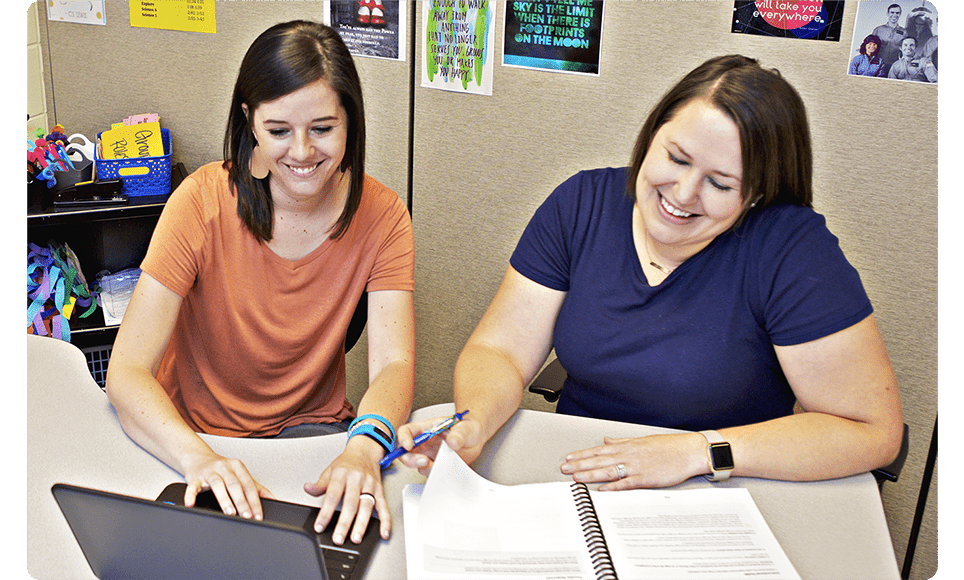
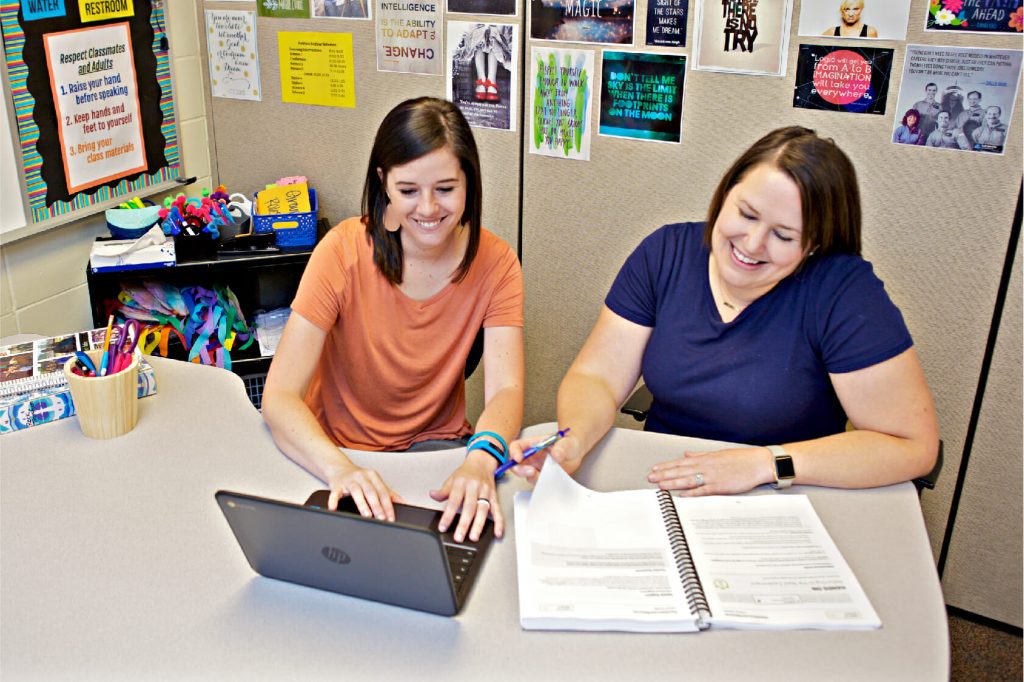
Two people sit at a table; one types on a laptop while the other reviews a spiral-bound document. Both are smiling. Office setting with posters on walls visible in the background.

Welcome to the Step-by-Step Guide.

We talked to leaders like you and created this guide to help with the complex process of adopting a high-quality curriculum. You can explore our recommended steps and use the downloadable articles and templates to help with your decision-making process.

You can also download the entire short guide here: Word Doc | PDF

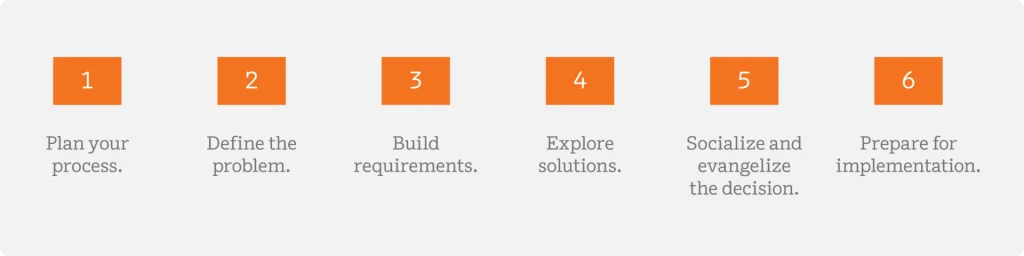
Flowchart with six numbered steps: 1) Plan your process. 2) Define the problem. 3) Build requirements. 4) Explore solutions. 5) Socialize the decision. 6) Prepare for implementation.

1. Plan your process.

Each step of the process, from assembling a team to preparing materials and socializing the decision, needs to be planned based on your district’s unique needs. 

Start with the following case studies if you’d like to see examples from small and mid-sized districts. The worksheets that come next should help you plan the steps in your process and schedule, and the articles provide some ideas for how to assemble your committee.

Links

Case studies:

Worksheets:

Articles:

  • Five things to consider as you assemble your team  Word Doc | PDF
  • Shaping the future: Participating on an adoption committee  Word Doc | PDF

2. Define the problem.

Defining the problem shapes your list of requirements and ensures that all involved parties are focused on selecting the right high-quality curriculum.

Links

Worksheet:

3. Build requirements.

Requirements help you prioritize what is most important to your school district and to evaluate why a high-quality curriculum adoption would be the best fit. 

Links 

Worksheet:

4. Explore programs.

Start with your critical focus areas from step 2 (defining the problem) and select a short list of programs to explore. Next, conduct a thorough review of those programs. If you’re a school or district that pilots, a pilot would happen during this step.

Links 

Worksheet:

Articles:

  • Getting ready for the review  Word Doc | PDF
  • Important questions to ask publishers upfront  Word Doc | PDF

5. Socialize and evangelize the decision.

You’ve done it! But your work isn’t over. Now you need to create clear, exciting messaging about the high-quality curriculum you’ve chosen and why it’s a good match for your teachers and students. 

Links

Article:

  • Designing your announcement campaign  Word Doc | PDF

Template:

6. Prepare for implementation.

A lot of things happen between signing a purchase order and the first day of professional learning. You’ll want to be organized as you coordinate people, places, and things to get ready for back to school. 

Links

Worksheet:

  • Thinking ahead: Preparing for implementation worksheet  Word Doc | PDF

Download the guide.

Download the entire guide here: Word Doc | PDF

Amplify Awards Assemblywoman Blanca Rubio (D-West Covina) with the 2025 Leader in Education Award

BROOKLYN, NY (January 30, 2025) – Amplify, a publisher of next-generation curriculum and assessment programs, today awarded California Assemblywoman Blanca Rubio the 2025 Leader in Education Award. This annual award honors and recognizes legislators who have demonstrated dedication and creativity in improving learning opportunities for all students.

Since her election to California’s 48th district in 2016, Assemblywoman Rubio has made education a cornerstone of her legislative work, with a particular focus on improving early literacy and reading outcomes for California students. Her multi-year effort to advance evidence-based literacy instruction culminated in September with the passage of Assembly Bill 1454 (AB 1454), which she led in partnership with Assembly Speaker Robert Rivas (D-Salinas) and Assemblymember Al Muratsuchi (D-Torrance), Chair of the Assembly Education Committee. 

AB 1454 represents a comprehensive approach to ensuring California’s children learn to read proficiently and on schedule, including:

  • Robust training in evidence-based practices, such as Evidence-Based Literacy Instructional (EBLI), which emphasize explicit and systematic phonics instruction, phonetic awareness, and fluency development
  • Updated guidance for the adoption of ELAD/ELD instructional materials for grades K–8 
  • Ensuring that both current and future instructional materials are also grounded in evidence-based literacy practices

“I’m honored to be recognized with the 2025 Leader in Education award,” said Rubio. “Education has been foundational to my own success; it is the pathway for the success of countless others, and because of this, it is a cornerstone of my work in the Assembly.  I couldn’t be prouder of what we’ve accomplished with AB 1454. This legislation represents years of partnership with educators, advocates, and legislative leaders who share the vision that every child deserves to learn to read well and on time. This recognition belongs to everyone who helped make this reform a reality. ”

Rubio’s successful advocacy for the Bill garnered support from a broad coalition committed to California’s literary excellence. Her commitment to improving student reading outcomes across California comes at a critical time, when focused efforts are needed to ensure all students reach their full reading potential and achieve academic success.

“Reading is foundational to student success across every subject, yet too many students in California and across the country lack critical reading skills,” said Amplify CEO Larry Berger. “Assemblywoman Rubio’s leadership demonstrates what’s possible when policymakers prioritize evidence-based practices.”

Rubio received the award earlier today at an event in Brooklyn, New York.

About Amplify

A pioneer in K–12 education since 2000, Amplify delivers next-generation curriculum and assessment on an intuitive, integrated platform that includes thousands of free lessons. Our high-quality programs in ELA, math, and science engage students in rigorous learning that inspires them to think deeply, creatively, and independently. Our formative assessment tools help teachers identify the instruction each student needs to build a strong foundation in reading and math. Across all programs and services, we equip educators with powerful tools to understand and respond to the needs of every learner. Today, Amplify serves more than 18 million students and teachers across all 50 states and on 6 continents worldwide. For more information, visit Amplify.com.

Media Contact: Kristine Frech; media@amplify.com

S4 – 02. Bethany and Dan share their math biographies

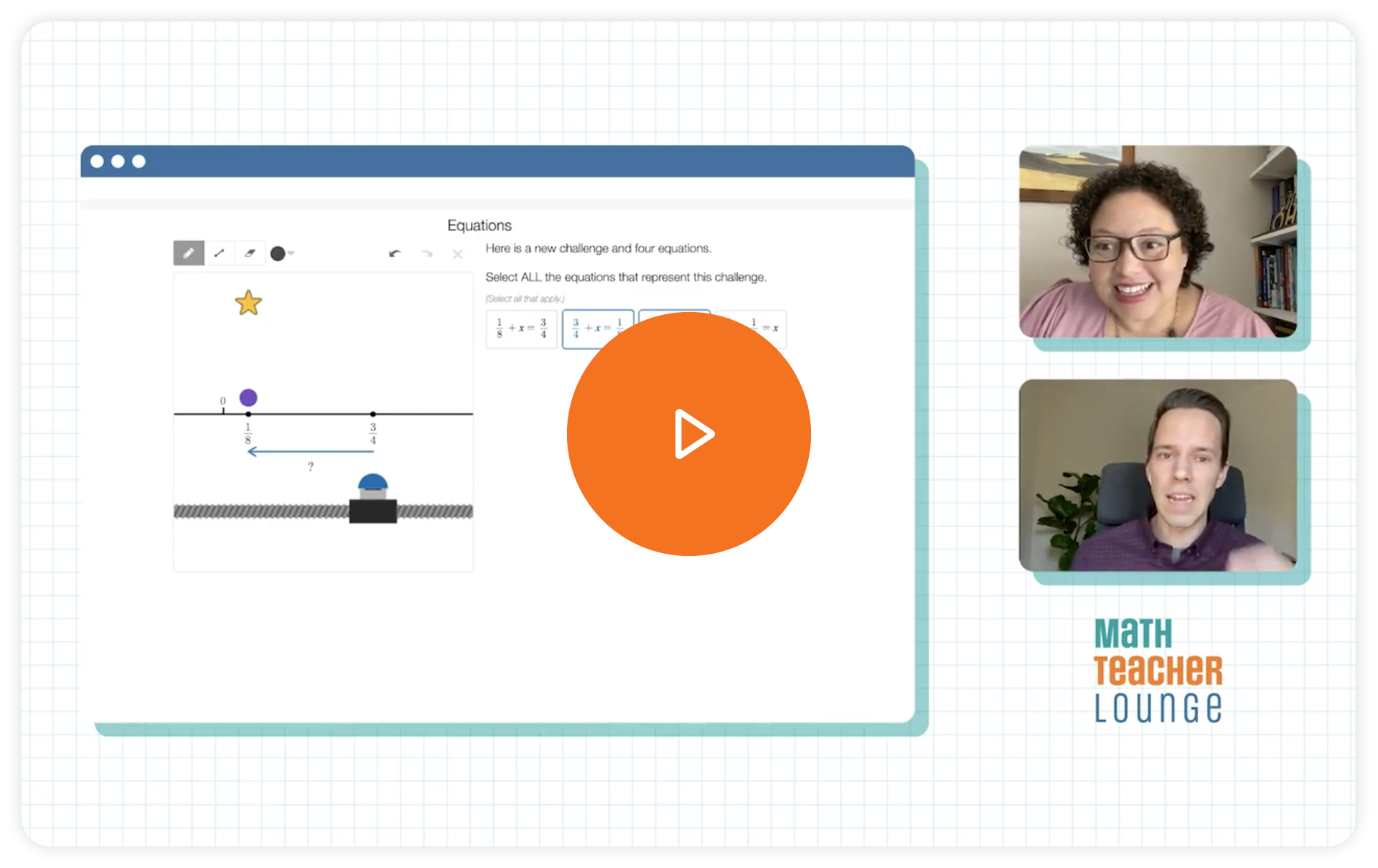
Promotional graphic for "math teacher lounge," season 4 episode 2, featuring photos and names of math teaching guests Bethany Lockhart and Dan Meyer.

In this episode, co-hosts Bethany Lockhart Johnson and Dan Meyer get personal and share their “math bios”—their early experiences with math and how those experiences turned them into the educators they are today.

Explore more from Math Teacher Lounge by visiting our main page

Download Transcript

Dan Meyer (00:00):

We’re recording. What’s up, everybody. This is Dan Meyer with Math Teacher Lounge.

Bethany Lockhart Johnson (00:08):

And I’m Bethany Lockhart Johnson. We are so excited to be back. Season Four, Episode Two. Hi, Dan.

Dan Meyer (00:16):

Hey, Bethany, how are you doing today?

Bethany Lockhart Johnson (00:18):

I’m so excited to be talking with you! You know, as we record this, our reunion at NCTM is getting closer and closer.

Dan Meyer (00:28):

The NCTM live show is gonna be bonkers. I don’t think people are ready for it. You think you know what we’re about on MTL from listening to us, but the live show is gonna be outta control. You cannot imagine how many clowns and elephants Bethany wants to have at the live show. We’re still—we’re trying to talk her down from like three to one, but we’ll see.

Bethany Lockhart Johnson (00:44):

All I want is the t-shirt cannon. Because I used to go to these baseball games and they would have a t-shirt cannon. And I thought, I wanna operate a t-shirt cannon! So like, if I could be standing on stage aiming t-shirts at people who are jumping up and down requesting a t-shirt? I don’t know. Doesn’t that sound fun?

Dan Meyer (01:01):

Sounds awesome. High point of my college education was catching a t-shirt. No, it was—it was a burrito. It was a burrito cannon. But I think it was just a t-shirt cannon, but it was a burrito cannon. And I caught a burrito at a game and it was probably the most memorable moment of all of college education for me.

Bethany Lockhart Johnson (01:16):

Was the burrito still warm?

Dan Meyer (01:18):

Oh yeah. I think it got—like, I think it might’ve been warm at one point and then it got warmed back up through the muzzle velocity of the cannon. So it was a pretty great system they had going on there. <Laugh> Yeah. <Laugh> Anyway, I’m off topic, but, we’re thrilled to—I’m thrilled to chat with you and we’re thrilled to be listened to by you folks out there in MTL land. In the lounge itself. We got a fun show today.

Bethany Lockhart Johnson (01:40):

So if you listen to Episode One—which if you haven’t, hope you go back and listen to it—if you listen to Season Four, Episode One, you’re gonna hear—we asked Huon, KT, who is this delight of a joyful teacher. We asked her to talk to us about what’s her math bio. And we want to ask all of our guests—like, I wanna go back and ask every single guest we’ve ever had to tell us their math bio.

Dan Meyer (02:06):

Yep.

Bethany Lockhart Johnson (02:06):

Because, while seemingly simple in nature, our students enter our math classroom already having had this relationship with math and these notions about their role in math or what they think about math. And it impacts our school year with them if we’re a teacher. And it impacts our relationship with math as we move through our education and beyond. Right? And I I’m so excited about this question, ’cause I think it also ties into this theme for Season Four, which is joyful math, and diving into “When has math felt joyful? When has it not? Does it feel like—how do we think about how our math bio, our relationship with math, has evolved into a joyful or less joyful place?”

Dan Meyer (02:54):

I get it. And what’s really key here, I think, is that teaching more than other professions is a generational profession. You know what I’m saying? Like, no one is like, “Well, you know, I sold insurance to you and now you’re selling insurance to, you know, my grandkids; that’s amazing!” But people are always posting photos when, like, you teach someone who then becomes a teacher later. Teaching is a generational sort of thing. So the kinds of joyful experiences that we offer or don’t offer students now affect the experiences that students who haven’t even been born yet will have, you know, some 20, 30 years later. That, to me, is a trip. And well-worth exploring, you know, how we got here, mathematically speaking.

Bethany Lockhart Johnson (03:39):

I remember a friend had sent me this image of an assignment that her son got that was asking for their Mathography. They wanted to know about their history of mathematics. And this was their first assignment. And this teacher, I would like to imagine, read them all and used it to inform conversations about students’ relationship with math. And, you know, some of the questions they asked were thinking about whether you consider yourself, quote, unquote, “good at math.” Like “what kind of experiences have you had? What do you like or dislike about math? What is, you know—what do you expect to learn in math this year?” Just asking students to actually pause and examine and reflect on their relationship and then also looking forward to, like, what kind of a classroom community do we wanna create? And I loved that assignment. And yeah, so today’s episode Dan, guess what?

Dan Meyer (04:32):

What’s going on? What’s happening?

Bethany Lockhart Johnson (04:33):

I figured we should ask each other about our math bio.

Dan Meyer (04:39):

I think the people out there would love to know this about us. ‘Cause you know, we’re both awesome. But also what’s really cool here is that like, I don’t know this about you. Like not, not a lot. You know, the folks at Amplify, they kind of assembled me and Bethany together in the same way that record labels assembled pop boy bands, girl bands, that kind of thing, back in the day. You know, grabbing some stars from screen or film and just like throwing ’em together and saying, “All right, now you’re here to perform together.” And so it’s just a really good moment for us to, like, settle back and just know who we’ve been working with for the last three seasons and change here. I love it.

Bethany Lockhart Johnson (05:15):

Well, I don’t know. I don’t actually agree with that, Dan. Because don’t you remember? We knew each other beforehand. And while I would like to think of us as…oh, I’ll say One Direction—well, no, One Direction is now defunct. Who’s another band that got formed by one of those shows and is still together and still—

Dan Meyer (05:33):

BTS! K-Pop, you know! Let’s go!

Bethany Lockhart Johnson (05:35):

K-pop. BTS.

Dan Meyer (05:38):

Let’s go, Bethany <laugh>.

Bethany Lockhart Johnson (05:39):

So can we incorporate some K-pop into the NCTM Math Teacher Lounge live episode? Don’t answer now. Don’t answer now. OK. So not only are we gonna share our math bios, but we want to encourage you listeners to share your math bio with somebody in your life. It could be a child in your life, maybe talking to your kiddo about what was it like. What was math like for you? It could be a student that you have. It could be a partner, a friend, a parent. I mean, the sky’s the limit. Share your math bio. And most of all, share with us. We wanna hear about your math bio and you can share it with us at Twitter, at MTLShow, or in our Facebook group, Math Teacher Lounge.

Dan Meyer (06:26):

Stop on by, please. All right. I’m gonna just share like, just a couple of quick, signposts. Not the full bio. Gotta leave them wondering about something here. But here’s a few quick highlights and lowlights of my math bio and how, maybe, it made me the teacher that I was and the educator I am. Is that cool?

Bethany Lockhart Johnson (06:44):

Wait, I didn’t even, I didn’t ask you yet.

Dan Meyer (06:46):

Ask me what?

Bethany Lockhart Johnson (06:47):

Hey, Dan!

Dan Meyer (06:49):

Is there like a magical word? Like, what’s your math bio? <Laugh> Oh, go for it. No, no, that’s right. They won’t know what I’m talking about. Why is he talking about his math bio? Bethany—

Bethany Lockhart Johnson (06:57):

That whole lead-in that we just gave? They might not know.

Dan Meyer (07:00):

Yeah. We just talked about math bios for the last 20 minutes. But yeah, they might not know what we’re—

Bethany Lockhart Johnson (07:04):

<laugh> So Dan, why don’t you go first? ‘Cause I know you were gonna ask me to go first, but why don’t you go first? Dan? What’s your math bio?

Dan Meyer (07:12):

Oh, wow. Well, thank you for the formal invitation to share my math bio, Bethany Lockhart Johnson. So, I’ll just share—I just wanna share a couple items here, not the full history. Gotta leave ’em—leave a little mystery in there, you know what I’m saying? But here’s a few highlights and lowlights, and I think what it means for me as an educator. So, I was homeschooled for eight years. That was big—did a lot of math learning on my own. Couple of lowlights from that, a lot of highlights, in terms of just like being able to, like, learn at my own rate and just jump on ahead and pursue different wacky things. But I tried to switch into public school in fourth grade and I lasted, um, four hours. I didn’t even go to class. I enrolled and then it was like, boom, I was out of there. Because we went to the school; we met the teacher, saw the room, very nice person and place. But I got the homework assignment and the homework assignment was gibberish. I had no idea what to do and such was this feeling of just, like, despair and hopelessness, I was like, I cannot be a part of this. I remember the assignment. It was about identifying scalene, isosceles, and equilateral triangles. I’ll tell you this: I am quite good at that now. But at the time, like, I didn’t know what those words meant. And you know, at that moment we had Encyclopedia Britannica, could not Google this or even Ask Jeeves or AltaVista this so well back then. It just—it was an entry moment of failure and realizing that so much of math is like a, kind of a social kind of construct. And if you’re not part of that social circle, what can you do? So that was a bummer. Another bummer was eighth-grade math, learned it all by way of videotape. You know, put in the tape and watch—not gonna say the person’s name and not this person’s fault—but it was just like watching someone work on a whiteboard. Kind of a precursor to Khan Academy, kind of a drag. Went to high school—

Bethany Lockhart Johnson (09:02):

Wait, wait, wait, wait. We were—I’m not ready to jump to high school. Wait. Can you pause for just a second?

Dan Meyer (09:06):

Yeah. Rock on.

Bethany Lockhart Johnson (09:07):

I just need you to go back to the triangle thing. So in that moment, what did that mean for you that you had had all these experiences with math and then you encounter math in a completely different sphere, a public school, and it did not have a connection or meaning to you because prior to that, it sounds like it was pretty positive. Right? Explore these things you’re curious about; there’s not, like, a level you need to stick with…

Dan Meyer (09:33):

Yep, yep. Yeah. I think that’s right. Maybe it was a little bit of a classic, like, “Oh, I didn’t have a growth mindset; my mindset was like, ‘Oh, I’m good at math because I am, you know, born that way,’” and all of a sudden, that identity was, you know, thrown into question. And, you know, my foundation was all of a sudden quite shaky. And yeah, that’s—you know, I think I taught a lesson recently where I was like, “Hey, this whole thing with a less-than or equal-to sign and a greater-than or equal-to sign, like what those signs are: it’s just, it’s language. And if it’s confusing to you, it’s not because you’re bad at math; it’s ’cause language is oftentimes confusing ’cause people have to agree on it.” So I dunno, that sort of thing is kind of filtered in, filtered back in periodically, some sympathy for like how a lot of math is like just socially agreed upon ways of working with, you know, numbers, shapes, patterns, that kind of thing.

Bethany Lockhart Johnson (10:20):

OK.

Dan Meyer (10:21):

Anyway.

Bethany Lockhart Johnson (10:21):

  1. And in this home school—I have a lot of questions about that, but I’ll stick to one—were you in a community of people that you talked about these math ideas with? Were you homeschooled solo? You have a sibling, so I think you were together, right?

Dan Meyer (10:39):

Yeah. Yeah. I’ve got a twin sister. So we were, you know, like, right on with each other the whole way through there. And yeah, so we had—but it wasn’t, it wasn’t like a—it was a lot of individual work, with my flavor of homeschooling.

Bethany Lockhart Johnson (10:54):

  1. Got it. And the tapes—wait, before you go to high school, the tapes, the VHS tapes, which I’m just loving this image—

Dan Meyer (11:02):

Yeah.

Bethany Lockhart Johnson (11:02):

Was that a positive experience? Was that because that was an area of math that whoever was homeschooling you wasn’t that comfortable with? Why was it that route for the tapes, and what was that? Was that joyful for you?

Dan Meyer (11:15):

Yeah, definitely not joyful. Yeah, it was like, if you had questions, you couldn’t really ask them of the VHS tape. It didn’t work out so well in that way. And it was a lot of operational-type math. It was, you know—there was no give and take; it was all kind of take. From the video teacher. And yeah, I was doing that because my homeschool teacher, my mom, who is very smart in lots of areas, did not have the math knowledge or confidence, especially to help with math at eighth grade. And that was a big reason why, flash-forward to the next year, went to high school.

Bethany Lockhart Johnson (11:48):

Nice segue. OK.

Dan Meyer (11:50):

<laugh> You caught up to high school…I encountered just like four years of just crazy-good, just bonkers-good math teachers who just really changed a lot for me. Especially, Mr. Bishop and Mr. Cavender, very cool folks who did a lot. And especially, I think Mr. Bishop and Cavender both modeled for me what curiosity from a knowledgeable adult looks like. Like someone who, you know, now I can say to myself, “Oh, they were kind of like putting on an act of being very curious about answers they were hearing for the 2000th time from a student,” let’s say, but what a powerful experience that was for me to feel like, “Oh, wow, my thoughts are interesting to someone besides myself.” I got like, maybe it’s two real highlights that I’ll just point to, from my math bio that made me the math teacher and person that I am. Let’s see here. Maybe three, if you you’ll indulge me. One is just like the idea that you could do math wherever you have your brain, a pencil and a paper. And so I remember like in high school, I was in church with my family and kind of a little bit bored of whatever’s going on. And I just had the Bolton and I like drew a pentagon, a regular one, then a hexagon, a regular one, and kept on drawing, like adding sides to the shape. And it was like, it was becoming a circle. And, you know, I was able to take the area of each of those shapes and say, you know, “What happens as you send the number of sides to infinity?” And watch as the formula for area of a circle, Pi R squared, popped out. And it was kind of a literal religious experience, in that moment, just like, “Wow, like my brain’s so cool and math is so cool and paper and pencil’s so cool.” And so there’s that. Just that kind of experience was pretty awesome. And then I would just say like, I’ve had some really fantastic experiences with math in the world itself. Stuff like—let’s see, this is gonna invite more questions from Bethany, probably, maybe I should avoid—I got, I have a Guinness—I have a Guinness world record that’s almost 20 years old. This Guinness world record is—it’s old enough to drive basically at this point. And almost old enough to drink. But like it was—it was a record for chaining the longest paper clip chain together in 24 hours. And the only way I was able to break that record was through mathematics. Where, like, I would be finishing a box of clips. And I would say to my buddy who was there, “I just finished a box of clips.” And that person would type in the number of clips that I had just done. And then a mathematical formula that I had created would tell me how many—how long the chain was at that point. It was being rolled around a spool. And like, it’s just like, wow. So math just made this possible. You know, math revealed that the record I was trying to beat was beatable, because I did the math on it. It was, like, thousands of feet long in 24 hours. And other folks might be like, “Oh, like, that’s that’s huge!” But me, I was like, “All right, let’s divide this out. You know, divide by 24 hours in a day, divide by 60 minutes an hour, 60 seconds in a minute. Oh, that’s like one clip every four seconds. That’s really slow.” You know, think about that <counts aloud>, “Clip, two, three, four. Clip two, three…” It was just slow. So math helped me, you know, wreck that record. Which to my knowledge still still stands. Don’t get any ideas, Math Teacher Lounge Folks! Is this news to you, Bethany? You haven’t blinked in the last, like, five minutes. I’m curious if this is new.

Bethany Lockhart Johnson (15:20):

It is news to me. And I have so many questions. Because OK, if four seconds was slow, so then what was your like—so then I’m assuming a hundred clips per box? Like, what was the rate, you know, per box? How long did it take you to complete a box? What did this friend like? Did this friend stick with you for the whole 24 hours? Did you really do it for 24 hours? Or once you beat the record, did you rest? How did you account for biological function? Like, needs? Like a restroom?

Dan Meyer (15:51):

<Interrupting> Like what?

Bethany Lockhart Johnson (15:51):

Eating.

Dan Meyer (15:51):

Like what, Bethany? OK.

Bethany Lockhart Johnson (15:52):

Um, Sleep.

Dan Meyer (15:55):

So yeah, maybe we dive into some of the specifics in a different time.

Bethany Lockhart Johnson (15:59):

Just tell me one of ’em. Tell me one.

Dan Meyer (15:59):

I’ll just say. So as to discourage other Math Teacher Lounge listeners from taking this on—back off of the record, folks!—this was back in college, so I was a little more limber back then. But I did one—I think it was 1.8 seconds per clip. For an entire 24 hours. Just like, so just like think about it, would you? If you’re gonna step to me on this one, just think about that, OK? And then, and then, you know, make an informed decision.

Bethany Lockhart Johnson (16:28):

Wait. Wait, wait, I just wanna tell you one thing. I’m picturing somebody with a straw, and like, giving you water as you keep clipping. I’m picturing, like, music, I…

Dan Meyer (16:37):

That’s not far. That’s not far. That’s not far from—yeah.

Bethany Lockhart Johnson (16:40):

So many questions! OK. Go on. Sorry, sorry, sorry. Go on. This is your bio.

Dan Meyer (16:44):

We gotta, I gotta wrap this up. I wanna hear your bio. But, like, I would just say like this move to this sense that math is actually a thing that’s useful for more than just a grade; it’s useful for more than just, you know, the societal, you know, adulation that comes from being a math nerd. That kind of thing. And so that, I think that affected a lot of math teaching for me. And, if I gotta, like, summarize math teaching itself in a journey, it went from like, “Hey kids, aren’t I awesome?” to, “Hey kids, isn’t math awesome?” to “Hey kids, aren’t you awesome?” And like that journey was facilitated by lots and lots of people, you know, a lot of personal growth, but at this point, at one point I was like, “Hey, math can help you get records and whatnot. It’s really useful.” And now I’m like, “Wow, your brain’s just doing just really interesting things. I can help you understand how interesting those things are, and maybe make them more interesting, or interesting in a different way, with some help here.” Let’s put a pin in that. That’s the math bio.

Bethany Lockhart Johnson (17:50):

  1. So I have no doubt that if you ask someone in your life, listeners, for their math bio, that you will discover things about them that you never knew. Literally the questions that I have…I have so many question. And Dan is very good at, you know, bringing me back. Bring me back, like, come on, come on. But I just wanna say, overall, your journey seems pretty joyful. It seems pretty joyful. It seems pretty full of confidence. I don’t wanna say “ego” in a negative way, but I wanna say you were buoyed by these experiences that allowed you to feel like math was a place for you to thrive.

Dan Meyer (18:36):

Right.

Bethany Lockhart Johnson (18:36):

Where you could try out things. You could try it out and just, “I could do that!” Right? Like…your relationship just felt very, like…you felt like you had autonomy, agency, perhaps much like you, you operate in this world. Dan, is that, is that right <laugh>?

Dan Meyer (18:54):

Yeah, I think it’s fair to say. And without telling too much of her story, my twin sister with whom I share most things, including genetics, you know—she had a very different experience in math early on. She’s brilliant. She’s a doctor. And not, you know, the book kind of doctor that I am, but like a real, you know, medical doctor. She’s brilliant. But we were—we encountered different messages about who math was made for, early on in, you know, in our entire math learning. And she—we both digested the messages that we were sent, and took, you know, different, different paths because of them, for sure.

Bethany Lockhart Johnson (19:31):

Funny how that works. I thank you, Dan. I do. For in all sincerity, I appreciate you sharing that. And I think that it’s exciting to hear how it influenced your teaching. It feels like you want to cultivate those experiences for your students. And I’ve been in the room when you’ve presented; I was in a room where you taught a class live. It felt like you were making space for the students to have these aha moments. And it feels like in your work at Desmos, and now Amplify, you’re trying to create these products that allow folks to recreate these amazing math moments. Right? And that it’s for everyone and that it’s accessible and it can be very positive. I feel like I have this new perspective on kind of the energy you bring to your teaching. So thank you for sharing that.

Dan Meyer (20:24):

Yeah. Been a pleasure. Thanks for your questions here, Bethany. And it’s been—it’s been fun to reflect on it. And I do—I do feel very lucky in lots of ways. Privileged. Lucky. I know, like—I think the world has been set up for my success in lots of ways, as who I am. But I do just…yeah, I feel—I want more people to experience what it’s like when you walk into a math classroom and it’s like, “Hey, this place is for you. You have interesting thoughts about this. Let’s get ’em out.” So that’s awesome. I would love to hear about you and how you…I mean, we have taught different kinds of kids. You know, I taught kids who I think were somewhat set in, they’re a little bit more solid at secondary in who they are as a math learner. Like “I know who math is and who I am with math.” And I’m really excited to hear what your math bio allowed you to do with students who were perhaps open to the idea that they are very mathematical or at least not yet closed off to those possibilities. So, yeah. What are some of the high, the, you know, the high and low water marks of the making of Bethany Lockhart Johnson, math teacher? <Laugh>

Bethany Lockhart Johnson (21:24):

Thanks for asking, Dan. <Laugh> I’ve shared aspects of my math bio because I think it really informs the way that I talk to people about math and think about math. And I like to share it because I want folks to consider their own journey with math, as we like engage with problem-solving and sense-making and thinking about the students in our classroom. My dad is a math and computer science major. So he had a computer very early on. I wish he had invested in Apple early on when he had like one of the first Apple computers ever. And, sorry, dad, but it’s true. I do wish you had done that.

Dan Meyer (22:10):

I’m sure he does too.

Bethany Lockhart Johnson (22:11):

Oh, he does. So math and computers and conversations about counting, you know, it felt like it was kind of just normal. Like it was around me. And I went to Montessori, which is a private school that—oh, they have some public Montessori—but it’s very self-directed. And so we would have these kind of charts, these goals for the day that you explored. And so we would explore math in very, I don’t know, very organic ways, with these natural materials. And I feel like I excelled at math, but it wasn’t something that I was conscious of. It was just like, “Oh, well, yeah. Math, it’s, you know, something we do.” And then when I went to—when I left Montessori in fourth grade, I remember that year being a lot of like repetition. I was like, well, we did this. We covered this. And except for the mission project that we hadn’t done, that was all new. And that’s it. For another time I’ll share about that. But <laugh> then, they actually, I was moved with a group of students to the fifth grade math class, ’cause we had already done the work that we were doing. And so, it wasn’t that it felt like it came easily, but it did make sense. What we were doing made sense. And then it all kind of changed. There was a lot of change in my family. There was, like, missed school time. And we moved and I went to a new middle school and I was in this environment with students who—it was like an accelerated program. And so I was in this environment with students who were pretty competitive with each other. And I remember going—and I was not from of a competitive environment; like Montessori is not competitive. It’s not about that.

Dan Meyer (24:02):

Right. Right.

Bethany Lockhart Johnson (24:02):

It’s—it was very strange to me that I would be competing against anyone, even competing against myself. And I, you know, knew how to set goals. But it was a different level of energy. And I felt like, because I wasn’t competitive in that nature, I felt like that kind—I felt on the outside of a lot of the energy. Besides the regular, like, middle-school feeling outside of things. And I remember the first friend that I made. Hi, Susan! She had said to me, this was like maybe our second week of school, she’s like, “Oh, at lunchtime, come with me to math club.” And I was like, “OK.” And I remember walking into that room and I had no idea what was going on. And so that was one of the first times where I was just like, “Whoa, I have absolutely no concept of what they’re talking about or what.” These are my peers. I felt very—it was very—it was strange. It was strange. I was like, “This doesn’t feel like a space for me at all.” When I think ordinarily I was kind of excited about the idea of going to math club at lunch, you know? And over middle school, I kind of just got progressively more and more behind. It started with missing some work and then missing more and then checking out. And, you know, the problem was that I really made it about myself. That, like, it wasn’t something that I was then good at or could do. When really it was that well, pre-algebra, I was having a really hard time in like the rest of my life. And so I wasn’t real present in that class. And so when I got to algebra, it didn’t make a whole lot of sense. And then if I missed Monday, Tuesday, and Wednesday, well, Thursday is gonna be hard, you know? And, it just got progressively harder and harder. So I had this great idea that between eighth grade and ninth grade, I was going to take this accelerated geometry class. ‘Cause that was the ninth grade class, it was geometry. And I would take it. It was like geometry in three weeks or something. So then when I entered high school, I would’ve gotten this like jumpstart. But I wish I had said, “Oh, I’ll take this, and then in ninth grade I’ll take geometry.” So like I’ve already kind of gotten a preview of the material. But instead I went to the 10th grade math, which was like intermediate algebra, trigonometry. I had absolutely no clue what was going on. And I had a very, very difficult time and I wasn’t ready for that class. But it was exacerbated by the fact that this teacher felt very free to let the freshmen in that class know that they shouldn’t be in that class. That this class was for 10th graders.

Dan Meyer (26:49):

Oh wow. Oh, wow.

Bethany Lockhart Johnson (26:51):

And we had a rather contentious relationship. And I will never forget that we were in the hallway, and he says to me, “You don’t belong here.” And I’ve talked to—I’ve talked to a girlfriend of mine about her experiences with this teacher and she has the fondest memories.

Dan Meyer (27:13):

Wow.

Bethany Lockhart Johnson (27:14):

She—in fact, almost everyone I’ve spoken with, you know, if we are talking about past teachers or, “Oh, what was that class like?” I mean, they just have these wonderful memories! And for me, my sense of like belonging was already so on a tight rope anyway, that to have this adult, this teacher, tell me, “You do not belong here,” just crushed me. And in hindsight, I think he was saying like, “This class is too hard for you.” I mean, maybe. <Laugh> But all I heard was “You don’t belong here.” And I extrapolated it to connect to math and to anything having to do with math in general. And it just got worse and worse through high school in the world of math. My next math class was even—I had to repeat that class, and still didn’t understand what was going on, and felt more out of place, and, you know, it’s one of those things that I just kind of had started to accept that, I guess, math isn’t for me. I guess I’m just not a math person. Or whatever these stories are that I started to create and build and find evidence for around me that was informing that this wasn’t for me. And I had always done well in school. I was in, you know, accelerated classes. I felt like I was capable of problem solving. And yet in math, I just felt like I had all of this evidence saying that I didn’t belong there. And so when I went to college, I took whatever two math classes were—you know, I was in performing arts and then I did ethnic studies as well. And I remember you had to take two math classes that were GEs. There were these classes that if you don’t wanna deal with math, you go take those classes. And I was like, “Oh yeah, I’ll take that. I’ll take that.” The gulf widened, you know? <Laugh> And I didn’t feel like anxiety when I had to do things like balance my checkbook or navigate math in everyday spaces. It was just, it would never occur to me that I would like seek out opportunities to engage with math or think about it or talk about it.

Dan Meyer (29:35):

That is—yeah, that’s just so wild, how, I don’t know, like it’s often, from the student’s perspective, it is them in a vacuum with math, and the two of them interact and decide if, you know, if they’re right for each other. But from the grown-up perspective, it’s just, you know, it’s a little bit clearer that your story with math was not just you in math, but you with, you know, various external things happening. With family, various teachers playing their different roles—sometimes, you know, really tragic and horrible roles—and then like the compounding mathematical debt that it feels like you were kind of building up, as challenges in one year didn’t get resolved and moved into the next year and so on. And all that makes me wonder—it makes me, like really, really scared, first of all, because I would bet that your teacher might not even remember that moment, that for you is part of just a pivotal moment in your math story, and how many kids have I played—have I been a part of their story in that way and wouldn’t even recall? You know what I’m saying? So that’s a scary part. And then also I’m just wondering, like, how can we, how can we help kids who are in those moments recognize that, “Oh, this kid is like absent a bunch,” and give them more resources to be successful rather than say, “Well, you just gotta try harder now.” Those are things I’m wondering, hearing your story. Thank you for sharing that. I’d love to know more about how you then became a teacher and what all that did for you as you helped students.

Bethany Lockhart Johnson (31:06):

Well, but to answer what you were saying, it wasn’t that I wasn’t—I was always absent physically, but at least like mentally at that point, because it had become so difficult. It didn’t make sense to me. So I was just really checked out in math class, you know? So in hindsight, you know, as a teacher, for sure I can look back, and especially hearing these stories and these experiences my friend had with this teacher and just like chalks up as one of like her most favorite teachers ever! And you know, he clearly did a great job for so many students. But for me, and I think for some people, they would’ve taken those challenges and, you know, it would have fortified them in a different way or something. But for me, I took it upon myself to mean certain things about myself and about my ability and what I was capable of. And so I think, I think in some ways, you know, yeah, it’s all, it’s all interconnected. You know, when your students walk in the door, they’re not this—the things that are impacting them in their life are coming into the room with them. And I don’t think we can take that for granted and think, “Well, if they just focus hard enough…”

Dan Meyer (32:21):

Yeah.

Bethany Lockhart Johnson (32:23):

So let’s go back to my love of Oprah. You know, Oprah talks about living your best life. And something I really appreciate about Oprah is that she encourages you to examine, like, sticking points, right? Like she doesn’t just say, “Well, this…just pretend nothing ever happened, and everything’s fine!” You know, she really talks about making time for reflection. And I kind of got mad that anytime I thought about math, or math schooling came up. Or, you know, whatever, any time that came up that I just felt UGH about it. And I felt like a failure. And I’m like, “You know what, what if I took a math class? And I’m an adult at this point. I’ve graduated. I have—I’ve left college. I have my degrees. But I said, “What if I took a math class?” So I went down to, the city college and I found out that you have to take this exam, like a placement exam. And I went and took the placement exam. And I remember it’s one of the responsive tests where if you get it right, the next question’s a little harder. And so I’m taking it, panicking, because it’s getting more like…I just, you know. And I remember it placed me in like, whatever, Algebra Something, this class that was far more advanced than I thought I should be in. And I was like, there’s been a mistake! You know, and I went to the counselor and said, you know, “I got these results, but I couldn’t answer a lot of the questions on the test.” She’s like, “No, no, no, that’s how it works.” So I go take this class and the class was hard. And I decided that I was just gonna keep showing up. And every day before class, I kid you not, they had a little math…it was like a math center where you could go in and they had a bunch of tables and you’d sit at the table and you could sit and do your work or whatever. If you had a question, you walked up and put your name on a clipboard and then somebody would come and help you. So I did that, every single—like before every single class I would go in. I’d sit there. I’d do the work. I’d go. And I’d get help. Like somebody would walk over and you know, some kid for whom they’re like this…you know, they’re math—it might be you, Dan! It could be you! It could have been you! You know, would walk over and be like—

Dan Meyer (34:38):

Yeah, I was in Help like that. Naw, it’s awesome. Love, love those people. Yeah.

Bethany Lockhart Johnson (34:42):

And you know, I did it. And I did so well in the class. I did exceedingly well in the class. And I said—

Dan Meyer (34:50):

Take that! Take that, everything! Every other math experience!

Bethany Lockhart Johnson (34:53):

I said, what?

Dan Meyer (34:55):

Yeah!

Bethany Lockhart Johnson (34:55):

Wait a second.

Dan Meyer (34:56):

Yeah.

Bethany Lockhart Johnson (34:57):

And it was that I was present. I was not afraid to look at what didn’t make sense. And if something didn’t make sense, it didn’t mean there was something wrong with me. Whaaaaat?

Dan Meyer (35:10):

Yeah. Yeah.

Bethany Lockhart Johnson (35:10):

So I was just in such a different space. And then I took another math class and that class was even harder. And I did the same thing where I went to the little lab and, you know, and it just buoyed me. And it made me realize that, like, this story, that my experience with it was very powerful and that was a real lived experience, but that it didn’t have to define my relationship with math. But then! I decided I wanted to go back to school to become a classroom teacher. And I totally—this was a couple years after that math class experience. So now, you know, I’m healing my relationship with math through basic positive experiences, da, da, da, you know, doing other work. But fast-forward, for a whole number of reasons, decided to become a classroom teacher. And I freaked out. All of my—like, I’m studying for the GRE and the CSET and all the things you have to the hoops you have to jump through to apply to the masters program and the credential program. And I freaked out. I was so close to quitting, Dan. Because I was convinced that the reason I couldn’t be a classroom teacher is because I wasn’t capable in math. Like I was—it was all that resurfaced. And even though I now had evidence to say something different, to the contrary, it was still so visceral. And I was so scared. But I passed that Math CSET.

Dan Meyer (36:47):

Get it.

Bethany Lockhart Johnson (36:47):

I did well enough on the GRE—

Bethany Lockhart Johnson (36:50):

Yes!

Bethany Lockhart Johnson (36:50):

You know, I finished my credential. I worked really, really hard. I had to work so hard in my student placement, when I was student teaching for a fifth-grade class, ’cause I felt like, “Oh my God!” I mean, now I could do the mathematics, but I couldn’t TEACH it to someone, you know? But I had amazing professors at UCI, and my math professors really like just—and my mentor teacher! shout out to Jennifer! shout out to Phil!—these amazing mentor teachers who just loved teaching and who loved—like you said, you have these teachers in your life who you got to see the way that they listened to students. They taught me about that love of listening to students. And then I fell in love with, you know, CGI, cognitively guided instruction, and started learning all about all of these educators who just wanna learn from students’ thinking. And it was just so powerful. And I realize as a kindergarten teacher that I have this really special role in helping to create space for a positive school experience. Like we get to talk about—I talk about my students as mathematicians; they’re writers; they’re thinkers; they’re problem-solvers. And I also want to make space for parents. Some of them, this is their first kid in kindergarten, and they brought all of their experiences, a lot of it negative, that they had had with mathematics. So I felt like it was such an exciting opportunity to help show parents how they could have conversations about math with their students. That also, I hope helped heal their own anxiety with mathematics.

Dan Meyer (38:41):

Right, right.

Bethany Lockhart Johnson (38:42):

Like, I’ve not even scratched the surface of math learning. But I just have such a changed perspective and relationship with math. And I just fell in love with the sense-making. And I fell in love with the journey of it. I still experience math anxiety about a wide variety of things, but I do love it. And I feel like there’s a space for me in relationship with math. And that really excites me.

Dan Meyer (39:09):

Yeah. Wow. Listen to that folks. We, we don’t deserve her! Bethany Lockhart Johnson! She got some math game and could have gone off there and, you know, become an accountant or something. And she chose to hang with kids and their parents. That’s so wild that you’re like rehabbing parents and their self-conception about mathematics at the same time. I think that is so cool.

Bethany Lockhart Johnson (39:32):

Well, thanks Dan Meyer. I gotta tell you, I don’t know when or if I’ve ever shared that much of my math story. So there is a certain amount of vulnerability there. But thanks for listening. And I’m glad that, you know—I think there’s space for us to talk about these things that we care deeply about, but that can be really complicated.

Dan Meyer (39:56):

Yes. Yes. And I love how you you’ve really sharpened the point on what I feel like I know in my brain, but not my body all the time: That individual teachers are huge. Like, individual teachers, and individual moments of teaching, are just not something to play with. You know, like that kid that’s in fifth grade having a tough time, like there could be a month or a day-long period where all of a sudden, like, you’re just like, “Oh yeah, I’m back in the mix; like, me and math are still buddies.” And there’s also like moments that you had, where like one casual word from a teacher can just really put a huge wedge between you and a discipline that needs and wants you and your intellect in it.That’s a really powerful testimonial. Not just for math, but for teaching, your teaching bio.

Bethany Lockhart Johnson (40:43):

I agree with you. And I also, I also…you know, I think we can’t put this—we are human. Teachers are human. And so I’m sure there’s things I’ve said to students. Twenty-second story: a student stapled his finger in my class. <Laugh> And I remember holding his hand and saying, “Why did you do that?” And I wasn’t yelling at him, but it was like, I am sure the panic in my face…like, that’s what he’s gonna remember about kindergarten. Right? <Laugh>.

Dan Meyer (41:19):

Yeah.

Bethany Lockhart Johnson (41:20):

That. He will remember that. He won’t remember the really cool city project we did. He’s gonna remember his teacher holding his hand, in his face: “Why did you do that?”

Dan Meyer (41:30):

Yeah. Yeah.

Bethany Lockhart Johnson (41:30):

You know, so we’re human. And yes, it was awful that that teacher said that to me. There were a thousand other ways that he could have said whatever it was he was thinking. And that did deeply wound me. But despite his influence—because teachers do have a lot of power and I think they need to examine that power, ongoing—it still doesn’t have to define us. So I don’t wanna put this pressure, like—

Bethany Lockhart Johnson (41:55):

Sure.

Bethany Lockhart Johnson (41:56):

“So never ever say anything negative!” You know, we’re human.

Dan Meyer (42:00):

I feel like that kid is currently on some office-supply podcast talking about “your office-supply bio” and saying, “Let me tell you how I first got really freaked out by staples. Here’s the deal: I only use paper clips. And here’s why.”

Bethany Lockhart Johnson (42:15):

“Here’s why.” But then—callback!—he’s going to stumble upon THIS podcast and think, “And because I’m so adept with paper clips, I can beat that record!”

Dan Meyer (42:30):

Though—aaay! whoa! Settle down!

Bethany Lockhart Johnson (42:31):

BOOM.

Dan Meyer (42:31):

Don’t get any ideas, kid. No way. Uh-uh. I don’t like that at all. That’s not what—that’s not what I want to have happen here. No, thank you.

Bethany Lockhart Johnson (42:41):

Well, I’m spent, Dan. I need a nap.

Dan Meyer (42:45):

Yeah. I need a box of Kleenex. I need a nap. I need a—yeah, for sure, a baba. Uh-huh. Definitely. Hey, so look, I’m not expecting you folks out there in the lounge to kind of give us the same depth or breadth. You know, we are here, of course, for your entertainment. Feast on our stories and dramas. But I would love to know at some point, like, what are a few, a few moments that really came to define you mathematically? Came to influence you as a teacher? I think we would do really well for each other to understand that about all of our processes. So yeah, I would just toss in a plug in for Twitter, @MTLShow, or Facebook, Math Teacher Lounge; it would be fantastic to hear from you.

Bethany Lockhart Johnson (43:24):

Thanks so much for listening.

Dan Meyer (43:25):

Thanks, folks. Bye now.

Stay connected!

Join our community and get new episodes every other Tuesday!

We’ll also share new and exciting free resources for your classroom every month.

What Dan Meyer says about math teaching

“Teaching, more than other professions, is a generational profession. The kinds of joyful experiences we offer, or don’t offer, now affect the experiences students that haven’t even been born yet will have years later.”

– Dan Meyer

Meet the guests

Dan Meyer

Dan Meyer taught high school math to students who didn’t like high school math. He has advocated for better math instruction on CNN, Good Morning America, Everyday With Rachel Ray, and TED.com. He earned his doctorate from Stanford University in math education and is currently the Dean of Research at Desmos, where he explores the future of math, technology, and learning. Dan has worked with teachers internationally and in all 50 United States and was named one of Tech & Learning’s 30 Leaders of the Future.

Bethany Lockhart Johnson

Bethany Lockhart Johnson is an elementary school educator and author. Prior to serving as a multiple-subject teacher, she taught theater and dance and now loves incorporating movement and creative play into her classroom. Bethany is committed to helping students find joy in discovering their identities as mathematicians. In addition to her role as a full-time classroom teacher, Bethany is a Student Achievement Partners California Core Advocate and is active in national and local mathematics organizations. Bethany is a member of the Illustrative Mathematics Elementary Curriculum Steering Committee and serves as a consultant, creating materials to support families during distance learning.

A woman with curly hair and glasses smiles outdoors; a man with short dark hair smiles indoors in front of a blurred math teacher lounge, highlighting valuable math teacher resources.
A graphic with the text "Math Teacher Lounge with Bethany Lockhart Johnson and Dan Meyer" on colored overlapping circles.

About Math Teacher Lounge: The podcast

Math Teacher Lounge is a biweekly podcast created specifically for K–12 math educators. In each episode co-hosts Bethany Lockhart Johnson (@lockhartedu) and Dan Meyer (@ddmeyer) chat with guests, taking a deep dive into the math and educational topics you care about.

Join the Math Teacher Lounge Facebook group to continue the conversation, view exclusive content, interact with fellow educators, participate in giveaways, and more!

Science of Reading: Getting started and best practices

Explore the latest research in the science of reading, listen to national experts discuss the latest topics, and find out about our upcoming virtual events.

What are high-quality instructional materials (HQIM), and why do they matter?

Kansas recognizes how imperative it is to provide a high-quality literacy curriculum that is aligned with the Science of Reading to prepare students for college and career readiness. We’ve assembled resources here so you can explore how to support your district or school in adopting a high-quality program.

Review our high-quality literacy solutions

Bring the science of reading to your classroom with these high-quality programs. Click the program you’d like to review below for:

  • An introductory video
  • Downloadable resources such as brochures and rubrics
  • Access to complete units online by grade

K-5 programs and resources

CORE PROGRAMS

Amplify CKLA
Amplify Science

SUPPLEMENTALS

Amplify Reading

ASSESSMENT & INTERVENTION

mCLASS

6-8 programs and resources

CORE PROGRAMS

Amplify ELA
Amplify Math (coming soon!)
Amplify Science

SUPPLEMENTALS

Amplify Reading

Contact us

For more information, please fill out the form below or reach out to your Kansas sales representative, Vanessa Scott.

Vanessa Scott

Account Executive

vascott@amplify.com

(602) 690-1096

Use stimulus funding to drive Rhode Island transformation

Rhode Island districts have significant flexibility in how to use the ESSER money, with ESSER II and III specifying that some of the funds should be used to address unfinished learning. Given the enormous influx of resources flowing into K-12, now is the time to drive important, sustainable change in your district.

Rhode Island recognizes how imperative it is to provide high-quality curriculum to prepare students for college and career readiness. We’ve assembled resources so you can explore how to support your district or school in adopting a high-quality program.

All K-12 Amplify programs and services meet the criteria for funding. Contact Ali Weis, account executive to learn more. 

Amplify Science K–8

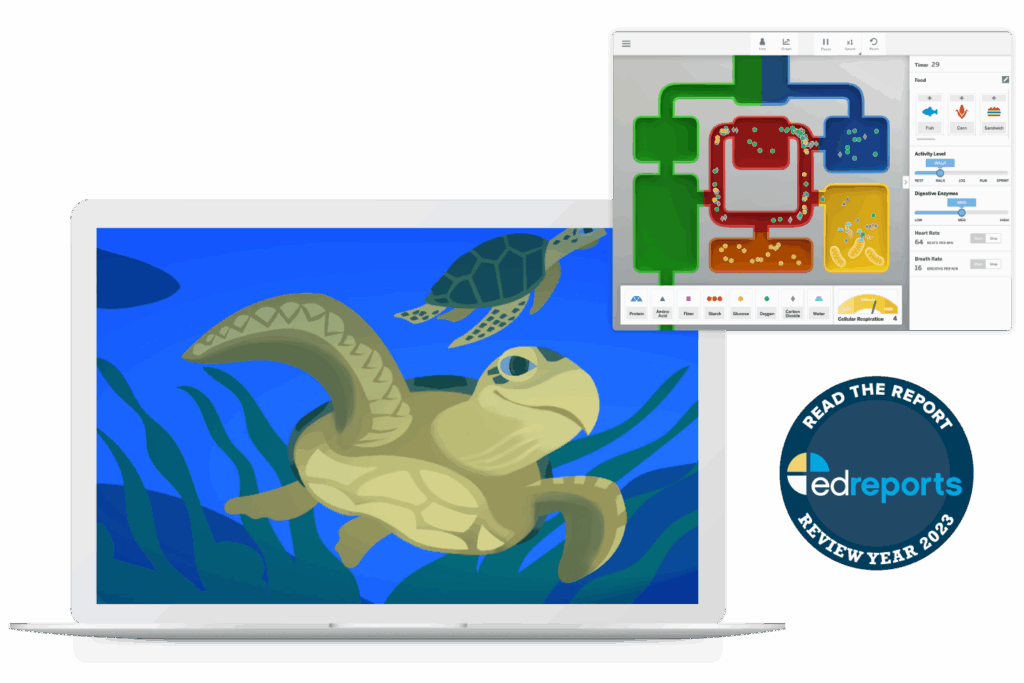
Amplify Science K–8 is a hands-on, phenomena-based curriculum that helps students make the shift from learning about to figuring out scientific concepts. With demonstrated unparalleled effectiveness across all student groups, Amplify Science empowers students to think, read, write, and argue like real scientists and engineers each and every day.

Developed by UC Berkeley’s Lawrence Hall of Science, our program features:

  • phenomena-based approach where students construct a more complex understanding of each unit’s anchor phenomenon.
  • A blend of cohesive storylines, hands-on investigations, rich discussions, literacy-rich activities, and digital tools.
  • Newly crafted units, chapters, lessons, and activities designed to deliver true 3-dimensional learning.

Hear what these educators have to say about the program, then click the orange button below to learn more.

Amplify Math K–12

amplify math middle schoolers in classroom

Amplify Math K–12 is a brand new program designed around the idea that a core math curriculum needs to serve 100 percent of students in accessing grade-level math every day. Powered by Desmos technology, Amplify Math delivers:

  • Engaging, discourse-rich math lessons that are easier to teach.
  • Flexible, social problem-solving experiences both online and off.
  • Real-time insights, data, and reporting that inform instruction.

Additional Amplify programs and resources

A pioneer in K–12 education since 2000, Amplify programs provide Rhode Island teachers with powerful tools that help them understand and respond to the needs of every student. View our entire suite of K-12 core and supplemental curriculum, assessment, and intervention solutions. Ready to learn even more? Contact Ali Weis, Account Executive.

Meet Ali

Hi, I’m Ali! I partner with Rhode Island school districts because I believe every student should have the opportunity for a rigorous, engaging, and impactful learning experience. For more information, please fill out the form below, and I’ll be in touch soon!

Ali Weis

Account Executive

aweis@amplify.com

(480) 510-6703

A smiling person with short blonde hair is wearing a blue top and a large, circular-link necklace, standing outdoors with trees and grass in the background.

Welcome Amplify Science educators!

To view this protected page, enter the password below:


Welcome Amplify Science educators! Test

To view this protected page, enter the password below:


S3-03: Instructional strategies for integrating science and literacy

A graphic with the text "Science Connections" and "Amplify" features colorful circles and curved lines on a dark gray background.

We’re continuing our investigations around science and literacy with Doug Fisher, Ph.D., professor and chair of educational leadership at San Diego State University. We talk about the importance of integrating science and literacy, as well as practical guidance for teachers who want to unite the two disciplines in their own classrooms.

Listen as we discuss how science and literacy can be powerful allies and specific strategy areas to focus on when integrating the two disciplines. And don’t forget to grab your Science Connections study guide to track your learning and find additional resources!

We hope you enjoy this episode and explore more from Science Connections by visiting our main page!

DOWNLOAD TRANSCRIPT

Douglas Fisher (00:00):

It’s not that you have to become a reading specialist to integrate literacy into science. It’s how our brains work.

Eric Cross (00:10):

Welcome to Science Connections. I’m your host, Eric Cross. This season, we’re making the case for our favorite underdog, which of course is science. Each episode we’re showing how science can be better utilized in the classroom, and making the case for why it’s so important to do so. In our last episode, we examined the evidence showing that science and English instruction can support each other. And now on this episode, we want to give you some more strategies for really making that a reality in your own home or classroom or community. So to help me, I’m joined on this episode by Dr. Douglas Fisher, Professor and Chair of Educational Leadership at San Diego State University. Dr. Fisher is actually someone who has conducted literacy training at my own school, so I’m excited to be able to share some of his wisdom with all of you. Oh, and just a heads up, Dr. Fisher dropped some gems about the ways teachers can integrate literacy and science in their classrooms. So you may want to have a notepad. Ready. And now here’s my conversation with Dr. Douglas Fisher.

Eric Cross (01:12):

Well, Doug, thank you for your time and for being willing to come and talk about literacy and science. I know you’re busy, all over the place, and so I was super-excited that we were able to lock you in and talk about this. And, on this episode, we’re gonna talk about the ways that science and literacy can support each other. And one of the reasons why I’m really excited for you is because you said some really key things for me as a science teacher, when you talked about literacy and supporting students. That just resonated so deeply in me. And I was like, “I need more Doug!” Because we’re on that same frequency. And I know it’s a subject that you’ve spent a lot of time writing about. So can you tell us a little bit about how this became an area of interest or a passion for you? Just literacy, and all of the work that you’ve put into it?

Douglas Fisher (01:54):

Yeah. So I’ve wanted to be a teacher for a really long time. And I went to San Diego State as an undergraduate, and I was taking English class and we were assigned topics. You know, like, you’ll do an assignment, you’ll write a paper for this English class. And I got the topic “illiteracy,” and I was a freshman at San Diego State reading all of these things about adults who don’t read very well or not at all. And I ended up writing my very first college essay on illiteracy — at the time, you know, called illiteracy, at the time. And so I got super interested in this. And so as I moved through college and into my teaching career, literacy became a really important thing for me to think about, because it’s the gatekeeper. You know, you can be taken advantage of, if you’re not very literate. People can use vocabulary against you, if you’re not very literate. We know that people who have higher levels of literacy have better health outcomes. They have better lifespans, longer lifespans. I mean, there’s just — literacy impacts so much more than “Are you reading your fourth-grade textbook?” It really has lifelong implications.

Eric Cross (03:01):

That part that you said about being taken advantage of … I just got a flyer in the mail yesterday. It was one of these mailers that looked like it was an authentic debt-reduction type of thing, but it was really just like a marketing email. If you read the fine print at the very bottom, it had all of this jargon about “This is a paid, you know, for-profit company.” But when you look at it, it had official stamps all over it. And I could imagine if someone’s receiving that, that probably fools a lot of people. Is that kinda like what you’re talking about, like being taken advantage of?

Douglas Fisher (03:28):

Yes. I had a student turn 18, got a letter from a “credit card company” that was offering her daily compounding interest. And if you don’t know what that means — at 23 percent! — if you dunno what that means, you are gonna be a victim. Literacy really influences a lot of our life. It’s also how our brain works. We have a language-based system in our brain. We read, write, speak, listen, and view. And the things we learn, we learn through speaking, reading, writing, listening, and viewing. From what we know, we are the only species that has an external storage mechanism. Like, we have the ability to store complex information outside of our body, in the form of notes. We can type them. We can write them. And we can then go back and retrieve that information, that complex orthographic information later. And it means the same thing. We can say we have a storage system and we’ve been doing this for a really long time. Way back to, you know, hieroglyphics and messages on cave walls. And throughout the ages of humans learning, how to store information that they can re-access again later. That’s become a super-complicated system. It’s how computers operate. And we send messages to each other and we text each other and we write things down, and we’re really good at putting ideas, information out there. Now, if it’s just speaking and listening, then we can forget it. We can say, “No, you said this,” or “I said that.” But when it’s written, and it’s print literacy, you know, it’s the orthographics there, you can go back to the same message and over and over again. Now, you might change the interpretation of it, but the message is still there.

Eric Cross (05:16):

Right. And that is such a key element, at least of modern education, is this written element of it. It’s what many schools live and die by. They’re quantitatively and qualitatively analyzed by it. It’s public. They can see it. And so there’s this heavy emphasis. And why do you think science and literacy can be powerful allies together?

Douglas Fisher (05:38):

Awesome. Well, it’s hard to learn science if you’re not literate.

Eric Cross (05:42):

This is true.

Douglas Fisher (05:42):

But that’s a one-way direction. And yes, science teachers and scientists do a lot of reading, writing, speaking, and listening and viewing. They use the five literacy processes all the time. When we interview scientists, they spend a lot of their time reading the work of other scientists and writing their findings, writing grant proposals, presenting at conferences, you know. So a huge part of the work of a scientist is not just at a bench conducting experiments. But even if you’re conducting experiments, you’re using your literacy processes to think about what you’re seeing in your experiment. So that’s a one-way direction. And I do think literacy has an influence on science. But since science goes the other way, it influences literacy. As you learn more and you understand more about the world, your background knowledge grows, your vocabulary grows, you become more literate in those different areas. And how you think. So if I’m learning about life science; I’m learning how the world works in a more, biologic physical world. And that knowledge helps me think about when I’m reading a novel, and there’s an appeal to some science knowledge or a concept that gets played with, you know, perhaps time-space continuums … well, if I don’t have the science knowledge of how I think the world works, it’s hard for me to understand what this author is doing. So it does go both ways. They feed each other. And the more literate we become, the more complex science information we can understand. ‘Cause our background knowledge and our vocabulary influence how much we understand about what we read. And as we access more complex science information, it starts to change the way we think about other things in our world.

Eric Cross (07:23):

There was a couple of things that you said in that, but one of the first things that kind of perked my ears is when you said grant proposals. Because I have friends that are scientists — and this is one of the things that when I was in school, they don’t talk about — but how much of their research is reliant upon getting funding —

Douglas Fisher (07:37):

Mm-hmm. <affirmative>,

Eric Cross (07:38):

— which you don’t think about if you’re becoming a chemist or a physicist or a biologist or working in the field, is that that funding, coming from the NSF or anywhere else. And sometimes students ask in class like, “Why am I writing so much? Like, I want to go into science!” Or “I wanna do this!” And this is a real-life example of how the writing could actually apply, in addition to all of the things of collecting data and conclusions and results. But that grant proposal thing just really perked my ears, yeah.

Douglas Fisher (08:01):

And if you can’t write a grant proposal, your ideas and experiments are not gonna get funded. And if you can’t write a strong proposal, that compellingly convinces your readers to fund you, you’re not gonna get funded. But then once you get the grant, you have to write publications. You have to share your work with other people. Make PowerPoint presentations and write journal articles or books or whatever. So it’s a cycle that literacy influences the things we do, including the things we do in science.

Eric Cross (08:31):

Now to get in maybe some data, if you were trying to convince someone that like this happy marriage can exist, what would be like your number one piece of evidence to support this, this back and forth of supporting each other?

Douglas Fisher (08:44):

Awesome. So the quote I’ll often say — and this is from studies from more than two decades ago now — but in general, in high school science, students are introduced to 3000 unfamiliar words, 3000. Each year! Because there are words that are used in a scientific way that are used commonly in other places. And there are discipline-specific words. So 3000 words a year in high school science. The Spanish 1 textbook only has 1500 words in it. So science teachers have double the academic-language vocabulary demand that a typical introductory world-language class has. So just the vocabulary alone should say to us, literacy is gonna be important if you’re gonna learn science. And if you don’t understand these technical words, and you don’t understand the way science uses this particular word in this particular way… . When you say the word “process,” it means something very specific In science. “Division” — cellular division is not the way we think about it in mathematics; there’s a similar concept, but cellular division is different than dividing numbers. And those are words that get used in multiple areas. Then you have all these technical terms that you have to be able to use, to understand the concepts. To share the concepts. To talk to other people. Whether you’re in, you know, fifth grade and talking science, or you’re a university professor, there’s a shared language, appropriate for our grade level, that we have shared meanings of.

Eric Cross (10:22):

And we’re essentially … what I’m hearing you say is … most of the people that are listening to this are science teachers. We’re we’re also language teachers. In a sense.

Douglas Fisher (10:29):

So my frustration is when people say, “Every teacher’s a teacher of reading.” And I don’t like that. I’ve written against that phrase. I don’t think all teachers are teachers of reading, any more than all teachers are teachers of chemistry. Or all teachers are teachers of algebra. But what I will say is the human brain learns through language. And all of us — every teacher that I’ve ever met understands that language is important in my class. If my students don’t have strong listening skills and speaking skills; reading, writing, and viewing skills; I’m gonna have a hard time getting them to learn things. If I can help them grow their speaking, listening, reading, writing, and viewing in my content area, I’m gonna do a service for my learning of my subject and also their more broad literacy development.

Eric Cross (11:16):

  1. So, at a high level, what does it look like to integrate science and literacy? We’ve done education for the last, what, hundred years?

Douglas Fisher (11:24):

Mm-hmm. <affirmative>

Eric Cross (11:25):

—kind of pretty similarly, right? Kind of siloed way. What does this look like at the 30,000-foot level? You’re a professor, department chair. Run schools. Speak everywhere. Like, when you think about this from that high level, what does it look like?

Douglas Fisher (11:39):

A high level? Every time I meet with students in a science class, you know, biology or fifth grade or whatever? They should be reading, they should be writing, they should be speaking and listening. Every class. So what print do you want them to access? And it can be a primary source document, it can be an article, it can be from a textbook. Are they reading something? Are they writing to you? Because writing is thinking. If they are writing, they are thinking. As soon as their brain goes somewhere else, they stop writing. The pen won’t move or the fingers don’t type. And then speaking and listening, of course, is the dynamic of our classes. So every day we should see some amount of reading, writing, speaking, and listening, viewing in our classes. That’s at a high level. There are some generic things that seem to work across the literacy. So, learning how to take notes. Focusing on vocabulary. Using graphic organizers. These are generic things that as educators we can use in our classes. Then there’s more specialized things. So, scientists and science teachers think differently than historians and literary critics and art critics. So scientists, if you look at the disciplinary literacy work, there’s a whole body of research where they interview and study high-end experts in their field: chemistry, physics, biology, et cetera. And there are some characteristics that were more disciplined, specific. Scientists like cause and effect relationships. They look for them when they’re reading. They like sourcing information. “Where this come from?” “What’s the history of this idea?” Scientists have a long view in terms of time. Historians have a shorter view of time. English teachers have even shorter view of time. Scientists tend to think in long periods of time. And so all of that influences how a scientist reads and how we should apprentice young people after they get past the generic “I know how to take notes. I know how to study my vocabulary. I know how to do summary writing for my teacher in my notebooks and things,” there’s some generic tools. Once we get past those, we need to be looking at specifically how do people in science use literacy.

Eric Cross (13:52):

I’ve never had my thought process of reading deconstructed just now, but we just described how scientists read. I was like, “Yeah, that’s pretty much how I read, right there.” I also like how you said how we should apprentice young people. And I feel like you as the literacy guy, you chose that word very specifically, as far as apprenticing young people. That is a view, I think, that’s really important to hold. ‘Cause that’s what we’re doing essentially … is, if we’re doing what we should be doing, we are apprenticing these young people.

Douglas Fisher (14:18):

Yes.

Eric Cross (14:18):

And helping them develop. Now, let’s imagine there’s a listener out there and they’re interested in getting better at integrating science and literacy instruction. They want to start somewhere. Before we dive in, do you have any initial words of encouragement for the person who’s like, “Everything is like a priority right now,” in their classroom or in their world?

Douglas Fisher (14:37):

Yeah. So I’ll talk about elementary for just a moment. When we’re reading informational texts in our literacy block, we should be reading information that is aligned to what kids need to learn in science and history in, in that grade level. Why are we reading things that are gonna be in conflict with what they’re gonna learn in science later that day in fourth grade, for example? So when we look at our standards, our expectations, what is it that third graders need to know in history, science, mathematics, language arts? And when we’re reading text and we’re learning to apply our reading strategies during our literacy block, why aren’t we reading topics that build our background knowledge for our science time? So we’re seeing some synergy there. We should be looking at life cycles in grades that are appropriate for life cycles and knowing there’s more to life cycles than the frog and the plant or the seed. There are all kinds of life cycles. And we call ’em life cycles for a reason. That’s a general concept. Now in science, we’re looking at this particular lifecycle right now. And so that’s a high level. If we could get more connection to the content standards during our literacy blocks, it would be very good. When we talk about the time at which we call “science” in the day, in more of the K–8 continuum, the science needs to include some primary source documents. Some real things that students are reading. Read about a scientist; read about a scientist’s discovery; read about what they discovered. So that we’re building our background knowledge. So when we go to do things, activities, labs, simulations, we have background knowledge and we understand what we’re experiencing. It can’t be like—I watched this awesome lesson on lenses and the teacher had all these different lenses in the room and the students came in and they were brand new. They don’t know anything. They were picking ’em up. They’re exploring them. They’re trying to figure out, and they’re trying to come up with theories about what this is and how it works. And then the teacher gave them a reading, a short reading, on refraction of light. And they read this thing. And the clarity that they had about what these lenses must do, well! All of a sudden they’re putting them up to the lights! They’re asking if they can go get the lights out of the storage unit! ‘Cause there’s — and they’re shining different lights through the lenses to see what happens to the light. Because that little bit of reading turned some focus on for the students. And it allowed them to take what I’m thinking about, what I’m trying to figure out, how this thing works in another direction. That’s the power of using literacy in our classes.

Eric Cross (17:20):

And what I’m hearing essentially is transfer across disciplines, across content areas, ultimately. And in an elementary school classroom, would it be fair to say, probably the teacher has more autonomy to be able to do that, since they’re teaching all the subjects? But secondary, logistically, planning and those types of things … from what you’ve seen, is it fair to say this kind of needs to be like a top-down, full vertical alignment, to teach like this?

Douglas Fisher (17:45):

I think that would be awesome to do that. But if I’m a sixth grade English Language Arts teacher and I’m working with my sixth grade science teacher, the conversation should be, “What units are you teaching?” Because I’m choosing informational text. My job is to teach them how to find central ideas. My job is to teach them how to find the details in the text. My job is to have them make a claim and support that claim with evidence. The stuff I use is generic. Yes, we do read some literature and some narratives, but we also read about 50% of the text in English around informational text. So if I can help you and accomplish my standards as well, fantastic. So let’s have this conversation and say, “Oh, this is what you’re teaching in science in the next three weeks? I’m gonna choose some texts and we’re gonna analyze ’em for central idea. We’re gonna analyze ’em for details. We’re gonna, for mood or tone or whatever that we’re teaching. And by the way, I’m building background knowledge. So when they come to you, they know some stuff about what you’re going to be teaching next.” So I don’t think it’s impossible to say teams of teachers could come together and say, “What do we believe that our students need to know and learn and be able to do? And then how do we choose things that are gonna help them accomplish exactly that?”

Eric Cross (19:01):

And that’s empowering. Because that’s one thing that we can control maybe is this East-West, peer-to-peer, different content areas. A system may not be able to change as quickly, but I can definitely go talk to my English team or math team and check in and kind of see, “Hey, where do we have overlap in that?” And I know the times that I’ve accidentally had overlap with the teams, it’s super-exciting. And the students have been more bought in! Because it’s like, we’ve done something on the human microbiome and we’ve talked about genetics and all these different things, and then when they read The Giver, or they read some book about genetics, they have all this knowledge. And they’re excited. And they talk about colorblindness or they come to my class and they’re like, “Hey, we read about this!” It’s almost like they saw a magic trick, the fact that these things linked up. And the engagement has been so much higher when it’s the same content in different classes, but through different lenses. At least, that’s what I’ve seen in my years of teaching.

Douglas Fisher (19:54):

I saw a lesson on space junk that was so cool. Middle-school students learning space junk. And the history teacher had a part of it, science teacher had a part of it, English Language Arts teacher had a part of it. And these students, I mean, you watch them look up all the time, ’cause there’s space junk up there. Where’d it come from? Why is it there? What are the politics of this? How do we clean it up? I mean, it was just so interesting to watch them when the teachers came together. And the teachers met their standards in this couple-week-long space-junk exploration. Investigation was met. Politics was met. All these different things. Economy. You know, how much does it cost to clean up this problem? So there’s really cool opportunities when teachers come together and realize we can work together and improve the literacy and learning of our students.

Eric Cross (20:50):

Absolutely. So before this recording, we picked your brain a bit. And I know that there were three specific strategy areas that you wanted to touch on. And one of those — which is kind of coming back to the 3000-words language teachers — was vocabulary. So what are the opportunities that you see, as far as the way of educators to approach vocabulary? Because, you know, there’s a lot. We got a lot of it. The 3000 words.

Douglas Fisher (21:14):

Yeah. There’s a lot of it. So the worry is, we make a vocabulary list and have students look up the words in definitional kinds of things. That’s not really gonna help. Students need to be using the words. They need to be using the words in their conversations, in their writing, in how they think about your content in science. So vocabulary is a huge predictor of whether or not you understand things. Vocabulary is also a pretty good predictor if you can read on grade level. So when we think about vocabulary, there’s something called word solving. You show students a piece of text and you’re reading it, you’re sharing your thinking, and you say, “Oh, here’s a context clue!” Or “I know this prefix or suffix or root!” And in science, a lot of the words are prefixed, suffixed, or root words. We tend to add things together with a lot of prefixes and suffixes and have roots and bases in science. So we can help students think about, “Oh, what does geo- mean? We already know what geo- means here. It means the same thing in this word. Let’s apply that knowledge.” So word solving is part of it, showing students how we think about words that we might not know. The second is more direct instruction of vocabulary. As students encounter the words, we work on what it means, how we say it. We practice it a few times. The process is called orthographic mapping. It’s kind of a scientific idea here. But you have the sound and the recognition of by-the-word, by sight, and what it means. And your brain starts to automatically recognize that word in the future. So I don’t have to slow down, disrupt my fluency, and try to figure out what the word is saying. ‘Cause I’ve seen it enough. I’ve heard it pronounced enough, I’ve pronounced it enough, and I know what it means. So teachers should be saying, “What words in sixth grade science, what words in third grade science, do my students really need to know?” And I’m gonna have them encounter those words over and over. I’m gonna have them use the words. I’m gonna have them see the words. I’m gonna have them say the words. I’m gonna say the word and we’re gonna be over and over with these terms, so that students incorporate them into their normal view of, “These are the things I know about the world.” By the way, when they go to read that next thing, and they understand “geology,” you know, for sixth graders, for example, they know how to say it. They don’t stumble on it. And it activates a whole bunch of memories in their brains. “This is what geology is.” There are branches of geology, there’s physical geology, there’s all this thinking that activates as they read.

Eric Cross (23:35):

There was a practice that I participated in and am trying to incorporate — I don’t know what the name of it is. But essentially what happened was we were dissecting a flower. And the instructor had us name parts of the flower. But we got to come up with our own names for it.

Douglas Fisher (23:49):

Ah.

Eric Cross (23:50):

So, for instance, the stamen we call “the fuzzy Cheeto.” And we all used our own words and then everything was legitimized. And so we went through and learned the whole activity using our own vocab words. But then, in the end, after we presented and talked about it, then the words, the actual academic language was attached to our word. And we were able to say, “OK, the fuzzy Cheeto is the stamen,” and this, this, this, and this. But it was such an interesting practice, because it kind of legitimized all of our definitions. But we weren’t stumbling on these long Latin terms and things like that. Is there a name for that? Or. … ?

Douglas Fisher (24:29):

Yes. I don’t know the name for that. I think it’s really smart. So here’s what I would say about that, is: we don’t learn words, we learn concepts. Words are labels for our concepts. So what that teacher did for you was allow you to develop concept, a concept knowledge. “There’s a part of this plant, it goes like this, we’re gonna call it fuzzy Cheeto. Now I have this concept. And look, it occurred in all these plants. And those people called it that and that other group called it that. We called it a fuzzy Cheeto. Here’s the part of it.” And then the concept is in your brains. And the teacher said, “It’s really called stamen.” And it’s an instant transfer, because you already had the concept. What we often see is students are trying to learn a really hard academic word and the concept for the word at the same time. And so it slows down the whole process. And there’s higher levels of forgetting. Because human beings, we don’t learn words; we learn concepts. If you don’t have the concept, if I gave you a word out of the blue that you’ve never seen, never heard, and a week from now I asked you to remember it, you probably would not, because it didn’t register. It wasn’t part of your schema. You didn’t have a way to organize the information. You don’t have a concept. So that teacher? It’s a great idea. Got you to develop concept knowledge. And then said, “Here’s a real label for it: What some other people called it when they had the chance to come up with their own names.”

Eric Cross (25:50):

Shout out to my teacher, who was—

Douglas Fisher (25:51):

Right.

Eric Cross (25:52):

It was learned then. It was a great practice. And the fact that you’re right, like, I just mean from my own personal experience, I agree that learning concepts versus complicated words. And it’s interesting that you said higher levels of forgetfulness, you know. And you often hear that complaint about it: “Students forget! Students forget!” But this complex topic and this complex word that’s new to me, and I have to remember both of those things.

Douglas Fisher (26:12):

That’s right.

Eric Cross (26:13):

And the other neat thing that it did, is it actually honored the background and like the founts of knowledge of all the different groups in the classroom. You just said something about “this group called it this and this group called it this,” and so by letting different groups share all of those names, now we’re starting to build these kind of interesting connections. That’s at least what I remember experiencing. And so this, even this practice of this approach is very layered, beyond just kind of generating new knowledge of things. So I appreciate that aspect of it. Now another area that you mentioned was complex text.

Douglas Fisher (26:41):

Yeah.

Eric Cross (26:42):

And how we can get students into complex text. So what can we do there?

Douglas Fisher (26:46):

I think science is an ideal place to get students reading things that are hard for them. And I do believe that some parts of school should be a struggle. Not all day, every day. But there should be doses of struggle, which are good for our brains. And these complex pieces of texts that don’t give up their meanings easily allow students to go back and reread the text and maybe mark the text and talk to peers about the text and answer questions with their groups. And the whole point of complex text is to say, “We persevere through it. We may not understand it fully on our first read. But we go back and we might underline, we might highlight. We might write some margin notes. Our teacher might say, ‘What did this author mean here?’ And we go back and look at that part and we take it apart. What do we think about that? And we talk to each other. It’s showing that when we read things, we work to understand. We work through our thinking, often in the presence of other people. And our understanding grows as we go into the text over and over and over again.” So I said geology earlier. There’s about a two-page article on “what is geology” that sixth graders often read. And some kids find it super boring. It’s a once-read, “OK, geology, I don’t really understand it. There’s a bunch of words in here that I don’t understand.” But if you go back to it a few times and you start taking apart, “What are the branches of geology? Oh, I’m gonna go reread that.” How are these two branches related to each other?” “What are the subtypes of each branch of geology?” “How do geologists do their work?” You start asking questions where students are going back into the text. You spend a little bit of time. Now, the introduction to geology, the students know so much more. So whatever you do next— video experiments, whatever—they have a frame of reference, because of that deep, complex read. It’s probably better than simply telling them, “Here’s the information.”

Eric Cross (28:45):

Right. And I even feel like as an educator, when I reflect on my own learning in the classroom, and then looking at it through the perspective of an educator <laugh>, you find this difference between how you were taught and then what the data says good teaching is.

Douglas Fisher (28:59):

Mm-hmm. <affirmative> mm-hmm. <affirmative>.

Eric Cross (29:00):

It’s so easy to slide back into how you were taught!

Douglas Fisher (29:02):

Yeah.

Eric Cross (29:02):

Even though, you know, you mentally assent to, “This is the best way. This is the data shows.” And you find yourself kind of sliding back at times.

Douglas Fisher (29:10):

Yep. And there’s good evidence to support what you just said, that most people teach the way they experienced school. And it is very hard to change that. And people have studied this. And it’s very hard to change that. Because it worked for us. And we have an n of 1, and it worked for us. Now, remember, there were a whole bunch of other kids in the class that it may not have worked for. And we chose to be in school the rest of our lives, and some of your peers did not choose to be in school the rest of their lives. In fact, some of them hated school and found no redeeming qualities of their experience. So just because it worked for us in a case of one, n of 1, doesn’t mean it worked for all of the kids, or even the majority of them.

Eric Cross (29:57):

Very well said. It’s that, what is that, the survivor bias? Survivorship bias? Where you were the one that made it. But you don’t think about all the other folks. ‘Cause we’re thinking about ourselves.

Douglas Fisher (30:05):

That’s right.

Eric Cross (30:06):

Great case for empathy too, is thinking about the people left and right. Because my friends are like, “I hated science.” And I say, “Who hurt you? Like, what did they do? It’s so amazing, so much fun!”

Douglas Fisher (30:16):

“What happened to you? Science is the coolest. Right? It’s so amazing!”

Eric Cross (30:21):

But I also had a unique experience in seventh grade with my teacher who did some of these things, and made it accessible for so many of us, in opening opportunities that I wouldn’t have had otherwise. But you’re absolutely right. That was my story. That wasn’t the story of everybody that was around me. And I think that’s really important. Now, I know this is also a big one for you, but I wanna talk about writing. What are the opportunities that you see in terms of writing specifically?

Douglas Fisher (30:51):

So would love it if science teachers had short and longer writing tasks in the science time. Of course, you can integrate some of the science writing, the longer ones, in the English language arts time, especially if you’re the elementary teacher and you can have control of the whole day. But I said this earlier; I’ll say it again. Writing is thinking. While you are writing, there’s nothing else you can do but think about what you are writing. Your brain cannot do something else. So if a science teacher wants to know, do their students really understand the concepts? Have them write. Now some of the shorter ones, I like something called “given word” or “generative sentences”: “I’m gonna give you a word: CELL. C-e-l-l. We’re in science. I want you to write the word ‘cell,’ c-e-l-l, in the third position of a sentence. So it’s gonna go word, word, cell, and then more words.” You could also say, “I want the sentence longer than seven words,” or whatever. But the key is, I’m telling you where I want the word. You will know instantly if your students have a sense of what the word “cell” means in the context of science. If they write “my cell phone,” they don’t get it. If they write about spreadsheet cells or jail cells or whatever, they didn’t get it. But if they talk to you about plant cells and animal cells and the components of those cells, and then once they have that sentence down, you can say to them, “Now write three or four more sentences that connect to that sentence.” It’s super simple. So whatever concepts you’re teaching, put ’em in a specific position. Now you don’t have to only put it in the third position. You can say the first position, the fifth position, the fourth position. But it forces them to think about what they know about the word and then how to construct a sentence for you. That’s a very simple way to get some writing from your students that helps you think about what they understand. Other kinds of writing, you can have quick writes, you can have exit-slip writes. There’s something in the research space called the muddiest part, where halfway through the lesson you have them write so far what has been the least understood or the most confusing part of this lesson. And they do a quick write, right there, at the muddiest part. And as a teacher, you flip through these and you start to say, “Oh, these are the points that are confusing to my students.” So if 80% of them all have the same thing, I gotta reteach that. If these five got, “This is the muddiest part,” If these five thought, “This is the muddiest part,” these seven, “I thought this was the muddiest part,” what do I need to do? Because it’s gonna be hard to move forward if this is their area of confusion. There are also all kinds of writing prompts that have a little bit longer. My favorite one is RAFT. What’s your Role? Who’s your Audience? What’s the Format? And what’s the Topic we’re writing about? Super flexible writing prompt. When you teach something, we don’t want students to only think they write to their teacher. So your role is an atom. You are writing to the other atoms. What do you wanna write about? What’s the topic? What’s the format of it? Is it a love letter? Is it a text message? Is it … so we, we mix it up with students in saying, how do they show some knowledge through a prompt that we give them? And then of course, longer pieces as they get older. More opinion pieces through fifth grade. More claims and arguments starting in sixth grade. So that they’re starting to see, “I have to use the evidence from things I’ve learned, read, listened to, watched, and construct something: an opinion, an argument where I back it up with reasons or evidence.” And those longer pieces, you know, less frequently. The shorter pieces, pretty regularly. So the teacher sees the thinking of the students.

Eric Cross (34:29):

When you were speaking about these really creative writing prompts, there were specific students coming into mind, that were coming into mind … they’re, they’re great science students, but they also have this really strong artsy side drawing, creative writing, and things like that. And when you said something about atoms talking to each other, it elicited, in my brain, certain students that would really love this aspect of creativity in the sciences. And it’s not how we’re typically trained as science teachers, to kind of incorporate this, like you said. A book of props. But I’m imagining, like, as a science teacher, if I took this, this would be a great way to reach more students to be able to show what they know, in a way that might resonate with their own intrinsic “Oh, I get to write creatively!” So I was kind of writing furiously as you were sharing all that information there.

Douglas Fisher (35:12):

So here, I’ll give you another example for elementary people. Again, with RAFT. There’s a book called Water Dance. It’s a pretty popular book for elementary teachers. It’s really about the life cycle of water. For example, you are a single drop of water. You are writing to the land. The format is a letter. And you’re explaining your journey. Now, if they can do this, they’re essentially explaining to you the cycle of water. But you got it in a way that people are now, “Oh, I’m a drop of water. So it’s me. My perspective. Where do I go from? Where do I start?” Because you can start anywhere in the cycle, right? My drop could have started in the clouds. My drop could have started in the ground. My drop could have started in the lake. But it has to show you the journey. So there are many ways of showing you the right answers.

Eric Cross (36:02):

And that’s using the RAFT protocol.

Douglas Fisher (36:04):

That’s RAFT: Role, Audience, Format, Topic. It’s been around 20 or 30 years.

Eric Cross (36:09):

You just gave the name to something a teacher shared in our podcast community, Science Connections: The Community, on Facebook. Teacher shared a Google slide deck and on it were just three slides. And the role that the student had to have is they had to show, then tell, the story of a journey of a piece of salmon being eaten, a piece of starch from pasta being eaten, and then an air molecule in a child’s bedroom. And they had to give the path of travel and the experience from the mouth and then breaking down into protein and all those kinds of things. And this teacher shared it and I wish I knew the teacher’s name because I wanna give ’em credit, but they shared it. And so I used it with my students and then had ’em read aloud their stories and dramatize it. And they were so into it!

Douglas Fisher (36:49):

So cool.

Eric Cross (36:50):

But through it, I was able to see that they understood different parts of the body. They understood cell respiration. The whole thing. And it was fun! To watch them get so into this creative writing. And now I know the name of it. That’s been 30 years they were using RAFT. So you just talked a bit about complex texts and writing. And before we go, I wanted to circle back to something that you said, because I think it’s important, and if you could elaborate on it a little bit, about the value of struggle. Can you talk more about that?

Douglas Fisher (37:21):

Sure. I do believe in a lot of the U.S. we’re in an anti-struggle era of education. And it predates Covid. I think it made it worse during Covid. We front load too much. We pre-teach too much. We reduce struggle. We quote, “over-differentiate” for students. And there’s value in struggle. The phrase, “productive struggle” — if you haven’t heard it, Google productive struggle — it’s an interesting concept, that we actually learn more when we engage in this productive struggle. Now, productive struggle originally came from the math world, and it was this idea that it’s worth struggling through things to learn from it, that you’re likely to get it wrong, and then there was productive success. And there are times when we want students to experience success and we make sure we put things in place for productive success. But there are times where we want them to struggle through a concept. ‘Cause it feels pretty amazing when you get on the other side, when you know you struggled and you get to the other side. If you think about the things, listeners, think about the things in your life where you struggled through it and you are most proud of what you accomplished. I want students to have that. I don’t wanna eliminate scaffolding, eliminate differentiation. But I do want some regular doses of struggle. So if you look at the scaffolding, we have a couple choices. We have front-end scaffolds, distributed scaffolds, and back-end scaffolds. Right now we mostly use front-end scaffolds: We pre-teach, we tell students words in advance, that kind of stuff. But what if we refrained from only using front-end scaffolds, and we use more distributed scaffolds, when they encounter. So there’s a difference between “just in case” and “just in time” support for students. So we tend to plan on the “in advance, here are all the things we’re gonna do to remove the struggle before students encounter the struggle.” What if instead we said, “Let them encounter some struggle. Here’s the supports we’re gonna provide. We’re gonna watch; we’re gonna remove those scaffolds, and allow them to have an experience of success, where they realize, ‘I did it. I got it.’” Every science teacher I’ve ever worked with, when they do an experiment or a lab or simulation, they are looking for productive struggle. They don’t tell the answers in advance. They don’t tell if the answers are right. That’s your data. What does your data tell you? I mean, this is what you do. But then the other part of your day when you move into, like, reading, you don’t do that. You fall into the trap of removing struggle. And so allow them to grapple with ideas. Allow them to wonder what words mean. Allow them to say, “I’m not getting this, teacher! It’s really frustrating!” And you say, “Yeah, this is really hard. This is why we’re doing it at school. ‘Cause it’s really hard. If it was easy, I’d have you do it at home. But we’re doing it here, ’cause it’s really hard and it’s OK not to get it at first.” And create a place where errors are seen as opportunities to learn, and struggling through ideas and clarifying your own thinking and arguing with other people to reach an agreement or reach a place where we agree to disagree is part of the power of learning.

Eric Cross (40:38):

There’s a teacher, who I took this from. My master teacher when I was student teaching. And she said that there’s no such thing as failure in science, just data. And I took that same mantra. And I resonate with what you said about how science teachers, all of us, hold onto that productive struggle, because it’s part of being a scientist. It’s part of the experiments. That genuine “aha” moment. Or it didn’t work out? That’s great! That’s totally fine! Let’s write about it and let’s take photos and let’s publish it and let’s be scientists. That’s totally true. As we wrap up, Dr. Fisher, is there any final message that you have to listeners about bringing science and literacy together? I know you speak everywhere, but for everyone that’s listening, if you can put out your encouragement or message or suggestion … you’ve given so many great tips and practical applications. But, any final thoughts on the subject?

Douglas Fisher (41:32):

I think many science teachers are intimidated because they think they have to be reading teachers. And there’s a knowledge base to reading. And some teachers are reading teachers and science teachers, and I don’t wanna dismiss that. But it’s not that you have to become a reading specialist to integrate literacy into science. It’s how our brains work. And so as you think about the way in which you are learning and the ways in which you want your students to learn, what role does language play? What role does speaking, listening, reading, writing, viewing, play in your class? And then provide opportunities for students to do those five things each time you meet with them.

Eric Cross (42:12):

Dr. Fisher, thank you so much for being here and for your encouragement, and sharing your wisdom and experience. And then personally serving my city, here in San Diego, and my students, when they make it to your high school and ultimately the alma mater of San Diego State University.

Douglas Fisher (42:30):

That’s right.

Eric Cross (42:31):

Yeah. We really, really appreciate you in serving all kids and lifting the bar and making things more equitable for all students. And encouraging teachers. So thank you.

Douglas Fisher (42:39):

Thank you very much.

Eric Cross (42:42):

Thanks so much for listening to my conversation with Dr. Douglas Fisher, Professor and Chair of Educational Leadership at San Diego State University. Check out the show notes for links to some of Doug’s work, including the book he co-authored titled Reading and Writing in Science: Tools to Develop Disciplinary Literacy. Please remember to subscribe to Science Connections so that you can catch every episode in this exciting third season. And while you’re there, we’d really appreciate it if you can leave us a review. It’ll help more listeners to find the show. Also, if you haven’t already, please be sure to join our Facebook group, Science Connections: The Community. Next time on the show, we’re going to continue exploring the happy marriage between science and literacy instruction.

Speaker  (43:26):

I had this moment of realization I felt a few months ago: I’m like, if I don’t teach them how to use the AI as a tool, as a collaborator, then they’re gonna graduate into a world where they lose out to people who do know how to do that.

Eric Cross (43:39):

That’s next time on Science Connections. Thanks so much for listening.

Stay connected!

Join our community and get new episodes every other Wednesday!

We’ll also share new and exciting free resources for your classroom every month!

What Dr. Douglas Fisher says about science

“There are really cool opportunities when teachers come together and realize we can work together to improve the literacy and learning of all our students.”

– Dr. Doug Fisher

Professor and Chair of Educational Leadership, San Diego State University

Meet the guest

Douglas Fisher, Ph.D., is professor and chair of Educational Leadership at San Diego State University and a leader at Health Sciences High & Middle College having been an early intervention teacher and elementary school educator. He is the recipient of an International Reading Association William S. Grey citation of merit, an Exemplary Leader award from the Conference on English Leadership of NCTE, as well as a Christa McAuliffe award for excellence in teacher education. He has published numerous articles on reading and literacy, differentiated instruction, and curriculum design as well as books, such as The Restorative Practices PlaybookPLC+: Better Decisions and Greater Impact by DesignBuilding Equity, and Better Learning Through Structured Teaching.

A middle-aged man with short light brown hair and glasses, wearing a white shirt and dark blazer, in a circular frame with a green accent and simple graphic elements.
A laptop screen displays the “Science Connections: The Community” private group page, with science-themed icons decorating the background and edges.

About Science Connections

Welcome to Science Connections! Science is changing before our eyes, now more than ever. So…how do we help kids figure that out? We will bring on educators, scientists, and more to discuss the importance of high-quality science instruction. In this episode, hear from our host Eric Cross about his work engaging students as a K-8 science teacher. 

S1-09: Supporting K–8 science students in the digital world: Ricky Mason

Podcast cover for "Science Connections," Season 1, Episode 9, featuring "Ricky Mason" discussing K–8 science education. Includes a globe illustration and decorative science-themed elements.

In this episode, Eric sits down with Ricky Mason, chief executive officer of BrainSTEM. Ricky shares his passion for inspiring students into science careers, and his path from an engineering career with organizations like the Department of Defense, National Aeronautics and Space Administration, and the Central Intelligence Agency to starting BrainSTEM, an education program that develops creative digital tools to enable all teachers and students to dive deeper into STEM content. Ricky and Eric talk about representation in science classrooms and the importance of embedding fun within K–8 science content! Explore more from Science Connections by visiting our main page.

Download Transcript

Ricky Mason (00:00):

I feel like comfort is where dreams go to die. And I’m still dreaming every night. So I’ll wake up, chasing them.

Eric Cross (00:08):

Welcome to Science Connections. I’m your host, Eric Cross. My guest today is Ricky Mason. Ricky is an engineer whose career included lead roles at the Department of Defense, NASA, and the CIA. Ricky transitioned to education as an adjunct faculty at the University of Kentucky. And while there, he founded BrainSTEM, an edtech company that developed a 3D virtual reality metaverse for STEM education. Today, BrainSTEM serves public school districts, private schools, and nonprofits. And in this episode, we discuss what led Ricky to creating BrainSTEM Metaversity, and how he’s using the metaverse to transform STEM learning for students. And now please enjoy my conversation with Ricky Mason. How did you, so like maybe going back doing your origin story, maybe you can talk about it, but brother, you don’t sleep. Talk about keep making moves, your hashtag, I mean, I was looking at your LinkedIn profiles, looking at your details. You get after it. I was getting tired just reading it. I was like John Hopkins, electrical engineering, real estate, starting companies. You must have that gene where it’s like four hours of sleep and then you’re like, ready to go.

Ricky Mason (01:19):

Yeah, man. My mom told me if I didn’t stay busy, then I’m in trouble. So when I was about 14, she told me that. I said, well, Mama, I guess I’m gonna stay busy then. And yeah, man, that’s just been my life. I feel like if I don’t keep making moves, then I’m in trouble. So, feel like comfort is where dreams go to die and I’m still dreaming every night. So I’ll wake up chasing them.

Eric Cross (01:44):

I feel like a kindred spirit with you. So, were you always interested in STEM like, was there something like a moment or a year where you remember you were like, this is my jam. This is what I’m gonna get into.

Ricky Mason (01:57):

Yeah, man. When it really clicked for me was in the fifth grade. I was at a school assembly and an IBM engineer came in and he brought a robot and he programmed it with punch cards right on the stage. And I got the opportunity to come up andyou know, put one of the punch cards in the robot to program it. And I asked him, I’m like, what is your job? He said, I’m a robotics engineer. And I went home right after that assembly and I said, Mom, that’s what I wanna do, become a robotics engineer. And my mom would take me to the libraries. Well, I felt like I was getting outta bible study on Wednesdays by going to the library. So I went there and I started researching robots.

Ricky Mason (02:39):

And at the time the robots that were popular were all being sent to space. And it was the spiritless. It was being sent to Mars. And I said, Mom, well, I guess I gotta become an astronaut if I’m gonna be a robotics engineer. And that’s kind of what set me out on that dream. And my mom started trying to find outlets for me to get involved in STEM, but it was really tough to find those outlets, you know, especially in that fifth to eighth grade range here in Kentucky. So that was kind of where it started for me man, when I knew that yeah, engineering is what I wanna do.

Eric Cross (03:14):

What does an electrical engineer do? I imagine there’s different types of specialties, but like, was there something that you specialize in that you focused on or was it, is it just kind of like a generalist field?

Ricky Mason (03:23):

Yeah, so I would say, yeah, man, it’s a huge field. So you could be doing anything from, you know, power, like power coming into your house. So those large power systems all the way down to nanotechnology and microchips. I like to tell people I’m a real full stack engineer, so my wheelhouse is kind of from the PCD, the little green computer chips, all the way to the cloud. Over my career, I’ve had some pretty cool jobs. One of those things was I was a test engineer for the army. So I got to test weapons up at Aberdeen Proving Ground for the Army. So I got to drive those weapons and test them before they went to theater there. After that,I worked at United Launch Alliance down at Cape Canaveral where I launched five rockets.

Ricky Mason (04:07):

So I was a part of the electrical ground systems team there where we were responsible for all of the electrical systems on the rocket while it was on the pad. Somonitoring the temperature of the rocket, the fuel, the entire system for safety while it was on that pad. And then finally I worked at the CIA as a computer engineer building data centers and as a data center architect for some of our remote systems and virtualizing our systems. So kind of had a broad spectrum of things there. And then finally coming back to the University of Kentucky as a research engineer and faculty. I developed drone technology for monitoring crops. So flying drones over crops with LIDAR, just like self-driving cars with high-definition cameras to pull in data about those crops, to help farmers determine about pesticides fertilizers, and the overall health of their crops from a remote location.

Eric Cross (05:10):

It’s so neat to hear you talk about it and to see how this is all built up to what you do now with BrainSTEM. How would you explain what BrainSTEM is? I know that’s your, that’s kind of your baby right now and what you’ve been working on a few years.

Ricky Mason (05:23):

Yeah, man, we started BrainSTEM in 2019 officially, but I would say BrainSTEM has been almost 10 years in coming. While I was in undergrad, I played football at the University of Kentucky. But I got hurt going into my sophomore year and that kind of shattered my dreams of football. And that’s when I really got back into engineering. One of my professors asked me to come to a robotics competition and I saw these third graders and sixth graders programming robots. And I’m like, oh my God, they’re programming robots! And I had no idea how to code or what to do with these things. And where was this a when I was a kid? And so I immediately bought one of those robots and taught myself how to program it <laugh> and then we started a robotics team in Lexington,there at a church.

Ricky Mason (06:10):

And we got a sponsorship from Lexmark to start that team. And that was kind of my first leap into STEM and teaching STEM and creating programs for students in STEM. I did that in undergrad and like I said, fast forward 10 years later, I’m teaching at the University of Kentucky and we’re struggling to recruit STEM students. Why aren’t students going into STEM? I hear too many adults tell me, oh man, I wish I would’ve done engineering, or I started out in engineering, but I left engineering or I wish I could go back to school for engineering or learn to code. And I’m like, I asked them like, why didn’t you do this? What happened? And often it’s like, it was the math. It was, oh, I didn’t get into it until I was in college. And I’m like, well, that’s the key.

Ricky Mason (06:52):

I knew I wanted to do this in the fifth grade. And I started with a plan in the fifth grade to achieve these goals and dreams. And I started doing that research and realizing that the same problem existed that I had. There was no outlet for kids to get involved in STEM, and so many kids have an affinity for STEM an early age. So we started BrainSTEM to provide access to STEM education and exposure STEM careers, STEM professionals, and just to STEM fields as a whole, because too often kids may know about the term, engineer, or the term, scientists, but they don’t really know what those people do or have a strong connection with the field or have any hands-on projects that they kind of done around those things or met anyone like me.

Ricky Mason (07:42):

I didn’t meet an engineer until I was in college. So that has really been impactful for some of the students that we’ve been able to touch. I had a family reach out to me. They moved to Lexington from California and they were like, man, I really want my ninth-grade son to get involved in engineering. So we started a weekend program with that one student and it went amazing. Like we competed in science fairs, we applied for different college programs and things like that. So it became an entire like mentorship program. And I’m proud to say that a year ago, he actually graduated with his bachelor’s in electrical engineering from your side of town, UCSB. It was just awesome to actually see this come full circle. And that’s kind of one of the first things that we did before we actually formalized as BrainSTEM University.

Eric Cross (08:34):

What will be like your elevator pitch for a teacher? If you were gonna say, this is what BrainSTEM does. I have the luxury of going through it on the site, but since we’re on a podcast, how would you kind of pitch it to people letting them know, like what, what does it do? Who does it serve?

Ricky Mason (08:47):

Yeah. So BrainSTEM provides STEM curriculum and STEM magnets for schools and nonprofits looking to increase access to STEM for K through 12 students. We also have launched our BrainSTEM Metaversity, a metaverse product for teachers to take their 2D Google classroom and convert it into a 3D metaverse classroom where students can collaborate during a 3D class. So all of your students show up as their avatars that they can select from our inventory of 150 avatars, and enjoy class in a 3D gameified Minecraft like World.

Eric Cross (09:26):

So I made my avatar by the way. It’s kind of tight, I have to say, it’s kind of tight. Hey, I’m gonna share. So those of you in the podcasts I’ll share it so you can see it. You’re not gonna be able to see it right now, but since I have the man himself I gotta share it with him just so I can get a reaction. So can you see that?

Ricky Mason (09:43):

Yeah. <laugh> That’s so good.

Eric Cross (09:44):

I feel like I wanna look like him though. I want him in real life. Like I want be able to switch to looking like my avatar

Ricky Mason (09:52):

<Laugh>

Eric Cross (09:54):

That was the first thing that I jumped on, when I went on your site, was making the avatar and I had so much fun doing it. I actually took longer than I probably wanna admit cause I was like customizing everything

Ricky Mason (10:03):

Yeah, man. It’s so fun. And that’s exactly what, you know, when you can show up as the person you want, it changes your whole being. I’ve seen kids that are quiet in class. They show up as their avatar and they’re talkative, they’re asking questions, they’re moving around the room, interacting with other kids. I feel like it’s almost like a superpower just to put your avatar on.

Eric Cross (10:25):

So what is something that a teacher could have their students go and learn or do if they, if they signed up,

Ricky Mason (10:31):

Let’s kick it off. So how we started with the metaverses, was teaching coding. So our first class was Minecraft and Python coding in the metaverse. So students showed up in the metaverse with our virtual instructor, that instructor led a lecture in the metaverse and then those students could collaborate on their Python games. So, they created and built the game in Python. We shared those games in the metaverse and we have our leaderboards that are in the metaverse, as they’re completing these challenges, including these games, then sharing them back in the metaverse with other students and getting that feedback on their game. So we’ve seen huge excitement from students when I can come back in and see my friend’s work. Like too often, students don’t get to see their work and that’s motivation to do better when I’m like, Jim’s gonna see my work. It’s amazing to see that motivation when students are sharing their work with other kids and not just their parent or just them and the teacher or seeing their grades. It’s been really cool to see.

Eric Cross (11:33):

You have that genuine audience too. Like that real-time feedback. And then like an authentic audience for students that makes everything seem, it takes it up a notch.

Ricky Mason (11:42):

Yeah, man. And then as we have built on this platform, so like you said with that avatar, so think if you created a really cool looking avatar and other students wanted to be that avatar, we have a way of sharing that avatar back into the world and in the inventory so that other students could then be your avatar. Or, if you create a world, we could then share that world back into the inventory, so the teacher could have class in a world that you created.

Eric Cross (12:07):

They’re creating content, not just consuming it. They’re actually creating content that could be shared across like grade levels or students.

Ricky Mason (12:14):

Well, we’re gonna say right now it’s just within your classroom. Eventually yes, we want students to be able to share that across school districts. At least we think that data will be probably limited to those kinds of realms as far as schools go. But you’ll be able to share this across sixth grade. We’ll be able to see what everyone in the sixth grade is doing in their STEM class or their game development class or their history class, per se, even if they’re giving back a presentation or what we have here in JCPS is backpack skills of success, where students are presenting on things that they’re learning that relate back to core competencies that the district is focused on. And I think that sharing those in the metaverse and doing those in the 3D world will be an awesome experience for students.

Eric Cross (12:56):

Are you seeing anything else as far as those skills that we see that are needed in coding? Is there something that the VR adds that was distinct from maybe just a kid with a Chromebook in his class that it’s just him in isolation doing the coding? Was there any like aha moments or surprises when they’re in the VR world doing this?

Ricky Mason (13:13):

I think the biggest thing is we could actually show them real examples of code working in other ways. Sofor example, if we’re working through loops, we can show them something looping. We can relate these functions to real-world things happening in the VR world so that they can see and better relate the actual concept with visuals, if that makes sense. So, you’re in loop Allen the whole time you’re learning about loops. You’re immersed in that kind of world. What we’ve seen is students really start to, you know, they it pick up and it clicks a lot faster because some of these concepts are so abstract for students to understand, when we can relate them to things in that world that they see that are in front of them, that they can grasp before we go to okay, type in “while” “”parentheses” <laugh> they can thenrelate that and pick up on those clues a lot better after they’ve seen those things in the world.

Eric Cross (14:09):

So they can actually visualize it in the metaverse. Whereas outside of it, it’s more just, just text-based coding and they’re not isolated. Like the first thing I’m thinking about is how like, with my own students, when they’re learning Sratch or Python, it’s not easy to share back and forth because they all are on individual accounts and they’d have to go on a different computer, or we’d have to find some way to publish it. And then all the kids would have to access it. But it sounds like in the metaversity classrooms, it’s easy for students in that same class to see each other’s work. Am I getting that right?

Ricky Mason (14:37):

Yeah. So most of our classrooms are limited to 24 students and in some of our breakout classrooms, we limit them to about eight students. Everybody can share their screen, so students can share their screen in the metaverse. They can share their video in the metaverse. They can share documents in the metaverse. They can share their, like I said, their code or anything that they want to share with other students. They can kind of do that. So it’s been a really cool product, I think, for students to almost find independence to work within a group, in an online setting. As they’ve been working through these problems online and remote it’s been really cool to see how they use the metaverse and break out. Even in a class, they can go off into a section because it’s all spacial. If you walk away, I can’t hear your conversation. So they can go into a little section within a metaverse class and have their own breakout. And a teacher can walk over to them. Okay. You guys are working over here. Let me walk to my next group. Just like in class. So it’s been really cool to see those students use the metaverse like that.

Eric Cross (15:41):

Just listening to you talk about this. One of the exciting things about emerging technologies or taking what the private sector does, and someone with a mind like yourself, and go, how do I use this for education? Like, that’s something that like excites me and you’ve run with it. But I just thought about, you’re doing an hour of code, you’ve created this metaverse, and you can bring in somebody, a professional into the metaverse, but they’re in, you know, the Bay area, but they could be a software engineer for Tesla or Google or anybody. Could they move around the metaverse and take a look at different students’ work and interact in that way.

Ricky Mason (16:17):

Yeah, man, we get in there. We make metaverse selfies. I drop Lambos in the metaverse, we take picture with Lambos. We have scavenger hunts in the metaverse. It’s a really awesome experience. And that’s one of the big things I think that is so powerful, is like you said, we could have that engineer, that celebrity, we could have Travis Scott, you know, in the world meeting thousands of kids motivating them because they met their STEM goals. They met their, you know, their testing school goals or whatever. These are things that kids really care about. If I get the Travis Scott avatar or the Elon Musk avatar, because I completed the Elon Musk rocket challenge, like that’s huge for me to show up in class as that avatar, like it’s just like Fortnite and it’s bringing all of those mechanics into the classroom.

Eric Cross (17:07):

When I hear you talk about the metaverse and I hear you talk about the potential of where you want to go with it, I think about my own students, and I think about, how they would really have a genuine interest and desire to want to do this and probably be doing it when they don’t have to, like at home at night wanting to go back into it and interact. And, you’re also building this virtual community. I mean, are you seeing that like, cause I’m hearing that?

Ricky Mason (17:28):

Yeah, man, building that community is huge. And I often tell people all the time, I want the STEM community to be just like the basketball community, the football community. I want students to have that camaraderie built around them for learning STEM and participating in STEM activities and competitions. Because when you see students out there at a robotics, they have the same zeal, the same, you know, everything that you find at a football competition. So we just have to get behind them and back those events with the same enthusiasm that we back sports. And that’s the environment that I want to create for STEM students and for that STEM community, because I longed for that community when I was in school. And like I said, I had it in football, but I wanted both. I wanted the best of both worlds. I wanted my robotics guys and my football guys to show up together here at the competition and have a good time.

Eric Cross (18:23):

You’re absolutely right. Like robotics STEM, these things, community helps fuel like people’s interest and working together. And it brings people from the outside who are seeking that community. Like, hey, my friends are doing this, I wanna kind of check it out. That’s how we recruit a wider swath of our population into it. So it’s not this kind of very narrow channel of folks who are going into STEM.

Ricky Mason (18:45):

If you can’t find that community. I mean for me, I felt like I was the only one playing football who was interested in robotics. So I never told anybody because I didn’t feel like that related to anybody within my vicinity. So I kept that to myself and that’s the biggest thing. I think if we get these kids just talking more about their interests, because a lot of them are interested in robotics and space and these STEM topics, but they don’t have anyone that’s really nudging them or asking them or piquing their interest in those spaces and saying, hey man, it’s okay to, you know, learn about robots. It’s okay to geek out on space. <Laugh> So that’s been my goal and that’s kind of why I felt like this was the time in my career for me to kind of do this, be a face for STEM education and inspire kids to chase their goals and dreams. Over my career, I’ve had some really cool jobs, but I felt like I could keep doing cool jobs, but I’m like at the right age to still connect with those students and inspire them to chase their dreams. And that’s why I feel like right now, man, it’s just an opportune time to get these students involved in STEM.

Eric Cross (20:01):

We don’t get that. Oftentimes, when we’re solely doing the cool job or simply in the private sector, we don’t get those experiences as much as we do when we’re able to actually serve our community or students or take our passion, our skill set, and use it to serve another person. I hear that like, as you describe what you’re doing now is like, there’s something beyond just, you know, the using your skills and doing cool stuff, but there’s something I hear. That’s helping people and actually doing something you believe in that resonates deeply in you. And I can hear it as you talk about it.

Ricky Mason (20:30):

It’s been just amazing to actually chart out that journey. Like I said, and like tell kids, like, no man, I’m from right up the block from you, cause I mean, I’m building this back at home in my hometown. And that’s the reason why I kind of came back to kind of do that in my hometown, because I really want to, you know, relate to those students and inspire, you know, students here. Nobody thinks about technology coming out of Kentucky and that’s been a gift and a curse, I guess, with launching BrainSTEM in Kentucky. When I first started, I said, we’re a STEM education company, people are asking me what is STEM? So, that was where we started out with this in 2019, all the way to, you know, hey, in 2020, we’re gonna launch a metaverse. A metaverse! What is that? It’s been amazing to try to change the minds of not only Kentuckians about STEM and the importance of STEM, but the world that a metaverse company is coming outta Kentucky. <Laugh>

Eric Cross (21:31):

The work that you’re doing and, it exists beyond you and you probably know this, but as a Black science educator out here in San Diego … We don’t see people who look like all of us in this work often, and I saw that you had created something, a network group, network and chill. And that was one of the things, we had touched on community, but I thought that that was so huge because we need each other.

Ricky Mason (21:55):

I feel like that was the biggest thing for us in engineering. Like I showed up to my first internship and I’m like, I mean, my boss was cool. Everything else was cool, but I just didn’t feel like, hey, this is a community for me. And I almost changed my major because of that. But I’m glad that I didn’t, it’s huge to have more of us represented in, in these spaces.

Eric Cross (22:16):

And you know, in engineering, especially when we look at the disproportionate, you know, men versus women. Like it’s not, you know, it’s not just culture, but it’s, you know, gender, all of these different things. And if we’re gonna change it, I think a program like yours that gets exposure to all kids and then giving them choice. What advice would you give to students? Or what advice I should say, do you give to students now? When you see like your younger self in the different kind of K12 grades who are thinking about their futures or they’re thinking about STEM, what do you say to them?

Ricky Mason (22:46):

So my biggest advice, man is start now. Whatever that big thing is, that big dream is that you have, what is that now? You’re thinking about planes. You’re thinking about robots. You’re thinking about RC cars, whatever that is. Let’s start now. Let’s get your hands on an RC car. Let’s take it apart. Let’s start coding. Let’s start thinking about those problems now. But the biggest thing is, is getting kids used to solving tough problems. Typically, most students that have an affinity for, you know, STEM — and you just know that that kid’s gonna go into, STEM — they’re problem solvers. They’re typically looking and seeking those tough problems and seeking opportunities to learn. That’s where I feel like it’s parents’ jobs to provide that environment to foster, that zeal. A five-year-old kid, we started our STEM program with them at the beginning of this month.

Ricky Mason (23:39):

The first day I came in after I told him I was a rocket scientist. And now he’s like, well, I wanna be a pilot. I said, if you pay attention to this class, we’re gonna get you started on your way to being a pilot. And he knows all the parts of a rocket and he knows a rocket needs an oxidizer. And he knows the fuselage, the wings, the wing flaps. He knows all the different parts of the plane and how the forces, the drag, the lift, the weight, he knows how those are working cause we talked about those in class and he has so much more confidence and it came all to fruition when a kid said, wow, I thought it was gonna be really hard to be a robotics engineer. And I’m like, no, that’s not gonna be that hard. That is exactly what we set out to do when we started BrainSTEM, was to break down those barriers and those walls and build that confidence and say, look man, you can do this. It’s easy.

Eric Cross (24:26):

Society doesn’t help much either because one of our terms, right, if something’s really hard, or if something’s not hard, we say it’s not rocket science. That implies that rocket science is really hard and inaccessible. If kids would hear that it kind of instills in their brain, okay. It’s really hard, it’s probably too hard for me. To that point to parents, it sounds like a lot of just exposure, like giving students the opportunity to be able to be exposed to these things and letting them create wonder from it.

Ricky Mason (24:51):

Yeah, man. I often tell parents we’re gonna set kids up to go pro no matter what,

Eric Cross (24:56):

And those skill sets transfer, whether they decide to go into coding or they decide to manage a bank, you’re still gonna be dealing with people. You’re still gonna be problem-solving. You’re still gonna have to come up with creative solutions to things. It sounds like through a program like this, they learn those skills early.

Ricky Mason (25:12):

Yes. And I think that one thing that parents don’t think about … We talk about all the STEM and we want smart kids, but we need those soft skills also within STEM. So those competitions, getting them involved in those communities with STEM students is really huge in presenting their ideas because oftentimes, you know, our STEM guys, we’re in a lab working and that’s where we love and that’s where we wanna be because we haven’t, you know, been prepared to talk and present our ideas. So I think that’s a huge part of what we have to teach our STEM students. And we do that by providing that community and those opportunities for them to, you know, do that.

Eric Cross (25:47):

Thinking about where you are now, looking back on your K-12 education, were there any teachers that stood out to you or that inspired you as I even just say that, can you think of a particular teacher or one or two?

Ricky Mason (26:00):

When I think about my teachers, my teachers really taught me to solve those tough problems and those subjects that you don’t kinda like <laugh>, cause I was always a great student, but my teachers helped me to focus on those subjects that I didn’t so much, you know, enjoy. So I enjoyed math and science, but English social studies, like why do I have to be here? I had two teachers during my high school career that really supported me in that regard, and helping me to be the best student all aroundfrom like I said, STEM to English and social studies, and making me realize that I have to be a well-rounded student if I’m gonna be truly successful. As far as engineering, man, I would say one guy, my teacher, Nick Bazar up at John Hopkins. During my master’s there, I had a really cool project. I got to do data forensics on a real live murder case. <Laugh> That was really inspiring because I’m like, wow, this is real life where my coding skills are being used in a jury trial <laugh>. And so that was a really cool experience to partner with my professor to kind of do that. I mean, that was just mind blowing that I got to help with that and that, I mean, he was using his programming skills to help solve a murder case.

Eric Cross (27:22):

What’s the best way for people to connect with you and follow your journey? And if a teacher’s interested and they’re listening to this and they’re hearing, okay, this metaverse coding thing sounds awesome, I want to get involved, I wanna know more, where can people go? What steps should they take to be able to get connected to you and what you’re doing?

Ricky Mason (27:40):

Yeah. So you can check us out at brainSTEMu.com, that’s brainSTEM, the letter “u” dot com and on all social medias, we’re BrainSTEMu or BrainSTEM University. Teachers, right now, we are doing our free course for teachers. So sign up at brainstemu.com. You can sign up for your class to get into a free metaverse experience, just so you can kind of check it out and get your class into the metaverse and see how your students like the metaverse, how you like teaching in the metaverse and convert one of your 2D lessons from Google classroom into a metaverse classroom. For me, I’m Ricky Mason, 5 0 2 on all social media platforms. So you can just type that in Ricky Mason502 and get with me there.

Eric Cross (28:28):

Nice. Well Ricky, I wanna thank you for sharing your story and creating BrainSTEM. And then for, I know you’re a man of tremendous talents and skills and accomplishments, and you’re focusing all that on not only being back in your community, but also creating something for younger versions of you and opening up opportunities that they might not otherwise have, as you said, folks are like, what is STEM? And that is exactly where we need those seeds planted. So thank you for doing that.

Ricky Mason (28:55):

Oh man, this is awesome. I appreciate you, man for hosting this podcast and providing this platform and sharing the message of, you know, educators and people in the space.

Eric Cross (29:07):

Thanks so much for joining me and Ricky today. Make sure to support Science Connections by subscribing wherever you listen to podcasts. And you could hear more from Ricky in our Facebook group, Science Connections the community, where you can check out all the exclusive content. Until next time.

Stay connected!

Join our community and get new episodes every other Tuesday!

We’ll also share new and exciting free resources for your classroom every month.

What Ricky Mason says about science

“We just have to get behind [students] and back them with the same enthusiasm that we back sports…because I longed for that community when I was in school.”

– Ricky Mason

CEO, BrainSTEM

Meet the guest

Ricky Mason is the dynamic CEO and founder of BrainSTEM, an ed-tech company that developed a metaverse for education. His corporate career included lead engineer roles at the DoD, NASA, and CIA. Ricky transitioned to education as adjunct faculty at the University of Kentucky. While there, he started BrainSTEM to bring innovative technology and an inspirational curriculum to STEM education. Today, BrainSTEM serves public school districts, private schools, and nonprofits.

Follow Ricky on all social media @rickymason502

Portrait of a smiling man with a beard and short hair, wearing a white shirt, against a gray background.

About Science Connections

Welcome to Science Connections! Science is changing before our eyes, now more than ever. So…how do we help kids figure that out? We will bring on educators, scientists, and more to discuss the importance of high-quality science instruction. In this episode, hear from our host Eric Cross about his work engaging students as a K-8 science teacher. Listen here!

Illustration of a woman with architectural plans, a child reading a book, and sketches of diverse people, symbolizing creativity and learning.

Welcome, Florida K–5 educators!

Amplify Core Knowledge Language Arts (CKLA) Florida is the program built on the latest Science of Reading research. Using a fundamentally different approach to language arts, Amplify CKLA Florida sequences deep content knowledge with research-based foundational skills.

Amplify CKLA Florida Program Guide

Built on the science of reading

The cornerstones of reading comprehension in Florida assert that foundational instruction matters; knowledge matters; and curriculum matters. Amplify CKLA Florida is built on the Science of Reading. To support you before your review, we put together a Science of Reading Toolkit that will provide some insight into the research behind the Science of Reading. It will also show why we designed Amplify CKLA for Florida educators to mirror this critical research.

Promotional graphic for "science of reading: the podcast" featuring text alongside colorful, diagonal lines with education-related words.
Illustration depicting two overlapping learning curves labeled "knowledge" and "skills," with stages like "vocabulary," "connections," and "words" leading to integration in an online language arts curriculum.

Foundational instruction matters

Amplify CKLA Florida’s first design principle is a research-based, explicit, and systematic approach to foundational skills that gets real results.

  • Explicit.
  • Learning isn’t left to chance. All 44 sounds and their 150 spellings in the English language are taught, practiced, and mastered, with ample opportunity for students to encounter each sound-spelling in diverse settings.
  • Sequential.
  • By moving in a sequence from easier to more complex in phonics and foundational reading skills, students master concepts before moving forward and gradually become more independent.
  • Rewarding
  • Learning to read should be fun. Decodable chapter books that feature dynamic plots and characters make kids want to read more. The engaging stories feature children who discover fossils, a grandmother who flies hang gliders, and more.

Knowledge matters

Amplify CKLA Florida’s second design principle is that reading comprehension depends more on relevant background knowledge than on mastery of reading strategies. Knowledge builds on knowledge.

Our approach to building background knowledge is based on three pillars often overlooked in other programs. It is:

  • Content-specific.
    Clearly outlined content objectives are specific and support the development of knowledge in history, science, literature, culture, and the arts.
  • Cumulative.
    Topics and vocabulary connect within and across grades, allowing students to extend knowledge and revisit topics in increasing depth in later grades.
  • Coherent.
    When curriculum is fragmentary and disconnected, students face repetitions as well as gaps that can hinder learning. An intentional design ensures the curriculum fits together as a whole.
  • Amplify and ReadWorks have partnered to provide Amplify CKLA Florida classrooms a way to expand knowledge in connected yet varied ways.
    • ReadWorks
      • Login Credentials for ReadWorks
        Username:  t.floridackla@tryamplify.net
        Password: FLReviewer
Three children looking at an open book

Curriculum matters

Amplify CKLA was built on the science of reading research to meet the all standards in a vertically and horizontally aligned, coherent, and cumulative knowledge-based curriculum. To encourage a broader view of literacy, our intentional design embraces history, art, science, music and other disciplines to ensure that all West Virginia students have a level playing field. 

What’s included

Amplify CKLA provides engaging print and multimedia materials—accessible from anywhere—that are designed to provide a robust, literacy-rich foundation in every classroom.

Proven high-quality teacher materials

Teacher supports include research-based lessons that integrate foundational literacy skills and cross-curricular content knowledge.

A collection of colorful educational books, including a shakespeare activity book and various teacher's guides, displayed with subjects like language arts and skills.
A laptop displaying a cartoon of a character running along a path, next to images of a historical architectural drawing and a person practicing calligraphy.

Student materials

Engaging student resources include dynamic decodable chapter books and content-rich, cross-curricular Readers.

Digital resources

Access the program’s online resources anywhere, anytime, from any device.

  • Digital Hub
  • Knowledge Builder animated videos (example from Grade 2)
  • Sound Library songs and videos (examples from Kindergarten)
  • eReader
  • Vocabulary App
  • Recorded Read-Alouds
  • Professional development website
  • Real-time program support via email, live chat, and phone
Screen capture of the amplify ckla portal home page displaying vibrant icons for theater, sounds, and library, with a welcoming message "hello student!" for a 2nd grader.
Close-up of a woman's lower face speaking, with a speech bubble saying "let's say it together!" and abstract shapes in the background.

Hands-on phonics materials

Multisensory phonics and foundational skills resources give students the opportunity to practice key skills using diverse, fun approaches that build independence.

  • Large and Small Letter Cards
  • Spelling Cards
  • Chaining Folders
  • Digital Big Books

Florida Resources

Woman in a floral shirt using a tablet, surrounded by graphical elements including flowers, a feather, and a dinosaur skull.

Professional learning

Amplify employs a national cohort of more than 50 ELA facilitators, all of whom have experience as former classroom teachers and many of whom are former school and/or district leaders. Our professional learning team has decades of experience working with large districts across the nation. Amplify has experience supporting district launches over multiple years and has partnered with districts of all sizes nationwide. We partner deeply with districts and tailor professional learning to their unique needs.

Amplify CKLA Florida Implementation Guide

Two women are seated at a desk, smiling and working together on a project with a laptop and notebook in an office setting.

Welcome, New York City families!

We’re excited to welcome you and your student to the Amplify Caminos Lectoescritura program for the new school year, and to provide your student with exceptional learning opportunities through our program. We’ve assembled the following resources and guides to help you support your student and enable them to have the most productive experience with our platform throughout the year.

Para la versión en español, haga clic aquí.

What is Amplify Caminos Lectoescritura?

Amplify Caminos Lectoescritura is a comprehensive K–2 foundational skills program that empowers young learners to become confident, fluent readers.

Rooted in the Science of Reading, the program is built from the ground up to honor the authentic structures and nuances of the language. Rather than simply translating English phonics rules, Amplify Caminos Lectoescritura provides a culturally authentic, research-based progression designed to set early learners on the path to lifelong reading success.

Getting started

There are a few ways you can support the student in your care:

  • If possible, read with them daily; even 15 minutes of reading together each day can create a huge impact.
  • Read sections of the text aloud together. If your student struggles, you might try reading the text to them with expression, and then have them read it aloud back to you.
  • Find moments to discuss what they are reading and discovering in class. Examples of questions you could ask: What stood out to you from what you read today? Were any sentences or words confusing? What was your takeaway from the author’s passage? What do you think the writer was trying to communicate? Do you agree with the writer’s ideas or descriptions? What connections can you make between what you are reading and your own life or other issues you’ve heard about?
  • Listen to your student read their written responses or have them share with a friend over video chat.
  • Review this Protecting Kids Online article by the Federal Trade Commission addressing digital safety.

Logging in

Grade K–2 students

K–2 students will be able to log in with Shared Credentials created and provided by the teacher.

On each student device, go to learning.amplify.com.

Select “Log in,” then enter shared login credentials or select “Scan QR code” for QR code login. Students will be directed to Student Home, where they’ll be able to change their avatar and click on a mood emoji of the day! At Student Home, there will be an easy redirect link to the Student Hub.

Note: Shared student logins provide K–2 students using the Amplify Caminos Hub and students who aren’t yet enrolled by their school or district a way to access Amplify’s digital programs.

Materials overview

Some of Amplify Caminos Lectoescritura’s digital curriculum may be accessible to your student at home, if internet access is available. Contact your student’s teacher for login information.

Student Readers

Amplify Caminos is a Spanish Language Arts (SLA) program, so the student readers are in Spanish and align to the Spanish code that is taught in Amplify Caminos Lectoescritura. Those readers would only be available to teachers and students who are implementing Caminos Lectoescritura in their SLA or Dual Language classroom.

Student Readers are uniquely designed to provide students with intensive practice while they read simple but authentic stories.

Student Readers are chapter books designed for kindergarten to second grade students to practice the sounds and spelling patterns they’ve just learned, along with commonly used Spanish words. This helps them understand what they read while enjoying engaging stories with interesting characters.

alt="Three book covers in Spanish, featuring colorful illustrations of children with animals in varied settings: a llama, a dog, and both rural and urban backgrounds, ideal for the Core Knowledge Language Arts curriculum."

Student Activity Books

As part of the daily lessons, these activity pages ask students to respond to the text they’ve read and apply skills and knowledge. They also include assessments (to which teachers have access) that track students’ skills development.

Illustration of a llama and desert elements on an orange background in the Amplify CKLA educational material, adjacent to a page teaching letter formation and number writing.

Caminos Hub for students

Students access multimedia resources and engage in a new digital experience on the Caminos Hub. They can access the Hub at home, in the classroom, and on the go, making it ideal for remote learning. It’s also compatible with laptops, Chromebooks, tablets, and desktops—we’ve even optimized it for mobile devices.

A digital educational interface shows two options: "sonidos" with a saxophone icon and "biblioteca" an open book icon, under the label "caminos" for grade 2.

Sonidos for Grades K–2

The Sonidos Library contains audio recordings of phonemes. Teachers can incorporate the Sonidos Library materials at any point into existing activities, at the start of skills lessons, or as a review to bring a sense of fun into the classroom.
The sounds in the library are organized by unit, and you can find the sounds for each unit by going through the tabs at the top of the screen. Each tab contains cards for each sound, on which you can play a recording of the sound by selecting the speaker icon.

Screenshot of an Amplify CKLA language learning app displaying vowel sounds with corresponding images: tree, ring, and sheep, labeled in Spanish, with a

Biblioteca

The Hub eReader is an easy way for kids to connect to the entire Caminos Lectoescritura library of readers. A simple table of contents makes it easy to navigate longer books. Amplify Caminos Lectoescritura e-books include the full set of Grade K–2 Student Readers.

Grid of eight illustrated book covers titled "caminos biblioteca de 2º grado," each depicting children in various settings, with "leer" buttons below each cover, part of the Core

Have a question about Amplify Caminos Lectoescritura? 

Visit our help library to search for articles with answers to your program questions. 

For additional curriculum support, please contact your student’s teacher.

Power up your Science of Reading knowledge: 2024 podcast recap

Amplify’s Science of Reading: The Podcast won both Silver and the Listeners’ Choice Award in the education category at the 2024 Signal Awards! If you haven’t already, we hope you’ll join those who have helped catapult the podcast to more than six million downloads.

You’re welcome to binge-listen all 29 podcast episodes released in 2024, but here, we’ve selected a few to highlight for you.

The power of the Science of Reading

Some context: As you probably know, the Science of Reading is a much-researched area alongside the science of learning. Applying cognitive, neuroscience, and educational principles, it helps us understand and improve how students acquire and develop reading skills. This knowledge is essential because, while humans typically learn to speak naturally, reading (and writing) require formal instruction. According to the Simple View of Reading, reading comprehension is the product of both decoding and linguistic comprehension. So kids must be taught the relationships between sounds and letters, and how to decode words. Systematic instruction presents these skills in a logical order, explicit instruction goes beyond just “exposing” kids to words and texts, and cumulative instruction builds on skills learned before.

The episodes below are a great start to exploring the fundamentals of evidence-based instruction beginning in early literacy. You’ll hear about the importance of knowledge building, the symbiosis between reading and writing, and the power of multilingual learning, just to name a few topics.

The power of knowledge

Season 8 focuses on why knowledge is so critical for literacy development and how educators can empower students to build it.

Many of us (as students and educators) were taught or trained with comprehension framed as a skill. But award-winning researcher and author Sharon Vaughn, Ph.D., says (spoiler!) that comprehension is not a skill to be taught in a vacuum, but rather an outcome—of strong decoding, vocabulary, and background knowledge. “If students can’t read words or don’t know what they mean, emphasizing comprehension is just the wrong priority,” she says. Vaughn stresses the importance of systematically building background knowledge through coherent, high-level informational texts and relevant content lessons, enabling students to connect ideas and deepen understanding. By focusing on these foundational elements, educators can support comprehension and meaningful learning.

Episode 11: Cognitive load theory: Four items at a time, with Greg Ashman, Ph.D.

Drawing from his book A Little Guide for Teachers: Cognitive Load Theory, deputy principal and professor Greg Ashman argues that students need to build a strong foundation of knowledge in order to think and learn effectively. He challenges the idea of leaving students to “figure things out” on their own. “Kids are not little scientists,” he says, and advocates instead for structured instruction to build the schemas necessary for deeper learning.

Ashman also recommends reducing extra cognitive load—distractions that overwhelm working memory—and cautions against overrelying on approaches like “productive failure,” which can frustrate students who happen to lack relevant foundational knowledge. His advice: Use evidence-based methods and prioritize clear, incremental instruction.

The power of evidence-based literacy instruction

Season 9 dives deep into the key principles of and latest developments in the Science of Reading.

Episode 3: Know the non-negotiables in a program aligned to the Science of Reading, with Kari Kurto

Kari Kurto, national Science of Reading project director with the Reading League, discusses the organization’s curriculum evaluation tool designed to assess research-based practices in reading programs. Drawing from her experience teaching students with dyslexia, Kurto emphasizes the necessity of explicit, systematic instruction in phonics and (like Ashman) the importance of reducing extraneous cognitive load.

She says one must-have for any effective, evidence-based curriculum is explicit instruction in phonics through a clear scope and sequence, which ensures that students build foundational skills, such as phonemic awareness, in a systematic way. “No program is perfect, but understanding both its strengths and areas for improvement allows schools to maximize its impact,” she says.

Episode 4: Comprehension is not a skill, with Hugh Catts, Ph.D.

Hugh Catts, like Vaughn, continues to challenge us to rethink reading comprehension. “Comprehension isn’t the purpose of reading,” says Catts, a professor at Florida State University. “The purpose of reading is whatever you’re reading for.” Whether scanning for a fact, grasping the gist, or diving deep into a complex topic, comprehension varies based on the reader’s intent and context. He also urges educators to do what the evidence asserts: Move beyond isolated skill drills to content-rich instruction that builds knowledge and engages students meaningfully. Catts notes that comprehension grows over time, as students develop mental models and apply critical thinking in a variety of reading contexts.

The power of multilingualism

In this special miniseries, our podcast focuses on how the Science of Reading serves multilingual/English learners (ML/ELs).

Episode 1: Language is always an asset, with Kajal Patel Below

Kajal Patel Below, Amplify’s vice president of biliteracy, highlights why language is such a powerful asset, and how multilingualism is not a barrier, but a gift. “Literacy in a new language builds from literacy in the home language,” she says.

But that’s not—yet—the prevailing view. Multilingual and English learners often face challenges like being left out of research or misidentified in assessments. Below also notes schools focus too much on phonics and foundational skills, sometimes overlooking the equally important elements of language comprehension, vocabulary, and speaking skills.

With the number of multilingual learners growing fast in the U.S., Below calls for schools and educators to embrace bilingual education, create stronger resources, and celebrate the unique strengths these students bring to the classroom.

More to explore

What’s included in our Grades 3–5 language arts curriculum

Grounded in the science of reading, Amplify CKLA for grades 3–5 integrates foundational skills students have learned in grades K–2 while continuing to build rich content knowledge. With Amplify CKLA, you’ll have the instruction and guidance of proven, evidence-based practices to help all of your students become strong readers, writers, and thinkers.

Year at a glance

The Amplify CKLA curriculum is modeled after proven research in early literacy that supports a two-strand approach to literacy instruction in the early years. With this approach, students in Grades K–2 complete one full lesson per day that builds foundational reading skills in the Skills Strand, as well as one full lesson that builds background knowledge in the Knowledge Strand. The deep content knowledge is sequenced together with research-based foundational skills in Grades K–2 so that students develop the early literacy skills necessary to help them become confident readers, as well as build the context to understand what they’re reading. 

In Grades 3–5, lessons combine skills and knowledge with increasingly complex texts, close reading, and a greater emphasis on writing. Students start to use their skills to go on their own independent reading adventures, further opening up their worlds.

Diagram illustrating how language comprehension and word recognition components integrate to lead to skilled reading, as described in the Simple View of Reading model, aligned with the 3-5 CKLA curriculum and Amplify CKLA digital experience.

Units at a glance

Students move fluidly between reading, writing, speaking and listening, and language activities, with increasingly complex texts, close reading, and a greater writing emphasis.

Classic Tales: The Wind in the Willows

Students explore international classic tales, including The Wind in the WillowsAlice in Wonderland, and “Aladdin and the Wonderful Lamp.”

Number of Lessons: 15

Animal Classification

Students learn how scientists use animals’ characteristics to classify and study them; students apply knowledge through text-based discussions and writing exercises.

Number of Lessons: 15

The Human Body: Systems and Senses

This unit involves the study of the human body, building students’ understanding of its senses and skeletal, muscular, and nervous systems.

Number of Lessons: 14

The Ancient Roman Civilization

Students dive into ancient Rome, studying its history, culture, and myths about Roman gods and goddesses.

Number of Lessons: 15

Light and Sound

Students learn the science behind light and sound, read biographies of Alexander Graham Bell and Thomas Edison, and write newspaper articles.

Number of Lessons: 17

The Viking Age (with Core Quest)

This unit’s informational and literary texts convey information about the Vikings, their culture, and their exploration.

Number of Lessons: 11

Astronomy: Our Solar System and Beyond

Students learn about astronomy, the universe, and important figures in the history of space exploration, including Nicolaus Copernicus and Mae Jemison.

Number of Lessons: 20

Native Americans: Regions and Cultures

Students compare, contrast, assemble information, and reflect on what they have learned about Native Americans and their ways of life.

Number of Lessons: 13

Early Explorations of North America

Students explore reasons for European exploration, what exploration was like, and who went exploring; then students write opinion pieces using this information.

Number of Lessons: 14

Colonial America

Students learn about colonies in early America, including how colonies were started and the progress colonists made after settling.

Number of Lessons: 16

Ecology

Students learn about different aspects of ecology, including food chains, the balance of nature, changes to the environment, and protecting the environment.

Number of Lessons: 12

Personal Narratives

This unit examines the genre of personal narratives, including nonfiction works written by a first-person narrator involved in the events being described.

Number of Lessons: 15

Empires in the Middle Ages

This unit covers the history of various empires and geographical regions throughout the Middle Ages.

Number of Lessons: 25

Poetry

Students explore poetry, training in methods and devices poets use and learning to read, write, and interpret formal and free verse poems.

Number of Lessons: 15

Eureka! Student Inventor

This Core Quest, a narrative-driven unit, immerses students in close-reading adventures and scientific and historical content about inventions. Students write and read opinion, informational, and narrative texts.

Number of Lessons: 10

Geology

This unit focuses on the composition of Earth and the forces that change its surface.

Number of Lessons: 15

Contemporary Fiction with excerpts from The House on Mango Street

This unit explores narrative literature and writing, using excerpts from The House on Mango Street as its anchor text.

Number of Lessons: 13

American Revolution

Students learn that disagreements about principles of government led colonists in North America to seek independence from Great Britain.

Number of Lessons: 17

Treasure Island

Students focus on character development, setting, plot, and literary devices while reading an abridged version of a classic novel, Treasure Island.

Number of Lessons: 19

Writing Quest (supplemental): The Contraption

In this supplemental Quest, students interact with a mysterious machine fueled by their writing and solve the machine’s puzzles. This Quest features a digital environment controlled by the teacher.

Personal Narratives

This unit examines the genre of personal narratives, including nonfiction works written by a first-person narrator involved in the events being described.

Number of Lessons: 15

Early American Civilizations

Students study the geography, climate, flora, and fauna of the Americas and the rise and fall of the Maya, Aztec, and Inca civilizations.

Number of Lessons: 15

Poetry

Students explore poetry, training in methods and devices poets use and learning to read, write, and interpret formal and free verse poems.

Number of Lessons: 13

Adventures of Don Quixote

In this unit students trace the development of plot, characters, and literary elements while reading a full-length, adapted version of Don Quixote.

Number of Lessons: 15

The Renaissance

This unit provides students with a broad exposure to the art and literature of the Renaissance through the works of renowned masters.

Number of Lessons: 19

The Reformation

This unit teaches students about the Reformation, a movement involving religious and political upheaval that shifted the political power in Europe.

Number of Lessons: 10

A Midsummer Night’s Dream (Core Quest)

This unit is an immersive Quest that treats Shakespeare’s comedy as both literature and a living text for interpretation and performance.

Number of Lessons: 15

Native Americans

Students learn how settlers, explorers, and the American government in the 1800s affected Native American cultures and their relationship with the land.

Number of Lessons: 15

Chemical Matter

Students learn about chemistry and close-reading through a literary and informational work, The Badlands Sleuth, in which the protagonist uses chemistry to solve mysteries.

Number of Lessons: 15

Writing Quest (supplemental): The Robot

Students interact with a classroom pet that learns and grows with their writing. This Quest features a digital environment controlled by the teacher.

Program components

The program includes instructional guidance and student materials for a year of instruction, with lessons and activities that keep students engaged every day.

Component

FORMAT

Teacher Guides

Teacher Guides for each unit provide engaging lessons with standards-based objectives and formative assessments that empower teachers with proven strategies and research-based tools.

Print or digital

Differentiation resources

The online Assessment and Remediation Guide (Grade 3) and the Decoding and Encoding Supplement (Grades 4–5) provide thousands of pages of targeted activities in decoding, spelling, and other core literacy skills. Supplemental Guides provide opportunities for enrichment.

Digital

Writing Studio

A riveting connected writing program for more time, practice, and challenge in writing, with a focus on informative, narrative, and opinion modes of writing.

Print or digital

Digital experience

The Amplify CKLA digital experience delivers ready-made, customizable, slides-based lesson presentations to enhance instruction and save time. Everything needed to plan and present high-quality, engaging early literacy instruction is in one convenient place.

Digital

Component

FORMAT

Student Readers

Amplify CKLA’s Student Readers anchor each of the content-based units, providing a close-reading experience fueled by rich background knowledge that inspires students to dig deeper.

Print

Activity Books

In addition to providing daily opportunities for students to respond to text and apply skills and knowledge, Activity Books feature formative assessments for each day’s objectives.

Print

Digital experience

The Amplify CKLA digital experience delivers ready-made, customizable, slides-based lesson presentations to enhance instruction and save time. Everything needed to plan and present high-quality, engaging early literacy instruction is in one convenient place.

Digital

Explore more programs

Our programs are designed to support and complement one another. Learn more about our related programs.

Universal screening built on the Science of Reading

Based on over 30 years of research, mCLASS® is the universal K–6 assessment and intervention suite for early literacy that helps every child learn to read confidently.

  • Teenage boy with red hair using a tablet for an mCLASS early literacy assessment in a classroom setting, focused intently on the screen.
  • A teacher sitting around a table with three students.
  • A teacher and a student using a tablet.
  • Students listening at an assembly

What is mCLASS?

mCLASS, powered by DIBELS® 8th Edition, offers teacher-administered literacy assessments and intervention for grades K–6.

When you use mCLASS, you can be assured your students are getting the best the Science of Reading has to offer. Our assessments have been built on decades of research in curriculum-based measurement science, delivering a proven approach that screens for at-risk students and provides deep insight into individual students’ reading development.

What educators say

“With mCLASS, the focus is on instruction. Teams work together to collaborate and share ideas and get excited about using each other’s ideas. And students are involved in looking at their own data too—they are involved in their own plan for growth.”

Linda

Principal, Colorado

What educators say

“There is no time to waste in a teacher’s day, and mCLASS is a quick and accurate assessment of a student’s reading strengths and weaknesses.”

Nita

Reading coach, Oklahoma

What educators say

“The reports are invaluable. One-click reports are useful and make it easy. I’m able to make adjustments and focus on the at-risk students in need—at the moment of need.”

Launa

DIBELS coordinator, Utah

Image of DIBELS 8th edition logo

Based on decades of leading literacy research

We partner with experts at the University of Oregon’s Center on Teaching and Learning, a recognized leader in early literacy assessment.

The University of Oregon are the creators of DIBELS® (Dynamic Indicators of Basic Early Literacy Skills) and mCLASS is the only licensed digital provider of the research-based DIBELS 8th Edition assessment. See more of our research.

Our approach

The comprehensive mCLASS system includes efficient DIBELS 8th Edition’s one-minute measures, a built-in dyslexia screener, intervention, and robust reports for teachers and administrators. It’s all you’ll need to monitor and support every student in your classroom.

Save hours of time

As the only digital provider of DIBELS 8th Edition’s one-minute measures, mCLASS eliminates the manual assessment process— saving you hours of time and giving you instant results and clear next steps for each student. Learn more about mCLASS’S efficient measures.

A laptop screen displaying a student education management system, highlighting a student profile with performance graphs and assignments.
Spreadsheet from mCLASS foundational literacy assessment, with rows of names and columns of categories, displaying individual scores and performance levels like "below benchmark" and "well above.

Catch at-risk students early.

Early intervention is critical. mCLASS offers universal and dyslexia screening in a single powerful tool—no additional assessment system required. Your most vulnerable readers are identified at the earliest levels. Learn more about mCLASS’s dyslexia screening.

Connect student data to personalized learning.

mCLASS connects with Boost Reading (formerly known as Amplify Reading), a K–5 student-driven literacy program that provides both remediation and enrichment for all students, leveraging the power of compelling storytelling to engage students in personalized reading instruction and practice. Learn more about Boost Reading.

Boost Reading - reading curriculum how it works image
A teacher instructing a classroom of students

Better data means better instruction.

mCLASS lets you know exactly which aspect of a skill a student is struggling with, and then gives you effective lesson plans for each student powered by reliable universal screening based on one-minute measures. Learn more about mCLASS reporting.

We’re making an impact

2,000,000

students

120,000+

teachers

1,200+

districts

6,000+

schools

What’s included

mCLASS provides benchmark and progress-monitoring assessments for grades K–6. Its ecosystem of elementary reading resources works to target skill gaps and provide the right instruction at the right time.

A laptop screen displaying the mCLASS assessment dashboard for Grade 1 reading. The screen shows scores for five students, with indicators for "Passed" or "Well Below" next to each name.

DIBELS 8th Edition

mCLASS is powered by DIBELS 8th Edition, enabling you to automate scoring and receive instant targeted instructional recommendations. DIBELS 8th Edition measures:

  • Phonemic awareness
  • Phonics
  • Fluency
  • Vocabulary
  • Comprehension

Data you can trust

mCLASS’s teacher-administered assessment provides you with valid and reliable data that allows you to make informed decisions on instruction. Our assessments follow a  one-on-one observational model.

Pantalla de tableta que muestra instrucciones para una evaluación de la fluidez sin palabras, incluido el tiempo, indicaciones para la siguiente letra y pautas de interrupción. Un botón "Salir" es visible en la esquina superior derecha.
Two digital devices displaying educational software interfaces, one shows class performance statistics and the other showcases a foundational literacy assessment tool.

Comprehensive literacy assessment

mCLASS provides benchmark assessments, ongoing progress monitoring, and voice recognition technology to comprehensively support each student’s literacy development.

  • Foundational skills assessments
  • Comprehension assessments
  • Dyslexia screening assessments

Valid and reliable reporting

mCLASS gives educators detailed insight into your students’ reading development across foundational literacy skills. It provides a wealth of valuable reporting information for everyone—from classroom teachers and literacy specialists to principals and district leaders and parents and guardians at home.

  • Skill-based reporting view for each student
  • Real-time growth reports for each student
  • Class summary reports
  • School and district reports
  • Parent and guardian reports
mCLASS's reporting dashboard
A digital tablet displaying a detailed beginning-of-year academic schedule with various subjects including mCLASS Early Literacy assessments and teacher names.

Embedded dyslexia screening

Included at no additional cost, mCLASS’s DIBELS 8th Edition measures are validated to provide information about dyslexia risk. mCLASS also offers supplemental measures to screen for risk related to dyslexia.

  • Vocabulary
  • Encoding
  • Rapid Automatized Naming (RAN)

Easy to use, targeted lessons

mCLASS provides targeted instruction in all the critical foundational reading skills by automatically analyzing data to place students in skill-based groups with targeted activities.

A laptop screen displays an educational software interface with tabs labeled Benchmark, Progress, Instruction, and Home Connect. The current view shows activities related to Grade 1 under Advanced Decoding skills.
A teacher assisting a young girl with her reading in a classroom, surrounded by educational posters and materials.

Seamless student intervention

mCLASS connects to mCLASS Intervention, a proven companion intervention program that provides the analytical tools and resources educators need to make targeted, staff-led intervention a daily reality throughout the school year.

guide icon

Dyslexia Fact vs. Fiction

Can you separate dyslexia fact from fiction?

Download our e-book

Explore more programs

Our programs are designed to support and complement one another. Learn more about our related programs.

Welcome, mCLASS Lectura families!

We’re excited to welcome you and your child to the mCLASS® Lectura Caregiver Hub for the new school year. We’ve assembled the following resources and guides to help you support your child and enable them to have the most productive experience with our platform throughout the year.

Para ver a este sitio en español haga, clic aquí. (En breve)

Collage of images featuring a magnifying glass icon, a teacher and student working together, a child using an mClass laptop, and a puzzle piece icon.

What is mCLASS Lectura?

mCLASS Lectura is an authentic personalized Spanish instruction and assessment system built specifically for bilingual children learning to read. It highlights what reading skills your child already knows, and it shares where they may need additional support.

mCLASS Lectura also provides teachers with instructional reading activities for each student based on their assessment score, in order to deliver targeted guidance on specific skills they may need support with.

Getting started

Ways to support your child

Home Connect

The mCLASS Home Connect website houses literacy resources for parents and caregivers, including at-home lessons organized by skill to support bilingual students learning to read in English. Our mCLASS caregiver letters in English and Spanish ensure that families know how to best support their child.

We recommend reviewing this “Protecting Kids Online” article by the Federal Trade Commission, addressing digital safety.

Screenshot of the mclass Home Connect© website homepage featuring four educational resources: phonological awareness, phonics, accurate and fluent reading, and reading comprehension.

How to get help

Have a question about Amplify mCLASS Lectura? 

Visit our help library to search for articles with answers to your program questions.

For additional curriculum support, contact your student’s teacher.

Welcome, Amplify Caminos families!

We’re excited to welcome you and your student to the Amplify Caminos program for the new school year, and to provide your student with exceptional learning opportunities through our program. We’ve assembled the following resources and guides to help you support your student and enable them to have the most productive experience with our platform throughout the year.

Para la versión en español, haga clic aquí.

What is Amplify Caminos?

Amplify Caminos is an authentic elementary Spanish language arts program for Grades K–5, grounded in the Science of Reading and built from the ground up for the Spanish language.

We’ve designed Amplify Caminos around topics that interest kids, from science to world history to great literature and art. Students connect what they learn across units and grades, deepening their understanding and engagement each year.

Getting started

There are a few ways you can support the student in your care:

  • If possible, read with them daily; even 15 minutes of reading together each day can create a huge impact.
  • Read sections of the text aloud together. If your student struggles, you might try reading the text to them with expression, and then have them read it aloud back to you.
  • Find moments to discuss what they are reading and discovering in class. Examples of questions you could ask: What stood out to you from what you read today? Were any sentences or words confusing? What was your takeaway from the author’s passage? What do you think the writer was trying to communicate? Do you agree with the writer’s ideas or descriptions? What connections can you make between what you are reading and your own life or other issues you’ve heard about?
  • Listen to your student read their written responses or have them share with a friend over video chat.
  • Review this Protecting Kids Online article by the Federal Trade Commission addressing digital safety.

Logging in

Grade K–2 students

K–2 students will be able to log in with Shared Credentials created and provided by the teacher.

On each student device, go to learning.amplify.com.

Select “Log in,” then enter shared login credentials or select “Scan QR code” for QR code login. Students will be directed to Student Home, where they’ll be able to change their avatar and click on a mood emoji of the day! At Student Home, there will be an easy redirect link to the Student Hub.

Note: Shared student logins provide K–2 students using the Amplify Caminos Hub and students who aren’t yet enrolled by their school or district a way to access Amplify’s digital programs.

Grade 3–5 students

Go to learning.amplify.com.

Select “Log in,” then enter shared login credentials or select “Scan QR code” for QR code login. Students will be directed to Student Home, where they’ll be able to change their avatar and click on a mood emoji of the day! At Student Home, there will be an easy redirect link to the Student Hub.

Note: Students in this grade band must be enrolled and have an appropriate license to access Student Home. Contact your student’s teacher for login information.

Materials overview

Some of Amplify Caminos’ digital curriculum may be accessible to your student at home, if internet access is available. Contact your student’s teacher for login information.

Student Readers

Amplify Caminos is a Spanish Language Arts (SLA) program, so the student readers are in Spanish and align to the Spanish code that is taught in Amplify Caminos. Those readers would only be available to teachers and students who are implementing Caminos in their SLA or Dual Language classroom.

Student Readers are uniquely designed to provide students with intensive practice while they read simple but authentic stories.

Student Readers are chapter books designed for kindergarten to second grade students to practice the sounds and spelling patterns they’ve just learned, along with commonly used Spanish words. This helps them understand what they read while enjoying engaging stories with interesting characters. For students in Grades 3–5, the Student Readers help improve close reading and other literacy skills by offering a range of content-rich stories and informative texts.

alt="Three book covers in Spanish, featuring colorful illustrations of children with animals in varied settings: a llama, a dog, and both rural and urban backgrounds, ideal for the Core Knowledge Language Arts curriculum."

Student Activity Books

As part of the daily lessons, these activity pages ask students to respond to the text they’ve read and apply skills and knowledge. They also include assessments (to which teachers have access) that track students’ skills development.

Illustration of a llama and desert elements on an orange background in the Amplify CKLA educational material, adjacent to a page teaching letter formation and number writing.

Caminos Hub for students

Students access multimedia resources and engage in a new digital experience on the Caminos Hub. They can access the Hub at home, in the classroom, and on the go, making it ideal for remote learning. It’s also compatible with laptops, Chromebooks, tablets, and desktops—we’ve even optimized it for mobile devices.

A digital educational interface shows two options: "sonidos" with a saxophone icon and "biblioteca" an open book icon, under the label "caminos" for grade 2.

Sonidos for Grades K–2

The Sonidos Library contains audio recordings of phonemes. Teachers can incorporate the Sonidos Library materials at any point into existing activities, at the start of skills lessons, or as a review to bring a sense of fun into the classroom.
The sounds in the library are organized by unit, and you can find the sounds for each unit by going through the tabs at the top of the screen. Each tab contains cards for each sound, on which you can play a recording of the sound by selecting the speaker icon.

Screenshot of an Amplify CKLA language learning app displaying vowel sounds with corresponding images: tree, ring, and sheep, labeled in Spanish, with a

Biblioteca

The Hub eReader is an easy way for kids to connect to the entire Caminos library of readers. A simple table of contents makes it easy to navigate longer books. Amplify Caminos e-books include the full set of Grade K–5 Student Readers.

Grid of eight illustrated book covers titled "caminos biblioteca de 2º grado," each depicting children in various settings, with "leer" buttons below each cover, part of the Core

Quests

In Grades 3–5, each grade contains a Core Quest. In these special units, all the normal rules of the classroom change, and students engage with language in surprising new ways. For example, in Grade 5, they learn to love the dense Shakespearian language of “A Midsummer Night’s Dream” through imagery, close reading, and performance.

Have a question about Amplify Caminos? 

Visit our help library to search for articles with answers to your program questions. 

For additional curriculum support, please contact your student’s teacher.

Welcome, mCLASS DIBELS 8th Edition families!

We’re excited to welcome you and your child to the mCLASS® DIBELS® 8th Edition Caregiver Hub for the new school year. We’ve assembled the following resources and guides to help you support your child and enable them to have the most productive experience with our platform throughout the year.

Para la versión en español, haga clic aquí.

A woman and a boy sit at a table, looking at a tablet and a worksheet. Speech sound symbols and a "Built on the Science of Reading" label are displayed, highlighting helpful Curriculum resources & guides.

What is mCLASS DIBELS 8th Edition?

mCLASS DIBELS 8th Edition is an assessment and instruction system that provides valuable information on how students are progressing in their development of critical reading skills.

The program also provides teachers with instructional reading activities for each student based on their assessment score, enabling your child’s teacher to deliver lessons and provide practice opportunities that are specific to your child’s needs.

Ways to support your child

Home Connect

The mCLASS Home Connect® website houses reading practice resources for parents and caregivers, including at-home lessons organized by skill to support students. Our mCLASS caregiver letters in English and Spanish offer suggestions on how families can best support their child.

Screenshot of the mclass Home Connect© website homepage featuring four educational resources: phonological awareness, phonics, accurate and fluent reading, and reading comprehension.

Review digital safety

We recommend reviewing this Protecting Kids Online site by the Federal Trade Commission addressing digital safety.

How to get help

Have a question about mCLASS DIBELS 8th Edition?

Read our caregiver guide or visit our help center to search for articles with answers to your program questions.

For additional curriculum support, please contact your child’s teacher.

Welcome, mCLASS Lectura families!

We’re excited to welcome you and your child to the mCLASS® Lectura Caregiver Hub for the new school year. We’ve assembled the following resources and guides to help you support your child and empower them to grow and learn new skills both in and beyond the classroom.

Para la versión en español, haga clic aquí.

A teacher sits at a table with three young students, holding a tablet. Flashcards with “/ho/” and “/lo/” and a sign reading “Built on the Science of Reading” showcase the power of Amplify curriculum resources & guides.

What is mCLASS Lectura?

mCLASS Lectura is an authentic personalized Spanish instruction and assessment system built specifically for bilingual children learning to read. It highlights the reading skills your child already has, and it shares where they may need additional support.

mCLASS Lectura also provides teachers with instructional reading activities for each student based on their assessment score, giving targeted guidance on specific skills that may need additional support.

Ways to support your child

Home Connect

The mCLASS Home Connect® website houses reading practice resources for parents and caregivers, including at-home lessons organized by skill to support bilingual students learning to read in English. Our mCLASS caregiver letters in English and Spanish offer suggestions on how a family can best support their child.

Screenshot of the mclass Home Connect© website homepage featuring four educational resources: phonological awareness, phonics, accurate and fluent reading, and reading comprehension.

Review digital safety

We recommend reviewing this Protecting Kids Online site by the Federal Trade Commission addressing digital safety.

How to get help

Have a question about mCLASS Lectura? 

Read our caregiver guide or visit our help center to search for articles with answers to your program questions.

For additional curriculum support, please contact your child’s teacher.

Welcome, Amplify CKLA families!

We’re excited to welcome you and your student to the Amplify CKLA program for the new school year. We’ve assembled the following resources and guides to ensure your student has the most rewarding experience with our platform, and to help you support them throughout the year.

Para la versión en español, haga clic aquí.

Illustration of children reading, running, and jumping amid birds, greenery, letters, and a cityscape—capturing the joy of learning and connection to nature inspired by Amplify CKLA Espanol.

What is Amplify CKLA?

Amplify Core Knowledge Language Arts (CKLA) is a language arts program for grades PreK–5 that combines a multi-sensory approach to phonics with rich texts carefully sequenced to build content knowledge—all in support of students simultaneously learning to read and reading to learn.

Every day in grades PreK–2, Amplify CKLA students complete one full lesson that builds foundational literacy skills, as well as one full lesson that builds background knowledge. In grades 3–5, students start to master the skills of reading, further opening up their worlds.

Getting started

How you can support your student at home:

  • Read with your student daily. Even 15 minutes of reading together each day can have a huge impact.
  • Read sections of the text aloud together. If your student struggles, you might try reading the text to them with expression, then having them read it aloud back to you. For additional practice, watch the recorded Read-Alouds with your K–2 student or have your student in grades 3–5 use the Vocab App.
  • Find moments to discuss what they’re reading and learning. Examples of questions you could ask: What stood out to you from what you read today? What did you learn that you didn’t know before? Were any sentences or words confusing? What do you think the writer was trying to say? Do you agree with the writer’s ideas or descriptions? What connections can you make between what you’re reading and your own life?
  • Ask your student to read their written responses. You could also have them share with a friend over video chat.
  • Review this Protecting Kids Online article by the Federal Trade Commission, which addresses digital safety.

Logging in

Students in grades K–2

K–2 students will be able to log in with Shared Credentials created and provided by the teacher.

On each student device, navigate to learning.amplify.com.

Select “Log in,” then enter shared login credentials or select “Scan QR code” for QR code login. Students will be directed to Student Home, where they’ll be able to change their avatar and click on a mood emoji of the day! At Student Home, there will be an easy redirect link to the Student Hub.

Note: Shared student login credentials allow K–2 students and those not yet enrolled by their school or district to access Amplify’s digital programs through the Amplify CKLA Hub

Students in grades 3–5

Go to learning.amplify.com.

Select “Log in,” then enter shared login credentials or select “Scan QR code” for QR code login. Students will be directed to Student Home, where they’ll be able to change their avatar and click on a mood emoji of the day! At Student Home, there will be an easy redirect link to the Student Hub.

Note: Students in this grade band must be enrolled and have an appropriate license to access Student Home. Contact your student’s teacher for login information.

Materials overview

Some of Amplify CKLA’s digital curriculum may be accessible to your student at home, if internet access is available. Contact your student’s teacher for login information.

Student Activity Books

As part of daily lessons, Student Activity Book pages are where students respond to texts they’ve read and apply their skills and knowledge.

Student Readers

Student Readers are uniquely designed to provide students with intensive reading practice with simple, authentic stories.

K–2 Student Readers are chapter books that allow students to practice just-learned sound-spellings within a reading experience that incorporates compelling plots and characters, settings, and illustrations. In grades 3–5, students develop close reading and other literacy skills through a variety of content-rich literary and informational texts.

A selection of illustrated Amplify CKLA Espanol book covers organized into three rows labeled Kindergarten, Grade 1, and Grade 2, with various titles displayed in each row.

CKLA Hub for students

At the Amplify CKLA Hub, both students and teachers can access our engaging and instructional multimedia—whether they’re at home, or in the classroom. Students use the Amplify Hub outside of school, either on their own or with a parent, for extra practice or just for fun!

Students can log into the Amplify Hub on their home devices with the same method they use in class.

A digital student dashboard for Grade 3 featuring two options: "Vocab" with a yellow character, and "Library" with an open book icon—designed to support Amplify CKLA Espanol learners.

Sound Library for Grades K–2

The Sound Library uses audio sounds, catchy songs, and animated articulation videos to help students learn and master sounds.

A digital interface displays illustrated sound cards, each showing a letter sound, example words, and a related image, with colored unit buttons above—perfect for supporting Amplify CKLA Espanol lessons.

Vocab App for Grades 3–5

The Vocab App is designed for independent practice with vocabulary. Students are encouraged to use the App’s game-like activities for practice, or as an extra challenge!

A digital flashcard interface for Amplify CKLA Espanol shows a stick figure beside a "GO" button, a word list on the right, and activity stats at the bottom.

Unit Overview samples

The following Unit Overviews provide samples of the units your student will be engaging with throughout the year.

Contact us

We’re here to help you!

Have a question about Amplify CKLA? 

Visit our help library to search for articles with answers to your program questions. 

For additional curriculum support, contact your student’s teacher.

Welcome, Amplify ELA families!

We’re excited to welcome you and your student to the Amplify ELA program for the new school year, and to provide you with exceptional learning opportunities through ELA. We’ve assembled the following resources and guides to help you support your student and enable them to have the most productive experience with our platform throughout the year.

Para la versión en español, haga clic aquí.

Illustrated collage with people playing sports, riding bikes, and a thoughtful person’s portrait, framed by natural elements and a rocket launching, next to an "EdReports Review Year 2020" badge.

What is Amplify ELA?

Amplify ELA helps students in grades 6–8 read and understand complex texts that encourage them to grapple with interesting ideas and find relevance for themselves. Amplify ELA is a blended program that includes both digital and print materials, but can also be used as a print-only version. Students using Amplify ELA read text passages closely, interpret what they find, discuss their thinking with peers, and develop their ideas in writing. The lesson structure is easy to follow, but flexible enough to allow for a variety of learning experiences and varied enough to keep students engaged. 

Features include:

  • Functionality that allows individual students to work at their own level while also being challenged appropriately.
  • Built-in tools that allow teachers to track and respond to student work.
  • The digital Amplify Library, which contains more than 700 downloadable, full-length fiction and nonfiction books.
  • The Vocab App, which uses game-like activities to help students master keywords from the program’s texts. (Students using print materials will see keywords highlighted.)
  • Independent writing assignments called Solos, available on mobile devices.
  • Interactive projects called Quests that accompany certain units to provide additional practice with analytical reading, writing, speaking, and listening skills.

Getting started

How you can support the child in your care:

  • If possible, read with your student daily; even 15 minutes of reading together each day can make a huge impact. You can read aloud sections of the text together—many middle grade students enjoy performing sections of dialogue by taking on the role of a character in a play, or adding some dramatic flair to a poem with which they are working. If your student struggles with reading aloud, you might try reading the text to them with expression, then having them read it back to you. For additional practice, there are an array of fluency activities in the program’s Flex Days. Ask your student to help you find these activities.
  • Find moments to discuss what they are reading and discovering. Examples of questions you could ask: What stood out to you from what you read today? Were any sentences or words confusing? What was most surprising? What do you think the writer was trying to communicate? Do you agree with the writer’s ideas or descriptions? What connections can you make between what you are reading and your own life, or other issues you’ve heard about?
  • Listen to your student read their written responses or have them share with a friend over the phone or video chat. 
  • Browse the Amplify Library with your student to find books they’ll enjoy and be able to read fluently and independently.
  • Review this Protecting Kids Online website by the Federal Trade Commission addressing digital safety.

Accessing texts in the Amplify Library

We encourage students to utilize the core texts from the Amplify Library while at home! Please follow these steps to download a text for offline reading:

1. Navigate to the Program & Apps menu at the top of your screen and scroll through to find the Amplify Library icon. When you select it, the Amplify Library will open in a new tab.

A digital menu displays various educational tools and resources, with "Amplify ELA" highlighted at the top and the "Library" option outlined in orange.

2. If prompted, follow the directions to set up a pin for the Amplify Library; otherwise, proceed to the next step.

A pop-up window prompts the user to create a four-character PIN of lowercase letters and/or numbers for offline reading, with Cancel and Submit buttons.

3. In the upper right corner of your screen, search for the book you would like to download. Example: The Secret of the Yellow Death: A True Story of Medical Sleuthing.

A digital library search page displays "yellow death" in the search bar with no results found for title, authors, or genre. Book covers are visible in the left sidebar.

4. Select the Download button.

A digital library interface displays the book "The Secret of the Yellow Death" by Suzanne Jurmain, showing its cover, synopsis, and options to read or download.

5.  If you lose connection while still in the Amplify Library, you can continue to access and read the downloaded book(s). If the page refreshes without internet access, or you try to login on another device without internet access, you will lose access to the downloaded book(s) until the internet connection is restored. 

To retrieve your downloaded texts: 

  1.  In the Amplify Library app, open the My Library drop-down menu in the upper left corner.
  2. Select Downloaded. 
  3. Choose the text you wish to read from all of your pre-downloaded texts.
A dropdown menu under "My Library" shows options: Recently Read, Favorites, Downloaded (highlighted), and All Books. Below, a Recently Read section displays three book covers.

Materials overview

Not every school will operate the same way, but students attending schools that have both the print and digital editions of the program will likely have the following print materials at home:

  • Student Edition: This includes all of the readings and activities necessary for instruction throughout the year. Students can read the selections both digitally and in print, annotating in either format. The lessons in the print Student Edition reflect each digital lesson, but have been modified to work effectively in print. 
  • Writing Journals: This provides space for students to respond to Writing Prompts and complete other written assignments. 

In the case that students are without access to devices or the internet, they can continue to complete key reading and writing assignments using the print Student Editions and student Writing Journals.

Teachers can also access, print, and mail student Novel Guides for up to 12 commonly taught novels. Six of these novels are available in the Amplify Library, and most should be available in a public library.

Unit overviews

Below are quick overviews of each unit your student will be working through in their grade throughout the year. Included along with each unit is a downloadable guide that provides a more in-depth look at what content is covered and how you can help your student advance their understanding of the topics.

  • Unit 6A: Dahl & Narrative  
    • Students begin with narrative writing to quickly boost their writing production, learn the foundational skill of focus, and become comfortable with key classroom habits and routines they will use all year. Students then apply their new observational focus to some lively readings from Roald Dahl’s memoir Boy and learn how to work closely with textual evidence.
  • Unit 6B: Mysteries & Investigations
    • Students read like an investigator to embark on a multi-genre study of the mesmerizing world of scientific and investigative sleuthing. At the end of the unit, students write an essay explaining which trait is most useful to problem-solving investigators.
  • Unit 6C: The Chocolate Collection
    • The Aztecs used it as currency. Robert Falcon Scott took it to the Antarctic. The Nazis made it into a bomb designed to kill Churchill. The 3,700-year-long history of chocolate is full of twists and turns, making it a rich and rewarding research topic. In this unit, students explore primary source documents and conduct independent research to better understand the strange and wonderful range of roles that chocolate has played for centuries around the world.
  • Unit 6D: The Greeks
    • Greek myths help us understand not only ancient Greek culture but also the world around us and our role in it. Drawing on the routines and skills established in previous units, these lessons ask students to move from considering the state of a single person—themselves or a character—to contemplating broader questions concerning the role people play in the world and the communities they inhabit within it.
  • Unit 6E: Summer of Mariposas
    • The borderlands between the United States and Mexico are the place of legends, both true and fictional. Summer of the Mariposas, by Guadalupe Garcia McCall, plants a retelling of the Odyssey into this setting, launching five sisters on an adventure into a world of heroes and evildoers derived from Aztec myths and Latinx legends. On the journey, the sisters reconcile the dissolution of their parent’s marriage and find new strength in their identity and connection to Aztec lineage. Students consider how McCall uses the structure of the hero’s journey to celebrate women, heritage, and a broad definition of family. Students also have the opportunity to compare these characters’ fictional journey into Mexico to a description of one boy’s true journey into the United States.
  • Unit 6F: The Titanic Collection 
    • In this research unit, students learn to tell the difference between primary, secondary, and tertiary sources; determine if a given source is reliable; and understand the ethical uses of information. Students then construct their own research questions and explore the internet for answers. They also take on the role of a passenger from the Titanic’s manifest to consider gender and class issues as they research and write narrative accounts from the point of view of their passenger.  
  • Unit 6G: Beginning Story Writing
    • In this unit, students get to practice their creative writing skills and learn the elements of storytelling and character development, as well as the importance of vivid language. Students gain a sense of ownership over their writing as they experiment with the impact of their authorial choices on sentences, language, character traits, and plot twists.
  • Grade 6: Grammar
    • In this unit, students complete self-guided grammar instruction and practice that teachers assign to them throughout the year. Sub-units are organized by key grammar topics, so teachers can assign the content that best meets their student’s needs while making sure students work with the key grammar topics for their grades.
  • Unit 7A: Red Scarf Girl & Narrative
    • In this study of a highly engaging memoir of a young woman growing up in China during the Cultural Revolution, students quickly learn the history and politics of this tumultuous period by focusing on the story of someone living through the upheaval. As students follow her journey through a world turned upside down, they will track the changes in her feelings and motivations over time.
  • Unit 7B: Character & Conflict
    • By reading the play A Raisin in the Sun and the short story “Sucker,” students explore how people facing hardships can inflict unintentional harm on the people around them. The two narratives work together to provide opportunities for students to analyze characters’ responses to conflict and the author’s development of ideas over the course of a piece of fiction.
  • Unit 7C: Brain Science
    • Could you survive an iron rod through your skull? Phineas Gage did, and his gruesome-but-true story allows students to build background information and analyze other informational texts, including the contemporary The Man Who Mistook His Wife For A Hat and the relevant Demystifying the Adolescent Brain.
  • Unit 7D: Poetry & Poe
    • Poe’s texts always offer so much to notice, decipher, talk about—and creep us out. Since things are not always what they seem, students must use close reading skills to question whether they should believe what Poe’s narrator is telling them … or not.
  • Unit 7E: The Frida & Diego Collection
    • Mexico’s most famous and provocative artists, Diego Rivera and Frida Kahlo, were an extraordinary couple who lived in extraordinary times. They were both soul mates and complete opposites. Their multifaceted lives and work offer students rich and fascinating subjects to study as they examine primary source documents and conduct independent research.
  • Unit 7F: The Gold Rush Collection
    • In this research unit, students choose from a large collection of primary and secondary sources to learn about the wide range of people who took part in the California Gold Rush. They also take on the role of someone who lived during the gold rush and write journal entries from their perspective.
  • Unit 7G: Intermediate Story Writing
    • In this unit, students get to practice their creative writing skills and learn the elements of storytelling and character development, as well as the importance of vivid language. Students gain a sense of ownership over their writing as they experiment with the impact of their authorial choices on sentences, language, character traits, and plot twists.
  • Grade 7: Grammar
    • In this unit, students complete self-guided grammar instruction and practice that teachers assign to them throughout the year. Sub-units are organized by key grammar topics, so teachers can assign the content that best meets their student’s needs while making sure students work with the key grammar topics for their grades.
  • Unit 8A: Perspectives & Narrative
    • This unit aims to teach students to read like writersThey practice paying attention to the craft of writing and to the moves a good writer makes to shape the way we see a scene or feel about a character—to stir us up, surprise us, or leave us wondering what will happen next. Students closely read examples of rich, layered narrative nonfiction, analyze the techniques each author uses to make their writing resonate, and practice applying these techniques to their own narrative writing.
  • Unit 8B: Liberty & Equality
    • In this unit, students look at the words of a range of creators—from poet Walt Whitman to abolitionist Frederick Douglass to President Abraham Lincoln—to see how their writing contributed to an extreme shift in social organization: a whole new concept of what it means for people to be considered “equal.” They also study multiple perspectives on the Civil War, including the memoir of a girl who was enslaved, a confederate girl’s diary, and a nonfiction account of the young boys who served as soldiers during the war. 
  • Unit 8C: Science & Science Fiction
    • Students read Gris Grimly’s Frankenstein, a graphic novel that adds captivating illustrations to an abridgment of the 1818 edition of Mary Shelley’s book. Paired with Shelley’s text, Grimly’s haunting—and, at times, horrific—representations of Frankenstein’s creature push students to wrestle with some of the text’s central themes: the source of humanity and the root of evil. Students then write an essay in which, after arguing both sides of the question, they determine whether or not Frankenstein’s creature should ultimately be considered human.
  • Unit 8D: Shakespeare’s Romeo & Juliet
    • Romeo and Juliet combines romance with action, offering a wide range of themes and scenes for students to read about and act out. Your middle schoolers are at the right age to identify with the lovers’ strong feelings—and also old enough to think critically about the choices Romeo and Juliet make.
  • Unit 8E: Holocaust: Memory & Meaning
    • This unit uses a range of primary source articles, images, and videos, as well as literary nonfiction and graphic nonfiction, to study what made the atrocities of the Holocaust possible. Students investigate how propaganda was generated and employed to create a political environment that ultimately corrupted a society. The Olympics are seen through the lens of an international propaganda campaign, providing cover for Nazis to begin eliminating non-Aryans from their culture. The final sub-unit examines the outcomes of Nazi doctrine and the impact on Jewish victims and survivors.
  • Unit 8F: The Space Race Collection
    • In this unit, students to put their research and close-reading skills to the test to distinguish between reliable  and unreliable sources, explore primary documents, and conduct independent research to better understand the space race that took place between two of the world’s superpowers. This dramatic story offers students a rich research topic to explore as they build information literacy skills, learn how to construct their own research questions, and explore the internet for answers.
  • Grade 8: Grammar
    • In this unit, students complete self-guided grammar instruction and practice that teachers assign to them throughout the year. Sub-units are organized by key grammar topics, so teachers can assign the content that best meets their student’s needs while making sure students work with the key grammar topics for their grades.
  • Unit 8G: Advanced Story Writing
    • In this unit, students get to practice their creative writing skills. They’ll learn the elements of storytelling and character development, and the power of vivid language to grab readers and pull them into a story.

Additional activities

Quests: 

You may notice your student working with peers on the same interactive project over several days, trying to solve a mystery or explain a historical event. That’s what happens when a teacher assigns a Quest: an in-depth week-long exploration that requires collaboration and deepens engagement with texts and topics.

Vocab App:

The Vocab App helps students master vocabulary words through game-like activities that challenge them to think through morphology, analogy, and synonyms/antonyms, and to decipher meaning through context.

Have a question about Amplify ELA?

Visit our help library to search for articles with answers to your program questions. 

For additional curriculum support, please contact your student’s teacher.

Welcome, Amplify Science families!

We’re excited to welcome you and your student to the Amplify Science program for the new school year, and to provide your student with exceptional learning opportunities through our program. We’ve assembled the following resources and guides to help you support your student and enable them to have the most productive experience with our platform throughout the year.

Para la versión en español, haga clic aquí.

Illustration of a turtle on a laptop screen, a flowchart diagram in a pop-up window, an amplify science theme, and an EdReports 2023 review badge.

What is Amplify Science?

A collage of six illustrations: a snowboarder, abstract clouds, magnetic fields, melting popsicles, a stargazer with telescope, and a polar bear on ice under an orange sun.

Amplify Science is an engaging curriculum for grades K–8 designed by experts at UC Berkeley’s Lawrence Hall of Science. As you look through the program, you may notice that it looks different from any science curriculum you’ve seen before. That’s because, in recent years, science teaching has moved away from fact-based lessons, such as those that require memorization, and toward deep learning, where students actively investigate and figure out real-world problems. This shift in science teaching and learning is reflected in new national science standards (the Next Generation Science Standards) and in—you guessed it—Amplify Science.

Getting started

While Amplify Science lessons are designed to be completed in the classroom with peers, there are some activities that students can work on at home with your support. Prior to beginning that work, we recommend reviewing this Protecting Kids Online article by the Federal Trade Commission addressing digital safety.

Materials overview

Amplify Science integrates the latest best practices in science teaching and learning. Students will have numerous opportunities to use hands-on materials, engage with readings, develop evidence-based scientific written arguments, and explore digital applications.

Watch this video for a brief overview of the Amplify Science approach and program structure.

A powerful partnership

Amplify Science is the result of a collaboration between Amplify and the science education experts at UC Berkeley’s Lawrence Hall of Science. The team of science, math, engineering, and literacy experts at the Lawrence developed the content of the program, while Amplify’s team of designers and engineers developed the tools and components that bring the lessons to life for students.

Click here for more information on the Lawrence.

Explore grade-level resources

Contact us

We’re here to help you!

Have a question about Amplify Science? Visit our help library to search for articles with answers to your program questions. For additional curriculum support, contact your student’s teacher.

Prepare for the new school year with your student!

We’re excited to welcome you and your student to Amplify for the new school year, and to provide exceptional learning opportunities through our programs. We’ve assembled the following resources and guides for you to reference to ensure your student has the most productive experience with our platform and curriculum throughout the year. Select your Amplify program below to get started!

Para la versión en español, haga clic aquí.

A teacher helps a young girl with headphones use a laptop, while two boys collaborate at another computer; cartoon bird and turtle graphics decorate the image, highlighting engaging amplify curriculum resources & guides.

Select a program below:

Welcome, Louisiana reviewers

mCLASS Intervention is an evidence-based program for helping struggling K-6 readers catch up to grade level. Importantly, it:

  1. Uses data from the Louisiana state-approved early literacy screening assessment, DIBELS 8th Edition, when collected on the mCLASS platform.
  2. Aligns with CKLA, a Tier 1 K–5 Core Curriculum reviewed by the Louisiana Department of Education that uses similar approaches to teach reading skills.
  3. Gives teachers time back in the day by doing the heavy lifting of data analysis and lesson sequencing, helping make effective staff-led intervention a reality.

A collaboration between Amplify, classroom practitioners, and leading researchers including Dr. Catherine Snow, mCLASS Intervention offers Louisiana schools a standards-aligned program grounded in the science of reading. As a trusted partner across the state, we look forward to working with you to ensure teachers and students have access to high-quality instructional materials.

Program overview

mCLASS Intervention is a staff-led, supplemental Tier 2/3 intervention program that covers the five big ideas of reading, using the continuum illustrated below. Each hexagon represents a skill taught in mCLASS Intervention. Skills to the left are generally precursors to skills on the right.

The strength of mCLASS Intervention comes from its technology-powered algorithm. Using sophisticated software algorithms, mCLASS Intervention automatically:

  • Analyzes DIBELS 8th Edition and diagnostic measure results collected via the mCLASS platform.
  • Determines which skills each student already knows and which they are ready to learn next.
  • Puts students into small homogeneous groups of 4–6.
  • Compiles detailed lessons that target the specific needs of each group.

Here is a brief example of how mCLASS Intervention identifies the right target for each student.  The image below shows the MOY Nonsense Word Fluency (NWF) results for two first-grade students—Student A and Student B.

They both scored 29, which is Well Below Benchmark for this time of year. In spite of the students having the same score, mCLASS Intervention employs automatic analysis of item-level responses to detect that they are actually at different points in the continuum. For Student A, mCLASS Intervention recommends a focus on letter-sound knowledge, and sounding out and blending. For Student B,  mCLASS Intervention recommends a focus on Regular & Irregular Word recognition. (mCLASS Intervention spirals instruction by having students work in two strands at the same time.) Without mCLASS Intervention, this type of analysis would take educators hours to complete and, as a result, could only be completed sporadically. The automatic nature of mCLASS Intervention’s data analysis algorithm makes it possible for busy educators to complete this analysis regularly, which in turn enables them to continually target intervention instruction at students’ evolving needs, day after day. 

The mCLASS Intervention algorithm not only determines the ideal instructional focus for each student, but also automatically forms small groups of 4–6 students who share the same instructional focus and builds a 10-day plan with detailed lessons that target the specific needs of each group.

Each 10-day plan systematically builds skills. For example, in the 10-day plan below, mCLASS Intervention has a particular group of students work on phonological awareness and letter sound knowledge. And within phonological awareness, mCLASS Intervention first introduces the group to phoneme segmentation; moves students through phoneme identification and substitution in subsequent days; then finishes with first, last, and middle sound segmentation.

This systematic move from less advanced to more advanced skills allows for spaced practice over time, which research has shown to have significant impact on student literacy growth. 

In a Tier 2 intensity, mCLASS Intervention lessons last 30 minutes per day and are delivered daily in groups of 4–6 students. Each session has five activities and each activity is 5–8 minutes long. In a Tier 3 intensity, mCLASS Intervention lessons can be 30 or 60 minutes per day and are delivered daily in groups of 3–4 students. 

Below is an example of a middle sound segmentation activity.

We want to highlight two things from this example: 1) The instructional approach is explicit, and 2) the guidance provided is very detailed.

Explicit instructional approach: All mCLASS Intervention activities begin with a Model (“I Do”) followed by a Practice (“You Do”). During the Model section, the instructor demonstrates how to do the activity. During the Practice section, the instructor has students practice. mCLASS Intervention uses subtle but impactful moves to maximize students’ independent thinking during the Practice portion of an activity. For example, in this activity, mCLASS Intervention has the instructor call on a student only after posing the question to all students in the group and giving the group 3–5 seconds of “think time.” This approach helps instructors keep all students mentally engaged because, should they take the opposite approach of calling on one student and then asking the question, the students who were not called on would tune out and inadvertently rob themselves of crucial practice opportunities they need to catch up to their grade-level peers.  

Detailed guidance: Because mCLASS Intervention activities are detailed, both certified educators and paraprofessionals with little or no training in early elementary reading can deliver mCLASS Intervention with impact. This detailed guidance gives schools a range of options when it comes to staffing intervention, and that added flexibility is vital—especially for moderate and high need schools, which often struggle to provide intervention to all students in need.

Keep in mind that an activity such as the one above represents just 1/5th of a lesson. The additional four activities that round out a 30-minute intervention lesson are short (5–8 minutes each) and varied. Some cover one skill of focus, while others cover the other skill of focus. mCLASS Intervention also regularly incorporates game-based, kinesthetic, peer-to-peer approaches to further increase student engagement and, as a result, educators often report that mCLASS Intervention is their students’ favorite part of the day.  We think this is because students get more attention in a small group; the instruction is targeted to their needs so they are neither bored nor overly frustrated; and the 30 minutes are filled with short, varying, fast-paced, high-energy activities.

The swift pace of mCLASS Intervention is present in the activities that older students work on as well. These students often work on fluency and comprehension at the same time. In the 10-day plan below, you can see how their lessons include the same structure of short and varying activities.

Program components

Site License

Each school needs a site license to the mCLASS Intervention software.  This provides access to the tools interventionists use throughout the year, such as:

  • An assessment app for conducting progress monitoring.
  • A grouping tool that forms small groups of 4–6 students with similar skill profiles.
  • A lesson builder that delivers customized 10-day lesson plans for groups.

See sample 10-day lesson plans

  • Analytical reports for reviewing progress.
  • A practice app for K–2 students to use outside of intervention time.

mCLASS Intervention Kit

mCLASS Intervention kits are recommended, but optional. These kits include the following materials that interventionists bring to lessons:

  • Picture cards
  • Letter cards
  • Regular word cards
  • Irregular word cards
  • Letter combination cards
  • Vocabulary cards
  • Fluency cards
  • Puppet 
  • Resealable bags
  • Magnifying glass
  • Portable whiteboard
  • Dry-erase markers
  • Counting chips
  • Decoding assessment book
  • Vocabulary assessment books
  • Comprehension assessment book

We recommend one mCLASS Intervention kit per interventionist serving K–3 and one mCLASS Intervention kit per interventionist serving 4–6. 

If a school is not able to purchase one kit per interventionist, educators can assemble the materials themselves using our directions here.

DIBELS 8th Edition Kit

Educators administer DIBELS 8th Edition and proprietary diagnostic probes to place intervention students into the program.

Schools can purchase DIBELS 8th Edition kits through Amplify or download forms from the University of Oregon’s site here

For the proprietary diagnostic probes, educators can find the assessment forms in the mCLASS Intervention kit or download them from our teacher portal here

Getting mCLASS Intervention up and running

We have step-by-step guides with training videos and detailed FAQs to help educators get mCLASS Intervention running smoothly in their schools.

  • Schools that screen with DIBELS via mCLASS follow these steps to get Intervention up and running.
  • Schools that screen with another reading assessment (e.g., paper/pencil DIBELS, iReady, NWEA MAP) follow these steps to get Intervention up and running.

Take a tour

Find step-by-step instructions for reviewing lessons and placement materials in our navigation guide

This short video below shows you what those steps look like.

Professional development

For more than a decade, Amplify has provided high-quality customized professional development to meet the specific needs of educators at all levels and improve student outcomes across multiple schools, districts, and states. Our professional development opportunities extend beyond initial product trainings and are proven to leverage data to support effective implementation, consistent administration, focused progress monitoring, skill-focused data analysis, and instructional planning.

There are two distinct roles in mCLASS Intervention critical to ensuring its success at a school site. Professional development is designed to target these different roles:

  • Intervention Coordinator:
    Oversees the mCLASS Intervention program, groups students, determines group assignments, adjusts schedules, and works closely with Interventionists. 
  • Interventionists:
    Instructors who deliver the daily mCLASS Intervention program to small groups of students and monitor students’ progress every two weeks. 

We deliver professional development sessions through multiple formats, including:

  • Onsite:
    Sessions are delivered in person (30 participants).
  • Virtual:
    Sessions are delivered remotely through webinars (15 participants).
  • On demand:
    Resources are posted on the training platform and can be accessed anytime (Individually).

We offer two types of training to support implementation of mCLASS Intervention: Initial Training Sessions and Coaching Sessions.

TRAINING TYPEPURPOSEDATE
Initial Training SessionsIntroduce all stakeholders to mCLASS Intervention and the responsibilities of their individual roles.Beginning of year
Coaching SessionsSupport Intervention Coordinators with data management and fidelity, and support teachers with lesson delivery, progress monitoring, and data analysis.As identified by school

Initial Training Sessions

Training title

Modality

Objectives

Comprehensive Initial Training

1.5 days

Hybrid model*

  • ½-day remote webinar for Intervention Coordinators
  • 1-day onsite training for Interventionists

Interventionist coordinator objectives:

  • Understand how mCLASS Intervention works and what is required to maximize student progress.
  • Learn how to optimize groups and staff schedules to serve all students in need of intervention.
  • Develop the implementation work plan for the school.

Interventionist objectives:

  • Learn how mCLASS Intervention works.
  • Deliver lessons that maximize student progress.
  • Improve lesson delivery, with feedback from certified trainer.
  • Monitor progress with Intervention measures.
  • Increase accuracy of administration of measures.

Comprehensive Initial Training

1.5 days

Remote model*

  • ½-day remote webinar for Intervention Coordinators
  • 1-day remote training for Interventionists
 

*Depending on your needs, Amplify can also deliver these sessions in a Training of Trainers (TOT) model, where sessions are delivered to select leaders from each school, and participants will turn-key training content to their colleagues.

Our Coaching Sessions are also offered in multiple formats, to include full- and half-day in-person sessions, and hourly remote sessions.

Coaching Sessions

Training title

Modality

Objectives

One-day Coaching 1-day onsite

Objectives for these sessions will depend on the content needs determined by the school. Topics can include but are not limited to:

  • Observing Intervention lessons and providing feedback.
  • Analyzing mCLASS Intervention data.
  • Reviewing student progress, and planning next steps.
  • Refining groups and schedules.
  • Co-planning and modeling Intervention lessons.

Half-day Coaching ½-day onsite
Hourly Coaching 1-hour remote

FAQ’s

Do schools need to screen with mCLASS DIBELS 8th Edition to use mCLASS Intervention?

No. Amplify has an mCLASS Intervention offering designed for schools that use their own reading screener. These schools use the results from their own reading assessment to determine who’s at risk. Then they administer DIBELS 8th Edition and Amplify’s proprietary diagnostic measure via mCLASS to the students who will receive mCLASS Intervention. Of course, we highly recommend using mCLASS DIBELS 8th Edition for screening the entire class, as it would efficiently serve as both a screener and placement tool into mCLASS Intervention.

How does placement into mCLASS Intervention work?

You can learn on our teacher portal site. Here are the placement procedures for schools that:

Screen with mCLASS DIBELS 8

Screen with their own reading assessment

Does mCLASS Intervention teach skills that are taught in previous grades?

Yes, mCLASS Intervention was designed to detect students’ earliest skill gaps and provide teachers with high-quality resources for addressing them. 

How do teachers set goals?

mCLASS Intervention comes with a goal-setting tool that helps educators choose goals for students. It does this by providing score ranges that represent average, above average, and well above average growth in the skills being worked on.

Frequently asked questions

Still have questions? We have answers. Check out the following FAQ.

A teacher discusses educational content in front of a whiteboard while students in the classroom raise their hands eagerly.

Program questions

Amplify Science California is a flexible, blended K–8 science curriculum that addresses 100 percent of the Next Generation Science Standards for California, and a significant number of the Common Core State Standards for English Language Arts, Literacy in Science and Technical Subjects, and Math, as well as the California English Language Development Standards. Together, the units deliver three-dimensional instruction across the following disciplines: Life Science, Earth and Space Science, Physical Science, and Engineering Design.

Since Amplify Science California is a blended curriculum, districts who adopt it are outfitted with a variety of print and digital resources as well as hands-on materials kits. To explore the specific components of the program, visit the What’s Included portion of our site.

As our customers will tell you, when you adopt Amplify Science California, you aren’t just buying a science curriculum, you’re joining a family. As such, along with materials, your adoption of Amplify Science California also includes care and support through a variety of staff and resources, including customer support specialists, pedagogical support specialists, implementation specialists, professional learning specialists, educational partnership managers, and more.

Amplify Science California does indeed features some powerful and engaging digital components, which are gradually introduced beginning at grade 2. However, as a fully blended and flexible program, Amplify Science California can be (and has been) implemented in a wide variety of scenarios.

All lessons were designed with device sharing in mind, and never assume that every student has a separate device. While 1:1 scenarios are great, they aren’t required. When devices are necessary for students to fully experience a concept, teachers can opt to share devices across pairs or small groups, or simply display the Sim or Modeling Tool to the whole class and allow students to “drive” using your device.

Rather than introducing a concept on Monday, testing for mastery on Friday, and knowing students will forget everything by the next Tuesday, we set out to help students build meaningful and lasting knowledge that they can retain and transfer over the course of the entire unit. We accomplish this by giving students multiple opportunities (a.k.a. “at-bats”) to encounter, explore, and experience a concept. Said another way, Amplify Science California is actually made up of a series of multi-modal “mini-lessons.” This intentional cyclical and iterative design mirrors the 5Es, allows teachers the flexibility to speed up or skip ahead once students have demonstrated mastery, and empowers students to learn concepts more deeply than any other program.

We support both. No one solution works for everyone; therefore, in partnership with the Lawrence Hall of Science, we developed suggested sequences for both the integrated model of instruction and the discipline-specific model. Because it’s our goal to provide districts the maximum amount of flexibility, we’re also happy to support districts interested in implementing a different sequence of instruction.

Yes. Rather than separating Performance Expectations into physical science units, earth and space science units, and life science units, Amplify Science California units are organized around anchoring phenomena designed to give students opportunities to dive deeply into certain disciplinary core ideas (DCIs) while also drawing from or applying to others. In organizing the Amplify Science California middle school units, we’ve carefully sequenced these ideas within each grade level to support the development of deep and coherent understanding.

Many real-world phenomena cross the domain boundaries of life, physical, or earth and space science (as well as engineering). Each Amplify Science California unit begins with an intriguing real-world phenomenon that poses a problem that needs to be understood and/or solved. By the end of the unit, students will have analyzed the anchor phenomenon across multiple scientific domains, possibly designed and tested an engineering solution, and always applied what they’ve learned in a different context.

For example:
In the unit Light Waves, students investigate the anchoring phenomenon of why Australia has a much higher skin cancer rate than countries at similar latitudes like Brazil. The focus of this unit is on disciplinary core ideas related to wave properties (PS4.A) and electromagnetic radiation (PS4.B). Students explore these physical science ideas deeply within the unit, and also draw on ideas from earth science (e.g., latitudinal variation of the sun’s energy) and life science (e.g., the effect of energy on the DNA in the nucleus of a cell) in order to explain the central phenomenon.

Absolutely. Hands-on learning is at the heart of Amplify Science California. Integrated into every unit are opportunities for students to take on the role of scientists and engineers as they gather evidence, think critically, solve problems, and develop and defend their claims.

In addition, our unique combination of focus and flex activities means teachers have more options, opportunities, and materials to make learning active. Each hands-on activity provides clear instructions for the teacher, with more complex activities supported by video demonstrations and illustrations.

What’s important to remember is that more hands-on doesn’t necessarily mean better, at least according to the California NGSS. That’s because only two of the eight Science and Engineering Practices (SEPs) are directly related to hands-on learning.
Just as scientists gather evidence from many types of sources, so do students in the Amplify Science California program. Like scientists, students gather evidence from physical models, digital models, texts, videos, photographs, maps, and data sets. By doing do, we provide students more opportunities than any other program to practice using all of the practices called out in the California NGSS Framework.

NGSS 8 Science Practices

  1. Asking questions
  2. Developing and using models
  3. Planning and carrying out investigations
  4. Analyzing and interpreting data
  5. Using mathematics and computational thinking
  6. Constructing explanations
  7. Engaging in arguments from evidence
  8. Obtaining, evaluating, and communicating information

While all of our units engage students in gathering evidence from a rich collection of sources, the reliance on different types of evidence (and evidence sources) varies according to unit. For instance, some units lend themselves to meaningful hands-on experiences, while in other units the phenomena students are investigating are too slow, too dangerous, or too big to be observed directly. In those units, students rely more heavily on other evidence sources such a physical models or simulations.

Unit types in grades K-5

In each K–5 grade, there is one unit that emphasizes investigation, one that emphasizes modeling, and one that emphasizes design. In addition, in grades 3–5, there is also one unit that emphasizes argumentation.

Unit types in grades 6-8

Each 6–8 grade features three types of units: Launch, Core, and Engineering Internships. Each year has one Launch unit, six Core units, and two Engineering Internships.

For teachers who want to supplement the lessons with even more hands-on activities, optional “flextension” activities are included in many units.

Yes indeed. Amplify Science California integrates all four STEM disciplines—science, technology, engineering, and math—in addition to English Language Arts—throughout the curriculum. In addition, each grade level features specific units that emphasize engineering design.

Every lesson in Amplify Science California explicitly calls out which CCSS ELA and CCSS Math standards are addressed. That said, this is not a math program, nor an ELA program; therefore, it does not address all of the Common Core standards. But the program does address a significant number of the standards as they pertain to science.

Yes, the program includes multiple opportunities for summative assessments.

End-of-unit assessments: At grades K–1 these look like targeted conversations, at grades 2–5 we incorporate written responses, and at grades 6–8 we assess through a combination of auto-scored multiple-choice questions and rubric-scored written responses. These summative assessments for each unit are designed to provide valid, reliable, and fair measures of students’ progress and attainment of three-dimensional learning.

Benchmark assessments: Delivered four times per year in grades 3–5 and three times per year in grades 6–8, benchmark assessments report on students’ facility with each of the grade-level appropriate DCIs, SEPs, CCCs, and performance expectations of the California NGSS.

Science Seminars and final written arguments (formative and summative components): In grades 6–8, culminating performance tasks for each core unit invite students to figure out a new real-world problem. They collect and analyze evidence, examine a number of claims, and then engage in a full-class discussion where they must state which claims are best supported by the evidence, all while making clear their reasoning that connects the evidence to the claims. After the seminar, students then individually write their final scientific argument, drawing on the DCIs, SEPs, and CCCs they have used over the course of the unit to develop a sophisticated and convincing argument that addresses the problem they’ve been investigating. Rubrics, scoring guides, and examples of student responses at each scoring level are provided to teachers to support the assessment of students’ understanding of concepts and specific practices.

No. While we do provide suggested sequences for integrated and domain courses, there are other logical ways to sequence the units and we expect that teachers will present the units in a variety of different orders and in any combination. There are a few notable exceptions. For example, students completing the Metabolism Engineering Internship should have completed the Metabolism core unit beforehand, or a unit that provides students with the same information. Amplify Science California specifies prerequisites for each unit in the event that teachers are interested in using an Amplify Science California unit in combination with other materials.

The typical elementary classroom delivers science instruction only two times per week. Yet, most curricula provide 180 days of lessons. Rather than asking teachers to wade through unnecessary content, we designed a program that addresses 100 percent of the NGSS in just 66 days at grades K–2 and 88 days at grades 3–5. With plenty of wiggle room built right into the program, teachers can relax knowing that there’s ample time to get it all done.

Amplify Science California provides more than enough instructional content to fill 180 days of instruction. However, unlike other programs that expect you to complete 180 discrete lessons, Amplify Science California includes built in wiggle room.

For example, the typical elementary classroom delivers science instruction only two times per week. Rather than asking teachers to wade through unnecessary content, we designed our program to address 100 percent of the California NGSS in just 66 days at grades K–2 and 88 days at grades 3–5. When it comes to middle school, we address 100 percent of the California NGSS in 146 lessons.

Some classes might last longer than one session due to a number of reasons (e.g., enthusiastic student conversations, challenging topics requiring deeper dives, more time needed to accommodate diverse learners, etc.). Also, teachers might want to supplement Amplify Science California with some of their own favorite lessons. Lastly, we’ve accounted for the inevitable assembly days, class trips, testing schedules, et cetera. For teachers that want to go deeper or expand upon a unit topic, we also offer a number of additional lessons that are not core to each unit.

Amplify Science California lessons are designed to be completed in the following timeframes:
Grades K-1 lessons are designed for 45 minutes of science instruction.
Grades 2-5 lessons are designed for 60 minutes of science instruction.
Grades 6-8 lessons are designed for 45 minutes of science instruction.

That said, it’s not a problem if you can’t allocate 45 mins of science instruction every day at K-1, or 60 minutes per day at 2-5. Since there are a total of 66 lessons to address 100 percent of California NGSS at grades K-2, and 88 lessons to address 100 percent of California NGSS at grades 3-5, you can easily teach the lessons in smaller blocks and cover all of the content over the course of the school year.

Technical questions

To ensure that your hardware and network meet the minimum technical requirements for optimal performance and support of your digital curriculum products please see Amplify’s customer requirements page.

Elk Grove Science K5

To view this protected page, enter the password below:


Phonological awareness games

In Cut It Out, students isolate individual phonemes by listening to a beginning, middle, or ending sound and choosing a picture of the word containing the sound in that position.

Skills
Phonological awareness

  • Blending at the compound word, syllable, onset-rime, and phoneme level

Standards covered

  • CCSS.ELA-LITERACY.RF.1.2.C — Isolate and pronounce initial, medial vowel, and final sounds (phonemes) in spoken single-syllable words.
  • CCSS.ELA-LITERACY.RF.K.2.D — Isolate and pronounce the initial, medial vowel, and final sounds (phonemes) in three-phoneme (consonant-vowel-consonant, or CVC) words.1 (This does not include CVCs ending with /l/, /r/, or /x/.)

In Gem & Nye, students blend sounds into words, starting with compound words and syllables and then moving to beginning (onset) and ending (rime) sounds and finally individual phonemes, to identify the picture of the word the Soundbots say when blended together.

Skills
Phonological awareness

  • Blending at the compound word, syllable, onset-rime, and phoneme level

Standards covered

  • CCSS.ELA-LITERACY.RF.1.2.B — Orally produce single-syllable words by blending sounds (phonemes), including consonant blends.
  • CCSS.ELA-LITERACY.RF.K.2.B — Count, pronounce, blend, and segment syllables in spoken words.
  • CCSS.ELA-LITERACY.RF.K.2.C — Blend and segment onsets and rimes of single-syllable spoken words.

In Wordbots, students practice segmenting words into their onsets and rimes to determine which Startbots and Endbots form a stimulus word.

Skills
Phonological awareness

  • Segment at the compound-word and onset-rime level

Standards covered

  • CCSS.ELA-LITERACY.RF.K.2.C — Blend and segment onsets and rimes of single-syllable spoken words.
  • CCSS.ELA-LITERACY.RF.K.2.B — Count, pronounce, blend, and segment syllables in spoken words.

In Zoom Boom, students practice rhyming by listening to a word and identifying the picture of the word that rhymes with it.

Skills
Phonological awareness

  • Rhyming

Standards covered

  • CCSS.ELA-LITERACY.RF.K.2.A — Recognize and produce rhyming words.

Phonics Games in Amplify Reading: K–2

In Curioso Crossing, students practice accurate and automatic word recognition by identifying the correct spoken word to guide their Curioso safely throughout the land.

Skills
Phonics – Early Decoding; Advanced Decoding

  • Read high-frequency irregular words, regular words, words with inflected endings, two-syllable words, words with prefixes and suffixes, and multi-syllable words

Standards Covered

  • CCSS.ELA-LITERACY.RF.K.3.B — Associate the long and short sounds with the common spellings (graphemes) for the five major vowels.
  • CCSS.ELA-LITERACY.RF.1.3.B — Decode regularly spelled one-syllable words.
  • CCSS.ELA-LITERACY.RF.1.3.C — Know final -e and common vowel team conventions for representing long vowel sounds.
  • CCSS.ELA-LITERACY.RF.1.3.E — Decode two-syllable words following basic patterns by breaking the words into syllables.
  • CCSS.ELA-LITERACY.RF.1.3.F — Read words with inflectional endings.
  • CCSS.ELA-LITERACY.RF.2.3.A — Distinguish long and short vowels when reading regularly spelled one-syllable words.
  • CCSS.ELA-LITERACY.RF.2.3.C — Decode regularly spelled two-syllable words with long vowels.
  • CCSS.ELA-LITERACY.RF.2.3.D — Decode words with common prefixes and suffixes.
  • CCSS.ELA-LITERACY.RF.2.3.F — Recognize and read grade-appropriate irregularly spelled words.
  • CCSS.ELA-LITERACY.RF.K.3.C — Read common high-frequency words by sight (e.g., the, of, to, you, she, my, is, are, do, does).
  • CCSS.ELA-LITERACY.RF.1.3.G — Recognize and read grade-appropriate irregularly spelled words.

In Food Truck, students practice “chopping” blends, ending sounds (rimes), and whole words into beginning sounds (onsets), ending sounds, and individual letters to create orders for their hungry goblin customers. The difficulty of words and segmenting tasks increases with each level as customers order more sophisticated “dishes.”

Skills
Phonics – Early Decoding

  • Decode and spell words with common rime families

Standards Covered

  • CCSS.ELA-LITERACY.RF.K.3.A — Demonstrate basic knowledge of one-to-one letter-sound correspondences by producing the primary sound or many of the most frequent sounds for each consonant.
  • CCSS.ELA-LITERACY.RF.K.3.B — Associate the long and short sounds with the common spellings (graphemes) for the five major vowels.
  • CCSS.ELA-LITERACY.RF.K.3.D — Distinguish between similarly spelled words by identifying the sounds of the letters that differ.
  • CCSS.ELA-LITERACY.RF.K.2.E — Add or substitute individual sounds (phonemes) in simple, one-syllable words to make new words.
  • CCSS.ELA-LITERACY.RF.1.3.B — Decode regularly spelled one-syllable words.

In Grumpy Goblins, students learn sound-spelling correspondences for consonant digraphs and vowel teams by listening to a sound from a goblin and feeding it the piece of toast with the corresponding letter or combination.

Skills
Phonics – Letter Combinations

  • Sound-spelling correspondences for consonant digraphs and vowel teams

Standards Covered

  • CCSS.ELA-LITERACY.RF.K.3.B — Associate the long and short sounds with the common spellings (graphemes) for the five major vowels.
  • CCSS.ELA-LITERACY.RF.1.3.A — Know the spelling-sound correspondences for common consonant digraphs.
  • CCSS.ELA-LITERACY.RF.2.3.B — Know spelling-sound correspondences for additional common vowel teams.

In Hangry Goblins, students practice letter-sound combinations by feeding individual letter sounds, consonant digraphs, blends, and vowel teams to goblins that become more and more “hangry” until they are given the letters that match their demands.

Skills
Phonics – Letter Sound Correspondence

  • Sound-spelling correspondences for individual letters and letter combinations

Standards covered

  • CCSS.ELA-LITERACY.RF.K.3.A — Demonstrate basic knowledge of one-to-one letter-sound correspondences by producing the primary sound or many of the most frequent sounds for each consonant.
  • CCSS.ELA-LITERACY.RF.K.3.B — Associate the long and short sounds with the common spellings (graphemes) for the five major vowels.
  • CCSS.ELA-LITERACY.RF.1.3.A — Know the spelling-sound correspondences for common consonant digraphs.
  • CCSS.ELA-LITERACY.RF.2.3.B — Know spelling-sound correspondences for additional common vowel teams.

In Picky Goblins, students practice sound-spelling correspondences for individual letters by listening to a sound from a goblin and feeding it the piece of toast with the corresponding.

Skills
Phonics – Letter-Sound Correspondence

  • Sound-Spelling Correspondences for single letters

Standards Covered

  • CCSS.ELA-LITERACY.RF.K.3.A — Demonstrate basic knowledge of one-to-one letter-sound correspondences by producing the primary sound or many of the most frequent sounds for each consonant.
  • CCSS.ELA-LITERACY.RF.K.3.B — Associate the long and short sounds with the common spellings (graphemes) for the five major vowels.

In Read All About It, students practice reading sentences with words that include the sound-spelling correspondences, word features (e.g., prefixes/suffixes), and phonics rules (e.g., vowel consonant long e, syllable patterns) they learned and practiced in other games.

Skills
Phonics – Early Decoding; Advanced Decoding

  • Read grade level text accurately

Standards Covered

  • CCSS.ELA-LITERACY.RF.K.3 — Know and apply grade-level phonics and word analysis skills in decoding words.
  • CCSS.ELA-LITERACY.RF.K.4 — Read emergent-reader texts with purpose and understanding.
  • CCSS.ELA-LITERACY.RF.1.3 — Know and apply grade-level phonics and word analysis skills in decoding words.
  • CCSS.ELA-LITERACY.RF.1.4 — Read with sufficient accuracy and fluency to support comprehension.
  • CCSS.ELA-LITERACY.RF.2.3 — Know and apply grade-level phonics and word analysis skills in decoding words.
  • CCSS.ELA-LITERACY.RF.2.4 — Read with sufficient accuracy and fluency to support comprehension.

In Rhyme Time, students practice with different rime families (words that end with the same sounds and rhyme) and decode words in these families by swapping the first letter sounds of words while the ending sounds remain constant.

Skills
Phonics – Early Decoding

  • Decode words with common rime families

Standards Covered

  • CCSS.ELA-LITERACY.RF.K.3.A — Demonstrate basic knowledge of one-to-one letter-sound correspondences by producing the primary sound or many of the most frequent sounds for each consonant.
  • CCSS.ELA-LITERACY.RF.K.3.B — Associate the long and short sounds with the common spellings (graphemes) for the five major vowels.
  • CCSS.ELA-LITERACY.RF.K.3.D — Distinguish between similarly spelled words by identifying the sounds of the letters that differ.
  • CCSS.ELA-LITERACY.RF.K.2.E — Add or substitute individual sounds (phonemes) in simple, one-syllable words to make new words.
  • CCSS.ELA-LITERACY.RF.1.3.B — Decode regularly spelled one-syllable words.

In Tongue Twist, students practice with different rime families (words that end with the same sounds and rhyme) and build words by changing the ending sound (rime) while the beginning (onset) sounds, consonant blends, and consonant digraphs remain constant.

Skills
Phonics – Early Decoding

  • Decode words with common rime families

Standards covered

  • CCSS.ELA-LITERACY.RF.K.3.A — Demonstrate basic knowledge of one-to-one letter-sound correspondences by producing the primary sound or many of the most frequent sounds for each consonant.
  • CCSS.ELA-LITERACY.RF.K.3.B — Associate the long and short sounds with the common spellings (graphemes) for the five major vowels.
  • CCSS.ELA-LITERACY.RF.K.3.D — Distinguish between similarly spelled words by identifying the sounds of the letters that differ.
  • CCSS.ELA-LITERACY.RF.K.2.E — Add or substitute individual sounds (phonemes) in simple, one-syllable words to make new words.
  • CCSS.ELA-LITERACY.RF.1.3.B — Decode regularly spelled one-syllable words.

In Word City, students identify and manipulate beginning, middle, and ending letter sounds to assemble word chains that form buildings.

Skills
Phonics – Early Decoding

  • Letter-sound correspondence
  • Decoding and spelling regular words

Standards Covered

  • CCSS.ELA-LITERACYRF.K.3.A — Demonstrate basic knowledge of one-to-one letter-sound correspondences by producing the primary sound or many of the most frequent sounds for each consonant.
  • CCSS.ELA-LITERACYRF.1.3.A — Know the spelling-sound correspondences for common consonant digraphs.
  • CCSS.ELA-LITERACYRF.1.3.B — Decode regularly spelled one-syllable words.
  • CCSS.ELA-LITERACYRF.1.3.C — Know final -e and common vowel team conventions for representing long vowel sounds.
  • CCSS.ELA-LITERACYRF.2.3.B — Know spelling-sound correspondences for additional common vowel teams.

Microcomprehension Games in Amplify Reading: K–2

In Because This, That, students learn how common text structures give clues to meaning by rearranging sentences to identify cause and effect or problem and solution.

Skills
Microcomprehension

  • Text Structure: Organize sentences using sequence/chronological order

Standards covered

  • CCSS.ELA-LITERACY.RI.1.3 — Describe the connection between two individuals, events, ideas, or pieces of information in a text.
  • CCSS.ELA-LITERACY.RI.1.8 — Identify the reasons an author gives to support points in a text.
  • CCSS.ELA-LITERACY.RI.2.3 — Describe the connection between a series of historical events, scientific ideas or concepts, or steps in technical procedures in a text.
  • CCSS.ELA-LITERACY.RI.2.8 — Describe how reasons support specific points the author makes in a text.

In Connect It!, students practice using different types of conjunctions (temporal and causal, for example) to combine two clauses into a coherent sentence.

Skills
Microcomprehension

  • Syntactic awareness – connectives

Standards covered

  • CCSS.ELA-LITERACY.L.2.3 — Use knowledge of language and its conventions when writing, speaking, reading, or listening.

In Message in a Bottle, students build their awareness of syntax and the impact word order has on meaning by unscrambling scraps of lost messages to reconstruct sentences.

Skills
Microcomprehension

  • Syntactic awareness

Standards covered

  • CCSS.ELA-LITERACY.L.1.1 — Demonstrate command of the conventions of standard English grammar and usage when writing or speaking.
  • CCSS.ELA-LITERACY.L.2.1 — Demonstrate command of the conventions of standard English grammar and usage when writing or speaking.

In Mind the Gap, comprehension levels are assessed through a modified cloze exercise in which students make selections to fill in the blanks of a text where approximately every seventh word has been omitted.

Skills
Microcomprehension

  • Reading fluency
  • Syntactic awareness
  • Inference
  • Comprehension monitoring

Standards covered

  • CCSS.ELA-LITERACY.CCRA.R.1 — Read closely to determine what the text says explicitly and to make logical inferences from it; cite specific textual evidence when writing or speaking to support conclusions drawn from the text.
  • CCSS.ELA-LITERACY.CCRA.R.10 — Read and comprehend complex literary and informational texts independently and proficiently.

In Show Off, students learn how common text structures give clues to meaning, using cues from illustrations to rearrange sentences in the correct sequential or chronological order.
Skills
Microcomprehension

  • Text structure: Organize sentences using problem/solution and cause/effect

Standards covered

  • CCSS.ELA-LITERACY.RI.1.3 — Describe the connection between two individuals, events, ideas, or pieces of information in a text.
  • CCSS.ELA-LITERACY.RI.1.8 — Identify the reasons an author gives to support points in a text.
  • CCSS.ELA-LITERACY.RI.2.3 — Describe the connection between a series of historical events, scientific ideas or concepts, or steps in technical procedures in a text.
  • CCSS.ELA-LITERACY.RI.2.8 — Describe how reasons support specific points the author makes in a text.knowledge of one-to-one letter-sound correspondences by producing the primary sound or many of the most frequent sounds for each consonant.

In Sloppy Scrolls, students practice the art of comprehension monitoring, or ensuring that they continually build and check a mental model of what they read. In the game, students are introduced to a world of enchanted scrolls that have lost their magic: they contain inconsistencies, and no longer make sense. The students must attempt to identify the inconsistencies by tapping the sentences that don’t match the rest of the passage. To increase the challenge of the game, some of the passages are presented without errors.

Skills
Microcomprehension

  • Comprehension Monitoring

Standards Covered

  • CCSS.ELA-LITERACY.RL.2.10 — By the end of the year, read and comprehend literature, including stories and poetry, in the grades 2-3 text complexity band proficiently, with scaffolding as needed at the high end of the range.

In Storyboard, students practice making inferences by completing a storyboard that integrates relevant background knowledge missing from a given sentence.

Skills
Microcomprehension

  • Inference

Standards covered

  • CCSS.ELA-LITERACY.RL.K.1 — With prompting and support, ask and answer questions about key details in a text.
  • CCSS.ELA-LITERACY.RI.K.1 — With prompting and support, ask and answer questions about key details in a text.
  • CCSS.ELA-LITERACY.RL.1.1 — Ask and answer questions about key details in a text.
  • CCSS.ELA-LITERACY.RI.1.1 — Ask and answer questions about key details in a text.

In Super Match, students work on developing cognitive flexibility, or the ability to track multiple elements simultaneously, by completing interactive puzzles that associate pictures and words across multiple dimensions (e.g., color and category, or starting sounds and category).

Skills
Microcomprehension

  • Cognitive flexibility

Standards covered

  • CCSS.ELA-LITERACY.L.1.5.A — Sort words into categories (e.g., colors, clothing) to gain a sense of the concepts the categories represent.
  • CCSS.ELA-LITERACY.L.1.5.B — Define words by category and by one or more key attributes (e.g., a duck is a bird that swims; a tiger is a large cat with stripes).
  • CCSS.ELA-LITERACY.RF.1.3 — Know and apply grade-level phonics and word analysis skills in decoding words.

In Unmask That, students build their understanding of anaphora, a tool authors use to avoid repetition, by linking pronouns to their antecedents in text.

Skills
Microcomprehension

  • Syntactic awareness – anaphora

Standards covered

  • CCSS.ELA-LITERACY.L.1.1 — Demonstrate command of the conventions of standard English grammar and usage when writing or speaking.
  • CCSS.ELA-LITERACY.L.2.1 — Demonstrate command of the conventions of standard English grammar and usage when writing or speaking.

Comprehension Games in Amplify Reading: K–2

In Best Buddy, students examine character traits to determine which school club provides the best fit for their fictional friends.

Skills
Comprehension – Key Ideas and Details

  • Character Traits

Standards Covered

  • CCSS.ELA-LITERACY.RL.1.3 — Describe characters, settings, and major events in a story, using key details.
  • CCSS.ELA-LITERACY.RL.2.3 — Describe how characters in a story respond to major events and challenges.

In Book Club, students compare and contrast two books on the same topic or theme to determine which book best meets the needs of a character in the game.

Skills
Comprehension – Integration of Knowledge and Ideas

  • Compare and Contrast Texts

Standards covered

  • CCSS.ELA-LITERACY.RI.1.9 — Identify basic similarities in and differences between two texts on the same topic (e.g., in illustrations, descriptions, or procedures).
  • CCSS.ELA-LITERACY.Rl.2.9 — Compare and contrast the most important points presented by two texts on the same topic.
  • CCSS.ELA-LITERACY.RL.2.9 — Compare and contrast two or more versions of the same story (e.g., Cinderella stories) by different authors or from different cultures.

In Debate-a-Ball, students practice identifying the best evidence to support a claim. Students pick an animal avatar to compete with an automated opponent in debates on familiar topics. To win, students must put forward the best evidence to support each claim more frequently than their opponents. They are taught to identify evidence that is factual and strongly related to the claim.

Skills
Comprehension – Integration of Knowledge and Ideas

  • Evaluate evidence

Standards covered

  • CSS.ELA-LITERACY.RI.2.8 — Describe how reasons support specific points the author makes in a text.

In Picture This, students complete the illustrations for a story by identifying words that describe its setting, characters, problems, and solutions.

Skills
Comprehension – Key Ideas and Details

  • Story Elements/Plot

Standards covered

  • CCSS.ELA-LITERACY.RL.1.1 — Ask and answer questions about key details in a text.
  • CCSS.ELA-LITERACY.RL.1.3 — Describe characters, settings, and major events in a story, using key details.
  • CCSS.ELA-LITERACY.RL.2.1 — Ask and answer such questions as who, what, where, when, why, and how to demonstrate understanding of key details in a text.
  • CCSS.ELA-LITERACY.RL.2.3 — Describe how characters in a story respond to major events and challenges.

In Storybox, students choose settings, situations, and solutions to send characters on different adventures, using details and context to help them resolve problems and complete the story.

Skills
Comprehension – Key Ideas and Details

  • Story Elements/Plot

Standards covered

  • CCSS.ELA-LITERACY.RL.K.3 — With prompting and support, identify characters, settings, and major events in a story.

In Tube Tales, students learn the attributes of different genres and practice identifying them in brief texts.

Skills
Comprehension – Craft and Structure

  • Text schema

Standards covered

  • CCSS.ELA-LITERACY.RL.2.10 — By the end of the year, read and comprehend literature, including stories and poetry, in the grades 2-3 text complexity band proficiently, with scaffolding as needed at the high end of the range.
  • CCSS.ELA-LITERACY.RI.2.5 — Know and use various text features (e.g., captions, bold print, subheadings, glossaries, indexes, electronic menus, icons) to locate key facts or information in a text efficiently.
  • CCSS.ELA-LITERACY.RI.2.10 — By the end of year, read and comprehend informational texts, including history/social studies, science, and technical texts, in the grades 2-3 text complexity band proficiently, with scaffolding as needed at the high end of the range.

In What’s the Big Idea, students examine pictures, picture sequences, and short passages to practice differentiating the main idea from story details.

Skills
Comprehension – Key Ideas and Details

  • Main idea

Standards covered

  • CCSS.ELA-LITERACY.RI.K.2 — With prompting and support, identify the main topic and retell key details of a text.
  • CCSS.ELA-LITERACY.RI.1.2 — Identify the main topic and retell key details of a text.
  • CCSS.ELA-LITERACY.RI.2.2 — Identify the main topic of a multiparagraph text as well as the focus of specific paragraphs within the text.

Vocabulary Games in Amplify Reading: K–2

In Punchline!, students learn how words can have multiple meanings by channeling their inner comedian to crack homonym-based jokes.

Skills
Vocabulary

  • Multiple-meaning words

Standards covered

  • CCSS.ELA-LITERACY.L.2.4.A — Use sentence-level context as a clue to the meaning of a word or phrase.

In Shades of Meaning, students differentiate the nuances in similar words — first by ordering them from weakest to strongest, largest to smallest, or least to greatest; then by putting them into sentences that further clarify their meaning.

Skills
Vocabulary

  • Shades of meaning

Standards covered

  • CCSS.ELA-LITERACY.L.1.5.D — Distinguish shades of meaning among verbs differing in manner (e.g., look, peek, glance, stare, glare, scowl) and adjectives differing in intensity (e.g., large, gigantic) by defining or choosing them or by acting out the meanings.
  • CCSS.ELA-LITERACY.L.2.5.B — Distinguish shades of meaning among closely related verbs (e.g., toss, throw, hurl) and closely related adjectives (e.g., thin, slender, skinny, scrawny).

Amplify Reading: K–2’s Integrated eReader

eReader Overview

Amplify Reading: K–2 has a new library of over 25 fiction and non-fiction ebooks and an adaptive algorithm that unlocks each book at the exact right point in a reader’s development. Moreover, they contain familiar interactions from the games so that students move seamlessly from text-embedded-in-games to games-embedded-in-text, maximizing their sense of growing competency.

The eReader also provides optional supports for its readers. From the settings icon on the title page of each book, students can turn on sentence numbering, read aloud functionality, and reveal words, as well as adjust the text size.

Student Experience
When students are ready for a text, it will appear as one of their quest steps.

When readers first unlock a new book, they read through it without interruption (with read-aloud support if appropriate).

In the second read, students discover embedded activities that repeat the familiar iconography of a game they previously mastered.

At the end of the book, additional activities evaluate students’ comprehension.

Achievements in books are part of the same overall reward system: helping your Curioso grow, just like achievement in skill-building games. Mastery of the content is reflected in the teacher dashboard within the given skill.

How teachers are using Amplify Reading

Independent study/rotation stations
Amplify Reading is a personalized, differentiated program designed to keep students engaged and on task in independent study. The program is most effective when used for a minimum of 45 minutes per week.

Other common uses
We designed the program to be flexible enough to fit any classroom model. Amplify Reading is browser-based, so it works on Chromebooks, iPads, laptops, desktops, and even iPhones. It can also be used at home to extend learning beyond the classroom.

Getting started with Amplify Science California

Dear Elk Grove K–5 teachers,

Welcome to the Amplify Science California family! Below you’ll find everything you need to successfully kick off your science instruction this year.

– Your California team

Amplify Science - Student reading a book remote & hybrid

Program introduction

Onboarding videos

To start using Amplify Science California quickly in your classroom, check out the following onboarding videos. They cover what you need to know to get started fast, from unpacking materials to quickly start using Amplify Science in your classroom and navigating the digital Teacher’s Reference Guide.

Program pacing

Hands-on materials kit

The following videos give you a quick look into our Amplify Science California classroom kits. For each grade level, you’ll find a “How to unpack your kit” video for the first unit of the program.

Teacher digital resources

Watch this video to understand the basic organization of the digital teacher experience and how to navigate the platform.

Want some practice? Download this exploration guide to practice toggling between teacher view, presentation view, and student view.

Our new digital experience also makes it easy to assign work through our LMS integrations.

Our new digital experience also makes it easy to view student work in real time.

Student digital resources

Watch this video to take a peek at the various student digital resources available to your class.

Use this Student Login Click Path document to support students and families logging in from home.

Essential resources

Your Teacher’s Reference Guide is a tremendously rich resource. It’s also packed! That’s why teachers getting started with Amplify Science love our condensed Unit Guides, lesson planners, and device calendars.

Unit Guides

These short and sweet guides provide a big picture overview of each unit’s phenomenon and storyline, the key questions that guide learning, and how the storyline develops from chapter to chapter. We even spoil the big reveal at the end by pointing out ahead of time what students figure out throughout the unit.

A laptop displays an educational website titled "The Earth System" with lesson modules; a printed Teacher’s Guide with a similar cover design is shown beside it.

Kindergarten

Grade 1

Grade 2

Grade 3

Grade 4

Grade 5

Lesson planners

Our lesson planners give you easy access to direct links to key resources within the program.

Kindergarten

Grade 1

Grade 2

Grade 3

Grade 4

Grade 5

Teacher-provided materials

Your Amplify Science classroom kit includes a wide variety of consumable and non-consumable items. In fact, each kit contains enough non-consumables to support a class of 36 students working in small groups, and enough consumables to support 72 student uses.

In addition to these provided items, there are some teacher-provided items required in each unit. For a consolidated list of teacher-provided items per unit, download the appropriate PDF below.

Device calendars

Our at-a-glance device calendars make device management and sharing between grade-level colleagues a breeze. With one calendar per unit (beginning in grade 2), you can easily see which lessons utilize devices.

Approach to assessment

The Amplify Science California assessment system is grounded in the principle that students benefit from regular and varied opportunities to demonstrate understanding through performance. In practice this means that conceptual understanding is revealed through engagement in the science and engineering practices.

Assessment types at a glance

In your classroom, you’ll be utilizing a variety of formative (F) and summative (S) assessments:

  • End-of-Unit Assessment (S): Assessments toward the end of each unit feature a combination of targeted discussions, student-generated models, and written explanations to gauge students’ knowledge and growth.
  • Pre-Unit Assessments (F): Discussion, modeling, and written explanations to gauge students’ knowledge.
  • On-the-Fly Assessments (OtFA) (F): Multi-dimensional tasks integrated regularly throughout the lessons. OtFA opportunities were designed to help teachers make sense of student activity during a learning experience (e.g., student-to-student talk, writing, and model construction) and to provide evidence of how a student is coming to understand core concepts and developing dexterity with SEPs and CCCs. Three-dimensional assessment opportunities make measuring progress toward NGSS learning goals possible.
  • Self-assessments (F): One per chapter; brief opportunities for students to reflect on their own learning, ask questions, and reveal ongoing wonderings about unit content.
  • Critical Juncture Assessments (F): Variety of multidimensional performance tasks intended to assess student progress, occurring at the end of each chapter. Examples include writing scientific explanations, engaging in argumentation, developing and using models, and designing engineering solutions. Based on student performance on the assessment, teachers have access to recommendations for targeted student interventions, suggested follow-ups, or differentiating classroom instruction.
  • End-of-Unit Assessment (S): Assessments toward the end of each unit feature a combination of targeted discussions, student-generated models, and written explanations to gauge students’ knowledge and growth.

Pre-Unit Assessments

Most Pre-Unit assessments are embedded within an activity of the first lesson of a unit. In kindergarten and grade 1, the Pre-Unit assessment (as well as the End-of-Unit assessment) is oral. In grades 2–5 they are typically written. Refer to the Digital Resources area of the Lesson Brief for materials needed for the assessment activity, such as the Clipboard Assessment Tool (K–1 only), copymasters (grades 2–5 only), and an Assessment Guide that will help you interpret and leverage students’ responses.

If you and your students have Interactive Classroom licenses, students can complete their assessment digitally instead of using the copymaster.

When students complete the assessment pages digitally, you’ll be able to review their work on the View Work page.

Critical Juncture Assessments

Critical Juncture assessments typically occur towards the end of each chapter. The Materials and Preparation section will indicate when there is a Critical Juncture to prepare for, but you can also tell when an activity is designed to be a Critical Juncture assessment by the hummingbird icon that will appear within it. Selecting the hummingbird icon will tell you how to assess students’ understanding with the activity, and how to tailor instruction based on what you find. If you need guidance on the “answers” to the assessment activity, refer to the “Possible Responses” tab.

If you are using Classroom Slides or Interactive Classroom, you’ll see a hummingbird or “Critical Juncture” label in the bottom right corner of one of the slides of the activity.

The notes about assessing understanding and tailoring instruction are located in the notes of that slide (on the right-hand side of the Teacher’s Guide tab in the Interactive Classroom experience; underneath the slide in Classroom Slides).

End-of-Unit Assessments

End-of-Unit assessments are typically the last lesson of a unit. In some units, these are two-part assessments that take place over two lessons. The easiest way to find the End-of-Unit assessment is to skim through the lesson titles. Lessons containing End-of-Unit assessments will always have that noted in the title.

Like the Pre-unit assessment, you can find materials for the End-of-unit assessments in the Digital Resources area of the Lesson Brief.

On-the-Fly Assessments

These embedded assessments leverage the formative opportunities in the learning experience students are already engaged in, such as creating models, analyzing data, actively reading, conducting investigations, and more. Refer to the Critical Juncture section above for guidance on finding information about using them.

Unit-level assessment information

You can find overall information about an individual unit’s assessments in the “Assessment System” resource, which is located within the Teacher References section on the Unit Overview page.

The Assessment System resource contains a comprehensive list of all of the assessment opportunities in the unit, including the assessment’s location, a brief indication of what students are doing in that particular activity, what type of assessment it is, which Disciplinary Core Ideas, science and engineering practices, and cross-cutting concepts it specifically addresses, and the kind of evaluation guidance you can expect for it. If you are in a kindergarten or first grade unit, you will also find information on the Clipboard Assessment Tool (used for supporting oral assessment) in this section.

If you’re interested in focusing on information related to the unit’s Critical Juncture and On-the-Fly assessments in particular, check out the “Embedded Formative Assessments” resource, also located within the Teacher References section on the Unit Overview page.

Three-dimensional assessment connections

All assessment opportunities within Amplify Science California include clear labeling around the Disciplinary Core Ideas (DCIs), Crosscutting Concepts (CCCs), and Science and Engineering Practices (SEPs) to help teachers connect formative and summative assessments to specific NGSS dimensions.

Coming soon

Unlike other publishers, we don’t make you wait until your next adoption to get the latest and greatest from Amplify. We’re always launching new and exciting features. In fact, on this page is a list of new features you can look forward to using during the 2023-2024 school year.

FAQs

Program questions

Amplify Science California is a flexible, blended K–8 science curriculum that addresses 100 percent of the Next Generation Science Standards for California and a significant number of the California English Language Development Standards and Common Core State Standards for English Language Arts, Literacy in Science and Technical Subjects, and Math. Together, the units deliver three-dimensional instruction across the following disciplines: Life Science, Earth and Space Science, Physical Science, and Engineering Design.

Amplify Science California does indeed feature some powerful and engaging digital components, which are gradually introduced beginning at grade 2. However, as a fully blended and flexible program, Amplify Science California can be (and has been) implemented in a wide variety of scenarios.

All lessons were designed with device sharing in mind, and never assume that every student has a separate device. While 1:1 scenarios are great, they aren’t required. When devices are necessary for students to fully experience a concept, teachers can opt to share devices across pairs or small groups, or simply display the Sim or Modeling Tool to the whole class and allow students to “drive” using your device.

Rather than introducing a concept on Monday, testing for mastery on Friday, and knowing students will forget everything by the next Tuesday, we set out to help students build meaningful and lasting knowledge that they can retain and transfer over the course of the entire unit. We accomplish this by giving students multiple opportunities (a.k.a. “at-bats”) to encounter, explore, and experience a concept. Said another way, Amplify Science California is actually made up of a series of multi-modal “mini-lessons.” This intentional, cyclical, and iterative design mirrors the 5Es, allows teachers the flexibility to speed up or skip ahead once students have demonstrated mastery, and empowers students to learn concepts more deeply than any other program.

Yes. Rather than separating performance expectations into physical science units, earth and space science units, and life science units, Amplify Science California units are organized around anchoring phenomena designed to give students opportunities to dive deeply into certain Disciplinary Core Ideas (DCIs) while also drawing from or applying to others. In organizing the Amplify Science California middle school units, we’ve carefully sequenced these ideas within each grade level to support the development of deep and coherent understanding.

Many real-world phenomena cross the domain boundaries of life, physical, or earth and space science (as well as engineering). Each Amplify Science California unit begins with an intriguing real-world phenomenon that poses a problem that needs to be understood and/or solved. By the end of the unit, students will have analyzed the anchor phenomenon across multiple scientific domains, possibly designed and tested an engineering solution, and applied what they’ve learned in a different context.

For example:
In the Light Waves unit, students investigate the anchoring phenomenon of why Australia has a much higher skin cancer rate than countries at similar latitudes like Brazil. The focus of this unit is on Disciplinary Core Ideas related to wave properties (PS4.A) and electromagnetic radiation (PS4.B). Students explore these physical science ideas deeply within the unit, and also draw on ideas from earth science (e.g., latitudinal variation of the sun’s energy) and life science (e.g., the effect of energy on the DNA in the nucleus of a cell) in order to explain the central phenomenon.

Absolutely. Hands-on learning is at the heart of Amplify Science California. Integrated into every unit are opportunities for students to take on the role of scientists and engineers as they gather evidence, think critically, solve problems, and develop and defend their claims.

In addition, our unique combination of focus and flex activities means teachers have more options, opportunities, and materials to make learning active. Each hands-on activity provides clear instructions for the teacher, with more complex activities supported by video demonstrations and illustrations.

What’s important to remember is that more hands-on doesn’t necessarily mean better, at least according to the California NGSS. That’s because only two of the eight Science and Engineering Practices (SEPs) are directly related to hands-on learning.

Just as scientists gather evidence from many types of sources, students in the Amplify Science California program gather evidence not just by making physical models, but also by making and interpreting digital models; reading texts; watching videos; and analyzing photographs, maps, and data sets. By doing do, students are provided with more opportunities than any other program to use all of the practices called out in the California NGSS Framework:

  • Asking questions
  • Developing and using models
  • Planning and carrying out investigations
  • Analyzing and interpreting data
  • Using mathematics and computational thinking
  • Constructing explanations
  • Engaging in arguments from evidence
  • Obtaining, evaluating, and communicating information

While all of our units engage students in gathering evidence from a rich collection of sources, the reliance on different types of evidence (and evidence sources) varies according to unit. For instance, some units lend themselves to meaningful hands-on experiences, while in other units the phenomena students are investigating are too slow, too dangerous, or too big to be observed directly. In those units, students rely more heavily on other evidence sources such a physical models or simulations.

Unit types in grades K–5

In each K–5 grade, there is one unit that emphasizes investigation, one that emphasizes modeling, and one that emphasizes design. In addition, in grades 3–5, there is also one unit that emphasizes argumentation.

Unit types in grades 6–8

Each 6–8 grade features three types of units: LaunchCore, and Engineering Internships. Each year has one Launch unit, six Core units, and two Engineering Internships.

For teachers who want to supplement the lessons with even more hands-on activities, optional “flextension” activities are included in many units.

Yes indeed. Amplify Science California integrates all four STEM disciplines—science, technology, engineering, and math, in addition to English Language Arts—throughout the curriculum. In addition, each grade level features specific units that emphasize engineering design.

Yes, the program includes multiple opportunities for summative assessments.

End-of-unit assessments: At grades K–1 these look like targeted conversations, at grades 2–5 we incorporate written responses, and at grades 6–8 we assess through a combination of auto-scored multiple-choice questions and rubric-scored written responses. These summative assessments for each unit are designed to provide valid, reliable, and fair measures of students’ progress and attainment of three-dimensional learning.

Benchmark assessments: Delivered four times per year in grades 3–5 and three times per year in grades 6–8, benchmark assessments report on students’ facilities with each of the grade appropriate DCIs, SEPs, CCCs, and performance expectations of the California NGSS.

Science Seminars and final written arguments (formative and summative components): In grades 6–8, culminating performance tasks for each core unit invite students to figure out a new real-world problem. They collect and analyze evidence, examine a number of claims, and then engage in a full-class discussion where they must state which claims are best supported by the evidence, all while making clear their reasoning that connects the evidence to the claims. After the seminar, students then individually write their final scientific argument, drawing on the DCIs, SEPs, and CCCs they have used over the course of the unit to develop a sophisticated and convincing argument that addresses the problem they’ve been investigating. Rubrics, scoring guides, and examples of student responses at each scoring level are provided to teachers to support the assessment of students’ understanding of concepts and specific practices.

Amplify Science California provides more than enough instructional content to fill 180 days of instruction. However, unlike other programs that expect you to complete 180 discrete lessons, Amplify Science California includes built-in wiggle room.

For example, the typical elementary classroom delivers science instruction only two times per week. Rather than asking teachers to wade through unnecessary content, we designed our program to address 100 percent of the California NGSS in just 66 days at grades K–2 and 88 days at grades 3–5. When it comes to middle school, we address 100 percent of the California NGSS in 146 lessons.

Some classes might last longer than one session due to a number of reasons (e.g., enthusiastic student conversations, challenging topics requiring deeper dives, more time needed to accommodate diverse learners, etc.). Also, teachers might want to supplement Amplify Science California with some of their own favorite lessons. Lastly, we’ve accounted for the inevitable assembly days, class trips, testing schedules, etc. For teachers that want to go deeper or expand upon a unit topic, we also offer a number of additional lessons that are not core to each unit.

Amplify Science California lessons are designed to be completed in the following time frames:
Lessons in grades K–1 are designed for 45 minutes of science instruction.
Lessons in grades 2–5 are designed for 60 minutes of science instruction.

That said, it’s not a problem if you can’t allocate 45 minutes of science instruction every day at K–1, or 60 minutes per day at 2–5. Since there are a total of 66 lessons to address 100 percent of California NGSS at grades K–2, and 88 lessons to address 100 percent of California NGSS at grades 3–5, you can easily teach the lessons in smaller blocks and cover all of the content over the course of the school year.

Each lesson of every Amplify Science California unit includes point-of-use differentiation strategies and embedded teacher and student supports for diverse learners, including English learners, students who need more support, and students who are ready for more challenge. These strategies and methods ensure that all students have access to the same content as their peers.

Two notable categories of suggested modifications are:

  • English-learner-specific strategies such as English/Spanish glossaries, native language supports, and provision of cognates and other content-specific language scaffolds are provided in each unit.
  • Relatively small alterations and additional scaffolds that provide students with greater access to the content.
    These types of scaffolds benefit all learners and include suggestions such as providing graphic organizers, practice with multiple-meaning words, etc.

With Amplify Science California, the use of technology is always purposeful.

For example:

  • The curriculum has a strong emphasis on literacy, with students reading and analyzing informational texts, and writing scientific explanations and arguments.
  • Digital elements are gradually introduced to students in grades 2–3, with the greatest use of digital elements taking place in grades 4–5, as the phenomena at these grades become more challenging to observe directly.
  • The curriculum’s readers and interactive notebook pages are available in both print and digital across all K–5 units.

This curriculum addresses a significant number of the standards as they pertain to science. Throughout each unit, students read science texts, engage in science talk and argumentation, and write evidence-based science explanations. The curriculum supports vocabulary, language, and reading comprehension development. Students also use measurement tools with precision, record and analyze data, make sense of scientific phenomena, and develop solutions to problems experienced in the real world.

Digital questions

Teacher Support notes including sample teacher talk, student responses, pedagogical support, and possible student responses are provided within your student-facing slides. Simply click “Teach” and reference your private Teacher Guide tab. Students will only see the lesson slides that you are presenting.

You, the teacher, must “Start class” to launch the presentation tab. (Remember, without the presentation tab, students would be able to see your teacher notes.)

Clicking “Starting class” also brings students to the correct slide, which is particularly important for young students who are learning to navigate.

Teachers can either press the “End class” button in the bottom right corner of the slide navigation, or they can simply close the presentation tab.

Clicking “End class” also enables students to navigate through the lesson on their own. That means they’ll be able to return to slides and books to review content, to the Sims and Modeling Tools to replay them, or to notebook pages to update their work.

You can click on the “Student preview” option in the bottom right corner (within the menu that opens when you click the three dots) to open a new browser tab where you can preview the student view using your teacher account.

Any work you complete in this student preview (or elsewhere in the teacher experience) will be automatically saved to your account.

Looking for help?

For login or technology issues, please submit an EGUSD Heat ticket. For curriculum and pedagogical questions, please refer to the support resources below.

Powerful (and free!) pedagogical support

Amplify provides a unique kind of support you won’t find from other publishers. We’ve developed an educational support team of former teachers and administrators who provide pedagogical support for every Amplify curriculum, assessment, and intervention program. This service is completely free for all educators who are using our programs and includes:

  • Guidance for developing lesson plans and intervention plans.
  • Information on where to locate standards and other planning materials.
  • Recommendations and tips for day-to-day teaching with Amplify programs.
  • Support with administering and interpreting assessment data and more.

To reach our pedagogical team, use our live chat within your program, call (800) 823-1969, or email edsupport@amplify.com

Timely technical and program support

Our technical and program support is included and available from 4 a.m. to 4 p.m. PT, Monday through Friday, through a variety of channels, including a live chat program that enables teachers to get immediate help in the middle of the school day.

For your most urgent questions:

  • Use our live chat within your program.
  • Call our toll-free number: (800) 823-1969.

For less urgent questions:

Connect with other teachers

Our Amplify Science Facebook group is a community of Amplify Science educators from across the country. It’s a space to share best practices, ideas, and support on everything from implementation to instruction. Join today.

Integrating writing skills into science instruction

Teaching students to write like scientists

People tend to think of themselves as either a “science person” or an “arts person.” But for science students today, it doesn’t have to be that way.

Writing and communicating are essential parts of being a scientist, which is why they’re also essential parts of a science curriculum.

A science teacher is uniquely qualified to expose students to science writing skills, which can in turn improve their writing skills overall. It’s a win-win! And even though writing styles may vary across the two disciplines, we bet ELA teachers will notice the improvement in students’ writing abilities.

Integrating science and writing skills

The science classroom and the ELA classroom are partners in developing student literacy. The following five principles can help teachers make the most of that partnership.

  1. Science writing is more than fill-in-the-blank. Science writing involves critical thinking, analysis, and the ability to communicate complex ideas effectively—in research, proposals, and more. To develop those skills, teachers can ask students to create presentations and lab reports, and to read journals and each other’s work.
  2. Technical writing goes beyond the technical. It’s important for students to learn to vary their writing styles for different audiences and purposes. Practicing technical writing (even instructions for making a sandwich) can help students learn to write—in all disciplines—with clarity and precision.
  3. Writing takes phenomena-based learning to the next level. Writing about a phenomenon encourages students to communicate hypotheses, arguments, and opinions. They need to provide detailed evidence for their assertions and explain why they matter—just as they would in an essay for ELA.
  4. The Next Generation Science Standards (NGSS) are designed to support science instruction that’s rich in writing. Here are just a few places where the NGSS connect to common core writing standards: grades K–2 storyline PDFgrades 3–5 storyline PDFmiddle school storyline PDF, and high school storyline PDF.
  5. Integrating writing into science encourages science and ELA growth. The more students practice writing out their thoughts, arguments, and opinions, the more adept they will be at forming arguments both in and out of the science classroom. When science and ELA teachers use similar strategies, they’ll reinforce the learning across classrooms and create even stronger writers.

Learn more

Instructional strategies for integrating literacy into your science classroom

Do you ever feel like science is the underdog in your school or district? You’re not alone.

But it doesn’t have to be that way. In fact, we know that science can overdeliver. That’s especially true when educators successfully integrate it with other subjects.

You can dive into the power of integrating science and literacy with the latest season of Science Connections. Here’s a sneak peek at what we explore in the first few episodes of Season 3 of our podcast.

Rooting for the underdog

In what sense is science seen as an underdog? Just ask Eric Banilower and Courtney Plumley of Horizon Research, a consulting firm that supports educational improvement and policy development. Host Eric Cross interviews them in Season 3, Episode 1.

As you know, an underdog is generally a weaker or less favored person or entity. Banilower and Plumley find that science instruction often fits that mold.

One thing they found: elementary school teachers’ schedules allow for less instruction of science than math and ELA. They also note that when there’s a break in routine—a special assembly or early dismissal—science is often “the first thing to go,” says Plumley.

They also note that instructors (like many others) are often expected to design their own curriculum.

The conversation offers some solutions for shifting these practices, as well as supporting science instructors in general.

“You don’t ask doctors to develop new treatments and tests. Their job is to get to know their patient, assess what’s going on, and then use research-based methods to develop a plan of action. That analogy [suggests] a scalable approach for raising…the quality of science education,” Banilower says.

What is that approach? According to Banilower, “Giving teachers research-based, high-quality instructional materials that they can use to meet the needs of their students would allow them to focus on getting to know their students, seeing their strengths, [finding areas where they have] room for growth, and…help[ing] those students progress.”

The power of integrating science and literacy into the science classroom

Science does not need to stay in a silo. As we illuminate in Episodes 2 and 3, bringing literacy work into the science classroom can supercharge students’ work in both. (We also explore the topic in this blog post.)

“We know we need to dramatically improve literacy rates in this country, and as we’ll show in the coming episodes, science can be a key ally in that goal,” says our host, Eric Cross.

It goes the other way, too. Language development and literacy instruction can support science. “Win-win, folks,” says Cross.

In Episode 2, senior science educator Dr. Susan Gomez Zwiep described how bilingual and multilingual students in her school accelerated their English speaking and learning when they were excited to discuss science phenomena.

Indeed, she notes, the NGSS provides rich linguistic opportunities for students. We used to talk about language in science as all technical, but that’s changed. “Language is now developed through the science learning experiences,” says Gomez Zwiep.

Two key approaches you can use:

  • Think of science lessons as a narrative. Gomez Zwiep suggests you ask yourself, “What’s the story arc of my science lesson? How are the science ideas building over time?”
  • Welcome language that’s comfortable and conversational for your students.  “This expansion of language, including non-standard dialects and even home language, is really important for letting students bring their whole selves into the classroom,” she says.

More ways to enhance literacy in science 

Don’t worry—you don’t need to take a second job. “It’s not that you have to become a reading specialist to integrate literacy into science,” says Douglas Fisher, Ph.D., professor and chair of educational leadership at San Diego State University. “It’s how our brains work.”

It’s also how science works. “Science teachers and scientists do a lot of reading, writing, speaking, and listening and viewing. They use the five literacy processes all the time,” says Fisher, our guest on Episode 3.

Some strategies Fisher offers:

  • Invite multiple aspects of literacy. Think: What role do speaking, listening, reading, writing, and viewing, play in your class? Provide opportunities for students to do those things each time you meet with them.
  • Read challenging texts. “Science is an ideal place to get students reading things that are hard for them. Doses of struggle are good for our brains,” Fisher says. “Complex texts that don’t give up their meanings easily allow students to reread the text, mark it, talk to peers about it, and answer questions with their groups.”
  • Get them writing, even in short bursts. “Writing is thinking,” he says. “While you are writing, your brain cannot do anything else.” So if your students understand a given concept, have them write about it.

And that’s just the beginning. Tune in—and stay tuned—for more strategies for encouraging literacy integration in a science classroom.

More ways to learn

Collaborative learning strategies in math

Why is collaborative learning important?

Just ask this third grader: “It is important to work together, because when you work together you can get smarter by other people’s ideas.”

That just about sums it up!

Let’s take a closer look at what math looks like in a collaborative classroom, why collaboration matters, and how teachers can build a culture of collaboration for their K–8 math students.

What is collaborative learning in mathematics education?

Kristin Gray, executive director of Amplify’s math suite, is a veteran math teacher. (The answer above came from one of her very astute third graders.) And according to her, collaboration in math is so much more than just kids chatting. Gray paints a picture of collaborative math learning in elementary math and beyond as kids who are:

  • Grouped around a table, not isolated at separate desks.
  • Engaging in animated conversation.
  • Explaining their thinking and justifying their answers.
  • Comparing their various approaches.
  • Connecting math to their own lived experiences.
  • Connecting their ideas to the ideas of others.

Taken together, collaboration supports connections—among experiences, math concepts, and others’ ideas and experiences.

Collaboration means making the time and space to take these widely varied things that each student brings uniquely to our math classroom and bring them out in a really safe and collaborative culture.

– Kristin Gray, executive director of Amplify’s math suite

Why is collaborative learning important in math?

Substantial research shows that collaborative learning promotes active learning, critical thinking, communication skills, social development, a positive learning environment, deeper understanding of concepts, and preparation for real-life situations.

Gray cites a few findings in particular:

  • 2014 NCTM study found that mathematical conversations and discourse among students—at all grade and ability levels—helps build a shared understanding of mathematical ideas.
  • Hope A. Walter’s article “Beyond Turn and Talk: Creating discourse” (Teaching Children Mathematics, 2018) asserted that meaningful math discourse supports metacognition and teaches students how to discuss, debate, and reevaluate mathematical situations in a respectful manner .
  • 2018 NCTM study found that when students have the chance to analyze and compare each other’s approaches, any sense of hierarchy in the classroom is reduced and replaced with a classroom culture that values input from all students.

Hands-on math activities and more: Components of a collaborative classroom

What conditions best set up a math class for collaboration?

Above all, students need hands-on activities that truly engage—or, in Gray’s words, “tasks worth talking about.” Teachers should emphasize the importance of the process of getting to the answer, encouraging the sharing of “rough draft ideas” that students can develop together. Gray also recommends stopping the groups’ conversations before they’re done, so that they can reflect on what they’re doing rather than just report what they did.

Other resources:

Problem-based learning offers a powerful approach to collaborative learning in math. Our guide around making the shift to problem-based learning through Learning Labs will walk teachers through what problem-based learning is, why it’s critical to math instruction, and how to support the shift to this approach through Learning Labs. A tried-and-true STEM strategy that Gray has often used with teachers, Learning Labs break the typical mold of siloed professional development days by encouraging collaborative professional learning within the classroom!

Desmos Classroom lessons

Desmos Classroom activities let students share their thinking with each other. The teacher dashboard provides educators a window into this thinking in real time, as well as a powerful toolkit to turn those ideas into still more productive conversations and effective learning. Check out all the Featured Collections Desmos Classroom has to offer.

More to explore

An open book on an orange background with origami planes and abstract illustrations of hands, light bulbs, and various doodles emerging from the pages.

High-quality instructional materials in action

What are high-quality instructional materials, and why do they matter? We’ve assembled resources for you to explore how to support your district or school in adopting a high-quality program.

Why high-quality instructional materials?

A growing body of research shows that, in addition to the influence of teachers, curriculum has a significant effect on student learning. Quality curriculum is also a great tool for teachers: It saves them time and enables them to focus on interacting with their students. See what the research says about high-quality instructional materials, or HQIM.

A teacher in a red shirt and glasses reading a book to a young girl in a classroom, with High Quality Instructional Materials on the wall behind them.
Two students engage in a science experiment in a classroom using high quality instructional materials, one holding a beaker above a petri dish as the other observes intently.

Five fundamentals of HQIM in action

Beyond all-green ratings from reviewers at EdReports.org or a Tier 1 designation from the Louisiana Department of Education, what does high-quality curriculum look like in real classrooms? How does it come to life for teachers and students? Here are five fundamentals of how we think about it at Amplify.

DECIDE: 6 tips for a successful curriculum adoption

Curriculum adoption is a complex process. You’ve got to evaluate multiple programs and build consensus among stakeholders—all while managing communication, scheduling, and people. Our new actionable guide with strategies from the field will help you keep your curriculum adoption process as smooth as possible.

Two women in an office setting, smiling and working together with High Quality Instructional Materials, one using a laptop and the other writing in a notebook.

What do high-quality materials look like in action?

Every educator has a story about curriculum coming to life. We have stories, too, driven by our belief that all students deserve excellent curriculum. Check out our video and see what high-quality instructional materials mean to Amplify educators and staff.

Read about our all-green programs on EdReports.org.

See what the evaluators at EdReports have to say about Amplify’s high-quality curriculum.

Two students in school uniforms writing in notebooks at their desks in an Amplify education classroom, with other classmates in the background.
A woman in a blue shirt and glasses smiles while observing a young girl in a red headscarf playing with colorful blocks at a classroom table with High Quality Instructional Materials.

District leaders as science champions

The need to support science teaching and learning is more urgent than ever. Establishing science’s importance alongside ELA and mathematics will require leaders who champion it at the district leadership level. This guide will support you in leading these shifts, including evaluating and selecting high-quality instructional materials and creating the conditions for implementation success.

S3-01: Science as the underdog, and the research behind it

A graphic with the text "Science Connections" and "Amplify" features colorful circles and curved lines on a dark gray background.

Get ready for season 3 of Science Connections: The Podcast!

In our first episode, we unpack the research around our season theme of science as the underdog with Horizon Research, Inc. Vice President Eric R. Banilower and  Senior Researcher Courtney Plumley. Eric and Courtney dive into the research they’ve found and their experiences as former educators to show how science is often overlooked in K–12 classrooms. We discuss how the science classroom compares to other subjects in terms of time and resources, how schools are a reflection of society, and what’s needed to change science and its impact on a larger scale.

We hope you enjoy this episode and explore more from Science Connections by visiting our main page!

DOWNLOAD TRANSCRIPT

Courtney Plumley (00:00):

We asked teachers how much science, professional development, they’ve had in the last three years, and nearly half of elementary teachers said none.

Eric Cross (00:10):

Welcome to Science Connections. I’m your host, Eric Cross. I am super-excited to be kicking off the third season with the show. This entire season will be exploring the theme of science as the underdog. And we’re gonna make the case for science, by showing how and why it can be used more effectively. In the coming episodes, we’re gonna talk about how science can be better integrated into other content areas like literacy and math, and explore some of the benefits that you might not be thinking about good science instruction. But first, science as the underdog. I bet some of you out there feel like science is the underdog in your community at school. I know I have at times. To kick off this season, I’m gonna talk to two people who really studied this question by looking at the state of science instruction across the US. Eric Banilower is Vice President of Horizon Research and Courtney Plumley is Senior Researcher at Horizon Research. Eric was the principal investigator and Courtney an author of the latest in a series of studies called “The National Survey of Science and Mathematics Education.” We’re gonna dive into the findings of their most recent report to see what the data’s showing us. Please enjoy my discussion with Eric Banilower and Courtney Plumley. Courtney, hello. And thank you so much for joining us.

Courtney Plumley (01:25):

Hi Eric. It’s nice to be here.

Eric Cross (01:26):

And Eric, welcome.

Eric R. Banilower (01:27):

We’re thrilled to be here, so thank you for having us.

Eric Cross (01:30):

I was reading through the report. Four hundred…a very thorough report, 471 pages, I think, as I got it?

Eric R. Banilower (01:37):

And that’s only one of the many reports from that study.

Eric Cross (01:40):

Yeah. You all have done your work, so I’m really excited to to talk to you about this. And on this season of the show, we’re exploring the theme of science as the underdog. And I think a lot of our listeners, we feel like science is an underdog either in their school or in their district. But you’ve actually done some research on this, in a 2018 study, “The National Survey of Science and Mathematics Education.” So I wanna talk about this report. But first I was hoping you can kind of set the stage. How did you come to work on this report, and then, big picture, what were you hoping to find out?

Eric R. Banilower (02:10):

So the 2018 study that you just mentioned was actually the sixth iteration of a series of studies dating back to 1977. And we collect data every decade or so—you know, plus or minus a few years. And really, what we’re trying to do is get a snapshot of what the science and math education system looks like in in the nation. So my role grew. I started working at Horizon in about 1998, after teaching high school for five years in California. And then going to graduate school. And right about that time, the company was doing the 2000 iteration of the survey. And I worked on it with the team here at Horizon. And then we did it again in 2012. And I had a much more prominent role in that study, and became the kind of leader of the study. And in 2018, the most recent version, we just did it again. So the goal of this study is really to kind of examine key aspects of the K–12 STEM education system. And the main audience of the work has traditionally been policy makers, researchers, and practitioners who work at the federal, state, and district level.

Eric Cross (03:30):

So this study, you took kind of a sample size, but it’s reflective of trends that we tend to see across the nation as a whole. Would that be fair to say?

Eric R. Banilower (03:38):

Yes, definitely it is. It is a random sample of schools in the country. So we start with a list of all the public and private schools in the nation, and then do a random sample of those schools, and then work really, really hard to recruit schools to agree to be in the study. And that has gotten harder every time we’ve done the study, for many understandable reasons. And then once we have schools on board, we sample teachers within schools. So we don’t even survey every teacher in a school. It’s really a sub-sample. So that we can make inferences about the nation as a whole.

Eric Cross (04:14):

Makes sense. And so Courtney, what did you find out about the time spent on science instruction in US schools?

Courtney Plumley (04:22):

So, I’m gonna talk about elementary teachers to begin with.

Eric Cross (04:26):

Because that was your past life, right?

Courtney Plumley (04:28):

I am a former elementary teacher, yeah. So that’s kind of where my head is. And that’s relatable for me. Right? So we asked teachers, like, how many days of the week or weeks of the year that they teach elementary school. And fewer than 20% teach science every day of the school year. They kind of do one or two things, for the most part. They teach a couple days a week or they teach every day of the week, but only for, like, maybe six weeks, and then they swap with social studies and they kind of do that across the school year. Which is really different from, like, math, right? We also asked elementary teachers, how often do they teach math, and it’s every day of the year. Then we also asked them how many minutes they teach when they’re teaching, and we kind of did the math to figure out, all right, if they taught science every day of the school year, how many minutes would it be in a single day, so that we could make a more comparable comparison with math and ELA. If you were to work it out, how many minutes of science an elementary teacher teaches across the year, and break it down to per day, it’s like 18 minutes for the lower elementary grades, 27 for the upper elementary grades. Which is not a lot. But it’s pretty much an hour a day in math, and 80 plus minutes in ELA. So, a lot less. And then, you know, when I was teaching, the first thing to go was always science, right? If there was an assembly, if there was early release or whatever, that was the first thing to go. So those numbers might even be higher. Just because they aren’t factoring that kind of thing in, too.

Eric Cross (06:05):

So, now I’m curious. That is something that I’ve seen just anecdotally, science being the first thing to go. I feel like I’ve seen that almost…it’s almost become a meme, that I’ve heard that so often. Just in your experience, why do you think that is that huge disparity between the two?

Courtney Plumley (06:26):

Well, I mean, when I was teaching, I was teaching third grade. I had an end-of-grade test in math and ELA for my kids. I didn’t have one in science. So the administration said, “Hey, if you’re gonna drop something, drop something that’s not tested.”

Eric Cross (06:41):

Simple as that. And Eric, you, past life: physics teacher. High school. What did you see? ‘Cause our listeners run the gamut from elementary all the way up to high school. What did you see, as far as relative science instruction in the secondary level?

Eric R. Banilower (07:00):

Sure. You know, secondary is just a whole different situation than elementary. Rght? Because you have departmentalization. I taught science. I didn’t have to teach other subjects. And students had periods, and they still do, sorry, they still have periods, even though it’s been a long time since I taught. And you know, they rotate from one class to another. So all the classes were essentially the same length. So, you know, when I was teaching, it was about 50-minute periods. So in terms of minutes of a class or minutes on a subject, it’s not really different. But what is different is what students are required to take in order to graduate high school. One of the things we asked schools about in this study was how many years of a subject do students have to take in order to graduate? And what we saw was in mathematics, over half the schools in the nation require students to take four years of mathematics to graduate. OK? And the vast majority of the rest, about 44%, require three years in science. Most schools require three years. Very few require four years. And many, or a fair number, still only require two years to graduate. So the expectation of what students are taking is lower in science than it is in mathematics.

Eric Cross (08:20):

So you were seeing the same trend in secondary, essentially.

Eric R. Banilower (08:24):

Yes.

Eric Cross (08:24):

The amount of time devoted to the instruction of science…we’re kind of seeing it mirrored just across K–12 across the board.

Eric R. Banilower (08:33):

That’s correct.

Eric Cross (08:34):

And that’s across the country. ‘Cause the sample size represents teachers from Alaska, Hawaii, the South, SoCal, everywhere. So what’s been the reaction to that number? Like 18 to 20 minutes is…I mean, it’s, it’s half of my lunch at our school. What’s been the reaction to that number since this data has been published?

Eric R. Banilower (08:58):

I don’t know, Courtney, if you want to take that…

Courtney Plumley (09:00):

It’s a lot of what you just did. Like, what??? Like, how is it possible to teach all the things you need to teach in such a little amount of time?

Eric R. Banilower (09:08):

What’s really kind of surprising to me, though — though now that I’ve worked on three iterations of the study, it no longer surprises me, but it did at first — is that these numbers really aren’t changing since we’ve started doing this study. You know, people thought maybe with No Child Left Behind and the increase in accountability, time on science might actually go down, because there was more testing in math and English Language Arts. It didn’t happen. It was pretty much constant, that this has been kind of the state of science education for a long time.

Eric Cross (09:44):

So Eric, if I’m hearing you right: The past studies, we’re not seeing an increase or a decline. This has been this way for how many years, roughly, would you say? Since it’s been studied?

Eric R. Banilower (09:54):

You know, I’d have to go back to the 1977 report to get the numbers, but I’m gonna say since then, it has not changed much, if at all.

Eric Cross (10:03):

So this has kind of been entrenched. This has been the norm for almost for the career of a teacher, almost generationally. We’re looking at anyone who’s been in the highest levels of leadership to someone just entering the classroom, this has been the way it’s always been. This is kind of for many people what they’ve only known.

Eric R. Banilower (10:20):

Right.

Eric Cross (10:21):

Kind of become the norm.

Courtney Plumley (10:21):

We didn’t even have science when I was in elementary school. We had science on a cart that came by, you know, every other week.

Eric Cross (10:28):

Was that like a food truck, but like the science version of it? It shows up and does quick science and takes off?

Courtney Plumley (10:35):

And New York was, I mean — we always watched Voyage of the Mimi. I don’t know if you ever watched that. But that’s what we watched every single time the Science on the Cart came. So it’s like a marine biology show. Ben Affleck was on it when he was a kid.

Eric Cross (10:48):

<laugh> Really? For me it was, Mr. Wizard. For some of my students, even now, Bill Nye. You know, the Bill Nye show or something would come on. So what happens when you look at less wealthy districts? Is there a relationship between community resources and science instruction, or is it pretty much equal no matter what the district resources are, the school’s resources are? Did you see any data there?

Eric R. Banilower (11:12):

Yes. We actually did a lot of disaggregating the data by community type, student demographics in the schools, to look to see whether there were areas of inequities across the country. And, you know, one of the factors we looked at was kind of a measure of socioeconomic status. You know, wealth in the community. By looking at percentage of students eligible for free or reduced-price lunch. And interestingly, in terms of time on science instruction, there is actually not a relationship between income level and how much time is spent at the elementary level on science, which actually surprised us.

Eric Cross (11:54):

Because you might have expected it to be the other way now. And granted, it’s 18 to 20 minutes, there isn’t much more to shave off off of that. But were there other differences, like when you compared those communities? Maybe it wasn’t the amount of science instruction, but was there anything else, like teacher preparedness, resources? Were there anything else that you did see discrepancies in? Or was it equal across the board?

Eric R. Banilower (12:13):

No, unfortunately there, there have been, and still are, a number of areas where community resources are related to pretty substantial differences in educational opportunities that students have. So, you know, we’re talking about the high school science requirements. One of the things that we saw was that high schools in less wealthy communities tend to offer less rigorous science courses than high schools in better-off-financially communities. So they may not be AP courses or second year advanced courses to the same extent that there are in the wealthier communities. That’s one big difference that we saw. Another one was what you were just saying about, sort of, the teachers who teach in these communities. You know, I think that for many years people have had a feeling that the best teachers go to the better off schools because it’s easier to teach there. Well, we see that the schools with the most poverty, they tend to have the newer teachers, who are just starting their career. They tend to have teachers who are less well prepared to teach their subject. And there’s a host of other differences we found. And you know, you mentioned the report being 400 pages. This other report that looks at these differences is also quite long, and, you know, identified a number of areas where there are these disparities in the system.

Eric Cross (13:43):

Well, we appreciate you synthesizing this for us, because this is super-important. And you’ve fleshed out a lot of things. And the fact that it’s driven by data, we as science teachers, we as scientists, being objective, really, really value that. Because this is actually validating a lot of the things that our listeners and myself, we experience anecdotally. But you don’t have a lot of things to network you. And sometimes, when you see this, you wonder if it’s just you, or is are other people experiencing this? And so as you start talking about this data, realizing, oh wow, this is not something in isolation. This is systemic. This is something that’s impacted. And then Eric, what you said about schools that were lower-income, that were under-resourced, and didn’t offer those advanced classes, what are some of the impacts of that, maybe downstream, of doing that? Not having those AP classes? I just kind of wanted to put that out there and ask you.

Eric R. Banilower (14:31):

You know, this is a really…this is a current debate right now, about what the goals of schooling K–12 should be. You know, are all kids meant to go to college? Should there be alternative paths? And you know, I know when I was teaching, I would have students say, “Why do I need to know this? I’m not gonna go into science. I’m not gonna study physics. Why do I need to take this?” And, you know, the answer I used to give them was, “You never know where your life is gonna end up and what opportunities you’ll have. And by having these educational experiences, you have more opportunities available to you. Whether or not you choose to go down those paths, you have opportunities. And when you don’t take this kind of coursework, you know, even if you don’t want to go to college, you limit your potential careers. Because so many careers nowadays require some technical knowledge, some knowledge of science, even if it’s not explicitly a science job. It is embedded in our society now. We are a technological and science-based society.”

Eric Cross (15:37):

It reminds me of something that I’ve told my students, that if you become a scientist, that’s awesome. I love that. But if you don’t, and you want to be a dancer or an actor or a lawyer or anything that may not be directly related to STEM, I want you to choose it because it was a choice, and not a lack of options. So as long as you’re choosing not to go in STEM, and you don’t make that decision because you can’t, or because you weren’t given the opportunity. So that’s how I’ve always had this mindset as a teacher. And I’ve explained it to my students. So if you say, “Cross, you know what I want to do, I wanna be an awesome chef,” which, you know, low-key that’s science, right? <laugh> Molecular gastronomy, we know that. But like, you be the best chef. But as long as you’re being a chef because you choose that, and you’re like, “I love science, but I don’t wanna go that direction,” we’re good.

Eric R. Banilower (16:26):

Right. And if you think about, a lot of social justice issues with pollution and climate change, and you look at which communities are more affected by some of these larger environmental problems and challenges, it tends to be the lower socioeconomic communities, the more poverty-stricken communities have worse water, have worse air quality. And so if, if people from these communities are going to make informed decisions about who they’re gonna vote for, about what policies they’re gonna support, those are science topics that you have to have some understanding in order to make informed decisions in your life.

Eric Cross (17:09):

Courtney, you were one of the Swiss Army Knife teachers. This is how I perceive it for elementary. You had to teach everything. And shout out to all of my elementary school teachers that have to be mathematicians and grammar whizzes and scientists and PE instructors and social emotional, all of those different things. you also looked at teacher preparedness. How did teachers feel about teaching science compared to other subjects like language arts and math? Did you see anything there?

Courtney Plumley (17:39):

We did, we did. And I’m glad you said, “How did they feel about it?” Because one thing that, you know, in a survey you can’t really do is capture how someone actually…how good someone actually…the quality of someone’s instruction. But you can ask them how prepared they feel. And you can even ask them like stats, like, “What did you major in in college?” You know. But you really are going on based on what what they say. So we ask them how prepared they feel to teach all the core subjects. And two-thirds of elementary teachers felt very well prepared to teach reading. They felt very well prepared to teach math. But when it comes to science, it’s less than a third felt very well prepared. And you know, like you said, when you’re teaching elementary school, you’re teaching all the subjects. But also in science, there’s usually four main instructional units in a school year. And they’re all from different science disciplines. So not only are you going on, like, “Maybe in college took a lot of bio classes, but I didn’t take any physics classes, and now I have to teach physics to my kids and I have no experience there.” So, you know, we also ask them how well-prepared they felt in these different disciplines. And the numbers are even smaller, you know. Fewer than a quarter felt very well-prepared in life science. And like 13% felt very well-prepared in physical science. So there’s definitely a big difference between how much teachers feel prepared for ELA and math versus science.

Eric Cross (19:08):

And just from a human perspective, when we don’t feel prepared for something, we’re not really gonna probably lean into it as much as we are into our strengths. Like, that’s just kind of how we are across the board.

Courtney Plumley (19:18):

Yeah.

Eric Cross (19:18):

I’m even like that with my own chores in the house. Or when I have things I need to get done, and I might not be as good at doing those things—it’s gonna be a heavy cognitive load; I’m gonna have to do some background research—I tend to find other areas to excel in. Like, I’m gonna be productive in this other area. I’m gonna really crush it here. But this other thing gets put to the back burner.

Courtney Plumley (19:36):

Totally. And the same reason I might skip science today, <laugh> ’cause it’s scary.

Eric Cross (19:41):

Yeah, exactly. But I love this book. <Laugh> Or we could do this math, and let’s really, really dive deep into it. Now, did you also look at professional development and instructional resources that are being provided?

Courtney Plumley (19:53):

We did.

Eric Cross (19:54):

And on the whole, how was the amount—and I’m seeing a trend here, so I’m kind of feeling like I know where this might go—but I wanted to ask it, did the amount of professional development and resources for science, was there much of a difference between that and other subjects?

Eric R. Banilower (20:10):

Well, I’ll start on this, and Courtney, feel free to jump in. You know, one of the things that we asked was how much kind of discretionary funding do schools devote to science and how much to mathematics? So, for consumables or equipment and supplies or computer software for teachers to use in the classroom. And it’s hard to compare, I think, across subjects because the demands for this kind of supplies, et cetera, is very different, I think, in science than it is in mathematics. Right? We have a lot of, you know, equipment for doing investigations, consumable supplies in science. And those things need to be replenished on a regular basis. It turns out, when we look at the data for school discretionary spending on this kind of stuff, the median school spends less than $2 per student at the elementary level on science, compared to over $6 for mathematics. At the high school level, it’s kind of reversed. Schools spend more money on high school science than they do on high school math. but even still, at the high school, it’s less than $7 per student. Which is not a lot of money being devoted to thinking about all the materials, supplies, chemicals, et cetera, that you need to teach science well, at the high school level. More disturbing is the fact that, you know, we were talking about inequities before, schools that serve less well-off communities spend less than schools that serve wealthier communities, by quite a big amount.

Eric Cross (21:46):

So essentially the per-student thing just kind of popped out to me: So, like, an expensive Starbucks drink is what we’re spending on science per student.

Eric R. Banilower (21:57):

At the high school level. Yes.

Eric Cross (21:58):

At the high school level. And I get those catalogs in the mail, from all of those big science companies. You can’t get much for seven bucks. At least, nothing high-level. And I know I do a lot of 99-cent store science. I go down the street, go to the 99-cent store. Thankfully we could do a lot of awesome science with just, you know, cheap things. But a lot of the higher level experiences, they’re pricey. But the experiences are so rich! And $7 at the high school level is nothing. It’s not much at all.

Eric R. Banilower (22:28):

Yeah. It is definitely, you know, kind of shocking to think about what we’re investing in our children’s future.

Eric Cross (22:37):

Now, just to put you both on the spot, ’cause I feel like that we’ve identified some…we’re seeing a trend here, we’re seeing a pattern. We’re talking about, you know, being science teachers. There’s a pattern going on here. Do you think it’s fair to characterize science as the underdog?

Courtney Plumley (22:52):

I think in elementary school, it is a fair statement. Because, like we said before, I mean they’re gonna preference math and ELA almost all the time. I mean, the other thing you’d asked a little bit ago was about professional development, too. And we do have some data on that. And we ask teachers, you know, how much science professional development they’ve had in the last three years. And nearly half of elementary teachers said none. And I know I didn’t have any science professional development. If I was gonna pick from among the catalog, I was picking one that I needed more, like math. Math and ELA. I keep making that statement, but just over and over, it’s the truth.

Eric Cross (23:31):

And going back to what you said earlier, because that’s where the accountability was, right? And that kind of came top-down.

Courtney Plumley (23:38):

Yes.

Eric Cross (23:38):

And influenced everything else.

Eric R. Banilower (23:40):

Yeah. Now, really interesting thing that we did, a year or so ago, ’cause someone asked us, you know, “Hey, could you look at this?” is we compared elementary science instructional time among states where science counted towards accountability versus states where science doesn’t count towards accountability. And at the upper elementary grades, more time was spent on science in schools in states where they had science accountability. Now I’m not arguing for adding science to accountability systems. But that’s a pretty telling piece of data.

Eric Cross (24:19):

What gets measured gets done.

Eric R. Banilower (24:20):

Yeah.

Eric Cross (24:20):

Or what was getting evaluated was getting done. And that raises, that opens up a myriad of other questions about testing, and what that reveals, and all of those different things. But at the end of the day, what you’re finding is that the things that were getting tested were the things that were getting the priority.

Eric R. Banilower (24:36):

That’s right.

Eric Cross (24:37):

How did we get to this point? And Eric, you said it goes back at least to ’77, but we look at society and we’re…I wanna say we’re post-pandemic, but we’re we’re not. but we’re trying to, we’re trying to get past that. But we’re looking at…we had innovations in biology, we have innovations right now in green energy and electric cars and all of these things that are STEM-based. We know that these are things that have moved humanity forward. And we look at the pipeline of people who are in STEM and we, we see the disparities and things like that. Why was science given less of a priority? I’m just curious. Maybe, Courtney, we could start with you, if you have any ideas. Or Eric. Either one. But how did we get here?

Eric R. Banilower (25:22):

<laugh> I think Courtney wants me to take that one. I’m older so I’ve seen more <laugh>. So, you know, I have the gray hair. She doesn’t. I think it’s complicated. And I know this sounds cliche, but but schools are a reflection of society, right? And, and so science education, you know, if you think back when Sputnik was launched, there became this great demand in America to improve and produce more scientists and engineers in response to this Cold War threat. Right? And then in the ’80s there was rising, oh, the gathering storm was an economic argument that we needed to increase science and math, you know, education and people going into those fields in order to compete economically against the global competitors. And I think that America has always produced a fair number, a large number, of high-quality scientists and engineers, you know. And we still lead the world in many ways. But where we’ve identified as a problem is who has those opportunities to go into those fields. You know, it used to be a very select, a very male-dominated, white male-dominated field. Right? And other people didn’t have the opportunity, or they were shown the way out pretty early. And we, I think, have come to realize as a country that, you know, the, the greater the diversity of thought that we can get into these discussions, the more innovative we can be and the more productive as a society we can be. And so I think we’ve had this shift in the country to, instead of thinking about just the quality for the select few, but to be thinking about the quality for everyone. And so that makes it seem like some of these challenges are greater than they used to be. And I think they’re different challenges, right? We’ve evolved as a society and I think schools have evolved.

Eric Cross (27:40):

There is a conversation I was in on a plane with a person who was a materials manager for a company that made the adhesive for sandpaper. And we were flying…I was flying to Denmark and he was flying to some other Scandinavian country. And we were just talking about it. And he came from another industry, and somehow the conversation led to science. I don’t know how that happened. But somehow I just started talking about science and I asked him about, Eric, kind of what you said about the US kind of leading the way in science innovation versus the rest of the world. And I asked him why. And he said one of the reasons why is because the heterogeneous thought. The different groups of people that are coming to a problem actually create more innovative and novel solutions. Versus when it’s more homogeneous. And everyone’s either culturally or just for whatever reason, kind of thinks a certain way. While they might have a more efficient way, the variety of solutions are not as varied and not as novel. I was reminded of that story based on what you just said. So it’s really interesting. So it seems to be that it benefits if we have more heterogeneous groups, more folks who are contributing to STEM, because that’s gonna be solving the next problem more efficiently. Or I guess maybe in my head it seems like the next we need…we do really well when we have a dragon to slay. I mean, it seems like we come together when that’s the case, right? Like, I dunno.

Eric R. Banilower (29:06):

No, I think that’s…I think that’s accurate.

Eric Cross (29:09):

Later on the season of the podcast, we’re gonna explore ways to better integrate science with other subjects like literacy and math. Were you able to study at all any more integrated approaches to science instruction? Does any of your research support that approach?

Courtney Plumley (29:25):

Not on the national survey, we didn’t study that. And it’s something that we’ve talked about before, because it’s difficult to get teachers to…we were talking about instructional time. It’s hard for teachers to put a number on it when they’re integrating, because, you know, it’s not like I have my science block from 3 to 3:30 anymore. Now it’s kind of scattered about. But it’s something that has been in the ether. We’ve been looking at it in a couple of projects. So there’s some evidence that it can be effective, especially for getting more, you know…the idea is you can get more time for science if you are integrating with other subjects. But one thing to kind of caution is like, students need to have opportunities to learn each discipline when they’re doing integrated instruction. So you don’t wanna just have, like, math in your science. Kids already know to just, like, support it. Then it’s hard to take time from math to put it into science when they’re not actually learning anything new. That’s the easy thing to do, though, is say, “Oh, my kids already know how to measure. We did that in a previous unit. So now we’ll we’ll do it as part of our science instruction.” So it’s a lot of work to make it so they’re learning something new, mathematics and science, at the same time. And it’s not really something that we think that teachers should be having to do on their own, with all the other things that teachers have to do. The last thing they need to do is be creating their own, you know, curriculum. Something that’s already…you know, it’s not straightforward. So we’ve been talking about it, we think it’s really something that instructional materials maybe need to be focusing on instead of teachers having to do that on their own,

Eric Cross (31:01):

Teachers would implement it, but asking them to create it is a whole different thing, and it’s a huge ask.

Courtney Plumley (31:08):

Yes.

Eric Cross (31:08):

Yeah. And, did I hear you right? So the ideal situation would’ve been the students learning a newer math concept, but embedded in a science kind of context? Or was that the better way? Versus, “I’m gonna take a math concept they already know and then just put it into the science setting?”

Courtney Plumley (31:26):

Well, if the idea is that you can get more science time if you’re, you know, integrating things, so you can maybe take time away from a specific math block by putting it with science, or whatever, then if the math is something that the kids already know, now you’re just taking away. I think that that has to be new in both cases, in order to justify having more time.

Eric Cross (31:49):

Right. Eric, in the secondary level, any thoughts on that? On integrating these disciplines together?

Eric R. Banilower (31:56):

I think, you know, just like at the elementary level, it can be challenging to do it well. When I taught, I taught my last couple years in a kind of school-within-a-school kind of situation, where our goal was to try to integrate science, mathematics, and language arts. And it’s hard to do that in a meaningful way. And we did not have curriculum materials given to us to help us do this. We were trying to figure out how to do this on our own, while we were teaching 200 kids a day in our subjects. Right? And five preparations. And you know, it’s a big ask of any teacher. And there are teachers who thrive on this and are great at this. And, you know, that’s one thing I wanna, make clear: our data is about the system, and we are former teachers. Almost everyone who works at Horizon is a former teacher. We have the greatest respect for teachers and what they do. And what our data is showing is are kind of like areas where the system isn’t providing teachers and their students the opportunities to do great things. I think at the high school level, there has been this idea of project-based learning where students are bringing together different skills, different ideas from across disciplines. And I think there’s, again, a lot of potential in doing that. But trying to develop those experiences so that they are doing service to the different subjects, so students are learning what they’re supposed to learn in English Language Arts, that they’re learning, important mathematics, and that this is in a science context, where they are getting to do and understand what science is and how science, as a discipline, operates…that’s just a really hard thing to develop.

Eric Cross (33:53):

So what I’m hearing—and I really appreciate the nuance in this, because it’s not a simple “Yes. Integrated is better,”—I’m hearing “Yes. Quality control.” “Yes. It needs to be written not by teachers; they’re the practitioners.” It’s “Yes. And,” not just simply binary. Which…it’s so easy to wanna chunk things and say yes or no on things. But this one seems a much more nuanced approach. And in a future episode, you mentioned project-based learning, we’re gonna try and talk to people who have thoughts on this. And I really appreciate that you talked about project-based learning, because also, how do you evaluate that? How do you evaluate whether or not it is high quality? Is this is something I see? You know, high-quality standards, highest quality science teaching, highly qualified teachers. It’s something that I see often. Now, based on all your research, this is kind of the 30,000-foot view. What advice might you have for people who are thinking about changing the way science is taught in this country? Which hasn’t changed since 1977, at least since we’ve been measuring it. Any advice for people who do want to act? Another way to ask, it might be, if you were given a magic wand, <laugh>, you have all power, what might you do if you can control the entire vertical system?

Eric R. Banilower (35:07):

Yeah, so a clarification, I do think science instruction has changed. It has evolved. I think there’s a lot of really good things going on in different pockets of the country. One of the challenges is bringing those good ideas and good practices to scale. Right? There are approximately 1.2 million teachers of science K–12 in this country. That’s a lot of people. And about 80% of those are elementary teachers who are responsible for teaching other subjects as well. So my thinking is often about, “How do we take what we know and that we’ve learned through decades of research is effective, and impact a large number of teachers, and therefore a large number of students?” And you know, Courtney I think has hinted at this already. And you’ve mentioned it too, Eric, is that teaching is a profession, right? And it’s a craft. But in no other profession do practitioners have the expectation that they’re developing their own tools and methods for their work. I know when I was in my teacher preparation program, and it’s still extremely common, one of the assignments perspective teachers are given is to develop a unit and develop a lesson, right? You don’t have doctors being asked to develop new treatments and new tests to use. Their job is to get to know their patient, assess what’s going on, and then using research-based methods to develop a plan of action, right? And I think that analogy works really well in education and is a way that we could have a scalable approach for kind of raising the floor across the country for the quality of science education. Giving teachers research-based materials, high-quality instructional materials, that they can then use and adapt to meet the needs of their students, would allow them to focus on getting to know their students, seeing what their strengths are, seeing where they have room for growth, and using the materials they’re given to help those students progress. And I think that is definitely a way where we could have a big impact at a large scale.

Eric Cross (37:39):

Courtney, same question: Magic wand, all power. You can change systems from the elementary perspective. What would you do? I’m assuming part of it’s gonna be changing that 18 to 20 minute time. But even for that to happen, what would you do? What would you change?

Courtney Plumley (37:57):

Well, I don’t know. Like, for it to change, I don’t know the answer to that. But yes, increasing the time would be great. And like Eric was saying, giving teachers— ’cause again, I’m coming in, not enough probably background in science—and then, you know, when I was, when I was teaching, we had one set of textbooks for the entire grade. Six classes, right? Like, share them. But third graders aren’t gonna read textbooks anyway, right? So instead I’m going to the teacher store. I’m pulling things off the shelf. And like, “OK, yeah, sure, I’ll use this.” And nowadays, teachers are going to Teachers Pay Teachers or whatever. Because I didn’t have anything good to use. So like Eric is saying, if I had instructional materials that were good instructional materials that were gonna teach my kids, that they were gonna be engaged, that they weren’t sitting and listening to science, but they were doing science, you know, and I had professional development to actually help me do it? That’s what I think we need to have. And I mean, I know there are some people out there that are working on that, but it’s not a lot. I mean, if you look at Ed Reports, they rate how well-aligned science curriculum are to standards. And there are two right now that have Ed Reports green lights. There’s Amplify and there’s OpenSciEd. You know, so there’s not much out there for teachers to use. And, so it’s hard. It’s hard. Where am I gonna go and get this stuff if it doesn’t exist? And so I’m making it up by myself. Which we already said is not the best use of teachers’ time, when they’ve got so many other demands on their time.

Eric Cross (39:27):

Eric and Courtney, listening to both of your responses, it created a visual in my mind. And Eric, I loved your analogy of…I started thinking of a chef, a welder, and a farmer. And I thought about the chef saying like, “You’re a great chef! Now, can you go farm, and make your own food, so that you can cook it?” Or the welder who has to make his own welding tools and go smelting. You know, making the different rods. I’m not a welder. But you know, all those different parts. Or the farmer who has to build his own tractor and innovate all that stuff. You’re absolutely right, the way you articulated that. And then Courtney, you essentially said, “Give them the tools and then teach them how to use it so they can go and actually be effective with it, because you’re in front of kids doing so many different things.” There’s only so much time in the day, and teachers want to do these things; they want to, but you end up having to triage when you’re asked to. Going back to Eric’s analogy, if you’re in the ER, but you’re also creating the vaccines and you’re also doing the research on which types of vaccines are gonna be the most effective, that’s, that’s a lot to ask. And so, I appreciate both your responses on that. Now, last question, what are you both working on now? This report came out in 2018. What’s, what’s next on the horizon? Actually literally, that’s no pun intended. <laugh> What’s next? <laugh> What’s next for, for you both? What are you working on?

Eric R. Banilower (40:42):

Well, you know, we would love to do another national survey, in a few years. We have to get funding to do it. And you know, that’s always something that takes effort and isn’t a guarantee. We’ve written grants to do these studies in the past, and there’s also the dealing with the reality of the situation. I think a lot of schools, still coming off the tail end of dealing with Covid, are overwhelmed. And we’ve had a hard time, I mentioned before, recruiting schools, and it gets harder every time, just ’cause they have so much on their plate. And I couldn’t see going to a school now and saying, “Hey, one more thing. Do you mind?” So I think we have to kind of wait a little bit for things to settle down before we can do another one of these studies. It just doesn’t seem feasible right now. But we’d love to in the not-too-distant future. Other than that, Courtney and I actually work on some projects together and some projects not together. One of the things that we’re working on together is a study of a fifth grade science curriculum that was developed by Okhee Lee at NYU and her colleagues, that is both aligned with the NGSS and purposely designed to support multilingual learners in developing both their science knowledge and skills as well as their language skills. And we’ve been working with the crew at NYU to study this curriculum and try to figure out, how well it’s working and under what circumstances. So that’s been a really interesting project that’s going on right now.

Courtney Plumley (42:26):

I recently worked on a report with the Carnegie Corporation in New York that actually I think, compliments what we’ve been talking about a lot. It’s about the status of K–12 education in the US—or science education in the US! <Laugh>—and so as part of that report we interviewed like 50 science education experts across the country. We surveyed teachers, people in the university settings, researchers, and everything to kind of get a little bit more update of the state of science education right now. And so a lot of the things we’ve been talking about, we still are talking about with the people in this report four years later. So, work in progress. <Laugh>

Eric Cross (43:09):

And again, going back to 1977, based on what Eric was saying earlier, we’re looking at these large systems, these systemic changes don’t happen overnight.

Eric R. Banilower (43:20):

That’s right.

Eric Cross (43:21):

It’s very slow-moving.

Eric R. Banilower (43:22):

That’s right. I would say there is progress. I think we’ve learned a lot. We are getting better. Are we there yet? No, we’re not happy with where we are. But I think, you know, I think it’s important to be hopeful about the direction things are going in.

Eric Cross (43:37):

Well-said. I agree. Courtney. Eric, thank you so much for unpacking that report that speaks to, that validates what so many teachers across the country are experiencing. And thank you for your advocacy for high-quality science education and your passion for supporting teachers and being that voice from a data-driven perspective of what teachers experience and then advocating for solutions for them. It’s super-encouraging for me, and I know it’s gonna be really encouraging for a lot of our listeners. So thank you.

Eric R. Banilower (44:10):

Thank you for having us.

Courtney Plumley (44:12):

Yeah. Thank you, Eric.

Eric Cross (44:15):

Thanks so much for listening to my conversation with Eric Banilower, Vice President of Horizon Research, and Courtney Plumley, Senior Researcher at Horizon Research. For much more, check out the show notes for a link to the 2018 National Survey of Science and Mathematics Education. And please remember to subscribe to Science Connections wherever you get podcasts, so that you’re not missing any of the upcoming episodes in Season three. Next time on the show, we’re gonna start laying out the road map for using science more effectively. And we’ll start by looking at the how and the why of integrating literacy instruction.

Susan Gomez Zwiep (44:49):

When we look at Science First and build language development around it, the experience tends to be more authentic and organic.

Eric Cross (44:58):

That’s next time on Science Connections: The Podcast. Thanks so much for listening.

Stay connected!

Join our community and get new episodes every other Wednesday!

We’ll also share new and exciting free resources for your classroom every month!

What Eric R. Banilower says about science

“Our data is showing us places where the system needs to provide teachers and their students the opportunities to do great things.”

– Eric R. Banilower

Vice President of Horizon Research, Inc.

Meet the guests

Eric R. Banilower is a Vice President at Horizon Research, Inc. (HRI), and has worked in education for over 30 years. Eric was previously a high school physics and physical science teacher before he joined HRI in 1997, where he has worked on a number of research and evaluation projects. Most recently, he has been the Principal Investigator of the 2012 and 2018 iterations of the National Survey of Science and Mathematics Education, a nationally representative survey focusing on the status of the K–12 STEM education system.

A middle-aged man with light hair, glasses, and a short beard is smiling, wearing a plaid shirt. The photo has a circular frame with a star and decorative lines.

Courtney Plumley is a Senior Researcher at Horizon Research, Inc. She began her career in education as an elementary school teacher before starting at HRI in 2009. In her time at HRI she has worked on many K-12 STEM research and evaluation projects. Most recently, Ms. Plumley has worked with Carnegie Corporation of New York on mapping the landscape of K-12 science education in the US and is managing the field test for the OpenSciEd elementary materials.

A woman with wavy brown hair and a red top smiles at the camera, framed by a circular graphic with a star and accent lines.
A laptop screen displays the “Science Connections: The Community” private group page, with science-themed icons decorating the background and edges.

About Science Connections

Welcome to Science Connections! Science is changing before our eyes, now more than ever. So…how do we help kids figure that out? We will bring on educators, scientists, and more to discuss the importance of high-quality science instruction. In this episode, hear from our host Eric Cross about his work engaging students as a K-8 science teacher. 

Get struggling K–6 readers on track with our reading intervention program.

mCLASS® Intervention is a staff-led reading intervention that does the heavy lifting of data analysis and lesson sequencing, freeing up teachers to teach the reading skills each student needs.

  • Un profesor se sienta a una mesa con tres jóvenes estudiantes en un aula. El profesor utiliza una computadora portátil y sostiene un papel, mientras los estudiantes se concentran en su trabajo. Al fondo se ve un colorido tablón de anuncios.

Research-based, classroom-tested

K–2 students in mCLASS® Intervention grew by up to 8 student growth percentile points more in early literacy skills than similar peers not enrolled in mCLASS Intervention, according to a study by the Institute of Education Sciences (IES).

PROVEN RESULTS

K–2 students in mCLASS® Intervention grew by up to 8 student growth percentile points more in early literacy skills.

What educators say

“Because mCLASS Intervention is so targeted, we’ve seen student performance improve much faster than we used to. It also increased the efficiency and effectiveness of our teachers.”

Bree Lessar

Superintendent, La Veta School District, Colorado

What educators say

“I am so grateful for mCLASS Intervention and the Amplify team! Using these programs assisted us with helping our struggling readers. My school obtained a FIVE Star rating by the State Department of Education (the highest rating in our state) due to our student growth last year.”

Reading Specialist, Nevada

In a classroom, a teacher sits at a table with six students, engaging in a group discussion focused on mCLASS Intervention, fostering a collaborative learning environment.

About mCLASS Intervention

Getting students caught up on reading skills requires more than just “extra help” in small groups. It requires teaching that directly targets the specific skills each group needs to learn next. How does mCLASS Intervention help? It does the heavy lifting of data analysis and lesson generation.

Our approach

mCLASS® Intervention follows a research-based skills progression and uses software to analyze results, form small groups, build engaging lessons for each group, and update skill profiles and groups every 10 days.

Measure skills

Every 10 days, educators progress-monitor students on the skills they’re working to build. mCLASS Intervention analyzes these results, updates students’ placement on the learning progression, and identifies what they should focus on next.

Group students

Once each student’s profile is updated, mCLASS® Intervention analyzes the results of other students and arranges students by skill into small groups of 4–6.

Generate lessons

Once groups are formed, mCLASS® Intervention determines the ideal focus for each group and automatically prepares two weeks of targeted lessons. See a sample here.

Teach students

Staff then deliver the lessons to the small group of students—either with the interventionist coming into the room or the students going to a different room.

What’s included

mCLASS Intervention covers the five big ideas of reading: phonological awareness, phonics, fluency, vocabulary, and comprehension. The program comes with a mix of print and digital components to help you serve students.

Targeted lesson plans

mCLASS Intervention provides a bank of more than 4,000 research-backed activities, including multisensory activities that use auditory, visual, tactile, and kinesthetic techniques.

Lesson builder

The lesson builder automatically assembles activities into detailed lessons that target the skills each group is ready to learn.

Easy-to-use lesson materials

mCLASS Intervention provides both print kit materials and a digital card app to help you streamline lesson preparation.

Practice app

The practice app allows students to continue to improve their automaticity in decoding with engaging games.

Progress monitoring

Standardized diagnostic probes allow educators to closely monitor progress.

Educator and administrator reports

Analytical reporting allows educators to see each student’s progress throughout the year.

Training resources

Embedded training modules and a pedagogical help desk get you started and maximize your students’ success.

Explore more programs based on the Science of Reading

Our literacy programs are designed to support and complement each other. Learn more about our related programs.

Get struggling K–6 readers on track with our reading intervention program.

mCLASS® Intervention is a staff-led reading intervention that does the heavy lifting of data analysis and lesson sequencing, freeing up teachers to teach the reading skills each student needs.

  • Una mujer señala una página de un libro mientras una joven observa. Están sentados en una mesa en un salón de clases con carteles educativos en la pared detrás de ellos.
  • A teacher with glasses sits at a table with five students, aiding them in writing exercises as part of mCLASS Intervention. A pink laptop is open on the table, while educational posters adorn the classroom walls.

About mCLASS Intervention

Getting students caught up on reading skills requires more than just “extra help” in small groups. It requires teaching that directly targets the specific skills each group needs to learn next. How does mCLASS Intervention help? It does the heavy lifting of data analysis and lesson generation.

What educators say

“Because mCLASS Intervention is so targeted, we’ve seen student performance improve much faster than we used to. It also increased the efficiency and effectiveness of our teachers.”

Bree Lessar

Superintendent, La Veta School District, Colorado

What educators say

“I am so grateful for mCLASS Intervention and the Amplify team! Using these programs assisted us with helping our struggling readers. My school obtained a FIVE Star rating by the State Department of Education (the highest rating in our state) due to our student growth last year.”

Reading Specialist, Nevada

Research-based, classroom-tested

K–2 students in mCLASS® Intervention grew by up to 8 student growth percentile points more in early literacy skills than similar peers not enrolled in mCLASS Intervention, according to a study by the Institute of Education Sciences (IES).

Our approach

mCLASS® Intervention follows a research-based skills progression and uses software to analyze results, form small groups, build engaging lessons for each group, and update skill profiles and groups every 10 days.

Measure skills

Every 10 days, educators progress-monitor students on the skills they’re working to build. mCLASS Intervention analyzes these results, updates students’ placement on the learning progression, and identifies what they should focus on next.

Group students

Once each student’s profile is updated, mCLASS® Intervention analyzes the results of other students and arranges students by skill into small groups of 4–6.

Generate lessons

Once groups are formed, mCLASS® Intervention determines the ideal focus for each group and automatically prepares two weeks of targeted lessons. See a sample here.

Teach students

Staff then deliver the lessons to the small group of students—either with the interventionist coming into the room or the students going to a different room.

Elevate results with mCLASS Intervention PD.

Our Launch and Coach sessions offer tailored professional development designed to maximize the impact of mCLASS Intervention. Gain insights and strategies for effective intervention and tracking student progress.

What’s included

mCLASS Intervention covers the five big ideas of reading: phonological awareness, phonics, fluency, vocabulary, and comprehension. The program comes with a mix of print and digital components to help you serve students.

Targeted lesson plans

mCLASS Intervention provides a bank of more than 4,000 research-backed activities, including multisensory activities that use auditory, visual, tactile, and kinesthetic techniques.

Lesson builder

The lesson builder automatically assembles activities into detailed lessons that target the skills each group is ready to learn.

Easy-to-use lesson materials

mCLASS Intervention provides both print kit materials and a digital card app to help you streamline lesson preparation.

Practice app

The practice app allows students to continue to improve their automaticity in decoding with engaging games.

Progress monitoring

Standardized diagnostic probes allow educators to closely monitor progress.

Educator and administrator reports

Analytical reporting allows educators to see each student’s progress throughout the year.

Training resources

Embedded training modules and a pedagogical help desk get you started and maximize your students’ success.

Explore more programs based on the Science of Reading

All of the programs in our literacy programs are designed to support and complement each other. Learn more about our related programs:

Program questions

Amplify Science is a flexible, blended K-8 science curriculum that addresses the following disciplines: Life Science, Earth and Space Science, Physical Science, and Engineering Design. Together, the units address 100% of the Next Generation Science Standards for grades K-8 and a significant number of the Common Core State Standards for English Language Arts, Literacy in Science and Technical Subjects, and Math. School districts that implement our elementary and middle school science curriculum are outfitted with print and digital resources as well as hands-on materials kits and engage with highly-qualified professional learning specialists to start strong.

We support both. The Lawrence Hall of Science has spoken to thousands of districts across the country and one of the many things they learned was that no one solution works for everyone; therefore, they developed Amplify Science to provide the maximum amount of flexibility so each district wouldn’t be forced into a single model of instruction.

We have suggested sequences for both the integrated and discipline-specific models. If you have a specific sequence that you want to teach, we can work with you to design a sequence that meets your needs.

Yes. Rather than separating Performance Expectations into physical science units, earth and space science units, and life science units, Amplify Science units are organized around anchoring phenomena designed to give students opportunities to dive deeply into certain disciplinary core ideas while also drawing from or applying to others. In organizing the Amplify Science middle school units, we have carefully sequenced these ideas within each grade level to support the development of deep and coherent understanding.

Many real-world phenomena cross the domain boundaries of life, physical, or earth and space science (as well as engineering). Each Amplify Science unit begins with an intriguing real-world phenomenon that poses a problem that needs to be understood and/or solved. By the end of the unit, students will have analyzed the anchor phenomenon across multiple scientific domains, possibly designed and tested an engineering solution, and always applied what they have learned in a different context.

For example:
In the unit Light Waves, students investigate the anchoring phenomenon of why Australia has a much higher skin cancer rate than countries at similar latitudes like Brazil. The focus of this unit is on disciplinary core ideas related to wave properties (PS4.A) and electromagnetic radiation (PS4.B). Students explore these physical science ideas deeply within the unit, and also draw on ideas from earth science (e.g., latitudinal variation of the sun’s energy) and life science (e.g., the effect of energy on the DNA in the nucleus of a cell) in order to explain the central phenomenon.

Yes. We believe hands-on experiences are critical to the study of science. Every unit in our curriculum comes with a kit of hands-on materials to allow students to roll up their sleeves and conduct hands-on investigations.

Absolutely. Amplify Science integrates all four STEM disciplines—science, technology, engineering, and math—in addition to English language arts throughout the curriculum.

Every lesson in Amplify Science explicitly calls out which CCSS Math and CCSS ELA standards are addressed. Amplify Science is not a math program, nor an ELA program; therefore, it does not address all of the Common Core standards. But the program does address a significant number of the standards as they pertain to science.

Yes, the program includes multiple summative assessments opportunities.

  • Grades 6–8 Science Seminars and final written arguments (formative and summative components): Culminating performance task for each core unit where students are introduced to a new real-world problem, collect and analyze evidence, examine a number of claims, and then engage in a full-class discussion where they must state which claims are best supported by the evidence, all while making clear their reasoning that connects the evidence to the claims. After the seminar, students then individually write their final scientific argument, drawing on the DCIs, SEPs, and CCCs they have used over the course of the unit to develop a sophisticated and convincing argument that addresses the problem they’ve been investigating. Rubrics, scoring guides, and examples of student responses at each scoring level are provided to teachers to support the assessment of students’ understanding of concepts and specific practices.
  • End-of-Unit Assessments: Targeted conversations (K–1), written responses (grades 2–5) or a combination of auto-scored multiple-choice questions and rubric-scored written responses (grades 6–8). Summative assessments for each unit are designed to provide valid, reliable, and fair measures of students’ progress and attainment of three-dimensional learning.
  • Benchmark assessments: Delivered four times per year in grades 3–5 and three times per year in grades 6–8, benchmark assessments report on students’ facility with each of the grade-level appropriate DCIs, SEPs, CCCs, and performance expectations of the NGSS.

No. While we do provide suggested sequences for integrated and domain courses, there are other logical ways to sequence the units and we expect that teachers will present the units in a variety of different orders and in any combination. There are a few notable exceptions. For example, students completing the Metabolism Engineering Internship should have completed the Metabolism core unit beforehand, or a unit that provides students with the same information. Amplify Science specifies prerequisites for each unit in the event that teachers are interested in using an Amplify Science unit in combination with other materials.

Amplify Science provides enough instructional content to fill 180 days of instruction.

For grades K-2, we offer 66 lessons that will address 100% of the NGSS and a substantial number of the CCSS-ELA for each grade.

For grades 3-5, we offer 88 lessons that will address 100% of the NGSS for each grade and a substantial number of the CCSS-ELA.

For grades 6-8, we offer 146 lessons that will address 100% of the NGSS for Middle School and a substantial number of the CCSS-ELA. Each lesson is designed to last 45 minutes; therefore, it will take some teachers more than 146 classroom days to teach all the lessons.

Some classes might last longer than one session due to a number of reasons (e.g., enthusiastic student conversations, challenging topics requiring deeper dives, more time needed to accommodate diverse learners, etc.). Also, teachers might want to supplement Amplify Science curriculum with some of their own favorite lessons. Lastly, the 146 lessons account for the inevitable assembly days, class trips, testing schedules, etc. We also offer a number of additional lessons that are not core to each unit, in the event teachers want to go deeper or expand upon a unit topic.

Grades K-1 lessons are designed for 45 minutes of science instruction.

Grades 2-5 lessons are designed for 60 minutes of science instruction.

Grades 6-8 lessons are designed for 45 minutes of science instruction.

It is not a problem if you do not allocate 45 mins of science instruction at K-1, or 60 mins at 2-5. Since there are a total of 66 lessons to address 100% of NGSS at grades K-2, and 88 lessons to address 100% of NGSS at 3-5, you can easily teach the lessons in smaller blocks and cover all of the content over the course of the school year.

Technical questions

To ensure that your hardware and network meet the minimum technical requirements for optimal performance and support of your digital curriculum products please see Amplify’s customer requirements page.