Showing results for blanks bowling
Winter Wrap-Up 02: Mathematizing Children’s Literature
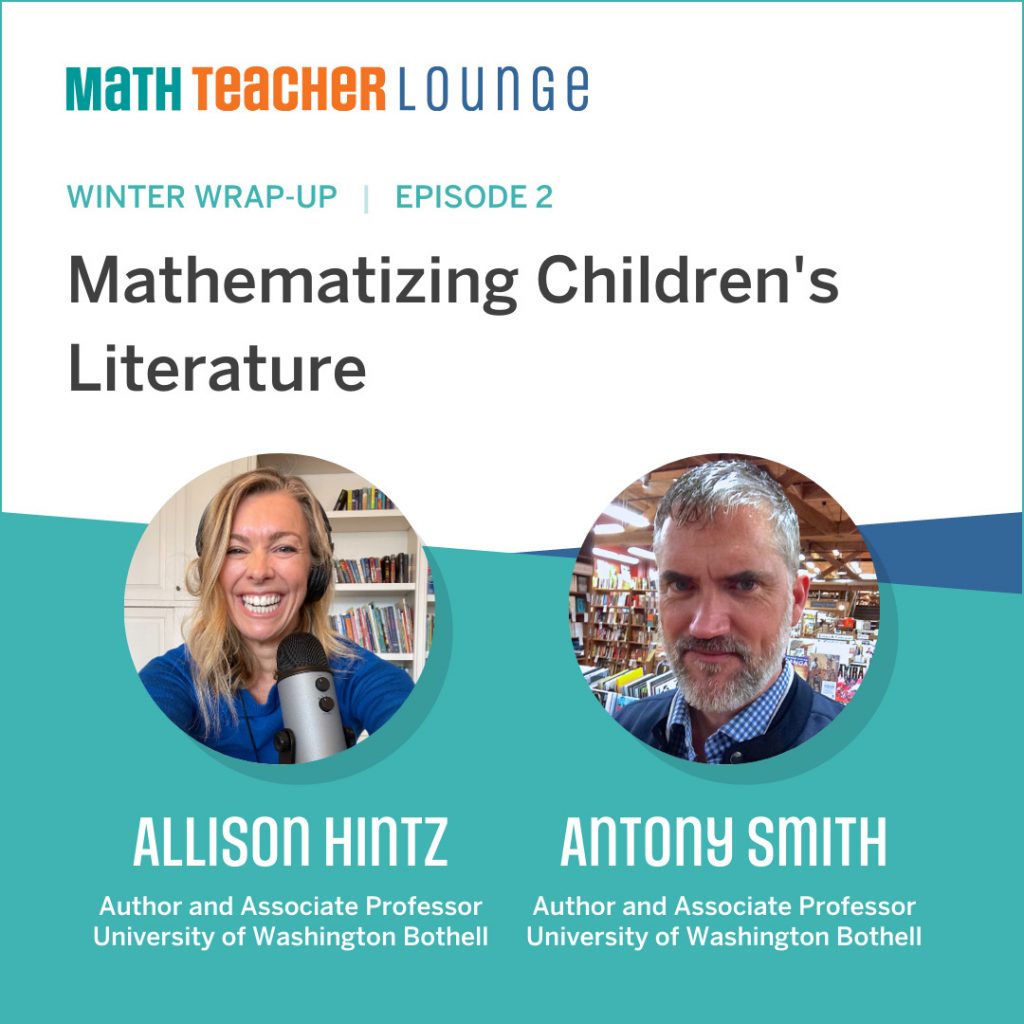
While we’re hard at work producing the exciting fifth season of Math Teacher Lounge: The Podcast, we’re continuing to share some of our favorite conversations from our first four seasons. This time around, we’re revisiting our popular episode that connected literacy and math!
In this episode, we sit down with Allison Hintz and Antony Smith, authors of Mathematizing Children’s Literature, to talk about what would happen if we were to approach children’s literature, and life, through a math lens–and how we can apply those same techniques to classroom teaching!
Explore more from Math Teacher Lounge by visiting our main page.
Bethany Lockhart Johnson (00:02):
Hi, I’m Bethany Lockhart Johnson.
Dan Meyer (00:04):
Hi, I’m Dan Meyer.
Bethany Lockhart Johnson (00:05):
And we are so excited for another episode of Math Teacher Lounge. And as you know, podcast format; you’re listening now. I think one beautiful thing about the podcast format is that it gives us a little bit more time to have these rich conversations. And I promise I won’t do it, but I could talk to our guests for hours, hours! Authors Allison Hintz and Tony Smith have just released Mathematizing Children’s Literature: Sparking Connections, Joy, and Wonder Through Read-Alouds and Discussion. And today we get to talk to the authors. Allison, Tony, welcome. Welcome to the lounge.
Allison Hintz (00:53):
Thank you. We’re so grateful to be here.
Bethany Lockhart Johnson (00:55):
We’re so excited to have you here. And I wanna say that my very first—was it my first math conference? Maybe it was my first math conference—up in Seattle, the CGI conference, and I’m all like, you know, wide-eyed and just like, “Can this be a place for me, this math community?” Re-envisioning my relationship with math and thinking about myself as a math teacher, what? And I went to your session on mathematizing children’s literature, and I was just so fired up. I was so wowed by your ideas, your energy, and your passion for students’ thinking. And I feel like as I read this book, I felt like I was hanging out with you. Like you were just so encouraging all the way through. Of educators, of other folks working with young people, and really guiding us how to listen with joy and with an open curious mind.
Dan Meyer (02:03):
Yeah. I would love to hear a bit about the genesis of this book for you folks. Like, I’m coming at this from a secondary educator lens. I’ve got small kids, so that’s also part of my interest here. But I love any book, any idea that seeks to merge what seems like two disparate worlds. Like it’s often the case that we feel like, well, there’s approaches for ELA and approaches for math, and they’re kind of separate disciplines. And these poor elementary teachers have to learn all of them and be experts at all of them. And here you both come along and say, “Hey, what if they are the same kind of technique?” Can you just speak to how this came about?
Allison Hintz (02:38):
Definitely. Tony, do you wanna take a try? Do you want me to start us off?
Antony Smith (02:42):
I can start. We oftentimes present and talk together and so we kinda switch back and forth. So that’s just how we are. So probably about eight or nine years ago, Allison and I, our offices were next to each other on our small campus. We’re both professors and we just happened to have a few children’s books that we looked at together and we were just thumbing through the pages. We really liked children’s literature. And we noticed that I would stop at certain points wondering about character motive or plot or sequence of events or language use. And Allison would stop at very different points in the book and notice number and concepts or something about mathematics. And that’s when we started to wonder, what would it be like if we were sharing a children’s book with a group of children and we put our ideas together? Where would we stop? What would we talk about? What would we ask children about in terms of their thinking and what they notice?
Allison Hintz (03:42):
And so we started playing with these questions that we had and started approaching stories with multiple lenses to see what kinds of things would children notice and what kinds of things might they say. And we were also on our own journey in trying to understand how to plan for and facilitate lively discussions and classrooms that surface really complex mathematics. And it felt like stories were a place where that might be a fruitful context for hearing children’s thinking. We’ve worked with a lot of teachers and students in our region. We live in the Seattle area and we’ve applied for some funding over time that’s really helped us be in a lot of community-based organizations and educational contexts and libraries and pediatricians’ offices and classrooms, various classrooms, and see what’s interesting about this and what might teachers and children do with stories that would surface complex mathematics to think about together.
Antony Smith (04:41):
Over time, we came to the realization that if we wanted to hear children’s ideas, we had to stop bombarding them with questions. <laugh> Yeah. And at first it made it worse that we were asking them math and literacy questions at the same time. And so we realized that what we needed to do was to back off and to ask children what they noticed and wondered.
Bethany Lockhart Johnson (05:01):
Can you say more about that and how that kind of evolved into mathematizing children’s literature?
Antony Smith (05:07):
We did work with a number of very thoughtful, talented classroom teachers and children’s librarians in public library systems who were just so masterful at asking open-ended prompts and questions, rather than kind of like the de facto reading quiz, that a read-aloud can become, which I’ve always disliked as a literacy educator. And we realized in our observing these read-alouds or interactive read-alouds or shared reading experiences that given the opportunity in the space and an adult who was actually listening, that children came up with all of the ideas we would have asked them about and more. So we didn’t have to be bombarding them with questions. They were already much more thoughtful than what would’ve been sufficient to answer our questions.
Allison Hintz (05:58):
And much like mathematics, it was really an iterative process. You know, we had some clunky read-aloud discussions where we were trying to accomplish so much and toggling multiple chart papers and different colored pens and all sorts of “how do we capture these ideas” and “do we separate ’em? do we keep ’em together?” And so it’s really been over time that with partners, we’ve learned these ways of having multiple reads of the same story that allow us to hear what children notice and wonder, and then to delve more deeply into their questions and their ideas through multiple reads where we might spotlight literary ideas that they notice; we might spotlight mathematical ideas that they notice. We might make purposeful integrations between those. But we found it to be most productive—and Kristin Gray really help us think about this—to have an open Notice and Wonder, get everything out much like an open-strategy share. We welcome here, record all the ideas, and it goes all over everywhere. You know, it can be a really not math-y noticing! And those are amazing! So there’s a lot of, um, yes, there is a ladybug on this page! The grandma is wearing green triangle earrings! Oh, your grandma wears green earrings! I mean, it all comes out.
Bethany Lockhart Johnson (07:27):
Wait, have you been in my classroom? ‘Cause that’s exactly— <laugh>
Allison Hintz (07:29):
<laugh> And then, you know, we think of it a lot like if math teachers might use the 5 Practices for selecting and sequencing, or if you might move from an open-strategy share to a targeted share, how can we get out all the questions that children are asking and then step back from them, take some time to really think about what they’re telling us they’re curious about, and plan some purposeful, intentional subsequent discussions that can delve more deeply into their ideas.
Dan Meyer (08:02):
I’d love to go into that a little bit more if that’s all right. Um, I’m gonna speak from someone who doesn’t have an elementary background and I’m gonna voice some worries that I had, some anxiety. One anxiety I have like in a classroom or a curriculum is when there’s no room for student ideas. Right? When it’s like, oh, there’s just room for the curriculum author or the teacher here. That is a sadness. But I when I see an instructional environment like you’re describing here, where there is openness to all kinds of different student ideas, of different levels of formality, from different kinds of cultural fonts of knowledge or wherever, I also get a little bit nervous because that, like, increases the risk that a student might come to understand that “my ideas are not good enough,” whereas in the class with no room for their ideas from their home or their language or their hobbies, like, they’re not gonna internalize the message that, “that wasn’t good enough.” And so I’m really curious as you move from the open Notice and Wonder where kids share all of themselves with you, and then you move to a targeted focus on some sort of disciplinary objective, how do you navigate that tension and help students feel like their contributions are valuable, even though we aren’t taking them up per se?
Allison Hintz (09:18):
That’s such an important question. I mean, I think we’ve grappled with this broadly in math education. I think any time we’re thinking about which ideas we choose to take up to pursue to consider, we have a responsibility to think carefully about whose ideas are being taken up and heard and considered. And so one of the tensions I hear you naming, I think, Dan, is when we engage in lively discussion where children’s thinking’s at the center, how do we make sure to upend and interrupt kinda status norms that run the risk of being deepened? Um, and I think by paying attention to whose ideas are taken up as much as which ideas are taken up, and what’s the mathematics we wanna explore is one tension. Um, another tension I might hear you naming is, you know, the complications that teachers face with time and pressure and coverage, and which mathematics ends up getting worked on. And, um, you know, it’s something we’ve really had to struggle with in mathematics education, where we move to more discussion-oriented classrooms that are really centered in sense-making to know that it takes a lot of time to do this thoughtful, thoughtful work. Um, does that begin to get at some of the tensions you’re raising? Is there, is there more you’re thinking about?
Dan Meyer (10:53):
I think it’s really helpful that you kind of broadened the scope of the question beyond your book to “this is an issue that we are, you know, really challenged by and focused on broadly in math education.” And, um, I appreciate you bringing the element in of whose idea—not just which idea is taken up, but whose idea is taken up—is an opportunity where, let’s say, multiple people raise an idea that is towards an objective the teacher has, they have the opportunity to disrupt certain kinds of status, like ideas about status, in that moment. From your perspective, like, are there techniques to say, I don’t know, parking-lot certain kinds of questions and say like, “Hey, like these are awesome”? I don’t know. I just know that I see kids at like ninth grade. They are very reticent, often. They’ve internalized totally this sense of like, “I’m not gonna just, like, share about the pants the grandma’s wearing, you know; that will not be received well.” And so I’m just kinda wondering how that happens and like, what are the ways we can disrupt that? That process?
Antony Smith (11:54):
So thinking about that, Dan, from the teacher’s perspective, in those kinds of scenarios where you wanna honor each child’s contribution, a couple of things that come to mind: One is that by, you know, initially by modeling what I as a teacher, something that I notice or wonder about, helps kind of set the expectation for what kind of response would be encouraged. And it’s broad, but it gives an example. And then also we really try to record or to chart all of the ideas that are shared so that we can revisit and honor those together. And then either later or on another day, if we choose one or two of those to explore in some way within a more focused read, then another thing that we do is have the idea investigation afterward that continues that thought, but goes back to being as open-ended as possible, so that those students or children who maybe didn’t have their idea as the one that was focused on by the group could go back to that or explore some other idea of their own, so that the idea investigation isn’t a lockstep extension activity, which is why we don’t call it that. So they could again bring in their own perspective. But I have to say from the teacher’s point of view, there is that moment of potential panic <laugh> because there is that power transfer when you’re asking children to help steer where this is going. And if you really mean it, you have to let them steer a little bit. And that can be terrifying. And, um, I always think of one teacher, Ashley, we worked with who read an adorable book, Stack the Cats, by Susie Ghahremani. And in that book, there’s a point where there are eight cats and they’re kind of trying to be a tower of cats and they fall and they’re sort of in the air on that page. And she asked her first graders—she stopped, and she asked, “How, do you think, how will the cats land?” And for about a minute and a half, the entire <laugh> class, was silent. They had their little papers; they had chart paper; they had clipboards; they had everything they needed. But that unusual phenomenon of a group of six- and seven-year-olds actually just sitting and thinking and not being peppered with activities was really stressful, but amazing. And then, after about the 90 seconds, they started out into their exploration of how the eight cats might land. They just needed a minute to think. And it’s so rare that we’re able to let children have that.
Allison Hintz (14:40):
In that same moment, Ashley, who’s a learning partner to us, she turned to us kind of quietly, like, “Should I pose a different question?” And <laugh>, we’re like, “No, let’s stick with it. Let’s see what happens.” So I think it creates this space too, this thinking culture, right? And this culture of “what does that mean to really pose a rich task?That’s open-ended, where there’s multiple access points?” Those eight cats could land in so many different ways. And there was broad access, there was a wide range of all the cats landing, and one’s on their feet, ’cause cats always land on their feet <laugh>, and there was every combination. And so, um, I think what’s really interesting—and to me, this brings back to your wonder, Dan—is, you know, “What’s the risk in openness?” And there’s always risk in openness. Um, it’s scary as a teacher, right? If I’m not the authority of knowledge and I don’t have control over where we’re gonna go, it might get into places that I didn’t anticipate. Or I don’t really feel as solid in the math as I want to. Or I don’t know what it sounds like to stick with silence and wait time, to know if my students are really in productive struggle or if that question was a flop. And so, um, I think this is some practice space for young mathematicians and teachers of mathematics, and just teachers, to explore with that openness and kind of the risk of the openness required for complex thinking to emerge.
Bethany Lockhart Johnson (16:12):
You know, it feels like the way you’re both describing this, it really is a culture shift, right? I kept feeling like I was given permission to be a beginner as I read this book. Like I was really…I loved how you said, I believe it was you, Allison, when you were in the class, you had a couple index card that you kept on your clipboard and that as you walked around, you were like, “Hey, if I don’t know what to ask, I ask one of these questions.” You know? And just this idea that, that, like Dan was saying, there is that loss of control, but that’s also a way to create this culture where students ideas are valued and we are allowing students to really generate the questions, which I thought was such an important idea to explore.
Allison Hintz (17:00):
We started this work long ago, super-excited about math-y books. And we saw a lot of potential in them and we still do. But the limitation we saw is that math-y books, they, they put forth a certain mathematics to be curious about. In some ways they tell you what mathematics to think about. So we started asking ourselves what would happen if we considered any story a chance to engage as mathematical sense-makers. And we started playing with non-math-y books and we got to a place where we could consider every story an opportunity to engage in mathematical thinking. And so we started noticing things over times, oh, these books tend to be really math-y. We call those text-dependent. We’d have to pay attention to the mathematics to understand the story. Whereas this pile of stories, these, they’re not overtly math-y. You could really enjoy the story and not pay attention to mathematics and have an amazing conversation. But what would happen if we thought of about this story as mathematical sense-makers and how might it deepen our understanding of the story? And then this other teetering pile of books, these are books where, you know, children didn’t tend to engage as overtly as mathematicians in it, but there’s opportunities in this story to go back to something—to a moment, to an illustration, to a comment—and think as mathematicians. And those were more about illustration exploring. And so, as we notice these different kinds of books, we really broaden what we thought about. And I think one of the things we really wanna think about in community through this book is what happens if we approach any story, every story, as mathematical sense-makers, because stories are alive in children’s lives, in homes and communities and in schools. And it’s a broad opportunity that we wanna take up. I was thinking, as I stay in this strait for just a moment about book selection, before we move into that process, um, Bethany in a previous MTL, you talked about representation.
Bethany Lockhart Johnson (19:12):
Mm, yeah.
Allison Hintz (19:14):
And do you remember when you shared the image of hair braiding?
Bethany Lockhart Johnson (19:19):
Yes. Vividly, yes. <laugh>.
Allison Hintz (19:22):
Yeah. And can you say just what that meant to you? What that….
Bethany Lockhart Johnson (19:27):
Yeah. Well, it was from a conference; Sunil Singh had used it and was talking about the artistry in mathematics and beauty in hair braiding. And, um, particularly, he was showing this particular image of this Black woman with her hair braided in profile and looking at the angles and the symmetry. And I shared that, you know, I spent so many hours in the beauty shop with my aunties and my mom and my grandma and continue to, to this day, that it just, it struck me immediately as familiar. And it struck me immediately as seeing an image that was reflective of my lived reality, projected as valuable and worthwhile for consideration in the world of mathematics. Which is not what I felt as a student of mathematics as a young adult or child. So it was this beautiful moment of, for me, the power of when we see images and we allow opportunities for re-envisioning what may be a common practice for that student, or may be something that they see every day.
Allison Hintz (20:44):
And in that same way, that image that was put up, we wanna think really carefully about representation in the stories that we select. And when we think of stories as mirrors or windows, we really wanna be mindful in story selection of whose stories are told and whose stories are heard. And when you said that you would sit down to listen to a story and you felt at ease or that you saw an image and you saw yourself that can be and should be something we really think carefully about when we select the stories that we select.
Dan Meyer (21:21):
It’s a wider path for representation of different kinds of people in literature, because people’s stories seem so much more present and towards the surface of their lives, versus, say, the abstractions and numbers and shapes in mathematics. It feels like more of a struggle to find ways to show people, hey, like you’re here, this, this place belongs to you. So in all these reasons, I think it’s really great you folks are using literature, which has this history of humanities, literally humanities, as a vehicle for mathematics. That seems pretty special here.
Antony Smith (21:56):
We both go to libraries and bookstores and look through books as often as we can, but also our partner, a children’s librarian, Mie-Mie Wu, helped us go through—when we would meet, she would bring three or four hundred books at a time.
Bethany Lockhart Johnson (22:13):
When you described her wheeling in the cart, oh, I wish I been in that room! <Laugh>
Antony Smith (22:18):
And the cart was, you know, probably three or four times bigger than she was sometimes. And we would go through hundreds of books and look at them and listen to her thoughts as a skilled librarian sharing with families, diverse families, and what catches the attention of a three-year-old sitting with her grandfather. And that was really a valuable, helpful experience. And it’s a partnership that continues. So in Last Stop on Market Street—and this is in the book; we talk about this, this children’s book quite a bit—in this story, CJ with his Nana, his grandmother, are riding the bus to the last stop on Market Street in San Francisco, to go, as we will find out, to help serve in a soup kitchen to help the community. And the teacher, Susan Hadreas, had the children record their ideas. She charted them in an open Notice and Wonder read. And one of the ideas that a young boy noticed was that CJ on the bus…a man with a guitar starts playing the guitar on the bus and CJ closes his eyes and it says CJ’s chest grew full. And he was lost in the sound and the sound gave him the feeling of magic. So this boy said, “I wonder, what does that feel like if you’re feeling the magic? What’s that?” And that was one of many ideas in the open Notice and Wonder, and Allison will talk about the math lens read, but first Susan went back and read with them. She had that idea, she circled it on the chart paper, and another day that week, she said, let’s go back and visit this story we really liked. And remember, we wondered what feeling the magic was like. Let’s go back through and let’s keep track of all the feelings and emotions that CJ had across the journey to the soup kitchen in this book. And so they did another read of the story; they were very familiar with it, of course, but they noticed new things and they also, every few pages, stopped and she helped chart all of the emotions that CJ experienced from envy to excitement to sadness. There’s a huge range in this book. And it was fascinating.
Allison Hintz (24:36):
I think one of the things that the children noticed was that CJ’s feelings were shaped by community. And that he shaped and shaped…he was shaped by and helped shape his community. And so the ways that he felt across the story were impacted by the other characters that he comes across. The guitar man on the bus. The bus driver who can pull a coin out from behind someone’s ear. The lady with the butterflies in the jar. Nana helping him to see the rainbow. And the students started, you know, being curious about that. How do we shape and how are we shaped by community? What communities are we a part of? This class is one community. I’m in many communities across my life. And they started to quantify the number of people in the story. So Mrs. Hedreas went back for a math lens read, and she said, let’s just keep track of and pay attention to how many people are in CJ’s life in this day. Because I can hear you starting to think about quantity. This class at the same time in other areas of the day had been working on counting collections, how to keep track, so they got out their tools. Some people pulled out ten frames, some people pulled out clipboards. They had a wide range of things they could use to help them keep track. They developed their own strategy, keep track however you want. She did a quicker read through it, flipping the pages, and then they get into these debates: <laugh> “We already counted that person!” “But they took their hat off and put it down to collect money!
Antony Smith (26:10):
“What about the dog?”
Allison Hintz (26:11):
“That’s the same person!” “Yeah, there’s a dog pound in his community!” <laugh> “Do animals count in our community?”
Bethany Lockhart Johnson (26:17):
I love it!
Allison Hintz (26:17):
“Yes, they count!” Uh, and so we went through and quantified and there was really this understanding as you saw these people throughout the story that communities can be of different sizes, but community has impact. And you have responsibility in your community to show up and to lean in and to know that bringing your full, authentic, vulnerable self, you shape people and they shape you. And what communities are people a part of. And it turned into this really interesting discussion about quantity and helped us think more about quantity and community. I think a really important moment for us and for that class was the transition from being people who almost did mathematics to a story, like counted things on a page, um, count acorns on a page in an autumn book, to being mathematicians who thought within the story.
Antony Smith (27:17):
And then two idea investigations that came from that —not at the same time, of course, but with the same group of children—one was they identified an emotion of their own and wrote and drew about that. And also, who helped them address or get out of or acknowledge that emotion. And then the other idea investigation was that all of the children drew or kind of mapped out a community that they were part of. Whether it was their neighborhood or their classroom or their soccer team or whatever it was. And so then those investigations strengthened the connections of those concepts to the lives of those children.
Bethany Lockhart Johnson (28:05):
Well, I, actually wanted to ask you about idea investigations. Because I feel like that was such an important invitation in your book. And the way I understood the idea investigation is you’re really paying attention to what’s coming up in your other reads. Right? And then these are opportunities to extend the thinking, or like you said, to extend a particular aspect: What’s your community? Can we map your community? Or what’s a particular emotion? And it was in such contrast to what I think I have probably done in my classroom more than once, which was like, “Oh, we read this story about seals. So now my story problem is gonna be about seals, right? <laugh> Like in the story, you know, Jojo, the seal had five balls. <laugh> So if Jojo still had five balls and two of them bounced away…” You know, or whatever. Right? But that’s not what an idea investigation is. Right?
Allison Hintz (29:03):
Yeah. I think this is where we also had some stumbles and can totally relate to what you’re saying as previous classroom teachers as well. We have come to a place where we are pretty in favor of a super open-ended idea investigation that takes up the things that have surfaced in the multiple reads and making sure it’s a rich task with many, many ways children can engage with that. There’s many, many, many right answers or ways to engage. Less is more there. So we moved way away from, like, even a worksheet that might have an idea from it to blank paper and math tools and places to get into some productive struggle around some of the complex things that were raised.
Antony Smith (29:59):
A challenge with worksheets is that they put a frame around children’s ideas. So either there are only three lines to write on, or there’s only a small box to draw in. Whereas a blank page really opens up the possibility. Um, and so—is it Ann Jonas who wrote Splash!? sorry, I don’t have it in front of me—the book Splash!, about animals that end up in and out of the pond, including a cat that is not happy about ending up in the pond, an idea investigation after that for very young children was, with the list of the different creatures displayed at the front of the room: On blank paper, hey, draw your own pond and decide how many of which and each type of animal you want in your pond and then write about it. Just on blank paper. And so that allowed some children to draw, like, three giant goldfish. But other children drew 17 frogs and three cats. And, and just, it lets children follow—
Bethany Lockhart Johnson (31:02):
It was theirs, right? It was theirs.
Antony Smith (31:04):
Their idea. <laugh> And that comes partly from, I think, as Allison mentioned, we both were classroom teachers before moving into academia. And I remember giving children worksheets, particularly math worksheets, where they weren’t necessarily bad, but right at the bottom, it says like, explain your strategy. And it gives two lines.
Bethany Lockhart Johnson (31:23):
Right! <laugh>
Antony Smith (31:25):
The only thing a seven-year-old can write there is “I thought.” Or “I solved it.” <laugh> And that’s not where we need to go.
Dan Meyer (31:34):
Yeah. If I could just ask the indulgence of the primary crowd here, like, I’m trying to make sense of all this. And I just wanna like, offer my perspective. My summary statement of what’s going on here. I’m trying to—I love how you both came here—
Bethany Lockhart Johnson (31:45):
<laughs> How ya doin’, Dan? How ya doin’?
Dan Meyer (31:47):
<laughs> I’m, ah, A, I’m loving this a lot. Um, B, I came in here loving how you folks are broadening the work of primary education to kind of find commonalities between these sometimes seemingly disparate kinds of teaching in ELA and math. Love that, I wanna say. But I think you folks are describing, with all these teachers you observed and your own work, is the work of attaching meaning to what students might not realize yet has meaning. Or they might think it only has one kind of meaning. But you, the teacher, with their knowledge, realizes that there are many more dimensions of meaning that can be attached to those thoughts. And I’m hearing that from you folks, when you describe A, what math is and the power of a teacher to name a thing as mathematical. Like, “Oh, you didn’t think math was that, but math is noticing; math is wondering; math is asking questions,” for one. But also this work you’re describing of how, like, first the task has to invite lots of student thoughts and then to say like, “Oh, I see that there’s a similarity to these two.” And to raise those up for a conversation or to ask a question like to extend one person’s, one student’s question a little bit more. But it’s always…I’m just hearing you folks attaching more meaning than the student might have originally thought. I appreciate the conversation. That’s really interesting.
Bethany Lockhart Johnson (33:03):
Well, and now that the book is out, I think it’s gonna keep evolving, right? Now that it’s gonna be in the hands of teachers and librarians and educators and caregivers, it’s exciting to see kind of where it goes next. Which actually brings us to our MTL challenge. Dan Meyer, do you wanna share?
Dan Meyer (33:22):
Math Teacher Lounge, we have a challenge for the folks who listen and we’d love for them to hop into the Facebook group Math Teacher Lounge, or hit us up on Twitter at @MTLShow and just, like, kind of exercise beyond listening, exercise the ideas you folks are talking about, some kind of a challenge that can help us dive deeper into your ideas. So what would you folks suggest for our crowd, for our listeners?
Allison Hintz (33:42):
I would love to invite people to playfully experiment with a favorite story, with a story that’s new to you. I would love to invite listeners to sit with a story maybe on your own, and just ask yourself as a mathematician: What do you notice and wonder in this story? Don’t feel any pressure. Maybe sit with a child or some children and listen to what they notice and wonder. Like, really listen! Don’t ask questions! But hear their questions and place children at the center and consider multiple reads. Consider continuing to pursue their questions. And we have a planning template that might support people in kind of sketching out some ideas if you’re open to playing with that too.
Bethany Lockhart Johnson (34:34):
And we will post—
Dan Meyer (34:36):
That’s awesome.
Bethany Lockhart Johnson (34:36):
—a link for that planning template in our Facebook group and on Twitter as well. So thank you so much for that resource, because I think it’ll definitely help. It could help you, like you said, it could help you kind of organize your thoughts or help you think about this work in a new way. So thank you for that resource and thank you for the amazing resource that is Mathematizing Children’s Literature. I am so excited to continue to engage with you both and with listeners as they dive into this book. If folks want to engage with you more, where can they find you? How can they reach you?
Allison Hintz (35:12):
Well, we’re on Twitter.
Bethany Lockhart Johnson (35:14):
Great.
Dan Meyer (35:15):
What’s your home address? <laugh>
Bethany Lockhart Johnson (35:24):
Wait, let me try that again. <laugh> ‘Cause it does sound like I’m like, <fake ominous voice> “Where can they find you?”
Allison Hintz (35:29):
4-2-5…. <laughs>
Antony Smith (35:32):
At the bookstore!
Bethany Lockhart Johnson (35:34):
Y’all, if folks want to continue this conversation or share these ideas or the math challenge, how can they tag you? How can they, they reach you on the World Wide Web, besides the Math Teacher Lounge Facebook group?
Antony Smith (35:50):
Yeah. Well, we are both on Twitter, and we’ve been trying to promote the hashtag #MathematizingChildrensLiterature. It’s very long, but once you type it once, your phone or computer…
Bethany Lockhart Johnson (36:01):
Easy. Yeah, those click, right? Is that what it is now?
Antony Smith (36:03):
<laugh> The other is that we do for our project, we have an Instagram account that is @MathematizeChildren’sLiterature.
Allison Hintz (36:11):
We care really deeply about hearing from people. You know, we think our ideas are constantly evolving and that there’s such exciting room to grow. And we just felt compelled to share what we were learning now so that together we could learn and build vibrant experiences for young children and teachers and families through stories. So we want to hear from people! We wanna learn about stories that are important in your lives and what children say, and grow these ideas together.
Bethany Lockhart Johnson (36:42):
And credit to Dan, you told me you went and ordered a bunch of the books they have on the suggested read list.
Dan Meyer (36:48):
Oh my gosh.
Bethany Lockhart Johnson (36:49):
You read ’em to your son.
Dan Meyer (36:50):
I got such a side-eye from my significant others around here for what I dropped on Amazon in one night! <laugh> Uh, all these books I didn’t have. Some of them I did. We are not fully illiterate around here! We do love the written word at the Meyer household! But there were a bunch that that I grabbed. I’m morseling them out day by day.
Bethany Lockhart Johnson (37:09):
Wait, at bedtime I read my one-year-old One Is a Snail, Ten Is a Crab. <laugh> And let me tell you, he had vigorous pointing and “Da? Da da da da?”
Allison Hintz (37:22):
<laugh> Aww, da da!
Bethany Lockhart Johnson (37:22):
So hey, we’re on the road. <laugh> <music> Deeply grateful, not only for your work and your beautiful book and your work, but also for the invitation to dive into the world of children’s literature in a way that many of us have not before. And it’s fun! Thank you, Tony. And thank you, Allison. And thanks for hanging out in the lounge.
Allison Hintz (37:48):
Thanks for having the lounge!
Antony Smith (37:49):
It’s been fun!
Allison Hintz (37:52):
Thank you both.
Stay connected!
Join our community and get new episodes every other Tuesday!
We’ll also share new and exciting free resources for your classroom every month.


Meet the guest
Allison B. Hintz: Dr. Hintz’s research and teaching are in the area of mathematics education. Her focus on mathematics came about during her years as a fifth grade teacher – it was alongside her students that she developed her own positive identity as a mathematician! Today she studies teaching and learning, specifically facilitating engaging discussion. Her research and teaching happen in partnership with educators and children in formal and informal settings and focuses on beliefs and practices that support all children in lively mathematics learning. She is a co-author, with Elham Kazemi, of Intentional Talk: How to Structure and Lead Productive Mathematical Discussions.
Twitter: @allisonhintz124
Antony T. Smith: Antony T. Smith is an associate professor of literacy education at the University of Washington, Bothell. He works alongside teachers to create engaging literacy-mathematics learning experiences through exploring and discussing children’s literature. He is committed to the concepts of motivation, engagement, challenge, and creativity in literacy teaching and learning.
Twitter: @smithant Instagram: mathematizechildrensliterature


About Math Teacher Lounge: The podcast
Math Teacher Lounge is a biweekly podcast created specifically for K–12 math educators. In each episode co-hosts Bethany Lockhart Johnson (@lockhartedu) and Dan Meyer (@ddmeyer) chat with guests, taking a deep dive into the math and educational topics you care about.
Join the Math Teacher Lounge Facebook group to continue the conversation, view exclusive content, interact with fellow educators, participate in giveaways, and more!
You might also like:

RF.1.3.G: Recognize and Read Grade-Appropriate (First Grade) Irregularly Spelled Words
Skill
RF.1.3.G: Recognize and Read Grade-Appropriate (First Grade) Irregularly Spelled Words
Standard
CCSS.ELA-LITERACY.RF.1.3.G: Recognize and read grade-appropriate irregularly spelled words.
Description
Mastery: Student is able to read irregularly spelled words with automaticity.
Acquiring: Student is able to recognize some irregularly spelled words. Student may attempt to decode some irregularly spelled words.
Probes
T: Read the following words – show a list of High Frequency Words, such as Fry’s or Dolch word lists, presented in random order (e.g., the, of, to, you, she, my, is, are, do, does).
Activities and Resources
Small Group Instruction – Direct Instruction
- P.041 High Frequency Words Sandpaper Words
- F.008 Words Word Relay
- F.009 Words Fast Match (water)
- F.010 Words Fast Words
- F.011 Words I Read, You Point
- F.012 Words Word Climb
- Introducing Multiple Irregular Words (Small Group)
- Memory (Small Group, w/ Partners)
- Bam! (Small Group, w/ Partners)
- Draw Two (Small Group, w/ Partners)
- Musical Chairs (Small Group)
- Word Baseball (Small Group)
- Word Potato (Small Group)
- Speed Battle (Small Group, w/ Partners)
- Let’s Bowl! (Small Group, w/ Partners)
- My Pile, Your Pile
- Make sentences with high-frequency words
During Transitions
- Around the World w/ Irregular Words (Small Group, w/ Partners, & Transitions)
- Flashlight! Flashlight! (Small Group, w/ Partners, & Transitions)
- Line it up! (Transitions)
- Smack the Wall (Small Group & Transitions)
- Surprise (Small Group & Transitions)
- Class Challenge
Reinforce Skills/Independent Work Time – Independent/Small Group Center Activity
- P.042 High Frequency Words Word Checkers
- P.043 High Frequency Words Word Fishing
- P.044 High Frequency Words Word Baseball
- P.045 High Frequency Words Word Memory Game
- P.046 High Frequency Words Word Bowling
- P.047 Variant Correspondences Canned Sort
- F.009 Words Pass the Words
- F.010 Words Word Sprint
- F.011 Words Word Speed Practice
- Irregular Word Fluency (Small Group, w/ Partners, Independent)
- Draw Two
- Memory
- Tic Tac Toe (w/ Partners or Independent)
- Word Hunt Tally (w/ Partners or Independent)
- Let’s Bowl
- My Pile, Your Pile
- Sight Word Books
- Flashcards with Fry’s HFW
- Various games to play with HFWs
Display (e.g. Anchor Chart):
Considerations & Reminders
- High Frequency Word Lists should be posted and visible for students to reference. While these words are to be memorized, the act of looking up at a chart/poster for quick reference allows the student to eventually be able to quickly find and recognize the words.
- When introducing an irregular word (but not when building fluency), we ask students to sound out and say the word correctly. There are multiple reasons to ask students to sound out irregular words:
- When students encounter an irregular word in connected text, they may initially attempt to sound it out. These exercises prepare them to read the word correctly.
- We want to show students that, though some word parts may be irregular, other parts are often regular, so that students can decode those parts, giving them a clue to the full word.
- If we sound out some words and not others, students may learn that sounding out should only be used intermittently. They may decide not to use it even when they should.
- Even for irregular words, the process of connecting symbols to sounds helps students learn the word: “The knowledge of letter-sound relations provides the powerful mnemonic system that bonds the written forms of specific words to their pronunciation in memory.” (Ehri, 1995)
- Teaching tips:
- One way to accelerate learning of irregular words is to print out flashcards for each newly introduced word and make a set for your students to practice with at home.
- If words are being introduced too slowly for your students, you can introduce a new irregular word every day. You should feel free to vary the pace, being careful to ensure that everyone is keeping up.
- When you point to a word, wait before touching it and train students to respond only when you touch the word. That gives all students time to think of the answer, so that slower students don’t just copy faster students.
- For each activity, keep a record of items a student had problems with. Review this activity log before the next activity so you pay special attention to those students.
How differentiation drives success

I’d like to share a favorite success story from my ELA class that brings home the true power of differentiation.
There was one boy—let’s call him Dipper. (It’s not his real name; I just really like the show “Gravity Falls.”) Dipper was the sweetest, kindest, most wholesome eighth grader I have ever met. He was absolutely precious.
Dipper also suffered from fairly severe academic struggles. He was well below his middle school reading level, struggled to express ideas in writing, and took longer than other students to break down basic concepts. When Dipper first came to me, he couldn’t start or complete a written sentence. He was easily frustrated and often overwhelmed to the point of tears.
Spoiler: By the end of the school year, Dipper was writing multiple paragraphs and starting to connect them with transition sentences.
Here’s how he got that much closer to grade level.
Using sentence starters and scaffolds to build success
My school district had recently adopted Amplify ELA (6–8). At the outset, I placed Dipper at the differentiation level with the most support. When we talked about how a character reacted to a moment in the story, Dipper had corresponding smiley, frowny, and disgusted faces to identify feelings. He had his own lesson plan with example quotes, shortened readings, alternative questions to spark thinking, and sentence starters to help him focus on comprehension instead of getting stuck at the start.
All of these supports helped him comprehend, share his responses, and contribute to discussions.
So far, so good.
But putting those thoughts to paper—or text box—was a completely different hurdle.
Facing academic struggles with patience and persistence
I can’t talk about Dipper without talking about his one-to-one aide. Let’s call her Ms. Mabel. (Again, “Gravity Falls.” I’m telling you, check it out.)
Ms. Mabel had sat beside Dipper during every ELA class since sixth grade. She helped him stay focused and generate ideas, and she even transcribed his answers when needed. Ms. Mabel’s devotion to Dipper’s success was profound and inspirational.
And it made all the difference when it came to Writing Prompts. At first, the prompts were met with tears and tantrums, panic and disdain, all the joyful wholesomeness ripped from Dipper.
Ms. Mabel would console him and redirect his passions to the work. She would point out the sentence starters, help him copy and paste them to the text box, and have him fill in the blanks. Again and again.
And then, little by little: Less panic. Fewer tears. Sentence starters, fill in the blank. Progress.
Sentence starters, fill in the blank. Success.
Day by day, Dipper, stacking wins like pancakes at an all-you-can-eat breakfast buffet, found confidence in himself, his reading, and his writing. He went from barely being able to complete a sentence to writing multiple paragraphs with evidence to support his ideas.
We had seen Dipper grow from a tiny sixth grader into a less tiny eighth grader and had watched his initial tenacity meet with stagnation, frustration, and defeat—until this year. This year with Amplify was different.
Why it takes more than just an awesome teacher
Obviously, you can’t pin success on one factor. Dipper had many supports in place: two blocks in the resource room, a dedicated aide, supportive peers and family, and—above all—a fierce drive and work ethic.
But if you asked Ms. Mabel, she would tell you that Amplify helped, too. She found that the way the questions were broken down allowed her to teach Dipper what he misunderstood better than she had been able to in previous years. We discovered very quickly how much autonomy was built in. It wasn’t rigid. It gave us structure and trust. It made differentiation easier, clearer, and more meaningful.
Sure, maybe Dipper was also maturing. Maybe I’m just an awesome teacher. Or maybe, just maybe, we need every little bit of help we can get to do the hard work in life. Maybe we need someone to push us in the right direction. Maybe we need those guardrails to keep us on course. Some of us can start our own engines, but we all need to be able to race.
Sometimes, we need someone who can help us start our sentences so we can learn how to be the ones to finish them.
More to explore
- Let’s keep the conversation going! Join the discussion in our Amplify learning communities.
- Looking for inspiration? Watch Teacher Connections, a video series featuring practical advice and tools straight from fellow educators—our very own Amplify Ambassadors.
- Dive into our podcast hub to hear from top thought leaders and educators and uncover cross-disciplinary insights to support your instruction.
Amplify Desmos Math
for New York
Welcome to Amplify Desmos Math, a powerful new core program from Amplify and Desmos Classroom built for NYC teachers and students.
Amplify Desmos Math is built on four core tenets:
- Math can motivate students.
- A structured approach to problem-based learning can best tend to all aspects of rigor.
- Student thinking is valuable and visible.
- Students can catch up while keeping up with grade-level math.

What if your students asked to do more math?
Amplify Desmos Math lessons are powerful in their ability to elicit student thinking and spark interesting, productive discussions.
The lessons pose problems that invite a variety of approaches with their dynamic and interactive learning experiences on devices, as well as experiences on paper that are flexible, creative, and engaging.
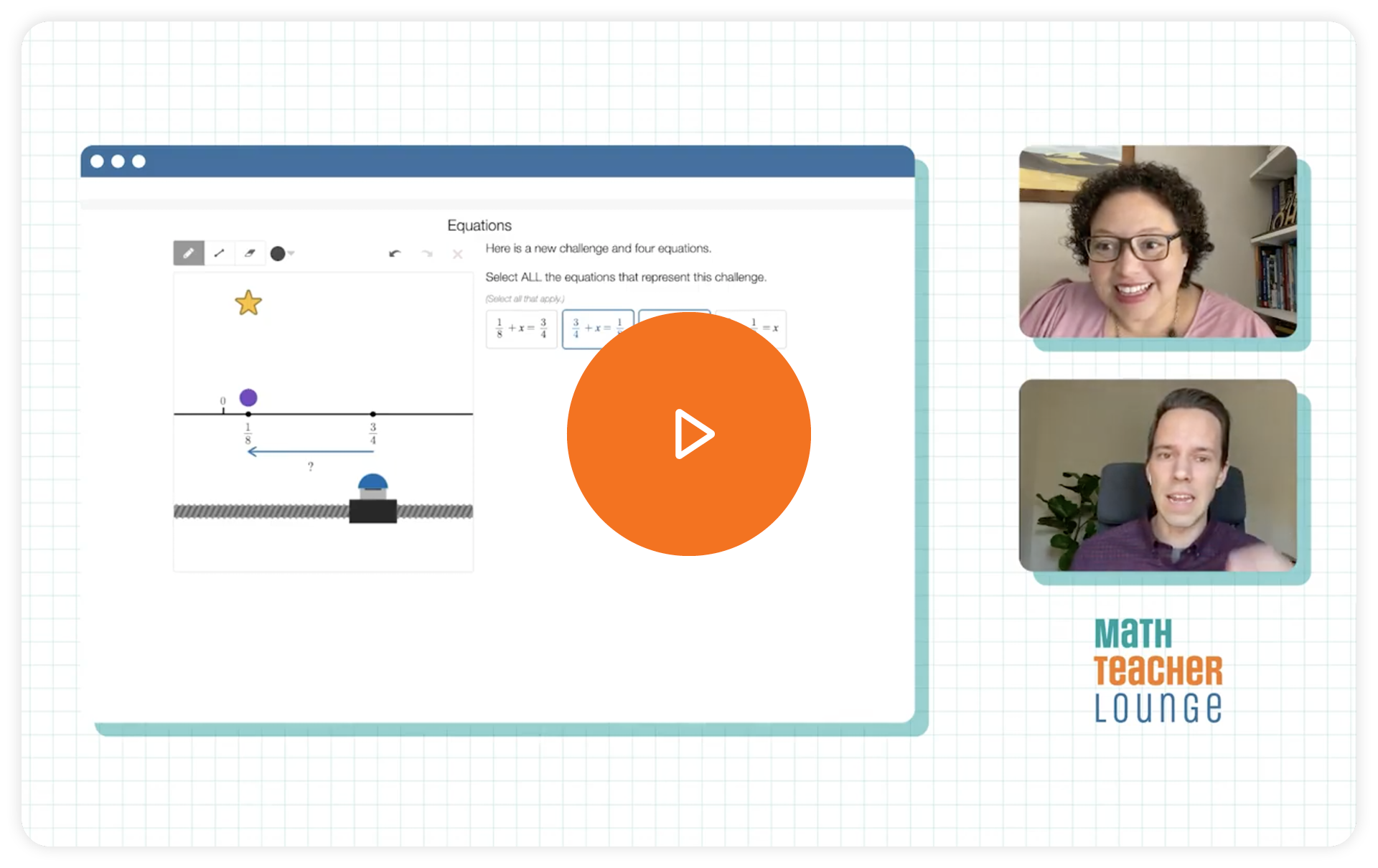
As students work online, they interact with visuals and simulations that show their thinking and decisions. When appropriate, students see other students’ responses and engage in collaborative math discussions.
A Responsive Feedback feature responds to student thinking by showing the mathematical meaning behind it. This is more powerful than simply evaluating thinking as right or wrong, because it motivates and engages students in the learning process.
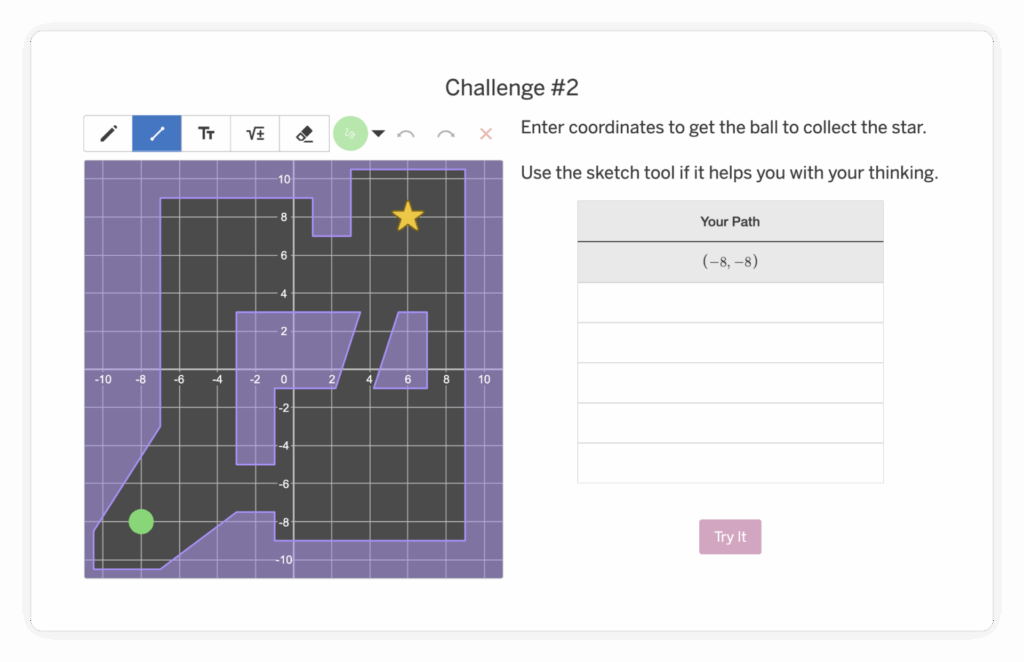
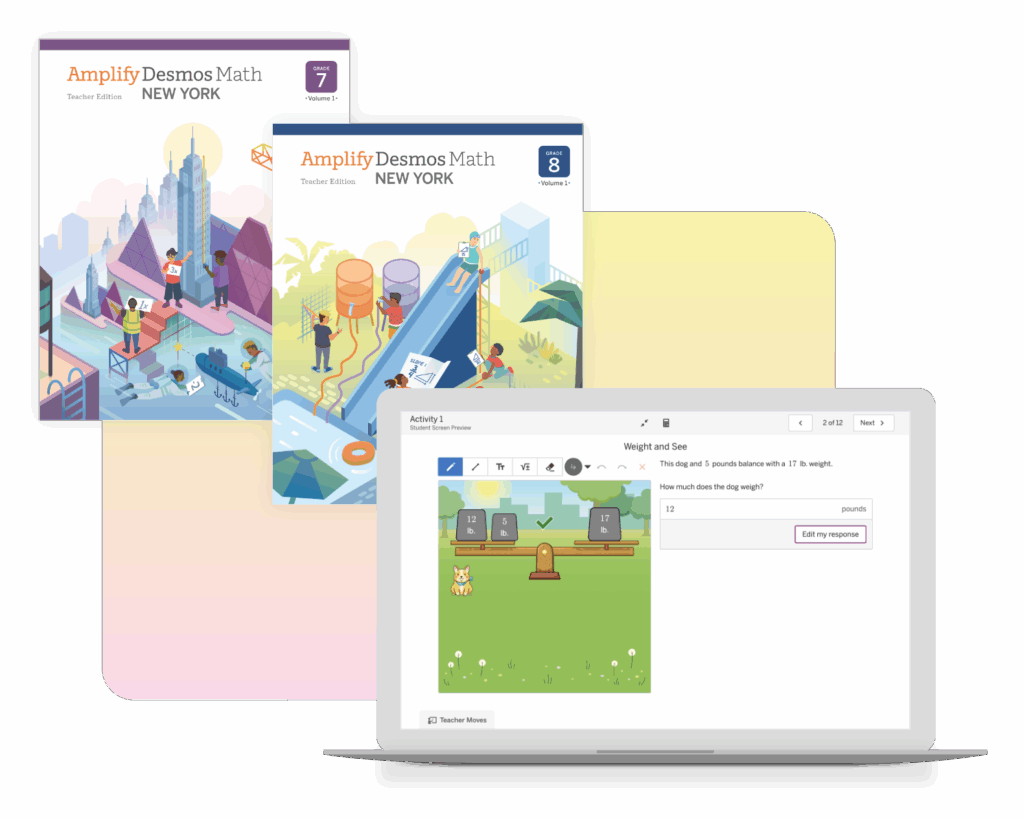
In this Grade 6 activity, students internalize the coordinate plane by plotting points to navigate the marble through the maze to collect the star.
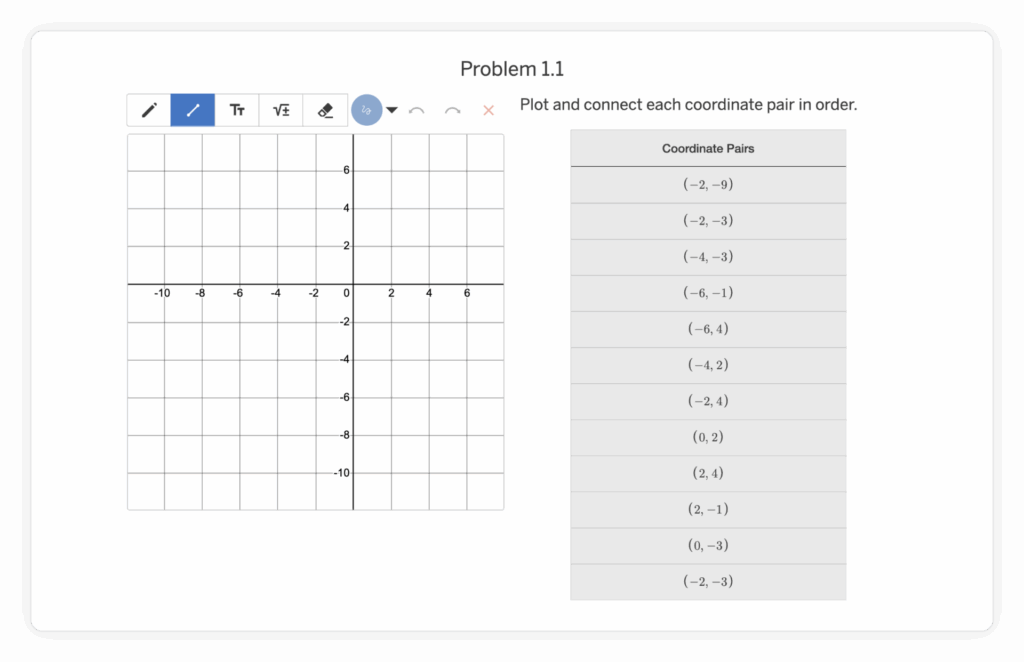
This prepares students to accurately and efficiently plot points with positive and negative coordinates on grids with different scales and explain the relationship between ordered pairs that differ only by the signs of the coordinates.
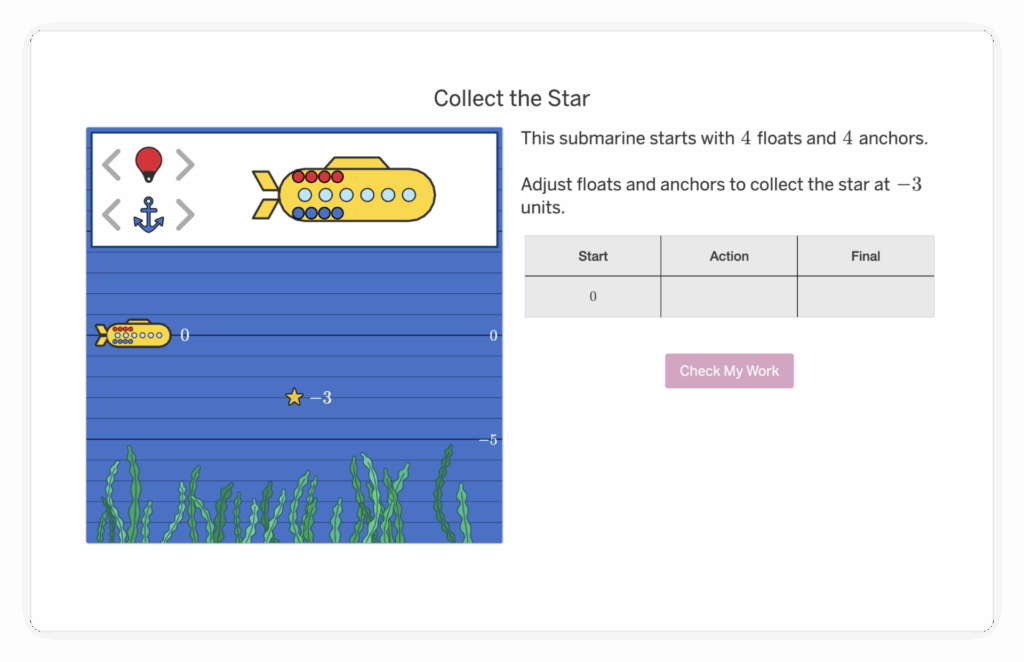
In this Grade 7 activity, students explore positive and negative integer operations using the up and down movement of a submarine.
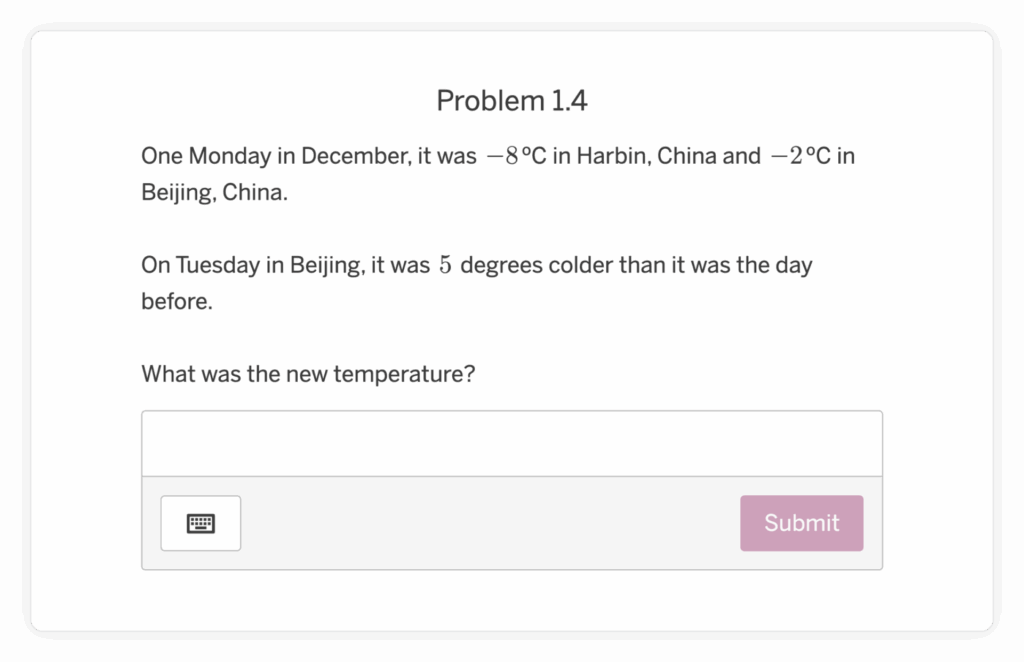
Students are then prepared apply this understanding in a variety of word problem contexts.
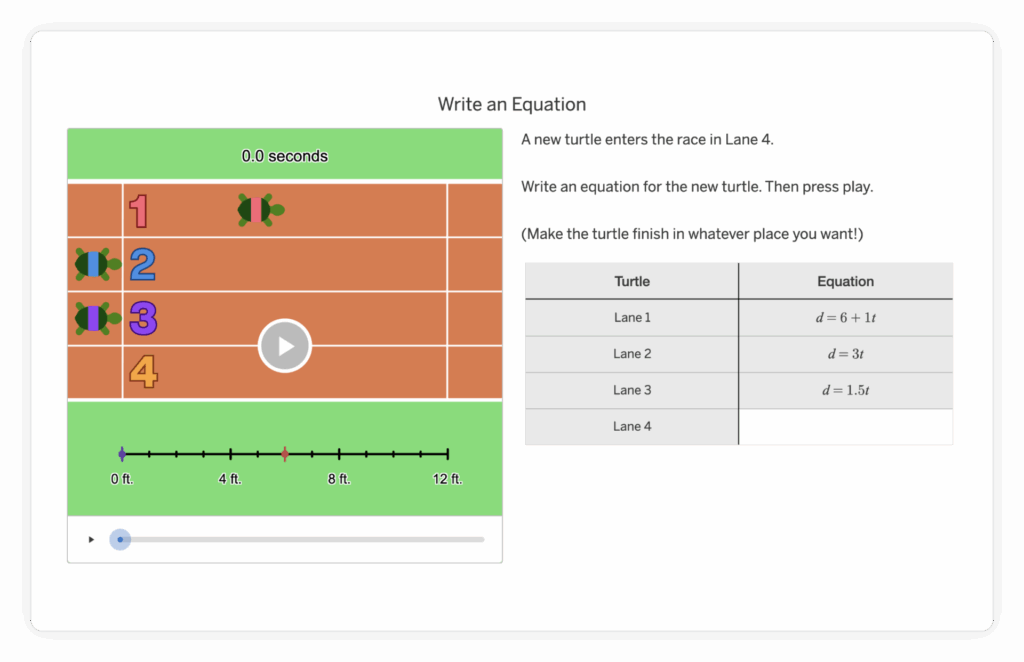
In this Grade 8 activity, students create rate, distance, and time equations based on turtle races.
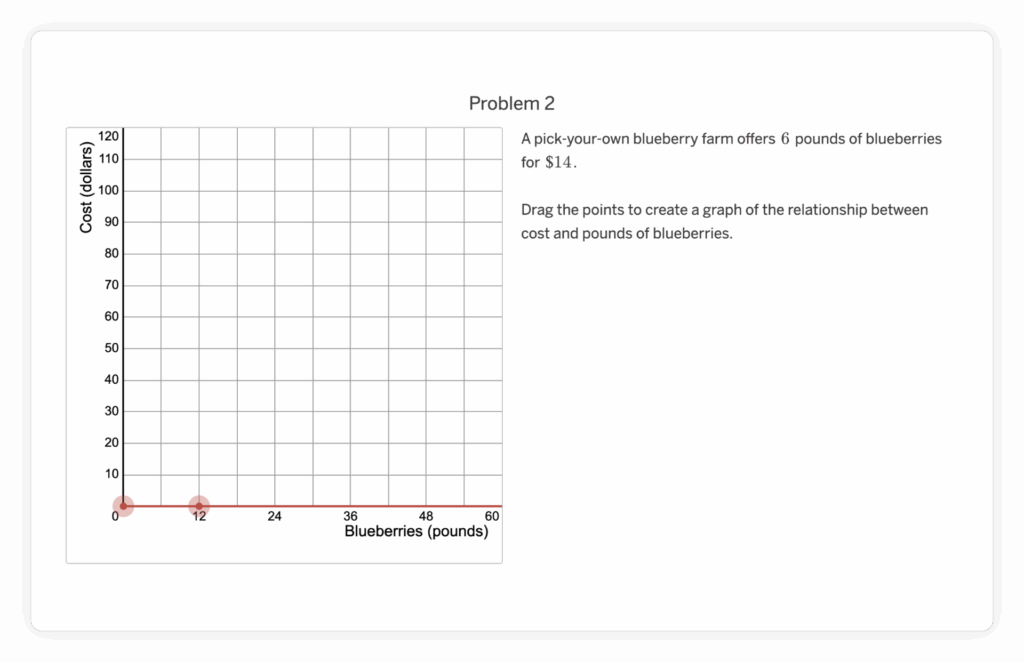
This prepares students to understand that a graph representing a proportional relationship is a line through (0, 0) and (1, k). They also begin to see connections between a context and features of a corresponding graph, equation, and table.
Data at your fingertips on the road to mastery
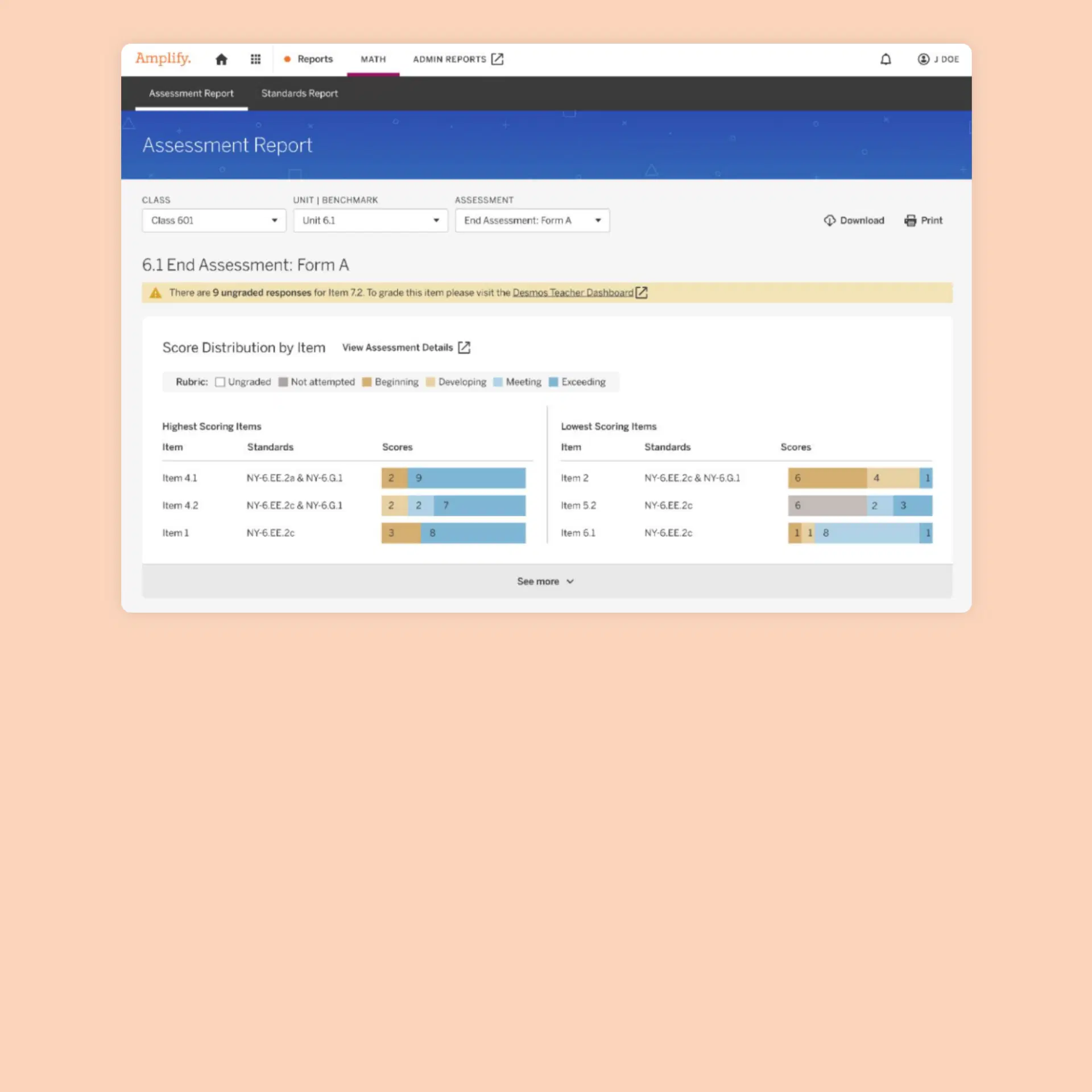
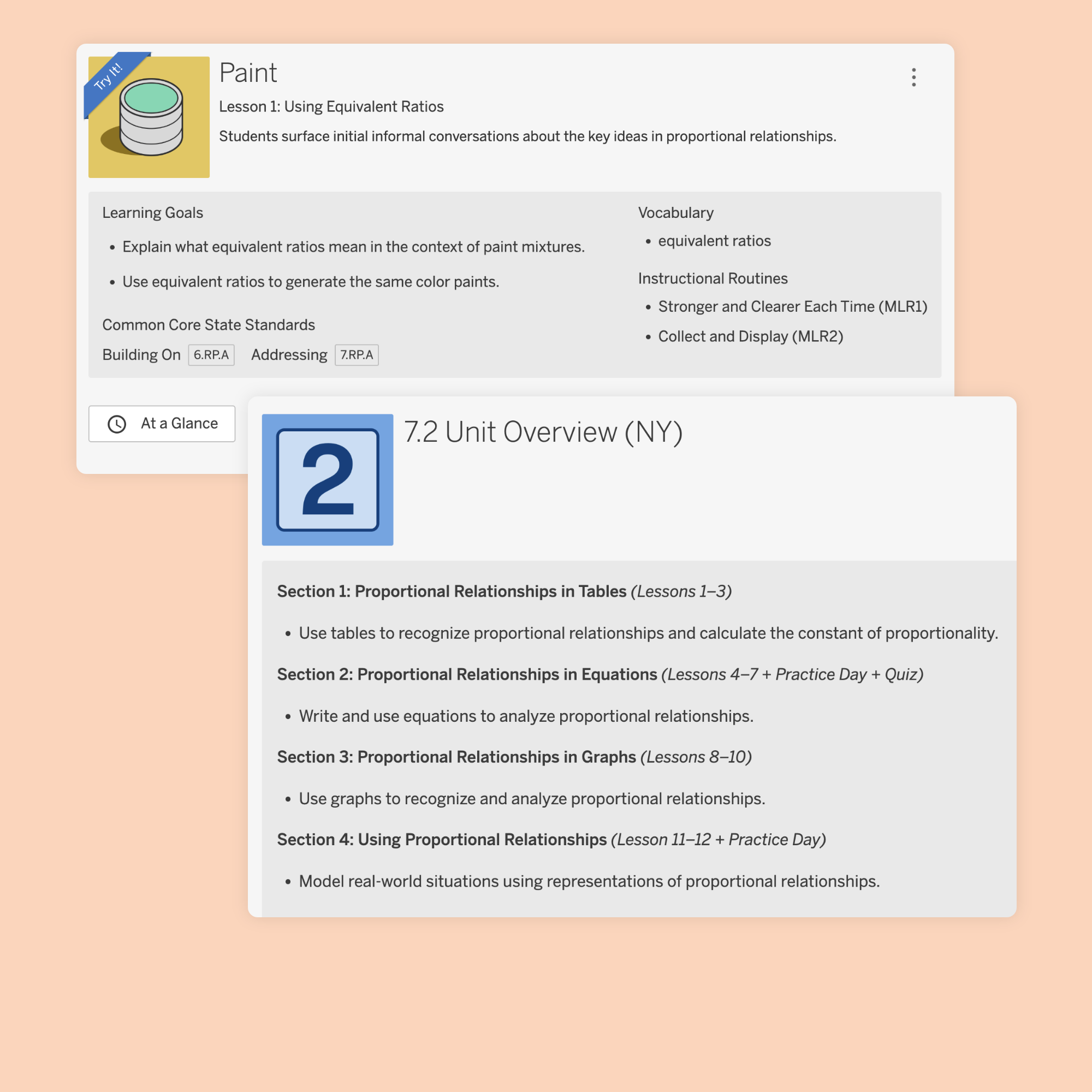
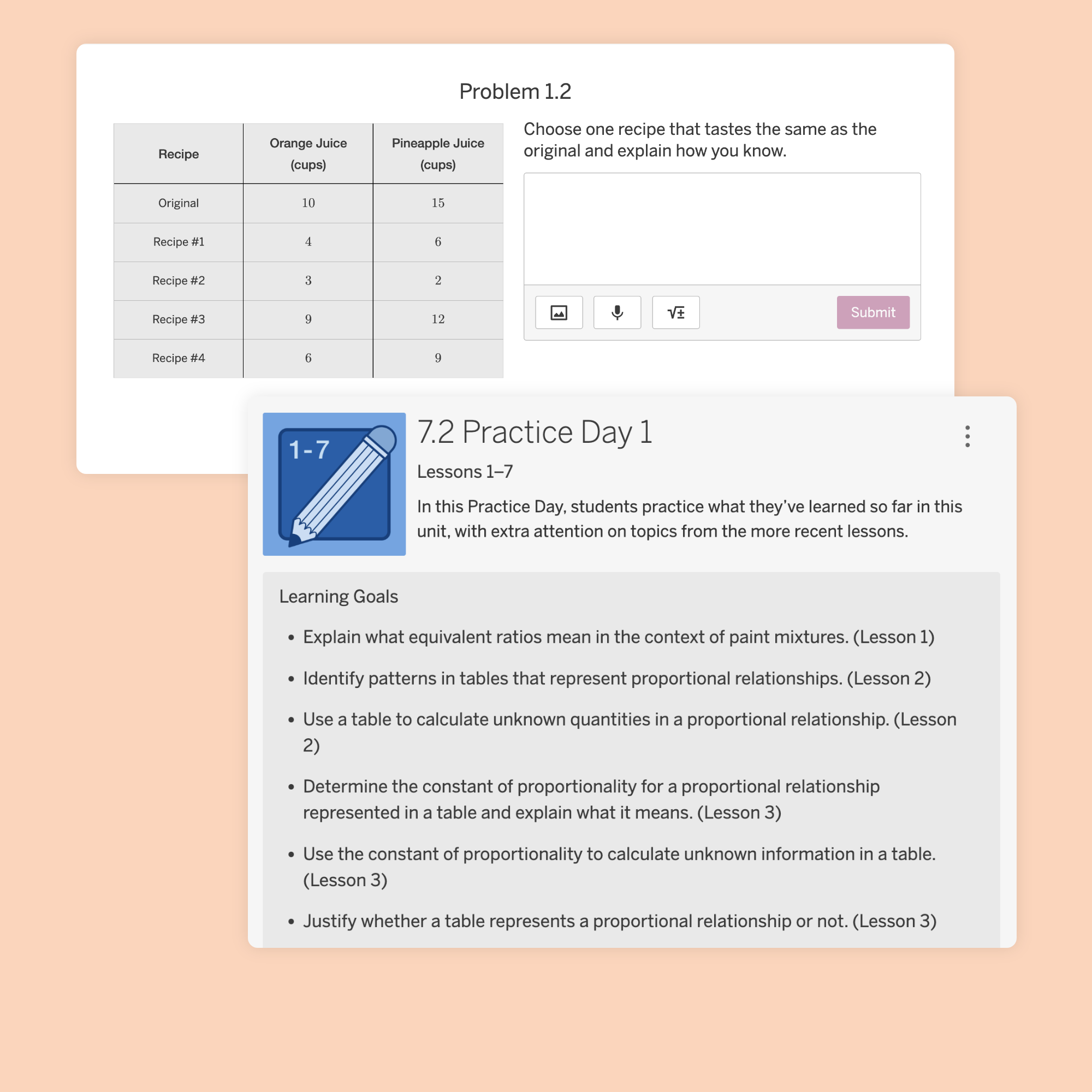
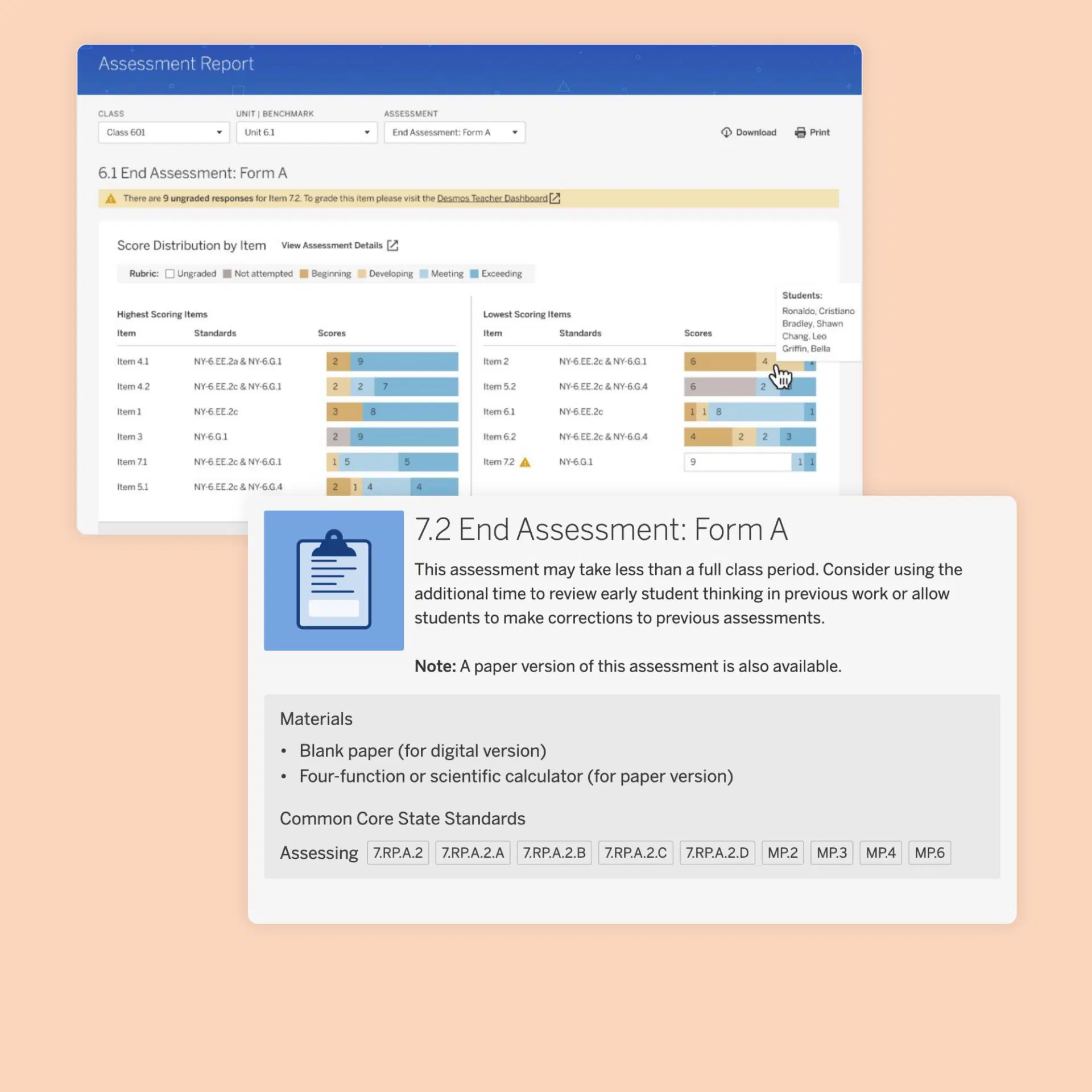
Facilitate a collaborative, connected classroom community.
The powerful teacher facilitation tools in Amplify Desmos Math give teachers insight into student thinking in real time. Teachers can select student work to display and discuss quickly and easily, leading to better questions that guide more productive discussions.
Amplify Desmos Math helps guide the learning process by connecting students to each other and to an understanding that they can use math to make sense of the world. Students learn and collaborate in every lesson. Whether using print, digital, or a mix of both, students stay connected to each other’s ideas and thinking, fueling classroom conversations and a shared understanding of math.

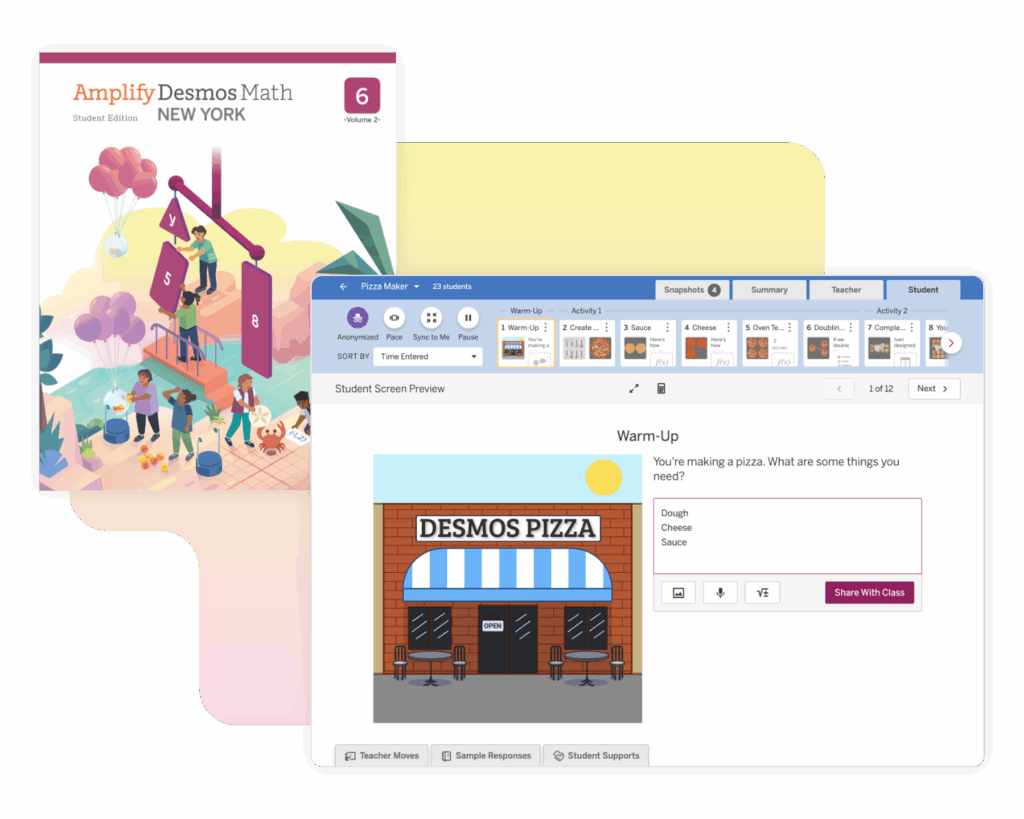
Standards alignment
Amplify Desmos Math is customized specifically to meet the New York State Next Generation Math Learning Standards. Within each document below, you’ll find direct links to lessons and activities where each individual standard is addressed.
Grade 6 correlation
Grade 7 correlation
Grade 8 correlation
The program is also aligned with the expectations outlined in the New York City Department of Education Definition of Culturally Responsive-Sustaining Education and the New York State Culturally Responsive-Sustaining Education Framework. Download the CR-SE alignment.
Digital review
Ready to explore the program? To log in, click the orange “Review now” button below, select “Log in with Amplify” and use the following login credentials:
Username: t.nycadmsample-01@tryamplify.net
Password: AmplifyNumber1
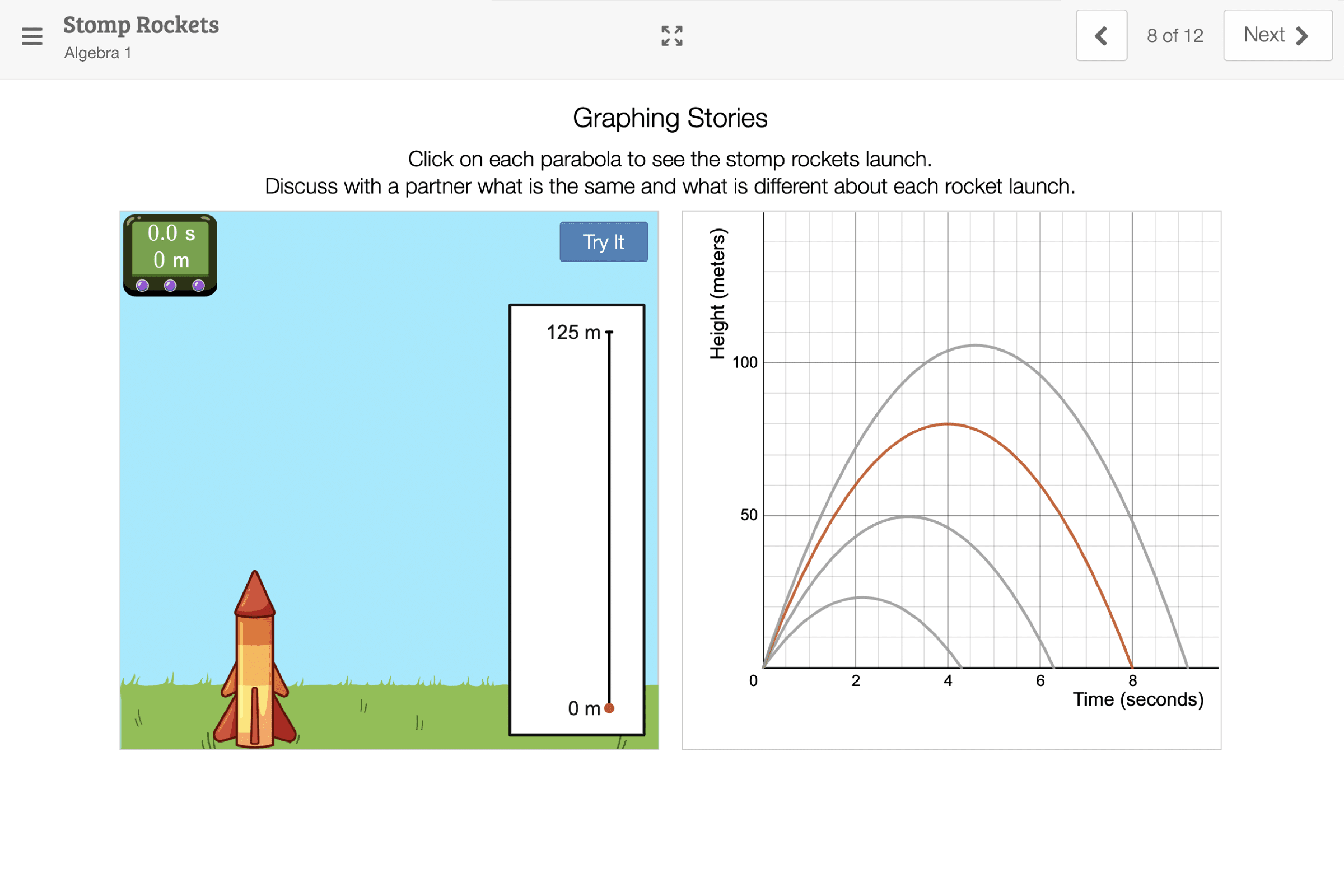
To review Algebra 1 content from Desmos Math 6–A1, which serves as the foundation for Amplify Desmos Math, click this link after logging in using the credentials above.

Support
Throughout your review, you can reach our support team by email or phone. We are available any time over:
Live chat: Click the orange icon while logged in to get immediate help.
Phone: Call our toll-free number: (888)-960-0380.
Email: Send an email to help@amplify.com. In the message body, please include your name and question. Provide as much detail as possible, so we can help you find a solution.
mCLASS®
Starting in 2025–2026, California Education Code Section 53008 requires LEAs to annually screen K-2 students for reading difficulties, including dyslexia, using CDE-approved instruments. LAUSD implements the Reading Difficulties Risk Screener through mCLASS DIBELS 8th Edition and mCLASS Lectura.
These research-backed assessments provide real-time insights into literacy development, enabling educators to identify at-risk learners, differentiate instruction, and implement targeted interventions. This ensures state compliance while reinforcing LAUSD’s commitment to evidence-based literacy instruction for all students.
Click here to go back to the LAUSD homepage.

Getting Started
One Amplify app for everything.
Educators can log into Schoology, using their LAUSD Single Sign-On (SSO), to access the Amplify app. One click into the Amplify app takes you to the Educator Home page and into the mCLASS Portal.

Attention iOS device users:
You must sync your device before upgrading your iOS version. If you update your iOS version before syncing, all unsynced mCLASS data will be lost since any Apple-related software updates clear Safari’s cache memory. If your device prompts you to upgrade your iOS version, tap cancel or close to decline and then sync your assessments. We encourage you to follow best practices and sync your assessment data regularly. Establishing a regular sync routine helps ensure that your assessment data isn’t lost due to device changes, software updates, or any unforeseen issues.
- DIBELS 8 Help Guide
- mCLASS Classes and Groups Help – Refer to our mCLASS Help system for instructions on using Amplify’s enrollment tools for administrators and other staff with school-wide or system access. If you need to help teachers administer mCLASS or assist substitute teachers with assessing a class, you can add yourself to a class. You can also create student groups to organize students within classes or to share students across classes with other staff.
mCLASS Instruction
How mCLASS® Instruction works
All schools in LAUSD have access to mCLASS® Instruction, which can help you use your benchmark data to individualize instruction for each student. You can access the following tools at Amplify Home > My Assessments > DIBELS 8th Edition (in the upper-left corner you will see an Instruction button). View our Instruction webcast for overviews of the tools.
- mCLASS® Item-Level Advisor automatically highlights important patterns, offering detailed analysis and suggesting next steps for targeted instruction.
- mCLASS® Small-Group Advisor uses results to create optimal groups of students with similar needs and selects targeted instructional activities at the appropriate level.
- mCLASS® Home Connect® allows you to easily provide parents with progress reports and specific activities to help bolster students’ learning at home.
Student Online Assessments
How to enable the mCLASS Student Online Assessments Video
Online Assessments:
- MAZE Online (required for DIBELS 8 composite)
- About MAZE Online
- Assigning Maze Online (Video)
- Assigning Maze Online (Job Aid)
- Manually entering MAZE Results on mCLASS
- Help with LAUSD SSO- Schoology: MyMail Pin
- Spelling Online (available in Spanish)- In the Spelling assessment, students hear a target word and use letter tiles to spell the word. These words include the phoneme-grapheme correspondences that students at each grade level are expected to learn over the course of a year based upon the scopes and sequences of published reading and spelling curricula. The final score is the number of words spelled correctly, with partial credit provided for correct spelling sequences within a word. This makes the Spelling measure more sensitive to students’ actual spelling skills, giving more information about their progress.
- Vocabulary Online (available in Spanish)- In the Vocabulary assessment, students demonstrate their knowledge of grade-specific words, as well as their skill at deriving meaning from context. The assessment covers words that are high utility (i.e. Tier 2) and content specific (i.e. Tier 3). Depending on grade level, students may be asked to answer questions about the word, to fill in a blank correctly with the word, or to match the word with its definition.
Progress Monitoring
DIBELS 8 Progress Monitoring
- Progress monitoring materials are included in the DIBELS 8 benchmark booklets.

Amplify CKLA 3rd Edition Pilot Packs
Beginning-of-year pilot
We know it can be overwhelming to start a new curriculum, but we’re here to help every step of the way! Within this site, you’ll find resources to help you get started before your implementation training, including a materials checklist, unit and domain summaries, support videos, and more. These tools will support your core literacy instruction with Amplify CKLA during your pilot period. We hope this site is helpful in getting you started.
Beginning-of-year pilot
Get started
To get started with your new pilot of Amplify CKLA 3rd Edition, you’ll first want to review the following:
You may also find the resources below helpful as you begin your pilot:
Access key materials designed to support your review of Amplify CKLA 3rd Edition.
- Program Guide
- Components checklist
- Knowledge Sequence
- Unit Summaries
- Full Program Review site
- Password: TheNextChapter
Amplify CKLA’s all-in-one digital platform offers essential tools that streamline instruction for teachers and engage students with meaningful content. Teachers can plan and deliver lessons efficiently, while students can access assignments, assessments, and fun practice games.
Presentation Screens
Deliver interactive lessons with ready-made, customizable slides for every lesson.
Auto-scored digital assessments
Assess vocabulary, comprehension, and knowledge development at the end of each K–2 Knowledge and 3–5 Integrated Unit.
Standards-based reports
Identify strengths and growth areas for individuals or your entire class. Interactive dashboards offer detailed results from assessments and activities.
Skill-building practice games
Engage students with interactive games that reinforce concepts and make learning fun. Powered by Boost Reading™, these games align with lessons and provide real-time feedback.
eReader
Students access texts, take notes, and use audio-enabled eReaders to enhance their reading experience.
Sound Library
Students watch articulation videos and listen to songs for each sound to support phonological awareness.


Beginning-of-year Pilot Pack materials
Below are the components of your Amplify CKLA Pilot Pack, organized by grade level and teacher/student materials. Please click on your grade level to review the teacher and student materials listed and verify that all items have been received.

Teacher materials
Skills Unit 1 Teacher Guide

Teacher materials
Skills Unit 2 Teacher Guide
Teacher materials
Skills Unit 3 Teacher Guide

Teacher materials
Skills Unit 4 Teacher Guide
Teacher materials
Skills Unit 5 Teacher Guide

Teacher materials
Skills Unit 4 Big Book
Teacher materials
Skills Unit 5 Big Book
Teacher materials
Small Letter Card Set

Teacher materials
Large Letter Card Set
Teacher materials
Sound Posters Sample

Teacher materials
Sound Cards Sample
Teacher materials
Skills Assessment Guide (Black Line Master)
Teacher materials
Knowledge 1 Teacher Guide
Teacher materials
Knowledge 2 Teacher Guide

Teacher materials
Knowledge 3 Teacher Guide
Teacher materials
Knowledge 4 Teacher Guide

Teacher materials
Knowledge 1 Image Cards
Teacher materials
Knowledge 2 Image Cards

Teacher materials
Knowledge 3 Image Cards
Teacher materials
Knowledge 4 Image Cards
Student materials
Skills 1–5 Activity Book Sample
Student materials
Chaining Folder
Student materials
Picture Reader Sample

Student materials
Knowledge 1–4 Activity Book Sample
Teacher materials
Skills Unit 1 Teacher Guide
Teacher materials
Skills Unit 2 Teacher Guide
Teacher materials
Skills Unit 3 Teacher Guide

Teacher materials
Skills Unit 1 Big Book

Teacher materials
Skills Unit 2 Big Book
Teacher materials
Skills Unit 3 Big Book

Teacher materials
Code Poster Set

Teacher materials
Spelling Card Set

Teacher materials
Large Letter Card Set

Teacher materials
Skills Assessment Guide (Black Line Master)
Teacher materials
Knowledge 1 Teacher Guide

Teacher materials
Knowledge 2 Teacher Guide
Teacher materials
Knowledge 3 Teacher Guide
Teacher materials
Knowledge 4 Teacher Guide
Teacher materials
Knowledge 1 Image Cards
Teacher materials
Knowledge 2 Image Cards

Teacher materials
Knowledge 3 Image Cards
Teacher materials
Knowledge 4 Image Cards
Student materials
Skills 1–3 Activity Book
Student materials
Skills Unit 1 Reader
Student materials
Skills Unit 2 Reader
Student materials
Skills Unit 3 Reader

Student materials
Knowledge 1-4 Activity Book Sample
Teacher materials
Skills Unit 1 Teacher Guide
Teacher materials
Skills Unit 2 Teacher Guide

Teacher materials
Skills Unit 3 Teacher Guide

Teacher materials
Code Posters
Teacher materials
Spelling Card Set
Teacher materials
Skills Assessment Guide (Black Line Master)
Teacher materials
Knowledge 1 Teacher Guide
Teacher materials
Knowledge 2 Teacher Guide

Teacher materials
Knowledge 3 Teacher Guide

Teacher materials
Knowledge 4 Teacher Guide

Teacher materials
Knowledge 2 Image Cards
Teacher materials
Knowledge 3 Image Cards

Teacher materials
Knowledge 4 Image Cards

Student materials
Skills 1–3 Activity Book Sample

Student materials
Skills Unit 1 Reader

Student materials
Skills Unit 2 Reader

Student materials
Skills Unit 3 Reader
Student materials
Knowledge 1-4 Activity Book Sample
Teacher materials
Unit 1 Teacher Guide
Teacher materials
Unit 2 Teacher Guide
Teacher materials
Unit 3 Teacher Guide
Teacher materials
Unit 4 Teacher Guide
Teacher materials
Unit 1 Image Cards

Teacher materials
Unit 3 Image Cards

Teacher materials
Unit 4 Image Cards

Teacher materials
Spelling Card Set

Student materials
Unit 1–2 Activity Book

Student materials
Unit 3 Poet’s Journal

Student materials
Unit 4 Activity Book

Student materials
Unit 1 Reader
Student materials
Unit 2 Reader

Student materials
Unit 4 Reader

Teacher materials
Skills Unit 1 Teacher Guide (supplemental)
Teacher materials
Skills Unit 2 Teacher Guide (supplemental)

Teacher materials
Skills Assessment Guide Black Line Master (supplemental)
Student materials
Skills Activity Book: Unit 1–2 Black Line Master (supplemental)
Teacher materials
Unit 1 Teacher Guide

Teacher materials
Unit 2 Teacher Guide
Teacher materials
Unit 3 Teacher Guide

Teacher materials
Unit 4 Teacher Guide
Student materials
Unit 1–2 Activity Book

Student materials
Unit 3 Poet’s Journal

Student materials
Unit 4 Inventor’s Notebook
Student materials
Unit 1 Reader
Student materials
Unit 2 Reader
Student materials
Unit 4 Reader
Teacher materials
Unit 1 Teacher Guide

Teacher materials
Unit 2 Teacher Guide

Teacher materials
Unit 3 Teacher Guide
Teacher materials
Unit 4 Teacher Guide

Student materials
Unit 1–2 Activity Book
Student materials
Poet’s Journal
Student materials
Unit 4 Activity Book
Student materials
Unit 1 Reader

Student materials
Unit 2 Reader

Student materials
Unit 4 Reader
Access the Amplify CKLA all-in-one digital platform
Teachers and students piloting CKLA 3rd Edition will receive login information to access the digital platform.
If you have not received your login information please contact your administrative team. If you are in charge of licensing and enrollment for your school/district and have not received login information please reach out to your account representative or help@amplify.com.
Welcome to the Amplify Science classroom showcase!
The Amplify Science K–8 curriculum blends hands-on investigations, literacy-rich activities, and interactive digital tools to empower students to think, read, write, and argue like real scientists.
Discover inspiring classroom examples and teacher resources from educators nationwide who are bringing Amplify Science to life.
Want to showcase your classroom?
We love seeing how you bring learning to life! Share photos to inspire fellow educators.


Classroom Wall
Every Amplify Science unit includes a Classroom Wall that grows and evolves as students build understanding. Here are a few examples from real Amplify Science classrooms!
Grades K–5

Credit: Shannon Cox, Sabine Parish School District, LA

Credit: Rebecca Steindler O’Brien, P.S. 051 The Elias Howe School, NY

Credit: Veeh Nguyen, Belle Chasse Academy, LA

Credit: Brittney Gooden, LaSalle Parish, LA

Credit: Buffy Scott Marcantel, Maplewood Elementary, LA

Credit: Chrissy Campenni, Wyoming Area School District, PA

Credit: Christy Flynn, Grant Parish School Board, LA

Credit: William Howard Taft Elementary School, OH

Credit: Cristina Cullen, Glendora Unified School District, CA
Grades 6–8

Credit: Erica Fernandez, Elsinore Middle School, CA

Credit: Sheyenne Cahalan, Knox County R-1 School District, MO

Credit: Joshua Ryan Abellera, Fertitta Middle School, NV

Credit: Karen Wynne, Portola Middle School, CA

Credit: Crystal Cuaron Baker, Las Cruces Public Schools, NM

Credit: Natalia Seoane, Heritage Intermediate School, CA

Credit: Lisa Anglim, Elizabeth Ustach Middle School, CA

Credit: Maria Katsanos, New York City Public Schools, NY

Credit: Lindsey Hampf, Upper Township School District, NJ

Credit: Anna Radef, Cadwallader Middle School, NV

Credit: Jessica Kruger, Gardner International, MI

Credit: Albert Hutchful, Clark County School District, NV

Credit: Kim Eich, Anoka-Hennepin Public School District 1, MN
Credit: Shannon Cox, Sabine Parish School District, LA

Credit: Anna Radef, Clark County School District, NV
Hands-on science activities
Students engage in hands-on science activities throughout Amplify Science. These photos capture curiosity in action and showcase real students exploring, building, testing, and investigating in Amplify Science classrooms.

Grades K–5

Grade 1: Animal and Plant Defenses
Designing animal defenses during the Animal and Plant Defenses unit
Credit: Veeh Nguyen, Belle Chasse Academy, LA

Grade 1: Light and Sound
Exploring shadows for the Light and Sound unit
Credit: Brittney Gooden, LaSalle Parish, LA

Grade 1: Light and Sound
Investigating vibrations during the Light and Sound unit
Credit: Jennifer Baker, Rapides Parish School Board, LA

Grade 1: Light and Sound
Puppet show for the Light and Sound unit
Credit: Anna Dardar, Rapides Parish School Board, LA

Grade 2: Changing Landforms
Exploring sand samples for the Changing Landforms unit
Credit: Rebecca Steindler O’Brien, P.S. 051 The Elias Howe School, NY

Grade 3: Balancing Forces
Exploring forces with magnet tricks for the Balancing Forces unit
Credit: Maureen Patt, Broad Street Elementary School, NH

Grade 3: Inheritance and Traits
Imaginary clay creatures to investigate traits in real organisms for the Inheritance and Traits unit
Credit: Maribel Ramos, Esperanza Academy Charter School, PA

Grade 3: Inheritance and Traits
Students showing off their knowledge for the Inheritance and Traits unit by creating their own drawings.
Credit: Sandi O’Brien, Parkmead Elementary School, CA

Grade 3: Inheritance and Traits
Determining which offspring belong to which set of parent pigeons based on similar traits for the Inheritance and Traits unit
Credit: Sandi O’Brien, Parkmead Elementary School, CA

Grade 3: Inheritance and Traits
Using celery as a real-life example of how the environment can impact traits, during the Inheritance and Traits unit
Credit: Sandi O’Brien, Parkmead Elementary School, CA

Grade 3: Environments and Survival
Modeling how ruby-throated hummingbirds with different traits meet their need for food during the Environments and Survival unit
Credit: Sandi O’Brien, Parkmead Elementary School, CA

Grade 3: Weather and Climate
Learning the best ways to collect, measure, and compare rainfall data for the Weather and Climate unit
Credit: Sandi O’Brien, Parkmead Elementary School, CA

Grade 4: Energy Conversions
Students created their own simple systems using a solar panel, alligator clips, wires, an LED light, and a buzzer during the Energy Conversions unit
Credit: Sandi O’Brien, Parkmead Elementary School, CA

Grade 4: Energy Conversions
Designing wind turbines during the Energy Conversions unit
Credit: Sandi O’Brien, Parkmead Elementary School, CA

Grade 4: Vision and Light
Planning vision models for the Vision and Light unit
Credit: Maribel Ramos, Esperanza Academy Charter School, PA

Grade 4: Vision and Light
Writing a scientific explanation for the Vision and Light unit
Credit: Chrissy Campenni, Wyoming Area School District, PA

Grade 5: Patterns of Earth and Sky
Investigating daytime and nighttime during the Patterns of Earth and Sky unit
Credit: Sandi O’Brien, Parkmead Elementary School, CA

Grade 5: Patterns of Earth and Sky
Hands-On Flextension: Making artifacts for the Patterns of Earth and Sky unit
Credit: Adriana Barrera, J.W. Bishop Elementary School, TX

Grade 5: Modeling Matter
Flavor ingredients test for the Modeling Matter unit
Credit: Kevin Butters, Grand Island Public Schools, NE

Grade 5: Modeling Matter
Testing ingredients to make salad dressing during the Modeling Matter unit
Credit: Sandi O’Brien, Parkmead Elementary School, CA

Grade 5: Modeling Matter
Discussing solubility and attraction during the Modeling Matter unit
Credit: Cristina Cullen, Glendora Unified School District, CA

Grade 5: The Earth System
Designing freshwater systems for The Earth System unit
Credit: Sandi O’Brien, Parkmead Elementary School, CA

Grade 5: Ecosystem Restoration
Building terrariums for the Ecosystem Restoration unit
Credit: Elizabeth DeBoo, St. Frances Cabrini Academy, MO

Grade 5: Ecosystem Restoration
Leaves and Roots game board from the Ecosystem Restoration unit
Credit: Cyndi Thompson Crouch, Smithville School District, MO

Grade 5: Ecosystem Restoration
Food web models with students’ favorite stuffed animals for the Ecosystem Restoration unit
Credit: Halli Trinker, Boonton Township School District, NJ
Grades 6–8

Grade 6: Microbiome
Drawing scale models of microorganisms for the Microbiome unit
Credit: Elizabeth DeBoo, St. Frances Cabrini Academy, MO

Grade 6: Microbiome
Hands-On Flextension: Investigating microscopic evidence of life for the Microbiome unit
Credit: Elizabeth DeBoo, St. Frances Cabrini Academy, MO

Grade 6: Metabolism
Investigating chemical reactions with water, phenol red, baking soda, and calcium chloride for the Metabolism unit
Credit: Jessica Kruger, Gardner International Magnet School, MI

Grade 6: Metabolism
Introducing the classroom body systems model for the Metabolism unit
Credit: Elizabeth DeBoo, St. Frances Cabrini Academy, MO

Grade 6: Metabolism Engineering Internship
Healthy bars for the Metabolism Engineering Internship
Credit: Elizabeth DeBoo, St. Frances Cabrini Academy, MO

Grade 6: Thermal Energy
Simulating hot and cold water during the Thermal Energy unit
Credit: Whitney Stewart, Rapides Parish School Board, LA

Grade 6: Ocean, Atmosphere, and Climate
Playing the Ocean Currents game for the Ocean, Atmosphere, and Climate unit
Credit: Elizabeth DeBoo, St. Frances Cabrini Academy, MO

Grade 6: Weather Patterns
Modeling a warm air parcel for the Weather Patterns unit
Credit: Elizabeth DeBoo, St. Frances Cabrini Academy, MO

Grade 7: Geology on Mars
The Flowing Water Model for the Geology on Mars unit
Credit: Kim Eich, Anoka-Hennepin Public School District 1, MN

Grade 7: Plate Motion Engineering Internship
Modeling a tsunami wave for Plate Motion Engineering Internship
Credit: Elizabeth DeBoo, St. Frances Cabrini Academy, MO

Grade 7: Chemical Reactions
Investigating substance changes for the Chemical Reactions unit
Credit: Ashlie Beals Arkwright, SCAPA at Bluegrass, KY

Grade 7: Populations and Resources
Conducting a yeast experiment during the Populations and Resources unit
Credit: Elizabeth DeBoo, St. Frances Cabrini Academy, MO

Grade 8: Harnessing Human Energy
Investigating energy systems for the Harnessing Human Energy unit
Credit: Lisa Anglim, Elizabeth Ustach Middle School, CA

Grade 8: Force and Motion
Investigating forces on different objects for the Force and Motion unit
Credit: Elizabeth DeBoo, St. Frances Cabrini Academy, MO

Grade 8: Force and Motion Engineering Internship
Designing an Egg Drop Model during the Force and Motion Engineering Internship
Credit: Elizabeth DeBoo, St. Frances Cabrini Academy, MO

Grade 8: Magnetic Fields
Hands-On Flextension: Exploring electrostatic force for the Magnetic Fields unit
Credit: Melanie Wenger, Lincoln Park Middle School, NJ

Grade 8: Light Waves
Students observing that light can cause materials to heat up, change color, and move for the Light Waves unit
Credit: Gloria Davis, Panama-Buena Vista Unified School District, CA

Grade 8: Light Waves
Students discover what happens to light as it travels for the Light Waves unit
Credit: Gloria Davis, Panama-Buena Vista Unified School District, CA

Grade 8: Light Waves
Students participating in a fishbowl discussion to share observations and evidence for the Light Waves unit
Credit: Gloria Davis, Panama-Buena Vista Unified School District, CA

Grade 8: Earth, Moon, and Sun
Paper model of the Moon’s phases for Earth, Moon, and Sun unit
Credit: Elizabeth DeBoo, St. Frances Cabrini Academy, MO

Grade 8: Evolutionary History
Hands-On Flextension: Reconstructing owl pellet skeletons for the Evolutionary History unit
Credit: Elizabeth DeBoo, St. Frances Cabrini Academy, MO
Other publishers say they have “Desmos.” What’s the difference between what Amplify has and what they have?

If you’ve been in the math world for a while, you know the name Desmos. It’s synonymous with free dynamic math tools.
And lately, you’ve probably also been hearing about Amplify and Desmos together. But other publishers also say they have Desmos, so what’s the deal?
Let’s clear it up.
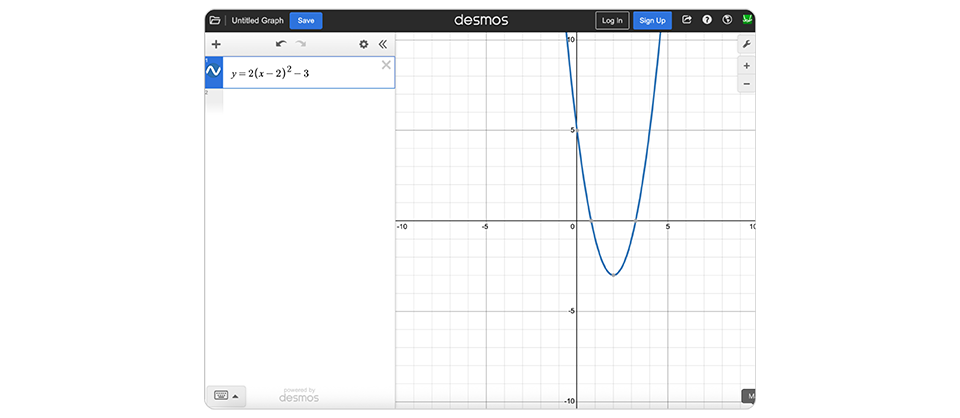
The most important thing to know is that, back in 2022, the original Desmos split into two separate parts. Think of them like a calculators and other tools part and a classroom activities and curriculum part.
The tools part: Desmos Studio
This is the Desmos you first fell in love with.
What it is: Desmos Studio is the name of the company that builds and maintains the powerful, free Desmos calculators. This is an independent Public Benefit Corporation, and can be found at www.desmos.com. That team builds and maintains a collection of free math tools:

What it’s for: This is your go-to for exploration, demonstrations, and “What if I change this?” moments. It’s the blank canvas you use on your smartboard or the tool your students use for homework.
The bottom line: The calculators are run by an independent company called Desmos Studio PBC. You can find their tools for free at their website, desmos.com; on state tests; and in curriculum programs (including ours).
The lessons: Amplify Classroom & Amplify Desmos Math
What it is: In 2023, Amplify acquired the Desmos instructional platform (then called Desmos Classroom, now called Amplify Classroom) as well as their math curriculum for grades 6–8 and the teams that built those resources. We had already been working on our own math curriculum, decided to combine forces with the Desmos curriculum team, and created Amplify Desmos Math, now available for grades K–12.
When other publishers may talk about having “Desmos,” what they mean is they license the calculators and Geometry tool from Desmos Studio.
What it’s for: Amplify has these tools, too, but we also have the Activity Builder, which integrates these tools much more deeply than is possible with other Desmos Studio partnerships. We take this powerful Desmos technology and layer instruction, student collaboration, and dynamic teaching tools on top, creating classrooms that buzz with excitement and learning.
What’s available for free:
- The “Desmos activities” platform (you might know it from teacher.desmos.com), now Amplify Classroom. This is where you can find hundreds of free lessons and activities. You can also use the Activity Builder tool to create your own custom activities from scratch.
- The beloved, pre-built “Activity Builder” activities like “Marbleslides” and more are still available for free on Amplify Classroom.
The bottom line: Educators can still use the vast library of free activities and build their own on Amplify Classroom. This is not changing.
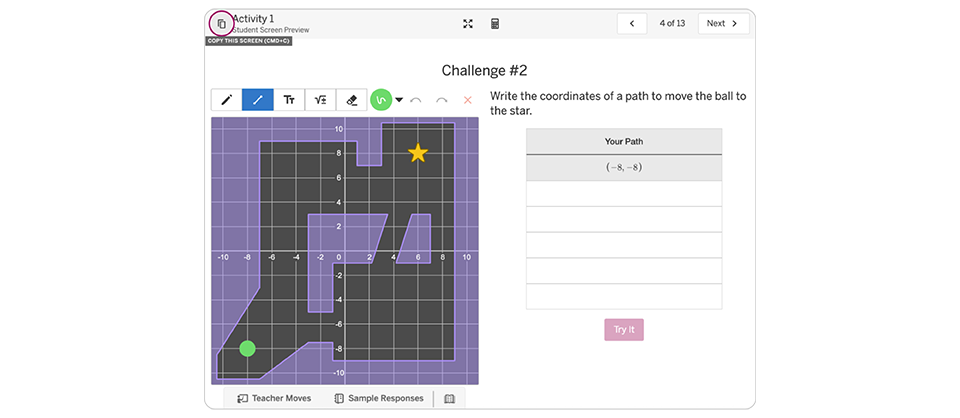
The core curriculum: Amplify Desmos Math
This is the new, comprehensive curriculum available to districts and schools.
What it is: This is a full core math curriculum for grades K–12 that Amplify has built in collaboration with the Desmos curriculum team that joined us a few years ago. It uses the Desmos instructional philosophy and tools as its backbone, but it’s much more than a collection of activities.
What it’s for: This program is designed to be your primary, day-to-day curriculum. It includes a complete, standards-aligned scope and sequence, print materials, digital lessons (with activities enhanced and aligned to standards), assessments, intervention resources, and personalized practice.
The bottom line: If you want a complete curriculum in which every lesson is built on polished Desmos-style activities, you want Amplify Desmos Math K–12. This core curriculum is offered exclusively by Amplify.
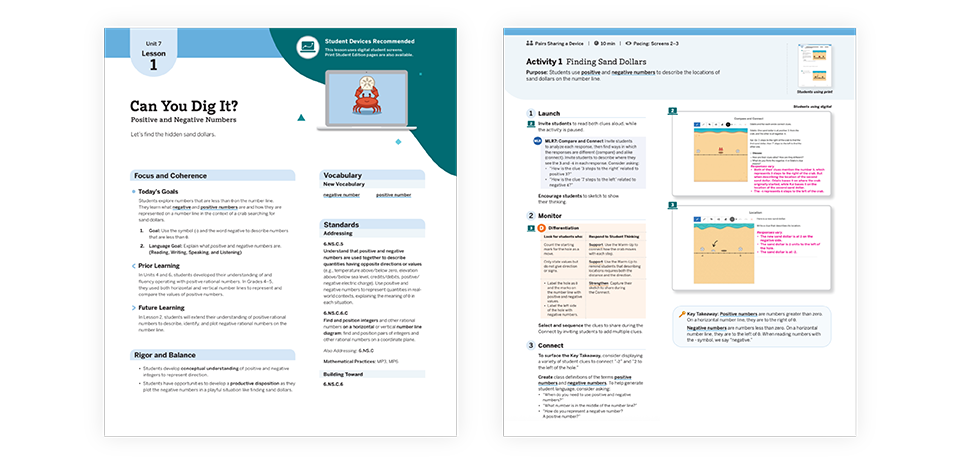
Quick-reference chart
| What is it? | Where to find it? | Cost | |
| Desmos Studio Tools | Powerful math tools and calculators (graphing, scientific, etc.) for graphing, calculations, and geometry visualizations. | Access via desmos.com or embedded in partner products | Free for individual use |
| Amplify Classroom | A teaching and learning platform that couples Desmos Studio tools with instruction and collaboration tools – Rich activities and lessons that develop understanding with Responsive Feedback™ – Collaboration and facilitation tools designed for the classroom – Student ideas used to build new problems and scenarios Browse free activities and lessons or build your own with Activity Builder. | Only available from Amplify at amplify.com/classroom (previously Desmos Classroom) | Free |
| Amplify Desmos Math | A comprehensive K–12 math curriculum built on the Amplify Classroom platform – Ready-to-teach print and digital curriculum built on the Amplify Classroom platform – Comprehensive coverage of all standards without the searching. – Additional support for your classroom, including assessment, differentiation, practice, professional development, and more. | Try lessons for free on Amplify Classroom Contact us for more information on purchasing for your district | With a paid subscription |
S5-05. Math technology & hacks for math anxiety: research-based tips for caregivers
We’ve been very lucky to have so many prolific and brilliant researchers on this season of Math Teacher Lounge, and our next guest is no exception.
Listen as we sit down with Dr. Marjorie Schaeffer to discuss what causes math anxiety, math hacks, and how the right math technology can make an incredible impact in children and caregivers coping with math anxiety.
Listen today and don’t forget to grab your MTL study guide to track your learning and make the most of this episode!
Marjorie Schaeffer (00:00):
I think the most important thing we know from literature right now is that high math-anxious parents, when they interact with their children, their children learn less math over the course of the school year.
Bethany Lockhart Johnson (00:12):
Welcome back to Math Teacher Lounge. I’m Bethany Lockhart Johnson.
Dan Meyer (00:15):
And I’m Dan Meyer.
Bethany Lockhart Johnson (00:16):
We’re onto Episode 5, Dan, of our series on math anxiety. And I wanna say it feels so lovely to imagine all of these people out there doing work to help combat math anxiety. I dunno, it just makes me feel excited about the possibilities. This work is out there; it’s happening! Kids and teachers and caregivers are being impacted by these conversations. Not just — I mean, I don’t just mean the conversations we’re having on Math Teacher Lounge, but I mean, that these researchers are doing. Like, yes, we can change this!
Dan Meyer (00:53):
This is great. Yeah. We have people who are extremely smart, who have dedicated their professional lives to studying math anxiety and resolving it. And each of them that we’ve chatted with — they share lots of ideas in common, but I’ve loved how they each have their own different flavor or take or area of emphasis on a problem that hits everybody everywhere. It’s in your home, with kids and caregivers. It’s in schools. It’s in our places of teacher preparation and professional learning. Every place is a place where we can focus on resolving issues of math anxiety. It’s exciting.
Bethany Lockhart Johnson (01:26):
Yeah, I feel like … if there could be a course in — we all know that our teacher prep programs, in MOST teacher prep programs, there’s not nearly enough math methods or time to cover <laugh> — it’s like ready, set, go! And depending on who your mentor teacher is or what your math methods course … I mean, it can totally shape the way that you are prepared or really not prepared for going out there to teach math! And so I love that we’re having these conversations.
Dan Meyer (01:55):
What I love about today’s conversation is, one, it’s got a little bit of a technology flavor, so there’s that. But I also love, it’s got one of my favorite features about change, which is that it focuses on change to action, change to routine, rather than change to belief. Rather than saying like, “OK, everybody! Everybody stop thinking bad beliefs about math and transmitting them to your kids!” Instead, it says, “What we’ll do is just, hey, we’ll set that aside for a second and we’re gonna do a certain thing every day and watch as those actions make your beliefs change.” That to me is extremely cool. And I think it has a higher likelihood of success than just, like, me telling parents, “Hey, stop thinking these thoughts!”
Bethany Lockhart Johnson (02:37):
“Ready, set, stop being anxious!”
Dan Meyer (02:39):
Exactly. Exactly. So it’s an exciting conversation we’re gonna have here.
Bethany Lockhart Johnson (02:43):
Right. So it’s not a, you know, “wave the wand and all of a sudden, you’re not anxious about math anymore.” But these incremental changes, these incremental conversations, this validation, can really, really impact change. I’m with you on it, Dan. I hear what you’re saying.
Dan Meyer (03:01):
To help us talk through all of these ideas and more, we’re joined by Dr. Marjorie Schaeffer, Assistant Professor of Psychology at St. Mary’s College in Indiana.
Bethany Lockhart Johnson (03:10):
Enjoy. <Jaunty music> So, yes, Dan, we are so excited to welcome Marjorie Schaeffer. She’s Assistant Professor of Psychology at St. Mary’s College. Dr. Schaeffer, we’re so excited you’re here. Hello!
Marjorie Schaeffer (03:28):
Thank you so much for inviting me.
Dan Meyer (03:29):
Yeah. We are super-lucky to have had so many prolific and brilliant researchers about math anxiety on our show. You’ll be no exception. And every time, we love to find out about how you came to study math anxiety, which winds up being a really interesting glimpse into your backstory bio. So tell us, what is the route by which you came toward studying math anxiety?
Marjorie Schaeffer (03:51):
Oh, I love that question. I’m really interested in how the attitudes and beliefs of parents and teachers influence children, especially around math. And I actually became interested in this idea in college, when no Child Left Behind was actually first starting to be implemented in schools with high-stakes standardized testing. So much so that I actually did my thesis on this thinking about, “Do children understand the importance of high-stakes testing? Do they have anxiety around that idea?” And so that was really my first foray into the anxiety literature. And that was kind of the entry point into math anxiety for me.
Dan Meyer (04:28):
So you started by studying a very high-stakes assessment, like our students connecting with this. And the assessment is once per year. And classroom instruction is every day. So how did you move from the assessments to the everyday instruction?
Marjorie Schaeffer (04:44):
That’s a great question. So, after college, I actually taught kindergarten. And so from that, I saw the day-to-day impact of instruction and the day-to-day impact of children’s individual attitudes and beliefs. And so I really became interested in thinking about, “How do we understand why some children are really successful from the instruction happening in classrooms and why other children need a little bit more support?” And so math anxiety was one way for me to really think about the individual differences I saw in my kindergarten classroom.
Dan Meyer (05:18):
It feels like you headed … you went farther upstream, is what it feels like. Where assessment … there’s like some kind of anxiety around assessment, let’s say. And then you ventured farther up the stream to classroom instruction and then still farther into kids’ homes. It seems like your research invokes a lot of curiosity about the sources of a kind of amorphous, flowing phenomenon called math anxiety. And I’d love to hear a bit about what you know about how caregivers transfer, transmit — whatever the word is — math anxiety to their kids.
Marjorie Schaeffer (05:55):
For parents … we think that the attitudes and beliefs of parents matter. And we see that for lots of areas, not just math anxiety. But I think math anxiety, we see that really clearly. And so, we can think about it both in terms of what kind of input parents provide. So, how do families talk about math with their children? What kind of support do they provide around homework? And those are ones that I think are a little obvious. But we can also think about the offhanded comments that parents say to children when they’re talking about math generally. Right? So, we see lots of memes going around, talking about how hard math homework is. And so, I think when parents say offhanded comments like, “I’m not a math person,” or “We’re just bad at math,” that communicates values to children. I think the most important thing we know from literature right now is that high math-anxious parents, when they interact with their children, their children learn less math over the course of the school year. And this specific mechanism by which that happens is still an area for a lot of research. And so some people think it’s about input. So maybe if I’m math anxious, I’m avoiding math. And so, when I have an option to read a picture book that has math content, I focus on the colors instead. And so, my child is actually getting less math than other children. We can also think it’s about these messages that are provided. So, when I talk about math, I send the message to my child, it’s not for them, and therefore the child wants to engage in it less. And some of my work looks at things like expectations and values. So, thinking about, “Do math-anxious families actually value math less than other families unintentionally?” And so, we have some support for this idea that they expect less of their children. And so maybe when they struggle, they respond in different ways than a family who’s lower in math anxiety.
Bethany Lockhart Johnson (07:53):
This is so fascinating to me. I also was a kindergarten teacher. And I remember a mom who just … she had such like palpable math anxiety. And during one of our conversations, she was talking about these homework sessions with her daughter. And I may have mentioned this on the podcast before. But she was talking about how every night they would sit together and they would do all this math. They’d do, like, extra math together. And it always ended in tears. And despite her math anxiety, she didn’t want her daughter to experience the math anxiety that she did. So she was trying to pile it on, so her daughter was more proficient and comfortable. And instead, it was perpetuating this anxiety about it. And so, it’s a phenomenon then, right? Even if a parent is saying, like you said, maybe completely unwilling, this mother was actually trying to do the opposite. She was trying to help, you know, imbue the love and comfort with math. Right?
Marjorie Schaeffer (09:01):
Absolutely. This is why I think in my research, it’s really important that we find low-stakes, low-stress ways for high math-anxious families to do math. They absolutely can support their children in doing math. But they need a little support. We want it to be a fun, low-stakes environment, right? So maybe that’s the connection back to high-stakes testing, that I want children to have fun math experiences.
Dan Meyer (09:28):
Yeah. This is challenging, because it feels like the more caregivers know about math anxiety, and its pernicious effects on students, and how easily transmitted it is, one could become quite anxious about math anxiety. And, you know, no one makes great decisions when they’re anxious. So if I’m recalling our various episodes we’ve done, we’ve heard from people say, “Well, you need to validate students’ math anxiety. This is not something to just ignore or brush past. But also, not validate it in a way that says, you know, ‘This is OK and generational and inevitable.’” Which presents parents with a very thin path to follow, it seems like. So I love what you’re saying about how we gotta just de-stress the whole process.
Bethany Lockhart Johnson (10:11):
You’re avoiding the whole, “I wasn’t a math person either” kind of thing. <laugh>
Dan Meyer (10:15):
Right, right, right. Yeah. So I’d love to know more. We’re excited about the technology that you have studied and helped develop, presumably, called Bedtime Math, anapp for caregivers. And I’d love to know more about what that is and what it offers parents who know enough about math to know that they don’t want to transmit math anxiety to their children, but also want to support. So what does that offer them?
Marjorie Schaeffer (10:39):
So Bedtime Math is an app. It’s freely available on iTunes or the Apple Store or Google Play. And what it’s designed to do is to provide a nightly topical passage. So one of my favorites is the one about Groundhogs Day. And so it talks a little bit about the history of Groundhogs Day, and then it asks math-related follow-up questions. So starting at a preschool level, going through late fifth grade. And it’s really meant for parents to pick the one that meets their children where they are. And so the preschool-level question asks children to pretend to be a groundhog and walk to the left and walk to the right. So a skill that families might not think about as being math, but we actually think that IS part of understanding math. Understanding left and right directionality. And then the next question can ask questions like, “If it took the groundhog three seconds to climb out of the hole, and then two more seconds to see its shadow, how much time did it take all together?” So a simple addition problem, but it’s phrased in a fun way. And so the hope is that for high math-anxious families, these interactions are fun and playful. They don’t look like fights over homework. They’re just conversations that families can have around topics that are naturally interesting to children. And our hope is that when families have lots of these positive low-stakes interactions, they actually can see that we can talk about math in unstressful ways. In lots of ways, right? We can also do this at the grocery store. We can also do this while we’re cooking in the kitchen. It doesn’t just have to be fights over homework.
Bethany Lockhart Johnson (12:14):
And I actually have the Bedtime Math — one of the Bedtime Math books. And I was so excited to find out that there’s an app. And I think one of the things that I loved about the book is that these are invitations, right? They’re exactly that. Low pressure <laugh>, and they’re invitations to have a conversation. And if we were just to tell parents, “Oh, just count!” or, “Hey, just count wherever you go!” You know? No. It’s, in a way, I think, like you said, it’s retraining the parents on what math could look like. Like, “Oh, I didn’t even think we could just kind of have this conversation and we’re actually doing math together.”
Marjorie Schaeffer (12:55):
Yes, absolutely. I absolutely agree. We want it to be fun and playful and not stressful. And we want it to also be things that are meaningful to children’s lives. So these are topics children are interested in. It’s not that we are using flashcards or making children practice math facts over and over again. These are things children should wanna do that can naturally fit into a child’s routine. So almost all families read books before bed, and what we hope is that math can also be a part of the nighttime routine.
Dan Meyer (13:27):
There’s something really subtle here going on that I just wanna name and ask a question about. First of all, it’s cool that you started with studying high-stakes stuff and now you are developing low-stakes stuff. And I’m really curious what makes a thing low-stakes? Like, a few things I’m hearing from you is that there’s, like … I have a small child that I read literature to on a nightly basis. And I feel very anxiety-free doing that. And it’s almost as though, because each of the — tasks is the wrong word for this, but experiences — involve some reading, it puts me, the parent, in a mode that is comfortable and familiar to me. I’m curious: Are there other, as you design, what, one per day for a year? All these different experiences. What are some of the principles that you lean on that help make a thing low-stakes for kids and for parents?
Marjorie Schaeffer (14:17):
Yeah, that’s a great question. So one thing we wanted to be really intentional about is that our app doesn’t look like a lot of traditional apps. There isn’t noises that go off. You don’t enter an answer. And so one of the things that we thought made it low-stakes is that while there is a right or wrong answer — there is a correct answer — we aren’t giving children upsetting feedback. Instead, what we wanna encourage families to do is, if you struggle to remember how many seconds it took the groundhog to come out of the hole, you can work through that with a parent. So it doesn’t feel like you’re getting negative feedback; you’re being told you’re bad at math; you did it wrong. Instead, you’re just getting natural support moving forward. And so that’s one thing we wanted to be really intentional about, was that it wasn’t going to be a negative experience for children. And we are trying to build on all of the positive interactions families are having around nightly book reading. So many ways this can look very similar. You get to read another story that’s topical and hopefully interesting. And then do these little questions together. And so for a lot of families, their children don’t actually really look at the question. It almost feels like the parent is just asking them on their own. Like, they just came up with it. They just wanted to know what would happen to the groundhog. If there were three more groundhogs? How many groundhogs would we have all together? Not like it’s gonna be like homework or other parts.
Dan Meyer (15:38):
So my understanding is that there isn’t a blank into which people type a number in, press “submit” for evaluation, receive the red X, the green check. That’s a key part of the design here.
Marjorie Schaeffer (15:50):
Yes, absolutely. And for research purposes, we would’ve loved to know what families were saying. But we think it’s really important that it’s fun, interactive, that families are working together to get to the right answer, that it’s not a test for children.
Bethany Lockhart Johnson (16:03):
In your research, when you were — maybe you could walk us through the study a little bit. But I’m also curious if you heard from parents that it was carrying over beyond the bedtime routine. Because I would imagine, if I am building these skills and reading these questions and learning that I could talk to my kid like this about math in a fun way, that’s gonna happen then, like you said, when I’m in the grocery store. Or when I’m waiting in line for at the bank. Or whatever, you know? People go into banks now still, right?
Marjorie Schaeffer (16:35):
Yeah, absolutely. So in our study, we recruited almost 600 families and we randomly assigned them. So they had an equal chance of getting both our math app and what we call our control app. And that’s really just a math app without the math. We think of it as a reading control app. And that’s because we wanna make sure that families are having a similar experience, that it’s not just that having high-quality, fun interactions with your child is actually impacting children’s math achievement. And so what we then did is followed those children over the course of early elementary school. And so we worked with them in schools in the fall and spring of first, second, and third grade, really to look at their math learning. And so what we find is that children of high math-anxious adults, when they have the reading app, so what we think of as what’s happening in the real world, we see that really classic gap between children of high math-anxious adults and children of low math-anxious adults. So if you have a high math-anxious parent, you’re learning about three months less math over the course of first grade. But for children who receive this math app, we see this gap as closed. Those children look no different than a low math-anxious parent. And so that’s leading us to think that we’ve helped families talk about math in fundamentally different ways. We did a little bit of just talking to families to see a little bit about what might be going on. And a lot of families do report exactly what you’re describing, where they say this did help them talk about math in different ways they were doing it other times.
Dan Meyer (18:10):
That’s a really extraordinary study design. I don’t know … I love that you folks gave the control group not nothing. Like it’s possible that just parents and kids bonding over a thing regularly would be enough to provoke some kind of academic gain. But you gave the control group a thing that had them interacting socially, bonding, and still this large common gap between high-anxious and low-anxious parents, their kids shrunk together. Is that what I’m gathering here?
Marjorie Schaeffer (18:41):
Yeah, absolutely. So we’re basically seeing we can no longer, when we look at children’s data, say that parents’ math anxiety explains individual differences. So these children look really similar. They’re learning more than children who has a high math-anxious parent and just got our reading control app.
Dan Meyer (19:01):
just diving into the study a little bit more here, what is the time commitment? Or, did you guide parents to say, “All right, we’re gonna do this do this delightful story about a badger for an hour”? Or did people do it for five minutes? And what was the time commitment, roughly, for people?
Marjorie Schaeffer (19:17):
So we tell families to do it however they see fit. Because it is an app, we are able to get some sense of how long, and we are talking about three to six minutes for many families. For a lot of families, they’re reading a paragraph, the paragraph and a half, and then answering one or two questions. They’re not going through every possible question. They’re just doing a little bit, really meeting their kids where they are.
Dan Meyer (19:39):
Roughly how many times per week was that?
Marjorie Schaeffer (19:41):
So we asked families to do it as much as it fit. But we’re seeing about two and a half on average in the first year. And so families are fitting it in a couple of nights a week. It’s not every night.
Bethany Lockhart Johnson (19:52):
So what it sounds like you’re saying is what really was powerful about this app is that it was the space and time and prompts between the caregiver and the child, that chance to really sit down and have some of these meaningful and positive math interactions. How did it shift those relationships?
Marjorie Schaeffer (20:12):
So one of the things I think that makes the app effective is the changing of expectations. After a year, families are really using the app a lot less. And I think that’s OK, that they have found other ways to incorporate math into their lives. And we find that we don’t see an impact on their math anxiety, that they aren’t becoming less math anxious from this experience. Which I think makes sense, because they have had a lifetime of math anxiety. But we do see a change in parents’ expectations and value of math. So they expect their children will be better at math, and they also report that math is more important in their children’s lives. And so I think that’s an important part of it, which is, we can change these values for families, even if we aren’t able to change the math anxiety of the adults in children’s lives.
Bethany Lockhart Johnson (21:01):
I want to for a second before — because I’m loving this idea of the app, and I’m excited to find out more ways to cultivate these conversations in my home and also share this with other folks. Because even folks who don’t even maybe realize they have math anxiety … like you said, so often it’s unconscious. So often we’re putting these little snippets into our everyday conversation, like, “Oh yeah, I’m not a math person.” And we don’t even realize how much is impacting our kiddos and ourselves, right? So I am really curious: What do you think … in your research, what were some other takeaways that you feel like are really strategies that we can think about for combating math anxiety in general?
Marjorie Schaeffer (21:47):
So I’m particularly interested in thinking about how math-anxious adults can help tone down their anxiety so that they can have high-quality interactions with their children, that they interact with. And so one of the big takeaways for my research, I think, is that math-anxious families can help their children with math. They just need support. And so I think there are lots of ways for that support to look like. One, I think it can be an app, but I also think reading a little bit about math can be really helpful. So it’s not new. So the first time you aren’t thinking about some of these ideas is as your child has their homework open in front of you. And so you can process your own feelings separately before you have to do it with a child. I also think reminding parents that math is everywhere and that math is actually lots of things that we all love to do. Math isn’t just calculus. Not that calculus isn’t wonderful. But that math is measuring, math is counting ducks at the park. Math is talking about how many times did I go down this slide. And talking about math in this way, I think reminds families that they are great at that. That even if maybe they’ve had bad math experiences before, they can do math. Especially the way their preschool or early childhood, early elementary school student needs them to. And I think that can then set the foundation for being really successful later.
Dan Meyer (23:13):
So is your research then, your subsequent studies, your line of inquiry, is moving more towards how to support parents, then? Is that what I’m hearing?
Marjorie Schaeffer (23:22):
Yeah. So I’m really interested in both understanding how the math anxiety of parents and teachers influences children. And so math anxiety is really common and we know that it’s particularly common in early elementary school teachers. And so it’s very likely that children are interacting with a highly math-anxious adult. And so I’m really interested in thinking about how we can support those individuals in doing it. And so both, I think, things like Bedtime Math, which provide fun, unscripted ways to do that, but I’m also interested in the teacher equivalent. So, thinking about whether having things like a math coach can help teachers have more positive experiences with math. So if you see someone else play math games with your students, can that help you do it as well?
Dan Meyer (24:09):
It makes me wonder a lot about an app for teachers or an app for parents, one that’s not designed to be co-consumed with kids and their parents. But what that would look like … yeah, that’s really interesting.
Bethany Lockhart Johnson (24:21):
If we have a parent who, let’s say they have a third grader, fourth grader, fifth grader, or a middle schooler, right? Outside of early education. And they say, “OK, but what do I do? I’m with my kiddo; I don’t remember this math.” And they’re realizing that their anxiety may be influencing their kiddos’ disposition of mathematics, Or maybe they’re just in the midst of the battle <laugh>. What would you say to those folks, especially if it’s math that maybe they’re not comfortable with?
Marjorie Schaeffer (24:56):
One, I think we should like tone down the stress, right? Remind ourselves that it’s homework and homework feels really high-stakes, but these other outcomes are really high-stakes too, right? And so I’m really interested in the idea that can we help parents feel more comfortable about math by watching their own children teach it to them. So what’s a concept that the fourth grader actually feels really good about? And can they remind their parent how to do it? Can, together, they problem-solve the math homework? And so it’s not just on the parent to give the child the right answer. We know that’s a recipe for communicating some negative things about math. But instead, help the parent-child pair figure it out together. So what are some resources we can do? Can we look it up on the internet together? Can we write an email to the teacher together? Can we think about what are other problems that maybe we know how to do, and therefore we can use that same model here? So I want parents to feel like they are not solely responsible for it. That they can help figure it out with their child together. And so it’s a fun interaction.
Bethany Lockhart Johnson (26:02):
I love that. I love that.
Dan Meyer (26:03):
Yeah. Yeah. That’s wonderful. Yeah. A conviction that I have, and I think it’s true, is that any math that we’re learning at middle school, the attraction can be dialed down to a degree that a very small child, or a parent who has a very small child’s understanding of math, can appreciate. So instead of calculation, estimation. Instead of proof, just make a claim about something. And it makes me wonder about a companion to the work that’s happening in schools that parents feel inadequate to support, that students might not want to teach their parents. But which they could both, on a daily basis, say, “Here’s a way we can engage in this at a level that is comfortable to both of us.” Just dreaming out loud here. No question asked. No response needed. I just love your work. And made me wonder about that. Can you let me know your thoughts about technology? It is very rare that we have someone on the call who is an academic and very well-versed in research, but who also is published not just in in papers and textbooks, but also in digital media. It’s consumed by lots of people. So I am trusting that you have opinions about how math looks in technology. And I wonder if you’d offer some thoughts about how it goes, right? How it goes wrong from your own eyes.
Marjorie Schaeffer (27:14):
OK. That’s a great question. I think that we need more research. I first wanna say that I think that technology has really exploded in the last few years. How children have access to technology and screen times has really changed. And what we need is high-quality research happening. That said, I think that all of the things we know from child-development research still apply to technology. And so we know that children learn best when they are engaging in interactions with their parents. And so when families can use technology together, or at least can talk about what’s happening, it can be really effective. I also think technology, especially math apps, are best at teaching concrete skills with very clear answers. So I think practicing math facts is a great use of technology. So I love that Sushi math app where you solve multiplication problems and then get to quickly pull the sushi off the cart, right? But for higher-level questions, where we’re thinking about word problems or where what we’re helping to teach students is complex thinking, apps have a harder time doing that. Because students can often figure out the answer without engaging in the thinking that we are hoping that they’ll learn. And so I think technology absolutely has a piece. I think technology is helpful for parents. I think the logistics of helping parents live their lives is a good reason to use technology. But I think we need to be conscious of what it’s replacing. And so I think a world in which we think fourth graders can learn math only from apps is not realistic. But absolutely apps can be a great supplement to what’s already happening in the classroom.
Dan Meyer (28:56):
Yeah, that’s super-helpful. We have done a lot of work in digital curriculum here at Amplify, and often face the question on a daily basis, “Should this math be digital or on paper? Should we have the students stand up and talk or type something?” And those decisions are way too crucial and way more sensitive than a lot of the app-based education gives credit to. So appreciate your perspective there.
Marjorie Schaeffer (29:22):
OK. And I don’t think there’s one answer, or one answer for all classrooms. I think it’s like always a balancing act. I do think that one of the reasons our work is successful is because the parent-child interaction. And we want parents to learn from these experiences. And I think the same thing is true for for teachers.
Bethany Lockhart Johnson (29:41):
Dr. Schaeffer, thank you so much for being with us today and for sharing about your research, and again, for inviting us to reconsider ways that we can develop a more positive relationship with math. And that parent or caregiver or teacher relationship with a child, we’re seeing just how incredibly impactful that is. And I really appreciate your work and your voice on this. Thank you so much for your time.
Dan Meyer (30:07):
Thank you.
Marjorie Schaeffer (30:08):
Thank you for having me.
Bethany Lockhart Johnson (30:12):
Thank you again, Dr. Schaeffer, and thank you all for listening to our conversation. You can check out the show notes for more on Dr. Schaeffer’s work and to see a link to the app that we shared about Bedtime Math.
Dan Meyer (30:25):
Please keep in touch with us on Facebook at Math Teacher Lounge Community, and on Twitter at MTLShow.
Bethany Lockhart Johnson (30:32):
We would love to hear … you’ve been listening to this series; we’re dipping our toe into all these aspects of math anxiety. Is there something that you’re still wondering about? Something you wanna share about your own story with math anxiety?
Dan Meyer (30:43):
And if you haven’t already, if this is your first exposure to the Math Teacher Lounge podcast, please subscribe to Math Teacher Lounge, wherever you get your fine podcast products. And if you like what you’re hearing, please rate us! Leave us a review. You’ll help more listeners find the show.
Bethany Lockhart Johnson (31:01):
And let a friend know. But you know, it’s, it’s nice and cozy here in the Lounge, right? There’s no pressure. We’re hanging out. It’s all about learning. We’re learning together. We’re glad you’re here and we want others in your community to join us in the Lounge as well. You can find more information on all of Amplify’s shows at our podcast hub. Go to amplifycom.wpengine.com/hub. Next time on Math Teacher Lounge, we’re gonna be chatting about where we are today that we weren’t a few months ago in this topic.
Dan Meyer (31:31):
We’ll be chatting about this last series about math anxiety, and trading our favorite insights and observations from the run of the season.
Bethany Lockhart Johnson (31:41):
I just love this series, Dan. And thanks, all, for listening. We really appreciate having you in the Lounge.
Stay connected!
Join our community and get new episodes every other Tuesday!
We’ll also share new and exciting free resources for your classroom every month.
Meet the guest
Marjorie Schaeffer is an assistant professor of psychological sciences at Saint Mary’s College. She received her Ph.D in developmental psychology from the University of Chicago. Marjorie is interested in the role parents and teachers play in the development of children’s math attitudes and performance. She is specifically interested in the impact of expectations and anxiety and on children’s academic performance. Her work has been published in outlets including Science, Journal of Experimental Psychology: General, and Developmental Science.

About Math Teacher Lounge
Math Teacher Lounge is a biweekly podcast created specifically for K–12 math educators. In each episode co-hosts Bethany Lockhart Johnson (@lockhartedu) and Dan Meyer (@ddmeyer) chat with guests, taking a deep dive into the math and educational topics you care about.
Join the Math Teacher Lounge Facebook group to continue the conversation, view exclusive content, interact with fellow educators, participate in giveaways, and more!
You might also like:

Supporting you in any scenario
It goes without saying that the last few school years have been unlike any others. As we all continue to navigate the world of remote and hybrid learning, Amplify is here to help you plan for whatever scenario, or combination of scenarios, your district is facing.
Remote learning
Online: Students learn at home and have access to some level of technology
Offline: Students learn at home and do not have access to technology other than potentially smartphones
Hybrid learning
In-person/online at home: Students spend some time in school and some at home and have access to technology
In-person/offline at home: Students spend some time in school and some at home and do not have access to technology
Scenario planning
Amplify Science features resources to help you and your staff effectively manage whatever scenarios you encounter, including any combination of the previously mentioned scenarios.
In addition to Classroom Slides for grades 6–8 slides and K–5 read-aloud functionality, we offer a remote learning solution called Amplify Science@Home to make extended remote learning and hybrid learning easier.
With Amplify Science@Home, teachers have access to educator-led videos of Amplify Science lessons taught remotely as well as a curated selection of key activities from the Amplify Science curriculum that work in no-tech, low-tech, and high-tech scenarios.
Amplify Science@Home
Resources to help you facilitate learning in both remote and hybrid settings
@Home Videos and other video resources

Available for each lesson of Amplify Science, in English and Spanish.
Amplify Science teachers now have access to a new remote learning solution called Amplify Science@Home. These resources make remote learning and hybrid learning easier for both teachers and students.

Featuring select activities from Amplify Science, modified for at-home use.
Unit Orientation Videos and Unit Guides introduce the role students take on in the unit and the phenomenon they work to figure out, and highlight key science concepts and activities. A companion PDF called the Unit Guide provides an at-a-glance view of the activities that take place during each chapter.

Student eBooks with Audio and Video Read-Alouds make remote learning literacy integration easier with audio support and video read-alouds. The embedded speaker feature in our eBooks allows students to listen to one page at a time, while our read-aloud videos featuring real classroom teachers provide a modeled reading with comprehension or fluency support.
@Home Units
@Home Units are strategically modified versions of Amplify Science units, highlighting key activities from the program. The @Home Units and their accompanying materials allow students to engage with science at home and take significantly less instructional time than the complete Amplify Science program.
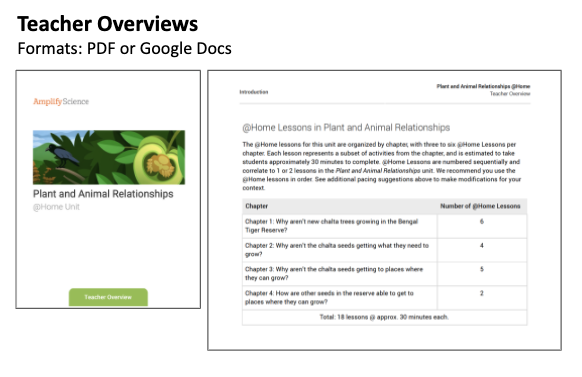
Teacher Overviews provide general information for each unit and include suggestions for pacing, tips for adjusting instructional time, instructional routines that should be planned for, and recommendations for chapter- and lesson-level modifications.
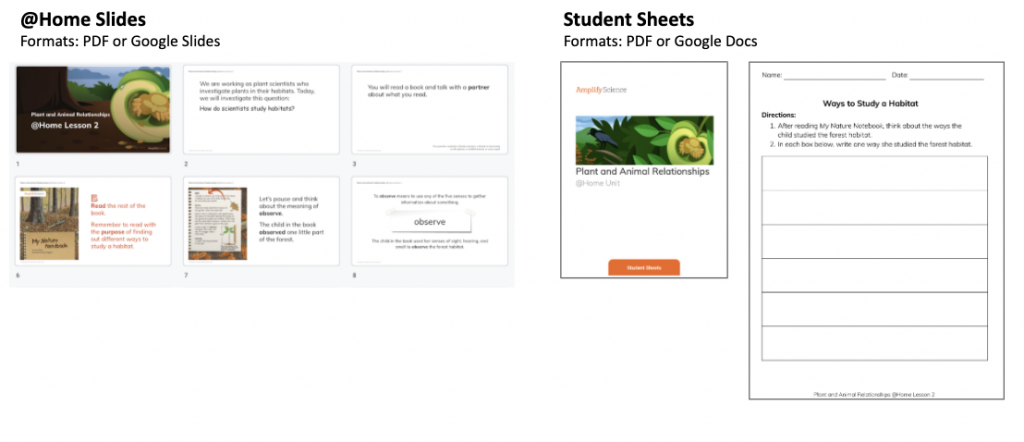
Available in both PDF or Google slide formats, @Home Slides and Student Sheets replace the Classroom Slides and Student Investigation Notebooks used with our traditional units. Embedded within each slide deck are links to other resources and prompts to complete relevant activity sheets, which are available as a separate @Home Sheets PDF.
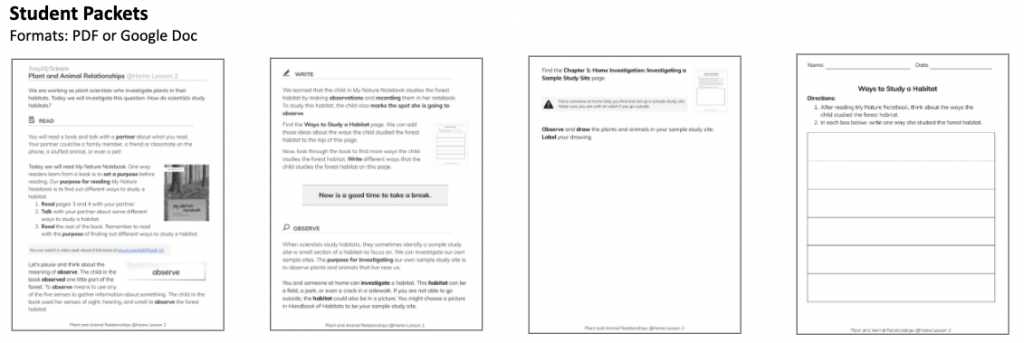
@Home Student Packets are printable packets that deliver parallel content as @Home Slides and Student Sheets, but in a way that supports students with little or no access to technology. With a single PDF for each lesson, students have access to all instruction and relevant activity sheets in one document.
Support for families

Family Overviews include information to send home to families about each unit’s goals, materials, and approach. Families can also access the Amplify Science Family Resources website, which includes a short video introduction to the NGSS standards, a high-level overview of the program’s components, summaries of all the units, and ideas for student investigations to conduct at home.

Frequently asked questions
Do I need to buy the new @Home Units if I’m already using Amplify Science?
You do not! We are providing the new materials free of charge as PDF and PPT documents to Amplify Science users.
Are the @Home Units full Amplify Science units?
No. These are condensed versions of Amplify Science units for those who are dedicating less time for science, and are meant to take about half of the amount of time as the standard units.
Are resources available in Spanish?
Yes! The student-facing resources associated with the @Home Units, as well as the @Home Videos, are offered in Spanish.
Do you offer training for teachers?
Yes, we offer on-demand professional development resources specific to remote and hybrid learning.
Do you have videos of all of the hands-on activities?
Yes! Videos all of the hands-on activities are available.
How do students who use the @Home Packets submit their work?
The answer to this question depends on district resources and systems, but options could include:
- Photographing their writing and submitting via Google Classroom or other platforms.
- Submitting an audio or video recording of an oral response, using a platform like Flipgrid.
- Discussing the prompt with a parent or family member (no written submission from the student).
What is the approach to student discourse and how does it change in a remote setting?
The @Home Units include suggestions for how to adapt student discourse activities for the range of remote learning contexts.
Do these resources support both synchronous and asynchronous learning?
Yes. For guidance on how to teach the program synchronously via video, refer to the @Home Videos which feature real Amplify Science teachers teaching lessons on video. For guidance on how to teach the program asynchronously, you can assign the @Home Videos to your students, or watch them yourself and use them as a model for creating your own videos to assign to students.
Welcome, Amplify Desmos Math families
Welcome to the Amplify Desmos Math Caregiver Hub. We’ve designed this space to help you support your student along their math journey. We hope your student enjoys exploring math, working with friends to solve problems, and learning new and interesting concepts. And we hope you enjoy the math journey with them.
Para la versión en español, haga clic aquí.
Introducing Amplify Desmos Math
Amplify Desmos Math is a core math curriculum for kindergarten through grade 12. We believe that a structured approach to problem-based learning builds on students’ curiosity to develop lasting grade-level understanding.
The Amplify Desmos Math curriculum uses student-centered instruction. In every lesson, students solve engaging and relevant problems, think critically, work collaboratively, and actively participate in their own learning.
Explore grade-level resources:
Student-centered instruction
Student-centered instruction may look different from the way you learned math. It aims to create a learning environment where students feel empowered and engaged in their own learning journey, providing them opportunities to figure out how math works instead of simply memorizing formulas and tricks. They learn to communicate both verbally and in writing, come to understand and challenge the opinions of others, and build confidence. This approach enables students to remember what they learn and apply their knowledge to new situations.
Here are some other benefits to student-centered instruction:
- Research shows that students and teachers prefer this method.
- Students perform better on standardized tests and have more growth in their grades.
- Teachers report that student-centered instruction helps their students learn more math.
- Students develop key skills for success in college, the workplace, and beyond, such as using technology, completing projects independently and with others, and persevering through challenges.

Components of a lesson
A typical Amplify Desmos Math lesson includes:
- Warm-Up: An open-ended question or interaction to draw students into the lesson.
- Activities: One to three activities that make up the heart of each lesson.
- You’re Invited to Explore More: Problems that invite students to explore a concept—often beyond the scope of the lesson—more deeply. These problems are intentionally available to all learners.
- Synthesis: An opportunity for students to put the key ideas from the lesson into their own words.
- Show What You Know and Reflection: A check for understanding focused on key concepts from the lesson.
- Centers (grades K–5 only): Student-led activity stations that reinforce the math learned during lesson activities through interactive and often game-like formats. In kindergarten and grade 1, time for Centers is built into the last 15 minutes of every lesson.
- Practice: Additional problems your student’s teacher may assign, including practice about the current lesson and review from previous lessons and units.
Get more information.
Have a question about Amplify Desmos Math? Visit our help library to search for articles with answers to your program questions. For additional support, please contact your student’s teacher.
Does your child’s class also use mCLASS Math assessments? Explore the mCLASS Math Caregiver Hub to find additional resources and support!
Program overview
Boost Math is a personalized learning math instruction and practice program. The game-based experience engages all students in grade-level mathematics in ways that prepare them for success in, and build enthusiasm around, algebra and later math.
Student experience
When students click on their Curioso icon, they are taken into their quest. Quests consist of brief narrative scenes, punctuated with skill practice in the form of games. Once a student completes a scene, their very own collection of personalized skill games appears on the right side of the screen. Students can play these games in any order.
- Students in grades 1 and 2 will experience games related to comparing numbers, measuring, and more.
- Students in grades 3, 4, and 5 will experience games related to fractions, area, multiplication, and more.
- Students will also experience activities known as “Makers,” which are open-ended activities within each quest related to the quest narrative, giving students an opportunity to apply different math applications to the real world.
Note: This is an early subsection of the product. Some content may be appropriate for some students, but difficult for others. This is feedback we want to hear. The designs are also still in-progress, with many aspects yet to be featured. We welcome all suggestions!
Implementation guidelines
We recommend that students should play for a total of 60 minutes per week, broken up into 3–4, 15–20 minute sessions. Consider using Boost Math during the following times:
- Small group or centers time
- Choice time
- During intervention blocks
- After school
- At home
- Remote learning
Getting your students online
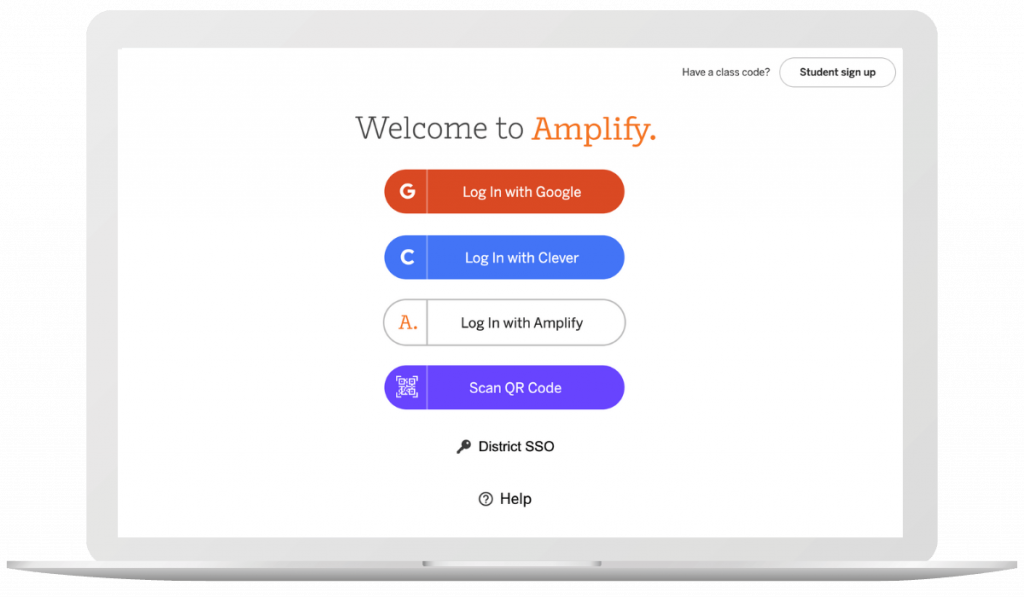
Instruct students to navigate to learning.amplify.com, and log in using the method you typically use when logging into Amplify Reading.

Find and click on the icon for Boost Math, as shown above.
Students will then see the screen showing Sequence Falls, the location in which their Boost Math journey takes place.
Troubleshooting guide
To clear your Chrome browser cache/cookies:
- On your computer, open Chrome.
- At the top right, click the three vertical dots.
- Click More Tools, Clear browsing data.
- At the top, choose a time range, select All time.
- Check the boxes next to “Cookies and other site data” and “Cached images and files.”
- Click Clear data.
- From the Safari menu at the top of the screen, select “Safari”
- Select “Preferences” from the drop-down menu
- Open the “Privacy” tab
- Select the “Manage Website Data” button
- Choose “amplify.com” from the list of sites
- Select the “Remove” button
- Select “Done”, then close the window
Please check to ensure “cookies” are accepted on your device.
If you still receive an error message or blank screen when accessing an Amplify page, please email Aya Bukres.
Please email Jehan Miah to confirm your login credentials.
To reset your Amplify password: click Login with Amplify, then click the Forgot Password link. If you do not receive an email with password reset instructions, please check your Spam folder. To ensure messages to not go to your Spam inbox, make sure to include the following addresses as trusted sources:
- do-not-reply@amplify.com
- noreply@amplify.com
- noreply@welcome.amplify.com
Phonological awareness games
In Cut It Out, students isolate individual phonemes by listening to a beginning, middle, or ending sound and choosing a picture of the word containing the sound in that position.
Skills
Phonological awareness
- Blending at the compound word, syllable, onset-rime, and phoneme level
Standards covered
- CCSS.ELA-LITERACY.RF.1.2.C — Isolate and pronounce initial, medial vowel, and final sounds (phonemes) in spoken single-syllable words.
- CCSS.ELA-LITERACY.RF.K.2.D — Isolate and pronounce the initial, medial vowel, and final sounds (phonemes) in three-phoneme (consonant-vowel-consonant, or CVC) words.1 (This does not include CVCs ending with /l/, /r/, or /x/.)
In Gem & Nye, students blend sounds into words, starting with compound words and syllables and then moving to beginning (onset) and ending (rime) sounds and finally individual phonemes, to identify the picture of the word the Soundbots say when blended together.
Skills
Phonological awareness
- Blending at the compound word, syllable, onset-rime, and phoneme level
Standards covered
- CCSS.ELA-LITERACY.RF.1.2.B — Orally produce single-syllable words by blending sounds (phonemes), including consonant blends.
- CCSS.ELA-LITERACY.RF.K.2.B — Count, pronounce, blend, and segment syllables in spoken words.
- CCSS.ELA-LITERACY.RF.K.2.C — Blend and segment onsets and rimes of single-syllable spoken words.
In Wordbots, students practice segmenting words into their onsets and rimes to determine which Startbots and Endbots form a stimulus word.
Skills
Phonological awareness
- Segment at the compound-word and onset-rime level
Standards covered
- CCSS.ELA-LITERACY.RF.K.2.C — Blend and segment onsets and rimes of single-syllable spoken words.
- CCSS.ELA-LITERACY.RF.K.2.B — Count, pronounce, blend, and segment syllables in spoken words.
In Zoom Boom, students practice rhyming by listening to a word and identifying the picture of the word that rhymes with it.
Skills
Phonological awareness
- Rhyming
Standards covered
- CCSS.ELA-LITERACY.RF.K.2.A — Recognize and produce rhyming words.
Phonics Games in Amplify Reading: K–2
In Curioso Crossing, students practice accurate and automatic word recognition by identifying the correct spoken word to guide their Curioso safely throughout the land.
Skills
Phonics – Early Decoding; Advanced Decoding
- Read high-frequency irregular words, regular words, words with inflected endings, two-syllable words, words with prefixes and suffixes, and multi-syllable words
Standards Covered
- CCSS.ELA-LITERACY.RF.K.3.B — Associate the long and short sounds with the common spellings (graphemes) for the five major vowels.
- CCSS.ELA-LITERACY.RF.1.3.B — Decode regularly spelled one-syllable words.
- CCSS.ELA-LITERACY.RF.1.3.C — Know final -e and common vowel team conventions for representing long vowel sounds.
- CCSS.ELA-LITERACY.RF.1.3.E — Decode two-syllable words following basic patterns by breaking the words into syllables.
- CCSS.ELA-LITERACY.RF.1.3.F — Read words with inflectional endings.
- CCSS.ELA-LITERACY.RF.2.3.A — Distinguish long and short vowels when reading regularly spelled one-syllable words.
- CCSS.ELA-LITERACY.RF.2.3.C — Decode regularly spelled two-syllable words with long vowels.
- CCSS.ELA-LITERACY.RF.2.3.D — Decode words with common prefixes and suffixes.
- CCSS.ELA-LITERACY.RF.2.3.F — Recognize and read grade-appropriate irregularly spelled words.
- CCSS.ELA-LITERACY.RF.K.3.C — Read common high-frequency words by sight (e.g., the, of, to, you, she, my, is, are, do, does).
- CCSS.ELA-LITERACY.RF.1.3.G — Recognize and read grade-appropriate irregularly spelled words.
In Food Truck, students practice “chopping” blends, ending sounds (rimes), and whole words into beginning sounds (onsets), ending sounds, and individual letters to create orders for their hungry goblin customers. The difficulty of words and segmenting tasks increases with each level as customers order more sophisticated “dishes.”
Skills
Phonics – Early Decoding
- Decode and spell words with common rime families
Standards Covered
- CCSS.ELA-LITERACY.RF.K.3.A — Demonstrate basic knowledge of one-to-one letter-sound correspondences by producing the primary sound or many of the most frequent sounds for each consonant.
- CCSS.ELA-LITERACY.RF.K.3.B — Associate the long and short sounds with the common spellings (graphemes) for the five major vowels.
- CCSS.ELA-LITERACY.RF.K.3.D — Distinguish between similarly spelled words by identifying the sounds of the letters that differ.
- CCSS.ELA-LITERACY.RF.K.2.E — Add or substitute individual sounds (phonemes) in simple, one-syllable words to make new words.
- CCSS.ELA-LITERACY.RF.1.3.B — Decode regularly spelled one-syllable words.
In Grumpy Goblins, students learn sound-spelling correspondences for consonant digraphs and vowel teams by listening to a sound from a goblin and feeding it the piece of toast with the corresponding letter or combination.
Skills
Phonics – Letter Combinations
- Sound-spelling correspondences for consonant digraphs and vowel teams
Standards Covered
- CCSS.ELA-LITERACY.RF.K.3.B — Associate the long and short sounds with the common spellings (graphemes) for the five major vowels.
- CCSS.ELA-LITERACY.RF.1.3.A — Know the spelling-sound correspondences for common consonant digraphs.
- CCSS.ELA-LITERACY.RF.2.3.B — Know spelling-sound correspondences for additional common vowel teams.
In Hangry Goblins, students practice letter-sound combinations by feeding individual letter sounds, consonant digraphs, blends, and vowel teams to goblins that become more and more “hangry” until they are given the letters that match their demands.
Skills
Phonics – Letter Sound Correspondence
- Sound-spelling correspondences for individual letters and letter combinations
Standards covered
- CCSS.ELA-LITERACY.RF.K.3.A — Demonstrate basic knowledge of one-to-one letter-sound correspondences by producing the primary sound or many of the most frequent sounds for each consonant.
- CCSS.ELA-LITERACY.RF.K.3.B — Associate the long and short sounds with the common spellings (graphemes) for the five major vowels.
- CCSS.ELA-LITERACY.RF.1.3.A — Know the spelling-sound correspondences for common consonant digraphs.
- CCSS.ELA-LITERACY.RF.2.3.B — Know spelling-sound correspondences for additional common vowel teams.
In Picky Goblins, students practice sound-spelling correspondences for individual letters by listening to a sound from a goblin and feeding it the piece of toast with the corresponding.
Skills
Phonics – Letter-Sound Correspondence
- Sound-Spelling Correspondences for single letters
Standards Covered
- CCSS.ELA-LITERACY.RF.K.3.A — Demonstrate basic knowledge of one-to-one letter-sound correspondences by producing the primary sound or many of the most frequent sounds for each consonant.
- CCSS.ELA-LITERACY.RF.K.3.B — Associate the long and short sounds with the common spellings (graphemes) for the five major vowels.
In Read All About It, students practice reading sentences with words that include the sound-spelling correspondences, word features (e.g., prefixes/suffixes), and phonics rules (e.g., vowel consonant long e, syllable patterns) they learned and practiced in other games.
Skills
Phonics – Early Decoding; Advanced Decoding
- Read grade level text accurately
Standards Covered
- CCSS.ELA-LITERACY.RF.K.3 — Know and apply grade-level phonics and word analysis skills in decoding words.
- CCSS.ELA-LITERACY.RF.K.4 — Read emergent-reader texts with purpose and understanding.
- CCSS.ELA-LITERACY.RF.1.3 — Know and apply grade-level phonics and word analysis skills in decoding words.
- CCSS.ELA-LITERACY.RF.1.4 — Read with sufficient accuracy and fluency to support comprehension.
- CCSS.ELA-LITERACY.RF.2.3 — Know and apply grade-level phonics and word analysis skills in decoding words.
- CCSS.ELA-LITERACY.RF.2.4 — Read with sufficient accuracy and fluency to support comprehension.
In Rhyme Time, students practice with different rime families (words that end with the same sounds and rhyme) and decode words in these families by swapping the first letter sounds of words while the ending sounds remain constant.
Skills
Phonics – Early Decoding
- Decode words with common rime families
Standards Covered
- CCSS.ELA-LITERACY.RF.K.3.A — Demonstrate basic knowledge of one-to-one letter-sound correspondences by producing the primary sound or many of the most frequent sounds for each consonant.
- CCSS.ELA-LITERACY.RF.K.3.B — Associate the long and short sounds with the common spellings (graphemes) for the five major vowels.
- CCSS.ELA-LITERACY.RF.K.3.D — Distinguish between similarly spelled words by identifying the sounds of the letters that differ.
- CCSS.ELA-LITERACY.RF.K.2.E — Add or substitute individual sounds (phonemes) in simple, one-syllable words to make new words.
- CCSS.ELA-LITERACY.RF.1.3.B — Decode regularly spelled one-syllable words.
In Tongue Twist, students practice with different rime families (words that end with the same sounds and rhyme) and build words by changing the ending sound (rime) while the beginning (onset) sounds, consonant blends, and consonant digraphs remain constant.
Skills
Phonics – Early Decoding
- Decode words with common rime families
Standards covered
- CCSS.ELA-LITERACY.RF.K.3.A — Demonstrate basic knowledge of one-to-one letter-sound correspondences by producing the primary sound or many of the most frequent sounds for each consonant.
- CCSS.ELA-LITERACY.RF.K.3.B — Associate the long and short sounds with the common spellings (graphemes) for the five major vowels.
- CCSS.ELA-LITERACY.RF.K.3.D — Distinguish between similarly spelled words by identifying the sounds of the letters that differ.
- CCSS.ELA-LITERACY.RF.K.2.E — Add or substitute individual sounds (phonemes) in simple, one-syllable words to make new words.
- CCSS.ELA-LITERACY.RF.1.3.B — Decode regularly spelled one-syllable words.
In Word City, students identify and manipulate beginning, middle, and ending letter sounds to assemble word chains that form buildings.
Skills
Phonics – Early Decoding
- Letter-sound correspondence
- Decoding and spelling regular words
Standards Covered
- CCSS.ELA-LITERACYRF.K.3.A — Demonstrate basic knowledge of one-to-one letter-sound correspondences by producing the primary sound or many of the most frequent sounds for each consonant.
- CCSS.ELA-LITERACYRF.1.3.A — Know the spelling-sound correspondences for common consonant digraphs.
- CCSS.ELA-LITERACYRF.1.3.B — Decode regularly spelled one-syllable words.
- CCSS.ELA-LITERACYRF.1.3.C — Know final -e and common vowel team conventions for representing long vowel sounds.
- CCSS.ELA-LITERACYRF.2.3.B — Know spelling-sound correspondences for additional common vowel teams.
Microcomprehension Games in Amplify Reading: K–2
In Because This, That, students learn how common text structures give clues to meaning by rearranging sentences to identify cause and effect or problem and solution.
Skills
Microcomprehension
- Text Structure: Organize sentences using sequence/chronological order
Standards covered
- CCSS.ELA-LITERACY.RI.1.3 — Describe the connection between two individuals, events, ideas, or pieces of information in a text.
- CCSS.ELA-LITERACY.RI.1.8 — Identify the reasons an author gives to support points in a text.
- CCSS.ELA-LITERACY.RI.2.3 — Describe the connection between a series of historical events, scientific ideas or concepts, or steps in technical procedures in a text.
- CCSS.ELA-LITERACY.RI.2.8 — Describe how reasons support specific points the author makes in a text.
In Connect It!, students practice using different types of conjunctions (temporal and causal, for example) to combine two clauses into a coherent sentence.
Skills
Microcomprehension
- Syntactic awareness – connectives
Standards covered
- CCSS.ELA-LITERACY.L.2.3 — Use knowledge of language and its conventions when writing, speaking, reading, or listening.
In Message in a Bottle, students build their awareness of syntax and the impact word order has on meaning by unscrambling scraps of lost messages to reconstruct sentences.
Skills
Microcomprehension
- Syntactic awareness
Standards covered
- CCSS.ELA-LITERACY.L.1.1 — Demonstrate command of the conventions of standard English grammar and usage when writing or speaking.
- CCSS.ELA-LITERACY.L.2.1 — Demonstrate command of the conventions of standard English grammar and usage when writing or speaking.
In Mind the Gap, comprehension levels are assessed through a modified cloze exercise in which students make selections to fill in the blanks of a text where approximately every seventh word has been omitted.
Skills
Microcomprehension
- Reading fluency
- Syntactic awareness
- Inference
- Comprehension monitoring
Standards covered
- CCSS.ELA-LITERACY.CCRA.R.1 — Read closely to determine what the text says explicitly and to make logical inferences from it; cite specific textual evidence when writing or speaking to support conclusions drawn from the text.
- CCSS.ELA-LITERACY.CCRA.R.10 — Read and comprehend complex literary and informational texts independently and proficiently.
In Show Off, students learn how common text structures give clues to meaning, using cues from illustrations to rearrange sentences in the correct sequential or chronological order.
Skills
Microcomprehension
- Text structure: Organize sentences using problem/solution and cause/effect
Standards covered
- CCSS.ELA-LITERACY.RI.1.3 — Describe the connection between two individuals, events, ideas, or pieces of information in a text.
- CCSS.ELA-LITERACY.RI.1.8 — Identify the reasons an author gives to support points in a text.
- CCSS.ELA-LITERACY.RI.2.3 — Describe the connection between a series of historical events, scientific ideas or concepts, or steps in technical procedures in a text.
- CCSS.ELA-LITERACY.RI.2.8 — Describe how reasons support specific points the author makes in a text.knowledge of one-to-one letter-sound correspondences by producing the primary sound or many of the most frequent sounds for each consonant.
In Sloppy Scrolls, students practice the art of comprehension monitoring, or ensuring that they continually build and check a mental model of what they read. In the game, students are introduced to a world of enchanted scrolls that have lost their magic: they contain inconsistencies, and no longer make sense. The students must attempt to identify the inconsistencies by tapping the sentences that don’t match the rest of the passage. To increase the challenge of the game, some of the passages are presented without errors.
Skills
Microcomprehension
- Comprehension Monitoring
Standards Covered
- CCSS.ELA-LITERACY.RL.2.10 — By the end of the year, read and comprehend literature, including stories and poetry, in the grades 2-3 text complexity band proficiently, with scaffolding as needed at the high end of the range.
In Storyboard, students practice making inferences by completing a storyboard that integrates relevant background knowledge missing from a given sentence.
Skills
Microcomprehension
- Inference
Standards covered
- CCSS.ELA-LITERACY.RL.K.1 — With prompting and support, ask and answer questions about key details in a text.
- CCSS.ELA-LITERACY.RI.K.1 — With prompting and support, ask and answer questions about key details in a text.
- CCSS.ELA-LITERACY.RL.1.1 — Ask and answer questions about key details in a text.
- CCSS.ELA-LITERACY.RI.1.1 — Ask and answer questions about key details in a text.
In Super Match, students work on developing cognitive flexibility, or the ability to track multiple elements simultaneously, by completing interactive puzzles that associate pictures and words across multiple dimensions (e.g., color and category, or starting sounds and category).
Skills
Microcomprehension
- Cognitive flexibility
Standards covered
- CCSS.ELA-LITERACY.L.1.5.A — Sort words into categories (e.g., colors, clothing) to gain a sense of the concepts the categories represent.
- CCSS.ELA-LITERACY.L.1.5.B — Define words by category and by one or more key attributes (e.g., a duck is a bird that swims; a tiger is a large cat with stripes).
- CCSS.ELA-LITERACY.RF.1.3 — Know and apply grade-level phonics and word analysis skills in decoding words.
In Unmask That, students build their understanding of anaphora, a tool authors use to avoid repetition, by linking pronouns to their antecedents in text.
Skills
Microcomprehension
- Syntactic awareness – anaphora
Standards covered
- CCSS.ELA-LITERACY.L.1.1 — Demonstrate command of the conventions of standard English grammar and usage when writing or speaking.
- CCSS.ELA-LITERACY.L.2.1 — Demonstrate command of the conventions of standard English grammar and usage when writing or speaking.
Comprehension Games in Amplify Reading: K–2
In Best Buddy, students examine character traits to determine which school club provides the best fit for their fictional friends.
Skills
Comprehension – Key Ideas and Details
- Character Traits
Standards Covered
- CCSS.ELA-LITERACY.RL.1.3 — Describe characters, settings, and major events in a story, using key details.
- CCSS.ELA-LITERACY.RL.2.3 — Describe how characters in a story respond to major events and challenges.
In Book Club, students compare and contrast two books on the same topic or theme to determine which book best meets the needs of a character in the game.
Skills
Comprehension – Integration of Knowledge and Ideas
- Compare and Contrast Texts
Standards covered
- CCSS.ELA-LITERACY.RI.1.9 — Identify basic similarities in and differences between two texts on the same topic (e.g., in illustrations, descriptions, or procedures).
- CCSS.ELA-LITERACY.Rl.2.9 — Compare and contrast the most important points presented by two texts on the same topic.
- CCSS.ELA-LITERACY.RL.2.9 — Compare and contrast two or more versions of the same story (e.g., Cinderella stories) by different authors or from different cultures.
In Debate-a-Ball, students practice identifying the best evidence to support a claim. Students pick an animal avatar to compete with an automated opponent in debates on familiar topics. To win, students must put forward the best evidence to support each claim more frequently than their opponents. They are taught to identify evidence that is factual and strongly related to the claim.
Skills
Comprehension – Integration of Knowledge and Ideas
- Evaluate evidence
Standards covered
- CSS.ELA-LITERACY.RI.2.8 — Describe how reasons support specific points the author makes in a text.
In Picture This, students complete the illustrations for a story by identifying words that describe its setting, characters, problems, and solutions.
Skills
Comprehension – Key Ideas and Details
- Story Elements/Plot
Standards covered
- CCSS.ELA-LITERACY.RL.1.1 — Ask and answer questions about key details in a text.
- CCSS.ELA-LITERACY.RL.1.3 — Describe characters, settings, and major events in a story, using key details.
- CCSS.ELA-LITERACY.RL.2.1 — Ask and answer such questions as who, what, where, when, why, and how to demonstrate understanding of key details in a text.
- CCSS.ELA-LITERACY.RL.2.3 — Describe how characters in a story respond to major events and challenges.
In Storybox, students choose settings, situations, and solutions to send characters on different adventures, using details and context to help them resolve problems and complete the story.
Skills
Comprehension – Key Ideas and Details
- Story Elements/Plot
Standards covered
- CCSS.ELA-LITERACY.RL.K.3 — With prompting and support, identify characters, settings, and major events in a story.
In Tube Tales, students learn the attributes of different genres and practice identifying them in brief texts.
Skills
Comprehension – Craft and Structure
- Text schema
Standards covered
- CCSS.ELA-LITERACY.RL.2.10 — By the end of the year, read and comprehend literature, including stories and poetry, in the grades 2-3 text complexity band proficiently, with scaffolding as needed at the high end of the range.
- CCSS.ELA-LITERACY.RI.2.5 — Know and use various text features (e.g., captions, bold print, subheadings, glossaries, indexes, electronic menus, icons) to locate key facts or information in a text efficiently.
- CCSS.ELA-LITERACY.RI.2.10 — By the end of year, read and comprehend informational texts, including history/social studies, science, and technical texts, in the grades 2-3 text complexity band proficiently, with scaffolding as needed at the high end of the range.
In What’s the Big Idea, students examine pictures, picture sequences, and short passages to practice differentiating the main idea from story details.
Skills
Comprehension – Key Ideas and Details
- Main idea
Standards covered
- CCSS.ELA-LITERACY.RI.K.2 — With prompting and support, identify the main topic and retell key details of a text.
- CCSS.ELA-LITERACY.RI.1.2 — Identify the main topic and retell key details of a text.
- CCSS.ELA-LITERACY.RI.2.2 — Identify the main topic of a multiparagraph text as well as the focus of specific paragraphs within the text.
Vocabulary Games in Amplify Reading: K–2
In Punchline!, students learn how words can have multiple meanings by channeling their inner comedian to crack homonym-based jokes.
Skills
Vocabulary
- Multiple-meaning words
Standards covered
- CCSS.ELA-LITERACY.L.2.4.A — Use sentence-level context as a clue to the meaning of a word or phrase.
In Shades of Meaning, students differentiate the nuances in similar words — first by ordering them from weakest to strongest, largest to smallest, or least to greatest; then by putting them into sentences that further clarify their meaning.
Skills
Vocabulary
- Shades of meaning
Standards covered
- CCSS.ELA-LITERACY.L.1.5.D — Distinguish shades of meaning among verbs differing in manner (e.g., look, peek, glance, stare, glare, scowl) and adjectives differing in intensity (e.g., large, gigantic) by defining or choosing them or by acting out the meanings.
- CCSS.ELA-LITERACY.L.2.5.B — Distinguish shades of meaning among closely related verbs (e.g., toss, throw, hurl) and closely related adjectives (e.g., thin, slender, skinny, scrawny).
Amplify Reading: K–2’s Integrated eReader
eReader Overview
Amplify Reading: K–2 has a new library of over 25 fiction and non-fiction ebooks and an adaptive algorithm that unlocks each book at the exact right point in a reader’s development. Moreover, they contain familiar interactions from the games so that students move seamlessly from text-embedded-in-games to games-embedded-in-text, maximizing their sense of growing competency.
The eReader also provides optional supports for its readers. From the settings icon on the title page of each book, students can turn on sentence numbering, read aloud functionality, and reveal words, as well as adjust the text size.
Student Experience
When students are ready for a text, it will appear as one of their quest steps.
When readers first unlock a new book, they read through it without interruption (with read-aloud support if appropriate).
In the second read, students discover embedded activities that repeat the familiar iconography of a game they previously mastered.
At the end of the book, additional activities evaluate students’ comprehension.
Achievements in books are part of the same overall reward system: helping your Curioso grow, just like achievement in skill-building games. Mastery of the content is reflected in the teacher dashboard within the given skill.
How teachers are using Amplify Reading
Independent study/rotation stations
Amplify Reading is a personalized, differentiated program designed to keep students engaged and on task in independent study. The program is most effective when used for a minimum of 45 minutes per week.
Other common uses
We designed the program to be flexible enough to fit any classroom model. Amplify Reading is browser-based, so it works on Chromebooks, iPads, laptops, desktops, and even iPhones. It can also be used at home to extend learning beyond the classroom.
Integrating writing skills into science instruction

Teaching students to write like scientists
People tend to think of themselves as either a “science person” or an “arts person.” But for science students today, it doesn’t have to be that way.
Writing and communicating are essential parts of being a scientist, which is why they’re also essential parts of a science curriculum.
A science teacher is uniquely qualified to expose students to science writing skills, which can in turn improve their writing skills overall. It’s a win-win! And even though writing styles may vary across the two disciplines, we bet ELA teachers will notice the improvement in students’ writing abilities.

Integrating science and writing skills
The science classroom and the ELA classroom are partners in developing student literacy. The following five principles can help teachers make the most of that partnership.
- Science writing is more than fill-in-the-blank. Science writing involves critical thinking, analysis, and the ability to communicate complex ideas effectively—in research, proposals, and more. To develop those skills, teachers can ask students to create presentations and lab reports, and to read journals and each other’s work.
- Technical writing goes beyond the technical. It’s important for students to learn to vary their writing styles for different audiences and purposes. Practicing technical writing (even instructions for making a sandwich) can help students learn to write—in all disciplines—with clarity and precision.
- Writing takes phenomena-based learning to the next level. Writing about a phenomenon encourages students to communicate hypotheses, arguments, and opinions. They need to provide detailed evidence for their assertions and explain why they matter—just as they would in an essay for ELA.
- The Next Generation Science Standards (NGSS) are designed to support science instruction that’s rich in writing. Here are just a few places where the NGSS connect to common core writing standards: grades K–2 storyline PDF, grades 3–5 storyline PDF, middle school storyline PDF, and high school storyline PDF.
- Integrating writing into science encourages science and ELA growth. The more students practice writing out their thoughts, arguments, and opinions, the more adept they will be at forming arguments both in and out of the science classroom. When science and ELA teachers use similar strategies, they’ll reinforce the learning across classrooms and create even stronger writers.
Learn more
- Amplify Science: The research behind the program, including the proven Do, Talk, Read, Write approach
- Amplify Science encourages students to write like scientists
- Science Connections: S1-03: Ways to integrate literacy skills into a K–8 science classroom: Rebecca Abbott
Amplify Desmos Math for West Virginia
S2-02: Developing your own teaching style: Tips from a veteran teacher.

In this episode, Eric Cross sits down with veteran educator and former Miami-Dade County Public Schools (M-DCPS) Middle School Science Teacher of the Year, Marilyn Dieppa. During the show, Marilyn shares tips for new teachers, ways to inspire students, and how she utilizes her journalism background to develop literacy skills within her science classroom. She also shares her experiences developing a robotics academy, and the VEX IQ World’s Competition. Explore more from Science Connections by visiting our main page.
Marilyn Dieppa (00:01):
I think my favorite thing is their success. Whether it’s robotics, whether it’s in the classroom, that they pass a test for the first time, those are my moments of success. And that’s what makes me happy.
Eric Cross (00:15):
Marilyn Dieppa is a veteran middle-school science educator at Miami-Dade County public schools. Dieppa launched her school’s STEM Academy in 2016 and developed professional development through the STEM Transformation Institute of Florida International University. Dieppa’s coached numerous new teachers and was the 2018 Miami-Dade County public schools’ middle-school Science Teacher of the Year. In this episode, we discussed her transition from a career in journalism to the science classroom and the value of personal and professional support systems for teacher longevity. And now, please enjoy my conversation with Marilyn Dieppa.
Marilyn Dieppa (00:52):
Nice to meet you, Eric.
Eric Cross (00:53):
Nice to meet you too. Thank you for being willing to come on the podcast.
Marilyn Dieppa (00:58):
Not a problem.
Eric Cross (00:59):
So you’re out in, you’re out in Florida. In Dade County. I’m out here in San Diego. So I’m like literally on the other side of the country. Have you—were you born and raised in Florida?
Marilyn Dieppa (01:09):
I’ve been here for 40 years, so I’ve been here most of my life. Yeah. I’m Puerto Rican, but I was, you know, my young childhood, I was in New Jersey. And then when I was 15, I came down.
Eric Cross (01:23):
I looked at like your—some of your accolades, which are really impressive. The things that you’ve done for students with robotics, and all the education, or, kind of like teacher enrichment, a lot of mentoring and coaching that you do now.
Marilyn Dieppa (01:35):
I am part of leadership team for the district. I do a lot of training. I work on curriculum. I help with pacing guides to make sure that everything is based on what the state wants, what the district wants. I have done a lot for the district in the last, probably 20 years.
Eric Cross (01:52):
What got you into teaching initially? What was your…like, why middle school science? We’re like a unique group.
Marilyn Dieppa (01:57):
This is the second career choice for me. So I’ve only been doing this for 24 years. I was a journalism major and then I got married and then I had my child and I wanted to do something. My thing was that I wanted to go to Iraq. I wanted to cover the news. I have a minor in Middle Eastern culture. so there was a lot of things that were in my mind when I was young, pre-married. and after, you know, you have children, priorities kind of change. So I totally changed, pretty much had to start from scratch, with my degree, because nothing kind of transferred over from journalism to teaching. So before I actually did that, I started subbing just to see if I liked it. And I fell in love with teaching right away. And that’s how I got into it. So my degree is really in elementary.
Eric Cross (02:45):
Now, when you were subbing, you were doing elementary school.
Marilyn Dieppa (02:47):
Yes. Pretty much elementary.
Eric Cross (02:48):
How did you go from there to like, middle-school science?
Marilyn Dieppa (02:50):
My thing was writing, not necessarily math and science. But I ended up with my cooperating teacher, my CT, she was a math and science teacher. So I was put with her, and who knew that I liked science and I liked math? So I ended up with that and I infused a lot of labs. So in elementary you tend to—I think teachers are a little bit afraid of the labs, so I infused a lot of literature with my labs. I infused all my—I did it like a whole-group type thing, everything I did with my labs, I incorporated the math. I incorporated the science. I incorporated, you know, the reading with it. And from there, I just—you know, they ended up putting me in a lot of leadership roles with science. And then my principal was opening up the school where I’m at now, my former principal. And she, you know, she took me with her. And so her dissertation was in looping, on how following your students, did that really make a difference in test scores? So I was part of her like test study, and I had students that I followed for two years in a row. And she would look at data and that was part of her dissertation. So that really made a difference. So I ended up moving with my students and my first group of middle-school students, I had them for four years.
Eric Cross (04:10):
Oh, wow.
Marilyn Dieppa (04:10):
And that was—those were my children. I, like, boohooed when they left. And I ended up, you know, literally following them from fourth grade all the way to more than four years. Because it was all the way until they left eighth grade.
Eric Cross (04:21):
What did you think of that model of looping with students?
Marilyn Dieppa (04:24):
I think it’s a great model, depending on the kids that you have. I love, you know, the school that I’m at. I’m very blessed, because it’s a great school. It’s really a wonderful school. I’ve had really good relationships with students. They always come back, and they always come back when they wanna tell me that they’re in something in science, right? They’re an engineer or they’re a nurse, or they’re, you know, doctors at this point. So I’ve seen a little bit of everything with my students. And it’s very rewarding.
Eric Cross (04:52):
That’s super-exciting, right? When they come back and they’re either telling you about their college major or what career they’re in. And I like to recruit them at that point and ask them to come talk to my students. Because Google photos gives you unlimited storage, if you have a teacher account, I actually have photos of students from like 10 years ago.
Marilyn Dieppa (05:09):
Oh, wow.
Eric Cross (05:10):
And I’ll put their middle school picture next to their—and then their current picture.
Marilyn Dieppa (05:14):
Oh, that’s awesome. I’ve never done that.
Eric Cross (05:17):
Yeah. You could see, like, they could see the younger version of them.
Marilyn Dieppa (05:19):
And it’s funny because even with the STEM Academy, which I have now, I have the same group of kids for three years. So I’ve had already few groups that have gone by, and those kids come back to me, they come back to our competitions, they help out, you know, they’re very integrated with the robotics. So I’m getting those students back as well. So I’ve maintained that relationship with them as well.
Eric Cross (05:46):
How do you develop your own classroom management style? How did you figure out where your—where you fit and what works for you? What was your process like for that?
Marilyn Dieppa (05:55):
You know what I think, just by teaching, teaching them to respect. And one thing that I’ve developed that—I don’t scream in my classroom; I just talk to the kids. I have very good one-on-one communication with them. I show them respect. I treat them as an equal.
Eric Cross (06:12):
And what grade are you teaching currently?
Marilyn Dieppa (06:14):
Eighth grade. So I do science. I teach high school science. I teach comprehensive, which is like our regular students. I have kids who are inclusion. I have kids that are ESL. So I teach all, you know, dynamics of students. And then I have the academy, which is something separate. But I infuse a lot of physics and of course that they need in order for them to be competitive.
Eric Cross (06:38):
So tell me about that. What is the STEM Academy?
Marilyn Dieppa (06:40):
It is an enrichment program. So it is an advanced enrichment program, because they do follow like the math enrichment. so they have to be really good at math in order for them to be accepted into the program. So, one day we got like a grant, and we got a little robot, the VEX. I don’t know if you’re familiar with VEX. I know it’s big in California. So I was told, “Here, this is for you. See what you can do with it.” So I started with an after-school club, the following year. It kind of hit off. We went to our first little competition. The kids did really well. And then the following year, they told me, “Hey, we need an academy, make it happen.” So it’s not like I had a curriculum. I kind of do my own thing. But we do a lot of different types of things. Our big portion is the VEX, but I also do sec me, we do Future City. We do a whole bunch of competitions within the district. You know, Math Bowl. So I get my kids prepared for anything that really has to do competitive-based. I do that with those students.
Eric Cross (07:38):
What age range or which grade range?
Marilyn Dieppa (07:40):
Sixth to eighth. We have kids who stay the three years and then we have kids that after, you know, sometimes it’s more the parents that want them to be part of the engineering. but sometimes we lose kids after the first year and you know, that’s fine because we wanna really have kids who really wanna be there and are, you know, committed to it. Because there’s a lot of commitments to that program.
Eric Cross (08:01):
Those types of programs, there’s so many like outside-of-the-classroom things that you need to take care of. If you’re going to competitions, and weekends, and all those types of things. Is there a team of teachers that are doing this or is it just you?
Marilyn Dieppa (08:10):
Team of one! .
Eric Cross (08:11):
A team of one! Right? Like, yeah. And how long have you been running this yourself?
Marilyn Dieppa (08:16):
This is probably like my sixth year.
Eric Cross (08:19):
OK.
Marilyn Dieppa (08:20):
So we’ve been very successful. That program is totally inquiry. It’s totally on them. I don’t know how to use a little, you know, remote control. I don’t know how to do anything. I’m there for troubleshoot and to make sure that they’re on task, but they have been very successful because I do put everything on them. And I go, “It’s not my robot. This is your robot.” So they build everything
Eric Cross (08:40):
And that seems to be the theme, especially with, a lot of times, with science teachers. And encouraging them to say, “You don’t have to be the expert in everything.” Teachers tend to be more like risk-taking and innovative when they’re willing to like, not have to be—I don’t have to know everything in order to do something.
Marilyn Dieppa (08:54):
Exactly. So we’ve been very successful. Very proud of my students because you know, we’ve, gone to Worlds twice. We’ve qualified three times in the six years. Actually, I had two teams that went last year.
Eric Cross (09:07):
What is, what is Worlds? That sounds like a big deal.
Marilyn Dieppa (09:10):
It’s a huge thing. And it’s teams from all over the world. You can actually look it up online. It’s—from this year, there were teams, although they said China was not gonna be in there, there were actually some teams from China. There were teams from New Zealand. There were teams from South Africa, the UK, a lot of teams from, from Europe. And then there are teams from here. We are the host country. We’ve been the host country for a while. But it’s amazing. The first time we went, the first team that we were paired up with was a Russian team. So, you know, there was Google Translate and the kids—and it’s, they didn’t need to know the same language because they communicated with the robots. So it was really amazing. They work collaboratively. So it’s not like a battle box. So they work two teams together and whatever, they both get together, they both earn the same points. So it teaches leadership, and there’s so much more to it than just a robot. They have to know how to communicate, because they do get interviewed. They do online challenges. It’s so many things. It’s just—I think it’s one of the best things that our district has really invested in, because these kids are so into it, and they love it so much. For the last year and this year I have the same kids that are in the robotics. I’m also gonna be teaching them physical science. So I have to teach them that separation between what we’re doing in our science classes versus what they’re doing in the class. So there has to be a separation. So they see one side of me in this class where it’s very laid back. It’s very chill. No, no, you, you guys do it. There’s no sitting down. It’s like organized chaos, I call it all the time. But then in the classroom, it has to be a little bit more organized.
Eric Cross (10:53):
Is that something that, as far as getting the parts—like people do, like, GoFundMes and donations and Donors Choose. Can you—
Marilyn Dieppa (11:00):
We get grant money, grant money from the town of Miami Lakes, the town that I work in. So the town actually sponsors us. Without them, we could not do that. It is a very expensive activity to do. If you go online and you look up the prices, you’ll be, “Oh my gosh, goodness, it’s very expensive.” You know? But the smiles on their faces when they come back and they have those little certificates, it means nothing, you know, it’s a little piece of paper. But that, to me, to them, it means the world.
Eric Cross (11:27):
Well, teachers, if you’re looking for ways to get that stuff funded, be fearless on behalf of asking for free things for your kids. Find a local business that somewhat connects to even robotics and say, “Hey, look, I’ve got 50 kids that really want to get after it. And we need X amount of dollars so we can buy those robotics kits. We’ll put your banner up somewhere. We’ll do all these other things. But come support our students. Come to the competition. Donate whatever you can for our students.” And many organizations will say, will say yes. Many just aren’t asked.
Marilyn Dieppa (11:57):
Right. And a lot of towns do have, like, education advisory boards. You wanna reach out to those people. ‘Cause those are the communities where they have money set aside in order to assist things like this.
Eric Cross (12:09):
Do you notice any carryover between the students that do get involved with these extracurriculars into the regular science classroom?
Marilyn Dieppa (12:16):
For sure. They’re more, they’re more disciplined. They tend to care more about the sciences because they see that link in the science. I mean, my kids are talking about gear ratios. They’re talking about, you know, mass accelerations. They had—they infuse all these things. And when they see it in the science class, they’re making that connection, which is really wonderful.
Eric Cross (12:41):
It seems like there’s a high level of engagement because this is an authentic thing. It’s almost, this should be science.
Marilyn Dieppa (12:46):
Yes. And not only that, the writing skills that have to be interpreted because part of the program is that they, they don’t necessarily have to have it, but in order for them to go far and make it to Worlds, they have to have an engineering notebook. So our strength sometimes is not the robot, but the engineering notebook.
Eric Cross (13:02):
his is where the journalism major shines.
Marilyn Dieppa (13:05):
Yes. And I go, “Guys, this is your Ikea manual. You have to explain what you’re doing, what pieces you’re using, what’s going right.” You know, and then they have to interpret and see what didn’t work. How can they fix it? So there’s so much problem-solving. It’s real life, it’s what they’re doing there. More so than sitting and learning rote, you know, vocabulary or whatever the case might be, ’cause they’re actually applying what they’re learning.
Eric Cross (13:31):
Yeah. And that’s, that’s so critical, the communication piece. Because seems like now in society, more than ever, even just being able to communicate something with bad science is convincing to people. Versus if you have great science, but you can’t communicate it, you’re not gonna be able to get it out into the public. It’s so great to see a program that exactly brings together this literacy aspect, in addition to kind of this content and skills aspect of doing the science.
Marilyn Dieppa (13:57):
And that’s what really, you know, since I started, that’s pretty much what I’ve done. My strength, believe it or not, when I was growing up, was not the science. I think I didn’t really have a really good science background. But I remember reflecting and saying, “I don’t want my students to feel like I felt when I was a child.” I wanna make sure that I give them everything, you know, give them the hands-on experience. I think I had one teacher when I was growing up and I still remember him. He was my second-grade teacher and he was just so amazing with the science. And it was just like the only really good experience I had. And I think that always stayed in the back of my mind. And when I started teaching and I go, “I wanna give these kids these experiences.” You know, sometimes I see kids in eighth grade and I go, how sad! They see water boiling and they’re just, like, in a lab room. And they’re just like, in awe, because there’s water boiling. And I go, “You guys haven’t seen water boil before?” And he goes, “No, no, no, not like this!” And I go, oh wow.
Eric Cross (14:58):
Even if it’s simple, everyday phenomena, everyday things that people deal with in a science classroom, or when you’re a teacher in that setting, it’s just—it just hits different, right? Like you, you know, you drop dye into water and watch it diffuse. And it’s like, whoa! Because they’re looking at it through that different lens. And that’s why one of the reasons why—I’m super-biased, but as science teachers, we get to do the coolest stuff.
Marilyn Dieppa (15:21):
Yeah, we do.
Eric Cross (15:22):
We just do. It’s so much fun. And basically anything that happens, that’s cool, like in, innovation and things like that, we can figure out ways to incorporate into our classroom. Now, as a coach and as a mentor, you’ve had multiple student teachers in your classroom. And we have, you know, huge need for new teachers. I teach teachers who are getting their CR, getting their credential. And the landscape of education is, is constantly shifting. You’ve watched it shift over the years. What are your biggest tips that you give to new teachers?
Marilyn Dieppa (15:49):
Well, I just had an intern last semester. I’ve had a few interns where, you know, not only are they doing this, but they’re also learning robotics too. So they’re really getting aspect in how to incorporate that. You don’t have to have everything separate. You can include everything together. But I think, I think it just comes from the foundation where they’re not exposed. Even me, when I went to college, I don’t remember doing so many labs as I should have. And I think it’s just a fear of them trying new things and failing. And I go, you know what? I, sometimes my first class is my guinea pig class, because I always change my labs. I don’t like to do the same thing over and over again. If I see something online, I go, “Oh wow. You know what, I’m gonna try it.” And I go, “Hey guys, this is the first time; we’re gonna do this together.” And it’s really—it’s just for them not to be fearful. And I think especially for science teachers or like even elementary, to give the kids the foundation that they need, they’re afraid. They’re afraid of failing and not trying something new, and say, “Hey, it’s OK. There’s other ways of doing this.” You know? So I always say, “My first class is always my guinea pig class, ’cause that’s the class I’m gonna try this on.” And then, you know, when you have to tweak, reflect, then we do that.
Eric Cross (17:06):
What are some of the things that you’ve seen or encouragements that you give to teachers who are teaching, kind of, in this kind of newer landscape, where as teachers, you become more than just a science teacher. I mean, you’re a mentor. You’re an encourager. Sometimes you’re a counselor for students. And then there, there are things that happen externally that impact teachers as well. It’s a tough job.
Marilyn Dieppa (17:24):
So I always say, you know, when you have a child, we have to be very aware of what’s happening with our children. Especially after these two years of the pandemic. That was kind of crazy. Last year was a really tough year, I think, for most educators that were back in the classroom. But I always tell ’em, you have to be really aware of what’s going on with these kids outside. When you see somebody who’s not doing anything and then you have the parents are there supporting. There’s something going—I mean, there has to be something going on. Kids are not just going to be so, so defiant. You’re gonna have very few that will be like that. But most of them it’s just gotta see and read those kids and see what’s going on, and don’t be afraid to—and I always say, I’m not there to really be your friend, but I’m there to help you. And you gotta tell ’em, you know, if you need to talk, come talk to me. Have an open-door policy with those kids.
Eric Cross (18:16):
What’s been your favorite part of the job? Something you really enjoy about the job? Especially having been teaching for as long as you have.
Marilyn Dieppa (18:23):
I think my favorite thing is their success. Whether they have struggled all the year and they’ve had that one piece of success or they don’t realize what they got out of middle school until they get to high school and they come back to you and they tell you it’s, you know, seeing my kids, whether it’s robotics, whether it’s in the classroom, that they pass a test for the first time, those are my moments of success. And that’s what makes me happy.
Eric Cross (18:52):
So you get those ahas, you get those wins, those turnarounds. And it’s like, “Ah, this keeps me going. This is so good!” But there’s something that I say to myself when I do get challenges in the classroom is teaching seventh grade, I say, “They’re 12. They’re 13. They’ve been on earth for 13 years. And for the first five or six, like, you know, they’re just kind of coming online at that point. And they’re going through all these changes.” And it grounds me in the fact that ’cause sometimes the things that you experience can be really, really challenging kind of interpersonally. And I remind myself, “Well, it’s like—you’re not 28 years old. Like, you’re, 12 and 13, and you need me to not be Mr. Cross, the science teacher. You need me to be, you know, Mr. Cross, the mentor, or Mr. Cross, the coach.” Like you were saying, open door. Keeping that open door, keeping that relationship. Because so much of what we’re doing is like life coaching in addition—and that connects to their success in the classroom. There’s a direct relationship.
Marilyn Dieppa (19:45):
Yes, yes, yes, absolutely.
Eric Cross (19:46):
Now what gets you back each fall? Because at the end, you know, every school year it’s like, “That was a tough one!” Especially with the last couple years. Right? So what’s been something, what gets you back in the classroom every fall, so that you’re ready for your students?
Marilyn Dieppa (20:02):
I think the support I get at home. I have a husband who is the most supportive person ever. He always tells me, “Your kids are grown up.” You know, my kids are adults now. “Enjoy these kids, what they’re doing. You don’t know how much they need you.” So he does tell me that. He goes, “And don’t complain! You love it!” And also my administration, they back me up. And that’s what I think what keeps you coming back. I love my administration. Whatever I ask for, they don’t tell me no. They tell me I’m crazy, but they don’t tell me no. You know, we have these huge competitions once a year at our school, administration has to be involved ’cause they have to be there, and they go, “We do this because we love you! But you know, you’re crazy!”
Eric Cross (20:48):
It’s interesting, ’cause both of these things, they involve human connection. And one is your support system at home, which is incredibly valuable. Shout out to your husband; I don’t know if he’s around. And then the culture, like, feeling supported. Teachers, you know—and it’s not just in education, but people, I’ve experienced—will work harder, longer, be more committed, when they have that intangible. When they feel like they’re connected to something bigger than them. Or on a team, not in a silo. And one person can really create or break whether that happens. And just like us in the classroom as a teacher, right? Like, “What makes you like this teacher’s class?” “Well, I feel connected. I feel safe. I feel it’s fun. It’s the culture!” I like to end with asking this question and you kind of alluded to an answer earlier, but who is one, or it could be multiple teachers, that you’ve had in your own life as a kid growing up or young person in kindergarten through 12th grade, could even be college, that has inspired you? Or made a difference in your life one way or another? Like, who pops out? I feel like we all have somebody.
Marilyn Dieppa (21:58):
One was my second grade teacher, as I mentioned before. Mr. Fernandez, never forget him. And my other teacher was my high school teacher, Mr. Velazquez. It was in New Jersey as well. And he was the one that really got me into the love of writing. He was my Spanish teacher, actually. He wasn’t even, you know—he was like an elective teacher. But he just made me believe like, “Wow, you’re like a really good writer!” To me, those two gentlemen really stood out. Very fond memories of being in school and really enjoying what I was doing.
Eric Cross (22:33):
There are so many teachers that we all have been impacted by. And many of us now who are teachers, we sit in that same seat. We fill those same shoes. And going back to what you had said earlier, one of the most rewarding things is when those kids come back to you. And I’m thinking about all the work that you’ve done, all the students you’ve poured into, all the competitions you’ve done. The ones that have come back to you are a small fragment of the ones that you’ve impacted.
Marilyn Dieppa (22:59):
Mm-hmm, yeah.
Eric Cross (23:00):
‘Cause we think about our own story, right? Like you’ve gone on and paid dividends for that one teacher in second grade. You know, Mr. Fernandez or Mr. Velasquez like, they went and they just gave you exposure to something or helped you fall in love with something. And you went on this trajectory. And if we could see the timeline of, like, this teacher created Marilyn, and Marilyn went and did this, and then what do all those students do? And that, I don’t know, there’s so many jobs that are gonna be hard work and that are gonna be challenging and stressful. But that is the thing that I think fills me when I listen to your story. I just think about like all the students throughout Florida that you have—you probably will never hear from, but have gone on to do amazing things or become great people who would go back and talk about you and say you were an inspiration for them. Marilyn, thank you for taking the time out to be on the podcast and for not only teaching students, but inspiring and coaching younger teachers and new teachers. It’s so critical. And for being willing to spend so much of your time beyond the classroom to create these opportunities for students to do this awesome, fun, engaging science, and go to Worlds. I wish you a great school year.
Marilyn Dieppa (24:11):
Thank you. You too.
Eric Cross (24:12):
We hope you make it to Worlds again and crush, in a competitive, collaborative type of environment. We’ll be checking out—I’m sure other teachers will check out Vex Robotics. Thanks for being on the podcast.
Marilyn Dieppa (24:23):
Thank you. You too, Eric.
Eric Cross (24:26):
Thanks so much for listening. Now we want to hear more about you. Do you have any educators who inspire you? You can nominate them as a future guest on Science Connections by emailing STEM@amplify.com. That’s S T E M at amplifycom.wpengine.com. Make sure to click subscribe wherever you listen to podcasts. And join our Facebook group, Science Connections: The Community. Until next time.
Stay connected!
Join our community and get new episodes every other Tuesday!
We’ll also share new and exciting free resources for your classroom every month.
Meet the guest
Marilyn Dieppa is a long-time educator and STEM Academy coach at Miami Dade County Public Schools. Currently in her 24th year, Marilyn teaches 8th grade science and coaches the STEM Academy at Bob Graham Education Center. She launched the Science, Technology, Engineering and Math (STEM) Academy during the 2016-2017 school year, and the teams compete in VEX IQ World’s Competition representing both the district and the state. She has been the middle school department chairperson since 2003, attends the district department meetings and Instructional Capacity-building Academy (ICAD), and trains her science department.
Dieppa holds a bachelor of science in Elementary Education and a master of science in reading education. She is also a Nationally Board-Certified Teacher in Science.

About Science Connections
Welcome to Science Connections! Science is changing before our eyes, now more than ever. So…how do we help kids figure that out? We will bring on educators, scientists, and more to discuss the importance of high-quality science instruction. In this episode, hear from our host Eric Cross about his work engaging students as a K-8 science teacher. Listen here!

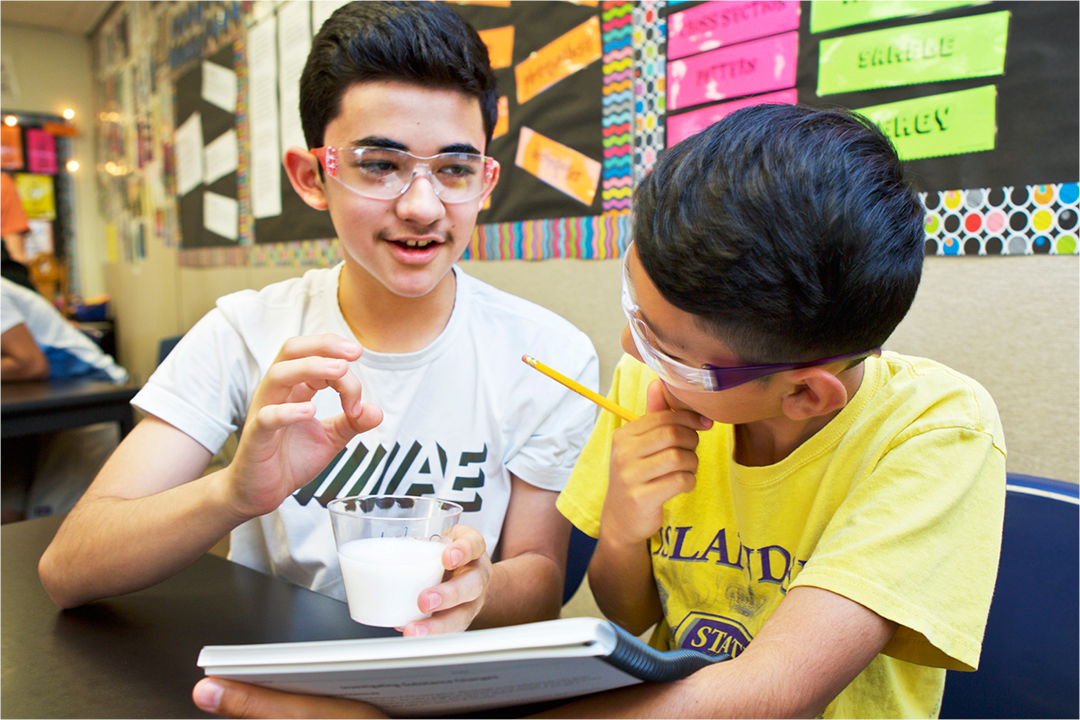

Amplify Desmos Math for the Archdiocese of Miami
Welcome Catholic school educators,
Amplify Desmos Math thoughtfully combines conceptual understanding, procedural fluency, and application. Each math lesson is designed to tell a story by posing problems that invite a variety of approaches before guiding students to synthesize their understanding of the learning goals.
What is Amplify Desmos Math?
Amplify Desmos Math supports teachers in building students’ lifelong math proficiency. The program:
- Supports social classrooms, invites mathematical creativity, and evokes wonder, creating a welcoming learning space where students are empowered to see themselves and their classmates as having brilliant mathematical ideas.
- Provides teachers with clear, step-by-step moves to build systematically from students’ prior knowledge to grade-level learning.
- Connects students to each other’s thinking and to an understanding that they can use math to make sense of the world.
- Enables access to grade-level understanding for every student, every day.
A powerful suite of math resources
Amplify Desmos Math combines the best of problem-based lessons, intervention, personalized practice, and assessments into a coherent and engaging experience for both students and teachers.
Data informs instruction. Comprehensive student profiles provide full data on students’ assets and skills, empowering teachers to provide just-in-time scaffolds throughout core instruction and targeted intervention when needed.
Ready to Explore?
Ready to explore as a teacher? Follow these instructions:
- Visit learning.amplify.com
- Select Log in with Amplify.
- Enter the username: t1.diocese_of_miami_adm@demo.tryamplify.net
- Enter the password: Amplify1-diocese_of_miami_adm
Ready to explore as a student? Follow these instructions:
- Enter the password: Amplify1-diocese_of_miami_adm
- Visit learning.amplify.com
- Select Log in with Amplify.
- Enter the username: s1.diocese_of_miami_adm@demo.tryamplify.net

Experience Amplify Desmos Math
Click the links below to explore our interactive digital lessons, where you’ll also find print Teacher Edition and Student Edition pages for each lesson.
For helpful navigation tips and more program information, download our Grades K–5 and Grades 6–Algebra 1 program guides.
You can also watch a product expert walk through a lesson and the available program components with a lesson walkthrough video.


Personalized learning and support
Amplify Desmos Math includes digital, adaptive practice that provides the personalized support a student needs to access grade-level math every day. Personalized Learning activities target a skill or concept aligned to the day’s core lesson, with each student receiving personalized scaffolds based on what they already know. This technology complements daily learning and provides another layer of support to the in-lesson differentiation and instructional guidance provided to teachers. Click here to try a Boost Personalized Learning activity. More activities coming soon!
The Fluency Practice of Amplify Desmos Math uses an evidence-based approach to memory retention—spaced repetition—for the basic operations. Students around the world have answered more than 120 million multiplication questions within our application. Try it now!

Contact us
Support is always available. Our team is dedicated to helping you every step of the way. Contact your dedicated Florida representative here for program access, samples, and additional information.

Jeff Rutter
Field Manager
Miami-Dade and Monroe Counties
jrutter@amplify.com
(727) 407-5801

Amanda Shelley
Account Executive
Broward County Schools
ashelley@amplify.com
(321)-693-3518

Tom Gantt
District Manager
Miami Resident
tgantt@amplify.com
(305)-546-2979
Hello, Colorado teachers and leaders!
We’re excited to continue to support Early Literacy Assessment Tool (ELAT) schools in Colorado.
Welcome to the 2026-2027 school year! Schools that participate in ELAT will receive the following mCLASS® tools and supports:
- mCLASS DIBELS 8th Edition & mCLASS Lectura: CDE’s only approved interim assessment for ELAT
- Additional Screening Measures to support students at risk for reading differences, including dyslexia
- 2026-27 mCLASS BOY checklist of ELAT Colorado teachers
- Individualized and group instructional supports for teachers to use with students
- Family and caregiver resources
- Ongoing professional development and resources

Important information
- New mCLASS DIBELS 8th Edition professional development sessions are now available! Register now for available sessions.
- Each participating district will receive mCLASS DIBELS 8th Edition Assessment kits. One kit per grade is provided; K–3 will be shipped. Materials can also be downloaded for free. Click the mCLASS DIBELS 8th Edition materials section below for directions on downloading materials.

Please visit our Technical Onboarding website for information regarding enrollment and licensing.
Please note: you must include Student State IDs in all enrollment files.
Need help logging in? Visit our Teacher Central site for help and instructions on navigating the platform.
Beginning-of-Year (BOY) Benchmark:
- Select a two-week window within the first 30 calendar days of your school year.
- Kindergarten consideration: Through a provision in HB15-1323, you may choose to use up to 60 calendar days for initial benchmarking. Completion of your BOY READ interim assessment within the first 60 days may be used to inform the literacy component of your kindergarten school readiness assessment.
Middle-of-Year (MOY) Benchmark:
- Select a two-week window between November 30th and December 18th or January 4th and January 22nd. (Dates need to be before winter break or after winter break).
End-of-Year (EOY) Benchmark:
- Select a two-week window between April 19th and May 22nd.
Progress Monitoring:
- Students scoring Well Below Benchmark must be progress monitored every 7–10 instructional days, and students scoring Below Benchmark must be progress monitored every 10–12 instructional days.
Access the mCLASS DIBELS 8th Edition materials here.
Access both mCLASS DIBELS 8th Edition and mCLASS Lectura materials by navigating to learning.amplify.com/pdlibrary. Note: Login required!
- Select Explore Programs, then mCLASS.
- Choose Assessment materials: mCLASS Lectura or mCLASS DIBELS 8th Edition.

Progress planning tools
Amplify Progress Planning Tool for mCLASS DIBELS 8th Edition
This tool utilizes data from mCLASS users across the nation to provide schools and districts with a meaningful comparative perspective for their progress during the school year.

Amplify Tutoring in Colorado
Learn about how Amplify Tutoring meets the Colorado Department of Education (CDE) High-Impact Tutoring Program (HITP) Grant requirements.
To help schools and districts take advantage of CO HITP Grant funds, Amplify is hosting a series of informational sessions designed to provide an overview of Amplify Tutoring.

Additional Resources
Check out Amplify for the most up-to-date information and resources provided by Amplify, such as:


Meet the team.
CDE ELAT support
Need more help?
Log in at learning.amplify.com, and click the gray chat button in the bottom right corner to chat live with our support team.
Our Help Center contains searchable articles and resources to answer many of your questions.
If you need additional support, please contact our support team.
State-approved | Grades 6–8 and Algebra 1
Amplify Math for Oregon
Dear Oregon math educators,
We’re honored that you’re reviewing Amplify Math for use with your middle school students.
We’re confident you’ll find this Oregon-approved program to be a powerful tool for getting all your students talking and thinking about math concepts together.
On this site, you’ll find a variety of resources to guide you in your review, including demo account access. We look forward to meeting you and showing you what makes this program so unique.
Kristen Rockstroh
Oregon Account Executive

Virtual Caravan Stop
Amplify Math isn’t your traditional core math program. It’s different to make a difference—and the results are simply undeniable. Watch our virtual caravan presentations to the right and learn about the research-based approaches built right into this high-quality solution. Plus, see how Amplify Math brings student-centered learning to life for students in grades 6–8.
What it is
Amplify Math is a brand-new program based on the highly-rated Illustrative Mathematics curriculum IM K–12 Math™️.
It’s designed around the idea that a core math curriculum needs to serve 100 percent of students in accessing grade-level math every day. To that end, Amplify Math delivers:
- Engaging, discourse-rich math lessons that are easier to teach.
- Flexible, social problem-solving experiences both online and off.
- Real-time insights, data, and reporting that inform instruction.


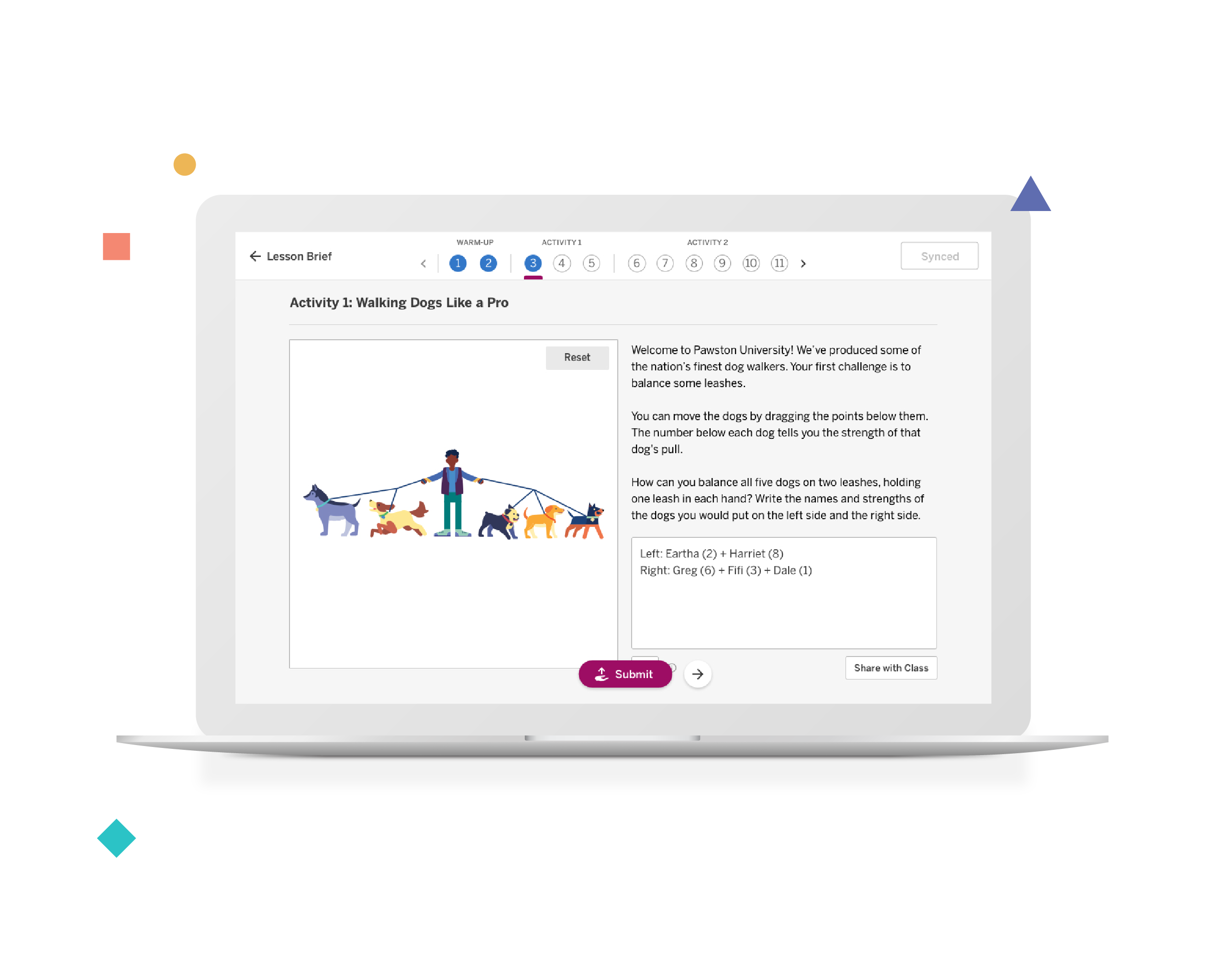
How it works
Amplify Math delivers the instructional power of student-centered learning packaged in a lesson format that is easy and manageable. With easy-to-follow instructional supports, implementing a problem-based program becomes more effective and enjoyable for both you and your students. Paired with our digital experience, math class becomes fun and dynamic, with plenty of opportunities for students to talk through their reasoning, work with their peers, and gain new understandings.
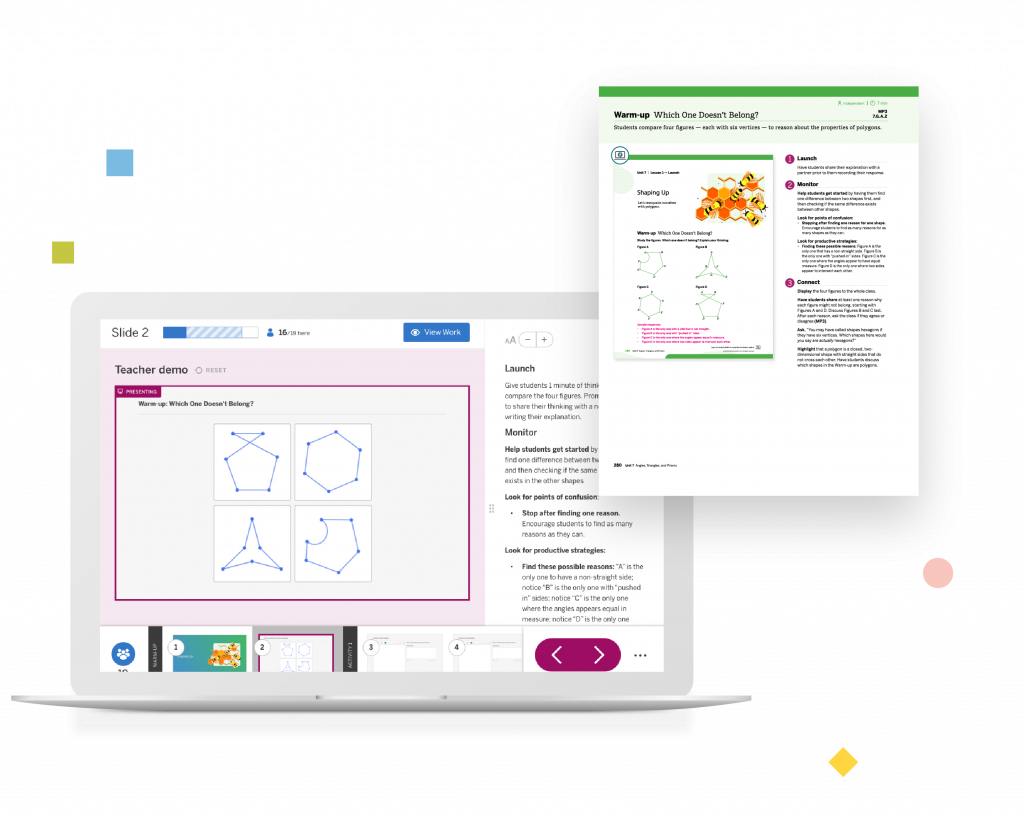



Featuring Desmos and more
Desmos digital lessons
Imagine having more visibility into your students’ mathematical thinking. Now imagine students have access to this same information. With Amplify Math’s collaborative lesson interface and teacher dashboard, students can’t hide. What’s more, they have visibility into the thinking of their peers—exposing them to a wider variety of approaches to solving the same problem.
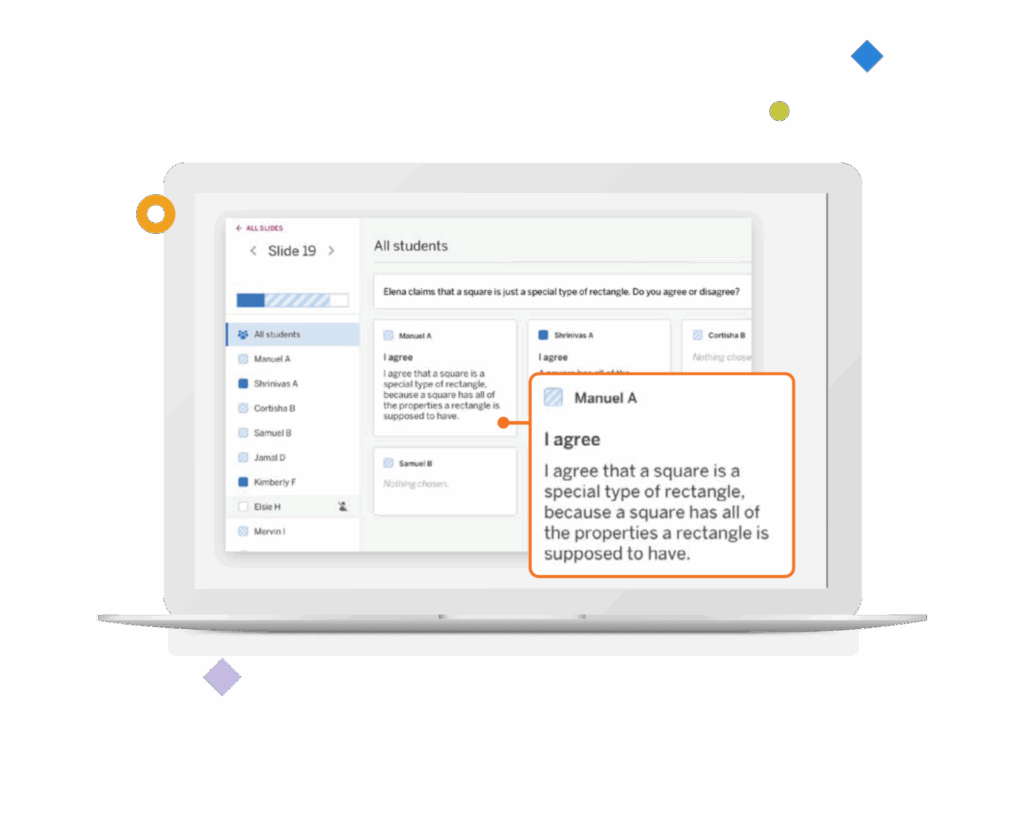
Engaging student experience
Power-ups provide just-in-time support to help student strengthen pre-requisite skills before engaging in whole-class activities. Power-ups ensure all students have a chance to experience success in the day’s lesson even if they might be several years behind. Not teaching online? They’re available in the Teacher Edition, too.
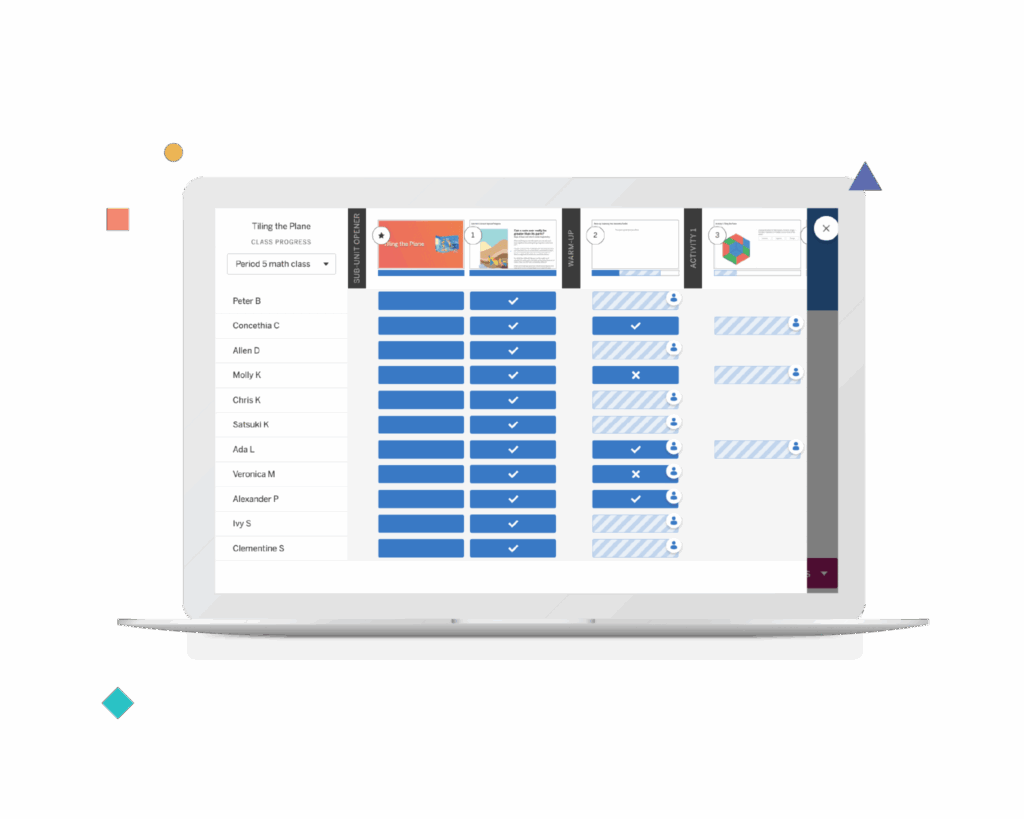
Ready-to-teach lesson slides
Every lesson of Amplify Math includes ready-to-teach lesson slides complete with step-by-step teaching notes, suggested student and teacher responses, options for differentiating instruction, links to useful resources, and tips for supporting students through common trouble-spots. Teacher can also customize their lesson slides, adding their own flavor, flair, and favorite problems—enabling them to truly make the lesson their own.

Presentation sync and student pacing
Being able to control what slides students see and when gives teachers the ability to control the pace of the lesson to suite the needs of the class. When Presentation Sync is turned on, students can access all the slides in the lesson. When it’s off, it ensures students’ screens follow the teacher’s. Teachers can also set a range of slides, which allows students to work at their own pace within the unlocked slides only.
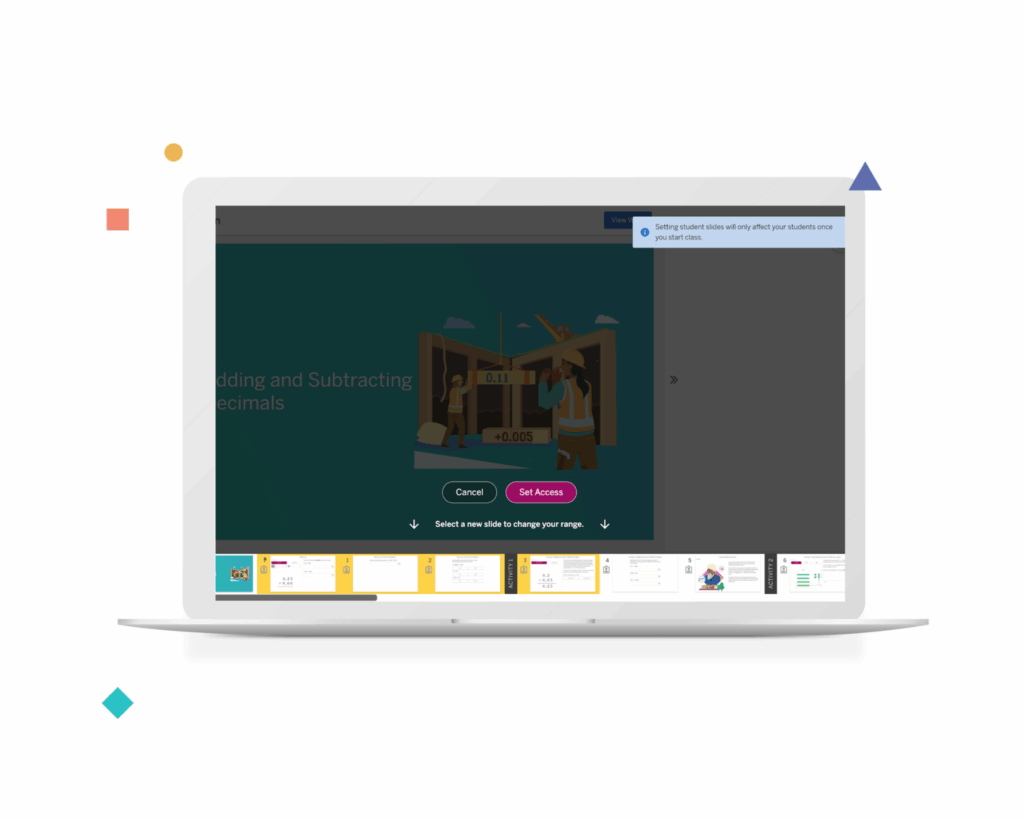
Access demo
Ready to explore the program? Follow these simple instructions to access our program digitally.
- Watch the video to the right or use this document to learn how to navigate our print and digital components.
- Click the Access demo button.
- Select Log in with Amplify.
- Enter this username: t.ormath@tryamplify.net
- Enter this password: AmplifyNumber1
- Select your grade level.
- Explore any of the six units.
Contact us
Support is always within reach. Our team is dedicated to supporting districts across Oregon and can be reached at any time by emailing HelloOregon@amplify.com or by calling us directly.

Kristen Rockstroh, M.Ed.
Account Executive
Districts under 4,700 students
(480) 639-8367



State-approved | Grades 6–8 and Algebra 1
Amplify Math for Idaho
Dear Idaho math educators,
We’re honored that you’re reviewing Amplify Math for use with your middle school students.
We’re confident you’ll find this Idaho-approved program to be a powerful tool for getting all your students talking and thinking about math concepts together.
On this site, you’ll find a variety of resources to guide you in your review, including demo account access. We look forward to meeting you and showing you what makes this program so unique.
Yvonne Rhode and Kristen Rockstroh
Idaho Account Executives

Virtual Caravan Stop
Amplify Math isn’t your traditional core math program. It’s different to make a difference—and the results are simply undeniable. Watch our virtual caravan presentations to the right and learn about the research-based approaches built right into this high-quality solution. Plus, see how Amplify Math brings student-centered learning to life for students in grades 6–8.
What it is
Amplify Math is a brand-new program based on the highly-rated Illustrative Mathematics curriculum IM K–12 Math™️.
It’s designed around the idea that a core math curriculum needs to serve 100 percent of students in accessing grade-level math every day. To that end, Amplify Math delivers:
- Engaging, discourse-rich math lessons that are easier to teach.
- Flexible, social problem-solving experiences both online and off.
- Real-time insights, data, and reporting that inform instruction.
How it works
Amplify Math delivers the instructional power of student-centered learning packaged in a lesson format that is easy and manageable. With easy-to-follow instructional supports, implementing a problem-based program becomes more effective and enjoyable for both you and your students. Paired with our digital experience, math class becomes fun and dynamic, with plenty of opportunities for students to talk through their reasoning, work with their peers, and gain new understandings.
Featuring Desmos and more

Desmos digital lessons
Digital lessons should be powerful in their ability to surface student thinking and spark interesting and productive discussions. We’ve partnered with Desmos to bring this vision to life with our complete library of social, collaborative lessons powered by Desmos technology.

Engaging student experience
Relevant content and interactive math tools create an intuitive and engaging student experience. Plus, working together in real time allows them to see that communicating their ideas and learning from each other are important parts of math class.
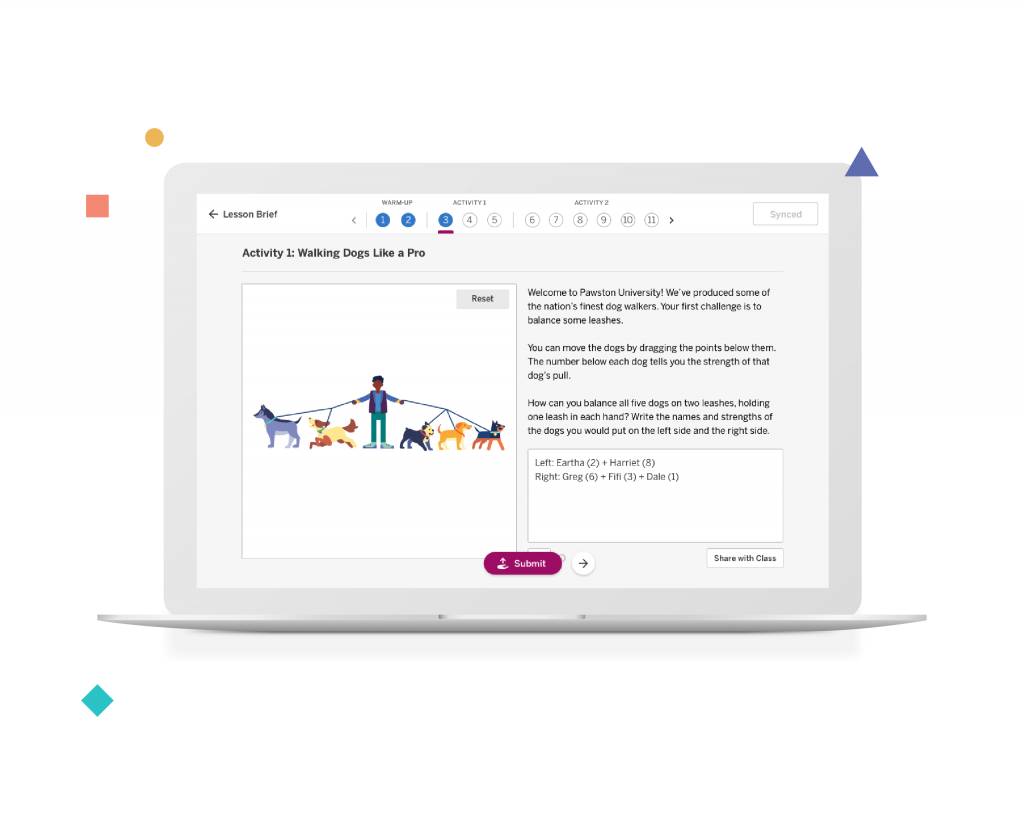
Visibility into student thinking
Imagine having more visibility into your students’ mathematical thinking. Now imagine students have access to this same information. With Amplify Math’s collaborative lesson interface and teacher dashboard, students can’t hide. What’s more, they have visibility into the thinking of their peers—exposing them to a wider variety of approaches to solving the same problem.
Pre-requisite skill building
Power-ups provide just-in-time support to help student strengthen pre-requisite skills before engaging in whole-class activities. Power-ups ensure all students have a chance to experience success in the day’s lesson even if they might be several years behind. Not teaching online? They’re available in the Teacher Edition, too.
Ready-to-teach lesson slides
Every lesson of Amplify Math includes ready-to-teach lesson slides complete with step-by-step teaching notes, suggested student and teacher responses, options for differentiating instruction, links to useful resources, and tips for supporting students through common trouble-spots. Teacher can also customize their lesson slides, adding their own flavor, flair, and favorite problems—enabling them to truly make the lesson their own.
Presentation sync and student pacing
Being able to control what slides students see and when gives teachers the ability to control the pace of the lesson to suite the needs of the class. When Presentation Sync is turned on, students can access all the slides in the lesson. When it’s off, it ensures students’ screens follow the teacher’s. Teachers can also set a range of slides, which allows students to work at their own pace within the unlocked slides only.
Standards-level reports
Not only do our reports show progress toward standards mastery, they include detail on how students performed against the standard in the past and how many more encounters are yet to come. This feature alone helps teachers prioritize instruction and intervene with additional resources when necessary.
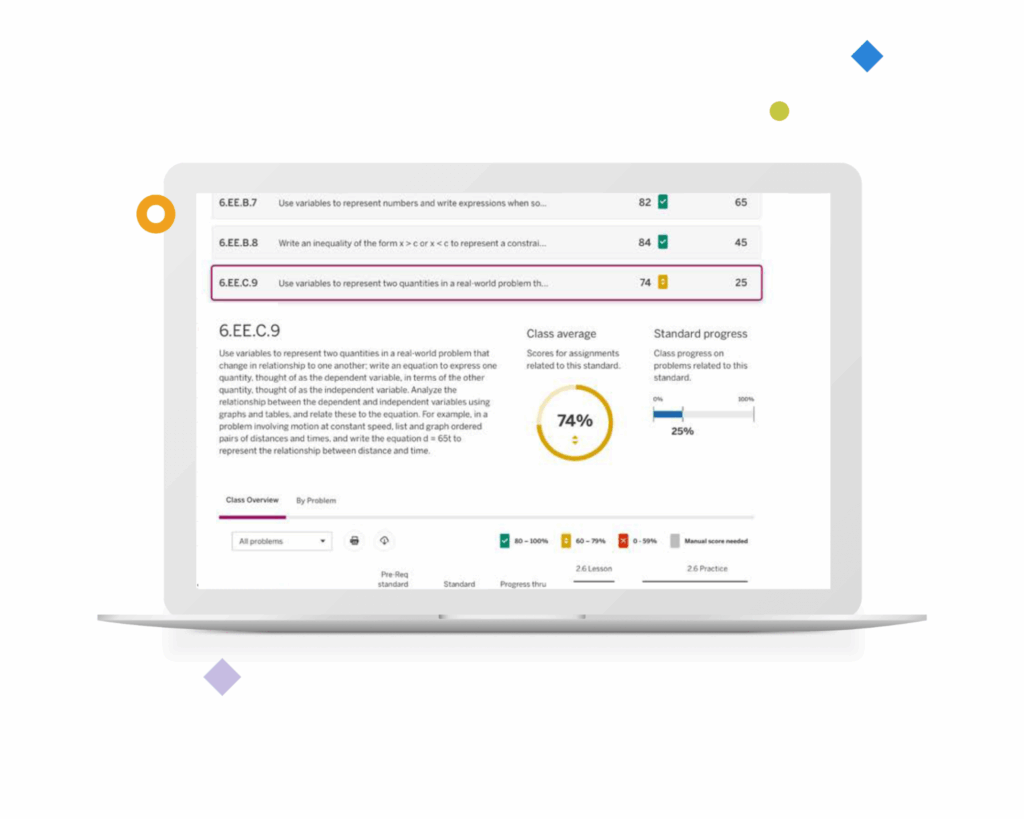
Focus on math identify
Helping students develop strong, healthy, and flexible math identities is a cornerstone of Amplify Math. Throughout the program, students are taught that they themselves are mathematicians, that today’s math was largely shaped by a diverse range of mathematicians who deserve to be learned about, and that learning is never finished.

Access demo
Ready to explore the program? Follow these simple instructions to access our program digitally.
- Watch the video to the right or use this document to learn how to navigate our print and digital components.
- Click the Access demo button.
- Select Log in with Amplify.
- Enter the login credentials found on the unique login flyer provided. If no login flyer was provided, use the following credentials:
- Username: t1.idahomath8@demo.tryamplify.net
- Password: Amplify1-idahomath8
- Click on any of the six units to explore.
Contact us
Support is always within reach. Our team is dedicated to supporting districts across Idaho and can be reached at any time by emailing HelloIdaho@amplify.com or by calling us directly.


Kristen Rockstroh, M.Ed.
Account Executive
Districts under 4,700 students
(480) 639-8367


Amplify Math for PXU
Amplify Desmos Math for Crane Elementary School District
Amplify Desmos Math taps into students’ natural curiosity from the start of every lesson, helping teachers cultivate a classroom of eager, collaborative learners.
Amplify Desmos Math is based on Illustrative Mathematics® IM K–12™ and expands on Desmos Math 6–8 (which received all-green ratings from EdReports) with beautiful print resources, and robust practice, differentiation supports, assessment and reporting. Read the review on EdReports.
About the program
Amplify Desmos Math makes it easy for both teachers and students to make the shift to a problem-based approach by providing captivating activities, powerful teacher-facilitation tools, and lots of support for differentiation and practice.
We’ve combined interactive problem-based lessons with explicit instruction, reinforcement, and practice to enable students to develop math proficiency that lasts. Lessons set a strong foundation in procedural and fact fluency, deepen understanding of concepts, and enable students to apply learning to real-world tasks.
Amplify Desmos Math will be available for 2025–26 school year implementation. Interested districts can pilot the Beta release starting fall 2024.
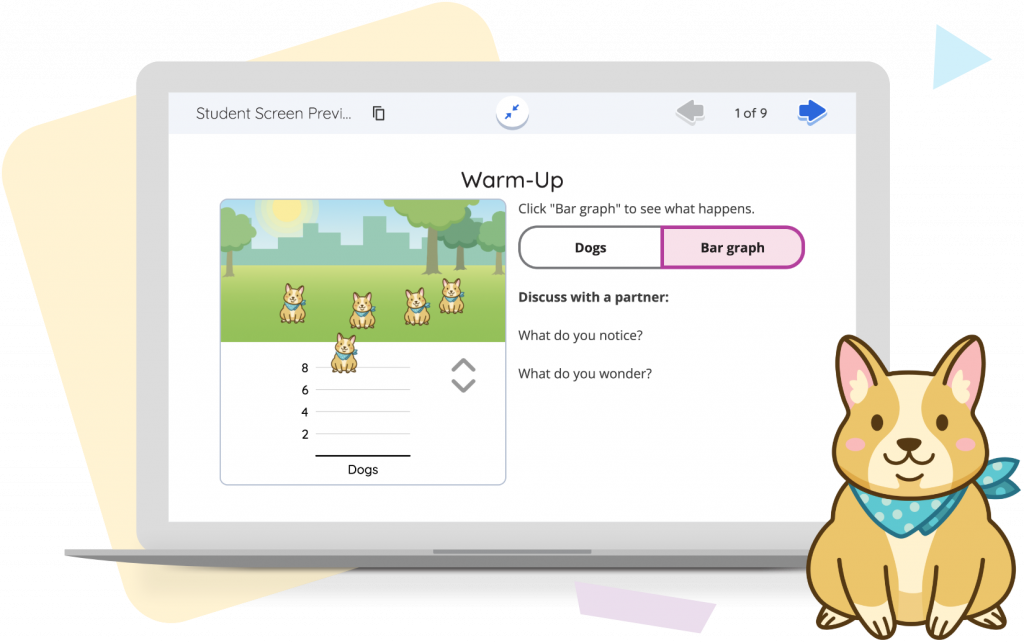

Comprehensive
- Curriculum based on Illustrative Mathematics® IM K–12™
- Differentiation and personalized practice
- Robust assessments and reports
- Student materials in Spanish

Collaborative
- Powerful teacher-facilitation supports and tools
- Students talking and building from each other’s ideas
- Every lesson has fully compatible print and digital materials for an inclusive classroom

Delightful
- Curiosity-driven lessons that drop students into a real-world problem they want to solve
- Desmos Classroom technology provides instant, interactive feedback to push students’ thinking
- Colorful, visual guidance for teachers and students
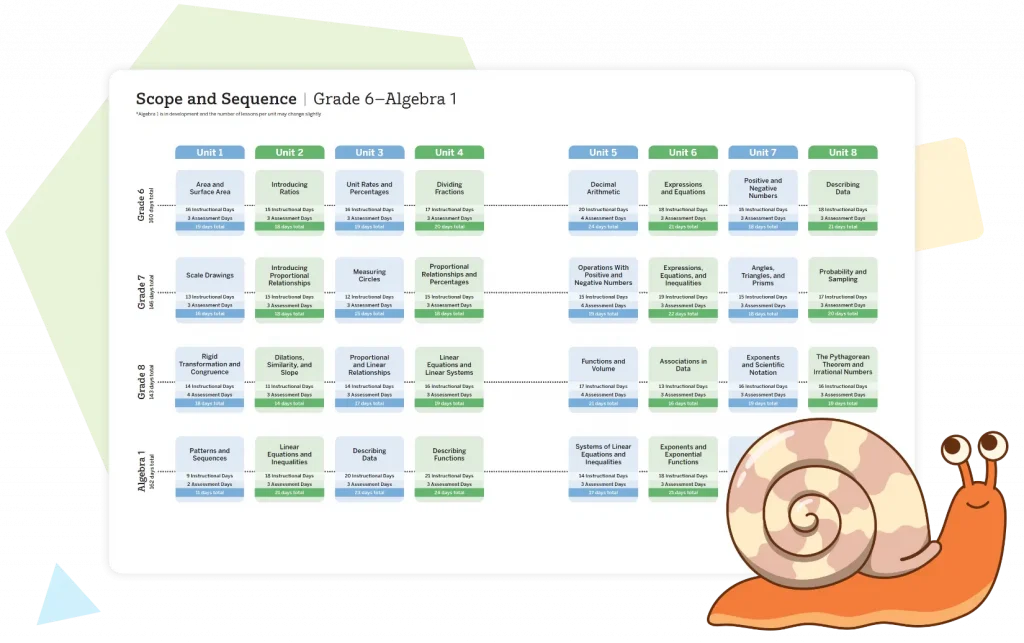
Scope and sequence
Click the links below to view the program scope and sequence for grades K–5 and for grade 6–Algebra 1.
Preview lessons
Check out the links below to explore our interactive digital lessons, as well as preview pages from the Teacher Editions and Student Editions. Watch our quick walkthrough video for tips on navigating our lesson resources.


Grade 1, Unit 3, Lesson 15: 10-frames and Towers

Grade 2, Unit 1, Lesson 3: Ways to Make 10




Grade 7, Unit 6, Lesson 14: Unbalanced Hangers

Grade 8, Unit 4, Lesson 4: More Balanced Moves

Algebra 1, Unit 2, Lesson 6: Shelley the Snail
Getting Started
One Amplify app for everything.
Educators can log into Schoology, using their LAUSD Single Sign-On (SSO), to access the Amplify app. One click into the Amplify app takes you to the Educator Home page and into the mCLASS Portal.
Attention iOS device users:
You must sync your device before upgrading your iOS version. If you update your iOS version before syncing, all unsynced mCLASS data will be lost since any Apple-related software updates clear Safari’s cache memory. If your device prompts you to upgrade your iOS version, tap cancel or close to decline and then sync your assessments. We encourage you to follow best practices and sync your assessment data regularly. Establishing a regular sync routine helps ensure that your assessment data isn’t lost due to device changes, software updates, or any unforeseen issues.
- DIBELS 8 Help Guide
- mCLASS Classes and Groups Help – Refer to our mCLASS Help system for instructions on using Amplify’s enrollment tools for administrators and other staff with school-wide or system access. If you need to help teachers administer mCLASS or assist substitute teachers with assessing a class, you can add yourself to a class. You can also create student groups to organize students within classes or to share students across classes with other staff.
mCLASS Instruction
How mCLASS® Instruction works
All schools in LAUSD have access to mCLASS® Instruction, which can help you use your benchmark data to individualize instruction for each student. You can access the following tools at Amplify Home > My Assessments > DIBELS 8th Edition (in the upper-left corner you will see an Instruction button). View our Instruction webcast for overviews of the tools.
- mCLASS® Item-Level Advisor automatically highlights important patterns, offering detailed analysis and suggesting next steps for targeted instruction.
- mCLASS® Small-Group Advisor uses results to create optimal groups of students with similar needs and selects targeted instructional activities at the appropriate level.
- mCLASS® Home Connect® allows you to easily provide parents with progress reports and specific activities to help bolster students’ learning at home.
Student Online Assessments
How to enable the mCLASS Student Online Assessments Video
Online Assessments:
- MAZE Online (required for DIBELS 8 composite)
- About MAZE Online
- Assigning Maze Online (Video)
- Assigning Maze Online (Job Aid)
- Manually entering MAZE Results on mCLASS
- Help with LAUSD SSO- Schoology: MyMail Pin
- Text Reading Online (TRO) is a new computer-administered assessment for grades 1-6 that measures oral reading fluency, accuracy, and comprehension to evaluate students’ reading proficiency against grade level expectations. TRO employs innovative voice recognition technology that automatically and immediately scores the recording of students reading as they progress through the assessment. REMINDER: Students must read out loud while reading.
- TRO Job Aid
- Click HERE to view online help for TRO
- Decoding Online (DO) is a new computed-administered assessment for grades 1-6 that measures students’ skill in reading grade-level words in isolation. The results help educators plan decoding instruction by providing information about the specific word types where students may need more practice at a given point in time. Click HERE to view online help for DO.
- Spelling Online (available in Spanish)- In the Spelling assessment, students hear a target word and use letter tiles to spell the word. These words include the phoneme-grapheme correspondences that students at each grade level are expected to learn over the course of a year based upon the scopes and sequences of published reading and spelling curricula. The final score is the number of words spelled correctly, with partial credit provided for correct spelling sequences within a word. This makes the Spelling measure more sensitive to students’ actual spelling skills, giving more information about their progress.
- Vocabulary Online (available in Spanish)- In the Vocabulary assessment, students demonstrate their knowledge of grade-specific words, as well as their skill at deriving meaning from context. The assessment covers words that are high utility (i.e. Tier 2) and content specific (i.e. Tier 3). Depending on grade level, students may be asked to answer questions about the word, to fill in a blank correctly with the word, or to match the word with its definition.
Progress Monitoring
DIBELS 8 Progress Monitoring
- Progress monitoring materials are included in the DIBELS 8 benchmark booklets.
TRC Progress Monitoring
- Teachers should add the titles they will use to their Book List on mCLASS (located at the top right by the Support button). If the publisher of the books you use for TRC progress monitoring made digital copies of materials available, you will be sharing the digital book as you assess your student remotely.
- Reading/Learning A-Z books are on mCLASS (2300+ titles). LAUSD purchased for all schools. Teachers will need to add them to their Book List on mCLASS.
Reading 3D
Text Reading Comprehension (TRC)
How TRC (Text Reading & Comprehension) works
After completing the mCLASS foundational skills assessment, teachers record observations with a running record to quickly analyze reading comprehension. They assign reading levels and monitor progress to support mastery of increasingly complex texts.
- Quickly log observations and easily identify error patterns for any level.
- Compare student progress with predictive, research-based benchmark goals.
- Translate assessment data into instructional support.
- Track progress and target instruction to individual student needs.
Additional Links:
From football to phonics, with Malcolm Mitchell



Meet Our Guest(s):

Malcolm Mitchell
Malcolm Mitchell, a native of Valdosta, Georgia, and an Under Armour All-American football player, developed a love of reading during his freshman year in college. He authored and published the children’s book, The Magician’s Hat, created a youth literacy initiative called Read with Malcolm, and went on to establish the nonprofit Magic Foundation organization, with a sole purpose—to transform children’s lives through literacy.
His inspirational story has been featured nationally on CBS Evening News, CBS Sunday Morning, CBS Sports, ESPN, in USA Today, CNN, MSNBC and the NFL Network and has been used by many schools as encouragement for students to embrace the importance of reading. In May 2016, Malcolm was drafted by the New England Patriots, and in 2017 he became a Super Bowl champion. Malcolm has earned numerous awards and accomplishments both on and off the field, but considers discovering a love of reading one of his greatest achievements.
Meet our host, Susan Lambert
Susan Lambert is the Chief Academic Officer of Elementary Humanities at Amplify, and the host of Science of Reading: The Podcast. Her career has been focused on creating high-quality learning environments using evidence-based practices. Susan is a mom of four, a grandma of four, a world traveler, and a collector of stories.
As the host of Science of Reading: The Podcast, Susan explores the increasing body of scientific research around how reading is best taught. As a former classroom teacher, administrator, and curriculum developer, Susan is dedicated to turning theory into best practices that educators can put right to use in the classroom, and to showcasing national models of reading instruction excellence.

Quotes
“Reading is the most self empowering tool a person could possess.”
“So many of these successful people were saying the same thing. I thought to myself, if I want to have any sustainable success in my life, whether I'm an athlete or not, I need to be a proficient reader.”