Showing results for tension

Winter Wrap-Up 02: Mathematizing Children’s Literature
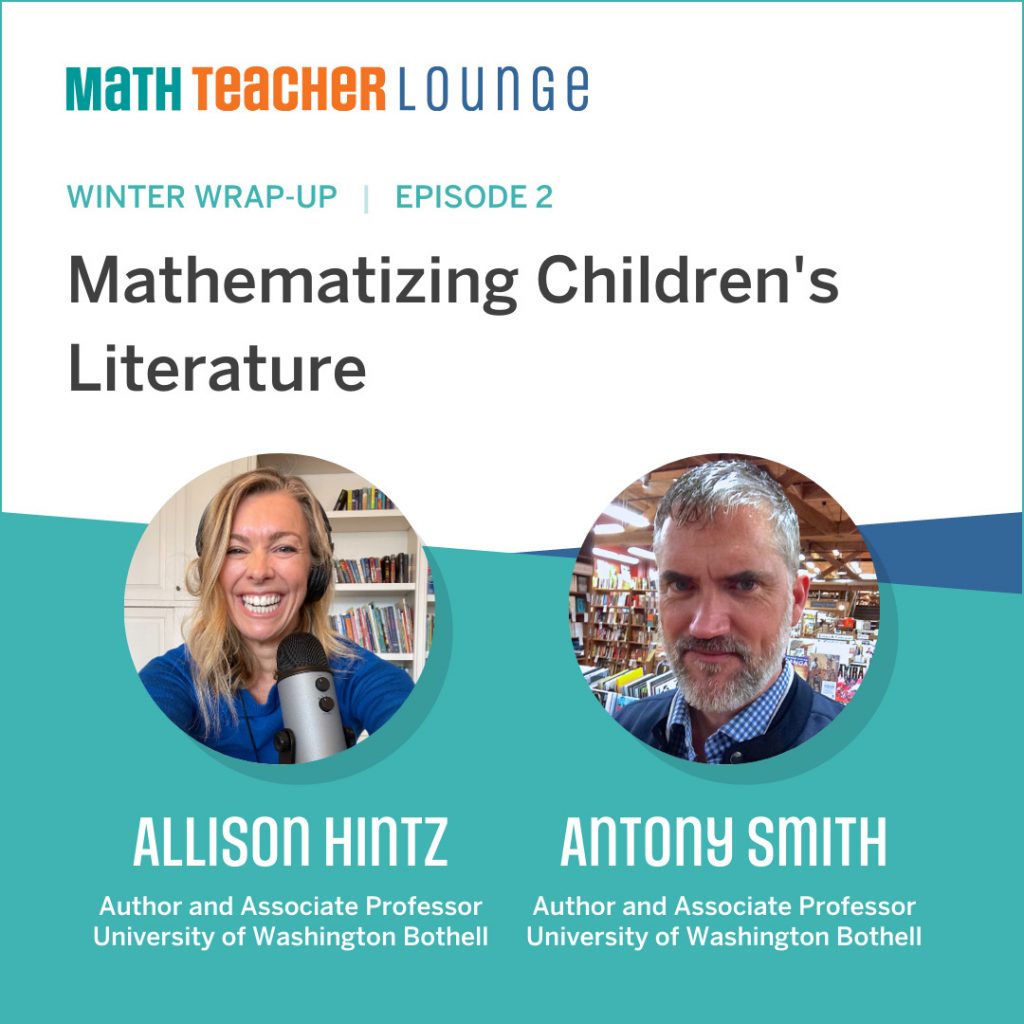
Promotional graphic for Math Teacher Lounge podcast, episode 2, featuring Allison Hintz and Antony Smith, discussing how mathematizing children's literature can build math fluency.

While we’re hard at work producing the exciting fifth season of Math Teacher Lounge: The Podcast, we’re continuing to share some of our favorite conversations from our first four seasons. This time around, we’re revisiting our popular episode that connected literacy and math!

In this episode, we sit down with Allison Hintz and Antony Smith, authors of Mathematizing Children’s Literature, to talk about what would happen if we were to approach children’s literature, and life, through a math lens–and how we can apply those same techniques to classroom teaching!

Explore more from Math Teacher Lounge by visiting our main page

Download Transcript

Bethany Lockhart Johnson (00:02):

Hi, I’m Bethany Lockhart Johnson.

Dan Meyer (00:04):

Hi, I’m Dan Meyer.

Bethany Lockhart Johnson (00:05):

And we are so excited for another episode of Math Teacher Lounge. And as you know, podcast format; you’re listening now. I think one beautiful thing about the podcast format is that it gives us a little bit more time to have these rich conversations. And I promise I won’t do it, but I could talk to our guests for hours, hours! Authors Allison Hintz and Tony Smith have just released Mathematizing Children’s Literature: Sparking Connections, Joy, and Wonder Through Read-Alouds and Discussion. And today we get to talk to the authors. Allison, Tony, welcome. Welcome to the lounge.

Allison Hintz (00:53):

Thank you. We’re so grateful to be here.

Bethany Lockhart Johnson (00:55):

We’re so excited to have you here. And I wanna say that my very first—was it my first math conference? Maybe it was my first math conference—up in Seattle, the CGI conference, and I’m all like, you know, wide-eyed and just like, “Can this be a place for me, this math community?” Re-envisioning my relationship with math and thinking about myself as a math teacher, what? And I went to your session on mathematizing children’s literature, and I was just so fired up. I was so wowed by your ideas, your energy, and your passion for students’ thinking. And I feel like as I read this book, I felt like I was hanging out with you. Like you were just so encouraging all the way through. Of educators, of other folks working with young people, and really guiding us how to listen with joy and with an open curious mind.

Dan Meyer (02:03):

Yeah. I would love to hear a bit about the genesis of this book for you folks. Like, I’m coming at this from a secondary educator lens. I’ve got small kids, so that’s also part of my interest here. But I love any book, any idea that seeks to merge what seems like two disparate worlds. Like it’s often the case that we feel like, well, there’s approaches for ELA and approaches for math, and they’re kind of separate disciplines. And these poor elementary teachers have to learn all of them and be experts at all of them. And here you both come along and say, “Hey, what if they are the same kind of technique?” Can you just speak to how this came about?

Allison Hintz (02:38):

Definitely. Tony, do you wanna take a try? Do you want me to start us off?

Antony Smith (02:42):

I can start. We oftentimes present and talk together and so we kinda switch back and forth. So that’s just how we are. So probably about eight or nine years ago, Allison and I, our offices were next to each other on our small campus. We’re both professors and we just happened to have a few children’s books that we looked at together and we were just thumbing through the pages. We really liked children’s literature. And we noticed that I would stop at certain points wondering about character motive or plot or sequence of events or language use. And Allison would stop at very different points in the book and notice number and concepts or something about mathematics. And that’s when we started to wonder, what would it be like if we were sharing a children’s book with a group of children and we put our ideas together? Where would we stop? What would we talk about? What would we ask children about in terms of their thinking and what they notice?

Allison Hintz (03:42):

And so we started playing with these questions that we had and started approaching stories with multiple lenses to see what kinds of things would children notice and what kinds of things might they say. And we were also on our own journey in trying to understand how to plan for and facilitate lively discussions and classrooms that surface really complex mathematics. And it felt like stories were a place where that might be a fruitful context for hearing children’s thinking. We’ve worked with a lot of teachers and students in our region. We live in the Seattle area and we’ve applied for some funding over time that’s really helped us be in a lot of community-based organizations and educational contexts and libraries and pediatricians’ offices and classrooms, various classrooms, and see what’s interesting about this and what might teachers and children do with stories that would surface complex mathematics to think about together.

Antony Smith (04:41):

Over time, we came to the realization that if we wanted to hear children’s ideas, we had to stop bombarding them with questions. <laugh> Yeah. And at first it made it worse that we were asking them math and literacy questions at the same time. And so we realized that what we needed to do was to back off and to ask children what they noticed and wondered.

Bethany Lockhart Johnson (05:01):

Can you say more about that and how that kind of evolved into mathematizing children’s literature?

Antony Smith (05:07):

We did work with a number of very thoughtful, talented classroom teachers and children’s librarians in public library systems who were just so masterful at asking open-ended prompts and questions, rather than kind of like the de facto reading quiz, that a read-aloud can become, which I’ve always disliked as a literacy educator. And we realized in our observing these read-alouds or interactive read-alouds or shared reading experiences that given the opportunity in the space and an adult who was actually listening, that children came up with all of the ideas we would have asked them about and more. So we didn’t have to be bombarding them with questions. They were already much more thoughtful than what would’ve been sufficient to answer our questions.

Allison Hintz (05:58):

And much like mathematics, it was really an iterative process. You know, we had some clunky read-aloud discussions where we were trying to accomplish so much and toggling multiple chart papers and different colored pens and all sorts of “how do we capture these ideas” and “do we separate ’em? do we keep ’em together?” And so it’s really been over time that with partners, we’ve learned these ways of having multiple reads of the same story that allow us to hear what children notice and wonder, and then to delve more deeply into their questions and their ideas through multiple reads where we might spotlight literary ideas that they notice; we might spotlight mathematical ideas that they notice. We might make purposeful integrations between those. But we found it to be most productive—and Kristin Gray really help us think about this—to have an open Notice and Wonder, get everything out much like an open-strategy share. We welcome here, record all the ideas, and it goes all over everywhere. You know, it can be a really not math-y noticing! And those are amazing! So there’s a lot of, um, yes, there is a ladybug on this page! The grandma is wearing green triangle earrings! Oh, your grandma wears green earrings! I mean, it all comes out.

Bethany Lockhart Johnson (07:27):

Wait, have you been in my classroom? ‘Cause that’s exactly— <laugh>

Allison Hintz (07:29):

<laugh> And then, you know, we think of it a lot like if math teachers might use the 5 Practices for selecting and sequencing, or if you might move from an open-strategy share to a targeted share, how can we get out all the questions that children are asking and then step back from them, take some time to really think about what they’re telling us they’re curious about, and plan some purposeful, intentional subsequent discussions that can delve more deeply into their ideas.

Dan Meyer (08:02):

I’d love to go into that a little bit more if that’s all right. Um, I’m gonna speak from someone who doesn’t have an elementary background and I’m gonna voice some worries that I had, some anxiety. One anxiety I have like in a classroom or a curriculum is when there’s no room for student ideas. Right? When it’s like, oh, there’s just room for the curriculum author or the teacher here. That is a sadness. But I when I see an instructional environment like you’re describing here, where there is openness to all kinds of different student ideas, of different levels of formality, from different kinds of cultural fonts of knowledge or wherever, I also get a little bit nervous because that, like, increases the risk that a student might come to understand that “my ideas are not good enough,” whereas in the class with no room for their ideas from their home or their language or their hobbies, like, they’re not gonna internalize the message that, “that wasn’t good enough.” And so I’m really curious as you move from the open Notice and Wonder where kids share all of themselves with you, and then you move to a targeted focus on some sort of disciplinary objective, how do you navigate that tension and help students feel like their contributions are valuable, even though we aren’t taking them up per se?

Allison Hintz (09:18):

That’s such an important question. I mean, I think we’ve grappled with this broadly in math education. I think any time we’re thinking about which ideas we choose to take up to pursue to consider, we have a responsibility to think carefully about whose ideas are being taken up and heard and considered. And so one of the tensions I hear you naming, I think, Dan, is when we engage in lively discussion where children’s thinking’s at the center, how do we make sure to upend and interrupt kinda status norms that run the risk of being deepened? Um, and I think by paying attention to whose ideas are taken up as much as which ideas are taken up, and what’s the mathematics we wanna explore is one tension. Um, another tension I might hear you naming is, you know, the complications that teachers face with time and pressure and coverage, and which mathematics ends up getting worked on. And, um, you know, it’s something we’ve really had to struggle with in mathematics education, where we move to more discussion-oriented classrooms that are really centered in sense-making to know that it takes a lot of time to do this thoughtful, thoughtful work. Um, does that begin to get at some of the tensions you’re raising? Is there, is there more you’re thinking about?

Dan Meyer (10:53):

I think it’s really helpful that you kind of broadened the scope of the question beyond your book to “this is an issue that we are, you know, really challenged by and focused on broadly in math education.” And, um, I appreciate you bringing the element in of whose idea—not just which idea is taken up, but whose idea is taken up—is an opportunity where, let’s say, multiple people raise an idea that is towards an objective the teacher has, they have the opportunity to disrupt certain kinds of status, like ideas about status, in that moment. From your perspective, like, are there techniques to say, I don’t know, parking-lot certain kinds of questions and say like, “Hey, like these are awesome”? I don’t know. I just know that I see kids at like ninth grade. They are very reticent, often. They’ve internalized totally this sense of like, “I’m not gonna just, like, share about the pants the grandma’s wearing, you know; that will not be received well.” And so I’m just kinda wondering how that happens and like, what are the ways we can disrupt that? That process?

Antony Smith (11:54):

So thinking about that, Dan, from the teacher’s perspective, in those kinds of scenarios where you wanna honor each child’s contribution, a couple of things that come to mind: One is that by, you know, initially by modeling what I as a teacher, something that I notice or wonder about, helps kind of set the expectation for what kind of response would be encouraged. And it’s broad, but it gives an example. And then also we really try to record or to chart all of the ideas that are shared so that we can revisit and honor those together. And then either later or on another day, if we choose one or two of those to explore in some way within a more focused read, then another thing that we do is have the idea investigation afterward that continues that thought, but goes back to being as open-ended as possible, so that those students or children who maybe didn’t have their idea as the one that was focused on by the group could go back to that or explore some other idea of their own, so that the idea investigation isn’t a lockstep extension activity, which is why we don’t call it that. So they could again bring in their own perspective. But I have to say from the teacher’s point of view, there is that moment of potential panic <laugh> because there is that power transfer when you’re asking children to help steer where this is going. And if you really mean it, you have to let them steer a little bit. And that can be terrifying. And, um, I always think of one teacher, Ashley, we worked with who read an adorable book, Stack the Cats, by Susie Ghahremani. And in that book, there’s a point where there are eight cats and they’re kind of trying to be a tower of cats and they fall and they’re sort of in the air on that page. And she asked her first graders—she stopped, and she asked, “How, do you think, how will the cats land?” And for about a minute and a half, the entire <laugh> class, was silent. They had their little papers; they had chart paper; they had clipboards; they had everything they needed. But that unusual phenomenon of a group of six- and seven-year-olds actually just sitting and thinking and not being peppered with activities was really stressful, but amazing. And then, after about the 90 seconds, they started out into their exploration of how the eight cats might land. They just needed a minute to think. And it’s so rare that we’re able to let children have that.

Allison Hintz (14:40):

In that same moment, Ashley, who’s a learning partner to us, she turned to us kind of quietly, like, “Should I pose a different question?” And <laugh>, we’re like, “No, let’s stick with it. Let’s see what happens.” So I think it creates this space too, this thinking culture, right? And this culture of “what does that mean to really pose a rich task?That’s open-ended, where there’s multiple access points?” Those eight cats could land in so many different ways. And there was broad access, there was a wide range of all the cats landing, and one’s on their feet, ’cause cats always land on their feet <laugh>, and there was every combination. And so, um, I think what’s really interesting—and to me, this brings back to your wonder, Dan—is, you know, “What’s the risk in openness?” And there’s always risk in openness. Um, it’s scary as a teacher, right? If I’m not the authority of knowledge and I don’t have control over where we’re gonna go, it might get into places that I didn’t anticipate. Or I don’t really feel as solid in the math as I want to. Or I don’t know what it sounds like to stick with silence and wait time, to know if my students are really in productive struggle or if that question was a flop. And so, um, I think this is some practice space for young mathematicians and teachers of mathematics, and just teachers, to explore with that openness and kind of the risk of the openness required for complex thinking to emerge.

Bethany Lockhart Johnson (16:12):

You know, it feels like the way you’re both describing this, it really is a culture shift, right? I kept feeling like I was given permission to be a beginner as I read this book. Like I was really…I loved how you said, I believe it was you, Allison, when you were in the class, you had a couple index card that you kept on your clipboard and that as you walked around, you were like, “Hey, if I don’t know what to ask, I ask one of these questions.” You know? And just this idea that, that, like Dan was saying, there is that loss of control, but that’s also a way to create this culture where students ideas are valued and we are allowing students to really generate the questions, which I thought was such an important idea to explore.

Allison Hintz (17:00):

We started this work long ago, super-excited about math-y books. And we saw a lot of potential in them and we still do. But the limitation we saw is that math-y books, they, they put forth a certain mathematics to be curious about. In some ways they tell you what mathematics to think about. So we started asking ourselves what would happen if we considered any story a chance to engage as mathematical sense-makers. And we started playing with non-math-y books and we got to a place where we could consider every story an opportunity to engage in mathematical thinking. And so we started noticing things over times, oh, these books tend to be really math-y. We call those text-dependent. We’d have to pay attention to the mathematics to understand the story. Whereas this pile of stories, these, they’re not overtly math-y. You could really enjoy the story and not pay attention to mathematics and have an amazing conversation. But what would happen if we thought of about this story as mathematical sense-makers and how might it deepen our understanding of the story? And then this other teetering pile of books, these are books where, you know, children didn’t tend to engage as overtly as mathematicians in it, but there’s opportunities in this story to go back to something—to a moment, to an illustration, to a comment—and think as mathematicians. And those were more about illustration exploring. And so, as we notice these different kinds of books, we really broaden what we thought about. And I think one of the things we really wanna think about in community through this book is what happens if we approach any story, every story, as mathematical sense-makers, because stories are alive in children’s lives, in homes and communities and in schools. And it’s a broad opportunity that we wanna take up. I was thinking, as I stay in this strait for just a moment about book selection, before we move into that process, um, Bethany in a previous MTL, you talked about representation.

Bethany Lockhart Johnson (19:12):

Mm, yeah.

Allison Hintz (19:14):

And do you remember when you shared the image of hair braiding?

Bethany Lockhart Johnson (19:19):

Yes. Vividly, yes. <laugh>.

Allison Hintz (19:22):

Yeah. And can you say just what that meant to you? What that….

Bethany Lockhart Johnson (19:27):

Yeah. Well, it was from a conference; Sunil Singh had used it and was talking about the artistry in mathematics and beauty in hair braiding. And, um, particularly, he was showing this particular image of this Black woman with her hair braided in profile and looking at the angles and the symmetry. And I shared that, you know, I spent so many hours in the beauty shop with my aunties and my mom and my grandma and continue to, to this day, that it just, it struck me immediately as familiar. And it struck me immediately as seeing an image that was reflective of my lived reality, projected as valuable and worthwhile for consideration in the world of mathematics. Which is not what I felt as a student of mathematics as a young adult or child. So it was this beautiful moment of, for me, the power of when we see images and we allow opportunities for re-envisioning what may be a common practice for that student, or may be something that they see every day.

Allison Hintz (20:44):

And in that same way, that image that was put up, we wanna think really carefully about representation in the stories that we select. And when we think of stories as mirrors or windows, we really wanna be mindful in story selection of whose stories are told and whose stories are heard. And when you said that you would sit down to listen to a story and you felt at ease or that you saw an image and you saw yourself that can be and should be something we really think carefully about when we select the stories that we select.

Dan Meyer (21:21):

It’s a wider path for representation of different kinds of people in literature, because people’s stories seem so much more present and towards the surface of their lives, versus, say, the abstractions and numbers and shapes in mathematics. It feels like more of a struggle to find ways to show people, hey, like you’re here, this, this place belongs to you. So in all these reasons, I think it’s really great you folks are using literature, which has this history of humanities, literally humanities, as a vehicle for mathematics. That seems pretty special here.

Antony Smith (21:56):

We both go to libraries and bookstores and look through books as often as we can, but also our partner, a children’s librarian, Mie-Mie Wu, helped us go through—when we would meet, she would bring three or four hundred books at a time.

Bethany Lockhart Johnson (22:13):

When you described her wheeling in the cart, oh, I wish I been in that room! <Laugh>

Antony Smith (22:18):

And the cart was, you know, probably three or four times bigger than she was sometimes. And we would go through hundreds of books and look at them and listen to her thoughts as a skilled librarian sharing with families, diverse families, and what catches the attention of a three-year-old sitting with her grandfather. And that was really a valuable, helpful experience. And it’s a partnership that continues. So in Last Stop on Market Street—and this is in the book; we talk about this, this children’s book quite a bit—in this story, CJ with his Nana, his grandmother, are riding the bus to the last stop on Market Street in San Francisco, to go, as we will find out, to help serve in a soup kitchen to help the community. And the teacher, Susan Hadreas, had the children record their ideas. She charted them in an open Notice and Wonder read. And one of the ideas that a young boy noticed was that CJ on the bus…a man with a guitar starts playing the guitar on the bus and CJ closes his eyes and it says CJ’s chest grew full. And he was lost in the sound and the sound gave him the feeling of magic. So this boy said, “I wonder, what does that feel like if you’re feeling the magic? What’s that?” And that was one of many ideas in the open Notice and Wonder, and Allison will talk about the math lens read, but first Susan went back and read with them. She had that idea, she circled it on the chart paper, and another day that week, she said, let’s go back and visit this story we really liked. And remember, we wondered what feeling the magic was like. Let’s go back through and let’s keep track of all the feelings and emotions that CJ had across the journey to the soup kitchen in this book. And so they did another read of the story; they were very familiar with it, of course, but they noticed new things and they also, every few pages, stopped and she helped chart all of the emotions that CJ experienced from envy to excitement to sadness. There’s a huge range in this book. And it was fascinating.

Allison Hintz (24:36):

I think one of the things that the children noticed was that CJ’s feelings were shaped by community. And that he shaped and shaped…he was shaped by and helped shape his community. And so the ways that he felt across the story were impacted by the other characters that he comes across. The guitar man on the bus. The bus driver who can pull a coin out from behind someone’s ear. The lady with the butterflies in the jar. Nana helping him to see the rainbow. And the students started, you know, being curious about that. How do we shape and how are we shaped by community? What communities are we a part of? This class is one community. I’m in many communities across my life. And they started to quantify the number of people in the story. So Mrs. Hedreas went back for a math lens read, and she said, let’s just keep track of and pay attention to how many people are in CJ’s life in this day. Because I can hear you starting to think about quantity. This class at the same time in other areas of the day had been working on counting collections, how to keep track, so they got out their tools. Some people pulled out ten frames, some people pulled out clipboards. They had a wide range of things they could use to help them keep track. They developed their own strategy, keep track however you want. She did a quicker read through it, flipping the pages, and then they get into these debates: <laugh> “We already counted that person!” “But they took their hat off and put it down to collect money!

Antony Smith (26:10):

“What about the dog?”

Allison Hintz (26:11):

“That’s the same person!” “Yeah, there’s a dog pound in his community!” <laugh> “Do animals count in our community?”

Bethany Lockhart Johnson (26:17):

I love it!

Allison Hintz (26:17):

“Yes, they count!” Uh, and so we went through and quantified and there was really this understanding as you saw these people throughout the story that communities can be of different sizes, but community has impact. And you have responsibility in your community to show up and to lean in and to know that bringing your full, authentic, vulnerable self, you shape people and they shape you. And what communities are people a part of. And it turned into this really interesting discussion about quantity and helped us think more about quantity and community. I think a really important moment for us and for that class was the transition from being people who almost did mathematics to a story, like counted things on a page, um, count acorns on a page in an autumn book, to being mathematicians who thought within the story.

Antony Smith (27:17):

And then two idea investigations that came from that —not at the same time, of course, but with the same group of children—one was they identified an emotion of their own and wrote and drew about that. And also, who helped them address or get out of or acknowledge that emotion. And then the other idea investigation was that all of the children drew or kind of mapped out a community that they were part of. Whether it was their neighborhood or their classroom or their soccer team or whatever it was. And so then those investigations strengthened the connections of those concepts to the lives of those children.

Bethany Lockhart Johnson (28:05):

Well, I, actually wanted to ask you about idea investigations. Because I feel like that was such an important invitation in your book. And the way I understood the idea investigation is you’re really paying attention to what’s coming up in your other reads. Right? And then these are opportunities to extend the thinking, or like you said, to extend a particular aspect: What’s your community? Can we map your community? Or what’s a particular emotion? And it was in such contrast to what I think I have probably done in my classroom more than once, which was like, “Oh, we read this story about seals. So now my story problem is gonna be about seals, right? <laugh> Like in the story, you know, Jojo, the seal had five balls. <laugh> So if Jojo still had five balls and two of them bounced away…” You know, or whatever. Right? But that’s not what an idea investigation is. Right?

Allison Hintz (29:03):

Yeah. I think this is where we also had some stumbles and can totally relate to what you’re saying as previous classroom teachers as well. We have come to a place where we are pretty in favor of a super open-ended idea investigation that takes up the things that have surfaced in the multiple reads and making sure it’s a rich task with many, many ways children can engage with that. There’s many, many, many right answers or ways to engage. Less is more there. So we moved way away from, like, even a worksheet that might have an idea from it to blank paper and math tools and places to get into some productive struggle around some of the complex things that were raised.

Antony Smith (29:59):

A challenge with worksheets is that they put a frame around children’s ideas. So either there are only three lines to write on, or there’s only a small box to draw in. Whereas a blank page really opens up the possibility. Um, and so—is it Ann Jonas who wrote Splash!? sorry, I don’t have it in front of me—the book Splash!, about animals that end up in and out of the pond, including a cat that is not happy about ending up in the pond, an idea investigation after that for very young children was, with the list of the different creatures displayed at the front of the room: On blank paper, hey, draw your own pond and decide how many of which and each type of animal you want in your pond and then write about it. Just on blank paper. And so that allowed some children to draw, like, three giant goldfish. But other children drew 17 frogs and three cats. And, and just, it lets children follow—

Bethany Lockhart Johnson (31:02):

It was theirs, right? It was theirs.

Antony Smith (31:04):

Their idea. <laugh> And that comes partly from, I think, as Allison mentioned, we both were classroom teachers before moving into academia. And I remember giving children worksheets, particularly math worksheets, where they weren’t necessarily bad, but right at the bottom, it says like, explain your strategy. And it gives two lines.

Bethany Lockhart Johnson (31:23):

Right! <laugh>

Antony Smith (31:25):

The only thing a seven-year-old can write there is “I thought.” Or “I solved it.” <laugh> And that’s not where we need to go.

Dan Meyer (31:34):

Yeah. If I could just ask the indulgence of the primary crowd here, like, I’m trying to make sense of all this. And I just wanna like, offer my perspective. My summary statement of what’s going on here. I’m trying to—I love how you both came here—

Bethany Lockhart Johnson (31:45):

<laughs> How ya doin’, Dan? How ya doin’?

Dan Meyer (31:47):

<laughs> I’m, ah, A, I’m loving this a lot. Um, B, I came in here loving how you folks are broadening the work of primary education to kind of find commonalities between these sometimes seemingly disparate kinds of teaching in ELA and math. Love that, I wanna say. But I think you folks are describing, with all these teachers you observed and your own work, is the work of attaching meaning to what students might not realize yet has meaning. Or they might think it only has one kind of meaning. But you, the teacher, with their knowledge, realizes that there are many more dimensions of meaning that can be attached to those thoughts. And I’m hearing that from you folks, when you describe A, what math is and the power of a teacher to name a thing as mathematical. Like, “Oh, you didn’t think math was that, but math is noticing; math is wondering; math is asking questions,” for one. But also this work you’re describing of how, like, first the task has to invite lots of student thoughts and then to say like, “Oh, I see that there’s a similarity to these two.” And to raise those up for a conversation or to ask a question like to extend one person’s, one student’s question a little bit more. But it’s always…I’m just hearing you folks attaching more meaning than the student might have originally thought. I appreciate the conversation. That’s really interesting.

Bethany Lockhart Johnson (33:03):

Well, and now that the book is out, I think it’s gonna keep evolving, right? Now that it’s gonna be in the hands of teachers and librarians and educators and caregivers, it’s exciting to see kind of where it goes next. Which actually brings us to our MTL challenge. Dan Meyer, do you wanna share?

Dan Meyer (33:22):

Math Teacher Lounge, we have a challenge for the folks who listen and we’d love for them to hop into the Facebook group Math Teacher Lounge, or hit us up on Twitter at @MTLShow and just, like, kind of exercise beyond listening, exercise the ideas you folks are talking about, some kind of a challenge that can help us dive deeper into your ideas. So what would you folks suggest for our crowd, for our listeners?

Allison Hintz (33:42):

I would love to invite people to playfully experiment with a favorite story, with a story that’s new to you. I would love to invite listeners to sit with a story maybe on your own, and just ask yourself as a mathematician: What do you notice and wonder in this story? Don’t feel any pressure. Maybe sit with a child or some children and listen to what they notice and wonder. Like, really listen! Don’t ask questions! But hear their questions and place children at the center and consider multiple reads. Consider continuing to pursue their questions. And we have a planning template that might support people in kind of sketching out some ideas if you’re open to playing with that too.

Bethany Lockhart Johnson (34:34):

And we will post—

Dan Meyer (34:36):

That’s awesome.

Bethany Lockhart Johnson (34:36):

—a link for that planning template in our Facebook group and on Twitter as well. So thank you so much for that resource, because I think it’ll definitely help. It could help you, like you said, it could help you kind of organize your thoughts or help you think about this work in a new way. So thank you for that resource and thank you for the amazing resource that is Mathematizing Children’s Literature. I am so excited to continue to engage with you both and with listeners as they dive into this book. If folks want to engage with you more, where can they find you? How can they reach you?

Allison Hintz (35:12):

Well, we’re on Twitter.

Bethany Lockhart Johnson (35:14):

Great.

Dan Meyer (35:15):

What’s your home address? <laugh>

Bethany Lockhart Johnson (35:24):

Wait, let me try that again. <laugh> ‘Cause it does sound like I’m like, <fake ominous voice> “Where can they find you?”

Allison Hintz (35:29):

4-2-5…. <laughs>

Antony Smith (35:32):

At the bookstore!

Bethany Lockhart Johnson (35:34):

Y’all, if folks want to continue this conversation or share these ideas or the math challenge, how can they tag you? How can they, they reach you on the World Wide Web, besides the Math Teacher Lounge Facebook group?

Antony Smith (35:50):

Yeah. Well, we are both on Twitter, and we’ve been trying to promote the hashtag #MathematizingChildrensLiterature. It’s very long, but once you type it once, your phone or computer…

Bethany Lockhart Johnson (36:01):

Easy. Yeah, those click, right? Is that what it is now?

Antony Smith (36:03):

<laugh> The other is that we do for our project, we have an Instagram account that is @MathematizeChildren’sLiterature.

Allison Hintz (36:11):

We care really deeply about hearing from people. You know, we think our ideas are constantly evolving and that there’s such exciting room to grow. And we just felt compelled to share what we were learning now so that together we could learn and build vibrant experiences for young children and teachers and families through stories. So we want to hear from people! We wanna learn about stories that are important in your lives and what children say, and grow these ideas together.

Bethany Lockhart Johnson (36:42):

And credit to Dan, you told me you went and ordered a bunch of the books they have on the suggested read list.

Dan Meyer (36:48):

Oh my gosh.

Bethany Lockhart Johnson (36:49):

You read ’em to your son.

Dan Meyer (36:50):

I got such a side-eye from my significant others around here for what I dropped on Amazon in one night! <laugh> Uh, all these books I didn’t have. Some of them I did. We are not fully illiterate around here! We do love the written word at the Meyer household! But there were a bunch that that I grabbed. I’m morseling them out day by day.

Bethany Lockhart Johnson (37:09):

Wait, at bedtime I read my one-year-old One Is a Snail, Ten Is a Crab. <laugh> And let me tell you, he had vigorous pointing and “Da? Da da da da?”

Allison Hintz (37:22):

<laugh> Aww, da da!

Bethany Lockhart Johnson (37:22):

So hey, we’re on the road. <laugh> <music> Deeply grateful, not only for your work and your beautiful book and your work, but also for the invitation to dive into the world of children’s literature in a way that many of us have not before. And it’s fun! Thank you, Tony. And thank you, Allison. And thanks for hanging out in the lounge.

Allison Hintz (37:48):

Thanks for having the lounge!

Antony Smith (37:49):

It’s been fun!

Allison Hintz (37:52):

Thank you both.

Stay connected!

Join our community and get new episodes every other Tuesday!

We’ll also share new and exciting free resources for your classroom every month.

What Allison Hintz says about math

“We started asking ourselves, “what would happen if we considered any story a chance to engage as mathematical sensemakers”.”

– Allison Hintz

Author and Associate Professor, University of Washington Bothell

Meet the guest

Allison B. Hintz: Dr. Hintz’s research and teaching are in the area of mathematics education. Her focus on mathematics came about during her years as a fifth grade teacher – it was alongside her students that she developed her own positive identity as a mathematician! Today she studies teaching and learning, specifically facilitating engaging discussion. Her research and teaching happen in partnership with educators and children in formal and informal settings and focuses on beliefs and practices that support all children in lively mathematics learning. She is a co-author, with Elham Kazemi, of Intentional Talk: How to Structure and Lead Productive Mathematical Discussions.

Twitter: @allisonhintz124

Antony T. Smith: Antony T. Smith is an associate professor of literacy education at the University of Washington, Bothell. He works alongside teachers to create engaging literacy-mathematics learning experiences through exploring and discussing children’s literature. He is committed to the concepts of motivation, engagement, challenge, and creativity in literacy teaching and learning.

 Twitter: @smithant  Instagram: mathematizechildrensliterature

Two people appear in separate circular frames; the woman is smiling and wearing headphones, while the man stands in front of bookshelves, perhaps discussing Mathematizing Children’s Literature.
Podcast cover for "Math Teacher Lounge" with Bethany Lockhart Johnson and Dan Meyer; bold text on orange and teal semicircle background.

About Math Teacher Lounge: The podcast

Math Teacher Lounge is a biweekly podcast created specifically for K–12 math educators. In each episode co-hosts Bethany Lockhart Johnson (@lockhartedu) and Dan Meyer (@ddmeyer) chat with guests, taking a deep dive into the math and educational topics you care about.

Join the Math Teacher Lounge Facebook group to continue the conversation, view exclusive content, interact with fellow educators, participate in giveaways, and more!

Corona-Norco Unified School District

To view this protected page, enter the password below:


Amplify ELA – Atlanta Review3

To view this protected page, enter the password below:


Winter Wrap-Up 01: Problem-solving and facilitating classroom discussions

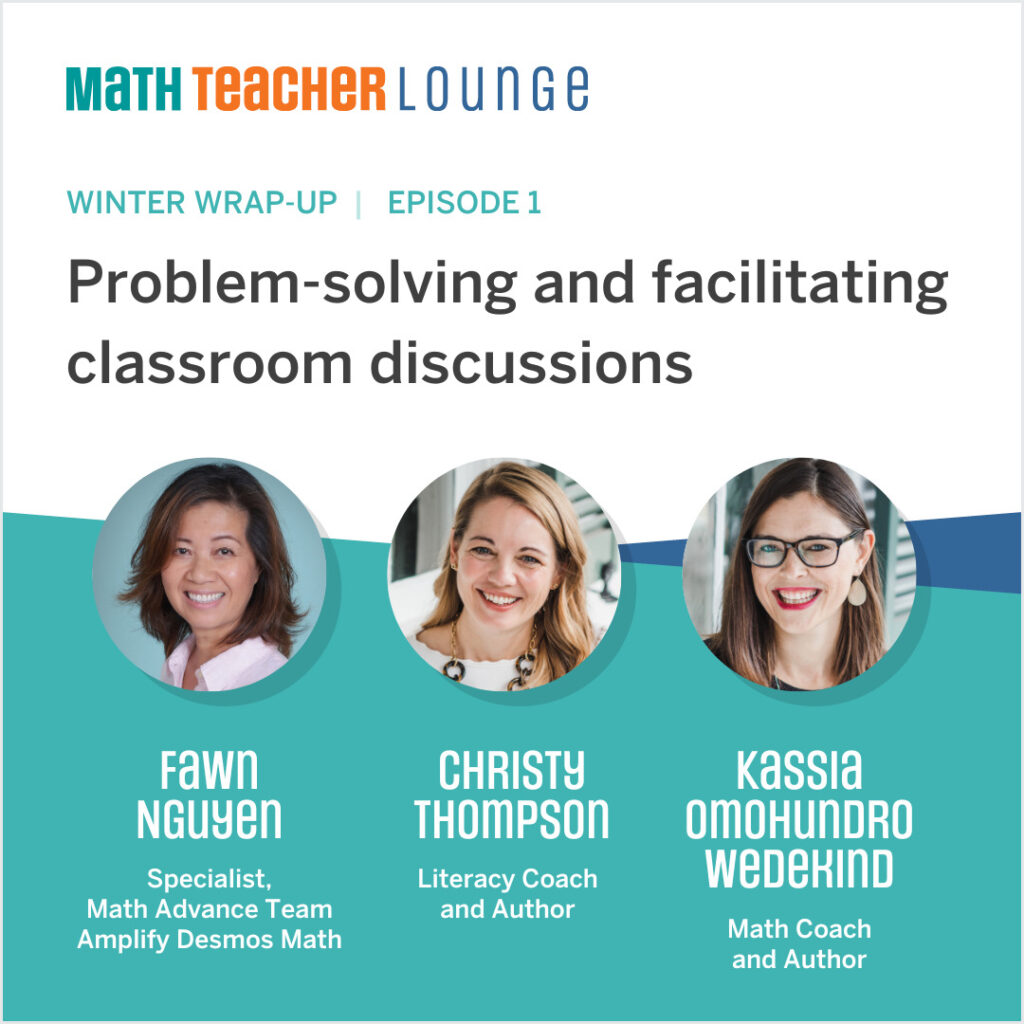
Promotional graphic for Math Teacher Lounge podcast, episode 1, featuring Fawn Nguyen, Christy Thompson, and Kassia Omohundro Wedekind discussing classroom problem-solving and discussions.

As we prep for an exciting new season of Math Teacher Lounge: The Podcast, hosts Bethany Lockhart Johnson and Dan Meyer are looking back at the amazing speakers and conversations from past episodes and sharing some of their favorites!

First up: A season 2 double feature of the power of problem-solving with Fawn Nguyen and Facilitating Classroom Discussions with authors Christy Hermann Thompson and Kassia Omohundro Wedekind.

Fawn is a specialist on Amplify’s advanced math team and a former math teacher and math coach—so she knows her stuff! You’ll hear about her five criteria for good problem-solving problems, and the power and importance of exposing all students to problem-solving.

Then, we’ll move into Bethany and Dan’s conversation with Christy and Kassia to learn how hands-down conversations allow students to become better listeners and the steps you can take to implement hands-down conversations in your classroom.

Explore more from Math Teacher Lounge by visiting our main page.

Download Transcript

Dan Meyer: (00:01)

Hey folks. Welcome back to Math Teacher Lounge. My name is Dan Meyer.

Bethany Lockhart Johnson: (00:03)

And I’m Bethany Lockhart Johnson. Hello! Happy New Year! Hello, Dan Meyer.

Dan Meyer: (00:09)

HNY, Bethany. HNY to you and to all of the listeners out there in Math Teacher Lounge. HNY is the abbreviation that I use sometimes.

Bethany Lockhart Johnson: (00:18)

Oh, is that what that is? Is that—I wasn’t sure what that was. If on my birthday you send me HBD…no.

Dan Meyer: (00:25)

Yeah.

Bethany Lockhart Johnson: (00:25)

No. Unacceptable.

Dan Meyer: (00:27)

I will. No, you want the full thing. To demonstrate my care for your birthday, I gotta spell the whole thing out. I’m just trying to stay relevant. You know, I’m just trying to stay relevant and youthful. So I’m using The Abreevs.

Bethany Lockhart Johnson: (00:38)

The Brevvies.

Dan Meyer: (00:40)

To the extent of even abbreviating the word “abbreviation.” . So, any New Year’s resolutions you wanna share with the listeners, Bethany? While you think, I’ll just share mine real quick here. This is the year of the perfect Wordle streak for yours truly, Dan Meyer. I’m going the full 365. Watch. Watch me do it, folks. I’m naming it here. Live on air. recorded on air. Perfect Wordle year. What you got for the listeners, Bethany?

Bethany Lockhart Johnson: (01:10)

Let’s see. It’s raining very hard here in Southern California, and my newest resolution is to embrace nature. My child wants nothing more than to go and splash in all the puddles.

Dan Meyer: (01:22)

Nice.

Bethany Lockhart Johnson: (01:23)

And be amongst the mud. And what I’m gonna keep telling myself—and so far, so far, I’ve been doing pretty good with this—thrive, child. Splash. Squish. We can dry you off. You will not melt. So I want to keep finding opportunities. Like, for instance, my response is, “It’s pouring rain. Let’s stay under covers and let’s read this book together!” And his response is like, banging on the windows, like, “Please let me go outside.” So I myself have some rain boots. I’m going to go forth and splash with my child. So hopefully you’ll see me doing that a bit more.

Dan Meyer: (02:08)

Love that.

Bethany Lockhart Johnson: (02:09)

Ask me what I’m doing. I’m outside, splashing in nature.

Dan Meyer: (02:12)

I don’t wanna put words in your mouth, but I have felt a bit like parenting is a means for rounding out aspects of my own personality that I have felt are—or habits or hobbies that are lacking. Like, I’ve never been real outdoorsy or into camping, but I don’t want that to limit my own kids’ aspirations or interests. So let’s do the thing that’s not super natural for me, for their own sake. Which is kind of what I’m hearing a little bit from you, which—that sounds exciting.

Bethany Lockhart Johnson: (02:35)

Do you wanna go camping together? Like, our families?

Dan Meyer: (02:38)

Uhhh. Let’s take this one off the air. I also love something that’s more relevant to a teachers audience that you said, that I think is super interesting, is how there’s ways that we can make the jobs harder for ourselves, that are optional. And what I hear from you is like, “I’m just not gonna freak out. We’re getting wet. We’re getting soggy. And I’m just not gonna freak out.” And I just think that that’s interesting to think about, the things that we take on, you know, that’s optional. Freaking out is optional, sometimes. And there’s other areas, I think, for parenting or for teaching, where it’s like, “Oh, do I really need to choose this particular battle?” And to reconsider that.

Bethany Lockhart Johnson: (03:19)

And in that spirit, our whole Wordle episode that we talked about? Do you remember you talked about how beautiful Wordle mistakes are, and how you keep learning from mistakes? I mean, you obviously want the final correct answer, but just, you know, when you get on a losing streak, Dan, I hope you’ll continue to pat yourself on the back.

Dan Meyer: (03:38)

Well, I will not be taking on a losing streak, or even lose one day. This is what’s gonna happen here. I’m just speaking that and putting it out in the universe.

Bethany Lockhart Johnson: (03:49)

Speak it!

Dan Meyer: (03:50)

But if it happens, I will be taking a long break from all human interaction. And lamenting, as I do.

Bethany Lockhart Johnson: (03:59)

Camping. Dan’s off in the woods, weeping.

Dan Meyer: (04:01)

That’s right. That’s right. Yeah. Well, we wanna share with you folks—an exciting programming note is that we are currently working very hard on producing a special fifth season of this podcast. You thought the other seasons were special? Let me tell you, this fifth season gives new meaning to the word “special.” And we can’t wait to tell you more about that. But in the meantime, Bethany, you wanna tell ’em what we’re up to in the meantime?

Bethany Lockhart Johnson: (04:26)

Well, Dan and I went back and we were having a conversation about some of our most favorite conversations, or the conversations that people bring up to us. Like, when we were at the CMC conference, or NCTM, folks, when we talk about the podcast, they’re like, “Oh, I loved this one.” “Oh, I love this one.” And that, to me, I don’t know, that is exciting. And so, while we’re putting together this new season over these next few weeks, we’re gonna feature a few of our favorite conversations from our first four seasons. Dan, four seasons!

Dan Meyer: (04:59)

We’ve been at this for four seasons! And I do want to just emphasize something you said, Bethany: that all of our conversations are our favorite conversations. They’re all our special children. What we just felt like you, the listeners, did not quite learn enough from some of these, and so we really needed you to hear them again to make sure you got everything that you should get out of them. So, let’s tell ’em who’s up first. And who’s up first is a conversation we had about problem-solving with Fawn Nguyen, who’s an advanced math team specialist here at Amplify. Been a former math coach, math teacher. Just really done the work, is what I’d say about Fawn.

Bethany Lockhart Johnson: (05:38)

If you have been listening to this podcast, you’re like, “Whoa, whoa. Wait, I have not missed an episode. I didn’t hear Fawn’s interview.” That is because we used to be video only, not podcasts. So this conversation with Fawn was from, what, our second season?

Dan Meyer: (05:55)

Yeah.

Bethany Lockhart Johnson: (05:56)

And we were on video. And another thing about it is it was, this is a conversation that, when folks talk about problem-solving, a lot of the responses we’ve gotten are like, “Wait, I’ve never thought of problem-solving this way.” In fact, you’ll hear us say that exact thing . So we really appreciated the time with Fawn. And yeah.

Dan Meyer: (06:17)

Enjoy it, folks. Especially enjoy Fawn’s—I think a four-part?—definition of problem-solving, a word that’s often kind of mushily defined. And Fawn really goes into, I think, precision and depth on it. So hope you folks enjoy it.

Dan Meyer: (06:35)

Give a wave, Fawn, to the camera. Would you? Cool. Fawn has been a teacher for a very long time. She is someone who could have left the classroom at any point and taken any number of jobs in the math-teaching universe. But I’ve always admired that Fawn has taught kids for a very long time, and that has given her, in my view, just a lot of clarity on what is important to her about students. I’ve seen her not get upset or obsessed with certain kinds of small niche issues that a lot of us, like, they get a lot of us down in the classroom, sometimes. And she’s maintained a laser focus on among many other things, problem-solving as a virtue in mathematics classrooms. So, please welcome Fawn to our show. Fawn, thanks so much for being here.

Fawn Nguyen: (07:18)

Hey, thank you so much. Thank you. I am so excited and honored that you guys invited me for this, Bethany and Dan.

Bethany Lockhart Johnson: (07:24)

Thank you for being here.

Fawn Nguyen: (07:26)

I love you, Bethany. Dan, I can tolerate, but I love you.

Dan Meyer: (07:30)

I really worked myself up there on that complimentary opening for you, and that’s how you get me back, here? OK. Problem-solving is fully on the consciousness of math teachers. Every math teacher knows that they need to say, like, “Yeah, oh, problem-solving. Yes. Love it. Do it. I dig it.” But even so, I feel like it’s become kind of a buzzword. Like, it’s not always obvious what that means…or am I doing problem-solving, really? So we’re curious: As someone who is a problem-solving expert, who is asked all over the world to talk about problem-solving: How do I know if I’m doing problem-solving in my classroom?

Fawn Nguyen: (08:12)

This is not my definition of it, but—nor am I an expert, by the way, Dan, thank you! but I try really, really hard and work on it!—my definition—or it’s not my definition, but I like it because it’s short and honest—is “problem-solving is what we do when we don’t know what to do.” And so—

Bethany Lockhart Johnson: (08:32)

Ooh!

Fawn Nguyen: (08:32)

—with that mind-frame, I’m hoping teachers think more about what they task. Because I think it gets mislabeled a lot, as to what is problem-solving. If the kids already know what to do, there’s a solution path. Then it’s not problem-solving.

Dan Meyer: (08:48)

Yeah. So what are examples then? An example of, like, I might call something problem-solving, but it it fails that particular definition that you just proposed there. Very short, very honest definition.

Fawn Nguyen: (08:59)

Just, it needs to have constraint and contradiction to what the kids think naturally. It should come as a surprise. There’s an element of surprise in it. There’s tension.

Dan Meyer: (09:11)

Maybe if there’s harder numbers or, you know, decimals or fractions in the same kind of procedure…I can feel myself thinking, “Yeah, this is hard. This is problem-solving. Problem-solving equals hard. But we already know what to do.”

Fawn Nguyen: (09:27)

Or just word problems. That’s the most common thing. As soon as it just has words attached to the math, it becomes problem-solving. But that’s just coding it to me. That’s just coding it with words, wrapping it around. It doesn’t mean anything until we read through and see if there’s true problem-solving in it.

Bethany Lockhart Johnson: (09:45)

Like, what’s the moment that it becomes problem-solving? In the way that you envision it?

Fawn Nguyen: (09:53)

Well, I think there’s the bigger problem-solving of really bringing a task…I wanna call it left field. It just—we rarely ever, if ever, see it in the regular coursework, but it can also be problem-solving if we just take what we expect the children to do at the end of the unit, how about we front-load that? To me, that’s also problem-solving. And I’m trying to encourage teachers to do that last problem first. The task writers put more thought—not that they don’t do the rest of it!—but you know, this is a special one, because they label it “challenge,” or “enrichment,” or “are you ready for more?” I’ve seen those. And so it is this really special problem. And I would love for us to think about “do that first.” Because my biggest fear is that because it comes at the end, that not all the children are involved. And so that to me is the saddest part. Because we might not get to it, right? In mathematics, we always think, “OK, well, let’s do these problems and then we don’t have time for the rest.” But I think that’s your richest task right there, is at the very end. So why don’t we front-load it, start it, and it’s OK—of course it’s OK!—that we don’t all get it. But the exposure to all students is so important. Talk about, you know, equity. Talk about that, everybody gets the same thing. If everyone dug into that first one with everybody’s collaboration, and we get to share that, and then we leave it, because “Yeah, OK, now we learn more of the other stuff, right? That hopefully support. And then we can go back. And now everybody had a chance to go get into it, and then we can come back to it as, as many problems, we need to go back to it.”

Bethany Lockhart Johnson: (11:37)

And that feels so powerful. Because it feels like—as a teacher, I’m thinking it would also inform my work, how I approach the unit, and how I approach the next steps. Right? Like, what kind of work would we be doing if I let it, if I allow it, to change the way that I approach the unit.

Dan Meyer: (11:58)

Yeah. What you’re describing is so powerful, and really asks a lot of the task designers as well, I think. There are problem-solving tasks that really require, like, abstract knowledge of the way formulas and variables fit together. And what I love about what Amplify is doing with their problem-solving, what you’re helping them do, is that they start with a true low floor that can draw in every student. And they might get stuck at different places; that’s fine. But everyone has a way in. That’s exciting.

Fawn Nguyen: (12:24)

It’s a big deal for me to have this opportunity and this trust, to integrate problem-solving into the curriculum, make it intentional. It’s difficult to implement. It is, to be honest. Because for me, what is a good task? This makes one of my four criteria: One is, it is non-routine. It is simply stated. Simply stated—that’s like your low floor. And then has multiple solutions. And the fourth: This makes it. Because that the teacher enjoys solving it. And so you have to enjoy solving it to bring it. Because so that way I can say to my kids, “This is my gift.” It really is, Because, you know, it has so much fun and joy. And I appreciate the struggle. And I wanna illustrate an example. For example, let’s say Dan and I are classmates. And I know that Dan gets A’s on his tests and the lowest score he ever got was an 89%. I, on the other hand, just sitting right next to him, I average D. I have a D average on everything. While Bethany, our amazing and wonderful teacher, brings in a problem. And when she brings it in, she says, “I worked on this problem. I found this problem; I worked on it; and I struggled with it. And it was amazing. I enjoyed it so much, I’m sharing it with you.” And all of a sudden it’s like, “OK!” And I”m sitting there, right? My teacher loves this problem so much; she’s bringing it in to share with us. And now, all of a sudden, it’s not, you know…and I know she only gives us non-routine. When she talks about problem-solving, it’s non-routine. So it’s not directly tied to the textbook that I’ve been struggling with. So it gives me a chance, it gives me a chance to contribute. To think differently. And now, suddenly I look forward to working with Dan, because in this space, in this problem-solving space, Dan is no longer Mr. Know-It-All. And so that’s what I mean by—I am saying this a hundred times, and I will not stop saying it—problem-solving levels the playing field. Our world is filled with unsolved problems. Are you kidding me? Right? We look around us, we have so many things that are not solvable, or people are working on it, and yet in mathematics, what happens? The bell rings; we start; and we solve everything during that time, and we leave. And that’s…yeah. No! No! We need to wrestle with problems.

Dan Meyer: (15:04)

And that was our conversation with Fawn Nguyen, which we first released way back in November, 2021. You folks can follow Fawn on Twitter at Fawn P Nguyen. Um, that’s @ F A W N P N G U Y E N.

Bethany Lockhart Johnson: (15:18)

So our episode today is a double feature. We are featuring another conversation that we loved from Season Two. This is a conversation with Christy Hermann Thompson and Kassia Omohundro Wedekind. They’re authors of the book, “Hands Down, Speak Out: Listening and Talking Across Literacy and Math.” And I don’t know if you remember, but not only did we have a conversation with them, but we did a whole book study on Facebook, a Facebook Live book study, over the course of several months. And it was one of my most favorite things. And then they did a webinar at the end. So our conversation with them on the podcast for me felt like such a beautiful dive into their book. And you know, I’ve said it before, you think you have something down in the classroom, you’re like, “Oh, hand-raising, I’ve got that down.” You think you have it down, but then somebody says, “OK, but have you ever considered thiiiis?” You know, and it just—

Dan Meyer: (16:17)

NOT that??

Bethany Lockhart Johnson: (16:18)

, Not that? Something totally different? And I loved talking with them. They’re a lot of fun. And I loved the book.

Dan Meyer: (16:23)

Wonderful conversation, great book. Very provocative ideas. Yeah. As someone who’s like, “OK, classroom management, I gotta get the hand-raising going…”. In the classroom before we talked, they offered a really potent challenge to some really standard classroom management ideas. Yeah. Loved it.

Bethany Lockhart Johnson: (16:40)

And this conversation also offers some really practical tips for facilitating student conversations. So we think you’ll enjoy it. Here’s our conversation with Christy and Kassia.

Bethany Lockhart Johnson: (16:53)

So today we are talking about “Hands Down, Speak Out: Listening and Talking Across Literacy and Math, K—5.” And we have the authors here, Kassia Omohundro Wedekind and Christy Hermann Thompson. Before we begin, let’s define what a hands-down conversation is. A hands-down conversation is just another way to structure discourse in your classroom. So in a typical classroom, you might see students raising their hand and waiting on a teacher to call on them before they share their ideas or engage in discussion. But in a hands-down conversation, it’s students’ ideas and voices that are taking the lead, and teachers are stepping back and focusing on listening and facilitating. Hello! Welcome to the Lounge.

Kassia Omohundro Wedekind: (17:44)

Thank you. We’re excited to be here. We’re fans of Season One. So we’re ready to go.

Dan Meyer: (17:50)

I was a secondary teacher but I still found so much to love about the book. I think facilitating conversations is just generally challenging, and perhaps even more so in math, where answers feel so tightly dialed-in, in lots of ways. But I loved it. I would love for you to just explain to our audience, what is a hands-down conversation and how does that contrast with what might be standard practice for some people? For some classes?

Christy Hermann Thompson: (18:13)

We just started using the term hands-down conversation because we wanted to differentiate the fact that there are different times to have different types of dialogue in the math classroom, in the literacy classroom. And we use this as one of our tools. Right? It’s not that every day, all day long, we’re very against hand-raising and should never see that again. We find that having this as one of our tools will be where we make really clear to the students that this is a moment where we’re turning it over to you to negotiate the space and make the decisions about when your voice comes in and who speaks next. You know, carry on kind of like that dinner table or that playground or, you know, whatever is your natural habitat for talk. And bringing that into the classroom and then hoping that it also someday transfers back out of the classroom back into the real world.

Bethany Lockhart Johnson: (19:09)

For the teachers who feel like that’s terrifying to have students just start speaking, and speaking without any sort of control or my little equity sticks, my little popsicle sticks, or my popcorn, or whatever other thing they’re using, what would you say is the first step?

Christy Hermann Thompson: (19:25)

So I think recognizing and naming that fear is part of it. And then saying to yourself, “What’s the worst that could happen here?” You know, I think the worst that could happen is that nobody talks and it’s totally silent. Or on the other hand, everybody talks at the same time. And both of those things will happen! And so what? It’s gonna be messy. And if you just acknowledge that it’s gonna look messy, and that’s part of growing; that every child as they learn—and every adult—is messy as they grow.

Kassia Omohundro Wedekind: (19:59)

And we have to see what kinds of things will happen in a hands-down conversation. Like there’s no prerequisite. You just start and then you see what happens. And those are the signs that tell you, “What can help this community grow as talkers and listeners? If everyone’s talking at the same time, and they’re kind of pushing each other over with their words by saying, “I have something to add!” “I have something to add!” or something like that, that’s a common thing that sometimes happens at the beginning. Then you know that the next step is to do some work about how to hold your thoughts back, how to add, wait for a space in the conversation to talk. And those are all things we need people to know out in the world.

Bethany Lockhart Johnson: (20:41)

So can you give an example of a micro-lesson that…well, first, what do you define as a micro-lesson? And then, what’s an example of one that maybe somebody who wants to dip their toe into the world of hands-down conversations that they could try?

Christy Hermann Thompson: (20:56)

The reason we call them micro-lessons is because we wanted to differentiate from the term mini lesson, which is out there and tends to describe about 10 or 15 minutes that might take place at the beginning of a work period of time. And this is much smaller than that. We usually follow a pretty predictable structure of naming. Here’s this thing that’s so helpful when we’re having conversations, and we love to especially be able to name something that a student had done: “Kaylee did this yesterday and it really helped us.” So what we might call that is, “And then here’s how Kaylee and other people might do that. They might do something like this.” And, you know, having a little anchor chart, so there’s a visual reminder of that skill. “So when we’re having a conversation today, you could try…”. And that’s basically a micro-lesson, just in a nutshell.

Kassia Omohundro Wedekind: (21:51)

When I was doing these hands-down conversations and I had more space for myself to listen as a teacher, I’m like, “Well, look at those kids, like, slumped onto the ground, like, pulling the carpet apart, but they’re having this amazing conversation!” And so I learned that listening is a lot broader. So in this lesson that I’m thinking about, we just talk with kids about what are lots of different ways that listening can look like. Sometimes with younger kids, I’ll take pictures of them listening in different ways and we’ll notice things about them together. And then we invite them to talk with their Turn and Talk partner about like, “How do you like to be listened to?” Or “Tell me about how you listen.” And just kind of broaden that. And really, I like to think that like the micro-lessons are for the kids, but also I’m saying those things to say them for myself. Like, “Remember, you don’t have to insist that kids are staring each other down in the eyes all the time. Like, “It’s OK when they’re doing other things. There’s other ways of listening.” So I think I’ve learned as much from the micro-lessons each time I do them as the kids that I’m trying to help grow as listeners and talkers, as well.

Dan Meyer: (23:00)

You folks have a lot of really eloquent ideals you express, around democratic classrooms and engagement. But you also have just some very tangible, practical…even down to, like, how a teacher positions their body in space and the way they use their eyes to connect. I think it would be really helpful for teachers to hear that it’s not just they’re signing on to a manifesto of sorts, but there’s ways they can act their way into the beliefs that you both expressed here.

Christy Hermann Thompson: (23:26)

When I’m starting hands-down conversation work, if I put myself a little bit outside of the circle and look down, and give myself a clipboard, it, it helps me bite my tongue and it helps me give better wait time and see what the kids are doing before I have that tendency to jump in and teach and do lots of teacher-y things.

Bethany Lockhart Johnson: (23:48)

Kassia and Christy, thank you so much for joining us. We are so excited to have this conversation and to share your work. This is exciting. And I feel like this conversation is just the beginning of a deeper dive into this book.

Kassia Omohundro Wedekind: (24:01)

Thanks for having us.

Christy Hermann Thompson: (24:02)

Thank you.

Dan Meyer: (24:03)

Thank you both.

Bethany Lockhart Johnson: (24:06)

Thanks so much for listening to our conversations with Fawn Nguyen and Christy Hermann Thompson and Kassia Omohundro Wedekind, both of which were released in 2021, part of our second season. And, you know, we hoped you enjoyed listening to it for a first, second, maybe third, fourth time.

Dan Meyer: (24:24)

Let’s be real. There’s some real fans out there.

Bethany Lockhart Johnson: (24:26)

We loved it then. We love it now!

Dan Meyer: (24:28)

Yep, yep, yep. Please keep in touch with the show by following us on Twitter at MTL Show, and join our Facebook group, the Math Teacher Lounge community. We’d love to hear from you there. And please stay tuned for more info on what we’re cooking up here in the Math Teacher Lounge. Thank you folks for listening. Take care, Bethany.

Bethany Lockhart Johnson: (24:47)

Bye now.

Stay connected!

Join our community and get new episodes every other Tuesday!

We’ll also share new and exciting free resources for your classroom every month.

What Fawn Nguyen says about math teaching

“It’s a big deal for me to have the opportunity and this trust to integrate problem-solving into the curriculum.”

– Fawn Nguyen

Specialist, Math Advance Team, Amplify Desmos Math

Meet the guests

Fawn Nguyen

Fawn began her work with Amplify in 2022 as a Math Advance Team Specialist. She was a math coach for a K-8 school district for three years, and a middle school teacher for 30 years before that. Fawn has also received a number of accolades as an educator.

Christy Thompson

Christy Thompson is a Literacy Coach in Fairfax County Public Schools in Virginia. She has spent her teaching and coaching career particularly focused on listening to and learning from the talk of our youngest students.

Kassia Omohundro Wedekind

Kassia Omohundro Wedekind spent many wonderful years as a classroom teacher and math coach in Fairfax County Public Schools in Virginia and now splits her time between being an independent math coach and an editor at Stenhouse Publishers. Her favorite days are spent in classrooms learning from the many ways children talk, listen and negotiate meaning together.

Three women are pictured separately in circular frames, each smiling and facing the camera, against a white background with overlapping pastel shapes—perfect for highlighting math teacher lounge discussions or sharing essential math teacher resources.
A graphic with the text "Math Teacher Lounge with Bethany Lockhart Johnson and Dan Meyer" on colored overlapping circles.

About Math Teacher Lounge: The podcast

Math Teacher Lounge is a biweekly podcast created specifically for K–12 math educators. In each episode co-hosts Bethany Lockhart Johnson (@lockhartedu) and Dan Meyer (@ddmeyer) chat with guests, taking a deep dive into the math and educational topics you care about.

Join the Math Teacher Lounge Facebook group to continue the conversation, view exclusive content, interact with fellow educators, participate in giveaways, and more!

Identifying math anxiety

Can you do long division in your head and calculate tips in your sleep? Or does the mere thought of arithmetic keep you up at night?

If you fall into the latter camp, you’re not alone.

Math anxiety is real—and an established body of research proves it. In fact, data shows that math anxiety affects at least 20% of students.

And its effects can be damaging in both the immediate and long term. It can bring down student performance both in and beyond math, and in and outside the classroom.

Fortunately, we’re also learning how teachers can help students manage math anxiety—and succeed wherever it’s holding them back.

We explored this topic on a recent episode of Math Teacher Lounge, our biweekly podcast created specifically for K–12 math educators. This season is all about recognizing and reducing math anxiety in students, with each episode featuring experts and educators who share their insights and strategies around this critical subject.

Dr. Gerardo Ramirez, associate professor of educational psychology at Ball State University, has been studying math anxiety for more than a decade. He joined podcast hosts Bethany Lockhart Johnson and Dan Meyer to share his insights.

So let’s take a look at what math anxiety is—and is not. We’ll also explore what impact it has on learning, and what we can do about it.

What is math anxiety?

Math anxiety is more than just finding math challenging, or feeling like you’re “not a math person.” Dr. Ramirez offers this definition: “[Math anxiety] is a fear or apprehension in situations that might involve math or situations that you perceive as involving math. Anything from tests to homework to paying a tip at a restaurant.”

Math anxiety may cause sweating, rapid heartbeat, shortness of breath, and other physical symptoms of anxiety.

But while math anxiety has some similarities with other forms of anxiety, it’s exclusive to math-related tasks, and comes with a unique set of characteristics and influences.

Math anxiety can lead sufferers to deliberately avoid math. And this avoidance can not only result in a student not learning math, but also limiting their academic success, career options, and even  social experiences and connections. This can look like anything from getting poor grades in math class, to tension with family members over doing math homework.

Parents and teachers can suffer from math anxiety, too. In fact, some research suggests that when teachers have math anxiety, it’s more likely that some of their students will, too.

What causes math anxiety?

It’s not correlated to high or low skill or performance in math. Students who generally don’t do well in math can experience math anxiety because they assume they’ll do poorly every time. Students who have been pressured to be high-achieving experience math anxiety because they’re worried they won’t meet expectations.

Other triggers may include:

  • Pressure. Pressure from parents or peers to do well in math can create anxiety, especially if the person feels that their worth or future success is tied to their math abilities.
  • Negative past experiences. Someone who has struggled with math or gotten negative feedback about their math skills might develop math anxiety. They may start to avoid or fear math, making it even harder to approach and improve.
  • Learning style. Different people have different learning styles. When someone’s learning style doesn’t match the way math is taught in their class or school, they may struggle and develop anxiety.
  • Cultural factors. When students hear things like, “Boys are better at math,” it can increase math anxiety in girls who may absorb the notion that they are already destined to underachieve.

Math anxiety and working memory

Dr. Ramirez has researched the important relationship between math anxiety and working memory.

Working memory refers to the ability to hold and manipulate information in short-term memory. People with math anxiety often have poorer working memory capacity when it comes to math-related tasks. This is thought to be due to the cognitive load created by anxiety, which can interfere with the ability to manage information in working memory.

The result? A negative feedback loop. Poor working memory can lead to further math anxiety, and increased anxiety can further impair working memory.

However, it’s important to note that not all individuals with math anxiety experience a decline in working memory capacity. Some may have average or above-average working memory capacity but still experience math anxiety. In such cases, the anxiety may be related to negative beliefs about one’s ability to perform math tasks, rather than an actual cognitive deficit.

What we can do about math anxiety

Even though math anxiety is a distinct type of anxiety, interventions such as cognitive behavioral therapy, exposure therapy, and mindfulness approaches have been shown to be effective in reducing it.

It starts, says Dr. Ramirez, with normalizing the anxiety.

“If you’re a student and you’re struggling with math and I tell you, ‘Yeah, it’s hard, it’s OK to struggle with math,’ that makes you feel seen. And that’s gonna lead you to want to ask me more for help, because I’m someone who understands you,” says Dr. Ramirez. “And that’s a great opportunity.”

Learn more

Start your 30-day free trial of Desmos Math 6–A1.

HQIM for Indiana Reading League Presentation

Implementation of High Quality Instructional Materials (HQIM) is the work of the entire vertical spine of districts. From the superintendent to the classroom teacher, all stakeholders need a deep understanding of the implementation journey and the curriculum.

Presentation Overview

Janise Lane and Robin McClellan, prior district leaders in both a large urban district and a small rural district, implemented HQIM for the past five years. They will share transparently about their HQIM implementation journey. The audience will leave with a better understanding of:

  • A shared vision for excellent literacy instruction.
  • Change management: Expectations, Engagement, Investment, Integrity.
  • Building the vertical spine of leadership.
  • Building and sustaining momentum.

Additional Information

Attendees will hear about the journey of two district leaders as they lead the adoption of high quality instructional materials.

Janise and Robin will have a candid conversation about the successes experienced and challenges faced throughout the selection, adoption, and beginning stages of launching the use of HQIM.

Attendees will develop leader and participant insight into how to build buy-in and lead change, how to build the capacity of their teams, how to leverage teachers as leaders, how to navigate challenging situations, and how to celebrate successes in ways that continue to move the work forward. Attendees will leave with skills and knowledge that is highly practical, actionable, and applicable to their own work in schools.

Resources

Use the QR code to get more resources such as Amplify’s Rivet PLPG, The Elements, and Curriculum Matters materials.

Question Prompts

Coherence and alignment – principals, supervisors must read and understand at least samples of the curriculum so the teachers know they are invested and can give actionable feedback.

  • 1. Tell us a little bit about your experience of bringing HQIM to your district.
    • State of the union – scores.
    • Tension in district between district leadership and school-based decision-making.
  • 2. Could you give a high level overview of the process of what they did to adopt: Change management, trust, and investment
    • Built a team
    • Communication of urgency for change – materials not aligned with brain science
    • Change management – why HQIM matters
  • 3. How do you build buy-in and coherence?
    • Brought together expert.
    • Brought together internal team of many stakeholder.
    • Invested deeply in learning.
      •  Edreports
      • Duke
  • 4. How do you leverage voice? Supporting leaders in strong implementation with systems of advocacy…
    • Surveys – staff, community.
    • Community visits.
    • Transparent communication: heard this and did this.
    • Celebrating growth in student work – pictures of what children before and after implementation along with quantitative – universal screening scores, etc.
    • Teacher voice more publicly i.e. Twitter (Katie Scotti).
    • Building capacity of teachers to become “lighthouses” – coaches also
    • Knowledge Matters.
  • 5. Advice – navigating problems of practice:
    • Don’t underestimate the power of the people in the schools –
    • Creating guardrail space – prioritize the most important 2 or 3 things that are major focus – come back.
    • Spiraled professional learning – not just a name to fancy up a presentation or school improvement plan – it is the rubber meets the road.
    • Coherence and alignment – principals, supervisors must read and understand at least samples of the curriculum so the teachers know they are invested and can give actionable feedback.

Committed to reading equity

We believe that all students have the right to read complex texts and engage in rich classroom discussions. They should also see themselves reflected and experience new worlds through reading.

This commitment guides our text selection, unique artwork, and dedication to reaching every student where they are.

A student with curly hair reads a book in a classroom, while other students are visible in the background, sitting at desks.

Text selection

Texts in the Amplify ELA curriculum cover a wide range of topics, themes, and genres, with differentiated supports that ensure that all students can work through each reading and lesson. Taken as a whole, the texts show students a diverse picture of the world, while fostering a lifelong love of reading.

Illustration of diverse people and landscapes, featuring native designs, botanical elements, and a silhouetted airplane against a script background.
A painted scene shows a blue sky with scattered white dots resembling stars and red clouds, against a backdrop of dark and light color gradients.

In the Liberty & Equality unit, students reflect on the harrowing journeys and avenues to freedom that enslaved African-Americans were forced to forge.

Character & Conflict

Students read A Raisin in the Sun, a play that focuses on the impact of poverty and racial tensions on family relationships and identity within an African-American family.

Summer of the Mariposas

In the Summer of the Mariposas unit, students dive into a retelling of the Odyssey through a contemporary Hispanic lens as they explore sibling and extended-family relationships.

A pencil sketch of an airplane is shown on a textured background with orange and yellow watercolor paint.

In the Perspectives and Narrative unit, students explore a coming of age moment for an adolescent daughter of immigrant parents.

Red Scarf Girl

In the Red Scarf Girl and Narrative unit, students learn about a key historic moment in Asian and world history, while making connections to relatable themes like authority figures imposing rules on children, and family and peer loyalties standing at odds.

Mysteries & Investigations

In the Mysteries & Investigations unit, many of the texts present an ethnically and culturally diverse group of characters, including many pre-teen or teen protagonists rebelling against authority, navigating their relationships with their peers and families, and figuring out their unique identities.

Created with diverse perspectives

With our new illustrations, time spent in our classrooms will feel relevant and relatable to every student. We’ve brought together an art team with unique perspectives and visual styles so that their diversity can shine along with the
complex texts in our curriculum, and illuminate their relationship with our literature. Everyone deserves to see themselves as the hero of a story. It is our hope that our students will find themselves within our program, and will be ever more curious in their learning, and engaged in their reading.

https://youtu.be/_FLV_Le7Zoc
A person sits at a desk with art supplies, flowers, and plants, speaking on camera. An orange play button overlays the image, indicating a video. A colorful artwork hangs on the wall behind them.

Dive into the world of Mysteries &
Investigations with Dr. Womack,
the illustrator who may have once
become a scientist…

A person sits on a couch in a room decorated with colorful artwork and a wooden sculpture; a play button icon is overlaid at the center.

Meet Tre, a seeker and traveller that became homies Fredrick Douglass through illustrating his narrative for our program…

A woman with long dark hair in a red top sits indoors near a window with yellow flowers and colorful decorations; a play button overlay is at the center.

There’s no one way to be a maker, and Jackie certainly has made a lot of things. Check out the weird and mysterious world of her miniatures…

A person with curly hair and hoop earrings speaks indoors, with colorful posters and decorations visible in the background. An orange play button overlays the image.

She’s been drawing characters and comics ever since middle school. Now see the drama of Edel’s work in the mythos of the Greeks…

A woman stands in front of a wall covered with colorful artwork. An orange play button icon is overlaid on the center of the image.

Travel through countries and narratives with Caroline, as she shares her delicate watercolors for illustrating the hero’s journey…

A man with short brown hair and a beard sits at a desk near a window, with artwork displayed on the wall behind him. An orange play button is centered over the image.

The haunting work that Patrick creates will leave you feeling a sense of melancholy and longing, but not without hope for the future…

A woman in a red blazer sits in an office with open books and art prints on the wall. An orange play button is overlaid in the center of the image.

She’s been drawing characters and comics ever since middle school. Now see the drama of Edel’s work in the mythos of the Greeks…

A man in a light blue shirt speaks while seated in a creative workspace with colorful artwork and sketches displayed on the wall behind him.

As a latino American, Eddie is an illustrator, a father, and a teacher. He is working in collaboration with Poetry in America to use his heritage as inspiration…

A woman sits in front of a wall covered with colorful educational posters, partially obscured by a large play button icon in the center.

Listen to a word from Tory, the Art Director at Amplify, on how the vision
was set for the project and how she brought the team together that would get to illustrate ELA…

Fanart

Here is a library of all the inspiring art that our beloved fans have submitted for our program. Do you or your students have a favorite literary character from our program? Send us your fanart to be shared with our community here!

A collage of various portrait illustrations and drawings, including stylized faces, historical figures, animals, and astronauts, in both color and black and white.

Welcome, Atlanta reviewers!

To view this protected page, enter the password below:


Welcome, San Diego reviewers!

To view this protected page, enter the password below: