Plan your professional development

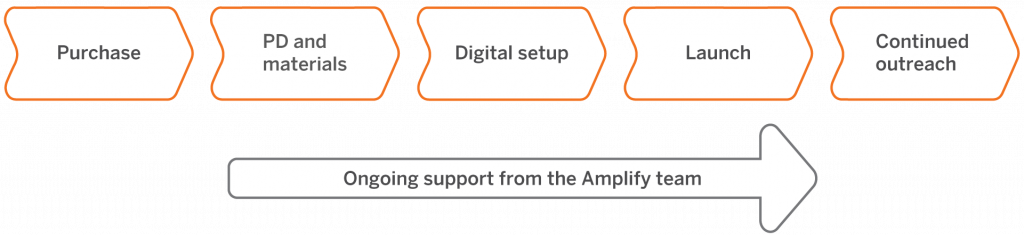
We’re excited to partner with you on your Amplify journey. Flexible professional development pathways have been designed to meet your needs.

Illustration of three educational phases: a teacher launches a rocket, another reads a book, and four individuals discuss in a meeting setting.

Recommended Professional Development Plan

Our team has curated a recommended professional learning path from initial launch to continuous support. Use the Professional Development Planning Guide below to discuss the plan that best meets your school or district needs with your Account Executive.

mCLASS with DIBELS 8th Edition sessions overview

AudienceTitleDurationModality
Launch
New mCLASS with DIBELS 8th Edition customers with limited time for PDmCLASS with DIBELS 8th Edition program overviewHalf dayOnsite/Remote
New mCLASS with DIBELS 8th Edition customersInitial training1 day onsite or 2 half days remoteOnsite/Remote
Initial training: Train the Trainer1 day onsite or 2 half days remoteOnsite/Remote
Initial trainingSelf-pacedOnline course
Strengthen
mCLASS with DIBELS 8th Edition customers with limited time for PDUnderstanding your classroom dataHalf dayOnsite/Remote
All mCLASS with DIBELS 8th Edition customersClassroom data analysis and instructional planning1 day onsite or 2 half days remoteOnsite/Remote
Classroom data analysis and instructional planning: Train the Trainer1 day onsite or 2 half days remoteOnsite/Remote
Classroom data analysis and instructional planningSelf-pacedOnline course
All mCLASS with DIBELS 8th Edition customersUnderstanding your school or district dataHalf dayOnsite/Remote
Data-driven leadership practices 1 day onsite or 2 half days remoteOnsite/Remote
Data-driven leadership practices: Train the Trainer1 day onsite or 2 half days remoteOnsite/Remote
Data-driven leadership practicesSelf-pacedOnline course
Strengthening consultation session60 min.Remote
Strengthening consultation session package3 60-min. sessionsRemote
Coach
All mCLASS with DIBELS 8th Edition customersCoaching session1 dayOnsite
Coaching sessionHalf dayOnsite/Remote
Building readers
All mCLASS with DIBELS 8th Edition customersBuilding readers for leaders2 half daysOnsite/Remote
Building readers for teachers3 half daysOnsite/Remote

Launch

mCLASS with DIBELS 8th edition program overview

Half day (3 hours)

This PD prepares participants to implement the assessment and collect reliable data using standardized guidelines.

Audience: Teachers (administrators welcome), maximum 30 participants
Modality: Onsite/Remote

Initial training

1 day onsite (6 hours) or 2 half days remote (6 hours)

This PD prepares participants to implement the assessment, collect reliable data using standardized guidelines, and use the targeted lessons available on mCLASS to drive differentiated instruction.

Audience: Teachers (administrators welcome), maximum 30 participants
Modality: Onsite/Remote

Initial training: Train the Trainer

1 day onsite (6 hours) or 2 half days remote (6 hours)

This PD prepares participants to implement the assessment, collect reliable data using standardized guidelines, and use the targeted lessons available on mCLASS to drive differentiated instruction. Participants receive annotated session materials to turnkey the session to colleagues.

Audience: Teachers (administrators welcome), maximum 30 participants
Modality: Onsite/Remote

Initial training

Self-paced

This PD is an individual seat to our self-paced, on-demand online course that contains approximately 6 hours of training. Participants will learn how to implement the assessment, collect reliable data using standardized guidelines, and use the targeted lessons available on mCLASS to drive differentiated instruction. Participants will access and revisit the course anytime for up to one year as a refresher.

Audience: Teachers (administrators welcome)
Modality: Online

Strengthen

Understanding your classroom data

Half day (3 hours)

This PD prepares participants to understand their students’ data by utilizing the reports available on mCLASS. This session should be scheduled after the most recent benchmark window has closed so that participants can work with their own data.

Audience: Teachers (administrators welcome), maximum 30 participants
Modality: Onsite/Remote

Classroom data analysis and instructional planning

1 day onsite (6 hours) or 2 half days remote (6 hours)

This PD prepares participants to deeply understand their students’ data and create actionable instructional plans by utilizing the reports and skills-focused lesson plans available on mCLASS.

Audience: Teachers (administrators welcome), maximum 30 participants
Modality: Onsite/Remote

*This session should be scheduled after the most recent benchmark window has closed so that participants can work with their own data.

Classroom data analysis and instructional planning: Train the Trainer

1 day onsite (6 hours) or 2 half days remote (6 hours)

This PD prepares participants to deeply understand their students’ data and create actionable instructional plans by utilizing the reports and skills-focused lesson plans available on mCLASS. Participants receive annotated session materials to turnkey the session to colleagues.

Audience: Teachers (administrators welcome), maximum 30 participants
Modality: Onsite/Remote

*This session should be scheduled after the most recent benchmark window has closed so that participants can work with their own data.

Classroom data analysis and instructional planning

Online course (self-paced)

This PD is an individual seat to our self-paced, on-demand online course that contains approximately 6 hours of training. Participants will learn how to deeply understand their students’ data and create actionable instructional plans by utilizing the reports and skills-focused lesson plans available on mCLASS. Participants will access and revisit the course anytime for up to one year as a refresher.

Audience: Teachers (administrators welcome)
Modality: Online

Understanding your school or district data

Half day (3 hours)

This PD prepares participants to use their data in making schoolwide decisions. This session should be scheduled after the most recent benchmark window has closed so that participants can work with their own data.

Audience: Administrators, maximum 30 participants
Modality: Onsite/Remote

Data-driven leadership practices

1 day onsite (6 hours) or 2 half days remote (6 hours)

This PD prepares participants to use their data in making school-wide decisions and build a schoolwide culture of data-driven instruction. This session should be scheduled after the most recent benchmark window has closed so that participants can work with their own data.

Audience: Administrators, maximum 30 participants
Modality: Onsite/Remote

Data-driven leadership practices: Train the Trainer

1 day onsite (6 hours) or 2 half days remote (6 hours)

This PD prepares participants to use their data in making school-wide decisions and build a schoolwide culture of data-driven instruction. This session should be scheduled after the most recent benchmark window has closed so that participants can work with their own data. Participants receive annotated session materials to turnkey the session to colleagues.

Audience: Administrators, maximum 30 participants
Modality: Onsite/Remote

Data-driven leadership practices

Online course (self-paced)

This PD is an individual seat to our self-paced, on-demand online course that contains approximately 6 hours of training. Participants will learn how to use their data in making school-wide decisions and build a schoolwide culture of data-driven instruction. Participants will access and revisit the course anytime for up to one year as a refresher.

Audience: Administrators
Modality: Online

Strengthening consultation session

(60-min.)

This 60-minute session will focus on a specific topic that will deepen educators’ understanding of mCLASS and equip them with the tools needed to drive stronger student outcomes. An Amplify facilitator will align with the school or district leadership team in advance of the session on the topic (chosen from a menu of options) that will best meet educators’ unique needs.
Topics include:

  • Progress Monitoring
  • Zones of Growth
  • Data Walkthrough for Leaders

Audience: Teachers and/or administrators, maximum 30 participants
Modality: Remote

Strengthening consultation session package

(3 hours)

This package consists of three 60-minute sessions that can be delivered on the same day or on different days. Each session will focus on a specific topic that will deepen educators’ understanding of mCLASS and equip them in driving towards stronger student outcomes. An Amplify facilitator will align with the school or district’s leadership team in advance on the topics that will best meet educators’ unique needs.
Topics include:

  • Progress Monitoring
  • Zones of Growth
  • Data Walkthrough for Leaders

Audience: Teachers and/or administrators, maximum 30 participants
Modality: Remote

Coach

Coaching session

1 day (6 hours)

This PD will deepen educators’ understanding of how to utilize mCLASS in order to accelerate data-driven student outcomes. An Amplify facilitator will visit one or two school sites for one day and work with teachers and/or leaders. Prior to the visit, the Amplify facilitator will align with each school’s leadership team on their needs and customize the visit schedule accordingly.

Audience: Teachers and/or administrators, maximum 30 participants
Modality: Onsite

Coaching session

Half day (3 hours)

This PD is up to 3 hours of training and will deepen educators’ understanding of how to utilize mCLASS in order to accelerate data-driven student outcomes. An Amplify facilitator will visit one school site for a half-day and work with teachers and/or leaders. Prior to the visit, the Amplify facilitator will align with each school’s leadership team on their needs and customize the visit schedule accordingly.

Audience: Teachers and/or administrators, maximum 30 participants
Modality: Onsite/Remote

Building readers

Building readers for leaders

2 half days (6 hours)

This training session is split into 2 half-day sessions (3 hours each). The same participants should attend both sessions in order to receive all content, which includes learning the Science of Reading and how to align this theory with schoolwide instruction. Part 2 should be scheduled two to three weeks after Part 1.

Audience: Administrators, maximum 30 participants
Modality: Onsite

Building readers for teachers

3 half days (9 hours)

This training series is split into three half-day sessions (3 hours each). The same participants should attend all sessions in order to receive all content, which includes learning the Science of Reading and how to align this theory with classroom instruction. Part 2 should be scheduled two to three weeks after Part 1, and Part 3 should be scheduled two to three weeks after Part 2.

Audience: Teachers (administrators welcome), maximum 30 participants
Modality: Onsite/Remote

mCLASS with DIBELS 8th Edition and TRC sessions overview

AudienceTitleDurationModality
Launch
New mCLASS with DIBELS 8th Edition and TRC customersInitial training1 day onsite or 2 half days remoteOnsite/Remote
Initial training: Train the Trainer1 day onsite or 2 half days remoteOnsite/Remote
Initial trainingSelf-pacedOnline course
Strengthen
All mCLASS with DIBELS 8th Edition and TRC customersClassroom data analysis and instructional planning1 day onsite or 2 half days remoteOnsite/Remote
Data-driven leadership practices1 day onsite or 2 half days remoteOnsite/Remote
Coach
All mCLASS with DIBELS 8th Edition and TRC customersCoaching session1 dayOnsite
Coaching sessionHalf dayOnsite/Remote

Launch

Initial training

1 day onsite (6 hours) or 2 half days remote (6 hours)

This PD prepares participants to implement the assessment, collect reliable data using standardized guidelines, and use the targeted lessons available on mCLASS to drive differentiated instruction.

Audience: Teachers (administrators welcome), maximum 30 participants
Modality: Onsite/Remote

Initial training: Train the Trainer

1 day onsite (6 hours) or 2 half days remote (6 hours)

This PD prepares participants to implement the assessment, collect reliable data using standardized guidelines, and use the targeted lessons available on mCLASS to drive differentiated instruction. Participants receive annotated session materials to turnkey the session to colleagues.

Audience: Teachers (administrators welcome), maximum 30 participants
Modality: Onsite/Remote

Initial training

Self-paced

This PD is an individual seat to our self-paced, on-demand online course that contains approximately 6 hours of training. Participants will learn how to implement the assessment, and collect reliable data using standardized guidelines and use the targeted lessons available on mCLASS to drive differentiated instruction. Participants will access and revisit the course anytime for up to one year as a refresher.

Audience: Teachers (administrators welcome)
Modality: Online

Strengthen

Classroom data analysis and instructional planning

1 day onsite (6 hours) or 2 half days remote (6 hours)

This PD prepares participants to deeply understand their students’ data and create actionable instructional plans by utilizing the reports and skills-focused lesson plans available on mCLASS.

Audience: Teachers (administrators welcome), maximum 30 participants
Modality: Onsite/Remote

*This session should be scheduled after the most recent benchmark window has closed so that participants can work with their own data.

Data-driven leadership practices

1 day onsite (6 hours) or 2 half days remote (6 hours)

This PD prepares participants to use their data in making schoolwide decisions and build a schoolwide culture of data-driven instruction. This session should be scheduled after the most recent benchmark window has closed so that participants can work with their own data.

Audience: Administrators, maximum 30 participants
Modality: Onsite/Remote

Coach

Coaching session

1 day onsite (6 hours)

This PD will deepen educators’ understanding of how to utilize mCLASS in order to accelerate data-driven student outcomes. An Amplify facilitator will visit one or two school sites for one day and work with teachers and/or leaders. Prior to the visit, the Amplify facilitator will align with each school’s leadership team on their needs and customize the visit schedule accordingly.

Audience: Teachers and/or administrators, maximum 30 participants
Modality: Onsite/Remote

Coaching session

Half day (3 hours)

This PD is up to 3 hours of training and will deepen educators’ understanding of how to utilize mCLASS in order to accelerate data-driven student outcomes. An Amplify facilitator will visit one school site for a half-day and work with teachers and/or leaders. Prior to the visit, the Amplify facilitator will align with each school’s leadership team on their needs and customize the visit schedule accordingly.

Audience: Teachers and/or administrators, maximum 30 participants
Modality: Onsite/Remote

mCLASS Lectura sessions overview

AudienceTitleDurationModality
Launch
New mCLASS Lectura Customers with limited time for PDmCLASS Lectura program overviewHalf dayOnsite/Remote
New mCLASS Lectura customersmCLASS Lectura initial training1 day onsite or 2 half days remoteOnsite/Remote
mCLASS Lectura initial training: Train the Trainer1 day onsite or 2 half days remoteOnsite/Remote
mCLASS Lectura Initial trainingSelf-pacedOnline course
Strengthen
All mCLASS Lectura customers with limited time for PDUnderstanding your classroom dataHalf dayOnsite/Remote
All mCLASS Lectura customersClassroom data analysis and instructional planning1 day onsite or 2 half days remoteOnsite/Remote
Classroom data analysis and instructional planning: Train the Trainer1 day onsite or 2 half days remoteOnsite/Remote
Understanding your school or district dataHalf dayOnsite/Remote
Data-driven leadership practices 1 day onsite or 2 half days remoteOnsite/Remote
Data-driven leadership practices: Train the Trainer1 day onsite or 2 half days remoteOnsite/Remote
Strengthening consultation session60 min.Remote
Coach
All mCLASS Lectura customersCoaching session1dayOnsite
Coaching sessionHalf dayOnsite/Remote

Launch

mCLASS Lectura program overview

Half day (3 hours)

This PD prepares participants to implement the assessment and collect reliable data using standardized guidelines.

Audience: Teachers (administrators welcome), maximum 30 participants
Modality: Onsite/Remote

mCLASS Lectura initial training

1 day onsite (6 hours) or 2 half days remote (6 hours)

This PD prepares participants to implement the assessment, collect reliable data using standardized guidelines, and use the targeted lessons available on mCLASS to drive differentiated instruction. While the assessment must be administered in Spanish, English-speaking educators educators who would like to learn about the program but will not be administering the assessment may attend.

Audience: Teachers (administrators welcome), maximum 30 participants
Modality: Onsite/Remote

mCLASS Lectura initial training: Train the Trainer

1 day onsite (6 hours) or 2 half days remote (6 hours)

This PD prepares participants to implement the assessment and collect reliable data using standardized guidelines. While the assessment must be administered in Spanish, English-only speaking educators who would like to learn about the program but will not be administering the assessment may attend. Participants receive annotated session materials to turnkey the session to colleagues.

Audience: Teachers (administrators welcome), maximum 30 participants
Modality: Onsite/Remote

mCLASS Lectura initial training

Online course (self-paced)

This PD is an individual seat to our self-paced, on-demand online course that contains approximately 6 hours of training. Participants will learn how to implement the assessment, collect reliable data using standardized guidelines, and use the targeted lessons available on mCLASS to drive differentiated instruction. Participants will access and revisit the course anytime for up to one year as a refresher.

Audience: Teachers (administrators welcome)
Modality: Online

Strengthen

Understanding your classroom data

Half day (3 hours)

This PD prepares participants to understand their students’ data by utilizing the reports available on mCLASS. This session should be scheduled after the most recent benchmark window has closed so that participants can work with their own data.

Audience: Teachers (administrators welcome), maximum 30 participants
Modality: Onsite/Remote

Classroom data analysis and instructional planning

1 day onsite (6 hours) or 2 half days remote (6 hours)

This PD prepares participants to deeply understand their students’ data and create actionable instructional plans by utilizing the reports and skills-focused lesson plans available on mCLASS.

Audience: Teachers (administrators welcome), maximum 30 participants
Modality: Onsite/Remote

*This session should be scheduled after the most recent benchmark window has closed so that participants can work with their own data.

Classroom data analysis and instructional planning: Train the Trainer

1 day onsite (6 hours) or 2 half days remote (6 hours)

This PD prepares participants to deeply understand their students’ data and create actionable instructional plans by utilizing the reports and skills-focused lesson plans available on mCLASS. Participants receive annotated session materials to turnkey the session to colleagues.

Audience: Teachers (administrators welcome), maximum 30 participants
Modality: Onsite/Remote

*This session should be scheduled after the most recent benchmark window has closed so that participants can work with their own data.

Understanding your school or district data

Half day (3 hours)

This PD prepares participants to use their data in making schoolwide decisions. This session should be scheduled after the most recent benchmark window has closed so that participants can work with their own data.

Audience: Administrators, maximum 30 participants
Modality: Onsite/Remote

Data-driven leadership practices

1 day onsite (6 hours) or 2 half days remote (6 hours)

This PD prepares participants to use their data in making school-wide decisions and build a schoolwide culture of data-driven instruction. This session should be scheduled after the most recent benchmark window has closed so that participants can work with their own data.

Audience: Administrators, maximum 30 participants
Modality: Onsite/Remote

Data-driven leadership practices: Train the Trainer

1 day onsite (6 hours) or 2 half days remote (6 hours)

This PD prepares participants to use their data in making schoolwide decisions and build a schoolwide culture of data-driven instruction. This session should be scheduled after the most recent benchmark window has closed so that participants can work with their own data. Participants receive annotated session materials to turnkey the session to colleagues.

Audience: Administrators, maximum 30 participants
Modality: Onsite/Remote

Strengthening consultation session package

(3 hours)

This package consists of three 60-minute sessions that can be delivered on the same day or on different days. Each session will focus on a specific topic that will deepen educators’ understanding of mCLASS and equip them with the tools needed to drive stronger student outcomes. An Amplify facilitator will align with the school or district leadership team in advance of the session on the topic (chosen from a menu of options) that will best meet educators’ unique needs. Topics include progress monitoring, goal setting, and a data walkthrough for leaders.

Audience: Teachers (administrators welcome), maximum 30 participants
Modality: Remote

Coach

Coaching session

1 day (6 hours)

This PD will deepen educators’ understanding of how to utilize mCLASS in order to accelerate data-driven student outcomes. An Amplify facilitator will visit 1–2 school sites for one day and work with teachers and/or leaders. Prior to the visit, the Amplify facilitator will align with each school’s leadership team on their needs and customize the visit schedule accordingly.

Audience: Teachers and/or administrators, maximum 30 participants
Modality: Onsite

Coaching session

Half day (3 hours)

This PD is up to 3 hours of training and will deepen educators’ understanding of how to utilize mCLASS in order to accelerate data-driven student outcomes. An Amplify facilitator will visit 1 school site for a half-day and work with teachers and/or leaders. Prior to the visit, the Amplify facilitator will align with each school’s leadership team on their needs and customize the visit schedule accordingly.

Audience: Teachers and/or administrators, maximum 30 participants
Modality: Onsite/Remote

LaunchStrengthenOngoing
BOYAfter BOY or MOYAfter BOY or MOY
New customersProgram overviewUnderstanding your classroom dataCoaching session
Initial trainingUnderstanding your school or district dataBuilding readers for teachers
Strengthening consultation session/packageBuilding readers for leaders
Returning customersCoaching session (refresher content)Classroom data analysis and instructional planningCoaching session
Data-driven leadership practicesBuilding readers for teachers
Strengthening consultation session/packageBuilding readers for leaders
*Note: If you are currently delivering instruction in a hybrid or remote model, we recommend that all of the sessions above be delivered remotely.

mCLASS Express sessions overview

TitleDurationModality
Launch
Initial trainingHalf dayOnsite/Remote
Initial trainingSelf-pacedOnline course

Launch

Initial training

Half day (3 hours)

Take the first step in launching mCLASS Express! The half-day initial training will help educators understand how mCLASS Express’ voice-recognition scoring generates immediate instructional recommendations for students reading below grade level. Educators will also learn how to utilize the teacher portal to assign assessments, review and correct scoring, track student growth over time, and leverage the program’s activities to create an action plan for a single classroom or across classes/grades.

Audience: Teachers (administrators welcome), maximum 30 participants
Modality: Onsite/Remote

Initial training

Self-paced (2 hours)

Take the first step in launching mCLASS Express! The two-hour initial training will help educators understand how mCLASS Express’ voice-recognition scoring generates immediate instructional recommendations for students reading below grade level. Educators will also learn how to utilize the teacher portal to assign assessments, review and correct scoring, track student growth over time, and leverage the program’s activities to create an action plan for a single classroom or across classes/grades.

As this is a self-paced, on-demand online course, participants will be able to access the course anytime, move as quickly or slowly as needed through different sections, and revisit the course up to one year as a refresher in the future.

Audience: Teachers (administrators welcome), maximum 30 participants
Modality: Online

mCLASS: IDEL sessions overview

TitleDurationModality
Launch
mCLASS IDEL program overviewHalf dayOnsite/Remote
Initial training1 dayOnsite/Remote
Initial training: Train the Trainer1 dayOnsite/Remote
Initial trainingSelf-pacedOnline course

Launch

mCLASS IDEL program overview

Half day (3 hours)

This PD prepares participants to implement the assessment and collect reliable data using standardized guidelines.

Audience: Teachers (administrators welcome), maximum 30 participants
Modality: Onsite/Remote

Initial training

1 day onsite (6 hours) or 2 half days remote (6 hours)

Prepare to implement your mCLASS:IDEL assessment with fidelity! Learn about the five basic early literacy skills that are crucial for reading development, and understand how they are assessed on the mCLASS:IDEL assessment. Then, practice administering and scoring each assessment measure and receive targeted feedback from a facilitator. Upon completion of this session, participants will be on their way to collecting reliable data to support all students.

Audience: Teachers and/or administrators, maximum 30 participants
Modality: Onsite/Remote

Initial training: Train the Trainer

1 day onsite (6 hours) or 2 half days remote (6 hours)

Prepare to implement your mCLASS:IDEL assessment with fidelity! Learn about the five basic early literacy skills that are crucial for reading development, and understand how they are assessed on the mCLASS:IDEL assessment. Then, practice administering and scoring each assessment measure and compare your responses to exemplars. As this is a Train the Trainer session, participants will receive annotated session materials in order to turnkey the session to colleagues.

Audience: Teachers and/or administrators, maximum 30 participants
Modality: Onsite/Remote

Initial training

Online course (self-paced)

This PD is an individual seat to our self-paced, on-demand online course that contains approximately 6 hours of training. Participants will learn how to implement the assessment, collect reliable data using standardized guidelines, and use the targeted lessons available on mCLASS to drive differentiated instruction. Participants will access and revisit the course anytime for up to one year as a refresher.

Audience: Teachers (administrators welcome)
Modality: Online

TRC Atlas Español

Launch

TRC Atlas Español program overview

Half day (3 hours)

This PD prepares participants to implement the assessment and collect reliable data using standardized guidelines.

Audience: Teachers (administrators welcome), maximum 30 participants
Modality: Onsite/Remote

mCLASS Math sessions overview

AudienceTitleDurationModality
Launch
New mCLASS Math customers with limited time for PDmCLASS Math program overviewHalf dayOnsite/Remote
New mCLASS Math customersInitial training1 day onsite or 2 half days remoteOnsite/Remote
Initial training: Train the Trainer1 day onsite or 2 half days remoteOnsite/Remote
Strengthen
All mCLASS Math customers with limited time for PDUnderstanding your classroom dataHalf dayOnsite/Remote
All mCLASS Math customersClassroom data analysis and instructional planning1 day onsite or 2 half days remoteOnsite/Remote
Classroom data analysis and instructional planning: Train the Trainer1 day onsite or 2 half days remoteOnsite/Remote
Understanding your school or district dataHalf dayOnsite/Remote
Data-driven leadership practices1 day onsite or 2 half days remoteOnsite/Remote
Data-driven leadership practices: Train the Trainer1 day onsite or 2 half days remoteOnsite/Remote

Launch

mCLASS Math program overview

Half day (3 hours)

This PD prepares participants to implement the assessment and collect reliable data using standardized guidelines.

Audience: Teachers (administrators welcome), maximum 30 participants
Modality: Onsite/Remote

Initial training

1 day onsite (6 hours) or 2 half days remote (6 hours)

Learn the foundational research for mCLASS Math and how it supports students’ abilities in mathematical reasoning. Understand the various assessment components and develop techniques for interviewing students and documenting their thinking. Interpret assessment results, and brainstorm suggested instructional activities. Upon completion of this session, participants will be on their way to collecting reliable data.

Audience: Teachers (administrators welcome), maximum 30 participants
Modality: Onsite/Remote

Initial training: Train the Trainer

1 day onsite (6 hours) or 2 half days remote (6 hours)

Learn the foundational research for mCLASS Math and how it supports students’ abilities in mathematical reasoning. Understand the various assessment components, and develop techniques for interviewing students and documenting their thinking. Interpret assessment results, and brainstorm suggested instructional activities. Upon completion of this session, participants will be on their way to collecting reliable data. Participants receive annotated session materials to turnkey the session to colleagues.

Audience: Teachers (administrators welcome), maximum 30 participants
Modality: Onsite/Remote

Strengthen

Understanding your classroom data

Half day (3 hours)

This PD prepares participants to understand their students’ data by utilizing the reports available on mCLASS. This session should be scheduled after the most recent benchmark window has closed so that participants can work with their own data.

Audience: Teachers (administrators welcome), maximum 30 participants
Modality: Onsite/Remote

Classroom data analysis and instructional planning

1 day onsite (6 hours) or 2 half days remote (6 hours)

This PD prepares participants to deeply understand their students’ data and create actionable instructional plans by utilizing the reports available on mCLASS.

Audience: Teachers (administrators welcome), maximum 30 participants
Modality: Onsite/Remote

*This session should be scheduled after the most recent benchmark window has closed so that participants can work with their own data.

Classroom data analysis and instructional planning: Train the Trainer

1 day Onsite (6 hours) or 2 half days Remote (6 hours)

This PD prepares participants to deeply understand their students’ data and create actionable instructional plans by utilizing the reports available on mCLASS. Participants receive annotated session materials to turnkey the session to colleagues.

Audience: Teachers (administrators welcome), maximum 30 participants
Modality: Onsite/Remote

*This session should be scheduled after the most recent benchmark window has closed so that participants can work with their own data.

Understanding your School or District Data

Half day (3 hours)

This PD prepares participants to use their data in making schoolwide decisions. This session should be scheduled after the most recent benchmark window has closed so that participants can work with their own data.

Audience: Administrators, maximum 30 participants
Modality: Onsite/Remote

Data-driven leadership practices

1 day onsite (6 hours) or 2 half days remote (6 hours)

This PD prepares participants to use their data in making schoolwide decisions and build a schoolwide culture of data-driven instruction. This session should be scheduled after the most recent benchmark window has closed so that participants can work with their own data.

Audience: Administrators, maximum 30 participants
Modality: Onsite/Remote

Data-driven leadership practice: Train the Trainer

1 day onsite (6 hours) or 2 half days remote (6 hours)

This PD prepares participants to use their data in making schoolwide decisions and build a schoolwide culture of data-driven instruction. This session should be scheduled after the most recent benchmark window has closed so that participants can work with their own data. Participants receive annotated session materials to turnkey the session to colleagues.

Audience: Administrators, maximum 30 participants
Modality: Onsite/Remote

Contact

Amplify welcomes the opportunity to partner with schools and districts to design professional development plans and answer your questions.

If you would like to order any of our professional development services, please contact your local Amplify sales representative or call (800) 823-1969.

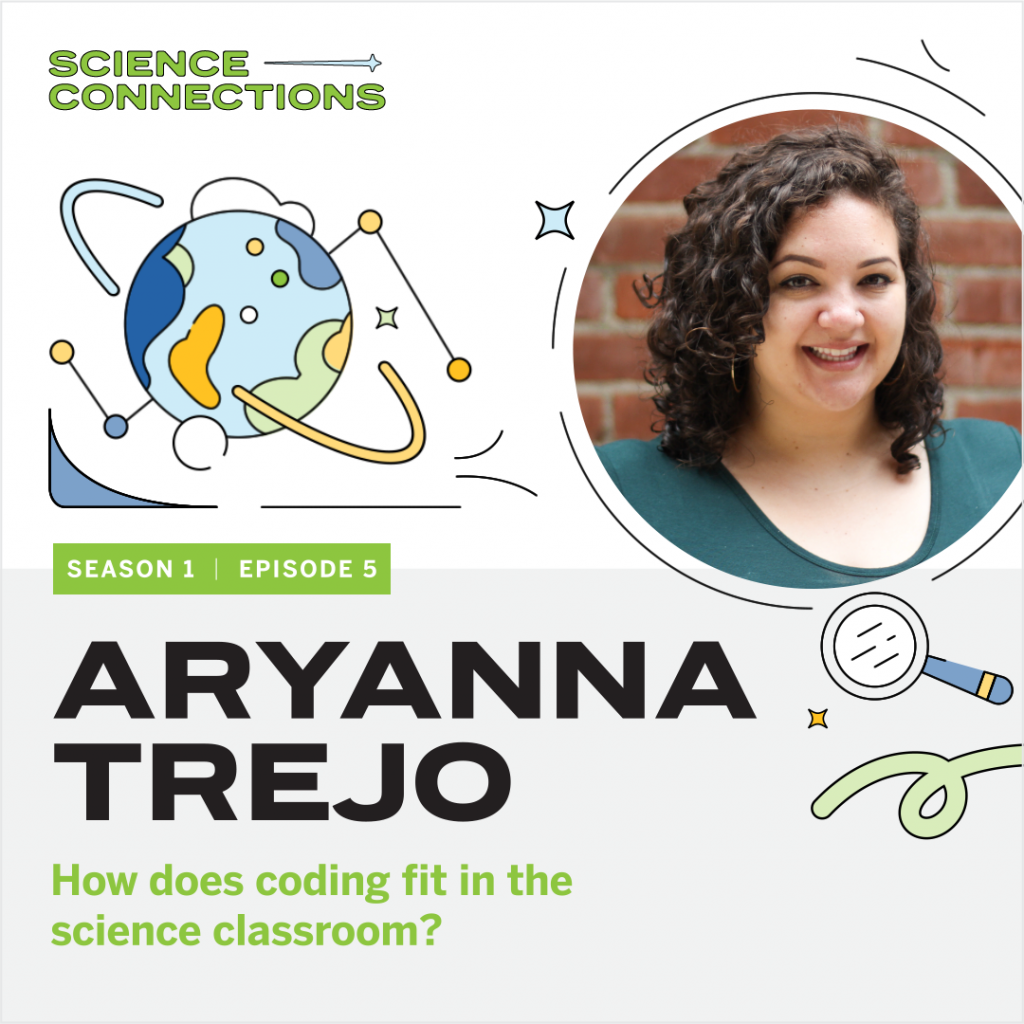
S1-06: Supporting students with a creative twist: A conversation with Kentucky Science Teacher of the Year, Shad Lacefield

In this episode, Eric sits down with the Kentucky Science Teacher of the Year, Shad Lacefield. Shad shares his experience teaching during the first year of the pandemic, where Shad dressed up in over 100 costumes to create a unique and engaging online learning experience for his students. Shad also explains ways he connects with his students to celebrate student success, as well as large-scale efforts he leads within his school to cultivate the love of learning science content. Explore more from Science Connections by visiting our main page.

Download Transcript

Shad Lacefield (00:00):
When you stay relevant, it’s being engaged with your students and figuring out, or what are, what are they liking? And every year it’s gonna be different. And that helps you stay relevant. When you have conversations and you build relationships with your kids,Eric Cross (00:13):
Welcome to science connections. I’m your host. Eric Cross. My guest today is Shad Layfield. Shad is a teacher at garden Springs elementary and a part-time professor at Asbury University in Kentucky during the first year of the pandemic, Mr. Layfield dressed up in over a hundred costumes to create a unique and engaging online learning experience for his students. He also created Vader visits, where he visited students at their homes, dressed as Darth Vader to celebrate their online successes and keep them encouraged. During a challenging time. In this episode, we discuss how creativity impacts engagement, transferring lessons learned from distance teaching back to in-person instruction, and how upper grades can apply the same principles to improve student learning. I hope you enjoy this discussion with shad lays field. So you’ve been in fourth grade for four years, and then you were in second grade and fifth grade. And so like how long have you been teaching for like total?

Shad Lacefield (01:09):
So this is my 15th year teaching.

Eric Cross (01:12):
Really? Yeah. You’ve been in the game for a while.

Shad Lacefield (01:15):
Yeah. Yep. It, it doesn’t, and it’s always surprising to parents too during that, that first like, come in and meet your teacher. And I walk in, I’m like, yeah, I’ve been teaching for 15 years and every time it gets ’em, they’re like no way. And I’m like, yeah,

Eric Cross (01:28):
That’s, that’s a good thing though. That’s a good thing. Right?

Eric Cross (01:31):
You know? So like, well the energy and then, and you’re just how you’re perceived. Like you’re, they’re just, I don’t know. It’s something about work with young people. Like it keeps you young.

Shad Lacefield (01:39):
That’s what it is. Absolutely.

Eric Cross (01:41):
So how did, how, like, what’s your origin story? Like, how did you become a teacher? Like what, what was it? Was it something like you knew second career, like right outta school? Like how did you end up in the classroom?

Shad Lacefield (01:53):
Yeah. No, and I love this question cause I’m a big Marvel and, and superhero. So origin stories are all, I love a good origin story. So I grew up on a 13 acre farm in a little bitty town called Gustin, Kentucky, and very early on, like we were instilled my parents, amazing, amazing parents. But they really instilled like a, a super important work ethic in our lives of like, it’s, it’s all about hard work and it’s important that you’re working hard in whatever it is that you do. And I’m one of six kids as well in my family.

Eric Cross (02:24):
Where are you in the–

Shad Lacefield (02:25):
I’m second to last.

Eric Cross (02:26):
Second to last. Okay. So you’re the second youngest.

Shad Lacefield (02:29):
Yes. Okay. And and so, and so growing up, like with that, like, you know, I worked in tobacco, I worked in hay, you know, we did things being on the farm and stuff like that. And within my family as well, there’s four boys. And so when I decided to go to college I was the first guy in my family to go to college. And the first and only boy that ended up going to college. And so it was like this big deal, like, oh, you know, we got one of our boys gonna go to college. So what is he gonna be? And I was like, well, if I’m gonna put forth the, the time and effort and then the financial strain that it would cause cuz we were not poor at all. My dad worked two jobs to make sure, but I really felt the responsibility of like, if I’m gonna go, I’m gonna work in a profession.

Shad Lacefield (03:09):
That’s gonna make a lot of money. And here I am as a teacher now. So I didn’t go to college to be a teacher. I actually was pre dentistry. I thought, now here’s a profession. You can, a lot of money. You don’t work weekends or holidays, you know, I can still be the doctor thing. And so I’m gonna be pre dentistry. But like all good origin stories. There was a, there was a flip. So in my first year I started working at the most majestic place that you will ever go. It’s called Squire, boon, caverns. It’s a cave in Southern Indiana. And it’s an amazingly beautiful little place. You have to like one lane highway, like road to go back there up and down. Like you, you think you’re never gonna make it. And if it rains too much, the bridge will flood and you actually can’t even get back there.

Shad Lacefield (03:52):
So that’s how we’re talking like way back in the sticks. But once you get back, back there totally worth it. And as part of the job you were a tour I also did grist mill demonstrations and gym mining adventures, or, you know, as they’re gym mining and stuff like that. And within that, I started working with school aged kids and on very large tours and stuff. And my manager at the time, Claudia, I’m still great friends with and we still take our kids back there. Every summer she, to me, you’re really good with kids. Like you’re really good with kids. We have this scout program that’s on the weekends. And then during the summers and you would be teaching kindergarten through eighth grade kids, geology and forestry. What do you think about doing that? And I said, well, right, let’s try that out. And then I got the teaching bug and it hit and I was like, oh my gosh, like I don’t wanna spend my life doing something that is all about money or, or that is like, this is where it’s at. Like, I love this, I enjoy this. I enjoy the response that I get when I’m talking. And kids are excited about learning and getting new information and learning new stuff. And so then I change my major and here I am now, all these years later teaching instead of being a dentist,

Eric Cross (05:04):
Are there, are there days, do you ever have days where you’re like, you know, dentistry, it’s still an option. Like I can, I can go back.

Shad Lacefield (05:12):
Oh, rare, rare occasions. Rarely. Yeah.

Eric Cross (05:16):
Okay. Yeah. All right. All right. Fair enough. I, I, I always joke and say that like we have, you know, sometimes I have my, my alternate job on the hard days, which is for me, it’s working at the gap where I just want to fold clothes and go home at the end of the day, you know, on those really rough days. And you know, it’s never the kids, right. It’s always other things. The kids are like the great part. And then there’s all these other things. And I just wanna work at the gap. I just wanna work at the gap. Fold some clothes. Yes, sir. Yes. Ma’am absolutely. I can find that size for you. And then I just go home cause about their job when they go home at the end of the day, when you work at the gap, at least sorry, gap workers. I’m sure hard of that, but my perception in my mind is that you close up shop and then you’re done. Yeah,

Shad Lacefield (05:52):
Absolutely. Like you said, they can turn it, like it’s a turnoff at the end. Exactly. As teachers we know, like you don’t ever turn it off, it’s always there.

Eric Cross (06:00):
Yeah. So one of the things that I was super excited about when I, when I first heard about you is I went on your website and there’s so many things I feel like I can just talk about your website and just the, the content that you’ve produced. I, I, there’s so many directions I can go. But one, one of the things I want to ask you is, is about that. Now, one of the things that’s on there, and this is coming from a fellow star wars, Fisha who finished Bobba FET and the Mandalorian recently and is Jones in four OB one to come out.

Shad Lacefield (06:33):
Oh, so yes,

Eric Cross (06:35):
I live in Southern California next to Disneyland visited Galaxy’s edge star wars. You have these things called VA Vader visits. And so what do you do in those? And like, where did you get the idea for these Vader visits?

Shad Lacefield (06:50):
So the costumes were bringing the kids into the classroom. But when they left my room because you would, we only had them for a certain amount of time. There was still a lot of extra work that they needed to get done. And what I was seeing was I could get them to come in and they were really engaged during my lesson. But then afterwards, when it came to work completion or getting things done, there was, it was starting to fall off. As you know, we were experiencing, you know, more and more craziness of what’s going on. So then as an incentive, I decided if you have everything turned in, by the end of the day, I’m gonna dress up in my Darth Vader outfit, full costume, the, you know, the, the full helmet, like everything. And I’m gonna show up to your house and we’re gonna hang out and play any game at all that you wanna play.

Shad Lacefield (07:34):
So then it was a way of rewarding. My kids for getting everything turned in. But same time I felt like it would also help me build a relationship with them. That was a very challenging part of online learning. Like, again, I want you to feel like you’re a part of my classroom. I wanna feel like I’m invested in you and wanna learn about you. And it was a commitment because some of those kids put me through the ringer, whether it was we’re gonna do gymnastics on a trampoline. And again, I’m in full costume doing gymnast on the trampoline, or we’re doing soccer drills with their soccer coach at their house playing football games. I mean, all kinds of stuff. I made a Yachty game for a kid that loves Harry Potter. And it was really a big part of getting work turned in because, and it’s the crazy thought they wanted to spend time with me. Like that’s what it was. And so it was like, yeah, absolutely. I’ll keep dressing up. I did over 50 plus Vater visits. It wasn’t just for my homeroom. It was for all of fourth grade. So I went over 50 visits and it was cool to see kids in their home and talk to them and meet their parents. It was a great opportunity for me to engage with parents as well. How is online learning, going, what can I do to support you? Do you guys have any questions and stuff like that? So

Eric Cross (08:39):
This thing of relationships is like leading to work completion, which isn’t, which isn’t always the, the thing that we think to as educators of like how, you know, work completion. A lot of times we think of like structures or you know, certain protocols that you do in class get work completion, but here you are addressing as Darth Vader. And, and you said students were turning in more work because they’re connected to, you saw an increase in, in yeah. Engagement.

Shad Lacefield (09:07):
And absolutely. And, and I remember even saying that to myself, like this is, this is what’s getting them. But it, it was, and as part of the Vader visit as well with the videos we recorded all of them and I said, I’m gonna make you a YouTube star. And so I would, I, I recorded them. I put ’em on my YouTube channel. And so a lot of the videos that are on my website, all those Vader visits are like the kids showing off and playing against the teacher. And I promise you, I didn’t take it easy on any one of those kids. Like when it was like a verse match, I went all out and I told ’em. I was like, if you beat me, you know, it’s gonna be like, you earned it.

Eric Cross (09:38):
What a great way to leverage, just what, what is relevant to our students? Like you used your platform and then now you’re showcasing them on your, you know, your platform or what you were using. And then they’re seeing each other. And I could just see, regardless of the grade level, like just students, like beam from, from getting that kind of positive praise through, through, you know a medium that doesn’t, that tends to be more of a, just content consumption, but you’re kind of watching other folks do stuff, but now it’s about them. Like, and they’re, they’re getting that attention directly. Now I have to ask about the Vader costume. Did you, did you buy it for this event or did you already have that Darth Vader costume in your closet?

Shad Lacefield (10:19):
I had parts of the costume, but not the complete costume. And honestly, the very first Vader visit I had, I had the Vader mask that makes sounds, and like you could talk and it makes you sound like Vader.

Eric Cross (10:29):
My dark saber is on order. Yes. And it keeps getting delayed from best buy. It’s supposed to arrive in April, but I do have dark staple and order that I ordered back in November. So the best to your point, I don’t know who doesn’t have one, I’m waiting for mine though.

Shad Lacefield (10:42):
There you go, come on. Best buy come through for us. So

Eric Cross (10:44):
You, you did all this investment in time and, and you created all this content, but then we went back in person. Were, were you able to bring this back into the classroom or any of the things that you had generated during distance learning back in the classroom? Or are you, are you using some of the things that you learned? Like what, or is it just completely separate and you’re just doing something completely different. Now

Shad Lacefield (11:04):
That’s a great question. So I still try to dress up at least once every week, if not once every other week just to make whatever we’re doing fun, cuz I already have costumes that were connected to the content that I was doing. So had I had made a character called captain Soundwave that will use when I’m teaching my amplify lessons over sound. And so then I, you know, I have that or I would have, you know, specific characters that were designed for certain lessons that I would do. And so I still

Eric Cross (11:32):
Lemme interrupt you real quick. Where did you get these character ideas from? Cause they are super creative. I clicked on one random one. And you have had like a, a knitted like skull cap and like some blue shiny like cloak and I like who is this guy? I think, is that him? Is that captain sound wave? That’s

Shad Lacefield (11:48):
That’s hilarious. That was, that was my attempted Elsa. Oh, that was yeah. Started buying more and more costumes and and making characters and putting costumes together. And so yeah, it just ends up being this thing where you never know when I’m gonna show up in a completely random costume and be like today, we’re getting ready to learn about how sedimentary rocks form. And I dressed in my rock outfit, which is the old school rock with the turtleneck and the gold chain with,

Eric Cross (12:16):
Wait, do you have a Fanny pack too?

Shad Lacefield (12:17):
I have a Fanny pack. Yes you have. Yep. You nailed it. And they’re like, what does this guy

Eric Cross (12:22):
Do? He raise the one eyebrow. Can you do the, the rock eyebrow? Oh yeah, you got this. Oh, people on the podcast. Can’t see. Chad’s got it down. He’s got it down. He’s got the, he’s got the eyebrow going. Okay, so you, so I feel like I can go on a tangent and talk about all your costumes that you have, but the thinking about this. So tons of engagement, younger people now taking like some of the principles that you’ve learned from this, how can, how can upper grades like bring this joy to their classroom? Like middle school students, you know, older kids sometimes, you know, they can, they’re still kids, but you know, they might not be the same thing as fourth graders. Like would you, do you have any ideas of like how teachers and upper grades can kind of take these elements that you’ve done and, and apply them?

Shad Lacefield (13:04):
Absolutely. So some of the things that you had talked about, like with YouTube can also be applied to like TikTok videos and things like that, that kids are, are willing to watch and, and be engaged in. And so those things, I feel like I’ve seen other middle and high school teachers really utilize in their classroom. But honestly, and this is a new initiative that we’ve started in our district. Minecraft has been something that a lot of kids play and are really engaged in and has shown an amazing engagement for all of our kids when it comes to science engagement, particularly. And so with that, so there’s 126 million active Minecraft players right now in the world. And Minecraft is one of the largest selling video games. The average age, cuz they’re always like, oh, Minecraft is for kids who actually the average age is like 24.

Shad Lacefield (13:51):
So a lot of the older kids are playing Minecraft as well with the younger kids. And with that in mind, it was a way when I looked at Minecraft and specifically like Minecraft educational edition came out and it was during COVID and it was free. So if you had a school email or it’s like the, what the go 365 account, you could get it for free and all of our kids got it for free. And so then, then we went from playing Minecraft on the computer as like a fun game to me looking at it and saying like, wait a minute. I feel like when I’m doing energy conversions, we can take Redstone and Minecraft and kids can now show how a simple system using different parts and devices can work and understand even more con creates how energy is converted from one form to another.

Shad Lacefield (14:39):
And so let’s make this a, a, a, an actual activity. Let’s take what I’m teaching in the classroom. And if they get done early as an enrichment piece, because there’s not a ton of science and enrichment activities at times for kids to be able to do, like, what do I do when I’m done, Minecraft ended up being that. And so I could have these elaborate worlds that I would build for them that they could then go and play and be super engaged in and show me way more on this Minecraft world, what they knew than what they were writing on paper sometimes, cuz I, you know, you’d get like a sentences out of them on paper, but then all of a sudden when they would build this elaborate system and you just had them record and talk, it was like, oh my gosh, you understand way more than I was thinking that you did with that last exit slip, an assessment that we did.

Shad Lacefield (15:25):
And so like, this is awesome. So then I went to my district and I actually proposed an idea what if we did tire Minecraft build challenges for the whole district? So our district has 37 elementary schools and I was like, I think this could be something that, you know, as we’re looking for science, curriculum engagement and making kids excited about learning science and stuff again, cuz that was always the hard part. I feel like sometimes with COVID everything kids lost this love of, of being in the classroom and, and, and learning and that it was like, you know, getting them to come back into the classroom and, and finding, learning fun again. It was like this, this started to get ’em excited and like, yeah, I get to play in Minecraft and I’m learning at the same time. And it was working for all kinds of content areas.

Shad Lacefield (16:07):
We’re doing a blast off to, to Mars. We it’s called blast off to us. We’re partnering with CLO of the future. They’re working with SpaceX. Our kids will actually get to send postcards to space and yes, it’s, it’s a super cool thing. And I love my district and all of the office of technology, individuals, Ashley Josh and Kelly for putting this together. And so it asks this question if you could a community in space, what would it be like? And the goal is that kids will write on the back what they want. And then we send this postcard off to space, they stamp it saying it’s been in space and the kids get to have it back and, and be able to use it. But what, what we decided, what we could do with Minecraft is what if they actually built the colony on Mars, like really research put time and effort into reading scientific articles about plants and how plants would grow and, and water and, and structures and apply all of that in a massive build challenge. And then that be, you know what we’re doing? That can be the answer to the question. And so it’s not just a couple sentences on a postcard, but it’s like a week or two week unit that pulls all this scientific content and standards that we’re working with and really allows kids to show so much creativity like on my Twitter I’ve been posting like pictures and stuff like that of some of the students builds. And I’m gonna continue to do that throughout the build challenge.

Eric Cross (17:26):
Now, are you using Minecraft EDU?

Shad Lacefield (17:28):
Yes. That is correct.

Eric Cross (17:29):
I love Minecraft EDU. Like it, it, you talking about it inspires me to, to try to dive back into it. One of the things sometimes I feel limited by is the time that I have and the things that we’re trying to cover. And it’s almost, it almost feels like we’re doing something wrong using a video game to teach, but it’s such a great educational tool. Like you said, you just said that students are able to show what they know in, in a way by creating something that’s different than if they would’ve just written it, but they’re actually creating, and this is one of the things, I guess you kind of hit on this, but I wanted to probe it a little more. Is do you have your students creating content like you do? Cause I kind of heard that they, you were, did you say that they were explaining or doing a video recording or describing it? How are they, how are they, how are they doing that work?

Shad Lacefield (18:17):
Yeah. So what they actually do is they’ll write a script and they will use Screencastify to record and then upload to Flipgrid. And then that way they can actually show their build to all of fourth grade. Since we weren’t allowed to be in the same class, like we were all departmentalized, so then we will have voting challenges. So after you record, you get to see everyone’s videos, you get to like and comment and leave feedback on their builds. So you can see what the other kids created. And then then from those initial videos and voting, we selected a certain of kids that then go on to the district level for our Minecraft build challenge. And then those videos are viewed by administration and other teachers to vote again. And then you end up having grade level winners and then an overall winner, which shout out to my boy in fourth grade, who was our overall winner, Eli, super proud of him.

Shad Lacefield (19:07):
He, he made this really, really space saving system, which was hidden stairs that ran off of Redstone and used motion, energy. And again, in his video, he talks about like how motion energy has changed to electrical energy and then back into motion through the process of how this hidden staircase would be in the wall. And then you’d be able to use this lever to then release that staircase. So you could go up and down but it was just, and again, when you, when you let kids talk about energy conversions and you let them build all of a sudden, you have kids making security systems for banks. Another kid that made a feeding system for kids for animals at the zoo, and it was just like, oh my gosh, I had no idea that this was what you guys could run out and do. When I, when I taught you how energy conversions work, that this is what you could produce and come over, like this is mind blowing. I love it,

Eric Cross (19:56):
What our kids can do and what they can create always kind of blows us away when we give them an opportunity to kind of have that freedom to, to create and take their knowledge and actually do something with it versus channel it into what, show me what, you know, but only do it like this. This is, this is the lane that you have to stay in. How do you get these ideas and, and stay, stay relevant? Like so many of the things like you’re touching, like pop culture, you, you have this hand in education technology, you have you’re, you’re doing video editing. Like where are you drawing from? Cause I’m just thinking like, as a teacher listening to this, that might be newer. And they go to the side like, oh my gosh, this, this guy is doing these so many things like where are you drawing from for inspiration or ideas?

Shad Lacefield (20:39):
I think a lot of it is like you say, when, when you stay relevant, it’s being engaged with your students and figuring out, or what are, what are they liking? And every year it’s gonna be different. And that helps you stay relevant. When you have conversations and you build relationships with your kids to figure out, you know, what’s going on. Because I was not a big Minecraft person. It was the group that came in that really challenged me to do Minecraft because it, it showed up on their Chromebooks one day and all of a sudden it’s like, oh, we can play Minecraft all the time. And I said, no, you can’t play Minecraft until that I’ve had training. And I know what’s going on because I’m super nervous about this new thing. And I wanna make sure you guys aren’t doing something that you’re not supposed to.

Shad Lacefield (21:13):
And like, they hounded me hardcore about you better do you need to do that training, Mr. Lacefield, you need to, we wanna play Minecraft. You better be doing this. Right. And so I was like, all right, man, I’ll, I’ll invest. I’ll, I’ll put some time into this training. And I’m so glad that I did yeah, again, that’s it just like building relationships and having those conversations help you realize like, what’s, what’s what are they interested in? What what’s going on and what would be really funny, even connecting that back to the costumes. What would it be really funny if I showed up in you know, today, princess Jasmine.

Eric Cross (21:42):
Yeah.

Shad Lacefield (21:43):
Been yes. Done that. That’s a great one. I,

Eric Cross (21:45):
I, I just went to the social studies page. I, and I stop laughing while you were talking. Cause I saw the princess Jasmine.

Shad Lacefield (21:52):
Oh yeah. Folks.

Eric Cross (21:53):
I’m telling you, you have to go, you have to go to his videos and see what he’s done. I mean, they’re just, they’re just amazing with my middle school students. They, I, I find myself having to be into things that I’m not normally into. And we have these intergenerational relationships, right? Like I think teachers are unique in this I aspect where I can connect with a 12 year old with what 12 year olds are in no matter where this 12 year old’s from. Cuz I get 12 year old culture. But sometimes when I go back into my adult world, like I forget that like, Hey yeah, haven’t watched a new anime you know, or, or whatever, you know, up

Shad Lacefield (22:26):
That. Yeah. No said too. And a kid will show up wearing a, a shirt to school and I’m like, I wasn’t the world’s that like, I’ve never even seen that before. And you’re like, okay, I’m gonna have to learn what that is cuz that yeah.

Eric Cross (22:38):
And then the next student asks you about, Hey, do you like, do you like these this game? I’m like, yeah, yeah, let me go Google that game real quick. Yeah, I’m totally into it. I’m downloading on my phone real quick. And, and now I’m connected to all kinds of obscure random interests, but to your, to what you said, it like, it helps keep us fresh, right? With I, with ideas, there, there is something that is super practical that you’ve done that you’ve created that I’ve encouraged teachers to do. And I think you really nailed it. On your site, you have these video tutorials. When I look at those, I, I think about how much time you must have saved yourself of not having to explain the same exact thing multiple times. Because you’ve created this virtual help section that allows students to log in amplify earth, check, Flipgrid, whatever. Like do you, when you’re, when you’re teaching students, do you, do you use those in direct students there so they can kind of support themselves? Or is that, what, how did that come to be when you, when you made these, these virtual tools? Because I could just imagine these are time savers for you.

Shad Lacefield (23:49):
Absolutely. Cuz again, like you said, it’s it saves on time. So a lot of when you have kids that are already visual learners as well, and they love watching YouTube and they learn stuff from YouTube, why not? I mean, make the video and then attach it to my Google classroom, keeping everything online. Everyone always has access. And by still having those videos, it allows kids to hear the directions multiple time, but on their time and at their pace. So then it’s posted on the assignment. So even though I probably still will give those directions verbally out loud if a kid forgets and maybe they feel a little nervous about asking in front of their peers, like, oh, how do I do this again? Or, oh, I don’t remember how to do that. That video is linked on there. So that way they can go back and watch it.

Eric Cross (24:28):
It’s almost like a little co-teacher that you have like a little aide that’s like, but it’s you, but it’s like a mini you who’s helping you out. I found that putting sometimes those tutorial videos on ed puzzle, where at different points in time, you can set it up so that at a certain timestamp, it asks a question and you can control it. So they can’t move faster past it until they respond to the question and you have the question be about whatever you just said. And then it, it syncs with Google classroom. So you can import all the grades and you can see how far through the video they got. But that was one other layer that I was able to do. So I can have some accountability and make sure that okay, everybody watched it and they answered all five questions of like, how do you do this?

Shad Lacefield (25:07):
Oh, see, now you’re sharing stuff with me, Eric, because I, I’m not as familiar with ed puzzle. I’ve used like near pod and per deck, but I mean just you saying that I’m like, okay, I need to check out ed puzzle and, and see what, what this is all about. Cause that sounds awesome.

Eric Cross (25:20):
Hey, I shared something with Chad and it it’s useful. I’m I’m feeling good right now. I’m feel I’m feeling good. So as we, as we kind of wind down one, couple questions I wanna ask. One of ’em is you’ve been in teaching for, for 15 years and I, I talk to you like right now and I get this energy and this vibe that’s just so upbeat, so positive. How do you stay fresh, fresh. And how did you stay fresh during a time when things have been so hard, you know, and it, and still is for so many educators, how do you stay encouraged? Like what, what have you done and, and to stay in, in education for, for this long,

Shad Lacefield (26:00):
I think it, it even goes back to like when I made my initial decision to switch my major to education, like I, I really felt like I found so thing that I thoroughly loved and enjoyed, and I always feel like you go through seasons. Like, and I definitely, when, when COVID hit, like you went through a season of where you start to feel again, that pressure like do I really like doing this as much as I thought that I like doing this and am I ready for this next thing? And then I just go back to just the, well, why did I do this to begin with? And, and it gets me, you know, excited to be like, I did it for the kids, like, and it’s about the kids. And I get joy when they’re laughing and smiling. So again, with the videos, it’s like, how can I make ’em laugh and smile because if they’re laughing and smiling and having a good time, I’m gonna get, you know, jacked and ready to start teaching again.

Eric Cross (26:48):
And I just hear that so much in what you’re saying is you’re serving your kids is, is being more than that building the relationship, that connection. And then through all that, the learning happens. The last question I wanna ask you is who’s one teacher that created a memorable experience for you or inspired you. Is it someone that you remember when you were in school or learn experience that just, that stands out to you to this day? Cuz as teachers, we remember thi like our kids remember us and it’s weird to be in that position to think that we’re gonna be that person. So is there anybody or anything that stands out to you that you remember from a, a teacher and experience?

Shad Lacefield (27:27):
Gosh, I have, I have a lot that you know, from my fifth grade science teacher, Mr. Goodman, who we did the ecology meet and the ecology team, and we went to OT Creek park and we competed against other schools about science, connected materials to my physics teacher in high school that let us build boats out of cardboard and take it to the only hotel in our town and the pool. And we had like boat races with the cardboard boats that we did. But really I, I go back to Squire boon and Claudia my manager and I remember not only was, she’s such a, a pivotal like getting me into teaching. But I remember the, the curriculum that we were using at the time that I was. And again, it goes back to what if I was to teach that curriculum, I would not still be a teacher because again, as sometimes you experience with curriculum, it can be boring and not engaging. And I was already putting my own flare on it at SQUI boon during the scout lessons. And I said, what if I just completely rewrote this curriculum? What if I made it really fun and put my own, spin on it? And, and she was like, absolutely, absolutely do that. And I feel like that encouragement as teachers, when we encourage kids to be creative when we encourage kids to, to take risk and to try new things we end up getting such amazing results that we didn’t even expect

Eric Cross (28:45):
Thought I out to Mr. Goodman for the ecology meet the physics teacher for the, the boat races, which are hilarious, by the way, if you’ve ever been able to watch students, did you make ’em at a cardboard?

Shad Lacefield (28:53):
We did. Yep.

Eric Cross (28:54):
Yeah. Those are hilarious to watch. And Claudia for giving the freedom to let you be a educational DJ and remix things to make it fun. Thanks for being on the podcast. Thanks for your inspiration and for sharing your stuff like publicly and letting other people see it and, and get ideas. It’s, I’m sure there’s more people than, you know, and more teachers than, you know, that are looking at that and getting their own ideas and coming up with their own. It might not be star wars, but coming up with their own inspiration, maybe it’s like Harry Potter or Lord of the rings or some like that.

Shad Lacefield (29:26):
Yeah. Whatever. You’re passionate about. Pull that in.

Eric Cross (29:31):
Thanks so much for joining me and Shad today. We want to hear more about you. If you have any great lessons or ways to keep student engagement high, please email us at stem@amplify.com. That’s STEM@amplify.com and make sure to click, subscribe wherever you listen to podcasts until next time.

Stay connected!

Join our community and get new episodes every other Tuesday!

We’ll also share new and exciting free resources for your classroom every month.

What Shad Lacefield says about science

“It’s about being engaged with your students and figuring out what are they liking. Every year it’s going to be different…when you have conversations and you build relationships with your kids.”

– Shad Lacefield

4th Grade Science Teacher, District Elementary Science

Meet the guest

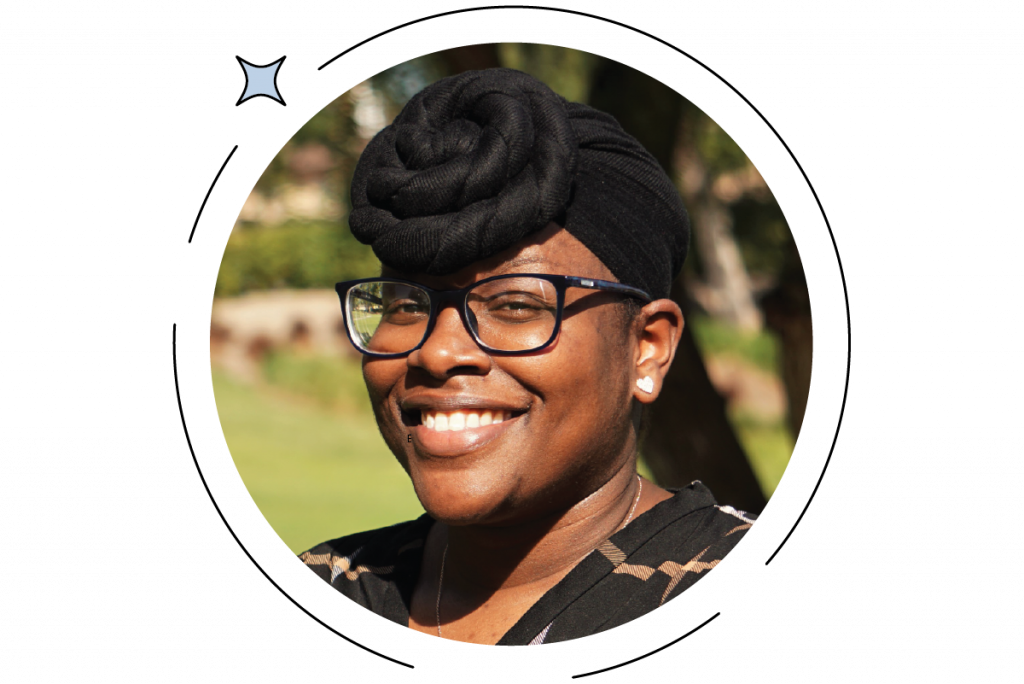
Shad Lacefield is a teacher at Garden Springs Elementary and part-time professor at Asbury University in Kentucky. Mr. Lacefield leads professional development in his district, and has been a guest speaker for Eastern Kentucky University, Campbellsville University, and Amplify Education. His topics include classroom managment, integrating techology, and student engagement. He earned his bachelor’s degree in elementary education from Campbellsville University in 2007, and his master’s in science from Southwest Baptist University in 2011. Shad has either taught or coached every grade K-12, and in his 14 years in education he has served as a lead teacher in literacy, math, science, and social studies. He currently coordiantes with the FCPS Office of Instructional Technology to plan Minecraft build challenges for elementary students, and is working on setting up a science field trip that turns a golf course into a STEM lab. During the first year of the pandemic, Shad dressed up in over 100 costumes to create a unique and engaging online learning experience for his students. He also created Vader Visits where he visited students at their homes dressed as Darth Vader to celebrate their online successes, and keep them encouraged during a challenging time. His creative teaching style, and over 50 “Vader Visits” with students, have been featured on WKYT-TV, LEX-18, Spectrum 1 News, and several local and college news publications. Shad lives in Lexington Kentucky with his wife Whitney Lacefield and their three children.

Check out his websiteYouTube channel, and Facebook account!

A person with glasses smiling against a blue background, surrounded by a circular design.

About Science Connections

Welcome to Science Connections! Science is changing before our eyes, now more than ever. So…how do we help kids figure that out? We will bring on educators, scientists, and more to discuss the importance of high-quality science instruction. In this episode, hear from our host Eric Cross about his work engaging students as a K-8 science teacher. Listen here!

Amplify Tutor Fingerprinting

To view this protected page, enter the password below:


Amplify Texas, K–5

Built on a systematic scope and sequence, Amplify Texas, K–5 programs offer the explicit instruction needed in today’s classrooms. Amplify Texas includes both English and Spanish curriculums. The print version of the English curriculum is titled Amplify Texas ELAR (English Language Arts and Reading). The digital version of the English curriculum is titled Amplify Texas Elementary Literacy Program. The print version of the Spanish curriculum is titled Amplify Texas SLAR (Spanish Language Arts and Reading). The digital version of the Spanish curriculum is titled Amplify Texas Lectoescritura.

We’ve created a wide suite of professional development offerings that will help you meet your unique needs this school year. Find out more below!

Professional Learning Partner Guide Certified Provider

Amplify CKLA, ELA, and Science professional development has been vetted by Rivet Education’s team through a rigorous three-step process and is listed in the Professional Learning Partner Guide.

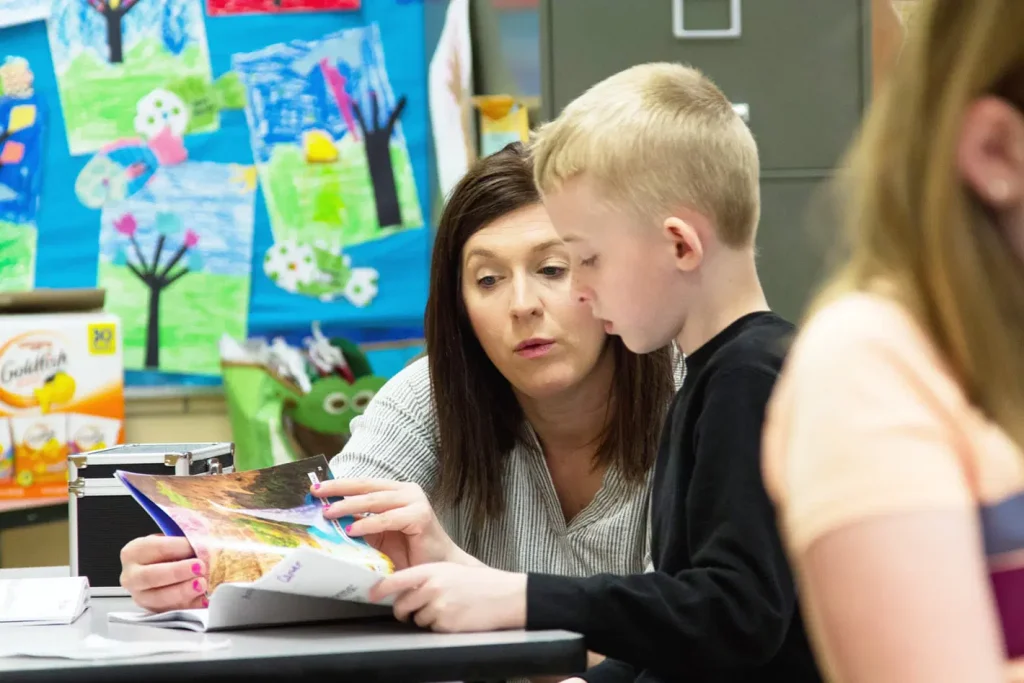
Teacher observes student completing activity

Plan your professional development

We’re excited to partner with you on your Amplify journey. Flexible professional development pathways have been designed to meet your needs.

Illustration of three educational phases: a teacher launches a rocket, another reads a book, and four individuals discuss in a meeting setting.

Recommended Professional Development Plan

Our team has curated a recommended professional learning path from initial launch to continuous support. Use the Professional Development Planning Guide below to discuss the plan that best meets your school or district needs with your Account Executive.

ELAR

SLAR

Session overview

Recommended sessions are highlighted below.
Audience Title Duration Modality Available
Launch
K–5 instructional leaders Amplify Texas Elementary Literacy Program (digital) and ELAR (print) initial training Half day Onsite/Remote Yes
K–2 teachers Amplify Texas Elementary Literacy Program (digital) and ELAR (print) initial training 1 day Onsite Yes
K–2 teachers Amplify Texas Elementary Literacy Program (digital) and ELAR (print) initial training
2 half days
Remote Yes
Amplify Texas Elementary Literacy Program (digital) and ELAR (print) program overview Half day Onsite/Remote 5/1/22
Amplify Texas Elementary Literacy Program (digital) and ELAR (print) Skills Strand initial training 1 day onsite
or 2 half days
remote
Onsite/Remote Yes
Amplify Texas Elementary Literacy Program (digital) and ELAR (print) Skills Strand program overview Half day Onsite/Remote 5/1/22
Amplify Texas Elementary Literacy Program (digital) Knowledge Strand initial training 1 day onsite
or 2 half days
remote
Onsite/Remote Yes
Amplify Texas Elementary Literacy Program (digital) Knowledge Strand program overview Half day Onsite/Remote 5/1/22
K–2 teachers Amplify Texas Lectoescritura (digital) and SLAR (print) initial training 1 day onsite or 2 half days remote Onsite/Remote 5/1/22
K–2 teachers Amplify Texas Lectoescritura (digital) and SLAR (print) program overview Half day Onsite/Remote 5/1/22
Amplify Texas Lectoescritura (digital) and SLAR (print) Skills Strand (Habilidades y destrezas) initial training 1 day onsite or 2 half days remote Onsite/Remote 5/1/22 
Amplify Texas Lectoescritura (digital) and SLAR (print) Skills Strand (Habilidades y destrezas) program overview Half day Onsite/Remote  10/1/22 
Amplify Texas Lectoescritura (digital) and SLAR (print) Skills Strand (Conocimiento) initial training 1 day onsite or 2 half days remote Onsite/Remote Yes
Amplify Texas Lectoescritura (digital) and SLAR (print) Skills Strand (Conocimiento) program overview  Half day Onsite/Remote  5/1/22 
3–5 teachers Amplify Texas Elementary Literacy program (digital) and ELAR (print) initial training 1 day or 2 half days remote Onsite/Remote Yes
3–5 teachers Amplify Texas Elementary Literacy program (digital) and ELAR (print) program overview Half day Onsite/Remote 5/1/22
3–5 teachers Amplify Texas Lectoescritura (digital) and SLAR (print) initial training 1 day onsite or 2 half days remote Onsite/Remote Yes
3–5 teachers Amplify Texas Lectoescritura (digital) and SLAR (print) program overview Half day Onsite/Remote 5/1/22
Strengthen
K–5 leaders Amplify Texas ELAR enhancing observations for leaders Half day Onsite/Remote 9/1/22
K–2 teachers


Amplify Texas ELAR enhancing planning & practice for K–2 teachers Half day Onsite/Remote Yes
K–2 teachers Amplify Texas ELAR writing for K–2 teachers Half day Onsite/Remote Yes
Amplify Texas SLAR enhancing planning & practice for K–2 teachers 1 day onsite
or 2 half days
remote
Onsite/Remote Yes
Amplify Texas SLAR writing for K–2 teachers Half day Onsite/Remote 12/1/22
3–5 teachers Amplify Texas ELAR enhancing planning & practice for 3–5 teachers Half day Onsite/Remote  Yes
3–5 teachers Amplify Texas ELAR writing for 3–5 teachers Half day Onsite/Remote Yes
Amplify Texas SLAR enhancing planning & practice for 3–5 teachers Half day Onsite/Remote Yes
Amplify Texas SLAR writing for 3–5 teachers Half day Onsite/Remote 12/1/22
K–5 teachers


Amplify Texas ELAR enhancing planning & instruction for English language learners Half day Onsite/Remote 9/1/22
Amplify Texas ELAR enhancing planning & instruction for students with special needs
Half day Onsite/Remote 9/1/22
Amplify Texas ELAR Strengthening consultation session 1 hour or 3 1-hour sessions Remote 2/1/22
Amplify Texas SLAR Strengthening consultation session 1 hour or 3 1-hour sessions Remote 2/1/22
Coaching sessions

K–5 educators (leaders, principals, coaches, and teachers)

Amplify Texas ELAR Coaching session 2 days consecutive Onsite Yes 
K–5 educators (leaders, principals, coaches, and teachers)


Amplify Texas ELAR Coaching session 1 day onsite or 2 half days remote
 
Onsite/Remote Yes
Amplify Texas ELAR Coaching session Half day Remote

Yes


Amplify Texas SLAR Coaching session 2 days consecutive Onsite Yes
Amplify Texas SLAR Coaching session 1 day onsite
or 2 half days
remote
Onsite/Remote Yes
Amplify Texas SLAR Coaching session Half day Remote Yes

Launch

K–5 instructional leaders

Amplify Texas Elementary Literacy Program (digital) and ELAR (print) initial training for K–5 instructional leaders

Half day (3 hours)

Prepare to implement and support Amplify Texas instruction in your schools! Learn how Amplify Texas supports students as they build literacy skills in the early grades and move among reading, writing, speaking and listening, and language activities in the upper grades. Understand the purpose of the Amplify Texas program (Skills, Knowledge, and Integrated Strands) and identify components of the Amplify Texas design principles within lessons. Participants will begin creating an action plan to support communication and change management related to Amplify Texas to staff, parents, and other stakeholders.

Audience: Instructional leaders (principals and coaches), maximum 30 participants
Modality: Onsite/Remote

K–2 teachers

Amplify Texas Elementary Literacy Program (digital) and ELAR (print) initial training for K–2 teachers

1 day onsite (6 hours) or 2 half days remote (6 hours)

Prepare to implement the Amplify Texas K–2 program in your classroom! Learn the foundational elements of Amplify Texas, including the structure of materials, key lesson elements, and how to deliver specific lesson types successfully.

Audience: Teachers (instructional leaders welcome), maximum 30 participants
Modality: Onsite/Remote

Amplify Texas Elementary Literacy Program (digital) and ELAR (print) program overview for K–2 teachers

Half day (3 hours)

Prepare to implement the Amplify Texas K–2 program in your classroom! Learn the foundational elements of the curriculum, including the structure of materials, key lesson elements, and how to deliver specific lesson types successfully.

Audience: Teachers (instructional leaders welcome), maximum 30 participants
Modality: Onsite/Remote

Amplify Texas Elementary Literacy Program (digital) and ELAR (print) Skills Strand initial training for K–2 teachers

1 day onsite (6 hours) or 2 half days remote (6 hours)

Prepare to implement the Amplify Texas Skills Strand program in your classroom! Learn the foundational elements of Amplify Texas, including the structure of materials, key lesson elements, and how to deliver specific lesson types successfully. Participants will begin planning for the first unit and lessons.

Audience: Teachers (instructional leaders welcome), maximum 30 participants
Modality: Onsite/Remote

Amplify Texas Elementary Literacy Program (digital) and ELAR (print) Skills Strand program overview for K–2 teachers

Half day (3 hours)

Prepare to implement the Amplify Texas Skills Strand in your classroom! Learn the foundational elements of the curriculum, including the structure of materials, key lesson elements, and how to deliver specific lesson types successfully.

Audience: Teachers (instructional leaders welcome), maximum 30 participants
Modality: Onsite/Remote

Amplify Texas Elementary Literacy Program (digital) and ELAR (print) Knowledge Strand initial training for K–2 teachers

1 day onsite (6 hours) or 2 half days remote (6 hours)

Prepare to implement the Amplify Texas Knowledge Strand program in your classroom! Learn the foundational elements of Amplify Texas, including the structure of materials, key lesson elements, and how to deliver specific lesson types successfully. Participants will begin planning for the first unit and lessons.

Audience: Teachers (instructional leaders welcome), maximum 30 participants
Modality: Onsite/Remote

Amplify Texas Elementary Literacy Program (digital) and ELAR (print) Knowledge Strand program overview for K–2 teachers

Half day (3 hours)

Prepare to implement the Amplify Texas Knowledge Strand in your classroom! Learn the foundational elements of the curriculum, including the structure of materials, key lesson elements, and how to deliver specific lesson types successfully.

Audience: Teachers (instructional leaders welcome), maximum 30 participants
Modality: Onsite/Remote

Amplify Texas Lectoescritura (digital) and SLAR (print) initial training for K–2 teachers

1 day onsite (6 hours) or 2 half days remote (6 hours)

Prepare to implement Amplify Texas program in your classroom! Learn the foundational elements of Amplify Texas, including the structure of materials, key lesson elements, and how to deliver specific lesson types successfully. Participants will begin planning for the first unit and lessons.

Audience: Teachers (instructional leaders welcome), maximum 30 participants
Modality: Onsite/Remote

Amplify Texas Elementary Lectoescritura (digital) and SLAR (print) program overview for K–2 teachers

Half day (3 hours)

Prepare to implement Amplify Texas in your classroom! Learn the foundational elements of the curriculum, including the structure of materials, key lesson elements, and how to deliver specific lesson types successfully.

Audience: Teachers (instructional leaders welcome), maximum 30 participants
Modality: Onsite/Remote

Amplify Texas Lectoescritura (digital) and SLAR (print) Skills Strand (Habilidades y destrezas) initial training for K–2 teachers

1 day onsite (6 hours) or 2 half days remote (6 hours)

Prepare to implement Amplify Texas Skills Strand (Habilidades y destrezas) program in your classroom! Learn the foundational elements of Amplify Texas, including the structure of materials, key lesson elements, and how to deliver specific lesson types successfully. Participants will begin planning for the first unit and lessons.

Audience: Teachers (instructional leaders welcome), maximum 30 participants
Modality: Onsite/Remote

Amplify Texas Elementary Lectoescritura (digital) and SLAR (print) Skills Strand (Habilidades y destrezas) program overview for K–2 teachers

Half day (3 hours)

Prepare to implement Amplify Texas Skills Strand (Habilidades y destrezas) in your classroom! Learn the foundational elements of the curriculum, including the structure of materials, key lesson elements, and how to deliver specific lesson types successfully.

Audience: Teachers (instructional leaders welcome), maximum 30 participants
Modality: Onsite/Remote

Amplify Texas Lectoescritura (digital) and SLAR (print) Knowledge Strand (Conocimiento) initial training for K–2 teachers

1 day onsite (6 hours) or 2 half days remote (6 hours)

Prepare to implement Amplify Texas Knowledge Strand (Conocimiento) program in your classroom! Learn the foundational elements of Amplify Texas, including the structure of materials, key lesson elements, and how to deliver specific lesson types successfully. Participants will begin planning for the first unit and lessons.

Audience: Teachers (instructional leaders welcome), maximum 30 participants
Modality: Onsite/Remote

Amplify Texas Elementary Lectoescritura (digital) and SLAR (print) Knowledge Strand (Conocimiento) program overview for K–2 teachers

Half day (3 hours)

Prepare to implement Amplify Texas Knowledge Strand (Conocimiento) in your classroom! Learn the foundational elements of the curriculum, including the structure of materials, key lesson elements, and how to deliver specific lesson types successfully.

Audience: Teachers (instructional leaders welcome), maximum 30 participants
Modality: Onsite/Remote

3-5 Teachers

Amplify Texas Elementary Literacy Program (digital) and ELAR (print) initial training for 3–5 teachers

1 day onsite (6 hours) or 2 half days remote (6 hours)

Prepare to implement the Amplify Texas 3–5 program in your classroom! Learn the foundational elements of Amplify Texas, including the structure of materials, key lesson elements, and how to deliver specific lesson types successfully.

Audience: Teachers (instructional leaders welcome), maximum 30 participants
Modality: Onsite/Remote

Amplify Texas Elementary Literacy Program (digital) and ELAR (print) program overview for 3–5 teachers

Half day (3 hours)

Prepare to implement the Amplify Texas 3–5 program in your classroom! Learn the foundational elements of the curriculum, including the structure of materials, key lesson elements, and how to deliver specific lesson types successfully.

Audience: Teachers (instructional leaders welcome), maximum 30 participants
Modality: Onsite/Remote

Amplify Texas Lectoescritura (digital) and SLAR (print) initial training for 3–5 teachers

1 day onsite (6 hours) or 2 half days remote (6 hours)

Prepare to implement the Amplify Texas 3–5 program in your classroom! Learn the foundational elements of Amplify Texas, including the structure of materials, key lesson elements, and how to deliver specific lesson types successfully.

Audience: Teachers (instructional leaders welcome), maximum 30 participants
Modality: Onsite/Remote

Amplify Texas Lectoescritura (digital) and SLAR (print) program overview for 3–5 teachers

Half day (3 hours)

Prepare to implement the Amplify Texas 3–5 program in your classroom! Learn the foundational elements of the curriculum, including the structure of materials, key lesson elements, and how to deliver specific lesson types successfully.

Audience: Teachers (instructional leaders welcome), maximum 30 participants
Modality: Onsite/Remote

Strengthen

K–5 leaders

Amplify Texas ELAR enhancing observations for K–5 leaders

Half day (3 hours)
Prerequisite training: Initial training for instructional leaders

Elevate program knowledge to support colleagues with effective Amplify Texas implementation! Practice analyzing Amplify Texas lessons and identify key instructional elements and next steps. Participants will be prepared to collect data and enhance classroom observations.

Audience: Instructional leaders (principals and coaches), maximum 30 participants
Modality: Onsite/Remote

K–2 teachers

Amplify Texas ELAR enhancing planning & practice for K–2 teachers

Half day (3 hours)
Prerequisite training: Initial training for K–2 teachers

Elevate program knowledge to strengthen your Amplify Texas K–2 implementation! Understand the progression of foundational skills and focus on high-quality questioning and discussion techniques through lesson study and practice. Participants will practice implementing key instructional elements and leave with annotated lessons.

Audience: K–2 teachers (instructional leaders welcome), maximum 30 participants
Modality: Onsite/Remote

Amplify Texas ELAR writing for K–2 teachers

Half day (3 hours)
Prerequisite training: Initial training for K–2 teachers and 2–3 months of Amplify Texas instruction

Dig into Amplify Texas writing instruction and student work in grades K–2! Identify writing opportunities in the Amplify Texas Skills and Knowledge Strand through analysis of a unit and daily lessons and analyze student writing using a program-aligned rubric. Participants will leave with an annotated unit highlighting the writing opportunities and student grouping suggestions.

Audience: K–2 teachers (instructional leaders welcome), maximum 30 participants
Modality: Onsite/Remote

Amplify Texas SLAR enhancing planning & practice for K–2 teachers

Half day (3 hours)
Prerequisite training: Initial training for K–2 teachers

Elevate program knowledge to strengthen your Amplify Texas K–2 implementation! Understand the progression of foundational skills and focus on high-quality questioning and discussion techniques through lesson study and practice. Participants will practice implementing key instructional elements and leave with annotated lessons.

Audience: K–2 teachers (instructional leaders welcome), maximum 30 participants
Modality: Onsite/Remote

Amplify Texas SLAR writing for K–2 teachers

Half day (3 hours)
Prerequisite training: Initial training for K–2 teachers and 2–3 months of Amplify Texas instruction

Dig into Amplify Texas writing instruction and student work in grades K–2! Identify writing opportunities in the Amplify Texas curriculum through analysis of a unit and daily lessons and analyze student writing using a program-aligned rubric. Participants will leave with an annotated unit highlighting the writing opportunities and student grouping suggestions.

Audience: K–2 teachers (instructional leaders welcome), maximum 30 participants
Modality: Onsite/Remote

3–5 teachers

Amplify Texas ELAR enhancing planning & practice for
3–5 teachers

Half day (3 hours)
Prerequisite training: Initial training for 3–5 teachers

Elevate program knowledge to strengthen your Amplify Texas 3–5 implementation! Understand the progression of foundational skills and focus on high-quality questioning and discussion techniques through lesson study and practice. Participants will practice implementing key instructional elements and leave with annotated lessons.

Audience: K–2 teachers (instructional leaders welcome), maximum 30 participants
Modality: Onsite/Remote

Amplify Texas ELAR writing for 3–5 teachers

Half day (3 hours)
Prerequisite training: Initial training for K–2 teachers and 2–3 months of Amplify Texas instruction

Dig into Amplify Texas writing instruction and student work in grades 3–5! Identify writing opportunities in the Amplify Texas curriculum through analysis of a unit and daily lessons and analyze student writing using a program-aligned rubric. Participants will leave with an annotated unit highlighting the writing opportunities and student grouping suggestions.

Audience: K–2 teachers (instructional leaders welcome), maximum 30 participants
Modality: Onsite/Remote

Amplify Texas SLAR enhancing planning & practice for
3–5 teachers

Half day (3 hours)
Prerequisite training: Initial training for 3–5 teachers

Elevate program knowledge to strengthen your Amplify Texas 3–5 implementation! Understand the progression of foundational skills and focus on high-quality questioning and discussion techniques through lesson study and practice. Participants will practice implementing key instructional elements and leave with annotated lessons.

Audience: K–2 teachers (instructional leaders welcome), maximum 30 participants
Modality: Onsite/Remote

Amplify Texas SLAR writing for 3–5 teachers

Half day (3 hours)
Prerequisite training: Initial training for K–2 teachers and 2–3 months of Amplify Texas instruction

Dig into Amplify Texas writing instruction and student work in grades 3–5! Identify writing opportunities in the Amplify Texas curriculum through analysis of a unit and daily lessons and analyze student writing using a program-aligned rubric. Participants will leave with an annotated unit highlighting the writing opportunities and student grouping suggestions.

Audience: K–2 teachers (instructional leaders welcome), maximum 30 participants
Modality: Onsite/Remote

K–5 teachers

Amplify Texas ELAR enhancing planning & instruction for English language learners for K–5 teachers

Half day (3 hours)

Prerequisite training: Initial training

Develop a strong understanding of how to support English language learners (ELLs) with Amplify Texas instruction! Identify program-embedded instructional supports and strategies for ELL students of varying proficiency levels and plan how to adjust instruction based on formative check points. Participants will begin to develop a plan for using program supports and strategies for ELL instruction.

Audience: K–5 classroom teachers and ELL specialists (instructional leaders welcome), maximum 30 participants
Modality: Onsite/Remote

Amplify Texas enhancing planning & instruction for students with special needs for K–5 teachers

Half day (3 hours)

Develop a strong understanding of how to support students with special needs! Identify program-embedded instructional supports and strategies for students with special needs, including connections to IEP goals, and plan how to adjust instruction. Participants will leave with an accommodation plan aligned to Amplify Texas instruction and IEP goals.

Audience: K–5 classroom teachers and special education specialists (instructional leaders welcome), maximum 30 participants
Modality: Onsite/Remote

Amplify Texas ELAR Strengthening consultation session

1 hour or 3 1-hour sessions

These 60-minute sessions will focus on a specific topic that will deepen educators’ understanding of Amplify Texas and equip them with the support they need to drive toward stronger student outcomes. An Amplify facilitator will align with the school or district leadership team in advance of the session on the topic (chosen from a menu of options) that will best meet educators’ unique needs. The menu includes sessions on engagement, pacing, and supporting all learners.

Audience: K–5 classroom teachers (instructional leaders welcome), maximum 30 participants
Modality: Remote

Amplify Texas SLAR Strengthening consultation session

1 hour or 3 1-hour sessions

These 60-minute sessions will focus on a specific topic that will deepen educators’ understanding of Amplify Texas and equip them with the support they need to drive toward stronger student outcomes. An Amplify facilitator will align with the school or district leadership team in advance of the session on the topic (chosen from a menu of options) that will best meet educators’ unique needs. The menu includes sessions on engagement, pacing, and supporting all learners.

Audience: K–5 classroom teachers (instructional leaders welcome), maximum 30 participants
Modality: Remote

Coach

K–5 educators (leaders, principals, coaches, teachers)

Amplify Texas ELAR Coaching for K–5 educators

2 days consecutive (6 hours per day, 12 total)

Prerequisite training: Initial training

Strengthen your implementation of Amplify Texas with a Coaching onsite visit for your teachers and/or leaders! An Amplify facilitator will visit 1–4 school sites for two days. Participants can choose from a variety of topics that include, but are not limited to: lesson modeling (conducted by an Amplify Texas facilitator) and debriefing, grade-level planning, classroom observations, and leadership consultation. The flexible onsite coaching design allows for a collaborative approach to support effective program implementation.

Audience: Teachers and/or instructional leaders (principals and coaches), maximum 30 participants
Modality: Onsite

Amplify Texas ELAR Coaching for K–5 educators

1 day onsite (6 hours) or 2 half days remote (6 hours)

Prerequisite training: Initial training

Strengthen your implementation of Amplify Texas with a Coaching onsite visit for your teachers and/or leaders! An Amplify facilitator will visit 1–2 school sites for one day. Participants can choose from a variety of topics that include, but are not limited to: lesson modeling (conducted by an Amplify Texas facilitator) and debriefing, grade-level planning, classroom observations, and leadership consultation. The flexible onsite coaching design allows for a collaborative approach to support effective program implementation.

Audience: Teachers and/or instructional leaders (principals and coaches), maximum 30 participants
Modality: Onsite/Remote

Amplify Texas ELAR Coaching for K–5 educators

Half day (3 hours)

Prerequisite training: Initial training

Strengthen your implementation of Amplify Texas with a Coaching onsite visit for your teachers and/or leaders! An Amplify facilitator will virtually visit for a half day. Participants can choose from a variety of topics that include, but are not limited to: lesson modeling (conducted by an Amplify Texas facilitator) and debriefing, grade-level planning, classroom observations, and leadership consultation.

Audience: Teachers and/or instructional leaders (principals and coaches)
Modality: Remote

Amplify Texas SLAR Coaching for K–5 educators

2 days consecutive (6 hours per day, 12 total)

Prerequisite training: Initial training

Strengthen your implementation of Amplify Texas with a Coaching onsite visit for your teachers and/or leaders! An Amplify facilitator will visit 1–4 school sites for two days. Participants can choose from a variety of topics that include, but are not limited to: lesson modeling (conducted by an Amplify Texas facilitator) and debriefing, grade-level planning, classroom observations, and leadership consultation. The flexible onsite coaching design allows for a collaborative approach to support effective program implementation.

Audience: Teachers and/or instructional leaders (principals and coaches), maximum 30 participants
Modality: Onsite

Amplify Texas SLAR Coaching for K–5 educators

1 day onsite (6 hours) or 2 half days remote (6 hours)

Prerequisite training: Initial training

Strengthen your implementation of Amplify Texas with a Coaching onsite visit for your teachers and/or leaders! An Amplify facilitator will visit 1–2 school sites for one day. Participants can choose from a variety of topics that include, but are not limited to: lesson modeling (conducted by an Amplify Texas facilitator) and debriefing, grade-level planning, classroom observations, and leadership consultation. The flexible onsite coaching design allows for a collaborative approach to support effective program implementation.

Audience: Teachers and/or instructional leaders (principals and coaches), maximum 30 participants
Modality: Onsite/Remote

Amplify Texas SLAR Coaching for K–5 educators

Half day (3 hours)

Prerequisite training: Initial training

Strengthen your implementation of Amplify Texas with a Coaching onsite visit for your teachers and/or leaders! An Amplify facilitator will virtually visit for a half day. Participants can choose from a variety of topics that include, but are not limited to: lesson modeling (conducted by an Amplify Texas facilitator) and debriefing, grade-level planning, classroom observations, and leadership consultation.

Audience: Teachers and/or instructional leaders (principals and coaches)
Modality: Remote

Pricing

We offer the following pricing for training sessions and packages:

Session typePricing
2-day onsite session$4,800
1-day onsite session$3,200
1-day remote session$1,200
Half day onsite session$2,500
Half day remote session$750
1-hour Strengthening consultation session$350
3 1-hour Strengthening consultation sessions$1000
Customized onsite or remote sessionPrice will vary

Please note that the prices are general ranges and may be subject to change.

Contact

Amplify welcomes the opportunity to partner with schools and districts to design professional development plans and answer your questions.

If you would like to order any of our professional development services, please contact your local Amplify sales representative or call (800) 823-1969.

Four images show children reading and doing educational activities with teachers in classroom settings, utilizing a variety of teaching and learning resources.

Welcome to the Resources Hub.

Dive into our array of resources on teaching and learning topics, including high-quality instructional materials, the latest conversations in STEM and literacy, and our library of recent webinars featuring thought leaders from across the country.

What is the Science of Reading?

The Science of Reading refers to the vast body of growing research that indicates how children learn to read, and the instruction that gets them there. Dive into frameworks for understanding reading fluency, read the latest research, and find strategies you can implement in your classroom. If you need a place to start, check out Science of Reading: The Podcast.

High-quality instructional materials in action

What are high-quality materials, and why do they matter? How can you support your district or school in adopting a high-quality program? We’ve gathered resources to help answer all those questions. Read our five fundamentals of HQIM in action, watch a video about high-quality curriculum coming to life, download our guide, and more.

Literacy resources

Reading is the foundation for learning—and we are here to help you build it. Dive into our multimedia library of literacy resources to learn how to engage middle schoolers in ELA and explore the Science of Reading through our popular podcast and our guide to implementing SOR-based programs in your school or district. 

Math resources

Learn to envision and build a social, collaborative math classroom, hang out with educators and experts in our Math Teacher Lounge podcast, try out interactive lessons on Desmos Classroom, and discover new ways to make math learning engaging for all.

Science resources

Get the resources you need to help your students to think, read, inquire, and explore like scientists. Read our science blog posts and our guide to literacy-rich science instruction, learn the elements and dimensions of the Next Generation Science Standards—including phenomenon-based learning—and tune into our Science Connections podcast to keep up with the latest. 

Research

Our education research hub includes our own case studies, impact and efficacy research, and documentation of the peer-reviewed research base that informs our programs. Learn about all the education intervention, science research, literacy research—and more—that make us who we are and can support your teaching every day.

Amplify Blog

Browse our expansive library of articles on teaching and learning in literacymath, and science. New posts are published each week. Stay up to date with the latest insights and information from Amplify!

Amplify webinar library

We host webinars on a range of topics featuring educators and thought leaders from across the country. You’ll find useful information about Amplify programs, professional development topics, and the latest industry insights on STEM, early literacy, high-quality instructional resources, and more.

Media

Browse Amplify’s many and recent contributions to K–12 education news. And if you’re with the media, please contact the Amplify media team (media@amplify.com).

Events

Our calendar is full of helpful webinars, podcasts, workshops, conferences, and more—all designed to support educators, share resources, and build community. Fill your calendar by visiting the Amplify Events page. 

Order forms and pricing summaries

Please refer to this page for pricing by program. An Amplify account executive will be happy to provide you with more information or give you a price quote.

Ready to learn more?

Fill out this form and we’ll be in touch with you shortly.

Website Privacy Policy

Last Modified:  February 2026

Update: February 2, 2026: This Privacy Policy has been updated to address additional rights for individuals in the European Union/UK.

Below is the Website Privacy Policy for the amplify.com site (“Privacy Policy”). For purposes of clarity and as further outlined below, this Privacy Policy does not apply to student data. You can visit this page to read about the principles and policy governing student data collected and maintained on behalf of our school customers.

We advise you to read this Privacy Policy in its entirety, including the jurisdiction-specific provisions in the appendix. Our Notice at Collection for California Residents is available in the Notice for our California Customers.

Who We Are / What This Privacy Policy Covers

Amplify Education, Inc. (“Amplify”) recognizes the importance of protecting the privacy and security of your personal information. This Privacy Policy describes our practices in connection with information that we may collect through your use of this website (the “Site”).

This Privacy Policy does not apply to Amplify’s handling of:

  • student data or other information collected from users of Amplify’s products that support classroom instruction and learning, which are governed by our Customer Privacy Policy.
  • staff or applicant data that we process in accordance with our staff or applicant privacy notice, respectively.

If you have any question as to what legal agreement or privacy policy controls the collection and use of your information, please contact us using information below in the Contact Us section.

This Privacy Policy is incorporated into and is subject to our Website Terms of Use, which governs your use of the Site.

Our Role: We are the controller of all personal information (as defined below) that we receive through our Site and can be reached by email at privacy@amplify.com or by mail at Amplify Education, Inc., 55 Washington St.#800, Brooklyn, NY, 11201.

1. What personal information do we collect?

When you visit and / or interact with our Site, we may collect the following information about you that, alone or in combination, could be used to identify you or your device (“personal information”):

  • Contact Information, such as name, district / school name, professional affiliation, title / role, email address, shipping address, address and phone number.
  • Account Information, such as customer user login and password. 
  • Demographic Information, such as age and gender.
  • Information You Submit, such as information voluntarily provided on message boards, feedback sections, and other public areas of the Site.
  • Site Activity Information, which is collected when you access and interact with the Site, we and our Service Providers (as defined below) may collect certain information about those visits. For example, we or our Service Providers may receive and record information about your computer and browser, including your IP address, browser type, and other software or hardware information. If you access the Site from a mobile or other device, we may collect a unique device identifier assigned to that device, or other characteristics of the device hardware, operating system and configurations for that device. On certain pages of the Site, we may use third party tools to help us look at mouse movements, clicks, keystrokes, data or text entered, and the pages you visit.
  • Location Information, such as state, country and / or zip code, which we use to help us customize your experience, as well as to help us facilitate your privacy rights.
  • Audio, electronic, visual, or similar information: such as customer service interactions, call recordings, chat transcripts, files you attach, and email, text, or other correspondence.

If you make a purchase through our online store, you may provide payment and other information directly to our third party e-commerce platform to complete your purchase.

We ask that you not send us, and you not disclose, any government identifiers (such as social security numbers) or information related to racial or ethnic origin, health, or criminal background on or through the Site or otherwise.

2. Where/How do we collect personal information?

Amplify may collect personal information directly from you at various points, including the following:

  • Product Information and Newsletters. When you submit a request to obtain information about our products, services or other informational material or subscribe to one of our newsletters, you may be asked to submit information such as name, professional affiliation, email address, company name, address and phone and details on your query or interests in our products and services. This information is collected to help us process your request.
  • Customer Support. When you submit a form to contact our customer service, you may be asked to submit information such as name, e-mail, district, customer user login and password and details on your query. In addition, some features of our Site, such as our customer live chat functionality or other customer service systems may allow you to voluntarily provide personal information to us. This information is collected to help us process your request. Please only provide what is needed to facilitate the support request.
  • Product Orders. If you use e-commerce areas of our Site to order our products, we request information from you on our order form. To purchase products through the Site, you must provide contact information (such as name and shipping address) and financial information (such as credit card number). This information is used for billing purposes and to fill your orders. We will also use this information to contact you to confirm your order or to inform you of any issues or delays.
  • Registration. You may be asked to submit information to use certain parts of the Site (such as posting comments on certain areas of the Site), register for an event or webinar, or view restricted content that may be available on the Site. For instance, you may be asked to provide your name, email address and event or webinar-related preferences to help us process your registration or content request.
  • Public Areas and Discussion Forums. Any information you share in public areas, such as message boards or feedback sections, becomes public. Please be careful about what you disclose and do not post any personal information that you expect to keep private.
  • Contests and Sweepstakes. When we run a contest or sweepstakes relating to the Site or Amplify, it will be accompanied by a set of rules. The rules for each contest/sweepstakes will specify how the information gathered from you for your entry will be used and disclosed.

As you visit or use our Site, we may collect Site activity information through cookies and similar technologies.

  • Cookies, Pixels, and Other Tracking Technologies. Cookies and other tracking technologies (such as pixels, beacons, and Adobe Flash technology) are small data files that are placed on your computer or mobile device when you visit a website. They allow the website or mobile app to remember your actions and preferences over a period of time. We use the following types of cookies:
    • Strictly necessary cookies – These are cookies that are required for the operation of our Site. They include, for example, cookies that enable you to log into secure areas of our Site. These cookies are not generally stored beyond the browser session and are less likely to include personal information. This category of cookies cannot be disabled.
    • Functionality Cookies – We use these cookies so that we recognize you on our Site and remember your previously selected preferences. These cookies are stored on your device between browsing sessions but expire after a pre-defined period. These cookies enable our Site to “recognize” you when you use our Site, including your preferences such as your preferred language , time, and location. A mix of first party (placed by us) and third-party cookies (placed by third parties) are used.
    • Analytics Cookies – These cookies help us and our Service Providers compile statistics and analytics about users of the Site, including Site Activity Information. For example, we use Google Analytics to help us understand how users interact with the Platform. Google Analytics uses cookies to track your interactions with the Site, then collects that information and reports it to us. This information helps us improve the Site so that we can better serve you. To learn more about Google Analytics, visit https://support.google.com/analytics/answer/6004245?hl=en. If you wish, you can opt-out of Google Analytics by installing the Google Analytics Opt-out Browser Add-on, available on https://tools.google.com/dlpage/gaoptout.
    • Advertising Cookies – We use these cookies to collect information about your visit to our Site, the content you viewed, the links you followed and information about your browser, device, and your IP address. We sometimes share some limited aspects of this data with third parties for advertising purposes. We may also share Site Activity Information collected through cookies with our advertising partners. This means that when you visit another website, you may be shown advertising based on your browsing patterns on our Site.

For information on how to opt-out of these technologies, please see What Choices Do You Have? below.

  • Social Plugins. Certain areas of our Site permit you to utilize social media functionality, such as the Facebook “Like” or Google “+1” buttons (“Social Plugins”). To use a Social Plugin, you must authorize the third-party provider of that Social Plugin, e.g. Facebook or Google, to access, collect, and/or disclose your information related to your use of that Social Plugin, subject to that company’s privacy policies, which may differ from this Privacy Policy. In addition, such providers may be able to collect information about you, including your activity on the Site, and they may notify your connections on their social networking platform about your use of the Site. Such services may also employ unique identifiers that allow your activity to be monitored across multiple websites for purposes of delivering more targeted advertising to you.

Amplify also receives information from other sources.

  • Information from Other Sources. We may supplement any information we collect via this Site with information from publicly or commercially available sources.

3. How do we use personal information?

We may use any personal information and other information we collect from and about you for the following purposes and as described elsewhere in this Privacy Policy:

  • To provide and manage the Site. We use the personal information we collect from and about you to provide the Site and features to you, including to measure and improve its services and features, to personalize your experience by delivering relevant content, to deliver marketing messages, to allow you to comment on content, to provide you with customer support, and to respond to inquiries. We may also use and disclose aggregate or anonymous data about your use of and activity on the Site to assist us in this regard and for any other purpose.
  • To contact you. Amplify may periodically send promotional materials (e.g., newsletters) or notifications related to the Site and to Amplify’s business to the contact information you provided to us at registration.
  • To improve our products and services. We may use your personal information for our business purposes, such as data analysis, audits, developing new products and services, enhancing the Site, improving our services, identifying usage trends, and determining the effectiveness of our promotional campaigns.
  • For marketing and advertising. We may use your personal information to help us market our products to you or your school district.

4. To whom do we disclose personal information?

We may disclose any personal information and other information we collect from and about you for the following purposes and as described elsewhere in this Privacy Policy:

  • To share with our affiliated education companies. Amplify may share your personal information with Amplify’s affiliated education companies for the purposes described in this Privacy Policy.
  • To allow service providers to assist us. We may engage third party service providers, agents and partners (“Service Providers”) to perform functions on our behalf, such as analytics, credit card processing, shipping or stocking orders and providing customer service. We may disclose your personal information to such Service Providers to enable them to assist us in these efforts.
  • To allow our marketing and advertising partners to assist us. We may engage marketing and advertising partners to help us market and advertise our products and services, including via digital ads sent in connection with your visit to the Site. We may disclose Site Activity information, as well as contact information and other aggregate insights to such partners to enable them to assist us in these efforts.
  • To protect the rights of Amplify and our users. There may be instances when Amplify may disclose your personal information, in situations where Amplify has a good faith belief that such disclosure is necessary or appropriate in order to: (i) protect, enforce, or defend the legal rights, privacy, safety, operations, or property of Amplify, our parents, subsidiaries or affiliates or our or their employees, agents and contractors (including enforcement of our agreements, including our terms of use); (ii) protect the rights, safety, privacy, security or property of users of the Site or others; (iii) protect against fraud or for risk management purposes; (iv) comply with the law or legal process, including laws outside your country of residence; (v) respond to requests from public and government authorities, including those outside your country of residence; or (vi) allow us to pursue available remedies or limit the damages that we may sustain.
  • To complete a merger or sale of assets. If Amplify sells all or part of its business or makes a sale or transfer of its assets or is otherwise involved in a merger, transfer or other disposition of all or part of its business, assets or stock (including in connection with any bankruptcy or similar proceedings), Amplify may transfer your personal information to the party or parties involved in the transaction.

5. What rights and choices do you have?

Opt-out of Marketing Communications. If you want to stop receiving promotional materials from Amplify, you can follow the unsubscribe instructions at the bottom of each email. There are certain service notification emails that you may not opt-out of, such as notifications of changes to the Site or policies. If you have additional questions, please contact us using information below in the Contact Us section.

Opt-of Cookies and Similar Tracking Technologies. There are a few ways to opt out or delete cookies.

  • On Your Browser. Most browsers are initially set to accept cookies, but your browser may permit you to change your settings to notify you of a cookie being set or updated, or to block cookies altogether. Please consult the “Help” section of your browser for more information. Please note that by blocking any or all cookies you may not have access to certain features, content or personalization that may be available through the Site. Please also note that you must opt out separately on each device (including each web browser on each device) that you use to access our Site if you wish to opt out, and if you clear your cookies or if you use a different browser or device, you will need to renew your opt-out preferences.
  • Interest-Based Advertising. Some advertisers and marketing companies participate in the self-regulatory programs of the Digital Advertising Alliance (“DAA”) and European Interactive Digital Advertising Alliance (“eDAA”) in connection with online interest-based advertising. DAA and eDAA provide consumers with the ability to opt out of receiving interest-based advertising from their program participants at the following links:

What Rights Do You Have?

6. Security

Amplify uses commercially reasonable administrative, technical, personnel and physical measures to safeguard personal information in its possession against loss, theft and unauthorized use, disclosure or modification.

7. Data retention / Deletion

We will retain your personal information for the period necessary to fulfill the purposes outlined in this Privacy Policy unless a longer retention period is required or allowed by law. Even after we have deleted your personal information from our systems, copies of some information from your account may remain viewable in some circumstances – where, for example, you have shared information with social media platforms and other unaffiliated services. We may also retain backup information related to your account on our servers for some time after cancellation for fraud detection or to comply with applicable law or our internal security policies. Because of the nature of caching technology, your account may not be instantly inaccessible to others, and there may be a delay in the removal of the content from elsewhere on the Internet and from search engines.

8. Data Storage and Transfers

We are a United States Company, and our servers are hosted, managed, and controlled by us in the United States. If you are outside of the United States, we use industry standards to protect your data when it leaves your country of residence and your data will always be protected in accordance with this Privacy Policy, Applicable Laws and our Agreement regardless of the storage location.

Additionally, where we transfer your personal information to service providers outside of the United Kingdom (UK), European Economic Area (EEA), or other region that offers similar protections, we use specific appropriate safeguards to contractually obligate such service providers to protect personal information in accordance with Amplify’s commitment to privacy and security and applicable data protection laws.

If you have questions or wish to obtain more information about the international transfer of your personal information or the implemented safeguards, please contact us using the contact information below.

9. External third-party services

The Site may be linked to sites operated by unaffiliated companies, and may carry advertisements or offer content, functionality, games, newsletters, contests or sweepstakes, or applications developed and maintained by unaffiliated companies. Amplify is not responsible for the privacy practices of unaffiliated companies, and once you leave the Site via a link or enable an unaffiliated service, you are subject to the applicable privacy policy of the unaffiliated service.

10. Updates to this policy

Amplify may modify this Privacy Policy. Please look at the Last Revised Date at the top of this Privacy Policy to see when this Privacy Policy was last revised. Any changes to this Privacy Policy will become effective when we post the revised Privacy Policy on the Site. If you do not wish to be bound by the terms of the revised Privacy Policy, you must discontinue your use of the Site.

11. Contact us

If you have questions about this Privacy Policy, please contact us at:

Email: privacy@amplify.com
Mail: Amplify Education, Inc.
55 Washington St.#800
Brooklyn, NY, 11201
Phone: (800) 823-1969
Attn: General Counsel

Appendix – Supplemental Disclosures

1. Notice for our California Customers

We retain your personal information for as long as you are an active user of our Site or continue to have an account with us, and in accordance with our legal obligations (which may require us to hold information to provide financial and other reporting and to defend against potential claims). If you are a California resident, please see below for information about your rights pursuant to California law.

Personal Information We Collect
How We Use Personal Information
Contact Information
  • To provide you with customer support and respond to inquiries.
  • To contact you with promotional emails (e.g. newsletters) or notifications related to the Site
  • To help us verify the identity of our user
  • As otherwise required or permitted by law, or as we may notify you at the time of collection
Account Information
  • To provide and manage the Site
  • To improve our products and services
  • As otherwise required or permitted by law, or as we may notify you at the time of collection
Payment Information
  • To complete your payment of purchases made through the Site
  • For internal operations (e.g. to improve and update our products)
  • For security and fraud prevention
  • As otherwise required or permitted by law, or as we may notify you at the time of collection
Information You Submit
  • To provide the Site and features to you, including to allow you to comment
  • To improve our products and services
  • As otherwise required or permitted by law, or as we may notify you at the time of collection.
Site Activity Information
  • We sell or share information about your Site activity with third parties for targeted advertisements on and off of Amplify. We also use this information to:
    • To provide and manage the Site
    • To improve our products and services
    • For internal operations (e.g. to improve and update our products)
    • For security, safety, and due diligence purposes
    • As otherwise required or permitted by law, or as we may notify you at the time of collection
Location Information
  • We use location information , such as state, country and / or zip code, which we use to help us customize your experience, as well as to help us facilitate your privacy rights.
Inferences
  • We may make inferences about your interests and personal preferences (such as the content you like to consume). We also use this information to:
    • To personalize your experience on the Site
    • For internal operations (e.g. to improve and update our products)
    • As otherwise required or permitted by law, or as we may notify you at the time of collection

Some of the information described above may be considered “sensitive” under the laws of certain jurisdictions (including payment information and account login credentials (“Sensitive Information”). Whether information is Sensitive Information will depend on the laws of your jurisdiction. We only use Sensitive Information, such as payment information and account credentials for necessary or reasonably expected purposes – specifically, to provide you with our Services (i.e., fulfill purchases and to allow account logins).

Shine the Light

California’s Shine the Light law (Civil Code § 1798.83) permits California residents to request certain information regarding our disclosure of certain categories of personal information to third parties for their own direct marketing purposes in the preceding calendar year. We do not share personal information, as defined by California’s Shine the Light law, with third parties for their own direct marketing purposes.

Notice of Financial Incentive 

 As part of our services, there may be opportunities for you to complete surveys and questionnaires. As an incentive for completing the survey or questionnaire, you can voluntarily provide your personal information, which in turn enters you into a raffle drawing or enables us to provide you with other benefits, discounts, offers, or deals that may constitute a financial incentive under California law (“Financial Incentive”). The categories of personal information required for us to provide the Financial Incentives include: contact information and any other information that you choose to provide when you complete the survey.

Participation is voluntary and you can opt out at any time before your survey is complete.

The value of the personal information we collect in connection with our Financial Incentives is equivalent to the value of the benefit offered.

2. Additional U.S. State Privacy Law Rights

Residents of certain U.S. states have the following rights, regarding your personal information (each of which are subject to various exceptions and limitations):

  • Access. You have the right to request, up to two times every 12 months, that we disclose to you the categories of personal information collected about you, the categories of sources from which the personal information is collected, the categories of personal information sold or shared, the business or commercial purpose for collecting, selling, or sharing the personal information, the categories of third parties with whom personal information was shared, and the specific pieces of personal information collected about you.
  • Correct. You have the right to request that we correct inaccurate personal information collected from you. 
  • Deletion. You can request that we delete your personal information that we maintain about you.
  • Opt-out (Do Not Sell or Share My Personal Information). Under several U.S. state privacy laws, consumers have the right to opt-out of the “sale” of their personal information (defined very broadly to include situations where we provide personal information to partners who provide advertising services to us) and the “sharing” of personal information in connection with the display of targeted advertising across third party websites. While we do not sell your personal information, we do share it in connection with our advertising efforts. Please also note that we do not knowingly sell or share the Personal Information of minors under 16 years of age.

We also honor the Global Privacy Control, a browser-based opt-out signal. We do not respond to other browser-based signals that do not meet applicable state law requirements, which may include older Do Not Track signals.

  • No Discrimination. You have the right not to be discriminated against for exercising these rights.
  • Appeals. You have a right to appeal decisions concerning your ability to exercise your consumer rights. 
  • Submission of Requests. You may exercise the above rights by emailing us at privacy@amplify.com. Note that we may deny certain requests, or fulfill a request only in part, based on our legal rights and obligations. For example, we may retain personal information as permitted by law, such as for tax or other record keeping purposes, to maintain an active account, and to process transactions and facilitate customer requests.
  • Authorized Agent. You may designate an authorized agent to make a request on your behalf. When submitting the request, please ensure the authorized agent identifies himself/herself/itself as an authorized agent and can show written permission from you to represent you. We may contact you directly to confirm that you have authorized the agent to act on your behalf or confirm your identity.
  • Verification. Whether you submit a request directly on your own behalf, or through an authorized agent, we will take reasonable steps to verify your identity prior to responding to your requests. The verification steps will vary depending on the sensitivity of the personal information and whether you have an account with us.
3. Notice for European Economic Area and United Kingdom Customers

As detailed at the beginning of our Privacy Policy (under the section titled “Our Role”), Amplify acts as a controller with respect to personal information collected as you interact with our Site.

Lawful Basis for Processing

We rely on the following lawful bases for our processing activities:

  • Consent;
    • We obtain your consent to collect and process device and usage data via cookies on our Site to understand how individuals use our Site and to help us measure the effectiveness of our advertising and marketing campaigns.
  • Pursuant to a contract with the user of our Site;
    • We process all categories of personal information that we collect to provide and manage our Site, including payment processing, where this is required in order for us to perform our obligations under our contract with you.
  • To comply with our legal obligations;
    • We process all categories of personal information that we collect to ensure the safety and security of our Site where we are complying with security requirements under data protection and cyber and information security law.
    • We process all categories of personal information that we collect to comply with our legal obligations which includes, for example, to access, retain or share certain personal information where we receive a valid request from a government body, law enforcement body, judicial body regulator or similar, to deal with legal claims and prospective legal claims, and to ensure we are complying with applicable laws.
  • When we have a legitimate interest in doing so, which is not outweighed by the risks to the individual. We rely on our legitimate interest to process all categories of personal information:
    • to provide, manage, and improve the Site where such activities are not strictly required under our contract, including personalizing your experience on the Site.
    • to ensure the safety and security of our Site where this is important but not required under the data protection law or cyber and information security laws.
    • to respond to queries or otherwise communicate with you in relation to our Site and the operation of our business where this is not strictly required under a contract with you.
    • internal research and certain marketing purposes (e.g. to periodically send newsletters and other promotional materials), which will not be based on Student Data or directed to K–12 students.

Your Data Subject Rights

If you are located in the EEA/UK, you have the following rights, subject to certain exceptions:

  • Right of access: You have the right to ask us for confirmation on whether we are processing your personal information and access to that personal information.
  • Right to correction: You have the right to have your personal information corrected.
  • Right to erasure: You have the right to ask us to delete your personal information.
  • Right to withdraw consent: You have the right to withdraw consent that you have provided.
  • Right to lodge a complaint with a supervisory authority: You have the right to lodge a complaint with a supervisory authority.
  • Right to restriction of processing: You have the right to request the limiting of our processing under limited circumstances.
  • Right to data portability: You have the right to receive the personal information that you have provided to us, in a structured, commonly used, and machine-readable format, and you have the right to transmit that information to another controller, including to have it transmitted directly, where technically feasible.
  • Right to object: You have the right to object to our processing of your personal information

To exercise any of these rights, contact us as set forth in the section entitled “Contact Us” above and specify which European privacy right you intend to exercise. We may require additional information from you to allow us to confirm your identity. Please note that we store information as necessary to fulfill the purposes for which it was collected, and may continue to retain and use the information even after a data subject request for purposes of our legitimate interests, including to comply with our legal obligations, resolve disputes, prevent fraud, and enforce our agreements.

Complaints

If you have any issues with our compliance, you have the right to lodge a complaint with an EEA or UK supervisory authority. We would, however, appreciate the opportunity to address your concerns before you approach a data protection regulator, and would welcome you directing an inquiry first to us. To do so, please contact us by email at privacy@amplify.com or by mail at Amplify Education, Inc., 55 Washington St.#800, Brooklyn, NY, 11201.

Virginia Instructional Materials Review-Cycle II

To view this protected page, enter the password below:


Welcome, Yakima ELA review committees!

Dear Yakima educator,

We’re extremely excited to be part of your English language arts adoption process.

Amplify CKLA and Amplify ELA aren’t your traditional core ELA programs. They’re different to make a difference – and the results are simply undeniable. I look forward to visiting with you soon and sharing more about the unique research-based approaches built right into these high-quality solutions.

With great respect for what you do,

Patrick Momsen
Washington Account Executive

Four images: a graphic titled "The Science of Reading," a group of attentive children, an illustrated cityscape with a bridge at night, and a cartoon of a bearded man in clouds.

Meet our solutions

Amplify CKLA for Grades K–2

Watch the video to the right to learn how Amplify CKLA brings Science of Reading best practices to life and addresses the specific needs of students in grades K–2.

Ready for more? Visit our review site to download resources and access a demo.

Amplify CKLA for Grades 3–5

Watch the video to the right to learn how Amplify CKLA brings Science of Reading best practices to life and addresses the specific needs of students in grades 3–5.

Ready for more? Visit our review site to download resources and access a demo.

Amplify ELA for Grades 6–8

Watch the video to the right to learn how Amplify ELA takes the Science of Reading to the next level, engages and empowers learners, and addresses the specific and very unique needs of students in grades 6–8.

Ready for more? Visit our review site to download resources and access a demo.

Welcome, Oregon ELA review committees!

Dear Oregon educator,

We’re extremely excited to be part of your English language arts adoption process.

Amplify CKLA and Amplify ELA aren’t your traditional core ELA programs. They’re different to make a difference – and the results are simply undeniable. Watch our caravan presentations below to learn more.

I look forward to visiting with you soon and sharing more about the unique research-based approaches built right into these high-quality solutions.

With great respect for what you do,

The Amplify Team

Virtual Caravan Stop

Amplify CKLA for Grades K–2

Watch the video to the right to learn how Amplify CKLA brings Science of Reading best practices to life and addresses the specific needs of students in grades K–2.

Ready for more? Visit our review site to download resources and access a demo.

Amplify CKLA for Grades 3–5

Watch the video to the right to learn how Amplify CKLA brings Science of Reading best practices to life and addresses the specific needs of students in grades 3–5.

Ready for more? Visit our review site to download resources and access a demo.

Amplify ELA for Grades 6–8

Watch the video to the right to learn how Amplify ELA takes the Science of Reading to the next level, engages and empowers learners, and addresses the specific and very unique needs of students in grades 6–8.

Ready for more? Visit our review site to download resources and access a demo.

Contact us

Looking to speak directly with your Oregon representative? Get in touch with a team member by emailing hellooregon@amplify.com or by calling us directly.

Kristen Rockstroh

Oregon Account Executive

Districts under 4,500 students

(480) 639-8367

krockstroh@amplify.com

Lynne Kraus

Oregon Consultant

(503) 989-3533

lkraus@amplify.com

Plan your professional development

We’re excited to partner with you on your Amplify journey. Flexible professional development pathways have been designed to meet your needs.

Illustration of three educational phases: a teacher launches a rocket, another reads a book, and four individuals discuss in a meeting setting.

Recommended Professional Development Plan

Our team has curated a recommended professional learning path from initial launch to continuous support. Use the Professional Development Planning Guide below to discuss the plan that best meets your school or district needs with your Account Executive.

Sessions overview

Recommended sessions are highlighted below.
AudienceTitleDurationModality
mCLASS Texas Edition Launch
All mCLASS Texas Edition customersInitial training2 half days or self-pacedRemote/Online course
New mCLASS Texas Edition customersInitial training1 dayOnsite
Initial training: Train the Trainer1 day onsite or 2 half days remoteOnsite/Remote
New mCLASS Texas Edition customers with limited time for PDmCLASS program overview, English measures onlyHalf dayOnsite/Remote
mCLASS program overview, Spanish measures onlyHalf dayOnsite/Remote
Experienced mCLASS Texas Edition customersRefresher trainingHalf dayOnsite/Remote
mCLASS Texas Edition and Amplify Reading Launch
New mCLASS Texas Edition and Amplify Reading customersInitial training with Amplify Reading overview1 day onsite or 2 half days remoteOnsite/Remote
Initial training with Amplify Reading overview: Train the Trainer1 day onsite or 2 half days remoteOnsite/Remote
mCLASS Texas Edition and TRC Launch
New mCLASS Texas Edition and TRC customersInitial training with TRC overview1 day onsite or 2 half days remoteOnsite/Remote
Initial training with TRC overview: Train the Trainer1 day onsite or 2 half days remoteOnsite/Remote
Experienced mCLASS Texas Edition customersTRC initial trainingHalf dayOnsite/Remote
TRC initial training: Train the TrainerHalf dayOnsite/Remote
mCLASS Express Launch
New mCLASS Express customersInitial trainingHalf dayOnsite/Remote
Initial trainingSelf-pacedOnline course
mCLASS Texas Edition Strengthen
All mCLASS Texas Edition customers with limited time for PDUnderstanding your classroom dataHalf dayOnsite/Remote
All mCLASS Texas Edition customersClassroom data analysis and instructional planning1 day Onsite
All mCLASS Texas Edition customersClassroom data analysis and instructional planning 2 half daysRemote
Classroom data analysis and instructional planning: Train the Trainer1 day onsite or 2 half days remoteOnsite/Remote
Classroom data analysis and instructional planningSelf-pacedOnline
All mCLASS Texas Edition customersData-driven leadership practices1 day onsiteOnsite
All mCLASS Texas Edition customersData-driven leadership practices 2 half daysRemote
Data-driven leadership practices: Train the Trainer1 day onsite or 2 half days remoteOnsite/Remote
Data-driven leadership practicesSelf-pacedOnline
Understanding your school or district dataHalf dayOnsite/Remote
Strengthening consultation session1-hour sessionRemote
All mCLASS Texas Edition customersStrengthening consultation session package3 1-hour sessionsRemote
mCLASS Texas Edition Coach
All mCLASS Texas Edition customersCoaching session1 dayOnsite
All mCLASS Texas Edition customersCoaching sessionHalf dayOnsite/Remote

Launch

mCLASS Texas Edition

Initial training

1 day onsite (6 hours) or 2 half days remote (6 hours)

This PD prepares participants to implement the assessment, collect reliable data using standardized guidelines, and use the targeted lessons available on mCLASS to drive differentiated instruction.

Audience: Teachers (administrators welcome), maximum 30 participants
Modality: Onsite/Remote

Initial training: Train the Trainer

1 day onsite (6 hours) or 2 half days remote (6 hours)

This PD prepares participants to implement the assessment, collect reliable data using standardized guidelines, and use the targeted lessons available on mCLASS to drive differentiated instruction. Participants receive annotated session materials to turnkey the session to colleagues.

Audience: Teachers (administrators welcome), maximum 30 participants
Modality: Onsite/Remote

mCLASS program overview, English measures only

Half day (3 hours)

This PD prepares participants to implement the English measures of the mCLASS Texas assessment and collect reliable data using standardized guidelines. Only English measures are covered in this half-day training.

Audience: Teachers (administrators welcome), maximum 30 participants
Modality: Onsite/Remote

mCLASS program overview, Spanish measures only

Half day (3 hours)

This PD prepares participants to implement the Spanish measures of the mCLASS Texas assessment and collect reliable data using standardized guidelines. Only Spanish measures are covered in this half-day training.

Audience: Teachers (administrators welcome), maximum 30 participants
Modality: Onsite/Remote

Refresher training

Half day (3 hours)

The half-day refresher training is designed for teachers and instructional leaders who are experienced with any version of DIBELS® and/or Acadience Reading and are invested in successfully implementing mCLASS Texas Edition. This session will help educators focus on what’s new to the assessment and understand mCLASS Texas Edition’s potential to impact all students through improved measures, stronger insight into students’ instructional needs, and bolstered skills-focused lessons to support instructional planning. Upon completion of this session, participants will be prepared to implement the new assessment, collect reliable data using standardized guidelines, and use the targeted lessons available on mCLASS Texas Edition to drive differentiated instruction as part of their regular classroom practice.

Audience: Teachers (administrators welcome), maximum 30 participants
Modality: Onsite/Remote

mCLASS Texas Edition and Amplify Reading

Initial training with Amplify Reading overview

1 day onsite (6 hours) or 2 half days remote (6 hours)

Take the first step in launching mCLASS Texas Edition and Amplify Reading! The initial training will help educators understand how mCLASS Texas Edition assesses the basic early literacy skills that are crucial for reading development, gain hands-on experience administering and scoring the assessment using standardized guidelines, and access the Instruction page in order to find skills-focused lessons that will support instructional planning. A high-level overview of how to get started with Amplify Reading will also be provided at the end of the training along with supplementary, on-demand resources. Upon completion of this session, participants will be prepared to implement the new assessment, collect reliable data using standardized guidelines, use the targeted lessons available on mCLASS Texas Edition to drive differentiated instruction as part of their regular classroom practice, and understand key Amplify Reading features.

Audience: Teachers (administrators welcome), maximum 30 participants
Modality: Onsite/Remote

Initial training with Amplify Reading overview: Train the Trainer

1 day onsite (6 hours) or 2 half days remote (6 hours)

Take the first step in launching mCLASS Texas Edition and Amplify Reading! The initial training will help educators understand how mCLASS Texas Edition assesses the basic early literacy skills that are crucial for reading development, gain hands-on experience administering and scoring the assessment using standardized guidelines, and access the Instruction page in order to find skills-focused lessons that will support instructional planning. A high-level overview of how to get started with Amplify Reading will also be provided at the end of the training along with supplementary, on-demand resources. Upon completion of this session, participants will be prepared to implement the new assessment, collect reliable data using standardized guidelines, use the targeted lessons available on mCLASS Texas Edition to drive differentiated instruction as part of their regular classroom practice, and understand key Amplify Reading features. Participants receive annotated session materials to turnkey the session to colleagues.

Audience: Teachers (administrators welcome), maximum 30 participants
Modality: Onsite/Remote

mCLASS Texas Edition and TRC

Initial training with TRC overview

1 day onsite (6 hours) or 2 half days remote (6 hours)

Take the first step in launching mCLASS Texas Edition and Amplify Reading! The initial training will help educators understand how mCLASS Texas Edition assesses the basic early literacy skills that are crucial for reading development, gain hands-on experience administering and scoring the assessment using standardized guidelines, and access the Instruction page in order to find skills-focused lessons that will support instructional planning. A high-level overview of how to get started with Amplify Reading will also be provided at the end of the training along with supplementary, on-demand resources. Upon completion of this session, participants will be prepared to implement the new assessment, collect reliable data using standardized guidelines, use the targeted lessons available on mCLASS Texas Edition to drive differentiated instruction as part of their regular classroom practice, and understand key Amplify Reading features.

Audience: Teachers (administrators welcome), maximum 30 participants
Modality: Onsite/Remote

Initial training with TRC overview: Train the Trainer

1 day onsite (6 hours) or 2 half days remote (6 hours)

Take the first step in launching mCLASS Texas Edition and TRC! The initial training will help educators understand how mCLASS Texas Edition assesses the basic early literacy skills that are crucial for reading development, gain hands-on experience administering and scoring the assessment using standardized guidelines, and access the Instruction page in order to find skills-focused lessons that will support instructional planning. A high-level overview of how to get started with TRC will also be provided at the end of the training along with supplementary, on-demand resources. Upon completion of this session, participants will be prepared to implement the new assessment, collect reliable data using standardized guidelines, use the targeted lessons available on mCLASS Texas Edition to drive differentiated instruction as part of their regular classroom practice, and understand key TRC features. Participants receive annotated session materials to turnkey the session to colleagues.

Audience: Teachers (administrators welcome), maximum 30 participants
Modality: Onsite/Remote

TRC initial training

Half day (3 hours)

Take the first step in launching TRC! The half-day initial training will help educators understand how TRC assesses the basic early literacy skills that are crucial for reading development, gain hands-on experience administering and scoring the assessment using standardized guidelines, and access the Instruction page in order to find skills-focused lessons that will support instructional planning.

Audience: Teachers (administrators welcome), maximum 30 participants
Modality: Remote

TRC initial training: Train the Trainer

Half day (3 hours)

Take the first step in launching TRC! The half-day initial training will help educators understand how TRC assesses the basic early literacy skills that are crucial for reading development, gain hands-on experience administering and scoring the assessment using standardized guidelines, and access the Instruction page in order to find skills-focused lessons that will support instructional planning. Participants receive annotated session materials to turnkey the session to colleagues.

Audience: Teachers (administrators welcome), maximum 30 participants
Modality: Remote

mCLASS Express

Initial training

Half day (3 hours)

Take the first step in launching mCLASS Express! The half-day initial training will help educators understand how mCLASS Express’ voice-recognition scoring generates immediate instructional recommendations for students reading below grade level. Educators will also learn how to utilize the teacher portal to assign assessments, review and correct scoring, track student growth over time, and leverage the program’s activities to create an action plan for a single classroom or across classes/grades.

Audience: Teachers (administrators welcome), maximum 30 participants
Modality: Remote

Initial training

Self-paced

Take the first step in launching mCLASS Express! The two-hour initial training will help educators understand how mCLASS Express’ voice-recognition scoring generates immediate instructional recommendations for students reading below grade level. Educators will also learn how to utilize the teacher portal to assign assessments, review and correct scoring, track student growth over time, and leverage the program’s activities to create an action plan for a single classroom or across classes/grades. As this is a self-paced, on-demand online course, participants will be able to access the course anytime, move as quickly or as slowly as needed through different sections, and revisit the course for up to one year as a refresher in the future.

Audience: Teachers (administrators welcome)
Modality: Remote

Strengthen

Understanding your classroom data

Half day (3 hours)

This PD prepares participants to understand their students’ data by utilizing the reports available on mCLASS. This session should be scheduled after the most recent benchmark window has closed so that participants can work with their own data.

Audience: Teachers (administrators welcome), maximum 30 participants
Modality: Onsite/Remote

Classroom data analysis and instructional planning

1 day onsite (6 hours) or 2 half days remote (6 hours)

This PD prepares participants to deeply understand their students’ data and create actionable instructional plans by utilizing the reports and skills-focused lesson plans available on mCLASS.

Audience: Teachers (administrators welcome), maximum 30 participants
Modality: Onsite/Remote

*This session should be scheduled after the most recent benchmark window has closed so that participants can work with their own data.

Classroom data analysis and instructional planning: Train the Trainer

1 day onsite (6 hours) or 2 half days remote (6 hours)

This PD prepares participants to deeply understand their students’ data and create actionable instructional plans by utilizing the reports and skills-focused lesson plans available on mCLASS. Participants receive annotated session materials to turnkey the session to colleagues.

Audience: Teachers (administrators welcome), maximum 30 participants
Modality: Onsite/Remote

*This session should be scheduled after the most recent benchmark window has closed so that participants can work with their own data.

Classroom data analysis and instructional planning

Self-paced

This PD is an individual seat to our self-paced, on-demand online course that contains approximately 6 hours of training. Participants will learn how to deeply understand their students’ data and create actionable instructional plans by utilizing the reports and skills-focused lesson plans available on mCLASS. Participants will access and revisit the course anytime for up to one year as a refresher. Note: The online course focuses on the English measures only.

Audience: Teachers (administrators welcome)
Modality: Online

Understanding your school or district data

Half day (3 hours)

This PD prepares participants to use their data in making schoolwide decisions. This session should be scheduled after the most recent benchmark window has closed so that participants can work with their own data.

Audience: Administrators, maximum 30 participants
Modality: Onsite/Remote

Data-driven leadership practices

1 day onsite (6 hours) or 2 half days remote (6 hours)

This PD prepares participants to use their data in making schoolwide decisions and build a schoolwide culture of data-driven instruction. This session should be scheduled after the most recent benchmark window has closed so that participants can work with their own data.

Audience: Administrators, maximum 30 participants
Modality: Onsite/Remote

Data-driven leadership practices: Train the Trainer

1 day onsite (6 hours) or 2 half days remote (6 hours)

This PD prepares participants to use their data in making schoolwide decisions and build a schoolwide culture of data-driven instruction. This session should be scheduled after the most recent benchmark window has closed so that participants can work with their own data. Participants receive annotated session materials to turnkey the session to colleagues.

Audience: Administrators, maximum 30 participants
Modality: Onsite/Remote

Data driven leadership practices

Self-paced

This PD is an individual seat to our self-paced, on-demand online course that contains approximately 6 hours of training. Participants will learn how to use their data in making schoolwide decisions and build a schoolwide culture of data-driven instruction. Participants will access and revisit the course anytime for up to one year as a refresher. Note: The online course focuses on the English measures only.

Audience: Administrators
Modality: Online

Strengthening consultation session

60 minutes

This 60-minute session will focus on a specific topic that will deepen educators’ understanding of mCLASS and equip them in driving towards stronger student outcomes. An Amplify facilitator will align with the school or district’s leadership team in advance on the topic from a menu of options that will best meet educators’ unique needs. Topics include progress monitoring, zones of growth, and a data walkthrough for leaders.

Audience: Teachers and/or administrators, maximum 30 participants
Modality: Remote

Strengthening consultation session package

3 hours

This package consists of three 60-minute sessions that can be delivered on the same day or on different days. Each session will focus on a specific topic that will deepen educators’ understanding of mCLASS and equip them in driving towards stronger student outcomes. An Amplify facilitator will align with the school or district’s leadership team in advance on the topics that will best meet educators’ unique needs. Topics include progress monitoring, zones of growth, and a data walkthrough for leaders.

Audience: Teachers and/or administrators, maximum 30 participants
Modality: Remote

Coach

Coaching session

1 day onsite (6 hours)

This PD will deepen educators’ understanding of how to utilize mCLASS in order to accelerate data-driven student outcomes. An Amplify facilitator will visit one or two school sites for one day and work with teachers and/or leaders. Prior to the visit, the Amplify facilitator will align with each school’s leadership team on their needs and customize the visit schedule accordingly.

Audience: Teachers and/or administrators, maximum 30 participants
Modality: Onsite/Remote

Coaching session

Half day (3 hours)

This PD is up to 3 hours of training and will deepen educators’ understanding of how to utilize mCLASS in order to accelerate data-driven student outcomes. An Amplify facilitator will visit one school site for a half-day and work with teachers and/or leaders. Prior to the visit, the Amplify facilitator will align with each school’s leadership team on their needs and customize the visit schedule accordingly.

Audience: Teachers and/or administrators, maximum 30 participants
Modality: Remote

Pricing

We offer the following pricing for training sessions and packages:

Session typePricing
1-day onsite session$3,200
1-day onsite session: Train the Trainer$3,500
2 half-day remote sessions$1,500
2 half-day remote sessions: Train the Trainer$2,000
Half-day onsite session$2,500
Half-day remote session$750
2-hour self-paced online course$20 per individual seat
6-hour self-paced online course$49 per individual seat

Please note that the prices are general ranges and may be subject to change.

Contact

Amplify welcomes the opportunity to partner with schools and districts to design professional development plans and answer your questions.

If you would like to order any of our professional development services, please contact your local Amplify sales representative or call (800) 823-1969.

Amplify Caminos

Built on a systematic scope and sequence, Amplify Caminos offers the explicit instruction needed in today’s classrooms.

We’ve created a wide suite of professional development offerings that will help you meet your unique needs this school year. Find out more below!

Amplify CKLA, ELA, and Science professional development has been vetted by Rivet Education’s team through a rigorous three-step process and is listed in the Professional Learning Partner Guide.

Teacher observes student completing activity

Plan your professional development

We’re excited to partner with you on your Amplify journey. Flexible professional development pathways have been designed to meet your needs.

Illustration of three educational phases: a teacher launches a rocket, another reads a book, and four individuals discuss in a meeting setting.

Recommended Professional Development Plan

Our team has curated a recommended professional learning path from initial launch to continuous support. Use the Professional Development Planning Guide below to discuss the plan that best meets your school or district needs with your Account Executive.

Sessions overview

Recommended sessions are highlighted below.
Audience Title Duration Modality Available
Launch
K–2 teachers Initial training 1 day onsite
or 2 half days
remote
Onsite/Remote Yes
K–2 teachers Program overview Half day Onsite/Remote Yes
Skills Strand (Lectoescritura) initial training 1 day onsite
or 2 half days
remote
Onsite/Remote Yes
Skills Strand (Lectoescritura) program overview Half day Onsite/Remote Yes
Knowledge Strand (Conocimiento) initial training 1 day onsite
or 2 half days
remote
Onsite/Remote Yes
Knowledge Strand (Conocimiento) program overview Half day Onsite/Remote Yes
3–5 teachers Initial training 1 day onsite
or 2 half days
remote
Onsite/Remote Yes
3–5 teachers Program overview Half day Onsite/Remote Yes
Strengthen
K–2 teachers Enhancing planning & practice Half day Onsite/Remote Yes
Writing Half day Onsite/Remote 12/1/22
3–5 teachers Enhancing planning & practice Half day Onsite/Remote Yes
Writing Half day Onsite/Remote 12/1/22
K–5 teachers Strengthening consultation session 1 hour or 3 1-hour sessions Remote Yes
Coach
K–5 educators (leaders, principals, coaches, and teachers) Coaching session 2 days consecutive Onsite Yes
K–5 educators (leaders, principals, coaches, and teachers) Coaching session 1 day onsite
or 2 half days
remote
Onsite/Remote Yes
Coaching session Half day Remote Yes

Launch

K–2 teachers

Initial training for K–2 teachers

1 day onsite (6 hours) or 2 half days remote (6 hours)

Prepare to implement the Amplify Caminos K–2 program in your classroom! Learn the foundational elements of Amplify Caminos, including the structure of materials, key lesson elements, and how to deliver specific lesson types successfully. Participants will begin planning for the first unit and lessons.

Audience: Teachers (instructional leaders welcome), maximum 30 participants
Modality: Onsite/Remote

Program overview for K–2 teachers

Half day (3 hours)

Learn the foundational elements of Amplify Caminos, including the structure of materials, key lesson elements, and how to deliver specific lesson types successfully.

Audience: Teachers (instructional leaders welcome), maximum 30 participants
Modality: Onsite/Remote

Skills Strand initial training for K–2 teachers

1 day onsite (6 hours) or 2 half days remote (6 hours)

Participants will learn the foundational elements of Amplify Caminos Skills Strand, including the structure of materials, key lesson elements, and how to deliver specific lesson types successfully. Participants will begin planning for the first unit and lessons.

Audience: Teachers (instructional leaders welcome), maximum 30 participants
Modality: Onsite/Remote

Skills Strand program overview for K–2 teachers

Half day (3 hours)

Learn the foundational elements of the Amplify Caminos Skills Strand, including the structure of materials, key lesson elements, and how to deliver specific lesson types successfully.

Audience: Teachers (instructional leaders welcome), maximum 30 participants
Modality: Onsite/Remote

Knowledge Strand initial training for K–2 teachers

1 day onsite (6 hours) or 2 half days remote (6 hours)

Participants will learn the foundational elements of the Amplify Caminos Knowledge Strand, including the structure of materials, key lesson elements, and how to deliver specific lesson types successfully. Participants will begin planning for the first unit and lessons.

Audience: Teachers (instructional leaders welcome), maximum 30 participants
Modality: Onsite/Remote

Knowledge Strand program overview for K–2 teachers

Half day (3 hours)

Learn the foundational elements of Amplify Caminos, including the structure of materials, key lesson elements, and how to deliver specific lesson types successfully.

Audience: Teachers (instructional leaders welcome), maximum 30 participants
Modality: Onsite/Remote

3–5 teachers

Initial training for 3–5 teachers

1 day onsite (6 hours) or 2 half-days remote (6 hours)

Prepare to implement the Amplify Caminos 3–5 program in your classroom! Learn the foundational elements of the program, including the structure of materials, key lesson elements, and how to deliver specific lesson types successfully. Participants will begin planning for the first unit and lessons.

Audience: Teachers (instructional leaders welcome), maximum 30 participants
Modality: Onsite/Remote

Program overview for 3–5 teachers

Half day (3 hours)

Learn the foundational elements of the Amplify Caminos curriculum, including the structure of materials, key lesson elements, and how to deliver specific lesson types successfully.

Audience: Teachers (instructional leaders welcome), maximum 30 participants
Modality: Onsite/Remote

Strengthen

K–2 teachers

Enhancing planning & practice for K–2 teachers

Half day (3 hours)
Prerequisite training: Initial training for K–2 teachers

Elevate program knowledge to strengthen your Amplify Caminos K–2 implementation! Understand the progression of foundational skills and focus on high-quality questioning and discussion techniques through lesson study and practice. Participants will practice implementing key instructional elements and leave with annotated lessons.

Audience: K–2 teachers (instructional leaders welcome), maximum 30 participants
Modality: Onsite/Remote

Writing for K–2 teachers

Half day (3 hours)
Prerequisite training: Initial training for K–2 teachers and 2–3 months of Amplify Caminos instruction

Dig into Amplify Caminos writing instruction and student work in Grades K–2! Identify writing opportunities in the curriculum through analysis of a unit and daily lessons and analyze student writing using a program-aligned rubric. Participants will leave with an annotated unit highlighting the writing opportunities and student grouping suggestions.

Audience: K–2 teachers (instructional leaders welcome), maximum 30 participants
Modality: Onsite/Remote

3–5 teachers

Enhancing planning & practice for 3–5 teachers

Half day (3 hours)
Prerequisite training: Initial training for 3–5 teachers

Elevate program knowledge to strengthen your Amplify Caminos 3–5 implementation! Deepen ability to scaffold complex texts by sequencing reading types, prioritizing questions, and using discussion techniques. Participants will practice implementing key instructional elements and leave with scaffolds for complex texts.

Audience: Teachers (instructional leaders welcome), maximum 30 participants
Modality: Onsite/Remote

Writing for 3–5 teachers

Half day (3 hours)
Prerequisite training: Initial Training for 3–5 teachers and 2–3 months of Amplify Caminos instruction

Dig into Amplify Caminos writing instruction and student work in grades 3–5! Identify writing opportunities in the program through analysis of a unit and daily lessons and analyze student writing using a program-aligned rubric. Participants will leave with an annotated unit highlighting the writing opportunities and student grouping suggestions.

Audience: 3–5 teachers (instructional leaders welcome), maximum 30 participants
Modality: Onsite/Remote

K–5 teachers

Strengthening consultation session

1 hour or 3 1-hour sessions
Prerequisite training: Initial training

These 60-minute sessions will focus on a specific topic that will deepen educators’ understanding of Amplify Caminos and equip them with the support they need to drive toward stronger student outcomes. An Amplify facilitator will align with the school or district leadership team in advance of the session on the topic (chosen from a menu of options) that will best meet educators’ unique needs. The menu includes sessions on engagement, pacing, and supporting all learners.

Audience: K–5 classroom teachers (instructional leaders welcome), maximum 30 participants
Modality: Remote

Coach

K–5 educators (leaders, principals, coaches, and teachers)

Coaching for K–5 educators

2 days consecutive (6 hours per day, 12 total)
Prerequisite training: Initial training

Strengthen your implementation of Amplify Caminos with a Coaching onsite visit for your teachers and/or leaders! An Amplify facilitator will visit 1–4 school sites for two days. Participants can choose from a variety of topics that include, but are not limited to: lesson modeling (conducted by an Amplify facilitator) and debriefing, grade-level planning, classroom observations, and leadership consultation. The flexible onsite coaching design allows for a collaborative approach to support effective program implementation.

Audience: Teachers and/or instructional leaders (principals and coaches), maximum 30 participants
Modality: Onsite

Coaching for K–5 educators

1 day onsite (6 hours) or 2 half days remote (6 hours)
Prerequisite training: Initial training

Strengthen your implementation of Amplify Caminos with a Coaching onsite visit for your teachers and/or leaders! An Amplify facilitator will visit 1–2 school sites for one day. Participants can choose from a variety of topics that include, but are not limited to: lesson modeling (conducted by an Amplify facilitator) and debriefing, grade-level planning, classroom observations, and leadership consultation. The flexible onsite coaching design allows for a collaborative approach to support effective program implementation.

Audience: Teachers and/or instructional leaders (principals and coaches), maximum 30 participants
Modality: Onsite/Remote

Coaching for K–5 educators

Half day (3 hours)
Prerequisite training: Initial training

Strengthen your implementation of Amplify Caminos with a Coaching onsite visit for your teachers and/or leaders! An Amplify facilitator will virtually visit for a half day. Participants can choose from a variety of topics that include, but are not limited to: lesson modeling (conducted by an Amplify facilitator) and debriefing, grade-level planning, classroom observations, and leadership consultation.

Audience: Teachers and/or instructional leaders (principals and coaches)
Modality: Remote

Pricing

We offer the following pricing for training sessions and packages:

Session typePricing
2-day onsite session$4800
1-day onsite session$3200
1-day remote session (2 half days remote)$1500
Half-day onsite session$2500
Half-day remote session$750
1-hour strengthening consultation session$350
3 1-hour strengthening consultation sessions$1000
Customized Amplify Caminos onsite or remote sessionPrice will vary

Please note that the prices are general ranges and may be subject to change.

Contact

Amplify welcomes the opportunity to partner with schools and districts to design professional development plans and answer your questions.

If you would like to order any of our professional development services, please contact your local Amplify sales representative or call (800) 823-1969.

Supporting science students with a creative twist

In this episode of Science Connections: The Podcast, Kentucky Science Teacher of the Year Shad Lacefield sat down with host Eric Cross to discuss ways to create memorable learning experiences for students.

You can access the full episode here, but we’ve pulled out Shad’s top three teacher takeaways for you to use in your classroom today!

1. Go above and beyond for your class.

During remote learning, Shad was having a tough time connecting with students and keeping them engaged virtually, so he started something called “Vader Visits.” Shad would dress up as Darth Vader and show up at students’ houses as an incentive to get them to turn in their work on time and stay interested in what he was teaching in science class at the time. It was a commitment for Shad, as he had to fit that into his teaching (and life) schedule, but he was able to keep his students interested in science class, and learned more about each student he went to visit. The practice was so successful, he extended it beyond remote learning.

I still try to dress up at least once every week, if not once every other week just to make whatever we’re doing fun.

– Shad Lacefield

2. Get to know your students in creative ways.

As part of his Vader Visits, Shad was able to get students to open up and share more of their interests with him, which helped him build better connections with each student. As a way to connect with students less interested in Star Wars, Shad asked them about their other interests and found new costumes. For some students, he would show up dressed up as Harry Potter. For others, he would dress up as Mario from Mario Brothers.

I went [on] over 50 visits and it was cool to see kids in their home and talk to them and meet their parents. It was a great opportunity for me to engage with parents as well, [to ask,] ‘how is online learning going? What can I do to support you? Do you have any questions?’

– Shad Lacefield

3. Be open to new ways to reach students.

Shad has creatively expanded his teaching to include outlets that he knows kids are interested in outside of school. He makes TikTok videos. He weaves Minecraft references into his lessons. He uses YouTube. He even creates new characters to keep things fresh. By speaking a “language” that was familiar to students, Shad was able to create more meaningful connections with his students as both learners and people. And it helped him stay positive as an educator.

I just go back to, ‘why did I do this to begin with?’ And it gets me excited to be like, ‘I did it for the kids, and it’s about the kids.’ I get joy when they’re laughing and smiling.

– Shad Lacefield

For a more in-depth look, listen to the full episode to hear Eric and Shad discussing ways to create memorable learning experiences for students.

Science Connections: The Podcast featuring Kentucky Science Teacher of the Year Shad Lacefield.

Aloha, Hawaii educators!

To view this protected page, enter the password below:


Welcome, Allentown ELA review committees!

Dear Allentown educator,

We’re extremely excited to be part of your English language arts adoption process.

Amplify CKLA and Amplify ELA aren’t your traditional core ELA programs. They’re different because they are designed to make a difference – and the results are simply undeniable. See how students build their knowledge and understanding starting in kindergarten and continuing through grade 8 hereNext, check out our caravan presentations below to learn more.

Don’t forget to see how we align to your Pennsylvania Core Standards for grades K-5 and 6-8.

I look forward to visiting with you soon and sharing more about the unique research-based approaches built right into these high-quality solutions.

With great respect for what you do,

Janet Barry
Account Executive

Virtual Caravan Stop

Amplify CKLA for Grades K–5

Watch the video to the right to learn how Amplify CKLA brings Science of Reading best practices to life and addresses the specific needs of students in grades K–5.

Ready for more? Visit our review site to download resources and access a demo.

Amplify ELA for Grades 6–8

Watch the video to the right to learn how Amplify ELA takes the Science of Reading to the next level, engages and empowers learners, and addresses the specific and very unique needs of students in grades 6–8.

Ready for more? Visit our review site to download resources and access a demo.

Contact us

Interested in speaking directly with your representative?

Woman with curled blonde hair smiles at the camera, wearing a white top with a black grid pattern, posed against a plain white background.

Janet Barry

Account Executive

(630) 946-4157

jabarry@amplify.com

Virginia Instructional Materials Review, Cycle II

To view this protected page, enter the password below:


mCLASS Intervention professional development

mCLASS® Intervention (formerly known as Burst: Reading) is a staff-led reading intervention that does the heavy lifting of data analysis and lesson sequencing, freeing up teachers to teach the reading skills each student needs.

We’ve created a wide suite of professional development offerings that will help you meet your unique needs this school year. Find out more below!

A woman and a young boy looking at a book together in a classroom, with colorful artwork displayed in the background.

Plan your professional development

We’re excited to partner with you on your Amplify journey. Flexible professional development pathways have been designed to meet your needs.

Infographic describing three stages of an educational program: Launch, Strengthen, Coach. Each stage includes brief descriptions and a graphic illustration.

Recommended Professional Development Plan

Our team has curated a recommended professional learning path from initial launch to continuous support. Use the Professional Development Planning Guide below to discuss the plan that best meets your school or district needs with your Account Executive.

Do you also use Amplify CKLA, mCLASS, and/or Boost Reading?

View the planning guide below to explore learning plans for teachers and leaders who are either new to or currently using multiple early literacy products.

mCLASS intervention overview

What’s the difference between mCLASS Intervention and mCLASS Intervention Universal?

An mCLASS Intervention school screens with mCLASS with DIBELS® 8th Edition.* An mCLASS Intervention Universal school screens with any other screener on the market. Some of the most common are iReady, iStation, MAP, AIMSweb, and paper/pencil DIBELS.

What else is different?

Here are a few other areas in which the programs differ:

AreamCLASS InterventionmCLASS Intervention Universal
Onboarding processDoes not require Amplify’s Implementation team to explain staff and student enrollment because staff and students are already enrolled in our system.Requires Amplify’s implementation team to explain staff and student enrollment since the tech coordinator hasn’t yet enrolled any students in mCLASS.
Professional developmentFacilitator does not spend time practicing DIBELS measures with staff because they’re already familiar with these measures.Facilitator spends time practicing DIBELS measures with staff because they usually haven’t administered them before.
AssessmentsThese schools administer DIBELS to all students because they have paid to use mCLASS as a screener.These schools administer DIBELS only to intervention students because they haven’t paid to use mCLASS as a screener.

*Utah and Colorado schools screen with mCLASS: Acadience Reading (formerly called mCLASS:DIBELS Next).

Getting optimal results with mCLASS Intervention

There are two critical roles at a school that need to work together in order for mCLASS Intervention to deliver optimal results. At some schools, an individual may hold both roles.

  • Intervention Coordinator
    Oversees the mCLASS Intervention program, groups students, determines group assignments and adjusts schedules, and works closely with your school’s Interventionists.
  • Interventionist
    Teaches mCLASS Intervention lessons to small groups of students based on the assignments and schedules provided by your school’s Intervention Coordinator and progress monitors students every two weeks.

mCLASS Intervention sessions overview

Audience Title Duration Modality
Launch packages  
New mCLASS + mCLASS Intervention customers mCLASS + mCLASS Intervention initial training bundle 4 half days, non-consecutive Remote
New mCLASS + mCLASS Intervention customers mCLASS + mCLASS Intervention initial training bundle 2 days of onsite training, consecutive Onsite
Launch  
New mCLASS Intervention customers (mCLASS has been trained in the past) mCLASS Intervention initial training 1 day onsite or 2 half days remote Onsite/Remote
Interventionists online course Self-paced Online
Coach  
All mCLASS Intervention customers Coaching session 1 day Onsite
All mCLASS Intervention customers Coaching session Half day Onsite/Remote
Coaching session 60 mins Remote

Launch packages

mCLASS initial training + mCLASS Intervention initial training

2 days (12 hours); consecutive

Prepare to launch mCLASS Intervention with fidelity! This bundle is intended for schools or districts who are implementing mCLASS Intervention for the first time and want the highest levels of support.

The first day will prepare all educators to administer the mCLASS assessment.

The second day will prepare all educators (including Intervention Coordinators) to implement mCLASS Intervention, including instruction on how to prepare for lessons, practice lesson delivery, administer the diagnostic and progress monitoring measures, and configure grouping and scheduling for maximum effectiveness.

Audience: Intervention Coordinators and Interventionists, maximum 30 participants
Modality: Onsite

mCLASS initial training + mCLASS Intervention initial training

2 days (12 hours) or 4 half days (12 hours); non-consecutive

Prepare to launch mCLASS Intervention with fidelity! This bundle is intended for schools or districts who are implementing mCLASS Intervention for the first time and want the highest levels of support.

The first part will prepare all educators to administer the mCLASS assessment.

The second part will prepare all educators (including Intervention Coordinators) to implement mCLASS Intervention: how to prepare for lessons, practice lesson delivery, administer the diagnostic and progress monitoring measures, and configure grouping and scheduling for maximum effectiveness.

Audience: Intervention Coordinators and Interventionists, maximum 30 participants
Modality: Onsite/Remote

Launch

mCLASS Intervention initial training

1 day onsite (6 hours) or 2 half days (6 hours)

This session is intended for those schools or districts that have been trained in mCLASS in the past.

This training will prepare all educators (including Intervention Coordinators) to implement mCLASS Intervention: how to prepare for lessons, practice lesson delivery, administer the diagnostic and progress monitoring measures, and configure grouping and scheduling for maximum effectiveness.

Audience: Intervention Coordinators and Interventionists, maximum 30 participants
Modality: Onsite/Remote

Interventionists online course

Self-paced

This PD is an individual seat to our self-paced, on-demand online course that contains approximately 3 hours of training. Participants will learn how to prepare for lessons and administer the diagnostic and progress monitoring measures. Participants will access and revisit the course anytime for up to one year as a refresher.

Audience: Interventionists
Modality: Online course

Coach

Coaching session

1 day (6 hours)

Strengthen your implementation of mCLASS Intervention with a Coaching session for your teachers and/or leaders! A certified mCLASS Intervention facilitator can visit 1–2 school sites per day. Participants may choose from a variety of topics that include, but are not limited to: observing lessons and providing feedback, analyzing mCLASS Intervention data and planning instruction, refining groups and schedules, or co-planning and modeling lessons.

Audience: Intervention Coordinators and/or Interventionists, maximum 30 participants
Modality: Onsite

Coaching session

Half day (3 hours)

Strengthen your implementation of mCLASS Intervention with a Coaching session for your teachers and/or leaders! A certified Intervention facilitator will visit one school site. Participants may choose from a variety of topics that include, but are not limited to: observing lessons and providing feedback; analyzing mCLASS Intervention data, reviewing student progress, and planning next steps; refining groups and schedules; or co-planning and modeling lessons.

Audience: Intervention Coordinators and/or Interventionists, maximum 30 participants
Modality: Onsite

Coaching session

60 min.

Strengthen your implementation of mCLASS Intervention with a quick Coaching session to improve implementation or student outcomes. During this remote hourly session, a certified mCLASS Intervention facilitator will help school leaders and/or Intervention Coordinators review usage, student progress data, and work to define an opportunity and develop a solution.

Audience: Intervention Coordinators and/or Interventionists, maximum 30 participants
Modality: Remote

mCLASS Intervention Universal sessions overview

Title Duration Modality
Launch packages
Hybrid PD package Half day, then 1 day Hybrid (remote, then onsite)
Remote PD package Half day, then 2 half days Remote
Launch sessions
Training for Interventionists 1 day or 2 half days Onsite/Remote
Training for Intervention Coordinators Half day Remote
Coach
Coaching session 1 day Onsite
Coaching session Half day Onsite
Coaching session Hourly Remote

Launch packages

Hybrid PD Package

Half day, then 1 day (9 hours)

Prepare to launch mCLASS Intervention Universal with fidelity! This package is intended for schools or districts implementing mCLASS Intervention Universal for the first time and want the highest levels of support.

Session 1 will prepare Intervention Coordinators to develop the school’s mCLASS Intervention Universal implementation plan, learn how to strategically group students, and schedule intervention supports.

Session 2 will prepare Interventionists to do an in-depth exploration of lesson activities and engage in real-time practice with diagnostic and progress monitoring measures.

Both sessions should be scheduled at least two weeks apart so the Intervention Coordinator has time to group students, draft schedules, and select the team of interventionists.

Audience:
Session 1: Intervention Coordinators, maximum 30 participants
Session 2: Interventionists, maximum 30 participants
Modality: Hybrid

Remote PD Package

3 half days (9 hours)

Prepare to launch mCLASS Intervention Universal with fidelity! This package is intended for schools or districts implementing mCLASS Intervention Universal for the first time.

Session 1 will prepare Intervention Coordinators to develop the school’s mCLASS Intervention Universal implementation plan, learn how to strategically group students, and schedule intervention supports.

Both sessions should be scheduled at least two weeks apart so the Intervention Coordinator has time to group students, draft schedules, and select the team of interventionists.

Audience:
Session 1: Intervention Coordinators, maximum 30 participants
Session 2: Interventionists, maximum 30 participants
Modality: Remote

Launch

Training for Interventionists

1 day onsite (6 hours) or 2 half days remote (6 hours)

This one-day training will ensure that Interventionists are prepared to teach mCLASS Intervention Universal with fidelity and accurately progress monitor students with the mCLASS platform throughout the year. Participants will do an in-depth exploration of lesson activities and engage in real-time practice with diagnostic and progress monitoring measures.

This session is ideal for new Interventionists at a school or district that has been previously implementing mCLASS Intervention Universal. We encourage the Coordinator to attend this session as well.

Audience: Interventionists (Intervention Coordinators welcome), maximum 30 participants
Modality: Onsite/Remote

Training for Intervention Coordinators

Half day (3 hours)

This half-day training will ensure that Intervention Coordinators are prepared to launch mCLASS Intervention Universal at their school site(s) with fidelity and best practice. Participants will consider grouping and scheduling configurations to make the most of the program, and create launch plans.

This session is paired with the Training for Interventionists full-day session.

Audience: Intervention Coordinators, maximum 30 participants
Modality: Remote

Coach

Coaching session

1 day onsite (6 hours)

Strengthen your implementation of mCLASS Intervention Universal with a Coaching session for your teachers and/or leaders! A certified mCLASS Intervention Universal facilitator can visit 1–2 school sites per day. Participants may choose from a variety of topics that include, but are not limited to: observing lessons and providing feedback, analyzing mCLASS Intervention Universal data and planning instruction, refining groups and schedules, or co-planning and modeling lessons, maximum 30 participants.

Audience: Intervention Coordinators and/or Interventionists, maximum 30 participants
Modality: Onsite

Coaching session

Half day onsite (3 hours)

Strengthen your implementation of mCLASS Intervention with a Coaching session for your teachers and/or leaders! A certified Intervention facilitator will visit one school site. Participants may choose from a variety of topics that include, but are not limited to: observing lessons and providing feedback; analyzing mCLASS Intervention data, reviewing student progress, and planning next steps; refining groups and schedules; or co-planning and modeling lessons.

Audience: Intervention Coordinators and/or Interventionists, maximum 30 participants
Modality: Onsite/Remote

Coaching session

60 min.

Strengthen your implementation of mCLASS Intervention with a quick Coaching session to improve implementation or student outcomes. During this remote hourly session, a certified mCLASS Intervention facilitator will help school leaders and/or Intervention Coordinators review usage, student progress data, and work to define an opportunity and develop a solution.

Audience: Intervention Coordinators and/or Interventionists, maximum 30 participants
Modality: Remote

Pricing

We offer the following pricing for training sessions and packages:

Session typePricing
mCLASS + mCLASS Intervention initial training bundle, 2 days onsite, consecutive$4,800
mCLASS + mCLASS Intervention initial training bundle, 2 days onsite, non-consecutive$6,400
mCLASS + mCLASS Intervention initial training bundle, 4 half days remote$3,000
mCLASS Intervention initial training, onsite$3,200
mCLASS Intervention initial training, remote, 2 half-days$1,500
Interventionists self-paced online course$49 per individual seat
Intervention Coordinators self-paced online course$49 per individual seat
mCLASS Intervention Universal hybrid PD package$3,950
mCLASS Intervention Universal remote PD package$2,250
mCLASS Intervention Universal training for Interventionists, onsite$3,200
mCLASS Intervention Universal training for Interventionists, remote$1,500
1-day coaching session, onsite$3,200
Half-day coaching session, onsite$2,500
Remote coaching, hourly$350

Please note that the prices are general ranges and may be subject to change.

Contact

Amplify welcomes the opportunity to partner with schools and districts to design professional development plans and answer your questions.

If you would like to order any of our professional development services, please contact your local Amplify sales representative or call (800) 823-1969.

mCLASS® for NYC Schools

Dear NYC principals,

We’re thrilled you’re considering an mCLASS Pilot. We’re confident you’ll find this proven, valid, and reliable assessment system to be a powerful and efficient tool for supporting your teachers as they support students working on developing both their language and literacy in both English and Spanish.

With great respect for what you do,

Michael Kasloff
Regional Vice President

Young girl in a school uniform smiles while sitting at a desk with a book, speech bubbles saying "hello" in english and spanish above her.

mCLASS

mCLASS is a best-in-class assessment system with a suite of proven, research-based assessment measures and tools in English and Spanish that can be flexibly combined to meet the unique biliteracy needs of K–6 students working on developing both languages in parallel, including:

  • Universal screening
  • Diagnostic assessment
  • Dyslexia screening
  • Progress monitoring
  • Dual language reporting
  • Targeted teacher-led instruction with ready-to-use mini-lessons

mCLASS® with DIBELS® 8th Edition for English assessment

mCLASS with DIBELS 8th Edition is a gold-standard English literacy assessment system fully based on the Science of Reading.

As a comprehensive assessment system, it consists of screening, diagnostic, and progress monitoring measures that efficiently gauge student progress toward reading proficiency and help identify students who may be at risk of future reading difficulties, including dyslexia. In fact, Amplify’s partner, the University of Oregon’s Center for Teaching and Learning, fully revamped Dynamic Indicators of Basic Early Literacy Skills (DIBELS 8th Edition) to deepen validation for both universal and dyslexia screening, and for improved and increased instructional utility.

Not only is mCLASS with DIBELS 8th Edition a universal and dyslexia screener, diagnostic assessment, and progress-monitoring reading assessment tool for grades K–6, it’s a powerful platform with granular insights and instant reporting that make it possible to turn student literacy data into immediate instructional action.

Ready to learn more?

Watch the video to the right to get a sneak peek at our mCLASS with DIBELS 8th Edition. Then click the button below to visit our review site.

mCLASS® Lectura for Spanish assessment

mCLASS Lectura was co-developed in partnership with the University of Oregon’s Center for Teaching and Learning, and validated in partnership with Dr. Lillian Durán.

The mCLASS Lectura assessment was purposefully designed, developed, field tested, and evaluated to address the unique needs  that educators of Spanish-speaking students have demanded, but had not yet seen, in high-quality assessments.

Built specifically to address literacy development in Spanish, our mCLASS Lectura measures make it possible to deliver authentic and equitable universal and dyslexia screening, diagnostics, progress-monitoring assessments, and targeted instruction in the K–6 classroom. When mCLASS Lectura and DIBELS 8th Edition are used together, mCLASS is a powerful dual language solution that provides teachers a unique, asset-based approach to supporting both English Language Learners and Dual Language Learners.

Ready to learn more?

Watch the video to the right to a sneak peek at our mCLASS Lectura. Then click the button below to visit our review site.

mCLASS® for Colorado

Dear Colorado educators,

We’re pleased to share that mCLASS DIBELS 8th Edition and mCLASS Lectura are approved for the CDE’s READ Act assessment list in English and Spanish. We’re confident you’ll find this proven, valid, and reliable assessment system to be a powerful tool that makes your reading data work harder for your teachers and students.

With great respect for what you do,

Monty Lammers
Senior Account Executive

Vanessa Scott
Account Executive

Young girl in a school uniform smiles while sitting at a desk with a book, speech bubbles saying "hello" in english and spanish above her.

mCLASS

mCLASS is a best-in-class assessment system with a suite of proven, research-based assessment measures and tools that can be flexibly combined to meet the unique literacy needs of both teachers and students in Colorado across grades K–3, including:

  • Universal screening
  • Progress monitoring
  • Diagnostic assessment
  • Dual language reporting
  • Dyslexia screening
  • Targeted teacher-led instruction
Screenshot of a reading assessment dashboard showing student Gabriel Archuleta’s Spanish and English literacy scores and an overall skill rating of “Developing.”.

mCLASS® with DIBELS® 8th Edition for English assessment

mCLASS with DIBELS 8th Edition is a gold-standard English literacy assessment system fully based on the Science of Reading.
 
As an interim and diagnostic assessment system, it consists of screening and progress monitoring measures that efficiently gauge student progress toward reading proficiency and help identify students who may be at risk of future reading difficulties, including dyslexia. In fact, Amplify’s partner, the University of Oregon’s Center for Teaching and Learning, fully revamped Dynamic Indicators of Basic Early Literacy Skills (DIBELS 8th Edition) to deepen validation for both universal and dyslexia screening, and for improved and increased instructional utility.
 
Not only is mCLASS with DIBELS 8th Edition a universal and dyslexia screener, diagnostic assessment, and progress-monitoring reading assessment tool for grades K–3, it’s a powerful platform with granular insights and instant reporting that make it possible to turn student literacy data into immediate instructional action.

Ready to learn more?

Watch the video to the right to get a sneak peek at our mCLASS with DIBELS 8th Edition. Then click the button below to visit our review site.

mCLASS® Lectura for Spanish assessment

mCLASS Lectura was co-developed in partnership with the University of Oregon’s Center for Teaching and Learning, and validated in partnership with Dr. Lillian Durán.
 
The mCLASS Lectura assessment was purposefully designed, developed, field tested, and evaluated to address the unique needs  that educators of Spanish-speaking students have demanded, but had not yet seen, in high-quality assessments.
 
Built specifically to address literacy development in Spanish, our mCLASS Lectura measures make it possible to deliver authentic and equitable universal and dyslexia screening, diagnostics, progress-monitoring assessments, and targeted instruction in the K–3 classroom. When mCLASS Lectura and DIBELS 8th Edition are used together, mCLASS is a powerful dual language solution that provides teachers a unique, asset-based approach to supporting both English Language Learners and Dual Language Learners.

Ready to learn more?

Watch the video to the right to a sneak peek at our mCLASS Lectura. Then click the button below to visit our review site.

Contact us

Looking to speak directly with your Colorado representative? Get in touch with a team member by emailing HelloColorado@amplify.com or by calling us directly.

Man wearing a blue plaid shirt and blue blazer, smiling at the camera against a plain light background.

Monty Lammers

Senior Account Executive

Districts over 2,500 students

(719) 964-4501

mlammers@amplify.com

A woman with curly hair wearing glasses.

Vanessa Scott

Account Executive

Districts under 2,500 students

(602) 690-9216

vscott@amplify.com

mCLASS® for Colorado

To view this protected page, enter the password below:


S1-05: How does coding fit in the science classroom? A conversation with Aryanna Trejo of Code.org

Podcast cover titled "Science Connections" featuring Aryanna Trejo, Season 1, Episode 5. It includes abstract illustrations of a globe and telescope, discussing coding in the science classroom.

In this episode, Eric sits down with Aryanna Trejo, a professional learning specialist of Code.org. Aryanna shares her journey from working as an elementary teacher in New York City and Los Angeles to teaching other educators at Code.org. Eric and Aryanna chat about computer literacy within the science classroom, problem-solving skills, and ways to model productive struggle for students. Aryanna also shares ways to teach coding and computer literacy in schools, no matter the classroom’s technology level. Explore more from Science Connections by visiting our main page.

Download Transcript

Aryanna Trejo (00:00):

I would hear teachers saying things like, “Well, I just can’t do coding; this is too hard for me; the time has passed.” And I would ask them, “Would you say that to your student about math or English?” And they would always sheepishly go, “No.” And I’d say, “Well, be as kind to yourself as you would be to your student.”

Eric Cross (00:19):

Welcome to Science Connections. I’m your host, Eric Cross. My guest today is Aryanna Trejo. Aryanna is a member of the professional learning team at Code.org. Before joining Code.org, Aryanna led computer science professional development for elementary school teachers, and served as an instructional coach for new educators. She also taught fourth and fifth grade in both New York City and in Los Angeles. In this episode, we discuss Aryanna’s journey to Code.org, where she helps educators connect coding to real life, how to use a rubber duck to solve problems, and how coding and computer science principles can be taught to students in areas without access to the internet…or even a computer. I hope you enjoy my conversation with Aryanna Trejo. So I was born and raised here, and I saw that you went to UC San Diego.

Aryanna Trejo (01:11):

I did, I did. I actually just put a deposit down on an apartment in University Heights, ’cause I’m moving back.

Eric Cross (01:16):

You’re coming back?

Aryanna Trejo (01:17):

I’m coming back. Yeah.

Eric Cross (01:19):

So if you need a classroom to visit….

Aryanna Trejo (01:21):

I would love to do more classroom observations!

Eric Cross (01:24):

Are we doing this? Let’s do—we’re making this happen.

Aryanna Trejo (01:26):

We are. Yeah. So I’ll be there. I’m moving there in April. I actually grew up in Orange County too, so I’m like a very diehard SoCal person.

Eric Cross (01:35):

So I feel like I know the answer to, hopefully—Tupac or Biggie? ‘Cause you’re on the East Coast, and you’re on the West Coast.

Aryanna Trejo (01:40):

Yeah. I like Tupac, but I have more Biggie songs committed to memory. Which is not a lot. I have “Juicy” and “Hypnotized” memorized.

Eric Cross (01:53):

All right. So you’re just memorizing, and you have the Biggie songs memorized, but not the Tupac ones.

Aryanna Trejo (01:58):

No, but I do love Tupac songs. You know, it’s like, Biggie has the flow, but Tupac has the lyrics. Nobody’s—they both have something really amazing about them.

Eric Cross (02:06):

You know, I can respect that you broke it down into both of their strengths.

Aryanna Trejo (02:11):

Thanks for buttering me up before this interview. And not….

Eric Cross (02:15):

<laugh> Oh, we already started.

Aryanna Trejo (02:16):

Huh? We already started?

Eric Cross (02:17):

We’re already started. Yeah. We’re already into this.

Aryanna Trejo (02:19):

We’re into it.

Eric Cross (02:21):

You were in the classroom, fourth and fifth grade, and you were doing TFA.

Aryanna Trejo (02:26):

I did. I did Teach For America. I was 2012, New York City Corps. Right after graduation. ‘Cause I graduated UC San Diego in 2012. So graduation was on June 17th, and I touched down at JFK on June 19th.

Eric Cross (02:40):

Even though I wasn’t in TFA, I know a lot of the fellows that are in it. And there’s just some phenomenal teachers in there. How long were you doing elementary school when you were teaching?

Aryanna Trejo (02:49):

Yeah, I taught for—well, I did, three years of teaching fourth grade. Then there happened to be an instructional coach opening in my fourth year. I took that, did some instructional coaching within the same network, and then I moved back to LA and I taught fifth grade for a year.

Eric Cross (03:11):

  1. And what was it like now? Did you go to Code.org right after the classroom?

Aryanna Trejo (03:17):

No, I didn’t. No. I transitioned after teaching fifth grade for a year in downtown Los Angeles, in the Pico-Union neighborhood. I ended up getting this email out of the blue from someone who had actually found me through the Teach for America job site. ‘Cause I was hitting the pavement; I was really looking to transition out of the classroom. And she invited me to interview with this company called 9 Dots. And they taught computer science to kids K–6 throughout Los Angeles and Compton. And I was like, “Sure, no problem. Let’s do it.” So I interviewed, I got the job, and yeah, that’s how I transitioned to 9 Dots. And then after almost four years there, I transitioned to Code.org, with the same person. Actually, she moved over to Code.org first, and then she helped me get this job.

Eric Cross (04:07):

Oh, that’s happened a lot—like, that relationship kinda carries over.

Aryanna Trejo (04:11):

Yeah. We’re meant to be coworkers.

Eric Cross (04:13):

Yeah. Are you still? Is she still there? Are you both still together?

Aryanna Trejo (04:17):

Yeah, we’re on the same team and it’s nice. I saw her last night for Happy Hour, with another coworker who’s in LA. So we’re tight. And she’s a wonderful, wonderful mentor to me.

Eric Cross (04:28):

That’s great. Did you have computer-science background, when you were doing elementary school teaching? Did you have—

Aryanna Trejo (04:34):

No. <laugh> Not at all. When I was teaching in New York City, I had like four desktop computers in my classroom, and we rarely used them. Which was such a shame. And then when I moved to Los Angeles and taught fifth grade there, we were a one-to-one school, and the joys of that are just amazing. It was just really wonderful to, you know, get the students used to typing on the computer, using different software to submit their assignments. Getting creative—as creative as you can get—with Google Slides. You know, to show off what they know. And stuff like that. That’s all I had, though. And you know, when I transitioned to 9 Dots I was like, “Sure, why not? Let’s give a shot.” And I learned a lot. It was really interesting, yeah.

Eric Cross (05:26):

And so now at Code.org you are…well, so my journey with Code.org, I’ve been in the classroom for eight years. Still in the classroom as of…an hour ago, I was there. <Laugh> And I use Code.org, and I feel like I’ve checked it periodically, and I feel like it’s evolved over the gaps. And I’ve seen it. It’s become more robust in the things that they offer, over the years I’ve been an educator. Just to kind of…could you give a thumbnail sketch? Like, what is Code.org? Who’s it for? Who’s the target audience? What resources are there?

Aryanna Trejo (06:00):

Yeah. So it’s for everyone. It is a nonprofit that provides curriculum and training and a platform for teachers and students. We provide curriculum for K through 12. It’s completely free. And it comes with lesson plans, slideshows, all that. We focus specifically on underrepresented groups. So we have targeted measures for Black students, for Native American students, for students who identify as female. That’s a huge part of our mission. But we’re really working to expand access to computer science to as many students as we can.

Eric Cross (06:41):

One of the things I’m hearing in your story is you were teaching in Compton; you were in Bronx, New York. One of the reasons why I got into the classroom is because of educators, and the impact they made on me in exposing me to science and technologies I’d never had access to. And that intentionality, that you’re going about it…are there…not just the code, but how you bring that across to different groups…are there strategies, or are there ways to connect this idea of coding to diverse groups and diverse audiences? Or is it kind of, the curriculum applies for everyone? ‘Cause in science, when I’m teaching, I’m always trying to make what I’m doing relevant to the backgrounds of my students.

Aryanna Trejo (07:28):

Sure.

Eric Cross (07:28):

So I’m teaching biology, and I’m trying to make this kind of connection. Sometimes it’s more organic; sometimes it feels kind of forced. Because it’s just not always a nice fit. But it sounds like Code.org is really about inclusion. And in the numbers that I’ve seen for representation, in especially computer science software engineers, the groups that you’re focusing on are not necessarily represented in the professional workforce. At least disproportionately.

Aryanna Trejo (07:54):

Yeah, absolutely. Yeah, that’s correct.

Eric Cross (07:57):

And so how do you go about being intentional about reaching groups that we don’t see in, you know, the Silicon Valley software engineers? How do you start that? Like, at a young age, do you look for specific schools in specific areas to say, “We are going to bring this to the school. We’re going out to these populations of the cities”? Because we’re just not seeing…you know, on the map, we’re not seeing anybody really doing anything with coding here. Or we’re not seeing the numbers come out of these areas, out of these cities, of students who are going into STEM or going into computer science fields.

Aryanna Trejo (08:41):

Yeah. I don’t necessarily work on the recruitment side of it, is the issue, in my position. But I do work on the professional learning, that is brought out to teachers. And we have a huge focus on equity throughout the workshops that we create from K–12. It’s something we’re really passionate about. We definitely aim to prepare teachers to teach computer science. That’s a huge part of it. Knowing the content, but also thinking through, “What does recruitment look like at your school to make sure that the demographics of your classroom match the demographics of your entire school?” Also, thinking through, “How can we make sure that female students feel included in your classroom? How can we make sure that we are, giving students creativity to think about, or we are setting students up to be creative and think about the problems that are in their community, and how they can use computer science to solve them, or at least work towards them?”

Eric Cross (09:39):

So solving real-world problems and that inclusion aspect…are there things like…you were saying “female or students who identify as female”…are there things that teachers can do to ensure that they’re being more inclusive? Or to recruit, or encourage more female students to take part? One of the things I was thinking of, that I’ve seen, is I’ve seen coding kind of camps.

Aryanna Trejo (10:06):

Sure.

Eric Cross (10:08):

That were specifically for a female audience. And that seemed to help with recruitment. Is that something that you see on your side?

Aryanna Trejo (10:16):

That’s not something that we set up, no. But the curriculum that I work with is CS Principles. And it’s offered as an Advanced Placement course, as well as an AP class. So that’s a curriculum that’s designed for students who are in grades 10 through 12. And so at that point, we can really talk to teachers and ask them what the recruitment strategy is. But in terms of strategies that teachers can use to recruit those students…I mean, I’ve heard over and over from lots of different teachers who identify as female that they didn’t think that computer science was for them, until they saw a role model in that position. And so just being a role model for those students is really wonderful.

Eric Cross (11:00):

And I see it too, with—like, we do “Draw a Scientist” activity, which is like a popular science thing—

Aryanna Trejo (11:05):

Sure, yeah, I’m familiar.

Eric Cross (11:05):

But it’s the same thing, right? Like, it fleshes out. My students don’t draw themselves as scientists. They draw what they perceive, based on what television says. I imagine with computer science, it’s probably really similar, when you think about “What’s a software engineer look like?” Do students tend to draw themselves? Or is it even a mystery? Because I don’t even know what a software engineer looks like.

Aryanna Trejo (11:28):

Yeah, absolutely. Well, one of the things we love to do with our professional learning workshops is talk about understanding yourself, your identities, how they show up in the classroom as biases. And, you know, things like stereotype threat. We see that as really important to understand, and think through, and consider, before you step into the classroom. So that you’re not, you know, coddling certain groups of students because you don’t believe that they are able to be successful in computer science. Holding all the students to the same expectations and believing that they can succeed. And computer science, I think a lot of the times people have this conception of it being this utopian, bias-less, technocratic field. When in reality, everything has bias. And people talk about algorithmic bias and facial recognition, but also the people who created computers and computer languages have their own bias that comes through. And I think it’s really important to show students that. So that they can, one, know what they’re working with, and two, make sure that they can create products that reduce that bias.

Eric Cross (12:50):

It’s like…it’s not objective, just because we’re creating software. Like, once it gets to a point of being so sophisticated…I think, like, AI software, right? With facial recognition? And we’re seeing more and more articles come out about, you know, predicting trends based on historical data.

Aryanna Trejo (13:12):

Sure.

Eric Cross (13:13):

But then, the trends and things that they’re seeing tend to target things that have happened in the past. But it also doesn’t take into consideration a lot of other factors that can lead to certain groups or populations being identified. And I’ve seen some articles lately about how your code is really just representation of what you put into it. And like you just said, your bias—if you have that, conscious or unconscious—you’re gonna put that into your code. And the input is gonna be an impact, is gonna impact the output.

Aryanna Trejo (13:44):

Yeah, absolutely. Or even just—and I’m ashamed to say this, ’cause this is an idea that came to me just recently, through an article that I read—but computers themselves have bias. The hardware assumes that you have vision, that you can see the screen, that you are able-bodied, that you can use your hands to work the keyboard, the mouse, et cetera, and that you don’t have to use assistive technology. You know, there are small things like that, where we think that technology, like I said, is this utopian, futuristic science…but there are biases throughout.

Eric Cross (14:19):

You’re absolutely right. I’ve never even—I’ve never even considered that. Even though I do use assistive tech, and figure it out, I’ve never thought from the ground up, the process is built for an able-bodied, sighted, hearing person.

Aryanna Trejo (14:31):

Exactly.

Eric Cross (14:32):

To be able to engage with the hardware. And then these other things, these tertiary things that we kind of add on, so that you can do this, but it’s not designed from the ground up for people who are, you know, different audiences, physically. So I’m glad you brought that up, though. Now I’ve seen—and I haven’t done this—but I know Hour of Code is a big thing. And this is something that’s ongoing. Can you talk a little bit about what Hour of Code is? I know it’s, it’s a big thing for the classroom teachers.

Aryanna Trejo (15:08):

Yeah. So Hour of Code is really exciting, and it’s just blossomed from something small to something tremendous. This year is gonna be the 10th Hour of Code. So what it is, is it happens during CS Education Week in December, during Grace Hopper’s—or to honor Grace Hopper’s birthday. She was a computer scientist and Navy Admiral. And basically the aim of it is to get as many students on the computer doing an hour of code, and demystify what coding is. You know, to do seed-planting. To show teachers that this is something that you can facilitate for your students. And also to show students like, “Hey, computer science is something you can absolutely do. Not just for an hour, but more if you want.” So, yeah. Now it’s worldwide, and it’s really exciting.

Eric Cross (15:58):

That’s awesome. And I think about teachers and I still hear the apologetic—when I’m helping teachers in the classroom with education technology—the self-deprecating “I’m a dinosaur; I’m not good with tech,” which is never true. Like, they’re better than they even realize. And I feel like sometimes there’s still a stigma, too. It’s like <laugh> The Simpsons’ Comic Book Store Guy. The condescending tech support person—

Aryanna Trejo (16:27):

Sure.

Eric Cross (16:28):

—who has that tone. And so I feel like some people have been so negatively impacted by that person. So I know when I’m helping people, I actually try to go full-spectrum the other side. But I’m thinking about teachers’ barrier to entry. Sometimes code is like, “Whoa.” And I don’t teach computer science. Do you see those barriers to entry, or at least the perception of them? And then, what’s the reality for like someone listening, and going, “I’m a fourth grade teacher,” or “I’m a humanities teacher in ninth grade.” What’s the perception that you see, versus reality, with the teachers that you train? Is it much more accessible than we think? Or is there a level of sophistication that you have to have coming into it?

Aryanna Trejo (17:10):

No, not at all. I know computer science, and that says a lot! <Laugh> You know, I know my own corner of computer science. And you know, that’s me being self-deprecating, too. But I think learning computer science has helped me in so many different ways that I wasn’t expecting. I recently took the GRE in hopes of, you know, getting back into grad school. And I think just the way that computer science teaches you to search for bugs in your code, or errors, and kind of tirelessly look at a problem from multiple different angles, I was able to carry that into the math that I was doing. And I noticed just a huge difference in the way that I approached it, and the way that I was open to it. But you asked a great question, in regards to the barriers to technology. In my position at 9 Dots, I was working directly with teachers to lead professional development with them. Sometimes it would be a full day; sometimes it would be an hour after school. And the one thing that I always had in my back pocket that was really useful is that I would hear teachers saying things like, “Well, I just can’t do coding; this is too hard for me; the time has passed.” And I would ask them, “Would you say that to your student about math or English?” And they would always sheepishly go, “No.” And I’d say, “Well, be as kind to yourself as you would be to your student.” You know, it takes some patience and nobody’s gonna get it perfect 100 percent of the time. Have I banged my head against the wall trying to solve one tiny little syntax error in my code? Absolutely! But it feels absolutely phenomenal to fix that. And I was an English major in undergrad, and I had never done computer science before. So it’s something that becomes really satisfying.

Eric Cross (19:07):

Yeah, I imagine. I had someone—a trainer or a presenter—one time bring up the fact that our students rarely get to see us learn in real time.

Aryanna Trejo (19:19):

Yeah.

Eric Cross (19:19):

So we don’t get to ever really model failure. I mean, unless we’re in a classroom situation <laughs> in our failures, with classroom management. Then they see it, they see it! But they don’t get to see us model learning failure. And I don’t mean like failure—and yes, I know, “first attempt is learning,” and “no such thing as failure”—that’s not what I’m talking about. But just when we’re not successful with our code, and then we experience real-time frustration.

Aryanna Trejo (19:42):

Yep.

Eric Cross (19:42):

And they said that is actually a great learning experience for your students to watch you go through productive struggle. And that was really liberating for me. Because now I’m in the classroom, and I’m trying to go through it with my students, and the beautiful thing was, they started helping me. We were all trying to solve the problem. And then we had this authentic problem-solving experience. I think it was like a Scratch program, where we were trying to solve, trying to embed it somewhere, or something. And then, in the background of the class: “Mr. Cross! I got it! I figured it out!” And it was this really neat bonding experience. And I felt that—your ears get red, and you get hot, ’cause you’re not—

Aryanna Trejo (20:19):

Oh yeah.

Eric Cross (20:20):

You don’t know it! And you’re in front of 36 kids! And I said, “OK, I need to tell them how I feel.”

Aryanna Trejo (20:25):

Yeah.

Eric Cross (20:26):

So I said, “Now I feel really frustrated.” Like, “I want to go through this, and here’s my thoughts.” ‘Cause I knew that it would be helpful if they saw and would hear my thoughts. So I just did a quick think-aloud and I said, “In my head, <laugh> I want to just quit,” I said, “But I realize that this is the part where my learning’s happening. So I just want you all to hear what’s going on in my brain.” And now I feel like when I’m doing coding with my students, and it’s just basic coding, I feel much more comfortable, like, not knowing. But I needed someone to release me from that “I have to be the expert in everything” to do it.

Aryanna Trejo (21:06):

And teachers are used to being the experts. Right? And they should be. And coding is just such a different landscape. But I think once you kind of give over to the power of tinkering, I think it’s really gratifying. I love being able to…you can revise a sentence, and then read your paragraph back to yourself in English, and say, “OK, I get it.” But there’s something so gratifying about changing a line of code or a block and then being able to hit play and watch your program come to life, and say, “Hmm, that’s not quite what I wanted. Let’s try something different.”

Eric Cross (21:39):

I love your connection to tinkering. ‘Cause—I had never thought about it—’cause I love tinkering with my hands. But I always think about physical things. But coding is exactly that. It’s tinkering.

Aryanna Trejo (21:47):

It’s exactly that.

Eric Cross (21:47):

That’s exactly what it is.

Aryanna Trejo (21:49):

And a lot of it is, for me, especially when I’m trying something new, it’s guess-and-check. It’s like, “OK, that didn’t work. What if I add a semicolon here? Will it finally work? Or what if I add a ‘for’ loop? Will this get me what I want?” And it’s wonderful because you have that with students as well. Like, you have that record of their thinking, and you can ask them to go step-by-step and tell you, you know, “First, I added this, because I wanted the program to do this,” and so on and so forth. And so you have that record, but you can always get rid of it. Students often wanna get completely get rid of it. That’s something that I’ve noticed a lot as I’ve taught computer science. But, once you can get them to target the specific parts of the program, tinker with that, and continue, that’s a really wonderful learning space. There was also something you said about modeling failure. I love the fact that in computer science you can model failure for your students. You said to your students, “I’m getting frustrated.” I love that, because I never got that in math. Nobody ever showed me what it was like to be frustrated with graphing a parabola. Right? Like, my math teachers were always like, “Doot, doot, doot, here you go, you’re done!” <Laugh> And I would get so frustrated, because it didn’t come that easily to me. And I think there’s two parts to that. So there’s modeling the learning and the thinking and the productive struggle, but also there’s the identity of being a computer scientist and modeling what that looks like. So for me, when I get really frustrated with a program, I walk away. I take five minutes. I take a deep breath. I say, “I’m not gonna think about it in these five minutes.” And I come back to it. And I think once you start teaching computer science, you can facilitate that for students. And there’s so many different strategies that they can pick up. They can pick up rubber ducking, which is where they pick up a rubber duck or a similar object, and they talk to it as if they were a partner and talk through their code. And oftentimes, as you’re rubber ducking, you’re gonna find that error, because you’re explaining it to someone who’s a stand-in for a novice. And rubber ducking is a well-known strategy for computer scientists who make it their career. You know, there’s pair programming. Some students love pair programming; some students hate it. But the students start to build this identity about how they problem-solve. And how they approach failure. And I just love that.

Eric Cross (24:31):

I’m writing this down. Because the rubber-ducking strategy, I love. I just imagine my seventh graders, a bunch of 13-year-olds with, like, rubber on the desk. And not necessarily in coding, but I was thinking in my science class. And they’re working through a challenge, and they’re all looking at this duck, and they’re talking to it. But I just love the the idea of externalizing your thought process and talking through it yourself so that you can hopefully arrive at a conclusion. But it’s such a great practice, and this is something that’s been around for a long time, apparently. So.

Aryanna Trejo (24:59):

Yeah. Yeah. It’s a real thing. And you know, you can go low-fi. It doesn’t have to be a rubber duck. You can have students talk to their pencils or their imaginary friends. That’s not the issue; the issue is, you know, talking to somebody.

Eric Cross (25:10):

I know you support teachers. But I just wanted to…I was just curious about your typical day, what that’s like. And then what you do, how you support ’em.

Aryanna Trejo (25:15):

So, at my previous job at 9 Dots, I was in there with the teachers in the classrooms. I was coaching our internal staff who went out to co-teach with teachers. And I loved that. And I had such a great impact on a local scale. But now at Code.org, I have a much broader impact. But I don’t get to interface with—that’s such a tech-y word!—I don’t get to interact with—

Eric Cross (25:42):

You work at Code.org! You get to—

Aryanna Trejo (25:42):

I know! But I’m a teacher at heart, forever, right? That’s my identity that I forged when I was 22 years old. And a typical day looks like opening up my computer, taking a look at my calendar. I often have meetings to talk about, different things that we’re doing to support our facilitators who go out to our teachers and lead their workshops for them. I recently worked on a product that was designed for CS principles, teachers, to onboard to the course if they weren’t able to get into an in-person workshop. And it’s completely self-paced, so it gives teachers an on-ramp into the course. And now I’m working on some in-person workshop agendas. So I feel really wonderful that my work is going out to thousands of teachers. But at the same time, I really, really miss talking to teachers. Because that’s something that energizes me so much.

Eric Cross (26:46):

When should students start learning computer science? I feel like we see it in this kind of narrow lane. Like, this is computer science if you make an app. Can it be more than that? As far as like the benefit of computer science? And—I guess two-part question—when should students, one, start being exposed to it? And then two, what are some of the benefits beyond just, “I wanna just make an app”?

Aryanna Trejo (27:08):

I taught coding to kindergartners. It can start as early as you as you want it to. And it doesn’t necessarily need to be on the computer. A lot of students that I worked with didn’t have computers at home, were interacting with computers for the first time. And that’s a huge barrier, of course, to a lot of teachers. But there are so many unplugged lessons that you can do to start to start to have students think about algorithms, which is just a series of steps to complete to solve a problem. As long as a student can use a computer, I think they can do computer science. There are products out there like codeSpark, where students—and Code.org has these products too—where students are moving an avatar around a board, kind of like a quadrant to…you know, they feed the directions to a computer and then the computer enacts it for them. And with that, they can learn algorithms. You know, that is computer science. And a lot of people don’t see it that way, but it really is. And it starts to set students up for more complex thinking as they move on.

Eric Cross (28:13):

One of the biggest underserved communities, geographically, are students in rural areas.

Aryanna Trejo (28:20):

Yep.

Eric Cross (28:21):

They can be reservations; they can be places just not an urban area. Is there a way to serve our communities of students and bring these skills in an unplugged way?

Aryanna Trejo (28:32):

Yeah. Yeah. If you typed in “unplugged computer science lessons” to Google, you’ll have a ton of hits. And there are so many students out there—not just in rural areas. But there’s incarcerated students. It hurts my heart to even say those words, but in urban areas too. Like in my classroom, where I only had four desktop computers. Access is a real struggle. And there’s things, like I said, instead of moving an avatar around a grid on the computer, I used to have an actual mat that I would take out to my kindergarten classrooms, lay it out, and it would have a grid on it. And we’d have one of the students act as the avatar and the rest of the students would give them directions to get to a different point on the grid. And there, you’re building an algorithm or just a series of steps. Like I said, it’s not some fancy term to solve a problem. And there’s multiple ways to solve that problem, too. And I think investigating that can be a really good way to stretch those lessons.

Eric Cross (29:32):

It almost sounds like an oxymoron, but this low-tech computer science strategy. Develop these skills and then transfer that once you have access to the tools.

Aryanna Trejo (29:39):

Yeah. Yeah. Absolutely. And I think it’s a good way for students who need kinesthetic means to start to understand something, or just different learning styles, to start transferring that over.

Eric Cross (29:53):

I probably have students in the classroom where those kinesthetic moving things would help be a great way—or WILL be a great way—for them to learn the principles and the fundamentals of coding. Instead of only giving the option to just do the computer, actually giving them some choice. Or giving them a way to be able to manipulate things. We’re still in the system of education that’s still very siloed. It’s been the same way for a hundred years. We got math and then we got science and we got English. I’m wondering, how can a teacher fit this into their daily lessons? And then, do you have any experiences or stories or things that you’ve seen, just really creative ways that you’ve seen teachers incorporate this? Outside the norm of, “This is a computer science class; we’re just gonna code.” But have you seen it branch out? In the trainings that you’ve done?

Aryanna Trejo (30:40):

I’ve seen examples of that. I’ve seen a teacher use Scratch to demonstrate different climates of California, and show the different climates. This past year for Hour of Code, my friend Amy—the one who helped me move to 9 Dots and at Code.org—she created this incredible tutorial called Poetry Bot. And it was a way to get students to match the mood of the poem to some of the elements that were happening in the stage. So they would have different backgrounds show up at different parts of the poem. When the words would show up, they would have different sprites show up. They would have, sometimes, sounds. Or the text would show up with different animations. So there are cross-curricular opportunities everywhere, if you can be creative enough to find them, or if you beg, borrow, steal from other educators who are doing this incredible work out there.

Eric Cross (31:36):

Yeah. I say this all the time, but I’m an educational DJ, not an MC.

Aryanna Trejo (31:44):

Oh yeah.

Eric Cross (31:45):

So MCs write their lyrics and DJs remix with things that other people have done.

Aryanna Trejo (31:48):

Absolutely.

Eric Cross (31:48):

I was like, I’m a DJ. I was like, all day. Sometimes I’ll write a lyric, once or twice, but most of the time I’m remixing things. So teachers, if you’ve been out there and you got an awesome interdisciplinary thing, or you’ve incorporated coding and it’s something that’s traditionally not seen, please send it to us. Share it with us.

Aryanna Trejo (32:03):

Yeah. And there are so many different places where you can find that. We have a forum for Code.org, but there’s also CSTA, the Computer Science Teachers Association. You can join your local chapter and get to know other computer science teachers out there.

Eric Cross (32:19):

I guess…to wrap up, I’ve been using Scratch programming, the MIT website. My students do the basic animated name, CS First, stuff. But over the years, I’ve noticed that my students are coming in with a higher level of sophistication in Scratch to where now the differentiation…some of my students are just doing very basic…and then I have other students who’ve created full-on video games with complex…like, you look at their Scratch page and it’s just an amazing amount of blocks and integrations and things that they have. Is there anything on Code.org that could be a next step? That takes them beyond, maybe like the visuals? And if so, what would be a good next step, to take students to advance them to another platform? There’s so many coding languages out there, I feel like. Or I might not even be thinking about that the right way.

Aryanna Trejo (33:20):

No, I think you are. You know, we have three different curricula out on our website right now. We have CS Fundamentals, which is probably more in line with what you’re talking about. We have a free CS Discoveries curriculum, and that is designed for, grades, I believe, 6 through 10. And that would be a really good entry point, for both teachers and for students.

Eric Cross (33:44):

There’s a lot of new stuff that I hadn’t seen yet, a few years ago.

Aryanna Trejo (33:49):

Yeah.

Eric Cross (33:49):

So I was really excited.

Aryanna Trejo (33:50):

One thing that I do know is that CS Discovery has just added an artificial intelligence slash machine-learning unit, that you can just pick up and give to your students. You don’t have to go in order with CS Discoveries, like you do with CS Principles. And I’ve gone through some of those lessons. They are really rad. And I would’ve loved to have learned that when I was in middle school or high school. So yeah, we’re constantly thinking of how we can make things one, relevant to our students, and two relevant to what’s going on in the world.

Eric Cross (34:20):

So would I be overselling it if I said, “If you go through this, you’ll be able to create an AI or a neural net to do all your homework”?

Aryanna Trejo (34:26):

You would be overselling it.

Eric Cross (34:27):

I would be? OK. So what I’ll do is, I’ll wait until the end of the school year, and then introduce it, and then by the time they’ve realized it’s not true, they’ll be eighth graders.

Aryanna Trejo (34:35):

There you go. Good old bait-and-switch.

Eric Cross (34:37):

You’re amazing. Thank you for serving teachers, and for being part of such a great organization that puts out great stuff. So much free curricula for teachers to be able to use. Especially nowadays we hunt and scour the internet for those types of things. And to be able to bring computer literacy into the classroom, and with your focus of serving communities of underrepresented groups, it feels good to know that not only is it high-quality material, but it’s also trying to raise everyone up. Because ultimately when we have more people trying to solve a common problem, we come up with better solutions. And I was talking to somebody who was a materials engineer somewhere in Europe, and he said one of the things about the U.S., As he was critiquing me on this flight, critiquing the U.S., He said, “One of the things about your country is that you have a heterogeneous group of people who, in a group, when you have multiple perspectives attacking a problem, you come up with more novel solutions.” He says, “That’s one of the great things, is that there’s not necessarily just a hive mind.” And I think that that’s one of the great things. We uplift different communities, and we uplift women, people of color, people who, have backgrounds that parents didn’t go to college but have these amazing qualities and strengths. And we put everybody focusing on the same issue. We come up with novel solutions that we wouldn’t have come up with if only select groups were trying to look at it and solve it. And so—.

Aryanna Trejo (36:22):

Yeah.

Eric Cross (36:23):

And we couldn’t do that without organizations like yours, that help empower teachers. So.

Aryanna Trejo (36:27):

Yeah! You really said it.

Eric Cross (36:29):

You’re coming to my classroom when you’re back in San Diego?

Aryanna Trejo (36:31):

Yeah! I totally will. Yeah. Let’s make it happen.

Eric Cross (36:34):

Last question. If you think back in your schooling, your own schooling, K through college, is there a person or a teacher that had a big impact on you? Or a learning experience that had an impact on you? And it could be, you know, positive or negative. But something that impacted you, even to this day, that stands out to you, that you remember?

Aryanna Trejo (36:56):

This is a big diversion from the topics that we’re talking about. But in grades 10 through 12, my drama teacher, Mr. Byler, who I still talk with, was such a huge impression on me. Really wonderful. And I couldn’t tell you the teaching moves that he did that were wonderful. I don’t know much about his management. But I can tell you that he gave me space to be confident, and grow into myself, through drama productions. They were high school productions, so they weren’t amazing. But I just really came into myself in high school, because I had the confidence to get on stage. And he was just such a wonderful mentor to all of us. So, props to Mr. Byler.

Eric Cross (37:39):

Shout out to Mr. Byler for creating space for Aryanna to fly! Thanks for making time, after your workday, to talk with us and to share Code.org with teachers.

Aryanna Trejo (37:54):

Of course. Happy to.

Eric Cross (37:59):

Thanks so much for joining me and Aryanna today. We want to hear more about you. If you have any great lessons or ways to keep student engagement high, please email us at stem@amplify.com. Make sure to click subscribe wherever you listen to podcasts. And join our brand new Facebook group, Science Connections: The Community for some extra content.

Stay connected!

Join our community and get new episodes every other Tuesday!

We’ll also share new and exciting free resources for your classroom every month.

What Aryanna Trejo says about science

“I would hear teachers saying things like, ‘Well I just can’t do coding, it’s just too hard for me.’ And I would ask them…Would you say that to your student about math or English? Be as kind to yourself as you would be to your student.”

– Aryanna Trejo

Professional Learning Specialist, Code.org

Meet the guest

Aryanna is a member of the Code.org Professional Learning Team. Before joining Code.org, Aryanna led computer science professional development for K-6 teachers and served as an instructional coach for new educators. She also taught fourth and fifth grade in New York City and Los Angeles. In her spare time, Aryanna loves taking advantage of the California sunshine, creating wheel-thrown pottery, and hanging out with her dog Lola.

Person with curly hair smiling, standing in front of a brick wall. Circular frame with decorative star in the corner.

About Science Connections

Welcome to Science Connections! Science is changing before our eyes, now more than ever. So…how do we help kids figure that out? We will bring on educators, scientists, and more to discuss the importance of high-quality science instruction. In this episode, hear from our host Eric Cross about his work engaging students as a K-8 science teacher. Listen here!

Join our User Research Community!

Help shape Amplify products.

Educators and students are at the center of what we do. That’s why we test our products with real users, visit classrooms across the country, and gather ideas and feedback from educators like you! This is how we ensure that we’re developing new products that meet your needs, as well as continuously improving our existing products to better support your classrooms.

That’s where our User Research Community comes in. This is a group of valued educators we look to for their expertise! They regularly participate in research and feedback opportunities and share their insights with our Product teams.

We hope you’ll consider joining Amplify’s User Research Community. When we have a study that’s a good fit for you, our team will reach out with details and next steps.

A person is using a tablet, immersed in progress and analytics data graphics on a white and orange backdrop, reminiscent of tools often employed by school administrators.

Why participate in user research?

Make an impact

Help influence and improve Amplify products by sharing your feedback and ideas

Get sneak peeks

Learn about new products and features that Amplify teams are working on

Connect with us

Share your thoughts and feedback directly with Amplify product development teams

Enjoy thank-you gifts

Receive incentives as a thank you for your time

What to expect

When you sign up to join the Amplify User Research Community, we’ll ask you some questions that will help us match you with research studies. When an opportunity sounds like a good fit, we’ll send you an email and share the details up front, such as study topic, research format, time commitment, and compensation. Then, you can decide if you’d like to participate.

A person in a shirt and tie, possibly a school administrator, reviews documents at a desk. Inset is an image of the "User Research Community Questionnaire," perhaps focusing on insights from K-12 teachers.
Three people from the research community collaborate with digital devices, including a tablet and a laptop, fervently discussing their findings.

Frequently asked questions

We’re looking for all types of educators to join our User Research Community: new Amplify users, power users, and everyone in between. We’re also looking for people who don’t use our products. If you work in a school setting or support schools, we want to hear from you. Here are some of the people we’d love to connect with:

  • Classroom teachers (PreK–12)
  • Biliteracy teachers
  • Special education teachers
  • Interventionists
  • Coaches
  • Curriculum directors
  • School administrators
  • District administrations
  • Parents and caregivers

We have a separate research program for K–12 students. Learn more about our Playtesting program below.

Amplify runs a variety of research studies, and we’ll include the details of the study in our email. When you participate in one of our studies, you might be invited to:

  • Talk to a researcher in a video call: Share your experiences with a specific product.
  • Share your screen: Show us how you use Amplify’s products, try out a prototype, or test new features.
  • Complete a survey: Answer questions about your current practices and/or preferences.
  • Host a school visit: Have a few Amplify employees visit your classroom to observe our programs in action.
  • Participate in a long-form study: These studies may involve a small commitment for several days or over a few weeks. You may be asked to review new materials or designs or to try something out in your classroom. Our researchers may ask you to respond to questions or take notes based on your experience using a product.

The information you provide will only be used to match you with suitable research studies and won’t be shared or sold to external parties. All data is stored on a secure server. See our Privacy Policy for more detail.

Amplify’s goal is to design welcoming product experiences. To do this well, it’s important for us to get feedback from everyone. We collect demographic information to help ensure that study participants represent the educators, students, and school environments we serve. All questions are optional and your information is kept confidential in accordance with our Privacy Policy.

You can opt out at any time by clicking unsubscribe in any of our research emails.

We typically offer e-gift cards as a way of saying thank you to those who participate in our research studies. We’ll include the exact details of the thank-you gift in the email invitation for the session. If your session is eligible for a thank-you gift card, you should receive it within five business days after completing your session. Please note that not all study participants will receive a thank-you gift.

Amplify Playtesting Program

A fun and empowering experience for kids

Students in our Playtesting Program provide feedback on new Amplify games and features as they’re being developed. Our researchers work one-on-one with students for 30 minutes at a time, inviting them to interact with new games and designs and gathering their feedback. We then integrate that feedback directly into our product development. It’s a chance for students to share their thoughts and ideas and have a real impact on the programs we’re building.

A girl wearing headphones smiles while using a laptop, surrounded by illustrations of a building and a house. A colorful creature dances nearby, reminiscent of the creative tools K-12 teachers use to inspire young minds.

Who can participate?
Any students in kindergarten through grade 12 this school year can be part of our playtesting program, with parental permission.

What are the perks?
Aside from a fun time and a sneak peek at what’s in development, all students receive a $20 Amazon gift card for participating in a playtesting session.

When, where, and how do kids participate?
When playtesting needs arise, our User Research team will reach out to parents/caregivers to schedule a Google Meet session at a time that’s convenient for you and your child.

How can I sign my child up?
To enroll your student, please fill out this consent form. Your child will then be added to our playtesting program database. When a playtesting opportunity arises that we think would be a good fit, we’ll reach out!

Amplify customer support hub

Quickly find support for every step of your journey, whether you’re new to our programs or a long-time partner. Our support hub offers personalized, responsive assistance to drive strong implementation and boost student outcomes.

Round-the-clock help resources

Access comprehensive support anytime, anywhere with our 24/7 Help Center. Find articles, answers, and quick links with ease in this collection of resources.

For system status updates, click on Amplify System Status.

Screenshot of the Amplify Help Center homepage, featuring a search bar, program links on the left, article categories in the center, and quick links on the right for easy access to customer support.

Need immediate assistance?

Whether you have a free account or your district has purchased an Amplify program, we’re here to help.

Minimalist illustration of an open laptop with an orange abstract shape on the screen and an orange squiggle above the keyboard, symbolizing customer support and enhanced student outcomes.

Request Support.

Free account users and customers can open a case for assistance.

Submit a support request

Full program customer support

Phone support

Speak directly with our knowledgeable agents.

Call: +1 (800) 823-1969 

Hours:
Monday through Friday
7 a.m. — 7 p.m. ET

Live chat

Connect instantly inside your program(s).

Log in at learning.amplify.com and click the chat button in the bottom right corner.

Continuous support along your journey

Personalized assistance

Our team helps with purchasing, order fulfillment, enrollment, and more.

Orange flowchart with stages of a project: purchase, customer support outreach, pd and materials, digital setup, launch, continued outreach, and ongoing support from cs partners.
Illustration of a white clipboard with an orange sheet displaying three wavy horizontal lines, set against a transparent background.

From purchase to implementation

Collaborate with our sales team to explore programs tailored to your unique needs.

Connect with a product expert

An orange gear icon with eight teeth, symbolizing student outcomes, is centered inside a white circle on a black background.

Smooth ordering and payment

Enjoy seamless purchasing with our dedicated team. For quick help, visit our payment support site or contact your account executive.

VISIT PAYMENT SUPPORT

Illustration of a document with a dollar sign and check mark, overlapping a SIM card, symbolizing secure mobile payment or digital financial transaction with added support for customer questions.

Ongoing success and growth

After processing your purchase, our specialized teams guide you through onboarding, professional development, materials delivery, digital setup, and implementation launch.

Discover the tools to transform teaching.

Continued learning and growth

Learn with us:
Join our free online webinars and events to explore thought leadership and gain insights. Stay informed about the latest in education.

Elevate your practice:​​
Explore paid professional development to enhance your skills and integrate our programs effectively. Our resources are tailored to support your success.

Your voice matters!

A laptop and a smartphone display an orange screen with the word "Amplify." in white text, highlighting tools that enhance student outcomes.

Join our lively Facebook communities to connect with fellow educators, share insights, and be part of a network advocating for student success and innovative education.

What my wedding taught me about choosing curriculum

A teacher leans over a group of elementary students who are working together at a classroom table under a "CKLA Skills" sign, guiding them through successful CKLA implementation.

Before my wedding over 20 years ago, my mom offered me a bit of advice: Choose a wedding photographer that you like. She didn’t mean one who’d win a Pulitzer for her work covering our special day. What she did mean was this: Make sure you like their personality, because you will spend a lot of time with them on your wedding day—maybe even more time than you’ll spend with your future spouse.

Why am I talking about my wedding in a blog about education?

Because choosing a curriculum company is like choosing a wedding photographer. You are not just purchasing a stack of books—you are starting a relationship with a company that will extend far beyond the initial purchase.

Here’s why I think the Amplify team are the education equivalent of ideal wedding photographers.

When our team decided to pilot Core Knowledge Language Arts (CKLA) 3rd Edition as our reading and writing curriculum, I soon began working with the Amplify CKLA pilot team because I knew our classroom teachers needed to be trained quickly. I created a timeline, outlined action steps, and noted questions about the process. I was confident in the product and had a sense of what needed to happen, but it felt like a lot.

At our first meeting, the pilot team presented a detailed brochure. What a comfort it was to read, “Your district’s Amplify CKLA pilot specialist will guide you through every step of the pilot support process.”

Sure enough, Amplify’s live in-person CKLA training was invaluable. The teachers got so excited about the new product that they literally cheered.

Because of our complex pilot schedule, I wanted to make sure our primary students weren’t leaving the year with gaps in their learning. The CKLA pilot team worked closely with me to create a unique unit that would leave no holes in student learning.

After six weeks of piloting the product, a team of experienced CKLA pilot team coaches visited all our pilot classrooms. They affirmed the teachers in their work toward CKLA implementation. They highlighted strengths in classrooms and celebrated the use of the product in our district. The meeting after school was joyful.

The CKLA pilot team also gave our teachers a crucial tip: Because you can’t memorize the lesson, it’s ok to teach with the manual in your hand. Teachers still do this, and we continue to compliment them if we see it during walk-throughs.

The online pilot tool kit provided all of the other resources we might need. This included a Q&A section in which teachers could enter questions as they came up, and receive a response from the support team quickly. I breathed easier during our pilot knowing that CKLA was caring for us.

After our school board officially adopted CKLA 3rd Edition, we transitioned from the CKLA pilot team to the Onboarding Support and Customer Success team. Leaving the pilot team felt like losing a friend, but I trusted Amplify and knew the new team would be just as strong.

The brochure for the development plan confirmed that we would remain in good hands. It read: “This custom professional development package is designed to support teachers, schools, and district leaders in helping teachers feel confident using CKLA in their classrooms. Our professional development opportunities go far beyond initial product training and take participants through different stages of learning.”

At our Launch training in August, teachers learned the core features, rationale, and Science of Reading research, and had time to dive into the CKLA materials. At the Strengthen trainings in October and March, teachers learned about additional tools to deepen their knowledge, planning, and use of the materials. At the Coach sessions, an Amplify coach visited every school, which included meeting with teachers during planning time, visiting classrooms and offering supportive feedback, and modeling lessons.

After each training session, a CKLA team met with me to discuss the success of the training and talk about the feedback from teachers and my next steps to support them in their implementation. Throughout the process, my goal was to help teachers feel successful and confident using this new tool, and Amplify supported me every step of the way.

In addition to the responsive customer service, Amplify also offers plenty of online tools. The PD Library is continually adding resources, while Amplify podcasts highlight the latest research and insights on language comprehension, reading comprehension, and so much more. Amplify also just added a series of instructional routine modeling videos that quickly demonstrate the best practices found in CKLA. The support systems are varied and always developing, yet never overwhelming.

If you’re in the market for a new reading curriculum, take my mom’s advice: Pick the one you love spending time with. Trust me—Amplify is the curriculum you’ll want by your side all day, every day.

Discovering and exploring mathematics in every story

Smiling young boy sits at a classroom desk holding an open book, developing reading comprehension, while two other children are seen in the background engaged in activities.

Every picture book on your classroom shelf holds mathematical treasures waiting to be discovered! What if every read-aloud could go beyond a literacy moment to become a catalyst for mathematical sense-making? This question lies at the heart of Allison Hintz and Antony T. Smith’s delightful and informative book, Mathematizing Children’s Literature: Sparking Connections, Joy, and Wonder Through Read-Alouds and Discussion.

Many teachers have used traditional counting books and shape-focused stories to support students in connecting mathematics to literature. According to Hintz and Smith, you can challenge readers to extend and expand upon these experiences in ways that provide more space for them to make sense of stories; ask their own questions; see mathematics authentically in the world; and make connections between the stories, the math, and their lives. That’s the promise of mathematizing—approaching any story with a mathematical lens.

The concept of “mathematizing” goes beyond simply finding numbers in a story. Children are naturally curious and construct meaning by noticing, exploring, explaining, and modeling. The story context becomes a place to play and practice seeing math everywhere in our world. As we read a story aloud and pause to ask, “What do you notice? What do you wonder?,” students are able to surface structure, compare quantities, model situations, and justify their ideas, all while staying rooted in characters, plot, setting, and theme. The result is a classroom where math feels joyful, meaningful, connected, and accessible.

In this post, we’ll explore simple moves to mathematize your next read-aloud, sample prompts to elevate discussion, and follow-up activities to turn your library into a launchpad for mathematical thinking!

Mathematizing process and structure

While there’s no one way to facilitate a mathematical read-aloud, the following steps can help you get started:

  1. Explore books in your current library. There are no hard and fast rules for choosing the right book to mathematize, because a book can spark mathematical ideas in many ways. Look for books that a) are overtly ‘mathy’ where the math is central to the story’s plot, b) have illustrations that provide opportunities to explore the math in them, and/or c) have a story that inspires mathematical thinking, even if the math isn’t central to the story’s plot.
  2. Read the book aloud for the first time. The first read is a wonderful opportunity for students to hear and enjoy the story itself.
  3. Ask students what they noticed and wondered. As students share their responses, record them on a piece of chart paper to revisit later. If no responses pertain to the math in the story, you can follow up with the question, “Where did you see math in the story?”
  4. Reread the book a second time or revisit a specific page in the book. At this point, you want to start to focus on the math the students will explore in the book. You can either reread the entire story and pause on strategic pages that center on the mathematical ideas, or revisit specific pages in the story. (If the story is longer,it will probably be easiest to just flip back to specific pages.)
  5. Elicit student thinking. Ask students what math questions they could ask based on the pages they revisited.
  6. Give students a follow-up math activity. This could be based on a question the students mentioned earlier in this process, or one the teacher has planned.

Mathematizing examples

To save you time finding a book to use, we’ve outlined a plan based on some of our favorite books to mathematize (listed by grade band).

Grade levelK–1
Book title and authorBear Says Thanks by Karma Wilson
Mathematical focusCounting, addition, and mathematical representations
LaunchRead the story aloud. Ask students, “What do you notice? What do you wonder?” Record their responses on a piece of chart paper. And ask students, “How many friends visited Bear? What different food items did Bear’s friends bring?”
Pages to revisitAs students describe the different foods, revisit those pages. Identify any foods the students didn’t mention. As you revisit each page, ask students, “How many of that food item did that friend bring? ”Record their responses on a piece of chart paper for each friend. 
ActivityArrange students in small groups of 3–4 and give them a piece of poster paper. Ask students to show each friend’s food items. They can represent them using pictures, counters, ten-frames, etc. After they’ve correctly represented each friend, ask them to show how many total food items Bear’s friends brought using numbers and equations. When they’ve finished, have them visit one another’s posters to see how others represented and added the food items. 
Grade level2–3
Book title and author100 Hungry Ants by Elinor J. Pinczes
Mathematical focusConnecting arrays to expressions
LaunchRead the story aloud. Ask students, “What do you notice? What do you wonder?” Record their responses on a piece of chart paper. And ask students, “How did the ants rearrange themselves throughout the book?”
Pages to revisitAs students describe the different arrangements of ants, revisit those pages so students have a visual of the array. As you revisit each page, ask students, “How many ants are in each row? Each column? What is an equation we can write to represent the array?” Record their responses on a piece of chart paper. 
ActivityArrange students in small groups of 3–4 and give them a piece of poster paper. Give each group a different number of ants. Suggested numbers are: 12, 24, 36, 20, 18. Ask students to draw all of the different ways their number of ants could rearrange themselves and record an equation to match each. If it’s helpful, you can give each group a set of cubes, counters, or beans to represent the ants so they can manipulate them. Wrap up the activity by having students visit one another’s posters and discussing the similarities and differences between them. 
Grade level4–5
Book title and authorDozens of Doughnuts by Carrie Finison
Mathematical focusMultiplication and division
LaunchRead the story aloud. Ask students, “What do you notice? What do you wonder?” Record their responses on a piece of chart paper. And ask students, “How many ways did Luanne share her doughnuts as friends arrived at her door?”
Pages to revisitAs students describe the different ways Luanne shared her doughnuts, revisit those pages. As you revisit each page, ask students, “How many doughnuts were being shared? By how many animals? ”Record their responses on a piece of chart paper. 
ActivityArrange students in small groups of 3–4 and give them each a piece of poster paper. Ask them to show all of the ways Luanne shared her doughnuts. To enable variation, refrain from specifying the representation they should use. After they’ve finished, ask them to do a Gallery Walk to each other’s posters to get ideas to add to their poster. If none of the groups have a multiplication and division equation for each way, ask students to record those as well. Ask students how Luanne could have shared a dozen doughnuts with the following number of animals showing up at her door: 5, 8, 10, 14, 16, and 18. Encourage students to show their work and record multiplication and division equations. 

And with all the upcoming holidays and opportunities to gather with friends and family, we were also inspired to use Spaghetti and Meatballs for All! by Marilyn Burns in a mathematizing read-aloud. Follow this link to find K–2 and 3–5 lesson plans for this book that you can use right away!

Welcome, Amplify Tutoring caregivers!

Welcome to Amplify Tutoring! We’re excited to support your student with high-impact tutoring in both reading and/or math. Our program is grounded in research and designed to build confidence, strengthen foundational skills, and accelerate learning. We also provide tools and resources to help teachers and caregivers work together to create a strong culture of learning at home and at school. Para la versión en español, haga clic  aquí.

An adult and a child wearing blue headphones smile and give each other a high five while sitting at a table with a laptop.

What is high impact tutoring?

High-impact tutoring is small-group, targeted instruction that can lead to significant learning gains. Amplify Tutoring achieves these gains through the following best practices:

High-quality
materials

Tutors use high-quality reading and math lessons that are proven to work. You’ll see real progress and growth through your child’s individual data.

Frequent and consistent high-impact
tutoring sessions

Tutors provide personalized attention in small groups. Our program is designed for students to participate in three or more 30-minute sessions per week.

Supportive relationships and training

Consistent tutor-student pairings support relationship-building and higher achievement. Tutors receive ongoing professional development.

Amplify Tutoring provides your student with engaging and effective tutoring programming throughout the year.

Minutes matter

Every minute counts in helping your child learn and grow. To get the most out of tutoring, it’s important they come on time and attend regularly. Here are a few quick reminders:

How you can help your child get the most from tutoring

  1. Communicate with your child’s teacher. If your child can’t make it to tutoring, just let the teacher or coordinator know so they can support them.
  2. Make tutoring days a priority. Try your best to make sure your child is at school on tutoring days. Every session helps them grow!
  3. Ask for the tutoring schedule. Reach out to your child’s teacher or the tutoring coordinator to find out the days and times for tutoring.
  4. Plan around tutoring time. If you can, schedule appointments and other activities at different times so your child doesn’t miss a session.

Talking to your student about their Amplify Tutoring sessions

Discuss tutoring with your student at home or while getting ready for the day. To support their learning, you may consider:

Celebrating progress

Ask:

  • What new reading skills or strategies have you learned?
  • How has your reading improved since starting tutoring?
  • Do you have any favorite books or activities in tutoring?

Setting goals together

Ask:

  • What reading skills would you like to improve in tutoring?
  • What goal would you like to achieve by the end of the tutoring program?
  • What steps can you take to help achieve those goals?
  • How can I help support your goals?

Sharing your support

Ask:

  • How can I help you with your reading or math?
  • Can we set aside time each day for you to practice your skills?
  • What was the most interesting part of your tutoring session? 
  • What do you feel proud of achieving in this week’s sessions? 
  • When did you feel really excited about what you were learning?

Amplify Tutoring literacy support materials and resources

Caregivers, please find materials and resources below that may be helpful to you and your student.

mCLASS:

  • Schools participating in Amplify Tutoring use mCLASS assessment and mCLASS Intervention.
  • mCLASS assessment identifies reading risks and helps address student needs through targeted interventions such as high-impact tutoring.
  • Check the Understanding mCLASS guide for reading assessments, caregiver resources, and growth.
  • Explore the mCLASS caregiver hub in English and Spanish.
  • View the sample HomeConnect letter that highlights your student’s strengths and growth areas.
  • Visit the HomeConnect site which offers activities for your family to practice important literacy skills with your child. 

Boost Reading:

  • Boost Reading provides personalized instruction based on the Science of Reading.
  • It complements your student’s high-impact tutoring, giving them a place to practice the same skills.
  • Explore Boost Reading caregiver resources.

Note: All schools participating in Amplify Tutoring use mCLASS Intervention. Ask your student or their teacher about the implementation of Boost Reading.

Amplify Tutoring math support materials and resources

Caregivers, please find materials and resources below that may be helpful to you and your student. 

Amplify Math Tutoring materials:

Learn more about the mCLASS Math Assessment your student will take.

  • Schools participating in Amplify Math Tutoring use Amplify’s mCLASS math assessment, Amplify Desmos Math Mini-Lessons, and Amplify’s Fluency by Heart.
    • mCLASS assessment provides valuable insights into student math thinking. It shows how students think about grade-level math and what they already understand.
    • Amplify Desmos Math Mini-Lessons are the lessons tutors use to help guide your student through grade-level math concepts.
    • Amplify’s Fluency by Heart is the fact fluency program your student will use during tutoring. Students are encouraged to continue to practice their fact fluency through this program outside of tutoring, too!
  • Explore the Math Caregiver Hub in English and Spanish to learn more about Amplify Desmos Math!

Tutoring impacts

Amplify Tutoring works for students who need it most! In one large study of Amplify Tutoring in action, 70 percent of students who scored below benchmark and participated regularly in Amplify Tutoring made above-average growth. Tutored students were 22 percentage points more likely to make outsized growth than peers with a similar profile who did not receive high-impact tutoring at their school.

By providing targeted support tailored to individual needs, Amplify Tutoring enables students to receive the assistance they need and deserve.

See how Amplify Tutoring accelerates learning.

Looking for help or more information?

Visit amplify.com/tutoring to learn more about Amplify Tutoring.

For additional support, please contact your student’s teacher.

Thank you for everything you do to support your student’s learning!

Amplify Science Resources for NYC

Amplify Science is a brand-new, engaging core curriculum designed for three-dimensional, phenomena-based learning.

Two middle school girls conduct a science experiment

Welcome to Amplify Science

A powerful partnership

Amplify Science was developed by the science education experts at UC Berkeley’s Lawrence Hall of Science and the digital learning team at Amplify.

Getting Started

We are excited to start the 2021-2022 school year with you! For support with where to begin, please take a look at our NYC Getting Started documents below.

NYC Getting Started – Administrators

NYC Getting Started – Teachers 

For all login instructions, including password reset instructions, please visit Getting started resources > Login Support on the K-5 or 6-8 NYC Resource Site.

Advanced Literacy Instruction

Authored by UC Berkeley’s Lawrence Hall of Science, Amplify Science is a comprehensive program that blends literacy-rich activities, hands-on investigations, and engaging digital experiences to empower New York City students to think, read, write, and argue like 21st-century scientists and engineers. Highly adaptable and user-friendly, the program offers schools and individual teachers flexibility based on their technology resources and preferences. 

Amplify Science meets higher expectations for science teaching and learning in New York City in a variety of ways: 

  • Anchor phenomena, explored through diverse interdisciplinary contexts, serve as the foundation for compelling, coherent storylines. 
  • Research-based multimodal learning allows students to develop expertise in all Science and Engineering Practices (SEPs) and deep understanding of Disciplinary Core Ideas (DCIs) and Crosscutting Concepts (CCCs) through repeated experiences within a wide variety of contexts. 
  • Integrated literacy support allows students to build the reading, writing, listening, and speaking skills necessary to obtain, evaluate, and communicate information about the natural world.
  • Modeling tools enable students to create, and later revise, visualizations of their ideas of key scientific phenomena at critical points in the curriculum. 
  • Embedded engineering in units focused on engineering and technology emphasize that there’s not always one right answer, as students balance competing constraints to design the best justifiable solutions. 

COVID-19 Remote and Hybrid Resources

As part of the response to the ongoing covid-19 pandemic, Amplify has created guidance for using our programs remotely. Please visit our Program Hub accessible via your Teacher Platform for all of our hybrid and remote learning supports.

For additional remote learning resources specifically for NYC DOE, please visit the respective K-5 or 6-8 pages (links at the bottom of this page) for more information.

Select Your Grade-Level

Amplify customer support hub

Quickly find support for every step of your journey, whether you’re new to our programs or a long-time partner. Our support hub offers personalized, responsive assistance to drive strong implementation and boost student outcomes.

Round-the-clock help resources

Access comprehensive support anytime, anywhere with our 24/7 Help Center. Find articles, answers, and quick links with ease in this collection of resources.

For system status updates, click on Amplify System Status.

Screenshot of the Amplify Help Center homepage, featuring a search bar, program links on the left, article categories in the center, and quick links on the right for easy access to customer support.

Need immediate assistance?

Whether you have a free account or your district has purchased an Amplify program, we’re here to help.

Minimalist illustration of an open laptop with an orange abstract shape on the screen and an orange squiggle above the keyboard, symbolizing customer support and enhanced student outcomes.

Request Support.

Free account users and customers can open a case for assistance.

Submit a support request

Full program customer support

Phone support

Speak directly with our knowledgeable agents.

Call: +1 (800) 823-1969 

Hours:
Monday through Friday
7 a.m. — 7 p.m. ET

Live chat

Connect instantly inside your program(s).

Log in at learning.amplify.com and click the chat button in the bottom right corner.

Continuous support along your journey

Personalized assistance

Our team helps with purchasing, order fulfillment, enrollment, and more.

Orange flowchart with stages of a project: purchase, customer support outreach, pd and materials, digital setup, launch, continued outreach, and ongoing support from cs partners.
Illustration of a white clipboard with an orange sheet displaying three wavy horizontal lines, set against a transparent background.

From purchase to implementation

Collaborate with our sales team to explore programs tailored to your unique needs.

Connect with a product expert

An orange gear icon with eight teeth, symbolizing student outcomes, is centered inside a white circle on a black background.

Smooth ordering and payment

Enjoy seamless purchasing with our dedicated team. For quick help, visit our payment support site or contact your account executive.

VISIT PAYMENT SUPPORT

Illustration of a document with a dollar sign and check mark, overlapping a SIM card, symbolizing secure mobile payment or digital financial transaction with added support for customer questions.

Ongoing success and growth

After processing your purchase, our specialized teams guide you through onboarding, professional development, materials delivery, digital setup, and implementation launch.

Discover the tools to transform teaching.

Continued learning and growth

Learn with us:
Join our free online webinars and events to explore thought leadership and gain insights. Stay informed about the latest in education.

Elevate your practice:​​
Explore paid professional development to enhance your skills and integrate our programs effectively. Our resources are tailored to support your success.

Your voice matters!

A laptop and a smartphone display an orange screen with the word "Amplify." in white text, highlighting tools that enhance student outcomes.

Join our lively Facebook communities to connect with fellow educators, share insights, and be part of a network advocating for student success and innovative education.

¡Bienvenidos, cuidadores de Amplify Tutoring!

¡Le damos la bienvenida a Amplify Tutoring!

Nos entusiasma poder apoyar a su estudiante poniendo a su disposición tutorías de gran alcance tanto de lectura como de matemáticas. Nuestro programa se basa en la investigación y está diseñado para fomentar la confianza, fortalecer destrezas fundamentales y acelerar el aprendizaje. También brindamos herramientas y recursos para ayudar a maestros y cuidadores a colaborar en la creación de una sólida cultura de aprendizaje en casa y en la escuela. For English version, please click here.

¿Qué es la tutoría de gran alcance?

La tutoría de gran alcance es una forma de enseñanza focalizada e impartida en grupos pequeños que puede producir beneficios significativos en el aprendizaje. Amplify Tutoring consigue estos beneficios adoptando las mejores prácticas:

Materiales de alta calidad

Los tutores imparten lecciones de lectura y matemáticas que son de alta calidad y cuya eficacia está comprobada. Usted verá un progreso y una mejora reales en los resultados individuales de su estudiante.

Tutorías de gran alcance con sesiones frecuentes y coherentes

Los tutores proporcionan atención personalizada en grupos pequeños. Nuestro programa prevé que los estudiantes participen en tres o más sesiones de 30 minutos por semana.

Relaciones de apoyo y capacitación

La formación coherente de parejas de tutores y estudiantes fomenta las relaciones y un mayor logro académico. Los tutores reciben desarrollo profesional continuo.

Amplify Tutoring está listo para brindar a su estudiante programas de tutoría eficaces e interesantes a lo largo del año.

Cada minuto cuenta.

Cada minuto cuenta para ayudar a que su estudiante aprenda y se desarrolle. Para aprovechar al máximo la tutoría, es importante que asista a tiempo y de manera regular. A continuación listamos unos breves recordatorios:

Cómo puede ayudar a su estudiante a aprovechar al máximo la tutoría:

  1. Haga de los días de tutoría una prioridad. Haga todo lo posible para que su estudiante asista a la escuela los días de tutoría. ¡Cada sesión le ayudará a avanzar más!
  2. Pregunte por el horario de tutorías. Comuníquese con su maestro o con el coordinador de tutorías para averiguar los días y horarios de las tutorías.
  3. Planifique el tiempo de las tutorías. Si puede, programe citas y otras actividades en diferentes horarios para que su estudiante no se pierda ninguna sesión.
  4. Comuníquese con el maestro de su estudiante. Si su estudiante no puede asistir a la tutoría, simplemente avísele al maestro o coordinador para que puedan apoyarlo.

Platique con su estudiante sobre sus sesiones de Amplify Tutoring.

Hable sobre la tutoría con su estudiante, ya sea en casa o mientras se prepara para el día. Para apoyar su aprendizaje, puede considerar:

Celebrar el progreso.

Pregunte:

  • ¿Qué nuevas destrezas de lectura o de matemáticas has aprendido?
  • ¿Cómo han mejorado tu lectura o tu uso de las matemáticas desde que comenzaste la tutoría?
  • ¿Tienes alguna actividad favorita en la tutoría?

Definir metas juntos.

Pregunte:

  • ¿Qué destrezas de lectura o de matemáticas te gustaría mejorar en la tutoría?
  • ¿Qué objetivo te gustaría alcanzar al término del programa de tutoría?
  • ¿Qué pasos puedes tomar que te ayuden a alcanzar esos objetivos?
  • ¿Cómo puedo ayudarte a alcanzar tus objetivos?

Brinde apoyo

Pregunte:

  • ¿Cómo puedo ayudarte con tu trabajo de lectura o de matemáticas?
  • ¿Podemos destinar tiempo a que practiques tus destrezas cada día?
  • ¿Cuál fue la parte más interesante de tu sesión de tutoría?
  • ¿Qué te enorgullece haber logrado en las sesiones de esta semana?
  • ¿Cuándo sentiste verdadero entusiasmo por lo que estabas aprendiendo?

Materiales y recursos de apoyo para la lectoescritura en Amplify Tutoring

Two young children wearing headphones sit at a table with a laptop, smiling and giving each other a high five.

Cuidadores, a continuación encontrarán materiales y recursos que pueden serles útiles a usted y a su estudiante.

mCLASS®:

  • Las escuelas que participan en Amplify Tutoring usan mCLASS assessment (evaluación de mCLASS) y mCLASS Intervention (intervención de mCLASS).
  • mCLASS assessment identifica riesgos en la lectura y ayuda a responder a las necesidades de los estudiantes mediante intervenciones personalizadas, como las tutorías de gran alcance.
  • Consulte información sobre las evaluaciones de lectura, los recursos para los cuidadores y el desarrollo del aprendizaje en la Guía para comprender mCLASS.
  • Explore el mCLASS Caregiver Hub en inglés y español.
  • Lea la carta Home Connect de muestra que resalta las fortalezas y áreas de crecimiento de su estudiante.

Boost Reading:

  • Boost Reading proporciona una forma de enseñanza personalizada, fundamentada en la ciencia de la lectura (Science of Reading).
  • Complementa la tutoría de gran alcance que recibe su estudiante, brindándole un sitio para practicar esas destrezas.
  • Explore los recursos para cuidadores de Boost Reading.

Nota: Todas las escuelas que participan en Amplify Tutoring usan mCLASS Intervention. Pida información a su estudiante o maestro sobre la implementación de Boost Reading.

Diagram showing a 5-step educational assessment process with steps labeled 1 to 5 in a circular flow, focusing on skills like amplifying core instruction, boosting reading, and professional development.

Materiales y recursos de apoyo para las matemáticas en Amplify Tutoring

A teacher in a red shirt sits beside a student, both looking at a laptop screen in a classroom setting with other students visible in the background.

Cuidadores, a continuación encontrarán materiales y recursos que pueden serles útiles a usted y a su estudiante.

Materiales de Amplify Math Tutoring:

  • Las escuelas que participan en Amplify Math Tutoring utilizan mCLASS math assessment (evaluación de matemática) de Amplify, Amplify Desmos Math Mini-Lessons (lecciones cortas) y Fluency by Heart (fluidez de memoria) de Amplify.
    • mCLASS assessment proporciona información valiosa sobre el razonamiento matemático de los estudiantes. Muestra cómo piensan los estudiantes sobre las matemáticas de su nivel escolar y lo que ya comprenden.
    • Las Amplify Desmos Math Mini-Lessons son las lecciones que utilizan los tutores para ayudar a guiar a su estudiante a través de los conceptos de matemáticas para su nivel escolar.
    • Fluency by Heart de Amplify es el programa de fluidez de operaciones que su estudiante usará durante la tutoría. Exhortamos a que los estudiantes continúen practicando su fluidez de operaciones con este programa ¡incluso fuera de la tutoría!

Los beneficios de la tutoría

¡Amplify Tutoring ayuda a los estudiantes que más lo necesitan! En un extenso estudio sobre Amplify Literacy Tutoring, el 70 por ciento de los estudiantes con una calificación por debajo del benchmark y que participaron con regularidad en Amplify Tutoring tuvo un desarrollo superior a la media. La probabilidad de que los estudiantes de tutoría se desarrollaran a un ritmo más acelerado fue un 22 por ciento mayor que la de sus compañeros con un perfil similar, pero que no recibían tutoría de gran alcance para el desarrollo de la lectoescritura, en su escuela. Amplify Math Tutoring también ha demostrado mejorar el desempeño académico de los estudiantes en matemáticas. Después de 15 semanas de tutoría de matemáticas, estudiantes de grados tercero a quinto mejoraron más del 15% en preguntas sobre Número y Operaciones durante su evaluación posterior.

Al brindar un apoyo focalizado y adecuado a las necesidades individuales, Amplify Tutoring permite que los estudiantes reciban la ayuda que necesitan y merecen.

Conozca cómo Amplify Tutoring acelera el aprendizaje

¿Busca ayuda o más información?

Visite amplify.com/tutoring para obtener más información sobre Amplify Tutoring.

Si necesita ayuda adicional, comuníquese con su maestro.

¡Gracias por todo lo que hace para contribuir al aprendizaje de su estudiante!

Amplify ELA: Florida Edition professional development

Amplify ELA is an engaging and rigorous curriculum designed specifically for grades 6–8. With Amplify ELA, students learn to tackle any complex text and make observations, grapple with interesting ideas, and find relevance for themselves.

We’ve created a wide suite of professional development offerings that will help you meet your unique needs this school year. Find out more below!

Professional Learning Partner Guide Certified Provider

Amplify CKLA, ELA, and Science professional development has been vetted by Rivet Education’s team through a rigorous three-step process and is listed in the Professional Learning Partner Guide.

Two women sit at a desk; one types on a laptop while the other writes in a spiral notebook. Both are smiling. Colorful posters are visible on the wall behind them.

Plan your professional development

We’re excited to partner with you on your Amplify journey. Flexible professional development pathways have been designed to meet your needs.

Infographic showing three stages: Launch (rocket icon), Strengthen (person with cube), and Coach (people rowing), each representing phases of a teaching support program throughout the school year.

Recommended professional development plan

Our team has curated a recommended professional learning path from initial launch to continuous support. Use the Professional Development Planning Guide below to discuss the plan that best meets your school or district needs with your Account Executive.

Sessions overview

Recommended sessions are highlighted below

Title Duration Modality Available
Launch
Comprehensive initial training for teachers 2 days consecutive Onsite Yes
Initial training for teachers 1 day Onsite Yes
Initial training for teachers 2 half days Remote Yes
Program overview Half day Onsite/Remote Yes
Initial training for instructional leaders Half day Onsite/Remote Yes
Strengthen
Enhancing observations for leaders Half day Onsite/Remote 09/01/22
Enhancing planning and practice Half day Onsite/Remote Yes
Analytic reading Half day Onsite/Remote Yes
Supporting all learners Half day Onsite/Remote Yes
Data-informed instruction Half day Onsite/Remote Yes
Strengthen consultation session 1 hour Remote Yes
Strengthen consultation package 3 1-hour sessions Remote Yes
Coach
Coaching sessions 2 days consecutive Onsite Yes
Coaching sessions 1 day Onsite/Remote Yes
Half day Onsite/Remote Yes

Launch

Comprehensive initial training for teachers

2 days consecutive (6 hours per day, 12 hours total)

Prepare to implement and support Amplify ELA instruction in your schools! Learn how Amplify ELA supports students through rigorous and engaging ELA instruction. Participants will navigate the Amplify ELA platform, learn to give feedback on student work, and explore how to use Amplify ELA’s embedded supports and Reporting app to monitor student progress. Participants will engage in multiple opportunities to practice components of Amplify ELA and leave confident to begin teaching.

Audience: Teachers and coaches, maximum 30 participants
Modality: Onsite/Remote

Initial training for teachers

1 day (6 hours)

Prepare to implement and support Amplify ELA instruction in your schools! Learn how Amplify ELA supports students through rigorous and engaging ELA instruction. Participants will navigate the Amplify ELA platform, learn to give feedback on student work, and explore how to use Amplify ELA’s embedded supports and Reporting app to monitor student progress. Participants will leave with an action plan to begin teaching Amplify ELA.

Audience: Teachers and coaches, maximum 30 participants
Modality: Onsite

Initial training for teachers

Two half days (3 hours per day, 6 hours total)

This full-day initial training session (6 hours) is split into two half-day sessions (3 hours each). Part 1 and Part 2 may be scheduled consecutively on the same day or on different days, ideally within ~2 weeks. The same participants should attend both sessions in order to receive all content about key components of Amplify ELA, which includes learning how to navigate, teach, and monitor student progress.

Audience: Teachers and coaches, maximum 30 participants
Modality: Remote

Program essentials

Half day (3 hours)

Learn the program essentials including how to navigate the digital curriculum, print materials components and how to locate assessments, data reports and other features associated with the curriculum.

Audience: Teachers and coaches, maximum 30 participants.
Modality: Onsite/Remote

Initial training for instructional leaders

Half day (3 hours)

This training will provide district- and school-level instructional leaders with an overview of Amplify ELA so that they can support their staff in implementing Amplify. Learn basic navigation and gain an understanding of Amplify ELA’s approach to reading, writing, and language instruction. Participants will then have the opportunity to choose how to best support teachers by either developing a school-wide implementation plan or learning strategies for effective classroom observations.

Audience: Ideal for instructional leaders, principals, and district staff who oversee the implementation of the new curriculum, maximum 30 participants
Modality: Onsite/Remote

Strengthen

Enhancing observations for leaders

Half day (3 hours)

Elevate your program knowledge to support colleagues with effective ELA implementation! Practice analyzing ELA lessons and identify key instructional elements and next steps. Participants will be prepared to analyze data and enhance classroom observations.

Prerequisite training: Initial training for leaders

Audience: Ideal for instructional leaders, principals, and district staff who oversee the implementation of the new curriculum, maximum 30 participants
Modality: Onsite/Remote

Enhancing planning and practice

Half day (3 hours)

Dig into one unit to unpack standards, assessments, and student engagement. Through backward planning, this session guides teachers to think deeply about learning outcomes and key moments of formative assessments. Teachers will leave this session with a detailed plan of a unit of their choice that includes learning outcomes, key assessment moments, and aligned instructional strategies.

Audience: Ideal for new or experienced Amplify ELA teachers or coaches, maximum 30 participants
Modality: Onsite/Remote

Analytic reading

Half day (3 hours)

Participants will learn how close reading functions in Amplify ELA and which teacher moves support students as they tackle complex texts. Participants will learn how to facilitate a close reading session to support key reading routines, as well as promote academic discourse and the type of collaboration that drives analysis and deepens understanding.

Audience: Ideal for new or experienced Amplify ELA teachers, maximum 30 participants
Modality: Onsite/Remote

Supporting all learners

Half day (3 hours)

Participants will learn how to effectively use embedded and differentiated supports and the Classwork app to support all students, including English language learners (ELLs), students with learning disabilities, struggling readers and writers, and advanced students.

Audience: Ideal for new teachers or instructional leaders who want to learn more about included supports in Amplify ELA, maximum 30 participants
Modality: Onsite/Remote

Data-informed instruction

Half day (3 hours)

Participants will review their own student data using the Reporting and Classwork apps and align embedded supports to specific student needs. The goal of this session is to become proficient in turning Amplify ELA data into differentiated and targeted instruction.

Note: This course can be combined with the supporting all learners session to make a full day of training.

Prerequisite: 4–6 weeks of student data in Amplify’s Reporting app. It is recommended that teachers are in at least Unit B.

Audience: Ideal for teachers or support staff who want to learn how to use student data to inform instruction and provide differentiation, maximum 30 participants
Modality: Onsite/Remote

Strengthening consultation session

1 hour

This 60-minute session will focus on a specific topic that will deepen educators’ understanding of ELA and equip them with the tools needed to drive stronger student outcomes. An Amplify facilitator will align with the school or district leadership team in advance of the session on the topic (chosen from a menu of options) that will best meet educators’ unique needs. The menu includes sessions on engagement, pacing, and grading/assessment.

Audience: Teachers and coaches, maximum 30 participants
Modality: Remote

Strengthening consultation package

3 1-hour sessions

This package consists of three 60-minute sessions that can be delivered on the same day or on different days. Each session will focus on a specific topic that will deepen educators’ understanding in ELA and equip them with the tools needed to drive stronger student outcomes. An Amplify facilitator will align with the school or district leadership team in advance of the session on the topic (chosen from a menu of options) that will best meet educators’ unique needs. The menu includes sessions on: engagement, pacing and grading/assessment.

Audience: Teachers and coaches, maximum 30 participants
Modality: Remote

Coach

Coaching session

2 days consecutive (6 hours per day, 12 total)

Strengthen your implementation of Amplify ELA with an onsite Coaching visit for your teachers and/or leaders. Participants can choose from a variety of topics that include, but are not limited to: lesson modeling and debrief (conducted by an Amplify ELA coach), grade-level planning, classroom observations, and leadership consultation. The flexible onsite coaching design allows for a collaborative approach to support effective program implementation.

Audience: Teachers, coaches, and/or instructional leaders, maximum 30 participants
Modality: Onsite/Remote

Coaching session

1 day (6 hours)

Strengthen your implementation of Amplify ELA with an onsite Coaching visit for your teachers and/or leaders. Participants can choose from a variety of topics that include, but are not limited to: lesson modeling and debrief (conducted by an Amplify ELA coach), grade-level planning, classroom observations, and leadership consultation. The flexible onsite coaching design allows for a collaborative approach to support effective program implementation.

Audience: Teachers, coaches, and/or instructional leaders, maximum 30 participants
Modality: Onsite/Remote

Coaching session

Half day (3 hours)

Strengthen your implementation of Amplify ELA with a Coaching session for your teachers and/or leaders. Participants can choose from a variety of topics that include, but are not limited to: lesson modeling and debrief (conducted by an Amplify ELA coach), grade-level planning, classroom observations, and leadership consultation. The flexible coaching design allows for a collaborative approach to support effective program implementation.

Audience: Teachers, coaches, and/or instructional leaders, maximum 30 participants
Modality: Onsite/Remote

Pricing

We offer the following pricing for training sessions and packages:

Session type Pricing
2-day onsite session $4,800
1-day onsite session $3,200
1-day remote session (2 half days remote) $1,500
Half-day onsite session $2,500
Half-day remote session $750
1-hour remote session $350
3 1-hour remote sessions $1,000

Please note that the prices are general ranges and may be subject to change.

Contact

Amplify welcomes the opportunity to partner with schools and districts to design professional development plans and answer your questions.

If you would like to order any of our professional development services, please contact your local Amplify sales representative or call (800) 823-1969.

Familias y cuidadores, ¡bienvenidos a Amplify Desmos Math California
K–5!

Bienvenidos al Caregiver Hub de Amplify Desmos Math California K–5. Esperamos que su estudiante disfrute explorando las matemáticas, trabajando con amigos para resolver problemas y aprendiendo conceptos nuevos e interesantes. ¡Y esperamos que ustedes disfruten de la experiencia matemática junto con ellos! A continuación, encontrarán algunas sugerencias y recursos para apoyar su aprendizaje en casa.

Obtenga más información sobre Amplify Desmos Math California.

For the English version, please click here.

Tres niños participan en una actividad práctica de matemáticas con tarjetas numéricas y fichas sobre una cuadrícula. El fondo está decorado con peces y símbolos matemáticos.

Recursos de la unidad para cuidadores

Para cada unidad del programa, hemos creado un Recurso para cuidadores (Caregiver Resource), el cual ofrece un resumen de los conceptos clave, además de un problema del conjunto de práctica de la lección que usted puede resolver con su estudiante. Encontrará un Recurso para cuidadores en cada unidad, disponible tanto en inglés como en español.

Ingrese a Amplify Desmos Math California en casa.

Además del cuaderno de ejercicios impreso de la Edición del estudiante (Student Edition), su estudiante tendrá acceso digital a todos los materiales de aprendizaje, práctica y evaluación a través de la plataforma de Amplify. Es posible acceder al currículo digital desde la escuela o desde casa siguiendo estas instrucciones:

  • Haga clic en el botón Amplify Desmos Math California.
  • Seleccione Log in with Amplify.
  • Ingrese el nombre de usuario y la contraseña de su estudiante que el maestro les haya proporcionado.
  • Seleccione el nivel escolar deseado.

Una vez iniciada la sesión, los cuidadores pueden ver el trabajo de los estudiantes abriendo tareas anteriores.

Aprenda a navegar por la página de inicio de los estudiantes (student home page).

Vistazo general a los materiales

Amplify Desmos Math California promueve el aprendizaje mixto por medio de materiales impresos de apoyo y una experiencia digital única. Todas las lecciones en los grados K a 5 están disponibles en un cuaderno de trabajo de la Edición del estudiante. Muchas de las lecciones incluyen actividades prácticas con materiales manipulables, herramientas que ayudan a que los estudiantes hagan tangibles conceptos abstractos para poder comprenderlos. Su estudiante también trabajará con dispositivos digitales durante un número de lecciones que es apropiado para su edad.

Cuando los estudiantes usan dispositivos, los maestros pueden supervisar su trabajo en tiempo real, asegurándose de que reciban el apoyo exacto que necesitan en cada parte de la lección, dentro y fuera del salón de clase.

Una interfaz digital que muestra los nombres anónimos de los estudiantes y su estado de participación en diversas actividades. La interfaz incluye opciones para realizar resúmenes, capturas de pantalla y vistas individuales de los estudiantes.

Componentes de una lección

A los estudiantes en un aula de Amplify Desmos Math California se les ve (¡y se les escucha!) haciendo preguntas, debatiendo respuestas, justificando su razonamiento, enfrentándose a problemas y trabajando juntos o de forma individual.

Una lección típica de Amplify Desmos Math California incluye:

  • Calentamiento: Un problema breve e interesante para que los estudiantes se sientan atraídos a la lección.
  • Actividades: Una o dos actividades cortas que desafíen las destrezas de los estudiantes para resolver problemas.
  • Síntesis: Una discusión para revisar y consolidar los conceptos importantes de la lección.
  • Demuestra lo que sabes (Show What You Know) y Reflexión (Reflection): Preguntas para que los estudiantes demuestren lo que aprendieron en la lección. (Nota: La evaluación de la lección “Demuestra lo que sabes” es opcional en kindergarten y primer grado).
  • Centros (Centers): Estaciones de actividades dirigidas por los estudiantes que refuerzan los conceptos matemáticos que aprendieron durante las actividades de la lección usando formatos interactivos y, a menudo, lúdicos. En kindergarten y primer grado, el tiempo destinado a los Centros se incorpora en los últimos 15 minutos de cada lección.

Para apoyar, fortalecer y ampliar el aprendizaje de los estudiantes después de la lección, Amplify Desmos Math California ofrece opciones de:

  • Diferenciación: Minilecciones (Mini-Lessons), Centros, Extensiones, Boost Personalized Learning y Fluency Practice (Práctica de la fluidez).
  • Práctica: Problemas adicionales que el maestro puede asignar para trabajar en clase o como tarea.

Apoye el aprendizaje de las matemáticas en casa.

Usted puede apoyar el aprendizaje de las matemáticas de su estudiante fuera de la escuela de muchas maneras:

El maestro puede asignar problemas de práctica al final de cada lección como trabajo en clase o como tarea. Si su estudiante ya ha completado los problemas de práctica de la lección, pídale que le explique cómo resolvió cada problema o que comente las partes que le resultaron difíciles. Haga preguntas de seguimiento para fomentar el uso del lenguaje matemático mientras explica su razonamiento, por ejemplo: “¿Cómo lo sabes?”, “¿Cómo puedes demostrar tu razonamiento?” o “¿Cómo describirías eso?”. Si su estudiante no consigue avanzar, hágale preguntas de apoyo, por ejemplo: “¿Qué información de aquí conoces?” o “¿Cómo podrías representar este problema?”.

Los juegos de Centro (Center game) se alinean con las matemáticas de la unidad y se pueden jugar con los estudiantes fuera de clase. Es posible que el maestro les explique a los estudiantes cómo jugar un juego de Centro durante o después de una lección. Si no es así, usted puede enseñarle a jugar usando instrucciones fáciles de seguir. Regístrese para obtener una cuenta gratuita y explorar los Centros y el contenido adicional para grados K a 5 en nuestras Colecciones destacadas.

Relacione las matemáticas con actividades cotidianas en casa, ya sea ir de compras, preparar la comida o planear una visita a la tienda. Su estudiante puede ayudarle a calcular cuántas manzanas más hay en el carrito que naranjas, dividir un sándwich en cuatro partes o calcular cuánto cambio recibirá si paga con un billete de diez dólares. Anímelo a señalar las maneras en que ustedes usan las matemáticas en sus quehaceres diarios.

Recuerde al estudiante que bloquearse es una parte necesaria (incluso benéfica) del proceso de aprendizaje. Muchos estudiantes (al igual que personas adultas) temen equivocarse, pero las investigaciones demuestran que cometer errores ayuda a que nuestro cerebro se desarrolle. Cuando su estudiante no consiga avanzar en un problema, anímelo a seguir intentando diferentes estrategias, aunque no esté seguro de si son correctas.

Obtenga más información.

¿Tiene alguna pregunta sobre Amplify Desmos Math California? Visite nuestra biblioteca de ayuda (en inglés) para buscar artículos con respuestas a sus preguntas sobre el programa. Para obtener más ayuda, por favor comuníquese con su maestro.

Winter Wrap-Up 02: Mathematizing Children’s Literature

Promotional graphic for Math Teacher Lounge podcast, episode 2, featuring Allison Hintz and Antony Smith, discussing how mathematizing children's literature can build math fluency.

While we’re hard at work producing the exciting fifth season of Math Teacher Lounge: The Podcast, we’re continuing to share some of our favorite conversations from our first four seasons. This time around, we’re revisiting our popular episode that connected literacy and math!

In this episode, we sit down with Allison Hintz and Antony Smith, authors of Mathematizing Children’s Literature, to talk about what would happen if we were to approach children’s literature, and life, through a math lens–and how we can apply those same techniques to classroom teaching!

Explore more from Math Teacher Lounge by visiting our main page

Download Transcript

Bethany Lockhart Johnson (00:02):

Hi, I’m Bethany Lockhart Johnson.

Dan Meyer (00:04):

Hi, I’m Dan Meyer.

Bethany Lockhart Johnson (00:05):

And we are so excited for another episode of Math Teacher Lounge. And as you know, podcast format; you’re listening now. I think one beautiful thing about the podcast format is that it gives us a little bit more time to have these rich conversations. And I promise I won’t do it, but I could talk to our guests for hours, hours! Authors Allison Hintz and Tony Smith have just released Mathematizing Children’s Literature: Sparking Connections, Joy, and Wonder Through Read-Alouds and Discussion. And today we get to talk to the authors. Allison, Tony, welcome. Welcome to the lounge.

Allison Hintz (00:53):

Thank you. We’re so grateful to be here.

Bethany Lockhart Johnson (00:55):

We’re so excited to have you here. And I wanna say that my very first—was it my first math conference? Maybe it was my first math conference—up in Seattle, the CGI conference, and I’m all like, you know, wide-eyed and just like, “Can this be a place for me, this math community?” Re-envisioning my relationship with math and thinking about myself as a math teacher, what? And I went to your session on mathematizing children’s literature, and I was just so fired up. I was so wowed by your ideas, your energy, and your passion for students’ thinking. And I feel like as I read this book, I felt like I was hanging out with you. Like you were just so encouraging all the way through. Of educators, of other folks working with young people, and really guiding us how to listen with joy and with an open curious mind.

Dan Meyer (02:03):

Yeah. I would love to hear a bit about the genesis of this book for you folks. Like, I’m coming at this from a secondary educator lens. I’ve got small kids, so that’s also part of my interest here. But I love any book, any idea that seeks to merge what seems like two disparate worlds. Like it’s often the case that we feel like, well, there’s approaches for ELA and approaches for math, and they’re kind of separate disciplines. And these poor elementary teachers have to learn all of them and be experts at all of them. And here you both come along and say, “Hey, what if they are the same kind of technique?” Can you just speak to how this came about?

Allison Hintz (02:38):

Definitely. Tony, do you wanna take a try? Do you want me to start us off?

Antony Smith (02:42):

I can start. We oftentimes present and talk together and so we kinda switch back and forth. So that’s just how we are. So probably about eight or nine years ago, Allison and I, our offices were next to each other on our small campus. We’re both professors and we just happened to have a few children’s books that we looked at together and we were just thumbing through the pages. We really liked children’s literature. And we noticed that I would stop at certain points wondering about character motive or plot or sequence of events or language use. And Allison would stop at very different points in the book and notice number and concepts or something about mathematics. And that’s when we started to wonder, what would it be like if we were sharing a children’s book with a group of children and we put our ideas together? Where would we stop? What would we talk about? What would we ask children about in terms of their thinking and what they notice?

Allison Hintz (03:42):

And so we started playing with these questions that we had and started approaching stories with multiple lenses to see what kinds of things would children notice and what kinds of things might they say. And we were also on our own journey in trying to understand how to plan for and facilitate lively discussions and classrooms that surface really complex mathematics. And it felt like stories were a place where that might be a fruitful context for hearing children’s thinking. We’ve worked with a lot of teachers and students in our region. We live in the Seattle area and we’ve applied for some funding over time that’s really helped us be in a lot of community-based organizations and educational contexts and libraries and pediatricians’ offices and classrooms, various classrooms, and see what’s interesting about this and what might teachers and children do with stories that would surface complex mathematics to think about together.

Antony Smith (04:41):

Over time, we came to the realization that if we wanted to hear children’s ideas, we had to stop bombarding them with questions. <laugh> Yeah. And at first it made it worse that we were asking them math and literacy questions at the same time. And so we realized that what we needed to do was to back off and to ask children what they noticed and wondered.

Bethany Lockhart Johnson (05:01):

Can you say more about that and how that kind of evolved into mathematizing children’s literature?

Antony Smith (05:07):

We did work with a number of very thoughtful, talented classroom teachers and children’s librarians in public library systems who were just so masterful at asking open-ended prompts and questions, rather than kind of like the de facto reading quiz, that a read-aloud can become, which I’ve always disliked as a literacy educator. And we realized in our observing these read-alouds or interactive read-alouds or shared reading experiences that given the opportunity in the space and an adult who was actually listening, that children came up with all of the ideas we would have asked them about and more. So we didn’t have to be bombarding them with questions. They were already much more thoughtful than what would’ve been sufficient to answer our questions.

Allison Hintz (05:58):

And much like mathematics, it was really an iterative process. You know, we had some clunky read-aloud discussions where we were trying to accomplish so much and toggling multiple chart papers and different colored pens and all sorts of “how do we capture these ideas” and “do we separate ’em? do we keep ’em together?” And so it’s really been over time that with partners, we’ve learned these ways of having multiple reads of the same story that allow us to hear what children notice and wonder, and then to delve more deeply into their questions and their ideas through multiple reads where we might spotlight literary ideas that they notice; we might spotlight mathematical ideas that they notice. We might make purposeful integrations between those. But we found it to be most productive—and Kristin Gray really help us think about this—to have an open Notice and Wonder, get everything out much like an open-strategy share. We welcome here, record all the ideas, and it goes all over everywhere. You know, it can be a really not math-y noticing! And those are amazing! So there’s a lot of, um, yes, there is a ladybug on this page! The grandma is wearing green triangle earrings! Oh, your grandma wears green earrings! I mean, it all comes out.

Bethany Lockhart Johnson (07:27):

Wait, have you been in my classroom? ‘Cause that’s exactly— <laugh>

Allison Hintz (07:29):

<laugh> And then, you know, we think of it a lot like if math teachers might use the 5 Practices for selecting and sequencing, or if you might move from an open-strategy share to a targeted share, how can we get out all the questions that children are asking and then step back from them, take some time to really think about what they’re telling us they’re curious about, and plan some purposeful, intentional subsequent discussions that can delve more deeply into their ideas.

Dan Meyer (08:02):

I’d love to go into that a little bit more if that’s all right. Um, I’m gonna speak from someone who doesn’t have an elementary background and I’m gonna voice some worries that I had, some anxiety. One anxiety I have like in a classroom or a curriculum is when there’s no room for student ideas. Right? When it’s like, oh, there’s just room for the curriculum author or the teacher here. That is a sadness. But I when I see an instructional environment like you’re describing here, where there is openness to all kinds of different student ideas, of different levels of formality, from different kinds of cultural fonts of knowledge or wherever, I also get a little bit nervous because that, like, increases the risk that a student might come to understand that “my ideas are not good enough,” whereas in the class with no room for their ideas from their home or their language or their hobbies, like, they’re not gonna internalize the message that, “that wasn’t good enough.” And so I’m really curious as you move from the open Notice and Wonder where kids share all of themselves with you, and then you move to a targeted focus on some sort of disciplinary objective, how do you navigate that tension and help students feel like their contributions are valuable, even though we aren’t taking them up per se?

Allison Hintz (09:18):

That’s such an important question. I mean, I think we’ve grappled with this broadly in math education. I think any time we’re thinking about which ideas we choose to take up to pursue to consider, we have a responsibility to think carefully about whose ideas are being taken up and heard and considered. And so one of the tensions I hear you naming, I think, Dan, is when we engage in lively discussion where children’s thinking’s at the center, how do we make sure to upend and interrupt kinda status norms that run the risk of being deepened? Um, and I think by paying attention to whose ideas are taken up as much as which ideas are taken up, and what’s the mathematics we wanna explore is one tension. Um, another tension I might hear you naming is, you know, the complications that teachers face with time and pressure and coverage, and which mathematics ends up getting worked on. And, um, you know, it’s something we’ve really had to struggle with in mathematics education, where we move to more discussion-oriented classrooms that are really centered in sense-making to know that it takes a lot of time to do this thoughtful, thoughtful work. Um, does that begin to get at some of the tensions you’re raising? Is there, is there more you’re thinking about?

Dan Meyer (10:53):

I think it’s really helpful that you kind of broadened the scope of the question beyond your book to “this is an issue that we are, you know, really challenged by and focused on broadly in math education.” And, um, I appreciate you bringing the element in of whose idea—not just which idea is taken up, but whose idea is taken up—is an opportunity where, let’s say, multiple people raise an idea that is towards an objective the teacher has, they have the opportunity to disrupt certain kinds of status, like ideas about status, in that moment. From your perspective, like, are there techniques to say, I don’t know, parking-lot certain kinds of questions and say like, “Hey, like these are awesome”? I don’t know. I just know that I see kids at like ninth grade. They are very reticent, often. They’ve internalized totally this sense of like, “I’m not gonna just, like, share about the pants the grandma’s wearing, you know; that will not be received well.” And so I’m just kinda wondering how that happens and like, what are the ways we can disrupt that? That process?

Antony Smith (11:54):

So thinking about that, Dan, from the teacher’s perspective, in those kinds of scenarios where you wanna honor each child’s contribution, a couple of things that come to mind: One is that by, you know, initially by modeling what I as a teacher, something that I notice or wonder about, helps kind of set the expectation for what kind of response would be encouraged. And it’s broad, but it gives an example. And then also we really try to record or to chart all of the ideas that are shared so that we can revisit and honor those together. And then either later or on another day, if we choose one or two of those to explore in some way within a more focused read, then another thing that we do is have the idea investigation afterward that continues that thought, but goes back to being as open-ended as possible, so that those students or children who maybe didn’t have their idea as the one that was focused on by the group could go back to that or explore some other idea of their own, so that the idea investigation isn’t a lockstep extension activity, which is why we don’t call it that. So they could again bring in their own perspective. But I have to say from the teacher’s point of view, there is that moment of potential panic <laugh> because there is that power transfer when you’re asking children to help steer where this is going. And if you really mean it, you have to let them steer a little bit. And that can be terrifying. And, um, I always think of one teacher, Ashley, we worked with who read an adorable book, Stack the Cats, by Susie Ghahremani. And in that book, there’s a point where there are eight cats and they’re kind of trying to be a tower of cats and they fall and they’re sort of in the air on that page. And she asked her first graders—she stopped, and she asked, “How, do you think, how will the cats land?” And for about a minute and a half, the entire <laugh> class, was silent. They had their little papers; they had chart paper; they had clipboards; they had everything they needed. But that unusual phenomenon of a group of six- and seven-year-olds actually just sitting and thinking and not being peppered with activities was really stressful, but amazing. And then, after about the 90 seconds, they started out into their exploration of how the eight cats might land. They just needed a minute to think. And it’s so rare that we’re able to let children have that.

Allison Hintz (14:40):

In that same moment, Ashley, who’s a learning partner to us, she turned to us kind of quietly, like, “Should I pose a different question?” And <laugh>, we’re like, “No, let’s stick with it. Let’s see what happens.” So I think it creates this space too, this thinking culture, right? And this culture of “what does that mean to really pose a rich task?That’s open-ended, where there’s multiple access points?” Those eight cats could land in so many different ways. And there was broad access, there was a wide range of all the cats landing, and one’s on their feet, ’cause cats always land on their feet <laugh>, and there was every combination. And so, um, I think what’s really interesting—and to me, this brings back to your wonder, Dan—is, you know, “What’s the risk in openness?” And there’s always risk in openness. Um, it’s scary as a teacher, right? If I’m not the authority of knowledge and I don’t have control over where we’re gonna go, it might get into places that I didn’t anticipate. Or I don’t really feel as solid in the math as I want to. Or I don’t know what it sounds like to stick with silence and wait time, to know if my students are really in productive struggle or if that question was a flop. And so, um, I think this is some practice space for young mathematicians and teachers of mathematics, and just teachers, to explore with that openness and kind of the risk of the openness required for complex thinking to emerge.

Bethany Lockhart Johnson (16:12):

You know, it feels like the way you’re both describing this, it really is a culture shift, right? I kept feeling like I was given permission to be a beginner as I read this book. Like I was really…I loved how you said, I believe it was you, Allison, when you were in the class, you had a couple index card that you kept on your clipboard and that as you walked around, you were like, “Hey, if I don’t know what to ask, I ask one of these questions.” You know? And just this idea that, that, like Dan was saying, there is that loss of control, but that’s also a way to create this culture where students ideas are valued and we are allowing students to really generate the questions, which I thought was such an important idea to explore.

Allison Hintz (17:00):

We started this work long ago, super-excited about math-y books. And we saw a lot of potential in them and we still do. But the limitation we saw is that math-y books, they, they put forth a certain mathematics to be curious about. In some ways they tell you what mathematics to think about. So we started asking ourselves what would happen if we considered any story a chance to engage as mathematical sense-makers. And we started playing with non-math-y books and we got to a place where we could consider every story an opportunity to engage in mathematical thinking. And so we started noticing things over times, oh, these books tend to be really math-y. We call those text-dependent. We’d have to pay attention to the mathematics to understand the story. Whereas this pile of stories, these, they’re not overtly math-y. You could really enjoy the story and not pay attention to mathematics and have an amazing conversation. But what would happen if we thought of about this story as mathematical sense-makers and how might it deepen our understanding of the story? And then this other teetering pile of books, these are books where, you know, children didn’t tend to engage as overtly as mathematicians in it, but there’s opportunities in this story to go back to something—to a moment, to an illustration, to a comment—and think as mathematicians. And those were more about illustration exploring. And so, as we notice these different kinds of books, we really broaden what we thought about. And I think one of the things we really wanna think about in community through this book is what happens if we approach any story, every story, as mathematical sense-makers, because stories are alive in children’s lives, in homes and communities and in schools. And it’s a broad opportunity that we wanna take up. I was thinking, as I stay in this strait for just a moment about book selection, before we move into that process, um, Bethany in a previous MTL, you talked about representation.

Bethany Lockhart Johnson (19:12):

Mm, yeah.

Allison Hintz (19:14):

And do you remember when you shared the image of hair braiding?

Bethany Lockhart Johnson (19:19):

Yes. Vividly, yes. <laugh>.

Allison Hintz (19:22):

Yeah. And can you say just what that meant to you? What that….

Bethany Lockhart Johnson (19:27):

Yeah. Well, it was from a conference; Sunil Singh had used it and was talking about the artistry in mathematics and beauty in hair braiding. And, um, particularly, he was showing this particular image of this Black woman with her hair braided in profile and looking at the angles and the symmetry. And I shared that, you know, I spent so many hours in the beauty shop with my aunties and my mom and my grandma and continue to, to this day, that it just, it struck me immediately as familiar. And it struck me immediately as seeing an image that was reflective of my lived reality, projected as valuable and worthwhile for consideration in the world of mathematics. Which is not what I felt as a student of mathematics as a young adult or child. So it was this beautiful moment of, for me, the power of when we see images and we allow opportunities for re-envisioning what may be a common practice for that student, or may be something that they see every day.

Allison Hintz (20:44):

And in that same way, that image that was put up, we wanna think really carefully about representation in the stories that we select. And when we think of stories as mirrors or windows, we really wanna be mindful in story selection of whose stories are told and whose stories are heard. And when you said that you would sit down to listen to a story and you felt at ease or that you saw an image and you saw yourself that can be and should be something we really think carefully about when we select the stories that we select.

Dan Meyer (21:21):

It’s a wider path for representation of different kinds of people in literature, because people’s stories seem so much more present and towards the surface of their lives, versus, say, the abstractions and numbers and shapes in mathematics. It feels like more of a struggle to find ways to show people, hey, like you’re here, this, this place belongs to you. So in all these reasons, I think it’s really great you folks are using literature, which has this history of humanities, literally humanities, as a vehicle for mathematics. That seems pretty special here.

Antony Smith (21:56):

We both go to libraries and bookstores and look through books as often as we can, but also our partner, a children’s librarian, Mie-Mie Wu, helped us go through—when we would meet, she would bring three or four hundred books at a time.

Bethany Lockhart Johnson (22:13):

When you described her wheeling in the cart, oh, I wish I been in that room! <Laugh>

Antony Smith (22:18):

And the cart was, you know, probably three or four times bigger than she was sometimes. And we would go through hundreds of books and look at them and listen to her thoughts as a skilled librarian sharing with families, diverse families, and what catches the attention of a three-year-old sitting with her grandfather. And that was really a valuable, helpful experience. And it’s a partnership that continues. So in Last Stop on Market Street—and this is in the book; we talk about this, this children’s book quite a bit—in this story, CJ with his Nana, his grandmother, are riding the bus to the last stop on Market Street in San Francisco, to go, as we will find out, to help serve in a soup kitchen to help the community. And the teacher, Susan Hadreas, had the children record their ideas. She charted them in an open Notice and Wonder read. And one of the ideas that a young boy noticed was that CJ on the bus…a man with a guitar starts playing the guitar on the bus and CJ closes his eyes and it says CJ’s chest grew full. And he was lost in the sound and the sound gave him the feeling of magic. So this boy said, “I wonder, what does that feel like if you’re feeling the magic? What’s that?” And that was one of many ideas in the open Notice and Wonder, and Allison will talk about the math lens read, but first Susan went back and read with them. She had that idea, she circled it on the chart paper, and another day that week, she said, let’s go back and visit this story we really liked. And remember, we wondered what feeling the magic was like. Let’s go back through and let’s keep track of all the feelings and emotions that CJ had across the journey to the soup kitchen in this book. And so they did another read of the story; they were very familiar with it, of course, but they noticed new things and they also, every few pages, stopped and she helped chart all of the emotions that CJ experienced from envy to excitement to sadness. There’s a huge range in this book. And it was fascinating.

Allison Hintz (24:36):

I think one of the things that the children noticed was that CJ’s feelings were shaped by community. And that he shaped and shaped…he was shaped by and helped shape his community. And so the ways that he felt across the story were impacted by the other characters that he comes across. The guitar man on the bus. The bus driver who can pull a coin out from behind someone’s ear. The lady with the butterflies in the jar. Nana helping him to see the rainbow. And the students started, you know, being curious about that. How do we shape and how are we shaped by community? What communities are we a part of? This class is one community. I’m in many communities across my life. And they started to quantify the number of people in the story. So Mrs. Hedreas went back for a math lens read, and she said, let’s just keep track of and pay attention to how many people are in CJ’s life in this day. Because I can hear you starting to think about quantity. This class at the same time in other areas of the day had been working on counting collections, how to keep track, so they got out their tools. Some people pulled out ten frames, some people pulled out clipboards. They had a wide range of things they could use to help them keep track. They developed their own strategy, keep track however you want. She did a quicker read through it, flipping the pages, and then they get into these debates: <laugh> “We already counted that person!” “But they took their hat off and put it down to collect money!

Antony Smith (26:10):

“What about the dog?”

Allison Hintz (26:11):

“That’s the same person!” “Yeah, there’s a dog pound in his community!” <laugh> “Do animals count in our community?”

Bethany Lockhart Johnson (26:17):

I love it!

Allison Hintz (26:17):

“Yes, they count!” Uh, and so we went through and quantified and there was really this understanding as you saw these people throughout the story that communities can be of different sizes, but community has impact. And you have responsibility in your community to show up and to lean in and to know that bringing your full, authentic, vulnerable self, you shape people and they shape you. And what communities are people a part of. And it turned into this really interesting discussion about quantity and helped us think more about quantity and community. I think a really important moment for us and for that class was the transition from being people who almost did mathematics to a story, like counted things on a page, um, count acorns on a page in an autumn book, to being mathematicians who thought within the story.

Antony Smith (27:17):

And then two idea investigations that came from that —not at the same time, of course, but with the same group of children—one was they identified an emotion of their own and wrote and drew about that. And also, who helped them address or get out of or acknowledge that emotion. And then the other idea investigation was that all of the children drew or kind of mapped out a community that they were part of. Whether it was their neighborhood or their classroom or their soccer team or whatever it was. And so then those investigations strengthened the connections of those concepts to the lives of those children.

Bethany Lockhart Johnson (28:05):

Well, I, actually wanted to ask you about idea investigations. Because I feel like that was such an important invitation in your book. And the way I understood the idea investigation is you’re really paying attention to what’s coming up in your other reads. Right? And then these are opportunities to extend the thinking, or like you said, to extend a particular aspect: What’s your community? Can we map your community? Or what’s a particular emotion? And it was in such contrast to what I think I have probably done in my classroom more than once, which was like, “Oh, we read this story about seals. So now my story problem is gonna be about seals, right? <laugh> Like in the story, you know, Jojo, the seal had five balls. <laugh> So if Jojo still had five balls and two of them bounced away…” You know, or whatever. Right? But that’s not what an idea investigation is. Right?

Allison Hintz (29:03):

Yeah. I think this is where we also had some stumbles and can totally relate to what you’re saying as previous classroom teachers as well. We have come to a place where we are pretty in favor of a super open-ended idea investigation that takes up the things that have surfaced in the multiple reads and making sure it’s a rich task with many, many ways children can engage with that. There’s many, many, many right answers or ways to engage. Less is more there. So we moved way away from, like, even a worksheet that might have an idea from it to blank paper and math tools and places to get into some productive struggle around some of the complex things that were raised.

Antony Smith (29:59):

A challenge with worksheets is that they put a frame around children’s ideas. So either there are only three lines to write on, or there’s only a small box to draw in. Whereas a blank page really opens up the possibility. Um, and so—is it Ann Jonas who wrote Splash!? sorry, I don’t have it in front of me—the book Splash!, about animals that end up in and out of the pond, including a cat that is not happy about ending up in the pond, an idea investigation after that for very young children was, with the list of the different creatures displayed at the front of the room: On blank paper, hey, draw your own pond and decide how many of which and each type of animal you want in your pond and then write about it. Just on blank paper. And so that allowed some children to draw, like, three giant goldfish. But other children drew 17 frogs and three cats. And, and just, it lets children follow—

Bethany Lockhart Johnson (31:02):

It was theirs, right? It was theirs.

Antony Smith (31:04):

Their idea. <laugh> And that comes partly from, I think, as Allison mentioned, we both were classroom teachers before moving into academia. And I remember giving children worksheets, particularly math worksheets, where they weren’t necessarily bad, but right at the bottom, it says like, explain your strategy. And it gives two lines.

Bethany Lockhart Johnson (31:23):

Right! <laugh>

Antony Smith (31:25):

The only thing a seven-year-old can write there is “I thought.” Or “I solved it.” <laugh> And that’s not where we need to go.

Dan Meyer (31:34):

Yeah. If I could just ask the indulgence of the primary crowd here, like, I’m trying to make sense of all this. And I just wanna like, offer my perspective. My summary statement of what’s going on here. I’m trying to—I love how you both came here—

Bethany Lockhart Johnson (31:45):

<laughs> How ya doin’, Dan? How ya doin’?

Dan Meyer (31:47):

<laughs> I’m, ah, A, I’m loving this a lot. Um, B, I came in here loving how you folks are broadening the work of primary education to kind of find commonalities between these sometimes seemingly disparate kinds of teaching in ELA and math. Love that, I wanna say. But I think you folks are describing, with all these teachers you observed and your own work, is the work of attaching meaning to what students might not realize yet has meaning. Or they might think it only has one kind of meaning. But you, the teacher, with their knowledge, realizes that there are many more dimensions of meaning that can be attached to those thoughts. And I’m hearing that from you folks, when you describe A, what math is and the power of a teacher to name a thing as mathematical. Like, “Oh, you didn’t think math was that, but math is noticing; math is wondering; math is asking questions,” for one. But also this work you’re describing of how, like, first the task has to invite lots of student thoughts and then to say like, “Oh, I see that there’s a similarity to these two.” And to raise those up for a conversation or to ask a question like to extend one person’s, one student’s question a little bit more. But it’s always…I’m just hearing you folks attaching more meaning than the student might have originally thought. I appreciate the conversation. That’s really interesting.

Bethany Lockhart Johnson (33:03):

Well, and now that the book is out, I think it’s gonna keep evolving, right? Now that it’s gonna be in the hands of teachers and librarians and educators and caregivers, it’s exciting to see kind of where it goes next. Which actually brings us to our MTL challenge. Dan Meyer, do you wanna share?

Dan Meyer (33:22):

Math Teacher Lounge, we have a challenge for the folks who listen and we’d love for them to hop into the Facebook group Math Teacher Lounge, or hit us up on Twitter at @MTLShow and just, like, kind of exercise beyond listening, exercise the ideas you folks are talking about, some kind of a challenge that can help us dive deeper into your ideas. So what would you folks suggest for our crowd, for our listeners?

Allison Hintz (33:42):

I would love to invite people to playfully experiment with a favorite story, with a story that’s new to you. I would love to invite listeners to sit with a story maybe on your own, and just ask yourself as a mathematician: What do you notice and wonder in this story? Don’t feel any pressure. Maybe sit with a child or some children and listen to what they notice and wonder. Like, really listen! Don’t ask questions! But hear their questions and place children at the center and consider multiple reads. Consider continuing to pursue their questions. And we have a planning template that might support people in kind of sketching out some ideas if you’re open to playing with that too.

Bethany Lockhart Johnson (34:34):

And we will post—

Dan Meyer (34:36):

That’s awesome.

Bethany Lockhart Johnson (34:36):

—a link for that planning template in our Facebook group and on Twitter as well. So thank you so much for that resource, because I think it’ll definitely help. It could help you, like you said, it could help you kind of organize your thoughts or help you think about this work in a new way. So thank you for that resource and thank you for the amazing resource that is Mathematizing Children’s Literature. I am so excited to continue to engage with you both and with listeners as they dive into this book. If folks want to engage with you more, where can they find you? How can they reach you?

Allison Hintz (35:12):

Well, we’re on Twitter.

Bethany Lockhart Johnson (35:14):

Great.

Dan Meyer (35:15):

What’s your home address? <laugh>

Bethany Lockhart Johnson (35:24):

Wait, let me try that again. <laugh> ‘Cause it does sound like I’m like, <fake ominous voice> “Where can they find you?”

Allison Hintz (35:29):

4-2-5…. <laughs>

Antony Smith (35:32):

At the bookstore!

Bethany Lockhart Johnson (35:34):

Y’all, if folks want to continue this conversation or share these ideas or the math challenge, how can they tag you? How can they, they reach you on the World Wide Web, besides the Math Teacher Lounge Facebook group?

Antony Smith (35:50):

Yeah. Well, we are both on Twitter, and we’ve been trying to promote the hashtag #MathematizingChildrensLiterature. It’s very long, but once you type it once, your phone or computer…

Bethany Lockhart Johnson (36:01):

Easy. Yeah, those click, right? Is that what it is now?

Antony Smith (36:03):

<laugh> The other is that we do for our project, we have an Instagram account that is @MathematizeChildren’sLiterature.

Allison Hintz (36:11):

We care really deeply about hearing from people. You know, we think our ideas are constantly evolving and that there’s such exciting room to grow. And we just felt compelled to share what we were learning now so that together we could learn and build vibrant experiences for young children and teachers and families through stories. So we want to hear from people! We wanna learn about stories that are important in your lives and what children say, and grow these ideas together.

Bethany Lockhart Johnson (36:42):

And credit to Dan, you told me you went and ordered a bunch of the books they have on the suggested read list.

Dan Meyer (36:48):

Oh my gosh.

Bethany Lockhart Johnson (36:49):

You read ’em to your son.

Dan Meyer (36:50):

I got such a side-eye from my significant others around here for what I dropped on Amazon in one night! <laugh> Uh, all these books I didn’t have. Some of them I did. We are not fully illiterate around here! We do love the written word at the Meyer household! But there were a bunch that that I grabbed. I’m morseling them out day by day.

Bethany Lockhart Johnson (37:09):

Wait, at bedtime I read my one-year-old One Is a Snail, Ten Is a Crab. <laugh> And let me tell you, he had vigorous pointing and “Da? Da da da da?”

Allison Hintz (37:22):

<laugh> Aww, da da!

Bethany Lockhart Johnson (37:22):

So hey, we’re on the road. <laugh> <music> Deeply grateful, not only for your work and your beautiful book and your work, but also for the invitation to dive into the world of children’s literature in a way that many of us have not before. And it’s fun! Thank you, Tony. And thank you, Allison. And thanks for hanging out in the lounge.

Allison Hintz (37:48):

Thanks for having the lounge!

Antony Smith (37:49):

It’s been fun!

Allison Hintz (37:52):

Thank you both.

Stay connected!

Join our community and get new episodes every other Tuesday!

We’ll also share new and exciting free resources for your classroom every month.

What Allison Hintz says about math

“We started asking ourselves, “what would happen if we considered any story a chance to engage as mathematical sensemakers”.”

– Allison Hintz

Author and Associate Professor, University of Washington Bothell

Meet the guest

Allison B. Hintz: Dr. Hintz’s research and teaching are in the area of mathematics education. Her focus on mathematics came about during her years as a fifth grade teacher – it was alongside her students that she developed her own positive identity as a mathematician! Today she studies teaching and learning, specifically facilitating engaging discussion. Her research and teaching happen in partnership with educators and children in formal and informal settings and focuses on beliefs and practices that support all children in lively mathematics learning. She is a co-author, with Elham Kazemi, of Intentional Talk: How to Structure and Lead Productive Mathematical Discussions.

Twitter: @allisonhintz124

Antony T. Smith: Antony T. Smith is an associate professor of literacy education at the University of Washington, Bothell. He works alongside teachers to create engaging literacy-mathematics learning experiences through exploring and discussing children’s literature. He is committed to the concepts of motivation, engagement, challenge, and creativity in literacy teaching and learning.

 Twitter: @smithant  Instagram: mathematizechildrensliterature

Two people appear in separate circular frames; the woman is smiling and wearing headphones, while the man stands in front of bookshelves, perhaps discussing Mathematizing Children’s Literature.
Podcast cover for "Math Teacher Lounge" with Bethany Lockhart Johnson and Dan Meyer; bold text on orange and teal semicircle background.

About Math Teacher Lounge: The podcast

Math Teacher Lounge is a biweekly podcast created specifically for K–12 math educators. In each episode co-hosts Bethany Lockhart Johnson (@lockhartedu) and Dan Meyer (@ddmeyer) chat with guests, taking a deep dive into the math and educational topics you care about.

Join the Math Teacher Lounge Facebook group to continue the conversation, view exclusive content, interact with fellow educators, participate in giveaways, and more!

Amplify CKLA for Georgia

To view this protected page, enter the password below:


To view this protected page, enter the password below:


Welcome, Central Kitsap, to Amplify Desmos Math!

Amplify Desmos Math K-5 thoughtfully combines conceptual understanding, procedural fluency, and application. Each lesson is designed to tell a story by posing problems that invite a variety of approaches before guiding students to synthesize their understanding of the learning goals.

Scroll to learn more about the program and explore sample materials.

About the program

We believe in math that motivates. Our structured approach to problem-based learning builds on students’ curiosity to develop lasting grade-level understandings for all students. 

The program motivates students with interesting problems they are eager to solve. Teachers can spend more time where it’s most impactful: creating a collaborative classroom of learners.

A powerful suite of math resources

Amplify Desmos Math combines the best of problem-based lessons, intervention, personalized practice, and assessments into a coherent and engaging experience for both students and teachers.  Feel free to explore our grade-level ancillary samplers to learn more about assessment and reporting, intervention, and differentiation:

Grade K Ancillary Sampler

Grade 1 Ancillary Sampler

Grade 2 Ancillary Sampler

Grade 3 Ancillary Sampler

Grade 4 Ancillary Sampler

Grade 5 Ancillary Sampler

A digital interface displays a math screener report on the left and a math problem involving division, alongside a visual representation of students lined up on the right, integrating rich math resources from Amplify Desmos Math.

Assessment

mCLASS® Assessments, along with daily formative checks, measure not only what students know, but how they think. The asset-based assessment system provides teachers with targeted, actionable insights, linked to core and intervention resources. Visit our mClass Math site to learn more.

Two side-by-side math activities for children: on the left, a caterpillar-themed block challenge, and on the right, a worksheet for finding pairs that sum to 10. These exercises are fantastic ways to amplify children's engagement with math concepts.

Core instruction

Amplify Desmos Math lessons pair problems students are eager to solve with clear instructional moves for teachers. With low-floor, high-ceiling tasks every student can actively participate and be a part of the math community. Unit- and lesson-level core assessments give teachers data at their fingertips to guide and differentiate instruction.

A math lesson screen shows a toy sinking 5 meters into a pool. A textbox asks how many centimeters that is, with space for an answer and a "Try again" button. An avatar explains the question, using Desmos math tools to amplify understanding.

Differentiation

Boost Personalized Learning activities help students access grade-level math through engaging, independent digital practice. Responsive Feedback adjusts to students’ work, providing item-level adaptivity to further support their learning and offer personalized differentiation. Visit our Boost Math site to learn more. 

Two pages from a New York math textbook on determining coordinates after a rotation. Includes sections on modeled review, guided practice, and teacher's notes, with diagrams and examples that amplify the learning experience.

Embedded intervention

Integrated resources like Mini-Lessons, Fluency Practice, and Math Adventures provide targeted intervention on a specific concept or skill connected to the daily lesson. Extensions are also available to stretch students’ understanding.

Multilingual Learners

To support multilingual/English learners, Amplify Desmos Math incorporates research-based Math Language Routines (MLRs) by providing language modality strategies like sentence frames where appropriate, both in the teacher language provided for each task and in the differentiation support section found throughout the program. For further information on math language development, please see pg. 82 of the Amplify Desmos Math Program Guide.

A male teacher in a red shirt explaining a lesson to a focused young female student in a classroom. other students are in the background.

Review Resources

To support your review of Amplify Desmos Math here are links to important K-5 review resources:

Two women in an office setting are smiling while looking at a tablet. Various educational icons surround the image.

K-5 sample materials

Click the links in the drop-down sections below to explore sample materials from each grade.  To see sample student responses, please click on the Teacher Edition pages and scroll to “Sample Student Work” (first one is about 30 pages in) or click on Intervention and Extension resources.   

For helpful navigation tips and more program information, download the Amplify Desmos Math Program Guide.

You can also watch a product expert walk through a lesson and the available program components.

Digital educational material showing an activity named "Hamster Homes" involving tube length and platform heights for a hamster cage. Includes a diagram with platforms measuring 9 inches.
Screenshot of a kindergarten curriculum outline featuring units like Math in Our World, Numbers 1-10, Positions and Shapes, Understanding Addition, Making 10, and Shapes All Around Us. This comprehensive program utilizes New York Math standards to build foundational skills.
Program structure

Get to know the content and structure of Kindergarten Amplify Desmos Math.

Cover of Amplify Desmos Math Grade K Teacher Edition featuring three children playing with math-related objects and a group of rabbits sitting nearby, aligning with the engaging curriculum seen in New York math classrooms.
Teacher Edition pages

Planning and instructional guidance is visual, organized, and easy-to-follow. To help you review the program, we have included samples from a complete sub-unit on this site: Unit 2, Sub-Unit 1: Counting and Comparing Objects.

Educational activity screen displaying a blue backpack with icons, dot groups on the left, and a grid background. Prompt reads, "Look inside the backpack. Then choose the group with the same number of dots." A great tool to amplify Desmos math learning in line with New York math standards.
Digital experience

Explore our digital experience! Every lesson in Amplify Desmos Math has student print materials and digital recommendations.

Cover of "Amplify Desmos Math: Student Edition Kindergarten," featuring an illustration of three children playing with math-related toys. A group of small white animals, possibly hamsters, play nearby. The scene brilliantly captures the joy of New York math exploration for young learners.
Student Edition pages

Motivate students with mathematics that is both rigorous and delightful.

Cover of "Amplify Desmos Math Grade K Centers Resources" featuring a large, stylized red and pink "C" on a light pink background with simple geometric designs. This distinctive cover complements New York math curriculums with its engaging visual elements.
Centers Resources

Engaging, hands-on games for students to play collaboratively to strengthen their understanding of key skills and concepts.

Cover of "Amplify Desmos Math: Grade K." The title is displayed with a geometric "I" illustration in the center. Subtitle reads "Intervention and Extension Resources" on a pink and white background, ideal for New York math standards.
Intervention and Extension Resources

Additional resources to reinforce and extend key concepts, including Mini-Lessons and Extensions.

A digital activity screen, crafted in the style of Amplify Desmos Math, shows two paths with different quantities of mushrooms. The user is prompted to choose the path with more mushrooms. A bear is on the left side of the screen.

In this lesson, students apply their understanding of how to compare groups of images as they determine which group has more or fewer and then compare their strategies by guiding a bear through a path that has more mushrooms than the other.

Grade 1 math curriculum overview displaying six units with instructional and assessment days: counting, addition, subtraction, numbers to 10, comparing numbers, measuring length, and geometry—aligned with the New York Math standards.
Program structure

Get to know the content and structure of Grade 1 Amplify Desmos Math.

Children interact with math activities on a large tablet while observing fish illustrations. The text reads "Amplify Desmos Math Grade 1 Teacher Edition, aligned with New York Math standards.
Teacher Edition pages

Planning and instructional guidance is visual, organized, and easy-to-follow. To help you review the program, we have included samples from a complete sub-unit on this site: Unit 2, Sub-Unit 1: Story Problems in Maui.

A digital math exercise, amplified by Desmos Math, showcases a story problem about adding kalo plants with three illustrations and a filled-out number sentence 3 + 4 = 7. A "Check" button is present. This tool aligns perfectly with New York math standards.
Digital experience

Explore our digital experience! Every lesson in Amplify Desmos Math has student print materials and digital recommendations.

Illustration of three children engaged in math activities from the "Amplify Desmos Math: Student Edition 1" textbook. One child holds a number card, while the others manipulate counters and images, experiencing an exciting approach inspired by New York math techniques.
Student Edition pages

Motivate students with mathematics that is both rigorous and delightful.

Cover of "Amplify Desmos Math Centers Resources" for Grade 1, featuring a yellow and white 3D letter "C" on a light background.
Centers Resources

Engaging, hands-on games for students to play collaboratively to strengthen their understanding of key skills and concepts.

Cover of "Amplify Desmos Math, Grade 1: Intervention and Extension Resources" depicting a large, blocky number one and a yellow-themed design. Ideal for enhancing New York math curriculum.
Intervention and Extension Resources

Additional resources to reinforce and extend key concepts, including Mini-Lessons and Extensions.

An educational game screen, inspired by New York math standards, shows a subtraction problem, "4 - 1," with a frog moving along numbered lily pads to reveal the answer "3.

In this lesson, students find differences when subtracting 1 and 2 from the same number by helping a frog reach a lily pad where it can eat a bug.

A curriculum overview for Grade 2 in New York Math displaying 8 units, including topics like comparisons, addition, subtraction, and geometric shapes, with details on the number of instructional and assessment days. This plan integrates resources from Amplify Desmos Math to enrich learning experiences.
Program structure

Get to know the content and structure of Grade 2 Amplify Desmos Math.

Cover of the "Amplify Desmos Math" Grade 2 Teacher Edition, showcasing children measuring with rulers and a poster displaying a mathematical equation, set against whimsical scenery with a colorful dragon. Perfect for New York math classrooms.
Teacher Edition pages

Planning and instructional guidance is visual, organized, and easy-to-follow. To help you review the program, we have included samples from a complete sub-unit on this site: Unit 2, Sub-Unit 1: Adding and Subtracting.

Activity screen displaying a task to estimate the number of animals in an aquarium, featuring a bar chart for goldfish, frogs, and shrimp. Utilizing Desmos math tools, an illustration of an aquarium with various animals is also included to amplify learning.
Digital experience

Explore our digital experience! Every lesson in Amplify Desmos Math has student print materials and digital recommendations.

Cover of "Amplify Desmos Math Student Edition 2" showing three children performing a New York math activity with blocks and measurements.
Student Edition pages

Motivate students with mathematics that is both rigorous and delightful.

Cover of an educational book titled "Amplify Desmos Math Grade 2 Centers Resources" featuring a green "C" on a light green background, perfect for enhancing New York math education.
Centers Resources

Engaging, hands-on games for students to play collaboratively to strengthen their understanding of key skills and concepts.

Cover of "Amplify Desmos Math Grade 2: Intervention and Extension Resources" featuring a green numeral 1 on a light green background, aligning with the New York math standards.
Intervention and Extension Resources

Additional resources to reinforce and extend key concepts, including Mini-Lessons and Extensions.

An educational activity where users must select the block with the correct number to make a total of 10 using the given block numbers. The UI, inspired by New York math standards, features a caterpillar and two tree stumps to amplify engagement with Desmos Math tools.

Students continue to develop fluency by finding the number that makes 10 by helping a millipede reach its favorite food – a clump of leaves!

An educational curriculum outline for Grade 3 with seven units covering various mathematics topics, including multiplication, shapes, fractions, and measurement. Suggested instructional days are provided. The New York Math approach ensures a thorough understanding of each concept.
Program structure

Get to know the content and structure of Grade 3 Amplify Desmos Math.

Cover of a "Grade 3 Amplify Desmos Math Teacher Edition" book, featuring a cutaway building with diverse students and a teacher working on New York math problems and organizing materials.
Teacher Edition pages

Planning and instructional guidance is visual, organized, and easy-to-follow. To help you review the program, we have included samples from a complete sub-unit on this site: Unit 2, Sub-Unit 1: Concepts of Area Measurement.

Educational software displays a challenge to determine the area of an unpainted wall. The wall features a door and window with given dimensions, and a mouse pointer hovers near the question, amplifying the student's engagement.
Digital experience

Explore our digital experience! Every lesson in Amplify Desmos Math has student print materials and digital recommendations.

Cover of "Amplify Desmos Math Student Edition 3" showcasing illustrated children engaged in various mathematical activities inside a glass house structure, reflecting the dynamic energy of New York math.
Student Edition pages

Motivate students with mathematics that is both rigorous and delightful.

Cover of the Amplify Desmos Math Grade 3 Centers Resources book, featuring a 3D letter "C" in blue and white on a minimalistic background, perfect for aligning with New York math standards.
Centers Resources

Engaging, hands-on games for students to play collaboratively to strengthen their understanding of key skills and concepts.

Cover of an "Amplify Cover of the "Amplify Desmos Math" Grade 3 book featuring intervention and extension resources, with a blue geometric "I" on a light blue background, aligning with New York Math standards.
Intervention and Extension Resources

Additional resources to reinforce and extend key concepts, including Mini-Lessons and Extensions.

A page titled "Activity 2" features a table showing counts of rabbits, raccoons, and foxes, an image of animal stickers, and a bar graph representing the number of each animal, designed to amplify your New York math lesson with engaging visual data.

Students compare data represented on bar graphs with different scales by using animal stickers to create scaled bar graphs.

A course outline for Algebra 1 with 8 units, each detailing the number of instructional and optional days. The total suggested instructional days are 144 and 28 optional days, aligning with New York Math standards.
Program structure

Get to know the content and structure of Grade 4 Amplify Desmos Math.

Cover of "Amplify Desmos Math: Teacher Edition Grade 4" showing children learning New York Math outdoors, using large mathematical tools and numbers, with one child in a wheelchair.
Teacher Edition pages

Planning and instructional guidance is visual, organized, and easy-to-follow. To help you review the program, we have included samples from a complete sub-unit on this site: Unit 2, Sub-Unit 1: Size and Location of Fractions.

Educational screen showing an interactive activity from Amplify Desmos Math where a user drags a point to cut a log into quarters. The progress is 2 out of 10.
Digital experience

Explore our digital experience! Every lesson in Amplify Desmos Math has student print materials and digital recommendations.

Cover of "Amplify Desmos Math, Student Edition, Grade 4," showcasing students collaborating on math problems involving shapes and numbers against a vibrant backdrop that blends cityscapes and natural scenery, capturing the essence of New York math learning.
Student Edition pages

Motivate students with mathematics that is both rigorous and delightful.

Cover of the "Amplify Desmos Math" Grade 4 Centers Resources book, featuring a large, stylized blue letter "C" on a light blue background. This essential resource for New York math educators ensures engaging and effective instruction.
Centers Resources

Engaging, hands-on games for students to play collaboratively to strengthen their understanding of key skills and concepts.

Cover of "Amplify Desmos Math, Grade 4: Intervention and Extension Resources," featuring a geometric illustration and a blue and orange color scheme inspired by New York math standards.
Intervention and Extension Resources

Additional resources to reinforce and extend key concepts, including Mini-Lessons and Extensions.

Interactive educational activity asking users to determine platform heights using a 3-inch tube. The interface, inspired by Desmos math tools, features a dragging function and feedback system with a checkbox and "Try another" option, amplifying the learning experience.

Students choose tube lengths to connect to platform heights for hamster homes, identifying possible heights using what they know about multiples.

A Grade 5 curriculum scope and sequence chart with units covering volume, fractions, multiplication, shapes, place value, and measurement. Each unit lists instructional and assessment days to amplify Desmos Math activities.
Program structure

Get to know the content and structure of Grade 5 Amplify Desmos Math.

Illustration of three students engaging with various math activities outdoors and around large blocks. Text at the top reads "Amplify Desmos Math, Grade 5, Teacher Edition" - a perfect resource for New York math educators.
Teacher Edition pages

Planning and instructional guidance is visual, organized, and easy-to-follow. To help you review the program, we have included samples from a complete sub-unit on this site: Unit 2, Sub-Unit 1: Fractions as Quotients.

A digital activity prompt showing a scenic landscape with bamboo shoots and a panda. Using Desmos math tools, the task is to estimate the length where the third bamboo shoot should be placed for the panda to reach a leaf. This exercise is designed to amplify your understanding of spatial reasoning.
Digital experience

Explore our digital experience! Every lesson in Amplify Desmos Math has student print materials and digital recommendations.

Cover of "Amplify Desmos Math: Student Edition, Grade 5" featuring students engaged in various mathematical activities outside, such as block building, measuring, and gardening—a perfect resource aligning with New York math standards.
Student Edition pages

Motivate students with mathematics that is both rigorous and delightful.

Cover image of "Amplify Desmos Math Grade 5 Centers Resources" featuring a large purple letter C on a light purple background, showcasing the innovative approach of Amplify Desmos Math that's making waves in New York math education.
Centers Resources

Engaging, hands-on games for students to play collaboratively to strengthen their understanding of key skills and concepts.

Cover of "Amplify Desmos Math Grade 5: Intervention and Extension Resources," featuring a large, stylized number five in purple against a light purple background with minimal geometric patterns, ideal for New York math curriculum support.
Intervention and Extension Resources

Additional resources to reinforce and extend key concepts, including Mini-Lessons and Extensions.

An interactive screen showing an activity about decomposing a figure into prisms, with a touch of Desmos Math integration. The user is asked to drag points to demonstrate the decomposition. Two prism illustrations are displayed, offering a glimpse of New York Math's approach.

Students decompose a figure into rectangular prisms and determine the volume of the figure by adding the volumes of the individual prisms.

Contact Us

If you have any questions throughout your review process or need additional samples, please don’t hesitate to contact:

Alicia O’Neil

Account Executive

425-890-6103

aoneil@amplify.com

Request additional samples

Ready to learn more? Connect with an Amplify Desmos Math expert to request additional program samples.

Pasco County’s review of the B.E.S.T. program for middle schools, Amplify ELA Florida Edition

To view this protected page, enter the password below:


¡El programa de Amplify ELA da la bienvenida a las familias!

Nos complace dar la bienvenida a usted y a su estudiante al programa Amplify ELA en el nuevo año escolar y brindar a su estudiante excelentes oportunidades educativas a través de nuestro programa. A continuación incluimos una serie de recursos y guías útiles para ayudar a que su estudiante aproveche al máximo nuestra plataforma a lo largo del año. For English version, please click here.

¿Qué es Amplify ELA?

El programa Amplify ELA ayuda a los estudiantes de los grados 6 a 8 a leer y entender textos complejos, animándoles a profundizar en ideas interesantes y reflexionar de forma independiente sobre su relevancia. Amplify ELA es un programa mixto que incluye materiales digitales e impresos, así como una versión únicamente impresa. Los estudiantes que usan Amplify ELA leen pasajes de texto detalladamente, interpretan lo que van descubriendo, conversan con sus compañeros acerca de sus puntos de vista y desarrollan sus ideas por escrito. La estructura de las lecciones es fácil de entender y tiene suficiente flexibilidad como para permitir una variedad de experiencias de aprendizaje que fomenten el interés de los estudiantes.

Entre las características del programa, puede encontrar:

  • Funcionalidad que permite a cada estudiante trabajar en su propio nivel, a la vez que se le estimula adecuadamente con retos de aprendizaje.
  • Herramientas integradas que permiten al maestro/la maestra saber cómo progresan los estudiantes en sus trabajos y responder oportunamente.
  • La Biblioteca Amplify digital, con más de 700 libros descargables de ficción y no ficción.
  • La aplicación de vocabulario, que usa actividades similares a juegos para ayudar a los estudiantes a dominar las palabras clave de los textos del programa. (Si su estudiante usa materiales impresos, verá las palabras resaltadas).
  • Tareas de escritura independiente llamadas Solos, disponibles en dispositivos móviles.
  • Proyectos interactivos conocidos como Quests que acompañan a determinadas unidades para ofrecer oportunidades de práctica adicionales en lectura, escritura, expresión oral y comprensión auditiva con un enfoque analítico.

Para comenzar

Cómo apoyar a su estudiante

  • Si es posible, lea con su estudiante a diario. Aun 15 minutos de lectura compartida todos los días pueden producir grandes resultados. Pueden leer secciones del texto en voz alta y de forma conjunta. Es posible que, a nivel intermedio, su estudiante disfrute de representar secciones de diálogos asumiendo el papel de alguno de los personajes de una obra o dándole un estilo dramático a algún poema que hayan estado estudiando. Si su estudiante tiene dificultad para leer en voz alta, intente leerle el texto con expresividad y pídale que se lo lea a usted después. Para practicar más, hay una gama de actividades de fluidez en los Días Flex del programa. Pida a su estudiante que le ayude a encontrar estas actividades.
  • Busque oportunidades para conversar con su estudiante sobre lo que lee y descubre. Ejemplos de preguntas que usted podría plantear: ¿Qué te llamó más la atención en lo que leíste hoy? ¿Hubo alguna oración o palabra que te resultó confusa? ¿Qué fue lo que más te sorprendió? ¿Qué crees que el autor estaba tratando de comunicar? ¿Estás de acuerdo con las ideas o descripciones del autor? ¿Qué conexiones puedes hacer entre lo que estás leyendo y tu propia vida u otros temas?
  • Escuche a su estudiante leer sus respuestas escritas o pídale que las comparta con un amigo o amiga por teléfono o mediante una aplicación de videollamada.
  • Visite con su estudiante la Biblioteca Amplify para encontrar libros de su interés que pueda leer con fluidez.
  • Recomendamos que lea el artículo Proteja a los niños en internet de la Comisión Federal de Comercio sobre seguridad digital.

Descargar textos de la Biblioteca Amplify

Si no tiene acceso continuo a internet en su casa, le sugerimos que descargue los textos esenciales de la biblioteca de Amplify por adelantado. Siga estos pasos para descargar un texto:

  1. Navegue hasta el menú “Program & Apps» en la parte superior de su pantalla y desplácese hasta encontrar el icono «Library». Cuando lo seleccione, la biblioteca Amplify se abrirá en una nueva pestaña.

2. Si se le solicita, siga las instrucciones para configurar un pin para la biblioteca Amplify; de lo contrario, continúe con el siguiente paso.

3. En la esquina superior derecha de su pantalla, busque el libro que desea descargar. Por ejemplo: “The Secret of the Yellow Death: A True Story of Medical Sleuthing”.

4. Ahora ubique el botón de “Download” (descargar).

5. Una vez descargado, podrá acceder a este libro incluso cuando no tenga acceso a Internet.
Para acceder a los textos descargados:

  1. En la aplicación de la biblioteca de Amplify, abra el menú desplegable «My Library» (mi biblioteca) en la esquina superior izquierda.
  2. Seleccione “Downloaded” (descargados).
  3. Elija el texto que desea leer de entre todos los textos predescargados.

Vistazo general a los materiales

No todas las escuelas funcionan de la misma manera, pero es probable que los estudiantes que asisten a escuelas que cuentan con las versiones impresa y digital del programa, tengan los siguientes materiales impresos en casa: 

  • Libro del estudiante: Incluye todas las lecturas y actividades necesarias para la enseñanza a lo largo del año. Los estudiantes pueden leer las selecciones tanto en el formato digital como en la versión impresa y hacer apuntes en cualquiera de los dos. Las lecciones de la versión impresa del Libro del estudiante reflejan las lecciones digitales, pero han sido modificadas para que resulten tan eficaces como las digitales.
  • Cuadernos de escritura: En estos cuadernos, los estudiantes responden a las consignas de escritura y realizan otras tareas escritas.

En caso de que los estudiantes no tengan acceso a los dispositivos o a internet, pueden continuar llevando a cabo tareas clave de lectura y escritura empleando la versión impresa del Libro del estudiante y los Cuadernos de escritura.
El maestrotambién puede acceder a las Guías de novelas para los estudiantes e imprimir y enviar por correo hasta doce novelas que comúnmente forman parte del programa de enseñanza. Seis de estas novelas están disponibles en la Biblioteca Amplify y la mayoría de ellas se pueden encontrar en las bibliotecas públicas.

Un vistazo a las unidades

A continuación encontrará resúmenes de cada unidad en las que su estudiante trabajará en su grado durante el año. Junto a cada unidad hay una guía descargable que permite conocer más a detalle cuál es el contenido abarcado y cómo puede ayudar a su estudiante a comprender mejor los temas.

Unidad 6A

La narrativa de Dahl

Cada estudiante comienza con escritura narrativa para aumentar rápidamente su producción de escritura, aprender la destreza básica de enfoque y familiarizarse con los hábitos y rutinas clave del salón de clases que utilizarán todo el año. Luego, aplica su nueva capacidad de observación a entretenidas lecturas de la biografía de Roald Dahl, Boy, y aprende a trabajar de cerca con evidencias del texto.

Unidad 6B

Misterios e investigaciones

Cada estudiante lee con la atención propia de un investigador, embarcándose en un estudio del cautivante mundo del trabajo de detective en distintos géneros literarios. Al final de la unidad, el niño o la niña escribe una composición para explicar cuál es el rasgo más útil de un investigador en la resolución de problemas.

Unidad 6C

Colección acerca del chocolate

Los aztecas lo usaban como moneda, Robert Falcon Scott lo llevó a la Antártida, los nazis diseñaron con él una bomba para matar a Churchill. La historia del chocolate se remonta a 3,700 años en el pasado y está repleta de vicisitudes que la vuelven un tema de investigación gratificante. En esta unidad los y las estudiantes analizan documentos de primera fuente y conducen investigaciones independientes para entender mejor la extraña y maravillosa gama de roles que el chocolate ha desempeñado en el mundo a lo largo de los siglos.

Unidad 6D

Los griegos

Los mitos griegos nos ayudan a entender no solo la cultura griega antigua, sino también el mundo que nos rodea y la función que cumplimos en él. Partiendo de las rutinas y destrezas establecidas en las unidades anteriores, estas lecciones motivan a cada estudiante a dejar atrás el enfoque en una sola persona —él mismo o ella misma o un personaje— para contemplar cuestiones más amplias sobre el papel que las personas desempeñan en el mundo y en las comunidades donde residen.

Unidad 6E

El verano de las mariposas

Las tierras fronterizas de Estados Unidos y México son lugares poblados de leyendas, tanto verdaderas como ficticias. El verano de las mariposas, de Guadalupe García McCall, implanta una versión de la Odisea en este entorno, embarcando a cinco hermanas en una aventura que transcurre en un mundo de héroes y malhechores inspirado en mitos aztecas y leyendas latinoamericanas. La experiencia ayuda a las hermanas a aceptar la disolución del matrimonio de sus padres y a encontrar fortaleza renovada en su identidad de hermanas y en su conexión a un linaje azteca. En esta unidad, cada estudiante analiza el uso que McCall da a la estructura de una epopeya para crear una narración emocionante de aventuras, y cómo la autora hace uso de la narración para celebrar el poder femenino, su herencia latina y una definición más amplia de lo que es una familia. Cada estudiante también tiene oportunidad de comparar el viaje ficticio de las jóvenes a México con la descripción del viaje real de un jovencito a Estados Unidos.

Unidad 6F

Colección acerca del Titanic

Para aprender a diferenciar las fuentes primarias, secundarias y terciarias, determinar si una fuente dada es fiable y entender los usos éticos de la información, cada estudiante formula sus propias preguntas de investigación y busca las respuestas en internet. Asumirá así el papel de uno de los pasajeros o pasajeras de la lista de embarque del Titanic y considerará cuestiones de clase y género, a medida que investiga y escribe relatos desde el punto de vista de los viajeros.

Unidad 6F y unidad 6G

Comenzar a escribir un cuento

En esta unidad cada estudiante puede poner en práctica sus destrezas de escritura creativa, para aprender elementos de narración y desarrollo de personajes, y la importancia del lenguaje vívido. Cada estudiante consigue una noción de propiedad sobre su propia escritura a medida que experimenta los diferentes impactos de sus decisiones autorales en oraciones, lenguaje, rasgos de personajes y giros de la trama.

Unidad 6F

Gramática

En esta unidad cada estudiante completa instrucciones para seguir un aprendizaje autoguiado y practica lo que el maestro y la maestra le asignará durante el año.

Unidad 7A

La narrativa y La joven del pañuelo rojo

En esta unidad se presenta la autobiografía sumamente cautivante de una joven cuya vida transcurre en China durante la Revolución Cultural. Cada estudiante aprende la historia y el contexto político de este periodo, enfocándose en el relato de alguien que vivió en la época de la revolución. A medida que cada estudiante recorre el camino de la protagonista en ese mundo convulsionado, puede apreciar los cambios que se produjeron en los sentimientos y motivaciones de la joven a lo largo del tiempo.

Unidad 7B

Carácter y conflicto

Leyendo Una pasa al sol y Inocentón, cada estudiante explora el tema de las personas que, al enfrentar adversidades, pueden infligir daño en quienes los rodean sin intención de hacerlo. Las dos narrativas se complementan para brindar a cada estudiante oportunidades de analizar las respuestas de los personajes al conflicto y el desarrollo de ideas del autor o la autora en una obra de ficción.

Unidad 7C

La ciencia del cerebro
¿Podrías sobrevivir después de que una vara de hierro te atravesara el cráneo? Phineas Gage lo hizo y su historia, escalofriante pero real, permite desarrollar la información de contexto y analizar otros textos informativos, incluyendo los contemporáneos El hombre que confundió a su mujer con un sombrero y el obviamente relevante La desmitificación del cerebro adolescente.

Unidad 7D

La poesía y Poe

Los textos de Poe siempre tienen mucho para observar, descifrar, comentar y… crisparnos los nervios. Dado que las cosas no siempre son lo que aparentan, cada estudiante usa las destrezas de lectura atenta para cuestionar si debería creer lo que el narrador de Poe les está contando.

Unidad 7E

Colección acerca de Frida y Diego

Los artistas más famosos y provocativos de México, Diego Rivera y Frida Kahlo, formaron una pareja extraordinaria que vivió en tiempos extraordinarios. Eran almas gemelas con personalidades totalmente opuestas. Las obras de Diego Rivera y Frida Kahlo y sus vidas multifacéticas ofrecen a cada estudiante un tema fértil y fascinante para examinar documentos de fuente primaria y conducir investigaciones independientes.

Unidad 7F

Colección acerca de La fiebre del oro

Cada estudiante elige entre una extensa colección de fuentes primarias y secundarias para aprender acerca de la amplia diversidad de personas que participaron en La fiebre del oro de California.

Unidad 7G

Escribir un cuento: nivel intermedio

En esta unidad cada estudiante puede poner en práctica sus destrezas de escritura creativa para aprender elementos de narración y desarrollo de personajes, y la importancia del lenguaje vívido.

Unidad 7

Gramática

En esta unidad cada estudiante completa instrucciones para seguir un aprendizaje autoguiado que el maestro o la maestra le asignará durante el año. Las sub unidades están organizadas por temas clave de gramática, de manera de que el maestro o la maestra pueda asignar el contenido que mejor se acomoda a las necesidades de sus estudiantes mientras se asegura de que trabajen con temas clave de gramática apropiados para su grado.

Unidad 8A

Perspectivas y narrativa
Esta unidad procura enseñar a cada estudiante a leer como un escritor o una escritora. Así, pone en práctica la destreza de prestar atención al oficio de la escritura: las decisiones que toma un buen escritor o escritora para darle forma a nuestra percepción de una escena o a nuestros sentimientos hacia un personaje, y para despertar nuestras emociones, sorprendernos o dejarnos pensando en lo que podría suceder después. Cada estudiante lee atentamente ejemplos de narrativas de no ficción, analiza las técnicas que usa cada autor para que sus textos evoquen emociones y practica la aplicación de estas técnicas en sus propios textos narrativos.

Unidad 8B

Libertad e igualdad
Analizamos las palabras de varios creadores —desde el poeta Walt Whitman hasta el abolicionista Frederick Douglass y el presidente Abraham Lincoln— para descubrir cómo sus escritos y obras contribuyeron a los cambios extremos de la organización social: un concepto totalmente nuevo de lo que significaba considerar a las personas “iguales”.

Unidad 8C

Ciencias y ciencia ficción
Cada estudiante leerá la obra Frankenstein de Gris Grimly, una novela gráfica que integra ilustraciones cautivantes en una versión abreviada de la edición de 1818 del libro de Mary Shelley. Combinadas con el texto de Shelley, las inquietantes —y a veces espeluznantes— representaciones de la criatura de Frankenstein diseñadas por Grimly impulsan a cada estudiante a contemplar algunos de los temas centrales del texto: el origen de la humanidad y la raíz del mal. Luego escribe un ensayo, en el cual, después de argumentar a favor de ambos lados de la cuestión, determina si en última instancia la criatura de Frankenstein debería considerarse humana.

Unidad 8D

Romeo y Julieta, de Shakespeare
Romeo y Julieta combina romance y acción, ofreciendo una amplia gama de temas y escenas que cada estudiante puede leer y representar actuando. Cada estudiante de nivel intermedio tiene la edad adecuada para identificarse con los sentimientos intensos de los amantes, y ha alcanzado la madurez suficiente como para analizar de forma crítica las decisiones que toman Romeo y Julieta.

Unidad 8E

El Holocausto: memoria y significado
Esta unidad usa una variedad de artículos, imágenes y videos de primera fuente, así como textos de no ficción literaria y no ficción gráfica, para estudiar los sucesos que hicieron posibles las atrocidades del Holocausto. Cada estudiante investiga cómo se generó y se empleó la propaganda para crear un ambiente político que llegó a corromper a toda una sociedad. Las Olimpiadas se observan a través de la lente de una campaña de propaganda internacional, al amparo de la cual los nazis comenzaron a eliminar de su cultura a las personas que no eran de lo que consideraban «raza aria». La sub unidad final examina los resultados de la doctrina nazi y su impacto en las víctimas y sobrevivientes judíos.

Unidad 8F

Colección acerca de La carrera espacial
Cada estudiante usa internet para poner a prueba sus destrezas de investigación y lectura atenta, y distingue entre fuentes fiables y fuentes no fiables.

En esta colección los estudiantes exploran documentos primarios y llevan a cabo investigación independiente para comprender mejor esta carrera espacial entre los dos superpoderes del planeta. La dramática historia de la carrera espacial ofrece a cada estudiante un generoso tema de investigación para explorar, mientras desarrollan destrezas de lectoescritura informativa, y aprenden cómo elaborar sus propias preguntas de investigación y exploran Internet en busca de respuestas.

Unidad 8

Gramática

En esta unidad cada estudiante completan instrucciones para seguir un aprendizaje autoguiado que el maestro o la maestra le asignará durante el año. Las sub unidades están organizadas por temas clave de gramática, de manera de que el maestro o la maestra pueda asignar el contenido que mejor se acomoda a las necesidades de sus estudiantes mientras se aseguran de que trabajen con temas clave de gramática apropiados para su grado.

Unidad 8G

Escribir un cuento: nivel avanzado

En esta unidad cada estudiante pueden poner en práctica sus destrezas de escritura creativa, para aprender elementos de narración y desarrollo de personajes. También aprende la importancia del lenguaje vívido para enganchar a sus lectores y atraerles al cuento.

Actividades adicionales

Quests:

Es posible que observe que su estudiante trabaja con sus compañeros en el mismo proyecto interactivo durante varios días, tratando de resolver un misterio o explicar un evento histórico. Eso es lo que sucede cuando un maestro asigna una misión: una exploración en profundidad de una semana de duración que requiere colaboración y profundiza el compromiso con textos y temas.

Aplicación de vocabulario:

La aplicación Vocab ayuda a los estudiantes a dominar el vocabulario a través de actividades similares a juegos que los desafían a pensar en morfología, analogías y sinónimos/antónimos, y a descifrar el significado a través del contexto.

Contacte con nosotros

¡Estamos aquí para ayudarle!

¿Tiene alguna pregunta sobre Amplify ELA?

Visite nuestra biblioteca de ayuda (en inglés) para buscar artículos con respuestas a sus preguntas sobre el programa.

Para obtener apoyo curricular adicional, comuníquese con el maestro de su estudiante.

West Virginia’s review of the program built for middle schools, Amplify ELA

To view this protected page, enter the password below:


Pasco County’s review of Florida’s B.E.S.T. program for grades K-5, Amplify CKLA Florida Edition

To view this protected page, enter the password below:


Review of the B.E.S.T. program for Palm Beach middle schools, Amplify ELA Florida

To view this protected page, enter the password below:


South Carolina ELA Review for grades 6–8

Thank you for taking the time to review Amplify’s core ELA program for 6–8.

Amplify ELA is a cutting-edge and effective program that engages middle schools students through a unique blend of digital and print lessons, dynamic texts, lively discussions, and interactive Quests.

Illustration of a diverse group of people and nature elements, featuring a prominent figure with floral hair decorations and a scene of communal interaction in the background.

Getting started

On this site, you’ll find a variety of resources designed to support your review and evaluation of the program. Before you start scrolling, watch the video below to learn about Amplify ELA’s alignment to South Carolina’s literacy initiatives as well as where to find key program resources.

South Carolina review documents

Please use the provided Amplify credentials to access the ELA content cited below.

What is Amplify ELA 6-8?

Amplify ELA helps students develop the essential skills of reading, writing, speaking, and listening, and features:

  • Complex, content-rich literary and informational texts.
  • Differentiated supports throughout the program that allow every student to engage deeply with the same complex texts, and an interactive eReader with an array of multimedia tools.
  • Embedded assessments that allow for uninterrupted instructional time.
  • Comprehensive print materials, including Teacher Editions, Student Editions, and Writing Journals for grades 6–8.
  • The Amplify Library—a digital collection of more than 700 full-length texts.

In the videos below, hear about current educators’ experiences with Amplify ELA and the positive impact it has made in their classrooms.

Why Review ELA 6-8?

Amplify ELA’s hybrid curriculum empowers teachers to decide when and how their students use technology without the worry of compromising learning. Whether implemented in high tech or low tech classrooms, teachers can easily and confidently provide 100% standards coverage.

Amplify ELA’s structured yet flexible lessons are grounded in regular routines while still allowing for a variety of learning experiences and continuous student engagement.

There is never a dull moment on a middle school campus. For that reason, some schools appreciate having a flexible pacing option. Our abridged lesson pathways ensure full coverage of the standards in just 100 lessons.

Amplify ELA features high-quality lessons grounded in great books, with powerful multimedia tools to immerse young adolescents in reading, writing, and speaking.

Our rich and relevant texts are more than just excerpts. With more than 700 full titles in our digital library plus a variety of Novel Guides, Amplify ELA engages and inspires middle schoolers with great works, including poetry, rhetoric, and Spanish selections. This extensive booklist can be customized to meet individual district needs and preferences.

Amplify ELA Novel Guides provide middle school teachers with flexible study guides for the books they most want to teach and provide students with lean, targeted instruction that follows the pedagogy in core units. The diverse selection of books in this series presents a range of genres and themes, from mystery to non-fiction and from social justice to identity and courage.

All Novel Guides are housed in the Amplify Library as downloadable and printable PDFs. They’re designed to be used flexibly and include suggestions for implementation.

A selection of these guides are also available as digital units, accessible by teacher and student and fully aligned to the corresponding print novel guide. The digital versions of these Novel Guides allow all students to read the text, complete activities, and submit work through Amplify’s curriculum application.

Based on individual student needs and performance measures within Amplify ELA reports, teachers are able to select the differentiation level that’s best for each student. When students reach an activity, the platform delivers the assigned differentiation, allowing all students to experience the same lesson with supports tailored to their unique needs.

  • Our close reading apps bring texts to life for students. Students zoom in on specific moments of the text and trace characters’ emotions throughout a text, gather evidence to build a case, and create storyboards that render their understanding of a text.
  • The Vocab App strengthens vocabulary skills with fun and fully differentiated adaptive games, repeated encounters with new words across multiple contexts, and an interactive stats page that helps students track their own progress.
  • Quests are fun, week-long explorations that help students practice analytical reading, writing, speaking, and listening skills while building a strong classroom community. In each Quest, students step into the world of the text they have been reading. They interact with different complex texts in multiple formats and media, gather evidence from these texts and interactions with classmates, and work together to achieve the Quest goal.

With Amplify ELA, your students will benefit from embedded assessments that maximize instructional time and allow them to keep learning without the disruption of step-away performance tests.

In addition, as students complete activities within lessons and units, Amplify ELA teacher and admin reports provide a continuously updated picture of how each student is progressing with key skills and standards. Data is gathered from daily learning moments, allowing you to keep teaching while building a clear understanding of student performance.

Providing feedback has never been easier. With Classwork, teachers can review student writing and multiple choice answers and easily add scores and comments (and even emojis) all in one place, giving students the immediate feedback they need to further develop their confidence and literacy skills.

Digital navigation walkthrough

SC ELA Navigation Guide

Access the resources

Ready to explore as a teacher? Follow these instructions:

Ready to explore as a student? Follow these instructions:

Amplify literacy success K-8

See our Science of Reading solutions in action! Click here to see a real example of how one Ohio district is implementing and educating their K–8 community on the Science of Reading as a response to Ohio’s Plan to Raise Literacy Achievement Initiative.

Additional resources

Amplify ELA review resources:

South Carolina review for grades K–5

Thank you for taking the time to review Amplify’s CKLA resources for K–5.

Amplify Core Knowledge Language Arts (CKLA) is a cutting-edge and effective core literacy resource for students in grades K–5. It was developed in partnership with the Core Knowledge Foundation, was specifically designed to help teachers implement Science of Reading principles, and features proven evidence-based instructional practices.

Illustration of a diverse group of people engaged in creative activities, including a woman holding architectural plans and a young girl reading a book.

Getting started

On this site, you’ll find a variety of resources designed to support your review and evaluation of the program. Before you start scrolling, watch the video below to learn about CKLA’s alignment to South Carolina literacy initiatives and what included in your physical samples.

South Carolina review documents

SC CKLA Program Guide

CKLA Research Guide

CKLA Assessment Brochure

SC College and Career Readiness Correlations K-5:
Please use the provided Amplify credentials to access the CKLA content cited below.

Each Skills unit or Knowledge domain is linked to its corresponding Teacher Guide. The bolded lessons are linked to lesson segments or direct examples of the SC College- and Career-Readiness standards expressed in the Amplify CKLA South Carolina Edition Teacher Guides.

SC Instructional Strategies & Routines K-5

SC CKLA Navigation Guide

Scope and Sequence

K Skills Scope and Sequence
K Knowledge Scope and Sequence

1st Skills Scope and Sequence
1st Knowledge Scope and Sequence

2nd Skills Scope and Sequence
2nd Knowledge Scope and Sequence

3rd Scope and Sequence

4th Scope and Sequence

5th Scope and Sequence

What is Amplify CKLA K-5?

In the video below, Amplify’s Chief Academic Officer Susan Lambert shares the big picture of CKLA, and explains why it was created and the impact it’s making across the country.

How does CKLA work?

Through a unique, evidence-based two-strand approach, Amplify CKLA helps students master foundational skills and build a robust knowledge base–both of which are necessary for accessing and comprehending complex texts.

Grades K–2: Dedicated knowledge building and explicit skills instruction
Every day, students in Grades K–2 complete one full lesson that builds foundational reading skills in the Amplify CKLA Skills Strand, as well as one full lesson that builds background knowledge in the Amplify CKLA Knowledge Strand. Through learning in each of these strands, students develop the early literacy skills necessary to help them become confident readers and build the context to understand what they’re reading.

Grades 3–5: Integrated instruction
In Grades 3–5, Knowledge and Skills are integrated in one set of instructional materials. Lessons begin to combine skills and knowledge with increasingly complex texts, close reading, and a greater writing emphasis. Students can then use their skills to go on their own independent reading adventures.

Why review CKLA K-5?

Built out of the latest research in the Science of Reading, Amplify CKLA delivers explicit instruction in both foundational literacy skills (systematic phonics, decoding, and fluency) and background knowledge in grades K–2 with an integrated approach to explicit instruction in grades 3–5.

Review this Science of Reading toolkit to learn more about the Science of Reading best practices integrated throughout CKLA.

Students build grade-appropriate subject-area knowledge and vocabulary in history, science, literature, and the arts while learning to read, write, and think creatively and for themselves. Our instruction is supported by:

  • Knowledge builders that provide a quick overview of each domain with its key ideas.
  • Interactive Read-Alouds designed to build knowledge and vocabulary.
  • Content-rich anchor texts that support students as they tackle increasingly complex text and sharpen their analytical skills.
  • Social and emotional learning paired with lessons in civic responsibility.

Amplify CKLA provides built-in differentiation strategies in every lesson for all students,
including supports for Multi Language Learners.

  • Access supports for Multi Language Learners—Integrated ELD supports in each lesson segment
    for Multi Language Learners are specific to students’ mastery of the lesson’s objectives.
  • Support and Challenge for all learners—Lessons include Support and Challenge suggestions that provide assistance or opportunities for more advanced work toward the goal of the lesson. These supports are suitable for all learners, including ELLs.
  • 30 minutes of Additional Support in every Skills lesson–In the Skills Strand, every lesson concludes with an Additional Support section of recommendations for 30 minutes of extended instruction and activities, directly aligned to the skills taught in the lesson to assist students who need more support in mastering the lesson’s objectives.
  • Intervention Toolkit–The Intervention Toolkit provides easy-to-use resources to assist teachers in filling gaps in students’ foundational skills. Teachers will find of hundreds of activities to support phonics, fluency, comprehension, handwriting, and other key skills.

The slides-based Amplify CKLA digital experience enhances instruction while saving you time. Everything you need is all in one place, making it easier than ever to plan lessons, present digital content, and review student work.

  • Simplify planning and instruction–Teachers have access to ready-to-use and customizable lesson presentation slides, complete with all the prompts from the print Teacher Guide embedded in the teacher view. As teachers deliver each lesson, students can engage with the content in one cohesive
    experience—through Activity Books, slides, digital components, videos, Student Readers, and more.
  • Interactive student activities–Through the Student Home, students can easily access digital lessons with slides, Activity Pages, ebooks, videos, and other interactive resources from one simple dashboard.
  • Your teacher command center–You’re provided with the tools you need to ensure a productive digital experience that’s personalized to meet your students’ needs. This includes a teacher home from which to launch and track lessons, LMS integrations such as Google Classroom and Microsoft Teams, and other customizations based on classroom needs.
  • Get real-time insights into your students’ work–The innovative live review tool enables you to keep an eye on students drawing, recording audio, uploading and capturing images, and typing or writing in pre-placed text boxes in their Activity Pages.

Digital navigation walkthrough

Access the resources

Ready to explore as a teacher? Follow these instructions:

Ready to explore as a student? Follow these instructions:

Amplify literacy success K-8

See our Science of Reading solutions in action! Click here to see a real example of how one Ohio district is implementing and educating their K–8 community on the Science of Reading as a response to Ohio’s Plan to Raise Literacy Achievement Initiative.

Review of Palm Beach’s B.E.S.T. program for grades K-5, Amplify CKLA Florida Edition

To view this protected page, enter the password below:


Georgia ELA State Review for 6–8

To view this protected page, enter the password below:


Welcome, Georgia educators!

To view this protected page, enter the password below:


Review of the B.E.S.T. program for middle schools, Amplify ELA Florida Edition

To view this protected page, enter the password below:


Amplify Classroom and Polypad free and commercial use guidelines

If you’d like to use Amplify’s tools or content in your work, please review these guidelines to determine if your specific use is allowed and whether you need to submit a request for approval.

Overview

Amplify Classroom offers free prebuilt interactive and print-based lessons, interactive lesson-building tools, and Polypad virtual manipulatives. See amplify.com/classroom and polypad.amplify.com for more information.

Amplify Classroom features:

  • Activity Builder (labeled “Custom Activities” in the platform): This content-creating and publishing tool enables educators to create their own interactive lessons and edit existing lessons.
  • Polypad virtual manipulatives: These virtual manipulatives allow teachers and students to explore concepts, express their creativity, and visualize their thinking. Polypad virtual manipulatives can be embedded directly into lessons via Activity Builder or used as a stand-alone, dynamic workspace.
  • Computation Layer: This feature enables educators to further customize lessons created with Activity Builder. Computation Layer is the code that allows components within the lessons to “talk” to one another, enabling users to connect representations; customize content; and provide dynamic, interpretive feedback. Computation Layer is accessible through Activity Builder.

Amplify Classroom includes activities and lessons across many subjects, created by the thousands of educators on our platform. Content created by Amplify is tagged “By Amplify,” “By Amplify Classroom,” or “By Desmos Classroom.”

Amplify also publishes paid core curriculum programs, including Amplify Desmos MathAmplify ScienceAmplify CKLAAmplify Caminos, and Amplify ELA. These products can be reviewed and purchased by schools or districts interested in comprehensive resources aligned to standards and designed to motivate students. Some of the lessons that are free to use on Amplify Classroom (labeled Try It! lessons) are also part of these paid products. Learn more about our products and request a sample.

Amplify Classroom tools and content (other than paid products) are free for personal, educational, and non-commercial use, subject to our Acceptable Use Policy and Usage Guidelines. These guidelines also permit certain commercial uses. You generally don’t need to submit a request to use our free tools and resources for the permitted purposes covered in these guidelines. As long as you are following our Acceptable Use Policy and Usage Guidelines, as well as making appropriate Attributions and Disclaimers, you are permitted to move forward with your project. To make sure your use is permitted, please read these guidelines thoroughly and in their entirety. If you would like to explore a license for a use not permitted here, please submit this form.

Amplify does not own but partners with Desmos Studio, the maker of a suite of free math tools, including a graphing calculator used by over 75 million people around the world. (See desmos.com for more information.) Please contact Desmos Studio for information on using their content or tools.

Usage guidelines

Please adhere to the following guidelines for using Amplify Classroom tools and content in each of the scenarios set out below. You are required to follow our General Guidelines and Attribution requirements below when making permitted uses. You are responsible for clearing any third party marks and content you use in your applications or publications.

Uses labeled “PERMITTED USES” do not require permission, and you do not need to tell us about them—but we do appreciate hearing from you! Feel free to fill out this form to tell us about how you are using our tools and materials, and the ways in which you are finding them useful.

Uses labeled “CONTACT US” do require permission. If you are interested in such use, please submit this form, and someone from our team will endeavor to follow up with you as soon as possible.

Teaching and education services

This section provides guidelines on using Amplify Classroom for teaching and education services.

PERMITTED USES A green checkmark symbol on a light background. Educators creating, modifying (where permitted), and using Amplify Classroom content for classroom teaching in a school
  A green checkmark symbol on a light background. Public school districts, charter schools, and networks creating, modifying (where permitted) and using Amplify Classroom content for classroom teaching
  A green checkmark symbol on a light background. Private tutors creating or using Amplify Classroom content in 1:1 or small-group tutoring sessions
CONTACT US A large red "X" symbol on a light gray background. For-profit school or network of schools implementing Amplify Classroom for the school or network
  A large red "X" symbol on a light gray background. Education publishers and EdTech organizations (whether for profit or non-profit) using or linking to Amplify Classroom content and tools
  A large red "X" symbol on a light gray background. Any organizations or individuals embedding the teaching and learning experience from the Amplify Classroom lessons in their websites or applications (except API/iFrames Polypad integrations permitted below)
  A large red "X" symbol on a light gray background. Educators or other individuals authoring lessons for commercial purposes (e.g., to sell on Teachers Pay Teachers and similar websites)
  A large red "X" symbol on a light gray background. School districts, states, education publishers or technology providers, educators or any other individual or organization (whether for profit or non-profit) using Amplify Classroom content or platform to create paid curricula, educational courses, assessments, or any materials or curricula for submission for a state adoption list; or for offering, marketing, or sale to any schools or educational agencies or organizations, in or outside of the U.S.
  A large red "X" symbol on a light gray background. Instructional/tutoring organizations (whether for profit or non-profit), seeking to use Amplify Classroom for its tutors or instructors

Print and presentations

This section provides guidelines on including content from Amplify Classroom, such as portions of free lessons or images generated using our tools, in printed materials or presentations.

PERMITTED USES A green checkmark symbol on a light background. Books, including textbooks, up to two thousand copies
  A green checkmark symbol on a light background. Periodicals (newspapers, magazines, journals, etc.)
  A green checkmark symbol on a light background. Business documents such as company reports, proposals, presentations, etc.
  A green checkmark symbol on a light background. Academic publications, research papers, Ph.D. theses, and portfolios
  A green checkmark symbol on a light background. Conferences, presentations and accompanying slides
CONTACT US A large red "X" symbol on a light gray background. Books, more than two thousand copies, or as cover art for a book
  A large red "X" symbol on a light gray background. As content within platforms, mobile and tablet applications, PDFs, ebooks, multimedia materials, or other digital resources or products
  A large red "X" symbol on a light gray background. Consumer and retail goods or packaging (e.g., shirts, beach towels, shower curtains, mugs, posters, stationery)

Web and apps

This section provides guidelines for embedding Amplify Classroom tools into your platform.

PERMITTED USESA green checkmark symbol on a light background.Individuals and schools embedding Polypad in their materials for instructional use are permitted to do so; for integration options, see below.
 A green checkmark symbol on a light background.Organizations (whether for profit or non-profit) offering paid services embedding Polypad with <10k requests per year
CONTACT USA large red "X" symbol on a light gray background.Organizations (whether for profit or non-profit) offering paid services embedding Polypad with >10k requests per year
 A large red "X" symbol on a light gray background.Individuals or organizations looking to embed Activity Builder/Computation Layer in their applications
 A large red "X" symbol on a light gray background.Individuals or organizations looking to embed Amplify Classroom tools in larger applications, more complex integrations, white-labeling, or hosting Amplify’s JS files on their own infrastructure
 A large red "X" symbol on a light gray background.Polypad links, screenshots, iFrames, or API uses behind a paywall

Polypad integration options

There are two integration options for using Polypad within your own applications, including:

  • Using iFrames hosted by Amplify.
  • As a white-labeled JavaScript API that can be self-hosted and embedded in other websites or apps.

Developers can customize the features and behavior through numerous options and event listeners, and interact with the canvas programmatically to build custom functionality.

Visit the Polypad API page to learn more about Polypad API license terms and to generate API Key.

General guidelines

Copyright fair use

Your use of our content may be acceptable under principles of fair use (or other similar concepts in other countries). Under the fair use doctrine of the U.S. Copyright Act of 1976, it is permissible to use limited portions of a work for purposes such as commentary, criticism, news reporting, research, and scholarly reports.

Whether a particular use qualifies as fair use depends on a number of factors. For more information see resources from the U.S. Copyright Office, Circular 21Reproductions of Copyrighted Works by Educators and Librarians, and Fair Use Index. Amplify can’t tell you if your use of this content would be fair use, so you may wish to obtain your own legal advice.

Use of trademarks

Our trademarks are valuable assets of Amplify and its licensors, and we want to ensure our users and partners use them correctly. These trademarks include the Amplify word mark and logo, Polypad word mark, Core Knowledge Foundation word mark and logo, the Lawrence Hall of Science word mark and logo, and the Desmos and Amplify Classroom word marks and logos.

Logos

Our logos can only be used if you have an existing partnership, and you’ve reached out to your Amplify contact to secure formal approval from Amplify’s brand team.

Logos must never be used in a way that implies an endorsement or affiliation with Amplify where such a relationship does not exist.

Please contact media@amplify.com if you need to use an Amplify or Amplify Classroom logo.

Please contact Desmos Studio for Desmos Studio branding guidelines and licensing.

Use of product names and features

If making a use permitted under these guidelines or approved by Amplify, you may use the Amplify name or one of our product names or features in plain text to indicate that your product or service integrates with, or relates to, an Amplify product or service.

However, all references must be honest and accurate, and you can’t incorporate these names into your own name or imply an endorsement by Amplify or any of its licensors.

REQUIREDA green checkmark symbol on a light background.Use the complete name “Amplify Classroom” when referencing the platform.
 A green checkmark symbol on a light background.Use “Amplify Classroom lessons” when talking about specific lessons authored in the Amplify Classroom platform.
 A green checkmark symbol on a light background.Use “Teacher-created Amplify Classroom lessons” or “[Company name]-authored Amplify Classroom lessons” when talking about a lesson that has been authored by anyone other than Amplify personnel.
 A green checkmark symbol on a light background.Include required attribution and disclaimers.
PROHIBITEDA large red "X" symbol on a light gray background.Do not imply an endorsement or affiliation with Amplify where such a relationship does not exist.

Attribution and disclaimers

You are required to include a link to the homepage of Amplify Classroom (amplify.com/classroom) and a prominent disclaimer of affiliation when making permissible uses described above in at least one place in your materials, preferably the cover page or landing page.

Visit Amplify Classroom for free lessons, lesson-building tools, and Polypad virtual manipulatives at amplify.com/classroom. This content is not affiliated with, sponsored by, or endorsed by Amplify or any of its licensors. Amplify®, Amplify Classroom, and related trademarks are the property of Amplify Education, Inc.

If your current attribution language refers to Desmos Classroom, please update the attribution to “Amplify Classroom” instead of “Desmos Classroom.”

Contact us

Amplify Classroom and Polypad usage inquiry form for uses labeled “Contact Us”

Thank you for your interest in using Amplify Classroom and/or Polypad. If your intended use falls into one of the categories labeled “Contact us,” please fill out this form, so we can determine the appropriate permissions or licenses:

Country(Required)
Agreement and Next Steps(Required)

Amplify Classroom and Polypad usage inquiry form for uses labeled “Permitted”

Thank you for your interest in using Amplify Classroom and/or Polypad. If your intended use falls under the “Permitted” categories outlined in our use guidelines, please let us know by filling out the form below. This helps us understand how our tools are being used.

Note: If your intended use falls under one of the “CONTACT US” categories outlined in our use guidelines, please fill out this form.

Amplify Classroom and Polypad Permitted Use Form

Invest in high-quality professional development.

Amplify’s professional development (PD) provides a variety of learning experiences over multiple years to incrementally develop and apply the knowledge and skills needed for effective and self-sustaining implementation.

Gain insights into effective instructional techniques and develop a deeper understanding of your Amplify program(s) by investing in PD.

The foundation for long-lasting and sustainable change

Partner with us to plan long-lasting and sustainable change for your school or district. Change achieved deliberately is much more likely to stick and get results. We can support you through this journey to drive your professional improvement, enrich your instructional practice, and increase student impact.

Professional learning journey

Prepare

You’ll understand research-based practices to support new program implementation.

Prepare learning experiences will help shift literacy and math instruction in areas such as the Science of Reading and/or problem-based approaches to math.

Begin

You’ll build the foundational knowledge and skills necessary to begin teaching with your Amplify program(s).

Program-aligned packages will support those who are new to Amplify’s programs.

Practice

You’ll refine instrucional skills, expand knowledge of your Amplify program(s), and explore more advanced insturctional strategies.

Program-aligned packages will support those who have experience using Amplify’s programs.

Advance

You’ll deepen understanding of content and pedagogy and build-in house capacity to support a robust, sustainable implementation.

Program-aligned offerings will support advanced implementation, build capacity for instructional leaders, certify in-house trainers to deliver Launch sessions, and more.

Learn more about our curated catalog of packages and sessions to support each stage of your learning journey.

Multi-program, suite packages

Core program packages

Literacy

  • Amplify Texas ELAR/SLAR K–5
  • Amplify Texas ELAR 6–8

STEM

  • Amplify Math
  • Amplify Desmos Math (K–A2)
  • Amplify Science
 

Supplemental program sessions

  • Boost Reading Texas K–8
  • Boost Lectura K–2

Assessment program packages

  • mCLASS Texas Edition
  • mCLASS Lectura Texas

mCLASS Intervention K–6 program sessions


Empower teachers to continuously improve.

Professional development helps teachers stay motivated and inspired to grow professionally. Demonstrate your commitment to your staff by empowering them with professional development packages that include on-site or virtual Launch, Strengthen, or Coach sessions, all of which will orient you and your team to the full features of Amplify programs.

You can also personalize your learning experience by adding enhancement sessions to base packages.

Launch

Launch sessions introduce Amplify programs and support strong implementation.

After learning about the program’s foundational principles and key features, you’ll practice administering the program within a collaborative environment.

Strengthen

Strengthen sessions deepen understanding of the program. Session offerings are targeted and meant to take your practice—and your students’ learning—to the next level.

Offered as part of core packages, as well as enhancements, Strengthen sessions are intended to effectively address your students’ needs. Examples include:

  • A focus on data analysis.
  • Examining student writing.
  • Targeted intervention instruction.

Coach

Coach sessions elevate instructional practice and help meet teachers’ and schools’ specific needs.

Partner with an Amplify coach who will support you in planning a day tailored to meet the needs of teachers and/or leaders. Your customized session will leverage our menu of support, which can include:

  • Lesson modeling by an Amplify facilitator.
  • Classroom observations and debriefs.
  • Grade-level planning.

Coach sessions are customized to you with an Amplify facilitator.

Commit to sustainable change for long-term impact.

Learning may ebb and flow between phases depending on your teachers’ and leaders’ needs, experiences, and professional goals. Amplify PD aims to continually grow, develop, and refine instructional practices to support student learning and achievement.

Frequently asked questions

We value your partnership and aim to provide you with the highest quality learning experiences. Check out our frequently asked PD questions below, along with responses.

Additional learning

Once you become an Amplify customer, you’ll have access to many opportunities to continue learning how to get the most out of your Amplify program(s).

To get a sense of our support, check out some of our free resources:

Three children sitting on the floor, reading a book together.

Biliteracy supports

Sessions are available to support educators teaching with both Amplify ELAR and Amplify SLAR core programs, or both mCLASS Texas Edition and mCLASS Lectura Texas assessment programs.

Facilitated in both English and Spanish, these specialized sessions should be scheduled for biliteracy teachers using both curriculums and/or assessments. Substitute a biliteracy session for the six-hour initial training in your package, or add these sessions on to your package for your biliteracy teachers.

Speak to our team to learn more!

Order and payment support

If you’re ready to submit your price quote, purchase order, or payment, please visit our Ordering Support site for more information.

Sample invoice document with orange Accenture logo and text. Includes fields like quote number, PO number, contract details, and invoice number highlighted as INV-123456.

Community of collaboration

Connect with fellow Science of Reading, math, or science advocates in one of our public Facebook groups. Join a community or tune into one of our podcasts today:

Amplify customers can join our exclusive, program-specific Facebook communities to ask pedagogical questions, share Amplify teaching hacks, and more!

Our experts

We are educators supporting educators. Every member of Amplify’s national team of highly experienced and qualified facilitators is a former educator with years of hands-on classroom and/or administrative experience. Our facilitators are passionate about supporting educators in the implementation of their Amplify programs and creating transformational change for all students.

Get in touch with a PD expert

We’re here to provide answers and guidance as you explore your PD journey. Fill out the form to connect with us and discover how Amplify PD can enhance your educational journey.

Families and caregivers, welcome to Amplify Desmos Math K–5!

Welcome to the Amplify Desmos Math K–5 Caregiver Hub. We hope your student enjoys exploring math, working with friends to solve problems, and learning new and interesting concepts. And we hope you enjoy the math journey with them! Below are some suggestions and resources for how you can support their learning at home.

Learn more about Amplify Desmos Math.

Para la versión en español, haga clic aquí.

Three children are engaging in a math activity with a grid and orange markers. One child holds a "9-3" card. The background includes beach elements and abstract math symbols.

Caregiver Unit Resources

For every unit of the program, we’ve created a Caregiver Resource that provides a summary of key concepts, plus a problem from the lesson practice set you can work through with your student. You’ll find a Caregiver Resource for each unit, in both English and Spanish.

Unit 1: Math in Our World

Unit 2: Numbers 1–10

Unit 3: Flat Shapes All Around Us

Unit 4: Understanding Addition and Subtraction

Unit 5: Make and Break Apart Numbers Within 10

Unit 6: Numbers 0–20

Unit 7: Solid Shapes All Around Us

Unit 1: Adding, Subtracting, and Working With Data

Unit 2: Addition and Subtraction Story Problems

Unit 3: Adding and Subtracting Within 20

Unit 4: Numbers to 99

Unit 5: Adding Within 100

Unit 6: Measuring Lengths of Up to 120 Length Units

Unit 7: Geometry and Time

Unit 1: Working With Data and Solving Comparison Problems

Unit 2: Adding and Subtracting Within 100

Unit 3: Measuring Length

Unit 4: Addition and Subtraction on the Number Line

Unit 5: Numbers to 1,000

Unit 6: Geometry and Time

Unit 7: Adding and Subtracting Within 1,000

Unit 8: Equal Groups

Unit 1: Introducing Multiplication

Unit 2: Area and Multiplication

Unit 3: Wrapping Up Addition and Subtraction Within 1,000

Unit 4: Relating Multiplication to Division

Unit 5: Fractions as Numbers

Unit 6: Measuring Length, Time, Liquid Volume, and Weight

Unit 7: Two-Dimensional Shapes and Perimeter

Unit 1: Factors and Multiples

Unit 2: Fraction Equivalence and Comparison

Unit 3: Extending Operations to Fractions

Unit 4: From Hundredths to Hundred Thousands

Unit 5: Multiplicative Comparison and Measurement

Unit 6: Multiplying and Dividing Multi-Digit Numbers

Unit 7: Angles and Properties of Shapes

Unit 1: Volume

Unit 2: Fractions as Quotients and Fraction Multiplication

Unit 3: Multiplying and Dividing Fractions

Unit 4: Multiplication and Division With Multi-Digit Whole Numbers

Unit 5: Place Value Patterns and Decimal Operations

Unit 6: More Decimal and Fraction Operations

Unit 7: Shapes on the Coordinate Plane

Unit refresh videos

Unit 1

  • Sub-Unit 2 – Answering the Question “Are There Enough?”
  • Sub-Unit 3 – Counting and Cardinality

Unit 2

  • Sub-Unit 1 – Comparing 2 Groups Using the Terms More, Fewer, and Same
  • Sub-Unit 2 – Counting Objects in Different Orders
  • Sub-Unit 3 – Making Groups to Represent Numerals
  • Sub-Unit 4 – Comparing Written Numbers

Unit 3

  • Sub-Unit 1 – Identifying Circles and Triangles in Different Sizes and Orientations
  • Sub-Unit 2 – Using Positional Words to Describe the Location of Shapes

Unit 4

  • Sub-Unit 1 – Adding and Subtracting Within 10
  • Sub-Unit 2 – Representing Addition and Subtraction Story Problems
  • Sub-Unit 3 – Finding the Values of Expressions

Unit 5

Unit 1

  • Sub-Unit 1 – Organizing Data to Count How Many in Each Category
  • Sub-Unit 2 – Counting on to Add and Counting Back to Subtract
  • Sub-Unit 3 – Representing 2 Categories of Data With Addition Equations

Unit 2

  • Sub-Unit 1 – Representing and Solving Add To, Change Unknown Story Problems
  • Sub-Unit 2 – Using Addition or Subtraction to Find an Unknown Part of a Total Amount
  • Sub-Unit 3 – Solving Compare, Difference Unknown Problems
  • Sub-Unit 4 – Making Sense of Story Problems With Different Questions

Unit 3

  • Sub-Unit 1 – Finding a Difference Using the Relationship Between Addition and Subtraction
  • Sub-Unit 2 – Using the Structure of Teen Numbers to Find Missing Addends
  • Sub-Unit 3 – Breaking Apart Addends to Make 10 When Adding
  • Sub-Unit 4 – Subtracting From Teen Numbers in Parts to Get to 10

Unit 4

  • Sub-Unit 1 – Adding a Ten To and Subtracting a Ten From Multiples of 10
  • Sub-Unit 2 – Representing and Writing Two-Digit Numbers
  • Sub-Unit 3 – Comparing Two-Digit Numbers
  • Sub-Unit 4 – Representing the Same Two-Digit Number With Different Amounts of Tens and Ones

Unit 5

  • Sub-Unit 1 – Adding a Number of Tens or Ones to a Two-Digit Number
  • Sub-Unit 2 – Adding a Two-Digit Number and a One-Digit Number When Composing a Ten is Necessary
  • Sub-Unit 3 – Adding a Two-Digit Number and a Two-Digit Number When Composing a Ten is Necessary

Unit 1

  • Sub-Unit 1 – Choosing Strategies to Add Within 20
  • Sub-Unit 2 – Representing Data in a Picture Graph and Bar Graph
  • Sub-Unit 3 – Finding the Difference Between 2 Categories Shown on a Bar Graph

Unit 2

  • Sub-Unit 1 – Strategies to Solve Story Problems Involving Money
  • Sub-Unit 2 – Decomposing a Ten When Subtracting by Place
  • Sub-Unit 3 – Making Sense of Story Problems About Comparing That Use the Word More
  • Sub-Unit 4 – Making Sense of One- and Two-Step Story Problems

Unit 3

  • Sub-Unit 1 – Measuring the Length of an Object in Centimeters Using a Ruler
  • Sub-Unit 2 – Measuring Objects in Inches and Feet
  • Sub-Unit 3 – Representing Measurement Data on a Line Plot

Unit 4

  • Sub-Unit 1 – Locating Numbers on Number Lines
  • Sub-Unit 2 – Representing Addition and Subtraction Strategies on a Number Line

Unit 5

  • Sub-Unit 1 – Composing Hundreds to Represent Three-Digit Numbers
  • Sub-Unit 2 – Comparing Three-Digit Numbers

Unit 1

  • Sub-Unit 1 – Representing Equal-Groups Situations With Equal-Groups Drawings
  • Sub-Unit 2 – Representing Arrays With Multiplication Equations
  • Sub-Unit 3 – Representing Data Using Scaled Bar Graphs

Unit 2

  • Sub-Unit 1 – Determining the Area of a Rectangle Using Counting and Skip Counting
  • Sub-Unit 2 – Determining the Area of a Rectangle Using Multiplication
  • Sub-Unit 3 – Decomposing to Determine the Area of Rectilinear Figures

Unit 3

  • Sub-Unit 1 – Using the Expanded Form and Partial Sums Algorithms to Add
  • Sub-Unit 2 – Using the Expanded Form Algorithm to Subtract
  • Sub-Unit 3 – Rounding Numbers to the Nearest Hundred and Ten Using Number Lines
  • Sub-Unit 4 – Representing and Solving Two-Step Story Problems Involving Multiplication

Unit 4

  • Sub-Unit 1 – Representing Division Situations With Equal-Groups Drawings
  • Sub-Unit 2 – Representing an Equal-Groups Problem With a Division and Multiplication Equation
  • Sub-Unit 3 – Using the Distributive Property of Multiplication to Multiply a One-Digit Number by a Teen Number
  • Sub-Unit 4 – Decomposing Dividends to Divide

Unit 5

  • Sub-Unit 1 – Writing Unit and Non-Unit Fractions
  • Sub-Unit 2 – Locating Non-Unit Fractions on the Number Line
  • Sub-Unit 3 – Identifying Equivalent Fractions
  • Sub-Unit 4 – Comparing Fractions With the Same Denominator or Same Numerator

Unit 1

  • Sub-Unit 1 – Using Factor Pairs to Determine All the Possible Side Lengths of a Rectangle With a Given Area
  • Sub-Unit 2 – Finding Multiples and Common Multiples

Unit 2

  • Sub-Unit 1 – Locating Fractions with Different Denominators On the Same Number Line
  • Sub-Unit 2 – Using Multiples or Factors to Determine Equivalent Fractions
  • Sub-Unit 3 – Comparing Fractions Using Equivalent Fractions With Common Denominators

Unit 3

  • Sub-Unit 1 – Adding and Subtracting Fractions with the Same Denominator
  • Sub-Unit 2 – Multiplying Whole Numbers and Fractions
  • Sub-Unit 3 – Adding Fractions with Denominators of 10 and 100

Unit 4

  • Sub-Unit 1 – Writing Fractions With Denominators of 10 and 100 as Decimals
  • Sub-Unit 2 – Relationships Between Place Values in Multi-Digit Whole Numbers
  • Sub-Unit 3 – Comparing Multi-Digit Numbers
  • Sub-Unit 4 – Using the Standard Algorithm to Subtract When Decomposing is Required

Unit 5

  • Sub-Unit 1 – Representing Multiplicative Comparison Situations
  • Sub-Unit 2 – Converting Measurements in the Metric System
  • Sub-Unit 3 – Comparing Measurements

Unit 1

  • Sub-Unit 1 – Using the Layered Structure of a Rectangular Prism to Determine the Volume
  • Sub-Unit 2 – Determining the Volume of a Rectangular Prism
  • Sub-Unit 3 – Determining the Volume of Figures Composed of Rectangular Prisms

Unit 2

  • Sub-Unit 1 – Representing Equal-Sharing Story Problems with Fractional Quotients
  • Sub-Unit 2 – Representing Fractions with Equivalent Multiplication and Division Expressions
  • Sub-Unit 3 – Determining the Area of a Rectangle With a Fractional Side Length

Unit 3

  • Sub-Unit 1 – Representing Multiplication of 2 Unit Fractions with Diagrams
  • Sub-Unit 2 – Dividing Whole Numbers by Unit Fractions

Unit 4

  • Sub-Unit 1 – Multiplying Multi-digit Whole Numbers Using the Partial Products and Standard Algorithms
  • Sub-Unit 2 – Dividing Multi-Digit Whole Numbers Using Partial Quotients
  • Sub-Unit 3 – Representing Multi-Step Story Problems with Equations

Unit 5

  • Sub-Unit 1 – Comparing Decimals
  • Sub-Unit 2 – Using the Standard Algorithms to Add and Subtract Decimals
  • Sub-Unit 3 – Multiplying a Whole Number and a Decimal Using the Distributive Property
  • Sub-Unit 4 – Dividing Whole Numbers by Decimals Less Than 1

Access Amplify Desmos Math at home.

In addition to a print Student Edition workbook, your student will have digital access to all learning, practice, and assessment materials through the Amplify platform. The digital curriculum can be accessed in school and at home by following these instructions:

  • Click the Amplify Desmos Math button.
  • Select Log in with Amplify.
  • Enter your student’s username and password provided by your student’s teacher.
  • Select the desired grade level.

Once logged in, caregivers can view student work by opening previous assignments.

Learn how to navigate the student home page.

Materials overview

Amplify Desmos Math supports blended learning with supporting print materials and a unique digital experience. All K–5 lessons are available in a write-in Student Edition book. Many of the lessons include hands-on activities with manipulatives, tools that help students understand abstract concepts by making them tangible. Your student will also work with digital devices for an age-appropriate number of lessons.

When students use devices, teachers can monitor their work in real time, making sure they get the exact support that they need at every part of the lesson, in and outside of class.

Una interfaz digital que muestra los nombres anónimos de los estudiantes y su estado de participación en diversas actividades. La interfaz incluye opciones para realizar resúmenes, capturas de pantalla y vistas individuales de los estudiantes.

Components of a lesson

Students in an Amplify Desmos Math classroom can be seen (and heard!) asking questions, debating answers, justifying their thinking, grappling with problems, and working together and independently.

A typical Amplify Desmos Math lesson includes:

  • Warm-up: A short, attention-getting problem to pique students’ interest in the lesson.
  • Activities: One to two mini-activities that challenge students’ problem-solving skills.
  • Synthesis: Discussion to review and bring together the important concepts from the lesson.
  • Show What You Know and Reflection: Questions for students to show what they know from the lesson. (Note: The Show What You Know lesson assessment is optional for kindergarten and grade 1.)
  • Centers: Student-led activity stations that reinforce the math learned during lesson activities through interactive and often game-like formats. In kindergarten and grade 1, time for Centers is built into the last 15 minutes of every lesson.

To support, strengthen, and stretch students’ learning after the lesson, Amplify Desmos Math offers options for:

  • Differentiation: Mini-Lessons, Centers, Extensions, Boost Personalized Learning, and Fluency Practice.
  • Practice: Additional problems your student’s teacher may assign for classwork or homework.

Support math learning at home.

You can support your student’s math learning outside of school in many ways:

Your student’s teacher may assign practice problems at the end of each lesson for classwork or homework. If your student has already completed the practice problems for the lesson, ask them to walk you through how they solved each problem, or talk about any parts that were challenging for them. Ask your student follow-up questions to encourage the use of math language as they explain their thinking, such as, “How do you know?,” “How can you show your thinking?,” or “How would you describe that?” If students are stuck, ask support questions, such as, “What information do you know here?” or “How could you represent this problem?”

Your student’s teacher may introduce a Center game with students in the lesson or beyond the lesson. These games are aligned to the math of the unit and can be played with students outside of class. Your student’s teacher may introduce a Center game to students during or after completing a lesson, or you may need to teach the game before you play by using easy-to-follow instructions. Sign up for a free account to explore Centers and additional K–5 content in our Featured Collections.

Each unit in Amplify Desmos Math begins with a read-aloud story to engage students and provide context for the math of the unit. Elements and characters from the Unit Story then appear in lessons throughout the unit.

Kindergarten

Grade 1

Grade 2

Grade 3

Grade 4

Grade 5

Relate math to daily activities at home, whether grocery shopping, preparing a meal, or planning for a trip to the store. Your student can help you figure out how many more apples there are than oranges in the grocery cart, show how to split a sandwich into fourths, or figure out how much change you’ll receive in exchange for a $10 bill. Encourage your student to point out ways that you use math in your daily tasks.

Remind your student that getting stuck is part of the process and a necessary—beneficial, even!—part of learning. Many students (and adults) fear making mistakes. But research shows that making mistakes helps our brains grow. When your student gets stuck on a problem, encourage them to keep trying different strategies, even if they’re not sure if they are right.

Get more information.

Have a question about Amplify Desmos Math? Visit our help library to search for articles with answers to your program questions. For additional support, please contact your student’s teacher.

Amplify Science professional development

Amplify Science blends hands-on investigations, literacy-rich activities, and interactive digital tools to empower students to think, read, write, and argue like real scientists and engineers. We’ve created a wide suite of professional development offerings that will help you meet your unique needs this school year. Find out more below!

Professional Learning Partner Guide Certified Provider

Amplify CKLA, ELA, and Science professional development has been vetted by Rivet Education’s team through a rigorous three-step process and is listed in the Professional Learning Partner Guide.

Three women sitting at a table using a tablet to discuss stimulus funding for schools in a professional meeting.

Plan your professional development

We’re excited to partner with you on your Amplify journey. Flexible professional development pathways have been designed to meet your needs.

Illustration of three educational phases: a teacher launches a rocket, another reads a book, and four individuals discuss in a meeting setting.

Recommended Professional Development Plan

Our team has curated a recommended professional learning path from initial launch to continuous support. Use the Professional Development Planning Guide below to discuss the plan that best meets your school or district needs with your Account Executive.

Sessions overview

AudienceTitleDurationModalityAvailable
Foundations
K–5 instructional leadersAdministrators’ program overviewHalf dayOnsite/Remote6/2022
Administrators’ program overview for interactive classroomHalf dayOnsite/Remote6/2022
K–5 teachersInitial training1 day onsite
or 2 half days
remote
Onsite/RemoteYes*
Program overviewHalf dayOnsite/RemoteYes
Initial training for Interactive Classroom1 day onsite
or 2 half days
remote
Onsite/Remote6/2022
Program overview for Interactive ClassroomHalf dayOnsite/RemoteYes
6–8 instructional leadersAdministrators’ program overviewHalf dayOnsite/RemoteYes
6–8 teachersInitial training1 day onsite
or 2 half days
remote
Onsite/Remote6/2022
Program overviewHalf dayOnsite/RemoteYes
Strengthening
K–5 instructional leadersStrengthening consultation session60 min.Remote6/2022
Strengthening consultation package3 1-hour sessionsRemote6/2022
K–5 teachersGuided unit internalizationHalf dayOnsite/RemoteYes
Strengthening consultation session60 min.Remote6/2022
Strengthening consultation package3 1-hour sessionsRemote6/2022
6–8 instructional leadersStrengthening consultation session60 min.Remote6/2022
Strengthening consultation package3 1-hour sessionsRemote6/2022
6–8 teachersGuided unit internalizationHalf dayOnsite/RemoteYes
Strengthening consultation session60 min.Remote 6/2022
Strengthening consultation package3 1-hour sessionsRemote 6/2022
Coaching
K–5 instructional leadersJob-Embedded Coaching (JEC)1 dayOnsiteYes
K–5 teachersJob-Embedded Coaching (JEC)1 dayOnsite/RemoteYes
6–8 instructional leadersJob-Embedded Coaching (JEC)1 dayOnsiteYes
6–8 teachersJob-Embedded Coaching (JEC)1 dayOnsite/RemoteYes

Note for all workshops:  Any single three-hour offering can be repeated on the same day with different audiences to make one full-day session.

*When delivered remotely, this full-day initial training session (6 hours) is split into two half-day sessions (3 hours each). Part 1 and Part 2 may be scheduled consecutively on the same day or on different days, ideally within ~2 weeks. The same participants should attend both sessions in order to receive all content. This flexible scheduling opportunity for remote sessions will be available starting 6/2022.

Launch sessions

For teachers

Initial training

1 day onsite (6 hours) or 2 half days remote (6 hours)*
Grade band: K–5 / 6–8
Grade level: K, 1, 2, 3, 4, 5, 6, 7, 8

In the first half of this session, participants learn the essentials necessary to implement Amplify Science with success. They learn to navigate the digital Amplify Science platform and become familiar with planning resources and strategies. Through a model lesson and guided reflection, participants build an understanding of the instructional approach to teaching and learning. In the second half of this session, participants dig deeper into unit resources to start planning for instruction for their first grade-level unit.

When delivered as a grade band session, Part 1 will feature an exemplar from the following units:

  • K–5 workshops feature an exemplar from the grade 4 unit Energy Conversions.
  • 6–8 workshops feature an exemplar from the Metabolism Core unit.

When delivered as a grade level session, Part 1 features the following units:

  • K: Needs of Plants and Animals
  • 1: Animal and Plant Defenses
  • 2: Plant and Animal Relationships
  • 3: Balancing Forces
  • 4: Energy Conversions
  • 5: Patterns of Earth and Sky

6–8 workshops feature one of the following units:

  • Metabolism
  • Ocean, Atmosphere, and Climate
  • Phase Change

Available starting 6/2022.

Audience:
 Teachers (administrators welcome), maximum 30 participants
Modality: Onsite/Remote

*When delivered remotely, this full-day initial training session (6 hours) is split into two half-day sessions (3 hours each). Part 1 and Part 2 may be scheduled consecutively on the same day or on different days, ideally within two weeks. The same participants should attend both sessions in order to receive all content. This flexible scheduling opportunity for remote sessions will be available starting 6/2022.

Initial training for Interactive Classroom

1 day onsite (6 hours) or 2 half days remote (6 hours)*
Grade band: K–5
Grade level: K, 1, 2, 3, 4, 5, 6, 7, 8

In the first half of this session, participants learn to navigate with Amplify Science Interactive Classroom and prepare to start teaching. The session opens with a model lesson that introduces the functionality of the Interactive Classroom interface and highlights the Amplify Science instructional approach. Next, participants experience a guided navigation walkthrough that prepares them to use the full suite of Interactive Classroom features with their students. The session closes with time to reflect on implementation and a walkthrough of additional resources available to support further professional learning. In the second half of this session, participants dig deeper into unit resources to start planning for instruction for their first grade-level unit.

When delivered as a grade band session, Part 1 will feature an exemplar from the grade 4 unit Energy Conversions.

When delivered as a grade level session, Part 1 features the following units:

  • K: Needs of Plants and Animals
  • 1: Animal and Plant Defenses
  • 2: Plant and Animal Relationships
  • 3: Balancing Forces
  • 4: Energy Conversions
  • 5: Patterns of Earth and Sky

Audience: Teachers (administrators welcome), maximum 30 participants
Modality: Onsite/Remote

*When delivered remotely, this full-day initial training session (6 hours) is split into two half-day sessions (3 hours each). Part 1 and Part 2 may be scheduled consecutively on the same day or on different days, ideally within two weeks. The same participants should attend both sessions in order to receive all content. This flexible scheduling opportunity for remote sessions will be available starting 6/2022.

Program overview

Half day (3 hours)
Grade band: K–5 / 6–8
Grade level: 6, 7, 8

In this session, participants learn the essentials necessary to implement Amplify Science with success. They learn to navigate the digital Amplify Science platform and become familiar with planning resources and strategies. Through a model lesson and guided reflection, participants build an understanding of the instructional approach to teaching and learning.

When delivered as a grade band session, an exemplar will be featured from the following units:

  • K–5 workshops feature an exemplar from the grade 4 unit Energy Conversions.
  • 6–8 workshops feature an exemplar from Metabolism.

When delivered as a grade level session, the following units will be featured:

  • K: Needs of Plants and Animals
  • 1: Animal and Plant Defenses
  • 2: Plant and Animal Relationships
  • 3: Balancing Forces
  • 4: Energy Conversions
  • 5: Patterns of Earth and Sky

6–8 workshops feature one of the following units:

  • Metabolism
  • Ocean, Atmosphere, and Climate
  • Phase Change

Audience: Teachers (administrators welcome), maximum 30 participants
Modality: Onsite/Remote

Program overview for Interactive Classroom

Half day (3 hours)
Grand band: K–5
Grade level: K, 1, 2, 3, 4, 5

In this session, participants learn to navigate with Amplify Science Interactive Classroom and prepare to start teaching. The session opens with a model lesson that introduces the functionality of the Interactive Classroom interface and highlights the Amplify Science instructional approach. Next, participants experience a guided navigation walkthrough that prepares them to use the full suite of Interactive Classroom features with their students. The session closes with time to reflect on implementation and a walkthrough of additional resources available to support further professional learning.

When delivered as a grade band session, the workshop features an exemplar from the Grade 4 unit Energy Conversions.

When delivered as a grade level session, the workshop features the following units:

  • K: Needs of Plants and Animals
  • 1: Animal and Plant Defenses
  • 2: Plant and Animal Relationships
  • 3: Balancing Forces
  • 4: Energy Conversions
  • 5: Patterns of Earth and Sky

Audience: Teachers (administrators welcome), maximum 30 participants
Modality: Onsite/Remote

For instructional leaders

Administrators’ program overview

Half day (3 hours)
Grade band: K–5 / 6–8

In this session, instructional leaders become familiar with the principles of phenomenon-based teaching and learning, and experience the instructional approach of Amplify Science units. Leaders consider their essential role supporting teachers and students with the implementation of a new science curriculum.

Available starting 6/2022.

Audience: Administrators, department chairs, coaches, maximum 30 participants
Modality: Onsite/Remote

Administrators’ program overview for Interactive Classroom

Half day (3 hours)
Grade band: K-5

In this session, instructional leaders become familiar with the functionality of Amplify Science with Interactive Classroom and are introduced to the instructional approach of Amplify Science units. Leaders consider their essential role supporting teachers and students with the implementation of a new science curriculum.

Available starting 6/2022.

Audience: Administrators, department chairs, coaches, maximum 30 participants
Modality: Onsite/Remote

Strengthening sessions

For teachers

Guided unit internalization

Half day (3 hours)
Grade band: K–5 / 6–8
Grade level: K, 1, 2, 3, 4, 5, 6, 7, 8
Prerequisite: Initial training or program overview

In this session, participants leverage a planning protocol to internalize an upcoming unit. They apply their understanding of how students engage in three-dimensional learning throughout the unit to plan for the diverse needs of their classrooms and students.

Audience: Teachers (administrators welcome), maximum 30 participants
Modality: Onsite/Remote

Strengthening consultation session

60-minute session
Grade band: K–5 / 6–8
Grade level: K, 1, 2, 3, 4, 5, 6, 7, 8
Prerequisite: Initial training or program overview

This 60-minute session focuses on a specific topic that will deepen teachers understanding of Amplify Science. An Amplify facilitator will align with the school or district leadership team in advance on the topic (chosen from a menu of options) that will best meet teachers unique options.

Topics include supporting diverse learners (for K–8 teachers), Classwork/My Work/Assign/Reporting (for 6–8 teachers), and planning an Amplify Science lesson (for K–8 teachers).

Available starting 6/2022.

Audience: Teachers, maximum 30 participants
Modality: Remote

Strengthening consultation package

3 1-hour sessions
Grade band: K–5 / 6–8
Grade level: K, 1, 2, 3, 4, 5, 6, 7, 8
Prerequisite: Initial training or program overview

This package consists of three 60-minute sessions that can be delivered on the same day or on different days. Each session will focus on a specific topic that will deepen teachers understanding of Amplify Science. An Amplify facilitator will align with the school or district’s leadership team in advance on the topic from a menu of options that will best meet teachers unique needs.

Available starting 6/2022.

Audience: Teachers, maximum 30 participants
Modality: Remote

For instructional leaders

Strengthening consultation session

60-minute session
Grade band: K–5 / 6–8
Grade level: K, 1, 2, 3, 4, 5, 6, 7, 8
Prerequisite: Administrators’ program overview

These 60 minute sessions will focus on a specific topic that will deepen instructional leaders’ understanding in Amplify Science and equip them in driving towards stronger student outcomes. An Amplify facilitator will align with the school or district’s leadership team in advance on the topic from a menu of options that will best meet instructional leaders’ unique needs.

Topics include data analysis with Admin Reports (for 6-8 leaders), and Amplify Science classroom look-fors (for K-8 leaders).

Available starting 6/2022.

Audience: Administrators, department chairs, coaches, maximum 30 participants
Modality: Remote

Strengthening consultation package

3 1-hour sessions
Grade band: K–5 / 6–8
Prerequisite: Administrators’ program overview

This package consists of three 60-minute sessions that can be delivered on the same day or on different days. Each session will focus on a specific topic that will deepen leaders’ understanding of Amplify Science. An Amplify facilitator will align with the school or district’s leadership team in advance on the topic from a menu of options that will best meet leaders’ unique needs.

Available starting 6/2022.

Audience: Administrators, department chairs, coaches, maximum 30 participants
Modality: Remote

Coaching sessions

For teachers

Job-Embedded Coaching (JEC) services: Teachers

1 day (6 hours)
Grade band: K–5 / 6–8
Grade level: K, 1, 2, 3, 4, 5, 6, 7, 8
Prerequisite: Initial training or program overview

Strengthen your implementation of Amplify Science with a coaching onsite visit for your teachers. An Amplify Science Professional Learning Specialist can visit classrooms for observation and debriefs with focused feedback and/or facilitate PLC or grade-level meetings to support teachers with planning decisions. The flexible coaching design allows for a collaborative and personalized approach to support effective program implementation.

Audience: Teachers, maximum 30 participants
Modality: Onsite/Remote

For instructional leaders

Job-Embedded Coaching (JEC): Administrators

1 day (6 hours)
Grade band: K–5 / 6–8
Prerequisite: Administrators’ program overview

In our Coaching sessions, instructional leaders engage in facilitated Professional Learning Walks (PLW)—non-evaluative classroom observations of Amplify Science classrooms that focus on building capacity to identify indicators of strong implementation of the program. Classroom look-fors focus on the use of instructional resources (material access/use and the Classroom Wall), instructional delivery (unpacking the unit phenomena and multimodal instruction), and monitoring of instruction (supporting all learners and use of the Assessment System). Leaders collaboratively analyze collected data in order to identify strengths and areas for growth specific to the implementation of Amplify Science for their teaching teams. Leaders leave with an action plan for supporting their teachers based on the analysis and reflection from the PLW.

Audience: Administrators, department chairs, coaches, maximum 30 participants
Modality: Onsite

Pricing

We offer the following pricing for training sessions and packages:

Session typePricing
2 consecutive full day onsite sessions$4,800
1-day onsite session$3,200
1-day remote session (2 half days)$1,500
1-day remote coaching session$1,200
Half-day onsite session$2,500
Half-day remote session$750
60-minute remote session$350
3 1-hour remote sessions$1,000
Customized Amplify Science onsite or remote packagesPrice will vary

Please note that the prices are general ranges and may be subject to change.

Contact

Amplify welcomes the opportunity to partner with schools and districts to design professional development plans and answer your questions.

If you would like to order any of our professional development services, please contact your local Amplify sales representative or call (800) 823-1969.

Remote learning resources for Amplify customers

Thank you for visiting! The page you are looking for is no longer available.

If you are an Amplify customer and you are looking for remote and hybrid learning materials, please visit the following websites. You will be prompted to log in with your Amplify credentials.


Amplify CKLA

Amplify ELA

Amplify Science

Boost Reading

mCLASS®: By mid-August, you’ll be able to access a new mCLASS remote assessment and learning site from mCLASS Home. In the meantime, we’ve provided links to some of our remote learning resources below:

mCLASS Skill Maps

Home Connect

How to Deliver Instruction Remotely

How to Deliver Intervention Remotely

If you are NOT an Amplify customer but are interested in learning more about an Amplify program, please fill out the form below and a member of our Sales team will contact you. 

Get in touch with our program experts!

Amplify Science Resources for NYC (6-8)

This page has been archived. For the latest information, please visit the NYC Resource Site.

Welcome!

As the 2021-2022 school year kicks into full gear, you’re likely thinking about making your classroom responsive to student needs due to the covid-19 pandemic.

Got additional questions? Use Zoom to attend office hours with Adaliz Gonzalez, the DOE’s Middle School Science Lead on Thursdays from 3-4pm.

Meeting ID: 852 2280 0969

Passcode: 528986

A powerful partnership

Amplify Science was developed by the science education experts at UC Berkeley’s Lawrence Hall of Science and the digital learning team at Amplify.

The word "Amplify" is written in large, orange letters with a period at the end on a light background.
The logo for The Lawrence Hall of Science, University of California, Berkeley, features blue text on a light background and is recognized by educators using Amplify Science for middle school science programs.

NYC Newsletters

Educator Spotlight Submission

Calling all NYC DOE educators! Do you know an educator who has gone above and beyond? Would you like to highlight your teaching experience for others? Submit nominations here to see them featured as a spotlight in a future edition of our monthly newsletter and on our Instagram pages!

Introduction

This page includes planning, implementation, and professional learning resources for NYC schools using Amplify Science. Please take a moment to familiarize yourself with the categories in the navigation bar on the left side of the page, so that you’ll be able to easily find what you need.

Most New York City educators come here looking for specific information, but if you’re new to Amplify Science, we recommend you read through the program guide to learn a little about the program. 

New to Amplify? – Start HERE!

Teachers and Administrators 

Step 1: Review the Amplify Science Overview Video.

Step 2: Review the NYC Scope and sequence for 21-22 school year.

Step 3: Review the Unpacking the Kit Videos listed below to understand what’s in your unit 1 kit.

Step 4: Access your unique Log-in information to log-in to the Amplify Science Curriculum outlined below under Login support

Step 5: Log into the platform and access our Program Hub.  Select Using this site for self study for a complete suite of training videos and resources for an initial orientation video series.

Step 6: Log into the curriculum and begin studying the Unit Map and Teacher’s Guide resources and begin planning your first lesson. Print out the NYC Program Guide for essential program information.

Step 7: Administrator’s ONLY – Review the new administrator orientation presentation for an overview of the program. Review other materials under Admin Resources

NOTE: Should you need any additional guidance on how to get started with prep (or anything else!), please feel free to get in touch with our pedagogical support team. They are available Monday-Friday from 7AM-7PM EST. You can reach them via the chat icon in the lower right- hand corner of your screen when logged in, through email (help@amplify.com), or via phone (800-823-1969).

Getting started resources

Login Support

Materials

Unpacking your first Amplify Science classroom kit

21-22 Login Update

The temporary login credentials for fall ’21 have been deactivated. 

Please make sure you check out the Getting started resources > Login Support below for instructions around teacher and student logins. If there are any issues, please confirm with your STARS programmer that your classes are assigned correctly and then contact our Amplify Help Desk at help@amplify.com or at 1-800-823-1969 for further assistance.

Implementation resources

21-22 NYC Scope and Sequence and Pacing Guide

Use our NYC Field Trip List to plan an engaging field trip for your students!

NYC Companion Lesson Guides 

The format of the NYC Companion Lessons is similar to other Amplify Science lessons. Some companion lessons are designed to require more than a single class period to teach, so each lesson includes pacing suggestions. Science Background sections support teachers with the science content introduced in the lessons. For students’ written work, possible student responses are included at the end of each lesson guide.

The Lesson Guides are available in the last section of each unit’s print Teacher’s Guide and can be downloaded from the tables in the downloads section below.

NYC Companion Lesson Copymasters
Each NYC Companion Lesson has an accompanying Copymaster (for creating student sheets) that can be copied and distributed to students or used as a visual reference. The NYC Companion Lessons require students to have physical copies of the student sheets. The copymasters are available to download as printable PDF files from the tables in the downloads section below.

Grade 6 Lesson guides and Copymasters

  • Companion lesson: Insert after Lesson 2.2
  • Time frame: 60 minutes (can spread across multiple class periods)
  • NYSP–12SLS: PE: MS-PS3-6, DCI: PS3.B
  • Links (click to download):
  • Companion lesson: Insert after Lesson 3.3
  • Time frame: Two 45-minute class periods
  • NYSP–12SLS: PE: MS-PS2-3, MS-PS2-5, DCI: PS2.B
  • Links (click to download):
  • Companion lesson: Insert after Lesson 3.3 and after Investigating Non-Touching Forces
  • Time frame: 60 minutes (first and second reads can be spread across two class periods)
  • NYSP–12SLS: PE: MS-PS2-5, MS-PS2-3, DCI: PS2.B
  • Links (click to download):
  • Companion lesson: Insert after Lesson 2.5
  • Time frame: 105 minutes (can be spread across multiple class periods)
  • NYSP–12SLS: PE: MS-PS1-6, DCI: PS1.B
  • Links (click to download):
  • Companion lesson: Insert after Lesson 3.4
  • Time frame: 60 minutes (first and second reads can be spread across two class periods)
  • NYSP–12SLS: PE: MS-LS2-5, DCI: LS2.C, LS4.D
  • Links (click to download):
  • Companion lesson: Insert after Lesson 1.3
  • Time frame: 60 minutes (first and second reads can be spread across two class periods)
  • NYSP–12SLS: PE: MS-ESS2-4, DCI: ESS2.C
  • Links (click to download):
  • Companion lesson: Insert after Lesson 3.3*
  • Time frame: 90 minutes (can be spread across multiple class periods)
  • NYSP–12SLS: PE: MS-PS1-7, MS-ESS2-6, DCI: PS1.A, ESS2.C
  • Links (click to download):

*Note: The homework assignment for Ocean, Atmosphere, and Climate Lesson 3.3 (reading the article “Deep Ocean Currents: Driven by Density”) should be assigned after the Investigating Deep Ocean Currents companion lesson rather than after Lesson 3.3.

Grade 7 Lesson Guides and Copymasters

  • Companion lesson: Insert after Lesson 3.2
  • Time frame: 60 minutes (first and second reads can be spread across two class periods)
  • NYSP–12SLS: PE: MS-LS1-3, DCI: PS3.D, LS1.A
  • Links (click to download):
  • Companion lesson: Insert after Lesson 3.3 or later
  • Time frame: Three 45-minute class periods, each several days apart
  • NYSP–12SLS: PE: MS-LS1-8, DCI: LS1.D
  • Links (click to download):
  • Companion lesson: Insert after Lesson 3.5
  • Time frame: 60 minutes (first and second reads can be spread across two class periods)
  • NYSP–12SLS: PE: MS-LS1-6, MS-LS1-7, DCI: LS1.C, PS3.D
  • Links (click to download):
  • Companion lesson: Insert after Lesson 2.2
  • Time frame: 60 minutes (first and second reads can be spread across two class periods)
  • NYSP–12SLS: PE: MS-PS1-4, DCI: PS3.A
  • Links (click to download):
  • Companion lesson: Insert after Lesson 1.3
  • Time frame: 60 minutes
  • NYSP–12SLS: PE: MS-PS1-7, DCI: PS1.A
  • Links (click to download):
  • Companion lesson: Insert after Lesson 2.3, 2.4, or 2.5
  • Time frame: Two 45-minute class periods
  • NYSP–PE: MS-PS1-8, MS-PS1-2 DCI: PS1.A, PS1.B
  • Links (click to download):

Grade 8 Lesson Guides and Copymaster

  • Companion lesson: Insert after Lesson 2.2
  • Time frame: 90 minutes (can be spread across multiple class periods)
  • NYSP–12SLS: PE: MS-PS3-2, MS-PS3-5
  • Links (click to download):

NYC Companion Kits

Materials needed to teach Amplify Science lessons are provided in a kit for each unit. While some materials used in the NYC Companion Lessons are also found in a unit’s kit, materials specific to the companion lessons are provided in NYC Companion Kits. The contents of each kit and any additional materials needed to teach the companion lessons are listed in the PDFs provided below. Please select your grade to view or download the list.

NYC Student Editions (print)
The NYC Student Editions are durable student references that compile all reading material required for a grade level, including the articles students read for NYC Companion Lessons. Students reading in the Student Edition should annotate the text directly with sticky notes to achieve the full benefits of Active Reading. The Active Reading approach was designed as an interactive process in which students highlight and annotate digital or hard copies of articles directly. Printable versions of the articles are available in the downloads section below.

It is recommended that NYC teachers insert this additional lesson between Lessons 3.1 and 3.2 in order to have students complete a reading assignment in class along with an additional Sim activity.

  • Lesson: Earth, Moon and Sun: Modeling Seasons
  • Lesson Placement: Insert between Lessons 3.1 and 3.2*
  • Links (click to download):

*If teaching this Modeling Seasons lesson, do not assign reading “The Endless Summer of the Arctic Tern” article for homework in Lesson 3.1. However, students should still model a lunar eclipse with the Modeling Tool for homework, as they will be revisiting and revising this model in Lesson 3.3.

NYC Investigation Notebooks (for teacher download)

* includes NYC Companion Lesson Copymaster(s)

* includes NYC Companion Lesson Copymaster(s)

  • Geology on Mars
  • Earth, Moon, and Sun
  • Force and Motion
  • Engineering Internship: Force and Motion
  • Magnetic Fields*
  • Light Waves
  • Traits and Reproduction
  • Natural Selection
  • Evolutionary History

* includes NYC Companion Lesson Copymaster(s)

Admin resources

Remote and hybrid learning resources

In response to the shifts towards remote learning, Amplify has created resources for using our programs remotely. Please visit our Program Hub accessible via your Teacher Platform for all of our hybrid and remote learning supports which includes guidance for teachers and parents/guardians.

Additionally, please see below where you’ll find the recordings from our recently held webinars on our remote learning resources and some best practices for implementing Amplify Science in a distance learning setting.

Resource guides

Professional learning opportunities

Interested in attending training? Check out and sign up for this year’s PL offerings here!

Election Day 21-22 PL

Grade 6 Guided Planning Presentation and Webinar

Grade 7 Guided Planning Presentation and Webinar

Grade 8 Guided Planning Presentation and Webinar

Grades 6-8 Unpacking Phenomena Presentation and Webinar

All 2020-2021 PL session materials can be found below under Professional learning resources.

Amplify Science Back-to-School Recorded Webinars – Amplify held a series of national office hours throughout the summer and fall to share information about our new resources to support remote and hybrid learning– including recommendations about what to prioritize from your curriculum and essential refresher topics, such as how to navigate your program and find the best planning resources. Feel free to watch all recorded sessions at your convenience.

Archived Professional Learning Resources

Winter 2022

Spring 2021

Winter 2021

Fall 2020

Summer 2020

Summer 2019- Harnessing Human Energy and Thermal Energy

Fall 2019- Population and Resources with Participant Notebook

Winter 2022

Spring 2021

Winter 2021

Fall 2020

  • Grade 7: Progress Builds & Embedded Assessments Webinar
  • Grade 7: Amplify Science Remote & Hybrid Resources Webinar

Summer 2020

Summer 2019 – Microbiome and Metabolism

Fall 2019 – Phase Change with Participant Notebook

Winter 2022

Spring 2021

Winter 2021

Fall 2020

  • Grade 8: Progress Builds & Embedded Assessments Webinar
  • Grade 8: Amplify Science Remote & Hybrid Resources Webinar

Summer 2020

Summer 2019 –  Geology on Mars and Earth, Moon, Sun

Fall 2019 – Force and Motion with Participant Notebook

Caregiver resources

Caregiver Hub

Questions

For general questions about the Amplify program (navigation, pedagogy, login), please reach out:

Email – scihelp@amplify.com
Phone – call toll-free at (800) 823-1969, Monday to Friday, 7 a.m.–7 p.m.  ET

Amplify Chat – click the Amplify Chat icon within the individual teacher account

Plan your professional development

We’re excited to partner with you on your Amplify journey. Flexible professional development pathways have been designed to meet your needs.


Recommended professional development plan

Our team has curated a recommended professional learning path from initial launch to continuous support. Use the Professional Development Planning Guide below to discuss the plan that best meets your school or district needs with your Account Executive.

Sessions overview

Recommended sessions are highlighted below

Title Duration Modality Available
Launch
Comprehensive initial training for teachers 2 days consecutive Onsite Yes
Initial training for teachers 1 day Onsite Yes
Initial training for teachers 2 half days Remote Yes
Program overview Half day Onsite/Remote Yes
Initial training for instructional leaders Half day Onsite/Remote Yes
Strengthen
Enhancing observations for leaders Half day Onsite/Remote 09/01/22
Enhancing planning and practice Half day Onsite/Remote Yes
Analytic reading Half day Onsite/Remote Yes
Supporting all learners Half day Onsite/Remote Yes
Data-informed instruction Half day Onsite/Remote Yes
Strengthen consultation session 1 hour Remote Yes
Strengthen consultation package 3 1-hour sessions Remote Yes
Coach
Coaching sessions 2 days consecutive Onsite Yes
Coaching sessions 1 day Onsite/Remote Yes
Half day Onsite/Remote Yes

Launch

Comprehensive initial training for teachers

2 days consecutive (6 hours per day, 12 hours total)

Prepare to implement and support Amplify ELA instruction in your schools! Learn how Amplify ELA supports students through rigorous and engaging ELA instruction. Participants will navigate the Amplify ELA platform, learn to give feedback on student work, and explore how to use Amplify ELA’s embedded supports and Reporting app to monitor student progress. Participants will engage in multiple opportunities to practice components of Amplify ELA and leave confident to begin teaching.

Audience: Teachers and coaches, maximum 30 participants
Modality: Onsite/Remote

Initial training for teachers

1 day (6 hours)

Prepare to implement and support Amplify ELA instruction in your schools! Learn how Amplify ELA supports students through rigorous and engaging ELA instruction. Participants will navigate the Amplify ELA platform, learn to give feedback on student work, and explore how to use Amplify ELA’s embedded supports and Reporting app to monitor student progress. Participants will leave with an action plan to begin teaching Amplify ELA.

Audience: Teachers and coaches, maximum 30 participants
Modality: Onsite

Initial training for teachers

Two half days (3 hours per day, 6 hours total)

This full-day initial training session (6 hours) is split into two half-day sessions (3 hours each). Part 1 and Part 2 may be scheduled consecutively on the same day or on different days, ideally within ~2 weeks. The same participants should attend both sessions in order to receive all content about key components of Amplify ELA, which includes learning how to navigate, teach, and monitor student progress.

Audience: Teachers and coaches, maximum 30 participants
Modality: Remote

Program essentials

Half day (3 hours)

Learn the program essentials including how to navigate the digital curriculum, print materials components and how to locate assessments, data reports and other features associated with the curriculum.

Audience: Teachers and coaches, maximum 30 participants.
Modality: Onsite/Remote

Initial training for instructional leaders

Half day (3 hours)

This training will provide district- and school-level instructional leaders with an overview of Amplify ELA so that they can support their staff in implementing Amplify. Learn basic navigation and gain an understanding of Amplify ELA’s approach to reading, writing, and language instruction. Participants will then have the opportunity to choose how to best support teachers by either developing a school-wide implementation plan or learning strategies for effective classroom observations.

Audience: Ideal for instructional leaders, principals, and district staff who oversee the implementation of the new curriculum, maximum 30 participants
Modality: Onsite/Remote

Strengthen

Enhancing observations for leaders

Half day (3 hours)

Elevate your program knowledge to support colleagues with effective ELA implementation! Practice analyzing ELA lessons and identify key instructional elements and next steps. Participants will be prepared to analyze data and enhance classroom observations.

Prerequisite training: Initial training for leaders

Audience: Ideal for instructional leaders, principals, and district staff who oversee the implementation of the new curriculum, maximum 30 participants
Modality: Onsite/Remote

Enhancing planning and practice

Half day (3 hours)

Dig into one unit to unpack standards, assessments, and student engagement. Through backward planning, this session guides teachers to think deeply about learning outcomes and key moments of formative assessments. Teachers will leave this session with a detailed plan of a unit of their choice that includes learning outcomes, key assessment moments, and aligned instructional strategies.

Audience: Ideal for new or experienced Amplify ELA teachers or coaches, maximum 30 participants
Modality: Onsite/Remote

Analytic reading

Half day (3 hours)

Participants will learn how close reading functions in Amplify ELA and which teacher moves support students as they tackle complex texts. Participants will learn how to facilitate a close reading session to support key reading routines, as well as promote academic discourse and the type of collaboration that drives analysis and deepens understanding.

Audience: Ideal for new or experienced Amplify ELA teachers, maximum 30 participants
Modality: Onsite/Remote

Supporting all learners

Half day (3 hours)

Participants will learn how to effectively use embedded and differentiated supports and the Classwork app to support all students, including English language learners (ELLs), students with learning disabilities, struggling readers and writers, and advanced students.

Audience: Ideal for new teachers or instructional leaders who want to learn more about included supports in Amplify ELA, maximum 30 participants
Modality: Onsite/Remote

Data-informed instruction

Half day (3 hours)

Participants will review their own student data using the Reporting and Classwork apps and align embedded supports to specific student needs. The goal of this session is to become proficient in turning Amplify ELA data into differentiated and targeted instruction.

Note: This course can be combined with the supporting all learners session to make a full day of training.

Prerequisite: 4–6 weeks of student data in Amplify’s Reporting app. It is recommended that teachers are in at least Unit B.

Audience: Ideal for teachers or support staff who want to learn how to use student data to inform instruction and provide differentiation, maximum 30 participants
Modality: Onsite/Remote

Strengthening consultation session

1 hour

This 60-minute session will focus on a specific topic that will deepen educators’ understanding of ELA and equip them with the tools needed to drive stronger student outcomes. An Amplify facilitator will align with the school or district leadership team in advance of the session on the topic (chosen from a menu of options) that will best meet educators’ unique needs. The menu includes sessions on engagement, pacing, and grading/assessment.

Audience: Teachers and coaches, maximum 30 participants
Modality: Remote

Strengthening consultation package

3 1-hour sessions

This package consists of three 60-minute sessions that can be delivered on the same day or on different days. Each session will focus on a specific topic that will deepen educators’ understanding in ELA and equip them with the tools needed to drive stronger student outcomes. An Amplify facilitator will align with the school or district leadership team in advance of the session on the topic (chosen from a menu of options) that will best meet educators’ unique needs. The menu includes sessions on: engagement, pacing and grading/assessment.

Audience: Teachers and coaches, maximum 30 participants
Modality: Remote

Coach

Coaching session

2 days consecutive (6 hours per day, 12 total)

Strengthen your implementation of Amplify ELA with an onsite Coaching visit for your teachers and/or leaders. Participants can choose from a variety of topics that include, but are not limited to: lesson modeling and debrief (conducted by an Amplify ELA coach), grade-level planning, classroom observations, and leadership consultation. The flexible onsite coaching design allows for a collaborative approach to support effective program implementation.

Audience: Teachers, coaches, and/or instructional leaders, maximum 30 participants
Modality: Onsite/Remote

Coaching session

1 day (6 hours)

Strengthen your implementation of Amplify ELA with an onsite Coaching visit for your teachers and/or leaders. Participants can choose from a variety of topics that include, but are not limited to: lesson modeling and debrief (conducted by an Amplify ELA coach), grade-level planning, classroom observations, and leadership consultation. The flexible onsite coaching design allows for a collaborative approach to support effective program implementation.

Audience: Teachers, coaches, and/or instructional leaders, maximum 30 participants
Modality: Onsite/Remote

Coaching session

Half day (3 hours)

Strengthen your implementation of Amplify ELA with a Coaching session for your teachers and/or leaders. Participants can choose from a variety of topics that include, but are not limited to: lesson modeling and debrief (conducted by an Amplify ELA coach), grade-level planning, classroom observations, and leadership consultation. The flexible coaching design allows for a collaborative approach to support effective program implementation.

Audience: Teachers, coaches, and/or instructional leaders, maximum 30 participants
Modality: Onsite/Remote

Pricing

We offer the following pricing for training sessions and packages:

Session typePricing
2-day onsite session$4,800
1-day onsite session$3,200
1-day remote session (2 half days remote)$1,500
Half-day onsite session$2,500
Half-day remote session$750
1-hour remote session$350
3 1-hour remote sessions$1,000

Please note that the prices are general ranges and may be subject to change.

Contact

Amplify welcomes the opportunity to partner with schools and districts to design professional development plans and answer your questions.

If you would like to order any of our professional development services, please contact your local Amplify sales representative or call (800) 823-1969.

Amplify ELA CA Edition professional development

Amplify ELA is an engaging and rigorous curriculum designed specifically for grades 6–8. With Amplify ELA, students learn to tackle any complex text and make observations, grapple with interesting ideas, and find relevance for themselves.

We’ve created a wide suite of professional development offerings that will help you meet your unique needs this school year. Find out more below!

Professional Learning Partner Guide Certified Provider

Amplify CKLA, ELA, and Science professional development has been vetted by Rivet Education’s team through a rigorous three-step process and is listed in the Professional Learning Partner Guide.

Two women sit at a desk; one types on a laptop while the other writes in a spiral notebook. Both are smiling. Colorful posters are visible on the wall behind them.

Plan your professional development

We’re excited to partner with you on your Amplify journey. Flexible professional development pathways have been designed to meet your needs.

Illustration of three educational phases: a teacher launches a rocket, another reads a book, and four individuals discuss in a meeting setting.

Recommended professional development plan

Our team has curated a recommended professional learning path from initial launch to continuous support. Use the Professional Development Planning Guide below to discuss the plan that best meets your school or district needs with your Account Executive.

Sessions overview

Recomended sessions are highlighted below

Title Duration Modality Available
Launch
Comprehensive initial + ELD training for teachers 2 days consecutive Onsite Yes
Initial training for teachers 1 day Onsite Yes
Initial training for teachers 2 half days Remote Yes
Program overview Half day Onsite/Remote Yes
Initial training for instructional leaders Half day Onsite/Remote Yes
Comprehensive ELD training for teachers Half day Remote Yes
Basic ELD training for teachers 90 min. Remote Yes
Strengthen
Enhancing observations for leaders Half day Onsite/Remote 09/01/22
Enhancing planning and practice Half day Onsite/Remote Yes
Analytic reading Half day Onsite/Remote Yes
Supporting all learners Half day Onsite/Remote Yes
Data-informed instruction Half day Onsite/Remote Yes
Writing: Improving through feedback Half day Onsite/Remote Yes
Strengthening consultation package 3 1-hour sessions Remote Yes
Strengthening consultation session 1 hour Remote Yes
Coach
Coaching sessions 2 days consecutive Onsite Yes
Coaching sessions 1 day Onsite/Remote Yes
Half day Onsite/Remote Yes

Launch

Comprehensive initial and ELD training

2 consecutive days (12 hours)

Prepare to implement and support Amplify ELA and Amplify ELD instruction in your schools! Learn about the integrated and designated approaches to supporting language learners using our ELD and ELA programs. Participants will learn how to navigate the Amplify platform, practice giving feedback on student work, and explore how to use Amplify ELA’s reporting features and embedded supports to monitor student progress. Multiple opportunities to practice components of Amplify ELA and Amplify ELD are incorporated throughout this training. Participants will leave feeling confident to begin teaching Amplify ELA and Amplify ELD. Recommended for schools or districts that want embedded practice time. This session is designed for schools who have purchased Amplify ELD, Amplify’s English Language Development program.

Audience: Teachers and coaches, maximum 30 participants

Modality: Onsite

Initial training for teachers

1 day (6 hours)

Prepare to implement and support Amplify ELA instruction in your schools! Learn how Amplify ELA supports students through rigorous and engaging ELA instruction. Participants will navigate the Amplify ELA platform, learn how to give feedback on student work, and explore how to use Amplify ELA’s embedded supports and Reporting app to monitor student progress. Participants will leave with an action plan to begin teaching Amplify ELA.

Audience: Teachers and coaches, maximum 30 participants; Remote, maximum 15 participants

Modality: Onsite

Initial training for teachers

2 half days (3 hours per day, 6 hours total)

This full day initial training session (6 hours) is split into two half-day sessions (3 hours each). Part 1 and Part 2 may be scheduled consecutively on the same day or on different days, ideally within 2 weeks. The same participants should attend both sessions in order to receive all content about key components of Amplify ELA, which includes learning how to navigate, teach, and monitor student progress.

Audience: Teachers and coaches, maximum 30 participants

Modality: Remote

Program essentials

Half day (3 hrs)

Learn the program essentials, including how to navigate the digital curriculum and print materials components and how to locate assessments, data reports, and other features associated with the curriculum.

Audience: Teachers and coaches, maximum 30 participants

Modality: Onsite/Remote

Initial training for instructional leaders

Half day (3 hours)

This training will provide district-and school-level instructional leaders with an overview of Amplify ELA so that they can support their staff in implementing Amplify. Learn basic navigation and gain an understanding of Amplify ELA’s approach to reading, writing, and language instruction. Participants will then have the opportunity to choose how to best support teachers by either developing a school-wide implementation plan or learning strategies for effective classroom observations.

Audience: Ideal for instructional leaders, principals and district staff who oversee the implementation of the new curriculum, maximum 30 participants

Modality: Onsite/Remote

Comprehensive ELD training

Half day (3 hours)

This session is designed for schools who have purchased Amplify ELD, Amplify’s English Language Development program. It reviews the integrated and designated approaches to supporting language learners using our ELA and ELD programs. Participants will learn how to navigate the Amplify ELD platform, plan to teach a lesson, and monitor student progress. Multiple opportunities to practice components of Amplify ELD are incorporated throughout this training. Participants will leave feeling confident to begin teaching Amplify ELD.

Audience: This is an add-on for schools who have already been using or attended an ELA Initial training, maximum 30 participants

Modality: Remote

Basic ELD training

90 min.

This session is designed for schools that have purchased Amplify ELD, Amplify’s English Language Development program. It reviews the integrated and designated approaches to supporting language learners using our ELA and ELD programs. Participants will learn how to navigate the Amplify ELD platform, plan to teach a lesson, and monitor student progress. Participants will leave feeling prepared to begin teaching Amplify ELD.

Audience: This is an add-on for schools who have already been using or attended an ELA Initial training, maximum 30 participants

Modality: Remote

Strengthen

Enhancing observations for leaders

Half day (3 hours)

Prerequisite training: Initial training for leaders

Elevate your program knowledge to support colleagues with effective ELA implementation! Practice analyzing ELA lessons and identify key instructional elements and next steps. Participants will be prepared to analyze data and enhance classroom observations.

Audience: Ideal for instructional leaders, principals and district staff who oversee the implementation of the new curriculum, maximum 30 participants

Modality: Onsite/Remote

Enhancing planning and practice

Half day (3 hours)

Dig into one unit to unpack standards, assessments, and student engagement. Through backward planning, this session guides teachers to think deeply about learning outcomes and key moments of formative assessments. Teachers will leave this session with a detailed plan for a unit of their choice that includes learning outcomes, key assessment moments, and aligned instructional strategies.

Audience: Ideal for new or experienced Amplify ELA teachers or coaches, maximum 30 participants

Modality: Onsite/Remote

Analytic reading

half day (3 hours)

Participants will learn how close reading functions in Amplify ELA and which teacher moves support students as they tackle complex texts. Participants will learn how to facilitate a close reading session to support key reading routines, as well as promote academic discourse and the type of collaboration that drives analysis and deepens understanding.

Audience: Ideal for new or experienced Amplify ELA teachers, maximum 30 participants

Modality: Onsite/Remote

Supporting all learners

Half day (3 hours)

Participants will learn how to effectively use embedded and differentiated supports and the Classwork app to support all students, including ELLs, students with learning disabilities, struggling readers and writers, and advanced students.

Audience: Ideal for new teachers or instructional leaders who want to learn more about included supports in Amplify ELA, maximum 30 participants

Modality: Onsite/Remote

Data-informed instruction

Half day (3 hours)

Participants will review their own student data using the Reporting and Classwork apps and align embedded supports to specific student needs. The goal of this session is to become proficient in turning Amplify ELA data into differentiated and targeted instruction.

Note: This course can be combined with the supporting all learners session to make a full day of training.

Prerequisite: 4–6 weeks of student data in Amplify’s Reporting app. It is recommended that teachers are in at least Unit B.

Audience: Ideal for teachers or support staff who want to learn how to use student data to inform instruction and provide differentiation, maximum 30 participants

Modality: Onsite/Remote

Writing: Improving through feedback

Half day (3 hours)

Participants will learn how writing functions in Amplify ELA and which teacher moves support students as they build writing skills. Participants will learn how feedback supports student growth and will practice giving targeted feedback based on rubrics and assessment data.

Audience: This course tasks teachers to look at their students’ writing, so it is recommended for delivery after 4–6 weeks of curriculum use, maximum 30 participants

Modality: Onsite/Remote

Strengthening consultation package

3 1-hour sessions

This package consists of three 60-minute sessions that can be delivered on the same day or on different days. Each session will focus on a specific topic that will deepen educators’ understanding in ELA and equip them with the tools needed to drive stronger student outcomes. An Amplify facilitator will align with the school or district leadership team in advance of the session on the topic (chosen from a menu of options) that will best meet educators’ unique needs. The menu includes sessions on: engagement, pacing and grading/assessment.

Audience: Teachers and coaches, maximum 30 participants

Modality: Remote

Strengthening consultation session

1 hour

This 60-minute session will focus on a specific topic that will deepen educators’ understanding in ELA and equip them with the tools needed to drive stronger student outcomes. An Amplify facilitator will align with the school or district leadership team in advance of the session on the topic (chosen from a menu of options) that will best meet educators’ unique needs. The menu includes sessions on engagement, pacing, and grading/assessment.

Audience: Teachers and coaches, maximum 30 participants

Modality: Remote

Coach

Coaching session

2 days consecutive (6 hours per day, 12 total)

Strengthen your implementation of Amplify ELA with an Onsite coaching visit for your teachers and/or leaders. Participants can choose from a variety of topics that include, but are not limited to: lesson modeling and debrief (conducted by an Amplify ELA coach), grade-level planning, classroom observations, and leadership consultation. The flexible onsite coaching design allows for a collaborative approach to support effective program implementation.

Audience: Teachers, coaches, and/or instructional leaders, maximum 30 participants

Modality: Onsite

Coaching session

1 day (6 hours)

Strengthen your implementation of Amplify ELA with an Onsite coaching visit for your teachers and/or leaders. Participants can choose from a variety of topics that include, but are not limited to: lesson modeling and debrief (conducted by an Amplify ELA coach), grade-level planning, classroom observations, and leadership consultation. The flexible onsite coaching design allows for a collaborative approach to support effective program implementation.

Audience: Teachers, coaches, and/or instructional leaders

Modality: Onsite/Remote, maximum 30 participants

Coaching session

Half day (3 hours)

Strengthen your implementation of Amplify ELA with a Coaching session for your teachers and/or leaders. Participants can choose from a variety of topics that include, but are not limited to: lesson modeling and debrief (conducted by an Amplify ELA coach), grade-level planning, classroom observations, and leadership consultation. The flexible coaching design allows for a collaborative approach to support effective program implementation.

Audience: Teachers, coaches, and/or instructional leaders, maximum 30 participants

Modality: Onsite/Remote

Pricing

We offer the following pricing for training sessions and packages:

Session type Pricing
2 consecutive days onsite session $4,800
1-day onsite session $3,200
1-day remote session (2 half days remote) $1,500
Half-day onsite session $2,500
Half-day remote session $750
90-min. remote session $500
1-hour remote session $350
3 1-hour remote sessions $1,000

Please note that the prices are general ranges and may be subject to change.

Contact

Amplify welcomes the opportunity to partner with schools and districts to design professional development plans and answer your questions.

If you would like to order any of our professional development services, please contact your local Amplify sales representative or call (800) 823-1969.
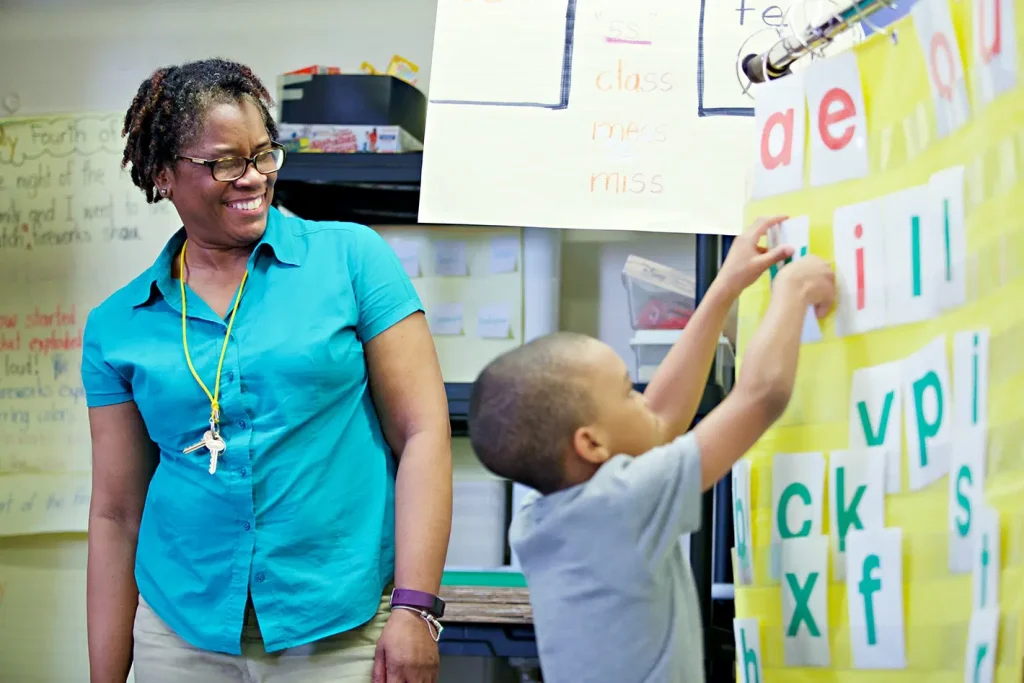
Plan your professional development

We’re excited to partner with you on your Amplify journey. Flexible professional development pathways have been designed to meet your needs.

Illustration of three educational phases: a teacher launches a rocket, another reads a book, and four individuals discuss in a meeting setting.

Recommended professional development plan

Our team has curated a recommended professional learning path from initial launch to continuous support. Use the Professional Development Planning Guide below to discuss the plan that best meets your school or district needs with your Account Executive.

Sessions overview

Title Duration Modality Available
Launch
Amplify ELAR Texas 6–8 Comprehensive initial training for teachers 2 days consecutive Onsite Yes
Amplify ELAR Texas 6–8 Initial training for teachers 1 day Onsite Yes
Amplify ELAR Texas 6–8 Initial training for teachers 2 half days Remote Yes
Amplify ELAR Texas 6–8 Initial training for instructional leaders Half day Onsite/Remote Yes
Amplify ELAR Texas 6–8 Getting started package Sess 1: 90 min.
Sess 2: 60 min.
Sess 3: 60 min.
Remote Yes
Strengthen
Amplify ELAR Texas 6–8 Enhancing observations for leaders
Half day Onsite/Remote 09/01/22
Amplify ELAR Texas 6–8 Enhancing planning and practice Half day Onsite/Remote Yes
Amplify ELAR Texas 6–8 Analytic reading Half day Onsite/Remote Yes
Amplify ELAR Texas 6–8 Supporting all learners Half day Onsite/Remote Yes
Amplify ELAR Texas 6–8 Data-informed instruction Half day Onsite/Remote Yes
Amplify ELAR Texas 6–8 Strengthening consultation package 3 1-hour sessions Remote Yes
Amplify ELAR Texas 6–8 Strengthening consultation session 1 hour Remote Yes
Coach
Amplify ELAR Texas 6–8 Coaching sessions 2 days consecutive Onsite Yes
Amplify ELAR Texas 6–8 Coaching sessions
1 day Onsite/Remote Yes
Half day Onsite/Remote Yes

Launch

Amplify ELAR Texas 6–8 Comprehensive initial training for teachers

2 days consecutive (6 hours per day, 12 hours total)

Prepare to implement and support Amplify ELAR Texas instruction in your schools! Learn how Amplify ELAR Texas supports students through rigorous and engaging instruction. Participants will navigate the Amplify ELAR Texas platform, learn to give feedback on student work, and explore how to use the embedded supports and the Reporting app to monitor student progress. Participants will engage in multiple opportunities to practice components of Amplify ELAR Texas and leave confident to begin teaching.

Audience: Teachers and coaches, maximum 30 participants
Modality: Onsite

Amplify ELAR Texas 6–8 Initial training for teachers

1 day (6 hours)

Prepare to implement and support Amplify ELAR Texas instruction in your schools! Learn how Amplify ELAR Texas supports students through rigorous and engaging instruction. Participants will navigate the Amplify ELAR Texas platform, learn to give feedback on student work, and explore how to use the embedded supports and the Reporting app to monitor student progress. Participants will leave with an action plan to begin teaching Amplify ELAR Texas.

Audience: Teachers and coaches, maximum 30 participants
Modality: Onsite

Amplify ELAR Texas 6–8 Initial training for teachers

2 half days (3 hours per day, 6 hours total)

This full day initial training session (6 hours) is split into two half-day sessions (3 hours each). Part 1 and Part 2 may be scheduled consecutively on the same day or on different days, ideally within ~2 weeks. The same participants should attend both sessions in order to receive all content about key components of Amplify ELAR Texas, which includes learning how to navigate, teach, and monitor student progress.

Audience: Teachers and coaches, maximum 30 participants
Modality: Remote

Amplify ELAR Texas 6–8 Initial training for instructional leaders

Half day (3 hours)

This training will provide district and school-level instructional leaders with an overview of Amplify ELAR Texas so that they can support their staff in implementing Amplify. Learn basic navigation and gain an understanding of Amplify’s approach to reading, writing, and language instruction. Participants will then have the opportunity to choose how to best support teachers by either developing a school-wide implementation plan or learning strategies for effective classroom observations.

Audience: Ideal for instructional leaders, principals, and district staff who oversee the implementation of the new curriculum, maximum 30 participants
Modality: Onsite/Remote

Amplify ELAR Texas 6–8 Getting started package

Participants will review the foundational elements of the program, including the structure of materials, and engage in a structured planning process. This 90 minute consultation session will focus on the upcoming unit participants are preparing to teach. This package includes 90 minutes of remote PD and two 60 minute follow-up remote sessions.

Audience: Teachers, coaches, and/or instructional leaders, maximum 30 participants
Modality: Remote

Strengthen

Amplify ELAR Texas 6–8 Enhancing observations for leaders

Half day (3 hours)

Prerequisite Training: Initial training for leaders

Elevate your program knowledge to support colleagues with effective ELAR implementation! Practice analyzing Amplify ELAR Texas lessons and identify key instructional elements and next steps. Participants will be prepared to analyze data and enhance classroom observations.

Audience: Ideal for instructional leaders, principals, and district staff who oversee the implementation of the new curriculum, maximum 30 participants
Modality: Onsite/Remote

Amplify ELAR Texas 6–8 Enhancing planning and practice

Half day (3 hours)

Dig into one unit to unpack standards, assessments, and student engagement. Through backward planning, this session guides teachers to think deeply about learning outcomes and key moments of formative assessments. Teachers will leave this session with a detailed plan of a unit of their choice, that includes learning outcomes, key assessment moments, and aligned instructional strategies.

Audience: Ideal for new or experienced Amplify ELAR Texas teachers or coaches, maximum 30 participants
Modality: Onsite/Remote

Amplify ELAR Texas 6–8 Analytic Reading

Half day (3 hours)

Participants will learn how analytic reading functions in Amplify ELAR Texas and which teacher moves support students as they tackle complex texts. Participants will learn how to facilitate a close reading session to support key reading routines and promote academic discourse and the type of collaboration that drives analysis and deepens understanding.

Audience: Ideal for new or experienced Amplify ELAR Texas teachers, maximum 30 participants
Modality: Onsite/Remote

Amplify ELAR Texas 6–8 Supporting all learners

Half day (3 hours)

Participants will learn how to effectively use embedded and differentiated supports and the Classwork app to support all students, including English language learners (ELL), students with learning disabilities, struggling readers, and writers, and advanced students.

Audience: Ideal for new teachers or instructional leaders who want to learn more about included supports in Amplify ELAR Texas, maximum 30 participants
Modality: Onsite/Remote

Amplify ELAR Texas 6–8 Data-informed instruction

Half day (3 hours)

Prerequisite: 4–6 weeks of student data in Amplify’s Reporting app. It is recommended that teachers are in at least Unit B.

Participants will review their own student data using the Reporting and Classwork apps and align embedded supports to specific student needs. The goal of this session is to become proficient in turning Amplify ELAR Texas data into differentiated and targeted instruction. Note: This course can be combined with the Supporting All Learners session to make a full day of training.

Audience: Ideal for teachers or support staff who want to learn how to use student data to inform instruction and provide differentiation, maximum 30 participants
Modality: Onsite/Remote

Amplify ELAR Texas 6–8 Strengthening consultation session


1 hour

This 60-minute session will focus on a specific topic that will deepen educators” understanding in Amplify ELAR Texas and equip them with the tools needed to drive stronger student outcomes. An Amplify facilitator will align with the school or district leadership team in advance of the session on the topic (chosen from a menu of options) that will best meet educators unique needs. The menu includes sessions on engagement, pacing, and grading/assessment.

Audience: Teachers and coaches, maximum 30 participants
Modality: Remote

Amplify ELAR Texas 6–8 Strengthening consultation package

3 1-hour sessions

This package consists of three 60-minute sessions that can be delivered on the same day or on different days. Each session will focus on a specific topic that will deepen educators’ understanding in ELA and equip them with the tools needed to drive stronger student outcomes. An Amplify facilitator will align with the school or district leadership team in advance of the session on the topic (chosen from a menu of options) that will best meet educators’ unique needs. The menu includes sessions on engagement, pacing, and grading/assessment.

Audience: Teachers and coaches, maximum 30 participants
Modality: Remote

Coach

Amplify ELAR Texas 6–8 Coaching session

2 days consecutive (6 hours per day, 12 total)

Strengthen your implementation of Amplify ELAR Texas with an onsite Coaching visit for your teachers and/or leaders. Participants can choose from a variety of topics that include, but are not limited to: lesson modeling and debrief (conducted by an Amplify coach), grade-level planning, classroom observations, and leadership consultation. The flexible onsite coaching design allows for a collaborative approach to support effective program implementation.

Audience: Teachers, coaches, and/or instructional leaders, maximum 30 participants
Modality: Onsite

Amplify ELAR Texas 6–8 Coaching session

1 day (6 hours)

Strengthen your implementation of Amplify ELAR Texas with an onsite Coaching visit for your teachers and/or leaders. Participants can choose from a variety of topics that include, but are not limited to: lesson modeling and debrief (conducted by an Amplify coach), grade-level planning, classroom observations, and leadership consultation. The flexible onsite coaching design allows for a collaborative approach to support effective program implementation.

Audience: Teachers, coaches, and/or instructional leaders, maximum 30 participants
Modality: Onsite/Remote

Amplify ELAR Texas 6–8 Coaching session

Half day (3 hours)

Strengthen your implementation of Amplify ELAR Texas with a Coaching session for your teachers and/or leaders. Participants can choose from a variety of topics that include, but are not limited to lesson modeling and debrief (conducted by an Amplify coach), grade-level planning, classroom observations, and leadership consultation. The flexible coaching design allows for a collaborative approach to supporting effective program implementation.

Audience: Teachers, coaches, and/or instructional leaders, maximum 30 participants
Modality: Onsite/Remote

Pricing

We offer the following pricing for training sessions and packages:

Session type Pricing
2-day onsite session $4,800
1-day onsite session $3,200
1-day remote session (2 half days remote) $1,500
Half-day onsite session $2,500
Half-day remote session $750
1-hour remote session $350
Remote getting started package $1,000
3 1-hour remote sessions $1,000

Please note that the prices are general ranges and may be subject to change.

Contact

Amplify welcomes the opportunity to partner with schools and districts to design professional development plans and answer your questions.

If you would like to order any of our professional development services, please contact your local Amplify sales representative or call (800) 823-1969.
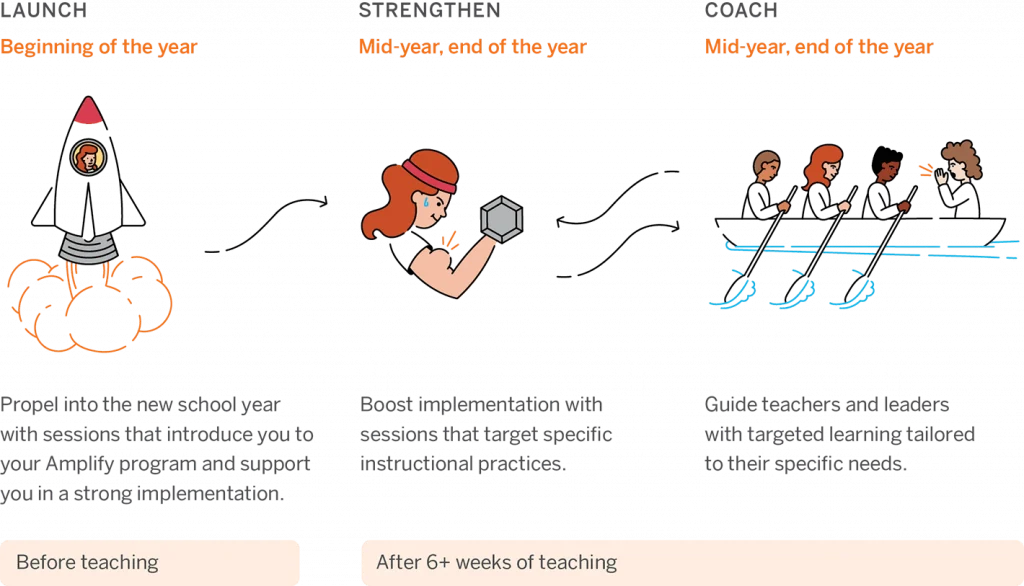
Louisiana’s review of Amplify ELA for middle school

To view this protected page, enter the password below:


Welcome back to Amplify Science!

On this page, you’ll find helpful resources, for returning educators, to support you and your students to ensure you have a successful year with Amplify. Let’s dig in.

A woman in glasses examining a glass of water, surrounded by illustrations of scientific icons like satellites, a rocket, a telescope, moons, and clouds on an abstract orange and black background.

Professional learning resources

Amplify Science K-5

When you’re ready to log in to learning.amplify.com and get started, begin by watching the navigation video for grades K–5 to familiarize you with the digital organization of materials. Visit the PD Library to learn how to find everything you need to teach with this video about navigating Amplify Science. Note: login required!

Amplify Science 6-8

When you are ready to log in to learning.amplify.com and get startedbegin by watching the navigation video for grades 6–8 to familiarize yourself with the digital organization of materials. Visit the PD Library to learn how to find everything you need to teach with this video about navigating Amplify Science. Note: login required!

Program Hub

Access self-study professional resources on our Amplify Science program hub (log-in required). Here you will find resources and videos on:

  • Remote learning resources
  • Training videos
  • Hands-on Investigation Videos

Professional Development Library

The Professional Development Library is a space for educators to learn more about Amplify Science through short, engaging video collections. The PD Library can be located on the Program & Apps menu when logged into the program. Watch the training videos based on your grade band to learn more about pacing, planning, and teaching Science!

Level up learning webinars

Level up your Amplify Science experience with our We Are Scientists webinars! We showcased expert classroom teaching strategies and offered educator tips and tricks on how to get creative with learning with your students.

Admin tools

Elementary school resources (grades K–5)

For a refresher on navigating and locating resources in the digital Teacher’s Guide, access the page for new users for mini on-boarding videos.

What’s new for 2024-25?
Amplify Science is launching exciting new and updated features for the upcoming school year. Click here to check out improvements designed to save you time, extend your reach, and support your efforts to deliver the rigorous and riveting learning experiences your students deserve.

Have a question? Here is where you can look to find the answer..

Planning guides
Planning guides for grades K–5 walk you through strategies for planning for a unit, including which resources to locate in either the print or digital Teacher’s Guide to most effectively plan:

Additional resources
If you’re interested in learning more about each unit’s anchor phenomena, the Student Books in each unit, and more program features, download the resources below:

Middle school resources (grades 6–8)

For a refresher on navigating and locating resources in the digital Teacher’s Guide, access the page for new users for mini on-boarding videos.

What’s new for 2024-25?
Amplify Science is launching exciting new and updated features for the upcoming school year. Click here to check out improvements designed to save you time, extend your reach, and support your efforts to deliver the rigorous and riveting learning experiences your students deserve.

Have a question? Here is where you can look to find the answer…

Planning guide
Our planning guide walks you through strategies for planning for a unit, including which resources to locate in either the print or digital Teacher’s Guide to most effectively plan. Click here to download.

Additional resources
If you’re interested in learning more about each unit’s anchor phenomena, the Student Books in each unit, and more program features, download the resources below:

Ready to dig a little deeper?

Revisiting coherence flowcharts

Take another look (or look for the first time) at the coherence flowcharts for your unit (found in the printable resources section of the unit guide).

Sample Coherence Flowchart: First Grade: Plant and Animal Defenses

Sample Coherence Flowchart: Fourth Grade: Energy Conversions

Sample Coherence Flowchart: Seventh Grade: Plate Motion

Enhance your discourse routines 

Productive Discourse Routines

Discourse Routines in K-5

Using Phenomena in NGSS

Looking for help?

Timely technical, program, and pedagogical support
Our technical and program support is included and available from 8 a.m. to 7 p.m. ET, Monday through Friday, through a variety of channels, including a live chat program that enables teachers to get immediate help in the middle of the school day. As a part our support, Amplify also has an Educational Support Team of former teachers and administrators who provide instructional support for every Amplify curriculum, assessment, and intervention program.

For your most urgent questions:

  • Use our live chat within your program
  • Call our toll-free number: 1 888 850 0945

For less urgent questions:

Reach out to our support team at: help@amplify.com

Amplify Science professional development

Amplify Science blends hands-on investigations, literacy-rich activities, and interactive digital tools to empower students to think, read, write, and argue like real scientists and engineers. We’ve created a wide suite of professional development offerings that will help you meet your unique needs this school year. Find out more below!

Professional Learning Partner Guide Certified Provider

Amplify CKLA, ELA, and Science professional development has been vetted by Rivet Education’s team through a rigorous three-step process and is listed in the Professional Learning Partner Guide.

Three women sitting at a table using a tablet to discuss stimulus funding for schools in a professional meeting.

Plan your professional development

We’re excited to partner with you on your Amplify journey. Flexible professional development pathways have been designed to meet your needs.

Illustration of three educational phases: a teacher launches a rocket, another reads a book, and four individuals discuss in a meeting setting.

Recommended professional development plan

Our team has curated a recommended professional learning path from initial launch to continuous support. Use the Professional Development Planning Guide below to discuss the plan that best meets your school or district needs with your Account Executive.

Sessions overview

Recommended sessions are highlighted below.
Audience Title Duration Modality Available
Launch
K–5 instructional leaders Administrators’ program overview Half day Onsite/Remote Yes^
TK teachers Transitional kindergarten program overview Half day Onsite/Remote Yes
K–5 teachers Initial training 1 day onsite
or 2 days
remote
Onsite/Remote Yes*^
K–5 teachers Program overview Half day Onsite/Remote Yes
Interactive Classroom consultation 90 min. Remote Yes
6–8 instructional leaders Administrators’ program overview Half day Onsite/Remote Yes
6–8 teachers Initial training 1 day onsite
or 2 days
remote
Onsite/Remote Yes*
6–8 teachers Program overview Half day Onsite/Remote Yes
Strengthen
K–5 instructional leaders Strengthening consultation session 60 min. Remote 6/2022
Strengthening consultation package 3 1-hour sessions Remote 6/2022
K–5 teachers Guided unit internalization Half day Onsite/Remote Yes
K–5 teachers The Assessment System Half day Onsite/Remote Yes
Supporting all learners with complex texts Half day Onsite/Remote Yes
Writing in science Half day Onsite/Remote Yes
Supporting English learners Half day Onsite/Remote Yes
Strengthening consultation session 60 min. Remote 6/2022
Strengthening consultation package 3 1-hour sessions Remote 6/2022
6–8 instructional leaders Strengthening consultation session 60 min. Remote 6/2022
Strengthening consultation package 3 1-hour sessions Remote 6/2022
6–8 teachers Guided unit internalization Half day Onsite/Remote Yes
6–8 teachers The Assessment System Half day Onsite/Remote Yes
Supporting all learners with complex texts Half day Onsite/Remote Yes
Writing in science Half day Onsite/Remote Yes
Supporting English learners Half day Onsite/Remote Yes
Engineering Internships Half day Onsite/Remote Yes
Science Seminar Half day Onsite/Remote Yes
Strengthening consultation session 60 min. Remote  6/2022
Strengthening consultation package 3 1-hour sessions Remote  6/2022
Coach
K–5 instructional leaders Job-Embedded Coaching (JEC) 1 day Onsite Yes
K–5 teachers Job-Embedded Coaching (JEC) 1 day Onsite/Remote Yes
6–8 instructional leaders Job-Embedded Coaching (JEC) 1 day Onsite Yes
6–8 teachers Job-Embedded Coaching (JEC) 1 day Onsite/Remote Yes
Note for all workshops:  Any single three-hour offering can be repeated on the same day with different audiences to make one full-day session.
*When delivered remotely, this full-day initial training session (6 hours) is split into two half-day sessions (3 hours each). Part 1 and Part 2 may be scheduled consecutively on the same day or on different days, ideally within ~2 weeks. The same participants should attend both sessions in order to receive all content. This flexible scheduling opportunity for remote sessions will be available starting 6/2022.

^Session will be available for IC customers after June 1, 2022.

Launch

For teachers

Initial training

1 day onsite (6 hours) or 2 half days remote (6 hours)*
Grade band: K–1 / K–5 / 6–8
Grade level: K, 1, 2, 3, 4, 5, 6, 7, 8

In the first half of this session, participants learn the essentials necessary to implement Amplify Science with success. They learn to navigate the digital Amplify Science platform and become familiar with planning resources and strategies. Through a model lesson and guided reflection, participants build an understanding of the instructional approach to teaching and learning. In the second half of this session, participants dig deeper into unit resources to start planning for instruction for their first grade-level unit.

When delivered as a grade band session, Part 1 will feature an exemplar from the following units:

  • K–1 workshops feature an exemplar from the grade 1 unit Animal and Plant Defenses.
  • K–5 workshops feature an exemplar from the grade 4 unit Energy Conversions.
  • 6–8 workshops feature an exemplar from the Metabolism Core unit.

When delivered as a grade level session, Part 1 features the following units:

  • K: Needs of Plants and Animals
  • 1: Animal and Plant Defenses
  • 2: Plant and Animal Relationships
  • 3: Balancing Forces
  • 4: Energy Conversions
  • 5: Patterns of Earth and Sky

6–8 workshops feature one of the following units:

  • Metabolism
  • Plate Motion
  • Force and Motion

Interactive Classroom customers: Select K-5 grade band or K, 1, 2, 3, 4, 5 grade level sessions (available starting 6/2022)

Audience: Teachers (administrators welcome), maximum 30 participants
Modality: Onsite/Remote

*When delivered remotely, this full-day initial training session (6 hours) is split into two half-day sessions (3 hours each). Part 1 and Part 2 may be scheduled consecutively on the same day or on different days, ideally within two weeks. The same participants should attend both sessions in order to receive all content. This flexible scheduling opportunity for remote sessions will be available starting 6/2022.

Interactive Classroom consultation

90 minutes
Grade band: K–5
Prerequisite: Initial training or program overview

In this remote consultation session, participants prepare to leverage Amplify Science’s new K-5 Interactive Classroom experience. The session includes a walkthrough of new digital features available to teachers and an opportunity for participants to experience these enhancements through modeled activities from an exemplar K-5 unit. The session closes with time for participants to explore the digital features and ask questions to support their planning.

*This session is designed for experienced Amplify Science users who are new to adding Interactive Classroom.

Audience: Teachers, maximum 30 participants
Modality: Remote

Program overview

Half day (3 hours)
Grand band: K–1, K–5, 6–8
Grade level: K, 1, 2, 3, 4, 5, 6, 7, 8

In this session, participants learn the essentials necessary to implement Amplify Science with success. They learn to navigate the digital Amplify Science platform and become familiar with planning resources and strategies. Through a model lesson and guided reflection, participants build an understanding of the instructional approach to teaching and learning.

When delivered as a grade band session, an exemplar will be featured from the following units:

  • K–1 workshops feature an exemplar from the grade 1 unit Animal and Plant Defenses.
  • K–5 workshops feature an exemplar from the grade 4 unit Energy Conversions.
  • 6–8 workshops feature an exemplar from Metabolism.

When delivered as a grade level session, the following units will be featured:

  • K: Needs of Plants and Animals
  • 1: Animal and Plant Defenses
  • 2: Plant and Animal Relationships
  • 3: Balancing Forces
  • 4: Energy Conversions
  • 5: Patterns of Earth and Sky

6–8 workshops feature one of the following units:

  • Metabolism
  • Plate Motion
  • Force and Motion

Interactive Classroom customers: Select K-5 grade band or K, 1, 2, 3, 4, 5 grade level sessions

Audience: Teachers (administrators welcome), maximum 30 participants
Modality: Onsite/Remote

Transitional kindergarten program overview

Half day (3 hours)
Grade level: TK

In this session, participants dive into exploring and planning for the first TK unit, Wondering About Noises in Trees. They engage with model activities, experience key instructional routines, and plan how they’ll implement this flexible curriculum in their classrooms. Participants collaborate to build a deep understanding of the TK instructional approach and structure. They will leave ready to start instruction in their classrooms, and take away a suite of additional resources to support their preparation for other TK units.

Audience: Teachers (administrators welcome), maximum 30 participants
Modality: Onsite/Remotewelcome), maximum 30 participants
Modality: Onsite/Remote

For instructional leaders

Administrators’ program overview

Half day (3 hours)
Grade band: K–5 / 6–8

In this session, instructional leaders become familiar with the principles of phenomenon-based teaching and learning, and experience the instructional approach of Amplify Science units. Leaders consider their essential role supporting teachers and students with the implementation of a new science curriculum.

Interactive Classroom customers: Select K-5 grade band session (available starting 6/2022)

Audience: Administrators, department chairs, coaches, maximum 30 participants
Modality: Onsite/Remote

Strengthen

For teachers

The Assessment System

Half day (3 hours)
Grade band: K–5 / 6–8
Prerequisite: Initial training or program overview

In this session, participants learn about the structure and purpose of the varied formative and summative opportunities in the Amplify Science Assessment System. Participants experience and analyze a sample formative assessment, deepen their understanding of unit learning progressions, and acquire strategies for collecting, analyzing, and responding to student assessment data. Collaborative reflections and discussions support participants’ understanding of the relationships among different types of assessments and their unit’s learning goals.

Audience: Teachers (administrators welcome), maximum 30 participants
Modality: Onsite/Remote

Supporting all learners with complex texts

Half day (3 hours)
Grade band: K–5 / 6–8
Prerequisite: Initial training or program overview

In this session, participants learn strategies to support all students as they access the complex texts in Amplify Science units. They explore the connections among the ways professional scientists read and how Amplify Science lessons build students’ capacity as science readers. The workshop includes a model reading sequence, collaborative problem-solving around common student reading challenges, and planning time for upcoming reading lessons in participants’ units.

Audience: Teachers (administrators welcome), maximum 30 participants
Modality: Onsite/Remote

Writing in science

Half day (3 hours)
Grade band: K–5 / 6–8
Prerequisite: Initial training or program overview

K–5: In this session, participants develop an understanding of how the Amplify Science writing approach supports students to engage in science practices, make sense of science ideas, and develop as writers. Participants experience an example multimodal instructional sequence that demonstrates the connections among informal daily writing and the more structured formal scientific explanations and arguments students write in each Amplify Science unit. They dig into resources for analyzing student writing then apply their learning to plan for supporting student writing in their unit.

6-8: In this session, participants develop an understanding of how the Amplify Science writing approach supports students to engage in science practices, make sense of science ideas, and develop as writers. Participants experience an example instructional sequence that demonstrates the varied purposes for frequent small, informal writing opportunities in multimodal science instruction, then they analyze how each core unit’s culminating Science Seminar experience works as a scaffold to support students as they write sophisticated scientific arguments. The session closes with a guided reflection on strategies for supporting student writing.

Audience: Teachers (administrators welcome), maximum 30 participants
Modality: Onsite/Remote

Supporting English learners

Half day (3 hours)
Grade band: K–5 / 6–8
Prerequisite: Initial training or program overview

In this session, participants explore strategies to support English learners’ ability to do, talk, read, write, visualize, and construct arguments like scientists. By engaging in model activities, participants deepen their knowledge of the critical role that language and literacy play in developing scientific understanding. Participants become familiar with the research-based principles underlying the embedded supports and strategies in Amplify Science, which aid in students’ development of disciplinary literacy in science.

Audience: Teachers (administrators welcome), maximum 30 participants
Modality: Onsite/Remote

Guided unit internalization

Half day (3 hours)
Grade band: K–5 / 6–8
Grade level: TK, K, 1, 2, 3, 4, 5, 6, 7, 8
Prerequisite: Initial training or program overview

In this session, participants leverage a planning protocol to internalize an upcoming unit. They apply their understanding of how students engage in three-dimensional learning throughout the unit to plan for the diverse needs of their classrooms and students.

Audience: Teachers (administrators welcome), maximum 30 participants
Modality: Onsite/Remote

Engineering Internships

Half day (3 hours)
Grade level: 6, 7, 8
Prerequisite: Initial training or program overview

In this session, participants explore and plan for the first Engineering Internship of their grade-level course. Participants are oriented to the Futura Workspace and other digital tools used with students in the internship experience. Participants also dive deeper into how students apply science concepts from core units to construct design solutions, learning engineering concepts and practices throughout the process.

Workshop will feature one of the following units:

  • Metabolism Engineering Internship
  • Plate Motion Engineering Internship
  • Force and Motion Engineering Internship

Audience: Teachers (administrators welcome), maximum 30 participants
Modality: Onsite/Remote

Science Seminar

Half day (3 hours)
Grade band: 6–8
Prerequisite: Initial training or program overview

This session focuses on the culminating Science Seminar sequence at the end of the grades 6–8 core units, in which students apply the conceptual understanding built throughout the unit to engage in argumentation about a unique but related phenomenon. Participants experience a Science Seminar sequence from an exemplar unit as students do, then dive into a unit at their grade level to internalize the Science Seminar sequence and plan for instruction.

Audience: Teachers (administrators welcome), maximum 30 participants
Modality: Onsite/Remote

Strengthening consultation session

60-minute session
Grade band: K–5 / 6–8
Grade level: K, 1, 2, 3, 4, 5, 6, 7, 8
Prerequisite: Initial training or program overview

This 60-minute session focuses on a specific topic that will deepen teachers understanding of Amplify Science. An Amplify facilitator will align with the school or district leadership team in advance on the topic (chosen from a menu of options) that will best meet teachers’ unique options.

Topics include:

  • Supporting Diverse Learners: Exploring the resources (for K–8 teachers)
  • Supporting Diverse Learners: Leveraging and Building upon Embedded Supports A: Teacher modeling and student discourse (for K–8 teachers)
  • Supporting Diverse Learners: Leveraging and Building upon Embedded Supports B: Multimodal instruction
  • Planning an Amplify Science lesson (for K–8 teachers)
  • Unit kits and materials prep (for K–5 teachers)
  • Grading with Amplify Science (for K–8 teachers)
  • Analyzing Student Work (for K–8 teachers)

Available starting 6/2022.

Audience: Teachers, maximum 30 participants
Modality: Remote

Strengthening consultation package

3 1-hour sessions
Grade band:K–5 / 6–8
Grade level:K, 1, 2, 3, 4, 5, 6, 7, 8
Prerequisite:Initial training or program overview

This package consists of three 60-minute sessions that can be delivered on the same day or on different days. Each session will focus on a specific topic that will deepen teachers understanding of Amplify Science. An Amplify facilitator will align with the school or district’s leadership team in advance on the topic from a menu of options that will best meet teachers’ unique needs.

Available starting 6/2022.

Audience:Teachers, maximum 30 participants
Modality: Remote

For instructional leaders

Strengthening consultation session

60-minute session
Grade band: K–5 / 6–8
Grade level: K, 1, 2, 3, 4, 5, 6, 7, 8
Prerequisite: Administrators’ program overview

These 60 minute sessions will focus on a specific topic that will deepen instructional leaders’ understanding in Amplify Science and equip them in driving towards stronger student outcomes. An Amplify facilitator will align with the school or district’s leadership team in advance on the topic from a menu of options that will best meet instructional leaders’ unique needs.

Topic available for summer 2022: Amplify Science classroom look-fors (for K-8 leaders).

Available starting 6/2022.

Audience: Administrators, department chairs, coaches, maximum 30 participants
Modality: Remote

Strengthening consultation package

3 1-hour sessions
Grade band: K–5 / 6–8
Prerequisite: Administrators’ program overview

This package consists of three 60-minute sessions that can be delivered on the same day or on different days. Each session will focus on a specific topic that will deepen leaders’ understanding of Amplify Science. An Amplify facilitator will align with the school or district’s leadership team in advance on the topic from a menu of options that will best meet leaders’ unique needs.

Available starting 6/2022.

Audience: Administrators, department chairs, coaches, maximum 30 participants
Modality: Remote

Coach

For teachers

Job-Embedded Coaching (JEC) services: Teachers

1 day (6 hours)
Grade band: K–5 / 6–8
Grade level: K, 1, 2, 3, 4, 5, 6, 7, 8
Prerequisite: Initial training or program overview

Strengthen your implementation of Amplify Science with a coaching onsite visit for your teachers. An Amplify Science Professional Learning Specialist can visit classrooms for observation and debriefs with focused feedback and/or facilitate PLC or grade-level meetings to support teachers with planning decisions. The flexible coaching design allows for a collaborative and personalized approach to support effective program implementation.

Audience: Teachers, maximum 30 participants
Modality: Onsite/Remote

For instructional leaders

Job-Embedded Coaching (JEC): Administrators

1 day (6 hours)
Grade band: K–5 / 6–8
Prerequisite: Administrators’ program overview

In our Coaching sessions, instructional leaders engage in facilitated Professional Learning Walks (PLW)—non-evaluative classroom observations of Amplify Science classrooms that focus on building capacity to identify indicators of strong implementation of the program. Classroom look-fors focus on the use of instructional resources (material access/use and the Classroom Wall), instructional delivery (unpacking the unit phenomena and multimodal instruction), and monitoring of instruction (supporting all learners and use of the Assessment System). Leaders collaboratively analyze collected data in order to identify strengths and areas for growth specific to the implementation of Amplify Science for their teaching teams. Leaders leave with an action plan for supporting their teachers based on the analysis and reflection from the PLW.

Audience: Administrators, department chairs, coaches, maximum 30 participants
Modality: Onsite

Pricing

We offer the following pricing for training sessions and packages:

Session typePricing
2 consecutive full day onsite sessions$4,800
1-day onsite session$3,200
1-day remote session (2 half days)$1,500
1-day remote coaching session$1,200
Half-day onsite session$2,500
Half-day remote session$750
90-minute remote session$500
60-minute remote session$350
3 1-hour remote sessions$1,000
Customized Amplify Science onsite or remote packagesPrice will vary

Please note that the prices are general ranges and may be subject to change.

Contact

Amplify welcomes the opportunity to partner with schools and districts to design professional development plans and answer your questions.

If you would like to order any of our professional development services, please contact your local Amplify sales representative or call (800) 823-1969.
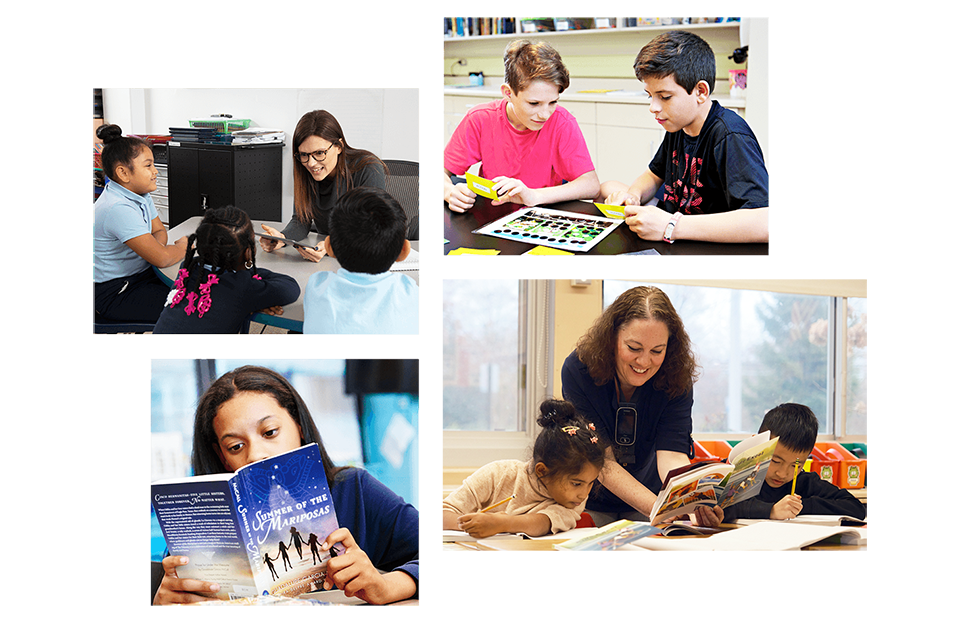
Amplify ELA professional development

Amplify ELA is an engaging and rigorous curriculum designed specifically for grades 6–8. With Amplify ELA, students learn to tackle any complex text and make observations, grapple with interesting ideas, and find relevance for themselves.

We’ve created a wide suite of professional development offerings that will help you meet your unique needs. Find out more below!

Professional Learning Partner Guide Certified Provider

Amplify CKLA, ELA, and Science professional development has been vetted by Rivet Education’s team through a rigorous three-step process and is listed in the Professional Learning Partner Guide.

A male teacher in a red shirt explaining a lesson to a young female student who is reading a book in a classroom.

Plan your professional development

We’re excited to partner with you on your Amplify journey. Flexible professional development pathways have been designed to meet your needs.

Illustration of three educational phases: a teacher launches a rocket, another reads a book, and four individuals discuss in a meeting setting.

Recommended Professional Development Plan

Our team has curated a recommended professional learning path from initial launch to continuous support. Use the Professional Development Planning Guide below to discuss the plan that best meets your school or district needs with your Account Executive.

Sessions overview

Recomended sessions are highlighted below

Title Duration Modality Available
Launch
Comprehensive initial training for teachers 2 days consecutive Onsite Yes
Initial training for teachers 1 day Onsite Yes
Initial training for teachers 2 half days Remote Yes
Program overview Half day Onsite/Remote Yes
Initial training for leaders Half day Onsite/Remote Yes
Strengthen
Enhancing observations for leaders Half day Onsite/Remote 09/01/22
Enhancing planning and practice Half day Onsite/Remote Yes
Analytic reading Half day Onsite/Remote Yes
Supporting all learners Half day Onsite/Remote Yes
Data-informed instruction Half day Onsite/Remote Yes
Writing: Improving through feedback Half day Onsite/Remote Yes
Strengthening consultation session 1 hour Remote Yes
Strengthening consultation package 3 1-hour sessions Remote Yes
Coach
Coaching sessions 2 days consecutive Onsite Yes
Coaching sessions 1 day Onsite/Remote Yes
Half day Onsite/Remote Yes

Launch

Comprehensive initial training for teachers

2 days consecutive (6 hours per day, 12 hours total)

Prepare to implement and support Amplify ELA instruction in your school! Learn how Amplify ELA supports students through rigorous and engaging ELA instruction. Participants will navigate the Amplify ELA platform, learn to give feedback on student work, and explore how to use Amplify ELA’s embedded supports and Reporting app to monitor student progress. Participants will have multiple opportunities to practice components of Amplify ELA and leave confident to begin teaching.

Audience: Teachers and coaches
Modality: Onsite, maximum 30 participants

Initial training for teachers

1 day (6 hours)

Prepare to implement and support Amplify ELA instruction in your schools! Learn how Amplify ELA supports students through rigorous and engaging ELA instruction. Participants will navigate the Amplify ELA platform, learn to give feedback on student work, and explore how to use Amplify ELA’s embedded supports and Reporting app to monitor student progress. Participants will leave with an action plan to begin teaching Amplify ELA.

Audience: Teachers and coaches, maximum 30 participants
Modality: Onsite

Initial training for teachers

2 half days (3 hours per day, 6 hours total)

This full day initial training session (6 hours) is split into two half-day sessions (3 hours each). Part 1 and Part 2 may be scheduled consecutively on the same day or on different days, ideally within ~2 weeks. The same participants should attend both sessions in order to receive all content about key components of Amplify ELA, which includes learning how to navigate, teach, and monitor student progress.

Audience: Teachers and coaches, maximum 30 participants
Modality: Remote

Program essentials

Half day (3 hours)

Learn the program essentials, including how to navigate the digital curriculum and print materials and where to locate features like assessments and data reports.

Audience: Teachers and coaches, maximum 30 participants
Modality: Onsite/Remote

Initial training for instructional leaders

Half day (3 hours)

This training will provide district- and school-level instructional leaders with an overview of Amplify ELA so that they can support their staff in implementing Amplify.

Learn basic navigation and gain an understanding of Amplify ELA’s approach to reading, writing, and language instruction. Participants will then have the opportunity to choose how to best support teachers by either developing a school-wide implementation plan or learning strategies for effective classroom observations.

Audience: Ideal for instructional leaders, principals, and district staff who oversee the implementation of the new curriculum, maximum 30 participants
Modality: Onsite/Remote

Strengthen

Enhancing observations for leaders

Half day (3 hours)

Elevate your program knowledge to support colleagues with effective ELA implementation! Practice analyzing ELA lessons and identify key instructional elements and next steps. Participants will be prepared to analyze data and enhance classroom observations.

Prerequisite training: Initial training for leaders
Audience: Ideal for instructional leaders, principals, and district staff who oversee the implementation of the new curriculum, maximum 30 participants
Modality: Onsite/Remote

Enhancing planning and practice

Half day (3 hours)

Dig into one unit to unpack standards, assessments, and student engagement. Through backward planning, this session guides teachers to think deeply about learning outcomes and key moments of formative assessments. Teachers will leave this session with a detailed plan of a unit of their choice that includes learning outcomes, key assessment moments, and aligned instructional strategies.

Audience: Ideal for new or experienced Amplify ELA teachers or coaches, maximum 30 participants
Modality: Onsite/Remote

Analytic reading

Half day (3 hours)

Participants will learn how close reading functions in Amplify ELA and which teacher moves will support students tackling complex texts. Participants will also learn how to facilitate a close reading session to develop key reading routines, promote academic discourse, and encourage the type of collaboration that drives analysis and deepens understanding.

Audience: Ideal for new or experienced Amplify ELA teachers, maximum 30 participants
Modality: Onsite/Remote

Supporting all learners

Half day (3 hours)

Participants will learn how to effectively use embedded and differentiated supports and the Classwork app to support all students, including ELLs, students with learning disabilities, struggling readers and writers, and advanced students.

Audience: Ideal for new teachers or instructional leaders who want to learn more about included supports in Amplify ELA, maximum 30 participants
Modality: Onsite/Remote

Data-informed instruction

Half day (3 hours)

Participants will review their own student data using the Reporting and Classwork apps and align embedded supports to specific student needs. The goal of this session is to become proficient in turning Amplify ELA data into differentiated and targeted instruction.

Note: This course can be combined with the supporting all learners session to make a full day of training.

Prerequisite: 4–6 weeks of student data in Amplify’s Reporting app. It is recommended that teachers are in at least Unit B.
Audience: Ideal for teachers or support staff who want to learn how to use student data to inform instruction and provide differentiation, maximum 30 participants
Modality: Onsite/Remote

Writing: Improving through feedback

Half day (3 hours)

Participants will learn how writing functions in Amplify ELA and which teacher moves support students as they build writing skills. Participants will learn how feedback supports student growth and will practice giving targeted feedback based on rubrics and assessment data.

Audience: This course asks teachers to look at their students’ writing, so it is recommended for delivery after 4–6 weeks of curriculum use, maximum 30 participants
Modality: Onsite/Remote

Strengthening consultation session

1 hour

This 60-minute session will focus on a specific topic that will deepen educators’ understanding in Amplify ELAR Texas and equip them with the tools needed to drive stronger student outcomes. An Amplify facilitator will align with the school or district leadership team in advance of the session on the topic (chosen from a menu of options) that will best meet educators’ unique needs. The menu includes sessions on: engagement, pacing and grading/assessment.

Audience: Teachers and coaches, maximum 30 participants
Modality: Remote

Strengthening consultation package

3 1-hour sessions

This package consists of three 60-minute session that can be delivered on the same day or on different days. Each session will focus on a specific topic that will deepen educators’ understanding in ELA and equip them with the tools needed to drive stronger student outcomes. An Amplify facilitator will align with the school or district leadership team in advance of the session on the topic (chosen from a menu of options) that will best meet educators’ unique needs. The menu includes sessions on: engagement, pacing and grading/assessment.

Audience: Teachers and coaches, maximum 30 participants
Modality: Remote

Coach

Coaching session

2 days consecutive (6 hours per day, 12 total)

Strengthen your implementation of Amplify ELA with an onsite coaching visit for your teachers and/or leaders. Participants can choose from a variety of topics that include, but are not limited to: lesson modeling and debrief (conducted by an Amplify ELA coach), grade-level planning, classroom observations, and leadership consultation. The flexible onsite coaching design allows for a collaborative approach to support effective program implementation.

Audience: Teachers, coaches, and/or instructional leaders, maximum 30 participants
Modality: Onsite

Coaching session

1 day (6 hours)

Strengthen your implementation of Amplify ELA with an onsite coaching visit for your teachers and/or leaders. Participants can choose from a variety of topics that include, but are not limited to: lesson modeling and debrief (conducted by an Amplify ELA coach), grade-level planning, classroom observations, and leadership consultation. The flexible onsite coaching design allows for a collaborative approach to support effective program implementation.

Audience: Teachers, coaches, and/or instructional leaders, maximum 30 participants
Modality: Onsite/Remote

Coaching session

Half day (3 hours)

Strengthen your implementation of Amplify ELA with a coaching session for your teachers and/or leaders. Participants can choose from a variety of topics that include, but are not limited to: lesson modeling and debrief (conducted by an Amplify ELA coach), grade-level planning, classroom observations, and leadership consultation. The flexible coaching design allows for a collaborative approach to support effective program implementation.

Audience: Teachers, coaches, and/or instructional leaders, maximum 30 participants
Modality: Onsite/Remote

Pricing

We offer the following pricing for training sessions and packages:

TypePricing
2-day onsite session$4,800
1-day onsite session$3,200
1-day remote session (2 half days remote)$1,500
Half-day onsite session$2,500
Half-day remote session$750
1-hour remote session$350
3 1-hour remote sessions$1,000

Please note that the prices are general ranges and may be subject to change.

Contact

Amplify welcomes the opportunity to partner with schools and districts to design professional development plans and answer your questions.

If you would like to order any of our professional development services, please contact your local Amplify sales representative or call (800) 823-1969.
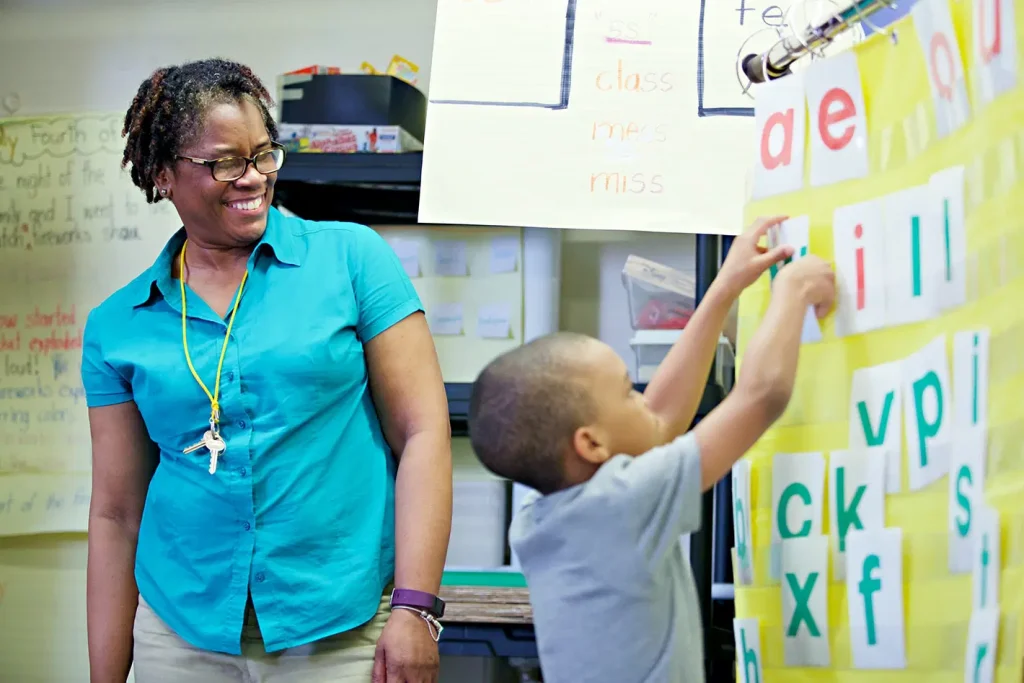
9

Inspiring the next generation of Alabama scientists, engineers, and curious citizens

To view this protected page, enter the password below:


Amplify Science resources for Chicago Public Schools

To view this protected page, enter the password below:


Making the most of a science education conference

A typical science education conference such as NSTA may offer hundreds of booths, sessions, and new people to meet—and, most of the time, a typical science educator can’t do it all! So how can you maximize these opportunities to learn even more about teaching science … without maxing out? Middle-school educator and Science Connections podcast host Eric Cross is here to offer his tips. Here’s what he shared with us: 

Proven tips for capitalizing on science education conferences

  • Fuel up: Good food and good coffee are essential for me. Before you arrive, do some pre-trip research into local coffee shops and restaurants near the conference center. Avoid the long lines and overpriced food at the conference venue; instead, support local businesses to keep your energy levels up. Also important: comfy shoes, a reusable water bottle, and extra snacks.
  • Make a plan: Once registered, head to the conference website to build your agenda. Phone apps are handy, but I often find the desktop version works better for planning.
  • Narrow it down: NSTA, as just one example, offers more than 1,132 sessions! So it’s crucial to zero in on your options. Use a session schedule filter to focus on the sessions most relevant to your interests and needs.
  • Go where you’re fed: If you’re torn between sessions, go to one to collect resources, then move onto the other. Usually presenters list their session resources on the schedule or in the beginning of their session. Don’t hesitate to leave a session if it’s not meeting your needs, either—you’re there on behalf of your students. Presenters get it.
  • Divide and conquer: If you’re attending with a team, collaborate on a shared document for session notes and resource links. This way, everyone in your department and administration can benefit from the resources gathered at the conference.
  • Visit the expo hall: I recommend visiting right when it opens. You’ll find the booths fully stocked and the energy levels high.
  • Embrace downtime: Remember, conference venues are huge, and you’ll be on your feet quite a bit. Make sure to schedule 30–45 minutes of downtime. Use this break for a bit of mindless relaxation or to catch up on emails and reflect on earlier sessions. This brief pause can be a game changer for your overall conference experience.
  • Revisit next-day plans: Schedules can shift at the last minute. After dinner, I like to give the lineup a fresh look for any speaker or time changes. Being prepared allows me to have a game plan, but flexibility is also key.
  • Network: I especially find value in connecting with educators who teach content or student populations similar to my own and learning about their best practices in science instruction. Sometimes, these new connections can be just as enriching as the sessions themselves.

Note: Amplify will be at NSTA (March 20–23) at Booth #713. Stop by to experience real Amplify Science lessons; gain access to exciting, free resources and activities; and pick up fun swag. You’ll also hear from product experts and real educators about how they use Amplify Science to benefit all students.

Can’t wait? Check out our Amplify Science success stories to see how our K–8 curriculum is helping students everywhere read, think, and talk like scientists.

More to explore

Amplify Desmos Math for the Archdiocese of Miami

Welcome Catholic school educators, 

Amplify Desmos Math thoughtfully combines conceptual understanding, procedural fluency, and application. Each math lesson is designed to tell a story by posing problems that invite a variety of approaches before guiding students to synthesize their understanding of the learning goals.

What is Amplify Desmos Math?

Amplify Desmos Math supports teachers in building students’ lifelong math proficiency. The program:

  • Supports social classrooms, invites mathematical creativity, and evokes wonder, creating a welcoming learning space where students are empowered to see themselves and their classmates as having brilliant mathematical ideas.
  • Provides teachers with clear, step-by-step moves to build systematically from students’ prior knowledge to grade-level learning.
  • Connects students to each other’s thinking and to an understanding that they can use math to make sense of the world.
  • Enables access to grade-level understanding for every student, every day.

A powerful suite of math resources

Amplify Desmos Math combines the best of problem-based lessons, intervention, personalized practice, and assessments into a coherent and engaging experience for both students and teachers.

Data informs instruction. Comprehensive student profiles provide full data on students’ assets and skills, empowering teachers to provide just-in-time scaffolds throughout core instruction and targeted intervention when needed.

Ready to Explore?

Ready to explore as a teacher? Follow these instructions:

Ready to explore as a student? Follow these instructions:

Educational software interface featuring a New York math problem about measuring platform heights using a 9-inch tube, illustrated with a playful, colorful design.

Experience Amplify Desmos Math

Click the links below to explore our interactive digital lessons, where you’ll also find print Teacher Edition and Student Edition pages for each lesson.

For helpful navigation tips and more program information, download our Grades K–5 and Grades 6–Algebra 1 program guides.

You can also watch a product expert walk through a lesson and the available program components with a lesson walkthrough video.

Personalized learning and support

Amplify Desmos Math includes digital, adaptive practice that provides the personalized support a student needs to access grade-level math every day. Personalized Learning activities target a skill or concept aligned to the day’s core lesson, with each student receiving personalized scaffolds based on what they already know. This technology complements daily learning and provides another layer of support to the in-lesson differentiation and instructional guidance provided to teachers. Click here to try a Boost Personalized Learning activity. More activities coming soon!

The Fluency Practice of Amplify Desmos Math uses an evidence-based approach to memory retention—spaced repetition—for the basic operations. Students around the world have answered more than 120 million multiplication questions within our application. Try it now! 

Educational software on a laptop screen showing a student activity to complete a bar graph by categorizing dragonflies, designed for the New York math curriculum.

Contact us

Support is always available. Our team is dedicated to helping you every step of the way. Contact your dedicated Florida representative here for program access, samples, and additional information.

A smiling man with short hair wears a green polo shirt against a plain background, exuding the kind of confidence that comes from teaching an inspiring math lesson.

Jeff Rutter

Field Manager
Miami-Dade and Monroe Counties
jrutter@amplify.com
(727) 407-5801

A smiling person with long blonde hair wears a textured blue top against a plain background, embodying the essence of personalized learning.

Amanda Shelley

Account Executive
Broward County Schools
ashelley@amplify.com
(321)-693-3518

A man with short, dark hair and a full beard smiles confidently. He is wearing a pink patterned shirt and a green jacket, reminiscent of an engaging math lesson. The light gray background subtly complements his dynamic style.

Tom Gantt

District Manager
Miami Resident
tgantt@amplify.com
(305)-546-2979

Hello, Colorado teachers and leaders!

We’re excited to continue to support Early Literacy Assessment Tool (ELAT) schools in Colorado.

Welcome to the 2026-2027 school year! Schools that participate in ELAT will receive the following mCLASS® tools and supports:

  • mCLASS DIBELS 8th Edition & mCLASS Lectura: CDE’s only approved interim assessment for ELAT
  • Additional Screening Measures to support students at risk for reading differences, including dyslexia 
  • 2025-26 mCLASS EOY checklist of ELAT Colorado teachers
  • Individualized and group instructional supports for teachers to use with students
  • Family and caregiver resources
  • Ongoing professional development and resources
A computer screen displays an educational dashboard with student names, assessment icons, and a detailed progress report for a student named Emma Ashley.

Important information

  • New mCLASS DIBELS 8th Edition professional development sessions are now available! Register now for available sessions.
  • Each participating district will receive mCLASS DIBELS 8th Edition Assessment kits. One kit per grade is provided; K–3 will be shipped. Materials can also be downloaded for free. Click the mCLASS DIBELS 8th Edition materials section below for directions on downloading materials.
A collage with two photos of teachers interacting with students and two graphic icons: an ear on blue and a speech bubble on yellow.

Please visit our Technical Onboarding website for information regarding enrollment and licensing.

Please note: you must include Student State IDs in all enrollment files.

Need help logging in? Visit our Teacher Central site for help and instructions on navigating the platform.

Beginning-of-Year (BOY) Benchmark:

  • Select a two-week window within the first 30 calendar days of your school year. 
  • Kindergarten consideration: Through a provision in HB15-1323, you may choose to use up to 60 calendar days for initial benchmarking. Completion of your BOY READ interim assessment within the first 60 days may be used to inform the literacy component of your kindergarten school readiness assessment.

Middle-of-Year (MOY) Benchmark:

  • Select a two-week window between November 30th and December 18th or January 4th and January 22nd. (Dates need to be before winter break or after winter break). 

End-of-Year (EOY) Benchmark:

  • Select a two-week window between April 19th and May 22nd.

Progress Monitoring:

  • Students scoring Well Below Benchmark must be progress monitored every 7–10 instructional days, and students scoring Below Benchmark must be progress monitored every 10–12 instructional days.

Access the mCLASS DIBELS 8th Edition materials here.

Access both mCLASS DIBELS 8th Edition and mCLASS Lectura materials by navigating to learning.amplify.com/pdlibrary. Note: Login required!

  1. Select Explore Programs, then mCLASS.
  2. Choose Assessment materials: mCLASS Lectura or mCLASS DIBELS 8th Edition.
A collage features two illustrated icons (a puzzle piece and an eye) and two candid photos of children in a classroom setting, one girl smiling and another girl working at a table.

Progress planning tools

Amplify Progress Planning Tool for mCLASS DIBELS 8th Edition

This tool utilizes data from mCLASS users across the nation to provide schools and districts with a meaningful comparative perspective for their progress during the school year.

Hands typing on a laptop with a video call on-screen showing a smiling woman teaching or presenting.

Amplify Tutoring in Colorado

Learn about how Amplify Tutoring meets the Colorado Department of Education (CDE) High-Impact Tutoring Program (HITP) Grant requirements.

To help schools and districts take advantage of CO HITP Grant funds, Amplify is hosting a series of informational sessions designed to provide an overview of Amplify Tutoring.

Go to Amplify Tutoring site 

Square graphic with "Science of Reading: The Podcast" text, an open book, geometric shapes, and the Amplify logo on a yellow and blue background.

Additional Resources

Check out Amplify for the most up-to-date information and resources provided by Amplify, such as:

A search bar and header reading u0022Amplify. Advice and answers from the Amplify Teamu0022 are displayed at the top of a webpage with blank article boxes below.

Amplify Help Library

When you have a question about Amplify curriculum, we suggest you check out our Help Library as your first stop. It’s packed with answers to FAQ and tips for navigating and using Amplify. The search tool there will help you find the answer you need quickly.

Learn more

Three elementary students in a classroom sit at desks, reading books and writing in notebooks. A graphic in the center reads, "Built on the Science of Teaching Reading.

Science of Reading

Discover how the Science of Reading is for everyone! All students—from multilingual/English learners to middle schoolers to your most confident young readers—benefit from the research-based, proven literacy instruction indicated by the Science of Reading.

Learn more

Meet the team.

Alexandra Ludtke

Director, Customer Success

ALUDTKE@amplify.com 

Kim Ballentyne

Professional Development Strategist

kballentyne@amplify.com 

CDE ELAT support

elat@cde.state.co.us 

Need more help?

Log in at learning.amplify.com, and click the gray chat button in the bottom right corner to chat live with our support team.

Our Help Center contains searchable articles and resources to answer many of your questions.

If you need additional support, please contact our support team.

Explore Amplify CKLA K–5 Phonics

Thank you for reviewing the top-rated Amplify CKLA for grades K-3 phonics instruction. Built on the Science of Reading, Amplify Core Knowledge Language Arts (CKLA) is a highly-effective, foundational phonics program that will give NYC teachers unmatched support in delivering systematic, explicit, and research-based phonics instruction.

Amplify CKLA is systematic – built on a scope and sequence of sound-spelling patterns to ensure all students have access to the same instruction – and Amplify CKLA is explicit – delivering instruction with learning goals that are clear to teachers and students. Beginning with phonological awareness and progressing through phonemic awareness and phonics instruction, Amplify CKLA comprehensively covers foundational skills.

As you explore the Amplify CKLA Grades K-3 phonics materials, you will see high-quality instructional support needed for every child to master the 44 sounds and 150 sound-spellings of the English language by the end of third grade.

Illustration of a suspension bridge connecting a cityscape with both modern high-rises and traditional buildings in the foreground.
Laptop screen displaying a login page for "amplify" with multiple sign-in options including google, clever, a qr code, and district sso.

Access your demo account

To explore the Amplify CKLA Skills digital experience and Boost Reading K-3, visit learning.amplify.com and select Log in with Amplify; using the credentials provided here:

  • Username: t.nyc-ckla-skills@tryamplify.net 
  • Password: AmplifyNumber1

Click here for demo login and Amplify CKLA navigation support.

Principles of Amplify CKLA phonics instruction

Amplify CKLA phonics instruction ensures students learn to read words automatically and achieve complete coverage of the Reading Standards for Foundational Skills in the Common Core State Standards.

Explicit instruction in the spelling patterns of the English language transitions students from spending excess mental energy on decoding (learning to read) to fluent automaticity so they can focus on comprehension and analysis (reading to learn).

Amplify CKLA designs reading experiences to maximize practice in newly taught sound spellings, which is achieved in three ways:

  1. Organization of Instruction: CKLA teaches the most frequent sound spellings first in order to maximize the words students can read and move them into engaging, well-written, decodable texts halfway through Kindergarten. 
  2. Systematic Coverage: Students who master both the Basic and Advanced Code taught in CKLA Skills will have all the decoding skills necessary to succeed. Lessons teach print and phonological awareness, sound-letter patterns (or sound spellings), decoding and encoding, writing mechanics, and writing structure and processes for 60 minutes each day.
  3. Decodable Readers: CKLA Decodable Readers are uniquely designed to provide intensive practice with the CKLA code while engaging students with authentic, compelling, and varied stories.  
Educational timeline chart showing foundational skills development by year from kindergarten to grade 3, categorized into print concepts, phonological awareness, and phonics and word recognition.
Cover of "amplify core knowledge language arts" teacher guide for grade 3 featuring a simple, stylized illustration of a ribbon badge.

Grade 3 phonics support

In grades K-2, Amplify CKLA Skills offers explicit and systematic foundational skills and language instruction. Explicitly teaching foundational skills from the early grades is essential to helping students master the code and learn to read words automatically and effortlessly. 

In grade 3, CKLA recognizes that instructional needs will vary widely, particularly for students with gaps in code knowledge and fluency. Through a more integrated language arts approach, students have daily opportunities for ​explicit, teacher-led phonics instruction as they transition to developing and applying literacy skills and deepening background knowledge. 

By the end of grade 2, Amplify CKLA has covered all basic and advanced code, while grade 3 provides differentiated instruction and assessment resources to best support all students in becoming fluent, automatic readers:

  • Unit 1 instruction reviews the phonics instruction from the previous year
  • The Assessment and Remediation Guide provides hundreds of activities and assessments to determine the ideal instructional path for each student
  • Fluency Packet supplements instruction with additional text selections and opportunities for students to practice reading with fluency and expression (prosody)
  • Spelling Cards support decoding and encoding lessons 
  • Individual Code Chart gives students practice recording the consonant and vowel sound-spelling correspondences they’ve learned

If selected, Amplify would welcome the opportunity to partner with the New York City DOE on updating our program with a standalone skills program for grade 3.

The Amplify CKLA digital experience

Amplify CKLA offers an easy to use and interactive teaching and learning experience for grades K-3 that supports teachers with ready-made and student friendly lesson presentation slides.

Everything needed to teach the lesson is included within the slides that teachers project and students access. Students engage directly with the slides via embedded Activity Pages. Students can respond in multiple ways, including drawing, writing, typing, audio recording, or uploading pictures. They can even engage with the sound library, with fun songs and videos that develop phonological awareness and the eReader library of decodable texts.

The digital experience makes instruction easier, more immersive, and flexible for both students and teachers!

Illustration of diverse children jumping rope in a park with a bridge in the background, displayed on a digital tablet.
Eight illustrated book covers depicting diverse themes and characters, including family moments, job hunting, sports, and personal adventures.

Instruction for students from all walks of life

Our goal is to make education, and thereby the world, more accessible to all students, regardless of background.

As part of our commitment to creating richer and more wide-ranging curricula, Amplify CKLA K-2 Skills Readers have been designed to increase student engagement and students’ sense of connection with the decodable stories and their characters. Stories with human characters introduce students to individuals with a broad range of identity factors, including socio-economic status, age, ability, race, ethnicity, country or origin, religion and more.  Other decodable stories have fantastical creatures to bring more excitement and whimsy to the tale. These readers reflect New York City classrooms, giving students windows and mirrors while they practice and apply their skills with 100% decodable texts.

Learn more about the decodable readers here. 

View the Amplify CKLA K-3 alignment to NYC Culturally Responsive-Sustaining Education Framework..

The power of Amplify CKLA + Boost Reading

Boost Reading is a student-driven skill practice program that pairs with Amplify CKLA, to provide differentiated, digital instruction in both foundational skills and comprehension strategies. Because Boost Reading is built on the same approach to reading as Amplify CKLA and shares an aligned scope and sequence, students are able to extend their learning from the core program, at their own pace. 

In Boost Reading, students enter a captivating narrative where each storyline requires them to apply foundational skills to navigate a series of games. Each game focuses on a specific skill learned in CKLA, allowing students to practice that skill to mastery. Progression from game to game is based on individual student learning needs—a personalized path where they gain expertise by unlocking new quests at just the right time. This path ensures that each student gets the amount of practice they need to master foundational skills.

Embedded benchmark and progress-monitoring assessments give educators actionable data insights on how their students are progressing through their literacy journey. Easy-to-use reports provide proficiency, growth and risk data individually and in aggregate to further drive classroom instruction.

In a recent study, students who used Boost Reading outperformed non-Boost students on all DIBELS 8th Edition measures.

Explore the Boost Reading teacher and student experience:

  • Visit learning.amplify.com and select Log in using the same Amplify credentials provided in the demo access section above:
    • Username:t.nyc-ckla-skills@tryamplify.net 
    • Password:AmplifyNumber1
  • Select the Reading icon; this will open the program without data as your class has not yet played Boost Reading. Select Explore Demo in the pop up.
  • In the navigation bar, choose the grade band and experience (Educator or Student) you wish to demo.
  • The Educator experience will show you the Teacher Dashboard with sample student data and a recommended guided tour.
  • The Student experience will bring you to a start screen; simply select PLAY to begin.
A tablet screen displaying a children's educational game, focusing on spelling the word "farm," with cartoon-style graphics and a female character.
Silhouette of a city skyline with various building outlines against a black background.

Amplify Desmos Math lab classes

Hello math rock star!

Be one of the first to get your hands on our latest and most exciting new ideas for Amplify Desmos Math K–5 by joining our spring lab classes.

Spring lab classes are perfect for educators who:

  • Love math
  • Are interested in innovative new ways of teaching and learning, using print or digital tools for instruction
  • Are excited about the opportunity to share feedback on early prototypes so you can have an impact on math education
  • Have flexibility in their instructional calendar to try new things with their students this April, May and June

Sign up for our spring lab classes.

A stage with two geometric characters performing on the left, and a chart with school enrollment data next to a woman and child on the right.

Flexible, social problem-solving experiences both online and off

Amplify Desmos Math makes productive discourse easier to facilitate and more accessible for students. The program provides teachers with easy-to-follow instructional supports that makes the program more effective and enjoyable for both you and your students.

A laptop displays geometric shapes in a teaching demo. Nearby, a separate document with text and diagrams is visible.
A woman sits at a desk in a classroom, working on a laptop with an open binder and papers in front of her.

Signs you might be an amazing lab class teacher:

  • You love math.
  • You know young people are capable of just about anything.
  • You understand that giving candid feedback can help the next generation of students redefine what amazing looks like.
  • We are looking for a diverse set of classrooms and districts, with a variety of technology used (remote, hybrid, 1:1, blended—you name it!) and demographics (urban, suburban, rural).

Lab class teachers will receive:

  • Teacher and student prototype materials
  • Training with an Amplify Desmos Math expert
  • Compensation for your time

Amplify will collect feedback in a number of ways:

  • Quick surveys
  • Virtual interviews

Amplify may ask to visit your classroom if possible.

Want to learn more about how you could get involved with lab classes spring 2023? Sign up here.

S3-03: Instructional strategies for integrating science and literacy

A graphic with the text "Science Connections" and "Amplify" features colorful circles and curved lines on a dark gray background.

We’re continuing our investigations around science and literacy with Doug Fisher, Ph.D., professor and chair of educational leadership at San Diego State University. We talk about the importance of integrating science and literacy, as well as practical guidance for teachers who want to unite the two disciplines in their own classrooms.

Listen as we discuss how science and literacy can be powerful allies and specific strategy areas to focus on when integrating the two disciplines. And don’t forget to grab your Science Connections study guide to track your learning and find additional resources!

We hope you enjoy this episode and explore more from Science Connections by visiting our main page!

DOWNLOAD TRANSCRIPT

Douglas Fisher (00:00):

It’s not that you have to become a reading specialist to integrate literacy into science. It’s how our brains work.

Eric Cross (00:10):

Welcome to Science Connections. I’m your host, Eric Cross. This season, we’re making the case for our favorite underdog, which of course is science. Each episode we’re showing how science can be better utilized in the classroom, and making the case for why it’s so important to do so. In our last episode, we examined the evidence showing that science and English instruction can support each other. And now on this episode, we want to give you some more strategies for really making that a reality in your own home or classroom or community. So to help me, I’m joined on this episode by Dr. Douglas Fisher, Professor and Chair of Educational Leadership at San Diego State University. Dr. Fisher is actually someone who has conducted literacy training at my own school, so I’m excited to be able to share some of his wisdom with all of you. Oh, and just a heads up, Dr. Fisher dropped some gems about the ways teachers can integrate literacy and science in their classrooms. So you may want to have a notepad. Ready. And now here’s my conversation with Dr. Douglas Fisher.

Eric Cross (01:12):

Well, Doug, thank you for your time and for being willing to come and talk about literacy and science. I know you’re busy, all over the place, and so I was super-excited that we were able to lock you in and talk about this. And, on this episode, we’re gonna talk about the ways that science and literacy can support each other. And one of the reasons why I’m really excited for you is because you said some really key things for me as a science teacher, when you talked about literacy and supporting students. That just resonated so deeply in me. And I was like, “I need more Doug!” Because we’re on that same frequency. And I know it’s a subject that you’ve spent a lot of time writing about. So can you tell us a little bit about how this became an area of interest or a passion for you? Just literacy, and all of the work that you’ve put into it?

Douglas Fisher (01:54):

Yeah. So I’ve wanted to be a teacher for a really long time. And I went to San Diego State as an undergraduate, and I was taking English class and we were assigned topics. You know, like, you’ll do an assignment, you’ll write a paper for this English class. And I got the topic “illiteracy,” and I was a freshman at San Diego State reading all of these things about adults who don’t read very well or not at all. And I ended up writing my very first college essay on illiteracy — at the time, you know, called illiteracy, at the time. And so I got super interested in this. And so as I moved through college and into my teaching career, literacy became a really important thing for me to think about, because it’s the gatekeeper. You know, you can be taken advantage of, if you’re not very literate. People can use vocabulary against you, if you’re not very literate. We know that people who have higher levels of literacy have better health outcomes. They have better lifespans, longer lifespans. I mean, there’s just — literacy impacts so much more than “Are you reading your fourth-grade textbook?” It really has lifelong implications.

Eric Cross (03:01):

That part that you said about being taken advantage of … I just got a flyer in the mail yesterday. It was one of these mailers that looked like it was an authentic debt-reduction type of thing, but it was really just like a marketing email. If you read the fine print at the very bottom, it had all of this jargon about “This is a paid, you know, for-profit company.” But when you look at it, it had official stamps all over it. And I could imagine if someone’s receiving that, that probably fools a lot of people. Is that kinda like what you’re talking about, like being taken advantage of?

Douglas Fisher (03:28):

Yes. I had a student turn 18, got a letter from a “credit card company” that was offering her daily compounding interest. And if you don’t know what that means — at 23 percent! — if you dunno what that means, you are gonna be a victim. Literacy really influences a lot of our life. It’s also how our brain works. We have a language-based system in our brain. We read, write, speak, listen, and view. And the things we learn, we learn through speaking, reading, writing, listening, and viewing. From what we know, we are the only species that has an external storage mechanism. Like, we have the ability to store complex information outside of our body, in the form of notes. We can type them. We can write them. And we can then go back and retrieve that information, that complex orthographic information later. And it means the same thing. We can say we have a storage system and we’ve been doing this for a really long time. Way back to, you know, hieroglyphics and messages on cave walls. And throughout the ages of humans learning, how to store information that they can re-access again later. That’s become a super-complicated system. It’s how computers operate. And we send messages to each other and we text each other and we write things down, and we’re really good at putting ideas, information out there. Now, if it’s just speaking and listening, then we can forget it. We can say, “No, you said this,” or “I said that.” But when it’s written, and it’s print literacy, you know, it’s the orthographics there, you can go back to the same message and over and over again. Now, you might change the interpretation of it, but the message is still there.

Eric Cross (05:16):

Right. And that is such a key element, at least of modern education, is this written element of it. It’s what many schools live and die by. They’re quantitatively and qualitatively analyzed by it. It’s public. They can see it. And so there’s this heavy emphasis. And why do you think science and literacy can be powerful allies together?

Douglas Fisher (05:38):

Awesome. Well, it’s hard to learn science if you’re not literate.

Eric Cross (05:42):

This is true.

Douglas Fisher (05:42):

But that’s a one-way direction. And yes, science teachers and scientists do a lot of reading, writing, speaking, and listening and viewing. They use the five literacy processes all the time. When we interview scientists, they spend a lot of their time reading the work of other scientists and writing their findings, writing grant proposals, presenting at conferences, you know. So a huge part of the work of a scientist is not just at a bench conducting experiments. But even if you’re conducting experiments, you’re using your literacy processes to think about what you’re seeing in your experiment. So that’s a one-way direction. And I do think literacy has an influence on science. But since science goes the other way, it influences literacy. As you learn more and you understand more about the world, your background knowledge grows, your vocabulary grows, you become more literate in those different areas. And how you think. So if I’m learning about life science; I’m learning how the world works in a more, biologic physical world. And that knowledge helps me think about when I’m reading a novel, and there’s an appeal to some science knowledge or a concept that gets played with, you know, perhaps time-space continuums … well, if I don’t have the science knowledge of how I think the world works, it’s hard for me to understand what this author is doing. So it does go both ways. They feed each other. And the more literate we become, the more complex science information we can understand. ‘Cause our background knowledge and our vocabulary influence how much we understand about what we read. And as we access more complex science information, it starts to change the way we think about other things in our world.

Eric Cross (07:23):

There was a couple of things that you said in that, but one of the first things that kind of perked my ears is when you said grant proposals. Because I have friends that are scientists — and this is one of the things that when I was in school, they don’t talk about — but how much of their research is reliant upon getting funding —

Douglas Fisher (07:37):

Mm-hmm. <affirmative>,

Eric Cross (07:38):

— which you don’t think about if you’re becoming a chemist or a physicist or a biologist or working in the field, is that that funding, coming from the NSF or anywhere else. And sometimes students ask in class like, “Why am I writing so much? Like, I want to go into science!” Or “I wanna do this!” And this is a real-life example of how the writing could actually apply, in addition to all of the things of collecting data and conclusions and results. But that grant proposal thing just really perked my ears, yeah.

Douglas Fisher (08:01):

And if you can’t write a grant proposal, your ideas and experiments are not gonna get funded. And if you can’t write a strong proposal, that compellingly convinces your readers to fund you, you’re not gonna get funded. But then once you get the grant, you have to write publications. You have to share your work with other people. Make PowerPoint presentations and write journal articles or books or whatever. So it’s a cycle that literacy influences the things we do, including the things we do in science.

Eric Cross (08:31):

Now to get in maybe some data, if you were trying to convince someone that like this happy marriage can exist, what would be like your number one piece of evidence to support this, this back and forth of supporting each other?

Douglas Fisher (08:44):

Awesome. So the quote I’ll often say — and this is from studies from more than two decades ago now — but in general, in high school science, students are introduced to 3000 unfamiliar words, 3000. Each year! Because there are words that are used in a scientific way that are used commonly in other places. And there are discipline-specific words. So 3000 words a year in high school science. The Spanish 1 textbook only has 1500 words in it. So science teachers have double the academic-language vocabulary demand that a typical introductory world-language class has. So just the vocabulary alone should say to us, literacy is gonna be important if you’re gonna learn science. And if you don’t understand these technical words, and you don’t understand the way science uses this particular word in this particular way… . When you say the word “process,” it means something very specific In science. “Division” — cellular division is not the way we think about it in mathematics; there’s a similar concept, but cellular division is different than dividing numbers. And those are words that get used in multiple areas. Then you have all these technical terms that you have to be able to use, to understand the concepts. To share the concepts. To talk to other people. Whether you’re in, you know, fifth grade and talking science, or you’re a university professor, there’s a shared language, appropriate for our grade level, that we have shared meanings of.

Eric Cross (10:22):

And we’re essentially … what I’m hearing you say is … most of the people that are listening to this are science teachers. We’re we’re also language teachers. In a sense.

Douglas Fisher (10:29):

So my frustration is when people say, “Every teacher’s a teacher of reading.” And I don’t like that. I’ve written against that phrase. I don’t think all teachers are teachers of reading, any more than all teachers are teachers of chemistry. Or all teachers are teachers of algebra. But what I will say is the human brain learns through language. And all of us — every teacher that I’ve ever met understands that language is important in my class. If my students don’t have strong listening skills and speaking skills; reading, writing, and viewing skills; I’m gonna have a hard time getting them to learn things. If I can help them grow their speaking, listening, reading, writing, and viewing in my content area, I’m gonna do a service for my learning of my subject and also their more broad literacy development.

Eric Cross (11:16):

  1. So, at a high level, what does it look like to integrate science and literacy? We’ve done education for the last, what, hundred years?

Douglas Fisher (11:24):

Mm-hmm. <affirmative>

Eric Cross (11:25):

—kind of pretty similarly, right? Kind of siloed way. What does this look like at the 30,000-foot level? You’re a professor, department chair. Run schools. Speak everywhere. Like, when you think about this from that high level, what does it look like?

Douglas Fisher (11:39):

A high level? Every time I meet with students in a science class, you know, biology or fifth grade or whatever? They should be reading, they should be writing, they should be speaking and listening. Every class. So what print do you want them to access? And it can be a primary source document, it can be an article, it can be from a textbook. Are they reading something? Are they writing to you? Because writing is thinking. If they are writing, they are thinking. As soon as their brain goes somewhere else, they stop writing. The pen won’t move or the fingers don’t type. And then speaking and listening, of course, is the dynamic of our classes. So every day we should see some amount of reading, writing, speaking, and listening, viewing in our classes. That’s at a high level. There are some generic things that seem to work across the literacy. So, learning how to take notes. Focusing on vocabulary. Using graphic organizers. These are generic things that as educators we can use in our classes. Then there’s more specialized things. So, scientists and science teachers think differently than historians and literary critics and art critics. So scientists, if you look at the disciplinary literacy work, there’s a whole body of research where they interview and study high-end experts in their field: chemistry, physics, biology, et cetera. And there are some characteristics that were more disciplined, specific. Scientists like cause and effect relationships. They look for them when they’re reading. They like sourcing information. “Where this come from?” “What’s the history of this idea?” Scientists have a long view in terms of time. Historians have a shorter view of time. English teachers have even shorter view of time. Scientists tend to think in long periods of time. And so all of that influences how a scientist reads and how we should apprentice young people after they get past the generic “I know how to take notes. I know how to study my vocabulary. I know how to do summary writing for my teacher in my notebooks and things,” there’s some generic tools. Once we get past those, we need to be looking at specifically how do people in science use literacy.

Eric Cross (13:52):

I’ve never had my thought process of reading deconstructed just now, but we just described how scientists read. I was like, “Yeah, that’s pretty much how I read, right there.” I also like how you said how we should apprentice young people. And I feel like you as the literacy guy, you chose that word very specifically, as far as apprenticing young people. That is a view, I think, that’s really important to hold. ‘Cause that’s what we’re doing essentially … is, if we’re doing what we should be doing, we are apprenticing these young people.

Douglas Fisher (14:18):

Yes.

Eric Cross (14:18):

And helping them develop. Now, let’s imagine there’s a listener out there and they’re interested in getting better at integrating science and literacy instruction. They want to start somewhere. Before we dive in, do you have any initial words of encouragement for the person who’s like, “Everything is like a priority right now,” in their classroom or in their world?

Douglas Fisher (14:37):

Yeah. So I’ll talk about elementary for just a moment. When we’re reading informational texts in our literacy block, we should be reading information that is aligned to what kids need to learn in science and history in, in that grade level. Why are we reading things that are gonna be in conflict with what they’re gonna learn in science later that day in fourth grade, for example? So when we look at our standards, our expectations, what is it that third graders need to know in history, science, mathematics, language arts? And when we’re reading text and we’re learning to apply our reading strategies during our literacy block, why aren’t we reading topics that build our background knowledge for our science time? So we’re seeing some synergy there. We should be looking at life cycles in grades that are appropriate for life cycles and knowing there’s more to life cycles than the frog and the plant or the seed. There are all kinds of life cycles. And we call ’em life cycles for a reason. That’s a general concept. Now in science, we’re looking at this particular lifecycle right now. And so that’s a high level. If we could get more connection to the content standards during our literacy blocks, it would be very good. When we talk about the time at which we call “science” in the day, in more of the K–8 continuum, the science needs to include some primary source documents. Some real things that students are reading. Read about a scientist; read about a scientist’s discovery; read about what they discovered. So that we’re building our background knowledge. So when we go to do things, activities, labs, simulations, we have background knowledge and we understand what we’re experiencing. It can’t be like—I watched this awesome lesson on lenses and the teacher had all these different lenses in the room and the students came in and they were brand new. They don’t know anything. They were picking ’em up. They’re exploring them. They’re trying to figure out, and they’re trying to come up with theories about what this is and how it works. And then the teacher gave them a reading, a short reading, on refraction of light. And they read this thing. And the clarity that they had about what these lenses must do, well! All of a sudden they’re putting them up to the lights! They’re asking if they can go get the lights out of the storage unit! ‘Cause there’s — and they’re shining different lights through the lenses to see what happens to the light. Because that little bit of reading turned some focus on for the students. And it allowed them to take what I’m thinking about, what I’m trying to figure out, how this thing works in another direction. That’s the power of using literacy in our classes.

Eric Cross (17:20):

And what I’m hearing essentially is transfer across disciplines, across content areas, ultimately. And in an elementary school classroom, would it be fair to say, probably the teacher has more autonomy to be able to do that, since they’re teaching all the subjects? But secondary, logistically, planning and those types of things … from what you’ve seen, is it fair to say this kind of needs to be like a top-down, full vertical alignment, to teach like this?

Douglas Fisher (17:45):

I think that would be awesome to do that. But if I’m a sixth grade English Language Arts teacher and I’m working with my sixth grade science teacher, the conversation should be, “What units are you teaching?” Because I’m choosing informational text. My job is to teach them how to find central ideas. My job is to teach them how to find the details in the text. My job is to have them make a claim and support that claim with evidence. The stuff I use is generic. Yes, we do read some literature and some narratives, but we also read about 50% of the text in English around informational text. So if I can help you and accomplish my standards as well, fantastic. So let’s have this conversation and say, “Oh, this is what you’re teaching in science in the next three weeks? I’m gonna choose some texts and we’re gonna analyze ’em for central idea. We’re gonna analyze ’em for details. We’re gonna, for mood or tone or whatever that we’re teaching. And by the way, I’m building background knowledge. So when they come to you, they know some stuff about what you’re going to be teaching next.” So I don’t think it’s impossible to say teams of teachers could come together and say, “What do we believe that our students need to know and learn and be able to do? And then how do we choose things that are gonna help them accomplish exactly that?”

Eric Cross (19:01):

And that’s empowering. Because that’s one thing that we can control maybe is this East-West, peer-to-peer, different content areas. A system may not be able to change as quickly, but I can definitely go talk to my English team or math team and check in and kind of see, “Hey, where do we have overlap in that?” And I know the times that I’ve accidentally had overlap with the teams, it’s super-exciting. And the students have been more bought in! Because it’s like, we’ve done something on the human microbiome and we’ve talked about genetics and all these different things, and then when they read The Giver, or they read some book about genetics, they have all this knowledge. And they’re excited. And they talk about colorblindness or they come to my class and they’re like, “Hey, we read about this!” It’s almost like they saw a magic trick, the fact that these things linked up. And the engagement has been so much higher when it’s the same content in different classes, but through different lenses. At least, that’s what I’ve seen in my years of teaching.

Douglas Fisher (19:54):

I saw a lesson on space junk that was so cool. Middle-school students learning space junk. And the history teacher had a part of it, science teacher had a part of it, English Language Arts teacher had a part of it. And these students, I mean, you watch them look up all the time, ’cause there’s space junk up there. Where’d it come from? Why is it there? What are the politics of this? How do we clean it up? I mean, it was just so interesting to watch them when the teachers came together. And the teachers met their standards in this couple-week-long space-junk exploration. Investigation was met. Politics was met. All these different things. Economy. You know, how much does it cost to clean up this problem? So there’s really cool opportunities when teachers come together and realize we can work together and improve the literacy and learning of our students.

Eric Cross (20:50):

Absolutely. So before this recording, we picked your brain a bit. And I know that there were three specific strategy areas that you wanted to touch on. And one of those — which is kind of coming back to the 3000-words language teachers — was vocabulary. So what are the opportunities that you see, as far as the way of educators to approach vocabulary? Because, you know, there’s a lot. We got a lot of it. The 3000 words.

Douglas Fisher (21:14):

Yeah. There’s a lot of it. So the worry is, we make a vocabulary list and have students look up the words in definitional kinds of things. That’s not really gonna help. Students need to be using the words. They need to be using the words in their conversations, in their writing, in how they think about your content in science. So vocabulary is a huge predictor of whether or not you understand things. Vocabulary is also a pretty good predictor if you can read on grade level. So when we think about vocabulary, there’s something called word solving. You show students a piece of text and you’re reading it, you’re sharing your thinking, and you say, “Oh, here’s a context clue!” Or “I know this prefix or suffix or root!” And in science, a lot of the words are prefixed, suffixed, or root words. We tend to add things together with a lot of prefixes and suffixes and have roots and bases in science. So we can help students think about, “Oh, what does geo- mean? We already know what geo- means here. It means the same thing in this word. Let’s apply that knowledge.” So word solving is part of it, showing students how we think about words that we might not know. The second is more direct instruction of vocabulary. As students encounter the words, we work on what it means, how we say it. We practice it a few times. The process is called orthographic mapping. It’s kind of a scientific idea here. But you have the sound and the recognition of by-the-word, by sight, and what it means. And your brain starts to automatically recognize that word in the future. So I don’t have to slow down, disrupt my fluency, and try to figure out what the word is saying. ‘Cause I’ve seen it enough. I’ve heard it pronounced enough, I’ve pronounced it enough, and I know what it means. So teachers should be saying, “What words in sixth grade science, what words in third grade science, do my students really need to know?” And I’m gonna have them encounter those words over and over. I’m gonna have them use the words. I’m gonna have them see the words. I’m gonna have them say the words. I’m gonna say the word and we’re gonna be over and over with these terms, so that students incorporate them into their normal view of, “These are the things I know about the world.” By the way, when they go to read that next thing, and they understand “geology,” you know, for sixth graders, for example, they know how to say it. They don’t stumble on it. And it activates a whole bunch of memories in their brains. “This is what geology is.” There are branches of geology, there’s physical geology, there’s all this thinking that activates as they read.

Eric Cross (23:35):

There was a practice that I participated in and am trying to incorporate — I don’t know what the name of it is. But essentially what happened was we were dissecting a flower. And the instructor had us name parts of the flower. But we got to come up with our own names for it.

Douglas Fisher (23:49):

Ah.

Eric Cross (23:50):

So, for instance, the stamen we call “the fuzzy Cheeto.” And we all used our own words and then everything was legitimized. And so we went through and learned the whole activity using our own vocab words. But then, in the end, after we presented and talked about it, then the words, the actual academic language was attached to our word. And we were able to say, “OK, the fuzzy Cheeto is the stamen,” and this, this, this, and this. But it was such an interesting practice, because it kind of legitimized all of our definitions. But we weren’t stumbling on these long Latin terms and things like that. Is there a name for that? Or. … ?

Douglas Fisher (24:29):

Yes. I don’t know the name for that. I think it’s really smart. So here’s what I would say about that, is: we don’t learn words, we learn concepts. Words are labels for our concepts. So what that teacher did for you was allow you to develop concept, a concept knowledge. “There’s a part of this plant, it goes like this, we’re gonna call it fuzzy Cheeto. Now I have this concept. And look, it occurred in all these plants. And those people called it that and that other group called it that. We called it a fuzzy Cheeto. Here’s the part of it.” And then the concept is in your brains. And the teacher said, “It’s really called stamen.” And it’s an instant transfer, because you already had the concept. What we often see is students are trying to learn a really hard academic word and the concept for the word at the same time. And so it slows down the whole process. And there’s higher levels of forgetting. Because human beings, we don’t learn words; we learn concepts. If you don’t have the concept, if I gave you a word out of the blue that you’ve never seen, never heard, and a week from now I asked you to remember it, you probably would not, because it didn’t register. It wasn’t part of your schema. You didn’t have a way to organize the information. You don’t have a concept. So that teacher? It’s a great idea. Got you to develop concept knowledge. And then said, “Here’s a real label for it: What some other people called it when they had the chance to come up with their own names.”

Eric Cross (25:50):

Shout out to my teacher, who was—

Douglas Fisher (25:51):

Right.

Eric Cross (25:52):

It was learned then. It was a great practice. And the fact that you’re right, like, I just mean from my own personal experience, I agree that learning concepts versus complicated words. And it’s interesting that you said higher levels of forgetfulness, you know. And you often hear that complaint about it: “Students forget! Students forget!” But this complex topic and this complex word that’s new to me, and I have to remember both of those things.

Douglas Fisher (26:12):

That’s right.

Eric Cross (26:13):

And the other neat thing that it did, is it actually honored the background and like the founts of knowledge of all the different groups in the classroom. You just said something about “this group called it this and this group called it this,” and so by letting different groups share all of those names, now we’re starting to build these kind of interesting connections. That’s at least what I remember experiencing. And so this, even this practice of this approach is very layered, beyond just kind of generating new knowledge of things. So I appreciate that aspect of it. Now another area that you mentioned was complex text.

Douglas Fisher (26:41):

Yeah.

Eric Cross (26:42):

And how we can get students into complex text. So what can we do there?

Douglas Fisher (26:46):

I think science is an ideal place to get students reading things that are hard for them. And I do believe that some parts of school should be a struggle. Not all day, every day. But there should be doses of struggle, which are good for our brains. And these complex pieces of texts that don’t give up their meanings easily allow students to go back and reread the text and maybe mark the text and talk to peers about the text and answer questions with their groups. And the whole point of complex text is to say, “We persevere through it. We may not understand it fully on our first read. But we go back and we might underline, we might highlight. We might write some margin notes. Our teacher might say, ‘What did this author mean here?’ And we go back and look at that part and we take it apart. What do we think about that? And we talk to each other. It’s showing that when we read things, we work to understand. We work through our thinking, often in the presence of other people. And our understanding grows as we go into the text over and over and over again.” So I said geology earlier. There’s about a two-page article on “what is geology” that sixth graders often read. And some kids find it super boring. It’s a once-read, “OK, geology, I don’t really understand it. There’s a bunch of words in here that I don’t understand.” But if you go back to it a few times and you start taking apart, “What are the branches of geology? Oh, I’m gonna go reread that.” How are these two branches related to each other?” “What are the subtypes of each branch of geology?” “How do geologists do their work?” You start asking questions where students are going back into the text. You spend a little bit of time. Now, the introduction to geology, the students know so much more. So whatever you do next— video experiments, whatever—they have a frame of reference, because of that deep, complex read. It’s probably better than simply telling them, “Here’s the information.”

Eric Cross (28:45):

Right. And I even feel like as an educator, when I reflect on my own learning in the classroom, and then looking at it through the perspective of an educator <laugh>, you find this difference between how you were taught and then what the data says good teaching is.

Douglas Fisher (28:59):

Mm-hmm. <affirmative> mm-hmm. <affirmative>.

Eric Cross (29:00):

It’s so easy to slide back into how you were taught!

Douglas Fisher (29:02):

Yeah.

Eric Cross (29:02):

Even though, you know, you mentally assent to, “This is the best way. This is the data shows.” And you find yourself kind of sliding back at times.

Douglas Fisher (29:10):

Yep. And there’s good evidence to support what you just said, that most people teach the way they experienced school. And it is very hard to change that. And people have studied this. And it’s very hard to change that. Because it worked for us. And we have an n of 1, and it worked for us. Now, remember, there were a whole bunch of other kids in the class that it may not have worked for. And we chose to be in school the rest of our lives, and some of your peers did not choose to be in school the rest of their lives. In fact, some of them hated school and found no redeeming qualities of their experience. So just because it worked for us in a case of one, n of 1, doesn’t mean it worked for all of the kids, or even the majority of them.

Eric Cross (29:57):

Very well said. It’s that, what is that, the survivor bias? Survivorship bias? Where you were the one that made it. But you don’t think about all the other folks. ‘Cause we’re thinking about ourselves.

Douglas Fisher (30:05):

That’s right.

Eric Cross (30:06):

Great case for empathy too, is thinking about the people left and right. Because my friends are like, “I hated science.” And I say, “Who hurt you? Like, what did they do? It’s so amazing, so much fun!”

Douglas Fisher (30:16):

“What happened to you? Science is the coolest. Right? It’s so amazing!”

Eric Cross (30:21):

But I also had a unique experience in seventh grade with my teacher who did some of these things, and made it accessible for so many of us, in opening opportunities that I wouldn’t have had otherwise. But you’re absolutely right. That was my story. That wasn’t the story of everybody that was around me. And I think that’s really important. Now, I know this is also a big one for you, but I wanna talk about writing. What are the opportunities that you see in terms of writing specifically?

Douglas Fisher (30:51):

So would love it if science teachers had short and longer writing tasks in the science time. Of course, you can integrate some of the science writing, the longer ones, in the English language arts time, especially if you’re the elementary teacher and you can have control of the whole day. But I said this earlier; I’ll say it again. Writing is thinking. While you are writing, there’s nothing else you can do but think about what you are writing. Your brain cannot do something else. So if a science teacher wants to know, do their students really understand the concepts? Have them write. Now some of the shorter ones, I like something called “given word” or “generative sentences”: “I’m gonna give you a word: CELL. C-e-l-l. We’re in science. I want you to write the word ‘cell,’ c-e-l-l, in the third position of a sentence. So it’s gonna go word, word, cell, and then more words.” You could also say, “I want the sentence longer than seven words,” or whatever. But the key is, I’m telling you where I want the word. You will know instantly if your students have a sense of what the word “cell” means in the context of science. If they write “my cell phone,” they don’t get it. If they write about spreadsheet cells or jail cells or whatever, they didn’t get it. But if they talk to you about plant cells and animal cells and the components of those cells, and then once they have that sentence down, you can say to them, “Now write three or four more sentences that connect to that sentence.” It’s super simple. So whatever concepts you’re teaching, put ’em in a specific position. Now you don’t have to only put it in the third position. You can say the first position, the fifth position, the fourth position. But it forces them to think about what they know about the word and then how to construct a sentence for you. That’s a very simple way to get some writing from your students that helps you think about what they understand. Other kinds of writing, you can have quick writes, you can have exit-slip writes. There’s something in the research space called the muddiest part, where halfway through the lesson you have them write so far what has been the least understood or the most confusing part of this lesson. And they do a quick write, right there, at the muddiest part. And as a teacher, you flip through these and you start to say, “Oh, these are the points that are confusing to my students.” So if 80% of them all have the same thing, I gotta reteach that. If these five got, “This is the muddiest part,” If these five thought, “This is the muddiest part,” these seven, “I thought this was the muddiest part,” what do I need to do? Because it’s gonna be hard to move forward if this is their area of confusion. There are also all kinds of writing prompts that have a little bit longer. My favorite one is RAFT. What’s your Role? Who’s your Audience? What’s the Format? And what’s the Topic we’re writing about? Super flexible writing prompt. When you teach something, we don’t want students to only think they write to their teacher. So your role is an atom. You are writing to the other atoms. What do you wanna write about? What’s the topic? What’s the format of it? Is it a love letter? Is it a text message? Is it … so we, we mix it up with students in saying, how do they show some knowledge through a prompt that we give them? And then of course, longer pieces as they get older. More opinion pieces through fifth grade. More claims and arguments starting in sixth grade. So that they’re starting to see, “I have to use the evidence from things I’ve learned, read, listened to, watched, and construct something: an opinion, an argument where I back it up with reasons or evidence.” And those longer pieces, you know, less frequently. The shorter pieces, pretty regularly. So the teacher sees the thinking of the students.

Eric Cross (34:29):

When you were speaking about these really creative writing prompts, there were specific students coming into mind, that were coming into mind … they’re, they’re great science students, but they also have this really strong artsy side drawing, creative writing, and things like that. And when you said something about atoms talking to each other, it elicited, in my brain, certain students that would really love this aspect of creativity in the sciences. And it’s not how we’re typically trained as science teachers, to kind of incorporate this, like you said. A book of props. But I’m imagining, like, as a science teacher, if I took this, this would be a great way to reach more students to be able to show what they know, in a way that might resonate with their own intrinsic “Oh, I get to write creatively!” So I was kind of writing furiously as you were sharing all that information there.

Douglas Fisher (35:12):

So here, I’ll give you another example for elementary people. Again, with RAFT. There’s a book called Water Dance. It’s a pretty popular book for elementary teachers. It’s really about the life cycle of water. For example, you are a single drop of water. You are writing to the land. The format is a letter. And you’re explaining your journey. Now, if they can do this, they’re essentially explaining to you the cycle of water. But you got it in a way that people are now, “Oh, I’m a drop of water. So it’s me. My perspective. Where do I go from? Where do I start?” Because you can start anywhere in the cycle, right? My drop could have started in the clouds. My drop could have started in the ground. My drop could have started in the lake. But it has to show you the journey. So there are many ways of showing you the right answers.

Eric Cross (36:02):

And that’s using the RAFT protocol.

Douglas Fisher (36:04):

That’s RAFT: Role, Audience, Format, Topic. It’s been around 20 or 30 years.

Eric Cross (36:09):

You just gave the name to something a teacher shared in our podcast community, Science Connections: The Community, on Facebook. Teacher shared a Google slide deck and on it were just three slides. And the role that the student had to have is they had to show, then tell, the story of a journey of a piece of salmon being eaten, a piece of starch from pasta being eaten, and then an air molecule in a child’s bedroom. And they had to give the path of travel and the experience from the mouth and then breaking down into protein and all those kinds of things. And this teacher shared it and I wish I knew the teacher’s name because I wanna give ’em credit, but they shared it. And so I used it with my students and then had ’em read aloud their stories and dramatize it. And they were so into it!

Douglas Fisher (36:49):

So cool.

Eric Cross (36:50):

But through it, I was able to see that they understood different parts of the body. They understood cell respiration. The whole thing. And it was fun! To watch them get so into this creative writing. And now I know the name of it. That’s been 30 years they were using RAFT. So you just talked a bit about complex texts and writing. And before we go, I wanted to circle back to something that you said, because I think it’s important, and if you could elaborate on it a little bit, about the value of struggle. Can you talk more about that?

Douglas Fisher (37:21):

Sure. I do believe in a lot of the U.S. we’re in an anti-struggle era of education. And it predates Covid. I think it made it worse during Covid. We front load too much. We pre-teach too much. We reduce struggle. We quote, “over-differentiate” for students. And there’s value in struggle. The phrase, “productive struggle” — if you haven’t heard it, Google productive struggle — it’s an interesting concept, that we actually learn more when we engage in this productive struggle. Now, productive struggle originally came from the math world, and it was this idea that it’s worth struggling through things to learn from it, that you’re likely to get it wrong, and then there was productive success. And there are times when we want students to experience success and we make sure we put things in place for productive success. But there are times where we want them to struggle through a concept. ‘Cause it feels pretty amazing when you get on the other side, when you know you struggled and you get to the other side. If you think about the things, listeners, think about the things in your life where you struggled through it and you are most proud of what you accomplished. I want students to have that. I don’t wanna eliminate scaffolding, eliminate differentiation. But I do want some regular doses of struggle. So if you look at the scaffolding, we have a couple choices. We have front-end scaffolds, distributed scaffolds, and back-end scaffolds. Right now we mostly use front-end scaffolds: We pre-teach, we tell students words in advance, that kind of stuff. But what if we refrained from only using front-end scaffolds, and we use more distributed scaffolds, when they encounter. So there’s a difference between “just in case” and “just in time” support for students. So we tend to plan on the “in advance, here are all the things we’re gonna do to remove the struggle before students encounter the struggle.” What if instead we said, “Let them encounter some struggle. Here’s the supports we’re gonna provide. We’re gonna watch; we’re gonna remove those scaffolds, and allow them to have an experience of success, where they realize, ‘I did it. I got it.’” Every science teacher I’ve ever worked with, when they do an experiment or a lab or simulation, they are looking for productive struggle. They don’t tell the answers in advance. They don’t tell if the answers are right. That’s your data. What does your data tell you? I mean, this is what you do. But then the other part of your day when you move into, like, reading, you don’t do that. You fall into the trap of removing struggle. And so allow them to grapple with ideas. Allow them to wonder what words mean. Allow them to say, “I’m not getting this, teacher! It’s really frustrating!” And you say, “Yeah, this is really hard. This is why we’re doing it at school. ‘Cause it’s really hard. If it was easy, I’d have you do it at home. But we’re doing it here, ’cause it’s really hard and it’s OK not to get it at first.” And create a place where errors are seen as opportunities to learn, and struggling through ideas and clarifying your own thinking and arguing with other people to reach an agreement or reach a place where we agree to disagree is part of the power of learning.

Eric Cross (40:38):

There’s a teacher, who I took this from. My master teacher when I was student teaching. And she said that there’s no such thing as failure in science, just data. And I took that same mantra. And I resonate with what you said about how science teachers, all of us, hold onto that productive struggle, because it’s part of being a scientist. It’s part of the experiments. That genuine “aha” moment. Or it didn’t work out? That’s great! That’s totally fine! Let’s write about it and let’s take photos and let’s publish it and let’s be scientists. That’s totally true. As we wrap up, Dr. Fisher, is there any final message that you have to listeners about bringing science and literacy together? I know you speak everywhere, but for everyone that’s listening, if you can put out your encouragement or message or suggestion … you’ve given so many great tips and practical applications. But, any final thoughts on the subject?

Douglas Fisher (41:32):

I think many science teachers are intimidated because they think they have to be reading teachers. And there’s a knowledge base to reading. And some teachers are reading teachers and science teachers, and I don’t wanna dismiss that. But it’s not that you have to become a reading specialist to integrate literacy into science. It’s how our brains work. And so as you think about the way in which you are learning and the ways in which you want your students to learn, what role does language play? What role does speaking, listening, reading, writing, viewing, play in your class? And then provide opportunities for students to do those five things each time you meet with them.

Eric Cross (42:12):

Dr. Fisher, thank you so much for being here and for your encouragement, and sharing your wisdom and experience. And then personally serving my city, here in San Diego, and my students, when they make it to your high school and ultimately the alma mater of San Diego State University.

Douglas Fisher (42:30):

That’s right.

Eric Cross (42:31):

Yeah. We really, really appreciate you in serving all kids and lifting the bar and making things more equitable for all students. And encouraging teachers. So thank you.

Douglas Fisher (42:39):

Thank you very much.

Eric Cross (42:42):

Thanks so much for listening to my conversation with Dr. Douglas Fisher, Professor and Chair of Educational Leadership at San Diego State University. Check out the show notes for links to some of Doug’s work, including the book he co-authored titled Reading and Writing in Science: Tools to Develop Disciplinary Literacy. Please remember to subscribe to Science Connections so that you can catch every episode in this exciting third season. And while you’re there, we’d really appreciate it if you can leave us a review. It’ll help more listeners to find the show. Also, if you haven’t already, please be sure to join our Facebook group, Science Connections: The Community. Next time on the show, we’re going to continue exploring the happy marriage between science and literacy instruction.

Speaker  (43:26):

I had this moment of realization I felt a few months ago: I’m like, if I don’t teach them how to use the AI as a tool, as a collaborator, then they’re gonna graduate into a world where they lose out to people who do know how to do that.

Eric Cross (43:39):

That’s next time on Science Connections. Thanks so much for listening.

Stay connected!

Join our community and get new episodes every other Wednesday!

We’ll also share new and exciting free resources for your classroom every month!

What Dr. Douglas Fisher says about science

“There are really cool opportunities when teachers come together and realize we can work together to improve the literacy and learning of all our students.”

– Dr. Doug Fisher

Professor and Chair of Educational Leadership, San Diego State University

Meet the guest

Douglas Fisher, Ph.D., is professor and chair of Educational Leadership at San Diego State University and a leader at Health Sciences High & Middle College having been an early intervention teacher and elementary school educator. He is the recipient of an International Reading Association William S. Grey citation of merit, an Exemplary Leader award from the Conference on English Leadership of NCTE, as well as a Christa McAuliffe award for excellence in teacher education. He has published numerous articles on reading and literacy, differentiated instruction, and curriculum design as well as books, such as The Restorative Practices PlaybookPLC+: Better Decisions and Greater Impact by DesignBuilding Equity, and Better Learning Through Structured Teaching.

A middle-aged man with short light brown hair and glasses, wearing a white shirt and dark blazer, in a circular frame with a green accent and simple graphic elements.
A laptop screen displays the “Science Connections: The Community” private group page, with science-themed icons decorating the background and edges.

About Science Connections

Welcome to Science Connections! Science is changing before our eyes, now more than ever. So…how do we help kids figure that out? We will bring on educators, scientists, and more to discuss the importance of high-quality science instruction. In this episode, hear from our host Eric Cross about his work engaging students as a K-8 science teacher. 

S1-02: Community and joy within K–8 science instruction: Desiré Whitmore

Promotional graphic for "Science Connections" Season 1, Episode 2 featuring Desiré Whitmore, focusing on community and joy in K–8 science instruction.

In this episode, we join Eric Cross as he sits down with physicist and science education specialist, Desiré Whitmore. Listen in as Desiré explains her work at the Exploratorium, a public learning laboratory. Eric and Desiré discuss finding passion in science, the importance of meeting students we’re they’re at, and K–8 science instruction with real-life connections. Desiré chats with Eric about her work on supporting the science of teaching science content at the Exploratorium museum.

Explore more from Science Connections by visiting our main page.

Download Transcript

Desiré Whitmore (00:00):

I think it’s really amazing when we can realize as teachers, like, no, our job is not to just enforce rules on our students, right? Our job is to help students to achieve more learning.

Eric Cross (00:37):

Welcome to Science Connections. I’m your host, Eric Cross. My guest today is Desiré Whitmore. Desiré has held positions as a science curriculum specialist with Amplify Science, a professor of laser and photonics technology at Irvine Valley College, and is now the senior physics educator in the Teacher Institute at the Exploratorium in San Francisco. Her current work is focused on providing support and professional development to middle and high school science teachers to help them teach through inquiry. In this episode, we discussed Desiré’s pathway into physics, the impact of educators in her life, and the importance of representation for students in the classroom. I’m so excited for you to meet my physicist friend, Dr. Desiré Whitmore. All right. So just like a superhero, STEM superhero, you have an origin story and so—

Desiré Whitmore (01:36):

How long is this podcast gonna be? ‘Cause, you know, I can talk for days, so you—

Eric Cross (01:40):

I know, I know! But it’s, it’s…so, OK. We can give us a highlight. So, you know, 30 minutes. But what would be the origin story? You can start from any point in time, but what’s that journey like?

Desiré Whitmore (01:51):

I’m gonna start at the beginning, when I was really young, just because I think it’s important. Neither of my parents were college-educated. My mother didn’t finish high school. My father went back and got a GED later. But my father’s grandmother, her name was Claudia Pairs, and she was a teacher, right? So when I was a kid, she actually kind of raised me from, I don’t know, until I was around seven or eight. And so she was very important in who I became, I think because she taught me that college is important and she taught me to think. She taught me to ask questions. She taught me how to ask questions. Just the Exploratorium likes to do. Which is why I fit so well here. She taught me to always wonder and always think about things. And I remember as a kid, she taught me to count and read and write when I was, like, three. And she would always have bubbles at her house. And I was obsessed with bubbles. I thought bubbles were the coolest thing in the world. And just how you can take your breath and create this thing that now you can see, and it’s your breath, right? It’s your breath inside of a bubble and it’s flying around and it has all these cool colors, and then it would fly up and then eventually just pop. And you’re like, where did it go? Now my breath is just up there. Not understanding, as a kid, but my breath is always everywhere. I didn’t understand any of that, but I understood that my breath was inside of a bubble. That’s my earliest memory of thinking about science, was from that. And she was not a science teacher. She was—I don’t even know what she taught. I think she was an elementary school teacher, maybe. She died when I was 12. So I don’t have super-strong memories or of understanding who she was, only that she raised me and what she taught me as a kid. But that in itself really helped me because then when I was in the environment that I was in at home with my parents, which was not at all the environment she provided for me, I always had the things she taught me in my head, right? So I was always asking questions. My mother hated it. I was always taking things apart and putting them back together. So I used to take apart TVs and VCRs and vacuum cleaners and telephones, and my mother’s like, “Oh my God, I’m gonna murder you.” And she tried a couple times, too.

Eric Cross (04:25):

Did you ever put ’em back together and realize you had extra parts? You’re like, oh, hi.

Desiré Whitmore (04:29):

Oh yeah. All the time. Yeah. Yeah. VCRs have a lot of extra pieces. You’re like, “What do you even…it still works. It’s fine.” <laugh> You know? And vacuum cleaners too. They had a lot of extra parts, <laugh> all the time. And TVs. I should not have been playing with TVs. But like I said, I didn’t have a lot of parental, guidance as a child. So, like, whatever—I’m opening up TVs.

Eric Cross (04:54):

There’s a lot of open inquiry going on in your household. Yeah. Unsupervised.

Desiré Whitmore (04:59):

Unsupervised. But I didn’t know what it was or what it meant as a kid. I mean, I used to put things in the microwave. I did so many microwave experiments as a child, trying to cook different foods or melt different things. And so I think those kinds of experiences, where I was allowed to just be curious, kind of shaped who I am today. And then I kind of got into…you know, when I was in school, I loved math. In 10th grade, I had my first Black teacher, he was my chemistry teacher. His name was Mr. Strickland. And I was like, chemistry is cool, dude. And he was not the best teacher, but he was fun. Like you were saying, he was me, and he was talking to us the way I speak. And he was so like, just kind of chill and happy-go-lucky, I guess. But he wasn’t…he hadn’t taught chemistry in a long time. So he wasn’t a very good teacher. And me and one other kid in the class were in love with chemistry. And so we would read the book and do all the homework and he’d be in class lecturing and we’re like, “That’s not right, Mr. Strickland, like, what are you talking about?” And then he’d be like, “Oh, really, Desiré? Do you wanna teach the class, then?” And I’d be like, “Yeah.” And so I would go up and I would teach my chemistry class in high school, because the teacher was trying to make an example out of me. But he was also, I think, willing to be like, “I really don’t know.” And I really appreciated that. That he wasn’t just like, “I know all of the answers and you’re wrong.” Like, he wasn’t being a jerk, right? Like, the fact that I said, “Yes, I do wanna teach it,” and he actually let me do it? That’s pretty dope. And then I liked physics in my senior year in high school, but I didn’t think it was where I was gonna go or anything. I loved music and I loved math. Those were my two subjects.

Eric Cross (06:51):

What was it about math that resonated with you?

Desiré Whitmore (06:55):

I think it helped me understand the world a lot better. I didn’t have strong science teachers, I guess, growing up. It was a lot of reading out of books or watching laser discs in class. That’s how old I am.

Eric Cross (07:12):

Laser discs.

Desiré Whitmore (07:13):

Laser discs. And you know, so there wasn’t a lot of…I moved around a lot as a kid. I didn’t have this straight curriculum. You know, in one year, in the third grade, I went to three different schools.

Eric Cross (07:25):

Mm. Oh wow.

Desiré Whitmore (07:26):

It was kinda hard for me to latch onto school. But with math, because I could look at math and actually understand the world in it, I could see how math can be used to describe how things work.

Eric Cross (07:40):

I almost imagine, especially with so much transition in your life, it helped make sense of things. You had a lot of transition going on, but you were able to understand the world through the process of math. And then this early exposure, it kind of reminds me my own story too. Because there were these books that would do these cross sections of a cruise ship or a machine; that’s what got me really into engineering. Kind of How Stuff Works. I would watch that on Nova, How Stuff Works. I’d always be fascinated. Even Sesame Street had a segment where they would show you crayons and how the dye was added. You remember that?

Desiré Whitmore (08:19):

Yep. Yeah.

Eric Cross (08:20):

Young Desiré, doing photronics…photronics?

Desiré Whitmore (08:24):

Photonics.

Eric Cross (08:24):

Photonics. Photonics at home with the microwave and all these other things.

Desiré Whitmore (08:29):

Sure. How ’bout that.

Eric Cross (08:30):

<laugh> Right. And then loving math. So, early, I could see this combination, sort of this alchemy, happening inside you. And then, how did that lead to you becoming a physicist?

Desiré Whitmore (08:46):

It’s not as straightforward as it seems it should be. It’s obvious to everyone. <laugh>. But it wasn’t obvious to me. ‘Cause I wanted to be a lawyer. You know, because my parents weren’t educated, they didn’t really know…both of my parents and their subsequent spouses when they broke up—so my parents and my stepparents—are all bus drivers. And so they don’t know what options are. Right? So for them it’s like, “You have to be—you can be a doctor. You can be a lawyer. ‘Cause you’re smart. I know you’re smart, so you’re gonna be one of those things.” And I was like, “I don’t wanna be a doctor. That’s not actually interesting to me.” I did wanna be a teacher when I was younger, because I knew that my grandmother was one. But yeah, I went in and I was like, “I’m gonna be a lawyer. I’m gonna be a lawyer.” And then I go to college and I was like, ‘Eh, I don’t. I hate writing.” <Laugh> Like, I love reading, but I don’t writing. So I don’t think I wanna be a lawyer. I love music and I love math. I was originally going to major in music and math, but then I went to community college because I missed my opportunity to go to university for…long story. And so I’m at community college and I was like, “You know what? I’m gonna just do something new. I’m gonna be a marine biologist.” So my major was marine biology, and then they’re helping me pick out my classes. And they had zero math there. And I was like, “Pardon me. I think there’s a mistake, but I’m not taking any math.” And they were like, “No, you’re done with all your math. For marine biology, you only need calculus. And you took all of that in high school, so you’re done.” And I was like, “No, this is not gonna work for me, dude.” So I continued taking calculus anyway and moving on in math. And then I realized that biology wasn’t what I needed, but I did love my chemistry and I loved my physics classes. So I asked those teachers—chemistry, physics, and math teachers in community college, my professors—”I don’t wanna be a marine biologist and I don’t wanna be a lawyer. What do I do? What do you think I could study? I really like chemistry and math and physics.” And so all of them, all three of these professors told me, “Oh, it sounds chemical engineering would be good for you, so you should be a chemical engineer.” And I was like, “OK, cool. No problem.” That’s what I did. So I got my degree in chemical engineering. Right. And I finished community college, studying chemical engineering. I was like, “This is really cool. This is a lot of fun. I love engineering.” And then I transferred to UCLA as a chemical engineering major. And I was like, “I hate this.” <Laugh>. “I hate it a lot.” It was just…

Eric Cross (11:07):

What was it about chemical engineering that you were just not feeling anymore? What was it that just made you go, “nope”?

Desiré Whitmore (11:12):

It didn’t—at least the way it was taught to me—it wasn’t as as…exploratory, I guess. There wasn’t a lot of theory in it. There was just a lot of “OK, pull out a ruler and you’re gonna draw a thing and then this is how you’re gonna build a reactor.” And it didn’t seem very scientific to me. The science was missing. And don’t get me wrong, I understand, now that I have a degree in chemical engineering, that it’s not that chemical engineering is not scientific. But it’s that you build up the science and then you don’t focus on it. You focus on the engineering aspect of it. Which is, you have the science and the scientists will work on that aspect. But then how can WE do kind of larger batch chemistry. And for me, that was just less interesting. It was a lot of pushing buttons and just plug-and-play equations stuff. Instead of diving into first principles of why things happen in chemical engineering. There was no “why things happen”; it was “this is what happens, so this is the next step.”

Eric Cross (12:25):

You had to go so far into your academic career to realize that this is what chemical engineering is. And we were talking about representation, and not having examples or parents; your families were bus drivers. My mom was a receptionist and executive assistant, things like that. And I was the first of many, like you…we kind of had to go through and invest all this time and money to finally get to this place to realize, “This ain’t it.”

Desiré Whitmore (12:58):

This is not for me, yeah.

Eric Cross (12:59):

This is not for me. That was a long journey to get to that point.

Desiré Whitmore (13:03):

It was. Especially because I went through community college and I took a long time in community college, ’cause I was working full-time. So I was working full-time, going to community college. Took me a while. And then I finally get to UCLA. I’m like, “Yeah, I’m finally gonna get my degree and go make money!” And then I was like, “Ooh, no.” I mean, I could go and make money, don’t get me wrong. I could have graduated and made a ton of money. But I was not happy at all and I did not enjoy what I was doing. So, while I was in undergrad, I realized I don’t wanna do chemical engineering anymore. But what do I wanna do? But then I was taking…I took a quantum mechanics class. And that class blew my whole mind. And I was like, “This is the coolest thing that I’ve ever learned in my life, and this is what I wanna do.” And so I went and talked to my professor and I was like, “Can I work for you? Can I do research? Because this is amazing and I wanna do this.” I felt it was too late for me. I had been in school for so long and I was already kind of burnt out. So I was, “I’m not going to change my major. That’s just outta the question for me right now. It costs so much money for this degree and I don’t have—I’m not just gonna waste my time and keep working all these jobs.” So I had three jobs in college. And it was like, I worked at Radio Shack, I did research for this professor, and I worked in the library, the chemistry and physics library.

Eric Cross (14:28):

I love the fact that we’ve talked about laser discs; you said Radio Shack; and we talked about the analog internet of the encyclopedia salespeople. And I know all of those things. And I’ve been through all of those things together.

Desiré Whitmore (14:43):

Just in case people don’t know how old I am. <Laugh>

Eric Cross (14:47):

For our listeners who are way younger, yeah, this is how we grew up. This is how we—these things are extinct now. There’s this element of this kind of cultural connection. I think that we experience that. It kind of it flies under the radar. People don’t really realize it until you’re in an environment that’s different from what you’re used to. And you realize that, “Oh wow. this is not what I’m used to.” And the things that I’m finding funnier, the things that I connect with, it’s not what everybody else connects with. And as a teacher, it’s the same thing, right? Like, we go in the classroom and you know, you and I are rapping about laser discs and Radio Shack and I’m trying to talk to my kids about it. And they’re like, “Yo, Cross, what is that? Are you gonna give us a history lesson? What are these things?”

Desiré Whitmore (15:35):

Yeah.

Eric Cross (15:36):

And I found myself having to stay connected to pop culture, because I teach 12- and 13-year-olds all day. And it’s great for keeping things relevant for my students. But when I talk to my friends that are my peers, they’re like, unless they’re a teacher, they’re like, “I got no idea what you’re talking about.”

Desiré Whitmore (15:55):

Yeah. I have a friend who’s also a middle-school teacher and she’s always coming to me with all this. I’m like, “What are you talking about?” She did the Glow-up Challenge, but she did the Glow-down Challenge. So she invented a new thing. She’s like, “No, I couldn’t do Glow Up ’cause that’s too much. So I did the Glow-Down Challenge.” And it’s the cutest thing ever. And the students think it’s amazing. And I’m like, “That’s awesome. But I have no idea what the point of that is.” <Laugh>

Eric Cross (16:21):

And there’s this theme, too, that when we talk about teaching kids STEM, there’s this soft part of it, this relational piece of it that you mentioned, of this connective aspect that in a certain way kind of even superseded the content knowledge that your teacher even had at that point, where you’re going up and teaching the class. But just the fact that someone looked like you or spoke like you or connected with you in a certain way made a big difference to who you are as…well, the trajectory of where you went.

Desiré Whitmore (16:57):

Yeah.

Eric Cross (16:57):

“I like chemistry. It resonates with me.” And it’s something I think can get lost. And I think just to kind of a good segue, I use Amplify my classroom, and one of the reasons why is because of the representation that is in these videos. And you were part of crafting this for…was it the fifth grade?

Desiré Whitmore (17:21):

I mean, it was K–8. So I was—

Eric Cross (17:23):

OK, so you were doing the whole thing.

Desiré Whitmore (17:24):

Yeah, I was a part of the K–8 science team. My title was science curriculum specialist. But in reality I was hired to do the engineering internships, mostly. Which are middle school. And to be a sim developer. So sims K–8. I worked on several of them in both middle school and elementary. Yeah.

Eric Cross (17:47):

What was that like for you? When you were designing curriculum? ‘Cause as a teacher, it’s, you know, I think with teachers it’s kind of…I would consider myself, if I was gonna use hip hop as a metaphor, I’m more of a DJ than an MC. Where I wanna remix things that exist, versus, I don’t wanna write the lyrics in freestyle. So I don’t want to go and write the curriculum completely; I wanna take something that’s solid and then I want to go ahead and remix it. You are great at both. What was the process for you, being on that team, designing? How did you go about making, “OK, we’re gonna create this experience for kids”?

Desiré Whitmore (18:25):

It was, it was amazing. I learned so much, so much. It was the best job I had before I came to the Exploratorium. The process was amazing, because it wasn’t just me, right? It wasn’t just me. It was a whole team. And each unit had its own team. So we had a scientist, which I was the scientist we had. So we had a scientist; we had a literacy specialist, because it was really important to increase science literacy so that students understand not just that science exists, but “What are the terms that are used in science and how can I speak and act a scientist? What are the things that scientists actually do in their real life?” Then we had an assessment specialist and then we had a simulation specialist. And so, on the units that I was on, sometimes I was both the sim developer and the scientist, or sometimes I was just the sim developer and I got to work alongside another scientist, which was always fun. And so it was really nice, because I was working alongside master teachers. People who had been teaching for years, and they were able to help me better understand. ‘Cause I’ll come in and I’ll be like, “Yeah, there’s a unit on light waves, let’s come in and teach this unit on light waves!” <laugh> I was the sim developer and scientist on that unit, and there was another scientist working on the unit, but they were like, “Well, Desiré literally builds lasers, so I think she should be the science developer.” So we kinda had two science developers on that one, which was fun. But I come in and she’ll come in and she’ll be like, “Yeah, I think this is where we wanna go and this is what we wanna teach.” I’m like, “No way! Like, that’s not accurate, right?” And so I can come in, but then I’m coming in with all this crazy lingo, right? I’m up here. But then also I have taught kids about lasers and optics and photonics my whole career. So I’m also very capable of bringing it down to where kids need it to be. What I don’t know is how effective that is, right? When to do it and when not to do it. When to bring the level up; when to bring the level down. And so working alongside these other teachers and assessors really helped me to do that. And so for me it was just two years of deep learning experience. I learned—every single day at work, I learned something new. Which is something that I value and I’ve wanted in my career, my whole life. We made active decisions in that room. Like, “We want to interview scientists who are scientists of color or who have different abilities or who have different representations in all kinds of ways.” Right? And then we also have these fake internships, or not even the internships, but just in the general units. And we actively wrote scripts for those. And we actively wrote in those scripts, like, “This is a Black woman. This is an Indian woman. This is a Jewish man in a wheelchair.” Like, we specifically dictated exactly who we wanted in these videos, because we knew that representation was super-important and we knew that we wanted students to be able to connect.

Eric Cross (21:35):

Right. One of the things, I appreciate what I’m hearing a lot in that is the amount of intentionality that went into this. But even now as you’re reliving it, you’re still almost iterating on how could we improve it or how can we make it different or reach more people. And I think that goes towards when we’re talking about including more people and inclusion. Like, it’s not a binary thing. You’re always modifying; you’re always iterating; you’re always redesigning and improving to be more inclusive, to reach more students. Because you know, to your point, part of it is, “Yes, we wanna do this really awesome science curriculum,” but the other part of it is there’s more to it than just your content. And I think now more than ever…I use—we just finished the food bar unit. Metabolism. And in there there’s a simulator. They always ask me when I show the videos, “Are these, are these real people? Are these real situations?” And I tell ’em, “Well, the story is real, but these are all fictional actors. But what’s actually happening happens. It’s real.” And they get really into it. And I think one of the other things is with your simulations—especially the engineering units—there’s no one right answer. And so my students who want to go, “Mr. Cross, I wanna make the best bar! Perfect 10, best taste, cheapest!” And I’m like, “All right, good luck!”

Desiré Whitmore (23:06):

Yeah. Go do that.

Eric Cross (23:09):

Casue there’s something called trade-offs! It could happen! And they’re like, they’re trying. They get into the code. They try to open up the Inspect Element, when they feel like hackers.

Desiré Whitmore (23:17):

Yeah, they do. But these kids like, they’re so smart and they’re so resourceful. And I’m just thinking like, maybe that’s how we challenge them more, right? Sometimes we can give them these kinds of things where it’s like, “Go and create a program, ’cause that’s the level you’re at <laugh>. Go and create this program to do something similar that’s related to the work that we’re doing.”

Eric Cross (23:38):

I’ve had some of my own students redesign—I have one student who redesigns every assessment I give him. I give the project; I give the options for the final goal; and he always chooses—if I give three options, he always chooses option four. If I choose two options, he’s choosing option three. And so he’ll go into Google Sheets, he’ll pull all the data and then he’ll construct his own kind of spreadsheet with all the probabilities of different things.

Desiré Whitmore (24:06):

You tell this kid to make a GitHub right now <laugh> so that he can get a job as soon as he’s done with high school. <laugh>.

Eric Cross (24:12):

He’s amazing. And we did this one project where students had to design a Netflix show to show their understanding of metabolism. And they had to do four episodes. So I gave him a template. It’s not from me; it’s from, I think, EdTechPicks.org or something. And it looks like the whole Netflix splash page. They took photos, did the whole deal. He created NOTflix. Everyone else did Google Slides. His Google Slides was interactive. So when you clicked on different boxes, it actually took you to the next splash page of that show. I mean, it was….

Desiré Whitmore (24:48):

That’s fantastic.

Eric Cross (24:49):

It was, it was. I recorded his presentation. It was brilliant.

Desiré Whitmore (24:53):

But that’s amazing. And that speaks to your strengths as a teacher and why you’re an amazing teacher. Because you see the students and what they’re trying to do and you work with them; you meet them where they are. Right? There are so many teachers who would just be frustrated with that student. And it’d be like, “No, these are not your options. Your option was to do what I told you to do.” And there are many teachers who would do that. And I think it’s really amazing when we can realize as teachers, “No, our job is not to just enforce rules on our students. I mean, that is part of the job, because that’s what school was when it was created. But our job is to help students to achieve more learning in what we’re trying to do. And so the fact that you are so good with this student and that you encourage him to go above and beyond when he can, I think it’s so amazing.

Eric Cross (25:49):

Well, that brings me to my favorite group, organization, and the phase of your career of where you are now: The Exploratorium. And I wanted to kind of rap, talking about what you do now. Because the Exploratorium—I tell people, they go, what is that place? And maybe you can tell us what it is and then what you do. But for me, I’ll just tell everybody: It’s Disneyland for science teachers. And I love going there. I not only love going there because of what I receive from it professionally. Many of the PDs, I don’t even call ’em PDs—just communal learning experiences, that I’ve had that have been led by you and Lori and, and Tammy and the rest, and everybody that’s there have been incredible. And I have so much fun. Emotionally, I get excited when I go. When I’m on the plane, I’m like, “Here we go!” And then we go and we’re making fudge or we’re blowing darts with marshmallows across the room in the theme of Boba Fett. There’s just these rad things that are going on there. And it’s not like anything I’ve ever experienced before. So maybe we can close with talking about what the Exploratorium is, what you do there, for people who’ve never been and have been a part of it.

Desiré Whitmore (27:19):

I’m gonna give you what my definition of the Exploratorium is.

Eric Cross (27:21):

That’s what we want.

Desiré Whitmore (27:22):

So, the actual definition is, we are a public learning laboratory. We are known as the Museum of Art, Science and Human Perception. Cool. But, like, what does that all mean? Right? And I think your description of the Disneyland for science teachers, I think that’s a perfect description. ‘Cause for me, I tell people like, “Oh, I wanna go to the happiest place on earth.” And for me, that is the Exploratorium. And yes, I work there, and yes, it’s still true for me. So the Exploratorium is this huge museum. It’s an interactive science museum. And art—we have a lot of art. And it’s all about learning through doing. It’s not about learning science by going up to an exhibit and reading the little paper next to it. It’s like, no, you go up to an exhibit and you interact with it and you teach yourself science. The goal of the Exploratorium is really to help people understand that learning science, doing science, isn’t reserved for only scientists. Doing science is something that everyone in the world should and does do. And so helping people understand that everything we do is science is kind of the point of the Exploratorium to me.

Eric Cross (28:35):

Even the building itself…one of the other cool things too is, for people that don’t know, it’s the size of Costco or two.

Desiré Whitmore (28:43):

Yeah. Yeah.

Eric Cross (28:44):

It’s immense! And even the building itself teaches. Like, you have that whole workshop, dead-center in the middle of the floor where they’re designing things. It’s like inside-out. And then I remember going to the one experience where I think it was Eric who showed us that it’s one of the few facilities that is actually cooled by the Bay water. And there’s only a couple of those in the state that can do that. And it has a platinum rating, something wild that. So even just the building itself…everything that if they can extract every ounce of science teaching in that, it’s in there. And you are in a very important program for me. And can you talk a little bit about maybe what you’re doing in T.I.?

Desiré Whitmore (29:33):

So I am in the Teacher Institute. I’m a physicist in the Teacher Institute. And the Teacher Institute is a group of teachers and scientists. And our job is to basically support middle school and high school science teachers and teacher leaders in the state of California, but science teachers around the world, in their pursuit of science teaching. And by support, I mean we provide professional development. We provide other things, communities of practice, and we go and do workshops in certain places. We go to India to teach Tibetan monks and nuns science. And we go to Costa Rica to teach teachers all over the country of Costa Rica about science. And so our job is really, to help science teachers feel more secure in their science teaching and help to retain them in the field, because a good science teacher is so important in helping our students thrive. And so our job—and we take this very seriously—is to help science teachers thrive. And we are made up of PhD scientists and veteran classroom teachers. So we have on the one side teachers who have been teaching middle school or high school for years. One of my coworkers, Zeke, who I work with the most, he was a high school physics and environmental science teacher for 21 years before coming to the Exploratorium. And then me, I was never a classroom teacher. I was a professor; I was a physics professor at a community college, and I was a researcher. So my deep knowledge of physics and current knowledge of physics—or knowledge of current physics—combined with Zeke’s extremely experienced pedagogy is really how we work together as a team. And it’s not just Zeke, right? We’ve got a geologist on the team, Eric Muller. We’ve got Tammy, who’s a middle-school bio teacher. We’ve got, Julie Yu, who is a chemical engineer, PhD, and also a prior middle school teacher, former middle school teacher. We’ve got Hilleary Osheroff, who was a PhD biologist who used to work at the American Museum of Natural History. We’ve got Lori Lambertson, who was a middle-school math teacher. And so, you know, we all come together to bring our experiences both in and out of the classroom and in and out of the research lab to provide teachers with the best inquiry-driven stuff we can. And we’re very—we’re so equity-focused, because we believe that that’s important, right? We know that the impact of our work is, I think, why most of us are here. It’s why I’m here. In undergrad, my grad school, and my postdoc, I would go into classrooms. I would go into science museums and teach science to people. And I probably reached out to maybe…over that whole time, I would say a couple thousand people, right? Maybe a couple thousand people total. That’s great. But over 15 years of reaching out and only reaching a couple thousand people, that’s rough, right? And now I’m at the Exploratorium, and I know that if I reach one teacher, right? If I can teach one teacher…let’s say you. How many students do you have in your classes a year?

Eric Cross (33:11):

Two hundred a year.

Desiré Whitmore (33:12):

You have 200 students a year that you teach. So if you teach for 10 years, that’s 2000. That’s 2000 students. So I have, by teaching you today, assuming that I’m actually teaching you something that’s gonna be useful for you—

Eric Cross (33:29):

You do! And you are!

Desiré Whitmore (33:30):

You are going to be impacting these 2000 students over the next 10 years. And of course you’re gonna be in teaching for much longer than that. But let’s just say in 10 years, that payoff is so much higher, right? And you’re one teacher. But I have 30 of you in my workshop! And so if all of these 30 teachers each teach 2000 kids over the next 10 years, then I’m actually doing something. I’m actually changing the way that students see science, through changing the way that you see science. Right? And so I take my job very seriously, as we all do. Like, we’re so invested in our teachers. And it’s not that we don’t care about students, ’cause we absolutely do. But we understand that without good teachers, students aren’t going to be able to thrive, as often as they would otherwise. I was able to do it somehow. But I’m one. There are so many other kids who could have gone into science who didn’t because they felt they never connected to it. So our job is to try to help teachers connect to it. And an important part of that is allowing you all to experience science as a learner. We want you to play and have joyful experiences. We want you to enjoy science and to try to think about it from the perspective of your students. Walk in their shoes. So that when you then go back to your classroom, you are able to think about like, “Oh yeah, you know, my students totally asked the same question that I asked, or that another teacher asked in the workshop because they had the foresight to think about that’s what my students would ask.” Right?

Eric Cross (35:02):

Well, I think it’s really effective to create empathy for the learner. Because I find myself in that position. I don’t know if some kind of memory displacement field happens to me when I sit in those workshops, but Hillary will ask a question that I know the answer to and I’m like, “I don’t want to answer the question. I don’t—I might be wrong.” And I teach the subject! And I embody what it’s like to be a student. And when I leave, I might have to go back and reference exactly what the lesson was, but I remember how I felt when I didn’t know. And very rarely as teachers do we get put in positions like that. And so it helps me be in the position of my students emotionally, of what it’s like. Even even the intentionality of how do you ask questions and not showing an affect on your face when somebody says the right answer or the wrong answer.

Desiré Whitmore (35:55):

Well, I’m still learning that. I’m not great at it. Julie is the mast.

Eric Cross (35:59):

Julie’s got it nailed.

Desiré Whitmore (36:00):

I’m still trying to learn from her. She’s amazing. And I really would like to get there one day. But I’m still not there. I’ll be like, “Oh! Oh! Well, that’s…”. I have a terrible poker face. So I’ll be like, “Oh yeah, but you think that? Maybe…”. That’s a piece of it that’s really important, right? It’s this not giving away the answer, even when you have the right answer. Allowing people to ask the questions and explore and become invested in the problem, before giving away the answer. That’s something that I learn here at the Exploratorium. And like I said, I learn every day. And it’s something that I think is so important for us as teachers to learn and try to implement. Because oftentimes you’ll come and you’ll have students who are like, “I’m too stupid. I don’t know the answer.” And then somebody else will say the answer, and then the student is like, “Yeah, I was right. I’m too stupid.’” But it’s like no! But if you have that student actually think about it, then the student—once they do hear the right answer—they might be like, “Oh yeah, that would make sense.” Instead of “I’m stupid.” It’s like, no, this is, “I explored this and I figured it out on my own.”

Eric Cross (37:08):

Things keep coming back to how this experience and the process of them learning science even outweighs the content of it. ‘Cause the content is almost easier to share, it’s easier to get, you can look it up really quickly. But in your story and in many other people’s stories, the exposure, the experience, how they’re going through that process—I know that’s something that I’ve learned a lot in just watching. Not teaching science, but actually the science of teaching. Sitting in the workshops and watching how we’re treated as students, how you interact with us, and then being able to take that back to the classroom. And just to add onto the value that it’s created, I think one thing that it’s also done is given us community. And in addition to being able to impact students, it’s also been able to build resilience in teachers. Because we as teachers can feel very isolated. And especially now when things are incredibly difficult, and every teacher’s experiencing Covid and shutdowns and low staffing across the country in different ways, when you don’t feel you have community or people that you can connect with, it just makes everything feel exponentially harder. And you’ve done a great job at being able to build community with us in our community of practice. The Exploratorium has been able to do that. And it’s something that I’m super-grateful for probably more than anything else is that through these last two years, being able to connect really made me feel like, “OK, we’re gonna be able to do this.” And it’s not just about Cross or my other teacher in eighth grade or my sixth grade teacher who’s doing this. That message, I think, is really, really important. I wanna ask this: Was there a teacher or an experience that impacted you or inspired you throughout your educational career? You know, kindergarten all the way to college? Was there a moment or a person or anything that that really stuck with you, that you felt maybe influenced who you became? Met you where you were at? I know you mentioned your chemistry teacher at that point, but is there anyone else, or was it that person that was really the person who sticks out for you?

Desiré Whitmore (39:21):

There actually have been a few. Of course, the first is my great-grandmother, Claudia Pairs. But I think in the fourth and fifth grade I had the same teacher. She stayed with us going from fourth to fifth grade. And fourth grade was a new school for me. New town. I was the only Black child in the school, me and my sister. And my teacher recognized that I had no real help at home, I guess? And she really kind of…she saw that I was really smart. She would give me extra assignments when she could tell I was bored. It meant that someone outside of my house cared about me in a way that I didn’t feel cared about at home. Her name is Ms. Comet. Mrs. Comet.

Eric Cross (40:11):

Like…comet?

Desiré Whitmore (40:13):

Yeah. Mrs. Fran Comet. And I’ve tried looking her up as an adult and I can’t find her. But I work with so many teachers, and I know how hard teaching is and how degrading it can be…or demoralizing, I guess, to not be appreciated. And so I know what it feels to me when a student has reached out and shown me like, “Hey, I’m now in dental school,” or “I’m now getting a PhD in science,” and I’m just like….

Eric Cross (40:40):

I got a message this morning on Instagram from a student. And none of my students use their real names in their Instagram handles. So I got a message from Moonshine. <Laugh> And I was a seventh grade teacher. And through deduction, deductive reasoning, I figured out who it was. This person’s now in college and they responded in that…you know, you get one of those every once in a while. And I feel it just fills your tank. It’s just so important that we—it’s funny because, kind of to your point, we don’t realize who or how we’re making impacts on people. And in what ways. We just know that we are. And I tell other teachers, I said, “You have one of the few professions where you fall asleep worrying about other people’s kids.” And it’s the words that we speak, the things that we do, people are always watching. I know, no pressure, right!? Hopefully, someone listening can find Ms. Comet.

Desiré Whitmore (41:37):

Ms. Comet. Teacher at Buena Vista Elementary School back in the ’80s. But your talk about this impact, it reminds me of the thing I wanted to say, but I didn’t. But I’m gonna tell you right now. I mentioned how science was not a priority when I went to school, in my hometown. That’s Lancaster, California. But recently I got a phone call from a family friend and she was so excited. And she called me to tell me that her daughter was super-excited when she picked her up from school. Because I was in her classroom. She said, “Auntie Desiré was in my class today! And she works on lasers! And she does spectroscopy! And I wanna learn about spectroscopy now. So can we call Auntie Desiré?” And I was like, “Wait, what?” My friend was kind of confused. She’s like, “Desiré didn’t tell me she was in town.” She had no idea why her daughter was saying I was in her classroom, ’cause I was not physically there. And then I had to put the pieces together and I was like, “Oh my God, your daughter’s in eighth grade already.” It made me feel really old, ’cause I know this girl from a little baby. But I was like, “Oh my God, that’s the eighth grade unit on light waves for Amplify that I wrote, and I’m featured as the scientist.” Because we have real scientists in the units. And they featured me in that one, in my laser lab. And so this little girl who knows me really well, who lives in my hometown, is seeing representation in science. She doesn’t necessarily know I’m a scientist. She knows that—I don’t know what she knows about me. She just knows I’m Auntie Desiré and, you know, I like gumbo at Christmas. That’s what she knows about me. <Laugh>. And so she comes back and she’s so excited ’cause now she knows so much more about me. And she knows that if I can do it and I came from where she’s at, she can do it too. And she was super-excited. And I was just…it brought me to tears. I was just crying in the car. I was driving <laugh> at the time and I was like, “This is amazing. Work that I did is teaching you and all of your friends in this tiny little town that you live in. And that to me is so important because now this little girl knows that, like, she knows me as just a normal human right. Who likes Star Trek and Star Wars and The Owl House. And now she’s over here like, “Oh my gosh, this normal human wrote the science curriculum that I’m learning from.” Which I think is just so fantastic. And it really brought home for me kind of the importance of my work and why I’m doing what I’m doing. And that’s pretty awesome. And I get messages from Instagram, you know, from teachers who are like, “Hey, did you work on this? ‘Cause you were featured in the video, but did you write this light waves unit?” And I’m like, “Yeah.” And they’ll tell me, “I have students, this is their favorite unit. I’ve gotten notes from students saying, ‘This was my favorite unit in all of middle school.’” And I’m like, “Ohhhhhh!”<Laugh>

Eric Cross (44:33):

That story just gives me chills. Because I just can imagine how surreal that must feel. And you’re directly making that impact on those kids. And I’m glad that you shared that story so that everyone can hear it, because it’s a powerful story and I lived—I feel I was living it through you, just now, as you were discussing it.

Desiré Whitmore (44:54):

Yeah.

Eric Cross (44:54):

And I feel that way in the classroom to a small degree, because I get to have—when my students create posters of scientists that we don’t typically see, I’ve got you on my list of scientists, and I’m they’re like…And I’m like, “I can call her!” Like, “Mr. Cross, you KNOW her?!” I’m like, “Yeah, she’s a friend of mine! I was talking to her the other day!” And they’re like, “Whoa. She works with lasers?!”

Desiré Whitmore (45:17):

<Whispers> I do.

Eric Cross (45:18):

Desiré. I’ve held you for so long and—

Desiré Whitmore (45:23):

Yes, I’m sorry! I told you, I talk so much! I’m a teacher!

Eric Cross (45:26):

No! No, no, no, no. It was great! I wanna honor your time. Can you tell everybody where they can find out more about you again?

Desiré Whitmore (45:33):

So first off, you can find me on Twitter at Darth Science, D A R T H S C I E N C E, and you can also find me at Instagram at Dr. Laser Chick: D R dot laser chick. Even though I don’t post on Instagram that much. I also have a website, which is laser chick dot net. I’m still working on it. It’s not the best website yet. But, you know, it’ll, it’ll be better in the future.

Eric Cross (46:02):

Would you be willing to come back later on in the year and do a part two?

Desiré Whitmore (46:07):

Oh, for sure. Yeah. So I can actually finish telling you the story of how I got into physics! ‘Cause I totally didn’t. ‘Cause I’m all over the place.

Eric Cross (46:15):

So, everybody, cliffhanger! Next time she comes back, she’ll continue to tell us the story. Desiré, thank you so much.

Stay connected!

Join our community and get new episodes every other Tuesday!

We’ll also share new and exciting free resources for your classroom every month.

What Desiré Whitmore says about science

“I think it’s really amazing when we can realize as teachers… our job is not just to enforce rules on our students… our job is is to help students achieve more learning.”

– Desiré Whitmore

Senior Physics Educator, aka “LaserChick”, Exploratorium

Meet the guest

A Southern California native, Desiré earned an associate of science from Antelope Valley College, a bachelor of science in chemical engineering from UCLA, and a master of science and Ph.D. in chemical and material physics from UC Irvine. Her research focused on developing very fast laser and microscope systems that could capture molecules vibrating and rotating in real time. She was a postdoctoral fellow at UC Berkeley, where she designed and built attosecond lasers (the fastest laser pulses, which emit x-ray light, ever measured). At the Lawrence Hall of Science she wrote an all-digital K–8 science curriculum (Amplify Science), which aligned to the NGSS, with the Learning Design Group (LDG). Desiré left LDG to teach hands-on laser technology and physics courses at Irvine Valley College before joining the TI staff. She is the proud mom of Stella, a four-year-old boxer-pit mix. In her spare time, Desiré is restoring her 1967 VW bug.

Person with curly hair wearing a blue jacket, smiling at the camera with a blurred background.

About Science Connections

Welcome to Science Connections! Science is changing before our eyes, now more than ever. So…how do we help kids figure that out? We will bring on educators, scientists, and more to discuss the importance of high-quality science instruction. In this episode, hear from our host Eric Cross about his work engaging students as a K-8 science teacher. Listen here!

S1-10: Empowering the science educator: Jessica Kesler

Promotional graphic for "science connections podcast" season 1, episode 10, featuring a smiling black woman named Jessica Kesler, with educational icons like a globe and magnifying glass around her.

In the final episode of the season, Eric sits down with his friend and professional development facilitator, Jessica Kesler. Jessica describes her passion for sharing free, high-quality, empathy-centered professional development for K12 educators. Jessica also shares her experience jumping into leadership positions while teaching in Philadelphia. Eric also chats with Jessica about how students often lean on teachers for more than delivering content. Explore more from Science Connections by visiting our main page.

Download Transcript

Jessica Kesler (00:01):

One student at a time, isn’t gonna bring a million students through the door. But if we focus on their teachers, then they can implement it in their classroom and have this multiplicative effect that can continue on and help us to reach those millions of kids and helping them be prepared for future careers.

Eric Cross (00:19):

Welcome to science connections. I’m your host. Eric Cross. My guest today is Jessica Kessler. Jessica’s director of professional learning at TGR foundation, which is a tiger woods charity. There she creates and leads free stem, professional learning opportunities for educators across the country. Prior to working at TGR, Jessica worked as an elementary, middle and high school science teacher while fulfilling several leadership roles, including science department, chair and principal intern. In this episode, Jessica shares some of her classroom experiences while working in Philadelphia, where she was in classrooms, where her students needed her to be more than just her content. She also addresses how designing professional learning with empathy for teachers in mind creates better experiences for teachers. And now please enjoy my discussion with Jessica Kessler. So let’s, let’s start off with St. Joseph’s chemistry college to the classroom, like your origin story. What led you to ultimately get into the classroom and being successful, even just looking at, at your kinda like your resume or your CV of all of the things that you’ve done. You definitely weren’t idle, but start off with chem. Yeah. Like where did that passion come from?

Jessica Kesler (01:27):

Yeah. So when I was younger, I just had this burning passion to help people. Right. And when you’re young and you think about helping people, you think about doctors, doctors help people. Right. So I had this idea that I wanna be a surgeon. I wanna be a black surgeon. I wanna be a young girl, female Charles drew, and I just wanna go out there and do it. And so my mom is actually an alum of St Joe’s. So I spent a lot of time on campus cuz as she was getting her mini master’s degrees I will visit campus with her often. And so when I applied, I had the scholarships, had everything and I went in ready to be bio ready to be a surgeon. I took my first bio class and I was like, yes, let’s talk about the human body. And let’s get into dissections and sections. And they were like, okay, so a plant so has this. And I was like, Ooh <laugh> I was like, this is not what I was expecting at all. It just felt so detached from the trajectory that I wanted to take. And it just did not feed that passion of helping people in the immediate moment.

Eric Cross (02:31):

Did it, did it feel too abstract?

Jessica Kesler (02:33):

It felt abstract. It felt boring. Okay. And one thing I didn’t want was to be like stuck, bored. Like if I’m not being stimulated in a good way, mm-hmm <affirmative> then it’s not gonna last, but I love science. So I switched over to chemistry cuz I’m like this chemistry is exciting. I’m mixing things together. I’m producing new things. I’m doing extractions. I’m being introduced to machinery that I haven’t seen before. I’m loving it. I’m doing a math. The math is awesome. And so I switched over to chem and I started doing research in the summers and things like that. My research was around water quality in Philadelphia and looking at different natural water sources and comparing them and all those great things. But I was in a lab and the lab had no windows and I was stuck talking to this atomic absorption specter every day.

Jessica Kesler (03:24):

And I hit that, that wall again, where it was like, is this the rest of my life? Like talking to these machines and not having windows and not being able to interact with people. What is this? This can’t be life. And so I was seeking out some new opportunities that said, Hey, I need more money. First of all. So I’m like, I call the financial aid office like every week, like, Hey, what’s out today. What new scholarships do you have? I’m applying for everything. Like it was my goal to not have to pay for much of my education. And so I was talking to them and they’re like, Hey, you’re in science. There’s this awesome opportunity called a noise scholarship where they’ll pay for your last year and your master’s degree. If you go into education mm-hmm <affirmative> and I sat on it and I was like, this makes so much sense to me.

Jessica Kesler (04:12):

I was like, I’ve been literally tutoring my peers and teaching in churches and all this other kind of stuff. My whole life. It makes so much sense. How come nobody ever said this before? <Laugh> and so I applied for the noise scholarship, got in and started, you know, mm-hmm, <affirmative> doing practicums in the classroom as I went through my last year as a chemistry major and my first year for my masters and it just felt so right. And I was like, I can do this. And of course there were a lot of people who told me, no, Josh, you can’t do that. Like these kids will eat you alive. And I’m like I don’t think so. <Laugh> but, but that’s give it a go. And I stepped into the classroom and it, it just felt like, felt like it was always meant to be there.

Eric Cross (04:57):

So you were able to, you were able to make that connection between, I mean, if you’re, if you’re studying chemistry and bio and going into stem, I mean, there’s, there’s an aptitude there, but then you realize that this there’s a road that you could take that leads you into a room with no windows. And you’re just hanging out with machines all day

Jessica Kesler (05:14):

And I’m not helping people. Right. Right. And that was, my passion was like, I’m not helping people sitting in this room. I need to be a person that’s outside telling people about what happens in the room. Right. And how they can get involved and like what’s going on in here. Like that’s, that’s where I can be useful.

Eric Cross (05:28):

When you were, you were in Philly when you were teaching, what were you teaching when you were there?

Jessica Kesler (05:33):

So I started off teaching eighth grade science first job in north Philadelphia, teaching eighth grade science and just a, a funding tangent that first day a student called me a B

Eric Cross (05:44):

Trial by fire

Jessica Kesler (05:45):

Trial by fire called me out in front of like the whole floor. We were outside doing line drills and just was like, I hate you miss Kusa your B. And I was like, oh, this is it. This is it. This is where you stand your ground and you take it or you, you bail out <laugh> and you go back into the lab mm-hmm <affirmative>. And of course at the end of that, that traumatic experience between all the kids, like two months later, she wanted me to adopt her. So like everything comes full circles. Right.

Eric Cross (06:10):

That’s how it is. Right.

Jessica Kesler (06:11):

But I started teaching eighth grade science. There’s not a lot of science teachers at that level who actually have a science background. Most of them have elementary school background. So I’m the only scientist walking into the science classroom and saying, this is how science actually works. And so I ended up taking a lot of onus of science while I was there. Ended up building out the K through eight curriculum for science. I ended up doing like a science strategic plan to submit to the district. I ended up leading out our first couple stem nights and like really leading the stem department and kind of our science department. And this was as like a second, third year teacher <laugh> know, but nobody else had the science mm-hmm, <affirmative> the way that I had the science and the education. So it really opened up a door for me to be able to, to run full steam with all those things.

Eric Cross (07:04):

So MI was it primarily middle school during those, those years that you were there?

Jessica Kesler (07:07):

So there, I started with middle school and I did that purposefully because I was still young and I wanted there to be a good age gap between me and the students. And then I moved up to high school and taught high school chemistry, also taught a couple other different subjects while I was at that school. But primarily high school chemistry. Then I actually took a big leap down and I said, okay. I was going for my second master’s degree in educational leadership. And I was going for my principal cert. And I said, if I’m gonna be a principal of a school, then I need to understand all the levels of education and how they operate, cuz they operate really differently. So I said, I started in middle school, went to high school. I don’t have elementary school experience. In fact, I’d spent a day in a kindergarten classroom and I was like this never again, but I was like, I need to go back down there and I need to figure out how this system works because you know, I never know where I’m gonna land as far as principalship.

Jessica Kesler (08:01):

So I went and taught fourth grade.

Eric Cross (08:03):

How was that experience?

Jessica Kesler (08:05):

So imagine me going from teaching high school, seniors and juniors Uhhuh and like they’re self-sufficient and you know, they’re independent, they’re driving to school and all these things. And then I immediately drop down and go into fourth grade where these kids are crying every five seconds. They still have like a lot of bodily fluids, like there’s noses running and things. And like <laugh>, I was like a fish outta water. I was like, what is this? What’s going on down here. But those kids pour out so much love. And they, you, you become another parent to them. Mm-Hmm <affirmative> your high schoolers know who their parents are. They kind of are finding their place in society, but the little ones, they only know big people as parents, small people as equal. So they see you as another parent. So it taught me a lot about, you know, patience and breaking information down, even smaller. I had to figure out new and inventive ways to teach science and bring it down so far that they would be able to grab onto it and achieve it. And it was a challenge, but at the end it paid off, we were running, we were hitting like great markers for all of our PSSA goals that year. I mean, we were really knocking it out the park

Eric Cross (09:17):

And this backstory leads into how we met and adds to the picture as to why I really want to have you on, because your involvement with TGR, which is where I want to go next for the folks listening. I bet a lot of them have no idea what it’s about, just like I did. And now me learning about TGR foundation and meeting you I would love to make sure that everyone knows about it and what they offer.

Jessica Kesler (09:39):

Absolutely. So TGR foundation, a tiger woods charity was founded by tiger woods and his father with a mission to really introduced them education to students in low income minority populations and prepare them for success in their world and their future careers moving forward. And so was founded in 1996 and went through several changes in iterations since 1996. But eventually opened up its first learning lab, which is in Anaheim, California. And through the learning lab, they opened up these satellite sites. So they basically partner with schools to provide after school education and robotics and wearable electronics and things like that. And they would partner with schools to teach these courses after school, they would pay the teacher, pay for the materials and stuff like that to provide more opportunity for students in different areas. And so that’s how I was introduced to the foundation because while I was teaching high school my good friend and previous manager, Jason Porter shout out to JP Jason Porter used to lead the tiger woods foundation when it was the tiger woods foundation.

Jessica Kesler (10:52):

He used to lead the afterschool program. And when I joined that high school, he said, Jess, you got all this great content, knowledge, all this great enthusiasm, and we wanna get more women into this robotics. We wanna get them engaged in this process of, of stuff. And you will be a great role model to start bringing in more of our female students. And I was like, great, sign me up. And that’s where I started working with the TGR foundation, right after school programs, getting my students into robotics, competitions and clubs, doing different challenges and design challenges. And then after some time, a few years, they actually needed someone to come to the DC area and support the development of professional learning and partnerships here in DC, as they were continuing to expand. And really it came out of the idea that tiger gave this big mission to the organization that he wanted to reach millions of kids.

Jessica Kesler (11:48):

He said millions and everybody said, what millions, what M <laugh>. So the foundation was like, okay, well we can’t reach millions by just tackling one student at a time, right? Not one student at a time, isn’t gonna bring a million people or students through the door. But if we focus on their teachers, mm-hmm <affirmative>, then those teachers not only spend most of their day with these students and learn the basics of their skills with these students. But each one of those teachers has 30 to 150 200 students that they see every day. And that’s how we multiply this effect. So we train the teachers on all the stem competencies and the pedagogical tools and strategies to implement the stem that we’re doing in our learning labs. And then they can implement it in our classroom and have this multiplicative effect that can continue on and help us to reach those millions of kids and helping them be prepared for future careers.

Eric Cross (12:44):

And so D divide the effort, multiply the effects. Exactly. And then when I was exposed to it, this was over zoom. Now, how long has it been going on? Has it always been virtualized or did you do the, were you all doing this before? We all went online

Jessica Kesler (12:57):

Before the pandemic man, the glory days, right before pandemic, it feels like I’m talking about prehistoric times, right? Like back in the dinosaur, like era, like, I don’t know, pre we actually did these workshops in a person. So we would invite people to come to DC, invite teachers in Philadelphia to do a Philly one. We were in New Mexico. We were in Florida. We were, I mean, we were everywhere and this would be a extremely hands on engaging workshops. So not only do we focus on this is the theory and the philosophy behind the pedagogy, but we would also focus on like creating a student experience for the teacher, having the teacher flip into student mode and put on that student hat and actually go through sample lessons, model lessons and activities as the student so that they can feel it. So you can feel if, if you feel confused, your students are gonna feel confused.

Jessica Kesler (13:52):

If you feel like this is challenging, you, your students are gonna feel the challenge. If you are, don’t understand the instructions, your students will understand the instructions. So it gives us a different perspective and it puts us in their shoes. So we can better empathize with them and create more responsive lesson planning. So we flipped them into that student role for that purpose. When COVID hit, we went virtual, but virtual allowed us to reach teachers that we probably would’ve never hit. So it was kind of that blessing and disguise, right? It was like we didn’t keep people as long cuz obviously virtually you’re not, you don’t wanna stare at a screen for eight hours. So we cut it down. We revised it a little bit, but we kept the hands on philosophy and feel of it going by, you know, using materials that they could find at home really modeling what education could look like.

Jessica Kesler (14:41):

Mm-Hmm <affirmative> if you used your Z zoom room to capacity, or if you had these materials and resources or rethought your lesson plans and structures. So we went virtual and not only were we able to hit so many more thirst that first year thirsty educators ready to get, dive into it, ready for some comradery with fellow educators. But we were also able to expand our international network. We were able to get so many international educators through our global work that it was, it was beyond what we had when we were in person. So it really had this skyrocketing effect.

Eric Cross (15:20):

There’s professional learning pathways and then virtual stem studio. Is that right for professional development for like teachers who are listening, are those the two kind of main prongs?

Jessica Kesler (15:30):

Yeah. So a stem studio is basically just one, right? And a pathway is a collection. So we now offer four stem studios, four separate stem studios. The first one is on inquiry mindset. You attended that one area. And it’s really about for teachers who are changing their perspective on what the classroom should look and feel like, especially administrators too. It’s about developing that inquiry mindset. So you understand and you feel, and you practice and you learn the tools that are necessary for inquiry to happen in your classroom. We never promote overhauling your classroom. We’re just saying, add a little bit here and there and see how it impacts your students. The second one is on making inquiry, visible, making inquiry visible is all about making students thinking visible in the moment. What are tools and strategies that you use so that students can illuminate their thinking for themselves, but for you and their peers as well and how we benefit from that.

Jessica Kesler (16:28):

So not only do the students get to see their own thinking as they progress and you get to tell the story of how their minds have evolved, but you, as the teacher get to see, oh, this is where everyone is making the mistake, or this is how this misconception came about. Or this is where I need to target for my next lesson. So it makes you more responsive in the moment. And then the third and fourth one where we’re actually launching for a small group this summer, it won’t be available to the masses until maybe a year or two down the line. We have one small group that we’re just going to test it out with. The third one is about developing your inquiry environment. So thinking not just about your physical space, but thinking about your intellectual space too. So what are the things that you can embed into your physical space and develop in a student’s intellectual space that will help you create a holistic inquiry environment?

Eric Cross (17:22):

So this is this inquiry space, not just physical, but then also the intellectual environment

Jessica Kesler (17:26):

Intellectual. Exactly. And it focuses in on the design process and how we design spaces. Because as a teacher, we take a lot of background in the background onus of de creating these spaces. If you take someone out of an old habit or space and tell them, oh, we are gonna change in your minds and teach inquiry, but put them back in the same environment, they’re gonna be conflicted, right? Their bodies wanna do one thing, their minds wanna do another thing. And they don’t know how to bridge the gap between the two. So this is a really illuminating, like how do you change all the spaces? How do you design a flow in space in your classroom and in your students thinking that allows them to be productive in that inquiry environment. It’s really good stuff

Eric Cross (18:11):

Who creates these experiences for teachers.

Jessica Kesler (18:14):

We do. So me and my teammate, Holly, Dard shout out HD. Holly Dard, we really put our brains together and developed these. So it’s a really a team effort because like Jason Porter, Eric even David Tong when he was with us, really collectively thought about what it is that we wanted educators to experience. And then Holly and I do a lot of the grunt work, but then we really collectively put it all together and make it what it is. So I have a heavy hand and a lot of that. And in fact, inquiry four is all about the entrepreneurial mindset. So oftentimes educators don’t consider themselves entrepreneurs, but if you take a look at what an entrepreneur is and what they do on a regular basis, educators are entrepreneurs, but we are missing an opportunity to use our entrepreneurialship in the classroom to drive for stem competencies in inquiry based practices. And so in, in stem studio, four, we really focus in on how the educator is the entrepreneur of their classroom, but also uses entrepreneurial techniques to tackle issues in their schools, districts, and spheres of influence. So it’s really taking the educator to the next level of their teaching practice through entrepreneurship. This is some deep stuff.

Eric Cross (19:37):

It is, well, this entrepreneurial mindset is, is something that I’ve heard before. And I definitely see the link between even the term teacherpreneur beyond just selling lessons on teachers, pay teachers. <Laugh> it’s way bigger than that,

Jessica Kesler (19:52):

Where entrepreneurs actually in the classroom, not just because we do things on the side to make money. Exactly.

Eric Cross (19:57):

A lot of teachers hear that. They’re like, yeah, I got, you know, I got, got a few jobs going on. Exactly. Yeah. And, and I think one thing we, I should have said this earlier, and I’ll, I’ll say the intro, but these are all free.

Jessica Kesler (20:07):

This is largely sponsored by do OD stem as well. So we have a partnership with D O D stem and they have been driving forth the department of defenses, strategic stem plan for years. And as a part of that, they give us funding in order to provide these opportunities for educators for free. So literally educators don’t have to come with anything. And we are giving you not only the content of our, our lessons and our instruction, but we’re also going give you a chance to earn a free micro credential. So people are spending 12 plus hours with us in a workshop which sounds like a lot of time, but it’s over a series of time and days. But we wanna give you something that means something after that, we wanna give you a micro credential to add to your resume, to show your administrator, to show that you have achieved the next level in your professional learning career.

Jessica Kesler (20:59):

Right? And if you finish the pathway, which is all for, then we give you our TGR foundation certificate that says that you’ve completed so much professional learning in these areas that you are basically a warrior of inquiry that you are ready to go out and really lay inquiry out in new creative ways, not in your CLA just in your classroom, but everywhere you go in your district, in your school. And on top of that, we just offer so many other great free partnership incentives like discovery, education, experience licenses. We’re doing raffles this summer. We’re giving out free a free meal voucher so that you can get some lunch. One of these days we’re offering $50 gift cards so that people can get school supplies. So anything you do with us, and you’re like, man, I really wish I could have this so that I can do that in my classroom. We wanna break down all the barriers that prevent teachers from doing this stuff in their classroom, actively engaging in this stuff. And we give you a free copy of the books that we reference. Again, trying to break down the barriers,

Eric Cross (22:00):

What are some of the things that you’ve noticed kind of being on both sides of science teaching in the classroom, and then in training trends with teachers, things like moments that have been great or, or challenges that you’re noticing teachers experiencing, especially maybe changes in differences from a, from, you know, an outsider’s perspective. Seeing what teachers are experiencing are like, since you’ve been doing PDs for folks.

Jessica Kesler (22:22):

Yeah. So it’s actually really interesting being on both sides of the fence. You know, what I always noticed is that teachers are eager, but they’re tired. They’re wanting to learn, but they can’t take advantage of every opportunity to learn. And especially during COVID time, if you take a look at even all the professional learning that’s happening across the world right now, attendance is going down because teachers are so burnt out this hybrid space, this either we’re in person, but we’re still wearing masks and still social distancing and all this other stuff, or I’m still virtual or I’m virtual some days and I’m in person other days, it’s just wearing our teachers out. And I think we notice that as we see a large numbers of friends and family just start to retire, right? Like people are just like, I don’t know if I can adapt to another change in education.

Jessica Kesler (23:14):

Like education goes through these waves of big changes and it’s hard for everybody to adapt to, but for those who are willing to stick it out and those who are able to stick it out and, and still have that energy and enthusiasm to learn, they come in so hungry for more resources, so hungry to learn more and they still have their why at the top of their minds, as they think about why they do this it’s for the kids it’s to drive this mission is to get more kids excited about this. And they just come in so passionate. So once they come in, once we can get them to come in they stick with us for a really long time. They’re like, what else do you have? What else do you have? What else do you have? But we hear, still hear the common threads of like, do I have time for this?

Jessica Kesler (23:58):

Do I have the funding for this? Do I have the energy for this? Do, will my students understand this? And we are constantly facing that challenge of trying to address those things by, but keeping the excitement going, like we know you don’t have enough time. We’re gonna call it out from the start. I know you don’t have enough time to try to do 29 extra things. Mm-Hmm <affirmative>. But my advice is always, but do one thing at a time, start with something small, asking your students a few questions rather than lecturing to them. Doesn’t take a whole lot of extra time, but it gives you so much extra insight. So let’s not work, you know, harder, let’s work smarter. Let’s embed this into our, our work together. And I always say that we’re not asking you to add to your plate. You know, it’s not Thanksgiving where you just pile, keep piling on a plate.

Jessica Kesler (24:47):

It’s it’s a time where you organize the plate. It’s allowing inquiry to restructure your plate so that everything has its place and its time mm-hmm <affirmative> do you wanna leave room so that the educator feels comfortable trying some new initiative? That’s why we encourage admin. We have librarians attend elementary school teachers, administrators, we, and we encourage it because everyone can support the classroom. And if administrators are more in touch with these new practices and tools and strategies, then they can help facilitate the learning. As the teachers are trying new things and coaching them in specific areas. So we really opened the door for some studios, for any and all who are gonna participate in that child’s education, because us all rallying around them as that three-legged stool helps to create that environment and helps support the teacher. The teachers need support, and we’re trying to do our part by providing the resources and the tools, but they need everyone else to.

Eric Cross (25:42):

We don’t always think about it as a way to support, to get support in our classrooms for ourselves. But I agree with you by, by educating vertically up the chain, you know, vice principal, principal, whoever it is, mm-hmm <affirmative> superintendent getting them on boarding and, and educating them to see what’s ex expected. We’ll open up doors and more freedoms for you because now you just have this vertical alignment of folks kind of on the same wave length. Exactly.

Jessica Kesler (26:07):

Yep. And that’s why we love districts. Anaheim union school district is actually one of our partners this year, where they have invited their teachers to participate in the whole pathway because they know how important it is that we practice these tools and strategies. And they want as many educators in the same space going through this at the same time as possible so that we can support each other through it. And so that we don’t feel like islands, oftentimes as educators, we feel like islands we’re in our classroom day in and day out. And we don’t feel like there’s anybody else who’s doing the same things we’re doing and supporting the work that we’re doing. So when we get administrators who support it, it’s magical. It can be magical.

Eric Cross (26:47):

What are some opportunities that are coming up if somebody’s listening and they, they wanna sign up for something, are there things coming up this month or next month or in the summer that they can participate in?

Jessica Kesler (26:55):

Yeah, for sure. So we’ve been doing our monthly workshops. And if you go to our website, so if you actually go to TGR foundation.org and slash stem studio you’ll actually see our summer events already posted, already live for everybody to start engaging in. And again, everything is free. So registration is open and available for everybody to participate. We are offering that first inquiry stem studio inquiry mindset twice the week of June 21st and the week of June 28th, two opportunities for educators to join us for inquiry mindset for the first one. And then also in July, we’re offering the second one making inquiry visible, and that’s the week of July 12th. So again, all free stuff, raffle prizes are available for those who register early and get in there and reserve their seat. It is limited seating. And so, yeah, a bunch of opportunities coming up this summer and guess what all you have to do is sign up and then you get all these free things coming your way. You get to look forward to all this exciting stuff. So TGR foundation.org/studio.

Eric Cross (28:01):

And if folks wanna follow you in your career, your journey.

Jessica Kesler (28:05):

Yeah. I’m on Twitter and LinkedIn, for sure. And it’s Jessica Kessler, K E S L E R one S

Eric Cross (28:12):

I wanna honor your time. And as we close, you’ve been an educator of impact in, in your own classroom. And I know you’re still teaching actively now, and you’ve also made an impact on me and other educators through your professional development. And, and the last question I’d like to end with is who’s the most memorable teacher or learning experience that you had during K eight. When you think about you, your time in school, who was a memorable teacher or a moment that kind of stands out to you and what was it that they did that made them memorable?

Jessica Kesler (28:44):

It was that one teacher who brought me my first T I, 84. You remember when a new calculators came out, I had a teacher give me one amazing, but I think in high school, there was really a turn about where I had miss Caroline and Mr. Canello math and Spanish teacher. So two opposite wings of the, the education spectrum there. But most of all, they listened. They listened to me. I felt seen with those teachers, they supported me. They listened to me, they saw my potential. And they just rallied around me and continued to support me thereafter. Even afterwards, I continued to reach out to those educators. And I think that’s what drives me to be that force for, for my students. And I remember my most memorable heart touching education experience was probably, I had a high school student get interviewed by the newspaper.

Jessica Kesler (29:38):

And they were like, oh, what’s your favorite classes? And what’s your favorite this, and what’s your favorite of that? And he was like, well, I love chemistry, which is what I was teaching. It was like, and I love my after school robotics team. I was leading and I love this and this and this. And he basically listed all the stuff that I was doing that I was teaching and that I was leading in the school. And I was like this one student, literally out of all the classes and experiences he’s experiencing is really just calling out everything that I’m doing. And I feel like it’s because he felt seen, he felt heard. He was like, this person is listening to me. And no matter what space we’re in this teacher is, is there for me. And so I try to be that wherever I go, <laugh>,

Eric Cross (30:16):

It’s amazing how making someone feel seen and, and making them feel important and heard, and, and being present for them. All of a sudden opens up their interests into the subjects that you’re teaching. Thank you for, for making time for serving our kids for serving teachers during a hard time, and for making PD one, being part of an organization that made it free and serve teachers, but also making PD fun and enthusiastic. I think that was one of the things in addition to the empathy that you led with, but also your enthusiasm and passion was something that really resonated with me. And it made our time together. Feel like something that was, was making me a better teacher for my kids. And so, thanks for making time for us tonight. Oh,

Jessica Kesler (30:53):

Bless face.

Eric Cross (30:57):

Thanks so much for joining me and Jessica today. If you have any great lessons or ways that you connect with students, please email us@stemamplifycom.wpengine.com. That’s S TM amplifycom.wpengine.com. And please remember to support the podcast by clicking subscribe, wherever you listen to podcasts, you can also hear more about the podcast in our Facebook group, science connections, the community until next time.

Stay connected!

Join our community and get new episodes every other Tuesday!

We’ll also share new and exciting free resources for your classroom every month.

What Jessica Kesler says about science

“One student at a time isn’t gonna bring a million students through the door. But if we focus on their teachers, then they can reach those millions of kids and help them be prepared for future careers. ”

– Jessica Kesler

Director of Professional Learning, TGR Foundation

Meet the guest

In the final episode of the season, Eric sits down with his friend and professional development facilitator, Jessica Kesler. Jessica describes her passion for sharing free, high-quality, empathy-centered professional development for K12 educators. Jessica also shares her experience jumping into leadership positions while teaching in Philadelphia. Eric also chats with Jessica about how students often lean on teachers for more than delivering content.

Person with glasses smiling, wearing a black headwrap and earrings, outdoors with trees and sunlight in the background.

About Science Connections

Welcome to Science Connections! Science is changing before our eyes, now more than ever. So…how do we help kids figure that out? We will bring on educators, scientists, and more to discuss the importance of high-quality science instruction. In this episode, hear from our host Eric Cross about his work engaging students as a K-8 science teacher. Listen here!

Welcome, Lake Washington reviewers!

To view this protected page, enter the password below:


Welcome, Ellensburg, to Amplify Desmos Math!

Amplify Desmos Math K-5 thoughtfully combines conceptual understanding, procedural fluency, and application. Each lesson is designed to tell a story by posing problems that invite a variety of approaches before guiding students to synthesize their understanding of the learning goals.

Scroll to learn more about the program and explore sample materials.

About the program

We believe in math that motivates. Our structured approach to problem-based learning builds on students’ curiosity to develop lasting grade-level understandings for all students. 

The program motivates students with interesting problems they are eager to solve. Teachers can spend more time where it’s most impactful: creating a collaborative classroom of learners.

A powerful suite of math resources

Amplify Desmos Math combines the best of problem-based lessons, intervention, personalized practice, and assessments into a coherent and engaging experience for both students and teachers.  Feel free to explore our grade-level ancillary samplers to learn more about assessment and reporting, intervention, and differentiation:

Grade K Ancillary Sampler

Grade 1 Ancillary Sampler

Grade 2 Ancillary Sampler

Grade 3 Ancillary Sampler

Grade 4 Ancillary Sampler

Grade 5 Ancillary Sampler

A laptop displays a math problem with illustrated students and a virtual keyboard. Behind it, a chart shows percentages for a Math 2 Beginning-of-Year Screener assessment.

Assessment

mCLASS® Assessments, along with daily formative checks, measure not only what students know, but how they think. The asset-based assessment system provides teachers with targeted, actionable insights, linked to core and intervention resources. Visit our mClass Math site to learn more.

Two side-by-side math activities for children: on the left, a caterpillar-themed block challenge, and on the right, a worksheet for finding pairs that sum to 10. These exercises are fantastic ways to amplify children's engagement with math concepts.

Core instruction

Amplify Desmos Math lessons pair problems students are eager to solve with clear instructional moves for teachers. With low-floor, high-ceiling tasks every student can actively participate and be a part of the math community. Unit- and lesson-level core assessments give teachers data at their fingertips to guide and differentiate instruction.

A math lesson screen shows a toy sinking 5 meters into a pool. A textbox asks how many centimeters that is, with space for an answer and a "Try again" button. An avatar explains the question, using Desmos math tools to amplify understanding.

Differentiation

Personalized Learning activities help students access grade-level math through engaging, independent digital practice. Responsive Feedback adjusts to students’ work, providing item-level adaptivity to further support their learning and offer personalized differentiation. Visit our Boost Math site to learn more. 

Two pages from a New York math textbook on determining coordinates after a rotation. Includes sections on modeled review, guided practice, and teacher's notes, with diagrams and examples that amplify the learning experience.

Embedded intervention

Integrated resources like Mini-Lessons, Fluency Practice, and Math Adventures provide targeted intervention on a specific concept or skill connected to the daily lesson. Extensions are also available to stretch students’ understanding.

Multilingual Learners

To support multilingual/English learners, Amplify Desmos Math incorporates research-based Math Language Routines (MLRs) by providing language modality strategies like sentence frames where appropriate, both in the teacher language provided for each task and in the differentiation support section found throughout the program. For further information on math language development, please see pg. 82 of the Amplify Desmos Math Program Guide.

Una profesora con un polo rojo ayuda a una estudiante con cabello largo y rizado que está leyendo un libro en su escritorio en un salón de clases. En la pared detrás de ellos se exhiben carteles con temas educativos.

Review Resources

To support your review of Amplify Desmos Math here are links to important K-5 review resources:

Two women in an office setting are smiling while looking at a tablet. Various educational icons surround the image.

K-5 sample materials

Click the links in the drop-down sections below to explore sample materials from each grade.  To see sample student responses, please click on the Teacher Edition pages and scroll to “Sample Student Work” (first one is about 30 pages in) or click on Intervention and Extension resources.   

For helpful navigation tips and more program information, download the Amplify Desmos Math Program Guide.

You can also watch a product expert walk through a lesson and the available program components.

Digital educational material showing an activity named "Hamster Homes" involving tube length and platform heights for a hamster cage. Includes a diagram with platforms measuring 9 inches.
Screenshot of a kindergarten curriculum outline featuring units like Math in Our World, Numbers 1-10, Positions and Shapes, Understanding Addition, Making 10, and Shapes All Around Us. This comprehensive program utilizes New York Math standards to build foundational skills.
Program structure

Get to know the content and structure of Kindergarten Amplify Desmos Math.

Cover of Amplify Desmos Math Grade K Teacher Edition featuring three children playing with math-related objects and a group of rabbits sitting nearby, aligning with the engaging curriculum seen in New York math classrooms.
Teacher Edition pages

Planning and instructional guidance is visual, organized, and easy-to-follow. To help you review the program, we have included samples from a complete sub-unit on this site: Unit 2, Sub-Unit 1: Counting and Comparing Objects.

Educational activity screen displaying a blue backpack with icons, dot groups on the left, and a grid background. Prompt reads, "Look inside the backpack. Then choose the group with the same number of dots." A great tool to amplify Desmos math learning in line with New York math standards.
Digital experience

Explore our digital experience! Every lesson in Amplify Desmos Math has student print materials and digital recommendations.

Cover of "Amplify Desmos Math: Student Edition Kindergarten," featuring an illustration of three children playing with math-related toys. A group of small white animals, possibly hamsters, play nearby. The scene brilliantly captures the joy of New York math exploration for young learners.
Student Edition pages

Motivate students with mathematics that is both rigorous and delightful.

Cover of "Amplify Desmos Math Grade K Centers Resources" featuring a large, stylized red and pink "C" on a light pink background with simple geometric designs. This distinctive cover complements New York math curriculums with its engaging visual elements.
Centers Resources

Engaging, hands-on games for students to play collaboratively to strengthen their understanding of key skills and concepts.

Cover of "Amplify Desmos Math: Grade K." The title is displayed with a geometric "I" illustration in the center. Subtitle reads "Intervention and Extension Resources" on a pink and white background, ideal for New York math standards.
Intervention and Extension Resources

Additional resources to reinforce and extend key concepts, including Mini-Lessons and Extensions.

A digital activity screen, crafted in the style of Amplify Desmos Math, shows two paths with different quantities of mushrooms. The user is prompted to choose the path with more mushrooms. A bear is on the left side of the screen.

In this lesson, students apply their understanding of how to compare groups of images as they determine which group has more or fewer and then compare their strategies by guiding a bear through a path that has more mushrooms than the other.

Grade 1 math curriculum overview displaying six units with instructional and assessment days: counting, addition, subtraction, numbers to 10, comparing numbers, measuring length, and geometry—aligned with the New York Math standards.
Program structure

Get to know the content and structure of Grade 1 Amplify Desmos Math.

Children interact with math activities on a large tablet while observing fish illustrations. The text reads "Amplify Desmos Math Grade 1 Teacher Edition, aligned with New York Math standards.
Teacher Edition pages

Planning and instructional guidance is visual, organized, and easy-to-follow. To help you review the program, we have included samples from a complete sub-unit on this site: Unit 2, Sub-Unit 1: Story Problems in Maui.

A digital math exercise, amplified by Desmos Math, showcases a story problem about adding kalo plants with three illustrations and a filled-out number sentence 3 + 4 = 7. A "Check" button is present. This tool aligns perfectly with New York math standards.
Digital experience

Explore our digital experience! Every lesson in Amplify Desmos Math has student print materials and digital recommendations.

Illustration of three children engaged in math activities from the "Amplify Desmos Math: Student Edition 1" textbook. One child holds a number card, while the others manipulate counters and images, experiencing an exciting approach inspired by New York math techniques.
Student Edition pages

Motivate students with mathematics that is both rigorous and delightful.

Cover of "Amplify Desmos Math Centers Resources" for Grade 1, featuring a yellow and white 3D letter "C" on a light background.
Centers Resources

Engaging, hands-on games for students to play collaboratively to strengthen their understanding of key skills and concepts.

Cover of "Amplify Desmos Math, Grade 1: Intervention and Extension Resources" depicting a large, blocky number one and a yellow-themed design. Ideal for enhancing New York math curriculum.
Intervention and Extension Resources

Additional resources to reinforce and extend key concepts, including Mini-Lessons and Extensions.

An educational game screen, inspired by New York math standards, shows a subtraction problem, "4 - 1," with a frog moving along numbered lily pads to reveal the answer "3.

In this lesson, students find differences when subtracting 1 and 2 from the same number by helping a frog reach a lily pad where it can eat a bug.

A curriculum overview for Grade 2 in New York Math displaying 8 units, including topics like comparisons, addition, subtraction, and geometric shapes, with details on the number of instructional and assessment days. This plan integrates resources from Amplify Desmos Math to enrich learning experiences.
Program structure

Get to know the content and structure of Grade 2 Amplify Desmos Math.

Cover of the "Amplify Desmos Math" Grade 2 Teacher Edition, showcasing children measuring with rulers and a poster displaying a mathematical equation, set against whimsical scenery with a colorful dragon. Perfect for New York math classrooms.
Teacher Edition pages

Planning and instructional guidance is visual, organized, and easy-to-follow. To help you review the program, we have included samples from a complete sub-unit on this site: Unit 2, Sub-Unit 1: Adding and Subtracting.

Activity screen displaying a task to estimate the number of animals in an aquarium, featuring a bar chart for goldfish, frogs, and shrimp. Utilizing Desmos math tools, an illustration of an aquarium with various animals is also included to amplify learning.
Digital experience

Explore our digital experience! Every lesson in Amplify Desmos Math has student print materials and digital recommendations.

Cover of "Amplify Desmos Math Student Edition 2" showing three children performing a New York math activity with blocks and measurements.
Student Edition pages

Motivate students with mathematics that is both rigorous and delightful.

Cover of an educational book titled "Amplify Desmos Math Grade 2 Centers Resources" featuring a green "C" on a light green background, perfect for enhancing New York math education.
Centers Resources

Engaging, hands-on games for students to play collaboratively to strengthen their understanding of key skills and concepts.

Cover of "Amplify Desmos Math Grade 2: Intervention and Extension Resources" featuring a green numeral 1 on a light green background, aligning with the New York math standards.
Intervention and Extension Resources

Additional resources to reinforce and extend key concepts, including Mini-Lessons and Extensions.

An educational activity where users must select the block with the correct number to make a total of 10 using the given block numbers. The UI, inspired by New York math standards, features a caterpillar and two tree stumps to amplify engagement with Desmos Math tools.

In this lesson, students find differences when subtracting 1 and 2 from the same number by helping a frog reach a lily pad where it can eat a bug.

An educational curriculum outline for Grade 3 with seven units covering various mathematics topics, including multiplication, shapes, fractions, and measurement. Suggested instructional days are provided. The New York Math approach ensures a thorough understanding of each concept.
Program structure

Get to know the content and structure of Grade 3 Amplify Desmos Math.

Cover of a "Grade 3 Amplify Desmos Math Teacher Edition" book, featuring a cutaway building with diverse students and a teacher working on New York math problems and organizing materials.
Teacher Edition pages

Planning and instructional guidance is visual, organized, and easy-to-follow. To help you review the program, we have included samples from a complete sub-unit on this site: Unit 2, Sub-Unit 1: Concepts of Area Measurement.

Educational software displays a challenge to determine the area of an unpainted wall. The wall features a door and window with given dimensions, and a mouse pointer hovers near the question, amplifying the student's engagement.
Digital experience

Explore our digital experience! Every lesson in Amplify Desmos Math has student print materials and digital recommendations.

Cover of "Amplify Desmos Math Student Edition 3" showcasing illustrated children engaged in various mathematical activities inside a glass house structure, reflecting the dynamic energy of New York math.
Student Edition pages

Motivate students with mathematics that is both rigorous and delightful.

Cover of the Amplify Desmos Math Grade 3 Centers Resources book, featuring a 3D letter "C" in blue and white on a minimalistic background, perfect for aligning with New York math standards.
Centers Resources

Engaging, hands-on games for students to play collaboratively to strengthen their understanding of key skills and concepts.

Cover of an "Amplify Cover of the "Amplify Desmos Math" Grade 3 book featuring intervention and extension resources, with a blue geometric "I" on a light blue background, aligning with New York Math standards.
Intervention and Extension Resources

Additional resources to reinforce and extend key concepts, including Mini-Lessons and Extensions.

A page titled "Activity 2" features a table showing counts of rabbits, raccoons, and foxes, an image of animal stickers, and a bar graph representing the number of each animal, designed to amplify your New York math lesson with engaging visual data.

Students compare data represented on bar graphs with different scales by using animal stickers to create scaled bar graphs.

A course outline for Algebra 1 with 8 units, each detailing the number of instructional and optional days. The total suggested instructional days are 144 and 28 optional days, aligning with New York Math standards.
Program structure

Get to know the content and structure of Grade 4 Amplify Desmos Math.

Cover of "Amplify Desmos Math: Teacher Edition Grade 4" showing children learning New York Math outdoors, using large mathematical tools and numbers, with one child in a wheelchair.
Teacher Edition pages

Planning and instructional guidance is visual, organized, and easy-to-follow. To help you review the program, we have included samples from a complete sub-unit on this site: Unit 2, Sub-Unit 1: Size and Location of Fractions.

Educational screen showing an interactive activity from Amplify Desmos Math where a user drags a point to cut a log into quarters. The progress is 2 out of 10.
Digital experience

Explore our digital experience! Every lesson in Amplify Desmos Math has student print materials and digital recommendations.

Cover of "Amplify Desmos Math, Student Edition, Grade 4," showcasing students collaborating on math problems involving shapes and numbers against a vibrant backdrop that blends cityscapes and natural scenery, capturing the essence of New York math learning.
Student Edition pages

Motivate students with mathematics that is both rigorous and delightful.

Cover of the "Amplify Desmos Math" Grade 4 Centers Resources book, featuring a large, stylized blue letter "C" on a light blue background. This essential resource for New York math educators ensures engaging and effective instruction.
Centers Resources

Engaging, hands-on games for students to play collaboratively to strengthen their understanding of key skills and concepts.

Cover of "Amplify Desmos Math, Grade 4: Intervention and Extension Resources," featuring a geometric illustration and a blue and orange color scheme inspired by New York math standards.
Intervention and Extension Resources

Additional resources to reinforce and extend key concepts, including Mini-Lessons and Extensions.

Interactive educational activity asking users to determine platform heights using a 3-inch tube. The interface, inspired by Desmos math tools, features a dragging function and feedback system with a checkbox and "Try another" option, amplifying the learning experience.

Students choose tube lengths to connect to platform heights for hamster homes, identifying possible heights using what they know about multiples.

A Grade 5 curriculum scope and sequence chart with units covering volume, fractions, multiplication, shapes, place value, and measurement. Each unit lists instructional and assessment days to amplify Desmos Math activities.
Program structure

Get to know the content and structure of Grade 5 Amplify Desmos Math.

Illustration of three students engaging with various math activities outdoors and around large blocks. Text at the top reads "Amplify Desmos Math, Grade 5, Teacher Edition" - a perfect resource for New York math educators.
Teacher Edition pages

Planning and instructional guidance is visual, organized, and easy-to-follow. To help you review the program, we have included samples from a complete sub-unit on this site: Unit 2, Sub-Unit 1: Fractions as Quotients.

A digital activity prompt showing a scenic landscape with bamboo shoots and a panda. Using Desmos math tools, the task is to estimate the length where the third bamboo shoot should be placed for the panda to reach a leaf. This exercise is designed to amplify your understanding of spatial reasoning.
Digital experience

Explore our digital experience! Every lesson in Amplify Desmos Math has student print materials and digital recommendations.

Cover of "Amplify Desmos Math: Student Edition, Grade 5" featuring students engaged in various mathematical activities outside, such as block building, measuring, and gardening—a perfect resource aligning with New York math standards.
Student Edition pages

Motivate students with mathematics that is both rigorous and delightful.

Cover image of "Amplify Desmos Math Grade 5 Centers Resources" featuring a large purple letter C on a light purple background, showcasing the innovative approach of Amplify Desmos Math that's making waves in New York math education.
Centers Resources

Engaging, hands-on games for students to play collaboratively to strengthen their understanding of key skills and concepts.

Cover of "Amplify Desmos Math Grade 5: Intervention and Extension Resources," featuring a large, stylized number five in purple against a light purple background with minimal geometric patterns, ideal for New York math curriculum support.
Intervention and Extension Resources

Additional resources to reinforce and extend key concepts, including Mini-Lessons and Extensions.

An interactive screen showing an activity about decomposing a figure into prisms, with a touch of Desmos Math integration. The user is asked to drag points to demonstrate the decomposition. Two prism illustrations are displayed, offering a glimpse of New York Math's approach.

Students decompose a figure into rectangular prisms and determine the volume of the figure by adding the volumes of the individual prisms.

Contact Us

If you have any questions throughout your review process or need additional samples, please don’t hesitate to contact:

Alicia O’Neil

Account Executive

425-890-6103

aoneil@amplify.com

Request additional samples

Ready to learn more? Connect with an Amplify Desmos Math expert to request additional program samples.

Our Instructional model

The Amplify Science Alabama program is rooted in the proven, research-based pedagogy of Do, Talk, Read, Write, Visualize. Here’s how each element works:

DO
First-hand investigations are an important part of any science classroom, and Amplify Science Alabama has students getting hands-on in every unit, from building models of protein molecules to experimenting with electrical systems.

TALK
Student-to-student discourse and full class discussions are an integral part of the program. Students are provided with numerous opportunities to engage in meaningful oral scientific argumentation, all while fostering a collaborative classroom environment.

READ
Students read scientific articles, focusing their reading activities on searching for evidence related to their investigation, and importantly, on asking and recording questions as they read through fascinating texts on 21st-century topics.

WRITE
Following real-world practices, students write scientific arguments based on evidence they’ve collected, making clear their reasoning about how a given piece of evidence connects to one of several claims.

VISUALIZE
By manipulating digital simulations and using modeling tools to craft visualizations of their thinking— just as real scientists and engineers do—students take their learning far beyond the confines of what they can physically see in the classroom in an exciting and authentic way.

Supporting resources

To review the digital program, visit learning.amplify.com.

Click Login with Amplify, and use the following credentials:

Teacher view

Additional Materials to support your review:

Scientific Literacy

Literacy-rich science instruction

Scope and sequence

GRADE

UNITS

Kindergarten

  • Needs of Plants and Animals
  • Pushes and Pulls
  • Sunlight and Water

Grade 1

  • Animal and Plant Defenses
  • Light and Sound
  • Spinning Earth

Grade 2

  • Plant and Animal Relationships
  • Properties of Materials
  • Changing Landforms

Grade 3

  • Balancing Forces
  • Inheritance and Traits
  • Environments and Survival
  • Weather and Climate

Grade 4

  • Energy Conversions
  • Vision and Light
  • Earth’s Features
  • Waves, Energy, and Information

Grade 5

  • Patterns of Earth and Sky
  • Modeling Matter
  • The Earth System
  • Ecosystem Restoration

GRADES K-5

Grade K: Pushes and Pulls

Grade 1: Animal and Plant Defenses

Grade 2: Properties of Materials

Grade 3: Balancing Forces

Grade 4: Investigating Wavelength

Grade 5: Introducing Food Science

Hands On Investigations

Hands-on Investigations
Hands-on learning is an essential part of Amplify Science Alabama, and is integrated into every unit. Students actively participate in science, acting like scientists and engineers as they gather evidence, think critically, solve problems, and develop and defend claims about the world around them. Every unit includes hands-on investigations which are critical to achieving the unit’s learning goals.

Amplify offers hands-on material kits as well as the option to use AMSTI Kit Resources for many of the student investigations.

Digital Experience

Digital student experience
Students access the digital simulations and modeling tools, as well as lesson activities and assessments, through the digital student experience. Students can interact with the digital student experience as they:

  • Conduct hands-on investigations
  • Engage in active reading and writing activities
  • Participate in discussions
  • Record observations
  • Craft end-of-unit scientific arguments

Alabama Teacher’s Guides
Available digitally and in print, the Teacher’s Guides contain all of the information teachers need to facilitate classroom instruction, including:

  • Classroom Slides
  • Detailed lesson plans
  • Unit and chapter overview documentation
  • Differentiation strategies
  • Standards alignments
  • In-context professional development

Looking for help?

Powerful (and free!) pedagogical support

Amplify provides a unique kind of support you won’t find from other publishers. We have developed an educational support team of former teachers and administrators who provide pedagogical support for every Amplify curriculum, assessment, and intervention program. This service is completely free for all educators who are using our programs and includes:

  • Guidance for developing lesson plans and intervention plans
  • Information on where to locate standards and other planning materials
  • Recommendations and tips for day-to-day teaching with Amplify programs
  • Support with administering and interpreting assessment data and more

To reach our pedagogical team, use our live chat within your program, call (800) 823-1969, or email edsupport@amplify.com

Timely technical and program support

Our technical and program support is included and available from 7 a.m. to 7 p.m. ET, Monday through Friday, through a variety of channels, including a live chat program that enables teachers to get immediate help in the middle of the school day.

For your most urgent questions:

  • Use our live chat within your program
  • Call our toll-free number: (800) 823-1969

For less urgent questions:

Our K–12 international education programs inspire students around the world.

At Amplify, we believe that every teacher and student deserves access to high-quality materials. That’s why we collaborate with international schools to meet their core curriculum, assessment, and intervention needs.

By providing solutions grounded in research and evidence-based practices, Amplify is making an impact on international K–12 education.

We are making an impact around the globe.

6

continents

80+

countries

900+

schools worldwide

700,000+

students globally

Amplify international education programs

The following programs are available internationally.

In an international school setting, two children are focused on laptops, utilizing evidence-based practices to amplify education.

Core curriculum

STEM

Literacy

An adult and a child sit at a table, engaged with a tablet as part of an international K-12 curriculum. In the background, a whiteboard displays location words, reflecting evidence-based practices to enhance learning.

Assessment and Intervention

STEM

Literacy

International_Page_Site_Supplemental_101024

Supplemental

STEM

Literacy

Amplify professional learning

From live, in-person training and coaching to online courses and virtual professional development, we offer a range of support to fit schools’ needs and educators’ busy schedules. Professional development offerings include the following:

  • Launch sessions
  • Strengthen sessions
  • Coach sessions
  • Custom packages
Two women sit at a table, working on laptops and discussing how to amplify education through evidence-based practices.

Custom development

We collaborate with governments and government agencies to localize and customize our high-quality instructional materials to ensure they align with specific education standards and frameworks.

Get in touch with our sales team to discuss how we can help your organization.

License our digital tools.

Explore Amplify’s digital tools and how they can make your programs more engaging and digital-forward.

Publishers can license the Amplify teaching and learning digital platform, which offers robust digital functionality—including digital manipulatives—that can transform print-based instructional programs into interactive, collaborative, and engaging digital experiences for teachers and students.

If you want to use our platform for commercial purposes, please contact our team.

A young boy wearing blue headphones uses a laptop in a classroom with colorful storage bins, exploring an international K-12 curriculum.

Amplify international education support

Amplify aims to provide the best customer support throughout each stage of your journey, whether you are exploring our programs for the first time or are a long-term partner.

Below, you’ll find a quick guide on the international purchase process and expected timelines.

Simple steps to get your order processed quickly:

Gráfico en forma de flecha con el texto "Envíe su orden de compra (OC)" en el interior.
Flecha con contorno naranja apuntando hacia la derecha, que contiene el texto "Realice su pago".
Gráfico en forma de flecha con el texto “Envío de material físico”.
Diagrama en forma de flecha denominado "Configuración digital" con un fino contorno naranja.

To ensure that there are no delays, we advise you to place your order 3–4 months prior to your first day of school. This should allow enough time for shipping and digital set up.

Diagrama de un proceso de establecimiento de metas con pasos: fijar una meta, elaborar un plan, ponerse a trabajar, ceñirse a ella, alcanzar la meta. Incluye un símbolo de lista y una marca de verificación.

Purchasing

Our international sales team can answer your questions about our programs and services. Please fill out the form to speak with your account executive.

FILL OUT FORM

Diagrama que muestra la Ley de Ohm con un símbolo de circuito, una fuente de voltaje, una resistencia y un símbolo de triángulo. Incluye signos de multiplicación e igual.

Ordering and payment

We want your purchasing experience to be as seamless as possible. Visit our customer portal to learn more about your payment options.

Please be sure to include:

  • A signed PO. Don’t forget to add your PO number.
  • A copy of your Price Quote.
  • A copy of your Tax-Exemption Certificate.

GO TO CUSTOMER PORTAL

You can also email your documents to IncomingPO@amplify.com.

Logotipo de la Fundación Wikimedia en color negro, con una figura naranja que recuerda a una persona estilizada formando parte de la letra 'i'.

Shipping physical materials

  • Submit your logistics and product quantities on the Order Management Page (OMP).
  • Track shipment(s) with the Shipment Status Page (SSP).
Una línea naranja abstracta y minimalista con una curva y un punto sobre un fondo blanco.

Enrollment and licensing

Please note that our team needs to review your school’s rosters for accuracy and completeness:

  • This process can take up to 12 business days.
  • You will be notified when the licensing process is complete!

Frequently asked questions

Payment processing time can vary, depending on chosen payment method, as well as banking institution. Please allow at least 10 business days for it to be processed. For additional support contact internationalsalessuport@amplify.com.

For digital licenses, you will need to submit your digital logistics information, which includes your school’s rosters data. Our technical onboarding team then needs to verify it for accuracy and completeness. (They might contact you, should they need any clarification.) The digital setup process can take up to four weeks to be completed. For help along the way, please use our Amplify Onboarding Hub.

To avoid delays, please submit your logistics information and product quantities on the Order Management Page as early as possible. Note that international shipping time varies from one country to another due to many factors, including different customs procedures. We are therefore unable to estimate and guarantee delivery time in each case. Amplify offers two international shipping options: 1. Your materials can be shipped from the U.S. directly to you, which will incur an international shipping and handling fee of 25% on the physical products ordered. 2. Alternatively, Amplify can ship your materials to a U.S. freight forwarder, and you can manage the shipping.

Note that setup communications will be sent to the contact person listed on the quote. This email is sometimes routed to the spam folder, so please check there as well. If you do not receive a link within five business days, please reach out to the customer care and support team.

Get support

Our dedicated team members will assist you with purchasing, order fulfillment, enrollment and licensing, and more!

Our support hours are Monday through Friday,
11 a.m.–11 p.m. GMT.

An orange outline of an envelope on the left accompanies the words "Contact Us" in black text on the right, inviting inquiries about how we amplify education through our international K-12 curriculum.

New to our programs? Our international sales support team is here to help!

Email us: 

internationalsalessupport@amplify.com

Un logotipo con el texto "dribble" en letras negras minúsculas, que presenta un semicírculo estilizado de color naranja con tres líneas a la derecha, que se asemeja a un megáfono o un ícono de sonido.

Already a customer but don’t have a login yet?

Open a support case.

La silueta de un hombre con sombrero y gabardina habla con otro hombre que sostiene una linterna. Hay farolas y edificios al fondo, creando un ambiente urbano nocturno.

If you already have your login details:

Access our chat live with our support team.

International events

Join us for an upcoming event, webinar, or podcast. You can browse all of our events by month, or use the filter to find events close to you.

GO TO EVENTS PAGE

Ready to learn more?

Fill out this form and we’ll be in touch with you shortly.

Two books titled "The Knowledge Gap" and "The Writing Revolution" by Natalie Wexler, beside a portrait of a woman with short, curly hair and a blue top.

Leadership and literacy brunch with Natalie Wexler

with Amplify and Riverside USD 

Thursday, February 27, 2020

9:30–11:30 a.m. PST

Location:
Benjamin Franklin Elementary School – Library
19661 Orange Terrace Parkway
Riverside, CA 92508

Registration deadline: Space is limited at this free event! RSVP by February 20 to secure your spot. 

Who should attend: Supervisors, ELA and reading directors, curriculum coordinators, and principals. 

About the event

Join us for a free brunch, author talk, and book signing with education writer and author Natalie Wexler on February 27 from 9:30–12 a.m.

During our time together, Natalie will discuss the latest research around reading, writing, and engagement in elementary school, along with the key findings of her book The Knowledge Gap: The Hidden Cause of America’s Broken Education System—and How to Fix It (2019).

As our guest, you’ll:

  • Meet and hear from education writer and author Natalie Wexler.
  • Mingle with other district leaders from Riverside USD and surrounding areas.
  • Enjoy a delicious brunch with colleagues.
  • Leave with a signed copy of Natalie Wexler’s book The Knowledge Gap: The Hidden Cause of America’s Broken Education System—and How to Fix It (2019).

Agenda:

9:30 a.m.: Arrive, check in, and visit our brunch buffet.
10–11 a.m.: Hear from Natalie Wexler
11–11:15 a.m.: Q&A with Natlie Wexler
11:15–11:30 a.m.: Book signing

Banquet room set up for an event with round tables, black chairs, floral centerpieces, and place settings, next to large windows and doors overlooking an outdoor patio.
A woman with short curly blonde hair is smiling next to the cover of the book "The Knowledge Gap" against a background with blue, yellow, and orange curved stripes.

Natalie Wexler

Natalie Wexler is an education writer and the author of The Knowledge Gap: The Hidden Cause of America’s Broken Education System—and How to Fix It (2019). She is also the co-author, with Judith C. Hochman, of The Writing Revolution: A Guide to Advancing Thinking Through Writing in All Subjects and Grades (2017) and a senior contributor to Forbes. Her articles and essays have appeared in The New York Times, The Washington Post, The Atlantic, and other publications. Before turning to education, Wexler worked as a freelance writer and essayist on a variety of topics, and as a lawyer and legal historian. She lives in Washington, D.C.

Submit this form to register for the event!

Two books titled "The Knowledge Gap" and "The Writing Revolution" by Natalie Wexler, beside a portrait of a woman with short, curly hair and a blue top.

Leadership and literacy brunch with Natalie Wexler

with Amplify and Riverside USD 

Thursday, February 27, 2020

9:30–11:30 a.m. PST

Location:
Benjamin Franklin Elementary School – Library
19661 Orange Terrace Parkway
Riverside, CA 92508

Registration deadline: Space is limited at this free event! RSVP by February 20 to secure your spot. 

Who should attend: Supervisors, ELA and reading directors, curriculum coordinators, and principals. 

About the event

Join us for a free brunch, author talk, and book signing with education writer and author Natalie Wexler on February 27 from 9:30–12 a.m.

During our time together, Natalie will discuss the latest research around reading, writing, and engagement in elementary school, along with the key findings of her book The Knowledge Gap: The Hidden Cause of America’s Broken Education System—and How to Fix It (2019).

As our guest, you’ll:

  • Meet and hear from education writer and author Natalie Wexler.
  • Mingle with other district leaders from Riverside USD and surrounding areas.
  • Enjoy a delicious brunch with colleagues.
  • Leave with a signed copy of Natalie Wexler’s book The Knowledge Gap: The Hidden Cause of America’s Broken Education System—and How to Fix It (2019).

Agenda:

9:30 a.m.: Arrive, check in, and visit our brunch buffet.
10–11 a.m.: Hear from Natalie Wexler
11–11:15 a.m.: Q&A with Natlie Wexler
11:15–11:30 a.m.: Book signing

Natalie Wexler

Natalie Wexler is an education writer and the author of The Knowledge Gap: The Hidden Cause of America’s Broken Education System—and How to Fix It (2019). She is also the co-author, with Judith C. Hochman, of The Writing Revolution: A Guide to Advancing Thinking Through Writing in All Subjects and Grades (2017) and a senior contributor to Forbes. Her articles and essays have appeared in The New York Times, The Washington Post, The Atlantic, and other publications. Before turning to education, Wexler worked as a freelance writer and essayist on a variety of topics, and as a lawyer and legal historian. She lives in Washington, D.C.

Submit this form to register for the event!

Welcome, Palm Beach reviewers!

We’re honored to introduce you to Amplify Desmos Math Florida, and confident this comprehensive program will be a powerful tool in classrooms across your district.

Please start with the video on the right to learn more.

Next, view this video for an in-depth look at a lesson from both the Teacher and Student Editions.

Algebra 1 course

Visit http://learning.amplify.com/.

To further support your review.

Select Log in with Amplify and use the login credentials in your submission documents.

Illustration of diverse people exploring math graphs; some interact with 3D graphs on land, others observe underwater, on the cover of “Amplify Desmos Math Florida Algebra 1 Teacher Edition.”.
Amplify Desmos Math Florida Algebra 1 Teacher Edition

Volume 1

ebook

PDF

Cover of "Amplify Desmos Math Florida, Algebra 1 Volume 2 Teacher Edition," showing people exploring math concepts on land and underwater with graphs and equations.
Amplify Desmos Math Florida Algebra 1 Teacher Edition

Volume 2

ebook

PDF

Cover of "Amplify Desmos Math Florida Algebra 1: Assessment and Lesson Resources" featuring a large 3D letter "A" and a list of included materials.
Amplify Desmos Math Florida Algebra 1 Assessment and Lesson Resources

ebook

PDF

Cover of "Amplify Desmos Math Florida Algebra 1 A1: Intervention and Extension Resources" featuring a large 3D letter "I" and informational text boxes.
Amplify Desmos Math Florida Algebra 1 Intervention and Extension Resources

ebook

PDF

Cover of "Amplify Desmos Math Florida Algebra 1 Ancillary Sampler" showing geometric shapes and a list of included resources for additional math practice and language development.

Amplify Desmos Math Florida Algebra 1 Additional Practice and MLDR Sampler

PDF

Cover of a math textbook showing students interacting with mathematical graphs and scuba divers exploring coral reefs, with the title "Amplify Desmos Math Florida Student Edition A1 Volume 1.
Amplify Desmos Math Florida Algebra 1 Student Edition

Volume 1

ebook

PDF

Cover of a math textbook showing people interacting with large 3D geometric graphs and a parabola, with some swimming underwater and others working above. Text reads “Amplify Desmos Math Florida A1 Volume 2.”.
Amplify Desmos Math Florida Algebra 1 Student Edition

Volume 2

ebook

PDF

Amplify Desmos Math Florida
Algebra 1 Spanish Student Edition Sampler

PDF

Welcome, Palm Beach reviewers!

We’re honored to introduce you to Amplify Desmos Math Florida, and confident this comprehensive program will be a powerful tool in classrooms across your district.

Please start with the video on the right to learn more.

Next, view this video for an in-depth look at a lesson from both the Teacher and Student Editions.

Accelerated 7

Visit http://learning.amplify.com/.

To further support your review.

Select Log in with Amplify and use the login credentials in your submission documents.

Illustration of students and workers constructing geometric shapes in a cityscape, with the cover titled "Amplify Desmos Math Florida Teacher Edition ACC 7 Volume 1.
Amplify Desmos Math Florida Accelerated 7 Teacher Edition

Volume 1

ebook

PDF

Illustration of students interacting with geometric shapes and graphs in a cityscape, on the cover of the Amplify Desmos Math Florida Teacher Edition, ACC 7, Volume 2.
Amplify Desmos Math Florida Accelerated 7 Teacher Edition

Volume 2

ebook

PDF

Cover of a Florida Amplify Desmos Math Assessment and Lesson Resources book for grade 7, featuring a large purple 3D letter "A" and a list of included materials.
Amplify Desmos Math Florida Accelerated 7 Assessment and Lesson Resources

ebook

PDF

Cover of the Amplify Desmos Math Florida ACC 7 Intervention and Extension Resources book featuring a large 3D letter "I" and purple accents.
Amplify Desmos Math Florida Accelerated 7 Intervention and Extension Resources

ebook

PDF

Cover of the "Amplify Desmos Math Florida ACC 7 Ancillary Sampler" featuring geometric 3D shapes and a list of contents including additional practice and resources.

Amplify Desmos Math Florida Accelerated 7 Additional Practice and MLDR Sampler

PDF

Illustration of students interacting with geometric figures, graphs, and charts in a park setting, with city buildings and trees in the background. Text reads "Amplify Desmos Math Florida Student Edition.
Amplify Desmos Math Florida Accelerated 7 Student Edition

Volume 1

ebook

PDF

Illustration of students performing math activities outdoors with geometric shapes, skyscrapers, and trees; cover of "Amplify Desmos Math Florida ACC 7 Volume 2 Student Edition.
Amplify Desmos Math Florida Accelerated 7 Student Edition

Volume 2

ebook

PDF

Welcome, Palm Beach reviewers!

We’re honored to introduce you to Amplify Desmos Math Florida, and confident this comprehensive program will be a powerful tool in classrooms across your district.

Please start with the video on the right to learn more.

Next, view this video for an in-depth look at a lesson from both the Teacher and Student Editions.

Accelerated 6

Visit http://learning.amplify.com/.

To further support your review.

Select Log in with Amplify and use the login credentials in your submission documents.

Cover of a math textbook titled "Amplify Desmos Math Florida ACC 6 Teacher Edition Volume 1" with illustrated children exploring and learning outdoors.
Amplify Desmos Math Florida Accelerated 6 Teacher Edition

Volume 1

ebook

PDF

Illustration of children and adults engaging in math activities outdoors, with pink balloons and floating figures, featured on a math teacher edition book cover.
Amplify Desmos Math Florida Accelerated 6 Teacher Edition

Volume 2

ebook

PDF

Cover of "Amplify Desmos Math Florida ACC 6: Assessment and Lesson Resources" featuring a large 3D letter "A" and a list of included materials.
Amplify Desmos Math Florida Accelerated 6 Assessment and Lesson Resources

ebook

PDF

Cover page of "Amplify Desmos Math Florida: Intervention and Extension Resources" featuring a large pink 3D letter "I" and a list of included contents.
Amplify Desmos Math Florida Accelerated 6 Intervention and Extension Resources

ebook

PDF

Cover of the "Amplify Desmos Math Florida ACC 6 Ancillary Sampler," featuring large 3D letters "P" and "L" and a list of sample resources included.

Amplify Desmos Math Florida Accelerated 6 Additional Practice and MLDR Sampler

PDF

Illustration of children engaging in various activities outdoors, with math elements integrated into the landscape. Text reads "Amplify Desmos Math Florida, ACC 6, Student Edition, Volume 1.
Amplify Desmos Math Florida Accelerated 6 Student Edition

Volume 1

ebook

PDF

Illustration of students engaging in various math and science activities outdoors, with the cover labeled "Amplify Desmos Math Florida ACC 6 Student Edition Volume 2.
Amplify Desmos Math Florida Accelerated 6 Student Edition

Volume 2

ebook

PDF

Welcome, Palm Beach reviewers!

We’re honored to introduce you to Amplify Desmos Math Florida, and confident this comprehensive program will be a powerful tool in classrooms across your district.

Please start with the video on the right to learn more.

Next, view this video for an in-depth look at a lesson from both the Teacher and Student Editions.

Grade 8 course

Visit http://learning.amplify.com/.

To further support your review.

Select Log in with Amplify and use the login credentials in your submission documents.

Cover of "Amplify Desmos Math Florida, Grade 8, Volume 1, Teacher Edition" featuring students engaging in outdoor math activities and experiments.
Amplify Desmos Math Florida Grade 8 Teacher Edition

Volume 1

ebook

PDF

Illustrated cover of "Amplify Desmos Math Florida Grade 8 Teacher Edition Volume 2" featuring students engaging in outdoor math activities near a slide and water tanks.
Amplify Desmos Math Florida Grade 8 Teacher Edition

Volume 2

ebook

PDF

Cover of an Amplify Desmos Math Florida Grade 8 book titled “Assessment and Lesson Resources” with a large 3D letter "A" on a light blue background.
Amplify Desmos Math Florida Grade 8 Assessment and Lesson Resources

ebook

PDF

Cover of an "Amplify Desmos Math Florida" Grade 8 booklet titled "Intervention and Extension Resources," featuring a large 3D letter "I" and a list of contents.
Amplify Desmos Math Florida Grade 8 Intervention and Extension Resources

ebook

PDF

Cover of "Amplify Desmos Math Florida Grade 8 Ancillary Sampler," featuring large 3D letters "P" and "L" and a list of sample contents and resources.

Amplify Desmos Math Florida Grade 8 Additional Practice and MLDR Sampler

PDF

Cover of "Amplify Desmos Math Florida Grade 8, Volume 1" shows diverse students outdoors, interacting with math activities, such as measuring, charting, and using a giant slide with math symbols.
Amplify Desmos Math Florida Grade 8 Student Edition

Volume 1

ebook

PDF

Cover of "Amplify Desmos Math Florida Student Edition Volume 2 Grade 8" featuring students engaging in various math activities outdoors near a slide and water feature.
Amplify Desmos Math Florida Grade 8 Student Edition

Volume 2

ebook

PDF

Welcome, Palm Beach reviewers!

We’re honored to introduce you to Amplify Desmos Math Florida, and confident this comprehensive program will be a powerful tool in classrooms across your district.

Please start with the video on the right to learn more.

Next, view this video for an in-depth look at a lesson from both the Teacher and Student Editions.

Grade 7 course

To further support your review.

Visit http://learning.amplify.com/.

Select Log in with Amplify and use the credentials located in your submission documentation.

Illustration of people constructing geometric shapes and a skyscraper in a cityscape, with "Amplify Desmos Math Florida Grade 7 Teacher Edition Volume 1" text at the top.
Amplify Desmos Math Florida Grade 7 Teacher Edition

Volume 1

ebook

PDF

Illustration of people building geometric structures with rulers and calculators; cityscape and crane in background. Cover for Grade 7 Amplify Desmos Math Florida Teacher Edition, Volume 2.
Amplify Desmos Math Florida Grade 7 Teacher Edition

Volume 2

ebook

PDF

Cover of a Grade 7 Amplify Desmos Math Florida textbook, titled "Assessment and Lesson Resources," with a large 3D letter "A" and a list of included materials.
Amplify Desmos Math Florida Grade 7 Assessment and Lesson Resources

ebook

PDF

Cover of "Amplify Desmos Math Florida Grade 7: Intervention and Extension Resources" featuring a 3D isometric letter "I" on a geometric background.
Amplify Desmos Math Florida Grade 7 Intervention and Extension Resources

ebook

PDF

Cover of the "Amplify Desmos Math Florida Ancillary Sampler Grade 7" featuring abstract geometric shapes and a purple color scheme.

Amplify Desmos Math Florida Grade 7 Additional Practice and MLDR Sampler

PDF

Illustration of people constructing geometric shapes and buildings, with a crane, city skyline, and "Amplify Desmos Math Florida Grade 7 Student Edition" text on the book cover.
Amplify Desmos Math Florida Grade 7 Student Edition

Volume 1

ebook

PDF

Illustration of people constructing geometric shapes and skyscrapers with cranes, in a cityscape, featured on the cover of a math textbook titled "Amplify Desmos Math Florida, Grade 7, Volume 2.
Amplify Desmos Math Florida Grade 7 Student Edition

Volume 2

ebook

PDF

Amplify Desmos Math Florida
Grade 7 Spanish Student Edition Sampler

PDF

Welcome, Palm Beach Florida reviewers!

We’re honored to introduce you to Amplify Desmos Math Florida, and confident this comprehensive program will be a powerful tool in classrooms across your district.

Please start with the video on the right to learn more.

Next, view this video for an in-depth look at a lesson from both the Teacher and Student Editions.

Grade 6 course

Visit http://learning.amplify.com/.

To further support your review.

Select Log in with Amplify and use the login credentials in your submission documents.

Illustration of students outdoors engaging in math activities, with large hanging equation signs; cover of "Amplify Desmos Math Florida, Grade 6, Teacher Edition, Volume 1.
Amplify Desmos Math Florida Grade 6 Teacher Edition

Volume 1

ebook

PDF

Illustration of children working together with math tools outdoors; cover of a Grade 6 Amplify Desmos Math Florida Teacher Edition, Volume 2.
Amplify Desmos Math Florida Grade 6 Teacher Edition

Volume 2

ebook

PDF

Cover of "Amplify Desmos Math Florida, Grade 6: Assessment and Lesson Resources" featuring a large 3D letter A and a list of included materials.
Amplify Desmos Math Florida Grade 6 Assessment and Lesson Resources

ebook

PDF

Cover of the Amplify Desmos Math Florida Grade 6 book, featuring a large 3D letter "I" and labeled "Intervention and Extension Resources.
Amplify Desmos Math Florida Grade 6 Intervention and Extension Resources

ebook

PDF

Cover of "Amplify Desmos Math Florida Grade 6 Ancillary Sampler" showing large 3D letters "P + L" and a list of included resources for additional math practice and support.

Amplify Desmos Math Florida Grade 6 Additional Practice and MLDR Sampler

PDF

Cover of "Amplify Desmos Math Florida Grade 6 Volume 1" shows students interacting with math-themed playground equipment and activities in an outdoor setting.
Amplify Desmos Math Florida Grade 6 Student Edition

Volume 1

ebook

PDF

Illustrated cover of "Amplify Desmos Math Florida, Grade 6, Volume 2" showing children interacting with large math symbols in an outdoor setting.
Amplify Desmos Math Florida Grade 6 Student Edition

Volume 2

ebook

PDF