USBE Data Analysis for K-3 Reading Assessment Program
Introduction
mCLASS Assessment: Acadience™ Reading
How it works: Quickly identify the needs of each student and inform next steps with instant analysis, reports, and instructional planning tools included in the only licensed mobile version of the research-based Acadience Reading assessment.
- Use short, 1-minute fluency measures for foundational reading skills.
- Replace manual calculations with instant results and recommended activities.
- Compare student progress with predictive, research-based benchmark goals.
- Track progress and target instruction to individual student needs.
- Support decision-making at every level using aggregate reports.
- Translate class- and student-level reports into individualized instruction using the Now What?Tools.
- Get a more complete view of early literacy skills with the new mCLASS:Early Literacy Measures (ELM).
Enrollment for mClass
Please review the Utah Enrollment for mCLASS document for important information about the rostering process for LEAs in Utah.
Benchmark Windows
The USBE has required that each Acadience Reading testing benchmark window occur within the below dates:
BOY — the first benchmark before October 14
MOY — the second benchmark between December 1 and February 5
EOY — the third benchmark between the middle of April and June 15
Benchmark windows for LEAs are set to the state benchmark window dates in mCLASS. Each LEA is to have 2-4 week benchmark period that is within the state benchmark window dates and LEA leaders are to share those dates with staff. The benchmark windows in mCLASS are set to the state benchmark window dates; not the LEA benchmark window dates and this can not be changed in mCLASS. If a student moves into your LEA and your benchmark window is closed, but the state benchmark period is still open, the student must be benchmarked. Should your LEA need an extension of a benchmark window beyond the close of the state benchmark windows, that must be approved by the USBE Assessment Department. Once the benchmark window closes, do not give the benchmark to a student, instead, educators can progress monitor the student on the measures they would have received a benchmark in order to get the students current instructional levels.
If you have questions regarding your current benchmark window dates, feel free to reach out to Amplify Customer Services at help@amplify.com.
Acadience Reading Benchmark Invalidations
Before you invalidate a benchmark probe, review the USBE’s list of acceptable reasons for invalidating on the Frequently Asked Questions: Acadience Reading Invalidations document. If a district/charter has a significant percentage of invalidations, contact and further action will be deployed. If you believe an invalidation is required, please contact your District/Charter Literacy Director. If they need support, they can contact Sara Wiebke, sara.wiebke@schools.utah.gov, to request an invalidation.
Progress Monitoring
The impact of progress monitoring
Progress monitoring is the most powerful tool we offer with regards to student achievement.
“Scores for Daze increase more slowly than they do for other Acadience Reading measures, so more frequent monitoring may not be as informative. For students who need to be monitored on Daze, we recommend monitoring once per month.”
Progress Monitoring with Acadience Reading
© Acadience Learning
October 2012
The Acadience Reading authors recommend progress monitoring students in the Well Below Benchmark category once every 7-10 days (and once every 10-12 days for students in the Below Benchmark category).
Progress monitoring is the practice of testing students briefly but frequently on the skill areas in which they are receiving instruction, to ensure that they are making adequate progress. When students are identified as at risk for reading difficulties, they can receive progress monitoring testing more frequently to ensure that the instruction they are receiving is helping them make progress. (Acadience Learning/October 2012, Progress Monitoring Guide)
The purposes of progress monitoring are:
- to provide ongoing feedback about the effectiveness of instruction,
- to determine students’ progress toward important and meaningful goals, and
- to make timely decisions about changes to instruction so that students will meet those goals.
How to progress monitor?
- Select students for progress monitoring
- Select Acadience Reading materials for progress monitoring
- Set progress monitoring goals
- Determine the frequency of progress monitoring
- Conduct progress monitoring assessment
- Access data through class and student reports
- Evaluate progress and modify instruction.
The key to progress monitoring: Instruction should link to progress monitoring and progress monitoring should link to instruction. They should run parallel and merge as one to confirm student growth in reading.
Check your progress monitoring fidelity report in mCLASS to ensure you are on track with these students. For more information regarding progress monitoring guidelines, visit the official progress monitoring guidelines.
Support Team
Amplify Customer Services
(800) 823-1969
Monday to Friday, 5 a.m. to 5 p.m. MT
help@amplify.com
Educational Support Team
Pedagogical Questions
(800) 823-1969
Monday to Friday, 5 a.m. to 5 p.m. MT
edsupport@amplify.com
For more information, please contact:
Sarah McCarty
Associate Director, Educational Partnership
(812) 593-5776
smccarty@amplify.com
Donna Bright
Educational Partnership Manager
(303) 960-3772
dbright@amplify.com
Robert McCarty
Regional Director of Educational Partnership
(435) 655-1731
rmccarty@amplify.com
Cydnee Carter
Assessment Development Coordinator
(801) 538-7654
cydnee.carter@schools.utah.gov
Liz Williams
Elementary ELA Assessment Specialist
(801) 538-7542
Liz.williams@schools.utah.gov
Sara Wiebke
Literacy Coordinator
(801) 538-7935
sara.wiebke@schools.utah.gov
Krista Hotelling
K-3 Literacy Specialist
(801) 538-7794
krista.hotelling@schools.utah.gov
Christine Elegante
K-3 Literacy Specialist
(801) 538-7551
christine.elegante@schools.utah.gov
Julie Clark
K-3 Literacy Specialist
801-499-2515
julie.clark@schools.utah.gov
Melissa Preziosi
Assessment Data Specialist
(801) 538-7949
melissa.preziosi@schools.utah.gov
Resources
Helpful tips and guides
- Implementation Roadmap Every school system has different objectives and needs, and this document is designed to help you define how the mCLASS system can best support you in achieving your goals.
- Checklist Use this checklist to ensure your staff is trained and your programmatic expectations are clearly communicated to all stakeholders. Completing each of these steps during the correlated benchmark window will help you realize the full value of your mCLASS assessment program.
- mCLASS: Online Help
- Acadience Reading Assessment Manual (Note: You will need to register as a user to get access to the materials; both registration and materials are available at no cost.)
- Acadience Reading Benchmark Goals and Composite Score
- Grouping Worksheets for Acadience Reading
- Acadience Reading Key Skills This document correlates the Acadience Reading measures to Basic Early Literacy Skills.
- The Big Ideas in Early Reading This document is a reference of the five Big Ideas in Early Reading.
- Acadience Reading Reminders A list of reminders the teacher can give to students while assessing Acadience Reading.
- USBE Literacy Framework
- Utah School Report Card: Early Literacy
- Utah State Board of Education Reading on Grade Level Targets for Acadience Reading K-6
- Five leadership practices that drive success in K-2 literacy
mCLASS:Acadience Reading tutorials
- mCLASS:Acadience Reading Next Scoring Practice
- mCLASS Now What? Tools Tutorial
- Pathways of Progress: Purpose
- ?Pathways of Progress: Setting Meaningful Goals
- Pathways of Progress: Highly Skilled Learners Criteria
- ?Goal Setting in mCLASS
- mCLASS How to calculate student pathways video
- Calculating Pathways from DYD Presentation
Technical resources
Amplify Enrollment This guide walks you through the necessary steps to complete enrollment using the manual enrollment tools on Amplify Home. It shows you how to manage staff, student, and class assignment information, and maintain the accuracy of your staff, student, and class assignments.
Devices & Requirements Ensure mCLASS is compatible with your devices and systems for optimal performance and support.
Remote Assessing
Videos:
Remote Assessment Guidance from the Acadience Team:
mCLASS®: Acadience® Reading (formerly known as DIBELS Next)
Key Points:
Before you assess:
1. Determine how you will show student materials and score in mCLASS at the same time.
| Description | |
|
Description Recommended set up |
|
| Modified set up |
Note: mCLASS app is optimized for touchscreen; scoring with a mouse may need more practice. |
2. Familiarize yourself with the digital copies of student materials.
3. Schedule virtual meetings with students. To communicate with English-speaking caregivers, consider sending this email or video. To communicate with Spanish-speaking caregivers, consider sending this email or video.
4. Determine how you will handle scenarios where there’s a lag:
| Description | |
| Record the meeting |
|
| Use a phone |
|
While you assess:
1. Take the opportunity to connect individually with your students as they experience so much change. Don’t make the session solely about testing, and remind caregivers and students that the assessment is a way to see how you can best tailor instruction.
2. Make student materials visible to your student.
For Maze, choose the model that works best for you:
Enter results into the mCLASS web reports
- Students complete online Maze during a video conference
- Put a link to the student assessment site (mclass.amplify.com/student) and the student’s credentials into the chat box (learn how to generate student credentials in this video)
- Ask your student to complete Maze.
- Students complete online Maze outside of a video conference (caregiver support is needed with log-in)
- Students complete Maze on paper
- Locate the benchmark Maze Acadience Learning’s site.
- Print a copy of the form you need (e.g. BOY) for each student in your class.
- Send the form home in a sealed envelope with students, mail the form to caregivers, or have caregivers get forms via school-based pick-up. Provide instructions not to open the envelope until the student is ready to take the assessment.
- Provide parents with instructions on how to proctor the assessment for their child. They need to:
- Give the form to their child
- Sit with their child and read the instructions and practice items
- Tell their child to stop when 3 minutes has elapsed
- Send screenshots of their child’s work via email or text, or return the completed form to the school in a sealed envelope provided by the school.
| Guidance | |
| Acadience:Reading |
Use the share screen feature to display student materials on your screen. Optional next step for measures that have student materials: Zoom users: grant your student control of your screen so you can see their cursor as they read:
Note: For Mac OSX, you will need to give Zoom access in the Accessibility tab in the Privacy and Security preferences of your Mac. For more information on giving Zoom access in Security and Privacy, click here. |
3. Score in mCLASS.
| Benchmark | Progress monitoring | |
| Acadience Reading (formerly known as DIBELS Next) | Available for free download on the Acadience Learning website | |
Welcome, Iowa reviewers!
Designed from the ground up for the NGSS to teach students to think, read, write, and argue like real scientists and engineers, Amplify Science combines literacy-rich activities with hands-on learning and digital tools to engage students in exploring compelling phenomena in every unit.

A powerful partnership
Amplify Science was developed by the science education experts at UC Berkeley’s Lawrence Hall of Science and the digital learning team at Amplify.
Learn more about the Lawrence Hall of Science.
Grades K–5 overview
Each unit focuses on a specific learning goal in the form of an overarching unit question. Rather than following linear steps in an experiment, the program leaves room for students to make connections across concepts and make their own discoveries. In this way, Amplify Science replicates the realities and ambiguities of scientific research and thinking.
- Phenomena in grades K–5
- Program structure
- K–5 unit sequence
- NGSS correlations
- Hear from K–5 teachers
Amplify Science blends physical materials with a suite of digital tools, presenting students with the resources they need to investigate real-world problems, and empowering and supporting teachers as they lead instruction and gain insight into student growth and progress.
- Student Books in K–5
- Assessments in K–5
- Hands-on and print materials (“kits”)
- Digital simulations (grades 4–8)
- Spanish resources K–5
Student Investigation Notebooks for every unit allow students to interact with content while taking notes, answering questions, and conducting investigations. Review a sample from the Grade 2 Plant and Animal Relationships unit.
Student Books enhance science topics and allow students to practice reading within the science content area.
Instructional materials for teachers. The Amplify Science curriculum website hosts all lesson content, media, digital simulations, and more, and is the primary tool “open” for teachers during class time. You can view complete unit samples by accessing the curriculum at the bottom of this page.
Robust digital simulations (grades 4–5) and digital applications, developed exclusively for the Amplify Science program. Supported devices include: iPad 3+, Chromebook, Windows PC, and MacBook.
Unit kits for each unit in the program including consumable and nonconsumable hands-on materials, printed classroom display materials, and the students books.
Embedded formative and summative assessments are meant to support and guide student instruction.
Grades 6–8 overview
Each unit focuses on a specific learning goal in the form of an overarching unit question. Rather than following linear steps in an experiment, the program leaves room for students to make connections across concepts and make their own discoveries. In this way, Amplify Science replicates the realities and ambiguities of scientific research and thinking.
- Phenomena in grades 6–8
- Program structure
- Recommended Iowa 6–8 unit sequence
- NGSS correlations
- Why Amplify Science?
Amplify Science blends physical materials with a suite of digital tools, presenting students with the resources they need to investigate real-world problems, and empowering and supporting teachers as they lead instruction and gain insight into student growth and progress.
- Assessments in 6–8
- Hands-on and print materials (“kits”)
- Digital simulations (grades 4–8)
- Spanish resources 6–8
Student Investigation Notebooks for every unit allow students to interact with content while taking notes, answering questions, and conducting investigations. Review a sample from Metabolism.
Instructional materials for teachers. The Amplify Science curriculum website hosts all lesson content, media, digital simulations, and more, and is the primary tool “open” for teachers during class time. You can view complete unit samples by accessing the curriculum at the bottom of this page.
Robust digital simulations and digital applications, developed exclusively for the Amplify Science program. Supported devices include: iPad 3+, Chromebook, Windows PC, and MacBook.
Unit kits for each unit in the program including consumable and non-consumable hands-on materials, and printed classroom display materials.
Embedded formative and summative assessments are meant to support and guide student instruction.
Ready to look inside Amplify Science?
Contact
Tammy Tvetene
District Manager
Email: ttvetene@amplify.com
Phone: (314) 619-8846
Welcome, Idaho K-8 Science Reviewers!
Thank you for taking the time to review Amplify Science. On this site, you’ll find all the resources you need to learn more about this engaging and robust NGSS program. Below, you will also have the opportunity experience our program firsthand with a demo account to access the digital platform.
Amplify Science for grades K–8 has been rated all-green by EdReports. Read the review on EdReports.
Overview
With Amplify Science, students don’t just passively learn about science concepts. Instead, they take on the roles of scientists and engineers to actively investigate and make sense of real-world phenomena. They do this through a blend of cohesive and compelling storylines, hands-on investigations, collaborative discussions, literacy-rich activities, and interactive digital tools.
Listen to these educators share how the program empowers students to think, read, write, and argue like real scientists and engineers every day.
Grades K–5
Grades 6–8
Amplify Science Grades K-5 Tour for Idaho Educators
Amplify Science Grades 6-8 Tour for Idaho Evaluators

Program structure
Our cyclical lesson design ensures students receive multiple exposures to concepts through a variety of modalities. As they progress through the lessons within a unit, students build and deepen their understanding, increasing their ability to develop and refine complex explanations of the unit’s phenomenon. It’s this proven program structure and lesson design that enables Amplify Science to teach less, but achieve more.
Rather than asking teachers to wade through unnecessary content, we designed our program to address 100 percent of the NGSS and Idaho Standards in fewer days than other programs:
- In just 120 lessons at grades 6–8
- In just 66 lessons at grades K–2
- In just 88 lessons at grades 3–5

Unit types
Each unit delivers three-dimensional learning experiences and engages students in gathering evidence from a rich collection of sources, while also emphasizing a particular science and engineering practice.


Investigation units
Investigation units focus on the process of strategically developing investigations and gathering data to answer questions. Students are first asked to consider questions about what happens in the natural world and why, and are then involved in designing and conducting investigations that produce data to help answer those questions.

Modeling units
Modeling units provide extra support to students engaging in the practice of modeling. Students use physical models, investigate with computer models, and create their own diagrams to help them visualize what might be happening on the nanoscale.

Engineering Design units
Engineering design units provide opportunities for students to solve complex problems by applying science principles to the design of functional solutions, and iteratively testing those solutions to determine how well they meet preset criteria.

Argumentation units
Argumentation units are introduced at grade 3 and provide students with regular opportunities to explore and discuss available evidence, time and support to consider how evidence may be leveraged in support of claims, and independence that increases as they mount written arguments in support of their claims.
Launch units
Launch units are the first units taught in each year of Amplify Science. The goal of the Launch unit is to introduce students to norms, routines, and practices that will be built on throughout the year, including argumentation, active reading, and using the program’s technology. For example, rather than taking the time to explain the process of active reading in every unit in a given year, it is explained thoroughly in the Launch unit, thereby preparing students to read actively in all subsequent units.

Core units
Core units establish the context of the unit by introducing students to a real-world problem. As students move through lessons in a Core unit, they figure out the unit’s anchoring phenomenon, gain an understanding of the unit’s disciplinary core ideas and science and engineering practices, and make linkages across topics through the crosscutting concepts. Each Core unit culminates with a Science Seminar and final writing activity.

Engineering Internship units
Engineering Internship units invite students to design solutions for real-world problems as interns for a fictional company called Futura. Students figure out how to help those in need, from tsunami victims in Sri Lanka to premature babies, through the application of engineering practices. In the process, they apply and deepen their learning from Core units.
Idaho Science Standards Alignment
Amplify Science was built from the ground up to fully embrace the instructional shifts outlined in A Framework for K-12 Science Education (2012), the same framework on which Idaho Science Content Standards were founded. Most grade levels’ respective set of Amplify Science units therefore fully address the necessary Idaho Science Content Standards (see correlation). Grade 1 teachers should plan to also use the companion mini-lesson provided below to achieve full standards coverage for their grade.
Grade 1 Companion
Standard: 1-LS-1.3 Use classification supported by evidence to differentiate between living and non-living things.
Recommended placement: Following Lesson 1.1 of the Animal and Plant Defenses unit.
Resources: Classroom Slides
Science (Middle School Physical Science) Evaluation Form
Science (Middle School Life Science) Evaluation Form
Science Evaluation Form Middle School Earth and Space Science


Needs of Plants and Animals
Domains: Life Science, Earth and Space Science, Engineering Design
Unit type: Investigation
Student role: Scientists
Phenomenon: There are no monarch caterpillars in the Mariposa Grove community garden since vegetables were planted.
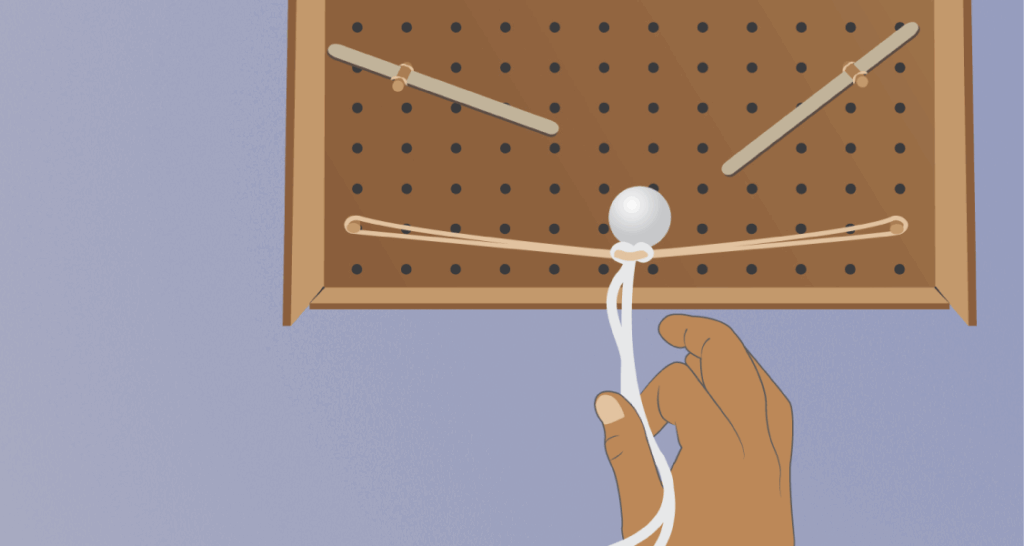
Pushes and Pulls
Domains: Physical Science, Engineering Design
Unit type: Engineering design
Student role: Pinball engineers
Phenomenon: Pinball machines allow people to control the direction and strength of forces on a ball.

Sunlight and Weather
Domains: Earth and Space Science, Life Science, Engineering Design
Unit type: Modeling
Student role: Weather scientists
Phenomenon: Students at Carver Elementary School are too cold during morning recess, while students at Woodland Elementary School are too hot during afternoon recess.

Animal and Plant Defenses
Domain: Life Science
Unit type: Modeling
Student role: Marine scientists
Phenomenon: Spruce the Sea Turtle lives in an aquarium and will soon be released back into the ocean, where she will survive despite ocean predators.

Light and Sound
Domains: Physical Science, Engineering Design
Unit type: Engineering design
Student role: Light and sound engineers
Phenomenon: A puppet show company uses light and sound to depict realistic scenes in puppet shows.

Spinning Earth
Domain: Earth and Space Science
Unit type: Investigation
Student role: Sky scientists
Phenomenon: The sky looks different to Sai and his grandma when they talk on the phone.

Plant and Animal Relationships
Domains: Life Science, Engineering Design
Unit type: Investigation
Student role: Plant scientists
Phenomenon: No new chalta trees are growing in the fictional Bengal Tiger Reserve in India.

Properties of Materials
Domains: Physical Science, Engineering Design
Unit type: Engineering design
Student role: Glue engineers
Phenomenon: Different glue recipes result in glues that have different properties.

Changing Landforms
Domain: Earth and Space Science
Unit type: Modeling
Student role: Geologists
Phenomenon: The cliff that Oceanside Recreation Center is situated on appears to be receding over time.

Balancing Forces
Domain: Physical Science
Unit type: Modeling
Student role: Engineers
Phenomenon: The town of Faraday is getting a new train that floats above its tracks.

Inheritance and Traits
strong>Domain: Life Science
Unit type: Investigation
Student role: Wildlife biologists
Phenomenon: An adopted wolf in Graystone National Park (“Wolf 44”) has some traits that appear similar to one wolf pack in the park and other traits that appear to be similar to a different wolf pack.

Environments and Survival
Domains: Life Science, Engineering Design
Unit type: Engineering design
Student role: Biomimicry engineers
Phenomenon: Over the last 10 years, a population of grove snails has changed: The number of grove snails with yellow shells has decreased, while the number of snails with banded shells has increased.

Weather and Climate
Domains: Earth and Space Science, Engineering Design
Unit type: Argumentation
Student role: Meteorologists
Phenomenon: Three different islands, each a contender for becoming an Orangutan reserve, experience different weather patterns.

Energy Conversions
Domains: Physical Science, Earth and Space Science, Engineering Design
Unit type: Engineering design
Student role: System engineers
Phenomenon: The fictional town of Ergstown experiences frequent blackouts.

Vision and Light
Domain: Physical Science, Life Science, Engineering Design
Unit type: Investigation
Student role: Conservation biologists
Phenomenon: The population of Tokay geckos in a rain forest in the Philippines has decreased since the installation of new highway lights.

Waves, Energy, and Information
Domains: Physical Science, Life Science, Earth and Space Science, Engineering Design
Unit type: Modeling
Student role: Marine scientists
Phenomenon: Mother dolphins in the fictional Blue Bay National Park seem to be communicating with their calves when they are separated at a distance underwater.

Patterns of Earth and Sky
Domains: Physical Science, Earth and Space Science
Unit type: Investigation
Student role: Astronomers
Phenomenon: An ancient artifact depicts what we see in the sky at different times — the sun during the daytime and different stars during the nighttime — but it is missing a piece.

Earth’s Features
Domain: Earth and Space Science
Unit type: Argumentation
Student role: Geologists
Phenomenon: A mysterious fossil is discovered in a canyon within the fictional Desert Rocks National Park.

Modeling Matter
Domain: Physical Science
Unit type: Modeling
Student role: Food scientists
Phenomenon: Chromatography is a process for separating mixtures. Some solids dissolve in a salad dressing while others do not. Oil and vinegar appear to separate when mixed in a salad dressing.

The Earth System
Domains: Earth and Space Science, Physical Science, Engineering Design
Unit type: Engineering Design
Student role: Water resource engineers
Phenomenon: East Ferris, a city on one side of the fictional Ferris Island, is experiencing a water shortage, while West Ferris is not.

Ecosystem Restoration
Domains:Physical Science, Life Science, Earth and Space Science, Engineering Design
Unit type: Argumentation
Student role: Ecologists
Phenomenon: The jaguars, sloths, and cecropia trees in a reforested section of a Costa Rican rain forest are not growing and thriving.

Geology on Mars
Domain: Earth and Space Science
Unit type: Launch
Student role: Planetary geologists
Phenomenon: Analyzing data about landforms on Mars can provide evidence that Mars may have once been habitable.

Earth, Moon, and Sun
Domains: Earth and Space Science, Physical Science
Unit type: Core
Student role: Astronomers
Phenomenon: An astrophotographer can only take pictures of specific features on the Moon at certain times.

Thermal Energy
Domain: Physical Science
Unit type: Core
Student role: Thermal scientists
Phenomenon: One of two proposed heating systems for Riverdale School will best heat the school.

Ocean, Atmosphere, and Climate
Domains: Earth and Space Science, Physical Science
Unit type: Core
Student role: Climatologists
Phenomenon: During El Niño years, the air temperature in Christchurch, New Zealand is cooler than usual.

Weather Patterns
Domains: Earth and Space Science, Physical Science
Unit type: Core
Student role: Forensic meteorologists
Phenomenon: In recent years, rainstorms in Galetown have been unusually severe.

Populations and Resources
Domains: Life Science, Earth and Space Science
Unit type: Core
Student role: Biologists
Phenomenon: The size of the moon jelly population in Glacier Sea has increased.

Matter and Energy in Ecosystems
Domains: Life Science, Earth and Space Science, Physical Science
Unit type: Core
Student role: Ecologists
Phenomenon: The biodome ecosystem has collapsed.

Traits and Reproduction
Domain: Life Science
Unit type: Core
Student role: Biomedical students
Phenomenon: Darwin’s bark spider offspring have different silk flexibility traits, even though they have the same parents.

Microbiome
Domain: Life Science
Unit type: Launch
Student role: Microbiological researchers
Phenomenon: The presence of 100 trillion microorganisms living on and in the human body may keep the body healthy.

Metabolism
Domain: Life Science
Unit type: Core
Student role: Medical researchers
Phenomenon: Elisa, a young patient, feels tired all the time.

Force and Motion
Domain: Physical Science
Unit type: Core
Student role: Physicists
Phenomenon: The asteroid sample-collecting pod failed to dock at the space station as planned.

Force and Motion Engineering Internship
Domains: Engineering Design, Physical Science
Unit type: Engineering internship
Student role: Mechanical engineering interns
Phenomenon: Designing emergency supply delivery pods with different structures can maintain the integrity of the supply pods and their contents.

Plate Motion
Domain: Earth and Space Science
Unit type: Core
Student role: Geologists
Phenomenon: Mesosaurus fossils have been found on continents separated by thousands of kilometers of ocean, even though the Mesosaurus species once lived all together.

Rock Transformations
Domain: Earth and Space Science
Unit type: Core
Student role: Geologists
Phenomenon: Rock samples from the Great Plains and from the Rocky Mountains — regions hundreds of miles apart — look very different, but have surprisingly similar mineral compositions.

Natural Selection
Domains: Life Science, Earth and Space Science
Unit type: Core
Student role: Biologists
Phenomenon: The newt population in Oregon State Park has become more poisonous over time.

Evolutionary History
Domains: Life Science, Earth and Space Science
Unit type: Core
Student role: Paleontologists
Phenomenon: A mystery fossil at the Natural History Museum has similarities with both wolves and whales.

Harnessing Human Energy
Domains: Physical Science, Earth and Space Science, Engineering Design
Unit type: Launch
Student role: Energy scientists
Phenomenon: Rescue workers can use their own human kinetic energy to power the electrical devices they use during rescue missions.

Phase Change
Domains: Physical Science, Earth and Space Science
Unit type: Core
Student role: Chemists
Phenomenon: A methane lake on Titan no longer appears in images taken by a space probe two years apart.

Phase Change Engineering Internship
Domains: Engineering Design, Physical Science
Unit type: Engineering internship
Student role: Chemical engineering interns
Phenomenon: Designing portable baby incubators with different combinations of phase change materials can keep babies at a healthy temperature.

Chemical Reactions
Domains: Physical Science, Life Science, Earth and Space Science
Unit type: Core
Student role: Forensic chemists
Phenomenon: A mysterious brown substance has been detected in the tap water of Westfield.

Magnetic Fields
Domain: Physical Science
Unit type: Core
Student role: Physicists
Phenomenon: During a test launch, a spacecraft traveled much faster than expected.

Light Waves
Domains: Physical Science, Life Science, Earth and Space Science
Unit type: Core
Student role: Spectroscopists
Phenomenon: The rate of skin cancer is higher in Australia than in other parts of the world.

Earth’s Changing Climate
Domains: Earth and Space Science, Life Science
Unit type: Core
Student role: Climatologists
Phenomenon: The ice on Earth’s surface is melting.

Earth’s Changing Climate Engineering Internship
Domains: Earth and Space Science, Engineering Design
Unit type: Engineering internship
Student role: Civil engineers
Phenomenon: Designing rooftops with different modifications can reduce a city’s impact on climate change.
Access program
In addition to the grade-level sample boxes that we provided, we’ve also created custom demo accounts just for Idaho reviewers.
To access the digital portion of the program, click the link below, select “Log In with Amplify,” and then refer to the Start here digital access flyer for your personalized login credentials.

Tutorial videos
Check out these videos for support on how to navigate the Amplify Science curriculum website, teacher’s guide, materials kits, and more!
Resources


Boost Reading pilot for mCLASS® and Acadience™ Reading schools
Hooray! We’re thrilled you’re considering giving Boost Reading a try! This site contains all the resources you’ll need to learn more about the program and get started with your pilot. We’re confident you’re going to love how Boost Reading puts your mCLASS and Acadience Reading data to work.

Resources to support your pilot
What is Boost Reading?
Boost Reading is a digital reading program that complements ELA programs with adaptive and targeted practice in foundational reading skills. While it can be used on its own, Boost Reading also integrates with mCLASS and Acadience Reading, which means that you get extra benefits like automatic rostering and placement in the program based on a student’s mCLASS composite score. From that point forward, the program takes every student on a personalized journey that addresses gaps and bolsters foundational skills at a pace that supports their individual development.


How do I get started with Boost Reading?
Good news! Boost Reading has already been enabled within your mCLASS and Acadience Reading accounts. To get started with the program, you’ve got only two steps left: adjusting your student login settings and setting up your student devices. The resource below will walk you through how to do both.
- [Video] Boost Reading quick start tutorial
- [Video] Boost Reading dashboard tour
- [PDF] Boost Reading launch packet
Note: Boost Reading works on most classroom devices, including Windows Devices with Windows 7+, Chromebooks with Chrome OS, and Mac devices with OS 10.11+ or iOS 11+.
What else can you tell me about Boost Reading?
As students engage in skill practice, their paths through the game world adapt to meet their unique learning needs. Boost Reading includes more than 40 standards-aligned games that build language, foundational skills, and comprehension skills, while also developing:
- Phonological awareness
- Phonics
- Vocabulary
- Text analysis
- Comprehension
- Microcomprehension (i.e., the smaller aspects of comprehension that make up the reader’s mental model of a text)
Some additional resources that you might find helpful:

For questions, please contact your Amplify representative
Robert “Bob” McCarty
Senior Account Executive
Email: rmccarty@amplify.com
Phone: (435) 655-1731
Boost Reading pilot for mCLASS® schools
Hooray! We’re thrilled you’re considering giving Boost Reading a try! This site contains all the resources you’ll need to learn more about the program and get started with your pilot. We’re confident you’re going to love how Boost Reading puts your mCLASS data to work.
Resources to support your pilot
What is Boost Reading?
Boost Reading is a digital reading program that complements ELA programs with adaptive and targeted practice in foundational reading skills. While it can be used on its own,Boost Reading also integrates with mCLASS, which means that you get extra benefits like automatic rostering and placement in the program based on a student’s mCLASS composite score. From that point forward, the program takes every student on a personalized journey that addresses gaps and bolsters foundational skills at a pace that supports their individual development.
How do I get started with Boost Reading?
Good news! Boost Reading has already been enabled within your mCLASS account. To get started with the program, you’ve got only two steps left: adjusting your student login settings and setting up your student devices. The resource below will walk you through how to do both.
- [Video] Boost Reading quick start tutorial
- [Video] Boost Reading dashboard tour
- [PDF] Boost Reading launch packet
Note: Boost Reading works on most classroom devices, including Windows Devices with Windows 7+, Chromebooks with Chrome OS, and Mac devices with OS 10.11+ or iOS 11+.
What else can you tell me about Boost Reading?
As students engage in skill practice, their paths through the game world adapt to meet their unique learning needs. Boost Reading includes more than 40 standards-aligned games that build language, foundational skills, and comprehension skills, while also developing:
- Phonological awareness
- Phonics
- Vocabulary
- Text analysis
- Comprehension
- Microcomprehension (i.e., the smaller aspects of comprehension that make up the reader’s mental model of a text)
Some additional resources that you might find helpful:
For questions, please contact your Amplify representatives
Monty Lammers
Senior Account Executive
Email: mlammers@amplify.com
Phone: (719) 964-4501

Leadership and literacy brunch with Natalie Wexler
with Amplify and Riverside USD
Thursday, February 27, 2020
9:30–11:30 a.m. PST
Location:
Benjamin Franklin Elementary School – Library
19661 Orange Terrace Parkway
Riverside, CA 92508
Registration deadline: Space is limited at this free event! RSVP by February 20 to secure your spot.
Who should attend: Supervisors, ELA and reading directors, curriculum coordinators, and principals.
About the event
Join us for a free brunch, author talk, and book signing with education writer and author Natalie Wexler on February 27 from 9:30–12 a.m.
During our time together, Natalie will discuss the latest research around reading, writing, and engagement in elementary school, along with the key findings of her book The Knowledge Gap: The Hidden Cause of America’s Broken Education System—and How to Fix It (2019).
As our guest, you’ll:
- Meet and hear from education writer and author Natalie Wexler.
- Mingle with other district leaders from Riverside USD and surrounding areas.
- Enjoy a delicious brunch with colleagues.
- Leave with a signed copy of Natalie Wexler’s book The Knowledge Gap: The Hidden Cause of America’s Broken Education System—and How to Fix It (2019).
Agenda:
9:30 a.m.: Arrive, check in, and visit our brunch buffet.
10–11 a.m.: Hear from Natalie Wexler
11–11:15 a.m.: Q&A with Natlie Wexler
11:15–11:30 a.m.: Book signing

Meet our featured presenter

Natalie Wexler
Natalie Wexler is an education writer and the author of The Knowledge Gap: The Hidden Cause of America’s Broken Education System—and How to Fix It (2019). She is also the co-author, with Judith C. Hochman, of The Writing Revolution: A Guide to Advancing Thinking Through Writing in All Subjects and Grades (2017) and a senior contributor to Forbes. Her articles and essays have appeared in The New York Times, The Washington Post, The Atlantic, and other publications. Before turning to education, Wexler worked as a freelance writer and essayist on a variety of topics, and as a lawyer and legal historian. She lives in Washington, D.C.
Submit this form to register for the event!
Winter Wrap-Up 02: Mathematizing Children’s Literature
While we’re hard at work producing the exciting fifth season of Math Teacher Lounge: The Podcast, we’re continuing to share some of our favorite conversations from our first four seasons. This time around, we’re revisiting our popular episode that connected literacy and math!
In this episode, we sit down with Allison Hintz and Antony Smith, authors of Mathematizing Children’s Literature, to talk about what would happen if we were to approach children’s literature, and life, through a math lens–and how we can apply those same techniques to classroom teaching!
Explore more from Math Teacher Lounge by visiting our main page.
Bethany Lockhart Johnson (00:02):
Hi, I’m Bethany Lockhart Johnson.
Dan Meyer (00:04):
Hi, I’m Dan Meyer.
Bethany Lockhart Johnson (00:05):
And we are so excited for another episode of Math Teacher Lounge. And as you know, podcast format; you’re listening now. I think one beautiful thing about the podcast format is that it gives us a little bit more time to have these rich conversations. And I promise I won’t do it, but I could talk to our guests for hours, hours! Authors Allison Hintz and Tony Smith have just released Mathematizing Children’s Literature: Sparking Connections, Joy, and Wonder Through Read-Alouds and Discussion. And today we get to talk to the authors. Allison, Tony, welcome. Welcome to the lounge.
Allison Hintz (00:53):
Thank you. We’re so grateful to be here.
Bethany Lockhart Johnson (00:55):
We’re so excited to have you here. And I wanna say that my very first—was it my first math conference? Maybe it was my first math conference—up in Seattle, the CGI conference, and I’m all like, you know, wide-eyed and just like, “Can this be a place for me, this math community?” Re-envisioning my relationship with math and thinking about myself as a math teacher, what? And I went to your session on mathematizing children’s literature, and I was just so fired up. I was so wowed by your ideas, your energy, and your passion for students’ thinking. And I feel like as I read this book, I felt like I was hanging out with you. Like you were just so encouraging all the way through. Of educators, of other folks working with young people, and really guiding us how to listen with joy and with an open curious mind.
Dan Meyer (02:03):
Yeah. I would love to hear a bit about the genesis of this book for you folks. Like, I’m coming at this from a secondary educator lens. I’ve got small kids, so that’s also part of my interest here. But I love any book, any idea that seeks to merge what seems like two disparate worlds. Like it’s often the case that we feel like, well, there’s approaches for ELA and approaches for math, and they’re kind of separate disciplines. And these poor elementary teachers have to learn all of them and be experts at all of them. And here you both come along and say, “Hey, what if they are the same kind of technique?” Can you just speak to how this came about?
Allison Hintz (02:38):
Definitely. Tony, do you wanna take a try? Do you want me to start us off?
Antony Smith (02:42):
I can start. We oftentimes present and talk together and so we kinda switch back and forth. So that’s just how we are. So probably about eight or nine years ago, Allison and I, our offices were next to each other on our small campus. We’re both professors and we just happened to have a few children’s books that we looked at together and we were just thumbing through the pages. We really liked children’s literature. And we noticed that I would stop at certain points wondering about character motive or plot or sequence of events or language use. And Allison would stop at very different points in the book and notice number and concepts or something about mathematics. And that’s when we started to wonder, what would it be like if we were sharing a children’s book with a group of children and we put our ideas together? Where would we stop? What would we talk about? What would we ask children about in terms of their thinking and what they notice?
Allison Hintz (03:42):
And so we started playing with these questions that we had and started approaching stories with multiple lenses to see what kinds of things would children notice and what kinds of things might they say. And we were also on our own journey in trying to understand how to plan for and facilitate lively discussions and classrooms that surface really complex mathematics. And it felt like stories were a place where that might be a fruitful context for hearing children’s thinking. We’ve worked with a lot of teachers and students in our region. We live in the Seattle area and we’ve applied for some funding over time that’s really helped us be in a lot of community-based organizations and educational contexts and libraries and pediatricians’ offices and classrooms, various classrooms, and see what’s interesting about this and what might teachers and children do with stories that would surface complex mathematics to think about together.
Antony Smith (04:41):
Over time, we came to the realization that if we wanted to hear children’s ideas, we had to stop bombarding them with questions. <laugh> Yeah. And at first it made it worse that we were asking them math and literacy questions at the same time. And so we realized that what we needed to do was to back off and to ask children what they noticed and wondered.
Bethany Lockhart Johnson (05:01):
Can you say more about that and how that kind of evolved into mathematizing children’s literature?
Antony Smith (05:07):
We did work with a number of very thoughtful, talented classroom teachers and children’s librarians in public library systems who were just so masterful at asking open-ended prompts and questions, rather than kind of like the de facto reading quiz, that a read-aloud can become, which I’ve always disliked as a literacy educator. And we realized in our observing these read-alouds or interactive read-alouds or shared reading experiences that given the opportunity in the space and an adult who was actually listening, that children came up with all of the ideas we would have asked them about and more. So we didn’t have to be bombarding them with questions. They were already much more thoughtful than what would’ve been sufficient to answer our questions.
Allison Hintz (05:58):
And much like mathematics, it was really an iterative process. You know, we had some clunky read-aloud discussions where we were trying to accomplish so much and toggling multiple chart papers and different colored pens and all sorts of “how do we capture these ideas” and “do we separate ’em? do we keep ’em together?” And so it’s really been over time that with partners, we’ve learned these ways of having multiple reads of the same story that allow us to hear what children notice and wonder, and then to delve more deeply into their questions and their ideas through multiple reads where we might spotlight literary ideas that they notice; we might spotlight mathematical ideas that they notice. We might make purposeful integrations between those. But we found it to be most productive—and Kristin Gray really help us think about this—to have an open Notice and Wonder, get everything out much like an open-strategy share. We welcome here, record all the ideas, and it goes all over everywhere. You know, it can be a really not math-y noticing! And those are amazing! So there’s a lot of, um, yes, there is a ladybug on this page! The grandma is wearing green triangle earrings! Oh, your grandma wears green earrings! I mean, it all comes out.
Bethany Lockhart Johnson (07:27):
Wait, have you been in my classroom? ‘Cause that’s exactly— <laugh>
Allison Hintz (07:29):
<laugh> And then, you know, we think of it a lot like if math teachers might use the 5 Practices for selecting and sequencing, or if you might move from an open-strategy share to a targeted share, how can we get out all the questions that children are asking and then step back from them, take some time to really think about what they’re telling us they’re curious about, and plan some purposeful, intentional subsequent discussions that can delve more deeply into their ideas.
Dan Meyer (08:02):
I’d love to go into that a little bit more if that’s all right. Um, I’m gonna speak from someone who doesn’t have an elementary background and I’m gonna voice some worries that I had, some anxiety. One anxiety I have like in a classroom or a curriculum is when there’s no room for student ideas. Right? When it’s like, oh, there’s just room for the curriculum author or the teacher here. That is a sadness. But I when I see an instructional environment like you’re describing here, where there is openness to all kinds of different student ideas, of different levels of formality, from different kinds of cultural fonts of knowledge or wherever, I also get a little bit nervous because that, like, increases the risk that a student might come to understand that “my ideas are not good enough,” whereas in the class with no room for their ideas from their home or their language or their hobbies, like, they’re not gonna internalize the message that, “that wasn’t good enough.” And so I’m really curious as you move from the open Notice and Wonder where kids share all of themselves with you, and then you move to a targeted focus on some sort of disciplinary objective, how do you navigate that tension and help students feel like their contributions are valuable, even though we aren’t taking them up per se?
Allison Hintz (09:18):
That’s such an important question. I mean, I think we’ve grappled with this broadly in math education. I think any time we’re thinking about which ideas we choose to take up to pursue to consider, we have a responsibility to think carefully about whose ideas are being taken up and heard and considered. And so one of the tensions I hear you naming, I think, Dan, is when we engage in lively discussion where children’s thinking’s at the center, how do we make sure to upend and interrupt kinda status norms that run the risk of being deepened? Um, and I think by paying attention to whose ideas are taken up as much as which ideas are taken up, and what’s the mathematics we wanna explore is one tension. Um, another tension I might hear you naming is, you know, the complications that teachers face with time and pressure and coverage, and which mathematics ends up getting worked on. And, um, you know, it’s something we’ve really had to struggle with in mathematics education, where we move to more discussion-oriented classrooms that are really centered in sense-making to know that it takes a lot of time to do this thoughtful, thoughtful work. Um, does that begin to get at some of the tensions you’re raising? Is there, is there more you’re thinking about?
Dan Meyer (10:53):
I think it’s really helpful that you kind of broadened the scope of the question beyond your book to “this is an issue that we are, you know, really challenged by and focused on broadly in math education.” And, um, I appreciate you bringing the element in of whose idea—not just which idea is taken up, but whose idea is taken up—is an opportunity where, let’s say, multiple people raise an idea that is towards an objective the teacher has, they have the opportunity to disrupt certain kinds of status, like ideas about status, in that moment. From your perspective, like, are there techniques to say, I don’t know, parking-lot certain kinds of questions and say like, “Hey, like these are awesome”? I don’t know. I just know that I see kids at like ninth grade. They are very reticent, often. They’ve internalized totally this sense of like, “I’m not gonna just, like, share about the pants the grandma’s wearing, you know; that will not be received well.” And so I’m just kinda wondering how that happens and like, what are the ways we can disrupt that? That process?
Antony Smith (11:54):
So thinking about that, Dan, from the teacher’s perspective, in those kinds of scenarios where you wanna honor each child’s contribution, a couple of things that come to mind: One is that by, you know, initially by modeling what I as a teacher, something that I notice or wonder about, helps kind of set the expectation for what kind of response would be encouraged. And it’s broad, but it gives an example. And then also we really try to record or to chart all of the ideas that are shared so that we can revisit and honor those together. And then either later or on another day, if we choose one or two of those to explore in some way within a more focused read, then another thing that we do is have the idea investigation afterward that continues that thought, but goes back to being as open-ended as possible, so that those students or children who maybe didn’t have their idea as the one that was focused on by the group could go back to that or explore some other idea of their own, so that the idea investigation isn’t a lockstep extension activity, which is why we don’t call it that. So they could again bring in their own perspective. But I have to say from the teacher’s point of view, there is that moment of potential panic <laugh> because there is that power transfer when you’re asking children to help steer where this is going. And if you really mean it, you have to let them steer a little bit. And that can be terrifying. And, um, I always think of one teacher, Ashley, we worked with who read an adorable book, Stack the Cats, by Susie Ghahremani. And in that book, there’s a point where there are eight cats and they’re kind of trying to be a tower of cats and they fall and they’re sort of in the air on that page. And she asked her first graders—she stopped, and she asked, “How, do you think, how will the cats land?” And for about a minute and a half, the entire <laugh> class, was silent. They had their little papers; they had chart paper; they had clipboards; they had everything they needed. But that unusual phenomenon of a group of six- and seven-year-olds actually just sitting and thinking and not being peppered with activities was really stressful, but amazing. And then, after about the 90 seconds, they started out into their exploration of how the eight cats might land. They just needed a minute to think. And it’s so rare that we’re able to let children have that.
Allison Hintz (14:40):
In that same moment, Ashley, who’s a learning partner to us, she turned to us kind of quietly, like, “Should I pose a different question?” And <laugh>, we’re like, “No, let’s stick with it. Let’s see what happens.” So I think it creates this space too, this thinking culture, right? And this culture of “what does that mean to really pose a rich task?That’s open-ended, where there’s multiple access points?” Those eight cats could land in so many different ways. And there was broad access, there was a wide range of all the cats landing, and one’s on their feet, ’cause cats always land on their feet <laugh>, and there was every combination. And so, um, I think what’s really interesting—and to me, this brings back to your wonder, Dan—is, you know, “What’s the risk in openness?” And there’s always risk in openness. Um, it’s scary as a teacher, right? If I’m not the authority of knowledge and I don’t have control over where we’re gonna go, it might get into places that I didn’t anticipate. Or I don’t really feel as solid in the math as I want to. Or I don’t know what it sounds like to stick with silence and wait time, to know if my students are really in productive struggle or if that question was a flop. And so, um, I think this is some practice space for young mathematicians and teachers of mathematics, and just teachers, to explore with that openness and kind of the risk of the openness required for complex thinking to emerge.
Bethany Lockhart Johnson (16:12):
You know, it feels like the way you’re both describing this, it really is a culture shift, right? I kept feeling like I was given permission to be a beginner as I read this book. Like I was really…I loved how you said, I believe it was you, Allison, when you were in the class, you had a couple index card that you kept on your clipboard and that as you walked around, you were like, “Hey, if I don’t know what to ask, I ask one of these questions.” You know? And just this idea that, that, like Dan was saying, there is that loss of control, but that’s also a way to create this culture where students ideas are valued and we are allowing students to really generate the questions, which I thought was such an important idea to explore.
Allison Hintz (17:00):
We started this work long ago, super-excited about math-y books. And we saw a lot of potential in them and we still do. But the limitation we saw is that math-y books, they, they put forth a certain mathematics to be curious about. In some ways they tell you what mathematics to think about. So we started asking ourselves what would happen if we considered any story a chance to engage as mathematical sense-makers. And we started playing with non-math-y books and we got to a place where we could consider every story an opportunity to engage in mathematical thinking. And so we started noticing things over times, oh, these books tend to be really math-y. We call those text-dependent. We’d have to pay attention to the mathematics to understand the story. Whereas this pile of stories, these, they’re not overtly math-y. You could really enjoy the story and not pay attention to mathematics and have an amazing conversation. But what would happen if we thought of about this story as mathematical sense-makers and how might it deepen our understanding of the story? And then this other teetering pile of books, these are books where, you know, children didn’t tend to engage as overtly as mathematicians in it, but there’s opportunities in this story to go back to something—to a moment, to an illustration, to a comment—and think as mathematicians. And those were more about illustration exploring. And so, as we notice these different kinds of books, we really broaden what we thought about. And I think one of the things we really wanna think about in community through this book is what happens if we approach any story, every story, as mathematical sense-makers, because stories are alive in children’s lives, in homes and communities and in schools. And it’s a broad opportunity that we wanna take up. I was thinking, as I stay in this strait for just a moment about book selection, before we move into that process, um, Bethany in a previous MTL, you talked about representation.
Bethany Lockhart Johnson (19:12):
Mm, yeah.
Allison Hintz (19:14):
And do you remember when you shared the image of hair braiding?
Bethany Lockhart Johnson (19:19):
Yes. Vividly, yes. <laugh>.
Allison Hintz (19:22):
Yeah. And can you say just what that meant to you? What that….
Bethany Lockhart Johnson (19:27):
Yeah. Well, it was from a conference; Sunil Singh had used it and was talking about the artistry in mathematics and beauty in hair braiding. And, um, particularly, he was showing this particular image of this Black woman with her hair braided in profile and looking at the angles and the symmetry. And I shared that, you know, I spent so many hours in the beauty shop with my aunties and my mom and my grandma and continue to, to this day, that it just, it struck me immediately as familiar. And it struck me immediately as seeing an image that was reflective of my lived reality, projected as valuable and worthwhile for consideration in the world of mathematics. Which is not what I felt as a student of mathematics as a young adult or child. So it was this beautiful moment of, for me, the power of when we see images and we allow opportunities for re-envisioning what may be a common practice for that student, or may be something that they see every day.
Allison Hintz (20:44):
And in that same way, that image that was put up, we wanna think really carefully about representation in the stories that we select. And when we think of stories as mirrors or windows, we really wanna be mindful in story selection of whose stories are told and whose stories are heard. And when you said that you would sit down to listen to a story and you felt at ease or that you saw an image and you saw yourself that can be and should be something we really think carefully about when we select the stories that we select.
Dan Meyer (21:21):
It’s a wider path for representation of different kinds of people in literature, because people’s stories seem so much more present and towards the surface of their lives, versus, say, the abstractions and numbers and shapes in mathematics. It feels like more of a struggle to find ways to show people, hey, like you’re here, this, this place belongs to you. So in all these reasons, I think it’s really great you folks are using literature, which has this history of humanities, literally humanities, as a vehicle for mathematics. That seems pretty special here.
Antony Smith (21:56):
We both go to libraries and bookstores and look through books as often as we can, but also our partner, a children’s librarian, Mie-Mie Wu, helped us go through—when we would meet, she would bring three or four hundred books at a time.
Bethany Lockhart Johnson (22:13):
When you described her wheeling in the cart, oh, I wish I been in that room! <Laugh>
Antony Smith (22:18):
And the cart was, you know, probably three or four times bigger than she was sometimes. And we would go through hundreds of books and look at them and listen to her thoughts as a skilled librarian sharing with families, diverse families, and what catches the attention of a three-year-old sitting with her grandfather. And that was really a valuable, helpful experience. And it’s a partnership that continues. So in Last Stop on Market Street—and this is in the book; we talk about this, this children’s book quite a bit—in this story, CJ with his Nana, his grandmother, are riding the bus to the last stop on Market Street in San Francisco, to go, as we will find out, to help serve in a soup kitchen to help the community. And the teacher, Susan Hadreas, had the children record their ideas. She charted them in an open Notice and Wonder read. And one of the ideas that a young boy noticed was that CJ on the bus…a man with a guitar starts playing the guitar on the bus and CJ closes his eyes and it says CJ’s chest grew full. And he was lost in the sound and the sound gave him the feeling of magic. So this boy said, “I wonder, what does that feel like if you’re feeling the magic? What’s that?” And that was one of many ideas in the open Notice and Wonder, and Allison will talk about the math lens read, but first Susan went back and read with them. She had that idea, she circled it on the chart paper, and another day that week, she said, let’s go back and visit this story we really liked. And remember, we wondered what feeling the magic was like. Let’s go back through and let’s keep track of all the feelings and emotions that CJ had across the journey to the soup kitchen in this book. And so they did another read of the story; they were very familiar with it, of course, but they noticed new things and they also, every few pages, stopped and she helped chart all of the emotions that CJ experienced from envy to excitement to sadness. There’s a huge range in this book. And it was fascinating.
Allison Hintz (24:36):
I think one of the things that the children noticed was that CJ’s feelings were shaped by community. And that he shaped and shaped…he was shaped by and helped shape his community. And so the ways that he felt across the story were impacted by the other characters that he comes across. The guitar man on the bus. The bus driver who can pull a coin out from behind someone’s ear. The lady with the butterflies in the jar. Nana helping him to see the rainbow. And the students started, you know, being curious about that. How do we shape and how are we shaped by community? What communities are we a part of? This class is one community. I’m in many communities across my life. And they started to quantify the number of people in the story. So Mrs. Hedreas went back for a math lens read, and she said, let’s just keep track of and pay attention to how many people are in CJ’s life in this day. Because I can hear you starting to think about quantity. This class at the same time in other areas of the day had been working on counting collections, how to keep track, so they got out their tools. Some people pulled out ten frames, some people pulled out clipboards. They had a wide range of things they could use to help them keep track. They developed their own strategy, keep track however you want. She did a quicker read through it, flipping the pages, and then they get into these debates: <laugh> “We already counted that person!” “But they took their hat off and put it down to collect money!
Antony Smith (26:10):
“What about the dog?”
Allison Hintz (26:11):
“That’s the same person!” “Yeah, there’s a dog pound in his community!” <laugh> “Do animals count in our community?”
Bethany Lockhart Johnson (26:17):
I love it!
Allison Hintz (26:17):
“Yes, they count!” Uh, and so we went through and quantified and there was really this understanding as you saw these people throughout the story that communities can be of different sizes, but community has impact. And you have responsibility in your community to show up and to lean in and to know that bringing your full, authentic, vulnerable self, you shape people and they shape you. And what communities are people a part of. And it turned into this really interesting discussion about quantity and helped us think more about quantity and community. I think a really important moment for us and for that class was the transition from being people who almost did mathematics to a story, like counted things on a page, um, count acorns on a page in an autumn book, to being mathematicians who thought within the story.
Antony Smith (27:17):
And then two idea investigations that came from that —not at the same time, of course, but with the same group of children—one was they identified an emotion of their own and wrote and drew about that. And also, who helped them address or get out of or acknowledge that emotion. And then the other idea investigation was that all of the children drew or kind of mapped out a community that they were part of. Whether it was their neighborhood or their classroom or their soccer team or whatever it was. And so then those investigations strengthened the connections of those concepts to the lives of those children.
Bethany Lockhart Johnson (28:05):
Well, I, actually wanted to ask you about idea investigations. Because I feel like that was such an important invitation in your book. And the way I understood the idea investigation is you’re really paying attention to what’s coming up in your other reads. Right? And then these are opportunities to extend the thinking, or like you said, to extend a particular aspect: What’s your community? Can we map your community? Or what’s a particular emotion? And it was in such contrast to what I think I have probably done in my classroom more than once, which was like, “Oh, we read this story about seals. So now my story problem is gonna be about seals, right? <laugh> Like in the story, you know, Jojo, the seal had five balls. <laugh> So if Jojo still had five balls and two of them bounced away…” You know, or whatever. Right? But that’s not what an idea investigation is. Right?
Allison Hintz (29:03):
Yeah. I think this is where we also had some stumbles and can totally relate to what you’re saying as previous classroom teachers as well. We have come to a place where we are pretty in favor of a super open-ended idea investigation that takes up the things that have surfaced in the multiple reads and making sure it’s a rich task with many, many ways children can engage with that. There’s many, many, many right answers or ways to engage. Less is more there. So we moved way away from, like, even a worksheet that might have an idea from it to blank paper and math tools and places to get into some productive struggle around some of the complex things that were raised.
Antony Smith (29:59):
A challenge with worksheets is that they put a frame around children’s ideas. So either there are only three lines to write on, or there’s only a small box to draw in. Whereas a blank page really opens up the possibility. Um, and so—is it Ann Jonas who wrote Splash!? sorry, I don’t have it in front of me—the book Splash!, about animals that end up in and out of the pond, including a cat that is not happy about ending up in the pond, an idea investigation after that for very young children was, with the list of the different creatures displayed at the front of the room: On blank paper, hey, draw your own pond and decide how many of which and each type of animal you want in your pond and then write about it. Just on blank paper. And so that allowed some children to draw, like, three giant goldfish. But other children drew 17 frogs and three cats. And, and just, it lets children follow—
Bethany Lockhart Johnson (31:02):
It was theirs, right? It was theirs.
Antony Smith (31:04):
Their idea. <laugh> And that comes partly from, I think, as Allison mentioned, we both were classroom teachers before moving into academia. And I remember giving children worksheets, particularly math worksheets, where they weren’t necessarily bad, but right at the bottom, it says like, explain your strategy. And it gives two lines.
Bethany Lockhart Johnson (31:23):
Right! <laugh>
Antony Smith (31:25):
The only thing a seven-year-old can write there is “I thought.” Or “I solved it.” <laugh> And that’s not where we need to go.
Dan Meyer (31:34):
Yeah. If I could just ask the indulgence of the primary crowd here, like, I’m trying to make sense of all this. And I just wanna like, offer my perspective. My summary statement of what’s going on here. I’m trying to—I love how you both came here—
Bethany Lockhart Johnson (31:45):
<laughs> How ya doin’, Dan? How ya doin’?
Dan Meyer (31:47):
<laughs> I’m, ah, A, I’m loving this a lot. Um, B, I came in here loving how you folks are broadening the work of primary education to kind of find commonalities between these sometimes seemingly disparate kinds of teaching in ELA and math. Love that, I wanna say. But I think you folks are describing, with all these teachers you observed and your own work, is the work of attaching meaning to what students might not realize yet has meaning. Or they might think it only has one kind of meaning. But you, the teacher, with their knowledge, realizes that there are many more dimensions of meaning that can be attached to those thoughts. And I’m hearing that from you folks, when you describe A, what math is and the power of a teacher to name a thing as mathematical. Like, “Oh, you didn’t think math was that, but math is noticing; math is wondering; math is asking questions,” for one. But also this work you’re describing of how, like, first the task has to invite lots of student thoughts and then to say like, “Oh, I see that there’s a similarity to these two.” And to raise those up for a conversation or to ask a question like to extend one person’s, one student’s question a little bit more. But it’s always…I’m just hearing you folks attaching more meaning than the student might have originally thought. I appreciate the conversation. That’s really interesting.
Bethany Lockhart Johnson (33:03):
Well, and now that the book is out, I think it’s gonna keep evolving, right? Now that it’s gonna be in the hands of teachers and librarians and educators and caregivers, it’s exciting to see kind of where it goes next. Which actually brings us to our MTL challenge. Dan Meyer, do you wanna share?
Dan Meyer (33:22):
Math Teacher Lounge, we have a challenge for the folks who listen and we’d love for them to hop into the Facebook group Math Teacher Lounge, or hit us up on Twitter at @MTLShow and just, like, kind of exercise beyond listening, exercise the ideas you folks are talking about, some kind of a challenge that can help us dive deeper into your ideas. So what would you folks suggest for our crowd, for our listeners?
Allison Hintz (33:42):
I would love to invite people to playfully experiment with a favorite story, with a story that’s new to you. I would love to invite listeners to sit with a story maybe on your own, and just ask yourself as a mathematician: What do you notice and wonder in this story? Don’t feel any pressure. Maybe sit with a child or some children and listen to what they notice and wonder. Like, really listen! Don’t ask questions! But hear their questions and place children at the center and consider multiple reads. Consider continuing to pursue their questions. And we have a planning template that might support people in kind of sketching out some ideas if you’re open to playing with that too.
Bethany Lockhart Johnson (34:34):
And we will post—
Dan Meyer (34:36):
That’s awesome.
Bethany Lockhart Johnson (34:36):
—a link for that planning template in our Facebook group and on Twitter as well. So thank you so much for that resource, because I think it’ll definitely help. It could help you, like you said, it could help you kind of organize your thoughts or help you think about this work in a new way. So thank you for that resource and thank you for the amazing resource that is Mathematizing Children’s Literature. I am so excited to continue to engage with you both and with listeners as they dive into this book. If folks want to engage with you more, where can they find you? How can they reach you?
Allison Hintz (35:12):
Well, we’re on Twitter.
Bethany Lockhart Johnson (35:14):
Great.
Dan Meyer (35:15):
What’s your home address? <laugh>
Bethany Lockhart Johnson (35:24):
Wait, let me try that again. <laugh> ‘Cause it does sound like I’m like, <fake ominous voice> “Where can they find you?”
Allison Hintz (35:29):
4-2-5…. <laughs>
Antony Smith (35:32):
At the bookstore!
Bethany Lockhart Johnson (35:34):
Y’all, if folks want to continue this conversation or share these ideas or the math challenge, how can they tag you? How can they, they reach you on the World Wide Web, besides the Math Teacher Lounge Facebook group?
Antony Smith (35:50):
Yeah. Well, we are both on Twitter, and we’ve been trying to promote the hashtag #MathematizingChildrensLiterature. It’s very long, but once you type it once, your phone or computer…
Bethany Lockhart Johnson (36:01):
Easy. Yeah, those click, right? Is that what it is now?
Antony Smith (36:03):
<laugh> The other is that we do for our project, we have an Instagram account that is @MathematizeChildren’sLiterature.
Allison Hintz (36:11):
We care really deeply about hearing from people. You know, we think our ideas are constantly evolving and that there’s such exciting room to grow. And we just felt compelled to share what we were learning now so that together we could learn and build vibrant experiences for young children and teachers and families through stories. So we want to hear from people! We wanna learn about stories that are important in your lives and what children say, and grow these ideas together.
Bethany Lockhart Johnson (36:42):
And credit to Dan, you told me you went and ordered a bunch of the books they have on the suggested read list.
Dan Meyer (36:48):
Oh my gosh.
Bethany Lockhart Johnson (36:49):
You read ’em to your son.
Dan Meyer (36:50):
I got such a side-eye from my significant others around here for what I dropped on Amazon in one night! <laugh> Uh, all these books I didn’t have. Some of them I did. We are not fully illiterate around here! We do love the written word at the Meyer household! But there were a bunch that that I grabbed. I’m morseling them out day by day.
Bethany Lockhart Johnson (37:09):
Wait, at bedtime I read my one-year-old One Is a Snail, Ten Is a Crab. <laugh> And let me tell you, he had vigorous pointing and “Da? Da da da da?”
Allison Hintz (37:22):
<laugh> Aww, da da!
Bethany Lockhart Johnson (37:22):
So hey, we’re on the road. <laugh> <music> Deeply grateful, not only for your work and your beautiful book and your work, but also for the invitation to dive into the world of children’s literature in a way that many of us have not before. And it’s fun! Thank you, Tony. And thank you, Allison. And thanks for hanging out in the lounge.
Allison Hintz (37:48):
Thanks for having the lounge!
Antony Smith (37:49):
It’s been fun!
Allison Hintz (37:52):
Thank you both.
Stay connected!
Join our community and get new episodes every other Tuesday!
We’ll also share new and exciting free resources for your classroom every month.


Meet the guest
Allison B. Hintz: Dr. Hintz’s research and teaching are in the area of mathematics education. Her focus on mathematics came about during her years as a fifth grade teacher – it was alongside her students that she developed her own positive identity as a mathematician! Today she studies teaching and learning, specifically facilitating engaging discussion. Her research and teaching happen in partnership with educators and children in formal and informal settings and focuses on beliefs and practices that support all children in lively mathematics learning. She is a co-author, with Elham Kazemi, of Intentional Talk: How to Structure and Lead Productive Mathematical Discussions.
Twitter: @allisonhintz124
Antony T. Smith: Antony T. Smith is an associate professor of literacy education at the University of Washington, Bothell. He works alongside teachers to create engaging literacy-mathematics learning experiences through exploring and discussing children’s literature. He is committed to the concepts of motivation, engagement, challenge, and creativity in literacy teaching and learning.
Twitter: @smithant Instagram: mathematizechildrensliterature

About Math Teacher Lounge: The podcast
Math Teacher Lounge is a biweekly podcast created specifically for K–12 math educators. In each episode co-hosts Bethany Lockhart Johnson (@lockhartedu) and Dan Meyer (@ddmeyer) chat with guests, taking a deep dive into the math and educational topics you care about.
Join the Math Teacher Lounge Facebook group to continue the conversation, view exclusive content, interact with fellow educators, participate in giveaways, and more!
You might also like:
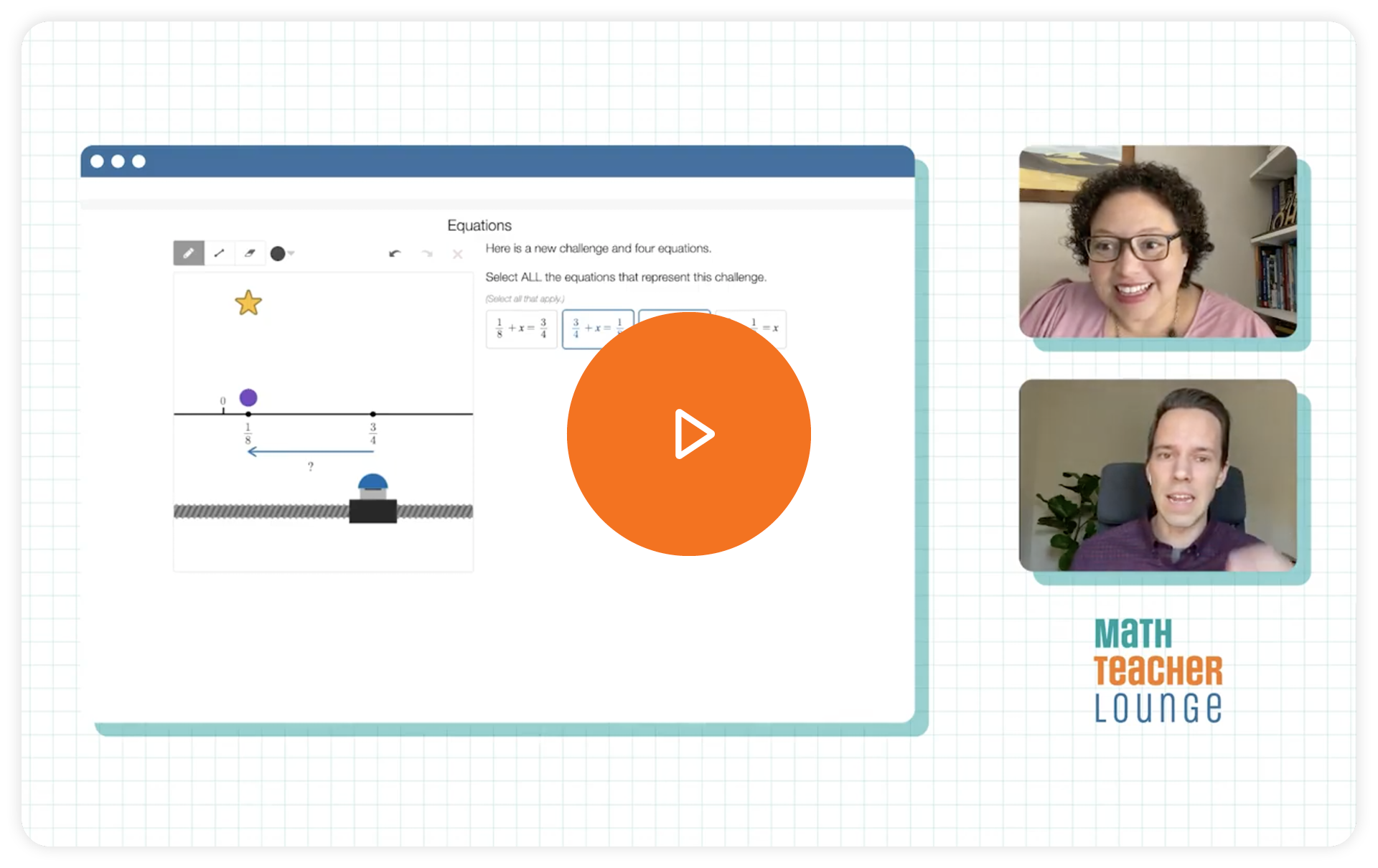

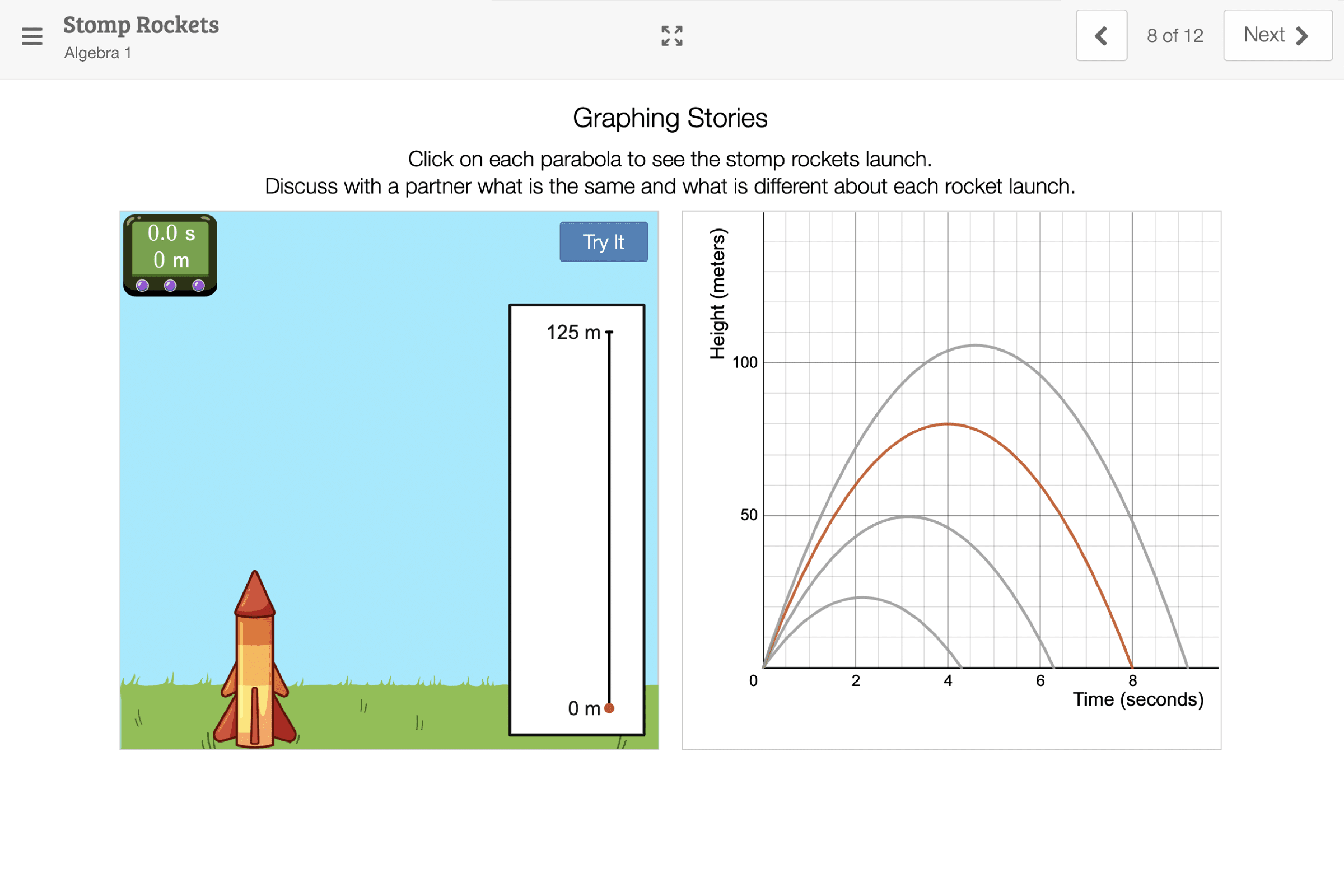
Welcome, Amplify ELA families!
We’re excited to welcome you and your student to the Amplify ELA program for the new school year, and to provide you with exceptional learning opportunities through ELA. We’ve assembled the following resources and guides to help you support your student and enable them to have the most productive experience with our platform throughout the year.
Para la versión en español, haga clic aquí.

What is Amplify ELA?
Amplify ELA helps students in grades 6–8 read and understand complex texts that encourage them to grapple with interesting ideas and find relevance for themselves. Amplify ELA is a blended program that includes both digital and print materials, but can also be used as a print-only version. Students using Amplify ELA read text passages closely, interpret what they find, discuss their thinking with peers, and develop their ideas in writing. The lesson structure is easy to follow, but flexible enough to allow for a variety of learning experiences and varied enough to keep students engaged.
Features include:
- Functionality that allows individual students to work at their own level while also being challenged appropriately.
- Built-in tools that allow teachers to track and respond to student work.
- The digital Amplify Library, which contains more than 700 downloadable, full-length fiction and nonfiction books.
- The Vocab App, which uses game-like activities to help students master keywords from the program’s texts. (Students using print materials will see keywords highlighted.)
- Independent writing assignments called Solos, available on mobile devices.
- Interactive projects called Quests that accompany certain units to provide additional practice with analytical reading, writing, speaking, and listening skills.
Getting started
How you can support the child in your care:
- If possible, read with your student daily; even 15 minutes of reading together each day can make a huge impact. You can read aloud sections of the text together—many middle grade students enjoy performing sections of dialogue by taking on the role of a character in a play, or adding some dramatic flair to a poem with which they are working. If your student struggles with reading aloud, you might try reading the text to them with expression, then having them read it back to you. For additional practice, there are an array of fluency activities in the program’s Flex Days. Ask your student to help you find these activities.
- Find moments to discuss what they are reading and discovering. Examples of questions you could ask: What stood out to you from what you read today? Were any sentences or words confusing? What was most surprising? What do you think the writer was trying to communicate? Do you agree with the writer’s ideas or descriptions? What connections can you make between what you are reading and your own life, or other issues you’ve heard about?
- Listen to your student read their written responses or have them share with a friend over the phone or video chat.
- Browse the Amplify Library with your student to find books they’ll enjoy and be able to read fluently and independently.
- Review this Protecting Kids Online website by the Federal Trade Commission addressing digital safety.
Accessing texts in the Amplify Library
We encourage students to utilize the core texts from the Amplify Library while at home! Please follow these steps to download a text for offline reading:
1. Navigate to the Program & Apps menu at the top of your screen and scroll through to find the Amplify Library icon. When you select it, the Amplify Library will open in a new tab.
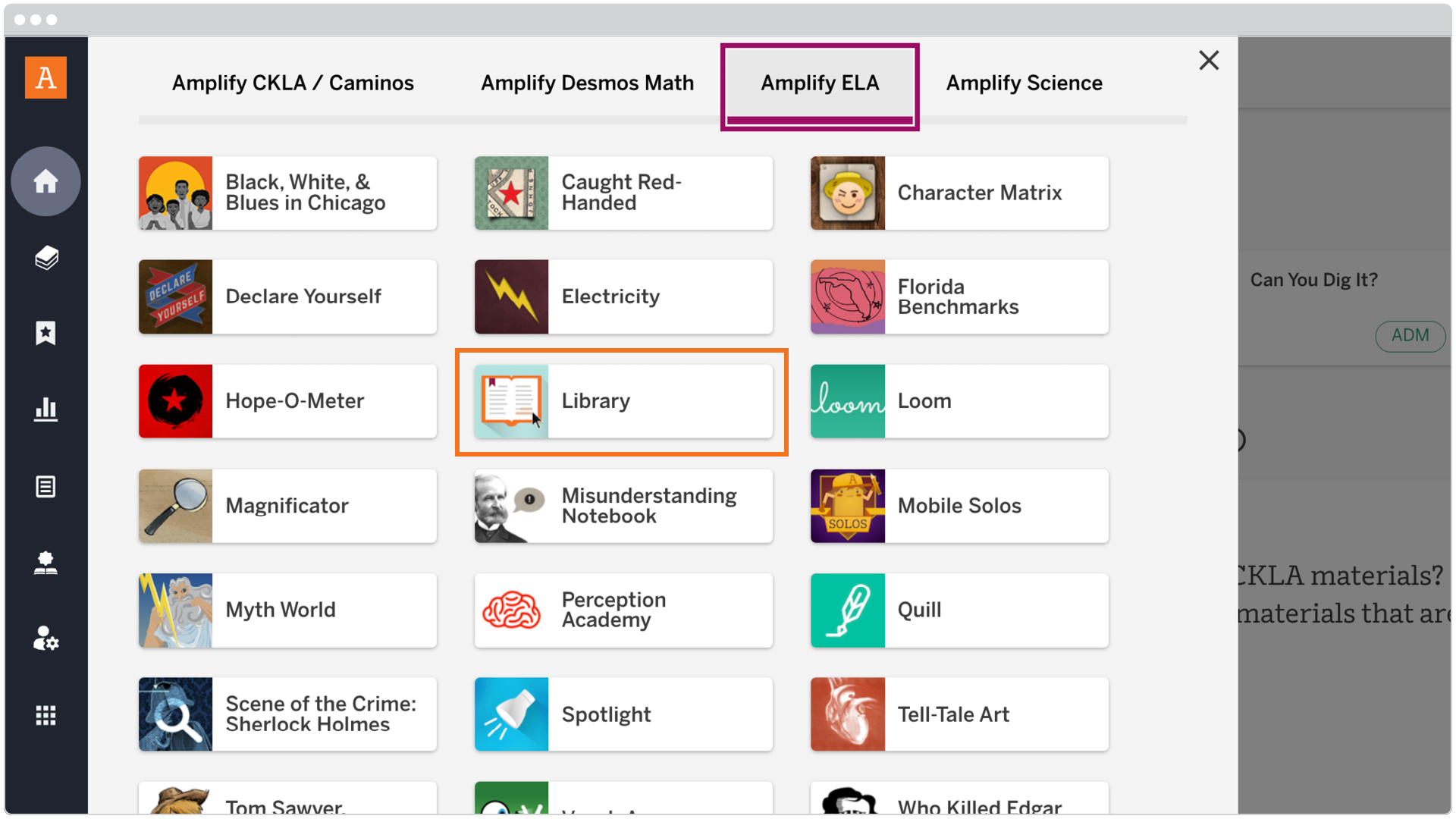
2. If prompted, follow the directions to set up a pin for the Amplify Library; otherwise, proceed to the next step.
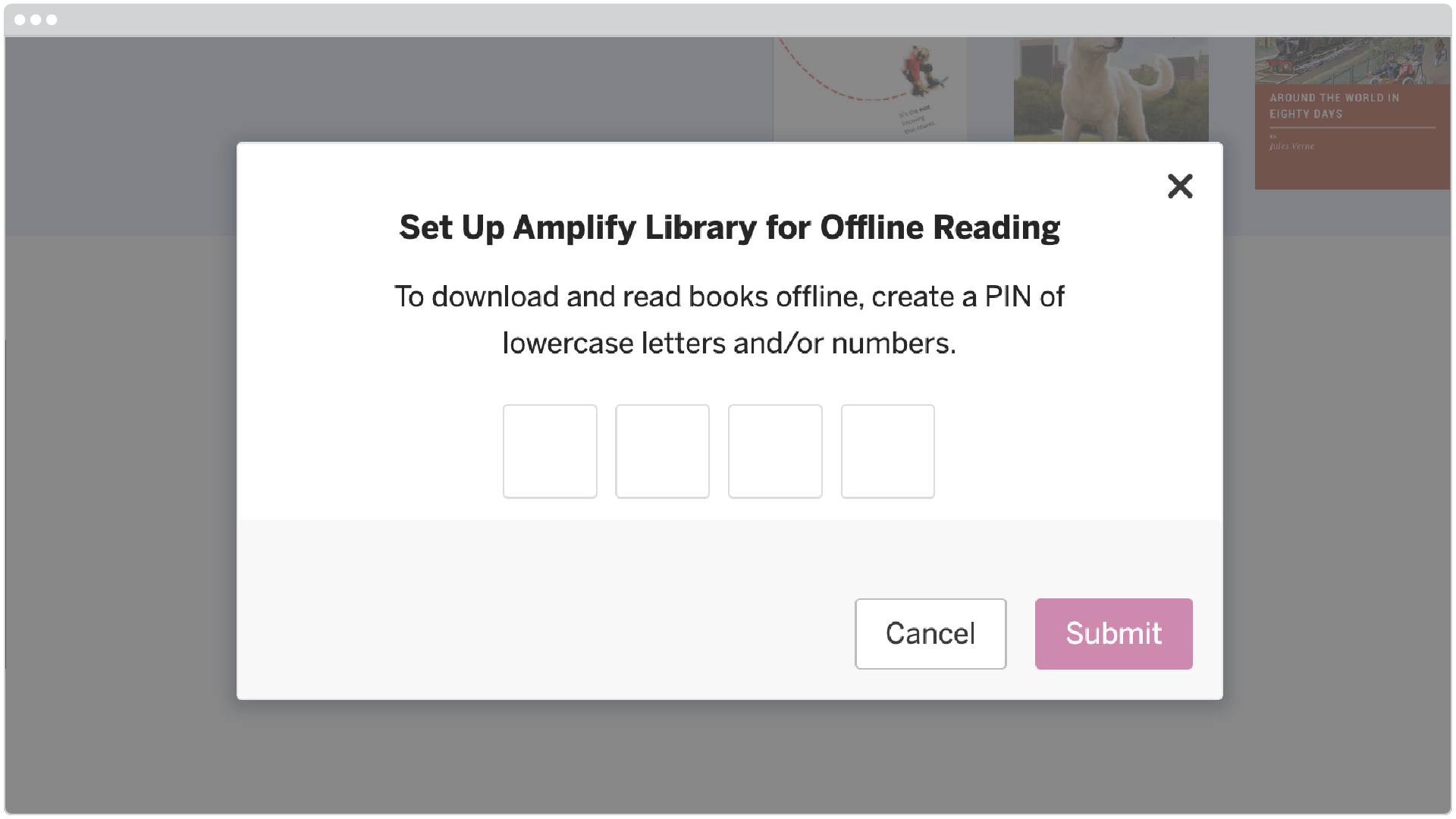
3. In the upper right corner of your screen, search for the book you would like to download. Example: The Secret of the Yellow Death: A True Story of Medical Sleuthing.
4. Select the Download button.
5. If you lose connection while still in the Amplify Library, you can continue to access and read the downloaded book(s). If the page refreshes without internet access, or you try to login on another device without internet access, you will lose access to the downloaded book(s) until the internet connection is restored.
To retrieve your downloaded texts:
- In the Amplify Library app, open the My Library drop-down menu in the upper left corner.
- Select Downloaded.
- Choose the text you wish to read from all of your pre-downloaded texts.
Materials overview
Not every school will operate the same way, but students attending schools that have both the print and digital editions of the program will likely have the following print materials at home:
- Student Edition: This includes all of the readings and activities necessary for instruction throughout the year. Students can read the selections both digitally and in print, annotating in either format. The lessons in the print Student Edition reflect each digital lesson, but have been modified to work effectively in print.
- Writing Journals: This provides space for students to respond to Writing Prompts and complete other written assignments.
In the case that students are without access to devices or the internet, they can continue to complete key reading and writing assignments using the print Student Editions and student Writing Journals.
Teachers can also access, print, and mail student Novel Guides for up to 12 commonly taught novels. Six of these novels are available in the Amplify Library, and most should be available in a public library.
Unit overviews
Below are quick overviews of each unit your student will be working through in their grade throughout the year. Included along with each unit is a downloadable guide that provides a more in-depth look at what content is covered and how you can help your student advance their understanding of the topics.
- Unit 6A: Dahl & Narrative
- Students begin with narrative writing to quickly boost their writing production, learn the foundational skill of focus, and become comfortable with key classroom habits and routines they will use all year. Students then apply their new observational focus to some lively readings from Roald Dahl’s memoir Boy and learn how to work closely with textual evidence.
- Unit 6B: Mysteries & Investigations
- Students read like an investigator to embark on a multi-genre study of the mesmerizing world of scientific and investigative sleuthing. At the end of the unit, students write an essay explaining which trait is most useful to problem-solving investigators.
- Unit 6C: The Chocolate Collection
- The Aztecs used it as currency. Robert Falcon Scott took it to the Antarctic. The Nazis made it into a bomb designed to kill Churchill. The 3,700-year-long history of chocolate is full of twists and turns, making it a rich and rewarding research topic. In this unit, students explore primary source documents and conduct independent research to better understand the strange and wonderful range of roles that chocolate has played for centuries around the world.
- Unit 6D: The Greeks
- Greek myths help us understand not only ancient Greek culture but also the world around us and our role in it. Drawing on the routines and skills established in previous units, these lessons ask students to move from considering the state of a single person—themselves or a character—to contemplating broader questions concerning the role people play in the world and the communities they inhabit within it.
- Unit 6E: Summer of Mariposas
- The borderlands between the United States and Mexico are the place of legends, both true and fictional. Summer of the Mariposas, by Guadalupe Garcia McCall, plants a retelling of the Odyssey into this setting, launching five sisters on an adventure into a world of heroes and evildoers derived from Aztec myths and Latinx legends. On the journey, the sisters reconcile the dissolution of their parent’s marriage and find new strength in their identity and connection to Aztec lineage. Students consider how McCall uses the structure of the hero’s journey to celebrate women, heritage, and a broad definition of family. Students also have the opportunity to compare these characters’ fictional journey into Mexico to a description of one boy’s true journey into the United States.
- Unit 6F: The Titanic Collection
- In this research unit, students learn to tell the difference between primary, secondary, and tertiary sources; determine if a given source is reliable; and understand the ethical uses of information. Students then construct their own research questions and explore the internet for answers. They also take on the role of a passenger from the Titanic’s manifest to consider gender and class issues as they research and write narrative accounts from the point of view of their passenger.
- Unit 6G: Beginning Story Writing
- In this unit, students get to practice their creative writing skills and learn the elements of storytelling and character development, as well as the importance of vivid language. Students gain a sense of ownership over their writing as they experiment with the impact of their authorial choices on sentences, language, character traits, and plot twists.
- Grade 6: Grammar
- In this unit, students complete self-guided grammar instruction and practice that teachers assign to them throughout the year. Sub-units are organized by key grammar topics, so teachers can assign the content that best meets their student’s needs while making sure students work with the key grammar topics for their grades.
- Unit 7A: Red Scarf Girl & Narrative
- In this study of a highly engaging memoir of a young woman growing up in China during the Cultural Revolution, students quickly learn the history and politics of this tumultuous period by focusing on the story of someone living through the upheaval. As students follow her journey through a world turned upside down, they will track the changes in her feelings and motivations over time.
- Unit 7B: Character & Conflict
- By reading the play A Raisin in the Sun and the short story “Sucker,” students explore how people facing hardships can inflict unintentional harm on the people around them. The two narratives work together to provide opportunities for students to analyze characters’ responses to conflict and the author’s development of ideas over the course of a piece of fiction.
- Unit 7C: Brain Science
- Could you survive an iron rod through your skull? Phineas Gage did, and his gruesome-but-true story allows students to build background information and analyze other informational texts, including the contemporary The Man Who Mistook His Wife For A Hat and the relevant Demystifying the Adolescent Brain.
- Unit 7D: Poetry & Poe
- Poe’s texts always offer so much to notice, decipher, talk about—and creep us out. Since things are not always what they seem, students must use close reading skills to question whether they should believe what Poe’s narrator is telling them … or not.
- Unit 7E: The Frida & Diego Collection
- Mexico’s most famous and provocative artists, Diego Rivera and Frida Kahlo, were an extraordinary couple who lived in extraordinary times. They were both soul mates and complete opposites. Their multifaceted lives and work offer students rich and fascinating subjects to study as they examine primary source documents and conduct independent research.
- Unit 7F: The Gold Rush Collection
- In this research unit, students choose from a large collection of primary and secondary sources to learn about the wide range of people who took part in the California Gold Rush. They also take on the role of someone who lived during the gold rush and write journal entries from their perspective.
- Unit 7G: Intermediate Story Writing
- In this unit, students get to practice their creative writing skills and learn the elements of storytelling and character development, as well as the importance of vivid language. Students gain a sense of ownership over their writing as they experiment with the impact of their authorial choices on sentences, language, character traits, and plot twists.
- Grade 7: Grammar
- In this unit, students complete self-guided grammar instruction and practice that teachers assign to them throughout the year. Sub-units are organized by key grammar topics, so teachers can assign the content that best meets their student’s needs while making sure students work with the key grammar topics for their grades.
- Unit 8A: Perspectives & Narrative
- This unit aims to teach students to read like writers. They practice paying attention to the craft of writing and to the moves a good writer makes to shape the way we see a scene or feel about a character—to stir us up, surprise us, or leave us wondering what will happen next. Students closely read examples of rich, layered narrative nonfiction, analyze the techniques each author uses to make their writing resonate, and practice applying these techniques to their own narrative writing.
- Unit 8B: Liberty & Equality
- In this unit, students look at the words of a range of creators—from poet Walt Whitman to abolitionist Frederick Douglass to President Abraham Lincoln—to see how their writing contributed to an extreme shift in social organization: a whole new concept of what it means for people to be considered “equal.” They also study multiple perspectives on the Civil War, including the memoir of a girl who was enslaved, a confederate girl’s diary, and a nonfiction account of the young boys who served as soldiers during the war.
- Unit 8C: Science & Science Fiction
- Students read Gris Grimly’s Frankenstein, a graphic novel that adds captivating illustrations to an abridgment of the 1818 edition of Mary Shelley’s book. Paired with Shelley’s text, Grimly’s haunting—and, at times, horrific—representations of Frankenstein’s creature push students to wrestle with some of the text’s central themes: the source of humanity and the root of evil. Students then write an essay in which, after arguing both sides of the question, they determine whether or not Frankenstein’s creature should ultimately be considered human.
- Unit 8D: Shakespeare’s Romeo & Juliet
- Romeo and Juliet combines romance with action, offering a wide range of themes and scenes for students to read about and act out. Your middle schoolers are at the right age to identify with the lovers’ strong feelings—and also old enough to think critically about the choices Romeo and Juliet make.
- Unit 8E: Holocaust: Memory & Meaning
- This unit uses a range of primary source articles, images, and videos, as well as literary nonfiction and graphic nonfiction, to study what made the atrocities of the Holocaust possible. Students investigate how propaganda was generated and employed to create a political environment that ultimately corrupted a society. The Olympics are seen through the lens of an international propaganda campaign, providing cover for Nazis to begin eliminating non-Aryans from their culture. The final sub-unit examines the outcomes of Nazi doctrine and the impact on Jewish victims and survivors.
- Unit 8F: The Space Race Collection
- In this unit, students to put their research and close-reading skills to the test to distinguish between reliable and unreliable sources, explore primary documents, and conduct independent research to better understand the space race that took place between two of the world’s superpowers. This dramatic story offers students a rich research topic to explore as they build information literacy skills, learn how to construct their own research questions, and explore the internet for answers.
- Grade 8: Grammar
- In this unit, students complete self-guided grammar instruction and practice that teachers assign to them throughout the year. Sub-units are organized by key grammar topics, so teachers can assign the content that best meets their student’s needs while making sure students work with the key grammar topics for their grades.
- Unit 8G: Advanced Story Writing
- In this unit, students get to practice their creative writing skills. They’ll learn the elements of storytelling and character development, and the power of vivid language to grab readers and pull them into a story.
Additional activities
Quests:
You may notice your student working with peers on the same interactive project over several days, trying to solve a mystery or explain a historical event. That’s what happens when a teacher assigns a Quest: an in-depth week-long exploration that requires collaboration and deepens engagement with texts and topics.
Vocab App:
The Vocab App helps students master vocabulary words through game-like activities that challenge them to think through morphology, analogy, and synonyms/antonyms, and to decipher meaning through context.
Have a question about Amplify ELA?
Visit our help library to search for articles with answers to your program questions.
For additional curriculum support, please contact your student’s teacher.
Leadership and literacy brunch with Natalie Wexler
with Amplify and Riverside USD
Thursday, February 27, 2020
9:30–11:30 a.m. PST
Location:
Benjamin Franklin Elementary School – Library
19661 Orange Terrace Parkway
Riverside, CA 92508
Registration deadline: Space is limited at this free event! RSVP by February 20 to secure your spot.
Who should attend: Supervisors, ELA and reading directors, curriculum coordinators, and principals.
About the event
Join us for a free brunch, author talk, and book signing with education writer and author Natalie Wexler on February 27 from 9:30–12 a.m.
During our time together, Natalie will discuss the latest research around reading, writing, and engagement in elementary school, along with the key findings of her book The Knowledge Gap: The Hidden Cause of America’s Broken Education System—and How to Fix It (2019).
As our guest, you’ll:
- Meet and hear from education writer and author Natalie Wexler.
- Mingle with other district leaders from Riverside USD and surrounding areas.
- Enjoy a delicious brunch with colleagues.
- Leave with a signed copy of Natalie Wexler’s book The Knowledge Gap: The Hidden Cause of America’s Broken Education System—and How to Fix It (2019).
Agenda:
9:30 a.m.: Arrive, check in, and visit our brunch buffet.
10–11 a.m.: Hear from Natalie Wexler
11–11:15 a.m.: Q&A with Natlie Wexler
11:15–11:30 a.m.: Book signing
Meet our featured presenter
Natalie Wexler
Natalie Wexler is an education writer and the author of The Knowledge Gap: The Hidden Cause of America’s Broken Education System—and How to Fix It (2019). She is also the co-author, with Judith C. Hochman, of The Writing Revolution: A Guide to Advancing Thinking Through Writing in All Subjects and Grades (2017) and a senior contributor to Forbes. Her articles and essays have appeared in The New York Times, The Washington Post, The Atlantic, and other publications. Before turning to education, Wexler worked as a freelance writer and essayist on a variety of topics, and as a lawyer and legal historian. She lives in Washington, D.C.
Submit this form to register for the event!
Resources for teachers: Bring the world to students with knowledge!
The Science of Reading shows that literacy develops best on a foundation of knowledge. In other words, the more you know, the easier and faster you learn!
The Amplify CKLA literacy curriculum intentionally builds students’ background and academic knowledge—along with comprehension strategies—that fuel their capacity to understand texts, answer questions, and grapple with ideas.
Explore resources for teachers from educators across the country who are bringing Amplify CKLA Knowledge Domains to life in their classrooms!

Kindergarten
In kindergarten, students develop phonemic awareness with storybook characters like Zack and Ann Chang; draw a chart to identify different smells; learn about the Lenape, Wampanoag, and Lakota Sioux; and pay homage to classic nursery rhymes by jumping a candlestick.

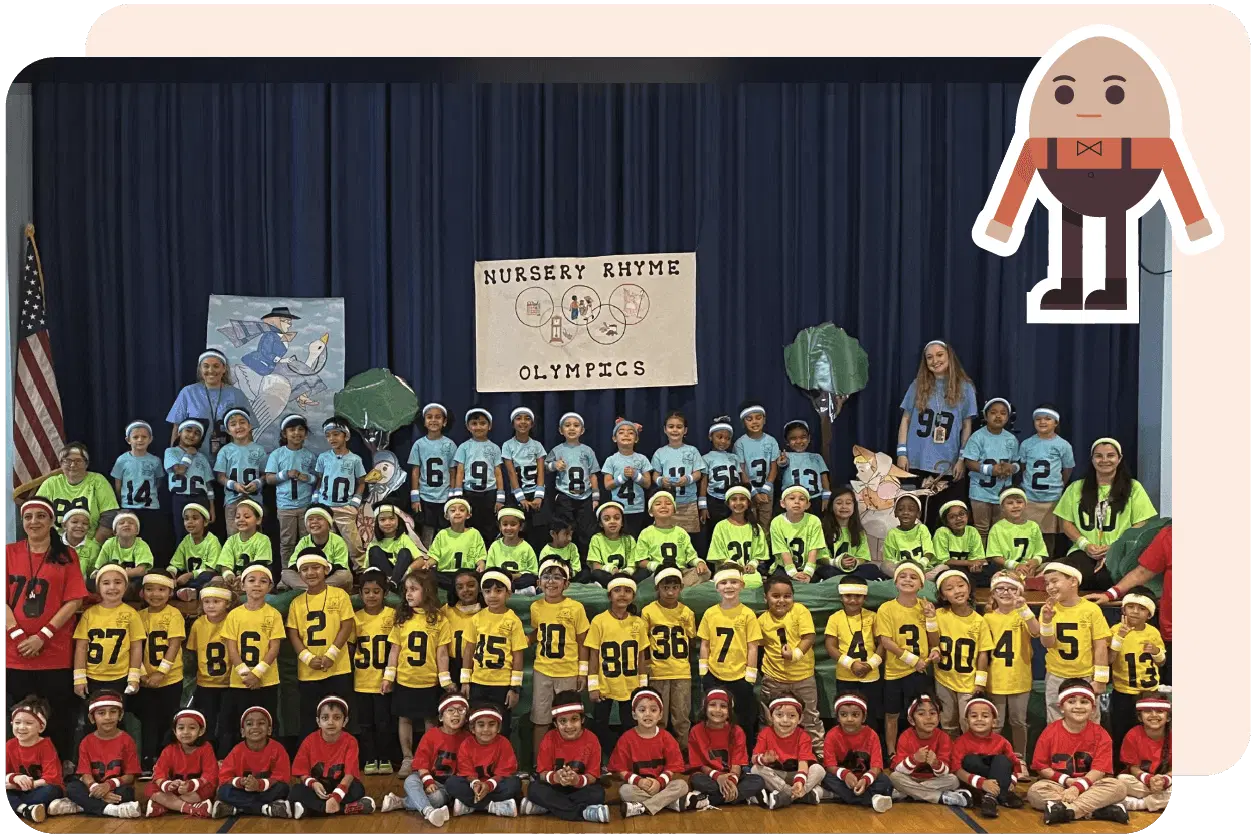
Domain 1: Nursery Rhymes and Fables
To celebrate the end of the Nursery Rhymes and Fables unit, students participated in a Nursery Rhyme Olympics.
Credit: Kelly O’Connor, Huber Street Elementary School, NJ
BONUS VIDEO: Watch this video to see Nursery Rhyme Olympics in action!
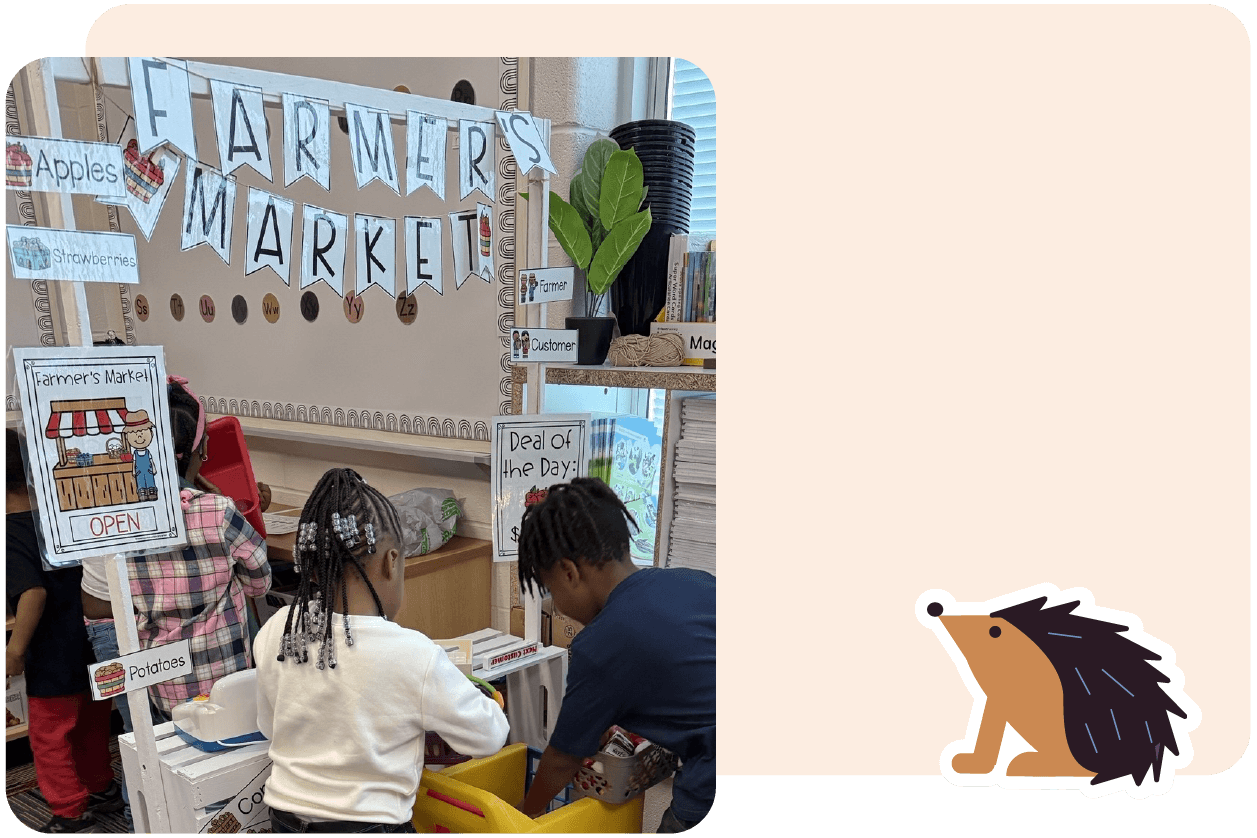
Domain 2: The Five Senses
As a special activity for the Five Senses unit, students explored their sense of taste with a pop-up farmers market.
Credit: Debbie Braaten, Abraham Lincoln Elementary School, OH
BONUS VIDEO: Hear how Jamie Vannoy, a teacher in Wirt County, WV, plans a braille activity for this unit!
Domain 3: Stories
Kindergarteners worked in groups to construct houses using straw, sticks, and bricks to commemorate the reading of “The Three Little Pigs.”
Credit: Manal Abuhouran, Clarendon Elementary School, NJ
Domain 4: Plants
To apply their learning, students at Superior Elementary planted grass seeds at the beginning of the Plants unit, then cared for and observed the grass daily to ensure it flourished.
Credit: Emma Fynbu, Superior Elementary School, NE
Domain 5: Farms
To celebrate the Farms unit, students visited a local farm to study the equipment and farm animals!
Credit: Kirsten Tingley, Cumberland Valley School District, PA
Domain 6: Native Americans
To showcase their knowledge, students created a gallery walk that displays information about the Lakota Sioux, Wampanoag, and Lenape tribes.
Credit: Dalphne Harrison, Aldine ISD, TX
Domain 7: Kings and Queens
To mark the end of the Kings and Queens unit, this class hosted a royal tea party in the cafeteria, featuring cloaks and handmade crowns.
Credit: Chrystal Wise, Malvern School District, AR
Domain 8: Seasons and Weather
Teach your students more about seasons and weather: Invite your local meteorologist to visit, like this classroom did!
Credit: Chrystal Wise, Malvern School District, AR
Domain 9: Columbus and the Pilgrims
Students create illustrations of Columbus’s journey to present their knowledge for this unit!
Credit: Mandy Collins, Fayette County Public Schools, TN
Domain 10: Colonial Towns and Townspeople
As you wrap up this unit, take inspiration from this school: Make shop signs and tables to create your own colonial town!
Credit: Andrea Gatten, Propel Schools, PA
Domain 11: Taking Care of the Earth
We love this culminating activity! Students create awareness for a cause by creating persuasive signs, videos, and a class petition. This multimedia display shows them embracing the values of environmental stewardship.
Credit: Heather Keating, Gulliver Prep, FL
Domain 12: Presidents and American Symbols
To close the Presidents and American Symbols Domain, hold a sample election in your classroom! Create a voting booth, ballot box, ballot cards, election music, campaign posters, stickers, balloons, and confetti! Before announcing the winner, discuss the importance of voting, the voting process, what a campaign looks like, and what to look for in a great leader.
Credit: Andrea Gatten, Propel Schools, PA
Grade 1
In Grade 1, students sing about a fabulous fox, learn to tell the difference between fairy tale heroes and villains, write an opinion statement about the worst part of going to the moon, and learn ancient Egyptian techniques for mummifying an apple.

Domain 1: Fables and Stories
To celebrate the Fables and Stories domain, students participated in a “wolf in sheep’s clothing” race while teachers dressed as fable characters.
Credit: Brittany Sachs, Monon Trail Elementary School, IN
BONUS VIDEO: Hear how Brittany planned a Fable Olympics for her Grade 1 students!
Domain 2: The Human Body
To showcase their knowledge of the topic, students participated in a “hospital day.” The classroom was transformed to look like different operating rooms. Stations included blending and segmenting CVC words with Band-Aids, a Tricky Words eye exam, sentence writing, an X-ray light table, food sorting according to the food pyramid, and an operation game!
Credit: Erin Chester, Thompson Crossing Elementary School, IN
BONUS VIDEO: Erin explains how she planned the activity, and shows us snippets of the culminating activity in action.
Domain 3: Different Lands, Similar Stories
Take inspiration from this classroom and have your students create a Thumbelina floral craft to round out the unit’s celebration of folktales.
Credit: Elizabeth Sillies, Three Rivers Local School District, OH
Domain 4: Early World Civilizations
Looking for a culminating activity for this domain? Plan an ancient Egypt day filled with crafts and activities, including pyramid-making, writing in hieroglyphics, trying Egyptian food, and mask-making.
Credit: Camy Stirling, Brevard Academy, NC
BONUS VIDEO: Watch this short video about how to make pyramid-making easy in your classroom!
Domain 5: Early American Civilizations
Students can apply their learning about early American civilizations by creating their very own Moctezuma headdresses.
Credit: Emmett J. Hoops, Moriah Central School, NY
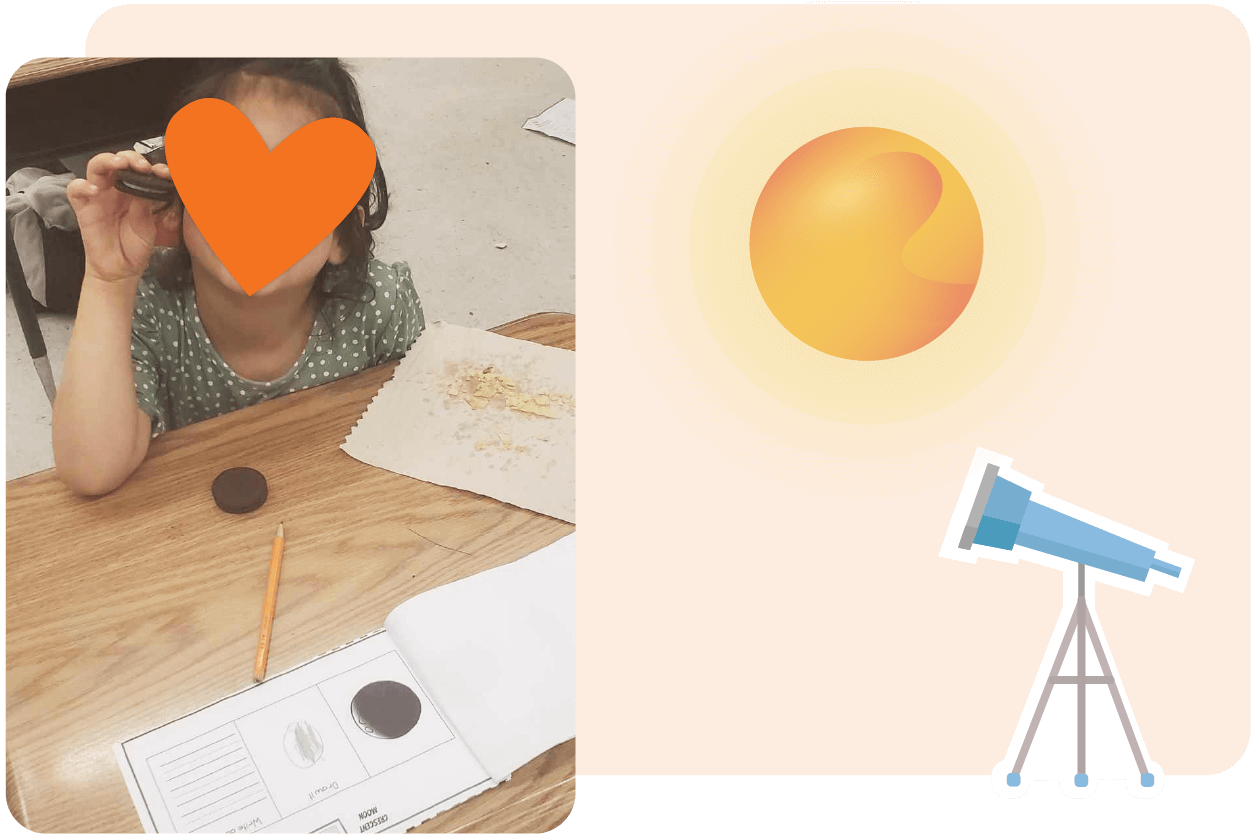
Domain 6: Astronomy
A surefire way to ignite your students’ excitement about astronomy is to create a moon phase Oreo chart!
Credit: Shelby Varchmin, Fred Wild Elementary School, FL
BONUS IDEA: Have your class send postcards to space through the Club for the Future program.
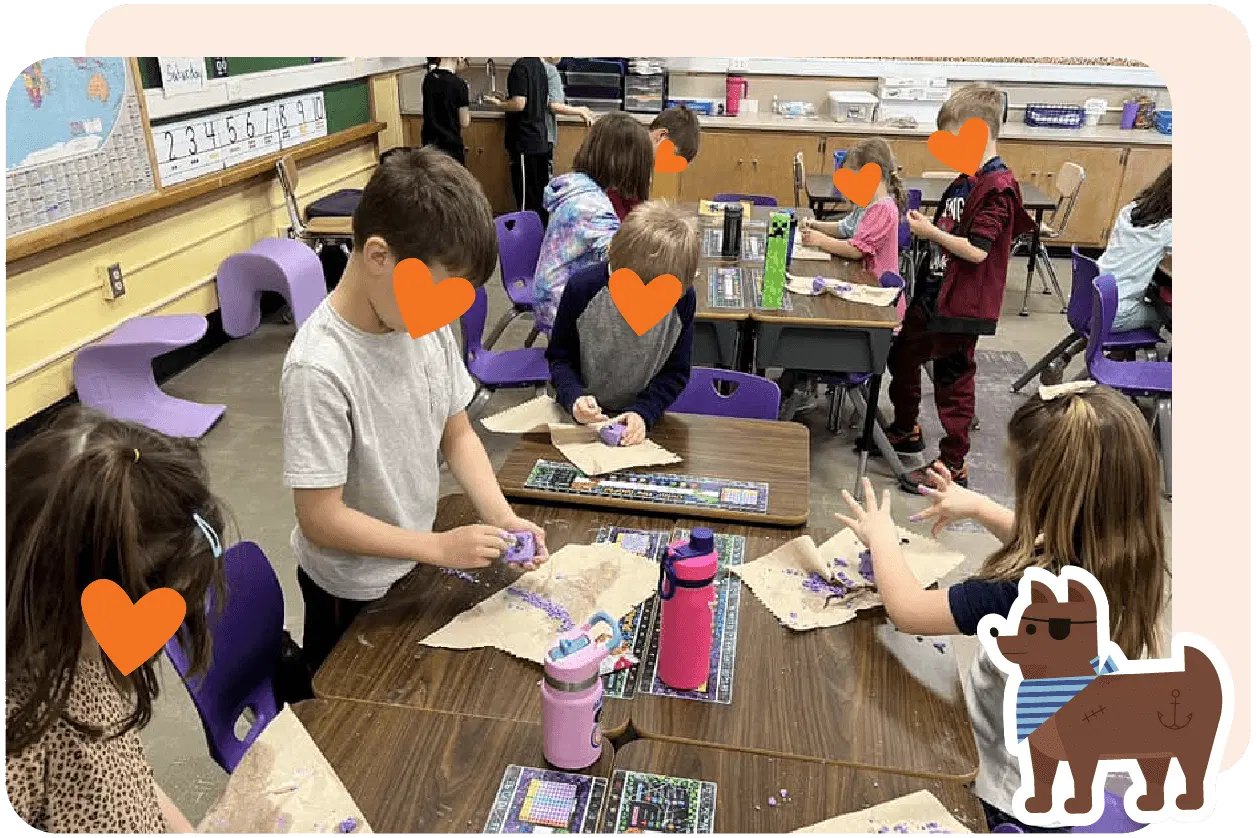
Domain 7: The History of the Earth
Students channeled their inner geologists during this unit and dug for rocks.
Credit: Ronda Scott, Dixon Public Schools, IL
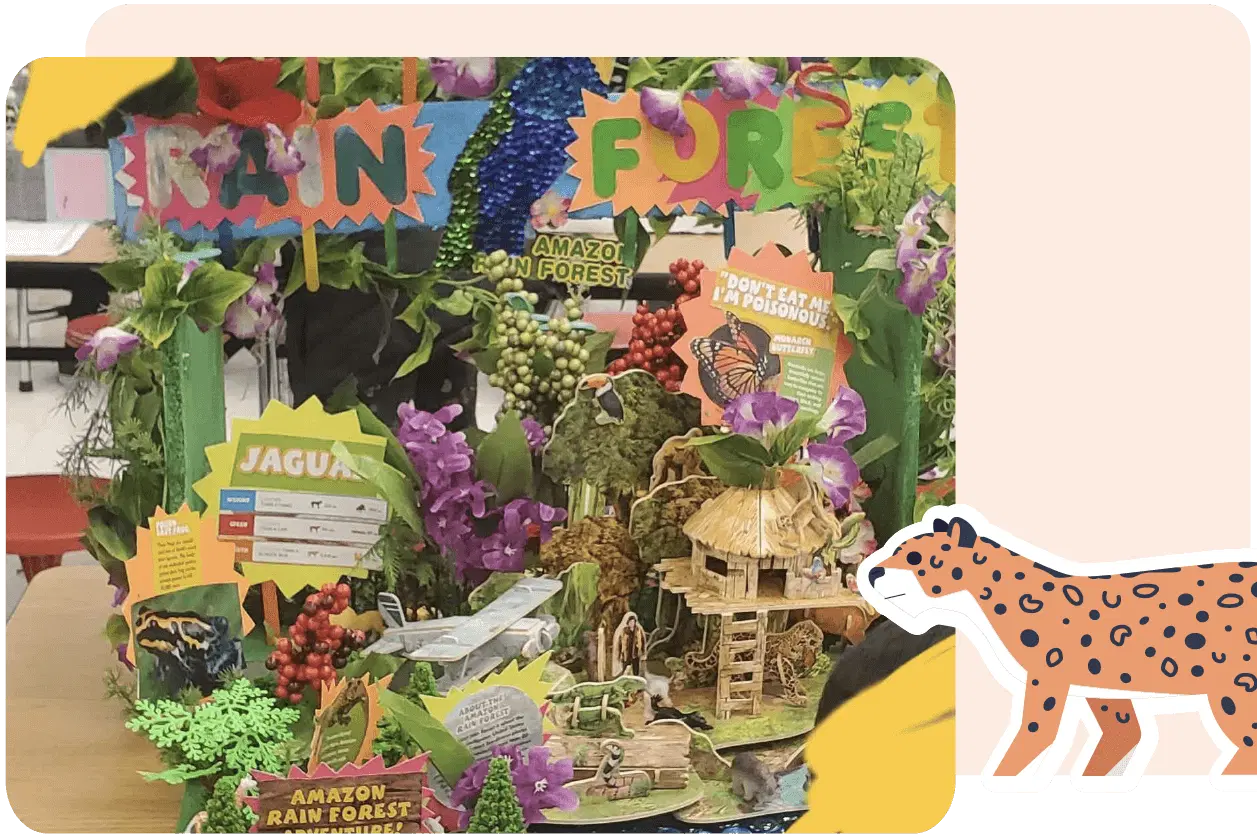
Domain 8: Animals and Habitats
Students can express their creativity by drawing animals, plants, and environments on rocks, then sorting by habitats or comparing by Venn diagram.
BONUS: Check out these students’ creative and colorful dioramas that were showcased at the end of this unit!
Credit: Christine Thomas, The School District of Palm Beach County, FL
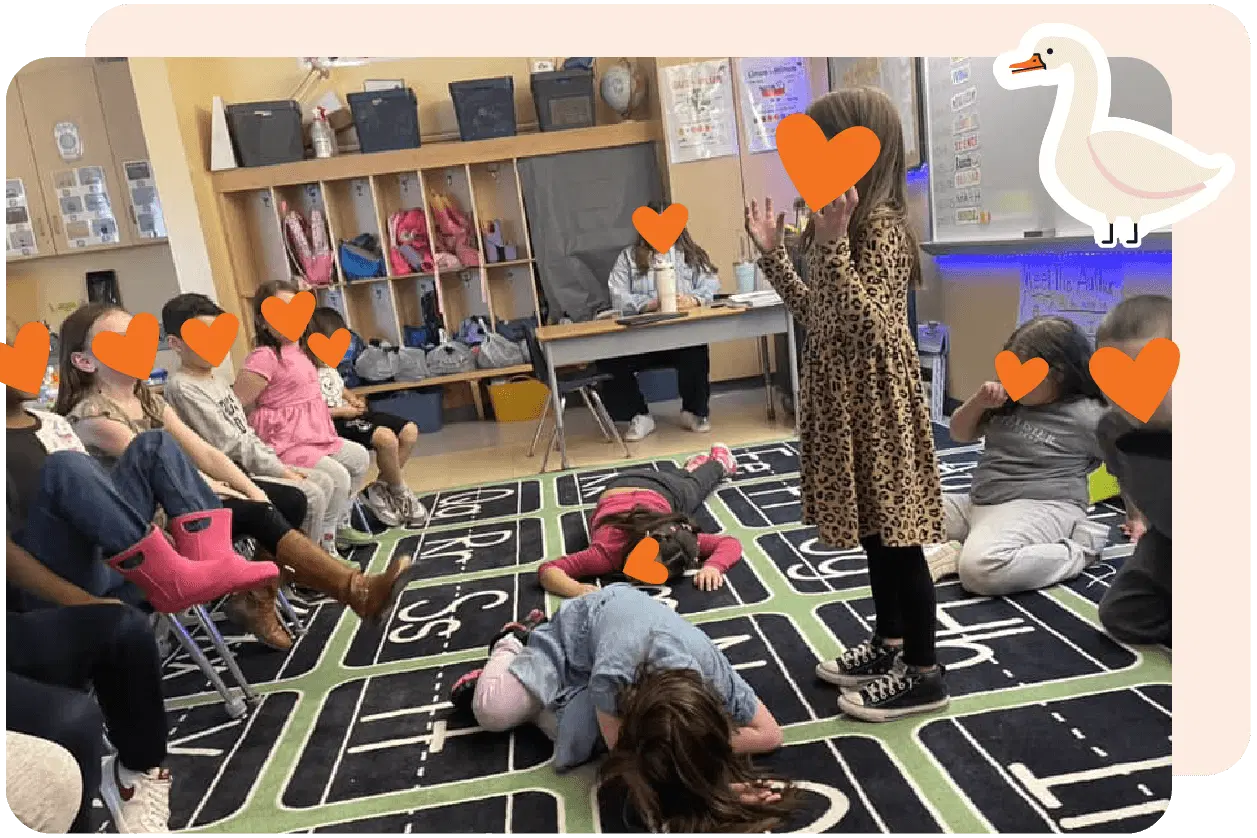
Domain 9: Fairy Tales
To wrap up the Fairy Tales unit, sharpen your students’ drama skills by having them act out their favorite stories.
Credit: Elizabeth Sillies, Three Rivers Local School District, OH
Domain 10: A New Nation: American Independence
Posters beautifully summarize the learning from a unit. Pair students up to create and present to their classmates!
Credit: Tracy Hatch Gagnon, Holy Name Parish School, MA
Domain 11: Frontier Explorers
Students can celebrate this unit by hosting a Pioneer Day and making Daniel Boone hats!
Credit: Shelby Varchmin, Fred Wild Elementary School, FL
Grade 2
In Grade 2, students thrill to the crimes of the Cat Bandit, assemble books about ancient Chinese culture, write their own Greek myths, and learn the story of the people who escaped to freedom from slavery by “follow[ing] the Drinking Gourd.”

Domain 1: Fairy Tales and Tall Tales
To celebrate the end of the Fairy Tales and Stories Unit, encourage students to showcase their favorite stories by crafting paper collages and clay figures.
Credit: Jessica Berg, Arlington Public Schools, VA
Domain 2: Early Asian Civilizations
Second-grade teachers worked together to create an amazing dragon at the end of their Early Asian Civilizations Unit. Each student created a scale for their grade-level dragon!
Credit: Emma Bridgeforth, Windsor Elementary School, WI
BONUS: This class at Windber Elementary, PA, celebrated this unit by hosting a Chinese New Year dragon parade.
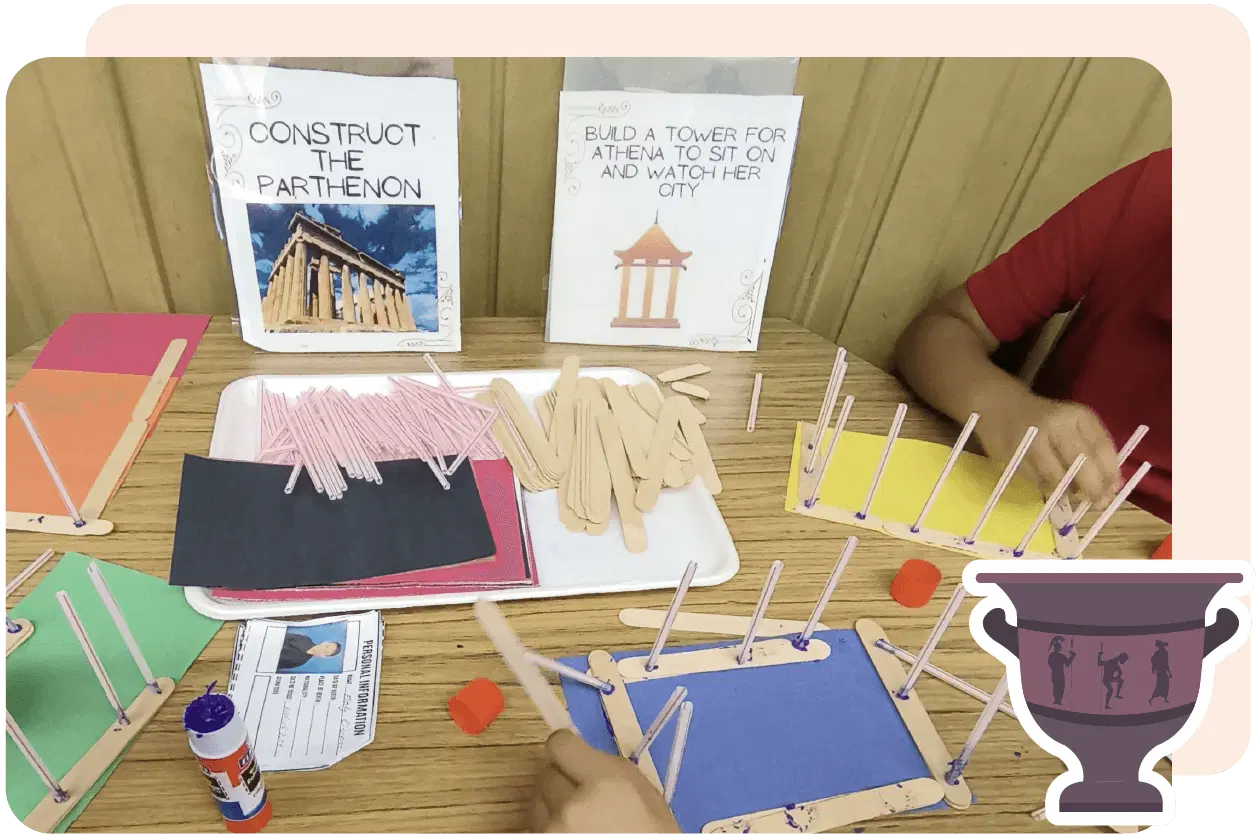
Domain 3: The Ancient Greek Civilization
This class had a great time becoming world travelers and celebrating all the knowledge gained throughout the Ancient Greek Civilization domain. The students started their day getting their passport stamped. After entering ancient Greece, they engaged in many centers. They built the Parthenon and Athena’s throne, wrote facts about Sparta, created locks for Pandora’s box, built a harp for Apollo, and played vocabulary games. In addition to centers, the students learned that they all qualified for the Olympics, and were led by teachers on a victory walk as the entire school cheered for them!
BONUS: Take inspiration from this Louisiana educator and plan a potato Olympics day with your students!
Credit: Terri Hart, Jefferson Parish Public School District, LA
Domain 4: Greek Myths
Students wrote and shared their very own Greek myths, made props, and dressed in togas to celebrate this unit!
Credit: Chelsey Steinmetz, Cornell Elementary School, WI
Domain 5: The War of 1812
Bring a battle to life by having students create boats out of foil and other common household materials to participate in a boat race!
Credit: Jerica Falevai, Pacific Heritage Academy, UT
Domain 6: Cycles in Nature
To bring the Cycles in Nature unit to life, students learned how to make their own greenhouses and watched lima beans germinate and sprout.
Credit: Amber Taylor, Corbin Primary School, KY
Domain 7: Westward Expansion
To commemorate the end of this domain, this class had two grandparents come to the classroom to bake bread, make trail mix, and pan for gold.
BONUS: In another classroom, students made people, animals, and their very own pioneer wagons out of paper.
Credit: Jennifer Murphy, John E. Bryan Elementary School, AL
Domain 8: Insects
These students celebrated all the knowledge they gained by researching and writing about an insect, then using household items to build a model of their chosen insect!
Credit: Tamara Gore, Harrison Hill Elementary School, IN
Domain 9: The U.S. Civil War
Have your students showcase their knowledge of the U.S. Civil War by creating posters of important historical figures of the time!
Credit: Heather Griffin, Rochester School District, NH
Domain 10: The Human Body
We love this culminating activity! Students made digestive-system models out of air-dry clay and traced themselves on large paper to make a life-size model of the body systems!
Credit: Olga Cabrera, Aldine ISD, TX
Domain 11: Immigration
Students participated in an Ellis Island simulation in their classrooms at the end of the Immigration Unit, and even created their own passports!
Credit: Sandra Garcia, Austin Independent School District, TX
Domain 12: Fighting for a Cause
To wrap up this unit and showcase their knowledge, students created VIP books about important historical figures!
Credit: Meghan Scheffler, Community Unit School District 300, IL
Grade 3
In Grade 3, students write a newspaper story about the invention of the telephone, go on a digital quest with Viking explorers, reflect on the stars with astronomy lab notes, and learn the secret to writing an excellent narrative ending.
Domain 1: Classic Tales: The Wind in the Willows
To immerse themselves in the Classic Tales domain, students hosted a party inspired by classic literary celebrations.
Credit: Laurie Valente, Secaucus Public School District, NJ
Domain 2: Animal Classification
A great way to shift perspective and get students to apply their knowledge? Transform your classroom into a vibrant “rainforest café” that showcases students’ published writing. Each student can create an informational piece about a specific vertebrate, learning how to introduce a topic, group related information, and support it with facts and details. They turn their writing, complete with text features, into restaurant-style menus! Dressed as rainforest and safari guides, students can present their work to other students and staff, answering questions about their animal and its classification.
Credit: Nicole Desmond, Riverside School District 96, IL
BONUS: To celebrate the Light and Sound unit as well as all units about animals in grades K–4, take a cue from Windber Elementary and plan an animal-themed glow show with your students!
Domain 3: Human Body
Get crafty in this unit by having students make body parts out of household supplies: a pipe cleaner becomes the spinal cord, noodles represent the vertebrae, and gummy Life Savers turn into cartilage. You can also make X-rays by tracing hands and wrists on construction paper. Students can color around the bones with a dark crayon, then use vegetable oil and a Q-tip to “paint” the bones. When held up to a light, the project resembles an X-ray!
Credit: Crystal Chwatek, Muhlenberg Elementary Center, PA
Domain 4: The Ancient Roman Civilization
Have your students put their knowledge of ancient Roman civilization to the test: Challenge them to use packing peanuts to build iconic Roman landmarks.
Credit: Melissa Vasquez, Eureka City Schools,CA
Domain 5: Light and Sound
To celebrate the Light and Sound unit, your students can make colorful suncatchers and witness the science of light and color in action.
Credit: Stephanie Schuettpelz, Marion Elementary School, WI
BONUS VIDEO: Watch how another teacher plans a black light party for this unit!
Domain 6: The Viking Age
CKLA students love Vikings! In this classroom, students made paper swords before participating in a special ceremony.
Credit: Kerri Lintl, Merrimac Community School, WI
Domain 7: Astronomy
As a culminating activity for the Astronomy unit, an Oreo moon phase exercise really motivates students to apply their knowledge.
Credit: Stephanie Schuettpelz, Marion Elementary School, WI
Domain 8: Native Americans
Flex your students’ creativity at the end of the Native Americans unit by having them gather natural materials and creating Native American shelters!
Credit: Alisa Byrd Fesmire, Roane County Schools, TN
BONUS VIDEO: Hear how a teacher in Wisconsin plans a basket-weaving activity for her students during this unit!
Domain 9: Early Explorations of North America
To help your students visualize North American exploration, they can draw maps of the studied expeditions and use yarn to show the various routes!
Credit: Maria Woytko-Morris, Manitou Springs School District, CO
Domain 10: Colonial America
Take inspiration from this classroom and set up a colonial town where students can barter goods and work as apprentices at the general store, blacksmith, tailor shop, and cobbler shop.
Credit: Heidi Graci, Sporting Hill Elementary School, PA
Domain 11: Ecology
For this unit, these students practiced their speaking and listening skills by presenting about an endangered animal to the rest of the class.
Credit: Stephanie Schuettpelz, Marion Elementary School, WI
Grade 4
In Grade 4, students take part in a dramatic invention competition judged by Thomas Edison, George Washington Carver, and Hedy Lamarr; use writing to investigate the function of a mysterious contraption; become poets; and bring their reading skills to bear on the classic novel Treasure Island.
Domain 1: Personal Narratives
To celebrate the Personal Narratives domain, students created posters using information about their names.
Credit: Daphne Long, Steele Elementary School, AL
BONUS VIDEO: Hear how an educator in New York plans an engaging culminating activity for the Personal Narratives unit!
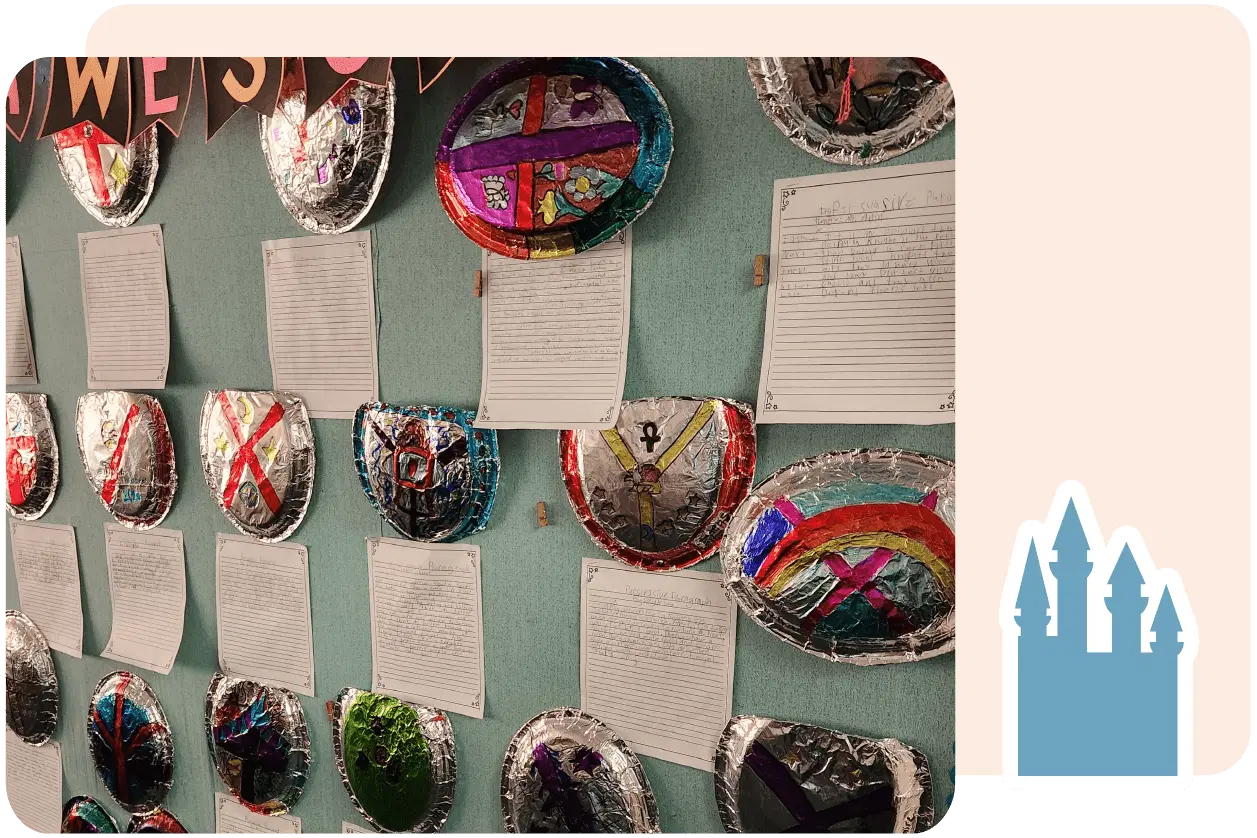
Domain 2: Empires in the Middle Ages
Flex your students’ creativity: Have them create their very own shields and write a paragraph describing them.
Credit: Elisabeth Freligh, Spring Hill Elementary School, AK
BONUS VIDEO: See how students in Minnesota participated in a stained glass art project to celebrate the Middle Ages.
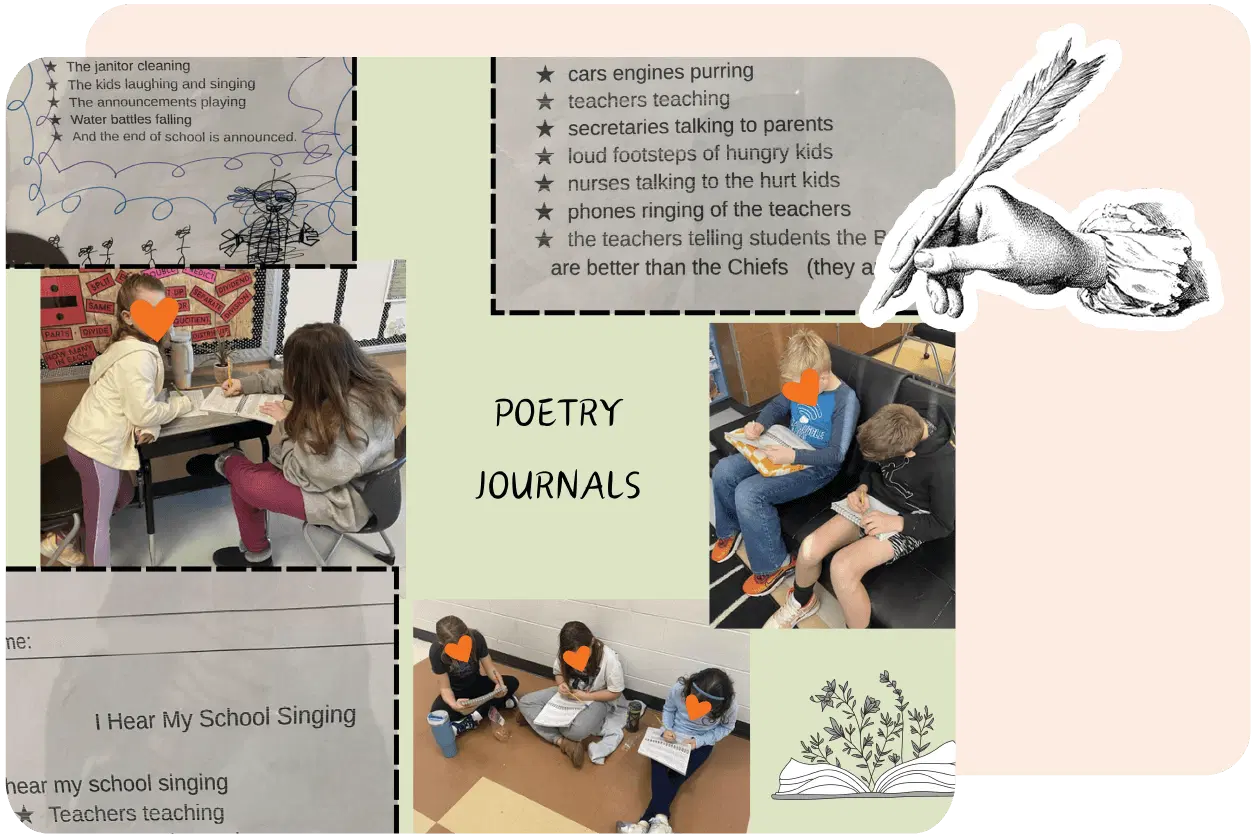
Domain 3: Poetry
Empower students to apply their knowledge of this writing discipline with poetry journals.
Credit: Elizabeth Sillies, Three Rivers Local School District, OH
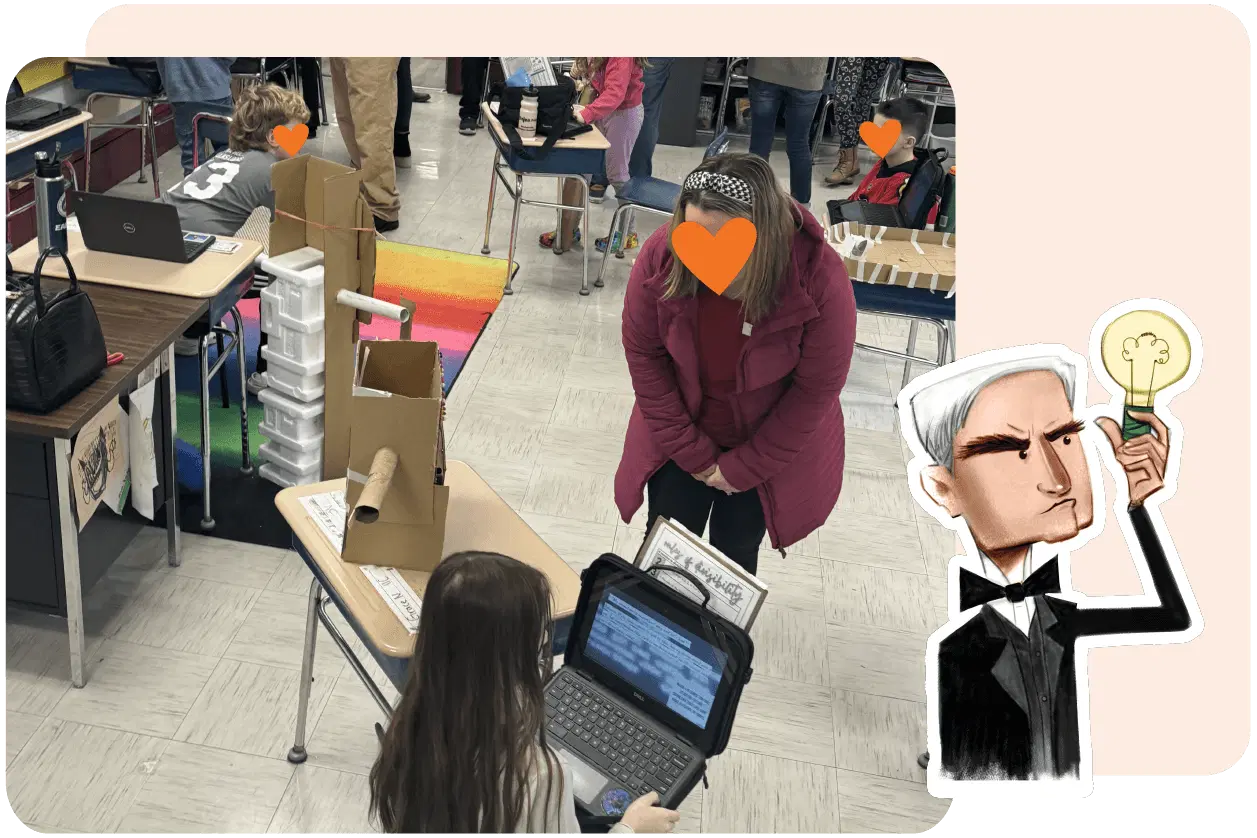
Domain 4: Eureka! Student Inventor
Encourage students to showcase their innovation at an Invention Showcase! Here, they pitched their ideas using the slides they created and the models they made.
Credit: Daniella Cucunato, Merchantville School District, NJ
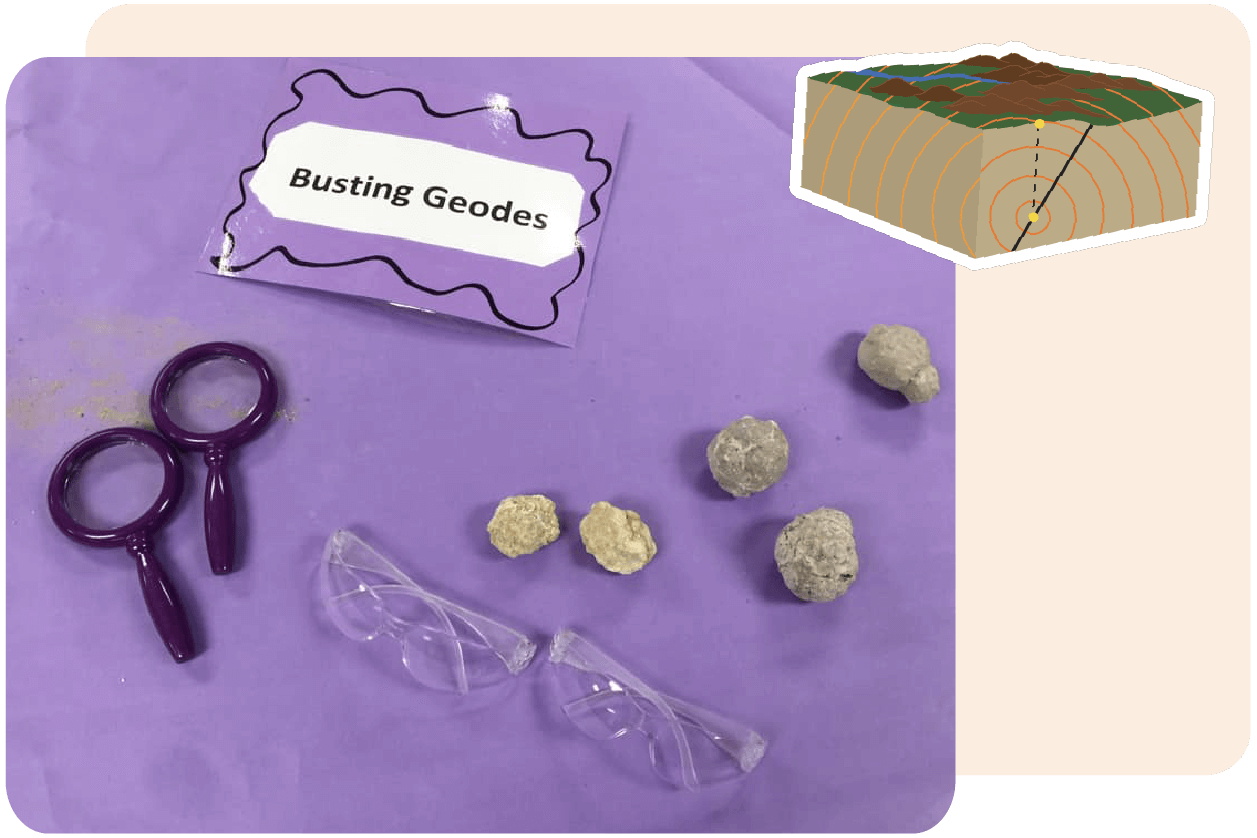
Domain 5: Geology
Geology offers great opportunities to facilitate hands-on learning! Students can examine rocks and fossils, or bust geodes to supplement their lessons.
Credit: Spring Choate, Overton County Schools, TN
Domain 6: Contemporary Fiction
Students can take their favorite stories off the page in this unit! For example, lead students in a craft activity creating their own house inspired by The House on Mango Street.
Credit: Lara Andree, Aldine ISD, TX
Domain 7: American Revolution
Work a STEM activity into this Knowledge Domain by inviting students to recreate the Boston Tea Party with sticks and items of various weights.
Credit: Maureen Elliott, West Irondequoit CSD, NY
Domain 8: Treasure Island
To celebrate the end of the Treasure Island domain collaboratively, students can build their very own map sections and put them together.
Credit: Daphne Long, Steele Elementary, AL
Grade 5
In Grade 5, students learn about villanelles and Mayan codices, read and perform Shakespeare’s “A Midsummer Night’s Dream,” use their writing skills to teach a robot about human emotions, and solve a scientific mystery involving ancient fossils.
Domain 1: Personal Narratives
Have your students refine their personal narratives into graphic stories to celebrate the end of this unit.
Credit: Anna Barba, Arlington Traditional School, VA
BONUS VIDEO: Hear how a teacher plans name posters for her students to wrap up this domain.

Domain 2: Early American Civilizations
To celebrate this unit, have your students create codices and Mayan mythical character sculptures using clay!
Credit: Anita Trolese, TASIS Portugal
Domain 3: Poetry
Transform your classroom into a poetry café where students share their work with the rest of the class.
Credit: K.D. Meucci, Bethel Park School District, PA

Domain 4: Adventures of Don Quixote
These students are an inspiration! To celebrate they reenacted scenes from Adventures of Don Quixote by choosing a chapter, summarizing its plot, writing scripts, and acting out their chapter for their classmates. They even chose their own backdrops and props to help embody the characters.
Credit: Riley Montgomery, Hamilton Local School District, OH
Domain 5: The Renaissance
The arts and the Renaissance go hand in hand, so have your students get creative and create their own Leonardo da Vinci portraits.
Credit: Windber Elementary, PA
Domain 6: The Reformation
Immerse your students in the Reformation era by having them make stamps and write out some text as a great way to mimic the effect of the printing press!
Credit: Jessica Kingery, Jefferson City School District, MO
Domain 7: A Midsummer Night’s Dream
Turn your classroom into a theater for this unit and have your students read the play using character cards and donkey headbands.
Credit: Daphne Long, Steele Elementary, AL
Domain 8: Native Americans
A successful extension project for the Native Americans unit is personal totem poles! Have your students determine their own personal totems, write paragraphs to explain totem poles and why they selected their own personal totems, and use a template to create their own totem pole.
Credit: Kristin Rea, Cicero School District 99, IL
Domain 9: Chemical Matter
A great way to bring knowledge to life in this unit? Make fossils out of clay molds!
Credit: Teresa Karney, Reese Public Schools, MI